


 )
or https:// means you've safely connected to the .gov website. Share sensitive information only on official, secure websites.
)
or https:// means you've safely connected to the .gov website. Share sensitive information only on official, secure websites.


- 3.12.212 Applications for Extension of Time to File Tax Returns
- 3.12.212.1 Program Scope and Objectives
- 3.12.212.1.1 Background
- 3.12.212.1.2 Authority
- 3.12.212.1.3 Roles and Responsibilities
- 3.12.212.1.4 Program Management and Review
- 3.12.212.1.5 Program Controls
- 3.12.212.1.6 Terms and Acronyms
- 3.12.212.1.7 Related Resources
- 3.12.212.1.8 IRM Deviation Procedures
- 3.12.212.1.9 Taxpayer Advocate Service (TAS)
- 3.12.212.1.9.1 TAS Service Level Agreements (SLAs)
- 3.12.212.1.10 Related Forms
- 3.12.212.2 General Information
- 3.12.212.2.1 Perfection of Attachments
- 3.12.212.2.2 Transshipping Extensions
- 3.12.212.2.3 Non Master File Extensions
- 3.12.212.2.4 Unprocessable Documents
- 3.12.212.2.5 Research
- 3.12.212.3 Error Resolution System (ERS)
- 3.12.212.3.1 General ERS Processing Information
- 3.12.212.3.2 Type of Errors
- 3.12.212.3.3 ERS Inventories
- 3.12.212.3.4 Error Inventory Report
- 3.12.212.3.5 Status Codes
- 3.12.212.3.6 Workable Suspense Inventory Report
- 3.12.212.3.7 Action Codes
- 3.12.212.3.8 Action Code Chart
- 3.12.212.3.9 Clear Code C and 000.
- 3.12.212.3.10 Correspondence
- 3.12.212.3.11 Field Errors
- 3.12.212.3.12 Section Errors
- 3.12.212.3.13 ERS Error Codes General
- 3.12.212.3.14 Scanned Paper Returns
- 3.12.212.4 Determination of Timely Filing/Received Date - General
- 3.12.212.5 BMF - Correction of Errors for Form 7004
- 3.12.212.5.1 Section 01 - Form 7004
- 3.12.212.5.2 RMIT - Remittance, Form 7004
- 3.12.212.5.3 Field 01NC - Name Control, Form 7004
- 3.12.212.5.4 Field 01TIN - Taxpayer Identification Number, Form 7004
- 3.12.212.5.5 Field 01TNT - TIN-Type, Form 7004
- 3.12.212.5.6 Field 01TXP - Tax Period, Form 7004
- 3.12.212.5.7 Field 01MFT - Master File Tax Code, Form 7004
- 3.12.212.5.7.1 Correction Procedures for Field 01MFT - MFT Code, Form 7004
- 3.12.212.5.8 Field 01PL - Form 5558 Plan Number
- 3.12.212.5.9 Field 01RCD - Received Date, Form 7004
- 3.12.212.5.10 Field 01CCC - Computer Condition Code, Form 7004
- 3.12.212.5.11 Field 01RGC - Group Code
- 3.12.212.5.12 Field 01RTC - Return Code, Form 7004
- 3.12.212.5.12.1 Invalid Conditions for Field 01RTC - Return Code, Form 7004
- 3.12.212.5.12.2 Correction Procedure for Field 01RTC - Return Code, Form 7004
- 3.12.212.5.13 Field 01CAF - Centralized Authorization File (CAF) Indicator
- 3.12.212.5.14 Field 01NOT - Notice Code
- 3.12.212.6 Error Codes for Form 7004
- 3.12.212.6.1 Error Code 002 - Name Control Mismatch, Form 7004
- 3.12.212.6.1.1 Invalid Condition for Error Code 002, Form 7004
- 3.12.212.6.1.2 Correction Procedures for Error Code 002, Form 7004
- 3.12.212.6.2 Error Code 003 - Invalid Check Digit, Form 7004
- 3.12.212.6.2.1 Invalid Conditions for Error Code 003, Form 7004
- 3.12.212.6.2.2 Correction Procedures for Error Code 003, Form 7004
- 3.12.212.6.3 Error Code 004 - EIF/NAP Mismatch, Form 7004
- 3.12.212.6.3.1 Invalid Conditions for Error Code 004, Form 7004
- 3.12.212.6.3.2 Correction Procedures for Error Code 004, Form 7004
- 3.12.212.6.4 Error Code 005 - Missing Received Date, Form 7004
- 3.12.212.6.4.1 Invalid Condition for Error Code 005, Form 7004
- 3.12.212.6.4.2 Correction Procedures for Error Code 005, Form 7004
- 3.12.212.6.5 Error Code 006 - Remittance With No Received Date, Form 7004
- 3.12.212.6.5.1 Invalid Condition for Error Code 006, Form 7004
- 3.12.212.6.5.2 Correction Procedures for Error Code 006, Form 7004
- 3.12.212.6.6 Error Code 007 - Early Filed Extension, Form 7004
- 3.12.212.6.6.1 Invalid Condition for Error Code 007, Form 7004
- 3.12.212.6.6.2 Correction Procedures for Error Code 007, Form 7004
- 3.12.212.6.7 Error Code 026 - FYM Mismatch, Form 7004
- 3.12.212.6.7.1 Invalid Condition for Error Code 026, Form 7004
- 3.12.212.6.7.2 Correction Procedures for Error Code 026, Form 7004
- 3.12.212.6.7.2.1 Compare TIN
- 3.12.212.6.7.2.2 Short Period, Form 7004
- 3.12.212.6.7.2.3 Research CC INOLES
- 3.12.212.6.7.2.3.1 FYM Does Not Match Tax Period of the Extension
- 3.12.212.6.7.2.4 Research CC BMFOLI
- 3.12.212.6.7.2.4.1 Reply or No Reply Error Code 026, Form 7004
- 3.12.212.6.8 Error Code 605 - Late Filed With No Received Date, Form 7004
- 3.12.212.6.8.1 Invalid Condition for Error Code 605, Form 7004
- 3.12.212.6.8.2 Correction Procedures for Error Code 605, Form 7004
- 3.12.212.6.9 Error Code 609 - Prior Year Extension, Form 7004
- 3.12.212.6.9.1 Invalid Condition for Error Code 609, Form 7004
- 3.12.212.6.9.2 Correction Procedures for Error Code 609, Form 7004
- 3.12.212.6.10 Error Code 615 - FYM vs MFT, Form 7004
- 3.12.212.6.10.1 Invalid Condition for Error Code 615, Form 7004
- 3.12.212.6.10.2 Correction Procedures for Error Code 615, Form 7004
- 3.12.212.6.11 Error Code 617 - Return Code vs MFT, Form 7004
- 3.12.212.6.11.1 Invalid Conditions for Error Code 617, Form 7004
- 3.12.212.6.11.2 Correction Procedures for Error Code 617, Form 7004
- 3.12.212.6.12 Error Code 999 - End of Year Format, Form 7004
- 3.12.212.6.12.1 Invalid Condition for Error Code 999, Form 7004
- 3.12.212.6.12.2 Correction Procedure for Error Code 999, Form 7004
- 3.12.212.6.1 Error Code 002 - Name Control Mismatch, Form 7004
- 3.12.212.7 ERS Processing for Document Code 77 Form 3177, Form 5466-B, and Form 8892
- 3.12.212.7.1 Section 01 - Form 3177, Form 5466-B, and Form 8892
- 3.12.212.7.1.1 Field 01NC - Name Control, Form 3177, Form 5466-B, and Form 8892
- 3.12.212.7.1.2 Field 01TIN - Taxpayer Identification Number, Form 3177, Form 5466-B, and Form 8892
- 3.12.212.7.1.3 Field 01MFT - Master File Tax Code, Form 3177, Form 5466-B, and Form 8892
- 3.12.212.7.1.4 Field 01RPT - Report-Plan Number, Form 3177, Form 5466-B, and Form 8892
- 3.12.212.7.1.5 Field 01TXP - Tax Period, Form 3177, Form 5466-B, and Form 8892
- 3.12.212.7.1.6 Field 01TC - Transaction Code, Form 3177, Form 5466-B, and Form 8892
- 3.12.212.7.1.7 Field 01TDT - Transaction Date, Form 3177, Form 5466-B, and Form 8892
- 3.12.212.7.1.8 Field 01ED - Extended Due Date, Form 3177, Form 5466-B, and Form 8892
- 3.12.212.7.1.9 Field 01RGC - Group Code, Form 3177, Form 5466-B, and Form 8892
- 3.12.212.7.1.10 Field 01DC - Disclosure Codes, Form 3177, Form 5466-B, and Form 8892
- 3.12.212.7.1.11 Field 01ADP - Automated Data Processing (ADP) Source Code, Form 3177, Form 5466-B, and Form 8892
- 3.12.212.7.1.12 Field 01PRE - TIN Prefix, Form 3177, Form 5466-B, and Form 8892
- 3.12.212.7.1 Section 01 - Form 3177, Form 5466-B, and Form 8892
- 3.12.212.8 Error Codes for Document Code 77 Form 3177, Form 5466-B, and Form 8892
- 3.12.212.8.1 Error Code 002 Name Control Mismatch, Form 3177, Form 5466-B, and Form 8892
- 3.12.212.8.1.1 Invalid Condition for Error Code 002
- 3.12.212.8.1.2 Correction Procedures for Error Code 002
- 3.12.212.8.2 Error Code 004 EIF/NAP Mismatch, Form 3177, Form 5466-B, and Form 8892
- 3.12.212.8.2.1 Invalid Conditions for Error Code 004
- 3.12.212.8.2.2 Correction Procedures for Error Code 004
- 3.12.212.8.3 Error Code 103 Invalid MFT Document Code 77, Form 3177, Form 5466-B, and Form 8892
- 3.12.212.8.3.1 Invalid Condition for Error Code 103
- 3.12.212.8.3.2 Correction Procedures for Error Code 103
- 3.12.212.8.4 Error Code 105 Invalid Tax Period Document Code 77, Form 3177, Form 5466-B, and Form 8892
- 3.12.212.8.4.1 Invalid Condition for Error Code 105
- 3.12.212.8.4.2 Correction Procedures for Error Code 105
- 3.12.212.8.5 Error Code 107 Early Filed Extension Document Code 77, Form 3177, Form 5466-B, and Form 8892
- 3.12.212.8.5.1 Invalid Conditions for Error Code 107
- 3.12.212.8.5.2 Correction Procedures for Error Code 107
- 3.12.212.8.6 Error Code 110 Missing Extended Due Date Document Code 77, Form 3177, Form 5466-B, and Form 8892
- 3.12.212.8.6.1 Invalid Condition for Error Code 110
- 3.12.212.8.6.2 Correction Procedures for Error Code 110
- 3.12.212.8.7 Error Code 135 Invalid Extended Due Date Document Code 77, Form 3177, Form 5466-B, and Form 8892
- 3.12.212.8.7.1 Invalid Condition for Error Code 135
- 3.12.212.8.7.2 Correction Procedures for Error Code 135
- 3.12.212.8.8 Error Code 999 End of Year Reformat Document Code 77, Form 3177, Form 5466-B, and Form 8892
- 3.12.212.8.1 Error Code 002 Name Control Mismatch, Form 3177, Form 5466-B, and Form 8892
- 3.12.212.9 IMF Correction of Errors for Document Code 77, Form 4868 and Form 2350
- 3.12.212.9.1 IMF Section 01 Document Code 77, Form 4868 and Form 2350
- 3.12.212.9.1.1 Field 01NC - Name Control, Form 4868 and Form 2350
- 3.12.212.9.1.2 Field 01TIN - Taxpayer Identification Number (TIN), Form 4868 and Form 2350
- 3.12.212.9.1.3 Field 01MFT - Master File Tax Code, Form 4868 and Form 2350
- 3.12.212.9.1.4 Field 01TXP - Tax Period, Form 4868 and Form 2350
- 3.12.212.9.1.5 Field 01TC - Transaction Code, Form 4868 and Form 2350
- 3.12.212.9.1.6 Field 01TDT - Transaction Date, Form 4868 and Form 2350
- 3.12.212.9.1.7 Field 01ED - Extended Due Date, Form 4868 and Form 2350
- 3.12.212.9.1 IMF Section 01 Document Code 77, Form 4868 and Form 2350
- 3.12.212.10 Error Codes for IMF Document Code 77, Form 4868 and Form 2350
- 3.12.212.10.1 Error Code 004 IMF - EIF/NAP Mismatch, Form 4868 and Form 2350
- 3.12.212.10.1.1 Invalid Conditions for Error Code 004
- 3.12.212.10.1.2 Correction Procedures for Error Code 004, Accounts on the Invalid Segment
- 3.12.212.10.1.3 Correction Procedures for Error Code 004, Accounts on the Valid Segment
- 3.12.212.10.1.4 Correction Procedures for Error Code 004 Reject/Suspense
- 3.12.212.10.2 Error Code 005 IMF - Name Control Mismatch NAP/EIF, Form 4868 and Form 2350
- 3.12.212.10.3 Error Code 011 IMF - NAP Linkage Down, Form 4868 and Form 2350
- 3.12.212.10.4 Error Code 103 IMF - Invalid MFT, Form 4868 and Form 2350
- 3.12.212.10.5 Error Code 107 IMF - Tax Period later than the Current Year, Form 4868 and Form 2350
- 3.12.212.10.6 Error Code 110 IMF - Extended Due Date Missing, Form 4868 and Form 2350
- 3.12.212.10.7 Error Code 113 IMF - Transaction Date, Form 4868 and Form 2350
- 3.12.212.10.8 Error Code 135 IMF - Extended Due Date, Form 4868 and Form 2350
- 3.12.212.10.9 Error Code 999 IMF - End of Year Reformat, Form 4868 and Form 2350
- 3.12.212.10.1 Error Code 004 IMF - EIF/NAP Mismatch, Form 4868 and Form 2350
- Exhibit 3.12.212-1 Form 7004 - Application for Automatic Extension of Time to File Certain Business Income Tax, Information, and Other Returns
- Exhibit 3.12.212-2 Form 4868 - Application for Automatic Extension of Time to File U.S. Individual Income Tax Return
- Exhibit 3.12.212-3 Form 2350 - Application for Extension of Time to File U.S. Income Tax Return
- Exhibit 3.12.212-4 Form 8892 - Application for Automatic Extension of Time to File Form 709 or Form 709-NA and/or Payment of Gift/Generation-Skipping Transfer Tax
- Exhibit 3.12.212-5 Form 3177 - Notice of Action for Entry on Master File
- Exhibit 3.12.212-6 Form 5466-B - Multiple Record of Disclosure
- Exhibit 3.12.212-7 Form 7004 Due Dates - Form 706-GS(D), Form 706-GS(T), Form 1042, and Non-Master File Returns
- Exhibit 3.12.212-8 Form 7004 Due Dates - Form 1041, Form 1041-N, and Form 1041-QFT
- Exhibit 3.12.212-9 Form 7004 Due Dates - Form 1065, Form 1066, Form 1120-S, Form 3520-A, and Form 8804
- Exhibit 3.12.212-10 Form 7004 Due Dates - Form 1120 series (except Form 1120-C, Form 1120-POL, Form 1120-S, and Form 1120-F with box 2 or 4 checked)
- Exhibit 3.12.212-11 Form 7004 Due Dates - Form 1120-C
- Exhibit 3.12.212-12 Form 7004 Due Dates - Form 1120-POL
- Exhibit 3.12.212-13 Form 7004 Due Dates - Line 4 box is checked
- Exhibit 3.12.212-14 Form 4868 Due Dates
- Exhibit 3.12.212-15 Error Code 026 Flowchart - Form 7004
- Exhibit 3.12.212-16 Form 5260 - Quick Note
- Exhibit 3.12.212-17 Disaster Extension Due Dates - by State then FEMA (Federal Emergency Management Agency) Number
- 3.12.212.1 Program Scope and Objectives
Part 3. Submission Processing
Chapter 12. Error Resolution
Section 212. Applications for Extension of Time to File Tax Returns
3.12.212 Applications for Extension of Time to File Tax Returns
Manual Transmittal
September 11, 2025
Purpose
(1) This transmits revised IRM 3.12.212, Error Resolution - Applications for Extension of Time to File Tax Returns.
Material Changes
(1) IRM 3.12.212 Updated tax year 2024 to 2025 and due dates from 2025 to 2026 throughout the IRM.
(2) IRM 3.12.212.2(1) Added Non Master File Extensions to the list of general information in the subsection.
(3) IRM 3.12.212.3.1(1) Added Form 708, Master File Tax (MFT) Code 51, to the Tax Class 5 information.
(4) IRM 3.12.212.3.14 Removed an incorrect characteristic to identify Scanned Paper Returns.
(5) IRM 3.12.212.4 Removed current date minus 10 days from the priority listing as unnecessary.
(6) IRM 3.12.212.5(6) Added Forms 1041-N and 1041-QFT to have return code edited. IPU 25U0112 issued 01-27-2025.
(7) IRM 3.12.212.5(7) Added Form 708, MFT 51, to the Tax Class 5 information.
(8) IRM 3.12.212.5.1 Added Forms 1041-N and Form 1041-QFT to the 01RTC line. IPU 25U0112 issued 01-27-2025.
(9) IRM 3.12.212.5.5(3)b Added correction procedures for MFT 51.
(10) IRM 3.12.212.5.6.1 Changed wording to accommodate electronic early filed extensions. IPU 25U0456 issued 04-18-2025.
(11) IRM 3.12.212.5.7(3) Added MFT 51 to invalid conditions for Tax Class 5.
(12) IRM 3.12.212.5.7.1(4) Added Form Code 37, Form 708, and MFT 51 to the form code table.
(13) IRM 3.12.212.5.7.1(4) Added Form 1041-N and Form 1041-QFT to the note to edit return code. IPU 25U0112 issued 01-27-2025.
(14) IRM 3.12.212.5.12(3) Added Forms 1041-N and 1041-QFT. IPU 25U0112 issued 01-27-2025.
(15) IRM 3.12.212.5.12.2 Added Forms 1041-N and 1041-QFT. IPU 25U0112 issued 01-27-2025.
(16) IRM 3.12.212.6.11.1 Added Forms 1041-N and 1041-QFT. IPU 25U0112 issued 01-27-2025.
(17) IRM 3.12.212.6.11.2 Added Forms 1041-N and 1041-QFT. IPU 25U0112 issued 01-27-2025.
(18) IRM 3.12.212.8.5.2(3) Corrected tax period to 202412, and deleted note regarding the line for tax period on Form 8892. IPU 25U3399 issued 06-11-2025.
(19) IRM 3.12.212.8.7.2 Deleted note regarding the line for tax period on Form 8892. IPU 25U3399 issued 06-11-2025.
(20) IRM 3.12.212.9.1.2(2) Revised the Austin address to route Forms W-7 submitted with extension requests.
(21) IRM 3.12.212.10.1.3(7) Revised the Austin address to route Forms W-7 submitted with extension requests.
(22) IRM 3.12.212.10.5(3) b Changed wording to accommodate electronic early filed extensions. IPU 25U0456 issued 04-18-2025.
(23) Exhibit 3.12.212-8 Added tax periods for early filed current processing. IPU 25U0456 issued 04-18-2025.
(24) Exhibit 3.12.212-9 Added tax period for early filed current processing. IPU 25U0456 issued 04-18-2025.
(25) Exhibit 3.12.212-10 Added tax periods for early filed current processing. IPU 25U0456 issued 04-18-2025.
(26) Exhibit 3.12.212-11 Added tax periods for early filed current processing. IPU 25U0456 issued 04-18-2025.
(27) Exhibit 3.12.212-12 Added tax periods for early filed current processing. IPU 25U0456 issued 04-18-2025.
(28) Exhibit 3.12.212-13 Added tax periods for early filed current processing. IPU 25U0456 issued 04-18-2025.
(29) Exhibit 3.12.212-14 Updated tax periods for Processing Year 2026.
(30) Exhibit 3.12.212.-17 Deleted FEMA states that have disaster extension due dates ending before 2026.
(31) Exhibit 3.12.212-17 Added Missouri FEMA 4877-DR, New Mexico 3628-EM, and Texas FEMA 4879-DR. IPU 25U3502 issued 07/17/2025.
(32) Exhibit 3.12.212-17 Added Mississippi FEMA 4874-DR, Missouri FEMA 4867-DR, Oklahoma FEMA 4866-DR, and Texas FEMA 4871-DR. IPU 25U3399 issued 06-11-2025.
(33) Exhibit 3.12.212-17 Added Virginia FEMA 4863-DR. IPU 25U3287 issued 05-16-2025.
(34) Exhibit 3.12.212-17 Added Tennessee FEMA 3625-EM, Arkansas FEMA 3627-EM, updated North Carolina FEMA 4827-DR. IPU 25U0456 issued 04-18-2025.
(35) Exhibit 3.12.212-17 Added West Virginia FEMA 4861-DR. IPU 25U0327 issued 03-10-2025.
(36) Exhibit 3.12.212-17 Added Kentucky FEMA 3624-EM. IPU 25U0272 issued 02-26-2025.
(37) Exhibit 3.12.212-17 Added California FEMA 4856-DR. IPU 25U0112 issued 01-27-2025.
(38) Exhibit 3.12.212-17 Added all current FEMA disaster declarations. IPU 25U0007 issued 01-03-2025.
(39) IRM 3.12.212 Corrections and editorial changes have been made throughout this IRM, including typographical errors, tax periods, received dates, tax years, examples and exhibits.
Effect on Other Documents
IRM 3.12.212, dated November 27, 2024 (effective January 1, 2025), is superseded. This IRM incorporates the following IRM Procedural Updates (IPUs) excluding the Federal Emergency Management Agency (FEMA) disaster declarations with end dates during calendar year 2025: IPU 25U0007 issued 01-03-2025, IPU 25U0112 issued 01-27-2025, IPU 25U0272 issued 02-26-2025, IPU 25U0327 issued 03-10-2025, IPU 25U0456 issued 04-18-2025, IPU 25U3287 issued 05-16-2025, IPU 25U3399 issued 06-11-2025, and IPU 25U3502 issued 07-17-2025.Audience
Taxpayer Services, Error Resolution Tax ExaminersEffective Date
(01-01-2026)Scott Wallace
Director, Submission Processing
Taxpayer Services Division
-
Purpose: This chapter contains instructions for correcting errors identified in Error Resolution System (ERS) processing of applications for extensions of time to file and certain other miscellaneous forms.
-
Audience: Tax examiners in Taxpayer Services (TS) Division, Submission Processing Campuses, Error Resolution Departments are the primary users of this IRM.
-
Policy Owner: The Director of Submission Processing is responsible for the policies in this IRM.
-
Program Owner: The Code & Edit/ERS IMF Section of the Return Processing Branch of Submission Processing is responsible for the procedures and all updates related to this IRM.
-
Primary Stakeholders: Submission Processing (SP) is the primary stakeholder.
-
The Error Resolution System (ERS) is an on-line computer application used by tax examiners to correct errors identified during Generalized Mainline Framework (GMF) processing.
-
Included in this chapter are instructions for correcting errors on applications for extensions of time to file and certain other miscellaneous forms.
-
This IRM is to be used in conjunction with IRM 3.11.212, Applications for Extension of Time to File.
-
The instructions in this IRM cover the correction of the following forms.
Form Title Form 2350 Application for Extension of Time To File U.S. Income Tax Return Form 3177 Notice of Action for Entry on Master File (an internally generated form) Form 4868 Application for Automatic Extension of Time To File U.S. Individual Income Tax Return Form 5466-B Multiple Record of Disclosure (an internally generated document) Form 7004 Application for Automatic Extension of Time To File Certain Business Income Tax, Information, and Other Returns Form 8892 Application for Automatic Extension of Time To File Form 709 or Form 709-NA and/or Payment of Gift/Generation-Skipping Transfer Tax -
Correction instructions for approved Forms 4868, processed as Program 447XX (Document Code 17 and 19), are in IRM 3.12.10, Revenue Receipts.
-
Correction Instructions for Form 5558, Application for Extension of Time to File Certain Employee Plan Returns, and Form 8868, Application for Automatic Extension of Time to File an Exempt Organization Return, are in IRM 3.11.20, Exempt Organization and Employee Plan Applications for Extension of Time to File.
-
Correction Instructions for Form 5768, Election/Revocation of Election by an Eligible Section 501(c)(3) Organization to Make Expenditures to Influence Legislation, are in IRM 3.12.12, Exempt Organization Returns.
-
Authority for the procedures in this IRM is found in the following sections of the Internal Revenue Code and their corresponding Treasury regulations:
-
IRC 6201(a)
-
IRC 6213(b)
-
IRC 6402(a)
-
IRC 6511
-
IRC 6081
-
-
Policy Statements for Submission Processing are contained in IRM 1.2.1, Servicewide Policy Statements.
-
The Director, SP Office is responsible for monitoring operational performance for the Submission Processing campus.
-
The Operations Manager is responsible for monitoring operational performance for their operation.
-
The team manager/lead is responsible for performance monitoring and ensuring employees have the tools to perform their duties.
-
The team employees are responsible for following the instructions contained in this IRM including procedural updates (IPU) to this IRM posted to the SERP (Servicewide Electronic Research Program) website.
-
Program Goals: The ERS program objective is to provide timely and accurate correction of extensions that are in the ERS error inventory after data is input via Integrated Systems Remittance Processing (ISRP) and Modernized e-File (MEF).
-
Program Reports: All ERS records are controlled by a Document Locator Number (DLN), and error records are accessed and assigned for correction by block DLN. The daily ERS Error Inventory Report ERS 13-40 lists each block of returns and the number of returns in ERS inventory by program. The ERS system displays with command code ERVOL the real-time volume in inventory by status and by program. Daily, weekly, and periodic reports are available to management through Control-D WebAccess to manage inventory and capture data for program planning and review. See IRM 3.12.37, IMF General Instructions.
-
Program Effectiveness: Tax examiner completed inventory is selected for quality review during real-time processing. This review is conducted according to the procedures in IRM 3.30.30, Embedded Quality for Submission Processing (EQSP) System.
-
Annual Review: This IRM is updated and published annually after review and concurrence by affected offices according to the clearance process established in IRM 1.11.9, Clearing and Approving the Internal Revenue Manual (IRMs).
-
All tax examiners must submit and have a Business Entitlement Access Request System (BEARS) request approved by management to gain access to the Error Resolution System.
-
ERS inventory is worked on a First-In-First-Out (FIFO) basis when received from input systems through the GMF.
-
Control clerks are responsible for the control of error documents. See IRM 3.12.37, IMF General Instructions.
-
Terms and Acronyms tables are below.
Term Definition ACTION CODE Numeric code edited in the bottom left margin of an extension or other document to suspend the document and identify the reason the document has been suspended. ACTION TRAIL A notation in the lower left side margin on page 1 of a document which indicates or explains an action taken. ALPHA CHARACTER A letter of the alphabet. AUTOMATIC DATA PROCESSING (ADP) The handling and processing of data by mechanical and/or electronic equipment. BATCH A group of blocks of documents. A batch can’t contain more than 20 blocks. BLOCK A group of up to 100 documents with consecutive DLNs containing the same block number (digits 9 through 11 of the DLN). (A block can’t contain more than 100 documents since the documents are numbered from 00 to 99.) BUSINESS MASTER FILE (BMF) A magnetic tape file containing information about taxpayers filing business returns and related documents. CALENDAR YEAR A tax year that begins January 1 and ends on December 31. COMPUTER CONDITION CODE (CCC) A single alpha or numeric character edited on a return or document which either identifies a special condition or directs the computer to take a specific programmed action. CCCs are posted to the Master File. CORRESPONDENCE ACTION SHEETS (CAS) Forms used to request information from the taxpayer or to provide information to the taxpayer. Some are mailed to the taxpayer with the return, others generate a letter. CURRENT YEAR RETURN For processing in 2026, a current year return is a return filed for tax year 2025. DELINQUENT A return or extension request form filed after the due date without an approved extension. DOCUMENT LOCATOR NUMBER (DLN) A fourteen-digit number assigned to every return and document input through the Automatic Data Processing (ADP) system. EMPLOYER IDENTIFICATION NUMBER (EIN) A nine-digit number that identifies the account of a business taxpayer on the Business Master File. ENTRY Any type of mark entered by, or edited for, the taxpayer. ERROR RESOLUTION SYSTEM (ERS) A system for the examination and correction of returns rejected due to taxpayer and processing errors. FISCAL YEAR A tax year which ends on a date other than December 31. INDIVIDUAL MASTER FILE (IMF) A magnetic tape file containing information about taxpayers filing individual income tax returns and related documents. INDIVIDUAL TAXPAYER IDENTIFICATION NUMBER (ITIN) A unique nine-digit number assigned by the IRS to individuals who are not eligible to obtain a valid Social Security Number. Taxpayers obtain an ITIN by filing a Form W-7. An ITIN begins with 9 and the fourth and fifth digits are 50 through 65, 70 through 88, 90 through 92, or 94 through 99. INTEGRATED DATA RETRIEVAL SYSTEM (IDRS) A system that enables IRS employees to have visual access to certain computer-based information in taxpayer accounts. INTEGRATED SUBMISSION AND REMITTANCE PROCESSING SYSTEM (ISRP) A computerized system which will convert paper tax and information documents and remittances received by IRS into perfected electronic records of taxpayer data. INTERNAL REVENUE SERVICE NUMBER (IRSN) A nine-digit taxpayer identification number (TIN) assigned by IRS to an individual in certain circumstances. An IRSN begins with 9 and the fourth and fifth digits are 01, 02, 03, 04, 05, 06, 07, 08, 09, 10, 17, 18, 19, 28, 29, 37, 38, 39, 49, 66, or 89. INTERNATIONAL RETURN A return on which income is excluded or not reported because of revenues from, payments to, or residence in a foreign country. JULIAN DATE A calendar date expressed as the number of days since the beginning of the year. For example, February 1 is Julian Date 032. MASTER FILE A magnetic tape record which contains taxpayer accounts. NAME CONTROL The first four characters of the taxpayer's surname or the first four characters of the business entity name. PERFECTING Making returns acceptable for data entry through editing procedures. PIPELINE The areas in the IRS Submission Processing Campus that process a return from the time it is received until the data from the return is entered to an account in the IRS' main computer. These areas include Receipt and Control, Code and Edit, Data Conversion, Error Resolution, Rejects, and Unpostables. POWER OF ATTORNEY (POA) A form authorizing a representative to perform certain acts on the taxpayer's behalf. PRIMARY TAXPAYER The taxpayer who is listed first on the name line caption of a joint return, regardless of whether that taxpayer is male or female. PRIOR YEAR A tax period earlier than the current tax year. PROCESSABLE RETURN A return which meets all the requirements for ISRP input. RECEIVED DATE Date a return was received by the IRS. If the date is unknown and a received date is required, there is a prescribed formula for determining the date to edit as the received date. REMITTANCE A check, money order, or cash sent in with a return or extension. REMITTANCE PROCESSING SYSTEM (RPS) A computer controlled system through which payments and documents will be processed at a single multi-functional workstation. RETURN DUE DATE The date on which the return must be filed with the Internal Revenue Service. SECONDARY TAXPAYER The taxpayer who is listed second on the name line caption of a joint return, regardless of whether that taxpayer is male or female. SOCIAL SECURITY NUMBER (SSN) A nine-digit number identifying the account of an individual on the Individual Master File assigned by the Social Security Administration (SSA). TAX PERIOD The time covered by a particular return represented by the year and month in which the period ends. For example, 202512 stands for the tax year ending December 31, 2025. TAXPAYER ADVOCATE SERVICE (TAS) An independent organization within the IRS whose employees assist taxpayers who are experiencing economic harm, who are seeking help in resolving tax problems that have not been resolved through normal channels, or who believe than an IRS system or procedure is not working as it should. TAXPAYER IDENTIFICATION NUMBER (TIN) A nine-digit number which identifies the account of an individual or business taxpayer. The TIN can be a Social Security Number (SSN), an Individual Taxpayer Identification Number (ITIN), Internal Revenue Service Number (IRSN), Adoption Taxpayer Identification Number (ATIN) or an Employer Identification (EIN). TRANSACTION CODE (TC) A three-digit numeric code defining the precise nature of an action posted to the Master File. TRANSCRIPTION The process of transferring information from documents to a computer-readable form. Also called data conversion, input, and entry. UNPOSTABLES Data which can’t be posted (updated) to a master file due to an unprocessable condition such as an incorrect TIN, date, or transaction code. UNPROCESSABLE DOCUMENT A document which can’t be perfected for the ADP system, usually because of incomplete information. ACRONYM DEFINITION ADP Automatic Data Processing AUSPC Austin Submission Processing Campus BMF Business Master File BOB Block Out of Balance CAS Correspondence Action Sheet CCC Computer Condition Code CY Calendar Year DLN Document Locator Number EIN Employer Identification Number ERS Error Resolution System FY Fiscal Year IDRS Integrated Data Retrieval System IMF Individual Master File IRC Internal Revenue Code IRM Internal Revenue Manual IRS Internal Revenue Service IRSN Internal Revenue Service Number ISRP Integrated Submission and Remittance Processing System ITIN Individual Taxpayer Identification Number KCSPC Kansas City Submission Processing Campus MCC Martinsburg Computing Center MeF Modernized e-File MFT Master File Tax NMF Non-Master File OSPC Ogden Submission Processing Campus PCD Program Completion Date PDS Private Delivery Service POA Power of Attorney PY -
Prior Year
-
Processing Year
RPS Remittance Processing System SERP Servicewide Electronic Research Program SPC -
Special Processing Code
-
Submission Processing Campus (or Center)
SSA Social Security Administration SSN Social Security Number TAS Taxpayer Advocate Service TC Transaction Code TE Tax Examiner TIN Taxpayer Identification Number TP Taxpayer TY Tax Year USPS United States Postal Service -
-
Below is a list of related resources.
Resource Title/Link/Information Servicewide Electronic Research Program (SERP) Servicewide Electronic Research Program (SERP) Integrated Automation Technologies (IAT) Integrated Automation Technologies (IAT) Instructor’s Corner for Submission Processing Instructor’s Corner for Submission Processing Student Guide 2486-001 ERS for Business Master File (BMF) Extensions Forms 7004/8868/5558 Job Aid 2519-012 BMF ERS IRM 3.12.38 BMF General Instructions IRM 3.12.37 IMF General Instructions IRM 3.24.212 ISRP, Applications for Extension of Time to File Tax Returns IRM 3.12.10 Revenue Receipts IRM 3.11.20 Exempt Organization and Employee Plan Applications for Extension of Time to File IRM 3.12.12 Exempt Organization Returns Document 7071-A Name Control Job Aid - For Use Outside of the Entity Area -
Below is a table of where to find the correction instructions for Extensions.
Form Where To Find Correction Instructions 2350 Section, IRM 3.12.212.9
Error Codes, IRM 3.12.212.103177 Section, IRM 3.12.212.7
Error Codes, IRM 3.12.212.84868 Program 447XX, approved Doc Code 17 and approved and denied Doc Code 19, are in IRM 3.12.10, Revenue Receipts. (Doc Code 19 indicates remittance processed.) -
Section, IRM 3.12.10.4
-
Error Codes, IRM 3.12.10.5
Program 455XX, denied Doc Code 77, are in IRM 3.12.212.-
Section, IRM 3.12.212.9
-
Error Codes, IRM 3.12.212.10
5466-B Section, IRM 3.12.212.7
Error Codes, IRM 3.12.212.87004 Section, IRM 3.12.212.5
Error Codes, IRM 3.12.212.6
Suspense Correction when Form 7004 filed instead of Form 8868-
With Remittance, IRM 3.11.20.12.1.1
-
Without Remittance, IRM 3.11.20.12.1.2
8892 Section, IRM 3.12.212.7
Error Codes, IRM 3.12.212.85558 Section, IRM 3.11.20.8
Error Codes, IRM 3.11.20.98868 Section, IRM 3.11.20.12
Error Codes, IRM 3.11.20.135768 Section, IRM 3.12.12.99 and IRM 3.12.12.100 4768 This form is worked by a specialized group and will not be worked in Submission Processing. 1127 This form is filed at an Advisory Office and not through Submission Processing. 8613 This form is worked by the NMF team at the Kansas City Submission Processing Campus. Revenue Receipt Forms IRM 3.12.10.2.1, has a listing of all the forms that are considered Revenue Receipts and the instructions are in IRM 3.12.10, Revenue Receipts. -
-
Submit IRM deviations in writing following instructions from IRM 1.11.2.2.3, When Procedures Deviate from the IRM, and elevate through proper channels for executive approval.
-
The Taxpayer Advocate Service is an independent organization within the Internal Revenue Service (IRS), led by the National Taxpayer Advocate, that helps taxpayers and protects taxpayer rights. TAS offers free help to taxpayers when a tax problem is causing a financial difficulty, when they’ve tried and been unable to resolve their issue with the IRS, or when they believe an IRS system, process, or procedure just isn’t working as it should. TAS strives to ensure that every taxpayer is treated fairly and knows and understands their rights under the Taxpayer Bill of Rights. TAS has at least one taxpayer advocate office located in every state, the District of Columbia, and Puerto Rico.
-
TAS uses Form 12412, Operations Assistance Request (OAR), to start the OAR process of referring a case to the Taxpayer Services (TS) Division, to affect the resolution of the taxpayer’s problem. For more information, refer to IRM 13.1.19, Taxpayer Advocate Service, Taxpayer Advocate Case Procedures, Advocating With Operations Assistance Requests (OARs).
-
Refer taxpayers to TAS when the contact meets TAS criteria or when Form 911 Request for Taxpayer Advocate Service Assistance (and Application for Taxpayer Assistance Order), is attached and steps cannot be taken to resolve the taxpayer’s issue the same day. See IRM 21.1.3.18, Taxpayer Advocate Service (TAS) Guidelines.
-
The definition of "same day resolution" is within 24 hours. The following two situations meet the definition of "same day resolution" :
-
The issue can be resolved within 24 hours.
-
The IRS takes steps within 24 hours to resolve the taxpayer’s issue.
-
-
When making a TAS referral, use Form 911, and forward to TAS following your local procedures.
-
For more information, see IRM 13.1.7, Taxpayer Advocate Service (TAS) Case Criteria, and IRM 13.1.7.4, Exceptions to Taxpayer Advocate Service Criteria, for information on cases that TAS will no longer accept.
-
The National Taxpayer Advocate reached agreements with the Commissioners or Chiefs of the Taxpayer Services (TS) Division, Small Business/Self Employed (SB/SE) Division, Tax Exempt Government Entities (TEGE), Criminal Investigation (CI), Independent Office of Appeals and Large Business and International (LB&I), that outline the procedures and responsibilities for processing Taxpayer Advocate Service (TAS) casework when either the statutory or delegated authority to complete case transactions rests outside of TAS. These agreements are known as Service Level Agreements (SLAs).
-
The SLAs are found at TAS Service Level Agreements.
-
The following forms are referenced in this section. The chart below shows their form numbers, form titles, and uses.
Form Title Use Form 3244 Payment Posting Voucher To post payments on accounts. Form 3696 Correspondence Action Sheet To initiate correspondence to the taxpayer. Form 4227 Intra-SC Reject or Routing Slip To identify the unprocessable condition. Form 6401 Request for Missing Information To inform taxpayer of erroneous filed extensions. Form 6882 IDRS/Master File Information Request To request IDRS research. Form 8161 ERS Return Charge-Out To charge out returns on the new Suspense List, Rejected Records List, and Duplicate Document DLN Register. Input Correction Operation will also use as a routing slip and history item. Form 13482 Letter 3699C Extension Correspondence Action Sheet To initiate correspondence to the taxpayer using Letter 3699C.
-
The following general information is included in this subsection of the manual:
-
Perfection of Attachments
-
Transshipping Extensions
-
Non Master File Extensions
-
Unprocessable Documents
-
Research
-
-
If unrelated or unanswered taxpayer correspondence or questions are attached or written on the document and no action has been taken, detach or photocopy and route to the appropriate area.
-
If unanswered taxpayer correspondence relating to the extension application form is attached, make a photocopy of the attachment and route to the appropriate area.
-
Verify any attachment or photocopy of an attachment to be routed elsewhere contains the name, address, taxpayer identification number (TIN), received date, and that an audit trail is notated on the extension form.
-
Normally extension requests will be processed by the campus where they are received, but there are some exceptions. Use the following chart to determine transshipping:
If Then route to Form 2350, Austin Submission Processing Campus (AUSPC) Form 4868 and the taxpayer requests an extension longer than 6 months, Austin Submission Processing Campus (AUSPC) Form 7004 for consolidated return and for Form 1120-F and Form 1120-C, Ogden Submission Processing Campus (OSPC) Form 7004 for: -
Form 8612,
-
Form 8613,
-
Form 8725,
-
Form 8831,
-
Form 8876,
-
Form 8924, or
-
Form 8928,
Kansas City Submission Processing Campus (KCSPC) Form 8892, Kansas City Submission Processing Campus (KCSPC) -
-
Transship to KCSPC any Form 4868 for Form 1040-NR estate or trust. These forms must meet all the following conditions:
-
The request was originally filed at AUSPC and Form 4868 box 9 is checked, or Form 1040-NR is notated.
-
The Social Security Number (SSN) block contains an Employee Identification Number (EIN) or states an EIN has been applied for with no SSN present.
-
The taxpayer name includes "estate" or "trust" .
-
-
When an ERS document is extending the time to file a Non Master File (NMF) return (Form 8612, Form 8613, Form 8725, Form 8831, Form 8876, Form 8924, or Form 8928), the record must be rejected from ERS.
-
For non-remittance NMF items, SSPND 620.
-
For remittance NMF items, see IRM 3.12.38, BMF General Instructions. SSPND 343 for research before transferring to NMF or Unidentified, depending on instruction from Accounting.
-
-
Error Resolution System (ERS): When perfection of a document is not possible because correspondence is needed, perform research or refer the document to another area of the campus and suspend using the appropriate action code.
-
Command Code (CC) INOLE, definer S (INOLES) and the taxpayer's EIN, SSN, Internal Revenue Service Number (IRSN), or Individual Taxpayer Identification Number (ITIN) is used to find the following information:
-
Taxpayer's name and address.
-
Taxpayer's name control.
-
Filing requirements (for BMF and Employee Plans Master File (EPMF) taxpayers).
-
Fiscal Year Month (FYM): The month the taxpayer's tax year ends.
-
See IRM 2.3.47, Command Codes INOLE, EOGEN and SPARQ.
-
-
The following extension forms are processed in ERS:
-
The following Document Code 77 forms are processed in ERS:
-
Form 5466-B.
-
Form 3177.
-
-
Form 7004 is processed in ERS:
-
Form 7004 is numbered with Tax Class 1, 2, 3, or 5, Document Code 04, and Transaction Code (TC) 620.
-
When the TC 620 posts, it generates a TC 460 (with the same DLN as the TC 620) with the automatic extended due date (Return Due Date (RDD) plus 51/1, 6, or 7 months).
-
The Master File Tax (MFT) code must be edited and transcribed on each record. The following table shows the tax class to be used with each form and MFT code.
Tax Class Form 7004 Extension for 1 -
Form 1042 (MFT 12)
-
Form 8804 (MFT 08)
2 -
Form 1041 (trust or estate) (MFT 05)
-
Form 1041-N (MFT 05)
-
Form 1041-QFT (MFT 05)
-
Form 1041 (bankruptcy estate only) (MFT 05)
-
Form 1065 (MFT 06)
3 -
Form 1120 series (MFT 02)
-
Form 1066 (MFT 07)
-
Form 3520-A (MFT 42)
5 -
Form 706-GS (D) (MFT 78)
-
Form 706-GS (T) (MFT 77)
-
Form 708 (MFT 51)
-
-
A non-suspense letter or other notice must be manually issued to the taxpayer when the extension request is denied, as there is no automatic notice generated.
-
All money amount fields are transcribed in dollars and cents.
-
-
Form 3177:
-
Program number 1550X is used.
-
These are numbered with Document Code 77 and Blocking Series 000-499.
-
The Transaction Code is 460.
-
Extended due date must be edited and transcribed for these documents.
-
These documents can’t carry a remittance.
-
-
Form 5466-B:
-
Program numbers 1550X (BMF) or 4550X (IMF) are used.
-
These are numbered with Document Code 77 and Blocking Series 500-699 (BMF) or 500-549 (IMF).
-
The Transaction Code is 120.
-
-
Form 8892:
-
Program number 1550X is used.
-
These are numbered with Document Code 77 and Blocking Series 000-499.
-
The Transaction Code is 460.
-
Extended due date must be edited and transcribed for these documents.
-
These documents cannot carry a remittance.
-
-
IMF extension Form 4868 (denied, Program 4550X) and Form 2350 (both approved and denied, Program 4550X): See IRM 3.12.212.9.
-
Form 4868 and Form 2350 are numbered with Document Code 77. The Transaction Code is 460.
-
Form 2350 is numbered with Blocking Series 400-499. Only records with this blocking series will allow an extended due date past 12/15/YYYY.
-
Extended due date must be edited and transcribed for these documents.
-
These documents cannot carry a remittance.
-
-
ERS will identify errors according to type and priority. The record heading will show the type of error.
-
This IRM will provide correction procedures for the displays of the errors. There will be records where programming has not furnished a field needed to correct an error; in this case, use GTSEC. This is to be reported to National Office for correction.
-
Action Code Error (Priority I)
-
Section Error (Priority II) ISRP problem code
-
Validity Error Including Field Errors (Priority III)
-
Math and Consistency Errors (Error Codes) (Priority IV)
-
-
Records will be placed in error inventory or workable suspense inventory for correction. Once the record has been accessed and it displays, it must either be fully corrected, placed in suspense for more information, or rejected from pipeline processing. Corrections include correcting errors in editing or transcription.
-
This IRM is the main source of information in correcting the record and the related extension request. Procedures will also be found in IRM 3.12.37, IMF General Instructions and IRM 3.12.38, BMF General Instructions, which provide general instructions for correcting errors, document control, inventories, and management reports.
-
Each day the Error Inventory Report, ERS-13-40, will be furnished showing the blocks by the block control number and block DLN in DLN order. Each batch will be on a separate page. Blocks received from Block Out of Balance (BOB) Correction will be listed separately.
-
A copy of the Error Inventory Report can be placed on the carts of documents and used as a charge-out. This will help to determine when a cart is completed.
-
The first line of the Error Inventory Report will show the number of working days the records on that page have been in the error inventory. This will enable work left from a previous day to have priority.
-
Records for the documents in ERS are controlled by status codes. The status is updated when the records are placed in specific inventory.
-
Below is a list of the status codes and brief explanation:
-
Status 100 is an error awaiting correction. Records are in the error inventory.
-
Status 2XX is a record awaiting information. Records are in the suspense error inventory.
-
Status 3XX is a record the suspense period expired, and the record was not activated, or there was no response. Records are in the workable suspense inventory.
-
Status 4XX is a record with information awaiting correction. Records are in the workable suspense inventory.
-
Status Code 900 is a record is in the unpostable inventory.
-
-
The final two positions of the Status Code are the first two positions of the action code. This groups similar work together on the workable suspense inventory.
-
Each day the Workable Suspense Inventory Report shows the records by program, in DLN order, for various statuses, and totals.
-
The first line of the report shows the number of working days the records have been in the workable suspense inventory. The oldest work must be prioritized.
-
An ERS action code indicates the document is missing specific information, must be suspended, and/or must be removed (rejected) from processing. The code has sufficient detail to indicate if correspondence is to be sent to the taxpayer, or the specific in-house research or action required.
-
Code and Edit assigns action codes when numbered extension requests are unprocessable, more information is needed, or a manual intervention is required. The code is entered on the bottom of the extension.
-
Correspondence Action Sheets (Form 3696 and Form 13482) are attached by Document Perfection. When routing within the campus for in-house research, an explanation concerning the missing information needs to be attached to the extension request.
-
The action code assigned by Code and Edit is transcribed in the record of the document.
-
A valid action code other than 001 will place the record in the suspense inventory, either workable or unworkable.
-
A charge-out (Form 8161) is computer-generated for all new suspense items. The charge-out is used for pulling documents, and routing and controlling documents while the record is held in suspense, and associating the document with the workable suspense inventory when the record becomes workable.
-
When a record displays on the workable suspense inventory with the action code as first priority:
-
Add the information received to the record or follow the IRM instructions for the no reply, and clear the action code by entering C in the Clear Code Field and transmitting.
-
Once the action code is cleared, any validity, section, or math/consistency errors will display for correction.
-
Records that were unprocessable can require re-suspension for more information. A charge-out will not be generated for resuspended items. Make a notation in the appropriate block of the charge-out by entering the action code and date.
-
Some action codes can’t be resuspended. If this occurs, make a notation in the appropriate block of the charge-out by entering the correct action code and date.
-
-
When perfection is not possible, reject the record and initiate action to void the DLN. If remittance is involved, transfer it to the Unidentified Remittance File (URF).
-
If Perfection is not possible and the record requires renumbering or uncorrectable fields need correction, reject the record for reinput using RJECT with Action Code 630 (reinput) or 640 (void). If a new DLN is needed, use NWDLN with the appropriate action code and new DLN Master File Identification code, if required.
-
A charge-out will generate for all rejected records. The charge-out remains in the campus files for future reference.
-
ERS automatically controls most of the adjustments to Service Center Control File (SCCF). When manual adjustment is required, use Form 4028, Service Center Control File Adjustment Record (SCCF Format Code 216).
-
Only one action code can be assigned at a time to a record. The action code priority is 310, 4XX, 6XX, 3XX, 2XX. An action code can be entered on a record, delete or correct an invalid code, or enter another action code to resuspend or reject from ERS. Use RJECT, SSPND, or NWDLN with a valid action code.
-
SSPND with an action code clears the record and places the record in workable suspense or unworkable suspense.
-
RJECT with an action code deletes the record from ERS. SCCF automatically updates for the rejected records.
-
See the chart below for Action Codes used in the processing of extensions.
Action Code Description Suspense Period Function Used In 001 Input Document 0 EC 211 First Correspondence 40 CE, EC, S 215 International Correspondence 45 CE, EC, S 320 Entity Control 10 CE, EC, S 343 Other Accounting 10 CE, EC, S 351 TIN Research 0 EC, S 352 Name Research 3 CE, EC, S 353 Address Research 3 CE, EC, S 354 Filing Requirement Research 3 CE, EC, S 410 Technical Assistance 0 EC 420 Management Suspense–A 5 CE, EC, S 430 Management Suspense–B 10 CE, EC, S 440 Management Suspense–C 15 CE, EC, S 450 Management Suspense–D 20 CE, EC, S 460 Management Suspense–E 25 CE, EC, S 470 Complex Error Codes 0 EC, S 480 Early Filed 150 CE, EC, S 490 System Problem 5 CE, EC, S 610 Renumber 0 CE, EC 611 Renumber with-remit 0 CE, EC 620 NMF/Non-ADP 0 CE, EC 630 Reinput 0 EC 640 Void 0 CE, EC 650 International - ACI 0 CE, EC 651 International - AUSPC 0 CE, EC
-
A field labeled CL will display for the entry of a clear code when there is a possibility that a change or correction will not be needed. The Clear Code Field is located to the right of CRECT on the screen display.
-
Error codes are cleared by either correcting the condition or entering a C in the Clear Code Field to indicate no correction is needed. If corrections are made, transmit before entering Clear Code C.
-
Code C is used for clearing the action code after corrections have been completed, or as with Action Codes 410 and 700, the action code must be cleared initially so other errors in the record can be resolved.
-
The numeric 000 is used as a clear code when deleting action codes. It will be used for erroneous action codes when there’s no reason to suspend the record. The numeric 000 can’t be used in suspense correction.
-
Programming erases all clear codes for error codes when a record is suspended using SSPND.
-
Programming erases all clear codes for error codes and action codes for the new day's error inventory and workable suspense inventory. Unfinished records from the previous day won’t contain any of the clear codes that were assigned to a record that wasn’t completely worked.
-
Error codes (including the ones which require a clear code) are numbered consecutively for correcting.
-
There can be instances when an error code with a higher priority will display.
-
Beginning with the higher priority error code created, programming will continue displaying error codes for the record. The corrected data can be different from those previously displayed.
-
There can be instances when an error code which was previously cleared no longer displays.
-
If there are errors remaining on the record, they will display for resolution.
-
-
The clear code prevents any other corrections to the record. If a correction must be entered and the error is no longer displayed, use GTRECW to make corrections.
-
You might have to correspond if Code and Edit didn’t correspond for missing or contradictory information, or to notify the taxpayer the extension hasn’t been approved for Form 4868, Form 2350, Form 7004 and/or Form 8892.
-
The following table shows the available Correspondex Letters to use when corresponding with the taxpayer. For other correspondence questions, you can reference IRM 25.13.1, Taxpayer Correspondence Services.
Letter Title 0296C Extension of Time to File (IMF/BMF) Incomplete for Processing 0297C Extension of Time to File and/or Pay (IMF/BMF); Denial Explained 0333C Extension of Time to File (IMF/BMF) Approved 3699C Extension of Time to File (BMF) -
When the taxpayer replies to correspondence, enter the correct information provided by the taxpayer.
-
When there is no reply from the taxpayer for correspondence requesting information needed to process the extension, follow the no reply instructions for the error code, and ensure an audit trail is notated on the extension form. If the document carries a remittance, reinput the form as a non-remittance document and prepare Form 3244 with TC 670 to post the payment to the appropriate account. If unable to determine the appropriate account, send payment to Unidentified Remittance Unit.
-
When correspondence is returned as undeliverable, research attachments and IDRS for another address. If found, send the correspondence to the new address. If no new address is found:
-
And the correspondence was requesting information, follow no reply procedures.
-
And the correspondence was notification to the taxpayer the extension request was not approved, destroy the correspondence.
-
-
Any field not meeting the requirements for that field will display as a field error. Reasons for this are:
-
Non-alpha character in an alpha field.
-
Blank space in a numeric field.
-
Blank in the first position of an alpha field.
-
-
All fields with a field error will be displayed in the order encountered in the record. The action code will not display as a field error.
-
There are two types of errors which are identified as section errors - ISRP and Terminus errors.
-
ISRP errors are detected by the ISRP System. The table below identifies the ISRP error displayed.
Code Meaning 1 Split screen transmission: Key verifier attempted to change check digit, key verifier changed 4 or more digits of TIN, or the original entry operator entered required section as missing. 3 Invalid section ending point. 4 Invalid field length. 5 Questionable Section: The ISRP operator input the same section more than once. The computer program will drop all duplicate sections and display the first one encountered. -
An ISRP error will display for all fields except Remittance in Section 01. Transcribed data will be present; computer generated data will not be present.
-
Correct coding and transcription. Once the section is correct, drop the cursor to the bottom of the screen and transmit.
-
When all fields have been corrected, enter C in the Clear Code Field and transmit.
-
-
Terminus Errors are caused by a section with variable length fields containing an erroneous size field.
-
This error will display for all fields of the terminus section except for computer generated fields or Remittance in Section 01.
-
Correct coding and transcription.
-
When all fields have been corrected, drop the cursor to the bottom of the screen and transmit.
-
-
An error code is computer generated to a record and assigned in numerical order.
-
Each field that displays in each error code is defined by an Alpha/Numeric Field Designator (AFD).
-
Error codes will be displayed in ascending numerical order.
-
Error codes require at least one of the following three actions using IRM instructions:
-
Correct the invalid conditions.
-
Enter C in the Clear Code Field.
-
Suspend the document with the appropriate action code.
-
-
Starting in 2025, the timely filed paper Form 7004, Form 4868, and Form 8868, will be scanned as part of the Scanned Paper Returns (SPR) project. Scanned Paper Returns can be identified in the Employee User Portal (EUP) by the following:
-
The notation "Converted from Paper" , will be present.
-
The attached PDF scan of the original return, "IRS Form 4868 Document" , "IRS Form 7004 Document" , "IRS Form 8868 Document" will be present.
-
-
Extensions that go through scanning will need to have an additional National Account Profile (NAP) verification. For scanned returns that fall out on entity field errors or error codes, drop the cursor to the bottom of the screen and transmit first.
-
Caution needs to be taken to determine when an extension was filed. The received date is the date the extension was received by the IRS. Receipt and Control will stamp a received date on all extensions and attach the envelope. If more than one extension request was included in an envelope, the postmark date will be stamped on each additional extension.
-
An extension is timely filed if the received date is ≡ ≡ ≡ ≡ ≡ ≡ ≡ ≡ ≡ ≡ ≡ ≡ ≡ ≡ ≡ ≡ ≡ ≡ ≡ ≡ ≡ ≡ ≡ ≡ ≡ ≡ ≡ ≡ ≡ or if it has a postmark date on or before the due date. ≡ ≡ ≡ ≡ ≡ ≡ ≡ ≡ ≡ ≡ ≡ ≡ ≡ ≡ ≡ ≡ ≡ ≡ ≡ ≡ ≡ ≡ ≡ ≡ ≡ ≡ ≡ ≡ ≡ ≡ ≡ ≡ ≡ ≡ ≡ ≡ ≡ ≡ ≡ ≡ ≡ ≡ ≡ ≡ ≡ ≡ ≡ ≡ ≡ ≡ ≡ ≡ ≡ ≡ ≡ ≡ ≡ ≡≡ ≡ ≡ ≡ ≡ ≡ ≡≡ ≡ ≡ ≡≡ ≡ ≡ ≡ ≡ ≡ ≡≡ ≡ ≡
-
If the due date falls on a Saturday, Sunday, or legal holiday, the extension is timely if it is postmarked by the following day that is not a Saturday, Sunday, or legal holiday. For example, if April 15 fell on a Sunday, the extension would be considered timely if postmarked by April 16.
-
Under the timely mailing treated as timely filing rules of IRC 7502, the filing date is the postmark date if the postmark date is on or before the due date of the extension and the extension is received after the due date.
-
Rejected electronically filed IMF extension request: If the taxpayer attempted to timely file Form 4868 or Form 2350 electronically and it was rejected, the paper request must be filed by the later of the regular due date or 10 calendar days after the date of the notification the electronic submission was rejected.
-
Rejected electronically filed BMF extension request: If the taxpayer attempted to timely file Form 7004 electronically and it was rejected, the paper request must be filed by the later of the due date or 5 calendar days after the date of the notification of the rejection.
-
Officially declared disasters: If the address on the extension is in a state covered by an officially declared disaster, or a FEMA number or disaster designation is notated, and the extension is postmarked on or before the disaster end date granted by the Commissioner in the Federal Emergency Management Agency disaster memo, the extension is timely filed. See Exhibit 3.12.212-17.
-
-
If more than one extension request is included in a single envelope, Receipt and Control will stamp the postmark date on the face of each additional extension document.
-
Exceptions to normal due date: Some taxpayers are allowed more time to file their extension request. If any of the following criteria are found, the extension is timely filed if received or postmarked by the 15th day of the 6th month after the end of the tax period, adjusted for weekends and holidays (e.g., if postmarked by 06/16/2026 for tax period 202512.) ≡ ≡ ≡ ≡ ≡ ≡ ≡ ≡ ≡ ≡ ≡ ≡ ≡ ≡ ≡ ≡ ≡ ≡ ≡ ≡ ≡ ≡ ≡ ≡ ≡ ≡ ≡ ≡ ≡ ≡ ≡ ≡ ≡ ≡ ≡ ≡ ≡ ≡.
-
Form 7004: The taxpayer indicates 26 Code of Federal Regulations (CFR) section 1.6081-5 or checks the box on line 4.
-
Form 7004: The taxpayer checks the box on line 2; it’s not necessary for the extension to show a foreign address.
-
Form 4868: The box on line 8 is checked, or the taxpayer indicates on the extension form or attachments that the taxpayer is "out of the country" or "taxpayer abroad," or the taxpayer is in military service stationed abroad.
-
Form 4868: The box on line 9 is checked, the taxpayer indicates "1040-NR no withholding," or "no withholding."
-
Form 2350: Taxpayers are generally considered to be "out of the country" ; so they would qualify for the 06/15/YYYY due date.
-
-
There is no reasonable cause for late filed extensions, unless the Commissioner has extended the due date for filing due to a situation contained in Policy Statement 3-12. Policy Statement 3-12 states, "The Commissioner may extend the due date of filing returns for broad classes or groups of taxpayers, but only in cases of natural disaster, catastrophe or other extraordinary situations."
-
If the received date is invalid, such as an incorrect year was used when the date was stamped, and other information (Julian date, postmark date, and/or signature date) indicates the received date should be the current year, change the received date year to the current year.
-
Determine received dates using the following priority:
-
IRS date stamp.
-
The earliest legible postmark date (U. S. Postal Service, Foreign Postmark, or Private Delivery Service) on the envelope or stamped on the face of the document.
-
Service Center Automated Mail Processing System (SCAMPS) date.
-
Revenue Officer's signature date.
-
Signature date (Form 2350 only).
-
Julian date minus 10 days.
-
-
Use the due date charts for the specific forms in the following exhibits:
-
Exhibit 3.12.212-7, Form 7004 Due Dates - Form 706-GS(D), Form 706-GS(T), Form 1042, and Non-Master File returns
-
Exhibit 3.12.212-8, Form 7004 Due Dates - Form 1041, Form 1041-N, and Form 1041-QFT
-
Exhibit 3.12.212-9, Form 7004 Due Dates - Form 1065, Form 1066, Form 1120-S, Form 3520-A, and Form 8804
-
Exhibit 3.12.212-10, Form 7004 Due Dates - Form 1120 series (except Form 1120-C, Form 1120-POL, Form 1120-S, and Form 1120-F with box 2 or 4 checked)
-
Exhibit 3.12.212-11, Form 7004 Due Dates - Form 1120-C
-
Exhibit 3.12.212-12, Form 7004 Due Dates - Form 1120-POL
-
Exhibit 3.12.212-13, Form 7004 Due Dates - Line 4 box is checked
-
Exhibit 3.12.212-14, Form 4868 Due Dates
-
-
For further information, see IRM 3.10.72, Receiving, Extracting, and Sorting, and IRM 3.11.212, Applications for Extension of Time to File.
-
Use the following instructions to correct errors for Form 7004 extension requests.
-
Partnership returns, S corporation returns, and their extension requests are due 21/1 months after the tax period ends (March 15 for calendar year Form 1065 and Form 1120-S).
-
Form 1120 series returns and extension requests for C corporations (other than Form 1120-C, Form 1120-POL, and corporations that end the tax year on June 30) are due 31/1 months after the tax period ends (April 15 for calendar year Form 1120). C corporations with a tax year ending on December 31 receive 6-month extensions. C corporations with a tax year ending on June 30 are due 21/1 months after the tax period ends (September 15), and receive 7-month extensions.
-
Form 1041 (trust) and Form 1041 (estate other than a bankruptcy estate) extension requests receive 51/1 month extensions.
-
Form 7004 can be filed electronically.
-
Forms filed electronically are corrected using the same procedures as manually transcribed documents.
-
Electronically filed Forms 7004 can be identified by File Location Code (first two digits of the DLN) 88, 93, or 92 for domestic filers, or 66 or 98 for foreign filers for Program 11710.
-
See IRM 3.42.4, IRS e-file for Business Tax Returns.
-
-
Return Code 5 will be edited on extensions for Form 1041 (bankruptcy estate only), Form 1041-N, and Form 1041-QFT. Return Code 5 will generate an automatic 6-month extension.
-
Form 7004 will be numbered with one of four tax classes based on the type of return:
-
Tax Class 1 is for Form 1042 (MFT 12) and Form 8804 (MFT 08).
-
Tax Class 2 is for Form 1041 series (MFT 05) and Form 1065 (MFT 06).
-
Tax Class 3 is for Form 1120 series (MFT 02), Form 1066 (MFT 07), and Form 3520-A (MFT 42).
-
Tax Class 5 is for Form 706-GS (D) (MFT 78), Form 706-GS (T) (MFT 77) and Form 708 (MFT 51).
-
-
This table shows the fields displayed in Section 01 for Form 7004. (See Exhibit 3.12.212-1.)
Field Length Title Location RMIT 11 Remittance Line 8 01NC 4 Name Control Name Line 01TIN 9 Taxpayer Identification Number Identifying number block 01TNT 1 TIN-Type End of TIN (SSN only) 01TXP 6 Tax Period Left of OMB number block 01MFT 2 MFT Code Upper left margin 01PL 3 5558 Plan Number Not present on Form 7004 01RCD 8 Received Date IRS date stamp in center of form 01CCC 1 Computer Condition Code Top center margin 01RGC 1 Group Code Not present on Form 7004 01RTC 2 Return Code Right margin of line 1; present on Form 1120-F, Form 1041 (bankruptcy estate only), Form 1041-N and Form 1041-QFT 01CAF 1 CAF Indicator No longer edited 01NOT 1 Notice Code Not present on Form 7004
-
Form 7004 can carry a remittance. This field is not correctable.
-
This field will be blank for non-remittance forms.
-
Invalid Conditions:
-
The second, third, or fourth character is not alpha, numeric, hyphen, or ampersand.
-
The first position is not alpha or numeric.
-
There are blanks between characters.
-
-
Correction Procedures:
-
Correct coding and transcription.
-
If the name control can’t be determined, research using CCs INOLE, NAMEE, NAMEB, or ENMOD. If the correct name control is found, enter in Field 01NC.
-
After research, if the name control can’t be determined, SSPND 320.
-
If IDRS research command codes are temporarily unavailable, SSPND 351.
-
-
Invalid Conditions:
-
The field is all zeroes or nines.
-
The TIN is an EIN and begins with 07, 08, 09, 17, 18, 19, 28, 29, 49, 78, 79, or 89.
-
The TIN is an SSN and is not numeric.
-
-
Correction Procedures:
-
Correct coding and transcription.
-
Search the form and/or attachments for another TIN.
-
MFT 78: If the TIN is an SSN and the form code is 01 [Form 706-GS (D)], change Field 01TNT to 0 (zero).
-
If another TIN can’t be found, use Error Code 004 instructions. See IRM 3.12.212.6.3.2.
-
-
A 2 is generated in this field (indicating EIN) unless a 0 has been transcribed to indicate the TIN is an SSN.
-
Invalid Condition:
-
The entry is not 0 (zero) or 2.
-
-
Correction Procedures:
-
Correct coding and transcription.
-
MFT 78 or 51: If the TIN is formatted as an SSN and the extension request is for Form 706-GS (D) or Form 708, enter 0 in Field 01TNT.
-
All others: enter 2 in Field 01TNT.
-
-
This field displays the ending month and year of the tax period of the extension. The tax period is in year month (YYYYMM) format (e.g., December 31, 2025 is 202512).
-
Invalid Conditions:
-
The tax period is later than the current processing date.
-
Field 01TXP is less than six numeric digits.
-
The last two digits are not 01–12.
-
-
Correct coding and transcription.
-
Use the chart below when the taxpayer has not made an entry on Line 5a, the tax period can’t be determined from attachments, and no tax period was edited by Code and Edit.
If Then The correct tax period can be determined through research, Enter the tax period in Field 01TXP. The correct tax period can’t be determined through research, SSPND 320. There are no filing requirements present for the form on the extension, or no account, SSPND 320. -
If the extension form is early filed, and
-
The taxpayer indicates "Final Return" , SSPND 480. If working a paper extension, attach Form 4227, and notate "Early filed final extension."
-
The extension is not for a final return, research to determine the correct tax period. If the month of the tax period is different than the Fiscal Year Month (FYM) found on Master File, see IRM 3.12.212.6.7.2 and Exhibit 3.12.212-15 .
-
The taxpayer is using the same month as the FYM found on Master File, and:
Tax Period is later than the current year/month by Then One year or more, Change the tax period to the current fiscal or calendar year. Less than one year, SSPND 480. If working a paper extension, attach Form 4227, and notate the extension is early filed.
-
-
Short Period Form 1120-S: Due to termination of the S status, Form 1120-S is not due until the subsequent Form 1120 is due. If an extension for a short period Form 1120-S is received ≡ ≡ ≡ ≡ ≡ ≡ ≡ ≡ ≡ ≡ ≡ ≡ ≡ ≡ ≡ ≡ ≡ ≡ ≡ ≡ ≡ ≡ ≡ ≡ ≡ ≡ ≡ ≡ ≡ ≡≡ ≡ ≡ ≡ ≡ ≡, enter C in the Clear Code Field.
-
The MFT is a two-position field indicating the type of tax return being extended.
-
The code is edited in the top left margin of Form 7004.
-
Invalid Conditions:
-
The field is blank or not two numeric digits.
-
The tax class is 1 and Field 01MFT is not 08 or 12.
-
The tax class is 2 and Field 01MFT is not 05 or 06.
-
The tax class is 3 and Field 01MFT is not 02, 07, or 42.
-
The tax class is 5 and Field 01MFT is not 77, 78, or 51.
-
-
Correct coding and transcription.
-
If the document has been numbered with an incorrect tax class, SSPND 610 to have the document renumbered.
-
If the extension is for Form 8804 (MFT 08) or Form 1042 (MFT 12), the tax class must be 1.
-
If the extension is for the Form 1041 series (MFT 05) or Form 1065 (MFT 06), the tax class must be 2.
-
If the extension is for Form 1066 (MFT 07), Form 1120 series (MFT 02), or Form 3520-A (MFT 42), the tax class must be 3.
-
If the extension is for Form 706-GS (D) (MFT 78), Form 706-GS (T) (MFT 77), or Form 708 (MFT 51), the tax class must be 5.
-
-
Extensions for Form 8612, Form 8613, Form 8725, Form 8831, Form 8876, Form 8924, and Form 8928 must be processed to NMF. See IRM 3.12.212.2.3.
-
Review the form code on Form 7004, line 1, to determine the type of return being extended:
If Line 1 Form Code is The extension is for Form Then enter in Field 01MFT 01 706-GS(D) 78 02 706-GS(T) 77 03-07 1041 series 05 08 1042 12 09 1065 06 11 1066 07 12, 15-26, 34 1120 series 02 27 3520-A 42 31 8804 08 37 708 51 -
If the taxpayer has indicated multiple types of returns, the entry is illegible, or there is nothing on the extension or attachment to indicate the type of return being extended, research to find the filing requirements.
-
Enter the correct code in Field 01MFT based on the taxpayer's filing requirements.
-
If unable to determine or the taxpayer has no open filing requirements for any of the forms listed on the extension request, correspond with letter 3699-C to request the return type being extended and SSPND with action code 211.
-
-
Suspense Correction Procedures:
-
If the taxpayer replies, enter the correct code in Field 01MFT.
-
If no reply, void the DLN using RJECT 640 and prepare the document for destruction.
-
-
Invalid Conditions:
-
The field is not blank or eight numeric digits.
-
The format is not YYYYMMDD.
-
The fifth and sixth digits are not 01–12.
-
The seventh and eighth digits are not a valid day designation and a valid day for the month.
-
The date is later than the current processing date.
-
The date is earlier than 01/01/1962.
-
-
Correction Procedures:
-
Correct coding and transcription.
-
If the date is invalid and the date stamp on the extension is missing, invalid, illegible, or later than the process date, see IRM 3.12.212.4.
-
If the date is prior to 01/01/1962, SSPND 620. Attach Form 4227, notating "Non-ADP record" .
-
-
For further information, see IRM 3.10.72, Receiving, Extracting, and Sorting and IRM 3.11.212, Applications for Extension of Time to File.
-
The entry for Field 01CCC is transcribed from the top center margin of the form.
-
Invalid Condition:
-
The entry is not L, W, or Y.
Code Condition L Form 7004 denied extension request due to late filing W Short period and an acceptable reason are provided for the short period. (This will cause Error Code 026 to bypass ERS) Y Reserved -
-
Priority of codes is L, then W. If both CCC L and W are applicable, enter L in Field 01CCC.
-
Correction procedure:
-
Correct coding and transcription.
-
Correct Field 01CCC.
-
-
The return code is used to determine the correct return due date for generating the extended date.
-
Return Code 06 or 07 must be present when the extension is for Form 1120-F (Form Code 15).
-
Return Code 05 must be present when the extension is for Form 1041 (bankruptcy estate only) (Form Code 03), Form 1041-N (Form Code 06) and Form 1041-QFT (Form Code 07).
-
The tax class is 1 or 5, and Field 01RTC has an entry.
-
Field 01RTC is not 05, 06, 07, or blank.
-
The return code is 06 or 07, tax class is 3, and the file location code is not 60.
-
The return code is 05, and Field 01MFT is not 05.
-
Correct coding and transcription.
-
A return code must be present if the extension is for Form 1120-F, Form 1041 (bankruptcy estate only), Form 1041-N or Form 1041-QFT. If the extension is for any other tax return, delete the entry in Field 01RTC. The return code for Form 7004 is edited in the right margin of line 1.
-
If the extension is for Form 1120-F, correct Field 01RTC:
-
If the box on line 2 is checked, enter 06 in Field 01RTC.
-
If the box on line 2 is not checked, enter 07 in Field 01RTC.
-
-
The tax class must be 3 if the extension request is for Form 1120-F. If the tax class is incorrect, SSPND 610 to have the document renumbered.
-
If the return code is 06 or 07, and the tax class is 3, the file location code must be 60, and the form must be processed at OSPC.
-
If received at another campus, SSPND 650 and attach Form 4227, notating "Transship to OSPC."
-
OSPC Only: If the file location code is not 60, SSPND 610 to have the document renumbered.
-
-
If the extension is Form 1041 (bankruptcy estate only), Form 1041-N or Form 1041-QFT, enter 05 in Field 01RTC.
-
This field must be blank.
-
This subsection provides instructions for resolving specific error codes related to Form 7004.
-
Screen display for Error Code 002:
Field Field Name CL Clear Code 01NC Name Control/Check Digit >>>> Name Control Underprint 01TIN Taxpayer Identification Number 01TXP Tax Period
-
There is a name control mismatch with the National Account Profile (NAP) or the Entity Index File (EIF).
-
Drop the cursor to the bottom of the screen and transmit.
-
Correct coding and transcription.
-
If the name control in Field 01NC and the name control on the document are the same, but differ from the underprint, research using INOLE, NAMEE, NAMEB, or ENMOD for a pending TC 000 or 013 to determine the correct name control/TIN.
Note:
If Error Code 002 redisplays, an unpostable condition can still exist. Verify the entries, and refer to the remainder of the correction procedures.
If research indicates Then The name control on the document matches the name control at Master File with no name change, Enter C in the Clear Code Field and transmit. A different name control than in Field 01NC, but is the same as on the document (Name Line or the Trade Name Line), Verify the name control using INOLE. If they agree, enter the INOLE name control in Field 01NC. If they disagree, research using NAMEB or NAMEE for a different EIN. The name control found during research agrees with the name control on the document, Enter the INOLE name control in Field 01NC. The INOLE name control differs from name control on document, -
Research using ENMOD for a pending TC 013. If the name control agrees with the transcribed name control, enter C in the Clear Code Field.
-
Research attachments and NAMEB or NAMEE for a different EIN.
-
If a different EIN is found on the attachment or through research, or a cross-reference EIN on INOLE or BRTVU, verify the EIN on INOLE for presence at Master File.
-
Verify the entity information matches the taxpayer on the extension. If these conditions are met, enter the new EIN found on Master File in Field 01TIN.
-
If no EIN is found, SSPND 320. Attach Form 4227, and notate the reason the return is being suspended.
The name control on Master File is not correct and the entity on Master File needs to be corrected, SSPND 320. Attach Form 4227 and notate the reason the return is being suspended. A name change has occurred, SSPND 320. Attach Form 4227 requesting a name change (TC 013). There are multiple EINs, SSPND 320. IDRS research command codes are temporarily unavailable, SSPND 351. -
-
MFT 78 [Form 706-GS (D)]: If the request is filed using an SSN instead of an EIN, GTSEC 01 and enter 0 (zero) in Field 01TNT.
-
Screen Display for Error Code 003:
Field Field Name 01NC Name Control/Check Digit 01TIN Taxpayer Identification Number
-
The check digit is present but is not valid for the TIN.
-
The letter E, G, or M is in the check digit.
-
The first two positions of the field are not blank.
-
The last two positions are not alpha.
-
Correct coding and transcription.
-
If the check digit is invalid, enter the name control from the extension in Field 01NC.
-
If the taxpayer has used an incorrect EIN, see the chart below:
If Then The EIN on the extension is not legible, Research using NAMEB or NAMEE for a valid EIN. If IDRS research command codes are temporarily unavailable, SSPND 351. Unable to locate the EIN, SSPND 320. The EIN and check digit are both legible but do not match, Research for a valid EIN. Another EIN is found for the entity on the return or through research, Enter the correct EIN in Field 01TIN. -
MFT 78, [Form 706-GS(D)]: If the request is filed using an SSN instead of an EIN, GTSEC 01 and enter 0 (zero) in Field 01TNT.
-
Screen display for Error Code 004:
Field Field Name CL Clear Code Field 01NC Name Control/Check Digit >>>> Name Control Underprint 01TIN Taxpayer Identification Number
-
The TIN is not present on NAP or on the Master File (XXXX underprint displays).
-
The EIF and the NAP are not accessed or are not operational (a blank underprint displays).
-
Drop the cursor to the bottom of the screen and transmit.
-
Correct coding and transcription.
-
If Field 01TIN is an EIN, GTSEC 01 and enter 2 in Field 01TNT.
-
If the name control in Field 01NC and the name control on the document are the same, but differ from the Field 01NC underprint, research using INOLE, NAMEE, NAMEB, or ENMOD to determine the correct name control/TIN.
-
See the chart below:
If research indicates Then A pending transaction (TC 000 or TC 013) on CC ENMOD, with a name control that agrees with the transcribed name control, Enter C in the Clear Code Field. The name control on the document matches the name control at Master File with no name change, Enter C in the Clear Code Field. A different name control than in Field 01NC but the same as on the document (Name Line or the Trade Name Line), Verify the name control using INOLE. If they agree, enter the INOLE name control in Field 01NC. If they disagree, research using CC NAMEB or NAMEE for a different EIN. A different EIN is found on an attachment or through research, Verify the EIN using CC INOLE for presence at Master File. Verify the entity information matches what is on the extension. If they agree, enter the EIN found on Master File in Field 01TIN. The name control on Master File is not correct, and the entity on Master File needs to be corrected, SSPND 320. Attach Form 4227, and notate the reason the extension is being suspended. There is no account present or pending, SSPND 320. Attach Form 4227 and notate "No account" . IDRS research command codes are temporarily unavailable, SSPND 351.
-
Screen Display for Error Code 005:
Field Field Name 01TXP Tax Period 01RCD Received Date
-
The processing date is later than the tax period by more than 6 months, and Field 01RCD is blank.
-
Correct coding and transcription.
-
If the tax period is more than 6 months prior to the processing date, review the received date:
If Then The date stamp is missing, illegible, or later than the processing date, See IRM 3.12.212.4. Enter the correct received date in Field 01RCD. Multiple received dates are on the document, Use the earliest date.
-
Screen Display for Error Code 006:
Field Field Name RMIT> Remittance 01RCD Received Date
-
A remittance amount is present and Field 01RCD is blank.
-
Correct coding and transcription.
-
If there is remittance on the form, the received date must be present. If the received date is missing, illegible, or later than the processing date, see IRM 3.12.212.4.
-
If multiple received dates are on the document, use the earliest date.
-
Screen Display for Error Code 007:
Field Field Name 01TXP Tax Period >>>>> Tax Period Underprint 01RCD Received Date
-
The received date is earlier than the tax period.
-
Screen Display for Error Code 026:
Field Field Name CL Clear Code 01TIN Taxpayer Identification Number 01TXP Tax Period >>>>> Tax Period Underprint 01MFT MFT Code 01CCC Computer Condition Code -
The following section provides instructions for Error Code 026. See Exhibit 3.12.212-15.
-
The tax period does not agree with the current FYM or prior FYM on the EIF and NAP, and CCC W is not present.
-
Drop the cursor to the bottom of the screen and transmit.
-
Correct coding and transcription.
-
If Field 01TXP is incorrect, review the received date and postmark date to determine timeliness of the extension based on the corrected tax period before making corrections to Field 01TXP. See IRM 3.12.212.4.
-
If the extension is timely filed based on the corrected tax period, delete L from Field 01CCC if present.
-
If the extension is late filed based on the corrected tax period, enter L in Field 01CCC, and initiate correspondence using non-suspense letter 3699-C to notify the taxpayer the extension is denied due to late filing. See IRM 3.12.212.3.10.
-
-
Some entities file 52–53 week returns. Their tax year ends on the same day of the week each year (e.g., the last Friday in December). Tax periods reported under the 52-53 week rule can end no more than 6 days before, and no more than 3 days after, the end of a month. When determining the tax period for these accounts, use the month that the last day of which is closest to the actual ending date.
-
If the tax year ends in the first 3 days of a month, use the previous month in the tax period.
-
If the tax year ends up to 6 days before the end of the month, use that month in the tax period.
-
-
Form 7004, MFT 78, 77, or 12 (Form 706-GS (D), Form 706-GS (T), or Form 1042):
-
Change the tax period month to 12 in Field 01TXP.
-
If Error Code 026 redisplays after changing the month to 12, enter W in Field 01CCC.
-
-
Check line 5b for an indication the extension is being filed for a short period because an Initial, Final, or Change in accounting period return will be filed.
-
If any of these boxes are checked, enter W in Field 01CCC.
-
Only one CCC can be entered for each document. If CCC L is present, do not enter W in Field 01CCC. Instead, change Field 01TXP to match the underprint month in the current year (e.g., If Field 01TXP is 202512 and underprint is 06, change Field 01TXP to 202606). If this makes the extension timely filed for the new tax period, delete L from Field 01CCC.
-
-
Check line 3 and line 5b for an indication a consolidated return will be filed. If either box is checked, or a notation on the extension form or an attachment a consolidated return will be filed, enter W in Field 01CCC.
-
If none of the above boxes are checked, look for any of the following taxpayer notations/indications. If found, enter W in Field 01CCC.
-
Treasury Regulation 1.1502–76, or IRC 444, IRC 7519, or IRC 280H.
-
Revenue Procedures 76–10, 85–58, 2000–11, 2002-37, or 2002-38.
-
Omnibus Budget Reconciliation Act of 1987, or the notation "Filed under Section 806 of the Tax Reform Act of 1986" .
-
An approved Form 1128 or Form 8716 is attached.
-
IRC 708(b)(1)(B).
-
Form 1065 (Common Trust Fund).
-
Sub-chapter S election or termination.
Note:
If CCC L is present, do not enter W in Field 01CCC. Instead, change Field 01TXP to match the underprint month in the current year (e.g., if Field 01TXP is 202512 and the underprint is 04, change Field 01TXP to 202604.) If this makes the extension timely filed for the new tax period, delete L from Field 01CCC.
-
-
If unable to resolve, see IRM 3.12.212.6.7.2.3.
-
Research using CC INOLES for the FYM of the MFT matching the return being extended.
-
If the FYM on INOLES matches the month of the tax period on the extension, enter C in the Clear Code Field.
-
If the FYM does not match the month of the tax period of the extension, see IRM 3.12.212.6.7.2.3.1.
-
-
Research using CC ENMOD to see if a transaction to change the FYM is posted or pending (PN). Look for any of the following transaction codes:
-
TC 016: Change of Fiscal Year Ending
-
TC 052: Reverses TC 053, TC 054, and TC 055
-
TC 053: An approved Form 1128 is on file
-
TC 054: An approved Form 1128 is on file to retain or change to a fiscal year under Revenue Procedure 87–32
-
TC 055: An approved Form 8716 is on file to change, retain, or adopt a fiscal year under Section 444
-
TC 057: Reverses TC 054 and TC 055
-
TC 058: Rejected Form 8716
-
TC 059: Rejected Form 1128
-
-
If one of the above transactions is pending and will change the FYM to the month of the tax period on the extension when it posts, or has posted, enter C in the Clear Code Field.
-
If no transaction is present, see IRM 3.12.212.6.7.2.4.
-
Research using CC BMFOLI for prior filing pattern for the tax return (TC 150).
-
If research shows no returns posted to prior tax modules for the MFT of the extension, assume this is an initial filing. Enter W in Field 01CCC.
-
Review the FYM of returns that have posted to tax periods prior to the tax period on the extension:
If And Then The returns posted are for the same FYM on the extension, Enter W in Field 01CCC. The returns posted are for various FYMs, Initiate correspondence to the taxpayer requesting clarification of the accounting period. The returns posted are for the same FYM and are different from the FYM on the extension, A TC 150 posted for the current year, SSPND 351. Rejects will research for a posted extension (TC 460) for the current year. -
If TC 460 posted to the current year, SSPND 480 as an early filed extension.
-
If no TC 460 is posted, change FYM to the current year and bring up the underprint month. If this makes the extension late filed, enter L in Field 01CCC and notify the taxpayer using non-suspense letter 3699-C.
The returns posted are for the same FYM and are different from the FYM on the extension, There is no TC 150 posted for the current year, Change Field 01TXP to the current year and bring up the underprint month. If this makes the extension late filed, enter L in Field 01CCC and notify the taxpayer using non-suspense letter 3699-C. -
-
If the extension was originally disapproved for late filing, and after following the correction procedures the extension is now found to be timely filed, delete L from Field 01CCC.
-
If the taxpayer's reply provides a tax period and the month matches the tax period underprint, enter the correct tax period in Field 01TXP.
-
If the taxpayer replies with an approved copy of Form 1128, Form 8716, or a date the accounting period change was approved, SSPND 320.
-
If the taxpayer quotes an IRC Section or Rev. Proc. to explain the change, enter W in Field 01CCC.
-
If the taxpayer replies the corporation is changing to a sub-chapter S corporation, enter W in Field 01CCC.
-
Corporations cannot change their tax year just prior to changing their status to a sub-chapter S corporation unless Form 1128 is filed. If the taxpayer's reply indicates this is the case and there is no indication Form 1128 has been filed, process as no reply.
-
If the taxpayer indicates the corporation will file a consolidated return with another corporation with a different tax year, enter W in Field 01CCC. The taxpayer will notate Reg. 1.1502-76. The due date of the extension is the due date of the parent return, based on the short tax period on the extension.
-
If the taxpayer indicates the extension is filed for a final return, enter W in Field 01CCC.
-
If no reply or reply is incomplete:
If Then BMFOLT shows a TC 460 posted for the current year, SSPND 480 and hold as an early filed extension. BMFOLT does not show a TC 460 posted for the current year, Change Field 01TXP to agree with the tax period underprint month in the current year. The change in the tax period will make the extension late filed, Enter L in Field 01CCC before making the correction to Field 01TXP.
-
Screen Display for Error Code 605:
Field Field Name 01RCD Received Date 01CCC Computer Condition Code
-
Field 01RCD is blank and CCC L is present.
-
Correct coding and transcription.
-
Determine if CCC L needs to be present. CCC L will only be present on a disapproved Form 7004 extension. See IRM 3.12.212.4.
-
If the extension was timely filed, and CCC L was erroneously entered, delete L from Field 01CCC.
-
If CCC L needs to be present, see IRM 3.12.212.4 to determine the received date.
-
Screen Display for Error Code 609:
Field Field Name CL Clear Code 01TXP Tax Period 01RCD Received Date -
Previous year extensions can be processed as timely filed for one of the following reasons:
-
The taxpayer requested a reconsideration of previously denied extension for a prior year, and they provided evidence the extension was timely filed.
-
There was a delay in transshipping an extension request which resulted in it being processed after it was originally received.
-
The taxpayer's original extension request was denied in error and the request must be reprocessed correctly.
-
-
The tax period is more than one year prior to the current processing date.
-
Correct coding and transcription.
-
Verify the entry in Field 01TXP matches the entry on line 5a.
-
If the taxpayer has entered the incorrect year, all other information (received date, postmark date, tax period) indicates the extension is for the current tax year, and there is no indication this is a prior year extension, change the year of the tax period to the current year.
-
If the tax period is prior to the current date by more than one year, enter C in the Clear Code Field.
-
Screen Display for Error Code 615:
Field Field Name 01MFT MFT Code 01RTC Return Code 01TXP Tax Period
-
Field 01MFT is 12, 77, or 78 and the month in Field 01TXP is not 12.
-
Screen Display for Error Code 617:
Field Field Name 01MFT MFT Code 01RTC Return Code
-
Field 01MFT is not 02 or 05 and there is an entry in Field 01RTC, or
-
There is an entry in Field 01RTC, and the form is not Form 1120-F, Form 1041 (bankruptcy estate only), Form 1041-N or Form 1041-QFT.
-
Correct coding and transcription.
-
Verify the entry in Field 01MFT is correct. See IRM 3.12.212.5.7.1.
-
If the extension is not for Form 1120-F, Form 1041 (bankruptcy estate only), Form 1041-N, or Form 1041-QFT, delete the entry in Field 01RTC.
-
Screen Display for Error Code 999:
Field Field Name 01TXP Tax Period
-
All extensions in ERS/Rejects status at the end of the processing year will have the End of Year Reformat Indicator.
-
The following IMF and BMF Document Code 77 records are processed through ERS.
-
The documents covered under this section are:
-
Form 3177 for Program 1550X.
-
Form 5466-B for Programs 1550X (BMF) and 4550X (IMF).
-
Form 8892 for Program 1550X.
-
-
This table shows the fields displayed. (See Exhibit 3.12.212-4, Exhibit 3.12.212-5, and Exhibit 3.12.212-6.)
Field Length Title Location 01NC 4 Name Control -
Form 3177: Taxpayer name block
-
Form 5466-B: Name Control column
-
Form 8892: Part I, Last name block 2
01TIN 9 Taxpayer Identification Number -
Form 3177: EIN or SSN block
-
Form 5466-B: SSN/EIN column
-
Form 8892: Part I, block 3
01MFT 2 Master File Tax Code -
Form 3177: MFT Code column
-
Form 5466-B: Box 8
01RPT 3 Report-Plan Number Form 3177: Blank line to the right of Other (specify) 01TXP 6 Tax Period -
Form 3177: Taxable Period column
-
Form 5466-B: Tax Period column
-
Form 8892: Upper right corner
01TC 3 Transaction Code -
Form 3177: TRC column
-
Form 5466-B: Box 9
01TDT 8 Transaction Date -
Form 3177: Date block
-
Form 5466-B: Disclosure Date column
-
Form 8892: Stamped or edited on the face of the document
01ED 8 Extended Due Date -
Form 3177: Blank line to the right of TRC 460
-
Form 8892: Edited on City, town, or post office; state; and ZIP code
01RGC 1 Group Code Form 3177: EP/TEB Plan/Report blocks 01LY 1 Lobby Year Form 3177: Field should be blank 01DC 6 Disclosure Codes Form 5466-B: Nature of Disclosure Code column 01ADP 3 ADP Source Code Form 5466-B: ADP Source Code column 01PRE 1 BMF TIN Prefix -
Form 5466-B: SSN/EIN column
-
Form 8892: Part I, block 3
-
-
Invalid Conditions:
-
Correction Procedure: Form 3177:
-
SSPND 640. Attach Form 4227 and route a copy to the originator of the form requesting a valid name control.
-
-
Correction Procedure: Form 5466-B:
-
If the name control can’t be determined, enter XXXX in Field 01NC.
-
-
Correction Procedures: Form 8892
-
Correct coding and transcription.
-
If the name control can’t be determined, research using INOLE, NAMEE, NAMEB, or ENMOD. If the correct name control is found, enter it in Field 01NC.
-
If the name control can’t be determined, SSPND 320.
-
If IDRS research command codes are temporarily unavailable, SSPND 351.
-
-
Invalid Conditions:
-
The TIN is an EIN that has any of the following conditions:
• Has less than nine numeric digits
• Begins with 07, 08, 09, 17, 18, 19, 28, 29, 49, 78, 79, or 89
• Is all zeroes or nines -
The TIN is an SSN that has either of the following conditions:
• Is not all numeric
• Is all zeroes or nines
-
-
Correction Procedure: Form 3177:
-
SSPND 640. Attach Form 4227 and route a copy to the originator requesting a valid TIN.
-
-
Correction Procedure: Form 5466-B:
-
SSPND 640. Attach Form 4227 and route a copy to the originator requesting a valid TIN.
-
-
Correction Procedures: Form 8892:
-
Correct coding and transcription.
-
Research for the correct TIN. If found, enter in Field 01TIN.
-
If a valid SSN is not found, correspond for the SSN.
-
-
Rejects/Suspense Correction:
-
If the taxpayer responds with a valid SSN, enter in Field 01TIN.
-
If No Reply or undeliverable and a valid SSN can’t be found through research, refer document to Entity, SSPND 320, for assignment of an IRSN.
-
When the document is returned from Entity and the TIN has been assigned, enter the number in Field 01TIN.
-
-
Invalid Conditions:
-
Form 3177: The entry is not valid.
-
Form 5466-B: The entry is not 00.
-
Form 8892: The entry is not 51.
-
-
Correction Procedures:
-
Correct coding and transcription.
-
Form 3177: SSPND 640. Attach Form 4227 and route a copy to the originator requesting a valid MFT.
-
Form 5466-B: Enter 00 in Field 01MFT.
-
Form 8892: Enter 51 in Field 01MFT.
-
-
Present on Form 3177 only.
-
Invalid Conditions:
-
The MFT code is not 76.
-
The plan number is not 000-999.
-
-
Correction Procedures:
-
If Field 01MFT is not 76, blank Field 01RPT.
-
If Field 01MFT is 76 and the plan number is missing, void the DLN using RJECT 640. Attach Form 4227 and route to the originator requesting a valid plan number.
-
-
Invalid Conditions:
-
Field 01TXP is not in YYYYMM format, or is not 000000 (Form 5466-B only).
-
Field 01TXP is prior to 196112 (BMF) or 196212 (IMF), or is later than the current date.
-
-
Correction Procedures:
-
Correct coding and transcription.
-
Form 3177: If a valid tax period is not present, enter 202512 in Field 01TXP.
-
Form 5466-B: If a valid tax period is not present, enter 000000 in Field 01TXP.
-
Form 8892: If a valid tax period is not present, enter 202512 in Field 01TXP.
-
-
Invalid Condition:
-
The transaction code is not 120 or 460.
-
-
Correction Procedure: Form 5466-B:
-
Enter 120 in Field 01TC.
-
-
The transaction date is the date the IRS received the document, or on an internally prepared document, is the date the document was prepared by the originator.
-
Invalid Conditions:
-
Field 01TDT is not in YYYYMMDD format.
-
The day for that month and/or year is not valid.
-
The transaction date is later than the current date.
-
Field 01TC is 120 and the transaction date is not present.
-
-
Correction Procedures:
-
Correct coding and transcription.
-
Form 8892: If the extended due date has been transcribed in Field 01TDT, GTSEC 01 and verify/correct transcription of the dates in Field 01ED and Field 01TDT.
-
Form 5466-B (TC 120): If no disclosure date is present, enter a date one day earlier than the current date in Field 01TDT.
-
-
The extended due date is when the extension of time to file a return expires; it is valid only with TC 460.
-
If the extension request is denied because it was late filed, the extended due date will be the original due date (e.g., 20260415 for 202512).
-
If the extension request is approved, the extended due date will be the original return due date plus 6 months (e.g., 20261015 for 202512). See IRM 3.11.212, Applications for Extension of Time to File.
-
Invalid Conditions:
-
Field 01ED is not in YYYYMMDD format.
-
The extended due date is not a valid day for that month and/or year.
-
Field 01TC is not 460.
-
-
Correction Procedures:
-
Correct coding and transcription.
-
If Field 01TC is not 460, delete the entry in Field 01ED.
-
If Form 8892 was timely filed, enter 20261015 in Field 01ED. See IRM 3.11.212, Applications for Extension of Time to File.
-
If Form 8892 was late filed, enter 20260415 in Field 01ED.
-
-
This field is valid only for Form 3177.
-
Invalid Conditions:
-
Field 01TC is not 460.
-
Field 01MFT is not 67.
-
Field 01RGC entry is not 7, 8, or blank.
-
-
Correction Procedure:
-
If Field 01TC is not 460 and Field 01MFT is not 67, delete the entry in Field 01RGC.
-
-
Disclosure Code is a combination of the entries in 3 columns of Form 5466-B: Nature of Disclosure Code, Agency Code, and Purpose Code.
-
Invalid Conditions:
-
The disclosure code is blank.
-
The disclosure code is not six numeric digits.
-
-
Correction Procedures:
-
Correct coding and transcription.
-
If there are no codes on Form 5466-B, SSPND 640. Attach Form 4227, and route a copy to the originator requesting the Nature of Disclosure Code, Agency Code, and Purpose Code.
-
-
ADP Source Code is entered in the ADP Source Code column on Form 5466-B.
-
Invalid Conditions:
-
Field 01ADP is blank.
-
Field 01ADP is not numeric.
-
-
Correction Procedures:
-
Correct coding and transcription.
-
If there are no codes on Form 5466-B, SSPND 640. Attach Form 4227 and route a copy to the originator requesting the ADP Code.
-
-
The TIN Prefix is edited at the end of the TIN by Code and Edit to indicate a BMF record is an SSN instead of an EIN.
-
Invalid Conditions:
-
The TIN prefix is not 0 or blank.
-
The TIN prefix is not 0 for BMF MFT 51 and MFT 78.
-
The TIN prefix is not 0 for BMF Form 5466-B.
-
The TIN prefix is not blank on all other returns.
-
-
Correction Procedures:
-
Correct coding and transcription.
-
If the document is not an extension for Form 709, Form 709-NA (MFT 51), Form 706-GS (D) (MFT 78), or BMF Form 5466-B, delete the entry in Field 01PRE.
-
-
This sub-section provides instructions for resolving specific error codes related to Form 3177, Form 5466-B, and Form 8892.
-
The following sections provide instructions for Error Code 002.
-
Screen display for Error Code 002:
Field Field Name 01NC Name Control >>>> Name Control Underprint 01TIN Taxpayer Identification Number
-
There is a name control mismatch with the NAP or EIF.
-
Drop the cursor to the bottom of the screen and transmit.
-
Correct coding and transcription.
-
Form 3177: SSPND 640. Attach Form 4227 and route a copy to the originator requesting a valid name control.
-
Form 5466-B: Enter XXXX in Field 01NC.
-
If the name control transcribed in Field 01NC and the name control on the document are the same, but differ from the underprint in Field 01NC, research using INOLE, NAMEE, NAMEB, or ENMOD for a pending TC 000 or 013 to determine the correct name control/TIN.
If research indicates Then The name control found during research agrees with the name control on the document (a name change has posted), Enter the INOLE name control in Field 01NC. A different TIN with same name and address, Enter the new TIN found on Master File in Field 01TIN. The same name control as on the document (Name Line or Trade Name Line), but a different name control than in Field 01NC, Verify the name control using INOLE. -
If they agree, enter the INOLE name control in Field 01NC.
-
If they disagree, research using NAMEB or NAMEE for a different EIN.
The name control on Master File is not correct and the entity on Master File needs to be corrected (e.g., the taxpayer's name was spelled incorrectly when the account was established), -
SSPND 320.
-
Attach Form 4227, notate the reason the document is being suspended, and attach any available research.
The taxpayer's account can’t be located, -
SSPND 320.
-
Attach Form 4227, notate the reason the document is being suspended, and attach any available research.
There are multiple EINs, SSPND 320. -
-
The following section provides instructions for Error Code 004.
-
Screen display for Error Code 004:
Field Field Name CL Clear Code 01NC Name Control >>>> Name Control Underprint 01TIN Taxpayer Identification Number
-
The TIN is not present at NAP or Master File (XXXX underprint displays).
-
The EIF and the NAP were not accessed or were not operational (a blank underprint displays).
-
Drop the cursor to the bottom of the screen and transmit.
-
Correct coding and transcription.
-
Form 3177: Void the DLN using RJECT 640. Attach Form 4227 and route to the originator requesting a valid TIN.
-
Form 5466-B: Void the DLN using RJECT 640. Attach Form 4227 and route to the originator requesting a valid TIN.
-
If the TIN transcribed in Field 01TIN and the TIN on the document are the same, research using INOLE, NAMEE, or NAMEB to determine the correct TIN.
If research indicates Then A different TIN with same name and address, Enter the new TIN found on Master File in Field 01TIN. The taxpayer's account can’t be located, SSPND 320. Attach Form 4227, notate the reason the document is being suspended, and attach any available research. Form 8892: Taxpayer's SSN has not been established on the BMF, SSPND 320. There are multiple EINs, SSPND 320.
-
The following section provides instructions for Error Code 103.
-
Screen display for Error Code 103:
Field Field Name 01MFT MFT Code 01TXP Tax Period 01TC Transaction Code
-
The transaction code is 460 (Form 3177 or Form 8892), and the MFT is invalid.
-
The following section provides instructions for Error Code 105.
-
Screen display for Error Code 105:
Field Field Name 01MFT MFT Code 01TXP Tax Period 01TC Transaction Code
-
Form 3177 and Form 8892: Field 01MFT is 12, 36, 37, 51, 77, or 78, the month of the tax period in Field 01TXP is not 12, and Field 01TC is 460.
-
Form 3177:
-
Correct coding and transcription.
-
Change Field 01TXP to the year on the document with the month 12 (YYYY12).
-
-
Form 8892: Change Field 01TXP to 202512.
-
The following section provides instructions for Error Code 107.
-
Screen display for Error Code 107:
Field Field Name 01MFT MFT Code 01TXP Tax Period 01TC Transaction Code
-
The MFT is not 36 or 37.
-
The tax period is later than the current month and year.
-
The transaction code is 460.
-
The following section provides instructions for Error Code 110.
-
Screen display for Error Code 110:
Field Field Name 01TC Transaction Code 01ED Extended Due Date
-
The transaction code is 460 and Field 01ED is blank.
-
Correct coding and transcription.
-
Form 3177: Void the DLN using RJECT 640 and route to the originator requesting the extended due date.
-
Form 8892:
-
The due date will be the same as the taxpayer's individual tax return, unless the donor died during the year the gift was made.
-
If the donor died during the year, the due date is April 15 of the following year or 9 months after the date of death, whichever is earlier. The donor's date of death is entered in Part II of Form 8892.
-
If the extension request was timely filed, the extended due date is always 10/15. Enter 20261015 in Field 01ED.
-
If the extension request was late filed, the original return due date is edited by Code and Edit on the city, town or post office, state, and ZIP code line in Part I. Enter the appropriate date (20260415 or date of death plus 9 months) in Field 01ED.
-
-
The following section provides instructions for Error Code 135.
-
Screen display for Error Code 135:
Field Field Name 01TXP Tax Period 01TC Transaction Code 01ED Extended Due Date
-
The transaction code is 460 and Field 01ED is earlier than the due date.
-
Correct coding and transcription.
-
Form 3177: Void the DLN using RJECT 640 and route to the originator requesting the correct tax period and Extended Due Date.
-
Form 8892: Change Field 01TXP to 202512.
-
Form 8892: If Field 01TXP is 202512, enter the appropriate extended due date in Field 01ED:
-
The due date will be the same as the taxpayer's individual tax return, unless the donor died during the year the gift was made.
-
If the donor died during the year, the due date is April 15 of the following year or 9 months after the date of death, whichever is earlier. The donor's date of death is entered in Part II of Form 8892.
-
If the extension request was timely filed, the extended due date is always 10/15. Enter 20261015 in Field 01ED.
-
If the extension request was late filed, the original return due date is edited by Code and Edit on the City, town or post office, state, and ZIP code line in Part I. Enter the appropriate date (20260415 or date of death plus 9 months) in Field 01ED.
-
-
Screen display for Error Code 999:
Field Field Name 01TXP Tax Period -
Invalid Condition:
-
All extensions in Error/Reject status at the end of the processing year will have the End of Year Reformat Indicator.
-
-
Correction Procedure:
-
Drop the cursor to the bottom of the screen and transmit.
-
-
This subsection provides instructions for correcting errors for Form 4868 (denied) and Form 2350 (approved and denied) extension requests. These are records processed as Program 4550X (Document Code 77).
-
These forms carry no remittance.
-
UPC 182 Rejected Form 4868: A single deceased taxpayer whose date of death is prior to the year of the extension will be rejected by Unpostables. Rejects will take the following action:
-
Void the DLN using RJECT 640.
-
Return the Form 4868 to the taxpayer with Form 6513.
-
Check the second box and the "Other" box on Form 6513.
-
On the "Other" line, enter the text "We're unable to process Form 4868 because our records show the taxpayer's date of death is prior to the year of the extension and the taxpayer is no longer liable for an individual income tax return. If you need an extension for another type of tax, see instructions for Form 7004 or Form 4768."
-
-
This table shows the fields displayed. See Exhibit 3.12.212-2 and Exhibit 3.12.212-3.
Note:
Correction instructions for approved Forms 4868, processed as Program 447XX (Document Code 17 and 19), are in IRM 3.12.10, Revenue Receipts.
Field Length Title Location 01NC 4 Name Control -
Form 4868: Part I, box 1
-
Form 2350: Last Name block
01TIN 9 Taxpayer Identification Number Your social security number block 01MFT 2 Master File Tax Code 01TXP 6 Tax Period Form 4868: Above tax year ending date 01TC 3 Transaction Code 01TDT 8 Transaction Date 01ED 8 Extended Due Date Form 4868: City, town, or post office block -
-
Invalid Conditions:
-
The first position is not an alpha character.
-
A character follows a blank.
-
-
Correction Procedures:
-
Correct coding and transcription.
-
Blank the remaining positions when the taxpayer's last name is less than four characters.
-
-
Invalid Conditions:
-
The TIN is less than nine numeric digits.
-
The TIN is all nines.
-
-
Correction Procedures:
-
Correct coding and transcription.
-
Research for a valid SSN. If one is found, enter in Field 01TIN.
-
If one is not found, SSPND 211 to correspond for a valid SSN.
-
If there is an indication an ITIN will be requested or Form W-7, Application for IRS Individual Taxpayer Identification Number, was submitted, take the following action:
If And Then SSN is not found, Extension is approved, Void the DLN using RJECT 640. Return the extension to the taxpayer. On Form 6401, instruct the taxpayer to attach a copy of the extension request to the tax return when it is filed. SSN is not found, Extension is not approved, Void the DLN using RJECT 640. Note:
Taxpayers have the option of having correspondence concerning Form 4868 sent to an agent acting for them. Correspondence is to be mailed to the name and address indicated on Form 4868. If multiple forms are sent to the same address (same preparer is listed for multiple taxpayers), they can be mailed in the same envelope. On Form 6401, indicate the extension is approved to 10/15/2026 unless box 9 on Form 4868 is checked. If box 9 is checked, the extension is approved to 12/15/2026.
-
If a completed Form W-7 is attached and no SSN or ITIN is found, void the DLN using RJECT 640 and route the Form W-7, the extension, and all attachments to the IRS, 3651 S. IH 35, ATTN: AUSPC ITIN Unit Stop 6090, Austin, TX 78741.
-
-
Rejects/Suspense Correction:
-
If the taxpayer responds with a valid SSN, enter in Field 01TIN.
-
If No Reply or undeliverable, search for a valid SSN.
If Then SSN is found, Enter the SSN in Field 01TIN. SSN is not found, Void the DLN using RJECT 640.
-
-
Invalid Conditions:
-
Field 01TC is not 460 and Field 01MFT is 30, or
-
Field 01TC is 460 and Field 01MFT is not 30.
-
-
Correction Procedure:
-
For IMF extensions, change Field 01MFT to 30 and Field 01TC to 460.
-
-
Invalid Conditions:
-
Field 01TXP is not numeric.
-
Field 01TXP is not in YYYYMM format.
-
The month is not 01-12.
-
-
Correction Procedures:
-
Correct coding and transcription.
-
If there is no indication on the extension or an attachment that the extension has been filed for another tax period, enter 202512 in Field 01TXP.
-
-
The transaction code will always be 460 on IMF extension documents processed using Program 4550X.
-
Invalid Conditions:
-
The transaction date is not eight numeric digits.
-
The transaction date is not in YYYYMMDD format.
-
The transaction date is prior to 19620101.
-
The transaction date is later than the current date.
-
The first two year digits are not 19 or 20, the 5th and 6th digits are not a valid month (01-12), or the last two digits are not a valid day (01-31) based on the month.
-
-
Correction Procedures:
-
Form 4868: The extended due date is edited on the city, town, or post office, state, and ZIP code line.
-
Form 2350: The extended due date is edited on the city, town, or post office, state, and ZIP code line, or underlined or edited above line 1.
-
Invalid Conditions:
-
The extended due date is not numeric.
-
The first two digits are not 19 or 20, the 5th and 6th digits are not a valid month (01-12), or the last two digits are not a valid day (01-31) based on the month.
-
The extended due date is earlier than due date. See Exhibit 3.12.212-14.
-
The extended due date is not in YYYYMMDD format.
-
-
Correction Procedures: Form 4868:
-
Correct coding and transcription.
-
Approved extension: Enter 20261015 in Field 01ED for 202512.
-
Denied extension: Enter 20260415 in Field 01ED for 202512. See Exhibit 3.12.212-14. If the extension is for a prior year, enter the due date for that tax period.
-
If Field 01ED is correct, GTSEC 01 and correct Field 01TXP if necessary.
-
-
Correction Procedures: Form 2350:
-
Correct coding and transcription.
-
If the extension was denied by Code and Edit, enter 20260615 in Field 01ED for 202512. If the extension is for a prior year, enter the due date for that tax period.
-
If the extension was approved by Code and Edit, enter the date underlined on line 1 or edited in the City, town, or post office, state, and ZIP code line in Field 01ED.
-
If the extension date is missing on line 1 of MeF Form 2350 (Program 44750), see IRM 3.11.212.10.3, Line 1 Determining the Extension Date.
-
If Field 01ED is correct, GTSEC 01 and correct Field 01TXP if necessary.
-
-
Use the following instructions to resolve specific error codes for Form 4868 (denied) and Form 2350 (approved and denied) extension requests, Program 4550X (Document Code 77).
-
These forms carry no remittance.
-
Screen display for Error Code 004:
Field Field Name CL Clear Code 01NC Name Control >>>> Name Control Underprint 01TIN Taxpayer Identification Number
-
No account is present, or
-
There is a name control mismatch with the EIF and NAP, or
-
The EIF and NAP were not accessed or were not operational.
-
Drop the cursor to the bottom of the screen and transmit.
-
Correct coding and transcription.
-
If the primary SSN and secondary SSN are transposed on a joint extension, change the information displayed to match the account established on Master File.
-
If the name control in Field 01NC and on the document are the same, research to determine the correct name control. If IDRS research command codes are temporarily unavailable, SSPND 351.
-
If research shows the account is present at Master File with no name change, enter C in the Clear Code Field.
-
If research shows the account is on the invalid segment (TIN with an *) with the same name, enter C in the Clear Code Field.
-
If a different SSN is found, including a x-reference TIN, research the different SSN to verify the SSN belongs to the taxpayer on the extension. If it does, enter the SSN in Field 01TIN.
Note:
On Form 4868, taxpayers are instructed to enter an agent's address on the form if they want correspondence to be sent to the agent's address; if there is an agent's name in addition to the taxpayer's, or a c/o address, the address on the extension might not match the taxpayer's address on Master File.
-
If the taxpayer on the invalid segment has changed their name (the names on the document and on the invalid segment are different, but it is determined to be the same taxpayer), research using ENMOD using the SSN with an * for a pending TC 013 (EP, PN, or CU 013).
-
If there is a pending TC 013 matching the name on the extension, enter C in the Clear Code Field.
-
Research using INOLE for a new name pending under "New SSA N/C" or if the name is now "IRS Valid N/C" .
-
If no new name control information is found and there is no TC 013 pending, input a TC 013 to the invalid segment using SSN with an *.
-
After the TC 013 is input, enter C in the Clear Code Field.
-
-
Correct coding and transcription.
-
If the taxpayer on the valid segment has changed their name (the names on the document and on the valid segment are different, but it is determined to be the same taxpayer), and the Social Security Administration (SSA) name control matches the name control on the extension:
-
Research using ENMOD for a pending TC 013 (EP, PN, or CU 013). If there is a pending TC 013 matching the name on the extension, enter C in the Clear Code Field.
-
Research using INOLE to see if a new name is pending under "New SSA N/C" or if the name is now "IRS Valid N/C" .
-
If no new name control information is found and there is no TC 013 pending, input a TC 013.
-
After the TC 013 is input, enter C in the Clear Code Field.
-
-
If the taxpayer on the valid segment has changed their name, the SSA name control does not match the name control on the document, and there is no account on the invalid segment (SSN with an *):
-
Input TC 000 to the invalid segment.
-
After TC 000 is input, enter C in the Clear Code Field.
-
-
If the taxpayer on the valid segment has changed their name, the SSA name control does not match the name control on the document, and there is an account for a different taxpayer with the same SSN on the invalid segment, SSPND 211 to correspond for the SSN.
-
If the taxpayer on the valid segment is not the taxpayer on the extension and there is no account on the invalid segment:
-
If the taxpayer on both the valid and invalid segment of the SSN is not the taxpayer on the extension, SSPND 211 to correspond for the SSN.
-
If the name control on the document matches the SSA name control on the valid segment and there is no account on the valid segment, input TC 000 to the valid segment. Enter C in the Clear Code Field.
-
ITIN Issues:
If And Then Form W-7 is attached, The extension is approved or denied, Void the DLN using RJECT 640. Transship the extension, Form W-7, and all attachments to IRS, 3651 S. IH 35, ATTN: AUSPC ITIN Unit Stop 6090, Austin, TX 78741. The notation "ITIN to be requested" is on the extension, The extension request is approved, Void the DLN using RJECT 640. Return the extension to the taxpayer. Include a note instructing the taxpayer to attach a copy of the extension request to the Individual Tax Return when it is filed. The notation "ITIN to be requested" is on the extension, The extension request is denied, Void the DLN using RJECT 640.
-
Screen display for Error Code 005:
Field Field Name CL Clear Code 01NC Name Control >>>> Name Control Underprint 01TIN Taxpayer Identification Number -
Invalid Conditions:
-
There is no account on the NAP or no account present at Master File, but the TIN and name control match on the DM-1 file.
-
There is no account at Master File or the name control does not match the name control at Master File, and there is no match on the DM-1 file.
Note:
The underprint can be blank, XXXX, ####, or the same/different name control, depending on the response from the NAP and EIF. An XXXX underprint signifies there is no account on the Master File. A #### underprint signifies there is no account on the Master File, and the transcribed TIN and name control match SSA records.
-
-
Correction Procedures:
-
Drop the cursor to the bottom of the screen and transmit.
-
Correct coding and transcription.
-
If the name control in Field 01NC and the name control on the document are the same, research to determine the correct name control.
If Then A different SSN is found, Enter the SSN in Field 01TIN after verifying the account matches on INOLE. No other SSN is found, SSPND 320. If IDRS research command codes are temporarily unavailable, SSPND 351. -
See IRM 3.12.212.10.1.
-
-
Screen display for Error Code 011:
Field Field Name CL Clear Code 01TIN Taxpayer Identification Number 01TXP Tax Period 01NAI> Primary NAP Access Indicator 01NRI> Primary TIN NAP EIF Response Indicator -
Invalid Conditions:
-
The NAP Request Record did not reach the NAP and/or the NAP Response Record is not received. The SSN validation was not completed.
-
A blank in the NAP Access/Response Indicator signifies a time-out situation, and an X signifies a real-time problem.
-
-
Correction Procedures:
-
If the NAP Access Indicator and the NAP EIF Response Indicator are both blank or the NAP Access Indicator is X, drop the cursor to the bottom of the screen and transmit.
-
If Error Code 011 redisplays, SSPND 800. The document can be reworked the same day if the NAP-ERS linkage is restored, using GTRECW or GTREC. Follow local procedures.
-
-
Screen display for Error Code 103:
Field Field Name 01MFT MFT Code 01TC Transaction Code -
Invalid Conditions:
-
The MFT Code is not valid with the tax class.
-
The MFT Code is not valid with the transaction code.
-
-
Correction Procedures:
-
Correct coding and transcription.
-
The tax class must be 2. SSPND 610 if it is not 2.
-
If the tax class is correct, enter 30 in Field 01MFT and 460 in Field 01TC.
-
-
Screen display for Error Code 107:
Field Field Name 01TXP Tax Period 01TDT Transaction Date -
Invalid Condition:
-
The tax period is later than the current month and year.
-
-
Correction Procedures:
-
Correct coding and transcription.
-
If the extension is filed early, SSPND 480. If working a paper extension, attach Form 4227, and notate the extension is early filed.
-
-
Screen display for Error Code 110:
Field Field Name 01ED Extended Due Date -
Invalid Conditions:
-
The transaction code is 460, and
-
The extended due date is blank.
-
-
Correction Procedures: Form 4868:
-
Correct coding and transcription.
-
For an approved extension: Enter 20261015 in Field 01ED for 202512. See Exhibit 3.12.212-14.
-
For a denied extension: Enter 20260415 in Field 01ED for 202512. See Exhibit 3.12.212-14. If the extension is for a prior year, enter the due date for that tax period.
-
AUSPC only: If the extension is for a taxpayer abroad who is requesting an extension of time longer than 6 months and the request was timely filed (postmarked by the previously extended due date≡ ≡ ≡ ≡ ≡ ≡ ≡ ≡ ≡ ≡ ≡ ≡ ≡ ≡ ≡ ≡ ≡ ≡ ≡ ≡ ≡ ≡ ≡ ≡ ≡ ≡ ≡ ≡ ≡ ≡ ≡ ≡ ≡ ≡ ≡ ≡ ≡ ≡), enter the requested extended date (up to 20261215) in Field 01ED.
-
-
Correction Procedures: AUSPC Only - Form 2350:
-
Correct coding and transcription.
-
Only Form 2350 (blocking series 400-499) is allowed an extended due date beyond 20261215.
-
If the extension was denied by Code and Edit, enter 20260615 in Field 01ED.
-
If the extension was approved by Code and Edit, enter the date underlined on line 1 or edited in the city, town, or post office, state, and ZIP code line in Field 01ED.
-
-
Screen display for Error Code 113:
Field Field Name 01TDT Transaction Date -
Invalid Condition:
-
The transaction date is later than the current date.
-
-
Correction Procedures:
-
Correct coding and transcription.
-
See IRM 3.12.212.4.
-
-
Screen display for Error Code 135:
Field Field Name 01ED Extended Due Date -
Invalid Conditions:
-
The extended due date is earlier than the due date.
-
The extended due date is later than the due date plus 6 months, and the file location code (FLC) is not 20 or 21.
-
The extended due date is later than 20261215, FLC is 20 or 21, and the blocking series is not 400-499.
-
-
Correction Procedures:
-
Form 4868: Correct coding and transcription.
-
For an approved extension and no received date is present: Enter 20261015 in Field 01ED.
-
For a denied extension: Enter 20260415 in Field 01ED. See IRM 3.12.212.4 and Exhibit 3.12.212-14. If the extension is for a prior year, enter the due date for that tax period.
-
If the extension is for a taxpayer abroad who is requesting an extension of time longer than 6 months and the request was timely filed, the request must be processed in AUSPC. If received at another campus, SSPND 650 for transshipment.
-
If the extended due date was adjusted for weekend and/or holiday, change the day to the 15th of the month. For example, if Form 4868 shows December 16, due to the 15th falling on a weekend, enter December 15 in Field 01ED.
-
AUSPC only: If the extension is for a taxpayer abroad who is requesting an extension of time longer than 6 months and the request was timely filed, SSPND 610 for renumbering using the International FLC.
-
-
Correction Procedures:
-
AUSPC Only - Form 2350: Correct coding and transcription.
-
If the extended due date was adjusted for weekend and/or holiday, change the day to the 15th of the month. For example, if Form 2350 shows July 16 due to the 15th falling on a weekend, enter July 15 in Field 01ED.
-
If the document requests an extension of more than 6 months and has been numbered with the incorrect blocking series, SSPND 610 for renumbering using FLC 20 in blocking range 400-499.
-
If the extension was denied by Code and Edit, enter 20260615 in Field 01ED.
-
If the extension was approved by Code and Edit, enter the date underlined on line 1 or edited in the City, town, or post office, state, and ZIP code line in Field 01ED.
-
-
Screen display for Error Code 999:
Field Field Name 01TXP Tax Period -
Invalid Condition:
-
All extensions in Error/Reject status at the end of the processing year will have the End of Period Reformat Indicator.
-
-
Correction Procedure:
-
Drop the cursor to the bottom of the screen and transmit.
-
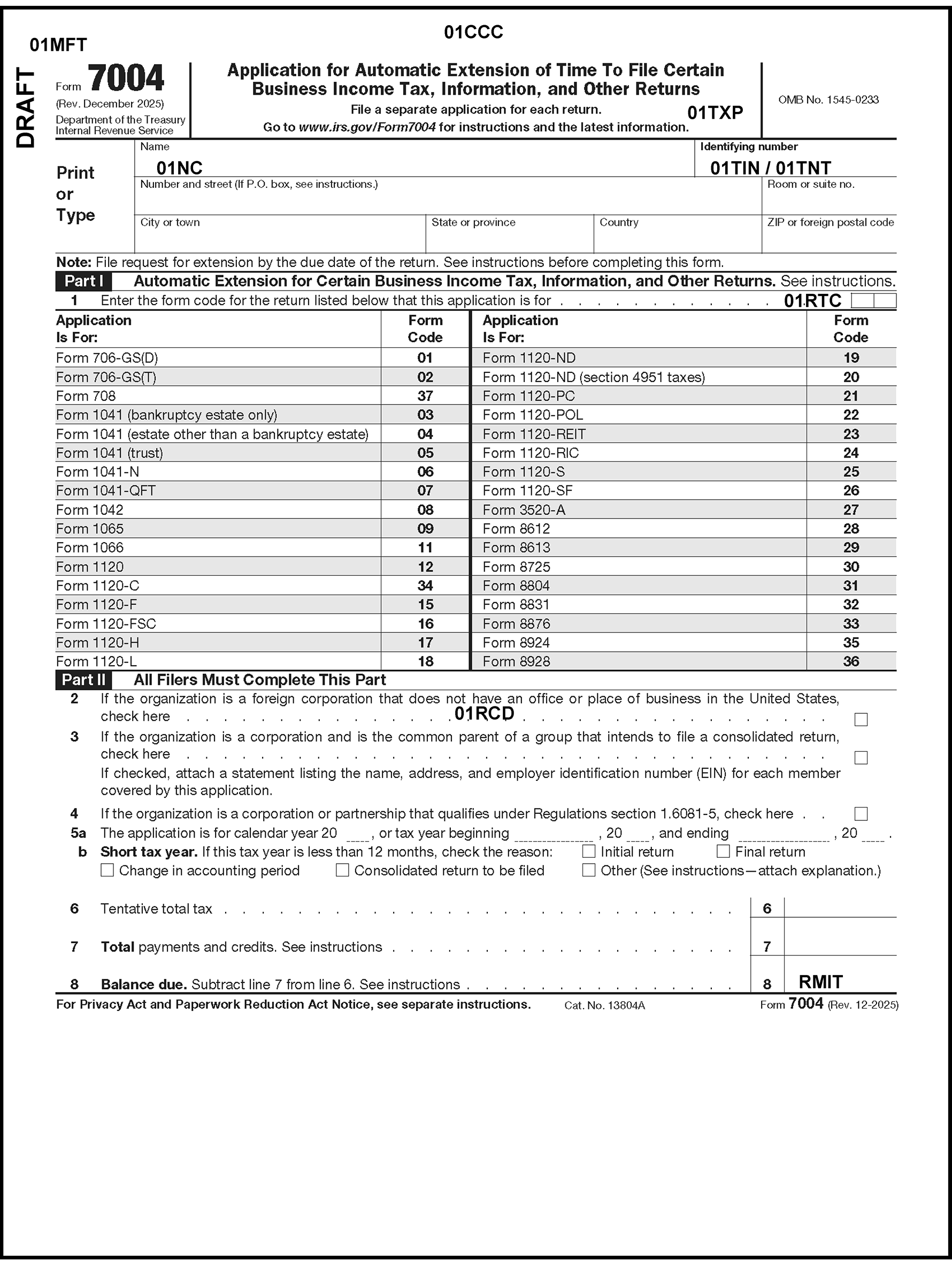
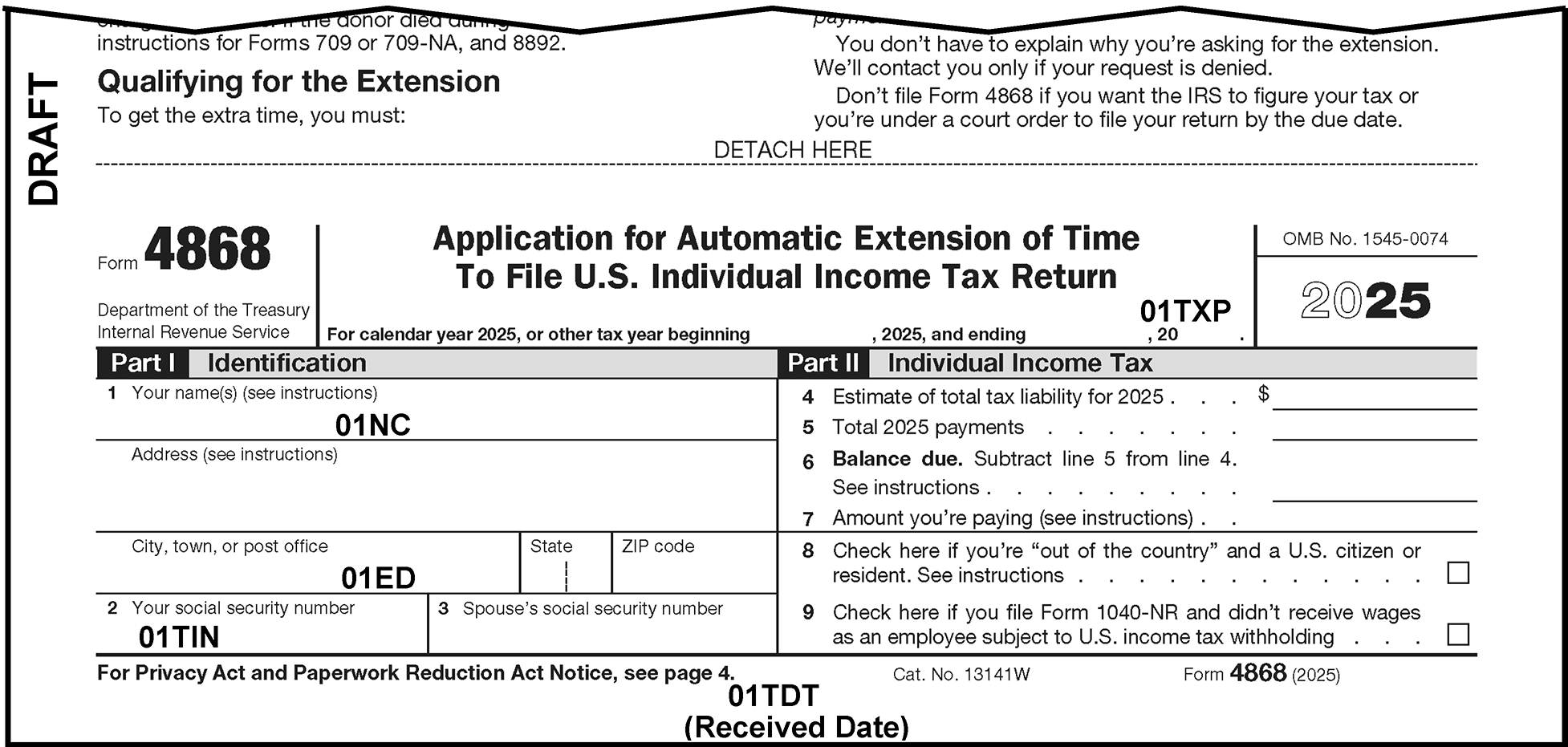
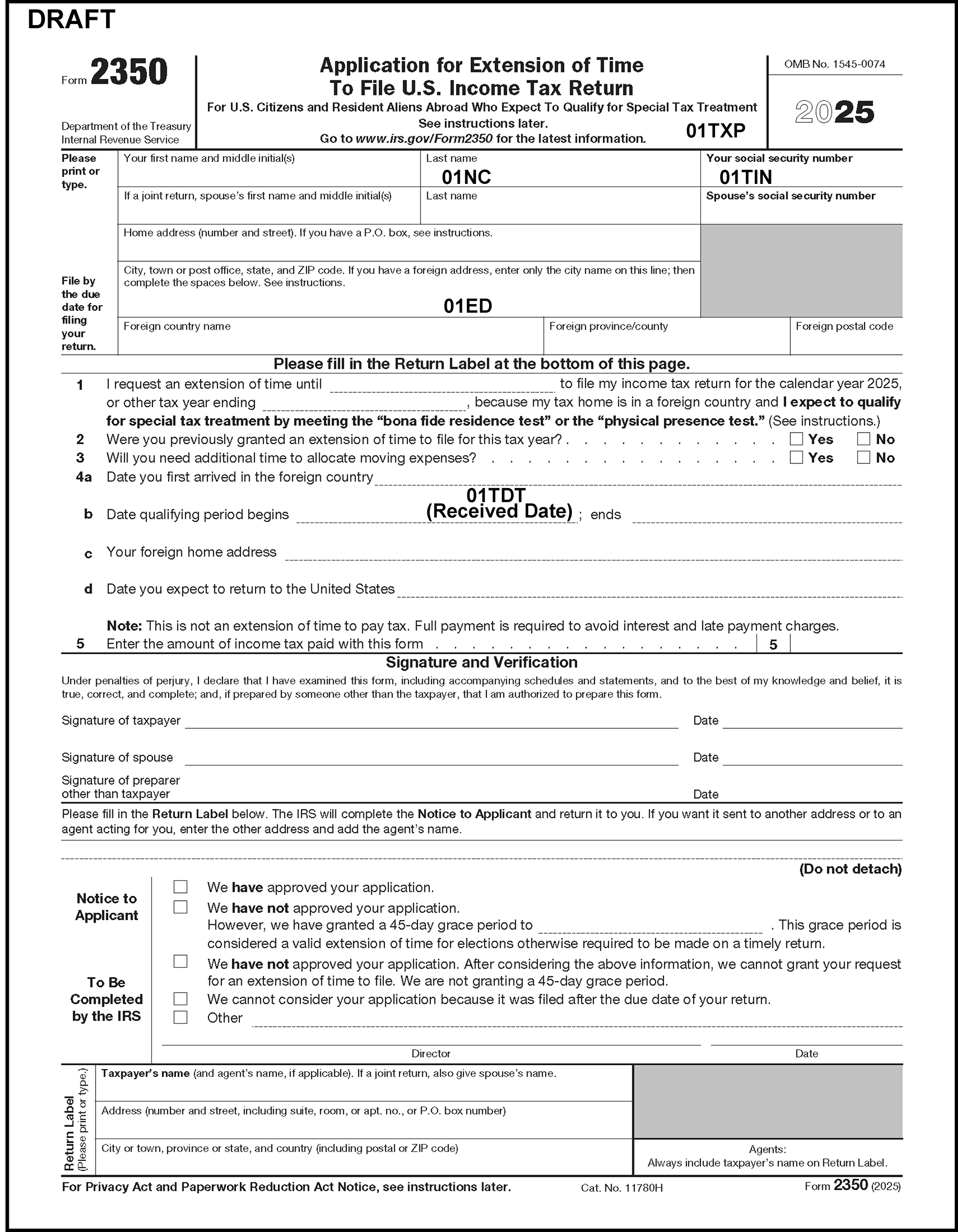
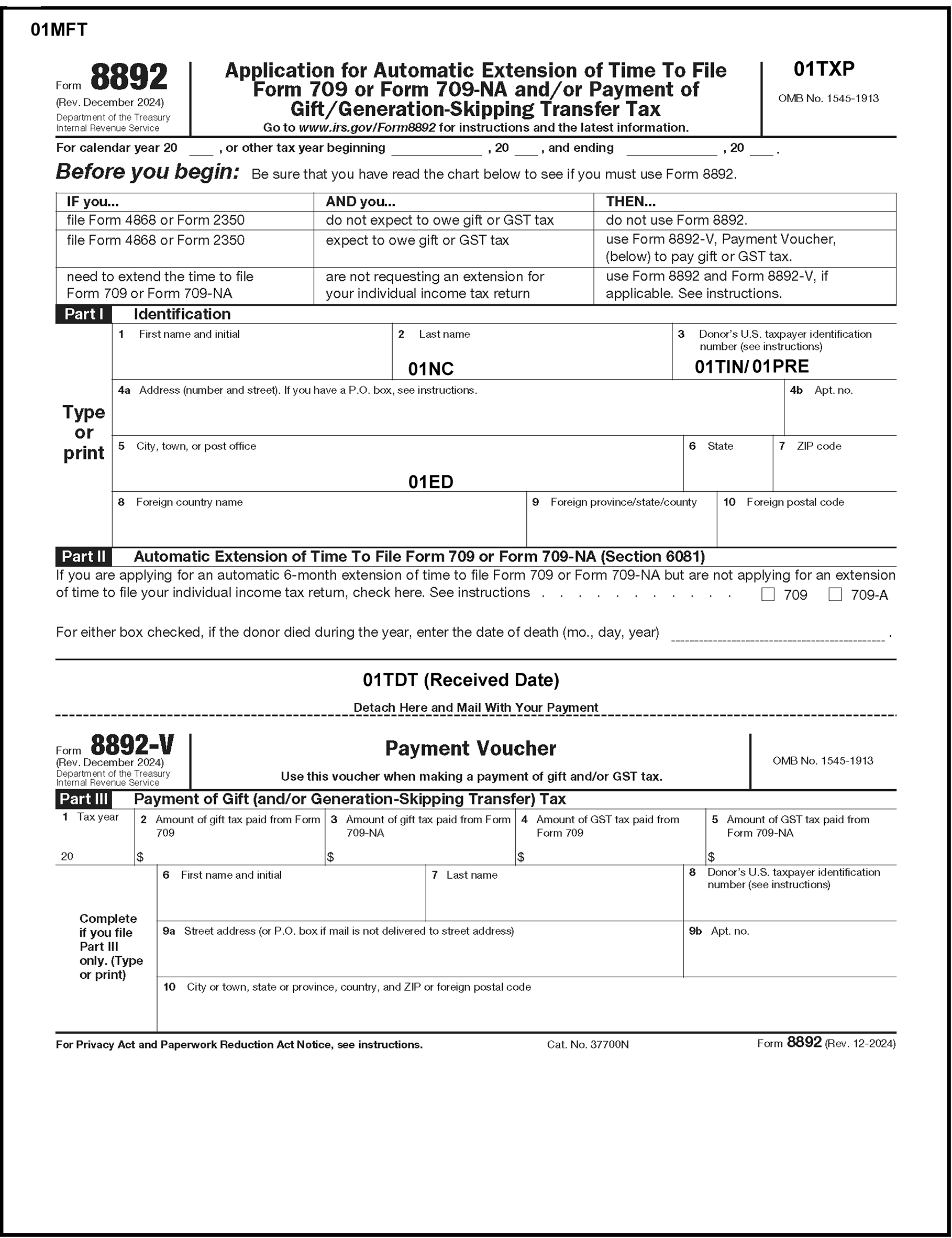
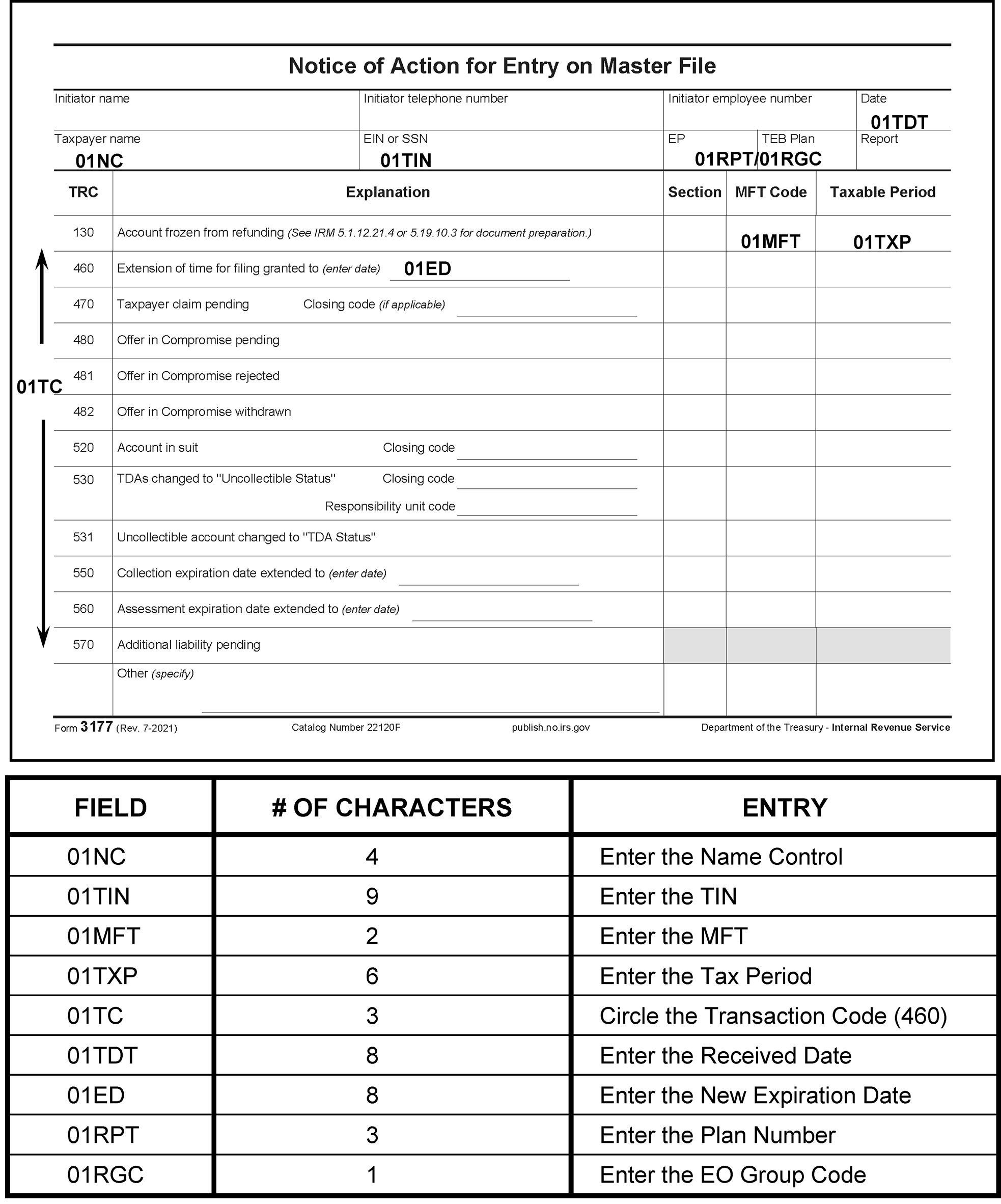
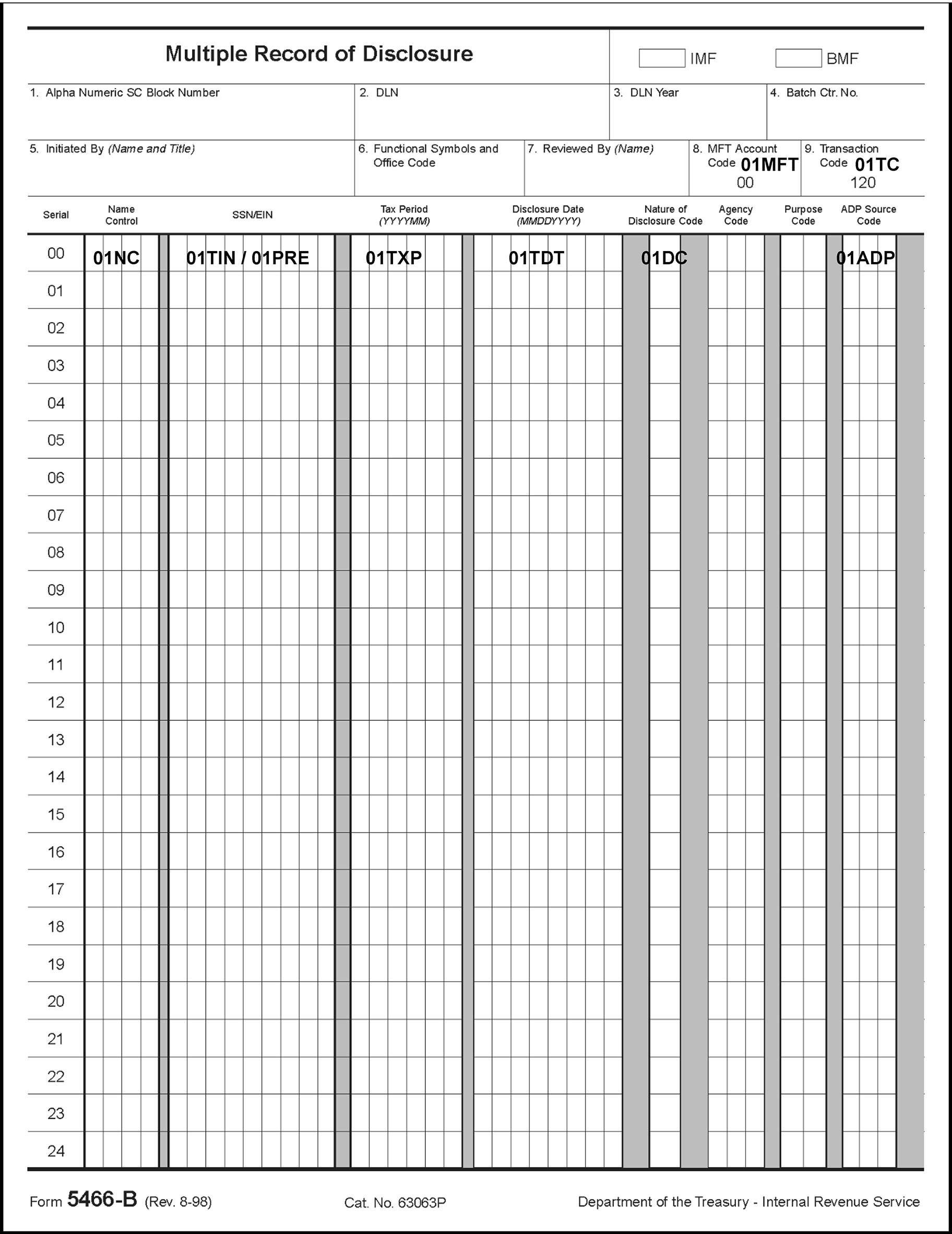
Form 7004 extension requests for Form 706-GS (D), Form 706-GS (T), and Form 1042 are always filed for a calendar year, and timely requests are granted a 6-month extension. See the following chart for dates for processing these Form 7004 extension requests.
Form 7004 Due Dates - Form 706-GS(D), Form 706-GS(T), and Form 1042
| Form | Timely Postmark Date | ≡ ≡ ≡ ≡ ≡ ≡ ≡ ≡ ≡ ≡ ≡ ≡ ≡ ≡ | Master File Generated Extended Date |
|---|---|---|---|
| Form 706-GS (D), Form 706-GS (T) | 04/15/2026 | ≡ ≡ ≡ ≡ ≡ ≡ ≡ ≡ | 10/15/2026 |
| 1042 | 03/16/2026 | ≡ ≡ ≡ ≡ ≡ ≡ ≡ | 09/15/2026 |
Form 7004 extension requests for the following Non-Master File returns are processed at KCSPC and are granted a 6-month extension:
-
Form 8612
-
Form 8613
-
Form 8725
-
Form 8831
-
Form 8876
-
Form 8924
-
Form 8928
Timely extension requests for the following forms are granted a 51/1-month extension:
-
Form 1041 (estate other than a bankruptcy estate)
-
Form 1041 (trust)
Timely extension requests for the following forms are granted a 6-month extension:
-
Form 1041 (bankruptcy estate only)
-
Form 1041-N
-
Form 1041-QFT
See the chart below for dates for processing Form 7004 extension requests for Form 1041, Form 1041-N, and Form 1041-QFT, which are due 31/1 months after the tax period ends.
| Tax Period | Timely Postmark Date | ≡ ≡ ≡ ≡ ≡ ≡ ≡ ≡ ≡ ≡ ≡ ≡ ≡ ≡ | Master File Generated Extended Date 51/1 months | Master File Generated Extended Date 6 months |
|---|---|---|---|---|
| 202508 | 12/15/2025 | ≡ ≡ ≡ ≡ ≡ ≡ ≡ ≡ | 05/31/2026 | 06/15/2026 |
| 202509 | 01/15/2026 | ≡ ≡ ≡ ≡ ≡ ≡ ≡ | 06/30/2026 | 07/15/2026 |
| 202510 | 02/17/2026 | ≡ ≡ ≡ ≡ ≡ ≡ | 07/31/2026 | 08/15/2026 |
| 202511 | 03/16/2026 | ≡ ≡ ≡ ≡ ≡ ≡ ≡ | 08/31/2026 | 09/15/2026 |
| 202512 | 04/15/2026 | ≡ ≡ ≡ ≡ ≡ ≡ | 09/30/2026 | 10/15/2026 |
| 202601 | 05/15/2026 | ≡ ≡ ≡ ≡ ≡ ≡ ≡ ≡ | 10/31/2026 | 11/15/2026 |
| 202602 | 06/15/2026 | ≡ ≡ ≡ ≡ ≡ ≡ | 11/30/2026 | 12/15/2026 |
| 202603 | 07/15/2026 | ≡ ≡ ≡ ≡ ≡ ≡ | 12/31/2026 | 01/15/2027 |
| 202604 | 08/17/2026 | ≡ ≡ ≡ ≡ ≡ ≡ ≡ ≡ | 01/31/2027 | 02/15/2027 |
| 202605 | 09/15/2026 | ≡ ≡ ≡ ≡ ≡ ≡ ≡ ≡ | 02/28/2027 | 03/15/2027 |
| 202606 | 10/15/2026 | ≡ ≡ ≡ ≡ ≡ ≡ ≡ | 03/31/2027 | 04/15/2027 |
| 202607 | 11/16/2026 | ≡ ≡ ≡ ≡ ≡ ≡ ≡ | 04/30/2027 | 05/15/2027 |
| 202608 | 12/15/2026 | ≡ ≡ ≡ ≡ ≡ ≡ ≡ ≡ | 05/31/2027 | 06/15/2027 |
| 202609 | 01/15/2027 | ≡ ≡ ≡ ≡ ≡ ≡ ≡ ≡ | 06/30/2027 | 07/15/2027 |
| 202610 | 02/16/2027 | ≡ ≡ ≡ ≡ ≡ ≡ ≡ | 07/31/2027 | 08/15/2027 |
| 202611 | 03/15/2027 | ≡ ≡ ≡ ≡ ≡ ≡ | 08/31/2027 | 09/15/2027 |
Timely extension requests for the following forms are due 21/1 months after the tax period ends and are granted a 6-month extension. See the chart below for dates for processing Form 7004 extension requests for:
-
Form 1065
-
Form 1066
-
Form 1120-S
-
Form 3520-A (see Exception)
-
Form 8804
Exception:
For Form 8804, a timely extension request is due 51/1 months after the tax period ends if the partnership keeps records outside the United States and Puerto Rico.
| Tax Period | Timely Postmark Date | ≡ ≡ ≡ ≡ ≡ ≡ ≡ ≡ ≡ ≡ ≡ ≡ ≡ ≡ ≡ | Automatic Extended Due Date |
|---|---|---|---|
| 202509 | 12/15/2025 | ≡ ≡ ≡ ≡ ≡ ≡ ≡ | 06/15/2026 |
| 202510 | 01/15/2026 | ≡ ≡ ≡ ≡ ≡ ≡ ≡ ≡ | 07/15/2026 |
| 202511 | 02/17/2026 | ≡ ≡ ≡ ≡ ≡ ≡ ≡ ≡ | 08/15/2026 |
| 202512 | 03/16/2026 | ≡ ≡ ≡ ≡ ≡ ≡ | 09/15/2026 |
| 202601 | 04/15/2026 | ≡ ≡ ≡ ≡ ≡ ≡ ≡ | 10/15/2026 |
| 202602 | 05/15/2026 | ≡ ≡ ≡ ≡ ≡ ≡ ≡ ≡ | 11/15/2026 |
| 202603 | 06/15/2026 | ≡ ≡ ≡ ≡ ≡ ≡ ≡ | 12/15/2026 |
| 202604 | 07/15/2026 | ≡ ≡ ≡ ≡ ≡ ≡ | 01/15/2027 |
| 202605 | 08/17/2026 | ≡ ≡ ≡ ≡ ≡ ≡ | 02/15/2027 |
| 202606 | 09/15/2026 | ≡ ≡ ≡ ≡ ≡ ≡ ≡ ≡ | 03/15/2027 |
| 202607 | 10/15/2026 | ≡ ≡ ≡ ≡ ≡ ≡ | 04/15/2027 |
| 202608 | 11/16/2026 | ≡ ≡ ≡ ≡ ≡ ≡ ≡ ≡ | 05/15/2027 |
| 202609 | 12/15/2026 | ≡ ≡ ≡ ≡ ≡ ≡ | 06/15/2027 |
| 202610 | 01/15/2027 | ≡ ≡ ≡ ≡ ≡ ≡ ≡ ≡ | 07/15/2027 |
| 202611 | 02/16/2027 | ≡ ≡ ≡ ≡ ≡ ≡ ≡ ≡ | 08/15/2027 |
Extension requests for most Form 1120 series filers (except Form 1120-C, Form 1120-POL, Form 1120-S, and Form 1120-F with box 2 or 4 checked) are due 31/1 months after the tax period ends, and timely requests are granted a 6-month extension. However, C corporation returns whose tax year ends in June (YYYY06) are due 21/1 months after the tax period ends, and timely requests are granted a 7-month extension. See the chart below for dates for processing Form 7004 extension requests for:
-
Form 1120
-
Form 1120-F (without box 2 or 4 checked)
-
Form 1120-FSC
-
Form 1120-H
-
Form 1120-L
-
Form 1120-ND
-
Form 1120-PC
-
Form 1120-REIT
-
Form 1120-RIC
-
Form 1120-SF
Exception:
For Form 1120-S, see Exhibit 3.12.212-9.
For Form 1120-C, see Exhibit 3.12.212-11.
For Form 1120-POL, see Exhibit 3.12.212-12.
If Form 7004 line 4 box is checked or CFR section 1.6081-5 is notated, see Exhibit 3.12.212-13.
| Tax Period | Timely Postmark Date | ≡ ≡ ≡ ≡ ≡ ≡ ≡ ≡ ≡ ≡ ≡ ≡ ≡ ≡ ≡ ≡ | Master File Generated Extended Due Date |
|---|---|---|---|
| 202508 | 12/15/2025 | ≡ ≡ ≡ ≡ ≡ ≡ ≡ | 06/15/2026 |
| 202509 | 01/15/2026 | ≡ ≡ ≡ ≡ ≡ ≡ ≡ ≡ | 07/15/2026 |
| 202510 | 02/17/2026 | ≡ ≡ ≡ ≡ ≡ ≡ ≡ | 08/15/2026 |
| 202511 | 03/16/2026 | ≡ ≡ ≡ ≡ ≡ ≡ ≡ ≡ | 09/15/2026 |
| 202512 | 04/15/2026 | ≡ ≡ ≡ ≡ ≡ ≡ ≡ | 10/15/2026 |
| 202601 | 05/15/2026 | ≡ ≡ ≡ ≡ ≡ ≡ ≡ ≡ | 11/15/2026 |
| 202602 | 06/15/2026 | ≡ ≡ ≡ ≡ ≡ ≡ ≡ ≡ | 12/15/2026 |
| 202603 | 07/15/2026 | ≡ ≡ ≡ ≡ ≡ ≡ | 01/15/2027 |
| 202604 | 08/17/2026 | ≡ ≡ ≡ ≡ ≡ ≡ ≡ ≡ | 02/15/2027 |
| 202605 | 09/15/2026 | ≡ ≡ ≡ ≡ ≡ ≡ | 03/15/2027 |
| 202606 | 09/15/2026 | ≡ ≡ ≡ ≡ ≡ ≡ ≡ | 04/15/2027 |
| 202607 | 11/16/2026 | ≡ ≡ ≡ ≡ ≡ ≡ ≡ | 05/15/2027 |
| 202608 | 12/15/2026 | ≡ ≡ ≡ ≡ ≡ ≡ | 06/15/2027 |
| 202609 | 01/15/2027 | ≡ ≡ ≡ ≡ ≡ ≡ | 07/15/2027 |
| 202610 | 02/16/2027 | ≡ ≡ ≡ ≡ ≡ ≡ ≡ | 08/15/2027 |
| 202611 | 03/15/2027 | ≡ ≡ ≡ ≡ ≡ ≡ ≡ | 09/15/2027 |
Timely extension requests for Form 1120-C [as described in IRC 6072(d)] are due 81/1 months after the tax period ends and are granted a 6-month extension. See the chart below for dates for processing Form 7004 extension requests for Form 1120-C:
Note:
For cooperatives not described in IRC 6072(d), see IRM 3.11.212.8.3.1, Form 7004 for Form 1120-C - Ogden Submission Processing Campus (OSPC).
| Tax Period | Timely Postmark Date | ≡ ≡ ≡ ≡ ≡ ≡ ≡ ≡ ≡ ≡ ≡ ≡ ≡ ≡ ≡ | Automatic Extended Due Date |
|---|---|---|---|
| 202503 | 12/15/2025 | ≡ ≡ ≡ ≡ ≡ ≡ ≡ ≡ | 06/15/2026 |
| 202504 | 01/15/2026 | ≡ ≡ ≡ ≡ ≡ ≡ | 07/15/2026 |
| 202505 | 02/17/2026 | ≡ ≡ ≡ ≡ ≡ ≡ | 08/15/2026 |
| 202506 | 03/16/2026 | ≡ ≡ ≡ ≡ ≡ ≡ ≡ ≡ | 09/15/2026 |
| 202507 | 04/15/2026 | ≡ ≡ ≡ ≡ ≡ ≡ | 10/15/2026 |
| 202508 | 05/15/2026 | ≡ ≡ ≡ ≡ ≡ ≡ ≡ | 11/15/2026 |
| 202509 | 06/15/2026 | ≡ ≡ ≡ ≡ ≡ ≡ ≡ | 12/15/2026 |
| 202510 | 07/15/2026 | ≡ ≡ ≡ ≡ ≡ ≡ | 01/15/2027 |
| 202511 | 08/17/2026 | ≡ ≡ ≡ ≡ ≡ ≡ ≡ | 02/15/2027 |
| 202512 | 09/15/2026 | ≡ ≡ ≡ ≡ ≡ ≡ | 03/15/2027 |
| 202601 | 10/15/2026 | ≡ ≡ ≡ ≡ ≡ ≡ ≡ ≡ | 04/15/2027 |
| 202602 | 11/16/2026 | ≡ ≡ ≡ ≡ ≡ ≡ ≡ | 05/15/2027 |
| 202603 | 12/15/2026 | ≡ ≡ ≡ ≡ ≡ ≡ ≡ ≡ | 06/15/2027 |
| 202604 | 01/15/2027 | ≡ ≡ ≡ ≡ ≡ ≡ ≡ | 07/15/2027 |
| 202605 | 02/16/2027 | ≡ ≡ ≡ ≡ ≡ ≡ ≡ | 08/15/2027 |
| 202606 | 03/15/2027 | ≡ ≡ ≡ ≡ ≡ ≡ ≡ | 09/15/2027 |
Form 1120-POL filers can be incorporated or not incorporated, and extension requests are due 31/1 months after the tax period ends, regardless of tax period ending month. Timely extension requests for Form 1120-POL filers will be granted a 6-month extension, regardless of tax period ending month.
Exception:
If Form 7004 line 4 box is checked or CFR section 1.6081-5 is indicated, see Exhibit 3.12.212-13.
| Tax Period | Timely Postmark Date | ≡ ≡ ≡ ≡ ≡ ≡ ≡ ≡ ≡ ≡ ≡ ≡ ≡ ≡ | Extended Due Date |
|---|---|---|---|
| 202508 | 12/15/2025 | ≡ ≡ ≡ ≡ ≡ ≡ | 06/15/2026 |
| 202509 | 01/15/2026 | ≡ ≡ ≡ ≡ ≡ ≡ | 07/15/2026 |
| 202510 | 02/17/2026 | ≡ ≡ ≡ ≡ ≡ ≡ ≡ ≡ | 08/15/2026 |
| 202511 | 03/16/2026 | ≡ ≡ ≡ ≡ ≡ ≡ ≡ ≡ | 09/15/2026 |
| 202512 | 04/15/2026 | ≡ ≡ ≡ ≡ ≡ ≡ ≡ | 10/15/2026 |
| 202601 | 05/15/2026 | ≡ ≡ ≡ ≡ ≡ ≡ ≡ ≡ | 11/15/2026 |
| 202602 | 06/15/2026 | ≡ ≡ ≡ ≡ ≡ ≡ ≡ | 12/15/2026 |
| 202603 | 07/15/2026 | ≡ ≡ ≡ ≡ ≡ ≡ ≡ | 01/15/2027 |
| 202604 | 08/17/2026 | ≡ ≡ ≡ ≡ ≡ ≡ ≡ ≡ | 02/15/2027 |
| 202605 | 09/15/2026 | ≡ ≡ ≡ ≡ ≡ ≡ ≡ | 03/15/2027 |
| 202606 | 10/15/2026 | ≡ ≡ ≡ ≡ ≡ ≡ ≡ ≡ | 04/15/2027 |
| 202607 | 11/16/2026 | ≡ ≡ ≡ ≡ ≡ ≡ ≡ | 05/15/2027 |
| 202608 | 12/15/2026 | ≡ ≡ ≡ ≡ ≡ ≡ ≡ | 06/15/2027 |
| 202609 | 01/15/2027 | ≡ ≡ ≡ ≡ ≡ ≡ | 07/15/2027 |
| 202610 | 02/16/2027 | ≡ ≡ ≡ ≡ ≡ ≡ ≡ | 08/15/2027 |
| 202611 | 03/15/2027 | ≡ ≡ ≡ ≡ ≡ ≡ ≡ ≡ | 09/15/2027 |
Certain foreign and domestic corporations and certain partnerships are entitled to an automatic extension of time to file and pay under 26 CFR 1.6081-5. These entities don’t need to file an extension form to take the automatic extension. If unable to file by the end of that period, these entities can file Form 7004 and check the box on line 4, or notate Section 1.6081-5, to request more time to file the return. This extension request is timely filed if postmarked on or before the 15th day of the 6th month after the tax year. The additional extension period is 3 months for partnerships and S corporations, and 4 months for C corporations and filers of Form 1120-POL. Master File generates the 3- or 4-month extended due date as appropriate to the type of tax return.
| Tax Period | Timely Postmark Date | ≡ ≡ ≡ ≡ ≡ ≡ ≡ ≡ ≡ ≡ ≡ ≡ ≡ ≡ | Master File Generated Extended Date for Form 1065 and Form 1120-S | Master File Generated Extended Date for Form 1120 series (except Form 1120-C and Form 1120-S) |
|---|---|---|---|---|
| 202507 | 01/15/2026 | ≡ ≡ ≡ ≡ ≡ ≡ ≡ ≡ | 04/15/2026 | 05/15/2026 |
| 202508 | 02/17/2026 | ≡ ≡ ≡ ≡ ≡ ≡ ≡ ≡ | 05/15/2026 | 06/15/2026 |
| 202509 | 03/16/2026 | ≡ ≡ ≡ ≡ ≡ ≡ ≡ ≡ | 06/15/2026 | 07/15/2026 |
| 202510 | 04/15/2026 | ≡ ≡ ≡ ≡ ≡ ≡ ≡ ≡ | 07/15/2026 | 08/15/2026 |
| 202511 | 05/15/2026 | ≡ ≡ ≡ ≡ ≡ ≡ ≡ ≡ | 08/15/2026 | 09/15/2026 |
| 202512 | 06/15/2026 | ≡ ≡ ≡ ≡ ≡ ≡ | 09/15/2026 | 10/15/2026 |
| 202601 | 07/15/2026 | ≡ ≡ ≡ ≡ ≡ ≡ ≡ ≡ | 10/15/2026 | 11/15/2026 |
| 202602 | 08/17/2026 | ≡ ≡ ≡ ≡ ≡ ≡ ≡ | 11/15/2026 | 12/15/2026 |
| 202603 | 09/15/2026 | ≡ ≡ ≡ ≡ ≡ ≡ ≡ | 12/15/2026 | 01/15/2027 |
| 202604 | 10/15/2026 | ≡ ≡ ≡ ≡ ≡ ≡ | 01/15/2027 | 02/15/2027 |
| 202605 | 11/16/2026 | ≡ ≡ ≡ ≡ ≡ ≡ ≡ | 02/15/2027 | 03/15/2027 |
| 202606 | 12/15/2026 | ≡ ≡ ≡ ≡ ≡ ≡ ≡ | 03/15/2027 | 04/15/2027 |
| 202607 | 01/15/2027 | ≡ ≡ ≡ ≡ ≡ ≡ ≡ | 04/15/2027 | 05/15/2027 |
| 202608 | 02/16/2027 | ≡ ≡ ≡ ≡ ≡ ≡ ≡ | 05/15/2027 | 06/15/2027 |
Timely filed Form 4868 extension requests will be granted a 6-month extension. Use the following chart when processing Form 4868 for a fiscal tax period.
Note:
When Form 4868 box 8 or 9 is checked, the timely postmark date and delinquent received date is 2 months later than shown in the chart below. For example, if box 8 or 9 is checked for tax period 202512, the timely postmark date is 06/15/2026, ≡ ≡ ≡ ≡ ≡ ≡ ≡ ≡ ≡ ≡ ≡ ≡ ≡ ≡ ≡ ≡ ≡ ≡ ≡ ≡ ≡ ≡.
| Tax Period | Timely Postmark Date | ≡ ≡ ≡ ≡ ≡ ≡ ≡ ≡ ≡ ≡ ≡ ≡ ≡ ≡ ≡ ≡ | Master File Generated Extended Due Date |
|---|---|---|---|
| 202509 | 01/15/2026 | ≡ ≡ ≡ ≡ ≡ ≡ ≡ ≡ | 07/15/2026 |
| 202510 | 02/17/2026 | ≡ ≡ ≡ ≡ ≡ ≡ | 08/15/2026 |
| 202511 | 03/16/2026 | ≡ ≡ ≡ ≡ ≡ ≡ | 09/15/2026 |
| 202512 | 04/15/2026 | ≡ ≡ ≡ ≡ ≡ ≡ ≡ ≡ | 10/15/2026 |
| 202601 | 05/15/2026 | ≡ ≡ ≡ ≡ ≡ ≡ ≡ | 11/15/2026 |
| 202602 | 06/15/2026 | ≡ ≡ ≡ ≡ ≡ ≡ | 12/15/2026 |
| 202603 | 07/15/2026 | ≡ ≡ ≡ ≡ ≡ ≡ ≡ ≡ | 01/15/2027 |
| 202604 | 08/17/2026 | ≡ ≡ ≡ ≡ ≡ ≡ | 02/15/2027 |
| 202605 | 09/15/2026 | ≡ ≡ ≡ ≡ ≡ ≡ ≡ | 03/15/2027 |
| 202606 | 10/15/2026 | ≡ ≡ ≡ ≡ ≡ ≡ | 04/15/2027 |
| 202607 | 11/16/2026 | ≡ ≡ ≡ ≡ ≡ ≡ ≡ | 05/15/2027 |
| 202608 | 12/15/2026 | ≡ ≡ ≡ ≡ ≡ ≡ | 06/15/2027 |
| 202609 | 01/15/2027 | ≡ ≡ ≡ ≡ ≡ ≡ ≡ | 07/15/2027 |
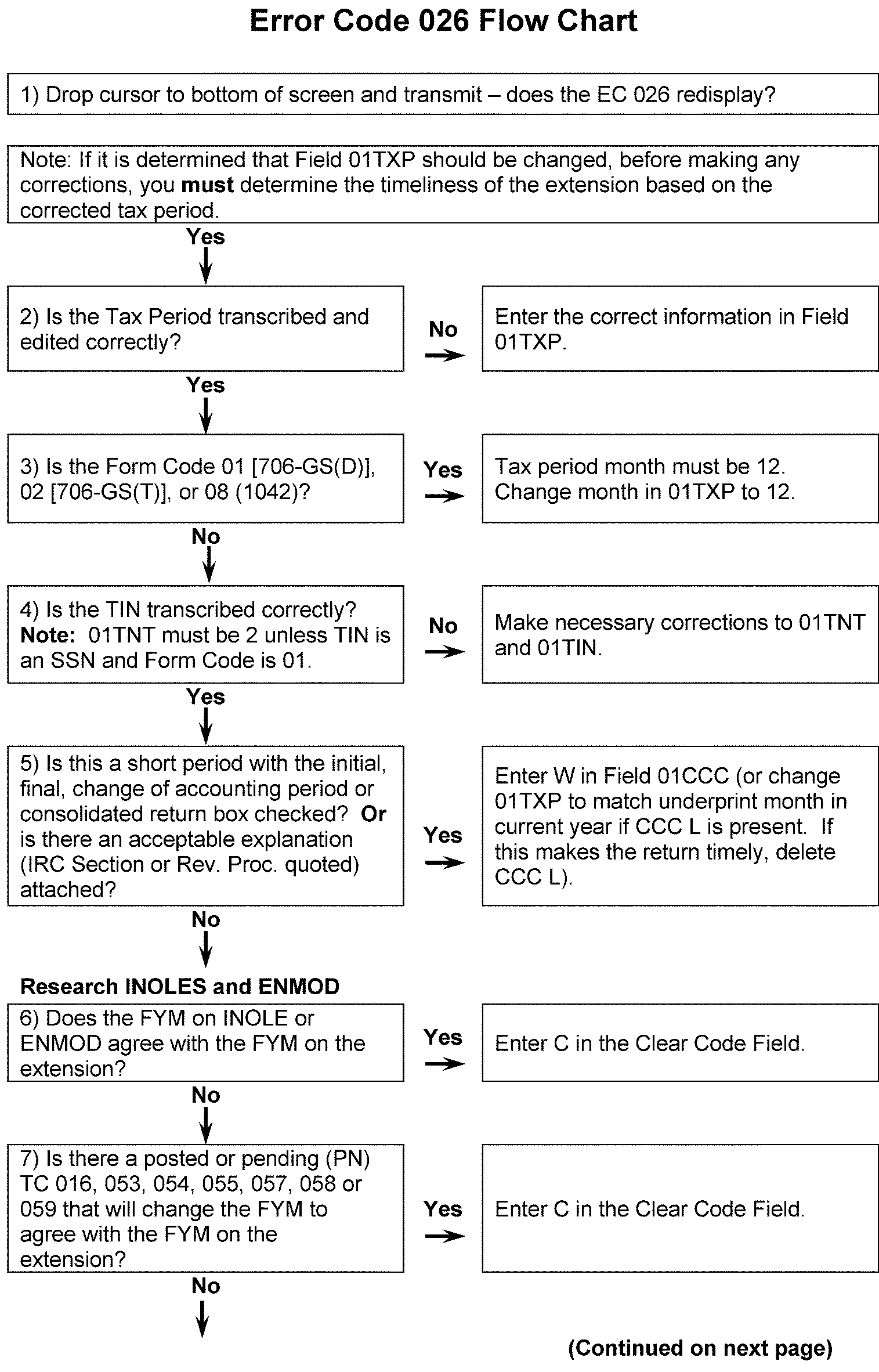
Please click here for the text description of the image.
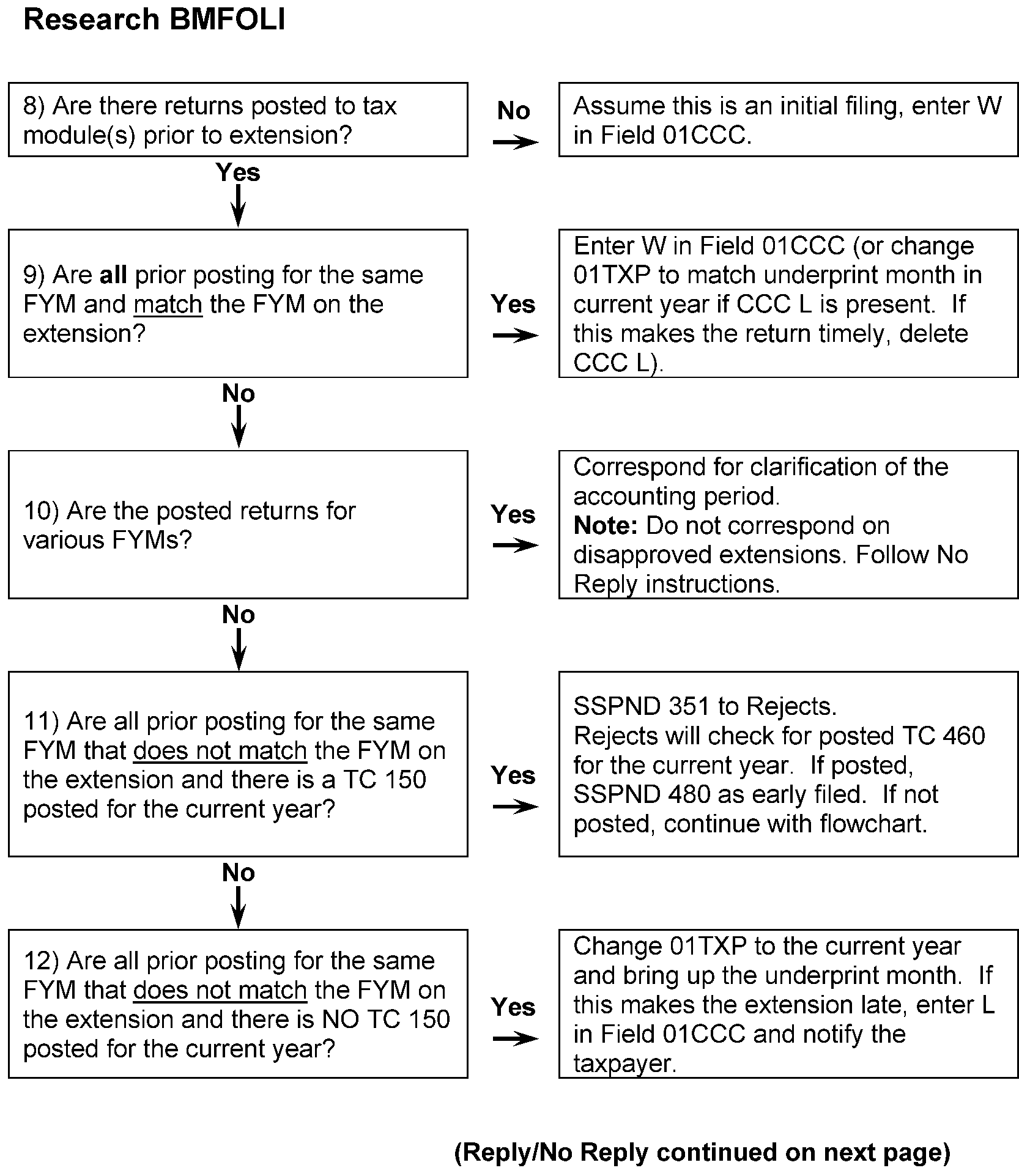
Please click here for the text description of the image.
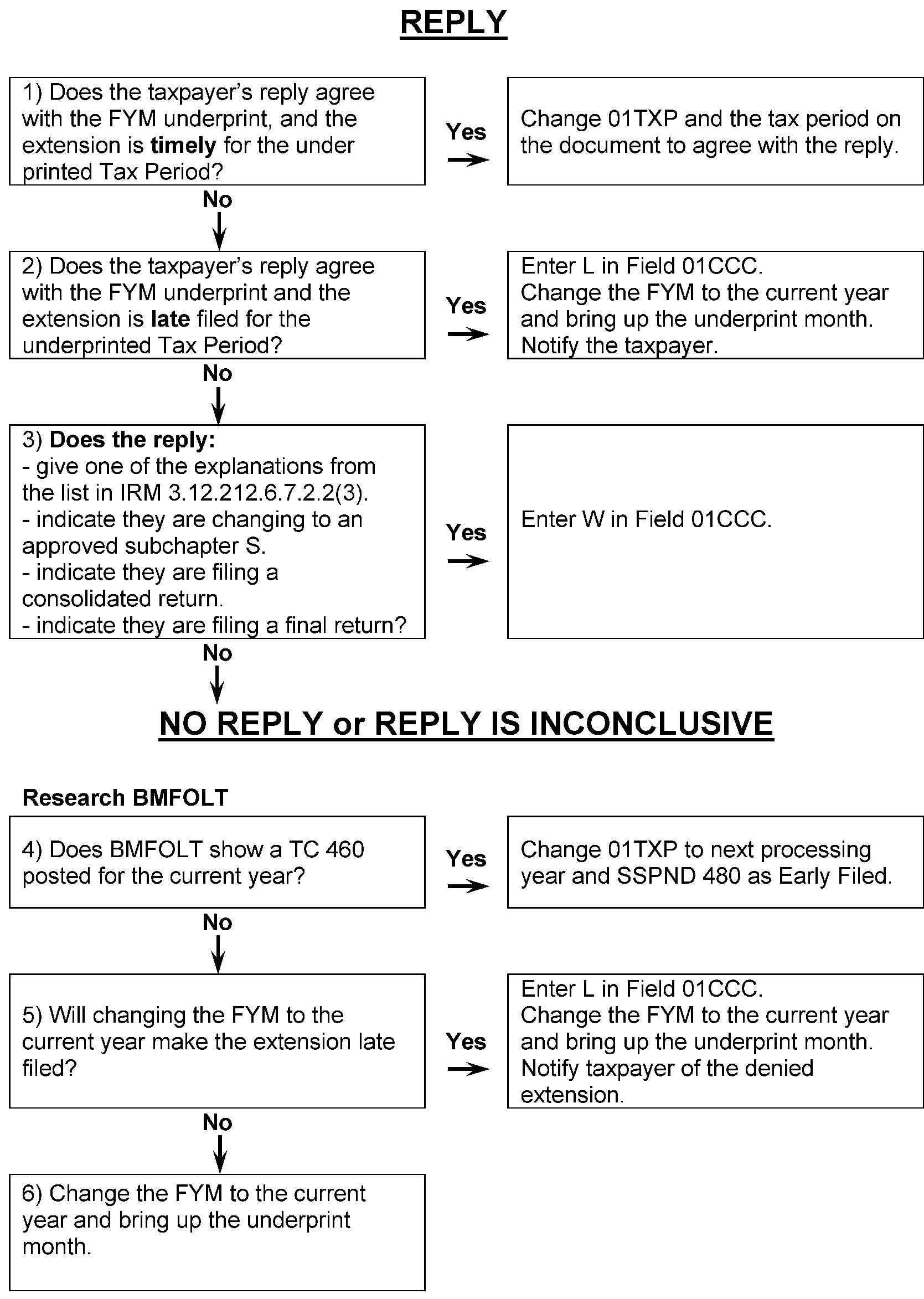
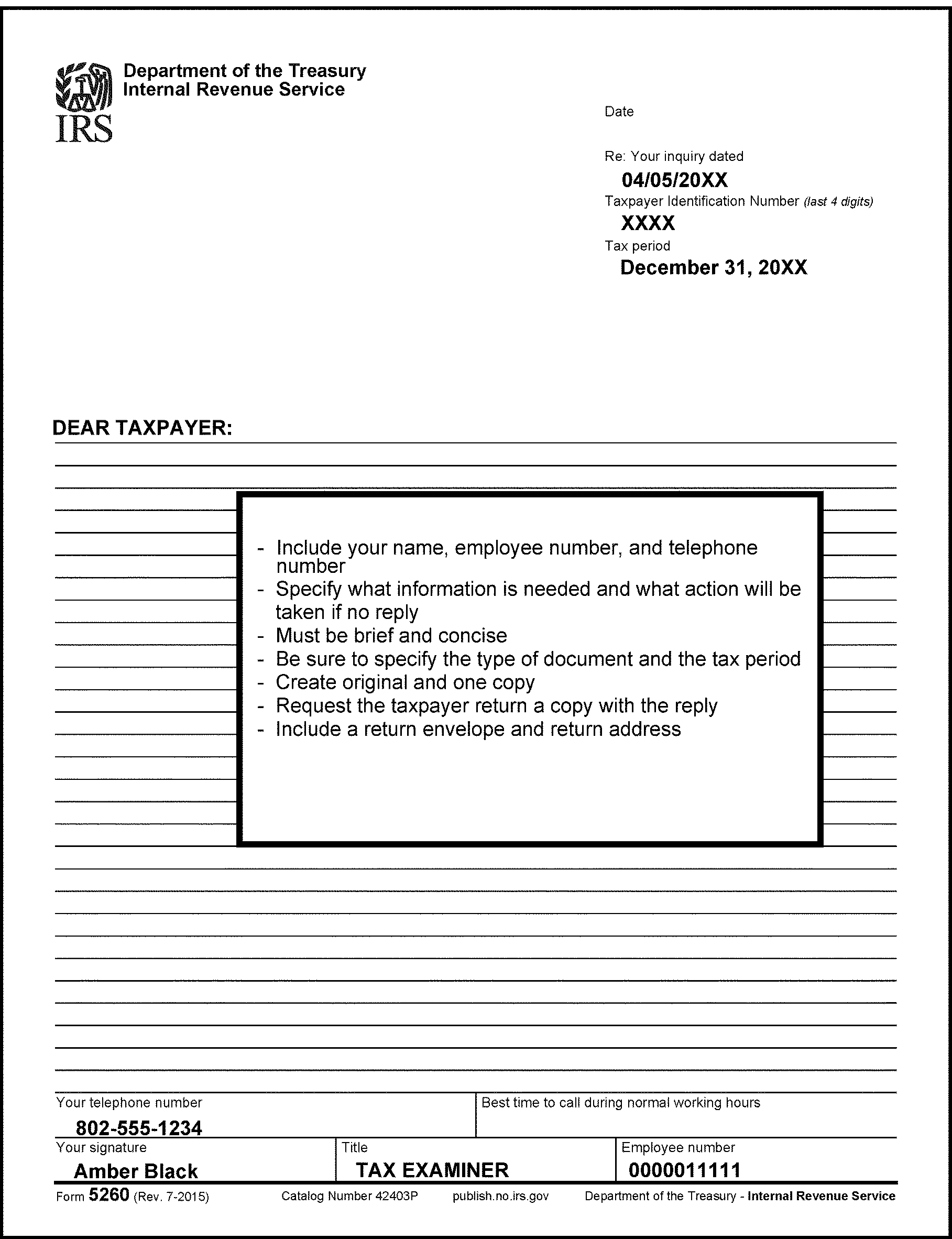
If the extension request is due on or after the disaster period begin date, and on or before the disaster end date, consider the request timely filed if postmarked on or before the end date if the address on the extension is from the state listed, or the applicable FEMA number or disaster designation is notated on the extension or an attachment. Follow normal timely extension procedures for processing.
| State | Begin Date | End Date | FEMA # | Designation |
|---|---|---|---|---|
| New Mexico | 06/23/2025 | 02/02/2026 | 3628-EM 4886-DR | Severe Storms, Flooding, and Landslides |
| Texas | 07/02/2025 | 02/02/2026 | 4879-DR | Severe Storms, Straight-line Winds, and Flooding |
| West Virginia | 06/14/2025 | 02/02/2026 | 4884-DR | Sever Storms, Straight-line Winds, Flooding, Landslides, and Mudslides |
Disaster periods will sometimes overlap if there are multiple disasters that occur in a state. The extension request would be timely filed if postmarked on or before the last end date for that state. Overlapping dates will be indicated with an asterisk (*) by the state's name.