


 )
or https:// means you've safely connected to the .gov website. Share sensitive information only on official, secure websites.
)
or https:// means you've safely connected to the .gov website. Share sensitive information only on official, secure websites.


- 7.11.8 EP Determinations Closing Agreement Program
- 7.11.8.1 Program Scope and Objectives
- 7.11.8.1.1 Background
- 7.11.8.1.2 Authority
- 7.11.8.1.3 Roles and Responsibilities
- 7.11.8.1.4 Program Management and Review
- 7.11.8.1.5 Program Controls
- 7.11.8.1.6 Terms and Acronyms
- 7.11.8.1.7 Related Resources
- 7.11.8.2 Specialist’s Responsibilities for Processing a Closing Agreement
- 7.11.8.2.1 Preparing the Case for the Closing Agreement Process
- 7.11.8.2.2 Determining Correction and Sanction Amount
- 7.11.8.2.3 Preparing the Closing Agreement
- 7.11.8.2.4 Final Processing Steps for a Closing Agreement
- 7.11.8.3 Miscellaneous Issues
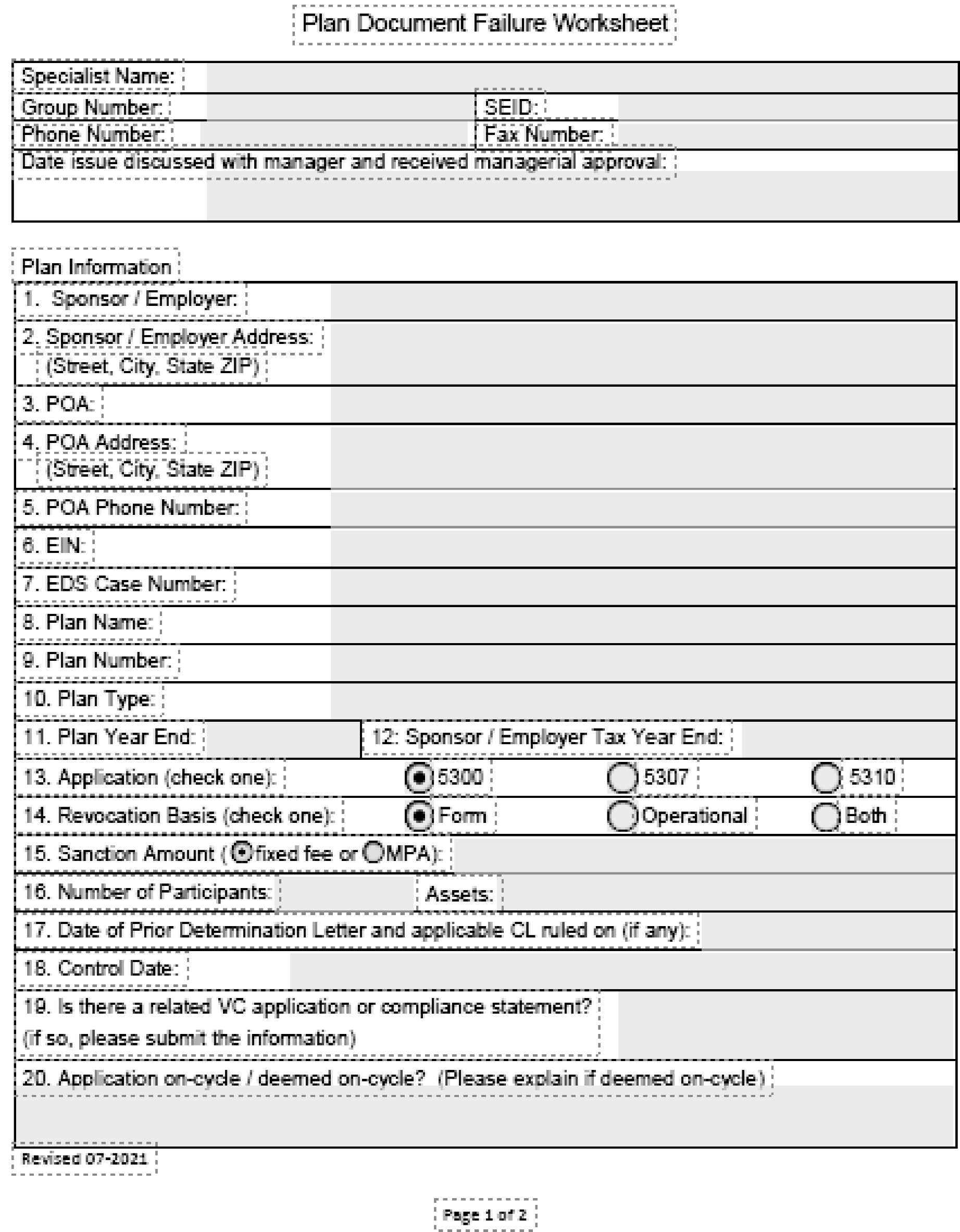
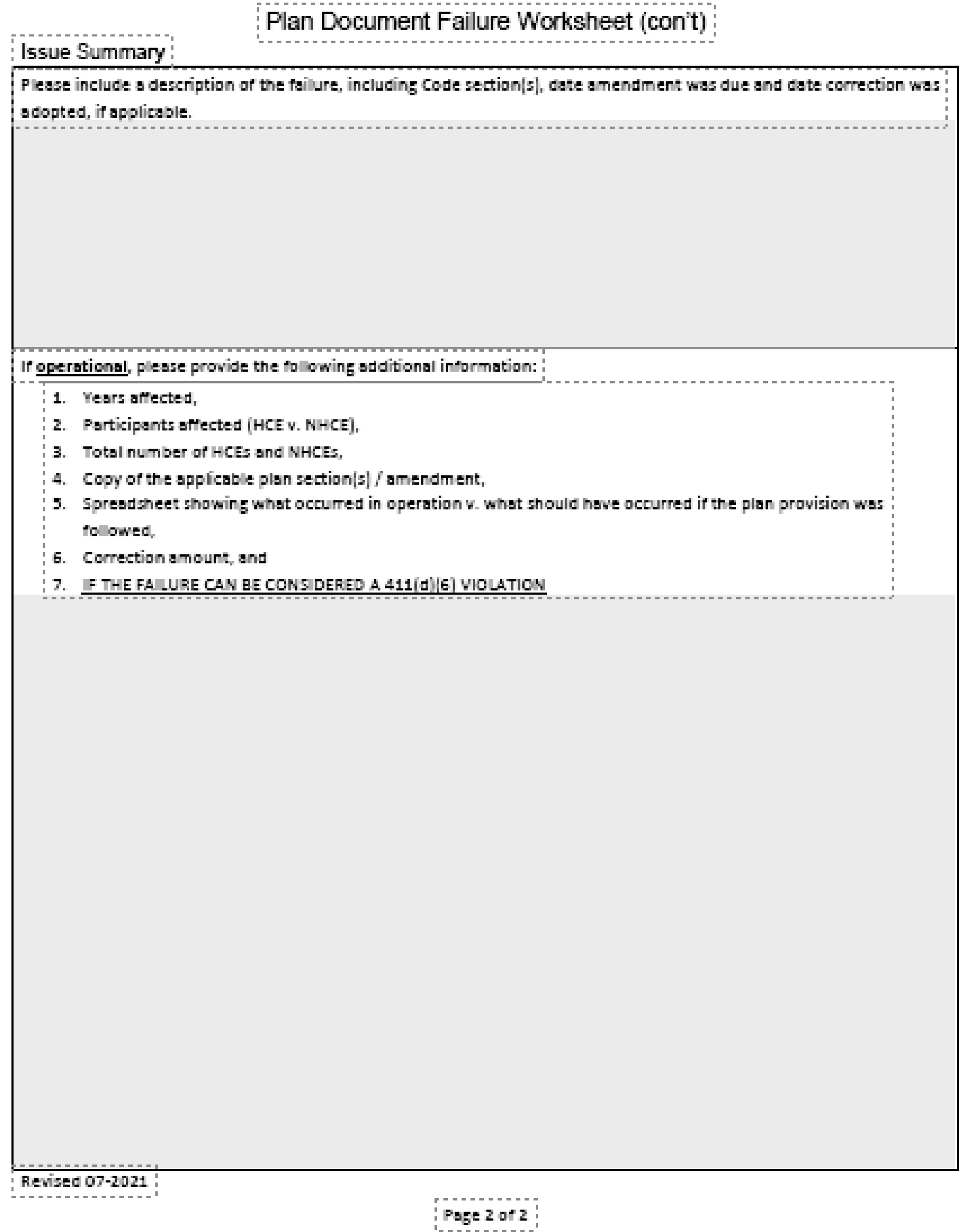
- Exhibit 7.11.8-1 Plan Document Failure Worksheet
- Exhibit 7.11.8-2 Closing Agreement Offer Letter 6480
- Exhibit 7.11.8-3 Example - Operational Compliance Statement
- Exhibit 7.11.8-4 Closing Agreement Request for Taxpayer Signature Transmittal
- Exhibit 7.11.8-5 Closing Agreement 10-day Letter
- Exhibit 7.11.8-6 Cover Memo
- Exhibit 7.11.8-7 Taxpayer Instructions for Execution of Closing Agreement
- Exhibit 7.11.8-8 Non-Master File Assessment Voucher
- 7.11.8.1 Program Scope and Objectives
Part 7. Rulings and Agreements
Chapter 11. Employee Plans Determination Letter Program
Section 8. EP Determinations Closing Agreement Program
7.11.8 EP Determinations Closing Agreement Program
Manual Transmittal
August 22, 2025
Purpose
(1) This transmits revised IRM 7.11.8, Employee Plans Determination Letter Program, EP Determinations Closing Agreement Program.
Material Changes
(1) Added IRM 7.11.8.1(5), Primary Stakeholders.
(2) Added IRM 7.11.8.1.3, Roles and Responsibilities.
(3) Added IRM 7.11.8.1.4, Program Management and Review.
(4) Added IRM 7.11.8.1.5, Program Controls.
(5) Changed IRM 7.11.8.1.6, Acronyms to Terms and Acronyms.
(6) Added IRM 7.11.8.1.6, Definitions to Terms and Acronyms.
(7) Added IRM 7.11.8.1.7, Related Resources.
(8) Updated IRM throughout for editorial changes, plain language and revenue procedures.
Effect on Other Documents
This supersedes IRM 7.11.8, dated January 6, 2025, and includes the applicable provisions of TEGE-04-0523-0010, Change in Closing Agreement Requirements.Audience
Tax Exempt and Government EntitiesEmployee Plans
Effective Date
(08-22-2025)Eric D. Slack
Director, Employee Plans
Tax Exempt and Government Entities
-
Purpose: This IRM discusses procedures for Employee Plans (EP) specialists who prepare closing agreements when they discover qualification failures during a determination letter (DL) application review.
-
Audience: Employee Plans (EP) Determinations and Quality Assurance (QA) staff.
-
Policy Owner: Director, Employee Plans.
-
Program Owner: Employee Plans.
-
Primary Stakeholders:
-
Internal - Director, Employee Plans; Director, Employee Plans Rulings and Agreements; EP Tax Law Specialists and Agents; Actuaries; Associate Chief Counsel (EEE), TE/GE Division.
-
External - Plan sponsors, plan representatives, and plan participants.
-
-
Program Goals: The goal of EP Determinations is to ensure that plans comply with the tax laws by reviewing applications for determination letters, opinion letters, and advisory letters, and to protect the public interest by applying the tax law with integrity and fairness to all. To protect plan participants and retirement savings, one goal of the closing agreement program is to avoid plan disqualification.
-
A retirement plan is considered to be qualified if it meets the requirements of IRC 401(a) in form and operation. A qualified plan is entitled to favorable tax treatment.
-
The EP Determination Letter Program is in place to help taxpayers understand the applicable tax laws governing retirement plans and ensure that their plans comply. This program is responsible for the issuance of certain letter rulings, determination letters, opinion letters, advisory letters and approval letters.
-
EP Determinations may enter into a closing agreement with a plan sponsor to resolve compliance failures that become apparent during a determination letter application review.
-
See these IRMs for other closing agreement procedures:
-
IRM 7.2.1, TE/GE Closing Agreements, Closing Agreements Originating in EP Technical - Procedures relating to closing agreements originating in EP Technical.
-
IRM 7.2.2, TE/GE Closing Agreements, Employee Plans Compliance Resolution System (EPCRS) - Procedures for closing agreements entered into under the Employee Plans Compliance Resolution System (EPCRS).
-
IRM 7.2.4, TE/GE Closing Agreements, Employee Plans Voluntary Closing Agreement Requests - Procedures EP Voluntary Compliance follows to process requests for closing agreements under EP voluntary closing agreement procedures.
-
-
The IRS Commissioner may enter into and approve a written closing agreement with any person relating to the liability of such person with respect to any internal revenue tax for any taxable period ending before or after the date of such an agreement. (IRC 7121 and regulations.)
-
Treasury Regulation 26 CFR 301.7121-1(a) allows the IRS to enter into a closing agreement in any case in which there appears to be an advantage permanently and conclusively closing the case, or if the taxpayer shows good and sufficient reasons for a closing agreement, and the Commissioner determines that the United States will not sustain any disadvantage by entering an agreement. (26 CFR 301.7121-1(a)).
-
The Commissioner delegates to the Commissioner, Tax Exempt and Government Entities Division (TE/GE), in cases under their jurisdiction, to enter into and approve a written agreement with any person relating to the internal revenue tax liability of such person, or the person or estates for whom they act. (Delegation Order 8-3, IRM 1.2.2.9.3(12)).
-
This authority to enter into a closing agreement is further delegated to the Director, Employee Plans, and the Director, EP Rulings and Agreements (EP R&A). The authority delegated does not, however, include the authority to set aside any closing agreement, which is retained by the Commissioner. (IRM 7.2.1.9, Modification of Closing Agreements).
-
A complete list of delegation orders governing EP R&A can be found on IRS.gov at Delegation Orders and Policy Statements by Process.
-
The mission of Employee Plans is to provide EP’s customers top-quality service by helping them understand and comply with applicable tax laws and to protect the public interest by applying the tax laws with integrity and fairness to all.
-
The Director, EP, reports to the Deputy Commissioner, TE/GE, and is responsible for planning, managing, directing and executing nationwide EP activities.
-
EP responsibilities include:
-
Employee plans (including the qualification of pension, annuity, profit-sharing, and stock bonus plans, simplified employee pensions, saving incentive match plans for employees, and tax-sheltered annuities) and related trusts.
-
Tax treatment of participants and their beneficiaries and deductions for employer contributions.
-
Procedural and administrative provisions with respect to such plans.
-
-
The Director, EP R&A, reports to the Director, EP, and is responsible for three types of services for retirement plans— voluntary compliance, determination letters, and technical guidance.
-
Responsibilities of the EP R&A staff include:
-
Processing determination letter requests from employers regarding the qualified status of their pension, annuity, profit sharing and stock bonus plans.
-
Issuing opinion and advisory letters to specific requestors regarding preapproved pension, annuity, and profit-sharing plans, including individual retirement accounts, simplified employee pensions and savings incentive match plans for employees, and tax-sheltered annuities.
-
Developing and operating voluntary correction programs, such as the EPCRS program and issuing compliance statements or entering into closing agreements under these programs.
-
Processing requests for changes in funding method and making other actuarial determinations and interpretations.
-
Coordinating with Chief Counsel on requests for funding waivers.
-
Developing and maintaining responsibility for actuarial publications and other standards for the valuation of transfers of future interests for income, estate and gift tax purposes.
-
Coordinating with TE/GE Division Counsel, Associate Chief Counsel and the DOJ on litigation issues and declaratory judgment cases under the Internal Revenue Code. (IRC 7476).
-
-
Program reports:
-
The EP Determinations program uses Business Objects to view, create, and modify inventory and employee records. Business Objects uses tools to provide a built-in interface to query and analyze data and to build reports.
-
Monthly reports detailing the current inventory of cases by area and their status are produced and provided to the Director, EP Rulings and Agreements, Area Managers, and frontline managers.
-
Ad hoc reports are produced as requested by determinations personnel with appropriate permission.
-
Each quarter, EP Determinations Quality Assurance issues reports to summarize the results of their TEQMS reviews. See IRM 7.11.3, Tax Exempt Quality Measurement System (TEQMS).
-
-
Program effectiveness:
-
EP Determinations monitors business unit progress toward completing and closing cases in inventory. They provide status and progress reports to IRS leadership on a regular, recurring basis. Effectiveness is measured by analysis of compliance trends and results.
-
-
The IRS receives EP determination letter applications and user fees from taxpayers on Pay.gov.
-
The user fee information is then transferred to LINUS to ensure it is properly recorded.
-
The application information from Pay.gov is transferred to Tax Exempt Determination System (TEDS) and EP/EO Determination System (EDS), which are the systems that EP Determinations uses to control their inventory.
-
TEDS contains roles and permissions to ensure proper separation of duties. (IRM 7.15.4).
-
The EP Determinations Area Managers coordinate the assignment of inventory.
-
In order to ensure a consistent level of managerial engagement in the process of making key strategic decisions during a determination letter review, the specialist submits requests for approval by their manager through TEDS.
-
The manager approves or rejects any request through the TEDS.
-
EP Determinations QA reviewers perform reviews on mandatory review cases and for cases selected for the Tax Exempt Quality Measurement System (TEQMS) to ensure that specialists are conducting their determination letter reviews per technical, procedural and administrative requirements. See IRM 7.11.3 and IRM 7.11.9 for more information.
-
The IRS is fully committed to protecting the privacy rights of taxpayers and employees. Privacy laws are included in the IRC, the Privacy Act of 1974, the Freedom of Information Act, and IRS policies and practices. For more information about these laws, visit the IRS FOIA Library.
-
For questions about privacy, email *Privacy.
-
For questions about disclosure, email *Disclosure.
-
-
This table lists commonly used terms and provides their definitions.
Acronym Definition ACH Automated Clearing House CAP Closing Agreement Program DL Determination Letter DOJ Department of Justice DUT-TPFE Document Upload Tool for Taxpayer-Facing Employees EEE Office of Associate Chief Counsel (Employee Benefits, Exempt Organizations and Employment Taxes) EDS EP/EO Determination System EP Employee Plans EPCRS Employee Plans Compliance Resolution System EP R&A Employee Plans Rulings and Agreements IRC Internal Revenue Code IRM Internal Revenue Manual IRS Internal Revenue Service LINUS Letter Information Network User-Fee System OCS Operational Compliance Statement PDFW Plan Document Failure Worksheet PII Personally Identifiable Information POA Power of Attorney QA Quality Assurance R&A Rulings and Agreements SECURE Act Setting Every Community Up for Retirement Enhancement Act TDC SM Taxpayer Digital Communications Secure Messaging TEDS Tax Exempt Determinations System TE/GE Tax Exempt and Government Entities PDFW Plan Document Failure Worksheet VCP Voluntary Correction Program
-
Rev. Proc. 2021-30, Introduction To Employee Plans Compliance Resolution System.
-
IRM 7.2.1, TE/GE Closing Agreements, Closing Agreements Originating in EP Technical.
-
IRM 7.2.2, TE/GE Closing Agreements, Employee Plans Compliance Resolution System (EPCRS).
-
IRM 7.2.4, TE/GE Closing Agreements, Employee Plans Voluntary Closing Agreement Requests.
-
Delegation Orders and Policy Statements by Process
-
IRS FOIA Library
-
A closing agreement constitutes an agreement between the IRS and the plan sponsor that:
-
Is binding for the tax matters identified in the agreement for the periods specified.
-
Allows plans to continue to maintain their tax-favored status.
-
-
Your responsibilities for processing a case using a closing agreement:
-
Prepare a plan document failure worksheet to be included in the case file.
-
Submit documents to your front-line manager for approval.
-
Prepare the case for the closing agreement process.
-
Determine the correction and sanction amount.
-
Prepare the closing agreement.
-
Prepare the case for closing.
-
-
To determine if a case meets the requirements for a closing agreement:
-
Completely resolve any other issues not related to the closing agreement before you begin the closing agreement.
-
Ensure the issue involves a Qualification Failure, as described in Rev. Proc. 2021-30, Section 5.
-
Verify the failure is not available for self-correction per Section 305 of the SECURE Act 2.0, Notice 2023-43 or Rev. Proc. 2021-30, Sections 4.01(b), 4.05(c), 5.02(a) and 9.02.
-
Fully research and develop all issues for the proposed closing agreement and document the case file.
-
Get approval from your manager to start the closing agreement process.
-
Complete the plan document failure worksheet (PDFW). See Exhibit 7.11.8-1, Plan Document Failure Worksheet, for an example of the worksheet. A blank version can be found on the shared server in the "Closing Agree" folder under "Forms" .
Note:
If the plan has received a compliance statement from the Voluntary Correction Program (VCP) and you find an additional defect, consult your manager.
-
-
If the issue is an operational failure, as described in Rev. Proc. 2021-30, Section 5, that involves a year for which the statute of limitations is open, refer the issue to EP Examinations using the procedures in IRM 7.11.10, EP Examination and Fraud Referral Procedures.
-
If the failure is an operational failure that resulted in the employer adopting a retroactive amendment to reflect plan operation, your manager and area manager will need to approve the PDFW.
-
After you've received your manager's approval, inform the plan sponsor of your findings and the potential need for a closing agreement.
-
Either use TDC SM or call the plan sponsor or Power of Attorney (POA) to describe the closing agreement program process, or send them a Letter 6480 Closing Agreement Offer. An example of the letter can be found in Exhibit 7.11.8-2, Closing Agreement Offer Letter. A blank version is on the shared server in the "Closing Agree" folder under "Forms" .
-
Explain to the plan sponsor or POA that before the closing agreement process can continue, the plan sponsor must agree, verbally or in writing, to enter into the EP Determinations Closing Agreement Program (CAP). If the plan sponsor verbally agrees to enter into a closing agreement, make note of the plan sponsor's agreement in the case file.
-
-
To correct the failure:
-
For nonamender cases, secure a corrective amendment (if the plan sponsor hasn’t already amended the plan).
-
For all other cases, consult with your manager for the appropriate correction. Refer to Rev. Proc. 2021-30, Appendices A and B, for some common correction methods.
-
-
The IRS imposes a sanction for qualification failures. The nonamender sanction amounts are determined using a percentage of the VCP user fees as noted in Rev. Proc. 2021-30, Section 14.04 and Rev. Proc. 2025-4, Appendix A.11 (updated annually).
-
Nonamender sanction amounts generally aren’t negotiable. However, consider reducing the sanction if the:
-
Plan sponsor can prove undue financial hardship.
-
Plan amendment was timely adopted but doesn’t satisfy the qualification requirements of the IRC.
-
-
For failures other than nonamender failures, the sanction is a negotiated amount and determined based on facts and circumstances. See Rev. Proc. 2021-30, Section 14.01. Generally, the amount will not be less than the VCP user fee that applies to the plan.
-
Discuss the information and determine a sanction range with your manager, which you must negotiate with the plan sponsor.
-
Once you've reached an agreement on the sanction amount, prepare the closing agreement. State the issue clearly so it leads to only one interpretation.
-
When you complete the closing agreement, secure email the following documents to your group manager:
-
Plan document failure worksheet (PDFW).
-
The closing agreement.
-
The operational compliance statement for any nonamender failure. (Find an example in Exhibit 7.11.8-3, Example - Operational Compliance Statement, and a blank version on the shared server in the "Closing Agree" folder under "Operational Compliance Statements" .)
-
-
The manager reviews these documents and forwards them to the area manager, who will either approve or return them with suggested changes.
-
After the manager and senior manager approve the closing agreement, send the closing agreement to the plan sponsor with Letter 1595 and Letter 937-A to the POA. Get the manager’s approval if you change any part of the closing agreement or operational compliance statement.
-
Mail the following documents to the taxpayer:
-
Letter 1595, Closing Agreement Request for Taxpayer Signature.
-
The instructions for execution of closing agreement from shared server.
-
One copy of the final closing agreement.
-
One copy of operational compliance statement, if applicable.
-
Form 3244-A (use the version on the shared server in the “Closing Agree” folder because it has directions and explains the required items that the taxpayer will need to complete when they submit their payment through Pay.gov).
-
-
If the plan sponsor or POA doesn't respond to the final closing agreement cover letter within two weeks, send Letter 6480-A (10-day Letter) and a copy of the original Letter 1595 letter with your manager's approval.
-
Explain to the plan sponsor or POA that they must return the following documents to your address:
-
The signed and dated closing agreement.
-
Confirmation of payment through Pay.gov.
-
Signed and dated operational compliance statement, if applicable.
Exception:
The plan sponsor may fax the signed closing agreement if they (or POA, if the Form 2848 authorizes the POA to sign the agreement) request to do so by phone. Document the chronology record with the contact date and note that the plan sponsor or POA wishes to send the closing agreement by fax. TDC SM and DUT-TPFE are also available.
-
-
After discussing the case with the plan sponsor and sending the final closing agreement cover letter packet, email the Pay.gov representative, the taxpayer’s name, the taxpayer’s EIN and plan number, and the sanction amount.
-
Once payment is submitted through Pay.gov, the Pay.gov representative will pull the Form 3244-A, check or ACH Transaction Detail, deposit ticket number, voucher number if paid with credit card, and any supporting documents and email them to the specialist.
-
If you received the signed closing agreement from the taxpayer and not the documents needed from Pay.gov to send the packet to Kansas City, send an email to the Pay.gov representative.
-
If you receive the executed closing agreement packet with no errors, prepare Letter 1595-D for the plan sponsor, and a Letter 937-A for all POAs authorized to receive correspondence. Select paragraph D when enclosing an operational compliance statement; if enclosing Pay.gov instructions, select paragraph H. Within three business days, send by secure email Letter 1595-D, the employer- signed closing agreement and the operational compliance statement, if applicable, to your manager. Don't include PII in the subject line.
-
The manager will review the documents and forward them to the area manager for signature within three business days of receipt.
-
Area manager, EP Determinations duties: When you receive a complete closing agreement packet, within five business days, sign the closing agreement and the 1595-D letter. The IRS signature may be digital.
-
Email a copy of the signed closing agreement to the specialist.
-
-
Specialist duties: Upon receipt of a copy of the approved closing agreement from the area manager, the specialist will:
-
Mail a copy of closing agreement to the plan sponsor for their records with Letter 1595-D.
-
Mail a copy of closing agreement to the POA with Letter 1595-D and 937-A, if applicable.
-
Prepare a package of the following documents to send to the deposit unit:
-
Form 3210 and all items listed on Form 3210
-
Cover memorandum
-
One copy of the closing agreement and occupational compliance statement, if applicable
-
Form 5734
-
Form 3244-A
-
Remittance (check or ACH Transaction Detail)
-
Pay.gov payments only: Tracking ID#, Deposit Ticket#, or if applicable, a Voucher#. Must be documented on Form 3210.
-
-
If a check was received for the sanction, mail the package to the deposit unit overnight via UPS to:
Kansas City Submission Processing Center
Attn: Supervisory Tax Examining Technician
Manual Deposit Unit, Stop 7777
333 W. Pershing Road
Kansas City, MO 64108 -
If the sanction was received electronically (via Pay.gov), secure email the package to: *CFO:CFM Pay.Gov Closing Agreements. RACS-ANMF. The Form 3210 and Cover Memo should be addressed to the same mailing address to the attention of “KCRACS Unit Stop 6264.”
-
Keep a copy of the closing agreement packet in the non-disclosable folder within TEDS per IRM 7.11.8.2.4(2)(e) and add the signed acknowledged Form 3210 to verify the Campus received it.
-
Make sure the copy of the Closing Agreement packet, Letters 1595-D and 937-A, are in TEDS in the non-disclosable folder before you close the case.
-
Close the case under normal closing procedures.
-
-
Contact your manager if any of these situations occur because they could affect issuing a closing agreement:
-
Withdrawal of a DL application
-
Request for relief under the Voluntary Correction Program (VCP). See IRM 7.11.1.20.1, Protecting VCP Eligibility.
-
Discovery of additional plan failures
-
-
If the plan sponsor elects to withdraw its application instead of entering into a closing agreement, or the case is being closed incomplete after the plan sponsor was notified of the potential nonamender failures, notify Quality Assurance via secure email and follow the withdrawal procedures in IRM 7.11.1.17, Withdrawal of Applications.
| Letter Number |
Title | Description/When to Use | Where to Access |
| 6480 | Closing Agreement Offer |
Sent by specialist if they determine a need for a closing agreement. | Letter 6480 |
| “The [Profit Sharing/Defined Benefit/Money Purchase/Cash Balance] Plan of [Employer Z] was operated in compliance with the requirements of the final and temporary regulations under section 401(a)(9) of the Code relating to minimum required distributions for the period January 1, ---------, 2003 (or first day of 2003 plan year if operating on fiscal year) -(enter date of adoption of 401(a)(9) amendment).] ___________________________________________ Employer Date |
| Letter Number |
Title | Description/When to Use | Where to Access |
| 1595 | Closing Agreement Request for Taxpayer Signature Transmittal | Transmittal letter sent with closing agreement requesting signature by authorized person. | Letter 1595 |
| Letter Number |
Title | Description/When to Use | Where to Access |
| 6480-A | Closing Agreement 10-Day Letter |
Sent by specialist if they determine a need for a closing agreement. | Letter 6480 |
| DEPARTMENT OF THE TREASURY INTERNAL REVENUE SERVICE WASHINGTON, D.C. 20224 |
|
| DATE: | |
| MEMORANDUM FOR: | Kansas City Submission Processing Center 333 W. Pershing Rd. Attn: XXXX XXXXX, Manual Deposit Stop 7777 Kansas City, MO 64108 |
| FROM: | TE/GE Division, Employee Plans Your Name XXXX Street Room XXXX City, XX XXXXX-XXXX |
| SUBJECT: | EP Closing Agreement under Audit Closing Agreement Program |
Attached is a closing agreement as noted:
Payer’s Name:
Payer’s EIN:
Payer’s Address:
XXXXXXXXXXXXXXXXXXX Plan #xxx.
The closing agreement should be routed to the accounting branch for assessment and credit. The assessment should be made as a Non-Master File assessment, true tax class 6, abstract number 139. (Please refer to IRM 3.17.46.6.5 for processing instructions.)
There are to be no refunds of monies under this closing agreement.
If you have any questions, please contact me at (xxx) xxx-xxxx.
Thank You.
Attachment:
-
Instructions for Execution of Closing Agreement
-
A copy of the closing agreement must be signed and returned.
-
The name of the taxpayer must be stated accurately.
-
The closing agreement may relate to one or more years, but it may only pertain to one plan. Therefore, if the taxpayer desires a closing agreement for more than one plan, separate closing agreements will be required and prepared.
-
If an attorney or agent signs a closing agreement for the taxpayer, the power of attorney (or a copy) authorizing that person to sign must be attached to the closing agreement. If a closing agreement is made for a year when a joint income tax return was filed by a husband and wife, it should be signed by or for both spouses. One spouse may sign as an agent for the other if the document (or a copy) specifically authorizing that spouse to sign is attached to the closing agreement.
-
If a fiduciary signs a closing agreement for a descendant or an estate, an attested copy of the letters testamentary or the court order authorizing the fiduciary to sign, as well as a certificate of recent date that the authority remains in full force and effect, must be attached to the closing agreement. If a trustee signs, a certified copy of the trust instrument or a certified copy of extracts from that instrument must be attached showing:
-
The date of the instrument.
-
That it is or is not of record in any court.
-
The names of the beneficiaries.
-
The appointment of the trustees, the authority granted, and any other information necessary to show that the authority extends to federal matters and
-
That the trust has not been terminated and that the trustee appointed is still acting. If a fiduciary is a party, Form 56, Notice Concerning Fiduciary Relationship, is required.
-
-
If the taxpayer is a corporation, the closing agreement must be dated and signed with the name of the corporation, the signature and title of an authorized officer or officers, or the “wet ink” signature of an authorized attorney or agent. It is not necessary that a copy of an enabling corporate resolution be attached. Refer to 26 CFR 601.504(b)(2)ii for information relating to dissolved corporations.
-
-
Steps to make sanction payment at Pay.gov:
-
In the search box, search 3244A.
-
Search should yield "IRS TEGE EP Closing Agreement Payment Posting Voucher" .
-
Click Continue.
-
Click "Continue to Form" .
-
Fill out the form per the instructions and click "Continue."
(Taxpayer Information, EIN and Amount should be the same as reflected in the closing agreement. Use the 3-digit plan number in the closing agreement. If there is no plan number, use "999". Tax Period year and month and Transaction Date will correspond to the date submitting the payment.)
-
Fill out the payment screen as per the instructions.
-
On the Review and Submit page, check “I would like to receive an email confirmation of this transaction.” It will ask for one or two email addresses to send confirmation of the payment. Please include the specialist working your case as one of the emails to receive confirmation. (Note that this part is optional, but it helps the process if something goes wrong.)
-
Upon completion of the submission process, you will receive a payment tracking number. Please record the tracking number and provide this number to the specialist with your executed closing agreement.
-