


 )
or https:// means you've safely connected to the .gov website. Share sensitive information only on official, secure websites.
)
or https:// means you've safely connected to the .gov website. Share sensitive information only on official, secure websites.


- Instructions for Schedule R (Form 1040) - Introductory Material
- General Instructions
- Specific Instructions
For the latest information about developments related to Schedule R (Form 1040) and its instructions, such as legislation enacted after they were published, go to IRS.gov/ScheduleR.
We have discontinued Pub. 524, Credit for the Elderly or the Disabled; the last revision was for 2023. All the pertinent information from Pub. 524 has been incorporated into the Instructions for Schedule R. Prior revisions of Pub. 524 will remain available at IRS.gov/Pub524.
Who Can Take the Credit
You can take the credit for the elderly or the disabled if you meet both of the following requirements.
-
You are a qualified individual.
-
Your income isn’t more than certain limits.
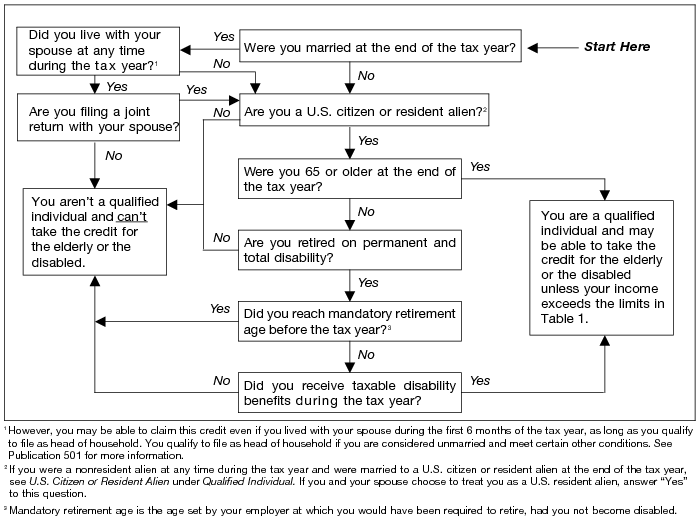
You can use Figure A and Table 1 as guides to see if you are eligible for the credit. Use Figure A first to see if you are a qualified individual. If you are, then go to Table 1 to make sure your income isn’t too high to take the credit.
Qualified Individual
You are a qualified individual for this credit if you are a U.S. citizen or resident alien (or you elect to be treated as a resident alien) and either of the following applies.
-
You were age 65 or older at the end of 2025.
-
You were under age 65 (discussed later) at the end of 2025 and all three of the following statements are true.
-
You retired on permanent and total disability. (See Permanent and Total Disability, later).
-
You receive taxable disability income for 2025.
-
On January 1, 2025, you had not reached mandatory retirement age (defined later under Disability Income).
-
Age 65
You are considered age 65 on the day before your 65th birthday. As a result, if you were born on January 1, 1961, you are considered to be age 65 at the end of 2025.
Death of taxpayer.
If you are preparing a return for someone who died in 2025, consider the taxpayer to be age 65 at the end of 2025 if they were age 65 or older on the day before their death. For example, if the taxpayer was born on February 14, 1960, and died on February 13, 2025, the taxpayer is considered age 65 at the time of death. However, if the taxpayer died on February 12, 2025, the taxpayer isn’t considered age 65 at the time of death or at the end of 2025.
U.S. Citizen or Resident Alien
You must be a U.S. citizen or resident alien (or be treated as a resident alien) to take the credit. Generally, you can’t take the credit if you were a nonresident alien at any time during the tax year.
Exceptions.
If you are a nonresident alien, you may be able to take the credit if your spouse is a U.S. citizen or resident at the end of the tax year, you file a joint return, and you and your spouse elect to treat you as a U.S. resident for the entire year. This choice remains in effect in subsequent years until terminated. You and your spouse can also choose to file as U.S. residents for the entire year if both of you are U.S. citizens or residents at the end of the year and either (or both) of you were a nonresident at the beginning of the year (the dual-status spouse(s)). You can only make this choice for 1 year, and it does not apply to any future years.
For information on these choices, see the Instructions for Form 1040 and chapter 1 of Pub. 519.
 You can take the credit only if you file Form 1040 or 1040-SR. You can’t take the credit if you file Form 1040-NR.
Married Persons
Generally, if you are married at the end of the tax year, you and your spouse must file a joint return to take the credit. However, if you and your spouse lived apart, you might be eligible for the credit.
Married persons filing separate returns.
If your filing status is married filing separately and you lived apart from your spouse at all times during 2025, you can claim the credit. However, if you lived with your spouse at any time during 2025, you can’t take the credit (unless you and your spouse choose to file jointly instead).
Head of Household
You can file as head of household and qualify to take the credit, even if your spouse lived with you during the first 6 months of the year, if you meet all the following tests.
-
You file a separate return.
-
You paid more than half the cost of keeping up your home during the tax year.
-
Your spouse didn’t live in your home at any time during the last 6 months of the tax year and the absence wasn’t temporary. See Temporary absences under Head of Household in Pub. 501.
-
Your home was the main home of your child, your stepchild, or an eligible foster child for more than half the year. An eligible foster child is a child placed with you by an authorized placement agency or by judgment, decree, or other order of any court of competent jurisdiction.
-
The child is your dependent, or would be your dependent except that the noncustodial parent is entitled to claim the child as their dependent under the special rule for children of divorced or separated parents. See Children of divorced or separated parents (or parents who live apart) in Pub. 501.
Under Age 65
If you are under age 65 at the end of 2025, you can qualify for the credit only if you are retired on permanent and total disability (discussed next), have taxable disability income (discussed later under Disability Income), and as of January 1, 2025, had not reached Mandatory retirement age. You are retired on permanent and total disability if:
-
You were permanently and totally disabled when you retired, and
-
You retired on disability before the close of the tax year.
Even if you don’t retire formally, you may be considered retired on disability when you have stopped working because of your disability.
If you retired on disability before 1977, and weren’t permanently and totally disabled at the time, you can qualify for the credit if you were permanently and totally disabled on January 1, 1976, or January 1, 1977.
You are considered to be under age 65 at the end of 2025 if you were born after January 1, 1961.
You are permanently and totally disabled if both 1 and 2 below apply.
-
You can’t engage in any substantial gainful activity because of a physical or mental condition.
-
A qualified physician determines that the condition has lasted or can be expected to last continuously for at least a year or can be expected to result in death. See Physician’s Statement, later.
Substantial gainful activity.
Substantial gainful activity is the performance of significant duties over a reasonable period of time while working for pay or profit, or in work generally done for pay or profit. Full-time work (or part-time work done at your employer’s convenience) in a competitive work situation for at least the minimum wage conclusively shows that you are able to engage in substantial gainful activity.
Note:
Information on minimum wage rates is available at DOL.gov/general/topic/wages/minimumwage.
Substantial gainful activity isn’t work you do to take care of yourself or your home. It isn’t unpaid work on hobbies, institutional therapy or training, school attendance, clubs, social programs, and similar activities. However, the nature of the work you perform may show that you are able to engage in substantial gainful activity.
The fact that you haven’t worked or have been unemployed for some time isn’t, of itself, conclusive evidence that you can’t engage in substantial gainful activity.
The following examples illustrate the tests of substantial gainful activity.
Example 1.
Alex, a sales clerk, is retired on disability. Alex is 53 years old and now works as a full-time babysitter for the minimum wage. Although different work is performed, Alex is able to do the duties of the new job in a full-time competitive work situation for the minimum wage. The credit can’t be taken because Alex is able to engage in substantial gainful activity.
Example 2.
Blake, a bookkeeper, is retired on disability. Blake is 59 years old and now drives a truck for a charitable organization. Blake decides what hours to work and isn’t paid. Duties of this nature are generally performed for pay or profit. Blake works 10 hours some weeks, and some weeks 40 hours. Over the year, Blake averages 20 hours a week. The kind of work and the average hours per week conclusively show that Blake is able to engage in substantial gainful activity. This is true even though Blake isn’t paid and sets the hours to work. Blake can’t take the credit.
Example 3.
Cameron, who retired on disability, took a job with a former employer on a trial basis. The purpose of the job was to see if Cameron could do the work. The trial period lasted for 6 months during which Cameron was paid the minimum wage. Because of Cameron’s disability, only light duties of a nonproductive “make-work” nature were assigned. Unless the activity is both substantial and gainful, Cameron isn’t engaged in a substantial and gainful activity. The activity was gainful because Cameron was paid at least the minimum wage. However, the activity wasn’t substantial because Cameron’s duties were nonproductive. These facts don’t, by themselves, show that Cameron is able to engage in substantial gainful activity.
Example 4.
Dean, who retired on disability from a job as a bookkeeper, lives with a relative who manages several motel units. Dean is 56 years old and helps the relative for 1 or 2 hours a day by performing duties such as washing dishes, answering phones, registering guests, and bookkeeping. Dean can select the time of day when Dean feels the most fit to work. Work of this nature, performed off and on during the day at Dean’s convenience, isn’t activity of a substantial and gainful nature even if Dean is paid for the work. The performance of these duties doesn’t, of itself, show that Dean is able to engage in substantial gainful activity.
Sheltered employment.
Certain work offered at qualified locations to physically or mentally impaired persons is considered sheltered employment. These qualified locations include work centers that are certified by the Department of Labor (formerly referred to as “sheltered workshops”), hospitals and similar institutions, homebound programs, and Department of Veterans Affairs (VA) sponsored homes.
Compared to commercial employment, pay is lower for sheltered employment. Therefore, one usually doesn’t look for sheltered employment if they can get other employment. The fact that one has accepted sheltered employment isn’t proof of the person’s ability to engage in substantial gainful activity.
If you are under age 65, you must also have taxable disability income to qualify for the credit. Disability income must meet both of the following requirements.
-
It must be paid under your employer’s accident or health plan or pension plan.
-
It must be included in your income as wages (or payments instead of wages) for the time you are absent from work because of permanent and total disability.
Payments that aren’t disability income.
Any payment you receive from a plan that doesn’t provide for disability retirement isn’t disability income. Any lump-sum payment for accrued annual leave that you receive when you retire on disability is a salary payment and isn’t disability income.
Mandatory retirement age.
For purposes of the credit for the elderly or the disabled, disability income doesn’t include amounts you receive after you reach mandatory retirement age. Mandatory retirement age is the age set by your employer at which you would have had to retire, had you not become disabled.
Income Limits
To determine if you can claim the credit, you must consider two income limits. The first limit is the amount of your adjusted gross income (AGI). The second limit is the amount of nontaxable social security and other nontaxable pensions, annuities, or disability income you received. The limits are shown in Table 1.
If your AGI and your nontaxable pensions, annuities, or disability income are less than the income limits, you may be able to claim the credit.
 If your AGI or your nontaxable pensions, annuities, or disability income are equal to or more than the income limits, you can’t take the credit.
Want the IRS To Figure Your Credit?
You can figure the credit yourself or the IRS will figure it for you. If you want to figure the credit yourself, skip this section and see Part I, later.
If you can take the credit and you want the IRS to figure the credit for you, check the appropriate box in Part I of Schedule R and fill in Part II and lines 11 and 13 of Part III, if they apply to you. Then, on Schedule 3 (Form 1040), line 6d, enter “CFE” on the line next to that box. Attach Schedule R to your return.
Part I—Check the Box for Your Filing Status and Age
Check the box in Part I of Schedule R that applies to you. Only check one box in Part I. If you check box 2, 4, 5, 6, or 9 in Part I, also complete Part II of Schedule R.
Part II—Statement of Permanent and Total Disability
If you checked box 2, 4, 5, 6, or 9 in Part I and you didn’t file a physician’s statement for 1983 or an earlier year, or you filed or got a statement for tax years after 1983 and your physician signed on line A of the statement, you must have your physician complete a statement certifying that:
-
You were permanently and totally disabled on the date you retired; or
-
If you retired before 1977, you were permanently and totally disabled on January 1, 1976, or January 1, 1977.
You don’t have to file this statement with your tax return, but you must keep it for your records. You can use the Physician’s Statement later in these instructions for this purpose. Your physician should show on the statement if the disability has lasted or can be expected to last continuously for at least a year, or if there is no reasonable probability that the disabled condition will ever improve. If you file a joint return and you checked box 5 in Part I, you and your spouse must each get a statement.
If you filed a physician’s statement for 1983 or an earlier year, or you filed or got a statement for tax years after 1983 and your physician signed on line B of the statement, you don’t have to get another statement for 2025. However, you must check the box on line 2 in Part II to certify all three of the following.
-
You filed or got a physician’s statement in an earlier year.
-
You were permanently and totally disabled during 2025.
-
You were unable to engage in any substantial gainful activity during 2025 because of your physical or mental condition.
If you checked box 4, 5, or 6 in Part I, enter in the space above the box on line 2 in Part II the first name(s) of the spouse(s) for whom the box is checked.
If the Department of Veterans Affairs (VA) certifies that you are permanently and totally disabled, you can use VA Form 21-0172 instead of the physician’s statement. VA Form 21-0172 must be signed by a person authorized by the VA to do so. You can get this form from your local VA regional office.
Part III—Figure Your Credit
To figure your credit, you must first determine your initial amount using lines 10 through 12. Your initial amount depends on your filing status and, if you are under age 65, the amount of your taxable disability income. The initial amount for qualified individuals under age 65 may be less than the amount shown for a filing status.
Initial Amounts for Persons Under Age 65
If you are a qualified individual under age 65, your initial amount can’t be more than your taxable disability income. Your initial amount will be the lesser of the initial amount shown on line 10 for your filing status or your taxable disability income figured on line 11. The smaller of these two amounts will be entered on line 12.
Special rules for joint returns.
If you file a joint return and both you and your spouse are qualified individuals, the initial amount you report for yourself and your spouse on Schedule R will depend on whether only one of you is (or both of you are) under age 65.
If only one of you is under age 65, your initial amount can’t be more than $5,000 plus the taxable disability income of the spouse who is under age 65.
If both you and your spouse are under age 65, the initial amount for you and your spouse can’t be more than your combined taxable disability income.
Line 10
Use the following table to complete line 10.
| IF you checked . . . | THEN enter on line 10 . . . |
|---|---|
| box 1, 2, 4, or 7 | $5,000 |
| box 3, 5, or 6 | $7,500 |
| box 8 or 9 | $3,750 |
Line 11
If you or your spouse were under age 65, you must figure the amount of your taxable disability income for line 11.
If you checked box 2, 4, 5, 6, or 9 in Part I, use the following table to complete line 11.
| IF you checked . . . | THEN enter on line 11 . . . |
|---|---|
| box 6 | the total of $5,000 plus the disability income you reported on your tax return for the spouse who was under age 65. |
| box 2, 4, or 9 | the total amount of disability income you reported on your tax return. |
| box 5 | the total amount of disability income you reported on your tax return for both you and your spouse. |
Example 1.
You are 63 years old and retired on permanent and total disability in 2025. You are filing jointly with your spouse, who was age 67 in 2025. You check box 6 in Part I and enter $7,500 on line 10. You received $4,000 of taxable disability income and will report the income on Form 1040 or 1040-SR. On line 11, you will enter $9,000 ($5,000 plus the $4,000 of disability income you will report on Form 1040 or 1040-SR). You will enter $7,500 on line 12 (the smaller of line 10 or line 11). The largest amount that can be used to figure the credit is $7,500.
Example 2.
You checked box 2 in Part I and entered $5,000 on line 10. You received $3,000 of taxable disability income and will report the income on Form 1040 or 1040-SR. On line 11, you will enter $3,000. You will enter $3,000 on line 12 (the smaller of line 10 or line 11). The largest amount that can be used to figure the credit is $3,000.
Lines 13a and 13b
The amount on which you figured your credit can be reduced if you received certain types of nontaxable pensions, annuities, or disability income. Use lines 13a through 13c to figure the nontaxable portion.
Worksheets are provided in the Instructions for Form 1040 to help you determine if any of your social security benefits (or equivalent railroad retirement benefits) are taxable.
Enter any social security benefits (before deduction of Medicare premiums) you (and your spouse if filing jointly) received for 2025 that aren’t taxable.
Don’t include a lump-sum death benefit payment you may receive as a surviving spouse, or a surviving child’s insurance benefit payments you may receive as a guardian.
Also, enter any tier 1 railroad retirement benefits treated as social security that aren’t taxable.
If any of your social security or equivalent railroad retirement benefits are taxable, the amount to enter on this line is generally the difference between the amounts entered on Form 1040 or 1040-SR, line 6a and line 6b.
If your social security or equivalent railroad retirement benefits are reduced because of workers’ compensation benefits, treat the workers’ compensation benefits as social security benefits when completing Schedule R (Form 1040), line 13a.
Enter the total of the following types of income that you (and your spouse if filing jointly) received for 2025.
-
Veterans’ pensions (but not military disability pensions).
-
Any other pension, annuity, or disability benefit that is excluded from income under any provision of federal law other than the Internal Revenue Code. Don’t include amounts that are treated as a return of your cost of a pension or annuity.
Don’t include on line 13b any pension, annuity, or similar allowance for personal injuries or sickness resulting from active service in the armed forces of any country, or in the National Oceanic and Atmospheric Administration or the Public Health Service. Also, don’t include a disability annuity payable under section 808 of the Foreign Service Act of 1980.
Be sure to take into account all of the nontaxable amounts you receive. These amounts are verified by the IRS through information supplied by other government agencies.
Excess Adjusted Gross Income
The amount on which you figure your credit can also be reduced if your adjusted gross income is over a certain amount. This will be figured on lines 14 through 17.
Line 21 Credit Limit Worksheet
The amount of credit you can claim is generally limited to the amount of your tax. Use the Credit Limit Worksheet to determine if your credit is limited. |
| 1. | Enter the amount from Form 1040 or 1040-SR, line 18 | 1. | ||||
| 2. | Enter the amount from Schedule 3 (Form 1040), lines 1, 2, and 6l | 2. | _____ | |||
| 3. | Subtract line 2 from line 1. Enter this amount on Schedule R (Form 1040), line 21. If zero or less, stop; you can’t take this credit | 3. | _____ | |||
Examples
The following examples illustrate the credit for the elderly or the disabled.
Example 1.
Jesse is 58 years old, single, and files Form 1040. In 2023, Jesse retired on permanent and total disability, and is still permanently and totally disabled. Jesse got the required physician’s statement in 2023 and kept it with personal tax records. The physician signed on line B of the statement. This year, Jesse checks the box in Schedule R, Part II. Jesse doesn’t need to get another statement for 2025.
Jesse received the following income for the year.
| Nontaxable social security | $700 |
| Interest (taxable) | $100 |
| Taxable disability pension | $15,900 |
| Adjusted gross income (Form 1040, line 11a) | $16,000 |
The adjusted gross income is the total of Jesse’s taxable interest and taxable disability pension ($100 + $15,900). Jesse figures the credit on Schedule R as follows. Line references (shown in parentheses) are to Schedule R.
| 1. | Initial amount based on filing status (line 10) | $5,000 | |||
| 2. | Taxable disability pension (line 11) | $15,900 | |||
| 3. | Initial amount (smaller of line 10 or line 11) (line 12) | $5,000 | |||
| 4. | Nontaxable social security benefits (line 13c) |
$700 | |||
| 5. | Excess adjusted gross income (line 17) ($16,000 − $7,500) ÷ 2 |
$4,250 | |||
| 6. | Add lines 4 and 5 (line 18) | $4,950 | |||
| 7. | Subtract line 6 from line 3 (line 19) (If zero or less, stop; you can’t take the credit.) |
$50 | |||
| 8. | Multiply line 7 by 15% (0.15) (line 20) | $8 | |||
| 9. | Enter the amount from the Credit Limit Worksheet, earlier (line 21) |
$26 | |||
| 10. | Credit (Enter the smaller of line 20 or line 21.) (line 22) |
$8 | |||
Jesse can claim the credit. He enters $8 on Schedule R, line 22, and Schedule 3 (Form 1040), line 6d, and attaches a completed Schedule R to his tax return.
Example 2.
Riley, age 53, is married to Parker, age 49. Riley had a stroke 3 years ago and retired on permanent and total disability. Riley is still permanently and totally disabled because of the stroke. In November, Parker was injured in an accident at work and retired on permanent and total disability.
Riley received nontaxable social security disability benefits of $2,000 during the year and a taxable disability pension of $10,000. Parker earned $27,000 from a job and received a taxable disability pension of $3,000. Their joint return on Form 1040, line 11a, shows adjusted gross income of $40,000 ($10,000 + $27,000 + $3,000). Their filing status is married filing jointly. They don’t itemize deductions. They don’t have any amounts that would increase their standard deduction.
Parker’s doctor completed the physician’s statement in the Instructions for Schedule R. Parker isn’t required to include the statement with the tax return, but Parker must keep it for their records.
Riley got a physician’s statement for the year Riley had the stroke. Riley’s doctor had signed on line B of that physician’s statement to certify that Riley had a permanent and total disability. Riley has kept the physician’s statement with their tax records. Riley checks the box on Schedule R, Part II, and will write “Riley” in the space above the box on line 2.
Riley and Parker use Schedule R to figure their credit for the elderly or disabled. They can’t take the credit because their nontaxable social security plus their excess adjusted gross income is more than their initial amount.
Riley and Parker made that determination on Schedule R as follows. Line references (shown in parentheses) are to Schedule R.
| 1. | Initial amount based on filing status (line 10) | $7,500 | |||
| 2. | Taxable disability pension (line 11) | $13,000 | |||
| 3. | Initial amount (smaller of line 10 or line 11) (line 12) | $7,500 | |||
| 4. | Nontaxable social security benefits (line 13c) |
$2,000 | |||
| 5. | Excess adjusted gross income (line 17) ($40,000 − $10,000) ÷ 2 |
$15,000 | |||
| 6. | Add lines 4 and 5 (line 18) | $17,000 | |||
| 7. | Subtract line 6 from line 3 (line 19) (If zero or less, stop; you can’t take the credit.) |
($9,500) | |||
| 8. | Multiply line 7 by 15% (0.15) (line 20) | N/A | |||
| 9. | Enter the amount from the Credit Limit Worksheet, earlier (line 21) |
N/A | |||
| 10. | Credit (Enter the smaller of line 20 or line 21.) (line 22) |
N/A | |||
The amount on line 3, $7,500, is less than the amount on line 6, $17,000. Subtracting $17,000 from $7,500 produces a negative amount. As a result, Riley and Parker may not claim the credit.
| IF your filing status is... | THEN, you generally CAN’T take the credit if... | |||||
| The amount on Form 1040 or 1040-SR, line 11a* is... | OR the total of your nontaxable social security and other nontaxable pension(s), annuities, or disability income is equal to or more than... | |||||
| single, head of household, or qualifying surviving spouse | $17,500 or more | $5,000 | ||||
| married filing jointly and only one spouse is a qualifying individual | $20,000 or more | $5,000 | ||||
| married filing jointly and both spouses are qualifying individuals | $25,000 or more | $7,500 | ||||
| married filing separately and you lived apart from your spouse for all of 2025 | $12,500 or more | $3,750 | ||||
| * AGI is the amount on Form 1040 or 1040-SR, line 11a. | ||||||
Instructions for Physician’s Statement
| Taxpayer | Physician |
|---|---|
| If you retired after 1976, enter the date you retired in the space provided on the statement below. | A person is permanently and totally disabled if both of the following apply.
|
Physician’s Statement
| I certify that | |||
| Name of disabled person | |||
| was permanently and totally disabled on January 1, 1976, or January 1, 1977, or was permanently and totally disabled on the date they retired. If retired after 1976, enter the date retired: | |||
| Physician: Sign your name on either line A or B below. | |||
| A | The disability has lasted or can be expected to last continuously for at least a year | _____ | |
| Physician’s signature | Date | ||
| B | There is no reasonable probability that the disabled condition will ever improve | _____ | |
| Physician’s signature | Date | ||
| Physician’s name | Physician’s address | ||