


 )
or https:// means you've safely connected to the .gov website. Share sensitive information only on official, secure websites.
)
or https:// means you've safely connected to the .gov website. Share sensitive information only on official, secure websites.


- Instructions for Form 2106 - Introductory Material
- General Instructions
- Specific Instructions
- Part I—Employee Business Expenses and Reimbursements
- Part II—Vehicle Expenses
- Instructions for Form 2106 - Notices
Future Developments
See https://www.irs.gov/form2106 for the latest developments related to Form 2106 and its instructions.
What’s New
Standard mileage rate.
The 2025 per mile rate for business use of your vehicle is 70 cents (0.70). (See Notice 2025-05.)
Depreciation limits on vehicles.
The depreciation limits apply under section 179 and section 280F.
Under section 179.
For tax years beginning in 2025, the aggregate cost of any section 179 property that a taxpayer elects to treat as an expense cannot exceed $2,500,000. The $2,500,000 limitation is reduced (but not below zero) by the amount by which the cost of section 179 property placed in service during the 2025 tax year exceeds $4,000,000. The cost of any sport utility vehicle (SUV) that may be taken into account under section 179 cannot exceed $31,300. (See Rev. Proc. 2024-40.)
Under section 280F.
The depreciation limitations for passenger automobiles acquired after September 27, 2017, and placed in service during calendar year 2025, for which the section 168(k) additional first-year depreciation deduction applies, is $20,200 for the 1st tax year, $19,600 for the 2nd tax year, $11,800 for the 3rd tax year, and $7,060 for each succeeding year.
The depreciation limitations for passenger automobiles placed in service during calendar year 2025 for which no section 168(k) additional first-year depreciation deduction applies is $12,200 for the 1st tax year, $19,600 for the 2nd tax year, $11,800 for the 3rd tax year, and $7,060 for each succeeding year. (See Rev. Proc. 2025-16.)
Purpose of Form
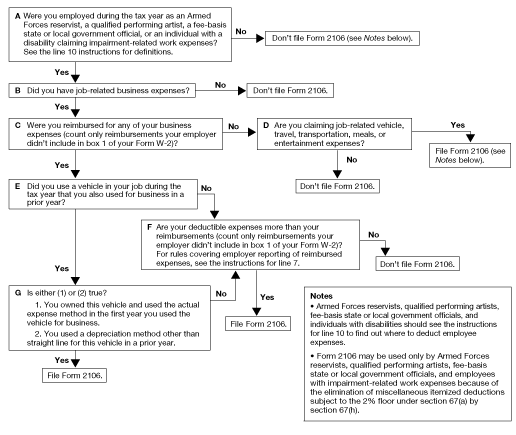
Use Form 2106 if you were an Armed Forces reservist, a qualified performing artist, a fee-basis state or local government official, or an employee with impairment-related work expenses. Employees who do not fit into one of the listed categories may not use the Form 2106 due to the termination of miscellaneous itemized deductions subject to the 2% floor under section 67(a). Section 67(h) eliminated miscellaneous itemized deductions for tax years beginning after 2017. See the flowchart in these instructions to find out if you must file this form.
Excess reimbursements.
If you are not a member of the Armed Forces reserves, a qualified performing artist, a fee-basis state or local government official, or an employee with impairment-related work expenses, and receive reimbursements in excess of your expenses from your employer’s nonaccountable plan, the excess reimbursements should be included as wages on your Form W-2 and your income tax return.
Recordkeeping
You can’t deduct expenses for travel (including meals unless you used the standard meal allowance), gifts, or use of a car or other listed property unless you keep records to prove the time, place, business purpose, business relationship (for gifts), and amounts of these expenses. Generally, you must also have receipts for all lodging expenses (regardless of the amount) and any other expense of $75 or more. See section 274(d) and Regulations sections 1.274-5 and 1.274-5T.
Part I—Employee Business Expenses and Reimbursements
Fill in all of Part I if you were reimbursed for employee business expenses. If you weren’t reimbursed for your expenses, complete steps 1 and 3 only.
Step 1—Enter Your Expenses
Line 1.
If you were a rural mail carrier, you can treat the amount of qualified reimbursement you received as the amount of your allowable expense. Because the qualified reimbursement is treated as paid under an accountable plan, your employer shouldn’t include the amount of reimbursement in your income.
You were a rural mail carrier if you were an employee of the United States Postal Service (USPS) who performed services involving the collection and delivery of mail on a rural route.
Qualified reimbursements.
These are the amounts paid by the USPS as an equipment maintenance allowance under a collective bargaining agreement between the USPS and the National Rural Letter Carriers’ Association, but only if such amounts don’t exceed the amount that would have been paid under the 1991 collective bargaining agreement (adjusted for changes in the Consumer Price Index since 1991 as detailed in section 162(o)(3)).
 If you were a rural mail carrier, do not use Form 2106. Your employer should not include the amount of reimbursement in your income.
Line 2.
The expenses of commuting to and from work aren’t deductible. See the line 15 instructions for the definition of commuting.
Line 3.
Enter lodging and transportation expenses connected with overnight travel away from your tax home (defined next). Don’t include expenses for meals. For more details, including limits, see Pub. 463.
Tax home.
Generally, your tax home is your regular or main place of business or post of duty regardless of where you maintain your family home. If you don’t have a regular or main place of business because of the nature of your work, then your tax home may be the place where you regularly live. If you don’t have a regular or a main place of business or post of duty and there is no place where you regularly live, you are considered an itinerant (a transient) and your tax home is wherever you work. As an itinerant, you are never away from home and can’t claim a travel expense deduction. For more details on the definition of a tax home, see Pub. 463.
Generally, you can’t deduct any expenses for travel away from your tax home for any period of temporary employment of more than 1 year. However, this 1-year rule doesn’t apply for a temporary period in which you were a federal employee certified by the Attorney General (or designee) as traveling in temporary duty status for the U.S. Government to investigate or prosecute a federal crime (or to provide support services for the investigation or prosecution of a federal crime).
Incidental expenses.
The term “incidental expenses” means fees and tips given to porters, baggage carriers, hotel staff, and staff on ships.
You can use an optional method (instead of actual cost) for deducting incidental expenses only. The amount of the deduction is $5 a day. You can use this method only if you didn’t pay or incur any meal expenses. You can’t use this method on any day you use the standard meal allowance (defined later in the instructions for line 5).
Line 4.
Enter other job-related expenses not listed on any other line of this form. Include expenses for business gifts, education (tuition, fees, and books), trade publications, etc. For details, including limits, see Pub. 463 and Pub. 529.
See Form 4562, Depreciation and Amortization, to figure any depreciation and section 179 deduction to include here.
Don’t include on line 4 any educator expenses you deducted on Schedule 1 (Form 1040), line 11.
 You may be able to take a credit for your educational expenses instead of a deduction. See Form 8863, Education Credits, for details.
Don’t include expenses for meals, taxes, or interest on line 4. See Schedule A (Form 1040), Itemized Deductions, and Schedule 1-A (Form 1040), Additional Deductions, to see whether you can deduct taxes or interest paid or accrued during the year.
Note:
If line 4 is your only entry, don’t complete Form 2106 unless you are claiming:
-
Performing-arts-related business expenses as a qualified performing artist,
-
Expenses for performing your job as a fee-basis state or local government official, or
-
Impairment-related work expenses as an individual with a disability.
Line 5.
Enter your allowable meals expense. Include meals while away from your tax home overnight and other business meals.
Standard meal allowance.
Instead of actual cost, you may be able to claim the standard meal allowance for your daily meals and incidental expenses (M&IE) while away from your tax home overnight. Under this method, instead of keeping records of your actual meal expenses, you deduct a specified amount, depending on where you travel. However, you must still keep records to prove the time, place, and business purpose of your travel.
The standard meal allowance is the federal M&IE rate. You can find the rates that applied during 2025 on the Internet at GSA.gov/perdiem. At the Per Diem Overview page, select “2025” for the rates in effect for the period January 1, 2025–September 30, 2025, select “Fiscal Year 2026” for the period October 1, 2025–December 31, 2025. However, you can apply the rates in effect before October 1, 2025, for expenses of all travel within the United States for 2025 instead of the updated rates. For the period October 1, 2025–December 31, 2025, you must consistently use either the rates for the first 9 months of 2025 or the updated rates.
The Department of Defense sets rates for Alaska, Hawaii, and U.S. associated territories. See travel.dod.mil/Travel-Transportation-Rates/Per-Diem/Per-Diem-Rate-Lookup/.
The State Department sets foreign rates. See aoprals.state.gov/web920/per_diem.asp.
See Pub. 463 for details on how to figure your deduction using the standard meal allowance, including special rules for partial days of travel and transportation workers.
Step 2—Enter Reimbursements Received From Your Employer for Expenses Listed in Step 1
Line 7.
Enter reimbursements received from your employer (or third party) for expenses shown in Step 1; include reimbursements reported in Form W-2, Box 12, code L. Do not include amounts reported in Form W-2, Box 1.
Generally, when your employer pays for your expenses, the payments shouldn’t be included in box 1 of your Form W-2 if, within a reasonable period of time, you:
-
Accounted to your employer for the expenses; and
-
Were required to return, and did return, any payment not spent (or considered not spent) for business expenses.
If these payments were incorrectly included in box 1, ask your employer for a corrected Form W-2.
Accounting to your employer.
This means that you gave your employer documentary evidence in the form of a statement of expense, account book, diary, log, statement of expenses, trip sheets, or similar statement to verify the amount, time, place, and business purpose of each expense. You are also treated as having accounted for your expenses if either of the following applies.
-
Your employer gave you a fixed travel allowance that is similar in form to the per diem allowance specified by the federal government and you verified the time, place, and business purpose of the travel for that day.
-
Your employer reimbursed you for vehicle expenses at the standard mileage rate or according to a flat rate or stated schedule, and you verified the date of each trip, mileage, and business purpose of the vehicle use.
See Pub. 463 for more details.
Allocating your reimbursement.
If your employer paid you a single amount that covers meals as well as other business expenses, you must allocate the reimbursement so that you know how much to enter in column A and column B of line 7. Use the following worksheet to figure this allocation.
Reimbursement Allocation Worksheet
(keep for your records)
| 1. | Enter the total amount of reimbursements your employer gave you that weren’t reported to you in Form W-2, box 1 |
_____ |
| 2. | Enter the total amount of your expenses for the periods covered by this reimbursement | _____ |
| 3. | Enter the part of the amount on line 2 that was your total expense for meals | _____ |
| 4. | Divide line 3 by line 2. Enter the result as a decimal (rounded to three places) |
. |
| 5. | Multiply line 1 by line 4. Enter the result here and in column B, line 7 |
_____ |
| 6. | Subtract line 5 from line 1. Enter the result here and in column A, line 7 |
_____ |
Step 3—Figure Expenses To Deduct
Line 9.
Generally, you can deduct only 50% of your business meal expenses, including meals incurred while away from home on business. Meals that are not separately stated from entertainment are generally nondeductible.
Line 10.
If you are one of the individuals discussed below, special rules apply to deducting your employee business expenses.
Armed Forces reservist (member of a reserve component).
You are a member of a reserve component of the Armed Forces of the United States if you are in the Army, Navy, Marine Corps, Air Force, or Coast Guard Reserve; the Army National Guard of the United States; the Air National Guard of the United States; or the Reserve Corps of the Public Health Service.
If you qualify, complete Form 2106 and include the part of the line 10 amount attributable to the expenses for travel more than 100 miles away from home in connection with your performance of services as a member of the reserves on Schedule 1 (Form 1040), line 12, and attach Form 2106 to your return. The amount of expenses you can deduct on Schedule 1 (Form 1040), line 12, is limited to the regular federal per diem rate (for lodging, meals, and incidental expenses) and the standard mileage rate (for car expenses), plus any parking fees, ferry fees, and tolls. These reserve-related travel expenses are deductible whether or not you itemize deductions. See Pub. 463 for additional details on how to report these expenses.
Fee-basis state or local government official.
You are a qualifying fee-basis official if you are employed by a state or political subdivision of a state and are compensated, in whole or in part, on a fee basis.
If you qualify, include the part of the line 10 amount attributable to the expenses you paid or incurred for services performed in that job in the total on Schedule 1 (Form 1040), line 12, and attach Form 2106 to your return. These employee business expenses are deductible whether or not you itemize deductions.
Qualified performing artist.
You are a qualified performing artist if you:
-
Performed services in the performing arts as an employee for at least two employers during the tax year,
-
Received from at least two of those employers wages of $200 or more per employer,
-
Had allowable business expenses attributable to the performing arts of more than 10% of gross income from the performing arts, and
-
Had adjusted gross income of $16,000 or less before deducting expenses as a performing artist.
If you meet all the requirements for a qualified performing artist, include the part of the line 10 amount attributable to performing-arts-related expenses in the total on Schedule 1 (Form 1040), line 12, and attach Form 2106 to your return. Your performing-arts-related business expenses are deductible whether or not you itemize deductions.
Disabled employee with impairment-related work expenses.
Impairment-related work expenses are the allowable expenses of an individual with physical or mental disabilities for attendant care at their place of employment. They also include other expenses in connection with the place of employment that enable the employee to work. See Pub. 463 for more details.
If you qualify, enter the part of the line 10 amount attributable to impairment-related work expenses on Schedule A (Form 1040), line 16 (or Schedule A (Form 1040-NR), line 7).
Part II—Vehicle Expenses
There are two methods for figuring vehicle expenses—the standard mileage rate and the actual expense method. You can use the standard mileage rate for 2025 only if:
-
You owned the vehicle and used the standard mileage rate for the first year you placed the vehicle in service, or
-
You leased the vehicle and are using the standard mileage rate for the entire lease period (except the period, if any, before 1998).
You can’t use actual expenses for a leased vehicle if you previously used the standard mileage rate for that vehicle.
If you have the option of using either the standard mileage rate or actual expense method, you should figure your expenses both ways to find the method most beneficial to you. But, when completing Form 2106, fill in only the sections that apply to the method you choose.
If you were a rural mail carrier and received an equipment maintenance allowance, see the line 1 instructions.
For more information on the standard mileage rate and actual expenses, see Pub. 463.
Section A—General Information
If you used two vehicles for business during the year, use a separate column in Sections A, C, and D for each vehicle. If you used more than two vehicles, complete and attach a second Form 2106, page 2.
Line 11.
Date placed in service is generally the date you first start using your vehicle. However, if you first start using your vehicle for personal use and later convert it to business use, the vehicle is treated as placed in service on the date you start using it for business.
Line 12.
Enter the total number of miles you drove each vehicle during 2025.
Line 13.
Don’t include commuting miles on this line; commuting miles aren’t considered business miles. See the line 15 instructions for the definition of commuting.
Line 14.
Divide line 13 by line 12 to figure your business use percentage.
Line 15.
Enter your average daily round-trip commuting distance. If you went to more than one work location, figure the average.
Commuting.
Generally, commuting is travel between your home and a work location. However, travel that meets any of the following conditions isn’t commuting.
-
You have at least one regular work location away from your home and the travel is to a temporary work location in the same trade or business, regardless of the distance. Generally, a temporary work location is one where your employment is expected to last 1 year or less. See Pub. 463 for more details.
-
The travel is to a temporary work location outside the metropolitan area where you live and normally work.
-
Your home is your principal place of business under section 280A(c)(1)(A) (for purposes of deducting expenses for business use of your home) and the travel is to another work location in the same trade or business, regardless of whether that location is regular or temporary and regardless of distance.
Line 16.
If you don’t know the total actual miles you used your vehicle for commuting during the year, figure the amount to enter on line 16 by multiplying the number of days during the year that you used each vehicle for commuting by the average daily round-trip commuting distance in miles. However, if you converted your vehicle during the year from personal to business use (or vice versa), enter your commuting miles only for the period you drove your vehicle for business.
Section B—Standard Mileage Rate
You may be able to use the standard mileage rate instead of actual expenses to figure the deductible costs of operating a passenger vehicle, including a van, an SUV, a pickup, or a panel truck.
If you want to use the standard mileage rate for a vehicle you own, you must do so in the first year you place your vehicle in service. In later years, you can deduct actual expenses instead, but you must use straight line depreciation.
If you lease your vehicle, you can use the standard mileage rate, but only if you use the rate for the entire lease period (except for the period, if any, before January 1, 1998).
If you use more than two vehicles, complete and attach a second Form 2106, page 2, providing the information requested in lines 11 through 22. Be sure to include the amount from line 22 of both pages in the total on Form 2106, line 1. You may not use the standard mileage rate to compute the deductible expenses of five or more vehicles you own or lease simultaneously (such as in fleet operations).
You may be able to deduct state and local personal property taxes you paid or accrued during the year. Enter these taxes on Schedule A (Form 1040), line 5c.
If you are claiming the standard mileage rate for mileage driven in more than one business activity, you must figure the deduction for each business on a separate form or schedule (for example, Form 2106; Schedule C (Form 1040), Profit or Loss From Business; Schedule E (Form 1040), Supplemental Income and Loss; or Schedule F (Form 1040), Profit or Loss From Farming).
Section C—Actual Expenses
Line 23.
Enter your total annual expenses for gasoline, oil, repairs, insurance, tires, license plates, and similar items. Don't include state and local personal property taxes or vehicle loan interest you paid on Line 23. You may be able to deduct state and local personal property taxes you paid or accrued during the year. See Schedule A (Form 1040) to see whether you can deduct these taxes. Additionally, you may be able to deduct qualified passenger vehicle loan interest you paid or accrued during the year. See Schedule 1-A (Form 1040) to see whether you can deduct this interest.
Line 24a.
If, during 2025, you rented or leased a vehicle instead of using your own vehicle, enter the cost of renting. Also, include on this line any temporary rentals, such as when your car was being repaired, except for amounts included on line 3.
Line 24b.
If you leased a vehicle for a term of 30 days or more, you may have to reduce your deduction for vehicle lease payments by an amount called the inclusion amount. You may have an inclusion amount for a passenger automobile if:
Passenger Automobiles (Including Trucks and Vans)
| The lease term began in: | And the vehicle’s fair market value on the first day of the lease exceeded: | ||
| 2025 | $ | 62,000 (See Rev. Proc. 2025-16) | |
| 2024 | $ | 62,000 (See Rev.Proc. 2024-13) | |
| 2023 | $ | 60,000 (See Rev. Proc. 2023-14) | |
| 2022 | $ | 56,000 (See Rev. Proc. 2022-17) | |
| 2021 | $ | 51,000 (See Rev. Proc. 2021-31) | |
| SeePub. 463 for leases beginning before 2021. | |||
See Pub. 463 to figure the inclusion amount.
Line 25.
If during 2025 your employer provided a vehicle for your business use and included 100% of its annual lease value in Form W-2, box 1, enter this amount on line 25. If less than 100% of the annual lease value was included in Form W-2, box 1, skip line 25.
Line 28.
If you completed Section D, enter the amount from line 38. If you used Form 4562 to figure your depreciation deduction, enter the total of the following amounts.
-
Depreciation allocable to your vehicle(s) (from Form 4562, line 28).
-
Any section 179 deduction allocable to your vehicle(s) (from Form 4562, line 29).
Section D—Depreciation of Vehicles
Depreciation is an amount you can deduct to recover the cost or other basis of your vehicle over a certain number of years. In some cases, you can claim a special depreciation allowance or elect to expense part of the cost of your vehicle in the year of purchase. For details, see Pub. 463.
Line 30.
Enter the vehicle’s actual cost or other basis. Don’t reduce your basis by any prior year’s depreciation. However, you must reduce your basis by any deductible casualty loss, deduction for clean-fuel vehicle, gas guzzler tax, alternative motor vehicle credit, or qualified plug-in electric vehicle credit you claimed. Increase your basis by any sales tax paid (unless you deducted sales taxes in the year you purchased your vehicle) and any substantial improvements to your vehicle.
If you converted the vehicle from personal use to business use, your basis for depreciation is the smaller of the vehicle’s adjusted basis or its fair market value on the date of conversion.
Line 31.
Enter the amount of any section 179 deduction and, if applicable, any special depreciation allowance claimed for this year.
Section 179 deduction.
If 2025 is the first year your vehicle was placed in service and the percentage on line 14 is more than 50%, you can elect to deduct as an expense a portion of the cost (subject to a yearly limit). This cost is sometimes referred to as the “Section 179 basis.” To figure this section 179 deduction, multiply the part of the cost of the vehicle that you choose to expense by the percentage on line 14. The total of your depreciation and section 179 deduction generally can’t be more than the percentage on line 14 multiplied by the applicable limit explained in the line 36 instructions. Your section 179 deduction for the year can’t be more than the income from your job and any other active trade or business on your Form 1040 or 1040-SR.
If you are claiming a section 179 deduction on other property, or you placed more than $4,000,000 of section 179 property in service during the year, use Form 4562 to figure your section 179 deduction. Enter the amount of the section 179 deduction allocable to your vehicle from Form 4562, line 12, on Form 2106, line 31.
Example.
| Section 179 basis | $25,000 |
| Limit on depreciation and section 179 deduction | $20,200* |
| Smaller of: | |
| Section 179 basis, or limit on depreciation | $20,200 |
| Percentage on line 14 | × 0.75 |
| Section 179 deduction | $15,150 |
| * $12,200 if electing out of special depreciation allowance or not qualified property. | |
Limit for sport utility and certain other vehicles.
For sport utility and certain other vehicles placed in service in 2025, the portion of the vehicle’s cost taken into account in figuring your section 179 deduction is limited to $31,300. This rule applies to any 4-wheeled vehicle primarily designed or used to carry passengers over public streets, roads, or highways that isn’t subject to any of the passenger automobile limits explained in the line 36 instructions and is rated at no more than 14,000 pounds gross vehicle weight. However, the $31,300 limit doesn’t apply to any vehicle:
-
Designed to have a seating capacity of more than nine persons behind the driver’s seat;
-
Equipped with a cargo area of at least 6 feet in interior length that is an open area or is designed for use as an open area but is enclosed by a cap and isn’t readily accessible directly from the passenger compartment; or
-
That has an integral enclosure, fully enclosing the driver compartment and load carrying device, doesn’t have seating rearward of the driver’s seat, and has no body section protruding more than 30 inches ahead of the leading edge of the windshield.
Note:
A vehicle subject to section 280F(a) is not considered an SUV under section 179. (See section 179.)
Special depreciation allowance.
The special depreciation allowance applies only for the first year a vehicle is placed in service. See section 168(k) and Rev. Proc. 2025 -16. For 2025, your total section 179 deduction, special depreciation allowance, and regular depreciation deduction can’t be more than $20,200 for passenger automobiles, multiplied by your business use percentage on line 14. See the line 36 instructions for depreciation limits. You can’t recover the amount by which your depreciation deduction exceeds the depreciation limits for the year placed in service until after the end of the recovery period for your vehicle.
Use the following worksheet to figure the amount of the special depreciation allowance.
Worksheet for the Special Depreciation Allowance
(keep for your records)
| 1. | Enter the total amount from Form 2106, line 30 | _____ |
| 2. | Multiply line 1 by the percentage on Form 2106, line 14, and enter the result | _____ |
| 3. | Enter any section 179 deduction | _____ |
| 4. | Subtract line 3 from line 2 | _____ |
| 5. | Multiply the applicable limit explained in the line 36 instructions by the percentage on Form 2106, line 14, and enter the result | _____ |
| 6. | Subtract line 3 from line 5 | _____ |
| 7. | Enter the smaller of line 4 or line 6. Add the result to any section 179 deduction (line 3 above) and enter the total on Form 2106, line 31 | _____ |
Note:
For certain qualified property acquired after September 27, 2017, and before January 20, 2025, that is placed in service during calendar year 2025, the special depreciation allowance is 40% (60% for certain property with a long production period and certain aircraft). For certain qualified property acquired after January 19, 2025, the special depreciation allowance is 100%. See Pub. 946 for prior years.
Election out.
You can elect not to claim the special depreciation allowance for your vehicle. If you make this election, it applies to all property in the same class placed in service during the year.
To make the election, attach a statement to your timely filed return (including extensions) indicating that you are electing not to claim the special depreciation allowance and the class of property for which you are making the election.
Line 32.
To figure the basis for depreciation, multiply line 30 by the percentage on line 14. From that result, subtract the total amount of any section 179 deduction and special depreciation allowance claimed this year (see line 31) or any section 179 deduction and special depreciation allowance claimed in any previous year for this vehicle.
Line 33.
If you used the standard mileage rate in the first year the vehicle was placed in service and now elect to use the actual expense method, you must use the straight line method of depreciation for the vehicle’s estimated useful life. Otherwise, use the Depreciation Method and Percentage Chart, later, to find the depreciation method and percentage to enter on line 33.
To use the chart, first find the date you placed the vehicle in service (line 11). Then, select the depreciation method and percentage from column (a), (b), or (c). For example, if you placed a car in service on July 1, 2025 and you use the method in column (a), enter “200 DB 20%” on line 33.
For vehicles placed in service before 2025, use the same method you used on last year’s return unless a decline in your business use requires a change to the straight line method. For vehicles placed in service during 2025, select the depreciation method and percentage after reading the explanation for each column.
Column (a)—200% declining balance method.
You can use column (a) only if the business use percentage on line 14 is more than 50%. Of the three depreciation methods, the 200% declining balance method may give you the largest depreciation deduction for the first 3 years (after considering the depreciation limit for your vehicle). See the depreciation limit tables, later.
Column (b)—150% declining balance method.
You can use column (b) only if the business use percentage on line 14 is more than 50%. The 150% declining balance method may give you a smaller depreciation deduction than in column (a) for the first 3 years.
Column (c)—straight line method.
You must use column (c) if the business use percentage on line 14 is 50% or less. The method for these vehicles is the straight line method over 5 years. The use of this column is optional for these vehicles if the business use percentage on line 14 is more than 50%.
Note:
If your vehicle was used more than 50% for business in the year it was placed in service and used 50% or less in a later year, part of the depreciation, section 179 deduction, and special depreciation allowance previously claimed may have to be added back to your income in the later year. Figure the amount to be included in income in Form 4797, Part IV.
If you placed other business property in service in the same year you placed your vehicle in service or you used your vehicle mainly within an Indian reservation, you may not be able to use the chart. See Pub. 946 to figure your depreciation.
Depreciation Method and Percentage Chart—Line 33
| Date Placed in Service | (a) 1 | (b) 1 | (c) | ||||
| Oct. 1 – Dec. 31, 2025 | 200 DB | 5.0% | 150 DB | 3.75% | SL | 2.5% | |
| Jan. 1 – Sept. 30, 2025 | 200 DB | 20.0 | 150 DB | 15.0 | SL | 10.0 | |
| Oct. 1 – Dec. 31, 2024 | 200 DB | 38.0 | 150 DB | 28.88 | SL | 20.0 | |
| Jan. 1 – Sept. 30, 2024 | 200 DB | 32.0 | 150 DB | 25.5 | SL | 20.0 | |
| Oct. 1 – Dec. 31, 2023 | 200 DB | 22.8 | 150 DB | 20.21 | SL | 20.0 | |
| Jan. 1 – Sept. 30, 2023 | 200 DB | 19.2 | 150 DB | 17.85 | SL | 20.0 | |
| Oct. 1 – Dec. 31, 2022 | 200 DB | 13.68 | 150 DB | 16.4 | SL | 20.0 | |
| Jan. 1 – Sept. 30, 2022 | 200 DB | 11.52 | 150 DB | 16.66 | SL | 20.0 | |
| Oct. 1 – Dec. 31, 2021 | 200 DB | 10.94 | 150 DB | 16.41 | SL | 20.0 | |
| Jan. 1 – Sept. 30, 2021 | 200 DB | 11.52 | 150 DB | 16.66 | SL | 20.0 | |
| Oct. 1 – Dec. 31, 2020 | 200 DB | 9.58 | 150 DB | 14.35 | SL | 17.5 | |
| Jan. 1 – Sept. 30, 2020 | 200 DB | 5.76 | 150 DB | 8.33 | SL | 10.0 | |
| Prior to 20202 | |||||||
| 1 You can use this column only if the business use of your car is more than 50%. 2 If your car was subject to the maximum limits for depreciation and you have unrecovered basis in the car, you can continue to claim depreciation. See Pub. 463 for more information. |
|||||||
Line 34.
If you sold or exchanged your vehicle during the year, use the following instructions to figure the amount to enter on line 34.
If your vehicle was placed in service:
-
Before 2020, enter the result of multiplying line 32 by the percentage on line 33;
-
After 2019, from January 1 through September 30, enter the amount figured by multiplying the result in (1) by 50%; or
-
After 2019, from October 1 through December 31, enter the amount figured by multiplying the result in (1) by the percentage shown below for the month you disposed of the vehicle.
| Month of Disposal | Percentage |
| Jan., Feb., March | 12.5% |
| April, May, June | 37.5% |
| July, Aug., Sept. | 62.5% |
| Oct., Nov., Dec. | 87.5% |
Line 36.
See the tables shown here to determine the depreciation limitation for passenger automobiles placed in service in 2025. See the tables in Pub. 463 to determine the depreciation limitation for passenger automobiles placed in service before 2025.
-
A passenger automobile is a 4-wheeled vehicle manufactured primarily for use on public roads that is rated at 6,000 pounds unloaded gross vehicle weight or less. Certain vehicles, such as ambulances, hearses, and taxicabs, aren’t considered passenger automobiles and aren’t subject to the line 36 limits. See Pub. 463 for more details.
-
A truck or van is a passenger automobile that is classified by the manufacturer as a truck or van, and that is rated at 6,000 pounds gross vehicle weight or less.
If your vehicle isn’t subject to any of the line 36 limits, skip lines 36 and 37, and enter the amount from line 35 on line 38.
Rev. Proc. 2025-16 Table 1: Depreciation Limitations for Passenger Automobiles Acquired After September 27, 2017, and Placed in Service During Calendar Year 2025, for Which the Section 168(k) Additional First-Year Depreciation Deduction Applies
| Tax Year | Amount |
| 1st Tax Year | $ 20,200 |
| 2nd Tax Year | $ 19,600 |
| 3rd Tax Year | $ 11,800 |
| Each Succeeding Year | $ 7,060 |
Rev. Proc. 2025-16 Table 2: Depreciation Limitations for Passenger Automobiles Placed in Service During Calendar Year 2025 for Which No Section 168(k) Additional First-Year Depreciation Deduction Applies
| Tax Year | Amount |
| 1st Tax Year | $ 12,200 |
| 2nd Tax Year | $ 19,600 |
| 3rd Tax Year | $ 11,800 |
| Each Succeeding Year | $ 7,060 |