


 )
or https:// means you've safely connected to the .gov website. Share sensitive information only on official, secure websites.
)
or https:// means you've safely connected to the .gov website. Share sensitive information only on official, secure websites.


- Instructions for Form 2220 - Introductory Material
- General Instructions
- Specific Instructions
- Instructions for Form 2220 - Notices
For the latest information about developments affecting Form 2220 and its instructions, such as legislation enacted after they were published, go to IRS.gov/Form2220.
What’s New
Extension of relief from additions to tax underpayments applicable to the corporate alternative minimum tax (CAMT).
For tax years beginning in 2025, the IRS will continue to waive the penalty imposed under section 6655 for failure to make estimated tax payments attributable to a CAMT liability. Affected corporations must still file the 2025 Form 2220, even if they owe no estimated tax penalty. However, affected corporations may exclude the CAMT tax liability when calculating the required annual payment on Form 2220. Affected corporations must also include an amount of estimated tax penalty on Line 34 of Form 1120, U.S. Corporation Income Tax Return (or other appropriate line of the corporation's income tax return), even if that amount is zero. Failure to follow these instructions could result in affected corporations receiving a penalty notice that will require an abatement request to apply the relief. See Notice 2025-27, 2025-26 I.R.B. 1611. Also, see the instructions for Form 2220, Part I, Line 1.
Purpose of Form
Corporations (including S corporations), tax-exempt organizations subject to the unrelated business income tax, and private foundations use Form 2220 to determine:
-
Whether they are subject to the penalty for underpayment of estimated tax and, if so,
-
The amount of the underpayment penalty for the period that applies.
Who Must File
Generally, the corporation does not have to file this form with its income tax return because the IRS will figure the amount of any penalty and notify the corporation of any amount due. However, even if the corporation does not owe a penalty, complete and attach this form to the corporation's tax return if the Part I, line 3, amount is $500 or more and any of the following apply.
-
The adjusted seasonal installment method is used.
-
The annualized income installment method is used.
-
The corporation is a large corporation (as defined in the instructions for Part II, line 8) figuring its first required installment based on the prior year's tax.
Who Must Pay the Underpayment Penalty
Generally, a corporation is subject to the penalty if it did not timely pay at least the smaller of:
-
The tax shown on its 2025 return, or
-
The tax shown on its 2024 return (if it filed a 2024 return showing at least some amount of tax and the return was for a full 12 months). However, a large corporation can base only its first required installment on the prior year's tax.
In these instructions, “return” generally refers to the corporation's original return. However, an amended return is considered the original return if the amended return is filed by the due date (including extensions) of the original return. Also, for purposes of determining a required installment of a corporation’s estimated tax, if an amended return is filed for the prior tax year, then the return for the “prior tax year” includes the amended return, but only if the amended return is filed before the applicable installment due date.
The penalty is figured separately for each installment due date. Therefore, the corporation may owe a penalty for an earlier due date even if it paid enough tax later to make up the underpayment. This is true even if the corporation is due a refund when its return is filed. However, the corporation may be able to reduce or eliminate the penalty by using the annualized income installment method or the adjusted seasonal installment method. See the instructions for Part II for details.
How To Use Form 2220
-
Complete Part I, lines 1 through 3. If line 3 is $500 or more, complete the rest of Part I to determine the required annual payment. Then, go to Part II.
-
Check one or more boxes in Part II if the corporation uses the adjusted seasonal installment method, the annualized income installment method, or if the corporation is a large corporation.
If the corporation checked a box in Part II, attach Form 2220 to the income tax return. Be sure to check the box on Form 1120, page 1, line 34; or the comparable line of any other income tax return the corporation is required to file (for example, Form 1120-C, 1120-L, or 1120-S).
-
Complete Part III to determine the underpayment for any of the installment due dates.
-
If there is an underpayment on Part III, line 17 (column (a), (b), (c), or (d)), go to Part IV to figure the penalty.
-
Complete Schedule A if the corporation uses the adjusted seasonal installment method and/or the annualized income installment method.
Part I. Required Annual Payment
Complete lines 1 through 5 to figure the corporation's required annual payment.
Line 1.
Generally, enter the tax from Form 1120, line 31; or the applicable line for other income tax returns. However, if that amount includes any tax attributable to a sale described in section 338(a)(1), do not include that tax on line 1. Instead, write “Sec. 338 gain” and show the amount of tax in brackets on the dotted line next to line 1. This exclusion from the line 1 amount does not apply if a section 338(h)(10) election is made.
Also, if the amount from Form 1120, line 31, includes CAMT from Form 1120, Schedule J, line 3 (or the applicable line for other income tax returns), do not include that amount on line 1 of Form 2220. Instead write "CAMT" and the amount and show the amount of tax in brackets on the dotted line next to line 1.
For information on how to figure the total tax for estimated tax purposes for other entities, see the following forms or their instructions.
| • 990-PF | • 1120-FSC | • 1120-REIT |
| • 990-T | • 1120-L | • 1120-RIC |
| • 1120-C | • 1120-ND | • 1120-S |
| • 1120-F | • 1120-PC | • 1120-SF |
Line 2c.
Enter the amount from Form 1120, Schedule J, Part II, line 20b, or the applicable line for other income tax returns.
Line 4. All filers (other than S corporations).
Figure the corporation's 2024 tax the same way the amount on line 3 of this form was determined, using the taxes and credits from its 2024 tax return. However, skip line 4 and enter on line 5 the amount from line 3 if either of the following applies.
-
The corporation did not file a tax return for 2024 that showed a liability for at least some amount of tax.
-
The corporation had a 2024 tax year of less than 12 months.
S corporations.
Enter on line 4 the sum of:
-
The total of the investment credit recapture tax and the built-in gains tax shown on the return for the 2025 tax year, and
-
Any excess net passive income tax shown on the S corporation's return for the 2024 tax year.
If the 2024 tax year was less than 12 months, skip line 4 and enter on line 5 the amount from line 3.
Part II. Reasons for Filing
Lines 6 and 7. Adjusted seasonal installment method and/or annualized income installment method.
If the corporation's income varied during the year because, for example, it operated its business on a seasonal basis, it may be able to lower or eliminate the amount of one or more required installments by using the adjusted seasonal installment method and/or the annualized income installment method.
Example.
A ski shop, which receives most of its income during the winter months, may benefit from using one or both of these methods to figure its required installments. The annualized income installment or adjusted seasonal installment may be less than the required installment under the regular method for one or more due dates. Using one or both of these methods may reduce or eliminate the penalty for those due dates.
Use Schedule A (Form 2220, pages 3 and 4) to figure one or more required installments. If Schedule A is used for any payment due date, it must be used for all payment due dates. To arrive at the amount of each required installment, Schedule A automatically selects the smallest of:
-
The adjusted seasonal installment (if applicable),
-
The annualized income installment (if applicable), or
-
The regular installment under section 6655(d)(1) (increased by any recapture of a reduction in a required installment under section 6655(e)(1)(B)).
Follow the steps below to determine which parts of the form have to be completed.
-
If the corporation is using only the adjusted seasonal installment method, check the box in Part II, line 6, and complete Schedule A, Parts I and III.
-
If the corporation is using only the annualized income installment method, check the box in Part II, line 7, and complete Schedule A, Parts II and III.
-
If the corporation is using both methods, check the boxes in Part II, lines 6 and 7, and complete all three parts of Schedule A.
Line 8. Large corporations.
A large corporation is a corporation (other than an S corporation) that had, or whose predecessor had, taxable income (defined below) of $1 million or more for any of the 3 tax years immediately preceding the 2025 tax year, or if less, the number of years the corporation has been in existence. See Regulations section 1.6655-4.
Taxable income, for this purpose, is modified to exclude net operating loss and capital loss carrybacks and carryovers. Members of a controlled group, as defined in section 1563, must divide the $1 million amount among themselves under rules similar to those in section 1561. If the corporation is a large corporation figuring its first required installment based on the prior year's tax, check the box on Part II, line 8, and, if applicable, check the box(es) on Part II, line 6 and/or line 7. Also, if applicable, complete Schedule A, Parts I, II, and III, as discussed below in the instructions for line 10.
Part III. Figuring the Underpayment
Line 9. Installment due dates.
The corporation is generally required to enter the 15th day of the 4th (Form 990-PF filers, use the 5th month), 6th, 9th, and 12th months of its tax year.
Note.
Multiple columns can have the same due date if the due date has been extended by relief provided by the IRS (for example, disaster relief).
Line 10. Required installments.
If the box on line 6 and/or line 7 is checked, enter the amounts from Schedule A, line 38.
Large corporations.
Large corporations, follow the instructions below.
-
If the box on line 8 (but not line 6 or line 7) is checked and line 3 is smaller than line 4, enter 25% of line 3 in columns (a) through (d) of line 10.
-
If the box on line 8 (but not line 6 or line 7) is checked and line 4 is smaller than line 3, enter 25% of line 4 in column (a) of line 10. In column (b), figure the amount to enter as follows:
-
Subtract line 4 from line 3,
-
Add the result to the amount on line 3, and
-
Multiply the total in item b above by 25%, and enter the result in column (b).
In columns (c) and (d), enter 25% of line 3.
-
-
If the box on line 8 and the box on line 6 and/or line 7 are checked, follow the instructions in items 1 and 2 above (substituting "Schedule A, line 35" for "line 10" in the calculation). Enter the amounts from Schedule A, line 38, on line 10.
Line 11.
Enter the estimated tax payments made by the corporation for its tax year as indicated below. Include any overpayment from the corporation's 2024 tax return that was credited to the corporation's 2025 estimated tax. If an installment is due on a Saturday, Sunday, or legal holiday, payments made on the next day that is not a Saturday, Sunday, or legal holiday are considered made timely to the extent the payment is applied against that required installment.
Columns (b), (c), and (d).
Enter payments made by the date on line 9 for that column and after the date on line 9 of the preceding column.
Line 17.
If any of the columns in line 17 shows an underpayment, complete Part IV to figure the penalty.
Part IV. Figuring the Penalty
Complete lines 19 through 38 to determine the amount of the penalty. The penalty is figured for the period of underpayment using the underpayment rate determined under section 6621. The period of underpayment generally runs from the installment due date to the earlier of the date the underpayment is actually paid or the 15th day of the 4th month after the close of the tax year. C corporations with tax years ending June 30 and S corporations use the third month instead of the fourth month. Form 990-PF and 990-T filers use the fifth month instead of the fourth month.
Note.
A corporation with a short tax year ending anytime in June will be treated as if the short tax year ended on June 30.
A payment of estimated tax is applied against unpaid required installments in the order in which installments are required to be paid, regardless of the installment to which the payment pertains.
Example.
A corporation with a calendar tax year underpaid the April 15 installment by $1,000. The June 15 installment requires a payment of $2,500. On June 10, the corporation deposits $2,500 to cover the June 15 installment. However, $1,000 of this payment is applied against the April 15 installment. The penalty for the April 15 installment is figured from April 15 to June 10 (56 days). The remaining $1,500 is applied to the June 15 installment.
If the corporation has made more than one payment for a required installment, attach a separate computation for each payment. Also, if the corporation has a fiscal tax year and has an underpayment period that extends beyond the latest date in Part IV, line 35, attach a computation of the penalty for that period. Include the penalty in the total for line 38.
Schedule A
Extraordinary items.
Generally, under the annualized income installment method, extraordinary items must be taken into account after annualizing the taxable income for the annualization period. Similar rules apply in determining taxable income under the adjusted seasonal installment method. An extraordinary item includes:
-
Any item identified in Regulations section
1.1502-76(b)(2)(ii)(C)(1), (2), (3), (4), (7), and (8); -
A net operating loss carryover;
-
A section 481(a) adjustment;
-
Net gain or loss from the disposition of 25% or more of the fair market value of the corporation's business assets during the tax year;
-
Any other item designated as an extraordinary item in the Internal Revenue Bulletin.
These extraordinary items must be accounted for in the appropriate annualization period. However, a net operating loss deduction and a section 481(a) adjustment (unless the corporation makes the alternative choice under Regulations section 1.6655-2(f)(3)(ii)(C)) are treated as extraordinary items occurring on the first day of the tax year in which the item is taken into account in determining taxable income.
De minimis rule.
Extraordinary items identified above that are de minimis as described below (other than a net operating loss carryover or a section 481(a) adjustment) may be annualized using the general rules of Regulations section 1.6655-2(f), or, if the corporation chooses, may be taken into account after annualizing the taxable income for the annualization period. A de minimis extraordinary item is any extraordinary item resulting from a transaction in which the total extraordinary items resulting from such transaction is less than $1 million.
In Schedule A, Part II, make the appropriate adjustments to annualized taxable income before figuring the estimated tax for each reporting period. Similar adjustments must be made, if applicable, to Part I of Schedule A if the adjusted seasonal installment method applies. See the instructions for Schedule A, lines 2, 9b, 21, and 23b below. For more information regarding extraordinary items, see Regulations section 1.6655-2(f)(3)(ii) and the examples in Regulations section 1.6655-2(f)(3)(vii).
Part I. Adjusted Seasonal Installment Method
The corporation can use the adjusted seasonal installment method only if the corporation's base period percentage for any 6 consecutive months of the tax year is 70% or more. The base period percentage for any period of 6 consecutive months is the average of the three percentages figured by dividing the taxable income for the corresponding 6-consecutive-month period in each of the 3 preceding tax years by the total taxable income for each of the 3 preceding tax years, respectively. Figure the base period percentage using the 6-month period in which the corporation normally receives the largest part of its taxable income.
Example.
An amusement park with a 2025 calendar tax year receives the largest part of its taxable income during the 6-month period from May through October. To compute its base period percentage for this 6-month period in 2025, the amusement park figures its taxable income for each May–October period in 2022, 2023, and 2024. It then divides the taxable income for each May–October period by the total taxable income for that particular tax year. The resulting percentages are 69% (0.69) for May–October 2022, 74% (0.74) for May–October 2023, and 67% (0.67) for May–October 2024. Because the average of 69%, 74%, and 67% is 70%, the base period percentage for May–October 2025 is 70%. Therefore, the amusement park qualifies for the adjusted seasonal installment method.
Line 2.
If the corporation has certain extraordinary items, special rules apply. Do not include on line 2 the de minimis items that the corporation chooses to include on line 9b. See Extraordinary items , earlier.
Line 9b.
If the corporation has extraordinary items that are not de minimis, a net operating loss deduction, or a section 481(a) adjustment, special rules apply. Include these amounts on line 9b for the appropriate period. Also include on line 9b the de minimis items that the corporation chooses to exclude from line 2. See Extraordinary items , earlier.
Line 15.
Trusts liable for tax on unrelated business taxable income may be liable for alternative minimum tax (AMT) on certain adjustments and tax preference items. Form 990-T filers compute AMT on Schedule I (Form 1041), Alternative Minimum Tax—Estates and Trusts, if applicable. Figure alternative minimum taxable income (AMTI) based on the trust's income and deductions for the months shown in the column headings directly above line 1.
Note.
For tax year 2025, applicable corporations may exclude the CAMT tax liability when calculating the required annual tax payment on Form 2220. See Relief from additions to tax for underpayments applicable to the corporate alternative minimum tax (CAMT) , earlier.
Line 16.
Enter on line 16 any other taxes the corporation owed for the months shown in each column heading directly above line 1. Include the same taxes used to figure Form 2220, Part I, line 1, including the base erosion minimum tax, if applicable. Do not include the personal holding company tax and interest due under the look-back method of section 460(b)(2) for completed long-term contracts or section 167(g)(2) for property depreciated under the income forecast method.
Line 18.
Enter the credits the corporation is entitled to for the months shown in each column heading above line 1. Enter the same type of credits that are allowed on Form 2220, page 1, lines 1 and 2c.
Part II. Annualized Income Installment Method
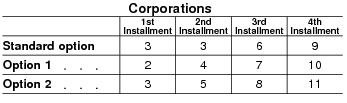
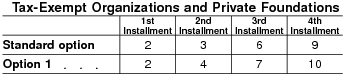
Line 20. Annualization periods.
Enter on line 20, columns (a) through (d), respectively, the annualization periods for the option shown in the tables below. For example, if the corporation elected Option 1, enter on line 20 the annualization periods 2, 4, 7, and 10, in columns (a) through (d), respectively.
Caution:
Use Option 1 or Option 2 only if the corporation elected to do so by filing Form 8842, Election To Use Different Annualization Periods for Corporate Estimated Tax, by the due date of the first required installment payment. Once made, the election is irrevocable for the particular tax year. Option 2 is not available to tax-exempt organizations and private foundations. For these entities, see the options shown in the table in the instructions for line 22.
Line 21.
Enter on line 21 the taxable income (line 30, Form 1120; or the applicable line for other income tax returns) that the corporation received for the months entered for each annualization period in columns (a) through (d) on line 20. If the corporation has extraordinary items, special rules apply. Do not include on line 21 the de minimis extraordinary items that the corporation chooses to include on line 23b. See Extraordinary items , earlier.
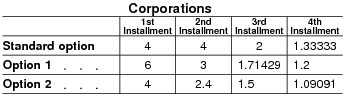
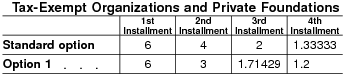
Line 22. Annualization amounts.
Enter on line 22, columns (a) through (d), respectively, the annualization amounts shown in the tables below for the option used for line 20 above. For example, if the corporation elected Option 1, enter on line 22 the annualization amounts 6, 3, 1.71429, and 1.2, in columns (a) through (d), respectively.
Line 23b.
If the corporation has extraordinary items that are not de minimis, a net operating loss deduction, or a section 481(a) adjustment, special rules apply. Include these amounts on line 23b. Also include on line 23b the de minimis extraordinary items that the corporation chooses to exclude from line 21. See Extraordinary items , earlier.
Line 25.
Trusts liable for tax on unrelated business taxable income may be liable for alternative minimum tax (AMT) on certain adjustments and tax preference items. Form 990-T filers compute AMT on Schedule I (Form 1041). Figure AMTI based on the trust's income and deductions for the annualization period entered in each column on line 20.
Note.
For tax year 2025, applicable corporations may exclude certain CAMT tax liability when calculating the required annual tax payment on Form 2220. See Relief from additions to tax for underpayments applicable to the corporate alternative minimum tax (CAMT) , earlier.
Line 26.
Enter any other taxes the corporation owed for the months shown in each column on line 20. Include the same taxes used to figure Form 2220, Part I, line 1, including the base erosion minimum tax, if applicable. Do not include the personal holding company tax and interest due under the look-back method of section 460(b)(2) for completed long-term contracts or section 167(g)(2) for property depreciated under the income forecast method.
Line 28.
Enter the credits the corporation is entitled to for the months shown in each column on line 20. Do not annualize any credit. However, when figuring the credits, annualize any item of income or deduction used to figure the credit.
Part III. Required Installments
Line 33.
Before completing line 33 in columns (b) through (d), complete lines 34 through 38 in each of the preceding columns. For example, complete lines 34 through 38 in column (a) before completing line 33 in column (b).
Line 35.
Enter in each column of line 35 25% of the amount from page 1, Part I, line 5. Large corporations, see the instructions for line 10 for the amounts to enter.
Line 38.
For each installment, enter the smaller of line 34 or line 37 on line 38. Also enter the result on page 1, Part III, line 10.
We ask for the information on this form to carry out the Internal Revenue laws of the United States. You are required to give us the information. We need it to ensure that you are complying with these laws and to allow us to figure and collect the right amount of tax.
You are not required to provide the information requested on a form that is subject to the Paperwork Reduction Act unless the form displays a valid OMB control number. Books or records relating to a form or its instructions must be retained as long as their contents can become material in the administration of any Internal Revenue law. Generally, tax returns and return information are confidential, as required by section 6103.
The time needed to complete and file this form will vary depending on individual circumstances. The estimated burden for business taxpayers filing this form is approved under OMB control number 1545-0123 and is included in the estimates shown in the instructions for their business income tax return.
If you have comments concerning the accuracy of these time estimates or suggestions for making this form simpler, we would be happy to hear from you. See the instructions for the tax return with which this form is filed.