)
or https:// means you've safely connected to the .gov website. Share sensitive information only on official, secure websites.
)
or https:// means you've safely connected to the .gov website. Share sensitive information only on official, secure websites.


- 20.1.9 International Penalties
- 20.1.9.1 Program Scope and Objectives
- 20.1.9.1.1 Background
- 20.1.9.1.2 Authority
- 20.1.9.1.3 Responsibilities
- 20.1.9.1.4 Program Management and Review
- 20.1.9.1.5 Common Terms and Acronyms
- 20.1.9.1.6 Related Resources
- 20.1.9.2 Assessment Procedures for Penalties Not Subject to Deficiency Procedures
- 20.1.9.2.1 Penalty Case Controls
- 20.1.9.2.2 Penalty Assessment–Form 8278, Assessment and Abatement of Miscellaneous Civil Penalties
- 20.1.9.2.3 Penalty Case File Assembly and Procedures
- 20.1.9.2.4 Claims or Penalty Abatement Requests
- 20.1.9.3 IRC 6038—Information Reporting With Respect to Foreign Corporations and Partnerships
- 20.1.9.3.1 Reporting and Filing Requirements
- 20.1.9.3.2 Penalty Letters, Notice Letters, and Notices
- 20.1.9.3.3 Penalty Assertion
- 20.1.9.3.4 Penalty Computation
- 20.1.9.3.5 Reasonable Cause
- 20.1.9.4 IRC 6038(c)—Reduction of Foreign Tax Credit
- 20.1.9.4.1 Reporting and Filing Requirements
- 20.1.9.4.2 Penalty Letters, Notice Letters, and Notices
- 20.1.9.4.3 Penalty Assertion
- 20.1.9.4.4 Penalty Computation
- 20.1.9.4.5 Reasonable Cause
- 20.1.9.5 IRC 6038A(d)—Information Reporting for Certain Foreign-Owned Corporations
- 20.1.9.5.1 Reporting and Filing Requirements
- 20.1.9.5.2 Penalty Letters, Notice Letters, and Notices
- 20.1.9.5.3 Penalty Assertion
- 20.1.9.5.4 Penalty Computation
- 20.1.9.5.5 Reasonable Cause
- 20.1.9.6 IRC 6038A(e)—Noncompliance Penalty for Certain Foreign-owned Corporations
- 20.1.9.6.1 Reporting and Filing Requirements
- 20.1.9.6.2 Penalty Letters, Notice Letters, and Notices
- 20.1.9.6.3 Penalty Assertion
- 20.1.9.6.4 Penalty Computation
- 20.1.9.6.5 Reasonable Cause
- 20.1.9.7 IRC 6038B(c)—Failure to Provide Notice of Transfers to Foreign Persons
- 20.1.9.7.1 Reporting and Filing Requirements
- 20.1.9.7.2 Penalty Letters, Notice Letters, and Notices
- 20.1.9.7.3 Penalty Assertion
- 20.1.9.7.4 Penalty Computation
- 20.1.9.7.5 Reasonable Cause
- 20.1.9.8 IRC 6038C—Information With Respect to Foreign Corporations Engaged in U.S. Business
- 20.1.9.8.1 Reporting and Filing Requirements
- 20.1.9.8.2 Penalty Letters, Notice Letters, and Notices
- 20.1.9.8.3 Penalty Assertion
- 20.1.9.8.4 Penalty Computation
- 20.1.9.8.5 Reasonable Cause
- 20.1.9.9 IRC 6038C(d)—Noncompliance Penalty for Certain Foreign Corporations Engaged in U.S. Business
- 20.1.9.9.1 Reporting and Filing Requirements
- 20.1.9.9.2 Penalty Assertion
- 20.1.9.9.3 Penalty Computation
- 20.1.9.9.4 Reasonable Cause
- 20.1.9.10 IRC 6039F(c)—Large Gifts From Foreign Persons
- 20.1.9.10.1 Reporting and Filing Requirements
- 20.1.9.10.2 Penalty Letters, Notice Letters, and Notices
- 20.1.9.10.3 Penalty Assertion
- 20.1.9.10.4 Penalty Computation
- 20.1.9.10.5 Reasonable Cause
- 20.1.9.11 IRC 6039G—Expatriation Reporting Requirements
- 20.1.9.11.1 Reporting and Filing Requirements
- 20.1.9.11.2 Penalty Letters, Notice Letters, and Notices
- 20.1.9.11.3 Penalty Assertion
- 20.1.9.11.4 Penalty Computation
- 20.1.9.11.5 Reasonable Cause
- 20.1.9.12 IRC 6652(f)—Foreign Persons Holding U.S. Real Property Investments
- 20.1.9.12.1 Reporting and Filing Requirements
- 20.1.9.12.2 Penalty Letters, Notice Letters, and Notices
- 20.1.9.12.3 Penalty Assertion
- 20.1.9.12.4 Penalty Computation
- 20.1.9.12.5 Reasonable Cause
- 20.1.9.13 IRC 6677—Failure to File Information with Respect to Certain Foreign Trusts—Form 3520
- 20.1.9.13.1 Reporting and Filing Requirements
- 20.1.9.13.2 Penalty Letters, Notice Letters, and Notices
- 20.1.9.13.3 Penalty Assertion
- 20.1.9.13.4 Penalty Computation
- 20.1.9.13.5 Reasonable Cause
- 20.1.9.14 IRC 6677(a) and (b)—Foreign Trusts With U.S. Owners—Form 3520-A
- 20.1.9.14.1 Reporting and Filing Requirements
- 20.1.9.14.2 Penalty Letters, Notice Letters, and Notices
- 20.1.9.14.3 Penalty Assertion
- 20.1.9.14.4 Penalty Computation
- 20.1.9.14.5 Reasonable Cause
- 20.1.9.15 IRC 6679—Return of U.S. Persons With Respect to Certain Foreign Corporations and Partnerships
- 20.1.9.15.1 Reporting and Filing Requirement
- 20.1.9.15.2 Penalty Letters, Notice Letters, and Notices
- 20.1.9.15.3 Penalty Assertion
- 20.1.9.15.4 Penalty Computation
- 20.1.9.15.5 Reasonable Cause
- 20.1.9.16 IRC 965(i)(7)(C) - Failure to Annually Report Deferred S Corporation-Related Net 965 Tax Liability
- 20.1.9.16.1 Reporting and Filing Requirements
- 20.1.9.16.2 Penalty Letters, Notice Letters, and Notices
- 20.1.9.16.3 Penalty Assertion
- 20.1.9.16.4 Penalty Computation
- 20.1.9.16.5 Reasonable Cause
- 20.1.9.17 IRC 6686—Information Returns for IC-DISCs
- 20.1.9.17.1 Reporting and Filing Requirements
- 20.1.9.17.2 Penalty Letters, Notice Letters, and Notices
- 20.1.9.17.3 Penalty Assertion
- 20.1.9.17.4 Penalty Computation
- 20.1.9.17.5 Reasonable Cause
- 20.1.9.18 IRC 6688—Reporting for Residents of U.S. Possessions (U.S. Territories)
- 20.1.9.18.1 Reporting and Filing Requirements
- 20.1.9.18.2 Penalty Letters, Notice Letters, and Notices
- 20.1.9.18.3 Penalty Assertion
- 20.1.9.18.4 Penalty Computation
- 20.1.9.18.5 Reasonable Cause
- 20.1.9.19 IRC 6689—Failure to File Notice of Foreign Tax Redetermination
- 20.1.9.19.1 Reporting and Filing Requirements
- 20.1.9.19.2 Penalty Letters, Notice Letters, and Notices
- 20.1.9.19.3 Penalty Assertion
- 20.1.9.19.4 Penalty Computation
- 20.1.9.19.5 Reasonable Cause
- 20.1.9.20 IRC 6712—Failure to Disclose Treaty-Based Return Position
- 20.1.9.20.1 Reporting and Filing Requirements
- 20.1.9.20.2 Penalty Letters, Notice Letters, and Notices
- 20.1.9.20.3 Penalty Assertion
- 20.1.9.20.4 Penalty Computation
- 20.1.9.20.5 Reasonable Cause
- 20.1.9.21 IRC 6039E—Failure to Provide Information Concerning Resident Status (Passports and Immigration)
- 20.1.9.21.1 Reporting and Filing Requirements
- 20.1.9.21.2 Penalty Letters, Notice Letters, and Notices
- 20.1.9.21.3 Penalty Assertion
- 20.1.9.21.4 Penalty Computation
- 20.1.9.21.5 Reasonable Cause
- 20.1.9.22 IRC 6038D—Information With Respect to Specified Foreign Financial Assets
- 20.1.9.22.1 Reporting and Filing Requirements
- 20.1.9.22.2 Penalty Letters, Notice Letters, and Notices
- 20.1.9.22.3 Penalty Assertion
- 20.1.9.22.3.1 Asserting Penalty on MFT 30 Joint Return Module
- 20.1.9.22.3.2 Asserting Penalty on MFT 55 Modules
- 20.1.9.22.3.3 For Cases Submitted to Appeals
- 20.1.9.22.4 Penalty Computation
- 20.1.9.22.5 Reasonable Cause
- 20.1.9.23 FBAR - 31 U.S.C. 5321—Report of Foreign Bank and Financial Accounts, FinCEN Form 114 (as of September 30, 2013)
- 20.1.9.24 Voluntary Disclosure Practice
- 20.1.9.24.1 Offshore Voluntary Disclosure Programs
- 20.1.9.24.2 Other Offshore Compliance Procedures
- 20.1.9.25 Other Penalties
- Exhibit 20.1.9-1 Quick Reference Guide to International Penalties
- Exhibit 20.1.9-2 Reference Guide to Forms
- Exhibit 20.1.9-3 Quick Guide for Penalty Reference Numbers to Process International Penalty Assessments(See Form 8278 for current updates)
- Exhibit 20.1.9-4 International Penalties Subject to or Not Subject to Deficiency Proceeding
- Exhibit 20.1.9-5 Reasonable Cause Relief
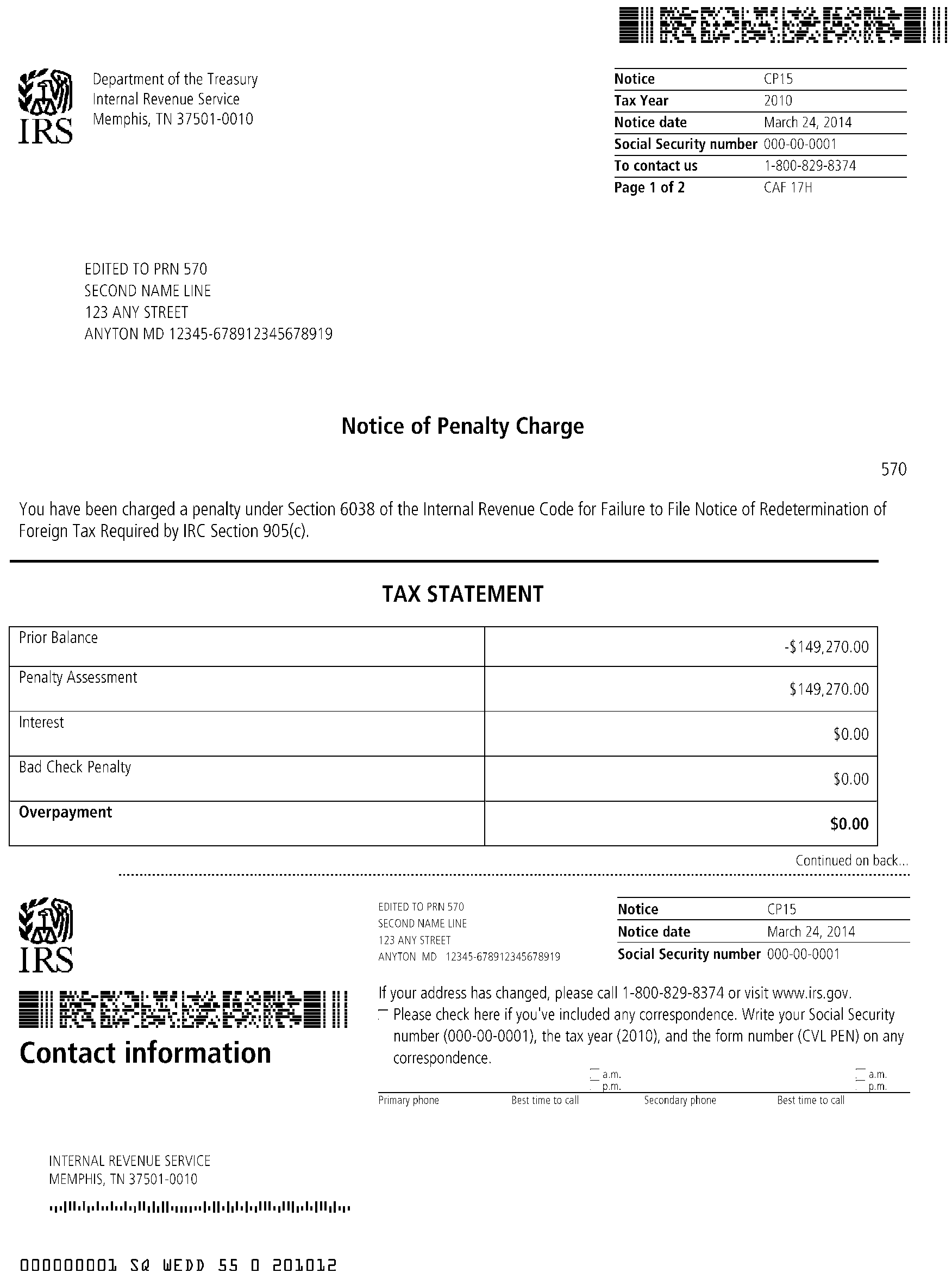
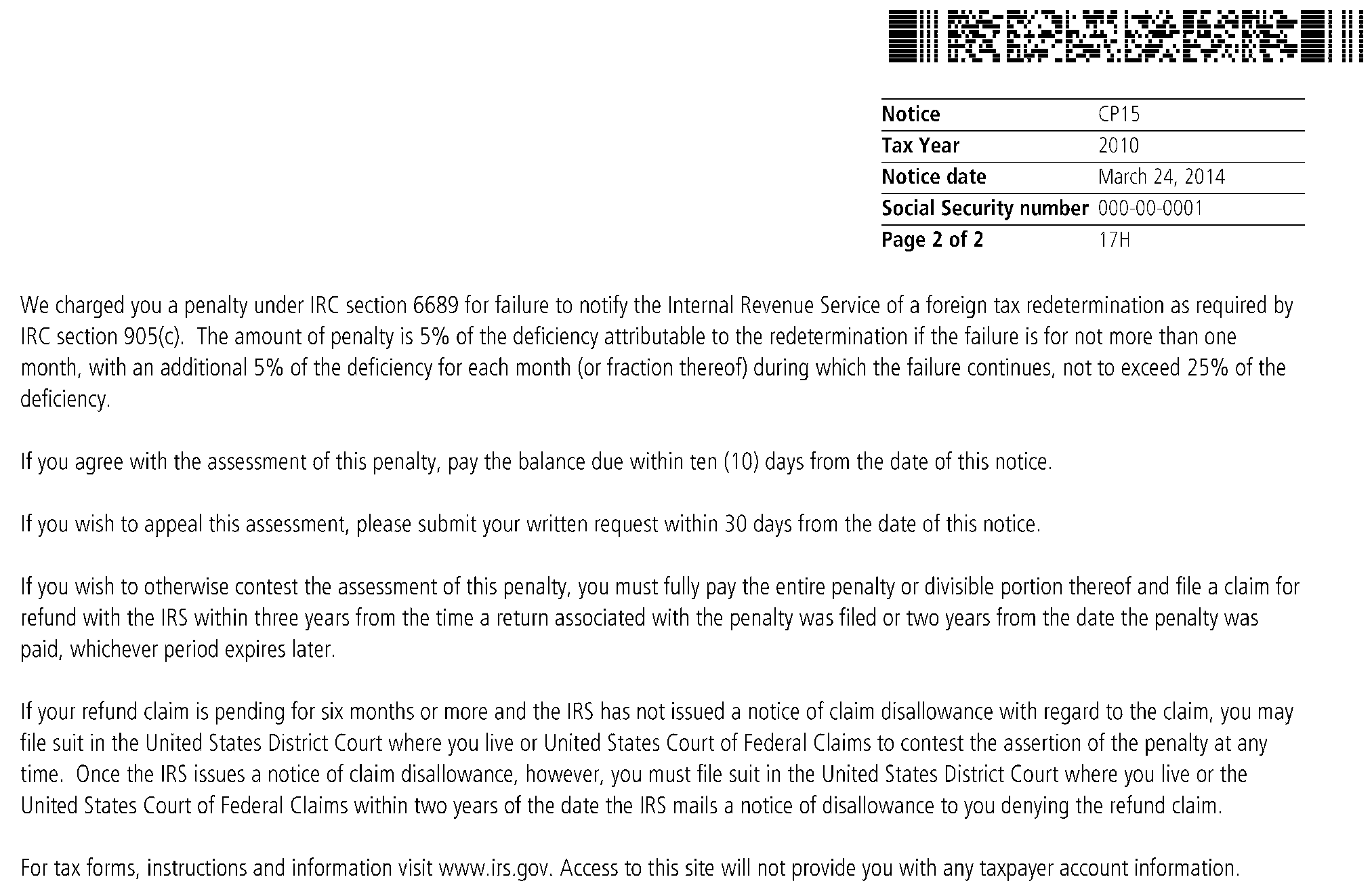
- Exhibit 20.1.9-6 Sample CP 15 Notice
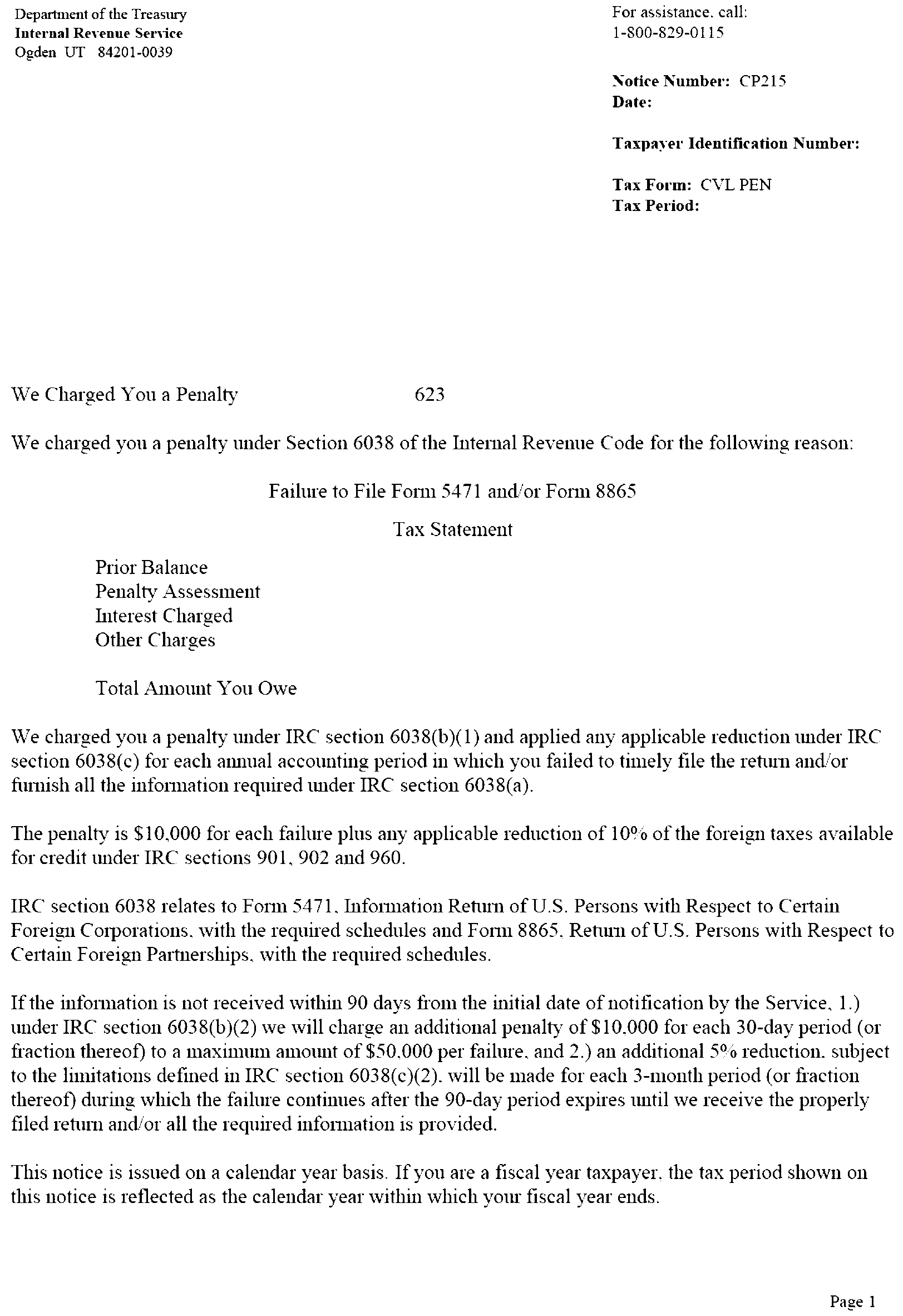
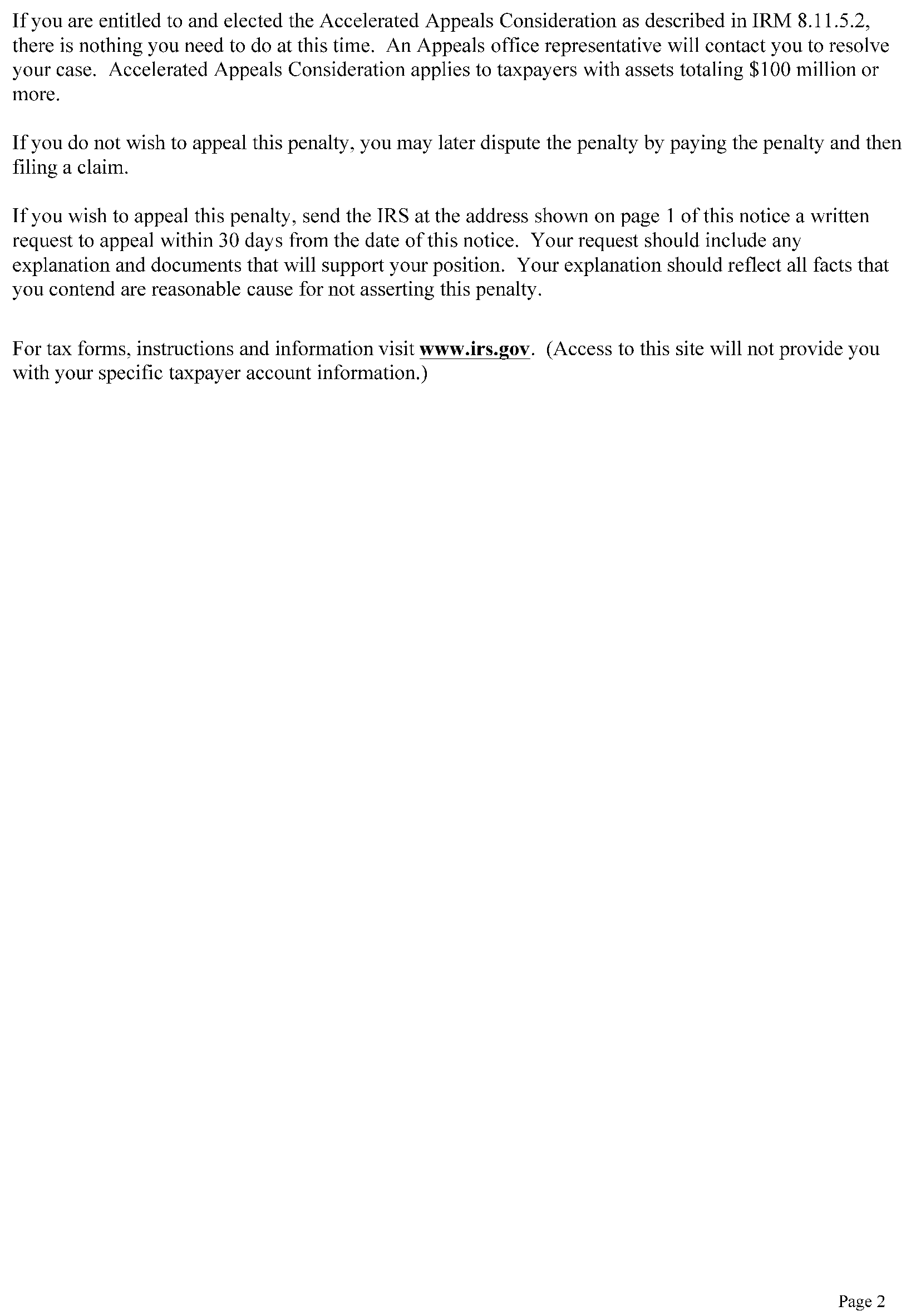
- Exhibit 20.1.9-7 Sample CP 215 Notice
- 20.1.9.1 Program Scope and Objectives
Part 20. Penalty and Interest
Chapter 1. Penalty Handbook
Section 9. International Penalties
20.1.9 International Penalties
Manual Transmittal
January 29, 2021
Purpose
(1) This transmits revised IRM 20.1.9, Penalty Handbook, International Penalties.
Material Changes
(1) IRM 20.1.9.1— Subsection revised to incorporate internal controls information, including the addition of the following 6 new 2nd level subsections: Background, Authority, Responsibilities, Program Management and Review, Common Terms and Acronyms, and Related Resources. Content previously contained in subsections 20.1.9.1.2 through 20.1.9.1.4 has been moved to new subsections 20.1.9.23 through 20.1.9.25.
(2) IRM 20.1.9.1.5 (3)— Updated to clarify the applicability of IRC 6501 statute of limitations to international information return penalties as well as provide guidance on extending the penalty assessment statute of limitations.
(3) IRM 20.1.9.2 (15)— Requirement that the filer be in full compliance prior to reasonable cause consideration was softened to a recommendation. This guidance was updated in many other sections where it appears as well. Also updated to indicate reasonable cause abatement requests should be made under penalties of perjury.
(4) IRM 20.1.9.2 (20)— Updated timing requirements to secure supervisory approval of proposed penalty assessments.
(5) IRM 20.1.9.2.2 (2)— Updated the Form 8278 section that contains the international information reporting penalties.
(6) IRM 20.1.9.3.1— Added additional detail about required schedules to be attached to Form 5471.
(7) IRM 20.1.9.3.5 (1)— Softened statement requiring full compliance prior to considering reasonable cause.
(8) IRM 20.1.9.3.5 (3)— Clarified abatement policy for penalties systemically assessed when a Form 5471 is attached to a late filed Form 1120 or Form 1065.
(9) IRM 20.1.9.4.4— Updated to account for the repeal of IRC 902, which was part of the Tax Cuts and Jobs Act. (Section 14301 of P.L. 115-97).
(10) IRM 20.1.9.4.5— Softened statement requiring full compliance prior to considering reasonable cause.
(11) IRM 20.1.9.5.1 (2)— Updated to indicate Form 5472 should no longer be filed independently, it should always be filed as an attachment to Form 1120.
(12) IRM 20.1.9.5.4— Revised to account for the increased penalty rate on returns with a tax year beginning after December 31, 2017. Increase was enacted as part of the Tax Cuts and Jobs Act (P.L. 115-97).
(13) IRM 20.1.9.5.5 (1)— Softened statement requiring full compliance prior to considering reasonable cause.
(14) IRM 20.1.9.5.5 (3)— Clarified abatement policy for penalties systemically assessed when a Form 5472 is attached to a late filed Form 1120.
(15) IRM 20.1.9.7.1— Updated exceptions to Form 926 filing requirements and updated information explaining the required use of the gain deferral method for transfers made to a foreign partnership that involve IRC 721 property.
(16) IRM 20.1.9.7.3— Updated to account for additional filing requirements.
(17) IRM 20.1.9.7.4— For transfers occurring after December 31, 2017, the active trade or business exception under prior IRC 367(a)(3) has been repealed. See Tax Cuts and Jobs Act, P.L. 115-97, sec. 14102(e)(1).
(18) IRM 20.1.9.7.5— Softened statement requiring full compliance prior to considering reasonable cause.
(19) IRM 20.1.9.8.4— Revised to account for the increased penalty rate on returns with a tax year beginning after December 31, 2017. Increase was enacted as part of the Tax Cuts and Jobs Act (P.L. 115-97).
(20) IRM 20.1.9.8.5— Softened statement requiring full compliance prior to considering reasonable cause.
(21) IRM 20.1.9.9.2- deleted as there was no content and only reserved for future use. Following two subsections in IRM 20.1.9.9 moved up in sequence.
(22) IRM 20.1.9.10.1— Updated filing due date information per the changes enacted as part of Public Law 114-41 (Surface Transportation and Veterans Health Care Choice Improvement Act of 2015). Also reworded parts and broke into additional paragraphs.
(23) IRM 20.1.9.10.5— Softened statement requiring full compliance prior to considering reasonable cause.
(24) IRM 20.1.9.11.5— Softened statement requiring full compliance prior to considering reasonable cause.
(25) IRM 20.1.9.12.5— Softened statement requiring full compliance prior to considering reasonable cause.
(26) IRM 20.1.9.13.1 (3)— Added filing exemptions under Rev. Proc. 2020-17.
(27) IRM 20.1.9.13.1 (6)— Updated filing due date information per the changes enacted as part of Public Law 114-41 (Surface Transportation and Veterans Health Care Choice Improvement Act of 2015).
(28) IRM 20.1.9.13.2— Added reference to PRN 677 used to assess a penalty for failure to file Part II of Form 3520.
(29) IRM 20.1.9.13.4— Added language to clarify penalty caps when the gross reportable amount is less than $10,000. Added reference to PRN 706 to be used for the Part II continuation penalty.
(30) IRM 20.1.9.13.4 (8)— Provided additional information regarding interest rules on distributions deemed taxable.
(31) IRM 20.1.9.13.5— Softened statement requiring full compliance prior to considering reasonable cause.
(32) IRM 20.1.9.14.1— Updated general information about filing deadlines and extension information.
(33) IRM 20.1.9.14.1 (5)— Added filing exemptions under Rev. Proc. 2020-17.
(34) IRM 20.1.9.14.4— Clarified penalty caps and corrected errors with the penalty calculation example.
(35) IRM 20.1.9.14.5— Softened statement requiring full compliance prior to considering reasonable cause.
(36) IRM 20.1.9.15.5— Softened statement requiring full compliance prior to considering reasonable cause.
(37) IRM 20.1.9.16— New subsection along with 5 new secondary subsections to provide policy for a new penalty under IRC 965(i)(7)(C) that was part of the Tax Cuts and Jobs Act (P.L. 115-97).
(38) IRM 20.1.9.17.5— Softened statement requiring full compliance prior to considering reasonable cause.
(39) IRM 20.1.9.18.5— Softened statement requiring full compliance prior to considering reasonable cause.
(40) IRM 20.1.9.19.1— Removed information to account for IRC 902 reporting requirements no longer being applicable.
(41) IRM 20.1.9.19.5— Softened statement requiring full compliance prior to considering reasonable cause.
(42) IRM 20.1.9.20.5— Softened statement requiring full compliance prior to considering reasonable cause.
(43) IRM 20.1.9.22.2— Added information about CP notices that generate when assessments are made to MFJ taxpayers that post to MFT 30.
(44) IRM 20.1.9.22.5— Softened statement requiring full compliance prior to considering reasonable cause.
(45) IRM 20.1.9.23— New subsection to house FBAR information previously under 20.1.9.1.3. Also updated content to account for the new due date enacted as part of Public Law 114-41 (Surface Transportation and Veterans Health Care Choice Improvement Act of 2015).
(46) IRM 20.1.9.24— New subsection to house Voluntary Disclosure information previously under 20.1.9.1.4. Also updated content to account for the closure of the 2014 OVDP as well as other miscellaneous editorial changes.
(47) IRM 20.1.9.25— New subsection to house Other Penalties information previously under 20.1.9.1.2.
(48) — Exhibits were updated as applicable to account for the changes listed above. References to penalty amounts, penalty reference numbers, code sections, forms and schedules were added or updated as necessary.
(49) — Other minor editorial changes have been made throughout this IRM. Website addresses, legal references, and IRM references were reviewed and updated as necessary.
Effect on Other Documents
IRM 20.1.9, dated 11-30-2015 is superseded.Audience
Small Business/Self-Employed (SB/SE), Large Business and International (LB&I), Tax Exempt and Government Entities (TE/GE) and Wage and Investment (W&I) employees who address international penalties.Effective Date
(01-29-2021)Victor Onorato
Director, Business Support Office
Small Business/Self Employed Division
-
Purpose: The purpose of this IRM is to convey policy relating to international return penalties as set by the Office of Servicewide Penalties (OSP).
-
Audience: This IRM provides policy and guidelines to be followed by all operating division employees and processing functions who address international penalties.
-
Policy Owner: The Business Support Office (BSO) is under Operations Support (OS). SB/SE is responsible for overseeing civil penalties, including international information reporting penalties.
-
Program Owner: The Office of Servicewide Penalties (OSP) is responsible for international reporting penalty policy.
-
Primary Stakeholders: All operating divisions.
-
Contact Information: To recommend changes or make any other suggestions to this IRM, email OSP at *Servicewide Penalties Team.
-
International information return penalties are civil penalties assessed on a United States (U.S.) person for failure to timely file complete and accurate international information returns required by specific Internal Revenue Code (IRC) sections.
-
U.S. taxpayers are required to report their worldwide income. International information returns provide a vehicle for verifying that the correct income tax is assessed.
-
Although this IRM includes current law, penalties may be assessed for periods under prior law.
-
Generally, the returns are required for entities or events that the taxpayer has "control" over or that the taxpayer has the power or authority to administer or that the taxpayer is beneficiary of.
-
Returns submitted that are not complete and accurate are considered "un-filed" (not having been filed).
-
Some returns are considered un-filed if the taxpayer does not provide required information when requested, and penalties apply even if the required return has been submitted.
-
Penalties may be assessed prior to the filing of the required information return or upon the submission of required information.
-
U.S. persons may have multiple obligations for each year and multiple penalty assessments. Penalties apply to each information return that was required to be filed for each year.
-
-
Authority for the administration of international information reporting penalties are found in the Internal Revenue Code (IRC) and corresponding Treasury Regulations. Some of the more prominent IRC Sections related to international penalties include:
-
IRC 6038
-
IRC 6038A
-
IRC 6038B
-
IRC 6038C
-
IRC 6038D
-
IRC 6046
-
IRC 6048
-
IRC 6677
-
IRC 6679
-
-
For a comprehensive list of related IRC Sections and Explanations see Exhibit 20.1.9-1, Quick Reference Guide to International Penalties.
-
The Director of Business Support, within SB/SE Operations Support, is the director responsible for the servicewide civil penalty program.
-
Overall responsibility for civil penalty programs is assigned to OSP. OSP is a matrix organization residing in the Business Support (Small Business/Self Employed) Function. OSP is charged with coordinating policy and procedures concerning the administration of civil penalty programs, ensuring consistency with the penalty policy statement, reviewing and analyzing penalty information, researching penalty effectiveness on compliance trends, and determining appropriate action necessary to promote voluntary compliance.
-
Each IRS organization is responsible for establishing an internal process for managing their procedures based upon these Servicewide policies and may develop additional guidance or reference materials for their specific functional administrative needs. However, such reference material must receive approval from OSP prior to distribution and must remain consistent with the policies and general procedural requirements set forth in this IRM, Policy Statement 20-1 (e.g., Penalty Policy Statement) in IRM 1.2.1.12.1, and any other guidance relating to civil penalties.
-
All employees should keep the following objectives in mind when handling each penalty case:
-
Similar cases and similarly-situated taxpayers should be treated alike.
-
Each taxpayer should have the opportunity to have his or her interests heard and considered.
-
Strive to make a right decision in the first instance, reflecting fair and impartial enforcement of the tax laws. A wrong decision, even though eventually corrected, may have negative impact on voluntary compliance.
-
Provide adequate opportunity for incorrect decisions to be corrected.
-
Treat each case in an impartial way (i.e., approach the job, not from the government’s or the taxpayer’s perspective, but in the interest of fair and impartial enforcement of the tax laws).
-
Use each penalty case as an opportunity to educate the taxpayer, help the taxpayer understand his or her legal obligations and rights, and assist the taxpayer in understanding his or her appeal rights.
-
In all cases observe the taxpayer’s procedural rights.
-
Endeavor to promptly process and resolve each taxpayer’s case.
-
Resolve each penalty case in a manner which promotes voluntary compliance.
-
-
In 2014, the IRS adopted a Taxpayer Bill of Rights that outlines fundamental rights of every taxpayer (see Pub 1 and IRC 7803(a)(3)). It is imperative that all penalty considerations take place within the framework of those rights.
-
Every function in the IRS has a role in proper penalty administration. It is essential that each function conduct its operations with an emphasis on promoting voluntary compliance. Appropriate reviews should be conducted to ensure consistency with the penalty policy statement (Policy Statement 20-1) and philosophy.
-
To promote the goal of consistency and fairness, OSP will review semi-annually a sample of penalty assessments, provided by SB/SE Research. See IRM 20.3.1, Civil Penalty Accuracy Review Process. The report of findings is shared with the Director, Business Support, the CFO, and other leadership as needed. The completed report is uploaded to an enterprise shared folder. Reports may be prepared when a significant issue develops, such as a correction to programming that affects many taxpayers.
-
U. S. Person—Unless otherwise indicated, the term "U.S. person" includes citizens or residents of the United States, domestic corporations, domestic partnerships, U.S. estates, or trusts. Trusts are considered U.S. persons only if a court within the U.S. is able to exercise primary supervision over the administration of the trust, and one or more U.S. persons have the authority to control all substantial decisions of the trust. See IRC 7701(a)(30)(E). With the exception of certain penalties, penalties cannot be assessed on married taxpayers jointly, but can be assessed on each person separately.
-
Assessable Penalties—Penalties listed in this section, unless otherwise noted, are assessable penalties and are not covered by deficiency procedures of IRC 6211 through IRC 6215 (relating to deficiency procedures for income, estate, gift, and certain excise taxes). Assessable penalties are paid upon notice and demand. For assessable penalties, there is no 30-day letter, no agreement form, and no notice requirements prior to assessment. See Exhibit 20.1.9-3, Quick Guide for Reference Numbers to Process International Penalty Assessments, for a list of penalty reference numbers (PRNs). The PRN identifies the applicable IRC section and dictates the explanatory language in the assessment notice.
-
Statute of Limitations—In general, international information returns are assessed in the same manner as taxes pursuant to IRC 6201(a) and IRC 6671(a). Therefore, pursuant to IRC 6501(a), international information return penalties generally must be assessed within three years after the return was filed. This three-year period of limitations also applies to late-filed international information returns. The following points should be considered:
-
If the international information return contains inaccurate or incomplete information, the period of limitations to assess a penalty for failure to provide required information will not expire before three years after the date the information required under section 6038, 6038A, 6038B, 6038D, 6046, 6046A, or 6048 is provided to the IRS. See IRC 6501(c)(8).
-
Failure to file complete and accurate international information returns may also extend the period of assessment on the underlying tax return. See IRC 6501(c)(8).
-
Rules related to consents to extend the statute of limitations for some international information return penalties are provided in IRM 25.6.22.6.17.10, Assessable Penalties. Generally, Form 872, Consent to Extend Time to Assess Tax, can be used to extend the statute of limitations on certain international information return penalties by adding the following language to the form:
"Without otherwise limiting the applicability of this agreement, this agreement also extends the period of limitations to assess any penalty imposed for failure to provide information required under IRC §§ 6038, 6038A, 6038B, 6038D, 6046, 6046A, or 6048."
-
-
Reasonable Cause—Reasonable cause applies to most, but not all, penalties. However, taxpayers who conduct business or transactions offshore or in foreign countries have a responsibility to exercise ordinary business care and prudence in determining their filing obligations and other requirements. It is not reasonable or prudent for taxpayers to have no knowledge of, or to solely rely on others for, the tax treatment of international transactions. When considering reasonable cause, examiners must consider the following:
-
Reasonable cause will be considered by the examiner per IRM 20.1.1, Introduction and Penalty Relief, prior to assessing the penalty. Reasonable cause does not apply to some of the penalties assessable after the taxpayer was notified of the requirement to file or was requested to provide specific required information (i.e. continuation penalties). See Exhibit 20.1.9-5, Reasonable Cause Relief, for a quick reference. Specific information is listed with the related penalty and IRC sections.
-
For penalties within this IRM, requests for abatement due to reasonable cause should contain a declaration that it is made under the penalties of perjury.
-
Because of the unique nature and risks associated with international transactions, reasonable cause should not be granted to a taxpayer merely because of the following:
1) A foreign country would impose penalties on them for disclosing the required information,
2) A foreign trustee refuses to provide them information for any other reason, including difficulty in producing the required information or provisions in the trust instrument that prevent the disclosure of required information, or
3) The taxpayer relied on another person to file returns. It is the taxpayer’s responsibility to ensure that all returns are filed timely and accurately. -
Although each year and penalty stands on its own when considering whether the facts and circumstances qualify for reasonable cause relief, there is often correlating impacts on other years and filing requirements when it comes to international information reporting. Because of this, examiners are encouraged to ensure the taxpayer is in full compliance with the requirements of the IRC section for which reasonable cause is being sought, prior to considering reasonable cause on any one year. For example, if a taxpayer wants reasonable cause for three years filed, but has not filed two subsequent years that are due, it is recommended that no reasonable cause be considered until all five open period filings have been secured. This benefits both the taxpayer and the IRS by ensuring compliance and comprehensively addressing applicable penalties and potential abatements in a single audit. If the IRS only addresses the three late-filed returns in hand without first securing the other two delinquent returns, three different unintended consequences may result as follows:
1) The IRS will need to rework the civil penalty issue should the taxpayer later file the other required periods,
2) The IRS will need to start up another examination against the taxpayer if the taxpayer fails to subsequently file all required periods, or
3) The taxpayer will not subsequently file or otherwise comply. -
See IRM 20.1.9.2 (15) for additional information.
-
-
Appeal Rights—Appeals currently provides a prepayment, post assessment appeal process for all international penalties. See IRM 8.11.5, Penalties Worked in Appeals, International Penalties. Also, Appeals provides for an accelerated process for certain international penalties. See IRM 8.11.5.14, International Penalty—Accelerated Appeals Consideration.
-
Specific Powers of Attorney or Authorizations to Disclose Tax Information—These documents (such as Form 2848 or Form 8821) are required prior to discussing penalty issues with a person other than the person subject to the assessment or required to file the returns.
-
Information Returns—These documents are generally required to be attached to the related income tax return. In addition, certain information returns must also be separately filed with the IRS campus site identified in the instructions for such form. Any information return required to be attached to the related income tax return is due on the due date of the income tax return, including extensions. Examiners should focus on the requirement to attach the information returns to the related income tax return when determining whether or not the required return has been filed timely. Form 3520, Annual Return to Report Transactions With Foreign Trust and Receipt of Certain Foreign Gifts, and Form 3520-A, Annual Information Return of Foreign Trust With a U.S. Owner, are processed to Master File (on MFT 68 and 42 respectively) and are not required to be attached to an income tax return.
-
Field Office Penalty Cases—These cases are not controlled on AIMS. However, penalties assessed are associated with an examination of the taxpayer. Use CFOLZ to identify closed examinations.
-
Campus Penalty Cases—Examiners are authorized to assess penalties on late filed or incomplete information returns received at the campus. Campus employees can abate penalties asserted by campus personnel.
-
Form 8278—International penalties are assessed on Form 8278, Assessment and Abatement of Miscellaneous Civil Penalties, with a Form 886-A, Explanation of Items, attached to identify what penalty is being assessed, how the penalty was calculated, and why reasonable cause was not applicable.
-
Penalty Tax Adjustments—Some of the IRC penalty sections include penalty adjustments to income tax or penalties that are based on the amount of income tax. Penalties based on the amount of income tax, income tax deficiency, adjustments to taxable income, tax credits, or income tax computations are return-related penalties and are covered by deficiency procedures. Return-related penalties must be included in an examination report. These penalties are noted in Exhibit 20.1.9-4 for information purposes.
-
Related Statute for Assessment—IRC 6501(c)(8) extends the statute for assessment on the related income tax return regarding items related to the information required to be reported until 3 years after the information required by IRC 6038, IRC 6038A, IRC 6038B, IRC 6038D, IRC 6046, IRC 6046A, and IRC 6048 is furnished to the Secretary. Examiners should be aware that filing or failing to file information returns may affect the statute for assessment on the related income tax return.
Note:
When there is a failure to provide the information required by these provisions, IRC 6501(c)(8) also provides an extension of the limitations period for assessment with respect to items on the tax return unrelated to these provisions, but there is a reasonable cause exception for these unrelated items.
-
Notice—A notice and demand for payment is a legally due and payable assessment (bill) mailed to the taxpayer.
-
IMF—A notice is generated and the penalty is assessed to a MFT 55 account based on the information provided on Form 8278. When the penalty case is closed and processed, the PRN and the amount of penalty assessed is input into the IRS computer system that, in turn, generates a computer paragraph (CP) notice or CP 15, Notice of Penalty Charge, which is sent to the taxpayer.
-
BMF—A notice is generated and the penalty is assessed to a MFT 13 account based on the information provided on Form 8278. The PRN and amount of penalty assessed is input and it systemically generates a CP 215, Notice of Penalty Charge, which is sent to the taxpayer.
-
-
Notice Letters—Notice letters are pre-assessment requests for returns (or complete and accurate return information) sent by certified mail to the taxpayer.
-
Common Acronyms
-
BMF - Business Master File
-
CP - Computer Paragraph
-
IMF - Individual Master File
-
IRC - Internal Revenue Code
-
IRM - Internal Revenue Manual
-
IRS - Internal Revenue Service
-
LB&I - Large Business and International
-
MF - Master FIle
-
MFT - Master File Tax
-
OVDI - Offshore Voluntary Disclosure Initiative
-
OVDP - Offshore Voluntary Disclosure Program
-
PRC - Penalty Reason Code
-
PRN - Penalty Reference Number
-
SB/SE - Small Business/Self-Employed
-
SSN - Social Security Number
-
TC - Transaction Code
-
TE/GE - Tax Exempt and Government Entities
-
TIN - Taxpayer Identification Number
-
W&I - Wage and Investment
-
-
See Exhibit 20.1.9-2, Reference Guide to Forms, for a listing of forms applicable to issues within this IRM.
-
Form 8278, Assessment and Abatement of Miscellaneous Civil Penalties.
-
For international return processing, see IRM 3.21, International Returns and Documents Analysis; IRM 3.22, International Error Resolution; IRM 3.37, International ISRP; and IRM 3.38, International Tax Returns and Documents.
-
This section provides general procedures common to international penalties. Exceptions are noted in the discussion of the specific penalties.
-
Generally, the penalties included in this section are asserted by an international examiner, revenue agent, tax auditor, tax compliance officer, tax examiner, or estate and gift tax attorney (collectively referred to hereafter as an "examiner." )
-
Examiners must perform appropriate research when addressing these penalties. Technical advisors can provide additional information on specific provisions. See Exhibit 20.1.9-1, Quick Reference Guide to International Penalties. For other detailed examination procedures on international penalties, refer to IRM 4.60.8, International Examination and Processing Procedures.
-
Deficiency procedures under Subchapter B of Chapter 63 (relating to deficiency procedures for income, estate, gift, and certain excise taxes) do not apply to penalties discussed in this section. See Exhibit 20.1.9-4, International Penalties Subject to or Not Subject to Deficiency Procedures.
-
U.S. and foreign taxpayers are subject to criminal penalties such as willful failure to file a return (IRC 7203) and filing a false or fraudulent return (IRC 7206 or IRC 7207). If at any point these IRC sections apply, examiners must discuss the situation with their manager and the fraud technical advisor before further contacting the taxpayer.
-
Penalties are assessed on U.S. persons as defined in IRM 20.1.9.1.5 (1).
-
Requirement to File—The examiner must determine that the information return was required to be filed before referring to the information listed under the individual IRC section and PRN. The following types of information support a presumptive requirement to file an international information return:
-
Testimony of the taxpayer or other reliable persons.
-
Late filed return.
-
A filed return indicating that information returns are due for prior or subsequent periods or for related entities.
-
A filed return that does not include all the required information or the required supporting information was not provided when requested.
-
Information that the taxpayer has control over, is receiving benefits from, or is receiving distributions or income from an account in the name of a foreign entity.
-
Statement in the name of the foreign entity addressed to the taxpayer.
-
Information received from promoter investigations that indicates the taxpayer owns or has control over a foreign entity, is controlled by a foreign entity, or meets another filing requirement.
-
-
Fact of Filing—The examiner must determine that the information return (with complete and accurate information) has not been filed or was filed after the required date. Also note the following:
-
Generally, the information returns or statements are required to be attached to the related income tax return and the due date is the same as the related income tax return (including extensions). Specific exceptions are noted for each penalty separately.
-
Some returns have dual filing requirements and the penalty can apply for failure to file either return.
-
Examiners should focus on the requirement to attach the information return to the related income tax return when determining whether or not the required return has been filed timely.
IF for the taxpayer ... THEN ... you have a TIN request BMFOLI to identify all filings for the period in question and then request BMFOLT and BRTVU (the BRTVU has all lines of the return transcribed) for the specific MFT(s) and period(s) desired. you do not have a TIN research NAMEE for a TIN (if no TIN is located, include research in the case file).
-
-
Referral—Domestic examiners must make a referral on the Specialist Referral System for international assistance when they are assigned a case that involves international information returns. The specialist electronic referral home page is located at https://srs.web.irs.gov.
-
Making Third Party Contacts—Examiners will make appropriate third party contacts to develop all facts relevant to the determination of the appropriateness of the penalty. IRM 25.27, Third Party Contacts, contains the procedures for third party contacts as well as guidance for making contact.
-
Request the Returns—Examiners should inform the taxpayer of the requirements to file the information returns and of the intent to assess the penalty for failure to comply. The initial penalty can be assessed without advance notification. However, examiners should inform the taxpayer prior to assessing the penalty. Examiners must take steps to secure appropriate documentation to support the requirement to file the returns. This information may also be necessary for the related income tax examination.
-
Notice Letter Provisions—Penalties under IRC 6038, IRC 6038A, IRC 6038C, IRC 6038D, IRC 6677, and IRC 6679 have "notice letter" provisions and a continuation penalty may apply. The provisions state the following:
-
If the required returns are not filed or the required information is not received on or before the 90th day after the notice letter is issued, additional penalties of $10,000 per month (or fraction thereof) may be assessed.
-
The penalty continues to increase until the required information is received, or the information returns are filed, or the maximum penalty is assessed.
-
The maximum penalty amount for the continuation penalty is different for each IRC section and is referenced in each penalty section.
-
-
Notice Letters—Notice letters generally inform the taxpayer an initial penalty may apply and warn of possible continuation penalties if delinquent returns and/or information continues for more than a specified period of time after the date the letter was issued (typically 90 days). Examiners should issue notice letters at the earliest date possible. Notice letters also provide an opportunity for the taxpayer to produce information to prove that the information return in question was not required to be filed or to request reasonable cause for the failure to timely file. Notice letters are available through http://publish.no.irs.gov/catlg.html. Required language for additional letters is available from the international penalty technical advisor, IRC, notices, and regulations.
-
Notice letters are addressed to the U.S. person responsible for ensuring that the required returns are filed and include the name of the related foreign entity.
-
Notice letters must be signed by an examination group manager in SB/SE (see Delegation Order SB/SE—4.52 at http://mysbse.web.irs.gov/RefLibrary/imd/delorders/functional/examination/21695.aspx) or a revenue agent in LB&I (see Delegation Order LMSB-193-1)).
-
Notice letters that are sent certified mail instruct the taxpayer to mail the information returns to the address of the examiner issuing the letter.
-
Notice letters may also be hand delivered or issued directly to the taxpayer. The examiner should get a receipt from the taxpayer on the date of delivery. Many notice letters have a specified response period prior to a continuation penalty being asserted. The receipt is proof of the date the notice letter was issued.
-
There is no provision in the IRC or Treas. Regs. for an extension of the 90-day period described in the notice letter.
-
-
Secured Returns—When an examiner secures a delinquent information return or statement, determine if it provides all of the required information and is accurate. If the return is incomplete or inaccurate, the examiner must inform the taxpayer that the return is not considered filed until it is complete and accurate. For complete and accurate returns, perform the following actions:
Note:
Form 3520 and Form 3520-A follow different procedures than those outlined below. Form 3520 is separately processed to Business Master File (BMF) under MFT 68, and delinquent processing information is outlined in IRM 20.1.9.10 and IRM 20.1.9.13 . Form 3520-A is separately processed to BMF under MFT 42, and delinquent processing information is outlined in IRM 20.1.9.14.
Step Action 1. Date stamp and make one photocopy of the document. 2. Associate the original document with the related income tax return. Often, the received date of the information return affects the statute for assessment on the related income tax return. See IRC 6501(c)(8). 3. Place the photocopy in the penalty case file. The return received will be kept in the penalty case file and the related income tax file. -
Reasonable Cause—Examiners must consider any reason a taxpayer provides in conjunction with the guidelines, principles, and evaluating factors relating to reasonable cause based on the facts and circumstances. Examiners should be mindful of the fact that, generally, these penalties apply to individuals who have business or investment activities in foreign countries, and, as such, general care and prudence requires researching the filing and tax obligations of all jurisdictions. See Exhibit 20.1.9-5, Reasonable Cause Relief, the IRC, and the Treas. Regs. relating to the specific penalty. Examiners should note the following when considering reasonable cause requests:
-
Although each year and each penalty stands on its own when considering whether the facts and circumstances qualify for reasonable cause relief, there are often correlating impacts on other years and filing requirements when it comes to international information reporting. Because of this, examiners are encouraged to ensure the taxpayer is in full compliance with the requirements of the IRC section for which reasonable cause is being sought, prior to considering reasonable cause on any one year. For example, if a taxpayer wants reasonable cause for three years filed, but has not filed two subsequent years that are due, it is recommended that reasonable cause not be considered until all five open period filings have been secured. This benefits both the taxpayer and the IRS by ensuring compliance and comprehensively addressing applicable penalties and potential abatements in a single audit.
-
Reasonable cause will be considered by the examiner per IRM 20.1.1, Introduction and Penalty Relief, prior to assessing the penalty. Reasonable cause does not apply to some of the penalties assessable after the taxpayer was notified of the requirement to file or was requested to provide specific required information (i.e. continuation penalties). See Exhibit 20.1.9-5, Reasonable Cause Relief, for a quick reference. Specific information is listed with the related penalty and IRC sections.
-
For penalties within this IRM, requests for abatement due to reasonable cause should contain a declaration that it is made under the penalties of perjury.
-
Because of the unique nature and risks associated with international transactions, reasonable cause should not be granted to a taxpayer merely because of the following:
-
A foreign country would impose penalties on them for disclosing the required information,
-
A foreign trustee refuses to provide them information for any other reason, including difficulty in producing the required information or provisions in the trust instrument that prevent the disclosure of required information, or
-
The taxpayer relied on another person to file returns. It is the taxpayer’s responsibility to ensure that all returns are filed timely and accurately.
-
-
Many of the penalty sections have specific provisions for reasonable cause, however the reasonable cause exception does not apply to the initial penalty and/or the continuation penalty in some IRC sections. See Exhibit 20.1.9-5, Reasonable Cause Relief
-
Examiners must issue a determination letter if the taxpayer requested reasonable cause consideration and it was denied.
-
Reasonable cause determinations can only be made by the unit that asserted the penalty (e.g., campus cannot allow reasonable cause for a penalty asserted by LB&I, TE/GE, or SB/SE Field Examination).
-
A taxpayer’s repeated failure to file does not support testimony that the taxpayer demonstrated normal business care or prudence for the older, late-filed years. Once all open periods (not on extension) are secured, examiners can make a determination as to reasonable cause for any of the periods not timely filed. IRM 20.1.1.3.2.1, Standards and Authorities, lists the standards and authorities for establishing reasonable cause and IRM 20.1.1.3.2.2, Ordinary Business Care and Prudence, defines ordinary business care and prudence.
-
A taxpayer’s testimony that records were not available year after year has no merit. Once all late filings are secured, examiners can make a determination as to any reasonable cause for all periods secured. IRM 20.1.1.3.2.2.3, Unable to Obtain Records, provides criteria for taxpayers unable to obtain records.
-
-
Compute the Penalties—After the examiner has determined that a penalty applies, the examiner must compute the amount of the penalty and prepare the assessment documents. Form 8278, Assessment and Abatement of Miscellaneous Civil Penalties, and Form 886-A, Explanation of Items, are required. The penalty amounts are discussed in the section for each penalty. Penalty computation time frames are as follows:
-
Penalties will be computed until the date returns are filed, until the required information is received, or until the maximum penalty amount is reached.
-
For penalties without notice letter provisions, or if no notice letter was issued:
(i) Assess penalties promptly after receipt of the required returns or return information, or
(ii) If no return is received, assess penalties 90 days after the request for the return.
-
-
Penalties With a Notice Letter Provision—When the examiner does not receive a response from the taxpayer, it is recommended that the initial assessment package be prepared on or after the 125th day, but before the 150th day after the date that the notice letter was issued. As a result, two assessments, each on a separate Form 8278 are required. One assessment would be for the initial penalty and a second assessment is required for two months of the continuation penalty.
Example:
For one delinquent Form 5471, Information Return of U.S. Person With Respect to Certain Foreign Corporations, the first two assessments (each on a different Form 8278) would be as follows:
Description Penalty Reference Number Penalty Amount Initial Penalty 623 $10,000 Continuation Penalty 619 $20,000 -
The examiner must maintain a copy of the initial penalty case file for subsequent assessments if noncompliance continues. Please note:
-
The second and subsequent (if applicable) assessments of the continuation penalty should be made after 215 days from the date of the notice letter, unless the maximum penalty amount has been reached.
-
As a result, any subsequent assessment(s) will be for three months: $30,000 for each required return.
-
-
Continuation Penalties—A continuation penalty is associated with several penalties and can either be assessed at the same time as the initial penalty or at a later date. There are maximum limits to some continuation penalties while others have no limitation on the amount that can be assessed. Additional information about each continuation penalty is presented in the respective penalty sections that follow. In addition:
-
Penalty Case Control—Once the initial penalty case file (either the initial penalty alone or the initial penalty along with the first continuation penalty) is closed, subsequent continuation penalties are not automatically assessed. Separate penalty case files will need to be developed for each subsequent continuation penalty. It is recommended that every three months that the taxpayer noncompliance continues, the examiner request approval from his or her manager to open a new continuation penalty case file until the maximum penalty is reached or until an "administrative decision" is made to suspend additional assessments.
-
Administrative Decision—For those continuation penalties that do not have a maximum limit, managers must weigh the facts and circumstances of the taxpayer in determining how long to pursue continuation penalties for each taxpayer.
-
-
Approval—IRC 6751(b)(1) requires written approval of initial penalty determinations for most penalties covered in this IRM. The written approval should be obtained in a timely manner and follow policy guidance set in IRM 20.1.1.2.3, Approval Prerequisite to Penalty Assessments, and IRM 20.1.1.2.3.1, Timing of Supervisory Approval. The Immediate Supervisor must approve the case control, sign the notice letters, and approve the penalty assessment by signing Form 8278. Personal approval of the supervisor is met with an original signature or a digital (e.g., through Adobe PDF) signature.
-
Payment—To process payments use:
-
Form 3244, Payment Posting Voucher, to list the payment amount,
-
Transaction Code (TC) 640 if the payment is received prior to assessment,
-
TC 670 if the payment is received after assessment, and
-
The appropriate Designated Payment Code (see IRM 21.3.4.7.5.3, Designated Payment Code (DPC)). DPCs and their definitions are located in IRM 21.1.7-5, Designated Payment Code (DPC), Document 6209, IRS Processing Codes and Information, or by using the 6209 Code Retriever found at: http://serp.enterprise.irs.gov/databases/irm.dr/current/e6209/e6209home.htm.
-
-
Centralized Case Processing (CCP)—Unless otherwise specified in this IRM, once the examination is completed, the civil penalty case file must be forwarded to CCP for processing.
-
Opening Penalty Case Controls—Penalty issues often arise during the course of a related examination. After examiners determine that a penalty is warranted and there is no preliminary indication of any reasonable cause by the taxpayer, they will complete the appropriate form and gain their manager’s approval to open a penalty case.
-
Examination Returns Control System (ERCS) Users—If a penalty is warranted, examiners will prepare Form 5345-D, Examination Request-ERCS (Examination Returns Control System) Users, and secure their manager’s approval. Additional form instructions are noted below:
Note:
ERCS has the capability to request controls on penalty cases, but these are not controlled on Audit Information Management System (AIMS).
Form Field Additional Information Check One Box Only Select the "Control Penalty Investigation" box. Form Type Enter "Not Applicable." Tax Period If there is no related return associated with the penalty, the tax period should be reflected in the calendar year (i.e., MM = 12) in which the noncompliance warranting the penalty occurred. Generally, the tax period will be the same as the tax period to the related return to which the penalty applies. Tracking Code If the penalty case is related to a unique tracking code, enter the appropriate tracking code. Project Code If the penalty case is related to a project, enter the appropriate project code. Follow-Up Actions Managers will indicate their approval to open a penalty case by signing and dating in the bottom line of this field. -
Non-ERCS Users: Examiners will prepare Form 5345-B, Examination Request Non-ERCS Users, and secure their manager’s approval. Additional form instructions are noted in the following table:
Form Field Additional Information Project Code If the penalty case is related to a project, enter the appropriate project code. Tracking Code If the penalty case is related to a unique tracking code, enter the appropriate tracking code. Tax Period If there is no related return associated with the penalty, the tax period should be reflected in the calendar year (i.e., MM = 12) in which the noncompliance warranting the penalty occurred. Generally, the tax period will be the same as the tax period to the related return to which the penalty applies. Approved By/Date Managers will indicate their approval to open a penalty case by signing and dating in this field.
-
-
Inputting Penalty Case Controls—Different procedures apply depending on whether or not the group has access to ERCS.
-
ERCS Users—From the ERCS menu, group secretaries select "Request Return," then using submenu # 2, selects "Control Penalty Investigation" and inputs the remaining information from Form 5345-D.
-
Non-ERCS Users—Group secretaries will establish controls on AIMS or Form 5345-B will be forwarded to the AIMS coordinator to establish controls.
-
-
After consideration of all facts and circumstances, if it is determined that a penalty applies, examiners will prepare Form 8278, Assessment and Abatement of Miscellaneous Civil Penalties, and Form 886-A, Explanation of Items, or its equivalent. See IRM 20.1.9.2.2, Penalty Assessment–Form 8278, Assessment and Abatement of Miscellaneous Civil Penalties.
Note:
If it is determined that penalties do not apply or the case should otherwise be no-changed, do not prepare Form 8278. Document in the civil penalty file case history all reasonable cause provided by the taxpayer for not asserting the penalty. Advise the group secretary that no penalties were asserted and Disposal Code 02 should be used to decontrol the case.
-
Examiners will advise the taxpayer and/or representative of the proposed penalty, solicit payment, offer a supervisory conference, and provide an explanation of the dispute process. A copy of Form 886-A, (or its equivalent) and other pertinent documents or workpapers should be included with this correspondence.
-
Closing Penalty Case Controls—Once the case is closed (agreed or unagreed) or if examiners determine that no penalty is warranted.
-
ERCS Users—If a penalty is proposed, enter the penalty amount with Disposal Code 12 and update to Status Code 51. If no penalty is proposed, the case will be closed with Disposal Code 02 and updated to Status Code 51.
-
Non-ERCS Users—If a penalty is proposed, update AIMS with Disposal Code 12 and Status Code 51. If no penalty is proposed, update AIMS with Disposal Code 02 and Status Code 51.
-
-
The examiner will enter the dollar amount of the penalty on Form 8278 and attach Form 886-A, Explanation of Items.
-
Form 8278 is the assessment document for the civil penalty module. The penalty assessment is posted to the module using the PRN reflected on the Form 8278. The PRNs included in section "H" of Form 8278 are the PRNs referred to in Exhibit 20.1.9-3, Quick Guide for Reference Numbers to Process International Penalty Assessments. When completing the form, remember to take the following actions:
-
If a continuation penalty is proposed in conjunction with an initial penalty, a separate Form 8278 is required for each type of penalty, for each tax year, and for each IRC section for which a penalty assessment is made.
-
If a penalty investigation is started and the penalty is waived for reasonable cause or other reasons, document the reason(s) the penalty was waived in the workpapers.
-
-
Attach Form 886-A to each Form 8278 and include the following information:
-
Name and TIN of the U. S. person required to file the information return.
-
Name and TIN of the entity for which the return was required to be filed (if applicable).
-
Applicable IRC section(s).
-
The basis for asserting each penalty.
-
Why reasonable cause or other penalty relief does not apply.
-
Computation of penalty.
-
Date the notice letter (if applicable) was issued or returns requested.
-
Any other significant correspondence.
-
Date the information or information return was received.
-
Discussion of facts and law as necessary, e.g., information on Abusive Transactions (AT) involvement and the promotion; pattern of filing information returns; or other related tax violations (e.g., understatement of income tax related to the failure to file the information returns).
-
Taxpayer's position regarding each penalty.
Reminder:
These penalties should not be entered on Form 870, Waiver of Restrictions on Assessment and Collection of Deficiency in Tax and Acceptance of Overassessment, Form 4549, Income Tax Examination Changes, Form 4549-A, Income Tax Discrepancy Adjustments, or any other examination report. For assistance in preparing the international examiners report, refer to IRM 4.60.9, International Examiner's Report.
-
-
If the taxpayer agrees to the penalty assessment, note this in your workpapers and on Form 886-A. The taxpayer’s signature is not required with respect to these penalties.
-
Examiners will prepare a separate penalty case file for penalties that contains all relevant information. The "penalty report" consists of Form 8278 and Form 886-A with supporting explanations and computations. For each penalty case file, be sure to do the following:
-
Prepare a separate penalty case file with a separate Form 8278 when penalties will be assessed under more than one IRC section or for more than one tax year.
-
Identify multiple assessments for the same taxpayer.
-
Request a current CFOLI for the TIN that the penalty is to be assessed on. If other civil penalties are on the module, request CFOLT and analyze the accounts. Comment that the penalty should be assessed and is not a duplicate penalty assessment.
-
-
Prepare the case file as follows:
-
Complete and attach Form 3198, Special Handling Notice for Examination Case Processing, to the outside of the penalty case.
-
Penalties are assessed to MFT 13 for entities and MFT 55 for individuals.
-
Indicate the PRN and penalty amounts on Form 3198. For example: "Assess PRN 623 for $10,000. Civil Penalty Form 8278 enclosed."
-
When applicable, complete all other pertinent information on Form 3198 such as to expedite processing or to note an unagreed case to Appeals including the respective activity code for an international issue.
-
-
Include a copy of the following with your workpapers:
-
The secured information return or statements (if filed).
-
The first page of the income tax return with a comment that you inspected the entire return and the required form was not attached.
-
Copy of the notice letter with certified mail receipt.
-
-
Keep the penalty case file separate from any related income tax cases. Identify related penalty cases as "related returns." Keep a copy of the following in the penalty file:
-
A copy of the information return (if secured, with stamped received date).
-
Form 8278 with Form 886-A and copies of any relevant documents from the related income tax case file.
-
-
For cases submitted to Appeals, be sure to do the following:
-
Attach Form 4665, Report Transmittal.
-
Include taxpayer's written request for appeal of penalties.
Caution:
Comments on Form 4665 must be in compliance with Rev. Proc. 2012-18, which provides, "The transmittal memorandum or any similar document that the originating function uses to transmit the administrative file (transmittal) should not include statements or comments intended to influence Appeals' decision-making process. This includes recommendations concerning what Appeals should consider and how Appeals should resolve the case." For additional information regarding Rev. Proc. 2012-18 visit http://mysbse.web.irs.gov/exam/tip/exparte/default.aspx.
-
-
In certain instances, taxpayers will ask for reconsideration of a penalty that has been assessed. It is recommended that the examiner first determine if the taxpayer is in full compliance for all open years (not on extension) with the respective provisions of the law. It is important to ensure that the taxpayer has filed, reported, and maintained all information as provided in the Code. The examiner will then determine whether all the facts were considered when the penalty was assessed (see IRM 20.1.9.2 (15)).
Note:
Refer taxpayers to the Taxpayer Advocate Service (TAS). See IRM 13.1.7, Taxpayer Advocate Service (TAS) Case Criteria) for guidance when you cannot resolve the taxpayer’s issue the same day. "Same day" cases is defined as cases you can completely resolve in 24 hours, as well as cases in which you have taken steps within 24 hours to begin resolving the taxpayer's issue. Do not refer "same day" cases to TAS unless the taxpayer asks to be transferred to TAS and the case meets TAS criteria. When you refer cases to TAS, use Form 911, Request for Taxpayer Advocate Service Assistance (and Application for Taxpayer Assistance Order). See IRM 13.1.7.4, Same-Day Resolution by Operations and IRM 21.1.3.18, Taxpayer Advocate Service (TAS) Guidelines.
-
In the case of Wheaton vs. U.S., 888 F. Supp. 622 (D.N.J. 1995), the court held that after a penalty is assessed, the taxpayer must make "…a 'plausible and believable' assertion that, viewing the facts and law most favorably to the government, the government is certain to fail on the merits of its case. In his affidavit, plaintiff simply denies control over the ten foreign corporations as that term is used in IRC 6038. Although in theory this allegation may be plausible and believable, the Court does not deem it sufficient to shift the burden of proof to the government."
-
Payment of claims on penalties or abatement of penalties must be approved by the organizational unit that assessed the penalties. This includes the following situations:
-
Collection personnel do not have delegated authority to abate or decrease penalties in this chapter assessed by examiners in LB&I, TE/GE, W&I, or SB/SE.
-
Campus Examination personnel do not have delegated authority to abate or decrease penalties in this chapter assessed by Examination field office examiners.
-
Delinquent information returns received with a claim or abatement request must be referred to the Examination function that assessed the penalty. The referral package must include the assessment documents.
-
-
IRC 6038(b) provides a monetary penalty for failure to furnish information with respect to certain foreign corporations and partnerships.
-
The filing requirements apply to entities described in Treas. Reg. 301.7701-3 —both those treated as associations (i.e. taxable as corporations) as well as those treated as partnerships.
-
Form 5471, Information Return of U.S. Persons With Respect to Certain Foreign Corporations, and Form 8865, Return of U.S. Persons With Respect to Certain Foreign Partnerships, are used for reporting purposes.
-
Foreign Corporations—IRC 6038(a) and Treas. Reg. 1.6038-2(a) require a U.S. person to furnish information with respect to certain foreign corporations. The required information may include foreign corporation entity data, stock ownership data, financial statements, and intercompany transactions with related persons. Other provisions that must be considered include the following:
-
A taxpayer meets the requirement by providing the required information on a timely filed Form 5471. Form 5471 is filed with the U.S. person’s income tax return on or before the date required by law for the filing of that person’s income tax return, including extensions. See Treas. Reg. 1.6038–2(i). The information is for the annual accounting period of the foreign corporation ending with or within the U.S. person’s taxable year. Additional schedules may be required to be attached to Form 5471 to report various items, including but not limited to the following:
-
Schedule E (including Schedule E-1) is attached to report detail of income, war profits, and excess profits taxes paid, accrued, or deemed paid on accumulated earnings and profits of the foreign corporation.
-
Schedule H is attached to report current earnings and profits.
-
Schedule I-1 is attached to report amounts determined at the foreign corporation level with respect to amounts used by the filer in the determination of Global Intangible Low-Taxed Income (GILTI).
-
Schedule J is attached to report detail on accumulated earnings and profits.
-
Schedule M is attached to report related party transactions.
-
Schedule O is attached to report the organization or reorganization of the foreign corporation and the acquisition or disposition of its stock. See IRM 20.1.9.15.
-
Schedule P is attached to report previously taxed earnings and profits of U.S. shareholders.
-
-
Regulations provide Form 5471 filing exceptions for certain taxpayers when they have the same filing requirements (joint return exception) and when a domestic shareholder of the foreign corporation through which the taxpayer owns the foreign corporation files Form 5471 on the taxpayer’s behalf (constructive ownership exception). See Treas. Reg. 1.6038-2(j)(1)-(2). If a taxpayer claims either the joint return or constructive ownership exception:
-
The taxpayer must provide a copy of the filed Form 5471 when requested.
-
In the case of a taxpayer claiming the joint return exception, the non-Form-5471-filer must attach a statement to his or her income tax return with the name and TIN of the person filing the Form 5471, and the Form 5471 filer must indicate on Form 5471 any other taxpayers for whom it is filing. See Treas. Reg. 1.6038-2(j)(3) and the Instructions to Form 5471. If the required return was not filed timely by the other party, penalties may apply.
-
In the case of a taxpayer claiming the constructive ownership exception, no statement is required to be attached to the taxpayer’s return. See Treas. Reg. 1.6038-2(j)(2).
-
-
Rev. Proc. 92-70 provides for summary reporting of dormant corporations on a timely-filed Form 5471. By using the summary filing procedure, the filer agrees that it will provide any information required within 90 days of being asked to do so on audit. The monetary penalty or the foreign tax credit reduction (see IRM 20.1.9.4) can be imposed if the information is not provided within the 90 days. Rev. Proc. 92-70 applies in its entirety.
-
-
Foreign Partnerships—IRC 6038(a) and Treas. Reg. 1.6038-3(a) require a U.S. person to furnish information with respect to certain foreign partnerships. The required information may include foreign partnership entity data, ownership data, financial statements, and intercompany transactions with related persons. Other provisions that must be considered include the following:
-
A taxpayer meets the requirement by providing the required information on a timely filed Form 8865, Return of U.S. Persons With Respect to Certain Foreign Partnerships. Form 8865 is filed with the U.S. person’s income tax return on or before the date required by law for the filing of that person’s income tax return, including extensions. See Treas. Reg. 1.6038–3(i). The information is for the annual accounting period of the foreign partnership ending with or within the U.S. person’s taxable year. Additional schedules may be required to be attached to Form 8865 to report various items, including but not limited to the following:
-
Schedule G is attached to report the application of the gain deferral method under section 721(c).
-
Schedule H is attached to report acceleration events and exceptions reporting relating to gain deferral method under Section 721(c).
-
Schedule K-1 is attached to report partners' distributive share of partnership items.
-
Schedule N is attached to report related party transactions.
-
Schedule O is attached to report a transfer of property to a foreign partnership.
-
Schedule P is attached to report acquisitions, dispositions, and changes of interests in a foreign partnership.
-
-
Regulations provide Form 8865 filing exceptions for certain taxpayers that are both controlling fifty-percent partners in the partnership and have the same filing requirements (multiple Category 1 exception) and when Form 8865 is filed by another domestic partner of the foreign partnership through which the taxpayer owns its interest in the foreign partnership on the taxpayer’s behalf (constructive ownership exception). See Treas. Reg. 1.6038-3(c)(1)-(2). If a taxpayer claims either multiple Category 1 or constructive ownership exception:
-
In the case of the multiple Category 1 exception, the filing taxpayer must file Form 8865 containing all the information that would have been required to be reported if each controlling fifty-percent partner had filed its own Form 8865. See Treas. Reg. 1.6038-3(c)(1)(ii)(A). The non-filing taxpayer must attach to its income tax return a statement meeting the requirements of Treas. Reg. 1.6038-3(c)(1)(ii)(B). If these requirements are not met, penalties may apply. See Treas. Reg. 1.6038-3(c)(1)(ii)(C) and 1.6038-3(k).
-
In the case of the constructive ownership exception, the filing taxpayer generally must report all the information required. See Treas. Reg. 1.6038-3(c)(2)(ii)(A). The non-filing taxpayer must attach information to its income tax return meeting the requirements of Treas. Reg. 1.6038-3(c)(2)(ii)(B). If these requirements are not met, penalties may apply. See Treas. Reg. 1.6038-3(c)(2)(iii) and 1.6038-3(k).
-
-
Additional Form 8865 filing exceptions apply to certain affiliated group members, certain trusts, and with respect to partnerships excluded from the application of Subchapter K. See Treas. Reg. 1.6038-3(c)(3), 1.6038-3(d), and 1.6038-3(e).
-
-
Generally, examiners verify fact of filing of the required information return(s) by inspecting the original income tax return. When examiners believe that neither Form 5471 nor Form 8865 was filed timely, examiners should be sure to secure delinquent forms and attach copies to the related income tax return.
-
See IRC 6501(c)(8) for statute of limitations on assessment.
-
Failure to File Form 5471—Reserved.
-
Failure to File Form 8865—Reserved.
-
CP Notices—Once a penalty is assessed (systemically, by the campus, or via processing of Form 8278 in field cases) a CP notice is generated and sent to the taxpayer as follows:
-
IMF—A CP 15, Notice of Penalty Charge, for penalties assessed on MFT 55 with PRN 623 is generated and sent to the taxpayer. A sample of a CP 15 notice (for a different penalty) is shown at Exhibit 20.1.9-6, Sample CP 15 Notice.
-
BMF—A CP 215, Notice of Penalty Charge, for penalties assessed on MFT 13 with PRN 623 is generated and sent to the taxpayer. A sample of a CP 215 notice for this penalty is shown at Exhibit 20.1.9-7, Sample CP 215 Notice.
-
-
An initial penalty is asserted by field examiners on Form 8278 using PRN 623 when an examiner determines the taxpayer has not timely filed the required information or has not filed complete and accurate information.
-
Penalties may be systemically asserted during initial processing of a late-filed Form 5471 that is attached to a late-filed Form 1120 as follows:
-
IMF—IRM 21.8.1.26, Form 5471—Information Return of U.S. Persons with Respect to Certain Foreign Corporations.
-
BMF—IRM 21.8.2.20, Form 5471—Information Return of U.S. Persons with Respect to Certain Foreign Corporations.
-
PRN 599 will be used to denote such systemic penalties.
-
-
Penalties may be systemically asserted during initial processing of a late-filed Form 5471 that is attached to a late-filed Form 1065, U.S. Return of Partnership Income, as follows:
-
BMF—IRM 21.8.2.20, Form 5471—Information Return of U.S. Persons with Respect to Certain Foreign Corporations.
-
PRN 712 will be used to denote such systemic penalties.
-
-
Initial Penalty—The initial penalty is $10,000 per failure to timely file complete and accurate information on each Form 5471 or Form 8865. The penalty is assessed for each form (of each foreign corporation or partnership) for each year that was not timely filed with complete and accurate information.
-
Continuation Penalty—If any failure continues more than 90 days after the day on which the notice of such failure was mailed to the taxpayer (90-day period), additional penalties will apply. The continuation penalty is $10,000 for each 30-day period (or fraction thereof) during which such failure continues after the expiration of the 90-day period. These additional penalties are also asserted on Form 8278 using PRN 619. Also note the following:
-
The maximum continuation penalty for IRC 6038(b) is $50,000 per required Form 5471 or Form 8865.
-
For assessments prior to July 2005, the total penalty amount including the continuation penalty was assessed using PRN 623.
-
-
The maximum total failure to file penalty under IRC 6038(b) is $60,000 per Form 5471 or Form 8865 required to be filed per year (an initial penalty maximum of $10,000 plus the continuation penalty maximum of $50,000 per return).
-
Initial Penalty—It is recommended that reasonable cause not be considered for any year until all delinquent returns have been filed (see IRM 20.1.9.2 (15)). To show that reasonable cause exists, the person required to report such information must make an affirmative showing of all facts alleged as reasonable cause for such failure in a written statement. For failure to file Form 5471, the written statement must contain a declaration that it is made under the penalties of perjury. Additional information is available for the following:
-
Form 5471 see Treas. Reg. 1.6038-2(k)(3)
-
Form 8865 see Treas. Reg. 1.6038-3(k)(4).
-
-
Continuation Penalty—There is no reasonable cause exception for this penalty.
-
Systemically Assessed Initial Penalty With PRN 599 and PRN 712—When this penalty is systemically assessed because Form 5471 is attached to a late filed Form 1120 or Form 1065 return, penalty relief may be considered in conjunction with the failure to file penalty relief granted on the related Form 1120 or Form 1065 return in the following manner:
-
Reasonable Cause - If the failure to file penalty on the related Form 1120 or Form 1065 filing is abated using a Penalty Reason Code (PRC) of other than PRC 018, and the taxpayer had no similar penalties (PRNs 599, 623 or 712) in the three prior periods, the penalty assessed with PRN 599 or PRN 712 may be abated using the same PRC used to abate the related Form 1120 or Form 1065 failure to file penalty.
-
First Time Abate - The first time abatement (FTA) penalty relief provisions do not apply to event-based filing requirements such as with Form 5471 (see IRM 20.1.1.3.3.2.1(7)). However, if the failure to file penalty on the related Form 1120 or Form 1065 filing is abated under the FTA provisions using PRC 018, (or would have been eligible for FTA abatement but a failure to file penalty wasn’t assessed because there was $0 tax due or it was a fully paid return) then the penalty assessed with PRN 599 or PRN 712 may be abated with PRC 018 as well, so long as the taxpayer meets the following additional criteria:
-
The taxpayer had no similar penalties (PRNs 599, 623 or 712) in the three prior periods.
-
The related Form 1120 or Form 1065 return was not filed late in the three prior periods.
-
-
If penalty relief is not applicable thru options "a)" or "b)" , penalty relief is still available when reasonable cause can be demonstrated as outlined in paragraph (1) above.
-
-
IRC 6038(c) provides for a reduction in foreign tax credit for a failure to furnish information with respect to a controlled foreign corporation (see IRC 957) or a controlled foreign partnership that is required to be filed under IRC 6038.
-
For reporting and filing requirements including Form 5471, Information Return of U.S. Persons With Respect to Certain Foreign Corporations, and Form 8865, Return of U.S. Persons With Respect to Certain Foreign Partnerships, refer to IRM 20.1.9.3.1, Reporting and Filing Requirements.
-
Failure to File Form 5471—Reserved.
-
Failure to File Form 8865—Reserved.
-
The foreign tax credit reduction is limited to the greater of $10,000 or the income of the foreign entity for the applicable accounting period.
-
Not every controlled foreign entity carries a foreign tax credit to the U.S. income tax return.
-
Coordination With IRC 6038(b). The amount of the IRC 6038(c) penalty is reduced by the amount of the dollar penalty imposed by IRC 6038(b).
-
Initial Penalties:
-
Application of IRC 901—The amount of taxes paid or deemed paid by the U.S. person is reduced by 10 percent.
-
Application of IRC 902 and IRC 960—The amount of taxes paid or deemed paid by each of the U.S. person’s controlled foreign corporations is reduced by 10 percent. The 10 percent reduction is not limited to the taxes paid or deemed paid by the foreign corporation(s) with respect to which there is a failure to file information but applies to the taxes paid or deemed paid by all foreign corporations controlled by that United States person.
-
-
Continuation Penalties—If such failure continues for more than 90 days after the day on which the notice of such failure was mailed to the taxpayer (90-day period), the amount of the reduction is increased by an additional reduction of 5 percent for each 3-month period, or fraction thereof, during which such failure continues after the expiration of the 90-day period.
-
Limitation—The amount of the foreign tax credit reduction for each failure to furnish information with respect to a foreign entity may not exceed the greater of the following:
-
$10,000, or
-
The income of the foreign entity for its annual accounting period with respect to which the failure occurs.
Note:
No taxes may be reduced more than once for the same failure. Also, the regulations have not been updated to reflect the repeal of IRC 902 or amendments to IRC 960 that compute deemed paid taxes with reference to current year income rather than "post 1986 undistributed earnings," or "pre 1987 accumulated profits." .
-
-
Initial Penalties—It is recommended that reasonable cause not be considered for any year until all delinquent returns have been filed (see IRM 20.1.9.2 (15)). To show that reasonable cause exists, the person required to report such information must make an affirmative showing of all facts alleged as reasonable cause for such failure in a written statement. For failure to file Form 5471, the written statement must contain a declaration that it is made under the penalties of perjury. Additional information is available for the following:
-
Form 5471 see Treas. Reg. 1.6038-2(k)(3).
-
Form 8865 see Treas. Reg. 1.6038-3(k)(4).
-
-
Continuation Penalty—There is no reasonable cause exception for this penalty.
-
IRC 6038A provides a penalty for certain foreign-owned domestic corporations failing to report required information or failing to maintain records.
-
For international examination and processing procedures, refer to IRM 4.60.8.3.5, IRC Section 6038A and 6038C Penalty Cases.
-
IRC 6038A(a) and Treas. Reg. 1.6038A-2 generally require a reporting corporation to furnish detailed information regarding each person who is a related party and had any transaction with the reporting corporation during the taxable year, including, but not limited to the following:
-
Name,
-
Business address,
-
Nature of business,
-
Country in which organized or resident,
-
Name and address of all direct and indirect 25-percent shareholders,
-
Name and address of all related parties with which the reporting corporation had a reportable transaction,
-
Nature of relationship of each related party to the reporting corporation, and
-
Description and value of transactions between the reporting corporation and each foreign person who is a related party.
-
-
Form 5472, Information Return of a 25% Foreign-Owned U.S. Corporation or a Foreign Corporation Engaged in a U.S. Trade or Business (Under Sections 6038A and 6038C of the Internal Revenue Code), is filed with the U.S. income tax return by the due date of that return, including extensions. In addition:
-
A taxpayer meets the requirement by timely filing the required information on Form 5472.
-
A separate Form 5472 must be filed with regard to each related party that has reportable transactions with the reporting corporation.
-
A taxpayer is also specifically required to maintain relevant records sufficient to allow determination of the correct tax treatment of the transactions with the related parties. See IRC 6038A(a) and Treas. Reg. 1.6038A-3.
-
-
The following exceptions apply to a reporting corporation that is not a foreign-owned U.S. disregarded entity:
-
A reporting corporation that, along with all related reporting corporations, has less than $10,000,000 in U.S. gross receipts for a taxable year is not subject to the specific record maintenance requirement of Treas. Reg. 1.6038A-3 or the authorization of agent requirement of Treas. Reg. 1.6038A-5 (see IRM 20.1.9.6) for such taxable year. See Treas. Reg. 1.6038A-1(h).
-
If the total value of all gross payments (both made to and received from) foreign related parties (including the value of transactions involving less than full consideration) with respect to related party transactions for a taxable year is not more than $5,000,000 and is less than 10 percent of its U.S. gross income, the reporting corporation is not subject to the record maintenance requirement and the authorization of agent requirement for those transactions. See Treas. Reg. 1.6038A-1(i).
-
-
Reporting Corporation—For purposes of IRC 6038A, a reporting corporation is a domestic corporation that is 25 percent (or more) foreign-owned. Also, for purposes of the reporting required under section 6038A, a foreign-owned U.S. disregarded entity is treated as a reporting corporation. See Treas. Reg. 301.7701-2(c)(2)(vi).
-
25 Percent Foreign-Owned—A corporation is 25 percent foreign-owned if it has, at any time during the taxable year, at least one direct or indirect 25 percent foreign shareholder (a foreign person owning at least 25 percent of the total voting power of all classes of stock of such corporation entitled to vote or the total value of all classes of stock of such corporation). The attribution rules of IRC 318 apply, with modifications. See IRC 6038A(c)(5).
-
Related Party—The term "related party" means:
-
Any direct or indirect 25 percent foreign shareholder of the reporting corporation;
-
Any person who is related (within the meaning of IRC 267(b) or IRC 707(b)(1)) to the reporting corporation or to a 25 percent foreign shareholder of the reporting corporation; and
-
Any other person who is related within the meaning of IRC 482 to the reporting corporation.
-
-
Foreign Person—For purposes of IRC 6038A, the term "foreign person" generally means:
-
Any individual who is not a citizen or resident of the United States;
-
Any individual who is a citizen of any possession of the United States and who is not otherwise a citizen or resident of the United States;
-
Any partnership, association, company, or corporation that is not created or organized in the United States or under the law of the United States or any State thereof;
-
Any foreign trust or foreign estate, as defined in IRC 7701(a)(31); or
-
Any foreign government (or agency or instrumentality thereof).
-
-
Failure to File Form 5472—Reserved.
-
Failure to Maintain Required Documents—Reserved.
-
CP Notices—Once a penalty is assessed (systemically, by the campus, or via processing of Form 8278 in field cases) a BMF, CP 215, Notice of Penalty Charge, for penalties assessed on MFT 13 with PRN 625 is generated and sent to the taxpayer. A sample of a CP 215 notice (for a different penalty) is shown at Exhibit 20.1.9-7, Sample CP 215 Notice.
-
An initial penalty is asserted on Form 8278 using PRN 625 when the examiner determines that a U.S. corporation that is 25 percent foreign-owned during a taxable year has had transaction(s) with a related party and:
-
Has failed to timely file Form 5472,
-
Has filed a Form 5472 which is inaccurate or incomplete, or
-
Has failed to maintain records of transactions with related parties.
Note:
Generally, the records that must be maintained pursuant to IRC 6038A must be maintained within the U.S. However, a reporting corporation may maintain such records outside the U.S. if such records are not ordinarily maintained in the U.S. and if within 60 days of the request to produce them the reporting corporation makes the records available to the Service, or brings the records to the U.S. and complies with the notice requirements under Treas. Reg. 1.6038A-3(f)(2)(ii).
-
-
Meeting Records Requirements—Generally, a taxpayer meets the requirement by complying with the request for books, records, or documents.
-
Penalties may be systemically asserted during initial processing of a late-filed Form 5472 that is attached to a late-filed Form 1120 as follows:
-
Refer to IRM 21.8.2.21.2, Form 5472 Penalties Systemically Assessed from Late-Filed Form 1120 Series.
-
PRN 711 will be used to denote such systemic penalties.
-
-
Initial Penalty—The initial penalty is $25,000 ($10,000 for tax years beginning before January 1, 2018) for each failure during a taxable year of a reporting corporation to:
-
Timely file a separate Form 5472 with respect to each related party with which it had a reportable transaction during such taxable year,
-
Maintain the required records relating to a reportable transaction, or
-
In the case of records maintained outside the U.S., meet the non-U.S. record maintenance requirements.
-
-
Continuation Penalty—If any failure continues more than 90 days after the day on which the notice of such failure was mailed to the taxpayer (90-day period), additional penalties will apply. The continuation penalty is $25,000 ($10,000 for tax years beginning before January 1, 2018) for each 30-day period (or fraction thereof) during which such failure continues after the expiration of the 90-day period. The continuation penalty is not subject to a maximum limit, it may continue to accrue until the failure is cured. These additional penalties are also asserted on Form 8278 using PRN 701 (prior to January 2013, PRN 619 was used for this continuation penalty). Unlike the initial penalty, if both a reporting failure and a maintenance failure continue with respect to the same related party, separate continuing penalties are asserted (i.e., for a total of $50,000 each month).
Note:
Under certain circumstances, an additional penalty for a taxable year may be imposed if, at a time subsequent to the time of imposition of the initial penalty, a second failure is determined and the second failure continues after notification. See Treas. Reg. 1.6038A-4(d)(2) and Treas. Reg. 1.6038A-4(f) Example (2).
-
Initial Penalty—It is recommended that reasonable cause not be considered for any year until all delinquent returns have been filed (see IRM 20.1.9.2 (15)). To show that reasonable cause exists, the reporting corporation must make an affirmative showing of all the facts alleged as reasonable cause for the failure in a written statement containing a declaration that it was made under the penalties of perjury. See Treas. Reg. 1.6038A-4(b) and note the following:
-
Treas. Reg. 1.6038A-4(b)(2)(ii) states that reasonable cause will be applied liberally when the small corporation had no knowledge of the IRC 6038A requirements, has limited presence in (and contact with) the U.S., promptly and fully complies with all requests to file Form 5472, and promptly and fully complies with all requests to furnish books and records relevant to the reportable transaction.
-
A "small corporation" for purposes of this section is defined as a corporation whose gross receipts for a taxable year are $20,000,000 or less.
-
-
Continuation Penalty—Generally, if there is reasonable cause for a failure to file or maintain records, the latest date reasonable cause can exist is 90 days from the date of notification of the failure by the Service. See Treas. Reg. 1.6038A-4(b)(1). As such, there is no reasonable cause exception for this penalty.
-
Systemically Assessed Initial Penalty With PRN 711—When this penalty is systemically asserted because Form 5472 is attached to a late filed Form 1120, penalty relief may be considered in conjunction with the failure to file penalty relief granted on the related Form 1120 return in the following manner:
-
Reasonable Cause - If the failure to file penalty on the related Form 1120 filing is abated using a Penalty Reason Code (PRC) of other than PRC 018, and the taxpayer had no similar penalties (PRNs 625 or 711) in the three prior periods, the penalty assessed with PRN 711 may be abated using the same PRC used to abate the related Form 1120 failure to file penalty.
-
First Time Abate - The first time abatement (FTA) penalty relief provisions do not apply to event-based filing requirements such as with Form 5472 (see IRM 20.1.1.3.3.2.1(7)). However, if the failure to file penalty on the related Form 1120 filing is abated under the FTA provisions using PRC 018, (or would have been eligible for FTA abatement but a failure to file penalty wasn’t assessed because there was $0 tax due or it was a fully paid return) then the penalty assessed with PRN 711 may be abated with PRC 018 as well, so long as the taxpayer meets the following additional criteria:
-
The taxpayer had no similar penalties (PRNs 625 or 711) in the three prior periods.
-
The related Form 1120 return was not filed late in the three prior periods.
-
-
If penalty relief is not applicable thru options "a)" or "b)" , penalty relief is still available when reasonable cause can be demonstrated as outlined in paragraph (1) above.
-
-
IRC 6038A provides that a foreign related party must authorize the reporting corporation to act as its limited agent for the purpose of an IRS summons regarding transaction(s) with the related party. IRC 6038A also provides that a reporting corporation must substantially comply in a timely manner to an IRS summons for records or testimony relating to a transaction with a related party. The penalty for failure to authorize an agent or for failure to produce records is described in IRC 6038A(e)(3). For applicable definitions, see IRM 20.1.9.5.1 (4) through (7).
-
For international examination and processing procedures, refer to IRM 4.60.8.3.5.7, IRC Section 6038A(e) Noncompliance Penalty.
-
A taxpayer meets the requirement by providing an executed "Authorization of Agent" within 30 days of request by the Service or, in the case of production of records, by complying with the request for books, records, or documents. The penalty is not imposed if a taxpayer quashes a summons other than on grounds that the records were not maintained as required by IRC 6038A(a).
-
Statute of Limitations—The running of any period of limitations under IRC 6501 and IRC 6531 may be suspended as provided in IRC 6038A(e)(4)(D).
-
Failure to Authorize as Agent—Reserved.
-
Failure to Maintain Required Documents—Reserved.
-
A penalty is asserted when the examiner determines the following:
-
A foreign related party, upon request, fails to authorize the reporting corporation to act as its agent for IRS summons purposes pursuant to the requirements set forth in Treas. Reg. 1.6038A-5, or
-
The reporting corporation has failed to respond substantially and timely to a proper summons for records.
-
-
The noncompliance penalty follows deficiency procedures and is reflected on the notice of deficiency.
-
The noncompliance penalty adjustment permits the Service, in its sole discretion, to adjust the amount of deductions and to adjust cost of property with respect to the related party transaction(s) based upon information available to the Service. See IRC 6038A(e)(3).
-
In exceptional circumstances, the IRS may treat a reporting corporation as authorized to act as agent for a related party for IRS summons purposes in the absence of an actual agency appointment by the foreign related party in circumstances where the absence of an appointment is reasonable. See Treas. Reg. 1.6038A-5(f).
-
IRC 6038B(c) provides a penalty for failure to furnish information with respect to certain transfers of property by a U.S. person to certain foreign persons.
-
Form 8865 , Transfer of Property to a Foreign Partnership (Under section 6038B), Schedule O and Form 926, Return by a U.S. Transferor of Property to a Foreign Corporation, are used for reporting purposes.
-
Foreign Corporations—IRC 6038B(a) and the regulations issued thereunder require that any U.S. person that transfers property to a foreign corporation (including cash, stock, or securities) in an exchange described in IRC 332, IRC 351, IRC 354, IRC 355, IRC 356, IRC 361, IRC 367(d), or IRC 367(e) to report certain information concerning the transfer:
-
Treas. Reg. 1.6038B-1(b) provides the general reporting requirements.
-
Treas. Reg. 1.6038B-1(b)(1) states that notwithstanding any statement to the contrary on Form 926, the form and attachments must be filed with the transferor’s tax return for the taxable year that includes the date of the transfer.
-
Form 926 must be complete, accurate, and filed with the taxpayer's income tax return by the due date of the return (including extensions) at the campus where the taxpayer is required to file in order to meet the requirements outlined in Treas. Reg. 1.6038B-1(b).
-
-
Exceptions Relating to Certain Transfers to Foreign Corporations—Under the section 6038B regulations a Form 926 is not required to be filed (and therefore the penalty does not apply) in certain situations as follows:
-
For certain transfers of stock or securities to a foreign corporation described in Treas. Reg. 1.6038B-1(b)(1)(i), Treas. Reg. 1.6038B-1(b)(2)(i)(A), or Treas. Reg. 1.6038B-1(b)(2)(i)(B)(2)-(4).
-
Under Treas. Reg. 1.6038B-1(b)(3), for transfers of cash in a transfer described in IRC 6038B(a)(1)(A), Form 926 is only required to be filed in the following situations:
1) When immediately after the transfer, such person holds directly, indirectly, or by attribution (determined under the rules of IRC 318(a), as modified by IRC 6038(e)(2)) at least 10 percent of the total voting power or the total value of the foreign corporation; or
2) When the amount of cash transferred by such person or any related person (determined under IRC 267(b)(1) through (3) and (10) through (12)) to such foreign corporation during the 12-month period ending on the date of the transfer exceeds $100,000.
-
-
Transfers to Foreign Partnerships—In certain circumstances IRC 6038B(a), IRC 6038B(b) and Treas. Reg. 1.6038B-2 require a U.S. person that transfers property to a foreign partnership in a contribution described in IRC 721 to report certain information concerning the transfer. Note the following:
-
Reporting is required under these rules if:
i) Immediately after the transfer, the U.S. person owns, directly, indirectly, or by attribution, at least a 10% interest in the partnership, as defined in section 6038(e)(3)(C) and the regulations thereunder; or
ii) The value of the property transferred by the U.S. person, when added to the value of any other property transferred in a section 721 contribution by the person (or any related person) to the partnership during the 12-month period ending on the date of the transfer, exceeds $100,000. See Treas. Reg. 1.6038B-2(a)(1). -
Taxpayers meet the basic reporting requirements by filing Form 8865 Schedule O with their federal income tax return by the due date of the return (including extensions) at the campus where they are required to file. In certain cases, additional forms or schedules may be required.
-
If a domestic partnership transfers property to a foreign partnership in a section 721 transaction, the domestic partnership’s partners are considered to have transferred a proportionate share of the contributed property to the foreign partnership and generally must file Form 8865 Schedule O. However, if the domestic partnership files Form 8865 and properly reports all the required information with respect to the contribution, its partners are not required to report the transfer. See Treas. Reg. 1.6038B-2(a)(2).
-
If a foreign partnership transfers section 721(c) property (as defined in §1.721(c)-1(b)(15)) to another foreign partnership in a transfer described in §1.721(c)-3(d) (tiered-partnership rules), then the transferor foreign partnership's partners will be considered to have transferred a proportionate share of the property to the foreign partnership
-
Gain Deferral—If a U.S. transferor contributes IRC 721(c) property to an IRC 721(c) partnership (domestic or foreign) that has related foreign partners (with respect to the U.S. transferor), the US transferor can apply the gain deferral method (as defined in Treas. Reg. 1.721(c)-3) to avoid otherwise immediate gain recognition. Reporting requirements (including required forms and schedules) are found in Treas. Reg. 1.721(c)-6(b). There are filing requirements that must be met both in the year of the IRC 721(c) contribution (see Treas. Reg. 1.721(c)-6(b)(2)) as well as annual reporting (see Treas. Reg. 1.721(c)-6(b)(3)). In general, non-willful failures to comply with the reporting requirements of Treas. Reg. 1.721(c)-6 do not trigger gain recognition; however, the failure to comply is still subject to penalties under IRC 6038B. See Treas. Regs. 1.721-4(b)(2)(ii), -6(f), and 1.6038B-2(h).
-
-
Description of Transfer to Foreign Corporations—A transfer described in IRC 367(a) occurs if a U.S. person transfers property to a foreign person in connection with an exchange described in IRC 332, IRC 351, IRC 354, IRC 355, IRC 356, or IRC 361, provided an exception in IRC 367(a) is not applicable.
-
Description of Transfer to Foreign Partnerships—A transfer described in IRC 721 occurs if a U.S. person transfers property to a foreign partnership in exchange for an interest in the partnership.
Note:
If a U.S. transferor contributes IRC 721(c) property to an IRC 721(c) partnership that has related foreign partners (with respect to the U.S. transferor), the US transferor can apply the gain deferral method (as defined in Treas. Reg. 1.721(c)-3) to avoid immediate gain recognition. Treas. Reg. 1.721(c)-6 provides the reporting requirements of the gain deferral method. A failure to comply with the reporting requirements under Treas. Reg. 1.721(c)-6 is subject to penalties under IRC 6038B. See Treas. Reg. 1.6038B-2(h)(1).
-
Statute of Limitations—The HIRE Act amendments to IRC 6501(c)(8), as well as the additional amendments in the Education Jobs and Medicaid Assistance Act, Public Law No. 111-226, make clear that the IRC 6501(c)(8) period applies to the entire return, not just those items associated with the failure to file under IRC 6038B, unless the taxpayer can show reasonable cause. In the case of a taxpayer who demonstrates reasonable cause, only those items related to the failure under IRC 6038B will be subject to the longer period under IRC 6501(c)(8).
-
Failure to File Form 926—Reserved.
-
Failure to File Form 8865 Schedule O—Reserved.
-
CP Notices—Once a penalty is assessed (systemically, by the campus, or via processing of Form 8278 in field cases) a CP notice is generated and sent to the taxpayer as follows:
-
IMF—A CP 15, Notice of Penalty Charge, for penalties assessed on MFT 55 with PRN 676 is generated and sent to the taxpayer. A sample of a CP 15 notice (for a different penalty) is shown at Exhibit 20.1.9-6, Sample CP 15 Notice.
-
BMF—A CP 215, Notice of Penalty Charge, for penalties assessed on MFT 13 with PRN 676 is generated and sent to the taxpayer. A sample of a CP 215 notice (for a different penalty) is shown at Exhibit 20.1.9-7, Sample CP 215 Notice.
-
-
A penalty is asserted on Form 8278 using PRN 676 when the examiner establishes that the taxpayer:
-
Is a U.S. person and has made a transfer to a foreign corporation or a foreign partnership as described above; and
-
Has failed to timely:
i) File Form 926 and attachments, or
ii) File Form 8865, Schedule G, H or O as specified in IRC 6038B and the regulations thereunder, or
iii) File an initial IRC 367 document (e.g. initial gain recognition agreement) under, or failed to comply with the requirements of, the IRC 367 regulations, or
iv) File a statement under, or failed to comply with the requirements for, the gain deferral method under the IRC 721(c) regulations, or
v) Comply with the reporting requirement under the IRC 721(c) gain deferral method as required under Treas. Reg. 1.721(c)-6, and -
Has not shown that such failure to comply was due to reasonable cause.
-
-
The penalty under IRC 6038B(c) is not subject to deficiency procedures. However, the income tax adjustment for gain recognition is subject to deficiency procedures.
-
If a U.S. person fails to furnish information in accordance with IRC 6038B regarding some or all of the property transferred and the reasonable cause exception does not apply, then:
-
With respect to transfers of property to a foreign corporation occurring before January 1, 2018, the property is not considered to have been transferred for use in the active conduct of a trade or business outside the U.S. for purposes of IRC 367(a) and the regulations thereunder. See Treas. Reg. 1.6038B-1(f);
-
With respect to transfers of property to a foreign partnership, the U.S. person must recognize gain on the property. See Treas. Reg. 1.6038B-2(h); and
-
The U.S. person must pay a penalty equal to 10% of the fair market value of the property on the date of transfer, not to exceed $100,000, unless the failure was due to intentional disregard. See Treas. Reg. 1.6038B-1(f) and Treas. Reg. 1.6038B-2(h).
-
-
The period for limitations on assessment of tax on the transfer of such property does not begin to run until the date on which the U.S. person complies with the reporting requirements.
-
See examples under Treas. Reg. 1.6038B-2.
-
It is recommended reasonable cause not be considered until the taxpayer has filed all open years (not on extension) (see IRM 20.1.9.2 (15)).
-
IRC 6038B(c)(2) provides that no penalty shall apply to any failure if the U.S. person shows such failure is due to reasonable cause and not to willful neglect.
-
Generally, a foreign corporation engaged in a trade or business within the United States at any time during the taxable year is a "reporting corporation." See IRC 6038C and Treas. Reg. 1.6038A-1(c)(1).
-
Generally, each reporting corporation as defined in Treas. Reg. 1.6038A-1(c) shall make a separate annual information return on Form 5472 with respect to each related party as described in Treas. Reg. 1.6038A-1(d) with which the reporting corporation has had any "reportable transaction." See Treas. Reg. 1.6038A-2(a)(2) and Treas. Reg. 1.6038A-2(a)(1).
-
Generally, a reporting corporation must keep the permanent books of account or records as required by IRC 6001 that are sufficient to establish the correctness of the federal income tax return of the corporation, including information, documents, or records to the extent they may be relevant to determine the correct U.S. tax treatment of transactions with related parties. Such records must be permanent, accurate, and complete, and must clearly establish income, deductions, and credits. See Treas. Reg. 1.6038A-3(a)(1).
-
CP Notices—Once a penalty is assessed (systemically, by the campus, or via processing of Form 8278 in field cases) a BMFCP 215, Notice of Penalty Charge, for penalties assessed on MFT 13 with PRN 603 is generated and sent to the taxpayer. A sample of a CP 215 notice (for a different penalty) is shown at Exhibit 20.1.9-7, Sample CP 215 Notice.
-
An initial penalty is asserted on Form 8278 using PRN 603 when the examiner determines a penalty under Treas. Reg. 1.6038A-4(a).
-
Initial Penalty—Generally, if a reporting corporation fails to furnish the information described in Treas. Reg. 1.6038A-2 within the time and manner prescribed by Treas. Reg. 1.6038A-2(d) and (e), fails to maintain or cause another to maintain records as required by Treas. Reg. 1.6038A-3, or (in the case of records maintained outside the United States) fails to meet the non-U.S. record maintenance requirements, within the applicable time prescribed in Treas. Reg. 1.6038A-3(f), a penalty of $25,000 ($10,000 for tax years beginning before January 1, 2018) shall be assessed for each taxable year with respect to which such failure occurs. See Treas. Reg. 1.6038A-4(a)(1).
-
Continuation Penalty—Generally, if any such failure continues for more than 90 days after the day on which the Service mails notice the failure to the reporting corporation, the reporting corporation shall pay an additional penalty of $25,000 ($10,000 for tax years beginning before January 1, 2018) with respect to each related party for which a failure occurs for each 30-day period during which the failure continues after the expiration of the 90-day period. Any uncompleted fraction of a 30-day period shall count as a 30-day period for this purpose. See Treas. Reg. 1.6038A-4(d)(1). These additional penalties are also asserted on Form 8278 using PRN 705.
-
It is recommended that reasonable cause not be considered until the taxpayer has furnished and maintained the required records for all open years (not on extension) (see IRM 20.1.9.2 (15)).
-
Generally, certain failures may be excused for reasonable cause, including not timely filing Form 5472, not maintaining or causing another to maintain records as required by Treas. Reg. 1.6038A-3, and not complying with the non-U.S. maintenance requirements described in Treas. Reg. 1.6038A-3(f). See Treas. Reg. 1.6038A-4(b)(1).
-
Generally, if there is reasonable cause for a failure, the beginning of the 90-day period after mailing of a notice by the Service of a failure shall be treated as not earlier than the last day on which reasonable cause existed. Meaning the reasonable cause exception can generally only apply to the initial penalty and not to the continuation penalty. See Treas. Reg. 1.6038A-4(b)(1).
-
IRC 6038C(d) requires that a foreign related party authorize the reporting corporation to act as its limited agent for summons purposes and requires that the reporting corporation maintain and produce records regarding transactions with the foreign related party.
-
The requirement is the same as that of IRC 6038A(e). See IRM 20.1.9.6.
-
Generally, a penalty is asserted when:
-
For purposes of determining the amount of the reporting corporation's liability for tax, the IRS issues a summons to the reporting corporation to produce (either directly or as an agent for a related party who is a foreign person) any records or testimony,
-
Such summons is not quashed in a judicial proceeding described in IRC 6038(d)(4) and is not determined to be invalid in a proceeding begun under IRC 7604(b) to enforce such summons, and
-
The reporting corporation does not substantially comply in a timely manner with such summons and the IRS has sent by certified or registered mail a notice to such reporting corporation that such reporting corporation has not so substantially complied.
-
-
The noncompliance penalty follows deficiency procedures and is reflected in the notice of deficiency.
-
The noncompliance penalty adjustment permits the Service, in its sole discretion, to deny deductions and adjust cost of goods sold with respect to the related party transaction(s) based upon information available to the Service. See IRC 6038(d)(3).
-
IRC 6039F provides reporting requirements for U.S. persons who receive large gifts from foreign persons.
-
Form 3520, Annual Return to Report Transactions With Foreign Trust and Receipt of Certain Foreign Gifts, has four different parts that relate to different filing requirements for filing a Form 3520. The obligation to file a Form 3520 to report the receipt of a large gift (or bequest) from a foreign person by a U.S. person is reportable on Part IV of the form.
-
U.S. persons who receive gifts from a foreign individual or foreign estate during the taxable year that in the aggregate exceed $10,000 must file Form 3520 and fill out Part IV. These gifts are reportable under IRC 6039F(a). See Notice 97-34.
-
The threshold for gifts (or bequests) received from nonresident alien individuals and foreign estates is statutorily $10,000, but the amount was raised to $100,000 under Notice 97-34. Once that threshold is reached, reporting is only required with respect to each such gift that is in excess of $5,000.
-
The threshold for gifts (or bequests) received from a foreign corporation or a foreign partnership was statutorily $10,000, but the amount is adjusted each year for inflation; for example, in 2019 the amount is $16,388. The instructions for Form 3520 for any year will have the applicable dollar threshold for the filing requirement for that year.
-
Failure to report gifts (or bequests) above the applicable dollar threshold for the relevant year is subject to penalties under IRC 6039F.
-
Form 3520 is required to be filed with the Ogden Campus, separately from the U.S. person’s income tax return. In addition:
-
Form 3520 is filed once a year for all reportable gifts (and bequests) within the year with respect to each U.S. person.
-
Form 3520 is generally required to be filed by the 15th day of the 4th month following the end of the U.S. person’s tax year (April 15th for calendar year filers), unless the following exceptions apply:
-
The U.S. person lives outside of the United States and Puerto Rico and their main place of business or post of duty is outside the U.S. and Puerto Rico or they are in the military or naval service on duty outside the United States and Puerto Rico. In these cases, Form 3520 is required to be filed by the 15th day of the 6th month following the end of the U.S. person’s tax year (June 15 for calendar year filers).
-
If the U.S. person is granted an extension of time to file their income tax return, Form 3520 is required to be filed by the 15th day of the 10th month following the end of the U.S. person’s tax year (October 15 for calendar year filers).
-
-
In the case of a Form 3520 filed with respect to a U.S. decedent, Form 3520 is due on the 15th day of the 4th month following the end of the decedent’s last tax year for income tax purposes (April 15). If the U.S. person’s estate is also required to file a Form 3520, the estate will have to file by the 15th day of the 4th month following the end of the estate’s tax year for income tax purposes, just like any other U.S. person.
-
See Notice 97-34 and The instructions for Form 3520 for more specific information.
-
-
Filing Verification—Form 3520 is processed to Business Master File as MFT 68 under the TIN of the U.S. person who is responsible for filing the return. Because an individual can have a reporting requirement for more than one foreign trust and for multiple foreign gifts (or bequests), the filing is further identified with a Report Plan Number. See IRM 21.8.2.19.2(5). The steps for filing verification are as follows:
-
Begin research with a BMFOLI.
-
BRTVU is also available and includes all lines on the return including the foreign trust information that the Form 3520 provides.
-
If the U.S. person is an individual, the TIN will be the SSN + "V" (or "W" if an invalid SSN).
-
If there is no record of this TIN, no returns have been filed.
-
-
Secured Returns—When an examiner secures a delinquent Form 3520, determine if it provides all of the required information and is accurate. If the Form 3520 is incomplete or inaccurate, the examiner must inform the taxpayer that the return is not considered filed until it is complete and accurate. For a complete and accurate Form 3520, perform the following actions:
-
Date stamp each Form 3520 with the date received.
-
Write in red across the top of the return—"Process as Original."
-
Complete Form 13133, Expedite Processing Cycle, and check the delinquent return box as well as the appropriate BMF or IMF box for "Do NOT Assess Failure to File Penalty."
-
Attach completed Form 13133 to the delinquent return.
-
Send the original delinquent Form 3520 (with Form 13133 attached) to the following:
Internal Revenue Service
1973 North Rulon White Blvd.
Mail Stop 4091
Ogden, UT 84404
-
-
CP Notices—Once a penalty is assessed (systemically, by the campus, or via processing of Form 8278 in field cases) a CP notice is generated and sent to the taxpayer as follows:
-
IMF—A CP 15, Notice of Penalty Charge, for penalties assessed on MFT 55 with PRN 668 is generated and sent to the taxpayer. A sample of a CP 15 notice (for a different penalty) is shown at Exhibit 20.1.9-6, Sample CP 15 Notice.
-
BMF—A CP 215, Notice of Penalty Charge, for penalties assessed on MFT 13 with PRN 668 is generated and sent to the taxpayer. A sample of a CP 215 notice (for a different penalty) is shown at Exhibit 20.1.9-7, Sample CP 215 Notice.
-
-
The penalty is asserted on Form 8278 using PRN 668 when the examiner determines the following:
-
A U.S. person received a reportable gift (or bequest) from a foreign person.
-
Has failed to timely file Form 3520.
-
Has not shown that failure to file was due to reasonable cause.
-
-
Penalty Tax Adjustment—IRC 6039F(c)(1)(A) states that the Secretary will determine the tax consequence of the receipt of such gift (or bequest) if the information is not filed timely. This adjustment is subject to deficiency procedures.
-
The penalty for failure to report a large gift (or bequest) from a foreign person on a timely, complete, and accurate Form 3520 is 5 % of the amount of such foreign gift (or bequest) for each month for which the failure continues after the due date of the reporting U.S. person’s Form 3520 (not to exceed 25% of such amount in the aggregate).
-
Before reasonable cause is considered, it is recommended that the examiner ensure the taxpayer did not receive similar gifts (or bequests) in any other open year (not on extension) (see IRM 20.1.9.2 (15)).
-
IRC 6039F(c)(2) provides that no penalty shall apply for failure to furnish the required information if the U.S. person shows that the failure is due to reasonable cause and not to willful neglect.
-
IRC 6039G (originally designated as IRC 6039F) was added by the Health Insurance Portability and Accountability Act in 1996, P.L. 104-191.
-
The American Jobs Creation Act of 2004 (AJCA), P.L. 108-357, made significant amendments to IRC 6039G for individuals who expatriated after June 3, 2004 and before June 17, 2008. Individuals who relinquished their United States citizenship or lost their U.S. long-term resident status after June 3, 2004 and before June 17, 2008, were required to file Form 8854, Initial and Annual Expatriation Information Statement, in order to complete their tax expatriation. Otherwise these individuals are still taxed as U.S. persons until they file the Form 8854.
-
The Heroes Earnings Assistance and Relief Tax Act of 2008 (HEART Act) made additional amendments to IRC 6039G to reflect the enactment of IRC 877A (see below) which applies to individuals who relinquish their U.S. citizenship or lose their long-term resident status on or after June 17, 2008.
-
Pre-AJCA—For individuals who expatriated prior to June 4, 2004, a Form 8854 was due on the date of expatriation (for U.S. citizens) or the due date of the individual’s U.S. income tax return (for long-term residents). There was no annual requirement to file a Form 8854 after the initial form was filed.
-
Post-AJCA—For individuals who expatriated after June 3, 2004, and before June 17, 2008, there was no due date for the initial Form 8854. But their expatriation will not be recognized for tax purposes until a complete initial Form 8854 is filed with the IRS. If the expatriate was subject to the alternate expatriation tax regime (under IRC 877(b)) on the date of expatriation, an annual Form 8854 is then required for each of 10 tax years after the date of expatriation.
-
IRC 877A—Section 877A applies to individuals who expatriate on or after June 17, 2008. This section generally provides that all property of a "covered expatriate" (defined below) is treated as sold on the day before the individual's expatriation date (“mark-to-market” rules of IRC 877A(a)). Gain or loss from the deemed sale must be taken into account at that time (subject to an exclusion amount that is indexed for inflation annually).
-
The following information is required on the Form 8854 by the individual who expatriates:
-
Taxpayer’s TIN
-
Mailing address of such individual’s principal foreign residence
-
Foreign country in which the individual resides
-
Foreign country of which the individual is a citizen
-
Information detailing the income, assets, and liabilities of such individual
-
Number of days the individual was physically present in the U.S. during the taxable year
-
Such other information the Secretary shall prescribe
-
-
Post-HEART Act-U.S. citizens and long-term residents who expatriate on or after June 17, 2008 must file Form 8854 by the due date of their income tax return (including extensions) for the year that includes their expatriation date. Under certain circumstances, such expatriates must file Form 8854 for subsequent years. For more information, see Section 8C of Notice 2009-85 and the instructions to Form 8854.
-
Form W-8CE—"Covered expatriates" who had an interest in a deferred compensation plan, a specified tax-deferred account (which includes an IRA), or a non-grantor trust on the day before their date of expatriation must file a Form W-8CE with each payer of these interests. The purpose of the Form W-8CE is to notify each payer that the individual is a "covered expatriate" and is subject to special withholding rules with regard to these interests. Form W-8CE is filed with each payer on the earlier of (a) the day before the first distribution on or after the expatriation date, or (b) 30 days after the expatriation date for each item of deferred compensation, specified tax deferred account or interest in a non-grantor trust.
-
"Covered Expatriate" —An individual is a "covered expatriate" if the individual is either a former citizen or former long-term resident and meets at least one of the following tests:
-
The individual's average annual net income tax for the five years ending before the date of expatriation or termination of residency is more than a specified amount that is adjusted for inflation as provided in the Form 8854 instructions (Income Tax Liability Test),
-
The individual's net worth is $2 million or more on the date of expatriation (Net Worth Test), or
-
The individual fails to certify on Form 8854 that he or she has complied with all U.S. federal tax obligations for the five years preceding the date of the individual's expatriation (Tax Compliance Test).
-
-
Former Long-Term Resident—A former long-term-resident is any individual who was a lawful permanent resident of the United States for all or any part of 8 of the last 15 years preceding the date of expatriation.
-
Treatment of Deferred Compensation Plans, Specified Tax-Deferred Accounts, and Non-Grantor Trusts—The "mark-to-market" rules (of IRC 877A(a)) do not apply to a covered expatriate’s interest in a deferred compensation plan, a specified tax-deferred account nor a non-grantor trust. See Notice 2009-85 and the Form 8854 instructions for more information about the tax treatment of these types of interests.
-
Deferral of "Mark-to-Market" Tax—Covered expatriates may elect to defer the payment of all or part of the amount of the "mark-to-market" tax to which they are subject. This election is not available for tax due with respect to a covered expatriate's interest in a deferred compensation plan, a specified tax-deferred account, or a non-grantor trust in which the covered expatriate held an interest on the day before expatriation. See Notice 2009-85 and the Form 8854 instructions for more information.
-
Form 8854—Correspondex letter (C-Letter) 2401C, Failure to File Annual Form 8854 Notification Letter, can be systemically generated for such failure. A sample of the letter, containing approved notice language, can be found through the Correspondex Letters web page at http://serp.enterprise.irs.gov/databases/forms-ltrs-pubs.dr/crxltrs.dr/crx_letters.toc.htm.
-
CP Notices—Once a penalty is assessed (systemically, by the campus, or via processing of Form 8278 in field cases) an IMF CP 15, Notice of Penalty Charge, for penalties assessed on MFT 55 with PRN 671 is generated and sent to the taxpayer. A sample of a CP 15 notice (for a different penalty) is shown at Exhibit 20.1.9-6, Sample CP 15 Notice.
-
IRC 6039G(c) imposes a $10,000 penalty for a failure to timely file a complete and accurate Form 8854, unless it is shown such failure is due to reasonable cause and not to willful neglect. The penalty is asserted on Form 8278 using PRN 671 when the examiner determines that the required Form 8854 is not filed or the individual failed to include all required information on the statement or included incorrect information. The penalty is applied as follows:
-
Pre-AJCA—For individuals who expatriated prior to June 4, 2004, if the individual has failed to file a complete, accurate and timely initial Form 8854, the penalty for failure to file the initial Form 8854 is asserted.
-
Post-AJCA—For individuals who expatriate after June 3, 2004 but before June 17, 2008, the penalty applies for failure to file a required annual Form 8854.
-
Post-HEART Act—For individuals who expatriate after June 16, 2008, if the individual has failed to file a complete, accurate and timely initial Form 8854, the penalty for failure to file the initial Form 8854 is asserted.
-
-
The penalty computation under IRC 6039G depends on the date an individual expatriates as follows:
-
Pre-AJCA—For individuals who expatriated prior to June 4, 2004, if the individual failed to file a complete, accurate and timely initial Form 8854, the penalty is the greater of 5% of the tax required to be paid under IRC 877 or $1,000 for each taxable year that the 8854 was not filed.
-
Post-AJCA—For individuals who expatriated after June 3, 2004, and before June 17, 2008, the penalty for failure to file an annual 8854 is $10,000 per required annual form.
-
Post-HEART Act—For individuals who expatriate after June 16, 2008, the penalty for each failure to file a required Form 8854 is $10,000.
-
-
It is recommended that reasonable cause not be considered until the taxpayer has filed the required information for all open years (not on extension) (see IRM 20.1.9.2 (15)).
-
The penalty, whether Pre-AJCA, Post-AJCA, or Post-HEART, will not be asserted if the failure to provide the required statement and information was due to reasonable cause and not to willful neglect.
-
IRC 6652(f) provides a penalty for failure to meet reporting requirements under IRC 6039C.
-
IRC 6039C states that, to the extent provided in the regulations, any foreign person holding a direct investment in U.S. real property interests for a calendar year must file a return. The requirement is met by providing information such as name and address, a description of all U.S. real property interests, etc.
-
CP Notices—Once a penalty is assessed (systemically, by the campus, or via processing of Form 8278 in field cases) a CP notice is generated and sent to the taxpayer as follows:
-
IMF—A CP 15, Notice of Penalty Charge, for penalties assessed on MFT 55 with PRN 604 is generated and sent to the taxpayer. A sample of a CP 15 notice (for a different penalty) is shown at Exhibit 20.1.9-6, Sample CP 15 Notice.
-
BMF—A CP 215, Notice of Penalty Charge, for penalties assessed on MFT 13 with PRN 604 is generated and sent to the taxpayer. A sample of a CP 215 notice (for a different penalty) is shown at Exhibit 20.1.9-7, Sample CP 215 Notice.
-
-
The penalty is asserted on Form 8278 using PRN 604. It will apply when it has been established that the foreign person has failed to meet the above requirements.
-
IRC 6652(f)(2) provides that the amount of penalty with respect to any failure shall be $25 for each day during which such failure continues.
-
IRC 6652(f)(3) limits the amount of the penalty determined to the lesser of the following:
-
$25,000, or
-
5 percent of the aggregate of the fair market value of the United States real property interests owned by such person at any time during such year.
-
-
It is recommended that reasonable cause not be considered until the taxpayer has filed the required information for all open years (not on extension) (see IRM 20.1.9.2 (15)).
-
IRC 6652(f)(1) provides that no penalty shall apply if it is shown that such failure is due to reasonable cause and not to willful neglect.
-
IRC 6677 provides that U.S. persons who fail to timely file a complete and accurate notice or return required by IRC 6048 shall pay a penalty unless it is shown that such failure was due to reasonable cause and not to willful neglect. IRC 6048(a) and IRC 6048(c) generally require U.S. persons who make transfers to, or receive distributions from, a foreign trust to report that information on Parts I and III, respectively, of Form 3520, Annual Return to Report Transactions With Foreign Trusts and Receipt of Certain Foreign Gifts. IRC 6048(b) requires U.S. persons who are treated as owning any portion of a foreign trust to report that information on Part II of Form 3520 and to insure that the foreign trust has filed a Form 3520-A, Annual Return of Foreign Trust With a U.S. Owner. Notice 97-34 and the Instructions to Form 3520 provide additional guidance on the filing requirements and penalties. See IRM 20.1.9.14 for penalties imposed under IRC 6677 for filing failures related to Form 3520-A.
-
Form 3520, Annual Return to Report Transactions With Foreign Trusts and Receipt of Certain Foreign Gifts, is required to be filed by the responsible party (most likely the U.S. person) to:
-
Report the creation of a foreign trust by a U.S. person during the tax year.
-
Report certain transfers of money or other property to a foreign trust by a U.S. person, including a transfer by reason of death.
-
Report the death of a U.S. person if the decedent was treated as the owner of any portion of a foreign trust, or any portion of a foreign trust was included in the gross estate of a decedent.
-
Identify U.S. persons who are treated as owners of a foreign trust during all or part of the tax year.
-
Provide information about distributions received by a U.S. person from a foreign trust.
-
Report the receipt of a loan from a foreign trust during the tax year.
-
Report the receipt of uncompensated use of trust property from a foreign trust (applicable only after March 18, 2010).
-
Provide information about certain large gifts or bequests received from foreign persons (penalties related to the failure to report the receipt of such gifts or bequests from foreign persons are imposed under IRC 6039F). See IRM 20.1.9.10.
-
-
Form 3520 must be timely, complete and accurate to be considered filed. IRC 6048 authorizes the Secretary to prescribe the information required to be reported. Notice 97-34 and the instructions for Form 3520 describe the information required to be reported.
-
U.S. Owners: Creation or Transfer—IRC 6048(a) generally provides that any U.S. person who creates a foreign trust and directly or indirectly transfers money or other property to a foreign trust (including a transfer by reason of death) must report such transfer. This reporting is done on Part I of Form 3520. Generally, a U.S. person who transfers property to a foreign trust is considered the owner of that portion of the foreign trust unless there is no possibility now or in the future of the trust having a U.S. beneficiary. IRC 679 and the regulations thereunder more specifically describe individuals who are considered owners of foreign trusts and describe exceptions to the general rule. Other things to consider are as follows:
-
U.S. persons who make transfers to Canadian retirement plans (including Canadian Registered Retirement Savings Plans (RRSPs) or Registered Retirement Income Funds (RRIFs)) are not required to report such transfers on Form 3520. See Rev. Proc. 2014-55, Election Procedures and Information Reporting with Respect to Interests in Certain Canadian Retirement Plans.
-
U.S. citizen and resident individuals who have transactions with, and ownership of, certain tax-favored foreign retirement trusts or certain tax-favored foreign nonretirement savings trusts may be exempt from filing Form 3520. See Rev. Proc. 2020-17 for additional information on qualifying criteria.
-
Generally, foreign trusts described in IRC 402(b), IRC 404(a)(4), IRC 404A, or IRC 501(c)(3) are not reportable under these requirements. See IRC 6048(a)(3)(B)(ii) and Notice 97-34.
-
Transfers involving fair market value sales are also not reportable. See IRC 6048(a)(3)(B)(i), Notice 97-34, IRC 679, and the regulations thereunder for additional information.
-
-
IRC 6048(b) provides that if at any time during the taxable year a U.S. person is treated as the owner of any portion of a foreign trust under the grantor trust rules (IRC 671 through IRC 679), such person must submit certain information and must ensure that the trust files certain information. The U.S. person must report ownership of the trust for the current tax year on Part II of Form 3520 and, if available, must attach a copy of the owner's statement (from Form 3520-A) to Form 3520. Even if the U.S. owner is not required to complete and file the other parts of Form 3520 in a particular year, the U.S. owner must nevertheless complete and file Part II of Form 3520. In addition, the U.S. owner must ensure that the foreign trust files Form 3520-A annually. If the foreign trust fails to file Form 3520-A, the U.S. owner must complete and attach a substitute Form 3520-A to his or her Form 3520. See IRM 20.1.9.14.
-
Distributions: U.S. Beneficiaries—IRC 6048(c) generally requires a U.S. person who receives a distribution or is treated as receiving a distribution, directly or indirectly, from a foreign trust, to report on Part III of Form 3520 the name of the trust, the aggregate amount of distributions received from the trust during the taxable year and such other information as the Secretary may prescribe. Refer to Notice 97-34 and the instructions to Form 3520 for more information. Some examples of distributions to U.S. persons from a foreign trust that are reportable or nonreportable are as follows:
Description Reportable Distributions to the grantor or owner of the foreign trust. Yes Distributions from non-grantor foreign trusts. Yes Non-arm's length loans from a foreign trust or the uncompensated use of trust property. Yes Indirect and constructive distributions. For example, distributions by use of a credit card, where the charges on that credit card are paid or otherwise satisfied by a foreign trust or guaranteed or secured by the assets of a foreign trust for the year in which the charge occurs. Yes Distributions in exchange for fair market value. No Distributions reported as taxable compensation on the income tax return of the recipient. No Distributions from Canadian retirement plans (including Canadian Registered Retirement Savings Plans (RRSPs) or Registered Retirement Income Funds (RRIFs)). See Rev. Proc. 2014-55. No -
Form 3520 is required to be filed separately from the U.S. person’s income tax return and must not be attached to the related income tax return. In addition:
-
Form 3520, filed by a U.S. owner of a foreign trust, is required to have a copy of the owner’s statement from Form 3520-A attached to the Form 3520 to be considered complete.
-
Form 3520 is filed once a year with respect to each U.S. person and each foreign trust. A separate Form 3520 is required for each foreign trust.
-
Form 3520 is generally required to be filed by the 15th day of the 4th month following the end of the U.S. person’s tax year (April 15th for calendar year filers), unless the following exceptions apply:
-
The U.S. person qualifies for an automatic extension to file their income tax return without filing Form 4868 because they live outside of the United States and Puerto Rico and their main place of business or post of duty is outside the U.S. and Puerto Rico. In such case, Form 3520 is required to be filed by the 15th day of the 6th month following the end of the U.S. person’s tax year.
-
If the U.S. person is granted an extension of time to file their income tax return, Form 3520 is required to be filed by the 15th day of the 10th month following the end of the U.S. person’s tax year.
-
-
A separate Form 3520 must be filed by each U.S. person. However, married individuals who are both transferors or owners of the same foreign trust, or receive distributions from the same foreign trust, and who file a married filing joint income tax return may file one Form 3520.
-
-
Filing Verification—Form 3520 is on the Business Master File as MFT 68 under the TIN of the U.S. person who is responsible for filing the return. Because an individual can have a reporting requirement for more than one foreign trust, the filing is further identified with a plan number.
-
Begin research with a BMFOLI. BRTVU is also available and includes all lines on the return including the foreign trust information that the Form 3520 provides.
-
If the U.S. person is an individual, the TIN will be the SSN + "V" (or "W" if an invalid SSN).
-
If there is "no record" of this TIN, then no returns have been filed.
-
-
Secured Returns—When an examiner secures a delinquent Form 3520, determine whether it provides all of the required information and is accurate. If the Form 3520 is incomplete or inaccurate, the examiner must inform the taxpayer that the return is not considered filed until it is complete and accurate. For a complete and accurate Form 3520, perform the following actions:
-
Date stamp each Form 3520 with the date received.
-
Write in red across the top of the return—"Process as Original."
-
Complete Form 13133, Expedite Processing Cycle, and check the delinquent return box as well as the appropriate BMF or IMF box for "Do NOT Assess Failure to File Penalty."
-
Attach completed Form 13133 to the delinquent return.
-
The original delinquent Form 3520 (with Form 13133 attached) must be sent to the following address:
Internal Revenue Service
1973 North Rulon White Blvd.
Mail Stop 4091
Ogden, UT 84404
-
-
Letter 3804—This is an opening notice letter required to be mailed to a taxpayer under the provisions of IRC 6677(a). This letter is five pages.
-
Letter 3943—This is the closing acceptance letter to be utilized after a taxpayer responds and the examiner determines that no penalties will be asserted.
-
Letter 3944—This is the closing no response letter to be utilized when a taxpayer either fails to respond to notice letter (Letter 3804) or when a taxpayer does not provide a statement of reasonable cause for failing to file such returns.
-
Letter 3946—This is the closing reasonable cause rejected letter to be utilized after a taxpayer responds and the examiner determines that penalties will be asserted.
-
CP Notices—Once a penalty is assessed (systemically, by the campus, or via processing of Form 8278 in field cases) a CP notice is generated and sent to the taxpayer as follows:
-
IMF—A CP 15, Notice of Penalty Charge, is generated and sent to the taxpayer for penalties assessed on MFT 55 with PRN 659 (for Part I and/or Part III), or PRN 677 (for Part II). A sample of a CP 15 notice (for a different penalty) is shown at Exhibit 20.1.9-6, Sample CP 15 Notice.
-
BMF—A CP 215, Notice of Penalty Charge, is generated and sent to the taxpayer for penalties assessed on MFT 13 with PRN 659 (for Part I and/or Part III), or PRN 677 (for Part II). A sample of a CP 215 notice (for a different penalty) is shown at Exhibit 20.1.9-7, Sample CP 215 Notice.
-
-
An initial penalty is asserted by field examiners on Form 8278 using PRN 659 (for Part I and/or Part III failures) when the examiner determines that Form 3520 returns were required to be filed and were not timely filed or were not complete and accurate, and that the failure was not due to reasonable cause.
-
Penalties may be asserted by the campus for a late-filed Form 3520. Refer to IRM 21.8.2.19, Information Reporting Under IRC 6048 and IRC 6039F. For additional information see the following:
-
IMF—IRM 21.8.1.25, Form 3520 and Form 3520-A.
-
BMF—IRM 21.8.2.19, Information Reporting Under IRC 6048 and IRC 6039F.
-
-
Gross Reportable Amount—The gross reportable amount is defined in IRC 6677(c) as follows:
-
Contributions to the foreign trust: The gross value of the property involved in the event (determined as of the date of the event) in the case of a failure relating to IRC 6048(a),
-
The gross value of the portion of the trust's assets at the close of the year treated as owned by the U.S. person in the case of a failure relating to IRC 6048(b)(1), and
-
Distributions from the foreign trust: The gross amount of the distributions in the case of a failure relating to IRC 6048(c).
-
Inaccurate reporting: The penalty applies only to the extent that the transaction is not reported or is reported inaccurately. Thus, if a U.S. person transfers property worth $1,000,000 to a foreign trust, but reports only $400,000 of that amount, penalties may be imposed only on the unreported $600,000. See Notice 97-34.
-
If the return is not filed and the Service assesses a penalty based on available information, additional assessments can be made if additional information is received.
-
-
Each Filing Requirement Penalized Separately—Each Part of Form 3520 and Form 3520-A is considered a separate requirement when applicable, and the penalty for each requirement is calculated independent of the others.
-
Initial Penalty—Prior to 2010 under IRC 6677, the initial penalty for failure to timely file a complete and accurate Form 3520 or Form 3520-A was calculated based on the respective percentages below of the gross reportable amount. There was no minimum penalty. Beginning with 2010, a minimum threshold was added. In cases where the gross reportable amount is less than $10,000 the initial penalty is equal to the gross reportable amount. In cases where the gross reportable amount is $10,000 or greater, the initial penalty for each requirement is equal to the greater of $10,000 or the following:
-
35 percent of the gross reportable amount of any property transferred to a foreign trust for failure by a U.S. transferor to report the creation of, or transfer to, a foreign trust (Form 3520, Part I).
-
35 percent of the gross reportable amount of the distributions received from a foreign trust for failure by a U.S. person to report receipt of the distribution (Form 3520, Part III).
-
5 percent of the gross reportable amount of the portion of the trust's assets treated as owned by a U.S. person for failure by the U.S. person to ensure that the foreign trust files a Form 3520-A (this penalty is imposed under IRC 6677(b) and is discussed further in IRM 20.1.9.14).
-
-
Continuation Penalty—If any failure continues more than 90 days after the day on which the notice of such failure was mailed to the taxpayer (90-day period), additional penalties will apply. The continuation penalty is $10,000 for each 30-day period (or fraction thereof) during which such failure continues after the expiration of the 90-day period. These additional penalties are also asserted on Form 8278 using PRN 702 for Part I and/or Part III, and PRN 706 for Part II.
-
The maximum penalty (both initial penalty and continuation penalty combined) for each failure per year is the gross reportable amount. The penalty for each Part of Form 3520 required to be filed is considered separately.
-
Example When Gross Reportable Amount CAN Be Determined—When the Service has evidence that the taxpayer formed a foreign trust and has specifics on the gross reportable amount, a notice letter can be issued, and if the taxpayer does not respond, the continuation penalty can be assessed. For example, IRS has information that a taxpayer created a foreign trust and transferred $1,000,000 (cash or property) to the foreign trust in the same year and has not filed Form 3520. The taxpayer was issued a notice letter and had not filed the return after 35 days following the expiration of the 90-day period:
-
Initial assessment after 125 days from the date of the notice letter:
1. PRN 659 for $350,000 (35% of $1,000,000)
2. PRN 702 for $20,000
3. Total assessment: $370,000
-
If noncompliance continues, additional assessments can be made every 30 days until a complete and accurate Form 3520 is received by the Service, or the penalty equals the gross reportable amount ($1,000,000 for this example):
1. PRN 659 for $0.00 (zero)
2. PRN 702 for $10,000 for each 30-day period
-
If additional information is received that changes the Service's knowledge of the gross reportable amount, additional assessments can be made or the original assessments can be adjusted.
-
-
Example When Gross Reportable Amount CANNOT Be Determined—When the Service has evidence that the taxpayer formed a foreign trust but does not have specifics on the gross reportable amount, a notice letter can be issued, and if the taxpayer does not respond, the initial penalty can be assessed. For example, IRS has information that a taxpayer created a foreign trust and has not filed Form 3520. The taxpayer was issued a notice letter and did not respond:
-
Initial penalty assessment after no response to the notice letter will be made on Form 8278 with PRN 659 for $10,000 (the "greater of" threshold amount).
-
If noncompliance continues, but the gross reportable amount continues to be undetermined, additional assessments (continuation penalties) can be made for each 30-day period.
-
If additional information is received that changes the Service's knowledge of the gross reportable amount, additional assessments can be made or the original assessments can be adjusted.
-
-
Non-Compliance Tax Adjustment—IRC 6048(c)(2) provides that any distribution from a foreign trust, whether from income or corpus, to a U.S. person will be treated as an accumulation distribution includible in the gross income of that U.S. person if adequate records are not provided to the Secretary to determine the proper treatment of the distribution.
-
The interest charge under IRC 668 shall apply to the distribution treated as an accumulation distribution. In determining the interest amount under IRC 668, the applicable number of years will be equal to one half of the number of years that the trust has been in existence. This adjustment is subject to deficiency procedures.
-
The interest charge will be determined using the normal interest rate and method as described in IRC 6621, unless the period is prior to 1996, when a simple interest rate of 6% will be used. This interest is not deductible.
-
-
It is recommended that reasonable cause not be considered until the taxpayer has filed the complete and accurate information required for all open years (not on extension) (see IRM 20.1.9.2 (15)).
-
IRC 6677 provides specific exclusions with respect to the initial penalty for reasonable cause and Notice 97-34 provides additional information:
-
A taxpayer will not have reasonable cause merely because a foreign country would impose a civil or criminal penalty on the taxpayer (or other person) for disclosing the required information. See IRC 6677(d).
-
Refusal on the part of a foreign trustee to provide information for any other reason, including difficulty in producing the required information or provisions in the trust instrument that prevent the disclosure of required information, will not be considered reasonable cause.
-
-
The fact that the trustee did not provide the taxpayer with a copy of the owner’s statement of Form 3520-A is not reasonable cause. The taxpayer owner is also the person responsible for ensuring that the Form 3520-A is filed and that he or she receives a copy of the owner’s statement.
-
A U.S. person treated as the owner of a foreign trust must ensure that the foreign trust files a Form 3520-A and that it furnishes the required statement to each U.S. owner of the foreign trust and to each U.S. beneficiary who receives a distribution from the foreign trust.
-
If a foreign trust fails to timely file Form 3520-A, penalties are imposed on the U.S. person who is treated as the owner of the foreign trust. The grantor trust rules are in IRC 671 through 679. The U.S. owner may be able to avoid penalties by attaching a substitute Form 3520-A to a timely filed Form 3520.
-
The initial penalty for the foreign trust’s failure to file Form 3520-A is set out under IRC 6677(b). In cases where the gross reportable amount is less than $10,000 the initial penalty is equal to the gross reportable amount. In cases where the gross reportable amount is $10,000 or greater, the initial penalty is the greater of $10,000 or 5 percent of the gross reportable amount. The gross reportable amount is defined in IRC 6677(c)(2) as the gross value of the portion of the trust's assets at the close of the year treated as owned by the U.S. person.
-
Each U.S. person treated as an owner of a foreign trust under IRC 671 through IRC 679 is responsible for ensuring that the foreign trust files an annual return (Form 3520-A, Annual Information Return of Foreign Trust With a U.S. Owner (Under section 6048(b))) setting forth a full and complete accounting of all trust activities, trust operations, and other relevant information as the Secretary prescribes. See IRC 6048(b)(1). In addition, the U.S. owner is responsible for ensuring that the trust annually furnishes such information as the Secretary prescribes to U.S. owners and U.S. beneficiaries of the trust. See IRC 6048(b)(1)(B), and Notice 97-34. IRC 6048 authorizes the Secretary to prescribe the information required to be reported; the instructions to Form 3520-A include all information required to be provided.
-
Form 3520-A, Annual Information Return of Foreign Trust With a U.S. Owner (Under section 6048(b)), is due by the 15th day of the third month after the end of the trust’s tax year. A six month extension is available by filing Form 7004, Application for Automatic Extension of Time To File Certain Business Income Tax, Information, and Other Returns, under the TIN of the foreign trust.
-
If the foreign trust fails to timely file Form 3520-A, the U.S. owner may be able to avoid penalties by completing and attaching a substitute Form 3520-A to their timely filed Form 3520.
-
U.S. persons who are treated as owners of Canadian retirement plans (including RRSPs or RRIFs) do not need to ensure that the retirement plan files a Form 3520-A and do not need to file a substitute Form 3520-A. See Rev. Proc. 2014-55 .
-
Certain eligible U.S. citizen and resident individuals who are treated as owners of certain tax-favored foreign retirement trusts and/or certain tax-favored foreign nonretirement savings trusts are provided an exemption from IRC 6048 information reporting requirements under Rev. Proc. 2020-17; meaning they are granted relief from the Form 3520-A filing requirements. Additionally, penalty abatement relief may be available to the owners of these tax-favored foreign trusts for penalties assessed prior to the release of Rev. Proc. 2020-17. See Rev. Proc. 2020-17 for additional information on the qualifying criteria for eligible individuals and eligible trusts as well as information on requesting penalty abatements, including eligibility requirements.
-
Form 3520-A includes an owner’s statement (Foreign Grantor Trust Owner Statement) for each U.S. person considered to be an owner of a portion of the foreign trust. The owner’s statement is required to be provided to each U.S. owner of the foreign trust.
-
Form 3520-A includes a beneficiary’s statement (Foreign Grantor Trust Beneficiary Statement) for any distributions made to U.S. persons. The beneficiary’s statement is required to be provided to each U.S. beneficiary.
-
U.S. Agent—A copy of the authorization of agent must be attached to the Form 3520-A and must be substantially identical to the format shown in the instructions. The U.S. agent has a binding contract with the foreign trust to act as the foreign trust’s limited agent for purposes of applying IRC 7602, IRC 7603, and IRC 7604 with respect to a request by the IRS to examine records, produce testimony, or respond to a summons by the IRS for such records or testimony.
-
Trusts without U.S. agents must have the following attached to the Form 3520-A to be considered complete:
-
A summary of the terms of the trust including a summary of any oral or written agreements or understandings that the U.S. owner(s) has with the trustee whether or not legally enforceable.
-
Copy of any of the following that have not been previously provided:
1. All trust documents and instruments,
2. Any amendments to the trust agreement,
3. All letters of wishes prepared by the settlor,
4. Memorandum of wishes by trustee summarizing the settlor’s wishes, and
5. Any other similar documents.
-
-
Filing Verification—Form 3520-A is processed to Master File with MFT 42 as a BMF account under the TIN of the foreign trust. Form 7004 is used to request an extension of time to file Form 3520-A, and the extension will post on MFT 42 as a TC 460 with a date.
Note:
If the Form 3520-A filing requirement is met by the U.S. owner attaching a substitute Form 3520-A to their Form 3520, the return is still processed to MFT 42. In these cases the filing is considered timely if attached to a timely filed Form 3520, including extensions (which are granted via an extension on the U.S. owner’s income tax return). Thus to determine whether a return was timely, it may be necessary to review both the Form 3520 Master File account (MFT 68) to confirm the filing date and the income tax return module for verification of an extension.
IF for the foreign trust... AND... THEN... you have a TIN the BMFOLI shows a MFT 42, request BMFOLT and BRTVU (the BRTVU has all lines of the return transcribed). you have a TIN and the BMFOLI shows a MFT 42 there is no MFT 42 posting, the return has not been filed. you do not have a TIN, research NAME for a TIN. If no TIN located include research in the case file. -
Secured Returns—When an examiner secures a delinquent Form 3520-A, determine if it provides all of the required information and is accurate. If the Form 3520-A is incomplete or inaccurate, the examiner must inform the taxpayer that the return is not considered filed until it is complete and accurate. For a complete and accurate Form 3520-A, perform the following actions:
-
Date stamp each Form 3520-A with the date received.
-
Write in red across the top of the return—"Process as Original."
-
Complete Form 13133, Expedite Processing Cycle, and check the delinquent return box as well as the appropriate BMF or IMF box for "Do NOT Assess Failure to File Penalty."
-
Attached completed Form 13133 to the delinquent return.
-
The original delinquent Form 3520-A (with Form 13133 attached) must be sent to the following address:
Internal Revenue Service
1973 North Rulon White Blvd.
Mail Stop 4091
Ogden, UT 84404
-
-
Letter 3804—This is an opening notice letter required to be mailed to a taxpayer under the provisions of IRC 6677(a). This letter is five pages.
-
Letter 3943—This is the closing acceptance letter to be utilized after a taxpayer responds and the examiner determines that no penalties will be asserted.
-
Letter 3944—This is the closing no response letter to be utilized when a taxpayer either fails to respond to Letter 3804 or when a taxpayer does not provide a statement of reasonable cause for failing to file such returns.
-
Letter 3946—This is the closing reasonable cause rejected letter to be utilized after a taxpayer responds and the examiner determines that penalties will be asserted.
-
CP Notices—Once a penalty is assessed (systemically, by the campus, or via processing of Form 8278 in field cases) a CP notice is generated and sent to the taxpayer as follows:
-
IMF—A CP 15, Notice of Penalty Charge, for penalties assessed on MFT 55 with PRN 660 is generated and sent to the taxpayer. A sample of a CP 15 notice (for a different penalty) is shown at Exhibit 20.1.9-6, Sample CP 15 Notice.
-
BMF—A CP 215, Notice of Penalty Charge, for penalties assessed on MFT 13 with PRN 660 is generated and sent to the taxpayer. A sample of a CP 215 notice (for a different penalty) is shown at Exhibit 20.1.9-7, Sample CP 215 Notice.
-
-
An initial penalty is asserted by field examiners using Form 8278 with PRN 660 when the examiner determines that a Form 3520-A filing requirement existed, but the return was not timely filed or was not complete and accurate. No penalties will be imposed if the taxpayer can demonstrate that the failure to comply with the reporting requirements was due to reasonable cause and not willful neglect.
-
The following are examples of some items that may render Form 3520-A incomplete:
-
The U.S. owner or beneficiary is not timely provided with the required statements.
-
A foreign trust without a U.S. agent does not provide all the required attachments, e.g., summary of the terms of the trust, copies of trust documents or amendments to trust documents, and other required information (See IRM 20.1.9.14.1 (9)).
-
The U.S. agent does not provide information with respect to the trust after a request in writing as required by the terms of the U.S. agent agreement. Reasonable cause does not apply to the penalty in situations relating to a failure to provide information when requested.
-
Form 3520-A does not contain substantially all of the required information on the return, e.g., amount of contributions and distributions, amount deemed as owned by each U.S. person, and balance sheet and income statement information.
-
-
Penalties may be asserted by the campus for a late-filed Form 3520-A. For more information see the following:
-
IMF—IRM 21.8.1.25, Form 3520 and Form 3520-A.
-
BMF—IRM 21.8.2.19, Information Reporting Under IRC § 6048 and IRC § 6039F.
-
-
Initial Penalty—Prior to 2010, the initial penalty for failure to timely file a complete and accurate Form 3520-A was 5 percent of the gross reportable amount. There was no minimum penalty. Beginning with 2010, a minimum threshold was added. In cases where the gross reportable amount is less than $10,000 the initial penalty is equal to the gross reportable amount. In cases where the gross reportable amount is $10,000 or greater, the initial penalty is the greater of $10,000 or 5 percent of the gross reportable amount. The gross reportable amount is defined in IRC 6677(c)(2) as the gross value of the portion of the trust's assets at the close of the year treated as owned by the U.S. person. See IRC 6677(b) for the penalty and IRC 6677(c) for the meaning of "gross reportable amount." In addition:
-
The initial penalty is computed for both a failure to provide information or inaccurate reporting. The penalty applies only to the extent that the transaction is not reported or is reported inaccurately. Thus, if a U.S. person reports the value of the account as worth $400,000, but the correct value is $1,000,000, penalties may be imposed on the unreported $600,000. See Notice 97-34.
-
If the return is not filed and the Service assesses a penalty based on available information, adjustments or additional assessments can be made if additional information is received.
-
-
Continuation Penalty—If any failure continues more than 90 days after the day on which the notice of such failure was mailed to the taxpayer (90-day period), additional penalties will apply. The continuation penalty is $10,000 for each 30-day period (or fraction thereof) during which such failure continues after the expiration of the 90-day period. These additional penalties are also asserted using Form 8278 with PRN 703.
-
The maximum penalty (both the initial penalty and continuation penalty combined) for failure to file Form 3520-A is the gross reportable amount (i.e. the gross value of the portion of the trust’s assets at the close of the year treated as owned by the U.S. person).
-
When the Service has evidence that the taxpayer formed a foreign trust but does not have specifics on the gross reportable amount, a notice letter can be issued and if the taxpayer does not respond within 90 days after the day on which the notice was mailed, the continuation penalty can be assessed.
Example:
IRS has information that a taxpayer transferred $100,000 to a foreign trust described in IRC 679 in 2011. Therefore, the taxpayer has a requirement to ensure that the foreign trust files Form 3520-A for 2011 and for each year thereafter. Unless the taxpayer provides evidence to the contrary or causes the foreign trust to file the required Form 3520-A (or files a substitute Form 3520-A on behalf of the foreign trust), the gross value of the assets owned by the U.S. person is considered to be not less than the $100,000 transferred. The IRS issued a notice letter to the taxpayer for 2011 through 2013 and the required returns have not been filed. The taxpayer was issued a notice letter and had not filed the return after 35 days following the expiration of the 90-day period. The penalties are computed as follows:
-
Assessment after 125 days from the date of the notice letter for each year—2011, 2012, and 2013:
1. PRN 660 for $10,000 (greater of $10,000 or 5% of $100,000 (the gross reportable amount) for returns required to be filed after December 31, 2009)
2. PRN 703 for $20,000
3. Total assessment: $30,000 for each of the 3 years or $90,000
-
If noncompliance continues, additional assessments of $10,000 can be made for each 30-day period for each year—2011, 2012, and 2013—until the required returns are filed or until the amount of the total assessment for each year equals each years gross reportable amount of $100,000:
1. PRN 660 for $0.00 (zero)
2. PRN 703 for $10,000 for each 30-day period noncompliance continues until total penalties assessed for the year equals $100,000
-
If additional information is received that changes the gross value owned by the U.S. person, additional assessments can be made or the original assessments can be adjusted.
-
-
It is recommended that reasonable cause not be considered until the taxpayer has filed the complete and accurate information required for all open years (not on extension) (see IRM 20.1.9.2 (15)).
-
IRC 6677(d) provides specific exceptions with respect to the penalty for reasonable cause and Notice 97-34 provides additional information. In addition:
-
The U.S. owner is responsible for ensuring that Form 3520-A is filed timely and includes all required information. The failure of the trustee or agent to timely file complete and accurate returns or provide information when requested is not reasonable cause for this penalty.
-
A taxpayer will not have reasonable cause merely because a foreign country would impose a civil or criminal penalty on the taxpayer (or other person) for disclosing the required information. See IRC 6677(d).
-
Refusal on the part of a foreign trustee to provide information for any other reason, including difficulty in producing the required information or provisions in the trust instrument that prevent the disclosure of required information, will not be considered reasonable cause.
-
-
IRC 6679 provides a penalty for failure to furnish information and timely file a return required under IRC 6046 or IRC 6046A.
-
For tax years that began before January 1, 2005, IRC 6679 provided a penalty for failure to furnish information and timely file a return required under IRC 6035. Prior to its repeal, IRC 6035 required a U.S. citizen or resident who was an officer, director, or 10 percent shareholder of a foreign personal holding company to file Form 5471 Schedule N by the due date of the taxpayer’s income tax return, including extensions.
Note:
Foreign personal holding company provisions have been repealed effective for tax years of foreign corporations beginning after December 31, 2004, and to tax years of U.S. shareholders with or within which such tax year of the foreign corporation ends. Therefore, there is no Form 5471 Schedule N filing requirement for periods after the rules have been repealed.
-
IRC 6046 requires Form 5471 Schedule O to be filed by the due date of the taxpayer’s income tax return, including extensions and must be filed by the following:
-
A U.S. citizen or resident who is an officer or director of a foreign corporation in which a U.S. person has acquired:
1. Stock which meets the 10% stock ownership requirement with respect to the foreign corporation, or
2. An additional 10% or more of the outstanding stock of the foreign corporation. -
A U.S. person who acquires stock in a foreign corporation which, when added to any stock owned on the date of acquisition, meets the 10% stock ownership requirement with respect to the foreign corporation.
-
A U.S. person who acquires stock in a foreign corporation which, without regard to stock already owned on the date of acquisition, meets the 10% stock ownership requirement with respect to the foreign corporation.
-
Each person who is treated as a U.S. shareholder under IRC 953(c) with respect to the foreign corporation.
-
Each person who becomes a U.S. person while meeting the 10% stock ownership requirement with respect to the foreign corporation.
-
A U.S. person who disposes of sufficient stock in the foreign corporation to reduce his or her interest to less than the stock ownership requirement.
-
-
IRC 6046A requires a U.S. person who had a reportable event under IRC 6046A during that person's tax year to file Form 8865 Schedule P, by the due date of the U.S. person’s income tax return, including extensions. There are three categories of reportable events under IRC 6046A : acquisitions, dispositions, and changes in proportional interests.
-
Acquisitions—A U.S. person that acquires a foreign partnership interest has a reportable event if:
-
The person did not own a 10% or greater direct interest in the partnership and as a result of the acquisition, the person owns a 10% or greater direct interest in the partnership (for example, from 9% to 10%). For purposes of this rule, an acquisition includes an increase in a person's direct proportional interest. or
-
Compared to the person's direct interest when the person last had a reportable event, after the acquisition the person's direct interest has increased by at least a 10% interest (for example, from 11% to 21%).
-
-
Dispositions—A U.S. person that disposes of a foreign partnership interest has a reportable event if:
-
The person owned a 10% or greater direct interest in the partnership before the disposition and as a result of the disposition the person owns less than a 10% direct interest (for example, from 10% to 8%). For purposes of this rule, a disposition includes a decrease in a person's direct proportional interest. or
-
Compared to the person's direct interest when the person last had a reportable event, after the disposition the person's direct interest has decreased by at least a 10% interest (for example, from 23% to 13%).
Note:
Disposition of IRC 721(c) partnership interest may be an acceleration event for purposes of applying the gain deferral method. The U.S. transferor may be required to recognize gain in an amount equal to the remaining built-in gain on the IRC 721(c) property previously contributed to the section 721(c) partnership. See Treas. Reg. 1.721(c)-4. For acceleration events exceptions, see Treas. Reg. 1.721(c)-5.
-
-
Changes in proportional interests—A U.S. person has a reportable event if:
-
Compared to the person's direct proportional interest the last time the person had a reportable event, the person's direct proportional interest has increased or decreased by at least the equivalent of a 10% interest in the partnership.
-
-
-
Form 5471, Schedule O—Reserved.
-
Form 8865 Schedule P—Reserved.
-
CP Notices—Once a penalty is assessed (systemically, by the campus, or via processing of Form 8278 in field cases) a BMFCP 215, Notice of Penalty Charge, for penalties assessed on MFT 13 with PRN 613 is generated and sent to the taxpayer. A sample of a CP 215 notice (for a different penalty) is shown at Exhibit 20.1.9-7, Sample CP 215 Notice.
-
An initial penalty is asserted on Form 8278 using PRN 613 when the examiner has established that the taxpayer:
-
Was a U.S. citizen or resident,
-
Had a filing requirement under IRC 6046 or IRC 6046A (or, prior to its repeal, under IRC 6035 for tax years beginning prior to January 1, 2005),
-
Failed to timely file the required information on Form 5471 or Form 8865, and
-
Does not have reasonable cause for the failure to file.
-
-
Initial Penalty—The penalty is $10,000 per failure.
-
Continuation Penalty—If any failure continues more than 90 days after the day on which the notice of such failure was mailed to the taxpayer (90-day period), additional penalties of $10,000 for each 30-day period (or fraction thereof) during which such failure continues after the expiration of the 90-day period will apply. The maximum continuation penalty is limited to $50,000 per failure. These additional penalties are also asserted on Form 8278 using PRN 704.
-
The maximum total penalty under IRC 6679 is $60,000 per failure (an initial penalty maximum of $10,000 plus the continuation penalty maximum of $50,000 per failure).
-
It is recommended that reasonable cause not be considered until the taxpayer has furnished and filed the required information for all open years (not on extension) (see IRM 20.1.9.2 (15)).
-
IRC 6679(a)(1) provides a reasonable cause exception to the initial penalty.
-
Reasonable cause does not apply to the continuation penalty.
-
IRC 965 was amended by P.L. 115-97 (Tax Cuts and Jobs Act) and requires certain taxpayers to pay a transition tax on the untaxed foreign earnings of certain specified foreign corporations as if those earnings had been repatriated to the United States. P.L. 115-97 was signed into law December 22, 2017.
-
A shareholder of an S corporation that is a United States shareholder of a deferred foreign income corporation can elect under IRC 965(i) to defer the assessment and payment of the IRC 965 net tax liability with respect to the S corporation (the “IRC 965(i) net tax liability” or the “S corporation-related net 965 tax liability”) until a triggering event occurs. See Treas. Reg. 1.965-7(c).
-
A penalty under IRC 965(i)(7)(C) is assessed to shareholders who fail to annually report the amount of the unpaid S corporation-related net 965 tax liability.
-
S corporation shareholders report their S corporation-related net 965 tax liability as well as their IRC 965(i) election on Form 965-A, Individual Report of Net 965 Tax Liability, Part III, S Corporation Shareholder: Report of Calculation of Net 965 Tax Liability Related to 965 Amounts Allocated from an S Corporation and Election To Defer Such Net 965 Tax Liability.
-
Shareholders who make an IRC 965(i) election are required to annually report the amount of the S corporation-related net 965 tax liability remaining unpaid on Form 965-A, Part IV, Annual Report of Deferred Net 965 Tax Liability Related to 965 Amounts Allocated From S Corporations. The annual report is required every year until the liability is fully paid.
-
Form 965-A is filed with the taxpayer’s income tax return for the reporting year by the due date of the income tax return (taking into account extensions, if any).
-
The 2017 tax year is the earliest applicable year requiring reporting.
-
If an S corporation shareholder makes a IRC 965(i) election with respect to an S corporation-related net 965 tax liability, the S corporation is jointly and severally liable for the deferred tax liability, as well as any penalties, additions to tax, or other additional amounts attributable to the S corporation-related net 965 tax liability. See Treas. Reg. 1.965-7(c)(4).
-
CP Notices—Once a penalty is assessed (systemically, by the campus, or via processing of Form 3870 in field cases) a CP notice is generated and sent to the taxpayer as follows:
-
IMF—A CP 21 or CP 22 notice is generated and sent to the taxpayer for penalties assessed against individual taxpayers on MFT 30 or MFT 31 with PRN 707
-
BMF—A CP 210 or CP 220 notice is generated and sent to the taxpayer for penalties assessed against trusts on MFT 05 with PRN 707
-
-
The penalty is not subject to deficiency procedures. It applies when it has been established that the S corporation shareholder (certain individuals, trusts, or estates) made an IRC 965(i) election and failed to report the S corporation-related net 965 tax liability per the above requirements.
-
Unlike most penalties covered in this IRM, statutory language requires this penalty to be assessed on the S corporation shareholder’s income tax return module (MFT 30 for individuals or MFT 05 for trusts). Thus the penalty is asserted with a Form 3870 using PRN 707. The Form 3870 job aid to assess a penalty under IRC 6038D against married filing joint taxpayers (see IRM 20.1.9.22.3.1 (2)) may be used with the following adjustments:
-
Access the Form 3870 job aid here
-
Complete a separate Form 3870 for each year a penalty will be assessed.
-
Edit box 4 to MFT 05 if the penalty is being assessed on a trust.
-
Edit box 11 to indicate the penalty is for IRC 965(i)(7)(C) and uses PRN 707.
-
Edit the line 29 Ref. No. to be 707, and enter the penalty amount in the Item Adjustment box
-
Edit line 30 to reflect the penalty is for IRC 965(i)(7)(C).
-
Populate other boxes as necessary, particularly 1, 2, 3, 5, 10, and the signatures of the examiner and approver in lines 13 and 14.
-
See IRM 20.1.9.22.3.1 for additional Form 3870 processing guidance; making adjustments applicable to this penalty rather than the IRC 6038D penalty.
-
-
The penalty is assessed to the income tax module for the year where the reporting requirement was not met.
-
The penalty under IRC 965(i)(7)(C) is 5% of the deferred S corporation-related net 965 tax liability that is not timely reported.
-
IRC 6686 was added by P.L. 92-178 for Domestic International Sales Corporations (DISC) or former Foreign Sales Corporations (FSC).
-
The provisions for FSCs were repealed by P.L. 106-519 effective generally for transactions after September 30, 2000.
-
Although the FSC provisions were repealed, the Interest Charge Domestic International Sales Corporations (IC-DISC) provisions remain in effect.
-
An IC-DISC is a domestic corporation that has elected to be an IC-DISC on Form 4876-A, Election To Be Treated as an Interest Charge DISC, and its election is still in effect.
-
An IC-DISC must file an annual U.S. tax return even though it pays no U.S. income taxes. See IRC 6011(c)(2) and Treas. Reg. 1.991-1.
-
CP Notices—Once a penalty is assessed (systemically, by the campus, or via processing of Form 8278 in field cases) a BMFCP 215, Notice of Penalty Charge, for penalties assessed on MFT 13 with PRN 605 is generated and sent to the taxpayer. A sample of a CP 215 notice (for a different penalty) is shown at Exhibit 20.1.9-7, Sample CP 215 Notice.
-
A penalty is asserted by field examiners on Form 8278 using PRN 605 when the examiner has established the following:
-
The entity is an IC-DISC and has failed to timely file Form 1120-IC-DISC, or
-
Files a return which does not show the information required under IRC 6011(c), and
-
Does not have reasonable cause for the failure to file or supply information.
-
-
Penalties may also be asserted by the campus for incomplete or inaccurate returns filed. Refer to IRM 3.11.16.39.7, Civil Penalty—IRC Section 6686.
-
The penalty under IRC 6686 is $100 for each failure to supply information (but the total amount imposed for all such failures during any calendar year shall not exceed $25,000) and $1,000 for each failure to file a Form 1120-IC-DISC.
-
It is recommended that reasonable cause not be considered until the taxpayer has filed all open years (not on extension) (see IRM 20.1.9.2 (15)).
-
IRC 6686 provides for such penalties unless it is shown that such failure to file or supply information is due to reasonable cause.
-
To be considered for reasonable cause, the taxpayer must make an affirmative showing of reasonable cause in a written statement containing a declaration that it was made under the penalties of perjury.
-
IRC 6688 applies to any person described in IRC 7654(a) who is required to furnish information and who fails to comply with such requirement unless it is shown that such failure is due to reasonable cause and not to willful neglect.
-
IRC 6688 provides a penalty for individuals with total worldwide gross income of more than $75,000 who take the position that, for U.S. income tax reporting purposes (see IRC 937(c)), they became or ceased to be bona fide residents of a U.S. possession (U.S. territory) and fail to meet the requirements under IRC 937 by filing Form 8898, Statement for Individuals Who Begin or End Bona Fide Residence in a U.S. Possession. Note that:
-
The instructions to Form 8898 currently specify that the form only needs to be filed by such individuals if they have more than $75,000 in worldwide gross income in the taxable year that they take the position that they became or ceased to be a bona fide resident of a U.S. possession.
-
U.S. Possessions—Guam, American Samoa, the Commonwealth of the Northern Mariana Islands (CNMI), the Commonwealth of Puerto Rico, and the U.S. Virgin Islands are U.S. possessions, as that term is used in the IRC. These jurisdictions are more commonly referred to as U.S. Territories.
-
Form 8898 is filed separately with the Philadelphia Campus (or campus identified in future instructions), not with the individual’s tax return.
-
-
The penalty also applies to individuals who have adjusted gross income of $50,000 and gross income of $5,000 from sources within Guam or CNMI and who fail to file Form 5074, Allocation of Individual Income Tax to Guam or the Commonwealth of the Northern Mariana Islands (CNMI), as required under Treas. Reg. 301.7654-1(d) for individuals who file U.S. income tax returns.
-
For tax years 2001 through 2005, Form 8898 must be filed by October 16, 2006.
-
Subsequent to 2005, Form 8898 must be filed by the due date (including extensions) for filing Form 1040, U.S. Individual Income Tax Return, or Form 1040NR, U.S. Nonresident Alien Income Tax Return.
-
CP Notices—Once a penalty is assessed (systemically, by the campus, or via processing of Form 8278 in field cases) an IMFCP 15, Notice of Penalty Charge, for penalties assessed on MFT 55 with PRN 669 is generated and sent to the taxpayer. A sample of a CP 15 notice (for a different penalty) is shown at Exhibit 20.1.9-6, Sample CP 15 Notice.
-
The penalty is asserted on Form 8278 using PRN 669 when an examiner determines the following:
-
The taxpayer failed to furnish information and file Form 8898 about his or her residence status of a U.S. Possession, or
-
The taxpayer failed to meet the requirements of Treas. Reg. 301.7654-1(d) and not timely file a properly executed Form 5074, Allocation of Individual Income Tax to Guam or Commonwealth of the Northern Mariana Islands, or
-
The taxpayer failed to meet the requirements of IRC 932(a) and Treas. Reg. 1.932-1(b)(1) and did not file Form 8689, and
-
Does not have reasonable cause for the failure.
-
-
For tax years ending after October 22, 2004, the penalty is $1,000 for failure to file the respective Form 8898, Form 5074, Form 8689, or for filing incorrect or incomplete information.
-
For tax years ending before October 23, 2004, the penalty is $100.
-
It is recommended that reasonable cause not be considered until the taxpayer has furnished and filed the required information for all open years (not on extension) (see IRM 20.1.9.2 (15)).
-
IRC 6688 provides for such penalties unless it is shown that such failure is due to reasonable cause and not to willful neglect.
-
IRC 6689 provides a penalty for failure to notify the Service of a foreign tax redetermination with respect to the following:
-
The amount of foreign taxes paid, accrued, or deemed paid by the taxpayer for which a notice is required under IRC 905(c), or
-
The amount of adjustment to the deduction for certain foreign deferred compensation plans under IRC 404A(g).
-
-
A taxpayer is required to notify the Service of any foreign tax redetermination that may affect U.S. tax liability. If a taxpayer has a reduction in the amount of foreign tax liability, the taxpayer must provide notification by filing Form 1040X, Amended U.S. Individual Income Tax Return, or Form 1120X, Amended U.S. Corporation Income Tax Return, and Form 1116, Foreign Tax Credit, or Form 1118, Foreign Tax Credit—Corporations, by the due date (with extensions) of the original return for the taxpayer's taxable year in which the foreign tax redetermination occurred. See former Treas. Reg. 1.905-4T(b)(1)(ii) and Prop. Treas. Reg. 1.905-4(b)(1)(ii).
Note:
If a foreign tax redetermination results in an additional assessment of foreign tax, the taxpayer must file a claim for refund within the period provided by IRC 6511, including the 10-year period provided by IRC 6511(d)(3)(A) to file a claim for refund attributable to additional foreign tax credits. See former Treas. Reg. 1.905-4T(b)(1)(iii) and Prop. Treas. Reg. 1.905-4(b)(1)(iii).
-
Redetermination of IRC 404A Deduction—A taxpayer is required to notify the Service, in the time and manner specified in the regulations under IRC 905, if the foreign tax deduction for deferred compensation expense is adjusted. See IRC 404A(g)(2)(B).
-
Foreign Tax Redetermination—Treas. Reg. 1.905-3(a) defines a foreign tax redetermination as a change in the liability for foreign income tax or certain other changes that may affect a taxpayer’s foreign tax credit and includes the following:
-
Accrued taxes that when paid or later adjusted differ from the amounts accrued by the taxpayer and claimed as a credit or added to PTEP group taxes as defined in Treas. Reg. 1.960-3(d)(1),
-
Accrued foreign income taxes that are not paid on or before the date that is 24 months after the close of the taxable year to which such taxes relate, as well as a subsequent payment of any such accrued but unpaid taxes,
-
Any tax paid that is refunded in whole or in part, including any tax claimed as a credit or added to PTEP group taxes, regardless of whether such tax was paid within the meaning of Treas. Reg. 1.901–2(e) at the time the tax was claimed as a credit or added to PTEP group taxes,
-
For foreign income taxes taken into account when accrued but translated into dollars on the date of payment, a payment of accrued tax if the value of the foreign currency relative to the dollar has changed between the date or taxable year of accrual and the date of payment, and
-
Any corrections and other adjustments to accrued amounts to reflect the final foreign tax liability, including additional payments of tax that accrue after the close of the taxable year to which the tax relates.
-
-
Statute of Limitations—IRC 6501(c)(5) independently suspends the normal statute of limitations for additions to tax resulting from a redetermination of foreign tax. IRC 905(c) contains special rules for such changes.
-
CP Notices—Once a penalty is assessed (systemically, by the campus, or via processing of Form 8278 in field cases) a CP notice is generated and sent to the taxpayer.
-
IMF—A CP 15, Notice of Penalty Charge, for penalties assessed on MFT 55 with PRN 570 is generated and sent to the taxpayer. A sample of a CP 15 notice for this penalty is shown at Exhibit 20.1.9-6, Sample CP 15 Notice.
-
BMF—A CP 215, Notice of Penalty Charge, for penalties assessed on MFT 13 with PRN 570 is generated and sent to the taxpayer. A sample of a CP 215 notice (for a different penalty) is shown at Exhibit 20.1.9-7, Sample CP 215 Notice.
-
-
The assessment of the penalty is not subject to deficiency proceedings and is asserted on Form 8278 using PRN 570 when the examiner determines the following:
-
The taxpayer failed to notify the Service of a foreign tax redetermination, and
-
Does not have reasonable cause for the failure.
Caution:
Unless final regulations under Treas. Reg. 1.905-4 have been published (see Prop. Treas. Reg. 1.905-4), penalties under IRC 6689 are only applicable to U.S. tax deficiencies that result from foreign tax redeterminations that occurred in the following:
1) Taxable years beginning on or after November 7, 2007 (the date of publication of temporary Treas. Reg. 1.905-4T in the Federal Register), where the foreign tax redetermination occurred on or before November 5, 2010 (the date on which the regulations expired), or
2) Any of the three taxable years of a U.S. taxpayer immediately preceding the taxpayer’s first taxable year beginning on or after November 7, 2007.
-
-
The examiner determines the deficiency attributable to the foreign tax redetermination and to this deficiency is added a penalty computed as follows:
-
5 percent of the deficiency if the failure to file a notice of foreign tax redetermination is for not for more than 1 month;
-
An additional 5 percent of the deficiency for each month (or fraction thereof) during which the failure continues, but not to exceed in the aggregate 25 percent of the deficiency; and
-
If this penalty applies, then the penalty under IRC 6662(a) and IRC 6662(b)(1), relating to the failure to pay by reason of negligent or intentional disregard of rules and regulations, shall not apply.
-
-
It is recommended that reasonable cause only be considered if the taxpayer has filed amended returns for all affected years for which the particular foreign tax redetermination results in a U.S. tax deficiency and for which amended returns are required under former temporary Treas. Reg. 1.905-4T or subsequent final regulations (see Prop. Treas. Reg. 1.905-4). See IRM 20.1.9.2 (15).
-
IRC 6689(a) provides for such a penalty unless it is shown that such failure is due to reasonable cause and not due to willful neglect.
-
IRC 6712 provides a penalty for failure to disclose a treaty-based return position as required by IRC 6114.
-
IRC 6114 generally requires that if a taxpayer takes a position that any treaty of the U.S. overrules or modifies any provision of the Code, the taxpayer must disclose the position. A taxpayer meets the disclosure requirement by attaching Form 8833, Treaty-Based Return Position Disclosure Under Section 6114 or 7701(b), or appropriate successor form to his or her timely filed tax return (including extensions).
Note:
A taxpayer may be able to treat payments or income items of the same type (e.g., interest items) received from the same ultimate payor (e.g., the obligor of a note) as a single separate payment or income item. See Treas. Reg. 301.6114-1(d)(3)(ii) for guidance on rules for single separate payment or income item.
-
If an individual would not otherwise be required to file a tax return, the individual must file Form 8833 at the IRS campus where he or she would normally file a return to make the treaty-based return position disclosure under IRC 6114. See Treas. Reg. 301.6114-1(a)(1)(ii) or Treas. Reg. 301.7701(b)-7.
-
CP Notices—Once a penalty is assessed (systemically, by the campus, or via processing of Form 8278 in field cases) a CP notice is generated and sent to the taxpayer as follows:
-
IMF—A CP 15, Notice of Penalty Charge, for penalties assessed on MFT 55 with PRN 664 is generated and sent to the taxpayer. A sample of a CP 15 notice (for a different penalty) is shown at Exhibit 20.1.9-6, Sample CP 15 Notice.
-
BMF—A CP 215, Notice of Penalty Charge, for penalties assessed on MFT 13 with PRN 664 is generated and sent to the taxpayer. A sample of a CP 215 notice (for a different penalty) is shown at Exhibit 20.1.9-7, Sample CP 215 Notice.
-
-
The penalty is not subject to deficiency proceedings. It is asserted on Form 8278 using PRN 664 when the examiner determines the following:
-
The taxpayer failed to meet the requirements of IRC 6114 by not filing the proper form (i.e., Form 8833), and
-
Does not have reasonable cause for such failure.
-
-
Individuals—For an individual, the penalty is $1,000 for each separate treaty-based return position taken and not properly disclosed.
-
Corporations—For a C corporation, the penalty is $10,000 for each separate failure to disclose a treaty-based return position.
-
It is recommended that reasonable cause not be considered until the taxpayer has filed all open years (not on extension) (see IRM 20.1.9.2 (15)).
-
IRC 6712(b) provides that the Secretary may waive all or any part of the penalty on a showing by the taxpayer that there was reasonable cause for the failure and that the taxpayer acted in good faith.
-
Waiver Criteria—Treas. Reg. 301.6712-1(b) provides the authority to waive, in whole or in part, the penalty imposed under IRC 6712 if the taxpayer’s failure to disclose the required information is not due to willful neglect. An affirmative showing of lack of willful neglect must be made by the taxpayer in the form of a written statement setting forth all the facts alleged to show lack of willful neglect and must contain a declaration by the taxpayer that the statement is made under penalties of perjury.
-
IRC 6039E provides a penalty for failure to provide information concerning resident status.
-
Passports—IRC 6039E generally requires that any individual, who applies for a United States (U.S.) passport, must include with such application the taxpayer’s TIN (if the individual has one), any foreign country in which such individual is residing, and any other information as the Secretary may prescribe.
-
Immigration—IRC 6039E generally requires that any individual, who applies to be lawfully accorded the privilege of residing permanently in the U.S. as an immigrant in accordance with the immigration laws, must include with such application the taxpayer’s TIN (if the individual has one), information with respect to whether such individual is required to file a return of the tax imposed by Chapter 1 for such individual’s most recent 3 taxable years, and any other information as the Secretary may prescribe.
-
Passports—The following letters should be used:
-
Letter 4318, IRC 6039E Initial (Passport), and attachment Form 13997, Validating Your TIN and Reasonable Cause, will be issued to propose the penalty.
-
Letter 4319, IRC 6039E No Penalty (Passport), will be issued after reviewing (and accepting) the information received from the taxpayer to notify the taxpayer that no penalty will be asserted.
-
Letter 4320, IRC 6039E Penalty (Passport), will be issued to notify the taxpayer that he or she did not have reasonable cause and that the penalty will be asserted.
-
-
CP Notices—Once a penalty is assessed (systemically, by the campus, or via processing of Form 8278 in field cases) an IMFCP 15, Notice of Penalty Charge, for penalties assessed on MFT 55 with PRN 679 is generated and sent to the taxpayer. A sample of a CP 15 notice (for a different penalty) is shown at Exhibit 20.1.9-6, Sample CP 15 Notice.
-
Immigration—Reserved.
-
The penalty is not subject to deficiency proceedings. It is asserted on Form 8278 using PRN 679 when the examiner determines the following:
-
The individual failed to meet the requirements of IRC 6039E by not providing complete passport application information, or
-
The individual failed to meet the requirements of IRC 6039E by not providing complete resident application information.
-
-
The penalty is $500 for such failure.
-
Only one $500 penalty may be asserted per application.
-
IRC 6038D was added by P.L. 111-147, the Hiring Incentives to Restore Employment (HIRE) Act, for any individual failing to disclose information with respect to specified foreign financial assets during any taxable year beginning after March 18, 2010.
Caution:
IRS Notice 2011-55 suspends the requirement for individuals to attach Form 8938, Statement of Specified Foreign Financial Assets, to income tax returns that are filed before the release of Form 8938 in December 2011. Therefore, no penalty under IRC 6038D can be asserted on individuals who file during, or before December 2011.
-
A taxpayer must file a Form 8938 if they meet the following criteria:
-
They are a specified person (either a specified individual or a specified domestic entity) AND
-
They have an interest in a specified foreign financial asset required to be reported AND
-
The aggregate value of their specified foreign financial assets is more than the applicable reporting thresholds.
-
-
A complete and accurate Form 8938, Statement of Specified Foreign Financial Assets, attached to a timely filed tax return fulfills the reporting requirements.
-
The required information for such specified foreign financial assets include the following:
-
For all accounts and assets:
i. The maximum value of each account or asset during the year, and
ii. The foreign currency in which the account or asset is designated, the exchange rate used to convert the account or asset value into U.S. dollars, and the source of the exchange rate if other than the U.S. Treasury Financial Management Service. -
In the case of any foreign deposit or custodial account:
i. The account type, including account number, and account opening and closing dates, and
ii. The name and address of the financial institution in which the account is maintained. -
In the case of any stock of, or interest in, a foreign entity:
i. A description of the stock or interest in the entity, including any identifying number, and acquisition and disposition dates, and
ii. The name, address, and type of foreign entity. -
In the case of all other specified foreign financial assets:
i. A description of the asset, including any identifying number, and
ii. The names and addresses of all issuers and counter-parties with respect to the asset.
-
-
Letter 4618—This is a notice letter required to be mailed to the taxpayer under the provisions of IRC 6038D(d).
-
CP Notices—Once a penalty is assessed (systemically, by the campus, or via processing of Form 8278 or Form 3870 in field cases) a CP notice is generated and sent to the taxpayer as follows:
-
IMF—A CP 15, Notice of Penalty Charge, for penalties assessed on MFT 55 with PRN 700 is generated and sent to the taxpayer. A sample of a CP 15 notice (for a different penalty) is shown at Exhibit 20.1.9-6, Sample CP 15 Notice.
-
IMF—A CP 21 notice is generated and sent to the taxpayer for penalties assessed against married filing joint taxpayers on MFT 30 with PRN 700
-
BMF—A CP 215, Notice of Penalty Charge, for penalties assessed on MFT 13 with PRN 700 is generated and sent to the taxpayer. A sample of a CP 215 notice (for a different penalty) is shown at Exhibit 20.1.9-7, Sample CP 215 Notice.
-
-
BMF taxpayers. BMF civil penalties are developed and then asserted using Form 8278 which, when closed and input, will create a MFT 13 module for the penalty. The initial penalty is distinguished from the continuation penalty by a unique PRN as follows:
-
Initial penalty. The initial penalty is asserted by field examiners on Form 8278 using PRN 700.
-
Continuation penalty. The continuation penalty is asserted on a separate Form 8278 using PRN 710.
-
Separate penalty case files for each type of penalty. Although the initial penalty and continuation penalty fall under one Code section and appear adjacent to each other on Form 8278, separate case files must be maintained for each type of penalty. However, multiple year examinations of either penalty can be included in one penalty case file for the respective penalty.
-
Separate Form 8278 for each BMF penalty. These civil penalties are unique from income tax cases in that there is no examination report or agreement form for the taxpayer to sign. Therefore, the IRS relies on the Form 8278 in each penalty case file for information to verify that each assessment was properly approved and input. As a result, examiners must complete and include in the penalty case file a separate Form 8278 for each initial and continuation penalty as well as for each year to which each penalty may apply. For example, if an initial penalty will be asserted against three different years, the penalty case file must include three different Forms 8278—one for each year penalized.
-
Complete and attach Form 886-A, Explanation of Items, to each Form 8278 and include the following information that justifies assertion of the penalty for each year:
1. Name and TIN of the taxpayer required to file Form 8938,
2. Computation of penalty,
3. Date the notice letter (Letter 4618) was issued,
4. Any other significant correspondence,
5. Date Form 8938 was received (if received), and
6. Discussion of facts and law as necessary, including consideration of reasonable cause for not filing; pattern of filing information returns; or other related tax violations (e.g., understatement of income tax related to the failure to file Form 8938). -
If a penalty investigation is started and the penalty is waived for reasonable cause or other reasons, document the reason(s) the penalty was waived in the workpapers.
-
Include a copy of the following with your workpapers:
1. The secured Form 8938 (if secured, with stamped received date) and all supporting statements,
2. The first page of the income tax return with a comment that you inspected the entire return and that Form 8938 was not attached,
3. Copy of notice letter (Letter 4618) with certified mail receipt, and
4. Copies of any relevant documents from the related income tax case file. -
Keep each penalty case file separate from any related income tax cases. Identify each penalty case as a "Related Taxpayer" on Form 3198, Special Handling Notice for Examination Case Processing.
-
Complete and attach Form 3198 to the outside of each penalty case. On page one in the "Special Features" section of the form, check the box for "Civil Penalties (Form 8278)."
-
In the "Other instructions" lines in the "Special Features" section of Form 3198, indicate the PRN and penalty amounts to be assessed. For example: "Assess PRN 700 for $10,000—See Form 8278 enclosed" for the initial penalty or "Assess PRN 710 for $30,000—See Form 8278 enclosed" for the continuation penalty.
-
-
IMF taxpayers. IMF civil penalties are asserted differently depending on whether or not the taxpayers have filed a joint income tax return as follows:
-
Treasury Regulation 1.6038D-8(b) provides that married specified individuals who file a joint annual return and fail to file a required Form 8938 that includes the information required with respect to any taxable year at the time and in the manner described are subject to penalties as if the married specified individuals are a single specified person. The liability of married specified individuals who file a joint annual return with respect to any penalties under this section is joint and several.
-
If taxpayers are married filing a joint return, the initial penalty and continuation penalty (if applicable) are developed and then asserted using Form 3870, Request for Adjustment, on the MFT 30 module (for which taxpayers have joint liability). See IRM 20.1.9.22.3.1, Asserting Penalty on MFT 30 Joint Return Module.
-
For all other taxpayers, the penalties are developed and asserted using Form 8278 which, when closed and input, will create a MFT 55 module for the civil penalties. See IRM 20.1.9.22.3.2, Asserting Penalty on MFT 55 Modules.
-
Separate penalty case files for each type of penalty. Although the initial penalty and continuation penalty fall under one Code section and appear adjacent to each other on Form 8278, separate case files must be maintained for each type of penalty. However, multiple year examinations of either penalty can be included in one penalty case file of the respective penalty.
-
Separate assessment document for each penalty. These penalties are unique from income tax cases in that there is no examination report or agreement form for the taxpayer to sign. Therefore, the IRS relies on the assessment document(s) in each penalty case file for information to verify that each assessment was properly input. As a result, examiners must complete and include in the penalty case file a separate assessment documents for each initial and continuation penalty as well as for each year to which each penalty may apply. For example, if an initial penalty was asserted against three different years, the penalty case file must include three different assessment documents—one for each year penalized.
-
-
In order to assert the penalty as a joint liability of both spouses, Form 3870 is the assessment document required. Form 3870 will direct the input of the penalty to MFT 30 as well as identify the PRN to be applied to any initial or continuation penalty.
-
Initial Penalty. The examiner will prepare the case file as follows:
-
Complete a separate Form 3870 for each year that penalties will be assessed. You are encouraged to use the fillable job aid for the Initial Penalty at https://portal.ds.irsnet.gov/sites/vl015/RelatedResources/Form%203870%20JobAid-IRC6038D%20Initial%20Penalty.pdf and complete the following:
1. Enter information in all fillable spaces in Blocks 1, 2, 3, 5 and 10 of the job aid,
2. Enter the amount of penalty on line 29 of the job aid in the block for "Item Adjustment,"
3. The examiner must sign line 13 on Part 1 and on Part 3 and enter telephone number, fax number and date (if manually signed), and
4. The approver must sign line 14 on Part 1 and on Part 3 and enter date (if manually signed). -
Place "Part 1—Copy for Adjustments Branch" and "Part 2—For Processing as Form 3177" of each Form 3870 as the very first documents inside the penalty case file.
-
The next items in the case file will be to complete and attach Form 886-A to each "Part 3—Copy for Originator" of each Form 3870 and include the following information that justifies assertion of the penalty for each year:
1. Name and TINs of the joint taxpayers required to file Form 8938,
2. Computation of penalty,
3. Date the notice letter (Letter 4618) was issued,
4. Any other significant correspondence,
5. Date Form 8938 was received (if received), and
6. Discussion of facts and law as necessary, including consideration of reasonable cause for not filing; pattern of filing information returns; or other related tax violations (e.g., understatement of income tax related to the failure to file Form 8938). -
If an initial penalty investigation is started and the penalty is waived for reasonable cause or other reasons, document the reason(s) the penalty was waived in the workpapers.
-
Include a copy of the following with your workpapers:
1, The secured Form 8938 (if secured, with stamped received date) and all supporting statements,
2. The first page of the income tax return with a comment that you inspected the entire return and that Form 8938 was not attached,
3. Copy of notice letter (Letter 4618) with certified mail receipt, and
4. Copies of any relevant documents from the related income tax case file. -
Keep the penalty case file separate from any related income tax cases. Identify the penalty case as a "Related Taxpayer" on Form 3198, Special Handling Notice for Examination Case Processing.
-
Complete and attach Form 3198 to the outside of the penalty case and be sure that:
1. On page one in the "Special Features" section of the form, the box for "Civil Penalties (Form 8278)" is checked, and
2. "(Form 8278)" is crossed out using red ink or red marker and replaced with"(Form 3870)." -
In the "Other instructions" lines in the "Special Features" section of Form 3198, indicate the PRN and penalty amounts to be assessed. For example: "Assess PRN 700 for $10,000—See Request for Adjustment Form 3870 enclosed."
-
-
Continuation Penalty. The examiner will prepare the case file as follows:
-
Complete a separate Form 3870 for each year that penalties will be assessed. You are encouraged to use the fillable job aid for the Continuation Penalty at https://portal.ds.irsnet.gov/sites/vl015/RelatedResources/Form%203870%20JobAid-IRC6038D%20Continuation%20Penalty.pdf and complete the following:
1. Enter information in all fillable spaces in Blocks 1, 2, 3, 5 and 10 of the job aid,
2. Enter the amount of penalty on line 29 of the job aid in the block for "Item Adjustment."
3. The examiner must sign line 13 on Part 1 and on Part 3 and enter telephone number, fax number and date (if manually signed).
4. The approver must sign line 14 on Part 1 and on Part 3 and enter date (if manually signed). -
Place "Part 1—Copy for Adjustments Branch" and "Part 2—For Processing as Form 3177" of each Form 3870 as the very first documents inside the penalty case file.
-
The next items in the case file will be to complete and attach Form 886-A to each "Part 3—Copy for Originator" of each Form 3870 and include the following information that justifies assertion of the penalty for each year:
1. Name and TINs of the joint taxpayers required to file Form 8938,
2. Computation of penalty,
3. Date the notice letter (Letter 4618) was issued,
4. Any other significant correspondence,
5. Date Form 8938 was received (if received), and
6. Discussion of facts and law as necessary, including consideration of reasonable cause for not filing; pattern of filing information returns; or other related tax violations (e.g., understatement of income tax related to the failure to file Form 8938). -
If a continuation penalty investigation is started and the penalty is waived for reasonable cause or other reasons, document the reason(s) the penalty was waived in the workpapers.
-
Include a copy of the following with your workpapers:
1. The secured Form 8938 (if secured, with stamped received date) and all supporting statements,
2. The first page of the income tax return with a comment that you inspected the entire return and that Form 8938 was not attached,
3. Copy of notice letter (Letter 4618) with certified mail receipt, and
4. Copies of any relevant documents from the related income tax case file. -
Keep the continuation penalty case file separate from any related income tax or initial penalty cases. Identify the penalty case as a "Related Taxpayer" on Form 3198.
-
Complete and attach Form 3198 to the outside of the penalty case and be sure that:
1. On page one in the "Special Features" section of the form, the box for "Civil Penalties (Form 8278)" is checked, and
2. "(Form 8278)" is crossed out using red ink or red marker and replaced with"(Form 3870)." -
In the "Other instructions" lines in the "Special Features" section of Form 3198, indicate the PRN and penalty amounts to be assessed. For example: "Assess PRN 710 for $30,000—See Request for Adjustment Form 3870 enclosed."
-
-
To otherwise assert the penalty (on individuals not filing a joint return), Form 8278 is the assessment document required. Once the penalty case is closed and upon input of Form 8278, an MFT 55 module will be created and the penalty identified by the PRN designated on Form 8278.
-
Initial Penalty and Continuation Penalty. The examiner will prepare the respective penalty case files as follows:
-
Complete a separate Form 8278 for each initial penalty and continuation penalty as well as separate forms for each year that the respective penalties will be assessed.
-
Complete the appropriate line item that can be found in Section 9H of Form 8278.
-
Complete and attach Form 886-A, Explanation of Items, to each Form 8278 and include the following information that justifies assertion of the penalty for each year:
1. Name and TIN of the taxpayer required to file Form 8938,
2. Computation of penalty,
3. Date the notice letter (Letter 4618) was issued,
4. Any other significant correspondence,
5. Date Form 8938 was received (if received), and
6. Discussion of facts and law as necessary, including consideration of reasonable cause for not filing; pattern of filing information returns; or other related tax violations (e.g., understatement of income tax related to the failure to file Form 8938). -
If a penalty investigation is started and the penalty is waived for reasonable cause or other reasons, document the reason(s) the penalty was waived in the workpapers.
-
Include a copy of the following in each set of workpapers for the initial penalty and continuation penalty (if applicable):
1. The secured Form 8938 (if secured, with stamped received date) and all supporting statements,
2. The first page of the income tax return with a comment that you inspected the entire return and that Form 8938 was not attached,
3. Copy of notice letter (Letter 4618) with certified mail receipt, and
4. Copies of any relevant documents from the related income tax case file. -
Keep each penalty case file separate from any related cases. Identify each penalty case as a "Related Taxpayer" on Form 3198, Special Handling Notice for Examination Case Processing.
-
Complete and attach Form 3198 to the outside of each penalty case. On page one in the "Special Features" section of the form, check the box for "Civil Penalties (Form 8278)."
-
In the "Other instructions" lines in the "Special Features" section of Form 3198, indicate the PRN and penalty amounts to be assessed. For example: "Assess PRN 700 for $10,000—See Form 8278 enclosed" for the initial penalty or "Assess PRN 710 for $30,000—See Form 8278 enclosed" for the continuation penalty.
-
-
Examiners need to be sure to include the following in each initial penalty and continuation penalty case file:
-
Form 4665, Report Transmittal, and
-
Taxpayer's written request for appeal of penalties.
Caution:
Comments on Form 4665, must be in compliance with Rev. Proc. 2012-18, which provides, "The transmittal memorandum or any similar document that the originating function uses to transmit the administrative file (transmittal) should not include statements or comments intended to influence Appeals' decision-making process. This includes recommendations concerning what Appeals should consider and how Appeals should resolve the case." For additional information regarding Rev. Proc. 2012-18 visit http://mysbse.web.irs.gov/exam/tip/exparte/default.aspx.
-
-
Initial Penalty—The initial penalty is $10,000 for each taxable year with respect to which such failure occurs.
-
Continuation Penalty—If any failure continues more than 90 days after the day on which the notice of such failure was mailed to the taxpayer (90-day period), additional penalties will apply. The continuation penalty is $10,000 for each 30-day period (or fraction thereof) during which such failure continues after the expiration of the 90-day period. These additional penalties are also asserted on Form 8278 using PRN 710. The maximum continuation penalty is limited to $50,000 per failure.
-
It is recommended that reasonable cause not be considered until the taxpayer has filed all open years (not on extension) (see IRM 20.1.9.2 (15)).
-
IRC 6038D(g) provides that no penalty shall apply if the individual shows that the failure is due to reasonable cause and not to willful neglect.
-
An individual will not have reasonable cause merely because a foreign jurisdiction would impose a civil or criminal penalty on any person for disclosing the required information.
-
Generally, a U.S. person having one or more foreign accounts with aggregate amounts in the accounts valued at over $10,000 any time during the calendar year is required to maintain records and report foreign accounts on FinCEN Form 114 (which replaced Form TD F 90-22.1) online at the Financial Crimes Enforcement Network's (FinCEN's) website https://bsaefiling.fincen.treas.gov/main.html by April 15th of the following year. FinCEN grants an automatic six month extension to October 15th each year to filers who miss the April 15th deadline but file by October 15th. .
-
A penalty applies in the following situations:
-
Under 31 U.S.C. 5321(a)(5)(B) for any non-willful violation of the recordkeeping and filing requirements under 31 U.S.C. 5314.
-
Under 31 U.S.C. 5321(a)(5)(C) for any willful violations of the recordkeeping and filing requirements under 31 U.S.C. 5314.
-
Under 31 5321(a)(6)(A) for negligently failing to meet the filing and recordkeeping requirements for financial institutions or non-financial trades or businesses.
-
Under 5321(a)(6)(B) for a pattern of negligent violations of any provision of 31 U.S.C. 5311-5332 by financial institutions or non-financial trades or businesses.
-
-
See IRM 4.26.16, Report of Foreign Bank and Financial Accounts (FBAR), for FBAR penalty computation rules and mitigation guidelines.
-
See IRM 4.26.17, Report of Foreign Bank and Financial Accounts (FBAR) Procedures, for FBAR penalty procedures.
-
See IRM 8.11.6, Penalties Worked in Appeals - FBAR Penalties, for procedures for appealed FBAR penalties.
-
See 31 U.S.C. 5321(b) for the statute of limitations on assessment and commencement of civil actions.
-
Criminal Investigation's (CI's) Voluntary Disclosure Practice is described in IRM 9.5.11.9, Voluntary Disclosure Practice.
Note:
Following the closure of the 2014 Offshore Voluntary Disclosure Program on September 28, 2018, an Interim Guidance Memo (IGM), LB&I-09-1118-014, was published (November 20, 2018) to outline current procedures for all voluntary disclosure practice cases, domestic and offshore. Civil examiners should refer to the IGM until procedures are incorporated into Examination’s IRM 4.63.3, Offshore Voluntary Disclosure Program, and necessary updates are made to IRM 9.5.11.9, Voluntary Disclosure Practice.
-
The 2009 Offshore Voluntary Disclosure Program (2009 OVDP) was available to taxpayers beginning March 23, 2009, for voluntary disclosures received by the IRS through October 15, 2009. The offshore penalty was a percentage of the amount in foreign bank accounts, or fair market value of assets, that was paid in lieu of other penalties during the six-year look-back period. The penalty was asserted on Form 8278 as follows:
-
PRN 595 was designated for a 5 percent reduced penalty in certain circumstances, and
-
PRN 596 was designated for a 20 percent penalty.
-
-
The 2011 Offshore Voluntary Disclosure Initiative (2011 OVDI), with a different penalty framework, was available to taxpayers beginning February 8, 2011, for voluntary disclosures received by the IRS through September 9, 2011. The offshore penalty was a percentage of the amount in foreign bank accounts, or fair market value of assets, that were paid in lieu of other penalties during the eight-year look-back period. The penalty is asserted on Form 8278 as follows:
-
PRN 595 was designated for a 5 percent reduced penalty for certain taxpayers with little connection to their accounts or who did not know they were U.S. citizens,
-
PRN 597 was designated for a 12.5 percent penalty for smaller offshore accounts or assets that did not surpass $75,000 in any calendar year, and
-
PRN 598 was designated for a 25 percent penalty.
-
-
The 2012 OVDP was announced January 9, 2012, and is similar to the 2011 OVDI except that PRN 594 was designated for a new 27.5 percent penalty.
-
Effective for OVDP submissions made on or after July 1, 2014, the terms of the 2012 OVDP were modified. The modified program may be referred to as the 2014 OVDP. The 2014 OVDP differs from the original 2012 OVDP in the following respects:
-
PRN 709 was designated for a 50 percent penalty, which applies if either a foreign financial institution at which a taxpayer has or had an account or a facilitator who helped the taxpayer establish or maintain an offshore arrangement has been publicly identified as being under investigation or as cooperating with a government investigation; and
-
The 5 percent and 12.5 reduced penalties have been eliminated.
-
-
Aside from the formal Offshore Voluntary Disclosure Programs, other offshore compliance options exist for taxpayers who did not commit any tax or tax-related crimes and wish to correct mistakes or file delinquent returns. These options include:
-
Simply filing delinquent or amended returns. (Including the Delinquent International Information Return Procedures.)
-
The Delinquent FBAR Submission Procedures.
-
The Streamlined Filing Compliance Procedures.
-
-
The Streamlined Filing Compliance Procedures, when first established on September 1, 2012, were available to U.S. taxpayers residing outside the United States (Streamlined Foreign Offshore Procedures). On June 18, 2014, the IRS announced an expansion of the Streamlined Filing Compliance Procedures to, among other things, include U.S. taxpayers residing in the United States (Streamlined Domestic Offshore Procedures). The Streamlined Domestic Offshore Procedures provide U.S. taxpayers who filed income tax returns and who reside in the United States the opportunity to certify that their conduct was non-willful and pay a 5 percent miscellaneous offshore penalty.
-
PRN 708 was designated for the new 5 percent penalty.
-
For additional information on the Streamlined Filing Compliance Procedures, see IRM 21.8.1.28 and the Streamlined Filing Compliance Procedures on irs.gov.
-
-
Criminal penalties should be considered for U.S. and foreign taxpayers who willfully fail to file a return (IRC 7203) or file a false or fraudulent return (IRC 7206 and IRC 7207).
-
IRC 6662(e), Substantial Valuation Misstatement Under Chapter 1, and IRC 6662(h), Increase in Penalty in Case of Gross Valuation Misstatements, address the coordination of IRC 482 transfer price adjustments.
-
The following reporting and filing requirements are subject to failure to deposit penalties as discussed in IRM 20.1.4, Failure to Deposit Penalty, and are applicable to Form 1042, Annual Withholding Tax Return for U.S. Source Income of Foreign Persons.
Statute Subject IRC 1441 Withholding of Tax on Nonresident Aliens IRC 1442 Withholding of Tax on Foreign Corporations IRC 1446 Withholding Tax on Foreign Partners' Share of Effectively Connected Income
| Taxpayer | Filing Requirement | Penalty Code Section | |
|---|---|---|---|
| U.S. person with interest in: Foreign Corporation (FC) | Form 5471 | IRC 6038(b) | |
| U.S. person with interest in: Foreign Partnership (FP) | Form 8865 | IRC 6038(b) | |
| U.S. person with interest in: Foreign Disregarded Entity | Form 8858 | IRC 6038(b) | |
| Penalty reducing Foreign Tax Credit: Foreign Corporation (FC) | Form 5471 | IRC 6038(c) | |
| Penalty reducing Foreign Tax Credit: Foreign Partnership (FP) | Form 8865 | IRC 6038(c) | |
| Penalty reducing Foreign Tax Credit: FC or FP with Foreign Disregarded Entity | Form 8858 | IRC 6038(c) | |
| 25 percent foreign-owned U.S. corporations | Form 5472 | IRC 6038A(d) | |
| 25 percent foreign-owned U.S. corporations that fail to: 1) authorize the reporting corporation to act as agent of a foreign related party, or 2) substantially comply with a summons for information | Not applicable | IRC 6038A(e) | |
| Transferor of certain property to foreign persons: Foreign Corporation | Form 926 | IRC 6038B(c) | |
| Transferor of certain property to foreign persons: Foreign Partnership | Form 8865 Schedule G, H and O | IRC 6038B(c) | |
| Foreign corporations engaged in U.S. business | Form 5472 | IRC 6038C(c) | |
| Individuals receiving gifts from foreign persons exceeding $100,000 or $10,000 in the case of a gift from a foreign corporation or foreign partnership (adjusted annually for cost of living) | Form 3520 | IRC 6039F(c) | |
| Individuals that relinquish their U.S. citizenship or abandon their long-term resident status | Form 8854 | IRC 6039G(c) | |
| Foreign persons holding direct investments in U.S. real property interests | Not applicable | IRC 6652(f) | |
| U.S. person who creates a foreign trust, transfers property to a foreign trust or receives a distribution from a foreign trust | Form 3520 | IRC 6677(a) | |
| U.S. Owner of a foreign trust | Form 3520 and Form 3520-A | IRC 6677(b) | |
| Foreign Corporation failure to report acquisitions or dispositions | Form 5471 Schedule O | IRC 6679 | |
| Foreign Partnership failure to report acquisitions, dispositions or change in proportional interest | Form 8865 Schedule P | IRC 6679 | |
| IC-DISC failure to file returns or supply information: | Form 1120-IC-DISC | IRC 6686 | |
| FSC failure to file returns or supply information: | Form 1120-FSC | IRC 6686 | |
| Allocation of Individual Income Tax to Guam or the CMNI | Form 5074 | IRC 6688 | |
| Statement for Individuals Who Begin or End Bona Fide Residence in a U.S. Possession | Form 8898 | IRC 6688 | |
| Taxpayer’s failure to file notice of foreign tax redetermination under IRC 905(c) or IRC 404A(g)(2) | Form 1116 or Form 1118 (attached to Form 1040-X or Form 1120-X) | IRC 6689 | |
| Taxpayer’s failure to file notice of foreign deferred compensation plan under IRC 404A(g)(2) | Not applicable | IRC 6689 | |
| Taxpayer’s failure to disclose treaty-based return position | Form 8833 or statement | IRC 6712 | |
| Failure to Provide Information Concerning Resident Status (Passports and Immigration) | Not applicable | IRC 6039E(c) | |
| Taxpayer's failure to furnish information with respect to specified foreign financial assets | Form 8938 | IRC 6038D(d) | |
| Shareholders of certain S corporations who elected to defer payment of their S corporation related 965 tax liability. | Form 965-A | IRC 965(i)(7)(C) | |
| Form | Description |
|---|---|
| Form 886-A | Explanation of Items |
| Form 870 | Waiver of Restrictions on Assessment and Collection of Deficiency in Tax and Acceptance of Overassessment |
| Form 926 | Return by a U.S. Transferor of Property to a Foreign Corporation |
| Form 965-A | Individual Report of Net 965 Tax Liability |
| Form 1040-X | Amended U.S. Individual Income Tax Return |
| Form 1041 | U.S. Income Tax Return (for Estates and Trusts) |
| Form 1042 | Annual Withholding Tax Return for U.S. Source Income of Foreign Persons (Refer to IRM 4.10.21, Examination of Returns, U.S. Withholding Agent Examinations—Forms 1042 ) |
| Form 1042-S | Foreign Person’s U.S. Source Income Subject to Withholding (Refer to IRM 4.10.21) |
| Form 1116 | Foreign Tax Credit (Individual, Estate or Trust) |
| Form 1118 | Foreign Tax Credit—Corporations |
| Form 1120-FSC | U.S. Income Tax Return of a Foreign Sales Corporation |
| Form 1120-IC-DISC | Interest Charge Domestic International Sales Corporation Return |
| Form 1120-X | Amended U.S. Corporation Income Tax Return |
| Form 3198 | Special Handling Notice for Examination Case Processing |
| Form 3210 | Document Transmittal |
| Form 3244 | Payment Posting Voucher |
| Form 3520 | Annual Return to Report Transactions With Foreign Trusts and Receipt of Certain Foreign Gifts |
| Form 3520-A | Annual Return of Foreign Trust With U.S. Owner (Under Section 6048(b)) |
| Form 3870 | Request for Adjustment |
| Form 4549 | Income Tax Examination Changes |
| Form 4549-A | Income Tax Discrepancy Adjustments |
| Form 5074 | Allocation of Individual Income Tax to Guam or the Commonwealth of the Northern Mariana Islands |
| Form 5344 | Examination Closing Record |
| Form 5471 | Information Return of U.S. Person With Respect to Certain Foreign Corporations |
| Form 5472 | Information Return of a 25% Foreign-Owned U.S. Corporation or a Foreign Corporation Engaged in a U.S. Trade or Business |
| Form 8278 | Assessment and Abatement of Miscellaneous Civil Penalties |
| Form 8288 | U.S. Withholding Tax Return for Disposition by Foreign Persons of U.S. Real Property Interests |
| Form 8288-A | Statement of Withholding on Disposition by Foreign Persons of U.S. Real Property Interests |
| Form 8689 | Allocation of Individual Income Tax to the U.S. Virgin Islands |
| Form 8804 | Annual Return for Partnership Withholding Tax (Section 1446) |
| Form 8805 | Foreign Partner’s Information Statement of Section 1446 Withholding Tax |
| Form 8813 | Partnership Withholding Tax Payment Voucher (Section 1446) |
| Form 8833 | Treaty Based Return Position Disclosure Under Section 6114 or 7701(b) |
| Form 8838 | Consent To Extend the Time To Assess Tax Under Section 367 - Gain Recognition Agreement. |
| Form 8838-P | Consent To Extend the Time To Assess Tax Under Section 721(c) - Gain Deferral method. |
| Form 8854 | Initial and Annual Expatriation Information Statement |
| Form 8858 | Information Return of U.S. Persons With Respect to Foreign Disregarded Entities |
| Form 8865 | Return of U.S. Persons With Respect to Certain Foreign Partnerships |
| Form 8898 | Statement for Individuals Who Begin or End Bona Fide Residence in a U.S. Possession |
| Form 8938 | Statement of Specified Foreign Financial Assets |
| Form W-8CE | Notice of Expatriation and Waiver of Treaty Benefits |
| PRN | Penalty Description | Penalty Rate or Amount | Reference |
|---|---|---|---|
| 594 | 2012 OVDP (Penalty is % of highest aggregate account and asset value in all foreign bank accounts and entities for the tax year, provided that required conditions were met) | 27 1/2% | In lieu of all other penalties that may apply |
| 595 | 2009 and 2011 OVDP - reduced penalty for certain circumstances (Penalty is % of highest aggregate account and asset value in all foreign bank accounts and entities for the tax year, provided that required conditions were met) | 5% | In lieu of all other penalties that may apply |
| 596 | 2009 OVDP (Penalty is % of highest aggregate account and asset value in all foreign bank accounts and entities for the tax year, provided that required conditions were met) | 20% | In lieu of all other penalties that may apply |
| 597 | 2011 OVDP - accounts below $75,000 (Penalty is % of highest aggregate account and asset value in all foreign bank accounts and entities for the tax year, provided that required conditions were met) | 12 1/2% | In lieu of all other penalties that may apply |
| 598 | 2011 OVDP (Penalty is % of highest aggregate account and asset value in all foreign bank accounts and entities for the tax year, provided that required conditions were met) | 25% | In lieu of all other penalties that may apply |
| 708 | 2014 Streamlined Filing Compliance (Penalty is % of highest aggregate account and asset value in all foreign bank accounts and entities for the tax year, provided that required conditions were met) | 5% | In lieu of all other penalties that may apply |
| 709 | 2014 OVDP (Penalty is % of highest aggregate account and asset value in all foreign bank accounts and entities for the tax year, provided that required conditions were met) | 50% | In lieu of all other penalties that may apply |
| 603 | Initial Penalty—Failure of Foreign Corporation Engaged in a U. S. Business to Furnish Information or Maintain Records | $25,000 per failure. ($10,000 for tax years beginning before 1/1/2018) (subject to continuation penalty) | IRC 6038C(c) |
| 604 | Failure of Foreign Person to File Return Regarding Direct Investment in U. S. Real Property Interests | $25 each day of failure. Max at lesser of $25,000 or 5% of aggregate FMV of U.S. real property interest | IRC 6652(f) |
| 605 | Failure to File (FTF) Returns or Supply Information by DISC or FSC | $100 each failure (max $25,000) to supply info and $1,000 for each FTF Form 1120–DISC or Form 1120-FSC | IRC 6686 |
| 613 | Initial Penalty—FTF Form 5471 Schedule O (IRC 6046) or Form 8865 Schedule P (IRC 6046A) | $10,000 per failure subject to continuation penalty | IRC 6679 |
| 619 | Continuation Penalty—Penalty for Continued Failure to Provide Information After 90-Day Period (Form 5471 or Form 8865) | $10,000 per each 30-day period after the expiration of the 90-day initial notification period | IRC 6038(b)(2) and (c) |
| 623 | Initial Penalty—FTF Form 5471 or Form 8865 | $10,000 per failure plus FTC reduction within 90-day initial notification period | IRC 6038(b) |
| 625 | Initial Penalty—Failure to Provide Information with Respect to Certain Foreign-Owned Corporations (Form 5472) | $25,000 per taxable year. ($10,000 for tax years beginning before 1/1/2018) (subject to continuation penalty) | IRC 6038A |
| 659 | Initial Penalty—FTF Form 3520, Part I and/or Part III, transactions with foreign trusts (IRC 6048(a)) | greater of $10,000 or 35% of the gross reportable amount | IRC 6677(a), |
| 660 | Initial Penalty—FTF Form 3520-A Foreign Trust with U.S. Owner (IRC 6048(b) and/or IRC 6048(c)) | greater of $10,000 or 5% of the gross reportable amount | IRC 6677(b) |
| 664 | Failure to disclose treaty-based return position (IRC 6114) | $1,000 per failure ($10,000 in the case of a C corporation) | IRC 6712 |
| 668 | FTF Form 3520 for reporting receipt of certain foreign gifts | 5% of the amount of the gift per month not to exceed 25% | IRC 6039F |
| 669 (IMF) | FTF Form 8898 Regarding Residence in a U.S. Possession required by IRC 937(c) and/or FTF Form 5074 Allocation of Income Tax to Guam or CNMI required by IRC 7654 and Treas. Reg. 301.7654-1(d) and/or FTF Form 8689 Allocation of Income Tax to VI required by IRC 932(a) and Treas. Reg.1.932-1T(b)(1) |
$1,000 per failure | IRC 6688 |
| 671 (IMF) | Failure to File an Information Statement Regarding Loss of U. S. Citizenship or Long-term Permanent Residency FTF Form 8854 regarding expatriation | $10,000 per failure | IRC 6039G |
| 676 | FTF Form 926 or Form 8865 Schedule O. Failure to file initial IRC 367 documents (e.g. initial gain recognition agreement) under, or failure to comply with the requirements of, the IRC 367 regulations. Failure to file statements (e.g. Form 8865 Schedule G or H, Form 8838-P) under, or failure to comply with the requirements for, the gain deferral method under the IRC 721(c) regulations. | 10% of the fair market value of property at time of transfer or exchange, not to exceed $100,000 unless the failure was caused by intentional disregard | IRC 6038B |
| 677 | Initial Penalty—FTF Form 3520 Part II, U.S. Owner of a Foreign Trust (IRC 6048(b) and/or IRC 6048(c)) (not applicable on returns with a beginning reporting date prior to January 1, 2016) | greater of $10,000 or 5% of the gross reportable amount | IRC 6677(b) |
| 679 | Failure to provide information concerning resident status (passports and immigration) | $500 for each failure. | IRC 6039E |
| 700 | Initial Penalty—Failure to provide information with respect to specified foreign financial assets (Form 8938) | $10,000 for each taxable year for failure | IRC 6038D |
| 701 | Continuation Penalty—Penalty for Continued Failure to Provide Information After 90-Day Period (Form 5472) | $25,000 per each 30-day period after the expiration of the 90-day initial notification period. ($10,000 for tax years beginning before 1/1/2018) | IRC 6038A(d)(2) |
| 702 | Continuation Penalty—Penalty for Continued Failure to Provide Information After 90-Day Period—Form 3520, Part I and/or Part III | $10,000 per each 30-day period after the expiration of the 90-day initial notification period | IRC 6677(a) |
| 703 | Continuation Penalty—Penalty for Continued Failure to Provide Information After 90-Day Period—Form 3520-A | $10,000 per each 30-day period after the expiration of the 90-day initial notification period | IRC 6677(b) |
| 704 | Continuation Penalty—Penalty for Continued Failure to Provide Information After 90-Day Period Form 5471 Schedule O (IRC 6046) or Form 8865 Schedule P (IRC 6046A) | $10,000 per each 30-day period after the expiration of the 90-day initial notification period | IRC 6679(a)(2) |
| 705 | Continuation Penalty—Penalty for Continued Failure to Provide Information After 90-Day Period | $25,000 per each 30-day period after the expiration of the 90-day initial notification period. ($10,000 for tax years beginning before 1/1/2018) | IRC 6038C(c) |
| 706 | Continuation Penalty—Failure to provide information after 90-Day Period—Form 3520, Part II. (not applicable on returns with a beginning reporting date prior to January 1, 2016) | $10,000 per each 30-day period after the expiration of the 90-day initial notification period | IRC 6677(b) |
| 707 | Failure by an S corporation shareholder to report deferred S corporation related net 965 tax liability. (Assessed with Form 3870, not Form 8278.) | 5% of the unreported deferred net 965 tax liability | IRC 965(i)(7)(C) |
| 710 | Continuation Penalty—Failure to provide information with respect to specified foreign financial assets (Form 8938) | $10,000 per each 30-day period after the expiration of the 90-day initial notification period | IRC 6038D |
Check the current version of Form 8278 for the most up to date listing of penalty reference numbers.
| Reference | Description | Form | Deficiency Proceedings |
|---|---|---|---|
| IRC 965(i)(7)(C) | Information Reporting With Respect to S Corp Shareholder’s Deferred S Corp Related Net 965 Tax Liability. | Form 965-A | No |
| IRC 6038(b) | Information Reporting With Respect to Certain Foreign Corporations and Partnerships—Penalty for Failure to Furnish Information | Form 5471, Form 8858, or Form 8865 | No |
| IRC 6038(c) | Penalty of Reducing Foreign Tax Credit Plus Continuation Penalty | Form 5471, Form 8858, or Form 8865 | Yes |
| IRC 6038A(d) | Information Reporting for Foreign-Owned Corporations | Form 5472 | No |
| IRC 6038A(e) | Noncompliance Penalty for Failure to Authorize an Agent or Failure to Produce Records | Not applicable | Yes |
| IRC 6038B(c) | Failure to Provide Notice of Transfers to Foreign Persons; Failure to file initial IRC 367 documents (e.g. initial gain recognition agreement) under, or failure to comply with the requirements of, the IRC 367 regulations; Failure to file statements under, or failure to comply with the requirements for, the gain deferral method under the IRC 721(c) regulations. | Form 926; Form 8865 Schedule G, H or O; Form 8838-P; IRC 367 Documents (e.g., gain recognition agreement (GRA), Form 8838, annual certification) | No for penalty. Yes for tax on gain |
| IRC 6038C(c) | Information With Respect to Foreign Corporations Engaged in U.S. Business | Form 5472 | No |
| IRC 6038C(d) | Noncompliance Penalty for Foreign Related Party Failing to Authorize the Reporting Corporation to Act as its Limited Agent | Not applicable | Yes |
| IRC 6038D | Failure to Provide Information With Respect to Specified Foreign Financial Assets | Form 8938 | No |
| IRC 6039E | Failure to Provide Information Concerning Resident Status (Passports and Immigration) | Not applicable | No |
| IRC 6039F(c) | Gifts from Foreign Persons | Form 3520 | Yes if IRC 6039F(c)(1)(A). No if IRC 6039F(c)(1)(B). |
| IRC 6039G | Expatriation Reporting Requirements | Form 8854, Form W-8CE | No |
| IRC 6652(f) | Foreign Persons Holding U.S. Real Property Investments | Not applicable | No |
| IRC 6677(a) | Failure to File a Foreign Trust Information Return | Form 3520 | No |
| IRC 6677(b) | Failure to File an Information Return With Respect to U.S. Owners of a Foreign Trust | Form 3520 and Form 3520-A | No |
| IRC 6679 | Return of U.S. Persons With Respect to Certain Foreign Corporations and Partnerships | Form 5471 Schedule O, Form 8865 Schedule P, or Form 5471 Schedule N | No |
| IRC 6686 | Information Returns for Former FSCs | Form 1120-IC-DISC, or Form 1120-FSC | Yes |
| IRC 6688 | Reporting for Residents of U.S. Possessions | Form 5074, Form 8689 or Form 8898 | Yes |
| IRC 6689 | Failure to File Notice of Foreign Tax Redetermination | Form 1116 or Form 1118 (attach to Form 1040-X or Form 1120-X) | No |
| IRC 6712 | Failure to Disclose Treaty-Based Return Position | Form 8833 | No |
It is recommended that reasonable cause not be considered until the taxpayer is in full compliance for all open years (not under extension) with the respective provisions of the law.
Example:
If a taxpayer requests abatement of old years for a failure to file, furnish, report, or maintain records, but has not filed, furnished, reported or maintained records for intervening years that are open, the taxpayer should be solicited to file, furnish, report or maintain the required information before consideration of any reasonable cause.
| Penalty Code Section | Form | Reasonable Cause Relief |
|---|---|---|
| IRC 965(i)(7)(C) | Form 965-A | No |
| IRC 6038(b) | FCs—Form 5471 FPs—Form 8865 FCs and FPs with Foreign Disregarded Entities—Form 8858 |
Yes |
| IRC 6038(c) | FCs—Form 5471 FPs—Form 8865 FCs and FPs with Foreign Disregarded Entities—Form 8858 |
Yes |
| IRC 6038A(d) | Form 5472 | Yes |
| IRC 6038A(e) | Not applicable | Not applicable |
| IRC 6038B(c) | Form 926 Form 8865, Schedule G, H or O Form 8838-P; IRC 367 Documents (e.g. Gain Recognition Agreement (GRA), Form 8838, Annual Certification) |
Yes |
| IRC 6038C(c) | Form 5472 | Yes |
| IRC 6038C(d) | Not applicable | Not applicable |
| IRC 6038D | Form 8938 | Yes |
| IRC 6039E | Not applicable | Yes |
| IRC 6039F(c) | Form 3520 | Yes |
| IRC 6039G | Form 8854, Form W-8CE | Yes |
| IRC 6652(f) | Not applicable | Yes |
| IRC 6677(a) | Form 3520 | Yes |
| IRC 6677(b) | Form 3520-A | Yes |
| IRC 6679 | Form 5471 Schedule O for IRC 6046 Form 8865 Schedule P for IRC 6046A |
Yes |
| IRC 6686 | Form 1120-IC-DISC, or Form 1120-FSC |
Yes |
| IRC 6688 | Form 5074 Form 8689 Form 8898 |
Yes |
| IRC 6689 | Form 1116 or Form 1118 (attach to Form 1040-X or Form 1120-X) |
Yes |