


 )
or https:// means you've safely connected to the .gov website. Share sensitive information only on official, secure websites.
)
or https:// means you've safely connected to the .gov website. Share sensitive information only on official, secure websites.


- 21.10.1 Embedded Quality (EQ) Program for Accounts Management, Campus Collection, Campus Examination, Field Assistance, Tax Exempt/Government Entities, Return Integrity and Compliance Services (RICS), and Electronic Products and Services Support
- 21.10.1.1 Program Scope and Objectives
- 21.10.1.1.1 Background
- 21.10.1.1.2 Authority
- 21.10.1.1.3 Roles and Responsibilities
- 21.10.1.1.4 Program Management and Review
- 21.10.1.1.5 Program Controls
- 21.10.1.1.6 Related Resources
- 21.10.1.1.7 Acronyms and Terms
- 21.10.1.2 The Quality Review Process
- 21.10.1.2.1 Centralized Quality Review System (CQRS)
- 21.10.1.2.2 Centralized Evaluative Review (CER)
- 21.10.1.2.3 Program Analysis System (PAS) and Site Reviews for the National Measure
- 21.10.1.2.4 Local Reviews for Quality Improvement
- 21.10.1.2.5 Managerial/CER Reviews
- 21.10.1.2.6 Objectives of Quality Review
- 21.10.1.2.7 Quality Review Roles and Responsibilities
- 21.10.1.2.7.1 Headquarters Business Operating Divisions (BOD)
- 21.10.1.2.7.2 Collection Quality and Technical Support (CQ&TS) and Examination Quality and Technical Support (EQ&TS)
- 21.10.1.2.7.3 Embedded Quality (EQ) National Support Staff
- 21.10.1.2.7.4 Accounts Management/Compliance Operations
- 21.10.1.2.7.5 Process Improvement Specialist (PI)
- 21.10.1.2.7.6 Quality Assurance Manager (QAM)
- 21.10.1.2.7.7 Quality Review/Embedded Quality Program Managers
- 21.10.1.2.7.8 Quality Analyst/PAS Analyst
- 21.10.1.2.7.9 Accounts Management Local Quality Analyst/PAS Analyst
- 21.10.1.2.7.10 Centralized Evaluative Review Technician/Specialist
- 21.10.1.2.7.11 Disclosure Reporting for Quality Reviewers
- 21.10.1.2.8 Accounts Management Embedded Quality Program Manager Roles and Responsibilities
- 21.10.1.2.9 Strategy and Program Plans/TS Operations Plans
- 21.10.1.3 Quality Review Research Tools
- 21.10.1.3.1 Quality Review Exceptions and IRM Deviations
- 21.10.1.3.2 Quality Review Sampling Guidelines for Sample Plans Designed by Statistics Of Income (SOI)
- 21.10.1.3.2.1 Selecting the Quality Sample for Sample Plans Designed by SOI
- 21.10.1.3.2.2 Revising the Quality Sample
- 21.10.1.3.2.3 Weighted Sampling
- 21.10.1.3.3 Quality Review Campus Collection and Campus Examination Sampling Guidelines
- 21.10.1.3.3.1 Selecting the Quality Sample
- 21.10.1.3.3.2 Weighted Sampling
- 21.10.1.3.4 Quality Review Records Retention
- 21.10.1.4 Quality Review of Phone Calls
- 21.10.1.4.1 Accounts Phones Product Line
- 21.10.1.4.1.1 Accounts Phones Measure
- 21.10.1.4.1.2 Definition of General Account Calls Specialized Product Review Group (SPRG)
- 21.10.1.4.1.3 Sample Procedures for General Accounts Calls SPRG
- 21.10.1.4.1.4 Definition of International Calls SPRG
- 21.10.1.4.1.5 Sample Procedures for International Calls
- 21.10.1.4.1.6 Definition of NTA Calls SPRG
- 21.10.1.4.1.7 Sample Procedures for National Taxpayer Advocate (NTA) Calls
- 21.10.1.4.1.8 Definition of Practitioner Priority Services (PPS) SPRG
- 21.10.1.4.1.9 Sample Procedures for PPS
- 21.10.1.4.1.10 Definition of Spanish Tax Law and Account Calls SPRG
- 21.10.1.4.1.11 Sample Procedures for Spanish Account Calls
- 21.10.1.4.1.12 Definition of AM Identity Theft Phones
- 21.10.1.4.1.13 Sample Procedures for AM Identity Theft Phones
- 21.10.1.4.1.14 AM Routing Product Line
- 21.10.1.4.1.15 Definition of Default Screener Phone Calls SPRG
- 21.10.1.4.1.16 Sample Procedures for Default Screener Phone Calls
- 21.10.1.4.1.17 AM Routing Measures
- 21.10.1.4.1.18 Forms Order Phones Product Line
- 21.10.1.4.1.19 Definition of Forms Order Phones Product Line
- 21.10.1.4.1.20 Definition of NDC Phones SPRG
- 21.10.1.4.1.21 Sample Procedures for NDC Phones
- 21.10.1.4.1.22 NDC Phones Measures
- 21.10.1.4.1.23 Tax Law Phones Product Line
- 21.10.1.4.1.24 Definition of Tax Law Phones Product Line
- 21.10.1.4.1.25 Tax Law Phones Measures
- 21.10.1.4.1.26 Definition of General Tax Law SPRG
- 21.10.1.4.1.27 Sample Procedures for General Tax Law Phones
- 21.10.1.4.1.28 Definition of International Tax Law SPRG
- 21.10.1.4.1.29 Sample Procedures for International Phones
- 21.10.1.4.1.30 Definition of Spanish Tax Law SPRG
- 21.10.1.4.1.31 Sample Procedures for Spanish Tax Law
- 21.10.1.4.1.32 TE/GE Phones Product Line
- 21.10.1.4.1.33 Definition of TE/GE Phones SPRG
- 21.10.1.4.1.34 Sample Procedures for TE/GE Phones
- 21.10.1.4.1.35 TE/GE Phones Measures
- 21.10.1.4.2 Roles and Responsibilities of the Collection and Examination Campus Quality (CQ) Phones Analyst
- 21.10.1.4.2.1 Collection and Examination Campus Quality Phone Measures
- 21.10.1.4.2.2 Collection Campus Quality Phone Product Lines
- 21.10.1.4.2.2.1 ACS Phones Product Line
- 21.10.1.4.2.2.2 Definition of ACS Phones SPRG
- 21.10.1.4.2.2.3 Sample Procedures for ACS Phones
- 21.10.1.4.2.2.4 ACS Text Chat Phones SPRG
- 21.10.1.4.2.2.5 Automated Substitute for Return (ASFR) Phones Product Line
- 21.10.1.4.2.2.6 Definition of ASFR SPRG
- 21.10.1.4.2.2.7 Centralized Case Processing (CCP) Collection Phones Product Line
- 21.10.1.4.2.2.8 Definition of CCP MMIA Phone SPRG
- 21.10.1.4.2.2.9 Definition of CLO Lien Phones SPRG
- 21.10.1.4.2.2.10 Centralized Insolvency Operation (CIO) Phones Product Line
- 21.10.1.4.2.2.11 Definition of CIO Phones SPRG
- 21.10.1.4.2.2.12 Collection Phones Product Line
- 21.10.1.4.2.2.13 Definition of WHC Phones SPRG
- 21.10.1.4.2.2.14 Private Debt Collection Phones Product Line
- 21.10.1.4.2.2.15 Definition of PDC Phones PCA Calls SPRG
- 21.10.1.4.2.2.15.1 PDC Ops Rebuttal Process
- 21.10.1.4.2.2.16 OIC Phones Product Line
- 21.10.1.4.2.2.17 Definition of COIC Phone Process Examination
- 21.10.1.4.2.3 Examination Campus Quality Phone Product Lines
- 21.10.1.4.2.3.1 Automated Underreporter (AUR) Product Line
- 21.10.1.4.2.3.2 Definition of AUR Phones SPRG
- 21.10.1.4.2.3.3 Definition of BUR Phones SPRG
- 21.10.1.4.2.3.4 Definition of ESRP Phones SPRG
- 21.10.1.4.2.3.5 CS Specialized Phone Services Product Line
- 21.10.1.4.2.3.6 Definition of Centralized Excise Tax Phone SPRG
- 21.10.1.4.2.3.7 Definition of the Centralized Estate/Gift Tax Phone SPRG
- 21.10.1.4.2.3.8 Exam Phones Product Line
- 21.10.1.4.2.3.9 Definition of Exam Phones SPRG
- 21.10.1.4.2.3.10 Definition of Backup Withholding (BWH) Phones SPRG
- 21.10.1.4.2.3.11 Innocent Spouse Phones Product Line
- 21.10.1.4.2.3.12 Definition of the Innocent Spouse Phones SPRG
- 21.10.1.4.3 e-help Support Phones Product Line
- 21.10.1.4.3.1 Definition of e-help Phones SPRG
- 21.10.1.4.3.2 Sample Procedures for e-help Phones
- 21.10.1.4.3.3 e-help Phone Measures
- 21.10.1.4.4 Technical Services Operations (TSO) Phones Product Line
- 21.10.1.4.4.1 Definition of TSO phones SPRG
- 21.10.1.4.4.2 Sample Procedures for TSO Phones
- 21.10.1.4.4.3 TSO Phone Measures
- 21.10.1.4.5 Roles and Responsibilities of the RIVO PAS Phone Analyst
- 21.10.1.4.1 Accounts Phones Product Line
- 21.10.1.5 Quality Review of Paper Cases
- 21.10.1.5.1 Accounts Paper Product Line
- 21.10.1.5.1.1 Roles and Responsibilities of the Accounts Paper Analyst
- 21.10.1.5.1.2 Definition of Accounts Paper SPRG
- 21.10.1.5.1.3 Sample Procedures for Accounts Paper
- 21.10.1.5.1.3.1 Identifying the Sample
- 21.10.1.5.1.3.2 Sampling e-4442
- 21.10.1.5.1.3.3 Sampling CII
- 21.10.1.5.1.3.3.1 Other Review by Work Leader or Manager on CII
- 21.10.1.5.1.4 Accounts Paper Measures
- 21.10.1.5.1.5 Accounts Management (AM) Specialized Services Product Line
- 21.10.1.5.1.5.1 Roles and Responsibilities of the AM Specialized Services Paper Analyst
- 21.10.1.5.1.5.2 Definition of AM Specialized Services Paper Product Line
- 21.10.1.5.1.5.3 Sample Procedures for AM Specialized Services Paper
- 21.10.1.5.1.5.4 AM Specialized Services Paper Product Line Measures
- 21.10.1.5.1.6 Accounts Management (AM) – AM Clerical Campus Support Product Line
- 21.10.1.5.1.6.1 Roles and Responsibilities of the AM Clerical Campus Support Analyst/Reviewer
- 21.10.1.5.1.6.2 Definition of AM Campus Support Paper Product Line
- 21.10.1.5.1.6.3 Sample Procedures for AM Campus Support Paper
- 21.10.1.5.1.6.4 AM Clerical Campus Support Product Line Measures
- 21.10.1.5.2 e-help Support Paper
- 21.10.1.5.2.1 Definition of e-help Support Paper
- 21.10.1.5.3 Roles and Responsibilities of the Collection and Examination Campus Quality (CQ) Paper Analyst
- 21.10.1.5.3.1 Collection and Examination Campus Quality Paper Measures
- 21.10.1.5.3.2 Collection Campus Quality Paper Product Lines
- 21.10.1.5.3.2.1 ACS Written Product Line
- 21.10.1.5.3.2.2 Definition of ACS Case Processing SPRG
- 21.10.1.5.3.2.3 Definition of ACS Support SPRG
- 21.10.1.5.3.2.4 Automated Substitute for Returns (ASFR) Paper Product Line
- 21.10.1.5.3.2.5 Definition of ASFR Paper SPRG
- 21.10.1.5.3.2.6 Centralized Case Processing (CCP) Collection Paper Product Line
- 21.10.1.5.3.2.7 Definition of CCP MMIA Paper SPRG
- 21.10.1.5.3.2.8 Definition of CCP GCP Paper SPRG
- 21.10.1.5.3.2.9 Definition of CLO Lien Paper SPRG
- 21.10.1.5.3.2.10 Definition of CLO Lien Paper CRD
- 21.10.1.5.3.2.11 CIO Paper Product Line
- 21.10.1.5.3.2.12 Definition of CIO Paper SPRG
- 21.10.1.5.3.2.13 Offer in Compromise (OIC) Paper Product Line
- 21.10.1.5.3.2.14 Definition of COIC Paper SPRG
- 21.10.1.5.3.2.15 Definition of MOIC Paper SPRG
- 21.10.1.5.3.2.16 Collection Paper Product Line
- 21.10.1.5.3.2.17 Definition of CSCO Paper SPRG
- 21.10.1.5.3.2.18 Definition of CSCO IAAL Transcripts SPRG
- 21.10.1.5.3.2.19 Definition of CSCO Paper MISC SPRG
- 21.10.1.5.3.2.20 Independent Administrative Review Product Line
- 21.10.1.5.3.2.21 Definition of Independent Administrative Review SPRG
- 21.10.1.5.3.3 Examination Campus Quality Paper Product Lines
- 21.10.1.5.3.3.1 Automated Underreporter (AUR) Paper Product Line
- 21.10.1.5.3.3.2 Definition of AUR Paper SPRG
- 21.10.1.5.3.3.3 Definition of BUR Paper SPRG
- 21.10.1.5.3.3.4 Definition of AUR Paper CAWR SPRG
- 21.10.1.5.3.3.5 Definition of AUR ESRP Paper SPRG
- 21.10.1.5.3.3.6 Definition of the AUR FUTA SPRG
- 21.10.1.5.3.3.7 Definition of the AUR Paper PMF SPRG
- 21.10.1.5.3.3.8 CCP Exam Paper Product Line
- 21.10.1.5.3.3.9 Definition of CCP Exam SPRG
- 21.10.1.5.3.3.10 CS Specialized Paper Services Product Line
- 21.10.1.5.3.3.11 Definition of Centralized Excise Tax SPRG
- 21.10.1.5.3.3.12 Definition of Centralized Estate/Gift Tax SPRG
- 21.10.1.5.3.3.13 Definition of Centralized Transfer Tax Technician Paper SPRG
- 21.10.1.5.3.3.14 Exam Paper Product Line
- 21.10.1.5.3.3.15 Definition of Exam Paper SPRGs
- 21.10.1.5.3.3.16 Innocent Spouse Paper Product Line
- 21.10.1.5.3.3.17 Definition of Innocent Spouse Paper SPRG
- 21.10.1.5.3.3.18 Compliance PAS Product Line
- 21.10.1.5.3.3.19 Definition of Compliance PAS Review
- 21.10.1.5.4 TE/GE Correspondence Product Line
- 21.10.1.5.4.1 Roles and Responsibilities of the TE/GE Correspondence Analyst
- 21.10.1.5.4.2 Definition of TE/GE Correspondence Product Line
- 21.10.1.5.4.3 Sample Procedures for TE/GE
- 21.10.1.5.4.4 TE/GE Correspondence Measures
- 21.10.1.5.5 Technical Services Operation (TSO) Non-phones
- 21.10.1.5.5.1 Definition of TSO Non-phones
- 21.10.1.5.6 Roles and Responsibilities of the RIVO PAS Analyst
- 21.10.1.5.7 Definition of RIVO Identification SPRG
- 21.10.1.5.8 Definition of RIVO Frivolous Filer Paper SPRG
- 21.10.1.5.9 Definition of RIVO Screening and Verification SPRG
- 21.10.1.5.10 Definition of the RIVO BMF IDT SPRG
- 21.10.1.5.11 Definition of the RIVO AQC SPRG
- 21.10.1.5.12 Definition of the RIVO WOW SPRG
- 21.10.1.5.13 Definition of the RIVO TPP SPRG
- 21.10.1.5.1 Accounts Paper Product Line
- 21.10.1.6 Definition of the RIVO Referrals SPRG
- 21.10.1.7 Field Assistance Work Product Line
- 21.10.1.8 Embedded Quality Review System (EQRS)/National Quality Review System (NQRS)
- 21.10.1.8.1 EQRS/NQRS Access
- 21.10.1.8.2 Accessing EQRS/NQRS
- 21.10.1.8.3 EQRS/NQRS Measures
- 21.10.1.8.4 EQRS/NQRS DCIs
- 21.10.1.8.5 EQRS/NQRS DCI Header
- 21.10.1.8.6 CQTS Program Overview and Responsibilities
- 21.10.1.8.6.1 Data Integrity and Prohibited Uses
- 21.10.1.8.6.2 CQTS Access Governance
- 21.10.1.8.6.3 Reporting and Distribution Responsibilities
- 21.10.1.8.7 EQRS/NQRS Quality Attributes
- 21.10.1.8.7.1 Customer Accuracy Drivers
- 21.10.1.8.7.2 Defect Reason Codes
- 21.10.1.8.8 EQRS/NQRS Remarks Section
- 21.10.1.8.8.1 EQRS Remarks Fields
- 21.10.1.8.8.2 NQRS Remarks Fields
- 21.10.1.8.9 Submitting the EQRS/NQRS DCI
- 21.10.1.8.10 Editing EQRS/NQRS Records
- 21.10.1.8.11 NQRS Cutoff Dates
- 21.10.1.8.12 Deleting EQRS/NQRS DCI Records
- 21.10.1.8.13 EQRS/NQRS Standard Reports
- 21.10.1.8.13.1 Standard EQRS Reports
- 21.10.1.8.13.2 Standard NQRS Reports
- 21.10.1.8.14 EQRS/NQRS Ad Hoc Reports
- 21.10.1.8.14.1 EQRS/NQRS Ad-Hoc List Cases Report
- 21.10.1.8.15 EQRS/NQRS Help Page
- 21.10.1.8.15.1 Contents of EQRS/NQRS Help Page
- 21.10.1.9 Quality Review Rebuttal Process
- 21.10.1.9.1 CQRS Defect Rebuttal Procedures
- 21.10.1.9.2 CQRS Defect Rebuttal Procedures - Accounts Management
- 21.10.1.9.3 PAS and Site Review Defect Rebuttal Procedures - Accounts Management
- 21.10.1.9.4 PAS Review Defect Rebuttal Procedures - Campus Examination
- 21.10.1.9.5 PAS Review Defect Rebuttal Procedures – RIVO
- 21.10.1.9.5.1 First Level PAS Rebuttal Procedures – RIVO
- 21.10.1.9.5.2 Second Level PAS Rebuttal Procedures – RIVO
- 21.10.1.9.5.3 Quality Review Exceptions and IRM Deviations - RIVO
- 21.10.1.9.6 Field Assistance Quality Review Rebuttal Process
- 21.10.1.9.6.1 CQRS Defect Rebuttal Procedures for Field Assistance
- 21.10.1.9.7 CQRS Defect Rebuttal Procedures – Electronic Products and Services Support
- Exhibit 21.10.1-1 Approximate Precision Margin Table
- Exhibit 21.10.1-2 Permission Levels for EQRS
- Exhibit 21.10.1-3 Permission Levels for NQRS
- Exhibit 21.10.1-4 EQRS/NQRS Header Fields
- Exhibit 21.10.1-5 EQRS/NQRS Attributes
- Exhibit 21.10.1-6 715 Flow Chart for Account Management, Campus Examination, Field Assistance, e-help, Return Integrity and Compliance Services (RICS) – Integrity and Verification Operations and TE/GE
- Exhibit 21.10.1-7 718 Flow Chart
- Exhibit 21.10.1-8 909 Flow Chart for Centralized Evaluative Review
- Exhibit 21.10.1-9 NQRS Month Ending Cutoff Dates - Cycle SPRGs
- Exhibit 21.10.1-10 NQRS Month Ending Cutoff Dates - Calendar SPRGs
- Exhibit 21.10.1-11 NQRS Reporting Periods
- Exhibit 21.10.1-12 Acronyms
- 21.10.1.1 Program Scope and Objectives
Part 21. Customer Account Services
Chapter 10. Quality Assurance
Section 1. Embedded Quality (EQ) Program for Accounts Management, Campus Collection, Campus Examination, Field Assistance, Tax Exempt/Government Entities, Return Integrity and Compliance Services (RICS), and Electronic Products and Services Support
21.10.1 Embedded Quality (EQ) Program for Accounts Management, Campus Collection, Campus Examination, Field Assistance, Tax Exempt/Government Entities, Return Integrity and Compliance Services (RICS), and Electronic Products and Services Support
Manual Transmittal
August 18, 2026
Purpose
(1) This transmits revised IRM 21.10.1, Quality Assurance - Embedded Quality (EQ) Program for Accounts Management, Compliance, Field Assistance, Tax Exempt/Government Entities, Return Integrity and Compliance Services (RICS), and Electronic Products and Services Support.
Material Changes
(1) IRM 21.10.1.1.3(3) - Changed RIVO to RICS. Put space after (PICA).
(2) IRM 21.10.1.1.4(1) - Changed Reports to Reviews.
(3) IRM 21.10.1.2(3) - Added AUR Paper Employee Shared Responsibility Payment (ESRP) to table.
(4) IRM 21.10.1.2(3) - Added International Text Chat to table.
(5) IRM 21.10.1.2(3) - Removed “SPRG” from RIVO TPP in table.
(6) IRM 21.10.1.2(9) - Changed verbiage.
(7) IRM 21.10.1.2.2(2) - IPU 26U0344 issued 03-18-2026 - Removed paragraph 2 and added a note with hyperlink after paragraph 1.
(8) IRM 21.10.1.2.5(2) - Removed reference to National Agreement.
(9) IRM 21.10.1.2.6(3) NOTE - Added TS to Exam Operations.
(10) IRM 21.10.1.2.7(1) 6th bullet - Added Quality Assurance Coordinators.
(11) IRM 21.10.1.2.7.3(1) 7th bullet - Removed reference to National Agreement.
(12) IRM 21.10.1.2.7.9(6d) - Added verbiage.
(13) IRM 21.10.1.2.7.9(6h) - Added verbiage.
(14) IRM 21.10.1.2.7.10(4a) - Added or designated individual.
(15) IRM 21.10.1.2.7.10(4c note) - Added TEs.
(16) IRM 21.10.1.2.9.1(1) - Revised to Quality Manager (QM).
(17) IRM 21.10.1.3(10) - Added a bullet for Inventory X (INVX).
(18) IRM 21.10.1.4(3) - Removed Campus Quality Collection PAS and added Collection Quality and Technical Support.
(19) IRM 21.10.1.4(4) - Added Compliance Services, Compliance Collection, Compliance Speciality Collection, Compliance AUR and Compliance Examination.
(20) IRM 21.10.1.4(6) - Added “when the appropriate review form is completed on CR.”
(21) IRM 21.10.1.4(8) - Added note to first bullet Compliance Collection and Compliance Speciality Collection no longer capture the employee’s identification on their reviews.
(22) IRM 21.10.1.4.2.2.2(2) - Added modules with a balance due.
(23) IRM 21.10.1.4.2.2.15.1 - Added subsection for PDC Ops Rebuttal Process.
(24) IRM 21.10.1.4.2.3.1(1) - Changed (2) SPRGs to (3) SPRGs and added a bullet for ESRP Phones.
(25) IRM 21.10.1.4.2.3.4 - Added subsection for the definition of ESRP Phones SPRG and added hyperlink to IRM 25.21.4
(26) IRM 21.10.1.5(9) - Removed Campus Collection in first note and added second note.
(27) IRM 21.10.1.5.1.3.3.1(2a) - Changed “capture” to “attach” and added a note.
(28) IRM 21.10.1.5.3(9) - Removed Campus Examination Only.
(29) IRM 21.10.1.5.3(11) - Removed contact the Product Line Analyst (PLA) and added the manager will contact the Product Line Analyst (PLA).
(30) IRM 21.10.1.5.3.2.6(2) - Changed three to four and added a bullet for CLO Lien Paper CRD (EQRS).
(31) IRM 21.10.1.5.3.2.10 - Added subsection for the definition of CLO Lien Paper CRD.
(32) IRM 21.10.1.5.3.3.1(1) - Changed five to six and added a bullet for ESRP Paper.
(33) IRM 21.10.1.5.3.3.1(2) - Added ESRP.
(34) IRM 21.10.1.5.3.3.5 - Added subsection for the definition of AUR ESRP Paper SPRG and added hyperlink to IRM 25.21.4
(35) IRM 21.10.1.5.3.3.12(1) - IPU 25U3703 issued 12-08-2025 - Updated to include Form 709-NA, United States Gift (and Generation-Skipping Transfer) Tax Return of Nonresident Not a Citizen of the United States
(36) IRM 21.10.1.7.1.1(9) - Removed reference to National Agreement.
(37) IRM 21.10.1.8.5(5) - Removed paragraph 5.
(38) IRM 21.10.1.8.6 - Added subsection for CQTS Program Overview.
(39) IRM 21.10.1.8.6.1 - Added subsection for Data Integrity and Prohibited Uses.
(40) IRM 21.10.1.8.6.2 - Added subsection for CQTS Access Governance.
(41) IRM 21.10.1.8.6.3 - Added subsection for Reporting and Distribution Responsibilities.
(42) IRM 21.10.1.8.8.1 - Added a note in Feedback Summary (2).
(43) IRM 21.10.1.8.8.1 - Changed verbiage in Feedback Summary (6).
(44) IRM 21.10.1.8.8.2 - Added Knowledge Management (KM) to Feedback Summary Box in the Function area.
(45) IRM 21.10.1.9.2(3) Note - Added and/or defects.
(46) IRM 21.10.1.9.2(6) - Added verbiage to the fourth bullet with definition of a frivolous rebuttal.
(47) IRM 21.10.1.9.4(2) 5th bullet - Added verbiage if the government shuts down.
(48) IRM 21.10.1.9.5(4) - Removed (you may have to request permissions to the site) and added link to Quality SharePoint site.
(49) IRM 21.10.1.9.5(4) - IPU 25U3718 issued 12-15-2025 - Updated to include Form 14448.
(50) IRM 21.10.1.9.5(4) - IPU 26U0271 issued 03-02-2026 - Removed No longer using a Turnaround Document for rebuttals.
(51) IRM 21.10.1.9.5(6) - IPU 25U3718 issued 12-15-2025 - Updated to include Form 14448.
(52) IRM 21.10.1.9.5(6) - IPU 26U0271 issued 03-02-2026 - Removed No longer using a Turnaround Document for rebuttals.
(53) IRM 21.10.1.9.6.1(5) - IPU 26U0261 issued 02-24-2026 - Added wording for the availability of Verint recording.
(54) Exhibit 21.10.1-4 - Added EQ Web before chart.
(55) Exhibit 21.10.1-5 - Added EQ Web before chart.
(56) Exhibit 21.10.1-5 - Added links to P&R Guide in Attribute Name for Att#s 400, 401 and 402.
(57) Exhibit 21.10.1-6 - Removed Campus Collection.
(58) Exhibit 21.10.1-9 - In 26-Dec item, end date changed to 12/26/26.
(59) Exhibit 21.10.1-9 - In 27-Jan item, start date changed to 12/27/26.
(60) Exhibit 21.10.1-11 - Added rows for AMSS Refund Inquiry, AUR Paper ESRP and ESRP AUR Phones.
(61) Exhibit 21.10.1-11 - Removed row between RIVO Friv Filer Paper and RIVO WOW.
(62) Exhibit 21.10.1-12 - Added ESRP - Employee Shared Responsibility Payment to the acronyms table.
(63) Exhibit 21.10.1-12 - Added TAS - Taxpayer Advocate Service to the acronyms table. Added note after the table with TAS Standard Language.
(64) Editorial changes made throughout the IRM section, and correction to hyper links, website addresses, IRM references, terms, and typographical errors.
Effect on Other Documents
IRM 21.10.1 dated 08-14-2025, effective October 1, 2025, is superseded. This IRM includes the following IPUs: IPU 25U3703 issued 12-08-2025, IPU 25U3718 issued 12-15-2025, IPU 26U0261 issued 2-24-2026, IPU 26U0271 issued 3-2-2026, IPU 26U0344 issued 3-18-2026
Audience
Accounts Management (AM), Campus Collection and Campus Examination in Small Business/Self-Employed (SB/SE) and Taxpayer Services (TS), Electronic Products and Services Support (EPSS), Field Assistance (FA), Return Integrity and Compliance Services (RICS), and Tax Exempt and Government Organizations (TE/GE)
Effective Date
(10-01-2026)
Daniel C. Diesem
Acting Director, Joint Operations Center
Taxpayer Services
- Embedded Quality is the system used by Accounts Management, Campus Compliance Services consisting of Collection, Examination, Return Integrity and Compliance Services (RICS) and Specialty, Electronic Products and Services Support, Field Assistance, Return Integrity, and Tax Exempt/Government Entities for their Embedded Quality Review Program.
- Purpose: This section provides procedures for Campus Embedded Quality program level and site reviews, front-line manager evaluative employee reviews, as well as, accessing, adding, editing, and correcting National Quality Review System (NQRS) and Embedded Quality Review System (EQRS) records and generating reports.
- Audience: The primary users of this IRM are campus embedded quality reviewers, frontline managers and program analysts.
- Policy Owner: The policy owner of the procedures in this IRM is the Director, Customer Account Services.
- Program Owner: The Director, Joint Operation Center is responsible for the administration, procedures, and updates related to the program.
Primary Stakeholders: The areas affected by the procedures in this IRM are as follows:
- Accounts Management and Field Assistance, Electronic Products and Services Support (EPSS), and Return Integrity and Compliance Services (RICS) in Taxpayer Services (TS)
- Campus Collection and Campus Examination programs within Small Business/Self-Employed (SBSE)
- Tax Exempt and Government Entities (TEGE)
- Program Goals: The primary objectives of this IRM are to provide a point of reference in monitoring, conducting, measuring, and improving the quality of work.
Quality Review data is used to provide quality statistics for the Service's Business Results portion of the Balanced Measures, and/or to identify trends, problem areas, training needs, and opportunities for process improvement in the following areas:
- Telephone operations
- Closed Paper case reviews
- In-process case reviews
- Responses to taxpayer correspondence
- Outgoing correspondence and notices
- Adjustment actions
- Centralized processes
- E-mail responses to IRS web site questions
- Taxpayer Assistance Center contacts
- Policy Statement 1-2, Principles of Quality, provides the authoritative basis for the procedures in this IRM. Refer to IRM 1.2.1.2.2
- The Taxpayer Services Chief has overall responsibility for the policy related to this IRM which is published on a yearly basis.
- The Joint Operations Center Director oversees the instructions contained in the IRM content.
- Electronic Product & Services (EPSS) Management and Program Analysts, Statistics of Income (SOI) Mathematical Statisticians, Centralized Quality Review System (CQRS) Program Manager, Return Integrity & Compliance Services (RICS), Campus Exam Quality, Collection Operation, Joint Operations Center Program Management, and Customer Services (CAS) Process Improvement Customer Accuracy (PICA) Tax Analysts, and Stakeholder Partnership, Education and Communications Senior Stakeholder Relationship Tax Consultants oversee the content of this IRM.
Embedded Quality Review System (EQRS) Reviews are conducted to ensure that case actions are in accordance with the procedures in the IRM for phone procedures and paperwork procedures in the following areas:
- Telephone operations
- Closed paper case reviews
- Outgoing correspondence and notices
- Adjustment actions
- Program Reports: Provides centralized reporting of contact center environment data to various Joint Operations Center (JOC) components and business units (BUs) through the Report Request Central (RRC) intake website.
- Program Effectiveness: Provides quality data and analysis to our customers on emerging issues that impact how taxpayers are treated in a professional, timely and accurate manner. This allows opportunities for improvement and recommends corrective actions to help management with improving the quality of service to the taxpayer.
The goals of the program:
- Provide a fair and equitable method of evaluating the quality or products and services the Internal Revenue Service (IRS) produces.
- Provide a method to identify improvement opportunities.
Links to related resources are maintained in the EQRS/NQRS Campus SharePoint Support Site (EQ Web). and include:
- Embedded Quality Review System (EQRS) Master Attribute Job Aid (MAJA)
- National Quality Review System (NQRS) Master Attribute Job Aid (MAJA).
- Training and Reference Material.
- Job Aids
- Quality Grams
- EQRS/NQRS Contacts
- Product Line Analyst Support
- The Quality Review process provides a method to monitor, measure, and improve the quality of work.
The Embedded Quality (EQ) effort is a way of doing business that builds commitment and capability among all individuals to continually improve customer service, employee satisfaction, and business results. The EQ effort is based on three components:
- Improving the way quality is measured, calculated, and reported
- Creating accountability by connecting employee reviews to quality measurement in a way that enables managers and employees to act on the results
- Improving the design and deployment of the quality resources dedicated to review, analysis, and improvement
The Embedded Quality System calculates measurement using the percent of applicable coded attributes that are correct based on the number of opportunities within each of the five buckets. The buckets are defined as follows:
- Customer Accuracy: giving the correct answer with the correct resolution. "Correct" is measured based on the taxpayer receiving a correct response or resolution to the case or issue, and if appropriate, taking the necessary case actions or case disposition to provide this response or resolution. Coding for additional IRS issues or procedures that do not directly impact the taxpayer's issue or case are not considered.
- Regulatory Accuracy: adhering to statutory/regulatory process requirements when making determinations on taxpayer accounts/cases.
- Procedural Accuracy: adhering to non-statutory/non-regulatory internal process requirements when making determinations on taxpayer accounts/cases.
- Professionalism: promoting a positive image of the Service by using effective communication techniques.
- Timeliness: resolving an issue in the most efficient manner using proper workload management and time utilization techniques.
A "product line" is a major grouping of similar work that is reportable and is measured in the Business Performance Review System (BPRS). Product lines listed below are further defined later in this IRM. The national and local quality reviews for these product lines will be entered into NQRS, and the managerial/ Centralized Evaluative Review (CER) quality reviews for these product lines will be entered into EQRS. A "Specialized Product Review Group (SPRG)" is a subset of a product line that has a separate sample.
Product Line Specialized Product Review Group (SPRG) SOI Designed Sample Accounts Paper Accounts Paper Adjustments Yes Accounts Paper Adjustments Paper (non-CII) Yes Accounts Phones Accounts Phones General Yes Accounts Phones Accounts Phones NTA No Accounts Phones Accounts Phones PPS Yes Accounts Phones AM Identity Theft Phones Yes ACS Phones ACS Phones Yes ACS Phones ACS Text Chat Phones No ACS Written ACS Case Processing No ACS Written ACS Support No AM Identity Theft Paper IDT Fraudulent Returns Yes AM Identity Theft Paper IDT IPSU Yes AM Identity Theft Paper IDT Paper - AM Yes AM Identity Theft Paper IDT Specialty - AM Yes AM Routing AM Routing Default Screener Yes AM Specialized Services AMSS CAF/POA Yes AM Specialized Services AMSS EIN Yes AM Specialized Services AMSS International Specialized Yes AM Specialized Services AMSS Support Services Yes AM Specialized Services AMSS Technical Services Yes AUR Paper AUR Paper No AUR Paper AUR Paper CAWR No AUR Paper AUR Paper FUTA No AUR Paper AUR Paper PMF No AUR Paper BMF AUR Paper No AUR Paper Employee Shared Responsibility Payment (ESRP) No AUR Phones AUR Phones No AUR Phones BMF AUR Phones No ASFR Paper ASFR Paper No ASFR Phones ASFR Phones (Including Refund Hold) No Centralized Case Processing Collection Paper CLO Lien Paper No Centralized Case Processing Collection Paper CCP GCP No Centralized Case Processing Collection Paper CCP MMIA No Centralized Case Processing Collection Paper CLP Lien Paper CRD No Centralized Case Processing Phones CLO Lien Phones No Centralized Case Processing Phones CCP MMIA Phones No Centralized Case Processing Exam Paper CCP Exam Paper No CIO Paper CIO Paper No CIO Phones CIO Phones No OIC Paper MOIC Paper No OIC Paper COIC Process Exam No OIC Phones COIC Phones Process Exam No Collection Paper CSCO Paper No Collection Paper CSCO Paper IAAL Transcripts No Collection Paper CSCO Paper MISC No Collection Phones Collection Phones - Combat Zone No Collection Phones WHC Phones No Compliance PAS Compliance PAS Review No CS Specialized Paper Services Centralized Excise Tax Paper No CS Specialized Paper Services Centralized Estate and Gift Tax Paper No CS Specialized Paper Services Centralized Transfer Tax Technician No CS Specialized Phone Services Centralized Excise Tax Phones No CS Specialized Phone Services Centralized Estate and Gift Tax Phones No e-help Phones e-help Phones Yes Exam Paper Backup Withholding (BWH) Paper No Exam Paper Exam Paper Area Office Support No Exam Paper Exam Paper Classification No Exam Paper Exam Paper Discretionary Programs No Exam Paper Exam Paper EIC Programs No Exam Paper Exam Paper Flow Through Entities No Exam Phones Backup Withholding (BWH) Phones No Exam Phones Exam Phones No Forms Order Forms Order NDC Yes Independent Administrative Review IAR Paper No Innocent Spouse Paper Innocent Spouse Paper No Innocent Spouse Phones Innocent Spouse Phones No Return Integrity and Verification Operations RIVO Screening and Verification Yes Return Integrity and Verification Operations RIVO Identification Yes Return Integrity and Verification Operations RIVO Frivolous Filer Paper Yes Return Integrity and Verification Operations RIVO Frivolous Filer Phones Yes Return Integrity and Verification Operations RIVO BMF IDT Yes Return Integrity and Verification Operations RIVO AQC Yes Return Integrity and Verification Operations RIVO WOW Yes Return Integrity and Verification Operations RIVO TPP Yes Return Integrity and Verification Operations RIVO Referrals Yes International Phones Accounts Phones International Yes International Phones Tax Law Phones International Yes International Phones International Text Chat Yes Private Debt Collection Phones PDC Phones PCA Calls No Spanish Phones Accounts Phones Spanish Yes Spanish Phones Tax Law Phones Spanish Yes Tax Law Phones Tax Law Phones General Yes TE/GE Phones TE/GE Telephone Yes TE/GE Correspondence TE/GE Correspondence No TSO Phones TSO Phones Yes Field Assistance FA Procedural Yes Field Assistance FA Contacts Yes AM Clerical Image Control Team No Return Preparer Misconduct Return Preparer Misconduct Yes New product lines for Campus Collection or Campus Examination must be approved by the Collection or Examination Quality and Technical Support (QTS) who have responsibility for updates and maintenance of the system, and the EQ National Support Staff, who is responsible for programming the database. Other functions need approval from the areas responsible for quality review and the EQ National Support Staff. The function must be prepared to provide the following information:
- Is there an existing measure?
- How many Full Time Equivalents (FTEs) will be needed to review the product line, and how will the function provide them?
- Who will perform the review (Centralized Quality Review System, Program Analysis System or site quality analysts)?
- What is the volume of work?
- Who is recommending this request?
- Will Contact Recording be used?
- Reviews for the Quality Review process are completed by the Centralized Quality Review System (CQRS), Program Analysis System (PAS), or sites (for some national quality measure or, local reviews performed for quality improvement). The National Review is a review that measures the quality of the entire product. Review data is compiled using a Data Collection Instrument (DCI). Data from national reviews is input to the National Quality Review System (NQRS), then rolled up, to provide the business results for the Balanced Measures. These results are the quality ratings for Customer Accuracy, Professionalism, and Timeliness. Data from local reviews performed for quality improvement is entered into NQRS as a Local Review and is not rolled up into the national accuracy rates.
- The Managerial Review process creates accountability by connecting employee reviews to the balanced measures. Managers and CER will use the system to track employee performance and training needs. Data from the managerial and CER reviews is entered into the Embedded Quality Review System (EQRS), which maps to an employee's Critical Job Elements and Aspects. It is then rolled up to identify overall employee, team, department, and operation scores for Accuracy, Professionalism, and Timeliness. It is not combined in any way with national or local accuracy rates.
The Contact Recording system, Verint, records inbound telephone contacts between the Service and customers. The system is designed to record the complete conversation. Additionally, ten percent of the contacts are randomly selected for screen capture (recordation of on-screen computer activity), which includes associated Wrap time, to enable the reviewer to hear the recording while observing the IRS agent’s research, including up to 60 minutes of post-disconnect research during Wrap. Contact Recording technology allows managers to provide feedback and identify training needs for employees. Managers can access recordings and allow employees to listen to their own interactions with customers. Contact Recording is available for CER reviewers, managers, leads, quality analysts and National quality review for most telephone product lines. An Evaluation Form in Verint must be submitted for telephone calls selected for review. The submission of the evaluation form retains the recording in Verint for eighteen months; otherwise the recording will purge at 60 days. Managers, CER and PAS must input the EQRS/NQRS DCI number in the Remarks section of the Verint Form to help identify and match reviewed calls with the EQRS/NQRS DCI. See IRM 21.10.1.4 (8), Quality Review of Phone Calls.
Reminder:
CER reviewers will complete the evaluation form in Contact Recording/Verint, and notate the DCI number in the optional Comments field and all other required fields of the evaluation form.
Note:
Periodically, there are systemic problems with Contact Recording. When there are problems, managerial reviews must be live monitored using alternate available tools. CER quality reviewers do not monitor live calls.
- All calls handled by the operation are included in the sample and are selected by an algorithm that is programmed into the CR system to randomly select the calls for review.
- Campus Quality Review SharePoint Site (CQRSS) was implemented to streamline the review and rebuttal process. CQRSS use is mandatory on Campus Collection (excluding phone SPRGs) and Campus Examination case/call reviews. Case contents and completed Data Collection Instruments (DCIs) are uploaded to CQRSS. In Campus Examination, completed reviews are shared with the Operations using a designated Point of Contact (POC) or CQRSS Coordinator.
- The IRS adopted the Taxpayer Bill of Rights (TBOR) in June 2014. Employees are responsible for being familiar with and acting in accordance with taxpayer rights. See IRC 7803(a)(3), and for additional information about the Taxpayer Bill of Rights please visit Taxpayer Bill of Rights.
- Centralized Quality Review System (CQRS) is operated by the Joint Operations Center (JOC) to provide independent quality review services for several product lines.
Each product line consists of Specialized Product Review Groups (SPRGs). CQRS measures the quality of the following SPRGs:
- Tax Law Phones Product line (General, International and Spanish)
- Account Phones Product line (General, International, Spanish, Practitioner Priority Service (PPS) and Identity Theft)
- Forms Order Product line (Forms Order National Distribution Center)
- Routing and Pubs Product line (AM Default Screener Phones)
- e-Help Support Phones Product line (e-Help Phones)
- Tax Exempt/Government Entities (TE/GE) Phones Product line (TE/GE Phones)
- Automated Collection System (ACS) Phones Product line (ACS Phones)
- Accounts Paper Product line (Accounts Paper Adjustments)
- AM Identity Theft Paper Product line (IDT-AM, Specialty, Return Preparer Misconduct, IPSU, Fraudulent Return)
- Field Assistance Product line (Field Assistance Contacts and Procedural Contacts)
- Technical Services Operation (TSO) Phones Product Line (TSO Phones)
The Accounts Management (AM) Centralized Evaluative Review (CER) program is operated locally at all AM campus and remote locations by the Embedded Quality Program Manager and overseen by the Process Improvement Customer Accuracy (PICA) team nationally, providing independent evaluative quality review services for several product lines on behalf of Frontline Managers (FLM). Refer to IRM 21.10.1.2.5, Managerial/CER Reviews, for more information.
PAS and Site Quality Review measures the quality of:
- Adjustments Paper (non-CII)
- ACS Support
- ACS Text Chat Phones
- Accounts Management Clerical - Campus Support
- Accounts Management Specialized Services
- Automated Substitute for Return (ASFR) Paper and Phones
- Automated Underreporter (AUR) Paper and Phones
- Backup Withholding (BWH) Paper and Phones
- Business Underreporter (BUR) Paper and Phones
- Centralized Case Processing Collection (CCP) Paper and Phones
- Centralized Case Processing (CCP) Exam
- Centralized Insolvency Operation (CIO) Paper and Phones
- Centralized Liens (CLO) Paper and Phones
- Collection Paper and Phones
- Combined Annual Wage Reporting (CAWR) Paper
- Compliance Services (CS) Specialized Paper and Phones Services
- Exam Paper and Phones
- Federal Unemployment Tax Act (FUTA) Paper
- Independent Administrative Review
- Innocent Spouse Paper and Phones
- Offer In Compromise (OIC) Paper and Phones
- Payer Master File (PMF) Paper
- Private Debt Collection Phones
- Return Integrity and Compliance Services - Integrity and Verification Operations
- Local reviews may be performed to focus attention on areas that require improvement. The local quality reviews are performed by staffs reporting to the Quality Assurance Manager, Embedded Quality Program Manager (AM) or other units that have quality assurance duties. Local quality reviews may also be used for employee development and on-the-job instruction. The Accounts Management function may also request that local quality reviews be performed on processes that are not subject to the national quality review.
- Local reviews should be used for one year when a new product is being implemented. This process is considered a “baseline” period. Often the new procedures being implemented are unstable and need to be adjusted. During this time changes are made to the functional IRMs and training is provided to the employees. The baseline period allows time for the operation to perfect their processes and procedures while receiving feedback on performance.
- Managerial/CER reviews, input into the Embedded Quality Review System (EQRS), measure employee performance. They are performed independently from national and local reviews.
- Use evaluative quality review results to acknowledge positive performance or identify opportunities for improvement and provide detailed, constructive feedback to employees. Only Data Collection Instrument (DCI) attributes coded as “Y” or “N” and sustained upon reconsideration, if applicable, are to be used for evaluative appraisals or performance management.
Quality Review data is used by management to provide a basis for measuring and improving performance and program effectiveness by identifying:
- Defects resulting from site or systemic action(s) or inaction(s),
- Drivers of Customer Accuracy,
- Reason(s) for each defect occurrence,
- Defect trends, and
- Recommendation for corrective action
Quality review also provides:
- A way to ensure the corrective action was effective
- A vehicle for input to balanced measures, and
- Assistance to management in efforts to improve quality of service
Managerial review data is used by management for some or all the purposes listed above as well as:
- Tracking employee performance and providing input into employee appraisals,
- Identifying training needs for individual employees and for groups of employees, and
- Planning workload distribution.
Note:
National and local quality review results are never used for evaluation of individual employees. See IRM 1.4.16, Accounts Management Guide for Managers, IRM 1.4.20, Filing and Payment Compliance Managers Handbook, IRM 1.4.11, Field Assistance Guide for Managers, IRM 1.4.18, Electronic Products and Support Services Managers Guide, IRM 1.4.19, Automated Underreporter Technical and Clerical Managers and Coordinators Guide, IRM 1.4.22 CAWR Manager and Coordinator Guide, IRM 1.4.23 FUTA Manager and Coordinator Guide and IRM 1.4.29 SB/SE Campus Exam/AUR and TS Exam Operations. and IRM 21.10.1.2.5, Managerial/CER Reviews, for more information on manager responsibilities in conducting managerial reviews.
- In Campus Collection and Campus Examination, NQRS reviews are not to be shared with employees.
The Quality Review process relies on the teamwork of all the following:
- Headquarters Policy divisions, Headquarters Campus Quality Analysts, Headquarters Collection or Examination Quality and Technical Support (QTS) Product Line Analysts (PLAs), Process Improvement and Customer Accuracy (PICA) and EQ National Support Staff
- CQRS - part of the Joint Operations Center (JOC)
- Compliance PAS - Headquarters Campus Collection and Campus Examination Quality and reports to the program manager
- Planning and Analysis (P&A) Staffs
- Accounts Management, Campus Collection, Campus Examination, Electronic Products and Services Support, Return Integrity and Compliance Services, Field Assistance and TE/GE Operations
- Quality Assurance Managers (QAMs) and Field Improvement Managers and Specialists and Quality Assurance Coordinators or other quality staffs
- Embedded Quality Program Managers
- The Headquarter Policy divisions issue program goals based on the Balanced Measures.
- Policy reviews Quality Assurance programs as part of periodic reviews of Accounts Management, Compliance, Electronic Products and Services Support, Return Integrity and Compliance Services - Integrity and Verification Operations and Field Assistance programs.
The mission of CQ&TS and EQ&TS is to provide unbiased, cross-Policy administration of the Embedded Quality Review System. The functions span both Campus Collection and Campus Examination and have an enterprise objective to measure performance. By design it is independent from other functions to ensure impartiality and maintain data integrity. CQ&TS and EQ&TS regularly interacts with the headquarters’ business owners and all campus/remote office operations to work quality issues including:
- Providing oversight and coordination of the cross-functional Embedded Quality (EQ) Program.
- Monitoring EQ program adherence including proper coding of reviews and all aspects of the sampling process.
- Sponsoring on-going cross-campus discussions to identify trends and issuing guidance and direction to correct global problems.
- Maintaining the EQ system which includes establishing workarounds for problems identified through coding.
- Updating EQ tools including job aids, system fields, attribute definitions, and monitoring and resolving Contact Recording issues.
- Establishing regulations and procedures and providing support for attribute coding for Campus Collection and Campus Examination reviews.
- Making all final-authority determinations on elevated rebuttals or adjustments.
- Serving as the Campus Collection and Campus Examination liaison to Accounts Management including coordinating system adjustments to ensure uniform and cohesive data collection.
- Sponsoring and supporting new Campus Collection and Campus Examination product lines for the system.
- Supporting coding consistency exercises with Campus Operations to promote consistent coding by NQRS and EQRS reviewers.
The EQ National Support Staff is part of the Joint Operations Center (JOC) and provides support to all Embedded Quality Review System (EQRS) and National Quality Review System (NQRS) users in all functions at all levels. The staff is responsible for:
- Serving as liaison between JOC and various Business Units in the Enterprise on program and quality issues
- Coordinating with Statistics of Income (SOI) on weighted report calculations and related programming
- Supporting business quality training initiatives
- Working with business units to develop and define new Specialized Product Review Groups (SPRGs)
- Working with the business units to develop new reports as needed
- Working with various business Product Line Analysts to maintain Data Collection Instruments (DCIs) for current SPRGs
- Supporting the EQ Summits between business units
- Processing Reports Request Central (RRC) submissions for EQRS/NQRS data
- Issuing system alerts to customer base
- Ensuring official Quality measures (Customer Accuracy, Timeliness, Professionalism) as reported by the application are timely and accurate
- Ensuring managerial performance reviews as reported by the application are accurate and reliable
- Creating/submitting annual EQRS-C (Campus) enhancement UWR
- Creating/submitting annual EQRS-C Maintenance Unified Work Request (UWR) and other UWRs as needed
- Working with IT (Applications Development, Embedded Quality Section) on all EQRS-C system-related issues
- Coordinating with IT in completing annual UWR submissions
- Maintaining EQRS-C database reference tables via OL-Matrix web application
- Serving as Application Point of Contact for all Federal Information Security Management Act (FISMA) related activities and requirements
- Maintaining EQRS/NQRS Campus SharePoint Support site (EQ Web).EQRS/NQRS Campus SharePoint Support Site (EQ Web).
- Serving as Internal Revenue Manual (IRM) author/content owner of IRM 21.10.1, Embedded Quality (EQ) Program for Accounts Management, Campus Collection, Campus Examination, Field Assistance, Tax Exempt/Government Entities, Return Integrity and Compliance Services (RICS), and Electronic Products and Services Support.
- Processing Business Entitlement Access Request System (BEARS) requests submitted to the following entitlements: EQRS (CAMPUS)-HQ (EQRS-HQ), NQRS (NQRS [CAMPUS]) and PROD ELEV EQRS USER (EQRS)
- The P&A Chiefs for Accounts Management and Compliance are responsible for the Site Level Business Plans.
- The P&A Chiefs are responsible for site reviews of product lines in Accounts Management that provide data for the Balanced Measures.
- The operations managers are responsible for evaluative reviews on their employees separate and apart from the National Review process on the EQRS side of the database.
- If feasible, the Embedded Quality Program Manager and Process Improvement Specialist/Field Improvement Specialist should report directly to the P&A Chief. This eliminates potential conflicts of interest which may occur when more than one department manager is accountable for a product or service. If a formal position is not designated within P&A the responsibilities should be designated to one or more individuals in the operation to ensure that the obligation is met.
A Process Improvement (PI) Specialist is on staff at all AM campuses. The PI Specialist reports to the PI Manager at each campus. The PI Manager reports to the campus P&A Chief.
Note:
PI Specialists and PI Managers are not on staff at the AM Remote sites. A Quality Assurance Coordinator (QAC) is on staff at these sites. See IRM 21.10.1.2.7.9, Accounts Management Local Quality Analyst/PAS Analyst, for roles and responsibilities of the QAC at AM Remote site locations.
The campus PI Specialist duties are to:
- Identify potential new processes and procedural changes that will improve work processes, quality, and level of services for the taxpayers.
- Ensure feasible recommendations to PI manager and Process Improvement Customer Accuracy (PICA) Tax Analysts.
- Recommend changes to provide consistency, enhance productivity, and efficiency.
- Elevate improvement process recommendations to PI Manager and Process Improvement Customer Accuracy (PICA) Tax Analysts.
- Attend and assist with Training on improvement methods, including the Define, Measure, Analyze, Improve Control (DMAIC) process.
- Work with PICA to gather facts/data to justify procedural, systemic, and program changes to improve work practices, policies, and procedures.
- Share sound recommendations with solid facts and figures to justify changes to appropriate stakeholders such as Policy & Procedures (PPM); Identity Protection Strategy and Oversight (IPSO); and Return Integrity and Compliance Services (RICS) – i.e., Taxpayer Protection Program (TPP).
- Ensure approved recommendations are implemented in a timely manner.
- Identify and elevate IPUs and/or Alerts needing clarification with appropriate internal stakeholders such as PPM, PSO, and RIVO (i.e., on TPP issues), and Field Assistance. Refer to IRM 21.10.1.2.8.1, AM IRM Procedural Update/SERP Alert/News Release Filtering and Distribution, for additional information.
- Lead cross-functional improvement discussions and teams at the site.
- Develop and share Monthly Quality Review Talking Points with the site Field Director, P&A Chief, Operations Managers, and Frontline Managers. Talking points should cover quality data, error trends, site actions to address defects, and other improvement actions. A courtesy copy of the talking points should be shared with your PICA Point of Contact (POC).
- Request action plans (from program owner) when appropriate.
- Participate in a least two (2) projects (per person) per year (HQ and/or campus) including working with PICA.
- Report project status monthly (weekly when appropriate) to PICA and appropriate stakeholders such as PPM while gathering information.
- Manage the improvement project when additional information must be gathered.
- Allocate time appropriately: Use at least half of time (during the year) providing "expert" assistance to Campus P&A staff and Operations Chiefs and the other half of time (during the year) working with PICA.
- Perform review of CQRS reviewer DCI coding within two-day consistency timeframe to help reduce the number of incorrect defects being charged and the number of rebuttals being processed.
- Communicate results, recommendations, and related improvement procedures to other sites.
- Conduct calibration and consistency analysis, when appropriate.
- Establish improvement team to address hot topics during the filing season.
- Identify local procedures, job aids, and check sheet and ensure they are approved by Headquarters and used by each site for consistency.
PI Specialists are to ensure changes are based on the following quality principles:
- Professionalism
- Customer Accuracy
- Procedural Accuracy
- Regulatory Accuracy
- Timeliness
PI Specialists are to use the following reports when analyzing quality issues:
- NQRS Weighted Reports
Customer Accuracy Report - NQRS Unweighted Reports
Customer Accuracy Driver Report
Top Defects/Successes by Site Report
Ad Hoc Reports - Site Level Indicators & Measure (SLIM) Report
- ETD Report
- Spot-Checking Work Spreadsheet
- NQRS Weighted Reports
- PI Specialists and QACs are responsible for the AM IRM Procedural Update/SERP Alert Filtering and Distribution process. This includes the filtering of News Release Information available on IRS.gov. For additional information regarding this process see IRM 21.10.1.2.8.1, AM IRM Procedural Update/SERP Alert/News Release Filtering and Distribution.
- Embedded Quality is responsible for forwarding the Adjustment Spot Checking Spreadsheet to PICA Wednesday of the following week. The purpose of this spreadsheet is to assist managers with identifying issues that require immediate attention for corrective action and areas that need improvement. It is not used for evaluative purposes.
- This subsection only applies to remote and campus locations with functional areas where there is an existing QAM position. In offices/functional areas where no position exists, or in Campus Examination, management will need to ensure these duties are appropriately addressed.
- The QAM is responsible for the overall planning, administration, and evaluation of the quality-related sections of the Site Level Business Plans. The QAM will identify problems and work with management to solve them.
- The Site Level Business Plans outline procedures for the review of all areas of responsibility. This review process, when combined with CQRS/PAS data and other functional data, will help with evaluating the overall quality of operations and making recommendations for improvement.
The QAM will serve as the Quality (QA) manager for the Operation, ensuring that designated quality resources are used to focus on quality improvement efforts.
- By using trend analysis, the QAM will determine the causes that adversely affect quality. The QAM will assist the management team in initiating processes for employees to improve their quality of service. It is important that lines of communication remain open among the QAM, the QR team, and management to identify problem areas, take appropriate corrective actions, and re-evaluate quality to ensure corrective actions result in improved quality.
- The QAM or other designated person within the operation will log in and date the completed review records that require rework, including reviews by CQRS/PAS, where defects have been identified including when FLASH was annotated in the Feedback Summary Remarks field. Managers must return corrected work to the QAM within five working days of receipt. See IRM 21.10.1.8.8, EQRS/NQRS Remarks Section, IRM 21.10.1.2.7.7 and IRM 21.10.1.2.7.11 for additional instructions on FLASH remarks. The QAM will enter the completion date in the log. The QAM will monitor corrected work to ensure the timeliness and quality of responses to taxpayers.
- The QAM will act as the liaison between the CQRS/PAS staff and management and is responsible for communicating quality information to all managers in the operation.
- The QAM will identify training needs and recommend to the Training Coordinator and/or management, the type of training needed (e.g., on-the-job training or classroom instruction), and assist in the development of additional training exercises and workshops to meet those needs.
- The QAM and the CQRS/PAS staff will be responsible for the protection of NQRS DCIs and any supporting documentation from legacy systems. All documents and information (including taxpayer information) seen, heard, or handled must remain secure and confidential.
- The QAM will serve as the Embedded Quality liaison with managers.
- The QAM will be responsible for working with the Training Coordinator and/or management to ensure that EQ training is made available to all who need it. The QAM is responsible for providing technical training to the quality staff.
The Field Improvement Specialists (FIS) will work closely with Headquarters and the PICA team to manage the portfolio of national projects and best practice evaluation. The expectations for the FIS positions include, but are not limited to, the following.
- A regular solicitation for projects will be made to ensure there is no overlap between various sites or functions.
- Field Directors recommending projects would oversee those selected.
- Each Field Director will conduct at least one project with national impact each year.
- Field Directors will have the latitude to use FIS resources for local projects.
- All projects will be linked to the organization’s strategic goals and direction.
- Throughout this IRM section, the term "Quality Managers" will be used to include the duties of CQRS/PAS Managers, Embedded Quality Program Managers or other functional Quality Review Managers who perform site reviews for the national quality measure and/or local reviews for quality improvement.
- Quality Managers are responsible for ensuring the completion of the national and local reviews.
- Campus Collection and Campus Examination PAS Managers use the Campus Quality Review SharePoint Site (CQRSS) to assign and monitor the national reviews.
Quality Managers ensure that all applicable work is sampled and reviewed within sample plan guidelines.
Note:
Results of reviews performed by CQRS/PAS are not to be used in functional employee evaluations.
- The Quality Manager maintains the integrity and quality of the review system by monitoring and reviewing the quality analysts and clerical support. The Quality Manager should routinely monitor the quality sampling selection process. Refer to descriptions of the product lines later in this section for more information on sample universes and sampling guidelines. The Quality Manager should also perform a periodic (at least quarterly) spot check of the work to confirm the case volume matches the count provided by the operations. For example: verify the review content of a single folder to ensure that the volume of the work matches the number of cases in the folder. If these figures do not match, contact the operation to address the reason(s) for the discrepancy and to discuss ways to improve the process accuracy.
- The Quality Manager and staff determine the causes that adversely affect quality by using trend analysis to identify the most frequently made defects and root causes. The Quality Manager recommends corrective action and/or improvements to functional areas.
- The Quality Manager identifies sample cases that require rework (including cases where FLASH was entered in the Feedback Summary Remarks field) and may forward them to the appropriate functional area. This includes reviews by CQRS and CER where defects have been identified. All defects must be reworked to ensure each taxpayer receives the correct information and all appropriate adjustments are made to their account(s). The manager of the employee who created the defect is responsible for ensuring the defect is corrected within the applicable timeframe after the two-day consistency period. Flash defects must be corrected by the next business day. All other corrective actions not marked as Flash defects must be corrected within five business days.
- The Quality Manager is responsible for working with their directorate’s Training Coordinator to ensure all staff performing quality reviews (including Frontline Managers and Frontline Leads) have the appropriate training.
- A quality analyst, clerk, or operation designee is responsible for pulling the daily sample.
- The quality analyst should perform an unbiased, consistent, and accurate review of all work.
The quality analyst provides the QAM or PAS Manager with:
- Any cases identified as Flash for rework
- Analysis of types of errors identified during review.
The quality analyst should provide the QAM, CQ&TS, EQ&TS, Embedded Quality Program Manager, PICA Product Line Quality Analyst, or National Support Staff, as applicable, with recommendations for corrections/improvements on:
- IRM 21.10.1, Quality Assurance - Embedded Quality (EQ) Program for Accounts Management, Compliance, Field Assistance, Tax Exempt/Government Entities, Return Integrity and Compliance Services (RICS) - Integrity and Verification Operations and Electronic Products and Services Support
- Embedded Quality Review Training Material
- The NQRS DCI
The quality analyst will:
- Code the appropriate attribute for each action. While considering the root cause of any defects, a single action should not be coded "N" in multiple attributes to avoid a trickle-down effect.
- Review work using valid sampling techniques as approved by SOI for all SPRGs with sampling plans designed by SOI. See IRM 21.10.1.2, The Quality Review Process, to determine if the SPRG has a sample designed by SOI.
- Record complete review results using the NQRS DCI.
- Measure performance against established quality standards in the functional IRM, publications, and other approved reference sources.
The quality analyst reviewing the work will need to complete training that is appropriate for the SPRG they will review. The following is a list of suggested training topics:
- Embedded Quality Review Training available on Integrated Talent Management (ITM)
- Quality Review command codes
- Automatic Data Processing (ADP)/Integrated Data Retrieval System (IDRS) training modules, including on-line accounts and adjustments, and Accounts Management and Compliance Services
- Coding Consistency Course
- Technical tax law (as appropriate)
- Interactive Tax Law Assistant (ITLA)
- Integrated Automation Technologies (IAT) Job Aids
- Accounts Collection Service Guide
- Correspondence guidelines
- Taxpayer Advocate Service guidelines and criteria
- Oral statement guidelines
- Procedural guidelines
- Communication skills
- Probing skills
- Timeliness guidelines
- e-help
- TE/GE Specialized Systems
- TE/GE Probe and Response Guide
- Continuing Professional Education (CPE) classes related to their assigned SPRG when available
The Quality Analysts (PAS, QAC) is responsible for:
- Pulling the daily sample (for TPR, AMSS, Adjustments. Campus Support, Non-CII, Spot-Checking Work Initiative, etc.)
- Performing consistent, unbiased and accurate review of all work
- Providing Managers with any cases identified as FLASH for rework and an analysis of the types of errors identified during review
- Identifying IRM updates for Weekly Meetings and local training initiatives
- Providing feedback for corrections/improvements to the tax analysts
The local Quality Analyst will use the National Quality Review System (NQRS) Data Collection Instrument (DCI) to:
- Code the appropriate attribute for each action
- Consider root cause of each defect as a single action
- Not code "N" in multiple attributes to avoid a trickle-down effect
- Review work using valid sampling techniques and approved by SOI
- Record complete review results using the NQRS DCI
- Measure performance against established IRM procedures, publications, form instructions and other approved reference material.
- Identify and coordinate IRM procedures impacting quality. Follow IRM 21.10.1.2.8.1, AM IRM Procedural Update/SERP Alert Filtering and Distribution.
- Work with local PI Specialist (or PICA) to gather facts/data to justify procedural, systemic and program changes to improve work practices, policies and procedures. Forward sound recommendations to PPM, IPSO, IDTVA and RICS - i.e., Taxpayer Protection Program with solid data to justify changes.
The Quality Analyst reviewing the work will need to complete Training lessons that are appropriate for the Specialized Product Review Group (SPRG) they review. The following is a list of suggested training topics:
- Embedded Quality Review Training
- Quality Review command codes
- Automatic Data Processing (ADP)/Integrated Data Retrieval System (IDRS) training modules, including on-line accounts and adjustments, and Accounts Management and Compliance Services
- EQRS Coding Consistency Training Courses (3 courses)
- Technical Phone Courses (as appropriate)
- Technical Paper Courses (as appropriate)
- Technical Probe and Response Guide
- Interactive Tax Law Assistant (ITLA)
- Accounts Collection Service Guide
- Correspondence guidelines
- Taxpayer Advocate Service guidelines and criteria
- Oral statement guidelines
- Procedural guidelines
- Communication skills
- Probing skills
- Timeliness guidelines
- e-help
- TE/GE Specialized Systems
- TE/GE Probe and Response Guide
The local Quality Analyst will conduct "SPOT-CHECKS" of Adjustments Paper closures to stop incorrect account adjustments, incorrect letters (or no letter when required) and erroneous refunds. This task may be designated to another skilled employee with the appropriate skills to conduct the spot-check reviews (e.g., DMFC skills, Leads).
- Each day search CII prior day closings by organization code and attempt to select 100 cases per day (e.g., 25 cases for 4 teams = 100 cases a day).
- Procedural errors maybe skipped (unless they are egregious).
- Long or complex cases maybe skipped.
- On the Adjustment Spot Checking Spreadsheet record the actions and statistical information required for cases reviewed, do not include cases that were not reviewed, i.e. out of scope, long or complex cases etc.
- Forward the Spreadsheet to Process Improvement (PI) Specialist by Tuesday of the following week.
- The manager is to return the case to the CSR for immediate corrective action.
- Each Manager is responsible for ensuring the case is closed correctly.
- Manager and/or Lead is to share constructive feedback with employees to eliminate future mistakes. The case is non-evaluative. The manager is to provide the date of corrective action to the reviewer.
Per IRM 21.5.1.5.1(18), CII General Guidelines, close as MISC. Close as MISC cases that are reopened from archives or reassigned to the CSR to correct a mistake.
- Centralized Evaluative Review (CER) Technicians and Specialists are quality reviewers on the Planning and Analysis staff at Accounts Management campus and remote sites. The CER review teams are supported by a CER Manager and CER Lead. The CER teams report to the Embedded Quality Program Manager.
CER Technicians and Specialists duties:
- Maintain research and technical skills for all current IRS work-related procedures
- Adhere to disclosure procedures to maintain confidentiality
- Generate reports from EQRS to identify common errors and analyze trends
- Prepare and present coding consistency cases for coding consistency meetings
- Develop and share with site stakeholders job aids and training documents based on deficiencies identified through EQRS reports
Develop and share with site stakeholders quality improvement initiatives with recommendations for addressing quality deficiencies
Additional CER Specialists duties:
- Respond to reconsiderations within five business days of the submission date
- Mentor CER Technicians and assist with analysis assignments and coding inquiries
CER Reviewers will complete reviews of assigned inventory using the Embedded Quality Review System (EQRS) database within three (3) business days of assignment.
- All reviews must be completed in a first-in, first-out order by start time/closed date. Cases may be reassigned at any time during the three-day review period. The CER manager/lead or designated individual must transfer inventory to another reviewer if necessary, ensuring the review is completed timely.
- Campuses and remote sites will cross review common programs to the extent possible.
If circumstances prevent completion of assigned inventory before three business days, refer to the CER Inventory Management Procedures table below:
If Then The start date of the assigned inventory is one day prior to the assigned date - Allow up to three business days (starting with the day of assignment) for the original reviewer to complete the review.
- Transfer the case if circumstances prevent the original reviewer from completing the review by close of business on the third business day. Allow up to three additional business days to complete the review.
- Add to CBQR as ‘not reviewed timely’ if review is incomplete by close of business on the sixth day.
If the start date of the call/case is 2 or 3 days prior to the assigned date - Allow three business days (starting with the day of assignment) for original reviewer to complete the review.
- Transfer the case if circumstances prevent the original reviewer from completing the review.
- Add to CBQR as ‘not reviewed timely’ if review is incomplete by close of business on the third day from the original assignment date.
Note:
No assigned inventory should remain incomplete for more than 6 business days (starting with the day of assignment).
Note:
CER Technicians will review CSRs/TEs grade 05 through 07 only. CER Specialists will review all CSRs and TLS/TSS employees assigned.
CER reviewers must use the following when evaluating and analyzing quality:
- EQRS and NQRS reports
- Enterprise Telephone Data (ETD) Reports
- IRM Procedural Updates (IPU) and SERP Alerts
CER reviewers must complete training for the SPRG(s) they review. Some training topics include:
- Embedded Quality review training available through Integrated Talent Management (ITM)
- Quality review command codes
- Integrated Data Retrieval System (IDRS) training modules and related systems
- Coding Consistency cases
- Technical Tax Law and Interactive Tax Law Assistant (ITLA)
- Correspondence guidelines
- Taxpayer Advocate Service guidelines and criteria
- Oral statement guidelines
- Procedural guidelines
- Communication and Probing skills
- Timeliness guidelines
- Quality initiatives, job aids, and training documents for local use only must be approved by the EQ Program Manager. National initiatives, job aids, and training must be approved by headquarters.
Evaluative review and coding questions/problems requiring headquarter assistance must be elevated to the Quality Assurance Specialist (QAS), Process Improvement (PI) Specialist, EQ Program Manager or designee. The QAS, PI Specialist, EQ Program Manager or designee may elevate the issue for additional research/clarification via the Problems/Questions Feedback Form available on EQ-Web. Examples of topics that may be elevated include:
- MAJA definitions or examples
- Quality Gram guidance or examples
- Coding examples not addressed in Quality Grams or by the PI Specialists/QAS requiring assistance from PICA CER Headquarter Analysts
Reminder:
When submitting an issue using the Problems/Questions Feedback Form, the submitter must ensure that the EQ Program Manager, PI Specialist, or QAS has agreed to elevate to PICA CER Headquarter Analysts. The submitter must indicate this when presenting the problem or question on the feedback form (i.e., before stating the issue).
Note:
The Problems/Questions Feedback Form is not to be used for IRM questions or problems. Refer to IRM 21.10.1.2.8.1, AM IRM Procedural Update/SERP Alert/News Release Filtering and Distribution, for more information. For SERP and/or IRM feedback, refer to IRM 21.1.2.2.2, IRM 21 - Change Requests/Servicewide Electronic Research Program (SERP) Feedback.
- Quality Reviewers will document unauthorized disclosures in the feedback summary section of the DCI using the FLASH procedure (IRM 21.10.1.8.8, EQRS/NQRS Remarks Section) and advise the Operation that they must report the incident per IRM 21.1.3.2.2, Authorized and Unauthorized Disclosures, and IRM 10.5.4.3.3, Inadvertent Unauthorized Disclosures and Losses or Thefts of IT Assets, BYOD Assets and Hardcopy Records/Documents once the Operation accepts the defect or the rebuttal period expires.
Campus Embedded Quality Program Manager duties are to:
- Identify and recommend potential new processes and procedural changes that will improve work processes, quality and level of service for the taxpayers.
- Ensure feasible recommendations are presented to enhance procedural, policy, and systemic work practices.
- Identify and recommend changes to provide consistency, enhance productivity and efficiency.
- Elevate improvement process recommendations to Process Improvement (PI) Manager and Process Improvement Customer Accuracy (PICA) Tax Analysts.
- Attend and assist with Training on improvement methods, including the Define, Measure, Analyze, Improve and Control (DMAIC) process.
- Work with PICA to gather facts/data to justify procedural, systemic, and program changes to improve work practices, policies and procedures.
- Share sound recommendations with solid facts and figures to justify changes to appropriate stakeholders such as Policy & Procedures IMF and BMF (PPI and PPB), Customer Technical Communication Program (CTCP), Identify Protection Strategy and Oversight (IPSO), Identity Theft Victim Assistance (IDTVA), Return Integrity and Compliance Services (RICS), Taxpayer Protection Program (TPP), and Field Assistance (FA).
- Ensure approved recommendations are implemented in a timely manner. Identify and coordinate IRM procedures impacting quality (via PICA then to appropriate stakeholders such as PPM, IPSO, IDTVA, Field Assistance and RICS -- i.e., TPP). IRM 21.10.1.2.8.1, AM IRM Procedural Update/SERP Alert Filtering and Distribution.
- Identify and coordinate IRM procedures impacting quality. PI Specialist are also responsible for following procedures in IRM 21.10.1.2.8.1, AM IRM Procedural Update/SERP Alert Filtering and Distribution.
- Lead cross-functional improvement discussions.
- Develop and share Monthly Quality Review Talking Points with the site Field Director, P&A Chief, Operations, Department and Frontline Managers. Talking points should cover quality data, error trends, site actions to address defects, improper transfers and other improvement actions. A courtesy copy of the talking points should be shared with your PICA Point of Contact (POC).
- Request action plans (from program owner), when appropriate.
- Participate in a least two projects (per person) per year (HQ and/or campus), working with PICA.
- Report project status monthly (weekly when appropriate) to PICA.
- Manage the improvement project when additional information must be gathered.
- Use at least half your time (during the year) helping the P&A Chief and the other half of your time (during the year) working with PICA (i.e., projects and other site-specific issues).
- Perform review of CQRS reviewer DCI coding within two-day consistency timeframe to help reduce the number of incorrect defects being charged and the number of rebuttals being processed
- Communicate results, recommendations and related improvement procedures to PICA.
- Conduct calibration and consistency analysis.
- Establish improvement team to address hot topics during the filing season.
- Identify local procedures, job aids, and check sheet(s) and ensure they are approved by Headquarters and used by each site for consistency.
- Ensure changes are based on the quality principles which are:
•Professionalism
•Customer Accuracy
•Procedural Accuracy
•Regulatory Accuracy
•Timeliness - Use the following reports when analyzing quality issues:
NQRS Weighted Customer Accuracy Report
NQRS Customer Accuracy Driver Report
NQRS Top Defects/Successes by Site Report
NQRS Ad-hoc Report
EQRS Customer Accuracy Driver Report
EQRS Top Defects/Successes by Site Report
EQRS Ad-hoc Report
EQRS/NQRS Comparison Report
SLIM Report
ETD Report
The following contains information for the filtering and distribution of IRM Procedural Updates (IPUs) and Alerts posted on SERP. Process Improvement (PI) Specialists and Quality Assurance Specialists (QAS) will designate a minimum of two employees (within each Accounts Management (AM) site); one primary and one backup, to filter and distribute IRM procedures, IPUs and Alerts. Designated employees must:
- Possess strong technical skills in the applicable programs
- Have excellent communication skills
- Can identify information of importance to the site programs and distribute in a timely manner
Distribution will be conducted as follows:
- Identifying information of high importance requiring immediate distribution (daily)
- Identifying information that is relevant to site specific programs (weekly)
- Consolidating information to be shared with the managers (daily/weekly)
Managers will determine what needs to be included in their weekly meetings or can assign to employees as directed read time.
Note:
This process does not replace the employees’ responsibility to identify and research information on SERP.
When identifying information for distribution, the designated employee will:
- Identify the audience or area impacted
- Use SERP, Tax Forms, and Tax Publication (including IRS websites) to identify information for the employees
- Distribute the important and relevant information daily/weekly (as described above)
- For IPU/Alert clarification, the designated employee (Campus/Remote) should contact the PI Specialist
- If the PI Specialist needs assistance with IPU/Alert clarification, PI Specialist will contact their local Planning and Analysis (P&A) Analyst responsible for the related program/procedure for assistance.
- If after consulting with each other, the PI Specialist and the P&A analyst cannot clarify the procedures, contact the IRM Author of the IPU or the Alert originator by utilizing the SERP Feedback process. PI Specialist will follow guidance under paragraphs (7), (8), and (9) below.
For clarification of an IPU, PI Specialist will submit a SERP Feedback following these steps:
- Select the topic "IRMs" from the Topics button on the SERP Feedback screen
- In the "Title" field, indicate "IPU xxUxxxx," using the number of the IPU
- Refer to the SERP Submitter Guide for information on entering your Feedback issue
- Follow the guidelines in IRM 21.1.2.2.2, IRM 21 - Change Requests/Servicewide Electronic Research Program (SERP) Feedback.
For clarification of an Alert, PI Specialist will submit a SERP Feedback following these steps:
- Select the topic "IRM Supplements" from the Topics button on the SERP Feedback screen
- In the "Title" field, indicate "Alert xxAxxxx," using the number of the Alert
- Refer to the SERP Submitter Guide for information on entering your feedback issue
For both IPU and Alert clarification, PI Specialist will share a copy of the SERP e-mail confirmation with the PICA Analyst with the assigned SPRG via e-mail. Include with the e-mail:
- Subject line title: "Request for Clarification" - "IPU xxUxxxx" or "Alert xxAxxxx" (if IPU or Alert)
- Brief description of the issue (short statement explaining what is unclear and the impact)
- Supporting documentation if appropriate
- Copy of SERP feedback control
- PI Specialist must keep the Designated employee (who raised the issue) informed that the request for clarification has been raised. PI Specialist will ensure clarification that is received is shared with designated employee for appropriate dissemination locally.
- When requesting corrections and/or changes to existing/current IRM procedures, follow the guidelines in IRM 21.1.2.2.2, IRM 21 - Change Requests/Servicewide Electronic Research Program (SERP) Feedback.
Each AM site is responsible for the distribution of SERP information accordingly:
Post the Directed Read Time information weekly in a prominent location (e.g., post to local site Quality website). Send a copy via e-mail to Managers and Leads
Note:
PI Specialist should encourage managers to timely deliver the information, especially if the information is critical to quality.
- Weekly, the designated employee(s) will prepare a consolidated listing for AM employees of all required read items
Directed Read Time information will include:
- The timeframe covered by the information
- All Alerts and/or Quality Tips should be issued with links to an e-version, if available
- All information as relevant to the site’s specific programs, any clarification obtained for IRM procedures/IPUs/Alerts and links to the original source
- Information grouped by specific program or product line based on the audience, when possible. The grouped information must include "ALL," "Balance Due," "Refund Inquiry," "PPS Only," "Phone Only," etc. Directed Read Time information for each week must be archived on the site’s local website for future reference.Note:
Employees are responsible for using official read time each week to review Directed Read Time information.
The Process Improvement Specialist (or designee) will be responsible for the filtering of News Releases made available to the public:
- Identify special News Releases (i.e., IRS Newswire) of high importance or hot topic that will alert Customer Service Representatives (CSRs) of IRS issues potentially impacting their programs (e.g., Tax Law, Accounts Phone, PPS, Adjustments). These releases will be kept to a minimum to eliminate duplicating each New Release posted on IRS.gov.
- Identified News Release topics (with the numbers) are to be forwarded to the PICA Team - Accounts Phones SPRG Point of Contact (POC). The PICA POC will send the News Release to SERP for posting on the AM user Portals (IMF/BMF).
- This process gives the Customer Service Representatives (CSRs) special awareness of certain News Releases distributed to the public. All News Release are posted on IRS.gov.
Approved topics will be posted (linked) on the AM Portal “News Release” page.
Note:
The purpose of identifying special News Release topics to post on the AM Portal is to provide additional information for CSR awareness and Training purposes. The IRM, ITLA, and other official IRS publications are to be used to provide information and answers to taxpayer questions.
- The Strategy and Program Plans/TS Operations Plans are vehicles used to monitor, measure, and evaluate activities consistent with the quality goals of the Balanced Measures.
The Strategy and Program Plans/TS Operations Plans should include:
- Action items that support Balanced Measures initiatives.
Measurement data from CQRS, PAS, QR, local reviews, quality staffs, and managerial reviews.
Note:
Throughout each month, management must monitor/review the required minimum number of employee telephone calls/cases with taxpayers as set in the Site Quality Action Plan.
The QAM or other local management will assist in the development of Site Level Business Plans which should include requirements to perform reviews to assess the quality of the work including:
- Managerial reviews of employee work including telephone assistance and written work
- Timeliness of completed work
- Accounts Management Accounts and Tax Law work
- Field Assistance contacts
When creating the Site Level Business Plans, the Quality Manager QM will:
- Review past Site Level Business Plans and the current year’s Balanced Measures recommendations to understand the program’s goals.
- Analyze statistical data, such as NQRS, and EQRS data to identify inconsistencies.
- Meet with management to discuss QA objectives.
- Establish QA objectives and set priorities using criteria provided by Headquarters and functional management. Local objectives can be added, if desired.
- Develop a schedule for implementing each objective of the plan and assign responsibilities.
- Work with management to prepare a draft of the plan for review.
- Consolidate suggested changes into a final draft for the Operations Chief’s concurrence, which certifies that the plan is operable.
- Communicate the applicable portions of the plan to all functional employees, ensuring they understand the plan’s objectives and their roles in the QA process.
- After implementation of the Site Level Business Plan, the QAM will monitor plan accomplishments and continue to analyze site data to determine if the operation is meeting objectives. The QAM is expected to recommend needed changes to the plan such as modification or discontinuance of certain objectives.
Following is a list of resources available to the QAM when creating the quality portion of the Site Level Business Plan. This list is in no order and is not meant to be all inclusive. It is designed to suggest the wide variety of data available for consideration.
- Local work plans
- NQRS data including local reports
- EQRS data including local reports
- Timeliness data
- Prior year's Operating Guidelines, including plans for QR and managerial involvement
- Headquarters and functional business plans and reviews
- Field Assistance data
- Accounts Management/Compliance Campus reports on functional activities
- Alert information previously provided to employees
- Staff feedback
- Statisticians feedback or reports
- Taxpayer Advocate Service staff
- Treasury Inspector General for Tax Administration reports
- Results of Improvement Projects
- Focus testing reports
- General Accounting Office reports
- Existing system telephone reports/data
- Customer satisfaction survey results.
- The following paragraphs may not be all-inclusive, but they will provide a listing of the most frequently used research tools.
Several IRMs impact the work done by Accounts Management, Campus Collection, Campus Examination, Return Integrity and Compliance Services, Field Assistance, Electronic Products and Services Support and TE/GE. The IRM 21, Customer Account Services, will often cross-reference these other manuals. Examples include:
- IRM 4, Examining Process
- IRM 5, Collecting Process
- IRM 20.1, Penalty Handbook
- IRM 3.42, Electronic Tax Administration
- IRM 13, Taxpayer Advocate Service
- IRM 11.3, Disclosure of Official Information
- IRM 2.3, IDRS Terminal Response
- IRM 2.4, IDRS Terminal Input
- IRM 2.8, Audit Information Management Systems (AIMS)
- IRM 25.23, Identity Protection and Victim Assistance
- IRM 20.2, Interest
- IRM 21.1, Accounts Management and Compliance Services Operations
- IRM 21.1.7, Campus Support
- IRM 21.3, Taxpayer Contacts
- IRM 21.3.7, Processing Third Party Authorizations onto Centralized Authorization File (CAF)
- IRM 25.6, Statute of Limitations
- IRM 25.25, Revenue Protection
- IRM 1.4.10, Return Integrity and Verification Operation Managers Guide
- IRM 1.4.11, Field Assistance Guide for Managers
- IRM 1.4.16, Accounts Management Guide for Managers
- IRM 1.4.18, Electronic Products and Support Services Managers Guide
The following methods can be used to communicate changes, clarifications or corrections to the IRMs and other published products:
- Service-wide Electronic Research Program (SERP)
- IDRS Bulletins
- IDRS Message File
- IRM Update
- Internal Revenue Bulletins (IRBs)
- The EQ Website
- The CQRS Website
- Quick Alerts and EPSS Communications
- Quality Alerts
- Interim Guidance Memoranda
- News Releases/IRS Newswire Articles on SERP
Following are examples of additional sources of information available on SERP:
- IRM 21, Customer Accounts Services
- Other product line specific IRM (IRM 3, Submission Processing, IRM 4, Examining Process, and IRM 5, Collecting Process)
- IRM 10, Security, Privacy and Assurance and IRM 25, Special Topics
- Interactive Tax Law Assistant (ITLA)
- Publication Method Guide (PMG)
- Electronic ACS Guide (EACSG)
- IAT Tools
- Technical Communication Documents (TCD)
- AM Portal
- RIVO Portal
- TE/GE Probe and Response Guide
- Telephone Transfer Guide (TTG)
- Taxpayer Contact Outline
- Taxpayer Information Publications
- Forms, Schedules, Instructions
- Correspondence Letters
- SNIP
- Post-of-Duty List
- Lockbox Addresses
- Special Procedures Directory
- VITA Volunteer Income Tax Assistance/Tax Counselors for the Elderly/American Association or Retired Person Sites
- On-Line Training Materials
- Miscellaneous documents of local interest
- EPSS SERP Portal
- Document 6209
- Because of the scope of paper reviews conducted in campuses, each QR/PAS function should establish or have access to a library of all necessary IRMs. Area offices (AOs) should establish a similar IRM library covering all the types of work performed in their site. In most cases, the IRMs can be found on-line through SERP.
- Any IRS publication can be cited as a reference source. IRS publications will often be the primary research tool for tax law issues. Procedural issues are often addressed in the publication which can be located electronically on SERP.
- Responses to taxpayer questions may refer to specific forms and their instructions. They can be located electronically on SERP under Forms/Letters/Pubs to verify the quality of the response. If erroneous information has been given to the taxpayer, cite the form or instruction to substantiate the defect.
The IRS Electronic Publishing Catalog contains several documents that can be used for research purposes. One of the most frequently used is Document 6209, IRS Processing Codes and Information. This document can also be found on-line through SERP.
Note:
If there is a discrepancy between the Document 6209 and a specific IRM, the IRM takes precedence.
Use the Interactive Tax Law Assistant (ITLA) or the Publication Method Guide in conjunction with Publication 17 and other reference materials to answer customers’ tax law questions. Its use is mandatory for review of the Tax Law product line.
Note:
Refer to IRM 21.1.1.3, Customer Service Representative (CSR) Duties for new tax law procedures.
Various automated systems may be needed to conduct reviews. These items include, but are not limited to:
- Automated Insolvency System (AIS)
- Account Management System (AMS)
- Automated Collection System (ACS)
- Automated Underreporter (AUR)
- Automated Lien System (ALS)
- Integrated Collection System (ICS)
- Automated Non-Master File (A-NMF)
- On-Line Notice Review (OLNR)
- Locator services, such as credit bureaus and state employment commissions
- Automated Substitute for Return (ASFR)
- Report Generation Software (RGS) used by Examination
- Automated Offer in Compromise (AOIC)
- Correspondence Imaging Inventory(CII)
- Withholding Compliance System (WHCS)
- e-help Support System (EHSS)
- Third Party Data Store (TPDS)
- EP/EO Determination System (EDS)
- Letter and Information Network User Fee System (LINUS)
- TE/GE Rulings and Agreements Control (TRAC)
- Inventory X (INVX)
- Training materials or locally developed job aids cannot be used to evaluate the quality of a contact or case. Locally developed job aids do not promote coding consistency throughout the organization and will not be approved by headquarters.
Quality defects related to IRM or procedural changes will be charged seven calendar days (ten business days for Campus Collection, Campus Examination and Accounts Management) after the SERP posting date of the IRM update/change.
During the seven-calendar day grace period (ten business days for Campus Collection, Campus Examination and Accounts Management), national analysts will code "Y" if either the former or new procedure is followed.Note:
For National Distribution Center (NDC), the seven-calendar day period begins after the date on the Alert/Change.
Note:
For EPSS, the seven calendar days begins on the date the EPSS Communication or Quick Alert e-mail was first issued.
Note:
For Accounts Management, the ten-business day grace period for charging quality errors applies to IRM Procedural Updates (IPUs) and Deviation Memos (unless a grace period is specified). SERP Alerts will not have a grace period.
- Any guidance that deviates from the IRM or that establish new practices for temporary procedures or pilot projects must receive prior approval from Headquarters program management. A formal deviation must be filed. See (3) below for instruction on filing a deviation. Deviations are not retroactive.
It is essential that all sites and functions follow the same guidelines for coding quality service. Deviations from the IRM, for example, local procedures, or any other practices outside the IRM must be approved by Headquarters (HQ). The procedure for preparing a deviation is as follows:
- The request must be in memorandum format.
- The memo must state the reason for the deviation, what caused the situation to occur, what is being done to correct it, and the beginning and end date of the deviation (no longer than one year).
- The memo must be forwarded for approval to the business unit directors (HQ Collection or HQ Exam and policy for Campus Collection and Campus Examination).
- The deviation memo must contain the signatures of all business unit directors that are impacted.
- The signed deviation memo must be forwarded to HQ Policy, Campus Directors and Collection or Examination Quality and Technical Support (QTS) for implementation.
Deviations are only good for the time specified but never longer than one year. See IRM 1.11.2.2.4, When Procedures Deviate from the IRM. Deviations are not retroactive and only become effective after obtaining the appropriate signature(s). During the deviation period the work will be reviewed based on the procedures outlined in the deviation.
Note:
When a deviation is in place longer than one year, follow IRM 1.11.10, Interim Guidance Process
Approved Interim Guidance can be found on Internal Management Documents Interim Guidance.
Note:
These procedures do not apply to regular IRM updates processed through SERP IRM Procedural Updates, as these items officially replace the current manual. Also, manuals owned by Field Policy do not fall within this process, as they fall within the interim guidance procedures IRM 1.11.10, Interim Guidance Process.
Note:
HQ Policy and Campus Directors must approve any suspension or early termination of a deviation. Collection or Examination Quality and Technical Support will timely share any suspension or early termination to ensure National and Local Quality reviews are based on appropriate and current procedures.
Note:
For Campus Examination ONLY, during government shutdowns or similar situations when normal business operations are ceased, Timeliness Attributes (Attributes 900, 901, 902, 913) and Closing Attributes (Attributes 713 and 714) should not be coded on any IRM required case actions that were required during the shutdown timeframe since Operation employees were not able to take timely case actions.
- Active/expired deviations used during the phone and/or paper product lines and SPRG reviews are located on EQRS/NQRS Campus SharePoint Support Site (EQ Web) under the Job Aids tab.
- A sample is a representation that displays characteristics of the entire population. Sampling allows the IRS to determine the quality of service without having to review the entire universe of work. SOI determines individual samples for each SPRG.
- For a sample to be statistically valid it must be randomly selected. This allows for any case in the population to have the opportunity to be selected. The randomness of a sample is ensured by selecting the “Nth” case using a random start and a skip interval based on the number of required reviews and the population of the work.
- An estimate that is measured on a valid sample must be unbiased and consistent. An estimate is unbiased if its average value is one where the average value is equal to the actual quality in the population. An estimate is consistent if it approaches the actual quality in the population as the sample size increases.
Because a sample does not include all cases in the population, any estimate resulting from a sample will not equal the actual quality in the population and will have some variability associated with it. For an estimate to be meaningful, a precision margin and level of confidence should be included to express the variability of an estimate. When added to and subtracted from the estimate, a precision margin identifies the range of values where the actual quality in the population most likely falls. The confidence level indicates how much confidence one can have that the actual population value is within this range. Many IRS quality measures are designed to achieve estimates of 5 percent precision with 90 percent confidence. That is, there can be 90 percent confidence that the actual quality in the population is within plus or minus 5 percent of the sample estimate.
- While quality measures are designed to achieve a certain precision (e.g., 5 percent), the actual precision of the estimate must be calculated to see if it falls within the desired precision. A variety of factors (lower quality, smaller than expected sample size, etc.) can impact the actual precision of the estimate and the estimate may be more or less precise than what was intended.
Precision margins should be taken into consideration when determining if a site met its goal.
Example:
Assume a site has a goal of 85 percent and that their sample estimate is 82 percent with a precision of 4 percent. Applying the precision margin to the estimate implies that the actual quality in the population is between 78 percent and 86 percent. Because 85 percent lies in this range, the site cannot conclude that they did not meet their goal nor can they conclude that they did meet their goal. However, not taking the precision margin into account would have led the site to conclude that they did not meet their goal.
- Precision margins should also be taken into consideration when comparing quality estimates between offices or different time periods from the same office.
Samples are designed conservatively by Statistics of Income (SOI) for several SPRGs. See IRM 21.10.1.2 (3), The Quality Review Process, to determine if the SPRG has a SOI designed sample. One piece of information that is necessary when designing a sample is an estimate of the actual quality being measured. This estimate, often obtained from reviews from prior years, is used in the process for determining the sample size. An assumed quality of 50 percent will result in the largest sample size. Therefore, to get a more conservative sample size, either slightly increase or decrease the assumed quality rate so that it is closer to 50 percent. This will result in a sample size that should provide the desired precision.
Example:
If an office had an 88 percent quality rate for a certain SPRG during the prior year, then assuming an estimated quality rate of 80 percent will result in a larger sample size than if we assumed an 88 percent quality rate.
When designing a sample, a decision must be made on how often quality estimates are necessary. The individual needs of the SPRG, as well as the resources assigned to the quality review will help determine whether estimates should be made on a daily, weekly, biweekly, monthly, bimonthly, quarterly, or annual basis.
Note:
While the estimates for SPRGs are often valid with a 90 percent confidence and a 5 percent precision within the timeframes stated throughout this IRM, there are times during a fiscal year where the frequency must be adjusted. These adjustments may be made for several reasons, including lack of resources or a change in the quality of work.
- Some SPRGs may consider merging several types of similar work. There may be several items at the site that need to be tested. However, none are large enough to justify an individual sample. A merged sample, producing a composite estimate, would be a solution in this situation. Information describing diverse types of work would have to be included with all estimates from these merged samples.
While CQRS and PAS perform reviews on product lines or SPRGs for the national measure, each site may also perform local reviews to help improve their quality. There are two ways to designate reviews as local. You can use the local button on the DCI in NQRS or you can use the group code “BL” (baseline).
- When performing local reviews for quality improvement, the overall local quality rates may be lower than the national quality rates since local analysts will focus on problem areas.
- Local reviews for quality improvement are not necessarily expected to be statistically valid samples.
- When necessary, CQRS will input reviews to NQRS as baseline (group code BL) so that such reviews do not factor into NQRS weighted results. This is applied for specific sites, SPRGs, applications, or combinations thereof. Sites that are completely new or are performing work for the first time may be baselined. In certain instances, baselining cannot be used. As directed by the business, CQRS (as well as ETD reports and Verint Ultra 15) treat some sites as combined (two or more sites being treated as one site). Exceptions to this also exist in some SPRGs where combination sites are not recognized and are treated as separate sites. For each combo site there is only one sample. This is programmatically set within Verint Ultra 15 and cannot be separated for reviews. Thus, CQRS cannot baseline that individual site. Baselining can only occur if the entire combo site is baselined.
The following information is used to determine a sample size:
- How often quality estimates are necessary (e.g., quarterly, weekly, bimonthly, monthly).
- The level of precision (e.g., 3 percent, 5 percent).
- The level of confidence (e.g., 90 percent, 95 percent, 99 percent). (A confidence interval of 90 percent with a precision margin of 5 percent is most often used).
- A hypothetical "best guess" of the quality rate expected. This guess should be conservative (See IRM 21.10.1.3.2, Quality Review Sampling Guidelines for Sample Plans Designed by Statistics Of Income (SOI)) and can be obtained by using historical quality rates. If no historical quality rate exists, 50% should be used.
- Unless otherwise specified in IRM 21.10.1, Embedded Quality (EQ) Program for Accounts Management, Campus Collection, Campus Examination, Field Assistance, Tax Exempt/Government Entities, Return Integrity and Compliance Services (RICS), and Electronic Products and Services Support, all cases with a closing count must be made available for the National Quality Review System process. CQRS conducts a National review of the product, not of the employees handling the cases and it may include cases reviewed by managers, on-the-job instructors (OJIs), and cases that are subject to 100 percent review. CQRS focuses on measuring/assessing the taxpayer's experience and their reviews are not used for performance evaluation of employees. There are no exceptions for employees on OJI, new hires, not certified, or reviewed by CER. CQRS will not remove a call or case from the sample because the employee was not certified, a new hire, on OJI, or reviewed by CER or a manager. If the site wants to dispute the assessment or the coding of a call or case, please see IRM 21.10.1.9,Quality Review Rebuttal Process. Cases that are not included in the Operation’s closing count should not be included in the National Quality Review System (NQRS) process.
- Sampling assumptions must be determined. Unclear or inappropriate assumptions could lead to a sample that is not random, resulting in estimates that are biased, unrepresentative of the population, or inconsistent. This could call the statistical validity of the estimate into question.
- For specified paper product lines, sites must provide sampling assumptions to the Headquarters Process Improvement Customer Accuracy (PICA) analyst responsible for the product. PICA will provide due dates for the sampling assumptions. The site must estimate the total volumes closed for the SPRG for each period. PICA will provide Statistics of Income (SOI) with the sampling assumptions. The SOI staff will calculate the sample size for SPRGs where the samples are SOI designed. IRM 21.10.1.2 (3), The Quality Review Process, to determine if a SPRG has an SOI designed sample.
The following steps are used to apply a skip interval to the population to select a sample. If used correctly, a skip interval will ensure a sample is spread appropriately across the population with estimates that are unbiased.
- The skip interval is equal to the population, divided by the sample size.
- Calculate and use a random start number to select the first case (see IRM 21.10.1.3.2.1(6), Selecting the Quality Sample for Sample Plans Designed by SOI). The random start is a randomly selected number that is between 1 and the skip interval. There are a couple of methods for selecting a random number. One such method would be to use Excel's RANDBETWEEN function to generate a random number.
- The second sampled case is selected by adding the skip interval to the first case selected in step (b). Use this same method to select the rest of the sample (see IRM 21.10.1.3.2.1(7), Selecting the Quality Sample for Sample Plans Designed by SOI).
- If all the cases are not available at the same time, then sample cases as the work arrives.
- If all the cases are available at the same time and are stored electronically, then software should be used to sort the list of cases either randomly or by a variable related to the quality measure (e.g., time, case ID) prior to applying the skip interval.
- A random start is needed to apply the skip interval. For specified paper product lines where the SPRG has an SOI designed sample, the random start, the skip interval, and the number of sampled cases is determined and provided by SOI as part of the sample plan.
Use the following procedures to select a sample using a skip interval for specified paper product lines:
- On the first day of the sampling period, use the random start number to identify and select the first sampled case.
- Use the skip interval to select the subsequent documents for review. In other words, select the ‘nth’ case after the random start case, and continue selecting every ‘nth’ case thereafter.
If the population of cases spans more than one day, then the skip interval must continue between days. Begin each new day’s count with the number of cases remaining following the last document selected from the previous day.
Example:
Assume a skip interval of "8" and that there were 5 cases remaining after applying the skip interval over Monday’s entire population. Then, continuing the skip interval sequence of 8 into the next day, the case count would begin at 6 on Tuesday. Therefore, the first case selected on Tuesday would be case number 3, the second would be case number 11, the third would be case number 19, etc.
- A random start number is used only once per sampling plan (at the start of sample selection for that plan). If a skip interval changes in the middle of a sampling timeframe, a new random start should be calculated and used.
- If the required sample size has been met, continue applying the skip interval through the last case in the population. This will ensure that all work has an equal chance of being selected.
If the site experiences much higher or lower volumes than predicted, the site may change its skip interval within the quarter.
- For SPRGs that are weighted monthly, the new skip interval may be implemented ONLY at the beginning of a sampling month, NEVER in the middle of a sampling month and only under the guidance of an SOI statistician if the SPRG has an SOI designed sample. IRM 21.10.1.2 (3), The Quality Review Process, to determine if the sample is SOI designed. Because NQRS generates weighted reports monthly, skip intervals must remain constant within any given month.
- Never simply grab extra cases, drop selected cases, seek out cases of special interest, or use different methods to select cases in the same sample. Each of these situations could lead to a sample that provides biased results.
- Contact the Headquarters quality analyst for assistance in determining the new skip interval.
In sampling, every sampled case represents a certain number of cases in the population. The exact number of cases a sampled case represents will depend on both the sample size and the actual size of the population from which it was selected. When a quality estimate is a combination of two or more separate samples (e.g., a fiscal year report for a single SPRG for a single site), it is necessary to account for the fact that each sampled case included in the overall estimate may not represent the same number of cases in the overall population. Weighting is used to ensure that every sampled case has the appropriate amount of influence on the overall cumulative estimate.
Example:
A quality estimate for a single SPRG in a single site for a planning period may consist of three individual samples, one from each month. Therefore, the planning period quality estimate is weighted by the three individual monthly SPRG volumes. This will make certain that each month’s influence on the planning period estimate is related to the total number of cases handled during that month.
- NQRS provides both weighted and unweighted estimates of quality.
- Unweighted estimates that combine more than one site, period, or SPRG are not considered statistically valid. Such estimates should only be used internally. Their statistical limitations should be taken into consideration when basing business decisions on them.
- A sample is a representation that displays characteristics of the entire population. Sampling allows the IRS to determine the quality of service without having to review the entire universe of work. The sample is determined by Specialized Product Review Groups (SPRGs).
- For a sample to be statistically valid it must be randomly selected. This allows for any case in the sample to have the opportunity to be selected. The randomness of a sample is ensured by using a random case selection process. A sample, which is really an estimate, must be unbiased and consistent. An unbiased estimate is one where the average value is equal to the actual quality in the population. A consistent estimate is one where the estimate approaches the actual quality in the population as the sample size increases.
Because a sample does not include all cases in the population, any estimate resulting from a sample will not equal the actual quality in the population and will have some variability associated with it. For an estimate to be meaningful, a measure of variability should be included with results. A precision margin and level of confidence can be used to express the variability of an estimate. When added to and subtracted from the estimate, a precision margin identifies the range of values where the actual quality in the population most likely falls. The confidence level indicates how much confidence one can have that the actual population value is within this range. Many IRS quality measures are designed to achieve estimates of 5 percent precision with 90 percent confidence. That is, there can be 90 percent confidence that the actual quality in the population is within plus or minus 5 percent of the sample estimate.
- While quality measures are designed to achieve a certain precision (e.g., 5 percent), the actual precision of an estimate must be calculated using the actual results from the sample.
- Precision is related to sample size. As sample size increases, precision decreases.
- Precision is also related to the estimate of quality. The worst-case scenario for an estimate (precision-wise) is 50 percent. In other words, an estimate of 50 percent will have the highest precision of all possible samples of the same sample size. Estimates that are closer to either 0 percent or 100 percent will be more precise than estimates near 50 percent.
Precision margins should be taken into consideration when determining if a site met its goal.
Example:
Assume a site has a goal of 85 percent and that their sample estimate is 82 percent with a precision of 4 percent. Applying the precision margin to the estimate implies that the actual quality in the population is between 78 percent and 86 percent. Because 85 percent lies in this range, the site cannot conclude that they did not meet their goal nor can they conclude that they did meet their goal. However, not taking the precision margin into account would have led the site to conclude that they did not meet their goal.
- Precision margins should also be taken into consideration when comparing quality estimates between offices or different time periods from the same office.
Samples are designed using conservative calculations. One piece of information that is necessary when designing a sample is an estimate of the actual quality being measured. This estimate, often obtained from reviews from prior years, is used in the process for determining the sample size. An assumed quality of 50 percent will result in the largest sample size. Therefore, to get a more conservative sample size, either slightly increase or decrease the assumed quality rate so that it is closer to 50 percent. This will result in a sample size that should provide the desired precision.
Example:
If an office had an 88 percent quality rate for a certain SPRG during the prior year, then assuming an estimated quality rate of 80 percent will result in a larger sample size.
- When designing a sample, a decision must be made on how often quality estimates are necessary. The individual needs of the SPRG, as well as the resources assigned to the quality review, will help determine whether estimates should be made on a daily, weekly, biweekly, monthly, quarterly, or annual basis.
- Some SPRGs may consider merging several types of similar work. There may be several items at the site that need to be tested. However, none are large enough to justify an individual sample. A merged sample, producing a composite estimate, would be a solution in this situation. Information describing the diverse types of work would have to be included with all estimates from these merged samples.
While Campus Collection and Campus Examination PAS perform reviews on product lines or SPRGs for the national measure, each site, when resources permit, may also perform local reviews to help improve their quality.
- When performing local reviews for quality improvement, the overall local quality rates may be lower than the national quality rates since local analysts will focus on problem areas.
- Local reviews for quality improvement are not necessarily expected to be statistically valid samples.
The following steps are used to determine a sample size:
- How often quality estimates are necessary (e.g., quarterly, daily, weekly, monthly).
- The level of precision (e.g., 3 percent, 5 percent).
- The level of confidence (e.g., 90 percent, 95 percent, 99 percent). (A confidence interval of 90 percent with a precision margin of 5 percent is used.).
A hypothetical "best guess" of the quality rate expected. This guess should be conservative (See IRM 21.10.1.3.2, Quality Review Sampling Guidelines for Sample Plans Designed by Statistics Of Income (SOI)) and can be obtained by reviewing historical quality rates for similar product lines or SPRGs.
Note:
If the resulting sample size is too large for the allocated resources, the Headquarters Product Line Analyst (PLA) may consider reducing the quality estimates. Contact a Headquarters Product Line Analyst (PLA) for assistance with this.
- Unless otherwise specified in IRM 21.10.1, Embedded Quality (EQ) Program for Accounts Management, Campus Collection, Campus Examination, Field Assistance, Tax Exempt/Government Entities, Return Integrity and Compliance Services (RICS), and Electronic Products and Services Support, all cases with a closing count must be made available for the National Quality Review System (NQRS) process. This includes cases reviewed by managers, On-the-Job Instructors (OJIs), and cases that are subject to 100 percent review. Cases that are not included in the Operation’s closing count for example certain Compliance Identify Theft cases transferred to Accounts Management, re-routes etc. should not be included in the National Quality Review System (NQRS) process.
- Unclear or inappropriate volume counts could lead to a sample that is not random, resulting in estimates that are biased, unrepresentative of the population, or inconsistent. This could call the statistical validity of the estimate into question.
Campus Collection and Campus Examination uses a random selection method that manually spreads the sample among the population as follows:
- Establish the period of the estimate and the sample size.
- Compute historical accuracy for each SPRG.
- Using the sample size and the number of business days in the sampling period, determine the average daily sample size.
- Depending on the flow of the work for this review, the Product Line Analysts (PLA) will manually spread the sample appropriately among the business days in the quarter. PAS will maintain a record of the sample size and case selection.
- A calculator with a randomize function will be used to determine the case(s) to be pulled for the day.
In sampling, every sampled case represents a certain number of cases in the population. The exact number of cases a sampled case represents will depend on both the sample size and the actual size of the population from which it was selected. When a quality estimate is a combination of two or more separate samples (e.g., a fiscal year report for a single SPRG for a single site), it is necessary to account for the fact that each sampled case included in the overall estimate may not represent the same number of cases in the overall population. Weighting is used to ensure that every sampled case has the appropriate amount of influence on the overall cumulative estimate.
Example:
A quality estimate for a single SPRG in a single site for a planning period may consist of three individual samples, one from each month. Therefore, the planning period quality estimate is weighted by the three individual monthly SPRG volumes. This will make certain that each month’s influence on the planning period estimate is related to the total number of cases handled during that month.
- NQRS provides both weighted and unweighted estimates of quality.
- Unweighted estimates that combine more than one site, period, or SPRG are not considered statistically valid. Such estimates should only be used internally. Their statistical limitations should be taken into consideration when basing business decisions on them.
- Document 12990, Records Control Schedules provides specific guidelines on the retention period for National Quality Review System (NQRS) records. National quality review printed reports may be destroyed when superseded or no longer needed. Source documentation relating to non-evaluative national and local product reviews may be destroyed after data input has been validated.
- EQRS records are systemically removed from the database after five (5) years. NQRS records are removed after seven (7) years.
- CQRS/PAS monitors recorded contacts using the Verint contact recording system. CQRS monitors are conducted for all Accounts Management toll-free phone SPRGs (except for National Taxpayer Advocate), ACS Phones , e-help Phones for Electronic Products and Services Support and all Field Assistance (CARE) product lines (except for Adjustments). PAS monitors the remaining Campus Collection and Campus Examination Phone SPRGs. The data from these reviews may be used for the Business Results of the Balanced Measures.
- Managerial and Centralized Evaluative Review (CER) reviews of these phone calls are not included in the Business Results calculations; they are used in employee evaluative documentation and to identify training issues.
- Collection Quality and Technical Support may also conduct local reviews of phone product lines for local use and/or quality improvement. Local review data is not included in the Business Results calculations.
- The Verint Contact Recording (CR) system is a telephone tool used by Accounts Management, Electronic Products and Services Support, Compliance Services, Compliance Collection, Compliance Speciality Collection, Compliance AUR, and Compliance Examination to record incoming "toll free" telephone contacts, some of which may be selected for quality review. Incoming calls are answered with an additional announcement that states, "Your call may be monitored or recorded for quality purposes." The Verint system records the audio, and occasionally the screen capture, of all telephone calls coming into the Service via the current telephone system. See IRM 21.10.1.2 (7), The Quality Review Process, for more information on CR.
- Managers, CER Reviewers and Quality Analysts use CR to perform required random reviews of incoming telephone contacts. CR allows for a more cost-effective review as there is no lag time between calls. The PAS analysts use a Shared In-Box to retrieve their daily sample. Reviewers must include the CR identification number or Router Call Key on the Data Collection Instrument used to capture the call review. Calls recorded in this system are available for National review the next business day and every effort should be made to complete the National Review daily.
- The CR system retains all calls for 60 days and calls that are reviewed are retained for 18 months when the appropriate review form is completed on CR.
- On a call that was Contact Recorded, if the taxpayer requests that the recording be stopped (aka: "Stop on Demand" ) CQRS/PAS will not review the call. If a "Stop on Demand" call is randomly selected for the national sample, it will be rejected and systemically replaced by CR.
When performing a telephone review, the CQRS and PAS analyst will capture the employee's identification number provided on the call:
CQRS and PAS will capture the employee's extension number (as it appears on CR from the PBXID field in Verint15) as the identification number or as specified in the MAJA for the SPRG.
Note:
Compliance Collection and Compliance Speciality Collection no longer capture the employee’s identification on their reviews.
If the PBXID is not available or the review is performed using recordings outside CR and the employee number is not available, PAS will use the following identifiers in the Employee Name field:
1. U – If PAS analysts are unable to determine the ID # and/or the extension number,
2. N – If the employee does not give either an ID # or a name at any time during the conversation,
3. XI –If the PAS analyst could not capture the full ID # or last name.Note:
Enter a portion of the ID # in the employee name section, for example 99999985XX if the last two digits could not be captured and 99999XX521 the middle two digits could not be captured.
- CQRS will input reviews to NQRS per data as it appears in Contact Recording (CR). For instance, if an employee physically located in one site is incorrectly profiled in CR under a different site or signs on to CR as if in a different site, CQRS will input the review of the randomly-selected call for that employee under the site that appears in CR. Because the random-selection process in CR functions according to SPRG and site, randomly-selected contacts will populate CQRS’s shared inbox according to how they appear in the system. Statistical validity could be affected if the review is input other than how it appears in CR. For this reason, sites must ensure that assistors are correctly profiled in CR.
Note:
CQRS cannot remove a defect when Verint is mis-configured. CQRS’s policy is to input to NQRS per data as it appears in Verint. CQRS cannot remove a mis-configured contact from the sample. It would impact the statistical validity of the site’s review data, not only for this day, but for previous day(s) that this CSR’s calls were included in the site’s volumes and availability to be sampled. When there is a mis-configured CSR, all of their call data including volumes and availability to be sampled falls under the site they are configured to. In the random sampling that is performed by CQRS, this employee has been included in your volumes and availability to be sampled. This is why it is so critical for SAs and FLMs to make sure employees are properly configured. The CQRS national sample is a product sample pulled based on SPRG and site independent of the agent who handled the contact. CQRS’s policy is to input to NQRS the data as it appears in Verint. Each site is responsible for each employee’s configuration and must be addressed at the site level. CQRS does not have the ability to address these types of issues.
For a sample call to be counted as a phone review, the taxpayer does not have to remain on the line until all adjustment actions are complete. Even if the employee does not complete all work until the next business day, the call is still counted as part of the sample. If a call is disconnected prior to completion, however an employee has already provided procedural or technical information, the actions taken are coded and the call is still counted as part of the sample.
Note:
Managerial and CER evaluative reviews reflect the coding of the actions and dialogue during a phone contact, including actions captured by CR while in WRAP. Actions or corrections taken after the CR concludes should not be considered as part of the evaluative quality review of the phone contact.
- If an Accounts Phone call subject becomes a Tax Law or ACS issue, or vice versa, code the complete call for Professionalism and Timeliness, and code any issue(s) addressed for Accuracy. If the call is transferred and no action was taken to resolve the taxpayer's issue, code the case for all applicable buckets except Customer Accuracy, which will be "not applicable." When this happens, code attribute 004 Call Transfer.
- The Master Attribute Job Aid (MAJA) for the phone Product Lines and SPRGs are located on the EQRS/NQRS Campus SharePoint Support Site (EQ Web). EQRS/NQRS Campus SharePoint Support Site (EQ Web).
- When reviewing a call where a taxpayer makes a suicide threat, the reviewer (CQRS, PAS or CER) is not responsible for elevating or reporting the incident other than coding the DCI for proper handling of the call in accordance with IRM 21.1.3.12, Suicide Threats.
- The Accounts Phones Product line consists of six Specialized Product Review Groups, (SPRGs). The six SPRGs are General Account Calls, International, National Taxpayer Advocate (NTA), Priority Practitioner Support (PPS), AM Identity Theft Phones and Spanish calls.
- Reviewing Accounts Phones allows us to monitor and improve the quality of responses to a taxpayer's questions about their account.
- An incorrect/incomplete action (per IRM guidelines) which results in an incorrect calculation must exceed $5.00 before charging a Customer Accuracy defect. When the calculation error is $5.00 or less, this should be charged as a Procedural defect only. This does not apply to balance due/payoff calculations.
- Accounts Phones will be measured for Timeliness, Professionalism, Customer Accuracy, Regulatory/Statutory Accuracy and Procedural Accuracy. These are the measures that are available and may be reported under the Balanced Measurement System. See IRM 21.10.1.8.3, EQRS/NQRS Measures, for more information on the measures.
General Account Calls include any questions received on the Telephone Accounts Phones, Advanced Accounts or Procedural applications for General Account Calls. This does not include calls received on the designated Spanish or International Account applications. General Accounts calls include:
- Any call relating to a taxpayer's account Individual Master File (IMF) or Business Master File (BMF)
- Any call regarding entity information, the processing of a tax return, corrections to errors found during processing, or corrections resulting from adjustments or audit assessments
- Any call regarding procedural issues (where to file a return, when and where to make payments, etc.)
- Any call relating to EIN assignment
- SOI develops sampling for Accounts Phones calls monitored at CQRS. Samples from CQRS are valid at the site level bimonthly.
- CR and the associated screen shots may be used by managers or CQRS to evaluate the contact.
- A site may want to perform local reviews to aid in the quality improvement of the product line. Local review sampling guidelines have been included. See IRM 21.10.1.3.2, Quality Review Sampling Guidelines for Sample Plans Designed by Statistics Of Income (SOI), and IRM 21.10.1.3.2.1, Selecting the Quality Sample for Sample Plans Designed by SOI.
- Managerial reviews are not subject to a sampling plan.
International Calls include any questions received on the designated telephone applications for International such as:
- Any international (foreign, non-resident, etc.) call relating to a taxpayer's account (IMF or BMF)
- Any international call regarding entity information, the processing of a tax return, corrections to errors found during processing or corrections resulting from adjustments or audit assessments
- Any international call regarding procedural issues (where to file a return, when and where to make payments, etc.)
- SOI Staff develops a combined sample plan for International Accounts and Tax Law calls monitored at CQRS. Sample size from CQRS is valid at the site level on a quarterly basis.
- CR and the associated screen shots may be used by managers or CQRS to evaluate the contact.
- A site may want to perform local reviews to aid in the quality improvement of the product line. Local review sampling guidelines have been included. See IRM 21.10.1.3.2, Quality Review Sampling Guidelines for Sample Plans Designed by Statistics Of Income (SOI), and IRM 21.10.1.3.2.1, Selecting the Quality Sample for Sample Plans Designed by SOI.
- Managerial reviews are not subject to a sampling plan.
- National Taxpayer Advocate (NTA) calls include any calls relating to a taxpayer's account (IMF or BMF) received on the designated NTA Telephone applications.
- Managers may use CR and the associated screen shots to evaluate the contact.
- A site may want to perform local reviews to aid in the quality improvement of the product line. Local review sampling guidelines have been included. See IRM 21.10.1.3.2, Quality Review Sampling Guidelines for Sample Plans Designed by Statistics Of Income (SOI), and IRM 21.10.1.3.2.1, Selecting the Quality Sample for Sample Plans Designed by SOI.
- Managerial reviews are not subject to a sampling plan.
- PPS Calls include any call from a tax practitioner relating to their client's/taxpayer's account (IMF or BMF) or any other questions received on the Telephone applications for PPS.
- SOI develops sampling plans for PPS calls monitored at CQRS. Samples from CQRS are valid at the site and national level on a quarterly basis.
- CR and the associated screen shots may be used by managers or CQRS to evaluate the contact.
- A site may want to perform local reviews to aid in the quality improvement of the product line. See IRM 21.10.1.3.2, Quality Review Sampling Guidelines for Sample Plans Designed by Statistics Of Income (SOI), and IRM 21.10.1.3.2.1, Selecting the Quality Sample for Sample Plans Designed by SOI.
- Managerial reviews are not subject to a sampling plan.
Spanish Calls include any questions received on the Telephone applications for Spanish Calls including:
- Any call relating to a tax law question from the taxpayer
- Any call relating to a taxpayer's account (IMF or BMF)
- Any call regarding entity information, the processing of a tax return, corrections to errors found during processing, or corrections resulting from adjustments or audit assessments
- Any call regarding procedural issues (where to file a return, when and where to make payments, etc.)
- SOI Staff develops a combined sampling plan for Spanish Tax Law and Spanish Accounts calls monitored at CQRS. Samples from CQRS are valid (which includes Spanish Accounts and Spanish Tax Law combined) at the site level monthly. For all other sites combined, the statistical validity is monthly.
- CR and the associated screen shots may be used by managers or CQRS to evaluate the contact.
- A site may want to perform local reviews to aid in the quality improvement of the product line. Local review sampling guidelines have been included. See IRM 21.10.1.3.2, Quality Review Sampling Guidelines for Sample Plans Designed by Statistics Of Income (SOI), and IRM 21.10.1.3.2.1, Selecting the Quality Sample for Sample Plans Designed by SOI.
- Managerial reviews are not subject to a sampling plan.
- Accounts Management (AM) Identity Theft Calls include any call from an individual to report that their SSN or ITIN has been misused to obtain goods or services, to report other complaints of identity theft, and/or request protection of their tax account information or any questions received on the Telephone ID Theft Phone application(s). For additional information, please see IRM 25.23.12, IMF Identity Theft Toll-Free Guidance.
- SOI develops sampling for ID Theft Phone calls monitored at CQRS. Samples from CQRS are valid at the site level quarterly.
- Ultra (Contact Recording) and the associated screen shots may be used by managers or CQRS to evaluate the contact.
- A site may want to perform local reviews to aid in the quality improvement of the product line. Local review sampling guidelines have been included. See IRM 21.10.1.3.2, Quality Review Sampling Guidelines for Sample Plans Designed by Statistics Of Income (SOI), and IRM 21.10.1.3.2.1, Selecting the Quality Sample for Sample Plans Designed by SOI.
- Managerial reviews are not subject to a sampling plan.
- The AM Routing Product line consists of one Specialized Product Review Group (SPRG), Default Screener Calls.
- AM Routing phone calls are reviewed to measure and improve the accuracy, timeliness and professionalism of transfers to the appropriate area.
- Default Screener phone calls are defined as any calls received on the designated Telephone Default Screener applications.
- SOI Staff develops sampling plans for AM Default Screener phone calls monitored at CQRS. Sample sizes from CQRS are valid at the national level monthly.
- CR and the associated screen shots may be used to evaluate the contact.
- A site may want to perform local reviews to aid in the quality improvement of the product line. Local review sampling guidelines have been included. See IRM 21.10.1.3.2, Quality Review Sampling Guidelines for Sample Plans Designed by Statistics Of Income (SOI), and IRM 21.10.1.3.2.1, Selecting the Quality Sample for Sample Plans Designed by SOI.
- Managerial reviews are not subject to sampling plans.
- AM Routing Default Screener phones will be measured for Timeliness, Professionalism, Regulatory/Statutory Accuracy, and Procedural Accuracy. These are the measures that are available and may be reported under the Balanced Measurement System. See IRM 21.10.1.8.3, EQRS/NQRS Measures, for more information on the measures.
- The Forms Order Phones Product Line calls will be reviewed to measure and improve the quality of our responses to taxpayers’ request for forms and answers to procedural questions.
- The Forms Order Phones Product line consists of one Specialized Product Review Group. The SPRG is National Distribution Center (NDC).
- Forms Order Phones is defined as any call received by the vendor.
- NDC phone calls are defined as any calls received by the vendor.
- SOI Staff develops a sampling plan for NDC phone calls monitored at CQRS. The sample is a daily sample and is valid at the national level monthly.
- NDC Form Order calls will be measured for Professionalism, Customer Accuracy, Regulatory/Statutory Accuracy and Procedural Accuracy. These are the measures that are available and may be reported under the Balanced Measurement System. See IRM 21.10.1.8.3, EQRS/NQRS Measures, for more information on the measures.
- The Tax Law Phones Product Line calls will be reviewed to measure and improve the quality of responses to taxpayers’ tax law and technical questions.
- The Tax Law Phone Product line consists of three Specialized Product Review Groups. The three SPRG's are General Tax Law Calls, International Tax Law calls, and Spanish Tax Law calls.
- Tax Law Phones is defined as any General, International or Spanish calls received on the Telephone Tax Law applications.
- For Accounts Management, all Tax Law Phone SPRGs will be measured for Timeliness, Professionalism, Customer Accuracy, Regulatory/Statutory Accuracy, and Procedural Accuracy. These are the measures that are available and may be reported under the Balanced Measurement System. See IRM 21.10.1.8.3, EQRS/NQRS Measures, for more information on the measures.
- General Tax law phone calls are defined as any on-line calls received on the designated Telephone Tax Law applications. This does not include calls received on the designated Spanish or International Tax law applications.
SOI staff develops sampling plans for General Tax Law Phones calls monitored at CQRS. The sample is a daily sample and is valid at the site and national levels on a quarterly basis.
Note:
Starting January 2, 2014 see IRM 21.1.1.3, Customer Service Representative (CSR) Duties, for new tax law procedures.
- CR and the associated screen shots may be used by CQRS to evaluate the contact.
- A site may want to perform local reviews to aid in the quality improvement of the product line. Local review sampling guidelines have been included. See IRM 21.10.1.3.2, Quality Review Sampling Guidelines for Sample Plans Designed by Statistics Of Income (SOI), and IRM 21.10.1.3.2.1, Selecting the Quality Sample for Sample Plans Designed by SOI.
- International phone calls are defined as any on-line calls received on the designated Telephone International Tax Law applications.
- SOI Staff develops a combined sample plan for International Accounts and Tax Law Phone calls monitored at CQRS. Sample size from CQRS is valid at the site level on a quarterly basis.
- CR and the associated screen shots may be used by CQRS to evaluate the contact.
- A site may want to perform local reviews to aid in the quality improvement of the product line. Local review sampling guidelines have been included. See IRM 21.10.1.3.2, Quality Review Sampling Guidelines for Sample Plans Designed by Statistics Of Income (SOI), and IRM 21.10.1.3.2.1, Selecting the Quality Sample for Sample Plans Designed by SOI.
- Spanish Tax Law Phone calls are defined as any call received on the designated Spanish Telephone Tax Law Applications.
SOI staff develops a combined sampling plan for Spanish Tax Law and Spanish Accounts Phone calls monitored at CQRS. Sample sizes from CQRS are valid at the site and national level monthly.
Note:
Starting January 2, 2014 see IRM 21.1.1.6 (5), (6) and (7), Customer Service Representative (CSR) Duties for new tax law procedures.
- CR and the associated screen shots may be used by CQRS to evaluate the contact.
- A site may want to perform local reviews to aid in the quality improvement of the product line. Local review sampling guidelines have been included. See IRM 21.10.1.3.2, Quality Review Sampling Guidelines for Sample Plans Designed by Statistics Of Income (SOI), and IRM 21.10.1.3.2.1, Selecting the Quality Sample for Sample Plans Designed by SOI.
- Managerial reviews are not subject to a sampling plan.
- The TE/GE Phones Product Line will be reviewed to measure and improve the quality of responses to taxpayer's/customer's technical and account related questions.
- The TE/GE Phones Product line consists of one Specialized Product Review Group (SPRG).
- TE/GE Phones calls are defined as any tax law, procedural or account calls received on the designated Telephone TE/GE applications.
- SOI Staff develops sampling plans for TE/GE phone calls monitored at CQRS. Sample sizes from CQRS are valid at the site level on a bimonthly basis.
- CR and the associated screen shots may be used by managers or CQRS to evaluate the contact.
- The site may want to perform local reviews to aid in the quality improvement of the product line. Local sampling guidelines have been included. See IRM 21.10.1.3.2, Quality Review Sampling Guidelines for Sample Plans Designed by Statistics Of Income (SOI), and IRM 21.10.1.3.2.1, Selecting the Quality Sample for Sample Plans Designed by SOI.
- TE/GE Phones will be measured for Timeliness, Professionalism, Customer Accuracy, Regulatory Accuracy and Procedural Accuracy. These are the measures that are available and reported under the Balanced Measurement System. See IRM 21.10.1.8.3, EQRS/NQRS Measures, for more information on the measures.
- The Collection and Examination Campus Quality (CQ) Analyst for Phones will complete an unbiased, consistent, and accurate review of Phone SPRGs including follow-up actions taken once the taxpayer has hung up. Even if the employee does not complete all work until the next business day, the call is still counted as part of the sample.
- CQ Phone Quality Analysts will review the entire call to identify actions taken. Analysts will ensure that appropriate actions are annotated in IDRS or other specialized systems and actions taken clearly support the conclusion of the call as required by the procedural IRMs of the SPRG.
- Incorrect/incomplete action (per IRM guidelines) which results in incorrect calculations must exceed a $5.00 threshold before charging a defect for the national review.
- CQ Phones Quality analysts will complete an NQRS Data Collection Instrument (DCI) for each call reviewed using the MAJA for the SPRG as guidance for coding. All appropriate fields will be completed to indicate quality standards as having been met or not met. Analysts’ narratives will provide the basis for their findings and include applicable IRM references for coded defects.
- NQRS reviews will provide a basis for defect analysis and reporting error trends.
- Review data will be input daily to NQRS, whenever possible. The PLA should be advised of significant delay.
Enter the word FLASH at the beginning of the Feedback Summary Remarks section of the DCI to identify a defect that requires immediate (by the next business day) corrective action by the operation. For example, recalling a notice/letter before it is issued or correcting an adjustment to an account, or unauthorized disclosure (See IRM 21.10.1.2.7.11, Disclosure Reporting for Quality Reviewers, for additional information). The remarks are used by many analysts for trend analysis and should not contain extraneous verbiage. Keep the remarks professional and concise. Explain the error in specific and simple terms. See IRM 21.10.1.8.8.2, NQRS Remarks Section, for additional information.
Note:
In Campus Examination, defects requiring corrective action that are not annotated with FLASH are to be completed by the Operation within five working days. See IRM 21.10.1.8.8, EQRS/NQRS Remarks Section.
- CQRSS will be used daily in most SPRGs to enter PAS review information and upload completed DCIs.
- Refer to the Embedded Quality SharePoint site EQRS/NQRS Campus SharePoint Support Site (EQ Web) frequently to glean updated information on the use of attributes in the Compliance Phones review, obtain the latest Master Attribute Job Aid (MAJA) and Quality Grams, etc.
- Consult your manager for coding assistance or to interpret attribute usage, when necessary. If additional guidance is required contact the Product Line Analyst (PLA).
In a monthly/quarterly report (Mid-Year and EOY for Collection SPRGs), to be shared with the Operations, provide suggestions for improvement by:
- Identifying most frequently occurring defects
- Analyzing root causes of defects
- Verifying sample plans and guidelines
- Reviewing methods used to capture needed information
- Collection and Examination Campus Quality Phone SPRGs will be measured for Timeliness, Professionalism, Customer Accuracy, Regulatory/Statutory Accuracy and Procedural Accuracy. These are the measures that are available and may be reported under the Balanced Measurement System. See IRM 21.10.1.8.3, EQRS/NQRS Measures, for more information on the measures.
The following are the Collection Campus Quality Phone Product Lines:
- ACS Phones
- Automated Substitute for Return (ASFR) Phones
- Centralized Case Processing (CCP Collection Phones and Centralized Lien CLO Phones)
- Centralized Insolvency Operation (CIO) Phones
- Collection Phones
- Private Debt Collection Phones
- COIC Phones Process Examination
- Automated Collection System (ACS) Phone calls are reviewed to measure and improve the quality of our responses to taxpayer inquiries about balance due and return delinquency accounts.
The ACS Phone Product Line consists of two Specialized Product Review Groups:
- ACS Phones
- ACS Text Chat Phones
- Quality Analysts and Managers will use the appropriate functional IRM(s), Quality Job Aid, IRCs and the IRM 21.10.1, Embedded Quality (EQ) Program for Accounts Management, Campus Collection, Campus Examination, Field Assistance, Tax Exempt/Government Entities, Return Integrity and Compliance Services (RICS), and Electronic Products and Services Support, during their review of the ACS Phones SPRGs.
- ACS is a computerized inventory system of balance due accounts and return delinquency accounts after normal notice routines occur.
- ACS Phones calls are defined as any call received on an IMF or BMF account in 22 or Taxpayer Delinquency Investigation (TDI) status assigned to ACS, modules with a balance due and any other calls received on the Telephone ACS applications.
- SOI Staff develops sampling plans for ACS Phones' calls monitored at CQRS. Samples from CQRS are weighted daily, are valid at the site, and national level on a quarterly basis.
- All ACS Phones’ calls will be included in the universe of calls subjected to sampling per the SOI algorithm. This includes calls reviewed by managers, On-the-Job Instructors (OJIs), and calls subjected to 100 percent review.
- Local reviews are not performed for the national measure of the ACS Phones product line and therefore, are not included in the sampling plan.
- CR and the associated screen shots may be used by managers or CQRS to evaluate the contact.
- Managerial reviews are not subject to a sampling plan.
- ACS Text Chat are text chats with taxpayers through the E-Gain application.
- In lieu of calling into an ACS site, ACS Text Chat helps taxpayers who received certain letters, visited the IRS website or are unable to use the Online Payment Agreement Application. ACS Text Chat provides assistance in lieu of calling into an ACS Call Site.
- Automated Substitute for Returns (ASFR) Phones are reviewed to measure and improve the quality of responses given to taxpayer inquiries received on the ASFR and ASFR Refund Hold toll-free lines.
- ASFR Phones are defined as any call received because of ASFR issued thirty-day (2566) and ninety-day (3219) letters or Refund Hold (CP63) letters generated from IDRS.
- CR and the associated screen capture (when available) may be used by managers or PAS to evaluate the contact.
- Centralized Case Processing (CCP) is a separate product line reviewed in the National Quality Review System (NQRS) and the Embedded Quality System (EQ).
There are two Specialized Product Review Groups (SPRGs) within the Centralized Case Process (CCP) product line:
- CCP Manually Monitored I/A (MMIA) Phones
- CLO Lien Phones
- CCP MMIA Phones and CLO Lien Phones are reviewed to measure, analyze, and improve the quality of responses given to taxpayer/caller inquiries received on the CCP MMIA and CLP Toll-free lines.
- Quality Analysts and Managers will use the appropriate functional IRM(s), Quality Job Aid, and the IRM 21.10.1, Embedded Quality (EQ) Program for Accounts Management, Campus Collection, Campus Examination, Field Assistance, Tax Exempt/Government Entities, Return Integrity and Compliance Services (RICS), and Electronic Products and Services Support, during their review of the CCP MMIA and CLO Lien Phone calls.
- CCP MMIA Phone is defined as any phone calls received on an account where a case is monitored for actions by CCP. This encompasses cases for routine Partial Payment Installment Agreements (PPIAs), Manually Monitored Installment Agreement processing (In-Business Trust Fund Installment Agreements (IBTF) and/or PPIA-IBTF), any installment agreement that cannot be monitored by IDRS and any two year reviews in adherence to prescribed policies and IRM procedures. Phone calls received from Revenue Officers on the CCP MMIA Phone product line will not be reviewed by PAS.
- CLO Lien Phones is defined as any calls received on the telephone system related to CLO Lien applications. This could include calls from taxpayers, revenue officers or counties in response to a lien filing, release, payoff, billing, court recordings, payments, etc.
- Centralized Insolvency Operation (CIO) Phones is a separate product line review on NQRS and the Embedded Quality system. CIO phones is reviewed to measure and improve the quality of responses provided to taxpayer/caller inquiries regarding bankruptcy issues on their account.
- Analysts and managers will primarily use IRM 5.9, Bankruptcy and other Insolvencies, IRM 1.4.51, Insolvency, Bankruptcy Law Advisory Rules Engine (BLARE), IRM 21.10.1, Embedded Quality (EQ) Program for Accounts Management, Campus Collection, Campus Examination, Field Assistance, Tax Exempt/Government Entities, Return Integrity and Compliance Services (RICS), and Electronic Products and Services Support , and the Master Attribute Job Aid (MAJA) during their review of CIO Phone cases.
- CIO Phones is defined as any phone call received on the CIO toll-free line through the Telephone system on an account on the Automated Insolvency System (AIS). This includes both open CIO and closed CIO calls in the bankruptcy process.
- Collection Phones are reviewed to measure and improve the quality of responses given to taxpayers and/or their representative’s inquiries received on the toll-free lines.
The Collection Phones Product line consists of two SPRGs:
- Collection Phones Combat Zone (EQRS)
- WHC Phones (EQRS/NQRS)
- Withholding Compliance WHC Phones are defined as any call received because of a Withholding Compliance program CRX letter being issued. (Letters 2800, 2801, 2802, 2804, 2808, 2809, 2810, 2811, 2812, 2813, 3042).
- The WHC Phone sample is two separate sample plans for the Andover and Austin campuses and is measured at the directorship level.
- Analysts and managers will use the IRM 5.19.11, Withholding Compliance Program, IRM 5.19.1, Balance Due, Document 6209, Revenue Procedures, Treasury Regulations 26 CFR Part 31, IRC 3402, IRC 3403, IRC 6304 , IRC 6682 and associated publications, IRM 21.10.1, Embedded Quality (EQ) Program for Accounts Management, Campus Collection, Campus Examination, Field Assistance, Tax Exempt/Government Entities, Return Integrity and Compliance Services (RICS), and Electronic Products and Services Support , and the WHC Phones Master Attribute Job Aid during their review of WHC Phone cases.
- Private Debt Collection Phone reviews are performed to measure and improve the quality of responses given to taxpayers and/or their representative’s inquiries received in the Private Collection Agency (PCA) sites: CBE, Coast and ConServe.
The Private Debt Collection Phones Product line consists of one SPRG:
- PDC Phones PCA Calls
- Quality Analysts will use the appropriate Policy and Procedures Guide (PPG), Master Attribute Job Aid, IRCs and the IRM 21.10.1, Embedded Quality (EQ) Program for Accounts Management, Campus Collection, Campus Examination, Field Assistance, Tax Exempt/Government Entities, Return Integrity and Compliance Services (RICS), and Electronic Products and Services Support, during their review of the PDC Phones SPRG.
- PDC Phones PCA Calls are defined as any phone call received in any of the PCA sites on their locally designed recording systems. This includes both opened and closed accounts assigned to a PCA site.
- PDC Ops will work all level one rebuttals submitted by the PCA on the PCA’s SFTP site.
- The level one must be submitted by the PCA within 10 business days from the date the DCI was loaded to the PCA SFTP site by CQ.
- PDC Ops will evaluate the rebuttal and respond within five business days.
The If & Then Chart should be followed:
If Then PDC Ops sustains the error The PDC Ops will evaluate the rebuttal and upload their response to the appropriate SFTP site. PDC Ops agrees the error should be overturned PDC Ops completes the rebuttal response and forwards it to the IRS Campus Collection Quality Manager. The IRS Campus Collection Quality Manager will review, agree/disagree, to overturning the defect. If the IRS Campus Collection Quality Manager agrees with overturning the defect IRS Campus Collection Quality Manager will edit the NQRS DCI to remove the defect(s) and return the edited DCI and PDC Ops rebuttal response to the PDC Ops to be uploaded to the appropriate SFTP site. If the IRS Campus Collection Quality Manager disagrees with overturning the defect IRS Campus Collection Quality Manager will contact the PDC Ops to discuss final resolution of the rebuttal. When the final resolution is determined, the IRS Campus Collection Quality Manager will edit the DCI (if applicable) and the PDC Ops will upload edited DCI and PDC Ops rebuttal response to the appropriate SFTP site.
- Centralized offer in Compromise (COIC) phone calls are reviewed to measure and improve the quality of our responses to taxpayer inquiries into submission of an offer in compromise request.
- The COIC Phones Product Line consists of one Specialized Product Review Group: COIC Phones Process Examination.
- COIC Phones Process Examination includes all cases that originate per taxpayer submission of an offer in compromise request.
- COIC Phones Process Examination is the initial processability determination and any call received from the taxpayer prior to the OIC assignment to an Offer Examiner.
- Managers will primarily use IRM 5.8, Offer in Compromise.
The following are the Examination Campus Quality Phone Product Lines:
- Automated Underreporter (AUR)
- CS Specialized Phone Services
- Exam Phones
- Innocent Spouse Phones
Automated Underreporter (AUR) Phones is a separate Automated Underreporter product line review in NQRS and is reviewed within the Embedded Quality system. There are three (3) Specialized Product Review Groups (SPRGs) under the AUR Phones Product Line.
- AUR Phones
- BUR Phones
- ESRP Phones
- AUR Phones Product Line is reviewed to measure and improve the quality of responses given to taxpayer/caller inquiries received on the AUR toll-free telephone lines.
- PAS Analysts and managers will primarily use IRM 4.19.3, IMF Automated Underreporter, IRM 4.119.4, BMF Underreporter (BUR), IRM 21.10.1, Embedded Quality (EQ) Program for Accounts Management, Campus Collection, Campus Examination, Field Assistance, Tax Exempt/Government Entities, Return Integrity and Compliance Services (RICS), and Electronic Products and Services Support, and the Master Attribute Job Aids during the review of AUR Phone Calls.
- AUR Phones is defined as any phone call received on the AUR toll-free line through the Telephone system on an IMF account by the Automated Underreporter Operation. These include both open AUR cases and closed AUR cases in the Reconsideration process, and any immediate account actions required to be taken by the AUR employee once the taxpayer terminates the call. The call is still counted as part of the sample even if the employee does not complete all work until the next business day.
- BUR Phones is defined as any phone call received on the BUR toll-free line through the telephone system on a BMF account by the BMF Underreporter Operation. These include open and closed BUR cases in the Reconsideration process, and any immediate account actions required to be taken by the BUR employee once the taxpayer terminates the call. The call is still counted as part of the sample even if the employee does not complete all work until the next business day.
- ESRP Phones is defined as any phone call received on the ESRP toll-free line through the telephone system that relates to an account with ESRP issues. These include open and closed ESRP and non-filer cases in the Reconsideration process and any immediate account actions required to be taken by the ESRP employee once the taxpayer terminates the call. The call is still counted as part of the sample even if the employee does not complete all work until the next business day.
- Quality Analysts and Managers will use IRM 21.10.1 and IRM 25.21.4 during their review of ESRP Phone cases.
Compliance Services (CS) Specialized Phone Services Product Line consist of two SPRGs:
- Centralized Excise Tax Phones
- Centralized Estate/Gift Tax Phones
- The telephone calls are reviewed to measure and improve the quality of responses given to taxpayer/caller inquiries received on the Centralized Excise Tax and Estate and Gift Tax toll free telephone lines. This includes addressing Excise and Estate and Gift Tax account and tax law issues.
- PAS Analysts and managers will primarily use IRM 4.24, Excise Tax, IRM 4.25, Estate and Gift Tax, IRM 21.10.1, Embedded Quality (EQ) Program for Accounts Management, Campus Collection, Campus Examination, Field Assistance, Tax Exempt/Government Entities, Return Integrity and Compliance Services (RICS), and Electronic Products and Services Support, and the Master Attribute Job Aids during the review of Centralized Excise and Estate/Gift Tax Phone Calls.
- Centralized Excise Tax Phones is defined as any phone call received on the Centralized Excise Tax toll free line through the telephone system that relate to excise tax account issues and tax law issues. The call is still counted as part of the sample even if the employee does not complete all work until the next business day.
- Centralized Estate/Gift Tax Phones is defined as any phone call received on the Centralized Estate/Gift Tax toll free line through the telephone system that relates to Estate/Gift Tax account issues and tax law issues. The call is still counted as part of the sample even if the employee does not complete all work until the next business day.
Exam Phones is a separate product line review in EQRS/NQRS and is reviewed within the Embedded Quality System. There are two (2) Specialized Product Review Groups (SPRGs) under the Exam Phones Product Line.
- Exam Phones
- Backup Withholding Phones (BWH)
- Exam Phones is reviewed to measure and improve the quality of responses given to taxpayer/caller inquiries received on the Exam Toll-free lines.
- BWH Phones is reviewed to measure and improve the quality of the responses given to taxpayer/caller inquiries on the Backup Withholding toll-free line.
- PAS Analysts and Managers will use the IRM 4.19.19, Campus Examination Telephone Contacts, IRM 4.19.26 , Campus Backup Withholding Return Compliance Program Procedures, Master Attribute Job Aids and the IRM 21.10.1, Embedded Quality (EQ) Program for Accounts Management, Campus Collection, Campus Examination, Field Assistance, Tax Exempt/Government Entities, Return Integrity and Compliance Services (RICS), and Electronic Products and Services Support, during their review of Exam Phone calls.
- Exam Phones is defined as any call received on the Examination toll-free lines through the telephone system and answered by the Exam Operations. Additionally, Exam Phones includes Outgoing Calls, as these calls will be included by managers in their review.
Exam Phones is based on two primary sources:
- Earned Income Tax Credit Program
- Discretionary Programs
- The call is still counted as part of the sample even if the employee does not complete all work until the next business day.
- BWH Phones is defined as any call received on the BWH toll-free lines through the telephone system and answered by the BWH Operations. The call is still counted as part of the sample even if the employee does not complete all work until the next business day.
- PAS Analysts and Managers will use IRM 4.19.26, Campus Backup Withholding Return Compliance Program Procedures, Master Attribute Job Aids and the IRM 21.10.1, Embedded Quality (EQ) Program for Accounts Management, Campus Collection, Campus Examination, Field Assistance, Tax Exempt/Government Entities, Return Integrity and Compliance Services (RICS), and Electronic Products and Services Support, during their review of BWH Phone calls.
- Innocent Spouse Phones is a separate product line review in NQRS and is reviewed within the Embedded Quality System.
- Innocent Spouse Phones is reviewed to measure and improve the quality of responses given to taxpayer/caller inquiries received on the Innocent Spouse Toll-free line.
- PAS Analysts and managers will use the IRM 25.15.18.9.2, Phones, Document 6209, Revenue Procedures, Treasury Regulations, Internal Revenue Code sections 6013, 6015, and 66, IRM 21.10.1, Embedded Quality (EQ) Program for Accounts Management, Campus Collection, Campus Examination, Field Assistance, Tax Exempt/Government Entities, Return Integrity and Compliance Services (RICS), and Electronic Products and Services Support , and the Innocent Spouse Phones Quality Job Aid during their review of Innocent Spouse Phone cases.
- Innocent Spouse Phones is defined as any call received by the Cincinnati Centralized Innocent Spouse Operation (CCISO) Cold Call units on the toll-free line through the Telephone system on open or closed cases, as well as Extension Routed calls and any other phone call received on the Innocent Spouse toll-free line. Additionally, Innocent Spouse Phones includes Outgoing Calls for managers, as these calls will be included in their review.
Innocent Spouse Phones is based on three primary sources:
- Forms 8857, Request from Innocent Spouse Relief (or Substitute Form 8857) claims waiting for response
- Forms 8857 claims that have been granted full or partial relief
- Forms 8857 claims that have been denied
- The call is still counted as part of the sample even if the employee does not complete all work until the next business day.
- e-help phone calls are reviewed to measure and improve the quality of the support provided to users of IRS electronic products and services (e.g., e-file, e-services, FATCA Registration, Electronic Federal Tax Payment System (EFTPS), etc.).
- The e-help Support Phones Product Line consists of one Specialized Product Review Group (SPRG): e-help Phones.
- e-help Phone calls are defined as any calls received on the designated Telephone e-help applications.
- SOI Staff develops sampling plans for e-help phone calls monitored at CQRS. Sample sizes from CQRS are valid at the site level monthly.
- CR and the associated screen shots may be used by managers or CQRS to evaluate the contact.
- The site may want to perform local reviews to aid in the quality improvement of the product line. Local sampling guidelines have been included; See IRM 21.10.1.3.2, Quality Review Sampling Guidelines for Sample Plans Designed by Statistics Of Income (SOI), and IRM 21.10.1.3.2.1, Selecting the Quality Sample for Sample Plans Designed by SOI.
- Managerial reviews are not subject to a sampling plan.
- e-help Phones will be measured for Timeliness, Professionalism, Customer Accuracy, Regulatory Accuracy and Procedural Accuracy. These are the measures that are available and reported under the Balanced Measurement System. See IRM 21.10.1.8.3, EQRS/NQRS Measures, for more information on the measures.
- Technical Services Operation (TSO) phone calls are reviewed to improve the quality of the support provided to filers/payers of Information Returns.
- The TSO Phones Product Line consists of one Specialized Product Review Group (SPRG): TSO Phones.
- TSO Phone calls are defined as any calls received on the designated Telephone TSO Customer Service Section applications.
- Managers may use CR and the associated screen shots to evaluate the contact.
- The site may want to perform local reviews to aid in the quality improvement of the product line. Local sampling guidelines have been included; IRM 21.10.1.3.2, Quality Review Sampling Guidelines for Sample Plans Designed by Statistics Of Income (SOI), and IRM 21.10.1.3.2.1, Selecting the Quality Sample for Sample Plans Designed by SOI.
- Managerial reviews are not subject to a sampling plan.
- SOI Staff develops sampling plans for TSO phone calls monitored at CQRS. Sample sizes from CQRS are valid at the enterprise level monthly.
- TSO Phones will be measured for Timeliness, Professionalism, Customer Accuracy, Regulatory Accuracy and Procedural Accuracy. These are the measures that are available and reported under the Balanced Measurement System. IRM 21.10.1.8.3, EQRS/NQRS Measures, for more information on the measures.
- The RIVO PAS Analyst for RIVO Frivolous Filer Phones will complete an unbiased, consistent, and accurate review of RIVO Frivolous Filer Phones including follow-up actions taken once the taxpayer has hung up. Even if the employee does not complete all work until the next business day, the call is still counted as part of the sample.
- RIVO PAS Phone Quality Analysts will review the entire call to identify actions taken. Analysts will ensure that appropriate actions are annotated in IDRS or other specialized systems and actions taken clearly support the conclusion of the call as required by the procedural IRMs of the SPRG.
- Incorrect/incomplete action (per IRM guidelines) which results in incorrect calculations must exceed a $5.00 threshold before charging a defect for the national review.
- RIVO PAS Phone Quality Analysts will complete an NQRS Data Collection Instrument (DCI) for each call reviewed using the MAJA for the SPRG as guidance for coding. All appropriate fields will be completed to indicate quality standards as having been met or not met. Analysts’ narratives will provide the basis for their findings and include applicable IRM references for coded defects.
- NQRS reviews will provide a basis for defect analysis and reporting error trends.
- Review data will be input daily to NQRS, whenever possible. The HQA (Headquarter Quality Analyst) should be advised of any significant delay.
Enter the word FLASH at the beginning of the Feedback Summary Remarks section of the DCI to identify a defect that requires immediate (by the next business day) corrective action by the operation. For example, recalling a notice/letter before it is issued or correcting an adjustment to an account, or unauthorized disclosure (See IRM 21.10.1.2.7.11, Disclosure Reporting for Quality Reviewers, for additional information). The remarks are used by many analysts for trend analysis and should not contain extraneous verbiage. Keep the remarks professional and concise. Explain the error in specific and simple terms. See IRM 21.10.1.8.8, EQRS/NQRS Remarks Section, for additional information.
Note:
Defects requiring corrective action that are not annotated with FLASH are to be completed by the Operation within five working days. See IRM 21.10.1.8.8, EQRS/NQRS Remarks Section.
- Refer to the Quality for RIVO SharePoint to glean updated information on the use of attributes in the Frivolous Filer Phones review, obtain the latest Master Attribute Job Aid (MAJA) and Quality Grams, etc.
- Consult your Lead Quality Analyst (LQA) for coding assistance or to interpret attribute usage, when necessary. If additional guidance is required contact the Headquarter Quality Analyst (HQA).
In a monthly/quarterly report to be shared with the Operations, provide suggestions for improvement by:
- Identifying most frequently occurring defects
- Analyzing root causes of defects
- Verifying sample plans and guidelines
- Reviewing methods used to capture needed information
- Quality Analysts at the sites conduct sample reviews of all paper product lines and provide data to the Business Results of the Balanced Measurement System for each product line.
- They may also conduct local reviews of paper product lines for local use and/or quality improvement. Local review data is not included in the Business Results calculations.
- Managerial reviews of paper cases are not included in the Business Results calculations; they are used in employee evaluative documentation to plan workload distribution, and to identify training issues.
Each product line will be reviewed using a sample size designed specifically for that product line and site. See IRM 21.10.1.3.2, Quality Review Sampling Guidelines for Sample Plans Designed by Statistics Of Income (SOI), IRM 21.10.1.3.2.1, Selecting the Quality Sample for Sample Plans Designed by SOI, and IRM 21.10.1.3.2.2, Revising the Quality Sample, and IRM 21.10.1.3.3, Quality Review Campus Collection and Campus Examination Sampling Guidelines, IRM 21.10.1.3.3.1, Selecting the Quality Sample, and IRM 21.10.1.3.3.2, Weighted Sampling, (Compliance) for information on determining the sample.
- The basic roles and responsibilities for paper analysts are the same across all paper product lines. Paper cases are rated based on percentage correct in each of the five buckets.
- Review all actions taken on the sampled case. Use the appropriate IDRS Command Codes or other applicable system to research the account(s) involved.
- Review sample cases after all IDRS, ACS, or applicable specialized system input action is complete. Review the actual input against case documentation to ensure all actions were appropriately taken.
- Review correspondence issued to taxpayers as part of the case review. This includes evaluating the content of letters that are attached as PDF files instead of LPAGE request completed screens, as well as captured LPAGE screens where the words Request Completed are not visible when they are required to be. Correspondence must provide a correct and complete response to all taxpayer and IRS issues. Correspondence must address how the taxpayer's issue was resolved, request additional information from the taxpayer if necessary, and/or notify the taxpayer that information has been requested from outside the IRS.
When performing a paper review, the analyst will use the employee's IDRS number, unless informed differently by PICA or the PLA.
Note:
In Campus Examination since more than one employee may work on a paper case, the analyst will use the IDRS number or other identifier of the employee who created the 715-driver error on the case. If the analyst cannot discern who the primary caseworker was or there are no 715 driver errors and 715 is coded "Y" , use the IDRS number or other identifier of the employee who closed the case.
Note:
Compliance Collection and Compliance Speciality Collection no longer capture the employee’s identification on their reviews.
Product Line Specific Guidance: In addition to the guidance stated above, the following product line specific instructions are to be followed:
SPRG How to identify the employee being reviewed: AUR Enter the AUR UID number in the Employee Name field on the National Quality Review System. Enter the following identifiers when the situation warrants:
- M - Use if more than one person worked the case and it cannot be identified who made the error, who the primary caseworker was if there were no errors on the case, or there are defects that could apply to more than one caseworker.
- A - Use if the case was completely worked by an automated process, such as Batch, with no caseworker involvement or contribution during the entire process.
Exam Paper Enter the identification number of the employee who created the 715 error. If no 715 error, enter the identifier of the primary caseworker. Enter the following identifiers when the situation warrants:
- M – Use if more than one person worked the case and it cannot be identified who made the error, who the primary caseworker was (if there were no errors on the case), or there are defects that could apply to more than one caseworker.
- A – Use if the case was completely worked by an automated process, such as Batch, with no caseworker involvement or contribution during the entire process.
Innocent Spouse Enter the identification number of the employee who created the 715 error in the employee name field of the DCI. If no 715 error, enter the identifier of the primary caseworker. Enter the following identifiers when the situation warrants:
- M – Use if more than one person worked the case and it cannot be identified who made the error, who the primary caseworker was (if there were no errors on the case), or there are defects that could apply to more than one case worker.
- A – Use if the case was completely worked by an automated process, such as Batch, with no caseworker involvement or contribution during the entire process.
- For more information on correspondence requirements, see IRM 21.3.3.4.17.1, Preparation of Outgoing Correspondence.
- Accounts Paper Adjustments and AM Identity Theft Paper (including referrals) are reviewed to evaluate and improve the quality of account actions and correspondence in response to written taxpayer inquiries and internal requests.
- Incorrect/incomplete action (per IRM guidelines) which results in incorrect/incomplete information to the taxpayer must exceed a $5.00 threshold before charging a Customer Accuracy defect. This should be charged as a Procedural defect only. This does not apply to balance due/payoff calculations.
Review the finished product for Tax Account Activity work (which includes some types of employee generated correspondence) from IRS Received Date to the Closing Date for the inquiry or internally generated case. Do not include in the review any subsequent or corrective actions taken after the Closing Date.
Note:
Exception: Designated Identity Theft Adjustments (DITA) Cases are exempt from review of entire case file from IRS Received Date to closing date. Begin review of DITA cases from the time the case is received from the referring function (i.e., Large Business & International (LBI), Field Examination, Field Collection, and IDTVA-C) to the closing date of the case.
Review each sample case and enter identification data on the applicable section of the NQRS/EQRS DCI. All sections of the NQRS/EQRS DCI apply for Accounts Paper except the Exam section.
Note:
Only mark attributes Y/N for action(s) or no action(s) on the CII ID case that fell into the sample pool. However, research of linked cases may be necessary for information that may be available within those cases for the correct closing of the case.
- Any cases worked under Tax Account Activity are subject to Accounts Paper (Adjustments, AM Identity Theft Paper and Return Preparer Misconduct) review. This includes electronic Forms e-4442, and written Forms 4442, Inquiry Referral, and Taxpayer Correspondence.
- A case is considered Tax Account Activity work if it requires the employee to either research an account or perform adjustment action on an account. All Tax Account Activity work completed within any campus site is to be included in one SPRG sample plan for the campus. Separate sample plans for each remote site would be cost prohibitive.
Examples of types of Tax Account Activity work included in the Accounts Paper reviews:
- Internal Notices/CPs (see IRM 3.13.62, Media and Transport Control, for a complete list of internally generated CP Notices)
- TCB/NOL–Tentative Carrybacks
- Previous Adjustments
- Amended Returns (Form 1040X, 1120X, 94X)
- CP59
- Loose Schedules
- Duplicate filed returns
- EFTPS Issues
- FTDs
- Penalty Issues
- Wage Economic Impact Payment (WEIP) Mailbox e-mail
Examples of Tax Account work excluded for Accounts Paper reviews:
- Criminal Investigation
- Collection
- Examination
- Phone Calls
- ELF
- Undeliverable Mail
- Unidentified Remittances in Receipt and Control
- Automated Extensions (i.e., Form 4868, Form 2688, etc.)
- Bank Letters–Outgoing
- Receipt and Control Payments
- Large Corp Cases (including PPRG cases)
- Cases routed to another area
- CAWR
- Installment Billing
- Form 1133 – Not a closed case
- Form 3858 – Not a closed case
- ASFR
- Form 8871 (OSC Only)
- Returns being statute cleared and routed to another area (710–01028),
- Entity Unpostables
- Form 8655, Reporting Agent Authorization for Magnetic Tape/Electronic Filers
- Reworking an Unpostable
- CII case that was closed as MISC and linked to another open CII case
- CII case that was closed under the wrong program (For example: Submission Processing working a 1040 MEF case, closed the case under the Accounts Paper Adjustments SPRG)
- Split image unrelated case that are erroneously processed as one single CII case. Refer to IRM 21.5.1.5.1(16), CII General Guidelines. Splitting the image cannot be evaluated/coded on DCI as part of case selection for reviews. The unrelated case did not appropriately fall into the sample pull.
Case selected for sample review is unreviewable (requiring replacement case) i.e., case linked to an open case on day of closure.
Note:
The above Included and Excluded lists are not all inclusive. Contact Headquarters for a decision on whether to review any Tax Accounts Activity work not found on either list.
- Cases closed and reopened on a later day due to corrective action are not reviewable per IRM 21.10.1.5.1.1, Roles and Responsibilities of the Accounts Paper Analyst. This applies only to reviews completed by CQRS and input to NQRS.
The following will help you determine the received date:
- Determine whether your case is a Taxpayer Initiated Inquiry (TPI) or non-TPI. When you are unable to determine whether your case is a TPI case, or other type of case, treat the case as a TPI.
When there is no IRS Received Date or handwritten received date on the document, determine the received date following the guidance in IRM 21.5.1.4.2.4, Received Date - Determination.
Note:
For information concerning the Statute Reprocessable Return, see IRM 21.5.2.4.23.4, Statute Imminent Documents.
On computer-generated cases, use the transcript or notice date minus 14 days to determine the IRS received date. If no computer-generated date is present, use the IRS received date on the source document.
Exception:
A CP 98/198 case resulting from a TPI should be controlled using the IRS received date of the source document.
- When fax receipts are date and time stamped by the fax machine, no further action is required to evidence receipt. Otherwise, fax receipts received before 2:00 p.m. local time, are considered received on the current date. Documents received after 2:00 p.m. local time are considered received the next business day.
- Headquarters Quality Product Line Analysts (PLA) provide sample sizes for written referral review at the sites. Statistics of Income (SOI) develops the sample plan when requested by Headquarters. This plan allows for statistically reliable estimates quarterly at the site level and monthly at the national level.
- For non-CII Adjustments work, the sites should use the skip for AMSS Support Services. The Adjustments Non-CII SPRG is not measured and is input into NQRS only.
- The campus PAS group can review not only campus closures but also the campus remote site closures. PAS will input the DCI under the parent campus, not under the remote site. For example: when a case is selected for Baltimore (52), the site field selected for inputting the DCI should be Andover (Directorate 08). For accountability purposes, these remote site cases may be input under their own separate group code than the parent campus. If applicable, please notify the Product Line Analyst if an additional group code is needed. Also, the end of the month volumes for e-4442 should be input to the parent group code or to the parent campus using the applicable remote site group code. For example, if a case was reviewed for the Baltimore remote site, add their volume to the parent (Andover) campus group code or to the Andover campus using the separate remote site group code.
- Electronic Forms e-4442, Inquiry Referral - Accounts Paper (Adjustments and AM Identity Theft Paper) work includes electronic and written Forms 4442 that are the result of Accounts Phone calls. See IRM 21.3.5.2, What Is a Referral? Forms e-4442 are reviewed under the Adjustments Non- CII SPRG.
When reviewing written account work, the analyst must perform a complete review of the Form 4442 as well as the action(s) taken to resolve the taxpayer's inquiry. Instructions for review of Form 4442 are included below:
- Work groups must be assigned on AMS. To do this, the campus P&A staff notifies the HQ Analyst for Accounts Paper Quality advising which workgroup(s) should have access to the e-4442 PAS queue for each campus. The HQ Analyst notifies AMS Development.
Once AMS Development has given the group/team access to the PAS Review queue, the manager and/or acting manager of the designated workgroup will have the ability to profile employees to work e-4442 PAS Review. Only PAS units at each campus will have the ability to perform PAS Review.
Note:
Local Quality Groups at the campus and/or remote sites do not have access to this functionality. All other reviews would need to be conducted by managers/acting managers on an ad hoc basis from the employees completed list. Any changes to the employees list should be sent to AMS Development.
- The AMS system will select a case as determined by the quarterly sampling plan for each campus (Accounts Paper Adjustments and AM Identity Theft Paper SPRGs supplied by SOI) of all Forms e-4442 closed at a campus and its remote site(s) for a Directorate PAS review queue. Each AM Directorate will have their own review queue. Only employees appropriately profiled in the designated campus workgroup(s) will have access to this Review queue.
The Correspondence Imaging Inventory (CII) is a system for scanning all Adjustments receipts (including Forms 1040X) into digital images and working the cases from those images. CII moves Adjustments from a paper to a paperless environment.
- Guidelines for reviewing CII are in IRM 21.5.1.5,Correspondence Imaging Inventory Procedures, IRM 21.10.1, Quality Assurance - Embedded Quality (EQ) Program for Accounts Management, Compliance Services, Field Assistance, Tax Exempt/Government Entities, Return Integrity and Compliance Services (RICS) - Integrity and Verification Operations and Electronic Products and Services Support, and the applicable job aid. .
When completing reviews using EQRS and CII, the reviewer should check the Accept/Reject button in CII. If the case has fallen into the CII archive and the case must be returned to the CSR for follow-up action, the CII case must be reopened back to the CSR. When a CII case must be reopened, a manager or lead should perform the reopening action to maintain the anonymity of the reviewer.
Note:
Rejecting/Accepting a case on CII does not reject/accept the transaction on IDRS. IDRS command code RVIEW must be used with CII to perform complete case review when applicable.
- When completing reviews using EQRS/NQRS and CII, the CII case ID must be typed into the Offer/CII/Case Number header field on EQRS/NQRS. The case ID should also be noted on any type of written quality review feedback form, including 100 percent review documentation. This will enable the employee to easily locate the case within CII.
Case notes should not be used to document the results of review since they become a permanent part of the case.
Note:
Rejecting/Accepting a case on CII does not reject/accept the transaction on IDRS. IDRS command code RVIEW must be used with CII to perform complete case review when applicable.
- Designating a user as an OJI gives them access to a Quality Review inventory that contains all the cases selected for review at the campus. OJIs performing review may sort that inventory by employee number to identify targeted review cases, or search by the targeted employee number and status to isolate a single employee's review cases.
- The CII system will select a case as determined by the quarterly sampling plan for each campus (Accounts Paper Adjustments, AM Identity Theft Paper SPRGs and Return Preparer Misconduct) supplied by SOI of all cases closed at a campus. Adjustments and Identity Theft Paper SPRGs are not sampled per OFP. Instead, all Adjustment work is lumped together, and the sample comes from the entire mix using the skip interval including Form e-4442.
The CII sample is based on the date that cases that go into archived status; it is not based on the date the case was closed. It takes two business days for cases to update to an archived status within CII after the case is closed. Exception: In some instances, it may take longer than two days for a case to archive. Managerial holds and systemic issues may increase the timeframe. Conversely, a case that is selected for CER/managerial review and promptly accepted by the reviewer may be archived in less than two days.
The cutoff timeframe for the sample selection of archived status cases is 6:00 PM M-F Central.Sample Day: Sample Includes: Available for review on: Monday Cases archived after 6 pm Central Friday up to 6 pm Central on Monday Tuesday Tuesday Cases archived after 6 pm Central Monday up to 6 pm Central on Tuesday Wednesday Wednesday Cases archived after 6 pm Central Tuesday up to 6 pm Central on Wednesday Thursday Thursday Cases archived after 6 pm Central Wednesday up to 6 pm Central on Thursday Friday Friday Cases archived after 6 pm Central Thursday up to 6 pm Central on Friday Monday
Automated Holiday Sample Process: The PAS case selection process stopped processing cases for PAS review on IRS holidays effective July 2018. These cases are now processed during the next IRS business day.
- An employee may be profiled for Suspense to CAT A, Statute and Tech Assist, Reroute, Reroute to EITC, and Reroute to Exam to pass through a managerial approval step prior to completing the selected action. Any other situations that require managerial or work leader approval prior to taking action should be Suspended with 2WORKLEADER or 2MANAGER and a description of the action that is planned in a Case Note or a Case Message. This will not reassign the case to the lead or the manager but will make the case available in their Assistance inventory. This process can also be used if a question is asked on the case. When the response is received, continue working the case to closure.
Examples of uses:
Certified letter review. Attach the ADJ54 and LETER request completed screens. Leave the IDRS control in "A" status. Suspend 2Manager or 2Workleader. Some sites use 2Manager to indicate a higher priority or a more time sensitive case. The manager or lead will review, then OK in a case note, and return to the Customer Service Representative. Click the Close button when the approved case is returned.
Note:
This subsection provides examples of case actions that may be subject to managerial or work leader review. It is not intended to establish or replace CII processing requirements. For guidance on required CII actions, documentation standards, case notes, suspensions and inventory management, see IRM 21.5.1.5.1, CII General Guidelines
- Payment date change.
- Reassignment of a misidentified carryback case.
Note:
Case Notes are permanent and are automatically written to AMS history. Case Messages are temporary and are not written to AMS. They may be manually deleted prior to case closure and are automatically deleted when a case is archived.
- Accounts Paper will be measured for Timeliness, Professionalism, Customer Accuracy, Regulatory/Statutory Accuracy, and Procedural Accuracy. These are the measures that are available and may be reported under the Balanced Measurement System. See IRM 21.10.1.8.3, EQRS/NQRS Measures, for more information on the measures.
- AM Specialized Services is reviewed to evaluate and improve the quality of account actions and correspondence in response to written taxpayer inquiries and internal requests.
- Review the finished product for Tax Account Activity work (which includes some types of correspondence). Review the entire case folder, from IRS Received Date to the Closing Date, for that inquiry or internally generated case.
- Review each sample case and enter identification data on the applicable section of the NQRS/EQRS DCI.
- Any cases worked under Tax Account Activity are subject to AM Specialized Services Paper review.
AM Specialized Services is separated into the following SPRGs:
- Support Services work which includes Refund Inquiry, Account Maintenance and Statutes
- Technical Services work which includes Technical Large Corp. and Complex Interest
- EIN Paper (Form SS-4) which includes Paper SS-4s mailed or faxed (FAX-TIN),
- CAF/POA which includes the review of Form 2848/8821 work
- International Specialized which includes international related work not performed under the Account paper - Adjustment SPRG
- Excise tax and Estate and Gift taxes which will be worked under CS Specialized Services
- A case will be considered Tax Account Activity work if it requires the tax examiner or employee to either research an account or perform adjustment action on an account.
Examples of types of Tax Account work included in the AM Specialized Services Paper reviews:
- Form SS-4
- Form 8822 - Address Changes
- Form 2848 - POA
- Form 8821 - POA
- Form 3911/3913
- Bank Letters-when they come back in
- Foreign/Regular Certification
- Statute program (transcripts and notices)
- Accounts Maintenance transcripts
- High Dollar notices
- Internal Notices/CPs (see IRM 3.13.62, Media Transport Control, for a complete list of internally generated CP Notices)
- International
For examples of Tax Account work excluded for AM Specialized Services refer to the IRM. See IRM 21.10.1.5.1.2(4), Definition of Accounts Paper SPRG.
Note:
The above Included and Excluded lists are not all inclusive. Contact Headquarters for a decision on whether to review any Tax Accounts Activity work not found on either list.
To determine the Received Date for specific types of cases in AM Specialized Services, refer to the following instructions:
If the Case Type is: Then use: AMRH Transcripts Use the date on IDRS the case was assigned to a tax examiner. Internal Transcripts Use the date seven days prior to the 23C date of the notice Notice Review Adjustments Use the date seven days prior to the 23C date of the notice Scrambled SSNs Use the 23C date of the duplicate transcript. Underreporter Pre-work/Stat work If the case contains correspondence from the taxpayer, use the received date of the taxpayer’s first response. If the case does not contain correspondence, use the case initiation date. Form 4506 Use the stamped received date. Previous Adjustment Use the date the case is Xed out. Form 8758 / Form 8765 Use the Area Office prepared date. Push Codes Use the date on the source document. Fax-TIN Use the date on the source document. P freeze Use the date seven days prior to the 23C date. Erroneous Refund The date of the reply to the 510C letter. Statute Transcripts Use the date on IDRS the case was assigned to a TE.
- Headquarters Product Line Quality Analysts provide sample sizes for written referral review at the sites. Statistics of Income (SOI) develops the sample plan when requested by Headquarters. This plan allows for statistically reliable estimates quarterly at the site level and monthly at the national level.
- AM Specialized Services Paper Product Line will be measured for Timeliness, Professionalism, Customer Accuracy, Regulatory/Statutory Accuracy, and Procedural Accuracy as part of the Balanced Measurement System. These are the measures that are available and may be reported under the Balanced Measurement System. See IRM 21.10.1.8.3, EQRS/NQRS Measures, for more information on the measures.
- AM Clerical – Campus Support encompasses "live" review of the Campus Support mail operation and evaluates each process for efficiency and timeliness to ensure that the objectives are met. The objectives are as follows: To open and extract mail; expedite all remittances to Deposit; minimize time from receipt of mail through the sorting function to routing; identify and control all payments for shipping; and expediting.
- Perform review of each Campus Support process utilizing the Data Collection Instrument established for this Product Line. Reviews will also be entered to the Embedded Quality Review System (NQRS and EQRS).
- Campus Support work is clerical and performed by the mail/file clerks and the cash clerks. Work primarily consists of opening and extracting mail; expediting all remittances to their deposit sites; minimizing the time for processing of mail to the proper destinations; identifying and controlling all payments for shipping; and processing of perfect payments through the RS-PCC scanning system.
- The Campus Support review is performed live and involves review of each process as follows: Incoming Mail; Extraction; Secondary Sort; Final Candling; RS-PCC (Misdirected); Correspondence; COIC PCC (BAMC, MAMC only); Outgoing Mail; RS-PCC Insolvency (PAMC only) ; PCC Insolvency (PAMC only) and Image Control Team (ICT); TE/GE (CAMC only).
- SOI has developed a sample tool for random selection of Campus Support Reviews. For the National reviews, the reviewers will run the tool prior to each new month for the sample. The reviews are based on four workdays a month except for two workdays for Cincinnati and six workdays for Philadelphia. Each workday requires anywhere between 2.5 hours and 3.75 hours of a reviewer's time or 10 to 15 hours of time per month (or 30 to 45 hours per quarter). Headquarters staff may increase the sample if it is determined there is a need.
- The AM Clerical Campus Support Product Line measures Customer Accuracy, Regulatory Accuracy, Procedural Accuracy, Timeliness, and Professionalism (Manager Reviews only). The National reviews will be based on unweighted results due to the limitations of performing live reviews. The results from these reviews are only representative of the brief time when a reviewer is in the area to perform the reviews and so cannot be weighted up to the population. This is an issue for all live-work reviews, including for example the Lockbox on-site reviews and the Submission Processing Security Reviews.
- The workflows along a pipeline process and this means the work being reviewed is only available within a given area for a brief period before it moves onto the next area for continued processing. This differs dramatically from review of closed cases or recorded taxpayer telephone calls where quality can be checked and validated after the fact as with other AM SPRGs. Since the reviewer cannot be in multiple areas at the same time; nor can they be in an area all day; this means not all work has a chance of being reviewed.
- For the reviews to be valid statistically would mean that every item in the population had a chance of being reviewed and the results are representative of the entire body of work. Unfortunately, with Campus Support work this is not possible. While the results from these reviews are unweighted and much more limited than those from other AM SPRGs, they are still valuable. The National reviews conducted for the Campus Support operation will help AM determine how each process is working to ensure that AM is providing the best service possible to its customers.
e-help Support Paper is a separate product line review in EQRS and is reviewed within the Embedded Quality system. The e-help Support Paper product line consist of two Specialized Review Groups (SPRG).
- e-help Paper
- e-help e-mail
- e-help Support Paper is reviewed to measure and improve the quality of cases worked by the e-help Operation. Analysts and managers will use the MAJA and IRM 21.10.1, Embedded Quality (EQ) Program for Accounts Management, Campus Collection, Campus Examination, Field Assistance, Tax Exempt/Government Entities, Return Integrity and Compliance Services (RICS), and Electronic Products and Services Support, during their review of e-help cases.
- e-help Support Paper is defined as any paper or e-mail case closed by the e-help Operation. This includes all correspondence (paper and electronic) received directly from a customer or a telephone call reduced to writing via an Interaction/Incident closed by the e-help Operation.
- The Collection and Examination Campus Quality (CQ) Analyst for Compliance Paper will complete an unbiased, consistent and accurate review of work encompassing all technical and procedural actions taken.
- CQ Paper Quality Analysts will review the entire case to identify actions taken. Analysts will ensure that appropriate actions are annotated in IDRS or other specialized systems as well as applicable input documents and those actions taken, clearly support the conclusion of the case as required by the procedural IRMs of the SPRG.
- Incorrect or incomplete actions (per IRM guidelines) that result in incorrect calculations must exceed a $5.00 threshold before charging a defect for the national review.
- CQ Paper Quality Analysts will complete an NQRS Data Collection Instrument (DCI) for each case reviewed using the MAJA for the SPRG as guidance for coding. All appropriate fields will be completed to indicate quality standards as having been met or not met. Analyst's narratives will provide the basis for their findings and include applicable IRM references for coded defects.
- NQRS reviews will provide a basis for defect analysis and reporting error trends.
- Enter the word FLASH at the beginning of the Feedback Summary Remarks section of the DCI to identify a defect that requires immediate (by the next business day) corrective action by the operation. For example, recalling a notice/letter before it is issued, correcting an adjustment to an account or unauthorized disclosure. See IRM 21.10.1.2.7.11, Disclosure Reporting for Quality Reviewers, for additional information. The remarks are used by many analysts for trend analysis and should not contain extraneous verbiage. Keep the remarks professional and concise. Explain the error in specific and simple terms. See IRM 21.10.1.8.8, EQRS/NQRS Remarks Section, for additional information.
- In Campus Examination, enter the words Corrective Action Required at the beginning of the Feedback Summary Remarks section of the DCI to identify a defect that requires corrective actions that are not annotated with FLASH within the next five (5) business days. See IRM 21.10.1.2.7.6, Quality Assurance Manager (QAM).
- Review data will be input daily to NQRS, whenever possible. The PLA should be advised of significant delay.
- CQRSS will be used daily to enter PAS review information and upload completed DCIs.
- Refer to the Embedded Quality SharePoint site, EQRS/NQRS Campus SharePoint Support Site (EQ Web), frequently to glean updated information on the use of attributes, in the Compliance Paper review, obtain the latest Master Attribute Job Aid (MAJA) and Quality Gram, etc.
- Consult your manager for coding assistance or to interpret attribute usage, when necessary. If additional guidance is required, the manager will contact the Product Line Analyst (PLA).,
In a quarterly report (Mid-Year and EOY for Collection SPRGs), to be shared with the Operation, provide suggestions for improvement by:
- Identifying most frequently occurring defects
- Preparing an analysis of root causes of defects
- Verifying sampling plans and guidelines
- Reviewing methods used to capture needed information
- Campus Quality Paper SPRGs will be measured for Timeliness, Professionalism, Customer Accuracy, Regulatory/Statutory Accuracy and Procedural Accuracy. These are the measures that are available and may be reported under the Balanced Measurement System. See IRM 21.10.1.8.3, EQRS/NQRS Measures, for more information on the measures.
Collection Campus Quality Paper Product Lines include:
- ACS Written
- Automated Substitute for Return (ASFR) Paper
- Centralized Case Processing (CCP) Collection Paper and CLO Lien Paper
- CIO Paper
- Offer in Compromise (OIC) Paper
- Collection Paper
- Independent Administrative Review
There are two Specialized Product Review Groups under ACS Written:
- ACS Support(EQRS/NQRS)
- ACS Case Processing (EQRS)
- Under ACS Support, ACS Inventory and Correspondence generated from the ACS system will be reviewed to evaluate and improve the quality of ACS casework.
- Analysts must have a thorough knowledge of IDRS and AMS, Document 6209, ACS history codes and narrative comments, e-ACSG, and IAT. These resources will give analysts the ability to assess adherence to compliance guidelines by reconstructing, deciphering, and interpreting actions taken when the entries are unclear.
- Analysts and managers will utilize IRM Part 5, Collecting Process, IRM Part 11, Communications and Liaison, IRM Part 21, Customer Account Services, and the Master Attribute Job Aids (MAJA) for ACS Support found on the Embedded Quality SharePoint site, EQRS/NQRS Campus SharePoint Support Site (EQ Web).
- ACS Case Processing works cases in the ACS System ensuring the proper follow-up actions are taken. This includes moving cases to the appropriate function.
ACS Support works ACS Inventory and Correspondence generated from the ACS system. This is primarily cases that are in Status 22 but may include cases in Statuses 24 and 26.
- The ACS Support Sample (Group Codes 73, 74, 75, 76, 77, 78, and 79) will consist of ACS Inventory and Correspondence, Organization Function Program (OFP) codes generated from the ACS system, and cases worked in the S functions, Status 22. It may also include cases in Statuses 24 and 26.
- All closed ACS Support cases must be made available to the Quality Staff for sampling. See IRM 21.10.1.3.3, Quality Review Campus Collection and Campus Examination Sampling Guidelines, and IRM 21.10.1.3.3.1, Selecting the Quality Sample, for sampling guidelines.
- Automated Substitute for Returns (ASFR) Paper is reviewed to measure and improve the quality of the ASFR program, which consists of correspondence and returns for ASFR, ASFR Refund Hold (RH), and ASFR Reconsideration.
- ASFR utilizes the authority granted to the IRS to prepare returns using available income information for taxpayers who have failed to respond to requests for delinquent returns.
- ASFR Paper is defined as any case closed by ASFR because of taxpayer returns, correspondence or internal requests. This includes correspondence or returns received for reconsideration of an ASFR assessment and ASFR Refund Hold (RH).
- The sample for ASFR Paper contains ASFR correspondence and returns, ASFR Refund Hold correspondence and returns, and ASFR Reconsideration correspondence and returns.
- Centralized Case Processing (CCP) Collection is a separate product line review on the National Quality Review System (NQRS) and is reviewed within the Embedded Quality System (EQ).
There are four Specialized Product Review Groups (SPRGs) under the CCP Collection Paper product line:
- CCP Manually Monitored Installment Agreement (MMIA)
- CCP General Case Processing (GCP)
- CLO Lien Paper
- CLO Lien Paper CRD (EQRS)
- CCP Collection is reviewed to measure, analyze, and enhance the quality of cases processed through the CCP and CLO operations and to ensure consistency with established case processing guidelines.
- Quality Analysts and Managers will use the appropriate functional IRM(s), Master Attribute Job Aid, and the IRM 21.10.1, Embedded Quality (EQ) Program for Accounts Management, Campus Collection, Campus Examination, Field Assistance, Tax Exempt/Government Entities, Return Integrity and Compliance Services (RICS), and Electronic Products and Services Support, during their review of the CCP Paper and CLO Lien Paper cases.
- CCP MMIA is defined as any paper case monitored for actions by CCP. This encompasses cases involving revenue officer requests for routine PPIA's, manually monitored installment agreement processing (IBTF and/or PPIA-IBTF), any installment agreement that can or cannot be monitored by IDRS and any two year reviews in adherence to prescribed policies and IRM procedures.
- CCP GCP is defined as any paper case closed by CCP. This encompasses cases involving revenue officer requests for adjustments to balances due, requests for transfers of credit, payment tracer requests, requests for assessment under IRC 6020B, and any required action involving IDRS terminal input in adherence to prescribed policies and IRM procedures.
- CLO Lien Paper includes all closed CLO Lien Paper cases that originate as taxpayer, customer or internal requests.
- The sample includes but is not limited to lien filings, payoff letters, lien releases, lost liens, unpostables, and SATMOD listings.
- CLO Lien Paper CRD encompasses all cases involving Court Recording Data (CRD). Court recording offices document lien filings and return them to the Centralized Lien Operation (CLO) by fax or mail. These recorded liens include Court Recording Data, which typically consists of the book and page number, Uniform Commercial Code (UCC) and/or recording number, and the date and time of recordation.
- Centralized Insolvency Operation (CIO) is a separate product line review on NQRS and is reviewed within the Embedded Quality system. CIO Paper is the only Specialized Product Review Group (SPRG) under the CIO product line.
- CIO is reviewed to measure and improve the quality of cases worked by the Centralized Insolvency Operation.
- Analysts and managers will primarily use IRM 5.9, Bankruptcy and Other Insolvencies, IRM 1.4.51, Insolvency, Bankruptcy Law Advisory Rules Engine (BLARE), IRM 21.10.1, Embedded Quality (EQ) Program for Accounts Management, Campus Collection, Campus Examination, Field Assistance, Tax Exempt/Government Entities, Return Integrity and Compliance Services (RICS), and Electronic Products and Services Support, and the Master Attribute Job Aid during their review of CIO cases.
- CIO Paper is defined as any paper case closed by the CIO Operation. This includes cases involving taxpayers who have filed bankruptcy or have been affected by a bankruptcy court automatic stay or discharge and have had their case dismissed, discharged, or closed on the Automated Insolvency System (AIS) as a result of procedures or policy.
- See IRM 1.4.51, Insolvency, for CIO Paper quality review procedures.
OIC Paper is reviewed to measure and improve the quality of the Compliance Services Centralized Offer In Compromise (COIC) Operation program and the Monitoring Offer in Compromise (MOIC). There are two Specialized Product Review Groups (SPRGs) under the OIC Paper product line:
- MOIC Paper (NQRS/EQRS)
- COIC Process Examination (EQRS)
- COIC Paper includes all closed cases that originate per taxpayer submission of an offer in compromise request.
- EQRS has one SPRG, COIC Process Examination is the initial processability determination and taxpayer contact, if applicable, to secure all necessary critical documentation prior to assignment to the Offer Examiner.
- Managers will primarily use IRM 5.8, Offer in Compromise.
- Monitoring Offers in Compromise (MOIC) is defined as any paper case that completes end processing and is monitored for actions by COIC. MOIC units monitor accepted offers from COIC, Collection Field function, Appeals and Examination and settlements referred to the IRS by the Department of Justice. Offers are monitored for payment of the offered amount for a mandatory five-year compliance period.
- Completed action for the purpose of this review is defined as any action taken where a count was recorded per IRM guidelines for that action. MOIC reviews consist of both in-process and closed case reviews.
- PAS Analysts and EQRS Reviewers will primarily use IRM 5.8, Offer in Compromise, IRM 5.19.7.2, Monitoring Offers In Compromise, and IRM 5.19.1, Balance Due, for MOIC quality review procedures.
Collection Paper is reviewed to measure and improve the quality of the Compliance Services Collection Operations. There are three Specialized Product Review Groups (SPRGs) under the Collection Paper product line:
- CSCO Paper (EQRS/NQRS)
- CSCO Paper IAAL Transcripts (EQRS/NQRS)
- CSCO Paper MISC (EQRS/NQRS)
- PAS Analysts and EQRS Reviewers will primarily use IRM 5.19.1, Balance Due, IRM 5.19.2, Return Delinquency, IRM 5.19.10, Collection Operations Transcript Processing, IRM 5.19.11, Withholding Compliance Program, IRM 5.19.14, Trust Fund Recovery Penalty (TFRP), and IRM 5.19.16, Compliance Services Collection Operations (CSCO) Clerical Procedures as well as IRM 21.10.1, Quality Assurance - Embedded Quality (EQ) Program for Accounts Management, Compliance Services, Field Assistance, Tax Exempt/Government Entities, Return Integrity and Compliance Services (RICS) - Integrity and Verification Operations and Electronic Products and Services Support, and the Master Attribute Job Aids.
- In the Collection Paper Product Line, the closing site’s applicable time frames are measured from the date received in the Site’s Compliance Services Collection Operation (CSCO).
- CSCO Paper includes all closed Compliance Services Collection Operation (CSCO) cases that originate as taxpayer inquiries or internal requests.
- CSCO Paper is used for the Embedded Quality (EQRS) and National Quality (NQRS) sampling of the following CSCO programs: Automated 6020b (6020b), IMF and BMF Balance Due (TDA), IMF and BMF Return Delinquency (TDI), Withholding Compliance (WHC) correspondence, and internal transcripts (other than IAAL originating from Atlanta).
- All closed cases must be made available timely to Quality Staff for sampling. See IRM 21.10.1.3.3, Quality Review Campus Collection and Campus Examination Sampling Guidelines, and IRM 21.10.1.3.3.1, Selecting the Quality Sample, for sampling guidelines.
- CSCO Paper IAAL Transcripts includes all closed Compliance Services Collection Operation (CSCO) cases that originate from Atlanta as Installment Agreement Accounts List (IAAL) requests.
- CSCO Paper IAAL Transcripts is used for Embedded Quality (EQRS) and National Quality (NQRS) sampling of IAAL programs identified by OFPs 61511, 61513, and 61514.
- All closed cases must be made available timely to Quality Staff for sampling. See IRM 21.10.1.3.3, Quality Review Campus Collection and Campus Examination Sampling Guidelines, and IRM 21.10.1.3.3.1, Selecting the Quality Sample, for sampling guidelines.
- CSCO Paper MISC includes all closed Compliance Services Collection Operation (CSCO) cases that originated as taxpayer inquiries or internal requests for Employment Tax programs in the CSCO Paper work-stream.
- CSCO Paper MISC is only to be used for the Embedded Quality (EQRS) and National Quality (NQRS) for sampling of Employment Tax programs in the CSCO Paper work-stream, the 965 election cases worked in Brookhaven, Restitution Based Assessment (RBA) worked in Ogden and Automated Trust Fund Recovery (ATFR/TFRP) worked in Brookhaven and Ogden.
- All closed cases must be made available timely to Quality Staff for sampling. See IRM 21.10.1.3.3, Quality Review Campus Collection and Campus Examination Sampling Guidelines, and IRM 21.10.1.3.3.1, Selecting the Quality Sample, for sampling guidelines.
Independent Administrative Review is reviewed to measure and improve the quality of the Independent Administrative Review (IAR) process in ACS Phones, ACS Support and Compliance Services Collection Operations (CSCO). There is one Specialized Product Review Groups (SPRGs) under the Independent Administrative Review product line:
- Independent Administrative Review (IAR Paper) (EQRS/NQRS)
- PAS Analysts will primarily use IRM 5.19.1, Balance Due Return Delinquency.
- Independent Administrative Review (IAR) includes all cases uploaded to the Campus Independent Administrative Review SharePoint Site by ACS Call site, ACS Support and CSCO.
- All cases processed by an Independent Administrative Reviewer must be made available timely to the Quality Staff for sampling. See IRM 21.10.1.3.3, Quality Review Campus Collection and Campus Examination Sampling Guidelines, and IRM 21.10.1.3.3.1, Selecting the Quality Sample, for sampling guidelines.
Examination Campus Quality Paper Product Lines include:
- Automated Underreport (AUR) Paper
- CCP Exam Paper
- CS Specialized Paper Services
- Exam Paper
- Innocent Spouse Paper
AUR Paper is a separate product line review on NQRS and is reviewed within the Embedded Quality system. There are six SPRGs within the AUR Paper product line.
- AUR Paper
- BUR Paper
- CAWR
- FUTA
- PMF
- ESRP Paper
- AUR Paper product line cases are reviewed to measure and improve the quality of cases worked by the AUR, BUR, CAWR, ESRP, FUTA and PMF Operations.
- PAS Analysts and EQRS Reviewers will primarily use IRM 4.19.2, IMF Automated Underreporter (AUR) Control, IRM 4.19.3, IMF Automated Underreporter (AUR), IRM 4.19.4, CAWR Reconciliation Balancing, IRM 4.119.4, BMF Underreporter ( BUR) Program, IRM 4.19.5, Certification of State FUTA Credits, IRM 4.19.6, SSA Correspondence and Minister and Religious Waiver Programs, IRM 21.10.1, Embedded Quality (EQ) Program for Accounts Management, Campus Collection, Campus Examination, Field Assistance, Tax Exempt/Government Entities, Return Integrity and Compliance Services (RICS), and Electronic Products and Services Support, IRM 25.21.4, IRC 6056 Non-Filer and IRC 4980H Compliance, and the Master Attribute Job Aids to review AUR Paper product line cases.
AUR Paper cases are built from two primary sources:
- Individual Master File (IMF) which contains information reported to IRS by taxpayers
- Information Returns Master File (IRMF)
BUR Paper cases are built from two primary sources:
- Business Master File (BMF) which contains information reported to IRS by taxpayers
- Information Returns Master File (IRMF)
- AUR Paper CAWR cases are built from CAWR Reconciliation Balancing.
- ESRP Paper cases are built from Information Returns Master File (IRMF) and is defined as any paper case closed by an ESRP employee. This includes non-filer without penalties, non-filer with penalties, no change, agreed, non-agreed, and no contact.
- Quality Analysts and Managers will use IRM 21.10.1 and IRM 25.21.4 during their review of ESRP Paper Cases.
- AUR Paper FUTA SPRG cases are built from Certification of State FUTA Credits.
AUR Paper PMF cases consist of the following programs:
- Ministerial Waivers
- TIN Penalties
- SSA Wage
CCP Exam is a separate Specialized Product Review Group (SPRG) under the product line Centralized Case Processing (CCP) Exam and is reviewed within the Embedded Quality (EQ) system. The three largest areas of review include:
- Cases closed by CCP from RA/TCO Field Groups following Form 3198 notations
- Cases closed by CCP from Technical Services following Form 3198 notations
- Clerical processes
- CCP Exam is reviewed to measure and improve the quality of cases worked/closed by the CCP Exam Operations in Cincinnati, Memphis, and Ogden.
- Quality Analysts and Managers will use IRM 4.4.1 AIMS Processing, IRM 4.7.8, Examination Returns Control System – Centralized Case Processing, and the IRM 21.10.1, Embedded Quality (EQ) Program for Accounts Management, Campus Collection, Campus Examination, Field Assistance, Tax Exempt/Government Entities, Return Integrity and Compliance Services (RICS), and Electronic Products and Services Support, during their review of CCP Exam cases.
- The CCP Exam SPRG is defined as any paper case closed by the CCP Exam Operation. This includes agreed, defaults, no changes, etc., that are closed in the CCP Operation.
CCP Exam work is received from these primary sources:
- Field Offices
- Technical Services
CS Specialized Paper Services Product Line consists of three SPRGs:
- Centralized Excise Tax Paper SPRG
- Centralized Estate/Gift Tax Paper SPRG
- Centralized Transfer Tax Technician Paper SPRG (EQRS Only)
- Centralized Excise Tax paper cases are reviewed to measure and improve the quality of responses to taxpayer inquiries on excise tax return issues and internally generated notices.
- Centralized Estate/Gift Tax paper cases are reviewed to measure and improve the quality of responses to taxpayer inquiries on Estate/Gift tax return issues and internally generated notices.
- Centralized Transfer Tax Technician paper cases are reviewed to measure and improve the quality of responses to taxpayer inquiries on Estate and Gift tax return issues and internally generated notices that are worked by Transfer Tax Technicians (TTTs).
- Centralized Excise Tax SPRG is defined as any paper case closed by the Centralized Excise Tax Operation. This includes taxpayer correspondence and internal notices, including those received after the original return is processed and pre-assessment fuel tax claims.
- Centralized Estate/Gift Tax SPRG is defined as any paper case closed by a Centralized Estate/Gift Operation. This includes several types of Form 706, Estate Tax Return, Form 709, Gift Tax Return, Form 709-NA, United States Gift (and Generation-Skipping Transfer) Tax Return of Nonresident Not a Citizen of the United Statestaxpayer correspondence and internal notices.
- Centralized Transfer Tax Technician SPRG is defined as any paper case closed by a Centralized Transfer Technician employee in the Centralized Estate/Gift Tax Operation. This includes various technical referrals on Form 706, Estate Tax Return, Form 709, Gift Tax Return,Form 709-NA, United States Gift (and Generation-Skipping Transfer) Tax Return of Nonresident Not a Citizen of the United States taxpayer correspondence and Form 1041, Correspondence Audits and IRS Estate and Gift Tax Notebook interest computations.
Exam Paper is a separate product line review on EQRS/NQRS and is reviewed within the Embedded Quality system. There are six Specialized Product Review Groups (SPRGs) under the Exam Paper product line:
- Exam Paper EIC Programs
- Exam Paper Discretionary Programs
- Exam Paper Flow Through Entities
- Exam Paper Backup Withholding
- Exam Paper Area Office Support (EQRS Only)
- Exam Paper Classification (EQRS only)
- Exam Paper EIC and Discretionary Programs and Flow Through Entities are reviewed to measure and improve the quality of cases worked by the Exam Operation.
- Exam Paper Backup Withholding is reviewed to measure and improve the quality of cases worked by the Document Matching Field Support Operation.
- For the review of Earned Income Tax Credit and Discretionary Programs Quality Analysts and Managers will primarily use IRM 4.19.10, Examination General Overview, IRM 4.19.13, General Case Development and Resolution, IRM 4.19.14, EITC/Revenue Protection Strategy, IRM 4.19.15, Discretionary Programs, IRM 4.19.21, Clerical, IRM 4.13, Audit Reconsideration, IRM 4.19.13.5, Report Generation Software (RGS) System and IRM 4.10.15, Report Generation Software. This list is not all inclusive.
- For the review of the Flow Through Entities, Quality Analysts and Managers will primarily use IRM 4.29, Partnership Control System (PCS) and IRM 4.31, Pass-through Entity Handbook during their review of Tax Equity and Fiscal Responsibilities Act (TEFRA) cases.
- For the review of the Backup Withholding, Quality Analysts and Managers will primarily use IRM 4.19.26, Campus Backup Withholding Return Compliance Program Procedures.
Exam Paper is based on four primary sources:
- Earned Income Tax Credit Program
- Discretionary Programs
- Flow Through Programs
- Backup Withholding Programs
- Exam Paper is defined as any paper case closed by the Exam Operation. This includes agreed, no change, ninety-day default, appeals, fraud, reconsiderations, etc., that are examined and/or adjusted, and closed in the Exam Operation.
- Exam Paper Backup Withholding is defined as any paper case closed by the Backup Withholding employee in the Document Matching Field Support Operation. This includes no change, screen out, and resolved cases.
- Innocent Spouse Paper is a separate product line review on NQRS and is reviewed within the Embedded Quality system. There is one Specialized Product Review Group (SPRG) under the Innocent Spouse Paper Product Line: Innocent Spouse Paper.
- Innocent Spouse Paper is reviewed to measure and improve the quality of cases worked by the Cincinnati Centralized Innocent Spouse Operation (CCISO).
- Analysts and managers will use the IRM 25.15, Relief from Joint and Several Liability, during their review of Innocent Spouse cases as well as Document 6209, IRM 21.3, Taxpayer Contacts, Revenue Procedures, Treasury Regulations, IRC 6013, IRC 6015 and IRC 66, IRM 21.10.1, Embedded Quality (EQ) Program for Accounts Management, Campus Collection, Campus Examination, Field Assistance, Tax Exempt/Government Entities, Return Integrity and Compliance Services (RICS), and Electronic Products and Services Support, and the Innocent Spouse Quality Job Aid will be used during the review of Innocent Spouse cases.
- Analysts must be knowledgeable of the innocent spouse law under IRC 6013, IRC 6015 and IRC 66, be well informed of pertinent policies and procedures and be cognizant of the mission of the Innocent Spouse Program to fairly and consistently apply the innocent spouse relief provisions.
- Analysts will use command code ISTSR to update the Innocent Spouse Tracking System (ISTS) to stage 09 and/or stage 30 with the appropriate activity code. See IRM 25.15.14, Innocent Spouse Tracking System, Inventory Validation Instructions for further discussion of ISTS.
- Innocent Spouse is defined as any paper case closed by Cincinnati Centralized Innocent Spouse Operation (CCISO). This includes appealed and closed cases.
Innocent Spouse is based on three primary sources:
- Form 8857, Request for Innocent Spouse Relief
- Substitute Document for Form 8857, containing all required information
- Congressional cases
- Compliance PAS is a separate product line reviewed only on EQRS and is reviewed within the Embedded Quality system. There is one Specialized Product Review Group (SPRG) under the Compliance PAS Product Line: Compliance PAS Review.
- Compliance PAS is reviewed to measure the quality of the cases/calls reviewed by the Collection and Examination Campus Quality (CQ) PAS Analyst.
- Managers will use the IRM 21.10.1, Embedded Quality (EQ) Program for Accounts Management, Campus Collection, Campus Examination, Field Assistance, Tax Exempt/Government Entities, Return Integrity and Compliance Services (RICS), and Electronic Products and Services Support, as well as other applicable IRMs during this review.
- TE/GE Correspondence reviewed in Cincinnati is a separate product line review on NQRS and is reviewed within the Embedded Quality system. The TE/GE Correspondence product line consists of one Specialized Product Review Group (SPRG).
- TE/GE Correspondence is reviewed to measure and improve the quality of cases worked by the TE/GE Correspondence Unit.
- Analysts and managers will use the Quality Job Aids for TE/GE Correspondence, and IRM 21.10.1, Embedded Quality (EQ) Program for Accounts Management, Campus Collection, Campus Examination, Field Assistance, Tax Exempt/Government Entities, Return Integrity and Compliance Services (RICS), and Electronic Products and Services Support, during their review of TE/GE Correspondence cases.
- TE/GE Correspondence Analysts will use the TE/GE Correspondence skip interval to select sample cases each day from the previous day's closures.
- TE/GE Correspondence Analysts will complete an unbiased, consistent and accurate review of closed TE/GE Correspondence Unit paper cases, covering all technical, procedural, and professional actions taken.
- DQ any letter that will result in erroneous information being sent to a Taxpayer. See IRM 2.4.5, Command Codes QRADD, QRADDO, QRNCH, QRNCHG, RVIEW, QRACN, and QRIND for the Quality Review System.
- Review the entire case file, including any clerical processes to identify the actions taken. Ensure there is a corresponding annotation on the history sheet that includes all the required information (date, time, explanation of actions taken) and that the work papers thoroughly support the conclusion of the case.
- For each case reviewed, complete an NQRS/EQRS DCI, and all appropriate attribute fields, indicating whether the quality standards were met, while providing as much information as possible, including all IRM references for coded defects. This review should identify defects as outlined in IRS Regulations and IRM guidelines and procedures, and provide a basis for error analysis and error trends.
- Enter the word FLASH in Remarks in the Finish section of the DCI to designate an error case that requires immediate corrective action by the site. Return the case to the examiner's Manager for correction. See IRM 21.10.1.8.8, EQRS/NQRS Remarks Section, for more information.
- Input the review data daily using NQRS.
- Refer to the Embedded Quality SharePoint site, (EQRS/NQRS Campus SharePoint Support Site (EQ Web)) weekly to glean updated information on the use of attributes in the TE/GE Correspondence Unit, obtain the latest Quality Gram, review the Issue Log, etc.
In a monthly report, which is to be shared with the TE/GE Correspondence Unit, provide suggestions for improvement by:
- Identifying most frequently made defects and the top five Customer Accuracy Drivers by SPRG
- Analyzing root causes of defects
- Reviewing guidelines or sampling procedures
- Reviewing methods used to capture needed information
- TE/GE Correspondence is defined as any paper case closed by the TE/GE Correspondence Unit. This includes all paper correspondence received directly from a Taxpayer or a telephone call reduced to writing via Form 4442 closed in the TE/GE Correspondence Unit.
TE/GE Correspondence is based on two primary sources:
- Direct Taxpayer Correspondence
- Form 4442 referrals
- Samples from the site are valid at the site and national level on a quarterly basis.
- The analyst must sample and review the complete closed TE/GE Correspondence case, (after all input actions are completed), including any clerical process performed on the product.
National Review will consist of a random sample of cases, based on the skip interval.
Note:
All closed cases are to be available for sampling, regardless of any prior reviews. This includes situations where a 100 percent or managerial review has been performed (trainees, etc.).
- SOI does not develop a sampling plan for TEGE Correspondence.
- Local reviews are not performed for the national measure of the TE/GE Correspondence product line and therefore are not included in the sampling plan. However, if time and staffing permits, the site should also perform local reviews to aid in the quality improvement of the product line.
- TE/GE Correspondence will be measured for Timeliness, Professionalism, Customer Accuracy, Regulatory/Statutory Accuracy, and Procedural Accuracy. These are the measures that are available and may be reported under the Balanced Measurement System. See IRM 21.10.1.8.3, EQRS/NQRS Measures, for more information on the measures.
- TSO Non-phones is a separate product line review in EQRS within the Embedded Quality system. The TSO Phones Product Line consists of one Specialized Product Review Group (SPRG): TSO Non-Phones.
- TSO Non-phones is reviewed to measure and improve the quality of cases worked by the TSO Customer Service Section (CSS) in EPSS. Analysts and managers will use the MAJA and IRM 21.10.1, Embedded Quality (EQ) Program for Accounts Management, Campus Collection, Campus Examination, Field Assistance, Tax Exempt/Government Entities, Return Integrity and Compliance Services (RICS), and Electronic Products and Services Support, during their review of TSO cases.
- Pull an SOI designed sample daily from the entire universe of closed cases.
- A quality analyst, clerk, or operation designee is responsible for pulling the daily sample.
- Individuals designated to pull the daily sample at a site, must follow all procedures outlined in the Procedures for PAS/NQ Pulls. This document is issued and maintained by Quality and can be found on the Quality SharePoint site under PAS Pull Procedures.
- Complete an unbiased, consistent, and accurate review of all aspects of RIVO work.
- Review the finished product for RIVO work (which includes some types of employee generated correspondence) from IRS Received Date to the Closing Date for the inquiry or internally generated case. Do not include in the review any subsequent or corrective actions taken after the Closing Date.
Complete an NQRS DCI for each case reviewed indicating whether the quality standards were met, while providing as much information as possible, including all IRM references for coding defects.
- Complete all required fields
- Reviews should identify defects as outlined in the IRS Regulations and IRM guidelines and procedures, and provide a basis for error analysis and error trends
- Incorrect/incomplete action (per IRM guidelines) which results in incorrect/incomplete information to the taxpayer must exceed a $5.00 threshold before charging a Customer Accuracy defect. This should be charged as a Procedural defect only.
Enter the word FLASH in the Feedback Summary Remarks section of the DCI to identify a defect that requires immediate (by the next business day) corrective action by the operation. For example, recalling a notice/letter before it is issued or correcting an adjustment to an account. See IRM 21.10.1.8.8, EQRS/NQRS Remarks Section for additional information.
Note:
Defects requiring correction that are not annotated with FLASH are to be completed by the Operation within five working days (IRM 21.10.1.2.7.6, Quality Assurance Manager).
- Input review data daily using NQRS.
- Always enter the reason for editing a DCI. Any DCI edited as the result of a rebuttal must always have the reason code "Rebuttal" selected.
In a monthly report, which is to be shared with the RIVO Operation, provide suggestions for improvement by:
- Identifying the most frequently made defects
- Analyzing root causes of defects
- Reviewing guidelines or sampling procedures
- Reviewing methods used to capture information
- Recommendations for resolving problems identified in the DCI, review guides, and sampling procedures should be forwarded to the appropriate policy analyst. Solutions might include methods to capture needed information, promote uniformity in the application of the standards, or overcome problem areas.
- It is recommended that NQRS analysts meet quarterly with EQRS analysts to confer, compare, and review attribute usage. These meetings can be used as a forum for both sides to discuss and come to an agreement on the consistent use of each attribute on the DCI. The Product Line Analyst should always be consulted for assistance in interpretation of attribute usage.
- To ensure consistency with established RIVO guidelines, the analysts and assigned policy analysts will hold consistency calls on an as needed basis.
- Any cases worked under the RIVO Identification SPRG are subject to review.
- All electronic work, Transcripts, and e-mail correspondence are included in the RIVO Identification SPRG.
Examples of work included in the RIVO Identification SPRG:
- External Leads
- External Leads Deposits
- Bureau of Fiscal Services (BFS) Credit Gateway
- External Offset Leads (State and Federal Agencies)
- Centralized Check Process (CCP)
- Reject Reason Code 17/18/19/23 Transcripts
The following will help you determine the received date:
- External Lead and Deposits: Date Lead received as shown in LMS Database / e-mail received date
- External Offset Leads (OSCE): Date shown as received on OSRL Database
- Centralized Check Process: Received date of IDRS control
- Reject Reason Code 17/18/19/23 Transcripts: Received Date of IDRS control
- Any cases worked under the RIVO Frivolous Filer Paper SPRG are subject to review.
- All electronic work, electronic (eFax) replies, and paper correspondence replies are included in the RIVO Frivolous Filer SPRG.
Examples of work included in the RIVO Frivolous Filer SPRG Reviews:
- Taxpayer Responses (3176C)
- Penalty Assessment
- Penalty Abatement
- Penalty Reduction
- Examination Case Processing
The following will help you determine the received date for taxpayer-initiated correspondence:
Note:
When there is no IRS Received Date or handwritten received date on the document, determine the received date using the following priority list:
- Latest postmark or private delivery service date on the envelope
- Date the document/correspondence was prepared or signed
- Julian date of the DLN minus ten days
- Current date minus ten days
- Service Center Automated Mail Processing System (SCAMPS) digital dates
- IRM 21.5.1.4.2.4, Received Date Determination
Note:
For information concerning the Statute Reprocessable Return, see IRM 21.5.2.4.23.4, Statute Imminent Documents.
The following will help to determine the received date of non-taxpayer-initiated correspondence:
- Transcripts: Date the transcript opened (Received date of the IDRS control you are reviewing)
- Correspondence Replies (ex: 3176C letter replies): Use the date the case / RIVO involvement began (ex: TC 810, Initial letter sent, etc.)
- When fax receipts are date and time stamped by the fax machine, no further action is required to evidence receipt. Otherwise, fax receipts received before 2:00 p.m. local time, are considered received on the current date. Documents received after 2:00 p.m. local time are considered received the next business day.
- Any completed work under the RIVO Screening and Verification SPRG is subject to review.
Examples of work included in the RIVO Screening and Verification SPRG Reviews:
- Revenue Protection Screening Procedures for Individual Master File Returns
- Revenue Protection Verification Procedures for Individual Master File Returns
The Following will help to determine the received date of the Screening and Verification process:
- Use the actual received date of the Return. (As shown in MeF, TXMOD or the sixth, seventh, and eighth digits of the DLN)
- Any cases worked under the RIVO BMF IDT SPRG are subject to review.
- All electronic work, electronic (eFax) and paper correspondence replies are included in the RIVO BMF IDT SPRG.
The following will help you determine the received date for taxpayer-initiated correspondence:
- Latest postmark or private delivery service date on the envelope
- Date the document/correspondence was prepared or signed
- Julian Date of the DLN minus ten days
- Current date minus ten days
- Service Center Automated Mail Processing System (SCAMPS) digital dates
IRM 21.5.1.4.2.4, Received Date Determination, will also help you determine a received date
Note:
For information concerning the Statute Reprocessable Return, see IRM 21.5.2.4.23.4, Statute Imminent Documents.
The Following will help to determine the received date of non-taxpayer-initiated correspondence:
- Transcripts: Date the transcript opened (Received date of the IDRS control you are reviewing.)
- Correspondence Replies (ex: BMF IDT letter replies): Use the date the case / RIVO involvement began. (ex: Date Initial letter sent, etc.)
- Determining the Received Date - Faxed documents - When fax receipts are date and time stamped by the fax machine, no further action is required to evidence receipt. Otherwise, fax receipts received before 2:00 p.m. local time, are considered received on the current date. Documents received after 2:00 p.m. local time, are considered received the next business day.
- Any cases worked under the RIVO AQC SPRG are subject to review.
- All Electronic work, Electronic (eFax) replies, Document Upload Tool (DUT) replies, and paper correspondence replies are included in the RIVO AQC SPRG.
Examples of work included in the RIVO AQC Reviews:
- AQC16
- AQC17
- AQC25
- AQC26
- AQC6X
- AQC02
- GATT11
- OCSE18
- AOTC26
- AOTC27
- AOTC28
- AOTC29
- AOTC25
- AQC7F
- 7F1
- 7G1
- 7G2
- 7H1
- 7H2
- 7H3
- 7N1
- 7N2
- 7Q
- 7R1
- 7R2
- 7R4
- 7T1
- 7T2
- 7T3
- 7T4
- AQC7T
- Premium Tax Credit (PTC)
- PTC91 (PTC191)
- PTC95 (PTC195)
- AQC55
- AQCHQ
The following will help you determine the received date for taxpayer-initiated correspondence:
Note:
When there is no IRS Received Date or handwritten received date on the document, determine the received date using the following priority list:
- Latest postmark or private delivery service date on the envelope
- Date the document/correspondence was prepared or signed
- Julian date of the DLN minus ten days
- Current date minus ten days
- Service Center Automated Mail Processing System (SCAMPS) digital dates
- IRM 21.5.1.4.2.4, Received Date - Determination
Note:
For information concerning the Statute Reprocessable Return, see IRM 21.5.2.4.23.4, Statute Imminent Documents.
The Following will help to determine the received date of non-taxpayer-initiated correspondence:
- Transcripts: Date the transcript opened (Received date of the IDRS control you are reviewing.)
- Correspondence Replies (ex: TPP, AQC letter replies): Use the date the case / RIVO involvement began. (ex: 971-122, Initial letter sent, etc.)
- When fax receipts are date and time stamped by the fax machine, no further action is required to evidence receipt. Otherwise, fax receipts received before 2:00 p.m. local time, are considered received on the current date. Documents received after 2:00 p.m. local time are considered received the next business day.
- Any cases worked under RIVO WOW are subject to review. This includes all electronic work, electronic eFax replies, and paper correspondence replies.
The following will help you determine the received date for the taxpayer-initiated correspondence:
Note:
When there is no IRS Received Date or handwritten received date on the document, determine the received date using the following priority list:
- Latest postmark or private delivery service date on the envelope.
- Date the document/correspondence was prepared or signed.
- Julian date of the DLN minus ten days.
- Current date minus ten days.
- Service Center Automated Mail Processing System (SCAMPS) digital date.
21.5.1.4.2.4, Received Date - Determination.
Note:
For information concerning the Statute Reprocessable Return, see IRM 21.5.2.4.23.4, Statute Imminent Documents.
The following will help to determine the received date of non-taxpayer-initiated correspondence:
- Transcripts: Date the transcript opened (Received date of the IDRS control you are reviewing.)
- Correspondence Replies (ex: WOW letter replies): Use the date the case/RIVO involvement began in the order listed below:
- Choose the date of the TC 971 AC 134 first.
- If not TC 971 AC 134, choose the date of the CP 05A letter.
- When fax receipts are date and time stamped by the fax machine, no further action is required to evidence receipt. Otherwise, fax receipts received before 2:00 p.m. local time, are considered received on the current date. Documents received after 2:00 p.m. local time are considered received the next business day.
- Any cases worked under RIVO TPP are subject to review. This includes all electronic work, electronic eFax replies, and paper correspondence.
The following will help you determine the received date for the taxpayer-initiated correspondence:
Note:
When there is no IRS Received Date or handwritten received date on the document, determine the received date using the following priority list:
- Latest postmark or private delivery service date on the envelope.
- Date the document/correspondence was prepared/signed.
- Julian date of the DLN minus ten days.
- Current date minus ten days.
- Service Center Automated Mail Processing System (SCAMPS) digital dates.
IRM 21.5.1.4.2.4, Statute Imminent Documents.
Note:
Form information concerning the Statute Reprocessable Return, see IRM 21.5.2.4.23.4, Statute Imminent Documents.
The following will help to determine the received date of non-taxpayer-initiated correspondence:
- Transcripts: Date the transcript opened (Received date of the IDRS control you are reviewing.)
- Correspondence Replies (ex: TPP letter replies): Use the date the case/RIVO involvement began in the order listed below:
- Choose the date of the TC 971 AC 124 first.
- If no TC 971 AC 124, choose the date the TPP letter was sent for the corresponding tax year. This can be seen on CC ENMOD.
- If you cannot locate the date the TPP letter was sent, then look for a TC 971 AC 121 or a TC 971 AC 129 on CC TXMODA and choose the earliest transaction date.
- When fax receipts are date and time stamped by the fax machine, no further action is required to evidence receipt. Otherwise, fax receipts received before 2:00 p.m. local time, are considered received on the current date. Documents received after 2:00 p.m. local time are considered received the next business day.
Any cases worked under RIVO Referrals are subject to review. This includes electronic Forms e-4442 and written Forms 4442, Inquiry Referral, Operations Assistance Request (OAR), and Transcripts.
Note:
All Form e-4442 and OAR reviews are to be input to the RIVO Referrals SPRG. The Local Use Header Field will be utilized to differentiate between the different work types as follows:
Work Type Local Use Header Field Screening SCR Verification VER TPP TPP AQC AQC Bank Lead BNK OCSE OCS BMF IDT BMF Frivolous Filer FRV WOW WOW Fabricated EIN FAB The following will help you determine the received date for Taxpayer-initiated correspondence:
The following will help you determine the received date of non-taxpayer-initiated correspondence:
- Field Assistance (FA) managers use the Embedded Quality Review System (EQRS) to review face-to-face taxpayer contacts that take place at the FA Taxpayer Assistance Centers (TACs). The contacts are reviewed through audio recordings and screen captures taken from contact recording. Reviews may also come from observations made by managers during direct observation reviews at an employee’s desk. These reviews are used to measure individual employee performance. Refer to the IRM 1.4.11, Field Assistance Guide for Managers for more information.
The National Quality Review System (NQRS) is the database where data from FA contacts reviewed by the Centralized Quality Review (CQRS) site is stored. For FA, national quality review results are statistically valid bimonthly at the FA and area levels only. The sample is not statistically valid below the area level. A Headquarters Contact Recording Analyst pulls the FA sample and provides it to the CQRS site weekly, as opposed to daily, as are many other reviews. CQRS does not select the contacts that they review. The national review measures the accuracy of service from the taxpayer perspective. It is not a review of an employee, group, or territory, but a review of the service FA provides to taxpayer. National reviews may not be used for evaluative purposes nor may they be placed in the Employee Performance File (EPF).
Note:
The FA sample is reviewed for the previous closed date week. The FA weekly sample will be adjusted for holidays on the closed date week that the holiday occurs.
- Although both the national and managerial reviews cover a wide range of issues, these reviews are not conducted using separate SPRGs (for example, FA Tax Law and FA Accounts SPRGs). FA reviews all face-to-face taxpayer contacts using a single Specialized Product Review Group (SPRG), named FA Contacts. In addition to costing less to perform than multiple reviews, the one SPRG simplifies reports, reduces time to prepare them, streamlines analysis, remains flexible and adaptable as work processes change, and produces a more accurate and representative picture of FA performance and improvement opportunities.
- As part of the Appointment Service strategy, FA participates in the Accounts Paper Adjustments SPRG owned by Accounts Management. Referred to as an Alternative Workstream, cases closed by FA employees are available for selection and included in the AM sample just as any case closed by an employee in an AM campus. The accuracy of FA closures rolls up into the AM quality performance measure.
- Details about the Roles and Responsibilities for Field Assistance Embedded Quality can be found in IRM 1.4.11, Field Assistance Guide for Managers.
- The HQA is responsible for the overall planning, administration, and evaluation of the quality-related sections of the Site Level Business Plans. The HQA will identify problems and work with management to solve them.
- The EQRS review process, when combined with NQRS data and other functional data, will assist the HQA in evaluating the overall quality of operations and making recommendations for improvement.
- The AQA will serve as the Quality (QA) Analyst for the Area, ensuring that designated quality resources are used to focus on quality improvement efforts.
- The AQA/HQA will maintain the integrity and quality of the QR system by monitoring and reviewing NQRS results.
- By using trend analysis, the AQA/HQA will determine the causes of recurring quality defects. The AQA/HQA will assist management in initiating programs to help employees improve the quality of FA service to taxpayers. It is important that lines of communication remain open among the AQA/HQA, management and CQRS to identify problem areas, take appropriate corrective actions, and re-evaluate quality to ensure that corrective actions result in improved quality.
- The AQA/HQA will act as the liaison between the CQRS staff and FA management. The AQA will advocate for the Area when submitting rebuttals and is responsible for communicating quality information to all managers in the Area.
- The AQA/HQA will identify training needs and recommend to the Training Coordinator and/or management, the type of training needed (such as on-the-job training, online courses, informal workshops, or classroom instruction), and assist in the development of additional training exercises and workshops to meet those needs.
- The AQA/HQA and the CQRS staff will be responsible for the protection of NQRS DCIs and any supporting documentation from legacy systems. All documents and information (including taxpayer information) seen, heard, or handled must remain secure and confidential.
- The AQA will serve as the Embedded Quality liaison with managers and will work with managers to accurately assess performance and code EQ attributes, provide continuous and substantive performance feedback and recognize and reward quality at all levels (e.g., employee-of-the-month, Quality Honor Roll, etc.).
- The AQA/HQA will be responsible for working with the Training Coordinator and/or management to ensure that EQ training is made available to all who need it and advise if instruction in training materials are consistent with service quality standards and objectives.
- Contacts for the national review are randomly selected using contact recording software. The selected contacts are reviewed by the CQRS staff and input to NQRS. See IRM 21.10.1.7, Field Assistance Work Product Line, for more information.
- Field Assistance Sample plans are designed by the Statistics of Income (SOI) business unit to ensure that enough reviews are conducted for each Area and FA to achieve statistical validity.
- Local reviews are not included in the FA national review. However, Areas may want to perform local reviews to aid in the quality improvement of the product line. See IRM 21.10.1.3.2Quality Review Sampling Guidelines for Sample Plans Designed by Statistics Of Income (SOI) for more information on local reviews.
- The Field Assistance Contacts SPRG is measured for Timeliness, Professionalism, Customer Accuracy, Regulatory/Statutory Accuracy and Procedural Accuracy. These are the measures of the Balanced Measurement System. For more information on the measures, see IRM 21.10.1.2, What is Quality Review?
The Embedded Quality Review System (EQRS) is an on-line database accessed through the IRS Intranet. Within this database are two systems that mirror each other: EQRS used by managers and NQRS used by quality reviewers for the national product reviews. Managers and reviewers use Data Collection Instruments (DCIs) to input case review results. The database is partitioned, and the review results will not be combined. Managers will also use EQRS to generate employee feedback reports, standardized and ad hoc reports.
Note:
Managers will not use quantitative EQRS data (percentages) as the sole basis for performance ratings in any critical element. The EQRS system numerical results, or pass rate percentages, will not be used to evaluate employees.
- Local analysts performing evaluative or non-evaluative employee reviews on behalf of a manager may use EQRS.
- EQ system users will access the EQRS/NQRS system using Single Sign On (SSO). To gain access for the first time, use the Business Entitlement Access Request System (BEARS). Once the user's manager approves the request, it will be routed automatically to the Site System Support Coordinator (SSC) or EQ National Support who will verify the user's permission level and add the user to the system. See Exhibit 21.10.1-2, Permission Levels for EQRS, and Exhibit 21.10.1-3, Permission Levels for NQRS, for permission levels.
- When the user no longer needs access to the system, the manager will go into BEARS and remove the entitlement from the user's list of approved entitlements, which sends an e-mail to the SSC advising that the user needs to be deleted from the system. The SSC will then either delete the user or change the status back to employee (any reviews will remain in the system).
- NQRS analyst access is determined by the SPRG(s) reviewed. For a list of Product Lines and Specialized Product Review Groups (SPRG) see IRM 21.10.1.2, The Quality Review Process. The BEARS request for analysts must include the Analyst's IDRS (or other identifying) number to be used as the reviewer number, the permission level needed, each of the SPRG(s) to be reviewed (for both local and national reviews), as well as the site(s) for which analyst access is needed. Any non-reviewer analyst should just note the permission level needed. All this information should be included in the BEARS request.
- Dual users (who use both EQRS and NQRS) will access the system at one access point using Single Sign On.
- If you need to change your EQRS or NQRS permission level (i.e., from Lead to Manager or from Data Reader to Site Analyst), use BEARS to request the modification to your user profile. If you ONLY need to change the SPRGs to which you have access, send an E-mail to the National Support Staff to update your user profile.
- Users who have not logged into EQRS/NQRS for 60 days will automatically have their account locked. You must submit a password reset request through BEARS before you can regain access to the system. Once your account is reset you must logon within 5 days or the account will be locked again.
- Users who have not logged into EQRS/NQRS for 90 days will automatically have their account removed. You must submit a request through BEARS to add the appropriate entitlement(s) back to your list of approved entitlements. If you previously had access to both EQRS and NQRS, you must submit a BEARS request for each system. Once your account is restored you must logon within 5 days, or your account will be automatically removed again.
- To access BEARS, open the EQ SharePoint site, EQRS/NQRS Campus SharePoint Support Site (EQ Web), under the External Links tab, select the BEARS link. This will take you to BEARS..
- EQRS/NQRS is available through the IRS intranet. To access either EQRS or NQRS, go to: EQRS Website in your web browser. EQRS/NQRS is also available through the link located on the EQ SharePoint support site at, EQRS/NQRS Campus SharePoint Support Site (EQ Web). These intranet addresses are subject to change. Your EQRS System Support Coordinator (SSC) or Headquarters Quality Analyst can provide the current Intranet address for the EQRS/NQRS login screen.
- Select the EQRS/NQRS [Main Menu] link from the opening screen. After selecting the EQRS/NQRS Main menu link, a message box will appear regarding unauthorized access. Click [OK] to acknowledge.
- The user will click on the User Login button in the EQRS/NQRS Logon Dialog box. Single system users will be taken directly to the main menu. If the user has access to both EQRS and NQRS, the user will be asked to choose which portion the user wishes to enter.
- The user's system profile determines which actions can be performed on EQRS/NQRS. The profile is determined by the job function. For example, managers can input and edit reviews and run reports for their own team and can also see Department/Territory level and above reports for all sites. Quality analysts/analysts can access the DCI to enter and edit review data and to run reports. See Exhibit 21.10.1-2 for a listing of user access levels for EQRS and Exhibit 21.10.1-3 for a listing of user access levels for NQRS.
- If a user extensively uses EQRS/NQRS to perform work that is not included in the user's profile, submit a request through BEARS, including a justification, to adjust the permission level.
- If the user has problems accessing or using EQRS, contact the EQRS SSC. For a list of contacts, select the EQ Contacts link on the Embedded Quality SharePoint site at, EQRS/NQRS Campus SharePoint Support Site (EQ Web). If the user has problems accessing or using NQRS, contact the National Support Staff.
There are five EQRS/NQRS measures:
- Customer Accuracy (CA)
- Regulatory Accuracy (RA)
- Procedural Accuracy (PA)
- Professionalism (P)
- Timeliness (T)
- Customer Accuracy: giving the correct answer with the correct resolution. "Correct" is measured based upon the customer receiving a correct response or resolution to the case or issue, and, if appropriate, taking the necessary case actions or disposition to provide this response or resolution. It does not take into consideration any additional IRS issues or procedures that do not directly impact the taxpayer's issue or case.
- Regulatory Accuracy: adhering to statutory/regulatory process requirements when making determinations on taxpayer accounts.
- Procedural Accuracy: adhering to non-statutory/non-regulatory internal process requirements.
- Professionalism: promoting a positive image of the Service by using effective communication techniques.
- Timeliness: resolving an issue in the most efficient manner using proper workload management and time utilization techniques.
- The EQRS/NQRS measures are calculated based on defects per opportunity. As an example, if 10 attributes are applicable in the Regulatory Accuracy bucket for a call/case, and 8 of them are correctly handled, the Regulatory Accuracy score is 8 correct out of 10 opportunities, or 80 percent.
- The scores for the five buckets are never combined with each other to create one overall quality score; they stand on their own. Also, the buckets are not weighted to give one bucket more significance than the others.
- The scores for each bucket for an individual DCI are calculated at the time the DCI is submitted as "finished." Reports can be generated to show cumulative scores for each of the five buckets for various levels of the organization, product lines, SPRGs, case types, etc.
- The Customer Accuracy, Professionalism, and Timeliness measures are reported to the Commissioner as Quality measures. The Customer Accuracy measure is also reported externally to our stakeholders (Congress, GAO, etc.). The Regulatory Accuracy and Procedural Accuracy measures are internally reported process measures - reported to Site Directors and other levels of management along with the other three measures.
- Review the Master Attribute Job Aid (MAJA) or the Quality Job Aid on the EQ SharePoint site. EQRS/NQRS Campus SharePoint Support Site (EQ Web), or from Help within the database for more information on the quality attributes, attribute groups, assignment to buckets, and mapping to employee critical job elements.
The DCI is divided into twelve sections:
- Header Fields
- Opening/Taxpayer Identification Attributes (0XX)
- Research/Refer Attributes (1XX)
- Collection Attributes (2XX)
- Exam Attributes (3XX)
- Tax Law Attributes (4XX)
- Compute/Determine Attributes (5XX)
- Input/Resolution Attributes (6XX)
- Closing: Final Input/Explanations Attributes (7XX)
- Professionalism Attributes (8XX)
- Timeliness Attributes (9XX)
- Remarks
- To make the review input process easier for managers and analysts, a "Smart DCI" has been created for each product line or SPRG. The Smart DCI will only display the most used attributes applicable to the SPRG you select to review.
- In reviewing a case, if you need to bring up additional occasionally coded attributes that are not on the Smart DCI, you may do so by clicking on the "TOTAL Attributes" button within the attribute group screen. This will bring up the Total DCI for your SPRG.
- There are two types of definitions for most header fields and attributes – the operational definition and the job aid definition. The operational definition is general, and the job aid definition is specific to the SPRG.
- See the Master Attribute Job Aid (MAJA) or the Quality Job Aid on the Embedded Quality SharePoint site (EQRS/NQRS Campus SharePoint Support Site (EQ Web)), for job aids for each product line or SPRG giving operational and job aid definitions for each attribute on that product line or SPRG's Smart DCI, as well as functional examples for clarification.
The Header section is the first section of the DCI that the manager or analyst will complete. This section captures general information about the calls/cases reviewed for case identification purposes. The Header is "smart," only showing the fields applicable to the SPRG reviewed. The Header fields are not numbered.
Note:
If a business unit wants to collect data in the DCI header on NQRS, the business unit must send a request to track data to the Chief of CQRS. All requests must be submitted with the following: Business unit requesting the data, a point of contact, Business reason for collecting the data and timeframe for tracking the data (not to exceed one year).
- All header fields in both EQRS and NQRS have been identified as Required, Discretionary or Smart depending on the SPRG. Required fields must be input prior to having a complete DCI. Discretionary fields do not have to have a value, but the user will receive a reminder at the Finish Screen if they are not coded. Smart fields are not required, and no reminder will be displayed if not coded. Ensure personally identifiable information (PII) is input only into fields that require it (e.g., do not input TINS into Contact ID/Router Call Key or Offer/CIS/Case fields.)
For Campus Compliance, Site Types are assigned based on SPRG. EQRS and NQRS Site Types may be different. A list of Site Types is listed below:
- Compliance AUR (NQRS)
- Compliance Collection (NQRS)
- Compliance Examination (NQRS)
- Compliance Specialty Collection (NQRS)
- Compliance Services (EQRS)
- For Campus Compliance the header field "Review Date" will be the date the sample is selected. If the review is not entered into NQRS on the same day the case is selected, manually update the review date field to reflect the sample selection date.
- The Header field "Systemic Error" is used to identify if a defect attribute is coded due to a systemic failure. The defect in question would NOT be caused by an employee’s action. Select “yes” if a systemic error is being coded. On NQRS, for Compliance only, prior to the completion of the DCI, a window will appear showing all the attributes that were coded “N” during the review. To complete the DCI, the attribute coded for the Systemic Error must be selected. The defect should not be identified as a "Systemic Error" if the Operation has the capability to correct the error (i.e., by manual input). If HQ establishes a "workaround" for the system failure, the defect would not be identified as a "Systemic Error."
- See Exhibit 21.10.1-4 for a complete list of EQRS and NQRS header fields.
- This section establishes the responsibilities of Collection Quality & Technical Support (CQTS) in maintaining the integrity, security, and proper application of National Quality Review System (NQRS) data for Collection and Specialty Collection Programs.
- CQTS functions as the national program office for Collection Quality and is organizationally under SB/SE Collection Operations Headquarters.
- CQTS is responsible for managing national quality policy, governing NQRS review standards, overseeing access, and ensuring consistent execution of quality procedures across Campus operations.
- CQTS oversees and maintains all national NQRS policies, procedures, documentation standards, and review protocols.
- CQTS ensures alignment between NQRS and EQRS, integrating national policy direction and ensuring consistency with IRS quality frameworks, as supported by QTS resource libraries and standard operating procedures.
- CQTS is responsible for identifying enterprise‑level trends, risks, gaps, and improvement opportunities derived from NQRS data.
- CQTS must ensure that NQRS data remains unbiased, standardized, and free from improper influence or application.
- NQRS data, including DCIs, DCI‑level findings, or TIN‑associated content, may not be shared with employees, used for coaching, or used in performance‑related actions.
- CQTS has the authority to issue binding interpretations of when and how NQRS data may be used in training or operational discussions.
- Only sanitized training materials developed or approved by CQTS may be used for instructional purposes—Campus Quality employees may not create independent DCI‑based examples.
- CQTS governs NQRS system access, validates operational need, and ensures access is limited to designated management, analysts, and quality personnel.
- Access permissions must align with CQTS role‑based criteria, supported by organizational rosters and position structures.
- Access to NQRS is restricted to users whose duties require interaction with national review data, including Directors, Program Managers, P&A staff, QAMs, senior analysts, and HQ policy analysts.
- CQTS coordinates with Directors, Program Managers, P&A staff, and other stakeholders to review access annually or as operational changes occur.
- CQTS provides guidance on BEARS request requirements, including assignment of appropriate read‑only (Data Reader) roles and the removal of outdated permissions.
- CQTS compiles separate reports for EQRS and NQRS and these are distributed semi‑annually to Directors and their immediate staff.
- The EQRS summary reports may be shared with Program Managers and their teams.
- The NQRS summary report distribution is limited to designated management, analysts, and quality personnel.
- CQTS supports trend analysis, EQRS/NQRS cross‑comparison, and the identification of national patterns.
- Quality Attributes, like header fields, are also "smart" by DCI. The "total" DCI for a SPRG includes the smart attributes as well as other attributes identified as being used occasionally by the SPRG. To view these additional attributes, it is necessary to expand the DCI screens.
- Quality Attributes are used to rate specific aspects of a case. Refer to the Operational or Job Aid definition of each attribute to determine if there is an opportunity to meet or not meet the required functional processes for the case. If a specific attribute is applicable to the event being reviewed, then it is either coded Y (meets quality standards) or N (does not meet quality standards). If there are no opportunities for the standards measured by the attribute to be met or not met, the attribute should be left as "N/A" (Not applicable). This will be reflected on some reports as "I" (Inapplicable). Some attributes are required and are identified in bold on the DCI.
Whenever possible, attributes should have an equal chance of being coded Y or N. Defects should be coded at the point of the error based on the path the employee took. Procedural attributes should only be coded if the action is required by the IRM. Regulatory attributes should only be coded if the employee is required to know and use the IRM regulation when addressing the customer's question or issue. Timeliness attributes should be coded when resolving an issue in the most efficient manner using proper workload management and time utilization techniques.
Note:
The Accounts Management EQRS Flowchart - Coding the Use of Hold can be found on the Job Aid page of the EQ SharePoint site, EQRS/NQRS Campus SharePoint Support Site (EQ Web).
- It is important to code defects only for the decisions made on the call or case. When an error occurs, it can affect future decisions the employee will make. You should not code errors for procedures that should have been followed after the initial wrong decision. Instead, once you charged the error, code the rest of the call or case based on the procedures the employee followed. This is known as “wrong path.” In other words, only one defect is charged for each wrong decision.
- It is important to provide as much feedback as you can about each call or case you review; therefore, you should mark every attribute that applies to the call or case, whether the attribute is correct or incorrect. It is vital that you identify all errors. This type of detailed review feedback will help sites identify why errors are occurring and determine the best ways to prevent them in the future.
- See Exhibit 21.10.1-5 for a complete list of EQRS and NQRS attributes.
Attribute 715 Customer Accuracy will be rated on each contact unless the event being reviewed is internal work that would never have impact on the customer's case, account, or issue. In that situation consider Attribute 718, Met Internal Requirements. See Exhibit 21.10.1-6 and Exhibit 21.10.1-7 for assistance with coding attributes 715 and 718.
Note:
It is important to remember that 715 can be coded as “N” even if there was a positive impact to the customer or can be coded as “Y” if there was a negative impact to the customer.
Attribute 715 Customer Accuracy should never be coded "N" by itself. There should be another Regulatory and/or Procedural attribute that caused the Customer Accuracy error. These other attributes are referred to as Customer Accuracy Drivers. It is these "driver attributes" that are used to make improvements. Prior to the completion of the DCI, a window will appear showing all the attributes that were coded "N" during the review. To complete the DCI, a decision must be made to determine the core defect causing attribute 715 to be coded "N" . You can choose multiple drivers of Customer Accuracy; however, you must choose a minimum of one attribute to define the reason for coding attribute 715 as "N." When selecting the driving attribute, consider the following:
- What specific attribute(s) had a direct effect on the decision to code attribute 715 as "N" ?
- Is this the primary attribute that, if corrected, would improve the Customer Accuracy defect?
Note:
For Campus Collection and Campus Examination, attributes in the 800 series (Professionalism) and 900 series (Timeliness) are not drivers of Customer Accuracy. For Accounts Management, Electronic Products and Services Support and Field Assistance, the Professionalism and Timeliness attributes cannot be selected as Customer Accuracy Drivers.
Note:
If the Primary and Secondary CA Driver IRM reference fields are available for the SPRG you are reviewing, the IRM references for the CA Drivers should be input to these fields. If there are more than two IRM references, use the two that have the most impact.
- Defect Reason Codes were developed for attributes in the EQ system that either have a high error rate or that cover multiple activities. These defect reason codes help clarify errors coded by identifying the root cause of the error. When an attribute with defect reason codes is coded "N," a drop-down menu will appear listing defect reason codes for this attribute. You will be required to select at least one code that best describes the root cause of the error. You can select as many codes that fit the specific situation. If none of the codes fit the root cause of the error, select [Other]. Refer to the MAJA or Quality Job aid on the EQ SharePoint site, EQRS/NQRS Campus SharePoint Support Site (EQ Web), for your SPRG for more information on defect reason codes.
Click [Remarks] from the Header screen or any Attribute Group screen to input remarks. Remarks can be input or edited after the required Header fields are input.
Caution:
DO NOT INCLUDEpersonally identifiable information (PII) or Official Use Only (OUO) information in the Remarks sections of the DCI.
- Only record the Taxpayer Identification Number (TIN) in its specific Header field on the DCI. This displays it on the View/List DCI Report, but it cannot be searched or displayed on an Ad hoc Report. A TIN entered outside of the Header field may create an unauthorized disclosure of information. If communicating PII beyond the Header fields is necessary, send a secured communication separate from the DCI.
The following are examples of items that should NOT be typed in the Remarks fields. This is not an all-inclusive list. Additional examples can be found in IRM 10.5.1.2.3.1, Examples and Categories of PII.
- Standard Employer Identifier (SEID)
- Taxpayer Identification Number (TIN)
- Employer Identification Number (EIN)
- Telephone Numbers (home, work, mobile, etc.)
- Date of Birth
- Any part of a name (first, last, business, children’s, POA, etc.)
- Any part of an address (including e-mail)
There are three separate text input fields to record remarks in EQRS. Refer to page 18 of the Joint Operations Center - project Management Office (JOC-PMO) EQRS User Guide located on the EQ SharePoint site.
Text Field Function Customer Issue (allows up to 1,000 characters) Be as specific as possible in recalling the issues(s) raised by the customer. These remarks roll up to the employee individual report and the employee cumulative report when the Include Customer Issue and Employee Actions checkbox is selected. Refer to page 39 of the EQRS User Guide for more information. Employee Actions/Response (allows up to 3,000 characters) Describe in detail what the employee did and/or said. Do not describe what the employee was required to do or say in this section. These remarks roll up to the employee individual report and the employee cumulative report when checkbox is selected. Refer to page 39 of the EQRS User Guide for more information. Feedback Summary (allows up to 5,000 characters) This field is required to finalize the DCI and is an overall assessment of the case. The following are required in the Feedback Summary narrative:
- A clear and concise description of what required Internal Revenue Manual (IRM) or other acceptable reference materials procedures the employee should have followed. When citing an IRM, the specific subsection the employee should have followed must be included (e.g. Per IRM 21.5.3.4.6.3(1), No Consideration Procedures- Send the taxpayer a “no consideration” letter. Advise the taxpayer why the claim is not being considered.) Copy and paste from official guidance, avoiding paraphrasing, whenever possible. For Tax Law and International cases only, a form, publication, instructions, or the International Tax Law Assistant (ITLA) can be cited as a reference. Do not use Servicewide Electronic Reference Portal (SERP) Feedback as a reference. In some instances, defects for basic Integrated Data Retrieval System (IDRS) research may not require an IRM reference or SERP Alert. Cite IDRS, Automated Collection System (ACS), Integrated Automation Technologies (IAT), etc., with a brief explanation of the missed or misinterpreted research. Use positive language in your explanation. State what the employee should have done instead of what the employee failed to do.
When Attribute 715, Correct/Complete Response/Resolution is coded “N”, the corresponding attribute(s) also known as the “driver(s)” must be indicated in parenthesis immediately following. If there is more than one driver, they must be listed in numerical order.
- For attributes coded “Y”, right-click and select [add attributes marked Yes].(Accounts Management [AM] only)
- Do not change the order of attributes populated by EQRS or otherwise alter DCI feedback to maintain format consistency among sites. (AM only)
- Do not include any statements about impact to an employee’s appraisal rating.(AM Centralized Evaluative Review [CER] only).
- Address what the employee did well and how they can improve.(Collection Only)
EQRS Accounts Management and RIVO only - Enter the words *FLASH* or *Corrective Action Required* at the beginning of the Feedback Summary remarks if a defect requires additional immediate action to accurately address issues impacting the taxpayer (FLASH) or additional action to adhere to required internal procedures (Corrective Action Required).
FLASH defect examples (list not all inclusive):
Credit/Interest incorrectly computed
Incorrect or no letter issued
Erroneous refunds
Non-input of Item Reference Number (IRN) 872 for direct deposit of refund for an amended return
Note:
For disclosure defects, refer to IRM 21.10.1.2.6.10, Disclosure Reporting for Quality Reviewers..
- Corrective Action Required defect examples (list not all inclusive):
Input of Command Coded (CC) STAUP
Sending a return for processing/reprocessing
Input of Transaction Code (TC) 972 with Action Code (AC) 501
The manager of the employee who was issued the defect is responsible for ensuring the defect is corrected within the applicable timeframe.
Corrective Action Type Timeframe for Correction FLASH By the end of the next business day Corrective Action Required Within five business days
There are three input fields or "boxes" to record remarks in NQRS. These are Customer Issue, Employee Actions/Response and Feedback Summary. Each box has a maximum number of characters including spaces that may be input.
Note:
(CQRS and PAS analysts ONLY): CQRS and PAS analysts only comments on the accuracy of the DCI in the Feedback Summary. CQRS and PAS analysts will enter Correct in the Feedback Summary if the DCI does not contain defects. The Employee Remarks Section is only for the facts, and it should not include any commentary on whether an action was correct, timely, courteous, etc. Also, CQRS and PAS analysts only addresses what the employee failed to do. CQRS and PAS analysts do not provide coaching via narratives (e.g., information on how the employee should have handled the case or call better, etc.).
Note:
CQRS ONLY/Field Assistance only: Field Assistance selects the case type to match the customer accuracy defect charged. Should the customer accuracy defect contain multiple errors (not associated with the case type), provide an FYI in the Remarks so the issue is identified somewhere in the review. CQRS/Field Assistance Only: An FYI is required on attributes marked as correct if they do not match the case type selected. This will assist in substantiating the coding in the DCI.
The CQRS, PAS analysts and Campus Examination PAS analysts will enter the words FLASH or Corrective Action Required at the beginning of the Feedback Summary remarks field to designate an error case that requires immediate corrective action by the site. If the defect doesn’t impact the taxpayer, such as an internal procedure, do not use FLASH or Corrective Action Required notations.
- Use FLASH when a defect requires immediate action (e.g., imminent refunds, incorrect adjustment) to avoid further impact to the customer.
- Use Corrective Action Required when a defect requires action (e.g., input a STAUP, send a return to be processed, send a response letter, etc.) to avoid further impact to the customer but does not require immediate action.
The manager of the employee who was issued the defect is responsible for ensuring the defect is corrected within the applicable timeframe.
Corrective Action Type Timeframe FLASH By the end of the next business day Corrective Action Required Within five business days When FLASH is used, notify the applicable function manager via e- mail, or for Campus Examination, notify the Point of Contact (POC) or CQRSS Coordinator via CQRSS Form so they can take corrective action.
- Analysts are encouraged to input the DCI at the time of the review; however, in no case should it be longer than one business day from the day it was selected for review. If the minimum required information is input on the Header, the DCI will be saved as Incomplete. This could happen when the analyst cannot complete the entire DCI at one time, or if the analyst wants to move right into monitoring another call. The analyst may go back to complete it later.
After all review information has been input into the EQRS/NQRS DCI, the DCI must be submitted for verification. To do this, use the left mouse button and click on the [Finish] button at the bottom of the Attribute Groups list and get one of three responses:
- If all Required and Discretionary fields are complete, the message advises that the DCI is complete.
- If all Required fields are complete, but there are Discretionary fields that were not marked, a message advises that the DCI is complete, but it advises of Highly Suggested/Discretionary fields to consider completing before moving on.
- If all Required fields are not complete, there will be a screen advising which Required fields have not yet been completed. These fields are listed in Attribute Group order. Click on the attribute name and the system will go to that attribute to complete. Then hit [Back], to go back to the Finish screen and the next Required attribute to complete.
To complete an unfinished DCI, or if an attribute coding change is required, a DCI can be edited. The DCI needing editing can be retrieved from the Edit DCI screen or Current DCI List Screen.
Note:
In EQRS managers have 45 days from the review date to edit or delete a DCI. Department and Operation managers have 180 days and Site Support Coordinators (SSCs) are not limited.
Note:
(NQRS Only) The cutoff date for input or edit for an NQRS DCI extends for ten calendar days after the last day of the reporting month for the SPRG. See Exhibit 21.10.1-11 for a list of SPRGs and reporting periods.
Once the coding is corrected, one of the following reasons for edit will need to be selected from a drop-down list:
Reasons for Edit Definition Complete Unfinished Review Use when a DCI needs to be completed and the analyst goes back to the database to complete the review.
Incorrect Input Use when a DCI has been completed and an input error was made.
New Information Received Use when new information is discovered such as a recent IRM change.
Rebuttal (NQRS only) Use any time a DCI is changed as the result of a rebuttal. Other Use for any other issue which requires a change in the coding of the DCI not covered above.
A cutoff date is the last date on which input or edit of a DCI is allowed. In NQRS, for most EQ paper product lines, the monthly reporting period consists of four- or five-weekly cycles ending on the last Saturday of the month. For all the EQ phone product lines, the monthly reporting period is one calendar month.
See Exhibit 21.10.1-11 for a list of SPRGs and reporting periods. The cutoff date for input or edit is ten calendar days after the end of the reporting month. While some Headquarters employees may have permissions that allow them to input or edit after the cutoff date, these inputs/edits will not be included in the weighted report for that month unless the edit is completed prior to the last Saturday of the subsequent month. See Exhibit 21.10.1-9 for a table of cutoff dates through FY for the "cycle" and Exhibit 21.10.1-10 for a "calendar" table of reporting periods for all SPRGs. There are no cutoff dates in EQRS.
- Contact the Headquarters Quality Analyst assigned to your program to correct a DCI error after the cutoff date. The Headquarters Analysts can edit or delete records up to 90 days after the site cutoff date has passed. You must be able to justify why an edit is necessary. Reports for prior periods will not be revised to reflect the edited/deleted records. Any changes in a site's Quality rates will be reflected in the next cumulative report produced. Edits after 90 days can only be done by the National Support Staff.
- You may occasionally need to delete a complete or incomplete DCI record from EQRS/NQRS.
- Managers have 45 days after the Review date on EQRS to delete a DCI. Department and Operation managers have 180 days and Site Support Coordinators are not limited. On NQRS records can be deleted through the reporting period cutoff dates. If you need to delete a case on NQRS after the cutoff date, contact the Headquarters Quality Analyst (Product Line Analyst) assigned to your program area for assistance.
To delete a record, first navigate to the DCI from the Edit DCI screen. Once the record is retrieved, click on the [Delete DCI] button at the top of the screen. The prompt, "Do you really want to delete DCI number" will appear. A reason for delete screen will come up. Select the reason you are deleting the record from this screen and click [OK]. The reasons listed for deleting are:
EQRS NQRS Duplicate Case Duplicate Incorrect Employee Selected Incorrect Review Category (i.e., "local" ) Incorrect Reviewer Type Selected Incorrect Site Incorrect SPRG Selected Incorrect SPRG Other Other Test Test/Sample Review not shared with Employee timely N/A - If "Other" is selected, an explanation must be input. For NQRS, you will only be able to delete records in SPRGs for which you have quality review permissions and then within the appropriate timeframes.
- EQRS records are systemically removed from the database after 5 years. NQRS records are removed after 7 years.
- As previously mentioned, the EQ database has two sides, EQRS (Embedded Quality Review System) and NQRS (National Quality Review System). Some EQRS and NQRS standard reports differ and are covered in separate subsections below.
Reports on the EQRS side of the database are in three categories, Employee Reports, Organization Reports, and Ad hoc Reports. Ad hoc Reports are discussed in IRM 21.10.1.8.14, EQRS/NQRS Ad Hoc Reports. The following reports are available in EQRS:
- View/List Single Case DCI Report (Employee)
- Individual Review Feedback Report (Employee)
- Cumulative Review Feedback Report (Employee)
- Organization Cumulative Report (Organization)
- Top Ten Defects/Successes Report (Organization)
- Customer Accuracy Driver Report (Organization)
- Days to Close Report (Organization)
- Time in Inventory Report (Organization)
- DCI Deletes/Changes Report
- EQRS/NQRS Comparison Report
- The View/List Single Case DCI Report includes all the DCI header fields including the Taxpayer TIN. This report is for reference only and should never be filed in the Employee Performance File (EPF).
- In EQRS, the quality attributes are mapped to employee critical job elements (CJEs) and the performance aspects within those CJEs. The CJEs for the various SPRGs can be found on the EQ Website. A key concept of Embedded Quality is to link employee performance to the business measures. By coding employee’s quality using mapped attributes the employee's performance is tied directly to the business measures.
There are two types of employee evaluative reports generated from this mapping that are available through EQRS - the Employee Individual Review Single Case Feedback report (for a single case review), and the Cumulative Review Feedback report (case reviews over a period of time).
- "The Employee Individual Review Single Case Feedback Report" shows the quality of that case by bucket. It also groups each CJE by aspects and shows coded attributes within each aspect. Each coded attribute shows whether it was marked "Y" or "N." All three Remarks fields from the DCI appear on the report - Customer Issue, Employee Actions/Response, and Feedback Summary. There is a signature block for the Manager, Reviewer (if not the manager), and Employee. If the report is generated based on non-evaluative reviews, the bucket information will be shown but the CJE mapping information will not.
- "The Cumulative Review Feedback Report" shows the quality of all reviewed cases over a designated period by bucket. It also groups each CJE by aspect and shows coded attributes within each aspect. Each coded attribute shows the number of times it was rated Y, the number of times it was rated N, and an overall Yes percentage. The Feedback Summary field from each of the reviewed cases during the period will be shown on the report, with a hyperlink back to the Individual Review Feedback report for that case. There is a signature block for the Manager and Employee.
There are several organizational level reports that are unweighted. The organizational reports are as follows:
- The Organizational Cumulative Report can be generated for any organizational segment down to a team level depending on the user’s permission level. The report displays the overall bucket information for the timeframe selected as well as the percentage of times each attribute was met. There are several filters that can be selected to refine the report output to more specific information. Filters are review date range, Site, BOD, SPRG, bucket, case type, group code, job series, OFP, reasons for contact, resolution type, review category and reviewer type.
- The Top Ten Defects/Successes Report displays the top ten attribute defects or successes for the organizational levels and types of work over a period. It identifies both positive and negative trending and can sort accuracy information by either number of defects, total opportunities, or percentage errors. Reports can be generated down to the team level depending on the permission level of the user. There are several filters that can be selected to refine the report output to more specific information. Filters are review date range, site, BOD, SPRG, bucket, case type, group code, job series, OFP, reasons for contact, resolution type, review category and reviewer type.
- The Customer Accuracy Driver Report is designed to assist the user in determining the attributes that are driving Customer Accuracy errors. The report will display a list of the top attributes that are causing the Customer Accuracy errors. The attributes selected as drivers make up the pool of Customer Accuracy Drivers that are displayed in the output of the Customer Accuracy Driver Report in descending order of frequency.
- The Days to Close Report (Unweighted) displays the Average Days in Department or the Average Days in Inventory. Days in Department is calculated from the Operation/Territory Received Date to the Closing Date and the Days in Inventory is calculated from the IRS Received Date to the Closing Date. A roll up by BOD or Enterprise can be selected, or one or more sites can be selected. The report is available by Product Line or SPRG. The average days to close is displayed as a total and with a break down by group code.
- The Time in Inventory Report displays various ranges of dates: 1 to 14, 15 to 30, 31 to 44, and 45+ and then shows the number of cases closed in these ranges and the percentage of the total cases closed in the sample. The report shows data for the cases within the review date range input. The report is available by Days in Department or Days in Inventory. The Days in Department is calculated as Operation/Territory Received Date to Closing Date. The Days in Inventory is calculated as IRS Received Date to Closing Date. This report is used for paper product lines and can only be run for one Product Line or SPRG at a time.
- The DCI Deletes/Changes Report displays the cases that were deleted or edited that meet the filter criteria input. The report displays the DCI number, the date the record was deleted or changed, the name of the user who deleted or changed the record and the reason for delete or change selected. There are several filters that can be used to limit the output including site, date range, delete/change reason code, delete/change date, delete/changed by, organization, reviewer and SPRG.
The EQRS/NQRS Comparison Report displays attribute coding comparisons between EQRS and NQRS for the selected SPRG. There are various filters that allow the user to customize reports. The primary filters that can be used are SPRG, site and date range. There are also some additional filters available.
Note:
For Campus Collection and Campus Examination, the applicable NQ Site Types must be selected if different from EQRS SPRGs. See IRM 21.10.1.8.5, EQRS/NQRS DCI Header, for a list of site types.
Various weighted and unweighted reports are available in NQRS for site and Headquarters personnel with NQRS access. Most Specialized Product Review Groups (SPRGs) and some Product Lines have monthly weighted reports available, and all have monthly unweighted reports. The weighted reports are available in NQRS in the following metrics:
- Customer Accuracy
- Timeliness
- Professionalism
- Days to Close
The unweighted reports available on NQRS are:
- View/List DCI
- Quality Attribute Accuracy
- Quality Rate
- Accuracy by Header Field
- Days to Close
- Time in Inventory
- Top Defects/Successes by Site
- Customer Accuracy Driver
- Systemic Error Driver Report
- DCI Deletes/Changes
- Transfer Report
Volumes Report
Note:
Unweighted accuracy is defined as the total number of "Yes" coding divided by the total number of opportunities (Yes and No Coding).
Weighted reports are those where weighting specifications have been developed by the Statistics of Income (SOI) office. For those SPRGs where SOI designs the sampling plan a minimum sample is provided for each site and each Product Line or SPRG that will result in a statistically valid sample of the work performed for a specific period. The standard weighting formula uses the sample and volume of work performed in each Product Line or SPRG at each site as well as the number of total opportunities and the number of correct opportunities in each metric to weight the review results. This allows the results for a given Product Line or SPRG to be proportionally represented with a precision margin. A precision margin is a measure, usually in the form of a percentage that describes how close the values of a sample estimate are to the true population values. Volume is input for each SPRG every month beginning on the first day and ending on the tenth day after the end of the reporting period.
Note:
For the Accounts Management Specialized Services Product Line, each individual site is responsible for inputting the end of the month volumes. The volumes will be calculated by multiplying the number of cases sampled times the skip interval used for the month. CQRS will input volumes for Accounts Paper Adjustments and AM Identity Theft Paper.
Volume is input for paper SPRGs every month beginning on the first day and ending on the tenth day after the end of the reporting period.
- All the telephone SPRGs in Accounts Management and many of them in Campus Collection and Campus Examination have daily volume transferred each week automatically from ETD. These figures can be updated manually if necessary. The telephone SPRGs that do not have automatic transfer of daily volume must have these volumes input manually which can be done throughout the month.
- The Field Assistance SPRGs input volumes on a weekly basis.
- For the Campus Collection and Campus Examination Paper SPRGs, PAS will input volumes daily using the count derived from the universe of cases available for the sample selection.
If you are responsible for the input of volume you should contact your Product Line Analyst for specific information.- Weighted Reports are automatically run each Saturday or Sunday for the preceding month but will not generate for a specific Site/SPRG combination until the volume has been input for that Site/SPRG prior to the reports running. Volume input between Monday and Friday will be reflected on the report that runs on Saturday or Sunday. The Product Line Small Business Self Employed (SBSE), Taxpayer Services (TS), Directorships and/or and Enterprise roll-ups will not be accurate until the volume is input for all Sites where the SPRG is worked. All reports are weighted at the SPRG and/or Product Line level. Accounts Phones – Spanish and Tax Law Phones – Spanish are weighted together as a product line as are Accounts Phones – International and Tax Law Phones – International.
- NQRS reports are all based on pre-defined reporting periods for each SPRG. SPRGs use either review date, closing date or sampled date and calendar month or cycle month to define the month for reporting purposes. See Exhibit 21.10.1-11 for a chart of NQRS Reporting Periods. Exhibit 21.10.1-9 and Exhibit 21.10.1-10 for Cycle and Calendar Cut-off Dates. A cycle month begins on the last Sunday of the preceding month and ends on the last Saturday of the current month. For reports where a date range is input, the cases retrieved are either between two review dates or two closed dates depending on the SPRG. Where a report period is selected from a drop-down list, the cases retrieved are based on closed date or review date as well as calendar month or cycle month depending on the reporting period for the SPRG. If you are trying to match the information on one of the canned reports such as the Quality Attribute Accuracy Report or Quality Rate Report with an Ad hoc Report, it is important to understand the predefined reporting periods of the specific SPRG you are analyzing.
All the NQRS reports are available in HTML and Excel. Following are reports available in NQRS:
- The Weighted Customer Accuracy Report provides customer accuracy information weighted by volume for several product lines and/or SPRGs. Some work types are weighted at the product line level while others are only weighted at the SPRG level or some other combination depending on the business rules in place. The report can be generated at the SBSE, TS, Directorship, enterprise, or site level. If you select a site or sites, you will see the information specific for the site(s) selected as well as the weighted information for the appropriate SBSE, TS and the enterprise. A weighted report can be generated, excluding Systemic Defects by selecting Y in the Excluding Systemic Error field.
- The Weighted Timeliness Report provides timeliness information weighted by volume for several product lines and/or SPRGs. Some work types are weighted at the product line level while others are only weighted at the SPRG level or some other combination depending on the business rules in place. The report can be generated at the SBSE, TS, directorship, enterprise, or site level. If you select a site or sites, you will see the information specific for the site(s) selected as well as the weighted information for the appropriate SBSE, TS and the enterprise.
- The Weighted Professionalism Report provides professionalism information weighted by volume for several product lines and/or SPRGs. Some work types are weighted at the product line level while others are only weighted at the SPRG level or some other combination depending on the business rules in place. The report can be generated at the SBSE, TS, directorship, enterprise, or site level. If you select a site or sites, you will see the information specific for the site(s) selected as well as the weighted information for the appropriate SBSE, TS and the enterprise.
- The Days to Close Weighted Report provides weighted information on the average number of days that a case was in the inventory of a specific Operation/Territory before it was closed or the average number of days it was in the IRS inventory before it was closed. The Days in Department is calculated as Operation/Territory Received Date to Closing Date. The Days in inventory is calculated as IRS Received Date to Closing Date. This report is only available for specific paper SPRGs.
- The View/List DCI Report is the report generated to view the coding of a single DCI. The report shows the bucket scores on a case as well as the Attribute and Header field coding breakdown and the remarks input. This report is reviewed daily for each review at the site level.
- The Quality Attribute Accuracy Report displays information by attribute for a specific product line or SPRG at a specific site, or for a SBSE, TS or Enterprise. The report displays each attribute including the number of opportunities, the number of times it was coded as correct, the number of times it was coded as incorrect and the accuracy percentage for the attribute. The output can be displayed in Accuracy Measurement or DCI Tab (Opening, Research, etc.) order. The report parameter screen includes filters for Review Type (National or Local), Site, Product line or SPRG, Group Code, OFP, AIMS Status, and Application Number. The reports available are shown in a drop-down list that includes months as well as weeks. If a month is selected, a Planning Period and Fiscal Year to date roll up will also be included.
- The Quality Rate Report displays the quality rate for all five quality buckets for the timeframe specified in the query. The report will display data for the site(s) selected, the appropriate BOD(s) and the Enterprise. The report displays the product line/SPRG selected, sample size, opportunities, number correct, number incorrect and the accuracy percentage for each quality bucket. The output displays the total for the sites selected individually and, as well as the Enterprise total for the Product Line or SPRG selected. The individual site data is also shown broken out by group code. The Enterprise or SBSE, TS data can be shown by group code if selected as a roll up.
- The Accuracy by Header Field Report is designed to display the quality rate for all five quality buckets for the period selected with the ability to display the information by specific header fields. A total is shown as well as a breakdown by the header field selected. For example, you can ask for an Enterprise report for Accounts Phones General and ask that the output be broken out by application number. You will see the bucket data for each application as well as a total for the period selected. The report can be run for a single site, several sites at once, or with a SBSE, TS or Enterprise roll up. The report periods are available by week ending or by month. If requested by month, a planning period and fiscal year roll up will also be provided.
- The Days to Close Report (Unweighted) displays the Average Days in Department or the Average Days in Inventory. Days in Department is calculated from the Operation/Territory Received Date to the Closing Date, and the Days in Inventory is calculated from the IRS Received Date to the Closing Date. A roll up by SBSE, TS or Enterprise can be selected, or one or more sites can be selected. The report is available by Product Line or SPRG for most paper Product Lines/SPRGs. The average days to close is displayed as a total and with a breakdown by group code.
- The Time in Inventory Report displays various ranges of dates, 1 to 14, 15 to 30, 31 to 44 and 45+ and then shows the number of cases closed in these ranges and the percentage of the total cases closed in the sample. The report shows data for the month selected and the planning period and fiscal year. The report is available by Days in Department or Days in Inventory. The Days in Department is calculated as Operation/Territory Received Date to Closing Date. The Days in Inventory is calculated as IRS Received Date to Closing Date. This report is used for paper product lines and can be run for one SPRG at a time.
- Top Defects/Successes by Site displays the Top 5/10 or All Defects/Successes for the parameters input. The user can request that the report be displayed by the greatest number of Defects/Successes, Total Opportunities or by Percentage. The user can request all measurement types together (default) or request the output for one specific measurement type (Timeliness, Professionalism, Customer, Regulatory, or Procedural Accuracy). The user can also request the output be broken down by a specific header field or no breakdown (default). The header field options are ACS Priority Code, AIMs Status, Application Number, Case Type, CP Number, Disp/Cert Code, Group Code, Local Use, MFT Code, National Use, OFP or Resolution Type.
- The Customer Accuracy Driver Report is designed to assist the user in determining the attributes that are driving Customer Accuracy errors. The report will display a list of the top attributes that are causing the Customer Accuracy errors. Each time the Customer Accuracy Attribute is coded "N," the user is prompted to select the attributes that were coded N, that the user determined to be the main cause of the Customer Accuracy error. There is no limit to the number of attributes that can be selected as Customer Accuracy Drivers. These attributes that make up the pool of Customer Accuracy Drivers are displayed on the Customer Accuracy Driver Report in descending order of frequency.
- The systemic Error Driver Report (available only for Compliance SPRGs) displays a list of attributes that were identified as systemic errors when the Systemic Error header field is indicated with a “Yes.” The user is prompted to select the attribute(s) that were coded N because of a systemic error. There is no limit to the number of attributes that can be selected as Systemic Error Drivers. These attributes that make up the pool of Systemic Error Drivers are displayed on the Systemic Error Driver report in descending order of frequency.
- The DCI Deletes/Changes Report displays the cases that were deleted or edited that meet the filter criteria input. The report displays the DCI number, Product Line, SPRG, Reviewer number, Changed/Deleted date, Changed/Deleted by, Change/Delete reason code, and Changed/Deleted Notes. There are several filters that can be used to limit the output including review type (Local or National) site, date range, delete/change reason code, delete/change date, delete/changed by, organization, reviewer, and SPRG.
- The Transfer Report displays the number of transfers from a specific phone application for the SPRG selected. It will also display the percent of the sample transferred for each application and the number and percent of the transfers that were appropriate or not. The report is for analyzing phone transfers.
- The Volumes Report displays the Volume Date, Volume entered, and the sample reviewed for that date of the specific SPRG/Site selected. The report can be generated using a predefined period or a date range. This report is for analyzing sample vs. volumes by date.
- Ad hoc reports can be generated in both NQRS and EQRS. Ad hoc reports provide the user a method to extract data for analysis purposes based on user defined queries. This gives the user much more flexibility in retrieving data than the "canned" reports either system can provide. NQRS and EQRS Ad-hoc reports are discussed here together. These reports differ only to the extent that some header and attribute fields present on one system might not be present on the other or the use for a specific field may differ.
There are four types of ad hoc reports available in EQRS/NQRS.
- List Reports display a list of the reviews in the database that meet the criteria outlined in the filters selected. The information displayed on the report will depend on the items the user selects to be displayed. There is no limit on the number of fields displayed on a List report.
- Review Count Reports display a count of the reviews in the database that meet the criteria outlined in the filters selected. The information displayed is limited to six fields and will be displayed in the order selected.
- Bucket Count Reports are the same as count reports except that they display the bucket scores for each of the fields selected.
- Reason Code Reports are used to display the number of times and the percentage of time each reason code was selected for a specific attribute. Multiple attributes can be selected at a time. The attributes are selected from the attribute filter section.
- The difference between the report types is in the output display. For all report types, the queries are the same. Each time you run a new report you must first define the filters and then define what you want displayed in your output. When you define the filters of your query you are asking the database to display a list or count of the reviews that meet the criteria you define. When you define your output, you are defining the items that will be displayed on the report. The order of the display is especially important on the count report and can change the whole meaning of the output.
- It is important to understand the distinction between defining filters and defining output. When you define filters, you are telling the database what data you want and consequently what data you do not want to see. By selecting a range of review dates for example, you are telling the system you only want to see reviews with review dates between the dates selected. This is true for all filters selected. If you select 715=N as a filter, you are telling the system you only want to see data on cases where 715=N. The more filters you use the less data your report will retrieve. If you use 715=N and 508=N, you are telling the system you only want to see data where both 715 and 508 equal N. If you wanted to see how attribute 715 was coded when attribute 508 was coded as N, you would use 508 = N as a filter and display 715.
- The display is only telling the system what you want to see from the database on the cases that meet the filter criteria you selected and in what order you want to see it. If you use 715=N as a filter there is no sense in displaying 715 because you know it will always = N on the cases displayed on the report. If you do not use 715 as a filter at all you would want to display 715 to see if it was Y, N, or I on the cases on the report. If you use the SPRG filter and only select one SPRG then you would not need to display the SPRG because you already know what it is. If you do not use the SPRG filter or multi-selected SPRGs, then you would want to display the SPRGs so you can see which one related to the DCI. An exception to this might be on a bucket count report. You may want to display the SPRG and then the Group Code for example. This would show you the bucket counts for the data requested for the SPRG and then show the bucket counts broken out by Group Code.
- You will look at the display items you select differently depending on which type of report you are building. Each review (DCI) in the database contains a lot of information. Some of that information may not be relevant to the output you are looking for. Although you can display all the information related to a review with an Ad hoc List Report, it is usually not practical or desirable to do so.
Once you build a report that meets your needs it can be saved and run periodically whenever you need the data. Often, you will want to redefine one or more of the filters each time you run the report (i.e., Review Date Range, Organizational Segment, etc.).
Example:
A Department Manager using EQRS may want to know how many reviews their Team Managers conducted during a specific period of time. Once this report is built, the dates or the teams specified can be changed and the report can be run again. .
There are six basic steps in the Ad-hoc report building process.
- Determine what information you need.
- Determine the report type you want: List, Review Counts or Bucket Counts.
- Determine which filters you need to use to get the information you need.
- Determine what you want to be displayed on the report and in what order.
- Run the report and review the information.
- Save the report as either private or public.
Ad hoc Reports are generated from the Reports Menu in NQRS or EQRS. The following list provides more detail to the report building process.
- Select the Ad hoc Reports menu by clicking on Ad hoc Reports.
- Select the Type of Report you wish to generate, then, select Define Filters. Remember, you are asking the database to display a list or count of the reviews that meet the criteria you define.
You can filter the data with any field in the database making these reports true Ad hocs that allow you a great deal of flexibility in pulling information from the database. The filters may seem daunting at first, but you will learn that you only use 3 to 5 filters on most reports. There are four categories of filters, or fields, within the database. Depending on what type of entry, each field is categorized as one of the following:
Filter Type Filter Explanation Range Item Fields where your filters are defined as a range. Most of these fields are date ranges such as Review Date and IRS Received Date. When you select one of these dates you will be asked to input a To: and From: date. By doing this you are specifying that you want to retrieve, as a List or Count, the reviews that fall within the date range specified. Multiple/List Select Items Items that must be selected from a predetermined list of values within the database. This leaves less room for error from a data entry standpoint and makes these fields reliable when pulling data based on the specified values. Entry Items Items that are input by the users when they are entering a DCI or defining filters for an ad hoc report. Only the number of characters and sometimes the type of characters limits these fields, which makes them a little less desirable to be used as filters from a data integrity standpoint. Attributes Include all the attributes in the database and are not limited to the attribute within the Smart DCI for a product line. When you select an attribute as a filter you must also select "Y," "N," or "N/A." In other words, do you want a list or count of each time the attribute was coded Y, N, or N/A. You can also multi-select these values. For example, if you wanted to see cases where attribute 508 was coded you would select 508 as a filter and then select Y and N. This would filter out any cases where attribute 508 was not coded. - After you have selected the type of report and defined your filters it is time to determine what items you want displayed on the report. Click "Items Displayed on Report." To select an item to be displayed, double click on the item from the available items list. After you double click on the item it will move to the Items Selected list.
- To display attributes on the report you have several options. First, you can select attributes one at a time from the available attribute list. You can also select all the attributes by selecting [All Attribute Groups] from the attribute group list although this is not usually a desirable option because you will see many attributes that are never coded and therefore will always be inapplicable. You can also select the attributes to display by attribute group (Opening/TPI, Research/Referral, etc.). The last option is to display the "smart" or "total" attributes for a specific SPRG; and/or the CA Drivers (A715) can be selected for multiple SPRGs. The smart and total selection will automatically populate the output with all attributes that are in the DCI for a specific SPRG and can only be used if one SPRG is selected as a filter. You also have this option with header fields.
Items selected to be displayed on the report will display in the order selected. If you want to change the order of the display, de-select and re-select items until you have them in the order you want them displayed. You can also alter the display order with the sequence numbers to the right of the display list.
Note:
There is a limit of six items that can be displayed on a Count or Bucket Count Report. There is no limit to the number of fields that can be displayed on a List Report, but you may want to limit the number of fields displayed if you plan to print the report.
Once you have selected the Report Type, Defined the Filters and Defined the Items to be displayed on the Report, all you have left to do is to Name, Save, and Run the report. You can also go back later and retrieve or delete a previously saved report.
- The name you give the report should be as descriptive as possible so you will know what information is included in the report immediately. Once an ad hoc report is built that meets your needs, you want to run the report periodically, just changing one or more of the filter items such as the date range.
- Ad hoc reports can be saved as "Private" or "Public." Only the user who created the report can view a private report. Any user can view a public report if they have report access. In EQRS there are some limits to viewing Public reports due to permission issues.
- To run an ad-hoc report, select Show Report from the Ad-Hoc Report Menu. While you are building the report, you can run it as many times as you like to ensure that it includes the information you need. The report is not saved until you select Save Report as discussed above. If you select Excel as the output format you may receive a dialog box asking if you want to open or save the file. You would select the option to open the report. When running reports in Excel it is important to close the report before you run it a second time. If you don’t then you can have problems with Excel because you may have two files open with the same name which can be problematic. If you are running a report several times while fine tuning it to give you the information you are after, you should just run the report in HTML until it is final to avoid this problem.
- To retrieve a report, select Retrieve a Stored Report from the Ad hoc Report Menu. The Ad hoc Reports-Stored Reports Menu will be returned. You will see a list of the ad hoc reports you have created. To see public reports created by others select View Public Reports.
- To delete a report, there is a button on the ad Hoc report screen where the user's stored reports are displayed. To delete a stored report, click on the report name and then click on the [Delete] button. Another method is to click once on the report from the Ad hoc Reports from the Stored Reports menu and then hold down the CTRL key and select Up Arrow on your keyboard. You can only delete reports that you have created.
- The EQRS/NQRS Help Page provides information for EQRS/NQRS users and can be accessed from the EQRS/NQRS database. The EQRS/NQRS database address is: EQRS. .
The Help Page includes four links to choose from:
- Master Attribute Job Aid (MAJA)
- EQ Web Site
- SERP Web Site
- IRM 21.10.1, Embedded Quality (EQ) Program for Accounts Management, Campus Collection, Campus Examination, Field Assistance, Tax Exempt/Government Entities, Return Integrity and Compliance Services (RICS), and Electronic Products and Services Support
Master Attribute Job Aid (MAJA): The MAJA is an electronic Job Aid that contains information specific to the SPRG selected from the MAJA Home Page. Once you select an SPRG the MAJA will display the Header Items and Attributes that are in the Smart and Total DCIs for the SPRG. For each field it also displays the Operational definition and the Job Aid definition that is found on the Job Aids for each SPRG. The attribute mapping is displayed as Smart, Total, Discretionary, or Required. The bucket mapping is also displayed and for those attributes with reason codes there is a link that will list the reason codes mapped to the selected SPRG and attribute. If you access the MAJA from the Help screen on EQRS you will also have a link that shows the CJE mapping for each job series on EQRS.
- If there are coding examples listed for an attribute for the SPRG selected there will be a link below the attribute that can be used to view the examples.
- The Blank DCI for each SPRG is located on the upper right of the screen on the MAJA once an SPRG is selected. If you access the MAJA from EQRS you will select the appropriate Job Series prior to displaying the blank DCI and the CJE mapping will be reflected on the blank DCI. You can also indicate if you want to see only the Smart DCI attributes or if you want to display the Total DCI. On the NQRS side there is no need or option to select the Job Series prior to displaying the Smart or Total Blank DCI.
- There is a Print Job Aid button available on the MAJA that will display a job aid that can be printed.
- You can also see coding examples on the MAJA for the SPRG being reviewed by selecting the Print Example button.
- The MAJA for EQRS and NQRS can also be accessed from the EQ SharePoint site. The URL for the EQ SharePoint site is: EQRS/NQRS Campus SharePoint Support Site (EQ Web).
- The Embedded Quality SharePoint site is the main communication tool for the EQ program. It is located at EQRS/NQRS Campus SharePoint Support Site (EQ Web). Managers and reviewers should be familiar with how to navigate the EQ SharePoint site and they should check it frequently.
- This subsection applies only to sample cases that are included in the computation of measures (Servicewide Measures, Balanced Measurement System, and Diagnostic Indicators) using NQRS. Sites should establish local procedures for rebuttals of local reviews.
When the review of a sample contact is complete and input to NQRS, some functional areas responsible for closing the case should receive a copy of the DCI.
- DCI records for sample contacts reviewed at CQRS are available for review immediately after the DCI has been input to NQRS; however, CQRS/PAS may identify changes to be made up to two business days after the review. QAMs and/or site managers should regularly review NQRS for new DCI records added, edited or deleted by CQRS analysts.
- DCI records for sample contacts reviewed by PAS are available for review after the completed DCI has been input to NQRS. PAS may E-mail the DCI to alert the functional area.
- When errors or deficiencies are identified during quality reviews, in Accounts Management the QAM will inform the employee's manager, who in turn will discuss the review results with the employee.
- See IRM 21.10.1.2.7.6, Quality Assurance Manager (QAM), regarding the responsibilities of the QAM when follow-up corrective action is required for defect cases.
- If the functional area does not agree with defect(s) identified by CQRS or PAS, the site should follow the rebuttal process outlined below.
Rebuttals must be submitted on Form 14448, Quality Review Rebuttal. Follow the instructions on the CQRS web site to complete the form. In Campus Examination, PAS rebuttals must be submitted in most SPRGs using the Campus Quality Review SharePoint Site (CQRSS) on cases/calls reviewed. See IRM 21.10.1.9.4, PAS Review Defect Rebuttal Procedures – Campus Examination.
Caution:
It is imperative that rebuttals DO NOT INCLUDE any information that could be used to identify the taxpayer or representative or any IRS employee in any part of the Dispute sections of the Form 14448, or on CQRSS, Quality Review Rebuttal. The following is a list of examples (not all inclusive);
- any portion of the name; first, last, business, children’s, POA etc.
- any phone number; home, work, cell, etc.
- any Date of Birth; primary TP, secondary TP, child, etc.
- any TIN (or part of TIN); Primary, Secondary, Child, etc., or
- any part of the taxpayer’s address, including corrections to the spelling
- Clarifications and discrepancies to all attribute coding on DCIs input to NQRS by CQRS as a national review and potential changes to the Header Field "Systemic Error" - must be submitted using the rebuttal process.
- CQRS requires two business days for consistency review after the date the DCI is input. Rebuttals may not be submitted prior to the end of the two-day period.
- Rebuttals must be submitted on Form 14448, Quality Review Rebuttal. The site is required to submit a copy of the DCI with the disputed attributes along with the Form 14448.
- Rebuttals of CQRS defects must be received by CQRS no later than ten business days after the consistency review period ends.
Before submitting a rebuttal, the site should:
- Review NQRS to determine if the DCI had been edited or deleted during the review period, before submitting the DCI with the Form 14448
- Thoroughly review the coding on the DCI to ensure all questionable coding is included within the original rebuttal
- Review the call via CR to ensure the facts presented in the rebuttal are correct
The following information must be included with the rebuttal:
- DCI Number
- Site Information
- CR identification number, if applicable
- The reason for disagreement with the defect(s) by attribute
The narrative should acknowledge what defect attribute is being disputed and specifically explain and support your position on why the coding should be changed. If an IRM is cited in Remarks, explain why it does not apply and provide the IRM reference that supports your position. The site must also E-mail any back-up information they want CQRS to consider.
The Call site Quality staff will send the rebuttal to CQRS via E-mail. See the CQRS Website (CQRS SharePoint) for the CQRS Rebuttal Contact and appropriate E-Mail address.
Note:
Employees and Managers may not submit rebuttals to CQRS. All rebuttals should be submitted from a central control point at the call site, (i.e., the call site quality staff), and approved by the manager of that staff. All rebuttals must be written in a professional and courteous tone.
The CQRS rebuttal coordinators, senior analyst, and/or Supervisory Tax Analyst will consider the rebuttal and any back-up research provided. They may consult with the Headquarters Product Line Analyst at any time during the rebuttal process.
Note:
An incorrect IRM reference or "finger error" not associated with a coding reversal issue should be treated as a clarification. An e-mail can be forwarded to the manager and SA for correction to the remarks.
First level rebuttal process:
If Then CQRS agrees with the rebuttal CQRS will edit the NQRS DCI to remove the defect and will inform the site. When editing the DCI, CQRS will select the reason code "Rebuttal" for the change. CQRS will complete the first level response on the rebuttal form and return it to the call site. CQRS does not agree with the rebuttal CQRS will complete the first level response on the rebuttal form by including their determination and any supporting IRM citations and return it to the call site. The call site now agrees with the original coding Keep the original DCI input. The site still disagrees with the original coding The call site completes the second level of the rebuttal form and forwards it with level one and level two information to the Chief, CQRS. Second level rebuttal process:
Note:
If the site does not agree with the assessment of CQRS personnel, the site should complete the second level of the rebuttal form and forward the case and supporting documentation via email to the Chief, Centralized Quality Review and to all CQRS second level rebuttal contacts; within ten business days
If Then The Chief, CQRS (or designee) disagrees with the second level rebuttal The Chief, CQRS (or designee) will complete the rebuttal form by entering the second level decision and return it to the call site. The Chief, CQRS (or designee) agrees with the second level rebuttal The Chief, CQRS (or designee) will forward the rebuttal to the reviewer for edit. The reviewer will select reason code "Rebuttal" for the changes to the DCI. CQRS will return the completed rebuttal to the call site. The call site now agrees with the coding The call site shares the review with the Operation. The call site still disagrees with any of the coding The call site completes the third level of the rebuttal form, explaining why they still disagree and providing supporting IRM references or documentation. The call site forwards the rebuttal form with all three levels completed to the BOD Quality Analysts. Third level rebuttal process:
If Then The BOD Analyst agrees with CQRS The BOD informs the call site and the rebuttal process ends. - CQRS personnel and the Chief, Centralized Quality Review, will respond to rebuttals in writing within ten business days from receipt of the rebuttal. CQRS will provide the site and BOD Quality/Headquarters Analyst with information about rebuttal cases that have been elevated to the Chief, Centralized Quality Review level.
- If the site does not agree with the assessment of the Chief, Centralized Quality Review, the site should forward the case and supporting documentation to the BOD Quality Analyst within five business days.
- The BOD Quality Analyst will review all documentation and if they disagree with the site, they will respond to the site. The referral must contain the DCI number of the disputed case and supporting E-mails and documentation from the site and CQRS. The site must provide any research material or IRM reference(s) used when reviewing the assessment.
A record copy or original copy of the rebuttal must be maintained for the current year and prior fiscal year. After that time, the records can be destroyed. The supporting documentation that must be retained with the rebuttal includes the:
- Original rebuttal
- Edited DCI
- Reason why the defect(s) should be removed
- Reason why the defect(s) was sustained
If the supporting documentation includes a Contact Recorded call, the CR must be retained in the system for 60 days per the CR retention schedule.
If the site/area does not agree with the assessment or coding of a DCI input by CQRS, the site is required to follow the rebuttal process. The rebuttal procedures do not apply to any edit or clarification requests on DCIs that are baselined because they are not part of the weighted national sample. Clarification/rebuttal requests on baselined DCIs can be submitted through e-mail to the CQRS rebuttal coordinator and do not require Form 14448. See the CQRS Website for CQRS Rebuttal Contacts, CQRS SharePoint Site, for the e-mail address.
Reminder:
A rebuttal disputes the assessment and coding on the DCI. However, a discrepancy in the header fields and/or remarks section of the DCI, e.g., employee name, CII number, Application Number, is not considered a rebuttal.
Exception:
Header changes to item Systemic Error must be submitted through the formal rebuttal process.
- Discrepancies in the header field and/or remarks section of the DCI are considered clarification requests and can be corrected by sending an e-mail request to the CQRS Rebuttal Contact link. Form 14448 is not required for consideration of a clarification request. See the CQRS Website for CQRS Rebuttal Contacts CQRS SharePoint Site.
CQRS requires two business days for consistency review after the date the DCI is input as completed. Rebuttals may not be submitted prior to the end of the two-day period. Rebuttals, edits and clarification requests on all reviews may not be submitted prior to the end of the two-day period.
Note:
CQRS will thoroughly review the coding on the DCI to ensure all information is included within the original DCI. Additional attributes and/or defects cannot be added after the two-day period. A rebuttal is required if the site determines CQRS did not assess all applicable defects or code all required attributes.
- Rebuttals must be submitted using the fillable version of Form 14448, Quality Review Rebuttal. The site should ensure that all applicable fields on the form are correct and complete. Follow the instructions on the CQRS web site to complete the form. The site is required to submit an un-edited copy of the DCI in PDF format with the disputed attributes along with the Form 14448. The DCI should be copied after the two-day consistency period.
Rebuttals of CQRS defects must be received by CQRS no later than ten business days after the consistency review period ends. Rebuttals of CQRS defects, edits or clarification requests on "baselined" reviews must be received by CQRS no later than ten business days after the end of the consistency review period.
Note:
If the review cannot be examined by the site within the above timeframe due to a system problem, the timeframe may be extended if CQRS is notified of the issue within the ten business days.
Before submitting a rebuttal, the site should:
- Review NQRS to determine if the DCI had been edited or deleted during the review period, before submitting the DCI with the Form 14448.
- Thoroughly review the coding on the DCI to ensure all questionable coding is included within the original rebuttal. Additional attributes cannot be disputed after the first level rebuttal has been submitted to CQRS.
- Review the call via contact recording or the case via CII to ensure the facts presented in the rebuttal are correct.
Avoid submitting frivolous rebuttals by focusing on the attributes with defects and providing IRM sources to support your position. A frivolous rebuttal is any argument that states the defect is not the fault of the employee because NQRS is a non-evaluative program review or any rebuttal that argues a customer accuracy defect should be reversed due to an incorrect customer accuracy driver selection.
Example:
For Accounts Paper Adjustment, a review of the finished product from IRS Received Date to Closing Date, a frivolous rebuttal includes one that takes the position that an error or deficiency is not the fault of the closing employee.
- Attach related Screen Displays (e.g., IDRS, AMS, and CII) to your e-mail to substantiate request.
- Only attributes disputed on the first level, can be disputed on subsequent levels.
- For telephone systemic problems see IRM 1.4.16.3.5.1, Bad Line Calls.
The following information must be included with the rebuttal:
- DCI Number
- Site Information
- CR identification number, if applicable
- The reason for disagreement with the defect(s) by attribute
The narrative should acknowledge what assessment is being disputed and specifically explain and support your position on why the assessment was inaccurate. Other DCIs will not be considered as substantiation for removal of an assessment being disputed during the rebuttal process. If an IRM is cited in Remarks, explain why it does not apply and provide the IRM reference that supports your position. The site must also E-mail any back-up information they want CQRS to consider.
The Call site Quality staff will send the rebuttal to CQRS via e-mail. See the CQRS Website (CQRS SharePoint Site) for the CQRS Rebuttal Contact and appropriate e-mail address.
Note:
Employees and Managers may not submit rebuttals or clarifications to CQRS. All rebuttals/clarifications should be submitted from a central control point at the call site/campus, (i.e., the call site/campus quality staff), and approved by the manager of that staff. Individuals authorized to submit rebuttals must be added to the Authorized Rebuttal Contact List on the CQRS website by contacting the CQRS website content owner. CQRS will reject any rebuttals from anyone not on the Authorized Rebuttal Contact List. Form 14448, Quality Review Rebuttal, where it shows “submitted by” should have the name of the person on the Authorized Rebuttal Contact List. All rebuttals must be written in a professional and courteous tone, do not personalize. The narrative must be objective and factual, personal editorials must be avoided. The narrative must not contain accusatory remarks (e.g., The reviewer was unreasonable). Unprofessional and/or discourteous rebuttals will be returned to submitting analyst’s manager of record.
- The CQRS rebuttal coordinators, senior analyst, and/or section chief will consider the rebuttal and any back-up research provided. They may consult with the PICA SPRG Analyst (formerly the Headquarters Product Line Analyst) at any time during the rebuttal process.
First level rebuttal process:
If Then CQRS agrees with the rebuttal CQRS will edit the NQRS DCI to remove the defect and will inform the site. When editing the DCI, CQRS must select from the drop-down list when prompted and select the reason code "Rebuttal" for the change. CQRS will complete the first level response on the rebuttal form and return it to the call site/campus. CQRS does not agree with the rebuttal CQRS will complete the first level response on the rebuttal form by including their determination and any supporting IRM citations and return it to the call site/campus. Additional attributes cannot be added to first and/or second level CQRS responses; however, CQRS can change the coding of an attribute during the rebuttal process if it was due to incorrect selection (e.g., the reviewer intended to code 505=N, but selected 506=N by accident). In this case, the narrative and IRM cited on the DCI must support the changed attribute. The site disagrees with the CQRS First level response The call site/campus completes the second level of the rebuttal form and forwards it with level one and level two information to the Chief, CQRS. - If the site does not agree with the assessment of CQRS personnel, the site should complete the second level of the rebuttal form and forward the case and supporting documentation via email to the Chief, Centralized Quality Review and to all CQRS second level rebuttal contacts; and a courtesy copy to the PICA SPRG Quality Analyst, within ten business days. The second level rebuttal must address the justification provided by CQRS personnel in their first level response. Only in rare circumstances will the second level rebuttal make an identical argument to the first level rebuttal.
Second level rebuttal process:
If Then The Chief, CQRS (or designee) disagrees with the second level rebuttal The Chief, CQRS (or designee) will complete the rebuttal form by entering the second level decision and return it to the call site/campus. If the call site/campus still disagrees, they will complete the third level of the rebuttal form, explaining why they still disagree and provide supporting IRM references or documentation. The call site/campus forwards the rebuttal form with all three levels completed to the PICA SPRG Quality Analyst. The Chief, CQRS (or designee) agrees with the second level rebuttal CQRS will edit the DCI and select reason code Rebuttal when prompted. - CQRS personnel and the Chief, Centralized Quality Review, will respond to rebuttals in writing within ten business days from receipt of the rebuttal. CQRS will provide the site and PICA SPRG Quality Analyst with information about rebuttal cases that have been elevated to the Chief, Centralized Quality Review level.
- If the site does not agree with the assessment of the Chief, Centralized Quality Review, the site should forward the case and supporting documentation to the PICA SPRG Quality Analyst within five business days.
Third level rebuttal process:
If Then The PICA SPRG Quality Analyst receives/reviews third level and agrees with the call site/campus. The PICA SPRG Quality Analyst completes level 3 of the rebuttal form, including the third level decision and supporting IRM reference(s). The PICA SPRG Quality Analyst edits the DCI as appropriate, using reason code "Rebuttal" when prompted. If the rebuttal requires clarification from an IRM author, the PICA SPRG Quality Analyst will submit a SERP Feedback to have the IRM section in question clarified. The PICA SPRG Quality Analyst sends a copy of the completed rebuttal form and SERP Feedback number (if applicable) to the call site/campus and CQRS. PICA will edit the DCI as appropriate, using reason code "Rebuttal" when prompted. The PICA SPRG Quality Analyst receives/reviews third level and disagrees with the call site/campus. The PICA SPRG Quality Analyst completes level 3 of the rebuttal form, including the third level decision and supporting IRM reference(s). The PICA SPRG Quality Analyst sends a copy of the completed rebuttal form to the call site/campus and CQRS. Note:
In the event the rebuttal process will go beyond the Ultra recordings forty-five-day system retention, follow procedures in IRM 1.4.21.2.1.10,Selective Retention, to extend the retention period to 60 days.
- The PICA SPRG Quality Analyst will review all documentation and if they disagree with the site, they will respond to the site. If they concur with the site, they will forward the case and supporting documentation to CQRS after inputting a SERP Feedback to request an edit to the IRM section in question (if the issue requires IRM clarification). The referral must contain the DCI number of the disputed case and supporting E-mails and documentation from the site and CQRS. The site must provide any research material or IRM reference(s) used when reviewing the assessment.
- The PICA SPRG Quality Analyst will determine whether the defect was appropriately identified. The PICA SPRG Quality Analyst will consider the site and CQRS statements. The PICA SPRG Quality Analyst makes the final determination of whether a defect has been appropriately identified. If a response is not possible within five business days, the PICA SPRG Quality Analyst will advise the site, in writing, of the approximate date that the rebuttal will be resolved.
A record copy or original copy of the rebuttal must be maintained for the current year and prior fiscal year. After that time, the records can be destroyed. The supporting documentation that must be retained with the rebuttal includes:
- Original rebuttal
- Edited DCI
- Reason why the defect(s) should be removed
- Reason why the defect(s) was sustained
If the supporting documentation includes a Contact Recorded call, the CR must be retained in the system for 60 days per the CR retention schedule.
Use the rebuttal process to clarify discrepancies to attribute coding on DCIs that are input as a national review into NQRS by Local PAS (Program Analysis System) reviewers at the Accounts Management Campus Sites. Potential changes to the Header Field "Systemic Error" must also be submitted using the rebuttal process. Do not use the rebuttal process for other issues such as discrepancies in the header field and/or remarks section of the DCI. The rebuttal procedures do not apply to any edit or clarification requests on DCIs that are baselined because they are not part of the weighted national sample. These issues can be elevated via e-mail to the PAS staff (PAS reviewers, Embedded Quality Program Manager and Process Improvement Specialist) for correction and do not require Form 14448.
Note:
Only national reviews are required to use the rebuttal process utilizing Form 14448. Sites will follow established local procedures for rebuttal of local reviews.
DCI Rebuttals must be received by Local PAS, Embedded Quality Program Manager and Process Improvement Specialist via E-mail no later than ten business days from the review date. Rebuttals must be submitted on Form 14448, Quality Review Rebuttal, with the disputed attributes along with an un-edited copy of the DCI in PDF format.
Note:
If the review cannot be examined by the site within the above timeframe due to a system problem, the timeframe may be extended if PAS is notified of the issue within the ten business days.
Before submitting a rebuttal, the site should:
- Review NQRS to determine if the DCI had been edited or deleted.
- Thoroughly review the coding on the DCI to ensure all questionable coding is included within the original rebuttal. Additional attributes cannot be disputed after the first level rebuttal has been submitted to Local PAS, Embedded Quality Program Manager and Process Improvement Specialist. Only attributes disputed on the first level, can be disputed on subsequent levels.
- Review the case via related systems, e.g., EFS/TDC, AMS to ensure the facts presented in the rebuttal are correct.
Avoid submitting frivolous rebuttals by focusing on the attributes with defects and providing IRM sources to support your position. A frivolous rebuttal includes, but is not limited to, any argument that states the defect is not the fault of the employee because NQRS is a non-evaluative program review.
Example:
The employee was in OJI, is a new hire, is not certified, or was reviewed by a manager or CER.
- Attach related Screen Displays e.g., Control D, IDRS, IAT, EFS TDC, that you would like PAS to consider.
The rebuttal form must have all fields completed on the form. The narrative explanation for dispute should explain the reason for disagreement addressing each attribute separately and relevant IRM references to support the dispute. If an IRM was cited in the remarks, explain why it does not apply. Also provide any back-up information (i.e., IRM citation or IDRS prints) that needs to be considered with the rebuttal. The Embedded Quality Program Manager and/or the Process Improvement Specialist will review the information provided in the rebuttal form and inform the functional area (site) in writing of the rebuttal response. This is considered a first level rebuttal.
- Embedded Quality Program Manager and/or Process Improvement Specialist will thoroughly review the coding on the DCI to ensure all information is included within the original DCI. Additional attributes cannot be added after the DCI is complete. A rebuttal is required if the site determines PAS did not assess all applicable defects or code all required attributes.
Responsibilities of PAS for 1st level rebuttal:
If Then PAS agrees with the rebuttal Within five business days PAS will edit the NQRS DCI to remove the defect(s) and will inform the site. When editing the DCI, PAS must select "rebuttal" from the drop-down list and may include comments in the edit notes field when prompted to select the reason for the change. PAS does not agree with the rebuttal Within five business days PAS will inform the site and provide a reason for the decision and any supporting IRM citations and return it to the call site/campus. Additional attributes cannot be added to first and/or second level PAS responses; however, PAS can change the coding of an attribute during the rebuttal process if it was due to incorrect selection (e.g., the reviewer intended to code 505=N, but selected 506=N by accident). In this case, the narrative and IRM cited on the DCI must support the changed attribute. The Site now agrees with the original coding Do not edit the original DCI. The Site still disagrees with the original coding The PAS Manager will initiate a second level rebuttal process as outlined below. - For second level rebuttal, the functional area (site) will use Form 14448 and continue from first level with all fields on the form completed. The narrative explanation for dispute should explain the reason for disagreement addressing each attribute separately and relevant IRM references to support the dispute explaining the reason(s) the site disagrees with the first level decision. Provide any research material (i.e., IRM citation or IDRS/system prints) that was used when originally reviewing the case including the IRM references related to the defect. The functional area (site) must submit the second level rebuttal to Embedded Quality Program Manager and Process Improvement Specialist within five business days of the first level response. Local PAS will review the rebuttal and send the second level rebuttal to PICA SPRG analyst within five business days. Second level will be shared with PICA analyst even if Local PAS now agrees with the second level for PICA records. Local PAS should provide any additional comments on 2nd level submitted by the functional area (site) for PICA’s consideration.
Second level rebuttal process:
If Then The PICA SPRG Quality Analyst disagrees with the second level rebuttal The PICA SPRG Quality Analyst will complete the rebuttal form by entering the second level decision and return it to the call site/campus. PICA SPRG Quality Analyst. agrees with the second level rebuttal SPRG Quality Analyst will edit the DCI and select reason code Rebuttal when prompted. - PICA will consider the information provided and will respond to PAS within five business days. If a response is not possible within the timeframe, the PICA analyst will advise Local PAS (Embedded Quality Program Manager and Process Improvement Specialist) in writing, of the approximate date that the rebuttal will be resolved. PICA will consider both the PAS and the functional area (site) statements when working the 2nd level rebuttal.
- PICA makes the final determination of whether the defect will be sustained and will provide the response to the originating site, (Embedded Quality Program Manager and Process Improvement Specialist), including all research material used.
The Embedded Quality Program Manager is responsible for maintaining all rebuttals, for a minimum of the current and prior fiscal years. After that time, the records can be destroyed. The supporting documentation that must be retained with the rebuttal includes the:
- Original rebuttal
- Original DCI
- Edited DCI
- Pertinent information including copies of forms, system prints, and case documentation that are not retained systemically
- Reason why the defect(s) were removed or sustained
Use the rebuttal process to clarify discrepancies to attribute coding on DCIs that are input as a national review into NQRS by PAS. Potential changes to the Header Field "Systemic Error" must also be submitted using the rebuttal process. Only one rebuttal (first and second level) should be submitted per DCI. Do not use the rebuttal process for header field corrections.
Note:
Only national reviews are required to use the rebuttal process. Sites should establish local procedures for rebuttal of local reviews. Contact the Product Line Analyst (PLA) for assistance, as necessary.
Rebuttals must be completed and submitted electronically using Campus Quality Review SharePoint Site (CQRSS) on all calls/cases reviewed by PAS and entered on CQRSS. The first level rebuttal must be received by the PAS function via CQRSS no later than 10 (ten) business days from the date the DCI was made available to the Campus function and will be rejected back to the function when received late unless there are extenuating circumstances (i.e., CQRSS issues) causing it to be submitted late. The electronic rebuttal form on CQRSS must preserve the original DCI number and Contact Recording (CR) identification number. The Campus will be responsible for the following items:
- Reason for disagreement with the defect(s) by attribute. The narrative should acknowledge what was coded and specifically explain the position on each defect that should be reversed.
- If an IRM was cited in Remarks, explain why it does not apply.
- Provide any back-up information (i.e., IRM citation) that needs to be considered with the rebuttal. Additional back-up documentation (i.e., IDRS prints) may be added as attachments to the electronic form in CQRSS.
All rebuttals must be written in a professional and courteous tone.
Note:
If the rebuttal is incomplete or written unprofessionally, the PAS Manager may reject the rebuttal back to the function and allow the rebuttal to be corrected, if appropriate, and resubmitted within the rebuttal period. If the rebuttal period is within two business days of expiring or expires prior to rejection, allow the function two additional business days to correct and resubmit the rebuttal.
- If the rebuttal cannot be submitted within the above timeframe due to a government shutdown, the timeframe may be extended if the rebuttal is submitted within 10 business days after the government opens.
The PAS analyst will review the information provided in the rebuttal and prepare a response. PAS should include additional documentation when needed to support their position to sustain or remove the defects such as IDRS/AMS History prints. The rebuttal response will be made available to the Campus by the PAS Manager.
Note:
An incorrect IRM reference on the DCI cannot be the sole basis for a rebuttal. The existing electronic CQRSS Review and Rebuttal form will be utilized for both first and second level rebuttals.
Note:
The Attributes Disputed, Rebuttal Date, and Rebuttal Comments fields must be completed in CQRSS to process the rebuttal. The SERP or IRM Reference, Conflicting Reference, Systemic Defect, and SERP Feedback Researched CQRSS rebuttal fields need to be completed as appropriate.
If Then PAS agrees with the rebuttal Within five business days PAS will edit the NQRS DCI to remove the defect(s) and upload the edited DCI to CQRSS. When editing the DCI, PAS must select "rebuttal" from the drop-down list and may include comments in the edit notes field when prompted to select the reason for the change. PAS does not agree with the rebuttal Within five business days PAS will respond to the Campus and provide a reason for the decision. The Site now agrees with the original coding Do not edit the original DCI. The Site still disagrees with the original coding The Campus will initiate a second level rebuttal process as outlined below. - A second level rebuttal must only include attributes disputed on the first level rebuttal and specifically explain the reason(s) the site disagrees with the first level decision for each defect. Provide any research material (i.e., IRM citation or IDRS/system prints) that was used when originally reviewing the case including the IRM references related to the defect. The second level rebuttal must be submitted within 5 (five) business days of the first level response. If the first level rebuttal was not addressed due to it being late, it will not be considered at second level.
- The PLAs will consider the information provided and will respond to the Campus within 5 (five) business days of receipt in CQRSS. If a response is not possible within the timeframe, the PLA will advise the POC/CQRSS Coordinator in writing of the approximate date that the rebuttal will be resolved. The PLA will consider both the PAS and the functional area statements and will discuss the issues with Headquarters SBSE/TS analysts as needed. Occasionally the PLA may move the defect from the incorrect attribute to charge the defect under the correct attribute or update header fields as needed. They may also expand the attributes disputed to include other attributes (i.e., 715, 904, etc.) if the removed attribute(s) are the reason defects were charged on the additional attributes.
- The PLA makes the final determination of whether the defect will be sustained and will complete the second level response.
All first and second level rebuttals will be archived on CQRSS for 15 months. After that time records will be deleted from the archives. The electronic form on CQRSS will retain the attached documentation that includes the:
- Original DCI
- Edited DCI
- Pertinent information and attachments which may include copies of forms, system prints, and case documentation.
- Reason why the defect(s) were removed or sustained
- When a quality review is rebutted (disputed/disagreed), procedures are in place to reverse or sustain the defect charged.
- Rebuttals citing “local procedures” which are not published in an IRM, Policy Statement, or items that have not been approved (via signature) by the Director, and previously shared with Quality, will not be considered.
- Rebuttals can only be submitted by a Team Manager or Department Manager. Rebuttals submitted by a lead or Tax Examiner will be returned without consideration.
- Rebuttals shall be submitted using Form 14448, Quality Review Rebuttal, A link is also provided with the notification that includes the original DCI. Follow the instructions found on the Quality SharePoint site under the NQRS Rebuttal Procedures tab to complete the form.
Before submitting a rebuttal, the Manager or Department Manager should:
- Thoroughly review the coding on the DCI to ensure all questionable coding is included within the original rebuttal. Additional attributes cannot be disputed after the first level rebuttal has been submitted to Quality. Only attributes disputed on the first level, can be disputed on subsequent levels.
- Review the case via related systems, e.g., IDRS, EFDS, AMS, etc., to ensure the facts presented in the rebuttal are correct.
- Avoid submitting frivolous rebuttals by focusing on the attributes with defects and providing IRM sources to support your position. A frivolous rebuttal includes, but is not limited to, any argument that states the defect is not the fault of the employee because NQRS is a non-evaluative program review.
- Attach related screen shots e.g., IDRS, IAT, EFDS, AMS, etc., that you would like Quality to consider.
Form 14448, Quality Review Rebuttal, must have all fields completed. Ensure you are completing the appropriate area for the first or second level rebuttal. The narrative explanation for dispute should explain the reason for disagreement addressing each attribute separately and relevant IRM references to support the dispute. If an IRM was cited in the DCI remarks, explain why it does not apply. Also provide any back-up information (i.e., IRM citation or IDRS prints) that should be considered with the rebuttal. The designated Headquarter Analysts will review the information provided in the rebuttal response and inform the submitter in writing of the rebuttal response..
- The designated Headquarter Analysts will thoroughly review the coding on the DCI to ensure all information is included with the original DCI. Additional attributes cannot be added after the DCI is complete. A rebuttal is required if the site determines Quality did not assess all applicable defects or code all required attributes.
- The current rebuttal procedures and list of responsible employees can be found on the Quality SharePoint.
- First level rebuttals must be received by the designated Headquarter Analyst via E-mail no later than ten business days from the review date. Rebuttals received after the ten-day timeframe will not be considered.
The first level rebuttal must include:
- DCI number
- Attribute(s) being rebutted
- IRM or Policy Statement cited
- Explanation of rebuttal
- No personally identifiable information (PII) or sensitive but unclassified (SBU) data
If Then Designated Headquarter Analyst agrees with the rebuttal Within five business days, the designated Headquarter Analyst will have the original reviewer edit the DCI to remove the defect(s) and will inform the submitter. Designated Headquarter Analyst does not agree with the rebuttal Within five business days, the designated Headquarter Analyst will inform the submitter and provide a reason for the decision. The submitter agrees with the original coding Keep the original DCI input. - If the submitter still disagrees with the original defect, the Department Manager can initiate a second level rebuttal.
- Within five business days of the first level response the Department Manager may submit a second level rebuttal to Quality via e-mail. Rebuttals received after the five-day timeframe will not be considered.
The second level rebuttal must include:
- DCI number
- Attribute(s) being rebutted
- IRM or Policy Statement cited
- Explanation of rebuttal
- No personally identifiable information (PII) or sensitive but unclassified (SBU) data
If Then Quality agrees with the rebuttal Within five business days, Quality will have the original reviewer edit the DCI to remove the defect(s) and will inform the submitter. Quality does not agree with the rebuttal Within five business days, Quality will inform the submitter and provide a reason for the decision. The submitter agrees with the original coding Keep the original DCI input. - If the submitter disagrees, the Department Manager may initiate a meeting with the Quality Manager and the Headquarter Analyst(s) to discuss the review. The meeting must take place within five business days of the second level response.
- It is essential that all sites and functions follow the same guidelines for coding quality service. To ensure National (NQRS) and Embedded (EQRS) Quality reviews are based on appropriate and current procedures, the following procedures are effective immediately.
The procedures for preparing and implementing an IRM deviation are as follows:
- Prior to implementation any guidance that deviates from the IRM or that establish new practices for temporary procedures or pilot projects must:
Be in written format (e-mail, memo etc.)
Note:
Verbal instructions and meeting minutes notes do not constitute a formal deviation and will not be considered during the quality review process.
- State the reason for the deviation
- What caused the situation to occur
- What is being done to correct it
The beginning and end date of the deviation (not to exceed one year)
Note:
Deviations are only good for the time specified but never exceed one year. Deviations are not retroactive and become effective after all applicable parties have been notified in writing. During the deviation period the work will be reviewed based on the procedures outlined in the deviation.
- Distribution of the deviation memo must include RIVPM SOA, BPL, HQ P&A, HQ Program Management, HQ Quality, RIVO Director and RIVO P&A
Quality defects related to IRM or procedural changes will be charged ten- business days after notification of the deviation and/or SERP posting date of the IRM update/change. During the ten-business day grace period, national analysts will code "Y" if either the former or new procedure is followed. Informational feedback from local and national reviews will be shared with functional areas prior to the tenth day.
Note:
The ten-business day grace period for charging quality errors applies to IRM Procedural Updates (IPU) and Deviation Memos (unless a grace period is specified). SERP Alerts will not have a grace period.
- Suspension or early termination of a deviation must be in written format and shared timely with RIVPM SOA, HQ P&A, HQ Program Management, HQ Quality, RIVO Director and RIVO P&A staff.
Active/expired deviations used during the phone and/or paper product lines and SPRG reviews will be posted on the Quality for RIVO SharePoint under the IRM Deviations tab.
Note:
These procedures do not apply to regular IRM updates processed through SERP IRM Procedural Updates, as these items officially replace the current manual.
- This subsection applies only to sample contacts that are included in the National Sample using NQRS. Management should establish local procedures for rebuttals of local reviews.
When the review of a sample contact is complete and input to NQRS, the Area should receive a copy of the results for review.
- DCI records for sample contacts reviewed at CQRS are available for review immediately after the DCI has been input to NQRS; however, CQRS may identify changes to be made up to two business days after the review.
- At a minimum, defective contacts should be made available for functional area review.
- Some sites may choose to share all sample cases with the functional areas.
- When errors or deficiencies are identified during quality reviews, the Area Quality Analyst (AQA) will inform the employee's manager, who in turn will discuss the review results with the employee.
- See IRM Exhibit 1.4.11-7, Embedded Quality Roles and Responsibilities regarding the responsibilities of the AQA and Manager when follow-up corrective action is required for defect cases.
- If the functional area does not agree with defect(s) identified from a CQRS review, the site should follow the process in IRM 21.10.1.8.6.1, Field Assistance Quality Review Rebuttal Process.
- To allow time for CQRS to perform a consistency review of all CQRS DCIs, Sites should not submit a rebuttal until at least two business days after the DCI is input.
- Rebuttals must be submitted on Form 14448, Quality Review Rebuttal. See the CQRS Website (CQRS SharePoint Site) for the CQRS Rebuttal Contact and appropriate e-mail address. The site should ensure that all applicable fields on the form are correct and complete. Follow the instructions on the CQRS web site to complete the form. The site is required to submit an unedited copy of the DCI in PDF format with the disputed attributes along with the Form 14448.
Rebuttals of CQRS defects must be received by CQRS no later than ten business days from the week ending date the review was input to NQRS.
Example:
Contact reviewed on 2/25/08 (Monday). The ten-business day timeframe begins on Monday, 3/3/2008, and would end on Friday, 3/14/2008.
Example:
Contact reviewed on 5/23/08 (Friday). The ten-business day timeframe begins on Tuesday, 5/27/2008, due to the legal holiday on Monday, 5/26/2008, and would end on Monday, 6/9/2008.
- Before submission of a rebuttal, management should review NQRS to determine if the DCI had been edited during the review period.
- Before submitting a rebuttal, when possible, management must review the contact via CR to ensure the facts presented in the rebuttal are correct and the recording is still available.
- The Area Quality Analyst (AQA) will contact CQRS via E-Mail regarding the disputed defect. The HQ Quality Analyst (HQA) will provide the E-Mail address.
The following information must be included with the rebuttal:
- DCI Number
- Site information
- Reason for disagreement with the defect
The narrative should acknowledge what was coded and specifically explain the position why the coding should be changed (i.e., if an IRM is cited in Remarks, explain why it does not apply). Management must also E-mail or fax any back-up information they want CQRS personnel to consider.
Note:
Employees and Managers should not submit rebuttals to CQRS. All rebuttals should be submitted from a central control point at the site, i.e., the Area Quality Analyst. Individuals authorized to submit rebuttals must be added to the Authorized Rebuttal Contact List on the CQRS website by contacting the CQRS website content owner. CQRS will reject any rebuttals from anyone not on the Authorized Rebuttal Contact List. All rebuttals must be written in a professional and courteous tone, do not personalize. The narrative must be objective and factual, personal editorials must be avoided. The narrative must not contain accusatory remarks (e.g., The reviewer was unreasonable). Unprofessional and/or discourteous rebuttals will be returned to submitting analyst’s manager of record.
The CQRS analyst, senior analyst, and/or section chief will consider the rebuttal and any back-up research provided. They may consult with the Headquarters Product Line Analyst at any time during the rebuttal process.
If ... Then ... CQRS agrees with the rebuttal CQRS will edit the NQRS DCI to remove the defect and will inform the site. CQRS does not agree with the rebuttal CQRS will inform the site and provide a reason for the decision. The site now agrees with the original coding Keep the original DCI input. The site still disagrees with the original coding The site forwards the rebuttal and CQRS response to the CQRS Site Manager. - CQRS personnel will respond to rebuttals within ten business days from receipt of rebuttal.
- Second-level Rebuttals must be submitted within ten business days from CQRS's first-level response. Allow ten business days for CQRS to respond to second-level rebuttals.
- Third-level Rebuttals must be submitted within five business days from CQRS's second-level response.
- The HQA will review all documentation and will determine whether the defect was appropriately identified and will respond to the AQA. The HQA will consider management and CQRS statements, and will discuss the issues with the AQA, CQRS, and the EQ Core Team Lead as needed. The HQA makes the final determination of whether a defect has been appropriately identified. Management must provide any research material used when reviewing the assessment. If the HQA disagrees with management, they will respond to the site. If the analyst concurs with management, they will forward the case and supporting documentation to CQRS and the AQA. The referral must contain the DCI number of the disputed case and supporting E-mails and documentation from the site and CQRS.
- A record copy or original copy of the rebuttal, and all supporting documentation, must be maintained for the current year and prior fiscal year. After that time, the records can be destroyed.
Clarifications and discrepancies to all attribute coding on DCIs input to NQRS by CQRS as a national review, must be submitted using the rebuttal process.
Note:
Header changes to item "Systemic Error" must be submitted through the formal rebuttal process. Discrepancies in any other header field and/or the remarks section of the DCI can still be handled via email.
- CQRS requires two business days for consistency review after the date the DCI is input. Rebuttals may not be submitted prior to the end of the two-day period. Rebuttals, edits, and clarification requests on all reviews may not be submitted prior to the end of the two-day period.
- Rebuttals must be submitted on Form 14448, Quality Review Rebuttal. Rebuttals must be submitted using the fillable version of Form 14448, Quality Review Rebuttal. The site is required to submit an un-edited copy of the DCI in PDF format with the disputed attributes along with the Form 14448. The DCI should be copied after the two-day consistency timeframe.
- Rebuttals of CQRS defects must be received by CQRS no later than ten business days after the consistency review period ends.
Before submitting a rebuttal, the site should:
- Review NQRS to determine if the DCI had been edited or deleted during the review period;
- Thoroughly review the coding on the DCI to ensure all questionable coding is included within the original rebuttal;
- Review the call via Contact Recording to ensure the facts presented in the rebuttal are correct;
- For telephone systemic problems involving multiple customers see IRM 3.42.7.4.2, EPSS Communications, and see IRM 1.4.16.3.5.1, Bad Line/Dropped Calls, for documentation applicable to individual Bad Line Calls received in EPSS. For an AM or EPSS call, the required rebuttal documentation to substantiate a bad line phone problem is the same.
The following information must be included with the rebuttal:
- DCI Number
- Site Information
- Router Call Key, if applicable
- The reason for disagreement with the defect(s) by attribute
The narrative should acknowledge what defect attribute is being disputed and specifically explain and support your position on why the coding should be changed. If an IRM is cited in Remarks, explain why it does not apply and provide the IRM reference that supports your position. The site must also E-mail any back-up information they want CQRS to consider.The Quality Team will send the rebuttal to CQRS via e-mail. See the CQRS Website (CQRS SharePoint Site) for the CQRS Rebuttal Contact and e-mail address.
Note:
Employees and Managers may not submit rebuttals directly to CQRS. All rebuttals should be submitted to the Quality Team after review by a manager at that site. All rebuttals must be written in a professional and courteous tone.
- The CQRS rebuttal coordinators, senior analyst, and/or section chief will consider the rebuttal and any back-up research provided. They may consult with the EPSS Program Analyst at any time during the rebuttal process.
First Level Rebuttal table:
If Then CQRS agrees with the rebuttal CQRS will edit the NQRS DCI to remove the defect and will inform the site. When editing the DCI, CQRS must select from the drop-down list when prompted and select the reason code "Rebuttal" for the change. CQRS will complete the first level response on the rebuttal form and return it to the call site/campus. CQRS does not agree with the rebuttal CQRS will complete the first level response on the rebuttal form by including their determination and any supporting IRM citations and return it to the call site/campus. Additional attributes cannot be added to first and/or second level CQRS responses; however, CQRS can change the coding of an attribute during the rebuttal process if it was due to incorrect selection (e.g., the reviewer intended to code 505=N, but selected 506=N by accident). In this case, the narrative and IRM cited on the DCI must support the changed attribute. The site disagrees with the CQRS First level response The call site/campus completes the second level of the rebuttal form and forwards it with level one and level two information to the Chief, CQRS. Second Level Rebuttal table:
If Then The Chief, CQRS (or designee) disagrees with the second level rebuttal The Chief, CQRS (or designee) will complete the rebuttal form by entering the second level decision and return it to the call site/campus. If the call site/campus still disagrees, they will complete the third level of the rebuttal form, explaining why they still disagree and provide supporting IRM references or documentation. The call site/campus forwards the rebuttal form with all three levels completed to the EPSS Program Analyst. The Chief, CQRS (or designee) agrees with the second level rebuttal CQRS will edit the DCI and select reason code Rebuttal when prompted. Third Level Rebuttal table:
If Then The EPSS Program Analyst receives/reviews third level and agrees with the call site/campus. The EPSS Program Analyst completes level 3 of the rebuttal form, including the third level decision and supporting IRM reference(s). The EPSS Program Analyst edits the DCI, using reason code "Rebuttal" when prompted. If the rebuttal requires clarification from an IRM author, the EPSS Program Analyst will submit a SERP Feedback to have the IRM section in question clarified. The EPSS Program Analyst sends a copy of the completed rebuttal form and SERP Feedback number (if applicable) to the call site/campus and CQRS. The EPSS Program Analyst will edit the DCI using reason code "Rebuttal" when prompted. The EPSS Program Analyst receives/reviews third level and disagrees with the call site/campus. The EPSS Program Analyst completes level 3 of the rebuttal form, including the third level decision and supporting IRM reference(s). The EPSS Program Analyst sends a copy of the completed rebuttal form to the call site/campus and CQRS. - If the site does not agree with the assessment of CQRS personnel, the site should complete the second level of the rebuttal form and forward the case and supporting documentation via email to the Chief, Centralized Quality Review and to all CQRS second level rebuttal contacts within ten business days and courtesy copy the EPSS Program Analyst. The second level rebuttal must address the justification provided by CQRS personnel in their first level response. Only in rare circumstances will the second level rebuttal make an identical argument to the first level rebuttal.
- CQRS personnel and the Chief, Centralized Quality Review, will respond to rebuttals in writing within ten business days from receipt of the rebuttal. CQRS will provide the site and the EPSS Program Analyst with information about rebuttal cases that have been elevated to the Chief, Centralized Quality Review level.
- If the site does not agree with the assessment of the Chief, Centralized Quality Review, the site should forward the case and supporting documentation to the EPSS Program Analyst within five business days.
- The EPSS Program Analyst will review all documentation and if they disagree with the site, they will respond to the site. If they concur with the site, they will forward the case and supporting documentation to CQRS after inputting a SERP Feedback to request an edit to the IRM section in question (if the issue requires IRM clarification). The referral must contain the DCI number of the disputed case and supporting e-mails and documentation from the site and CQRS. The site must provide any research material or IRM reference(s) used when reviewing the assessment.
- The EPSS Program Analyst will determine whether the defect was appropriately identified. The EPSS Program Analyst will consider the site and CQRS statements. The EPSS Program Analyst makes the final determination of whether a defect has been identified. If a response is not possible within five business days, the EPSS Program Analyst will advise the site, in writing, of the approximate date that the rebuttal will be resolved.
Note:
The table below shows the approximate precision margins for various sample sizes and quality rates. These precision estimates assume a random sample was selected. Estimates in the table assume 90% confidence. When using the table to determine approximate precision margins, select a sample size from the row header (left-most column) and select a quality rate from the column header (top row). The approximate precision margin with the specified sample size and quality rate is in the cell where the two intersect. The higher the quality rate and the larger the sample, the smaller the precision will be. The lower the quality rate and the smaller the sample, the higher the precision will be. The goal is to achieve a maximum precision of 5%. When precision is higher than 5%, the results are less meaningful. Samples can only produce estimates of quality and must be reported with a precision margin. For example, a sample of 100 produced an estimated quality rate of 80 percent with a precision of +/- 7. This means with 90 percent confidence; the true accuracy is between 73 and 87 percent. However, estimates of quality within a confidence interval cannot exceed 100 percent. For example, a sample size of 5 with a 90 percent quality rate has precision of +/- 22. The effective interval is 68-100, not 68-122 percent.
The table below shows approximate precision margins for various sample sizes and quality rates.
| Sample Size | 50% Quality | 60% Quality | 65% Quality | 70% Quality | 75% Quality | 80% Quality | 85% Quality | 90% Quality | 95% Quality |
|---|---|---|---|---|---|---|---|---|---|
| 5 | 37 | 36 | 35 | 34 | 32 | 29 | 26 | 22 | 16 |
| 7 | 31 | 30 | 30 | 28 | 27 | 25 | 22 | 19 | 14 |
| 10 | 26 | 25 | 25 | 24 | 23 | 21 | 19 | 16 | 11 |
| 12 | 24 | 23 | 23 | 22 | 21 | 19 | 17 | 14 | 10 |
| 15 | 21 | 21 | 20 | 19 | 18 | 17 | 15 | 13 | 9 |
| 20 | 18 | 18 | 18 | 17 | 16 | 15 | 13 | 11 | 8 |
| 25 | 16 | 16 | 16 | 15 | 14 | 13 | 12 | 10 | 7 |
| 30 | 15 | 15 | 14 | 14 | 13 | 12 | 11 | 9 | 7 |
| 35 | 14 | 14 | 13 | 13 | 12 | 11 | 10 | 8 | 6 |
| 40 | 13 | 13 | 12 | 12 | 11 | 10 | 9 | 8 | 6 |
| 45 | 12 | 12 | 12 | 11 | 11 | 10 | 9 | 7 | 5 |
| 50 | 12 | 11 | 11 | 11 | 10 | 9 | 8 | 7 | 5 |
| 55 | 11 | 11 | 11 | 10 | 10 | 9 | 8 | 7 | 5 |
| 60 | 11 | 10 | 10 | 10 | 9 | 8 | 8 | 6 | 5 |
| 65 | 10 | 10 | 10 | 9 | 9 | 8 | 7 | 6 | 4 |
| 70 | 10 | 10 | 9 | 9 | 9 | 8 | 7 | 6 | 4 |
| 75 | 9 | 9 | 9 | 9 | 8 | 8 | 7 | 6 | 4 |
| 85 | 9 | 9 | 9 | 8 | 8 | 7 | 6 | 5 | 4 |
| 100 | 8 | 8 | 8 | 8 | 7 | 7 | 6 | 5 | 4 |
| 110 | 8 | 8 | 7 | 7 | 7 | 6 | 6 | 5 | 3 |
| 125 | 7 | 7 | 7 | 7 | 6 | 6 | 5 | 4 | 3 |
| 150 | 7 | 7 | 6 | 6 | 6 | 5 | 5 | 4 | 3 |
| 175 | 6 | 6 | 6 | 5 | 5 | 5 | 4 | 4 | 3 |
| 200 | 6 | 6 | 6 | 5 | 5 | 5 | 4 | 3 | 3 |
| 225 | 5 | 5 | 5 | 5 | 5 | 4 | 4 | 3 | 2 |
| 250 | 5 | 5 | 5 | 5 | 5 | 4 | 4 | 3 | 2 |
| 275 | 5 | 5 | 5 | 5 | 4 | 4 | 4 | 3 | 2 |
| 300 | 5 | 5 | 5 | 4 | 4 | 4 | 3 | 3 | 2 |
| 325 | 5 | 4 | 4 | 4 | 4 | 4 | 3 | 3 | 2 |
| 350 | 4 | 4 | 4 | 4 | 4 | 4 | 3 | 3 | 2 |
The table below describes the EQRS permission levels.
| Level | User Category | User Definition |
|---|---|---|
| 0 | Assistor/Employee | No system login or access. A BEARS request is not required for this access level. |
| 1 | Office Assistant/Clerical | Input/Edit limited to own organizational (org) assignment plus additional orgs and applications assigned. View DCI and individual employee reports only, no cumulative employee reports. Org reports limited to own org assignment plus additional orgs assigned. Department/Territory level and above reports nationwide. Ad Hoc reports to employee level in own org and department/territory level in other orgs. No maintenance abilities. |
| 2 | Leads/Technical Leads | Input/Edit limited to own org assignment plus additional orgs and applications assigned. View DCI and individual employee reports only, no cumulative employee reports. Org reports limited to own org assignment plus additional orgs assigned. Department/Territory level and above reports nationwide. Ad Hoc reports to employee level in own org and department/territory level in other orgs. No Ad-Hoc Bucket Count Reports. No maintenance abilities. Must also be able to be reviewed as an employee. |
| 3 | Application Managers | Input/edit limited to org assignment and application plus additional orgs assigned. Reports down to individual employee level within own org plus additional orgs and applications assigned. Department/Territory level and above reports nationwide. Maintenance ability for assistors, but not users. |
| 4 | Front Line Managers | Input/edit limited to org assignment plus additional orgs and applications assigned. Reports down to individual employee level within own org plus additional orgs assigned. Department/Territory level and above reports nationwide. Maintenance ability for assistors, but not users. |
| 5 | Department Managers | Input/edit for own department plus additional orgs assigned. Reports down to individual employee level within own department plus additional orgs assigned. Department/Territory level and above reports nationwide. Maintenance ability for assistors, but not users. |
| 6 | Operation/Territory Managers | Input/edit for own operation/territory plus additional orgs assigned. Reports down to individual employee level within own operation/territory. Department/Territory level and above reports nationwide. Maintenance ability for assistors, but not users. |
| 7 | Quality Manager | Input/edit limited to own team plus additional orgs assigned. Reports down to employee level for own directorship. Department/Territory level and above reports nationwide. Maintenance ability for assistors, but not users. |
| 8 | Quality Staff | No input/edit abilities. Organization and ad hoc reports for all levels within directorship down to team. Department/Territory level and above reports nationwide. No maintenance abilities. |
| 9 | P&A Analysts | No input/edit abilities. Reports down to employee level for own directorship. Department/Territory level and above reports nationwide. No maintenance abilities. |
| 10 | HQ Personnel | No input/edit abilities. Department/Territory level and above reports nationwide. No DCI Number or Employee Name on Ad Hoc Reports. No maintenance abilities. |
| 11 | HQ Personnel - employee access needed | No input/edit abilities. Reports down to employee level for own BOD. Department/Territory level and above reports nationwide. No maintenance abilities. |
| 12 | Site SSC | Input/edit for own directorship. All reports access for all levels of own directorship. Department/Territory level and above reports nationwide. Maintenance abilities for assistors and users in own directorship. |
| 13 | OJI | Input/edit limited to own org assignment plus orgs assigned and Non-Evaluative Other and Non-Evaluative Targeted and Non-Evaluative Test Call review categories. View DCI and individual employee reports only for the non-evaluative review types. Cumulative employee reports on non-evaluative review types only. All reports limited to own plus any additional orgs assigned. No Organization or Ad-hoc reports. No maintenance abilities. Must also be able to be reviewed as an employee. |
| 14 | CER Reviewer | Input Enterprise wide for designated SPRGs. Edit only for reviews they input within 45 days of review date. Reports down to employee level for reviews input by CER. |
| 15 | CER Reviewer Lead | Input Enterprise wide for designated SPRGs. Edit only for reviews input by CER Reviewer or CER Reviewer Lead levels within 120 days. Reports down to employee level for reviews input by CER. |
| 99 | EQ Support Team | Input/edit enterprise wide. All reports for all levels of enterprise. Maintenance abilities for enterprise. Ability to grant Change Site permissions. |
The table below describes the NQRS permission levels.
Note:
These levels require a BEARS request to entitlement NQRS (NQRS (CAMPUS)). Reviewer Levels 1 through 6, the submitter must provide a Reviewer Number and the SPRGs.
Note:
NQRS access for Campus Collection is limited to HQ Quality and its Directors/designees. Restriction applies to permission levels 1-8.
| Level | User Category | User Definition |
|---|---|---|
| 1 | HQ Personnel/Product Line Analysts | Input/Edit reviews for designated SPRGs nationwide. Input/Edit cutoff is 90 days after end of reporting period. National and local reports nationwide (all sites, all SPRGs). No maintenance abilities. Input/Edit Volumes for designated SPRGs. |
| 2 | Centralized National Reviewer | Input of national and local reviews for designated SPRGs for sites enterprise wide. National and local SPRGs are independently assigned. Edit cutoff is ten days after the end of the reporting period. National and local reports for completed reviews (all sites, all SPRGs). No maintenance abilities. |
| 3 | Multi-site Reviewer | Input/edit of national reviews for own directorship for designated SPRGs. Input/Edit of local reviews for own directorship for designated SPRGs. National and local designated SPRGs may differ. Edit cutoff is ten days after end of reporting period for National review. Input volumes for directorship (designated SPRGs). Volume Input/Edit period begins the day after the end of the reporting period plus 10 days. National reports nationwide for completed reviews (all sites, all SPRGs). Local reports for directorship only. No maintenance abilities. |
| 4 | Site Reviewer | Input/edit of national reviews for own site for designated SPRGs. Input/edit of local reviews for own site for designated SPRGs. National and local designated SPRGs may differ. Edit cutoff is ten days after end of reporting period for National review. Input volumes for site (designated SPRGs). Volume Input/Edit period begins the day after the end of the reporting period plus 10 days. National reports nationwide for completed reviews (all sites, all SPRGs). Local reports for site only. No maintenance abilities. |
| 5 | Local Reviewer | Input/edit of local reviews for own site only. Designated SPRGs. National reports nationwide for completed reviews (all sites, all SPRGs). Local reports for own site only. No maintenance abilities. |
| 6 | Centralized National Reviewer Lead | Input of national and local reviews for designated SPRGs for sites enterprise wide. National and local SPRGs are independently assigned. Edit cutoff is 90 days after the end of the reporting period. National and local reports for completed reviews (all sites, all SPRGs). No maintenance abilities. |
| 7 | HQ Data Reader | No input/edit abilities. National and local reports nationwide for completed reviews (all sites, all SPRGs). No maintenance abilities. |
| 8 | Data Reader | No input/edit abilities. National reports nationwide for completed reviews. (all sites, all SPRGs). Local reports for own directorship. No maintenance abilities. |
| 99 | NQ Support Team | NQRS ONLY. Input/edit enterprise wide. No Input/edit cutoff. National and local reports nationwide. (all sites, all SPRGs). Maintenance abilities for enterprise. Input/Edit Volumes. |
The table below includes all EQRS/NQRS header fields. Header Fields specific to various SPRGs can be found on the Master Attribute Job Aid (MAJA) which can be accessed from the Database or from the Embedded Quality SharePoint site, EQRS/NQRS Campus SharePoint Support Site (EQ Web).
| Header | Operational Definition | Field Type | Remarks |
|---|---|---|---|
| # Clients Cases/Questions Correct | Use this field to identify how many cases/questions were correct. | User Entry | 2 characters, numeric |
| # Clients/Questions Discussed | Use this field to identify how many clients/questions were discussed. | User Entry | 2 characters, numeric |
| ACS Priority Code | Use this two-digit field to identify the priority score on ACS phone calls and ACS Case Processing cases. | Drop-Down | 2 characters, alpha numeric |
| AIMS Status | Use this field to identify the current location of the return on AIMS (2- digit numerical code). | User Entry | 2 characters, numeric |
| Application Number | Use this field to identify the three-digit ASPECT application number for the call being reviewed. | Drop-Down | 2 characters, numeric. Smart by SPRG. |
| Automation | Use this field to indicate if the caller attempted to use Automated Services. | Drop-Down | |
| Bucket Category | Use this field to identify the Bucket Category | Drop-Down | |
| CAIS Tracking | Use this field to indicate if the caller attempted to use Automated Services. | Drop-Down | NQRS Only |
| Call Disconnected | Use this field to identify if the call was disconnected. | Drop-Down | Yes or No default to No |
| Call/Case Length in Minutes | Calculated field based on Time Call/Case Started and Call/Case Completed. | ||
| Case Number | Use this field to identify the case number. | User Entry | 20 characters |
| Case Type | Use this field to identify the case type being reviewed. | Drop-Down | Smart by SPRG |
| Closing Date | Use this field to identify the date the taxpayer's inquiry or case was resolved. | User Entry | MM/DD/YYYY |
| Completion Date | Use this field to identify the report completion date. | User Entry | MM/DD/YYYY |
| Contact Recorded | Use this field to identify if the review was performed using CR. | Drop-Down | No, Yes - no screen capture, Yes - screen capture NOT utilized and Yes - screen capture utilized |
| Corporate Timeliness | Use this field to identify the prior Corporate Collection function's timeliness when issuing an interim contact or final response. | Drop-Down | Yes or No, Defaults to blank |
| Corrective Action Required | Use this field to identify if the review was marked with Corrective Action Required or FLASH. | Drop-Down | Yes or No, Defaults to No |
| CP Number | Use this field to identify the notice or letter the taxpayer is calling or writing about. | Drop-Down | |
| Contact ID/Router Call Key | Use this field to record the Contact ID on cases where CR was used. | User Entry | 12 characters |
| CSS Review Type | Use this field if the review is for a call or ticket. | Drop-Down | |
| Customer Group Code | Use this field only when directed by Headquarters to capture the customers operating group code. | Drop-Down | NQRS |
| Customer Name | Use this field to identify the name of the IRS customer. | User Entry | 100 characters |
| Cust Sat Survey Offered | Use this field to identify if the assistor offered the Customer Satisfaction Survey to the caller. | Drop-Down | 3 characters |
| Date Controlled/Assigned to Employee | Use this field to identify when controlled/assigned to employee. | User Entry | MM/DD/YYYY |
| Date Forwarded For Review | Enter date caseworker forward the case for overlay review | User Entry | MM/DD/YYYY |
| Date Records Ordered | The date when the Form 2275 has been forwarded for processing or an email has been forwarded to | User Entry | MM/DD/YYYY |
| Date Records Received | The date when the caseworker has actual possession of the documents. | User Entry | MM/DD/YYYY |
| Date Redaction Process Began | Enter the first date the caseworker began the review and redaction process | User Entry | MM/DD/YYYY |
| Date Redaction Process Ended | Enter the date the caseworker completed the review/redaction process | User Entry | MM/DD/YYYY |
| Date Returned to Caseworker | Date the case was returned to the caseworker for corrections or closing | User Entry | MM/DD/YYYY |
| Discharge Determination Type | Use this field to identify the DDR issue involved with the discharged module adjustment. | Drop-Down | |
| Disp/Cert Code | Use this two-digit field to identify the correct disposal code for Exam Paper, TE/GE Issue Code (00-99), the certification code for EITC Certification Paper cases, or Disposition Code for COIC. | Drop-Down | Smart by SPRG |
| Docket/Contract Number | Use this field to identify the docket/contract number assigned to the case being reviewed. | User Entry | 20 characters |
| Efficiency Tools Used | Use this field to identify if an efficiency tool was or was not used or was not applicable during the call/case. | Drop-Down | Confirm, Unconfirm, N/A and default to blank |
| EFO Assignment Groups | Use this field to identify the assignment group. | Drop-Down | |
| E-Time | Use this field to enter the duration of a monitored call. | User Entry | 5 characters mm:ss |
| Employee Name | Use this field to identify the name of employee whose work is being reviewed. | User Entry (NQRS) Drop-Down (EQRS) | 100 characters |
| EOPS Assignment Group | Use this field to identify the assignment group. | User Entry | |
| ERC Ticket Number | Use this field to record the ERC Ticket Number | User Entry | |
| File Name | Use this field to capture the File Name. | User Entry | |
| File Type | Drop-Down | IMF, BMF, Default to Blank | |
| Fiscal Year | Use this field to identify the fiscal year of the report being reviewed. | User Entry | |
| First Contact Resolution | Reserved | Drop-Down | Smart by SPRG |
| Format | Use this field to identify the type of contact. | Drop-Down | |
| Fraud | Use this field to identify if the case involves fraud. | Drop-Down | Yes or No |
| Good Taxpayer | Drop-Down | Yes or No | |
| GSA Building Number | Use this field to identify the building being reviewed. | User Entry | |
| Grade of the Employee | Use this field to identify the grade of the employee. | Drop-Down | |
| Group Code | Use this field to further identify the source/type of work being reviewed. | Drop-Down | Smart by SPRG |
| HQ Tracking | HQ will use this field for tracking issues for special analysis. | User Entry | 50 characters |
| Help Request ID Case Number | Use this field to identify the Help Request ID case number. | User Entry | 50 characters |
| ICS Ticket Deferred Date | Use this field to identify the date the IQA deferred the help request. | User Entry | MM/DD/YYYY |
| ICS Ticket Open Date | Use this field to identify the date the customer opened the help request. | User Entry | MM/DD/YYYY |
| IDRS Status | Use this field to capture the IDRS Status of the case being reviewed. | Drop-Down | NQRS Only |
| ID Theft | Use this field to identify if the case involves ID Theft. | Drop-Down | Yes or No |
| Imperfect Determination Date | User Entry | MM/DD/YYYY | |
| Inventory Time In Minutes | Use this field to identify the inventory time. | User Entry | |
| Innocent Spouse Tracking | Use this field to identify the ISTS stage. | Drop-Down | |
| Interim Contact Date | Use this field to identify the date of the first interim contact. | User Entry | MM/DD/YYYY |
| Invalid | Use this field to indicate if the TIN is invalid. Y or N field. | Drop-Down | Yes or No. Defaults to No |
| IRM Tracking Field | User Entry | ||
| IRS Rec’d Date | Use this field to identify the date the taxpayer's inquiry or case was received by the service. | User Entry | MM/DD/YYYY |
| IRWorks Incident Number | Use this field to record the IRWorks Incident Number | User Entry | 20 characters |
| Knowledge Article | Use this field to record the Knowledge Article number | User Entry | 20 characters |
| Local Use | Use this field to identify that a case is for local review purposes only. | User Entry | 3 characters |
| Masterfile | Use this field to identify the Masterfile of the case being reviewed. | Drop-Down | Select the primary Masterfile of the case being reviewed. The responses are IMF, BMF, or Other. If two or more Masterfiles are addressed, choose the Masterfile with the primary issue. If neither Masterfile is addressed or the case involves another Masterfile (NMF, EPMF) select other. |
| Math Error Notice Code | Use this field to identify the primary Math Error Notice Code that initiated the inquiry. | Drop-Down | |
| MFT Code | Use this field to identify the Master File Tax Account Code of the case being reviewed. | Drop-Down | |
| Monitoring Service | User Entry | ||
| National Emergency | Use this field to identify a National Emergency. | Drop-Down | On every case/call reviewed, select CV19 on all cases/calls impacted with specific Coronavirus (COVID-19) account and tax related issues. Otherwise select N/A |
| National Use | Use this field to designate special/additional review attributes for selected cases when directed by Headquarters. | User Entry | 3 characters |
| Number of Cases Included | Use this field to identify the number of cases included. | User Entry | |
| Offer/CII/Case Number | Use this field to identify the Offer/CII/Case Number of the case being reviewed. | User Entry | 12 characters |
| OFP | Use this field to identify the appropriate function and program codes. | User Entry | 9 characters XXX-XXXXX |
| Operation/Territory Rec’d Date | Use this field to identify the date a taxpayer's inquiry or case was received by a specific Operation/Territory within a Site/Area. | User Entry | MM/DD/YYYY |
| Pay Period | Use this field to identify the pay period | User Entry | 2 characters |
| Phase 1 Time Charged | User Entry | ||
| Phase 2 Time Charged | Time to complete records search and ordering/moved to records pending. | User Entry | |
| Phase 3 Time Charged | Time to complete the review/redaction process | User Entry | |
| Phase 4 Time Charged | Total time on case | User Entry | |
| Phone Transfer | Use this field to indicate that the assistor ended the call segment by transferring the caller. | Drop-Down | NQRS Only |
| PMG Indicator | Use this field to indicate whether the inquiry is one of the following: ITLA, PMG, both, and to indicate if PMG/ITLA was required but not used. | Drop-Down | |
| Primary CA Driver IRM Reference | Use this field to identify the primary IRM reference or written authority cited for defects coded as Customer Accuracy Drivers. Do not enter the attribute or more than one IRM reference/written authority in this space. | User Entry | 30 characters Numbers, periods, parentheses () and hyphens |
| Prior Application Number | Use this field to identify the ASPECT application number if known, when the caller has been transferred in. | User Entry | 3 characters |
| Prior Ops/Dept Code | Use this field to identify if a prior function made an error on the case. | Drop-Down | |
| Prior Site | Use this field to identify the call site that transferred-in the call, if known. | ||
| Professional Decision Making | Use this field to identify if Professional Decision Making was used while working the case. | Drop-Down | |
| Project Code | Use this field to identify the project code. | User Entry | 4 characters |
| Reason for Contact | Use this field to identify the reason for the taxpayer's contact. | Drop-Down | Smart by SPRG |
| Resolution Type | Use this field to identify how the case was resolved. | Drop-Down | Smart by SPRG |
| Review Category | Use this field to identify whether the contact is evaluative, evaluative or non-evaluative test call, non-evaluative other, or evaluative or non-evaluative targeted. | Drop-Down | EQRS only |
| Review Date | Use this field to identify the date of the review. | User Entry | MM/DD/YYYY |
| Review Process | Use this field to identify the DCI Review Process type. | Drop-Down | Single Case or Multi Case |
| Review Type | Use this field to identify if the review type is "in process" or "closed case." | Drop-Down | Smart by SPRG EQRS only |
| Reviewer Name (number) | Use this field to identify the person performing the review. | Determined by user profile. | Number can be overridden in NQRS |
| Reviewer Type | Use this field to identify the position of the person who performed the review. | Permission driven | EQRS only |
| Reviewer Type/Category | Reviewer Type/Category is either National or Local. Use this field to identify whether the review performed is part of the National or local quality sample. | NQRS only | |
| Sampled Date | Use this field to identify the actual date the case was selected in the CII Sample. | User entry | NQRS only |
| Scheme Disposition | Use this field to identify the two-character disposition code of the scheme. | Drop-Down | |
| Scheme Number | Use this field to identify the number of the scheme. | User Entry | 10 characters |
| Secondary CA Driver IRM Reference | Use this field to enter a second IRM reference or written authority cited for defects coded as Customer Accuracy Drivers. Do not enter the attribute or more than one IRM reference/written authority in this space. | User Entry | 30 characters Numbers, periods, parentheses () and hyphens |
| Site Type | AM/CS/FA/TE. | Drop-Down | System tables |
| Site/Area | Site of Employee. | Drop-Down | System tables EQRS only |
| Site/Area Rec’d Date | Use this field to identify the date a taxpayer's inquiry or case was received at an individual site/area. | User Entry | MM/DD/YYYY |
| SPRG | Use this field to identify the basic type of work/function being reviewed. | Drop-Down | System tables |
| Systemic Error | Use this field to identify when a defect attribute was coded due to a systemic failure. For Compliance: If a systemic defect is coded Yes, select from the list of attributes coded "No" on the DCI to determine which are systemic drivers and annotate the Feedback Summary Remarks with the system that caused the systemic failure, i.e., A500 –RGS. | Drop-Down | Yes or No. Defaults to No |
| Tax Period | Use this field to identify the primary tax period of the case being reviewed. If reviewing a case with multiple modules, depending on the applicable SPRG, enter either the oldest or most recent module, unless otherwise instructed by the Product Line Analyst. | User Entry | YYYYMM |
| TE/GE Form | Use this field to identify the IRS Form pertinent to the contact (TE/GE Only). | Drop-Down | |
| Team/TAC | Use this field to identify the Team or the Field Assistance TAC Number. | User Entry (NQRS) Drop-Down (EQRS) | |
| Territory | Use this field to identify the Field Assistance and SL Territory Number. | User Entry (NQRS) | 1 character |
| Test Question Number | Use this field to identify the test question number. | User Entry | 5 characters |
| Time Call/Case Completed | Use this field to designate the time of day a call/case was completed. | User Entry | 2:00 AM Double-click for current time |
| Time Call/Case Started | Use this field to designate the time of day a call/case was started. | User Entry | 2:00 AM Double-click for current time |
| Taxpayer Authentication Number (TAN) | Use this field to identify the Taxpayer’s Authentication Number (TAN) being reviewed. | User Entry | xxxxxxxxxx |
| TIN | Use this field to identify the SSN, EIN, PTIN or ITIN of the case being reviewed. | User Entry | xx-xxxxxxx, xxx-xx-xxxx, Pxxxxxxxx, or Exxxxxxxx |
| Transfer Date | Use this field to identify the date the case/referral was transferred. | User Entry | MM/DD/YYYY NQRS |
| Transfer In | Use this field to identify when the taxpayer indicates they have been transferred multiple times. | Drop-Down | Yes or NA. Defaults to NA |
| Transfer Point | This field is required and can only be coded when the "Phone Transfer" field has been completed. The three-character field should be used to identify the ASPECT Application number to where that call was transferred. Note: Do not input an application number unless it can be clearly determined (i.e., the assistor specified in the conversation or through an ASPECT or CR report). If unable to determine, enter "000" . | User Entry | 3 characters NQRS only |
| Type of Return Schedule (C, E, F) | Use this field to identify the primary schedule to be examined. If more than one, select the most significant. | Drop-Down | |
| UNS Assignment Group | Use this field to identify the assignment group. | Drop-Down | |
| What-Reason 1 Part 1 alpha | Use this field to identify the specific type of error made. | Drop-Down | NQRS only |
| Web Application Use | Use this field to identify if a web-based application such as Taxpayer Digital Communication (TDC), Documentation Upload Tool (DUT), Text Chat, Secure Messaging, etc. was used by the taxpayer in responding to the case. | Drop-Down | |
| What-Reason 1 - Part 2 num | Use this field to identify the specific type of error made. | Drop-Down | NQRS only |
| What-Reason 2 - Part 1 alpha | Use this field to identify the specific type of error made. | Drop-Down | NQRS only |
| What-Reason 2 - Part 2 num | Use this field to identify the specific type of error made. | Drop-Down | NQRS only |
| Who | Use this field to identify who caused the error on tax abatement cases. | Drop-Down | NQRS only |
The table below includes all EQRS/NQRS attributes. Attributes specific to various SPRGs can be found on the Master Attribute Job Aid, which can be accessed from the Database or from the EQ SharePoint site, EQRS/NQRS Campus Support Site (EQ Web).
| Att # | Tab | Attribute Name | Operational Definition | Bucket |
|---|---|---|---|---|
| 001 | Opening/Taxpayer Identification | Professional Greeting/Opening (Phone) | Use this field to identify if the employee opened the call in a professional manner. | P |
| 002 | Opening/Taxpayer Identification | Employee Identification | Use this field to identify if the employee identified themselves as required (name, ID Number). | RA |
| 003 | Opening/Taxpayer Identification | Taxpayers Issue(s) Identified/Addressed | Use this field to identify if the employee used probing, targeting, listening and paraphrasing to identify and address the taxpayer's issue(s). For paper properly identified and addressed the issue(s) stated in the taxpayer's correspondence. | PA |
| 004 | Opening/Taxpayer Identification | Appropriate Call/Contact Transfer | Use this field to identify when an employee correctly identified and transferred a call/contact following established guidelines without resolving the taxpayer/customer's issues. | PA |
| 005 | Opening/Taxpayer Identification | Phone/Contact Purpose Statement | Use this field to identify if the employee explained the process or actions to be taken when on the phone/during the contact and when appropriate. | P |
| 006 | Opening/Taxpayer Identification | Paper Purpose Statement | Use this field to identify if the employee explained the process or actions to be taken in their response when appropriate. | P |
| 007 | Opening/Taxpayer Identification | Disclosure Met | This field is a roll up of 008-014, 016, 021-025. If one of the attributes is marked "N," this attribute is "N." | RA |
| 008 | Opening/Taxpayer Identification | Verify TIN Roll-up to 007 | Use this field to identify if the employee verified the taxpayer's SSN, EIN, or IRSN online or from correspondence. | |
| 009 | Opening/Taxpayer Identification | Verify Name Roll-up to 007 | Use this field to identify if the employee verified the taxpayer's name online or from correspondence. | |
| 010 | Opening/Taxpayer Identification | Verify Address Roll-up to 007 | Use this field to identify if the employee verified the taxpayer's address online or from correspondence. | |
| 011 | Opening/Taxpayer Identification | Verify Date of Birth Roll-up to 007 | Use this field to identify if the employee verified the taxpayer's date of birth. | |
| 012 | Opening/Taxpayer Identification | Verify Filing Status Roll-up to 007 | Use this field to identify if the employee verified the taxpayer's filing status. | |
| 013 | Opening/Taxpayer Identification | Verify POA/3rd Party Designee Roll-up to 007 | Use this field to identify if the employee verified the Power of Attorney (POA) or 3rd Party Designee (TPD) verbally, on-line or from correspondence. | |
| 014 | Opening/Taxpayer Identification | Verify Ofc/Signatory Roll-up to 007 | Use this field to identify if the employee verified the corporate officer or signatory information. | |
| 015 | Opening/Taxpayer Identification | Unauthorized Disclosure Roll-up to 007 | Did the employee properly stop from disclosing sensitive information when it is determined that the information on the account appears to be suspicious. | |
| 016 | Opening/Taxpayer Identification | High Risk/Additional Authentication Roll-up to 007 | Use this field to identify if the employee followed the high-risk criteria per IRM guidelines before providing confidential tax information. | |
| 017 | Opening/Taxpayer Identification | Ceasing Disclosure to Unauthorized Third Party | When an unauthorized 3rd Party identifies themselves or is discovered through research, did the employee properly stop from disclosing sensitive information. | RA |
| 018 | Opening/Taxpayer Identification | Accepted/Solicited Info from Third Party | Use this field to identify if the employee accepted/solicited information from a third party and took appropriate action when applicable. | PA |
| 019 | Opening/Taxpayer Identification | Professional Greeting/Opening (Paper) | Use this field to identify if the employee opened correspondence by selecting, writing, or providing any input into an "Opening Paragraph," that states the reason for initiating or sending a letter. | P |
| 020 | Opening/Taxpayer Identification | Potentially Abusive Non-Electing Spouse (PANES) | Use this field to identify if the employee correctly identified the case to be PANES. | PA |
| 021 | Opening/Taxpayer Identification | Additional ITIN Verification/Requirements Met Roll-up to 007 | Use this field to identify if the employee covered additional ITIN verification including name at birth, country of birth and country of citizenship. | |
| 022 | Opening/Taxpayer Identification | Verify POA Scope of Authority Roll-up to 007 | Use this field to identify if the employee verified the POA Scope of authority either from CAF (or other internal control system) or from correspondence documents. | |
| 023 | Opening/Taxpayer Identification | Verify Reporting Agent Roll-up to 007 | Use this field to identify if the employee verified reporting agent information per the IRM. | |
| 025 | Opening/Taxpayer Identification | Verified disclosure using photo ID or other probing methods Roll-up to 007 | Use this field to identify whether the employee requested a photo ID from the customer. | |
| 026 | Opening/Taxpayer Identification | Verify TP Had All Return Preparation Documents | Use this field to identify whether the employee verified that the customer brought all documents required for Tax Return Preparation. | PA |
| 027 | Opening/Taxpayer Identification | Verified TP Met FA Return Preparation Criteria | Use this field to identify whether the employee verified that the customer met the current tax year Return Preparation Criteria. | PA |
| 028 | Opening/Taxpayer Identification | Required IRC 6104 TE/GE Disclosure | Use this field to identify whether Employee properly addressed an IRC 6104 Disclosure (TE/GE ONLY). | RA |
| 029 | Opening/Taxpayer Identification | TP Rights | Use this field to determine if the employee advised the TP/POA of all rights. | RA |
| 030 | Opening/Taxpayer Identification | Disclosure to Authorized State | Use this field to identify if the employee disclosed taxpayer information to the authorized state under the Fed-State Exchange Agreement. | RA |
| 031 | Opening/Taxpayer Identification | Customer Identification (Phone) | Use this field to identify if the employee verified the customer's phone number, name and/or SEID. | PA |
| 032 | Opening/Taxpayer Identification | Security Guidelines Followed | Use this field to determine if the employee followed proper security responsibilities. | RA |
| 034 | Opening/Taxpayer Identification | PPS Clients Handled | Use this field to identify if the employee handled the appropriate number of clients during a PPS Call. | PA |
| 035 | Opening/Taxpayer Identification | Compute Account Adjustment | PA | |
| 036 | Opening/Taxpayer Identification | Issue Identification | Use this field to identify if the employee correctly identified the customer's problem. | PA |
| 037 | Opening/Taxpayer Identification | Verification Completed | Use this field to determine if employee completed proper disclosure/verification using the correct/applicable online tools and systems. | PA |
| 038 | Opening/Taxpayer Identification | Documented third party contact information | Did agent document ticket with information from the third party calling for the customer? Was contact phone number included in ticket description (ex., death of an employee)? | PA |
| 039 | Opening/Taxpayer Identification | Authenticate Requester Authority | Use this field to indicate if the employee determined if requester was legally authorized to obtain the requested information and/or the employee provided the appropriate information in accordance with disclosure law, policy, procedures and the IRM. | |
| 040 | Opening/Taxpayer Identification | Was the author contacted? | Use this field to identify if the employee contacted the author, if necessary. | PA |
| 041 | Opening/Taxpayer Identification | Does the PM Record reflect accurate Categorization? | Use this field to determine if the employee updated this information to ensure accurate categorization of the Problem and Known Error Records. | PA |
| 042 | Opening/Taxpayer Identification | Mini-Miranda | Use this field to identify if the employee delivered the Mini-Miranda rights pursuant to the Fair Debt Collection Practice Act (FDCPA). | RA |
| 043 | Opening/Taxpayer Identification | Recorded Call Verification | Use this field to identify if the employee advised the possibility of the call being recorded. | PA |
| 044 | Opening/Taxpayer Identification | Is there a listing/report posted to SharePoint/Current system? | Use this field to identify if there is a current ECL posted. | PA |
| 045 | Opening/Taxpayer Identification | Does the report reflect correct GSA building number and street address? | Use this field to identify the correct building number and information are displayed. | CA |
| 046 | Opening/Taxpayer Identification | Does the report reflect the correct facility's business hours? | Use this field to identify that the correct business hours for the facility are reflected on the ECL. | CA |
| 047 | Opening/Taxpayer Identification | Does the ACR reflect the correct Points of Contact and Alarm Vendor Information? | Use this field to identify the correct POC and Vendor information is displayed. | PA |
| 100 | Research/Refer | Complete Research-Account Related Systems | Use this field to identify if the employee properly researched and interpreted account related systems such as IDRS, CFOL, AUR, ACS, AMS, RGS, CEAS, EITC, ICS, CDPTS, AOIC, ASFR, ISTS, etc., correctly. | PA |
| 101 | Research/Refer | Appropriate Referral/Case Transfer | Use this field to identify if the employee referred, routed or transferred the taxpayer's case or inquiry to the appropriate function. (Including Form 4442 and call transfers where one or more of the customer's issues were resolved). | PA |
| 102 | Research/Refer | Identified Taxpayer Advocate Service | Use this field to identify if the employee identified and took appropriate action on cases meeting Taxpayer Advocate Service (TAS) criteria. | PA |
| 103 | Research/Refer | Complete Research-Outside Agency Systems | Use this field to identify if the employee properly researched any outside government agency and/or commercial system(s). | PA |
| 104 | Research/Refer | Required Contacts Made | Use this field to identify if the employee made all appropriate contacts (internal or external) to assist in case processing. | PA |
| 105 | Research/Refer | Processability Screening | Use this field to identify if the employee determined if the Offer in Compromise or Innocent Spouse (Form 8857) or the CCP case is processable. | PA |
| 106 | Research/Refer | Verify CAF Number | Use this field to determine if the employee verified the CAF number or that the account exists on the RAF system. | PA |
| 107 | Research/Refer | Verify Appropriate Signatures and Dates | Use this field to identify if the employee verified the appropriate signatures and dates. | PA |
| 108 | Research/Refer | Verify Presence of POA Designation Code | Use this field to determine if the employee verified the presence of the POA designation code. | PA |
| 109 | Research/Refer | CAF/RAF Verified Presence of Forms and Years on POA Form | Use this field to identify if the employee verified the presence of the forms and years on the POA Form. | PA |
| 110 | Research/Refer | Appropriate Handling of POA | Use this field to identify if POA was appropriately referred to CAF and/or Determination Processing when valid, or not referred when invalid. | PA |
| 111 | Research/Refer | Tax Law Research | Use this field to determine if the employee conducts proper research using code, regulations, IRS published services, and other available sources. | PA |
| 112 | Research/Refer | Policy and Procedure Research | Use this field to determine if employee conduced proper research using IRS publications and on-line research tools and determined the correct course of action. | PA |
| 113 | Research/Refer | Verification Completed | Use this field to identify if the verification has been completed. | PA |
| 114 | Research/Refer | Verification Justified | Use this field to identify if a return was correctly selected for verification. | PA |
| 115 | Research/Refer | Signature Verified | Use this field to identify if the employee properly verified that the consent form/return was signed by the taxpayer/customer. | PA |
| 116 | Research/Refer | Complete Research e-help Systems | Use this field to identify if the employee properly researched e-help related systems such as Control D, EMS, EPRS, EARS, TRDB, TPDS, and EUP, etc. | PA |
| 117 | Research/Refer | SLID (Sequenced Lien Identification Number) | Use this field to identify if the employee properly researched and verified the SLID or Taxpayer's SSN or EIN when accessing through the Automated Lien System (ALS). | PA |
| 118 | Research/Refer | Management Approvals | Use this field to identify if the employee obtained the appropriate management approvals. | PA |
| 119 | Research/Refer | Complete Research - Check Related | Use this field to identify if the employee took the appropriate actions with Remittance (Checks). | PA |
| 122 | Research/Refer | Complete Research - Payroll Processing Systems | Use this field to identify if the employee properly researched and interpreted account related systems such as HR Connect, NFC, SETR/TARS. | PA |
| 123 | Research/Refer | Complete Remittance Research - Check Related | Use this field to identify if the employee took the appropriate actions with Remittance (Checks). | PA |
| 124 | Research/Refer | 7 Front-End questions answered | To verify if technician asked sufficient questions to identify the customer's issue. | PA |
| 125 | Research/Refer | SD Tier 2 Support and/or UNS PM Triage Documented | Determine if technician followed SD Tier 2 Support/UNS PM triage process, including contacting their peers in their respective CSS OCS session, contacting their leads/GS-2210-11/12s and then contacting PM via OCS BEFORE escalating the ticket to PM. | PA |
| 126 | Research/Refer | Knowledge base searched and results documented | Determine if technician searched for knowledge articles and documented the findings of their research. | PA |
| 127 | Research/Refer | Known Error Knowledgebase documented as checked | Determine if technician searched known error database for possible known error resolution. | PA |
| 128 | Research/Refer | Documented the customer was asked about other IT issues and/or that IRWorks was researched | Determine if technician used IRWorks’ feature to check for other open tickets for the customer and ensured customer had no other issues. | PA |
| 129 | Research/Refer | Complete Research | Determine if the specialist researched Knowledgebase, utilized correct PWM tools and followed proper transfer procedures. | PA |
| 130 | Research/Refer | Required Contacts Made or Research Completed | Determine if technician followed the UNS PM triage process, including contacting their leads/GS-2210-11/12s and then contacting PM BEFORE escalating the ticket to PM. | PA |
| 131 | Research/Refer | Policy and Procedure Research/Determination | Use this field to determine if employee conducted proper research using on-line research tools and determined the correct course of action, seeking advice and assistance from appropriate sources when needed. | PA |
| 132 | Research/Refer | Computer/System Security | Use this field to determine if the employee adhered to proper computer system/cyber security requirements when addressing customer issues. | PA |
| 133 | Research/Refer | Following Established Policies and Guidelines | Use the field to determine if the employee followed appropriate procedures for resolving the customer's issue. | PA |
| 134 | Research/Refer | Created interaction (ticket) for each issue (or multiple issues) | Agent should create an interaction for every customer contact/issue. | PA |
| 135 | Research/Refer | Processed ticket according to ERC Procedures | Did agent select the correct Area, Sub-Area and Auto Assignment for the issue. | PA |
| 136 | Research/Refer | Provided ticket cycle time | If applicable, did the agent provide the customer the incident number and expected time frame for resolution? | PA |
| 137 | Research/Refer | Search/Locate records | Use this field to determine if the employee performed relevant research to locate the requested information. | PA |
| 138 | Research/Refer | Promotion of Alternative Service Options | Use this field to identify if the employee offered the alternative service options applicable to the taxpayer's inquiry. | PA |
| 139 | Research/Refer | Is it documented why the ticket was reassigned to another Assignment Group? | Use this field to determine if the specialist clearly documented the reasons why they reassigned the ticket to another service provider. | PA |
| 140 | Research/Refer | Appropriate First Responder POC listed | Use this field to indicate that the appropriate First Responder POC is listed. | PA |
| 141 | Research/Refer | All POC listed on the ECL current and listed in appropriate order | Use this field to indicate that all POC is listed are current and in the appropriate order. | PA |
| 142 | Research/Refer | All POCs listed phone numbers are accurate/current | Use this field to indicate that the contact numbers listed on the ECL are current and accurate. | CA |
| 143 | Research/Refer | Does the ACR accurately reflect the SDR listing? | Use this field to identify the alarms listed on the ACR is complete. | PA |
| 144 | Research/Refer | Is each alarm point labeled correctly? | Use this field to identify each listing displays a complete location description. | CA |
| 145 | Research/Refer | Does each alarm point indicate a testing result from the vendor? | Use this field to identify that each alarm point has a pass or fail result from testing. | PA |
| 146 | Research/Refer | If an alarm point was not tested or failed, is there evidence of follow up testing? | Use this field to identify if follow up testing records are available. | PA |
| 147 | Research/Refer | If an alarm point was not tested or failed, were compensatory measures put in place? | Use this field to identify that failed alarm points have evidence of compensatory measures enacted if the alarm point could not be repaired at the time of testing. | CA |
| 148 | Research/Refer | Is the post testing alarm report attached to the ACR? | Use this field to indicate that if the post testing alarm report is attached to the ACR file. | PA |
| 149 | Research/Refer | If there is a VSS at this facility, are all four VSS equipment questions answered on the ACR? | Use this field to indicate if a VSS system is present at the facility and if so, have all four questions on the ACR have been answered. | PA |
| 150 | Research/Refer | Is there documentation of specific actions taken and an IRWorksTicket Number? | Use this field to indicate if the IRWorks ticket number is provided if question 1-4 has a 'No'. | PA |
| 151 | Research/Refer | Is the vendor signature present? | Use this field to identify that the vendor has provided the date of testing on the ACR. | PA |
| 152 | Research/Refer | Were BU Managers provided written instructions and emergency contact guidance? | Use this field to identify that the BU managers were provided written instructions and emergency contact guidance. | PA |
| 153 | Research/Refer | Were alarm annunciations reviewed for issues? | Use this field to indicate if the report was completely reviewed and all alarm point annunciations have been addressed. | CA |
| 154 | Research/Refer | If an alarm point was malfunctioning, is there notation of corrective action taken? | Use this field to indicate if the report has notations of. | PA |
| 200 | Collection | Verify Full Compliance | Use this field to identify if the employee verified full compliance through appropriate research when required. For Field Assistance, this includes using other means such as inspection, inquiry, etc., as appropriate. | PA |
| 201 | Collection | Determine the Taxpayers Ability to Pay | Use this field to identify if the employee determined/analyzed the taxpayer's eligibility for a PDC installment agreement or ability to pay. This includes full pay, partial pay, short-term extension, non-streamline, streamline, CNC and OIC. | PA |
| 202 | Collection | Telephone Contact Attempted | Use this field to identify if the required telephone contact attempts were made on a case. | PA |
| 203 | Collection | Lien Determination/Filing | Use this field to identify if the employee followed appropriate Lien Determination/Filing procedures. | PA |
| 204 | Collection | Warned of Enforcement Action | Use this field to identify if the employee appropriately informed the taxpayer/customer of the specific enforcement actions the IRS may take or the consequences if the taxpayer's commitment is not met. | PA |
| 205 | Collection | IA/Extension to Pay Input | Use this field to identify if the employee properly input all aspects of the extension to pay/installment agreement on IDRS (payment amount(s), payment date(s), ALN, OC, user fee, cross reference all indicators, etc.) | PA |
| 206 | Collection | IA Guidance | Use this field to identify if the employee gave the taxpayer/customer all required IA guidance, verbally or through correspondence, including the terms and conditions IRS requires to grant and maintain an agreement. This also includes encouraging DDIAs and PDIAs, and sending out any necessary paperwork, such as Form 2159, required to complete the agreement. This attribute applies to all types of agreements. | PA |
| 207 | Collection | IA Regulations | Use this field to identify if the employee addressed and satisfied all legal requirements when deciding and working an installment agreement. This includes guaranteed installment agreements, properly addressing user fees, pending IAs (TC 971, AC 043), and rejected installment agreements. | RA |
| 208 | Collection | Requested/Secured Financial Information | Use this field to identify if the employee requested or secured financial information when required (i.e., IA above streamline, CNC hardship, OIC). | PA |
| 209 | Collection | Levy(s) Issued | Use this field to identify if the issuance or non-issuance of the levy was appropriate, i.e., levy sources were exhausted before transferring a case to the queue or closing Unable to Locate/Contact (UTL/UTC). | PA |
| 210 | Collection | Levy Source(s) | Use this field to identify if the employee secured and updated levy sources as required by the IRM. | PA |
| 211 | Collection | Statutory Condition Levy Release | Use this field to identify if the employee made the appropriate decision to release a levy based upon any of the following statutory conditions: levy issued prior to the expiration of 30 day notices period, economic hardship, collection statute has expired, TP makes an IA unless the IA provides otherwise, or if a liable spouse known to reside at an address other than the one on the entity screen was not sent a due process notice. If the release was appropriate, took timely and appropriate action to issue levy release. | RA |
| 212 | Collection | ACS Case Moved to Appropriate Function | Use this field to identify if the employees input the correct ACS history code to reassign cases to another ACS function or area. This does not include follow-up dates or literals. | PA |
| 213 | Collection | Determine/Discuss Cause and Cure | Use this field to verify that the employee addressed the cause and cure of the taxpayer's delinquency when required. | PA |
| 214 | Collection | Consideration of ETA/Special Circumstances | Use this field to determine if the employee considered special circumstances. | PA |
| 215 | Collection | Determination ETA/Economic Hardship/Compliance | Use this field to identify if the ETA economic hardship or compliance was substantiated. | PA |
| 216 | Collection | Financial Documentation Complete and/or Verified | Use this field to identify if the employee properly evaluated the case to determine if all necessary information was provided. | PA |
| 217 | Collection | IA Defaults/Reinstates/Revision/Suspensions Determination | Use this field to identify if the employee made the correct determination when working with an IA default, reinstatement/revision or suspension. | PA |
| 218 | Collection | Release Lien | Use this field to identify whether the employee appropriately released a tax lien when the customer's account was paid in full. | PA |
| 219 | Collection | COIC Application Fee | Use this field to identify if the employee properly determined that the taxpayer was required to submit the application fee. | RA |
| 220 | Collection | CNC Terms/Conditions/Requirements | Use this field to identify if the employee advised the taxpayer of all CNC terms, conditions, and requirements before closing an account as uncollectible. | PA |
| 221 | Collection | Explanation of IRS Levy | Use this field to identify if the employee gave the correct instructions on how a Notice of Levy should be processed. | PA |
| 222 | Collection | Terms, Conditions, Requirements of OIC | Use this field to identify if the employee informed and advised the taxpayer/customer of the conditions of an OIC and of the submission requirements. | PA |
| 223 | Collection | Procedural Condition Levy Release | Use this field to identify if the employee made the appropriate decision to release a levy based upon any of the following procedural conditions: liability is no longer due, Final Notice sent but not to the most recent confirmed address, TP filed for bankruptcy, entity is a LLC, or a TC 780 has posted to an account. If the release was appropriate, took timely and appropriate action to issue levy release. | PA |
| 224 | Collection | Managerial Approval for Enforcement | Use this field to determine if the required approval was secured for enforcement actions. | RA |
| 225 | Collection | Appropriate Approval | Use this field to determine if appropriate approvals were secured based on the type of closure. | PA |
| 226 | Collection | Comply with TP Rights | Use this field to identify if the employee complied with the taxpayer's rights. | RA |
| 227 | Collection | Lien Fees Assessed | Use this field to identify if the employee properly determined that the taxpayer was required to submit the application fee. | RA |
| 228 | Collection | Route Billing File | Use to identify if employee correctly routed billing file for county payment of lien filing fees to Beckley Finance Center. | PA |
| 229 | Collection | Schedule Analysis | Use this field to identify if employee accurately reviewed schedules and Statement of Financial Affairs to determine equity in debtors' assets to ascertain collectability of discharged liability. | PA |
| 230 | Collection | Discharge Determination | Use this field to identify if employee properly reviewed reports and taxpayer transcripts to determine dischargeable taxes in accordance with Bankruptcy Code. | RA |
| 231 | Collection | Stay/Discharge Violation Resolution | Use this field to identify if employee took timely action to resolve any violation of the automatic stay or discharge order including levy releases and the inappropriate filing of Notice of Federal Tax Lien. | RA |
| 233 | Collection | Utilized e-ACSG Checklist | Use this field to identify if the employee accessed the e-ACS guide/checklist. | PA |
| 300 | Exam | Form 5344-Payment Code Rolls into 304 | Use this field to identify if the employee entered the correct payment collectability code on Form 5344. | |
| 301 | Exam | Exam Techniques | Use this field to identify if the employee followed proper Exam techniques. | PA |
| 302 | Exam | Work Papers Support Conclusion | Use this field to identify if the employee appropriately prepared work papers (including scope, depth and techniques used) to support the conclusion of the case. | PA |
| 303 | Exam | Exam/EITC Certification /AUR/Innocent Spouse Required Statutory Procedures | Use this field to identify if the employee took all required statutory actions or procedures on the taxpayer's account, (e.g., secured taxpayer's signature or managerial approval when required). | RA |
| 304 | Exam | Case Administration | This field is a roll-up of attributes 300 and 314-326. If one of the attributes is coded as "N" this attribute will be "N" . | PA |
| 305 | Exam | Report Writing | Use this field to identify if report writing procedures were followed. Explanations and attachments should be clear, concise, and complete. | PA |
| 306 | Exam | Complete Mail Out and/or Closing Package Procedures | Use this field to identify if the employee properly prepared all necessary documents for mail outs and/or closing packages. | PA |
| 307 | Exam | Innocent Spouse - Determine Knowledge/Belief | Use this field to identify if the employee addressed all appropriate factors to establish constructive actual knowledge/belief. | RA |
| 308 | Exam | Innocent Spouse Determine Equitable Factors | Use this field to identify if the employee applied the factors to determine equitability. | RA |
| 309 | Exam | Innocent Spouse-Prepared Allocation Worksheet | Use this field to identify if the employee correctly prepared an allocation worksheet. | PA |
| 310 | Exam | Innocent Spouse-Determine Income Attribution | Use this field to determine if the employee correctly attributed the income between the taxpayers. | PA |
| 311 | Exam | Innocent Spouse-Determine Eligibility Factors | Use this field to determine if the employee properly addressed all eligibility factors correctly. | PA |
| 312 | Exam | Innocent Spouse-Collection Suspension | Use this field to identify if the employee properly addressed suspension of collection (TC 971 / AC 065). | RA |
| 313 | Exam | Telephone Identification/Certification Procedures | Use this field to identify if the employee followed the proper IRM telephone procedures. | PA |
| 314 | Exam | Form 5344-Disposal Code | Use this field to identify if the employee entered the correct disposal code on the Form 5344. | |
| 315 | Exam | Form 5344-Technique Code | Use this field to identify if the employee entered the correct technique code on the Form 5344. | |
| 316 | Exam | Form 5344-Reference Code | Use this field to identify if the employee entered the correct reference codes on the Form 5344. | |
| 317 | Exam | Form 5344-Priority Code | Use this field to identify if the employee entered the correct priority code on the Form 5344. | |
| 318 | Exam | Form 5344-Agreement Date | Use this field to identify if the employee entered the correct agreement date on the Form 5344. | |
| 319 | Exam | Miscellaneous/Other | Use this field to identify if the employee entered all other miscellaneous entries correctly on the Form 5344 or any other forms not specifically identified under attributes 300 and 314-326. | |
| 320 | Exam | Forms 3198/9865 | Use this field to identify if employee accurately completed Form 3198/Form 9865 when appropriate for special handling instructions, address changes, etc. | |
| 321 | Exam | Form 3465/12249 | Use this field to identify if the employee correctly completed the Form 3465 or Form 12249. | |
| 322 | Exam | Forms 1163/11272 | Use this field to identify if the employee correctly completed the Form 1163 or Form 11272. (Form 1163 is obsolete but may still be seen). | |
| 323 | Exam | Form 2424 | Use this field to identify if the employee correctly completed the Form 2424. | |
| 324 | Exam | Form 1331 | Use this field to identify if the employee correctly completed the Form 1331. | |
| 325 | Exam | Form 3177 | Use this field to identify if the employee correctly completed the Form 3177. | |
| 326 | Exam | Form 12810 | Use this field to identify if the employee correctly completed the Form 12810. | |
| 327 | Exam | Online Tax Advisor (OTA)/Decision Support Tool (DST) | Use this field to identify if the employee used the OTA/DST to correctly determine the taxpayer's eligibility for earned income credit. | PA |
| 328 | Exam | Appropriate Use of Online Tax Advisor (OTA) Workpaper | Use this field to identify if the employee correctly printed the OTA workpaper for inclusion in paper case file or paper clipped the OTA workpaper to the electronic case file per the IRM. | PA |
| 329 | Exam | PCS Forms | Use this field to identify if the employee accurately completed all PCS forms to establish / update / close PCS. | PA |
| 330 | Exam | LUQ (other than income) | Use this field to determine if the employee properly considered large, unusual and/or questionable items (other than income) on all related returns. | PA |
| 331 | Exam | Exam Income Determination | Use this field to indicate if the employee used appropriate techniques to determine income. | RA |
| 332 | Exam | Form 5344 - State Disclosure Code | Use this field to identify if the employee entered the correct State Disclosure Code on the Form 5344. | |
| 333 | Exam | Form 5344 - Examiner's Time | Use this field to identify if the employee entered the correct time on the Form 5344. | |
| 334 | Exam | Workpapers: Neat, Legible, and Grammatically Correct | Use this field to identify if the employee prepared workpapers that are neat, legible, and grammatically correct. | PA |
| 335 | Exam | Form 5344–TSCLS Entry - Rolls into 304 | Use this field to identify if the employee correctly entered the correct TSCLS notation on Form 5344. | |
| 336 | Exam | From 6754–Exam Classification Worksheet | Use this field to identify if the employee accurately completed the Form 6754 when appropriate. | PA |
| 337 | Exam | Form 5344 Input Items | Use this field to identify if the employee entered the correct payment collectability code, disposal code, technique code, reference code, priority code, agreement date, and all other miscellaneous entries correctly on the Form 5344 or other forms not specifically identified under another attribute. | PA |
| 400 | Tax/Bankruptcy Law | Apparent Use of the Probe and Response Guide/PMG/ITLAProbe and Response Guide | Use this field to indicate if there was use of the Probe and Response Guide/Publication Method Guide (PMG)/Interactive Tax Law Assistant (ITLA) by the employee when responding to a tax law inquiry when use of the guide was appropriate. | PA |
| 401 | Tax/Bankruptcy Law | Complete Probing per Probe and Response Guide/PMG/ITLAProbe and Response Guide | Use this field to identify if the employee addressed all appropriate probes according to the Probe and Response Guide/Publication Method Guide (PMG)/Interactive Tax Law Assistant (ITLA). | PA |
| 402 | Tax/Bankruptcy Law | Complete Response per Probe and Response Guide/PMG/ITLAProbe and Response Guide | Use this field to identify if the employee provided the taxpayer/customer with a complete response according to IRS procedures. | PA |
| 403 | Tax/Bankruptcy Law | Interpreted/Applied Tax Law Correctly | Use this field to identify if the employee interpreted and applied the tax law correctly. | RA |
| 404 | Tax/Bankruptcy Law | Obtain/Determine Tax Law Facts | Use this field to identify if the employee obtained/determined appropriate facts on tax law issues. For AM, this attribute is used only for topics not covered by P and R Guide or ITLA. | PA |
| 405 | Tax/Bankruptcy Law | Written/Oral Tax Law Response | Use this field to identify if the employee communicated (orally for ACS) all relevant and necessary tax law facts and included any relevant and necessary assumptions to answer the taxpayer’s/customer's question(s). | PA |
| 406 | Tax/Bankruptcy Law | Complete Probing per TE/GE Guidance Definition | Use this field to identify if the employee utilized appropriate probing techniques and avoided irrelevant probing (TE/GE Only). | PA |
| 407 | Tax/Bankruptcy Law | Complete Response per TE/GE Guidance | Use this field to identify if the employee used the appropriate TE/GE procedures and guidance when providing the taxpayer with a complete response. | PA |
| 408 | Tax/Bankruptcy Law | Use of Return Prep Forms, Schedules, and Worksheets | Use this field to determine if the employee used all necessary forms, schedules, and worksheets. | PA |
| 409 | Tax/Bankruptcy Law | Obtain/Determine Bankruptcy/Tax Law Facts | Use this field to identify if the employee obtained/determined appropriate facts on bankruptcy law issues and tax law issues not covered by PR Guide/PMG. | PA |
| 411 | Tax/Bankruptcy Law | Compliance with Court Local Rules/Standing Orders | Use this field to determine if employee correctly identified and applied local court rules and Standing Orders. | RA |
| 413 | Tax/Bankruptcy Law | Access of Correct ITLA/PMG/Publication | Use this attribute to determine if the correct ITLA/ PMG TLC was accessed. For a non-ITLA/PMG topic, use this attribute to determine if the correct Publication or other reference material was accessed. | PA |
| 414 | Tax/Bankruptcy Law | Appropriately Highlighted the Publication and Offered it to the Customer | Use this attribute to determine if the employee properly used the publication method procedures by highlighting the publication and offering it to the customer. | PA |
| 416 | Tax/Bankruptcy Law | Statutory Procedures | Use this field to identify if the employee took all required statutory actions. | RA |
| 417 | Tax/Bankruptcy Law | Application of Disclosure Law | Use this field to indicate if the employee provided the appropriate information in accordance with disclosure law, policy, procedures and the IRM. | RA |
| 500 | Compute/ Determine | Tax Computation | Use this field to identify if the employee correctly determined/computed the proposed or actual assessment(s) and/or abatement(s) of tax as required. | RA |
| 501 | Compute/ Determine | Interest Computation | Use this field to identify if the employee correctly determined/computed the proposed or actual assessment(s) and/or abatement(s) of interest as required. | RA |
| 502 | Compute/ Determine | Penalty Computation | Use this field to identify if the employee correctly determined/computed the proposed or actual assessment(s) and/or abatement(s) of penalty as required. | RA |
| 503 | Compute/ Determine | Credits Computation | Use this field to identify if the employee correctly determined/computed the proposed or actual adjustment of credits as required. | RA |
| 504 | Compute/ Determine | Return Delinquency/BWH Liability Determination | Use this field to identify if the employee correctly determined the taxpayer's legal requirement for filing delinquent returns. Also use this to identify if the employee correctly determined whether the taxpayer has satisfied all backup withholding requirements. | RA |
| 505 | Compute/ Determine | Oral Statement | Use this field to identify if the employee accepted and took appropriate actions based on an oral statement from the taxpayer/customer. | PA |
| 506 | Compute/ Determine | Balance Due/Payoff Computation | Use this field to identify if the employee provided correct balance due/computed the correct payoff amount to the correct date. | PA |
| 507 | Compute/ Determine | Statute Procedures/ASED/CSED/RSED | Use this field to identify if the employee addressed statute issues (ASED, CSED, RSED) and followed statute procedures correctly. | RA |
| 508 | Compute/ Determine | Appropriate Procedural Action/Answer | Use this field to identify if the employee took the appropriate action(s) or provided the appropriate answer in accordance with Headquarters guidelines or IRMs. This attribute should only be used when there is not a more specific procedural attribute that addresses the specific issue. In these instances, it is important to code the attribute both when the correct action(s) were taken as well as when they were not taken. | PA |
| 509 | Compute/ Determine | COIC Offer Computation | Use this field to identify if the employee correctly determined/computed the proposed COIC offer amount. | PA |
| 510 | Compute/ Determine | Civil Penalty Determination | Use this field to identify if the employee determined/computed a civil penalty. | RA |
| 511 | Compute/ Determine | CAWR/FUTA Determination | Use this field to identify if the employee correctly determined/computed the CAWR or FUTA assessment(s) and/or penalties. | RA |
| 512 | Compute/ Determine | Form Identification | Use this field to identify if the employee determined the proper forms for the taxpayer based on information provided and using the IRS Reference Guide for related products and/or key word index. | PA |
| 513 | Compute/ Determine | Determined Appropriate ADC Form Quantity | Use this field to determine if the employee determined the appropriate quantity of forms to order for customer and determined order type if needed. | PA |
| 514 | Compute/ Determine | Analyze and Compute the Injured Spouse Claim (Form 8379) | Use this attribute to identify if the employee interpreted and applied correct allocation methods using Form 8379. The CSR must consider Community Property State Laws, Non-community Property Regulations, EITC allocation methodology, and federal tax debt regulations. | RA |
| 515 | Compute/ Determine | Compute/Determine Manual Refund | Use this field to identify if the employee correctly determined that a manual refund is required to resolve the case and prepared the manual refund forms correctly. | PA |
| 516 | Compute/ Determine | Input Manual Refund | Use this field to identify if an employee correctly input all required elements when generating a manual refund using CC RFUNDR. This includes issuing the check under correct name(s) and correctly inputting any adjacent transactions as required. This field only considers the manual refund transaction; Attribute 600 is used for the tax account adjustment. | PA |
| 517 | Compute/ Determine | Trust Fund Recovery (TFRP) Determination | Trust Fund Recovery (TFRP) Determination. | RA |
| 518 | Compute/ Determine | Disposition/Disposal/Process Code(s) Determination | Use this field to identify if the employee correctly determined the appropriate disposition/disposal/process code(s) when closing the case module as required. | PA |
| 519 | Compute/ Determine | Underreported/Over Claimed Amount Determination | Use this field to identify if the employee correctly determined the Underreporter/Over. | PA |
| 520 | Compute/ Determine | CDP Determination | Use this field to identify if the employee determined the timeliness of the CDP request. | RA |
| 521 | Compute/ Determine | Complex Debit Interest Computation | Use this field to identify if the employee correctly determined/computed debit interest as required. | RA |
| 522 | Compute/ Determine | Complex Credit Interest Computation | Use this field to identify if the employee correctly determined/computed credit interest as required. | RA |
| 523 | Compute/ Determine | Interest Computation per IRC 6404 | Use this field to identify if the employee correctly considered interest abatement under IRC 6404(e)(1), ministerial/managerial errors/delays, or IRC 6404(e)(2), erroneous refunds. | RA |
| 524 | Compute/ Determine | CAWR/FUTA Miscellaneous Form(s) Determination | Use this field to identify if the employee correctly determined and correctly completed the required form(s) to be completed, per IRM guidelines, when processing a CAWR or FUTA case. | PA |
| 525 | Compute/ Determine | Fraud Determination | Use this field to determine if the employee properly pursued and developed indications of fraud. | RA |
| 526 | Compute/ Determine | Determine Correct Method of Lien Filing Payment | Use this field to identify if the employee determined the correct method of payment to the county office for lien processing fees. | PA |
| 527 | Compute/ Determine | Verify County Invoice | Use this field to identify if the employee correctly determined the accuracy of the billing invoice received from the county. | PA |
| 528 | Compute/ Determine | Determined Correct Amount for Lien Recordation Fees | Use this field to identify if the employee correctly determined the correct amount for lien filing fees per the applicable county requirements. | PA |
| 529 | Compute/ Determine | Validated/Reviewed Information and Appropriately Processed Forms per IRM | Use this attribute to determine if the employee correctly validated/reviewed information on forms and followed the appropriate IRM processing procedures. | PA |
| 530 | Compute/ Determine | Provided Appropriate e-help Answer/Guidance | Use this field to determine if the employee provided the appropriate e-help answer. | PA |
| 532 | Compute/ Determine | Appropriate Handling of Machinery | Use this field to identify if employee took appropriate actions to ensure machinery is in operating order. | PA |
| 533 | Compute/ Determine | Waiver Determination | Use this field to determine if the employee provided all the documentation to support the waiver recommendation. | PA |
| 534 | Compute/ Determine | Debt Validity Determination | Use this field to determine if the employee substantiated the debt. | PA |
| 535 | Compute/ Determine | Settlements | Use this field to identify if the employee properly processed the settlement. | PA |
| 536 | Compute/ Determine | ERC Tickets - First Contact Closure | Use this field to determine if the employee followed guidelines for first contact closure. | PA |
| 537 | Compute/ Determine | ERC/HRC Tickets | Use this field to identify if the employee correctly verified/coded/reassigned the ERC ticket. | PA |
| 538 | Compute/ Determine | T&A Corrections Determinations | Use this field to determine if the employee determined if corrected T&A request can be processed according to T&A regulations. | PA |
| 539 | Compute/ Determine | Accessions Review | Use this field to determine if the employee did a complete review of the OPF and corrected any discrepancies. | PA |
| 540 | Compute/ Determine | Insurance Forms – Customer Requirements | Use this field to identify if the employee determined that the customer completed the required fields. | PA |
| 541 | Compute/ Determine | Insurance Forms – Employee Requirements | Use this field to identify if the employee properly completed the required fields. | PA |
| 542 | Compute/ Determine | Compute Account Adjustment | Use this field to identify if the employee correctly determined/computed the tax, penalty, interest, and credits. | PA |
| 543 | Compute/ Determine | Documented Remote Tool(s) used (that worked; didn't work) | Determine if technician exhausted all remote tool resources in resolving customer's issue. | PA |
| 544 | Compute/ Determine | Was the interaction escalated correctly to either an incident or a request | Use this field to identify if the employee assisted customer with opening the correct type of ticket. | PA |
| 545 | Compute/ Determine | Incident Stop time entered correctly | Determine if technician input the incident stop time when resolved. | PA |
| 546 | Compute/ Determine | Project Field/ID Completed Correctly | Determine if technician closed with the correct project code. | PA |
| 547 | Compute/ Determine | Resolution SDM filled correctly | Determine if technician closed with the correct SDM resolution code. | PA |
| 548 | Compute/ Determine | Documented the customer was provided direction to use self-help resources | Determine if technician informed customer of self-help resources available to resolve their issue without IT assistance. | PA |
| 549 | Compute/ Determine | Affected Item fields completed (Service, Affected CI and Machine Name) | Determine if technician confirmed and input the customer's barcode and machine name having the issue. | PA |
| 550 | Compute/ Determine | Title/description field clearly and briefly states the issue/request | Determine if technician clearly and concisely stated the issue. | PA |
| 551 | Compute/ Determine | Cause Code correct | Determine if technician used the correct cause code before closing. Listing of cause codes can be found in KMPR2149. | PA |
| 552 | Compute/ Determine | Appropriate Procedural Action/Answer | Use this field to identify if the employee took the appropriate action(s) or provided the appropriate answer in accordance with the established guidelines. This attribute should only be used when there is not a more specific procedural attribute that addresses the specific issue. In these instances, it is important to code the attribute both when the correct action(s) were taken as well as when they were not taken. | PA |
| 553 | Compute/ Determine | Customer Contact Rule followed | Determine if technician followed the three-contact rule with customer. | PA |
| 554 | Compute/ Determine | Provided accurate and appropriate procedural action/answer | Did agent take appropriate action and process according to procedures, per research information available, including ERC procedures, IKNOW, and ERC Website? Did the agent complete the detail screen (if detail screen completion required)? Did the agent include complete location for building issues, where applicable? Did the agent place the call-back number in ticket description? | PA |
| 555 | Compute/ Determine | Is the article title capitalized? | Use this field to identify if the employee capitalized the article title. | PA |
| 556 | Compute/ Determine | Are all links (web and KM) working and active? | Use this field to identify if the employee confirmed that all the links (web and KM) are working and active. | PA |
| 557 | Compute/ Determine | Does the article have a project code? | Use this field to identify if the employee ensured there is a project code for the article. | PA |
| 558 | Compute/ Determine | Does the article have a key word, if applicable? | Use this field to identify if the employee ensured there is a key word, if applicable, for the article. | PA |
| 559 | Compute/ Determine | Is the author an active employee in Discovery Directory? | Use this field to identify if the employee ensured there is a key word, if applicable, for the article. | PA |
| 560 | Compute/ Determine | Is the assignment group active in the Assignment Groups under IRS Supporting Table? | Use this field to identify if the employee confirmed that the assignment group is active in the IRS Supporting Table. | PA |
| 561 | Compute/ Determine | Were the actions taken documented in the comments tab? | Use this field to identify if the employee documented their actions in the Comments tab. | PA |
| 562 | Compute/ Determine | Was the ticket number documented in the comments tab? | Use this field to identify if the employee documented the ticket number in the Comments tab. | PA |
| 563 | Compute/ Determine | Was the Document Owner Assignment Group added? | Use this field to identify if the employee put their SEID in the Comments tab for their actions taken. | PA |
| 564 | Compute/ Determine | Was the Boolean format used? | Use this field to identify if the employee used the Boolean format correctly in the article. | PA |
| 565 | Compute/ Determine | Appropriate Expected Resolution Date and Expected Root Cause Identified Date been entered? | Use this field to determine if the employee entered the appropriate target dates for identification of the Root Cause and Resolution of the Problem. | PA |
| 566 | Compute/ Determine | Is the IMR (Incident Manager of Record) field completed? | Use this field to determine if the correct Incident Manager or Record (IMR) was listed in the incident. | PA |
| 567 | Compute/ Determine | Current Summary Statement added to Major Problem Review Tab for open Problem Record? | PA | |
| 568 | Compute/ Determine | Root Cause updated? If RC is unknown, has the RC field been populated with Unknown? | PA | |
| 569 | Compute/ Determine | If workaround available, has that information been posted to the PM record? Clear Writing? | PA | |
| 570 | Compute/ Determine | Team member list includes representation of key technical teams and impacted organizations? | PA | |
| 571 | Compute/ Determine | Is the Problem Record currently listed with the correct Status and Phase? | PA | |
| 572 | Compute/ Determine | PM record updated to document Work Requests related to the Problem Record (if applicable)? | PA | |
| 573 | Compute/ Determine | Has the KE record been properly linked to the Change record if applicable? | PA | |
| 574 | Compute/ Determine | If P1/P2, Was the TCO field updated? | Use this field to determine if the employee followed the guidelines to update the TCO field. | PA |
| 575 | Compute/ Determine | Premium Service customer process followed | Use this field to determine if the employee followed the Premium Service customer guidelines. | PA |
| 576 | Compute/ Determine | If P1, was an Info Alert published | Use this field to determine if the employee created the Info Alert following the Info Alert guidelines AND published the Info Alert. | PA |
| 577 | Compute/ Determine | If P1, was a P1 TCO Notification e-mail sent | Use this field to determine if the employee created the P1 TCO Notification e-mail following the P1 notification guidelines AND sent the e-mail to the TCO. | PA |
| 578 | Compute/ Determine | Right Party Contact Determination | Use this field to identify if the employee determined the right party to contact on outbound calls. | PA |
| 579 | Compute/ Determine | Computations | Use this field to identify if the employee correctly determined/computed the proposed or actual assessment(s) and/or abatement(s) as required. | RA |
| 580 | Compute/Determine | Are the Service fields correct? | Use this field to determine if the specialist verified the Primary Affected Service was correct, avoiding the generic PAS, like applications. | PA |
| 581 | Compute/Determine | Is the outage Begin time correct (if applicable)? | Use this field to determine if the outage start time was verified as correct. | PA |
| 582 | Compute/Determine | Is the outage End time correct (if applicable)? | Use this field to determine if the outage end time was verified as correct. | PA |
| 583 | Compute/Determine | Assignment Group verified? | Use this field to determine if the assignment group was verified as correct. | PA |
| 584 | Compute/Determine | Was an appropriate Category selected, if applicable? | Use this field to determine if the subcategory was verified as correct. | PA |
| 585 | Compute/Determine | Was an appropriate Subcategory selected, if applicable? | Use this field to determine if the area was verified as correct. | PA |
| 586 | Compute/Determine | Were the Parent and Child Incidents linked (if applicable)? | Use this field to determine; If a parent incident, was the parent box checked? If a child/related incident, was it associated with the parent incident. | PA |
| 587 | Compute/Determine | Appropriate detailed notes are provided on SDR | Use this field to indicate that the appropriate detailed notes are displayed on the ECL. | PA |
| 588 | Compute/Determine | Correct actions selected in the ACR Alarm System and VSS Certification Affirmation Metadata? | Use this field to identify each listing displays a complete location description. | PA |
| 589 | Compute/Determine | Correct Compensatory measure enacted, if required | Use this field to identify that the correct metadata selections were made for the ACR report. | PA |
| 590 | Compute/Determine | Correct BU managers provided with written instructions and emergency contact guidance? | Use this field to identify that the appropriate BU managers were provided written instructions and emergency contact guidance. | CA |
| 591 | Compute/Determine | Appropriate Compensatory measures monitored and documented until completion | Use this field to identify if the appropriate compensatory measures were enacted for any alarm announcements. | CA |
| 592 | Compute/Determine | Was an SRT held for an unresolved Premium Service application (if applicable)? | Use this field if the incident was reported for a system documented on the Premium Service List (PSL) that the Premium Service Process is followed. | PA |
| 600 | Input/Resolution | Input Tax Adjustment | Use this field to identify if the employee correctly input all required elements (i.e., transactions, hold, source, reference, priority and reason codes, amount and date fields) when adjusting the tax on the account. | PA |
| 601 | Input/Resolution | Input Penalty Adjustment | Use this field to identify if the employee correctly input all required elements (i.e., transaction, hold, source, reference, priority and reason codes, amount and date fields) when adjusting the penalty on the account. | PA |
| 602 | Input/Resolution | Input Interest Adjustment | Use this field to identify if the employee correctly input all required elements (i.e., transaction, hold, source, reference, priority and reason codes, amount and date fields) when adjusting the interest on the account. | PA |
| 603 | Input/Resolution | Input Credit Adjustment | Use this field to identify if the employee correctly input all required elements (i.e., transaction, hold, source, reference, priority and reason codes, amount and date fields) when adjusting a tax credit on the account. | PA |
| 604 | Input/Resolution | Closing/Action Code(s) | Use this field to identify if the employee included all appropriate closing code(s) and action code(s) when completing the transaction as required. | PA |
| 605 | Input/Resolution | Input Disposition/Disposal/Process Code(s) | Use this field to identify if the employee input the appropriate disposition/disposal/process code(s) when closing the case module as required. | PA |
| 606 | Input/Resolution | Transaction Code | Use this field to identify if the employee included the appropriate transaction code(s) when completing the transaction(s) on the taxpayer's account as required. Do not code this attribute if the transaction code is part of a tax, penalty, interest, or tax credit adjustment. | PA |
| 607 | Input/Resolution | Payment/Credit Transfers | Use this field to identify if the employee took the steps to locate the payment(s), apply the payment(s) and /or transfer the credit(s) as appropriate. | PA |
| 608 | Input/Resolution | Freeze Release | Use this field to identify if the employee released freezes on the taxpayer's account when applicable. | PA |
| 609 | Input/Resolution | Credit Elect | Use this field to identify if the employee determined how to apply credit elect amounts as required. | RA |
| 610 | Input/Resolution | Input/Update TIN | Use this field to identify if the employee correctly input/updated the taxpayer's TIN. | PA |
| 611 | Input/Resolution | Input/Update Name | Use this field to identify if the employee correctly input/updated the taxpayer's name line(s). | PA |
| 612 | Input/Resolution | Input/Update Address | Use this field to identify if the employee correctly input/updated the taxpayer's address. | PA |
| 613 | Input/Resolution | Input/Update Filing Status | Use this field to identify if the employee correctly adjusted/updated the taxpayer's Filing Status. | PA |
| 614 | Input/Resolution | Input/Update Filing Requirements | Use this field to identify if the employee correctly input/updated the taxpayer's filing requirements. | PA |
| 615 | Input/Resolution | Input/Update POA Information | Use this field to identify if the employee input/updated (i.e., name, year, correspondence codes, etc.) the POA information when appropriate. | PA |
| 616 | Input/Resolution | Input/Update Location Code | Use this field to identify if the employee input/updated the location code when appropriate. | PA |
| 617 | Input/Resolution | Input/Update to Specialized Systems | Use this field to identify if the employees input or updated specialized systems per IRM guidelines. This does not include IDRS. | PA |
| 618 | Input/Resolution | Return Delinquency Input | Use this field to identify if the employee correctly input all required return delinquency transactions and closing codes when resolving open return delinquency modules. | PA |
| 619 | Input/Resolution | Determination of Offer Pending/Waiver Date | Use this field to identify if the employee determined and input the correct offer pending waiver date. | PA |
| 620 | Input/Resolution | Civil Penalty Input | Use this field to identify if the employee correctly input all required elements when inputting a civil penalty. | PA |
| 621 | Input/Resolution | CAWR/FUTA Input | Use this field to identify if the employee correctly input all required elements when resolving a CAWR or FUTA case/module. | PA |
| 622 | Input/Resolution | Edit Return/Reinput Return | Use this field to identify if the employee correctly edited or cleared a return for processing/reprocessing/reinput as required by IRM procedures. | PA |
| 623 | Input/Resolution | Refund Trace Procedures | Use this field to identify if the employee took the correct and necessary steps to initiate a refund trace and took appropriate follow-up actions. | PA |
| 624 | Input/Resolution | Provide Forms | Use this field to identify if the employee provided the taxpayer with the appropriate forms. This includes inputting a correct form order, inputting an FTD order and providing the self-help methods for obtaining forms. | PA |
| 625 | Input/Resolution | Perfect/Resolve Form Order | Use this field to determine if the employee took the necessary steps to perfect or resolve the form order. | PA |
| 626 | Input/Resolution | Input of Business Requirements | Use this field to identify if the employee input the appropriate business requirements (i.e., BOD, WPD, FYM, EC, NIC, RIC, Employees). | PA |
| 627 | Input/Resolution | Assign/Update CAF Number | Use this field to determine if the employee assigned/corrected/updated the CAF number when appropriate. | PA |
| 628 | Input/Resolution | Update/Input CAF Secondary Information | Use this field to identify if the employee input/updated secondary spouse information as required. | PA |
| 629 | Input/Resolution | Input/Update CAF/RAF Forms and Years | Use this field to determine if the employee input/updated the appropriate forms and tax years. | PA |
| 630 | Input/Resolution | Input CAF Designation Code | Use this field to determine if the employee input the correct CAF designation code. | PA |
| 631 | Input/Resolution | Revoke POA CAF/RAF | Use this field to identify if the employee revoked the POA in the CAF/RAF System appropriately. | PA |
| 632 | Input/Resolution | CAF Modify/Indicator Codes | Use this field to identify if the employee correctly input the proper power codes. | PA |
| 633 | Input/Resolution | Input CAF Suppression Indicator Code | Use this field to determine if the employee input the appropriate suppression indicator code on the CAF file for closed/retention years to prevent an unpostable condition. | PA |
| 634 | Input/Resolution | Input of EIN Reason for Applying | Use this field to indicate if the employee input the reason the taxpayer is applying for an EIN. | PA |
| 635 | Input/Resolution | Trust Fund Recovery (TFRP) Inputs | Use this field to identify if the employee correctly input all required TFRP elements when resolving a TFRP case. | PA |
| 636 | Input/Resolution | AOIC/AIS Screen Inputs | Use this field to identify if the employee correctly input/updated all applicable AOIC/AIS screens. If applicable, use to show the employee recouped the appropriate tax refunds and applied them to the appropriate tax periods. | PA |
| 637 | Input/Resolution | Input / Update to EICPC Database | Use this field to identify if the employee correctly input the required information into EICPC. | PA |
| 643 | Input/Resolution | TE/GE Input/Update EO Submodule | Use this field to identify if the employee input/updated the organization's EO Submodule information when appropriate. | PA |
| 644 | Input/Resolution | Correct Input into Return Prep Software | Use this field to determine if the employee correctly input into the Return Prep Software. | PA |
| 645 | Input/Resolution | Levy Perfection | Use to indicate if the employee correctly resolved the ELS levy condition. | PA |
| 646 | Input/Resolution | Input/Update CAWR/FUTA Miscellaneous Forms | Use this field to identify if the employee correctly completed/input all forms required in the completion of a CAWR or FUTA case. | PA |
| 647 | Input/Resolution | Write Imprest Check | Use this field to identify if the employee properly prepared the Imprest check. | PA |
| 648 | Input/Resolution | Automated Lien System Input | Use this field to identify if the employee input correct history and account information onto the ALS screens as required. | PA |
| 649 | Input/Resolution | Preparation of Forms | Use this field to identify if employee correctly completed all forms required for case administration. | PA |
| 650 | Input/Resolution | Resolution of AIS Errors | Use this field to identify if employee resolved errors generated when using various AIS systems including IIP, ADS, ENS, APOC and EPOC. | PA |
| 651 | Input/Resolution | Correctly Input/Updated Entity | Use this field when any part of the entity on the customer's account needs to be input or updated. This includes input/update TIN, input/update address, input/update filing status, input/update filing requirements, input/update location code. | PA |
| 652 | Input/Resolution | Freeze Input | Use this field to identify if the employee followed the appropriate guidelines to input a freeze code. | PA |
| 653 | Input/Resolution | Offsets Verified | Use this field to identify if employee reversed the offset to the account where the false return was filed. | PA |
| 654 | Input/Resolution | Selected Correct Product and Problem Type | Use this field to identify if the employee correctly selected the correct product and problem type. | PA |
| 655 | Input/Resolution | Select Correct e-help Solution ID | Use this field to identify if the employee selected the correct e-help Solution ID. | PA |
| 656 | Input/Resolution | Select Correct e-case Status | Use this field to identify if the employee correctly closed the e-case per IRM guidance. | PA |
| 657 | Input/Resolution | Selected Resolved by First Contact Box | Use this field to identify if the employee selected the Resolved by 1st box as appropriate. | PA |
| 658 | Input/Resolution | Document Contact Information Appropriately | Use this field to identify if the employee created a registered/unregistered e-case as required. | PA |
| 659 | Input/Resolution | Selected Appropriate e-Help Business Unit | Use this field to identify if the employee selected the Appropriate e-help Business Unit when creating an e-case. | PA |
| 660 | Input/Resolution | Entered Appropriate Notations in Log Books | Use this field to identify if the employee properly completed notations in the log books. | PA |
| 661 | Input/Resolution | Appropriate Handling of Incoming Mail | Use this field to identify if the employee followed appropriate procedures for handling of incoming mail. | PA |
| 662 | Input/Resolution | Appropriate Stamping Completed | Use this field to identify if employee completed the appropriate established stamping guidelines. | PA |
| 663 | Input/Resolution | Disposition of Documents | Use this field to identify if employee took appropriate actions in the disposition of documents. | PA |
| 667* | Input/Resolution | Scanning/Reimaging Completed | Use this field to identify if employee correctly completed scanning or re-imaging process (RS-PCC, PCC, CII) | |
| 668 | Input/Resolution | Input Payroll/Personnel Adjustments | Use this field to determine if the employee properly entered the requested adjustment/information into NFC and HRC | PA |
| 669 | Input/Resolution | T&A Corrections and Adjustments | Use this field to determine if the employee correctly processed a T&A request or adjustment according to T&A regulations/procedures. | PA |
| 670 | Input/Resolution | Correct Processing of Payroll Documents | Use this field to determine if the employee correctly processed payroll documents. | PA |
| 671 | Input/Resolution | Correct Processing of HCUPs | Use this field to determine if the employee correctly processed the HCUP. | PA |
| 672 | Input/Resolution | Correct SINQ Processing | Use this field to determine if the employee followed SINQ correction procedures. | PA |
| 673 | Input/Resolution | Input TINQ Adjustment | Use this field to determine if the employee correctly input the TINQ adjustment. | PA |
| 674 | Input/Resolution | Transmit T&A Records | Use this field to determine if the employee correctly transmitted T&A Records. | PA |
| 675 | Input/Resolution | Restoration of Forfeited Annual Leave | Use this field to determine if the employee correctly restored forfeited annual leave. | PA |
| 676 | Input/Resolution | Service Now/Resolution | Use this field to determine if the employee properly input the required information into Service Now. | PA |
| 677 | Input/Resolution | Insurance Forms - Processing | Use this field to identify if the employee properly processed insurance forms. | PA |
| 678 | Input/Resolution | Federal Employee Group Life Insurance Processing (FEGLI) | Use this field to determine if the employee properly processed Federal Employee Group Life Insurance. | PA |
| 679 | Input/Resolution | Forgive (Liquidation of) Advanced Leave | Use this field to determine if the employee properly liquidated advanced leave according to regulations and procedures. | PA |
| 680 | Input/Resolution | Leave Buy Back | Use this field to determine if the employee resolved the request for Leave Buy Back. | PA |
| 681 | Input/Resolution | Leave Bank/Leave Share | Use this field to determine if the employee resolved the Leave Bank/Leave Share request. | PA |
| 682 | Input/Resolution | Lump Sum Separation | Use this field to determine if the employee correctly processed lump sum separation. | PA |
| 683 | Input/Resolution | Resolve Timekeeping Issues for Overseas Employees | Use this field to determine if the employee correctly resolved the timekeeping issues for overseas employees. | PA |
| 684 | Input/Resolution | Leave Audit | Use this field to determine if the employee correctly completed the leave audit. | PA |
| 685 | Input/Resolution | HRC – Resolution of Issue | Use this field to identify if the employee took the appropriate steps to resolve the issue. | PA |
| 686 | Input/Resolution | Input Account Adjustments | Use this field to identify if the employee correctly input the tax adjustment, penalty adjustment, interest adjustment, credit adjustment, and all required elements (i.e., transactions, hold, source, reference, priority and reason codes, amount and date fields) when adjusting the account. | PA |
| 687 | Input/Resolution | Input Entity Updates | Use this field to identify if the employee correctly input/updated the taxpayer’s TIN, name lines(s), address, Filing Status | PA |
| 688 | Input/Resolution | Input DDBCK | Use this field to identify if the employee Input DDBCK. | PA |
| 689 | Input/Resolution | Input of Forms W-12, 8945/8946 and/or 8498 | Use this field to identify if the employee correctly input all required fields when entering the Forms W-12, 8945/8946 or 8498. | PA |
| 690 | Input/Resolution | Input /Update Telephone/e-mail address | Use this field to identify if the input/update of the Telephone/e-mail address was completed correctly. | PA |
| 691 | Input/Resolution | Resolution/closure code correct | Determine if technician used the correct closure/resolution code when closing. | PA |
| 692 | Input/Resolution | KEYWORD identified, if applicable | Determine if the correct keyword was used, if applicable. | PA |
| 693 | Input/Resolution | Disclosure Fees | Use this field to determine if the employee completed all fee related research and completed any fee actions as required. | PA |
| 700 | Closing: Final Input/Explanation | History Item | Use this field to identify if the employee input history item(s) as required by the IRM(s). | PA |
| 701 | Closing: Final Input/Explanation | Notice Suppression/Release/ASGNI | Use this field to identify if the employee suppressed the issuance of the notice or released the notice when appropriate. Also use this field if the employee appropriately input CC STAUP or ASGNI. | PA |
| 702 | Closing: Final Input/Explanation | Identified/Provided Appeal Rights or Statutory Letters | Use this field to identify if the employee appropriately identified, addressed and/or provided appeal rights or statutory letters. | RA |
| 703 | Closing: Final Input/Explanation | POA Contacted | Use this field to identify if the employee verified the existence of a valid Power of Attorney (POA) and that the employee contacted the POA when appropriate. | RA |
| 704 | Closing: Final Input/Explanation | Telephone/Fax Number Secured/Verified | Use this field to identify if the employee secured and/or verified the taxpayer's/representative's fax and/or telephone number and input/updated on the appropriate system. | PA |
| 705 | Closing: Final Input/Explanation | Check Annotation/Payment Requirements and Options | Use this field to identify if the employee properly explained the requirements for submitting payments, including check annotation, mailing addresses, and credit card/electronic options. | PA |
| 706 | Closing: Final Input/Explanation | Explain IRS Time Frames | Use this field to identify if the employee explained the expected IRS timeframes and/or deadlines, and their relation to the taxpayer's/customer's inquiry. | PA |
| 707 | Closing: Final Input/Explanation | Required Correspondence (Non-Statutory) | Use this field to identify if the employee initiated any required correspondence (non-statutory) including appropriately selected paragraphs, attachments, and enclosures when applicable. | PA |
| 708 | Closing: Final Input/Explanation | Addressed Full Scope of IRS Issues | Use this field to identify if the employee addressed all applicable open IRS issues when considering the full scope of the call/case. This attribute is appropriate for use in the following Operations: Exam, EITC Certification, Innocent Spouse, AUR, Excise, TE/GE, CCP Collections, and CCP Exam. | PA |
| 709 | Closing: Final Input/Explanation | Original Documents/Classified Waste | Use this field to identify if the employee returned all original documents to the customer and/or properly disposed of any correspondence and attachments, including, but not limited to, Classified Waste. Refer to IRM 21.5.1, General Adjustments for guidance on handling classified waste to prevent inadvertent/unlawful destruction of records. | PA |
| 710 | Closing: Final Input/Explanation | Employee Case Documentation | Use this field to identify if the employee completed the required case documentation per IRM guidelines including accurate, clear, and concise preparation of internal documents. For TE/GE, this includes case history documentation. | PA |
| 711 | Closing: Final Input/Explanation | Refund/TOP Offset Explanation | Use this field to identify if the employee explained a refund offset including a TOP offset. | PA |
| 712 | Closing: Final Input/Explanation | Refund Resolution | Use this field to identify if an employee appropriately resolved a refund inquiry. | PA |
| 713 | Closing: Final Input/Explanation | Appropriate Close or Control Case (National Review Staff Only) | Use this field to indicate if the case was closed or controlled (opened, updated, or closed) per IRM guidelines. | PA |
| 714 | Closing: Final Input/Explanation | Employee Appropriate Close or Control (EQRS Only) | Use this field to indicate if the employee closed or controlled (opened, updated, and/or closed) their case following IRM guidelines. | PA |
| 715 | Closing: Final Input/Explanation | Correct/Complete Response/Resolution | Use this field to identify if the employee provided the taxpayer with the correct response or resolution to their case or issue, and if appropriate, took the necessary case actions or case disposition to provide this response or resolution. To code this attribute, do not take into consideration any additional IRS issues or procedures that do not directly impact the taxpayer's issue or case. | CA |
| 716 | Closing: Final Input/Explanation | Professional Closing (Phones) | Use this field to identify if the employee appropriately closed the contact with the taxpayer. (Phones) | P |
| 718 | Closing: Final Input/Explanation | Met Internal Customer Requirements (Alternative to 715) | Use this field to identify if the employee properly completed all case actions where final work product does not directly impact the taxpayer. This field should be coded if an employee completed a work step that does not affect customer accuracy, in lieu of attribute 715 (if attribute 715 applies, do not use this attribute). | PA |
| 719 | Closing: Final Input/Explanation | Provided Rmail Case Number | Use this field to identify if the employee provided the Rmail case number. | PA |
| 720 | Closing: Final Input/Explanation | Required Batch Actions | Use this field to identify if the employee took all required batch actions per IRM. | PA |
| 721 | Closing: Final Input/Explanation | IEAR Response Requirements | Use this field to identify if the IEAR response provided by the employee followed the requirements in the IRM including citing a reference that supports the written answer provided to the taxpayer. | PA |
| 722 | Closing: Final Input/Explanation | COIC/CCP Inventory Management | Use this field to identify if the employee took actions based on first in/first out IRS received date. | PA |
| 723 | Closing: Final Input/Explanation | Case File Folder | Use this field to determine if the employee properly prepared and assembled the case file. | PA |
| 724 | Closing: Final Input/Explanation | EIN Name and Address Spellback | Use this field to identify if the employee spelled back all name and address information. (Exception: When major city codes are used). | PA |
| 725 | Closing: Final Input/Explanation | Verified/Secured Prior EIN | Use this field to identify if the employee secured and/or verified the taxpayer's prior EIN and input the appropriate code/indicator on the system. | PA |
| 726 | Closing: Final Input/Explanation | Explanation of IRS Notice/Letter | Use this field to identify if the employee provided a correct and complete explanation to a notice/letter inquiry when no other action/input is necessary on the taxpayer's account. This attribute should only be used when a more specific procedural attribute that addresses the specific issue is not available. | PA |
| 727 | Closing: Final Input/Explanation | EITC Certification - Administrative Rights | Use this field to identify if the employee explained to the taxpayer their administrative rights when appropriate. Also use this field to identify if the employee recognized the taxpayer's request for administrative review and correctly forwarded case for administrative review. | PA |
| 728 | Closing: Final Input/Explanation | Offered Survey Participation | Use this field to identify whether the employee offered to transfer the taxpayer to the Customer Satisfaction Survey line (phones) or ensured the customer was offered a customer satisfaction survey card (in person). | PA |
| 729 | Closing: Final Input/Explanation | Appropriate Use of Disclaimer Stamp | Use this field to identify whether the employee stamped (for paper returns), or manually entered (for e-filed returns) the appropriate disclaimer stamp. | PA |
| 730 | Closing: Final Input/Explanation | Provide Copy of Return to Taxpayer | Use this field to identify whether the employee provided a copy of an IRS prepared return to the taxpayer/customer. | PA |
| 731 | Closing: Final Input/Explanation | Explain Completed Return to Taxpayer | Use this field to identify whether the employee explained the completed return to the taxpayer/customer and explained why a deduction or credit can/cannot be included on their tax return as necessary. | PA |
| 732 | Closing: Final Input/Explanation | Input the Correct Qmatic Closing Code | Use this field to identify whether the employee input the correct Qmatic Closing Code for the contact. | PA |
| 733 | Closing: Final Input/Explanation | TE/GE Form Completion Assistance | Use this field to identify whether employee provided appropriate guidance and assistance in completing a TE/GE Determination Application, Tax Return, or Information Return. (TE/GE ONLY). | PA |
| 734 | Closing: Final Input/Explanation | TE/GE Status Inquiry Response | Use this field to identify whether employee provided an appropriate answer/explanation for a TE/GE Application status inquiry or verification of Tax-Exempt status. (TE/GE ONLY) | PA |
| 735 | Closing: Final Input/Explanation | Provide Record of Account/Transcript/ Copy of Return | Use this field to identify if the employee took the proper steps to provide the taxpayer/customer with a correct record of account, account transcript, copy of return, or copy of TE/GE Determination application documents. | PA |
| 736 | Closing: Final Input/Explanation | Publication Method Procedures | Use this field to identify whether the employee followed the procedural steps in the publication method. | PA |
| 737 | Closing: Final Input/Explanation | Confidentiality | Use this field to determine if the employee protected the confidentiality of the taxpayer and/or taxpayer information. | RA |
| 738 | Closing: Final Input/Explanation | Provided Mailing Address/Fax Number | Use this field to identify if the employee appropriately provided the customer with the correct address/fax number for submitting returns, return information, or other documents. | PA |
| 739 | Closing: Final Input/Explanation | Payment Processing Procedures | Use this field to identify whether the employee correctly followed all payment processing procedures, such as completion of from 809 or other posting document, completion of from 795, and immediately placing the payment in a locked container. | PA |
| 740 | Closing: Final Input/Explanation | Prepared Billing File for Certification | Use this field to identify if the employee correctly prepared the invoice billing file for certification. | PA |
| 741 | Closing: Final Input/Explanation | Filing POC with Court | Use this field to identify if employee filed Proofs of Claim (POCs) within established guidelines to protect the government's interest. | RA |
| 742 | Closing: Final Input/Explanation | Sorting | Use this field to identify if employee accurately sorted mail/transcripts/reports as appropriate by assigned employee, unit or database, etc. | PA |
| 743 | Closing: Final Input/Explanation | Telephone State/Status Procedures | Use this field to identify if the employee used appropriate "talk," "hold," or "mute" telephone state/status procedures. EQRS will also code for "wrap" in this attribute. | PA |
| 744 | Closing: Final Input/Explanation | IRS Web Questions/Issues | Use this field to identify whether the employee appropriately responded to IRS web questions/issues, including E-filing problems, explanation on how to find information, and EO on-line Publication 78 and/or on-line EOMF issues. | PA |
| 745 | Closing: Final Input/Explanation | TE/GE Informant/Plan Participant Issues | Use this field to identify whether the employee provided customer with an appropriate response to TE/GE related Informant issues and/or Plan Participant issues. | PA |
| 746 | Closing: Final Input/Explanation | EIN Issues | Use this field to identify whether the employee appropriately responded to the customer's EIN inquiry, including providing an explanation how to obtain an EIN and resolving EIN discrepancies (such as duplicates). | PA |
| 747 | Closing: Final Input/Explanation | Confirmation of Receipt | Use this field to identify whether the employee provided an appropriate response to the customer's request for confirmation of receipt of a return, correspondence, or notice response. | PA |
| 749 | Closing: Final Input/Explanation | Appropriate Closing for Forms and Reconciliation | Use this field to identify if employee correctly completed closing and reconciliation of all forms. | PA |
| 750 | Closing: Final Input/Explanation | Appropriate Balancing Process Completed | Use this field to identify if employee completed correct updating/balancing process. | PA |
| 751 | Closing: Final Input/Explanation | Debt Letter Sent | Use this field to determine if the employee sent letter properly explaining debt to the customer. | PA |
| 752 | Closing: Final Input/Explanation | Call Summarization | Use this field to identify if the employee correctly summarized the call. | PA |
| 753 | Closing: Final Input/Explanation | Identity Theft Documentation | Use this field to identify if the employee requested/verified Identity Theft Documentation | PA |
| 754 | Closing: Final Input/Explanation | Return Information | Use this field to identify if the employee provided the customer with any necessary information to file a return. | PA |
| 755 | Closing: Final Input/Explanation | Was ticket issue resolved | Determine if issue/request was resolved. | PA |
| 756 | Closing: Final Input/Explanation | Knowledge Candidate box checked, if applicable | Candidate for Knowledge DB box checked, if applicable? | PA |
| 757 | Closing: Final Input/Explanation | Problem Candidate box checked, if applicable | Determine if technician checked the Problem Management Candidate box, if applicable. | PA |
| 758 | Closing: Final Input/Explanation | Customer Concurrence obtained | Determine if technician obtained customer concurrence before closing ticket. | PA |
| 759 | Closing: Final Input/Explanation | Document Prepared | Use this field to identify if employee took appropriate actions to prepare incident interaction/KISAM ticket and document properly. | PA |
| 760 | Closing: Final Input/Explanation | Document Prepared Accurately | Use this field to identify if employee accurately and clearly prepared an incident interaction/KISAM ticket and document properly. | PA |
| 761 | Closing: Final Input/Explanation | Resolution entry is written in a clear and concise sentence structure | Determine if resolution is clear and easy to understand. | PA |
| 762 | Closing: Final Input/Explanation | Application of Routine Agency Procedure | Use this field to identify if the employee provided instructions to the requester on routine agency procedures when copies of a record of account, account transcript, copy of return, or copy of TE/GE Determination application documents were requested. | PA |
| 763 | Closing: Final Input/Explanation | Workaround removed from KE Record and replaced with NA prior to closing? | Use this field to determine if the employee removed the workaround from the Known Error record prior to closing the Known Error. | PA |
| 764 | Closing: Final Input/Explanation | Did the specialist attach the live chat exchange to the interaction? | Use this field to determine if the employee attached the live chat exchange to the interaction. | PA |
| 765 | Closing: Final Input/Explanation | Do the Root Cause notes clearly explain why the issue occurred? | Use this field to determine if the root cause was clearly and accurately documented. | PA |
| 766 | Closing: Final Input/Explanation | Are the IMR Updates completed? | Use this field to determine if the IMR review details/summary includes a non-technical summary that has captured the key events, actions taken during the incident resolution, and any lessons learned during the system or application restoration process. | PA |
| 767 | Closing: Final Input/Explanation | Identify/Offer Follow-up Appointment | Use this field when the employee identifies the need for and offers to schedule a follow-up appointment for the taxpayer. | PA |
| 800 | Professionalism | Clear/Professional Communication (Phone/Face to Face) | Use this field to identify if the employee used clear and appropriate language with no jargon to ensure that communication is complete. Required on all calls. | P |
| 801 | Professionalism | Clear/Professional Written Communication | Use this field to identify if all correspondence/documentation is professional. This includes the use of clear and appropriate language with no jargon to ensure that written communication is complete. This also includes correct selection of canned paragraphs to ensure the taxpayer's/customer's level of understanding. | |
| 804 | Professionalism | Courteous (Phones) | Use this field to identify if the employee provided courteous service to the taxpayer (Phones). | P |
| 805 | Professionalism | Courteous (Paper) | Use this field to identify if the employee provided courteous service to the taxpayer/customer (Paper). | P |
| 806 | Professionalism | Effective Listening | Use this field to identify if the employee listened to the taxpayer/customer in an effective manner to maximize employee understanding. | P |
| 807 | Professionalism | Apologized (Phones/Face to Face) | Use this field to identify if the employee apologized to the taxpayer for IRS errors when appropriate (Phones). | P |
| 808 | Professionalism | Apologized (Paper) | Use this field to identify if the employee apologized to the taxpayer/customer for IRS errors when appropriate (Paper). | P |
| 809 | Professionalism | Correspondence Format | Use this field to identify if the employee used the correct format, grammar, spelling, punctuation, and letter type in correspondence with the taxpayer. | P |
| 810 | Professionalism | Referral Memo | Use this field to identify whether the referral memorandum is complete, written in a professional manner, contains all pertinent information, and uses clear and appropriate language and grammar. | P |
| 811 | Professionalism | Resolution entry is written in a clear and concise sentence structure | Determine if resolution is clear and easy to understand. | P |
| 812 | Professionalism | Effective Listening and Probing | Use this field to identify if the employee listened to the customer in an effective manner and asked probing questions to maximize employee understanding of the customer's issue. | P |
| 813 | Professionalism | Professional Closing | Did the agent correctly finalize the conversation by explaining next steps and use appropriate closing statements, such as, "Is there anything else I can help you with?" | P |
| 814 | Professionalism | Coordinator hosted calls/meetings? Coordinator was prepared, professional, and organized? | Use this field to determine if the employee was prepared, professional, and organized when hosting any calls/meetings. | P |
| 815 | Professionalism | Coordinator distributed timely meeting notes to the team? Uploaded timely to SharePoint ? | Use this field to determine if the employee timely distributed meeting notes to the team and timely uploaded the meeting notes to the EOps PM SharePoint.. | P |
| 900 | Timeliness | Employee Interim Contact Requirements Met (EQRS Only) | Use this field to indicate if the employee took action(s) to meet all interim contact requirements from the time the employee received the case. | T |
| 901 | Timeliness | Interim Contacts (National Quality Review Staffs Only) | Use this field to indicate if appropriate interim contacts were met (corporate). | T |
| 902 | Timeliness | Case Management Follow-Up Timeframes Met (EQRS Only) | Use this field to indicate if all applicable "Case Management" follow-up timeframes were met to take appropriate action(s) on the earliest possible date when working a case or call. Follow-up timeframes consist of the following types of steps: re-ordering information (i.e., docs, printouts), suspended cases (waiting for a reply from either a taxpayer or another area within IRS). | T |
| 903 | Timeliness | Appropriate Timely Actions (EQRS ONLY) | Use this field to determine if the employee took appropriate timely actions to resolve the case or issue. To code for this attribute, do not take into consideration whether the case or issue was worked accurately. | T |
| 904 | Timeliness | Appropriate Timely Actions (National Review Staff ONLY) | Use this field to determine if appropriate timely actions were taken to resolve the case or issue. To code for this attribute, do not take into consideration whether the case or issue was worked accurately. | T |
| 906 | Timeliness | Appropriate Use of Talk Time | Use this field to identify if the employee efficiently handled the call (talk time) including extraneous dialog, controlling the conversation. Required on all calls. | T |
| 907 | Timeliness | Conversation Control | Use this field to identify if the employee controlled the conversation with the taxpayer to keep it on track. | |
| 908 | Timeliness | Appropriate Use of Hold Time | Use this field to identify if the employee used the appropriate length of hold time for the complexity of the issue. | T |
| 909 | Timeliness | Appropriate Use of Wrap Time (EQRS Only) | Use this field to identify if the employee used the appropriate length of wrap time for the complexity of the issue. | T |
| 910 | Timeliness | Interim Contacts Met By a Prior Functional Area (National Review Staff Only) | Use this field to indicate if appropriate interim contacts were met by a prior functional area (only areas that have the same interim contact requirements) for cases transferred to your functional area (corporate). Do not use this attribute if the case/correspondence was received in your area before the appropriate interim contacts date expired; use attribute 901. | T |
| 912 | Timeliness | Appropriate Use of Research Time | Use this field to identify if the employee used the appropriate length of research time for the complexity of the issue. | T |
| 913 | Timeliness | Applicable Timeframes Met | Use this field to indicate if all applicable IRM timeframes were met. | T |
| 914 | Timeliness | Timely Employee Actions | Use this field to identify whether the employee took timely actions, driven by receipt of case information, to meet the needs of the taxpayer/POA. | T |
| 915 | Timeliness | Timely Initial Contact | Use this field to identify if the employee attempted initial contact timely. | T |
| 916 | Timeliness | Workload Management | Use this field to identify whether the employee utilized effective workload management techniques to timely complete the case or issue with no unnecessary step causing delay in the final resolution. | T |
| 917 | Timeliness | Timely actions taken within MSLA guidelines | Determine if technicians took timely actions once ticket was assigned to them per the MSLA. | T |
| 918 | Timeliness | Timely Resolved within MSLA guidelines | Determine if technicians timely resolved once ticket was assigned to them per the MSLA. | T |
| 919 | Timeliness | Initial Contact Date and Method completed correctly | Determine if technician documented initial contact date and method. | T |
| 920 | Timeliness | Maintained reference material and case files | Use this field to identify whether the employee maintains organized case files and reference materials to ensure ready access and ensures automated inventory information is current. | T |
| 921 | Timeliness | Timely Initial Case Actions | Use this field to identify whether the employee took appropriate initial action on first touch. | T |
| 922 | Timeliness | Time spent commensurate with complexity and training level | Use this field to identify whether the employee efficiently used time to complete inventory or case(s) without unnecessary delays consistent with employee's training level and complexity of case(s). | T |
| 923 | Timeliness | Appropriate use of inventory time | Use this field to identify whether the employee, when assigned to work inventory, uses time appropriately to minimize case time. | T |
| 924 | Timeliness | Managed inventory effectively according to established priorities | Use this field to identify whether the employee uses established priorities to work their inventory. | T |
| 925 | Timeliness | TASK tickets created/assigned where appropriate? Are they timely assigned, updated and worked? | Use this field to determine if the employee created and assigned Task tickets, when appropriate, and determine if Tasks are timely updated, worked and closed by the Problem Analyst. | T |
| 926 | Timeliness | If a workaround is available, has the Known Error been timely created/published/Updated? | Use this field to determine if the employee timely created, published, and/or updated the Known Error with workaround guidance when identified. | T |
| 927 | Timeliness | Activities section includes timely updates reflecting significant events or important info? | Use this field to determine if the employee documented significant events and/or important information and milestones within the Journal Updates of the Activities tab in the PM record. | T |
| 928 | Timeliness | If P1/P2, timely actions taken to provide incident number to the caller? | Use this field to determine if the employee provided the incident number within 20 minutes to the customer. | T |
| 929 | Timeliness | Procedure Timeframes Met | Use this field to identify procedure timeframes have been met. | T |
| 930 | Timeliness | Timely Response/Resolution | Use this field to determine if timely action(s)/lack of action caused a delay in the resolution of the call, case or issue. Delays include the taxpayer having to recontact the IRS, securing additional information from the taxpayer, and updating/correcting the account later. | T |
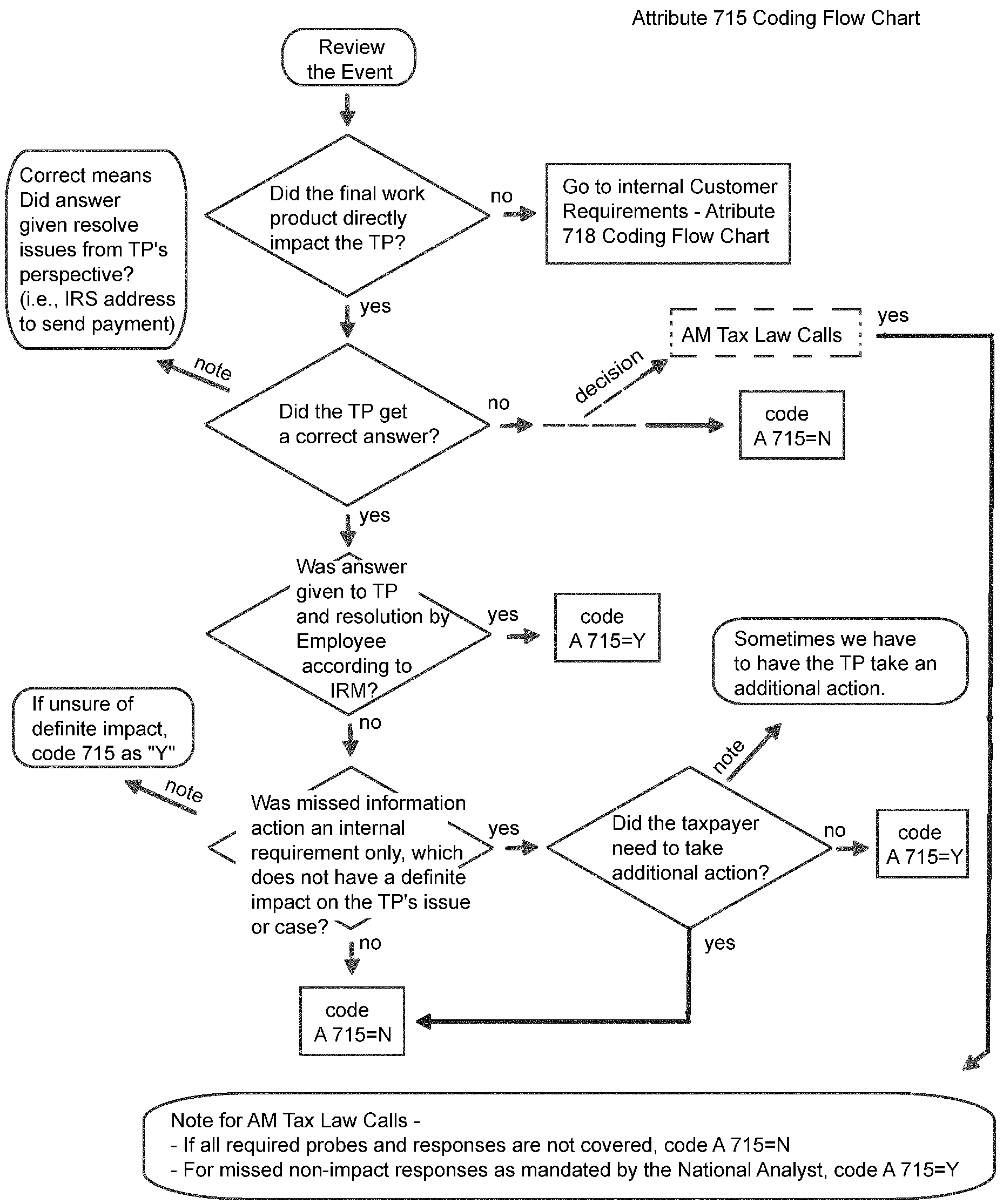
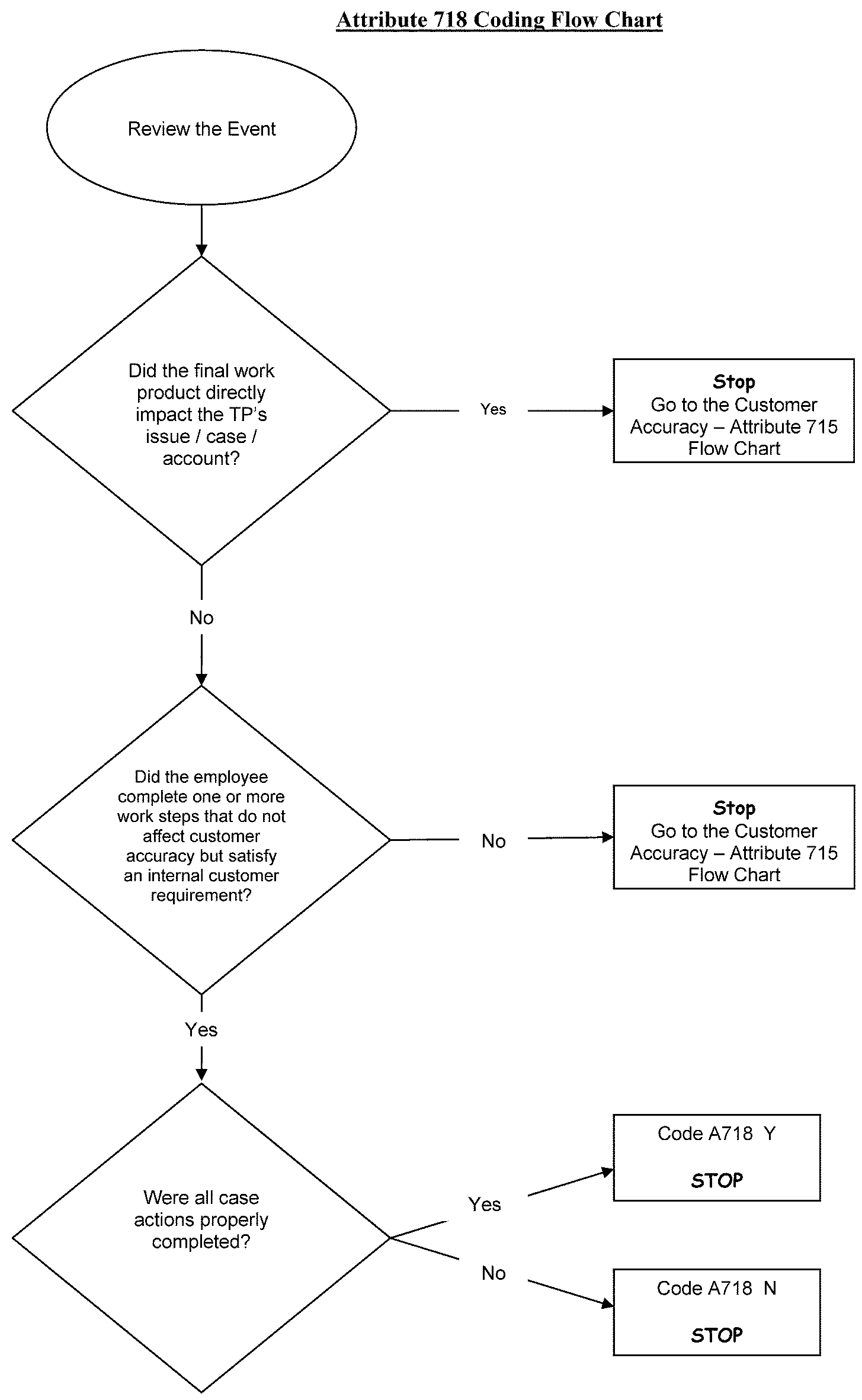
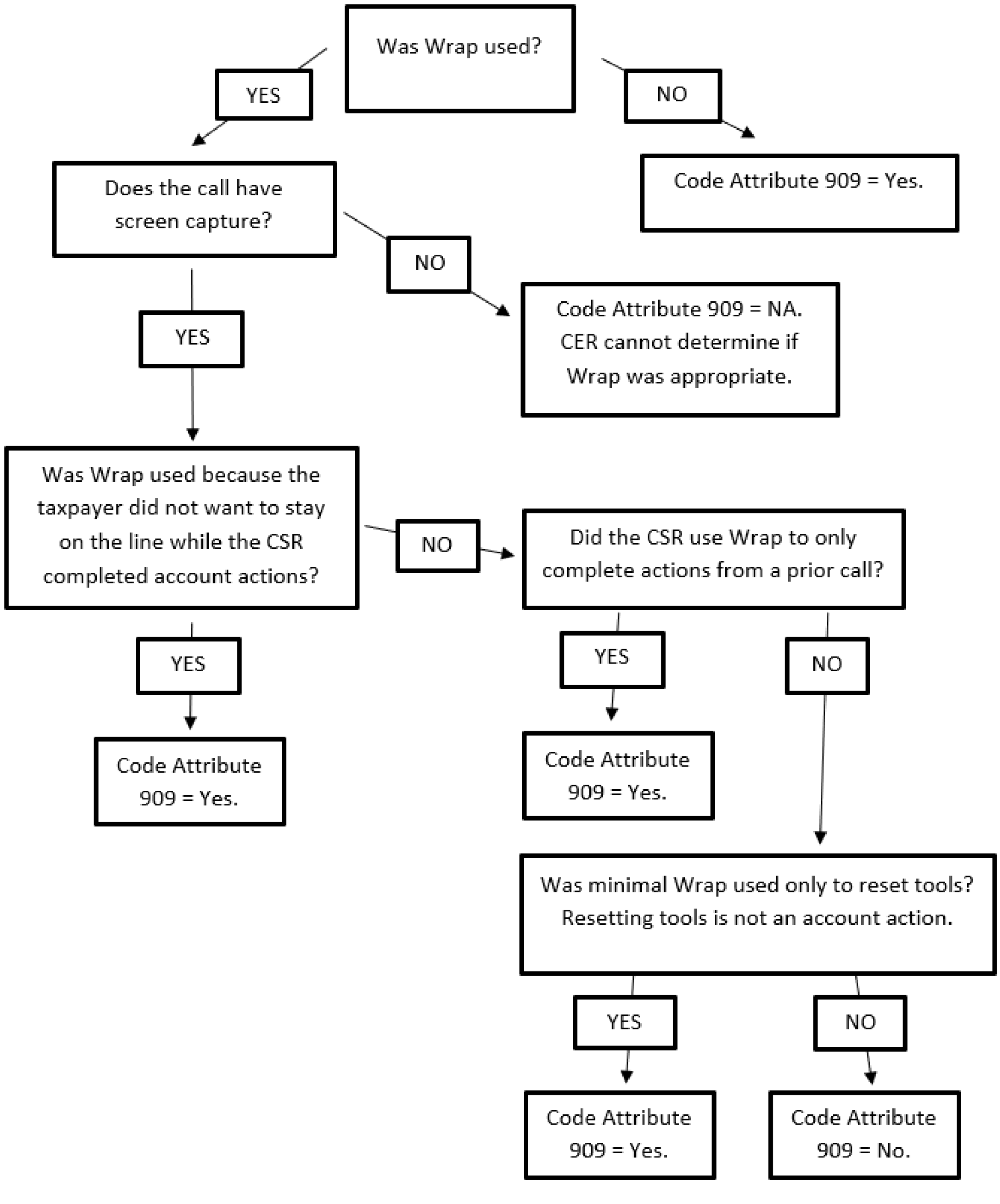
The chart below displays the NQRS cutoff Dates for Cycle SPRGs for FY22 through FY27.
| Month | Start Date | End Date | DCI Input and Edit Cutoff (End Date + 10 days) | Volume Input Cutoff (End Date + 10 days) | FY Month | Planning Period | FY |
|---|---|---|---|---|---|---|---|
| 21-Oct | 9/26/2021 | 10/30/2021 | 11/9/2021 | 11/9/2021 | 1 | 1 | 22 |
| 21-Nov | 10/31/2021 | 11/27/2021 | 12/7/2021 | 12/7/2021 | 2 | 1 | 22 |
| 21-Dec | 11/28/2021 | 12/25/2021 | 1/4/2022 | 1/4/2022 | 3 | 1 | 22 |
| 22-Jan | 12/26/2021 | 1/29/2022 | 2/8/2022 | 2/8/2022 | 4 | 2 | 22 |
| 22-Feb | 1/30/2022 | 2/26/2022 | 3/8/2022 | 3/8/2022 | 5 | 2 | 22 |
| 22-Mar | 2/27/2022 | 3/26/2022 | 4/5/2022 | 4/5/2022 | 6 | 2 | 22 |
| 22-Apr | 3/27/2022 | 4/30/2022 | 5/10/2022 | 5/10/2022 | 7 | 2 | 22 |
| 22-May | 5/1/2022 | 5/28/2022 | 6/7/2022 | 6/7/2022 | 8 | 2 | 22 |
| 22-Jun | 5/29/2022 | 6/25/2022 | 7/5/2022 | 7/5/2022 | 9 | 2 | 22 |
| 22-Jul | 6/26/2022 | 7/30/2022 | 8/9/2022 | 8/9/2022 | 10 | 3 | 22 |
| 22-Aug | 7/31/2022 | 8/27/2022 | 9/6/2022 | 9/6/2022 | 11 | 3 | 22 |
| 22-Sep | 8/28/2022 | 9/24/2022 | 10/4/2022 | 10/4/2022 | 12 | 3 | 22 |
| 22-Oct | 9/25/2022 | 10/29/2022 | 11/8/2022 | 11/8/2022 | 1 | 1 | 23 |
| 22-Nov | 10/30/2022 | 11/26/2022 | 12/6/2022 | 12/6/2022 | 2 | 1 | 23 |
| 22-Dec | 11/27/2022 | 12/31/2022 | 1/10/2023 | 1/10/2023 | 3 | 1 | 23 |
| 23-Jan | 1/1/2023 | 1/28/2023 | 2/7/2023 | 2/7/2023 | 4 | 2 | 23 |
| 23-Feb | 1/29/2023 | 2/25/2023 | 3/7/2023 | 3/7/2023 | 5 | 2 | 23 |
| 23-Mar | 2/26/2023 | 3/25/2023 | 4/4/2023 | 4/4/2023 | 6 | 2 | 23 |
| 23-Apr | 3/26/2023 | 4/29/2023 | 5/9/2023 | 5/9/2023 | 7 | 2 | 23 |
| 23-May | 4/30/2023 | 5/27/2023 | 6/6/2023 | 6/6/2023 | 8 | 2 | 23 |
| 23-Jun | 5/28/2023 | 6/24/2023 | 7/4/2023 | 7/4/2023 | 9 | 2 | 23 |
| 23-Jul | 6/25/2023 | 7/29/2023 | 8/8/2023 | 8/8/2023 | 10 | 3 | 23 |
| 23-Aug | 7/302023 | 8/26/2023 | 9/5/2023 | 9/5/2023 | 11 | 3 | 23 |
| 23-Sep | 8/27/2023 | 9/30/2023 | 10/10/2023 | 10/10/2023 | 12 | 3 | 23 |
| 23-Oct | 10/1/2023 | 10/28/2023 | 11/7/2023 | 11/7/2023 | 1 | 1 | 24 |
| 23-Nov | 10/29/2023 | 11/25/2023 | 12/5/2023 | 12/5/2023 | 2 | 1 | 24 |
| 23-Dec | 11/26/2023 | 12/30/2023 | 1/9/2024 | 1/9/2024 | 3 | 1 | 24 |
| 24-Jan | 12/31/2023 | 1/27/2024 | 2/6/2024 | 2/6/2024 | 4 | 2 | 24 |
| 24-Feb | 1/28/2024 | 2/24/2024 | 3/5/2024 | 3/5/2024 | 5 | 2 | 24 |
| 24-Mar | 2/25/2024 | 3/30/2024 | 4/9/2024 | 4/9/2024 | 6 | 2 | 24 |
| 24-Apr | 3/31/2024 | 4/27/2024 | 5/7/2024 | 5/7/2024 | 7 | 2 | 24 |
| 24-May | 4/28/2024 | 5/25/2024 | 6/4/2024 | 6/4/2024 | 8 | 2 | 24 |
| 24-Jun | 5/26/2024 | 6/29/2024 | 7/9/2024 | 7/9/2024 | 9 | 2 | 24 |
| 24-Jul | 6/30/2024 | 7/27/2024 | 8/6/2024 | 8/6/2024 | 10 | 3 | 24 |
| 24-Aug | 7/28/2024 | 8/31/2024 | 9/10/2024 | 9/10/2024 | 11 | 3 | 24 |
| 24-Sep | 9/1/2024 | 9/28/2024 | 10/8/2024 | 10/8/2024 | 12 | 3 | 24 |
| 24-Oct | 9/29/2024 | 10/26/2024 | 11/5/2024 | 11/5/2024 | 1 | 1 | 25 |
| 24-Nov | 10/27/2024 | 11/30/2024 | 12/10/2024 | 12/10/2024 | 2 | 1 | 25 |
| 24-Dec | 12/1/2024 | 12/28/2024 | 1/7/2025 | 1/7/2025 | 3 | 1 | 25 |
| 25-Jan | 12/29/2024 | 1/25/2025 | 2/4/2025 | 2/4/2025 | 4 | 2 | 25 |
| 25-Feb | 1/26/2025 | 2/22/2025 | 3/4/2025 | 3/4/2025 | 5 | 2 | 25 |
| 25-Mar | 2/23/2025 | 3/29/2025 | 4/8/2025 | 4/8/2025 | 6 | 2 | 25 |
| 25-Apr | 3/30/2025 | 4/26/2025 | 5/6/2025 | 5/6/2025 | 7 | 2 | 25 |
| 25-May | 4/27/2025 | 5/31/2025 | 6/10/2025 | 6/10/2025 | 8 | 2 | 25 |
| 25-Jun | 6/1/2025 | 6/28/2025 | 7/8/2025 | 7/8/2025 | 9 | 2 | 25 |
| 25-Jul | 6/29/2025 | 7/26/2025 | 8/5/2025 | 8/5/2025 | 10 | 3 | 25 |
| 25-Aug | 7/27/2025 | 8/30/2025 | 9/9/2025 | 9/9/2025 | 11 | 3 | 25 |
| 25-Sep | 8/31/2025 | 9/27/2025 | 10/7/2025 | 10/7/2025 | 12 | 3 | 25 |
| 25-Oct | 9/28/2025 | 10/25/2025 | 11/4/2025 | 11/4/2025 | 1 | 1 | 26 |
| 25-Nov | 10/26/2025 | 11/29/2025 | 12/9/2025 | 12/9/2025 | 2 | 1 | 26 |
| 25-Dec | 11/30/2025 | 12/27/2025 | 1/6/2026 | 1/6/2026 | 3 | 1 | 26 |
| 26-Jan | 12/28/2025 | 1/31/2026 | 2/10/2026 | 2/10/2026 | 4 | 2 | 26 |
| 26-Feb | 2/1/2026 | 2/28/2026 | 3/10/2026 | 3/10/2026 | 5 | 2 | 26 |
| 26-Mar | 3/1/2026 | 3/28/2026 | 4/7/2026 | 4/7/2026 | 6 | 2 | 26 |
| 26-Apr | 3/29/2026 | 4/25/2026 | 5/5/2026 | 5/5/2026 | 7 | 2 | 26 |
| 26-May | 4/26/2026 | 5/30/2026 | 6/9/2026 | 6/9/2026 | 8 | 2 | 26 |
| 26-June | 5/31/2026 | 6/27/2026 | 7/7/2026 | 7/7/2026 | 9 | 2 | 26 |
| 26-Jul | 6/28/2026 | 7/25/2026 | 8/4/2026 | 8/4/2026 | 10 | 3 | 26 |
| 26-Aug | 7/26/2026 | 8/29/2026 | 9/8/2026 | 9/8/2026 | 11 | 3 | 26 |
| 26-Sep | 8/30/2026 | 9/26/2026 | 10/6/2026 | 10/6/2026 | 12 | 3 | 26 |
| 26-Oct | 9/27/2026 | 10/31/2026 | 11/10/2026 | 11/10/2026 | 1 | 1 | 27 |
| 26-Nov | 11/1/2026 | 11/28/2026 | 12/8/2026 | 12/8/2026 | 2 | 1 | 27 |
| 26-Dec | 11/29/2026 | 12/26/2026 | 1/5/2027 | 1/5/2027 | 3 | 1 | 27 |
| 27-Jan | 12/27/2026 | 1/30/2027 | 2/9/2027 | 2/9/2027 | 4 | 1 | 27 |
| 27-Feb | 1/31/2027 | 2/27/2027 | 3/9/2027 | 3/9/2027 | 5 | 2 | 27 |
| 27-Mar | 2/28/2027 | 3/27/2027 | 4/6/2027 | 4/6/2027 | 6 | 2 | 27 |
| 27-Apr | 3/28/2027 | 4/24/2027 | 5/4/2027 | 5/4/2027 | 7 | 2 | 27 |
| 27-May | 4/25/2027 | 5/29/2027 | 6/8/2027 | 6/8/2027 | 8 | 2 | 27 |
| 27-Jun | 5/30/2027 | 6/26/2027 | 7/6/2027 | 7/6/2027 | 9 | 2 | 27 |
| 27-Jul | 6/27/2027 | 7/31/2027 | 8/10/2027 | 8/10/2027 | 10 | 3 | 27 |
| 27-Aug | 8/1/2027 | 8/28/2027 | 9/7/2027 | 9/7/2027 | 11 | 3 | 27 |
| 27-Sep | 8/29/2027 | 9/25/2027 | 10/5/2027 | 10/5/2027 | 12 | 3 | 27 |
The chart below displays the NQRS cutoff Dates for Calendar SPRGs for FY22 through FY27.
| Month | Start Date | End Date | DCI Input and Edit Cutoff (End Date + 10 days) | Volume Input Cutoff (End Date + 10 days) | FY Month | Planning Period | FY |
|---|---|---|---|---|---|---|---|
| 21-Oct | 10/1/2021 | 10/31/2021 | 11/10/2021 | 11/10/2021 | 1 | 1 | 22 |
| 21-Nov | 11/1/2021 | 11/30/2021 | 12/10/2021 | 12/10/2021 | 2 | 1 | 22 |
| 21-Dec | 12/1/2021 | 12/31/2021 | 1/10/2021 | 1/10/2021 | 3 | 1 | 22 |
| 22-Jan | 1/1/2022 | 1/31/2022 | 2/10/2022 | 2/10/2022 | 4 | 2 | 22 |
| 22-Feb | 2/1/2022 | 2/28/2022 | 3/10/2022 | 3/10/2022 | 5 | 2 | 22 |
| 22-Mar | 3/1/2022 | 3/31/2022 | 4/10/2022 | 4/10/2022 | 6 | 2 | 22 |
| 22-Apr | 4/1/2022 | 4/30/2022 | 5/10/2022 | 5/10/2022 | 7 | 2 | 22 |
| 22-May | 5/1/2022 | 5/31/2022 | 6/10/2022 | 6/10/2022 | 8 | 2 | 22 |
| 22-Jun | 6/1/2022 | 6/30/2022 | 7/10/2022 | 7/10/2022 | 9 | 2 | 22 |
| 22-Jul | 7/1/2022 | 7/31/2022 | 8/10/2022 | 8/10/2022 | 10 | 3 | 22 |
| 22-Aug | 8/1/2022 | 8/31/2022 | 9/10/2022 | 9/10/2022 | 11 | 3 | 22 |
| 22-Sep | 9/1/2022 | 9/30/2022 | 10/10/2022 | 10/10/2022 | 12 | 3 | 22 |
| 22-Oct | 10/1/2022 | 10/31/2022 | 11/10/2022 | 11/10/2022 | 1 | 1 | 23 |
| 22-Nov | 11/1/2022 | 11/30/2022 | 12/10/2022 | 12/10/2022 | 2 | 1 | 23 |
| 22-Dec | 12/1/2022 | 12/31/2022 | 1/10/2023 | 1/10/2023 | 3 | 1 | 23 |
| 23-Jan | 1/1/2023 | 1/31/2023 | 2/10/2023 | 2/10/2023 | 4 | 2 | 23 |
| 23-Feb | 2/1/2023 | 2/28/2023 | 3/10/2023 | 3/10/2023 | 5 | 2 | 23 |
| 23-Mar | 3/1/2023 | 3/31/2023 | 4/10/2023 | 4/10/2023 | 6 | 2 | 23 |
| 23-Apr | 4/1/2023 | 4/30/2023 | 5/10/2023 | 5/10/2023 | 7 | 2 | 23 |
| 23-May | 5/1/2023 | 5/31/2023 | 6/10/2023 | 6/10/2023 | 8 | 2 | 23 |
| 23-Jun | 6/1/2023 | 6/30/2023 | 7/10/2023 | 7/10/2023 | 9 | 2 | 23 |
| 23-Jul | 7/1/2023 | 7/31/2023 | 8/10/2023 | 8/10/2023 | 10 | 3 | 23 |
| 23-Aug | 8/1/2023 | 8/31/2023 | 9/10/2023 | 9/10/2023 | 11 | 3 | 23 |
| 23-Sep | 9/1/2023 | 9/30/2023 | 10/10/2023 | 10/10/2023 | 12 | 3 | 23 |
| 23-Oct | 10/1/2023 | 10/31/2023 | 11/10/2023 | 11/10/2023 | 1 | 1 | 24 |
| 23-Nov | 11/1/2023 | 11/30/2023 | 12/10/2023 | 12/10/2023 | 2 | 1 | 24 |
| 23-Dec | 12/1/2023 | 12/31/2023 | 1/10/2024 | 1/10/2024 | 3 | 1 | 24 |
| 24-Jan | 1/1/2024 | 1/31/2024 | 2/10/2024 | 2/10/2024 | 4 | 2 | 24 |
| 24-Feb | 2/1/2024 | 2/29/2024 | 3/10/2024 | 3/10/2024 | 5 | 2 | 24 |
| 24-Mar | 3/1/2024 | 3/31/2024 | 4/10/2024 | 4/10/2024 | 6 | 2 | 24 |
| 24-Apr | 4/1/2024 | 4/30/2024 | 5/10/2024 | 5/10/2024 | 7 | 2 | 24 |
| 24-May | 5/1/2024 | 5/31/2024 | 6/10/2024 | 6/10/2024 | 8 | 2 | 24 |
| 24-Jun | 6/1/2024 | 6/30/2024 | 7/10/2024 | 7/10/2024 | 9 | 2 | 24 |
| 24-Jul | 7/1/2024 | 7/31/2024 | 8/10/2024 | 8/10/2024 | 10 | 3 | 24 |
| 24-Aug | 8/1/2024 | 8/31/2024 | 9/10/2024 | 9/10/2024 | 11 | 3 | 24 |
| 24-Sep | 9/1/2024 | 9/30/2024 | 10/10/2024 | 10/10/2024 | 12 | 3 | 24 |
| 24-Oct | 10/1/2024 | 10/31/2024 | 11/10/2024 | 11/10/2024 | 1 | 1 | 25 |
| 24-Nov | 11/1/2024 | 11/30/2024 | 12/10/2024 | 12/10/2024 | 2 | 1 | 25 |
| 24-Dec | 12/1/2024 | 12/31/2024 | 1/10/2025 | 1/10/2025 | 3 | 1 | 25 |
| 25-Jan | 1/1/2025 | 1/31/2025 | 2/10/2025 | 2/10/2025 | 4 | 2 | 25 |
| 25-Feb | 2/1/2025 | 2/28/2025 | 3/10/2025 | 3/10/2025 | 5 | 2 | 25 |
| 25-Mar | 3/1/2025 | 3/31/2025 | 4/10/2025 | 4/10/2025 | 6 | 2 | 25 |
| 25-Apr | 4/1/2025 | 4/30/2025 | 5/10/2025 | 5/10/2025 | 7 | 2 | 25 |
| 25-May | 5/1/2025 | 5/31/2025 | 6/10/2025 | 6/10/2025 | 8 | 2 | 25 |
| 25-Jun | 6/1/2025 | 6/30/2025 | 7/10/2025 | 7/10/2025 | 9 | 2 | 25 |
| 25-Jul | 7/1/2025 | 7/31/2025 | 8/10/2025 | 8/10/2025 | 10 | 3 | 25 |
| 25-Aug | 8/1/2025 | 8/31/2025 | 9/10/2025 | 9/10/2025 | 11 | 3 | 25 |
| 25-Sep | 9/1/2025 | 9/30/2025 | 10/10/2025 | 10/10/2025 | 12 | 3 | 25 |
| 25-Oct | 10/1/2025 | 10/31/2025 | 11/10/2025 | 11/10/2025 | 1 | 1 | 26 |
| 25-Nov | 11/1/2025 | 11/30/2025 | 12/10/2025 | 12/10/2025 | 2 | 1 | 26 |
| 25-Dec | 12/1/2025 | 12/31/2025 | 1/10/2026 | 1/10/2026 | 3 | 1 | 26 |
| 26-Jan | 1/1/2026 | 1/31/2026 | 2/10/2026 | 2/10/2026 | 4 | 2 | 26 |
| 26-Feb | 2/1/2026 | 2/28/2026 | 3/10/2026 | 3/10/2026 | 5 | 2 | 26 |
| 26-Mar | 3/1/2026 | 3/31/2026 | 4/10/2026 | 4/10/2026 | 6 | 2 | 26 |
| 26-Apr | 4/1/2026 | 4/30/2026 | 5/10/2026 | 5/10/2026 | 7 | 2 | 26 |
| 26-May | 5/1/2026 | 5/31/2026 | 6/10/2026 | 6/10/2026 | 8 | 2 | 26 |
| 26-Jun | 6/1/2026 | 6/30/2025 | 7/10/2026 | 7/10/2026 | 9 | 2 | 26 |
| 26-Jul | 7/1/2026 | 7/31/2026 | 8/10/2026 | 8/10/2026 | 10 | 3 | 26 |
| 26-Aug | 8/1/2026 | 8/31/2026 | 9/10/2026 | 9/10/2026 | 11 | 3 | 26 |
| 26-Sep | 9/1/2026 | 9/30/2026 | 10/10/2026 | 10/10/2026 | 12 | 3 | 26 |
| 26-Oct | 10/1/2026 | 10/31/2026 | 11/10/2026 | 11/10/2026 | 1 | 1 | 27 |
| 26-Nov | 11/1/2026 | 11/30/2026 | 12/10/2026 | 12/10/2026 | 2 | 1 | 27 |
| 26-Dec | 12/1/2026 | 12/31/2026 | 1/10/2027 | 1/10/2027 | 3 | 1 | 27 |
| 27-Jan | 1/1/2027 | 1/31/2027 | 2/10/2027 | 2/10/2027 | 4 | 2 | 27 |
| 27-Feb | 2/1/2027 | 2/28/2027 | 3/10/2027 | 3/10/2027 | 5 | 2 | 27 |
| 27-Mar | 3/1/2027 | 3/31/2027 | 4/10/2027 | 4/10/2027 | 6 | 2 | 27 |
| 27-Apr | 4/1/2027 | 4/30/2027 | 5/10/2027 | 5/10/2027 | 7 | 2 | 27 |
| 27-May | 5/1/2027 | 5/31/2027 | 6/10/2027 | 6/10/2027 | 8 | 2 | 27 |
| 27-Jun | 6/1/2027 | 6/30/2027 | 7/10/2027 | 7/10/2027 | 9 | 2 | 27 |
| 27-Jul | 7/1/2027 | 7/31/2027 | 8/10/2027 | 8/10/2027 | 10 | 3 | 27 |
| 27-Aug | 8/1/2027 | 8/31/2027 | 9/10/2027 | 9/10/2027 | 11 | 3 | 27 |
| 27-Sep | 9/1/2027 | 9/30/2027 | 10/10/2027 | 10/10/2027 | 12 | 3 | 27 |
The table below displays the report date type, report month type and weighting frequency of each SPRG. Input/Edit and Volume Cut off Dates and Reporting Months are determined based on how the reporting month is defined in the chart below.
| Product Line | SPRG | Report Date | Report Month | Weighting Method |
|---|---|---|---|---|
| Account Paper | Acct Paper Adjustments | Sampled | Calendar | Daily |
| Account Paper | Acct Paper IEAR | Closing | Cycle | Monthly |
| Account Paper | RPM Paper | Sampled | Calendar | Daily |
| Account Phones | Acct Phones General | Closing | Calendar | Daily |
| Account Phones | Acct Phones International | Closing | Calendar | Daily |
| Account Phones | Acct Phones NTA | Closing | Calendar | None |
| Account Phones | Acct Phones PPS | Closing | Calendar | Daily |
| Account Phones | Acct Phones Spanish | Closing | Calendar | Daily |
| Account Phones | AM Identity Theft Phones | Closing | Calendar | Daily |
| ACS Paper | ACS Case Processing | Closing | Cycle | Monthly |
| ACS Paper | ACS Support | Review | Cycle | Daily |
| ACS Phones | ACS Phones | Closing | Calendar | Daily |
| ACS Phones | ACS Text Chat Phones | Closing | Calendar | Daily |
| AM Clerical | Campus Support | Review | Calendar | None |
| AM Identity Theft Paper | IDT Paper-AM | Sampled | Calendar | Daily |
| AM Identity Theft Paper | IDT Fraudulent Return | Sampled | Calendar | Daily |
| AM Identity Theft Paper | IDT IPSU | Sampled | Calendar | Daily |
| AM Identity Theft Paper | IDT Paper - Specialty | Sampled | Calendar | Daily |
| AM Routing | AM Routing Default Screener | Closing | Calendar | Daily |
| AM Specialized Services | AMSS CAF/POA | Closing | Cycle | Monthly |
| AM Specialized Services | AMSS EIN | Closing | Cycle | Monthly |
| AM Specialized Services | AMSS International Specialized | Closing | Cycle | Monthly |
| AM Specialized Services | AMSS Refund Inquiry | Sampled | Cycle | Monthly |
| AM Specialized Services | AMSS Support Services | Closing | Cycle | Monthly |
| AM Specialized Services | AMSS Technical Services | Closing | Cycle | Monthly |
| ASFR Paper | ASFR Paper | Review | Cycle | Daily |
| ASFR Phones | ASFR Phones | Closing | Calendar | Daily |
| AUR Paper | AUR Paper | Review | Cycle | Daily |
| AUR Paper | AUR Paper CAWR | Review | Cycle | Daily |
| AUR Paper | AUR Paper ESRP | Review | Cycle | Daily |
| AUR Paper | AUR Paper FUTA | Review | Cycle | Daily |
| AUR Paper | AUR Paper PMF | Review | Cycle | Daily |
| AUR Paper | BMF AUR Paper | Review | Cycle | Daily |
| AUR Phones | AUR Phones | Closing | Calendar | Daily |
| AUR Phones | BMF AUR Phones | Closing | Calendar | Daily |
| AUR Phones | ESRP AUR Phones | Closing | Calendar | Daily |
| CCP Collection Paper | CCP Manually Monitored I/A (MMIA) | Review | Cycle | Daily |
| CCP Collection Paper | CCP General Case Processing (GCP) | Review | Cycle | Daily |
| Centralized Lien Paper | CLO Lien Paper | Review | Cycle | Daily |
| Centralized Lien Paper | CLO Lien Paper CRD | Review | Cycle | Daily |
| CCP Collection Phones | CCP Manually Monitored I/A (MMIA) Phones | Closing | Calendar | Daily |
| Centralized Lien Phones | CLO Lien Phones | Closing | Calendar | Daily |
| CCP Exam Paper | CCP Exam Paper | Review | Cycle | Daily |
| CIO Paper | CIO Paper | Review | Cycle | Daily |
| CIO Phones | CIO Phones | Closing | Calendar | Daily |
| OIC Paper | COIC Paper | Review | Cycle | Daily |
| OIC Paper | COIC Paper Process Examination | Review | Cycle | Monthly |
| OIC Paper | MOIC | Review | Cycle | Daily |
| OIC Phones | COIC Phones Process Examination | Closing | Calendar | Monthly |
| Collection Paper | CSCO Paper | Review | Cycle | Daily |
| Collection Paper | CSCO Paper IAAL Transcripts | Review | Cycle | Daily |
| Collection Paper | CSCO Paper Misc | Review | Cycle | Daily |
| Collection Phones | WHC Phones | Closing | Calendar | Daily |
| Collection Phones | Collection Phones - Combat Zone | Closing | Calendar | Daily |
| CS Identity Theft | CS Identity Theft Paper | Review | Cycle | Monthly |
| CS Specialized Paper Services | Centralized Estate/Gift Tax Paper | Review | Cycle | Daily |
| CS Specialized Paper Services | Centralized Excise Tax Paper | Review | Cycle | Daily |
| CS Specialized Paper Services | Centralized Transfer Tax Technician Paper | Review | Cycle | Daily |
| CS Specialized Phone Services | Centralized Estate/Gift Tax Phones | Closing | Calendar | Daily |
| CS Specialized Phone Services | Centralized Excise Tax Phones | Closing | Calendar | Daily |
| e-help Phones | e-help Phones | Closing | Calendar | Daily |
| Exam Paper | Backup Withholding (BWH) Paper | Review | Cycle | Daily |
| Exam Paper | Exam Paper Area Office Support | Review | Cycle | None |
| Exam Paper | Exam Paper Classification | Review | Cycle | None |
| Exam Paper | Exam Paper Discretionary Programs | Review | Cycle | Daily |
| Exam Paper | Exam Paper EIC Programs | Review | Cycle | Daily |
| Exam Paper | Exam Paper Flow Through Entities | Review | Cycle | Daily |
| Exam Phones | Backup Withholding (BWH) Phones | Closing | Calendar | Daily |
| Exam Phones | Exam Phones | Closing | Calendar | Daily |
| Field Assistance | FA Procedural | Closing | Cycle | Weekly |
| Field Assistance | FA Contacts | Closing | Cycle | Weekly |
| Forms Order | Forms Order NDC | Closing | Cycle | Daily |
| Independent Administrative Review | IIAR Paper | Review | Cycle | Daily |
| Innocent Spouse Paper | IS Paper | Review | Cycle | Daily |
| Innocent Spouse Phones | IS Phones | Closing | Calendar | Daily |
| Return Integrity Verification Operations | RIVO AQC | Closing | Cycle | None |
| Return Integrity Verification Operations | RIVO Friv Filer Phones | Closing | Calendar | None |
| Return Integrity Verification Operations | RIVO Friv Filer Paper | Review | Cycle | None |
| Return Integrity Verification Operations | RIVO WOW | Closing | Cycle | None |
| Return Integrity Verification Operations | RIVO TPP | Closing | Cycle | None |
| Return Integrity Verification Operations | RIVO Referrals | Closing | Cycle | None |
| Return Integrity Verification Operations | RIVO Screening and Verification | Closing | Cycle | None |
| Return Integrity Verification Operations | RIVO Identification | Closing | Cycle | None |
| Return Integrity Verification Operations | RIVO BMF IDT | Closing | Cycle | None |
| Return Preparer Misconduct | Return Preparer Misconduct - AM | Sampled | Calendar | Daily |
| Private Debt Collection Phones | PDC Phones PCA Calls | Closing | Calendar | Daily |
| Tax Law Phones | Tax Law General | Closing | Calendar | Daily |
| Tax Law Phones | Tax Law International | Closing | Calendar | Daily |
| Tax Law Phones | Tax Law Spanish | Closing | Calendar | Daily |
| TE/GE Correspondence | TE/GE Correspondence | Review | Calendar | None |
| TE/GE Phones | TE/GE Telephone | Closing | Calendar | Daily |
| TSO Phones | TSO Phones | Closing | Calendar | Daily |
| Acronym | Definition |
|---|---|
| ACS | Automated Collection System |
| ADP | Automated Data Processing |
| ASFR | Automated Substitute for Return |
| AUR | Automated Underreporter |
| BEARS | Business Entitlement Access Request System |
| BOD | Business Operating Division |
| BPRS | Business Performance Review System |
| BUR | Business Underreporter |
| BWH | Backup Withholding |
| CCP | Centralized Case Processing |
| CER | Centralized Evaluative Review |
| CIO | Centralized Insolvency Operation |
| CII | Correspondence Imaging Inventory |
| CLO | Centralized Lien Operation |
| CQ&TS | Collection Quality and Technical Support |
| CQRS | Centralized Quality Review System |
| CQRSS | Campus Quality Review SharePoint Site |
| CR | Contact Recording |
| CTCP | Customer Technical Communication Program |
| DCI | Data Collection Instrument |
| DITA | Designated Identity Theft Adjustments |
| DMAIC | Define, Measure, Analyze, Improve and Control |
| EACSG | Electronic ACS Guide |
| EQ | Embedded Quality |
| EQ&TS | Examination Quality and Technical Support |
| EQRS | Embedded Quality Review System |
| ESRP | Employee Shared Responsibility Payment |
| FA | Field Assistance |
| HQA | Headquarters Quality Analyst |
| IDRS | Integrated Data Retrieval System |
| IDTVA | Identity Theft Victim Assistance |
| IPSO | Identify Protection Strategy and Oversight |
| IPSU | Identity Protection Specialized Unit |
| IPU | IRM Procedural Update |
| IAAL | Installment Agreement Accounts List |
| IAR | Independent Administrative Review |
| ITLA | Interactive Tax Law Assistant |
| ITM | Integrated Talent Management |
| JOC | Joint Operations Center |
| LQA | Lead Quality Analyst |
| MAJA | Master Attribute Job Aid |
| NDC | National Distribution Center |
| NQRS | National Quality Review System |
| NTA | National Taxpayer Advocate |
| OFP | Organization, Function and Program |
| OIC | Offer in Compromise |
| OUO | Official Use Only |
| PAS | Program Analysis System |
| PII | Personally Identifiable Information |
| PICA | Process Improvement and Customer Accuracy |
| PLA | Product Line Analyst |
| POC | Point of Contact |
| PPB | Policy and Procedures BMF |
| PPI | Policy and Procedures IMF |
| PPM | Process and Program Management |
| PPS | Practitioner Priority Services |
| QAM | Quality Assurance Manager |
| QR | Quality Review |
| RICS | Return Integrity and Compliance Services |
| RIVO | Return Integrity and Verification Operations |
| SBU | Sensitive But Unclassified (Data) |
| SERP | Servicewide Electronic Research Program |
| SOI | Statistics of Income |
| SPRG | Specialized Product Review Group |
| TAS | Taxpayer Advocate Service (see note below) |
| TPP | Taxpayer Protection Program |
| TSO | Technical Services Operation |
| TTG | Telephone Transfer Guide |
Note:
The Taxpayer Advocate Service (TAS) is an independent organization within the Internal Revenue Service (IRS), led by the National Taxpayer Advocate, that helps taxpayers and protects taxpayer rights. TAS offers free help to taxpayers when a tax problem is causing a financial difficulty, when they’ve tried and been unable to resolve their issue with the IRS, or when they believe an IRS system, process, or procedure just isn’t working as it should. TAS strives to ensure that every taxpayer is treated fairly and knows and understands their rights under the Taxpayer Bill of Rights. TAS has at least one taxpayer advocate office located in every state, the District of Columbia, and Puerto Rico.