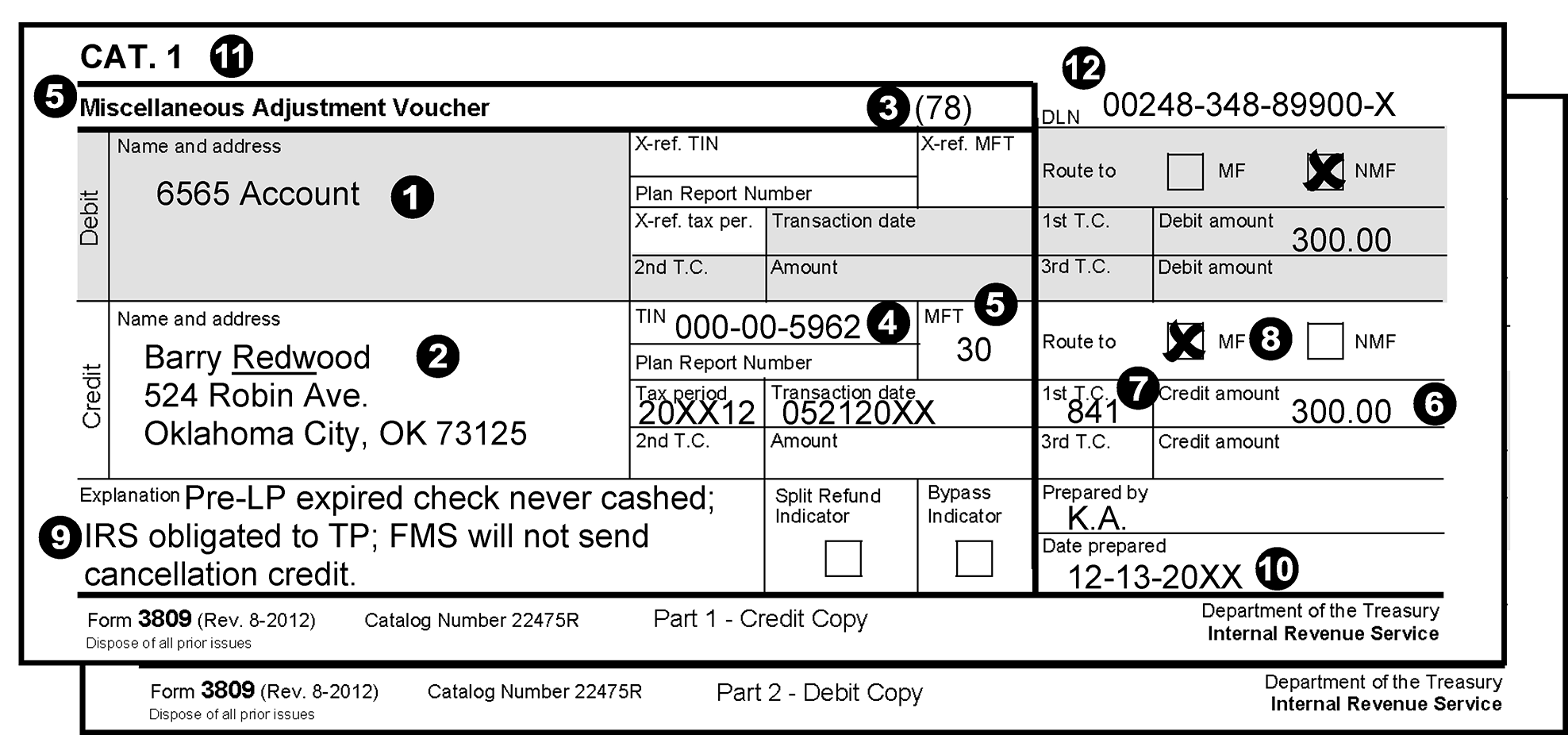
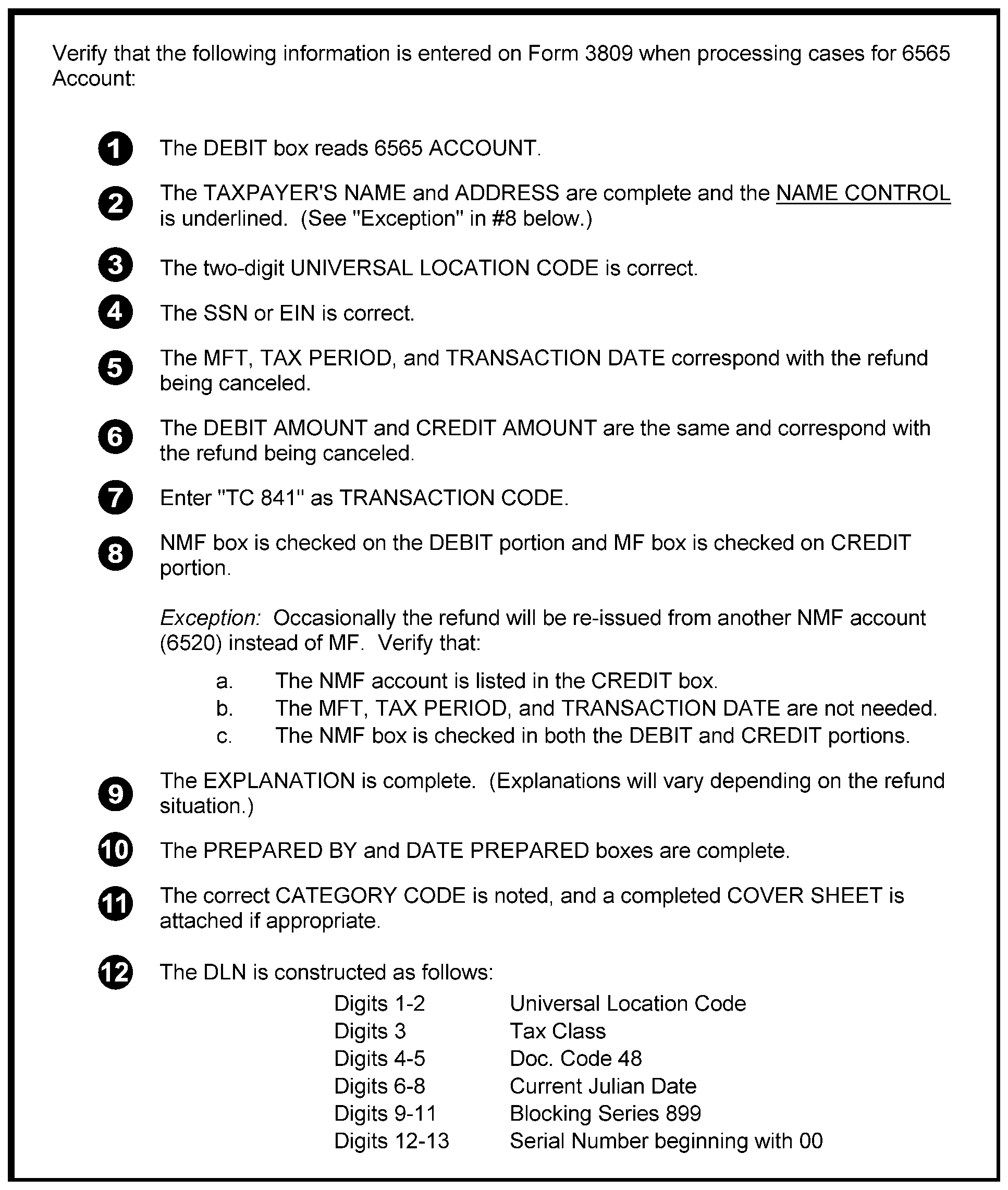
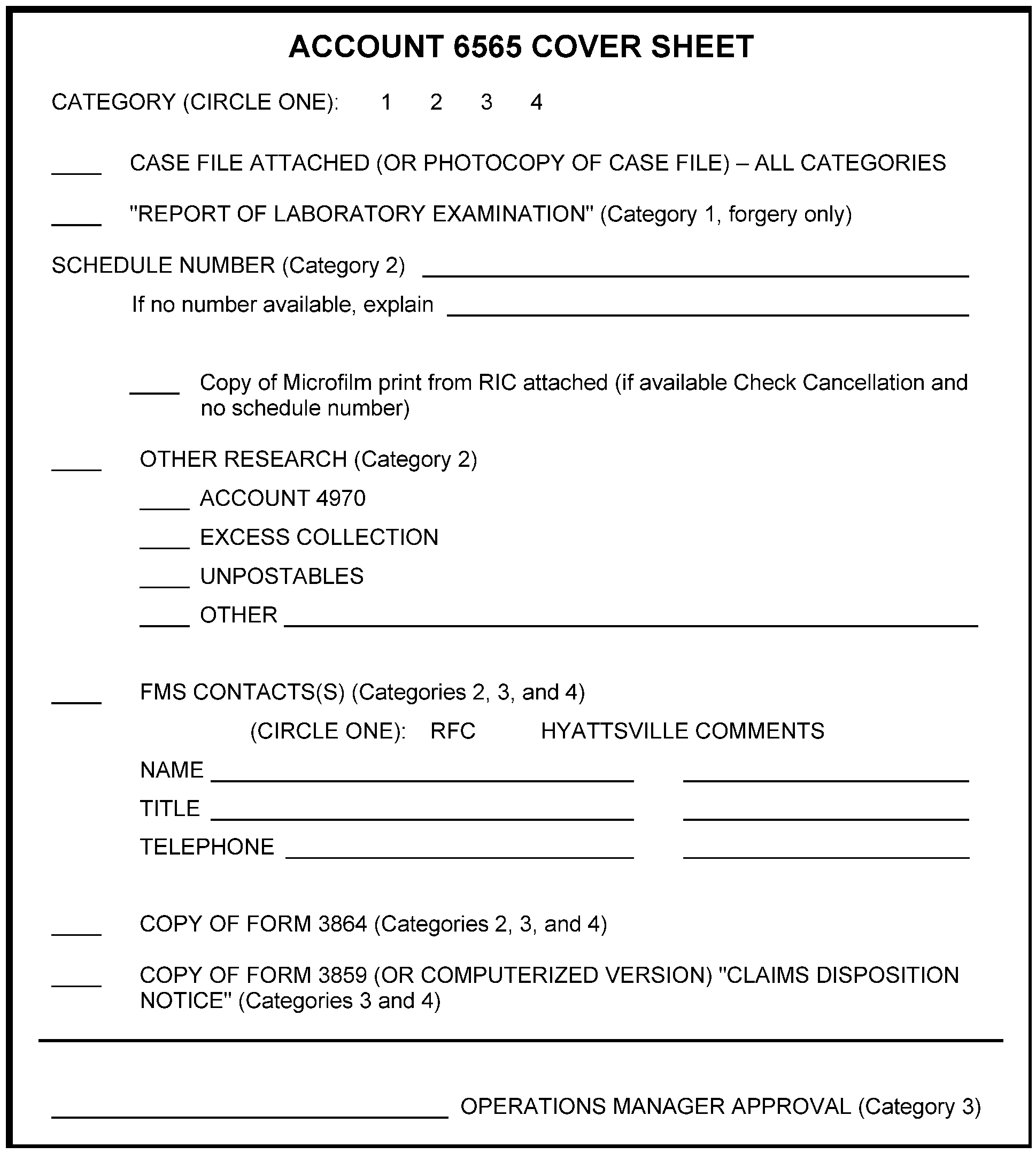
)
or https:// means you've safely connected to the .gov website. Share sensitive information only on official, secure websites.
)
or https:// means you've safely connected to the .gov website. Share sensitive information only on official, secure websites.


- 3.17.79 Accounting Refund Transactions
- 3.17.79.1 Program Scope and Objectives
- 3.17.79.1.1 Background
- 3.17.79.1.1.1 Training
- 3.17.79.1.1.2 Weekly Integrated Talent Management (ITM) Reporting in January
- 3.17.79.1.1.3 Manual Refund Training Monthly Review Requirement for New Accounting Manual Refund Employees
- 3.17.79.1.1.4 Accounting Function Manual Refund Roster Requirement
- 3.17.79.1.1.5 Use of the Manual Refund Project SharePoint for Processing Manual Refunds
- 3.17.79.1.2 Authority
- 3.17.79.1.3 Responsibilities
- 3.17.79.1.4 Program Management and Review
- 3.17.79.1.4.1 Timely Review and Certification of Weekly, Monthly, and Quarterly IORS (IDRS Online Reports Services) Security Reports
- 3.17.79.1.4.2 Annual Clearance of IRM
- 3.17.79.1.4.3 Program Reviews
- 3.17.79.1.5 Program Controls
- 3.17.79.1.6 Terms/Definitions/Acronyms
- 3.17.79.1.7 Related Resources
- 3.17.79.1.8 Refund Types and Methods - Treasury Disbursing, Bureau of the Fiscal Service
- 3.17.79.1.9 Taxpayer Information, Returns and Refund Documents
- 3.17.79.1.10 Sequence of Refund Records
- 3.17.79.1.11 Authorized Signatures and Delegations of Authority
- 3.17.79.1.11.1 Delegating Official Monthly Documentation Review Requirement
- 3.17.79.1.11.2 Manual Refund Digital Signature Requirement
- 3.17.79.1.12 Designating Certifying Officers (CO)
- 3.17.79.1.12.1 Certifying Officer (CO) Training
- 3.17.79.1.12.2 Certifying Officer Monthly Source Document Review Requirement
- 3.17.79.1.12.3 Certifying Officer Monthly Documentation Review Requirement
- 3.17.79.1.12.4 Manual Refund Digital Signature Requirement
- 3.17.79.1.13 Data Entry Operators (DEO)
- 3.17.79.1.13.1 Data Entry Operator Monthly Documentation Review Requirement
- 3.17.79.1.13.2 Manual Refund Digital Signature Requirement
- 3.17.79.1.14 Trusted Enrollment Agent (TEA)
- 3.17.79.1.15 ITS Authorizing Official (AO)
- 3.17.79.1.15.1 Authorizing Official Delegation/Revocation/Name Change
- 3.17.79.1.16 ITS Payor
- 3.17.79.1.16.1 Payor Delegation/Revocation/Name Change
- 3.17.79.1.17 ITS Payment Creator
- 3.17.79.1.17.1 Payment Creator Delegation/Revocation/Name Change
- 3.17.79.1.1 Background
- 3.17.79.2 Generated Refunds Schedule of Payments, Secured Payment System (SPS)
- 3.17.79.2.1 Enterprise Computing Center (ECC) Generated Files
- 3.17.79.2.2 Generated Refunds, Tapes and Schedules
- 3.17.79.3 Processing Requests for Refunds
- 3.17.79.3.1 General Ledger Account - Types of Refunds
- 3.17.79.3.2 Processing Manual Refunds
- 3.17.79.3.2.1 Uploading Forms 3753 and Forms 5792 (PDF Copy) onto the Manual Refund Project SharePoint Site
- 3.17.79.3.2.2 Rejecting Manual Refunds
- 3.17.79.3.2.2.1 Manual Refund Rejects Monthly Review Requirement
- 3.17.79.3.2.3 Manual Refund Digital Signature Requirement
- 3.17.79.3.2.4 Monitoring Form 3753 Manual Refunds Processed by Accounting
- 3.17.79.3.2.5 Manual Refund Electronic Processing Procedures for Form 5792
- 3.17.79.3.2.6 Manual Refund Electronic Processing Procedures for Form 3753
- 3.17.79.3.3 Issuing Hardship Refunds
- 3.17.79.3.3.1 Actions Required of Initiators Before Requesting Refunds
- 3.17.79.3.3.2 Manual Refunds for Unprocessed Original Returns
- 3.17.79.3.4 Reporting Manual Refunds
- 3.17.79.3.5 Employees Authorized to Sign Requests for Refunds
- 3.17.79.3.5.1 Form 14031 and Form 10247 Monthly Review
- 3.17.79.3.5.2 Quarterly Head of Office Validation
- 3.17.79.3.5.3 Annual Processing Requirements for Form 14031, Manual Refund Signature Form
- 3.17.79.3.5.4 Form 14031 Processing Requirements for Unidentified/Excess Collections/Photocopy Fee Manual Refunds (Submission Processing ONLY)
- 3.17.79.3.5.5 Manual Refund Digital Signature Requirement
- 3.17.79.3.6 Manual Refunds $1 Million or More and $10 Million or More
- 3.17.79.3.7 $50 Million and Over or $500 Million and Over Refund Reports to Treasury
- 3.17.79.3.8 Refunds Held at Treasury Request
- 3.17.79.3.9 Taxpayer Refund Inquiry
- 3.17.79.3.10 Direct Deposit Tax Refunds
- 3.17.79.3.10.1 Direct Deposits of Tax Refunds of $1 Million or More, or Due to Financial or International Hardships
- 3.17.79.3.10.1.1 Federal Wire Transfers (FEDWIRE) and International Payments
- 3.17.79.3.10.1.2 International Payments via International Treasury Services (ITS)
- 3.17.79.3.10.2 Payment Date and Holidays
- 3.17.79.3.10.1 Direct Deposits of Tax Refunds of $1 Million or More, or Due to Financial or International Hardships
- 3.17.79.3.11 Form 4466, Corporation Application for Quick Refund of Overpayment of Estimated Tax
- 3.17.79.3.11.1 Accounting Form 4466 Processing Instructions
- 3.17.79.3.11.2 Form 4466 - Research Federal Tax Deposits Payments on Master File
- 3.17.79.3.11.3 Processing Form 4466 for Form 1120-S Filers
- 3.17.79.3.12 Non-Resident Alien and Dual Status Refunds (Austin Only District Office or DO 97 and 98)
- 3.17.79.3.13 Refunds Based on Court Decisions
- 3.17.79.3.14 Lockbox Losses and Shortages
- 3.17.79.3.15 Overpayments on Bankruptcy Cases
- 3.17.79.3.16 Offset Bypass Refunds
- 3.17.79.3.17 Refunds from Examination (Compliance)
- 3.17.79.3.18 Credit Card Processor Chargebacks (Ogden Accounts Management Only)
- 3.17.79.4 Request for IDRS Generated Refunds (IGR), Form 5792
- 3.17.79.4.1 Case Review and Command Code REFAP (Refund Approval)
- 3.17.79.4.2 RFUND/REFAP Mismatch
- 3.17.79.4.3 Certifying the IDRS Generated Refund (IGR) Tape
- 3.17.79.5 Accounting Review of Manual Refund Requests, Form 3753
- 3.17.79.6 Certifying Refund Schedules and the Secure Payment System (SPS)
- 3.17.79.6.1 Scheduling Refunds
- 3.17.79.6.2 Form 813, Document Register
- 3.17.79.6.3 Distributing Posting Documents
- 3.17.79.6.4 Bureau of the Fiscal Service Secure Payment System
- 3.17.79.6.4.1 Maximum Payment Amounts
- 3.17.79.6.4.2 Certifying Automated Clearing House (ACH)/Direct Deposit Hardship Refunds
- 3.17.79.6.5 Special Uses of the Secure Payment System (SPS)
- 3.17.79.7 Information Documents, Form 1099 and Form 1042-S
- 3.17.79.7.1 Manual and NMF Refunds Form 1099-INT, Interest Income, Copies B to Recipient
- 3.17.79.7.1.1 Form 1099-MISC Whistle blower Awards (Ogden Center Only)
- 3.17.79.7.1.2 Releasing Perfected Form 1099-INT For Manual Refunds
- 3.17.79.7.1.3 Transmitting Information Returns to IRS
- 3.17.79.7.1.4 Specifications and Annual Updates
- 3.17.79.7.1.5 Researching and Resolving Undeliverable Forms 1099
- 3.17.79.7.2 Form 1042-S, Income Subject to Withholding Under Chapter 3
- 3.17.79.7.3 Preparation of Form 1042 (IRS Commissioner's Form) Ogden Only
- 3.17.79.7.4 Routing Form 1042-S To Ogden Center (Kansas City and Austin)
- 3.17.79.7.1 Manual and NMF Refunds Form 1099-INT, Interest Income, Copies B to Recipient
- 3.17.79.8 Processing Miscellaneous Refunds
- 3.17.79.8.1 General Fund Receipts Account Refunds
- 3.17.79.8.2 Receipt of Excess Collection Notice
- 3.17.79.8.3 Refunds or Reimbursement of Photocopy Fees (Form 4506)
- 3.17.79.8.4 Refunding From 6800 Account, Excess Collections
- 3.17.79.8.5 Refunding from 4610 Account, Unapplied Advance Payments (ANMF Accounts)
- 3.17.79.8.6 Processing Unapplied Remittance Refunds (Form 4878)
- 3.17.79.8.7 Audit or Collection Adjustments; Refunds in Names Other Than the Taxpayer-Form 3460, Transmittal Memo
- 3.17.79.8.8 Refunds for Less Than $1.00
- 3.17.79.8.9 U.S. Virgin Islands Resident - Cover Over (AUSPC Only) Excluding Additional Child Tax Credit Coverovers
- 3.17.79.8.10 Refunding From 20x1807 Account, A Miscellaneous Revenue Account
- 3.17.79.8.11 Whistleblower Award Payments
- 3.17.79.9 Preventing Duplicate Refunds
- 3.17.79.10 Cancelled Refund Checks (Standard Form or SF1098)
- 3.17.79.10.1 Treasury Checks Returned to the Submission Processing Center and Regional Financial Center
- 3.17.79.10.2 Processing Intercepted Refund Checks (Reason for Return Code 01)
- 3.17.79.10.3 Returned Check Cancellations - Manually Prepared Individual Master File (IMF) and Business Master File (BMF) (RRCs 02 and 03)
- 3.17.79.10.4 Processing Returned Automated Non-Master File (ANMF) Checks
- 3.17.79.10.5 Returned Individual Retirement Account File (IRAF) Checks
- 3.17.79.10.6 Correcting Erroneously Posted Transaction Code (TC) 841
- 3.17.79.10.7 Incorrect Cancellation Amounts
- 3.17.79.11 Undeliverable Refund Check (Transaction Code (TC) 740, S- Freeze) Cancellations
- 3.17.79.11.1 Undeliverable Enterprise Computing Center - (ECC-MTB) for Code 02/TC 846) Individual Master File (IMF)/Business Master File (BMF) Refund Check Cancellations
- 3.17.79.11.2 Undeliverable Integrated Data Retrieval System (IDRS) Generated Refunds
- 3.17.79.11.3 Unpostable Cases Received from Rejects/Refund Inquiry (Unpostable Code for example (UPC) 138 RC 0 or UPC 290 RC 5) (UPC and RC can vary)
- 3.17.79.12 Treasury's Receivable Accounting and Collection System (known as TRACS)
- 3.17.79.12.1 Background - Competitive Equality Banking Act of 1987, Public Law 100–86
- 3.17.79.12.2 Processing Reclamation Credits (REC)
- 3.17.79.12.3 Processing Unavailable Check Cancellation Credits (UCC)
- 3.17.79.12.4 Processing Limited Payability Cancellations (LPC)
- 3.17.79.12.5 Processing Credits, Standard Form (Form) 1081
- 3.17.79.12.5.1 Corrected or Paper Standard Form 1081
- Exhibit 3.17.79-1 Glossary of Terms, Abbreviations and Commonly Used Forms in Accounting
- Exhibit 3.17.79-2 Blocking Series Chart for Document Code "45" Form 3753, Manual Refund Posting Voucher
- Exhibit 3.17.79-3 BFS Treasury Support Center and IRS Contact List
- Exhibit 3.17.79-4 Refund Schedule Number Format
- Exhibit 3.17.79-5 Manual Refund Schedule Number/IDRS Formats as Entered into the Secured Payment System (SPS)
- Exhibit 3.17.79-6 Blocking Series Chart for Document Code 45, SF 1098 and TRACS Processing
- Exhibit 3.17.79-7 Reason for Cancellation Codes (SF 1098)
- Exhibit 3.17.79-8 Form 3809 Miscellaneous Adjustment Voucher
- 3.17.79.1 Program Scope and Objectives
Part 3. Submission Processing
Chapter 17. Accounting and Data Control
Section 79. Accounting Refund Transactions
3.17.79 Accounting Refund Transactions
Manual Transmittal
December 05, 2024
Purpose
(1) This transmits revised IRM 3.17.79, Accounting Refund Transactions.
Material Changes
(1) IRM 3.17.79.1(3) - Added the three Accounting sites to the verbiage.
(2) IRM 3.17.79.1.1.3 - Added new subsection to outline a monthly requirement to review completed Manual Refund Training for all new employees taking on Manual Refund roles within Accounting. IPU 24U0864 issued 07-24-2024.
(3) IRM 3.17.79.1.1.4 - Added new subsection requiring all Accounting Functions to maintain an updated Manual Refund Roster showing all Accounting employees in Manual Refund roles. IPU 24U0864 issued 07-24-2024.
(4) IRM 3.17.79.1.1.5(2) - Updated the title of the last BEARS Entitlement referenced.
(5) IRM 3.17.79.1.4.1 - Added new subsection with instructions on timely reviewing and certifying IDRS Online Reports Services (IORS) Security Reports. IPU 24U0892 issued 08-01-2024.
(6) IRM 3.17.79.1.4.2 - Added new subsection describing the annual IRM clearance.
(7) IRM 3.17.79.1.4.3 - Added new subsection outlining Program Reviews.
(8) IRM 3.17.79.1.11.2(1)(c) - Added second note regarding the formatting of valid SEIDs. IPU 24U0864 issued 07-24-2024.
(9) IRM 3.17.79.1.11.2(2)(Note) - Updated note regarding systemically validating a signature.
(10) IRM 3.17.79.1.11(4) (d) - Corrected address to be used in Section III of the FS Form 2958DO. IPU 24U0680 issued 05-24-2024.
(11) IRM 3.17.79.1.12(1) - Added Note to identify employees that cannot be designated as Certifying Officers (CO); updated requirement for the minimum number of active COs at each Accounting site; and updated IF/THEN box to include Manual Refund Analyst on all CO designations, renewals or revocations emailed to CFO’s Policy and Data Analytics Function. IPU 24U0838 issued 07-12-2024.
(12) IRM 3.17.79.1.12(1)(b) - Added instructions to follow the Trusted Digital Signature Job Aid when creating digital signature.
(13) IRM 3.17.79.1.12(1)(c) - Added verbiage about detailed employees.
(14) IRM 3.17.79.1.12(1) (d) - Added that FS Form 89 is required on a Certifying Officer revocation. IPU 24U0680 issued 05-24-2024.
(15) IRM 3.17.79.1.12(3)(b) - Added requirement to maintain the Bureau of Fiscal Services (BFS)/Secure Payment System (SPS) training completion certificate with the Certifying Officer (CO) BFS paperwork file.
(16) IRM 3.17.79.1.12(3) (d) - Added instructions for being added to the RSTRK(M) Listing and an IRM reference regarding restricted Command Codes. IPU 24U0892 issued 08-01-2024.
(17) IRM 3.17.79.1.12.3(1) - Added verbiage to review that the completed SPS Training Certificate is being maintained in the file.
(18) IRM 3.17.79.1.12.4(1) - Added clarifying verbiage on what is considered a correctly formatted digital signature. Added second note about the correct SEID format. IPU 24U0864 issued 07-24-2024.
(19) IRM 3.17.79.1.12.4(2) - Updated the note to reflect where the digital signature validation displays on the PDF. IPU 24U0680 issued 05-24-2024.
(20) IRM 3.17.79.1.12.4(3) - Added note that the Trusted Digital Signature Job Aid should be used to make sure the digital signature that is being created is in the correct format. IPU 24U0864 issued 07-24-2024.
(21) IRM 3.17.79.1.13(2) (a) - Updated that FS Form 89 is required on a Data Entry Operator revocation. IPU 24U0680 issued 05-24-2024.
(22) IRM 3.17.79.1.13(5)(b) - Added requirement to maintain the BFS/SPS training completion certificate with the Data Entry Operator (DEO) BFS paperwork file.
(23) IRM 3.17.79.1.13.1(1) - Updated last bullet to read 1 year. IPU 24U0864 issued 07-24-2024.
(24) IR 3.17.79.1.13.1(1) - Added verbiage to review that the completed SPS Training Certificate is being maintained in the file.
(25) IRM 3.17.79.1.13.2(1)(c) - Added second note about the correct SEID format. IPU 24U0864 issued 07-24-2024.
(26) IRM 3.17.79.1.13.2(2) - Added additional verbiage in note to clarify a properly validated digital signature. IPU 24U0864 issued 07-24-2024.
(27) IRM 3.17.79.1.14 - Removed all verbiage that an FS Form 90 was required because that is no longer a BFS requirement.
(28) IRM 3.17.79.1.14(1) - Updated the Trusted Enrollment Agent (TEA) process from in person to digital. IPU 24U0680 issued 05-24-2024.
(29) IRM 3.17.79.3.2 - Updated Austin Accounting’s contact number.
(30) IRM 3.17.79.3.2(6) (2nd Note) - Removed Form 10247 from the list of forms requiring the standard Manual Refund signature. IPU 24U0680 issued 05-24-2024.
(31) IRM 3.17.79.3.2.1(6) - Added verbiage on uploading back-up document file and examples of back-up document file naming convention. IPU 24U0864 issued 07-24-2024.
(32) IRM 3.17.79.3.2.2(3)(a) - Added not to N/A any fields that can’t be completed due to incomplete, or incorrect, information on the Form 3753/Form 5792.
(33) IRM 3.17.79.3.2.2(9) - Updated Accounts Management’s Designated BOD Point of Contact email address in box. IPU 24U0680 issued 05-24-2024.
(34) IRM 3.17.79.3.2.2 - Updated entire subsection to include detailed Manual Refund reject instructions, filling out the Form 15276, and the rejects dispute process. IPU 24U0970 issued 09-12-2024.
(35) IRM 3.17.79.3.2.2(6) - Updated resolution verbiage to include sending concern to the employee’s Lead and Manager.
(36) IRM 3.17.79.3.2.2.1 - Added new subsection on performing monthly reviews of a random sample of rejected Form 3753 and Form 5792 Manual Refunds. IPU 24U0970 issued 09-12-2024.
(37) IRM 3.17.79.3.2.3(1)(c) - Added second note about the correct SEID format. IPU 24U0864 issued 07-24-2024.
(38) IRM 3.17.79.3.2.3(2)(Note) - Updated note regarding systemically validating a signature.
(39) IRM 3.17.79.3.2.5(6)(d) & (8) - Added clarification on the SharePoint folders to upload the documents into for both Accounting and CFO/RRACS.
(40) IRM 3.17.79.3.2.6(3)(b) - Updated instruction on naming convention for Form 3753 when uploading to Manual Refund SharePoint. IPU 24U0864 issued 07-24-2024.
(41) IRM 3.17.79.3.2.6(3)(c) - Added verbiage on uploading back-up document file and examples of back-up document file naming convention. IPU 24U0864 issued 07-24-2024.
(42) IRM 3.17.79.3.2.6(8) (c) - Updated note to include timeframe for uploading the completed schedules to the AM Form 3753 Folder on the Manual Refund SharePoint. IPU 24U0680 issued 05-24-2024.
(43) IRM 3.17.79.3.2.6(8)(c) & (9) - Added clarification on the SharePoint folders to upload the documents into for both Accounting and CFO/RRACS.
(44) IRM 3.17.79.3.4.2(1) - Added 3rd bullet to verify that TC 971/AC 664 was added timely. IPU 24U0864 issued 07-24-2024.
(45) IRM 3.17.79.3.4.2(5) - Updated link to Category D Erroneous Refund SharePoint. IPU 24U0680 issued 05-24-2024.
(46) IRM 3.17.79.3.5 - Updated instructions throughout to coincide with the new Form 14031 (rev 9-2024).
(47) IRM 3.17.79.3.5(2) - Updated email address in chart. IPU 24U0680 issued 05-24-2024.
(48) IRM 3.17.79.3.5(3) - Added additional requirement to verify SEID on Form 14031 matches what is in Discovery Directory. IPU 24U0680 issued 05-24-2024.
(49) IRM 3.17.79.3.5(3)(c) - Added note about the correct SEID format. IPU 24U0864 issued 07-24-2024.
(50) IRM 3.17.79.3.5(3)(e) - Added verbiage on what effective date should be selected on the form. And added two notes. One clarifying that an incorrect date selected will result in a reject. And one clarifying when an authorized signer should begin signing Manual Refunds.
(51) IRM 3.17.79.3.5(4) (a) - Changed wording to reflect that the Form 10247 may be accepted with any digital signature showing the name of the designating official along with a time and date stamp. IPU 24U0680 issued 05-24-2024.
(52) IRM 3.17.79.3.5(4)(a) - Added cross reference for IRM 3.17.79.3.5.5(2). IPU 24U0864 issued 07-24-2024.
(53) IRM 3.17.79.3.5.2(6)(b) - Added verbiage to reflect for the upcoming quarter. IPU 24U0864 issued 07-24-2024.
(54) IRM 3.17.79.3.5.4 - Updated Form 14031 Revision Date in reference.
(55) IRM 3.17.79.3.5.5(1)(c) - Added second note about the correct SEID format. IPU 24U0864 issued 07-24-2024.
(56) IRM 3.17.79.3.5.5(2)(Note) - Updated note regarding systemically validating a signature.
(57) IRM 3.17.79.3.6(1)(e) - Updated IRM link cross reference.
(58) IRM 3.17.79.3.7(1)(c) - Updated BFS Points of contact in box.
(59) IRM 3.17.79.3.10(5) - Removed.
(60) IRM 3.17.79.3.10.1 - Changed title to include all three exceptions allowing a Direct Deposit of a Manual Refund. Added a bullet list on (4) to include the three exceptions.
(61) IRM 3.17.79.3.10.1(1)(b) - Change (b) into a note under (1)
(62) IRM 3.17.79.3.10.1.2(1) - Added instructions to include the country code abbreviation in the remarks section and address of the Form 3753. Link to acceptable country codes also added.
(63) IRM 3.17.79.4.1(2) - Added that Accounting Function must verify that the SEID of the Manual Refund Approving Official and the SEID of the Manual Refund Originator on the Form 5792 must match what is input on the transaction in IDRS. IPU 24U0680 issued 05-24-2024.
(64) IRM 3.17.79.4.1(2) - Added second note about the correct SEID format. IPU 24U0864 issued 07-24-2024.
(65) IRM 3.17.79.4.1(2)(m) & (r)- Removed E Freeze instructions because they are no longer valid.
(66) IRM 3.17.79.4.1(3) - Added note about rejecting a Manual Refund if there is an "AP" TC 840 on module with a TERUP. IPU 24U0680 issued 05-24-2024.
(67) IRM 3.17.79.5(1) - Added note cross referencing Form 3753 preparation instructions.
(68) IRM 3.17.79.5(3) - Added note to first box of the If/Then chart that the Approving Official and Originator may not be the same person. IPU 24U0680 issued 05-24-2024.
(69) IRM 3.17.79.5(3) - Added note at the end of the If/Then chart that the Accounting Function must verify that the SEID of the Approving Official and Originator on Form 3753 are complete.
(70) IRM 3.17.79.5(3) - Added note at the end of the table regarding the correct SEID format. IPU 24U0864 issued 07-24-2024.
(71) IRM 3.17.79.5(5) - Changed the requirements of adding the TC 971 AC 664 to the close of business on the next business day following processing. IPU 24U0680 issued 05-24-2024.
(72) IRM 3.17.79.6.5 - Removed IRM subsection because instructions outlined are no longer valid with the Bureau of Fiscal Services. Secure Payment System, (SPS) Contingency Plans will follow with a mid-year Interim Procedural Update (IPU)
(73) IRM 3.17.79.6.5.1 - Removed IRM subsection related to IRM 3.17.79.6.5.
(74) IRM 3.17.79.8.9.2(7)&(8) - Deleted paragraphs due to refund vouchers (Form 1166) being discontinued by the Bureau of Fiscal Services (BFS)
(75) IRM 3.17.79.11.2(2) - Corrected Regional Finance Center acronym. IPU 24U0680 issued 05-24-2024.
(76) Updated W&I and Wage & Investment to TS and Taxpayer Services throughout document. IPU 24U0680 issued 05-24-2024.
(77) IRM 3.17.79-1 - Deleted obsolete forms from table and corrected form names.
(78) IRM 3.17.79-4 - Removed two processing sites from Manual Refund Schedule Number Table.
(79) IRM 3.17.79-5 - Deleted exhibit because it is no longer valid.
(80) Editorial changes have been made throughout this IRM for:
-
Updated IRM cross references.
-
Grammar, punctuation, capitalization, and spelling.
-
Updated W&I to TS on email addresses referenced.
-
Deleted all references to Form 1166 because form/process was discontinued by the BFS.
Effect on Other Documents
IRM 3.17.79, Accounting Refund Transactions, dated September 12, 2024 (Effective January 01, 2024) is superseded. The following IRM Procedural Updates have been incorporated: IPU 24U0680 issued May 24, 2024, IPU 24U0838 issued July 12, 2024, IPU 24U0864 issued July 24, 2024, IPU 24U0892 issued August 1, 2024, and IPU 24U0970 issued September 12, 2024.Audience
Employees primarily in the Submission Processing, Accounting Operations for pre-journal (or Master File generated refunds, transaction code (TC) 846) and post-journal refund activities (also known as TC 840). All managers and employees involved in processing and/or initiating manual refunds are required to take annual manual refund training (as recommended by the Government Accountability Office).Effective Date
(01-01-2025)James L. Fish
Director, Submission Processing
Taxpayer Services Division
-
Overview: This IRM provides procedural and processing instructions to the Accounting Operations to approve, schedule, and certify refunds. This IRM also provides instructions for employees to schedule and certify generated refunds and related processing (e.g., posting refund cancellations, manual, journal, and other posting actions). Manual refunds are considered post-journal actions for the Redesigned Revenue Accounting Control System (RRACS).
-
Purpose: This IRM provides instructions to be followed by the Submission Processing (SP) manual refund functions when processing manual refund requests from all Business Operating Divisions (BOD).
-
Audience: All employees within the Accounting Operation areas at each of the three SP campuses who work manual refund requests to include Austin (AUSC), Kansas City (KCSC), and Ogden (OSC).
-
Policy Owner: Director of Submission Processing.
-
Program Owner: Taxpayer Services (TS) Division, SP is responsible for the manual refund policy.
-
Primary Stakeholders: The primary stakeholders are organizations with whom SP collaborates (e.g., Accounts Management (AM), Taxpayer Advocate Service (TAS), Large Business and International (LB&I), etc.).
-
Program Goals: To provide manual refund customers (all BODs and taxpayers) high quality and expeditious manual refund processing. Preliminary Manual Refund guidance can be found in IRM 21.4.4, Account Resolution - Manual Refunds.
-
Contact Information: To recommend changes or make any other suggestions to this IRM section, send an e-mail to &TS CAS:SP:ATP:Acc on the global address directory or submit a feedback inquiry through SERP.
-
IRM Deviation Statement: Service Center Directors, Headquarter Branch Chiefs, and Headquarter Analysts do not have the authority to approve deviations from IRM procedures. Any request for an exception or deviation to an IRM procedure must be elevated through appropriate channels for executive approval. This will ensure other functional areas are not adversely affected by the change, and it does not result in unfair treatment of taxpayers. See IRM 1.11.2, Internal Management Documents System, Internal Revenue Manual (IRM) Process. Request for an IRM deviation must be submitted in writing and signed by the Field Director, following instructions in IRM 1.11.2.2.4(3). Any disclosure issues will be coordinated by the Program Owner. No deviations can begin until reviewed by the Program owner and approved at the Executive level.
-
This IRM describes procedures used by Submission Processing Center, Accounting Operations, to process refund approval documentation, prepare refund schedules and issue related information documents.
-
Annually Accounting Operation employees involved in initiating, reviewing, processing, signing, certifying and monitoring the status of manual refunds must complete the most recent manual refund training courses available via Integrated Talent Management (ITM) as identified below:
-
Course 30914, Manual Refunds
Note:
An employee can take Course 30914a instead of Course 30914, if the employee completed Course 30914 in the previous year. This substitution does not apply, if there is a change to Course 30914 in the current year or if there is a gap between years when the employee took Course 30914 or Course 30914a.
-
Course 54710 Processing Requests for Manual Refunds
Note:
All employees that process manual refunds must complete the most recent training available. It is suggested Course 54710 Processing Requests for Manual Refunds be taken in a classroom setting and facilitated to allow for a question and answer period at the end of each lesson.
-
Course 42841, Monitoring Manual Refunds
-
-
All training must be completed annually within the period of January 1 to February 1 or prior to being assigned Integrated Data Retrieval System (IDRS) command code(s) RFUND and REFAP or a manual refund profile restriction (RSTRK (M)).
-
Timely completion of all training is required.
-
Documentation of all training must be maintained, available for review by internal and external customers and recorded in ITM.
-
During January of each year, manual refund managers are required to provide a weekly ITM report reflecting the status of completion of the required Manual Refund Training, stated in IRM 3.17.79.1.1.1, Training.
-
The report will be:
-
printed in Portable Document Format (PDF),
-
printed on the first, second, third, and fourth Monday of the month of January, and
-
E-mailed to the HQ Manual Refund Analyst: Manual Refund Headquarter Contacts.
-
-
Outlook reminders must be set up by the manual refund manager:
-
weekly, each Monday, during the month of January,
-
for the manager of the manual refund function, and
-
for each manual refund employee.
-
-
At the end of every month, the Accounting Function’s Training Coordinator or Integrated Talent Management (ITM) Administrator must review completed ITM training courses for all Accounting employees that started initiating, signing, processing, inputting, monitoring, or certifying Manual Refunds within that month. The review must confirm that the newly trained employees have completed all required Manual Refund Training courses as outlined in IRM 3.17.79.1.1.1, Training, based off their role.
-
Results of the review must be recorded to include:
-
Name of new Manual Refund employee and their role.
-
Start date.
-
Date Manual Refund employee completed the required Manual Refund training.
-
Any discrepancies of employees not completing the required training prior to taking on their new Manual Refund role should be identified.
-
-
Documentation of all monthly reviews must be maintained and available for review by both internal and external stakeholders for the duration of the processing year. The documentation may be destroyed after the Annual Training is completed for all Accounting employees by the end of January of the following year.
-
All Accounting Functions must maintain, and update as required, a complete roster of all Accounting employees in Manual Refund roles.
-
The roster must include the following information:
-
The full name of the employee.
-
The employee’s role in the Manual Refund process.
-
The date the employee began the role.
-
-
A list of the Manual Refund roles within Accounting are as follows:
-
Initiator - Assigned Command Code (CC) RFUND.
-
Processer - Assigned CC REFAP.
-
Signer - Authorized signer with Form 14031, Manual Refund Signature Authorization, on file.
-
Data Entry Operator (DEO) - Inputs Manual Refunds into the Secure Payment System (SPS)
-
Certifying Officer (CO) - Certifies Manual Refunds in SPS.
-
-
The roster must be actively maintained from year to year and updated every time an employee is added or removed from a role. The roster must be available for review by both internal and external customers at any time.
-
Beginning in 2020 the Manual Refund Project SharePoint became the source for all Accounting Sites to begin uploading and storing documents associated with the processing of Manual Refunds. This initiative allows for a centralized location where all documents could be stored to allow for ease of access by Submission Processing (SP) Accounting and Chief Financial Officer/Redesigned Revenue Accounting and Control Systems (CFO/RRACS) employees to increase efficiency in processing and journaling Manual Refunds.
-
The Manual Refund Project SharePoint is located at the following address Manual Refund Project - Home (sharepoint.com) and stores taxpayer data with access only being allowed to employees with a business need. Therefore access to the Manual Refund Project SharePoint must be obtained by completing one of the following Business Entitlement Access Request System (BEARS) request types, based off the users role and location:
-
PROD USER AUSTIN TS SP ACCOUNTING OPERATION (MANUAL REFUND PROJECT SHAREPOINT)
-
PROD USER KANSAS CITY TS SP ACCOUNTING OPERATION (MANUAL REFUND PROJECT SHAREPOINT)
-
PROD USER OGDEN TS SP ACCOUNTING OPERATION (MANUAL REFUND PROJECT SHAREPOINT)
-
PROD USER AUSTIN CFO RACS (MANUAL REFUND PROJECT SHAREPOINT)
-
PROD USER KANSAS CITY CFO RACS (MANUAL REFUND PROJECT SHAREPOINT)
-
PROD USER OGDEN CFO RACS (MANUAL REFUND PROJECT SHAREPOINT)
-
PROD USER HQ AND P&A ANALYSTS (MANUAL REFUND PROJECT SHAREPOINT)
Note:
When submitting one of the above BEARS Entitlement Request types, please indicate your role in the Manual Refund process so that the appropriate permissions to the SharePoint are granted. Some examples of roles would be: process Manual Refunds; journal Manual Refunds; upload Manual Refund documents (clerical); review, approve, upload Form 14031/Form 10247; perform quality or internal control reviews, etc...
-
-
The Submission Processing Accounting Operation is responsible for processing refund approval documentation, preparing refund schedules, and issue related information documents.
-
Managers are responsible for ensuring that internal controls are effective an efficient and to safeguard against waste, fraud, and abuse.
-
Managers are responsible for conducting reviews of refunds to ensure accuracy, completeness, and mitigate known risks. Problems identified must be discussed with the appropriate functional area for corrective action.
-
It is the policy of the IRS to protect its information resources and allow the use, access, and disclosure of information in accordance with applicable laws, policies, federal regulations, Office of Management and Budget (OMB) Circulars, Treasury Directives, National Institute of Standards and Technology Publications, and other regulatory guidance. All Information Technology (IT) resources belonging to, or used by the IRS, shall be protected at a level commensurate with the risk and magnitude of harm that could result from loss, misuse, or unauthorized access to that IT resource.
-
IORS is a web-based application that provides Integrated Data Retrieval System (IDRS) security staff, Unit Security Representatives (USRs), and managers of IDRS users', online access to IDRS security reports via the IORS Website.
-
≡ ≡ ≡ ≡ ≡ ≡ ≡ ≡ ≡ ≡ ≡ ≡ ≡ ≡ ≡ ≡ ≡ ≡ ≡ ≡ ≡ ≡ ≡ ≡ ≡ ≡ ≡ ≡ ≡ ≡ ≡ ≡ ≡ ≡ ≡ ≡ ≡ ≡ ≡ ≡ ≡ ≡ ≡ ≡ ≡ ≡ ≡ ≡ ≡ ≡ ≡ ≡ ≡ ≡ ≡ ≡ ≡ ≡ ≡ ≡ ≡ ≡ ≡ ≡ ≡ ≡ ≡ ≡ ≡ ≡ ≡ ≡ ≡ ≡ ≡ ≡ ≡ ≡ ≡ ≡ ≡ ≡ ≡ ≡ ≡ ≡ ≡ ≡ ≡ ≡ ≡ ≡ ≡ ≡ ≡ ≡ ≡ ≡ ≡ ≡ ≡ ≡ ≡ ≡ ≡ ≡ ≡≡ ≡ ≡ ≡ ≡ ≡ ≡ ≡ ≡ ≡ ≡ ≡ ≡ ≡ ≡ ≡ ≡ ≡ ≡ ≡ ≡ ≡ ≡ ≡ ≡ ≡ ≡≡ ≡ ≡ ≡ ≡ ≡ ≡ ≡ ≡ ≡ ≡ ≡ ≡ ≡ ≡
-
≡ ≡ ≡ ≡ ≡ ≡ ≡ ≡ ≡ ≡ ≡ ≡ ≡ ≡ ≡ ≡ ≡ ≡ ≡ ≡ ≡ ≡ ≡ ≡ ≡ ≡ ≡ ≡ ≡ ≡ ≡ ≡ ≡ ≡ ≡ ≡ ≡ ≡ ≡ ≡ ≡ ≡ ≡ ≡ ≡ ≡ ≡ ≡ ≡ ≡ ≡ ≡ ≡ ≡ ≡ ≡ ≡ ≡ ≡ ≡ ≡ ≡ ≡ ≡
-
≡ ≡ ≡ ≡ ≡ ≡ ≡ ≡ ≡ ≡ ≡ ≡ ≡ ≡ ≡ ≡ ≡ ≡ ≡ ≡ ≡ ≡ ≡ ≡ ≡ ≡ ≡ ≡ ≡ ≡ ≡ ≡ ≡ ≡ ≡ ≡ ≡ ≡ ≡ ≡ ≡ ≡ ≡ ≡ ≡ ≡ ≡ ≡ ≡ ≡ ≡ ≡ ≡ ≡ ≡ ≡ ≡ ≡ ≡ ≡ ≡ ≡ ≡ ≡ ≡ ≡ ≡ ≡ ≡ ≡ ≡ ≡ ≡
-
-
≡ ≡ ≡ ≡ ≡ ≡ ≡ ≡ ≡ ≡ ≡ ≡ ≡ ≡ ≡ ≡ ≡ ≡ ≡ ≡ ≡ ≡ ≡ ≡ ≡ ≡ ≡ ≡ ≡ ≡ ≡ ≡ ≡ ≡ ≡ ≡ ≡ ≡ ≡ ≡ ≡ ≡ ≡ ≡ ≡ ≡ ≡ ≡ ≡ ≡ ≡ ≡ ≡ ≡:
-
≡ ≡ ≡ ≡ ≡ ≡ ≡ ≡ ≡ ≡ ≡ ≡ ≡ ≡ ≡ ≡ ≡ ≡ ≡ ≡ ≡ ≡ ≡ ≡ ≡ ≡ ≡ ≡ ≡ ≡ ≡ ≡ ≡ ≡ ≡ ≡
-
≡ ≡ ≡ ≡ ≡ ≡ ≡ ≡ ≡ ≡ ≡ ≡ ≡ ≡ ≡ ≡ ≡ ≡ ≡ ≡ ≡ ≡ ≡ ≡ ≡ ≡ ≡ ≡ ≡ ≡ ≡ ≡ ≡ ≡ ≡ ≡ ≡ ≡ ≡ ≡ ≡ ≡ ≡ ≡ ≡ ≡ ≡ ≡ ≡ ≡
-
≡ ≡ ≡ ≡ ≡ ≡ ≡ ≡ ≡ ≡ ≡ ≡ ≡ ≡ ≡ ≡ ≡ ≡ ≡ ≡ ≡ ≡ ≡ ≡ ≡ ≡ ≡ ≡ ≡ ≡ ≡ ≡ ≡ ≡ ≡ ≡ ≡ ≡ ≡ ≡ ≡ ≡ ≡ ≡ ≡ ≡ ≡ ≡ ≡ ≡ ≡ ≡ ≡ ≡ ≡ ≡ ≡ ≡ ≡ ≡ ≡ ≡ ≡
-
≡ ≡ ≡ ≡ ≡ ≡ ≡ ≡ ≡ ≡ ≡ ≡ ≡ ≡ ≡ ≡ ≡ ≡ ≡ ≡ ≡ ≡ ≡ ≡ ≡ ≡ ≡ ≡ ≡ ≡ ≡ ≡ ≡ ≡ ≡ ≡ ≡ ≡ ≡≡ ≡ ≡ ≡ ≡ ≡ ≡ ≡ ≡≡ ≡ ≡ ≡≡ ≡ ≡ ≡ ≡ ≡ ≡ ≡ ≡ ≡ ≡≡
-
≡ ≡ ≡ ≡ ≡ ≡ ≡ ≡ ≡ ≡ ≡ ≡ ≡ ≡ ≡ ≡ ≡ ≡ ≡ ≡ ≡ ≡ ≡ ≡ ≡
-
-
The Accounting Function will designate a Primary IORS Reviewer, and at least one Alternate IORS Proxy, for all IDRS Units within the Accounting Function. A list of the Primary IORS Reviewer, and each Alternate IORS Proxy, for ALL Accounting IDRS units must be maintained. This list should be kept up to date and made available to internal and external stakeholders upon request.
-
IORS automatically provides reminder notifications to the Primary IORS Reviewers when reports are ready to be reviewed and certified. And will also provide follow-up reminders after 10 days for weekly reports, and 24 days for monthly reports, if the report has not been certified. However, the Primary IORS Reviewer, Alternate Proxy, and at least one other member of Accounting Management, will set weekly Calendar reminders in Outlook to verify that ALL IORS Reports are being timely reviewed and certified.
-
This IRM is updated and published annually after review and concurrence by impacted stakeholders according to the clearance process established in IRM 1.11.9, Internal Management Documents, Clearing and Approving Internal Management Documents (IMDs).
-
Functional areas are responsible for reviewing the information in this IRM annually to ensure accuracy, consistency, and to promote effective program administration.
-
Program Reviews are mission critical to the health of accounting and deposit programs to ensure integrity of the general ledger accounts and accuracy of the financial statements. It is essential that each function conducts its operations with an emphasis on mitigating risks, identifying best practices, and adhering to IRM requirements. An objective assessment of program compliance, including all applicable procedures and guidelines, is necessary to ensure that adequate internal controls are in place.
-
Program Effectiveness: The program effectiveness includes conducting reviews and analysis to detect and identify material or significant deficiencies that could adversely impact IRS audits and/or financial statements. These reviews are necessary to ensure Submission Processing is conducting business as prescribed in the governing IRM's and are designed to identify potential internal control deficiencies that may impair the integrity of the general ledger accounts and/or financial reporting.
-
Program Reviews: A program review ensures actions are in accordance with IRM procedures. SP HQ Accounting and Deposit Section conducts program reviews to verify compliance with IRM requirements, address TIGTA/GAO findings, identify risks to internal controls, address error trends, and training needs, as needed. In addition, the reviews ensure IRM procedures are applicable, adequate, and adhere to Department of the Treasury and/or IRS guidelines.
-
Program reviews will be planned and conducted based on business needs and priorities.
-
Notification will be provided to the SP campus leadership in advance.
-
Reviews will be conducted to evaluate program delivery and conformance to administrative and/or IRM compliance requirements.
-
The program review summary report will outline observations and recommendations for program guidance, corrective actions, and/or mitigation strategies, as appropriate.
-
A memorandum signed by the Director, SP will be forwarded to the Field Director, SP with a high-level overview of the areas of improvement.
-
Functional areas will retain a copy of the report and all applicable supporting documentation in a centralized location.
-
-
Corrective Action Plan: The Corrective Action Plan is a plan of action that is developed to resolve the condition that resulted in noncompliance with IRM requirements. In addition, an effective Corrective Action Plan identifies the root cause of problems to minimize or eliminate their recurrence. Corrective actions are developed, implemented, managed, and monitored to promote program improvement.
-
As part of the Program Review process, functional areas are required to provide a written Corrective Action Plan response to the review recommendations within 30 days of receiving the program review summary report.
-
The Corrective Action Plan must include: Date of Review, Program Review, Recommendation/Risk Identified, Corrective Action, and Completion Date.
-
A copy of the program review and Corrective Action Plan must be retained as substantive documentation and evidence of mitigation and/or remediation of the noncompliance.
-
SP HQ Accounting and Deposit will follow-up up to ensure corrective actions have been taken and to provide any additional and/or ongoing support, as needed.
-
-
Vulnerability Assessments: A vulnerability assessment identifies, quantifies, and prioritizes the vulnerabilities of government programs and assets including systems/technology, property, funds, and employees. Vulnerability assessments may be conducted on any business process to assess the risks of business failure and/or weakness caused by internal or external factors.
-
Federal Government Accounting Requirements; 31 USC 3512, places the responsibility for establishing and maintaining adequate systems of accounting and internal control upon the head of each executive agency and states that the head of each executive agency shall establish and maintain systems of accounting and internal control that provide:
-
Full disclosure of the financial results of the agency’s activities.
-
Adequate financial information needed for the agency’s management purposes.
-
Effective control over and accountability for all funds, property and other assets which the agency is responsible, including appropriate internal audit.
-
Reliable accounting results serving as the basis for preparation and support of budget requests, controlling the execution of its budget and providing financial information required by the President or other designated authority.
-
Suitable integration of agency’s accounting with Treasury’s accounting in connection with the central accounting and reporting responsibilities imposed by the Secretary of the Treasury.
-
-
Abatement: A reduction of an assessment of tax, penalty or interest.
-
Agency Location Code (ALC): The ALC is a number assigned by Treasury's Bureau of the Fiscal Service designating the agency identification to account for government payments. The ALC identifies the issuing agency and allows recordation for Treasury of the return of credits and debits for accounting transactions. For example:
Submission Processing Center (SPC) Agency Location Code (ALC) Austin 20091800 Kansas City 20090900 Ogden 20092900 -
Assessment: The recordation of a tax liability determined by either the Service or the taxpayer.
-
Automated Non-Master File (ANMF): Subsidiary records of taxpayer accounts established and maintained at the Kansas City Submission Processing Center.
-
Automated Non-Master File (ANMF) Transcript: A NMF record of all transactions related to a tax liability, maintained at the Kansas City Submission Processing Center.
-
Customer Account Data Engine (CADE): Beginning in January 2012 with CADE 2 deployment, IMF processes and posts individual taxpayer submissions daily. Only accounts and transactions that have met specific criteria will be processed and posted daily. The remaining accounts and transactions will re-sequence until the end of the cycle and reflect as a weekly account.
-
With the implementation of CADE 2, the cycle cut off for the week’s processing is Wednesday night for all Master Files. This allows all Master Files (IMF-Individual Master File, BMF-Business Master File, etc.) to be processed by IDRS (Individual Data Retrieval System) weekend analysis one week earlier.
-
IMF Daily posted transactions will be updated and available for viewing on CFOL (Corporate Files Online) by 6 a.m. the next business day after IMF processing and available on IDRS by 6 a.m. the following business day providing posted information sooner.
-
-
Checks:
-
Recertification - Effective October 26, 1986, the Department of the Treasury (BFS) delegated to administrative agencies full responsibility for certifying replacement payments to payees who claim non-receipt, lost, stolen, mutilated or destroyed checks. This procedure is known as Recertification. the Service authorizes the re-issuance of a check under Recertification.
-
Settlement Check - A check issued by BFS Check Claims Branch prior to October 26, 1986, and more recently in 2002 and 2003 when non-receipt claims were determined to be forged. Settlement checks are issued by BFS from the Check Forgery Insurance Fund to replace an original check cashed by an individual other than the taxpayer, the payee. The check number and symbol of the settlement check are different from those on the original check. The recent settlement checks overlay the original check issue symbol and serial requiring in-depth research by BFS for resolving cases.
-
Substitute Check - A check issued by Check Claims Group (CCG) to replace an original check still outstanding. Substitute checks were also referred to as duplicate checks and were issued from the Washington Regional Finance Center (RFC). The substitute check has the same check number and symbol of the original. Substitute checks are not issued under Recertification.
-
Recertified Check - A check certified for re-issuance by the Agency, after October 26, 1986, to replace an original check still outstanding. The result of a non-receipt claim submitted by tape input or Standard Form (SF) 1184, Unavailable Check Cancellation.
-
Altered Check - A check that is changed (defaced) before cashing (for example, the refund amount printed on the check is changed).
-
Unavailable Check Cancellation Credit - Credit returned to the ALC from a non-receipt claim and it is determined the check is still outstanding. These credits are identified by a Reason for Return Code "9."
-
Available Check Cancellation Credit (ACC)- Credit(s) returned to the Service from an intercepted refund check (Reason for Return Code "1" ), undeliverable refund check (Reason for Return Code "2" ) or other reasons not identified above (Reason for Return Code "3" ).
-
Unavailable Check Cancellation (UCC)- credits are returned to the Service via Standard Form (SF)1098, Schedule of Cancelled or Undelivered Checks, cancellations from a non-receipt claim and it is determined the check is still outstanding. These credits are identified by a Reason for Return Code "9" .
-
-
Erroneous refunds Category A1, A2, B, and C erroneous refunds are assessable refunds under the Internal Revenue Code (IRC). These erroneous refunds require recalculation of the tax liability, including refundable credits and non-refundable credits. Category A1 and A2 refunds are sent to Examination for deficiency processing. Category B and C can be assessed by any IRS function. Unassessed erroneous refunds (formerly Non-Rebate): are unassessable refunds that cannot be recovered by tax assessment procedures under the IRC. These refunds are currently categorized as "Category D" erroneous refunds. These funds can only be recovered by limited actions performed by Submission Processing. See IRM 21.4.5, for erroneous refund types, categories and recovery processing procedures.
-
Bureau of the Fiscal Service (BFS): BFS is within the Department of the Treasury. The Bureau of the Fiscal Service (BFS) issue and process claims on most U.S. Government checks, including all IRS tax refund checks. Because of the role of BFS in issuing and cancelling refund checks, most Refund Activity processing involves a great deal of interaction with BFS. Accounting documentation via Form (SF) 1098, Schedule of Canceled or Undelivered Checks, and Form 1081, Voucher and Schedule of Withdrawals and Credits, for credits and debits are transmitted by BFS to ECC Submission Processing Centers download Accounting disbursement and cancellation credits and debit documentation via the ECC, Control-D.
-
Financial Processing Division: formerly Adjudication Division, a division of BFS, processes non-receipt claims (from Form 3911, Taxpayer Statement Regarding Refund, and CC CHKCL) FMS Form 1133, Refund Inquiry, to determine if the taxpayer benefited from the proceeds of the refund. If the taxpayer did not benefit from the refund, BFS authorizes IRS to settle with the taxpayer (issue another refund). Administrative action is taken by BFS through the banking system to recover funds from the bank that are paid over forged endorsements.
-
Heads of Office: the management official who presides over a particular Business Operating Division; e.g., Area Director, Field Director, Commissioner, Assistant Commissioner, or other functional equivalents at the Area, National levels. Only those individuals would be accountable for any necessary corrective actions when errors occur in processing cases. Field offices will provide authorized signatures to appropriate Submission Processing Center, Manual Refund function.
-
Integrated Data Retrieval System (IDRS): A computer system with the capability to instantaneously retrieve or update stored information in harmony with the Master File of taxpayer accounts. This system is aimed at a quick resolution of problems and queries concerning current taxpayer accounts. It furnishes information immediately for IRS personnel in their work assignments.
-
Integrated Submission and Remittance Processing (ISRP): is used for inputting document transactions and remittances.
-
Journalization: The process of debiting and crediting General Ledger accounts. Every tax transaction involving money must be journalized to maintain account control.
-
Julian Date: A system of numbering the days of the year from 001 through 365 (or 366). The 6th, 7th, and 8th digits of the DLN are the Julian date.
-
Limited Payability (LP): On October 1, 1989, the Competitive Equality Banking Act of 1987, changed many aspects of the law relating to banking and refund processing. The portions of the law affecting refunds are commonly referred to as "Limited Payability" . There are three primary ways the Limited Payability law affect IRS tax refunds:
-
U.S. Treasury checks (including all IRS tax refund checks) are negotiable for one year from the date of issuance or one year from the effective date of the new law, for those checks issued on or after October 1, 1989. BFS returns LP credits to the agency that authorized issuance of the check and is similar to returning credits on check claims when the check is outstanding (Status 32). No credits are returned on canceled checks issued before October 1, 1989.
-
Claims "on account of a Treasury check" must be presented to IRS for tax refund checks within one year from the date of issuance (or one year from the effective date of the new law) for checks issued before the law took effect. Different procedures apply to these claims. BFS involvement is much more limited than claims made within 1 year.
Note:
This provision of the law will not limit the time a taxpayer has to make a non-receipt claim. Because the law does not affect the "underlying obligation" for which a check is issued (for IRS, this obligation is the obligation to refund an overpayment of tax), IRS will process claims made after the one year period.
-
Reclamation actions by BFS through the banking system to recover funds on forged checks are limited to one year (or one and a half years if a timely claim, as described in (2), above, is filed). When BFS cannot recover funds, a credit will not be returned to IRS, even though settlement was authorized. Procedures for handling this situation are included in IRM 21.4.4.
-
Limited Payability Cancellation (LPC) Credits are transmitted monthly, provided that an LPC occurred. Credits originate from BFS to ECC. Cancellation data generates a TC 740 to the Master File via Form 1081 TRACS with block and serial number 66666 and will set an "S" Freeze on the account.
-
Reclamation (REC) Credits are transmitted monthly, provided an UCC occurred. Credits originate from BFS to ECC. ECC generates a TC 841 to the Master File via Form 1081 TRACS with block and serial 88000 and are the result of a non-receipt claim which secured recovery of funds through the banking system on a forged check. When BFS cannot recover funds, no credit will be returned to IRS, even though BFS authorizes settlement with the taxpayer.
-
-
Master File (MF): Subsidiary records of taxpayer accounts established and maintained on magnetic tape at the ECC.
-
Offer-In-Compromise (OIC): A proposal for settlement of a liability for tax or specific penalties for an amount less than previously assessed (or unassessed).
-
Payment Over Cancellation (POC): This situation occurs when a second check is issued after an Unavailable Check Cancellation Credit (Form 1185) is returned to IRS via the Form 1081 TRACS Cancellations. This is a result of a non-receipt claim when both the original and second checks are subsequently cashed, creating a debit on the account.
-
Posting Vouchers: Various procedures require the Deposit Activity to prepare a source document (Posting Voucher), containing the required information for input.
-
Pre-search: Searching for required data not present on the source document, via IDRS and Automated Collection System (ACS) terminals, prior to the actual deposit of the remittance.
-
Qualifying Intermediary: Term used for foreign banks to participate in Electronic Federal Tax Payment System (EFTPS).
-
Reclamation Credit (REC): Credit is returned to the Service following a non-receipt claim (FMS Form 1133) filed with BFS.
-
Funds are recovered by BFS from the financial institution when a Treasury check is paid over a forged endorsement.
-
Credits are returned to IRS Master File via the Treasury Receivable and Accounting Collection System (TRACS) Form 1081 process.
-
-
Supporting Documentation: The document(s) that support the refund credit. These documents are viewed by auditors to justify the disbursement of funds.
-
For additional terms, see Glossary of Terms in Exhibit 3.17.79-1.
-
The procedural guidelines contained in this IRM 3.17.79, Submission Processing, Accounting and Data Control, Accounting Refund Transactions, must be used in conjunction with IRM 3.17.63, Accounting and Data Control - Redesign Revenue Accounting Control System, IRM 3.17.64, Accounting Control General Ledger Policies and Procedures, and all other associated program IRM's. Please ensure your employees understand the importance of adhering to the policy and procedures required by the IRM. These procedures are intended to ensure fair and consistent treatment of taxpayers.
-
This IRM section includes instructions for Submission Processing, Accounting Operation, accounting and refund approval. Related processing information is located in the following IRMs (this list is not all inclusive):
-
IRM 1.11.3, Servicewide Policy Statement Process
-
IRM 1.15, Records and Information Management
-
IRM 2.4.19, Command Code REQ77, FRM77 and FRM7A
-
IRM 2.4.20, IDRS Command Code RFUND and REFAP
-
IRM 3.0.167, Losses and Shortages
-
IRM 3.11.10, Revenue Receipts
-
IRM 3.13.62, Media Transport and Control
-
IRM 3.17.10, Dishonored Check File (DCF) and Unidentified Remittance File (URF)
-
IRM 3.17.20, The Refund Intercept Program
-
IRM 3.17.30, SC Data Controls
-
IRM 3.17.63, Redesigned Revenue Accounting Control System
-
IRM 3.17.64, Accounting Control General Ledger Policies and Procedures
-
IRM 3.17.80, Working and Monitoring Category D, Erroneous Refund Cases in Accounting Operations
-
IRM 3.17.243, Miscellaneous Accounting
-
IRM 3.24.7, Delinquent Accounts
-
IRM 13.1, Taxpayer Advocate Case Procedures
-
IRM 11.3, Disclosure of Official Information
-
IRM 20.1, Penalty Handbook
-
IRM 20.2, Interest
-
IRM 21.1, Accounts Management and Compliance Services Operations
-
IRM 21.2, Systems and Research Programs
-
IRM 21.3, Taxpayer Contacts
-
IRM 21.4.1, Refund Inquiries
-
IRM 21.4.4, Manual Refunds
-
IRM 21.4.5, Erroneous Refunds
-
IRM 21.4.6, Refund Offset
-
IRM 21.5, Account Resolution
-
IRM 21.6, Individual Tax Returns
-
IRM 21.7, Business Tax Return and Non-Master File Accounts
-
IRM 21.10, Quality Assurance
-
IRM 25.6, Statute of Limitations
-
-
The Internal Revenue Manual Index, Document 10988, Catalog Number 27371W, provides the revision date, catalog number and IRM references.
-
ELECTRONIC FUNDS TRANSFER (EFT) identifies delivery systems used to transfer payment or funds electronically. These systems are a faster, more secure way of transferring funds in contrast to issuing paper checks.
-
The Kansas City Bureau of the Fiscal Service (BFS), formerly known as Financial Management Service (FMS), and the Federal Reserve Bank (FRB), are directly involved in two types of EFT services: Automated Clearing House (ACH), and Wire Transfers (FEDWIRE).
-
-
AUTOMATED CLEARING HOUSE (ACH) REFUNDS FOR RETURNS FILED ELECTRONICALLY transfers funds electronically for participating depository financial institutions.
-
ACH primarily functions through the FRB. Rules, procedures, and programs were developed by the Regional ACH Association, National Automated Clearing House Association (NACHA).
-
ACH payment files received by the BFS on any business day allows for payee accounts to be credited the next business day. ACH payment processing can accept payment amounts up to $99 million.
-
-
WIRE TRANSFER (FEDWIRE) is one of the major wire transfer systems directly connected to the FRB.
-
Known as the Federal Reserve Communications Systems (FRCS), wire transfers are executed through the FEDWIRE network.
-
The BFS uses FEDWIRE extensively to disburse and collect funds. BFS uses the Treasury FEDLINE to transmit funds through the FEDWIRE System.
-
-
THE TREASURY FEDLINE PAYMENT SYSTEM (FEDLINE) processes requests for wire transfer on refunds of $1 million or more. Requests are received from the taxpayer on Form 8302, Electronic Deposit of Tax Refund of $1 Million or More. Form 8302 cites the restrictions and conditions which will result in a refund by check. The FEDLINE process requires supporting documentation and is considered on a case by case basis only. (See IRM 3.17.79.3.10.1, Form 8302.)
-
Treasury FEDLINE is an EFT system that has a direct line to the FRCS through the Federal Reserve Bank of New York (FRBNY).
-
Wire transfer payment schedules are routed to the Kansas City, BFS.
-
Payment amounts are limited to $999,999,999.99 million and are credited to payee accounts on the same business day.
-
-
TREASURY CHECKS
-
Treasury checks are drawn on the U.S. Government and issued from a refund appropriation or other Treasury account symbol on a Secured Payment System (SPS) Refund Schedule submitted to the Kansas City, BFS. Treasury tax refund and other check payments are certified through the Kansas City, BFS SPS. The SPS screen print of the SPS Refund Schedule serves as supporting documentation for check-issue media submitted to the Kansas City, BFS. The SPS Refund schedule is created and matched to tape reel number or other transmission record, check volume, amount, and date certified. Individual payment detail data for check inscription, are included on the file. All refund schedules are certified by a designated "Authorized Certifying Officer" of the agency.
-
Form 3753, Manual Refund Posting Vouchers, are processed through the Internal Revenue Service (IRS) Integrated Submission and Remittance Processing system (ISRP) using Document Code 45 in the document locator number (DLN) for posting to the Master File. The SPS Refund Schedule is sent to the Kansas City, BFS, for disbursement of the refund.
-
Forms 5792, Request for IDRS Generated Refund (IGR), are input via Integrated Data Retrieval System (IDRS) (CC RFUNDR) and transmitted to the Kansas City, BFS. Files are sent simultaneously to the Enterprise Computing Center for posting the TC 840 to the Master File.
-
Miscellaneous refund payments such as Photocopy Fee (Form 4506, Request For Copy of Tax Return) reimbursements are certified by the Internal Revenue Service (IRS) and sent to the Kansas City, BFS, to issue a check. Miscellaneous refund payments are issued from General Ledger Accounts and are not reflected on the Master File.
-
-
Secure Payment System (SPS) is an application that provides a mechanism by which government agencies can create payment schedules in a secure fashion, and with a strictly enforced separation of duties. This application allows personnel at Federal Program Agency (FPA) locations to submit schedules to the Kansas City, BFS over a browser/web interface. Two different user-types are required and responsible for an FPA to submit schedules to SPS. First, a Data Entry Operator (DEO) creates a schedule and submits the schedule for certification. Next a Certifying Officer (CO) examines the schedule and upon verification, certifies the schedule which results in the schedule being submitted to Kansas City, BFS. See IRM 3.17.79.6.4, Bureau of the Fiscal Service Secure Payment System.
-
International Treasury Services (ITS)
-
Federal agencies use the International Treasury Services (ITS) web application, ITS.gov, to issue payments to recipients in foreign countries. ITS can support payments in either foreign currency or USD depending on the needs of the federal agency and supports both one-time and recurring payments, including vendor, benefit, payroll, or other payment types.
-
The Bureau of the Fiscal Service provides international payment services to federal agencies allowing payments to be made in 140 currencies in more than 200 countries.
-
ITS is used in conjunction with SPS when sending payments to recipients in foreign countries. ITS users must have the corresponding access in SPS for the role that they will be using.
-
-
Service officials and managers must communicate security standards contained in IRM 1.4.6, Managers Security Handbook, to employees and establish methods to enforce the standards. Employees must take precautions in providing security and privacy for the documents, information, and property which they handle in performing official duties.
-
Any e-mail containing PII must be encrypted (secured). For more information on e-mail and privacy (See IRM 10.5.1.6.2, Encryption).
-
All shipment of tax returns and return information between Submission Processing, Accounts Management, Compliance Services Operations, the IRS National Office, IRS field areas and territories, the Enterprise Computing Centers, Bureau of the Fiscal Service or other government agencies and jurisdictions are documented, accomplished and accounted for as required by IRM 1.4.6, Managers Security Handbook.
-
-
All IRS employees must comply with ethical standards when following these procedures to prevent fraud, abuse and waste.
-
Employees must protect the confidentiality of all IRS sensitive information, including PII and tax information. Follow the IRS Privacy Principles, found in IRM 10.5.1.3.2, IRS Privacy Principles.
-
The Enterprise Computing Center (ECC) generates Individual Master File (IMF) and Business Master File (BMF) refund records in ZIP Code sequence within the two-digit center code. Direct deposits are in Bank Account/Routing Transit Number (RTN)/Service Center order.
-
The IDRS Generated Refund (IGR) records are in account number, employer identification number (EIN) or social security number (SSN) sequence.
-
Do not allow unauthorized persons access to certain posting and sensitive documents requiring authorized signatures between signing and transmission of the SPS Refund Schedule to the BFS.
-
Submission Processing Director (and/or other supervisory levels) will ensure the integrity of signatures by establishing procedures for signing Form 3753 and/or Form 5792, Request for IDRS Generated Refund (IGR) and appointments/terminations of designated Certifying Officers. See IRM 3.17.79.3.5, Employees Authorized to Sign Requests for Refunds and IRM 3.17.79.1.8, Designating Certifying Officers (CO) and CO Review.
-
-
The Submission Processing Director will delegate authority to review and approve a Form 3753, and/or Form 5792 refund request. The approving official cannot be the Certifying Officer.
-
Employees authorized to approve a manual refund request cannot also have authorization to initiate a manual refund request and/or adjust taxpayer accounts.
-
A manual refund authorizing official or Certifying Officer, must not have the following sensitive command codes in their IDRS command code profiles: ADJ54, ADC24, ADC34, ADC48, ADD24, ADD34,ADD48, AMCLS, BNCHG, INCHG, ADJ54, DRT24, FRM34, DRT48, REQ54, URAPL, URREF, XSAPL, XSREF, RFUND, and REFAP. Authorizing Officials and Certifying Officer must be added to the RSTRK (M) Listing upon taking those roles. The Taxpayer Identification Number (TIN) of the authorizing official or Certifying Officer must be provided to the Accounting Operation, Manual Refund function ,so that function can add the Authorizing Official or Certifying Officer to the RSTRK (M) Listing. The TIN information must be provided even when the Authorizing Official or Certifying Officer does not have IDRS access.
-
The internal control separation of duties was established by GAO to protect the integrity of government funds. This automated security review; Automated Command Code Access Control (ACCAC) reduces the potential for financial mismanagement. The ACCAC database is maintained by Information Technology (IT), Cyber Security Division.
-
The Accounting Operation, Unit Security Representatives (USR) will perform IDRS actions per the IRM 10.8.34, IDRS Security Controls. See IRM 10.8.34, Exhibit-5, Sensitive Command Code Combinations. ACCAC provides ability to automatically activate, deactivate or bypass Command Code profiles and to limit access for IDRS security profiles.
-
The ACCAC was developed by IDRS Security with the affected business operating divisions to initiate a standard procedure to ensure that restricted combination sensitive command codes are not in the employee profiles.
-
The requirements for management officials to provide personal information to the Unit Security Representative (USR) is located in IRM 10.8.34, IDRS Security Controls. The ACCAC system is designed to update the Restricted Command Code Access Lists for each Center. Employees must protect the integrity of all personal information. The Unit Security Representatives are designated to key enter and remove restricted command code access data into and from the database. Standard information and IDRS Security review actions by Unit Security Representatives are found in IRM 10.8.34, Exhibit-5, Sensitive Command Code Combinations.
-
The Submission Processing, Accounting Operation, Manual Refund function continues to maintain and secure original signatures of officials authorized to approve manual refund requests (Form 14031, Manual Refund Signature Authorization,) -See IRM 3.17.79.3.5, Employees Authorized to Sign Requests for Refunds.
-
-
The Department of the Treasury, Bureau of the Fiscal Service issues procedures for delegations of authority (Transmittal Letter Part 4A- Chapter 3000, Requirements for Scheduling Payments Disbursed by BFS). An Form FS 2958DO, Delegation of Authority, must be completed to establish the name and title of the individual that is the Delegated Head of Office of the Federal Agency and to obtain signature samples from that individual.
-
Each SP site must assign at least one alternate (Back-up) that will sign documents for access to the Secure Payment System (SPS) in the absence of the Authorized Delegated Official.
-
Delegated Heads of Office and alternate (Back-up) delegated Heads of Office must have a current FS Form 2958DO, Delegation of Authority on file with the BFS; CFO, Financial Management, Policy and Data Analytics Office), and the applicable Submission Processing Center.
-
To prepare the Delegation of Authority package for submission refer to the "If - Then" chart below:
Note:
Ensure the memos and forms below are submitted timely to allow Headquarter and the Policy and Data Analytics office to prepare package for signature and the Bureau of the Fiscal Service to process the electronic paperwork
IF... THEN... Personnel changes occur -
Adding Director or Alternate (Backup)
Prepare Delegation of Authority as follows:-
SP, Director Memorandum (Microsoft WORD Document)
-
Form 13839-A, Note to Reviewer
-
Form 14074, Action Routing Sheet
e-mail to Manual Refund Headquarter Contacts
Complete the following:-
FS Form 2958DO, Delegation of Authority
-
Form 3210, Document Transmittal
e-mail to:
≡ ≡ ≡ ≡ ≡ ≡ ≡ ≡ ≡ ≡ ≡ ≡ ≡ ≡ ≡
Personnel changes occur -
Removing Director or Alternate (Backup)
Prepare Revocation as follows:-
SP, Director Memorandum (Microsoft Word Document)
-
Form 13839-A , Note to Reviewer
-
Form 14074, Action Routing Sheet
e-mail to Manual Refund Headquarter Contacts
Complete the following:-
FS Form 2958DO, Delegation of Authority
-
Form 3210, Document Transmittal
e-mail to:
≡ ≡ ≡ ≡ ≡ ≡ ≡ ≡ ≡ ≡ ≡ ≡ ≡ ≡ ≡Name change occurs -
Director or Alternate (Backup)
Prepare Name Change as follows:-
SP, Director Memorandum (Name Change)(Microsoft WORD Document)
-
Form 13839-A , Note to Reviewer
-
Form 14074, Action Routing Sheet
e-mail to Manual Refund Headquarter Contacts
Complete the following:-
FS Form 2958DO, Delegation of Authority (Delegation Current Name)
-
FS Form 2958DO, Delegation of Authority (Revocation Former Name)
-
Form 3210, Document Transmittal
e-mail to:
≡ ≡ ≡ ≡ ≡ ≡ ≡ ≡ ≡ ≡ ≡ ≡ ≡Delegation is due to expire -
Director or Alternate (Backup)
Prepare Re-Delegation as follows:-
SP, Director Memorandum (Microsoft WORD Document)
-
Form 13839-A , Note to Reviewer
-
Form 14074, Action Routing Sheet
e-mail to Manual Refund Headquarter Contacts
Complete the following:-
The Pre-Expiration Notice sent from BFS or FS Form 2958DO, Delegation of Authority
-
Form 3210, Document Transmittal
e-mail to:
≡ ≡ ≡ ≡ ≡ ≡ ≡ ≡ ≡ ≡ ≡ ≡ ≡ ≡Note:
"Sample" forms and memorandums, noted in the table above can be obtained on the Submission Processing (SP), Accounting & Tax Payment (ATP), Manual Refund Project SharePoint site in the “SPS/ITS Forms and Templates” folder at the following link: Manual Refund Project - Home (sharepoint.com)
Note:
Example of the forms can be located under the "SPS/ITS Forms and Templates" link. The SP, ATP, Manual Refund Project SharePoint site is only accessible by Submission Processing, Accounting designated personnel. Access to the Manual Refund Project SharePoint must be requested through BEARS. See IRM 3.17.79.1.1.5.
-
-
-
Preparation of the electronic FS Form 2958DO, Delegation of Authority:
-
Forms MUST be completed and submitted electronically to the Bureau of Fiscal Services (BFS).
-
SECTION I - DESIGNEE Complete the fields in Section I by filling in the appropriate Delegation of Authority (DO) information under a. information, then checking one of the following applicable boxes under b. Request Type (Check One):
"Original"
"Delegation Update (Comments Required)"
"Revocation" ,
and then secure the Delegation of Authority’s Digital Signature under c.1. Digital Signature. -
SECTION II - DELEGATOR Complete the following section by: inputting the date the Delegation of Authority becomes effective and checking the Designate Certifying Officers, Data Entry Operations, Designated Agents box under d. Delegation.
-
SECTION III - POINT OF CONTACT Input the following information for the Chief Financial Officer Point of Contact, Cynthia A. Carver, under f. Information:
Address: Internal Revenue Service
Attn: C.A. Carver OS:CFO:FM;
1111 Constitution Avenue NW
Room 6100K, Mail Stop 6167
Washington, DC 20224
Email: ≡ ≡ ≡ ≡ ≡ ≡ ≡ ≡ ≡ ≡ ≡ ≡ ≡ ≡ ≡
Phone: ≡ ≡ ≡ ≡ ≡ ≡ ≡ ≡ ≡ -
SECTION IV- "FISCAL SERVICE VALIDATION" This section is for the BFS Use Only. Beginning October 1st, 2022, this section has been left blank by the BFS and the confirmation that the Delegation of Authority request was validated by the BFS is now delivered electronically to the Internal Revenue Service Points of Contact through a systemic process which includes an email when the delegation is processed with a STEP Profile Details summary page attached. This summary page is sent from the STEP System, which is the system the BFS uses to processes the Delegation of Authority requests. And the STEP Profile Details summary page shows the pertinent Delegation of Authority information including the date the designation was completed by the BFS and will now serve as the BFS Validation for the designation.
-
-
The Policy and Data Analytics office will associate the SP Director memorandum and the Delegation of Authority package and electronically forward to the BFS. The BFS will validate or revoke and return the Delegation of Authority package to the Policy and Data Analytics office. The Policy and Data Analytics office will route to the applicable Submission Processing Center. Allow four weeks for the Policy and Data Analytics office to return the validation or revocation to the SP site and if not received within this period contact Cynthia A. Carver at ≡ ≡ ≡ ≡ ≡ ≡ ≡ ≡ ≡ ≡ or by e-mail at ≡ ≡ ≡ ≡ ≡ ≡ ≡ ≡ ≡ ≡ ≡ ≡ ≡ ≡ ≡ ≡. The electronic copy of FS Form 2958DO, Delegation of Authority, along with Step Profile Details summary page, showing the designation was completed by BFS serves as proper validation. The files must be maintained in a file accessible for review by internal and external customers. The BFS validation is effective for a 2 year period. Because all BFS validations are now handled electronically, the prior requirement of the validation label being present on the back of the FS Form 2958DO, Delegation of Authority, when received from the Policy and Data Analytics office, is no longer the process. Instead, the electronic copy of the FS Form 2958DO, Delegation of Authority, included with the STEP Profile Details Summary Page showing the designation was completed by the BFS, will serve as proper validation.
Note:
Delegations of Authority Files, record copies documenting the delegations of authority and all related documents, must be maintained in a file and accessible for review by internal and external stakeholders and destroyed 7 years after end of processing year in which delegation of authority was terminated.
-
A monthly review of the FS Form 2958DO, Delegation of Authority file must be performed, documented, and maintained for a period of 90 days and include the following:
Note:
The review must be performed by other than the TEA maintaining the file (Internal Control Separation of Duties).
-
BFS validation is present
-
BFS validation is current
-
Signed Delegation of Authority memo is present for the current two-year period
-
-
Review results will be documented on the: "DO CO DEO Monthly Documentation Review Requirement Template" . The template can be downloaded from the "Manual Refund Documents" folder at the Manual Refund Project SharePoint site at the following link: Manual Refund Project - Home (sharepoint.com).
-
The Accounting function will select the DO Tab on the bottom of the template and complete the review, then print the file to PDF.
-
In order to print to PDF:
-
select File (upper left corner of the excel sheet),
-
select Print,
-
under the Printer drop down box select Adobe PDF,
-
click Print,
-
Select a folder where the file stored (Example: Desktop, etc.),
-
select Tools,
-
select Certificates,
-
select Digitally Sign,
-
bring the cursor to the lower right corner of the spreadsheet where it states Digital Signature of the Reviewer,
-
create a box next to the X and Click Sign - See IRM 3.17.79.1.11.2 for Manual Refund digital signature requirement,
-
Select Save,
-
click Yes,
-
enter your PIN,
-
select OK.
-
-
The Accounting function must upload the digitally signed PDF file to the SP, ATP, Manual Refund Project SharePoint site located at the following link: Manual Refund Project - Home (sharepoint.com)monthly, by the 5th business day of the following month.
-
All manual refund forms, documents, reviews, etc. that require a digital signature must use the following format:
-
Must be submitted to accounting in PDF format.
-
Must have a VALID Homeland Security Presidential Directive 12 (HSPD-12) compliant digital signature and that signature must have a certificate issued by the US Government or Department of the Treasury when signing.
-
Must include the SEID and Name of the signer in the following format: SEID followed by the Name of the signer. (Example: 12DOE John Robin, 12DOE John B Robin, 12DOE John B. Robin).
-
-
The Accounting Operations function must also verify that the forms are systemically validated when the file is opened.
Note:
The systemic validation process can be verified by a quick pop up box on the lower right corner of the screen that states: Validating all Signatures when the PDF document is opening. Once validated the message Signed and all signatures are valid should display. Any other message would result in an invalid digital signature.
-
You can locate the guidelines for setting up a correctly formatted digital signature by visiting the following link: Manual Refund Project - New Digital Signature Setup Procedures - All Documents (sharepoint.com)
-
31 USC 3528 states a Certifying Officer is held responsible for the existence and accuracy of the facts stated on the refund voucher, in the supporting documents, and for the legality of the proposed payments, under the Refund Appropriation fund involved. From January 1 to by February 1 of each year or upon designation, the Certifying Officers are required to annually review the Certifying Officer Users’ Guide and complete the ITM training courses listed in IRM 3.17.79.1.1.1, Training and IRM 3.17.79.1.12.1, Certifying Officer (CO) Training, prior to performing their duties. The Certifying Officer User’s guide can be obtained in the “SPS/ITS Forms & Templates” folder at the SP ATP Manual Refund Project SharePoint site at the following link: Manual Refund Project - Home (sharepoint.com) under the “Certifying Officer Review and Responsibilities” sub-folder.
Certifying Officers will take whatever action they deem appropriate to ensure the vouchers they certify for payment are correct and proper. Periodically, the EOD26 listing may not be run because of mid-year programming changes etc. This will delay IDRS refunds. If this occurs the Certifying Officer must refer to IRC 6611(b) to determine if further steps are required to include any additional interest due the taxpayer in the amount to be refunded.-
Automated Federal Agency enrollment requires Certifying Officers to file and maintain a valid FS Form 210CO, Designation of Certifying Officer, Signature/Designation for the Certifying Officer digitally signed by their Delegating Official who must have a current FS Form 2958DO, Delegation of Authority on file. See IRM 1.2.2.2.32, Delegation Order 1-41, Designation of Officers and Employees as Authorized Certifying Officers. The purpose of FS Form 210CO, Designation of Certifying Officer is to designate a certifying officer that will sign to certify refund authorizations.
-
Submission Processing Center Directors designate Certifying Officers to certify manual refunds. The Certifying Officer must be a management level (i.e. Department Manager, Team manager, Lead, etc.) or equivalent (i.e. P&A Analyst, Technical Advisor, etc.) employee within the Submission Processing. Additionally, the Certifying Officer must take the mandatory annual CO training located in IRM 3.17.79.1.12.1, Certifying Officer (CO) Training. The supporting documents for these disbursements are SPS Refund Schedules, Voucher and Schedule of Payments, or SPS screen print, Form 3753, Form 5792 and related credit (Form 3809, Miscellaneous Adjustment Voucher Form 3245, Posting Voucher - Refund Cancellation or Repayment) or file source documentation (e.g., cross reference).
-
Each SP site must designate at least one CO and two or more alternates so that a minimum of three COs are active and have access to SPS AT ALL TIMES. Due to the sensitivity of the data processed, the BFS requires that every SPS user, at an agency, have an approved FS Form 89, Digital Access Request (DAR), on file to gain access to SPS. If an active CO is detailed to a temporary work assignment outside of Submission Processing, their FS Form 210CO, Designation for SPS Certifying Officer and FS Form 89 Digital Access Request (DAR) must be revoked.
-
The Submission Processing Centers must submit the latest version of FS Form 210CO, Designation of Certifying Officer and FS Form 89 Digital Access Request (DAR) electronically to: the Policy and Data Analytics office for a Designation, a Revocation and a Name Change request. Additionally, effective November 1, 2018, federal Certifying Officers, who certify payments for agencies through Treasury, Fiscal Service, are required by Fiscal Service to complete the Fiscal Service Certifying Officer Training as part of each issuance of new or renewed credentials. On FS Form 210CO, the Designee must affirm completion of Fiscal Service Certifying Officer Training within 30 days prior to submission of the Form. A certificate of completion is only available upon successfully passing the exam at the end of the training. The certificate of completion must be maintained by the Designee and must be provided upon request to Fiscal Service. The training can be found at: Bureau of the Fiscal Service - Training - Certifying Officer Training (treasury.gov). To prepare the electronic Designation of Certifying Officer package for submission refer to the "If - Then" chart below:
Note:
Ensure the memos and forms below are submitted timely to allow the Policy and Data Analytics office to prepare package for signature and the Bureau of the Fiscal Service to process the electronic paperwork.
IF... THEN... Personnel changes occur -
Adding a Certifying Officer
Prepare original Designation as follows:-
Signed memorandum for the SP Field Director, to the Policy and Data Analytics office
-
FS Form 210CO, Designation of Certifying Officer
-
FS Form 89 Digital Access Request (DAR)
-
Form 3210, Document Transmittal
e-mail to:
≡ ≡ ≡ ≡ ≡ ≡ ≡ ≡ ≡ ≡ ≡ ≡ ≡
with a CC to: ≡ ≡ ≡ ≡ ≡ ≡ ≡ ≡ ≡ ≡ ≡ ≡ ≡ ≡ ≡Personnel changes occur -
Removing a Certifying Officer
Prepare Revocation as follows:-
Signed memorandum from the SP Field Director to the Policy and Data Analytics office
-
FS Form 210CO, Designation of Certifying Officer
-
FS Form 89 Digital Access Request (DAR)
-
Form 3210, Document Transmittal
e-mail to:
≡ ≡ ≡ ≡ ≡ ≡ ≡ ≡ ≡ ≡ ≡ ≡ ≡ ≡ ≡
with a CC to: ≡ ≡ ≡ ≡ ≡ ≡ ≡ ≡ ≡ ≡ ≡ ≡ ≡Name change occurs -
Certifying Officer
Prepare Name Change as follows:-
Signed memorandum from the SP Field Director to the Policy and Data Analytics office
-
FS Form 210CO, Designation of Certifying Officer (Designation, current name)
-
FS Form 210CO, Designation of Certifying Officer (Revocation, former name)
-
FS Form 89 Digital Access Request (DAR)
-
Notate "Name Change " on the top of all forms listed above
-
Photocopies of 2 forms of ID from the SPS user with their current name must be included
-
Form 3210, Document Transmittal
e-mail to:
≡ ≡ ≡ ≡ ≡ ≡ ≡ ≡ ≡ ≡ ≡ ≡ ≡ ≡ ≡ ≡
with a CC to: ≡ ≡ ≡ ≡ ≡ ≡ ≡ ≡ ≡ ≡ ≡ ≡ ≡ ≡ ≡Designation is due to expire and a "Letter of Expiration" is received from BFS
Prepare Letter of Expiration/Renewal as follows:-
Mark the appropriate box Renew or Revoke next to the CO name on the letter
-
Signed memorandum from the SP Field Director to the Chief Disbursing Officer, Bureau of Fiscal Service
-
Signed "Letter of Expiration or Renewal" (if using signed expiration letter for renewal, a new FS Form 210CO is not required)
-
Form 3210, Document Transmittal
Email the completed electronic package to: ≡ ≡ ≡ ≡ ≡ ≡ ≡ ≡ ≡ ≡ ≡ ≡ ≡ ≡ ≡ ≡ ≡ ≡ ≡ ≡ ≡ ≡ ≡ ≡ ≡ ≡ ≡ ≡
Upon receipt of the digitally signed renewal or revocation package from BFS, forward the entire electronic package to the Policy and Data Analytics office by secured e-mail to: ≡ ≡ ≡ ≡ ≡ ≡ ≡ ≡ ≡ ≡ ≡ ≡ ≡ ≡
with a CC to: ≡ ≡ ≡ ≡ ≡ ≡ ≡ ≡ ≡ ≡ ≡Note:
"Sample" forms and memorandums, noted in the table above can be obtained in the SP, ATP, Manual Refund Project SharePoint site at the following link: Manual Refund Project - Home (sharepoint.com) under the "SPS/ITS Forms and Templates" link. The ATP SharePoint site is only accessible by Submission Processing, Accounting designated personnel. Access to the Manual Refund Project SharePoint must be requested through BEARS. See IRM 3.17.79.1.1.5.
-
-
Certifying Officers must have an FS Form 210CO, Designation of Certifying Officer and a FS Form 89 Digital Access Request (DAR) on file at the BFS, Policy and Data Analytics office and the applicable Submission Processing Center. The Certifying Officer privileges must be renewed or revoked every year.
-
-
Preparation of the electronic FS Form 210CO, Designation of Certifying Officer:
-
Due to the current submission requirements from the BFS, all forms must be completed, digitally signed, and submitted electronically to the Bureau of Fiscal Services (BFS) at the following email address: ≡ ≡ ≡ ≡ ≡ ≡ ≡ ≡ ≡ ≡ ≡ ≡ ≡ ≡ ≡ ≡ ≡ ≡ ≡ ≡ ≡ ≡ ≡ ≡ .
-
SECTION I - "DESIGNEE" Complete the fields in Section I by filling in the appropriate Certifying Officer information under a. Information, then checking one of the following applicable boxes under b. Request Type (Check One):
Original
Delegation Update (Comments Required)
Revocation,
then completing c. Certifying Officer Training by checking the Certifying Officer Training box and entering the date the BFS training was completed; and then secure the Certifying Officer’s Digital Signature under d.1. Digital Signature. -
SECTION II - "DESIGNATOR" Complete the following section by: inputting the effective date of the Certifying Officer Designation under e. Designation and securing the Digital Signature of the Delegation of Authority under f.1. Digital Signature.
-
SECTION III- "Point of Contact" Complete this section by filling in the name, address, email address, and phone number of the Point of Contact that must also be notified by the BFS once the validation is completed. This Point of Contact should be the Trusted Enrollment Agent (TEA).
-
SECTION IV- "FISCAL SERVICE VALIDATION" This section is for BFS Use Only. Beginning October 1st, 2022, this section has been left blank by the BFS and the confirmation that the Certifying Officer request was validated by the BFS is now delivered electronically to the Internal Revenue Service Points of Contact through a systemic process which includes an email when the delegation is processed with a STEP Profile Details summary page attached. This summary page is sent from the STEP System, which is the system the BFS uses to processes the Certifying Officer requests. And the STEP Profile Details summary page shows the pertinent Certifying Officer information including the date the designation was completed by the BFS and will now serve as the BFS Validation for the designation.
-
-
The Policy and Data Analytics office will forward the electronic package FS Form 210CO, Designation of Certifying Officer to the BFS. The BFS will validate or revoke and electronically return the FS Form 210CO, Designation of Certifying Officer to the applicable Submission Processing Center as indicated in SECTION III , POINT OF CONTACT, of the FS Form 210CO, . Allow up to four weeks to receive the systemic email validation back from the BFS and if not received within this period, contact the BFS Help Desk at (816) 414-2340. The BFS validation is effective for a 1 year period. Because all BFS validations are now handled electronically, the prior requirement of the validation label being present on the back of the FS Form 210CO, Designation of Certifying Officer, when the validated form is received back from the BFS, is no longer the process. Instead, the electronic copy of the FS Form 210CO, Designation of Certifying Officer, included with the STEP Profile Details Summary Page showing the designation was completed by the BFS, will serve as proper validation.
-
If the SP site receives the FS Form 210CO, Designation of Certifying Officer validation and/or revocation package directly from the BFS via email, a copy of the completed electronic package, along with the email from the BFS, must be provided to the Policy and Data Analytics office for their records by secured e-mail to: ≡ ≡ ≡ ≡ ≡ ≡ ≡ ≡ ≡ ≡ ≡ ≡ ≡ ≡ or by mail at the following address:
Internal Revenue Service
Attn: Cynthia A Carver, OS:CFO:FM
1111 Constitution Ave, NW (Mail Stop 6167)
Washington, DC 20224-0001 -
A file for each individual Certifying Officer must be maintained and accessible for review by internal and external stakeholders. The file must include FS Form 210CO, Designation of Certifying Officer, all associated documentation related to the designation, and a copy of the BFS/SPS Training Completion Certificate. The Designations of Certifying Officers, forms, lists and correspondence relating to the designation to certify vouchers must be destroyed 6 years after revocation.
-
Upon receipt of the completed BFS validation, the Trusted Enrollment Agent (TEA) and Certifying Officer (CO) must notify the designated employee with the capability to add employee profile restrictions using IDRS CC RSTRK(M) to have the CO added.
-
≡ ≡ ≡ ≡ ≡ ≡ ≡ ≡ ≡ ≡ ≡ ≡ ≡ ≡ ≡ ≡ ≡ ≡ ≡ ≡ ≡ ≡ ≡ ≡ ≡ ≡ ≡ ≡ ≡ ≡ ≡ ≡ ≡ ≡ ≡ ≡ ≡ ≡ ≡ ≡ ≡ ≡ ≡ ≡ ≡ ≡ ≡ ≡ ≡ ≡ ≡ ≡ ≡ ≡ ≡ ≡ ≡ ≡ ≡ ≡ ≡ ≡ ≡ ≡ ≡ ≡ ≡ ≡ ≡ ≡ ≡ ≡ ≡ ≡ ≡ ≡ ≡ ≡ ≡ ≡ ≡ ≡ ≡ ≡ ≡ ≡ ≡ ≡ ≡ ≡ ≡ ≡ ≡ ≡ ≡ ≡ ≡ ≡ ≡ ≡ ≡ ≡ ≡ ≡ ≡ ≡ ≡ ≡ ≡ ≡ ≡ ≡ ≡ ≡≡ ≡ ≡ ≡ ≡ ≡ ≡ ≡≡ ≡ ≡ ≡≡ ≡ ≡ ≡ ≡ ≡ ≡ ≡ ≡ ≡ ≡ ≡ ≡ ≡ ≡ ≡ ≡ ≡ ≡ ≡ ≡ ≡ ≡ ≡ ≡ ≡ ≡ ≡ ≡ ≡ ≡ ≡ ≡ ≡ ≡ ≡ ≡ ≡ ≡ ≡ ≡ ≡ ≡ ≡ ≡ ≡ ≡ ≡ ≡ ≡ ≡ ≡ ≡ ≡ ≡ ≡ ≡ ≡ ≡ ≡ ≡ ≡ ≡ ≡ ≡
-
-
The review must be completed by the 5th business day of the following month.
-
The manual refund manager must set up an outlook reoccurring reminder to ensure the review is documented and completed timely.
-
Certifying Officers are required to annually:
-
Review and fully understand the Certifying Officer Users’ Guide.
-
Review and fully understand the following material, if applicable:
ITM Course #71757 – Job Aid for Certifying Officers. This Job Aid is an electronically accessible document that COs can refer to for IRS specific procedures and to help guide them on the proper training and resources to perform Certifying Officer duties. ITM Course #74352 – Certified Officer Training – Core. Verification that an IRS employee has taken the Certified Officer Core training located on the Bureau of Fiscal Services website. This training is required upon CO designation and is for those who have never taken the Certified Officer training before. ITM Course #74353 – Certified Officers Training – Refresher. Verification that an IRS employee has taken the Refresher CO training located on the Bureau of Fiscal Services website. This refresher training is required every year between January 1st and February 1st for as long as the employee is a CO. ITM Course #74355 – Certified Officers Training – Manager. Verification that an IRS manager has taken the Manager CO training located on the Bureau of Fiscal Services website. This manager training is required upon designation for managers who have no prior CO experience. Note:
Designees who process payment requests for federal entities through Treasury Fiscal Service are required by Fiscal Service to complete the Fiscal Service Certifying Officer Training as part of each issuance of new or renewed credentials. The Designee must affirm completion of Fiscal Service Certifying Officer Training within 30 days prior to submission of the Form 210CO. A certificate of completion is only available upon successfully passing the exam at the end of the training. The certificate of completion must be maintained by the Designee and must be provided upon request to Fiscal Service.
-
Click on the following link to access the Certifying Officers User Guide and 71757 - Certifying Officers Job Aid:
Certifying Officers Training DocumentsNote:
The Bureau of Fiscal Services Certified Officers Training (74352 - Certified Officer Training - Core, 74353 - Certified Officers Training - Refresher. and 74355 - Certified Officers Training - Manager) can be accessed at the following link:
Bureau of the Fiscal Service - Training - Certifying Officer Training (treasury.gov) -
Take the Manual Refund training stated in IRM 3.17.79.1.1.1, Training.
-
-
Once the training is completed:
-
Certifying Officer’s User Guide (Item a above): All COs will send an e-mail to the manager alerting of timely completion (by February 1 of the current calendar year).
-
Certifying Officer Training Courses (Item b above): The manager will work with their training coordinator to record the ITM credit by filling out Form 10268, Training Registration Record for all COs (within 30 days prior to submission of the form).
-
Manual Refund Training (item c above): All COs must complete the course(s) on ITM (by February 1 of the current calendar year).
-
-
The e-mail and ITM credits must be recorded by their respective due dates, with no exceptions.
-
Certifying Officer (CO) Review Requirements: The CO must perform a review daily of source documents to verify that the refunds being disbursed for that day are complete, accurate, and procedures are being followed prior to certifying on the Secured Payment System (SPS). Verification must also be present that the documents have been reviewed by an Accounting Employee (this can be initials or an employee stamp). The supporting documents for these disbursements are SPS Refund Schedules, Voucher and Schedule of Payments, or SPS screen print, Form 3753 and Form 5792.
Due to the high volume of Manual refunds scheduled for daily certification, it is impossible for the CO to do a 100% review of all forms. This does not apply to the Form 3753s that are required to be 100% reviewed along with the supporting documentation for completeness and accuracy prior to certification.
For all manual refunds processed within the month, a total of 25 Forms 5792 and 10 Forms 3753 (from the 100% review already completed) are required to be documented and input into the SharePoint. The CO must document all findings during the month, corrective actions taken and initial and date when the review was performed. -
Certifying Officer must review the following documentation and complete the review sheet prior to certification:
-
100% review of all Form 3753
-
Sample of Forms 5792 (must have total of 25 per month)
-
Type of Refunds (IMF/BMF/NMF)
-
Principal and Interest - Combined amount of TC840’s being reviewed per Schedule Number. Complete one form per Schedule Number
-
Schedule Numbers (Per 3.17.79-4)
-
Money Amounts
-
Number of items (verify accuracy of line items on the refund document) - Number of forms reviewed and copied
-
Notate any findings and corrective actions taken on the review sheet.
Beginning in January 2017, the review of Forms 5792 and Forms 3753 will be stored in the SP, ATP, Manual Refund Project SharePoint site under the "Certifying Officer Monthly Review" document library on the upper right hand corner of the Home Page: Manual Refund Project - Home (sharepoint.com)by the 5th workday of the following month.Note:
Submission Processing Headquarters’ will verify monthly that all reviews have been completed by the CO for adherence to IRM.
The Manual Refund Project SharePoint site is only accessible by Submission Processing, Accounting designated personnel. Access to the Manual Refund Project SharePoint must be requested through the BEARS. See IRM 3.17.79.1.1.5.
The review documentation is available and listed within the document library. Refer to the tabs within the spreadsheet for recording the type of review being performed. There is a summary tab to be used to summarize the total manual refunds processed and reviewed each month. This summary must be attached to the front of the associated monthly review documentation.Note:
Only the Certifying Officer Review Summary Cover Sheet, the Certifying Officer Review Monthly Cover Sheet, showing the total of each form processed for the month and the total reviewed, and the first page of the Form 3753 or Form 5792 will be uploaded onto the SharePoint Site. It is not necessary to upload all supporting documentation onto the SharePoint.
The review documentation must be maintained for a period of 90 days. All supporting documentation associated with the review must be made available to customers after approval from the Manual Refund manager. -
-
A monthly review requirement of the FS Form 210CO, Designation of Certifying Officer file must be performed, documented, and maintained for a period of 90 days and include the following:
Note:
The review must be performed by someone other than the TEA maintaining the file (Internal Control Separation of Duties).
-
BFS validation is present
-
BFS validation is current
-
CO first and last name matches the name on SPS
-
CO name is on the current RSTRK(M) list
-
Signed Designation memo is present for the current 1-year period
-
Completed Secure Payment System (SPS) Training Certificate is present for the current designation.
-
-
Review results will be documented on the: "DO CO DEO Monthly Documentation Review Requirement Template" . The template can be downloaded from the SP, ATP, Manual Refund Project SharePoint site at the following link: Manual Refund Project - Home (sharepoint.com).
-
The Accounting function will select the CO Tab on the bottom of the template and complete the review, then print the file to PDF - See IRM 3.17.79.1.12.4 for digital signature requirement.
-
In order to print to PDF:
-
select File (upper left corner of the excel sheet),
-
select Print,
-
under the Printer drop down box select Adobe PDF,
-
click Print,
-
Select a folder where the file stored (Example: Desktop, etc.),
-
select Tools,
-
select Certificates,
-
select Digitally Sign,
-
bring the cursor to the lower right corner of the spreadsheet where it states Digital Signature of the Reviewer,
-
create a box next to the X and Click Sign - See IRM 3.17.79.1.12.4 for Manual Refund Digital Signature Requirement,
-
Select Save,
-
click Yes,
-
enter your PIN,
-
select OK.
-
-
The Accounting function must upload the digitally signed PDF file to the SP, ATP, Manual Refund Project SharePoint site located at: Manual Refund Project - Home (sharepoint.com)monthly, by the 5th business day of the following month.
-
All manual refund forms, documents, reviews, etc. that require a digital signature must use the following format:
-
Must be submitted in PDF format.
-
Must have a VALID HSPD-12 compliant digital signature and that signature must be created using the security certificate issued by the US Government or Department of the Treasury when signing.
-
Must include the SEID and Name of the signer in the following format: SEID followed by the Name of the signer. (Example: 12DOE John Robin, 12DOE John B Robin, 12DOE John B. Robin).
-
A valid digital signature will include the SEID and Name of the signer on the left hand side of the digital signature. AND “Digitally signed by (Name of the signer)” on the right hand side of the digital signature.
-
-
The Accounting Operations function must also verify that the forms are systemically validated when the file is opened.
Note:
The systemic validation process can be verified by a quick pop up box in the upper left corner of the screen that states: Validating all Signatures when the PDF document is opening. Once validated the message Signed and all signatures are valid should display. Any other message would result in an invalid digital signature.
-
You can locate the guidelines for setting up a correctly formatted digital signature by visiting the following link: Manual Refund Project - New Digital Signature Setup Procedures - All Documents (sharepoint.com)
-
SPS Data Entry Operators are individuals designated authority to create and modify SPS payment requests to Treasury. They have been designated on a FS Form 210DEO, Designation for SPS Data Entry Operator, by an authorized Designating Official with a valid FS Form 2958DO, Delegation of Authority on file with BFS.
-
Each SP site must designate at least one DEO and one or more alternate to access SPS. Data Entry Operators are SP Accounting employees that have access to the BFS Secured Payment System (SPS). Due to the sensitivity of the data processed through SPS, the BFS requires that every SPS user at an agency have an approved FS Form 89 Digital Access Request (DAR) to gain access to SPS.
Note:
An individual should not be designated as both an SPS Data Entry Operator and Certifying Officer. The DEO has access to certain IDRS Command Codes (CC) that will allow them to perform daily work duties, adherence to the internal control separation of duties must be followed. The DEO must not utilize CC RFUND and access SPS within the same work day.
-
The Submission Processing Centers must submit the latest version of FS Form 210DEO, Designation for SPS Data Entry Operator and FS Form 89 Digital Access Request (DAR) to: the Policy and Data Analytics office. If an active DEO is detailed to a temporary work assignment exceeding 120 days their FS Form 210DEO, Designation for SPS Data Entry Operator and FS Form 89 Digital Access Request (DAR) must be revoked. Additionally, effective November 1, 2018, federal Data Entry Operators, who process payment requests for agencies through Treasury, Fiscal Service, are required by Fiscal Service to complete the Fiscal Service Certifying Officer Training as part of each issuance of new or renewed credentials. On FS Form 210DEO, Designation for SPS Data Entry Operator, the Designee must affirm completion of Fiscal Service Certifying Officer Training within 30 days prior to submission of the Form. A certificate of completion is only available upon successfully passing the exam at the end of the training. The certificate of completion must be maintained by the Designee and must be provided upon request to Fiscal Service. The training can be found at: Bureau of the Fiscal Service - Training - Certifying Officer Training (treasury.gov). To prepare the Designation of SPS Data Entry Operator package for submission refer to the "If - Then" chart below:
.Note:
Ensure the memos and forms below are submitted timely to allow the Policy and Data Analytics office to prepare the electronic package for digital signature and the Bureau of the Fiscal Service (BFS) to process the electronic package
IF... THEN... Personnel changes occur -
Adding SPS Data Entry Operator
Prepare original Designation as follows:-
Signed memorandum from the SP Field Director to the Policy and Data Analytics office
-
FS Form 210DEO, Designation of SPS Data Entry Operator
-
FS Form 89 Digital Access Request (DAR)
-
Form 3210, Document Transmittal
e-mail to:
≡ ≡ ≡ ≡ ≡ ≡ ≡ ≡ ≡ ≡ ≡ ≡ ≡ ≡ ≡Personnel changes occur -
Removing SPS Data Entry Operator
Prepare Revocation as follows:-
Signed memorandum from the SP Field Director to the Policy and Data Analytics office
-
FS Form 210DEO, Designation of SPS Data Entry Operator
-
FS Form 89 Digital Access Request (DAR)
-
Form 3210, Document Transmittal
e-mail to:
≡ ≡ ≡ ≡ ≡ ≡ ≡ ≡ ≡ ≡ ≡ ≡ ≡ ≡ ≡Name change occurs -
SPS Data Entry Operator
Prepare Name Change as follows:-
Signed memorandum from the SP Field Director to the Policy and Data Analytics office
-
FS Form 210DEO, Designation of SPS Data Entry Operator (Designation current name)
-
FS Form 210DEO, Designation of SPS Data Entry Operator (Revocation former name)
-
FS Form 89 Digital Access Request (DAR)
-
Notate "Name Change" on top of all forms listed above
-
Photocopies of two forms of ID from the SPS user with their current name (must be included)
-
Form 3210, Document Transmittal
e-mail to:
≡ ≡ ≡ ≡ ≡ ≡ ≡ ≡ ≡ ≡ ≡ ≡ ≡Designation is due to expire and a "Letter of Expiration/Renewal" is received from BFS.
Prepare Letter of Expiration/Renewal as follows:-
Mark the appropriate box Renew or Revoke next to the DEO name on the letter
-
Signed memorandum from the SP Field Director to the Chief Disbursing Officer, Bureau of Fiscal Service
-
Signed "Letter of Expiration/Renewal" (if using signed expiration letter of renewal, a new FS Form 210DEO is not required)
-
Form 3210, Document Transmittal
Email the completed electronic package to:
≡ ≡ ≡ ≡ ≡ ≡ ≡ ≡ ≡ ≡ ≡ ≡ ≡ ≡ ≡ ≡ ≡ ≡ ≡ ≡ ≡ ≡ ≡ ≡ ≡
Upon receipt of the digitally signed renewal or revocation validation package from BFS, forward the entire electronic package to the Policy and Data Analytics office by secured e-mail to:
≡ ≡ ≡ ≡ ≡ ≡ ≡ ≡ ≡ ≡ ≡ ≡ ≡Note:
Sample memorandums and FMS forms are available on the SP, ATP, Manual Refund Project SharePoint site at the following link: Manual Refund Project - Home (sharepoint.com) under the "SPS/ITS Forms and Templates" link. The SP, ATP, Manual Refund Project SharePoint site is only accessible by Submission Processing, Accounting designated personnel. Access to the Manual Refund Project SharePoint must be requested through BEARS. See IRM 3.17.79.1.1.5.Manual Refund Headquarter Contacts.
-
-
Data Entry Operators must have a FS Form 210DEO, Designation for SPS Data Entry Operator and a FS Form 89 Digital Access Request (DAR) on file at the BFS, Policy and Data Analytics office and the applicable Submission Processing Center. The DEO privileges must be renewed or revoked every year.
-
-
Preparation of the electronic FS Form 210DEO, Designation for SPS Data Entry Operator:
-
Due to the current submission requirements from the Bureau of Fiscal Services (BFS), all forms must be completed, digitally signed, and submitted electronically to the BFS at the following email address: ≡ ≡ ≡ ≡ ≡ ≡ ≡ ≡ ≡ ≡ ≡ ≡ ≡ ≡ ≡ ≡ ≡ ≡ ≡ ≡ ≡ ≡ ≡ ≡ .
-
SECTION I - "DESIGNEE" Complete the fields in Section I by filling in the appropriate Data Entry Operator information under a. Information, then checking one of the following applicable boxes under b. Request Type (Check One):
Original
Delegation Update (Comments Required)
Revocation,
then completing c. Certifying Officer Training by checking the Certifying Officer Training box and entering the date the BFS training was completed, and then secure the Data Entry Operator’s Digital Signature under d.1. Digital Signature. -
SECTION II - "Designator" Complete the following section by: inputting the effective date of the Data Entry Operator Designation under e. Designation and securing the Digital Signature of the Delegation of Authority under f.1. Digital Signature.
-
SECTION III- "Point of Contact" Complete this section by filling in the name, address, email address, and phone number of the Point of Contact that must also be notified by the BFS once the validation is completed. This Point of Contact should be the Trusted Enrollment Agent (TEA).
-
SECTION IV- "FISCAL SERVICE DESIGNATION" This section is for BFS Use Only Beginning October 1st, 2022, this section has been left blank by the BFS and the confirmation that the Data Entry Operator request was validated by the BFS is now delivered electronically to the Internal Revenue Service Points of Contact through a systemic process which includes an email when the delegation is processed with a STEP Profile Details summary page attached. This summary page is sent from the STEP System, which is the system the BFS uses to processes the Data Entry Operator requests. And the STEP Profile Details summary page shows the pertinent Data Entry Operator information including the date the designation was completed by the BFS and will now serve as the BFS Validation for the designation.
-
-
The Policy and Data Analytics office will forward the electronic package FS Form 210DEO, Designation for SPS Data Entry Operator and FS Form 89 Digital Access Request (DAR) to the BFS. The BFS will validate or revoke and electronically return the FS Form 210DEO, Designation for SPS Data Entry Operator to the applicable Submission Processing Center as indicated in SECTION III, POINT OF CONTACT of the FS Form 210DEO, Designation for SPS Data Entry Operator. Allow up to four weeks to receive the systemic email validation back from the BFS and if not received within this period please contact BFS Help Desk at (816) 414-2340. The BFS validation is effective for a 1-year period. Because all BFS validations are now handled electronically, the prior requirement of the validation label being present on the back of the FS Form 210DEO, Designation for SPS Data Entry Operator, when the validated form is received back from the BFS, is no longer the process. Instead, the electronic copy of the FS Form 210DEO, Designation for SPS Data Entry Operator, included with the STEP Profile Details Summary Page showing the designation was completed by the BFS, will serve as proper validation.
-
-
If the SP site receives the FS Form 210DEO, Designation of Data Entry Operator validation and/or revocation package directly from BFS via email, a copy of the complete electronic package, along with the email from the BFS, must be provided to the Policy and Data Analytics office for their records. The copies can be sent by secured e-mail to: ≡ ≡ ≡ ≡ ≡ ≡ ≡ ≡ ≡ ≡ ≡ ≡ ≡ ≡ ≡or by mail at the following address:
Internal Revenue Service
Attn: Cynthia A Carver, OS:CFO:FM
1111 Constitution Ave, NW (Mail Stop 6167)
Washington, DC20224-0001 -
A file for each individual Data Entry Operator must be maintained and accessible for review by internal and external stakeholders. The file must include FS Form 210DEO, Designation of Data Entry Operator, all associated documentation related to the designation, and a copy of the BFS/SPS Training Completion Certificate. The Designations of Data Entry Operator, forms, lists and correspondence relating to the designation must be destroyed 6 years after revocation.
-
-
A monthly review requirement of the FS Form 210DEO, Designation for SPS Data Entry Operator file must be performed, documented, and maintained for a period of 90 days.
Note:
The review must be conducted by someone other than the TEA maintaining the file (Internal Control Separation of Duties).
-
The review must include the following:
-
BFS validation is present.
-
BFS validation is current.
-
Verify the DEO first and last name matches the name on SPS.
-
Signed delegation memo is current for the one year period.
-
Completed Secure Payment System (SPS) Training Certificate is present for the current designation.
-
-
Review results will be documented on the: "DO CO DEO Monthly Documentation Review Requirement Template" . The template can be downloaded from the "Manual Refund Documents" folder at the SP, ATP, Manual Refund Project SharePoint site at the following link: Manual Refund Project - Home (sharepoint.com).
-
The Accounting function will select the DEO Tab on the bottom of the template and complete the review, then print to PDF.
-
In order to print to PDF:
-
select File (upper left corner of the excel sheet),
-
select Print,
-
under the Printer drop down box select Adobe PDF,
-
click Print,
-
Select a folder where the file stored (Example: Desktop, etc.),
-
select Tools,
-
select Certificates,
-
select Digitally Sign,
-
bring the cursor to the lower right corner of the spreadsheet where it states Digital Signature of the Reviewer,
-
create a box next to the X and Click Sign - See IRM 3.17.79.1.11.2 for Manual Refund Digital Signature Requirement,
-
Select Save,
-
click Yes,
-
enter your PIN,
-
select OK.
-
-
The Accounting function must upload the digitally signed PDF file to the SP, ATP, Manual Refund Project SharePoint site located at the following link: Manual Refund Project - Home (sharepoint.com)monthly, by the 5th business day of the following month.
-
All manual refund forms, documents, reviews, etc. that require a digital signature must use the following format:
-
Must be in PDF format.
-
Must have a VALID HSPD-12 compliant digital signature and that signature must have a certificate issued by the US Government or Department of the Treasury when signing.
-
Must include the SEID and Name of the signer in the following format: SEID followed by the Name of the signer. (Example: 12DOE John Robin, 12DOE John B Robin, 12DOE John B. Robin).
-
-
The Accounting Operations function must also verify that the forms are systemically validated when the file is opened.
Note:
The systemic validation process can be verified by a quick pop up box on the lower right corner of the screen that states: Validating all Signatures when the PDF document is opening. Once validated the message Signed and all signatures are valid should display. Any other message would result in an invalid digital signature.
-
You can locate the guidelines for setting up a correctly formatted digital signature by visiting the following link: Manual Refund Project - New Digital Signature Setup Procedures - All Documents (sharepoint.com)
-
The TEA performs digital proofing of agency level Certifying Officers (CO) and Data Entry Operators (DEO) by securing a valid digital signature on the FS Form 210DEO or FS Form 210CO and on the FS Form 89.
-
The Trusted Enrollment Agent is not a user of SPS, but supports the users with the Digital Access Request issuance and management. Agencies have the option of designating a person in their organization as a TEA.
-
Each SP site must designate at least one TEA. The BFS requires that each TEA have an approved FS Form 89 Digital Access Request (DAR) on file at BFS. The TEA Privileges must be renewed or revoked every year. Ensure the following Forms are submitted timely to allow Policy and Data Analytics Office to prepare package for signature and the Bureau of the Fiscal Service to process paperwork:
IF... THEN... Personnel changes occur -
Adding SPS Trusted Enrollment Agent
Prepare original Designation as follows:-
Signed memorandum from the SP Field Director to the Policy and Data Analytics office
-
FS Form 89 Digital Access Request (DAR)
-
Form 3210, Document Transmittal
e-mail to:
≡ ≡ ≡ ≡ ≡ ≡ ≡ ≡ ≡ ≡ ≡ ≡ ≡ ≡ ≡Personnel changes occur -
Removing SPS Trusted Enrollment Agent
Prepare Revocation as follows:-
Signed memorandum from the SP Field Director to the Policy and Data Analytics office
-
FS Form 89 Digital Access Request (DAR)
-
Form 3210, Document Transmittal
e-mail to:
≡ ≡ ≡ ≡ ≡ ≡ ≡ ≡ ≡ ≡ ≡ ≡ ≡ ≡ ≡Personal changes occur -
Renewing SPS Trusted Enrollment Agent
Prepare Renewal as follows:-
Signed Letter of Expiration/Renewal with the Renew box checked.
-
Signed memorandum from the SP Field Director to the Policy and Data Analytics office
-
Form 3210 Document Transmittal
Email the completed electronic package to:
≡ ≡ ≡ ≡ ≡ ≡ ≡ ≡ ≡ ≡ ≡ ≡ ≡ ≡ ≡ ≡ ≡ ≡ ≡ ≡ ≡ ≡ ≡ ≡ ≡
Upon receipt of the digitally signed renewal package from BFS, forward the entire electronic package to the Policy and Data Analytics office by secured e-mail to:
e-mail to:
≡ ≡ ≡ ≡ ≡ ≡ ≡ ≡ ≡ ≡ ≡ ≡ ≡ ≡Name change occurs -
SPS Trusted Enrollment Agent
Prepare Name Change as follows:-
Signed memorandum from the SP Field Director to the Policy and Data Analytics office
-
FS Form 89 Digital Access Request (DAR)
-
Notate "Name Change" on top of all forms listed above
-
Photocopies of two forms of ID from the SPS user with their current name (must be included)
-
Form 3210, Document Transmittal
e-mail to:
≡ ≡ ≡ ≡ ≡ ≡ ≡ ≡ ≡ ≡ ≡ ≡ ≡Designation is due to expire and a Letter of Expiration/Renewal is received from BFS.
Prepare Letter of Expiration/Renewal as follows:-
Mark the appropriate box Renew or Revoke next to the TEA name on the letter
-
Signed memorandum from the SP Field Director to the Chief Disbursing Officer, Bureau of Fiscal Service
-
Signed "Letter of Expiration/Renewal" .
-
Form 3210, Document Transmittal
Email the completed electronic package to:
≡ ≡ ≡ ≡ ≡ ≡ ≡ ≡ ≡ ≡ ≡ ≡ ≡ ≡ ≡ ≡ ≡ ≡ ≡ ≡ ≡ ≡ ≡ ≡ ≡
Upon receipt of the digitally signed renewal or revocation validation package from BFS, forward the entire electronic package to the Policy and Data Analytics Office office by secured e-mail to:
≡ ≡ ≡ ≡ ≡ ≡ ≡ ≡ ≡ ≡ ≡ ≡ ≡ ≡-
Note:
Sample memorandums and FMS forms are available on the SP, ATP, Manual Refund Project SharePoint site at the following link: Manual Refund Project - Home (sharepoint.com) under the "SPS/ITS Forms and Templates" link. The SP, ATP, Manual Refund Project SharePoint site is only accessible by Submission Processing, Accounting designated personnel. Access to the Manual Refund Project SharePoint must be requested through BEARS. See IRM 3.17.79.1.1.5.
-
-
The Authorizing Official (AO) is responsible for designating individuals to access ITS.gov, providing accurate information on the ITS.gov Organization Enrollment and User ID Request Form, and signing Section III of that form.
-
The AO should not have a user role in ITS.gov that creates or verifies payments. The AO will be given Inquiry Only access but not Payment Creator, Payor, or Releaser roles to ensure proper separation of duties.
-
An AO, and alternate, must be the same as the Delegating Official for SPS and must have the Fiscal Service Delegating Official form 2958DO on file with Fiscal Service before requesting to be an AO.
-
In addition to approving the ITS Enrollment form for new user access, approval is also expected on the enrollment form:
-
For modification of a user / account to include change in name, e-mail address, appropriate role within ITS, or ALC.
-
For Delete / Deprovision of a user account within 2 business days of the account not being needed.
-
For Delete / Deprovision of a user account immediately if the user has left on unfriendly terms or is believed to pose a risk to the ITS application, payments, or alternate users.
-
-
On an annual basis the AO is expected to recertify the users specific to their ALC and role for the users to maintain their access.
-
Should a user account be suspended based on inactivity the user will contact ITS Enrollment who will in turn send an e-mail to the AO looking for confirmation that the account will be restored.
-
Where feasible the AO in coordination with the customer agency must revalidate on an annual basis PII within ITS for their ALC.
-
ITS Users sign Rules of Behavior that note they are responsible for their accounts and credentials and to call the Fiscal Service Help Desk at 304-480-7777 if these are misused or misplaced. Should the AO be notified of a similar security issue they must call the ITS Enrollment Line at 816-414-2150.
-
The Department of the Treasury, Bureau of the Fiscal Service issues procedures for delegations of Authorizing Officials. An ITS.Gov Officials Authorization Form must be completed to establish the name and title of the individuals identified as the designated officials that will participate in the International Treasury Services (ITS.gov) Application. These individuals are responsible for certifying all information and identifying the individuals that will need access to the ITS.Gov application for this organization.
-
Each SP site must assign at least one alternate (Back-up) that will sign documents for access to ITS in the absence of the AO.
-
Delegated AO and alternate (Back-up) AO must have a current ITS.Gov Officials Authorization Form on file with the BFS; CFO, Financial Management, Policy and Data Analytics Office, and the applicable Submission Processing Center.
-
To prepare the Authorizing Official package for submission refer to the "If - Then" chart below:
Note:
Ensure the memos and forms below are submitted timely to allow Headquarters and the Policy and Data Analytics office to prepare package for signature and the Bureau of the Fiscal Service to process paperwork
IF... THEN... Personnel changes occur -
Adding Director or Alternate (Backup)
Prepare Authorizing Official Package as follows:-
SP, Director Memorandum (Microsoft WORD Document)
-
Form 13839-A, Note to Reviewer
-
Form 14074, Action Routing Sheet
e-mail to Manual Refund Headquarter Contacts
Complete the following:-
ITS.Gov Officials Auth Form (Nov 2019)
-
Form 3210, Document Transmittal
e-mail to:
≡ ≡ ≡ ≡ ≡ ≡ ≡ ≡ ≡ ≡ ≡ ≡ ≡ ≡
Personnel changes occur -
Removing Director or Alternate (Backup)
Prepare Revocation as follows:-
SP, Director Memorandum (Microsoft Word Document)
-
Form 13839-A, Note to Reviewer
-
Form 14074, Action Routing Sheet
e-mail to Manual Refund Headquarter Contacts
Complete the following:-
ITS.Gov Officials Auth Form (Nov 2019)
-
Form 3210, Document Transmittal
e-mail to:
≡ ≡ ≡ ≡ ≡ ≡ ≡ ≡ ≡ ≡ ≡ ≡ ≡ ≡Name change occurs -
Director or Alternate (Backup)
Prepare Name Change as follows:-
SP, Director Memorandum (Microsoft WORD Document)
-
Form 13839-A, Note to Reviewer
-
Form 14074, Action Routing Sheet
e-mail to Manual Refund Headquarter Contacts
Complete the following:-
ITS.Gov Officials Auth Form (Nov 2019) (Authorizing Current Name)
-
ITS.Gov Officials Auth Form (Nov 2019) (Revocation Former Name)
-
Form 3210, Document Transmittal
e-mail to:
≡ ≡ ≡ ≡ ≡ ≡ ≡ ≡ ≡ ≡ ≡ ≡ ≡ ≡ ≡ ≡Note:
"Sample" forms and memorandums, noted in the table above can be obtained in the SP, ATP, Manual Refund Project SharePoint site at the following link: Manual Refund Project - Home (sharepoint.com) under the "SPS/ITS Forms and Templates" link. The SP, ATP, Manual Refund Project SharePoint site is only accessible by Submission Processing, Accounting designated personnel. Access to the Manual Refund Project SharePoint must be requested through BEARS. See IRM 3.17.79.1.1.5.
-
-
-
A Payor must be the same as the Certifying Officer (CO) for SPS and must have the FSForm 210CO on file with Fiscal Service before requesting to be a Payor.
-
The Payor is responsible for reviewing payments created by the Payment Creator in ITS. Once reviewed the Payor will have three options:
-
Verify
-
Mark for Correction
-
Delete Payment
-
-
The Department of the Treasury, Bureau of the Fiscal Service issues procedures for delegations of Payors. An ITS User Enrollment Form must be completed to establish the name of the individuals that will participate in the International Treasury Services (ITS.gov) Application. These individuals are responsible for certifying all payments to the ITS.Gov application for this organization.
-
Each CO for the SP site should be designated as a Payor in ITS.
-
Delegated Payors must have a current ITS User Enrollment Form on file with the BFS; CFO, Financial Management, Policy and Data Analytics Office, and the applicable Submission Processing Center.
-
To prepare the Payor package for submission refer to the "If - Then" chart below:
Note:
Ensure the memos and forms below are submitted timely to allow Headquarters and the Policy and Data Analytics office to prepare package for signature and the Bureau of the Fiscal Service to process paperwork
IF... THEN... Personnel changes occur -
Adding a Payor
Prepare original Designation as follows:-
Signed memorandum for the SP Field Director, to the Policy and Data Analytics office
-
ITS User Enrollment Form
-
ITS User Rules of Behavior
-
Form 3210, Document Transmittal
e-mail to:
≡ ≡ ≡ ≡ ≡ ≡ ≡ ≡ ≡ ≡ ≡ ≡ ≡ ≡ ≡ ≡Personnel changes occur -
Removing a Payor
Prepare Revocation as follows:-
Signed memorandum from the SP Field Director to the Policy and Data Analytics office
-
ITS User Enrollment Form
-
Form 3210, Document Transmittal
e-mail to:
≡ ≡ ≡ ≡ ≡ ≡ ≡ ≡ ≡ ≡ ≡ ≡ ≡Name change occurs -
Payor
Prepare Name Change as follows:-
Signed memorandum from the SP Field Director to the Policy and Data Analytics office
-
ITS User Enrollment Form
-
Form 3210, Document Transmittal
e-mail to:
≡ ≡ ≡ ≡ ≡ ≡ ≡ ≡ ≡ ≡ ≡ ≡ ≡ ≡ ≡Note:
"Sample" forms and memorandums, noted in the table above can be obtained in the SP, ATP, Manual Refund Project SharePoint site at the following link: Manual Refund Project - Home (sharepoint.com) under the "SPS/ITS Forms and Templates" link. The SP, ATP, Manual Refund Project SharePoint site is only accessible by Submission Processing, Accounting designated personnel. Access to the Manual Refund Project SharePoint must be requested through BEARS. See IRM 3.17.79.1.1.5.
-
-
-
A Payment Creator must be the same as the Data Entry Operator (DEO) for SPS and must have the FSForm 210DEO on file with Fiscal Service before requesting to be a Payment Creator.
-
The Payment Creator is responsible for the entry of all payment information to initiate a payment through ITS. After the Payment Creator has completed their actions, all payments will be reviewed by a designated Payor before being released to Fiscal Service.
-
The Department of the Treasury, Bureau of the Fiscal Service issues procedures for delegations of Payment Creators. An ITS User Enrollment Form must be completed to establish the name of the individuals that will participate in the International Treasury Services (ITS.gov) Application. These individuals are responsible for creating payments to the ITS.Gov application for this organization.
-
Each DEO for the SP site should be designated as a Payment Creator in ITS.
-
Delegated Payment Creators must have a current ITS User Enrollment Form on file with the BFS; CFO, Financial Management, Policy and Data Analytics Office, and the applicable Submission Processing Center.
-
To prepare the Payment Creator package for submission refer to the "If - Then" chart below:
Note:
Ensure the memos and forms below are submitted timely to allow Headquarters and the Policy and Data Analytics office to prepare package for signature and the Bureau of the Fiscal Service to process paperwork
IF... THEN... Personnel changes occur -
Adding a Payment Creator
Prepare original Designation as follows:-
Signed memorandum for the SP Field Director, to the Policy and Data Analytics office
-
ITS User Enrollment Form
-
ITS User Rules of Behavior
-
Form 3210, Document Transmittal
e-mail to:
≡ ≡ ≡ ≡ ≡ ≡ ≡ ≡ ≡ ≡ ≡ ≡ ≡ ≡ ≡ ≡Personnel changes occur -
Removing a Payment Creator
Prepare Revocation as follows:-
Signed memorandum from the SP Field Director to the Policy and Data Analytics office
-
ITS User Enrollment Form
-
Form 3210, Document Transmittal
e-mail to:
≡ ≡ ≡ ≡ ≡ ≡ ≡ ≡ ≡ ≡ ≡ ≡ ≡ ≡ ≡ ≡Name change occurs -
Payment Creator
Prepare Name Change as follows:-
Signed memorandum from the SP Field Director to the Policy and Data Analytics office
-
ITS User Enrollment Form
-
Form 3210, Document Transmittal
e-mail to:
≡ ≡ ≡ ≡ ≡ ≡ ≡ ≡ ≡ ≡ ≡ ≡ ≡ ≡Note:
"Sample" forms and memorandums, noted in the table above can be obtained in the SP, ATP, Manual Refund Project SharePoint site at the following link: Manual Refund Project - Home (sharepoint.com) under the "SPS/ITS Forms and Templates" link. The SP, ATP, Manual Refund Project SharePoint site is only accessible by Submission Processing, Accounting designated personnel. Access to the Manual Refund Project SharePoint must be requested through BEARS. See IRM 3.17.79.1.1.5.
-
-
-
These procedures describe the general steps required when Enterprise Computing Center (ECC) prepares and certifies weekly files of Master File generated refunds (TC 846), Voucher and Schedule of Payments via Secure Payment System (SPS). Refund schedules are accompanied by electronic data files transmitted via CONNECT: Direct to the Kansas City Bureau of the Fiscal Service (BFS) or other telecommunication techniques coordinated between the agencies. ECC certifies generated refunds (TC 846) through the SPS. Refer to IRM 3.17.79.2.2, Generated Refunds, Tapes and Schedules below.
-
Secure Payment System (SPS) is the preferred method to certify refunds. If the SPS system is not accessible, immediately notify headquarters analyst, using theManual Refund Headquarter Contacts, for further directive on actions needed. The SPS certified refund schedule serves as a certification and confirmation processing method that the accompanying refunds were issued by the Kansas City Bureau of the Fiscal Service.
-
The Enterprise Computing Center (ECC) generates and produces, in prescribed magnetic media output format, weekly schedules of refunds of overpayment balances on BMF and IMF accounts.
-
The Customer Account Data Engine (CADE) 2 is the modernized system for Individual Master File (IMF).
-
The components of CADE 2, Transition State 1, was deployed in January 2012. Changes included daily processing for certain individual taxpayers, Center production cycle, posting cycles, accelerated refunds and notices, and accelerated IDRS posting. Daily Processing, IMF (Individual Master File) processing with the cycle definition outlined below, but processing daily (daily transactions to daily accounts) with weekly processing occurring on Thursday.
-
Center Cycle Wednesday
-
Master File Processing - Thursday
-
Notice Review - Saturday - Monday (8+ days)
-
Unpostables - Available Tuesday; Closing Tuesday
-
Direct deposit refunds are issued in 4 business days from posting
-
Paper check refunds are issued in 6 business days from posting
-
IMF notices under a $500 tolerance (balance due under $500 or change in tax under $500) bypass Notice Review Processing System (NRPS) and are sent directly to Correspondence Processing System (CPS)
-
Establish the taxpayer account database that contains all individual taxpayer accounts. IMF processes all transactions and settles accounts and provides data to the CADE 2 database. IMF remains the system of record for Transition State 1
-
Key programs IDRS and IPM (Integrated Production Model) receive data from the CADE 2 database
-
Accelerated IDRS/TIF (Taxpayer Information File) Updates - The weekend IDRS/TIF analysis and updates occur the immediate Saturday after master file processing completes on Thursday.
-
-
CC IMFOL/BMFOL definer "E" screen will contain the word DAILY in the upper right hand corner to indicate the taxpayer account qualifies for daily processing.
-
IMF transactions posting time-frames are outlined as follows:
-
Daily transactions directed to a daily account are expected to post daily with daily processing. Transactions will be viewable using CFOL command codes the second day after Center input. Transactions will be viewable on IDRS command codes the third day after Center input.
-
Weekly transactions directed to a daily account are expected to post with the weekly processing run on Thursday and will result in the account type changing to Weekly.
-
Daily and Weekly transactions directed to a Weekly account are expected to post with the weekly processing on Thursday.
-
Use of the Posting Delay Code on transactions will result in the transaction being held until the weekly processing on Thursday. When the transaction is processed on Thursday and the Posting Delay Code contains a value other than zero, the transaction will continue to re-sequence for the number of cycles equal to the value.
-
-
BMF transaction posting time-frames are outlined as follows:
-
Transactions will be viewable using CFOL command codes on Saturday following the weekly Master File processing run on Thursday.
-
Transactions will be viewable as posted transactions using IDRS command codes on Monday following the weekly Master File processing run on Thursday.
-
-
IMF cycle posting dates will reflect a format of YYYYCCDD. YYYY will indicate the year. CC will indicate the posting cycle. For IMF transactions, the following values for DD are defined:
-
With accelerated refund processing, there are conditions under which accounts will not reflect the refund transaction (TC 846) upon settlement of the account. IMF will systemically prevent the refund transaction from generating. IMF will systemically generate the refund transaction (TC 846) when the refund hold expires.
-
A refund hold will be applied when through Master File processing of the account, the account meets Priority Refund Transcript criteria (Refund, Refund-E, Refund-S, $1M, and $10M). The accounts will reflect a TC 971 AC 805 and a TC 570 with blocking series “55555” indicating the refund hold has been applied. The hold will systemically expire 4 business days after the TC 971 AC 805 date.
-
A refund hold will be applied when through Master File processing of the account, the account meets criteria to issue CP (Computer Paragraph) 12, 16, 21, or 24. These accounts will be processed during the weekly processing on Thursday. The accounts will reflect a TC 971 AC 804 and a C- freeze. The hold will systemically expire 7 calendar days after the TC 971 AC 804 date.
-
-
Due to the accelerated refund processing, BFS will no longer accept NOREF or HAL requests for IMF refunds. Functions that are impacted by the refund holds outlined in (9) will have specific guidelines to address accounts that have the systemic holds instead of using NOREF as Submission Processing has known it pre-January 2012.
-
For functions that do not have specific requirements to place holds on inventory, the following guidelines are provided for IMF accounts:
Note:
BMF/EPMF are not changing to daily processing or accelerating refund schedule issuance. BMF/EPMF accounts can continue to use NOREF per existing guidelines.
If And Then The account has a TC 846 posted A NOREF request cannot be initiated on an IMF account. Erroneous Refund Procedures must be followed - See IRM 21.4.5, Refund Inquiries - Erroneous Refunds. The account has a TC 570 with blocking series “55555” A TC 971 AC 805 is also posted on the module indicating a refund transcript has generated -
A TC 570 can be input up to three (3) business days after the systemically generated TC 570 cycle posted date (up to 6:00 p.m. local time) to prevent the refund transaction from generating.
-
A NOREFP can be input on the third business day after 6:00 p.m. local time or the fourth business day before 9:00 p.m. eastern time Friday-Wednesday (10:00 p.m. eastern time on Thursday) from the systemically generated TC 570 cycle posted date to request IMF reverse the refund and stop the refund information from going to BFS.
The account has a TC 570 with blocking series "55555" A TC 971 AC 804 is also posted on the module indicating a CP 12, CP 21, or CP 24 has been issued -
A TC 570 can be input up through 6:00 p.m. Local time the following Wednesday (6 calendar days after the systemically generated TC 570 cycle posted date) to prevent the refund transaction from generating.
-
A NOREFP can be input on the third business day after 6:00 p.m. local time or the fourth business day before 9:00 p.m. eastern time Friday-Wednesday (10:00 p.m. eastern on Thursday) from the systemically generated TC 570 cycle posted date to request IMF reverse the refund and stop the refund information from going to BFS.
-
-
Quality Review is not impacted by CADE 2 daily processing and will operate as it has been pre-January 2012. If the Quality Review command codes have been executed input to place a hold on and employee’s work, the hold will prevent any transactions from being forwarded to the Computing Center for Master File processing, allowing the review period the following day.
-
Separate files and refund schedules are produced at ECC as follows:
-
BMF refunds for each Center (Excluding D.O. 66 and 98).
-
IMF refunds for each Center (Excluding D.O. 66, 97, and 98).
-
BMF International refunds for Districts 66 and 98.
-
IMF International refunds for Districts 66, 97 and 98.
-
IMF refund/rebate/EIC data for each Center (excluding D.O. 66, 97, and 98).
-
BMF refund/rebate data for each Center (excluding D.O. 66 and 98).
-
IMF direct deposit refunds for each Center (excluding D.O. 66, 97, and 98).
-
BMF direct deposit refunds for International for Districts 66 and 98.
-
BMF accelerated refunds for each Center (excluding Districts 66 and 98).
-
BMF accelerated refunds for International for Districts 66 and 98.
-
IMF direct deposit refunds for Assistant Commissioner (International) for D.O. 66, 97, and 98.
-
-
ECC prints and certifies the Voucher and Schedule of Payments, in three parts, for each refund file from the Secure Payment System (SPS). The 23C Assessment Certificate and posting calendars can be found in Document 6209 as well as associated IRM's.
-
These procedures describe the various types of requests for refund and the forms and credit source document requirements. These are not refunds generated from the Master File (MF).
-
Credit source documentation is critical when issuing refunds from the general ledger accounts. Managers must maintain internal control mechanisms to prevent unauthorized disbursements, fraud, abuse and erroneous refunds.
-
As a general rule, Integrated Data Retrieval System or IDRS/MF generated refunds must be issued whenever possible. When MF generated refunds are not possible because of system limitations, Submission Processing Center Accounting Operations Department employees must certify exception-processing manual refunds.
-
Initiators of refunds must inform taxpayers that they are still subject to offset by BFS through the Treasury Offset Program (TOP) for past due child support or Federal agency debts owed. Refer to IRM 21.4.6.
-
Offset Bypass Indicators (BPI) identify TOP eligibility for BFS. Refer to IRM 21.4.6, for further information.
-
Refunds from deposit fund, (for example, 4710 Account Offer-in-Compromise (OIC), 4720 Account Seizure, 4730 Account Miscellaneous and refunds of $100 Million or more, must be initiated on a Form 3753 and input and certified in the Secure Payment System (SPS).
-
Manual refunds of $100 Million dollars or more are manually prepared on paper by the BFS. All other forms of manual refunds are certified via Secure Payment System (SPS) by Certifying Officers.
-
Submission Processing Center employees and field offices must make every effort to issue IDRS-generated refunds, whenever possible.
-
All supporting documentation must be attached to the manual refund request.
-
"Bank Lead" manual refund requests must document all x-reference information in the "Remarks" Section IV of the Form 3753, i.e., TIN, money amount, deposit ticket number, date of deposit, "unapplied refund reversal to be issued to bank" .
-
"Bank Lead" manual refund requests supporting documentation must include the following:
-
If payment was applied to the taxpayer account, a copy of current taxpayer account reflecting TC 720 payment and a copy of Form 3809 , reflecting a debit to taxpayer and credit to the general ledger account
-
If the payment remained in the general ledger account, a copy of the Memorandum from the RICS External Leads reflecting the commingled money
-
Copy of Bank request for specified funds (e-mail or letter) including: taxpayer information, date of payment, money amount, and copy of listing or check
-
Copy of original Deposit (SF215 Deposit Ticket with listing or check)
-
-
Submission Processing, Accounting Operations, receives perfected (complete and signed with supporting documents attached) Form 5792 or Form 3753. Authorized requests for IDRS or manual refunds are received from various areas. Not all TC 840(s) are for manual refunds; some TC 840(s) are to enable the Master File to release freeze conditions - See Exhibit 3.17.79-2.
-
Appropriate taxpayer account research must be performed by the initiator prior to forwarding the case to Accounting, Manual Refund function. See IRM 21.4.4 and IRM 3.17.79.3.3.1, Actions Required of Initiators Before Requesting Refunds.
-
Review case to ensure that all pertinent information is attached (e.g., credit source documentation).
-
If hold codes are not correctly input by initiator, Accounting will reject - See IRM 3.17.79.3.2.2, Rejecting Manual Refunds. This prevents duplicate refunds.
-
Form 5792 /Form 3753 must include the specific reason and appropriate authority in Section II (1.) and the "Remarks" field as to why this item must be issued as a manual refund.
-
All Forms 5792/Forms 3753must include the BOD that is initiating the manual refund.
-
If a direct deposit is being requested then proof from bank that a checking or savings account exists and it is the account of the taxpayer, a voided check, or a copy of an original tax return (signed and accepted) for the same tax period as the requested refund that has the routing and account information must be attached to Manual Refund Request.
-
-
The initiator must indicate the DLN or other cross-reference transaction code or credit source document filing location in the "DLN of return" field of the manual refund posting document.
-
When a dummy module is used, the DLN of the credit document must be reflected on the account or entered as a history item of the refund module and in the "DLN of return" field of the manual refund posting document.
-
All manual refund request Forms 3753 and Forms 5792 must be electronically sent to Accounting in Portable Document Format (PDF) ONLY, and be digitally signed. The current version of Form 3753 and Form 5792 must be used . To assure the integrity of the digital signature, the digital signature must include the SEID followed by the Name of the signer - See IRM 3.17.79.3.2.3, Manual Refund Digital Signature Requirement.
Note:
The digital signature format used MUST MATCH the “Authorizing Official’s SEID and Name” of the approving official on the active Form 14031 - Section II on file. Accounting will not reject the Form 3753 or Form 5792 solely for a missing period following an initial on the digital signature.
Note:
The requirement for SEID digital signature is only for IRM 3.17.79, Accounting and Data Control - Accounting Refund Transactions and directly effects Forms 3753, 5792, and 14031. Other forms not related to manual refund processing might require a different type of digital signature format.
All digitally signed manual refund forms and associated documents must be submitted to Accounting’s secure organizational mailbox:Submission Processing Site Mailing Address Contact Information Austin Accounting Manual Refund Function
3651 S Interregional HWY 35 - Stop 6263
Austin, TX 78741Phone: ≡ ≡ ≡ ≡ ≡ ≡ ≡
Alternate Phone: ≡ ≡ ≡ ≡ ≡ ≡ ≡
e-mail: *TS SP Manual Refunds Austin
Daily Cutoff Times for Manual Refunds to be processed the same day:-
Form 3753 - 11:30 a.m. CST.
-
Form 5792 - 11:30 a.m. CST.
Kansas City Accounting Manual Refund Function
333 W Pershing Rd - Stop 6250 P-6
Kansas City, MO 64108Phone: ≡ ≡ ≡ ≡ ≡ ≡ ≡ ≡ ≡
e-mail: *TS SP Manual Refunds Kansas City
Daily Cutoff Times for Manual Refunds to be processed the same day:-
Form 3753 - 9:30 a.m. CST.
-
Form 5792 - 10:30 a.m. CST.
Ogden Accounting Manual Refund Function
1973 N Rulon White Blvd M/S: 6250
Ogden, UT 84404Phone:≡ ≡ ≡ ≡ ≡ ≡ ≡ ≡ ≡ ≡
e-mail: *TS SP Manual Refunds Ogden
Daily Cutoff Times for Manual Refunds to be processed the same day:-
Form 3753 - 9:30 a.m. MST.
-
Form 5792 - 10:30 a.m. MST.
-
-
Due to Submission Processing Center consolidation, all BOD(s) are now emailing manual refunds to the gaining SP Accounting functions. The refund documents are emailed to accounting’s secure organizational mailbox. Accounting will then retrieve the Form 3753 or Form 5792 and back-up documentation from the organizational mailbox and process them using normal procedures. Accounting no longer accepts fax, e-fax, hardcopy, or scanned Forms 3753 and Forms 5792 manual refund requests - See IRM 3.17.79.3.2(6) above.
-
Appropriate account research must occur prior to issuing manual refunds, including researching for outstanding balances, (e.g., IMFOL, BMFOL, MFTRA, TXMOD, ACTRA, DMF, and ANMF), freeze conditions and Criminal Investigation or Examination (e.g., TC(s) ≡ ≡ ≡ ≡ ≡ ≡ ≡ ≡ ≡ or 810).
-
If review of the account on IDRS reflects a TC 971 AC 664 indicating a Form 3753 Manual Refund is in process then reject - See IRM 3.17.79.3.2.2.
-
If bankruptcy is indicated on Form 3753 or Form 5792, accept the following:
-
There is no pending TC 521
or
-
-
When working statute year cases, contact the Statute function prior to processing the refund requests.
-
If the manual refund request is being rejected - See IRM 3.17.79.3.2.2. Apply prudent judgment prior to rejecting manual refund requests.
-
Overpayment interest on an overpayment issued as a manual refund (Form 3753 or Form 5792) is computed FROM the interest start date TO the Refund Issue Date.
Note:
For manual refunds, the Refund Issue Date is the actual date of the refund check.
Refund Type/Amount Refund Issue Date Criteria a. $10 Million or more Date received in Accounting Accounting must submit the refund to the Bureau of the Fiscal Service (BFS) prior to 12:00 p.m., Central Standard Time. (If time-frame is not met, see item c.) b. FEDWIRE (Federal Reserve Wire Network) Date received in Accounting Accounting must submit the refund to the Bureau of the Fiscal Service (BFS) prior to 4:50 p.m., Central Standard Time. (If time-frame is not met, see item c.) c. All others Date received in Accounting plus 1 business day Refund issue date is Accounting received date plus 1 business day if criteria a and b are not met. Exception:
Form 1042-S, Income Subject to Withholding Under Chapter 3, is a dollars only form and must be rounded to the nearest dollar along with all required documentation. Therefore, when reviewing the Form 1042-S package "Do Not" reject the package if the attached COMPA print is not rounded - See IRM 21.8.2.7.3.2, Adjusting Employee Visa Claims (Employee's Account - IMF) and IRM 21.8.2.9.14, Refunds on Form 1120-F/FSC That Include Interest.
-
When determining the 45-day interest free period, refer to IRC 6611(e)(1), 6611(e)(4) and 6611(g). See IRM 20.2.4.7.5.2(2), 45-Day Rule and All Original Tax Returns and IRM 20.2.4.7.6, 180-Day Rule for instruction.
Note:
IRC 6611(e), in coordination with IRC 6611(g), provides that no interest is allowed on an overpayment which is refunded within 45 days (or 180 days in the case of any overpayment resulting from tax deducted and withheld under chapter 3 or 4) after the later of the: (1) return due date (determined without regard to any extension of time for filing the return); (2) return received date (used when the return is filed after the return due date, determined without regard to any extension of time for filing the return); or (3) date the return was filed in processable form. Therefore, every effort must be made to ensure payment of the refunds within the interest free period, to reduce the amount of interest paid. Manual refunds may be issued in hardship cases, when a refund cannot be generated through Master File due to systemic limitations, and on corporate original settlement returns, and IMF/BMF carryback refunds when the 45-day interest free period is in jeopardy. See IRM 20.2.4.7.5.2(2) for specific information on the interest free period and for interest computation instructions.
-
Associate a copy of each Form 5792 and/or Form 3753 to the related SPS Certified Refund Schedule print maintained in Accounting.
-
If the return is in the unpostable section of the Master File, the return record will be nullified in accordance with IRM 3.12.32, Generalized Unpostable Framework (GUF).
-
If an account shows the literal "CEP" or "LARGE CORP" , followed by a two-digit Center Code or File Location Code indicator on IDRS, Master File transcripts, or "BMFOL" , the initiator must indicate in the remarks area of Form 5792 or Form 3753 that the refund was approved by the Technical function. (For example, "Approved By Technical" , "Tech Approved" or "TPR" ).
Note:
For information concerning the 180-day interest free period on any overpayment resulting from tax deducted and withheld under Chapter 3 (withholding of tax on non-resident aliens and foreign corporations) or Chapter 4 (taxes to enforce reporting on certain foreign accounts) of the Internal Revenue Code - See IRM 20.2.4.7.6, 180-Day Rule.
-
Submission Processing Centers will issue manual refunds for hardship, systemic limitations, Service-caused unnecessary delays, corporate original settlements, and IMF/BMF carry-backs when the 45-day interest-free period is in jeopardy.
-
≡ ≡ ≡ ≡ ≡ ≡ ≡ ≡ ≡ ≡ ≡ ≡ ≡ ≡ ≡ ≡ ≡ ≡ ≡ ≡ ≡ ≡ ≡ ≡ ≡ ≡ ≡ ≡ ≡ ≡ ≡ ≡ ≡ ≡ ≡ ≡ ≡ ≡ ≡ ≡ ≡ ≡ ≡ ≡ ≡ ≡ ≡ ≡ ≡ ≡ ≡ ≡ ≡ ≡ ≡ ≡ ≡ ≡ ≡ ≡ ≡ ≡ ≡ ≡ ≡ ≡ ≡ ≡ ≡ ≡ ≡ ≡ ≡ ≡ ≡ ≡ ≡ ≡ ≡ ≡ ≡ ≡ ≡ ≡ ≡ ≡ ≡ ≡ ≡ ≡ ≡ ≡ ≡ ≡ ≡ ≡ ≡ ≡ ≡ ≡ ≡ ≡ ≡ ≡ ≡ ≡ ≡ ≡ ≡ ≡ ≡ ≡ ≡ ≡ ≡ ≡ ≡ ≡ ≡ ≡ ≡ ≡ ≡ ≡ ≡ ≡ ≡ ≡ ≡ ≡ ≡ ≡ ≡ ≡ ≡ ≡ ≡ ≡ ≡ ≡ ≡ ≡ ≡ ≡ ≡ ≡ ≡ ≡ ≡ ≡ ≡ ≡ ≡ ≡ ≡ ≡ ≡ ≡ ≡ ≡ ≡ ≡ ≡ ≡ ≡ ≡ ≡ ≡ ≡ ≡ ≡ ≡ ≡ ≡ ≡ ≡ ≡ ≡ ≡ ≡ ≡ ≡ ≡ ≡ ≡ ≡ ≡ ≡ ≡ ≡ ≡ ≡ ≡ ≡ ≡ ≡ ≡ ≡ ≡ ≡ ≡ ≡ ≡ ≡ ≡ ≡ ≡ ≡ ≡ ≡ ≡ ≡ ≡ ≡ ≡ ≡ ≡ ≡ ≡ ≡ ≡ ≡ ≡ ≡ ≡ ≡ ≡ ≡ ≡ ≡ ≡ ≡ ≡ ≡ ≡ ≡ ≡ ≡ ≡ ≡ ≡ ≡ ≡ ≡ ≡ ≡ ≡ ≡ ≡ ≡ ≡ ≡ ≡ ≡ ≡ ≡ ≡ ≡ ≡ ≡ ≡ ≡ ≡ ≡ ≡ ≡ ≡ ≡ ≡ ≡ ≡ ≡ ≡ ≡ ≡
-
All Form 3753 manual refunds must be controlled for monitoring by the SP Accounting function. It is the discretion of management to select the individual or team that will work the aged inventory listing (CCA). Each SP Center is required to use a unique team identifier, that will automatically generate all open controls to the weekly aged inventory listing (CCA). Monitoring the Case Control Activity (CCA) list must be performed on a weekly basis. When the Form 3753 manual refund requests are received, the SP Accounting function will open a control base using the unique team identifier.
-
Requests for hardship Manual Refunds (typically requested by Taxpayer Advocate Service) are described in IRM 3.17.79.3.3, Issuing Hardship Refunds.
-
Joint Committee Cases per IRC 6405: employees must provide the supporting documentation to the Joint Committee Specialist assigned to the case. See IRM 4.36.4, Joint Committee Specialist Procedures.
-
Refunds for Branded Prescription Drugs under $10 Million are systemically generated. There are times when a manual refund is required (i.e., undeliverable refund due to bad address). Supporting documentation for processing manual refund requests for Branded Prescription Drugs under $10 Million may include Form 3911, Taxpayer Statement Regarding Refund, “Letter of Overpayment” and “Amount Due to Covered Entity”. These documents are acceptable as supporting documentation.
-
Upon acceptance (See IRM 3.17.79.3.2, Processing Manual Refunds) accounting will print a copy of the package (Form 3753 or Form 5792 and back-up documentation) to be used for processing the manual refund request.
-
Upon review and acceptance for the days’ documents:
-
Move the documents into a folder,
, -
consolidate the documents into a Zip file,
-
Name the Zip File for ease finding the file,
-
Upload the Zip File onto the "Manual Refund Documents " Library located at the following Sharepoint Link:Manual Refund Project - Home (sharepoint.com)
-
Once uploaded on to the "Manual Refund Documents" Library the original e-mail(s) and documents within the folder on your desktop must be deleted.
-
-
The Manual Refund Document Library is only accessible by Submission Processing, Accounting designated personnel. Access permissions request for the Form 3753 and Form 5792 link within the Manual Refund Project SharePoint site is restricted to designated personnel and access to the Manual Refund Project SharePoint must be requested through BEARS. See IRM 3.17.79.1.1.5.
-
Accounting will receive two files for each manual refund request: one for the Form 3753 or Form 5792 (in PDF format) and a second file for the back-up documentation (scanned).
-
The following naming convention will be used to upload the Form 3753 and Form 5792: Name control, last four digits of TIN, Tax period, Form (Example: BIRD 1234 202312 5792).
-
The following naming convention will be used to upload the Form 3753 and Form 5792 Back-Up Document file: Name control, last four digits of TIN, Tax period, Doc (Example: BIRD 1234 202312 Doc).
-
The uploaded documents will be stored by calendar year (i.e. 2021, 2022, 2023, etc.) and will be destroyed 5 year(s) after the end of the processing year.
-
The Submission Processing, Accounting functions are required to reject manual refund requests with errors on Form 5792 and Form 3753 back to the originator as soon as possible but no later than the next business day following the day of the reject.
-
One "Form 15276Accounting Operation Manual Refund Reject Feedback" document must be completed for EACH rejected manual refund.
-
The Form 15276 should be completed as follows:
-
All fields in the top section (just above Section I) of the form including: Command code “RFUNDR” input by employee IDRS number, Reject date (MM-DD-YY), BOD of originator, Name of originator, SEID of originator, TIN, MFT (##), Tax period (######), Refund amount ($#,###,##), Rejected by (accounting site), Name of approving official, and SEID of approving official MUST be filled out COMPLETELY with accurate information obtained from the Manual Refund being rejected.
-
The entire Manual Refund Form, and all supporting documentation, should be reviewed so that ALL errors are identified with the initial review and identified in Sections I through Section VII of the form.
-
IRM references should be included in the comments area of all applicable sections (Sections I through Section VII) of the form to support the reason for the reject. All additional comments should be as clear and concise as possible to support the reason for the reject and identify the corrections that need to be made for the Manual Refund to be processed by Accounting.
-
The form must be saved and sent to the originator in .pdf format.
-
-
The Form 15276 , original Manual Refund Form 3753 or 5792, and the original back-up documentation file, must be sent by Secured e-mail. The e-mail subject line MUST read EXACTLY as follows with no exceptions: MR Reject (date) Subject Line Example: MR Reject MM-DD-YY
-
E-mail each MR Reject to the following:
-
Record all manual refund reject errors, by completing the "Rejected Manual Refund Report" . The report and the reject document are available on the SP, ATP, Manual Refund Project SharePoint site at the following link: Manual Refund Project - Home (sharepoint.com) This report is located in the "Manual Refund Rejects" folder at the above reference SharePoint.
-
The Accounting function must complete the report daily. The report will reflect daily and weekly cumulative reject data, for data tracking and trending purposes of manual refund errors and must be uploaded monthly, by the 5th business day of each month. All rejected manual refund requests must be maintained in the Accounting function for five work days from the reject date and then they can be destroyed.
-
A dispute of the Manual Refund reject, or any concerns with errors that were made on the 15276 or any part of the process explained above, will first be worked by the Accounting Function. Resolution of any dispute or concern by the Manual Refund Originator, Manual Refund Approver, or BOD Point of Contact, should begin by reaching out directly to the Lead and Manager of the Accounting employee that rejected the Manual Refund. After that step is followed, and resolution cannot be resolved at the team level, then the following steps should be taken:
-
Contact the Planning & Analysis (P&A) Accounting Analyst(s) for the Accounting Site that sent the reject to assist with resolution.
-
If after the P&A Analyst is still not able to come to a resolution, the P&A Analyst will reach directly out to the SP Accounting Manual Refund HQ Points of Contact for a determination.
Note:
Manual Refund Originators, Manual Refund Approvers, or BOD Points of Contact should not be directly contacting the Accounting employee that rejected the Manual Refund. And Manual Refund Originators, Manual Refund Approvers, and BOD Points of Contact should also not be directly contacting the SP Accounting Manual Refund HQ Points of Contact regarding Manual Refund rejects until first following the order of contact listed above.
-
-
If a rejected manual refund request is disputed and resolved within 5 days, this must be updated on the reject data report. If the data is corrected on a previously submitted weekly report, provide a revised report to the SP Accounting Manual Refund HQ analyst. In the event a revised report needs to be provided the e-mail subject line must be: Revised MR Report Month-Year.
-
Upon request, the Accounting HQ analyst will share the report data with all designated BOD POCs. This data can be used by the BODs to compare data, identify training needs, IRM procedural updates, and any improvements needed to reduce the volume of rejected manual refunds.
Note:
This is a manual refund reject data collection report only; and does not reflect manual refund receipts and reject volumes. The receipts and reject volumes are reflected on the weekly production report (MMRHQ). This process will allow consistency in the manual refund reject process and enable tracking and trending analysis of manual refund errors by each BOD.
-
Manual Refund Rejects, Designated BOD Point of Contacts
BOD Point of Contact SBSE *SBSE:CP:CO:BODPOC:MANREF SBSE - Whistleblower/ ICE Program ≡ ≡ ≡ ≡ ≡ ≡ ≡ ≡ ≡ ≡ ≡ ≡ ≡ ≡ ≡ ≡ TAS *TAS Manual Refund Rejection TEGE ≡ ≡ ≡ ≡ ≡ ≡ ≡ ≡ ≡ ≡ ≡ ≡ ≡ TS AM *TS CAS:AM:BODPOC:MANREF TS SP Manual Refund Headquarter Contacts TS RICS ≡ ≡ ≡ ≡ ≡ ≡ ≡ ≡ ≡ ≡ ≡ ≡ ≡ ≡≡ ≡ ≡ ≡ ≡ ≡ ≡ ≡ ≡ ≡ ≡ ≡≡ ≡ ≡ ≡ ≡ ≡ ≡ ≡ ≡ ≡ ≡ ≡ ≡ ≡ ≡ TS :CARE:FA ≡ ≡ ≡ ≡ ≡ ≡ ≡ ≡ ≡ ≡ ≡ ≡ ≡ ≡ (Location is Atlanta, GA) ≡ ≡ ≡ ≡ ≡ ≡ ≡ ≡ ≡ ≡ ≡ ≡ ≡≡ ≡ ≡ ≡ ≡ ≡ ≡ ≡ ≡ ≡ ≡ ≡ ≡ ≡ ≡ Appeals ≡ ≡ ≡ ≡ ≡ ≡ ≡ ≡ ≡ ≡ ≡ Note:
TS:CARE:FA will be a “write-in” BOD on the Form 5792 and Form 3753 in the “Remarks”. Although, the BOD box will be marked as: TS: AM, these rejects must be sent to the TSI:FA:CARE, BOD, POC, and reported as TS:FA:CARE on the weekly production reporting. All command code “REFAP” errors must "ONLY" be recorded as a Submission Processing error daily and weekly on the "Rejected Manual Refund Report" . A Manual Refund Reject Feedback document must not be completed.
-
The accuracy and timeliness of rejecting Manual Refunds is a critical step in the Manual Refund process to ensure the Accounting Function is providing accurate feedback, in a timely manner, to the Business Operating Divisions (BOD) that submit Manual Refunds for processing. Following the instructions outlined in IRM 3.17.79.3.2.2, Rejecting Manual Refunds, minimizes the business impact to the submitting BODs, as well as the impact on the taxpayer for unnecessary delays in processing their refunds.
-
The Accounting Function must designate an individual, and at least one back-up, to perform a monthly review of Manual Refunds rejected within the month. The review can be conducted anytime throughout the month but must be completed by the 5th business day of the following month. And the review must consist of performing the following actions:
-
Randomly select and review ten rejected Form 5792 every month to ensure all steps outlined in IRM 3.17.79.3.2.2, Rejecting Manual Refunds are followed. The review should be conducted utilizing the Manual Refund Reject Monthly Review Spreadsheet located in the "Manual Refund Rejects" folder on the Manual Refund Project SharePoint and completing columns B through E and G through O.
-
Randomly select and review at least five (if available) Form 3753 every month to ensure all steps outlined in IRM 3.17.79.3.2.2, Rejecting Manual Refunds are followed. The review should be conducted utilizing the Manual Refund Reject Monthly Review Spreadsheet located in the "Manual Refund Rejects" folder on the Manual Refund Project SharePoint and completing columns B through E and G through O
-
The Manual Refund Reject Monthly Review Spreadsheet on the Manual Refund Project SharePoint must be completed by the 5th business day of the following month.
-
-
All Form 3753, Form 5792, and Photocopy Fee Refund Listing received in Accounting Operations require the same digital signature format as follows:
-
Must be submitted to accounting in PDF format,
-
Must have a VALID HSPD-12 compliant Digital Signature and that signature must have a certificate issued by the US Government or Department of the Treasury when signing.
-
Must include the SEID and Name of the signer in the following format: SEID followed by the Name of the signer. (Example: 12DOE John Robin; 12DOE John B Robin, 12DOE John B. Robin).
-
-
The Accounting Operations function must also verify that the forms are systemically validated when the PDF file is opened.
Note:
The systemic validation process can be verified by a quick pop up box on the lower right corner of the screen that states: Validating all Signatures when the PDF document is opening. Once validated the message Signed and all signatures are valid should display. Any other message would result in an invalid digital signature.
-
Any form received in Accounting Operations that does not meet the Digital Signature requirements above will be rejected back to the Originator.
-
You can locate the guidelines for setting up a correctly formatted digital signature by visiting the following link: Manual Refund Project - New Digital Signature Setup Procedures - All Documents (sharepoint.com)
-
All Form 3753 Manual Refunds processed by the SP Accounting Function must be controlled for monitoring by Accounting using the aged inventory listing (CCA). A control base to monitor the Form 3753 will be opened upon receipt of the Form 3753 . It is up to the discretion of management to designate an individual or team to monitor the aged inventory listing (CCA) on a weekly basis. Each Accounting Function is required to use a unique Team identifier that will automatically generate all open controls to one weekly aged inventory listing (CCA) for review. Once the associated TC 840 has posted, the control base must be closed.
-
Receive the Form 5792, Request for IDRS Generated Refund (IGR) and Back-up documents through the Manual Refund Organizational Mailbox.
-
Review the Form 5792 and Back-up documents for completeness and accuracy per IRM 3.17.79, Accounting and Data Control - Accounting Refund Transactions and IRM 21.4.4, Refund Inquiries - Manual Refunds.
-
If the document is accurate and processable, then upload the electronic document (Form 5792 and Back-up) with a valid digital signature into the 03. Form 5792, Request for IDRS Generated Refunds (IGR) monthly folders in the Manual Refund SharePoint Site.
-
Input Command Code REFAP (See IRM 3.17.79.4.1, Case Review and Command Code REFAP (Refund Approval)).
-
The following day the accounting employee will review the following End of Day (EOD) reports:
and save each report in Portable Document Format (PDF) in the Accounting Manual Refund SharePoint Site Manual Refund Project - Home (sharepoint.com) using the following naming convention: MM.DD.YYYY EOD ???? Report Refund Schedule Number (Example: 04.29.2020 EOD 2601 Report XXXXXXXXXXXXXX, 04.29.2020 EOD 2640 Report XXXXXXXXXXXXXX, etc.).-
2601 (BFS IMF Totals)
-
2602 (BFS BMF Totals)
-
2640 (BFS Totals)
-
07 (RFUND/REFAP Mismatch Report)
-
-
The Data Entry Operator (DEO) will:
-
Work the Mismatch EOD 07 Report and rework any inconsistencies.
-
Review previous days Form 5792 in the Manual Refund Project - Home (sharepoint.com) for completeness and accuracy per IRM 3.17.79 and IRM 21.4.4.
-
Review the EOD 2640 and 2601 or 2602 report and rework any inconsistencies.
-
Input the information into the Secure Payment System (SPS).
-
Save the DEO SPS Report in the Manual Refund Project - Home (sharepoint.com) using the following naming convention MM.DD.YYYY DEO Report Refund Schedule Number in PDF.
-
Send a high priority e-mail to the Certifying Officer (CO) subject line: SPS Certification Form 5792 stating: Manual Refunds ready for certification.
-
-
The CO will:
-
Review the EOD 2640 and 2601 or 2602.
-
Review DEO SPS Report and if no issues,
-
Certify.
-
Once certified, save the CO SPS Report on the Manual Refund Project - Home (sharepoint.com) in the For CFO/RACS Journal, Accounting Pre-Journal folder using the following naming convention: MM.DD.YYYY CO Report Refund Schedule Number in PDF.
-
Send a high priority e-mail to the Revenue Accounting Control System (RACS) distribution list stating Manual Refunds are ready for journaling. The Subject Line must state the following: Form 5792 Manual Refunds (SP Site), Example: Form 5792 Manual Refunds (Ogden).
Site: RACS Distribution List Ogden &CFO:FM:CFM RACS Ogden Austin &CFO:FM:CFM RACS Austin Kansas City &CFO:FM:CFM RACS Kansas City
-
-
The RACS team will journal the documents using the CO Report from the Manual Refund Project - Home (sharepoint.com) And once journaled, the journaled copies will be uploaded into the CFO/RACS Journaled folder.
-
Once journaled RACS will add the Date and Journal Number to the top of the CO Report and re-save under the RACS (CFO) Folder in the Manual Refund SharePoint Site. Use the following naming convention: MM.DD.YYYY RACS Journaled.
-
Receive the Form 3753, Manual Refund Posting Voucher and Back-up documents through the Manual Refund Organizational Mailbox.
-
Review the Form 3753 and Back-up documents for completeness and accuracy per IRM 3.17.79, Accounting and Data Control - Accounting Refund Transactions and IRM 21.4.4, Refund Inquiries - Manual Refunds.
-
if the document is accurate:
-
Upload the electronic document with a valid digital signature (Form 3753 and Back-up documents) into the 02. Form 3753, Manual Refund Posting Voucher monthly folders in the Manual Refund SharePoint Site.
-
The following naming convention will be used to upload the Form 3753 : Name control, last four digits of TIN, Tax period, 3753 (Example: BIRD 1234 202312 3753).
-
The following naming convention will be used to upload the Form 3753 Back-Up Document file: Name control, last four digits of TIN, Tax period, Doc (Example: BIRD 1234 202312 Doc).
-
-
Create a Document Locator Number (DLN) on the Batch Block Tracking System (BBTS).
-
Add the DLN and a Schedule Number to the PDF copy (Step 3, b above) of Form 3753 using the PDF mark-up tools and re-save in the Manual Refund Project - Home (sharepoint.com) using the naming convention: MM.DD.YYYY Form 3753 Refund Schedule Number.
-
Create a Form 813, Document Register and save in the Manual Refund Project - Home (sharepoint.com) using the following naming convention: MM.DD.YYYY Form 813 Refund Schedule Number in PDF.
-
Data Entry Operator (DEO) will:
-
Review SharePoint PDF copy of Form 3753 for completeness and accuracy per IRM 3.17.79 and IRM 21.4.4.
-
Input the information into SPS.
-
Save the DEO SPS report in the Manual Refund Project - Home (sharepoint.com) using the following naming convention MM.DD.YYYY DEO Report Refund Schedule Number in PDF.
-
Update the Manual Refund 3753 Telework Listing spreadsheet in the Manual Refund Project - Home (sharepoint.com) with the information for each refund.
-
Send a high priority e-mail to the Certifying Officer (CO) subject line: SPS Certification Form 3753 stating: Manual Refunds ready for certification.
-
-
The Certifying Officer will:
-
Review DEO SPS Report and if no issues,
-
Certify.
-
Once certified, save two copies of the CO SPS report in the Manual Refund Project - Home (sharepoint.com) using the following naming convention MM.DD.YYYY CO Report Refund Schedule Number in PDF. One copy will be uploaded into the For CFO RACS Journaling, Accounting Pre-Journal folder for the month of the report. And one copy will be uploaded into the AM Form 3753 Manual Refund Reconciliation folder for the month of the report. Both copies must be uploaded on the same day the schedule is certified.
-
Send a high priority e-mail to the Revenue Accounting Control System (RACS) distribution list stating Manual Refunds are ready for journaling. The Subject Line must state the following: Form 3753 Manual Refunds (SP Site), Example: Form 3753 Manual Refunds (Ogden).
Site: RACS Distribution List Ogden &CFO:FM:CFM RACS Ogden Austin &CFO:FM:CFM RACS Austin Kansas City &CFO:FM:CFM RACS Kansas City
-
-
The RACS team will journal the documents using the CO Report from the Manual Refund Project - Home (sharepoint.com)For CFO/RACS Journaling, Accounting Pre-Journal folder. And once journaled, the journaled copies will be uploaded into the CFO/RACS Journaled folder
-
Once journaled RACS will add the Date and Journal Number to the top of the CO Report and re-save under the RACS (CFO) folder in the Manual Refund Project - Home (sharepoint.com). Use the following naming convention: MM.DD.YYYY RACS Journaled.
-
The Certifying Officer, in accordance with 31 USC 3528, is accountable for refunds certified for payment and has the right of review as prescribed in IRM 3.17.79.1.11, Authorized Signatures and Delegations of Authority. The refund and Certifying Officer review is performed the next day.
-
Taxpayer Advocate Service (TAS) refund requests will be received as hardships. Manual refund cases received as a paper check (Form 5792) requests must be complete and contain all required supporting documentation (including third party verification or a signed statement from the Local Tax Advocate (LTA)) in order for TAS to initiate. See IRM 21.4.4.
-
A direct deposit (Form 3753) request must be complete and contain all required supporting documentation (including 3rd party verification) or a signed statement from the LTA for TAS to initiate a Direct Deposit Manual Refund. In addition to following procedural guidelines in IRM 21.4.4, the following must be included to substantiate an ACH/Direct Deposit (DD) request:
-
Proof of economic hardship to support issuing an ACH/DD manual refund.
-
Proof from bank that a savings or checking account exists and it is the account of the taxpayer, a voided check, or a copy of an original tax return (signed and accepted) for the same tax period as the requested refund that has the routing and account information,when the refund requested is the original tax return. Use discretion when taxpayer accounts are Married Filing Joint (MFJ).
Note:
Accounting will issue ACH/DD refunds to a savings or checking bank account that is listed in the name of one of the Married Filing Joint (MFJ) taxpayers ONLY when an injured spouse claim has been filed (copy attached). The name on the bank account MUST match the name of the taxpayer identified as the injured spouse, NO EXCEPTION.
-
-
Refunds to be processed in less than 5 days.Hardships refunds are those refunds required based on hardship where the taxpayer needs the refund in less than five (5) days.
-
These requests are granted under rare and unusual circumstances and must meet certain criteria. See references and actions required provided in IRM 13.1, Taxpayer Advocate Case Procedures.
-
Procedures for immediate processing of hardship refunds must be considered, see reference IRM 3.17.79.3.3(2), Issuing Hardship Refunds
-
Prepare Form 3753.
-
-
Refunds to be processed within 5–10 days. When necessary for the urgent issuance of a refund, prepare Form 5792. The refund request can be sent via e-mail to the Submission Processing Center (SPC) Manual Refund function organizational mailbox.
-
The requesting office authorized approving official must sign and have a current signature on file with the SPC Certifying Officer. See reference at IRM 3.17.79.3.5, Employees Authorized to Approve Requests for Refunds.
-
The Approving Official is responsible for the validity of each refund requested. The request must be made directly to the Manual Refund function.
-
The request is supported by emailing the necessary documentation to the Manual Refund function organizational mailbox.
-
These requests are for taxpayers who will suffer significant hardship if their refund is not processed within 5–10 days. Otherwise follow normal procedures if this accelerated time frame is not required.
-
Do not initiate a manual refund if the case can be cleared through Enterprise Computing Center (ECC) - Martinsburg in 2 cycles.
-
-
Prior to issuing manual refunds, initiators must review account information and take actions such as:
-
Determine if the account is subject to offset by Bureau of the Fiscal Service Treasury Offset Program (TOP) or other tax obligations. See IRM 21.4.4 and IRM 21.4.6.
-
Use appropriate hold codes or posting delay codes as applicable.
-
Use TC 570 with credit transfers.
-
Enter appropriate computer condition codes (CCC) with an original return.
-
Use IDRS to ensure no other site or employee has issued a duplicate refund (TC 840), TC 971 AC 664, or that a refund has already generated (TC 846). The presence of a TC 971 AC 664 indicates that a Form 3753 is in process. If a generated refund will be issued within two cycles, do not issue a manual refund. It is necessary that prepaid credits claimed by the taxpayer are available for refund and that the taxpayer does not have any outstanding balances. See IRM 21.4.4, IRM 21.4.5 and IRM 21.4.6.
-
Research freeze codes or IDRS control bases assigned to another IRS employee. If accounts are controlled, take no further action to release the freeze or control base without contacting that employee first. See IRM 21.4.4.
-
A -U Freeze (Erroneous Refund Freeze) requires contact with the Erroneous Refund function and documentation of approval by the Erroneous Refund function in the remarks section of the Form 5792/Form 3753. Master File displays a TC 844 at times with a TC 700, Document Code 58 in the DLN. These accounts are being monitored by the Erroneous Refund function (SP Accounting Operations) to recover an unassessed erroneous refund. The TC 700 Document Code 58 is input by Accounting to prevent erroneous billing notices and will compensate injured taxpayers from a general ledger account. Transcripts (TRANS 844) generate to the Erroneous Refund function for applying credits that become available on accounts at the controlling SP Center.
-
Review IMFOL/BMFOL. Determine whether a direct deposit was already issued to a bank account.
-
Ensure erroneous refunds are not released during BMF accelerated cycles (generally occurs during the end of May, Cycle XXXX, September and October). Refund intercepts (stopping refunds via IDRS CC NOREF or HAL) are not possible during accelerated cycles.
-
-
Accounting employees will report feedback to initiators when their actions cause erroneous refunds to occur. This is to ensure corrective actions are taken by originator's management officials.
-
The processing of Form 3753, may take up to four (4) weeks for the TC 840 to post. However, the actual refund check is mailed within 2-3 days of initiating and certifying the manual refund. If a TC 846 is not present on an IMF account, and the account meets the refund hold criteria, the refund will be able to be stopped with NOREFP. See IRM 3.17.79.2.1(10) . If discovered that a TC 846 has posted prior to the TC 840, the discoverer must do one of the following:
-
Contact the Manual Refund function at the Submission Processing Center. Determine whether the manual refund can be stopped.
-
Input CC NOREF to stop the generated (TC 846) refund. Valid for BMF tax accounts only.
-
Contact the Notice Review function in the appropriate Submission Processing Center to stop the refund.
-
-
Initiators of manual refunds must always:
-
Secure supporting documentation to show (1) the taxpayer is entitled to the amount claimed and (2) the taxpayer has not previously received the refund amount.
-
Research accounts to ensure the refund is not pending on Master File (PN TC 846 or TC 840).
Note:
Ensure a Refund Hold has not been applied to the account resulting in delay of the TC 846 generation. Refer to IRM 3.17.79.2.1(10) for information regarding refund hold.
With accelerated refund processing, there are conditions under which accounts will not reflect the refund transaction (TC 846) upon settlement of the account. IMF will systemically prevent the refund transaction from generating. IMF will systemically generate the refund transaction (TC 846) when the refund hold expires.
-
A refund hold will be applied through Master File processing of the account, the account meets Priority Refund Transcript criteria (Refund, Refund-E, Refund-S, $1M, and $10M). The accounts will reflect a TC 971 AC 805 and a TC 570 with blocking series “55555” which indicates the refund hold has been applied. The hold will systemically expire 4 business days after the TC 971 AC 805 date.
-
A refund hold will be applied when through Master File processing of the account, the account meets criteria to issue CP 12, 16, 21, or 24. These accounts will be processed during the weekly processing on Thursday. The accounts will reflect a TC 971 AC 804 and a "TC 570" with blocking series "55555" indicating a refund hold has been applied. The hold will systemically expire 7 calendar days after the TC 971 AC 804 date.
-
-
Input appropriate hold codes, when necessary. If hold codes are not input by initiator, Accounting will reject the request see IRM 3.17.79.3.2.2.
-
Verify the presence of the account and ensure sufficient credit is available on the module to issue the refund. Ensure refund is issued from the correct module and account (for example, erroneous credit offsets are moved back to the correct year or taxpayer).
-
Verify that the taxpayer has no outstanding liabilities. Research account records (MF, NMF, and IDRS) for all taxpayers and accounts involved. Research IDRS for a TC 130 ("V" Freeze) or MFT 31 indicates obligations on Master File. When an outstanding balance liability exists, the amount of the refund is reduced by the amount of the liability (plus accruals). Debit modules must be satisfied before a refund is issued. Offset capability is lost when manual refunds are issued.
-
Verify that the Refund Statute Expiration Date (RSED) has not expired. The RSED is the later of 3 years from the Return Due Date (RDD) or 2-years from the payment date.
-
Research IDRS for the presence of a TC 520, litigation pending ("W" freeze) or Bankruptcy ("V" freeze), Criminal Investigation (CI) Refund Scheme ("Z-" ≡ ≡ ≡ ≡ ≡ ≡ ≡ or "-Z" ≡ ≡ ≡ ≡ ≡ ≡ ≡ ≡ ≡ ≡), Examination (TC 810) involvement and freeze codes. If CI freeze conditions are present, follow Center direction to refer to the Criminal Investigations Scheme Development Center (CI-SDC). Litigation pending or bankruptcy cases must be reviewed by the Compliance Services function designated for your Center prior to release.
-
-
Initiators must:
-
Provide Submission Processing Center (SPC) Manual Refund function with digital signatures (Form 14031) - See IRM 3.17.79.3.5.5.
-
Maintain signature lists and provide updates to the Manual Refund function when personnel changes occur (retirement, change in management, etc.)
-
Research and update IDRS when taking actions
-
Take extreme care to research accounts prior to requesting any manual refund as explained in IRM 21.4.4
-
Provide supporting documentation and identify the erroneous refund if one should occur per IRM 21.4.5.
-
-
Initiators must ensure all necessary actions are taken to prevent erroneous refunds or notices.
-
Initiators will take follow-up action, including "stop notice," as necessary. See IRM 21.4.4.
-
Initiators must review for Refund Holds, and pending refund indicators (PN) on IDRS to prevent duplicate/erroneous refunds (TC 840) or generated (TC 846). If there is a TC 846 on the account (IMF only), a NOREF cannot be input. Processing routines for Form 3753 manual refunds do not allow refunds to be intercepted prior to issuance. These requests must be used only in rare and unusual circumstances.
-
-
Manual refunds can be issued for unprocessed original returns for both IMF and BMF tax accounts in rare and unusual circumstances (e.g. hardship, systemic limitations exceed IDRS capabilities) and only when the tax form has been verified by the Input Correction operation. See IRM 3.12.2.3, Special Procedures (2), IRM 3.12.3.22.4.3, Correction Procedures (EC 260) (5), and IRM 3.12.179.43(6).
-
Supporting documentation must include a copy of the tax form and the Input Correction function (i.e., Rejects, Unpostables and ERS) IDRS generated screen print. The print must clearly display CCC "O" and the refund amount. The tax form copy must show the entity (name, address) and refund amount. See additional procedures in Error Resolution BMF IRM 3.12.38.5.4, Manual Refunds and IMF IRM 3.12.37.29.5, Manual Refunds.
-
Accounting will process manual refund requests for Form 8038CP Return for Credit Payments to Issuers of Qualified Bonds prior to the return being processed providing all supporting documentation is provided. Supporting documentation to include the following:
-
Excel spreadsheet with the calculated refund amount
-
Photocopy of the Form 8038CP edited "Copy Do Not Process"
-
Credit interest calculation if applicable
-
Refund amount edited on the side of the document
-
-
Manual Refund Inventories: Each Center is responsible for reporting the volume of Manual Refund receipts on a weekly basis utilizing the MISTLE report. All manual refund documents received in the Accounting function must have the Business Operating Division (BOD) indicated.
-
The refund volumes will be reported according to the initiating BOD’s that are indicated on the MISTLE report.
-
See IRM 3.30.124, Center Monitoring Reports for instructions on how the report must be completed.
-
-
Manual Refund Paper Check Volumes: Accounting Headquarters gathers information on the amount of manual refunds processed as paper checks for IDRS Generated refunds (Form 5792 ), PHOREF and Non-IDRS Miscellaneous including URF and XSF (Type A) refunds. Therefore, monthly reporting from the sites is required.
-
HQ’s will send a reconciliation spreadsheet to the sites monthly. Each site is to validate whether or not the schedules were processed for the month that BFS has reported on the bill.
-
Responses are due back to HQ’s within three business days of the request.
-
Send the response via e-mail to: Manual Refund Headquarter Contacts.
-
-
Manual Refund Fiscal Year Volumes: to keep track of resource utilization and analyze program effectiveness, the total volume of manual refunds processed, and expenditures are required.
-
Use the “FY (XX) Manual Refund Volumes and Amount” report that can be obtained from the SP, ATP, Branch Manual Refund Project SharePoint site Manual Refund Project - Home (sharepoint.com) within the Manual Refund Misc. Documents folder.
-
This information is to be reported, on a quarterly basis, no later than the 15th day of the month following quarter end.
-
The tabs are site specific. Complete the quarterly information and send the report via e-mail to: Manual Refund Headquarter Contacts.
-
-
Each Accounting site is required to submit a report to Headquarters by uploading to the Submission Processing, Accounting & Deposit Section - Cat-D Erroneous Refund Reports - All Documents (sharepoint.com) on the SP ATP Site indicated below no later than the 7th business day of the month following the report month (i.e., for the month of January, the report is due by the 7th business day of February).
-
This report must include the TIN, MFT, Tax Period, the BOD of the initiator, and the Site/Center that initiated the manual refund.
-
The operation must retain backup information for three months on the cases that are being reported.
See IRM 3.17.80.1.35.1, Monthly Reporting and Error Feedback for Duplicate, Manual, Erroneous Refunds (DMER), for instructions to upload the report to the SP ATP SharePoint Site.
-
The Manual Refund Team Manager, or designated official, will randomly pull 5 Form 3753 Manual Refund cases per month and perform the following actions: .
-
Capture and record data on 5 randomly selected Form 3753 Manual Refund requests to include date of refund, TIN, MFT, and tax period.
-
Verify that the TC 971/AC 664 was added timely which is by the close of the next business day after the Manual Refund was processed and certified by Accounting. IRM 3.17.79.5
-
Monitor the 5 cases until the TC 840 posts. Verify the cases are being monitored by the Accounting Function as instructed in IRM 3.17.79.3.2.4.
-
-
Cases Monitored - This volume represents the total number of manual refund requests correctly being monitored by the Accounting Function.
-
Cases Not Monitored - This volume represents the total number of manual refund requests that were not monitored by the Accounting Function.
-
Monitor for another posting of a TC 840 or TC 846 for the same amount of the manual refund, excluding any overpayment interest. Corrective action must be taken to intercept (CC NOREF) a duplicate refund if BMF. If a duplicate refund is identified on an IMF tax account, a CC NOREF cannot be input, and Erroneous Refund procedures must be followed. Contact the originator when a CC NOREF (BMF) or erroneous refund action is needed and control the case to the originator.
-
Each Accounting site is required to submit a report to Headquarters by uploading to the Submission Processing, Accounting & Deposit Section - Cat-D Erroneous Refund Reports - All Documents (sharepoint.com) on the SP, ATP, Manual Refund Project SharePoint Site indicated below no later than the 7th business day of the month following the report month (i.e., for the month of January, the report is due by the 7th business day of February).
-
This report must include the TIN, MFT, Tax Period, the BOD of the initiator, and the Site/Center that initiated the manual refund.
-
The operation must retain backup information for three months on the cases that are being reported.
Note:
Management must review reports for accuracy prior to uploading to the SP, ATP, Manual Refund Project SharePoint Site. See IRM 3.17.80.1.35.1, ,Monthly Reporting and Error Feedback for Duplicate, Manual, Erroneous Refunds (DMER) for instructions to upload the report to the SP, ATP, Manual Refund Project SharePoint Site.
-
This subsection refers to the monitoring by Accounting on all Form 3753 Manual Refunds ONLY. Managers are required to review the case control activity listing generated for all Form 3753 Manual Refunds. (See IRM 3.17.79.3.2(20)).
-
The CCA listing is generated when the technician establishes an open control base under a unique team identifier. The status code must be "M"
-
Managers will review this listing weekly. Randomly select a minimum of five per week.
-
Ensure the employee has effectively monitored the posting of the manual refund to prevent duplicate or erroneous refunds.
-
Each page of the age listing must include the reviewers' actions:
-
date of review
-
name of the employee monitoring
-
annotations, such as:
-
TC 840 posted, No E/R
-
ER (if erroneous refund issued) and corrective actions taken to resolve
-
ADJ pending
-
Control activity updated to "840 Posted"
-
Closed control base, if TC 840 posted
-
-
Indicate managerial review beside each case reviewed along with his / her initials and date on the manual refund listing.
-
Hold each CCA listing for a period of three-months.
-
Destroy the Manual Refund listing as classified waste after the three month retention period. Classified waste is documentation containing taxpayer entity or account information that is not part of the case and is not needed for audit trail purposes. Refer to IRM 21.5.1 , General Adjustments, for guidance on handling classified waste to prevent inadvertent/unlawful destruction of records.
-
-
Management appoints and delegates authority to specific persons to sign and authorize manual refunds (Form 3753 and Form 5792).
-
Employees authorized to sign manual refund requests must not be the same employee authorized to adjust and/or initiate a request for manual refund on any one refund transaction for a taxpayers account.
-
Also see IRM 3.17.79.1.11, Authorized Signatures and Delegations of Authority.
-
-
All Heads of Office (Directors, Area Directors, Field Directors, Executive Directors, Local Taxpayer Advocate (LTA), National Taxpayer Advocate (NTA), etc.) must submit the latest revision of Form 14031, Manual Refund Signature Form to Submission Processing Center, Accounting, Manual Refund Function (Refund Disbursement Team) delegating those persons authorized to sign and approve manual refund requests. New requests must be submitted to the appropriate submission processing site’s accounting operation for processing (see chart below). Persons delegated to sign manual refund requests at multiple site locations, must submit a Form 14031 to each Center to gain access. The Form 14031 must contain the authorized manual refund approver information in Section II of the Form 14031 with the accompanying digital signature. e-mail (see chart below) the Form 14031 in PDF file format to the Submission Processing Center, Accounting, Manual Refund Function’s Organizational Mailbox located at the servicing Center (see chart below).
Submission Processing Site Mailing Address Contact Information Austin Accounting Manual Refund Function
3651 S Interregional HWY 35 - Stop 6263
Austin, TX 78741Phone: ≡ ≡ ≡ ≡ ≡ ≡ ≡ ≡ ≡
Alternate Phone: ≡ ≡ ≡ ≡ ≡ ≡ ≡ ≡
*TS SP F14031 AUSTINKansas City Accounting Manual Refund Function
333 W Pershing Rd - Stop 6250 P-6
Kansas City, MO 64108Phone: ≡ ≡ ≡ ≡ ≡ ≡ ≡
*TS SP F14031 KansasOgden Accounting Manual Refund Function
1973 N Rulon White Blvd M/S: 6250
Ogden, UT 84404Phone: ≡ ≡ ≡ ≡ ≡ ≡ ≡ ≡ ≡
*TS SP F14031 Ogden -
The Manual Refund function must 100 percent review the Form 14031 for accuracy and to ensure all required data is present as indicated on the Form 14031 instructions.
-
Per Delegation Order 3-1 (formerly DO-40), Credits and Refunds located in IRM 1.2.2.4.1, the Form 14031, Section III, must contain the signature of the Head of Office (Area, Executive Director, Field Director, LTA, NTA, etc.) of the requesting office. This authorization cannot be re-delegated - See IRM 13.1.4.2.2.1 for Delegation Order 3-1 (Rev. 2), which gives authority to approve the DISBURSEMENT of funds.
-
The Form 14031 must be digitally signed with Valid digital signatures, include the SEID and Name of the signer, and be systemically validated when the Portable Document Format (PDF) file is opened - See IRM 3.17.79.3.5.5, Manual Refund Digital Signature Requirement.
-
The Accounting Function must verify the SEID of the designated Authorized Signer is a valid SEID and matches the name of the Authorized Signer as listed in Discovery Directory.
-
The digital signature HOO name is stated in the Accounting Refund Function Spreadsheet (current spreadsheet) - See 3.17.79.3.5.2(2).
-
New requests are processed by Accounting Operations within 2 business days (i.e., received date plus 1 business day) of receipt. When selecting the date from the drop-down calendar on the Form 14031, Section I, B, Manual refund signature authorization date, please do not chose a date less than 2 business days from the date the Form 14031 will be processed in Accounting.
-
The Accounting Operation Received Date is documented in Section IV (Accounting use Only box) on the Form 14031 when received in the Manual Refund function.
-
The Accounting Operation RSTRK(M) Input Date is documented in Section IV (Accounting use Only box) on the Form 14031 when received in the Manual Refund function.
-
Date fields (Section II, M and Section III, Q) Leave blank: The Manual Refund Approver digitally signed date is no longer required, since the date is part of the digital signature.
-
The authorized approving official digital signature date and timestamp (Form 14031, Section II) must be on or before the delegating official (Head of Office) digital signature date and including timestamp (Form 14031, Section III).
-
The pseudonym line is blank unless back-up documentation is attached as required per IRM 3.17.79.3.5(8)n, Employees Authorized to Sign Requests for Refunds.
-
The Director or equivalent in Section III of the Form 14031IS NOT the manual refund authorizer in Section II on ANY Form 14031.
-
The individual that is designated to act for the HOO types the head of office position title on Form 14031, Section III, item N while serving in that capacity (i.e., acting Director of AM, acting Director Examination, etc.).
-
-
A Form 10247, Designation to Act is valid in the absence of the Director or equivalent. An accurate and completeForm 10247 must be submitted with EACHForm 14031, when Section III of the Form 14031 is digitally signed by a designated official. Ensure the following:
Reject all Forms 14031 along with Forms 10247 with incomplete or inaccurate information.-
The Form 10247 must be signed with a digital signature that includes the Name of the signer along with a time and date stamp. And the signature must be systemically validated when the Portable Document Format (PDF) file is opened - See IRM 3.17.79.3.5.5.(2)
-
The digital signature date (including timestamp) in Section III of Form 14031 is within the From and To date on the Form 10247 when signed by a designated official.
-
The Form 10247 digital signature date (including timestamp) is prior to the From date on the Form 10247.
-
If the HOO submits a Form 10247 to designate an actor, ensure that the form is digitally signed by the existing HOO and If the existing HOO is not available, that the HOO at the next higher level digitally signs the request in their absence.
-
-
If a Form 14031 is received and there is already an "ACTIVE" form on file, for the same individual in Section II, the new form is a duplicate and must be rejected. A removal request for an active Form 14031 must be received prior to accepting a new Form 14031. Send notification, via e-mail, to the individuals in Section II and Section III, that the Form 14031 is being rejected due to either the Form 14031 is currently on file for a different BOD or Form 14031, Manual Refund Signature Form is currently on file for the same BOD.
-
When the 100 percent review of the form is complete, forward to the designated employee with the capability to add employee profile restrictions using IDRS CC RSTRK(M). The designated employee must also review the Form 14031 for completeness and accuracy prior to adding the profile restriction to the Manual Refund Authorizer through use of IDRS, CC RSTRK(M). When the profile restriction is completed the Manual Refund Authorizer will reflect on the IDRS RSTRK(M) listing. This action must be performed within 2 business days (i.e., received date plus 1 business day) of the Accounting Operation received date. The designated employee with IDRS CC RSTRK(M) must document the date the profile restriction action was taken in Section IV (Accounting Use Only box) on the Form 14031.
-
A request for removal of an "Active" Form 14031 must be submitted to the Accounting, Manual Refund function by the Head of Office by e-mail. In the absence of the Head of Office, the authorized approving official must request the removal. The request for removal should be received in Accounting within two business days (i.e., received date plus one business day) of the requested removal date. Accounting must remove the Active Form 14031, Manual Refund Signature Form within two business days (i.e., received date plus one business day) of request receipt. The Authorized Approving Official in Section II of the Form 14031 must be a management official (Non-bargaining employee). Section II of the Form 14031 is authorizing the "REQUEST" for a manual refund.
-
The Manual Refund function maintains a Form 14031 file of all employees authorized to approve refunds. This file will contain the following information, which is included on the Form 14031 :
-
Section I, a: Name of the Submission Processing Center you will send Form(s) 3753/5792 to for processing
-
Section I, b: Select the month, day, and year from the drop-down calendar and select the date in which the signature will become valid. This date should be no sooner then when the Form 14031 will be processed in Accounting.
-
Section II, c: Name of Authorized Manual Refund Approver (must be NBU)
-
Section II, d: Title of Authorized Manual Refund Approver
-
Section II, e: e-mail Address
-
Section II, f: Telephone number
-
Section II, g: Mailing Address
-
Section II, h: Business Operating Division
-
Section II, i: Campus or Field Office Location (i.e., Fresno - AM)
-
Section II, j: Social Security Number (SSN) and SEID
-
Section II, k: Digital Signature of Manual Refund Approver in Section II, c above - See IRM 3.17.79.3.5.5.
-
Name of Authorized Manual Refund Approver
Note:
The printed name in Section II, c and digital signature name in Section II , k above must Exactly match (including: upper and lower case, spacing, etc.). Any punctuation in the signer’s name must also match with the exception of a period following an initial which is optional. See IRM 3.17.79.3.2.3, Manual Refund Digital Signature Requirement.
-
Section II, l: Pseudonym (Print Only) (Copy of e-mail from Office of Privacy)
-
Section III, m: Digital Signature of Head of Office - See IRM 3.17.79.3.5.5.
-
Section III, n: Printed Name of Head of Office
-
Section III, o: Printed Title of Head of Office
-
Section IV, p: For Accounting Operations use only:
Received date (fill in prior to SharePoint upload)
RSTRK input date (fill in the date the RSTRK was added)
Sharepoint upload date (fill in date uploaded to SharePoint)
RSTRK removal date (Leave Blank and fill in once the form is revoked and the RSTRK restriction is removed) -
Section III contains the statement certifying that IDRS Combination Sensitive Command Codes are no longer authorized for the employee listed to sign requests or certify refunds is referenced in IRM 3.17.79, Accounting Refund Transactions and IRM 10.8.34, IDRS Security Controls.
Note:
Site functions are responsible to remove any IDRS Combination Sensitive Command Codes for authorized approvers prior to submitting Form 14031, to the Accounting function. The Accounting Operation, Unit Security Representative (USR) is responsible to add the manual refund approver to the IDRS Manual Refund Restriction list, by input of CC RSTRK (M) (Manual Refund Restriction via IDRS), after completion of the Form 14031, is 100% reviewed for accuracy and completeness. The Accounting Operation, USR is also responsible to input IDRS restrictions for authorized Certifying Officers. All Certifying Officers must be input to the CC:RSTRK (M) listing.
-
-
The Manual Refund function will maintain a Form 14031 repository file, on the SP, ATP, Manual Refund Project SharePoint site at the following link: Manual Refund Project - Home (sharepoint.com).
Note:
Forms 10247 (in PDF format) must be digitally signed and maintained in the repository - See IRM 3.17.79.3.5.5.
-
The SP, ATP SharePoint site is only accessible by Submission Processing, Accounting designated personnel. Access to the Manual Refund Project SharePoint must be requested through BEARS. See IRM 3.17.79.1.1.5.
-
The Form 14031, repository file instructions are located and accessible on the SP, ATP, Manual Refund Project SharePoint site Manual Refund Project - Home (sharepoint.com). All original Forms 14031 in PDF format must be uploaded onto the SharePoint Site repository file upon acceptance in the Accounting function.
. -
Accessing the SharePoint site, Form 14031 repository file, allows electronic verification of the manual refund approving official digital signature - See IRM 3.17.79.3.5.5. All paper Forms 14031, will be maintained and secured at each site and must be used for contingency purposes. When a Form 14031 is removed from the active approving official file, all inactive Forms 14031 will be maintained, secured and available for review by internal and external stakeholders for one year in the active file during the processing year and then for five additional years in the retention file.
-
The following naming convention will be used to upload the Form 14031 and Form 10247 (if applicable) to the ATP SharePoint site in PDF format:
Form 14031: SEID, Last Name (example: 00ABC Jones).
Form 10247 (if applicable): SEID, Last Name (Form 10247)(example: 00ABC Jones (Form 10247).
-
-
The uploaded documents will be stored by calendar year (i.e. 2021, 2022, 2023, etc.) and will be destroyed 5 year(s) after the end of the processing year.
-
Refund requests originate in all Sites, Areas, Territories or other field offices. It is the responsibility of the Directors and Heads of Office (including National Directors of Appeals and Taxpayer Advocate Service), of the requesting office, to establish and enforce internal controls. Please see IRM 1.4.6.3(6), Responsibilities of Service Officials Managers and Employees, which describes how to maintain effective controls to prevent fraud, waste or abuse of Government resources and mismanagement of Service programs. This is also known as Separation of Duties. This requirement includes formality to delegate authority to appoint management officials authorized to sign manual refunds (Form 3753 and Form 5792). It is the responsibility of Directors and Heads of Office (including the National Directors of Appeals and Taxpayer Advocate Service) to update lists of employees authorized to approve refund requests when personnel changes occur. Failure to do so will jeopardize or delay approval and issuance of requests for manual refunds by Submission Processing Accounting Operations.
-
When the employee's authorization is revoked, the name must be withdrawn from the signature list in the Manual Refund Function.
-
Form 14031 must be submitted to and accepted by the Manual Refund function when adding new employees prior to their approving requests for manual refunds. The Form 14031 must be submitted to Accounting within 2 business days (i.e., received date plus 1 business day) of the requested “active” date.
-
Heads of Office Management Officials must update signature lists within 2 business days (i.e., received date plus 1 business day), when personnel changes occur. The Manual Refund function solicits, quarterly, from all Directors or Heads of Office located in their processing jurisdiction to purge the list of employees no longer authorized. This solicitation must occur quarterly (refer to dates in item (6) above).
-
-
Directors (for example, of Appeals and Taxpayer Advocate Service) provide guidance to their field offices regarding authorized signatures for the purpose of approving manual refunds.
-
Directors of Appeals request manual refunds and apply existing criteria, e.g., refunds over $1 million, refunds issued to one spouse, and other systemic limitations.
-
Initiators of manual refunds in Appeals and Taxpayer Advocate Service must be trained and take the same precautions to prevent duplicate refunds.
-
All initiators will be held to the same level of management scrutiny and responsibility to maintain internal controls and follow all IRM requirements.
-
-
The Manual Refund Function reviews the approving official's signature on the manual refund posting voucher (Form 3753 or Form 5792), before inputting the refund into the Secure Payment System (SPS)to be certified by a Certifying Officer.
-
If the request contains an unauthorized signature, the Manual Refund Function will reject, see IRM 3.17.79.3.2.2. However, Submission Processing Center personnel are reminded to please exercise good judgment in the rejection of these cases.
-
If the refund involves a hardship case, Taxpayer Advocate Service case, or a large refund which will result in the Service paying a large amount of interest, the Certifying Officer will call area involved to resolve signature concern to allow processing of manual refund request.
-
The receiving Submission Processing Center contacts the Submission Processing Center having jurisdiction over the local area initiating the Form(s) to verify the person who signed the forms is authorized to do so.
-
If the employee is an authorized official, process the refund as outlined above.
-
If the employee is not authorized, reject (See IRM 3.17.79.3.2.2).
-
-
A Non-Master File abatement on an Appeals case will take place in a local office, not under the jurisdiction of the Submission Processing Center, where the related account is filed. When this occurs, the local office will route Form 1331-B (for abatement), and Form 3753 or Form 5792 (for the refund portion), to the Submission Processing Center maintaining the account. The management official signing theForm 1331-B, Notice of Adjustment, Form 3753 or Form 5792 in the originating or field offices, must be on the list of authorized officials to sign manual refunds. The list of management officials is maintained by the Submission Processing Center.
-
Non-Master File is centralized to Kansas City. New assessments and or documents that must be established on NMF must be sent to Kansas City using the following address:
Kansas City Submission Processing Center
Accounting NMF
333 W. Pershing Rd. - Stop 6263 P-6
Kansas City, Missouri 64108 -
Further information is available in IRM 1.4.2, Monitoring and Improving Internal Accounting and Administrative Controls.
-
A monthly review of all Forms 14031, Manual Refund Signature Form, Form 10247, Designation to Act (if applicable) and CC RSTRK List must be performed to ensure:
Copies of the RSTRK listings and findings (if any) will be documented and maintained in a file for internal and external stakeholders for a period of two years from the date of the review. Documentation will include the RSTRK List, Form 14031, and Form 10247. The review must be performed by someone other than the individual maintaining the file (Internal Control Separation of Duties).-
all Forms 14031 are verified for completeness.
-
all Forms 14031 are being captured (Hard copies and Soft copies).
-
the hard copy and soft copy reflect the same information.
-
all the Form 14031 authorizers are on the RSTRK Listing.
. -
the current HOO or designated individual (if applicable) are specified in the Accounting Refund Function Spreadsheet - See IRM 3.17.79.3.5.2(2).
-
the digital signature timestamp information in Section III, item N of the Form 14031 is not prior to the timestamp information in Section II, item K (if signed in the same day).
-
the authorizer’s digital signature timestamp on the Form 14031, Section III, Item N is on or after the digital signature timestamp on the associated Form 10247.
-
the From date on the Form 10247 is on or after the current HOO digital signature date.
-
the HOO in Section III, item N is not the same individual as the refund authorizer in Section II, item K.
-
-
All SPC, Accounting Operations will solicit each Head of Office (HOO) by e-mail, to verify that each authorizer of Manual Refunds is actively approving or signing manual refunds. This action will be performed on a quarterly basis after each annual submission.
-
Annually, follow all steps outlined in IRM 3.17.79.3.5.3 , to create an e-mail and distribute to each applicable HOO, no later than November 30. This is to request new submission of Form 14031, Manual Refund Signature Form for employees authorized to approve manual refunds with an effective date of January 01, for the upcoming year. And the process outlined in IRM 3.17.79.3.5.3 will serve as the first quarterly validation.
-
Beginning with the second quarter validation, the Accounting Refund function will create a spreadsheet (PDF format) listing the current Head of Office, the designated individual (if applicable), and the employees delegated to authorize manual refund requests for the specified BOD.
-
Additionally, and on a quarterly basis beginning in the second quarter, create an e-mail for distribution to each applicable HOO to validate employees on the current authorization list are and will continue to be acting as a manual refund authorizer, include "From and To" dates indicated as follows for the quarter relevant to the e-mail validation request:
-
E-mail request for validation issued no later than February 28, validation for the second quarter dates must reflect as: From: April 01, XXXX To: June 30, XXXX .
-
E-mail request for validation issued no later than May 31, validation for the third quarter dates must reflect as: From: July 01, XXXX To: September 30, XXXX.
-
E-mail request for validation issued no later than August 31, validation for the fourth quarter dates must reflect as: From: October 01, XXXX To: December 31, XXXX.
Note:
Forms 14031 that are received during a quarter, after the quarterly validation for that quarter has already been done, are considered validated for the remainder of the quarter. The Accounting Function would not be required to send out an additional quarterly validation and the new signer must be included with the next quarter’s validation.
-
-
The three subsequent quarterly HOO e-mail validation requests (second quarter, third quarter, and fourth quarter) must include the following statements:
If removal of an Authorized Approving Official is requested, they will be removed within 2 business days (i.e., received date plus 1 business day) of receipt of the request. If you are designated as an "Acting" official please include a digitally signed original PDF format copy of Form 10247, Delegation to Act with your validation response. -
All three subsequent quarterly HOO validations (second quarter, third quarter, and fourth quarter) must be confirmed by e-mail with the HOO digital signature reflected on the PDF listing provided to each originating SPC Accounting Operation that initiated the request.
-
The Accounting Operation will maintain these three quarterly e-mail validations in a file, consisting of the original e-mail HOO validation request, the digitally signed Head of Office validation list, the Head of Office e-mail validation response, along with a copy of the Accounting Refund Function Spreadsheet (dated as of the last day of validation). This file is to be maintained in a secured area, available for review by internal and external stakeholders and destroyed 6 years after the quarterly validation date.
-
By the 5th business day after the end of each quarter, the Accounting Operation must upload each digitally signed Quarterly Head of Office Validation List for the upcoming quarter, along with a digitally signed Quarterly Head of Office Validation Memo, to the SP, ATP, Manual Refund Project SharePoint site located at: Manual Refund Project - Home (sharepoint.com) This electronic file is to be maintained for review by internal and external stakeholders and destroyed 6 years after the quarterly validation date. The list must meet the Manual Refund Digital Signature requirements stated in IRM 3.17.79.3.5.5.
-
The Form 14031 must be digitally signed with a valid digital signature, include the SEID and Name of the signer, and be systemically validated when the Portable Document Format (PDF) file is opened.
-
-
A Form 10247 is valid in the absence of the Director or equivalent. An accurate and completeForm 10247 must be submitted with EACHForm 14031, when Section III of the Form 14031 is digitally signed by a designated official. Ensure the following:
-
The digital signature date (including timestamp) in Section III of Form 14031 is within the From and To date on the Form 10247 when signed by a designated official.
-
The digital signature date in Section III of Form 14031IS NOT prior to the digital signature date (including timestamp) signed by the Head of Office (HOO) on the Form 10247.
-
The Form 10247 is valid in the absence of the Director or equivalent. If during the quarterly validation process the HOO submits a Form 10247 to authorize an actor, the Form must be signed by the existing HOO. If the existing HOO is not available, the HOO at the next higher level will digitally sign the request in their absence. The listing of current Head of Office and the employees delegated to authorize manual refund requests for the specified BOD referenced in IRM 3.17.79.3.5.2(2), must be used to verify the existing HOO.
-
If the HOO submits a Form 10247 to designate an actor, that the form is digitally signed by the existing HOO and If the existing HOO is not available, that the HOO at the next higher level digitally signs the request in their absence.
-
The Form 10247 must be digitally signed with a valid digital signature, include the SEID and Name of the signer, and be systemically validated when the Portable Document Format (PDF) file is opened.
-
-
If the Form 10247 is applicable and not received with the quarterly validation send a follow-up e-mail requesting one using the following statement:
The attached listing reflects your Head of Office signature in a designated official capacity (Acting). Please provide an original Form 10247,Designation to Act, in PDF format (digitally signed) (See IRM 3.17.79.3.5.5) by the existing HOO no later than the Beginning of Business (enter last date of current quarter here) or all Forms 14031 reflected on the attached list will be removed and the Authorized Approvers on the attached list will no longer be valid as of ( enter first day of quarterly validation request here), If the Form 14031 is removed, we will not accept Manual Refund Form 5792 and/or Form 3753 as of (enter first day of quarterly validation request here) with any signatures reflected on the attached list. A new Form 14031 will need to be submitted if we do not receive a Form 10247 as requested. -
Reject all Forms 10247 are incomplete, have inaccurate information or that are not digitally signed.
-
The e-mail validation confirmation must be received by the SPC, Accounting Operation by the beginning of business, 3 work days prior to the beginning of the quarter reflected on the e-mail validation request. This will allow for any follow up if validation was not received timely. If validation is not received by beginning of business 3 work days prior to the beginning of the quarter reflected on the e-mail validation, send a follow up e-mail with the following statement:
An e-mail request was previously sent to your office on (enter date of e-mail), for verification and validation of all Authorized Approvers of Manual Refund Form 5792 and/or Form 3753. We have not received your validation reply. If your validation of the attached list of Authorized Approvers of Manual Refunds is not received in our office, via e-mail reply containing your digital signature on the PDF file by the Beginning of Business (enter last date of current quarter here) the Form 14031 will be removed and the Authorized Approvers on the attached list will no longer be valid as of (enter first day of quarterly validation request here), If the Form 14031 is removed we will not accept Manual Refund Form 5792 and/or Form 3753 as of (enter first day of quarterly validation request here) with any signatures reflected on the attached list. A new Form 14031 will need to be submitted if we do not receive your validation as stated above.
-
A 100 percent review of the quarterly validated listings and the RSTRK(M) listing must be performed quarterly by comparing all active Forms 14031 to the Head of Office quarterly validated listings and the RSTRK(M) listing.
-
The RSTRK(M) listing must also reflect all active Certifying Officers with a FMS Form 210CO Designation of Certifying Officer on file. Ensure the active FMS Forms 210CO Designation of Certifying Officer on file are compared to the RSTRK(M) listing when performing this review.
-
This review must be performed upon receipt of all Head of Office quarterly validations (See IRM 3.17.79.3.5.2 above) and prior to the applicable quarterly completion date requirement as listed see IRM 3.17.79.3.5.2(9).
-
The review must be performed by someone other than the individual maintaining the Form 14031 file, RSTRK(M) list and quarterly Head of Office Validations (Internal Control Separation of Duties).
-
The Submission Processing Campus (SPC), Accounting Operation, management official must prepare a quarterly memorandum to: Director, Submission Processing, Attn: Headquarter (HQ) analyst.
-
This memorandum must state the following: This is to certify the quarterly Head of Office validation of manual refund Approving Officials, the required 100 percent review of the quarterly Head of Office validated listings and the RSTRK(M) listing is complete.
-
The quarterly memorandum must be completed, and digitally signed by the designated official within each Accounting Operation, no later than the first of the month immediately following the end of the quarter for the review. (January 1, April 1, July 1, and October 1)
-
The manual refund manager must set up an outlook reoccurring reminder to ensure the quarterly memorandum is submitted to HQ timely.
-
Any discrepancies identified while performing the 100 percent review of the quarterly Head of Office validated listings and the RSTRK(M) listing must have documentation of findings, all corrective actions taken and maintained with the quarterly Head of Office validation file.
-
Beginning in January 2020, the Accounting Operation must upload the digitally signed quarterly memorandum to the SP, ATP, Manual Refund Project SharePoint site located at: Manual Refund Project - Home (sharepoint.com) quarterly, by the 5th business day after the end of each quarter. This electronic file is to be maintained for review by internal and external stakeholders and destroyed 6 years after the quarterly validation date. The memorandum digital signature must meet the Manual Refund Digital Signature requirements stated in IRM 3.17.79.3.5.5.
-
Effective January 1, 2020, all Forms 14031, Manual Refund Signature Form must have the March 2019 version of the Form 14031 on file for manual refund approvers and digital signatures are mandatory.
-
Annually, each servicing Accounting Operation will request, via email, the re-submission of new Forms 14031 (rev. 3-2019) to be effective on January 1st of the following year. This request must be sent no later than November 30th, and the initial email request, and Head of Office response will serve as the January - March quarterly validation referenced in IRM 3.17.79.3.5.2, Quarterly Head of Office Validation. The requirement for the quarterly validation outlined in IRM 3.17.79.3.5.2 will begin with the second quarter. Quarterly validation confirms that approvers on file are valid and must remain active.
-
Along with the re-submission of Form 14031 (rev. 3-2019), mandatory use of digital signatures is in effect. To ensure the integrity of the digital signature, Form 14031 - Section II, item K and Section III, item N must include digitally signed by “SEID and Name” - See IRM 3.17.79.3.5.5, Manual Refund Digital Signature Requirement.
-
Only original (PDF format) Form 14031 (rev. 3-2019) must be sent to the servicing Accounting Operation, using e-mail (Encrypted) - See IRM 3.17.79.3.5(2). The PDF copy of Form 14031 is considered the original document. Additionally, please contact the appropriate manager prior to sending so that you can ensure it will be received/processed on the day it is being sent.
-
-
Once all the new year’s Forms 14031 resubmissions are received and all prior year restrictions are removed, the new year’s Forms 14031 must be uploaded onto the SP, ATP, Manual Refund Project SharePoint site and new restrictions added by close of business the Thursday before Christmas. Use the immediately preceding Wednesday as the Form 14031 received date. This change only applies to the yearly resubmission of Forms 14031 and will be an exception to the normal processing time frames found in IRM 3.17.79.3.5.
-
Unidentified/Excess Collections refunds are processed using reports from Control D. There will be Y/N indication to the right of the record for TOP offset.
-
Photocopy Fee refunds are processed using reports from the PHOREF application.
-
Form 14031 must be on file for all manual refund approvers authorized to approve Unidentified, Excess Collections and Photocopy Fee manual refunds and a digital signature is required. Therefore, a Form 14031 (rev. 9-2024 must be submitted with a digital signature. The report used to approve these manual refunds can be scanned as a PDF document. The first page of the report must be digitally signed using the procedures outlined in IRM 3.17.79.3.5.5, Manual Refund Digital Signature Requirement.
-
All Forms and digitally signed listings (i.e. Form 3753, Form 5792, Form 14031, Form 10247, Quarterly Head of Office Validation Listing, etc.) received in Accounting Operations require the same digital signature format as follows:
-
Must be submitted to accounting in PDF format,
-
Must have a VALID HSPD-12 compliant digital signature and that signature must have a certificate issued by the US Government or Department of the Treasury when signing.
-
Must include the SEID and Name of the signer in the following format: SEID followed by the Name of the signer.(Example: 12DOE John Robin, 12DOE John B Robin, 12DOE John B. Robin).
-
-
The Accounting Operations function must also verify that the forms are systemically validated when the PDF file is opened.
Note:
The systemic validation process can be verified by a quick pop up box on the lower right corner of the screen that states: Validating all Signatures when the PDF document is opening. Once validated the message Signed and all signatures are valid should display. Any other message would result in an invalid digital signature.
-
Any form or digitally signed listing received in Accounting Operations that does not meet the Digital Signature requirements above will be rejected back to the Originator.
-
Additionally, the digital signers must be in the Manual Refund Accounting Spreadsheet dated as of the last quarter. If not, a valid Form 10247, Designation to Act must be associated with the request and be digitally signed by the Head of Office on the spreadsheet, or if not available, the Executive at the next higher level - See IRM 3.17.79.3.5.2(2).
-
You can locate the guidelines for setting up a correctly formatted digital signature by visiting the following link: Manual Refund Project - New Digital Signature Setup Procedures - All Documents (sharepoint.com).
-
Generally, large refunds of one million dollars or more are the result of a Form 4466, Corporation Application for Quick Refund of Overpayment of Estimated Tax, or carryback losses. Each Submission Processing Centers (SPC) must make every effort to identify and manually issue these refunds within 45 days.
Review IRM 21.4.4, for the IDRS and other system limitations in the money amount fields due to the data element records and check printing stock at the Kansas City Bureau of the Fiscal Service. IRM 21.4.4 provides dollar amount requirements to prepare Form 3753, versus the IDRS Generated Refund, Form 5792, - Form 5792 will not be appropriate in this situation.Note:
There is no allowable interest on a Form 4466, Corporation Application for Quick Refund of Overpayment of Estimated Tax since the return has not been filed. If the return has been filed, the Form 4466 is rejected.
-
Analysis at Master File, Enterprise Computing Center (ECC) - Martinsburg, reveals an overpayment of $10,000,000.00 or more, principal and interest, the module is frozen from refunding or offset (and sets an -X freeze).
-
Refund transcripts generate to the respective SPC for expedite account resolution.
-
Output or Notice Review researches accounts and prepares Form 3753 when large dollar refund transcripts generate. Form 3753 are submitted to Accounting.
-
The "-X" freeze is released when a TC 840 posts with a dollar amount or if module balance becomes zero or debit. This occurs once the Form 3753 is processed through ISRP to reflect posting of the manual refund issuance (TC 840).
-
IRM 20.2.4.8.2, Manual Refunds, instructs all employees to review manual refunds over $1 million by an interest specialist prior to submitting to Accounting.
-
IRM 21.4.4.6, Other Manual Refund Requirements, mandates that manual refunds $1 Million or more and contain overpayment interest be reviewed by a Technical function. See IRM 21.4.4.5, Preparation of Manual Refund Forms for additional information.
-
In addition to the Compliance Frivolous Filer Program, the Scheme Development Center (SDC) uses a multi-functional approach to decrease the number of refunds released that may be questionable. See also IRM 4.19.10.5, Questionable Refunds, and related processing in IRM Part 4, Examination.
-
-
Submission Processing Accounting Operations prepares and certifies refund schedules (e.g., via Secure Payment System) to issue refunds of $10 million or more. When a taxpayer is entitled to a refund that totals $10 million or more, the following occurs:
Accounting reviews the case file for completeness and accuracy. Refer to IRM 3.17.79.4.1, Case Review and Command Code REFAP (Refund Approval).-
Returns are math verified for accuracy by the Reject function.
-
A special search determines if the taxpayer has any outstanding MF, Debtor Master File (DMF), or NMF liabilities. If any outstanding liabilities are found, take action to offset available credit.
-
If a "-L" freeze (AIMS indicator) is present on a module, research the account for the presence of a history item or activity code "MAAS (MMDDYYYY)." This indicates that a "quick assessment" has been requested, and that a new liability may be in the process of posting. If the assessment (TC 300 for other than .00) increase has not posted, contact Examination for the amount of the additional liability. Satisfy this liability prior to issuing a manual refund.
-
If a -L Freeze and AIMS Status Code is other than 00 through 06 or 08
-
Any refund of $10 million or more for IMF, and $100 million or more for BMF, must be issued as a manual refund. Refunds under these amount are systemically generated on IDRS with a posted transaction code TC 846 unless a manual refund is required for another reason.
-
Master File cannot post amounts in excess of $99,999,999.99. However, more importantly, the BFS, check processing equipment cannot process refunds via IDRS in excess of $99,999,999.99 due to check printing and check paper money amount field limits. If refunds exceed this limit, it must be issued as two or more refund checks. See IRM 21.4.4.
-
-
Treasury and IRS CFO are required to be notified whenever they have a single refund or several refunds with aggregate total of $50 million dollars or more scheduled for payment on any given day.
-
The Manual Refund Team will provide Treasury a two (2) day notification whenever a single refund or several refunds with an aggregate total of $50 million dollars have been received for processing.
-
The Manual Refund Team will provide Treasury a five (5) day notification whenever a single refund or several refunds with an aggregate total of $500 million dollars has been received for processing.
-
Submission Processing Centers will notify Treasury via e-mail ≡ ≡ ≡ ≡ ≡ ≡ ≡ ≡ ≡ ≡ ≡ ≡ ≡ ≡ ≡ ≡ ≡ ≡when large dollar refunds meet respective thresholds, $50 million dollars and over or $500 million dollars and over. The Treasury and IRS Contacts below must be included in the e-mail notification:
.Treasury and IRS Contacts Office of the Fiscal Secretary, Office of Fiscal Projections -
≡ ≡ ≡ ≡ ≡ ≡ ≡ ≡ ≡ ≡ ≡ ≡ ≡
-
≡ ≡ ≡ ≡ ≡ ≡ ≡ ≡ ≡ ≡ ≡ ≡ ≡ ≡ ≡ ≡ ≡ ≡
-
≡ ≡ ≡ ≡ ≡ ≡ ≡ ≡ ≡ ≡ ≡ ≡ ≡ ≡
-
≡ ≡ ≡ ≡ ≡ ≡ ≡ ≡ ≡ ≡ ≡ ≡ ≡
-
≡ ≡ ≡ ≡ ≡ ≡ ≡ ≡ ≡ ≡ ≡ ≡ ≡ ≡ ≡ ≡ ≡ ≡
-
≡ ≡ ≡ ≡ ≡ ≡ ≡ ≡ ≡ ≡ ≡ ≡
Office of the Assistant Secretary of Treasury, Office of Tax Analysis -
≡ ≡ ≡ ≡ ≡ ≡ ≡ ≡ ≡ ≡ ≡ ≡ ≡ ≡ ≡ ≡ ≡ ≡ ≡ ≡ ≡ ≡
-
≡ ≡ ≡ ≡ ≡ ≡ ≡ ≡ ≡ ≡ ≡ ≡ ≡ ≡ ≡ ≡ ≡
Headquarters CFO -
≡ ≡ ≡ ≡ ≡ ≡ ≡ ≡ ≡ ≡ ≡ ≡ ≡ ≡ ≡ ≡ ≡ ≡ ≡ ≡ ≡ ≡
-
≡ ≡ ≡ ≡ ≡ ≡ ≡ ≡ ≡ ≡ ≡ ≡ ≡ ≡ ≡ ≡ ≡ ≡ ≡ ≡ ≡ ≡ ≡
-
≡ ≡ ≡ ≡ ≡ ≡ ≡ ≡ ≡ ≡ ≡ ≡ ≡ ≡ ≡
-
≡ ≡ ≡ ≡ ≡ ≡ ≡ ≡ ≡ ≡ ≡ ≡
-
≡ ≡ ≡ ≡ ≡ ≡ ≡ ≡ ≡ ≡ ≡ ≡ ≡ ≡ ≡
Submission Processing, Accounting and Tax Payment Branch -
Manual Refund Headquarter Contacts
-
-
This advance reporting requirement is due to Treasury's funds flow monitoring and is sent to the Fiscal Assistant Secretary, Office of Fiscal Projections, and the IRS CFO Office of Financial Revenue Systems, OS:CFO:R:S. See IRM 3.17.79.3.4, Manual Refund Report to Headquarters CFO - Weekly.
-
The e-mail notification must include the following information:
-
ACH/Direct Deposit
IMF - Volume, Principal= Money Amount, Interest = Money Amount, Grand Total = Money Amount
BMF - Volume, Principal= Money Amount, Interest = Money Amount, Grand Total = Money Amount -
Checks/Paper
IMF - Volume, Principal= Money Amount, Interest = Money Amount, Grand Total = Money Amount
BMF - Volume, Principal= Money Amount, Interest = Money Amount, Grand Total = Money Amount -
Fedwire
IMF - Volume, Principal= Money Amount, Interest = Money Amount, Grand Total = Money Amount and Process date
BMF - Volume, Principal= Money Amount, Interest = Money Amount, Grand Total = Money Amount and Process date
-
-
As outlined in the Treasury Financial Manual (TFM) Volume 1, Part 4, the prior 2 or 5 day notification to Treasury will ensure funds are available to cover the refund amounts in the Federal Reserve.
Note:
In the event a manual refund is delayed due to the Treasury requirement (failure to notify timely or Treasury will not accept additional disbursements), inform all effected initiators of the delay immediately (Phone contact or e-mail). Only communicate with the initiators whose refunds will not be processed for the date included in the pre-notification memo or e-mail.
-
When manual refunds of $10 million or more are issued maintain a file for possible future reference.
-
Process Secure Payment System (SPS) refund schedules as outlined in IRM 3.17.79.4.3, Certifying the IDRS Generated Refund (IGR) Tape.
-
When Treasury requests the Accounting Function to hold refunds, schedule and issue refunds on a first in and first out basis based on Treasury's threshold.
-
The Accounting Function should not receive taxpayer refund inquiries. In case this happens "DO NOT" give the taxpayer or their representative a specific Refund Schedule Date or use the word "Schedule" in your response. Once it has been determined that the caller is authorized to receive taxpayer information, use the following guidelines:
If Refund is: Indicate: FEDWIRE Taxpayer should expect their refund within five (5) days. Direct Deposit Taxpayer should expect refund within two (2) weeks. Paper Check Taxpayer should expect refund within six to eight (6–8) weeks.
-
Business and individual taxpayer’s due refunds of $1 million or more for any single tax year may request a direct deposit refund (e.g., automatic) directly into their bank account. The Automated Clearing House (ACH) Screen in the Secure Payment System (SPS) used by Accounting to certify manual refunds is for use in hardship conditions. This is considered exception-processing, and is a risk of disbursement losses because of human intervention and potential error. However, ACH feature requires unique software screen access by Accounting employees and set-up administered by the Bureau of the Fiscal Service SPS software support staff.
-
Treasury's Financial Organization Master File (FOMF) is designed to administer funds from Kansas City Bureau of the Fiscal Service and the Federal Reserve Board (FRB). Per Headquarters Regional Operations Directorate, Bureau of the Fiscal Service (BFS), in June 2003, describes the FOMF as follows:
-
Enterprise Computing Center (ECC) - Martinsburg, receives the FOMF from BFS via the Federal Reserve Board each month. The FOMF contains all current bank Routing Transit Numbers (RTN) and addresses.
-
ECC uses this file to validate the RTNs for taxpayers that request an electronic funds transfer (EFT) or direct deposit refund. When BFS receives the IRS EFT refund files, BFS validates the files against the current FOMF.
-
The Secure Payment System (SPS) includes enhancements that allows RTN verification during the certification of refunds. If the RTN fails validation the refund will be sent back to the IRS for correction or submission as paper check.
-
-
The taxpayer must complete the appropriate documents if they desire a direct deposit refund. In rare instances, the Service will opt to use the SPS Screen FEDWIRE Same Day Pay Refund SPS screen or the International Treasury Services (ITS) system.
-
If the taxpayer's financial institution is not a member of the Federal Reserve System, the funds transfer is processed through a correspondent bank (Foreign or International) that maintains an account at a Federal Reserve Bank. These type of refunds are processed by the Accounting staff at the Centers that process International work (Ogden, Austin, Cincinnati). These types of refunds are considered exception-processing and occur on an as needed basis only.
-
IMF taxpayers requesting a Direct Deposit refund provide the pertinent information when filing Form 1040, U.S. Individual Income Tax Return. The RTN and account information (savingsor checking ONLY) is entered directly on the Form 1040 by the taxpayer, and transcribed during data entry; no separate request forms are required.
-
Federal Agencies or bureaus within Federal Agencies requesting Direct Deposits will provide the governing memorandum or agreement with all the pertinent information needed for the disbursement of the manual refund to be directly deposited.
-
A Branded Prescription Drug Fee manual refund request, to be processed through direct deposit, will be received on a Form 3753. This request will have two documents attached. A “Letter of Overpayment” and “Amount Due to Covered Entity”. These documents are acceptable as supporting documentation for processing the manual refund. See IRM 25.21.1.13 for specific details related to the Branded Prescription Drug fee.
-
Taxpayers will request a refund of $1 million or more by completing Form 8302, Electronic Deposit of Tax Refund of $1 Million or More
.Note:
If taxpayers request a direct deposit refund of $1 million or more on an original Form 1120, Form 1120-A, or Form 1120-S, they must file Form 8050 Direct Deposit of Corporate Tax Refund.
-
Form 8302 must accompany the taxpayer's tax return, Form 1045, Application for Tentative Refund, Form 1139, Corporation Application for Tentative Refund, amended return or claim (other than an original Form 1040, Form 1120, U.S. Corporation Income Tax Return, or , Form 1120-SU.S. Income Tax Return for an S Corporation).
-
The taxpayer’s original return, Form 1045, Form 1139, amended return, etc. must be e-mailed to accounting’s manual refund organizational mailbox along with Form 8302 and any other supporting documentation - See IRM 21.4.4.5(8), Preparation of Manual Refund Forms for examples of supporting documentation.
-
-
The Form 8302 data elements (financial institution name, address, ABA, name and telephone number of bank officials) are required to certify in the Secure Payment System (SPS) via the Same Day Pay Refund option (e.g., also known as FEDWIRE).
-
The Conditions Resulting in a Refund Check are listed on the Form 8302.
-
Currently, FEDWIRE, Same Day Pay Refund requests continue to be considered on a case-by-case basis. Taxpayers must provide the additional supporting financial institution elements as stated in paragraph (2) above, in order for the Accounting Function to process via the SPS, Same Day Payment Schedule. The pertinent financial institution information is necessary for input on the SPS screen used for Same Day Pay Refund requests.
-
-
Taxpayers are not permitted to designate another person to receive their direct deposit refund. Powers of Attorney (POA) authorizing the taxpayer's representatives to receive the refund are disregarded unless the direct deposit is rejected.
-
Requests for direct deposit Manual Refunds must meet one of the following criteria:
that do not meet either the dollar limits (e.g., $1 Million or More) or other requirements as cited on the Form 8302 or Form 8050, will be issued by paper check.-
Must be a refund of $1 Million or more or other requirements cited on the Form 8302 or Form 8050
-
Must be a hardship refund as outlined in IRM 3.17.79.3.3.
-
Must live in an international country that does not allow the cashing of a U.S. Treasury Check.
Note:
If the taxpayer has a U.S. Bank Account but lives in a country that does not accept U.S. Treasury Checks, this type of refund can be submitted on a Form 3753 and processed as a normal Direct Deposit, to the U.S. Bank, via the Secure Payment System (SPS). If the taxpayer does not have a U.S. Bank Account, and lives in a country that does not accept U.S. Treasury Checks, the refund must be submitted on a Form 3753 to be processed through the International Treasury Services (ITS). Please see IRM 3.17.79.3.10.1.1 and IRM 3.17.79.3.10.1.2 for more information on international payments.
-
-
The maximum dollar amount wired in a single payment message is $999,999,999.99. Treasury and IRS CFO Revenue Systems requires two-day or five-day notification whenever refunds scheduled to be paid on any given day, equals $50 million or more. Immediately prepare an e-mail notification to the Treasury contacts as listed in IRM 3.17.79.3.7.
-
Advance notification must be provided to Treasury as outlined in the Treasury Financial Manual (TFM) 42000. Treasury must ensure funds are available to cover the large dollar refunds.
-
Same Day Pay Refunds must be certified via Secure Payment System (SPS) Same Day Payment Schedule (SDPS) screen.
-
Schedules are submitted to the Kansas City Bureau of the Fiscal Service (BFS) via SPS.
-
Forms 3753 received in the Accounting Operations for a Same Day Pay Refund request without supporting or required information and/or attachments, (e.g., no Form 8302 or no supporting financial institution documentation required to certify via SDPS screen, etc.) will delay the refund.
-
If the taxpayer fails to provide appropriate information, the initiator prepares correspondence confirming to the taxpayer the refund will be issued by paper check rather than by wire transfer or Same Day Pay method.
-
Accounting (or a designee) will call the manual refund initiator to advise the taxpayer of the reason for the delay.
-
If the taxpayer fails to provide appropriate information, the initiator prepares correspondence informing the taxpayer the refund will be issued by paper check rather than by wire transfer with discretion and time permitting, there will be instances when the initiator will telephone the taxpayer requesting the appropriate missing information to complete the certification process.
Note:
The Direct Deposit refund information is entered using the Automated Clearing House (ACH) Screen format via the Secure Payment System (SPS). This certification is performed by the Accounting Operations function only.
FEDWIRE may be used when supporting documentation (e.g., letter or other formal documentation providing pertinent information, name and location of the financial institution, etc.) necessary to certify in SPS via the ACH Same Day Payment Schedule (SDPS) screen is information provided by the taxpayer. The SDPS feature is primarily reserved for foreign refunds and is left to Submission Processing Center management's discretion. -
-
Input into SPS the information on the Form 3753 (refund amount) and the Form 8302.
-
Foreign FEDWIRE payments to a correspondent bank must include the following on the SPS "Same Day Payment Schedule" screen, "Payment Detail" section:
-
ABA/RTN - (US Bank Routing Number)
-
Product Code -"BTR"
-
Depositor Account Number - (US Bank Account Number)
-
BBK Remarks - (up to 72 characters) Must include the following:
Enter - "BBI="
Foreign Bank SWIFT Code
Foreign Bank Routing Number
Foreign Bank Account Number -
Payment Amount - Enter Refund $Amount
-
Payment Remarks One - Enter: MFT – Tax Period - ULC
-
Payment Remarks Two - Enter: Line # - US Bank SWIFT Code - overpayment interest $Amount
-
Type Code - "10"
-
Beneficiary Name - Taxpayer Name
-
Payee ID/TIN = Taxpayer TIN
-
SWIFT Codes can be obtained from the taxpayer, domestic bank or BFS 816-414-2340.
SWIFT Code is 8 or 11 characters 4 characters -bank code (alpha only) 2 characters -country code (alpha only) 2 characters -location code (alpha and numeric) 3 characters -branch code (optional fill-in, alpha and numeric) Example: Deutsche Bank, located in Frankfurt Germany Enter DEUTDEFF as the SWIFT Code -
When a Form 3753 Manual Refund, foreign FEDWIRE (same day payment) request is received the Form 3753 must include the following information:
US Bank Name
US Bank Routing Number
US Bank Account Number
US Bank SWIFT code
Foreign Bank Name
Foreign Bank Routing Number
Foreign Bank Swift Code
Foreign Bank Account Number
-
-
When a Form 3753 Manual Refund, foreign ITS request is received the Form 3753 must include the following information:
Foreign Bank Name
Foreign Bank Routing Number
Foreign Bank Swift Code
Foreign Bank Account Number
Country Code Abbreviation of Where the Bank ResidesNote:
The country code abbreviation should be input in Section IV - Other Remarks of the Form 3753. As well as part of the address in Section I, Box 7. A list of the current accepted country code abbreviations can be found at the following link: International Treasury Services - Destination Country Abbreviations
-
SWIFT Codes can be obtained from the taxpayer, domestic bank or BFS 816-414-2340.
SWIFT Code is 8 or 11 characters 4 characters -bank code (alpha only) 2 characters -country code (alpha only) 2 characters -location code (alpha and numeric) 3 characters -branch code (optional fill-in, alpha and numeric) Example: Deutsche Bank, located in Frankfurt Germany Enter DEUTDEFF as the SWIFT Code
-
-
When inputting a payment into ITS.Gov, utilize the Country’s specific input instructions that can be found using the ITS.Gov Help option. If the ITS.Gov payment is being processed to a bank located in a country different than the one listed in the taxpayer’s address on the Form 3753, indicate the country of the receiving bank in the remarks section of the Form 3753.
-
The amount of the Manual Refund must always be input in the ITS.Gov system as U.S.D. (United States Dollars) and not converted into the local currency of the receiving bank’s country. The currency conversion will be done at the receiving bank based of the local currency’s value against the U.S.D. at the time of deposit.
-
All Form 5792 and/or Form 3753 manual refund requests are issued on the next business day following the schedule date, with the exception of the following:
-
$10 million dollar and over are always issued on the Refund schedule date (same day as submission) if submitted to BFS prior to 12:00 p.m. Central time
-
•Fed-wire requests are always issued on the Refund schedule date (same day as submission) if submitted to BFS prior to 4:50 p.m. Central time
-
-
Refund payments are not made on official holidays observed by the Federal Reserve Bank of New York. The holidays are:
-
New Year's Day
-
Martin Luther King's Birthday
-
President's Birthday
-
Memorial Day
-
Juneteenth
-
Independence Day
-
Labor Day
-
Columbus Day
-
Veteran's Day
-
Thanksgiving Day
-
Christmas Day
-
-
Confirmed SPS refund data is received through Intra - Governmental Payment and Collection System (IPAC), RFC/Agency Link. A FEDLINE support listing is sent to the respective SPC.
-
The support listing confirms receipt of the refund payment by the taxpayer. Verify receipt of both documents.
-
Compare the schedule total on the support listing to the grand total amount on the refund schedule.
-
If the amount differs, check the refund amounts on the SPS certified refund schedule. If the refund amounts on the SPS certified refund schedule do not match the money amounts on the support listing (underpayment or overpayment), contact the RFC to resolve the error.
-
If a taxpayer on the refund schedule is not shown on the support listing, the RFC sends a Standard F1098, Schedule of Cancelled Checks, to the Agency Location Code (ALC) to report a rejected wire transfer payment. Immediately process through SPS to issue a paper refund check. When this occurs, notify the taxpayer in advance.
-
Compare the SPS certified refund schedule information (the taxpayer's name, bank name, ABA number and account number) to the support listing showing the same information.
-
If the above information does not match, contact the RFC, Philadelphia at (855) 868-0151, Option 1 (Help Desk). The RFC, Philadelphia, must advise the financial institution of the erroneous wire transfer payment and the RFC, Philadelphia is responsible for reversing the payment.
-
-
Non-receipt claims (Form 3911 and FMS Form 1133) are handled as outlined in IRM 21.4.4.
-
Any questions about Form 8302 will be directed to the originator.
-
The SPC must have current FMS Form 210, Signature Cards, on file with the RFC. The cards are maintained by the Manual Refund function and must be updated annually and anytime a change in Certifying Officer occurs. Signature cards for the wire transfer of refunds must be annotated "For FEDLINE Payments Only."
-
Receipt and Control Operation (RCO) receives and date stamps Form 4466 Corporation Application for Quick Refund of Overpayment of Estimated Tax. Then RCO forwards stamped Form 4466 to the Accounting Operations for processing.
-
Form 4466 will be transshipped to the appropriate Business Master File (BMF) processing site as outlined in the official Transshipment guidelines.
-
When Form 4466 are received:
-
Reject Form 4466 quick refund requests submitted for trusts or estates. Quick refunds for trusts and estates are not allowed.
-
Rejected/disallowed Form 4466 for estates or trusts must be communicated to the taxpayers via IDRS Correspondex 1287C letter. Accounting will respond to correspondence returned to the function from taxpayer.
-
Review documents and ensure Form 4466 submitted for processing is solely for corporate returns (IRC 6425, exception for corporations only). Per the Reg. 1.6425-1(b) (2), Form 4466 is not considered a claim for credit or refund.
-
Expedite processing of Form 4466 is required. The refund must be issued within 45 days of the received date.
-
Immediately upon receipt of Form 4466, use IDRS CC ACTON to place documents under case control. See IRM 2.3.12, Command Code ACTON. Control cases using activity code "Form 4466" .
-
-
Reject Quick Refund requests submitted on Form 4466 for Foreign Investment Real Property Tax Act, Form 8288, U.S. Withholding Tax Return for Dispositions by Foreign Persons of U.S. Real Property Interests, and Form 8288-A, Statement of Withholding on Dispositions by Foreign Persons of U.S. Real Property Interests (FIRPTA, Ogden only). Send with a letter of explanation. The letter of explanation must contain the following information:
We are sorry, but we are returning your Form 4466, Corporation Application for Quick Refund of Overpayment of Estimated Tax.
Form 4466 does not apply when requesting a refund on Foreign Interest Real Property (FIRPTA) credits. You must submit Form 1120-F, U.S. Income Tax Return of a Foreign Corporation, a copy of Form 8288-A (copy B) signed by the Agency, and a copy of the Withholding Certificate to the Internal Revenue Service , Ogden, UT 84201.
If you have any questions regarding FIRPTA payments, please write to the attention of the FIRPTA function or you may call them at 267–941–1000, this is not a toll free number.
-
Review the Form 4466, and verify following items:
-
TIME FOR FILING a Form 4466, Corporation Application for Quick Refund of Overpayment of Estimated Tax, is generally after the end of the corporation’s tax year, and no later than the due date for filing the corporation’s tax return (not including extensions). An application under this subsection shall not constitute a claim for credit or refund. (Filing Form 7004, Application for Automatic Extension of Time To File Certain Business Income Tax, Information, and Other Returns, does not extend time for filing Form 4466, the Form 4466 will be considered timely if received the day following a due date which falls on a holiday or a weekend ≡ ≡ ≡ ≡ ≡ ≡ ≡ ≡ ≡ ≡ ≡ ≡ ≡ ≡ ≡ ≡ ≡ ≡ ≡ ≡ ≡ ≡ ≡ ≡ ≡, or if the envelope contains a timely date stamp which is prior to the due date). Hold in a suspense file all Form 4466 received up to two weeks prior to the close of the taxable year. Normal processing must begin on the first day after the close of the taxable year. If the tax year ending month is different than the established accounting period, initiate research of the Form 1128, Application to Adopt, Change, or Retain a Tax Year, file maintained by Entity Control. If a request or change of accounting period is submitted with Form 4466, Entity Control inputs Command Code BNCHG to correct the accounting period prior to issuance. Only the common parent, as agent for the consolidated group, will file a Form 4466 for members of an affiliated group that paid their estimated income tax on a consolidated basis (or expect to file a consolidated return for the tax year). See Regulations 1.1502-75(d)(1).
A corporation filing under the Consolidated Return Regulations is not required to submit a Form 1128 or request a change in accounting period IF, AND ONLY IF, a statement is included with Form 4466 specifically stating that the corporation is filing under the Consolidated Return Regulations. The statement must cite the appropriate section of the Regulations 1.1502-76(c)(2) and 1.1502-75(d)(1). Reject the application if Form 1128, Request for a Change in Accounting Period, or a statement is not present. -
A Form 4466 is valid if line 8 is at least 10 percent of line 7, expected income tax liability, and at least $500.
-
Verify that there is a Master File account for each taxpayer.
-
If the Form 4466 filer is a subsidiary of a corporation which elected to file a consolidated return, the filing period is that of the parent for credits included in the consolidated return.
-
-
If Form 4466 is rejected:
-
Access IDRS CC ACTON to update the activity code to "4466REJECT" .
-
Prepare single Form 3753, to input TC 840 for zero amount to release X Freeze Code when the return posts. Update control base to TC 840 input. Circle in red TC 770, to prevent "I" Freeze. The transaction code for zero will indicate a claim for refund was received but not processed.
-
Send IDRS Correspondex Letter 1287C to the taxpayer. Update control base activity as: 1287CSENT.
-
Close control base after Form 3753 TC 840 .00 amount, 1287C letter sent, etc.
-
Photocopy Form 4466 and return the original to the taxpayer along with the letter of explanation.
-
Keep a pending case file containing the photocopy of rejected Form 4466, the 1287C letter, and any research for 90 calendar days, then destroy the case file.
-
-
The date for filing Form 4466 coincides with the dates for filing corporate returns, which is on or before the 15th day of the 4th month after the end of the tax year (but before the corporation files its income tax return). For instance:
-
For calendar year corporations with a tax year that ends December 31, 2023, the due date would be on or before March 15, 2024.
-
For a fiscal year corporation with a tax year ending October 31, 2023, the due date would be on or before January 15, 20249.
-
-
Review the Form 4466 documentation for:
-
Accuracy and completeness:
I. If the Form 4466 is inaccurate, incomplete or does not meet any of the criteria in Item 1, b, then reject back to the corporation
II. If the Form 4466 is inaccurate, incomplete but meets any of the criteria in 1, b then refer to CI per Item 2 below -
Funny Box items such as:
I. Form received from the United Kingdom.
II. Form and / or package is not in standard 8.5” X 11” paper (i.e., 8.5” X 14”, 11” X 17”, etc.).
III. Inconsistency with Tracking Number address (as researched through the mailing website) and (Check Command Code (CC) ENMOD.
IV. Inconsistency with corporation’s address (Check CC ENMOD).
V. Form 2848, if attached, Section 3, Description of Matter states:-
Income, Employment, Excise, Change of address and contact information on tax module.
-
Power of Attorney (POA) address was nowhere near the corporation’s address (i.e., The POA was out of Michigan (MI), but corporations were out of South Carolina (SC) and Connecticut (CT).
-
-
If Form 2848, Power of Attorney, and declaration of Representative is attached, then notate the Form 4466 spreadsheet “Y”. Mark “N” if not attached.
-
If Form 8821, Tax Information Authorization, is attached, then notate Form 4466 Spreadsheet “Y”. Mark “N” if not attached.
-
Check IDRS for a Transaction Code (TC) 670 with Designated Payment Code (DPC) 64. If present, then notate Y on the Form 4466 spreadsheet.
-
-
If any Funny Box item(s) are identified during initial review, then add the item(s) to the attached Form 4466 Tracking List and send to Criminal Investigation (CI) for additional review.
-
If the case is not returned from CI after 10 work days, then the Accounting P&A Analyst will contact CI for a status.
-
When the case is received from CI, Accounting will take the following steps:
I. Review the Form 4466 spreadsheet for completeness. If incomplete, then the Accounting P&A Analyst will contact CI for resolution.
II. e-mail a copy of the Form 4466 Tracking List to *TS:CAS:AM:IPSO:BMF-IDT, the subject line must read: 4466 ID Theft (ACO).
III. If column (Z) on the spreadsheet indicates “N”, then reject the case back to the corporation per normal procedures.
IV. If column (Z) indicates “Y”, then review column (AA) for further instruction. -
If the case is process-able during initial review then:
I. Add the case to the attached Form 4466 Tracking List,
II. e-mail the Form 4466 Tracking List to Accounts Management (AM), and
III. E-fax all supporting documentation i.e., Form 4466, Form 2848 or Form 8821, envelope, etc., to AM for account verification.
-
-
After account verification, AM will return the Form 4466 Tracking List with entries for every corporation to the Accounting P&A Analyst by the 35th day from the date the list was referred to AM. If the 35th day falls on a weekend, then AM will send to Accounting the following Monday. If the 35th day falls on a legal holiday, then AM will send to Accounting on the next business day.
Note:
Form 4466 will be rejected if it is received before the end of the tax year or after the due date of the return.
-
If the case is not returned by the 35th day, then the Accounting P&A Analyst will contact AM for a status.
-
Review the spreadsheet for completeness (see AM field description below). If incomplete, then the Accounting P&A Analyst will contact AM for resolution.
-
If columns (T and U) indicate “Yes” on the Form 4466 Tracking List, then continue processing the case per normal procedures and send the original Form 2848 or Form 8821 (From original Package) to Receipt & Control for normal processing.
Note:
If AM indicates in column (W) that the refund must be denied due to an IRC 965 tax obligation, then use the below paragraph in the reject letter:
Your Form 4466 application has been denied. A taxpayer will not receive a refund or credit of any portion of properly applied 2023 tax payments unless and until the amount of the payments exceeds the entire unpaid 2023 income tax liability, including all amounts to be paid in installments under section 965(h) in subsequent years. Rather than refunding your payment, it will be applied to your next successive annual installment (due in 2024) and to the extent the excess exceeds the amount of the next successive annual installment due, then to the next successive annual installment (due in 2025, etc.). The IRS.gov Tax Reform page provides a link to Questions and Answers about IRC 965; Q&A14 provides more detailed information. -
If columns (T or U) indicate “No” on the Form 4466 Tracking List, then send to CI for additional review.
-
-
If the case was referred to CI for additional review but not returned after 10 work days, then the Accounting P&A Analyst will contact CI for a status.
-
Once the case is returned from CI, Accounting will take the following steps:
-
Review spreadsheet for completeness. If incomplete, then the Accounting P&A Analyst will contact CI for resolution.
-
E-mail a copy of the Form 4466 Tracking List to *TS:CAS:AM:IPSO:BMF-IDT, the subject line must read: 4466 ID Theft (ACO).
-
If column (Z) on the spreadsheet indicates “No,” then reject the case back to the corporation per normal procedures.
-
If column (Z) indicates “Yes”, then review column (AA) for further instruction.
Submission Processing Field Descriptions: Received (Date) – Date received by accounting. Closed (Date) – Date closed by accounting. Days Open – Running total of open days until closed. TIN – Employer Identification Number. MFT – Master File Transaction Code. Tax Period – Tax period of application. Name Control – Name control of corporation applying for refund. Refund Amount – Dollar amount of refund requested by corporation Form 2848 or Form 8821 (Attached) – Were these forms filed with the Form 4466, Yes or No. TC 670, DPC (64) – Is there a TC 670 with a DPC 64 on IDRS. Sent to AM (Date) – Date sent to AM from SP. Received Back from AM (Date) – Date returned from AM to SP. AM Field Descriptions: AM Received (Date) – Notate the date the spreadsheet was received in AM. LCI Indicator (Yes/No) – Indicate with a “Y” or “N” whether the company is included in the Large Corp Program. Phone Call (Yes/No) – Indicates with a “Y” or “N” whether the company was called by AM. Contact Name – Include the name of the person at the company the Form 4466 was verified by. Title – Include the title of the contact at the company. Contact Phone Number – Include the phone number used to make the contact. Contact (Date) – Include the date contact was attempted. Form 4466 Filed by Corporation – Indicate with a “Y” or “N” if the company verifies that the Form 4466 was or was not filed by the company. Form 8302/Form 8050 Verified – When attached, indicate with a “Y” or “N” if the banking information on these forms was verified. Date 1287C Letter sent – Indicates the date AM issued the letter to the company. Comments – Include all comments, this is where you input pertinent notes from the call. All notes are appreciated and welcomed. Returned to Accounting (Date) – Include the date the spreadsheet is completed and returned to Accounting. CI Field Descriptions: Sent to CI (Date) – Notate the date the spreadsheet was sent to CI. CI Case (Yes or No) – Was criminal activity / ID Theft identified during review. Comments – If criminal activity is identified during review, CI will indicate whether it is ID Theft or Other and include comments for accounting. All comments are appreciated and welcomed Returned to Accounting (Date) - Include the date the spreadsheet is completed and returned to Accounting. -
-
Research taxpayer's Electronic Federal Tax (EFTPS) payments on Master File:
-
If the taxpayer listed the EFTs on Form 4466 and research shows no record of EFT payments or credits on Master File or IDRS:
-
Call the taxpayer for written verification of the EFTs.
-
If the taxpayer does not submit verification, prepare an IDRS letter 1287C. Allow taxpayer 45 days to respond to IDRS Letter 1287C.
-
-
If research shows the taxpayer made EFT payments in an amount equal to, or more than, the amount claimed on Form 4466:
-
Verify the amount of EFT's claimed.
-
If the amount of the transcript is LESS THAN the amount claimed on Form 4466, contact the taxpayer. See IRM 3.17.79.3.11.2 para (2).
-
-
When Form 4466 has been accepted for allowance, research for any outstanding balance liabilities (OBL's) due on the taxpayer's account.
-
For taxpayers who owe tax on former periods to which all or part of the amount claimed can be applied, use IDRS CC ADC24 for the credit transfer. Refer to IRM Part 2, 4 IDRS Terminal Input for instructions.
-
Use a Transaction Code (TC) 820 on the debit part of CC ADC24 and a TC 700 on the credit part.
-
Use the current date as the transaction date.
-
Send a 1287C letter to the taxpayer explaining how this amount is applied.
-
Issue a manual refund for the excess credit amount that was not offset. See IRM 21.4.4 and IRM 21.4.4.5.1
-
If all credit claimed was used to offset OBL's, prepare Form 3753, with TC 840 for zero (0) amount. In "Remarks" put: the TC 840 .00 to release the "X" freeze when the return posts. Circle in red TC 770, otherwise it will create an "I" freeze.
-
-
For taxpayers who do not owe other tax liabilities and the full amount claimed is to be refunded, prepare Form 5792 see IRM 21.4.4.5.1.
-
There is no interest computation on the refund.
-
Use blocking series 3 on CC RFUND.
-
If the amount to be refunded is over $99,999,999.99, prepare Form 3753 - See IRM 21.4.4.5.2.
-
Forward for processing. Update IDRS with history status as follows: H,3753PREP.
-
-
Processing Form 4466 for Form 1120-S filers.
-
If a Form 4466 is received from a Form 1120-S filer (also referred to as a S-Corporation) who has made protective estimated tax payments in their FIRST TAXABLE YEAR, process as outlined in IRM 3.17.79.3.11.2 para (2) and (3).
-
During review of the Form 4466, if information is not clearly defined, telephone contact with the taxpayer will be appropriate.
-
-
Accounting receives verified Form 1040-NR, U.S. Nonresident Alien Income Tax Return, Dual Status Form 1040, and Foreign Corporate Returns, Form 1120-F. Both returns require withholding of tax on allowable interest and the preparation of Form 1042-S and Form 5205. Form 1042-S and Form 5205, Information About Your Income Tax Refund, are prepared by the originator of the Form 5792 / Form 3753 prior to routing to Accounting. Originators will input a TC 770 to the taxpayer's account for the amount of interest withheld and prepare a Form 3809 to transfer the credit (TC 770, amount of interest withheld) from the Master File to the 4610 Account. Form 3809 accompanies Form 1042-S, Form 5205 and the refund document (Form 5792 / Form 3753).
-
Returns arrive in Accounting Operations with the country code and tax rate indicated at the bottom of the return.
-
All dual status returns, non-resident alien returns, and foreign corporation returns are rejected to Accounting Operations. If a zero or no withholding rate is shown on the return, reject the return to the Error Correction function for re-input, if the manual refund is not required for any other reason (e.g., to release a freeze conditions, etc.).
-
Follow instructions for processing a manual refund in IRM 3.17.79.3.2. Generally, these are IDRS generated refunds on Form 5792.
-
Prepare Form 5792 or Form 3753 as necessary.
-
Compute the withholding tax on the allowable interest using 30 percent or the treaty rate, as applicable.
-
Subtract the amount of withholding tax from the net amount of the refund.
-
Input TC 770 for the amount of interest withheld (30 percent of the treaty rate), as applicable. Input TC 290 for zero, TC 770 for the amount of interest withheld, Hold Code (HC 2) to hold notices and credit until TC 820 posts. Cycle delay (CD) 4 to delay posting of TC 290 and TC 770 until the TC 150 posts.
-
Prepare Form 3809 using TC 820 on the debit portion, for the amount of interest withheld, and TC 700 for the credit portion to the 4610 Account. See IRM 3.17.243, Miscellaneous Accounting, for more information on preparation of transfer documents.
-
NMF- Prepare Form 3809 for the amount of interest withheld (30 percent or the treaty rate), as applicable. Input TC 770, Credit taxpayer's NMF account; Debit 6520 Account.
-
NMF- Prepare Form 3809 using TC 772 on the Debit portion for the amount of interest withheld; use TC 700 for the Credit portion to the 4610 Account.
-
-
Form 5205, in four parts, are routed as follows:
-
Mail the original Form 5205 to the taxpayer. Associate Form 5205 with the related SPS certified refund schedule.
-
Attach Form 5205, Part 2, to Form 3809 (credit side) going to the 4610 Account. Forward Form 3809 for numbering and further processing.
-
Forward Form 5205, Part 3, IRM 3.17.79.7.2
-
Attach Form 5205, Part 4, to the tax return along with Part 3 of Form 5792 or Form 3753.
-
Accounting Operations monitors the account until all transactions post.
-
The RRACS area inputs the refund, principal and interest and related journal actions.
-
Transfer the amount withheld from interest paid to the 4610 Account, Unapplied Advance Payments, via Form 3809. This is held in escrow until the withholding agent's return is filed (See IRM 3.17.79.6.2).
-
Credits accumulate and are transferred monthly in a lump sum by Accounting Operations, from the 4610 Account to the withholding agent's account on the Master File using Form 3809 and posting a TC 700.
-
Part 3 of Form 5205 is maintained in the appropriate area as outlined in IRM 3.17.79.6.2. Balance the Form 5205, and the monthly lump sum transferred from 4610 Account to the withholding agent's account.
-
-
If the accounts have been under Examination, and the Assessment Statute on the module has expired:
-
Make an NMF assessment
-
Apply a TC 770
-
Transfer transaction to the Master File on Form 514-B, Tax Transfer Schedule.
-
-
Process manual refund documents, Form 5792 and Form 3753 according to instructions in IRM 3.17.79.3.2.
-
At times, a manual refund must be issued due to a court decision with no evidence of credit. These refunds are processed on the form that is most appropriate (example Form 3753 or Form 5792). The documents reflecting the court decision serve as authority for making the refund.
-
When a court decision requires the Government to pay court costs or fees to the taxpayer, that amount is issued by GAO. IRS should never include court fees in the amount of a tax refund.
-
Specific instructions are referenced in IRM 5, Collection Special Procedures or Technical Support for Small Business/Self Employed Business Operating Division.
-
At times, manual refunds must be issued as a result of a loss or shortage to approved lockbox banks/depositories.
-
These manual refunds must be requested on Form 3753.
-
Documents supporting this are received from the Bureau of the Fiscal Service and provide credit substantiation for making these refunds. These are reimbursement payments to financial institutions, not to taxpayers.
-
-
Specific processing instructions are in IRM 3.0.230, Lockbox Processing Procedures.
-
Form 3753 will be initiated by Lockbox Coordinators or their designees.
-
Only specific sections of the Form 3753 will be completed.
-
No payee ID (TIN) will be indicated.
-
No MFT or Tax Period will be shown.
-
No interest will be paid on reimbursements.
-
-
Form 3753 indicates:
-
Charge Appropriation 20X1807;
-
Refund from Account 6910;
-
"Lockbox Reimbursement" at Item # 5, Other Remarks.
-
-
Requests must be reviewed by an authorized Approving Official prior to processing. IRM 3.17.79.1, IRM 3.17.79.3.2, and IRM 3.17.79.3.5 for specific requirements.
-
Accounting prepares the refund schedule through the Secure Payment System (SPS).
-
Use "L" definer when preparing refund schedule numbers.
-
Enter Submission Processing Center Agency Location Code (ALC).
-
DO NOT forward for posting to MF or ANMF. Do not check for outstanding liabilities.
-
-
After confirmation of refunds by the RFC, Accounting Operations sends one copy of the refund schedule with check numbers indicated to the originating office or to the Lockbox Coordinator. These are not tax refund payments and must be retained by the Lockbox Coordinator for future research.
-
Accounting Operations maintains the refund schedule and any substantiating documents in accordance with Document 12990, IRS Records Control Schedules, Also refer to IRM 1.15, Records and Information Management, for further guidance on managing records, in hard copy and electronic format, from creation to disposition.
-
If the debtor taxpayer account results in an overpayment amount and the accounts are frozen by Bankruptcy, a transcript generates to the applicable Specialty Collection - Insolvency office.
-
Specialty - Collection Insolvency employees must annotate the following in the "Remarks" when preparing a Form 5792:
-
No pending TC 521 on any tax module,
-
TC 520 MFT/Tax Period, and/or
-
reason for manual refund request (overpayment, levy, trustee payment etc.)
-
-
Centralized Insolvency Operation (CIO) and CSCO functions are responsible for the input of CC RFUND.
-
Submission Processing Accounting Operations is responsible for the input of CC REFAP.
-
Incomplete or inaccurate Form 5792 cases will be rejected (See IRM 3.17.79.3.2.2).
-
Under certain hardship circumstances, the Agency will issue manual refunds of excess credits without first satisfying an IRS Outstanding Balance List (OBL). These refunds are known as "Offset Bypass Refunds" (OBR).
-
Initiators of Offset Bypass Refunds (OBR) must input an Action Code via IDRS Command Code FRM77 to identify that the offset liability was bypassed. TC 971 AC 36 (IRS OBR) is input prior to the TC 840 manual refund.
-
A Bypass Indicator (BPI) "3" (on SPS, deselect the option "TOP Offset Eligibility" ) will be used when the OBR is in excess of an existing TOP debt. Refer to Offset Bypass Refunds, in IRM 21.4.6.
-
Offsets regarding Telephone Excise Refund Tax or TETR, see IRM 21.4.6.
-
Offsets regarding Economic Stimulus Payments or ESP, see IRM 21.4.6.
-
-
An OBR requires prompt treatment to prevent offset during Master File processing.
-
The processing date of OBR(s) depends on if there is a freeze code on the taxpayer's account. For qualifying taxpayers with no freeze codes, OBR requests must be received and processed by the local accounting’s cut-off time on the Friday before the 23C date. When the overpayment is held by an IDRS freeze condition (i.e. Path Act C- Freeze or any additional Freeze Codes) or a Clerical Error that is indicated in the Remarks Field of the Form 3753 or Form 5792, the accounting function will process these as requested. Additionally, the initiator must include the exact IRM reference (See IRM 21.4.4.5) down to the exact subsection where it states that the manual refund is an OBR and if stated in the Remarks Field, the subsection where it states if it is an IDRS freeze condition (i.e. PATH Act C- Freeze or any additional Freeze Codes) or a Clerical Error.
Note:
Important: Per IRM 21.4.4.5.1(6) Second Note and IRM 21.4.4.5.2(9) Second Note, Preparation of the Form 3753, Form 3753 and Form 5792 must be reviewed to verify the manual refund is appropriate, proper IDRS research was completed, and the form was completed accurately. The Approving Official's digital signature certifies to the Accounting Function the form was reviewed and is correct.
-
OBRs will also be made if subsequent adjustments are made to a tax module. These will include: a payment or credit transfer, an audit tax adjustment, a math error correction and an amended return or claim that is filed and processed. Each will have its own 23C Date. Therefore, the subsequent overpayment can be issued in a manual refund for those taxpayers eligible for an OBR.
-
Emergency hardship refunds require coordination with Bureau of the Fiscal Service to ensure that a TOP debt is not bypassed. This is needed on Form 5792, Request for IDRS Generated Refund (IGR), and Form 3753. The remarks section must contain the following: "OBR" and the specific reason for issuing the manual refund along with IRM references which apply, notate the Bureau of the Fiscal Service contact name, the date of contact and no TOP debt. Ensure the TC 971 AC 36 for IRS liability is present on the module.
-
Initiators of OBR manual refunds will attach to the Form 5792 or Form 3753:
-
Evidence of the credit condition to show substantiated overpayment available, this will be either a copy of the unprocessed tax return (including all forms and W-2s) or an IDRS print showing the amount of the overpayment available.
-
A print of TXMOD showing the amount of liability bypassed.
-
The manual refund document must be received no later than the Friday before the current Master File Assessment Document date (23C or Assessment date, which is always a Monday) of the original return.
-
-
The Manual Refund function will reject Form 3753/Form 5792:
-
If Form 3753/Form 5792 are not received before established cutoff times before the Assessment Document Date (23C) or
-
If the required documentation and written statement in the remarks section is missing from Form 3753/Form 5792, but not before attempting to secure needed documentation in time to process the OBR;
-
If the manual refund document has not been approved by the functional Approving Officer of record and/or the Taxpayer Advocate Liaison or Coordinator in sufficient time to meet the cutoff times.
-
-
Initiators of manual refunds must monitor accounts with an OBR: to take actions necessary to stop computer generated refunds (pending transactions via CC NOREF), reverse offsets or take necessary subsequent actions to prevent erroneous refunds or notices from being released.
-
The Manual Refund function employees (approving manual refunds) are not required to research for outstanding balance liabilities (OBLs) on OBR manual refunds when Form 3753/Form 5792 are received from other functions. The originator is required to confirm there are no liabilities prior to initiating manual refunds.
-
Initiator will provide documentation as indicated in IRM 3.17.79.3.17(8), above. Initiators must research accounts for OBL's and attach documentation to Form 3753/Form 5792 routed to Accounting for approval.
See IRM 21.4.4.5.1, Monitoring Manual Refunds.
-
Per IRM 21.4.4.5.1(6) Second Note and IRM 21.4.4.5.2(9) Second Note, Preparation of the Form 3753, Form 3753 and Form 5792 must be reviewed to verify the manual refund is appropriate, proper IDRS research was completed, and the form was completed accurately. The Approving Official's digital signature certifies to the Accounting Function the form was reviewed and is correct.
-
-
Refund requests from Account Symbol 20X5433 will be initiated by Examination (Compliance) only.
-
These refunds are not issued from the refund appropriation. These items are not overpayments of tax.
-
Disbursements are authorized by IRC 7623.
-
Case Control Claim Numbers will be assigned by Examination on each item.
-
Headquarters Examination assures no duplicates will occur.
-
-
On a case-by-case basis, the Manual Refund function receives requests authorized by the appropriate Compliance Chief.
-
Request is submitted on Form 3753, along with related supporting documentation.
-
Compliance maintains case control and internal controls (e.g., separation of duties).
-
A database was developed to perform future research. Maintain Case or Claim Number, TIN and dollar amount. This is essential in the event a check is returned by the taxpayer (via Standard F1098 as TC 841) or is returned undeliverable by the Postal Service (via Standard F1098 as TC 740).
-
-
Supporting documentation consists of:
-
Correspondence from Compliance management official authorized to request payment and providing pertinent information (e.g., 2395 or general ledger account credit and debit instructions, etc.).
-
Form 3753 completed by the requesting office and signed by the authorized Approving Officer.
-
-
Compliance completes the following sections of Form 3753:
-
Section I Item 11, General Ledger/Appropriation block 20X5433 Account Symbol; or 20X5433.1.
-
Section II, Item 1c Handbook reference: IRM 25.2, Information and Informants' Rewards.
-
Section II, Item 2d Evidence of Credit Condition: Other, IRC 7623, TBRII 1209;
-
Section II, Item 3, Interest: check box "Not Allowable" .
-
Section II, Check applicable box: Necessary supporting documents attached.
-
Cross out entire Section III, Interest Computation.
-
Section IV, Other Remarks: Write Case claim number and DLN where supporting documentation is filed.
-
-
Accounting will prepare, schedule and certify Schedule and Voucher of Payments via Secure Payment System (SPS) using R as the definer. See IRM Exhibit 3.17.79–5, Schedule Numbers Format.
-
THESE ARE ADMINISTRATIVE PAYMENTS, NOT TAX REFUNDS. These must be certified to and issued by the Submission Processing Center, Kansas City Bureau of the Fiscal Service.
-
-
Accounting will enter via Secure Payment System (SPS) to certify these administrative payment schedules.
-
Select SPS menu option Miscellaneous Check.
-
Input the Account Symbol 20X5433.1.
-
Input the Compliance Claim Number (from Section V of Form 3753) assigned by Examination in "Remarks" area of SPS. This literal will be printed on the check to identify if it is undeliverable or returned.
-
-
Number the document (DLN), prepare Form 813 and attach supporting documentation to SPS refund schedule. Forward to RRACS for journal actions. Retain copies pending confirmation by BFS and RRACS.
-
Associate the confirmed SPS refund schedule print with the supporting documentation.
-
Accounting will write the Refund Schedule Number and date of check on Form 3753 then return the appropriate annotated copies of Form 3753 to the originating branch.
-
Undeliverable and returned checks will be processed using existing instructions.
-
Cancellation credits are returned to the Submission Processing Center Agency Location Code (ALC) addresses via paper Standard F1098 schedule.
-
Forward a copy of the Standard Form (SF)1098 schedule to Compliance (Examination) for research or to be reissued. These actions are only possible when the Examination Case Claim Number appears on the cancellation schedule.
-
Limited Payability (LP) cancellations will occur after 14 months from the check date if the check is not presented to Treasury for payment. LP credits are returned via Form 1081 from TRACS to Enterprise Computing Center (ECC).
-
Cancellations are reversed back to Account 4755, via Form 3245 Posting Voucher, Refund Cancellation or Repayment.
-
Update the Examination Case Claim database showing the check was returned/cancelled. Inform the originating office that the check was returned and for the reason. Compliance may wish to initiate action to reissue or to hold for future reference for inquiries from the recipient.
-
-
Ogden Submission Processing Center will process requests from approved Credit Card Processors for chargebacks. This is necessary to reimburse injured processors when credit cards are used fraudulently to pay Federal Income Tax beginning in Tax Year 1998 as well as other reasons as cited in IRM 21.4.4.7.2 (3).
-
Processing instructions appear in IRM 21.4.4.7.2, Credit Card Chargebacks for Credit Card transactions.
-
See list in IRM 21.4.4.7.2(1).
-
Procedures were coordinated between the IRS Electronic Tax Administration (ETA) and Accounts Management staff.
-
These disbursements are governed by regulations under IRC 6311, specifically Treas. Regs. 301.6311-2.
-
Processing is centralized to the Ogden Submission Processing Center only.
-
-
Reimbursements occur only when credit card charges are substantiated by the account holders and approved by the pre-authorized signatures of representatives named by the Processor.
-
Backup and supporting documentation from the Processor must be submitted to the Ogden SPC site.
-
See IRM 21.4.4.7.2, Credit Card Chargebacks.
-
-
The Ogden SPC site must control cases. Research future requests from the Credit Card Processor to prevent duplicate requests and erroneous disbursements being released.
-
Establish internal controls to prevent duplicate payments.
-
Control cases using a unique case control numbering system. This control number will be associated with all source documentation (e.g., Form 3753, Form 2424, Form 3210, etc.).
-
Maintain case controls. Route cases using Form 3210. Maintain case controls. Route cases using Form 3210. Refer to Document 12900, IRS Records Control Schedule (RCS) 29, Item 91, for the National Archives and Records (NARA) approved retention and disposition of Form 3210.
-
Disbursements are scheduled and certified by the Manual Refund function. If possible, the Refund Schedule number will be recorded on the Form 3210, returned to the originator for appropriate retention. The Refund Schedule number is required in the event IRS must trace disbursements made to Credit Card Processors.
-
-
Requests for charge-backs may be accompanied by Form 8302, however, Form 8302 are used only when appropriate.
-
Supporting documentation must accompany requests as described in IRM 21.4.4. If no supporting documentation, REJECT (See IRM 3.17.79.3.2.2). The Manual Refund function will:
-
Verify that Form 2424 total the grand total refund amount.
-
Verify that the back-up or supporting documentation is attached.
-
Perform other validity checks as appropriate.
-
-
Form 3753, will be completed and signed by the designated Approving Official. These types of refunds are small in volume.
-
See IRM 21.4.4.7.2.
-
The Manual Refund function must be able to distinguish these 'claims' and schedule them as an ACH Direct Deposit made to the Processor only.
-
-
Form 3753, must be completed as follows because of the unique General Ledger (GL) Account number for the debit. This basically is a manual refund, but used to reimburse the credit card processor. Form 3753 for this purpose are completed as follows:
-
Section I, Account Information.
-
Item 1, Taxpayer Information Number (TIN).
-
Item 3, MFT: Insert "X" .
-
Item 6, Name and Address of Taxpayer: Insert "X" .
-
Item 10, Make Check Payable to: Insert "RTN and Account Numbers" provided by the Credit Card Processor. Verify RTN and Account numbers with the documentation provided by the Processor. Supporting, back-up documentation must be provided to verify account numbers for scheduling and certifying disbursements.
-
Item 11: Enter Account Symbol 20X1807 and amount.
-
Section II, Manual Refund Authority.
-
Reason, Item 1c, Handbook Reference: Insert "IRM 21.4.4"
-
Item 1d, Other: Enter "IRM 21.4.4, How is a Chargeback Request Processed?, and Federal Register 12/15/98, T. D. 8793, 26 CFR, Part 301."
-
Evidence of Credit Condition: Insert "X, Other, Chargeback for Credit Card Transactions." Transcript of Account.
-
Item 2d, Other: Insert 21.4.4.7.2, Credit Card Chargebacks.
-
Interest: Not allowable.
-
Check box, All items above completed.
-
Check box, Necessary supporting documents attached.
-
Check box for initiating BOD (Business Operating Division)
-
Section III, Interest
-
No interest will be paid on these items.
-
Section IV, Other Remarks
-
Insert: Back-up documentation is attached. List case control unique identifying number here.
-
-
Form 3753 will be retained in the GAO file at the Ogden Submission Processing Center.
-
Ogden no longer requires one Form 2424, Account Adjustment Voucher, per each Form 3753. Remarks section of the Form 2424 will state that the Form 2424 substantiates all items listed on the Form 3210. Control cases. Cross-reference case control numbers will be recorded on the Form 2424, Form 3753, and Form 3210.
-
The Manual Refund function will indicate the payment schedule date and number on the Form 3210 and the Form 3753. These documents will be returned to the Technical function for retention and research availability. This documentation is required to initiate future tracing actions.
-
Manual Refund function will compare totals from each completed Form 3753 with the grand totals on Forms from the menu of the Secure Payment System.
-
Disburse from the Regional Financial Center. These are not tax refunds.
-
Certify via SPS, select ACH Option.
-
Disburse from Treasury Account Symbol 20X1807.
-
Use "F" (for ACH Direct Deposits, Ogden Only), as the Refund Schedule number definer.
-
-
Originators in various functions initiate a Form 5792, Request for IDRS Generated Refund (IGR), through use of the IAT, Manual Refund tool and have it signed by the pre-designated Authorized Approving Official, and input the request using IDRS CC RFUND through use of the IAT, Manual Refund tool.
-
Employees initiating Form 5792 IDRS Generated Refunds (IGR) must be familiar with the restrictions and input instructions, as well as how to control cases, assemble packages, obtain management authorization and forward posting documents to the appropriate Submission Processing Center, Accounting Operation, Manual Refund function. Check your local Site or Business Operating Division guidance.
-
IDRS, CC RFUND input instructions appear in IRM 2.4.20. IDRS generated refund criteria, along with the use of the Integrated Automation Technologies (IAT), Manual Refund tool, see http://iat.web.irs.gov/JobAids/iat.asp and other requirements appear in IRM 21.4.4.
-
Upon completion of CC RFUND input, Form 5792 is sent to the Accounting Operation, Manual Refund function for input of IDRS, CC REFAP (refund approval).
-
This action generates an IDRS End of Day (EOD) file to be scheduled and certified by the Certifying Officer. The Enterprise Computer Center (ECC) transmits the EOD file to the Kansas City Bureau of the Fiscal Service (formerly known as Financial Management Service) for the disbursement of funds to the taxpayer. See IRM 3.17.79.4.3.
-
Simultaneously, the Submission Processing Center sends a file to ECC, resulting in the TC 840 (Manual Refund, document code 45) posting to the Master File.
-
-
Once the initiator obtains the necessary approvals and inputs the CC RFUND, a CC REFAP must be input by the Accounting Operation’s Manual Refund function to complete the two-sided entry requirement.
Note:
The Preparer of the Form 5792 (Section IV, box 2) cannot be the same as the Authorized Signer (Section IV, box 4)
-
The CC REFAP is restricted for use by Submission Processing, Accounting Operation employees only.
-
Employees with CC REFAP in their IDRS profile are restricted from use of a variety of sensitive combination command codes allowing account adjustments.
-
The employee inputting IDRS CC REFAP cannot be the same employee as the employee inputting CC RFUND. IDRS Generated Refunds input via CC RFUND/CC REFAP is a two-sided entry system developed as a security measure. This meets the internal control standard of: Separation of Duties. Employees initiating requests for refund (CC RFUND) cannot be the same employees inputting (CC REFAP) the refunds.
-
Since the two IDRS command codes (CC RFUND/CC REFAP) must be input on the same processing day, all documentation required by the Certifying Officer to support each refund request must be delivered daily (day of input) to the Accounting Operation, Manual Refund function. To ensure timely completion of all actions are taken prior to end of day, a daily cut-off-time is established for receipt of Form 5792 by each Accounting site.
-
If inputting CC RFUND between 6:00 p.m. and midnight local time notate a "Y" in Section IV Box 1 of the Form 5792 along with the number of the employee inputting the CC RFUND (Example: 1234567890 Y). This will alert Accounting that the CC RFUND will have a different date than CC REFAP, but the two command codes were input during the same 24 hour cycle - See IRM 21.4.4.5(6)I.
-
-
Review each case individually for completeness prior to input of CC REFAP. Do Not input CC REFAP, if any of the following conditions exist. This list is not all-inclusive:
-
The Approving Official has not digitally signed Form 3753 or Form 5792.
-
The digital signature format used on Form 3753 – Section V, item 1 and Form 5792 – Section IV, item 4 does not include the SEID and Name or e-mail of the approving official on the active Form 14031 - Section II on file.
-
Signature of Approving Officer, on Form 3753 or Form 5792, is not reflecting in the active Form 14031 file and RSTRK (M) listing.
-
The SEID of the Approving Official and Originator listed on the Form 5792 must exactly match the SEID of the Approving Official and Originator listed on the Transaction Code 840 in IDRS.
-
If the manual refund requests are not completed with the required information per IRM 21.4.4.4.1 and the research documentation is not attached to the Form 3753 or Form 5792.
-
If the name and address on Form 3753/Form 5792 does not match the entity information, and there is no explanation in the "Remarks" field, the explanation must include reason for the different address as well as where the backup documentation will be filed per IRM 21.4.4.5, Other Manual Refund Requirements.
-
The refund amount and/or the interest computation is in error. Verify "From" dates and "To" dates are appropriate.
-
First name line is made out to the "Deceased Taxpayer."
-
Blocking Series is blank or other than 9, and Form 8379 is attached, or Injured Spouse is indicated in Remarks.
-
Credit offsets moved to a different TIN and/or tax period and not moved back to the appropriate taxpayers TIN and/or tax period. Caution must be used when issuing a refund to a taxpayer with a different SSN/EIN. This can cause disclosure issues, as well as forfeit the proper audit trail. See IRM 11.3.1, Introduction to Disclosure for additional information.
-
If an overpayment is offset and credit-interest is allowed (TC 736), the overpayment interest must be addressed if the offset is reversed.
-
The initiator(s) employee number on Form 5792, Section IV, Block 1 (IDRS CC RFUND in field 12) and/or terminal and pending sequence number. The originating employee may or may not be the same employee inputting CC RFUND. The mandatory IDRS field 12 programming enhancement was based upon findings made by the Treasury's Inspector General for Tax Administration (TIGTA) to improve the IDRS Generated Refund audit trail.
-
A TC 810, TC ≡ ≡ ≡ ≡ ≡ ≡ ≡ ≡ ≡ (Z freeze) is posted to the tax module or entity module and the case file does not include Criminal Investigation approval for the refund. A TC 790 without Examination approval where adjustment action is involved.
-
An F- Freeze is a Frivolous Return Program freeze set by posting a TC 971-089. Refer to IRM 21.5.3.4.16.7 and/or Doc 6209 Section 8.4 Master File Freeze Codes.
-
The attached return copy is unsigned, or if it is a joint return, does not contain both taxpayers' signatures.
-
If Computer Condition Code (CCC) 3, "U" coded return (Form 1040), or Computer Condition Code X, (Form 1120) is present on IDRS reject see IRM 3.17.79.3.2.2, except when a subsequent adjustment has been input indicating a Return Processable Date (RPD). The RPD must be notated in the remarks and a completed REQ54 screen print showing the RPD must be attached as back up documentation to the manual refund or Computer Condition Code X, (Form 1120) is present on IDRS, reject see IRM 3.17.79.3.2.2. If a ≡ ≡ ≡ ≡ ≡ ≡ ≡ ≡ ≡ ≡ ≡ ≡ is present on IDRS reject see IRM 3.17.79.3.2.2, immediately contact the Scheme Development Center (SDC) for review.
-
If a TC 971 AC 664 is present on the IDRS module for the same overpayment, Do Not Process reject see IRM 3.17.79.3.2.2, presence of a TC 971 AC 664 indicates that a Form 3753 Manual Refund is in process. Processing the refund request will result in an erroneous or duplicate refund.
-
-L Freeze and the account has a history item or activity code of MAAS (MMDDYYYY) or TC 971 AC 665, which indicates that an assessment has been requested, and that a liability may be in the process of posting. If the assessment (TC 300) is for other than $.00 amount the increase has not posted. The additional liability must be satisfied prior to issuing a manual refund. Reject if there is no indication this action has been completed. See IRM 3.17.79.3.2.2.
-
-L Freeze if AIMS Status Code is other than 00 through 06 or 08.
-
Originator's telephone number omitted or incomplete. Originator’s direct telephone number must be used and not a 1-800 Office Number.
-
IF the Refund Statute Expiration Date (RSED) has expired.
-
If unresolved credit balance modules when the RSED has expired. Areas must coordinate with the Statute function. If assistance is needed in computing the RSED, contact the Statute function.
-
No cross-reference in Remarks where credit source documents are filed (e.g., TIN, tax period and transaction code and TC 971 (or DLN) for Injured Spouse cases, etc.) or Bypass Indicators (BPI) are missing.
-
There are blank areas on the Form 3753/Form 5792 entity area.
-
There is white out, strike through, and/or corrections reflected on the Form 3753/Form 5792 when received in Accounting.
Note:
Some BODs will draw a text box, and contain signature/initial/date etc., on the forms, for intentions of internal reviews only. The text box must be drawn at the bottom of the form in the vicinity of Part I. This is not considered an alteration of the form. Do not Reject in this instance.
Note:
The Accounting Operation, Manual Refund function has authorization to make modifications (strike through(s) only) on the refund document to not cause further delay in processing the manual refund request. (For Example: CC REFAP error occurred, the document needs to be modified, BOD box not checked, signature date not reflected on document). Modifications to the document by the Accounting Operation, Manual Refund function MUST be annotated in RED, initialed and dated.
-
Accounts indicating bankruptcy or litigation Master File freeze. When accounts show TC 520 "-V" or "-W" Master File Freezes, refund requests must be initiated by the Compliance area: Insolvency managers (for bankruptcy freeze) or the Technical Services function (for litigation freeze).
-
The taxpayer account reflects a Refund Hold condition and has not been addressed in the "Remarks" or back up documentation addressing the Refund Hold condition is not attached. See Document 6209, IRS Processing Codes and Information for various freeze conditions that will hold credits from automatic release.
Note:
If a TC 846 is posted on a BMF account for the same overpayment as the manual refund request, a CC NOREF action must be reflected in the control base of the account. If a TC 846 is posted on an IMF account and CC NOREFP has not been initiated (P- Freeze is not on the account), the CC NOREF action will not intercept an IMF refund. CC NOREF is valid for BMF accounts only, when intercepting a systemic refund.
-
Do not reject Direct Deposit Non-Receipt Claim manual refunds blocked 6XX. These are valid manual refunds.
-
Do not reject if account is frozen with "-E" freeze. This is used to release an erroneous levy condition.
-
CC REFAP enables the user to add a prior day indicator "Y" to the input screen, when the CC RFUND was input during the previous processing day evening real-time. Verify CC RFUND, TC 840 input date prior to CC REFAP input to determine if the "Y" indicator is applicable.
-
Do not reject if Box 3 and Box 7 in Section II is not checked for Bankruptcy Insolvency requests. These boxes are not applicable.
-
Form 8038-CP has a CCC “O” edited in green and there is a notation “TEGE – Do Not Refund Credit” or similar written at the bottom of the document.
-
-
When review is complete and the Form 5792 is accepted for processing, input CC REFAP. See IRM 2.4.20, IDRS Terminal Input, Command Code RFUND/REFAP. Use of the Integrated Automation Technologies (IAT), Manual Refund tool, is recommended when initiating CC REFAP.
-
Retain Document Code 45 cases in the functional area by input sequence number within employee number. The next morning associate with Form 5147, IDRS Transaction Record. Retain case files until the list of refunds are certified. When certification is complete:
-
Send Part 1, file copy of Form 5792 with applicable back up documentation to Files to be associated with the Form 5147, IDRS Transaction Record.
-
Pull all ANMF transaction records with associated case file and forward for input to RRACS.
-
After ANMF cases have been properly input to RRACS, associate the Form 5147 and forward original copy of the Form 5792, to Files. Attach a copy of the manual refund request to the ANMF Transcript if applicable. A third copy of the Form 5792 must be maintained by the manual refund initiator for appropriate monitoring actions.
-
Rejecting manual refund requests, see IRM 3.17.79.3.2.2.
-
-
CC REFAP enables the user to add a prior day indicator "Y" to the input screen, when the CC RFUND was input during the previous processing day evening real-time. Verify CC RFUND, TC 840 input date prior to CC REFAP, to determine if the "Y" indicator is applicable.
-
When CC RFUND/CC REFAP mismatch is identified by the IDRS system (no match) the TC 840 "PN" (pending status) on IDRS changes to "DQ" (Deleted in Quality Review). A CC RFUND/CC REFAP "No Match" transcript (EOD07) is generated to the Accounting Operation, Manual Refund function. All rejects are AC "6" or "7" (identified by the literal "AC" ) on the (EOD07) transcript.
-
AC "6" condition is caused by failure of related CC RFUND to match on CC REFAP data elements.
-
When a CC REFAP does not match all data elements of CC RFUND, Accounting will reject, see IRM 3.17.79.3.2.2. When the "DQ" is caused by the input of CC REFAP, the Accounting Operation, Manual Refund function will re-input the manual refund request, CC RFUND.
-
The CC RFUND must be re-input as originally indicated on the Form 5792, when the "DQ" is caused by the input of CC REFAP, with the exception of any additional overpayment interest due. (Do not modify interest if under one dollar ($1.00) tolerance) Caution must be taken to include input of any Bypass Indicator (BPI) reflected on the original manual refund request. A BPI identifies the eligibility for a TOP offset, see IRM 21.4.6.4.2.1, TOP Offset Bypass Indicator.
-
-
IDRS will not allow an adjustment to a module by an employee other than the employee to whom an open control base is assigned. Ensure the existing open control base is in "B" status, prior to re-input of the CC RFUND.
-
AC "7" condition occurs when a CC RFUND or CC REFAP is input without a related CC REFAP or CC RFUND record, respectively.
-
If the CC REFAP was not input or was input incorrectly, the Accounting Operation, Manual Refund function will input both CC RFUND and CC REFAP to complete processing of the manual refund request.
Note:
The Accounting Operation, Manual Refund function will modify the Form 5792 for any additional overpayment interest (if applicable) and the IDRS Number of Employee re-inputting the CC RFUND. Contact the manual refund initiator to inform them of the reason for the change in the interest amount (if applicable).
-
If CC RFUND was not input, a Form 5792 was not received, or CC RFUND was input incorrectly, the Accounting Operation, Manual Refund function will reject, see IRM 3.17.79.3.2.2.
-
The employee inputting CC REFAP cannot be the same employee inputting CC RFUND for the same account.
-
-
Following are examples of records which appear to be Mis-Matches on the EOD07 transcript. These records will be either AC "6" or "7" .
-
Multiple CC RFUND and one CC REFAP - Initiating employee did not use CC TERUP on the incorrect CC RFUND.
-
Multiple CC REFAP and one CC RFUND - Employee initiating CC REFAP input information and realized it was in error input another CC REFAP (CC TERUP is not available for CC REFAP), or inadvertently input multiple CC REFAP for the same case.
-
-
These examples are not all inclusive. Each case must be thoroughly reviewed by the Accounting Operation, Manual Refund function to determine cause.
-
Because of the expedite processing provided by the Regional Financial Centers, the "intercept" stop-refunds (CC NOREF, BMF only) capability provided for Master File generated refunds (TC 846) is not available for Form 5792 IDRS Generated Refunds (IGR).
-
If it is determined prior to the shipment or transmission of the refund tape to the RFC that a refund is incorrect, IDRS provides a limited tape delete capability. If the deletion procedures will result in a day or more delay in shipping the refund tape to the RFC, a Certifying Officer must phone the RFC and request they stop the refund instead. Provide the schedule number, requester's name, and phone number. Ask RFC to call when the action has been completed. Verify whether the total on the SPS certified refund schedule was adjusted or a Standard F1098 issued. If the RFC will not stop the refund, attempt to delete the refund from the tape as expeditiously as possible. Hand carry a memorandum or buckslip to the Chief, Computer Branch, requesting preparation of a Delete Card to be input to run EOD 27. Provide the following information on the memo:
-
TIN and File Source
-
ULC (valid for Submission Processing Center of input)
-
MFT
-
TC 840 Amount
-
Date of input (YYDDD) (DDD = Julian date)
-
Zip Code
-
Submission Processing (Center) Code
-
-
When all deletes have been processed, IDRS will produce a corrected IDRS Generated Refund Report (Adjusted) and IDRS Generated Refund Tape.
-
If refunds were deleted from the tape prior to certification, several corrective measures must be taken to reflect the correct account status. Notify RRACS area.
-
Delete the TC 840 record from TEP if possible; if not, prepare a credit portion of Form 3809, TC 841, Doc Code 48 to reverse TC 840. Cross reference information must be sufficient to establish a clear explanation of events.
-
Manually adjust the IDRS PJ Recap and the Net Tax Refund Report to remove any deleted items and amounts from the affected Master Files (IMF, BMF, ANMF, IRAF).
-
Enter a History item (CC ACTON) on IDRS to indicate the refund has been deleted and the case has been returned to the initiator.
-
Input CC DELETE to eliminate erroneous TC 840 on IDRS Refund Information File (RFIF).
-
Return case file to the initiator (with reason for deletion) for necessary action (e.g., reversal of adjustments, stop notices, additional adjustments, case monitoring, etc.).
-
-
Use the IDRS Generated Refund Report to prepare summary SPS, Voucher and Schedule of Payments. The report contains the total number and amount of refunds on the refund tape; only one refund schedule is required. However, a memo entry reflecting the count and amount of BMF refunds is necessary to meet a Bureau of the Fiscal Service requirement. The information for the memo entry is available on the IGR Report.
-
Anytime a refund schedule exceeds $50,000,000.00, Treasury must be notified the same day at the below e-mail addresses:
≡ ≡ ≡ ≡ ≡ ≡ ≡ ≡ ≡ ≡ ≡ ≡ ≡ ≡ ≡ ≡
≡ ≡ ≡ ≡ ≡ ≡ ≡ ≡ ≡ ≡ ≡ ≡ ≡ ≡ ≡ ≡ ≡ ≡ -
Assign the refund schedule number from IDRS end-of-day run to the SPS refund schedule during input and obtain certification from the Certifying Officer. The date of the Refund Schedule is always the date signed regardless of the date of IDRS output.
-
Refund Schedule Number generates from the EOD-2640 run via Control D. IDRS Generated refunds (IGR) and refund schedule number has always generated in the EOD-26 runs. Since July 2002, refund schedule numbers use the definer "W" designating IDRS Generated refunds.
-
See IRM 3.17.79.4.3, Certifying the IDRS Generated Refund (IGR) Tape.
-
Control D provides the IDRS End-of-Day (EOD) output.
-
Secure Payment System (SPS) Screen requires a reel number. Reel number is available from Control D, the BFS MCC/ECC Acknowledgement Report.
-
See Exhibit 3.17.79–8 (Refund Schedule Number Formats as Entered into SPS).
-
-
Since the IDRS Generated Refund is to expedite refund processing, this transmission must be accomplished as early in the day as possible. Retain a duplicate copy of SPS refund schedule with the IDRS Generated Refund Report and the IDRS PJ Recap.
-
All ANMF transactions must be forwarded for input to RRACS. The IDRS PJ Recap will accompany these ANMF records. See IRM 3.17.79.4.1 for further guidance.
-
All other transaction records and case files will now be sent for file retention or for other processing to the Master Files in accordance with IRM 3.17.79.4.1.
-
Retain the SPS refund schedule (triplicate copy) and the IDRS Generated Refund Report to verify and confirm check issuance from the RFC.
-
A copy of the Certifying Officer (CO) Report for both the IMF and BMF Form 5792 Daily Schedules must be uploaded to the SP, ATP, Manual Refund Project SharePoint site at the following link:Manual Refund Project - Home (sharepoint.com) per IRM 3.17.79.3.2.1.
-
Review Form 3753 for completeness and validate signature of Approving Officer.
-
Manual refunds are prepared by other Business Operating functions and they also originate in Submission Processing work areas (Paper Processing Branch and Accounting Operations (RIP)).
-
Accounting Operations has the discretion to reject (see IRM 3.17.79.3.2.2) manual refund requests if Form 3753 data is missing or credit or other supporting documentation is not attached or if there are alterations on the manual refund posting voucher.
-
Ensure the Secure Payment System (SPS) refund schedule date is as close to the TO date of interest as shown. Normal interest must be computed to the next business day following the input and certification of the Manual Refund. See IRM 20.2.4, Overpayment Interest, for specific details for how to compute interest on manual refunds.
-
After Form 3753 has been certified by the Certifying Officer, a TC 971 AC 664 must be input on the appropriate tax account. And this must be done by close of business on the next business day following the processing of the Manual Refund. Presence of a TC 971 AC 664 indicates that a Form 3753 Manual Refund is in process.
-
All Form 3753 manual refunds must be controlled for monitoring by the Accounting function. It is the discretion of management to select the team that will work the aged inventory listing (CCA). Each SPC is required to use a unique team identifier, that will automatically generate all open controls to the weekly aged inventory listing (CCA). This monitoring performed by the Accounting function does not require the use of the EMT tool. Monitoring the Case Control Activity (CCA) list must be performed on a weekly basis.
-
The DEO will then input refund documents into SPS for certification. See IRM 3.17.79.6.4.
-
To input TC 840 to MF, assign a DLN to Form 3753 using Document Code 45. Enter the DLN of the original document (if available) in the appropriate space.
-
Prepare Form 813 in duplicate.
-
File Form 1331-B, Form 8485, Assessment Adjustment Case Record,and other documents with the triplicate copy of the related SPS certified refund schedule.
-
Attach duplicate Form 3753 to the adjustment document. Hold to file with the confirmed copy of the refund schedule, annotated with the confirmation date from the RFC.
-
Route triplicate Form 3753 to Files to be associated with the return.
-
Route original document and Form 813 batch work to Data Conversion for transcription and posting to master file.
-
IRS must certify (e.g., to sign or to validate) the tax refunds and other IRS disbursement payments issued by Treasury. through the Bureau of the Fiscal Service (BFS) Secure Payment System (SPS). SPS is the BFS automated mechanism to certify refunds to the U.S. Treasury's Regional Financial Centers (RFC). This IRM Subsection describes procedures to prepare, transmit and certify refund schedules to issue tax refunds.
-
SPS is the preferred method to certify Treasury disbursements. Enterprise Computing Center (ECC) - Martinsburg, and each Submission Processing Center delegates authority to certify refunds, and certifies disbursements on-line via SPS. Developed by Bureau of the Fiscal Service in 2004, SPS systems support and software is provided by the Bureau of the Fiscal Service.
-
The Bureau of the Fiscal Service processes all Master File, IDRS, and Manual refunds for the Internal Revenue Service,
-
Confirmation data is transmitted by the Bureau of the Fiscal Service through the RFC Link/Intra-governmental Payments And Collection System (IPAC).
-
-
Refunds are scheduled and certified on the Bureau of the Fiscal Service (BFS) Secure Payment System (SPS).
-
Manual refunds issued after the last posting cycle of the calendar year are not posted to the Master File (MF) in sufficient time for interest amounts to be extracted for the Master File preparation of Form 1099-INT, Interest Income.
-
These refunds do not post to the Master File until after Cycle 01 the following year.
-
Procedures for issuing Form 1099-INT Copy B are outlined in IRM 3.17.79.7.1, Form 1099-INT, Interest Income, Copy B To Recipient.
-
-
The Accounting Operations area inputs a history item on IDRS for each Form 3753 scheduled when they prepare and certify the refund schedule through SPS (e.g., Refund Schedule). The history item is input via Command Code (CC) ACTON the day the refund is scheduled.
-
All Form 3753 that have been reviewed and have been processed must have a TC 971 AC 664 input on the module that the manual refund is being issued from. The presence of a TC 971 AC 664 indicates that a Form 3753 Manual Refund has been processed. This will alert anyone reviewing the account that a Form 3753 is being processed. This is to be completed as follows:
-
Access command code FRM77
-
Input 971 in the transaction code (TC) field and 664 in the action code (AC) field, on the appropriate tax account. This must be input the same day the Form 3753 is approved, scheduled, and certified in SPS.
-
The remarks field must be populated with "Form 3753 IN PROCESS."
-
-
ISRP programming initiated by the Custodial Account Processing (CAP) office of the Chief Financial Officer now transcribes the Refund Schedule Number for Document Codes 45.
-
Prepare Form 813, Document Register, in duplicate, for each block of 100 or less items.
-
Enter in Block DLN the first eleven digits of DLN assigned to Form 3753. Enter Transaction Code (TC) 840 in appropriate block and note MANUAL REFUND on top of the Form 813.
-
List the amount(s) from each Form 3753 on the Form 813 line with the serial number corresponding to the document.
-
If interest is shown on Form 3753, enter it separately in brackets and to the right of total amount of the refund check to be issued. In the example below, the $3.20 is included in the $350.00 as well as being separately listed.
-
Enter the total of check amounts preceded by accounting sign Dr. This identifies the total amount as a debit. Enter the total of the bracketed interest amount to the right of the check total amount.
-
Circle the document count at the appropriate preprinted serial number. This is the number, plus one, of the last refund amount. For a single item circle 01
-
-
Enter DLN of return or related credit source document on Form 3753. Detach original and duplicate from return; leave triplicate copy attached.
-
Disposition of documents:
-
Hand carry original Form 3753 and Form 813 to Batching for input, according to cycle, per IRM 3.11.10, Revenue Receipts.
-
If account is on IDRS, release to Batching for input in next cycle.
-
If account is on retention, hold for appropriate cycle, then release.
-
The manual refund request may specify cycle.
-
Prepare appropriate transmittal form. Send the second copy of Form 3753, Form 813, and Form 1166 to Revenue Accounting Control Systems (RRACS).
-
Form(s) 813 (duplicate copy) is used for preparation of Master Control Record (MCR) per IRM 3.17.30, SC Data Controls.
-
Form 3753 (duplicate copy) is returned from RRACS or Redesigned Revenue Accounting Control System when refund confirmation is received from the RFC. The Form 3753 is retained with copy of Refund Schedule.
-
-
Prepare Form 8166, Redesigned Revenue Accounting Control System (RRACS) Input Reconciliation Sheet from the SPS certified refund schedule. See IRM 3.17.63, Redesigned Revenue Accounting Control System.
-
Tape Data Control Sheets.
-
Verify debit items are included in input tapes for MF entry.
-
The RRACS team inputs this data from serially numbered Form 8166 and enters the number on the related Form 1166.
-
Enter the Net Tax Refund Report (NTRR) line item information on the SPS certified refund schedule captured from Form 3753.
-
File in Form 8166 file.
-
-
Hold the triplicate copy of Form 1166 and duplicate Form 3753 in Manual Refund file for further processing after the confirmed Form 1166 arrives from the RFC via Intra-governmental Payment and Collection System (IPAC).
-
Review the Manual Refund hold file once a week.
-
Follow-up with the RFC on items that are older than five (5) workdays.
-
If a pattern of overage items is noticed, contact the Chief Financial Officer, Office of Revenue Systems, Attn: Revenue Accounting Section, OS:CFO:R:S.
-
Fold triplicate Form 3753, if necessary, and associate with return or case file of initiator. If return is not available (for example, tentative carryback), associate triplicate copy with case file.
-
-
Send returns for sorting, examination, coding, blocking, numbering, or to files, as appropriate. Dual Status for MS 1040 (AUSC DO 98 only) is returned to Reject Examination for clearance from the Reject Register and input to the Master File.
-
BMF Manual Refunds:
-
New BMF NMF accounts will be directed to the Kansas City Center.
-
Process BMF manual refunds through the RFC which normally receives refund transactions for other types of taxes.
-
Changes may occur from the Transshipping Guidelines published by TS Project Management Office (PMO) staff. Refer to the Submission Processing Web Page and SERP Transshipping links.
-
-
The Bureau of the Fiscal Service (BFS), Secure Payment System (SPS) was developed by BFS to certify disbursements for all Federal agencies. SPS automates refund schedule preparation, certification, transmission. SPS replaces the manual or paper Form 1166 and continuation sheet which was discontinued by the BFS. SPS is user-friendly, menu screen driven, with microcomputer programs automating two distinct processes:
-
The certification process, a designated Certifying Officer certifies (or attests in writing) that disbursements to be made by the Federal Government are legal, proper and correct. See IRM 3.17.79.1.8, Certifying Officer Review.
-
The scheduling process is the IRS transmission to BFS of detailed payment data records; the payee amount, identification number and related inscription information printed on the face of the check and/or summary information from Enterprise Computing Company (ECC) - Martinsburg. See further references at IRM 3.17.79.2.2 , Generated Refunds, Tapes and Schedules and IRM 3.17.79.4.3, Certifying the IDRS Generated Refund (IGR) Tape.
-
SPS is the only method for certifying tax refund disbursements.
-
BFS assures National Office that should difficulties occur with certifying payments via SPS, The Kansas City, BFS will contact customers to redirect certifications via SPS. If this does not occur, please advise National Office.
-
-
BFS's Intra -governmental Payment and Collection System (IPAC) for confirming refund schedule information has also developed a User Guide available at the following web address: https://fiscal.treasury.gov/ipac/. IPAC is an Internet-based system which replaced several applications on DOS GOALS (224, RITS and TRACS), and requires Internet access, browsers and versions with User ID and Passwords.
-
SPS training is published on the BFS site https://fiscal.treasury.gov/training/.
-
Treasury Financial Manual (TFM) Bulletin 97–07 dated August 1, 1997 increased the maximum amount for which IRS may certify payments for paper checks, Automated Clearing House (ACH) electronic payments and FEDWIRE Same Day Pay Refund electronic payments issued by the Regional Financial Centers. Same-day-pay refunds, however, carry unique prerequisites and must be issued only under case-by-case restrictions.
-
The maximum amount depends on the type of refund schedule IRS submits to BFS. For example, maximum amounts for each instrument request (e.g., paper check, ACH electronic payment and FEDWIRE Same Day Pay Refund electronic payment) are as follows:
-
Paper check with automated processing for maximum individual payments up to $99,999,999.99. Certify via the Secure Payment System (SPS)
-
Paper check with manual processing for maximum individual payments of up to $99,999,999.99. Refund Schedule and certify via SPS.
-
ACH electronic payments for maximum individual payments of up to $99,999,999.99. Certify via the SPS.
-
FEDWIRE electronic payments with electronic or manual processing for maximum individual payments of up to $999,999,999.99. Certify via the SPS.
-
-
Large dollar payments: Agencies have an option to:
-
Certify into multiple checks with individual amounts up to $99,999,999.99. Certify via SPS.
-
Certify one check up to $99,999,999.99 via the SPS (or multiple checks if total is greater than $99,999,999.99).
-
-
Regional Financial Center SPS Systems Administrators installed special software for SPS screen menu options for Next Day and Same Day Payment Refund selections.
-
This is considered exception-processing. Because of this out of the ordinary, manual process, it runs a very high risk for disbursement losses (e.g., also known as erroneous refunds). The Submission Processing Director is the Accountable Officer over any lost revenue or disbursement loss. Cases of hardship Direct Deposit refund requests must be controlled and monitored closely by the Taxpayer Advocate Service to prevent misuse of this method or the release of erroneous refunds.
-
Due to the inherent risk of error, initiators must:
-
Research accounts via nationwide account research (Universal IDRS, CMODE, IMFOL, CFOL, etc.).
-
Monitor (IDRS typically in 'M' status) for the TC 840 to post to taxpayer Master File account.
-
Stop duplicate refunds, either manual (TC 840) pending or generated (TC 846).
-
-
Requests for direct deposit refunds (Form 3753ONLY) submitted by Taxpayer Advocate Service are required to include supporting documentation (typically, the justification for the disbursement of credit). Evidence of hardship is required (i.e., 3rd party verification or a signed statement by an LTA verifying the hardship exists). Cases received must be completed and contain all required supporting documentation. In addition to IRM 21.4.4, TAS will provide the following as appropriate to substantiate ACH/Direct Deposit (DD) manual refunds:
-
Proof of economic hardship to support issuing an ACH/DD manual refund.
-
Proof from bank that a savings or checking account exists and it is the account of the taxpayer, a voided check, or a copy of an original tax return (signed and accepted) for the same tax period as the requested refund that has the routing and account information. Use discretion when taxpayer accounts are Married Filing Joint (MFJ).
.Note:
Accounting will issue ACH/DD refunds to a savings or checking account that is listed in one of the Married Filing Joint (MFJ) taxpayers ONLY when an injured spouse claim has been filed (copy attached). The name on the savings or checking account MUST match the name of the taxpayer identified as the injured spouse, NO EXCEPTION
-
ACH/DD on Form 3753 must include third party verification of hardship. If 3rd party verification is not present, request a signed statement by an LTA verifying that the hardship exists. The signed statement must be submitted with the manual refund request (this is in addition to the manual refund being signed by an LTA).
-
See IRM 21.4.4, for instructions on how to research accounts and prepare Form 3753 . Document 6209, ADP, Section 6, describes necessary research and monitoring requirements for originators of manual refunds.
-
-
The Submission Processing, Accounting Operation, Manual Refund function, receive perfected Form 3753 from all Business Operation Divisions (BOD) and Field offices. A perfected Form 3753 means: the request is appropriate for the expedite processing and high risk of error associated with this exception process, the originators have researched and will continue to monitor accounts, and have cited the authority for requesting the refund through the exception process. It is important that the request has been initiated by the appropriate management official (or area) to approve the manual refund for disbursement. Form 3753 must be reviewed and approved by the designated Authorized Officials formally delegated the authority to sign the manual refund request.
-
Accounting must verify that Form 3753 is complete and that supporting (back-up) documentation is attached. See IRM 21.4.4, for complete instructions for initiating a manual refund.
-
Section II, Manual Refund Authority, , and Section III, Interest Computation. Mark applicable items and record authority and IRM references must be completed.
-
Section IV, Other Remarks, Section IV, initiating BOD must be included.
-
If the "No (Do Not Allow TOP Offset, BPI-3 )" box is checked in Section II the manual refund initiator must verify that no debts exist and notate the following: BFS contact name, the date of contact and no TOP debt. This statement must appear in the Other Remarks section on the Form 3753. See IRM 21.4.6.4.2.2 and IRM 21.4.6.4.2.3 for a list of MFTs that are subject to TOP offset.
-
If a debt exists, contact BFS. See IRM 21.4.6, for instructions to contact BFS.
-
Write "DD request (e.g., Form 911 or hardship determination.)" .
-
-
Form 3753, Section V, Approval:
-
Box 1. Digital Signature of Authorized Official
-
Box 2. Name of Originator
-
Box 2a. SEID of Originator
-
Box 3. Date Signed
-
Box 4. Originator’s direct telephone number must be used and not a 1-800 Office Number.
-
-
Manual Refund Units will verify the RTN and DAN (Checking or Savings) in Section 1, Box 11, with the supporting credit source documentation. Supporting documentation includes:
-
Proof of hardship to support issuing as an ACH/DD manual refund ,e.g., Eviction Notice (Court Papers signed by presiding Judge), Official Notice (from water, electric or gas company), Medical Emergency (Physician's statement).
-
ACH/Direct Deposit Form 3753 manual refund requests submitted to Accounting Operations must include the 3rd party verification of the hardship (e.g., a copy of the eviction or utility shut-off notice).
Remarks block on Form 3753 must indicate Form 911 or hardship determination. Requests without appropriate backup documentation or remarks stating the 911 hardship condition, will be issued as a paper check (3-5 days ).Exception:
If 3rd party verification is not present, look for or request a signed statement by an LTA verifying that the hardship exists. The signed statement must be attached to the manual refund request (this is in addition to the manual refund being signed by an LTA). Maintain copy of refund document and statement in audit file.
-
Interagency/bureau refunds will not always contain specific taxpayer identifying information. Typically these types of refunds will be a result of special investigations, testing and binding agreements. Look for the official governing memorandum authorizing the direct deposit refund. Also, the funds to be refunded will come from specific fund accounts (general ledger or appropriations). See also IRM 3.17.79.3.10(7) for additional information.
-
Taxpayer Advocate Service (TAS) ACH/DD manual refund requests originating from Unprocessed Original Returns will contain the following:
-
The first page of Form 1040, 1040A, 1040EZ, etc., to show correct Entity information and official IRS receive date stamp.
-
The systemic validated screen print from REJECTS or
-
The Form 1040 page with Reject employee initials next to the refund amount. This is used only if TAS has a hardship case that does not allow the 5 day wait for the screen print from Rejects. The P&A analyst assigned the TAS Division duty will walk the return to Rejects for manual validation. The Reject employee will initial Form 1040 next to the refund amount indicating the refund has been validated- See 3.17.79.3.3.2.
-
-
Taxpayer Advocate Service (TAS) can only gain approval from Fresno and Kansas City ACS Centers, which are the designated sites for approving and processing Refund Hold OAR(s) (See IRM 25.12.1.9(3)). The Refund Hold Program holds individual income tax refunds and credit elects when a current year refund return is filed, and the taxpayer's account has at least one non-filed tax return within the five years prior to the Refund Hold tax year. The Refund Hold account will contain a TC 570 w/999 in the Julian date field of the DLN (digits 6, 7, 8). Manual Refund requests submitted by TAS for Refund Hold Accounts must contain a copy of the OAR (Operations Assistance Request) signed by the ACS TAS Caseworker designated at Fresno or Kansas City Centers. REJECT back to TAS if OAR is not signed by a ACS TAS Caseworker/coordinator.
Note:
Accounts Management has the authority to request manual refunds on Refund Hold accounts (See IRM 25.12.1.12.4) only when processing Injured Spouse claims on Form 8379. These cases will not have an OAR attached. These cases will have approval from the Fresno and Kansas City designated coordinators.
-
-
Certify via SPS. Use Schedule Type/Sub-Type option Miscellaneous ACH.
-
Use Schedule Number definer "F" for EFT/DD refunds.
-
-
Prepare Form 813.
-
Assign Document Locator Number (DLN) to Form 3753.
-
Write Schedule Number and date on Form 3753, Section I, Boxes 5 and 6.
-
Route Form 3753 to appropriate area for further processing.
-
Request for Refund of Unassessed Revenues SPS is for scheduling refunds of unassessed revenue collections, unassessed advance payments, or for miscellaneous refund items.
-
When appropriate manual refund form, memorandum, correspondence, Claim Form 843, Unidentified Remittance Document, or advance payment case file and Part 2 of Form 3244A, Payment Posting Voucher Examination, authorizing a refund arrive in Accounting Operations:
-
The individual refund items are scheduled identifying each payee and amount to be produced in the literal display printed on the face of the check for manual cancellations if the check is returned or undelivered. The refund checks are identified as: EXES, OFFER, SEIZURE or UNID.
-
Record the IRS refund schedule number on documents authorizing refunds. See Exhibit 3.17.79–57 for description of refund schedule number format.
-
-
The Refund Schedule in the /SPS is processed as specified above, except that:
-
No supporting documents are transmitted to the Regional Financial Center with the Form 1166.
-
Form 3753 is returned to Files.
-
Part 2, Form 3244A is returned to the computation clerk (deficiency) after entering the SPS refund schedule number in Remarks Block on the Form 3244A.
-
Return the case file to the returns files group.
-
-
This subsection contains general instructions for preparing information documents when the Internal Revenue Service pays interest on manual refunds.
-
Reporting interest paid is required by the Information Returns Program (IRP) and must be filed electronically with the IRP at Enterprise Computing Center.
-
Specifications are published annually in Publication 1220, Specifications for Filing Form 1097-BTC, 1098, 1099, 3921, 3922, 5498, 8935, and W-2G Electronically (Catalog 61275P).
-
Receive all current year manual refund and NMF cases approved on Form 3753 and Form 5792 in the Certification function.
-
Manual Form 1099-INT are issued by IRS when more than $10 ($600 or more in some cases) in refund interest is paid. Form 1099-INT, Copy B To Recipient, are computer generated on IMF and BMF accounts, except Corporation refunds, between January 1 and December 31 (through dead cycles) on manual refunds. Copy B To Recipient must be produced by the Manual Refund function during Master File dead cycles. Chief Information Officer (CIO) maintains the national program and transmits the Form 1099-INT information returns to Enterprise Computing Center (ECC) Information Return Program (IRP).
-
Procedures for submitting data to ECC; due dates and addresses are found in the Publication 1220, Specifications for Filing Form 1097-BTC, F1098, Form 1099, Form 3921, Form 3922, Form 5498, Form 8935, and Form W-2G Electronically.
-
The due date for furnishing the required Copy B to Recipient (taxpayer) is usually by January 31. This requirement is described in Publication 1220 and in IRM 3.30.123, Processing Timeliness: Cycles, Criteria, Critical Dates.
-
The due date for furnishing the 1099 information returns detail data to IRS Information Returns Program Payer Master File (IRP, PMF) at ECC is February 28. System Administrators files the appropriate national files electronically to ECC's IRP program.
-
On NMF cases, a 1099-INT must always be manually prepared.
-
All SPC sites maintain the national program (1099 Pro) and transmits manual refund interest Form 1099-INT information returns.
-
-
Produce manual refund Form 1099-INT, Interest Income, (if not already prepared) for the interest amount paid on all manual and Non-Master File Accounts, if the interest paid by the Service to the recipient exceeds $10.00 or more for Form 1099-INT (and $600 or more for Form 1099-C).
-
Form 1099-INT should not be issued until it is certain that the refund will not be deleted. If refunds are deleted, Form 1099-INT must be adjusted or destroyed as appropriate.
-
Form 1099-INT, Copies B to Recipient, must be received by recipients by January 31 annually.
-
-
Entity data is entered by the Manual Refund function using disbursement posting documents (Form 3753 and Form 5792). The program provides a cumulative interest paid dollar amount per entity.
-
Non-Master File accounts receiving interest amounts over the threshold receive Form 1099-INT when the Service paid interest on tax refunds.
-
Data will be entered into the Automated 1099 program by Manual Refund function employees.
-
The Manual Refund function verifies that all items are entered, produced, deleted as necessary, printed and Copy B To Recipient are mailed to taxpayers prior to January 31.
-
-
Accounting will maintain a separate file of ALL manual refunds issued as Informant Awards (TAS 20x5433) to specifically issue Form 1099-MISC.
-
Form 1099-MISC will be issued annually (received by the individual by January 30). Accounting will:
-
Contact the Informant Claim Exam (ICE) Team for a copy of Informant Award recipients to verify proper issuance
-
The award amount will be input in the box other income
-
There is no tolerance, all awards paid must be issued a Form 1099-MISC
-
Issue Form 1099-MISC on total amount approved by the Whistleblower Office regardless of any offsets
-
-
After processing Form 1099-MISC is complete, forward a copy of the transmittal to the ICE Team and Small Business and Self-Employed (SB/SE) HQ analyst.
-
See IRM 25.2.1, Information and Whistle Blower Awards - Receiving Information and IRM 25.2.2, Information and Whistle Blower Awards - Whistle Blower Awards for additional information.
-
IMF and BMF refunds authorized for scheduling prior to MF dead cycles will automatically generate Form 1099-INT, Copy B To Recipient, for interest paid in excess of $10.00 ($600 or more in some cases). Manual refunds that do not post to master file (MF), the Accounting, Manual Refund function will manually prepare the Form 1099-INT and mail to taxpayer. The Form 1099-INT are not distributed until the refunds are issued and adjustments made on deleted items or items that have posted to the MF before the last cycle of the calendar year. See IRM 3.30.123, Processing Timeliness: Cycles, Criteria, Critical Dates.
-
Items must reach batching prior to the last posting cycle for the calendar year. Master File Form 1099INT extracts occur during the last cycle of the calendar year.
-
Manual refunds are scheduled and issued between January 1 and December 31, but the transactions are not loaded to the Master File until after Cycle 01 of the next processing year. Verify manual refunds were approved and posted prior to cycle 01 of the new processing year (e.g., CC REFAP no later than December 31).
-
Verify the posting of IDRS refunds, a Form 1099-INT for items posted to the MF prior to cycle 01 of the new processing should not be manually prepared.
-
During the first week in January, after all manual refund Form 1099-INT are prepared and issued, retrieve Copy A from the Suspense file. Systems Administrators will prepare Form 4804, Transmittal of Information Returns Reported Magnetically/Electronically. This Form 1096 or Form 4804 transmittal lists the issuing Submission Processing Center as the payer of interest. This manual procedure is only for use when Form 1099INT were not included through the Automated 1099-INT Program (centralized SA files these electronically to ECC) used for producing Form 1099-INT Copies B, To Recipient.
-
For Form 1096 or Form 4804 filed, use Detroit Computing Center in the first name line to avoid Payer Master File unpostables.
-
Enter Internal Revenue Service in the second name line.
-
Use the SP Center address from which the Form 1099 is being issued as Filer's address.
-
Use the IRS EIN (1099) in Box 1.
-
Enter total number of Forms 1099 in Box 3.
-
Check the box at the bottom that represents the type of Form 1099 being transmitted.
-
Associate Form 1096 or Form 4804 with proper Forms 1099 (Copy A) and forward to the Receipt and Control Branch for batching and input.
-
-
Systems Development staff update the application from the specifications described in Publication 1220, Specifications for Filing Form 1097-BTC, F1098, Form 1099, Form 3921, Form 3922, Form 5498, Form 8935, and Form W-2G Electronically (Catalog 61275P).
-
Systems Administrator staff reviews the Publication 1220 and the program to ensure the following will be produced or updated in the coding:
-
updates program to reflect the current tax year;
-
updates and verifies the correct title of the form and other annual changes as instructed in Publication 1220;
-
for Copy B only, Recipient Copy, the IRS toll free telephone number appears on the Copy B, Recipient Copy as 800–829–1040;
-
that each SPC site name and address appears in Payer's address field before releasing the program.
-
test the application adequately, provide a User's Guide and offer technical assistance, as necessary.
-
-
Data must not be entered into the previous year’s program. Program changes are released in sufficient time for production by December annually.
-
Transmitter control (TCC) numbers are assigned by ECC (the filer location, names and addresses).
-
Research Undeliverables using CC ENMOD, CC NAMES, CC NAMEI, CC IMFOLE, CC BMFOLE, CC IRPTR, CC TPIIP, or access Accurint with the assistance of Accounting’s Unidentified Team, and RTR (submitted checks often contain a more current address). Check ENMOD, BMFOLE, or IMFOLE for recently-posted or pending address changes (some are made by the National Change of Address (NCOA)) Program and are indicated by the presence of TC 014 and the unique DLN of xx26399599999Y, with “xx” representing the IRSC of each campus. Update the Form 1099 using the more current address or the pending change-of-address. Do not change the address on CC ENMOD.
-
If a yellow USPS forwarding label is attached, verify the address on the label using CC ENMOND and CC NAMES.
-
Perfect any new address by entering the address into USPS.COM - Zip Code Finder. http://zip4.usps.com/zip4/welcome.jsp.
-
If a better address is found, include Form 8822, Change of Address, with the remailing of the Form 1099. Completion of this form by the taxpayer authorizes an address change.
-
Use CC ACTON to enter a history item, "8822toTP" if CC TXMOD is present on IDRS. Do not create a dummy module to input a history item.
-
If no better address is found:
-
E-filed tax returns involving the erroneous refund: void (“X” through) the Form 1099.
-
After a second undeliverable Form 1099 has been returned and a paper tax return is involved with the erroneous refund: attach Form 9856, Attachment Alert, to send the Form 1099 (along with envelope and any stuffers) to Files to be associated with the return.
-
Each time (no more than 2) a Form 1099 is returned undeliverable, use CC ACTON to enter a history item, "UNDL1099C" if CC TXMOD is present on IDRS. Do not create a dummy module to input a history item.
-
-
Manual Refund Units will receive copies of Form 5205, Information About Your Income Tax Refund and Form 1042-S, Income Subject to Withholding Under Chapter 3, Internal Revenue Code in the Certification function on all Forms 1040-NR, U.S. Non-Resident Alien Income Tax Return, and Forms 1120-F, U.S. Income Tax Return of a Foreign Corporation, on which withholding amounts have been taken from interest paid on tax refunds. Retain Form(s) 1042-S and Form(s) 5205 part 3 in a suspense file until time to prepare the IRS Commissioner's Form 1042. For procedures regarding the 180-Day Rule, see IRM 20.2.4.7.6.
-
Distribute Forms 1042-S as follows:
-
Maintain Copy A in a suspense file by Taxpayer name.
-
Forward Copy B to the taxpayer.
-
Attach Copy C to the case file and complete processing required in IRM 3.17.79.3.1.
-
-
Forms 1042-S should not be distributed until the refund action is complete. Forms 1042-S related to deleted refunds must be destroyed or adjusted as appropriate.
-
The second week ending in January:
-
Prepare an adding machine tape of all Form 1042-S totals in the suspense file.
-
Prepare a Form 1042. (Marked "ORIGINAL PREPARED BY IRS-MRU" across the top).
-
Use the Internal Revenue Service as the withholding agent.
-
Use the OSPC address.
-
Use the IRS EIN (Form 1042-S) as the Employer Identification Number of withholding agent.
-
Enter total number of Forms 1042-S filed, on line 61a and 61b, of Form 1042.
-
Enter total accumulated in (1)(a) above on lines 62a and 62b of Form 1042.
-
Enter the tax liability on Lines 63a.
-
Leave balance of Form 1042 blank.
-
Return Due Date (RDD) for Form 1042 is March 15 (if weekend or holiday, the next available business day), NO EXCEPTION.
-
-
Total in (1)(h), above, must agree with Forms 5205 and the credit on the module as a result of the monthly transfers from the 4610 Account.
-
Associate Form 1042 with all Forms 1042-S (Copy A). Forward to the Receipt and Control Branch for batching and input to Project 810.
-
Destroy Part 3 of Form 5205.
-
Kansas City and Austin Manual Refund functions will Express Mail all Forms 1042-S to the Ogden Accounting, Manual Refund function. Ogden must receive these required documents before January 31.
-
Form 1042-S must be associated with Form 1042 for processing of the Commissioner's Form 1042.
-
When a refund to a taxpayer is required for an amount previously recorded as a deposit in the 2300 User Fee account Tax Exempt Government Entities (TEGE), the amount of the refund is scheduled on the Secure Payment System (SPS) with Account Symbol 20X1807. These refunds are now dispersed by Bureau of the Fiscal Service (BFS) - See IRM 3.17.79.6.
-
Forward the SPS certified refund schedule to RRACS for journalizing. This action will transfer the amount from the General Fund Receipt Account to the Refund Appropriation Account to record the taxpayer's refund.
-
Upon receipt of the refund confirmation data from the RFC link, the RRACS activity will journalize the transaction.
-
The Net Tax Refund Report (NTRR) will not reflect this transaction.
-
After receipt of Form 3731, Unidentified Remittance Voucher, or Excess Collection Record covering collections applicable to the Area or Territory Director's Office, or approved memorandum for transfers from the Deposit Fund account, the following is required:
-
Assign a voucher schedule number in the same series number as assigned to SPS for manual refunds.
-
Transmit Form 1081 through IPAC/GWA (Government Wide Accounting System) entering the Submission Processing Center (SPC) as the Customer Agency and using the voucher number assigned above.
-
Enter the proper refund appropriation to be charged 20X0903, 20FY0907 or 20X6879.09 (Deposit Fund) in "Appropriation, Fund, or Receipt Symbol" under the "Customer Agency" column.
-
Enter the Agency Location Code (ALC), Department, Bureau and mailing address of the agency to be credited under the "Billing Agency" column. The Appropriation or Fund Symbols for the other agency accounts to be credited does not have to be input. All transfers of funds from the Submission Processing Center to other Accounting functions must be charged to Appropriation 20(FY)0913.
-
Describe the reason for the transfer and any detail needed by the other agency under "Details of charges or reference " . Any necessary supporting documents required by the Chief Financial Officer (CFO) Accounting functions must be forwarded under separate cover to the CFO.
-
Forward one copy of Form 1081 for input to RRACS team.
-
-
Enter IRS Schedule Voucher Number on Form 3731 and return to the Unidentified clerk.
-
File a copy of the Form 1081 transmission in a permanent file by transmission number in accounting period order for subsequent site audit by the General Accountability Office (GAO).
-
See IRM 3.17.79.8.2 for instructions for reporting the Form 1081 transmitted on Form 224. Place a copy of the Form 1081 transmission in a report file for forwarding to National Office.
-
Funds transferred from the field office to the Submission Processing Center via Form 1081 are made to Appropriation 20X0903. If the SP Center disagrees with the charges, initiate an Form 1081 to charge back the difference to the CFO.
-
The following criteria require use of the prepaid photocopy refund/reimbursement process:
-
Prepaid photocopy fees when a copy of the return cannot be provided.
-
Any overpaid portion of prepaid photocopy fees.
-
Prepaid photocopy fees when requests are rejected.
-
-
Reimbursements for prepaid photocopy fees are processed using the National Standard Application (NSA), Photocopy Fee Refund System (PHOREF). These refunds are initiated by the Return and Income Verification (RAIVS) function.
-
No overpayment interest is paid on these reimbursements.
-
All Photocopy Fee refunds are disbursed from Treasury Account Symbol (TAS) and Business Event Type Code (BETC):
as identified by RAIVS, and certified through the Bureau of the Fiscal Service, Secured Payment System. This disbursement file is reflected on each Submission Processing Center Form 224.-
TAS: 20X5432.000 BETC: DISB (prior year receipts)
-
TAS: 20X5432.007 BETC: COLAVRAJ (current year receipts)
-
-
Once the Final Photocopy Fee Refund Listing is reviewed for accuracy, completeness and generated by RAIVS, the listing must be approved and Digitally signed by a designated Authorized Approving Official with an active Form 14031 on file in the Accounting operation - See IRM 3.17.79.3.5.5, Digital Signature Requirement. The Final Photocopy Fee Refund Listing, consisting of prior year and current year items, is forwarded to Accounting for processing. Accounting will complete the PHO2 role in PHOREF, schedule and certify the refund in SPS.
-
A copy of the Final Photocopy Fee Refund Listing/Schedule must be maintained in a monthly refund file.
-
Receive the PHOREF Summary and Document File in PDF from the RAIVS team through the Manual Refund Organizational Mailbox with a valid digital signature per IRM 3.17.79.3.2.3, Manual Refund Digital Signature Requirement.
-
Save a PDF copy of the PHOREF Summary using the following naming convention: MM.DD.YYYY PHOREF Summary (Example: 04.29.2020 PHOREF Summary) and a copy of the Document File using the following naming convention: MM.DD.YYYY PHOREF Doc File (Example: 04.29.2020 Doc File) in the SP, ATP, Manual Refund Project SharePoint Site within the PHOREF (Photocopy Fees) repository.
-
Login to PHOREF and verify the information is accurate, then release the PHOREF Report.
-
Pull the PHOREF Acknowledgment (PHLCKACK) Report and save a PDF copy of the report using the following naming convention: MM.DD.YYYY PHOREF PHLCKACK Report (Example: 04.29.2020 PHOREF PHLCKACK Report) in the SP, ATP, Manual Refund Project SharePoint Site within the "PHOREF (Photocopy Fees)" folder located in the "Manual Refund Documents" link at the following SharePoint:Manual Refund Project - Home (sharepoint.com) repository.
-
Data Entry Operator (DEO) will:
-
Input the information into SPS.
-
Save a PDF copy of the DEO SPS Report using the following naming convention MM.DD.YYYY DEO Report PHOREF in the SP, ATP, Manual Refund Project SharePoint Site within the within the "PHOREF (Photocopy Fees)" folder located in the "Manual Refund Documents" link at the following SharePoint:Manual Refund Project - Home (sharepoint.com) folder in PDF.
-
Send a high priority e-mail to the Certifying Officer (CO) Subject Line: PHOREF SPS Certification stating: Photocopy Fees ready for certification.
-
-
The Certifying Officer will:
-
Review DEO SPS Report and if no issues,
-
Certify.
-
Once certified, save a PDF copy of the CO SPS report using the following naming convention MM.DD.YYYY CO Report PHOREF in the SP, ATP, Manual Refund Project SharePoint Site within the "PHOREF (Photocopy Fees)" folder located in the "Manual Refund Documents" link at the following SharePoint:Manual Refund Project - Home (sharepoint.com) folder in PDF.
-
Send a high priority e-mail to the Revenue Accounting Control System (RACS) distribution list stating Manual Refunds are ready for journaling. The Subject Line must state the following: PHOREF Manual Refunds (SP Site), Example: PHOREF Manual Refunds (Ogden).
Site: RACS Distribution List Ogden &CFO:FM:CFM RACS Ogden Austin &CFO:FM:CFM RACS Austin Kansas City &CFO:FM:CFM RACS Kansas City
-
-
The RACS team will journal the documents using the CO Report that was previously saved in the SP, ATP, Manual Refund Project SharePoint Site within the "PHOREF (Photocopy Fees)" folder located in the "Manual Refund Documents" link at the following SharePoint:Manual Refund Project - Home (sharepoint.com) folder.
-
Once journaled RACS will add the Date and Journal Number to the top of the CO Report and re-save using the following naming convention: MM.DD.YYYY RACS Journaled PHOREF in the Manual Refund SharePoint Site within the CFO (RACS) folder.
-
Credits which remain unapplied for 12 months or longer are generally transferred to 6800 Account. Sometimes, these credits are subsequently identified for a refund. See the statutory limits discussed in IRM 25.6, Statute of Limitations.
-
Amounts are refunded from Excess Collections, 6800 Account.
-
Amounts representing cash bonds or unapplied advance payments are held in 4610 Account, until deficiency assessments are made, and the payment is applied, or part or all of the payment is refunded. The submission of cash bonds or advance payments stops the running of interest on the amount of any deficiency covered by the payment.
-
No interest is allowed on any part of the deposit(s) refunded to the taxpayer, if the deposits are prior to October 22, 2004, per Rev. Proc. 2005-18. Interest is allowed on certain deposits submitted after October 22, 2004, per IRC 6603(d), if they meet the criteria in Rev. Proc 2005-18. A Section 6603(d) payment is identified on the tax account by TC 640 with blocking series 990–999. See IRM 20.2.4.8.1, Interest - Overpayment Interest, Cash Bonds for additional information.
-
Amounts in excess of the deficiency assessments are refunded. To refund deposit amounts in excess of the deficiency assessment:
-
Prepare Form 3753.
-
No interest is allowed on these excess deposits.
-
Forward case file with supporting documentation to the Manual Refund function. Continue processing as outlined in IRM 3.17.79.3.2 and IRM 3.17.79.3.5.
-
The Manual Refund function prepares, schedules, certifies and transmits the refund schedule via SPS. Forward Schedule to RRACS for further processing.
-
-
There will be occasions when the taxpayer responds to the 316C Letter, and the taxpayer requests all or part of the payment be refunded.
-
The area receiving the response from the taxpayer to the 316C Letter initiates Form 3753.
-
Forward case file with supporting documentation to the Manual Refund function. Continue processing as outlined in IRM 3.17.79.3.2 and IRM 3.17.79.3.5.
-
The Manual Refund function prepares, schedules, certifies and transmits the refund schedule via SPS.
-
Enter Schedule Number on Form 3244A, Payment Posting Voucher Examination Division. Route copy of Form 3244A to SC Examination. Forward refund schedule to RRACS for further processing.
-
-
When Accounting Operations receive generated Form 4878, Voucher and Schedule of Payments, from IDRS, these represent items identified for application to another government agency or for refund to the taxpayer because the correct application cannot be identified.
-
Prepare summary Voucher and Schedule of Payments in triplicate. Attach Form 4878 to each SPS certified refund schedule. Original copy (first) of Form 4878 must go to the Bureau of the Fiscal Service (BFS) Regional Financial Center (RFC).
-
Compare and reconcile the total with the total shown on the SPS certified refund schedule.
-
Assign schedule number to SPS.
-
The Certifying Officer or designee detaches original and duplicate SPS certified refund schedule with Form 4878 attached, (first and second copy) and sends to the RFC.
-
See IRM 3.17.63, Redesigned Revenue Accounting Control System, for the appropriate RRACS Screen. RRACS will serially number Form 8166 and enter the number on the related SPS certified refund schedule and return these forms for filing.
-
Form 3460 (Transmittal Memo Accounting Control Document) noted "Manual Refund" with Audit and Collection adjustments of IMF and BMF returns will be received for processing.
-
"Sensitive" , "Hardship" , Joint Committee, Civil, or Tentative Carryback Allowances are included with cases indicating that a refund check is to be issued in a name other than that of the taxpayer, and a permanent name change is not involved. Joint Committee cases must have the accompanying documents from the Joint Committee attached.
-
The related returns are not attached.
-
A completed Form 3753 giving the DLN of the original return, is received for each case. Form 3753 must have specific reasons written in "Remarks" section. If not complete, requests will be rejected see IRM 3.17.79.3.2.2.
-
Audit adjustment is substantiated by Form 1331-B, scanned copies of taxpayers' letters, or Form 5344.
-
Data Processing (DP) tax adjustments are received with Form 8485, or IDRS Form 5147, IDRS Transaction Record.
-
If Form 5344 or Form 8485 is not noted Hold Code "1" or "2," return case to the Adjustment function.
-
Overpayments of less than $1.00 are systemically cleared from the module by the posting of a TC 386. If a taxpayer requests a refund of an overpayment of less than a $1 for IMF accounts, see IRM 21.4.4.3.1, Requests for Refund Less Than $1.00.
-
Requests for a refund of an overpayment of less than $1.00 for BMF accounts must be issued as a manual refund request, see IRM 21.4.4.3.1, Requests for Refund Less Than $1.00.
-
U.S. citizens and resident alien individuals who either are bona fide residents of the U.S. Virgin Islands (USVI) during the entire taxable year, or, who file a joint tax return for the taxable year with an individual who is a bona fide resident of the Virgin Islands, must file income tax returns with the USVI Bureau of Internal Revenue. They are generally not required to file U.S. returns, except to pay self-employment tax (Form 1040 SS), unless they fail to report all of their income, identifying its source and fully pay the correct amount of tax to the USVI. The USVI will send certain income tax returns to the IRS with a list and a certification that the individuals are legal residents in cases where cover over to the USVI is necessary because there is U.S. withholding or net collections of income tax.
-
Accounting receives from IMF International Accounts Management:
-
Copy of verified list of taxpayers.
-
Original Memorandum to the Treasury of the Virgin Islands (V.I.).
-
Form 3809, Miscellaneous Adjustment Vouchers, to process TC 820 to debit each taxpayer's account and transfer the credits due to the Virgin Islands.
-
DO NOT PROCESS MANUAL REFUNDS DIRECTLY TO VIRGIN ISLANDS GOVERNMENT.
-
-
Accounting balances Form 3809 to the Form 3753. Forms 3809 are numbered using area File Location Code (FLC) 66, see IRM 21.8.3 for Blocking Series chart and Form 813 prepared. Refund schedule number is assigned, and Form 3753 is input to SPS (formerly ECS) for issuance of a consolidated paper check. The Certifying Officer certifies the request and it is transmitted to BFS (Bureau of the Fiscal Service) for payment.
-
Documents (Forms 3809 and 3753) are delivered to the RRACS Team to prepare Form 8166, input to RRACS and distribution.
-
The Internal Revenue Service must cover over the income taxes collected with respect to bona fide residents of U.S. Virgin Islands, CNMI or American Samoa who join the U.S. Armed Services to the respective territories.
-
After appropriate research by IMF International Accounts Management, Accounting receives:
-
Copy of verified listing for the individual Territory.
-
Cover letter addressed to the territory Bureau of Internal Revenue (BIR) Disclosure Officer for each tax year.
-
Form 3809, Miscellaneous Adjustment Vouchers, to process TC 820 to debit each taxpayer's account and transfer the credits due to the individual Territory.
-
One Form 3753, Manual Refund Posting Voucher, to issue consolidated check to the Government of the appropriate Territory.
-
-
Accounting balances Form 3809 to the Form 3753. Form 3809 are numbered using area FLC (File Location Code) 66, see Blocking Series chart and Form 813 is prepared. Refund Schedule number is assigned and Form 3753 is input to SPS for issuance of consolidated check to the appropriate Territory. The Certifying Officer certifies the refund and it is transmitted to BFS for payment.
Payments are made by the following: American Samoa -ACH Direct Deposit Northern Mariana Islands -Same Day Pay Direct Deposit U.S. Virgin Islands -Paper Check -
Documents (Form 3809 and Form 3753) are delivered to RRACS Team for preparation of Form 8166, Revenue Accounting Control System (RACS) Input Reconciliation Sheet, input to RRACS and distribution to:
Treasurer/Director
Department of Treasury
American Samoa Government
Pago Pago, American Samoa 96799 -
Forward lists and Form 3753 to local Quality Assurance team for review.
-
Taxpayers will initiate the request for a wire transfer refund with Ogden Submission Processing Center by filing a Form 8302 (Rev. 12-2009), Direct Deposit of Tax Refund of $1 Million or More, other supporting documentation, their return or claim. Refunds for amounts less than $1 million, for any single tax year, must be issued by check.
-
Form 3753, is prepared by the area initiating the refund and forwarded with the complete case file to Accounting Operations for review and preparation of refund schedule.
-
The Manual Refund function will verify the attachments and other backup supporting documentation filed with Form 8302.
-
Verify the Treasurer/Director's signature appears on the accompanying backup supporting documentation, the bank official's name, address and telephone number, etc. If any of the pertinent information is not provided by the taxpayer, you must issue the refund by check, as provided in IRM 3.17.79.5. Prepare correspondence to the Treasurer/Director stating, "the refund will be issued by check rather than by same day pay or wire transfer," when Form 8302 is incomplete or lacks backup supporting documentation.
-
The requirements for a deposit ticket or check need not be followed in this instance due to the verification of the Samoan government's bank, the ABA number of the bank, and the bank account number of the Department of the Interior. Other supporting documentation may also be included.
-
If Form 8302 is satisfactory, note in the remarks section of Form 3753, "FEDLINE or same day payment to taxpayer's bank name, ABA number, and taxpayer's account number."
-
Refunds from the MISC Revenue account includes disbursements for lockbox banks, credit card charge-backs, Passive Foreign Investment Company (PFIC) and Arbitrage rebates (Form 8038-T ONLY).Exhibit 3.17.79-4
-
Treasury Financial Management: Part 6 Chapter 3000 Section 3050-Payments from Account 20X1807 Agencies initiating payments from account 20X1807 must do so via the Secured Payment System. An authorized agency certifying officer must certify these payments.
-
Maintain a file of paid disbursement vouchers (Form 3753) with supporting documents for payments made from this account. Make records available to internal auditors and auditors conducting on-site audits for GAO.
-
TFM Part 6 Chapter 3000 Section 3050, requires that the IRS provide notification and supporting documentation of refunds totaling over $100,000 (Per SF224). Send e-mail communication to:
Treasury and IRS Contacts Credit Accounting Branch, FASD AC Management Bureau of the Fiscal Service ≡ ≡ ≡ ≡ ≡ ≡ ≡ ≡ ≡ ≡ ≡ ≡ ≡ ≡ ≡ and ≡ ≡ ≡ ≡ ≡ ≡ ≡ ≡ ≡ ≡ ≡ ≡ ≡ ≡ ≡ Fax to:≡ ≡ ≡ ≡ ≡ ≡ ≡ ≡ ≡ Submission Processing Accounting and Tax Payment Branch Manual Refund Headquarter Contacts
-
Whistleblower awards are issued under IRC 7623 for individuals who provide information to the IRS related to the detection of underpayments of tax, or to the detection and bringing to trial and punishment of persons guilty of violating the internal revenue laws or conniving at the same.
-
The authority to determine and approve awards is delegated to the Director of the Whistleblower Office (WO) under Delegation Order 25-7 (Rev 5), IRM 1.2.2.14.7, Authority to make determinations under IRC 7623; receive, analyze, and assign information pursuant to IRC 7623; and disclose information under IRC 6103(k)(13).
-
Manual Refund requests of Whistleblower payments will go through the following process:
-
Initiate funds transfer through Corporate Performance Budget (this transfers funds to the specialty account).
-
Complete the RACS Memo, Manual Refund Memo, Form 3753, and Form 2424 (if applicable).
-
Send e-mail to RACS with the memos and Forms for journaling action.
-
Once e-mail is received back from RACS stating journaling action has been completed the Form 3753 is e-mailed to *TS SP Manual Refunds Ogden.
-
After the check is issued the Form 3753 is returned to WO stamped with the date the award check was mailed.
-
No TC’s are posted to the Whistleblower’s account for the issuance of the check (a TC is input if a portion of the award is applied to an outstanding liability).
-
-
Whistleblower awards will be issued via direct deposit if requested by the WO. In addition to following the procedural guidelines in IRM 21.4.4, the following must be included to substantiate an ACH/Direct Deposit (DD) request:
-
Proof from bank that a savings or checking account exists and it is the account of the taxpayer. Proof may include: a voided check; a letter or memo from the financial institution showing the account holder’s name and account information; a copy of an original tax return signed and accepted by the IRS within the last 3 years that has the routing and account information; or a TRDBV print from a return filed within the last 3 years with the routing and account information, along with a signed attestation from the taxpayer that they would like the funds deposited to the account listed on a prior year return.
-
-
Treasury Inspector General for Tax Administration (TIGTA) and other management internal control reviews cited a high incidence of duplicate refunds. To improve internal controls and reduce these weaknesses, the Service:
-
Updated IRM procedures to cross-reference (via IDRS TC 971), the TIN and credit source document file locations and indicated on Form 3753 and Form 5792 in the remarks section where the credit and source documents are filed.
-
Emphasized in correspondence a reminder to all field executives the importance for initiators of manual refunds to monitor accounts (e.g., IDRS in 'B' Status, TC 840) as well as incorporating similar descriptions to research and monitor requirements in the ADP and IDRS Information, Document 6209 Catalog No. 614620, Section 6.
-
Added procedures in IRM 21.4.4, to update IDRS and to monitor taxpayer accounts, prepare approval documents, input IDRS actions and other commands (e.g., CMODE whether similar account activity is occurring by another employee or in another part of the country). Since these manual refunds are considered high risk and exception-processing, it is imperative that initiators research and monitor accounts to prevent duplicate refunds or erroneous refunds.
-
-
To prevent the release of duplicate refunds caused by improper monitoring of accounts and to detect subsequent manual refunds (TC 840), several IDRS changes occurred.
-
Warning messages on input screens for CC RFUND, "Possible Duplicate RFUND/Request Completed," alerts initiators of the possibility of a duplicate refund. Initiators will not have the option of interrupting CC RFUND prior to end of day runs.
-
If a duplicate is detected, process it as an erroneous refund per IRM 21.4.5. At Center discretion, cases may be transferred to the area which initiated the error.
-
Employees must not close the control base prior to the posting of the TC 840. These inappropriate closing actions will contribute to causing erroneous refunds.
-
TC 971 AC 664, Manual refund processed by Accounting was created to help mitigate duplicate and erroneous refunds on Form 3753. Presence of a TC 971 AC 664 indicates that a Form 3753 Manual Refund is in process.
-
-
IRM 21.4.5, and IRM 3.17.80, Working and Monitoring Category D, Unassessed Erroneous Refund Cases in Accounting Operations describe actions the Internal Revenue Service will take to identify, track and recover erroneous refunds. Only the cases deemed as a Category D (erroneous refunds, which are unassessable refunds) must be forwarded for recovery to Accounting. These are limited to right of offset, voluntary repayment and requests to Compliance to recommend filing civil suit.
-
Provide feedback to areas causing erroneous refunds to occur. Providing feedback is considered a method of maintaining internal controls. Feedback is also a mechanism in documenting to management officials the areas causing trends in error rates, and requiring them to take corrective actions.
-
During processing, it may be necessary to stop a refund via CC NOREF for BMF only (See IRM 3.14, Notice Review).
-
The refund is cancelled by the RFC and the cancellation credit for the item is returned via Standard F1098 Schedule of Cancelled or Undelivered Checks. The Reason Code 01 indicates the refund was stopped via CC NOREF (BMF only).
-
The credit will systemically post to the taxpayer module as a TC 841 and set a "P " Freeze on the module.
-
Cancellation credits are returned to IRS via Standard F1098 (Reason for Return Code) and post back to the taxpayer's account as Master File TC 841. See IRM 3.17.79.10.1.1, Standard Form (F1098) - Reasons for Return (RC) Codes from Bureau of the Fiscal Service (BFS).
-
-
Refund checks are returned to Regional Financial Centers for reasons other than being "undeliverable" . Taxpayers may return tax refund checks directly to the local offices or to Submission Processing Centers and at times may even return them directly to the RFC. Tax refund envelopes have the return address of the issuing RFC.
-
Master File (MF) and Automated Non-Master File (ANMF) refund checks returned to the Submission Processing Center must be cancelled and be stamped "Not Negotiable" by Refund Inquiry function or Deposit function and forwarded to the RFC for cancellation as outlined in IRM 21.4.3, Refund Inquiries - Returned Refunds/Releases. The RFC prepares Standard F1098 Schedule, Standard F1098 listing for the MF, ANMF, Photocopy Fee, and IRAF refund cancellations.
-
The cancelled MF 1098 cancellation credits are returned from RFC's to Enterprise Computing Center (ECC) - Martinsburg, for posting to taxpayer's accounts. The confirmed Standard F1098 and related "F1098 listing" (includes Treasury Financial Service (TFS) 145/EFT/DD and 1185/Check Claims credits) on cancelled ANMF, Photocopy Fee, and IRAF refunds.
-
-
The "F1098 listing" provides a summary of each cancellation by type and Reason for Return Code.
-
The following types of credits will be included on an "F1098 listing" for MF, ANMF, Photocopy Fee and IRAF refund check cancellations.
-
Available Check Cancellation (ACC) credits for undeliverable refund checks (returned by the U.S. Postal Service); returned checks (from taxpayers or TP representatives); and intercepted refund checks (intercepted at Submission Processing Center request by the Regional Operating Center).
-
Rejected SUPER/Direct Deposit refunds (i.e., Electronically Filed Returns (ELF)), which are controlled on TFS Form 145 (tape processing).
-
Unavailable Check Cancellation (UCC) credits returned under Recertification which Check Claims determines a check is still outstanding, and are controlled on TFS Form 1185 (tape format). These credits are returned to ECC as a result of an Unassessable or Check Claim (Form 1184 via IDRS Command Code CHKCL) .
-
-
Reason for Return Codes shown on the Standard F1098 listing identify the type of the cancellation or credit as follows:
-
Code 01 Checks intercepted by request (CC NOREF or refund holds). Returned by the Regional Financial Center (RFC), these credits will post as a TC 841 with a unique blocking series of "55555" and set a "P-" Freeze.
-
Code 02 Checks returned to the RFC by the U.S. Postal Service as undeliverable. These credits will post as TC 740 credit with a "99999" blocking series and sequence number and set an "S-" Freeze.
-
Codes 03, 08 or 10 (All other codes not listed). Returned checks other than undeliverable will post as TC 841 credit, Code 8 with a "88899" and Code 3 with a "99999" blocking series and sequence number and set a "P-" Freeze.
-
Code 09 Unavailable Check Cancellation Credit/Recertification credit returned as a result of non-receipt claim (IRS Form 3911, Taxpayer Statement Regarding Refund or input of CC CHKCL/SF1184). This credit is returned after both the RFC and BFS Check Claims Group determines the check is still outstanding. These credits post as a TC 841 with a unique blocking series and sequence of "88888" and do not set a "P-" Freeze.
-
Code 09 Reclamation credit. Credit returned as result of a non-receipt claim after adjudication by the Check Claims Group reclaims the amount from the financial institution. No Freeze, TC 841 with unique blocking series and sequence of "88000."
-
Code 09 Outstanding check. Credit returned as the result of a paper check claim (Form 1184). No Freeze, TC 841 with unique blocking series and sequence of "88111" .
-
Code 11 Taxpayer correspondence attached or cancelled Photo Fee refunds, that would not post back to the Master File. If Photocopy Fee Refund (Form 4506) Send taxpayer correspondence to Photocopy Fee function with supporting cancellation (Standard F1098) documents.
-
Code 40 Limited Payability (LP). Expired check credit. Posts S- Freeze, TC 740 with unique blocking series and sequence "66666."
-
Electronic Fund Transfer (EFT) 60 Invalid/missing Routing Transit Number (RTN).
-
EFT 61 Invalid/blank bank account or account type (c) checking or (s) savings.
-
EFT 62 Direct Deposit Check receiving financial institution non-ACH participant.
-
EFT 63 EFT payments without financial organization address on Financial Organization Master File (FOMF).
-
Code 71 Unavailable check cancellation offset. Code returned as a result of an agency claim, only the Treasury Offset Program (TOP) offset amount of the original payment is returned. See IRM 21.4.6. Transaction Code 841 with unique blocking series and sequence "88888" .
-
Code 72 Unavailable check cancellation partial payment. As a result of an agency claim, only the net amount of the original payment is returned following the TOP offset (See IRM 21.4.6). Transaction Code 841 with unique blocking series and sequence "88888" .
-
-
Send all other taxpayer correspondence to Refund Inquiry with supporting cancellation documents.
-
See Exhibit 3.17.79-8, Reason for Cancellation Codes, for further information.
-
Receive confirmed copy of Standard F1098, Schedule of Canceled or Undelivered Checks, from the RFC with listings on MF cancellations. Within 10 workdays of receipt of the Standard F1098:
-
Verify total on Standard F1098 with total of F1098 listing. If there is a difference, contact the Regional Financial Center and resolve the discrepancy (See IRM 3.17.79.10.7, Incorrect Cancellation Amounts).
-
Journalize as outlined in IRM 3.17.63, Accounting and Data Control - Redesign Revenue Accounting Control System.
-
Route one copy of the F1098 schedule and F1098 listing to the Refund Inquiry function.
-
Route one copy to the Notice Review function and one copy to the Correspondence function. Correspondence function will associate the Standard F1098 to any correspondence received from the taxpayer or his representative. The RFC will record the SSNs and EINs on letters before forwarding correspondence to IRS.
-
-
Receive confirmed F1098 schedule from the Regional Financial Center along with the F1098 listing on ANMF, Photocopy Fee, IRAF cancellations. Upon receipt of confirmed cancellation schedules:
-
Verify total of F1098 schedule with totals of amounts shown on F1098 listing. If there is a difference, contact the Regional Financial Center and resolve the discrepancies (See IRM 3.17.79.10.7 for procedures).
-
Control all accounting documents through the Redesigned Revenue Accounting Control System (RRACS) (Refer to IRM 3.17.63, Accounting and Data Control - Redesign Revenue Accounting Control System).
-
Research using the copy of the SPS certified refund schedule and supporting refund documents (Form 3753/Form 5792) showing principal and interest, File Location Code or Universal Location Code, item count and line number on the Net Tax Refund Report. In extremely rare cases, this same research must be accomplished on Form 1081, SF1184 and TFS Form 3813.
-
Prepare Form 3245, Posting Voucher-Refund Cancellation or Repayment, for each taxpayer indicated on the F1098 listing, except for Photocopy Fee refund cancellations. For all Code 2 check cancellations, input TC 740 in the amount of the undelivered refund. For all Codes 3, 8 or 10 check cancellations, input TC 841 in the amount of the returned refund.
-
Prepare Form 813.
-
Forward Standard F1098, Form 813, Form 3245, abstract documents and NTRR information for input to RRACS.
-
File copy of Standard F1098 in a Suspense File for monthly preparation of Net Tax Refund Report (NTRR) for balancing purposes.
-
File original Standard F1098 in the closed file for balancing and for the monthly preparation of the NTRR.
-
Forward one copy of the F1098 Schedule, F1098 listing and refund document (e.g., Form 3753 or Photo Fee listing) for Photocopy Fee refunds to the Photocopy Fee/RAIVS function.
-
-
Should F1098 Listing not arrive in the Accounting area within a reasonable amount of time, search within the Center (e.g., Refund Inquiry, Notice Review, Photocopy Fee/RAVIS Units or other Accounting Operations work areas) before seeking a replacement.
-
If F1098 Listing does not arrive within two (2) weeks of downloading schedules from CARS/IPAC, contact ECC (through User Support or the Help Desk) to ensure the cancellations were posted to Master File. If unable to locate, open an Enterprise Help Desk or Knowledge Incident/Problem Service and Asset Management (KISAM)Ticket and assign it to EOPS-ECC-ECPV-PROCESSING VALIDATION.
-
Address requests from Chief, Accounting Control/Services Operations for additional copies of Standard F1098 Schedules/Listings to: Chief, Processing Validation Section, Enterprise Computing Center (ECC) - Martinsburg, OS:CIO:I:EO:MC:O:W:PV, Stop 535, 250 Murall Drive, Kearneysville, West Virginia 25430.
-
Provide the CARS/IPAC confirmation dates, item count, dollar amounts and refund schedule numbers in correspondence sent to ECC.
-
Managers or Seniors must provide guidance when F1098 Listings do not arrive in your function timely. Contact ECC only after exhausting your search in other areas of the Center as they may have been mis-routed within your own Center.
-
The guide used by the Extraction function or the Media Transport IRM will assist you in locating routing designations for documents.
-
Center Accounting Operations must carry unresolved Standard F1098 refund cancellations journal actions on the RACR into the following month if the F1098 Listing has not arrived by month-end.
-
-
The Regional Financial Centers complete TFS Form 3813 to document corrections to payment references. All TFS Form 3813 contain sufficient cross-reference information to identify items corrected and the reason for the correction.
-
FMS Form 3813 reverse previously cancelled items; debits the agency; is followed by another Standard F1098 to correct the cancellation. With some variations at specific Regional Financial Centers, both actions occur on a weekly basis.
-
The RFC will enter the following information on the Form 3813.
-
BUREAU SCHEDULE: Number - This is the number and date of the original cancellation. This can be used by the agency to locate the cancellation that is being reversed.
-
BUREAU SCHEDULE: Date - This is the date and number of the deposit ticket that was used to transmit cancellations, including the ones that have rejected.
-
O/D, NO., DATE AND AMOUNT - Date of Form 5515, Deposit Voucher.
-
CHECK DESCRIPTION, REMITTER, AND REASON FOR RETURN - This column provides the reason for the reversal and the full description of the payment.
-
AMOUNT OF CHECK - Amount of the payment being reversed.
-
SYMBOL OF FUND TO BE REDUCED - Agency appropriation fund that is being reduced.
-
-
Master File checks (TC 846) are cancelled and controlled under Standard F1098, Schedule of Cancelled Checks, and forwarded to ECC on tape for posting TC 841's to the taxpayers’ accounts. These checks are listed on Standard F1098, and forwarded to the appropriate Submission Processing Center Agency Location Code (ALC) to be used in posting credits to taxpayer accounts.
-
ANMF, IRAF and Form 4506 Photocopy Fee, checks which are pulled or intercepted are cancelled and controlled under Standard F1098. The Standard F1098 schedule and listing are forwarded to the ALC. Accounting Operations forwards a copy of the F1098 schedule and F1098 listing reflecting Photocopy Fee (4506) cancellations to the Photocopy Fee/RAIVS function. IRM 21.2.5, Miscellaneous Forms and Processing, was updated requiring Units to maintain these credit documents for research and subsequent re-issuance of the Photocopy Fee Refund if correspondence is received from the taxpayer. Prepare Form 3245 for all other cancellations with the following information:
-
Posting Voucher - enter two-digit FILE LOCATION Code from ENMOD or CFOL
-
SSN/TIN - enter SSN or EIN with an "N" if NMF or "P" if IRAF
-
Return Period - enter TAX PERIOD (YYYYMM)
-
MFT - enter applicable MFT
-
Name - taxpayer's first and last NAME and underline the NAME Control
-
Remarks - enter comment to include the following: Reverse TC 846 or TC 840 (MMYYYY), intercepted - Code (X) SF 1098 number (XXX-X-XXX)
-
Cancellation Column
-
Schedule date - enter the date of the TC 846 or TC 840 (MMDDYYYY)
-
TC - enter TC 841
-
Amt of Check - enter the AMOUNT shown on the SF 1098 listing
-
Check Number - enter refund check number
-
Schedule Number - enter refund schedule number
-
Repayment Column
-
Date Received - Blank
-
TC - Blank
-
Amt of Check - Blank
-
TC - 772
-
Interest - enter the amount of overpayment interest paid as the TC 772 amount (NMF ONLY)
-
Date - enter current date (MMDDYYYY)
-
Employee ID/Badge - enter preparer’s SEID and initials
-
This voucher relates to - Check the "Other" box and enter SF1098
-
Document Locator Number - stamp with DLN as follows: Digit 1-2 Universal Location Code, Digit 3 Tax Class, Digit 4-5 Doc Code 45, Digit 6-8 Current Julian Date, Digit 9-11 Blocking Series 555, Digit 12-13 Serial Number, beginning with 00, Digit 14 Current list year
-
-
Code 02 Within 10 workdays of receipt of the Standard F1098 schedule and Standard F1098 listing, prepare Form 3245, Posting Voucher-Refund Cancellation or Repayment, for all Code 02 check cancellations to input a TC 740 in the amount of the undelivered refund.
-
Stamp "Refund Check Cancelled" on applicable Refund Schedules and supporting refund document (Form 3753, Form 5792, and/or Refund Voucher List).
-
List on Form 813, Document Register, all Form 3245 having the same Office and Tax Class codes. Hold these documents until all work on Standard F1098 is complete, then route the original copy of the Form 813 with Form 3245 to Batching and Numbering.
-
Forward Standard F1098 schedule, Standard F1098 listings, and all supporting refund documents for undeliverable refunds (Code 02) to Refund Inquiry.
-
Forward second copy of Form 813 for input to RRACS for journal action.
-
Code 03 Within 10 workdays of receipt of Standard F1098 Schedule and Standard F1098 listing, prepare Form 3245 for all Code 03 check cancellations to input TC 841 in the amount of the returned check.
-
On Form 813, list all Forms 3245 (See Exhibit 3.17.79-7), Blocking Series Chart for Document Code 45, Standard F1098 and TRACS Processing having the same Office Code (formerly known as DO)/Business Operating Division (BOD)) and Tax Class codes. Hold these documents until all work on the Standard F1098 is complete, then route the original Form 813 with Form 3245 to Batching and Numbering.
-
Forward for input to RRACS for journal action.
-
Within 10 workdays of receipt of Standard F1098, associate refund documents (e.g., Form 3753, Form 5792, Form 1331-B, and/or Refund Voucher List), and accompanying forms (e.g., SPS or Form 1166) with the Standard F1098 Schedule and Standard F1098 listing.
-
Stamp "Refund Check Cancelled" on applicable SPS Refund Schedules, and supporting documents (Form 3753, Form 5792, Form 1331-B, and/or Refund Voucher List).
-
Cancelled Refund Schedules are photocopied (three copies). Taxpayer correspondence and any other attachments are also photocopied.
-
Forward one copy of Standard F1098 Schedule, Standard F1098 Listing and cancelled refund documents with the original Standard F1098 Schedule and F1098 listing to the RRACS function for journaling. The copy is returned with a second journal number to be retained for future reference.
-
one copy of Standard F1098 Schedule, Listing and cancelled refund documents is kept in Suspense File. Destroy this copy upon receipt of journaled copy.
-
one copy of the Standard F1098 Schedule, listing and cancelled refund documents is routed to the Photocopy Fee function if refunds on the F1098 are photocopy fee refunds (Form 4506).
-
one copy of the Standard F1098 Schedule, Standard F1098 Listing and cancelled refund documents are routed to Refund Inquiry if refunds are undeliverable refunds (Code two).
-
Some refunds require "special handling" by Refund Inquiry (Form 3913, Acknowledgment of Returned Refund Check). These refund cancellations require an additional copy to be forwarded to the requesting Tax Examiner in the Refund Inquiry function.
-
-
Processing Form 1331-B.
-
Prepare Form 4338 (Information or Certified Transcript Request). Submit completed form to ANMF function to request a photocopy of the ANMF Transcript.
-
Upon receipt of the copy of the ANMF Transcript, prepare Form 3245. Use TC 841 for Codes 03 and TC 740 for Code 02. Verify information on Form 3245 with ANMF Transcript and Form 1331-B. Photocopy (three copies) of the ANMF Transcript and Form 3245. Associate with photocopies of the Standard F1098. Associate Form 3245 and ANMF Transcript with original Standard F1098 Schedule, listing and cancelled refund check documents.
-
-
Prepare a Document Transmittal to route the original Form 3245, ANMF Transcript, original Standard F1098 Schedule, Standard F1098 Listing and cancelled refund documentation to RRACS for journaling.
-
Forward the Form 3245 with a copy of the Standard F1098 to ANMF Accounting.
-
The journaled Standard F1098 Listing is forwarded to the Refund Inquiry function for processing as outlined in IRM 21.4.1, Refund Inquiries.
-
Changes to the MFT were revised in 2005 to allow IRAF overpayments to be computer generated. In the meantime, there could be instances when Centers receive these returned items issued prior to 2005.
-
Prepare Form 3245 for each cancellation credit reflecting returned IRAF checks, within 10 workdays of receipt of Standard F1098 Schedule and F1098 Listing.
-
The transaction code for Form 3245 depends on the Reason for Return Code displayed on the Standard F1098 Listing. Some Codes 02 cancellations require input of TC 841.
-
Prepare Form 813 for all Form 3245 containing the same Office Code (formerly known as DO/Business Operating Division (BOD) and transaction codes. Route original Form 813 and corresponding Form 3245 to Batching and Numbering for processing.
-
Forward original and copy of Standard F1098 Listing and duplicate copy of the Form 813 to RRACS for journaling.
-
All Standard F1098 Listings must be noted by the RRACS Journaling function as "deposited" and routed for filing.
-
Due to systemic problems (e.g., cancelled for wrong check number or with the incorrect check symbol number, etc.), the Bureau of the Fiscal Service, Regional Financial Center (RFC) will advise the Internal Revenue Service to correct a payment cancelled in error by the RFC . These items will require reversal through the input of a TC 843. A Treasury TFS Form 3813, Schedule of Uncollectible Checks, will be received from the RFC to correct this information explaining the nature of the correction.
-
When TFS Form 3813 is received, research 4970 Account for a matching credit.
IF THE CREDIT... THEN.... Is there -
Write "No Second Journal Needed" on the Form 3813 by the taxpayer name/TIN.
-
Photocopy Form 3813 and retain within the team for possible future reference or until the RRACS journal action has been completed and the transaction TC 843 has posted.
. -
Prepare Document Transmittal and attach to TFS 3813 and forward to RRACS for journal action
Is not there -
Research IDRS or Standard F1098 listings in Suspense File for a matching TC 841.
-
If no data on IDRS, request IMFOL, research CFOL, or complete MFTRA for each taxpayer listed.
-
Determine which MFT and tax period the TC 843 should be processed against.
-
-
To correct erroneously posted TC 841:
-
Prepare Form 3245 for each correction. When inputting the TC 843, use the date and amount of the related TC 841.
-
Enter in remarks section of the Form 3245 the explanation for the correction as indicated on the FMS Form 3813.
-
Create an open control on the IDRS tax module and monitor until the TC 843 posts.
-
When the TC 843 is pending, input a TC 470, using CC REQ77.
-
Monitor the tax module using TXMODN (notice information) at the beginning of each cycle. The posting of the TC 843 will put the taxpayer into debit balance. If necessary, contact the Notice Review function to intercept the first balance due notice.
-
Establish a case folder and monitor the tax module until BFS/RFC returns the good credit. Input additional TC 470(s), if the original will expire prior to the posting of the credit. When the credit has posted, close the IDRS control base and destroy the case file.
-
-
When received from the RFC, credit items are journaled into the 4970 Account.
-
The TFS Form 3813 should provide necessary information about the reason for the TFS 3813 reversal and when the Standard F1098 must be forwarded to the Submission Processing Center Agency Location Code (ALC) by the Regional Financial Center (RFC).
-
Input additional TC 470(s) if the original notice holding code will expire prior to the posting of the credit.
-
Monitor case files and tax modules of pending items each month or until the RFC returns credits (TC 841) or the corrected Standard F1098, Schedule of Uncollectible Checks arrives.
-
If the Standard F1098 is not received by the next accounting period, follow-up with the RFC. Request that the Standard F1098 be forwarded. Document pending items in the case file for any further action. Update IDRS as necessary to reflect any follow-up actions.
-
Continue monthly monitoring of case files. If credits are not received by the next accounting period, initiate necessary further correspondence with the issuing Regional Financial Center. Document circumstances and place in case file.
-
Addresses for the respective Regional Financial Center appear in Exhibit 3.17.80-5.
-
When credits post, close the IDRS control base and destroy the case file. Input the following:
ACTON C#CRFRFMS,C -
-
If a TC 841 or TC 740 amount shown on the Standard F1098 tape or listing is input to a taxpayer module and the cancellation amount does not match the amount of the corresponding TC 840/846, the credit will not post to Master File except as noted below. The Refund Inquiry or Unpostables function will advise Accounting Operations when these differences in amounts or money mismatches (MM) occur.
-
There are two types of offset: Tax Offset and Treasury Offset Program (TOP) Offset (See IRM 21.4.6, for further information).
-
A TC 841/740 can be less than the original refund amount if a Treasury Offset (TOP) TC 898 has occurred.
-
BFS should reverse all offsets with a cancelled refund amount and return the entire amount of the original TC 840/846 to IRS. However, BFS will deduct from the original refund any portion of the offset previously reversed by IRS (a TC 766 with Offset Trace Number, OTN) and/or previously refunded by the agency (a TC 899, type 2 and 3, less TC 899, type 4) with same OTN's as the TC 898(s) offset.
-
Unpostable Code (UPC) 138 criteria will incorporate the TOP TC 740/841 conditions, for different money amounts. See TOP procedures in IRM 21.4.6.5.22, Returned Refund Check.
-
Resolution of UPC 138 are no different than previously, except when TC 898 is present. See further references in the TOP IRM 21.4.6.
-
If TC 841 on module is due to Identity Theft (IDT), see procedures in 3.17.80.2.2, Resolving Cases with TC 841 Posted.
-
-
Accounting Operations will initiate correspondence to the issuing Regional Financial Center (RFC) to advise them that a cancellation credit has been received for an amount different from the original check amount. The correspondence must request that the RFC immediately issue a TFS Form 3813, Schedule of Uncollectible Checks, to reverse the incorrect amount and to issue a Standard F1098 for the correct amount.
-
Include the following information in the correspondence:
-
Taxpayer's name
-
SSN/EIN
-
Cancellation credit amount as shown on the Standard F1098 listing
-
Correct amount as shown on the taxpayer module
-
Check symbol
-
Check number
-
Standard F1098 schedule number
-
Standard F1098 date
-
-
To determine the correct amount when a TOP offset has occurred:
-
Look for TC 898.
-
Subtract any TC 899 type 2 or 3 and TC 76X from TC 840/846 amounts.
-
Add any TC 899 type 4.
-
All of these transactions must have the same Offset Trace Number (OTN) as the accompanying TC 898.
-
Disregard all signs when adding or subtracting the transaction amounts from the original refund.
-
See IRM 21.4.6.5.22, Returned Refund Checks.
-
-
Route the correspondence to the issuing Regional Financial Center (See Exhibit 3.17.80-5 for list of RFC mailing addresses). Format the address of such correspondence to the Payments and Claims Branch.
-
Establish a control base on IDRS as follows:
ACTON
C#,MMLTRTORFC,M,MISC
*,* -
Monitor the case until the TFS Form 3813 is received from the Regional Financial Center. When received, prepare Form 3245 to input TC 843 or TC 742. Update the control base to show that TFS Form 3813 has been received as follows:
ACTON
C#,3813RECD,M,MISC
*,* -
If the correct cancellation credit is received but the FMS Form 3813 is not (or vice versa), immediately contact the appropriate RFC by telephone and request the missing document.
-
Credits will be journaled to the 4970 Account during research and until FMS Form 3813 is received. After FMS Form 3813 (debit) is received from the RFC, it will cancel the incorrect amount of the Standard F1098 held in the 4970 Account.
-
Monitor for receipt of the reissued/corrected Standard F1098. Follow-up with the RFC may be required.
-
When the correct Standard F1098 and/or TC 841 is received and posted, close the control base as follows:
ACTON
C#,TC841PSTED,C
-
Refund checks are returned to the Regional Financial Center (RFC) by the U.S. Postal Service when they cannot be delivered. U. S. Postal Service returns the check to the Bureau of the Fiscal Service (BFS) Regional Financial Center (RFC) to be cancelled and the credit returned to the agency who initiated the disbursement. The majority of tax refunds are issued by the Regional Financial Center.
-
The RFC cancels the undelivered checks and returns credits to IRS Enterprise Computing Center (ECC) - Martinsburg via Standard F1098 cancellation credits.
-
These credits post to Master File as TC 740; set an S- Freeze, and generate a notice to the taxpayer (CP 31 through CP 231) that the tax refund was returned as undeliverable.
-
-
At times, the RFC will return credits with the incorrect Reason for Return Code which is interpreted incorrectly when posting to the Master File and may or may not Freeze the account accordingly. If this occurs in error, posting corrections to taxpayer accounts must be handled manually. These procedures refer to other sections of the IRM to process these credits.
-
The Regional Financial Centers receive, cancel, and code undeliverable IMF/BMF ECC computer generated (TC 846) refund checks as outlined in IRM 3.17.79.10.1, Treasury Checks Returned to the Submission Processing Center and Regional Financial Center.
-
The Regional Financial Centers transmit to ECC all computer generated (TC 846) undeliverable refund checks (Reason for Return Code 02) for posting TC 740 with S- Freeze, in the amount of the check to the taxpayer's account (both IMF and BMF) and sorted by Agency Location Code (ALC). This is accomplished through the Standard F1098/145/1185 cancellation runs at ECC -MTB. ECC - MTB posts the TC 740 (S Freeze) and forwards taxpayer account data to the Centers for printing Undelivered Refund Check Notices: CP31 for IMF taxpayers; CP231 for BMF taxpayers.
-
Submission Processing Centers process to RRACS and reclassify as required in IRM 3.17.63, Accounting and Data Control - Redesign Revenue Accounting Control System.
-
For IMF/BMF checks, follow the processing procedures contained in the applicable sections of this handbook. Consider that, in some instances, e.g., hardship, decedent cases, it will be necessary to perform CC RFUND procedures.
-
For BMF checks issued, the Regional Financial Center (RFC) produces Standard F1098 and a related Standard F1098 Listing for the Agency Location Code Submission Processing Center for posting TC 740 to the BMF at MCC.
-
The Regional Financial Centers produce, Standard F1098 and a consolidated listing of all ANMF, Photocopy Fee Refund and IRAF checks; separate file totals for various program areas:
-
ANMF and photocopy fee refund check cancellations.
-
IRAF check cancellations.
-
See IRM 3.17.79.10.4, Processing Returned Automated Non-Master File (ANMF) Checks and IRM 3.17.79.10.5, Returned IRAF Checks for instructions for preparing Form 3245 to post credits to taxpayer accounts.
-
Forward one copy of the Standard F1098 schedule and Standard F1098 Listing for Photocopy Fee refunds to the Photocopy Fee function.
-
Further instructions for processing Photocopy Fee undeliverable refunds are referenced in IRM 21.4.4.7.1, Photocopy Fee Refunds and IRM 3.5.20.5.1.12.2, Undelivered Refunds and Limited Pay Cancellation.
-
-
Input Correction Operation, Unpostable or Reject functions will not be able to correct some unposted Transaction codes (TC) 841, 740 or 843. If this occurs the unposted transaction will be closed with a closing code 1 or 8 to the Accounting function for resolution.
-
There are several conditions that will cause the unpostable or reject condition. One of the following may have occurred:
-
Account merged
-
The refund was moved
-
Invalid date
-
Returned refund posted to taxpayer module as a TC 720
Note:
If a TC 720 is posted on the taxpayer module, the TC 720 will need to be moved off the account in order for the TC 841, TC 740 or TC 843 to post. If the TC 720 is on a taxpayer module that contains a TC 971 action code (AC) 134 this is an External Lead case, in the Return Integrity and Compliance Services (RICS). If the unpostable TC 841 is from BFS and Not from an IDT case (DLN blocking series 94X) the TC 720 can be reversed. Contact RICS and request a reversal of the TC 720, due to the unpostable TC 841, TC 740 or TC 843.
-
Returned refund posted to taxpayer module as a TC 841
-
-
Thorough account research must be performed to resolve these cases. See If and Then chart below.
These are just a few examples on how we process the documents.IF... THEN... AND... Reprocessing the original Use the same DLN Batch documents and forward to Data Processing Creating a new document Prepare a Form 4028 to 0–2 the original DLN off Batch documents and forward to Data Processing Creating a Dummy Prepare case file Batch documents and forward to Data Processing NOTE: -
Use the same DLN when possible
-
Form 4028, Form 813 and case document are taken to Data Control to process the 4028
-
Batch documents for Data Conversion
-
Use the same blocking series and Julian date of the unpostable
-
If Julian date previously used, go to previous date
-
Forms that we reprocess are Form 3245, Form 3244 or Form 12857
TC 841 with a DLN of XXXXX-XXX-55555-X -
a NOREF was input
-
a TC 898 on the account
-
or the date is incorrect
-
If a TC 899 on the account, the TC 841 should be posted
-
If no TC 841 posted, process as TC 670 with a TC 570 to hold the credit
-
complete Form 4028
TC 841 with a DLN of XXXXX-XXX-66666-X -
Limited Payability
-
refund not cashed within 1 year
-
possibly because the refund has been moved via Form 12857
-
research IDRS, Form 12857
-
complete Form 4028
TC 841 or TC 740 with a DLN of XXXXX-XXX-77777-X -
returned by BFS
-
see work processes above when DLN XXXXX-X XX-66666–X
TC 841 with a DLN of XXXXX-XXX-99999-X -
either a returned refund from the taxpayer or an undelivered refund
-
see work processes above when DLN XXXXX-X XX-66666–X
TC 740 and TC 843 are worked as above -
-
When Treasury checks are not presented for payment within one year from the date of issue, or when Bureau of the Fiscal Service (BFS) Check Claims activities require that expired credits or debit items be returned to agencies, BFS cancels outstanding checks and returns credits to agencies or sends debit items to the agency's ALC usually via the Form 1081. TRACS is Treasury's automated system to account for, bill and collect for the Bureau of the Fiscal Service, Check Claims and disbursement process.
-
Competitive Equality Banking Act of 1987, Public Law 100-86, requires that negotiation of government checks occurs within one (1) year from check issuance. If checks are not negotiated, BFS must cancel outstanding checks and return credits to the issuing agency.
-
TRACS is an automated system implemented by BFS to handle all accounting, billing and collection activities associated with the refund check claims process.
-
There are three types of transactions issued from BFS:
-
Funds disbursed via GWA/IPAC;
-
Funds transferred via Form 1081 (to correct an erroneous CARS transmission); and
-
BFS Check Claims (Form 1184/CHCKL) transactions where the conversion of data from the previous systems to the new TRACS necessitates using a paper Form 1081.
-
-
The system automates summary accounting transactions and supporting detail records previously received via Form 1081, Voucher and Schedule of Withdrawals and Credits, and Form 1081 listings.
-
Transactions (both debits and credits) are transmitted to agencies via the CARS/IPAC and are journaled upon receipt into the RRACS 4970 Account, Unapplied Refund Reversal Account.
-
TRACS provides CARS summary transactions to Enterprise Computing Center (ECC) for each Agency Location Code (ALC) for posting credits and debits to the Master File.
-
Prior to 1993, all Form 1081 transactions were processed manually via Form 3245, Refund Cancellation Posting Voucher, from the Form 1081 listings; sent to DIS for input; and were posted to Master File.
-
TRACS Miscellaneous listings and systemic processing difficulties experienced by either IRS or BFS still require manual processing via the Form 3245.
-
-
TRACS detail tapes follow CARS transmissions. These details are sent to Enterprise (formerly Martinsburg) Computing Center (ECC) for direct Master File posting to taxpayer accounts. Enterprise Computing Center (ECC) - Martinsburg, transmits data to Submission Processing Centers for printing detail listings of IMF, BMF and Miscellaneous transactions. IMF and BMF transactions post directly to taxpayer accounts. Miscellaneous listings (Non-Master File, IRAF, Photocopy Fee Refunds, etc.) require manual posting actions. Form 3858, Payments Over Cancellation (POC) claims packages, are mailed to the Submission Processing Center Agency Location Code (ordinarily RRACS Accounting Operations area) address appearing on the Form 3858.
-
Limited Payability Cancellation (LPC) Credits provided monthly generate TC 740 with block and serial number "66666" and set an "S-" Freeze and generate Master File Transcripts LPCANCEL. These transcripts can be destroyed when received per "Note:" in IRM 21.4.2.1.8, Refund Inquiries - Refund Trace and Limited Payability, Limited Payability Computer Paragraph (CP) 32/237.
-
Reclamation (REC) Credits provided monthly generate TC 841 with block and serial "88000" and are the result of a Form 3911 non-receipt claim resulting in the recovery of funds through the banking system on forged checks. In cases where BFS cannot recover funds, no credit will be returned to IRS, even though they authorize settlement with the taxpayer. Procedures for handling this situation are included here.
-
Unavailable Check Cancellation (UCC) Credits provided daily, when they occur, generate TC 841 with block and serial "88111" and set a P- Freeze. These transactions are credits returned on outstanding checks as a result of a non-receipt claim submitted via paper Form 1184.
-
Payments over Cancellation (POC) Debits provided daily, when they occur, post to Master File and generate TC 843 with block and serial "55111 " . Accounting employees must monitor cases upon receipt of listings and/or Form 3858 claims packages to ensure no notices are issued to taxpayers by input of TC 470 hold codes. IMF and BMF Master File transcripts "PMTOVERCAN" , generate for the tax module only to which the transaction posts to reverse the accompanying TC 841. Form 3858, Claims Document, FMS Form 1133, Claim Against the United States for the Proceeds of a Government Check, and a photocopy of the check (front and back) are forwarded from BFS Accounts Branch to the respective Agency Location Code (ALC) address. The ALC address appears on the Form 3858 (See 3.17.80.2, Processing Payments over Cancellation (POC)).
-
-
ECC sends control file 793-12 detail records of all type transactions weekly (cycle) to Submission Processing Centers. SP Centers produce three (3) copies of these listings and forward to Accounting Operations area for distribution and posting actions.
-
Maintain a log of all incoming CARS transmissions and TRACS listings for balancing. Include:
-
Received dates;
-
Document Reference Numbers (Schedule Numbers);
-
Type of Transaction;
-
Dollar amount;
-
Number of items or cycle;
-
Date completed and forwarded to RRACS for final journal action.
-
-
For control purposes, TRACS listings must be date stamped when received.
-
If TRACS listings are not received by Accounting within 2 cycles from the CARS billing date or upon receipt of RACR, at Submission Processing Center discretion, contact the Processing and Validation Section (PVS) at ECC. This time frame must be sufficient for BFS, Accounts Branch in Hyattsville, MD to ship TRACS detail tapes to ECC, for ECC to process to Master File, transmit via CA-Dispatch and for Submission Processing Centers to print the listings.
-
Accounting closely monitors receipt of TRACS listings after receiving CARS transmissions. CA-Dispatch (Job 793-12) is transmitted from ECC each cycle. This data is retained for 30 days from the received date by computer rooms. Immediate follow-up ensures the file is still in retention by either ECC or the SP Center computer room and can be reprinted, if necessary.
-
Accounting employees must be familiar with internal SP Center routing and distribution of computer room print jobs.
-
If listings are not received: Contact the Help Desk and ask for the ticket to be assigned to EOPS-ECC-ECPV-PROCESSING VALIDATION. Provide the Job Number (79312), IPAC or CARS billing date, type of cancellation (POC, REC, UCC or LPC), and cycle. Reel numbers from ECC enable PVS to research file receipt and production records or research with ECC by cycle.
-
ECC can re-transmit router run files provided the request is received within retention period.
-
If the router run file cannot be located, Production Support will contact ECC for guidance.
-
-
TRACS data received by ECC should contain "Z60 xxxxxx" Schedule/CARS billing numbers.
-
To prevent duplicate posting situations, schedule numbers with sequence Z601 xxxxx received by ECC will not be processed by ECC until the Accounting TRACS Coordinator in the respective Submission Processing Center verifies that the data should be processed.
-
BFS Accounts Branch will hand write an "R" on the TRACS tape label for recreated data.
-
BFS has sent some TRACS tapes and paper Form 1081 documents and listings for the identical schedule. Corrected IPAC/CARS items cannot be corrected systematically. These paper Form's 1081 schedule numbers are preceded with "B" , followed by 700xxxxx (B700xxxxx).
-
Some items were incorrectly entered into the TRACS database causing duplicate TRACS tapes with a paper Form 1081.
-
-
Money amount discrepancies between IPAC/CARS transmissions and listings and Form 3858 check copy packages must be communicated to HQ.
-
If the discrepancy exists between Processing Validation Section (PVS) and SP Center journal actions, Accounting Operations may wish to correspond with ECC. The memorandum must be addressed to:
Chief, Processing Validation Section
OS:CIO:EO:EC:OS:W:PV1
Enterprise Computing Center
Mail Stop 1230
250 Murall Drive
Kearneysville, WV 25430 -
Provide the TRACS schedule number, the type of cancellation, the money amount and the IPAC/CARS confirmation date. This provides ECC with sufficient information to research for the cycle the file was transmitted.
-
When a refund check has been cashed and forgery is involved, Check Claims Group will adjudicate the claim. Once the adjudication process is completed and the funds are recovered from the financial institution, credit is forwarded to IRS' Budget Clearing Account. Monies recovered, as the result of the adjudication process, are called reclamation credits.
-
When a set of TRACS reclamation credit listings (IMF, BMF and Miscellaneous) is received, record information and verify that:
-
The schedule number and total money amount of the three listings matches the IPAC transmission.
-
The Submission Processing Center Agency Location Code (ALC) is correct.
-
All taxpayer information is provided.
-
-
Immediately contact BFS Accounts Branch by phone at (202) 874-7920 and inform them if:
-
Taxpayer identifying (Payee ID) information is missing or incorrect (SSN, EIN, or name).
-
Amount of the CARS/IPAC transmission does not equal the total amount of the TRACS listings.
-
Detail tapes and listings do not follow CARS/IPAC transmission in a timely manner, within the next month's accounting period.
-
To trace detail records, Schedule Number (Document Reference No.), and money amount from CARS transmission is provided to BFS. BFS will research and provide the transmission date information, item count and other information for tracking the transmission further with Enterprise Computing Center (ECC) - Martinsburg.
-
Reel numbers (transmission id) enable research in retention areas.
-
If tracing is unsuccessful, a written memorandum request from the Manager, Accounting Operations to the Financial Management Service for recreated data is required as follows:
Financial Management Service
ATTN: Manager, Accounts Branch
Room 700-E
3700 East-West Highway
Hyattsville, MD 30782 -
The memorandum must state: IRS TRACS tape replacements are needed for the (Site), Submission Processing Center, ALC 2009XXXX. ECC did not receive the tapes. A replacement tape or the hard copy (paper Form 1081), must be sent to process the IPAC Bills, and include the information as follows:
-
IPAC Bill Number
-
Date
-
Type
-
Count
-
Item $Amount
-
Form 3858 Needed (Yes/No)
-
-
BFS will:
-
Provide the missing data.
-
Reverse the charge and, if appropriate, issue a corrected Form 1081.
-
Take the necessary actions to correct any differences when the amount shown on the TRACS listing and the CARS/IPAC transmission differ; or
-
Take other appropriate action.
-
-
Occasionally, an amount shown on the TRACS listing will differ from the TC 840/846 amount shown on the taxpayer's account. When this occurs, immediately contact BFS Accounts Branch in writing to inform them of the discrepancy. Attach a copy of the print from the CARS transmission, the TRACS listing and a photocopy of the refund check (or any other documentation available showing the correct check amount) and forward to the address shown above. 3813
-
Upon completion of BFS' review, corrective action is taken to initiate an Form 1081 for the difference.
-
If no response is received from BFS within 6 weeks, follow-up in writing.
-
If follow-up procedures outlined above in IRM 3.17.79.12.1, Background - Competitive Equality Banking Act of 1987, Public Law 100–86 , are unsuccessful and questions or problems concerning TRACS cannot be resolved between the Submission Processing and BFS, contact the National Office for assistance.
-
-
All processing for TRACS listings must be completed within 10 work days from the received date. The TRACS listing from ECC, provides an individual breakdown by taxpayer.
-
Verify that the sum of the totals on the IMF, BMF and Miscellaneous listings match the total cancellations on the corresponding TRACS listing, and that the total matches the CARS/IPAC amount.
-
If a discrepancy is found, compare the items on the cancellation listing to the items on the CARS/IPAC bill to identify the source.
-
When identified, refer to 3.17.79.12.1.1(12).
-
Only the IMF and BMF portions of the cancellation listing need to be journaled through RRACS (Debit 4970 Account and Credit Master File) using a Document Transmittal.
-
-
Prepare appropriate Document Transmittal (Debit 4970 Account and Credit Master File). Attach a copy of the TRACS listing, a photocopy of the CARS/IPAC transmission and route to the Redesigned Revenue Accounting Control System (RRACS) function for journal action.
-
Hold all other documents until the RRACS function returns the Document Transmittal with the journal number, then:
-
Route a copy of the TRACS listing to the Refund Inquiry function.
-
Maintain a copy of the TRACS listing in Accounting per your established local procedures for two years after related unit ledger cards are closed.
-
-
When a tax refund non-receipt claim is submitted by a taxpayer and the claim is forwarded to BFS via paper Form 1184, Non-Receipt Claim, Check Claims determines the refund check is outstanding (never been cashed), and a UCC credit is forwarded to IRS's Budget Clearing Account via CARS.
-
When a UCC TRACS listing is received, record information and verify that:
-
The schedule number and total money amount matches the CARS/IPAC transmission.
-
The Agency Location Code (ALC) is correct.
-
All taxpayer information is provided.
-
-
Immediately contact BFS Accounts Branch by phone at ≡ ≡ ≡ ≡ ≡ ≡ ≡ ≡ and inform them of any discrepancies as described in IRM 3.17.79.12.2, Processing Reclamation Credits (REC).
-
All processing for TRACS listings must be completed within 10 work days from the received date. The TRACS listing, produced from a magnetic tape received by ECC, provides an individual breakdown by taxpayer.
-
Verify that the sum of the totals on the IMF, BMF and Miscellaneous listings match the total cancellations on the corresponding TRACS listing, and that the total matches the CARS amount.
-
If a discrepancy is found, compare the items on the cancellation listing to the items on the CARS bill to identify the source.
-
When identified, refer to 3.17.79.12.1.1(12).
-
Only the IMF and BMF portions of the cancellation listing need to be journaled through RRACS (Debit 4970 Account and Credit Master File) using a Document Transmittal.
-
-
Prepare appropriate Document Transmittal (to Debit 4970 Account and Credit Master File). Attach a copy of the TRACS listing, a photocopy of the CARS/IPAC transmission and route to the Redesigned Revenue Accounting Control System (RRACS) function for journal action.
-
Hold all other documents until the RRACS function returns the Document Transmittal with the journal number, then:
-
Route a copy of the TRACS listing to the Refund Inquiry function.
-
Maintain a copy of the TRACS listing in Accounting.
-
-
Under the provisions of the Competitive Equality Banking Act of 1987 (Limited Payability or LP), U.S. Treasury checks must be negotiated (cashed) within 1 year of the check issue date or before October 1, 1990. After expiration of the 1 year period, any checks outstanding (not cashed) will be canceled by Bureau of the Fiscal Service (BFS). More detailed instructions about Limited Payability are referenced in IRM 21.4.4.
-
For checks issued October 1, 1989 and subsequent, LPC cancellations will take place once monthly. Outstanding checks will be canceled in the Check Processing and Reconciliation (CP&R) System 14 months after the month of issuance. BFS will return credits for these checks to IRS 15 months after the month of issuance.
-
Credits will be returned via CARAS/IPAC and journaled into the 4970 Account upon receipt. Supporting detail information will be supplied from BFS Financial Information, Accounts Branch in Hyattsville, Maryland, and transmitted directly to ECC. This processing is part of the Treasury Receivable Accounting and Collection System (TRACS).
-
Limited Payability Cancellation (LPC) Credits provided monthly will generate TC 740 with block and serial number "66666" . IMF and BMF generated credits between ≡ ≡ ≡ ≡ ≡ ≡ ≡ ≡ ≡ ≡ ≡ ≡ will be immediately released. Those less than ≡ ≡ ≡ ≡ ≡ ≡ ≡ ≡ ≡ ≡ ≡ ≡ ≡ ≡ ≡ ≡ ≡ will set an "S-" Freeze.
-
Each LP cancellation tape will produce an IMF tape with detail listing, a BMF tape with detail listing and a Miscellaneous (NMF, Photocopy Fee, etc.) listing of items that cannot be posted to the Master File. It is possible for an ALC address to receive up to three listings for Limited Payability Cancellations.
-
-
LP cancellation listings are processed within 10 working days of receipt as follows:
-
Verify that the sum of the totals on the IMF, BMF and Miscellaneous listings match the total for LP cancellations on the corresponding TRACS listing, and that the total matches the CARS amount.
-
If a discrepancy is found, compare the items on the LP cancellation listing to the items on the CARS bill to identify the source.
-
When identified, refer to IRM 3.17.79.12.1, Background - Limited Payability Legislation, Public Law 100-86.
-
Only the IMF and BMF portions of the LP cancellation listing need to be journaled through RRACS (Debit 4970 Account and Credit Master File) using a Document Transmittal (Follow instructions in IRM 3.17.79.12.4.1(4)(d) and (e)).
-
-
The Miscellaneous listing is processed manually.
-
Most entries on the Miscellaneous listing are for Photocopy Fee Refunds. The check issuance date will determine whether the Refund Voucher and Schedule of Payments Number, ending with "PC" , indicating a Photocopy Fee Refund, is still in files. Performing this research will prevent duplicate refunds. At Center option and if documentation is available:
-
Pull the Secure Payment System (SPS) certified refund schedule from the Manual Refund SharePoint for each Photocopy Fee entry on the listing.
-
Note on the Miscellaneous listing "6310" for each item.
-
Follow instructions in (d) and (e), below, to journal through RRACS (Debit 4970 Account and Credit 6310 Account) using a Document Transmittal.
-
-
Other entries on the Miscellaneous listing will be IMF, BMF, ANMF, IRAF or General Ledger credits.
-
At Center option for maintaining and researching the use of the items credited from the 6565 Account, pull the SPS print or Form 1166 OCR, Voucher and Schedule of Payments, with accompanying refund document forms (Form 3753, Form 5792, Refund Voucher Listing, etc.).
-
Stamp cancellation on the SPS certified refund schedule and on the accompanying refund document.
-
Photocopy each schedule and document "Canceled" and attach to the Miscellaneous listing maintained in Accounting. Refile original documents.
-
Research as necessary, IDRS, MFTRA, INOLE, ANMF, etc.
-
Control on IDRS and include a history item showing the TRACS Schedule Number, as follows:
ACTON
C#,LPLISTING,M,MISC
*,(TRACS Received Date)
ACTON
H,ZXXXXXXXX
ACTON
C#,LP/740,C -
After research is completed, close the control base.
-
Photocopy and attach documents to the Miscellaneous listing maintained in Accounting. Verify amounts for balancing.
-
Note the MFT and Tax Period or General Ledger Account on the LP listing for each credit, and whether a Form 3245 was prepared.
-
Journal through RRACS (Debit 4970 Account and Credit IMF, BMF, ANMF, or IRAF), whichever account applies, using a Document Transmittal.
-
-
Some entries on the Miscellaneous listing may be from a General Ledger Account, such as 6800, 4620, 9999, etc.
-
Pull the SPS certified refund schedule from the Manual Refund SharePoint, with accompanying Refund Voucher List.
-
Photocopy each document canceled and attach it to the Miscellaneous listing maintained in Accounting. Refile original documents.
-
Notate the General Ledger Account 6800 for each credit on the LP Listing.
-
Journal through RRACS (e.g., Debit 4970 Account and Credit 6800 Account) using a Document Transmittal. Follow instructions in (d) and (e), below. Because credits are over 1 year old, all entries from the General Ledger Accounts are journaled to 6800 Account only.
-
-
Prepare Document Transmittal. Attach a copy of the IMF, BMF and Miscellaneous listings and the second copy of any Form 813 to the Document Transmittal and route to the RRACS function for journal action.
-
Hold all other documents until the RRACS function returns the Document Transmittal with the journal number. Then:
-
Route any original Form 813 and Form 3245 to Batching and Numbering for processing.
-
Route a copy of all listings to Refund Inquiry.
-
Route a copy of any listings containing Photocopy Fee Refund cancellations to the Photocopy Fee function.
-
Maintain a copy of all LP listings with any back-up attached in Accounting Operations.
-
-
At times, systemic difficulties prevent the return of credits via TRACS and a refund check is outstanding or corrections to CARS/IPAC transmissions are necessary. In these situations, credit is returned to IRS Budget Clearing Account via Form 1081, or Form 1081 EDP Voucher and Schedule of Withdrawals and Credits. The Form 1081 is accompanied by a Form 1081 listing which provides individual items by taxpayer identification numbers. Refund Inquiry, if appropriate, initiates a recertified check to the taxpayer in cases where the refund is not automatically issued from Master File (TC 846).
-
Accounting logs incoming Forms 1081. Record data in the log:
-
Form 1081 number;
-
Dollar ($) amount;
-
Type of charge (debit or credit);
-
Item count; and
-
Received date.
-
-
Verify that:
-
The Agency Location Code (ALC) is accurate and the charge is intended for that Submission Processing Center;
-
All taxpayer information is provided; and
-
All items are for tax refunds.
-
-
If discrepancies are identified, contact BFS Accounts Branch at (202) 874-7920. Explain the discrepancy:
-
ALC is incorrect;
-
Account cannot be identified;
-
Charge belongs to another ALC;
-
Charges are not for tax refunds; or
-
Taxpayer identifying information (SSN/EIN/Name) is missing or incorrect.
-
-
BFS will either:
-
Provide the missing data;
-
Reverse the charge via Form 1081 and, if appropriate, issue a corrected Form 1081; or
-
Take other appropriate action.
-
-
In situations as described in IRM 3.17.79.12.6 (3) or (4), above, do not prepare a Form 1081 to reverse charges back to BFS without first obtaining prior approval from BFS.
-
Occasionally, an amount shown on the Form 1081 will differ from the TC 840/846 amount shown on the taxpayer's account.
-
Treasury Offset Program (TOP) refund offsets will occur if taxpayers have an agency debt. See IRM 21.4.6.
-
This offset is indicated by TC 898 on the taxpayer's account.
-
If no TC 898 and money amounts still differ, immediately contact BFS Accounts Branch by phone and in writing.
-
Attach a copy of the Form 1081 listing and any other documentation available showing the correct refund amount.
-
-
Forward to:
Bureau of the Fiscal Service
Manager, Accounts Branch
Room 700
3700 East-West Highway
Hyattsville, Maryland 20782-
When review is completed by BFS, action will be taken to initiate a Form 1081 for the difference.
-
If no response is received from BFS within 6 weeks, follow-up in writing. See IRM 3.17.79.12.2, Processing Reclamation Credits (REC), for example of written request to BFS, Accounts Branch.
-
If follow-up procedures outlined above and in IRM 21.4.4, are unsuccessful, and questions or problems concerning changes on the Form 1081 cannot be resolved between the SP Center and BFS, contact the National Office Project 744 analyst. Previous correspondence and documentation between the Center and BFS may be requested by National Office.
-
-
BFS, Accounts Branch, explains that receipt of paper Form 1081 is considered TRACS exception-processing; the items cannot be transferred from Check Processing and Reconciliation (CP&R) to TRACS automatically. Also, paper Form 1081 result when BFS issues data or item corrections to previous CARS transmissions. Corrections cannot currently be transmitted via CARS.
-
Corrected Form 1081 can be identified by Schedule numbers "B700xxxxxx." These items will also contain sufficient information to describe the initial schedule transmission being reversed or corrected.
-
BFS, Accounts Branch, attempts to maintain accurate end-of-month records of paper Form 1081 issued, and provides each ALC with a listing of paper Form 1081 for the prior accounting period. If centers do not receive this document to verify transmittals by the 15th of the month following the accounting period, contact the BFS, Accounts Branch.
-
Within 10 workdays of receipt of the Form 1081, using the Form 1081 listing as the basis, prepare a Form 3245, Posting Voucher-Refund Cancellation or Repayment (See Exhibit 3.17.79-8 for Blocking Series), for each taxpayer, to input a TC 841 to the tax module for the amount of the credit.
-
When the TC 841 posts to the tax module, a "P" Freeze generates. The P Freeze indicates that a refund check has been canceled and redeposited.
-
Review the return before releasing the P- Freeze and reissuing the refund. See IRM 21.4.4 for resolution of the P- Freeze.
-
-
Not all information required for preparing the Form 3245 can be found on the Form 1081. Research IDRS/IMFOL for the ULC/Office code and Schedule date. IMFOL must be used instead of requesting MFTRA whenever possible.
-
Control on IDRS. Include a history item showing the Form 1081 number. Include a history item showing the money amount if more than one TC 846 has posted to the account.
ACTON ACTON C#, 1081/841,M,MISC H#, (Form 1081 Number) *, (Form 1081 Received Date) ACTON H#, ($ Amount) -
After research is complete and Form 3245 is prepared, close the IDRS control base.
ACTON C#, 3245PREP, C -
Verify amounts of Form 3245 with the Form 1081 for balancing. Maintain a log of all Form 3245 by DLN and date.
-
Photocopy (1 copy) of all Form 3245 and the Form 1081 listing. Make 2 photocopies of the Form 1081 schedule.
-
Prepare Form 813, Document Register, listing all Form 3245 having the same Office and tax class codes. Verify amounts for balancing.
-
Prepare Document Transmittal (Credit Master File). Attach the original Form 1081 schedule, the second copy of Form 813, and a tape verifying the amounts to the Document Transmittal and route to the Redesigned Revenue Accounting Control System (RRACS) function for journal action.
-
Hold all other documents until the RRACS function returns the Document Transmittal with the recorded journal number, then:
-
Route the original Form 813 and Form 3245 to Batching and Numbering.
-
Route a photocopy of the Form 1081 schedule and listing to the Refund Inquiry function. Make a note on the copy that a TC 841 will be posted to the tax module to reverse the TC 840/846.
-
Maintain a photocopy of the Form 1081 schedule, the original Form 1081 listing, and a photocopy of all Form 3245 in Accounting.
-
| Terms/Abbreviations | Definition |
|---|---|
| 23C Date | Assessment Date; Notice Date |
| 1510 Account | Other Receivables Formerly Used For Erroneous Refunds |
| 1530 Account | Erroneous Refund Court Cases |
| 1540 Account | Erroneous Refund Non-Court Cases |
| 1535 Account | Questionable Refund Program/Return Preparer Program Restitution |
| 4910 Account | Erroneous Refund Pending Write-Off Approval |
| 4970 Account | Unapplied Refund Reversal |
| 4620 Account | Unidentified Remittance |
| 6565 Account | Limited Payability |
| 6800 Account | Excess Collection |
| 6920 Account | Erroneous Refund Approved Write-Off |
| A | |
| ACC | Available Check Cancellation |
| ACH | Automated Clearing House - type of EFT System |
| ACI | Assistant Commissioner International |
| ACTON | IDRS Case Control and History Request |
| ALC | Agency Location Code |
| AMS | Account Management Services |
| ANMF | Automated Non-Master File |
| ASED | Assessment Statute Expiration Date |
| ATAO | Application for Tax Assistance Order |
| ARFC | Austin Regional Finance Center |
| B | |
| BBTS | Batch Block Tracking System |
| BFS | Bureau of Fiscal Service |
| BMF | Business Master File |
| BMFOL | Business Master File On-Line Research |
| BOB | Block Out of Balance |
| BPD | Bureau of Public Debt |
| C | |
| CADE | Customer Account Data Engine |
| CAF | Centralized Authorization File |
| CARS | Central Accounting Reporting System |
| CCG | Check Claims Group |
| CDN | Claim Disposition Notice (BFS) |
| CFINK | Centralized Authorization File Inquiry |
| CFO | Chief Financial Officer |
| CFOL | Corporation Files On-Line System |
| CHKCL | Non-Receipt Claim Check Claim Request |
| COMPA | Compute Interest or Estimated Tax Penalty Request |
| CP&R | Check Processing and Reconciliation System (BFS) |
| CSCO | Compliance Services Collection Operations (formerly Service Center Collection Branch (SCCB)) |
| CSED | Collection Statute Expiration Date |
| D | |
| DCC | Detroit Computing Center |
| DDES | Direct Data Entry System |
| DIS | Distributed Input System |
| DLN | Document Locator Number |
| DMF | Debtor Master File |
| DOJ | Department of Justice |
| DPC | Designated Payment Code |
| DQ | Deleted in Quality Review |
| E | |
| ECC | Enterprise Computing Center |
| EITC | Earned Income Tax Credit |
| EIN | Employer Identification Number |
| EFT | Electronic Funds Transfer |
| EFTPS | Electronic Federal Tax Payment System |
| ELF | Electronic Filing System |
| EONS | Electronic Online-Output Network System |
| EQ | Embedded Quality |
| ERRF | Erroneous Refund |
| ERS | Error Resolution System |
| ERSED | Erroneous Refund Statute Expiration Date |
| ESTAB | Document Request |
| F | |
| FEDLINE | Transmits funds through FEDWIRE |
| FEDWIRE | A type of EFT service using Federal Reserve Communication System (FRCS) |
| FIDO | Filing District Code |
| FLC | File Location Code |
| FPD | Financial Processing Division (formerly Adjudication Division) |
| FRCS | Federal Reserve Communication System |
| FTD | Federal Tax Deposit |
| G | |
| GAO | Government Accountability Office |
| GMF | Generalized Mainline Framework |
| GSA | General Services Administration |
| GUF | Generalized Unpostable Framework |
| GWA | Government Wide Accounting |
| H | |
| HAL | Holds Automated Listing (BFS) |
| I | |
| ICS/ACS | Integrated Collection System/ Automated Collection System |
| IDRS | Integrated Data Retrieval System |
| IGR | IDRS Generated Refund |
| IMF | Individual Master File |
| IMFOL | Individual Master File On-Line research |
| IMF IRAF | Individual Master File Accounts (MFT 29) |
| INOLE | National Account Profile Entity Research |
| INTST | Interest / FTP penalty Accrual Computation Research |
| IPAC | Intra-Governmental Payment and Collection System |
| IRAF | Individual Retirement Account File (effective January 2005, IRAF merged into IMF). |
| ISRP | Integrated Submission and Remittance Processing |
| ITS | International Treasury Services |
| L | |
| LDTR | Large Dollar Trend Report |
| LETER | Letter Request |
| LP | Limited Payability |
| LPC | Limited Payability Cancellation |
| M | |
| MCR | Master Control Record |
| MFT | Master File Tax (Codes) |
| MFTRA | Master File Transcript Request |
| MFTRA (G) | Master File Transcript Request (Debtor Master File) |
| MFTRA (U) | Master File Transcript Request (Numident-SSN) |
| MFTRA (X) | Master File Transcript Request (Taxpayer Literal Copy) |
| N | |
| NAMEE (BMF) | Employer Identification Number (EIN) Research |
| NAMES (IMF) | Social Security Number (SSN) Research |
| NLUN | Nullified Unpostable Category Code |
| NMF | Non-Master File |
| NOREF (BMF only) | Refund Intercept Request |
| NTRR | Net Tax Refund Report |
| O | |
| OBL | Outstanding Balance List |
| OBR | Offset Bypass Refund |
| OIC | Offer in Compromise |
| P | |
| PACER | Payment and Claims Enhanced Reconciliation |
| POA | Power of Attorney |
| POC | Payment Over Cancellation |
| Printer Replacement to Integrate New Tools | |
| R | |
| RAC | Refund Anticipation Check - A RAC is the non-loan product that many commercial tax preparers and their financial institution partners offer in addition to RAL(s). RAC(s), the financial institution opens a temporary bank account into which the IRS direct deposits the refund check. In lieu of issuing a RAL to the taxpayer, the financial institution waits until the IRS direct deposits the taxpayer(s) refund into the temporary bank account. The financial institution, via the preparer, then issues the taxpayer a paper check from the tax preparer. |
| RAL | Refund Anticipation Loan - A RAL is money borrowed by a taxpayer from a financial institution based on the taxpayer(s) anticipated income tax refund. The loan is made pursuant to a written agreement between the taxpayer and the financial institution. |
| RRACS | Redesigned Revenue Accounting Control System |
| RCTF | Recertification Category Code |
| RDD | Return Due Date |
| REC | Reclamation Credits |
| REFAP(R) | Refund Approval IDRS Request |
| REINF | IDRS Refund Information File Research |
| REQ54/ADJ54 | IDRS DP Adjustment Request |
| REQ77/FRM77 | Miscellaneous Transaction Adjustment Request |
| RFC | Regional Financial Center |
| RFCK | Photocopy Request of Refund Check |
| RFIF | Refund Information File |
| RFIQ | Refund Inquiry IDRS Category Code |
| RFUND(R) | IDRS Generated Refund Request |
| RSED | Refund Statute Expiration Date |
| RSN | Refund Schedule Number |
| RTN | Routing and Transit Number |
| RTVUE | Return Transaction On-Line Inquiry |
| S | |
| SACS | Security and Communications System |
| SCCF | Service Center Control File |
| SCRIPS | Service Center Recognition Input System |
| SFR | Substitute for Return |
| SITLP | State Income Tax Levy Program |
| SPC | Submission Processing Center |
| SPS | Secure Payment System (BFS) |
| SSN | Social Security Number |
| STAUP | Status Notice Update Request |
| SUMRY | Tax Account Research |
| T | |
| TAS | Taxpayer Advocate Service |
| TAU | Telephone Answering Unit, BFS |
| TC | Transaction Code |
| TDA | Taxpayer Delinquent Account |
| TEP | Tape Edit Processor |
| TERUP | Transaction Deletion Request |
| TIA | Tax Information Authorization |
| TIN | Taxpayer Identification Number (or SSN/EIN) |
| TOP | Treasury Offset Program |
| TPRQ | Taxpayer Request Category Code |
| TRACS | Treasury Receivable Accounting and Collection System |
| TRDBV | Tax Return Data Base, Retrieves Original Tax Return Information |
| TRIS | Telephone Routing Interactive System |
| TRPRT | Request Prints of Original Filed Returns |
| TXMOD | Tax Module Research |
| U | |
| UCC | Unavailable Check Cancellation |
| UPCAS | Unpostable Case Request |
| UPCAS(Z) | Unpostable Case Request |
| UPTIN | Unpostable Case Request |
| URF | Unidentified Remittance File, Account 4620 |
| URINQ | Unidentified Remittance Inquiry |
| X | |
| XSF | Excess Collection File, Account 6800 |
| FORM | TITLE-DESCRIPTION |
|---|---|
| TFS 145 | Part of Standard F1098 Listing (Direct Deposit) |
| FS Form 210CO | Signature for Certifying Officer |
| SF 224 | Statement of Transactions |
| Form 514-B | Tax Transfer Schedule |
| Form 813 | Document Register |
| Form 843 | Claim for Refund and Request for Abatement |
| Form 911 | Request for Taxpayer Advocate Service Assistance (And Application for Taxpayer Assistance Order) |
| Form 1040-NR | U.S. Non-resident Alien Income Tax Return |
| Form 1042-S | Income Subject to Withholding Under Chapter 3 |
| TFS 1044 | Form from Treasury (Pre-Recertification) |
| SF 1081 | Voucher and Schedule of Withdrawals and Credits |
| Form 1096 | Annual Summary and Transmittal of U.S. Information Returns |
| SF 1098 | Schedule of Canceled or Undelivered Checks |
| Form 1099-C | Cancellation of Debt |
| Form 1099-G | Certain Government Payments (currently 1099C) |
| Form 1099-INT | Interest Income |
| Form 1120-F | U.S. Income Tax Return of Foreign Corporation |
| Form 1120-S | U.S. Income Tax Return for an S Corporation |
| Form 1128 | Application to Adopt, Change, or Retain a Tax Year |
| TFS 1133 | Claim against the United States for the Proceeds of a Government Check |
| TFS 1133R | Release of Claim Against the U.S. for Proceeds of a Government Check |
| SF 1184 | Unavailable Check Cancellation |
| TFS 1185 | Schedule of Unavailable Check Cancellation Credits |
| Form 1310 | Statement of Claimant to Refund Due Deceased Taxpayer |
| Form 1331-B | Notice of Adjustment |
| Form 1664X | Photocopy of Checks (obsolete form, but occasionally used) |
| Form PD 1782 | Application for Redemption at Par of U.S. Treasury Bonds Eligible for Payments of Federal Estate Tax |
| Form 2159 | Payroll Deduction Agreement |
| Form 2188 | Voucher and Schedule of Overpayment and Overassessments |
| Form 2209 | Courtesy Investigation |
| Form 2209-A | Status Report |
| Form 2287(C) | Notice of Check Not Accepted by Bank |
| Form 2424 | Account Adjustment Voucher |
| Form 2547 | Block Slip |
| Form 2848 | Power of Attorney and Declaration of Representative |
| FS Form 2958DO | Delegation of Authority |
| Form 3210 | Document Transmittal |
| Form 3244 | Payment Posting Voucher |
| Form 3244-A | Payment Posting Voucher (Exam) |
| Form 3245 | Posting Voucher Refund Cancellation or Repayment |
| Form 3460 | Transmittal Memo – Accounting Control Document |
| Form 3465 | Adjustment Request |
| Form 3696 | Correspondence Action Sheet |
| Form 3753 | Manual Refund Posting Voucher |
| Form 3809 | Miscellaneous Adjustment Voucher |
| FMS 3813 | Schedule of Uncollectible Checks |
| TFS 3858 | 1133 Claims Package, BFS |
| TFS 3859 | Claims Disposition Notice (CDN) |
| TFS 3864 | Agency Recertification Follow-up |
| Form 3893 | Re-Entry Document Control |
| Form 3911 | Taxpayer Statement Regarding Refund |
| Form 3913 | Acknowledgment of Returned Refund Check |
| Form 4338 | Information of Certified Transcript Request |
| Form 4466 | Corporation Application for Quick Refund of Overpayment of Estimated Tax |
| Form 4506(T) | Request for Transcript of Tax |
| Form 4728/4728-A | Notice to Taxpayer of Incorrect Refund Issued |
| Form 4804 | Transmittal of Information Returns Reported Magnetically/ Electronically |
| Form 4878 | Voucher and Schedule of Payments |
| Form 5205 | Information About Your Income Tax Refund |
| Form 5344 | Examination Closing Record |
| Form 5461-A | Tax Refund Offset Program Report of Actions Under Public Laws 97-35, 98-369, 98-378, and 101-508 |
| Form 5498 | IRA Contribution Information |
| Form 5515 | Debit Voucher – Debit Adjustments from Depository bank |
| Form 5792 | Request for IDRS Generated Refund |
| TFS 6652 | Statement of Difference |
| Form 7004 | Application for Automatic Extension of Time to File Corporation Income Tax Return |
| Form 7831 | Schedule of Accounts Written Off |
| Form 8050 | Direct Deposit of Corporate Tax Refund |
| Form 8166 | Input Reconciliation Sheet |
| Form 8288 / 8288-A | Foreign Investment Real Property Tax Act |
| Form 8302 | Direct Deposit of Tax Refund of $1 Million or More |
| Form 8758 | Excess Collection File Addition |
| Form 8821 | Tax Information Authorization |
| AO/SC CODE | BLOCKING SERIES | DESCRIPTION | DOC CODE | TC CODE | PROCESSED BY |
|---|---|---|---|---|---|
| ULC | 200–299 | IMF/BMF | REFUNDS/FORM 3753 | 840 | Accounting |
| ULC | 300–399 | BMF (F4466 ONLY) | REFUNDS/FORM 3753 | 840 | Accounting |
| ULC | 900 | -0- AMOUNT | FORM 3753 DUMMY REFUNDS TO RELEASE X- FREEZE | 840 | Accounting |
| ULC | 920 | IMF/BMF/NMF | FORM 3753 USED WHEN TRANSFERRING REFUNDS TO PROPER ACCOUNT AND IN CONJUNCTION WITH FORM 3809 (*Optional Form 12857, top portion) | 840 | Accounting |
| ULC | 600 | MANUAL REFUND/DIRECT DEPOSIT | IRS ERROR | 840 | Accounting |
-
Optional Form 12857, Refund Transfer, will arrive in Accounting to transfer accounts only. These items do not create a refund condition. Forms 12857, top portion only, are numbered Doc Code 45 and separated from the bottom portion prior to sending to RRACS area via Form 813.
| BFS TRACS ISSUE | CONTACT NUMBER |
|---|---|
| MISSING 1081s (COPIES/DETAIL LISTINGS) | (877) 440-9476 |
| REVERSALS (1081/IPAC) | (877) 440-9476 |
| DUPLICATE ENTRIES (1081/IPAC BILLS) | (877) 440-9476 |
| TAPES (MISSING/BLANK/WRONG ALC) | (877) 440-9476 |
| TAPES (DUPLICATE/OUT-OF-BALANCE) | (877) 440-9476 |
| CHARGEBACKS (MISSING 3858s/CHECK COPY) | (877) 440-9476 |
| IRS HELP DESK | (866) 743-5748 |
| ITEMS NOT BELONGING TO ALC | (877) 440-9476 |
| ITEMS NOT CHARGED | (877) 440-9476 |
| SF-224 REPORTING | (877) 440-9476 |
| ACCESSING GOAL/IPAC | (877) 440-9476 |
| CREDITS (MISSING LPC/UCC/REC) | (877) 440-9476 |
| MICROFICHE (MISSING IPAC DETAIL LISTING) | (877) 440-9476 |
| CUSTOMER LIAISON | (877) 440-9476 |
| CHECK INFORMATION SECTION | (877) 440-9476 |
| MISSING SCHEDULES (1098) OPEN AN KISAM TICKET (HELP DESK) | |
| Manual Refund Schedule Number "YYYYJJJSCTAAAA" | ||
|---|---|---|
| Field | Field Name | Values |
| YYYY | Year | Current year e.g., 20XX |
| JJJ | Julian Date | 001-365 (366 Leap year) |
| SC | Submission Processing Center | AUSPC 18 KCSPC 09 OSPC 29 |
| T | File Type | 0 = BMF 1 = IMF 3 = CADE 4 = IRAF 5 = Other 6 = ANMF |
| AAAA | Alpha Definitions | See Below |
|
A - Arbitrage (8038T) B - RESERVED C - Photocopy Fee (single item) D - Anti-Drug-No longer used E - RESERVED F - Direct Deposit/ACH G - General Ledger Account H - RESERVED I - International (AUSPC, OSPC (PSC), CSPC)) J -Dept. of Justice K -Over $10 Million L - Lock Box Reimbursement Theft M - IMF/BMF/IMF IRAF/8038CP N - Non-Master File (ANMF) O - Offer-in-Compromise P - Photocopy fee weekly application refund report Q - Over $1 Million Refund R - Informant Rewards S - Seizure T - Territorial (NMI, VI, GUAM, Samoa) U - Unidentified V - Wire Transfer W - IDRS Generated X - Excess Collections XI - Foreign Expedited Paper Check Refunds XX - Expedited Paper Check Refunds Y - User Fees - No longer used YO - AOIC User Fees - No longer used Z - CADE ZI - Foreign EFT Refunds 0000 - Paper Check Refunds |
|
| ECC Refund Schedule Number ECC Generated "Rebate" Checks |
||
|---|---|---|
| Field | Field Name | Values |
| YYYY | Year "YYYJJJSCTXXAA" |
Current year e.g., "20XX" |
| JJJ | Julian Date | 001-365 (366 Leap year) |
| SC | Submission Processing Center | ATSPC 07 ANSPC 08 KCSPC 09 CSPC 17 AUSPC 18 PSPC 28 OSPC 29 FSPC 89 |
| T | File Type | 0 = BMF 1 = IMF 3 = CADE 4 = IRAF 5 = Other 6 = ANMF |
| XX | ECC Generated Rebate Type | See Below |
07 - Atlanta 08 - Andover 09 - Kansas City 17 - Cincinnati 18 - Austin 28 - Philadelphia 29 - Ogden 89 - Fresno 97 - International (AUSPC) 98 - International (OSPC, CSPC) |
||
| AA | Literals | Two Blanks |
| RSN TYPE Manual |
1/2002 FORMAT Y=YEAR SC=IRS CAMPUS T=FILE TYPE (0=BMF, 1=IMF ETC.) JJJ=JULIAN DATE PC=LITERAL |
OR Y=YEAR JJJ=JULIAN DATE SC=IRS CAMPUS T=FILE TYPE (0=BMF, 1=IMF ETC.) AAA=VARIOUS ALPHA/NUMERIC |
2/27/2002 FORMAT | 6/28/2002 FORMAT | 1/2003 FORMAT | CURRENT FORMAT Y=YEAR JJJ=JULIAN DATE SC=IRS CAMPUS T=FILE TYPE (0=BMF, 1=IMF, ETC.) AAAA=VARIOUS ALPHA/NUMERIC |
|---|---|---|---|---|---|---|
| IDRS | YJJJSCTIG | YJJJSC5IG | YJJJSC5AA | SAME AS 2/27/2002 | ||
| Y=YEAR JJJ=JULIAN DATE SC=IRS CAMPUS T=TYPE IG=LITERAL |
Y=YEAR JJJ=JULIAN DATESC=IRS CAMPUS 5=LITERAL IG=LITERAL |
Y=YEAR JJJ=JULIAN DATE SC=IRS CAMPUS 5=LITERAL A=W, WI |
||||
| IMF | SAME AS 12/2001 | SAME AS 12/2001 | SAME AS 12/2001 | YJJJSCTAAA | ||
| Y=YEAR JJJ=JULIAN DATE SC=IRS CAMPUS 1=LITERAL AAA=I, FI, SPACES |
||||||
| ECC Rebate Checks | YYYYJJJSCTXXAA | |||||
| Y=YEAR JJJ=JULIAN DATE SC=IRS CAMPUS T=FILE TYPE XX=ECC GENERATED REBATES TYPES AA=BLANKS |
| AO/SC CODE | BLOCKING SERIES | DESCRIPTION | DOC CODE 45 | TRANSACTION CODE | PROCESSED BY |
|---|---|---|---|---|---|
| SC | 220–299 | REPAYMENT OF ERRONEOUS IMF/BMF | FORM 3245 | 720 | RECEIPT AND CONTROL |
| ULC | 500–519 | IMF/BMF | SF 1098 FORM 3245 |
841/740 | ACCOUNTING |
| ULC | 520–529 | ANMF | SF 1098 FORM 3245 |
841/740 | ACCOUNTING |
| ULC | 530–539 | IMF-IRAF | SF 1098 FORM 3245 |
841/741 | ACCOUNTING |
| ULC | 540–549 | IMF/BMF/ ANMF |
TFS 3813/ FORM 3245 |
843/742 | ACCOUNTING |
| ULC | 550–554 | IMF/BMF | SF 1081 DEBIT/ POC TRACS FORM 3245 |
843 | ACCOUNTING |
| ULC | 550–553 | IMF/BMF | SF 1081 DEBIT SETTLEMENT AUTHORIZED FORM 3245 |
840 | ACCOUNTING |
| ULC | 555 | INTERCEPTED CHECKS MANUALLY PROCESSED SF 1098 LISTING |
SF 1098/ FORM 3245 |
841 | ACCOUNTING |
| ULC | 666 | IMF/BMF/ ANMF |
LIMITED PAYABILITY CANCELLATION CREDIT/ TRACS FORM 3245 |
740 | ACCOUNTING |
| ULC | 800 | REPAYMENT OF ERRONEOUS REFUNDS ANMF | FORM 3245 | 720 | RECEIPT AND CONTROL |
| RRC CODE | Description | Trans. Code | Freeze Code | Block and Serial Number |
|---|---|---|---|---|
| 01 | Intercept Checks (December-2014 and prior) | 841 | P- | 55555 |
| 02 | Undeliverable Checks | 740 | S- | 99999 |
| 03 | Returned Checks (other than intercepted or undeliverable) | 841 | P- | 99999 |
| 04 | Effective January-2015 Intercept Checks (CC NOREF) | 841 | P- | 77798 |
| 08 | Unavailable Check Cancellation Credit (returned on outstanding checks as a result of a check claim, CC CHKCL/Status 32) | 841 | P- | 88899 |
| 09 | Unavailable Check Cancellation Credit | 841 | NONE | 88888 |
| 09 | Reclamation Credit | 841 | NONE | 88000 |
| 09 | Outstanding check as the result of a paper 1184 | 841 | NONE | 88111 |
| 11 | Taxpayer correspondence attached. (Also could include a photocopy fee refund cancelled that would not show on the MF.) | 841 | NONE | 99999 |
| 40 | Limited Payability (LP) expired credit | 740 | S- | 66666 666XX (prior to 1992) |
| 71 | Unavailable Check Cancellation Offset Return. As a result of an agency claim, only the TOP offset amount of the original payment is returned. See IRM 21.4.6, Refund Offset. | 841 | See IRM 21.4.6 , Refund Offset. |
88888 |
| 72 | Unavailable Check Cancellation Partial Payment Return. As a result of an agency claim, only the net amount of the original payment after TOP offset is returned. See IRM 21.4.6, Refund Offset. | 841 | See IRM 21.4.6 , Refund Offset. |
88888 |