3.17.244  Manual Assessments

Manual Transmittal

August 28, 2012

Purpose

(1) This transmits revised IRM 3.17.244, Accounting and Data Control - Manual Assessments.

Material Changes

(1) IPU 12U0144 issued 01-17-2012 IRM 3.17.244.4.3 - Procedures for processing Forms 941M have been removed as the procedures are obsolete effective January 1, 2012.

(2) IPU 12U0290 issued 01-31-2012 Updated the chart under IRM 3.17.244.2.8(3) with the correct line numbers of the Form 2859.

(3) IPU 12U0290 issued 01-31-2012 Updated IRM 3.17.244.2.10 with the correct line numbers of the Form 3552.

(4) IPU 12U0290 issued 01-31-2012 Updated IRM subsection 3.17.244.3.5 to add a new line item for the Form 2859. Also, updated the impacted line numbers.

(5) IPU 12U0353 issued 02-08-2012 Updated contact information in the chart under IRM 3.17.244.1.2.

(6) IPU 12U0353 issued 02-08-2012 Additional updates to the chart under IRM 3.17.244.2.8(3).

(7) IPU 12U0738 issued 03-27-2012 Updated Exhibit 3.17.244-9 to correct the contact information.

(8) IPU 12U0810 issued 04-04-2012 Updated IRM 3.17.244.1.2(2) to add instruction for processing quick assessments received from the Statute function with more than 60 days remaining on the ASED.

(9) IPU 12U0871 issued 04-13-2012 Updated Exhibit 3.17.244-9 to show the correct contact information for Fresno.

(10) IPU 12U1119 issued 05-25-2012 Updated IRM 3.17.244.1.2 to insert a note regarding the exception processing from Statutes.

(11) IPU 12U1178 issued 06-07-2012 Updated IRM 3.17.244.1.2 to add an additional paragraph regarding the processing of requests involving IDT cases.

(12) IPU 12U1279 issued 06-21-2012 Updated IRM 3.17.244.4.4(3) to insert a note regarding the rejection of incomplete requests.

Effect on Other Documents

IRM 3.17.244 dated 11-04-2011 (effective 01-01-2012) is superseded. This IRM also incorporates the Interim Procedural Updates (IPUs) - 12U0144, 12U0290, 12U0353,12U0738, 12U0810, 12U0871, 12U1119, 12U1178, 12U1279.

Audience

All Submission Processing Campuses (W and I).

Effective Date

(10-01-2012)

Paul J. Mamo
Director, Submission Processing
Wage and Investment Division

3.17.244.1  (02-01-2011)
Overview

  1. This section provides instructions for preparing Quick, Prompt, and Jeopardy Assessments in the Accounting Operation of the Submission Processing Campus. These assessments are prepared expeditiously to protect an assessment from being barred by the expiration of the period of limitation, or to expedite the collection process. After the assessment is made, the transactions are transferred to the Master File Account.

  2. Instructions for Closing Agreements that the Service has entered into with certain agencies are also included for Accounting Personnel to process.

  3. Some forms mentioned in this IRM have been identified as being obsolete; however, due to prior years being processed, and the nature of processing (Non-Master File Accounts) these forms may be used until all have been depleted. Once the supply is used up these forms cannot be reordered.

    • Form 4638, Form 2476, Form 3479, Form 2157, Form 3442A (replaced by CP 139, CP 246, & CP 280), Form 1041PF (replaced by Form 5227) and 17 are obsolete.

3.17.244.1.1  (02-01-2011)
Limitation on Assessments

  1. An assessment cannot be made after the statutory period of limitation has expired. The Submission Processing Campus Director is required to report to Headquarters immediately upon discovery of cases in which the statutory period of limitation expires prior to assessment of deficiencies. See IRM 25.6.1.13, Statute of Limitations for additional information on.

3.17.244.1.2  (06-07-2012)
Receipt of Manual Assessments (Form 2859)

  1. When a Form 2859 is received in Accounting, the receiving office will review the manual assessment for completeness and verify that the assessment Statute Expiration Date (ASED) has not expired. These requests will typically be received via fax or scanned ( via a shared folder). For the most recent revision of the Form 2859, please access the publishing website.

    Note:

    Faxed or scanned documents can be considered originals.

  2. If the ASED has more than 60 days left, the assessment can be processed through Master File. If any requests are received with more than 60 days left on the ASED, the Form 2859 must be rejected back to the originator. There are a couple of exceptions to this. They are:

    • Quick assessments may be prepared by the Statute function for returns where the TC 150 has not posted. These requests will have an ASED that is more than 60 days but less than 90 days. These requests are to be processed.

    • Status 12 (ST12) cases received from the Statute function will have more than 60 days left on the ASED. These cases are to be processed.

      Note:

      Per IRM 25.6.1.11.1.4.2.10, Statute of Limitations, the two exceptions listed above should have a transcript of the account attached to the Form 2859.

    • Ogden & Cincinnati may receive cases marked as "Prompt Assessment to satisfy IRC 6751" . These cases can/will have more than 60 days left on the statute. They will also have a penalty explanation attached that is to be mailed, along with the Form 3552, to the taxpayer.

    • Agreed Unpaid Assessments over $50,000 must be manually assessed using Quick and Prompt Assessment procedures. These requests may/will be received with more than 60 days left on the ASED.

    • Over $100,000 agreed, but unpaid, and the 23C date through IDRS will not be within 30 days from the agreement received date.

  3. If a request is received and the ASED has expired, reject the request back to the originator.

    Exception:

    Some "Exception Processing" cases will come from the Statute function. These cases will be identified as Exception Processing on the Form 3210 and are to be processed. See IRM 25.6.1.9.5, Statute of Limitations for explanations.

  4. Stolen Identity cases involving invalid, IDT returns will be processed regardless of the ASED. Refer to IRM 25.6.1.6.14(3)(b), Statute of Limitations.

    • These cases (requests for manual assessment) will be processed regardless of the ASED.

    • These cases will be identified with "Reverse Abatement" written on the Form 3210 and/or"Identity Theft Case" written on the Form 2859.

  5. Whenever you receive a request that needs to be rejected, you must first contact the requestor, via telephone, advise them as to why the case is being rejected, and subsequently fax the request back to the originator with the reason for the rejection notated on Form 3210.

  6. If the Form 2859 is correct and the ASED has not expired, sign Form 3210 and fax back Part 3 (Acknowledgement copy) within 24 hours.

  7. Requests received will be processed within five (5) business days from the date of receipt unless a specific 23C date has been requested.

  8. If the assessment Statute Expiration Date (ASED) falls on a Saturday, Sunday, or Holiday, assessments can be processed on or before the next business workday (See IRM 3.30.123.2.2, Work Planning and Control , Holiday or Weekend Impact).

    Note:

    If an immediate assessment is needed, every effort should be made to have the request in the Accounting function as early as possible. A telephone call and/or an email should be forwarded to the contact shown below prior to faxing the request. This will ensure that Accounting is aware of the assessment and processing can be completed timely.

    Note:

    In the event that a manual assessment needs to be completed after hours, the IDRS MESSG file will direct them as to who needs to be contacted for each Campus.

    Campus Contact Names Contact Phones
    Austin Danessa Flores 512-460-7670
      Jessica Ybarra 512-460-8593
    Cincinnati Larenda Jackson 859-669-3257
      Marcella Hawkins 859-669-5471
    Fresno Hilda Padua 559-454-6177
      Karen Wong 559-454-6507
    Kansas City Linda D. Sharpe 816-325-3723
      Darlene Davis 816-325-3776
    Ogden Lori Pemberton 801-620-6898
      Wendy Hadley 801-620-7867

3.17.244.2  (02-01-2011)
Quick, Prompt, Jeopardy, and Termination Master File Assessments

  1. Quick, Prompt, Jeopardy, and Termination Assessments are increases in Tax, Penalty, or Interest that must be manually processed because the increase cannot be delayed by normal processing on the Integrated Data Retrieval System (IDRS). Generally, area office and campus personnel prepare these manual assessments when the expiration of the period is imminent or when the collection process must be accelerated.

  2. The only variable that distinguishes one assessment from another is the reason for making the assessment. Different reasons for making either a Quick, Prompt, Jeopardy, or Termination Assessment are defined below and notice routing instructions are provided.

    Note:

    Cincinnati Submission Processing Campus processes all Quick, Prompt, and Jeopardy Assessments for both Brookhaven and Memphis.

    Note:

    Ogden Submission Processing Campus processes all Quick, Prompt, and Jeopardy Assessments for Philadelphia.

    Note:

    Fresno Submission Processing Campus processes all Quick, Prompt, and Jeopardy Assessments for Andover.

    Note:

    Kansas City Submission Processing Campus processes all Quick, Prompt, and Jeopardy Assessments for Atlanta.

    • Note:

      Exception: Trust Fund Recovery Penalty (TFRP) Assessments will be worked by the Ogden Submission Processing Campus (see IRM 3.17.244.2.1 below).

      Note:

      Cincinnati Submission Processing Campus will work all Termination Assessments.

      Exception:

      Manual Assessments for individual tax returns with a tax module over $99,999,999.00 must be sent to the Cincinnati Submission Processing Campus to be processed through Automated Non-Master File.

3.17.244.2.1  (02-01-2011)
Trust Fund Recovery Penalty (TFRP)

  1. Effective September 14, 2006 all Trust Fund Recovery Penalties will be processed by the Ogden Submission Processing Campus. If a TFRP assessment is misdirected, the preparer will be notified by phone and the TFRP will be sent back to the preparer.

3.17.244.2.2  (02-01-2011)
Quick Assessment

  1. Quick Assessments are assessments made expeditiously to protect the period of limitation. The quick assessment of additional taxes and agreed deficiencies is made when the statutory period for assessment will expire before assessment action can be completed under regular procedures.

    Note:

    The taxpayer must pay the amount of unpaid tax following notice and demand within 21 calendar days (10 business days if the amount demanded is $100,000 or more) to avoid the accrual of additional penalties and interest. If the taxpayer is in a receivership or probate proceeding, an immediate proof of claim may be filed.

  2. Quick Assessments permit assessment of taxes subject to the deficiency procedures during bankruptcy where a statutory notice of deficiency was issued before bankruptcy and the period for petitioning the Tax Court expired prior to bankruptcy. For deficiency notices issued during bankruptcy, unagreed assessments cannot be made while the taxpayer is prohibited by the bankruptcy automatic stay from petitioning the Tax Court absent a final decision of the Bankruptcy Court determining the deficiency. Agreed assessments of deficiencies where the assessment period is not about to expire during bankruptcy are made under regular procedures.

  3. Quick Assessments permit assessment of summarily assessable taxes during bankruptcy to protect the statute of limitations for assessment where the assessment period is about to expire.

  4. Quick Assessments permit assessment during insolvency proceedings.

  5. Quick Assessments permit the assessment of the Trust Fund Recovery Penalty outside of or during bankruptcy.

  6. Quick Assessments allow the assessment of unpaid income, estate, or gift tax deficiencies over ≡ ≡ ≡ ≡ ≡ agreed to in Examination or Appeals if the assessment cannot be input through IDRS in time to have the 23C date within 30 days of the agreement date.

  7. They provide for Protective Manual Assessments (PMA). A PMA is made when time does not permit normal research of statute clearance.

    1. These assessments are held until it is determined by the Statute Team that research either substantiated the assessment or that abatement action is necessary.

    2. Protective Assessments cannot be held over 45 days; taxpayer MUST receive billing within 60 days.

  8. Notices for Quick Assessments are sent directly to the taxpayer, unless otherwise specified.

3.17.244.2.3  (02-01-2011)
Prompt Assessment

  1. Prompt Assessments are assessments made without delay when collection appears to be at risk. The intention is to proceed with collection action as soon as possible after the assessment.

  2. They are available for use only for voluntarily filed returns secured by the IRS on delinquency investigations and returns compliance programs and for voluntarily filed returns otherwise received when the period of limitation is about to expire.

    Note:

    Prompt Assessments may also be used for Trust Fund Recovery Penalty cases.

  3. If the taxpayer pays the amount of unpaid tax following notice and demand within 21 calendar days (10 business days if the amount demanded is $100,000 or more), the accrual of additional penalties and interest will be avoided.

    Note:

    If collection is in jeopardy, a Jeopardy Assessment must be used.

  4. They are usually requested by Collection.

  5. Notices for Prompt Assessments are always sent to the requestor unless the remarks section states "Mail 3552 directly to taxpayer."

    Note:

    When mailing 3552 directly to taxpayer, Part 5 of Form 3552 will be sent to the requestor.

  6. The requestor will do one of two things: forward the assessment to the taxpayer or personally hand deliver the assessment to the taxpayer.

3.17.244.2.4  (02-01-2011)
Jeopardy Assessment

  1. Jeopardy Assessments allow for the collection of taxes in jeopardy. Jeopardy Assessments are usually requested by the Examination Function, but can also be requested by Collection. They protect the Government's interest under IRC 6861 and IRC 6862. These assessments will be processed within 24 hours of receipt.

  2. Jeopardy Assessments are immediate assessments made without delay in circumstances in which it is determined that collection of a tax would be endangered if normal procedures were followed. The Area Director must determine jeopardy. Associate Area Counsel (SBSE) must approve all Jeopardy, Termination Assessments, and Jeopardy Levies in writing. See IRC 7429.

    Note:

    A signed Form 2644, Recommendation for Jeopardy or Termination Assessment, must accompany the Form 2859.

  3. Notices for Jeopardy Assessments are sent to the requestor. The requestor normally has already prepared a Form 3552 to hand deliver or mail to the taxpayer.

  4. Where immediate collection is necessary, the jeopardy assessment can be followed by a jeopardy levy. The Area Director must determine jeopardy. Where a jeopardy determination has been made, a jeopardy levy, which can follow a jeopardy assessment (or other assessment), is a levy made after assessment but before the expiration of the 30-day period for requesting a CDP hearing. As with jeopardy and termination assessments, Associate Area Counsel (SBSE) must approve jeopardy levies in writing. See IRC 7429.

3.17.244.2.5  (02-01-2011)
Termination Assessments

  1. Termination Assessments provide for termination of a taxpayer's taxable year when a jeopardy situation exists and will be processed at the Cincinnati Submission Processing Campus.

  2. They protect the Government's interests under the provisions of the IRC § 6851 and IRC § 6852. They protect the Government's interest by allowing the government to assess for the current or immediately preceding taxable year, at any time prior to the due date for filing.

  3. Only a Territory Manager or Acting Territory Manager, or an officer in an equivalent position in an International Function, can terminate a taxable period. They must make a finding that the taxpayer designs to quickly depart from the U.S., or remove his property therefrom, or conceal himself or his property therein, or do any other act tending to prejudice or render wholly ineffectual proceedings to collect.

    Note:

    Notices for Termination Assessments are sent to the Compliance Campus, Collection and Examination Operations.

  4. Requests for Termination Assessment will be made with a Form 2859, which is a Request for Quick or Prompt Assessment, and a signed Form 2644, which is a Recommendation for Jeopardy or Termination Assessment.

  5. Accounting is responsible for processing all requests and ensuring that the assessments are made timely. Non-Master File (NMF) is responsible for preparation of Form 6335, NMF First Notice for Termination Assessments, from the information provided by the requestor.

3.17.244.2.6  (02-01-2011)
Receiving $1 Billion 1040 Returns

  1. Tax returns that could result in a tax module of $1 Billion or more will come in via over-night traceable mail from campuses or from the Rejects/Unpostable function.

    Note:

    Manual assessments for individual tax returns with a tax module over $999,999,999.99 cannot be transferred to Master File. These assessments must be sent to the Cincinnati Submission Processing campus to be processed through NMF.

  2. Research the "Possible $1 Billion Taxpayers" Excel spreadsheet and NMF Open and Closed database to ensure return was not previously assessed.

  3. Verify all credits claimed.

    • Payment tracer research - IDRS, IMFOL, 4610 Account, URF/XSF

    • Tax withheld at source - Form W-2, Form 1099, Form K-1, etc.

  4. If refund return, prepare Form 3753 and obtain Authorized Signature. Be sure to protect the 45-day interest free period.

  5. Prepare all documents needed to transfer credits to the taxpayer's Non-Master File account. Input History to Master File module indicating documents have been prepared to transfer credits to Non-Master File.

  6. If all claimed credits have been verified, prepare a cover sheet on letter size paper with large bold print stating " ALL CREDITS VERIFIED. DO NOT BILL TAXPAYER." If refund issued, include statement on cover sheet to show refund in the amount of ($...) has been already issued.

  7. If unable to verify all claimed credits, prepare cover sheet indicating the location and amount of credits being transferred so that bill does not go out for incorrect amount.

  8. Update the "Possible $1 Billion Taxpayers" Microsoft Excel spreadsheet (maintained at CSPC) with all available information in Taxpayer identification Number (TIN) order. Photocopy pages 1 and 2.

  9. Send tax return with cover sheet to assessment desk for batching and numbering. The assessment desk will send back for photocopying. Immediately photocopy page 1 and send original tax return back to assessment desk for processing.

  10. Under cover of Form 3210, hand carry credit transfer document to Refund Team for numbering and preparation of Form 813. Indicate "Expedite - $1 Billion Return" in remarks section of Form 3210. Also notate "Return after numbering " .

  11. Hand carry to RACS (Revenue Accounting Control System) on a Form 3210 for expedite processing, once document has been numbered and returned from Refund Team.

  12. Monitor Master File and Non-Master File (NMF) until all documents have posted, including the Transaction Code 590 Closing Code 19 that is required to input by the NMF team. If a document goes unpostable, contact Unpostable Team and take necessary steps to correctly post to taxpayer's Master File (MF) account.

  13. For Credit Elects, research MF to determine if the tax module would be under the $1 Billion limit if Credit Elects were transferred in. If under the limit, prepare Form 3809 to transfer the Credit Elects from the current NMF account to the following year's Master File account tax module.

  14. If Credit Elects would result in $1 Billion or more of transactions on the next year's MF account, prepare Form 3809 to transfer Credit Elects to the 4610 Account. Input History on next year's MF account tax module indicating the amount and location (Cincinnati 4610 Account) of the Credit Elects.

    Note:

    The "Possible $ Billion Taxpayers" Excel spreadsheet is maintained in TIN order. There are six (6) columns for information: TIN, Name, MFT, Period, DLN, and TC 590 CC 19.

    Note:

    Not all of the taxpayers listed on the spreadsheet have $1 Billion or greater tax returns every year. Most of these taxpayers obtain the maximum Extensions of Time to File, and their tax returns are usually not received by IRS until October 15th. Monitor Master File for the taxpayers listed on the "Possible $1 Billion Taxpayers" Excel spreadsheet for the current year tax return and record the data if it is posted on MF.

3.17.244.2.6.1  (02-01-2011)
Processing $1 Billion in RACS (Cincinnati Submission Processing Campus Only)

  1. All $1 Billion tax returns and associated documents received in RACS are to be given expedite processing.

  2. When $1 Billion tax returns are received in RACS from the assessment desk for renumbering to NMF, hand carry them to the Accounting Reports Analyst for Batching, Numbering, and Code & Edit. When the tax returns are received back from the Accounting Reports Analyst, assess as Daily (Taxable) and hand carry them to the Data Base Administrator (DBA) in NMF for input to the ANMF system.

  3. Verify Lines 61 through 73. Verify that all payments claimed have been received. Code Line 61 and 64 (Excess Social Security withheld) with TC 800 in red after verifying amount with W-2's and Form 1099, K-1, etc. Return to RACS assessment desk for Batching, Numbering, and Code & Edit.

  4. Photocopy NMF numbered and coded Form 1040 pages 1 and 2, Form W-2, Form 1099, Form K-1, etc., and Form 4688 and maintain in TIN order. Enter on Log.

  5. Give Form 1040 to RACS assessment technician with a letter size cover sheet attached stating "DO NOT BILL TAXPAYER," unless a true balance due results after all credits are taken into consideration.

  6. Prepare all necessary documents; e.g., Form 3753 for manual refund if applicable and credit transfers from Master File to 4610 account as needed.

  7. Do not release any documents to RACS, other than Form 3753 unless it is a Monday. Wait until the Monday after Form 1040 return posts to NMF, and then release.

    Note:

    Not releasing documents other than Form 3753 (unless it is a Monday), prevents the Document Locator Number (DLN) from appearing on the Service Center Control File (SCCF) as aged (due to old Julian Dates in DLNs, which are based upon prior year transaction dates.

  8. If the 45-day interest free period has expired, interest must be calculated and included on Form 3753. The Form 3753 must then be signed by a manager or other authorized person and hand delivered to the scheduler with a photocopy of Form 1040, pages 1 and 2, together with photocopies of all supporting documentation.

    Note:

    Alert individual who breaks down Form 3753 that the pink copy is to be given to Reports Analyst, who will then give it to the assessment desk Technician for attachment to original return.

  9. Each Monday, RACS will receive from the Reports Analyst, Form 3210 with Form 813 and numbered documents for processing. Ensure that first journalization is completed and input to ANMF Block Control Screen is done and hand carried to NMF DBA or NMF Manager same day as received from Reports Analyst.

  10. Once the documents are received from the Reports Analyst, the ANMF DBA will immediately input them into the ANMF System, via "Load Old Accounts/Transfer In" screen.

  11. Input TC 590 CC 19 to the Master File tax period to prevent issuance of a Taxpayer Delinquency Investigation (TDI) notice.

  12. Once processing is complete, prepare Form 2275, Document Charge Out and place in folder going to files. Remove return from Files folder, and under cover of the Form 3210, send return to Statistics of Income (SOI) for photocopying.

  13. When DLNs for subsequent transaction documents (Form 2424, Form 3809) are received (on Mondays only), ensure they are input to the ANMF system on the same day as received, i.e., Monday.

  14. Once a Recap from ANMF has been generated and received, batched, and journalized by RACS, deliver Form 813 via Form 3210 to Data Control Manager or Lead for immediate entry to Good Block Proof Record on SCCF.

    Note:

    This requirement is to ensure none of the $1 Billion Form 1040 NMF DLNs appear on the SCCF Age List.

3.17.244.2.7  (02-01-2011)
Reviewing Quick, Prompt, Jeopardy, and Termination Assessment Requests

  1. Review all requests to ensure they are complete.

    1. Use the latest revision of the Form 2859 that is found on the Multimedia Publishing website.

      Note:

      Any Form 2859 that has a zero in a blank field other than 5A will be rejected back to the requestor unless the Transaction Code requires a zero.

    2. When requests are received they should include the requestor's name, address, and telephone number. Form 2859 contains a chart of all required items for each type of return. If any Must Enter lines are missing, contact the requestor. See the following charts (Figure 3.17.244-1).

    3. All forms 2859 must be signed by an "Authorizing Official" prior to sending to Accounting.

      Note:

      An electronic signature (reflecting authorizing official's SEID), original signature, or stamped signature will be permitted.

    4. The Automated Manual Assessment (AMA) application will assign a Document Locator Number (DLN) and generate Form 813 for journalization through the RRACS (Redesign Revenue Accounting Control System), see Exhibit 3.17.244-6 for Blocking Series. Summary Record of Assessments (Form 23C which is the RRACS Report 006) must be signed before notifying the requesting office of the date of signature and the DLN Assignment.

      Note:

      Once the requestor has received acknowledgment of the receipted Fax, Summary Record of Assessments date, the DLN, and any necessary corrections to the assessment(s), the original forms can be destroyed by the requestor.


      IMPORTANT: Chief Counsel has approved destroying the original request which allows the Internal Revenue Service to treat the hard copy FAX/Scan as an original form for legal purposes.


    5. If the Statute of Limitations is not imminent, original returns may be sent to Input Correction before assessment so that correct tax, interest and penalties are assessed.

  2. CSPC Only - If the return is for a Form 706, U. S. Estate Tax Return, and the estate is paying tax under the installment privilege, then the following additional information is required:

    1. Revised value of the closely held business; and

    2. Revised value of the adjusted gross estate (IRC 6166, 14 year installment privilege).

  3. The requestor is responsible for reversing all penalties incompatible with this Quick, Prompt, or Jeopardy Assessment. Reversals that have been made should be noted on the request. Take no action if there is no indication on the request.

  4. OSPC Only - As of January 1, 2004, Business Master File (BMF) has been programmed to accept Form 5330, MFT 76, Manual Assessments.

3.17.244.2.8  (02-08-2012)
Time Frames

  1. Jeopardy and Statute cases need to be assessed immediately. Quick and Prompt Assessments which request a specific assessment date must be made by that date. Quick and Prompt Assessments that are neither Statute Imminent nor request a specific assessment date (23C date) have a processing time frame of no longer than 5 days.

  2. Original requests for Quick, Prompt, or Jeopardy Assessments are the source documents. When requests are made via fax machine, the requestor is required to also fax the source documents along with the request for Quick, Prompt, or Jeopardy Assessment. The source documents include:

    1. Form 2859, Request for Quick or Prompt Assessment

    2. Form 2749, Request for Trust Fund Recovery Penalty Assessment

    3. Form 2644, Recommendation for Jeopardy/Termination Assessment

    4. Tax Returns (when applicable)

      Note:

      Faxed Forms 2859 are considered the original request.

  3. If the volume of source documents are too large to fax, the source documents should be mailed to the campus immediately after faxing request for prompt, quick or jeopardy assessment. If source documents are not received within five (5) working days, follow up with the requestor to secure the source documents. If source documents are not received within five (5) working days after follow up request, release assessment request as is to Files. Source documents received after release of assessment request should be forwarded to Files for association.

    Figure 3.17.244-1

    Form Number Must Enter Lines Part C Choose One Set From Column 1, 2, or 3 Applicable Lines Part D Special Instructions
      1 2 3    
    11–B, 11–C, 930, 990, 990–C, 990–T, 990–PF, 1041A, 1041 Sch. PF, 1065, 2290, 4638, and 8038 Series. 3a, 3b 4a 4b None  
    706, and 798 3a, 3b 4a 4b None Complete Part C, line 4c if a "return related" penalty is applicable but only if line 4a is for $0.00 or line 4b is completed. The only valid Penalty Reference Numbers for line 4c are 680, 681, 682, and 686
    720, 4720, 5329, and 5330 3a, 3b 4a 4b 20a, 20b, 20c, 20d, 20e, 20f Complete 20c, 20d, 20e, and 20f with each applicable date, if related to a Form 5330 abstract code.
    940 3a, 3b 4a 4b 21, 22, 23a, 23b  
    941 3a, 3b 4a 4b 1, 2, 3, 4, 5, 7, 8, 10, 13, 14 Complete Line 1 for Form 941 posted prior to 12/31/2004. Complete Line 14 for Form 941 posted after 12/31/2004.
    943 3a, 3b 4a 4b 1, 2, 5, 11  
    944 3a, 3b 4a 4b 1, 2, 3, 4, 5, 7, 10, 11, 13, 14 Complete Line 10 for prior year Form 944.
    945 3a, 3b 4a 4b 1, 2, 11, 16  
    1040, 1041, and 1120 3a, 3b 4a 4b None Complete Part C, line 4c if a "return related" penalty is applicable but only if line 4a is for $0.00 or line 4b is completed. The only valid Penalty Reference Numbers for line 4c are 680, 681, 685 (MFT 02 and 30 only), and 686.
    1042 3a, 3b 4a 4b 17  
    8288 3a, 3b 4a 4b 20b  
    CT-1 3a, 3b 4a 4b 18 Do not make entries in Part D, line 18 before 1-1-1988.
    Civil Penalty (CVPN) 5a, 5b     None Do not enter an 870 Agreement date in Part A. Do not use Penalty Reference Numbers 680, 681, 682, 685, or 686 in Part C, line 5b.
    Closing Agreement 5a, 5b     None Complete for Forms 990, 990-PF, 8038 Series, or 5227.

3.17.244.2.9  (01-31-2012)
Preparation of Form 3552, Prompt Assessment Billing Assembly

  1. Form 3552 is prepared from Form 2859, Request for Quick or Prompt Assessment. Use Program and Function Code 420-75600. You can view the latest revision of the Form 3552 on the Multimedia Publishing website.

3.17.244.2.10  (06-14-2011)
Description of Form 3552, Prompt Assessment Billing Assembly

  1. The top part contains entity and assessment information. All the following should be completed. The location of this information on Form 2859 is in parentheses:

    1. MFT

    2. Tax Period (Part C, line 2a)

    3. Assessment Date

    4. Document Locator Number

    5. Employee IDRS # of requestor (Part B)

    6. Notice Date

    7. Name Control (Part A)

    8. Taxpayer Identifying Number (Part A)

    9. Form Number or "CVPN" for Civil Penalty (Part C, line 1)

    10. Plan/Report Number (Part C, line 2b)

    11. Tax Period Ended (Part C, line 2a)

    12. Taxpayer Name and address (Part A)

  2. The second part (numbered 1 thru 28) contains account adjustment information for updating the Master File. Fields 1 thru 18 note which forms being assessed require entries. This information is in Part D of Form 2859. Line 22 (870 Agreement Date) should only be completed when the assessment is an audit or Appeals assessment, TC 300, 304, or 308. This information is in Part A of Form 2859.

  3. The third part (numbered 29 thru 36) contains the assessment and billing information found in Part C, on Form 2859.

    1. These entries must be TC 150, 290, or 300 and can be found in Part C, lines 3a, 4a, 4b, or 5a of Form 2859; or the input of TC 294 or TC 298 with or without a TC 290 or TC 304 or TC 308 with or without TC 300.

    2. The use of TC 290/294/298 with TC 300/304/308, (e.g., use of TC 294 with a TC 304 and/or TC 300) is invalid. When TC 294, 298, 304, or 308 are input, an interest computation date is always required. When these transaction codes are used with TC 340, the Interest-To-Date is always required.

    3. The TC 294 or 298 can be listed on Line 12 of Form 2859 and on Column 30 of Form 3552. The interest computation date will be listed on the "Int. Comp. Date" field in Part A of Form 2859 and input on Line 21 of Form 3552. The 2% interest date (if applicable) will be listed on the "2% Int. date" field in Part A of Form 2859 and input on Line 20 of Form 3552. TC 340 and the Interest-To-Date will be listed on Line 17, Part C, of Form 2859 and Column 25 and Line 19 of Form 3552.

    4. Form 3552 may be completed with an interest computation date, interest-to-date, and a 2% interest date. An interest computation date or interest-to-date is required by the criteria listed above. The 2% interest date is only entered if the two percent interest rate applies.

    5. All dates listed in the reference column should be the 23C date except for the Return Received Date (TC 610) found in Part C, line 3b on Form 2859 and netted interest dates found in Part C, Line 12 through 15 on Form 2859.

    6. Penalty and Interest assessments follow next on the form. The failure to pay (FTP) is an exception. The TC 270 is only assessed when the current and future FTP computations are to be restricted. The requestor of the assessment will indicate in the remarks area of the Form 2859, if future computations of Failure To Pay penalty (FTP) are to be restricted. The amount is then entered in column 28 of Form 3552. When it is not assessed and not to be included in the transfer balance, the FTP accrued through the 23C date is entered on its own line just above line 35 of Form 3552. It is added to the balance due in column 33 for the taxpayer notice. The computer will then generate and assess the penalty when payments are received. (Penalty and interest information is found in Part C lines 4a, 5a thru 15, and line 17 on Form 2859.)

    7. Lines 34 and 35 are civil penalty information. The Penalty Reference Number is a three digit number found on Form 2859, Part C, lines 4c and 5b. The reference amount is the amount of the penalty found on the same lines.

    8. All other unassessed transactions, as well, as payments collected and credits that are posted on specific modules are entered in this part in column 29.

    9. The transfer balance, which is shown on line 36, will also be printed in the blank space after Item 52, Credit Reduction Wages. This is the total of all assessed tax, interest, and penalties (except the FTP penalty) adjusted by Withholding Credits and Earned Income Credit changes.

    10. The balance due, column 33, is the total of all transactions both debits and credits on the form (including the FTP penalty).

  4. The fourth part (numbered 37 thru 63) contains special information for Form 940, Form 720, Form 4720, and Form 5329. This information is found in Part D, lines 20a and 20b on Form 2859. If it is a Form 940, the state code, and credit reduction wages must be present when there is a TC 150 (9312 and prior). Refer to Exhibit 3.11.154-19, Tax Years and Credit Reduction States.

    Note:

    If it is a Form 94X with a TC 150, Part D of Form 2859 must be completed.

3.17.244.3  (02-01-2011)
Automated Manual Assessment (AMA) Program

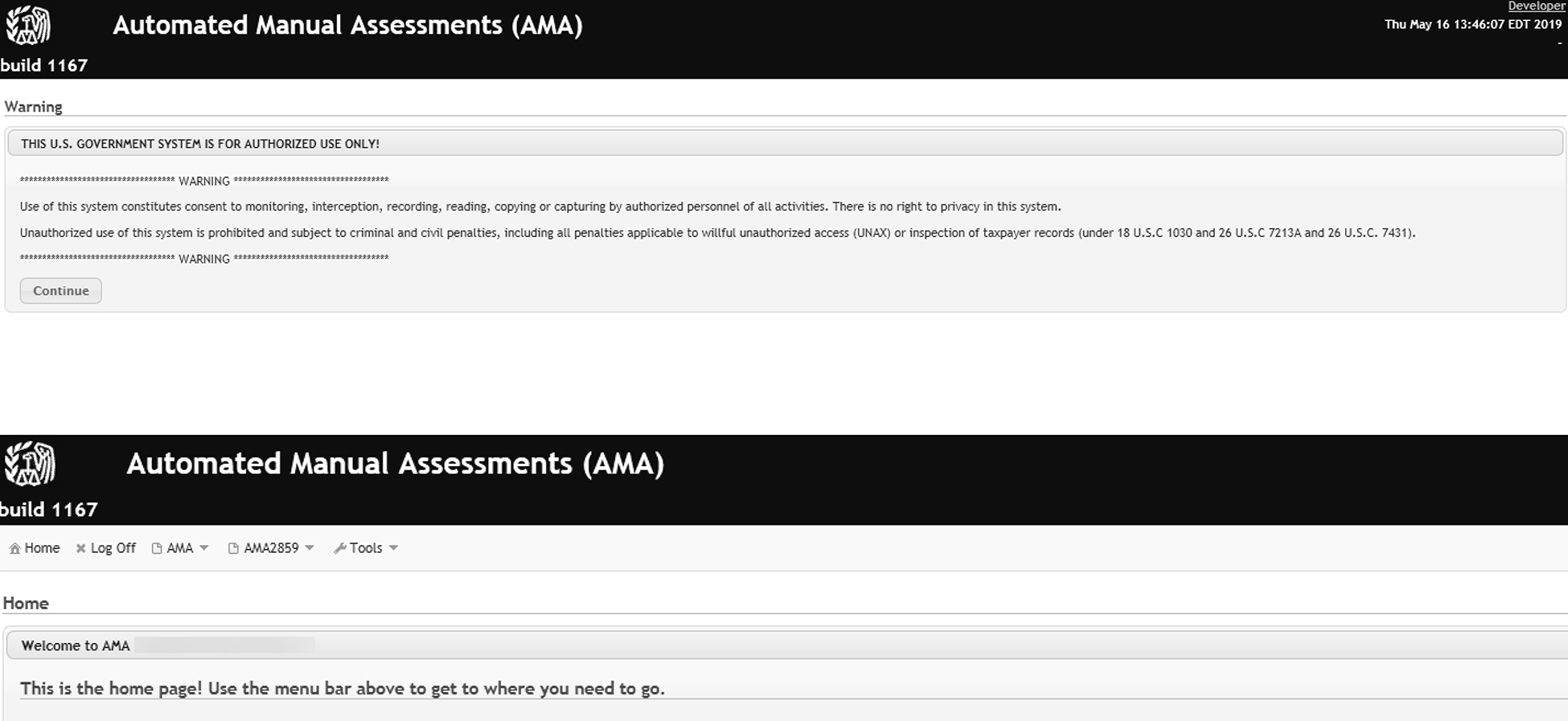
  1. To start the program, double click on the AMA icon on your desktop. The following screen will appear:

    Figure 3.17.244-2

    This image is too large to be displayed in the current screen. Please click the link to view the image.

    Note:

    To access the menu bar, you can click on it with your mouse or press the [ALT key] then use the arrow keys to navigate through the menus.

3.17.244.3.1  (02-01-2011)
Add New Record

  1. From the AMA Main Menu, click on the button "Add New Record " , to see the next window:

    Figure 3.17.244-3

3.17.244.3.2  (02-01-2011)
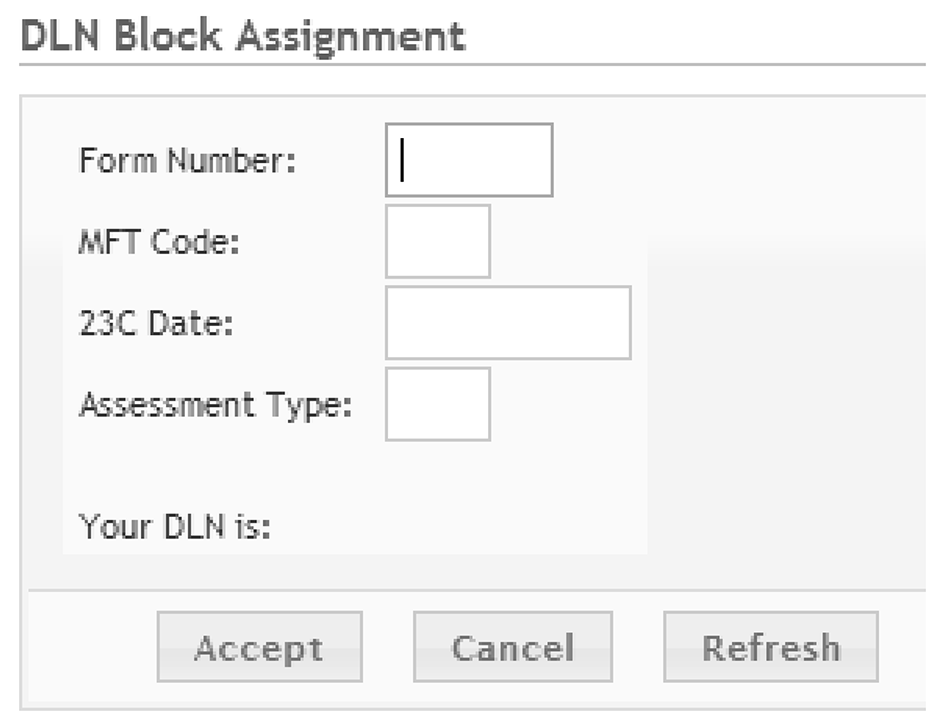
DLN Block Assignment

  1. This screen allows a block to be assigned to one person, giving the capability for numerous employees to simultaneously input records with similar assessment information.

    If Field is: Then:
    Form Number: Enter the Form Number from Form 2859, Part C, Line 1.
    MFT: The MFT is generated by the program based on the Form Number.
    23C Date: Enter the 23C Date shown on Part A, if specified. Assign a 23C date if the next available date box is marked.
    Assessment Type: Enter the assessment Type.

  2. When all four fields have valid data in them, the program will display the next available block based on the information entered.

  3. When the program generates a DLN Block, it is considered assigned to the current user (See Figure 3.17.244-4).

    Figure 3.17.244-4

    This image is too large to be displayed in the current screen. Please click the link to view the image.

  4. To close this window, click on the "Cancel" button to return to the "AMA Main Menu" .

  5. Review the data fields for validity and make any necessary corrections. If a correction is made, click on the "Refresh" button. This will release the block and assign a block based on the new information.

  6. If the information is correct, click on the "Accept" button, the following screen will appear:
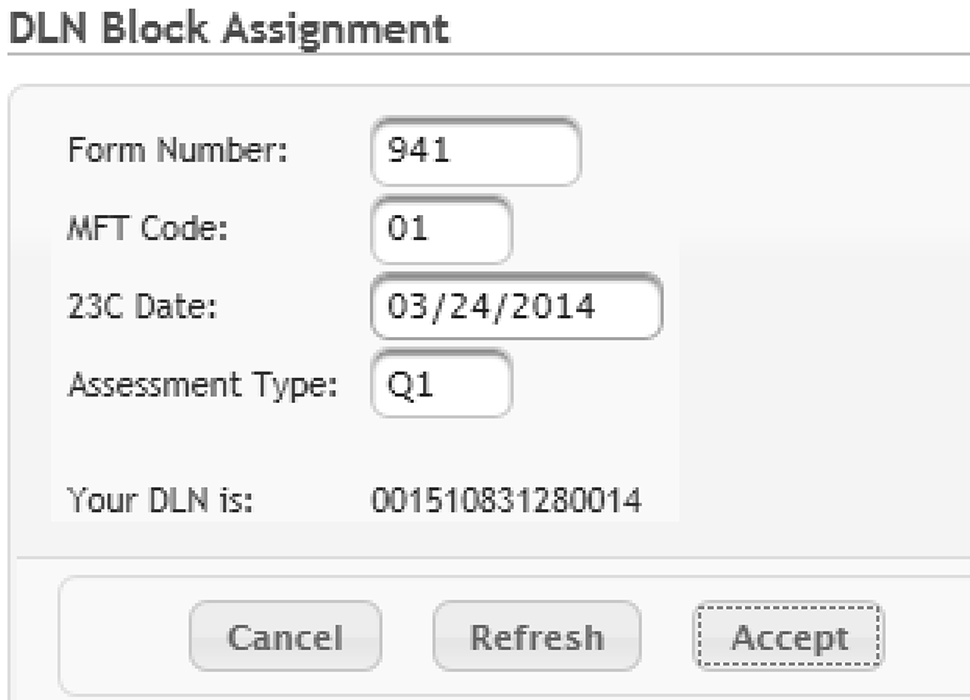
    Figure 3.17.244-5

    This image is too large to be displayed in the current screen. Please click the link to view the image.

    Function Key Destination
    F1 Main Input (Part A & B)
    F2 To move to the second screen (Part C)
    F3 To move to the third screen (Part D)
    F4 To move to the fourth screen (Show DLN)

3.17.244.3.3  (02-01-2011)
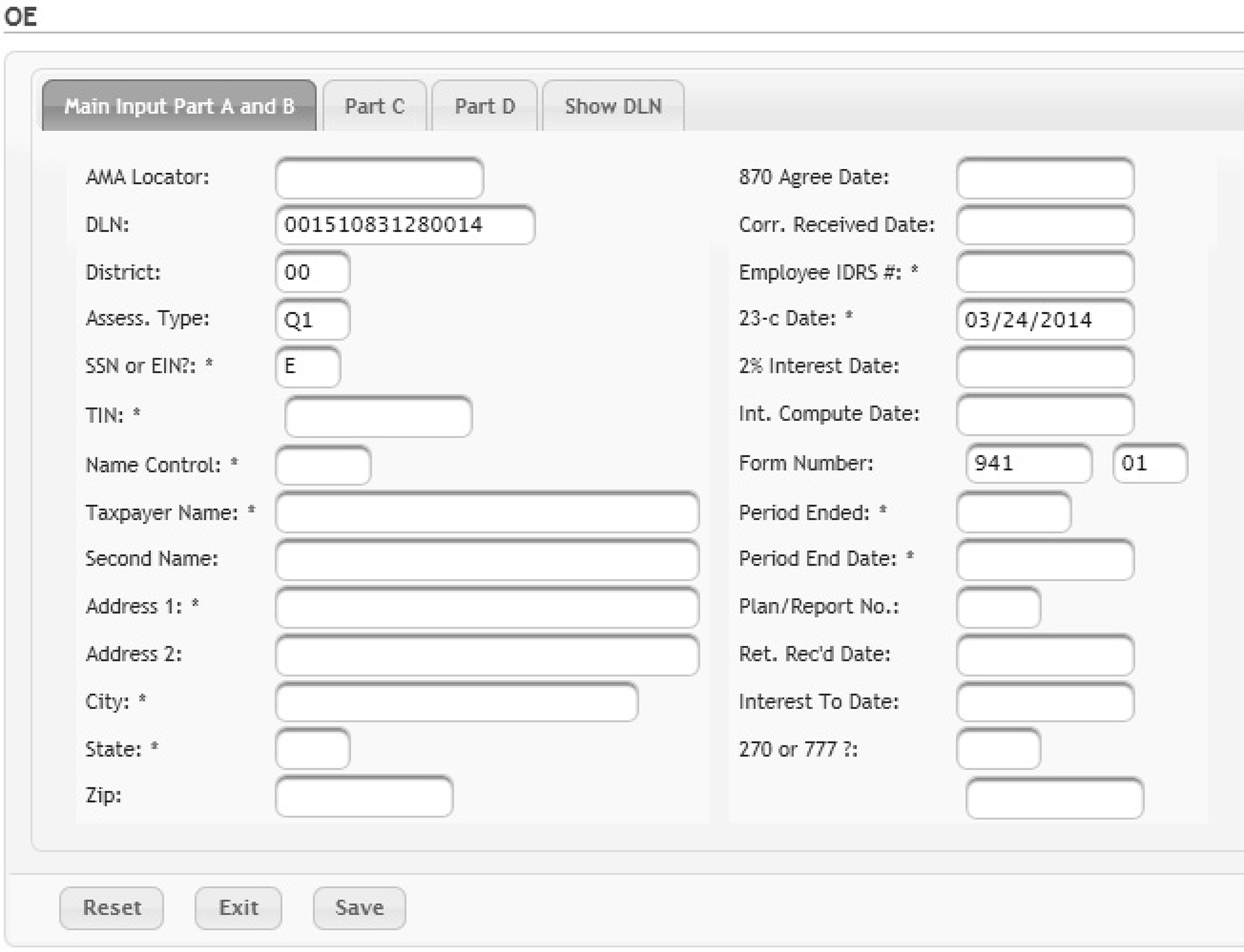
Form 2859, Parts A & B (Main Input)

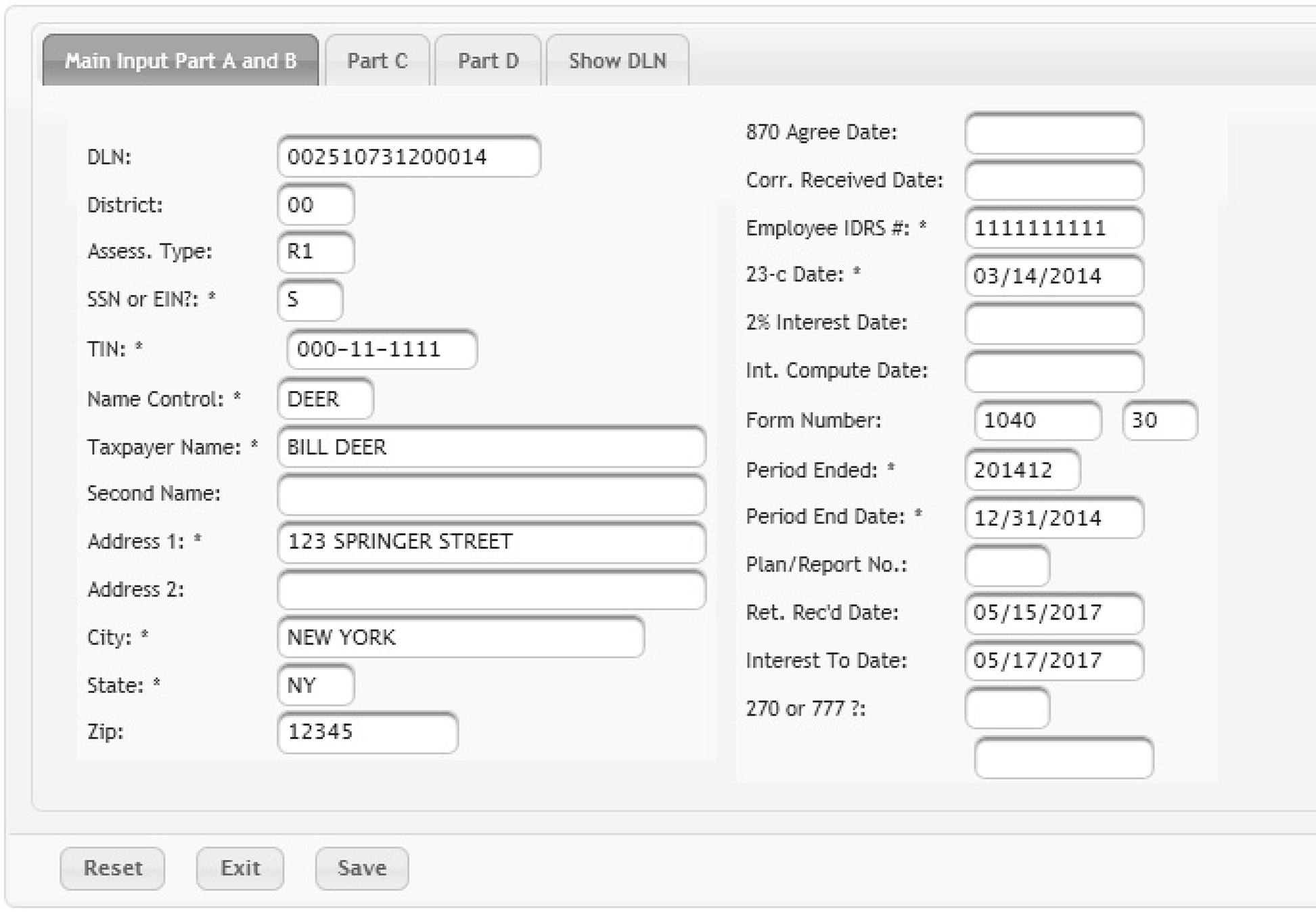
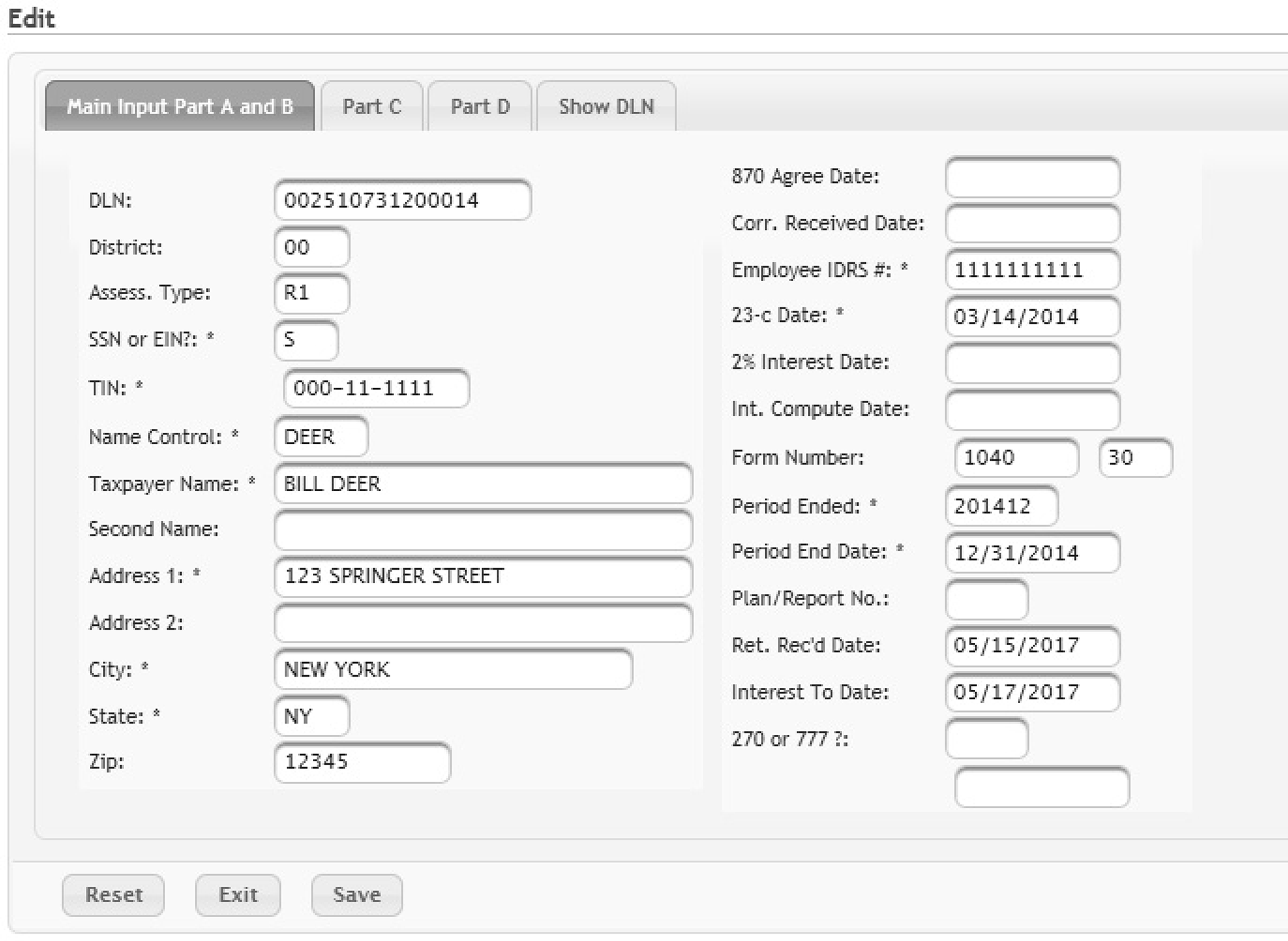
  1. Use Part A & B of Form 2859 to fill in the appropriate fields.

    1. District Enter your two digit District Office code (if your Area Office code is not already showing in this field).

    2. Assess Type Generated by DLN Block Assignment Screen.

    3. SSN or EIN Generated by DLN Block Assignment Screen.

    4. TIN Enter TIN. (Required field)

    5. Add Check Box Check to indicate an invalid SSN. (Required field)

    6. Name Control Enter the Name Control from Part A. (Required field)

    7. Taxpayer Name Enter the Name from part A. (Required field)

      Note:

      If the assessment requires three name lines, the "Address 1:" is used as a name line, enter the street address information in the "Address 2:" field.

    8. Address Enter the Address from Part A. (Required field)

    9. City, State, Zip Enter the City, State and Zip in the appropriate boxes as found on Part A. (Required field)

      Note:

      To input a foreign address, enter the name of the country in the "City:" field, and a period (.) in the "State" : field (to indicate a foreign address). The "Zip:" field should be left blank.

    10. 870 Agreement Date Enter the 870 Agreement Date (TC 300, 304, or 308 only) from Part A. (If present)

    11. Corr. Rec'd Date Enter the Correspondence Received Date from Part A. (If present)

    12. Employee IDRS # Enter the Employee Assignment Number from Part B. (Required field)

    13. 23-C Date Generated by DLN Block Assignment Screen.

    14. 2% Interest Date Enter the 2% Interest Date from Part A. (If present).

    15. Int. Comp. Date Enter the Interest Computation Date from Part A. (If present).

    16. Form Number Generated by DLN Block Assignment Screen.

    17. Period Ended Enter the Period Ended from Part C, #2a, in YYYYMM format.

    18. Period End Date Generated by the program.

    19. Plan/Report No. Enter the Plan/Report Number, Part C, #2b. (Required Field for MFT 46 and 76)

    20. Ret. Rec'd Date Enter the Return Received Date, Part C, # 3b. (Required for a TC 150)

    21. Interest to Date Enter the Interest/Interest-To-Date from Part C, #17. (Required for a TC 340)

    22. 270 or 777 Enter a TC 270 or TC 777 if there is one present.

      Note:

      This will cause another box to appear below for the transaction amount.

  2. To move to the next page of the form, continue pressing the [Enter] or [TAB] key through the last fields. The program will automatically go to the next screen. Or, you can use the [F2] Function key to move to the next window.

  3. After entering a Taxpayer Identification Number (TIN) in the "SSN" or "EIN" field, the program will check the database for assessments with the same TIN.

  4. If a match is found you will receive the following message.

    Figure 3.17.244-6

    This image is too large to be displayed in the current screen. Please click the link to view the image.

  5. Respond to the message appropriately to continue processing assessment information.

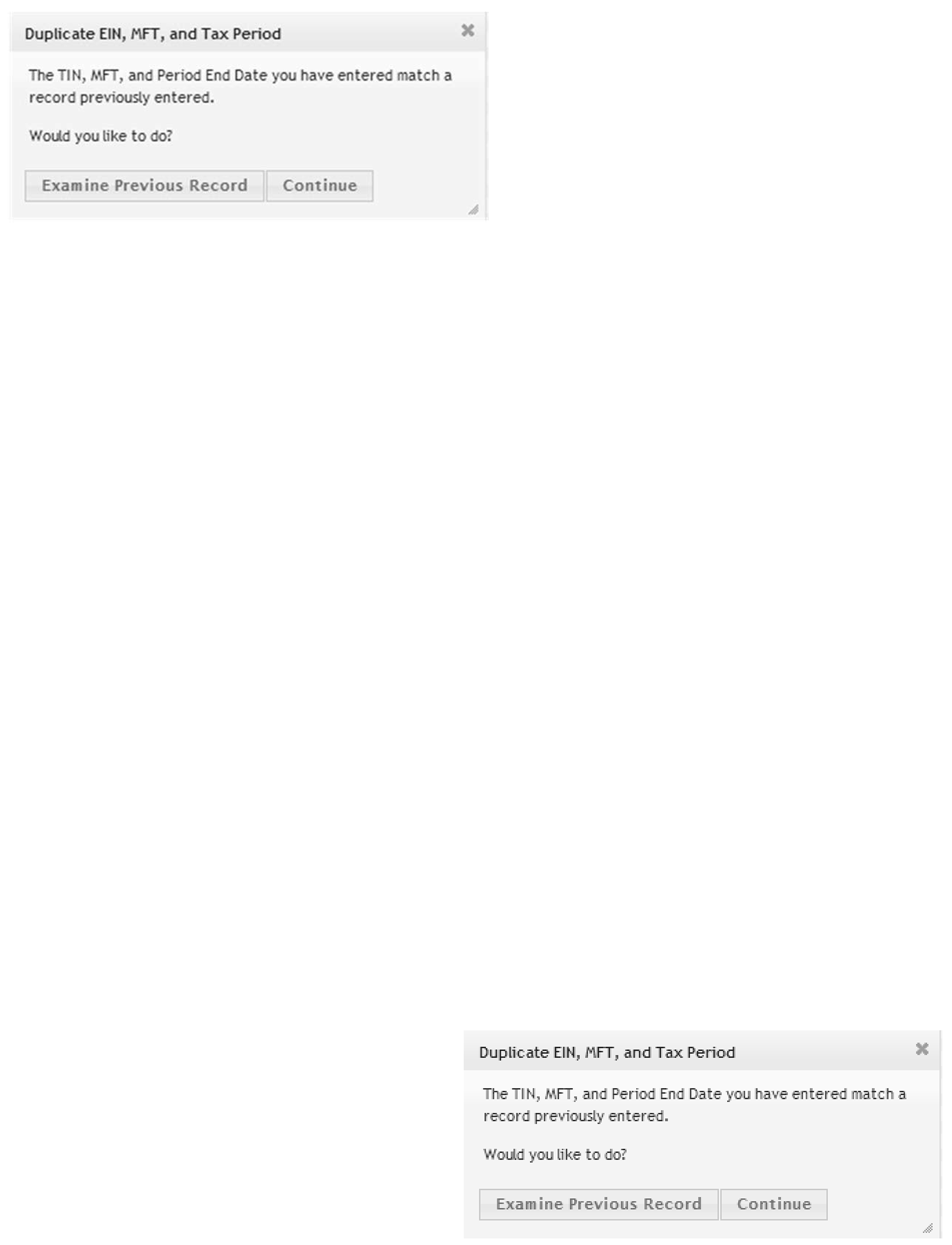
  6. An additional check is made to determine if the information being entered will duplicate an existing assessment.

  7. The duplicate assessment check is made after inputting the "Period Ended" field.

  8. The following message will appear allowing you to examine the existing assessment.
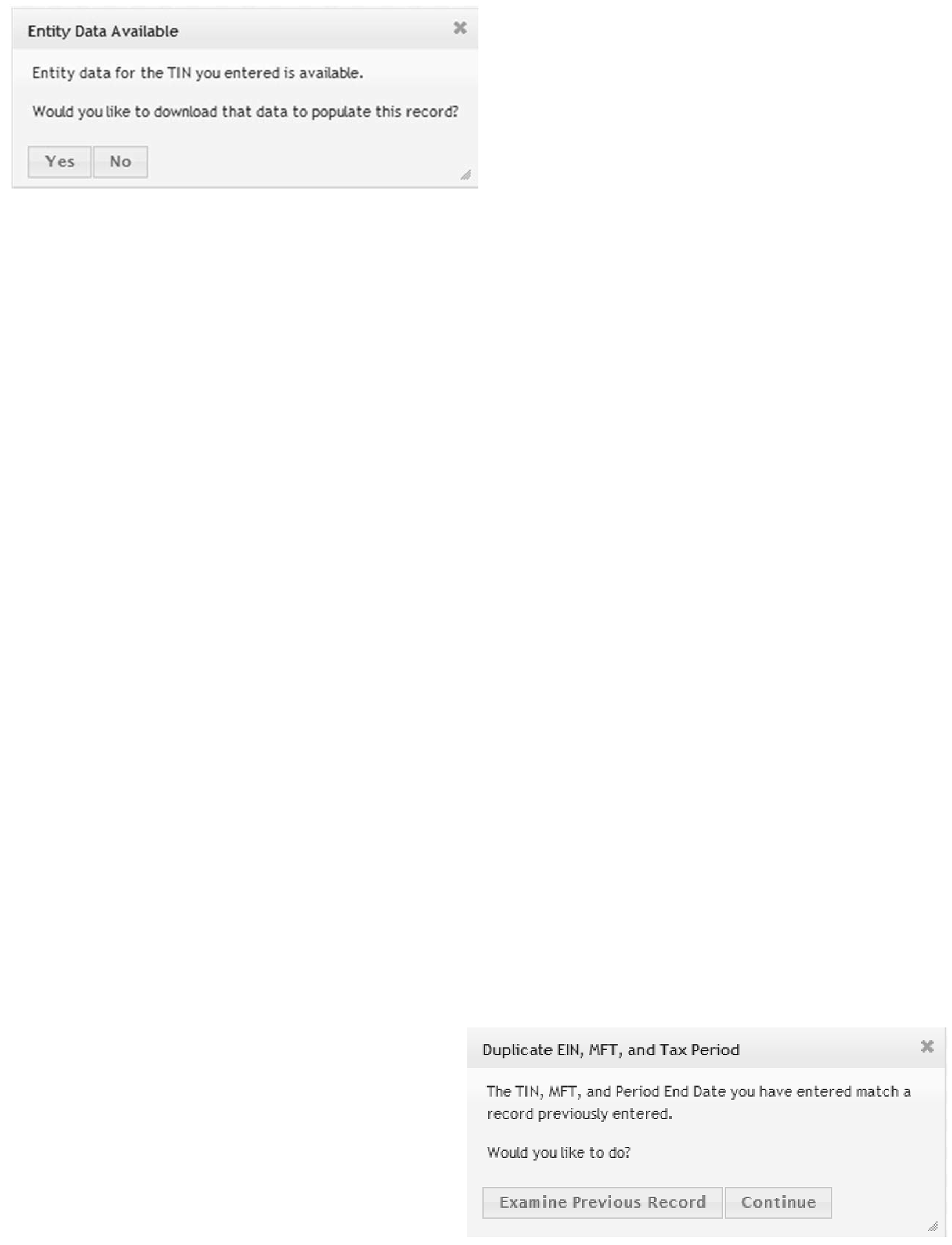
    Figure 3.17.244-7

    This image is too large to be displayed in the current screen. Please click the link to view the image.

    Note:

    Do not continue inputting until you have completed research to determine if you are creating an exact duplicate.

3.17.244.3.4  (02-01-2011)
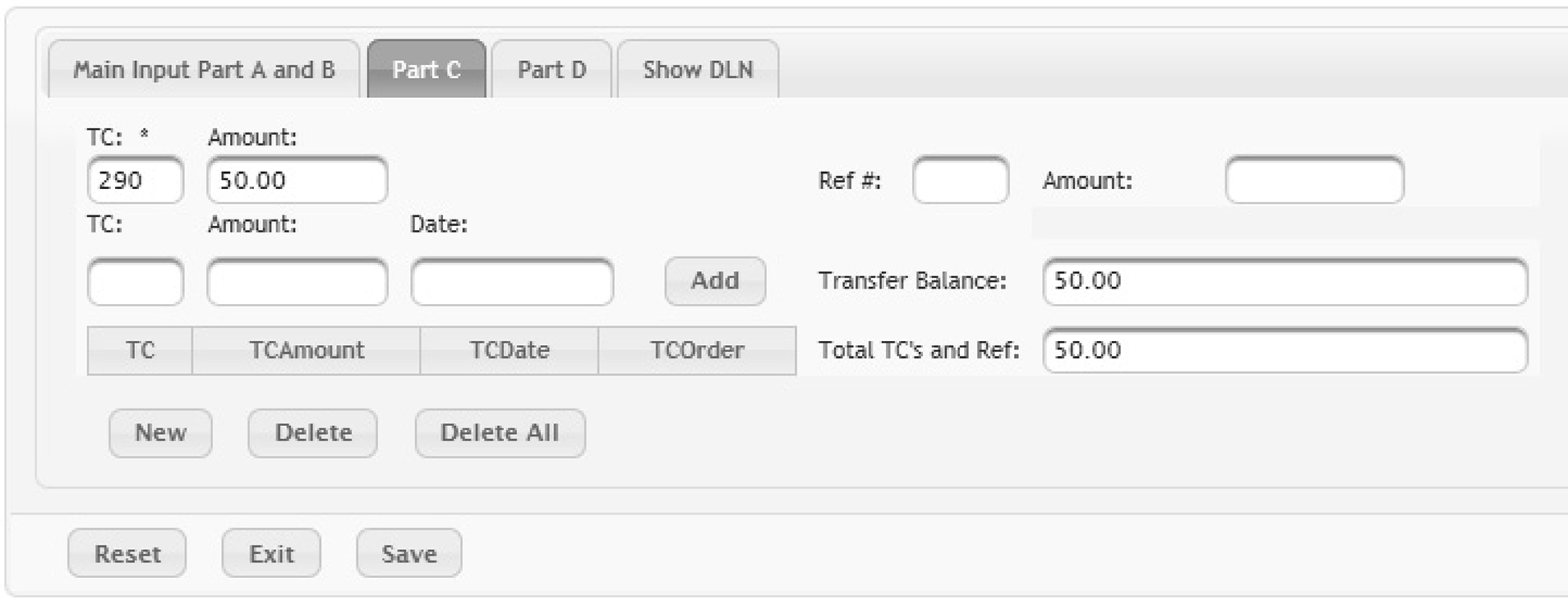
Form 2859, Part C (Transactions)

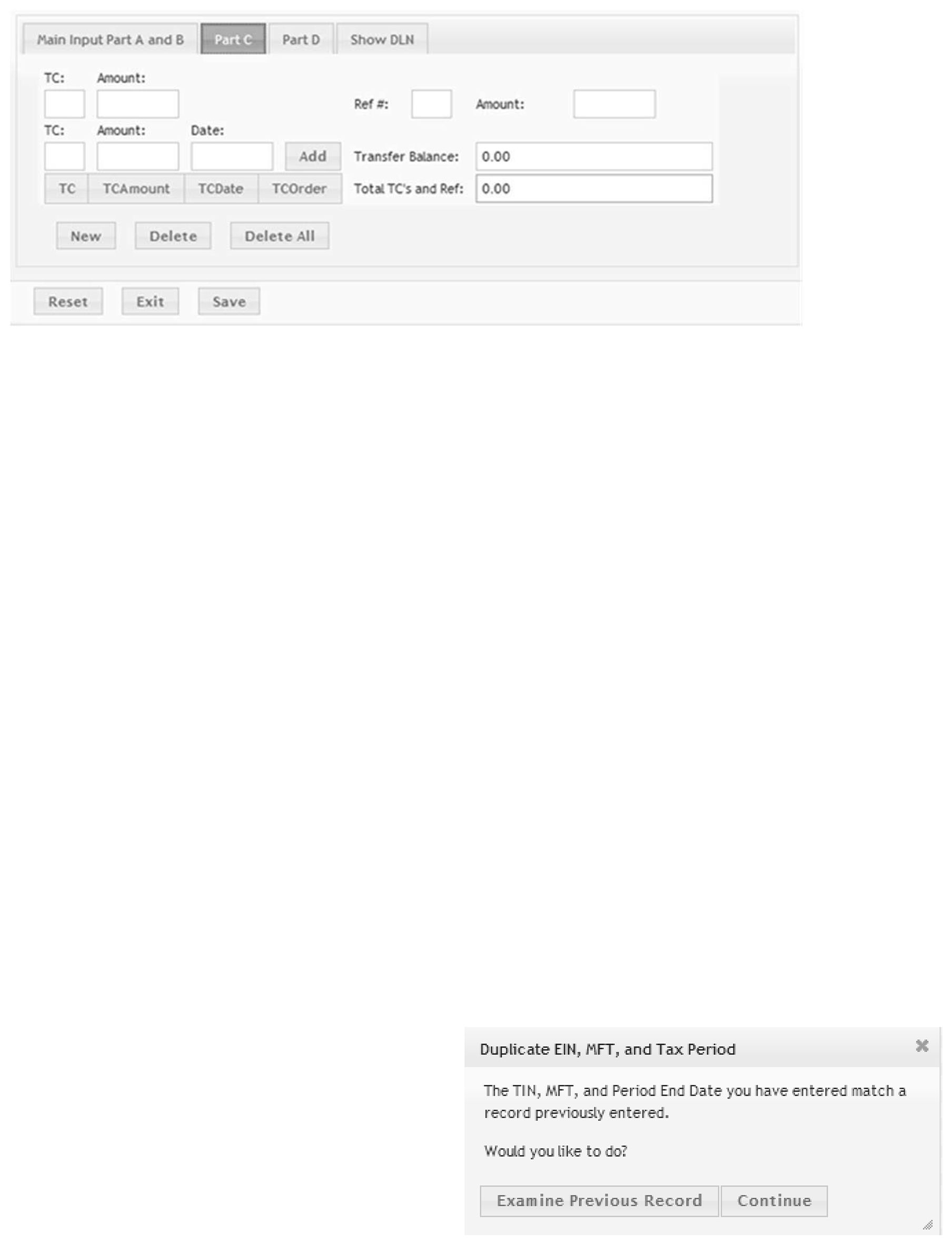
  1. Use Part C of Form 2859 to complete this window.

    Figure 3.17.244-8

    This image is too large to be displayed in the current screen. Please click the link to view the image.

    1. TC Enter the first Transaction Code (TC). Input is restricted to TC 150, 290, 298, 300, or 308. (Located on lines 3a, 4a, 4b, and 5a of Form 2859.)

    2. Amount Enter the amount that corresponds to the TC.

    3. Ref # Enter the Penalty Reference Numbers (i.e., 618, 680,681) from Line 4c or line 5b for (TC 290 or 300).

    4. Amount Continue entering TC's with amounts listed in Part C.

      Note:

      If a TC 150 was entered as the first TC, the second TC will be a 610.

    5. TC Continue entering the TC's with amounts listed in Part C.

    6. Amount Continue entering the amounts that correspond to the TC's.

    7. Date Dates may be required for some TC's. If dates are needed, the program will allow you to enter a date. (i.e., TC's 765, 767, 772, and 802)

    8. Transfer Balance Not a data entry field. It will appear as transaction and/or Penalty Reference Number and money amounts are input. This field will show a running total of the transfer balance.

      Note:

      The transfer balance should never be a credit balance.

    9. Total TC's & Ref Not a data entry field. Will appear as transaction and/or Penalty Reference Number money amounts are input. This field will show a running total of transaction and Penalty Reference Number amounts.

      Note:

      The total TC's and Ref amount cannot be a credit balance.

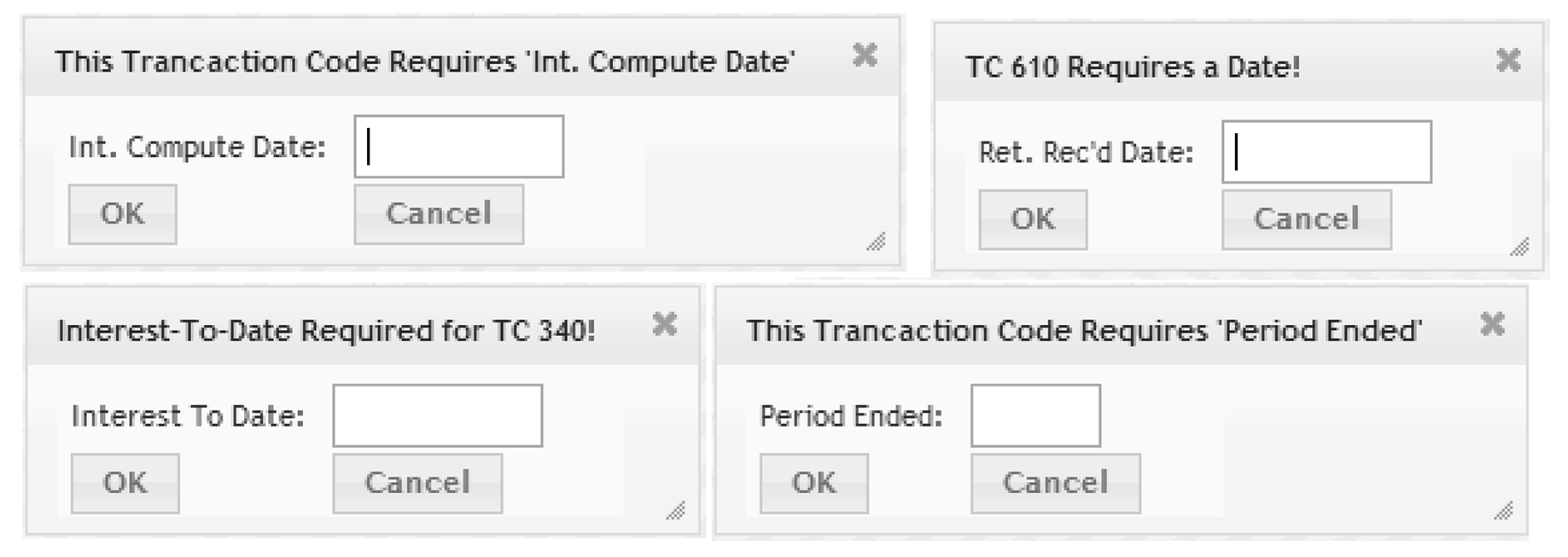
    10. Other Dates If a required date was not entered on Parts A and B, a message window will appear requiring you to enter the necessary information. The following examples illustrate specific messages for required missing date information.

      Note:

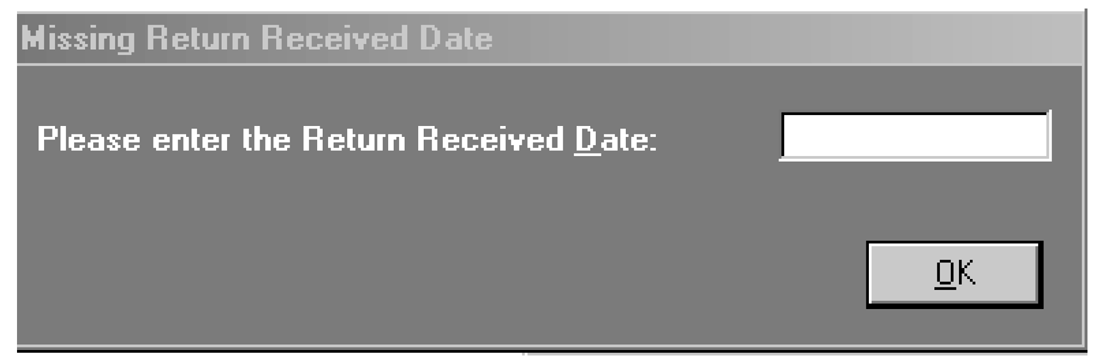
      If you forget to enter a "Return Received Date" or the "Interest To Date" , and one is required, the applicable message will appear allowing you to enter the appropriate date.

      Figure 3.17.244-9

      This image is too large to be displayed in the current screen. Please click the link to view the image.

      AMA Missing Interest to Date screen print.

      Figure 3.17.244-10

      This image is too large to be displayed in the current screen. Please click the link to view the image.

  2. After you have completed Part C, check the "Transfer Balance:" and "Total TC's & Ref:" amounts. The "Transfer Balance:" amount should be the same value as line 18 or line 22 of Form 2859, Part C.

  3. Press F3 to go to Part D.

3.17.244.3.5  (01-31-2012)
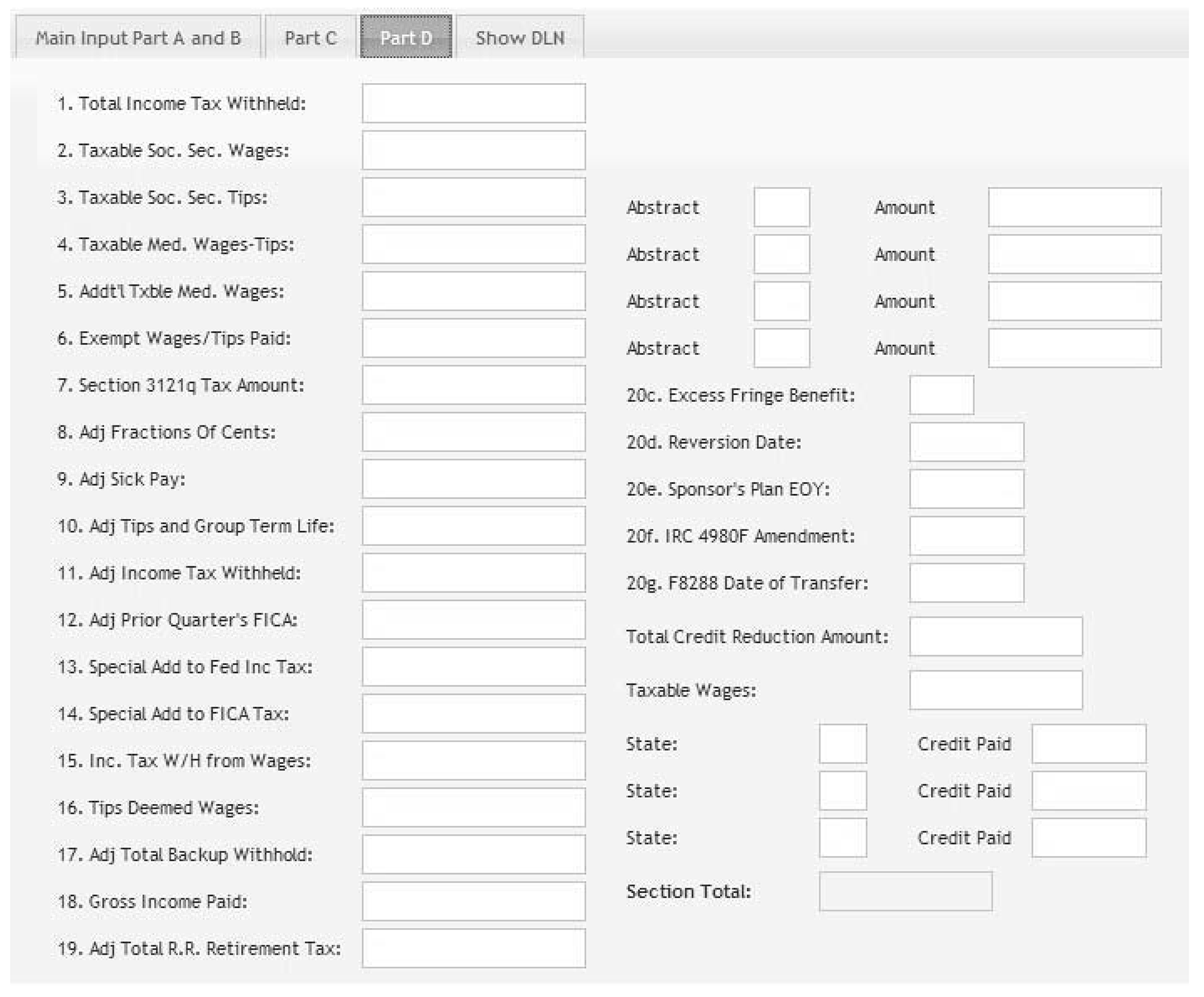
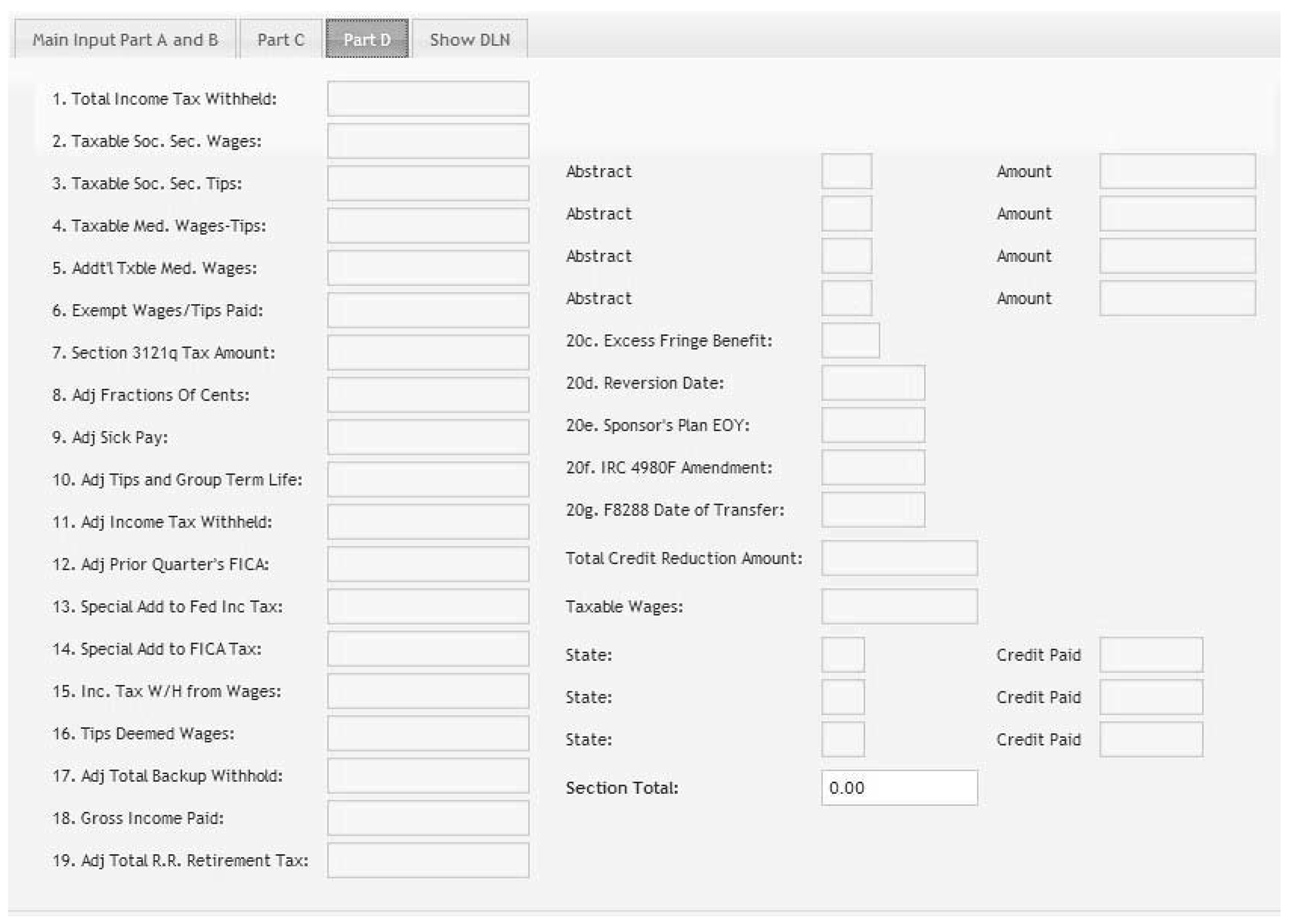
Form 2859, Part D

  1. Use Part D of Form 2859 to complete this window. You will enter an amount, or item, only if present.

    Figure 3.17.244-11

    This image is too large to be displayed in the current screen. Please click the link to view the image.

    1. Adjusted Total Income Tax Withheld Enter the amount from Line 1.

    2. Taxable Soc. Sec. Wages Enter the amount from Line 2.

    3. Taxable Soc. Sec. Tips Enter the amount from Line 3.

    4. Taxable Med. Wages-Tips Enter the amount from Line 4.

    5. Exempt Wages-Tips Paid to Qualified Employees this Quarter Enter the amount from Line 5.

    6. Section 3121Q Tax Amount Enter the amount from Line 6.

    7. Fractions of Cents Enter the amount from Line 7.

    8. Sick Pay Adj Enter the amount from Line 8.

    9. Current Quarter's Tips and Group-Term Ins. Adj. Enter the amount from Line 9.

    10. Income Tax Withheld - Adj. Enter the amount from Line 10.

    11. Social Sec. & Med. Tax - Adj. Enter the amount from Line 11.

    12. Special Additions to Fed. Inc. Tax Enter the amount from Line 12.

    13. Special Additions to SS & Med. Enter the amount from Line 13.

    14. Total Income Tax Withheld from Wages. Enter the amount from Line 14.

    15. Tips Deemed Wages (IRC 3121q) Enter the amount from Line 15.

    16. Total Backup Withholding Enter the amount from Line 16.

    17. Gross Income Paid Enter the amount from Line 17.

    18. Adj. to RR Retirement (CT-1) Enter the amount from Line 18.

    19. Abstract Enter any Abstract Numbers Listed in 20a.

    20. Amount Enter the amounts listed in 20b.

    21. Exc. Fringe Benefit Enter the amount from Line 20c.

    22. Reversion Enter the amount from Line 20d.

    23. Date of Transfer (MFT 17 only) Enter the amount from Line 20g. This is a required entry when the assessment is for MFT 17.

    24. Taxable Wages Enter the amount from Line 21.

    25. Total Credit Reduction Amount Enter the amount from Line 22.

    26. State Enter the States Listed in 23a.

    27. Credit Paid to State Enter the amounts listed in 23b.

    Note:

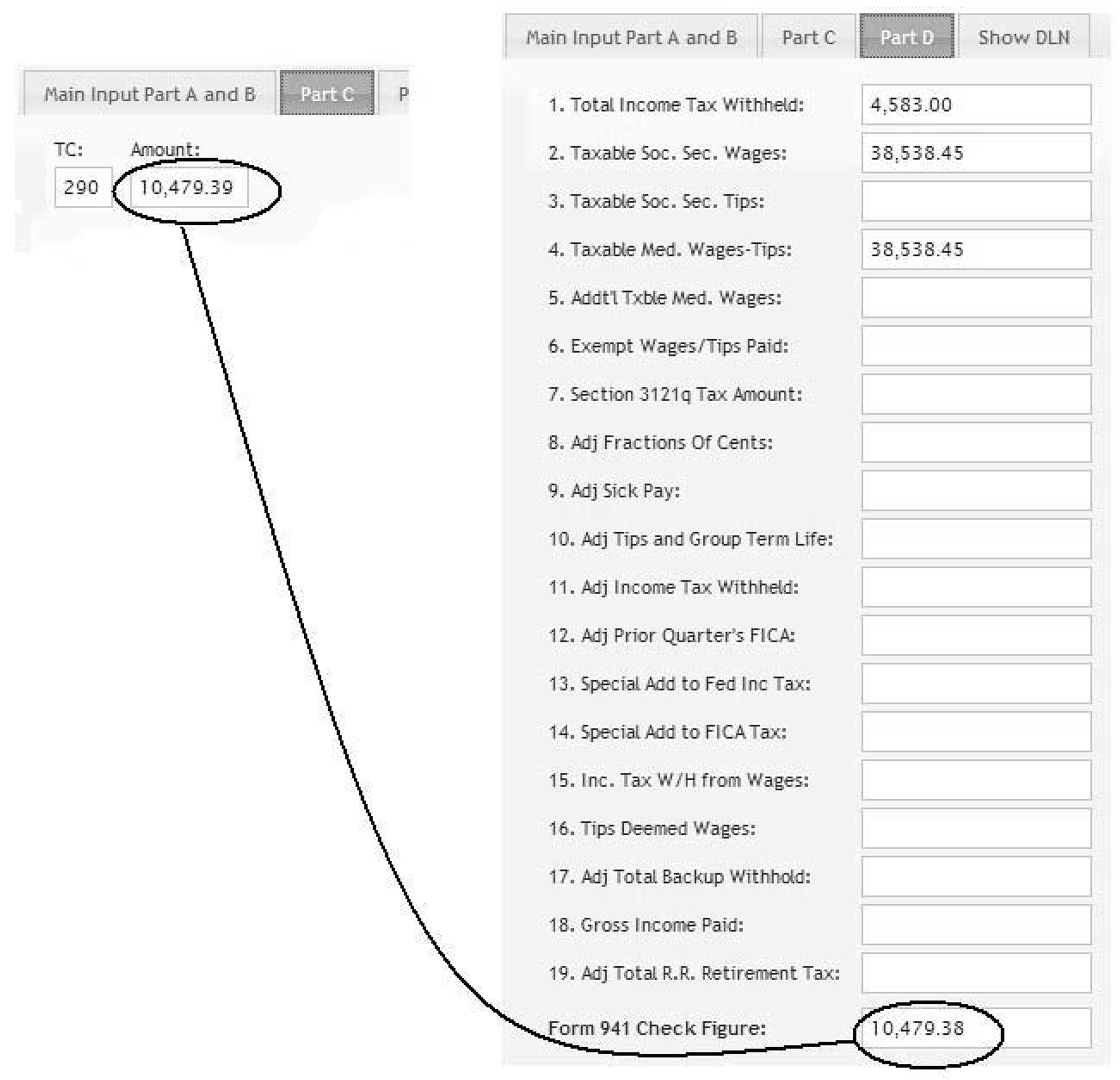
    On Form 941 if a TC 150 is being posted, there should not be an entry on line 1. For Form 941 where the TC 150 posted prior to 12/31/2004, Line 12 should be blank and there should be an entry on line 1. The only time you should have an amount for Social Sec. & Med. Tax Adjustment (Line 11) is when the 941 Return TC 150 posts prior to January 1, 2005, and there is an amount for Fractions of Cents, Sick Pay, or Other. The only other time you will have an entry in Line 11 is if a 941 Return TC 150 posted after January 1, 2005 or there was no TC 150 and there is an amount on Line 7e, Prior quarters' SS and Med taxes, Form 941 (rev 1-2005) or an amount is entered in Other for Form 941, (rev 1-2004) and prior.

    Form 941 Assessments
    IF.... AND.... THEN....
    A TC 150 is being posted   There should not be an entry on Line 1, Part D of 2859
    The TC 150 posted prior to 12/31/2004   Line 12 should be blank and there should be an entry on Line 1, Part D of 2859
    The TC 150 posts prior to January 1, 2005 There is an amount for Fractions of Cents, Sick Pay, or Other You should have an amount for Social Sec. & Med. Tax Adjustment on Part D of 2859
    TC 150 posted after January 1, 2005 or there was no TC 150 There is an amount on Line 7e (941 1/2005 rev) or an amt in “Other” (941 1/2004 rev) You should have an amount for Social Sec. & Med. Tax Adjustment on Part D of 2859

3.17.244.3.6  (02-01-2011)
Show DLN

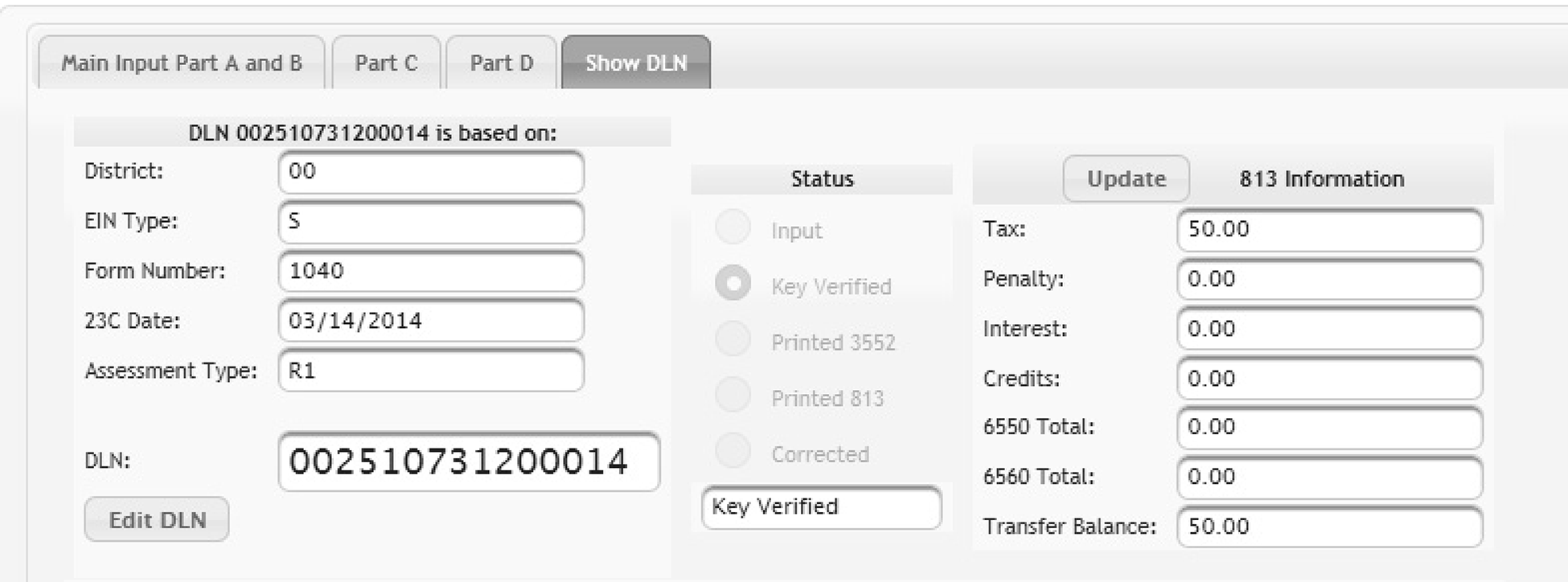
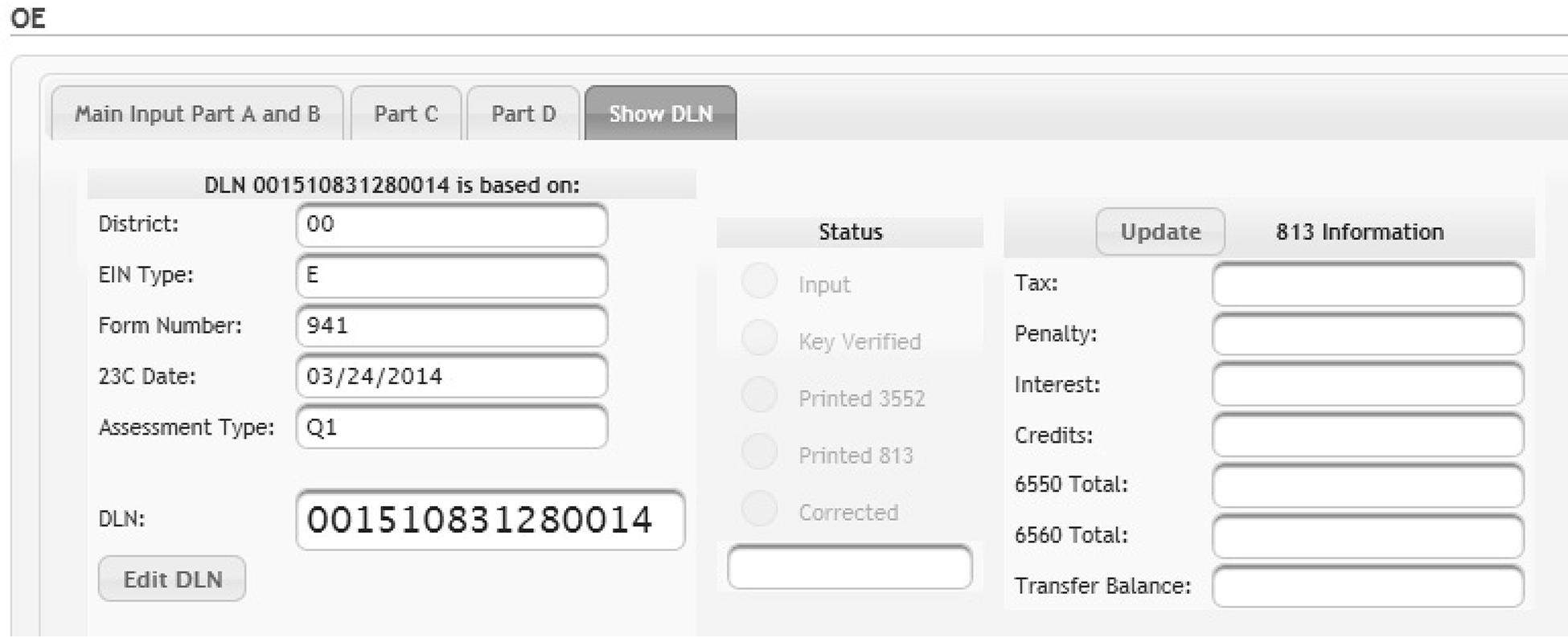
  1. When you have completed Part D, press the [F4] Key or click on [Show DLN] tab.

    Figure 3.17.244-12

    This image is too large to be displayed in the current screen. Please click the link to view the image.

  2. When you have completed Part D, press the [F4] Key or click on [Show DLN] tab.

  3. To save the current record and begin entering an assessment in another block, click on the "New Block" button.

  4. The "Save" button will save the record and exit to the AMA Main Menu.

  5. To exit the AMA Main Menu without saving, click on the exit button.

    Note:

    The block will be locked until the "New Block" button is clicked, "Exit" button is clicked, or the block has less than 100 documents.

    Note:

    There are instances when the DLN can be assigned, but the assessment may have errors. These errors usually do not affect the DLN that has been assigned. Review the error message and make the necessary corrections before pressing the "Save" or "New Record" buttons.

3.17.244.3.7  (02-01-2011)
Key Verify Existing Records

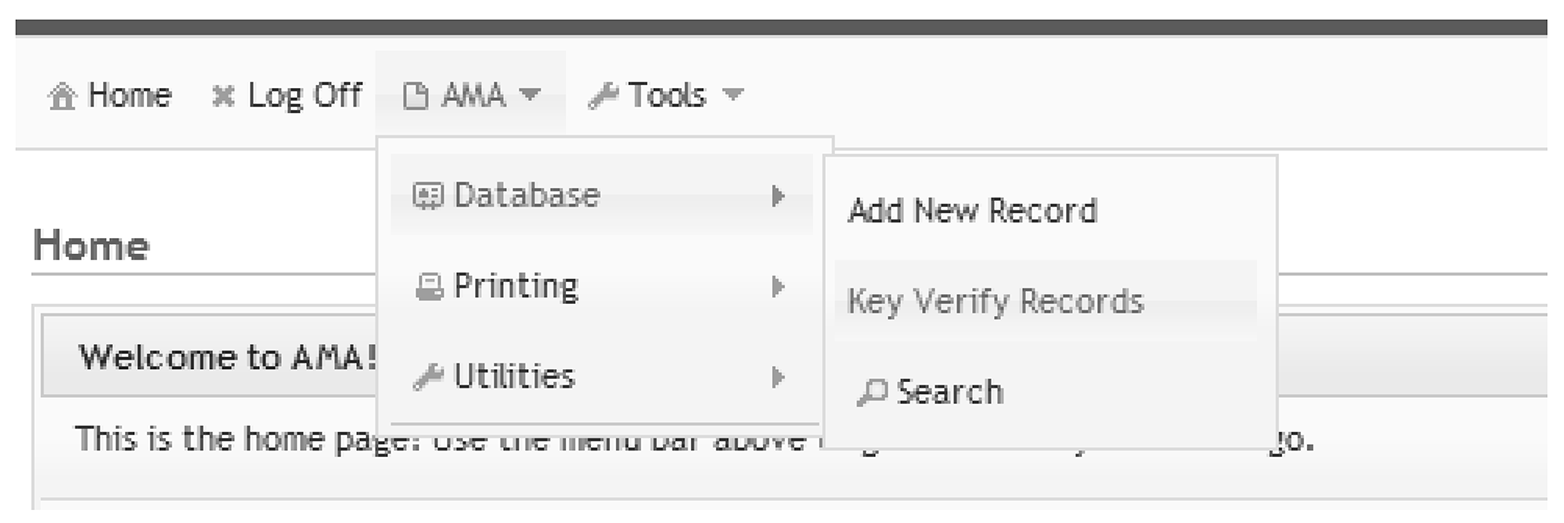
  1. To verify a block of work, click on the "Key Verify Existing Records" button.

    Figure 3.17.244-13

    This image is too large to be displayed in the current screen. Please click the link to view the image.

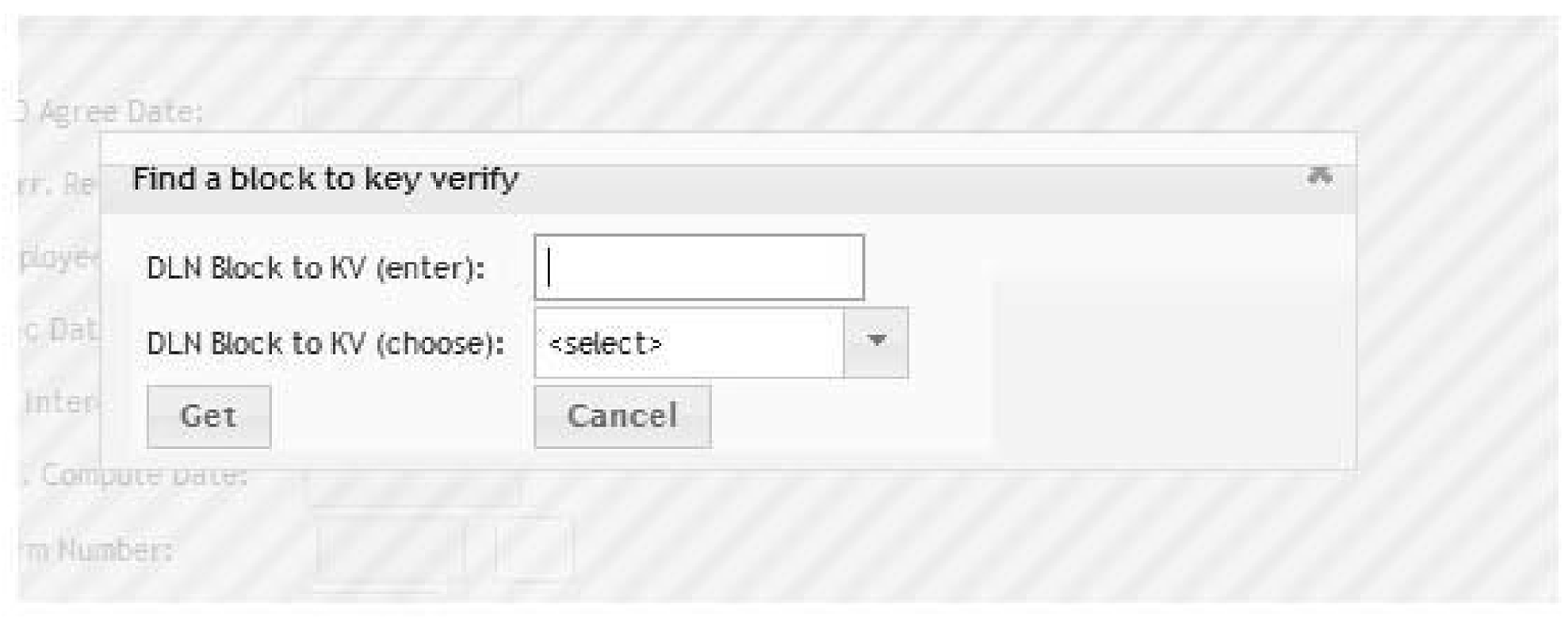
  2. The following screen will appear.

    Figure 3.17.244-14

    This image is too large to be displayed in the current screen. Please click the link to view the image.

  3. Click on the down arrow, and select a DLN from the drop down menu labeled DLN Block to KV. Then click on the Get button.

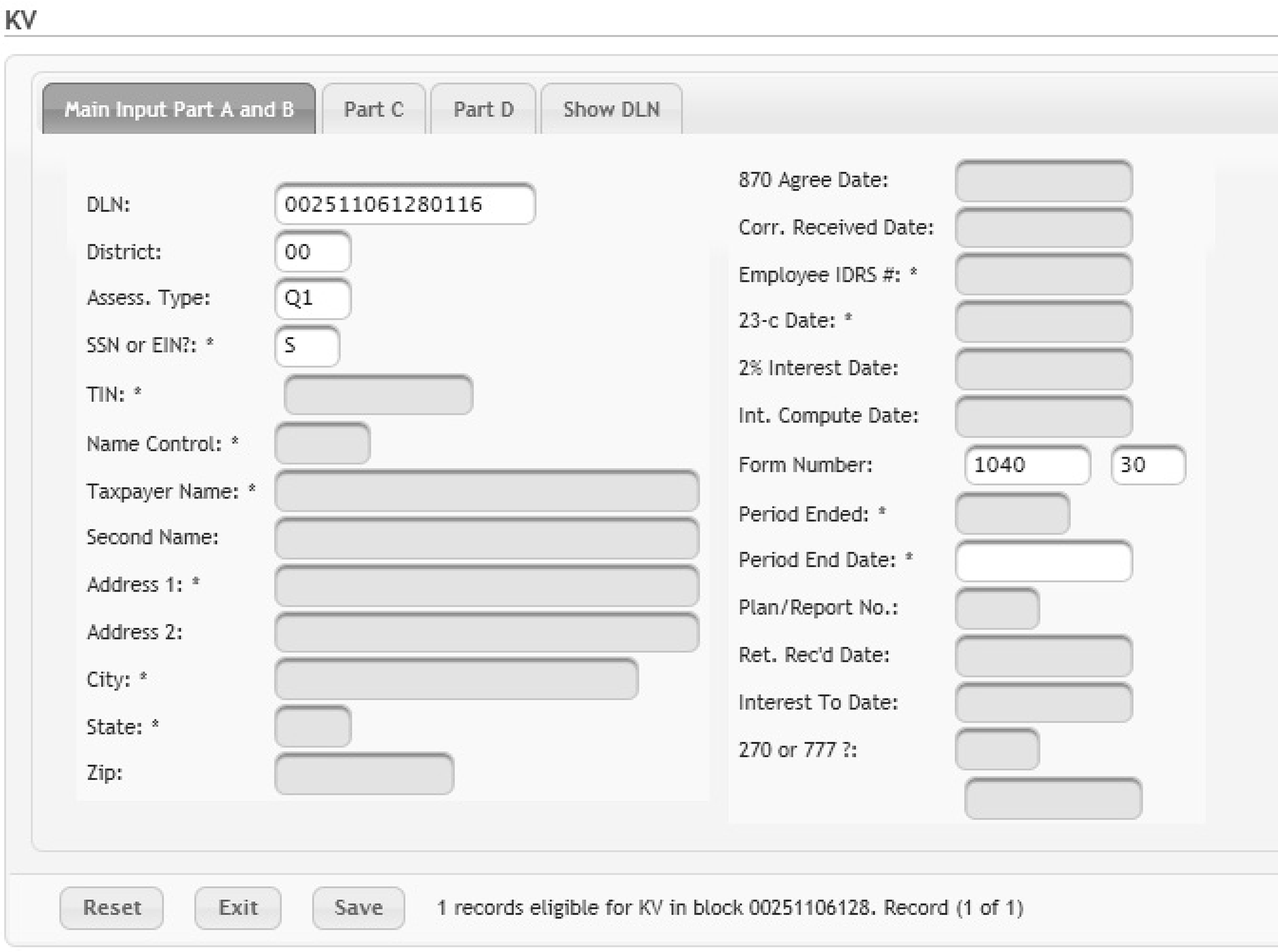
  4. The following screen will appear.

    Figure 3.17.244-15

    This image is too large to be displayed in the current screen. Please click the link to view the image.

    Note:

    The yellow background indicates fields that have not been Key Verified. The field background color will change to white as it is Key Verified.

  5. Input all required fields per Form 2859. See example below:

    Figure 3.17.244-16

    This image is too large to be displayed in the current screen. Please click the link to view the image.

  6. Special Key Verification: An enhancement has been added to the Key Verify process that will help AMA users process multiple assessments for the same taxpayer. A special key combination, CTRL-E, has been added that will allow users to bypass re-input of duplicated entity information.

    Note:

    If the taxpayer entity information is corrected during the KV process for one assessment, all subsequent assessments must be individually corrected. Do not use CTRL-E.

  7. Instructions for using CTRL-E:

    1. Key Verify the first taxpayer assessment in its entirety before proceeding to the next assessment.

    2. Place the cursor on the "Assess. Type:" field.

    3. Simultaneously press the key combination CTRL-E.

    4. The following fields will be filled:

      -SSN or EIN:
      -TIN:
      -Name Control:
      -Taxpayer Name:
      -Second Name:
      -Address 1:
      -Address 2:
      -City:
      -State:
      -Zip:

    5. The cursor will then move to the field "870 Agree Date: " . Complete the Key Verify process for the assessment.

    6. Proceed to the next assessment and follow the instructions outlined in steps 2 and 3 until all assessments for the taxpayer have been key verified.

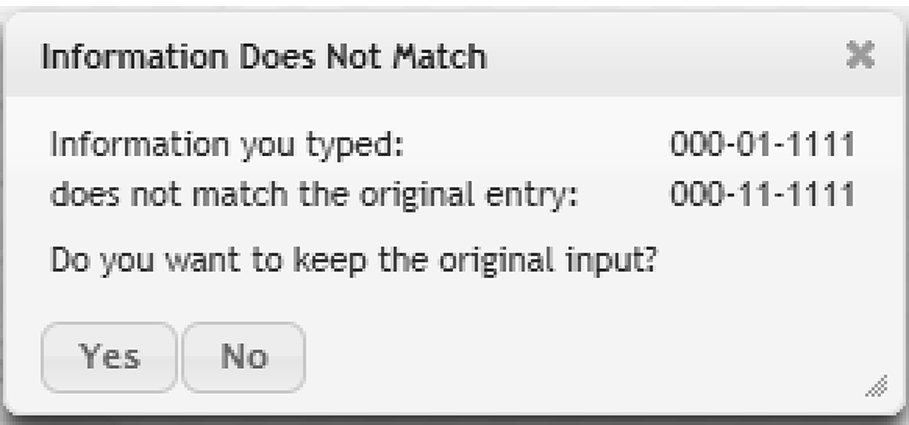
  8. Normal Key Verify Processing: If the information entered into a field during the key verify process does not match the information entered originally, you will be prompted with the following message.

    Figure 3.17.244-17

    This image is too large to be displayed in the current screen. Please click the link to view the image.

  9. If the "Original Input:" information is correct, click on the "Yes" button, otherwise, click on the "No" button to accept the key verified information.

3.17.244.3.8  (02-01-2011)
Form 2859, Part C (KV)

  1. Enter all required fields in Part C, per Form 2859. When you have completed entering, continue onto Part D.

    Note:

    A check mark to the left of each transaction code indicates that the code was correctly verified.

    Figure 3.17.244-18

    This image is too large to be displayed in the current screen. Please click the link to view the image.

3.17.244.3.9  (02-01-2011)
Form 2859, Part D (KV)

  1. Enter any applicable data in Part D.

    Figure 3.17.244-19

    This image is too large to be displayed in the current screen. Please click the link to view the image.

  2. Click on Verify DLN tab to complete the verification.

3.17.244.3.10  (02-01-2011)
Verify DLN

  1. The verify DLN screen is shown in Figure 3.17.244-20. Review the information on the Verify DLN screen for accuracy before continuing.

  2. The "Completed" and "Save" buttons will modify the status of the assessment to "Key Verified," save the key verified information to the database, and exit to the Main Menu.

  3. The "Next" button will modify the status of the assessment to Key Verified, save the key verified information to the database, and retrieve information for the next DLN in the block to be key verified.

  4. To exit to the AMA Main Menu without saving, click on the "Exit" button.
    Note:

    Key verified data is checked for consistency after clicking on the "Completed" , "Next" , or "Save" buttons. If an error exists, an error message will appear that requires a change be made to the assessment before the key verified information can be saved to the database.

    Figure 3.17.244-20

    This image is too large to be displayed in the current screen. Please click the link to view the image.

3.17.244.3.11  (02-01-2011)
Search

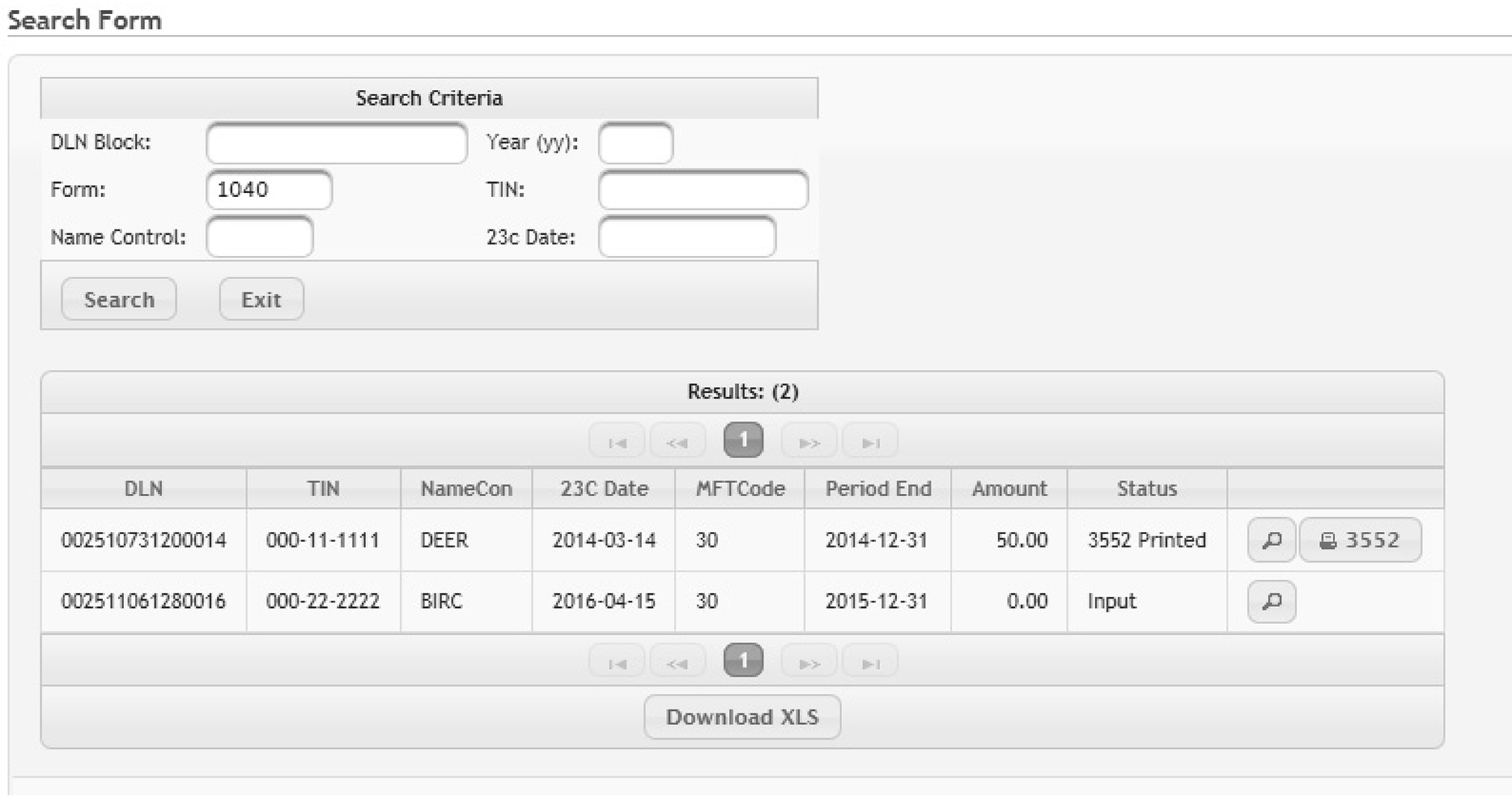
  1. To search for an assessment currently in the database, click on the "Search" button. This is a useful tool for verifying the status of an assessment, reprinting the Form 3552, or accessing an assessment to make corrections.

    Figure 3.17.244-21
    This image is too large to be displayed in the current screen. Please click the link to view the image.

  2. After clicking on the "Search" button from the AMA Main Menu, the Search Form will appear as shown in Figure 3.17.244-22.

  3. The search form allows you to search the database based on these search criteria:

    • DLN Block

    • TIN

    • Form Number

    • 23C Date

    • Name Control

  4. After selecting from the "Search Type:" drop down list, a second drop down list will appear allowing you to identify the specific information to search for.

    Note:

    In the example in Figure 3.17.243-22 the "Search Type:" DLN Block was selected.

  5. The second drop down list "Select DLN Block:" allows you to type your search information or select it from the provided list.

    Note:

    Detailed assessment information will automatically appear in the lower portion of the screen based on the search criteria.

    Figure 3.17.244-22
    This image is too large to be displayed in the current screen. Please click the link to view the image.

  6. The Search Form will allow you to retrieve the assessment information to make corrections or print a Form 3552.

  7. To edit assessment information, position the mouse pointer over the DLN to be retrieved and double click. The Research Form will appear as shown in Figure 3.17.244-23.

  8. Make any necessary changes and click on the Save button.

    Figure 3.17.244-23
    This image is too large to be displayed in the current screen. Please click the link to view the image.

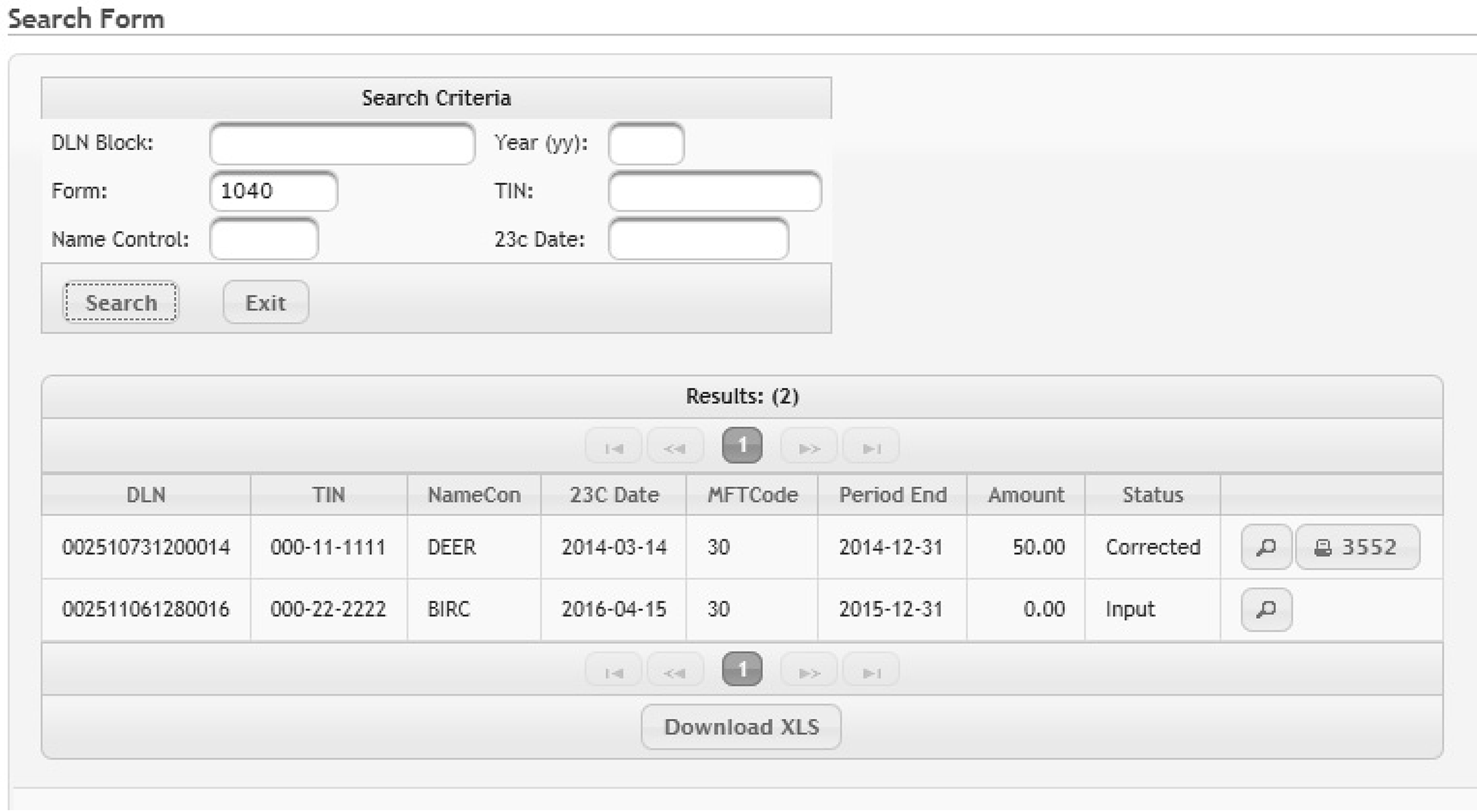
  9. Clicking on the "Save" or "Exit" buttons will close the Research Form and reopen the Search Form to view any corrections that were made. The following example shows a corrected record.

    Figure 3.17.244-24
    This image is too large to be displayed in the current screen. Please click the link to view the image.

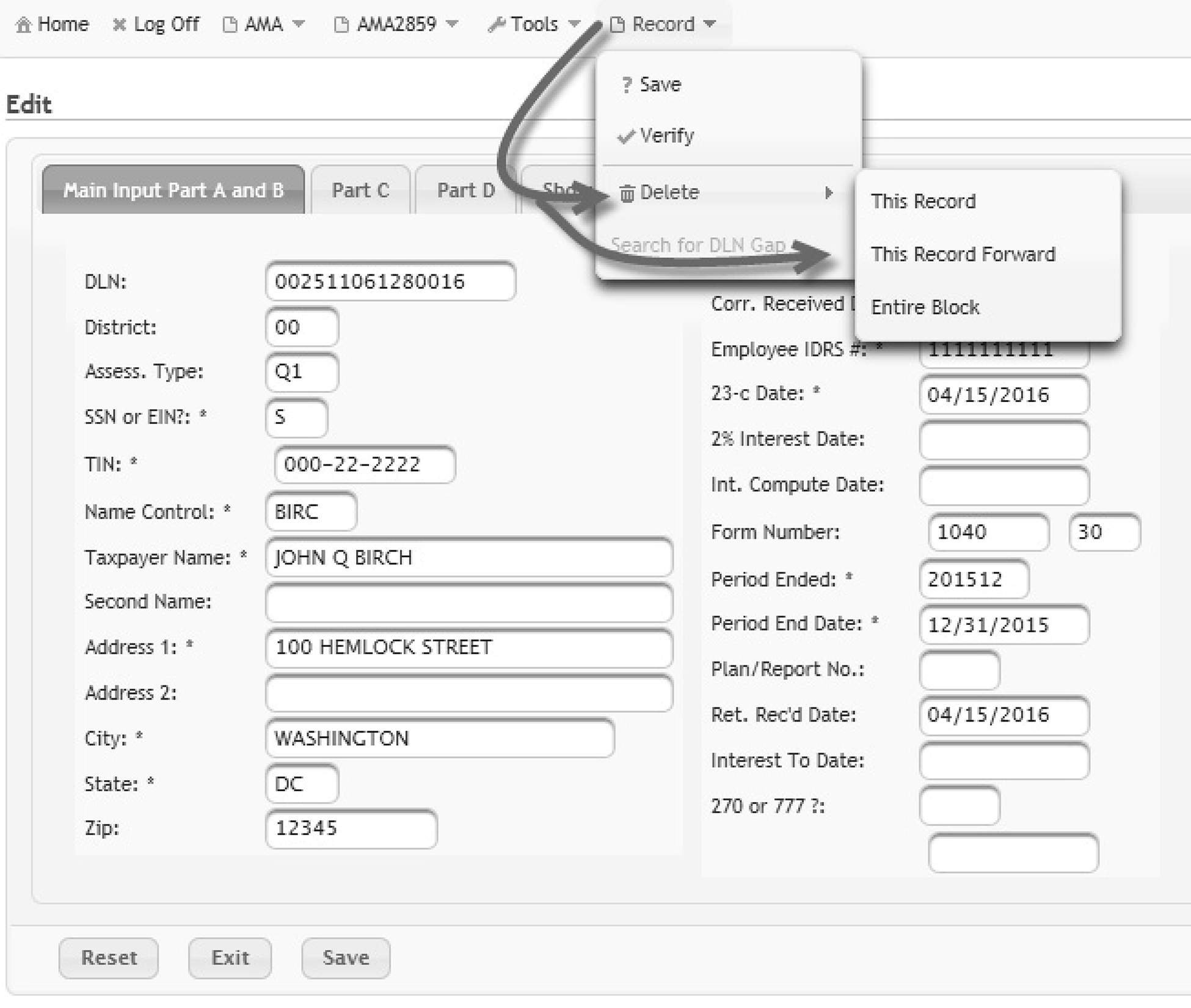
  10. To cancel a record after it has been completely input, retrieve the assessment through the Search utility. After the assessment is visible in the Research screen select the Record menu, then select Delete.

    Note:

    You can choose to either delete only the record you pulled up or the entire record block.

    Figure 3.17.244-25
    This image is too large to be displayed in the current screen. Please click the link to view the image.

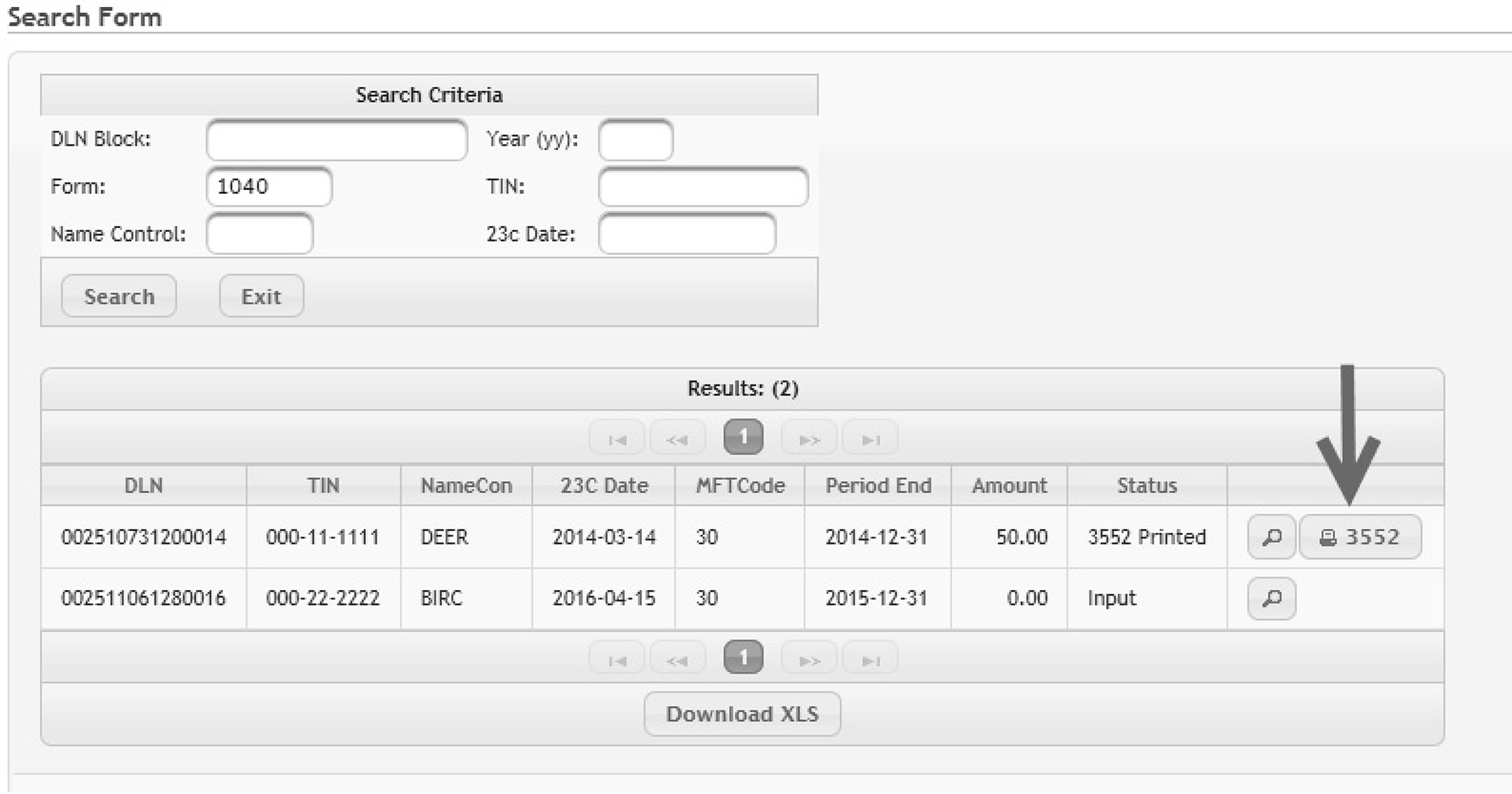
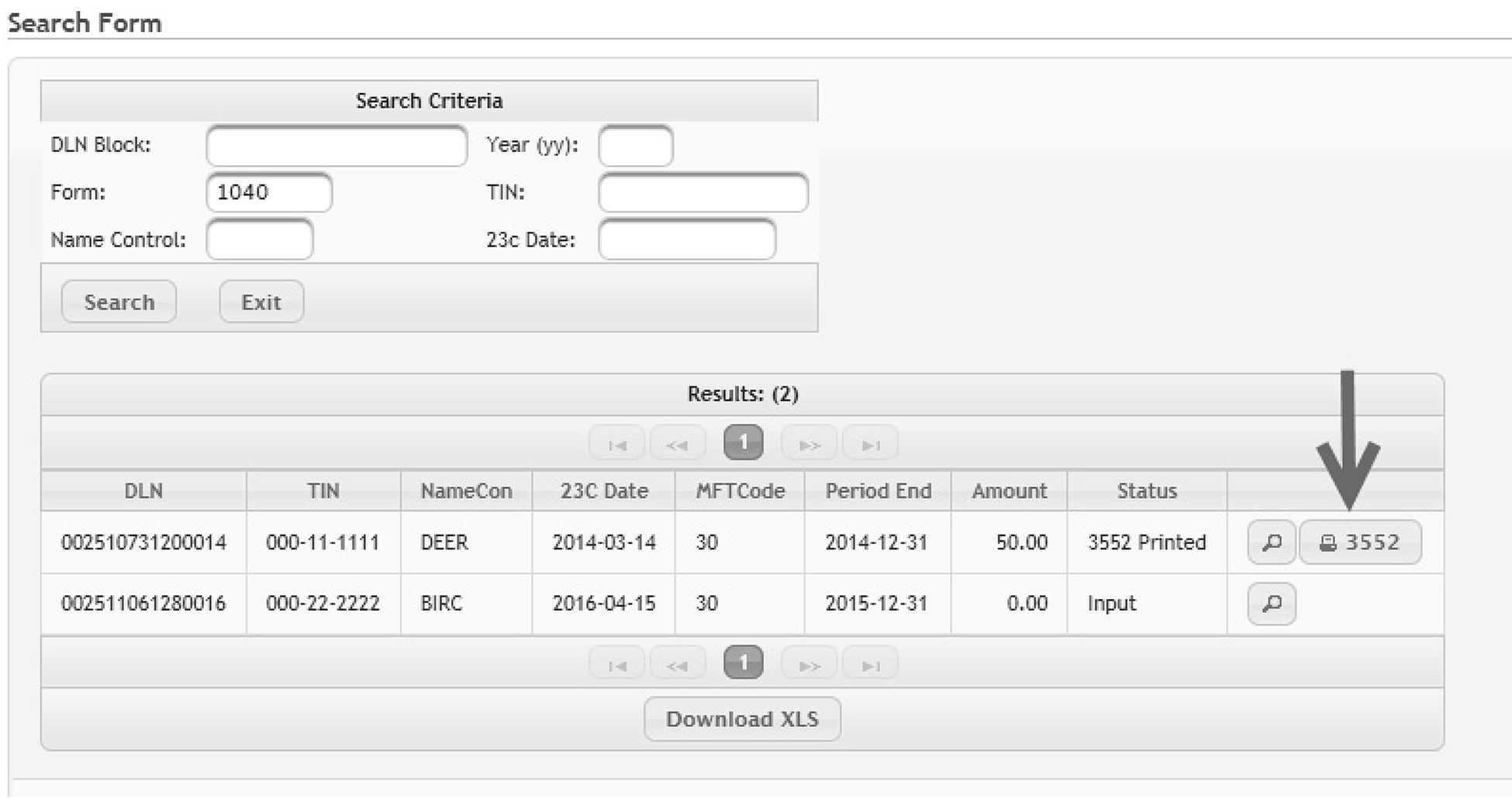
  11. To make an extra copy of the Form 3552, click on the printer button on the left side of the DLN in the Search screen.
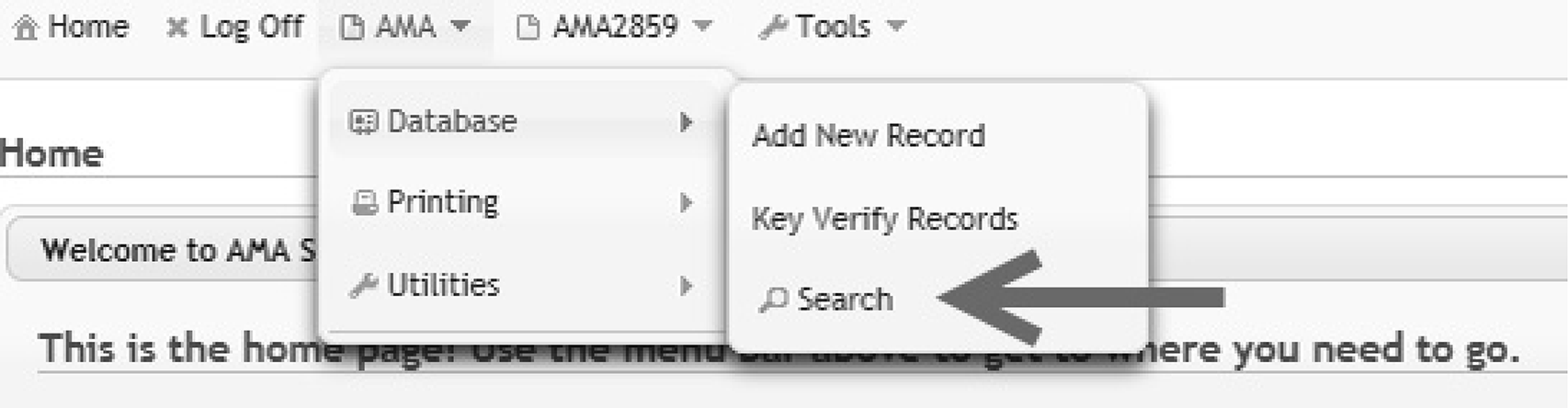
    Figure 3.17.244-26
    This image is too large to be displayed in the current screen. Please click the link to view the image.

3.17.244.3.12  (02-01-2011)
Print 3552 by DLN Block

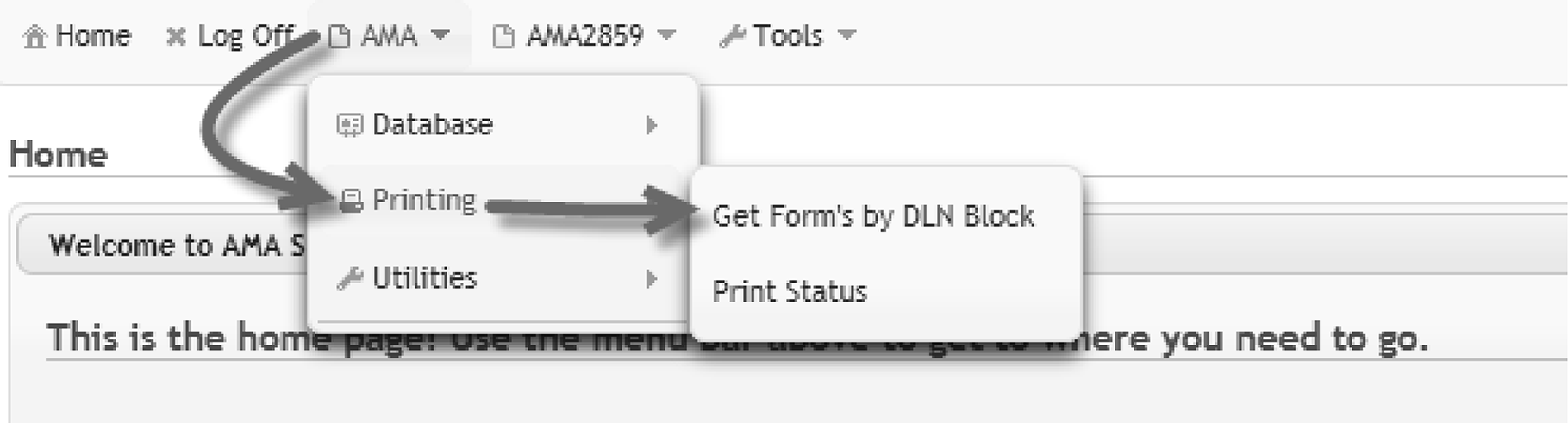
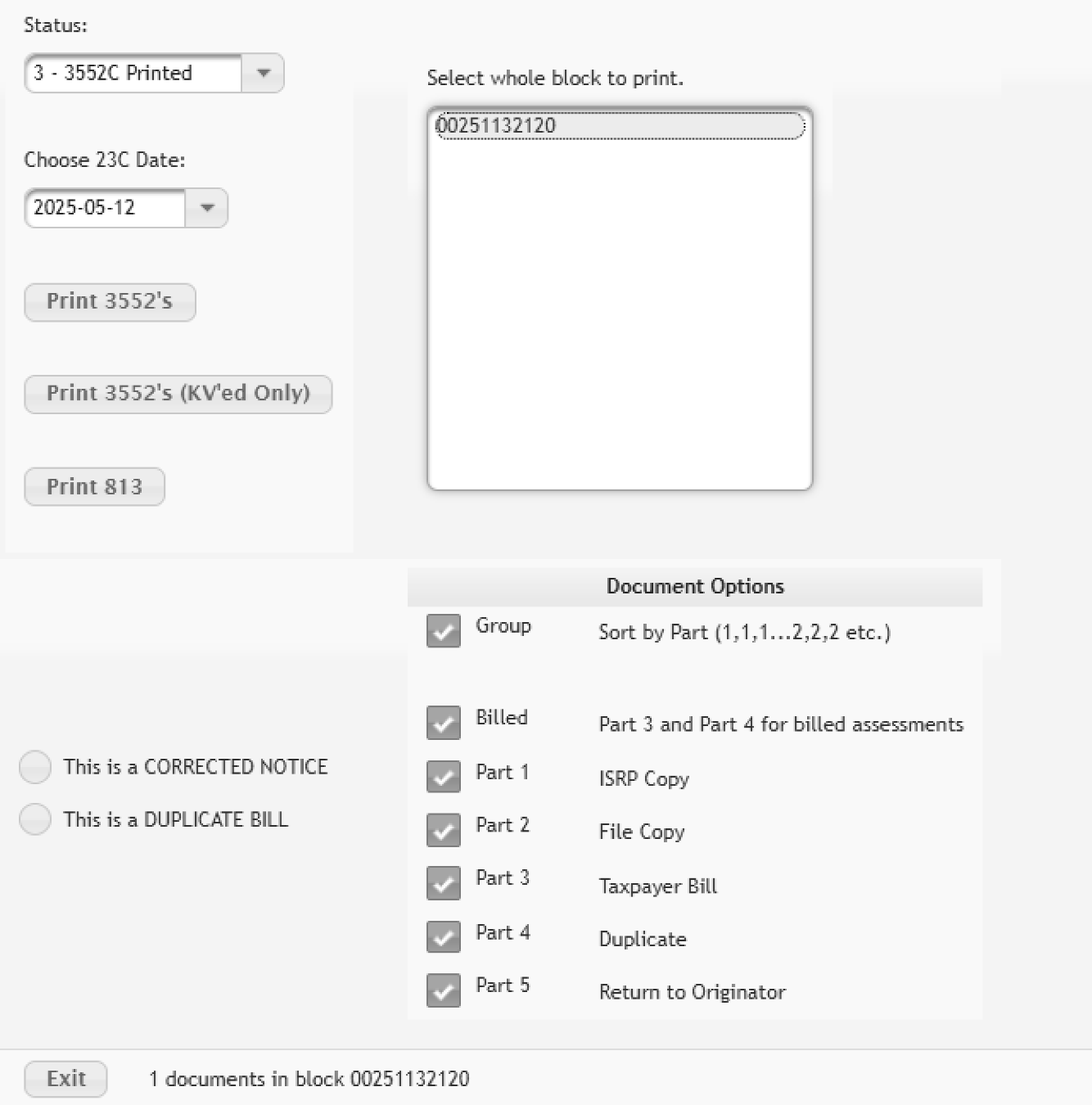
  1. To print Form 3552, click on the "Print 3552 by DLN Block" button.

    Figure 3.17.244-27
    This image is too large to be displayed in the current screen. Please click the link to view the image.

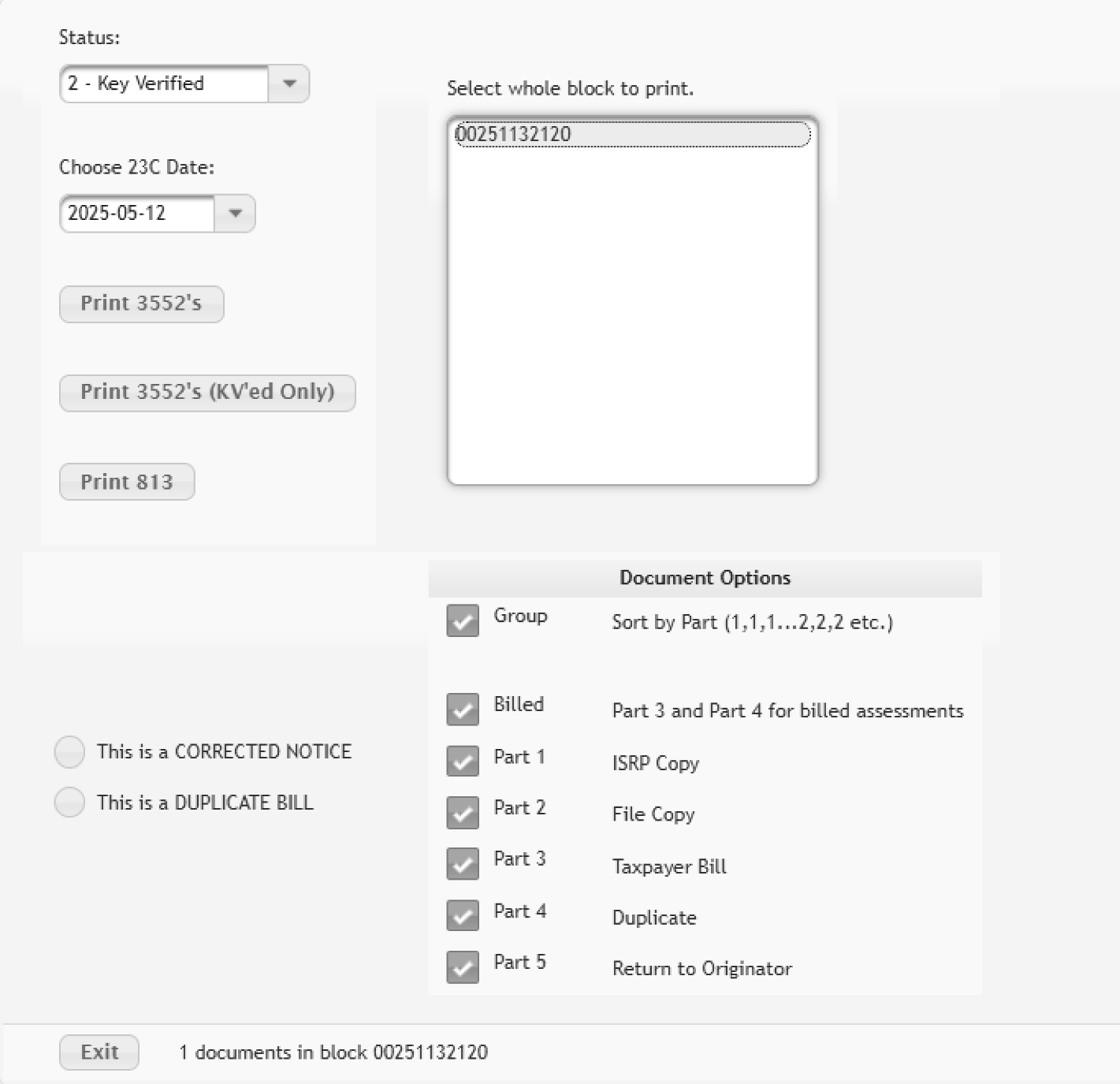
  2. The Form 3552 Print Menu will appear as shown below.

    Figure 3.17.244-28
    This image is too large to be displayed in the current screen. Please click the link to view the image.

  3. Click on the status down arrow to make your selection.

  4. Select a 23C date.

  5. Highlight the DLN Block you would like to print and then click on the box that says Print Selected Blocks.

    Note:

    You can highlight the DLN Block by selecting it with your mouse or navigating to it with your arrow keys and pressing the space bar.

  6. If an assessment is being key verified and an attempt to print a Form 3552 is made, the following error message will appear.

    Figure 3.17.244-29
    This image is too large to be displayed in the current screen. Please click the link to view the image.

  7. Do not attempt to print Form 3552 if all of the records within a block have not been key verified.

  8. Exit out of the printing utility and wait until the remaining records have been key verified.

3.17.244.3.13  (02-01-2011)
Print 3552 Individually (Corrected Notice and Duplicate Bill)

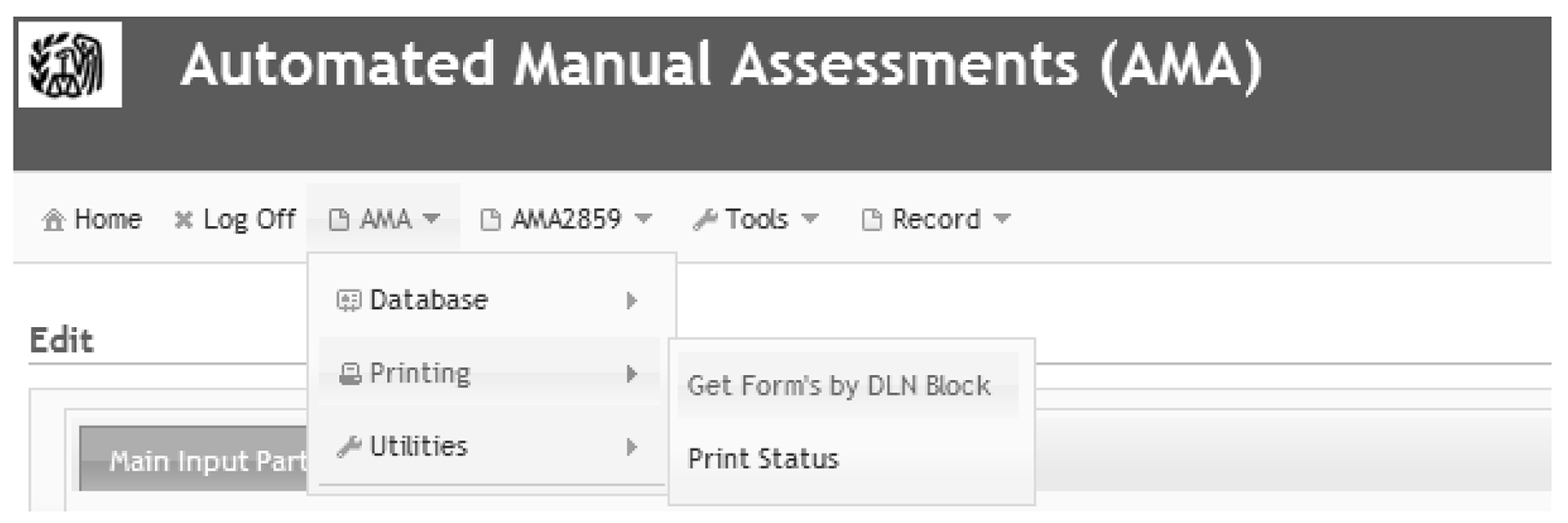
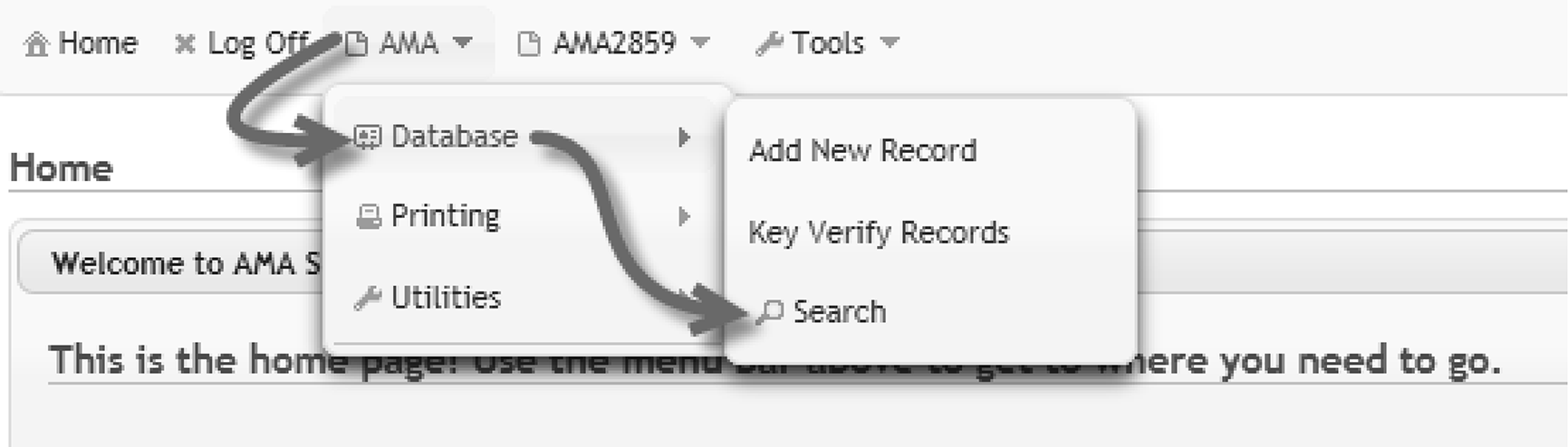
  1. Click on the "Database" icon on the left side of the window.

    Figure 3.17.244-30
    This image is too large to be displayed in the current screen. Please click the link to view the image.

  2. Click on the "Search" button. (The Search Form will appear)

  3. Query the AMA database for the specific DLN to be printed.

  4. To print an individual Form 3552, left click on the small printer icon located to the left of each DLN in the search result as shown below:

    Figure 3.17.244-31
    This image is too large to be displayed in the current screen. Please click the link to view the image.

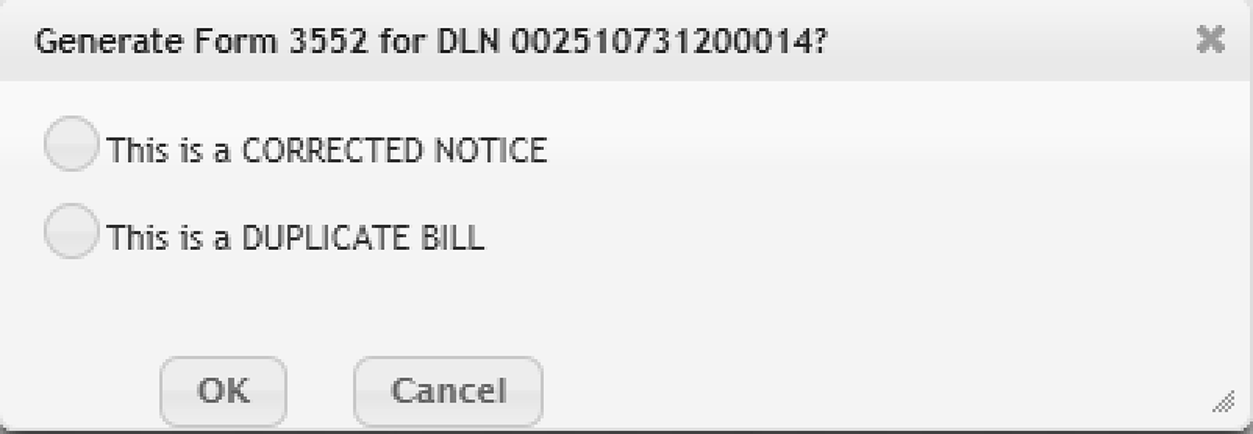
  5. Once selected, the following screen will appear.

    Figure 3.17.244-32
    This image is too large to be displayed in the current screen. Please click the link to view the image.

  6. In addition to printing a single Form 3552, the form can be identified as a "Corrected Notice" , "Duplicate Bill " , or Both.

    Note:

    The "Corrected Notice" and "Duplicate Bill" options are available only during the printing of a single Form 3552.

  7. Check the corresponding box(es). This will cause the system to place the statement on the 3552 directly under the "Tax Period Ended" .

    Note:

    Leaving the Check-Box unchecked will cause the Form 3552 to print without the statement.

  8. Click "OK" to begin printing.

  9. When the designated printer fails to print the Form 3552, the campus must redirect the print traffic to another printer, as described in the AMA Users Guide. There are several things to consider when the print traffic has been redirected.

    • The forms will not be sorted therefore, the operation will have to sort the prints.

    • All parts may not print out so it may be necessary to photocopy the forms.

3.17.244.3.14  (02-01-2011)
Print Form 813

  1. To print Form 813 click on the "Print 813" button.

    Figure 3.17.244-33
    This image is too large to be displayed in the current screen. Please click the link to view the image.

  2. The following Form 813 Print Menu screen will appear.

    Figure 3.17.244-34
    This image is too large to be displayed in the current screen. Please click the link to view the image.

  3. Click on the down arrow in the status box to select, "3552 Printed" .

  4. Click on the down arrow next to the Choose 23C Date.

  5. Highlight the appropriate DLN's.

    Note:

    You can highlight the DLN Block by selecting it with your mouse or navigating to it with your arrow keys and pressing the space bar.

  6. Click on the Generate Report button.

3.17.244.3.15  (02-01-2011)
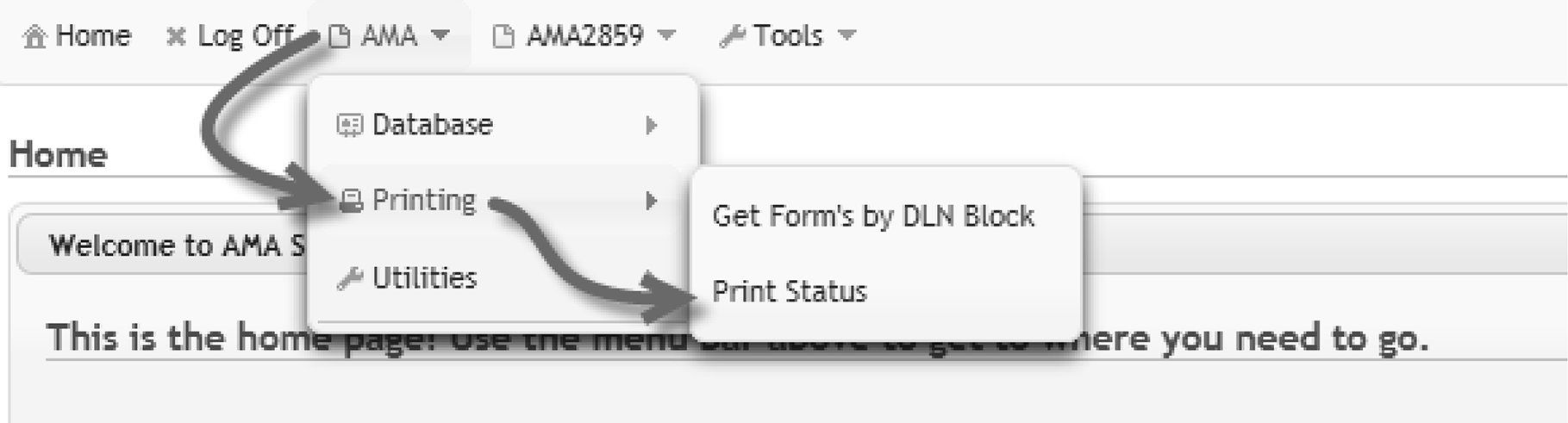
Print Status

  1. Click on the "Print Status" button.

    Figure 3.17.244-35
    This image is too large to be displayed in the current screen. Please click the link to view the image.

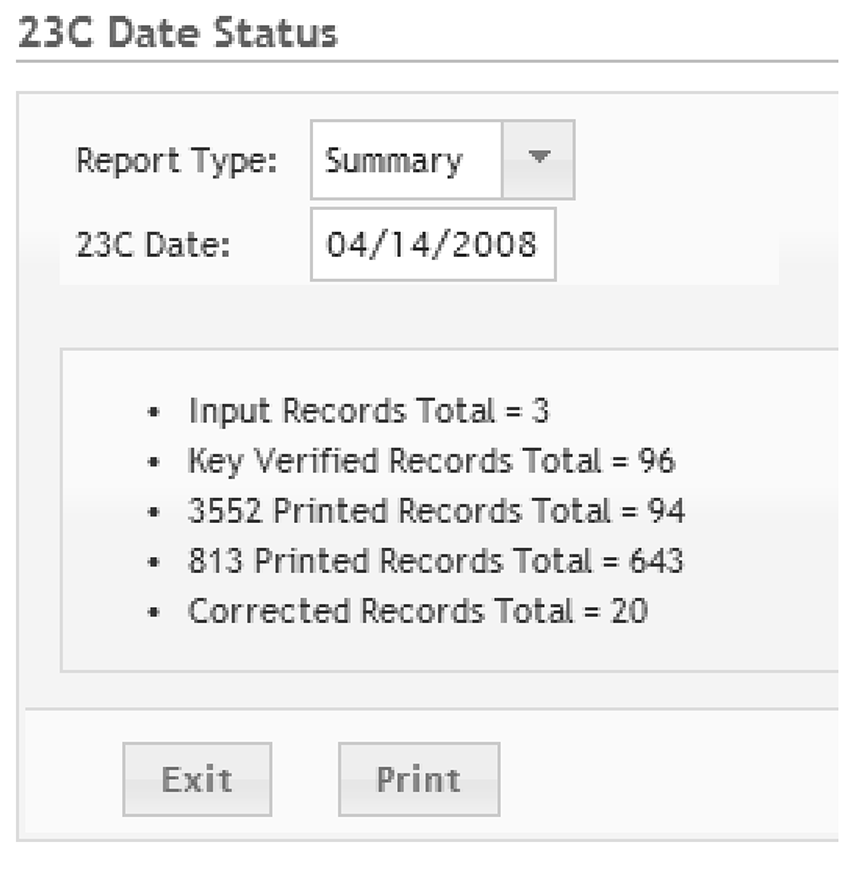
  2. The following screen will appear, "23C Date Status" .

    Figure 3.17.244-36
    This image is too large to be displayed in the current screen. Please click the link to view the image.

  3. Select a "Report Type" from the drop down box.

    • Inventory: a detailed assessment report based on the original input date.

    • Status: a detailed assessment report based on the 23C date. It contains details of each DLN record within each DLN Block for each status in the selected 23C date.

    • Summary: a brief assessment report based on 23C date. It contains a list of each DLN Block with the count of the individual DLN records within each block.

    Figure 3.17.244-37
    This image is too large to be displayed in the current screen. Please click the link to view the image.

  4. After you have selected the report type. You will have a combo box to select the Date. It will then display how many documents were:

    • Input

    • Key Verified

    • 3552 Printed

    • 813 Printed

    • Corrected

    • All

  5. Click on "Print" to print either the inventory, status, or summary report.

3.17.244.4  (02-01-2011)
Corrections of Math Errors on Returns Involving Quick and Prompt Assessments (Form 3552)

  1. If a math error on the return results in an increase of tax, TC 290 should be used with the appropriate penalty and interest codes.

    1. Prepare a new Form 3552 for the additional Assessment and forward to the Revenue Officer, or the requestor.

    2. Enter all appropriate adjustments in Section 02 of Form 3552 for Form 940, Form 941, Form 942, Form 943, Form 944, Form 945, and etc.

  2. If a math error on the return results in a tax, penalty or interest decrease, the requestor of the Assessment must be notified. Forward a copy of the return, and a copy of the Form 3552 to the requestor for abatement action.

3.17.244.4.1  (02-01-2011)
Abating Unpostable Doc Code 51 Assessments
(CSPC NMF Only)

  1. Unpostable Prompt, Quick, or Jeopardy Assessments that cannot be corrected because of incomplete entity information (TIN and Name Control) will be URC 8 Coded to Rejects and processed through Non-Master File (NMF) Accounting.

  2. Rejects will prepare Form 1331-B, Notice of Adjustment and Form 2468, Over Assessment Label. Form 2468 may be attached to source document, if available, or Form 3552. Form 3473, Rejected Document Transmittal, will be prepared to route forms to Accounting.

  3. Accounting will enter NMF 6(51) DLN on Form 3473, Form 3552 (C), and as a cross reference on Form 1331-B.

  4. Route Form 3473 to Rejects. Rejects will code the MF register with the NMF DLN and then release the unpostable condition.

  5. Form 1331-B and Form 2468 will be given a 6(51) DLN and sent to the Scheduling Team for preparation of Form 2188 (Voucher and Schedule of Overpayment and Over Assessment).

  6. Form 3552 will be sent to NMF to be established on the Automated Non-Master File database (do not bill the taxpayer, abatement will follow). Prepare Form 2275 to send to Files with re-file DLN. Form 3552 will be kept in the NMF for backup.

  7. Form 1331-B and Form 2188 will be forwarded to RACS for journalization of the abatement.

  8. RACS will forward 1331-B to NMF to post abatement to the NMF account.

3.17.244.4.2  (11-01-2011)
Civil Penalties
(CSPC NMF Only)

  1. Requests for Civil Penalty Assessments requiring Quick or Prompt action will be received by the NMF Team on Form 8278, Computation and Assessment of Miscellaneous Penalties. A Form 3552, Prompt Assessment Billing Assembly, will be prepared for transfer to the Civil Penalty module on Master File. MFT 55 will be used for IMF Assessments, and MFT 13 for BMF Assessments.

  2. The specific Penalty Reference Number and penalty code section to be assessed will be marked on Form 8278. Each penalty code section has a specific statement that will be used as a stuffer notice, which will be included with the taxpayer notice, Parts 3 and 4 of Form 3552. Transaction Code 290 with a zero money amount will be used for transfer in purposes. The Penalty Reference Number for each specific IRC must be listed with the penalty money amount.

  3. Requests for any joint penalty assessments, in conjunction with a jointly filed frivolous return, will be received on Form 5734, Automated Non-Master File (ANMF) Assessment Voucher. Joint penalty liabilities must be processed through ANMF per IRM 3.17.46.0, Automated Non-Master File Accounting .

  4. Prepare Form 3552 for Civil Penalties.

    1. The first reference line contains the 23C date, TC 290, and zero money amount.

    2. The second reference line contains the literal "Penalty Reference Number" , the Form 8278 Penalty Reference Number and the penalty money amount.

    3. The penalty money amount will be carried forward to the Transfer Balance.

    4. Stuffer statements for explanation of Civil Penalty Assessments on Form 3552. .

3.17.244.4.3  (01-31-2012)
Monthly Form 941 and Form 720

  1. As of January 1, 2012, monthly filing and special deposit procedures are no longer applicable . Revenue Officers must ensure that the monthly filing and/or special deposit procedures are no longer used. Employers must file quarterly Forms 941 beginning with the first quarter of 2012.

  2. The final quarter to be processed using combined Form 941M returns under monthly filing is the period ending December 1, 2011.

  3. Any Forms 941M received beyond 201112 must be returned to the originator.

3.17.244.4.4  (06-21-2012)
Statute of Limitations Expiration Cases (Protective Manual Assessments PMA's)

  1. In Statute of Limitations expiration cases, Assessments may be made without preparing Form 3552 or Form 6335 immediately thereafter.

  2. This may be accomplished by making the Assessment directly from Form 2859, Request for Quick or Prompt Assessment, with source documents. Form 2859 will be numbered and assessed.

    1. After assessment, Form 2859 should be suspended until it is determined by the Statute or Tax Equity Fiscal Responsibility Act (TEFRA) Team that research either substantiated the Assessment or that abatement action is necessary.

    2. If substantiated, prepare Form 3552 or Form 6335 in the normal manner.

    3. If full abatement action is necessary, Form 1331 should be prepared, by the originator, and certified for the amount of the over assessment. Form 1331 should not be sent to the taxpayer. Form 3552 or Form 6335 should not be prepared.

      Note:

      If there is any missing information on the Form 1331, contact the individual submitting the request to obtain the missing information. If the requested information is not received within 3 days, reject the request back to the originator, under cover of a Form 3210. Ensure that the Form 3210 provides the reason for the rejection.

    4. Partial abatements may be handled similarly, except second journals would reflect the portion in process to the Master File or Non-Master File account involved, and the abatement transaction reflected on Form 3552 or Form 6335 prepared from the Form 2859.

    5. If Assessments are not abated or substantiated, follow-up with the requestor within 30 days for a determination. If a response to follow-up is not received within 50 days from the date of Assessment, mail the notice to the taxpayer. This will ensure that statutory notices required on certain types of Assessments are issued to taxpayers within 60 days of the date of the Assessment as outlined in IRM 3.17.46.7, Automated Non-Master File Accounting.

3.17.244.4.5  (02-01-2011)
Dyed Diesel Fuel and Dyed Kerosene Penalty Assessments
(CSPC Only)

  1. The tax imposed by IRC 4081 on diesel fuel and kerosene does not apply to diesel fuel and kerosene that is dyed red under guidelines provided by Treasury Regulations. Generally, dyed diesel fuel and dyed kerosene may not be used for taxable uses, such as use in a highway vehicle that is registered or required to be registered for highway use.

  2. A penalty generally is imposed by IRC 6715 on any person that uses, holds for use, sells, or holds for sale dyed diesel fuel or dyed kerosene for a taxable use. IRC 6715 also imposes a penalty on any person that willfully alters or attempts to alter the dye strength or composition of dyed fuel and on any person that knows such fuel is so altered and sells or holds such fuel for sale for a purpose that person knows to be a taxable purpose.

  3. Fuel Compliance Officers (FCO) are responsible for preparation of Form 8278, Computation and Assessment of Miscellaneous Penalties and Form 2859, Request for Quick or Prompt Assessment. The FCO must obtain group manager approval of the documents and case file before they are forwarded to the Submission Processing Campus for Quick Assessment.

  4. The penalty Assessments will be processed as a "Quick" Assessment (Document Code 51) depending on criteria described in IRM 3.17.244.2.2.

3.17.244.5  (02-01-2011)
Numbering of Manual Assessment Documents for Transfer to the Master File

  1. Number Assessment documents with a transfer-in DLN (using Document Code 51). Prompt, Quick and Jeopardy Assessment transactions will be documented on Form 3552, Prompt Assessment Billing Assembly.

  2. Form 8166, RACS Reconciliation Sheet, Form 813, Document Register, Form 2859, Request for Quick or Prompt Assessment and Form 3552 should be attached together. All Form 3552 should be numbered with Document Code 51 in the blocking series as shown in Exhibit 3.17.244-6.

  3. Check the RACS Reconciliation Sheet for the cycle of the batch of work being released.

    1. Check to identify Form 941-M. If Form 941-M is present, give that batch of work to the technician working them. Do not work the block until the date of the block slip for that particular week comes up. Monthly 941s should be held by the Area Office (Collection Function) until all 3 months have been received. A regular Form 941, Employer's Quarterly Federal Tax Return, is prepared from them and processed as a normal Form 941.

    2. Separate BMF Finals, Prompt and Jeopardy Assessments. Discard the Form 1332, Block and Selection Record, if attached.

  4. W-4 Civil Penalty Assessments, blocking series 139, are single number blocking series. Single number blocking series can only be used once during a day's work. Accumulate these types of Assessments and do not process until the end of the day (in doing so, you can input up to 100 items at a time), at which time you can also prepare the Form 3552.

  5. If a Criminal Investigation cover sheet is attached, do the following:

    1. Remove a carbon copy of Form 2275, Records Request, Charge and Recharge, if attached.

    2. Staple Part 1 of Form 3552, Form 2859, and carbon copy of Form 2275 together and paper clip Form 813 to the front. This goes in for batching and IDRS input.

    3. Detach Form 2547 from the block.

3.17.244.6  (02-01-2011)
Edit Form 3552

  1. Code and edit each Form 3552 in preparation for transcription under IRM 3.24.21, ISRP System, Credit and Account Transfers . Scan the document to assure the accuracy of all items such as: Tax Period, Master File Tax (MFT) Code, Transaction Code, and Transaction Date. For MFT 58 and 78 Social Security Number only, enter the TIN type of "0" . Use a hyphen "0" after the SSN.

  2. Verify name control to the right of "Name Control" on the top of the form.

  3. Verify that the Agreement Date matches the 870 date from Examination or Appeals.

  4. Credit Reduction State and amount MUST be present on Form 3552 with TC 150 when the tax class is 8 and the MFT Code is 10 (BMF, Doc Code 51).

    1. Enter the total taxable Form 940, Employer's Annual Federal Unemployment (FUTA) Tax Return, wages (line 5 Total Taxable Wages).

    2. Enter the Total Amount of Credit Reduction (line 6, Total Credit Reduction) if applicable.

    3. Enter the State Code and Credit Reduction Wage amount for each state when there is a TC 150 (line 6). All states in which wages are paid should be entered whether or not subject to credit reduction for the tax period. Enter zeroes if Credit Reduction Wages are not applicable for the state for the tax period (9312 and prior). See Exhibit 3.11.154–19, for Tax Years and Credit Reduction Rates.

  5. Verify the transaction date of any reversal Transaction Codes listed on Form 3552. For instance, the date for TC 765, TC 767, TC 772, or TC 802 must match the date of the transaction it is attempting to reverse on the Master File. If not the same, line through the date on Form 3552 and change to the correct date.

  6. If TC 636 or 637 is shown on the Form 3552, change to 630 or 632 respectively. Line out transaction date. Enter a two-digit appropriation code "02" for a credit or "03" for a debit on the right side of the reference column.

  7. If the Team is contacted by Unpostable's personnel, direct the inquiry to the requestor of the Assessment.

  8. Use Function Code 420 and Program Code 75600 for Coding and Editing this Form.

3.17.244.7  (02-01-2011)
General Information Mailing Form 3552

  1. After Forms 3552 are printed, they are then prepared for mailing. Several conditions must be considered before mailing each bill. The following list identifies primary considerations to make in mailing Form 3552.

    1. If the Form 2859, Request for Quick or Prompt Assessment, has the words "IRC 6161, IRC 6166 , or STATUS 14" in the remarks area, route the Form 3552 Parts 3, 4, and 5 to the Installment Billing Function. DO NOT mail the bill to the taxpayer or the Power of Attorney.

    2. If the Assessment is a Prompt (including some monthly returns) or Jeopardy, mail Form 3552 Parts 3, 4, and 5 to the requestor of Assessment. DO NOT mail bill to the taxpayer, or to the Power of Attorney, unless the originator has requested that the notice be sent directly to the taxpayer or the Power of Attorney.

    3. If the Assessment is a Jeopardy (Block 100-109) and is for Income, Estate, or Gift taxes, type the following on the bottom of Form 3552: "Assessment made pursuant to Internal Revenue Code 6881. A statutory notice will be issued within 60 days from the date of this form." Follow mailing instructions in (b) above.

    4. If the Assessment is a Jeopardy (block 100-109) and is for other than Income, Estate, or Gift taxes (for example, Employment or Excise taxes), type the following on the bottom of Form 3552, Part 3: " Assessment made pursuant to Internal Revenue Code 6862." Follow mailing instructions in (b) above.

    5. If the Assessment is a Prompt, Quick or Jeopardy, Form 2749 (Trust Fund Recovery Penalty), MFT 55, Penalty Reference Number 618, mail Form 3552, Parts 3, 4, and 5 to the requestor of the Assessment and send a copy of the Form 2749 to the Trust Fund Recovery Team in the CSPC. DO NOT mail bill to the taxpayer or to the Power of Attorney.

  2. If the Assessment is a Quick Assessment without any of the conditions listed above, mail Form 3552, Parts 3 and 4 to the taxpayer. Part 5 should be sent to the requestor unless otherwise specified.

    1. When a Power of Attorney (POA) or a second address is indicated on the Form 2859, Request for Quick or Prompt Assessment, mail a copy of Form 3552 to that POA or second address in addition to the taxpayer.

    2. If the Assessment is made under a section of the Internal Revenue Code that requires the use of a Penalty Reference Number, the Civil Penalty Explanation and reasonable cause statements must be typed. If the Penalty Reference Number is not listed in Exhibit 3.17.244-3 or Exhibit 3.17.244-4, contact your Headquarters IRM analyst for the narrative.

      Note:

      When the Form 3552 is being mailed directly to the taxpayer, a Notice explaining the Civil Penalty Reference Number Assessment must be mailed with the Form 3552. Do Not send the Notice when the Form 3552 is being sent to the POA or to a second address.

    3. For Quick Assessments involving Tax Motivated Transactions (TMT), Reference Numbers 221 and 222 with the appropriate amounts will be entered in Items 20-a and 20-b on Form 2859. These items must be entered into the "Abs. No." field and "Amount" field on Form 3552. The transfer-in process will allow posting of the reference information to Master File through these fields.

3.17.244.7.1  (02-01-2011)
Undeliverable Form 3552

  1. When a Form 3552 is returned undeliverable, research IDRS for a new address. If a new address is found mail the Form 3552 to new address.

  2. If no new address is found, mail Form 3552 out a second time.

  3. If Form 3552 is undeliverable for a second time, send Form 3552 to be associated with the backup for Assessment Documents. This will provide back-up if the taxpayer states at a later date the taxpayer never received the bill.

3.17.244.8  (02-01-2011)
Taxpayer Advocate Case Procedures, National SLA (Service Level Agreement)

  1. The National Taxpayer Advocate has reached agreements with the Commissioners of the Wage & Investment (W&I) Division, Small Business & Self-Employed (SB/SE) Division, Tax Exempt & Government Entities (TE/GE) Division, Criminal Investigation (CI), Appeals, and Large Business and International (LB&I) Division, that outline the procedures and responsibilities for the processing of Taxpayer Advocate Service (TAS) casework when either the statutory or delegated authority to complete case transactions rest outside of TAS. These agreements are known as Service Level Agreements (SLAs).

  2. The SLAs are located at: http://tas.web.irs.gov under the heading "Policy/Procedures/Guidance" .

3.17.244.9  (02-01-2011)
Terms

  1. The following terms are used throughout this section:

    TERM EXPLANATION
    DLN (Document Locator Number) An 11 or 13 digit number assigned to every document.
    Julian Date The number of the day of the year (out of the total days in the year).
    Name Control Consists of no more than four characters and is usually underlined.
    Tax Period A six digit element representing the year and month in which the tax period ended, in most cases.
    TIN (Taxpayer Identification Number) A nine digit number that must be present on all Forms, Returns and Documents received for processing.
    Transaction (Received) Date The transaction date must always be present on a Revenue Receipt document.

3.17.244.10  (02-01-2011)
Service Center Control File (SCCF)

  1. Each document is assigned a Document Locator Number (DLN).

    1. The DLN is established on the SCCF when the document is being processed and remains on the SCCF until either accountability is transferred to Enterprise Computing Center or the document is deleted.

    2. RACS sends Form 813 to the ISRP function to establish the DLN on SCCF.

    3. When the document posts the Form 813 is sent to Data Control for balancing to SCCF on the SCF 11-42 CRL.

  2. For additional procedures, refer to IRM 3.17.30.1, SC Data Controls .

Exhibit 3.17.244-1 
MFT and Penalty Reference Number Table

Penalty Reference Number MFT Code Document Code
292–295 46  
330, 333 02, 12, 34, 44 51, 52
331, 332 02, 34, 44 51, 52
330-333 08 51, 52
324 40 51, 52
346 40 51, 52
350 40 51, 52
352-357 40 51, 52
359-363 40 51, 52
369 40 51, 52
375-377 40 51, 52
500-518 13, 55 51
520-526 13, 55 51
527-528 55 51, 52
530 13, 55 51, 52
537 13,55 51, 52
543 13, 55 51, 52
547-548 13, 55 51
549-550 13, 55 51, 52
551-567, 573, 574, 582-586, 594 13 51, 52
570, 575, 578, 579, 581, 587, 595-599 13, 55 51, 52
584 15 51, 52
600-657 13, 55 51
627 55 52
658 13 51, 52
658-660 55 51
661 13, 55 51
662-663 13 51, 52
662-673 55 51
674-677 13, 55 51
678 13 51
679, 700, 710 55 51, 52
680 01-05, 07, 09-12, 14, 16, 30, 31, 33, 34, 37, 44, 50, 51, 52, 60, 63, 64, 77, 78 51, 52
681 02, 05, 30, 31, 51, 52 51, 52
682 51, 52 51, 52
685 02, 30, 31 51, 52
686 01-05, 07, 09-12, 14, 16, 30, 31, 33, 34, 37, 44, 50, 51, 52, 60, 63, 64, 77, 78 51
687 30 51, 52
689 37, 44, 46, 47 51
870-872 37 51, 52
 

Exhibit 3.17.244-2 
Abstract Numbers

Abstract Numbers Table
MFT Abstract(s)
03 009-024
  026-098
  101-124
  303-310
  322, 323, 324
  326-329
  340–390
  392-398
  411-432
29 160
  162
  194, 195
  221, 222, 233, 235, 236, 237
30 221, 222
31 221, 222
49 163, 164
50 151-154
  182, 183
  213, 214
  221, 222
  237, 238
61 001-009
  013-035
  040
  221, 222
74 165, 167, 169
76 159
  161, 163, 164, 165, 167, 169
  200, 201
  203-206
  209
  224-228
  237
  450, 451, 452
77 218
78 217

Exhibit 3.17.244-3 
Civil Penalty Explanations

Periods 1989 and Later - 50X and 60X Series Penalty Reference Numbers
Reference No. 500 - Internal Revenue Code 6721
We charged a penalty for each Form 1098, 1099, W-2G, or W-2 that you didn't file correctly by the due date (including extensions). The penalty is $15 for each return filed within 30 days after the due date, up to the maximum of $75,000 per year ($25,000 for small businesses), $30 for each return filed more than 30 days after the due date but by August 1, up to a maximum of $150,000 per year ($50,000 for small businesses); or $50 for each return filed after August 1, or for each return not filed. The maximum penalty we can charge is $50 per form, up to $250,000 per year ($100,000 for small businesses).
Reference No. 501 - Internal Revenue Code 6721
We charged a penalty for each Form 1098, 1099, W-2G, or W-2 that you didn't submit on magnetic media as required by IRC 6011(e)(2)(A). The penalty is $50 for each return over 250 that you incorrectly filed on paper. For example, if you filed 300 returns on paper, we should apply the penalty to 50 of them. The maximum penalty we can charge is $50 per form, up to $250,000 per year ($100,000 for small businesses).
Reference No. 502 - Internal Revenue Code 6721
We charged a penalty for each TIN you didn't furnish. The penalty is $50 for each form 1098, 1099, W-2G, or W-2 you submitted with a missing or incorrect TIN. The maximum penalty we can charge is $50 per form, up to $250,000 per year ($100,000 for small businesses).
Reference No. 503 - Internal Revenue Code 6721
We charged a penalty of $50 for each Form 1098, 1099, W-2G, or W-2 that you didn't file in the proper format as outlined in current IRS revenue procedures (or SSA procedures for Form W-2). The maximum penalty we can charge is $50 per form, up to $250,000 per year ($100,000 for small businesses).
Reference No. 504 - Internal Revenue Code 6721
We charged a penalty for each Form 1098, 1099, W-2G, or W-2 that: (1) you didn't file correctly by the due date (including extensions); and (2) you didn't submit on magnetic media as required by IRC 6011(e)(2)(A). See penalty codes 500 and 501 for a complete explanation of the penalties we charged. The maximum penalty we can charge is $50 per form, up to $250,000 per year ($100,000 for small businesses).
Reference No. 505 - Internal Revenue Code 6721
We charged a penalty for each Form 1098, 1099, W-2G, or W-2 that: (1) you didn't file correctly by the due date (including extensions); and (2) you submitted with a missing or incorrect TIN. See penalty code 500 for a complete explanation of the late filing penalty we charged. The maximum penalty we can charge is $50 per form, up to $250,000 per year ($100,000 for small businesses).
Reference No. 506 - Internal Revenue Code 6721
We charged a penalty for each Form 1098, 1099, W-2G, or W-2 that: (1) you didn't file correctly by the due date (including extensions); and (2) you didn't file in the proper format as outlined in current IRS revenue procedures (or SSA procedures for Form W-2 ). See penalty code 500 for a complete explanation of the late filing penalty we charged. The maximum penalty we can charge is $50 per form, up to $250,000 per year ($100,000 for small businesses).
Reference No. 507 - Internal Revenue Code 6721
We charged a penalty of $50 for each Form 1098, 1099, W-2G, or W-2 that: (1) you didn't submit on magnetic media as required by IRC 6011(e)(2)(A), and (2) you submitted with a missing or incorrect TIN. See penalty code 501 for a complete explanation of the magnetic media penalty we charged. The maximum penalty we can charge is $50 per form, up to $250,000 per year ($100,000 for small businesses).
Reference No. 508 - Internal Revenue Code 6721
We charged a penalty of $50 for each Form 1098, 1099, W-2G, or W-2 that: (1) you didn't submit on magnetic media as required by IRC 6011(e)(2)(A), and (2) you didn't file in the proper format as outlined in current IRS revenue procedures (or SSA procedures for Form W-2 ). See penalty code 501 for a complete explanation of the magnetic media penalty we charged. The maximum penalty we can charge is $50 per form, up to $250,000 per year ($100,000 for small businesses).
Reference No. 509 - Internal Revenue Code 6721
We charged a penalty of $50 for each Form 1098, 1099, W-2G, or W-2 that: (1) you submitted with a missing or incorrect TIN, and (2) you didn't file in the proper format as outlined in current IRS revenue procedures (or SSA procedures for Form W-2 ). The maximum penalty we can charge is $50 per form, up to $250,000 per year ($100,000 for small businesses).
Reference No. 510 - Internal Revenue Code 6721
We charged a penalty of $50 for each Form 1098, 1099, W-2G, or W-2 that: (1) you didn't file correctly by the due date (including extensions); (2) you didn't submit on magnetic media as required by IRC 6011(e)(2)(A), and (3) you submitted with a missing or incorrect TIN. See penalty codes 500 and 501 for a complete explanation of the penalties we charged. The maximum penalty we can charge is $50 per form, up to $250,000 per year ($100,000 for small businesses).
Reference No. 511 - Internal Revenue Code 6721
We charged a penalty for each Form 1098, 1099, W-2G, or W-2 that: (1) you didn't file correctly by the due date (including extensions), (2) you didn't submit on magnetic media as required by IRC 6011(e)(2)(A), and (3) you didn't file in the proper format as outlined in current IRS revenue procedures (or SSA procedures for Form W-2). See penalty codes 500 and 501 for a complete explanation of the penalties we charged. The maximum penalty we can charge is $50 per form, up to $250,000 per year ($100,000 for small businesses).
Reference No. 512 - Internal Revenue Code 6721
We charged a penalty for each Form 1098, 1099, W-2G, or W-2 that: (1) you didn't file correctly by the due date (including extensions); (2) you submitted with a missing or incorrect TIN; and (3) you didn't file in the proper format as outlined in current IRS revenue procedures (or SSA procedures for Form W-2). See penalty codes 500, 502, and 503 for a complete explanation of the penalties we charged. The maximum penalty we can charge is $50 per form, up to $250,000 per year ($100,000 for small businesses).
Reference No. 513 - Internal Revenue Code 6721
We charged a penalty of $50 for each Form 1098, 1099, W-2G, or W-2 that: (1) you didn't submit on magnetic media as required by IRC 6011(e)(2)(A); (2) you submitted with a missing or incorrect TIN; and (3) you didn't file in the proper format as outlined in current IRS revenue procedures (or SSA procedures for Form W-2). See penalty code 501 for a complete explanation of the penalties we charged. The maximum penalty we can charge is $50 per form, up to $250,000 per year ($100,000 for small businesses).
Reference No. 514 - Internal Revenue Code 6721
We charged a penalty for each Form 1098, 1099, W-2G, or W-2 that: (1) you didn't file correctly by the due date (including extensions); (2) you didn't submit on magnetic media as required by IRC 6011(e)(2)(A); (3) you didn't file in the proper format as outlined in current IRS revenue procedures (or SSA procedures for Form W-2); and (4) you submitted with a missing or incorrect TIN. See penalty codes 500, 501, 502, and 503 for a complete explanation of the penalties we charged. The maximum penalty we can charge is $50 per form, up to $250,000 per year ($100,000 for small businesses).
Reference No. 527 (IMF only) - Internal Revenue Code 6652 - Failure to Provide Public Inspection of Application
We charged you a penalty under IRC 6652(c)(1)(D) for failure to provide public inspection of the organization's application for exemption or notice of status filed under IRC 527(i). The requirement to provide public inspection is contained in IRC 6104(d). The penalty is $20 a day for each day the failure continues.
Reference No. 528 (IMF only) - Internal Revenue Code 6652 - Failure to Provide Public Inspection of Annual Return
We charged you a penalty under IRC 6652(c)(1)(C) for failing to provide public inspection of the organization’s annual return or report required under IRC 527(j). The requirement to provide public inspection is contained IRC 6104(d). The penalty is $20 a day for each day the failure continues, not to exceed $10,000 for any one return or report.
Reference No. 537 - Internal Revenue code 6721(e) - Failure to File correct Information Returns - Intentional Disregard
We assessed you a penalty under Internal Revenue code section 6721(e) for failure to file correct information returns due to intentional disregard. The amount of the penalty for each failure is $100, or, if greater, one of the following amounts:
10 percent of the aggregate amount of the items required to be reported correctly in the case of a return other than a return required by sections 6045(a), 6041A(b), 6050H, 6050I, 6050J, 6050K, or 6050L;or
5 percent of the aggregate amount of the items required to be reported correctly in the case of a return required by sections 6045(a), 6050K, or 6050L; or
The greater of $25,000 or the amount of cash, as defined by section 6050I(d), received in a transaction to the extent the amount of such cash does not exceed $100,000 in the case of a return required to be filed under section 6050I(a) with respect to the transaction; or
10 percent of the value of the benefit of any contract with respect to which information is required to be included on a return in the case of a return required to be filed under section 6050V.
If you agree with the assessment of this penalty, pay the balance due within ten (10) days from the date of this notice.
Reference No. 543 - Internal Revenue Code 6702 - Civil Penalty for Specified Frivolous Submissions
We charged you a penalty under IRC 6702(b) for submitting a specified frivolous submission. The penalty applies when any portion of a specified submission
1. is based on a position which the Internal Revenue Service has identified as frivolous pursuant to IRC 6702(c), or
2. reflects a desire to delay or impede the administration of Federal tax laws.
The penalty is $5,000 for each specified frivolous submission.
Reference No. 549 - Internal Revenue Code 6721 - Failure to File W-2s with Intentional Disregard (CAWR Penalty Program - See IRM 4.19.4.8, CAWR Reconciliation Balancing )
A penalty has been charged for each Form W-2 that was not filed as required by Section 6051 of the Internal Revenue Code. Our records indicate that both the Social Security Administration and the Internal Revenue Service have been in contact with you to attempt to secure these Form W-2. The penalty for intentional disregard of the filing requirements is the greater of $100 per required return or 10 percent of the aggregate amount of items required to be reported.
Reference No. 550 - Internal Revenue Code 6721 - Failure to File Form W-2 on Time
We charge this penalty for each Form W-2 that you filed after the due date (including extensions). The penalty is $15 per W-2 filed within 30 days after the due date, up to a maximum of $75,000 per year ($25,000 for small businesses); $30 per W-2 filed more than 30 days after the due date but by August 1, up to a maximum of $150,000 per year ($50,000 for small businesses), or; $50 per W-2 filed after August 1, up to a maximum of $250,000 per year ($100,000 for small businesses).
Lower Maximum Penalties for Small Businesses - If your penalty is more than the maximum for small businesses, we'll reduce it if you prove that you're a small business. We define a small business as a business with average gross receipts of $5 million or less for the three most recent tax years (or period in existence, if less) ending before the calendar year when the Form W-2 were due. For example, if we charge a penalty for 1991 Form W-2 due in 1992, the three most recent tax years are 1989, 1990 and 1991.
If you have questions about filing requirements for Form W-2 or the applicable penalties, please refer to the instructions for Form W-2.
You have 21 days (10 work days if $100,000 or more) to pay the full amount you owe before additional interest and failure to pay penalties will be applied. Interest is compounded daily on the total amount still owed.
Reference No. 551 - Internal Revenue Code 6720B - Fraudulent Identification of Exempt Use Property under Section 170(e)(7)(C)
We charged you with a penalty under Internal Revenue Code section 6720B for fraudulently identifying a property as an applicable property for an exempt use as defined under section 170(e)(7)(C). The penalty is $10,000 for such an identification made after August 17, 2006.
Reference No. 552 - Failure to File Returns and Reports Relating to Certain Trusts and Annuity Plans Required under IRC Section 6047(d) – Form 1096 or 1099-R
We charged you a penalty under IRC section 6652(e) for failure to file returns and reports relating to certain trusts and annuity plans under IRC section 6047(d). The Form 1096 (Annual Summary and Transmittal of U.S. Information Returns) and Form 1099-R (Distributions From Pensions, Annuities, Retirement or Profit-Sharing Plans, IRA’s, Insurance Contracts, etc.), were designated by the Service as the forms to be used for satisfying the requirements.
The amount of the penalty is $25 per failure for each day during which such failure continues, but not to exceed $15,000.
For a detailed calculation of the penalty, please refer to the penalty calculation worksheet provided to you at the conclusion of the penalty investigation.
If you agree with the penalty assessment, please send the amount due now.
If you believe any such failure was due to reasonable cause, you can appeal this assessment, without paying the penalty, by sending us an explanation within 10 days from the date of this notice.
If you wish to contest the assessment of this penalty on any other grounds or after the 10 day period has run, you must first fully pay the entire penalty and then file a claim for refund with the IRS.
If your refund claim is pending for six months or more and the IRS has not issued a notice of claim disallowance with regard to the claim, you may file suit in the United States District Court or United States Court of Federal Claims to contest the assertion of the penalty at any time. Once the IRS issues a notice of claim disallowance, however, you must file suit in the United States District Court or the United States Court of Federal Claims within two years of the date the IRS mails the notice of disallowance to you denying the refund claim.
Reference No. 553 - Internal Revenue Code 6693(a)(2)(B) - Failure to File a Report Relating to Archer MSAs Required under IRC 220(h)
We charged you with a penalty under Internal Revenue Code section 6693(a)(2)(B) for failure to provide reports relating to Archer Medical Savings Accounts in the manner required under IRC 220(h). The amount of the penalty is $50 for each failure. There is no maximum amount of penalty.
Reference No. 554 - Internal Revenue Code 6693(a)(2)(C) - Failure to File a Report Relating to Health Savings Accounts Required under Section 223(h)
We charged you with a penalty under Internal Revenue Code section 6693(a)(2)(C) for failure to file a report relating to health savings accounts in the manner required under IRC 223(h). The amount of the penalty is $50 for each failure. There is no maximum amount of penalty.
Reference No. 555 - Internal Revenue Code 6693(a)(2)(D) Failure to File a Report Relating to Qualified Tuition Programs Required under Section 529(d)
We charged you with a penalty under Internal Revenue Code section 6693(a)(2)(D) for failure to provide a report relating to qualified tuition programs in the manner required under Section 529(d). The amount of the penalty is $50 for each failure. There is no maximum amount of penalty.
Reference No. 556 - Internal Revenue Code 6693(a)(2)(E) - Failure to File a Report Relating to Coverdell Education Savings Accounts Required under Section 530(h)
We charged you with a penalty under Internal Revenue Code section 6693(a)(2)(E) for failure to provide a report relating to Coverdell Education Savings Accounts in the manner required by IRC 530(h). The amount of the penalty is $50 for each failure. There is no maximum amount of penalty.
Reference No. 557 - Internal Revenue Code 6693(b)(1) - Failure to Furnish Information Relating to Nondeductible Contributions Required by IRC 408(o)(4)
We charged you with a penalty under Internal Revenue Code section 6693(b)(1) for failure to furnish information in the manner required under IRC 408(o)(4) as to the amount of designated nondeductible contributions made for a taxable year. The amount of the penalty is $100 for each failure. There is no maximum amount of penalty.
Reference No. 558 - Internal Revenue Code 6693(b)(2) - Failure to File a Form Relating to Nondeductible Contributions Required by IRC Sec. 408(o)(4)
We charged you with a penalty under Internal Revenue Code section 6693(b)(2) for failure to furnish information relating to nondeductible contributions required under IRC 408(o)(4). The amount of the penalty is $50 for each failure. There is no maximum amount of penalty.
Reference No. 559 - Internal Revenue Code 6716(a) - Failure of the Executor to Make a Return Required under Internal Revenue Code Section 6018 Relating to Large Transfers at Death and Gifts
We charged you with a penalty under Internal Revenue Code section 6716(a) for failure to furnish information required by Code section 6018, other than 6018(b)(2), relating to large transfers at death and gifts. The amount of the penalty is $10,000 for each failure. There is no maximum amount of penalty. This penalty and the requirements set forth in IRCs 6018 and 6019 are applicable only to estates of decedents dying between January 1, 2010 and December 31, 2010.
Reference No. 560 - Internal Revenue Code 6716(a) - Failure to Furnish Information Required by Internal Revenue Code Section 6018(b)(2) Relating to Certain Transfers of Gifts Received by Decedent Within 3 Years of Death
We charged you with a penalty under Internal Revenue Code (IRC) section 6716(a) for failure to furnish information required by Code section 6018(b)(2) relating to certain transfers of gifts received by decedent within three years of death. The amount of the penalty is $500 for each failure. There is no maximum amount of penalty. This penalty and the requirements set forth in IRCs 6018 and 6019 are applicable only to estates of decedents dying between January 1, 2010 and December 31, 2010.
Reference No. 561 - Internal Revenue Code 6716(b) - Failure to Furnish Information Required by Internal Revenue Code Section 6018(e) or 6019(b) Relating to Certain Transfers at Death and Gifts
We charged you with a penalty under Internal Revenue Code (IRC) section 6716(b) for failure to furnish information to beneficiaries required by Code section 6018(e) or 6019(b), relating to certain transfers at death and gifts. The amount of the penalty is $50 for each failure. There is no maximum amount of penalty. This penalty and the requirements set forth in IRCs 6018 and 6019 are applicable only to estates of decedents dying between January 1, 2010 and December 31, 2010.
Reference No. 562 - Internal Revenue Code 6716(d) - Failure to Furnish Information Required by Internal Revenue Code Section 6018 or 6019 Relating to Certain Transfers at Death and Gifts - Intentional Disregard
We charged you with a penalty under Internal Revenue Code (IRC) section 6716(d) due to intentional disregard for failure to furnish information required by Code section 6018 or 6019 relating to certain transfers at death and gifts. This penalty and the requirements set forth in IRCs 6018 and 6019 are applicable only to estates of decedents dying between January 1, 2010 and December 31, 2010.
The amount of the penalty is five percent of the fair market value of the transferred property for each failure. There is no maximum amount of penalty.
Reference No. 563 - Internal Revenue Code 6720C - Penalty for Failure to Notify Health Plan of Cessation of Eligibility for COBRA Premium Assistance
We charged you a penalty under Internal Revenue Code section 6720C for not notifying your group health plan that you no longer qualify for COBRA (Consolidated Omnibus Budget Reconciliation Act of 1985) premium assistance. When receiving COBRA premium assistance you are required to notify your group health plan in writing when you:
  • Become eligible for benefits under Medicare. or

  • Become eligible for coverage under any other group health plan. You are not required to notify your group health plan if the coverage: Consists only of dental, vision, counseling, or referral services (or a combination of such services); Is under a flexible spending arrangement; or is for treatment furnished in an on-site, employer maintained medical facility that consists primarily of first-aid services, prevention and wellness care, or similar care (or a combination of such care).


The penalty we charged you equals 110 percent of the total amount your health care payment was reduced during the time you were not eligible for COBRA premium assistance. Please pay the penalty within ten (10) days from the date of this notice.
You may request that the penalty be reduced or removed if you believe there were justifiable reasons for your actions. To do so, prepare a statement providing the reasons. Sign and date the statement and send it to us within ten (10) days from the date of this notice.
You may pay the penalty, even if you do not think it is justified, and then file a claim for refund using Form 843, Claim for Refund and Request for Abatement. If you pay the penalty and file a claim for refund, and more than six months goes by without the IRS denying your claim, you may file a case in United States district court or the United States Court of Federal Claims to object to the penalty charge at any time. Once the IRS disallows your claim, however, you must file your case in United States district court or the United States Court of Federal Claims within two years of the date on the IRS notice.
Reference No. 564 - Internal Revenue Code 6685 - Willful Failure to Make Available for Public Inspection as Required by IRC Sec. 6104(d) a Return or Application
We charged you a penalty under IRC 6685 for willful failure to make available for public inspection as required by IRC 6104(d) a return or application. The penalty is $5,000 for each failure. There is no maximum amount of penalty.
Reference No. 565 - Internal Revenue Code 6676 - Penalty for Erroneous Claim for Refund or Credit
We charged you a penalty under Internal Revenue Code section 6676 for the following reason:
Filing an erroneous claim for refund or credit for an excessive amount for which there is no reasonable basis.
The penalty is equal to 20 percent of the excessive amount. The excessive amount is the amount by which your claim for refund or credit exceeds the amount allowable for such taxable year. For a detailed calculation of the penalty, please refer to the penalty calculation worksheet provided to you at the conclusion of the penalty investigation.
If you wish to contest the assessment of this penalty, you must fully pay the entire penalty and file a claim for refund with the IRS.
If your refund claim is pending for six months or more and the IRS has not issued a notice of claim disallowance with regard to the claim, you may file suit in the United States District Court or United States Court of Federal Claims to contest the penalty at any time. Once the IRS issues a notice of claim disallowance, however, you must file suit in the United States District Court or the United States Court of Federal Claims within two years of the date the IRS mails a notice of disallowance to you denying the refund claim.
If you agree with the penalty assessment, please send the balance due now. We have enclosed an envelope for your convenience.
Reference No. 566 - Internal Revenue Code 6684 - Assessable Penalties With Respect To Liability For Tax Under Chapter 42 Relating to Private Foundations and Certain Other Tax-Exempt Organization
We charged you a penalty under IRC 6684 with respect to your tax liability under Chapter 42 (which relates to private foundations and certain other tax-exempt organizations.) The penalty equals, and is in addition to, the amount of tax imposed under Chapter 42. There is no maximum amount of penalty.
Reference No. 567 - Internal Revenue Code 6711 - Failure by Tax-Exempt Organization to Disclose Certain Information or Service Available from Federal Government – Intentional Disregard
We charged you a penalty under IRC 6711 due to intentional disregard of the requirement to make an express statement to any individual that the information or routine service you offer to sell (or solicit money for) can be obtained from the Federal Government for free (or for a nominal charge).
The penalty is the greater of:
(1) $1,000 per day, for each day you failed to make the required statement, or
(2) 50 percent of the daily combined cost of all the offers and solicitations for which there has been a failure to make a required statement.
There is no maximum amount of penalty.
Reference No. 570 - Internal Revenue Code 6689 - Failure to File Notice of Redetermination of Foreign Tax Required by IRC 905(c)
We charged you a penalty under IRC 6689 for failure to notify the Internal Revenue Service of a foreign tax redetermination as required by IRC 905(c). The amount of penalty is 5 percent of the deficiency attributable to the redetermination if the failure is for not more than one month, with an additional 5 percent of the deficiency for each month (or fraction thereof) during which the failure continues, not to exceed 25 percent of the deficiency.
If you agree with the assessment of this penalty, pay the balance due within ten (10) days from the date of this notice.
If you believe you have reasonable cause and want to contest this assessment, please send an explanation within 10 days from the date of Form 3552. Otherwise, you should send the amount shown on the form.
Reference No. 573 - Internal Revenue Code 6693 - Failure to Furnish Certain Information to Participants in SIMPLE IRA Plans Required by IRC 408(l)(2)
We charged you, as an employer, trustee or issuer, a penalty under IRC 6693(c) for failure to furnish certain information to participants in SIMPLE IRA plans required by IRC 408(i), 408(l)(2)(B), or 408(l)(2)(C).
The amount of the penalty is $50 per failure for each day during which such failure continues. There is no maximum amount of penalty.
Reference No. 574 - Internal Revenue Code 6653 - Willful Failure to Pay, Evade or Defeat Stamp Tax
We assessed you a penalty under IRC 6653 for willful failure to pay or a willful attempt to evade or defeat stamp tax. The amount of penalty for each failure equals 50 percent of the total amount of the underpayment of the tax.
Reference No. 575 - Internal Revenue Code 6674 - Fraudulent Statement or Willful Failure to Furnish Statement to Employee
We assessed you a penalty under IRC 6674 for willfully furnishing a false or fraudulent statement, or willfully failing to furnish a statement to an employee as required under either IRC 6051 or 6053(b). The amount of penalty is $50 for each failure.
Reference No. 578 - Internal Revenue Code 6709(a)- Civil Penalty with Respect to Mortgage Credit Certificates – Negligence
We assessed you a penalty under IRC 6709(a) for making a material and negligent misstatement in a verified written statement made under penalties of perjury with respect to the issuance of a mortgage credit certificate.
The amount of penalty is $1,000 for each mortgage credit certificate to which this misstatement relates.
Reference No. 579 - Internal Revenue Code 6709(b) - Civil Penalty with Respect to Mortgage Credit Certificates – Fraud
We assessed you a penalty under IRC 6709(b) for making a material and fraudulent misstatement in a verified written statement made under penalties of perjury with respect to the issuance of a mortgage credit certificate.
The amount of penalty is $10,000 for each mortgage credit certificate to which the misstatement relates.
Reference No. 580 - Internal Revenue Code 6709(c) - Penalty for Failure to Timely File Report Relating to Mortgage Credit Certificate Required under IRC 25(g)
We assessed you a penalty under IRC 6709(c) for failure to timely file a report required under IRC 25(g) with respect to a mortgage credit certificate.
The amount of penalty is $200 for each failure but not to exceed $2,000.
Reference No. 581 - Internal Revenue Code 6695A - Substantial and Gross Valuation Misstatements Attributable to Incorrect Appraisals
We charged you a penalty under IRC 6695A for substantial and gross valuation misstatements attributable to your incorrect appraisals.
The amount of the penalty shall be equal to the lesser of-
(1) the greater of— (A) 10 percent of the amount of the underpayment attributable to the misstatement, or (B) $1,000, or
(2) 125 percent of the gross income received from the preparation of the appraisal.
For a detailed calculation of the penalty, refer to the penalty calculation worksheet provided to you at the conclusion of the penalty investigation.
You can appeal this assessment by sending us an explanation of why you believe this assessment is improper within 10 days from the date of this notice.
If you agree with the penalty assessment, please send the amount due now.
If you otherwise wish to contest the assessment of this penalty, you must first fully pay the entire penalty and then file a claim for refund with the IRS within three years from the date the penalty is paid.
If your refund claim is pending for six months or more and the IRS has not issued a notice of claim disallowance with regard to the claim, you may file suit in the United States District Court or United States Court of Federal Claims to contest the assertion of the penalty at any time. Once the IRS issues a notice of claim disallowance, however, you must file suit in the United States District Court or the United States Court of Federal Claims within two years of the date the IRS mails a notice of disallowance to you denying the refund claim.
Reference No. 582 - Internal Revenue Code 6697 - Penalty with Respect to Tax Liability of Regulated Investment Company
We assessed you a penalty under IRC 6697 in an amount equal to the amount of interest attributable to a deemed increase in tax determined under IRC 860(c)(1)(A), not to exceed one-half of the deduction allowed under IRC 860(a).
Reference No. 583 - Failure to File a Registration Statement by Pension Plan Required under IRC Sec. 6057(a)
We charged you a penalty under IRC section 6652(d)(1) for failure to file a registration statement required under IRC section 6057(a). The amount of the penalty for each failure is $1 for each participant with respect to whom there is a failure to file, multiplied by the number of days during which such failure continues. The maximum amount of penalty imposed on any person for failure to file with respect to any plan year shall not exceed $5,000.
For a detailed calculation of the penalty, refer to the penalty calculation worksheet provided to you at the conclusion of the penalty investigation.
If you agree with the penalty assessment, please send the amount due now.
If you believe any such failure was due to reasonable cause, you can appeal this assessment by sending us an explanation within 10 days from the date of this notice.
If you wish to contest the assessment of this penalty, you must first fully pay the entire penalty and then file a claim for refund with the IRS.
If your refund claim is pending for six months or more and the IRS has not issued a notice of claim disallowance with regard to the claim, you may file suit in the United States District Court or United States Court of Federal Claims to contest the assertion of the penalty at any time. Once the IRS issues a notice of claim disallowance, however, you must file suit in the United States District Court or the United States Court of Federal Claims within two years of the date the IRS mails a notice of disallowance to you denying the refund claim.
Reference No. 584 - Failure to File a Notification by Pension Plan Required under IRC Section 6057(b)
We charged you a penalty under IRC section 6652(d)(2) for failure to file a notification required under IRC section 6057(b). The amount of the penalty for each failure is $1 for each day during which such failure continues. The maximum amount of penalty shall not exceed $1,000.
For a detailed calculation of the penalty, refer to the penalty calculation worksheet provided to you at the conclusion of the penalty investigation.
If you agree with the penalty assessment, please send the amount due now.
If you believe any such failure was due to reasonable cause, you can appeal this assessment by sending us an explanation within 10 days from the date of this notice.
If you wish to contest the assessment of this penalty, you must first fully pay the entire penalty and then file a claim for refund with the IRS.
If your refund claim is pending for six months or more and the IRS has not issued a notice of claim disallowance with regard to the claim, you may file suit in the United States District Court or United States Court of Federal Claims to contest the assertion of the penalty at any time. Once the IRS issues a notice of claim disallowance, however, you must file suit in the United States District Court or the United States Court of Federal Claims within two years of the date the IRS mails a notice of disallowance to you denying the refund claim.
Reference No. 585 - Failure to Give Notice to Recipients of Certain Pension, etc. Required under Sec. 3405(e)(10)(B)
We charged you a penalty under IRC section 6652(h) for failure to provide notice as required by IRC section 3405(e)(10)(B). The amount of the penalty is $10 for each failure, but not to exceed $5,000 for all such failures during any calendar year.
For a detailed calculation of the penalty, refer to the penalty calculation worksheet provided to you at the conclusion of the penalty investigation.
If you agree with the penalty assessment, please send the amount due now.
If you believe any such failure was due to reasonable cause and not willful neglect, you can appeal this assessment by sending us an explanation within 10 days from the date of this notice.
If you wish to contest the assessment of this penalty, you must first fully pay the entire penalty and then file a claim for refund with the IRS.
If your refund claim is pending for six months or more and the IRS has not issued a notice of claim disallowance with regard to the claim, you may file suit in the United States District Court or United States Court of Federal Claims to contest the assertion of the penalty at any time. Once the IRS issues a notice of claim disallowance, however, you must file suit in the United States District Court or the United States Court of Federal Claims within two years of the date the IRS mails a notice of disallowance to you denying the refund claim.
Reference No. 586 - Failure to Give a Written Explanation to Recipients Required by IRC Sec. 402(f)
We charged you a penalty under IRC section 6652(i) for failure to timely provide a written explanation as required by IRC section 402(f). The amount of the penalty is $100 for each failure, but not to exceed $50,000 for all such failures during any calendar year.
For a detailed calculation of the penalty, refer to the penalty calculation worksheet provided to you at the conclusion of the penalty investigation.
If you agree with the penalty assessment, please send the amount due now.
If you believe any such failure was due to reasonable cause and not willful neglect, you can appeal this assessment by sending us an explanation within 10 days from the date of this notice.
If you wish to contest the assessment of this penalty, you must first fully pay the entire penalty and then file a claim for refund with the IRS.
If your refund claim is pending for six months or more and the IRS has not issued a notice of claim disallowance with regard to the claim, you may file suit in the United States District Court or United States Court of Federal Claims to contest the assertion of the penalty at any time. Once the IRS issues a notice of claim disallowance, however, you must file suit in the United States District Court or the United States Court of Federal Claims within two years of the date the IRS mails a notice of disallowance to you denying the refund claim.
Reference No. 587 - Internal Revenue Code 6652(j) - Failure to File Certification with Respect to Certain Residential Rental Projects
We charged you a penalty under IRC 6652(j) for failure to timely provide a certification as required by section 142(d)(7). The amount of the penalty is $100 for each failure during any calendar year. There is no limitation on penalty amount imposed under this section.
Reference No. 588 - Internal Revenue Code 6652(k) - Failure to Make Reports Required under Section 1202
We charged you a penalty under IRC 6652(k) for failure to timely make a report required under section 1202(d)(1)(C). The amount of the penalty is $50 for each failure. If the failure is due to negligence or intentional disregard, the amount of penalty is $100 per each failure. If a report covering periods in two or more years, the amount of penalty shall be multiplied by the number of such years. There is no limitation on penalty amount imposed under this section.
Reference No. 589 - Internal Revenue Code 6652(c)(2)(C)(ii) - Failure to File a Return by a Split-Interest Trust with Gross Income in Excess of $250,000 Required under IRC Sec. 6034(a)
We charged you a penalty under IRC 6652(c)(2)(C)(ii) for failure to timely file a return required under IRC 6034(a). The amount of the penalty for each failure is $100 for each day during which such failure continues. The maximum amount of penalty with respect to one return shall not exceed $50,000.
Reference No. 590 - Internal Revenue Code 6652(a) - Failure to File Returns with Respect to Certain Payment Aggregating Less Than $10 Required under IRC Sec. 6042(a)(2) or 6044(a)(2)
We charged you a penalty under IRC 6652(a) for failure to file a statement of a payment to another person required under the authority of –
(1) section 6042(a)(2) relating to payments of dividends aggregating less than $10, or
(2) section 6044(a)(2) relating to payments of patronage dividends aggregating less than $10.
The amount of the penalty shall be $1 for each statement not filed but the total penalty for all such failures during the calendar year shall not exceed $1,000.
Reference No. 591 - Internal Revenue Code 6652(c)(1)(B)(ii) - Failure to Comply with Demand by Managers of Exempt Organizations or Trusts Required under IRC Sec. 6033(a)(1) or 6012(a)(6)
We charged you a penalty under IRC 6652(c)(1)(B)(ii) for failure to comply with the written demand made by the Secretary on or before the date specified in such demand, due to your failure as a manager to file a return required or to include the information required under IRC 6033(a)(1) or 6012(a)(6). The amount of the penalty for each failure is $10 for each day after the expiration of the time specified in such demand, during which such failure continues. The maximum amount of penalty with respect to one return shall not exceed $5,000.
Reference No. 592 - Internal Revenue Code 6652(c)(2)(B) - Failure to Comply with Demand by Managers of Exempt Organizations or Trusts Required under IRC Sec. 6034 or 6043(b)
We charged you a penalty under IRC 6652(c)(2)(B) for failure to comply with the written demand made by the Secretary on or before the date specified in such demand, for your failure as a manager to file a return required under section 6034 or 6043(b). The amount of the penalty for each failure is $10 for each day after the expiration of the time specified in such demand during which such failure continues. The maximum amount of penalty for failure to file any one return shall not exceed $5,000.
Reference No. 593 - Internal Revenue Code 9707 - Failure to Pay Premium
We charged you with a penalty under Internal Revenue Code section 9707 for failure to pay premiums or installments required by Internal Revenue Code section 9704 and/or for failure to make contributions required under section 402(h)(5)(B)(ii) of the Surface Mining Control and Reclamation Act of 1977 to a plan referred to in section 402(h)(2)(C) of such Act.
The penalty is $100 per day beginning on the due date of such premiums or installments and ending on the date of payment. There is no limitation on or maximum amount for this penalty. Absent the required payment, the penalty continues to accrue.
Reference No. 595 - Internal Revenue Code 6038, 6038A, 6038B, 6039F, 6677 and/or 6679- Failure to File Required Information Returns – 5 percent
We charged you a penalty for failure to timely notify the Internal Revenue Service of one or more various activities related to foreign bank accounts/entities as required by the Internal Revenue Code (IRC) or by the United States Code (USC) as described below. The amount of the penalty is 5 percent of the highest aggregate account/asset value in all foreign bank accounts/entities for the tax year.
IRC 6038 relates to filing Form 5471, Information Return of U.S. Persons with Respect to Certain Foreign Corporations, with the required schedules and/or filing Form 8865, Return of U.S. Persons with Respect to Certain Foreign Partnerships, with the required schedules.
IRC 6038A relates to filing Form 5472, Information Return of a 25percent Foreign-Owned U.S. Corporation or a Foreign Corporation Engaged in a U.S. Trade or Business, as well as record maintenance requirements with respect to certain foreign owned corporations.
IRC 6038B relates to filing Form 926, Return by a U.S. Transferor of Property to a Foreign Corporation, and/or filing Form 8865, Return of U.S. Persons with Respect to Certain Foreign Partnerships, Schedule O, Transfers of Property to a Foreign Partnership.
IRC 6039F relates to filing Form 3520, Annual Return to Report Transactions With Foreign Trusts and Receipt of Certain Foreign Gifts.
IRC 6677 also relates to filing Form 3520 and/or filing Form 3520-A, Annual Return of Foreign Trust With a U.S. Owner.
IRC 6679 relates to filing Form 5471, Schedule O, Organization or Reorganization of Foreign Corporation and Acquisitions and Dispositions of its Stock and/or filing Form 8865, Schedule P, Acquisitions, Dispositions, and Changes of Interests in a Foreign Partnership.
31 USC sections 5321(a)(5), 5322(a) and/or 5322(b) relate to filing Form TD F 90-22.1, Report of Foreign Bank and Financial Accounts.
For a detailed calculation of the penalty, refer to the penalty calculation worksheet provided to you at the conclusion of the penalty investigation.
Based on the terms of the closing agreement entered into with the Commissioner of Internal Revenue, you may not contest the assessment of this penalty.
If the Tax Summary on page 1 of this notice does not show a Balance due, there is nothing more you need to do.
If the Tax Summary on page 1 shows a Balance Due, payment is due within ten (10) business days from the date of this notice (21 calendar days if the balance due is less than $100,000). Interest on any unpaid balance of this penalty will begin charged from the date of this notice.
Reference No. 596 - Internal Revenue Code 6038, 6038A, 6038B, 6039F, 6677 and/or 6679- Failure to File Required Information Returns – 20 percent
We charged you a penalty for failure to timely notify the Internal Revenue Service of one or more various activities related to foreign bank accounts/entities as required by the Internal Revenue Code (IRC) or by the United States Code (USC) as described below. You agreed to the amount of this penalty in a closing agreement you entered into with the Commissioner of Internal Revenue. The amount of the penalty is 20 percent of the highest aggregate account/asset value in all foreign bank accounts/entities for the tax year.
IRC 6038 relates to filing Form 5471, Information Return of U.S. Persons with Respect to Certain Foreign Corporations, with the required schedules and filing Form 8865, Return of U.S. Persons with Respect to Certain Foreign Partnerships, with the required schedules.
IRC 6038A relates to filing Form 5472, Information Return of a 25 percent Foreign-Owned U.S. Corporation or a Foreign Corporation Engaged in a U.S. Trade or Business, as well as record maintenance requirements with respect to certain foreign-owned corporations.
IRC 6038B relates to filing Form 926, Return by a U.S. Transferor of Property to a Foreign Corporation, and filing Form 8865, Return of U.S. Persons with Respect to Certain Foreign Partnerships, Schedule O, Transfers of Property to a Foreign Partnership.
IRC 6039F relates to filing Form 3520, Annual Return to Report Transactions With Foreign Trusts and Receipt of Certain Foreign Gifts.
IRC 6677 also relates to filing Form 3520 and filing Form 3520-A, Annual Return of Foreign Trust With a U.S. Owner.
IRC 6679 relates to filing Form 5471, Schedule O, Organization or Reorganization of Foreign Corporation and Acquisitions and Dispositions of its Stock and filing Form 8865, Schedule P, Acquisitions, Dispositions, and Changes of Interests in a Foreign Partnership.
31 USC sections 5321(a)(5), 5322(a) and 5322(b) relate to filing Form TD F 90-22.1, Report of Foreign Bank and Financial Accounts.
For a detailed calculation of the penalty, refer to the penalty calculation worksheet provided to you at the conclusion of the penalty investigation.
Based on the terms of the closing agreement you entered into with the Commissioner of Internal Revenue, you may not contest the assessment of this penalty.
If the Tax Summary on page 1 of this notice does not show a Balance Due, there is nothing more you need to do.
If the Tax Summary on page 1 shows a Balance Due, payment is due within ten (10) business days from the date of this notice (21 calendar days if the balance due is less than $100,000). Interest on any unpaid balance of this penalty will be charged from the date of this notice.
Reference No. 597 - Internal Revenue Code 6038, 6038A, 6038B, 6039F, 6677 and/or 6679- Failure to File Required Information Returns – 12.5%
We charged you a penalty for failure to timely notify the Internal Revenue Service of one or more various activities related to foreign bank accounts/entities as required by the Internal Revenue Code (IRC) or by the United States Code (USC) as described below. You agreed to the amount of this penalty in a closing agreement you entered into with the Commissioner of Internal Revenue. The amount of the penalty is 12.5% of the highest aggregate account/asset value in all foreign bank accounts/entities for the tax year.
IRC section 6038 relates to filing Form 5471, Information Return of U.S. Persons with Respect to Certain Foreign Corporations, with the required schedules and filing Form 8865, Return of U.S. Persons with Respect to Certain Foreign Partnerships, with the required schedules.
IRC section 6038A relates to filing Form 5472, Information Return of a 25% Foreign-Owned U.S. Corporation or a Foreign Corporation Engaged in a U.S. Trade or Business, as well as record maintenance requirements with respect to certain foreign-owned corporations.
IRC section 6038B relates to filing Form 926, Return by a U.S. Transferor of Property to a Foreign Corporation, and filing Form 8865, Return of U.S. Persons with Respect to Certain Foreign Partnerships, Schedule O, Transfers of Property to a Foreign Partnership.
IRC section 6039F relates to filing Form 3520, Annual Return to Report Transactions With Foreign Trusts and Receipt of Certain Foreign Gifts.
IRC section 6677 also relates to filing Form 3520 and filing Form 3520-A, Annual Return of Foreign Trust With a U.S. Owner.
IRC section 6679 relates to filing Form 5471, Schedule O, Organization or Reorganization of Foreign Corporation and Acquisitions and Dispositions of its Stock and filing Form 8865, Schedule P, Acquisitions, Dispositions, and Changes of Interests in a Foreign Partnership.
31 USC sections 5321(a)(5), 5322(a) and 5322(b) relate to filing Form TD F 90-22.1, Report of Foreign Bank and Financial Accounts.
For a detailed calculation of the penalty, refer to the penalty calculation worksheet provided to you at the conclusion of the penalty investigation.
Based on the terms of the closing agreement you entered into with the Commissioner of Internal Revenue, you may not contest the assessment of this worksheet provided to you at the end of the examination.
Based on the terms of the closing agreement you entered into with the Commissioner of Internal Revenue, you may not contest the assessment of this penalty.
If the Tax Summary on page 1 of this notice does not show a Balance Due, there is nothing more you need to do.
If the Tax Summary on page 1 shows a Balance Due, payment is due within ten (10) business days from the date of this notice (21 calendar days if the balance due is less than $100,000). Interest on any unpaid balance of this penalty will be charged from the date of this notice.
Reference No. 598 - Internal Revenue Code 6038, 6038A, 6038B, 6039F, 6677 and/or 6679- Failure to File Required Information Returns – 25%
We charged you a penalty for failure to timely notify the Internal Revenue Service of one or more various activities related to foreign bank accounts/entities as required by the Internal Revenue Code (IRC) or by the United States Code (USC) as described below. You agreed to the amount of this penalty in a closing agreement you entered into with the Commissioner of Internal Revenue. The amount of the penalty is 25% of the highest aggregate account/asset value in all foreign bank accounts/entities for the tax year.
IRC section 6038 relates to filing Form 5471, Information Return of U.S. Persons with Respect to Certain Foreign Corporations, with the required schedules and filing Form 8865, Return of U.S. Persons with Respect to Certain Foreign Partnerships, with the required schedules.
IRC section 6038A relates to filing Form 5472, Information Return of a 25% Foreign-Owned U.S. Corporation or a Foreign Corporation Engaged in a U.S. Trade or Business, as well as record maintenance requirements with respect to certain foreign-owned corporations.
IRC section 6038B relates to filing Form 926, Return by a U.S. Transferor of Property to a Foreign Corporation, and filing Form 8865, Return of U.S. Persons with Respect to Certain Foreign Partnerships, Schedule O, Transfers of Property to a Foreign Partnership.
IRC section 6039F relates to filing Form 3520, Annual Return to Report Transactions With Foreign Trusts and Receipt of Certain Foreign Gifts.
IRC section 6677 also relates to filing Form 3520 and filing Form 3520-A, Annual Return of Foreign Trust With a U.S. Owner.
IRC section 6679 relates to filing Form 5471, Schedule O, Organization or Reorganization of Foreign Corporation and Acquisitions and Dispositions of its Stock and filing Form 8865, Schedule P, Acquisitions, Dispositions, and Changes of Interests in a Foreign Partnership.
31 USC sections 5321(a)(5), 5322(a) and 5322(b) relate to filing Form TD F 90-22.1, Report of Foreign Bank and Financial Accounts.
For a detailed calculation of the penalty, refer to the penalty calculation worksheet provided to you at the conclusion of the penalty investigation.
Based on the terms of the closing agreement you entered into with the Commissioner of Internal Revenue, you may not contest the assessment of this worksheet provided to you at the end of the examination.
Based on the terms of the closing agreement you entered into with the Commissioner of Internal Revenue, you may not contest the assessment of this penalty.
If the Tax Summary on page 1 of this notice does not show a Balance Due, there is nothing more you need to do.
If the Tax Summary on page 1 shows a Balance Due, payment is due within ten (10) business days from the date of this notice (21 calendar days if the balance due is less than $100,000). Interest on any unpaid balance of this penalty will be charged from the date of this notice.
Reference No. 600 - Internal Revenue Code 6721 - Failure to File Correct Information Returns
We charged you a penalty for each information return that you didn’t file by the due date or for each return filed with incorrect or missing information. The penalty is:
$15 per failure/ maximum $75,000. If a failure is corrected within 30 days, after the due date of the information return, the penalty will be decreased to $15 per failure. The maximum annual penalty per filer shall not exceed $75,000.
$30 per failure/ maximum $150,000. If the failure is corrected more than 30 days after the due date of the return, but on or before August 1st of the filing year, the penalty will be $30 per failure. The maximum annual penalty per filer shall not exceed $150,000.
For other circumstances that may apply, see IRM 20.1.7, Penalty Handbook.
Reference No. 603 - Internal Revenue Code 6038C - Failure of Foreign Corporation Engaged in a U. S. Business to Furnish Information or Maintain Records
We charged you a penalty under IRC 6038C(c) for failure to provide information or maintain (or cause another to maintain) records required by IRC 6038C(b)/6038A(b) and related regulations.
The initial penalty is $10,000 for each taxable year in which the failure occurs.
If the information is not received within 90 days from notification by the Service, we will charge a continuation penalty of $10,000 for each 30-day period (or fraction thereof) during which the failure continues after the 90 day period expires. Note: There is no maximum limitation on the amount of the continuation penalty and no reasonable cause exception applies for this penalty abatement.
IRC 6038C relates to Form 5472, Information Return of a 25 percent Foreign-Owned U.S. Corporation or a Foreign Corporation Engaged in a U.S. Trade or Business, as well as record maintenance requirements with respect to certain foreign owned corporations.
If you agree with the assessment of this penalty, please pay the balance due within ten (10) days from the date of this notice. Note: payment of the penalty amount showing due on this notice--absent the required complete and correct return information and/or record maintenance--will not preclude additional assessments as the penalty continues to accrue.
If you believe you have reasonable cause why we should not charge the initial penalty, you may send us an explanation within 30 days from this notice, including any documents that will support your position. Note: the continuation penalty (unlike the initial penalty) is not subject to any reasonable cause exception.
If you otherwise wish to contest the assessment of this penalty, you must fully pay the entire penalty and file a claim for refund with the IRS within three years from the time a return associated with the penalty was filed or two years from the date the penalty was paid, whichever period expires later. If your refund claim is pending for six months or more and the IRS has not issued a notice of claim disallowance with regard to the claim, you may file suit in the United States District Court or United States Court of Federal Claims to contest the assertion of the penalty at any time. Once the IRS issues a notice of claim disallowance, however, you must file suit in the United States District Court or the United States Court of Federal Claims within two years of the date the IRS mails a notice of disallowance to you denying the refund claim.
Reference No. 604 - Internal Revenue Code 6652(f) - Failure of Foreign Person to File Return Regarding Direct Investment in U. S. Real Property Interests
We charged you a penalty under IRC 6652(f) for failure to timely file a return of information regarding your direct investment in U.S. real property interests as required under IRC 6039C.
The penalty is $25 a day, not to exceed the lesser of $25,000 or 5 percent of the aggregate fair market value of the U.S. real property interests owned at any time during the year.
If you agree with the assessment of this penalty, please pay the balance due within ten (10) days from the date of this notice. Note: if this assessment does not reflect the maximum allowable amount and you still have not provided the required information, the penalty continues to accrue at the rate of $25 a day.
If you believe you have reasonable cause why we should not charge this penalty, you may send us an explanation within 30 days from the date of this notice, including any documents that will support your position.
If you otherwise wish to contest the assessment of this penalty, you must fully pay the entire penalty and file a claim for refund with the IRS within three years from the time a return associated with the penalty was filed or two years from the date the penalty was paid, whichever period expires later. If your refund claim is pending for six months or more and the IRS has not issued a notice of claim disallowance with regard to the claim, you may file suit in the United States District Court or United States Court of Federal Claims to contest the assertion of the penalty at any time. Once the IRS issues a notice of claim disallowance, however, you must file suit in the United States District Court or the United States Court of Federal Claims within two years of the date the IRS mails a notice of disallowance to you denying the refund claim.
Reference No. 605 - Internal Revenue Code 6686 - Failure to File Returns or Supply Information by DISC or FSC
We charged you a penalty under IRC 6686 for one or both of the following:
Failure to keep records or provide complete and timely information to shareholders and the IRS as required by IRC 6011(c)(1). The penalty is $100 per failure, not to exceed $25,000 for any calendar year. And/or
Failure to file a return as required by IRC 6011(c)(2). The penalty is $1,000 for each return.
If you agree with the assessment of this penalty, please pay the balance due within ten (10) days from the date of this notice.
If you believe you have reasonable cause why we should not charge this penalty, you may send us an explanation within 30 days from the date of this notice, including any documents that will support your position.
If you otherwise wish to contest the assessment of this penalty, you must fully pay the entire penalty and file a claim for refund with the IRS within three years from the time a return associated with the penalty was filed or two years from the date the penalty was paid, whichever period expires later. If your refund claim is pending for six months or more and the IRS has not issued a notice of claim disallowance with regard to the claim, you may file suit in the United States District Court or United States Court of Federal Claims to contest the assertion of the penalty at any time. Once the IRS issues a notice of claim disallowance, however, you must file suit in the United States District Court or the United States Court of Federal Claims within two years of the date the IRS mails a notice of disallowance to you denying the refund claim.
Reference No. 607 - Internal Revenue Code 6721 - Failure to File Information Returns or Registration Statements
We charged you a penalty for each information return that you didn’t file by the due date. The penalty is $50 per failure not to exceed $250,000.
Reference No. 608 - Internal Revenue Code 6721 - Failure to File Information Returns or Registration Statements (Effective PRIOR TO 7/15/2009)
We charged you a penalty for each Form 1099-DIV, 1099-INT, 1099-OID, and 1099-PATR that you didn’t file by the due date or didn’t file on magnetic media as required.
Reference No. 609 - Internal Revenue Code 6721 - Failure to file a Complete and Correct Form 8300
We charge this penalty for each Form 8300, Report of Cash Payments over $10,000 Received in a Trade or Business, that our records show you didn't file, or for each Form 8300 our records show you filed that didn't have complete or correct information on it. The penalty is $50.00 per form up to a maximum of $250,000 for any calendar year.
Reference No. 611 - Internal Revenue Code 6652(c)(3)(A) - Failure to File a Disclosure Required of Tax-Exempt Entity
We charged you a penalty under IRC 6652(c) for failure to file a disclosure required by section 6033(a)(2). The amount of the penalty is equal to $100 for each day during which such failure continues. The maximum penalty under this subparagraph on failures with respect to any one disclosure shall not exceed $50,000.
Reference No. 612 - Internal Revenue Code 6722 - Failure to Furnish Correct Payee Statements
We charged you a penalty for each required information return you didn’t give to a payee or for each statement you gave which had incorrect or missing information. The penalty is $50 per failure not to exceed $100,000 per any calendar year.
The $50 penalty for failure to furnish payee statements is not reduced if returns are corrected or filed after the due date. Only one penalty per statement, regardless of the number of failures per statement.
Reference No. 613 - Internal Revenue Code 6679 (Effective Prior to 7/1/05)
We charged you a $10,000 penalty pursuant to section 6679 because you were required to report on Form 5471 your acquisition or disposition of foreign corporation stock, or to report on Form 8865 the acquisition or disposition of a foreign partnership interest, or a proportional change in your foreign partnership interest, and you either failed to timely file the required form or filed a form that does not show all the information required to be reported. If you do not correct this failure to report within 90 days of the date of our first notice to you of your failure to report, an additional $10,000 penalty will be charged for each 30 day period (or fraction thereof) during which the failure continues.
Reference No. 613 - Internal Revenue Code 6679 - Failure to File Form 5471 and Schedule O and/or Form 8865 and Schedule P (Effective 7/1/05)
We charged you a penalty under IRC 6679 for failure to timely file returns or provide complete information as required by IRCs 6046 and/or 6046A. The penalty is $10,000 for each failure.
IRC 6046 relates to Form 5471, Information Return with Respect to a Foreign Corporation, Schedule O (regarding the organization or reorganization of foreign corporations, acquisitions, and dispositions of stock).
IRC 6046A relates to Form 8865, Return of U.S. Persons with Respect to Certain Foreign Partnerships, Schedule P (regarding acquisitions, dispositions, and changes of interest in a foreign partnership).
If we do not receive the requested information or the properly filed return within 90 days from the initial date of notification by the Service, we will charge an additional penalty of $10,000 for each 30-day period (or fraction thereof) not to exceed $50,000.
If you agree with the assessment of this penalty, please pay the balance due within ten (10) days from the date of this notice. Note: payment of the penalty amount showing due on this notice -- absent the required return information--will not preclude additional assessments.
Reference No. 614 - Internal Revenue Code 6679 (Effective PRIOR TO 7/15/09)
We charged you a penalty for each annual accounting period in which you didn't file Form 5471 with the required information by the due date of your income tax return (including extensions). The penalty is $1,000 per period for transfers and changes on or before August 5, 1997. For transfers and changes after August 5, 1997 the penalty is $10,000.
Reference No. 614 (BMF only) - Internal Revenue Code 6714 - Failure to Disclose Quid Pro Quo Contributions (Effective 7/15/09)
We assessed you a penalty under IRC 6714 for failure to meet the disclosure requirements under IRC 6115. The amount of penalty is $10 for each failure, but it does not exceed $5,000 with respect to failures relating to a particular fundraising event or mailing.
If you agree with the assessment of this penalty, pay the balance due within ten (10) days from the date of this notice.
Reference No. 616 - Internal Revenue Code 6682 - Filing False Information with Respect to Withholding
We charged you a penalty of $500 for making a false statement about income tax withholding.
Reference No. 619 - Internal Revenue Code 6679 (Effective PRIOR TO 7/1/05)
We charged you a penalty for each information return you didn't file by the due date and that didn't include all required information in the manner specified in the regulations. The penalty is $1,000 for each return for transfers and changes on or before August 5, 1997. For transfers and changes after August 5, 1997 the penalty is $10,000.
Reference No. 619 - Internal Revenue Code 6679, 6038, 6038A, and/or 6677 - Continued Failure to Provide Information after 90 Day Period (Effective 7/1/05)
We previously notified you that you did not comply with one of the Internal Revenue Code sections listed below. We informed you at that time that unless you filed the related return and/or complied with our request for information within 90 days from the date of our first notice, we would charge you an additional penalty of $10,000 for each 30-day period (or fraction thereof) for which you did not provide the return information required.
The prior notification included additional information regarding which of these penalty provisions applied:
IRC 6038 relating to Foreign Corporations and Foreign Partnerships; IRC 6038A relating for Foreign Owned Corporations; IRC 6677 relating to Foreign Trusts; IRC 6679 relating for Foreign Corporations and Foreign Partnerships.
The penalty will continue to be assessed until you provide the required information or the maximum penalty has been applied.
Note: 1.) a penalty assessed under IRC 6038 is subject to the additional reductions under IRC 6038(c) defined in the initial notice.
2.) there is no maximum limitation on the amount of additional penalty assessments under IRC 6038A.
For information on which of these penalties were assessed, what you need to provide to stop further additional penalty assessments, and procedures for contesting the assessment, please refer to the first notice you initially received.
Reference No. 620 - Internal Revenue Code 6693 - Failure to File a Report Regarding an Individual Retirement Account
We charged you a penalty for each individual retirement account or individual retirement annuity report that you didn’t file as required by law. The penalty is $50 per failure and no maximum amount.
Reference No. 621 - Internal Revenue Code 6723 - Failure to Supply Identifying Numbers
We charged you a penalty for each Taxpayer Identification Number you didn’t provide. The penalty is $50 per failure not to exceed $100,000.
Reference No. 623 - Internal Revenue Code 6038 (Effective PRIOR TO 1/1/09)
We charged you a penalty under section 6038 for each annual accounting period for which you:
1. Failed to file Form 5471 with the required information by the due date of your income tax return, and/or
2. Failed to file Form 8865 with the required information by the due date of your income tax return (including extensions).
The penalty is $10,000 for each period plus a reduction in your foreign tax credits (if any). If you do not correct this failure to report within 90 days of the date of our first notice to you of your failure to report, an additional $10,000 penalty will be charged and your foreign tax credits may be further reduced for each 30-day period (or fraction thereof) during which the failure continues.
Reference No. 623 - Internal Revenue Code 6038 - Failure to File Form 5471 and/or Form 8865 (Effective 1/1/09)
We charged you a penalty under IRC 6038(b)(1) and applied any applicable reduction under IRC 6038(c) for each annual accounting period in which you failed to timely file the return and/or furnish all the information required under IRC 6038(a).
The penalty is $10,000 for each failure plus any applicable reduction of 10 percent of the foreign taxes available for credit under IRCs 901, 902 and 960.
IRC 6038 relates to Form 5471, Information Return of U.S. Persons with Respect to Certain Foreign Corporations, with the required schedules and Form 8865, Return of U.S. Persons with Respect to Certain Foreign Partnerships, with the required schedules.
If the information is not received within 90 days from the initial date of notification by the Service, 1.) under IRC 6038(b)(2) we will charge an additional penalty of $10,000 for each 30-day period (or fraction thereof) to a maximum amount of $50,000 per failure, and 2.) an additional 5 percent reduction, subject to the limitations defined in IRC 6038(c)(2), will be made for each 3-month period (or fraction thereof) during which the failure continues after the 90-day period expires until we receive the properly filed return and/or all the required information is provided.
If you agree with the assessment of this penalty, please pay the balance due within ten (10) days from the date of this notice. Note: payment of the penalty amount showing due on this notice--absent the required return information--will not preclude additional assessments.
If you wish to contest the assessment of this penalty, you must fully pay the entire penalty and file a claim for refund with the IRS within three years from the time a return associated with the penalty was filed or two years from the date the penalty was paid, whichever period expires later. If your refund claim is pending for six months or more and the IRS has not issued a notice of claim disallowance with regard to the claim, you may file suit in the United States District Court or United States Court of Federal Claims to contest the assertion of the penalty at any time. Once the IRS issues a notice of claim disallowance, however, you must file suit in the United States District Court or the United States Court of Federal Claims within two years of the date the IRS mails a notice of disallowance to you denying the refund claim.
This notice is issued on a calendar year basis. If you are a fiscal year taxpayer, the tax period shown on this notice is reflected as the calendar year within which your fiscal year ends.
Reference No. 624 - Internal Revenue Code 6695 - Assessable Penalties with Respect to the Preparation of Tax Returns
We charged you a penalty under IRC 6695 of the Internal Revenue Code for each time you, as a tax return preparer failure to furnish a copy to the taxpayer, or sign return, or furnish identifying number, or retain copy or list, or maintain record of preparers employed. The penalty for each occurrence is;
-- $50 under section 6695(a) for each failure to furnish copy to taxpayer,
-- $50 under section IRC 6695(b) for each failure to sign the return,
-- $50 under section IRC 6695(c) for failure to furnish your identifying number,
-- $50 under section IRC 6695(d) for failure to retain a copy of the return(s) or provide a copy or list to the Internal Revenue Service, or
-- $50 under section IRC 6695(e) for failure to file correct information returns.
Reference No. 625 - Internal Revenue Code 6038A (Effective PRIOR TO 7/1/05)
We charged you a penalty pursuant to IRC 6038A for each tax year for: _ - Failure to file Form 5472 with the required information by the due date of your income tax return, effective for tax years beginning after 7/10/89, and/or
_ - Failure to maintain records of transaction(s) with a related party, effective 12/10/90, and/or
_ - Failure to comply with the Non-U.S. maintenance requirements described in Treasury Regulation 1.6038A-3.
The basic penalty is $10,000 for failure(s): however, for tax years beginning on or before 7/10/89, the penalty is $1,000 for failure to file Form 5472.
We previously notified you of your failure(s) to comply with rules under IRC 6038A, that if not corrected within 90 days of the date of our first notice to you, an additional $10,000 penalty will be charged for each failure for each 30-day period (or fraction thereof) until the failure(s) applicable to each taxable year has (have) been corrected.
Reference No. 625 - Internal Revenue Code 6038A - Failure to Provide Information with Respect to Certain Foreign-Owned Corporations (Effective 7/1/05)
We charged you a penalty under IRC 6038A(d)(1) for failure to timely provide complete information or meet record maintenance requirements. The penalty is $10,000 for each taxable year in which such failure occurs.
If the failure continues for more than 90 days after the initial date of notification by the Service, we will charge an additional penalty of $10,000 for each 30-day period (or fraction thereof) during which such failure continues after the expiration of the 90-day period. Note: there is no maximum limitation on the amount of additional penalty assessments under IRC 6038A.
IRC 6038A relates to Form 5472, Information Return of a 25 percent Foreign-Owned U.S. Corporation or a Foreign Corporation Engaged in a U.S. Trade or Business, as well as record maintenance requirements with respect to certain foreign owned corporations.
If you agree with the assessment of this penalty, please pay the balance due within ten (10) days from the date of this notice. Note: payment of the penalty amount showing due on this notice--absent the required complete return information and/or record maintenance -- will not preclude additional assessments.
Reference No. 626 - Internal Revenue Code 6695(f) - Endorsing or Negotiating a Taxpayer's Refund Check
We charged you a penalty for each taxpayer’s refund check you endorsed or negotiated. The penalty is $500 per refund check, including an electronic version of a check.
Reference No. 627 - Internal Revenue Code 6695(g) - Due Diligence Requirement for Return Preparer Earned Income Credit
We assessed you a penalty under I.R.C. § 6695(g) for failure to comply with due diligence requirements regarding determining eligibility for, or the amount of, the earned income tax credit (EITC).
For any return or claim for refund required to be filed on or before December 31, 2011 that fails to satisfy the I.R.C. § 6695(g) requirements, the penalty is $100 per failure. There is no maximum amount.
For any return or claim for refund required to be filed after December 31, 2011 that fails to satisfy the I.R.C. § 6695(g) requirements, the penalty is $500 per failure. There is no maximum amount.
For a detailed penalty calculation, please refer to the penalty-calculation worksheet provided to you at the conclusion of the penalty investigation.
If you agree with the penalty assessment, please send the amount due now.
If you wish to contest the assessment of this penalty, you must first fully pay the entire penalty. Once you have paid the penalty, you may file Form 6118, “Claim for Refund of Tax Return Preparer and Promoter Penalties”. You must file your claim within three years from the date you paid the penalty.
If the IRS has not issued a notice of claim disallowance within 6 months of the date you filed your claim, you may file suit in the United States District Court or United States Court of Federal Claims to contest the assertion of the penalty any time after the 6 months have expired. Once the IRS issues a notice of claim disallowance, however, you must file suit in the United States District Court or the United States Court of Federal Claims within two years of the date the IRS mails a notice of disallowance to you denying the refund claim.
You can obtain Forms 6118 at most IRS offices, on the IRS website at www.irs.gov, or by calling toll-free 1-800-829-3676.
Reference No. 628 - Internal Revenue code 6700 - Promoting an Abusive Tax Shelter
We charged you a penalty for promoting an abusive tax shelter. The penalty for activity described in IRC section 6700(a)(1) is the lesser of $1,000 or 100 percent of the gross income derived (or to be derived) from the activity.
The penalty for making or furnishing (or causing another person to make or furnish) a statement described in IRC section 6700(a)(2)(A) is 50 percent of the gross income derived (or to be derived) from the activity. There is no maximum amount of penalty.
For a detailed calculation of the penalty, please refer to the penalty calculation worksheet provided to you at the conclusion of the penalty investigation.
If you want to contest the IRC section 6700 penalty we assessed, you must follow one of the two procedures below:
  • Pay the entire amount assessed and file a claim for refund of the amount paid using a Form 6118 at any time not later than 2 years after the date of payment. If we deny your claim or 6 months passes from the date you file your claim, you may file a refund suit in United States district court or the Court of Federal Claims. Any refund suit must be filed within two years of denial of your refund claim. Alternatively,

  • Within 30 days after the date of this Notice and Demand, pay an amount which is not less than 15 percent of the penalty and file a claim for refund on a Form 6118 for the amount paid. You may file suit in United States district court within 30 days after the date we deny your claim, or if earlier, within 30 days after the expiration of six months from the date you filed your claim. Forms 6118 are available at most IRS offices, on the IRS website at www.irs.gov, or you can order one by calling toll-free 1-800-829-3676.


Reference No. 629 - Internal Revenue Code 6652(c)(3)(B)(ii) - Failure to Comply with Demand Required of an Entity or Manager (Effective 7/15/09)
We charged you a penalty under IRC 6652(c)(3)(B)(ii) for failure to comply with demand required by section 6033(a)(2). The amount of the penalty shall be equal to $100 for each day after the expiration of the time specified in such demand during which such failure continues. The maximum penalty for any single disclosure shall not exceed $10,000.
Reference No. 630 - Internal Revenue Code 6720 - Acknowledgments Regarding Donations of Used Motor Vehicles, Boats, and Airplanes (Effective 7/1/05)
We charged you a penalty under IRC 6720 for each failure to appropriately issue the acknowledgment(s) required under IRC 170(f)(12).
With respect to an acknowledgment for a qualified vehicle under IRC 170(f)(12)(A)(ii), the penalty is the greater of –
1.) the amount derived from multiplying the highest applicable tax rate in IRC 1 times the stated sales price, or 2.) the gross proceeds from the sale of the vehicle.
With respect to an acknowledgment regarding any other qualified vehicle under IRC 170(f)(12), the penalty is the greater of –
1.) the amount derived from multiplying the highest applicable tax rate in IRC 1 times the claimed value of the vehicle, or 2.) $5,000.
Reference No. 631 - Internal Revenue Code 6720 – Aiding and Abetting the Understatement of Another Person's Tax Liability
We charged you a penalty for aiding and abetting the understatement of another persons tax liability. If the understatement relates to the tax liability of a corporation, the penalty is $10,000, otherwise the penalty is $1,000.
If you want to contest the IRC section 6701 penalty we assessed, you must either:
  • Pay the entire amount assessed (and file a claim for refund of the amount paid using a Form 6118 at any time not later than 2 years after the date of payment); or

  • Within 30 days after the date of this Notice and Demand, pay an amount which is not less than 15 percent of the entire amount assessed with respect to each return and file a claim for refund on a Form 6118 for the amount paid.


If we deny your claim, you may file suit in United States District Court within 30 days after the date we deny your claim or within six months and 30 days after the date you filed your claim, whichever is earlier. If you don't file a claim or a suit within these time limits, you will have to pay the full amount assessed.
Forms 6118 are available at most IRS offices, on the IRS website at www.irs.gov, or you can order one by calling toll-free 1-800-829-3676.
Reference No. 632 - Internal Revenue Code 6705 - Failure to Provide Notice to a Payer
We charged you a penalty for each notice of backup withholding you didn’t provide to the payer of a readily tradable instrument. The penalty is $500 for each notice not provided.
Reference No. 633 - Internal Revenue Code 6713 - Return Preparer Disclosure
We charged you, as a return preparer, a penalty for an unauthorized disclosure of tax return information or for an unauthorized use of tax return information that was given to you. The penalty is $250 for each unauthorized disclosure or use, up to a maximum of $10,000 in any calendar year.
Reference No. 634 - Internal Revenue Code 6707 - Failure to Provide Information Regarding a Tax Shelter
We charged you a penalty for:
(a) not registering a tax shelter in the proper manner. The penalty for not registering the tax shelter or for filing false or incomplete information is $500 or one percent of the total amount invested in the shelter, whichever is greater.
(b) not giving the tax shelter registration number to someone who has an interest in the shelter. The penalty for not giving the registration number to someone with an interest in the shelter is $100 for each failure.
(c) not including the registration number on any tax return showing a deduction, credit, loss, or other tax benefit caused by the tax shelter. The penalty for not including a tax shelter identification number on a return is $250 for each failure ($50 for each failure if you filed the return before October 22, 1986).
For information returns due after October 22, 2004 we charged you a penalty for:
(d) not filing an information return with respect to any reportable transaction (other than a listed transaction) as required under IRC 6111 or failing to file complete and correct information with respect to such transaction. The penalty with respect to any such failure is $50,000.
(e) not filing an information return with respect to a listed transaction as required under IRC 6111 or failing to file complete and correct information with respect to such transaction. The penalty with respect to any such failure is the greater of $200,000 or 50 percent of the gross income derived with respect to aid, assistance, or advice which is provided with respect to the listed transaction before the date the return is filed under IRC 6111.
(f) in the case of an intentional failure relating to a listed transaction in item (E) above, the penalty is applied by substituting "75 percent" for "50 percent."
Reference No. 635 - Internal Revenue Code 7216 (Effective PRIOR TO 7/7/06)
We charged you a fine because you were convicted of knowingly or recklessly disclosing tax return information or using tax return information. The fine is up to $1,000 and/or one year imprisonment, including the costs of prosecution.
Reference No. 635 - Internal Revenue Code 6651(f) - Penalty for Fraudulent Failure to File (Effective 7/7/06)
We charged you a penalty under IRC 6651(f) for fraudulent failure to file a tax return. The penalty is 15 percent a month times the amount showing due on the return times the number of months the return is filed late, not to exceed 75 percent. When the penalty for failure to pay an amount shown as tax on any return is applied for the same monthly period(s) under IRC 6651(a)(2)), the monthly rate is 14.5 percent and the maximum is 72.5 percent.
You can appeal this assessment by sending us an explanation within 30 days from the date of this notice. If you agree with the penalty assessment, you should send the amount due now.
If you otherwise wish to contest the assessment of this penalty, you must fully pay the entire penalty and file a claim for refund with the IRS within three years from the time a return associated with the penalty was filed or two years from the date the penalty was paid, whichever period expires later.
If your refund claim is pending for six months or more and the IRS has not issued a notice of claim disallowance with regard to the claim, you may file suit in the United States District Court or United States Court of Federal Claims to contest the assertion of the penalty at any time. Once the IRS issues a notice of claim disallowance, however, you must file suit in the United States District Court or the United States Court of Federal Claims within two years of the date the IRS mails a notice of disallowance to you denying the refund claim.
Reference No. 636 - Internal Revenue Code 6708 - Failure to Maintain List of Advisees with Respect to Reportable Transactions
We charged you a penalty under IRC 6708 for failure to provide a list that, among other things, identifies each person in relation to whom you acted as a material advisor with respect to a reportable transaction, as required by IRC 6112.
If you agree with the penalty, please send the balance due now. We have enclosed an envelope for your convenience. If you have not yet provided a list or a complete list to the IRS, the daily penalty will continue to accrue until you provide a complete list to the IRS.
The penalty is $10,000 a day for each day you fail to provide the list, and begins on the first day after the expiration of the 20 business day period immediately following the date of the written list request. The penalty has no maximum limitation. Therefore, you will be assessed an additional $10,000 for each day your failure continues, until a complete list is provided to the IRS or unless you establish reasonable cause for your failure.
If you believe you have reasonable cause why this penalty should not be imposed for any of the days on which the penalty has been assessed, or if you otherwise believe you are not liable for this penalty, you may request consideration by our Appeals Office. To request consideration by Appeals, send us an explanation within 30 days of the date of this notice specifying why you believe you have reasonable cause and identifying the days for which you believe reasonable cause existed, or why you otherwise believe you are not liable for the penalty. Any documents supporting your position should be sent with the explanation. Send the explanation and supporting documents to:
Internal Revenue Service
ATTN: LDC -- Program Manager
24000 Avila Road -- Mail Stop 5040
Laguna Niguel, CA 92677
If you otherwise want to contest this assessment, you must pay the penalty or a divisible portion thereof ($10,000) and file a claim for refund with the IRS within six years from the date the penalty or divisible portion thereof was paid.
If your refund claim is pending for six months or more and the IRS has not issued a notice of claim disallowance, you may file suit to contest this penalty in the United States District Court or the United States Court of Federal Claims. If, however, the IRS issues a notice of claim disallowance denying your refund claim, you must file suit in the United States District Court or the United States Court of Federal Claims within two years of the date the IRS mails the notice of disallowance to you.
Please note: Filing suit in the United States District Court or the United States Court of Federal Claims, or paying the balance due on this notice (or divisible portion thereof) does not preclude additional penalty accruals and assessments for your continuing failure to provide the requested list. The penalty will continue to accrue until: (a) a complete list is provided to the IRS; (b) you show reasonable cause for not providing a complete list; or (c) a court determines you are not liable for the penalty.
Reference No. 637 - Internal Revenue Code 6721 or 6722 - Failure to Report Loan Origination Fees and Capitalized Interest on Qualified Education Loans on Form 1098-E (Returns required to be filed prior to January 1, 2011)
We assessed you a penalty under IRC 6721 and/or 6722 for failure to meet the reporting requirements under IRC 6050S. Under IRC 6721, the penalty is $50 for such a failure, not to exceed $250,000 for all such failures during any calendar year.
The penalty under IRC 6722 is $50 for each failure, not to exceed $100,000 for all failures during any calendar year.
Reference No. 637 - Internal Revenue Code 6721 or 6722 - Failure to Report Loan Origination Fees and Capitalized Interest on Qualified Education Loans on Form 1098-E (Returns required to be filed on or after January 1, 2011).
We assessed you a penalty under IRC 6721 and/or 6722 for failure to meet the reporting requirements under IRC 6050S. Under IRC 6721, the penalty is $100 for such a failure, not to exceed $1,500,000 for all such failures during any calendar year.
The penalty under IRC 6722 is $100 for each failure, not to exceed $1,500,000 for all failures during any calendar year.
Reference No. 638 - Internal Revenue Code 6721- Failure to Meet Filing or Reporting Requirements of IRC 6053(c) (Returns required to be filed after January 1, 2011)
We charged you a penalty under IRC 6721 for failure to meet the reporting or filing requirements of IRC 6053(c). The penalty applies for failure to:
-- timely file Form 8027, Employer’s Annual Information return of Tip Income and Allocated Tips,
-- completely and correctly include all required information, or
-- submit the report on magnetic media or in the proper format as required by regulations.
The penalty is $50.00 for each return in relation to which a failure exists, not to exceed $250,000 for any calendar year. The penalty is the greater of $250 for each failure or 10 percent of the aggregate amount of the items required to be reported when the failure is due to intentional disregard.
Reference No. 638 - Internal Revenue Code 6721- Failure to Meet Filing or Reporting Requirements of IRC 6053(c) (Returns required to be filed prior on or after January 1, 2011)
We charged you a penalty under IRC 6721 for failure to meet the reporting or filing requirements of IRC 6053(c). The penalty applies for failure to:
-- timely file Form 8027, Employer’s Annual Information return of Tip Income and Allocated Tips,
-- completely and correctly include all required information, or
-- submit the report on magnetic media or in the proper format as required by regulations.
The penalty is $100.00 for each return in relation to which a failure exists, not to exceed $1,500,000 for any calendar year.
Reference No. 639 - Internal Revenue Code 6704(b) - Failure to Keep Required Records
We charged you a penalty under IRC 6704(b) for failure to keep records for certain retirement plans required by IRC 6047(d). The amount of the penalty for any calendar year shall be $50 multiplied by the number of individuals in relation to whom such failure occurred. The maximum penalty for any calendar year shall not exceed $50,000.
Reference No. 643 - Internal Revenue Code 6673(a) - Sanctions and Costs Awarded by Tax Courts
We are making this notice and demand for payment because:
_ - The Tax Court ruled that you instituted proceedings primarily for delay, held a frivolous or groundless position in such proceedings, or failed to pursue available administrative remedies; or
_ - As an attorney or other person admitted to practice before the Tax Court, you unreasonably and vexatiously multiplied the proceedings.
_ - The Tax Court awarded monetary sanctions, penalties or costs to the United States under Internal Revenue Code Section 6673(a).
Reference No. 644 - Internal Revenue Code 6673(b) - Sanctions and costs Awarded by Other Courts
We are making this notice and demand for payment because:
_ - The Court ruled that you filed a frivolous or groundless civil suit for damages against the United States (Internal Revenue Code Section 6673(b)(1)) and
_ - The Court (other than Tax Court) awarded monetary sanctions, penalties or costs to the United States (Internal Revenue Code Section 6673(b)(2)), or
_ - The United States Court of Appeals or the United States Supreme Court awarded monetary sanctions, penalties or costs to the United States (Internal Revenue Code Section 6673(b)(3)).
Reference No. 645 - Internal Revenue Code 6694(a) - Understatement of Taxpayer's Liability Due to Unreasonable Positions Taken by Tax Return Preparer
We charged you a penalty for understatement of taxpayer's liability due to unreasonable position taken by tax return preparer under IRC 6694(a) for each return or claim which you understated the taxpayer's liability, due to unreasonable positions that you took as a tax return preparer.
For such returns or claims prepared on or prior to May 25, 2007, the penalty is $250 per return or claim. There is no maximum amount of penalty.
The return preparer penalty provisions were amended by the Small Business and Work Opportunity Tax Act of 2007. The new amendments are effective for returns prepared after May 25, 2007. The Tax Extenders and Alternative Minimum Tax Relief Act of 2008 also amended the return preparer penalty provisions.
For such a return or claim prepared after May 25, 2007, the penalty is the greater of:
1) $1,000, or 2) 50 percent of the income derived (or to be derived) by the tax return preparer with respect to the return or claim.
There is no maximum amount of penalty.
For a detailed calculation of the penalty, please refer to the penalty calculation worksheet provided to you at the conclusion of the penalty investigation.
If you want us to remove or reduce any of the IRC 6694(a) penalty we assessed, you - the tax return preparer - must either:
(i) Pay the entire amount assessed (and may file a claim for refund of the amount paid using a Form 6118, Claim for Refund of Tax Return Preparer and Promoter Penalties, at any time not later than 3 years after the date of payment); or
(ii) Within 30 days after the day on which this Notice and Demand of the penalty described in Section 6694(a) is made against you, pay an amount which is not less than 15 percent of the entire amount assessed with respect to each return or claim for refund on a Form 6118 and file a claim for refund of the amount paid. If we deny your claim, you may file a suit in the United States District Court within 30 days after the date we denied your claim or within six months and 30 days after the date you filed your claim, whichever is earlier. If you don't file a claim or a suit within these time limits, you'll have to pay the full amount assessed.
Form 6118 is available at most IRS offices, or you can order one by calling toll-free 1-800-829-3676.
 
 
Reference No. 647 - Internal Revenue Code 6710(a) and (c) - Failure to Disclose Nondeductible Contributions
We charged you a penalty under IRC 6710(a) for failure to disclose that contributions are nondeductible as required under IRC 6113. The penalty is $1,000 for each day on which such a failure occurred, but not to exceed $10,000 during any calendar year.
When the penalty is charged under IRC 6710(c) for failure to disclose that contributions are nondeductible due to intentional disregard of the requirement under IRC 6113, the penalty for the day on which such failure occurred is the greater of $1,000 or 50 percent of the aggregate cost of the solicitations which occurred on such day and with respect to which there was such a failure. There is no limitation on the amount of penalty imposed under IRC 6710(c) when the failure is due to intentional disregard.
Reference No. 648 - Internal Revenue Code 6707A - Failure to Include Reportable Transaction Information with your Return
We assessed you a penalty under IRC 6707A:
1. For failure to include information with respect to a reportable transaction on your return or statement as required under IRC 6011. For each failure, the penalty is 75 percent of the decrease in tax shown on the return as a result of such transaction, or the decrease which would have resulted from such transaction if the transaction were allowed for Federal tax purposes;
  1. The maximum penalty for failure to report a listed transaction is $200,000 for an entity or $100,000 for an individual.

  2. The maximum penalty for failure to report any other reportable transaction is $50,000 for an entity or $10,000 for an individual.

  3. The minimum penalty for failure to report any reportable transaction is $10,000 for an entity or $5,000 for an individual.


2 For an entity’s failure to disclose, in a periodic report (as required under Section 13 or 15(d) of the Securities Exchange Act of 1934), any one of the penalties you were required to pay under IRC section 6707A(e). The penalty is 75 percent of the decrease in tax shown on the return as a result of such transaction, or the decrease which would have resulted from such transaction if the transaction were allowed for Federal tax purposes, for each time a penalty should have been disclosed, but was not.
  1. The maximum penalty is $200,000 if the penalty described above is for failure to disclose a listed transaction.

  2. The maximum penalty is $50,000 if the penalty described above is for failure to disclose any other reportable transaction.

  3. The minimum penalty is $10,000 for failure to disclose any reportable transaction.


If you agree with the penalty assessment, you should send the amount due now.
If you want to request a rescission of all, or a portion of, the IRC section 6707A penalty related to a reportable transaction that is not a listed transaction, your request must comply with the requirements outlined in Revenue Procedure 2007-21.
If you otherwise want to contest the IRC section 6707A penalty we assessed, you must pay the entire amount and file a claim for refund of the amount paid using a Form 843, Claim for Refund and Request for Abatement, no later than 2 years after the date of payment.
Forms 843 are available at most IRS offices, on the IRS website at www.irs.gov, or you can order one by calling toll-free 1-800-TAX-FORM.
Reference No. 649 - Internal Revenue Code 6652 (Effective PRIOR TO 6/23/06)
We charged you a penalty for not filing Form 8820 on time. The penalty is $500 per day for each day the form was late, up to a maximum of $100,000.
Reference No. 649 - Internal Revenue Code 6652(l) - Failure to File a Return with Respect to Certain Corporate Transactions (Effective 6/23/06)
We charged you a penalty under IRC 6652(l) for failing to timely file Form 8806, Statement of Acquisition of Control or Change in Capital Structure, as required by IRC 6043(c). The penalty is $500 a day, not to exceed $100,000, for each day you failed to file Form 8806 and for each day the failure continues.
If you believe you have reasonable cause and want to contest this penalty, please send an explanation within 30 days from the date of this notice. Otherwise, you should send the amount due.
Reference No. 650 - Internal Revenue Code 6694(b) - Understatement of Taxpayer's Liability Due to Willful or Reckless Conduct of Tax Return Preparer
We charged you a penalty for understatement of taxpayer's liability due to willful or reckless conduct of the tax return preparer under IRC 6694(b) for each return or claim which you understated the taxpayer's liability, due to your willful or reckless conduct as a tax return preparer.
For such returns or claims prepared on or prior to May 25, 2007, the penalty is $1,000 per return or claim. There is no maximum amount of penalty.
For such a return or claim prepared after May 25, 2007, the penalty is the greater of:
1) $5,000, or 2) 50 percent of the income derived (or to be derived) by the tax return preparer with respect to the return or claim.
There is no maximum amount of penalty.
For a detailed calculation of the penalty, please refer to the penalty calculation worksheet provided to you at the conclusion of the penalty investigation.
If you want us to remove or reduce any of the IRC 6694(b) penalty we assessed, you - the tax return preparer - must either:
(i) Pay the entire amount assessed (and may file a claim for refund of the amount paid using a Form 6118, Claim for refund of Tax Return Preparer and Promoter Penalties .at any time not later than 3 years after the date of payment); or
(ii) Within 30 days after the day on which this Notice and Demand of the penalty described in Section 6694(b) is made against you, pay an amount which is not less than 15 percent of the entire amount assessed with respect to each return or claim for refund on a Form 6118 and file a claim for refund of the amount paid. If we deny your claim, you may file a suit in the United States District Court within 30 days after the date we denied your claim or within six months and 30 days after the date you filed your claim, whichever is earlier. If you don't file a claim or a suit within these time limits, you'll have to pay the full amount assessed.
Forms 6118 are available at most IRS offices, or you can order one by calling toll-free 1-800-829-3676.
Reference No. 651 - Internal Revenue Code 6721 - Failure to File a Complete and Correct Form 8300
We charged you a penalty for each Form 8300, report of cash payments over $10,000 received in a trade or business, that our records show you didn’t file, or for each Form 8300 our records show you filed that didn’t have complete or correct information on it. The penalty is $50 per form, up to a maximum of $250,000 for any calendar year.
Reference No. 652 - Internal Revenue Code 6721 - Failure to File a Complete and Correct Form 8300 due to Intentional Disregard
We charged you a penalty for each Form 8300, report of cash payments over $10,000 received in a trade or business, that our records show you didn’t file, or for each Form 8300 our records show you filed that didn’t have complete or correct information on it. The penalty is the greater of $25,000 or the amount of cash received in such transaction, not to exceed $100,000 on a sec. 6050I(d) transaction. The $250,000 annual limitation does not apply.
Reference No. 653 - Internal Revenue Code 6722 - Failure to Provide Complete Statements
We charged you a penalty for each Form 8300, report of cash payments over $10,000 received in a trade or business, that our records show you didn’t give to a payer who made a cash transaction for more than $10,000, or for each statement our records show you gave that didn’t have complete or correct information on it. The penalty is $50 per form.
Reference No. 654 - Internal Revenue Code 6722 - Failure to Provide Certain Statements or Provide Complete Statements due to Intentional Disregard
We charged you a penalty for each statement our records show you didn’t give to a payer who made cash transactions for more than $10,000, or for each statement our records show you gave that didn’t have complete or correct information on it.
After examining your records, we believe that this failure happened because you intentionally disregarded the rules and regulations. The penalty is the amount of cash payments received up to $100,000 per transaction or $25,000, whichever is greater.
Reference No. 655 - Internal Revenue Code 6717 - Refusal to Permit Entry or Examination
We assessed you a penalty of $1,000 under IRC 6717 for each refusal to admit entry or permit action authorized under IRC 4083(d)(1) for administering compliance with taxable fuel provisions.
When the IRC 6717 penalty is assessed on a business entity–
1.) any officers, employees, agents or contracting parties who willfully participated in the action(s) giving rise to the penalty are jointly and severally liable with the entity for the penalty;
2.) the parent corporation is jointly and severally liable for the penalty with the entity if the entity is part of an affiliated group.
Reference No. 656 - Internal Revenue Code 6715 - Violations with Respect to Dyed Fuel We assessed you a penalty under IRC 6715 because you –
1.) sold or held for sale dyed fuel that you knew (or had reason to know) was for a taxable use of such fuel,
2.) held for use or used dyed fuel for a taxable use and you knew (or had reason to know) that the fuel was dyed,
3.) willfully altered or attempted to alter, chemically or otherwise, the strength or composition of dye or marking in any dyed fuel, or
4.) had knowledge that a dyed fuel had been altered as described in paragraph (3) and sold or held for sale the altered dyed fuel knowing (or with reason to know) that the fuel was for a taxable use.
The penalty for the first of each violation is the greater of $1,000 or $10 for each gallon of dyed fuel involved.
For subsequent violations, the penalty is the greater of $1,000 times the number of prior penalties imposed by this section on you (or a related person or predecessor) or $10 for each gallon of dyed fuel involved.
When the IRC 6715 penalty is assessed on a business entity, any officers, employees or agents who willfully participated in the action(s) giving rise to the penalty are jointly and severally liable with the entity for the penalty.
Reference No. 657 - Internal Revenue Code 6718 - Failure to Display Registration on Vessels under IRC 4101
We assessed you a penalty of $500 under IRC 6718 for the initial failure to display proof of registration as prescribed by Treasury regulations under IRC 4101(a)(3). Only one penalty is assessed under this section per calendar month per vessel.
For subsequent violations, the penalty is $500 times the aggregate number of prior monthly penalties imposed by this section on you (or a related person or predecessor).
Reference No. 658 (BMF only) - Internal Revenue Code 6652 (c)(2)(A)- Failure to File a Return as Required
We charged you a penalty under IRC 6652(c)(2)(a) for not filing a return by the date and in the manner required of an exempt organization under IRC 6043(b) or a trust under IRC 6034. The penalty is $10 a day for each day the return is not filed after the due date, not to exceed $5,000 for any one return.
Reference No. 659 - Internal Revenue Code 6677 - Failure to File Form 3520 (Effective 1/16/04)
We charged you a penalty because you failed to meet the requirements under IRC 6048 relating to Form 3520, annual return to report transactions with foreign trusts and receipt of certain foreign gifts. You failed to file Form 3520 by the time prescribed, or did not include all required information, or included incorrect information.
The amount of the penalty under IRC Section 6677 is the greater of $10,000 or 35 percent of the gross reportable amount transferred to or distributed from the foreign trust.
If any failure to file Form 3520, or failure to provide correct and complete information, continues for more than ninety (90) days after you have been notified of the failure, we will charge additional penalties of $10,000 for each 30-day period (or fraction thereof) during which such failure continues. The total penalties shall not exceed the gross reportable amount on Form 3520.
If you believe you have reasonable cause and want to contest this assessment, please send an explanation within 10 days from the date of Form 3552. Otherwise, you should send the amount shown on the form.
Reference No. 660 - Internal Revenue Code 6677 - Failure to File Form 3520-A (Effective 1/16/04)
We charged you a penalty because you failed to meet the requirements under IRC 6048(b) relating to Form 3520-A, annual return of foreign trust with a U.S. owner. You didn’t file Form 3520-A by the time prescribed, or did not include all the required information, or included incorrect information.
The amount of the penalty under IRC Section 6677 is the greater of $10,000 or 5 percent of the gross value of the portion of the foreign trust’s assets at the close of the year treated as owned by the U.S. person.
If any failure to file Form 3520-A, or failure to provide correct or complete information, continues for more than ninety (90) days after you have been notified of the failure, we will charge additional penalties of $10,000 for each 30-day period (of fraction thereof) during which such failure continues. The total penalties will not exceed the gross value of the portion of the foreign trust’s assets treated as owned by you on Form 3520-A.
If you believe you have reasonable cause and want to contest this assessment, please send an explanation within 10 days from the date of Form 3552. Otherwise, you should send the amount shown on the form.
Reference No. 661 - Internal Revenue Code 6675 (Civil Penalty for Excessive Claims with Respect to the Use of Certain Fuels)
The penalty is charged for filing a claim under Section 6420 (relating to gasoline used on farms), Section 6421 (relating to gasoline used for certain non-highway purposes or by local transit systems), or Section 6427 (relating to fuels not used for taxable purposes) for an excessive amount. The amount claimed is considered excessive if it is more than the amount allowed by Sections 6420, 6421 or 6427 for that period. We will charge the penalty unless you show that you had reasonable cause for claiming that amount. The penalty is the greater of two times the difference between the amount claimed and the amount allowed or $10.
Reference No. 662 (BMF only) - Internal Revenue Code 527(j)(1) - Failure to Make Timely, Complete, and Correct Disclosures
We charged you a penalty for failure to make timely, complete, or correct disclosures as required by IRC 527(j)(1). The penalty is 35 percent of the amount to which the failure relates.
If you wish to contest this assessment, you must first pay the penalty, then file a claim for refund on Form 843, claim for refund and request for abatement. If your claim is denied, you may bring suit in the United States district court or the United States Court of Claims. Such action must be taken within 30 days after the date of the claim disallowance, or within 30 days after six months from the date you filed the claim, whichever is earlier.
Reference No. 663 (BMF only) - Internal Revenue Code 6652(c)(1)(A) - Failure to File Timely, Complete, or Correct Return
We charged you a penalty under IRC 6652(c)(1)(A) for failing to file a return as required by IRC 6033 or 6012(a)(6). The required return was not filed by the date due or did not contain complete or correct information. The penalty is $20 a day for every day the failure continues. The maximum penalty for failures with respect to any one return shall not exceed the lesser of $10,000 or 5 percent of the gross receipts of the organization for the year; or, if the organization has gross receipts exceeding $1,000,000 for the year with respect to the required return, the maximum penalty is $100 a day for each day the failure continues, not to exceed $50,000.
Reference No. 664 - Internal Revenue Code 6712 - Failure to Disclose Treaty-Based Return Position
We charged you a penalty under Internal Revenue Code section (IRC) 6712 for failure to disclose a treaty-based return position as required by IRC 6114. The requirement under IRC 6114 is satisfied by filing a correct and complete Form 8833, Treaty-Based Return Position Disclosure Under Section 6114 or 7701(b), or equivalent statement with the return.
The penalty is $1,000 ($10,000 in the case of a C corporation) for each such failure.
If you agree with the penalty assessment, please send the amount due now.
If you believe any such failure was due to reasonable cause and not willful neglect, you can appeal this assessment by sending us a written statement within 30 days from the date of this notice. This statement should set forth all of the facts that you believe show reasonable cause and lack of willful neglect, and should contain a declaration that the statement is made under penalties of perjury.
If you otherwise wish to contest the assessment of this penalty, you must fully pay the entire penalty and file a claim for refund with the IRS within three years from the time a return associated with the penalty was filed or two years from the date the penalty was paid, whichever period expires later.
If your refund claim is pending for six months or more and the IRS has not issued a notice of claim disallowance with regard to the claim, you may file suit in the United States District Court or United States Court of Federal Claims to contest the assertion of the penalty at any time. Once the IRS issues a notice of claim disallowance, however, you must file suit in the United States District Court or the United States Court of Federal Claims within two years of the date the IRS mails a notice of disallowance to you denying the refund claim.
Reference No. 665 - Internal Revenue Code 6715A - Violations with Respect to Mechanical Dye Injection Systems
We assessed you a penalty under IRC 6715A because--
1.) you tampered with a mechanical dye injection system used to indelibly dye fuel for purposes of IRC 4082, or
2.) as an operator of such system, you failed to maintain appropriate security standards as prescribed in Treasury regulations.
For each violation described in item #1 above, the penalty is the greater of $25,000 or $10 for each gallon of fuel involved.
For each failure to maintain security standards described in item #2 above, the penalty is $1,000 and $1,000 for each day the violation remains uncorrected after the first day the violation was, or reasonably should have been, discovered.
Reference No. 666 - Internal Revenue Code 6702 - Filing a Frivolous Tax Return or Submissions
We charged you a penalty under IRC 6702(a) for filing a frivolous tax return. The penalty applies when a person files what purports to be a return but:
A. 1. fails to include information on which the substantial correctness of the self-assessment may be judged or
2. includes information that on its face indicates that the self- assessment is substantially incorrect and
B. 1. the penalty applies when the underlying conduct in relation to filing such return is based on a position that the Internal Revenue Service has identified as frivolous (see Notice 2007-30) or
2. the underlying conduct reflects a desire to delay or impede the administration of Federal tax laws.
The penalty is $5,000 for each person who files a frivolous tax return.
Reference No. 667 - Internal Revenue Code 6725 - Failure to Report under IRC 4101
We assessed you a penalty of $10,000 under IRC 6725 for each failure to make a report with respect to a vessel or facility under IRC 4101(d) on or before the prescribed due date; for failing to include all the required report information; or for including incorrect report information.
Reference No. 668 - Internal Revenue Code 6039F - Failure to File Form 3520 to Report Receipt of Certain Foreign Gifts
We charged you a penalty under IRC 6039F for failure to file the information report required of a U.S. person who receives a foreign gift exceeding $10,000 plus the amount derived from multiplying $10,000 by the cost-of-living adjustment for the taxable year.
The penalty is 5 percent of the amount of the foreign gift for each month the failure continues, not to exceed 25 percent.
If you agree with the assessment of this penalty, pay the balance due within ten (10) days from the date of this notice.
If you wish to contest the assessment of this penalty, you must fully pay the entire penalty and file a claim for refund with the IRS within three years from the time a return associated with the penalty was filed or two years from the date the penalty was paid, whichever period expires later.
If your refund claim is pending for six months or more and the IRS has not issued a notice of claim disallowance with regard to the claim, you may file suit in the United States District Court or United States Court of Federal Claims to contest the assertion of the penalty at any time. Once the IRS issues a notice of claim disallowance, however, you must file suit in the United States District Court or The United States Court of Federal Claims within two years of the date the IRS mails a notice of disallowance to you denying the refund claim.
Reference No. 669 (IMF only) - Internal Revenue Code 6702 - Filing a Frivolous Return (Effective PRIOR TO 9/29/06)
Your claim that the wages you received aren’t income because they don’t represent gold or silver currency is frivolous. Therefore, we charged you a $500 penalty for filing a tax return that contains frivolous arguments to reduce your taxes or delay the collection of your taxes.
Reference No. 669 (IMF only) - Internal Revenue code 6688 - Failure to file Form 8898, Notice of Residence in a U.S. Possession (Effective 9/29/06)
We charged you a penalty under IRCs 6688 and related regulations because:
1. you failed to report that you became or ceased to be a bona fide resident of a U.S. possession (American Somoa, Northern Mariana Islands, Guam, U.S. Virgin Islands, or Puerto Rico) as required by IRC 9379c), or
2. you failed to file Form 5074, Allocation of individual Income Tax to Guam or the commonwealth of Northern Mariana Islands (CNMI), as required by IRC 7654 and regulation section 301.7654-1(d) for individuals who file U.S. income tax returns (for tax years after 2000) with adjusted gross income of $50,000, $5,000 of which is from Guam or CNMI sources or,
3. you failed to file Form 8689, Allocation of Individual Income Tax to the Virgin islands, as required by IRC 932(a) and regulation section 1.932-1T(b)(1) for U.S. citizens or residents who are not bona fide residents of the Virgin Islands for the entire year, and have income from the Virgin Islands or from a trade or business there.
For tax years ending after October 22,2004, the penalty is $1,000 for failure to file Form 8898, 5074 or 8689 or filing incorrect or incomplete information. For tax years ending before October 23, 2004, the penalty is $100.
If you agree with the assessment of this penalty, pay the balance due within ten (10) days from the date of this notice.
If you wish to contest the assessment of this penalty, you must fully pay the entire penalty and file a claim for refund with the IRS within three years from the time a return associated with the penalty was filed or two years from the date the penalty was paid, whichever period expires later. If your refund claim is pending for six months or more and the IRS has not issued a Notice of Claim Disallowance with regard to the claim, you may file suit in the United States District Court or United States Court of Federal Claims to contest the assertion of the penalty at any time. Once the IRS issues a Notice of Claim Disallowance, however, you must file suit in the United States District Court or the United States Court of Federal Claims within two years of the date the IRS mails a notice of disallowance to you denying the refund claim.
Reference No. 670 - Internal Revenue Code 6719 - Failure to Register under IRC 4101
We assessed you a penalty of $10,000 under IRC 6719 for failure to register or reregister as required under IRC 4101(a), plus $1,000 for each day the failure to register continues.
Reference No. 671 (IMF only) - Internal Revenue Code 6039G - Failure to File an Information Statement Regarding Loss of U. S. Citizenship or Long-term Permanent Residency
We charged you a penalty under IRC 6039G for:
--failure to timely file an annual Form 8854, Individual Expatriation Information Statement, or
--failure to include complete and correct information as required to be shown on the annual Form 8854 pursuant to IRC 877(b).
The penalty is $10,000.
For individuals who expatriated before June 4, 2004, the penalty for each year for which a failure exists, is the greater of 5 percent of the tax required to be paid under IRC 877 for the taxable year or $1,000.
If you agree with the assessment of this penalty, pay the balance due within ten (10) days from the date of this notice.
If you do not wish to appeal this penalty, there is nothing you need to do at this time. You may later dispute the penalty by paying the penalty and then filing a claim.
Reference No. 672 (BMF only) - Internal Revenue Code 6721 - Failure to File Returns Relating to Taxable Mergers and Acquisitions
We charged you a penalty under IRC 6721 for failure to timely file, or failure to include complete and correct information on, returns required under IRC 6043A relating to taxable mergers and acquisitions.
The penalty is $50.00 for each failure, not to exceed $250,000.
When the failure is due to intentional disregard of the filing requirement or the correct and complete information reporting requirement, the penalty is $100 for each failure.
Reference No. 673 - Internal Revenue Code 6720A - Penalty with respect to certain adulterated fuels
We assessed you a penalty under IRC 6720A
- for knowingly transferring for resale, selling for resale, or holding out for resale any liquid that does not meet applicable EPA regulations (see IRC 45H(c)(3)), for use in a diesel-powered highway vehicle or a diesel-powered train, or - as a retailer, for knowingly holding out for sale (other than for resale) any liquid described above.
The penalty is $10,000 for each violation, in addition to the tax on such liquid, if any.
Reference No. 674 - Internal Revenue Code 6723 - Failure to Provide a Notice of Exchange of Partnership
We charged you a penalty for not providing the required notice to the partnership regarding an exchange of partnership interest. The penalty is $50 per failure not to exceed $100,000 per year.
Reference No. 676 - Internal Revenue Code 6038B (Effective PRIOR TO 7/1/05)
We charged you a penalty for each tax year you did not file Form 926 with the required information by the due date of your income tax return (including extensions). The penalty is 25 percent of the gain you realized on the transfer to the foreign corporation. For transfers occurring after August 5, 1997, the penalty is instead 10 percent of the fair market value of the property at the time of transfer.
Reference No. 676 - Internal Revenue Code 6038B - Failure to File Form 926 and/or Form 8865 Schedule O (Effective 7/1/05)
We charged you a penalty under IRC 6038B(c) for each annual accounting period in which you failed to timely furnish complete and correct information regarding transfers and distributions defined under IRC 6038B(a).
The penalty under IRC 6038B(c) is 10 percent of the fair market value of the property at the time of each transfer or exchange, not to exceed $100,000. When the failure is due to intentional disregard, the $100,000 maximum limitation does not apply. Also, in the case of property transferred as a contribution defined under IRC 6038B(a)(1)(B), the fair market value of the property at the time of the contribution is considered the sale price and any gain fully recognized.
IRC 6038B relates to Form 926, Return by a U.S. Transferror of Property to a Foreign Corporation, and/or Form 8865, Return of U.S. Persons with Respect to Certain Foreign Partnerships, Schedule O, Transfers of Property to a Foreign Partnership.
If you agree with the assessment of this penalty, please pay the balance due within ten (10) days from the date of this notice.
Reference No. 677 - Internal Revenue Code 6677 (Effective PRIOR TO 1/16/04)
We charged you a penalty for each tax year in which you didn't file Form 3520 and/or Form 3520A with the required information on time. The penalty is 5 percent of the amount transferred to the trust (Form 3520), or 5 percent of the value of the corpus of the trust at the close of the tax year (Form 3520A), but not more than $1,000 for each form for transfers on or before August 8, 1996. For transfers after August 8, 1996, the penalty is 35 percent of the gross reportable amount (for grantor reporting under Section 6048(b), 5 percent of the gross reportable amount for taxable years after December 31, 1995) plus if the failure continues for more than 90 days after notice and demand, $10,000 for each 30-day period after 90 days.
Reference No. 678 - (BMF only) - Internal Revenue Code 6706 - Non-Filing Penalty for Form 8281, Information Return for Publicly Offered Original Issue Discount Instruments, as Required by IRC 1275(c), or Failure to Show Information on Form 8281 as Required by IRC 1275(c)(1).
We charged you a penalty for each Form 8281 that you did not file on time. The penalty is equal to 1 percent of the aggregate issue price of debt instruments or $50,000 whichever is less.
We charged you a $50 per failure to provide the required information on Form 8281.
Reference No. 679 (IMF only) - Internal Revenue Code 6039E - Failure to Provide your Correct Taxpayer Identifying Number (typically your Social Security Number) on your Application for a Passport
The penalty is $500 for each failure unless you can show the failure was due to reasonable cause, and not willful neglect.
If you decide to protest this penalty, you have 30 days from the above date of this notice (60 days if addressed to you outside the U.S.) to file a protest with the above IRS office. The protest should be filed at the address shown above and the bottom part of this notice should be completed and attached to the protest. The service will not consider your protest if it is filed late.
If you decide not to protest this penalty, you have two payment options; you can pay the penalty amount now or wait until we bill you. Prompt payment (with the completed bottom part of this notice attached) will permit us to charge your tax account quickly and will limit the accumulation of interest. The enclosed addressed envelope should be used for sending your payment. If payment is not received, we will bill you after 30 days (60 days if addressed to you outside the U.S.) from the above date of this notice.
Reference No. 680 - Accuracy-Related Penalty on Underpayments IRC Section 6662
We charged you a penalty under IRC section 6662, Imposition of Accuracy-Related Penalty on Underpayments. For returns due after December 31, 1989:
The penalty is 20% of the portion of the underpayment due to negligence or a disregard of rules or regulations, a substantial understatement of income tax, a substantial valuation misstatement, a substantial overstatement of pension liabilities and/or a substantial estate or gift tax valuation understatement.
The penalty is 40% of the portion of the underpayment due to a gross valuation misstatement under IRC section 6662(h).
For further details and for penalty explanations relating to returns due before January 1, 1990, see the examining agent's report previously issued.
Reference No. 681 - Internal Revenue Code 6662A - Accuracy-Related Penalty on Reportable Transaction Understatements
We assessed a penalty under IRC Section 6662A for a reportable transaction understatement. Generally, the penalty is 20 percent of the reportable transaction understatement; however, the penalty is 30 percent of the portion of any reportable transaction understatement in relation to which the disclosure requirement in IRC Section 6664(d)(2)(A) was not met.
 
Reference Number 683 – Internal Code 6662(j) Accuracy-Related Penalty for Underpayments Attributable to Undisclosed Foreign Financial Assets Understatements
We charged you a penalty under IRC section 6662(j), Penalties for Underpayments Attributable to Undisclosed Foreign Financial Asset Understatements.
The penalty is 40% of the portion of any underpayment attributable to any undisclosed foreign financial asset understatement. An undisclosed foreign financial asset understatement is the portion of the understatement attributable to a transaction involving any asset with respect to which information is required to be provided under IRC sections 6038, 6038B, 6038D, 6046A, or 6048, but was not provided by the taxpayer as required under the provisions of those Code sections.
For a detailed calculation of the penalty, please refer to the penalty calculation worksheet provided to you at the conclusion of the penalty investigation.
If you agree with the penalty charge, you should pay within 10 days from the date of this notice. You will avoid additional interest charges by paying now. We have enclosed an envelope for your convenience.
You can Appeal this penalty charge by sending us an explanation with related documentation within 10 days from the date of this notice.
If you otherwise wish to contest the penalty charge (before or after the 10 day period), you must first fully pay the entire penalty and then file a claim for refund with the IRS. You must file the claim for refund within three years from the date the return associated with the penalty was filed or two years from the date, you paid the penalty.
Reference Number 780 – Internal Code 6662(b)(6) Accuracy-Related Penalty on Underpayments Attributable to Noneconomic Substance Transactions
We charged you a penalty due to a disallowance of claimed tax benefits by reason of a transaction lacking economic substance or failing to meet the requirements of any similar rule of law. The penalty is 20 percent of the portion of the underpayment attributable to one or more noneconomic substance transactions. The reasonable cause exception does not apply to any portion of an underpayment that is attributable to one or more noneconomic substance transactions. (For transactions entered into on or after March 31, 2010).
Reference Number 781 – Internal Code 6662(j)(3) Accuracy-Related Penalty on Underpayments Attributable to Non-disclosed Noneconomic Substance Transactions
We charged you a penalty due to a disallowance of claimed tax benefits by reason of a transaction lacking economic substance or failing to meet the requirements of any similar rule of law. The penalty is 40 percent of the portion of the underpayment attributable to one or more non-disclosed noneconomic substance transactions. The reasonable cause exception does not apply to any portion of an underpayment that is attributable to one or more non-disclosed noneconomic substance transactions. (For transactions entered into on or after March 31, 2010).

Exhibit 3.17.244-4 
Reasonable Cause Narratives (Include with CVPN Explanations)

Penalty Reference Numbers to be used with Appeals Rights paragraphs:

BMF Appeals Right Paragraph Used by Penalty Reference Numbers:
A 622,628, 629, 631, 645,646,650
B 500,501, 502, 503, 504,505,506,520, 521, 522, 523,524,525,526, 530, 531, 532,533, 534,535, 536, 549, 600,607,610,612, 615, 616, 617, 620,621,624, 626, 632, 633,674, 675
C 510,517, 601, 606, 608
D 637,639, 640, 641
E 583,584, 585, 586, 587, 588, 589
F 640
G 511, 512, 513, 514, 515, 516,518,547, 548, 647, 648
H 564
J 634, 649, 658, 661
K 609, 651, 652, 653, 654
L 669, 671, 673
P 678
Q 630
R 655, 656, 657, 665, 667, 670
S 682
T 602, 614, 623, 625,676
U 638
V 590, 591, 592, 659, 660, 672, 677
W 500 (1989 and later), 501 (1989 and later), 502 (1989 and later), 503 (1989 and later), 504 (1989 and later), 505 (1989 and later), 506 (1989 and later), 507 (1989 and later), 508 (1989 and later) 509 (1989 and later), 510 (1989 and later), 511 (1989 and later), 512 (1989 and later), 513 (1989 and later), 514 (1989 and later)
X 550 (199403 and later)
Y 629
Z 574, 575, 578, 579,580
AA 551
BB 553, 554, 555, 556, 557, 558, 559, 560, 561, 562, 647
CC 570
DD 537

Elements that may be used in the Appeals Rights paragraphs:

Element Condition/Source Literal/Value to be Used
E01 - if 511,518 Literal – "On Magnetic Media"
  - if 512 Literal – "In the proper format"
  - if 513,516,547,548, 647,648 Literal – "As prescribed in the Internal Revenue Code"
  - if 514 Literal – "On time and on magnetic media"
  - if 515 Literal – "On time and in the proper format"
E02 Reply Due date The "Notice Date" from the CP portion of the record
E03 Reply Due date The "Notice Date" from the CP portion of the record plus 20 days

BMF Appeal Rights Paragraphs:

Appeals Paragraph A
If you want us to remove or reduce any of the penalties we charged, you have until [E03] to pay 15 percent on the penalty and file a claim for a refund on a Form 843 (claim). Form 843 is available at most IRS offices, or you can order one by calling toll-free 1-800-829-3676. If we deny your claim, you may file a suit in the United States District Court within 30 days after the date we denied your claim or within six months and 30 days after the date you filed your claim, whichever is earlier. If you don’t file a claim or a suit within the time limits, you’ll have to pay the full amount shown below.
Appeals Paragraph B
If you believe you have reasonable cause why we shouldn’t charge these penalties, you may send us an explanation and ask us to remove or reduce any of the penalties we have charged. Send us a specific explanation for each penalty you wish us to remove or reduce by [E02]. Please include any documents that will support your position. If you agree with the penalty, please send the amount due now. We have enclosed an envelope for your convenience.
Appeals Paragraph C
If you believe that you have exercised due diligence in attempting to provide the required information or statements on time and want to contest the assessment, please send an explanation within 10 days from the date of this notice. Otherwise, you should send the amount due now.
Appeals Paragraph D
No interest will be charged if payment is received within 10 days of the date of assessment. If no payment is received within 10 days, interest will be charged from the date of assessment.
Appeals Paragraph E
If you believe any such failure was due to reasonable cause, you can appeal this assessment by sending us an explanation within 10 days from the date of this notice. If you wish to contest the assessment of this penalty, you must first fully pay the entire penalty and then file a claim for refund with the IRS. If your refund claim is pending for six months or more and the IRS has not issued a notice of claim disallowance with regard to the claim, you may file suit in the United States District Court or United States Court of Federal Claims to contest the assertion of the penalty at any time. Once the IRS issues a notice of claim disallowance, however, you must file suit in the United States District Court or the United States Court of Federal Claims within two years of the date the IRS mails a notice of disallowance to you denying the refund claim.
Appeals Paragraph F
If you believe any such failure was due to reasonable cause, you can appeal this assessment by sending us an explanation within 10 days from the date of this notice. If you wish to contest the assessment of this penalty, you must first fully pay the entire penalty and then file a claim for refund with the IRS within three years from the time a return associated with the penalty was filed, or two years from the date the penalty was paid, whichever period expires later. If your refund claim is pending for six months or more and the IRS has not issued a notice of claim disallowance with regard to the claim, you may file suit in the United States District Court or United States Court of Federal Claims to contest the assertion of the penalty at any time. Once the IRS issues a notice of claim disallowance, however, you must file suit in the United States District Court or the United States Court of Federal Claims within two years of the date the IRS mails a notice of disallowance to you denying the refund claim.
Appeals Paragraph G
If you believe that you have exercised due diligence (proper and reasonable steps any business should have taken) in trying to give us information or statements we asked for [E01], you may send us an explanation and ask us to remove any of the penalties we charged. Send us a specific explanation for each penalty you wish us to remove by [E02]. If you agree with the penalty, please send the amount due now. We have enclosed an envelope for your convenience.
Appeals Paragraph H
If you wish to contest the assessment of this penalty, you must first fully pay the entire penalty and then file a claim for refund with the IRS. If your refund claim is pending for six months or more and the IRS has not issued a notice of claim disallowance with regard to the claim, you may file suit in the United States District Court or United States Court of Federal Claims to contest the assertion of the penalty at any time. Once the IRS issues a notice of claim disallowance, however, you must file suit in the United States District Court or the United States Court of Federal Claims within two years of the date the IRS mails a notice of disallowance to you denying the refund claim.
Appeals Paragraph J
If you believe you have reasonable cause and want to contest this penalty, please send an explanation within 30 days from the date of this notice. Otherwise, you should send the amount due.
Appeals Paragraph K
If you believe you have reasonable cause and want to contest this assessment, please send an explanation within 10 days from the date of Form 3552. Otherwise, you should send the amount shown on the form.
Appeals Paragraph L
If you want us to remove or reduce any of the penalties we charged, you must pay the entire penalty and file a claim for a refund on Form 843, claim for refund and request for abatement, by [e3]. If the penalty is on a return that you filed before 1990, you only need to pay 15 percent of the penalty before you file a claim for refund. Form 843 is available at most IRS offices, or you can order one by calling toll-free 1-800-829-3676.

If we deny your claim, you may file a suit in the United States District Court or claims court within 30 days after the date we denied your claim or within six months and 30 days after the date you filed your claim, whichever is earlier. If you don’t file a claim or a suit within the time limits, you must pay the full amount shown.
Appeals Paragraph P
If you want to contest this assessment, please send us a signed statement explaining your reason(s) within 10 days from the date on this notice. If you believe that circumstances outside your control made it impossible for you to comply with the law and you have reasonable cause for not meeting the requirements of IRC 1275(c)(2), we may abate this penalty in whole or in part under the reasonable cause provision. We will review your statement and inform you of our determination. Otherwise, you should send us your payment for the amount you owe now as shown on this notice.
Appeals Paragraph Q
If you believe such failure to furnish an acknowledgement or that the furnishing of a false or fraudulent acknowledgement was not made knowingly, you can appeal this assessment by sending us an explanation within 10 days from the date of this notice. If you agree with the penalty assessment, you should send the amount due now.

If you otherwise wish to contest the assessment of this penalty, you must fully pay the entire penalty and file a claim for refund with the IRS within three years from the time a return associated with the penalty was filed or two years from the date the penalty was paid, whichever period expires later.

If your refund claim is pending for six months or more and the IRS has not issued a notice of claim disallowance with regard to the claim, you may file suit in the United States District Court or United States Court of Federal Claims to contest the assertion of the penalty at any time. Once the IRS issues a notice of claim disallowance, however, you must file suit in the United States District Court or the United States Court of Federal Claims within two years of the date the IRS mails a notice of disallowance to you denying the refund claim.
Appeals Paragraph R
If you agree with the assessment of this penalty, pay the balance due within ten (10) days from the date of this notice. If you wish to contest the assessment of this penalty, you must fully pay the entire penalty or divisible portion thereof and file a claim for refund with the IRS within three years from the time a return associated with the penalty was filed or two years from the date the penalty was paid, whichever period expires later.
If your refund claim is pending for six months or more and the IRS has not issued a notice of claim disallowance with regard to the claim, you may file suit in the United States District Court or United States Court of Federal Claims to contest the assertion of the penalty at any time. Once the IRS issues a notice of claim disallowance, however, you must file suit in the United States District Court or the United States Court of Federal Claims within two years of the date the IRS mails a notice of disallowance to you denying the refund claim.
Appeals Paragraph S
If you agree with the penalty assessment, you should send the amount due now.
If you wish to contest the assessment of this penalty, you must fully pay the entire penalty and file a claim for refund with the IRS within three years from the time a return associated with the penalty was filed or two years from the date the penalty was paid, whichever period expires later.
If your refund claim is pending for six months or more and the IRS has not issued a notice of claim disallowance with regard to the claim, you may file suit in the United States District Court or United States Court of Federal Claims to contest the assertion of the penalty at any time. Once the IRS issues a notice of claim disallowance, however, you must file suit in the United States District Court or the United States Court of Federal Claims within two years of the date the IRS mails a notice of disallowance to you denying the refund claim.
The commissioner of internal revenue is authorized by IRC 6707a(d ) to provide rescission considerations for the penalty assessed under IRC 6707a(b)(1). The determination issued by the commissioner is not subject to further administrative appeal and cannot be reviewed in any judicial proceeding.
Appeals Paragraph T
If you wish to contest the assessment of this penalty, you must fully pay the entire penalty and file a claim for refund with the IRS within three years from the time a return associated with the penalty was filed or two years from the date the penalty was paid, whichever period expires later. If your refund claim is pending for six months or more and the IRS has not issued a notice of claim disallowance with regard to the claim, you may file suit in the United States District Court or United States Court of Federal Claims to contest the assertion of the penalty at any time. Once the IRS issues a notice of claim disallowance, however, you must file suit in the United States District Court or the United States Court of Federal Claims within two years of the date the IRS mails a notice of disallowance to you denying the refund claim.
Appeals Paragraph U
If you believe you exercised due diligence in attempting to file timely and provide the required information and that you have reasonable cause for not having done so, you may appeal this assessment by sending an explanation within ten (10) days of this notice. Otherwise, you should send the amount due now.
Appeals Paragraph V
If you believe any such failure was due to reasonable cause and not willful neglect, you can appeal this assessment by sending us an explanation within 10 days from the date of this notice.
If you otherwise wish to contest the assessment of this penalty, you must fully pay the entire penalty and file a claim for refund with the IRS within three years from the time a return associated with the penalty was filed or two years from the date the penalty was paid, whichever period expires later.
If your refund claim is pending for six months or more and the IRS has not issued a notice of claim disallowance with regard to the claim, you may file suit in the United States District Court or United States Court of Federal Claims to contest the assertion of the penalty at any time. Once the IRS issues a notice of claim disallowance, however, you must file suit in the United States District Court or the United States Court of Federal Claims within two years of the date the IRS mails a notice of disallowance to you denying the refund claim.
Appeals Paragraph W
If you believe you have reasonable cause and want to contest this assessment, please send an explanation within ten days from the date of this notice. Otherwise, you should send the amount due now.
Appeals Paragraph X
If you believe you have reasonable cause why we shouldn’t charge the penalty and want to contest the charges, please send an explanation by [E02]. Otherwise, please send the amount due. We’ve enclosed an envelope for your convenience.
Appeals Paragraph Y
If you believe any such failure was due to reasonable cause, you can appeal this assessment by sending us an explanation within 10 days from the date of this notice.
If you otherwise wish to contest the assessment of this penalty, you must first fully pay the entire penalty and then file a claim for refund with the IRS within three years from the time a return associated with the penalty was filed, or two years from the date the penalty was paid, whichever period expires later.
If your refund claim is pending for six months or more and the IRS has not issued a notice of claim disallowance with regard to the claim, you may file suit in the United States District Court or United States Court of Federal Claims to contest the assertion of the penalty at any time. Once the IRS issues a notice of claim disallowance, however, you must file suit in the United States District Court or the United States Court of Federal Claims within two years of the date the IRS mails a notice of disallowance to you denying the refund claim.
Appeals Paragraph Z
If you wish to contest the assessment of this penalty, you must fully pay the entire penalty and then file a claim for refund with the IRS.
If your refund claim is pending for six months or more and the IRS has not issued a notice of claim disallowance with regard to the claim, you may file suit in the United States District Court or the United States Court of Federal Claims to contest the penalty at any time. Once the IRS issues a notice of claim disallowance, however, you must file suit in the United States District Court or the United States Court of Federal Claims within two years of the date the IRS mails the notice of disallowance to you denying the refund claim.
Appeals Paragraph AA
If you wish to contest the assertion of this penalty, you must fully pay the entire penalty and file a claim for refund with the IRS within three years from the time a return associated with the penalty was filed or two years from the date the penalty was paid, whichever period expires later.
If your refund claim is pending for six months or more and the IRS has not issued a notice of claim disallowance with regard to the claim, you may file suit in United States District Court or the United States Court of Federal Claims to contest the assertion of the penalty at any time. Once the IRS issues a notice of claim disallowance, however, you must file suit in United States District Court or the United States Court of Federal Claims within two years of the date the IRS mails a notice of disallowance to you denying the refund claim.
Appeals Paragraph BB
If you believe any such failure was due to reasonable cause, you can appeal this assessment by sending us an explanation within 10 days from the date of this notice.
If you otherwise wish to contest the assessment of this penalty, you must first fully pay the entire penalty and then file a claim for refund with the IRS.
If your refund claim is pending for six months or more and the IRS has not issued a notice of claim disallowance with regard to the claim, you may file suit in the United States District Court or the United States Court of Federal Claims to contest the assertion of the penalty at any time. Once the IRS issues a notice of claim disallowance, however, you must file suit in the United States District Court or the United States Court of Federal Claims within two years of the date the IRS mails a notice of disallowance to you denying the refund claim.
Appeals Paragraph CC
If you wish to appeal this assessment, please submit your written request within 30 days from the date of this notice.
If you wish to otherwise contest the assessment of this penalty, you must fully pay the entire penalty or divisible portion thereof and file a claim for refund with the IRS within three years from the time a return associated with the penalty was filed or two years from the date the penalty was paid, whichever period expires later.
If your refund claim is pending for six months or more and the IRS has not issued a notice of claim disallowance with regard to the claim, you may file suit in the United States District Court where you live or United States Court of Federal Claims to contest the assertion of the penalty at any time. Once the IRS issues a notice of claim disallowance, however, you must file suit in the United States District Court where you live or the United States Court of Federal Claims within two years of the date the IRS mails a notice of disallowance to you denying the refund claim.
Appeals Paragraph DD
If you wish to appeal this assessment, please submit your written request to appeal within thirty (30) days from the date of this notice.
If you wish to otherwise contest the assessment of this penalty, you must fully pay the entire penalty or divisible portion thereof and file a claim for refund with the IRS within two years from the date the penalty was paid.
If your refund claim is pending for six months or more and the IRS has not issued a notice of claim disallowance with regard to the claim, you may file suit in United States district court or the United States Court of Federal Claims to contest the assessment of the penalty at any time. Once the IRS issues a notice of claim disallowance, however, you must file suit in United States district court or the United States Court of Federal Claims within two years of the date the IRS mails a notice of disallowance to you denying the refund claim.

IMF Appeal Rights Paragraphs – 1989 to Present

Penalty Reference # 500, 501, 502, 503, 504, 505, 506, 507, 508, 509, 510, 511, 512, 513, 514 Only
If you don't pay the amount you owe by [E-2], the law requires us to charge interest on the amount due beginning [E-3]. The next notice you receive will show the amount of interest you owe to date. Interest will continue to increase until you pay the amount you owe in full.
If you believe you have reasonable cause and want to contest our decision, please send an explanation within 10 days from the date of this notice. Otherwise, send the amount due. -------------------------------------------------------------------------------------------- Note: All other Penalty Reference Numbers (1989 to Present) use the same Appeal Rights Paragraphs listed prior to 1989
IMF Appeal Rights Prior to 1989
Paragraph 1
Reference # 500, 501, 502, 503, 504, 505, 506, 549, 600, 607, 610, 612, 616, 617, 620, 621, 624, 626, 632, 633, 649, 651, 652, 653, 654, 674, 677, 609
If you believe you have reasonable cause why we shouldn't charge these penalties, you may send us an explanation and ask us to remove or reduce any of the penalties we have charged. Send us a specific explanation for each penalty you wish us to remove or reduce by [E-2]. Please include any documents that will support your position. If you agree with the penalty, please send the amount due now. We have enclosed an envelope for your convenience.
Paragraph 2
Reference # 510, 601, 608
If you believe you have exercised due diligence in attempting to provide the required information or statements on time and want to contest the assessment, please send an explanation within 10 days from the date of this notice. Otherwise, you should send the amount due now.
Paragraph 3 Reference # 511
If you believe that you have exercised due diligence (proper and reasonable steps any business should have taken) in trying to give us information or statements we asked for, on magnetic media you may send us an explanation and ask us to remove any of the penalties we charged. Send us a specific explanation for each penalty you wish us to remove by [E-2]. If you agree with the penalty, please send the amount due now. We have enclosed an envelope for your convenience.
Paragraph 4
Reference # 512
If you believe that you have exercised due diligence (proper and reasonable steps any business should have taken) in trying to give us information or statements we asked for, in the proper format you may send us an explanation and ask us to remove any of the penalties we charged. Send us a specific explanation for each penalty you wish us to remove by [E-2]. If you agree with the penalty, please send the amount due now. We have enclosed an envelope for your convenience.
Paragraph 5
Reference # 513,647
If you believe that you have exercised due diligence (proper and reasonable steps any business should have taken) in trying to give us information or statements we asked for, as prescribed in the Internal Revenue Code you may send us an explanation and ask us to remove any of the penalties we charged. Send us a specific explanation for each penalty you wish us to remove by [E-2]. If you agree with the penalty, please send the amount due now. We have enclosed an envelope for your convenience.
Paragraph 6
Reference # 514
If you believe that you have exercised due diligence (proper and reasonable steps any business should have taken) in trying to give us information or statements we asked for, on time and on magnetic media you may send us an explanation and ask us to remove any of the penalties we charged. Send us a specific explanation for each penalty you wish us to remove by [E-2]. If you agree with the penalty, please send the amount due now. We have enclosed an envelope for your convenience.
 
 
Paragraph 9
Reference # 613, 614, 623, 625, 676
If you wish to contest the assessment of this penalty, you must fully pay the entire penalty and file a claim for refund with the IRS within three years from the time a return associated with the penalty was filed or two years from the date the penalty was paid, whichever period expires later. If your refund claim is pending for six months or more and the IRS has not issued a Notice of Claim Disallowance with regard to the claim, you may file suit in the United States District Court or United States Court of Federal Claims to contest the assertion of the penalty at any time. Once the IRS issues a Notice of Claim Disallowance, however, you must file suit in the United States District Court or the United States Court of Federal Claims within two years of the date the IRS mails a Notice of Disallowance to you denying the refund claim.
Paragraph 10
Reference # 628, 631,645, 650
If you want us to remove or reduce any of the penalties we charged, you have until [E-3] to pay 15 percent on the penalty and file a claim for a refund on a Form 6118. Form 6118 is available at most IRS offices, or you can order one by calling toll-free 1-800-829-3676.
If we deny your claim, you may file a suit in the United States District Court within 30 days after the date we denied your claim or within six months and 30 days after the date you filed your claim, whichever is earlier. If you don't file a claim or a suit within the time limits, you'll have to pay the full amount shown below.
Paragraph 11
Reference # 630
If you believe such failure to furnish an acknowledgement or that the furnishing of a false or fraudulent acknowledgement was not made knowingly, you can appeal this assessment by sending us an explanation within 10 days from the date of this notice. If you agree with the penalty assessment, you should send the amount due now.
If you otherwise wish to contest the assessment of this penalty, you must fully pay the entire penalty and file a claim for refund with the IRS within three years from the time a return associated with the penalty was filed or two years from the date the penalty was paid, whichever period expires later.
If your refund claim is pending for six months or more and the IRS has not issued a Notice of Claim Disallowance with regard to the claim, you may file suit in the United States District Court or United States Court of Federal Claims to contest the assertion of the penalty at any time. Once the IRS issues a Notice of Claim Disallowance, however, you must file suit in the United States District Court or United States Court of Federal Claims within two years of the date the IRS mails a Notice of Disallowance to you denying the refund claim.
Paragraph 12
Reference # 638
If you believe you exercised due diligence in attempting to file timely and provide the required information and that you have reasonable cause for not having done so, you may appeal this assessment by sending an explanation within ten (10) days of this notice. Otherwise, you should send the amount due now.
Paragraph 13
Reference # 634, 649, 661
If you believe you have reasonable cause and want to contest this penalty, please send an explanation within 30 days from the date of this notice. Otherwise, you should send the amount due.
Paragraph 14
Reference # 655, 656, 657, 665, 670, 673
If you agree with the assessment of this penalty, pay the balance due within (10) days from the date of this notice.
If you wish to contest the assessment of this penalty, you must fully pay the entire penalty or divisible portion thereof and file a claim for refund with the IRS within three years from the time a return associated with the penalty was filed or two years from the date the penalty was paid, whichever period expires later.
If your refund claim is pending for six months or more and the IRS has not issued a Notice of Claim Disallowance with regard to the claim, you may file suit in the United States District Court or United States Court of Federal Claims to contest the assertion of the penalty at any time. Once the IRS issues a Notice of Claim Disallowance, however, you must file suit in the United States District Court or United States Court of Federal Claims within two years of the date the IRS mails a Notice of Disallowance to you denying the refund claim.
Paragraph 15
Reference # 527, 528, 659, 660
If you believe you have reasonable cause and want to contest this assessment, please send an explanation within thirty (30) days from the date of this notice. Otherwise, please send the amount due.
Paragraph 16
Reference # 667, 672
If you want us to remove or reduce any of the penalties we charged, you must pay the entire penalty and file a claim for a refund on Form 843, claim for refund and request for abatement, by [E-3]. If the penalty is on a return that you filed before 1990, you only need to pay 15 percent of the penalty before you file a claim for refund. Form 843 is available in most IRS offices, or you can order one by calling toll-free 1-800-829-3676.
If we deny your claim, you may file a suit in the United States District Court or Claims Court within 30 days after the date we denied your claim or within six months and 30 days after the date you filed your claim, whichever is earlier.
If you don't file a claim or a suit within the time limits, you must pay the full amount shown.
Paragraph 17
Reference # 669 If you agree with the assessment of this penalty, pay the balance due within ten (10) days from the date of this notice.
If you wish to contest the assessment of this penalty, you must fully pay the entire penalty and file a claim for refund with the IRS within three years from the time a return associated with the penalty was filed or two years from the date the penalty was paid, whichever period expires later.
If your refund claim is pending for six months or more and the IRS has not issued a Notice of Claim Disallowance with regard to the claim, you may file suit in the United States District Court or United States Court of Federal Claims to contest the assertion of the penalty at any time. Once the IRS issues a Notice of Claim Disallowance, however, you must file suit in the United States District Court or United States Court of Federal Claims within two years of the date theirs mails a notice of disallowance to you denying the refund claim.
Paragraph 18
Reference # 671
If you wish to contest the assessment of this penalty, you must fully pay the entire penalty and file a claim for refund with the IRS within three years from the time a return associated with the penalty was filed or two years from the date the penalty was paid, whichever period expires later.
If your refund claim is pending for six months or more and the IRS has not issued a Notice of Claim Disallowance with regard to the claim, you may file suit in the United States District Court or United States Court of Federal Claims to contest the assertion of the penalty at any time. Once the IRS issues a Notice of Claim Disallowance, however, you must file suit in the United States District Court or United States Court of Federal Claims within two years of the date the IRS mails a Notice of Disallowance to you denying the refund claim.
Paragraph 19
Reference # 678, 679 If you decide to protest this penalty, you have 30 days from the above date of this notice (60 days if addressed to you outside the U.S.) to file a protest with the above IRS office. The protest should be filed at the address shown above and the bottom part of this notice should be completed and attached to the protest. The service will not consider your protest if it is filed late.
If you decide not to protest this penalty, you have two payment options; you can pay the penalty amount now or wait until we bill you. Prompt payment (with the completed bottom part of this notice attached) will permit us to charge your tax account quickly and will limit the accumulation of interest. The enclosed addressed envelope should be used for sending your payment. If payment is not received, we will bill you after 30 days (60 days if addressed to you outside the U.S.) from the above date of this notice.


Exhibit 3.17.244-5 
Tax Return Information Chart

Tax Return Number MFT Code Tax Class Valid Tax Periods
11 61 4 196206-198706
11-B 62 4 196206-198006
11-C 63 4 Not before 196206
706GS(T) 77 5 Not before 198612; month must be 12
706GS(D) 78 5 Not before 198612; month must be 12
706/706NA 52 5 Must be 000000
709/709A 51 5 Not before 196112; month must be 12 for periods ending 197012 or earlier and after 198112; month must be 03, 06, 09 or 12 for periods 197103 through 198112.
720 03 4 Not before 196302; month must be 03, 06, 09 or 12
730 64 4 Not before 196206
940 10 8 Not before 196112; month must be 12
940EZ 10 8 Not before 198912; month must be 12
941 01 1 Not before 196203; month must be 03, 06, 09 or 12
942 04 1 Not before 196203; month must be 03, 06, 09 or 12
943 11 1 Not before 196112; month must be 12
944 14 1 Not before 200612; month must be 12
945 16 1 Not before 199412; month must be 12
990 67 4 Not before 197012
990EZ 67 4 Not before 198901
990C 33 3 Not before 196112
990PF 44 4 Not before 197001
990T 34 3 Not before 196112
1040, 1040A 30, 31 2 Not before 196212
1041 05 2 Not before 196112
1041A 36 4 Not before 197012
1042 12 1 Not before 198512; month must be 12
1065 06 2 Not before 196112
1066 07 3 Not before 198712
1120 02 3 Not before 196112
2290 60 4 Not before 195607
4638 58 4 197007-198009
4720 50 4 Not before 197001
1041PF 37 4 197001-198712
5227 37 4 Not before 198812; month must be 12
8038-B 85 3 Not before 200812
8038-CP 46 3 Not before 200901
8038, 8038G, 8038GC, 8038T 46 3 Not before 198412
8038-TC 86 3 Not before 200812
8278 13 3 Not before 198012; month must be 12, except with Penalty Reference Number 613, 643, 644, 650, 655, 656, 657, 661, 676 or 677
8752 15 2 Not before 199012; month must be 12
CT-1 09 7 Not before 196203; month must be 03, 06, 09 or 12 for periods ending before 1–1–1976; month must be 12 for periods ending after 12–31–75

Exhibit 3.17.244-6 
Table for Blocking Series

Document Code 51 (Form 3552)
AMA Code Blocking Series Assessment Title
J 100-109 Jeopardy Assessments
T1 110-119 Trust Fund Recovery Penalty (Quick Assessments Only)
R1 120-123 Quick Assessments - Other "Agreed" Statutes
R2 124-127 Quick Assessments - Other "Unagreed" Statutes
R3 226-249 Statute PMA
Q1 128-129 Quick Assessments - CAWR/FUTA
Q2 130-132 Quick Assessments - Exam "Agreed"
Q3 133-134 Quick Assessments - Exam "Unagreed"
Q4 135-138 Quick Assessments - Appeals
Q5 200-225 Exam PMA
W-4 139 Quick Assessments - W-4 Civil Penalty Only
P1 140-144 Prompt Assessments - Collection "Agreed"
P2 145-149 Prompt Assessments - Collection "Unagreed"
P3 150-154 Prompt Assessments - All other "Agreed"
P4 155-159 Prompt Assessments - All other "Unagreed"
P5 160-179 Form 941-M and Form 720-M with Form 2859 (Form 3552)
P6 180-199 Form 941-M and Form 720-M without Form 2859 (Form 3552)
M3 940-949 Quick Assessments - MFT 31 (One-sided document, TC 765 / TC 802)
       
Key: R - Statute, Q - Quick, P - Prompt, J - Jeopardy
Assessment Title
200-249 Protective Assessments
250-699 Account Transfer-In, Form 3413 (except re-transfers)
700-799 Account Transfer-In, Form 514B
800-849 Re-transfers, TC 400, Form 514B
850-899 Re-transfers, TC 370, Form 514B
900-939 Form 3413, Re-transfers, TC 370 (TC 765 and TC 802 Only)
999 Generated Overflow TC 400
 
Document Code 52
000-899 Retention Register Reactivation when there is a vestigial record in the entity section.
900-999 Retention Register Reactivation when there is no vestigial record in the entity section.

Exhibit 3.17.244-7 
Valid BMF Transaction Codes

Trans Code Section Doc Code MFT Code
Debit (+) Credit (-)      
150   01 51 46, 85 and 86
150   01 51, 52 ALL
(except 13, 46, 61, 85 and 86)
150   02-19 51, 52 ALL
(except 46, 61, 85, and 86)
157   30-33 51, 52 ALL
(except 46, 77 , 78, 85 and 86)
160   01 51, 52 ALL
(except 12, 13 , 46, 85 and 86)
160   02-19 51, 52 ALL
(except 46, 85, and 86)
  161 02-19 51 ALL
(except 46, 85, and 86)
  161 02-19 52 ALL
(except 46, 77, 78, 85 and 86)
166 167 02-19 52 ALL
(except 46, 85 and 86)
170   01-19 52 02, 33, 34, 44
170   01-19 51 02, 05, 33, 34, 44
  171 02-19 51 ALL
(except 07, 46, 77, 78, 85 and 86)
  171 02-19 52 ALL
(except 05, 07, 46, 77, 78, 85 and 86)
176 177 02-19 52 ALL
(except 07, 46, 77, 78, 85 and 86)
180   01 51, 52 01, 03, 09, 10, 11, 16
180   02-19 51, 52 01, 03, 09, 10, 11, 12, 16
  181 02-19 51, 52 ALL
(except 07, 46, 77, 78, 85 and 86)
186 187 02-19 52 ALL
(except 07, 46, 77,78, 85 and 86)
190 191 02-19 51, 52 ALL
196 197 02-19 52 ALL
234   01-19 51, 52 36, 44, 67
  235 02-19 51, 52 ALL
(except 46, 77, 78, 85 and 86)
238 239 02-19 52 ALL
(except 46, 77, 78, 85 and 86)
240 241 01 51, 52 13
240 241 02-19 51, 52 ALL
240   01 51 46, 85 and 86
246   02-19 52 06, 07
  247 02-19 52 06, 07
270   01 51, 52 ALL
(except 12 and 13)
270   02-19 51, 52 ALL
  271 02-19 51 ALL
(except 78)
  271 02-19 52 ALL
272   30-33 51, 52 ALL
276 277 02-19 52 ALL
280   01 51, 52 ALL
(except 12 and 13)
280   02-19 51, 52 ALL
  281 02-19 51, 52 ALL
286   02-19 52 ALL
290   01 51, 52 ALL
(except 46, 85 and 86)
290 291 02-19 51, 52 ALL
(except 46, 85 and 86)
294   01 51, 52 ALL
(except 12, 13, 46, 77, 78, 85 and 86)
294 295 02-19 51, 52 ALL
(except 46, 77, 78, 85 and 86)
298   01 51, 52 ALL
(except 12, 13, 46, 85 and 86)
298 299 02-19 51, 52 ALL
(except 46, 85 and 86)
300   01 51, 52 ALL
(except 13, 46, 85 and 86)
300 301 02-19 51, 52 ALL
(except 46, 85 and 86)
304   01 51, 52 ALL
(except 12, 13, 46, 77, 78, 85 and 86)
304 305 02-19 51, 52 ALL
(except 46, 77, 78, 85 and 86)
308   01 51, 52 ALL
(except 12, 13, 46, 85 and 86)
308 309 02-19 51, 52 ALL
(except 46, 85 and 86)
320   01 51, 52 ALL
(except 12 and 13 )
320 321 02-19 51, 52 ALL
336 337 02-19 52 ALL
340 341 02-19 51, 52 ALL
340   02-19 51 46, 85 and 86
340 341 30-33 51, 52 ALL
342   30-33 51, 52 ALL
350   01 51, 52 ALL
(except 12, 13, 46, 85 and 86)
350 351 02-19 51, 52 ALL
(except 46, 85 and 86)
360   01 51, 52 ALL
(except 12, 13, 46, 85 and 86)
360   02-19 51, 52 ALL
(except 46, 85 and 86)
  361 02-19 51, 52 ALL
(except 46, 85 and 86)
380   02-19 51, 52 ALL
(except 46, 85 and 86)
380   02-19 51 46, 85 and 86
386   02-19 52 ALL
(except 46, 85 and 86)
388   01 52 ALL
(except 12, 13, 46, 85 and 86)
388 389 02-19 52 ALL
(except 46, 85 and 86)
  400 02-19 51 46, 85 and 86
402 400 02-19 52 ALL
(except 46, 85 and 86)
402   01 51 ALL
(except 12)
402   02-19 51 46, 85 and 86
420   30-33 52 ALL
(except 46, 77, 78, 85 and 86)
  421 30-33 52 ALL
422 423 30-33 52 ALL
(except 46, 77, 78, 85 and 86)
424   30-33 52 ALL
(except 46, 85 and 86)
  431 02-19 52 ALL
(except 46, 77, 78, 85 and 86)
450   01 51, 52 ALL
(except 12, 13, 46, 85 and 86)
450 451 02-19 51, 52 ALL
(except 46, 85 and 86)
460 462 30-33 51, 52 ALL
(except 46, 85 and 86)
470   30-33 51, 52 ALL
(except 46, 85 and 86)
471 472 30-33 51, 52 ALL
(except 46, 85 and 86)
471   30-33 51 46, 85 and 86
473 474 30-33 51, 52 ALL
(except 46, 77, 78, 85 and 86)
475   30-33 52 ALL
(except 46, 77, 78, 85 and 86)
  478 30-33 52 ALL
(except 46, 77, 78, 85 and 86)
480 481 30-33 51, 52 ALL
(except 46, 85 and 86)
482 483 30-33 51, 52 ALL
(except 46, 85 and 86)
488 489 30-33 51, 52 ALL
(except 46, 77, 78, 85 and 86)
520 521 30-33 51, 52 ALL
(except 46, 85 and 86)
522   30-33 51, 52 ALL
(except 46, 85 and 86)
530   30-33 51, 52 ALL
(except 46, 85 and 86)
531 532 30-33 51, 52 ALL
(except 46, 85 and 86)
535 534 02-19 51, 52 ALL
(except 46, 85 and 86)
537   30-33 51 ALL
(except 46, 77, 78, 85 and 86)
537   30-33 52 ALL
(except 46, 85 and 86)
550 560 30-33 51, 52 ALL
(except 46, 85 and 86)
564   30-33 51, 52 ALL
(except 46, 77, 78, 85 and 86)
570 571 30-33 51, 52 ALL
(except 46, 85 and 86)
572   30-33 51, 52 ALL
(except 46, 85 and 86)
582 583 30-33 51, 52 ALL
(except 46, 85 and 86)
590   01 52 ALL
(except 46, 77, 78, 85 and 86)
  590 30-33 51, 52 ALL
(except 46, 77, 78, 85 and 86)
591 592 30-33 51, 52 ALL
(except 46, 77, 78, 85 and 86)
593 594 30-33 51, 52 ALL
(except 46, 77, 78, 85 and 86)
595 596 30-33 51, 52 ALL
(except 46, 77, 78, 85 and 86)
597 598 30-33 51, 52 ALL
(except 46, 77, 78, 85 and 86)
599   30-33 51, 52 ALL
(except 46, 77, 78, 85 and 86)
  600 02-19 51, 52 ALL
(except 46, 85 and 86)
607 606 02-19 52 ALL
(except 46, 85 and 86)
609 608 02-19 52 ALL
(except 46, 85 and 86)
611 610 02-19 51, 52 ALL
(except 46, 85 and 86)
612   02-19 51, 52 ALL
(except 46, 85 and 86)
621 620 02-19 51, 52 ALL
(except 46, 77, 78, 85 and 86)
622   02-19 51, 52 ALL
(except 46, 77, 78, 85 and 86)
  630 20-23 51 46, 85 and 86
*632 630 20-23 51, 52 02, 05, 33, 34
632   20-23 51 46, 85 and 86
*637 636 20-23 52 02, 05, 33, 34
641 640 02-19 51, 52 ALL
(except 46, 85 and 86)
642   02-19 51, 52 ALL
(except 46, 85 and 86)
  650 02-19 51, 52 ALL
(except 02, 33, 46, 77, 78, 85 and 86)
651   02-19 51, 52 ALL
(except 46, 77, 78, 85 and 86)
652   02-19 51, 52 ALL
(except 46, 77, 78, 85 and 86)
661 660 02-19 51, 52 ALL
(except 46, 77, 78, 85 and 86)
662   02-19 51, 52 ALL
(except 46, 77, 78, 85 and 86)
671 670 02-19 51, 52 ALL
(except 46, 85 and 86)
672   02-19 51, 52 ALL
(except 46, 85 and 86)
679 678 02-19 51, 52 ALL
(except 46, 77, 78, 85 and 86)
681 680 02-19 51, 52 ALL
(except 46, 85 and 86)
682   02-19 51, 52 ALL
(except 46, 85 and 86)
691 690 02-19 51, 52 ALL
(except 46, 85 and 86)
692   02-19 51, 52 ALL
(except 46, 85 and 86)
  694 02-19 51 46, 85 and 86
695 694 02-19 51, 52 ALL
(except 46, 85 and 86)
701 700 02-19 51, 52 ALL
(except 46, 85 and 86)
702   02-19 51, 52 ALL
(except 46, 85 and 86)
  706 02-19 52 ALL
(except 46, 85 and 86)
712 710 02-19 51, 52 ALL
(except 46, 77, 78, 85 and 86)
  716 02-19 52 ALL
(except 46, 77, 78, 85 and 86)
721 720 02-19 51 ALL
(except 46, 85 and 86)
721 720 02-19 52 ALL
(except 46, 77, 78, 85 and 86)
722   02-19 51 ALL
(except 46, 85 and 86)
722   02-19 52 ALL
(except 46, 77, 78, 85 and 86)
731 730 02-19 51 ALL
(except 46, 85 and 86)
731 730 02-19 52 ALL
(except 46, 77, 78, 85 and 86)
732   02-19 51 ALL
(except 46, 85 and 86)
732   02-19 52 ALL
(except 46, 77, 78, 85 and 86)
  736 02-19 52 ALL
(except 46, 77, 78, 85 and 86)
  740 02-19 51 ALL
(except 46, 85 and 86)
  740 02-19 52 ALL
(except 46, 77, 78, 85 and 86)
742   02-19 51 ALL
(except 46, 85 and 86)
742   02-19 52 ALL
(except 46, 77, 78, 85 and 86)
  756 02-19 52 ALL
(except 46, 77, 78, 85 and 86)
  760 02-19 51 ALL
(except 46,78, 85 and 86)
  760 02-19 52 ALL
(except 46, 77, 78, 85 and 86)
762   02-19 51 ALL
(except 46, 78, 85 and 86)
762   02-19 52 ALL
(except 46, 77, 78, 85 and 86)
*767 766 02-19 51, 52 ALL
(except 46, 77, 78, 85 and 86)
  770 02-19 51 ALL
  770 02-19 52 ALL
( 77 and 78)
771   02-19 51 ALL
(except 46, 85 and 86)
771   02-19 52 ALL
(except 46, 77, 78, 85 and 86)
772   02-19 51 ALL
772   02-19 52 ALL
(77 and 78)
777 776 02-19 52 ALL
780 781 30-33 51, 52 ALL
(except 46, 85 and 86)
782   30-33 51, 52 ALL
(except 46, 85 and 86))
  788 30-33 51, 52 ALL
(except 46, 85 and 86)
792 790 02-19 51, 52 ALL
(except 46, 85 and 86)
  796 02-19 52 ALL
(except 46, 85 and 86)
802 800 02-19 51, 52 05
807 806 02-19 51, 52 05
820 821 02-19 51, 52 ALL
(except 46, 85 and 86)
  822 02-19 51, 52 ALL
(except 46, 85 and 86)
824   02-19 51, 52 ALL
(except 46, 85 and 86)
826   02-19 52 ALL
(except 46, 77, 78, 85 and 86)
830 832 02-19 51, 52 ALL
(except 46, 77, 78, 85 and 86)
836   02-19 52 ALL
(except 46, 77, 78, 85 and 86)
840 841 02-19 51 ALL
(except 46, 78, 85 and 86)
840 841 02-19 52 ALL
(except 46, 77, 78, 85 and 86)
  842 02-19 51 ALL
(except 46, 78, 85 and 86)
  842 02-19 52 ALL
(except 46, 77, 78, 85 and 86)
843   02-19 51 ALL
(except 46, 85 and 86)
843   02-19 52 ALL
(except 46, 77, 78, 85 and 86)
844   30-33 51 ALL
(except 46, 85 and 86)
844   30-33 52 ALL
(except 46, 77, 78, 85 and 86)
  845 30-33 51, 52 ALL
(except 46, 85 and 86)
846   02-19 52 ALL
(except 46, 85 and 86)
850 851 02-19 51, 52 ALL
(except 46, 85 and 86)
  852 02-19 51 ALL
(except 46, 77, 78, 85 and 86)
  852 02-19 52 ALL
(except 46, 85 and 86)
856   02-19 52 ALL
(except 46, 85 and 86)
912 914 30-33 51, 52 ALL
(except 46, 85 and 86)
930 932 30-33 52 ALL
(except 46, 85 and 86)
940 942 30-33 51, 52 ALL
(except 46, 77, 78, 85 and 86)
946   30-33 52 ALL
(except 46, 77, 78, 85 and 86)
960 961 30-33 51, 52 ALL
(except 46, 85 and 86)
962   30-33 51, 52 ALL
(except 46, 85 and 86)
  976 02-19 51, 52 ALL
(except 46, 85 and 86)
*MFT is not valid for the section.

Exhibit 3.17.244-8 
Valid IMF Transaction Codes

Trans Code Section Doc Code MFT Code
Debit (+) Credit (-)      
150   01 51, 52 30, 31
150   02-19 51, 52 30, 31, 55
160   01 51, 52 30, 31
160 161 02-19 51, 52 30, 31, 55
166 167 02-19 52 30,31,55
170   01 51, 52 30, 31
170 171 02-19 51, 52 30, 31, 55
176 177 02-19 52 30, 31, 55
190 191 02-19 51, 52 30, 31, 55
196 197 02-19 52 30, 31, 55
200 201 02-19 51, 52 30, 31, 55
240 241 02-19 51, 52 30, 31, 55
270   01 51, 52 30, 31
270 271 02-19 51, 52 30, 31, 55
272   30-33 51, 52 30, 31, 55
276 277 02-19 52 30, 31, 55
280   01 51, 52 30, 31
280 281 02-19 51, 52 30, 31, 55
286   02-19 52 30, 31, 55
290   01-19 51, 52 30, 31, 55
  291 02-19 51, 52 30, 31, 55
294   01 51, 52 30, 31
294 295 02-19 51, 52 30, 31, 55
298   01 51, 52 30, 31
298 299 02-19 51, 52 30, 31, 55
300   01 51, 52 30, 31
300 301 02-19 51, 52 30, 31, 55
304   01 51, 52 30, 31
304 305 02-19 51, 52 30, 31, 55
308   01 51, 52 30, 31
308 309 02-19 51, 52 30, 31, 55
310 311 02-19 51, 52 30, 31, 55
320   001 51, 52 30, 31
320 321 02-19 51, 52 30, 31, 55
336 337 02-19 52 30, 31, 55
340 341 02-19 51, 52 30, 31, 55
340 341 30-33 51, 52 30, 31, 55
342   30-33 51, 52 30, 31, 55
350   01 51, 52 30, 31
350 351 02-19 51, 52 30, 31, 55
360   01 51, 52 30, 31
360 361 02-19 51, 52 30, 31, 55
380   02-19 51, 52 30, 31, 55
386   02-19 52 30, 31, 55
388   01 52 30, 31
388 389 02-19 52 30, 31, 55
402 400 02-19 52 30, 31, 55
402   01 51 30, 31, 55
411 410 02-19 51, 52 30, 31, 55
412   02-19 51, 52 30, 31, 55
417 416 02-19 52 30, 31, 55
420* 421* 30-33 52 30, 55
422 423 30-33 52 30, 31, 55
424   30-33 52 30, 55
425   30-33 52 30, 31, 55
  430 01 52 30, 31
  430 02-19 51, 52 30, 55
  431 02-19 52 30, 31, 55
450   01 51, 52 30, 31
450 451 02-19 52 30, 31, 55
460 462 30-33 51, 52 30, 31, 55
470   30-33 51, 52 30, 31, 55
471 472 30-33 51, 52 30, 31, 55
473   30-33 51, 52 30, 31, 55
474 475 30-33 51, 52 30, 55
480 481 30-33 51, 52 30, 31, 55
482 483 30-33 51, 52 30, 31, 55
490 496 30-33 51, 52 30, 31, 55
500 502 30-33 51, 52 30, 31, 55
510 516 30-33 51, 52 30, 31, 55
517   30-33 51, 52 30, 31, 55
520 521 30-33 51, 52 30, 31, 55
522   30-33 51, 52 30, 31, 55
530   30-33 51, 52 30, 31, 55
531 532 30-33 51, 52 30, 31, 55
535 534 02-19 51, 52 30, 31, 55
537   30-33 51, 52 30, 31, 55
540 542 30-33 51, 52 30, 31, 55
550 560 30-33 51, 52 30, 31, 55
564   30-33 51, 52 30, 31, 55
570 571 30-33 51, 52 30, 31, 55
572   30-33 51, 52 30, 31, 55
576 577 02-19 51, 52 30, 31, 55
582 583 30-33 51, 52 30, 31, 55
590   30-33 51, 52 30, 55
591 592 30-33 51, 52 30, 55
593 594 30-33 51, 52 30, 55
595   30-33 51, 52 30, 55
599   30-33 51, 52 30, 55
  600 02-19 51, 52 30, 55
607 606 02-19 52 30, 31, 55
609 608 02-19 52 30, 31, 55
611 610 02-19 51, 52 30, 31, 55
612   02-19 51, 52 30, 31, 55
*632 630 20-23 51, 52 30, 31
*637 636 20-23 52 30, 31
641 640 02-19 51, 52 30, 31, 55
642   02-19 51, 52 30, 31, 55
661 660 02-19 51, 52 30, 31, 55
662   02-19 51, 52 30, 31, 55
667 666 02-19 52 30, 31, 55
671 670 02-19 51, 52 30, 31, 55
672   02-19 51, 52 30, 31, 55
681 680 02-19 51, 52 30, 31, 55
682   02-19 51, 52 30, 31, 55
691 690 02-19 51, 52 30, 31, 55
692 694 02-19 17, 18, 19, 24, 34, 38, 51, 52 30, 31, 55
695   02-19 19, 24, 34, 51, 52 30, 31, 55
701 700 02-19 51, 52 30, 31, 55
702   02-19 51, 52 30, 31, 55
  706 02-19 52 30, 31, 55
712 710 02-19 51, 52 30, 55
  716 02-19 52 30, 55
721 720 02-19 51, 52 30, 31, 55
722   02-19 51, 52 30, 31, 55
731 730 02-19 51, 52 30, 31, 55
732   02-19 51, 52 30, 31, 55
  736 02-19 52 30, 31, 55
742 740 02-19 51, 52 30, 31, 55
762 760 02-19 51, 52 30, 31, 55
765 764 02-19 51, 52 30, 31, 55
767 766 02-19 51, 52 30, 31, 55
  768 02-19 52 30, 31, 55
772 770 02-19 51, 52 30, 31, 55
777 776 02-19 52 30, 31, 55
780 781 30-33 51, 52 30, 31, 55
782   30-33 51, 52 30, 31, 55
783 784 30-33 51, 52 30, 31, 55
  788 30-33 51, 52 30, 31, 55
802 800 02-19 51, 52 30, 31, 55
807 806 02-19 52 30, 31, 55
820 821 02-19 51, 52 30, 31, 55
  822 02-19 51, 52 30, 31, 55
824   02-19 51, 52 30, 31, 55
826   02-19 52 30, 31, 55
*830 832 02-19 51, 52 30, 55
*836   02-19 52 30, 55
840 841 02-19 51, 52 30, 31, 55
843   02-19 51, 52 30, 31, 55
844 845 30-33 51, 52 30, 31, 55
846   02-19 52 30, 31, 55
850 851 02-19 51, 52 30, 31, 55
  852 02-19 51, 52 30, 31, 55
856 859 02-19 52 30, 31, 55
876   02-19 52 30, 31, 55
890 892 02-19 51, 52 30, 31, 55
896   02-19 52 30, 31, 55
912 914 30-33 51, 52 30, 31, 55
915   30-33 52 30, 31, 55
919 917 30-33 51, 52 30, 31, 55
930 932 30-33 52 30, 31, 55
940 942 30-33 51, 52 30, 31, 55
960 961 30-33 51, 52 30, 31, 55
962   30-33 51, 52 30, 31, 55
  976 02-19 51, 52 30, 31, 55
  977 02-19 51, 52 30, 31, 55
*Section 20-23 is not present with MFT-CD 55.

Exhibit 3.17.244-9 
Manual Assessment Contacts

Campus: Name: Position: Telephone: Fax:
Austin Danessa Flores Manager 512-460-7670 512-460-8598
  Jessica Ybarra Lead 512-460-8593  
  Cassandra Dreyer P&A 512-460-7769  
Cincinnati Evelyn Watkins Manager 859-669-5411 CSPC: 859-669-5075 or 5076
  Marcella Hawkins Lead 859-669-5471 BSPC: 859-669-3388
  Linda Carey P&A 859-669-5055 MSPC: 859-669-4873
Fresno Kathy Outland Manager 559-454-6664 559-454-6969
  Hilda V Padua Lead 559-454-6177  
  Angela Reyes P&A 559-454-6611  
Kansas City Linda D Sharpe Manager 816-325-3723 816-292-6209 or 816-292-6210
  Darlene Davis Lead 816-325-3776  
  Brenda Morton P&A 816-325-3852  
Ogden Lori Pemberton Manager 801-620-6898 801-620-6198
  Wendy Hadley Lead 801-620-7867  
  Lee (Chizuko) Dawson P&A 801-620-6902  

More Internal Revenue Manual