


 )
or https:// means you've safely connected to the .gov website. Share sensitive information only on official, secure websites.
)
or https:// means you've safely connected to the .gov website. Share sensitive information only on official, secure websites.


- 4.8.9 Statutory Notices of Deficiency
- 4.8.9.1 Program Scope and Objectives
- 4.8.9.1.1 Background
- 4.8.9.1.2 Authority
- 4.8.9.1.3 Roles and Responsibilities
- 4.8.9.1.4 Program Management and Review
- 4.8.9.1.5 Acronyms
- 4.8.9.1.6 Terms
- 4.8.9.1.7 Related Resources
- 4.8.9.2 Notice of Deficiency Definition
- 4.8.9.3 Criteria for Issuance
- 4.8.9.4 When Issued
- 4.8.9.5 Authority to Issue Notices of Deficiency
- 4.8.9.6 Electronic Case Files (ECF)
- 4.8.9.6.1 Technical Services Electronic Case Assignment
- 4.8.9.6.2 Closing Electronic Docketed and Non-Docketed Cases to the IRS Independent Office of Appeals (Appeals)
- 4.8.9.6.3 Electronic Case File Document (CFD) Folder - Statutory Notice of Deficiency
- 4.8.9.6.4 Electronic Counsel Referral - Mandatory Statutory Notice Review
- 4.8.9.6.5 Electronic Case Closing to Centralized Case Processing (CCP)
- 4.8.9.7 Who Prepares Notices of Deficiency
- 4.8.9.7.1 Cases Assigned to Tax Examiners
- 4.8.9.7.2 Cases Assigned to TCO/TA Reviewers
- 4.8.9.7.3 Cases Assigned to RA Reviewers
- 4.8.9.8 Case Review Prior to Preparing Notices of Deficiency
- 4.8.9.8.1 Preliminary Administrative Items Needed for Case Review
- 4.8.9.8.2 IDRS Prints
- 4.8.9.8.3 Correct Technical Conclusions
- 4.8.9.8.4 Proper Consideration and Computation of Penalties
- 4.8.9.8.5 Accurate Computation of Tax Deficiency
- 4.8.9.8.5.1 Error on 30-Day Letter Report
- 4.8.9.8.5.2 New 30-Day Letter Required
- 4.8.9.8.6 Proper Completion of All Procedural Requirements
- 4.8.9.8.7 Proper Managerial Involvement
- 4.8.9.8.8 Proper Protection of the Taxpayer's Rights
- 4.8.9.8.9 Use of Fax Machine or Enterprise e-Fax (EEFax)
- 4.8.9.8.10 Other Items to Consider During the Review
- 4.8.9.9 Preparing Notices of Deficiency
- 4.8.9.9.1 Taxpayer Name
- 4.8.9.9.2 Taxpayer Address
- 4.8.9.9.2.1 Last Known Address
- 4.8.9.9.2.2 Clear and Concise Notification
- 4.8.9.9.2.3 Elements of a New Address
- 4.8.9.9.2.4 New Addresses Secured by Telephone or Interview
- 4.8.9.9.2.5 Establishing the "Last Known Address"
- 4.8.9.9.2.6 Fiduciary Relationship
- 4.8.9.9.2.7 Divorced or Separated Taxpayers
- 4.8.9.9.2.8 Incarcerated Taxpayers
- 4.8.9.9.2.9 APO/FPO Addresses
- 4.8.9.9.2.9.1 International Addresses
- 4.8.9.9.3 Notice of Deficiency Letter
- 4.8.9.9.4 Waiver Preparation
- 4.8.9.9.4.1 Multiple Addresses
- 4.8.9.9.5 Computation Statement
- 4.8.9.9.6 Explanation of Adjustments
- 4.8.9.9.6.1 Sentence Structure and Content
- 4.8.9.9.6.2 Citing Code Sections
- 4.8.9.9.6.3 Explanatory Paragraphs for Additions to Tax or Penalties
- 4.8.9.9.7 "Duplicate Original" Notices Defined
- 4.8.9.10 Reviewing the Notice of Deficiency
- 4.8.9.10.1 Before Issuing the Notice of Deficiency
- 4.8.9.10.2 Area Counsel Review
- 4.8.9.10.2.1 Mandatory Area Counsel Review
- 4.8.9.10.2.2 Area Counsel Recommendations
- 4.8.9.10.2.3 Area Counsel Review Time Frames
- 4.8.9.10.2.4 Submitting Cases to Area Counsel
- 4.8.9.11 Signing and Dating the Notice of Deficiency
- 4.8.9.11.1 Signing Notices
- 4.8.9.11.2 Dating Notices
- 4.8.9.12 Disposition of Copies
- 4.8.9.12.1 Separate Notices to Joint Filers
- 4.8.9.12.2 Power of Attorney
- 4.8.9.12.2.1 Unenrolled Return Preparer
- 4.8.9.12.3 Records of Mailing
- 4.8.9.12.4 Consequences of an Incorrectly Mailed Notice
- 4.8.9.13 Preparing a Notice of Deficiency for an Estate Tax Case
- 4.8.9.14 Preparing a Notice of Deficiency for a Gift Tax Case
- 4.8.9.14.1 Prior Period Adjustments
- 4.8.9.15 Unagreed Excise Cases
- 4.8.9.16 Multi-Year Examination Cases with At Least One Agreed or No-Change Year and One Unagreed Year
- 4.8.9.16.1 Agreed/No-Change Year(s) Not Required to Remain Associated With Unagreed Year(s)
- 4.8.9.16.2 Agreed/No-Change Year(s) Required to Remain Associated with Unagreed Year(s)
- 4.8.9.16.3 Cases Selected for Field Exam NQRS: 210 Days or Less Remaining on the Statute of Limitations
- 4.8.9.16.4 Cases Selected for Field Exam NQRS: More Than 210 Days Remaining on All Statutes of Limitations
- 4.8.9.17 Overassessments and Claims
- 4.8.9.17.1 Claim for Refund Invitation
- 4.8.9.17.2 Disallowed Claims for Refund and Examination Results in Deficiency
- 4.8.9.17.3 Claims and Petitions to the United States Tax Court
- 4.8.9.17.4 Claims Relating to Net Operating Loss or Capital Loss
- 4.8.9.17.4.1 Tentative Carryback Refund
- 4.8.9.17.5 Rescinding Notices of Claim Disallowance
- 4.8.9.18 Special Issues
- 4.8.9.18.1 Accumulated Earnings Tax, IRC 531
- 4.8.9.18.2 Failure to File (FTF) and Failure to Pay (FTP) Penalties -Delinquency Penalties
- 4.8.9.18.2.1 Failure to File Penalty
- 4.8.9.18.2.2 Failure to Pay Penalty
- 4.8.9.18.2.3 Fraudulent Failure to File (FFTF) Penalty
- 4.8.9.18.2.4 Penalty Explanations
- 4.8.9.18.2.5 Substitute for Return IRC 6651(g)
- 4.8.9.18.2.5.1 Estimated Tax Penalty
- 4.8.9.18.2.6 Delinquent Return Filed During Examination
- 4.8.9.18.3 Open Criminal Cases
- 4.8.9.18.4 Civil Fraud Penalty (IRC 6663)
- 4.8.9.18.5 Alternative to Civil Fraud Penalty
- 4.8.9.18.6 Fraud Penalty - Joint Return
- 4.8.9.18.6.1 Procedures - Culpable Spouse
- 4.8.9.18.6.2 Procedures - Non-culpable Spouse
- 4.8.9.18.7 Tax Required to Be Withheld at Source
- 4.8.9.18.8 Tip Income and FICA Tax Informational Notice
- 4.8.9.18.9 Notices With Prepayment Credit Adjustments
- 4.8.9.18.10 Earned Income Credit, Additional Child Tax Credit and Fuel Tax Credits
- 4.8.9.18.11 IRC 6015: Relief from Joint and Several Liability On Joint Return
- 4.8.9.18.11.1 General Procedures
- 4.8.9.18.11.2 Full Relief Allowed to Requesting Spouse
- 4.8.9.18.11.3 Partial Relief Allowed to Requesting Spouse
- 4.8.9.18.11.4 Relief Denied to Requesting Spouse
- 4.8.9.18.11.5 Both Spouses Request Relief
- 4.8.9.18.11.6 IRC 66(c) and Community Property Relief
- 4.8.9.18.11.7 Short Statute Procedures
- 4.8.9.19 Special Cases
- 4.8.9.19.1 Notice Issued to Only One Spouse
- 4.8.9.19.2 Consolidated Returns
- 4.8.9.19.3 Jeopardy and Termination Assessments
- 4.8.9.19.3.1 Jeopardy Notice of Deficiency
- 4.8.9.19.3.2 Termination Notice of Deficiency
- 4.8.9.19.4 Bankruptcy Cases
- 4.8.9.19.5 Transferor-Transferee Liability and Fiduciary Liability Cases
- 4.8.9.19.5.1 Transferor — Transferee Liability Cases
- 4.8.9.19.5.2 Transferee Letter Opening Paragraphs
- 4.8.9.19.5.3 Jeopardy Assessment Transferee Letter
- 4.8.9.19.5.4 Transferee Statements
- 4.8.9.19.5.5 Transferee and Fiduciary Waivers on Assessment and Collection
- 4.8.9.19.5.6 Transferee and Fiduciary Assessments
- 4.8.9.19.6 TEFRA Investor with Open TEFRA Proceeding
- 4.8.9.19.7 Indirect Adjustments to the Qualified Business Income Deduction (QBID)
- 4.8.9.20 Tax Returns not Available
- 4.8.9.21 Electronically Filed Returns Where the Civil Fraud is Asserted
- 4.8.9.22 Notice of Deficiency Suspense Files
- 4.8.9.22.1 Updating the Assessment Statute Expiration Date
- 4.8.9.22.2 Statute Controls
- 4.8.9.22.2.1 AIMS 4.0 Table
- 4.8.9.22.3 Taxpayer Contact
- 4.8.9.22.3.1 Telephone Contact
- 4.8.9.22.3.2 Correspondence Received
- 4.8.9.22.3.3 Additional Information or Appointment Requested
- 4.8.9.22.3.4 Case Returned to the Group
- 4.8.9.22.3.5 Taxpayer Requests Transfer of 90-Day Letter Case
- 4.8.9.23 Undeliverable Notice of Deficiency
- 4.8.9.23.1 In-House Address Information
- 4.8.9.23.2 New Address Found
- 4.8.9.23.3 Unable to Locate Taxpayer
- 4.8.9.23.4 Taxpayer Requests Copy of Unclaimed or Refused Notice of Deficiency
- 4.8.9.24 Errors Found in Statutory Notices of Deficiency
- 4.8.9.24.1 Statutory Requirements
- 4.8.9.24.2 Examples of Possible Errors
- 4.8.9.24.3 Should a New Notice of Deficiency Be Issued?
- 4.8.9.24.4 Effect of an Invalid Statutory Notice of Deficiency
- 4.8.9.25 Protests, Correspondence and Waivers Received After Issuance of Notice of Deficiency
- 4.8.9.25.1 Protests for Appeals Hearings
- 4.8.9.25.2 Additional Information and Reconsideration Requests
- 4.8.9.25.2.1 Notice of Deficiency Reconsideration Cases
- 4.8.9.25.2.2 Delinquent Return Secured
- 4.8.9.25.2.3 Information Results in Decrease to Deficiency
- 4.8.9.25.2.4 Information Results in No-change to Deficiency
- 4.8.9.25.2.5 Information Results in No Deficiency
- 4.8.9.25.3 Waivers of Restriction on Assessment
- 4.8.9.26 Appeals Waiver of Jurisdiction in Notice of Deficiency Cases
- 4.8.9.26.1 Communication with Taxpayers
- 4.8.9.26.2 Agreement Secured
- 4.8.9.27 United States Tax Court Petition Filed
- 4.8.9.27.1 Petition Mailed to IRS Office
- 4.8.9.27.2 Importance of Timing
- 4.8.9.27.3 Identifying Petitioned Cases
- 4.8.9.27.3.1 Tax Litigation Counsel Automated Tracking System
- 4.8.9.27.3.2 Docketed Information Management System
- 4.8.9.27.3.3 United States Tax Court Web Site
- 4.8.9.27.4 Processing Petitioned Cases
- 4.8.9.27.5 Electronically Filed Returns
- 4.8.9.27.6 Unlocatable Docketed Case Files
- 4.8.9.27.7 Status 90 Cases
- 4.8.9.27.8 Non-Petitioning Spouse
- 4.8.9.27.8.1 Split Spousal Assessments
- 4.8.9.27.8.2 Closing Related Returns
- 4.8.9.28 Defaulted Notices
- 4.8.9.29 Notice of Deficiency Involving a Non-Extending Spouse
- 4.8.9.29.1 Non-Extending Spouse Petitions
- 4.8.9.29.2 Non-Extending Spouse Defaults
- 4.8.9.29.3 Closure of Extending Spouse
- 4.8.9.30 Rescinding Notices of Deficiency
- 4.8.9.30.1 Criteria for Rescinding
- 4.8.9.30.2 Statute of Limitations Considerations Before Rescinding Notice
- 4.8.9.30.3 Other Considerations Before Rescinding
- 4.8.9.30.4 Authority for Agreement to Rescind
- 4.8.9.30.5 Precautions When Rescinding
- 4.8.9.30.6 Agreement to Rescind Notice of Deficiency
- 4.8.9.30.6.1 Rescission Document
- 4.8.9.30.7 Letters to be Used When Rescinding
- 4.8.9.30.8 Correspondence Received or Contact Made
- 4.8.9.31 Control File Disposition
- Exhibit 4.8.9-1 Sample Exhibit for Use with Flow-Through Entities
- Exhibit 4.8.9-2 Computation of Last Day to File a Petition With United States Tax Court and Computation of Default Date
- Exhibit 4.8.9-3 Assessment Statutes: Agreed Case Without Form 872–A Consent, Agreed Case With Form 872–A Consent, Defaulted 90-Day Letter Without Form 872–A Consent, Defaulted 90-Day Letter With Form 872–A Consent
- Exhibit 4.8.9-4 Accumulated Earnings Tax Sample Paragraphs
- Exhibit 4.8.9-5 FICA Tax Disclosure Statement
- Exhibit 4.8.9-6 Prepayment Credit Adjustment
- Exhibit 4.8.9-7 Transferee and Fiduciary Letter Opening Paragraphs
- Exhibit 4.8.9-8 Transferee Statements Attached to Letters
- 4.8.9.1 Program Scope and Objectives
Part 4. Examining Process
Chapter 8. Technical Services
Section 9. Statutory Notices of Deficiency
4.8.9 Statutory Notices of Deficiency
Manual Transmittal
August 25, 2025
Purpose
(1) This transmits revised IRM 4.8.9, Technical Services, Statutory Notices of Deficiency.
Material Changes
(1) Changes to this IRM are listed below.
| Reference | Description of Change |
|---|---|
| Signature | Updated with current organizational title and name. |
| IRM 4.8.9.1 | Updated Internal Controls in accordance with IRM 1.11.2.2.4. |
| IRM 4.8.9.6.4 | Added content to incorporate provisions of Interim Guidance SBSE-04-0624-0001, Interim guidance for mandatory Counsel review. |
| IRM 4.8.9.13(9) | Deleted reference to obsolete Form 3229. |
| Throughout this IRM | Made editorial edits and updated broken links within this IRM. |
Effect on Other Documents
This material supersedes IRM 4.8.9, dated January 10, 2023. Interim Guidance Memorandum SBSE-04-0624-0001, Interim guidance for mandatory Counsel review, dated June 14, 2024, is incorporated into this IRM.Audience
Small Business and Self-Employed (SB/SE) Technical Services EmployeesEffective Date
(08-25-2025)Heather J. Yocum
Director, Examination Field and Campus Policy
Small Business/Self-Employed
CTCO:S:E:HQ:EFCP
-
Purpose-This IRM section provides guidance on the preparation and issuance of statutory notices of deficiency.
-
Audience-These procedures apply to Small Business and Self-Employed (SB/SE) Field Examination Technical Services employees.
-
Policy Owner-The Director, Examination Field and Campus Policy, who reports to the Director, Examination Headquarters.
-
Program Owner-Field Examination General Processes (FEGP), which is under the Director, Examination Field and Campus Policy.
-
Primary Stakeholders-Primary stakeholders include SB/SE Technical Services employees, the Independent Office of Appeals (Appeals), Litigation & Advisory Counsel, and SB/SE and LB&I field examination.
-
Contact Information-To recommend changes or make any other suggestions to this IRM section, see IRM 1.11.6.5, Providing Feedback About an IRM Section - Outside of Clearance.
-
Program Goals-These procedures provide for the accurate and timely preparation and issuance of statutory notices of deficiency.
-
When the Internal Revenue Service (IRS) issues a notice of deficiency, the notice must be sent by certified or registered mail.
-
When taxpayers disagree with a tax determination, they may petition the United States Tax Court (Tax Court) for a judicial determination of the tax liability after receiving a notice of deficiency, without prior payment in full of the tax at issue. This section outlines procedures used by Technical Services' staff for preparing, reviewing, and issuing statutory notices of deficiency under IRC 6212, Notice of deficiency.
-
This section does not include procedures for preparing, reviewing, and issuing notices of determination of worker classification under IRC 7436, Proceedings for determination of employment status. Those procedures are contained in IRM 4.8.10, Notice of Employment Tax Determination Under IRC 7436.
-
IRM 1.2.1.5.19, Policy Statement 4-63, No unwarranted adjustments in statutory notices.
-
IRM 1.2.2.5.8, Delegation Order 4-8 (Rev. 2), Authority to Issue Notices of Deficiency or Execute Agreements to Rescind Notices of Deficiency.
-
The Director, Examination Headquarters, is the executive responsible for providing guidance for SB/SE Examination employees and ensuring consistent application of procedures and tax law to effect tax administration while protecting taxpayers’ rights. See IRM 1.1.16.5.5, Examination Headquarters.
-
The Director, Examination Field and Campus Policy, reports to the Director, Examination Headquarters, and is responsible for the delivery of guidance impacting field and campus examination processes. See IRM 1.1.16.5.5.1, Examination Field and Campus Policy.
-
Field Examination General Processes (FEGP), which is under the Director, Examination Field and Campus Policy, is the group responsible for providing procedural guidance to Technical Services employees.
-
The four Technical Services territories are aligned under four Field Examination Area Directors. See IRM 1.1.16.5.1.1.1.1(3), Technical Services Territories.
-
Field Examination Area Directors with oversight of Technical Services territories have executive responsibilities for the preparation and issuance of Statutory Notices of Deficiency. See IRM 1.1.16.5.1.1(3), Field Examination Areas.
-
Technical Services territories coordinate activities to achieve uniform compliance within Technical Services.
-
Program reviews:
-
Assess the effectiveness of specific programs within Examination or across the organization,
-
Determine if procedures are being followed,
-
Validate policies and procedures, and
-
Identify and share best/proven practices.
-
-
The following table lists the acronyms used throughout this IRM section:
Acronym Definition ACTC Additional Child Tax Credit AGI Adjusted Gross Income AIMS Audit Information Management System AOTC American Opportunity Tax Credit APO Army Post Office Appeals IRS Independent Office of Appeals APS Account and Processing Support ASED Assessment Statute Expiration Date BBA Bipartisan Budget Act of 2015 BNA Bureau of National Affairs CC Command Code CCDM Chief Counsel Directive Manual CISO Cincinnati Innocent Spouse Operation CCP Centralized Case Processing CEAS Correspondence Examination Automation Support CFD Case File Document CTC Child Tax Credit DIMS Docketed Information Management System E and G Estate and Gift ECF Electronic Case File EEFax Enterprise e-Fax EIN Employer Identification Number EITC Earned Income Tax Credit ERCS Examination Returns Control System FFTF Fraudulent Failure to File FICA Federal Insurance Contribution Act FPO Fleet Post Office FPAA Final Partnership Administrative Adjustment Cases FPA Final Partnership Adjustment FTF Failure to File FTP Failure to Pay IDRS Integrated Data Retrieval System IMS Issue Management System IRC Internal Revenue Code IRM Internal Revenue Manual IRP Information Return Processing MFJ Married Filing Jointly MFT Master File Tax MPS Military Postal Service NCOA National Change of Address NOL Net Operating Loss NPS Non-petitioning Spouse NQRS National Quality Review System OD Office Document POA Power of Attorney PTC Premium Tax Credit QBID Qualified Business Income Deduction RA Revenue Agent RAR Revenue Agent Report RGS Report Generation Software RS Requesting Spouse SB/SE Small Business/Self-Employed SSN Social Security Number SAC Special Agent in Charge SNOD Statutory Notice of Deficiency SFR Substitute for Return TA Tax Auditor TC Transaction Code TCO Tax Compliance Officer TE Tax Examiner TEFRA Tax Equity and Fiscal Responsibility Act of 1982 TIN Taxpayer Identification Number TLCATS Tax Litigation Counsel Automated Tracking System TP Taxpayer TSPC Technical Services Pass-Through Coordinator USPS United States Postal Service
-
Audience-The employees responsible for preparing the statutory notice of deficiency, or who require knowledge about the program, process, or activity.
-
Reviewer-The local reviewer assigned to complete the various required procedures for preparing the statutory notice of deficiency.
-
Defaults-Refers to notices of deficiency for which neither a petition, or agreement was received during the 90-day (or 150-day) period. The IRS is required to ensure the assessment of the deficiency on any defaulted notice of deficiency is made within the statutory period of assessment.
-
Notice of Deficiency-Waiver-Form 4089-B, Notice of Deficiency - Waiver, is included in the notice package to allow the taxpayer to agree to the assessment of the proposed deficiency on Form 4549-A, Report of Income Tax Examination Changes (Without Taxpayer Signature), or Form 5278, Statement - Income Tax Changes.
-
The following table lists the references used throughout this IRM section:
Reference Title Form 870 Waiver of Restrictions on Assessment & Collection of Deficiency in Tax & Acceptance of Overassessment Form 890 Waiver of Restrictions on Assessments & Collection of Deficiency & Acceptance of Overassessment - Estate, Gift, and Generation-Skipping Transfer Tax Form 4089-B Notice of Deficiency - Waiver Form 5278 Statement - Income Tax Changes Form 8857 Request for Innocent Spouse Relief IRC 6015 Relief from joint and several liability on joint return IRC 6211 Definition of a deficiency IRC 6212 Notice of deficiency IRC 6213 Restrictions applicable to deficiencies; petition to Tax Court IRC 6404 Abatements IRC 6663 Imposition of fraud penalty IRC 6751 Procedural requirements IRC 6851 Termination assessments of income tax IRC 6861 Jeopardy assessments of income, estate, gift, and certain excise taxes IRC 6867 Presumptions where owner of large amount of cash is not identified IRC 6901 Transferred assets IRM 1.2.2.5.8 Delegation Order 4-8 (Rev. 2) IRM 3.13.5.42 Determining National Change of Address (NCOA) Address Changes IRM 4.8.8 Miscellaneous Responsibilities IRM 4.10.8 Report Writing IRM 4.19.14 Liability Determination, Refundable Credits Strategy IRM 20.1.5 Return Related Penalties IRM 20.2.5 Interest on Underpayments IRM 21.1.3 Operational Guidelines Overview IRM 25.15 Relief from Joint and Several Liability Letter 531 Notice of Deficiency Letter 902 Notice of Deficiency
-
A notice of deficiency, also called a "statutory notice of deficiency" (SNOD) or, "90-day letter" , is a legal notice in which the Commissioner determines the taxpayer's tax deficiency. IRC 6212 and IRC 6213, Restrictions applicable to deficiencies; petition to Tax Court, require the IRS issue a notice of deficiency before assessing additional income tax, estate tax, gift tax, generation-skipping transfer tax and certain excise taxes unless the taxpayer agrees to the additional assessment. The notice of deficiency is a legal determination that is presumptively correct and consists of the following:
-
A letter explaining the purpose of the notice, the amount of the deficiency, and the taxpayer's options.
-
A waiver to allow the taxpayer to agree to the additional tax liability.
-
A statement showing how the deficiency was computed.
-
An explanation of the adjustments.
-
-
The purpose of a notice of deficiency is as follows:
-
To comply with IRC 6213.
-
To ensure the taxpayer is formally notified of the IRS intention to assess a tax deficiency.
-
To inform the taxpayer of the opportunity and right to petition the Tax Court to dispute the proposed adjustments.
-
-
A notice of deficiency is issued for unagreed deficiencies of income, estate, or gift tax liabilities as well as for certain excise taxes. See IRM 4.8.9.15 for unagreed excise cases.
-
A notice of deficiency must be issued when there is a proposed tax deficiency with which the taxpayer does not agree and:
-
The statute of limitations is imminent, and no extension can be obtained,
-
The taxpayer does not respond to, or file a valid protest to, a 30-day letter, or
-
The taxpayer requests the issuance of the notice in order to petition the case to the Tax Court.
-
-
If a 30-day letter (or equivalent) offering an Appeals hearing was issued to the taxpayer, a notice of deficiency should be issued within 60 days of receipt of the case in Technical Services. However, a notice will be issued earlier if the statute of limitations is imminent, and no statute extension can be obtained.
-
The Examination field group secretary will update Examination Returns Control System (ERCS) to the appropriate Technical Services code (TSC) and Status Code 21, In-Transit to Technical Services, and forward the case file to Technical Services for preparation and issuance of the SNOD.
-
If a case file has been sent to Technical Services for preparation of a notice of deficiency is selected for sample review, Technical Services will affix the sample selection sheet to the case file and follow the guidelines outlined in IRM 4.2.8, Guidelines for SB/SE National Quality Review.
-
The Secretary is authorized to issue a notice of deficiency pursuant to IRC 6212(a), In general.
-
See Servicewide Delegation Order 4-8 (Rev. 2), Authority to Issue Notices of Deficiency or Execute Agreements to Rescind Notices of Deficiency, in IRM 1.2.2.5.8, for the officials delegated by the Commissioner to sign and issue a notice of deficiency.
-
See IRM 4.8.9.11 and IRM 4.8.9.30.4 for the authority to sign and date notices and to rescind notices of deficiency that have been issued, respectively.
-
SB/SE Field Examination is moving towards closing files electronically; eliminating the need to create a paper case file.
-
All SB/SE Field examination cases will now be uploaded to Report Generation Software (RGS) to create electronic documents.
-
Administrative files and closing documents will be scanned and uploaded to RGS by the IRS employee assigned the case file.
-
All Field exam cases will be delivered electronically to Technical Services, Appeals, and Centralized Case Processing (CCP). The electronic case closures to each of these business units are covered in this IRM section. For cases excluded from paperless electronic closures refer to Cases Excluded from Paperless Electronic Closure.
-
-
Technical Services group managers are responsible to check ERCS in-Transit Report or weekly Tableau Pivot Tables for any new electronic incoming cases. Electronic cases are identified on these reports with an "E" . Managers can use CEAS View Cases to view the electronic case file.
-
Once the Technical Services group manager identifies the ECF, they will email the administrative support staff member or the tax examiner (TE) and direct them to assign the ERCS and RGS records to the:
-
TE if case is going to Appeals.
-
Reviewer if the case requires a SNOD or other post-examination processing per IRM 4.8.2.3.2, Cases Requiring Post-Examination Processing.
-
-
The tax examiner (TE) will use Report Generation Software (RGS) to perfect the Form 5344, Examination Closing Record, if necessary, and use AMCLS to update Audit Information Management System (AIMS) to Appeals. The AIMS record must be updated to status code 81 on or close to the same date the electronic case is sent to Appeals through the Appeals Shared Programs Hub.
Note:
If a case has been selected for NQRS sample review, the TE will update the case to status code 23 (see IRM 4.8.2-1, National Standard Time Frames for Case Action). The NQRS sample reviewer will alert the Technical Services group manager by email when the case is ready to be closed to Appeals. The TE/Technical Services group manager must contact the NQRS sample reviewer at the address shown on the ERCS NQRS selection notice and forward the protested appeal case to the address shown on ERCS NQRS selection notice if not subject to electronic case closure. The NQRS sample reviewer will alert the Technical Services group manager by email when the case is ready to be closed to Appeals. After notification is received, the TE/Technical Services group manager will update the status code to 22 and will proceed to normal case closure to Appeals. Refer to IRM 4.8.2.3.4, Multi-Year Examinations with at Least One Unagreed Year and One Agreed/No Change Year, for guidance where the multi-year case is not selected for NQRS review.
-
The TE accesses the Appeals Shared Programs Hub and selects "Add New Electronic Case Receipts" . The TE completes the online referral form and includes the docket number in the required field only on a docketed case. The TE attaches the following documents:
-
Electronic Case Receipts Check Sheet (completed by the Field examiner and saved in the electronic case file).
-
Form 3198, Special Handling Notice for Examination Case Processing.
-
Report (i.e., Form 4549-Aor Form 5278).
-
-
If applicable, the following documents must be attached to the referral as well. Account and Processing Support (APS) uses these documents to determine proper routing to Appeals:
-
Statutory notice, which includes: The letter giving the taxpayer access to Tax Court (e.g., Letter 531, Notice of Deficiency, etc.) and the report (e.g., Form 4549-A or Form 5278).
Note:
Refer to IRM 4.8.1, Organization and Responsibilities, for more guidance on Technical Services TEFRA FPAA and BBA NOPPA FPA. Also refer to IRM 4.31.2, TEFRA Examination-Field Office Procedures, and IRM 4.31.9, Centralized Partnership Audit Regime (BBA) Field Examination Procedures, respectively for more information.
-
Statute Extension.
-
Protest Letter.
-
FICA Computations.
-
-
If Appeals determines that a case has been referred prematurely, they will send an email to the Technical Services group manager and alternate. The encrypted email should include Form 5402, Appeals Transmittal and Case Memo, and an explanation for the premature referral determination.
Note:
If the only defect is that the referral is missing documents indicated on the transmittal, APS will request the information from the Technical Services group manager. If the issue is not resolved within 10 days, the case will be returned to the Technical Services group as a premature referral.
-
The reviewer reviews the electronic case file.
-
The reviewer prepares Letter 531 and signs on behalf of the Technical Services territory manager. Refer to IRM 4.8.9.11. The reviewer will prepare Form 4089-B, Form 4549-A, Form 5278, Form 886-A, Explanation of Items, and other notice attachments, based on the facts of the case. Documents prepared by the reviewer are saved to the RGS Case File Documents (CFD) or Office Document (OD) folder with the category "TS" . Each document that makes up the statutory notice in a case file is saved separately in the RGS CFD folder. Alternatively, a SNOD file may be created, and each document saved separately and indexed.
-
The reviewer documents all actions and any contact with taxpayers, representative, Counsel, Appeals, Centralized Case Processing (CCP), etc., on the activity record and saves it to the CFD folder as "100-01 Form 9984 Activity Record-TS" . The reviewer specifies in the activity record the documents that make up the SNOD.
-
Once the statutory notice is prepared by the reviewer, the TE prints, date stamps and issues the SNOD, and places the case in the 90-Day suspense.
-
A dated copy of the SNOD including the certified or registered mail numbers must be saved to RGS CFD folder or in Issue Management System (IMS).
-
This section applies to statutory notices issued by Technical Services, including a statutory notice of deficiency (SNOD), a Bipartisan Budget Act (BBA) of 2015 notice of final partnership adjustment (FPA), and a Tax Equity and Fiscal Responsibility Act (TEFRA) of 1982 notice of final partnership administrative adjustment (FPAA).
-
Technical Services reviewers review all cases requiring a SNOD. When a SNOD requires Area Counsel review, the reviewer prepares and provides the following documents:
-
Letter 531
-
Form 4089-A, Notice of Deficiency Statement, or Form 4089-B
-
Form 4549-A or Form 5278
-
Form 886-A
-
-
Technical Services pass-through coordinators (TSPCs) review all BBA cases with adjustments and prepare and issue FPAs for cases in Technical Services. When a BBA FPA requires Area Counsel review, the TSPC prepares and provides the following documents:
-
Form 15027, Partnership Summary of Approved Modifications and the Imputed Underpayments
-
Letter 5933, Notice of Final Partnership Adjustment - Partnership
-
Letter 5933-A, Notice of Final Partnership Adjustment - Partnership Representative
-
Form 886-A
-
-
TSPCs review all TEFRA cases and prepare and issue FPAAs. All TEFRA FPAAs require mandatory Area Counsel review. The TSPC prepares and provides documents in accordance with IRM 4.31.2.7.2.5(3), Final Partnership Administrative Adjustment Cases.
-
The reviewer must contact their applicable Area Counsel contact, see Litigation & Advisory Division Assistance Request Portal or email the request for a statutory notice review. The reviewer must follow the guidance in IRM 4.8.9.10.2 and (5), Submitting Cases to Area Counsel, for updating ERCS when sending and receiving cases back from Area Counsel.
-
Area Counsel generally reviews the statutory notice along with case documents in CEAS View Case (for RGS cases) or on the IMS Team Website, Standard Audit Index Number (SAIN) 090 (for IMS cases) and responds to the reviewer with a determination. The reviewer must document Area Counsel’s determination on the activity record and save it in the electronic case file.
-
With the exception of Memphis CCP, Cincinnati and Ogden CCP are no longer accepting paper case files. All cases closing to Cincinnati and Ogden CCP should be electronic or virtual case files unless a case is excluded from electronic closure. Refer to Cases Excluded from Paperless Electronic Closure in the virtual library for a current list of cases excluded from paperless electronic closure.
-
For any paper case files, Technical Services will continue to follow CCP virtual case file closure procedures. Before the paper case file can be closed, Technical Services needs to monitor the taxpayer’s account for the transaction code (TC) 421 to post. Once TC 421 is posted and if Form 9856, Attachment Alert, is not received Technical Services may need to fill out to close the paper case files to Kansas City Files or Ogden Files (for LB&I cases) timely.
-
If the taxpayer does not petition Tax Court before the end of the 90-Day suspense period, the TE closes the case to CCP.
-
If the taxpayer provides a signed agreement, the TE uploads the agreement form to the RGS or IMS file, and updates Form 5344 and any other necessary case information in RGS or IMS before closing to CCP.
-
Before the TE closes the electronic case to CCP, the TE checks the following:
-
ERCS Full Display Screen for Electronic Case indicator in the bottom right-hand portion of the screen.
-
Block Number 40X on Form 5344, (Field P38-40).
-
-
If the electronic case indicator and block number 40X are present, the TE updates ERCS and the RGS record to CCP. If either of these are missing, the TE returns the case to the field group and emails the field group manager and administrative support explaining what is missing. The field group makes the corrections and closes the ERCS record back to Technical Services.
-
The ERCS "E" Indicator will appear on Quality Review’s ERCS Cases Selected report to identify electronic cases. There are no actions required to be completed by the Technical Services employee for electronic cases that have been selected for a sample review that are closed to CCP.
-
The following Technical Services employees prepare statutory notices of deficiency:
-
Revenue agent (RA) reviewers
-
Tax auditor (TA) reviewers
-
Tax compliance officer (TCO) reviewers
-
Tax examiners (TE)
-
-
TEs prepare statutory notices of deficiency for the following:
-
TCO/TA no-show cases;
-
TCO/TA non-filer cases; and
-
TCO/TA cases with simple issues and deficiencies of $10,000 or less (may exceed $10,000 if it is a non-filer or no-show case).
-
-
Cases that should not be reviewed by TEs include:
-
Cases in which an indirect method was used to determine income;
-
Cases asserting the fraud penalty;
-
Transferee cases;
-
Cases involving a community property issue;
-
Cases involving a whipsaw issue;
-
Notices of determination of worker classification;
-
High profile taxpayers; and
-
Any case in which the manager feels is beyond the scope of the TE.
-
-
Delegation Order 4-8 (Rev. 2) in IRM 1.2.2.5.8, delegates the authority to sign statutory notices of deficiency to Technical Services managers, revenue agent reviewers GS-12 and above, or tax compliance officers GS-09 and above. TEs are not authorized to sign notices. See IRM 4.8.9.11.1.
-
TCO/TA reviewers prepare statutory notices of deficiency for all other unagreed TCO cases that are not reviewed and prepared by TE reviewers.
-
RA reviewers prepare statutory notices of deficiency for the following:
-
All cases that require a SNOD require a limited review of unagreed issues and procedural requirements. The case should be able to withstand the scrutiny of Appeals and potential litigation in Tax Court.
-
The scope of the case review will be sufficient to ensure the following:
-
Correct technical conclusions
-
Proper consideration and computation of penalties
-
Accurate computation of the tax deficiency
-
Proper completion of all procedural requirements (e.g., ensuring the RGS electronic file is accurate, ensuring proper annotation is made on Form 3198 regarding interest (e.g., IRC 6621(c), Determination of rate of interest, IRC 6601(d), Income tax reduced by carryback or adjustment for certain unused deductions, Rev. Rul. 99-40, etc.)
-
Proper managerial involvement
-
Proper protection of taxpayer rights
-
-
Reviewers must determine if the case is sufficiently correct to support the issues, which may require returning the case to the group examiner for clarification or error correction using Form 3990, Reviewer's Report. The reviewer should correct the error(s) in the case without returning it to the examiner, if at all possible.
-
Reviewers should be aware of cycle time. Cycle time for the various stages of cases in Technical Services is represented in the chart in IRM 4.8.2-1. Reviewers should document their time and actions on Form 9984, Examining Officer's Activity Record.
-
If a case contains an error, Technical Services will revise the report, if possible, and prepare the notice of deficiency package in order to support the examiner's intent. At the same time, it is the duty and responsibility of reviewers to ensure the taxpayer's rights are protected during all stages of the examination process. See IRM 4.8.9.8.5.2 for additional information regarding when cases must be sent back to the group.
-
When the case is received, the contents of the file are reviewed to ensure the following:
-
All returns are controlled on AIMS and ERCS, and all years are present in the electronic case file. See IRM 4.10.15 as it defines the returns that must be in RGS.
-
All returns (original, amended, and superseding) are reflected on Integrated Data Retrieval System (IDRS) and are in the case file.
-
All claims are processed and have been considered in the report.
-
Amended returns (TC 976/977) have been considered in the report.
-
The case is in Status Code 25, Review Type 034 or 035, and Suspense Type 508 or 506.
-
The 30-day letter was sent to the taxpayer if adequate time remained on the statute(s).
-
The statute of limitations is correctly reflected on AIMS/ERCS.
-
Form 895, Notice of Statute Expiration, is properly completed, if required.
Reminder:
Reviewers must check the statute on Form 895 against AIMS, ERCS, and IDRS, the stamped received date, and mailing envelope. Do not rely on the statements on Form 895 or AIMS/ERCS/IDRS. Reviewers must check these items personally, to ensure the information is correctly reflected. If Form 895 statute information is correct, initial it. If Form 895 statute information is not correct, update the statute information, initial the change, prepare Form 5348 and submit Form 5348 with the case to the manager for approval of both the Form 5348 and Form 895.
-
A rejected return date may commence the IRC 6501, Limitations on assessment and collection, statute, therefore: IDRS Command Code (CC) TRDBV must be researched to ascertain if a rejected date exists and if so, does it impact the statute of limitation. Check for any MFT 32 modules when verifying the statute of limitation for a filed tax return or for a substitute for a return. Taxpayer Services may have established an MFT 32 module when the taxpayer legitimately files a tax return but does not respond to verify the return filing. MFT 32 modules must be researched before issuing a SNOD to protect from a potential barred statute. Refer to Fowler v. Commissioner, 155 T.C. No. 7 (Sept. 9, 2020), IRM 25.6.23.5.1.2, Screening for Statute Accuracy, IRM 25.25.6.7, MFT 32 Procedures - How to Move Identity Theft Returns to MFT 32 During Cycles 1 - 46 and Cycles 47 - 52, and consult local counsel if necessary.
-
-
Obtain current IDRS prints to verify the following information about the case:
-
AMDISA to verify the applicable years are on AIMS and to verify if any freeze codes are present. See note added in IRM 4.8.9.8.10(2)(c) when reviewing the AMDISA for freeze codes.
-
INOLES (for each spouse's social security number (SSN), if applicable) to verify the taxpayer's name(s) and address(es).
-
CFINK (for each spouse's SSN, if applicable) to determine if a valid power of attorney is on file.
-
IMFOLT/BMFOLT or TXMODA to verify the amount of tax per return (or as previously adjusted), as well as to verify any possible duplicate return posting and pertinent freeze codes.
-
IMFOLA/BMFOLA or TXMODA to identify any previous adjustments that may have been made to the return and to verify the amount and source of the adjustments.
-
IMFOLR/BMFOLR or TXMODA to verify the amount of taxable income per return (or as previously adjusted).
Note:
IMFOLR does not reflect negative taxable income. If necessary, the taxable income should be manually computed beginning with adjusted gross income on the TXMODA or IMFOLR. The result should agree with the taxable income per return (or as previously adjusted) as shown on the Revenue Agent Report (RAR).
-
TXMODA to verify if freeze codes are present and to get a complete history of the taxpayer's account. If the TXMODA reflects a TC 971 with Action Code (AC) 065 per IRM 25.15.6.5.2, Form 8857 - Received From PSP, contact a Technical Services innocent spouse subject matter expert for instructions.
-
Information Return Processing (IRP) transcript to verify address and income.
-
Use command code TRDBV to verify if a return filing rejected date exists for a file tax return or for a substitute for a return. Identify any potential MFT 32 modules established for a timely rejected filed tax return.
-
Pull a TXMODA on both the Primary and Secondary Taxpayer’s TINs to check for TC 640, Advance Payment of Determined Deficiency or Underreport Proposal before issuing the SNOD.
-
-
Copies of all IDRS prints should be included in the case file.
-
Reviewers must ensure correct technical conclusions were reached. To do so, reviewers must verify the following:
-
Adjustments on Form 4318, Examination Work Papers Index, or Form 5701, Notice of Proposed Adjustment, reconcile to Form 4549, Report of Income Tax Examination Changes, and the Form 4318 conclusions agree with the supporting workpapers.
-
Taxable income per return or as previously adjusted agrees with the taxable income reflected on IMFOLR/BMFOLR as discussed earlier.
-
Tax per return or as previously adjusted agrees with the tax amount reflected on IMFOLT/BMFOLT or TXMODA as discussed earlier.
-
Supporting workpapers support the examiner's audit conclusions and are technically correct.
-
To the extent possible, appropriate standard paragraphs are used to explain the adjustments in the examination report.
-
IRP transcripts reconcile to tax returns to determine that all significant income items have been considered. However, see IRM 4.10.4.3.1(4), Exception to the Minimum Requirements, for procedures when no income issues were identified on the primary return.
-
Estimated tax payments for non-filer cases are properly input in the appropriate RGS penalty screens for proper computation of applicable delinquency and estimated tax penalties.
-
Federal income tax withholding for non-filer cases is properly categorized in RGS and is not duplicated through improper input on penalty screens.
-
Return data was properly input in RGS by analyzing the variance report.
-
-
All appropriate penalties should be asserted and computed correctly.
-
The penalty lead sheet should comment on the assertion or non-assertion of applicable penalties, including reasonable cause situations.
-
The negligence portion of the accuracy-related penalty should not be applied automatically in a no-show case per IRM 20.1.5.8.1(5), Negligence.
-
The substantial understatement portion of the accuracy-related penalty should be properly considered in a no-show case as discussed in IRM 20.1.5.9.2(6), Penalty Assertion.
-
The return filing date should be correctly input in RGS to ensure correct delinquency penalty computation, if applicable.
-
The case file should include a copy of the group manager's written approval for the assertion of any penalty other than Failure to File (FTF), Failure to Pay (FTP), or estimated tax penalties. The signed Penalty lead sheet must be included in the paper case file and saved to the electronic case file. For Field Examination the Lead Sheet 300, Civil Penalty and Approval Form must be saved in the electronic case file.
-
Confirm the examination case file reflects timely written supervisory approval of a penalty. If approval was not obtained timely, the penalty must not be included on the SNOD. When a penalty is removed, and the case is not returned to the field, an advisory report (Form 3990) must be prepared to advise the field group manager of non-compliance with the timing standard. A copy of signed Penalty Lead Sheet 300, Civil Penalty and Approval Form (page 2) or similar, must be attached to all SNODs issued to the taxpayer where penalties requiring supervisory approval are asserted.
-
Refer to the following for guidance:
-
IRC 6751(b), Approval of assessment
-
IRM 20.1.5.2.3, Supervisory Approval of Penalties - IRC 6751, Procedural Requirements
-
IRM 20.1.5.4, Examination Penalty Assertion
-
IRM 20.1.5.3.5, Two and Ten Year Bans on Claiming the Earned Income Tax Credit (EITC), Child Tax Credit (CTC), Additional Child Tax Credit (ACTC), and American Opportunity Tax Credit (AOTC)
-
IRM 4.2.8-1, Quality Attributes Rated by Field and Office Exam National Quality Reviewers (Attribute 617)
-
-
RGS must be used to revise examination reports and explanatory standard paragraphs, to the extent possible.
-
The reviewer will ensure the computation of the tax deficiency is correct. To accomplish this, reviewers should verify the following:
-
The RAR reflects all statutory adjustments.
-
The RAR reflects correct taxable income and tax per return (or as previously adjusted), which agree with current IMFOLR/BMFOLR and IMFOLT/BMFOLT, respectively.
-
The RGS calculations are correct.
-
Any credits and other taxes are properly categorized in RGS and properly reflected on the RAR.
-
The computation of tax is correct based on correct return information input as verified through variance analysis. For example, Schedule C net loss is properly input on the appropriate screen to ensure proper calculation of self-employment tax, if applicable.
-
-
There are times when errors are noted on the examination report after the 30-day letter is issued.
-
If the corrected report reduces the deficiency reflected on the 30-day letter report and no new issues are raised, the notice of deficiency procedures can proceed. No new 30-day letter is required.
-
If the new report substantially increases the proposed deficiency or raises new technical issues, a new 30-day letter is required. The reviewer will forward the case back to the group for the new 30-day letter and the case will be suspended for 30 additional days at the group level if sufficient time remains on the statute of limitations.
-
For this purpose, "substantial" is defined by reference to the return case criteria in IRM 4.8.2, Case Processing.
-
Automatic adjustments inadvertently omitted from the 30-day letter report are not considered new technical issues. Similarly, correction of the categorization of an issue (e.g., a prepayment credit incorrectly categorized as an "other credit" ) or the income adjustment omitting income from Information Return Processing (IRP) is not considered a new technical issue that would require a new 30-day letter.
-
If the corrected report raises a new technical issue, a new 30-day letter should be issued regardless of the amount of the tax increase.
-
The objective behind issuing a new 30-day letter is to ensure the taxpayer is provided the opportunity to appeal all issues administratively before a notice of deficiency is issued.
-
Cases that meet the above requirements will be returned to the group by Technical Services for issuance of a new 30-day letter prior to preparation and issuance of the notice of deficiency. If the statute of limitations is less than 210 days, the case will not require a new 30-day letter and the reviewer may proceed to prepare and issue the notice of deficiency.
-
Reviewers should ensure procedural items are properly completed by the field examiner:
-
Form 5344 must be properly completed and updated using the RGS file server to reflect any changes made by the reviewer. The reviewer should change the disposal code to "10," Default, run a validation and print a new Form 5344 before issuing the notice of deficiency, since CCP relies on RGS for making assessments. It is also recommended to generate a new Form 3198 with the new disposal code.
-
Form 3198 must be flagged and notated if RGS cannot be used for some reason. Failure to do so could result in an improper assessment or a possible returned case since, absent appropriate comments, CCP will use RGS (or Bureau of National Affairs software (BNA) IMS for LB&I cases) to close the case and make any assessment.
-
The case history record or activity record must be completed properly, including entries for any activity completed by the reviewer or manager.
-
The reviewer should ensure that IRC 6404(g), Suspension of interest and certain penalties where Secretary fails to contact taxpayer, comments are included on the Form 4549, Form 3198, and Form 4318, where applicable.
-
The reviewer should ensure Form 3198 is properly flagged for restricted interest provisions, when it is applicable. Flagging these cases alerts suspense personnel and prompts them to refer the case to the Technical Services restricted interest coordinator for preparation of the required Form 2285, Concurrent Determinations of Deficiencies and Overassessments in Cases Involving Restricted Interest Provisions of the Internal Revenue Code, prior to closure to CCP. See IRM 4.8.8.9, Carryback Adjustments Requiring Form 2285 for Restricted Interest Cases. See IRM 20.2.5.6.1, Reasons to Manually Compute Interest, for a list of reasons that require interest to be manually computed.
-
The reviewer should ensure a 30-day letter was issued and was suspended at the group level to allow the taxpayer time to file a protest if sufficient time remained on the statute of limitations. The date on the 30-day letter and the amount of deficiency should be annotated on the Form 3198 to ensure the proper calculation of interest per IRC 6621(c). If the tax is over $100,000, then the date and amount should be included on Form 5344 items 03 and 04. See IRM 20.2.5.8, Large Corporate Underpayment, for more information.
-
For non-filer cases, the reviewer should ensure Form 13496, IRC Section 6020(b) Certification, is included in the case file for each Substitute for Return (SFR) year. If the reviewer makes any changes to the report, he or she must complete and sign a new Form 13496.
-
-
Managerial involvement during an examination is a significant contributor to case quality and efficiency. In the following situations, written managerial involvement must be included in the file prior to issuance of the SNOD:
-
Assertion of any penalty other than failure to file, failure to pay, and estimated tax penalties. IRM 4.8.9.8.4(7) & (8).
-
Imposition of the 2-year EITC ban per IRC 32(k)(1)(B)(ii) or 10-year EITC ban per IRC 32(k)(1)(B)(i).
-
Imposition of the 2-year AOTC ban per IRC 25A(b)(4)(A)(ii)(II) or 10-year AOTC ban per IRC 25A(b)(4)(A)(ii)(I).
-
-
If the case file does not reflect written managerial approval, the reviewer must not include the penalties in the SNOD. Form 5344 and Form 3198 must be corrected by removing the penalties. Form 3990 will be prepared and sent to the Field exam group manager regarding the lack of written managerial approval of the applicable penalties per IRC 6751(b), Approval of assessment.
-
Reviewers must ensure the taxpayer's rights have been protected by considering the following:
Adherence to the Taxpayer Bill of Rights Power of attorney (POA) requirements Confidentiality privileges - accountant/client privilege Notification of appeal rights Innocent spouse relief Interest abatement Bankruptcy Consideration of collectibility Early referrals to Appeals Separate notice for joint filers requirements Employee contact information requirements Confidentiality of taxpayer information/privacy requirements Unauthorized access (UNAX) requirements Third-party contact requirements Form 10949, Statute Extension Checksheet
-
Reviewers must remember to protect tax information when communicating electronically with the taxpayer by using a fax machine or EEFax or any other approved method of communication. IRC 6103, Confidentiality and disclosure of returns and return information, provides details on the confidentiality and disclosure rules that must be followed when working with taxpayer return or taxpayer return information. Refer to IRM 4.10.1.3.6, Use of Fax Machine or Enterprise e-Fax (EEFax) for Outgoing Taxpayer Communications, for guidance. For additional information refer to IRM 21.2.3.5.5, Using Electronic Fax Services.
-
When reviewing the case, the reviewer must ensure the following:
-
Corresponding adjustments are considered, including but not limited to self-employment tax, EITC, AGI adjustments, filing status, child tax credit, etc.
-
Other taxes and credits appear on the RAR correctly.
-
Corresponding basis is allowed if a capital gain was adjusted.
-
Standard paragraphs are used to explain the adjustments, including statutory adjustments, on the Form 886-A (or equivalent), whenever possible.
-
For a delinquent tax return, the TC 160/166 (Failure to File penalty), the prepayment credits and the date the return was received agree with the RGS penalty schedule.
-
Taxable income on the Form 4549 reconciles to the taxable income amount on the IMFOLR/BMFOLR.
-
Interest suspension is properly considered under IRC 6404(g) abatements, and is properly noted on Form 3198.
-
Transactions posted to the taxpayer's account should be reviewed to determine if a deficiency exists requiring the issuance of a SNOD.
-
Payments on the account are reviewed to see if the taxpayer has full paid the proposed liability by payments other than IRC 6603 deposit. See IRM 4.10.8.2.4.2, Execution of Audit Reports and Payment, for further information. To identify IRC 6603 deposits, see IRM 21.5.3.4.16.10.1, How to Identify A Deposit on the Tax Module.
-
Premium Tax Credit (PTC) is computed correctly after adjustments to the filed return are made. PTC is a refundable credit available to individuals who meet certain income requirements and purchase their insurance through the Health Insurance Marketplace. It may be paid in advance directly to the issuer on behalf of the individual to reduce the cost of health insurance premiums. Individuals claim PTC and reconcile any advance payments of PTC on their tax return; however, the PTC may be adjusted when the taxable income is changed due to the examination adjustments.
-
-
While reviewing the file, reviewers must also take the following steps:
-
The POA is valid and current (if attached), or if a transcript reflects a TC 960, a current CFINK is secured.
-
Establish the source of the last known address through information in the file such as correspondence, examiner's notes, etc.
-
Establish also-known-as names and additional addresses from current year IRPTRO, Form 3198, postal tracer, 30-day letter, and electronic asset locator and people locator service, if warranted. Check the Reference Net website at for the IRS's current asset locator/people locator electronic tool.
-
Check for freeze codes, which might indicate a duplicate return, innocent spouse, disaster area, bankruptcy, restricted interest, or criminal investigation among others.
-
-
The notice of deficiency is a legal determination that is presumptively correct. The notice of deficiency consists of the following:
-
A letter explaining the purpose of the notice, the tax period(s) involved, the amount of the deficiency, and the taxpayer's options
-
A waiver to allow the taxpayer to agree to the additional tax liability
-
A statement showing how the deficiency was computed
-
An explanation of the adjustments
-
-
Overassessment and "no-change" years should not be included in a notice of deficiency, see IRM 4.8.9.17.
-
If a taxpayer has been affected by a federally declared disaster and who may qualify for relief refer to IRM 4.2.2.4, Compliance Relief.
-
The taxpayer's name and address appears throughout the notice of deficiency. It is extremely important that the taxpayer is correctly identified since even minor typographical errors in the name or address may affect the validity of a notice of deficiency.
-
For corporations, use the name of the corporation as shown on the corporate seal. If unavailable, use the name shown on the tax return. In corporate reorganizations, include both the current and the former name. Similarly, if the corporation changed its name since filing the return, address the corporation on the letter, schedules, and attachments as "Dove Corporation, formerly known as Owl Corporation."
-
For individual married filing joint returns:
-
If both spouses use the same last name, the notice should reflect either "John and Mary Cod" or "John Cod and Mary Cod."
-
If the spouses use different last names, the notice should reflect "John Cod and Mary Bass."
-
If the spouse remarries, the notice should reflect "John Cod and Mary Bass, formerly known as Mary Cod."
-
For returns where the taxpayers are divorced or separated, one or both have changed their name or address since the return was filed, and the IRS was informed of the name or address change via Form 8857, Request for Innocent Spouse Relief, the IRS cannot disclose the new name or address to the spouse or ex-spouse. Use the names as shown on the return as filed. Each spouse's notice will bear his or her own current address, without reference to the address of the other.
-
-
For individual married filing joint returns where one spouse has died since the joint return was filed, then take the following actions:
-
If a fiduciary relationship is unknown, the notice should reflect: "John Cod (Deceased) and Mary Doe" or "John Doe (Deceased) and Mary Doe, Surviving Spouse."
-
If a fiduciary relationship is known, the notice should reflect: "John Cod (Deceased), Richard Carp, Executor and Mary Cod."
-
If a fiduciary is required to give notice to the IRS of the fiduciary relationship. Form 56, Notice Concerning Fiduciary Relationship, may be used for this purpose.
-
-
If "also known as" is used, it should be included in the name and spelled out (e.g., "John Perch, also known as Jack Perch" ).
-
The name on the front of the return, not the taxpayer's signature, is the name to be used in the notice. If the taxpayer's signature is different from the name on the front of the return, the signature name may be used as an "also known as" (e.g., "John Tuna, also known as John C. Tuna" ).
-
When in doubt, use the IDRS command code NAMEE or NAMES for verification.
-
The mailing address for a notice of deficiency must be the taxpayer's last known address.
-
26 CFR 301.6212-2(a) defines "last known address" as the address on the most recently filed and properly processed tax return unless the taxpayer has clearly and concisely notified the IRS of a change of address. The IRS may also update the taxpayer's address of record by using the United States Postal Service's (USPS) National Change of Address database (NCOA database) in accordance with 26 CFR 301.6212-2. The NCOA database is forwarded weekly to the IRS, at which time master file is updated with any changes. Address changes accepted and changed due to both the USPS and NCOA address updates are identified by a TC 014 on IMFOLE/BMFOLE/ENMOD with special Document Locator Numbers (DLNs). See IRM 3.13.5.42, Determining National Change of Address (NCOA) Address Changes, to identify NCOA DLNs.
-
If there is any doubt as to what the last known address is, additional duplicate original notices should be sent to each potential last known address.
-
For no show, no response cases for which the examiner has not followed the requirements of IRM 4.10.2.8.3, No Response/No Show Procedures, for address verification, consideration should be given to returning the case to the group for additional research of the address when sufficient time remains on the statute of limitations.
-
A statement signed by the taxpayer informing the IRS to change the address of record is considered clear and concise notification. The statement must also contain the taxpayer's full name, signature, old address, and taxpayer’s identification number.
-
Form 8822, Change of Address, may be used to make the change.
-
Correspondence sent by the IRS that solicits or requires a response from the taxpayer, which is returned to the IRS by the taxpayer with corrected taxpayer address information, constitutes clear and concise notification of a change of address (even if the taxpayer's signature is not on the correspondence).
-
Individually, the following situations will not constitute clear and concise notification of a new address and, therefore, should not result in a change to a taxpayer's address of record. A new address reflected on the following:
-
Letterhead of taxpayer correspondence.
-
Return envelope.
-
Taxpayer's remittance form.
-
Post office notice (other than by means of United States Postal Service's (USPS) National Change of Address (NCOA) database.
-
The filing of Form 2848, Power of Attorney and Declaration of Representative, or Form 4868, Application for Automatic Extension of Time to File U.S. Individual Income Tax Returns.
-
-
The following are elements of a new, complete address:
-
Number and street (or P.O. box number)
-
Apartment or suite number, if applicable
-
City or town, state, and zip code
-
-
There should be no abbreviations in the taxpayer's address, except for the two-letter state code. However, if the last known address reflected on the last filed and properly processed tax return contains abbreviations, then that address (with abbreviations) may be used. If notices are sent to foreign countries, the name of the country should not be abbreviated.
-
Address changes may only be made from the taxpayer's oral statement (i.e., telephone or walk-in contact) to perfect an error in the existing address or if the conversation concerns an open account or adjustment request from the taxpayer. See Rev. Proc. 2010-16, 2010–19 I.R.B. 664 (2010).
-
Authentication of the caller's identity using the criteria in IRM 21.1.3.2.3, Required Taxpayer Authentication, and IRM 21.1.3.4, Other Third-Party Inquiries, is required before making changes to the taxpayer's address of record.
-
Any request solely for an address change, other than for perfection or in connection with an open account or adjustment request, must be in writing.
-
The following steps should be taken to determine the taxpayer's "last known address:"
-
Search IDRS for the most recently filed tax return and other information using appropriate CFOL and IDRS command codes including INOLES, SPARQ, IRPTRO, IMFOLE, ENMODA.
-
Search under both the primary and secondary SSNs, if applicable.
-
Search under the employer identification number (EIN) if the taxpayer has filed a Schedule C.
-
Search the administrative file for "clear and concise" notification since the date of the last filed return.
-
Scrutinize the power of attorney for a different address. Compare the signed dates found on the power of attorney to those found on the most current filed return. Discuss address concerns with representatives appointed under Form 2848.
-
In no event should databases or information outside of IRS systems be consulted for addresses. Alternative addresses, to the extent that they are used, must have been provided to the IRS by the taxpayer or his representative (or another agent).
-
-
Form 56, Notice Concerning Fiduciary Relationship, is used by an individual to notify the IRS of a fiduciary relationship. Other legal documents establishing fiduciary relationships may be substituted for the Form 56. If a document other than Form 56 is submitted, check with Area Counsel to determine if the document is sufficient to establish a fiduciary relationship.
-
A SNOD must be mailed to the fiduciary's mailing address as well as to the taxpayer's last known address as: "John Doe (Deceased), Richard Doe, Executor and Mary Doe."
-
If the IRS is aware that a taxpayer is deceased, it must be determined if a fiduciary exists prior to issuing the notice of deficiency. Do not assume the surviving spouse is the personal representative of the decedent. If the case file does not specifically identify a fiduciary, the case should be returned to the group to obtain the name of the fiduciary.
-
Separate original notices will be sent to each spouse at their last known address. The notice letters and waivers will identify the names of both spouses but will only include the address of the spouse to whom the notice is sent without reference to the address of the other spouse.
-
For a married filing joint return where the taxpayers are divorced or separated, one or both have changed their name or address since the return was filed, and the IRS was informed of the name or address change via Form 8857 the IRS cannot disclose the new name or address to the spouse or ex-spouse. Use the name as shown on the return as filed but only include the address of the spouse to whom the notice is sent without reference to the address of the other spouse.
-
For a married filing joint return where the taxpayers are divorced and one spouse remarries, duplicate joint notices are sent as follows:
Condition Address as follows: One letter and one waiver sent to John Cod
John Cod and
Mary Bass, formerly Mary Cod
(John Cod's last known address)One letter and one waiver sent to Mary Bass
John Cod and
Mary Bass, formerly Mary Cod
(Mary Cod's last known address)
-
If a taxpayer is incarcerated at the time the notice of deficiency is mailed, duplicate original notices are sent to the following:
-
The address on the taxpayer's last filed return.
-
The address where the taxpayer is incarcerated.
-
-
The address on the Letter 531 should be where the taxpayer is incarcerated and should reference the prisoner locator number, if available.
-
For federal prison inmates, the prisoner locator number and address can be obtained from the Federal Bureau of Prisons website.
-
For state prison inmates, the prisoner locator number and address can be obtained from the individual state web sites, using the search term "inmate locator" or "department of corrections." Additionally, Vine provides search capabilities for all 50 states.
-
Both notices should be sent certified/registered mail.
-
Deficiency notices sent to Army Post Office (APO) / Fleet Post Office (FPO) addresses must be mailed to such addresses by certified mail. However, if the Military Post Office (MPO) address is located outside of the United States, the taxpayer will be entitled to 150-days after the notice of deficiency was mailed to file a petition with the Tax Court.
-
The Military Postal Service (MPS) is a segment of the United States Postal Service (USPS) and provides postal service to members of the armed forces stationed outside the United States. The MPS consists of military post offices operated by each branch of the armed services and staffed by military personnel. Mail addressed to APO / FPO addresses are routed to gateway locations within the United States where APO / FPO mail is sorted and directed to the appropriate MPO. An APO / FPO address consists of a numerical code that identifies the location of an overseas MPO and the location of the United States gateway concentration point.
-
In Brown v. Commissioner, 78 T.C. 215, 221, acq. 1982–2 C.B. 1, the Tax Court held that a notice of deficiency mailed to a New York APO address where mail would be collected and directed to Saudi Arabia was mailed to an address outside the United States. Therefore, the taxpayer was entitled to 150-days after the notice of deficiency was mailed to file a petition with the Tax Court.
-
Deficiency notices sent to the U.S. Territories (i.e., American Samoa, Guam, Northern Mariana Islands, Puerto Rico and the U.S. Virgin Islands (Saint Croix, Saint John, and Saint Thomas)) must be mailed to such addresses by certified mail.
-
Deficiency notices sent to international addresses that will not be delivered by the U.S. Postal Services, or the U.S. Postal Service branches (Military Postal Service and U.S. Territories) must be mailed to such addresses by registered mail. See IRM 1.22.2.3, Overseas Military and Diplomatic Mail; IRM 1.22.2.3.1, Destination Treated as Domestic; and IRM 1.22.2.4, International Mail.
-
Letter 531 is the notice letter used most often in income tax cases. The most current version of the letter should be used.
-
The reviewer should not date the notice of deficiency letter. The date will be added when the notice is issued.
-
The notice must include the name, telephone number, and the unique identifying number of the person to contact.
-
The "Last Day to File a Petition with the United States Tax Court" date should not be inserted when the notice is prepared by the reviewer. The date is entered when the notice is issued.
-
The notice of deficiency letter should specify the amount of tax and penalty for each tax period but should not include the interest amount. An attachment to the letter may be used if space does not permit the tax and/or all applicable penalties to be listed for all years. The letter will be notated with "SEE ATTACHED." The attachment to the letter is a separate page behind the letter in the notice that is titled "Attachment to the Letter" and includes a chart of all tax and penalties by year.
-
The deficiency notice must advise taxpayers of their right to contact the local office of the Taxpayer Advocate and must provide the location and telephone number of the appropriate office.
-
Form 4089-B or Form 4549 is included in the notice package to allow the taxpayer to agree to the assessment of the proposed deficiency. The waiver should contain the following:
-
Name and address of the taxpayer exactly as they appear on the Letter 531 or Letter 902, Notice of Deficiency.
-
Summary of the tax liability for each year with separately stated deficiencies and penalties. Each penalty should be listed separately by title and code section. If space does not permit the separate listing of the individual penalties on the Form 4089-B, a summary total of the penalties can be placed on the Form 4089-B (with a notation, SEE ATTACHED), with the details of the individual penalties reflected on a separate page labeled "attachment to the waiver form."
-
-
As noted earlier, there are instances when it becomes necessary to issue a notice of deficiency to more than one address. In all instances, the address on the notice letter, the waiver, and the mailing envelope should be the same.
-
The waiver is required to use the name and address of the taxpayer exactly as they appear on the notice letter.
-
To the extent possible, reviewers are required to use RGS to generate notices of deficiency. The notice and any workpapers created by the reviewer should be saved in the RGS electronic file.
-
When the notice of deficiency includes Form 4549-A (also known as the "unagreed" report) or Form 5278 as the computation statement, the reviewer must also prepare Form 4089-B. When printing Form 4089-B, RGS will allow the reviewer to select "all addresses" and will print multiple Form 4089-B, each with different addresses as entered in the Case Information.
-
For MFJ cases, RGS will allow a current address for "primary," "joint," and "secondary" taxpayers, thus allowing three reports to be printed with different addresses. However, RGS does not allow for printing reports using Form 4549 or Form 4549-A with multiple addresses for "one person" returns (i.e., MFS, single, head of household). The reviewer must change the current address designation in the Case Information screen before printing each copy of the report. Depending on how many addresses are used, this procedure can be very time consuming.
-
Form 5278 does not reflect the taxpayer's address. Instead, as noted earlier, Form 4089-B is included as the waiver, which includes the address information. For this reason, reviewers are encouraged to use Form 5278 and Form 4089-B for those notices of deficiency that require multiple addresses.
-
Since Form 4089-B is used as a waiver, then Form 4549-A or Form 5278 should be used for all individual, corporate, and fiduciary income tax returns to reflect the list of adjustments and the computation of the proposed deficiency. The layout is similar to the Form 4549 and the instructions for completing Form 4549 are applicable.
Note:
If the deficiency includes a Net Operating Loss (NOL) carryback, a breakdown of the general adjustment and the carryback should be included. For example, in a case where the total deficiency is $30,000 ($120,000 in tax and a carryback loss of $90,000), the original amount of tax was over $100,000 if the NOL is later disallowed.
-
An explanatory paragraph in a notice of deficiency has two purposes:
-
To inform the taxpayer in clear and concise language of the adjustments, and
-
To state the position or positions of the IRS with respect to the adjustments being made.
-
-
The adjustments should be explained in the order in which they appear on the report to the extent possible. However, it is not necessary for items to be in order when it is not expedient to change them. Reviewers should not rearrange the explanations, nor should the case be returned to the examination group to comply with this requirement. The order in which the explanations appear will not render a notice invalid.
-
Use applicable standardized language as published in IRM 4.10.10-2, Standard Explanations, or language previously approved by Area Counsel. These explanations may be modified to address specific facts of the case.
-
When adjustments to Non-TEFRA partnerships, BBA Elect Out Partnerships or Sub-chapter S corporations are involved, the notice should include specific details on the adjustments being passed through. The following procedures should be followed:
-
The explanation of adjustments for the partner/shareholder should include a brief explanation that the taxpayer's share of income from the flow-through entity is adjusted.
Example:
Ordinary Income from S Corporation- It is determined from our examination of the books and records of the S Corporation known as Onyx, Inc. (EIN XX-1111111) that your correct share of its ordinary income for the taxable year 2024 is $25,000.00 rather than the $5,000,00 reported on your return. See Exhibit A for more details of the adjustment to Onyx, Inc. Accordingly, this adjustment increases your taxable income in the amount of $20,000.00 for the taxable year ended December 31, 2024.
-
Include as the exhibit, a schedule that includes a detailed breakdown of the adjustments, as well as detailed explanations of the individual adjustments to the flow-through entity in the same format as the other explanations within the notice. Exhibit 4.8.9-1, Sample Exhibit for Use with Flow-Through Entities, contains a sample exhibit for flow-through entities. In the alternative, a copy of the entity (S corporation or partnership) RAR with explanations can be used as the exhibit providing the explanations of adjustments made to the flow-through entity are in the same format as the other explanations within the notice and are sufficiently detailed to allow the taxpayer to understand why the adjustments were made.
-
-
Use the present tense in wording paragraphs rather than the past tense. This presents the IRS position as of the issue date rather than a prior decision.
-
Use positive phrasing whenever possible. State that the "allowable amount is" rather than the "disallowance is." However, the position of the IRS should be clearly stated.
-
Do not use general qualifying phrases such as "based on the information in our files" since it implies the IRS is using information unknown to and withheld from the taxpayer. Instead, use the phrase "it is determined" where appropriate.
-
Do not describe an item as a "deduction" and then disallow it because it does not qualify as an allowable deduction.
Example:
Do not say: "It is determined that the deduction of $1,000 claimed as rent expense is not deductible since the amount was not paid or accrued during the taxable year." Instead say: "It is determined that the amount of $1,000 claimed as rent expense is not deductible since the amount was not paid or accrued during the taxable year."
-
Avoid so-called "net adjustments" since they tend to be difficult to follow and may present a question as to the actual amount at issue.
-
The following phrases are often used at the end of a paragraph to clarify how the adjustment affects the tax return:
-
Accordingly/therefore, taxable income is increased/decreased.
-
Accordingly/therefore, tax is increase/decreased.
-
-
The length of the paragraphs should be sufficient to clearly state the conclusions. Additional information may be needed to show the detail of certain determinations. For example:
-
Explanatory paragraph: A paragraph which determines that an unreported capital gain transaction results in $10,000 of long-term capital gain may be supplemented with a computation showing the amount realized, adjusted basis, and gain to be taken into consideration, as well as other pertinent figures, etc.
-
Exhibit: Use a separate exhibit or schedule to show voluminous details and reference the exhibit or schedule in the explanatory paragraph, such as "See Exhibit A attached." This is of particular concern when making income adjustments as the notice should contain sufficient detail to support the adjustment being made. For indirect methods, include an exhibit to show the computation. Refer to IRM 4.10.4-4, Example of Financial Status Analysis for Individual Business Returns; IRM 4.10.4-9, The Bank Deposits and Cash Expenditures Method: Example of Computation of Gross Receipts; and IRM 4.10.4-10, Source and Application of Funds Method: Example of Computation for Cash and Accrual Basis Taxpayer.
-
Depreciation calculation: For depreciation adjustments, Form 1914, Computation of Allowable MACRS/ACRS/Depreciation Deduction, may be included to show the depreciation computations. It is highly recommended to include this form for cases in which Form 1914, or equivalent, was not included with the 30-day letter as required by IRM 4.10.8.14.1, Depreciation.
-
Listing of sources: Identify the source of unreported income in the explanatory paragraph.
-
-
State the taxable year(s) involved in each explanatory paragraph, particularly when the statutory notice covers more than one taxable year.
-
Cite code sections only to the extent necessary to inform the taxpayer of the real nature of the adjustment. Use of code sections can unnecessarily limit or narrow the Commissioner's position. If code sections are cited, make sure all applicable code sections are cited.
-
Never use code citations as the only explanations for disallowance.
-
Do not use references to regulations or decided court cases.
-
-
As a general rule, it is preferable to use exact Code language rather than attempt to paraphrase Code language. For example, the statement, "Since it has not been established that your farm was operated with the intention of making a profit, the amounts deducted are not ordinary and necessary expenses paid or incurred during the taxable year in carrying on any trade or business." should be used rather than the statement "You have not shown that such claimed deductions were connected with a business activity during your taxable year."
-
Include explanatory paragraphs for the additions to tax or penalties.
-
Show the paragraphs on the waiver or on a continuation sheet attached to the waiver. The paragraphs may also be placed behind the paragraphs explaining the various adjustments to income, credits, etc.
-
RGS penalty schedules:
-
The penalty schedule generated by RGS can be attached to the waiver or placed behind the explanation of adjustments.
-
If the RGS penalty schedules are included in the notice, the explanatory paragraphs described in paragraphs (1) and (2) will not be necessary since the RGS penalty computation schedules include appropriate explanatory paragraphs.
-
If the explanatory paragraphs included on the RGS penalty schedules are not acceptable, include explanatory paragraphs within the notice.
-
-
"Duplicate original" notices, a term used throughout this text, means an originally signed Letter 531 that is sent by certified or registered mail. The "Duplicate" notice may reflect a different address for the taxpayer than the "Original" notice.
-
To ensure the accuracy of the statutory notice, the proposed notice should be checked to ensure it is legally sufficient before it is issued.
-
In certain instances, mandatory area counsel review of a statutory notice is required, as outlined in IRM 4.8.9.10.2.1.
-
Before a statutory notice is issued, the proposed notice should be double checked to ensure it is legally sufficient and free of typographical errors.
-
This last check is limited to the following:
-
The accuracy of the taxpayer's name, taxpayer identification number (TIN), and address on the letter, the waiver, and the envelope.
-
The proper consideration of the taxpayer's last known address, including the use of multiple addresses, if appropriate.
-
The reconciliation of the adjustment amounts reflected on the computation statement (report) to the amounts shown on the attachments.
-
The reconciliation of the deficiency and penalties, if applicable, reflected on the Letter 531 (or equivalent) to the amounts reflected on the computation statement (report) and to the amounts reflected on the waiver.
-
-
The authority to issue a notice of deficiency rests with those IRS officials delegated the authority by Servicewide Delegation Order 4-8 (Rev. 2), as outlined in IRM 4.8.9.5. The role of Area Counsel in the notice of deficiency process is to provide advice on whether a notice of deficiency should be issued, and if so, to make recommendations concerning the issues asserted and the wording of the determination.
-
The notices of deficiency that are required to be reviewed by Area Counsel are listed in IRM 4.8.9.10.2.1. However, the mandatory review may be waived if the area director and Area Counsel concur.
-
Other communications, whether formal written inquiry or informal verbal contact, with Area Counsel are encouraged to resolve questions while notices are being prepared. Area Technical Services offices may seek informal advice for any case for which Technical Services feels Area Counsel advice is warranted.
-
Cases containing any of the following issues require mandatory review by Area Counsel:
Fraud penalty, including notices where no fraud penalty is asserted against the taxpayer, but the assessment statute of limitations (for BBA cases, the statute of limitations for making adjustments) is open because the case involves a fraudulent return prepared by a return preparer. See Allen v. Commissioner, 128 T.C. 37 (2007). Notices of transferee liability. Notices in cases where there has been or will be a jeopardy or termination assessment. Notices in cases where the issues affect parent and subsidiary corporations, corporate distributions, corporate reorganizations, or similar issues or facts. Notices in high profile media attention cases where the appropriateness of conducting the examination may be questioned (e.g., cases where the taxpayer is famous or notorious, had a prior criminal case which was the subject of media attention, or any case involving politicians, congressional hearing witnesses, or allegations that the IRS had examined the taxpayer for impermissible reasons). Notices that involve difficult, complex, or unique legal issues, including notices with alternative positions and complex international issues. Notices issued on the recommendation of the Department of Justice or the Office of Chief Counsel (including cases where Area Counsel attorneys assisted in developing the position in the notice). Notices in cases involving whipsaw positions Notices in cases involving any issue requiring coordination under IRM 35.11.1-1, Issues Requiring Associate Office Review, of the CCDM, which includes any issue on the priority guidance plan. Notices involving listed transactions, transactions of interest, or other reportable transactions. Any notice asserting the economic substance doctrine under IRC 7701(o), Clarification of economic substance doctrine, and the related penalty under IRC 6662(b)(6), Imposition of accuracy-related penalty on underpayments, and IRC 6662(i), Increase in penalty in case of non-disclosed non-economic substance transactions. Captive Insurance cases. Any notice, regardless of amount, that an Area Director or Director of Field Compliance (or designee) believes warrants Area Counsel review. -
Pass-through cases containing any of the following issues require mandatory review by Area Counsel:
-
Notices asserting substantial deficiencies or imputed underpayments for BBA cases (in excess of $100,000 per tax period, excluding penalties and interest) when the burden of production is on the IRS.
Example:
Indirect method of determining unreported income, solely using Bureau of Labor Statistics information for determining income, or the taxpayer raises a reasonable dispute of an Information Returns Process (IRP) amount and has fully cooperated with the IRS in accordance with IRC 6201(d), Required reasonable verification of information returns. Refer to IRM 4.10.7.6.1.2, Relationship with IRC section 6201(d).
-
Notices in burden of proof cases (e.g., exceptions to the statute of limitations due to mitigation, IRC 6501(e), Substantial omission of income (i.e., income), accumulated earnings tax, illegal bribes or kickbacks, etc.) except for deficiencies or imputed underpayments (BBA) of $100,000 or less per tax period, excluding penalties and interest, based on IRP.
-
Notices in cases where there is doubt as to the proper party to whom the statutory notice (including BBA FPA), should be sent (e.g., BBA cases with no valid partnership representative, questions about validity of last known address, questions about substantial presence in the United States, etc.).
-
Notices involving Munro calculations or notices involving over sheltered returns per IRM 4.8.9.19.6, TEFRA Investor with Open TEFRA Proceeding.
-
All FPAA letters in TEFRA cases. See IRM 4.31.2.7.2.5, Final Partnership Administrative Adjustment Cases.
-
Notices where the deficiency or imputed underpayment (BBA) plus penalty exceeds $1,000,000 in the aggregate (excluding interest and without considering offsets). Notices falling below this dollar threshold must be reviewed by Area Counsel if other mandatory review criteria apply.
-
-
If a campaign or compliance project guidance paper (i.e., a memorandum or other document that includes specific campaign or compliance project information) is issued in consultation with Area Counsel, and it specifically excludes or includes cases in the campaign or compliance project as being subject to mandatory Area Counsel review, the guidance paper will override the criteria above.
-
If Area Counsel suggests changes to the proposed notice, the following actions will be taken:
-
Area Counsel will provide written directions and guidance on how to perfect the notice, if necessary.
-
The reviewer will consider Area Counsel's proposed changes and modify the notice as directed, if in agreement.
-
If the reviewer disagrees with Area Counsel's recommendations, he or she will discuss the case with his or her group manager.
-
The Technical Services group manager will then discuss the case with the Area Counsel attorney to resolve the disagreement.
-
In order to override Area Counsel's advice, the case file must include a memorandum from the area director outlining the reason(s) for not following Area Counsel's recommendations.
-
-
Recordation of all written communications to or from Area Counsel must be kept in the case file.
-
A notice of deficiency subject to mandatory review must be submitted to Area Counsel with at least 60 days remaining on the statute. If less than 60 days remain, the Technical Services group manager will call the appropriate associate Area Counsel to advise him or her of the imminent statute case and to coordinate the case review. The case should be hand delivered, if possible.
-
Area Counsel will return the case to the Technical Services reviewer within 45 days of receipt. The reviewer will follow-up on any case that has been pending in Area Counsel for more than 45 days.
-
Refer to IRM 4.8.9.6.4 when submitting mandatory review cases to Counsel electronically.
-
When submitting a paper case file prepare Form 3210, Document Transmittal, and a cover memo to transmit a case to Area Counsel for review of a statutory notice. The memo will include the following:
-
The taxpayer's name and TIN.
-
The tax period(s) involved.
-
The earliest statute of limitations date.
-
The reason for review of the statutory notice.
-
The reviewer's name and contact telephone number.
-
The identification of any related cases being submitted for information or related review.
-
Any other information the reviewer feels will assist Area Counsel in the review of the case.
-
-
The reviewer should clearly mark the case "priority handling" for any imminent statute.
-
The reviewer should ensure cases are updated on ERCS to indicate they are with Area Counsel for review. The reviewer will ensure the case is updated on ERCS as follows:
-
SNOD - Review Type 042, Suspense Type 542
-
BBA - Review Type 124, Suspense Type 573
-
TEFRA - Review Type 042, Suspense Type 573
-
-
Once cases are received back when Area Counsel has completed their review, they should be updated on ERCS until the statutory notice is issued. The reviewer will ensure the case is updated on ERCS as follows:
-
SNOD - Review Type 024, Suspense Type 519 (optional suspense type)
-
BBA - Review Type 106, Suspense Type 575
-
TEFRA - Review Type 081, Suspense Type 573
-
-
IRC 6212(a) authorizes the Secretary (of the Treasury) to issue a notice of deficiency by certified or registered mail. The authority to issue notices of deficiency is further granted to the Commissioner, area directors and campus directors under 26 CFR 301.7701-9, 26 CFR 301.6212-1(a) and 26 CFR 301.6861-1.
-
Servicewide Delegation Order 4-8 (Rev.2), in IRM 1.2.2.5.8, delegates authority to sign notices of deficiency to other IRS officials. See IRM 4.8.9.5, Authority to Issue Notices of Deficiency.
-
As it relates to Technical Services, Servicewide Delegation Order 4-8 (Rev. 2) delegates the authority to sign statutory notices of deficiency to TCO and TA reviewers GS-09 and above for office audit cases and RA reviewers GS-12 and above for field (RA, TA, and TCO) examination cases.
-
Delegated individuals may sign the notices in any of the following ways:
-
Manually or electronically sign the name of the specified official followed by the initials of the delegated signing official. Refer to IRM 4.10.1.4.4, Digital Signatures, for guidance regarding appropriate use of electronic signature.
-
Imprint the specified official's signature using a signature stamp followed by the initials of the delegated signing official.
-
Add the initials of the delegated signing official to the machine-imprinted, specified official's signature.
-
The specified official may personally sign or imprint his or her signature and title using a signature stamp.
-
Manually sign as the delegated official and insert the word for to the left of the specified official’s name.
Note:
"Signing official" must always be a delegated official pursuant to Servicewide Delegation Order 4-8 (Rev. 2). "Specified official" must always be a delegated official pursuant to Servicewide Delegation Order 4-8 (Rev. 2), and is generally above the organizational level of the "signing official." The "specified official's signature" is the signature of the individual designated by the particular function (e.g., Technical Services territory manager), which is issuing the notice of deficiency, having their signature reflected on the notice as the issuing official.
-
-
Signature stamps are locally procured with only the delegated officials having access. Proper security procedures should be used to prevent unauthorized use.
-
Two dates are included on the notice letter:
-
The date the letter is issued.
-
The last day the taxpayer can file a petition with the Tax Court.
-
-
The date the letter is issued. This is the same date the letter is mailed to the taxpayer, see IRM 4.8.9.12.3.
Reminder:
All cases with documents related to a signed and dated SNOD the Technical Services reviewer/TE must create a SNOD RGS CFD or IMS folder to save the documents electronically. If the certified/registered numbers are not shown on the SNOD but are on the SNOD envelope or on the certified mail list, a copy must be saved in RGS CFD or IMS.
-
The last day the taxpayer can file a petition with the Tax Court. This date is 90 days after the notice is issued (150 days if either the taxpayer is outside the United States when the notice is mailed, or the notice is mailed to an address outside the United States). For details of how to compute the last day to file a petition with the tax court and compute the default date, see Exhibit 4.8.9-2.
Caution:
While not typical, there have been times when a notice of deficiency was mailed to a taxpayer the IRS knew was outside the United States, but for whom the IRS only had a domestic address. Because of the affect the suspense period has on the Assessment Statute Expiration Date (ASED) of a case, as well as the protection of taxpayer rights, it is imperative that the taxpayer is provided the proper time period in which to file a petition with the Tax Court. If a situation similar to this is encountered, the reviewer should coordinate with Area Counsel to determine the proper suspense period based on the specific facts and circumstances of the case. The reviewer should clearly communicate the proper suspense period to the suspense unit personnel who will be completing Letter 531 with the last day the taxpayer can file a petition with the Tax Court.
-
The reviewer preparing the notice of deficiency does not complete the date the letter is issued or the last day the taxpayer can file a petition. These dates are completed by the person who mails the notice of deficiency.
-
Notices of deficiency will generally be prepared in duplicate.
-
The original, including all statements and attachments, is sent to the taxpayer by certified mail (if addressed to a domestic address) or registered mail (if addressed to a foreign address).
-
A copy is kept in the case file as evidence that the notice of deficiency was sent to the taxpayer. See Pietanza v. Commissioner, 92 T.C. 729 (1989). The file is then retained by the issuing office pending its ultimate disposition.
Reminder:
All cases with documents related to a signed and dated SNOD the Technical Services reviewer/TE must create a SNOD RGS CFD or IMS folder to save the documents electronically. If the certified/registered numbers are not shown on the SNOD but are on the SNOD envelope or on the certified mail list, a copy must be saved in RGS CFD or IMS.
-
-
Married filing jointly taxpayers are given separate notices of IRS actions that may affect their joint and several liability and collection thereof.
-
The IRS must send the joint notice of deficiency to each spouse even when they reside at the same address.
-
Send the same joint notice of deficiency to each spouse in separate envelopes. For example, prepare duplicate originals of the notice to John and Mary Bass. Address one envelope to John Bass and one envelope to Mary Bass. Send both notices by certified or registered mail.
-
Ensure that separate notices of deficiency are sent to each spouse at all last known addresses.
-
Document how the notices were sent in the case activity record.
-
-
Either one or both spouses may file a petition to the Tax Court for joint returns. If both spouses want to petition, they can both sign a single petition, or they can each file a separate petition.
-
If a Form 2848 is received by Technical Services, the reviewer should check the status of the representative as described in IRM 4.11.55.2.1.2, POA Not Authorized to Practice Before the IRS.
-
If a taxpayer is represented by a duly authorized power of attorney and the Form 2848 is appropriately annotated, a copy of the notice mailed to the taxpayer(s) will be sent to the representative by regular mail. Letter 937 (DO), Transmittal Letter for Power of Attorney, is used as the cover letter to transmit the copy of the notice. The enclosure section of the letter should indicate Letter 531 or Letter 902, as appropriate.
-
If the power of attorney does not cover all years in the notice of deficiency, the notice should not be sent to the representative. Instead, Letter 4368, Statutory Notice Not Sent to Representative - Tax Periods Not Specified, should be included with the taxpayer's notice of deficiency. The letter advises the taxpayer, why a copy of the notice was not sent to the representative identified on Form 2848. If Form 2848 does not include all periods and a subsequent Form 2848 is submitted by the representative, a new page 2 must be signed by the taxpayer.
-
Form 2848 requires a separate form for each taxpayer for married filing jointly taxpayers.
-
Form 2848 requires an affirmative action by the taxpayer to check the box to indicate that a copy of all correspondence will be received by the representative.
-
Document the case activity record (Form 9984) for any actions taken regarding the power of attorney that may appear to be in conflict with the Form 2848 instructions, including but not limited to the following:
-
If a copy of the notice of deficiency is not sent to the representative because the Form 2848 does not cover all years included in the notice.
-
If a copy of the notice of deficiency is sent to the representative but the Form 2848 (pre-March 2004 revision) specifies the original is to be sent.
-
-
Under Circular 230 (31 CFR 10.7(c)(viii)) and 26 CFR 601.502(b)(5)(iii), an unenrolled return preparer may only represent a taxpayer in the examination process for the tax returns that unenrolled return preparer prepared. An unenrolled return preparer may not represent a taxpayer beyond the examination process. A Form 8821, Tax Information Authorization, designee is also limited in representing a taxpayer. Refer to IRM 11.3.3-1, Quick Guide to the Powers of Attorney and Tax Information Authorizations, for limitations on representation.
-
A copy of a notice of deficiency will not be sent to an unenrolled return preparer or Form 8821 designee even if authorized to receive information at the examination level. A copy of the SNOD is not sent (even authorized to receive such notice) because receipt of the statutory notice may indicate to the unenrolled return preparer or Form 8821 designee that his or her power to represent the taxpayer goes beyond the scope of the examination process.
-
The taxpayer will be notified that a copy of the notice was not sent to the unenrolled return preparer or Form 8821 designee using Letter 4369, Statutory Notice Not Sent to Representative - Limitations to Practice Before the IRS.
-
Each Technical Services group manager must maintain a record of the dates the notices were mailed since:
-
The validity of the date of notice could be challenged by the taxpayer.
-
The Tax Court does not have jurisdiction over a case when the taxpayer files a petition after the 90th/150th day or, if later, the date shown on the notice as the last day to file the petition.
-
The Commissioner has the burden of proof in establishing the date of mailing.
Reminder:
All cases with documents related to a signed and dated SNOD the Technical Services reviewer/TE must create a SNOD RGS CFD or IMS folder to save the documents electronically. If the certified/registered numbers are not shown on the SNOD but are on the SNOD envelope or on the certified mail list, a copy must be saved in RGS CFD or IMS.
-
-
The record of certified and registered mailing is kept on PS Form 3877 together with the certified or registered mail numbers, which are supplied by the United States Postal Service.
-
Across the first line of each form, type the following or use a stamp to imprint:
-
The certified / registered mail number is entered along with the name and address of the addressee. Multiple addresses are entered separately.
-
In the "Remarks" column, enter the years to which the notice is applicable or the date of death in estate tax cases.
-
The designated employee will stamp the notice envelope with the Certified Mail No. (if mailed within the United States) or the Registered Mail No. (if mailed outside the United States).
-
The certified / registered number will be entered / attached on the envelope.
-
The notices and the PS Form 3877 are taken to the mail room. The mail room employee will compare the count and numbers used with the envelope notices.
-
The IRS employee will indicate delivery to the mail room by dating PS Form 3877 as part of the permanent record of mailing. The United States Post Office staff will sign and insert the postmark on the PS Form 3877.
-
The receipted forms will be numbered consecutively and retained in separate folders for a period of 10 years. These receipted forms are kept with the mailing records for notices of determination of worker classification but should never be commingled with any other mailing records.
Note:
The retained copy of the certified/registered mailing form may be attached to the file copy of the notice.
Reminder:
All cases with documents related to a signed and dated SNOD, the reviewer/TE must create a SNOD RGS CFD or IMS folder to save the documents electronically. If the certified/registered numbers are not shown on the SNOD, but are on the SNOD envelope or on the certified mail list, a copy must be saved in RGS CFD or IMS.
-
-
If the notice is incorrectly addressed and or mailed, the taxpayer may raise a challenge that the notice does not conform with statutory requirements.
-
A notice may be determined to be invalid if it is not mailed to the last known address or if it is not mailed by certified or registered mail, as required. Furthermore, a notice that is mailed utilizing a method that is not able to reach the address may be held to be invalid.
-
If the notice of deficiency is invalid and the assessment statute has expired, any assessments based on the notice cannot be made and, if already made, must be abated and a barred statute report, Form 3999, Statute Expiration Report, must be prepared as per IRM 25.6.1.13.2.8.1, Procedures for the Submission of SB/SE Statutes Expiration Reports.
-
Estate and gift groups are responsible for preparing the statutory notices for estate tax cases and for securing counsel approval, if required, prior to forwarding the cases to Technical Services.
-
Technical Services RA reviewers are responsible for performing limited reviews of the notices, as defined in IRM 4.8.9.10.1, to ensure the notices are legally sufficient and ready for signature and mailing.
-
Extra care and diligence must be used when dealing with the notice of deficiency for an estate tax case because the assessment statute cannot be extended. The following forms are used in an estate tax notice of deficiency:
-
Letter 902
-
Select the applicable first paragraph for the deficiency, penalties, and type of tax.
-
The first paragraph should include, after the deficiency and penalty amounts, the applicable penalty and interest paragraph.
-
-
Form 4089-B or Form 4089, Notice of Deficiency - Waiver.
-
Change "Tax Year Ended" to "Date of Death."
-
Penalties and additions to tax are entered in columnar format under the "Deficiency" heading. Each penalty is listed separately.
-
-
Form 3614–A, Estate Tax. This form is used to show the adjustments to the taxable estate and to show how the deficiency was calculated.
-
Form 886–A, Explanation of Items. This form is used to explain each adjustment made. Estate and Gift examiners may use standard paragraphs available to them in the Estate and Gift Notebook and on the Estate and Gift SharePoint.
-
Form 6180, Line Adjustments-Estate Tax.
-
Similar to notices of deficiency for estate tax cases, estate and gift groups are responsible for preparing the notice of deficiency for gift tax cases. The gift tax cases are sent to Technical Services for the issuance of the notice of deficiency. The RA reviewers are responsible for performing a limited review of the notices to ensure they are legally sufficient and ready for signature and mailing.
-
The following forms are used when preparing a gift tax notice of deficiency:
-
Letter 902. The first paragraph is modified for the deficiency, penalties, and type of tax. The first paragraph should also include the following statement, "Plus interest to be computed at the legal rate on the amount due."
-
Form 4089-B or Form 4089. Change "Tax Year Ended" to Calendar Period. Penalties and additions to tax are entered in columnar format under the "Deficiency" heading. Each penalty is listed separately.
-
Form 3615-A, Gift Tax. This form is used to show the adjustments and how the deficiency was determined.
-
Form 886-A This form is used to explain each adjustment made. This form is used to explain each adjustment made. Estate and Gift examiners may use standard paragraphs available to them in the Estate and Gift Notebook and on the Estate and Gift SharePoint.
-
-
When adjustments are made to taxable gifts from prior periods and no deficiency is proposed for that period, the adjustment for the prior period and any explanations are included in the statement following the tax computation for the first taxable period covered by the notice of deficiency.
-
If sufficient time does not remain on the statute of an overassessment year to advise the taxpayer to file a claim for refund, the case will be coordinated with the estate and gift attorney who prepared the notice. The estate and gift attorney will review the case files and determine whether the statute may remain open under IRC 6511, Limitations on credit or refund, or IRC 6512, Limitations in case of petition to tax court.
-
Specialty Examination close their unagreed Excise cases to Technical Services. Technical Services sends unagreed Excise case to Appeals. See IRM 4.24.10.7, Case Routing Procedures for Unagreed Excise Tax Examination Cases to Appeals.
-
Unagreed Excise cases generally do not follow SNOD procedures.
-
IRM 4.10.8.7, Splitting Multi-Year Examination Cases, contains instructions for field and office examiners to split cases containing at least one agreed or no-change year(s) and one unagreed year(s) into separate case files when the case closes to Technical Services. It also includes a list of documents required in each of the files.
-
For RGS purposes, both the agreed or no-change year(s) and the unagreed year(s) should have been split into two separate files by the examining agent on the RGS server.
Note:
When agreed or no-change year(s) are required to remain with the unagreed year(s) due to an issue raised in the unagreed year(s), Technical Services is responsible to print, date, and mail the closing letter to the taxpayer and/or the representative before closing the electronic case. Per IRM 4.10.8.2.3.1(3), Letters, the Field examiner prepares an undated closing letter, signed by the group manager and saved to the Case Field Documents.
-
The agreed or no-change year(s) are not required to remain with the unagreed year(s) if the issues raised in the unagreed year(s) are not related to or dependent on the issues raised in the agreed or no-change year(s).
-
According to IRM 4.10.8.7, Splitting Multi-Year Examination Cases, the Field group is generally responsible for closing the case to the appropriate function after it is split (e.g., agreed/no-change year is closed directly to CCP; the unagreed years are sent to Technical Services in Status Code 21).
-
If after review of the case files, the reviewer determines the agreed or no-change year(s) should remain associated with the unagreed year(s) and if the multi-year case is not selected for Field Exam NQRS review, then the reviewer will e-fax the forms listed below to CCP. See CCP Exam EFax Numbers for current e-fax numbers for CCP.
-
Form 3198 instructing CCP to make a partial assessment,
-
Form 4549, and
-
Form 5344 with appropriate entries completed for a partial assessment.
-
-
Once the partial assessment has been made (CCP will e-fax back to Technical Services the documentation for the assessment), the related case file(s) will be closed to Appeals via IDRS command code AMCLS, Disposal Code 07 and $1 in Item 18 of Form 5344 for the agreed case or retained in Technical Services until the related case defaults.
-
If a multi-year case is selected for Field Exam NQRS, and the earliest statute of limitations of a return in the case file has 210 days or less remaining, the case will be excluded from the Field Exam NQRS sample.
-
The Field Exam NQRS selection sheets will be e-faxed, mailed, or sent via secured email to the appropriate Field Exam NQRS site with the following explanation: "The YYYYMM year(s) of the (name and TIN of taxpayer(s)) case is excluded from the Field Exam NQRS sample as the SOL of the YYYYMM return has 210 or less days remaining."
-
The case file should then be closed using the procedures in IRM 4.8.9.16.1 or IRM 4.8.9.16.2 depending on whether the agreed or no-change year(s) should remain associated with the unagreed year(s).
-
If the multi-year case is selected for Field Exam NQRS and the statute of limitations of all returns is more than 210 days, the agreed or no-change file and unagreed file must remain together.
-
Place the sample selection sheet on top of Form 3198.
-
Update the returns to Status Code 23 and Review Type 033 on ERCS.
-
Route the case with Form 3210 Document Transmittal, using ground service mail to the appropriate Field Exam NQRS review site. The Form 3210 will be notated in the remarks section "Alert: Live Case included, return case to (Technical Services office address) after review."
-
-
Field Exam NQRS will review the case within 10 business days and return the case to the originating office via ground service mail for preparation of the SNOD.
-
Once received back from the Field Exam NQRS review site, the case will be assigned to a reviewer who will determine if the agreed or no-change year(s) should remain associated with the unagreed year(s).
-
If the reviewer determines it would not be beneficial to Appeals or Area Counsel to have the agreed or no-change year(s) information associated with the unagreed year(s) issues, the agreed or no-change year(s):
-
Should be closed to CCP in Status Code 51 for assessment.
-
Notate Form 3198"The YYYYMM year(s) were closed separately to Technical Services for a statutory notice of deficiency."
-
Move the electronic case file for the agreed or no-change year(s) by RGS CEAS to the appropriate CCP RGS group for assessment and closure. See Manager/Clerk RGS Reference Guide, for CCP RGS group codes.
-
-
If the reviewer determines it would be beneficial to Appeals or Area Counsel to have the agreed or no-change year(s) information associated with the unagreed year(s) issues, the agreed or no-change year(s):
-
The reviewer will submit the paperwork to CCP to make a partial assessment for the agreed case. Once the assessment has been made, the related case file(s) should be closed to Appeals via AMCLS, Disposal Code 07, and enter $1 in Item 18 of Form 5344.
-
Normal closure procedures for the unagreed year(s) should be followed.
-
-
Multiple year examinations can result in a proposed deficiency for one or more years and a proposed overassessment for other year(s). To protect the taxpayer's right of appeal, careful consideration must be given to the statute of limitations for the overassessment year(s).
-
Generally, because the adjustments are related, the IRS will not process the overassessment until the deficiency can be assessed. However, if the issue(s) generating the overassessment is not related to, or is not the result of, the deficiency proposed in the other year(s), then the overassessment may be processed as prescribed in IRM 1.2.1.5.17, Policy Statement 4-41, Partial Overstatements May Be Allowed In Certain Contested Cases.
-
While the taxpayer may be advised in a notice of deficiency that there is an overassessment, the Tax Court has no authority to review or redetermine an overassessment.
-
The issuance of a notice of deficiency (and subsequent petition filed with the Tax Court) for the deficiency year does not extend the statute of limitations for the overassessment year.
-
The combination of (3) and (4) above could cause taxpayers to lose the refund to which they may be entitled if the statute on the overassessment year(s) expires before the deficiency year is resolved. Therefore, taxpayers will be invited to file a claim for refund.
-
When there is a proposed overassessment in one year (resulting from a related issue or adjustment from the deficiency year), the taxpayer will be advised in the notice of deficiency of the right to file a claim for refund within the time provided by law.
-
The following paragraph should be used and included in the explanation of adjustments/items if the taxpayer has not filed a claim for refund to protect the overassessment.
"When final determination is made as to the deficiency(ies) proposed in this letter, the overassessment(s) for (list year(s)) will be scheduled for adjustment to the extent allowable and applied as set forth in IRC 6402 provided you file a claim for refund on the enclosed Form 843, Claim For Refund and Request for Abatement, Form 1040-X, Amended U.S. Individual Income Tax Return, or Form 1120-X, Amended U.S. Corporation Income Tax Return, with the IRS prior to the expiration of the statutory period for filing timely refund claims. See IRC 6511."
-
The following paragraph should be used and included in the explanation of adjustments if the taxpayer has filed a timely claim for refund to protect the overassessment.
-
In cases involving claims for refund, protests, or hearings, taxpayers could contend that they are entitled to deductions that were not claimed on their return or that items of income reported on their return should be excluded in whole or in part from taxable income.
-
If the examination of a return and the claim for refund filed for the same year result in a deficiency and the taxpayer does not exercise any appeal rights, a Letter 531 is issued. The following actions will be taken regarding the claim for refund issues.
-
The taxpayer will be notified in the notice of deficiency that the claim has been considered.
-
In the “Other Information” section of Form 4549-A, or Form 4089-B, the following paragraph will be included:
Example:
In making this determination of your (list year) tax liability, consideration has been given to your claim(s) for refund filed on (date). This is your notice of claim disallowance. If you choose not to petition the Tax Court, but still want to contest the disallowance, you may do so by filing such a suit with the United States District Court having jurisdiction, or the United States Court of Federal Claims. The law permits you to do this within two years from the date of the letter.
-
-
If additional deductions or reduction in income requested in the claim for refund is not allowed a clear and adequate explanation of why they are not allowed will be included in the explanation of adjustments. The following paragraph may be used in the explanation of adjustments when the additional issues raised in the claim are not allowed.
-
If a taxpayer invokes the jurisdiction of the Tax Court in redetermining the amount of the deficiency, the taxpayer is precluded from instituting suit at a later date in the courts on a claim for refund filed for the same kind of tax for the same taxable year.
-
A claim for refund filed for the same kind of tax in the same taxable year raising an additional issue, which cannot be conceded, must be included in the petition.
-
If the claim issue is not being litigated by anyone in any court, the following paragraph should be included at the beginning of the explanation of adjustments/items.
-
Upon default of a notice of deficiency that includes a claim where the language in IRM 4.8.9.17.2 (2)(b), notifying the taxpayer of a claim disallowance, is not included in the notice of deficiency, Letter 906, Final Full Claim Disallowance Letter, must be sent by certified mail (or registered mail if mailed to a person outside of the United States) to the taxpayer.
-
Generally, the time to file a claim for refund related to a net operating loss or capital loss carryback is 3 years after the due date of the return (including any extension of time to file) for the tax year of the loss.
-
Depending upon the circumstances, a Tax Court proceeding may or may not affect a carryback-related refund claim. A Tax Court proceeding is conclusive with respect to an NOL or capital loss carryback that is an issue in the proceeding, even though the loss year itself is not before the court. However, taxpayers may still be entitled to refunds based on the carrybacks that were not at issue, even for deficiency years. For overassessment years, as with non-carryback-related claims, the limitation period for carryback-related claims is unaffected by the issuance of a deficiency notice. An application for tentative refund allowance (Form 1045, Application for Tentative Refund, or Form 1139, Corporation Application for Tentative Refund) is not a claim for refund and, therefore, does not protect the refund statute of limitation.
-
Because of the complex nature of cases with net operating or capital losses, any update of a carryback statute must be coordinated with, and the files reviewed by, the designated technical person. This is necessary to determine whether the statute may remain open under IRC 6511 and what actions are appropriate to protect the taxpayer's right of appeal.
-
See IRC 6213(b)(3), Assessments arising out of tentative carryback or refund adjustments, for guidance.
-
Tentative carrybacks are filed using Form 1139 for corporations and Form 1045 for individuals.
-
If the examination of a carryback year results in an adjustment solely to the tentative carryback, the deficiency is not subject to notice of deficiency procedures. The case should close directly from the examination group to CCP for assessment. Since the deficiency is due solely to the disallowance of the carryback, in whole or in part, Form 2285, Concurrent Determinations of Deficiencies, is also not required. It is not necessary to manually calculate interest for this situation if Form 5344 is completed correctly and there are no issues that would otherwise prevent the IRS computer from systemically calculating interest. Item 11 should reflect the return due date of the loss year and Item 12 should reflect the TC 308 showing the carryback disallowance.
-
On the other hand, if the examination of a carryback year results in disallowance of the tentative carryback (in whole or in part) and other general adjustments, notice of deficiency procedures are applicable. The notice of deficiency will include all adjustments, including the adjustment to the tentative carryback with a breakdown of the general adjustment and the carryback. Additionally, upon default the case will be routed to the restricted interest reviewer to complete Form 2285 in order for interest to be properly computed. The Form 3198 should reflect the case involves restricted interest and is being sent to Technical Services for preparation of a notice of deficiency. Multiple carryback years will also require the completion of Form 2285. Refer to IRM 4.8.8.9, Carryback Adjustments Requiring Form 2285.
-
If a claim for refund is denied and additional tax is due, a SNOD is issued for the additional tax due. If the language found in IRM 4.8.9.17.2, notifying the taxpayer that a claim disallowance is included in the notice of deficiency, then the notice also serves as the certified claim disallowance letter.
-
Per section 4.03 of Rev. Proc. 98-54, 1998-2 C.B. 531, "limitations regarding credits, refunds, and assessments relating to the rescinded notice are void and the rights and obligations of the parties that existed prior to the issuance of the notice of deficiency are reinstated." Based on this, if a notice of deficiency is subsequently rescinded (IRM 4.8.9.30), the certified claim disallowance included within the notice is also rescinded.
-
The IRS has not adopted procedures for rescinding a "stand alone" certified notice of claim disallowance. There is case law that suggests a "stand alone" certified claim disallowance may be rescinded. See Chadrecha v. United States, 104 Fed. Cl. 296, 302–3 (2012). Certified claim disallowance letters should only be rescinded with Area Counsel approval.
-
The taxpayer's two-year period for bringing suit may be extended by agreement in writing between the taxpayer and the IRS under IRC 6532(a)(2), Periods of limitations on suits. Form 907, Agreement to Extend the Time to Bring Suit, is used for this purpose. Refer to IRM 4.8.8, Technical Services - Miscellaneous Responsibilities, and IRM 4.10.11.2.16.1.1, IRC 6532 Two-Year Period to File to File Refund Suit - Consideration and Examiner’s Responsibilities, for guidance when a taxpayer files Form 907.
-
The following includes instructions for issues requiring non-routine treatment when preparing notices of deficiency.
-
In a proceeding before the Tax Court involving accumulated earnings and profits, the burden of proof as to the allegation that earnings and profits have been permitted to accumulate beyond the reasonable needs of the business is on the Commissioner, unless notification is sent to the taxpayer under IRC 534(b), Burden of proof.
-
If notification is sent to the taxpayer and (1) the taxpayer timely submits (within 60 days after the mailing of the notification, 26 CFR 1.543-2(d)(2)) the statement (i.e., the grounds on which the taxpayer relies to establish that there has been no accumulation of earnings and profits beyond the reasonable needs of the business) and (2) in the statement such grounds are supported by sufficient facts on which taxpayer relies to show the basis for the taxpayer's position that all or any part of the earnings and profits have not been permitted to accumulate beyond the reasonable needs of the business per IRC 534(c) then the burden of proof will be on the Commissioner as to the grounds given in the statement. See 26 CFR 1.534–2(a)(2), Burden of proof on commissioner.
-
Letter 572, Proposal to Issue a Notice of Deficiency for Excess Accumulated Earnings Under IRC 531, is the notification letter sent to the taxpayer and is sent by certified or registered mail. The letter is issued before the notice of deficiency unless the statute of limitations is imminent. Officials delegated to sign notices of deficiency pursuant to Delegation Order 4-8, Rev. 2, in IRM 1.2.2.5.8, are also empowered to sign notifications under IRC 534(b).
-
The notice of deficiency is prepared using Letter 531, Notice of Deficiency. The sample paragraphs that may be used in the explanation of adjustments for accumulated earnings tax cases are contained at Exhibit 4.8.9-4, Accumulated Earnings Tax Sample Paragraphs.
-
Refer to IRM 4.8.8.2 for additional information regarding cases involving accumulated earnings tax under IRC 531.
-
Penalties exist to encourage voluntary compliance by supporting the standards of behavior required by the Internal Revenue Code.
-
Penalties encourage voluntary compliance by the following:
-
Defining standards of compliant behavior.
-
Defining consequences for noncompliance.
-
Providing monetary sanctions against taxpayers who do not meet the standard.
-
-
A penalty is subject to deficiency procedures if the related tax underpayment being assessed is subject to deficiency procedures. For example, if a taxpayer under examination files a delinquent return with the examiner, the tax shown on the delinquent return is not subject to deficiency procedures. Similarly, the associated delinquency penalties (Failure to File (FTF) and Failure to Pay (FTP), if applicable) are not subject to deficiency procedures. However, if an examiner later determines additional tax is due on the delinquent tax return, that additional tax is subject to deficiency procedures, as are the associated delinquency penalties, if applicable.
-
A return is considered timely filed if it is received on or before the due date (including extensions) of the return. If the return is postmarked by the United States Postal Service (or designated delivery service) on or before the due date (including extensions) it is also considered timely filed. When more than one United States Postal Service postmark date appears on the envelope; the earlier postmark date is considered the date the return was mailed. See IRM 20.1.2.2.1, When Timely Mailing Equals Timely Filing or Paying (Received Date vs. Filing/Payment Date), for more information on timely filing.
-
IRC 6081, Extension of time for filing returns, and the related regulations provide for a reasonable extension of time to file a return. The "reasonable extension" is not to exceed 6 months (unless the taxpayer is abroad). If the taxpayer has a valid extension of time for filing a return, the taxpayer is not liable for the FTF penalty for the duration of the extension period. The computation of the FTF penalty begins immediately after the extended due date.
-
An extension of time to file is not an extension of time to pay.
-
The IRS may void a previously granted automatic extension where the taxpayer's Form 4868; Form 7004, Application for Automatic Extension to File Certain Business Income Tax, Information, and Other Returns; or Form 4768, Application for Extension of Time to File a Return and/or Pay U.S. Estate (and Generation-Skipping Transfer) Taxes, is invalid.
-
Reviewers should refer to IRM 20.1.2, Failure to File/Failure to Pay Penalties, for more details on these penalties.
-
The Failure to File (FTF) penalty under IRC 6651(a)(1), Failure to File Tax Return or to Pay Tax, applies to any delinquent return or substitute for return, except when the failure to file was due to reasonable cause and not willful neglect.
-
The amount used to compute the penalty is the tax required to be shown on the return that is not paid on or before the date prescribed for payment. Absent an extension of time to pay affected by IRC 7508, Time for performing certain acts postponed by reason of service in combat zone or contingency operation, or IRC 7508A, Authority to postpone certain deadlines by reason of presidentially declared disaster or terroristic or military actions, the date prescribed for payment is generally the return due date without regard to extensions.
-
The penalty is computed at a rate of 5 percent per month or part of a month that the return is late. However, the penalty may not exceed 25 percent of the unpaid tax in the aggregate.
-
When the Failure to Pay (FTP) penalty under IRC 6651(a)(2) applies to the same period as the FTF penalty, the FTF penalty is reduced by the amount of the FTP penalty charged for that period. However, since the FTP penalty under IRC 6651(a)(2) does not apply to additional deficiencies on late filed returns, the reduction generally does not need to be considered when computing the FTF penalty includible as part of the deficiency. See IRM 4.8.9.18.2.2.
-
If the return was filed more than 60 days late, the penalty cannot be less than the minimum penalty outlined below. The minimum penalty is the lesser of 100 percent of the tax required to be shown on the return that was not paid on or before the date prescribed for payment. The reduction for the FTP penalty charged for the same period does not apply when the minimum FTF penalty is assessed. See IRM 20.1.2.3.7.4, Minimum Penalty.
-
If the minimum FTF penalty was applied to tax shown on the return, the reduction for FTP penalty charged for the same period must be considered when computing the FTF penalty includible in the deficiency unless the minimum penalty still applies.
Example:
Taxpayer A filed his 2015 tax return 6 months late, reflecting a $400 balance due, which was paid with the return. There was no extension of time to file or pay. IRS assessed the $205 minimum FTF penalty based on the tax shown on the return, and an FTP penalty of $12, or $2 per month.
Upon examination of the return, an additional deficiency of $200 is determined. The total unreduced FTF penalty is now $600 x 5 percent x 5 months, which is $150.00, and which now exceeds the minimum FTF penalty. Since the FTP penalty was charged on $400 for the same five months as the FTF penalty, the total FTF penalty must be reduced by $10, which is the amount of the FTP penalty charged for those five months. The reduced FTF penalty is $140, of which $5 is includible in the notice of deficiency.
-
The failure to pay (FTP) penalty under IRC 6651(a)(2) applies to originally filed delinquent returns or to substitute for returns only. The penalty for failure to pay amounts not shown on a return (e.g., examination deficiencies or other subsequent adjustments) under IRC 6651(a)(3) applies after 21 calendar days (10 business days, if the amount in the notice and demand is $100,000 or more) from the notice and demand for payment (23C date) and therefore is not asserted on an examination report on a delinquently filed return.
-
Since there is no failure to pay penalty on a deficiency for a tax return that has been filed, only a notice of deficiency for a substitute for return will include a failure to pay penalty. See IRM 4.8.9.18.2.1 (4) and (6), for coordination of failure to file and failure to pay penalties. Form 5344 should reflect Priority Code 9 which will allow for the penalty to be calculated systemically.
-
The FTP penalty for failure to pay amounts shown on the return as filed, applies on the amount due from the return due date to the date paid. The FTP rate is one-half of one percent (.005) per month, or portion thereof, not to exceed 25 percent (50 months).
-
For delinquently filed returns, the Fraudulent Failure to File (FFTF) penalty with respect to tax shown on a filed delinquent return is not subject to deficiency procedures. It must be assessed prior to the expiration of the normal statute and must be approved by Area Counsel prior to assessment.
-
When the FFTF penalty is proposed on a delinquent return, the reviewer must ensure the examiner sent the taxpayer a 30-day letter that was approved by Area Counsel. If the 30-day letter was not sent to the taxpayer and if adequate time remains on the statute, the reviewer must send the case back to the examiner to secure Area Counsel approval (if not already approved) and to issue the 30-day letter. The group must suspend the case for the normal 30-day period.
-
If no protest was received from the taxpayer, the examiner should have made a partial assessment of the FFTF penalty before the case was sent to Technical Services for the notice of deficiency. See IRM 4.8.9.18.2.6, for delinquent returns filed during an examination. A TC 240 with Reference Number 686 should be present on the taxpayer's module to indicate the assessment was made. Thus, the notice of deficiency will not reflect the FFTF penalty on the portion of total corrected tax attributable to the return as filed (delinquent return). See IRM 20.1.2.3.7.5, Fraudulent Failure to File-IRC 6651(f).
-
When the FFTF penalty is proposed on a Substitute for Return (SFR), the penalty is based on the total corrected tax per the examination. The FFTF penalty asserted on an SFR is subject to deficiency procedures and is included in the notice of deficiency. In such a case, the notice requires Area Counsel approval prior to issuance.
-
The following penalty explanation is used for the failure to file penalty under IRC 6651(a)(1) when the failure to pay penalty under IRC 6651(a)(2) does not apply (i.e., delinquent return filed):
Example:
"Since you did not file an income tax return for the taxable year ended December 31, YYYY within the time prescribed by law and you have not shown that your failure to file on time is due to reasonable cause, a penalty of 5 percent per month up to a maximum of 25 percent of the tax is added to the amount required to be shown as tax on such return as provided by IRC 6651(a)(1)."
-
The following penalty explanation is used for the failure to file penalty under IRC 6651(a)(1) when the failure to pay penalty under IRC 6651(a)(2) does apply (i.e., substitute for return):
Example:
Since you did not file an income tax return for the taxable year ended December 31, YYYY within the time prescribed by law and you have not shown that your failure to file on time is due to reasonable cause, a penalty of 5 percent per month up to a maximum of 25 percent of the tax is added to the amount required to be shown as tax on such return as provided by IRC 6651(a)(1). Since you also did not pay your tax when due, we have reduced the amount of this penalty by the amount of your late payment penalty for any month where both penalties apply.
-
The following penalty explanation is used for the fraudulent failure to file penalty under IRC 6651(f):
Example:
Since you did not file your return within the time prescribed by law, you have not shown that such failure to timely file your returns was due to reasonable cause, and the failure to file your returns timely is determined to be fraudulent for the taxable year ended December 31, YYYY, a penalty of 15 percent per month up to a maximum of 75 percent of the tax is added to the amount required to be shown as tax on such return as provided by IRC 6651(f).
-
The following penalty explanation is used for the fraudulent failure to file penalty under IRC 6651(f) when the failure to pay penalty under IRC 6651(a)(2) does apply (i.e., substitute for return):
Example:
Since you did not file your return within the time prescribed by law, you have not shown that such failure to timely file your returns was due to reasonable cause, and the failure to file your returns timely is determined to be fraudulent for the taxable year ended December 31, YYYY, a penalty of 15 percent per month up to a maximum of 75 percent of the tax is added to the amount required to be shown as tax on such return as provided by IRC 6651(f). Since you also did not pay your tax when due, we have reduced the amount of this penalty by the amount of your late payment penalty for any month where both penalties apply.
-
The following alternative penalty explanation will be used for the delinquency penalty following the explanation of the fraudulent failure to file penalty:
Example:
In the alternative, if the fraudulent failure to file penalty is determined not to apply, the failure to file penalty under IRC 6651(a)(1) does apply. Since you did not file a tax return for the taxable year ended December 31, YYYY within the time prescribed by law and have not shown your failure to file was due to reasonable cause, a penalty of 5 percent per month up to a maximum of 25 percent of the total tax is added to the amount required to be shown as tax on such return as provided by IRC 6651 (a)(1).
-
The following penalty explanation is used for the failure to pay penalty under IRC 6651(a)(2) for substitutes for return:
Example:
Since you have not shown that the underpayment of tax for the taxable year ended December 31, YYYY was due to reasonable cause, a penalty of 0.5 percent per month (but not to exceed 25 percent) is added to the tax from the due date of the return (without regard to extension) until the date of payment as provided by IRC 6651(a)(2).
-
Per IRC 6020(b), Returns prepared for or executed by Secretary, a Substitute for Return (SFR) is prepared by the IRS when it is determined that a taxpayer is liable for filing the tax return but failed to do so after receiving notification from the IRS.
-
If a taxpayer fails to file a delinquent return when requested and the SNOD defaults, the IRS will assess the FTF and FTP penalties. See IRM 20.1.2, Failure to File/Failure to Pay Penalties. Priority Code 9 can be input which allows the master file to compute the FTP penalty systemically and should be reflected on Form 5344.
-
In order to assert the FTP penalty on a SFR deficiency, the case file must include a IRC 6020(b) certification package. This certification package includes:
-
Form 13496 and Form 4549-A must be signed by the examiner and must be dated on or after the date of the 30-day letter.
-
If the reviewer makes any changes to the examination report (RAR), a new Form 13496 and attachments must be prepared and signed by the reviewer.
-
A separate Form 13496 certification package, as defined above in IRM 4.8.9.18.2.5(3), with attachments must be prepared for each year for which a deficiency is being asserted.
-
Under IRC 6654, Failure by individual to pay estimated income tax, payment of tax, either through withholding or by making quarterly estimated payments, must equal the lesser of 90 percent of total liability for the current year or 100 percent of the taxpayer's tax liability for the prior year ("i.e., the required percentage" ). If the payments or withholding amounts do not add up to the required percentage, the addition to tax under IRC 6654 is automatic, unless the petitioner shows that one of the statutory exceptions apply.
-
The statutory exceptions under IRC 6654(e)(1) and (2) are as follows:
-
The tax shown on the return (or if no return was filed, the tax), reduced by credit allowed under IRC 31, Tax withheld on wages, is less than $1,000; or
-
The individual did not have any tax liability for the preceding year if the preceding year was a taxable year of 12 months and the individual was a citizen or resident of the United States throughout the proceeding taxable year.
-
-
IRC 7491(c), Burden of proof, imposes the burden of production in any court proceeding on the Commissioner with respect to the liability of any individual for penalties and additions to tax. As part of the burden of production, the case file needs to contain evidence that the taxpayer's tax liability for the prior year was greater than zero.
-
In non-filer cases, without evidence concerning the prior year, the possibility remains that the IRC 6654(e)(2) exception applies, and the IRS cannot satisfy IRC 7491(c) with respect to the estimated tax penalty for the subsequent year (initial year of the SFR examination). Consequently, counsel will not be able to sustain the estimated tax penalty in the initial year of an SFR examination without evidence that the taxpayer had a tax liability for the prior year.
-
For non-filer cases, Integrated Data Retrieval System (IDRS) must be completed for the prior year to determine if the taxpayer filed a return. The IDRS research should include IMFOLT, IMFOLI, IMFOLV and IRPTR.
-
If a return was filed for the prior year, the prior year's tax liability should be input in the appropriate line on the RGS penalty input screen.
-
If no return was filed, the reviewer should determine if the taxpayer was required to file using IDRS research and information contained in the case file.
-
If the reviewer cannot definitively determine that the taxpayer was required to file a tax return for the prior year and the prior year was not examined by the IRS, then the prior year's tax liability is determined to be zero ($0.00) for purposes of the estimated tax penalty input screen in RGS. The taxpayer will have met one of the exceptions to the penalty and therefore, will not be subject to the penalty for the first year of the SFR examination.
-
When a taxpayer files a delinquent return with Examination (either the field group examiner or the reviewer), the statute of limitations begins to run for both the tax shown on the return and for any applicable penalties attributable to that tax. Therefore, it is in the government's best interest to ensure both the tax and the applicable penalties are assessed as soon as possible after the delinquent return is filed.
-
IRM 4.4.9 Delinquent and Substitute for Return Processing, provides details regarding how to process these delinquent returns, whether they are filed before a TC 150 from an SFR has posted or after a TC 150 from an SFR has posted.
-
In either case, the reviewer must ensure that when the delinquent return was processed, the applicable delinquency penalties (FTF, FFTF with Area Counsel approval prior to assessment, FTP, and failure to pay estimated income tax) were assessed as warranted.
-
A notice of deficiency issued for a delinquently filed return should not include any penalty amounts attributable to the tax shown on the return as filed. As noted earlier, the portion of the penalties attributable to the tax shown on the return as filed are not subject to deficiency procedures.
-
The reviewer must carefully review the IMFOLT/BMFOLT or TXMODA to ensure the appropriate penalties have been assessed when the delinquent return was processed.
-
If FTF, FFTF, FTP, and estimated tax penalties are applicable to the original tax shown on the delinquently filed return but these penalties were not assessed, the reviewer may return the case to the field to complete the partial assessment if sufficient time remains on the statute. Otherwise, the reviewer should take steps to have the penalties assessed prior to issuing the notice of deficiency. The reviewer will need to prepare a partial assessment that will consist solely of the penalty amounts:
-
Print an examination report that will reflect no adjustments to taxable income and no additional tax liability, but reflects the applicable penalties based on the tax originally reflected on the return and the date filed.
-
Print a Form 5344 which reflects only penalty transaction codes in Item 12. Use the applicable disposal code (i.e., Disposal Code 12).
-
E-Fax the first two pages of the delinquent return, the examination report (with penalty schedules), and the Form 5344 to the appropriate FORT Unit for a partial assessment. Note on the e-fax cover sheet that the partial assessment is for purposes of assessing penalties that should have been assessed when the delinquent return was originally processed.
-
-
Once the partial assessment for the applicable penalties has been posted, prepare the notice of deficiency as usual. The reviewer must enter the previously assessed penalties to ensure proper computation of penalties on the additional deficiency.
Note:
At the examination level, the failure to pay estimated income tax under IRC 6654 or IRC 6655, Failure by corporation to pay estimated income tax, and the failure to pay penalty under IRC 6651(a)(2) only apply to the tax shown on an originally filed return or to the tax shown on an SFR. Neither the estimated tax penalty nor the failure to pay penalty are asserted on an examination report for an additional deficiency. Refer to IRM 20.1.2, Failure to File/Failure to Pay Penalties, and IRM 20.1.3, Estimated Tax Penalties, for further details.
-
If the case is an active criminal case, there are less than 210 days remaining on the statute, and a consent needs to be obtained or a notice of deficiency needs to be issued to protect the statute, follow the procedures in IRM 25.1.4.4.9, Statute Protection, to submit Form 10498-B, Intent to Commence Civil Action - Statute Protection, to the appropriate Special Agent in Charge (SAC).
Note:
The reviewer preparing the notice should discuss the case with the appropriate Technical Services fraud coordinator to ensure all issues and procedures are adequately considered.
-
If the decision is made to issue the notice of deficiency, use Letter 531-D, Notice of Deficiency for Open Criminal Cases, and Form 4089-A for the letter and substitute for the waiver in the statutory notice.
-
No waiver or other form permitting the taxpayer to agree to a deficiency will be prepared.
-
Area Counsel's written approval of the notice of deficiency is required prior to issuance.
-
Once issued, a copy of the notice of deficiency should be provided to the SAC.
-
-
If only one spouse is liable for the fraud penalty, separate notices of deficiency are issued. The fraud penalty will be included on the notice for the culpable spouse only. See IRM 4.8.9.18.6.
-
If the taxpayer is convicted (after trial or upon guilty plea) of a violation under IRC 7201, Attempt to evade or defeat tax, the taxpayer is collaterally estopped from denying liability for a civil fraud penalty. Thus, the civil fraud penalty is automatic and cannot be conceded by Examination.
-
The doctrine of collateral estoppel does not apply if the taxpayer was convicted of a violation of IRC 7203, Willful failure to file return, supply information or pay tax, or IRC 7206(1), Declaration under penalties of perjury. Thus, in these circumstances, the civil fraud penalty is not automatic.
-
The delinquency and fraud penalties can be asserted concurrently. If asserting the IRC 6651(f), Fraudulent failure to file penalty, and the IRC 6663, Fraud penalty, on the same tax period of the taxpayer, see IRM 20.1.5.16.2, Penalty Assertion.
-
The accuracy-related penalty (IRC 6662) should be included in the explanation of adjustments as an alternative penalty to the civil fraud penalty except in the following situations.
-
A criminal conviction under IRC 7201, Attempt to evade or defeat tax, collaterally estops the taxpayer from denying fraud, or
-
The statute of limitations has expired in the absence of a finding of fraud.
-
-
The following alternative penalty explanation for the accuracy-related penalty may be used following the explanation of the civil fraud penalty.
Example:
In the alternative, if it is determined that the underpayment of tax in the amount of $0.00 for the taxable year ended December 31, YYYY is not due to fraud, then it is determined that the underpayment of tax in the amount of $0.00 is due to negligence or disregard of rules or regulations under IRC 6662(b)(1) or the underpayment constitutes a substantial understatement of income tax under the provision of IRC 6662(b)(2).
-
Refer to IRM 4.8.9.18.2.4 (5) for the alternative penalty explanation for the failure to file penalty following the explanation of the fraudulent failure to file penalty.
-
On a joint return the fraud penalty per IRC 6663 does not apply to a spouse unless some part of the underpayment is due to civil fraud on the part of that spouse. See IRC 6663(c).
-
If only one spouse is liable for the fraud penalty, separate notices of deficiency are issued. The fraud penalty will be included on the notice for the culpable spouse only. See IRM 21.6.8, Split Spousal Assessments (MFT 31), and IRM 4.38.1.7.3.1.42.5, MFT 31, for MFT 31 procedures to make the assessments for each spouse. See IRM 4.8.9.18.6.1 for procedures for the spouse liable for IRC 6663. See IRM 4.8.9.18.6.2 for procedures for the spouse not liable for IRC 6663.
-
Letter 531 is prepared for the spouse liable for the IRC 6663 fraud penalty (culpable spouse) as discussed below:
-
Use the names of both spouses on the letter and the primary SSN.
-
Use the address of the culpable spouse.
-
Direct the salutation on the letter to the culpable spouse.
-
Include the IRC 6663 penalty in the table on page one of the letter.
-
On a continuation sheet of Letter 531, add a statement to the standard explanation of the fraud penalty that the non-culpable spouse is not liable for the IRC 6663 civil fraud penalty in accordance with the provisions of IRC 6663(c). See suggested language as follows: (Taxpayer name) is not liable for the IRC 6663 fraud penalty for tax year(s) XXXX in accordance with the provisions of IRC 6663(c).
-
-
Form 4089-B (or Form 4549), is prepared for the culpable spouse as discussed below.
-
Use only culpable spouse’s name, address, and SSN.
-
Include the IRC 6663 penalty on Form 4089.
-
-
One Form 5278 / Form 4549-A can be prepared and used for the notice of deficiency for each spouse as discussed below:
-
Prepare one Form 5278 / Form 4549-A using both names and primary SSN.
-
Include the IRC 6663 penalty on Form 5278 / Form 4549-A. For Form 5278, put a footnote saying that the non-culpable spouse is not liable for the IRC 6663 fraud penalty in accordance with the provisions of IRC 6663(c). For Form 4549-A, include a statement in the "Other Information" section on page two of the report saying that the non-culpable spouse is not liable for the IRC 6663 fraud penalty in accordance with the provisions of IRC 6663(c).
-
-
Letter 531 is prepared for the spouse not liable for the IRC 6663 fraud penalty (non-culpable spouse) as discussed below:
-
Use the names of both spouses on the letter and primary SSN.
-
Use the address of the non-culpable spouse.
-
Direct the salutation on the letter to the non-culpable spouse.
-
Do not include the IRC 6663 penalty on the letter.
-
-
Form 4089-B (or Form 4549) is prepared for the non-culpable spouse as discussed below:
-
Use only non-culpable spouse’s name, address, and SSN.
-
Do not include the IRC 6663 penalty on Form 4089.
-
-
One Form 5278 / Form 4549-A can be prepared and used for the notice of deficiency for each spouse as discussed below:
-
Prepare Form 5278 / Form 4549-A using both names and primary SSN.
-
Include the IRC 6663 penalty on Form 5278. For Form 5278, put a footnote saying that the non-culpable spouse is not liable for the IRC 6663 fraud penalty in accordance with the provisions of IRC 6663(c). For Form 4549-A, include a statement to the "Other Information" section on page two of the report saying that the non-culpable spouse is not liable for the IRC 6663 fraud penalty in accordance with the provisions of IRC 6663(c).
-
-
A notice of deficiency with a deficiency from income tax required to be withheld at source under Chapter 3 of the Internal Revenue Code will include the following opening paragraph in Letter 902:
-
Taxes withheld on a foreign partner’s income under IRC 1441, IRC 1442, and IRC 1446 are considered partnership items. An examination of a TEFRA partnership with respect to these withholding tax sections is subject to the TEFRA partnership procedures. See IRC 6231(a)(3), 26 CFR 301.6231(a)(3)-1(a)(1)(v), and IRM 4.31.2.3.19, Foreign Withholding Tax.
-
An informational notice should be sent to the taxpayer with the notice of deficiency when tip income is adjusted, and FICA tax and penalties are assessed. The notice informs the taxpayer that a separate notification will be (or has been) sent from the campus for the FICA tax and penalties. The notice will lessen the confusion regarding the receipt of two separate bills for income tax and FICA tax and penalties.
-
The informational notice is not actually part of the notice of deficiency. Therefore, the following actions must be taken when the notice is sent with the notice of deficiency:
-
The informational notice must be labeled "For Informational Purposes Only."
-
The informational notice must be on a separate page apart from any of the actual parts of the notice of deficiency.
-
The specific language shown in Exhibit 4.8.9-5, FICA Tax Disclosure Statement, must be used for the informational notice.
-
-
When there is an understatement of prepayment credits, a statement must be included with the notice of deficiency after the computation statement. Exhibit 4.8.9-6, Prepayment Credit Adjustment, contains the statement that should be used to set forth the adjustment to prepayment credits. This statement does not apply to adjustments listed in IRC 6411, Tentative carryback and refund adjustments, such as earned income tax credit (EITC) and fuel tax credits.
-
The notice of deficiency waiver will show the full statutory deficiency before adjustments to the prepayment credits.
-
In no case will the informational statement accompanying the notice of deficiency reflect an adjustment decreasing the prepayment credits claimed by the taxpayer. Under IRC 6201(a)(3), Erroneous income tax prepayment credits, assessments based on such adjustments are not subject to deficiency procedures.
-
Any adjustment decreasing prepayment credits claimed by the taxpayer will be corrected prior to the issuance of the notice of deficiency by Technical Services.
-
Technical Services will e-fax the examination report, Form 5344 and Form 3198 to the appropriate CCP site to decrease the prepayment credits prior to issuance of the notice of deficiency. After the partial adjustment is completed, CCP will stamp the Form 5344"Request Completed" and e-fax a copy to Technical Services for association with the original case file to show the adjustment was completed.
-
The reviewer must act to ensure the prepayment credit adjustments are assessed before the statute expires and the notice of deficiency resulting from other issues is issued timely.
-
-
Adjustments to earned income tax credit (EITC), additional child tax credit (ACTC), fuel tax credits and other credits listed in IRC 6211 (b)(4), are included in the deficiency amount for tax computation purposes. However, separate assessments are made for EITC, ACTC, fuel tax credits and other deficiency amounts due when assessed.
-
The special handling notice should indicate which credit is includible in the deficiency amount and on the waiver form.
-
This section discusses the notice of deficiency procedures for cases where one or both spouses requested relief from joint and several liability on a joint return(s) under IRC 6015, Relief from joint and several liability on joint return.
-
Under IRC 6015 there are three types of relief from joint and several liability:
-
Innocent Spouse Relief under IRC 6015(b)
-
Election to Allocate a Deficiency under IRC 6015(c)
-
Equitable Relief under IRC 6015(f)
Note:
Under IRC 6015, each spouse may be jointly and severally liable for all or a portion of the understatement and / or individually liable for the portion attributable or allocable to each spouse. IRM 25.15, Relief from Joint and Several Liability, provides technical and procedural guidance for innocent spouse cases.
-
-
Household employment taxes included on Form 1040 are subject to normal employment tax procedures. Relief under IRC 6015 is not available as it applies only to income taxes under Subtitle A of the Internal Revenue Code.
-
When a notice of deficiency must be issued to one or both spouses that requested relief from liability under IRC 6015, the standard notice of deficiency Letter 531 is used.
-
Follow normal notice of deficiency procedures, as outlined in this IRM to verify the last known address of each spouse.
-
Married filing joint taxpayers are given separate notice of IRS actions that may affect their joint and several liability and collection thereof.
-
The IRS must send the joint notice of deficiency to each spouse, even when they reside at the same address.
-
If Form 8857 has been filed and indicates a new name and new address for the requesting spouse, the new name or address cannot be disclosed on any of the documents issued to the non-requesting spouse.
-
Follow these additional procedures to address and mail the notice of deficiency. Only the address of the spouse to whom the notice is sent is shown on each notice.
-
It is very important not to disclose the new address of the spouses to each other. The duplicate notices should be addressed as shown below:
Condition Address as follows: One letter and one waiver sent to John Cod
John Cod and
Mary Cod
(John Cod’s last known address)One letter and one waiver sent to Mary Code
John Cod and
Mary Cod
(Mary Cod’s last known address) -
If a spouse's surname has changed, then that individual's name on all of that individual's letters, schedules, and attachments will be the new name, followed by "formerly known as (old name)." For example: "Karen Pigeon, formerly known as Karen Oriole." The "formerly known as Oriole" phrase will be deleted on the mailing envelope. Do not disclose a spouse's new surname if that name was obtained from Form 8857 or if the spouse requests that the new name not be disclosed. See IRM 4.8.9.9.2.7.
-
On the letter, reflect the primary SSN as shown on the return.
-
On the waiver, reflect the names as shown on the joint return, and primary SSN unless relief is being fully granted to one spouse. See IRM 4.8.9.9.4 for general information and IRM 4.8.9.18.11.2 for how to prepare a waiver in a full relief case.
-
On the computation statement (i.e., report form), include the names of both spouses as shown on the return and also reflect the primary SSN as shown on the return since the tax computations start from the joint return.
-
On the explanation of items and any computation statements or exhibits attached to the notice include the names of both spouses.
-
In the following example, a notice of deficiency is being prepared for the 2024 return of John and Karen Oriole. Karen Oriole has remarried and changed her name to Karen Pigeon. The IRS is aware of the new name because it is shown on the Form 8857 that was filed. Therefore, the new name should not appear on any letters or forms being sent to the ex-spouse. Duplicate original notices of deficiency are required for 2024 as shown below:
Condition Address as follows: One letter sent to John Oriole
John Oriole and
Karen Oriole
(John Oriole’s last known address)One letter sent to Karen Pigeon
John Oriole and
Karen Pigeon, formerly known as Karen Oriole
(Karen Pigeon’s last known address) -
Photocopies of the remaining parts of the notice (e.g., computation statement, explanation of adjustments, etc.) may be included with the separately typed notice of deficiency letter and waiver as long as a new name for one spouse obtained from Form 8857 is not disclosed to the non-requesting spouse on any of these schedules. Also, the new address of one spouse should not be shown on any copies of these schedules sent to the other spouse.
-
When a determination is made that the requesting spouse should receive full relief from a determined joint liability under the provisions of IRC 6015, and the non-requesting spouse had the opportunity to appeal the full grant of relief but did not appeal, do not issue a notice of deficiency to the requesting spouse.
-
If the non-requesting spouse has not had the chance to appeal the full grant of relief (for example, if the ASED is about to expire and one or both of the spouses will not extend the statute) then follow the short statute procedures in IRM 4.8.9.18.11.7.
-
Address the letter to both spouses as shown on the return but send the notice of deficiency only to the non-requesting spouse. Direct the salutation only to the spouse to whom the notice is being sent.
-
On the waiver, reflect only the name, address, and SSN of the spouse to whom the notice is being sent.
Example:
James and Sarah Quail timely file a joint return for 2023 reflecting James’ SSN as the primary TIN. The 2023 return was examined and a deficiency of $5,000 is proposed. James Quail requested and was allowed full innocent spouse relief. A notice of deficiency must be issued to Sarah Quail. The notice of deficiency includes Letter 531 which is addressed to both James and Sarah Quail. James’ SSN is reflected on the letter. The salutation of the letter is "Dear Sarah Quail." The Form 4549-A / Form 5278 is also addressed to both James and Sarah Quail. James’ SSN is reflected on the form. The Form 4089 waiver is addressed to Sarah Quail only and reflects only Sarah Quail’s SSN.
-
Include the following statement on the notice of deficiency, waiver, and in the "Other Information" section of the computation statement (RAR):
. -
In addition, send Letter 3323, Notice to non-electing Spouse of Final Determination on Innocent Spouse Claim, by regular mail to the non-requesting spouse at the same time the notice of deficiency is issued to the non-requesting spouse. The Letter 3323 and notice of deficiency should be sent at the same time, but in separate envelopes.
-
Also send Letter 3279, Requesting Spouse Final Determination, by certified mail to the requesting spouse, as notice that full relief was allowed, at the same time the notice of deficiency and Letter 3323 are issued to the non-requesting spouse.
-
When a determination is made that the requesting spouse should receive partial relief from the deficiency and both spouses had the opportunity to appeal the partial grant of relief and neither spouse appealed, the notice of deficiency to the non-requesting spouse and the requesting spouse should show the full amount of the deficiency.
-
If the spouses have not had the chance to appeal the partial grant of relief (for example if the ASED is about to expire and one or both of the spouses will not extend the statute) then follow the short statute procedures in IRM 4.8.9.18.11.7.
-
Include the following statement on the notice of deficiency, waiver, and in the "Other Information" section of the computation statement (RAR) to explain the grant of partial relief:
Example:
We granted partial relief to [name of requesting spouse] under IRC 6015(b), (c), or (f), from the joint and several liability determined in this notice of deficiency. The amount of [name of requesting spouse’s] remaining liability is not reflected in this notice. We will send a separate letter to each spouse regarding our decision to grant partial relief.
-
In addition, send Letter 3323 by regular mail to the non-requesting spouse at the same time the notice of deficiency is issued to the non-requesting spouse. The Letter 3323 and notice of deficiency should be sent at the same time, but in separate envelopes.
-
Also send Letter 3279 by certified mail to the requesting spouse, as notice that partial relief was allowed, at the same time the notice of deficiency is issued to both spouses and Letter 3323 is issued to the non-requesting spouse. In addition to the standard explanation paragraph(s), add the following two paragraphs to Letter 3279 in the write-in paragraphs:
-
"We allowed relief in the amount of [$insert amount] and denied relief in the amount of [$insert amount]."
-
"If you disagree with this determination and also disagree with our determination in a related notice of deficiency for the same tax years, you may contest both in the Tax Court in the same petition. See the paragraph below in this letter entitled "What to do if you disagree with our decision" for additional information about filing a petition. If you dispute both determinations, state you are contesting both notices in the explanation section of your petition, and include a copy of both this notice and the notice of deficiency as enclosures. If you already filed a petition contesting the notice of deficiency, you do not need to file a separate petition, but may instead amend your existing petition to state your objections to this determination."
-
-
Use an allocation worksheet to compute an allocation of the deficiency shown on the RAR, if necessary, and include with Letter 3279 and Letter 3323. Refer to IRM 25.15, Relief from Joint and Several Liability, for technical and procedural guidance for innocent spouse cases.
-
When a determination is made that the requesting spouse should not receive relief from the deficiency (i.e., both spouses are liable for the entire deficiency), and the requesting spouse had the opportunity to appeal the denial of relief and did not appeal, the notice of deficiency to the non-requesting spouse and the requesting spouse should show the full amount of the deficiency.
-
If the requesting spouse has not had the chance to appeal the denial of relief (for example if the ASED is about to expire and one or both of the spouses will not extend the statute), then follow the short statute procedures in IRM 4.8.9.18.11.7.
-
Include the following statement on the notice of deficiency, waiver, and in the "Other Information" section of the computation statement (RAR) to explain the denial of relief:
-
In addition, send Letter 3323, Notice to Non-electing Spouse of Final Determination on Innocent Spouse Claim, by regular mail to the non-requesting spouse at the same time the notice of deficiency is issued to the non-requesting spouse. The Letter 3323 and notice of deficiency are sent at the same time, but in separate envelopes.
-
Also send Letter 3279 by certified mail to the requesting spouse, as notice that relief was denied, at the same time the notice of deficiency is issued to both spouses and Letter 3323 is issued to the non-requesting spouse. Letter 3279 should be sent in an envelope separate from the notice of deficiency.
-
In addition to the standard explanation paragraph(s), add the following paragraph to Letter 3279 as a write-in paragraph:
Example:
If you disagree with this determination and also disagree with our determination in a related notice of deficiency for the same tax years, you may contest both in the Tax Court in the same petition. See the paragraph below in this letter entitled What to do if you disagree with our decision for additional information about filing a petition. If you dispute both determinations, state you are contesting both notices in the explanation section of your petition and include a copy of both this notice and the notice of deficiency as enclosures. If you already filed a petition contesting the notice of deficiency, you do not need to file a separate petition, but may instead amend your existing petition to state your objections to this determination.
-
If both spouses request relief and had the opportunity to appeal the relief determinations and neither spouse appealed, issue the notices of deficiency as described in IRM 4.8.9.18.11.2, for full relief allowed to the requesting spouse; IRM 4.8.9.18.11.3 for partial relief allowed to the requesting spouse; or IRM 4.8.9.18.11.4 for relief denied to the requesting spouse, except instead of the statements described in the above sections, include this statement referring to both spouses’ requests on the notice of deficiency, waiver, and in the "Other Information" section of the computation statement (RAR):
-
If the spouses have not had the chance to appeal the relief determination (for example if the ASED is about to expire and one or both of the spouses will not extend the statute) then follow the short statute procedures in IRM 4.8.9.18.11.7.
-
Send Letter 3323, Notice to Non-Electing Spouse of Final Determination on Innocent Spouse Claim, to each non-requesting spouse to notify them of the decision regarding the request of their spouse or former spouse. Include an explanation of the decision regarding the request of their spouse or former spouse using the selectable paragraphs.
-
Also send Letter 3279 by certified mail to each requesting spouse at the same time the notice of deficiency is issued to both spouses to inform them of our decision regarding the request for relief. The final determination letter and the notice of deficiency should be mailed at the same time, but in separate envelopes.
-
In addition to the standard explanation paragraph(s), add the following paragraph to the final determination letter as a write-in paragraph:
Example:
If you disagree with this determination and also disagree with our determination in a related notice of deficiency for the same tax year, you may contest both in the United States Tax Court in the same petition. See the paragraph below in this letter entitled "What to do if you disagree with our decision" for additional information about filing a petition. If you dispute both determinations, state you are contesting both notices in the explanation section of your petition and include a copy of both this notice and the notice of deficiency see enclosures. If you already filed a petition contesting the notice of deficiency, you do not need to file a separate petition, but may instead amend your existing petition to state your objections to this determination.
-
Use an allocation worksheet to compute an allocation of the deficiency shown on the RAR, if necessary, and include it with the final determination letter issued to each spouse. Refer to IRM 25.15, Relief from Joint and Several Liability, for technical and procedural guidance for innocent spouse cases.
-
Married taxpayers domiciled in community property states not electing to file joint returns may request relief from community property laws under IRC 66(c), Spouse relieved of liability in certain other cases.
-
Spouses domiciled in community property states not electing to file joint returns have special rules that apply to income and deductions. Refer to IRM 25.15.5, Relief from Community Property Laws, and IRM 25.18.2, Income Reporting Considerations of Community Property.
-
If the requesting spouse has not had the opportunity to appeal the full or partial denial of relief, or the non-requesting spouse has not had the opportunity to appeal the full or partial grant of relief (for example if the ASED is about to expire and one or both of the spouses will not extend the statute), the notice of deficiency to the non-requesting spouse and the requesting spouse should show the full amount of the deficiency.
-
Include the following statement on the notice of deficiency, waiver, and in the "Other Information" section of the computation statement (RAR):
-
The issuing office is responsible for maintaining the case and monitoring it during the suspense period to determine if, in response to the notice of deficiency, a petition to the Tax Court was filed. Contact the Technical Services Innocent Spouse group in each of the scenarios below so the Innocent Spouse Tracking System (ISTS) can be updated. The issuing office is responsible for:
If Then A joint petition is filed by both spouses -
Note the docket number and follow existing procedures to expeditiously process the file to Appeals.
-
Appeals, in turn, will expeditiously process the file to counsel for the timely filing of an answer to the petition.
-
Counsel will address the innocent spouse issue in the docketed proceedings. Counsel may return the innocent spouse issue to the examiner or to the Cincinnati Innocent Spouse Operation (CISO) for consideration of the innocent spouse issue. The examiner will not issue determination letters but will instead communicate the recommendation to counsel.
Each spouse files a separate petition -
Note the separate docket numbers and follow existing procedures to expeditiously process the file to Appeals.
-
Appeals, in turn, will expeditiously process the file to counsel for the timely filing of an answer to the petition.
-
Counsel will address the innocent spouse issue in the docketed proceedings. Counsel may return the innocent spouse issue to the examiner or to the Cincinnati Innocent Spouse operation (CISO) for consideration of the innocent spouse issue. The examiner will not issue determination letters but will instead communicate the recommendation to counsel.
Only the requesting spouse files a petition -
Prepare a dummy case file and establish an MFT 31 account for the non-requesting (non-petitioning) spouse to make the default assessment and retain it in the suspense file. Include copies of the assessment paperwork in the case file.
-
Note the docket number and follow existing procedures to expeditiously process the requesting spouse file to Appeals.
-
Appeals, in turn, will expeditiously process the file to counsel for the timely filing of an answer to the petition.
-
Counsel will address the innocent spouse issue in the docketed proceedings. Counsel may return the innocent spouse issue to the examiner or to the Cincinnati Innocent Spouse operation (CISO) for consideration of the innocent spouse issue. The examiner will not issue determination letters but will instead communicate the recommendation to counsel.
Only the non-requesting spouse files a petition -
Prepare a dummy case file and establish an MFT 31 account for the requesting (non-petitioning) spouse to make the default assessment and retain it in the suspense file. Include copies of the assessment paperwork in the case file.
-
Note the docket number and follow existing procedures to expeditiously process the non-requesting spouse file to Appeals.
-
Appeals, in turn, will expeditiously process the file to counsel for the timely filing of an answer to the petition.
-
After the petitioning spouse's case is concluded and related deficiency is assessed, the innocent spouse request will be determined following post-assessment procedures.
No petition is filed (when the full suspense time frame has elapsed) -
Make the default joint assessment on MFT 30.
-
After assessment, the innocent spouse request will be determined following post-assessment procedures.
-
-
Before the case is closed to Appeals, returned to the Field group or to the Technical Services Innocent Spouse group to address the innocent spouse issue, the issuing Technical Services office should monitor the partial or quick assessment package to ensure the assessment is made on the correct module. Failure to monitor these assessments may result in a barred statute.
-
The following includes instructions for cases requiring non-routine treatment when preparing a notice of deficiency.
-
Under certain circumstances, a notice of deficiency will be issued to only one spouse for a married filing joint return. Examples of this include, but are not limited to:
-
When only one spouse signs a statute extension, or
-
When one spouse signs a waiver agreeing to the additional tax deficiency.
-
-
The notice letter will be addressed to both spouses as shown on the return. However, the salutation will be directed only to the spouse to whom the notice is being sent. The letter will also reflect the primary SSN as shown on the return.
-
The computation statement (i.e., RAR) will contain the names of both spouses as shown on the return. It will also reflect the primary SSN as shown on the return.
-
The waiver will reflect only the name, address, and SSN of the spouse to whom the notice is being sent.
Example:
James and Sarah Quail timely file a joint return for 2024 reflecting James’ SSN as the primary. The 2024 return was examined and a deficiency of $5,000.00 is proposed. James Quail signed a waiver at the group level, but he did not make any payment towards the additional deficiency. Sarah Quail did not sign a waiver, and she did not file a protest for an Appeals hearing. Consequently, an MFT 31 assessment is made for James Quail and a SNOD must be issued to Sarah Quail. The notice of deficiency is addressed to both James and Sarah Quail. James’ SSN is reflected on the letter. The salutation for the letter is "Dear Sarah Quail" . The Form 4549-A is also addressed to both James and Sarah Quail. Additionally, James’ SSN is reflected on the Form 4549-A. The Form 4089-B waiver is addressed to Sarah Quail only and it reflects only Sarah Quail’s SSN.
-
If a deficiency represents the consolidated income tax liability of an affiliated group of corporations, a reference to the consolidated group is used in the taxpayer's name line of the Letter 531, such as corporation X and subsidiaries (a consolidated group).
-
The summary of the tax liability will show the returns examined on a separate statement following Form 4089-B illustrated as follows:
-
The following statements will be added after the summary of the tax liability.
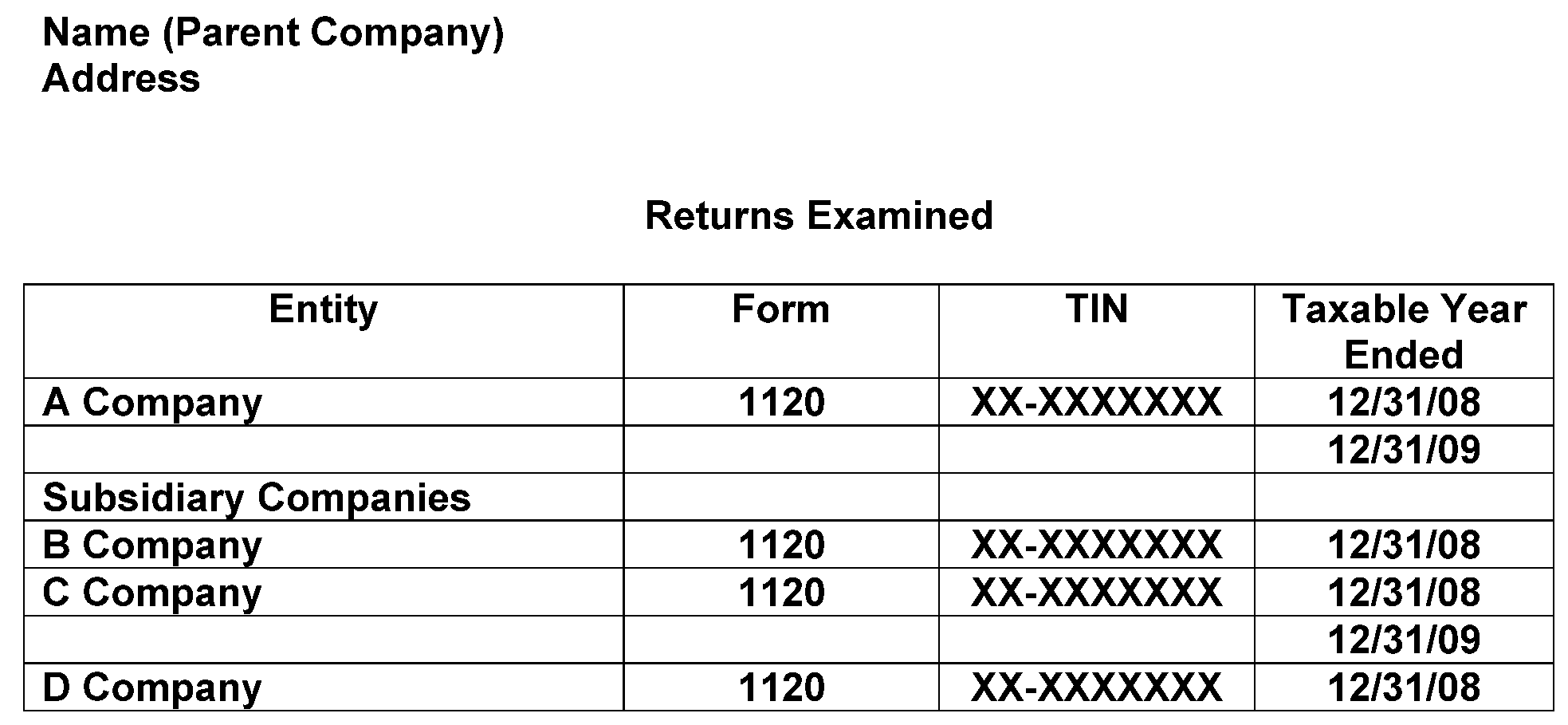
-
All jeopardy and termination assessments have a common characteristic: prior to assessment, a determination is made that collection will be endangered if regular assessment and collection procedures are followed because certain conditions exist regarding those conditions, see IRM 4.15.1.8, Identify Cases.
-
All jeopardy and termination assessments must be in full compliance with Policy Statement 4-88, Jeopardy assessment to be used sparingly and assessment to be reasonable in amount, IRM 1.2.1.5.27, or Policy Statement 4-89, Termination assessment of income tax to be used sparingly and assessment to be reasonable in amount, IRM 1.2.1.5.28.
-
A notice of deficiency is required to be mailed to the last known address of the taxpayer within a 60-day period, as prescribed in the jeopardy and termination provisions. Refer to IRM 4.15.1.10, Post Assessment Procedures, for more information.
-
If the jeopardy and termination assessment exceeds the corresponding deficiency, the excess amount remaining unpaid should be abated. If all or part of the excess amount has been paid; no refund should be made until the case is closed.
-
For jeopardy and termination assessments, Form 3198 should be annotated that restricted interest is required to be computed by CCP.
-
A jeopardy assessment is made for a prior year where the filing date, including extensions, has passed. The legal authority for jeopardy assessments are as follows:
-
IRC 6861, Jeopardy assessments of income, estate, gift and certain excise taxes, for income, estate, gift, and certain excise taxes.
-
IRC 6862, Jeopardy assessment of taxes other than income, estate, gift, and certain excise taxes, for taxes other than income, estate, gift and certain excise taxes.
-
IRC 6867, Presumptions where owner of large amount of cash is not identified, for "Possessor of Cash."
-
-
Under IRC 6861(b), if the jeopardy assessment is made before any notice of deficiency is mailed with respect to the jeopardy assessment, a notice of deficiency is required to be mailed to the last known address of the taxpayer within 60 days of the date of the assessment.
-
The notice is not issued before the Appeals determination. The deficiency amount stated on the notice of deficiency will be either the amount of the assessment or the reduced amount determined by Appeals. An increased deficiency amount may require another jeopardy assessment if there is an additional finding of jeopardy regarding the increase.
-
Letter 531-J, Statutory Notice of Deficiency-No Waiver Needed, is used for notices of deficiency in jeopardy cases, inserting the applicable opening paragraph.
-
Why we are sending you this letter-You owe additional tax other amounts, or both, as shown above. We enclosed a statement showing how we figured the deficiency. We assessed these deficiencies under the laws that apply to jeopardy assessments.
-
We are sending you this letter-You owe additional tax or other amounts, or both, as shown above. We assessed your account under the laws that apply to jeopardy assessments, and enclosed a statement showing how we figured the deficiency.
-
-
The reviewer should attach a statement to the letter titled "Schedule of Assessments or (Abatements)" that details the amount of the deficiency, the amount of the assessment(s) already made, and the amount of the balance due or overpayment. The statement should also detail any applicable penalties that have been proposed. The following format may be used for the Schedule of Assessments or (Abatements).
Schedule of Assessments or (Abatements) Taxable Year Ended
December 31, xxxxTaxable Year Ended
December 31, xxxxTaxable Year Ended
December 31, xxxxJeopardy and Termination Assessment $ $ $ Deficiency $ $ $ To Be Assessed or Abated $ $ $ Accuracy-Related Penalty IRC 6662 $ $ $ Delinquency Penalty IRC 6651(a)(1) $ $ $ Delinquency Penalty IRC 6651(a)(2) $ $ $ Estimated Tax Penalty IRC 6654 $ $ $ -
If it is determined before the notice is issued that the deficiency for any year is either greater or less than the corresponding jeopardy assessment, the notice should reflect such determined deficiency. If any part of the jeopardy assessment is determined to be in excess of the statutory deficiency, the overassessment to be abated should be processed by Technical Services. If all or any part of such excess has been paid, no refund should be made until the case is closed. If the jeopardy assessment occurs prior to the issuance of the notice of deficiency, the case will close from Technical Services either when the taxpayer files a petition to the Tax Court or when the notice defaults.
-
If the case is not under the Department of Justice use the suggested paragraph below when issuing the Letter 531-J.
-
Since no waiver is enclosed with the notice, Form 4089-B should be used as the summary page. On Form 4089-B following the summary of tax liability, the following sentence is inserted:
-
When computing the deficiency on any case in which a jeopardy assessment has been made, do not take the jeopardy assessment into account. This means that the amount of deficiency shown on the letter, Form 4089-B and Form 5278 / Form 4549-A is not reduced by the jeopardy assessment.
-
Refer to IRM 4.8.9.19.5 for transferee jeopardy notices.
-
The legal authorities for termination assessments are as follows:
-
IRC 6851, Termination assessments of income tax, for income tax.
-
IRC 6867, Presumptions where owner of large Amount of cash is not identified, for possessor of cash.
-
-
A termination assessment is made in the following situations:
-
The computation of tax may be made for a short period or the entire year. At the end of the full tax year, the taxpayer is required to file a full year return.
-
When a taxpayer subject to a termination assessment files the full year return, the return will be examined, and the correct tax liability will be determined.
-
When the tax reflected on the full year's return filed by the taxpayer equals the termination assessment and an examination of the full year's return results in no additional tax or overassessment, a notice of deficiency will not be issued.
-
If the amount determined to be the correct liability is greater than the amount shown on the return, a notice of deficiency will be issued in an amount reflecting the difference between the amount shown on the return and the amount determined to be the correct liability.
-
-
If the taxpayer does not file a full year return on or before the proper due date, examination will follow substitute for return procedures and a notice of deficiency will be issued. The starting point for adjustments will be zero. Since no return was filed by the taxpayer, the notice of deficiency will be issued in an amount determined to be the correct tax liability for the year.
-
A notice of deficiency with respect to a termination assessment is required to be mailed within 60 days after the later of the following:
-
The due date of the taxpayer's return for the taxable year, determined with regard to extensions; or
-
The date the taxpayer files a return for the taxpayer year.
-
-
The letter and forms to use for a notice of deficiency when there has been a termination assessment are as follows:
-
Letter 531 is the notice letter used. No special language is required on the letter to indicate that there has been a termination assessment.
-
Form 4089-B is used as the waiver. If Form 4089-A is used as a summary, Form 870, Waiver of Restrictions on Assessment and Collection of Deficiency in Tax and Acceptance of Overassessment, is used as the waiver.
-
Include language on a continuation page to Form 4089-B notifying the taxpayer of the termination assessment and the amount. The suggested language is:
Example:
Pursuant to section 6851 of the Internal Revenue Code, your taxable year of (year) was terminated on (date), and an assessment was made against you for the income tax considered to be due from you for the taxable period beginning (beginning date) and ending (ending date), in the amount of (amount).
Example:
The termination of your taxable year and the assessment made against you on (date) are not taken into consideration in determining the deficiency for the taxable year ended (taxable year), as shown above. Rather, the income tax liability shown by you on the return filed by you for the full taxable year ending (taxable year), is taken into consideration in arriving at the statutory deficiency in income tax shown in this notice, as detailed on the accompanying schedules.
Example:
Any portion of the amount collected at the time of termination of your taxable year which is reflected as a credit balance on your federal income tax account for the taxable year ended (taxable year) will be taken into consideration in arriving at the net amount of tax due after final determination of your income tax liability pursuant to this notice of deficiency.
-
-
The deficiency is computed without taking the termination assessment into account. This means that the amount of deficiency shown on the letter, Form 4089-B and report is not reduced by the termination assessment. Termination assessments should not be considered when determining the tax liability per return or as previously adjusted on the report.
-
The statutory deficiency may be an amount greater or less than the termination assessment. If any part of the termination assessment is determined to be in excess of the statutory deficiency, the overassessment should be abated by Technical Services. If all or any part of such excess has been paid, no refund should be made until the case is closed.
-
Collection Insolvency Support notifies examination of bankruptcy petitions filed within the area.
-
Examination ensures the information is matched with AIMS to identify open examination controls.
-
Examiners and reviewers who become aware of bankruptcy proceedings through other avenues must ensure Insolvency is notified of any potential assessment or refund that is not yet reflected on AIMS in order for a proof of claim to be timely filed with the bankruptcy court. This should be completed at least 30-days before the bar date, if possible.
-
If indications of bankruptcy are in the file, the reviewer should check with the area examination bankruptcy coordinator to determine the current status of the bankruptcy case. Bankruptcy indicators include AIMS "X" freeze on AMDISA, a Transaction Code 520 and/or a freeze code "-V" on master file. IRM 4.8.2.11.4.8, Bankruptcy Statutory Notice of Deficiency.
-
Letter 531 is issued in all years. Notice 1421, How Bankruptcy Affects Your Rights to File a Petition in Tax Court in Response to a Notice of Deficiency, is included when the bankruptcy stay will affect a U.S. Tax Court petition. The Bankruptcy Coordinator will provide instructions for issuance of the notice.
-
The notice of deficiency should be prepared in accordance with established procedures contained in this IRM and should be issued to the debtor. The Bankruptcy Coordinator will notify the reviewer if there are pre-petition and post-petition years. If the case includes both pre-petition and post-petition years the case must be separated into two separate files. One file for the pre-petition years, and one file for the post-petition years. Do not include pre-petition and post-petition years on one notice of deficiency.
-
A bankruptcy case may involve a debtor who filed a joint return with a taxpayer who is not in bankruptcy (e.g., where a joint tax return was filed, and a bankruptcy case is commenced by only one spouse). Issue a Letter 531 to both spouses and include Notice 1421 with the copy to the bankrupt spouse. Once the notice of deficiency has defaulted on the non-bankrupt spouse who files a joint return, the assessment should be made using MFT 31 procedures. For cases with six months or less on the assessment statute, the reviewer will complete the split spousal assessment using the MFT 31 Creation Exam / Appeals / AUR Process. See IRM 4.8.2.11.4.8.15.3, MFT 31 Creation, Exam / Appeals / AUR Process for procedures. For cases with more than six months left on the assessment statute, the case will be sent to the bankruptcy coordinator to complete the split spousal assessment using the MFT 31 mirroring process. See IRM 4.8.2.11.4.8.15.4, MFT 31 Creation, Mirroring Process.
-
Refer to IRM 4.8.2.11.4, Bankruptcy Suspense, for detailed instructions regarding suspension of notices of deficiency in bankruptcy cases.
-
Transferee liability substantive law - Transferee liability is based on rights provided to the IRS under federal, state or contract law. See IRM 4.10.13.3.2, Types of Transferee Liability and Burden of Proof.
-
Transferee liability procedural law:
-
For the following taxes owed by the transferor, the IRS may exercise its rights by making assessments using the procedures in IRC 6901, Transferred assets.
Example:
Income, estate, and gift tax provided by IRC 6901(a)(1)(A) and (including certain employment and excise tax situations mentioned below).
-
In general, the taxes are assessed, paid, and collected in the same manner and subject to the same provisions and limitations as in the underlying taxes of the transferor. For taxes of the transferor that are subject to the deficiency procedures, the IRS issues a notice of transferee liability (Letter 902-T, Notice of Liability), which allows the transferee to petition the Tax Court.
-
-
Fiduciary liability substantive law - Fiduciary liability is based on 31 USC 3713(a), which entitles the government to have its claims paid first when a debtor is insolvent (the federal priority statute); 31 USC 3713(b) imposes personal liability on a fiduciary who pays others on behalf of the debtor before paying the government's claim.
-
Fiduciary liability procedural law:
-
The IRS may exercise its rights under 31 USC 3713 for income, estate, and gift tax of a person for whom the fiduciary is acting by making an assessment using the IRC 6901 procedures as provided for by IRC 6901(a)(1)(B).
-
The taxes are assessed, paid, and collected in the same manner and subject to the same provisions and limitations as in the underlying taxes of the transferor, which are subject to the deficiency procedures, i.e., the IRS issues a notice of fiduciary liability (Letter 902) which allows the fiduciary to petition the Tax Court.
-
-
For transferor-transferee liability cases, Form 3198 should be annotated that restricted interest is required to be computed by CCP.
-
A notice of transferee liability issued to a transferee will be prepared using the notice of deficiency procedures in IRM 4.8.9.9, except for the modifications listed below. Also see IRM 4.8.8.13, Transferee Liability Cases.
-
Transferor - Transferee cases are legally complex and per IRM 4.8.9.10.2.1, they require mandatory referral to local counsel for review.
-
The transferee notice of transferee liability has three parts:
-
The letter to the transferee (Letter 902-T or Letter 1005, Deficiency Letter in Bankruptcy and Receivership Cases, will be modified by incorporating the applicable opening paragraphs from Exhibit 4.8.9-7, Transferee Letter Opening Paragraphs.
-
A statement that summarizes the liability of the transferee. Use the applicable explanatory paragraphs in Exhibit 4.8.9-8, Transferee Statement Attached to Letters.
-
A waiver (Form 870 or Form 890, Waiver of Restrictions on Assessment and Collection of Deficiency in Tax and Acceptance of Overassessment for estate tax) with specific transferee/transferor paragraphs in IRM 4.8.9.19.5.5.
-
Exhibits may be attached to the notice package to assist the transferee in understanding why he or she is a transferee or any supporting computation(s).
-
-
Notices of transferee liability are issued for employment taxes only to the extent that a notice of determination of worker classification would have been issued to the transferor. IRC 6901 provides, "the liability will be assessed, paid and collected in the same manner as in the case of the taxes with respect to which the liabilities were incurred." Therefore, the only time a notice of transferee liability is issued for employment taxes is when the transferor's employment tax liability was based upon worker classification issues under IRC 7436. See IRM 4.8.10, Notices of Employment Tax Determination Under IRC 7436.
-
Certain excise taxes are subject to the deficiency procedures under IRC 6211, Definition of a deficiency; however, excise taxes are not covered by IRC 6901 unless they arise from the liquidation of a partnership or corporation or from a corporate organization procedures in which case a notice of transferee liability would be issued to a transferee regarding an excise tax that is subject to deficiency procedures.
-
Excise tax paid on certain fuels may be claimed as a credit against income tax on Form 4136, Credit for Federal Tax Paid on Fuels, under IRC 34, Certain uses of gasoline and special fuels. An adjustment to the credit may be made in a statutory notice of deficiency under IRC 6211(b)(4); a notice of transferee liability would include that adjustment.
-
Letter 902-T or Letter 1005 for bankruptcy and receivership will include special opening paragraphs that will identify the name and address of the transferor and the nature of the tax liability. The mailing address on the letter will only include the name and address of the transferee. If the transferee liability is based on substantive state law (state fraudulent conveyance act, state bulk sales law, state merger and dissolution law, etc.), the basis should be asserted in the first paragraph of the letter.
-
The transferee letter pro-forma opening paragraphs to be used are located in Exhibit 4.8.9-7, Transferee Letter Opening Paragraphs.
-
Letter 902-T is used when a jeopardy assessment under IRC 6861 has been made against a transferee.
-
The transferee letter pro-forma opening paragraphs are to be used and are located in Exhibit 4.8.9-7, Transferee Letter Opening Paragraphs.
-
Since jeopardy assessments are processed before the notice is issued, the opening paragraphs from Exhibit 4.8.9-7 must be modified to change "is your liability as transferee of assets for [name of transferor]"
-
The statement is included as an attachment to the transferee letter and explains to the transferee how the proposed assessment originated. The statement is divided into two parts: the transferor section and the transferee section.
-
The transferor's section lists the name, address, and TIN of the transferor. In addition, the statement also includes a list of the transferor's unpaid income tax and penalties, if applicable, for each tax period.
-
If the taxpayer/transferor voluntarily makes a partial payment to reduce the liability and provides written directions for applying it, follow those directions. If no directions are provided, apply the payment to tax periods in the order of priority that best serves the IRS's interest. If the amount applied to a period is less than the liability for the period, apply it to tax, penalty, and interest, in that order, until the amount is absorbed. See Rev. Proc. 2002-26.
-
The net figures will be reflected on the attachment to the letter and on the waiver.
-
If the transferee's liability is limited, the list of the transferor's unpaid liability will reflect the transferor's total unpaid liability without regard to the transferee's limitation.
-
The following statement will be placed below the listing of the unpaid liability: "The law requires us to charge interest until you pay the full amount you owe."
-
-
The transferee's section lists the name, address, and TIN of the transferee. This section also lists the extent of the transferee's liability along with an explanation of why the transferee is the transferee.
-
See Exhibit 4.8.9-8, Transferee Statements Attached to Letters, for the statements to be attached to letters addressed to parties identified in the situations shown.
-
All letters explaining the transferee's liability for the transferor's unpaid taxes (except jeopardy assessment and bankruptcy and receivership letters) will be accompanied by Form 870-T, Waiver of Restrictions on Assessment and Collection of Transferee or Fiduciary Liability and Acceptance of Overassessment, (income tax) or Form 890-T, Waiver of Restrictions on Assessment and Collection and Acceptance of Overassessment as to Transferee or Fiduciary Liability for Estate, Gift and Generation - Skipping Transfer Tax, (estate and gift tax) modified by a special paragraph for transferee liability.
-
Estate and gift tax letters should be revised for the particular situation.
-
The total transferor's unpaid tax and penalty liability will be inserted in the applicable blanks, even if the transferee's liability is limited. If the liability is limited, the paragraphs modifying the waiver will state the amount to which the liability is limited.
-
Paragraphs to be inserted on Form 870-T or Form 890-T, as applicable, for:
-
Transferee, other than one liable under 31 U.S.C. 3713(b):
-
Transferee of a transferee:
-
With respect to liability of a fiduciary under IRC 6901 and 31 U.S.C. 3713(b):
-
Assets received by the transferee are of a value less than the unpaid deficiency of the transferor. (The tax and penalty amounts inserted in the waiver should be the total unpaid liability, and not limited to the net assets transferred.)
Example:
This represents the undersigned's liability as transferee of the assets of (transferor), (address), for income tax, penalties, and interest thereon, to the extent of the net value of assets received from the transferor, plus interest thereon as provided by law. It has been determined that the net value of the assets received is $(value).
-
-
Form 1296, Assessment Against Transferee or Fiduciary, is prepared by Technical Services and is used to provide information to CCP for making assessments of income, employment, estate or gift tax against a transferee or a fiduciary. A separate Form 1296 is prepared for each transferee for each kind of tax for which a separate return was filed and for each taxable period of the transferor.
-
If the value of the net assets received by the transferee is less than the unpaid liability of the transferor and more than one year is involved, the transferee's liability should not be allocated to the various years. Instead, the liability should be shown as one amount on the Form 1296 for the earliest year of the transferor, without identifying it with any particular year of the transferee.
-
In limited liability situations such as the above, instructions should be included on Form 1296 for computation of the interest. The interest starting date and the interest rate will be annotated on Form 1296. Refer to IRM 4.10.13.3.5, Liability of Transferee for Interest, for further details on the transferee's liability for interest.
-
Munro computations (Munro v. Commissioner, 92 T.C. 71 (1989), are to be used in statutory notices of deficiency when preparing notices to the TEFRA investor (with open TEFRA proceeding(s)) for the non-TEFRA issues, except when the returns involved are determined to be over sheltered.
-
When preparing a statutory notice on a case with an open TEFRA proceeding, the following paragraph should be included on a supplementary attachment to Form 4089 or other waiver:
Example:
In computing the deficiency attributable to the adjustments in this notice, which adjustments are neither partnership items nor affected items, as defined by IRC 6231, all TEFRA partnership items subject to an open TEFRA proceeding, whether income, loss, deductions, or credits have been ignored exclusively for the purpose of computing the deficiency which is attributable to the adjustments set forth herein. All TEFRA partnership items subject to an open TEFRA proceeding have been ignored in this notice of deficiency for computational purposes only and this notice is not a substitute for any notices of final partnership administrative adjustment (FPAA) which may be issued in regard to the TEFRA partnerships. This computation is being made pursuant to the Tax Court decision in Munro v. Commissioner, 92 T.C. 71 (1989).
-
The following sample paragraph is included in the explanation of items:
Example:
The following TEFRA partnerships are subject to partnership level proceedings pursuant to the partnership audit and litigation procedures of IRC 6221 through IRC 6234 (Prior to the Bipartisan Budget Act of 2015) with respect to the taxable year (years) and accordingly, all partnership items, whether income, loss, deductions or credits, have been disregarded for purposes of computing a deficiency attributable to the adjustments in this notice.
Entity Amount ABC Partnership $(30,000.00) XYZ Partnership $(7,000.00) HIJ Partnership $(27,700.00) Total $(64,700.00)
-
When an indirect adjustment has been made to the QBID by the Field examiner the Technical Services reviewer needs to ensure the taxpayer has been made aware of the indirect adjustment to their QBID and been allowed the opportunity to provide documentation to the examiner.
-
The following resources on Knowledge Management outline policies when and how examiners should address an indirect QBID adjustment on an examined return. Under various circumstances, examiners are required to either communicate directly with taxpayers regarding an updated QBID computation or to issue Form 14997, Adjustment to the Qualified Business Income Deduction with the report to raise taxpayer awareness of the issue and allow for an opportunity to provide information supporting a QBID recomputation.
-
IRC 199A Qualified Income Business Deduction
-
Chapter 4 - Policy and Exam Guidance
-
-
When unagreed cases are sent to Technical Services for issuance of the SNOD, often reviewers find there is no communication noted in the case activity record or there is no documented evidence Form 14997 was issued with the report. The Technical Services reviewer will complete the following action(s) depending on the time remaining on the assessment statute when a case does not document consideration of Form 14997 or a comment in the activity record:
-
If more than 9 months remain on the ASED, the reviewer will return the case to the Field for reissuance of the 30-day package including the Form 14997.
-
If 9 months or less remain on the ASED, the reviewer will continue with unagreed procedures and include the Form 14997 with the issuance of any SNOD*
Note:
*If the reviewer receives correspondence from the taxpayer regarding the issued Form 14997 in a SNOD, and the time remaining to compute any applicable QBID is deemed sufficient, then the reviewer can request Field support for computation of the potentially permissible QBID. This may include returning the case to the Field in accordance with IRM 4.8.9.22.3.4. For technical questions or assistance working a QBID issue an expert can be contacted at QBID - Contact an Expert.
-
-
The following includes instructions for preparing notices of deficiency when the original return(s) is/are not available.
-
An examination can be conducted on a copy of a taxpayer's return or with a BRTVU/RTVUE print. Accordingly, if a statute is imminent, it may be necessary to issue a notice of deficiency based on copies of returns or BRTVU/RTVUE prints. If so, the following steps are to be taken.
-
Secure a transcript to verify taxable income and tax per return.
-
Use ESTAB procedures to secure the original return if needed. A charge-out will indicate the location of the return.
-
-
In multi-year examinations when there is an original return for the initial year and copies or BRTVU/RTVUE for prior and/or subsequent years:
-
The adjustments should correlate to a specific line item on the tax return, and
-
If a specific line item is undeterminable from a transcript or a copy of a return, an adjustment using fixed percentages from the prior years' actual dollar amount adjustments should not be the basis for the determination of the deficiency.
-
-
If the fraud penalty is asserted on a copy of a return, immediate attempts must be made to secure the original tax return. Such attempts need to be documented and made part of the case file. The case may be returned to the field to secure the original return.
-
When the civil fraud penalty is proposed on an electronically filed return, Form 8453, U.S. Individual Income Tax Transmittal for an IRS e-file Return, (if the electronically filed return required such form to be submitted) should be secured before issuing a notice of deficiency. Form 8453 is the signature document, and it is imperative to obtain it if the fraud penalty is being asserted. The Form 8453 will not automatically be associated with the print of the return.
-
Form 8453 can be obtained by securing a transcript to verify the return was electronically filed. The first two digits of the DLN identify where the return was electronically filed. Use command code ELFRQ-AC2 or ESTAB procedures to obtain Form 8453. In the request state "Need Form 8453 only" in the remark section. If the original W–2's are needed, use ESTAB procedures and enter "Need Form 8453 and original W–2's" in the remarks section.
-
If Form 8453 cannot be secured, the case must be discussed with Area Counsel prior to preparing the notice of deficiency.
-
For electronically filed returns using personal identification number (PIN) signatures, use command code TRDBV to research specific information on electronically filed returns and TRPRT to request prints of electronically filed returns.
-
Notice of deficiency cases are suspended 105 days (165 days for taxpayers outside the United States) to await taxpayer correspondence, agreement, or notification of a petition with the Tax Court. The suspense period is comprised of 90 days (150 days for taxpayers outside the United States) to file the petition, plus an additional 15 days to determine if a petition was filed with the Tax Court.
-
When a case is received for suspense, the proper ERCS codes should be input:
-
Revenue agent cases - Status Code 24, ERCS Review Type 034, ERCS Suspense Type 534.
-
Tax compliance officer cases - Status Code 24, ERCS Review Type 035, ERCS Suspense Type 535.
-
-
Each case file will be marked with either the issue date or the default date of the notice of deficiency.
-
The case files are then filed by issue date or default date. Within these dates, the cases are filed either alphabetically by taxpayer name or numerically in TIN order. All related returns should remain together filed under the primary entity name or TIN.
-
On a monthly basis, the suspense inventory should be reconciled to ensure all returns are where they should be. This can be accomplished through the use of the inventory listing report or the status report in ERCS.
-
The inventory listing can generate a complete inventory list, including returns assigned to employees. This report can also generate a partial inventory list of overage cases based on the number of days since the date in review.
-
The status report generates a list of returns in a single user entered status code. The report can be generated for any review status code, including Status Code 24.
-
Upon issuance of a notice, a case is updated to Status Code 24 and the statute of limitations is recomputed to reflect the maximum tack on time permitted by law for assessment (i.e., as if the notice defaults - 90 or 150-days, plus 60 days for processing). Generally, Exhibit 4.8.9-2, Computation of Last Day to File a Petition With United States Tax Court and Computation of Default Date, should be used as a guide to recompute the assessment statute of limitations. Form 5348 should be prepared to update the recomputed statute.
-
If an agreement is received before the end of the 90-day (150-day) period, the statute should be recomputed a second time. Agreed cases should be a high priority item and closed as soon as possible to avoid having a barred assessment statute. Generally, Exhibit 4.8.9-3, Assessment Statutes: Agreed Case Without Form 872–A Consent, Agreed Case With Form 872–A Consent, Defaulted 90-Day Letter Without Form 872–A Consent, Defaulted 90-Day Letter With Form 872–A Consent, (whichever is applicable), should be used as guidance to recompute the final assessment statute. Form 5348 should be prepared to update the recomputed statute.
-
If a case is petitioned, the statute should remain as the updated assessment statute noted in paragraph 1 above. Under no circumstances will the ASED for a petitioned case be updated back to the original normal statute.
-
The statute expiration reports in ERCS allow the user to print statute expiration notices and create reports to check for pending statutes. See IRM 4.7.3, Examination Return Control System (ERCS), Statute of Limitations, and IRM 4.7.6, Reports, for detailed information on the ERCS reports.
-
The pending statute report lists returns with numeric statute expiration date falling within a variable number of days as entered by the user. This report is useful in calling attention to returns with short statutes and determining if a Form 895 should be issued. The report also has a section containing a summary of employees with returns with short statutes.
-
The 895 report generates a listing of returns in review statuses which meet any of the following criteria:
-
The statute date expires within the number of days determined by the area office or by LB&I,
-
The statute date is an alpha date (e.g., 04CC2009) or a Form 872 date and the calculated date is within the number of days determined by the area office or LB&I,
-
The statute date has already expired, or
-
A Form 895 has been issued for the return.
Note:
ERCS includes a return on the 895 Report based on the actual statute date if the statute is numeric. This means if the statute has been extended, the extended date is used to determine if the return should be on the report. If the statute has been changed but not approved, the earlier of the prior statute or the current statute is used.
-
-
TS should review the pending statute report on a weekly basis during peak times and bi-weekly during the rest of the year. Suspense personnel should ensure that all cases with notices of deficiency are properly in Status Code 24 and have updated ASEDs, as previously discussed.
-
Identify and monitor as a "Statute Case" as follows:
If less than 120 days left on the statute based on the Then the case is a "statute case" and it Original ASED prior to issuance of statutory notice of deficiency Must have a 90-day letter issued on or before the original ASED. Revised ASED after issuance of notice of deficiency Must be assessed on or before the revised ASED. -
If a consent to extend the statute is received after the SNOD is issued, it should not be executed by the IRS if the normal statute has already expired. Refer to IRM 25.6.22.5.13(1) (i), Manager’s Responsibilities When Signing Consents, and 26 CFR 301.6501(c)-1 d.
Example:
Normal statute expires 4/15/2023, SNOD extends the statute to 9/12/2023. SNOD issued 3/15/2021. A Form 872, Consent to Extend the Time to Assess Tax, received after 4/15/2023, but before 9/12/2023 should not be executed, as the tack on period applies only to the deficiency shown in the SNOD.
-
The AIMS 4.0 Table provides a report each month with a list of all returns by status for which the statute of limitations will expire in 180 days or less or has expired.
-
Each Technical Services group, including the notice of deficiency suspense unit, is expected to reconcile the 4.0 Table with the ERCS statute pending report on a monthly basis. The group should run the ERCS statute pending report and the 895 report on the AIMS Cycle cut-off date (used in Doc. 6036). The 4.0 Table report should be completed within 10 days of receipt. Once the table is worked, it should be signed and dated by both the manager and the employee designated to work the table.
-
Instructions for working the 4.0 Table are contained in IRM 4.4.27.5.1.1, Procedures for Working Statute Control Report. At a minimum, the following should be completed:
-
Research the listing on AIMS to eliminate those accounts which have been closed or transferred out.
-
If AIMS and ERCS do not match, the location of the physical case should be determined and the status code should be updated on the appropriate system.
-
If a case has been closed, place a "C" in front of the taxpayer's name.
-
If a case has been transferred, place a "T" in front of the taxpayer's name.
-
Notify the manager having custody of cases of the early statute date.
-
Identify and verify first statutes expiring within 30-days.
-
Locate the return/case file for each account appearing for the first time. Place an "R" in front of the taxpayer's name to indicate that the return has been located.
-
If research shows that the return/case file is currently missing, follow established procedures.
-
After reconciliations have been completed and all notations made in red, the manager should then perform the monthly review of statute control.
-
The table should be signed and dated in red by both the manager and the employee designated to work the table and retain the table for two years.
-
-
While the case is in suspense, the taxpayer may:
-
Make telephone contact
-
Send in correspondence
-
Submit additional information
-
Request reconsideration
-
Appear in person for further discussion
-
-
Any communication with the taxpayer regarding notices of deficiency should clearly state that reconsideration of the case will in no way serve to suspend or extend the 90 or 150-day period in which a petition may be filed with the Tax Court.
-
If the taxpayer's representative calls or comes in to discuss the taxpayer's account, a valid Power of Attorney (POA) or Tax Information Authorization (TIA) must be in the file or no information can be furnished. A request may be made to the taxpayer to obtain a completed POA or TIA. Without a POA or TIA on file, a general explanation of the notice of deficiency procedures may be provided.
-
When telephone contact is made, the designated contact person will do the following:
-
Obtain the taxpayer's name, TIN, and issue date of the 90-day letter
-
Pull the case file
-
Answer routine questions
-
Refer technical questions to the designated statutory notice reviewer.
-
-
Inform the taxpayer that the notice of deficiency gives them three options:
-
The right to petition the United States Tax Court,
-
The right to agree with the tax deficiency by signing the waiver, or
-
The right to contact the taxpayer advocate service.
Caution:
As with any other contacts, contact with the taxpayer advocate service does not extend the time the taxpayer has to file a petition to the Tax Court. The taxpayer should be informed of this fact, as well as the fact the taxpayer advocate service does not have the authority to determine the tax deficiency.
-
-
If the taxpayer does not agree but does want to stop the continuation of interest, he or she may make a deposit under IRC 6603. Rev. Proc. 2005-18, 2005-1 C.B. 798, provides that the deposits in the nature of a cash bond (e.g., check) must be accompanied by a written statement designating the remittance as a deposit. This deposit is known as a "Section 6603 deposit." The taxpayer should be informed to include the notice with the IRC 6603 deposit submission to provide verification of the amount of tax and penalty in dispute. See IRM 20.2.4.9.2, IRC 6603 Deposits, for more information.
-
It is imperative that all telephone contacts are documented in the case history and a copy of any written documentation received is placed in the case file.
-
When correspondence is received, the designated contact person will do the following:
-
Date stamp the correspondence.
-
Pull the case file.
-
Route the case to the designated notice of deficiency reviewer for technical review.
-
-
Letter 556, Acknowledgement of Protests, Correspondence, and Requests for Interviews, may be used to acknowledge receipt of the correspondence if the taxpayer is not contacted by telephone.
-
The taxpayer must be clearly informed that reconsideration of the case will not suspend or extend the period for filing a petition with the Tax Court.
-
The reviewer may determine that the case should be sent back to the originating examination group for consideration of additional information.
-
If the case is returned to the group, follow the procedures outlined in IRM 4.8.9.22.3.4, Case Returned to the Group.
-
All contact and actions taken on the case after the SNOD is issued must be recorded in the case file.
-
When the taxpayer submits additional information or requests an appointment, the designated contact person will take the following actions:
-
Route the case back to the designated statutory notice reviewer to determine the appropriate course of action.
-
Annotate the date, action taken, and who initiated the action on the Form 9984, Examining Officer's Activity Record.
-
Update the appropriate ERCS employee code when the case is sent out of the 90-day suspense area.
-
-
All 90-day cases should be returned to the 90-day suspense area for final disposition.
If Then Agreement received -
Close all 90-day controls,
-
Update statute, and
-
Forward for assessment.
No agreement received -
Suspense awaiting default,
-
Follow default procedures if default date has passed, and
-
Follow petition procedures if a petition is filed.
-
-
If the designated statutory notice reviewer determines that a case should be returned to the group for consideration of the correspondence and/or information received, the reviewer will prepare a Form 3990 to transmit the case. The RGS electronic case file should be returned to the group along with the physical case if the case is a paper case file.
-
Because the Assessment Statute Expiration Date (ASED) has already been updated to reflect the maximum assessment date (based on a default), the group must be cautioned about the statute, particularly for those cases for which the notice was issued with little time remaining on the normal statute.
-
The reviewer should include a detailed explanation of the ASED shown on the AIMS/ERCS system. The following sample paragraph may be used for this purpose:
Example:
"The 90-day letter issued to the taxpayer is in the RGS electronic case file for your information. Please do not disturb, destroy, or alter the 90-day letter. It should remain in the RGS electronic case file when the case is closed from the group after the reconsideration. Refer to IRM 4.10.8.8.1, 90-Day / Notice of Deficiency Reconsideration Cases, for the applicable procedures to follow for the audit reconsideration."
Note:
CAUTION REGARDING THE ASSESSMENT STATUTE: If the taxpayer neither agrees nor petitions the Tax Court by the last date to file a petition shown on the notice of deficiency in the case file, then the last day for assessment of the additional tax shown on the notice of deficiency is [insert the recomputed ASED]. AIMS/ERCS has already been updated to reflect this date.
Note:
If the taxpayer signs an agreement prior to the last day to file a petition shown on the notice of deficiency, then the 90 or 150-day period stops and the assessment statute is suspended from the date the notice of deficiency was issued until the date the agreement is received by the IRS plus an additional 60 days for the assessment to be processed. Therefore, if the taxpayer signs an agreement form during the audit reconsideration, it is important to return the case promptly to Technical Services so the assessment can be made prior to the expiration of the suspended statute of limitations.
-
After the Form 3990 is prepared, the case file and reviewer's report should be given to the group manager for signature.
-
Once the manager approves the reviewer's report, the case should be given to the 90-day suspense unit for preparation of a "dummy file" for physical case files. This file is used as a reminder to follow-up with the Field examine group of the 60-day due date for a response. In the event it becomes necessary to make an immediate assessment pull the necessary information from the dummy file. For electronic cases CEAS should be used if an immediate assessment is needed. The dummy file for a physical case files should include the following:
-
A copy of the tax return.
-
A complete copy of the statutory notice of deficiency.
-
A copy of the most recently validated Form 5344, Examination Closing Record.
-
A copy of the reviewer's report transmitting the case back to the group.
-
-
Once the examination group has completed work on the case, it should be returned directly to the reviewer. The statutory notice reviewer is responsible for notifying the taxpayer of the final outcome of the reconsideration via Letter 555-T, Reconsideration After Statutory Notice, or Letter 645-T, No-Change - After Statutory Notice Issued. Neither of these letters are issued by the examination group.
-
The reviewer will then return the case to the 90-day suspense unit to either close the case if agreed or no-changed, or to continue suspending the case if the 90-day (150-day) suspense period has not expired. The 90-day suspense unit will destroy the dummy file when the original case file has been returned, ensuring that the original notice of deficiency still remains with the case file.
-
If the taxpayer requests transfer of a 90-day case to another area, the area that issued the 90-day letter may transfer the case.
-
Associate the correspondence with the case file and forward the file to the designated statutory notice reviewer to approve and provide instructions.
-
TS staff will transfer, monitor, and update internal controls.
-
A notice of deficiency forwarded by certified mail and returned by the United States postal service because the addressee has moved and left no forwarding address, is considered undeliverable (i.e., unlocatable).
-
A notice returned by the United States postal service stamped "unclaimed" or "refused" is generally not considered undeliverable. These cases will be referred to the designated technical person.
-
Any time a notice is returned undeliverable or unclaimed, a search for an alternate address of the taxpayer should be made. Documentation of the research is required. See IRM 4.8.9.9.2.5 regarding appropriate searches.
-
The following procedures are performed for undeliverable notices. Also, see IRM 4.10.2.8.4, Undeliverable Initial Contact Letters.
-
Date stamp the returned envelope and associate the undeliverable notice with the case file.
-
Check the envelope for a change of address annotated by the United States postal service.
-
Check all addresses on all notice of deficiency letters issued. Often, multiple duplicate original notices are issued to more than one address.
-
Check the telephone and or city directory addresses to enable confirmation of the address.
-
Research for a new address using in-house address information and outside locator services.
-
Print INOLES and check the file to determine that the notice was correctly addressed to the last known address of the taxpayer. If the INOLES address is the same as the one used on the notice of deficiency, a copy of the INOLES should be stapled to the bottom of the top page of the notice letter and the case should be returned to the 90-day suspense file. If the INOLES address is different than the one used on the notice of deficiency, the case should be returned to the designated statutory notice reviewer to determine if the notice should be reissued.
-
Form 5344 will be updated to Disposal Code 13 when steps to locate the taxpayer have been exhausted and it has been determined that the taxpayer cannot be located.
-
-
The following procedures are performed for unclaimed or refused notices.
-
Date stamp the return envelope and associate the unclaimed or refused mail with the case file.
-
Check the envelope for a change of address annotated by the United States postal service.
-
Print INOLES and recheck the file to determine that the letter was correctly sent to the last known address of the taxpayer as defined in IRM 4.8.9.9.2.1, Last Known Address, and IRM 4.8.9.9.2.5.
-
If the address is the same on the INOLES as the notice of deficiency, print a copy of the INOLES and staple it to the bottom of the top page of the letter and return the case to suspense.
-
If the address is different on INOLES, return the case to the designated reviewer for re-issuance. If sufficient time does not remain on the statute of limitations to reissue the notice of deficiency, then upon expiration of the 90-day (150-day) period, the deficiency will be assessed by default (absent a petition or an agreement).
-
-
Based on the information secured using the above process steps, either reissue the notice, as specified below, or allow it to default.
-
Refer IRM 4.10.8.2.3.1(8), Letters, for guidance if mail is returned as undeliverable after a case is closed. See the Sending to Files job aid for information and instructions for forwarding the returned mail for association with the closed case.
-
Review the AIMS weekly update report for address changes. Codes 18 and 19 show new addresses updated to Master File.
-
Request CFOL and IDRS research on both SSN's using command codes INOLES, SPARQ, IRPTRO, IMFOLE, ENMODA and TELER (taxpayer's telephone number) to call the taxpayer.
-
Contact collection (insolvency function) if the taxpayer is in bankruptcy.
-
If a new address is obtained and there is sufficient time remaining on the regular assessment statute, the notice of deficiency should be reissued. The reviewer should document the file stating how the reviewer obtained a new address for the taxpayer and followed the search recommendations in IRM 4.8.9.9.2.5 to obtain a new last known address.
-
If sufficient time is not remaining on the regular assessment statute to reissue the notice of deficiency, then upon expiration of the 90-day period the deficiency will be assessed as a result of the taxpayer's default (absent a petition or agreement).
-
The envelope in which the letter was originally mailed and the notice of deficiency itself must be included in the case file upon closing. For ECF cases, the returned envelope should be scanned and saved in the RGS CFD folder along with a current INOLES.
-
The envelope, letter, and research performed will be part of the notice of deficiency. This documentation will establish that the IRS complied with the law and mailed the notice by certified or registered mail to the taxpayer's last known address. For ECF cases, the returned envelope should be scanned and saved in the RGS CFD folder along with a current INOLES.
-
It is recommended the IRS also send a copy of the defaulted original notice to the new address since there is not time to reissue the notice and a valid assessment will be made pursuant to the defaulted notice.
-
-
The address on master file will be considered the taxpayer's last known address if the taxpayer cannot be located, or a new address is not provided or verified by the taxpayer. If research shows no later address, the envelope in which the letter was originally mailed and the notice will be securely stapled in the taxpayer's file as evidence that the 90-day letter was sent by certified or registered mail to the taxpayer's last known address along with documentation explaining what efforts were taken to determine the taxpayer's last known address. However, the case should not be defaulted until the 105th or 165th day.
-
If a taxpayer requests a copy of the notice after refusing to accept a notice, it will be mailed with a cover letter by regular mail. The following is suggested language to be used in the cover letter to the taxpayer:
Example:
In accordance with (the request contained in your letter dated __or your telephone request of (date)__, the notice of deficiency which was mailed to you by certified mail on (date), and which was returned by the United States postal service with the notation stamped thereon, (unclaimed or refused), is herewith returned to you.
Example:
You are advised that there is no provision in law for the suspension of the (90-day or 150-day) period provided for the filing of a petition in the United States Tax Court. You are further advised that if you file a petition, it must be filed with the United States Tax Court in Washington, DC, within (90 or 150) days from the original mailing date of the notice of deficiency. Such (90 or 150) day period will expire on (date).
-
Every effort will be made to ensure a SNOD is correct before it is issued. This includes the following:
-
Identifying the correct taxpayer to whom the notice is issued, and
-
Identifying the taxpayer's last known address.
-
-
Despite every precaution, at times mistakes will be made. This subsection discusses when the errors may prove fatal to the notice of deficiency.
-
The basic minimum requirements for a notice of deficiency are the following:
-
It must advise a taxpayer that the IRS has determined a deficiency for a particular tax year;
-
It must specify the amount of the deficiency; and
-
It must provide sufficient information to permit the computation of the deficiency.
-
-
Cosmetic changes to the RAR, such as deleting the examiner's name on the second page or changing the office location
-
Commissioner's name missing from page 2 of Letter 531:
-
Incorrect date on Letter 531:
-
Note:
A notice must set out at a minimum the amount of a deficiency and the taxable years involved. "It is well established. that no particular form is required so long as it is a communication directed by [the IRS] to the taxpayer informing him or her that a deficiency in the taxpayer's tax liability has been determined and stating either the tax period involved or giving sufficient information that the taxpayer reasonably cannot be deceived as to the taxable period." Garret v. Commissioner, T.C. Memo 1991-97. A date on top of the notice of deficiency does not inform the taxpayer of the amount of the deficiency or the period during which the deficiency occurred.
Note:
Furthermore, the date considered to give notice to the taxpayer is the post marked date, not the date on the letter. In general, the date for mailing the notice of deficiency is considered the date the IRS deposited the letter with the United States mail. This is either reflected by the date stamped on the envelope or on the certified mail list. Page v. Commissioner, T.C. Memo. 1994-180. The date on the letter is not determinative because it could be wrong.
-
-
Incorrect "last day to file petition" noted on Letter 531: Use of the incorrect date for filing petitions with the Tax Court does not invalidate a notice of deficiency. Section 3463(a) of the IRS Restructuring and Reform Act of 1998 requires the IRS to include the last day on which the taxpayer may file a petition with the Tax Court on the notice of deficiency. After the passage of the Reform Act, IRC 6213 (a) was amended to include the following:
Example:
Any petition filed with the Tax Court on or before the last date specified for filing such petition by the Secretary in the notice of deficiency shall be treated as timely filed. Prior to this addition, petitions were required to be filed within "90-days or 150-days."
Note:
No date was specifically stated prior to the aforementioned additions. The sentence was probably changed to allow filing until the last date specified in the letter because Congress anticipated the possibility that the wrong date would be used and in such a circumstance, the erroneous date would not invalidate a notice and could be relied upon by the taxpayer. See Rochelle v. Commissioner, 116 T.C. 356 (2001).
-
The deficiency amount shown on the Letter 531 or attachment to the letter is not the same as the amount shown on the waiver and/or RAR:
-
A notice of deficiency includes the cover page and all attached pages and documents. Stussy v. Commissioner, T.C. Memo. 2002-257 citing, Smith v. Commissioner, T.C. Memo. 1979-16.
-
As a general rule, if a notice of deficiency fulfills its purpose otherwise, a mathematical error in the notice will not invalidate the notice where the taxpayer is not misled by the error. Myers v. Commissioner, T.C. Memo. 1981-84. In the event that Letter 531 contains a different amount than the waiver and/or RAR, as long as the notice is not misleading, and it puts the taxpayer on notice that the IRS has determined a deficiency in his federal income tax for the year at issue the notice of deficiency is still valid. The threshold is whether the taxpayer was misled.
-
A taxpayer is not misled if he is adequately informed of the income tax and issues in controversy by the notice of deficiency. As long as that requirement is met, a typographical error in the amount of deficiency owed on separate documents does not invalidate a SNOD.
-
-
The IRS is not precluded from issuing a second notice of deficiency as long as the taxpayer has not yet filed their Tax Court petition. See Jones v. United States, 889 F.2d 1448, 1450-1451 (5th Cir. 1989), Gmelin v. Commissioner, T.C. Memo 1988-338. However, the issuance of a second notice does not rescind the first. This is because rescission of a notice of deficiency is discretionary on the part of the Secretary and such notice of deficiency will be rescinded only with taxpayer consent. Section 4.01 of Rev. Proc. 98-54, 1998-2 C.B. 531. Also see IRC 6212(d), Notice of deficiency.
-
The issuance of a second notice prior to expiration of the time the taxpayer has to petition the Tax Court (for the original notice) gives the taxpayer the option to petition either notice. G.C.M. 33366, In re: Statutory Notice of Deficiency, I-2166 (November 3, 1966), at 6. While it may be legally sound to reissue a notice of deficiency, the determination to issue a new notice of deficiency should be made on a case by case basis in consultation with local Area Counsel.
-
IRC 6503(a), Suspension of running of period of limitation, issuance of statutory notice of deficiency, provides that the statute of limitations for a tax year is suspended during the time the IRS is prohibited from making an assessment (i.e., during the time a notice of deficiency is outstanding).
-
No exception is made in IRC 6503(a) for invalid statutory notices of deficiency or notices which contain an error.
-
If a notice is considered invalid due to an error and the normal statute of limitations is expired, the IRS is prohibited from taking action. This means that the errors cannot be corrected in order to issue a new notice of deficiency and no assessment can be made.
-
If a notice is considered invalid due to an error and the normal statute of limitations is still open, a new notice of deficiency should be issued in order to correct the defects and in order to permit assessment of the deficiency. The issuance of a new notice of deficiency will begin a suspense period and the taxpayer will have 90-days (150-days) to file a petition in Tax Court.
-
When the taxpayer submits a protest, additional information, or requests reconsideration of the deficiency, the case file should be routed back to the designated statutory notice reviewer:
-
Letter 556 may be used to acknowledge receipt if the taxpayer is not contacted by telephone. If the taxpayer’s protest does not meet the criteria outlined in Pub 5, Your Appeal Rights and How to Prepare a Protest If You Disagree, to be referred to Appeals the Technical Services reviewer, will explain verbally or in writing what criteria the taxpayer is not meeting to be eligible to be referred to Appeals. If the taxpayer is not able to revise their protest to meet the criteria in Pub 5 and the taxpayer indicates that they do not intend to file a petition with Tax Court, contact Counsel for advice on how to proceed.
-
The taxpayer must be clearly informed that reconsideration of the case will not suspend or extend the period for filing a petition with the Tax Court.
-
Any contact or actions taken after the notice of deficiency is issued must be recorded in the administrative file and saved in RGS CEAS or IMS.
-
-
Similarly, responses to telephone inquiries on technical and procedural questions will be coordinated with the designated technical reviewer.
-
If a protest is received, the designated technical person will review the protest to determine if the taxpayer submitted an adequate protest and is eligible for an Appeals conference. The reviewer will coordinate with assigned Appeals office per IRM 4.8.9.25.1, to determine if Appeals will accept the case file for consideration given that a notice of deficiency has already been issued.
-
For other correspondence, the designated reviewer will determine what necessary action should be taken, if any, and will communicate this determination to the taxpayer and/or representative in writing.
-
Technical Services reviewers must ensure that IRC 7803(e)(5), Limitation on designation of cases as not eligible for referral to IRS independent office of appeals, is followed. If a taxpayer which was issued a Statutory Notice of Deficiency submits a valid protest refer the case to Appeals by following IRM 4.8.9.25.1.
-
Following acknowledgement, the valid protest will be transmitted with the administrative file to the appropriate Appeals serving the area making the determination of the tax liability as prescribed in IRM 8.2.2.3, Appeals Jurisdiction on a Compliance Issued Statutory Notice of Deficiency. The designated notice reviewer must coordinate with Appeals before forwarding the case to Appeals.
-
The foregoing will not apply in the following situations:
-
The notice of deficiency contains an obvious error or omission in the computation of tax and correction will permit an immediate closing of the case.
-
Appeals has waived jurisdiction in accordance with IRM 1.2.2.9.8, Delegation Order 8-8 (Rev. 1) (formerly DO-66, Rev. 15), Authority of Appeals in Protested and Tax Court Cases.
-
-
Following acknowledgement, the correspondence will be associated with the case file. The case file will be returned to the designated technical person for consideration of the additional information.
-
The designated technical person will determine the action to be taken based on the correspondence and requests for interview/conference submitted by the taxpayer.
-
A notice of deficiency reconsideration case is one in which the taxpayer received a notice of deficiency and requests reconsideration of the deficiency before the 90 days (or 150 days) have expired. If sufficient time does not remain to reconsider the case prior to the expiration of the 90 days (or 150 days) the taxpayer will be informed that they should petition if they disagree, otherwise the tax will be assessed.
-
The tax liability shown in the notice of deficiency cannot be increased. Exceptions are found in IRC 6212 and IRC 6213.
-
New issues cannot be raised unless introduced by the taxpayer. Affirmative issues can be raised by the IRS if the taxpayer files a petition with the Tax Court.
-
The notice of deficiency issued will not be voided and the assembly should not be disturbed.
-
Situations where a non-filer submits a delinquent return after the SNOD has been issued should be handled as follows:
-
The statute of limitations must be updated to correctly reflect the receipt of the delinquent return. Complete Form 3177, Notice of Action for Entry on Master File, in accordance with IRM 4.4.9.6.1, TC 971 Action Code (AC) 282. Prepare / input Form 5348 to request the statute date be updated on AIMS and ERCS.
-
Hold the case until the 90-day period expires to determine if the taxpayer has petitioned Tax Court.
-
If not petitioned and the IRS accepts the figures shown on the return as substantially correct, prepare a revised report reflecting the tax shown on the delinquent return. Consider delinquency and estimated tax penalties and assert on the report when applicable. Close the case to CCP with Disposal Code 08.
-
If not petitioned and the IRS does not accept the figures on the return as substantially correct, assess the amounts on the defaulted notice using partial assessment procedures and update to Aging Reason Code 53. Return the case to the group for audit reconsideration procedures.
-
If a petition has been filed with the Tax Court, the delinquent return will be transmitted to the appropriate Appeals office that serves the area making the determination of the tax liability.
-
-
If the information submitted by the taxpayer results in a decrease to the deficiency shown in the notice of deficiency, the reviewer will take the following actions:
-
Determine from the taxpayer if he or she has petitioned the Tax Court. If the taxpayer has petitioned the Tax Court, contact Area Counsel to resolve issues presented by the taxpayer's documentation. If the taxpayer has not petitioned the Tax Court proceed per the below procedures.
-
Prepare a supplemental examination report. On the supplemental report, adjust the amounts shown on the original return. Clearly label the top of the report "Supplement to the Notice of Deficiency." This supplemental report does not nullify or supersede the original notice of deficiency, nor does it extend the period for filing a petition with the Tax Court.
-
In the "Other Information" section of the RAR, make the following remarks: "This report is only a supplement to the notice of deficiency. It does not supersede the previous report nor does it serve to extend the 90-day period for filing a petition to the United States Tax Court." Additionally, the "45 day" or the "subject to the area director" clauses should be removed on supplemental reports.
-
Send Letter 555-T to the taxpayer. Keep a copy in the case file. For married filing joint returns, a copy of Letter 555-T will be sent to each spouse separately, even if they reside at the same address.
-
If the information is in the form of an original delinquent return, assess the tax shown on the originally filed delinquent return and applicable delinquency and estimated tax penalties as a partial assessment.
-
Return the case file to suspense files to finish the 90-day or 150-day suspense period.
-
-
If the information submitted by the taxpayer does not change the deficiency outlined in the notice of deficiency, the reviewer will take the following actions:
-
Send Letter 555-T to the taxpayer, maintaining a copy for the case file. For married filing joint returns, a copy of Letter 555-T will be sent to each spouse separately, even if they reside at the same address.
-
Return case file to 90-day suspense files.
-
-
If the information submitted by the taxpayer results in no additional tax liability to the tax return as filed, the reviewer will:
-
Prepare a supplemental examination report. On the supplemental report, adjust the amounts shown on the original return. Clearly label the top of the report "Supplement to the Notice of Deficiency." This supplemental report does not nullify or supersede the original notice of deficiency, nor does it extend the period for filing a petition with the Tax Court. The supplemental report will reflect a deficiency and balance due of $0.00 and will, therefore, be a "no-change report."
-
Send Letter 645-T to the taxpayer. For married filing joint returns, a copy of Letter 645-T will be sent to each spouse separately, even if they reside at the same address. One copy of Letter 645-T should also be maintained in the case file. Letter 645-T is the official closing letter for the case and signifies that no further examination activity may be taken without instituting re-opening procedures.
-
Close the case as "no-change."
-
-
When a signed agreement or waiver form is received, the 90-day or 150-day suspense period is terminated from the date of the agreement. An assessment must be made within 60 days, plus the days remaining on the statute at the time the SNOD was issued.
-
The following forms are considered agreements:
-
Form 870, Waiver of Restrictions on Assessment and Collection of Deficiency in Tax and Acceptance of Overassessment — used for individuals, corporations and fiduciaries
-
Form 890
-
Form 4089-B
-
Form 4549
-
Form 5564-A, Notice of Deficiency - Waiver
-
-
If the taxpayer(s) waives the restrictions upon assessment and collection of the deficiency in whole during the 90-day period, the case will be transmitted immediately to CCP for assessment of the deficiency. The notice clerk will take the following actions:
-
Recompute the statute date based on the agreement receipt date. See Exhibit 4.8.9-3 for the steps on recomputing the statute date. Enter the new statute date on the control card and Form 895, Notice of Statute Expiration.
-
Annotate the control file to show that a full agreement was received and close out all controls.
-
Clearly identify or flag all statute cases. The AIMS database must be updated to reflect the new statute date. Prepare Form 5348 to reflect the recomputed statute date and process through normal channels. Ensure the statute is updated on AIMS/ERCS prior to closing the case to CCP.
-
-
If the waiver used by the taxpayer to agree to the deficiency is Form 4549 (also known as "agreed report," ) Letter 987, Agreed Income Tax Change Letter, will be prepared. The letter should not be dated but will be signed by the Technical Services group manager. CCP will date and mail the letter to the taxpayer.
-
If the taxpayer waives the restrictions upon assessment and collection of the deficiency in part (i.e., partial agreement), the waiver and the return will be transmitted to CCP for assessment of the agreed portion of the deficiency.
-
Flag these cases as partially agreed cases for identification and processing purposes.
-
Clearly identify or flag all statute cases.
-
Forward copies of the examination report, the agreement, and Form 5344 to CCP requesting that a verification of the partial assessment be returned to the 90-day suspense file area.
-
The case will remain in the suspense file awaiting either further correspondence, petition, or default on the unagreed portion of the tax deficiency.
-
The statutory notice reviewer will ensure that the waiver and tax return are restored to the case in suspense.
-
If the case was previously transmitted to Appeals, the waiver will be transmitted to that office upon receipt.
-
-
Upon receipt of a signed waiver or agreement, the notice clerk takes the following actions:
-
Date stamp the waiver or agreement form and associate it with the case file. If an agreement is received prior to the closing of the case (Status Code 90), use an agreed disposal code. For ECF cases, the waiver must be scanned and enclosed in the RGS CFD folder.
-
Examine the waiver or agreement form to determine if it is properly signed by the taxpayer(s).
-
Recompute the new statute date for assessment and update the ASED using Form 5348.
-
Update the Form 5344 with the agreed disposal code on RGS and use the receipt date of the waiver or agreement as the agreement date on Form 5344.
-
Close the case agreed to CCP for assessment of the deficiency.
-
-
The processing procedures reflected in IRM 4.10.8.6, Partially Agreed Cases, and IRM 4.38.1.7.3.4, Quick Assessments, should be followed for all quick assessments and partial assessments. Quick assessments include the following cases:
-
Over $100,000 agreed unpaid deficiencies if the assessment will not be made within 30 days from the agreement date,
-
Less than 60 days remaining on the statute,
-
Statutes on defaulted statutory notice cases where the notice was issued within 30 days of the statute date, and assessment is $100,000,000 or greater.
-
-
If the notice of deficiency waiver or agreement form received is signed by only one spouse, the 90 or 150-day period is terminated for the signing spouse only.
-
Compute the new statute date for assessment.
-
Assess the deficiency for the signing spouse only using MFT 31 procedures. See IRM 21.6.8, Split Spousal Assessments, for additional information. No assessment may be made for the non-signing spouse before expiration of the 90 or 150-day suspension period.
-
Suspend the case pending agreement, default, or petition from the non-signing spouse.
-
Upon default, close the case for assessment of the non-signing spouse using MFT 31 procedures. Form 3198 should be annotated with the signing spouse’s SSN and that it was assessed on MFT 31 in the Other Instructions field.
-
If the non-signing spouse petitions the Tax Court, create a MFT 31 account for the petitioning spouse and forward the case to Appeals within 10 days of appearing on the docket list.
-
-
If the notice of deficiency waiver or agreement form received is signed by one spouse and the deficiency is paid in full, the 90 or 150-day period is terminated for the signing spouse only.
-
Assess the deficiency for the signing spouse using MFT 31 procedures.
-
No assessment may be made for the non-signing spouse before expiration of the 90 or 150-day suspension period.
-
Suspense the case awaiting agreement, default, or petition from non-signing spouse.
-
Upon default, close the case for assessment of the non-signing spouse using MFT 31 procedures. To prevent duplicate collection, also add to the Form 3198, "Input TC 971, Action Code 110 to non-signing spouse's MFT 31 accounts, cross referencing the other spouse's TIN."
-
-
Assess the deficiency (jointly, if joint return) upon default and close the case. Do not use this procedure if the taxpayer designates the payment as a deposit (also known as a "Section 6603 deposit" ). See Rev. Proc. 2005-18, 2005-1 C.B. 798.
-
Delegation Order 8-8 (Rev. 1) (formerly DO-66, Rev. 15), in IRM 1.2.2.9.8, vests settlement jurisdiction in Appeals offices during the 90/150-day period in all protested (Appeals) cases in which the exam area director issued the notices of deficiency.
-
The delegation order permits the Chief Appeals to release jurisdiction by waiver to the office of the Exam area director, which issued the notice.
-
No waiver will be made in any case in which:
-
Criminal prosecution has been recommended and not finally disposed of, or
-
The determination in the notice of deficiency includes the fraud penalty.
-
-
Appeals may waive jurisdiction in examination cases regardless of the amount involved. See IRM 8.2.2.2, Appeals Jurisdiction on Compliance Issued Statutory Notice of Deficiency (SND).
-
When Appeals releases jurisdiction to the Exam area director, the exam area director assumes complete jurisdiction of the case during the 90-day or 150-day period. This includes the authority to transfer the case to another area.
-
Waiver of jurisdiction by Appeals does not increase the authority of an Examination function examiner. The authority of an examiner is the same in a 90-day case as in any other case.
-
The taxpayer must be clearly informed that reconsideration of the case will in no way serve to suspend or extend the period for filing a petition with the Tax Court.
-
If sufficient time remains during the 90 or 150-day period, the taxpayer will not be denied a hearing before Appeals, if an appeals conference is specifically requested by the taxpayer. The request for an Appeals conference will be coordinated with Appeals on a case-by-case basis to determine if Appeals will conference the case or release jurisdiction to the area office.
-
If additional information is received that would decrease the deficiency amount on the notice of deficiency, a supplemental report to the notice of deficiency will be prepared, see IRM 4.8.9.25.2.3.
-
A petition is a taxpayer's request to the Tax Court for a redetermination of the deficiency. As noted elsewhere in this section, a petition for a notice of deficiency must be filed within 90-days (150-days if either the taxpayer is outside the United States when the notice is mailed, or the notice is mailed to an address outside the United States) of the date the notice of deficiency was issued.
-
A docketed case is a tax case assigned a docket number in the Tax Court. These cases include petitions filed in response to the following:
-
Notices of deficiency
-
Final adverse determination letters
-
Final partnership administrative adjustments
-
-
A regular case is a tax case with a deficiency of more than $50,000 (including deficiency and penalties) for any one taxable period.
-
Taxpayers may elect to have their case conducted under the court's simplified small tax case or "S" case procedures. Trials in small tax cases are generally less formal and result in speedier disposition. However, decisions entered pursuant to small tax case procedures cannot be appealed. Taxpayers may elect small tax case procedures for tax disputes involving $50,000 or less (including tax and penalties).
-
TS 90-day suspense units are responsible for monitoring the docket list to determine if a petition is filed in response to a notice of deficiency. If a petition is filed, the case must be located, processed for closing and transmitted to Appeals within ten (10) calendar days of the receipt of the docket list. See IRM 4.8.9.27.8 for further information when only one spouse files a petition.
-
Under IRC 6213(a), the taxpayer has 90-days (150-days if either the taxpayer is outside the United States when the notice is mailed, or the notice is mailed to an address outside the United States) after the notice of deficiency is mailed (not counting Saturday, Sunday, or a legal holiday in the District of Columbia as the last day) to file a petition with the Tax Court for a redetermination of the deficiency. Per IRC 6213(c), if the taxpayer does not file a timely petition with the Tax Court, the deficiency will be assessed and will be paid upon notice and demand from the Secretary.
-
IRC 7502 provides that, if the requirements of that section are met, a document (including a petition to the Tax Court) is deemed to be filed on the date of the postmark stamped on the envelope or other appropriate wrapper (envelope) in which the document was mailed. Thus, if the envelope that contains the document has a timely postmark, the document is considered timely filed even if it is received after the last date, or the last day of the period, prescribed for filing the document.
-
Generally, IRC 7502 does not apply unless the document is mailed in accordance with the following requirements:
-
Envelope and address - The document must be contained in an envelope, properly addressed to the agency, officer, or office with which the document is required to be filed.
-
Timely deposited in United States mail - The document must be deposited within the prescribed time in the mail in the United States with sufficient postage prepaid.
-
-
Occasionally, the taxpayer or representative mails a petition to the IRS, (specifically to the office that issued the notice of deficiency) rather than to the Tax Court. In such a case, the petition is not considered "properly addressed to the office with which the document is required to be filed," and thus, the petition must be received by the Tax Court by the 90th day (150th day if either the taxpayer is outside the United States when the notice is mailed, or the notice is mailed to an address outside the United States).
-
If the petition is received by the IRS before the expiration of the 90-day (150-day) period, the petition should be mailed by Technical Services to the Tax Court using regular mail that is postmarked on or before the 90-day (150-day) period expires. The petition should be sent under cover of transmittal Letter 4370, Petition Transmitted to the US Tax Court, to the Tax Court. The taxpayer should also be sent a letter to inform him or her the petition was forwarded. Letter 4371, Petition Forwarded to the Tax Court, is used for this purpose.
-
If Technical Services receives the petition past the 90-day period (even if the petitioner's envelope is postmarked before the 90th day) or it cannot be postmarked by the IRS prior to the expiration of the 90-day period, Technical Services will return the petition to the taxpayer using Letter 4372, Petition Returned to the Taxpayer, to indicate that the document was mistakenly mailed to the wrong entity.
-
TS should not forward a petition to the Tax Court if the 90-day period has already expired.
-
The United States Tax Court requires the filing of an "answer" by the Commissioner of the IRS in all docketed cases.
-
Employees responsible for monitoring the docket list must be aware of and take all necessary actions to ensure counsel receives docketed administrative files with sufficient time remaining to meet the due date established by the Tax Court to answer the petition.
-
The "answer due date," or the time within which the petition must be answered, is set by the Tax Court at sixty (60) days from the date the petition is served on the IRS. The answer due date for small tax case petitions is the same as it is for regular tax case petitions.
-
Counsel needs time to prepare its answer. Therefore, Appeals must ensure the cases are received in counsel no later than twenty (20) days prior to the answer due date.
-
In order to meet these time frames, it is imperative that Technical Services employees timely identify, locate and process petitioned cases to the appropriate Appeals office within ten (10) calendar days from receipt of the docket list.
-
The docket list is a list of cases docketed by the United States Tax Court.
-
Once a petition is received by the Tax Court, it is given a number, processed, and then served on the IRS.
-
The docket list is established by the docket and records branch, legal processing division, in the office of the associate chief counsel directly on the tax Litigation Counsel Automated Tracking System (TLCATS) after the Tax Court serves the taxpayer's petition(s) to the Commissioner. Once entered on TLCATS, the petitions and files are mailed to the assigned Appeals offices. Additionally, a hard copy of the list is emailed as an attachment to employees in the various operating divisions/functions who are members of an email distribution list maintained by counsel.
-
The information contained on the hard copy docket list is obtained from the taxpayer's petition form and the notice of deficiency (if attached). If the petition form is completed properly, the hardcopy docket list shows:
Docket list number Date list prepared by counsel Date petition served on IRS Docket number for each case Notice date (date of notice of deficiency) Taxpayer(s) name, address, and TIN(s) Years included in the statutory notice of deficiency (if known) Years petitioned (if identified) Signed by both for MFJ Postmark date Source of notice, if known Appeals office Area Counsel office -
In addition to creating and distributing the hard-copy docket list by email, counsel also posts the docket list as a file to a server.
-
The hard copy docket list is one method of identifying taxpayers who have filed petitions to the Tax Court.
-
One advantage of the hard copy docket list is the speed of delivery. The docket list is usually generated within one or two business days of when the petitions are received. Since the list is then disseminated via email to the users on the distribution list, it is received no more than three (3) business days of the petitions receipt.
-
One disadvantage of the hard copy docket list is that the list includes the petitions for all areas that are in docket number order only. Therefore, all users get the same listing and must go through each page to locate the petitions for the cases they control or need to locate.
-
For more detailed information concerning TLCATS, refer to CCDM 30.7.1, Management Systems; Information Systems.
-
The Docketed Information Management System (DIMS) is an automated Appeals program similar to the docket list.
-
The Appeals downloads the docket list file from the server and posts it on its automated system, DIMS, a sub-system of the Appeals Centralized Database System (ACDS).
-
The DIMS system is available to both Appeals and non-Appeals employees responsible for issuing and monitoring notices or letters containing Tax Court rights. Access to DIMS is obtained through the Online 5081 process.
-
The DIMS system listing is another method of identifying taxpayers who have filed petitions to the Tax Court.
-
One advantage of the DIMS system over the hard copy docket list is that users are able to print either the entire list or sort the list so that it contains only the cases they control or need to locate.
-
One disadvantage of the DIMS system is that it is produced after the hard copy docket list.
-
For more detailed information concerning DIMS, refer to IRM 8.20.5.5.1.3, Docket Information Management System (DIMS).
-
The last method of identifying dockets cases is through Dawson on the United States Tax Court web site). This method is used for 90-day cases that are not otherwise identified as petitioned on the hard copy docket list or the DIMS list. These cases would be defaulted and processed for assessment. Before the cases are closed to CCP, each defaulted taxpayer is checked against the taxpayer database on the Tax Court site.
-
On the main page of the web site, select the tab titled "Docket Inquiry."
-
The docket inquiry screen allows the user to search by docket number, individual party name or corporate name keyword. Since this method is used primarily as a safe guard for defaulted cases, the docket number is usually not known.
-
The docket inquiry page also has a docket inquiry help link that will provide information on how to use the search functions. The help resource does not provide a topical search database. It merely provides general information on how to use each of the three search functions.
-
The "Individual Party Name" search page asks for the taxpayer's last name, first name, middle initial, and the state code.
-
The "Corporate Name Keyword" asks for at least one keyword. The page also includes a link to a list of excluded keywords that cannot be used in the keyword search.
-
Docket records are available on the web site for cases filed on or after May 1, 1986. The docket entries are updated Monday through Friday at approximately 6:00 p.m.
-
The advantage to this method is that it ensures the most diligent search possible and helps to prevent a situation in which Technical Services must re-establish a closed case due to a late identified petitioned taxpayer.
-
The disadvantage to this method is that it requires the direct search by taxpayer name. Each individual taxpayer must be searched separately.
-
TS 90-day suspense unit personnel are expected to use the DIMS generated docket list to pull up docket lists in numerical (and consequently, chronological) order. DIMS is the preferred method because users can sort the list so that it contains only the cases they control or need to locate. This, in turn, reduces the overall time to identify petitioned taxpayers.
-
While the use of DIMS is required, Technical Services personnel may also use the hard copy docket list or the Tax Court web site or both.
-
Using multiple methods to identify petitioned taxpayers ensures Technical Services can identify all petitioned cases to the extent possible. This helps prevent the need to re-establish prematurely closed cases where Technical Services was notified of the petitions after the cases defaulted.
-
-
Upon retrieval, the docket list will be date stamped.
-
Determine the taxpayer(s) who have filed petitions. Perform research on all taxpayers containing the unique office code, as well as those with "unknown" office codes.
-
The unknown cases are taxpayers without a pre-determined area office code. These taxpayers should be researched to determine the office to which they are assigned.
-
Within ten (10) calendar days of receiving the docket list, the cases must be located, processed for closing and transmitted to Appeals.
-
The 90-day suspense unit personnel will locate the case file, close out all controls and forward the case file to the appropriate closing program. The docket list will be annotated to indicate the specific action taken on the case and the date. The RGS electronic file should be archived to ensure accessibility to Appeals.
-
If a case has been transferred to another area, notify the area where the case was transferred. Give them the date the petition was filed, the name of the petitioner, and the year(s) involved. A copy of the docket list page identifying the taxpayer and the tax year(s) should be forwarded to the area where the case was transferred.
-
If it is determined that the case is physically located in another area or campus, telephone the office having physical possession of the case to inform them that the taxpayer has petitioned the Tax Court. The docket list number and petition date will be provided.
-
See IRM 4.8.9.27.8 for guidance when only one spouse petitions.
-
-
After closing the case, it must be forwarded immediately to Appeals via Form 3210.
-
At the end of each month, the tickler file for Form 3210 will be checked and follow-up action taken on any Form 3210 for which part 4 has been outstanding for 30-days or more. This is done to determine whether the cases were received by Appeals or why Part 4 was not returned.
-
When the Appeals acknowledgment copy is received from Appeals, destroy the tickler file copy and replace it with the Appeals acknowledgement copy. The Appeals acknowledgement copy will be kept for one year from the date of receipt.
-
If the return was electronically filed, Examination has the responsibility to request the signature document, Form 8453, and original Forms W-2 (if the electronically filed return required such forms to be submitted) before the case is forwarded to Appeals. See IRM 4.4.1-1, Reference Guide, Form 8453 for information about requesting these documents. Make arrangements with the local Appeals office as to the designated person (and address) to whom Form 8453 should be forwarded. Examination will print a copy of the ELFRQ or ESTAB request and attach it to the case file before forwarding the case to Appeals.
-
For electronically filed returns using PIN signatures, use command code TRDBV to research specific information on electronically filed returns and TRPRT to request prints of electronically filed returns.
-
If the case cannot be physically located within three days of receipt of the docket list, prepare Form 5348 to input freeze code "Q" on AIMS. Any area attempting to update the status of the "Q" freeze identified case will forward the case to Technical Services' suspense file area upon notification of the freeze code. When the case is located, reverse the "Q" freeze code via a Form 5348.
-
The electronic RGS case should be retrieved from CCP if the case has been assigned or through your local RGS coordinator if the case is still in Status Code 51. A "dummy" case should be prepared and should include the most recent RAR and any of the examiner's workpapers available in the electronic file. The notice package should also be included in the dummy file if available in the electronic file. This "dummy" case should be annotated as a "dummy file" on the Form 3198 attached to the front of the file and forwarded via Form 3210 to the Appeals DIMS office at the address shown on the Appeals website at Case Routing so counsel will be able to prepare a timely response to the petition. Technical Services contact information should be annotated on the Form 3198 and if possible, provided on the DIMS Tracking system.
-
Once the original case file is located, the AMCLS should be input to process the original case to the Appeals office designated on the docket list to associate with the "dummy" case file in Appeals or counsel.
-
Occasionally, a case appearing on the docket list may have been defaulted, tax assessed and closed to the files area in the campus before the docket list was received. AIMS research will indicate Status Code 90. If this occurs, Technical Services is responsible for preparing Form 3177, Notice of Action for Entry on Master File, to input CC STAUP (15 cycles) to prevent the issuance of balance due notices to the taxpayer.
-
When a docketed case that is in AIMS Status Code 90 is identified, a current print of a full AMDISA or TXMOD must be secured. This print will be attached to a copy of the appropriate page of the docket list and will be forwarded to Appeals via Form 3210. Appeals will also be notified that the STAUP has been input to stop the notices. APPEALS WILL BE RESPONSIBLE FOR MONITORING THE STAUP TO INCREASE/DECREASE THE NOTICE SUPPRESSION TIME FRAME AND RETRIEVAL OF THE CASE FILE FROM THE CAMPUS.
-
TS will take the necessary steps to reopen AIMS, provide dummy file information, and notify Appeals when controls are reopened. Technical Services will submit the following to Appeals via the Electronic Case Receipts portal by selecting, Docketed - AIMS Status 90 and provide the following:
-
If the case has a paper administrative file that has been sent to Files, Technical Services will transmit to Appeals a copy of the SNOD, computation and certified mailing list; or
-
If the case was worked electronically, Technical Services will notify Appeals AIMS has been reopened and all case-related information can be found in RGS CEAS or IMS.
-
-
The reviewer/TE will prepare Form 5348 requesting CC AMSTUR, Status Code 24.
-
If no data is available, the file will include the following:
-
TXMOD and/or MFTRA print of the docketed tax periods which verify the TIN and reflects an examination closure.
-
Record of Form 5348 requesting AMSTUR re-establishing the AIMS database.
-
A copy of the page on the docket list identifying the taxpayer, tax periods, docket number and Appeals office.
-
-
The Form 5348 will be given to the local AIMS/ERCS Unit to input an AMSTUR which will re-establish the case in Status Code 24. [NOTE: AMSTUR cannot be input in the same cycle that the case was closed to Status Code 90.]
-
Once the case has been established in Status Code 24, Technical Services will take the following actions:
-
Retrieve from RGS CEAS the Form 5344 to input AMCLSE to process the case to Appeals. The RGS electronic file should be archived to ensure accessibility by Appeals.
-
Enclose the AIMS print, verifying Appeals status in the re-constructed file and forward to Appeals for association with the original case file.
-
-
A non-petitioning spouse (NPS) case occurs when there is a return with a filing status of joint and only one spouse files a petition with the Tax Court or otherwise avails himself/herself of the appeal rights on a proposed joint return deficiency and the other spouse agrees to the deficiency or does not take any action (i.e., defaults).
-
Where it appears only one spouse has petitioned the Tax Court, forward the petitioning spouse and the case file to Appeals and prepare a dummy file for the non-petitioning spouse to suspend the non-petitioning spouse until the non-petitioning spouse defaults, agrees, or submits a petition.
If the 90-day period for the NON-PETITIONING spouse has Then Expired and the statutory notice of deficiency has defaulted -
Establish an MFT 31 account for the non-petitioning spouse and request a partial assessment be made to CCP.
-
After the MFT 31 account for the non-petitioning spouse has been established and the partial assessment has been requested, send both the petitioning spouse and the non-petitioning spouse to Appeals. The Form 3198 should be annotated that the partial assessment was requested on MFT 31.
-
An AMCLS should be processed for both spouses utilizing a Disposal Code 10 for the non-petitioning spouse and a Disposal Code 11 for the petitioning spouse. See IRM 21.6.8, Split Spousal Assessments and IRM 4.38.1.7.3.1.42.5, MFT 31. If the same tax will be assessed on both spouses, $1 should be input in Item 18 of the Form 5344 for the non-petitioning spouse.
Not yet expired -
Prepare a "dummy" case file and retain it in the 90-day suspense file. MAINTAIN STATUTE CONTROL.
-
Input TC 971 AC 103 on the MFT 30 account(s) to create the MFT 31 account(s) for the NPS.
-
Close MFT 30 AIMS controls to Appeals via CC AMCLS.
-
If an agreement for the non-petitioning spouse is received or the case defaults, make an MFT 31 assessment as a partial for that spouse and forward to Appeals via AMCLS, Disposal Code 09 and enter $1 in Item 18 of Form 5344. The Form 3198 should be annotated that the partial assessment was made on MFT 31.
-
-
When forwarding the petitioned spouse to Appeals include the following information on a routing slip attached to the case file:
Example:
This is a non-petitioning spouse case. Technical Services has retained a dummy file for the non-petitioning spouse awaiting the conclusion of the 90-day suspense period. Technical Services will assess the non-petitioning spouse if he or she agrees to the deficiency or if he or she defaults. After assessing the non-petitioning spouse, Technical Services will forward the assessment documents and dummy file to your office.
-
After the non-petitioning spouse case has been assessed or the non-petitioning spouse files a separate petition, forward the dummy case file to Appeals and include the assessment documents or the petition information with the following noted on a routing slip attached to the file:
-
When only one spouse petitions and the IRS assesses the "same tax" against both the husband and the wife as separate assessments, MFT 31 procedures are used.
-
When a joint return is ready to be closed to Appeals, prepare a joint Form 5344. If the same tax will be assessed against both taxpayers, such as petitioning/non-petitioning cases, the deficiency should be entered in Item 18 on the joint Form 5344. Otherwise, enter the MFT 31 assessment amount in Item 35 when the case defaults. See IRM 4.38.1.7.3.1.42.5, MFT 31.
-
It is the responsibility of Technical Services to take the necessary actions to ensure the assessment of the deficiency on any defaulted notice of deficiency is made within the statutory period for assessment. Any deviations from established guidelines must have group manager involvement.
-
If the taxpayer does not petition the Tax Court or agree to the deficiency within 105 (165 if either the taxpayer is outside the United States when the notice is mailed or the notice is mailed to an address outside the United States) days, the case is considered to be defaulted and should be closed to CCP on the 105th day. The deficiency may be assessed immediately after the requisite number of days (105 or 165) have passed from the date of the issuance of the notice.
-
Assessment of the deficiency on any defaulted case must be made within the statutory period. Per 26 CFR 301.6503(a)-1, the period of limitation on assessment and collection of any deficiency is suspended for 90-days after the mailing of a notice of such deficiency if the notice of deficiency is addressed to a person within the United States and the District of Columbia, or 150-days if such notice of deficiency is addressed to a person outside the United States and the District of Columbia (do not count Saturday, Sunday, or a legal holiday in the District of Columbia as the 90th or 150th day) plus, an additional 60 days thereafter in either case.
-
Confirm the ASED was properly updated when the notice of deficiency was initially issued. Refer to Exhibit 4.8.9-3 for computation of the correct ASED. If necessary, correct the ASED via Form 5348.
-
Close out all controls and forward the defaulted case for closure.
-
When duplicate original notices of deficiency are sent to addresses both inside and outside of the United States and the Commissioner does not know the location of the taxpayer's residence on the date the notices are mailed, and the taxpayer does not file a petition within 90-days, a "protective" assessment of the deficiency will be made after 105-days (90 +15). In such cases, all billing and collection activity should be suspended until the domestic-foreign address issue is resolved, e.g., the taxpayer agrees, files a petition within the 150-day period, or the notice defaults after 150-days. See Polo v. Commissioner, T.C. Memo. 1991–16.
-
Area Counsel should be consulted in all cases where there is doubt about whether the 90 or 150-day period for filing a Tax Court petition may apply.
-
A notice of deficiency will be issued to a non-extending spouse in situations when one of the spouses will not consent to extend the assessment statute of limitations:
-
A spouse cannot be located to secure a statute extension, or
-
A spouse refuses to sign a statute extension.
-
-
The examiner will prepare a duplicate file for the non-extending spouse.
-
The duplicate file should contain all information required to issue the notice of deficiency, including a copy of the joint return and workpapers.
-
The case file will be flagged as follows:
-
The transmittal letter for the non-extending spouse should reflect the status and statute date for the extending spouse.
-
The notice of deficiency will be issued in the non-extending spouse's name only. The reviewer will forward a copy of the notice of deficiency to the examiner of the extending spouse.
-
-
If the non-extending spouse petitions the Tax Court, the case file will be forwarded to Appeals.
-
If the non-extending spouse defaults on the notice of deficiency, an assessment will be made for the non-extending spouse using MFT 31 procedures.
-
Per IRC 6212(d), the Secretary may, with the consent of the taxpayer, rescind any notice of deficiency mailed to the taxpayer. Whether or not a notice is rescinded is discretionary on the part of the Secretary. A notice of deficiency may only be rescinded with the consent of both the IRS and the taxpayer.
-
Either the taxpayer or the IRS may initiate a rescission of a notice.
-
Rev. Proc. 98-54, 1998-2 C.B. 531 provides taxpayers with instructions for entering into an agreement with the IRS under IRC 6212(d) to rescind a notice of deficiency.
-
If the IRS does not agree that the notice of deficiency should be rescinded, the taxpayer will be notified in writing and the notice of deficiency will remain in effect. If the taxpayer wishes to file a petition with the Tax Court, the taxpayer must file the petition within the applicable 90-day or 150-day restriction period, which may not be extended.
-
The determination to rescind a notice of deficiency is made on a case-by-case basis. A rescission may be agreed to if the following:
-
A notice of deficiency has been issued for an incorrect amount. The taxpayer must be advised that, once rescinded, another notice may be issued, which may be for a greater amount.
-
The notice was issued to the wrong taxpayer.
-
The notice was issued for the wrong tax period.
-
The notice was issued without considering a properly filed Form 872, Consent to Extend the Time to Assess Tax, or Form 872-A, Special Consent to Extend the Time to Assess Tax.
-
The taxpayer submits information establishing the actual tax due is less than the amount shown in the notice. Rescission is generally unnecessary in such cases because supplemental deficiency procedures can be used to resolve the case within the time allowed to file a petition with the Tax Court. See procedures for additional information and reconsideration requests in IRM 4.8.9.25.2. However, rescission may be considered on a case-by-case basis. For example, if the information submitted results in no-change to the taxpayer's return, the taxpayer may still wish to rescind the notice of deficiency to preserve the right of Tax Court appeal in the unlikely event the case is reopened.
-
The taxpayer requests a conference with the appropriate Appeals office. However, the notice may be rescinded only if the Appeals office first decides that the case is susceptible to agreement.
-
-
Under IRC 6212(d), a rescission of a notice of deficiency does not affect the suspension of the running of any period of limitations during the period during which the notice of deficiency was outstanding. For example, assume that six months remain on the statute of limitations with respect to a return when the IRS issued a notice of deficiency. The issuance of the notice of deficiency suspends the statute of limitations. If the IRS and the taxpayer agree to rescind the statutory notice, then as of the date the notice is rescinded, the statute of limitations again begins to run and (in this example) six months remain until the statute expires.
-
Since the rescission agreement returns the case back to its original state before the notice was issued, careful consideration must be given to the statute before such agreement is executed.
-
Since a valid notice that has been rescinded suspends the running of the statute of limitations only for the period during which the notice is outstanding, a new statute date must be determined for purposes of issuing another notice of deficiency, if necessary, and making assessments.
-
If there are at least ninety days remaining on the normal statute, a rescission may be entered into. If less than ninety days remains on the normal statute, the notice will be rescinded only if the taxpayer(s) executes a Form 872 or Form 872–A to extend the statute. The Form 872 or Form 872–A must be executed by both the taxpayer(s) and the IRS prior to rescission.
-
If there was a Form 872–A on the case prior to the issuance of the notice of deficiency, the rescission will not be granted unless the taxpayer signs another Form 872–A prior to rescission.
-
A rescission will not be entered into if the following:
-
On the date of the rescission, 90-days or less would remain before the expiration date of the period of limitations on assessment. However, a notice of deficiency may be rescinded if, before the rescission, the taxpayer and the IRS execute a consent to extend the period of limitations on Form 872 or Form 872–A.
-
The 90-day or 150-day restriction period during which the taxpayer may file a petition with the Tax Court has expired without the taxpayer filing a petition.
-
The taxpayer has filed a petition the Tax Court.
-
Before the notice of deficiency was issued, the taxpayer and the IRS executed a Form 872–A covering any of the tax periods in the notice of deficiency. A notice of deficiency may be rescinded in this situation, however, if the IRS executes a new Form 872–A covering the same tax periods as the earlier Form 872–A.
-
-
Area directors and other delegated officials, as noted in Delegation Order 4-8 (Rev. 2) in IRM 1.2.2.5.8, are authorized to execute a rescission agreement on behalf of the Commissioner. As it applies to Technical Services, Delegation Order 4-8 (Rev. 2) reflects that the authority to execute a rescission agreement on behalf of the Commissioner is delegated to Technical Services group manager. This authority may not be re-delegated below the group manager level.
-
The authority to rescind does not apply to notices of final partnership administrative adjustment (FPAA). Refer to IRM 4.31.9, Centralized Partnership Audit Regime (BBA) Field Examination Procedures.
-
The following information should be carefully checked.
-
If the notice of deficiency was issued to both a husband and wife, the rescission agreement must be signed by both spouses or authorized representative(s) for the parties.
-
The rescission agreement must cover the same tax periods as the notice of deficiency.
-
The rescission agreement must reflect the same tax deficiency and penalties as the notice of deficiency.
-
-
Form 8626, Agreement to Rescind Notice of Deficiency, is used to secure an agreement between the taxpayer and the government to rescind a notice of deficiency. The notice of deficiency reviewer is responsible for the control, preparation, and execution of the form.
-
Form 8626 is prepared in duplicate. Once executed by both the taxpayer and the Technical Services group manager, one copy of the form is attached to the front of the notice of deficiency. If more than one notice was issued, a photocopy is attached to each of the additional notices. An executed copy of the Form 8626 is also sent to the taxpayer for his/her records.
-
More than one year may be entered on the rescission agreement form. The agreement must contain all taxable years covered in the notice of deficiency. All tax years covered will be entered below the first paragraph under "Tax Year Ended."
-
The rescission agreement is effective on the date the Commissioner or delegate countersigns the Form 8626.
-
Although the use of Form 8626 is preferred to rescind a notice of deficiency, a document that reflects the agreement between the IRS and the taxpayer may be used in place of the Form 8626. In order to be effective, the document must contain the following:
-
A statement that the taxpayer and the Commissioner or delegate agree to rescind the notice.
-
Identification of the notice of deficiency, including the date the notice was issued, the type of tax, the tax period(s), and the amount(s) of the deficiency and any penalties.
-
Representations that the period of limitations on assessment has not expired and that the taxpayers have not petitioned the Tax Court.
-
An agreement that the effect of the rescission is to return the parties to the rights and obligations that existed immediately before the issuance of the rescinded notice of deficiency. This includes the right of the IRS to issue another notice of deficiency for any amount and the right of the taxpayer to appeal to the Tax Court.
-
The signatures (on the same document) of the taxpayer (or the taxpayer's representative) and the Commissioner or delegate.
-
-
A properly executed Form 8626 (or a document as provided in IRM 4.8.9.30.6.1 (1) above is the only way that a notice of deficiency may be rescinded.
-
The following letters are used when considering a rescission:
-
Letter 2264, Cover Letter for Rescission of Notice of Deficiency, is used to request the taxpayer's concurrence to rescind by signing Form 8626.
-
Letter 2262, Cover Letter for Transmitting Signed Rescission, is used to send a copy of the executed rescission agreement to the taxpayer.
-
Letter 2263, Exception Letter to Notice of Deficiency Rescission, is used to advise the taxpayer that the rescission is not being granted and the notice of deficiency will remain in effect.
-
-
While corresponding with the taxpayer pending a rescission agreement, all correspondence should state the following canned language as listed in the example below:
Example:
There is not a provision in the law for extending the 90-day period (or 150-day period if the notice was addressed to you outside the United States) in which you may file a petition with the Tax Court and nothing in this letter should be construed as such. The 90 or 150-day period in which you may file a petition with the Tax Court continues to run from the date set forth in the notice of deficiency.
-
Closed control files should be destroyed in accordance with IRM 1.15.3, Records and Information Management, Disposing of Records.
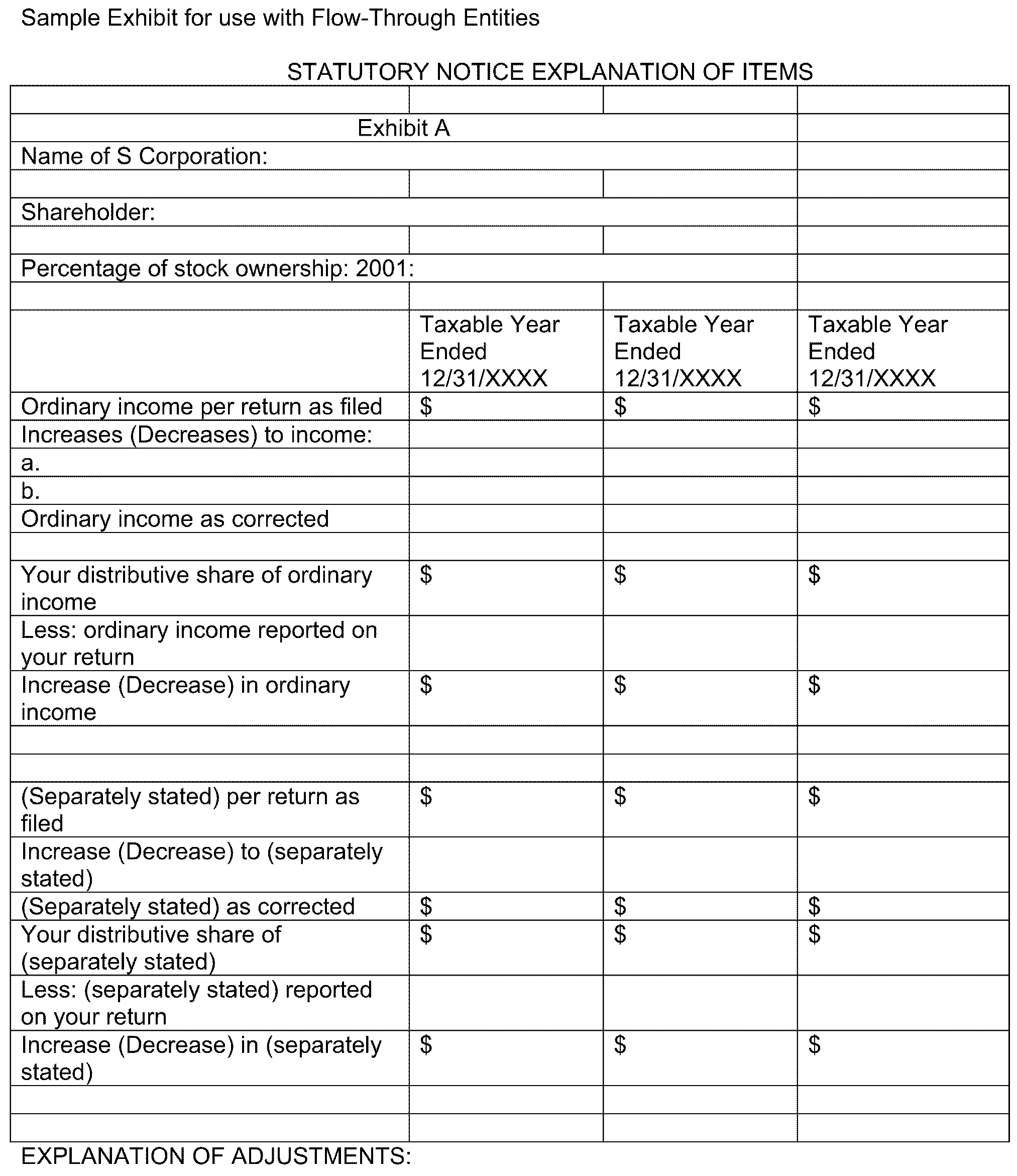
Computation of Last Day to File a Petition With United States Tax Court
| Description | Julian Date | Calendar Date |
|---|---|---|
| Notice of deficiency issued | MM/DD/YYYY | MM/DD/YYYY |
| Plus 90/150-days for 90/150-day letter | Plus days | Plus days |
| Equals Last Day to File a Petition with Tax Court | MM/DD/YYYY | MM/DD/YYYY |
Note:
Saturday, Sunday or a legal holiday in the District of Columbia is not counted as the last day.
Agreed Case Without Form 872–A Consent: If the taxpayer agrees to the tax before the end of the 90-days, then the statute is extended by the number of days suspended plus 60 days.
| Description | Julian Date | Calendar Date |
|---|---|---|
| Date Agreement is received | 80 | March 21 |
| Minus date 90/150-day letter is issued | − 15 | January 15 |
| Equals number of days suspended from assessing | 65 | N/A |
| Plus 60 days to assess | + 60 | + 60 |
| Equals number of days to add to original statute | 125 | N/A |
| Julian date of original statute, including any Form 872 extension | + 105 | April 15 |
| Julian date of corrected statute | 230 | August 18 |
Agreed Case With Form 872–A Consent: A notice of deficiency terminates Form 872–A. If the taxpayer agrees, the statute date is extended for 60 days from the agreement received date. This is allowed by law to process the assessment.
| Description | Julian Date | Calendar Date |
|---|---|---|
| 1. Date Agreement is received | 194 | July 13 |
| 2. Plus 60 days to assess | + 60 | + 60 |
| 3. Equals Extended ASED | 254 | September 11 |
Defaulted 90-Day Letter Without Form 872–A Consent: If the taxpayer does not petition Tax Court or agree to the deficiency by signing a waiver, then the case is closed as unagreed. The deficiency can then be assessed because the taxpayer has defaulted (i.e., has not responded to the notice of deficiency (90 or 150-day Letter). The statute will be extended for the 90 or 150-days the case was suspended plus 60 days allowed by law to process the assessment.
| Description | Julian Date | Calendar Date |
|---|---|---|
| Original statute date | 105 | April 15 |
| Plus 90 (150) days for 90- day letter | + 90 (or 150) | + 90 (or 150) |
| Plus 60 days to assess | + 60 | + 60 |
| Equals extended ASED | 255 | September 12 |
Defaulted 90-day Letter With Form 872–A Consent: A notice of deficiency terminates Form 872–A. If the notice defaults, the statute date is extended for the 90/150-days the case was suspended plus 60 days allowed by law to process the assessment.
| Description | Julian Date | Calendar Date |
|---|---|---|
| Date 90 (150) Day Letter issued | 105 | April 15 |
| Plus 90 (150) days for 90- day letter | + 90 (or 150) | + 90 (or 150) |
| Plus 60 days to assess | + 60 | + 60 |
| Equals extended ASED | 255 | September 12 |
The following sample paragraphs may be used for the explanation of adjustments in accumulated earnings tax cases:
Statement Filed - Credit for Reasonable Needs
Example:
It has been determined that your organization was formed or availed of so, your shareholders could avoid income tax by permitting earnings and profits to accumulate instead of being divided or distributed during the taxable year (list tax year). Accordingly, the accumulated earnings tax provided by IRC 531 is being asserted.
Example:
In determining your accumulated earnings credit under IRC 535, consideration was given to the statement you filed dated (date of statement), in response to the notification sent to you by certified mail on (date of notification letter), as required by IRC 534(b). That part of your earnings and profits for the taxable year ended (insert date), which was retained for the reasonable needs of your business, was (amount of reasonable needs). In figuring your accumulated earnings tax, an accumulated earnings credit of (amount of credit) is allowed, as follows: (insert computation of credit).
Statement Filed - Minimum Credit Allowed
Example:
It has been determined that your organization was formed or availed of so, your shareholders could avoid income tax by permitting earnings and profits to accumulate instead of being divided or distributed during the taxable year ended (tax year). Accordingly, the accumulated earnings tax provided by IRC 531 is being asserted.
Example:
In determining your accumulated earnings credit under IRC 535, consideration was given to the statement you filed dated (date of statement), in response to the notification sent to you by certified mail on (date of notification), as required by IRC 534(b).
Example:
The information shown in your statement is not sufficient to establish that any part of your earnings and profits for the taxable year ended (insert date) was kept for reasonable needs of your business. Accordingly, the minimum accumulated earnings credit has been allowed and computed as follows: (insert computation of credit).
No Statement Filed - Minimum Credit Allowed
Example:
It has been determined that your organization was formed or availed of so, your shareholders could avoid income tax by permitting earnings and profits to accumulate instead of being divided or distributed during the taxable year (tax year). Accordingly, the accumulated earnings tax as provided by IRC 531 is being asserted.
Per IRM 4.23.10.17.3(1), Exam will make the partial assessments related to FICA adjustment. After the partial assessment is made by CCP the exam group will close the cases to Technical Services for a SNOD or to be sent to Appeals.
The following is a sample of a FICA tax and penalty assessment computation on a Form 886A Explanation of Items "FOR INFORMATIONAL PURPOSES ONLY"
-
The adjustment(s) to your income contained in this report has increased your FICA tax (social security tax plus Medicare tax) liability. Therefore, we have assessed (or will assess) the FICA tax and the applicable penalty in the amounts shown below.
-
A separate notification should have been (or will be) sent to you on the FICA tax and penalty assessment from the campus of the IRS.
-
Please note that the FICA tax and penalty assessments from the campus of the Internal Revenue Service are not part of the deficiency shown in the attached Notice of Deficiency and may not be contested in the Tax Court.
Computation of Total Amount Due:
| Unreported Tip Income subject to Social Security Tax | $6,682.00 |
| Social Security Tax Rate | X 6.2 percent |
| Increase in Social Security Tax | .......................... $414.00 |
| Unreported Tip Income subject to Medicare | $6,682.00 |
| Medicare Tax Rate | X 1.45 percent |
| Increase in Medicare Tax | ..............................$97.00 |
| Total Adjustment to Social Security and Medicare Tax | ............................$511.00 |
| 50 percent penalties for failure to report tips in accordance with section 6652(b) of the internal Revenue Code | ............................$256.00 |
| Total Amount Due | ............................$767.00 |
If you wish to make a payment at time, you must specify the amount of the payment that is for the FICA tax and/or the penalty.
| Statutory Deficiency | ..................................$0.00 |
| Correct Amount of Prepayment Credits: | Calculation |
| Federal Income Tax Withheld: | $0.00 |
| Estimated Tax Payment: | $0.00 |
| Correct Prepayment Credit: | ..................................$0.00 |
| Prepayment Credits Claimed on Return: | Calculation |
| Federal Income Tax Withheld: | $0.00 |
| Estimated Tax Payment: | $0.00 |
| Total Prepayment Credits on Return: | $0.00 |
| Understatement of Prepayment Credits: | ..................................$0.00 |
| Net additional tax (or net overpayment): | ..................................$0.00 |
Liability for transferor's unpaid original tax liability:
Example:
The unpaid income tax liability from (name of transferor), (transferor’s address), for the taxable year ended December 31, YYYY, is $0.00, as shown in the attached statement. This amount, plus interest, is your liability as transferee of assets for (name of transferor). We’ll assess it against you.
Liability for transferor's unpaid deficiency:
Example:
The income tax liability of (name of transferor), (transferor's address), for the taxable year ended December 31, YYYY, shows a deficiency of $0.00, as shown in the attached statement. The amount, plus interest, is your liability as transferee of assets for (name of transferor). We’ll assess it against you.
Unpaid deficiency of the transferor for one year in excess of an overpayment by the transferor for another year:
Example:
The income tax liability of (name of transferor), (transferor's address), for the taxable years ended December 31, YYYY and December 31, YYYY, shows a deficiency of $0.00 for the taxable year ended December 31, YYYY, and an overpayment for the taxable year ended December 31, YYYY, as shown in the attached statement. This deficiency amount, plus interest is your liability as transferee of assets for (name of transferor). We’ll assess it against you. We’ll refund or credit the overpayment, to the extent that it represents an overpayment of tax.
Value of the assets received by the transferee is less than the unpaid deficiency of the transferor:
Example:
The income tax liability for (name of transferor), (transferor's address), for the taxable year ended December 31, YYYY, show a deficiency of $0.00, as shown on the attached statement. We’ll assess $0.00 of the amount of the income tax deficiency, plus interest, against you as transferee of assets for (name of transferor).
Transferee of a transferee with respect to their liabilities for an unpaid deficiency of the transferor:
Example:
The tax liability for (name of transferor), (transferor’s address), for the taxable year ended December 31, YYYY, shows a deficiency of $0.00, as shown in the attached statement. The amount, plus interest, is your liability as transferee of assets for (first transferee), transferee of assets for (name of transferor) and will be assessed against you.
Fiduciary with respect to personal liability under IRC 6901 and 31 U.S.C. 3713(b) by reason of the fiduciary having paid any debt or distributed assets without first having satisfied the tax due from the estate: Income Tax
Example:
The tax liability of (name of taxpayer), (taxpayer's address), for the taxable year ended December 31, YYYY, shows a deficiency of $0.00, as shown in the attached statement. This amount, plus interest, is your personal liability under 31 U.S.C. 3713(b), as amended, as fiduciary for (name of taxpayer). We’ll assess it against you.
Example:
We assessed $0.00, plus interest, against you. This amount is your personal liability under 31 U.S.C. 3713(b), as a fiduciary, for estate tax due from the estate of (name of estate), (estate address), as shown in the attached statement.
Example:
We assessed $0.00, plus interest, against you. This amount is your personal liability under 31 U.S.C. 3713(b), as a fiduciary, for gift tax due from (name of taxpayer), deceased, for the calendar year(s) listed in the attached statement.
Decedent's estate when it is proposed to hold the estate liable for the payment of a deficiency due from a corporation of which the decedent was a transferee during his or her lifetime.
Example:
During his or her lifetime, (name of decedent), deceased, (decedent's address), incurred an income tax liability of $0.00, as transferee of assets for (name of transferor), (transferor's address), for the taxable year ended December 31, YYYY, as shown in the attached statement. We’ll assess this amount, plus interest, against the estate of the decedent.
Trustees of a decedent's estate if the duly qualified executors or administrators have been discharged and they or others are appointed trustees, and it’s necessary to issue a transferee letter to the trustees:
Example:
The income tax liability of (name of taxpayer) deceased, (taxpayer’s address), deceased, for the taxable year ended December 31, YYYY, discloses a deficiency in the amount of (amount of liability), as shown in the attached statement. This amount, plus interest as provided by law, will be assessed against you as transferee of assets of the estate of the decedent.
Transferee of gift tax:
Example:
We have determined an assessment against you in the amount of (amount of liability), plus interest as provided by law, which constitutes your liability as a transferee of property of (name of transferor), (transferor's address), for gift tax for the calendar year(s) as shown in the attached statement.
Transferee of estate tax:
Example:
We assessed $0.00, plus interest, against you. This amount is your liability as a transferee of property of the estate of (name of deceased), (deceased's address), for estate tax, as shown in the attached statement.
Transferee, trustee, and/or insurance beneficiary of estate tax:
Example:
We assessed $0.00, plus interest, against you. This amount is your liability as [transferee, trustee or beneficiary] of property of the estate of (name of deceased), (deceased's address), for estate tax, as shown in the attached statement.
Example:
"Trustee" is to be used pursuant to IRC 6324 and IRC 6901 if the property is included in the gross estate under IRCs 2035, 2036, 2037, 2038, 2040, 2041, or 2042. "Trustee" and/or "beneficiary" should be omitted if inapplicable. Such notice should be issued within the 3 year period under IRC 6501.
| Transferee of assets of a corporation: |
|---|
| STATEMENT |
| (Name of transferor), Transferor |
| TIN: |
| (Address) |
| Tax liability for the taxable year ended____. |
| (Name of transferee), Transferee |
| TIN: |
| (Address) |
| It has been determined that (name of transferor), (address), has been dissolved and that assets (identify assets and date(s) of transfer) were transferred to you on or about (date). |
| The above amounts are your liability as a transferee of assets of (name of transferor) for a deficiency of income tax due from (name of transferor) for the taxable year shown above. |
| Transferee of assets of an estate: |
|---|
STATEMENT |
| Estate of (name of decedent), Deceased, Transferor |
| TIN: |
| (Address) |
| Tax liability for the taxable year ended____. |
| (Name of transferee), Transferee |
| TIN: |
| (Address) |
| It has been determined that assets (identify assets) of the above-named decedent's estate was transferred to you on or about (date). |
| The above amount is your liability as a transferee of assets of the estate of (name of decedent) for a deficiency in income tax due from his estate for the taxable year shown above. |
| Decedent's estate for the liability of the decedent incurred prior to date of death as a transferee of the assets of a corporation, estate, or other transferee: |
|---|
STATEMENT |
| (Name of transferor), Transferor |
| TIN: |
| (Address) |
| Tax liability for the taxable year ended____. |
| (Name of decedent), Deceased, Transferee |
| TIN: |
| (Address) |
| (Name of administrator), Administrator |
| (Address) |
| It has been determined that (name of transferor), (address), has been dissolved, that assets were transferred to (name of decent) on or about (date), and that payment of an income tax deficiency in the amount of $--- for the taxable year shown above is due from the corporation. |
| The above amount represents the liability of the estate of (name of decedent) for payment of the deficiency due from (name of transferor), which liability was incurred by (name of decedent) during his lifetime as a transferee of assets of said corporation. |
| Transferee of a transferee of assets of a corporation, estate or other transferor: |
|---|
STATEMENT |
| (Name of transferor), Transferor |
| TIN: |
| (Address) |
| Tax liability for the taxable year ended____. |
| (Name of transferee), Transferee |
| TIN: |
| (Address) |
| It has been determined that (name of transferor), (address) has been dissolved, that assets were transferred to (name of first transferee) on or about (date), and that (name of first transferee) has been dissolved and its assets were transferred to you on or about (date). |
| The above amount is your liability as a transferee of assets of the (name of first transferee), (address), transferee of assets of the (name of transferor), (address), for an income tax deficiency due from (name of transferor) for the taxable year shown above. |
| NOTE: If the estate or other taxpayer is a transferor, the above paragraphs should be changed to cover the facts in that particular case. |
| Trustees of a decedent's estate where the duty qualified executors or administrators have been discharged and they or others have been appointed trustees: |
|---|
STATEMENT |
| Estate of (name of decedent), Deceased, Transferor |
| TIN: |
| (Address) |
| Tax liability for the taxable year ended____. |
| Estate of (name of decedent), Deceased, Transferee |
| (Names of trustee(s)), Trustee(s) |
| (Address) |
| The records of this office show that (name(s) of trustee(s)) were the qualified (executor and/or executrix and/or administrator) of the estate of (name of decedent), Deceased, until he, she, or they were discharged as such on (date) and that they have been since that time and are now the trustees of the estate. |
| The above amount represents the liability of the trust created under the will of (name of decedent), as transferee of assets of his/her estate, for a deficiency of income tax due from him or her (or his or her estate) for the taxable year shown. |
| Fiduciary who has incurred personal liability for payment of the tax of an estate under 31 U.S.C. 3713(b) through failure to observe the priority of the United States: |
|---|
STATEMENT |
| Estate of (name of decedent), Deceased |
| TIN: |
| (Address) |
| Tax liability for the taxable year ended____. |
| (Name of fiduciary) |
| TIN: |
| (Address) |
| The records of this office show that you were served with proof(s) of claim by the United States on (date(s)). the records of the (name of the court), (address) show that the estate of (name of decedent), Deceased, was closed on (date), and that certain debts were paid or distribution of the assets was made without first satisfying the tax due to the United States from the estate. |
| The above amount is your personal liability under 31 U.S.C 3713(b), as amended, for a deficiency of income tax due from the estate of (name of decedent) for the taxable year shown above. |
| Estate tax letter to a transferee of property received from an estate after decedent's death: |
|---|
STATEMENT |
| Estate of (name of decedent), Deceased, Transferor |
| TIN: |
| (Address) |
| (Name of transferee), Transferee |
| TIN: |
| (Address) |
| Tax liability for the taxable year ended____. |
| (Name of transferee), Transferee |
| TIN: |
| (Address) |
| It has been determined that property of the estate of (name of decedent), Deceased, was transferred to you on or about (date). The liability of the estate for estate tax has not been discharged. the above amount is your liability as a transferee of property of that estate. Your liability does not exceed the value of the property you received. |
| The estate tax return filed by the executor (executrix or administrator) on Form 706 has been verified as filed except as follows: (show changes as in usual setup to the estate). |
| Estate tax letter addressed to a fiduciary who has incurred personal liability for payment of the estate tax of an estate under 31 U.S.C. 3713(b) through failure to observe the priority of the United States: |
|---|
STATEMENT |
| Estate of (name of decedent), Deceased |
| TIN: |
| (Address) |
| (Name of fiduciary) |
| TIN: |
| (Address) |
| It has been determined that you have served as a fiduciary of the estate of the decedent named above, that the estate tax liability of the estate has not been discharged, and that you, as a fiduciary, paid a debt or debts, or distributed the estate in whole or in part without first discharging the estate tax liability. |
| Accordingly, under 31 U.S.C. 3713(b), you are personally liable for the undischarged estate tax to the extent of such payments and distributions. the above amount is your personal liability. |
| The estate tax return filed by the executor (executrix of administrator) on Form 706 has been verified as filed except as follows: (Use same setup as to estate). |
| Estate tax letter addressed to a transferee of property transferred by the decedent during his/her life, or insurance, powers of appointment and jointly owned property with right of survivorship: |
|---|
STATEMENT |
| Estate of (name of transferee), Deceased, Transferor |
| TIN: |
| (Address) |
| (Name of trustee or beneficiary), Trustee and Transferee, or (Insurance Beneficiary and Transferee) or (Trustee, Insurance Beneficiary and Transferee) |
| TIN: |
| (Address) |
| It has been determined that property included in the gross estate of the decedent named above for the purpose of estate tax was transferred to or received by you on or about (date), and that the liability of the estate for estate tax has not been discharged. |
| The above amount is your liability as transferee and trustee of property under a trust created by the decedent on (date), of which you are trustee. the amount of your liability does not exceed the value of the property you received. |
| OR |
| The above amount is your liability as transferee and trustee of insurance upon the life of (name of decedent), Deceased, the policy (or policies) numbered ---- having been issued by your company. The proceeds of the insurance are being held in whole or in part by your company and the income (or the income and part of the principal is being paid to a designated beneficiary (beneficiaries)). The amount of your liability does not exceed the amount of the insurance. |
| OR |
| The above amount is your liability as a transferee of property from the decedent during his lifetime on or about (date or dates) and also from the estate at or after his death. The amount of your liability does not exceed the value of the property you received. |
| The estate tax return filed by the executor (executrix or administrator) on Form 706 has been verified as filed except as follows: (show changes as in usual setup to the estate). |
| Note: Combinations and variations of the above statement may be necessary. Each one should be worded to cover the particular case, care being exercised to combine with "transferee" the appropriate term "trustee" or "insurance beneficiary" or both. |
| Gift tax letter addressed to a transferee of property from an individual as a gift: |
|---|
STATEMENT |
| (Name of donor), Donor |
| TIN: |
| (Address) |
| (Name of transferee), Transferee |
| TIN: |
| (Address) |
| It has been determined that on or about (date or dates) (name of donor) transferred property to you as a gift (or gifts), and that the gift tax liability has not been discharged. The above amount is your liability as a transferee of the property you received. |
| The gift tax return by the donor (executor) on Form 709 has been verified as filed except as follows: (Show usual setup). (Use the calendar year when applicable). |
| Gift tax letter addressed to a fiduciary who has incurred personal liability for payment of the gift tax of a deceased donor under 31 U.S.C. 3713(b), through failure to observe the priority of the United States: |
|---|
STATEMENT |
| Estate of (name of decedent), Deceased |
| TIN: |
| (Address) |
| (Name of fiduciary) |
| TIN: |
| (Address) |
| It has been determined that you have served as executor (or administrator) of the estate of (name of decedent). At the time of his death, he or she was indebted to the United States for gift tax upon the transfer of certain property as a gift (or gifts). It also appears that you, as fiduciary, paid a debt or debts of the decedent or distributed the estate in whole or in part without first discharging the gift tax liability. Accordingly, under 31 U.S.C. 3713(b), as amended, you are personally liable for the undischarged gift tax to the extent of such payments and distributions. the above amount is your personal liability. |
| The gift tax return by the donor(executor) on Form 709 has been verified as filed except as follows: (Use same setup as to donor.) (Use the calendar year when applicable.) |
| Gift tax letter addressed to trustee as transferee of property received from an individual as a gift in trust for the benefit of others: |
|---|
STATEMENT |
| (Name of donor), Donor |
| TIN: |
| (Address) |
| (Name of trustee and transferee), Trustee and Transferee |
| TIN: |
| (Address) |
| It has been determined that on or about (date or dates) (name of donor) transferred property to you as gifts under a trust (or trusts) (dated) for the benefit of a certain person(s) named therein, and that the gift tax liability has not been discharged. The above amount is your liability as trustee and transferee of the property you received. |
| The gift tax return by the donor (executor) on Form 709 has been verified as filed except as follows: (Show same setup as to donor.) (Use the calendar year when applicable.) |