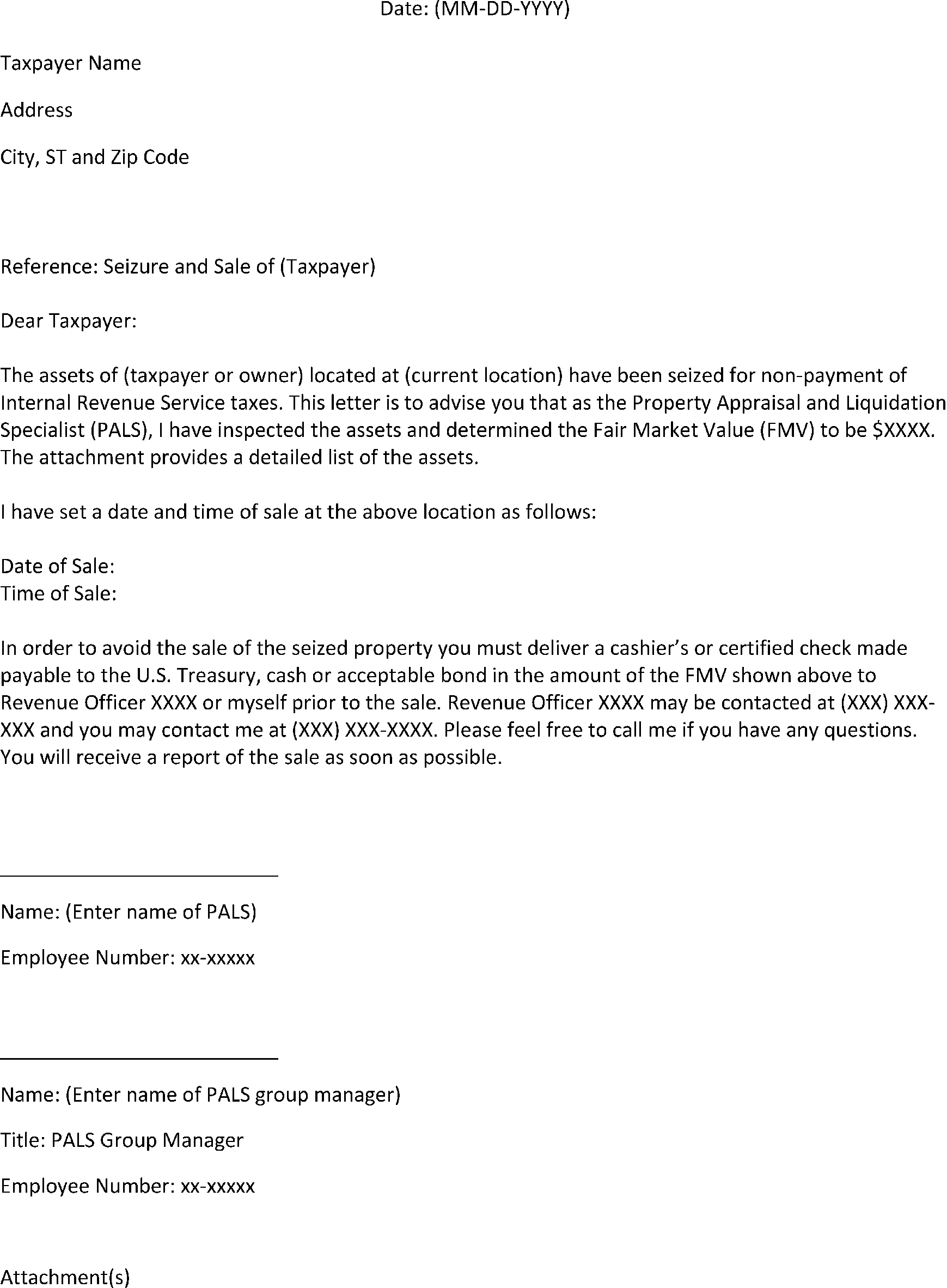
)
or https:// means you've safely connected to the .gov website. Share sensitive information only on official, secure websites.
)
or https:// means you've safely connected to the .gov website. Share sensitive information only on official, secure websites.


- 5.10.4 Actions Prior to Sale
- 5.10.4.1 Program Scope and Objectives
- 5.10.4.1.1 Background
- 5.10.4.1.2 Authority
- 5.10.4.1.3 Responsibilities
- 5.10.4.1.4 Program Management and Review
- 5.10.4.1.5 Program Controls
- 5.10.4.1.6 Acronyms and Definitions
- 5.10.4.1.7 Related Resources
- 5.10.4.2 Overview
- 5.10.4.2.1 General
- 5.10.4.3 Establishment of the Minimum Bid
- 5.10.4.3.1 Minimum Bid - Form 4585 Minimum Bid Worksheet
- 5.10.4.3.1.1 Minimum Bid - Estimate Expenses
- 5.10.4.3.1.2 Minimum Bid - Fair Market Value
- 5.10.4.3.1.3 Minimum Bid - Forced Sale Value
- 5.10.4.3.1.4 Minimum Bid - Reduced Sale Value
- 5.10.4.3.1.5 Minimum Bid - Encumbrances
- 5.10.4.3.1.6 Minimum Bid - Limitation
- 5.10.4.3.1.7 Minimum Bid - Securities and Precious Metals
- 5.10.4.3.1.8 Minimum Bid - Digital Assets
- 5.10.4.3.2 Decision to Bid In the Property for the Government
- 5.10.4.3.3 Delivery of Form 4585, Minimum Bid Worksheet
- 5.10.4.3.4 Challenges to the Minimum Bid
- 5.10.4.3.5 PALS Agrees Fully With Challenge to Minimum Bid
- 5.10.4.3.6 PALS Agrees Partially With Challenge to Minimum Bid
- 5.10.4.3.7 PALS Disagrees With Challenge to Minimum Bid
- 5.10.4.3.8 Revised Minimum Bid Forms — No Opportunity to Protest
- 5.10.4.3.1 Minimum Bid - Form 4585 Minimum Bid Worksheet
- 5.10.4.4 Determination of Type of Sale
- 5.10.4.4.1 Mail-in Bids for Public Auction Sales
- 5.10.4.5 Grouping of Property
- 5.10.4.6 Outsourcing Sales
- 5.10.4.7 Sale Plan
- 5.10.4.8 Preparation of Notice of Sale
- 5.10.4.8.1 Notice of Sale — Date and Place of Sale
- 5.10.4.8.2 Notice of Sale — Grouping of Property
- 5.10.4.8.3 Notice of Sale — Terms of Payment
- 5.10.4.8.4 Conditional Sale Proceeds
- 5.10.4.8.5 Joint Tenants and Tenants in Common Property
- 5.10.4.9 Delivery of Notice of Sale
- 5.10.4.10 Methods of Advertising and Posting the Notice of Sale
- 5.10.4.10.1 Commercial Advertising of Sale
- 5.10.4.11 Actions Prior to Sale of Assets Seized Under Jeopardy or Termination Assessments
- 5.10.4.12 Refiling Notices of Federal Tax Lien - Collection After Statute Has Expired
- 5.10.4.13 Redemption of Property Prior to Sale
- 5.10.4.14 Conditions for Release of Seized Property
- 5.10.4.15 Release of Wrongful Seizures for Property Not Yet Sold
- 5.10.4.16 Actions to Release and Return Property
- 5.10.4.17 Form 2436-R, Seized Property Release/Redemption Report
- 5.10.4.18 Pre-Sale Procedures for Perishable Goods
- 5.10.4.18.1 Sale of Perishable Goods
- 5.10.4.19 Arrangements to Deposit Sales Proceeds
- Exhibit 5.10.4-1 Form 2434 — Notice of Public Auction Sale Reference: IRM 5.10.4.8
- Exhibit 5.10.4-2 Form 2434–A — Notice of Sealed Bid Sale Reference: IRM 5.10.4.8
- Exhibit 5.10.4-3 Perishable Goods Asset Valuation Notice Reference: IRM 5.10.4.18
- 5.10.4.1 Program Scope and Objectives
Part 5. Collecting Process
Chapter 10. Seizure and Sale
Section 4. Actions Prior to Sale
5.10.4 Actions Prior to Sale
Manual Transmittal
January 23, 2025
Purpose
(1) This transmits revised 5.10.4, Seizure and Sale, Actions Prior to Sale.
Material Changes
(1) IRM 5.10.4.1.5, added new section, Program Controls.
(2) IRM 5.10.4.1.6, Acronyms and Definitions table updated with FSV, RSV and RSFV.
(3) IRM 5.10.4.1.7, added new section, Related Resources.
(4) IRM 5.10.4.2.1, added paragraph to address IGM SBSE-05-0723-0045, Field Collection Safety During Field Contact, dated 07-24-2023.
(5) IRM 5.10.4.3.1.3, updated title from "force" to "forced" .
(6) IRM 5.10.4.3.1.4, note added to clarify Reduced Forced Sale Value (RSFV).
(7) IRM 5.10.4.3.1.8, changed "virtual currency" references to "digital assets" .
(8) IRM 5.10.4.6.2, changed "virtual currency" references to "digital assets" .
(9) IRM 5.10.4.12(1), changed Form 668-B to Form 2433 to align with IRC 6502(b).
(10) IRM 5.10.4.12(2), changed Form 668-B to Form 2433 to align with IRC 6502(b).
(11) IRM 5.10.4.15(6), added an IRM reference and a publication reference for damage claims.
(12) Throughout this IRM section: editorial corrections were made to update citations, references, hyperlinks etc.
Effect on Other Documents
This supersedes IRM 5.10.4 dated August 31, 2022.Audience
Small Business/Self-Employed Compliance EmployeesEffective Date
(01-23-2025)Eric V. Slayback
Acting Director, Collection Policy
Small Business / Self Employed Division
-
Purpose: This section provides guidance for collection staff in preparing for the sale of seized assets.
-
Audience: This section is for Collection employees preparing for the sale of seized assets.
-
Policy Owner: Director, Collection Policy.
-
Program Owner: Small Business/Self Employed office of Headquarters Collection Policy.
-
Primary Stakeholders: The primary stakeholders are Revenue Officers, Advisors and Property Appraisal and Liquidation Specialists (PALS).
-
Program Goals: Provide guidance and procedures for the preparation of sale of seized assets.
-
Internal Revenue Manual 5.10.4, Seizure and Sale, Actions Prior to Sale, contains procedural guidance for preparing for the sale of seized assets. The procedures contained in this section relate to establishing and delivering the minimum bid, challenges to the minimum bid, determination of the type of sale, preparing and delivering the Notice of Sale, and other pre-sale actions.
-
The authority of this IRM is based on the following:
-
IRC 6331, Levy and Distraint
-
IRC 6334, Property Exempt From Levy
-
IRC 6335, Sale of Seized Property
-
IRC 6336, Sale of Perishable Goods
-
Delegation Order 1-23-2 (Rev 2), Authority to Sign and Issue Levy and Related Documents, IRM 1.2.65-2
-
P-5-1 Enforcement is a necessary component of a voluntary assessment system
-
P-5-28 Successive seizures — Timing to avoid undue hardship
-
P-5-34 Collection enforced through seizure and sale of the assets occurs only after thorough consideration of all factors and of alternative collection methods
-
P-5-35 Establishment of minimum price in distraint sales
-
P-5-38 Seizure of Assets Located on Private Premises
-
P-5-40 Welfare of livestock and domestic animals to be considered before or during course of seizure
-
-
The Director of Collection Policy is responsible for overseeing the policy and procedures regarding seizure and sale of assets.
-
Revenue Officers are responsible for developing and conducting seizures as appropriate. Advisors are responsible for reviewing the file as outlined in IRM 5.10.2.2(10), Securing Managerial Approval of Seizure Actions, IRM 5.10.3.24 , Contacting Advisory for Seizure Numbers, and IRM 5.10.6.11, Advisory Review of Seizure Files. The Property Appraisal and Liquidation Specialists (PALS) are responsible for conducting or coordinating all the auction sale activities.
-
Program Reports: Per IRM 1.4.50, Collection Group Manager, Field Compliance Manager (FCM)/Territory Manager(TM) and Area Director Operational Aid, and IRM 1.4.53, Advisory and Property Appraisal and Liquidation Specialist Group Manager Operational Aid, Group Managers are required to review ICS and Entity reports on a monthly basis to ensure cases are being effectively worked.
-
Program Effectiveness: Collection Policy completes an annual seizure and sale review to identify trends and opportunities for improvement.
-
Revenue Officers and PALS utilize Form 13360, Seizure and Sale Checklist, to track seizure and sale actions. The completed checklist is submitted with the closing documents by the revenue officer and PALS and will be included in the seizure case file maintained in Advisory per IRM 5.10.1.2(3), Overview.
-
PALS managers will consistently review files, PALS sale actions, forms and letters.
-
Advisors review sale documents and forms as outlined in IRM 5.10.6.11, Advisory Review of Seizure Files. Advisors must use Form 13361, Post-Seizure Review Checksheet, for the post-seizure review.
-
All seizures packages must be routed for review and approval through the eApproval SharePoint system.
-
The table below lists common acronyms used in this section.
Acronym Definition CLO Centralized Lien Organization COR Contracting Officer Representative FMV Fair Market Value FSV Forced Sale Value IPAC Intra-Governmental Payment and Collection System PALS Property Appraisal and Liquidation Specialist RACS Revenue Accounting Control System RSV Reduced Sale Value RFSV Reduced Forced Sale Value
-
IRM resources:
-
Procedural guidance regarding seizures can be found throughout IRM 5.10, Seizure and Sale.
-
Legal guidance regarding seizures can be found in IRM 5.17.3, Levy and Sale.
-
-
Web resources:
-
Seizures Knowledge Base Homepage: Seizures Knowledge Base - Home
-
ICS User Guide: Collection Systems Knowledge Base - Home
-
-
The Internal Revenue Code (IRC) provides taxpayers specific rights. The Taxpayer Bill of Rights (TBOR) groups these rights into ten fundamental rights. See IRC 7803(a)(3), Execution of Duties in Accord with Taxpayer Rights. IRS employees are responsible for being familiar with and following these rights. For additional information about taxpayer rights, see https://www.irs.gov/taxpayer-bill-of-rights and IRM 1.2.1.2.36, Policy Statement 1-236.
-
This IRM provides guidance to revenue officers, Property Appraisal and Liquidation Specialists (PALS), and Advisory employees regarding actions taken prior to the sale of seized property.
-
Once the property has been seized and the inventory has been completed, the PALS should begin preparations for the sale by documenting a plan of action in the ICS history. Section II of Form 13360, Seizure and Sale Checklist, contains a list of sale actions necessary to prepare and conduct a sale. The PALS will be responsible for all sale related activities for seizures conducted under IRC 6335.
-
In some cases, the property may be released or redeemed prior to sale. IRM 5.10.4.13, Redemption of Property Prior to Sale, provides the procedures for redemption of the property prior to sale and IRM 5.10.4.14, Conditions for Release of Seized Property, provides the procedures for release of property prior to sale.
-
The PALS will document case actions per IRM 5.1.10.8, Case Histories. including updating the ICS seizure application with asset information, such as the storage location, minimum bid, fair market value, etc., as well as disposition information when the related action occurs.
-
The PALS may consider the need for a commercial title report, if one has not already been requested by the RO. Refer to IRM 5.10.1.5.3.3(4), Equity Determination - Verify Ownership and Identify Encumbrances, for additional information on making such requests.
-
The actions described in this IRM that are taken prior to the sale of seized assets do not require an appointment to be scheduled with a taxpayer in advance when contact is necessary to deliver any required notices or forms. See IRM 5.1.10.3(10), Initial Contact.
-
IRC 6335(e)(1)(A) requires that a minimum bid price be established for seized property offered for sale. The minimum bid price will be determined by the PALS assigned to the sale. The primary purpose of a minimum bid price is to avoid selling the property at substantially less than the forced sale value.
-
The minimum bid price must be correctly determined to provide for the equitable preservation of the property value; however, Policy Statement 5-35 limits the amount of the minimum bid to the amount necessary to recover the lien interest in the property plus costs.
-
Form 4585, Minimum Bid Worksheet, is used in determining the minimum bid price. The fair market value on Form 2433 is the starting point for the calculation. This value should have been previously determined by the revenue officer and PALS. The basis for the fair market value determination must be documented in Item 5 of Form 4585. Use Item 13 on Form 4585 if additional space is needed.
-
The PALS must determine a minimum price for the property considering the expenses of the levy and sale. The PALS must also determine whether it might be in the best interest of the United States to bid the property in at that minimum price for property sold per IRC 6335(e)(1)(A). IRC 6341 requires that the IRS determine expenses to be allowed in all cases of levy and sale. Treasury Regulation 301.6341-1 states that "Such expenses shall include the expenses of protection and preservation of the property during the period subsequent to the levy, as well as actual expenses incurred in connection with the sale thereof" .
-
PALS may incur as expenses of sale, goods or services needed to determine the value of the property to be sold as well as to protect and preserve the value of the property. Such expenses may include :
-
Installing a battery in a vehicle to determine its condition and value
-
Hiring a vendor to mow a lot
-
Engaging a mechanic to diagnose a problem and possibly make a minor repair that restores a piece of valuable construction or farm equipment to working order
-
-
Other repairs and maintenance may also be necessary to protect and preserve the property, including:
-
Cleaning a swimming pool (even if seized in a dirty condition) to prevent further damage to the pool interior and equipment
-
Repairs to a leaking roof or broken window to prevent water damage to the interior of the building
-
Regular mowing to ensure compliance with local codes and ordinances and to discourage rodent and snake infestations
-
-
PALS should exercise sound judgment to identify necessary expenditures and determine whether they can be charged as expenses of sale. To make this determination, consider the following:
-
Expenses made solely to improve or enhance the value of property or the price brought at sale should not be incurred
-
Expenses made to preserve the value of the property and prevent wasting may be incurred as an expense of sale
-
Expenses to determine the value of the property to calculate the minimum bid and to make a bid-in decision may be incurred as an expense of sale
-
-
Purchases of tables, chairs, signs or equipment used for multiple sales are not considered expenses of sale for a particular seizure.
-
If facts not known at the time of the seizure justify a change to the property value, it is not necessary to adjust the amounts on Form 2433 for accounting control purposes; however, the reason an adjusted figure is used as a basis for computing the minimum bid price should be fully explained in the history.
-
The revenue officer and PALS should have agreed to the property value prior to seizure. If new facts emerge and a change to the value is appropriate, the PALS group manager must obtain revenue officer group manager concurrence in the new value. Both managers should document their agreement in the ICS case history. If the managers cannot agree, the Field Compliance Manager (FCM)/Territory Manager(TM) who approved the seizure must determine whether to proceed with sale or release the seizure. If the decision is elevated to the managers or TM, they must document the results of any discussions in the ICS history.
-
A property value reduction, not to exceed 25%, should then be applied to determine the forced sale value. This reduction reflects the fact that the sale is "forced" (i.e., is not being made by a willing seller). The difficulties associated with a forced government sale, such as no guarantee of clear title, property sold "as is, where is" , and no warranty on the property, should be considered when determining this percentage. The reason(s) for the percentage reduction is reflected in Item 6 of Form 4585.
-
The percentage reductions selected should be based on the facts of the case. The reasons for the percentage reductions must be documented on Form 4585 and in ICS.
-
The forced sale value may then be reduced by a maximum of 20% in order to determine the reduced forced sale value. The PALS should check the appropriate reason(s) for the percentage reduction in Item 8 on Form 4585. Reasons listed on Form 4585 include:
-
Past experience at sales for the type of property seized
-
The possibility that senior lienholders may foreclose on the seized property
-
How the property is titled and if there are other owners of record
-
Whether the purchaser will have to re-negotiate prior encumbrances
-
The effect the redemption period has on finding willing buyers
-
Whether conditional financing is available
-
Whether the property is subject to conditional sale procedures
-
-
The percentage reductions selected should be based on the facts of the case. The reasons for the percentage reductions must be documented on Form 4585 and in ICS.
-
All encumbrances from Form 2434-B that are senior to the first NFTL should then be listed in Item 10 of Form 4585. Subtract the total of all prior claims from the reduced forced sale value to compute the minimum bid price.
-
The minimum bid price, in all instances, will be limited to an amount not to exceed the total tax, penalty, interest, NFTL filing fees, expenses of levy and sale, and other charges, which represent the government's lien interest in the seized property (See IRM 1.2.1.6.9, Policy Statement 5–35). If this is the basis for the minimum bid, it must be documented in Item 12 on Form 4585 by checking the box "Limited to the Government's Lien Interest" . If more than one Form 4585 is prepared for the same taxpayer (e.g., multiple real estate parcels are being sold separately), the combined minimum bid must be limited to the government's lien interest.
-
The minimum price for securities traded on the New York Stock Exchange, NYSE MKT (formerly NYSE Amex and American Stock Exchange), regional exchanges, or NASDAQ will be fixed at not less than 95% of the closing market price as of the day preceding the sale (See IRM 1.2.1.6.9, Policy Statement 5-35). On occasion, the IRS may administratively sell stock. In such cases, the minimum bid will be 95% of the closing price of the stock on the day before the sale. On Form 4585, enter 0% reduction in Item 6, enter 5% reduction in Item 8 and write an explanation about the minimum bid being 95% of the closing price from the day before the sale. Form 4585 must still be delivered to the taxpayer, but the taxpayer may not dispute the minimum bid under these circumstances.
-
The minimum bid price for raw/bulk precious metals (or unidentifiable coins) that are traded by weight on the New York Mercantile Exchange should be set at 80% of the spot price per troy ounce as of the day preceding the sale. For coins that are identifiable, the appropriate percentage should be 95% of the spot price per troy ounce of the precious metal content. When these types of assets are involved, enter 0% in Item 6 and the appropriate (20% or 5%) reduction in Item 8 of Form 4585, and write the appropriate explanation that the minimum bid will be 80% or 95% of the spot price per troy ounce as of the day preceding the sale. Form 4585 must still be delivered to the taxpayer, but the taxpayer may not dispute the minimum bid under these circumstances.
-
The PALS will use 80% of the Fair Market Value (FMV) as of the day before the sale (or the day before the sale goes live on GSA’s website), less senior encumbrances, to determine the minimum bid. This forced sale reduction accounts for the nature of the digital assets markets, the volatility and fluctuations in value and the fact that the sale is not being made by a willing seller. On more conventional assets, we use a 25% forced sale reduction and then another 20% reduced sale value, which accounts for various unfavorable issues that can come up in our sales, such as senior lienholders foreclosing on the property, the purchaser having to resolve senior encumbrances, the redemption period on real property, etc. Because these issues don’t typically arise with digital assets, we do not allow for the additional reduction in value.
-
Under IRC 6335(e)(1)(C), if the minimum bid price is not reached by bidders at the sale, the IRS may purchase the property for the minimum price if it is in the best interest of the government to do so. It is important that the minimum bid price be correctly determined since the taxpayer receives credit on the account for the amount of the minimum bid price, less expenses of levy and sale, when the property is declared purchased for the United States.
-
The decision whether or not to bid in the property for the government can be made up until the time the sale is adjourned or cancelled or the property is declared sold. The decision must be documented. In deciding whether to bid in property, the PALS should consider the following factors:
-
The threat of foreclosure or repossession by senior encumbrance holders
-
Marketability of the property
-
Cost of maintaining, safeguarding, repairing or restoring the property
-
Cost of transporting the property
-
Cost of potential toxic waste cleanup
-
Any unique factors particular to the type of property
-
Additional information discovered during the auction and not known prior to the auction itself
-
Risks to the government
-
Whether to bid in all or part of the property, and if so, based on the contribution to the over-all minimum bid as a factor, what the bid-in price will be when only a portion of the property is bid in for the Government.
-
-
The PALS will discuss and secure concurrence from the PALS group manager before bidding in property for the government. If only bidding in a portion of the property, the amount will also be discussed and manager concurrence is required.
-
If the PALS decides to not bid in the property for the government, the property will be released to the taxpayer if the minimum bid is not reached at the sale or, if applicable, at a subsequent sale if the original sale is adjourned (IRM 5.10.5.6, Adjournment Procedures).
-
Submit the completed Form 4585 to the manager of the PALS for approval prior to giving public notice of sale.
-
After approval of the minimum bid is secured, the PALS will complete the reverse of Part 3 of Form 4585 and deliver the form to the taxpayer. The PALS must either:
-
Deliver the Form 4585 to the taxpayer's business or place of abode, or
-
Send the Form 4585 to the taxpayer’s last known address by certified mail, return receipt requested, and by regular mail.
-
-
The PALS must then document the method of delivery.
Exception:
When a third party other than the taxpayer is the owner of the property, then Form 4585 must be delivered under the above guidelines to the owner. The taxpayer should receive a copy of the Form 4585, but any references to the 10-day appeal timeframes should be deleted. The owner of the property is entitled to appeal the minimum bid, not the taxpayer. Contact area counsel if there are any questions as to who should receive Form 4585, especially in nominee or alter-ego situations.
-
A copy of Form 4585 must be forwarded to Advisory within 10 workdays after the copy is provided to the taxpayer.
-
The taxpayer/owner has 10 days to respond to the minimum bid. Delivery should normally occur prior to giving the public notice of sale to permit ample time to finalize the minimum bid price before the sale date. If the taxpayer/owner does not respond within the 10 day waiting period, no further action is required.
-
The minimum bid price cannot exceed the amount of the tax liability plus expenses of sale (See IRM 1.2.1.6.9, Policy Statement 5–35). The minimum price for securities traded on the New York Stock Exchange, the NYSE MKT (formerly NYSE Amex and American Stock Exchange), regional exchanges, or NASDAQ will be fixed at not less than 95% of the closing market price as of the day preceding the sale (See IRM 1.2.1.6.9, Policy Statement 5-35). Therefore, when the minimum bid price is established by following either of these provisions, agreement is not required and a request for reevaluation will not be considered.
-
When challenging the property value used to calculate the minimum bid, the taxpayer must provide the basis of their disagreement (e.g., personal knowledge of market, appraisal) and their estimate of the property value. Their opinion need not be substantiated by a third party, but they must supply the amount and basis. If the taxpayer refuses to provide this information, proceed with sale as if there was no challenge.
-
If the taxpayer/owner responds with information regarding the property value and the PALS agrees, the PALS should revise the minimum bid. Document the reasons for revision in Item 13 of the revised Form 4585.
-
The revised minimum bid should be delivered under the same provisions as the original (IRM 5.10.4.3.3, Delivery of Form 4585, Minimum Bid Worksheet) or it may be faxed to the taxpayer/owner if there has been personal contact with the taxpayer or Power of Attorney to discuss the revision. The reference to the 10 days in which to protest the minimum bid should be deleted from the reverse of Form 4585. Send a copy to Advisory within 10 workdays of delivery to the taxpayer/owner.
-
Under these circumstances, the taxpayer/owner does not have an additional opportunity to dispute the property value used to calculate the revised minimum bid, and there is no requirement to wait an additional 10 days.
-
If the taxpayer/owner responds with information regarding the property value and the PALS agrees in part, revise the minimum bid based on an analysis of the information submitted. Document the reasons for revision in Item 13 of the revised Form 4585.
-
Deliver the revised minimum bid under the same provisions as the original minimum bid (IRM 5.10.4.3.3, Delivery of Form 4585, Minimum Bid Worksheet). Send a copy to Advisory within 10 workdays of delivery to the taxpayer.
-
If the taxpayer/owner agrees with the property value used to calculate the revised minimum bid and is willing to waive the 10 day waiting period, obtain a written statement and the taxpayer/owner's signature on the revised form and document the case history. If the signature is not secured, document the case history accordingly and allow the 10 day waiting period to expire. Concurrence with the minimum bid is only required when the minimum bid will be used before the end of the 10 day period.
-
Send a copy of the taxpayer/owner's concurrence with the minimum bid to Advisory. The taxpayer/owner's written signature and statement waiving the 10 day waiting period on Form 4585 suffices as concurrence when revising the minimum bid.
-
If the taxpayer/owner does not respond to the revised minimum bid within the 10 day waiting period, no further action is required.
-
If the taxpayer/owner still disagrees with the property value used to calculate the revised minimum bid, see IRM 5.10.4.3.7, PALS Disagrees With Challenge to Minimum Bid.
-
If the taxpayer/owner challenges the minimum bid and the PALS does not agree, advise the taxpayer/owner to secure the services of an independent appraiser acceptable to both the IRS and the taxpayer. If the taxpayer/owner does not secure an acceptable appraiser within a reasonable time period (usually 10 days) the PALS may choose an outside appraiser. An Internal Revenue Service Valuation Engineer or Appraiser may be used when feasible and available.
-
If the professional appraiser or valuation engineer recommends a forced sale value unacceptable to the taxpayer/owner, the services of another appraiser may be secured with an average of both appraisals being used to compute the value of the property.
-
If the revised minimum bid is based on an average of the two appraisals, the taxpayer/owner does not have an additional opportunity to dispute the minimum bid and there is no requirement to wait an additional 10 days. Generally, the revised minimum bid should be delivered under the same provisions as the original minimum bid. It may be faxed to the taxpayer/owner if there has been personal contact with the taxpayer/owner or representative to discuss the revised minimum bid. The reference to the ten days in which to protest the minimum bid should be deleted from the reverse of Form 4585. Send a copy to Advisory within 10 workdays of delivery to the taxpayer/owner.
-
The cost of obtaining the services of private appraisers may be paid directly by the taxpayer or may be made a part of the expenses of levy and sale to be charged to the account via TC 360.
-
If the minimum bid form is being revised for any of the following reasons, the taxpayer/owner does not have an additional opportunity to protest the minimum bid and the reference to the 10 days within which to submit a protest should be deleted from the reverse of Form 4585:
-
Additional encumbrances were located
-
Balances due on encumbrances are being adjusted or updated
-
Some of the seized property was released and reductions are being made to the fair market value based on the released assets (see IRM 5.10.4.16, Actions to Release and Return Property)
-
-
The PALS must determine by which method the seized property will be sold. This determination must be documented, even when outsourcing the sale to a vendor. Seized property may be sold either by:
-
Public auction, at which open competitive bids are received and mail-in bids may be accepted
-
Public sale by sealed bid
-
-
Relevant factors should be considered when selecting the method of sale, including:
-
The type of property
-
The location of the property
-
The condition of property
-
How the property is titled
-
-
The use of sealed bid sale provisions may reduce the likelihood of disruption when the potential exists for taxpayer or third party resistance to the sale. Select the method of sale that will maximize the net proceeds.
-
The IRS may accept mail-in bids for public auction sales. Optional Form 14731-A, Fixed Mail in Bid, and Form 14731, Ranged Mail-in Bid for Public Auction Sale, are available for mail in bid use. The PALS should complete the sections for mailing address, due dates of the payments, sale date, and date by which the merchandise must be picked up prior to sending the mail-in bid form to a prospective bidder or including it in the internet advertisement.
-
The form of payment and the amount of the bid must comply with the Terms of Payment as stated on the Notice of Public Auction Sale. The mail-in bid form should indicate that the bidder acknowledges:
-
That they must comply with all other conditions as stated in the Notice of Public Sale
-
That the bid is a mail-in bid on a public auction and is not a sealed bid
-
That there are advantages to bidding in person at the sale (inspecting the property; hearing any statement by the taxpayer, PALS, or lienholders; engaging in open, competitive bidding)
-
Responsibility for a) pick-up and delivery of the asset by a specified date and b) all costs associated with the storage and delivery of the asset after the sale is completed if they are the successful bidder
-
-
If a potential bidder requests information concerning encumbrances against the property, provide Form 2434–B, Notice of Encumbrances Against or Interests in Property Offered for Sale (IRM 5.10.1-1).
-
The mail-in bid form specifies the address and due date for submission of bids. The bids should be sent in a securely sealed envelope, and the bidder should include their name and address, date of sale, and lot numbers for which bids are being submitted on the upper left corner of the envelope. All envelopes should be annotated with the name and identification number of the appropriate PALS and the statement "MAIL-IN BID - TO BE OPENED BY ADDRESSEE ONLY" .
-
The PALS should advise potential bidders that they must submit separate bids with separate payments for each lot if they are bidding on multiple lots. This will facilitate the application of payments and the return of payments for unsuccessful bids.
-
The PALS will document the bidders' name, address, and the date the bid was received for all mail-in bids as they are received. If the bids are to be mailed to a local office and not directly to the PALS, the PALS should coordinate with the local office to have an employee (other than a revenue officer who has taken any collection actions at any time against the taxpayer whose assets have been seized) document and control the mail-in bids as they are received. Section C of Form 4425, Public Sale Bid Tabulation, or a similar form, may be used for this purpose; the title should be changed to "Receipt for Mail-in Bids" . All mail-in bids received will be retained for safekeeping in a government facility providing protection commensurate with the standards in IRM 10.2.14, Methods of Providing Protection.
-
A bid should not be considered unless it is received at the address specified on the mail-in bid form by the due date. Bids may be withdrawn upon written request from the bidder, provided the request is received by the PALS prior to the scheduled start time of the sale. If a timely request for withdrawal is received, return the mail-in bid to the bidder. Note the date of withdrawal on Form 4425 or similar form and attach the written request to the form.
-
Procedures for integrating the mail-in bids into the public auction and returning bids to unsuccessful bidders are contained in IRM 5.10.5.12, Property Offered Under Only One Method.
-
The seized property may be offered for sale:
-
As separate items
-
As groups of items
-
In the aggregate
-
Both as separate items/groups of items and in the aggregate
-
-
Consider offering general use property as both separate items/groups of items and in the aggregate. This may attract more bidders to the sale and increase sale proceeds. For example, when office furniture is being sold, an individual may bid on one file cabinet for home use but not on a group of ten.
-
The PALS will select the method(s) of sale expected to bring the highest price. The nature of any property being offered for sale should be considered in light of its use with any other property being offered. The decision to offer property as separate items, groups of items, or in the aggregate is often made by the PALS at the sale based on bidder interest.
-
If the property is offered as both separate items/groups of items and in the aggregate, the property will be sold under the method that produces the highest aggregate amount.
-
If the property to be sold includes both real and personal property, the real property and the personal property should be grouped separately.
-
Do not separate items or groups of items encumbered by a single senior lienholder.
-
The PALS should consider the use of an outside auctioneer if it would increase the sale proceeds (e.g., works of art, jewelry, antiques).
-
Request the service of an auctioneer by written memorandum and obtain the approval of the PALS group and territory managers. The cost thereof will be charged as an expense of the sale. See IRM 5.10.2.7, Contracting for Services, for procurement authority.
-
To prevent potential conflict of interest situations, the auctioneer must agree that neither they, their family members, nor employees or owners of the auctioneer company, nor agents of such company will bid on or purchase items at IRS sales conducted by the auctioneer. The above-stated restrictions will be reflected in auctioneer contract solicitations and in written statements to be signed by auctioneers selected under such solicitations. Form 14730, Statement of Agreement with the Restrictions to The IRS Contract for Auctioneering Services, may be used for this purpose.
-
The PALS will send the signed statement to Advisory. If the PALS requires the services of an auctioneer not currently under contract with the IRS, a memorandum documenting the reason must be submitted to the Chief Procurement Officer.
-
The PALS should work with the contracting engineer, who will consult with counsel in approving the terms and conditions of the auctioneer's proposed contract.
-
Although the outside auctioneer will conduct the sale, the presence of the PALS is required in order to begin the auction by reading the legal statement described in IRM 5.10.5.11, Conducting a Public Auction, and, if necessary, to adjourn the sale.
-
The Internal Revenue Service has an Interagency Agreement with the General Services Administration (GSA) to outsource sales of personal property on a case by case basis. To determine if an asset will be outsourced to GSA, consider the following criteria:
-
Low expenses – The costs incurred during seizure and sale leaves sufficient equity to allow for payment of the GSA fee.
-
Sufficient equity – After considering any encumbrances and estimated expenses (i.e. towing, storage, GSA fee, etc.), there are proceeds to apply to the taxpayer’s liability.
Note:
The determination to outsource to GSA is made on a case by case basis. Some considerations to use GSA for sales may include the location, type and expected marketability of the asset. There may also be instances where the anticipated sales proceeds are higher utilizing GSA even if the asset has an encumbrance. The determination to outsource to GSA or not outsource to GSA should be documented in the ICS history.
-
-
If the PALS determines the sale meets the GSA outsourcing criteria, the PALS will research values, anticipated expenses and logistics, storage needs and/or options through GSA schedules or local options.
-
The PALS will provide value and expense information to the RO for the seizure approval package and document ICS with the information.
-
Once the RO completes the seizure and mails the package to the PALS GM, the PALS will take custody and prepare Form 4585, Minimum Bid Worksheet, and seek approval from the PALS GM. Once approved, the PALS will mail Form 4585 via certified and regular mail to the taxpayer.
-
At the same time, the PALS will prepare and send Standard Form 126 ( Report of Personal Property For Sale | GSA ) to GSA, along with the sale and lot numbers, Form 15007, Vehicle Standard Description and Checklist for vehicles and the pictures of the asset.
-
The PALS will coordinate any sale assistance needed, including the conducting of an open house/asset viewing and/or property retrieval after the sale, by contacting the RO GM located near the seized property. The PALS will provide the RO GM with details on the type of assistance needed, the guidance in providing the assistance and the amount of time expected for the RO to be involved in the requested activities. Once the RO GM identifies an available RO who has not taken any collection actions at any time against the taxpayer whose assets have been seized, the PALS will coordinate the logistics with the RO and prepare the Notice of Sale.
-
The PALS will document the discussion with the RO and the arrangements made in the ICS history.
-
The PALS will send an e-mail to the RO, with a cc to the RO GM, confirming the discussion, arrangements made and the actions the RO is to take.
-
When outsourcing to GSA, the PALS will prepare the Notice of Sale and an Out of County memo and forward these documents to the PALS Territory Manager for approval and signature.
-
The PALS will wait 10 days to allow the taxpayer to challenge the minimum bid. If there is no challenge, the PALS will prepare and send the Notice of Sale to the RO for delivery to the taxpayer (or the PALS will deliver, if local). The PALS will document ICS once the delivery is complete.
-
If the taxpayer challenges the minimum bid, the PALS will follow the procedures in IRM 5.10.4.3.4 through IRM 5.10.4.3.8, as appropriate.
-
If there is no response, the PALS will contact GSA to discuss the sale date. The PALS will send copies of the Notice of Sale and Notice of Encumbrances to GSA, after delivery of such notices to the taxpayer is complete. The PALS will also advise GSA of the IRS’ intent to bid in the property and will document the ICS history with this contact.
-
-
The PALS will complete the legally required advertisement and submit to the publisher, using Letter 5746, Instructions to Publisher - Notice of Sale. At the same time, the PALS will prepare and send the IRS/PALS Web Ad with the GSA URL to the PALS webmaster for online posting.
-
The PALS will remain in contact with the seizing RO for any changes in the status of the case, such as the taxpayer:
-
filing bankruptcy,
-
applying for a discharge,
-
redeeming the property prior to sale, and/or
-
coming to an alternative resolution with the RO prior to sale causing the RO to release the seizure.
-
-
The PALS will monitor the sale online at GSA Auctions and will be available by e-mail or telephone during the sale for any questions.
-
GSA will notify the PALS of the outcome of the sale and will send a copy of the Notice of Award letter and bidders list to the PALS. GSA will send the Notice of Award letter to the successful bidder.
-
Once the successful bidder remits timely payment to GSA, which payment must be remitted within 24 hours of the acceptance of the bid, GSA will prepare a purchaser’s receipt and send it to the successful bidder. GSA will send a copy to the PALS to associate with the case file.
-
Once the purchaser’s receipt has been received, the PALS will prepare Form 2435, Certificate of Sale of Seized Property, and send to the successful bidder with a copy to GSA.
-
The PALS will contact the successful bidder to arrange a pick up time and date. Unless local, the PALS will then contact the assisting RO, or other assisting IRS employee, to request that they meet with the successful bidder to get the GSA purchaser’s receipt signed and allow the successful bidder to pick up the asset. The assisting RO, or other assisting IRS employee, will send the signed GSA purchaser’s receipt to the PALS. The PALS will keep a copy and send the receipt to GSA.
-
The PALS will then complete Form 2433 Part 7B and Form 1963 and send to RACS/Ogden. The PALS will monitor the case for the IPAC payment from GSA for the proceeds of the sale and for the invoice for GSA expenses of sale. The PALS will work with the COR to ensure the GSA invoice is paid via IPAC.
-
Once the IPAC is confirmed from GSA to Ogden, the PALS will complete Form 2436 and Record 21 with the closing package and send to the PALS GM for approval to close the case.
-
The PALS GM will review and approve Record 21 and Form 2436 of the closing package and forward to Advisory per IRM 5.10.6.10(3).
-
Digital assets will generally be sold via outsourcing to GSA. Because digital assets are an online asset, it is most practical to sell online. This platform should appeal to bidders who are interested in digital assets more so than a live auction would. As with other assets outsourced to GSA, the IRS will pay a percentage of the sale price based on GSA’s sliding scale fee schedule.
-
Once the sweep is complete (see IRM 5.10.1.13.10, Digital Assets), the IRS can request that the third-party vendor transfer the digital assets to GSA. Unlike GSA, these vendors typically charge to hold the digital assets, so the IRS should transfer the digital assets to GSA as soon as possible. Once the PALS completes the required sale procedures outlined in IRMs 5.10.4.6.1 and 5.10, GSA will schedule the sale. On the day before the opening of the online auction, the PALS will provide the minimum bid amount to GSA. GSA will host the sale online at https://gsaauctions.gov, collect payment of the bid price, resolve any issues with bidders, and transfer the digital assets to the successful bidder.
-
The PALS will develop a written sale plan no later than fourteen (14) calendar days prior to the sale. Depending upon the complexity of the sale, the PALS may consider addressing the following in the sale plan: expenses (storage, moving, and advertising); marketing; tagging lots; signs; open house; bidder registration; security; documents for bidders; contracting an auctioneer; government bid-in decision; cashier responsibilities; runners; spotters; bid tabulation; sale certificates; making change; property removal; cash conversion; and deposit of sale proceeds.
-
Ordinarily, a Notice of Sale should be issued within 90 days (for personal property) or 180 days (for real property) from the date of the Notice of Seizure. Document any circumstances preventing the issuance of the Notice of Sale within 90 days (for personal property) or 180 days (for real property) in a memorandum to Advisory. Issue the notice as soon as possible thereafter.
-
IRC 6335(f) permits the owner of any property seized to request that the seized property be sold within sixty (60) days after such request, or within any longer period specified by the owner. The IRS will comply with such requests unless such compliance would not be in the best interest of the United States.
-
Taxpayers are required to submit IRC 6335(f) requests in writing to the manager of the PALS responsible for the sale. The manager will send a written response to the taxpayer within thirty (30) days after receipt.
-
The Notice of Sale must contain the following items:
-
A description of the property (see IRM 5.17.3.7.1.2(4), Notice of Sale, for additional information)
-
Date, time, and place of sale
-
Payment terms
-
-
If the seized property is to be sold at public auction, Form 2434, Public Auction Sale, will be prepared as indicated in Exhibit 5.10.4-1.
-
If the seized property is to be sold at public sale under sealed bids, Form 2434–A, Notice of Sealed Bid Sale, will be prepared as indicated in Exhibit 5.10.4-2.
-
The date of sale must be set at least 10 days but not more than 40 days from the date the notice is published in the newspaper, or, if there is no newspaper, from the date the notice is posted in public places (IRM 5.10.4.10, Methods of Advertising and Posting the Notice of Sale). In calculating this time period, the day of notice should be excluded and the day of the sale counted. (For example, if notice is published on March 1, sale can be held on or after March 11. The sale must be scheduled for no later than April 10.)
-
If the last public records search, or commercial title search, was conducted 90 days or more prior to the sale date, complete an updated records check to identify any subsequently recorded encumbrances or interests and document them on Form 2434-B. The PALS should ensure that NFTLs are filed in all appropriate jurisdictions prior to the sale.
-
The sale should usually take place within the county in which the property was seized. A different location can be selected if it will maximize sale proceeds. Factors to consider in this decision include:
-
potential for higher bids
-
possibility of taxpayer or third party resistance at the sale which may depress the number or amount of bids
-
reduction of sale expenses
-
potential for increased number of bidders
-
-
For sealed bid sales, the place of sale is considered to be the site where the bids are opened. IRM 5.10.5.14, Sealed Bid Sale - General, contains additional information on the proper address to use when the bids will be opened in a location other than the office where the PALS is located.
-
If any sale is to be held outside the county in which the property was seized, the Notice of Sale shall be signed by the Area Director, Field Compliance Manager (FCM)/Territory Manager(TM), Advisory Territory Manager, or the PALS Territory Manager.
-
If any part of the property may be offered in groups, these items should be segregated in the Notice of Sale so that they are easily identifiable.
-
For property offered under sealed bids, each item or group of items should be assigned a unique number in the Notice of Sale. These numbers should be used by bidders in submitting their bids on Form 2222, Sealed Bid for Purchase of Seized Property.
-
The PALS must choose one of the following terms of payment:
-
Payment in full upon acceptance of the highest bid, regardless of the amount of the bid
-
If the aggregate of all property purchased by a successful bidder is more than $200, an initial payment of $200 or 20% of the purchase price, whichever is greater, and the balance (including costs to protect and preserve the property from the date of sale through the date of final payment) within a specified period, not to exceed one month from the date of sale
-
-
For a sealed bid sale, the full amount of the bid price should be submitted if the bid price is $200 or less. If the total bid is more than $200, 20% of the bid or $200, whichever is greater, should be submitted.
-
In the case of alternative bids submitted by the same bidder for items of property offered separately, in groups, or in the aggregate, the bidder should remit the full amount of the highest alternative bid submitted, if the bid is $200 or less. If the highest alternative bid is greater than $200, the bidder shall remit 20% of the highest alternative bid or $200, whichever is greater.
-
If payment in full is required upon acceptance of the highest bid, the payment should be made at that time, or at a reasonable period thereafter, to be established by the PALS.
-
If deferred payment is allowed, the initial payment will be made upon acceptance of the bid and the balance must be paid on or before the date specified, not longer than one month from the date of the sale, per IRC 6335(e)(2)(D). For sealed bids, the initial payment will be in the amount required to be submitted with the sealed bid.
-
All payments for property sold must be made by:
-
Cash,
-
Certified, cashier's or treasurer's check drawn on any bank or trust company incorporated under the laws of the United States or under the laws of any state, territory, or possession of the United States, or
-
United States postal, bank, or express money order
-
-
All checks and money orders should be made payable to the United States Treasury.
Note:
If sale of the asset is conditioned on third-party governmental approval (e.g., state-issued liquor license), note the conditional nature of the sale within the terms of payment. For example, "Transfer of liquor license 123-4567 XX must be approved by the State Department of Alcoholic Beverage Control." See IRM 5.10.4.8.4, Conditional Sale Proceeds
-
The sale of a right or license that will require approval of a Federal, state, or local agency is considered "conditional." Since the sale must be approved by another agency, an interest bearing escrow fund may be used to deposit the payment amount.
-
The option to use this escrow fund should be included on the Notice of Sale and Advertising Order.
-
Consult with area counsel prior to completion of the Notice of Sale regarding the preparation of the escrow agreement. The agreement should include stipulations that the interest earned from such a fund is the property of the successful bidder, regardless of the eventual disposition of the transfer. The successful bidder will be responsible for all charges or fees for the escrow.
-
Any other pertinent terms and conditions should be reduced to writing to limit the possibility of any misunderstandings.
-
The successful bidder will be responsible for all costs associated with the approval process.
-
If an escrow fund is not used, payment should be restricted to a certified check so it can be held in safe-keeping rather than deposited. If the sale is not approved, the payment can then be immediately returned to the bidder.
-
Occasionally revenue officers seize real property held by joint tenants or tenants in common when separate unrelated tax liabilities are due from the owners. When this occurs, prepare separate Forms 668–B, 2433, and 4585. Although considered as one sale in the sense that the realty may be sold to one purchaser for one price, actually each tenant's interest in the real property is sold simultaneously. Since the taxpayer's right of redemption cannot be abridged, individual certificates of sale and deeds are prepared and delivered to the purchaser. If only one tenant redeems, a deed would be issued to the purchaser for only the remaining interest. The price paid by a purchaser should be apportioned to the liabilities according to the tenant's interest in the property. Expenses of the sale should also be apportioned.
-
If the owner has their usual place of abode or place of business within the territory where the seizure was made, the original Notice of Sale must be personally delivered to the owner of the property (or the possessor of the property for personal property) or left at the owner’s usual place of abode or place of business by affixing the notice, enclosed in an envelope, on the door if the owner is not available. If the owner is unavailable, ensure that the location is an actual place of business or abode; do not rely solely on the last known postal address to make this determination.
Note:
The terms place of abode and place of business are usually apparent, but circumstances may arise where they are unclear. If the taxpayer or owner is incarcerated, for example, they may not maintain a residence. If personal service is not possible and the facts are unclear as to whether the taxpayer maintains a place of business or residence, consult area counsel through Advisory for guidance. If a business taxpayer is no longer operating (possibly as a result of the seizure), they no longer have a place of business within the territory. If a location appears to be vacant or unoccupied and a principal of the business or owner cannot be served personally, use the exception in IRM 5.10.4.9(3) below to mail the documents to the last known address of the taxpayer.
-
Because of the large geographic areas that a PALS may cover, any revenue officer who has not taken any collection actions at any time against the taxpayer whose assets have been seized may deliver the Notice of Sale. This will generally occur when the sole purpose of the PALS travel would be to deliver the Notice of Sale to the taxpayer's place of abode or business, and no other sale related actions are needed. The revenue officer will deliver the documents according to IRM procedures and advise the PALS of the delivery. An RO who has taken any collection actions at any time against the taxpayer whose assets have been seized may not be involved in the preparation of the Notice of Sale and may not discuss any aspects of the sale with the taxpayer while delivering the Notice of Sale. Any such revenue officer should advise the taxpayer to contact the PALS if there are any questions. All revenue officers (including an RO who has taken any collection actions at any time against the taxpayer whose assets have been seized) can discuss alternative methods of resolution with the taxpayer during this contact.
-
The notice will be sent by both certified mail, return receipt requested, and regular mail to the owner's last known address (place of abode or business) if both of the following situations exist:
-
The owner has no usual place of abode or business within the territory where the seizure was conducted
-
The owner cannot be readily located
Reminder:
If the address is known and can be located and is within the territory where the seizure was conducted, personal contact must be attempted and the documents left on the door if the owner is not available. The documents may also be mailed in addition to being left at the place of abode or business, but they may not be delivered solely by mail in these situations. See IRM 5.1.3.5, Armed Escort to Contact a Taxpayer when an armed escort may be necessary.
-
-
If real property is being offered for sale, a reasonable effort should be made to deliver the notice personally in order to inform the taxpayer of the right to redeem the property at any time prior to sale or within 180 days of the sale. See IRM 5.10.4.13, Redemption of Property Prior to Sale and IRM 5.10.6.8, Redemption of Real Property After Sale.
-
If real property was seized and the taxpayer is not the owner of record (i.e., real property subject to a recorded NFTL was sold by the taxpayer), the original Notice of Sale should be furnished to the owner of record and a copy delivered to the taxpayer.
-
A copy of the Notice of Sale must be provided by regular mail to all interests of record (joint owners, senior and junior lien-holders, nominees, transferees, judgment creditors (regardless of whether they have perfected a lien interest), etc.) to the address reflected on Form 2434-B and also to a more current address if known. This includes any encumbrances identified in an updated records check completed after the seizure. Form 2434-B must be updated to reflect the date this action was taken.
-
Retain a copy of the Notice of Sale in the PALS case file. Send copies to the seizing revenue officer and Advisory within 10 workdays after the notice was issued.
-
In cases in which collection is in jeopardy and a levy is made without regard to the 10-day period provided in IRC 6331(a), a public notice of sale of the property seized should not be given within the 10-day period unless IRC 6336 (relating to perishable goods) is applicable.
-
The notice will be published in a newspaper published or generally circulated within the county in which the seizure was made. A single newspaper insertion appearing not less than 10 days but not more than 40 days prior to the date of sale meets the statutory publication requirement. In calculating this time period, the day of notice should be excluded and the day of the sale counted. (For example, if notice is published on March 1, sale can be held on or after March 11. The sale must be scheduled for no later than April 10.) Insertions of the advertisement for additional days may be desirable and, when feasible, should run for several days leading up to the date of sale.
Note:
To satisfy this requirement, the property description and time, place, manner and conditions of sale in the newspaper advertisement should match the notice (Form 2434 or Form 2434-A) provided to the taxpayer. Other advertisements published for marketing purposes in addition to the statutory publication described above need not include all information, but the terms of payment, time, place, manner and conditions of sale should match all advertising.
-
In addition to the statutory publication, consider additional classified or spot advertisements to attract bidders. In all cases post the sale to the PALS web site.
-
Letter 5746, Instructions to the Publisher - Notice of Sale may be used to provide advertising instructions to the publisher. To meet the statutory notice content requirements, refer to Letter 5746, Instructions to the Publisher. The instructions to publisher, regardless of the format used, must be provided to Advisory within 5 days of requesting the advertisement as part of the interim sale documents. The advertisement will generally be set solid, without paragraphing, and without any display in the heading. Display advertising may be ordered, with the concurrence of the manager, when it is determined to be necessary. Retain a copy of all print and internet advertisements in the seizure file. For radio or television ads, retain a copy of the text provided to the advertiser.
-
In addition to the statutory publication, the notice of the sale may also be:
-
Posted at public places, such as libraries, public notice boards at city and township halls and county public buildings, etc.
-
Posted outside the premises where the seized property is located if such posting would facilitate the sale
-
Mailed to interested parties
-
Advertised online
-
-
The statute provides that if there is no newspaper published or generally circulated in the county, the notice will be posted at the post office nearest the place where the seizure is made and in not less than two other public places, such as libraries, public notice boards at city and township halls and county public buildings.
-
Any expenses incurred during the mailing process may be charged to the taxpayer's account as an expense of sale (TC 360). Such expenses may include:
-
The cost of postage (based on rates in effect at the time of mailing)
-
Material costs incurred by IRS personnel attributable to the mailing of notices of sale (e.g., peel-off labels, reproduction of Notice of Sale forms)
-
The cost incurred if a commercial firm is used for a mailing, including the U.S. Postal Service Electronic Computer Originated Mail (E-COM)
-
-
A supplemental insertion of the Notice of Sale may be placed in a newspaper to publicly advertise property omitted from the original Notice of Sale. However, the property included in the supplemental Notice of Sale is subject to the time limitations described in IRM 5.10.4.8.1, Notice of Sale - Date and Place of Sale. Therefore, the sale must be adjourned for all of the property to be sold at the same time, if the original date of sale is fewer than 10 days from the date of the supplemental notice. See IRM 5.10.5.6, Adjournment Procedures, concerning the procedures for adjourning a sale.
-
Though sales for multiple taxpayers may be held concurrently, the legally required advertisement must be separate for each taxpayer.
-
When contracting for commercial advertising, follow the procedures outlined in IRM 5.10.2.7, Contracting for Services.
-
Other methods of giving notice of sale and of advertising, such as radio or television spot announcements and trade journal advertising, may be used in addition to those required by law. These methods may be used if they are likely to increase bidding activity and proceeds of sale.
-
Advertising by radio and television requires the approval of the PALS group and territory manager. A memorandum, citing the reason for the request and including information on the advertisement to be ordered, should be submitted to the appropriate official. Upon approval, follow the contracting procedures outlined in IRM 5.10.2.7, Contracting for Services.
-
To verify services rendered, ask the advertiser to provide the full page of each issue of the publication in which the advertising appeared. These pages are known as "tear sheets." If the publisher is unable to furnish these sheets, or if the advertisement is by other methods, obtain affidavits of publications or broadcast. If the PALS cannot secure proof of publication from the vendor, document efforts to verify the advertising and attempt to secure proof by other means (e.g., copy of ad from newspaper or web site). If verification cannot be made, the PALS will take appropriate actions, such as disputing the billing charge and arranging for additional advertising for the sale if time permits. Send the proof of publication attached to the vendor bill to Advisory with the Form 2436, Seized Property Sale Report.
-
For jeopardy seizures, IRC 7429 provides that the taxpayer may request the IRS to review a jeopardy levy or assessment. The IRS must then determine whether under the circumstances:
-
Making the assessment was reasonable
-
The amount of the assessment is appropriate
-
The levy is reasonable
-
-
Such requests will be coordinated with the Examination office that made the assessment. The sale of seized property will generally be suspended during this administrative review process.
-
IRC 6863(b) and the regulations thereunder provide that any property seized for the collection of a jeopardy assessment of income, estate, or gift tax may not be sold:
-
During the period provided for filing a petition from a notice of deficiency with the United States Tax Court (if a petition is filed, a stay of sale will be in effect until a final determination is made by the Tax Court)
-
During the period for administrative and judicial review of the jeopardy assessment
-
-
IRC 6863(b)(3)(B) and the regulations thereunder provides the following exceptions under which the property may be sold:
-
If the taxpayer consents, in writing, to the sale
-
If it is determined that the expenses of conservation and maintenance of the property will greatly reduce the net proceeds from the sale of such property
-
If the property is of a type to which IRC 6336, perishable goods, is applicable (see IRM 5.10.4.18.1, Sale of Perishable Goods).
-
-
If it is determined that the expenses will reduce the net proceeds as indicated above, the revenue officer will make a written report stating the grounds for this determination and submit it through channels for approval by the area director (unless authority to make such determinations has been re-delegated). The original of the report will be retained in a permanent file maintained by Advisory.
-
A petition can be filed with the Tax Court for review of the IRS's decision to sell the property under the exceptions above. This review can be commenced upon motion by either the taxpayer or the IRS. Therefore, prior to initiating a sale under IRC 6863(b)(3), consult area counsel. Except in emergency situations where an immediate sale is necessary, the IRS should initiate the review process and file a motion with the Tax Court for pre-approval of a sale before the sale is scheduled.
-
The restrictions in IRC 6863 apply only to the sale of property and do not prohibit seizure of any type of property or rights to property of the taxpayer. However, before property is seized, a determination should be made as to whether the mere filing of a Notice of Federal Tax Lien (NFTL) would provide adequate protection during the suspended period. If the NFTL will not fully protect the government's interest, the property may be seized and maintained under seizure until it can be lawfully sold or returned to the taxpayer.
-
The intent of IRC 6863 is to prevent irreparable damage to taxpayers by forced sale of their property before a determination is made as to their actual tax liabilities. The Code does not prohibit levies at any time during the suspended period on such assets as accounts receivable, bank accounts, salaries, fees, etc. The application of the proceeds of such levies to the taxpayers' accounts will not cause irreparable damage since the full value of the assets are normally reducible to their cash equivalent by the taxpayers without financial loss to them (see IRM 5.17.3.4.6, Jeopardy and Termination Cases).
-
Property seized pursuant to assessments made under IRC 6851 or IRC 6852 (Termination Assessments) are subject to the same stay of sale provisions stipulated in IRC 6863(b)(3) for property seized pursuant to a jeopardy assessment. The procedures described above regarding exceptions to the restrictions on sale for jeopardy seizures are also applicable to termination assessments.
-
Per IRC 6502(a), tax may be collected by levy as long as the levy was made prior to expiration of the collection statute. When property has been seized, the date the levy is considered made is the date the Notice of Seizure described in IRC 6335(a) is given. See IRC 6502(b), Date when levy is considered made, IRM 5.17.3.5.3(2), Statute of Limitations on Levy and IRM 5.10.3.9, Notice of Seizure (Form 2433 - Delivery).
-
When the collection statute will expire after the Form 2433, Notice of Seizure, is given but before the property can be sold, it may be necessary for the revenue officer to refile the NFTL (see IRM 5.12.8 , Notice of Lien Refiling) in order to protect the government's claim against the seized asset(s) and to allow the government to collect the tax therefrom after expiration of the collection statute. Both the revenue officer and PALS need to be aware of any imminent statute cases. Consult area counsel when this situation arises. If the collection statute is imminent and the assets were seized before the collection statute expired, the revenue officer should request input of transaction code (TC) 520, closing code 80 through Advisory with an effective date prior to the pre-seizure CSED to allow for application of the proceeds from the seizure. Once the proceeds are posted, the revenue officer should request input of TC 521.
-
In these cases, the IRS must use Form 668-F, Notice of Federal Tax Lien Refile, to refile the NFTL with specific language that limits the effect of the refiling to specifically described assets. A statement similar to the following should be entered on Form 668-F: "This refiling of Notice of Federal Tax Lien is limited to the following specific asset(s) and is not intended to affect any other assets of the taxpayer: Asset Description - ."
-
The NFTL should be filed within the last thirty days of the refile period (IRM 5.12.8.3, Refiling Period) in order to prevent any potential confusion over the effect of the original NFTL on all other assets of the taxpayer.
-
If periods other than those for which the refiling is necessary are contained on the original NFTL, the refiled notice should only contain the periods for which the refiling is necessary.
-
Form 668-F is not self-releasing. Advisory will prepare and file Form 668-Z, Certificate of Release of Federal Tax Lien (IRM 5.12.8.8, Release of Refiled NFTL), once the asset has been disposed of and any applicable redemption period has expired.
-
Any person whose property has been seized can redeem the property at any time before the PALS makes final acceptance of the highest bid at the sale.
-
In order to redeem property prior to sale, the taxpayer must pay both:
-
The full amount of taxes, penalties, and interest
-
Any expenses or costs of seizure and preparation for sale
-
-
Payments to redeem property prior to sale must be by cash, certified or cashier's check or money order made payable to the United States Treasury.
-
The taxpayer may redeem the property from either the revenue officer or the PALS. Expenses incurred by both the revenue officer and PALS must be included in the amount required to redeem the property. See IRM 5.10.1.5.3.5, Equity Determination - Expenses of Sale (Disclosure Issues), for expenses that must be paid. The revenue officer and PALS must coordinate the release of the property in the most efficient manner possible. If custody of the property has already been transferred to the PALS and because of logistical issues the PALS is not able to release the property, part 5 of Form 2433 should be faxed to the revenue officer, who will initial and date the custody block of Form 2433 documenting acceptance of custody.
-
IRM 5.10.4.16, Actions to Release and Return Property, contains the instructions for documenting the release of levy, returning the property to the taxpayer, payment of expenses, and application of proceeds when property is released or redeemed prior to sale.
-
Release and return of seized property is authorized under a number of conditions.
-
If the revenue officer or PALS becomes aware of the need for release and return of the property, such release and return should be made as soon as possible. Questions should be referred to Advisory.
-
IRC 6343(a) provides for release of levy upon all, or part of, seized property or rights to property under any of the following circumstances:
-
The liability for which such levy was made is satisfied or becomes unenforceable by reason of lapse of time
-
Release of levy will facilitate the collection of the liability
-
The taxpayer has entered into an agreement under IRC 6159 to satisfy the liability (unless the agreement provides otherwise)
-
The Secretary has determined that the levy is creating an economic hardship due to the financial condition of the taxpayer
-
The fair market value of the property exceeds the liability and release of a part of the property could be made without hindering the collection of the liability
-
-
Immediate release and return of property is required if it is learned that the seizure was prohibited by any of the following situations:
-
An automatic stay in bankruptcy
-
A pending installment agreement (unless the agreement provides otherwise), offer in compromise, or request for relief from joint and several liability (innocent spouse)
-
The lack of taxpayer equity in the seized property
-
A CDP notice was not given, or a CDP hearing is pending
-
A CDP notice was issued fewer than 30 days prior to the date of the levy
-
The seizure was prohibited as defined in IRM 5.10.1.3, List of Prohibited Seizures
-
-
Release and return of property must also be made if so directed by:
-
Appeals after a review under the Collection Appeal Process (CAP)
-
A Taxpayer Assistance Order (unless it is being appealed)
-
The group manager after review
-
-
IRC 6343(d)(2) authorizes the IRS, in its discretion, to return levied upon property where it determines that (A) the levy was premature or otherwise not in accordance with the IRS’s administrative procedures, (B) the taxpayer has entered into an installment agreement to satisfy the tax liability for which the levy was made, unless the agreement provides otherwise, (C) the return of such property will facilitate the collection of the tax liability, or (D) with the consent of the taxpayer or the National Taxpayer Advocate, the return of such property would be in the best interests of the taxpayer and the United States. Under the Treasury Regulations, if the IRS makes a seizure in violation of the law, it is in the best interests of the United States and the taxpayer to return the property to the taxpayer. Treas. Reg. 301.6343-3(d).
-
The provisions for seizure release under IRC 6343(d) apply to returning property to the taxpayer, except there is no allowance for payment of interest.
-
Release and return of property should also be made if new information is discovered about the status of real property being used as a residence that would render the seizure improper, or if the seizure is determined to be wrongful or improper, or if other justification is discovered.
-
The property may also be released if:
-
The taxpayer files bankruptcy after seizure (after consultation with Insolvency regarding an Adequate Protection Agreement)
-
The government receives its interest in the property
-
Future collection potential is enhanced by release of the property
-
-
As described in IRM 5.10.3.10, Management Review Process and Taxpayer Appeal Rights, when the taxpayer requests the return of seized property in writing and the property is tangible personal property essential in carrying on a trade or business, the request must be expedited. The Field Compliance Manager (FCM)/Territory Manager(TM) is responsible for reviewing such requests and determining if conditions requiring release under IRC 6343 are present, and, in particular, whether the levy has created an economic hardship by preventing the taxpayer from carrying on the trade or business. As provided by 26 CFR 301.6343-1, the taxpayer must submit this request more than five days prior to sale, and include:
-
The name, address, and taxpayer identification number of the taxpayer
-
A description of the property levied upon
-
The type of tax and the period for which the tax is due
-
The date of the levy and the originating territory, if known
-
A statement of the grounds upon which the request for release of the levy is based
-
An explanation of why the property levied upon qualifies for an expedited determination
-
-
The results of the review must be provided to the taxpayer by the earlier of ten business days after receipt of the completed request or prior to sale. If necessary, the sale should be delayed (if the public notice of sale has not been published) or adjourned to provide the taxpayer with the required response. See IRM 5.10.5.6, Adjournment Procedures.
-
Any person or other entity claiming an interest in or a lien on seized property, other than the person against whom the tax is assessed on which the levy arose, may submit a claim for return of wrongfully seized property (see IRM 5.17.3.6.6.3, Wrongful Levy). A seizure is considered wrongful if any of the following circumstances exist:
-
The seizure is of property in which the taxpayer had no interest at the time the Federal Tax Lien arose, or thereafter
-
The seized property is owned by a person who is a purchaser against whom the tax lien is invalid under IRC 6323
-
The sale will effectively destroy, or otherwise irreparably injure a third party's interest in the property which is senior to the Federal tax lien
-
-
IRC 6343(b) provides for return of property not belonging to the taxpayer that has been wrongfully seized. When a person alleges that there has been a wrongful seizure, and the property has not yet been sold, it may be returned to the rightful owner at any time prior to sale to a third party. If property was declared purchased for the United States and has not been resold, it may be returned to its rightful owner.
-
If there is a question over ownership, advise the third party to submit a written request, signed under the penalties of perjury, addressed to the area director and directed to the attention of the Advisory territory manager for the area office in which the seizure was made.
-
The written request must contain all of the following items:
-
The name and address of the person submitting the request
-
A detailed description of the property levied upon
-
A description of the claimant's basis for claiming an interest in the property levied upon
-
The name and address of the taxpayer
-
The originating IRS area
-
Date of the NFTL or levy, as shown on the NFTL, Form 668-A, or Form 668-B, or in lieu thereof, a statement of the reasons why such information cannot be furnished
-
-
The revenue officer or PALS must:
-
Explain the process to potential claimants as necessary
-
Immediately forward any claims received to Advisory along with a memorandum outlining the pertinent details
-
Halt any further action on the seizure and sale until the claim is resolved
-
-
The third party may also choose to file a suit under IRC 7426(a) without first filing a claim. However, if they are also seeking damages under IRC 7426(h), they must have exhausted all administrative remedies prior to filing suit. Refer to IRM 25.3.3.9, Damages - Civil Cause of Action for Unauthorized Collection Action, and Pub 5390, Instructions for Preparing Administrative Claims for Damages Under Sections 7426(h), 7432, and 7433(a-d), and Request for Costs under Section 7430 Related to these Sections.
-
If the property to be returned involves cash (or cash equivalent) of $10,000 or more, the matter will be referred to Examination and Criminal Investigation.
-
If it is determined that the property should be released to the third party making the wrongful levy claim, follow the procedures in IRM 5.10.4.16, Actions to Release and Return Property. If Form 668–E, Release of Levy, is used to release the property, modify the second printed line on the form by deleting "belonging to the above named taxpayer."
-
If the claim is disallowed, Advisory should notify the claimant in writing as soon as possible of the reason for disallowing the claim and of the right to bring suit against the government. (See IRM 5.17.3.6.6.3, Wrongful Levy). If the claim is disallowed because it was not made within nine months from the date of the levy, send the claimant Letter 3973, Wrongful Levy Claim Rejection - Untimely Claim, via certified mail. If the claim is disallowed because it does not meet one of the requirements detailed in IRM 5.10.4.15, Release of Wrongful Seizures for Property Not Yet Sold, send the claimant Letter 3974, Wrongful Levy Claim Rejection Letter, signed by the appropriate delegated official, via certified mail. Disallowance of the claim may be appealed through the Collection Appeals Program (CAP).
-
IRM 5.10.6.15, Wrongful Seizure - Payment of Claims After Sale, contains the procedures for when a wrongful levy claim is received after the property has been sold.
-
Two forms may be used to release seized property:
-
Form 2433, Notice of Seizure, Parts 3 and 4
-
Form 668–E, Release of Levy.
-
-
Release and return of seized property may only be made to:
-
The person from whom it was seized
-
A person holding a properly designated power of attorney for the person from whom the property was seized
-
The rightful owner in wrongful seizure situations
-
-
The property description of the released property should be taken from Form 2433, while all of the other information required to complete the release should be taken from Form 668-B. If Form 2433 was not prepared prior to the release, describe the property in sufficient detail to identify it.
-
Form 668-E or Part 4 of Form 2433 should be given and seized property should be released at the place where the property was stored. At the time of release, two IRS employees should be present to witness the return of the property. A witness is not required when unimproved real estate is being released.
-
When necessary, the revenue officer or PALS may release the property accompanied by a local, state or federal law enforcement officer who should sign Form 2433, Parts 3 and 4 or Form 668-E. The revenue officer or PALS must document the case history describing the circumstances leading to the use of the non-IRS witness and include a complete identification of the witnessing law enforcement officer (i.e., name, organization, address, badge number).
-
The revenue officer or PALS should remove all seizure warning notices from the property at the time the release of levy is given.
-
When a decision is reached to release and return seized property that has been stored pending sale, notify the storage facility operator or landlord immediately. Document the notification in writing and indicate that the IRS has no further obligation for storage or rental fees subsequent to the date of release, other than fees for which the IRS is already obligated.
-
As a general rule when property is released or redeemed prior to sale, arrange for direct payment of any seizure expenses by the taxpayer. This will minimize expense processing. If the taxpayer is to pay any storage or rental fees due for the time prior to release, the revenue officer or PALS should document the terms in writing. The revenue officer or PALS should secure a copy of the receipt for payment to forward to the field budget officer to avoid double payment to the vendor and confirm that the expense was paid.
-
If expenses are incurred and not paid directly to the vendor, the cost must be debited to the taxpayer's account via input of TC 360. If no proceeds were received for the release, the expenses will be collected through normal means. If payments were received for the release or redemption, the expenses will be debited with a TC 360 and paid simultaneously with the application of the payments by posting the corresponding credit with TC 694. The RO or PALS will prepare Form 2436-R (See IRM 5.10.4.17, Seized Property Release/Redemption Report) to request input of TC 360 and/or a TC 694.
-
All payments received for the release or redemption of seized property must be submitted with Form 2433, Part 7B- Remittance Processor to the Ogden Submission Processing Center and not on Form 795-A. Do not post release/redemption payments to the balance due accounts on ICS. The module balances will be automatically updated after the Form 2436-R is processed. Submit the documents on Form 3210 (with the seizure number included) to the following address:
IRS - Ogden Submission Processing Center
Attn: Payment Perfection
1973 N. Rulon White Blvd.
Mail Stop 2003 (for remittances over $100,000)
Mail Stop 1999 (for remittances $100,000 or less)
Ogden, UT 84404 -
Provide Part 4 of Form 2433 or Part 2 of Form 668-E to the taxpayer or the person from whom the property was seized. If the taxpayer or the person from whom the property was seized cannot be located, mail the appropriate part to the last known address by certified mail, return receipt requested. Forward Part 3 of Form 2433 or Part 1 of Form 668-E to Advisory for inclusion in the seizure case file.
-
Generally, seized property should not be released and returned until the recipient signs the "Receipt for Property Returned" on the reverse of Form 668-E or parts 3 and 4 of Form 2433. If the taxpayer or the person from whom the property was seized cannot be located or refuses to sign the release, the property may nevertheless be released. The revenue officer or PALS should note the reason for failure to secure the acknowledged receipt in the "Signature of Recipient" space.
-
If the taxpayer or person from whom the property was seized cannot be located to take possession of the released or redeemed property, contact area counsel and the field budget officer through Advisory for advice on the disposition of the property.
-
The revenue officer or PALS will indicate disposition of the property by checking the appropriate blocks on Form 2433 and entering the dollar amount received (if any) on Parts 5 and 7B. Advisory will enter the corresponding information on the related Part 6 in its files. When property is released or redeemed, after properly posting the expenses and credits using Form 2436-R, the only required actions are:
-
Completion of Form 2433
-
Documenting the case history with the release/redemption information
-
Forwarding the closing documents (Part 7B of Form 2433, Part 3 of Form 2433 or Form 668-E, and any expense related information) to Advisory
-
-
When individual items are released back to the taxpayer after the original Form 4585 has been delivered to the taxpayer, revise the minimum bid to reflect the loss of the value of the assets released. The taxpayer will not be allowed additional appeal rights if the fair market value of the remaining assets is not being changed (IRM 5.10.4.3.8, Revised Minimum Bid Form - No Opportunity to Protest). Document the case history with the fair market value of the assets released and the total fair market value of the remaining assets. Use the new fair market value in the preparation of the revised Form 4585. The same percentage reductions used in determining the original minimum bid should ordinarily be used in determining the new minimum bid. Enter an explanation in item 8 of Form 4585, and mark out the information that explains the appeal rights on the reverse of the form. The revised form can be hand delivered to the taxpayer or sent by regular mail. Personal delivery to the taxpayer at the time the release documents are provided is optimal so that the reasons for the revised minimum bid can be explained.
-
When another government agency becomes involved after a seizure, prepare a release of levy before any property is released or turned over to that agency. Consult area counsel, through Advisory, before any action is taken to turn over the property.
-
The employee releasing the property must update the ICS seizure and sale application when the property is released or redeemed.
-
The employee releasing the seizure will prepare Form 2436-R, Seized Property Release/Redemption Report, when either of the following conditions exist :
-
Expenses are incurred but not paid directly by the taxpayer and the property is released or redeemed prior to sale.
-
Payments are received from the taxpayer and the property is released or redeemed prior to sale.
-
-
Complete the Form 2436-R and send it to Advisory within 10 calendar days of the receipt of payment from the taxpayer.
-
The form should be completed after all receipts and vouchers for expenses have been reviewed. Ensure all expenses are debited against the balance due accounts through a TC 360.
-
Document expense information as follows:
-
Enter the expense in item 5d. A schedule of the expenses incurred will be entered in item 7.
-
Attribute all expenses to the first tax period listed on Form 2436-R.
-
Do not include expenses paid directly by the taxpayer.
-
-
Verify the balance due on IDRS to ensure the proper posting of release/redemption payments prior to completing item 5, "Application of Payments" .
-
Enter the seizure number in the upper right portion of Form 2436-R.
-
After signing the Form 2436-R, retain Part 4 with the ICS paper file, and send parts 1,2, and 3 to Advisory. In addition to Form 2436-R, send copies of all receipts, vouchers, and other related documentation for expenses of the seizure.
-
All payments received for the release or redemption of seized property must be submitted with Form 2433, Part 7B- to the Remittance Processor at the Ogden Submission Processing Center and should not be submitted on Form 795-A. The module balances will be automatically updated after the Form 2436-R is processed. Post-seizure payments that are not anticipated to result in release or redemption may be processed normally.
-
Advisory will review Form 2436-R upon receipt, and enter the appropriate information onto Form 6670, Seizure Disposition Report. If no corrections are needed, Parts 2 and 3 will be transmitted immediately to Accounting Control/Services for application of the payments. Part 1 will be maintained in the seizure file. Advisory will be responsible for following up on the application of the payments from the Form 2436-R and should contact the Revenue Accounting Control System (RACS) unit to resolve any misapplied funds. It is extremely important that all expenses be debited with a TC 360 and the applicable TC 694 credit be posted to the account so that all payments from the seizure are applied according to IRC 6342(a).
-
In all cases that result in the full payment of the taxpayer's liability and/or an underlying federal tax lien, including any expenses which may have been incurred as a result of the seizure, the RO assigned to the case will issue a manual release of NFTL via Form 13794, Request for Release or Partial Release of Federal Tax Lien, according to the procedures which are currently in place for issuance of such releases. Per IRM 5.12.3.4, Certificate of Release, such requests may be faxed or sent by secure email to Centralized Lien Organization (CLO). Highlight “immediate release” at the top of the request. This action should be initiated as soon as it is determined that the liability and/or underlying federal tax lien and all expenses of the seizure are satisfied. As a general rule, when property is released or redeemed prior to sale, arrangements should be made for direct payment of any seizure expenses by the taxpayer. If expenses are incurred and not paid directly to the vendor, the cost must be debited to the taxpayer’s account via input of Transaction Code (TC) 360. Payments made to redeem property prior to sale must be by cash, certified or cashier’s check or money order made payable to the United States Treasury.
-
See IRM 5.10.1.7, Perishable Goods Criteria, Definitions, and Examples, and IRM 5.10.1.8, Perishable Goods Pre-Seizure Development, for criteria and pre-seizure development procedures for perishable goods. When perishable goods are seized, the revenue officer must document why IRC 6336 is applicable in the case history. A copy of the report submitted with the approval request will become a part of the file forwarded with the closing documents.
-
In order to preserve equity and maximize sale proceeds in these expedited sales, it is important for PALS to consider marketing before the seizure has been conducted. It is equally important that no identifying information be disclosed during this marketing, for example:
-
Taxpayer's name or exact location
-
Business name or trade name
-
Signs or logos
-
-
Pre-sale marketing efforts should provide only a general description of the property and approximate location of the sale.
-
If the taxpayer can be readily located, a written notice of the appraised value of the property will be issued to them. The asset valuation notice (See Exhibit 5.10.4-3, Perishable Goods Asset Valuation Notice) must state that if the appraised value of the property is not paid within the time specified in the notice (or an acceptable bond for such amount is not furnished within that time), the property will be sold. The PALS group manager must approve the asset valuation notice. A diligent effort will be made to personally deliver the notice of the appraised value to the taxpayer. However, the fact that the taxpayer cannot be located does not prohibit sale of the property under IRC 6336. At the time of delivery, explain the terms of the perishable goods sale to the taxpayer, and allow an opportunity to redeem the property at the appraised value. If circumstances require immediate action, the taxpayer may be verbally notified of the appraised value. This will be confirmed in writing prior to the sale.
-
Before selling property under IRC 6336 that was seized based on a jeopardy assessment or termination assessment, secure the concurrence of area counsel.
-
Circumstances may arise where a non-perishable asset seizure must be reclassified as a perishable goods seizure. In this case, the revenue officer or PALS must prepare a memorandum describing why such reclassification is necessary. The memorandum must request that the Director of Field Collection approve both the:
-
Identification of the property as perishable
-
Sale of the perishable goods
-
-
If the amount of the appraised value of the seized property is not paid or a bond is not furnished within the time specified in the notice, the property should be sold, as soon as practicable, in accordance with the following terms and conditions:
-
Authority to Conduct Sales of Perishable Goods — The PALS is responsible for all sale actions to include the post seizure inventory and valuation, preparation and delivery of the sale notices and Asset Valuation Notice, documentation of all sale actions, and completion of the post-sale paperwork.
-
Notice of Sale — If the owner can readily be found, a Notice of Sale will be given to them. The Notice of Sale will also be posted in two public places in the county in which the property is to be sold. Form 2434, Public Auction Sale (Exhibit 5.10.4-1) may be adapted for the sale of perishable goods by changing the authority quoted from IRC 6335 to IRC 6336. The time frames for conducting a sale under IRC 6335(d) do not apply to sales of perishable goods.
-
Sale — The property will be sold at public auction to the highest bidder, and if only perishable goods are being sold, the procedures pertaining to establishing a minimum bid price may be waived. IRM 5.10.5.7, Public Auction - General, through IRM 5.10.5.11, Conducting a Public Auction, are equally applicable to sales under IRC 6336, except that any reference to IRC 6335 should be interpreted to mean a reference to IRC 6336. Any prohibitions against a revenue officer who has taken any collection actions at any time against the taxpayer whose assets have been seized are not applicable in perishable goods sales.
-
Terms — Full payment at time of acceptance of highest bid will be required in sales of this type. The payment shall be made in cash or by a certified, cashier's, or treasurer's check made payable to United States Treasury drawn on any bank or trust company incorporated under the laws of the United States or under the laws of any state, territory, or possession of the United States, or by United States postal, bank, or express money order
-
-
Prior to conducting a sale, make arrangements to deposit any cash or certified funds that may be received at the sale. Deposit proceeds into a Treasury General Account (TGA) using OTCnet. The manner in which sale proceeds are handled must always be fully documented in the case file history. See IRM 5.10.5.21, Securing and Depositing Sale Proceeds, for actions to take after the sale.
-
In the event the PALS has certified funds and is unable to make a deposit using OTCnet, refer to IRM 5.10.6.3, Submitting Bank Deposit Information or Certified Funds from Sale of Seized Property, for submitting to Ogden Submission Processing using overnight traceable mail.
-
Any unusual arrangements, such as using an armed escort from Criminal Investigation to transport significant amounts of cash, should be discussed with the PALS manager prior to the sale.
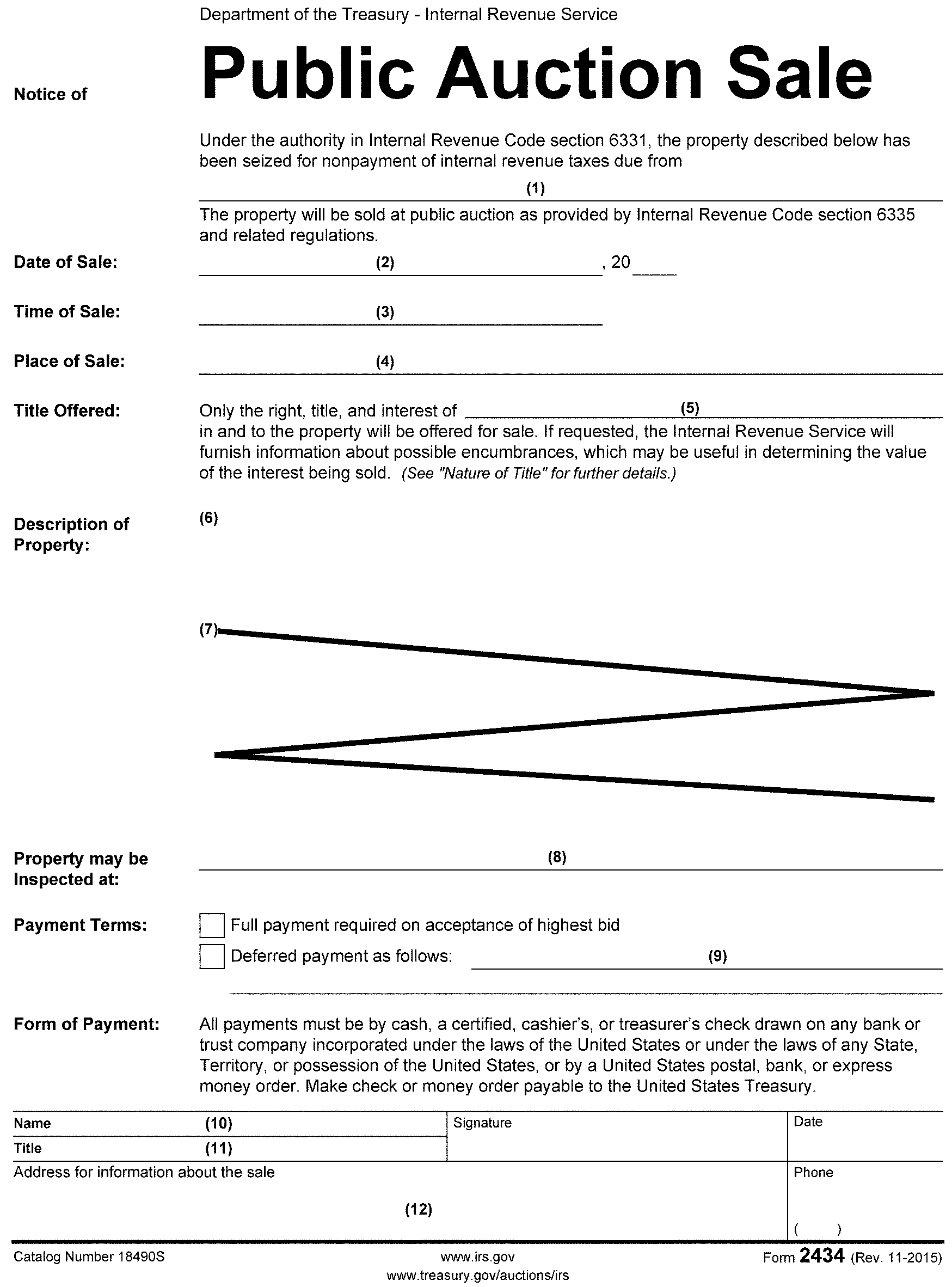
Please click here for the text description of the image.
| Form 2434 Instructions |
|---|
| 1. Taxpayer's name (taxpayer's address may also be included if it will help identify the delinquent taxpayer). |
| 2. Date of sale — this date must be at least 10 but not more than 40 days from the date notice is to be published in newspaper or if no newspaper, from the date notice is posted in public places (IRM 5.10.4.8.1). |
| 3. Time of sale, including AM or PM. |
| 4. Sale location |
| 5. Taxpayer's name. |
| 6. Itemized description of property to be offered for sale. Enter odometer reading if property sold is a motor vehicle. If offering is to be in groups of items, groupings should be readily identified. If it is known at the time of preparation how the property will be offered, the following statement should be added: "The property will be offered for sale (show method as selected from IRM 5.10.4.5)" . If not known, the following statement should be added: "The property may be offered for sale in the aggregate and/or as individual groups or lots" . |
| 7. Rule out any unused space. |
| 8. Address and times at which the property may be inspected. |
| 9. Select full payment or enter applicable payment terms (IRM 5.10.4.8.3). |
| 10. Name of employee conducting sale. |
| 11. Title of employee conducting sale. |
| 12. Address and phone number where prospective bidders can request additional information about the sale. |
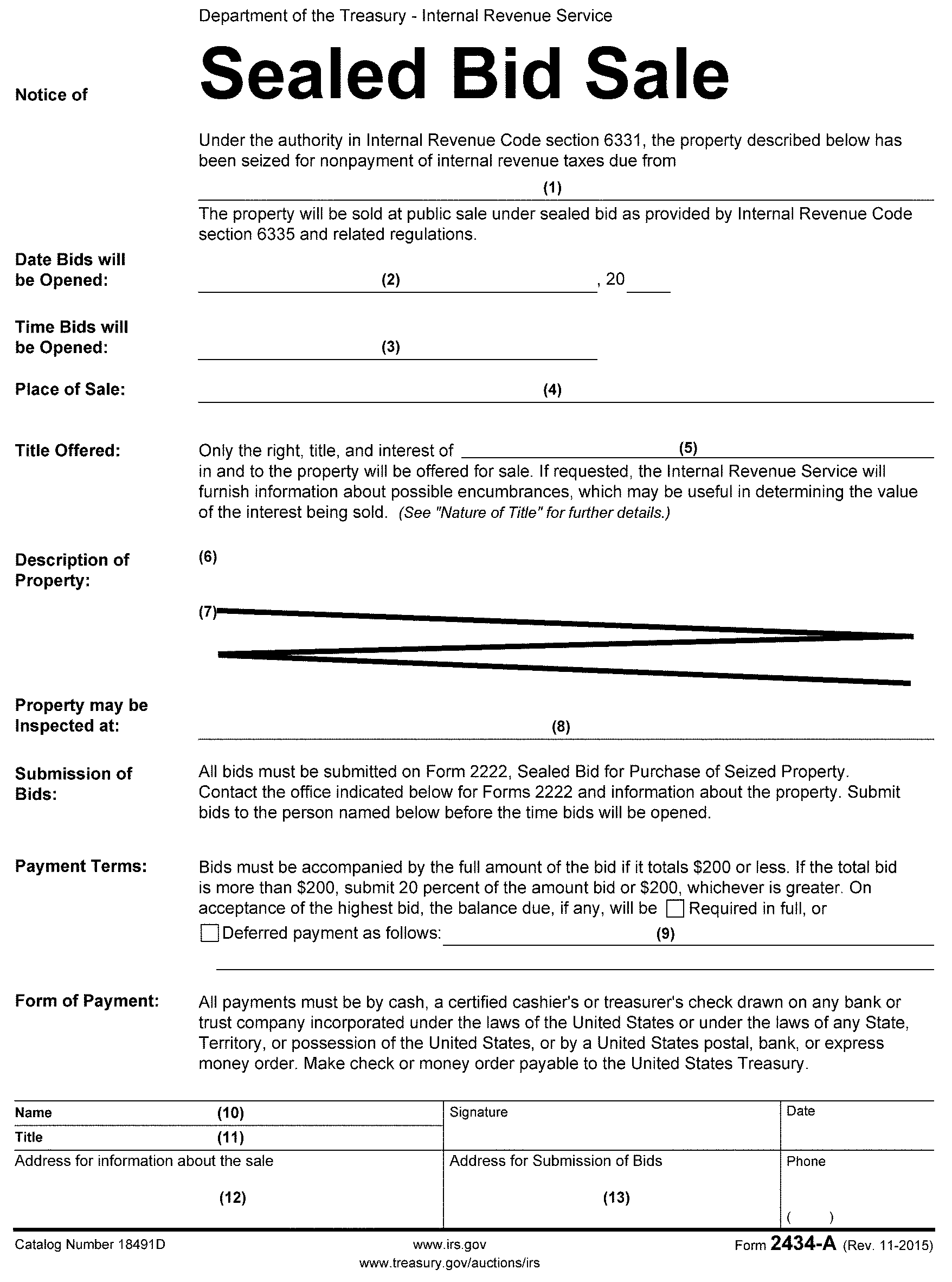
Please click here for the text description of the image.
| Form 2434–A Instructions |
|---|
| 1. Taxpayer's name (taxpayer's address may also be included if it will help identify the delinquent taxpayer). |
| 2. Date bids will be opened (date of sale) — this date must be at least 10 but not more than 40 days from the date notice is to be published in newspaper or if no newspaper, from the date notice is posted in public places (IRM 5.10.4.8.1). |
| 3. Time bids will be opened (include AM or PM). |
| 4. Location where bids will be opened. |
| 5. Name of taxpayer. |
| 6. Itemized description of property offered for sale. Enter odometer reading if property sold is a motor vehicle. If offering is to be in groups of items, groupings should be readily identified. If it is known at the time of preparation how the property will be offered, the following statement should be added: "The property will be offered for sale (show method as selected from IRM 5.10.4.5)" . If not known, the following statement should be added: "The property may be offered for sale in the aggregate and/or as individual groups or lots" |
| 7. Rule out any unused space. |
| 8. Address and times at which the property may be inspected. |
| 9. Select full payment or enter applicable payment terms (IRM 5.10.4.8.3). |
| 10. Name of employee conducting sale. |
| 11. Title of employee conducting sale. |
| 12. Address and phone number where prospective bidders can request additional information about the sale. |
| 13. Address where sealed bids should be submitted (IRM 5.10.5.14). |