)
or https:// means you've safely connected to the .gov website. Share sensitive information only on official, secure websites.
)
or https:// means you've safely connected to the .gov website. Share sensitive information only on official, secure websites.


- 8.7.4 Appeals Estate and Gift Tax Cases
- 8.7.4.1 Program Scope and Objectives
- 8.7.4.1.1 Background
- 8.7.4.1.2 Authority
- 8.7.4.1.3 Responsibilities
- 8.7.4.1.4 Program Reports
- 8.7.4.1.5 Terms and Acronyms
- 8.7.4.1.6 Related Resources
- 8.7.4.2 Introduction to Estate and Gift Tax Cases Worked in Appeals
- 8.7.4.2.1 Issue Management System (IMS)
- 8.7.4.3 Estate Tax Cases Worked in Appeals
- 8.7.4.3.1 Disclosure Considerations in Estate Tax Cases
- 8.7.4.3.2 IRC 6166 Cases
- 8.7.4.3.2.1 Processing Elections under IRC 6166
- 8.7.4.3.2.2 Sources of IRC 6166 Cases Worked in Appeals
- 8.7.4.3.2.3 Actions by the ATE upon Receipt of IRC 6166 Cases
- 8.7.4.3.2.4 Statute Review of IRC 6166 Cases
- 8.7.4.3.2.5 IRC 6166 Cases from E&G Campus
- 8.7.4.3.2.6 IRC 6166 Cases from E&G Field Exam
- 8.7.4.3.2.7 IRC 6166 Cases from Advisory
- 8.7.4.3.2.8 Reading and Interpreting IDRS Transcripts in IRC 6166 Cases
- 8.7.4.3.2.9 ATEs Case-Closing Procedures for IRC 6166 Cases
- 8.7.4.3.2.9.1 Closing IRC 6166 Cases Where Appeals Overturns the Preliminary Determination Made Through Letter 950-H, 950-J, or 950-K
- 8.7.4.3.2.9.2 Closing IRC 6166 Cases Where Appeals Overturns the Preliminary Determination Made Through Letter 950-I
- 8.7.4.3.2.9.3 Closing IRC 6166 Cases Where Appeals Sustains the Preliminary Determination Made Through Letter 950-H or 950-J
- 8.7.4.3.2.9.4 Closing IRC 6166 Cases Where Appeals Sustains the Preliminary Determination Made Through Letter 950-I
- 8.7.4.3.2.9.5 Closing IRC 6166 Cases Where Appeals Sustains the Preliminary Determination Made Through Letter 950-K
- 8.7.4.3.2.9.6 Closing Estate Tax Cases with an Undisputed 6166 Election
- 8.7.4.3.2.10 ATM Case-Closing Procedures for IRC 6166 Cases
- 8.7.4.3.3 Special Use Valuation Elections under IRC 2032A
- 8.7.4.3.4 Settlement Computations in Estate Tax Cases
- 8.7.4.3.4.1 Preparing Form 3610 in Estate Tax Cases
- 8.7.4.3.4.2 Listing Estate Tax Adjustments
- 8.7.4.3.4.3 Settlement Computations with IRC 6166
- 8.7.4.3.4.4 Income Tax Deduction for Estate Tax Attributable to Income in Respect of a Decedent
- 8.7.4.3.4.5 Restricted Interest in Estate Tax Cases
- 8.7.4.3.4.6 State Death Tax Deduction (or Credit)
- 8.7.4.3.5 Securing Agreements in Estate Tax Cases
- 8.7.4.3.6 Closing Estate Tax Cases
- 8.7.4.4 Gift Tax Cases Worked in Appeals
- 8.7.4.4.1 Settlement Computations in Gift Tax Cases
- 8.7.4.4.1.1 Preparing Form 3610 in Gift Tax Cases
- 8.7.4.4.1.2 Listing Gift Tax Adjustments
- 8.7.4.4.2 Securing Agreements in Gift Tax Cases
- 8.7.4.4.3 Closing Gift Tax Cases
- 8.7.4.4.1 Settlement Computations in Gift Tax Cases
- 8.7.4.5 IRC 6161 Cases (Estate or Gift Tax)
- 8.7.4.5.1 Declarations of Disaster
- 8.7.4.5.2 Requests for Extension of Time to Pay under IRC 6161
- 8.7.4.5.3 Processing of IRC 6161 Applications
- 8.7.4.5.4 Sources of IRC 6161 Cases Worked in Appeals
- 8.7.4.5.5 Actions by the ATE upon Receipt of IRC 6161 Cases
- 8.7.4.5.6 Statute Review of IRC 6161 Cases
- 8.7.4.5.7 IDRS Transactions in IRC 6161 Cases
- 8.7.4.5.8 Appeals Consideration of IRC 6161 Cases
- 8.7.4.5.9 Deficiency Assessment Where Original Tax is Deferred under IRC 6161
- 8.7.4.5.10 Closing Non-Docketed IRC 6161 Cases
- 8.7.4.5.10.1 Closing Non-Docketed Estate Tax IRC 6161 Cases
- 8.7.4.5.10.2 Closing Non-Docketed Gift Tax IRC 6161 Cases
- 8.7.4.5.11 Closing Docketed IRC 6161 Cases
- 8.7.4.5.11.1 Closing Agreed Docketed Estate Tax IRC 6161 Cases
- 8.7.4.5.11.2 Closing Agreed Docketed Gift Tax IRC 6161 Cases
- 8.7.4.6 Preconferences in Estate and Gift Tax Cases
- 8.7.4.6.1 Ex Parte Considerations
- 8.7.4.6.2 Requesting a Preconference
- 8.7.4.6.3 Holding a Preconference
- 8.7.4.6.4 Closing a Case in which a Preconference Was Requested
- 8.7.4.7 Requesting Valuation Assistance in Estate and Gift Tax Cases
- 8.7.4.7.1 Referrals for Art Appraisal Services
- 8.7.4.7.2 Referrals for Engineering and Economist Services
- 8.7.4.8 Notices of Deficiency in Estate and Gift Tax Cases
- 8.7.4.8.1 Letter 901(cg), Statutory Notice Letter
- 8.7.4.8.2 Preparing Form 4089
- 8.7.4.8.3 Preparing Form 3614-A (Estate Tax) or Form 3615-A (Gift Tax)
- 8.7.4.8.3.1 Preparing Form 3614-A (Estate Tax)
- 8.7.4.8.3.2 Preparing Form 3615-A (Gift Tax)
- 8.7.4.8.4 Preparation of the Explanation of Adjustments by the ATE
- 8.7.4.9 Consideration of Coordinated and Emerging Issues
- 8.7.4.10 Miscellaneous Estate and Gift Tax Procedures Covered Elsewhere
- 8.7.4.11 Customer Service and Taxpayer Rights
- 8.7.4.12 Procedures for Shipping Personally Identifiable Information (PII)
- Exhibit 8.7.4-1 Completion of Form 4349, Computation of Estate Tax
- Exhibit 8.7.4-2 Restricted Interest Provisions for Estate Tax
- Exhibit 8.7.4-3 Explanation of Adjustments for Gift Tax Notice of Deficiency
- Exhibit 8.7.4-4 Flowchart 1: IRC 6166 Cases Sourced from the E&G Campus
- Exhibit 8.7.4-5 Flowchart 2: Undisputed IRC 6166 Cases Sourced from E&G Field Exam
- Exhibit 8.7.4-6 Flowchart 3: Disputed IRC 6166 Cases Sourced from E&G Field Exam
- Exhibit 8.7.4-7 Flowchart 4: IRC 6166 Cases Sourced from E&G Advisory
- 8.7.4.1 Program Scope and Objectives
Part 8. Appeals
Chapter 7. Technical and Procedural Guidelines
Section 4. Appeals Estate and Gift Tax Cases
8.7.4 Appeals Estate and Gift Tax Cases
Manual Transmittal
July 30, 2019
Purpose
(1) This transmits revised IRM 8.7.4, Technical and Procedural Guidelines, Appeals Estate and Gift Tax Cases.
Material Changes
(1) This IRM has been reorganized, revised, and updated.
(2) Editorial and stylistic changes (including grammar, spelling, and minor clarification) have been made throughout this IRM.
(3) Obsolete subsections have been removed.
(4) Incorporated Interim Guidance Memorandum AP-08-0418-0006, Reissuance of Interim Guidance on Initial Conference Procedures for Liability, Penalty Appeals and Innocent Spouse Cases. See IRM 8.7.4.3 for estate tax cases, IRM 8.7.4.3.2 for IRC 6166 cases, IRM 8.7.4.4 for gift tax cases, and IRM 8.7.4.5 for IRC 6161 cases.
(5) Added Program Scope and Objectives with related subsections to comply with the Deputy Commissioners of Services and Enforcement and Operations support memorandum dated September 14, 2016, entitled Heightened Awareness, Sensitivity, and Understanding of Internal Controls. See new IRM 8.7.4.1, Program Scope and Objectives.
(6) Added a list of relevant documents to IRM 8.7.4.2.1, Issue Management System (IMS), that should be uploaded into IMS by the Appeals Technical Employee.
(7) Updated IRM 8.7.4.3.2.9.6, Closing Estate Tax Cases with an Undisputed 6166 Election, with new fax numbers for the Campus teams.
(8) Revised IRM 8.7.4.3.4.6, State Death Tax Deduction (or Credit), to clarify the summary of the change from a credit to a deduction for death taxes paid by estates created after December 31, 2004.
(9) Amended IRM 8.7.4.5.8(3), Appeals Consideration of IRC 6161 Cases, to require Appeals, after determining that a taxpayer’s request for an extension of time to pay was timely filed, to return cases to the originating function for an initial determination on reasonable cause or undue hardship.
(10) Revised IRM 8.7.4.5.11.1(6), Closing Agreed Docketed Estate Tax IRC 6161 Cases, by substituting the use of Letter 1645, Approval of Settlement / Docketed Case, in place of the sample closing-letter language previously provided.
(11) Revised IRM 8.7.4.5.11.2(4), Closing Agreed Docketed Gift Tax IRC 6161 Cases, by substituting the use of Letter 1645, Approval of Settlement / Docketed Case, in place of the sample closing-letter language previously provided.
(12) Modified IRM 8.7.4.7.2, Referrals for Engineering and Economist Services, to clarify that referrals can also be requested for economist services.
(13) Clarified IRM 8.7.4.8, Notices of Deficiency in Estate and Gift Tax Cases, to emphasize that notices of deficiency are to be prepared by a Tax Computation Specialist.
(14) Revised IRM 8.7.4.10, Miscellaneous Estate and Gift Tax Procedures Covered Elsewhere, to include a citation to the relevant IRM for the Rapid Appeals Process, which is available for certain estate and gift tax cases.
(15) Removed former IRM 8.7.4.3.2.3, Receipt of IRC 6166 Cases, as Letter 4141, Case Received in Appeals - Acknowledgement Letter, is now obsolete.
(16) Removed former IRM 8.7.4.5.5, Receipt of IRC 6161 Cases, as Letter 4141, Case Received in Appeals - Acknowledgement Letter, is now obsolete.
(17) Updated IRM Exhibit 8.7.4-1, Completion of Form 4349, Computation of Estate Tax, to show a current version of Form 4349, Computation of Estate Tax Due With Return and Annual Installment.
(18) Updated IRM Exhibit 8.7.4-4, Flowchart 1: IRC 6166 Cases Sourced from the E&G Campus, with corrected fax numbers for the IRS Campus teams.
(19) Updated IRM Exhibit 8.7.4-5, Flowchart 2: Undisputed IRC 6166 Cases Sourced from E&G Field Exam, with corrected fax numbers for the IRS Campus teams.
(20) Updated IRM Exhibit 8.7.4-6, Flowchart 3: Disputed IRC 6166 Cases Sourced from E&G Field Exam, with corrected fax numbers for the IRS Campus teams.
(21) Revised the flowchart in IRM Exhibit 8.7.4-7, Flowchart 4: IRC 6166 Cases Sourced from E&G Advisory, to correct errors and update the IRS - Advisory Estate Group’s contact information.
Effect on Other Documents
IRM 8.7.4 dated August 18, 2014, is superseded. This IRM incorporates Interim Guidance Memorandum AP-08-0418-0006, Reissuance of Interim Guidance on Initial Conference Procedures for Liability, Penalty Appeals and Innocent Spouse Cases, which is dated April 23, 2018.Audience
AppealsEffective Date
(07-30-2019)
Anita M. Hill
Director, Case and Operations Support
-
Purpose: This IRM describes the processes used by Appeals to work estate and gift tax cases. Specifically, IRM 8.7.4:
-
gives general information about estate and gift tax cases considered by Appeals;
-
provides procedures for new receipts and closures of estate and gift tax cases; and
-
recommends resources and authorities, including decision tools and other IRM sections, for considering estate and gift tax cases.
-
-
Audience: The primary users of this IRM section are Appeals Technical Employees (ATEs) and Tax Computation Specialists (TCSs).
-
Policy Owner: Policy, Planning, Quality and Analysis is under the Director of Case and Operations Support.
-
Program Owner: Appeals Policy is the program office responsible for providing technical and procedural guidance to the Appeals organization, and is under the Director of Policy, Planning, Quality and Analysis.
-
Contact Information: Appeals employees should follow established procedures on How to Contact an Analyst. Other employees should contact the Product Content Owner shown on the Product Catalog Information page for this IRM.
-
This IRM provides guidance and information to Appeals’ employees for working:
-
estate tax cases, and
-
gift tax cases.
-
-
Appeals accomplishes our mission by considering protested and Tax Court-docketed cases, holding conferences, and negotiating settlements in a manner which ensures Appeals’ employees act in accord with the Taxpayer Bill of Rights (TBOR) in every interaction with taxpayers. See IRC 7803(a)(3). See also Publication 5170, Taxpayer Bill of Rights.
-
Estate taxes are generally provided for in IRC Subtitle B, Chapter 11.
-
Gift taxes are generally provided for in IRC Subtitle B, Chapter 12.
-
The Policy analyst shown on the Product Catalog page as the originator is the assigned author of this IRM.
-
Policy, Planning, Quality and Analysis (PPQA) provides trend and data analyses and detailed summary reports for Appeals.
-
See IRM Exhibit 8.1.1-1, Common Terms Used in Appeals, for common terms and definitions used in IRM Part 8. Terms listed in that exhibit are not included in this section.
-
The following table lists commonly used acronyms and their definitions for relevant terms used in this IRM:
Term Definition ACM Appeals Case Memorandum ASED Assessment Statute Expiration Date CSED Collection Statute Expiration Date PII Personally Identifiable Information
-
This IRM covers procedures used to process estate tax and gift tax cases in Appeals from the time the case is received in Appeals to the time the case is closed by Appeals.
-
Subsection IRM 8.7.4.3, Estate Tax Cases Worked in Appeals, covers procedures used to process estate tax cases.
-
Subsection IRM 8.7.4.4, Gift Tax Cases Worked in Appeals, covers procedures used to process gift tax cases.
-
The remaining subsections, IRM 8.7.4.6 through IRM 8.7.4.12, address procedures that apply to both estate and gift (E&G) tax cases.
-
Use of the Issue Management System (IMS) is mandatory for working Field Small Business/Self-Employed (SB/SE) estate and gift tax cases. Cases carded into the Appeals Centralized Database System (ACDS) after February 6, 2012, must be worked in IMS in order to provide feedback to the originating function. However, ACDS remains the Appeals system of record for case management and recording time on cases.
-
An Online 5081 is required to gain access to IMS. Each user should request access to the "Issue Management System-Production-Appeals User Access (IMS)" application, or if that application is not available, the "IMS-PRODUCTION-LMSB USER ACCESS" application. In preparing their requests, users should add a statement indicating that an Examination Return Control System (ERCS) ID is not required. Additional information on IMS and related training modules can be found on the Appeals BSP web page at http://appeals.web.irs.gov/BusinessSystemPlanning/Applications/ims.htm.
-
The ATE must verify that each case assigned to him/her is on IMS. If the case is not on IMS, the ATE should ask the Appeals Team Manager (ATM) to find the missing case on the IMS Case Inventory and assign it to the ATE.
-
When closing estate or gift tax cases, the ATE must upload all pertinent closing documents on the IMS system. These documents may include, but may not be limited to:
-
Form 5402, Appeals Transmittal and Case Memo;
-
Form 5403 Worksheet (if required to be prepared by the ATE instead of TCS);
-
ATE’s ACM and any relevant attachments;
-
transcripts;
-
closing letters, including any required copies of Letter 937, Transmittal for Power of Attorney;
-
settlement computations; and
-
agreements.
-
-
This subsection provides information on procedures and issues that are unique to estate tax cases.
-
Procedures for establishing and closing estate tax cases, acknowledging receipt of cases, setting up and holding the Appeals conference, preparing the ACM, securing the agreement, and preparing the settlement computation and/or statutory notice of deficiency are generally the same for estate tax cases as those used in income tax cases.
-
Estate tax returns are filed on Form 706, U.S. Estate Tax Return. The IRC 6501 statute of limitations on assessment cannot be extended for estate tax cases. Therefore, Form 872, Consent to Extend the Time to Assess Tax, is not applicable to estate tax cases.
-
When the ATE receives a newly assigned estate tax case, he/she completes the intake procedures fully described in IRM 8.2.1.4, Receipt of New Assignment by an Appeals Technical Employee (ATE), generally within 45 days of receiving the case. To summarize IRM 8.2.1.4(3), the ATE’s intake actions must include:
-
Completing the statute verification,
-
Validating all critical data fields in ACDS,
-
Determining whether the case is ready for Appeals’ consideration, and
-
Making initial contact with the taxpayer or representative.
Reminder:
IRM 8.2.1.4(3) generally establishes a 45-day deadline for ATEs to complete these intake procedures. While the ATM is authorized to be "reasonable" in extending this 45-day deadline for contacting taxpayers, the ATM is not authorized to extend the 45-day deadline for the ATE to complete the process of statute verification.
-
-
In validating the data entered in ACDS, the ATE will verify the accuracy of the following data fields on ACDS:
-
Taxpayer's name and address
-
Taxpayer's TIN
-
Case type
-
MFT
-
Category and Subcategory
-
Key period
-
Statute Date
-
Statute Code
-
Deficiency/Penalty/Claim amounts
-
-
If the case contains one or more valuation issues, the ATE should consult IRM 8.7.4.7, Requesting Valuation Assistance in Estate and Gift Tax Cases, to determine whether it is necessary to request valuation assistance.
-
Generally, information of a confidential nature is only disclosed when a taxpayer provides written authorization.
-
Estates and trusts act through their fiduciaries (i.e., executors, personal representatives, trustees, or administrators). A person acting in a fiduciary capacity is required to file Form 56, Notice Concerning Fiduciary Relationship, upon the creation and termination of the fiduciary relationship. See IRC 6903. These persons are generally not required to execute Form 2848, Power of Attorney and Declaration of Representative. See Treas. Reg. 601.504(b).
-
The declaration on Form 706, U.S. Estate Tax Return, when executed by an attorney, accountant or enrolled agent meets the "duly authorized in writing" requirement of IRC 6103(e)(6). Therefore, when an attorney, accountant or enrolled agent executes the declaration on Form 706, a separately executed Form 2848, Power of Attorney and Declaration of Representative, is not required. However, before the attorney, accountant or enrolled agent executes any other document on behalf of the taxpayer, there must be a properly executed Form 2848 on file evidencing the taxpayer’s prior delegation of such authority to the attorney, accountant or enrolled agent.
-
Cases arising under IRC 6166 involve an estate's election to pay the estate tax in installments over a period of two to fifteen years at a reduced rate of interest.
-
Estates must meet the following eligibility criteria in order to make a valid election under IRC 6166:
-
The decedent was a citizen or resident of the United States on the date of death.
-
The fair market value of an interest in a closely held business exceeds 35% of the "Adjusted Gross Estate" .
-
The term "Adjusted Gross Estate" refers to the fair market value of the gross estate less deductions under IRC 2053 and IRC 2054, as determined with reference to the earlier of: (a) the due date of the return, or (b) the date the return was filed. See IRC 6166(b)(6).
-
-
The maximum amount of estate tax that can be deferred under IRC 6166 is determined by the following formula:
[(Value of closely held business/Adjusted Gross Estate) * Estate Tax Due] = Amount Deferrable
-
The non-deferrable portion of the estate tax must be paid by the due date of the return, unless the estate has an extension of time to pay under IRC 6161.
-
Generally, most estates can defer payment of the first installment of tax for up to five years from the original due date for payment per IRC 6166(a)(3). In these cases, the estate will pay only interest on the deferred estate tax amount for the first five years of the deferral period. However, elections falling within the purview of IRC 6166(b)(8) and IRC 6166(b)(10) do not qualify for this interest-only deferral period, and must begin making installment payments of tax in the first year of the election.
-
An election under IRC 6166(a) must be made with a timely filed return, and the executor must attach a statement (a.k.a. Notice of Election) to the Form 706 with computations showing the deferred tax, non-deferred tax and closely held business amount. The statement should include the following information:
-
The decedent's name and taxpayer identification number.
-
The amount of tax that is to be paid in installments.
-
The date selected for payment of the first installment.
-
The number of annual installments including the first installment, in which the tax is to be paid.
-
The assets shown on the estate tax return which constitute the closely held business interest (identified by schedule and item number).
-
The facts that formed the basis for the executor's conclusion that the estate qualifies for payment of the estate tax installment.
See Treas. Reg. 20.6166–1(b), which provides information necessary for the Notice of Election.
-
-
Pursuant to IRC 6166(b) an interest in a closely held business is defined as:
-
An interest in a proprietorship that carries on a trade or business.
-
An interest in a partnership that carries on a trade or business if 20% or more of the total capital interest in the partnership is included in the gross estate, or the partnership has 45 or fewer partners.
-
Stock in a corporation carrying on a trade or business if 20% or more of the value of voting stock of the corporation is included in the gross estate, or the corporation has 45 or fewer shareholders.
-
-
Indirect Ownership by a spouse or family member is generally taken into account for purposes of calculating the estate’s interest in a closely held business. See IRC 6166(b)(2)(B) (attribution rules for a spouse), IRC 6166(b)(2)(D) (attribution rules for family members). However, in certain cases there may be additional eligibility requirements. See IRC 6166(b)-(h).
-
If the estate owns two or more businesses that meet the requirements under IRC 6166(c), the interests may be treated as an interest in a single closely held business.
-
Special rules apply to stock in a holding company. IRC 6166(b)(8)(A). The portion of non-readily-tradeable stock of any holding company which represents direct ownership by such company in a business company shall be deemed stock in such business company. A business company means a corporation carrying on a trade or business. Generally, estates that make an election under IRC 6166(b)(8) cannot defer the first installment under IRC 6166(a)(3) and are subject to a higher interest rate on the deferred tax. IRC 6166(b)(8)(A).
-
Deferral is not available for passive assets. See IRC 6166(b)(9). The term "passive asset" is defined in IRC 6166(b)(9)(B)(i) as any asset other than an asset used in carrying on a trade or business. Management of investment assets would be considered passive assets.
-
IRC 6166(b)(10) provides that an estate may elect to treat all the assets used in a "qualifying lending and finance business" as assets used in carrying on a trade or business. Thus, none of the assets in a "qualifying lending and finance business" will be considered passive assets under IRC 6166(b)(9). Estates that make an election under IRC 6166(b)(10) are allowed a maximum of 5 installments of tax, rather than the usual 10, and cannot defer the first installment under IRC 6166(a)(3).
-
Certain events may cause the estate to lose the benefits of the election, thus accelerating the remaining installments.
-
Under IRC 6166(g)(1), all remaining installments are accelerated upon notice and demand if 50% or more of the value of the interest in a qualifying business is distributed, sold, exchanged or otherwise disposed of. However, the following dispositions are disregarded:
i. Transfers to heirs pursuant to a will, trust instrument or statute of descent and distribution. See IRC 6166(g)(1)(D).
ii. Redemptions of stock to which IRC 303 applies, where proceeds are used to pay IRC 6166 installments of tax. -
Under IRC 6166(g)(3), all remaining installments are accelerated upon notice and demand if any installment is not paid within six months of its due date.
-
If the Service requests a bond, or in lieu of a bond, a lien under IRC 6324A, and the estate does not provide such security.
-
-
Where a tax deficiency is assessed and the estate had not previously made an IRC 6166 election on the original return, IRC 6166(h) provides that the estate may elect to pay the deficiency in installments if it meets eligibility criteria under IRC 6166(a). However, the estate cannot defer more than the deficiency amount. See Rev. Rul. 81-294. The election must be made within 60 days of the issuance of the notice and demand for payment of the deficiency. IRC 6166(h)(2).
-
Where a tax deficiency is assessed and the estate had previously made an IRC 6166 election on the original return, IRC 6166(e) provides for the automatic proration of the deficiency attributable to the closely held business into installments. On or after the date for payment, the part of the deficiency prorated into installments must be paid upon notice and demand.
-
The Cincinnati Campus Estate and Gift Tax Operations (a.k.a. "E&G Campus" ) reviews all estate tax returns with an election under IRC 6166. The returns are either accepted as filed or selected for field consideration.
-
For returns that are accepted as filed, the E&G Campus adjudicates the validity of the IRC 6166 election. For returns referred for field consideration, the validity of the IRC 6166 election is adjudicated by E&G Field Exam.
-
If E&G Campus or E&G Field Exam concludes that the election is valid, a lien package is sent to the Collection Advisory Estate Tax Group (a.k.a. "Advisory" ), which determines whether a bond or lien is required.
-
If E&G Campus or E&G Field Exam determines that the election is not valid, or if Advisory determines that a bond or lien is required but the taxpayer fails to comply, the taxpayer is given the opportunity to appeal the respective determination.
-
IRC 6166 cases are not controlled on AIMS.
-
Appeals receives IRC 6166 cases from the E&G Campus, E&G Field Exam, or Advisory.
-
The most common types of IRC 6166 cases generated by the E&G Campus relate to the following issues:
-
The estate does not meet general IRC 6166 eligibility criteria.
-
The estate defaults on its installment payments.
-
The estate sells or disposes of 50% or more of its interest in the closely held business.
-
-
The most common types of IRC 6166 cases generated by E&G Field Exam relate to the following issues:
-
The estate does not meet general IRC 6166 eligibility criteria and Exam is proposing a tax deficiency.
-
The estate made a valid IRC 6166 election, but Exam is proposing a tax deficiency.
-
The estate made a valid IRC 6166 election, but there is a dispute regarding the amount of deferrable tax or the applicable deferral term.
-
The estate sells or disposes of 50% or more of its interest in the closely held business.
-
-
The most common types of IRC 6166 cases generated by Advisory stem from the taxpayer’s failure to comply with a request to post a bond or lien.
-
Appeals is the only function that can issue a final adverse determination within the meaning of IRC 7479. Therefore, IRC 6166 cases come to Appeals in non-docketed status.
-
Appeals may review the same IRC 6166 election more than once. For example, the election may come to Appeals because there is a dispute with respect to its initial validity. Later, Appeals may review the same election again because the estate failed to post a required bond or defaulted on its installment payment obligations.
-
Upon receipt of an IRC 6166 case, the ATE will complete the ordinary intake procedures fully described in: (i) IRM 8.2.1.4, Receipt of New Assignment by an Appeals Technical Employee (ATE); (ii) IRM 8.2.1.5, Returning a Case to Examination - ATE; and (iii) IRM 8.2.1.6, Preliminary Review of a Case – ATE.
-
In summary, IRM 8.2.1.4(3), Receipt of New Assignment by an Appeals Technical Employee (ATE), generally requires the ATE to perform the following intake actions within 45 days of receiving the case:
-
Complete the statute verification,
-
Validate all critical data fields in ACDS,
-
Determine whether the case is ready for Appeals’ consideration, and
-
Make initial contact with the taxpayer or representative.
Reminder:
IRM 8.2.1.4(3) generally establishes a 45-day deadline for ATEs to complete these intake procedures. While the ATM is authorized to be "reasonable" in extending this 45-day deadline for contacting taxpayers, the ATM is not authorized to extend the 45-day deadline for the ATE to complete the process of statute verification.
-
-
In addition, the ATE must identify the source of the case as E&G Campus, E&G Field Exam, or Advisory. The source of the case may be found on the Form 3210, Document Transmittal, but should be verified by review of the case file. The source of the case will determine the set of procedures that apply to the case.
-
In validating the data entered in ACDS, the ATE will verify the case was established in ACDS following the same procedures used for income tax cases—except for the following:
-
TYPE — 6166
-
MFT — MFT 52
-
KEYPER — Month and year of death
-
AIMS Indicator — "E" for exempt from AIMS
-
Statute Code — ASESD
-
Proposed $ Def/-OA — $0
-
-
Generally, IRC 6166 cases are assigned to an Appeals Officer. However, a Settlement Officer may encounter an IRC 6166 issue in the context of a collection case. A Settlement Officer should review IRM 5.5, Decedent Estates and Estate Taxes, and consult with an E&G Appeals Officer, as needed, when this occurs.
-
Appeals employees should always be aware of the statute dates on cases in their physical possession. See IRM 8.21.3.2.3.2, Protecting Statutes on Estate Tax Cases.
-
The IRC 6501 Assessment Statute Expiration Date (ASED) is not affected by an election under IRC 6166, regardless of whether the election is valid or timely.
-
The IRC 6502 Collection Statute Expiration Date (CSED) is affected by an election under IRC 6166. An IRC 6166 election extends the CSED while the election is in effect. See IRC 6503(d). However, the running of the IRC 6324(a) inchoate estate tax lien is not suspended. See IRM 5.5.8.5, Special Lien Under IRC § 6324A for Estate Tax Deferred Under IRC § 6166.
-
If the E&G Campus determines that an IRC 6166 election is not valid or has ceased to apply, it will issue Letter 950-H, 30 Day Letter - Intent to Terminate IRC 6166 Election.
-
If, in response to Letter 950–H, the estate files a timely protest letter, the E&G Campus prepares an auxiliary file and sends the case to Appeals within 30 days from the postmark date on the protest letter.
-
Case files generated by the E&G Campus should contain the following documents:
-
Copy of Parts 1, 2, 3, 4, 5, and 6 of the original Form 706, as well as the schedules related to the closely held business interest
-
Copy of Parts 1, 2, 3, 4, 5, and 6 of all supplemental Form 706 (if any), as well as the schedules related to the closely held business interest
-
The Notice of Election and any attachments
-
Form 4349, Computation of Estate Tax Due With Return and Annual Installment
-
Form 4768, Application for Extension of Time to File a Return and/or Pay U.S. Estate (and Generation-Skipping Transfer) Taxes, if applicable
-
All correspondence between the Service and the taxpayer relating to the election
-
Case file history
-
Letter 950–H, 30 Day Letter - Intent to Terminate IRC 6166 Election
-
The taxpayer's protest letter (including responses to the protest, if any)
-
Form 2848, Power of Attorney and Declaration of Representative, if applicable
-
Certification of unchanged status for previous year (only applicable where the IRC 6166 election has ceased to apply)
-
Prior notices and demands for payment (only applicable where the IRC 6166 election has ceased to apply)
-
-
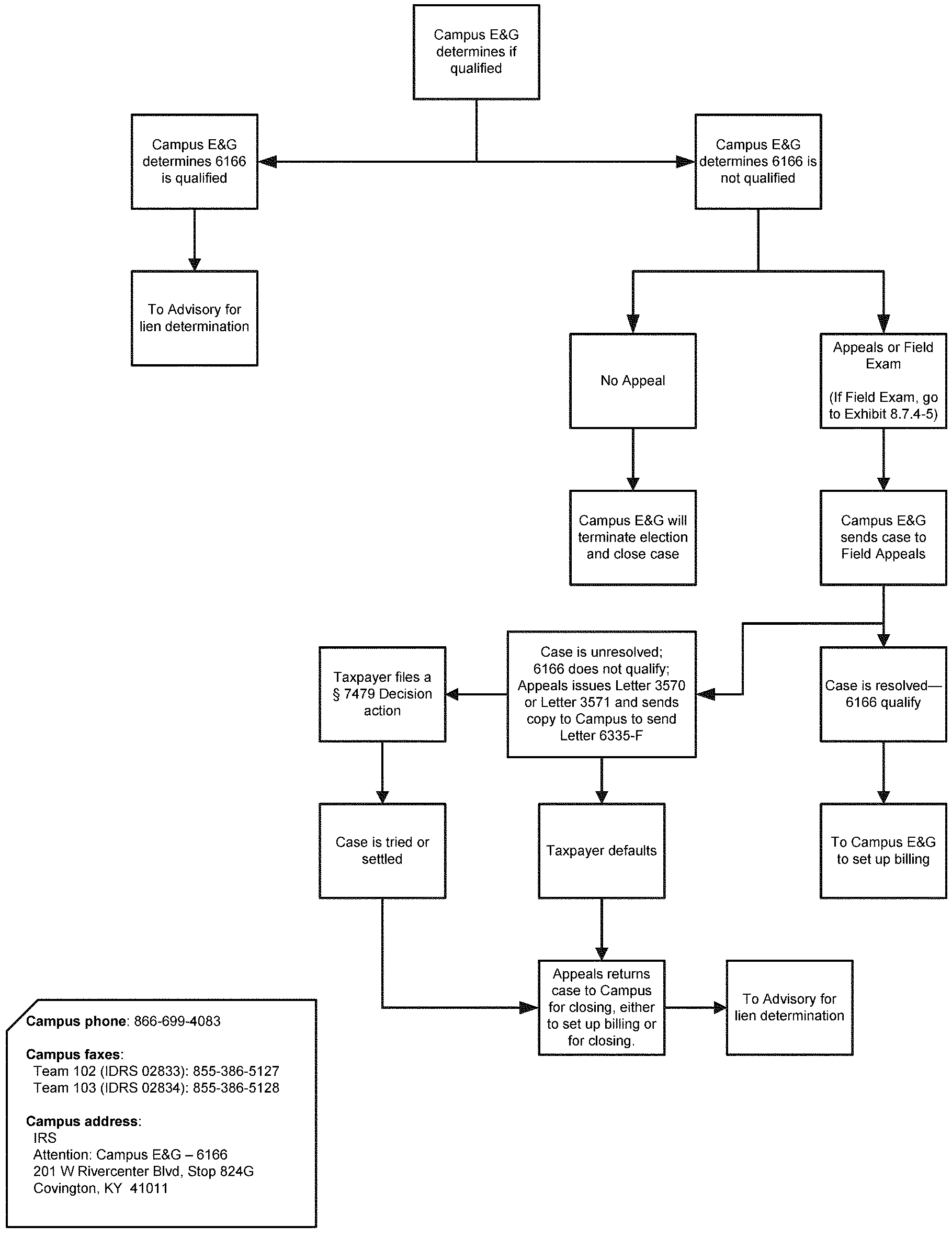
Refer to IRM Exhibit 8.7.4-4, Flowchart 1: IRC 6166 Cases Sourced from the E&G Campus, for a comprehensive case-routing overview with respect to IRC 6166 cases sourced from the E&G Campus.
-
If E&G Field Exam determines that an IRC 6166 election is not valid or has ceased to apply, the examiner will issue Letter 950–J, Preliminary Section 6166 Determination.
-
If E&G Field Exam determines that an IRC 6166 election is valid, but there is a dispute involving the amount of deferrable tax or the applicable deferral term, the examiner will issue Letter 950–K, Preliminary Internal Revenue Code Section 6166 Determination Letter.
-
Regardless of whether E&G Field Exam issued Letter 950–K or Letter 950–J, the taxpayer may appeal the determination. If the estate files a timely protest letter, E&G Field Exam prepares an auxiliary file and sends the case to Appeals within 30 days from the postmark date on the protest letter.
-
Case files generated by E&G Field Exam should contain the following documents:
-
Copy of Parts 1, 2, 3, 4, 5, and 6 of the original Form 706, as well as the schedules related to the closely held business interest
-
Copy of Parts 1, 2, 3, 4, 5, and 6 of all supplemental Form 706 (if any), as well as the schedules related to the closely held business interest
-
The examining attorney’s notes and report on the IRC 6166 qualification issue, plus any other documents that affect the IRC 6166 qualification
-
The Notice of Election and any attachments
-
Form 4349, Computation of Estate Tax Due With Return and Annual Installment
-
Form 4768, Application for Extension of Time to File a Return and/or Pay U.S. Estate (and Generation-Skipping Transfer) Taxes, if applicable
-
All correspondence between the Service and the taxpayer relating to the election
-
Any state estate or inheritance tax returns that were filed, if payment of state death taxes was deferred or interest on state death taxes is being allowed or claimed as a deduction, together with state death tax payment information
-
Form 9984, Examining Officer's Activity Record
-
Letter 950–J or Letter 950–K
-
The taxpayer's protest letter
-
Examiner’s response to the protest letter
-
Form 2848, Power of Attorney and Declaration of Representative, if applicable
-
-
Unagreed IRC 6166 cases coming to Appeals from E&G Field Exam often include other unagreed issues generating an estate tax deficiency. Since the deficiency portion of the case can proceed to Tax Court under IRC 6312 while the IRC 6166 portion can proceed to Tax Court under IRC 7479, these cases must have separate files and work units in Appeals. For this reason, E&G Field examiners will separate the estate tax examination portion of a case from the IRC 6166 portion before forwarding either one to Appeals. If the case files are not bifurcated, the ATM or ATE should return the case to Exam as a premature referral.
Note:
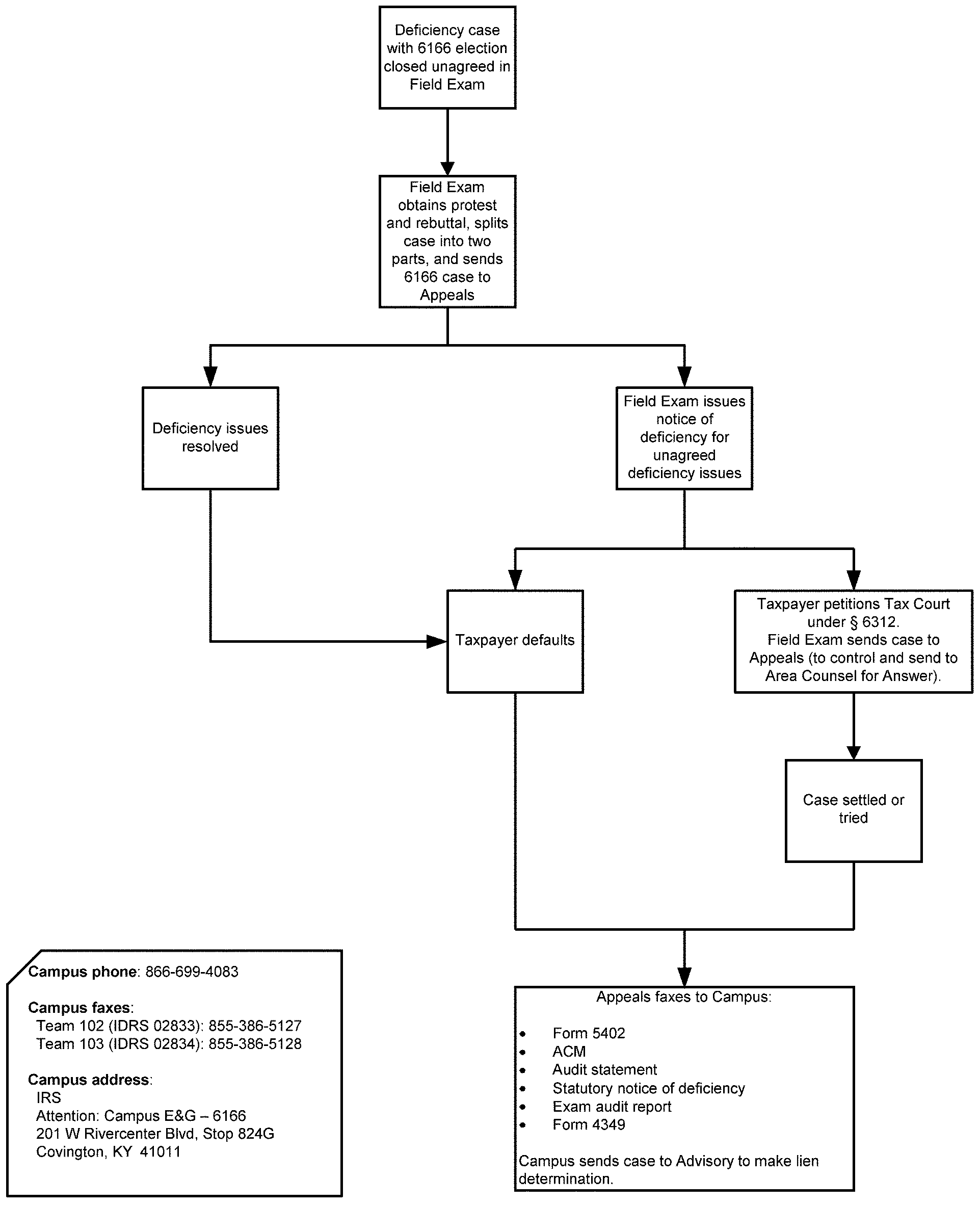
It is not necessary to bifurcate the case file if the IRC 6166 portion of the case is undisputed. Refer to IRM Exhibit 8.7.4-5, Flowchart 2: Undisputed IRC 6166 Cases Sourced from E&G Field Exam, for a comprehensive case-routing overview with respect to tax examination cases with an undisputed IRC 6166 component.
-
It is possible that E&G Field Exam may issue a notice of deficiency with respect to the unagreed issues generating an estate tax deficiency, while the IRC 6166 portion of the case is sent to Appeals. In these cases, Appeals will be unable to make any determination on the IRC 6166 portion of the case until the Tax Court determines the value of the estate in the deficiency proceedings and the Tax Court’s decision becomes final. For this reason, Appeals should issue Letter 3570, Notice of Determination As Provided in IRC Section 7479 That Extension of Time for Payment Under IRC Section 6166 Has Ceased to Apply, or Letter 3571, Final Determination as Provided in IRC Section 7479 That Election Under IRC Section 6166 May Not Be Made, in order to allow the estate to petition the Tax Court under IRC 7479. See CCA 201226027.
Note:
The ATE should inform the taxpayer that the case is being closed because the Office of Appeals is unable to make a determination. Since no administrative appeal is available, the taxpayer must petition the Tax Court to protest the IRC 6166 portion of the case. For the Tax Court to be able to review, the petition must be filed before the 91st day after the date of Letter 3570 or Letter 3571.
-
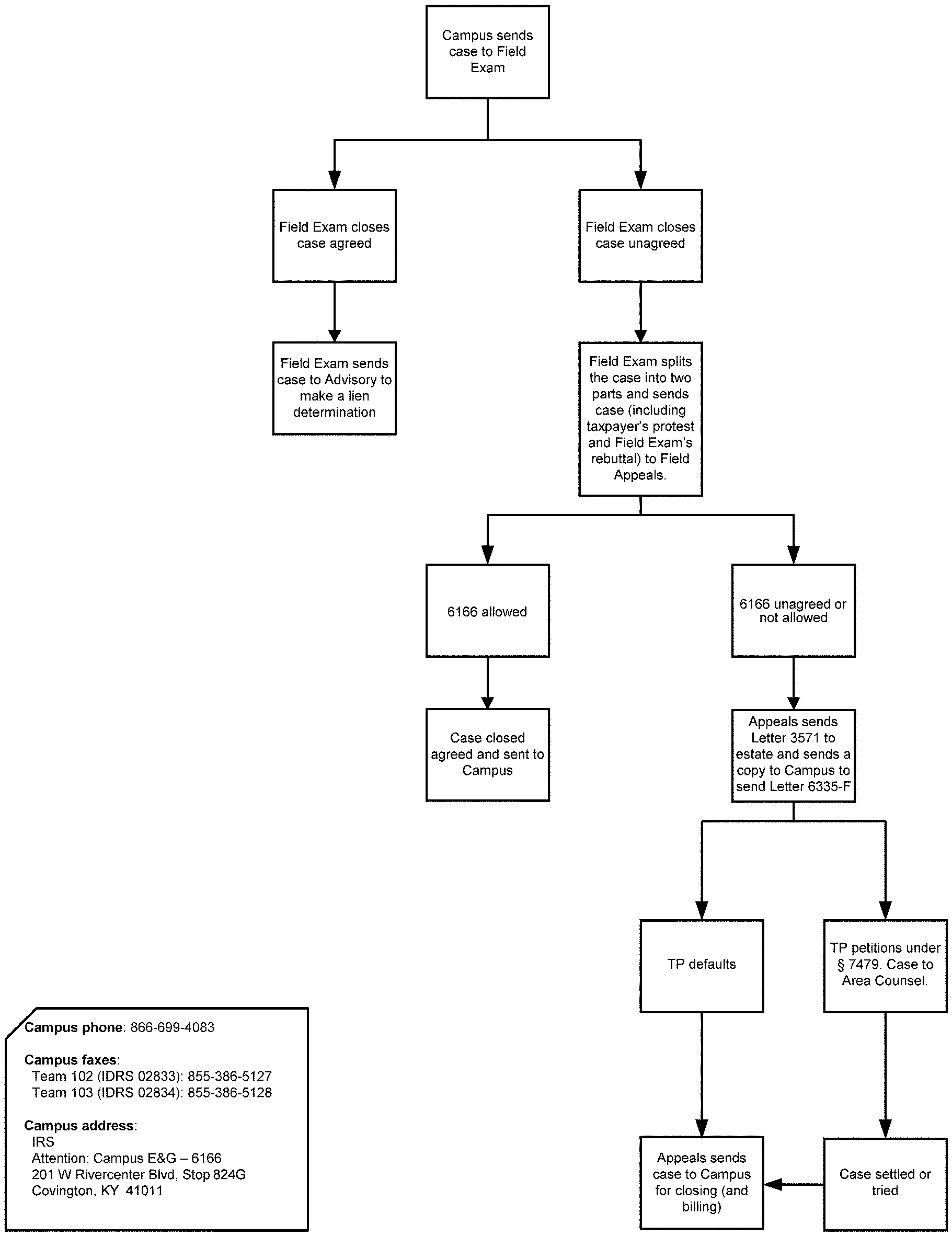
Refer to IRM Exhibit 8.7.4-6, Flowchart 3: Disputed IRC 6166 Cases Sourced from E&G Field Exam, for a comprehensive case-routing overview with respect to IRC 6166 cases sourced from E&G Field Exam.
-
If the estate fails to comply with Advisory's request to post a bond or perfect a lien, Advisory will issue Letter 950–I, 30 Day Letter - Intent to Terminate IRC 6166 Election.
-
If the estate files a timely protest letter, Advisory sends the case file to Appeals within 30 days from the postmark date on the protest letter.
-
Case files generated by Advisory should contain the following documents:
-
Letter 4283, Notification Regarding IRC 6166 Security Requirements
-
Documentation considered in determining whether a bond or lien is required
-
Letter 950–I, 30 Day Letter - Intent to Terminate IRC 6166 Election
-
Case file history
-
Any correspondence with the taxpayer that directly or indirectly references the issues at hand
-
The taxpayer's protest letter (including responses to the protest, if any)
-
-
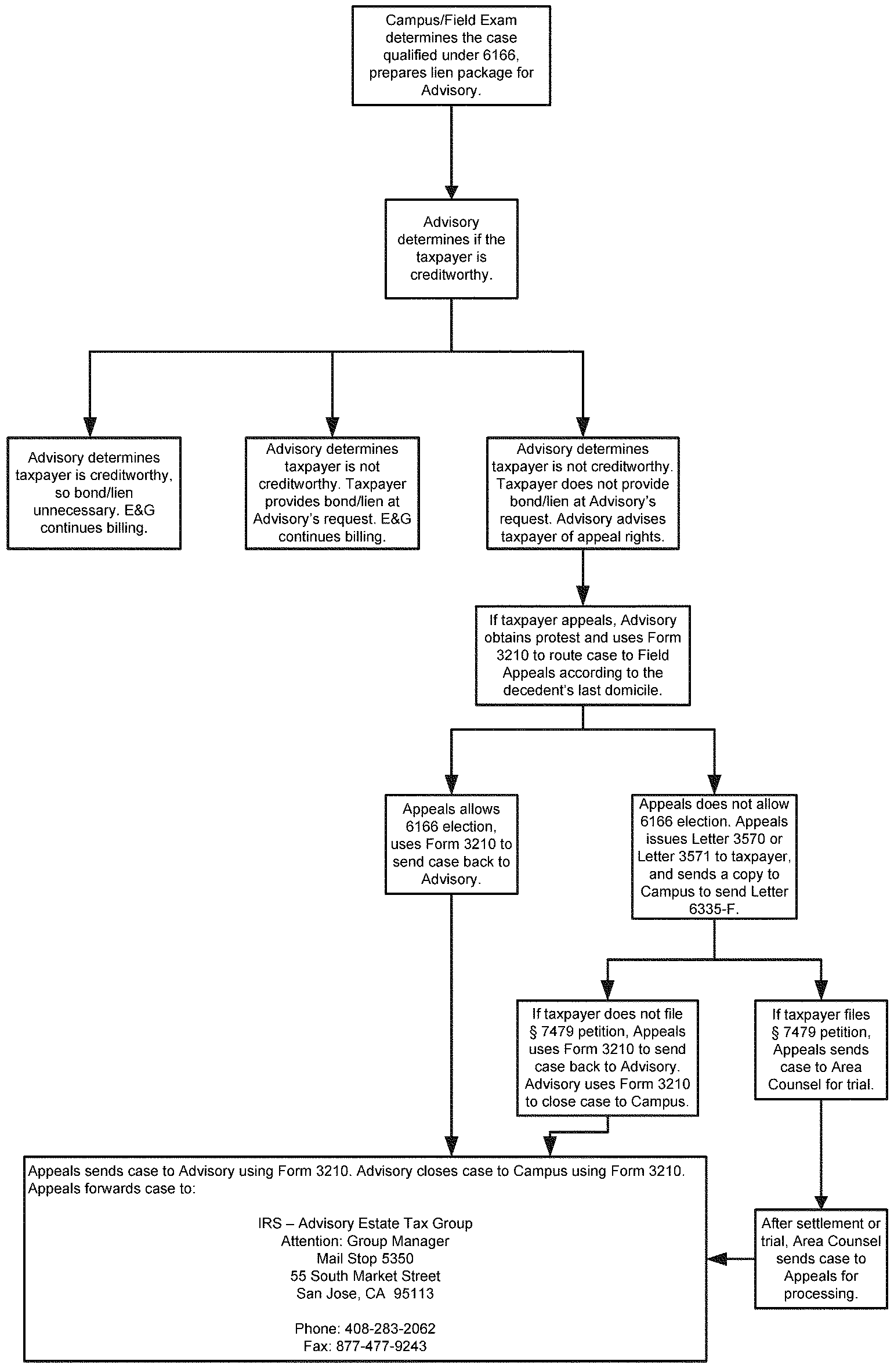
Refer to IRM Exhibit 8.7.4-7, Flowchart 4: IRC 6166 Cases Sourced from E&G Advisory, for a comprehensive case-routing overview with respect to IRC 6166 cases sourced from Advisory.
-
A Transaction Code (TC) 488 indicates that an IRC 6166 election is in place. The date of the TC 488 indicates the effective date of the election.
-
If the election ceases to apply for any of the reasons enumerated under IRC 6166(g), a TC 489 will be input on the account. The date of the TC 489 indicates the date on which the election has ceased to apply. The IRC 6502 CSED begins to run from the TC 489 date.
-
Communicating Appeals’ determination to the originating function is particularly critical in IRC 6166 cases because the account is maintained manually. For this reason, the ATE must provide special processing instructions to Account and Processing Support (APS) by using a customized Form 5402, Appeals Transmittal and Case Memo. The closing instructions will vary depending on the source and type of case.
-
In cases where Appeals overturns the preliminary determination made through Letter 950-H, Letter 950-J, or Letter 950-K, no agreement form is necessary; however, the ATE will prepare a closing letter that outlines the determination.
-
The ATE will prepare a copy of the closing letter and an envelope pre-addressed to IRS, Cincinnati Campus, Attention: Campus E&G—6166, 201 W Rivercenter Blvd, Stop 824G, Covington, KY 41011.
-
The ATE will prepare a customized Form 5402 that includes special IRC 6166 closing procedures for APS. The ATE will identify the following special processing instructions on the Form 5402:
-
Under “APS Route Case To,” select “E&G Campus”
-
Check the box “Agreed Form #” and enter “none”
-
Check the box “APS Instruction for 6166 Election” and input the following information:
Mail closing letter to E&G Campus in the pre-addressed envelope provided.
Include a copy of the closing letter and Form 5402 in the administrative file.
Close the case on ACDS.
Forward the administrative file to IRS, Cincinnati Campus, 201 W Rivercenter Blvd, Stop 824G, Covington, KY 41011, using a Form 3210.
Cincinnati Campus will process the case.
-
-
In cases where Appeals overturns the preliminary determination made through Letter 950-I, no agreement form is necessary; however, the ATE will prepare a closing letter that outlines the determination.
-
The ATE will prepare a copy of the closing letter and an envelope pre-addressed to IRS, Cincinnati Campus, Attention: Campus E&G—6166, 201 W Rivercenter Blvd, Stop 824G, Covington, KY 41011.
-
The ATE will prepare a customized Form 5402 that includes special IRC 6166 closing procedures for APS. The ATE will identify the following special processing instructions on the Form 5402:
-
Under “APS Route Case To,” select “Advisory for 6166/2032A or 2057 bond/lien consideration”
-
Check the box “Agreed Form #” and enter “none”
-
Check the box “APS Instruction for 6166 Election” and input the following information:
Mail closing letter to E&G Campus in the pre-addressed envelope provided.
Include a copy of the closing letter and Form 5402 in the administrative file.
Close the case on ACDS.
Forward the administrative file to [INSERT THE NAME AND ADDRESS OF THE ADVISORY EMPLOYEE WHO SENT THE CASE TO APPEALS], using a Form 3210.
-
-
In cases where Appeals sustains the preliminary determination made through Letter 950-H or Letter 950-J, the ATE must prepare either Letter 3570 or Letter 3571.
-
Letter 3570, Notice of Determination As Provided in IRC Section 7479 That Extension of Time for Payment Under IRC Section 6166 Has Ceased to Apply, is used when Appeals determines that an otherwise valid IRC 6166 election has ceased to apply. Letter 3570 requires the ATM’s signature and must be sent via certified mail.
-
Letter 3571, Final Determination as Provided in IRC Section 7479 That Election Under IRC Section 6166 May Not Be Made, is used when Appeals determines that an IRC 6166 election is not valid. Letter 3571 requires the ATM’s signature and must be sent via certified mail.
-
Pursuant to IRC 7479(b)(3), the taxpayer may contest the determination made through Letter 3570 or Letter 3571 by petitioning the Tax Court within 90 days of the date of mailing. Therefore, the ATE should prepare Letter 3570 or Letter 3571 paying the same attention to details as if the ATE were issuing a notice of deficiency. See, e.g., IRM 8.17.4.8.7, Taxpayer's Last Known Address; IRM 8.17.4.8.8, Power of Attorney in Notices; and IRM 8.17.4.8.10, Taxpayer Identification Numbers on Notice of Deficiency Letters.
-
The ATE will prepare a copy of Letter 3570 or Letter 3571 and an envelope pre-addressed to IRS, Cincinnati Campus, Attention: Campus E&G—6166, 201 W Rivercenter Blvd, Stop 824G, Covington, KY 41011.
-
The ATE will prepare a customized Form 5402 that includes special IRC 6166 closing procedures for APS. The ATE will identify the following special processing instructions on the Form 5402:
-
Under “APS Route Case To,” select “E&G Campus”
-
Check the box “SND Issued” and the box “Unagreed”
-
Check the box “APS Instruction for 6166 Election” and input the following information:
Follow normal deficiency procedures for preparation, issuance and suspense of the case - follow the procedures in IRM 8.20.6.8.4, Appeals Statutory Notices of Deficiency (SND) - Issuance, Suspense, and Interim Processes.
Update SNDATE to 090A – Appeals Issued Notice of Deficiency.
Forward a copy of [Letter 3570/Letter 3571] to E&G Campus in the pre-addressed envelope provided.
If the taxpayer petitions the Tax Court, follow the procedures in IRM 8.20.6.8.8, Tax Court Petition Filed During the Appeals-Issued Statutory Notice of Deficiency Suspense Period.
When the case is ready to close after Counsel resolution or if SND defaults, forward the administrative file to IRS, Cincinnati Campus, 201 W Rivercenter Blvd, Stop 824G, Covington, KY 41011, using a Form 3210.
Cincinnati Campus will process the case.
-
-
In cases where Appeals sustains the preliminary determination made through Letter 950–I, the ATE must prepare either Letter 3570 or Letter 3571.
-
Letter 3570, Notice of Determination As Provided in IRC Section 7479 That Extension of Time for Payment Under IRC Section 6166 Has Ceased to Apply, is used when Appeals determines that an otherwise valid IRC 6166 election has ceased to apply. Letter 3570 requires the ATM’s signature and must be sent via certified mail.
-
Letter 3571, Final Determination as Provided in IRC Section 7479 That Election Under IRC Section 6166 May Not Be Made, is used when Appeals determines that an IRC 6166 election is not valid. Letter 3571 requires the ATM’s signature and must be sent via certified mail.
-
Pursuant to IRC 7479(b)(3), the taxpayer may contest the determination made through Letter 3570 or Letter 3571 by petitioning the Tax Court within 90 days of the date of mailing. Therefore, the ATE should prepare Letter 3570 or Letter 3571 paying the same attention to details as if the ATE were issuing a notice of deficiency. See, e.g., IRM 8.17.4.8.7, Taxpayer's Last Known Address; IRM 8.17.4.8.8, Power of Attorney in Notices; and IRM 8.17.4.8.10, Taxpayer Identification Numbers on Notice of Deficiency Letters.
-
The ATE will prepare a copy of Letter 3570 or Letter 3571 and an envelope pre-addressed to IRS, Cincinnati Campus, Attention: Campus E&G—6166, 201 W Rivercenter Blvd, Stop 824G, Covington, KY 41011.
-
The ATE will prepare a customized Form 5402 that includes special IRC 6166 closing procedures for APS. The ATE will identify the following special processing instructions on the Form 5402:
-
Under “APS Route Case To,” select “Advisory for 6166/2032A or 2057 bond/lien consideration”
-
Check the box “SND Issued” and the box “Unagreed”
-
Check the box “APS Instruction for 6166 Election” and input the following information:
Follow normal deficiency procedures for preparation, issuance and suspense of the case - follow the procedures in IRM 8.20.6.8.4, Appeals Statutory Notices of Deficiency (SND) - Issuance, Suspense, and Interim Processes.
Update SNDATE to 090A – Appeals Issued Notice of Deficiency.
Forward a copy of [Letter 3570/Letter 3571] to E&G Campus in the pre-addressed envelope provided.
If the taxpayer petitions the Tax Court, follow the procedures in IRM 8.20.6.8.8, Tax Court Petition Filed During the Appeals-Issued Statutory Notice of Deficiency Suspense Period.
When the case is ready to close after Counsel resolution or if SND defaults, forward the administrative file to [INSERT THE NAME AND ADDRESS OF THE ADVISORY EMPLOYEE WHO SENT THE CASE TO APPEALS], using a Form 3210.
-
-
In cases where Appeals sustains the preliminary determination made through Letter 950-K, the ATE must prepare Letter 5052, Final Determination Under IRC 6166 Decreased.
-
Pursuant to IRC 7479(b)(3), the taxpayer may contest the determination made through Letter 5052 by petitioning the Tax Court within 90 days of the date of mailing. Therefore, the ATE should prepare Letter 5052 paying the same attention to details as if the ATE were issuing a notice of deficiency. See, e.g., IRM 8.17.4.8.7, Taxpayer's Last Known Address; IRM 8.17.4.8.8, Power of Attorney in Notices; and IRM 8.17.4.8.10, Taxpayer Identification Numbers on Notice of Deficiency Letters.
-
The ATE will prepare a copy of Letter 5052 and an envelope pre-addressed to IRS, Cincinnati Campus, Attention: Campus E&G—6166, 201 W Rivercenter Blvd, Stop 824G, Covington, KY 41011.
-
The ATE will prepare a customized Form 5402 that includes special IRC 6166 closing procedures for APS. The ATE will identify the following special processing instructions on the Form 5402:
-
Under “APS Route Case To,” select “E&G Campus”
-
Check the box “SND Issued” and the box “Unagreed”
-
Check the box “APS Instruction for 6166 Election” and input the following information:
Follow normal deficiency procedures for preparation, issuance and suspense of the case - follow the procedures in IRM 8.20.6.8.4, Appeals Statutory Notices of Deficiency (SND) - Issuance, Suspense, and Interim Processes.
Update SNDATE to 090A – Appeals Issued Notice of Deficiency.
Forward a copy of Letter 5052 to E&G Campus in the pre-addressed envelope provided.
If the taxpayer petitions the Tax Court, follow the procedures in IRM 8.20.6.8.8, Tax Court Petition Filed During the Appeals-Issued Statutory Notice of Deficiency Suspense Period.
When the case is ready to close after Counsel resolution or if SND defaults, forward the administrative file to IRS, Cincinnati Campus, 201 W Rivercenter Blvd, Stop 824G, Covington, KY 41011, using a Form 3210.
Cincinnati Campus will process the case.
-
-
The procedures outlined in this subsection apply to all estate tax cases with an undisputed election under IRC 6166, where the Appeals settlement impacts the IRC 6166 installment payments solely on computational grounds.
-
The ATE will prepare a customized Form 5402 following the procedures outlined in IRM 8.7.4.3.6, Closing Estate Tax Cases. In addition, the ATE will identify the following IRC 6166 special processing instructions on the Form 5402:
-
Check the box "APS Instruction for 6166 Election" and input the following information:
After assessing the deficiency on IDRS, fax the following documents to the Cincinnati Campus at either (855) 386-5127 for Team 102 (IDRS 02833), or (855) 386-5128 for Team 103 (IDRS 02834): Form 5402, ACM, Form 4349, Appeals computations, and Exam audit report.
After closing the case on ACDS and assessing the deficiency on IDRS, forward the administrative file to IRS, Cincinnati Campus, 201 W Rivercenter Blvd, Stop 824G, Covington, KY 41011, using a Form 3210.
Cincinnati Campus will verify the interest computation under the IRC 6166 election and, if necessary, will assess and bill the interest.
-
-
In all cases where Appeals overturns the preliminary determination made through Letter 950-H, Letter 950-J, Letter 950-K, or Letter 950-I, the ATM will verify that:
-
Form 5402 includes proper instructions for APS to process the case
-
The ATE prepared a copy of the determination or closing letter and an envelope pre-addressed to IRS, Cincinnati Campus, Attention: Campus E&G—6166, 201 W Rivercenter Blvd, Stop 824G, Covington, KY 41011.
-
Form 5402 instructs APS to return the administrative file to E&G Campus or Advisory
-
-
In all cases where Appeals sustains the preliminary determination made through Letter 950–H, Letter 950–J, Letter 950–K, or Letter 950–I, the ATM will verify that:
-
Form 5402 includes proper instructions for APS to process the case
-
The ATE prepared a copy of Letter 3570 or Letter 3571 and an envelope pre-addressed to IRS, Cincinnati Campus, Attention: Campus E&G—6166, 201 W Rivercenter Blvd, Stop 824G, Covington, KY 41011.
-
Form 5402 instructs APS to follow normal deficiency procedures outlined in IRM 8.20.6.8.4, Appeals Statutory Notices of Deficiency (SND) - Issuance, Suspense, and Interim Processes.
-
Letter 3570 or Letter 3571 is addressed to the taxpayer's last known address as shown on the most recent IDRS account transcript.
-
-
IRC 2032A cases require a Form 6111, Notice of Special Use Valuation Election, (IRC 2032A). The form is necessary to attach a lien under IRC 6324B.
-
The originating function prepares Form 6111 and includes a copy in the case file. However, if the information contained on Form 6111 needs to change as a result of the Appeals settlement, the ATE will prepare a new Form 6111, which supersedes the one prepared by the originating function.
-
When closing IRC 2032A cases, the ATE will prepare a customized Form 5402 that includes the following special instructions for APS:
-
APS instructions for IRC 2032A case
-
Make assessment/close case
-
Transfer control of the case by recharging the return to E&G putting an ESTAB on IDRS and
-
Send the entire case file back to the E&G Examiner whose name is on the Form 5402
-
-
A TCS will prepare the settlement computation for estate tax cases following the general procedures outlined in IRM 8.17.2, General Settlement and Rule 155 Computations.
-
The Appeals employee who prepares the settlement computation is also responsible for preparing the Form 5403 Worksheet at the time the computations are prepared. For more details on the Form 5403 Worksheet, see IRM 8.17.5.2, Form 5403 Instructions to APS Worksheet, and related subsections.
-
In most estate tax cases, Form 3614-A, Estate Tax, and/or Form 1273, Report of Estate Tax Examination Changes, are used for the computations. In addition, the TCS may also use Form 6180, Line Adjustments-Estate Tax.
-
For estates of decedents who died on or before December 31, 2004, IRC 2011 provides a credit against the federal estate tax for death taxes paid to any state or the District of Columbia. The taxpayer must provide evidence to substantiate entitlement to this credit.
-
When preparing Form 3614-A, Line 10 reflects the amount of credit already substantiated, whereas Line 19 reflects the amount of additional credit available once substantiated.
-
The separation of substantiated versus unsubstantiated credit results in a "gross deficiency" amount on Line 18 and a "net deficiency" amount on Line 20.
-
-
Form 3610, Audit Statement, may be used as the face or summary sheet in the settlement computation package, when needed. If a Form 3610 is needed, it will be prepared by the same Appeals employee who prepared the settlement computation.
-
The settlement computation may omit Form 3610 provided that all needed information is clearly and adequately presented in other parts of the settlement computation.
-
If Form 3610 is used, make the following selections:
-
Enter "Estate" as kind of tax.
-
Change "Tax Year Ended" to "Date of Death."
-
Show gross deficiency and net deficiency amounts similar to the following:
Gross deficiency and net deficiency format: Gross deficiency determined 125,000.00 Additional credit allowable, if substantiated (35,000.00) Net deficiency 90,000.00
========= -
-
If Form 3614-A, Estate Tax, is used for the computation, it is a good practice to list the estate tax adjustments in the same order they appear on the estate tax return (Form 706) schedules. For example:
-
A Form 4349, Computation of Estate Tax Due With Return and Annual Installment, is required on all cases with a valid IRC 6166 election. See IRM Exhibit 8.7.4-1 for an example of a completed Form 4349.
-
The ATE is responsible for ensuring that Form 4349 is attached to the Form 5403 Worksheet, and that both documents are attached to the inside left flap of the administrative file folder when the case is closed.
-
A person who is required to include in gross income an amount of Income in Respect of a Decedent (IRD) may deduct for the same taxable year that portion of the estate tax which is attributable to the inclusion of the IRD in the decedent's estate. Treas. Reg. 1.691(c)-1. This is an income tax deduction, but requires specialized estate tax computations to be made. The deduction can be applied on the estate’s Form 1041, U.S. Income Tax Return for Estates and Trusts.
-
Determining the deductible amount is quite technical. If asked to assist with such a calculation, the TCS and the ATE should make sure they are properly trained in the subject matter and carefully read Treas. Reg. 1.691(c)-1 and related published guidance before preparing the computation.
-
Interest may be limited to specific time periods or rates, or it may be statutorily prohibited; this gives rise to the term "restricted interest." Restricted interest is subject to the same variables (time, rate, amount) as "normal" interest. The primary difference between normal and restricted interest is that the computer may not be able to identify all conditions involved in a restricted interest situation. Therefore, restricted interest computations may have to be performed manually.
-
See IRM Exhibit 8.7.4-2 for a table showing the restricted interest provisions that apply to estate tax cases.
-
If the case involves any of the Code sections listed in IRM Exhibit 8.7.4-2, the ATE will alert TCS that restricted interest applies and that it is necessary to prepare Form 1366, Tax Analysis Worksheet for Overassessment of Estate Tax Involving Restricted Interest.
-
The TCS will prepare Form 1366 as part of the settlement computation. APS will use Form 1366 when computing the restricted interest.
-
The TCS should also notate that restricted interest applies on the Form 5403 Worksheet. This alerts APS to look for the Form 1366.
-
The ATE is responsible for ensuring that Form 1366 is attached to the Form 5403 Worksheet, and that both documents are attached to the inside left flap of the administrative file folder when the case is closed.
-
See IRM 20.2.1.5, Normal and Restricted Interest, for further information concerning restricted interest computations.
-
See IRM 20.2.10.2.5, Combination Adjustments, for further information concerning Form 1366.
-
Many states have their own estate tax statutes that impose a tax on transfers at death. In the calculation of the federal estate tax, estates were allowed a credit in 2004 and before for some of the state death tax paid. After 2004, estates are allowed a deduction for all of the state death tax paid.
-
The state death tax credit under IRC 2011 was repealed for estates of decedents dying after December 31, 2004. The credit has been replaced by a state death tax deduction under IRC 2058.
-
A field examiner's unagreed report only allows the state death tax deduction (or credit) for state death taxes actually paid at the time the original federal estate tax return was filed. If Appeals' resolution of the case results in any federal estate tax deficiency, there will likely be an increase in the state tax deduction (or credit), which in turn would cause the federal estate tax deficiency to decrease.
-
Since 2005, a state death tax deduction has been allowed for the entire amount of the state death tax paid. Prior to 2005, a state death tax credit was used. The state death tax credit was limited to an amount according to a progressive schedule with a top rate of 16 percent of the taxable value of the estate. If you need to calculate a pre-2005 state death tax credit, refer to the Instructions for Form 706 for the year the decedent died.
-
For purposes of IRC 2011 and IRC 2058, deductible state death taxes are any estate, inheritance, legacy, or succession taxes paid to a state or to the District of Columbia, with respect to property included in the decedent's gross estate.
-
All settlements involving a change in estate tax and/or related penalties require an agreement form.
-
When a settlement is reached on the basis of mutual concessions or hazards of litigation, or when the settlement otherwise necessitates finality, the ATE will secure a special agreement form. The special agreement form used for estate tax cases is Form 890-AD, Estate Tax Offer of Waiver of Restrictions on Assessment and Collection of Deficiency in Tax and of Acceptance of Overassessment.
-
All other settlements require a general agreement form. The general agreement form used for estate tax cases is Form 890, Waiver of Restrictions on Assessment and Collection of Deficiency and Acceptance of Overassessment - Estate, Gift, and Generation - Skipping Transfer Tax.
-
-
For a list of differences between general and special agreement forms, see IRM 8.6.4.3.1, Distinction Between General and Special Agreement Forms.
-
In order to properly secure and execute agreements in estate tax cases, it is important to understand the difference between net deficiency and gross deficiency laid out in IRM 8.7.4.3.4, Settlement Computations in Estate Tax Cases.
-
When a settlement is reached on the basis of the gross deficiency, the ATE will secure Form 890 or Form 890-ADfor the gross deficiency. In these cases:
-
The taxpayer must file a claim within the statutory period of limitation and furnish credit evidence to the SB/SE Area Director for the amount of any subsequently allowable state or foreign death tax credit.
-
The ATE should inform the taxpayer that interest is restricted on refunds resulting from credit for state and foreign death taxes subsequently allowed.
-
-
When a settlement is reached on the basis of the net deficiency, the ATE will secure Form 890 or Form 890-ADfor the net deficiency. In these cases the ATE will follow these procedures:
-
If using Form 890, the ATE will complete the paragraph in the center of the agreement form by filling in the appropriate blank spaces as follows:
-
In two of the three provided spaces, insert a date that allows the taxpayer a reasonable amount of time to furnish the SB/SE Area Director the required credit evidence. However, the specified date cannot be later than three months before the expiration of the statute of limitations on assessments.
-
Insert the difference between the gross deficiency and net deficiency in the other blank space provided.
-
-
If using Form 890-AD, the ATE will add one or both of the following paragraphs to the agreement form:
For state death taxes: "It is understood that evidence of payment of estate, inheritance, legacy, or succession taxes to any state, the District of Columbia, or any possession of the United States, as required by Section 20.2011 of the Estate Tax Regulations under the 1986 Code, will be filed with the SB/SE Area Director as soon as possible. If evidence is not filed on or before ____________ , the undersigned executor(s) or administrator(s) waive(s) the restrictions provided in Section 6213(a) of the Internal Revenue Code of 1986, and consent(s) to the assessment and collection of a further deficiency in Estate Tax of $ ____________ , with interest at the statutory rate to the 30th day after ____________ , or until the further deficiency is assessed, whichever is earlier."
For foreign death taxes: "It is understood that evidence of payment of estate, inheritance, legacy, or succession taxes to any foreign country, as required by Section 20.2014 of the Estate Tax Regulations under the 1986 Code, will be filed with the SB/SE Area Director as soon as possible. If evidence is not filed on or before ____________ , the undersigned executor(s) or administrator(s) waive(s) the restrictions provided in Section 6213(a) of the Internal Revenue Code of 1986, and consent(s) to the assessment and collection of a further deficiency in Estate Tax of $ ____________ , with interest at the statutory rate to the 30th day after ____________ , or until the further deficiency is assessed, whichever is earlier."
-
-
In all estate tax cases, the ATE will assemble the administrative file in chronological order and include all documents necessary for APS and the ATM to close the case.
-
When closing agreed non-docketed estate tax deficiency cases, the ATE will prepare a closing folder with the following documents:
-
Case Summary Card(s)
-
Case Activity Record printed from ACDS
-
Signed Form 5402, Appeals Transmittal and Case Memo
-
ACM and related schedule of adjustments
-
Settlement Computations, including the Form 5403 Worksheet
-
Agreement Form(s) and/or Closing Agreement(s)
-
Letter 913, Agreed Cases - Closing Letter, andLetter 914, Appeals Closing Letter for Estate Tax Cases, with envelope(s)
-
Letter 937, if necessary, with envelope
-
Form 4421, Declaration - Executor's Commissions and Attorney's Fees, if applicable
-
-
When closing unagreed non-docketed estate tax deficiency cases, the ATE will prepare a closing folder with the following documents:
-
Case Summary Card(s)
-
Case Activity Record printed from ACDS
-
Signed Form 5402, Appeals Transmittal and Case Memo
-
ACM and related schedule of adjustments
-
Notice of Deficiency prepared following the guidelines outlined in IRM 8.7.4.8, Notices of Deficiency in Estate and Gift Tax Cases, with envelope
-
Letter 937, if necessary, with envelope
-
Form 5403 Worksheet
-
Form 4421, Declaration - Executor's Commissions and Attorney's Fees, if applicable
-
-
When closing agreed docketed estate tax deficiency cases, the ATE will prepare a closing folder with the following documents:
-
Case Summary Card(s)
-
Case Activity Record printed from ACDS
-
Signed Form 5402, Appeals Transmittal and Case Memo
-
ACM and related schedule of adjustments
-
Settlement Computations, including the Form 5403 Worksheet and Form 3623, Statement of Account
-
Form 2828, Transmittal Memorandum
-
Decision Document
-
Letter 1645, Approval of Settlement/Docketed Case, with envelope(s)
-
Letter 914 with envelope(s) and accompanying instructions to APS to mail the letter to the taxpayer only after the stipulated decision is entered by the Tax Court
-
Letter 937, if necessary, with envelope
-
Form 4421, Declaration - Executor's Commissions and Attorney's Fees, if applicable
-
-
When closing unagreed docketed estate tax deficiency cases to Counsel to prepare for trial, the ATE will prepare a closing folder with the following documents:
-
Case Summary Card(s)
-
Case Activity Record printed from ACDS
-
Signed Form 5402, Appeals Transmittal and Case Memo
-
ACM and related schedule of adjustments
-
Form 2828, Transmittal Memorandum
-
Letter 971, Letter Advising No Settlement Reached - Docketed Case, with envelope(s)
-
Letter 937, if necessary, with envelope
-
-
For procedures on closing IRC 6161 cases, see IRM 8.7.4.5.10, Closing Non-Docketed IRC 6161 Cases, and IRM 8.7.4.5.11, Closing Docketed IRC 6161 Cases.
-
For procedures on closing IRC 6166 cases, see IRM 8.7.4.3.2.9, ATE's Case-Closing Procedures for IRC 6166 Cases.
-
For procedures on closing IRC 2032A cases, see IRM 8.7.4.3.3, Special Use Valuation Elections under IRC 2032A.
-
For procedures on closing claim cases, see IRM 8.7.7, Claim and Overassessment Cases.
-
Appeals will expedite the closing of certain "agreed and unpaid deficiency" or overpayment cases if the case meets the "large dollar" criteria described in IRM 4.4.18, AIMS Procedures and Processing Instructions, Large Dollar Cases. For additional procedures on closing "large dollar" cases, see IRM 8.2.1.10, Closing the Case to APS, and IRM 8.2.1.10.1, Expedite Processing for Certain Large Dollar Cases.
Note:
The "large dollar" guidance does not apply to a deficiency and/or overpayment case that requires review by the Joint Committee on Taxation. See IRM 8.7.9.3, Cases Requiring JC Review
.
-
This subsection provides information on procedures or issues that are unique to gift tax cases.
-
Gift tax returns are filed on Form 709, United States Gift (and Generation - Skipping Transfer) Tax Return.
-
Procedures for establishing and closing gift tax cases, acknowledging receipt of cases, setting up and holding the conference, preparing the ACM and securing an agreement, and preparing the settlement computations or the statutory notices of deficiency are generally the same for gift tax cases as those used in income tax cases.
-
For information on determining the statute of limitations in gift tax cases, see IRM 8.21, Appeals Statute Responsibility.
-
When the ATE receives a newly assigned gift tax case, he/she completes the intake procedures fully described in IRM 8.2.1.4, Receipt of New Assignment by an Appeals Technical Employee (ATE), generally within 45 days of receiving the case. To summarize IRM 8.2.1.4(3), the ATE’s intake actions must include:
-
Completing the statute verification,
-
Validating all critical data fields in ACDS,
-
Determining whether the case is ready for Appeals’ consideration, and
-
Making initial contact with the taxpayer or representative.
Reminder:
IRM 8.2.1.4(3) generally establishes a 45-day deadline for ATEs to complete these intake procedures. While the ATM is authorized to be "reasonable" in extending this 45-day deadline for contacting taxpayers, the ATM is not authorized to extend the 45-day deadline for the ATE to complete the process of statute verification.
-
-
In validating the data entered in ACDS, the ATE will verify the accuracy of the following data fields on ACDS:
-
Taxpayer's name and address
-
Taxpayer's TIN
-
Case type
-
MFT
-
Category and Subcategory
-
Key period
-
Statute Date
-
Statute Code
-
Deficiency/Penalty/Claim amounts
-
-
If the case contains one or more valuation issues, the ATE should consult IRM 8.7.4.7, Requesting Valuation Assistance in Estate and Gift Tax Cases, to determine whether it is necessary to request valuation assistance.
-
A TCS will prepare the settlement computation for gift tax cases following the general procedures outlined in IRM 8.17.2, General Settlement and Rule 155 Computations.
-
The Appeals employee who prepares the settlement computation is responsible for preparing the Form 5403 Worksheet at the time the computations are prepared. For more details on the Form 5403 Worksheet, see IRM 8.17.5.2, Form 5403 Instructions to APS Worksheet, and related subsections.
-
In most gift tax cases, Form 3615-A, Gift Tax, and Form 3233, Report of Gift Tax Examination, are used for the computations. The starting point is usually the original return as filed or the latest processed amended return.
-
A gift tax deficiency is computed by calculating the "gross gift tax" at current gift tax rates on the total amount of taxable gifts made during the current period and all prior periods. See IRC 2502(b). The "gross gift tax" is then reduced by the portion of the gift tax attributable to taxable gifts for all prior periods to arrive at the gift tax attributable to taxable gifts made in the current period.
-
Form 3610, Audit Statement, may be used as the face or summary sheet in the settlement computation package, when needed. If a Form 3610 is needed, it will be prepared by the same Appeals employee who prepared the settlement computation.
-
The settlement computation may omit Form 3610 provided that all needed information is clearly and adequately presented in other parts of the settlement computation.
-
If Form 3610 is used, make the following selections:
-
Enter "Gift Tax" as type of tax.
-
Change "Tax Year Ended" to "Calendar Year."
-
-
If Form 3615-A, Gift Tax, is used for the computation, it is a good practice to list the gift tax adjustments in the same order they appear on the gift tax return (Form 709) schedules. For example:
-
All settlements involving a change in gift tax and/or related penalties require an agreement form.
-
When a settlement is reached on the basis of mutual concessions or hazards of litigation, or when the settlement otherwise necessitates a pledge not to reopen the issues, the ATE will secure a special agreement form. The special agreement form used for gift tax cases is Form 870-AD, Offer to Waive Restrictions on Assessment and Collection of Tax Deficiency and to Accept Overassessment.
-
All other settlements require a general agreement form. The general agreement form used for gift tax cases is Form 890, Waiver of Restrictions on Assessment and Collection of Deficiency and Acceptance of Overassessment - Estate, Gift, and Generation - Skipping Transfer Tax.
-
-
For a list of differences between general and special agreement forms, see IRM 8.6.4.3.1, Distinction Between General and Special Agreement Forms.
-
In all gift tax cases, the ATE will assemble the administrative file in chronological order and include all documents necessary for APS and the ATM to close the case.
-
When closing agreed non-docketed gift tax deficiency cases, the ATE will prepare a closing folder with the following documents:
-
Case Summary Card(s)
-
Case Activity Record printed from ACDS
-
Signed Form 5402, Appeals Transmittal and Case Memo
-
ACM and related schedule of adjustments
-
Settlement Computations, including the Form 5403 Worksheet
-
Agreement Form(s) and/or Closing Agreement(s)
-
Letter 913, with envelope(s)
-
Letter 937, if necessary, with envelope
-
-
When closing unagreed non-docketed gift tax deficiency cases, the ATE will prepare a closing folder with the following documents:
-
Case Summary Card(s)
-
Case Activity Record printed from ACDS
-
Signed Form 5402, Appeals Transmittal and Case Memo
-
ACM and related schedule of adjustments
-
Notice of Deficiency prepared following the guidelines outlined in IRM 8.7.4.8, Notices of Deficiency in Estate and Gift Tax Cases, with envelope
-
Letter 937, if necessary, with envelope
-
Form 5403 Worksheet
-
-
When closing agreed docketed gift tax deficiency cases, the ATE will prepare a closing folder with the following documents:
-
Case Summary Card(s)
-
Case Activity Record printed from ACDS
-
Signed Form 5402, Appeals Transmittal and Case Memo
-
ACM and related schedule of adjustments
-
Settlement Computations, including the Form 5403 Worksheet and Form 3623, Statement of Account
-
Form 2828, Transmittal Memorandum
-
Decision Document
-
Letter 1645, Approval of Settlement/Docketed Case, with envelope(s)
-
Letter 937, if necessary, with envelope
-
-
When closing unagreed docketed gift tax deficiency cases to Counsel to prepare for trial, the ATE will prepare a closing folder with the following documents:
-
Case Summary Card(s)
-
Case Activity Record printed from ACDS
-
Signed Form 5402, Appeals Transmittal and Case Memo
-
ACM and related schedule of adjustments
-
Form 2828, Transmittal Memorandum
-
Letter 971, Letter Advising No Settlement Reached - Docketed Case, with envelope(s)
-
Letter 937, if necessary, with envelope
-
-
For procedures on closing claim cases, see IRM 8.7.7, Claim and Overassessment Cases.
-
For procedures on closing IRC 6161 cases, see IRM 8.7.4.5.10, Closing Non-Docketed IRC 6161 Cases, and IRM 8.7.4.5.11, Closing Docketed IRC 6161 Cases.
-
Appeals will expedite the closing of certain "agreed and unpaid deficiency" or overpayment cases if the case meets the "large dollar" criteria described in IRM 4.4.18, AIMS Procedures and Processing Instructions, Large Dollar Cases. For additional procedures on closing "large dollar" cases, see IRM 8.2.1.10, Closing the Case to APS, and IRM 8.2.1.10.1, Expedite Processing for Certain Large Dollar Cases.
Note:
The "large dollar" guidance does not apply to a deficiency and/or overpayment case that requires review by the Joint Committee on Taxation. See IRM 8.7.9.3, Cases Requiring JC Review
.
-
Under IRC 6161, Treas. Reg. 20.6161-2, Treas. Reg. 25.6161-1 and Treas. Reg. 301.7701-9, the Secretary of the Treasury may extend the time to pay certain taxes for a reasonable period of time. See IRM 20.1.2.2.3.2, Extensions of Time to Pay - IRC 6161, for additional information.
-
The Secretary’s authority for (1), above, was delegated to, among others, ATMs. See IRM 1.2.47.9, Delegation Order 8-8 (Rev. 1) (formerly DO-66, Rev. 15).
-
Estate Tax:
-
An extension of time to pay estate taxes may be granted for up to ten years (up to one year at a time) for an original TC 150 assessment, and up to four years (up to one year at a time) for an examination or deficiency assessment. See IRC 6161(a)(2), IRC 6161(b)(2), Treas. Reg. 20.6161-1, and Treas. Reg. 20.6161-2. Therefore, different extension periods may apply for different assessments. See IRM 5.5.5, Processing Estate and Gift Tax Extensions, for additional information.
-
IRC 6161(a)(2)(B) also permits an extension of time to pay an installment payment (including deficiency installment payments) under IRC 6166 for a reasonable time not to exceed 10 years (up to one year at a time) from the due date of the installment payment.
-
Requests for extensions of time to pay estate taxes may be subject to either a reasonable cause or an undue hardship standard, depending on the distinguishing criteria outlined in IRM 8.7.4.5.8, Appeals Consideration of IRC 6161 Cases.
-
-
Gift Tax:
-
An extension of time to pay gift taxes may be granted for up to six months (or longer in the case of taxpayers who are abroad) for an original TC 150 assessment, and up to 30 months for an examination or deficiency assessment. See IRC 6161(a)(1), IRC 6161(b)(1), and Treas. Reg. 25.6161-1. Therefore, different extension periods may apply for different assessments. See IRM 5.5.5, Processing Estate and Gift Tax Extensions, for additional information.
-
All requests for extensions of time to pay gift taxes are subject to an undue-hardship standard. See Treas. Reg. 25.6161-1(b).
-
-
If an extension of time to pay is granted under IRC 6161, no failure-to-pay penalty will accrue under IRC 6651(a) until after the expiration of the extended due date for payment.
-
If the President of the United States makes a disaster or emergency declaration, IRC 7508A confers upon the IRS expanded authority to provide relief in the form of extensions of time to file under IRC 6081 or pay under IRC 6161. See IRM 25.16.1,Disaster Assistance and Emergency Relief, Program Guidelines, for additional information.
-
To provide relief for a local disaster whose magnitude does not warrant a Presidential declaration, local IRS officials may provide extensions of time to file under IRC 6081 or pay under IRC 6161. See IRM 25.6.1.10.2.9.3, Disaster Area Recognized by Local Service Officials, for additional information.
-
Extensions of time to pay estate tax:
-
A request for an extension of time to pay must be made in writing and received no later than the due date of the return, or, in the case of a subsequent extension request, no later than the extended due date for payment. See Treas. Reg. 20.6161-1(b).
-
The request may be made on Form 4768, Application for Extension of Time to File a Return and/or Pay U.S. Estate (and Generation-Skipping Transfer) Taxes, and should contain a written statement explaining in detail why it is impossible or impractical to pay the full amount of tax by the due date.
-
In lieu of filing Form 4768, the application for extension of time to pay may be made through any written statement as long as the estate indicates the period of the extension requested and includes a declaration that the request is made under a penalty of perjury.
-
The request is filed with the Cincinnati Campus.
-
-
Extensions of time to pay gift tax:
-
A request for an extension of time to pay must be made in writing and received no later than the due date of the return, or, in the case of a subsequent extension request, no later than the extended due date for payment. See Treas. Reg. 25.6161-1(c).
-
The request may be made on Form 1127, Application for Extension of Time for Payment of Tax Due to Undue Hardship, and should contain a written statement of undue hardship explaining in detail why the taxpayer would sustain a substantial financial loss if required to pay the gift tax on the due date.
-
The request is filed with the Cincinnati Campus.
-
-
The Service examines applications for an extension of time to pay within 30 days of receipt. The taxpayer is notified whether the application is denied, granted, or tentatively granted subject to certain conditions. See IRM 5.5.5.1, Section Overview Request for Extension of Time to Pay Estate Tax, for additional information.
Note:
A taxpayer who files a request for an extension of time to pay which lacks the requisite statement of reasonable cause or undue hardship will be allowed an additional 15 days to perfect the request. A letter is provided to the taxpayer requesting additional information. If a timely response is not provided, the request will be denied.
-
All IRC 6161 requests for extension of time to pay estate tax (Form 4768) are adjudicated by Advisory.
-
All IRC 6161 requests for extension of time to pay gift tax (Form 1127) are adjudicated by the E&G Campus.
-
The Compliance employee assigned to adjudicate the request for an extension of time to pay makes an initial determination based on reasonable cause or undue hardship. See IRM 5.5.5.4, Evaluating Requests for Extensions of Time to Pay, for additional information.
-
The Compliance employee assigned to adjudicate the request for an extension of time to pay also reviews previous extension requests to ensure that the government’s interests are protected before an additional extension is granted.
-
Where the government's interests would be at risk by granting an additional extension of time to pay, the request may be granted on the condition the taxpayer posts a bond or other security. See IRC 6165 and IRM 5.6.1.3.3, Estate Tax Bonds and Other Collateral, for additional information.
-
In some cases, the IRS may also file a Notice of Federal Tax Lien as a condition precedent to approving an extension request.
-
IRC 6161 cases are not controlled on the Audit Information Management System (AIMS).
-
Generally, IRC 6161 requests can be denied for any of the following reasons:
-
Failure to provide the required bond/security
-
No reasonable cause or undue hardship
-
Ability to pay
-
Untimely requests
-
-
When the extension is denied because it was not timely requested, Advisory assesses a failure-to-pay penalty from the due date of the return or the previous extended due date for payment. The Advisory employee will input a TC 270 entry for the penalty on IDRS.
-
When extension requests are denied, Advisory retains the closed case file and generally sends the second page of Form 4768 (or Form 1127) and Publication 1, Your Rights as a Taxpayer, to the taxpayer. In lieu of using the second page of Form 4768 (or Form 1127), Advisory may communicate the denial determination through a letter. In either case, taxpayers may appeal the determination. See IRM 1.2.47.9, Delegation Order 8-8 (Rev. 1) (formerly DO-66, Rev. 15), and Rev. Proc. 79-55. The denial instructions outline that a written appeal may be made by registered or certified mail within 10 days after notice of denial is mailed. See IRM 5.5.5.8, Denial of Requests for Extension of Time to Pay, and Treas. Reg. 20.6161-1(b) for additional information. The appeal is considered filed on the date it is postmarked. If the due date falls on a Saturday, Sunday or legal holiday, it will be considered timely if postmarked by the next business day.
-
When Advisory receives an appeal, the Advisory employee will date-stamp the protest letter and verify that it was filed timely. The Advisory employee will then forward all pertinent information on a Form 3210 to the Appeals Office for the state of the decedent’s last domicile.
-
Upon receipt of a protest letter, the Advisory employee will also notify the E&G Campus that the taxpayer has requested an appeal so that the account remains in status 14 and payment due notices are not sent during the Appeals process.
-
Upon receipt of an IRC 6161 case, the ATE will complete the ordinary intake procedures fully described in: (i) IRM 8.2.1.4, Receipt of New Assignment by an Appeals Technical Employee (ATE); and (ii) IRM 8.2.1.6, Preliminary Review of a Case – ATE.
-
In summary, IRM 8.2.1.4, Receipt of New Assignment by an Appeals Technical Employee (ATE), generally requires the ATE to perform the following intake actions within 45 days of receiving the case:
-
Complete the statute verification,
-
Validate all critical data fields in ACDS,
-
Determine whether the case is ready for Appeals’ consideration, and
-
Make initial contact with the taxpayer or representative.
Reminder:
IRM 8.2.1.4(3) generally establishes a 45-day deadline for ATEs to complete these intake procedures. While the ATM is authorized to be "reasonable" in extending this 45-day deadline for contacting taxpayers, the ATM is not authorized to extend the 45-day deadline for the ATE to complete the process of statute verification.
-
-
In validating the data entered in ACDS, the ATE will verify the case was established in ACDS following the same procedures used for income tax cases—except for the following:
-
TYPE — 6161
-
MFT — MFT 52 or 51
-
KEYPER — Month and year of death (for MFT 52) or calendar year of gift (for MFT 51)
-
AIMS Indicator — "E" for exempt from AIMS
-
Statute Code — ASESD
-
Proposed $ Def/-OA — $0
-
-
Appeals employees should always be aware of the statute dates on cases in their physical possession. See IRM 8.21.3.2.3, Protecting the Statute.
-
The IRC 6501 ASED is not affected by requests for extensions of time to pay under IRC 6161, regardless of whether they are approved or denied.
-
The IRC 6502 CSED may be affected by requests for extensions of time to pay under IRC 6161, as follows:
-
Pursuant to IRC 6503(d), the CSED is suspended for the period of any extension of time for payment that is granted. See IRM 5.1.19.3.12, Estate Taxes, and IRM 5.5.5.2, Collection Statute Expiration Date under IRC § 6503(d), for additional information. This applies to extensions of time to pay estate, gift, and income taxes.
-
In the case of estate taxes, an extension of time to pay may be granted for up to ten years (up to one year at a time) for an original TC 150 assessment, and up to four years (up to one year at a time) for an examination or deficiency assessment. Therefore, different extension periods may apply for different assessments. A TC 468 is input on IDRS to identify accounts that were granted additional time to pay estate taxes under IRC 6161. The CSED is suspended for the period of time between the TC 468 date and the TC 469 date, which reflects expiration of the extended time to pay estate taxes.
-
In the case of gift taxes, an extension of time to pay may be granted for up to six months (and more than six months in the case of taxpayers who are abroad) for an original TC 150 assessment, and up to 30 months (18 months plus an additional 12 months in exceptional circumstances) for an examination or deficiency assessment. Therefore, different extension periods may apply for different assessments. A TC 470 is input on IDRS to identify accounts that were granted additional time to pay gift taxes under IRC 6161. An Activity Code will be used to identify the extended due date for payment in the following format: F1127EXT PAYMTDUE MMDDYYYY. The CSED is suspended through the extended due date for payment indicated by the TC 470 Activity Code.
-
-
Estate Tax:
-
A TC 468 entry carries an extended date and may post before or after the TC 150 entry. This extension gives the taxpayer relief from the failure-to-pay penalty imposed by IRC 6651(a) (but not from interest) from the due date of the return to the approved extended due date for payment. The computer will allow more than one TC 468 entry to post on the account, and is able to recognize the last entry with the latest extended due date. Therefore, multiple TC 468 entries may be input on the module for subsequent extensions of time to pay.
-
If the due date of the return (whether extended or unextended) and the due date for payment (whether extended or unextended) are the same, the computer is able to automatically generate appropriate penalties, interest, and notices.
Note:
If the extended due date for payment (TC 468) is the same as the unextended due date of the return, this indicates that the extension of time to pay was denied. Therefore, the due date for filing and paying are the same. In these cases, the computer will generate appropriate penalties, interest, and notices.
-
If the due date of the return (whether extended or unextended) and the due date for payment (whether extended or unextended) are different, the account will go into status 14 and will be maintained manually for interest and/or penalty adjustments and billing. This generally happens where an estate secures a six-month extension of time to file (or did not secure a filing extension) and a 12-month extension of time to pay. All status 14 modules must be manually maintained and billed.
-
-
Gift Tax:
-
A TC 470 entry carries an Activity Code that identifies the extended due date for payment in the following format: F1127EXT PAYMTDUE MMDDYYYY. An extended date may post before or after the TC 150 entry.
-
In the case of extensions of time to pay gift tax, the computer is not able to automatically monitor the extended due date for payment and generate appropriate penalties, interest, and notices. Therefore, the account must be manually monitored by the E&G Campus. The E&G Campus will continue to enter a TC 470 on the account every 9 weeks for the whole duration of the extension.
-
Because this extension gives the taxpayer relief from the failure-to-pay penalty imposed by IRC 6651(a) (but not from interest) from the due date of the return to the approved extended due date for payment, the E&G Campus will also enter a TC 270 with an amount of $0.00 to prevent the computer from assessing any failure-to-pay penalty during the period of the extension.
-
When the extension of time to pay gift tax expires, the E&G Campus manually reverses the TC 470 with a TC 471 and, if applicable, assesses a failure-to-pay penalty (TC 270) from the extended due date for payment until the payment date.
-
-
The Treasury Regulations provide that an application for extension of time for payment will not be considered unless the extension is applied for on or before the date for payment of the tax or installment. Treas. Reg. 20.6161-1(b); Treas. Reg. 25.6161-1(c). The Service has taken the position that timely filing is an absolute requirement. See IRM 4.25.2.4.2.4, IRC 6161 Extension of Time to Pay, for additional information.
-
The final authority granted to Appeals does not include the authority to consider whether the taxpayer had reasonable cause for filing a late application. If it is determined the application was filed late, the ATE will sustain the denial of the extension request. In the closing letter to the taxpayer, the ATE should cite: Treas. Reg. 20.6161-1(b), in estate tax cases; or Treas. Reg. 25.6161-1(c), in gift tax cases.
-
However, if an ATE determines that the application was timely filed, the ATE should then return the case to the originating function for that office to consider the application on the merits based on reasonable cause or undue hardship and make an initial determination.
-
Estate tax cases: Requests for extensions of time to pay estate taxes may be subject to either a reasonable cause or an undue hardship standard, depending on the following distinguishing criteria:
-
The first request for a 12-month extension of time to pay any part of the estate tax shown on the return may be granted based either on reasonable cause, Treas. Reg. 20.6161-1(a)(1), or undue hardship, Treas. Reg. 20.6161-1(a)(2). For examples of reasonable cause, see Treas. Reg. 20.6161-1(a)(1). For examples of undue hardship, see Treas. Reg. 20.6161-1(a)(2).
-
All subsequent requests for an extension of time to pay any part of the estate tax shown on the return (beyond the first 12-month extension) are subject to an undue-hardship standard. Treas. Reg. 20.6161-1(a)(2). For examples of undue hardship, see Treas. Reg. 20.6161-1(a)(2).
-
All requests for an extension of time to pay an IRC 6166 installment are subject to an undue-hardship standard. Treas. Reg. 20.6161-1(a)(2). For examples of undue hardship, see Treas. Reg. 20.6161-1(a)(2).
-
All requests for an extension of time to pay an estate tax deficiency are subject to a reasonable-cause standard. See IRC 6161(b)(2).
-
-
Gift tax cases: Requests for extensions of time to pay gift taxes are always subject to an undue-hardship standard. Treas. Reg. 25.6161-1(b). The Regulations provide examples of cases in which granting an extension of time to pay a gift tax liability may be appropriate due to undue hardship. Treas. Reg. 25.6161-1(b).
-
In addition to establishing reasonable cause or undue hardship, IRC 6161 cases require an analysis of the progress and efforts being made to borrow or liquidate assets to otherwise pay the amount due. The ATE may wish to consider the following:
-
Balance sheets listing all assets, disbursements, liabilities and earnings for the estate. This documentation should be compared to any similar documentation submitted for a prior extension period in order to determine what has been liquidated during the extension period.
-
An account of the actions taken during the past extension period(s) to resolve the indebtedness. Examples include marketing property, resolving lawsuits, or seeking loans.
-
An evaluation of the possibility to make partial payments during the requested extension period.
-
An analysis of whether the estate has complied with the conditions set for granting prior extensions.
-
An evaluation of what assets remain under the protection of the IRC 6324 inchoate lien. The ATE should determine if these assets have been distributed or discharged.
-
An analysis to determine if there is sufficient value or equity in the remaining assets relative to the amount of tax still due.
-
-
Although the time for payment of a balance due from the original return may have been extended under IRC 6161, a deficiency assessment is not automatically covered in the extension; it is instead subject to payment on notice and demand. Conversely, the assessment of a deficiency does not disturb the existing extension of time to pay the balance due from the original return. See IRM 4.25.2.4.2.4, IRC 6161 Extension of Time to Pay, for additional information.
-
Estate Tax deficiency:
-
Upon a showing of reasonable cause, estates may obtain an extension of time to pay an estate tax deficiency for a reasonable time not to exceed four years from the date fixed for payment of the deficiency. See IRC 6161(b)(2). Extensions may be granted in increments of up to one year at a time.
-
Extensions of time to pay an estate tax deficiency will not be granted if the deficiency is due to negligence, intentional disregard of the rules and regulations, or fraud with intent to evade tax. See IRC 6161(b)(3); Treas. Reg. 20.6161-2(b).
-
Because an extension of time to pay may be granted for up to ten years (up to one year at a time) for an original TC 150 assessment, and up to four years (up to one year at a time) for an examination or deficiency assessment, different extension periods may apply for different assessments. See IRM 8.7.4.5.6, Statute Review of IRC 6161 Cases.
-
-
Gift Tax deficiency:
-
Upon a showing of undue hardship, IRC 6161(b)(1) permits an extension of time to pay a gift tax deficiency for a reasonable period of time not to exceed 18 months from the date fixed for payment of the deficiency. In exceptional circumstances, the time for payment may be extended for an additional 12 months. This extension will not be granted if the deficiency is due to negligence, intentional disregard of the rules and regulations, or fraud with intent to evade tax. See IRC 6161(b)(3); Treas. Reg. 25.6161-1(a)(2).
-
Because an extension of time to pay may be granted for up to six months (and more than six months in the case of taxpayers who are abroad) for an original TC 150 assessment, and up to 30 months (18 months plus an additional 12 months in exceptional circumstances) for an examination or deficiency assessment, different extension periods may apply for different assessments. See IRM 8.7.4.5.6, Statute Review of IRC 6161 Cases.
-
-
Closing IRC 6161 cases requires special action by Advisory to unfreeze an account and manually bill it. For this reason, Advisory continuously monitors IRC 6161 cases in Appeals. Generally, the Advisory employee will contact the ATE assigned to the case every 90 days to inquire into the status of the case. If the ATE does not respond to the Advisory employee’s inquiries, Advisory will contact the Appeals Account Resolution Specialist (AARS) team to locate the case and obtain an update on its status. See IRM 5.5.5.8, Denial of Requests for Extension of Time to Pay, for additional information.
-
For the reasons stated above, Appeals must communicate its final determination on an IRC 6161 case to Advisory. Therefore, when closing an IRC 6161 case, it is important that the ATE, through APS, send the administrative case file, as well as the ACM, to the originating Advisory employee. The ATE should include an additional copy of the ACM in the closing folder to be retained by Advisory.
-
Communicating Appeals’ determination to Advisory is particularly critical in cases where Appeals sustains the denial of an extension of time to pay because, in these cases, the Advisory employee must manually compute and assess the applicable failure-to-pay penalty. See IRM 20.1.2.2.3.2, Extensions of Time to Pay - IRC 6161, for additional information.
-
The ATE will prepare a customized Form 5402 that includes special IRC 6161 closing procedures for APS. The ATE will identify the following special processing instructions on the Form 5402:
-
Under "APS Route Case" , select "Advisory" .
-
Use Closing Code 14 if unagreed (i.e., extension denied) or 15 if agreed (i.e., extension granted).
-
Under "Disposal Information" , check the box for "APS Instructions for IRC 6161 Cases" .
-
Include the following in the remarks field if the box for "APS Instructions for IRC 6161 Cases" does not exist:
"Instructions to APS for closing case: Return the case file with Form 3210 to the originator at the following address: [Use the name and address of the Advisory employee who sent the case to Appeals]. You can close the case in ACDS once the Form 3210 is returned acknowledging receipt."
-
Complete all other selections on Form 5402 according to established Appeals procedures.
-
-
The ATE will prepare a closing letter, which APS will mail to the taxpayer.
-
Following is suggested language for the closing letter in the case of an extension that is being granted:
"We completed our review of your request for an extension of time to pay estate taxes pursuant to 26 U.S.C. Section 6161. Based on the information submitted, we are pleased to advise you that your application for extension of time to pay has been approved. The date for payment of the tax has been extended to [INSERT EXTENDED DUE DATE FOR PAYMENT]."
"Your file is being returned to the Service Center for processing. Future extension requests should be sent to the Internal Revenue Service at 201 W Rivercenter Blvd, Stop 824G, Covington, KY 41011."
-
Following is suggested language for the closing letter in the case of an extension that is being denied:
"We completed our review of your request for an extension of time to pay estate taxes to [INSERT EXTENDED DUE DATE FOR PAYMENT] pursuant to 26 U.S.C. Section 6161. After reviewing the facts of the case, along with any additional information you submitted, we find no basis to change the original determination to deny your request for an extension of time to pay."
-
-
Communicating Appeals’ determination to Advisory is particularly critical in cases where Appeals sustains the denial of an extension of time to pay because, in these cases, the Advisory employee must manually compute and assess the applicable failure-to-pay penalty. See IRM 20.1.2.2.3.2, Extensions of Time to Pay - IRC 6161, for additional information.
-
The ATE will prepare a customized Form 5402 that includes special IRC 6161 closing procedures for APS. The ATE will identify the following special processing instructions on the Form 5402:
-
Under "APS Route Case" , select "E&G Campus" .
-
Use Closing Code 14 if unagreed (i.e., extension denied) or 15 if agreed (i.e., extension granted).
-
Under "Disposal Information" , check the box for "APS Instructions for IRC 6161 Cases" .
-
Include the following in the remarks field if the box for "APS Instructions for IRC 6161 Cases" does not exist:
"Instructions to APS for closing case: Return the case file with Form 3210 to the originator at the following address:
Internal Revenue Service
Estate & Gift Tax Unit
201 W Rivercenter Blvd
Covington, KY 41011–0000. You can close the case in ACDS once the Form 3210 is returned acknowledging receipt."
-
Complete all other selections on Form 5402 according to established Appeals procedures.
-
-
The ATE will prepare a closing letter, which APS will mail to the taxpayer.
-
Following is suggested language for the closing letter in the case of an extension that is being granted:
"We completed our review of your request for an extension of time to pay gift taxes pursuant to 26 U.S.C. Section 6161. Based on the information submitted, we are pleased to advise you that your application for extension of time to pay has been approved. The date for payment of the tax has been extended to [INSERT EXTENDED DUE DATE FOR PAYMENT].
Your file is being returned to the Service Center for processing. Future extension requests should be sent to the Internal Revenue Service at 201 W Rivercenter Blvd, Stop 824G, Covington, KY 41011."
-
Following is suggested language for the closing letter in the case of an extension that is being denied:
"We completed our review of your request for an extension of time to pay gift taxes to [INSERT THE REQUESTED EXTENDED DUE DATE FOR PAYMENT PER FORM 1127] pursuant to 26 U.S.C. Section 6161. After reviewing the facts of the case, along with any additional information you submitted, we find no basis to change the original determination to deny your request for an extension of time to pay."
-
-
A docketed Estate or Gift Tax case with an IRC 6161 issue will always have at least another substantive issue, because the mere denial of an IRC 6161 request is not subject to review by the Tax Court.
-
For all unagreed docketed IRC 6161 cases (whether Estate Tax or Gift Tax), the ATE will follow established procedures for closing an unagreed docketed case in IRM 8.4.1.18, Docketed Case Not Settled by Appeals - Jurisdiction Released to Counsel.
-
The closing procedures for agreed docketed IRC 6161 cases are different for Estate Tax and Gift Tax cases. For procedures on closing agreed docketed estate tax cases, see IRM 8.7.4.5.11.1, Closing Agreed Docketed Estate Tax IRC 6161 Cases. For procedures on closing agreed docketed gift tax cases, see IRM 8.7.4.5.11.2, Closing Agreed Docketed Gift Tax IRC 6161 Cases.
-
When payment of an estate tax liability has been deferred under IRC 6161, the amount of interest incurred on the estate tax liability may be deducted as an administrative expense under IRC 2053 only as that interest accrues.
-
On the other hand, in Estate of Bailly v. Commissioner, 81 T.C. 246 (1983), the Tax Court held that, pursuant to IRC 7459(c), a decision by the Tax Court requires a specific dollar amount. Therefore entry of a decision that would, by its terms, be an indefinite amount changing over time is precluded.
-
To reconcile the conflict between the previous two paragraphs, no final decision should be entered by the Tax Court until the tax deferred under IRC 6161 is due or paid, whichever occurs earlier. Therefore, the ATE will not prepare decision documents, but rather will forward the case to Counsel along with the audit statement and Form 3623, Statement of Account. See IRM 8.4.1.11.2, Stipulation/Decision Preparation, for additional information. In lieu of decision documents, Counsel will prepare a Stipulation of Agreed Adjustments and a Joint Motion to Stay Proceedings. See Chief Counsel Directives Manual (CCDM) Exhibit 35.11.1-169, Motion to Stay Proceedings: Deficiency in Estate Tax (Extended Payment under IRC § 6161) — Stipulation, and CCDM Exhibit 35.11.1-170, Motion to Stay Proceedings: Deficiency in Estate Tax (Extended Payment Under IRC § 6161) — Motion. The purpose of these documents is to allow the estate to waive the restrictions on assessment and collection contained in IRC 6213(a), while at the same time postponing entry of a final decision until the deferred tax is due or paid. See CCDM 35.8.5.3, Estate and Gift Tax.
-
The ATE will prepare a customized Form 2828, Transmittal Memorandum. Under "Action Required" , the ATE will check the box for "Preparation of Settlement Stipulation" . In the "Brief Remarks" section, the ATE will cite CCDM 35.8.5.3, Estate and Gift Tax, and note that the case involves an IRC 6161 issue.
-
The ATE will prepare a customized Form 5402, as follows:
-
Under "APS Route Case" , select "Counsel-Other" .
-
Under "Closing Code" , select "08 - Agreed Docketed" .
-
Under "Disposal Information" , select "File to Counsel for Preparation of Decision Documents" .
-
Under "Remarks" , the ATE will cite CCDM 35.8.5.3, Estate and Gift Tax, and note that the case involves an IRC 6161 issue.
-
Complete all other selections on Form 5402 according to established Appeals procedures.
-
-
The ATE will prepare Letter 1645 for signature by the ATM to close the case. In preparing this letter, the ATE will choose selectable paragraph 2, which is entitled "Counsel prepares decision document" . This paragraph reads as follows:
"On behalf of the IRS, I’ve approved the settlement that Appeals proposed for the tax periods shown above. Appeals will now forward your case to IRS Counsel to prepare the decision document/stipulation needed to finalize our settlement. After you return the decision documents to IRS Counsel, they’ll review them before accepting and filing them with the United States Tax Court. You’ll know the settlement is final when you receive a copy of the entered decision from the Tax Court."
-
The ATE will not prepare decision documents in these cases, but will rather forward the case to Counsel along with the audit statement and Form 3623, Statement of Account. See IRM 8.4.1.11.2, Stipulation/Decision Preparation, for additional information.
-
The ATE will prepare a customized Form 2828. Under "Action Required" , the ATE will check the box for "Preparation of Settlement Stipulation" . In the "Brief Remarks" section, the ATE will indicate that the case involves an IRC 6161 issue.
-
The ATE will prepare a customized Form 5402, as follows:
-
Under "APS Route Case" , select "Counsel-Other" .
-
Under "Closing Code" , select "08 - Agreed Docketed" .
-
Under "Disposal Information" , select "File to Counsel for Preparation of Decision Documents" .
-
Under "Remarks" , the ATE will indicate that the case involves an IRC 6161 issue.
-
Complete all other selections on Form 5402 according to established Appeals procedures.
-
-
The ATE will prepare Letter 1645 for signature by the ATM to close the case. In preparing this letter, the ATE will choose selectable paragraph 2, which is entitled "Counsel prepares decision document" . This paragraph reads as follows:
"On behalf of the IRS, I’ve approved the settlement that Appeals proposed for the tax periods shown above. Appeals will now forward your case to IRS Counsel to prepare the decision document/stipulation needed to finalize our settlement. After you return the decision documents to IRS Counsel, they’ll review them before accepting and filing them with the United States Tax Court. You’ll know the settlement is final when you receive a copy of the entered decision from the Tax Court."
-
These preconference procedures apply to non-docketed and docketed cases.
-
The purpose of the preconference is to enhance communication between Appeals and Compliance E&G on cases featuring complex or unusual issues. Appeals and Compliance E&G will independently determine what an unusual and complex issue is.
-
Participation in the preconference is voluntary and requires the assent of both Appeals and Compliance E&G.
-
The preconference may be used to discuss the issues, the protest letter, and the examiner’s written rebuttal to the protest letter.
-
ATEs must safeguard Appeals' independence at the preconference. ATEs should not commit themselves to defend any particular issues or limit themselves to particular settlement positions.
-
Regardless of whether a preconference is held, the ATE’s responsibility to protect the statute of limitations remains unaffected. See IRM 8.21, Appeals Statute Responsibility.
-
Preconference communications between Compliance E&G and Appeals are an example of the type of communications that the ex parte rules were designed to prohibit. Rev. Proc. 2012-18. Therefore, the ATE must abide by the ex parte rules at all times.
-
Pursuant to the ex parte rules, the taxpayer/representative must be given an opportunity to participate in the preconference. Rev. Proc. 2012-18, § 2.03(5). In providing the taxpayer/representative an opportunity to participate in the preconference, the ATE should closely follow IRM 8.1.10.5, Opportunity to Participate.
-
The ATE must document the following events in the ACDS Case Activity Record:
-
When and how the taxpayer/representative was invited to participate in the preconference
-
When and how the taxpayer/representative responded to the invitation
-
Whether the taxpayer/representative accepted or declined to participate in the preconference
-
-
Either Appeals or Compliance E&G can request a preconference, but participation is voluntary and requires the assent of both parties.
-
Regardless of which party initiates a request for a preconference, the request must be in writing and must identify the unusual or complex issues that warrant the preconference.
-
If a preconference is requested by Compliance E&G, such request will accompany the file when it is received by Appeals in the form of a separate memorandum signed by the Compliance E&G group manager. IRM 4.25.13.2.2(4), Appeals Preconference Procedures.
-
If Compliance E&G does not request a preconference but the ATE believes that a preconference would be helpful, the ATE may send a written request for a preconference to the Compliance E&G group manager with a courtesy copy to the ATM.
-
If the party receiving a request for a preconference chooses to grant the request, it may do so by submitting a written response to that effect to the other party, with courtesy copies to the respective managers.
-
Either party may decline a request for a preconference. This is done by submitting a written response to that effect to the other party, with courtesy copies to the respective managers.
-
The ATE will arrange the preconference and will determine the date, time, location, and means of communication.
-
The preconference must take place prior to the Appeals conference with the taxpayer/representative.
-
Pursuant to the ex parte rules, the taxpayer/representative must be given an opportunity to participate in the preconference. See IRM 8.7.4.6.1, Ex Parte Considerations.
-
Appeals and Compliance E&G will each identify a list of participants to the preconference. The participants will usually consist of the Compliance E&G group manager, the Estate Tax Attorney/Examiner, the ATE, and the taxpayer/representative (if they choose to attend). The ATM may also participate at his/her discretion. Occasionally, the list of participants may include other technical specialists.
-
When closing a case in which a preconference was requested, the ATE will prepare a customized Form 5402 and make the following selections under the “Special Features” section:
-
Check the box next to “Preconference Requested” (regardless of which party requested the preconference)
-
If a preconference was held, check the box next to “Preconference Held”
-
-
This section provides information on requesting valuation assistance in E&G tax cases.
-
In some circumstances, the ATE is required to consult a valuation expert. See IRM 8.7.4.7.1, Referrals for Art Appraisal Services, and IRM 8.7.4.7.2, Referrals for Engineering and Economist Services. However, in situations where a mandatory referral is not required, the ATE is encouraged to submit a request for valuation assistance on a consultation basis.
-
The Office of Art Appraisal Services (AAS) consists of appraisers who can provide appraisal services with respect to works of art such as paintings, drawings, prints, sculptures, ceramics, decorative arts, textiles, carpets, silver, rare manuscripts, antiquities, ethnographic art, collectibles, classic automobiles, and historical memorabilia. In addition, AAS can assist ATEs in locating experts in other fields.
-
The ATE must request valuation assistance by AAS for any single work of art with a claimed value per return of $50,000 or more with respect to which Exam has raised a valuation issue.
-
All requests for AAS assistance must be initiated through the Specialist Referral System (SRS). The SRS is an online system that automates the referral request process. When a request for assistance is submitted, SRS automatically routes the request to the appropriate specialist's manager.
-
Upon notification of assignment to an appraiser, the ATE will send a copy of the referral with the necessary supporting documents and Form 3210, Document Transmittal, via UPS Ground to:
Internal Revenue Service/Appeals
AP:SO:ART
1111 Constitution Ave, NW, Suite 700
Washington, DC 20224-0002 -
See IRM 8.18.1, Valuation Assistance Procedures, for more detailed instructions and procedures on obtaining valuation assistance from AAS.
-
Engineering and economist teams are composed of specially educated and trained professionals who can assist with a wide array of valuation issues not stemming from works of art.
-
The ATE must request engineering or economist assistance in the following circumstances:
-
The examination report proposes any single valuation adjustment of $10 million or more; or
-
The examination report proposes two or more valuation adjustments that, in the aggregate, amount to $20 million or more.
-
-
All requests for engineering or economist assistance must be initiated by submitting Form 13381, Appeals Technical Guidance Referral. Form 13381 must be submitted electronically through ACDS. Resources on how to electronically prepare and submit Form 13381 can be found on the Appeals Technical Guidance web page.
-
Upon notification of assignment to an engineer or economist, the ATE will work directly with the engineer or economist to transmit the necessary supporting documents.
-
Notices of deficiency in E&G tax cases will be prepared by a TCS. The ATE requests assistance from a TCS by electronically filling and submitting a Form 3608 (CG), Request for TCS Service, which is available through Appeals Generator of Letters and Forms (APGolf) in ACDS.
-
The procedures for preparing a notice of deficiency for E&G tax cases are generally the same as the procedures for preparing a notice of deficiency in income tax cases, which are found in IRM 8.17.4, Settlement Computations and Statutory Notices of Deficiency, Notices of Deficiency. The only exceptions are those detailed in IRM 8.7.4.8.1, IRM 8.7.4.8.2, IRM 8.7.4.8.3, and IRM 8.7.4.8.4.
-
The TCS who prepares the notice of deficiency is responsible for completing the Form 5403 Worksheet at the time the computations are prepared. For more details on the Form 5403 Worksheet, see IRM 8.17.5.2, Form 5403 Instructions to APS Worksheet, and related subsections.
-
Letter 901, Statutory Notice, is used for E&G tax cases, and is available on ACDS through APGolf.
-
When generating Letter 901 through APGolf, the TCS will make the following selections:
-
Letter 901 has fields in the heading for the type of tax and form number. Because the opening paragraph does not specify the type of tax, it is important to complete this information.
-
The tax period defaults to "Tax Year Ended" . This default selection must be manually changed to:
-
"Date of Death" for estate tax cases, or
-
"Calendar Year" for gift tax cases
-
-
Enter the deficiency and penalty amounts. List each penalty separately.
-
For estate tax cases, the tax deficiency amount can be found on Line 18 of Form 3614-A.
-
For gift tax cases, the tax deficiency amount can be found on Line 14 of Form 3615-A.
-
-
Use the salutation "Dear Taxpayer"
-
There is an option to select one of two opening paragraphs. Select the paragraph that reads as follows:
"We've determined that you have a deficiency in your tax account(s). This means you owe additional tax, other amounts such as penalties or additions to tax, or both, as shown above. This letter is your NOTICE OF DEFICIENCY that the law requires. The enclosed statement shows how we figured your deficiency."
-
-
Form 4089, Notice of Deficiency - Waiver, is used as a summary page to the notice of deficiency and must be located as the first page of the notice of deficiency statement.
-
When preparing Form 4089, the TCS will make the following entries:
-
Change "Tax Year Ended" to "Date of Death" for estate tax cases
-
Change "Tax Year Ended" to "Calendar Year" for gift tax cases
-
Enter the deficiency and penalty amounts in columnar format. List each penalty separately.
-
For estate tax cases, the tax deficiency amount can be found on Line 18 of Form 3614-A
-
For gift tax cases, the tax deficiency amount can be found on Line 14 of Form 3615-A
-
-
-
This subsection provides instructions to the assigned TCS for preparing estate or gift tax computations for a notice of deficiency. Use Form 3614-A for estate tax cases and Form 3615-A for gift tax cases.
-
Estate tax computations are presented on Form 3614-A, Estate Tax, which is prepared by a TCS. The starting point is usually the original return as filed or the latest processed amended return.
-
For estates of decedents who died on or before December 31, 2004, IRC 2011 provides a credit against the federal estate tax for death taxes paid to any state or the District of Columbia. The taxpayer must provide evidence to substantiate entitlement to this credit.
-
When preparing Form 3614-A, Line 10 reflects the amount of credit already substantiated, whereas Line 19 reflects the amount of additional credit available once substantiated.
-
The separation of substantiated versus unsubstantiated credit results in a "gross deficiency" amount on Line 18 and a "net deficiency" amount on Line 20.
-
For purposes of preparing Letter 901, Form 4089, Form 4089-A, and Form 890, the term "deficiency" refers to the "gross deficiency" found on Line 18 of Form 3614-A.
-
-
Gift tax computations are presented on Form 3615-A, Gift Tax, which is prepared by a TCS. The starting point is usually the original return as filed or the latest processed amended return.
-
When a notice of deficiency covers two or more calendar periods, start the computation with the earliest calendar period, because changes to earlier periods often affect line items necessary to prepare the computations for subsequent periods.
-
If the adjustments to the earlier calendar period do not result in a deficiency, computations for that period must nonetheless be included with the notice of deficiency (including adjustments and related explanations), and that period must also be listed on Form 4089. However, the earlier calendar period without a deficiency should not be listed on Letter 901.
-
Each adjustment must be accompanied by an explanatory paragraph.
-
The ATE, not the TCS, should draft the explanatory paragraphs for E&G tax notices of deficiency. The ATE should consult the Notice of Deficiency Procedures For Estate & Gift Tax Cases Work Aid, which is available on the E&G Appeals web page.
-
The explanation of adjustments must be computer-generated using Form 886-A, Explanation of Items. Once the ATE has drafted the explanatory language, TCS may assist in formatting Form 886-A for presentation with the computations.
-
For estate tax cases, use Form 3229, Computation of Credit for Tax on Prior Transfers, to explain adjustments stemming from IRC 2013.
-
For gift tax cases, explanatory paragraphs for adjustments to Taxable Gifts for Prior Periods are necessary. The adjustments made to Taxable Gifts for Prior Periods, along with the related explanations, should be included as a separate attachment to the notice of deficiency.
-
See IRM Exhibit 8.7.4-3 for an example of the explanation of adjustments in a gift tax notice of deficiency. In this example, the earlier year (2006) does not result in a deficiency, because the increase in tax is offset by a corresponding increase in the unused applicable credit amount.
-
The ACDS feature code for an Emerging Issue is "EM" . The feature code for an Appeals Coordinated issue is "AI" . Upon receipt of the case, the ATE will verify that feature code "EM" or "AI" is used if there is an Emerging Issue or an Appeals Coordinated Issue. The ATE will update the feature code when it is missing or incorrect.
-
The ATE may obtain a current list of Emerging Issues and Appeals Coordinated Issues by searching the Domestic & International Issue Locator on the Technical Guidance web page of the Appeals website.
-
Cases with Emerging Issues and Appeals Coordinated Issues require the involvement of a Domestic Technical Specialist. The ATE initiates the referral process by submitting Form 13381, Appeals Technical Guidance Referral. Form 13381 must be submitted electronically through ACDS. Resources on how to electronically prepare and submit Form 13381 can be found on the Appeals Technical Guidance web page.
-
The following procedures, which are covered elsewhere in the Internal Revenue Manual, also impact E&G tax cases:
Topic IRM Location Statutes and Consents IRM 8.21, Appeals Statute Responsibility Valuation Understatement Penalty - IRC 6662(g) IRM 20.1.5.12, IRC 6662(g) and IRC 6662(b)(5), Substantial Estate or Gift Tax Valuation Understatement Jeopardy and Termination Assessments IRM 8.7.1.6, Jeopardy and Termination Assessments Cases Transferee and Transferor Liability IRM 8.7.5, Transferee and Transferor Liabilities Rapid Appeals Process IRM 8.26.11, Rapid Appeals Process (RAP)
-
Appeals is committed to furnishing taxpayers with customer service that facilitates easier interactions with the IRS, provides assistance with taxpayers' needs as necessary, and delivers a professional service.
-
Respecting taxpayers’ rights involves both advising them of their rights and respecting those rights while the case is in Appeals. ATEs must always give high priority to safeguarding the rights of taxpayers.
-
In all E&G cases, the ATE will:
-
Advise taxpayers of their rights, including statutory deadlines and appeal rights
-
Respect the rights of taxpayers
-
Explain the Appeals process
-
Follow established privacy, disclosure, and ex parte rules
-
Timely communicate with taxpayers in a professional manner
-
Keep taxpayers and/or representatives informed throughout the Appeals process
-
-
When a case is agreed, the ATE will ensure that the taxpayer understands the effects of the settlement.
-
When a case is unagreed, the ATE will ensure that the taxpayer understands the reason for the decision and the taxpayer's rights after the case is closed.
-
In some cases, the Taxpayer Advocate Service (TAS) may be able to assist taxpayers who are experiencing difficulties during the Appeals process. ATEs should encourage taxpayers to visit the TAS website at http://www.irs.gov/Advocate to see if they qualify. See IRM 13.1, Taxpayer Advocate Case Procedures, for more details on TAS’s operating procedures.
-
All Appeals employees must adhere to the procedures for shipping Personally Identifiable Information (PII).
-
The shipping policy for PII documents is located at: http://publish.no.irs.gov/mailtran/piiproc.html. See also IRM 10.5.1.6.7.3, Shipping.
-
For additional information on shipping PII, see:
-
Document 13056, Shipping Procedures for Personally Identifiable Information (PII), and
-
Document 13144, Proper PII Shipping Procedures.
-
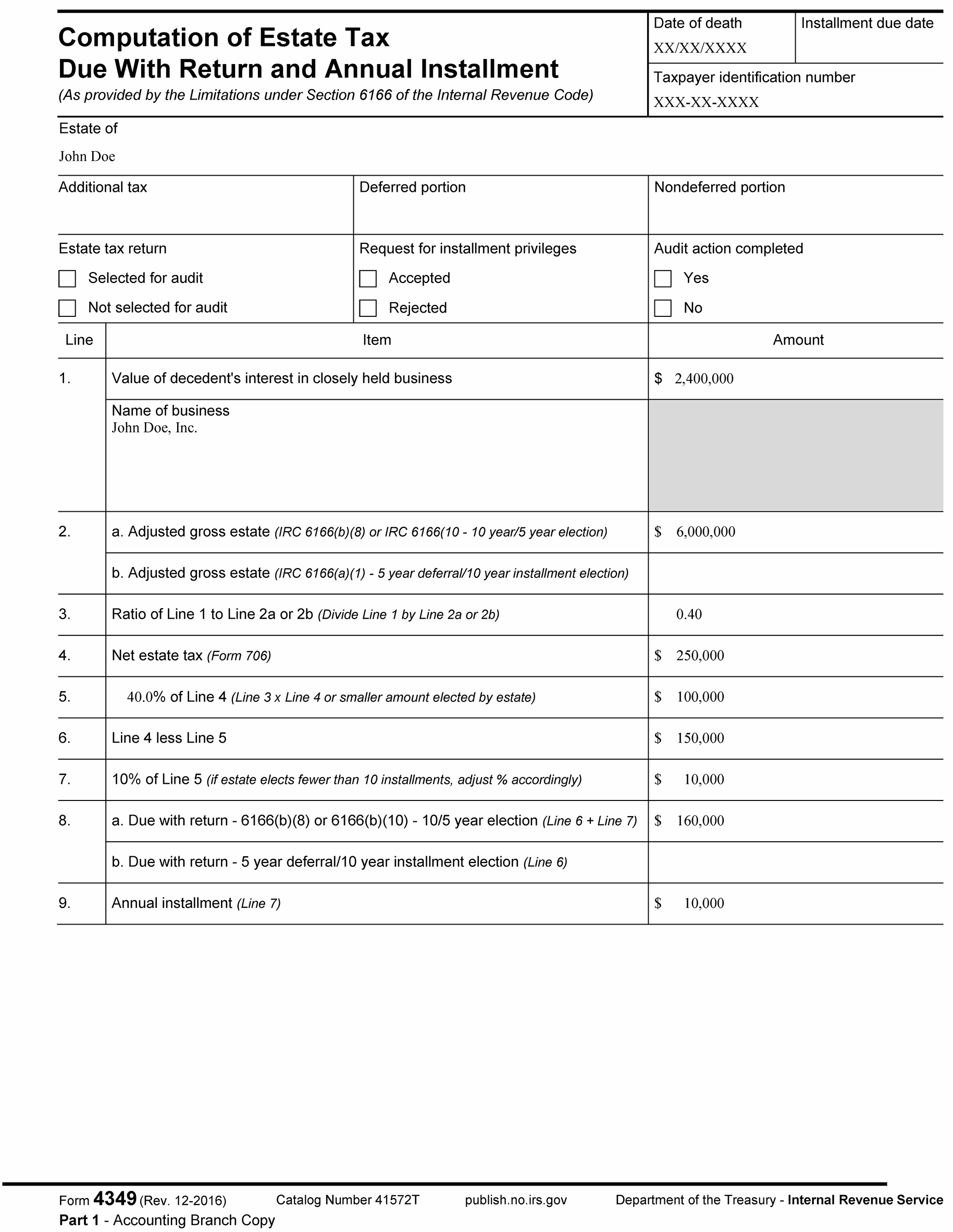
| Code Section | Subject | Interest Restricted on Underpayments | Interest Restricted on Overpayments |
|---|---|---|---|
| IRC 2011(a) | Credit for State Death Taxes (Repealed for estates of decedents dying after 12/31/2004) | IRC 2011(c) | |
| IRC 2014(a) | Credit for Foreign Death Taxes | IRC 2014(e) | |
| IRC 2016 | Recovery of Taxes Claimed as Credit | IRC 2016 | |
| IRC 2055(e) | Transfers for Public, Charitable, and Religious Uses | IRC 2055(e) | |
| IRC 7405 | Action for Recovery of Erroneous Refunds | IRC 6404(e)(2) |
| NAME OF TAXPAYER: | SCHEDULE 2 |
| John Doe, Donor | CALENDAR YEAR: 2006 and 2007 |
| EXPLANATION OF ADJUSTMENTS | |
| VALUE OF GIFTS - STOCK IN ABC, INC. | |
| It is determined that the fair market value of 100 shares of common stock of ABC, Inc., reported on the 2006 gift tax return as Item 1, Part 1, Schedule A, is $1,175,000 rather than $775,000, as reported. Accordingly, taxable gifts are increased by $400,000. | |
| TAXABLE GIFTS FROM PRIOR PERIODS | |
| It is determined that, due to changes made to the total amount of taxable gifts for calendar year 2006, the total amount of taxable gifts from prior periods with respect to calendar year 2007 is $1,175,000 rather than $775,000, as reported. | |
| TAX ON TAXABLE GIFTS FROM PRIOR PERIODS | |
| It is determined that, due to the increase in the total amount of taxable gifts in calendar year 2006, the tax computed on the total amount of taxable gifts from prior periods with respect to calendar year 2007 is $66,432.00 rather than zero, as reported. | |