


 )
or https:// means you've safely connected to the .gov website. Share sensitive information only on official, secure websites.
)
or https:// means you've safely connected to the .gov website. Share sensitive information only on official, secure websites.


- 8.7.9 Joint Committee (JC) Cases
- 8.7.9.1 Program Scope and Objectives
- 8.7.9.1.1 Background
- 8.7.9.1.2 Authority
- 8.7.9.1.3 Responsibilities
- 8.7.9.1.4 Acronyms
- 8.7.9.2 Introduction to the Joint Committee (JC)
- 8.7.9.3 Cases Requiring JC Review
- 8.7.9.4 Cases Not Requiring JC Review (Exceptions to JC Review)
- 8.7.9.5 Selection of Large Deficiency Cases for JC Review
- 8.7.9.6 Appeals’ Responsibility in JC Cases
- 8.7.9.6.1 Reporting to the JCT
- 8.7.9.6.1.1 Investor Cases/TEFRA Key Cases
- 8.7.9.6.1.2 Bankruptcy Cases
- 8.7.9.6.1.3 Appeals/Compliance Case Procedures
- 8.7.9.6.1.4 Expedite Closing - Cases with Refunds Less than $5,000,000 (Tentative Allowances Not Yet Examined)
- 8.7.9.6.1.5 JC Review Before Case is Closed - Advance Review Request
- 8.7.9.6.2 Discovery of Failure to Report to JC
- 8.7.9.6.3 Period of Limitations on JC Cases
- 8.7.9.6.4 Transcript/Statement of Account for JC Cases
- 8.7.9.6.5 Agreements (other than Closing Agreements) on JC Cases
- 8.7.9.6.6 Closing Agreements Related to JC Cases
- 8.7.9.6.7 Communications with the Taxpayer on JC Cases
- 8.7.9.6.8 Disclosure Provisions for JC Cases - Form 5482
- 8.7.9.6.9 JC Case Procedures
- 8.7.9.6.9.1 Agreed Pre-90–Day JC Cases
- 8.7.9.6.9.2 Agreed Docketed JC Cases
- 8.7.9.6.9.3 Unagreed JC Case Refunds Where Tax Court Has No Jurisdiction
- 8.7.9.6.9.4 Unagreed Deficiency JC Cases
- 8.7.9.6.9.5 Agreed Refund, Unagreed Deficiency — Docketed JC Cases
- 8.7.9.6.1 Reporting to the JCT
- 8.7.9.7 Determining JC Jurisdiction
- 8.7.9.7.1 Previous Refunds
- 8.7.9.7.2 Separate Taxpayers
- 8.7.9.7.3 Combining Transactions
- 8.7.9.7.4 Computing Separate IRC 6405(a) and IRC 6405(b) Limits
- 8.7.9.7.5 Multiple Year Cases involving Deficiencies
- 8.7.9.7.6 Offsetting Agreed Deficiency Years Against Overpayment Years
- 8.7.9.7.7 No Offsetting Deficiencies under IRC 6405(a) for Different Taxes
- 8.7.9.7.8 Refund of Interest and Penalties
- 8.7.9.7.9 Estate Tax Credits
- 8.7.9.7.10 Disaster Losses
- 8.7.9.8 JC Reports: Types, Format, Assembly and Mailing
- 8.7.9.8.1 Types of JC Reports
- 8.7.9.8.1.1 Expedite Refund Request Report
- 8.7.9.8.1.2 Regular Report
- 8.7.9.8.1.3 Supplemental Report
- 8.7.9.8.1.4 Estate Tax Case Report
- 8.7.9.8.1.5 Foreign Sales Corporation (FSC) Report
- 8.7.9.8.1.6 Large Deficiency Case Report
- 8.7.9.8.1.7 Expedite Refund Report on Unexamined or Unsurveyed Year(s) - Modified Expedite Refund Report
- 8.7.9.8.2 Years Covered in JC Report
- 8.7.9.8.3 Format of JC Reports
- 8.7.9.8.3.1 Related Cases
- 8.7.9.8.3.2 Introduction Area of JC Report
- 8.7.9.8.3.3 Taxpayer's Business and Economic Reasons for Overpayment
- 8.7.9.8.3.4 Consolidated Returns
- 8.7.9.8.3.5 Statement Regarding Agreements Secured
- 8.7.9.8.3.6 Statute of Limitations
- 8.7.9.8.4 Assembly of JC Reports
- 8.7.9.8.4.1 Refund Reports Assembly
- 8.7.9.8.4.2 Large Deficiency Case Reports Assembly
- 8.7.9.8.4.3 JC Report
- 8.7.9.8.4.4 Attachments to JC Report
- 8.7.9.8.5 Review and Approval by Appeals JC Program Analyst (AJCPA)
- 8.7.9.8.6 Distribution of All JC Reports
- 8.7.9.8.7 Electronic Submission of JC Reports
- 8.7.9.8.7.1 Form 4081 Transmittal Memorandum
- 8.7.9.8.7.2 Address and Electronic Procedures for JC Report Submission
- 8.7.9.8.1 Types of JC Reports
- 8.7.9.9 Computations Prepared by the Tax Computation Specialist (TCS)
- 8.7.9.9.1 Information for the JC Report
- 8.7.9.9.2 Attachments to the JC Report
- 8.7.9.9.3 JC Resources
- 8.7.9.9.4 Settlement Computation Special Features
- 8.7.9.10 Communication Between JCT Staff and Appeals
- 8.7.9.10.1 Informal Inquiries from the JCT
- 8.7.9.10.1.1 Tracking Informal Inquiries
- 8.7.9.10.2 Formal Inquiries from the JCT - Staff Review Memorandum (SRM)
- 8.7.9.10.2.1 SRM Procedures and Tracking - Response Required
- 8.7.9.10.2.2 SRM Procedures and Tracking - No Response Required
- 8.7.9.10.3 Disclosure of Correspondence with the Joint Committee
- 8.7.9.10.4 Withdrawal of Cases from JC
- 8.7.9.10.1 Informal Inquiries from the JCT
- 8.7.9.11 Other Research/Information Resources
- Exhibit 8.7.9-1 Appeals Joint Committee Case Report Package Checklist
- Exhibit 8.7.9-2 Sample Expedite Refund Request Report
- Exhibit 8.7.9-3 Sample of Regular Joint Committee Report
- Exhibit 8.7.9-4 Sample Regular Report with Provisionally Allowed Tentative Refunds
- Exhibit 8.7.9-5 Sample Supplemental Joint Committee Report
- Exhibit 8.7.9-6 Sample Joint Committee Estate Tax Case Report
- Exhibit 8.7.9-7 Sample Foreign Sales Corporation (FSC) Report
- Exhibit 8.7.9-8 Sample Joint Committee Large Deficiency Case Report
- Exhibit 8.7.9-9 Sample Request for Expedited Refund on Unexamined or Unsurveyed Year(s) — Modified Expedite Refund
- Exhibit 8.7.9-10 Sample Request for Advance Review
- Exhibit 8.7.9-11 Sample Informal Referral Report - Refund in Excess of $5,000,000 (Tentative Allowances Not Examined)
- Exhibit 8.7.9-12 Sample Letter 1594 - JC Submission
- Exhibit 8.7.9-13 Sample Letter 1537 - JC No Exception
- Exhibit 8.7.9-14 Information for Joint Committee Report
- Exhibit 8.7.9-15 Sample Formats for Joint Committee Letter Refund Table
- Exhibit 8.7.9-16 Joint Committee Spreadsheet for Regular Tax
- Exhibit 8.7.9-17 Joint Committee Spreadsheet for Alternative Minimum Tax
- 8.7.9.1 Program Scope and Objectives
Part 8. Appeals
Chapter 7. Technical and Procedural Guidelines
Section 9. Joint Committee (JC) Cases
8.7.9 Joint Committee (JC) Cases
Manual Transmittal
October 01, 2025
Purpose
(1) This transmits revised IRM 8.7.9, Joint Committee (JC) Cases.
Material Changes
(1) Incorporated Interim Guidance Memorandum, AP-08-1123-0011, Appeals Procedure for the Joint Committee on Taxation (JCT) Program, by revising IRM 8.7.9.1.3, Responsibilities, IRM 8.7.9.5, Selection of Large Deficiency Cases for JC Review, IRM 8.7.9.8.5, Review and Approval by Appeals JC Program Analyst (AJCPA), IRM 8.7.9.10.1, Informal Inquiries from the JCT, and IRM 8.7.9.10.2, Formal Inquiries from the JCT - Staff Review Memorandum (SRM), and its related subsections.
(2) Incorporated guidance from the Division Counsel/Associate Chief Counsel (National Taxpayer Advocate Program) and Branch 3 of the Associate Chief Counsel (Procedure and Administration) by including TBOR language in paragraph (1) of IRM 8.7.9.1.3, Responsibilities.
(3) Incorporated statement of collaboration between the IRS Independent Office of Appeals and the Taxpayer Advocate Service to enhance taxpayer experience in paragraph (1) of IRM 8.7.9.1.3, Responsibilities.
(4) Updated all tables and exhibits to ensure they are in compliance with Section 508 of the Rehabilitation Act.
(5) Made editorial updates throughout the entire IRM to correct and/or update references, outdated links, grammar/sentence structures, and formatting issues.
Effect on Other Documents
This supersedes IRM 8.7.9 dated January 3, 2024, and incorporates Interim Guidance Memorandum, AP-08-1123-0011.Audience
IRS Independent Office of Appeals employees who handle Joint Committee cases.Effective Date
(10-01-2025)
Steven M. Martin
Director, Operations Support
-
This IRM section provides procedures for working Joint Committee (JC) cases in the IRS Independent Office of Appeals (Appeals).
-
Purpose: The purpose is to provide guidance for Appeals cases subject to review by the Joint Committee on Taxation (JCT).
-
Audience: The primary users are Appeals Technical Employees (ATEs) working cases subject to review by the JCT. These employees include Appeals Officers (AOs), Appeals Team Case Leaders (ATCLs), and their managers (ATMs).
-
Policy Owner: The Appeals Policy Owner is the Director, Operations Support.
-
Program Owner: The Appeals Program Owner is the Director, Policy, Planning, Quality, and Analysis (PPQ&A).
-
Primary Stakeholders: The primary stakeholder is the JCT. The JCT is discussed in IRM 8.7.9.2, Introduction to the Joint Committee (JC).
-
A refund or credit subject to review by the JCT can arise from an examination or tentative allowances in excess of the jurisdictional amount.
-
The JC threshold for C corporations was legislatively increased effective December 19, 2014. The jurisdictional amount for C corporations is in excess of $5,000,000 and, for all other taxpayers, the jurisdictional amount is in excess of $2,000,000.
-
The JCT staff attorneys, also known as Refund Counsel, will review the JC report and other documentation submitted. If the Refund Counsel have questions, they are usually resolved informally through phone calls or emails. In some instances, a written inquiry may be issued. In the event the JCT disagrees with or questions the position taken in the report, the case is not finalized and remains open pending resolution of the questioned items. The JCT will issue either a clearance/release letter or Staff Review Memorandum (SRM) upon completion of their review.
-
The authority for JC procedures is covered under the following:
-
IRC 8022
-
IRC 6405
-
IRM 1.2.2.5.15, Delegation Order 4-18 (Rev. 1), Reports of Refunds and Credits to the Joint Committee on Taxation
-
-
The ATE is responsible for determining whether the case is required to be submitted to the JCT and preparing the required documents for review by the JCT.
The Taxpayer Bill of Rights (TBOR) applies to ATEs’ interactions with taxpayers. The TBOR lists rights that already existed in the tax code, putting them in simple language and grouping them into 10 fundamental rights. Employees are responsible for being familiar with TBOR so they can act accordingly. For additional information about TBOR, see Taxpayer Bill of Rights as published on IRS.gov.
Additionally, in accordance with IRM 25.30.2.3, Statement of Commitment, Appeals will work collaboratively with TAS to enhance the taxpayer experience. For additional information, see IRM 25.30.2, Service Level Agreement between the IRS Independent Office of Appeals and the Taxpayer Advocate Service. -
The Appeals Joint Committee Program Analyst (AJCPA) is responsible for:
-
Updating the Appeals Joint Committee program webpage as needed;
-
Reviewing JC reports/packages prior to submission to the JCT;
-
Responding to inquiries regarding specific cases;
-
Preparing monthly inventory reports; and
-
Maintaining and disseminating monthly reports which track pending: (i) SRMs and (ii) informal written inquiries received by the Chief of Appeals (Chief) and/or Deputy Chief of Appeals (Deputy).
-
-
See the table below for the most commonly used acronyms in this IRM section.
Acronym Definition ACDS Appeals Centralized Database System ACM Appeals Case Memorandum AJCPA Appeals Joint Committee Policy Analyst APS Account & Processing Support ATE Appeals Technical Employee ATM Appeals Team Manager CAR Case Activity Record JC Joint Committee JCT Joint Committee on Taxation LB&I Large Business and International SRM Staff Review Memorandum TCS Tax Computation Specialist
-
The JCT is required by IRC 8022 to investigate:
-
The operation and effects of the federal system of internal revenue taxes;
-
The administration of such taxes by the IRS; and
-
Measures and methods for the simplification of such taxes.
-
-
The JCT is also required by IRC 8022 to publish for public examination and analysis, proposed measures and methods for simplification of such taxes, and to report to the Senate Finance Committee, the House Ways and Means Committee, and, in its discretion, to the Senate or House of Representatives, or both, the results of its investigations, together with such recommendations as may be advisable.
-
In carrying out its statutory responsibilities, the JCT is vitally concerned with learning whether the tax laws:
-
Are being applied consistently with Congressional intent;
-
Require clarification; and
-
Grant unintended benefits or cause unintended hardships.
-
-
The JCT is also concerned with learning whether the positions taken by the IRS in Revenue Rulings, Regulations, and litigation are consistent with Congressional intent. The reports required of the IRS, under IRC 6405, are a principal source of information for the JCT.
-
Delegation Order 4-18 (see IRM 1.2.2.5.15, Delegation Order 4-18 (Rev. 1), Reports of Refunds and Credits to the Joint Committee on Taxation) delegates, in part, the authority to:
-
Make and report refunds and credits to the JCT as required by IRC 6405. This is delegated to ATMs and ATEs on cases within their jurisdiction. No further re-delegation within Appeals is permitted.
-
Respond to all formal requests for reconsideration made by the JCT concerning the reports that the IRS was required to submit to the JCT under IRC 6405. This is delegated to the Deputy and may not be re-delegated.
-
-
The current JC jurisdictional amount is any amount of refund or credit in excess of $2,000,000 ($5,000,000 in the case of a C corporation) which may include multiple tax years. Include a refund or credit of previously assessed and paid penalty or interest when determining whether an overpayment exceeds $2,000,000 ($5,000,000 in the case of a C corporation). Every refund or credit (of the type of tax to which JC jurisdiction is applicable) in excess of $2,000,000 ($5,000,000 in the case of a C corporation) is reportable to the JCT unless it falls within a specified exception to the reporting requirements. See IRM 8.7.9.4, Cases Not Requiring JC Review (Exceptions to JC Review).
-
The Refund Counsel will review the JC report and other documents as necessary. Should the Refund Counsel have questions, they are usually resolved informally through phone calls or email exchange. If a meeting is necessary, the ATE should request a phone conference to discuss any additional questions from the JCT. See IRM 8.7.9.10.1, Informal Inquiries from the JCT. In some cases, a written inquiry may be issued. See IRM 8.7.9.10.2, Formal Inquiries from the JCT - Staff Review Memorandum (SRM). Once notification is received that the JCT has released the case, Appeals may process and close the case.
-
The JCT review of these reports focuses on the technical aspects of the case and the IRS’s resolution of the issues presented.
-
IRC 6405(a) provides that no refund or credit of any income, war profits, excess profits, estate, or gift tax, or any tax imposed with respect to public charities, private foundations, operators' trust funds, pension plans, or real estate investment trusts under IRC Chapter 41, 42, 43, or 44, in excess of $2,000,000 ($5,000,000 in the case of a C corporation) shall be made until after the expiration of 30 days from the date a report is submitted to the JCT for review. This report, as required by IRC 6405(a), includes the taxpayer's name, Taxpayer Identification Number (TIN) or Employer Identification Number (EIN), the city and state of the taxpayer's location, amount of the refund or credit, a summary of the facts, and the decision of the Secretary of the Treasury.
-
IRC 6405(b) requires a similar report to the JCT if net refunds in connection with tentative allowances stemming from carrybacks under IRC 6411 exceed $2,000,000 ($5,000,000 in the case of a C corporation). The report is submitted to the JCT at such time after the refund or credit is made when the IRS determines the correct tax.
-
IRC 6405(c) provides that refunds in excess of $2,000,000 ($5,000,000 in the case of a C corporation), attributable to a taxpayer’s election under IRC 165(i), will be made before submitting a report for review. This section allows a taxpayer to deduct a disaster loss in the taxable year immediately preceding the taxable year in which the disaster occurred. The report shall be prepared when the correct amount of tax is determined. IRM 8.7.9.7.10, Disaster Losses.
-
The JCT will conduct their post-audit review activities by requesting a number of large deficiency cases under the general authority of IRC 8022 and IRC 8023. The IRS shall disclose to the JCT necessary return information to review such large deficiency cases pursuant to IRC 6103(f). See IRM 8.7.9.8.1.6, Large Deficiency Case Report.
-
Do not report a refund or credit of:
-
An unassessed advance payment of tax or cash bond made under provisions of Rev. Proc. 84-58, or as an undesignated remittance or a deposit in the nature of a cash bond made under provisions of Rev. Proc. 2005-18 and which was made before determining the taxpayer's tax liability; or
-
A refund or credit of an amount paid with a tentative return in excess of the tax liability reported by the taxpayer on a final return. A final return is defined as the last return filed by the due date for that return.
-
-
Do not report the abatement of an unpaid portion of an assessment to the JCT (see IRC 6404). The word "credit" as used in IRC 6405 does not include an abatement. For example, an amount assessed and paid which is determined to be an overassessment when applied to another liability (i.e., another year, another tax, or another taxpayer) constitutes a credit and not an abatement.
-
Do not report a refund or credit based upon a court decision resulting from trial of the case. If other years of the case affected by the court decision are under Appeals jurisdiction in non-docketed (or docketed) status and the determined refund or credit for such years is in excess of $2,000,000 ($5,000,000 in the case of a C corporation), Appeals prepares the JC report. However, a discussion of JC cases under jurisdiction of Counsel is discussed in IRM 8.7.9.6.1, Reporting to the JCT.
-
The JCT compiles statistics of amounts of refunds allowed. In other than expedited refund cases, to avoid double reporting of a refund amount, it is important that only the additional allowance is reported as the Net Refund or Credit when a subsequent report is written on a year previously reported to the JCT. The body of the subsequent report, however, should refer to the prior refund for that year, including the date of the previous report and, if applicable, the date the case was released by the JCT.
For example, if an initial JC report for the year 2021 shows an allowed Net Refund or Credit of $5,000,000, any subsequent report for the year 2021 does not report the $5,000,000 in the Net Refund or Credit column. A subsequent report for the year 2021 that allows an additional refund amount of $4,000,000, only reports the $4,000,000 in the Net Refund or Credit column. The previously allowed Net Refund or Credit of $5,000,000, the date of the initial report and, if applicable, the date the case was released by the JCT should only be noted in the body of the subsequent report. -
Excise and employment tax are not subject to JC review. Refunds on trust fund recovery penalty cases and windfall profit taxes are also excluded from JC review.
-
Deficiency cases reported to the JCT should be restricted to the types of taxes reportable as refunds or credits under IRC 6405 (e.g., taxes imposed under Chapter 32 or Chapter 45 would not be reported).
-
The reports for the period ending March 31 will be submitted on or before the last day of July, and the reports for the period ending September 30 will be submitted on or before the last day of January.
-
In considering what constitutes the largest deficiency cases closed for the six-month period, do not consider:
-
An unagreed docketed case transferred to Counsel;
-
An unagreed case considered in non-docketed status by Appeals which is then petitioned to and docketed in the U.S. Tax Court;
-
A case that has been or will be reported to the JC as an overpayment case (overpayment cases should have a Feature Code of "JC" – including cases with initially proposed deficiencies, in order to identify them and avoid duplicate reporting as a deficiency case);
-
Special Enforcement Program (SEP) cases, including High Level Drug Leaders Tax Enforcement Project (DEP) cases; or
-
Underreporter cases.
-
-
Consider incoming deficiency amounts, not closing amounts, even if the final determination is a refund.
-
Time applied to preparing the JC large deficiency package is charged to "Reports" in the Case Activity Record and Timesheet (CARATS) in ACDS.
-
This subsection covers Appeals’ responsibility in JC cases.
-
The phrase "reasonably short period of time" is used throughout IRM 8.7.9. The phrase will be defined as two months or less.
-
Appeals can agree to extend this period depending on the facts and circumstances of the case.
-
If Appeals extends the timeframe, the ATE who is assigned the case will be required to document the reason in the CAR.
-
Appeals is responsible for preparing the JC report to the JCT for each case under its jurisdiction. For example, where a tentative allowance under IRC 6411 has been made for years under Appeals’ jurisdiction, a determination as to the correct amount of the carryback may be made prior to preparation of the JC report for the carryback years in Appeals. If so, the report prepared by Appeals for the JCT should be based on the correct amount of carryback. See IRM 8.7.9.6.1.3, Appeals/Compliance Case Procedures.
-
IRC 6405 requires that refunds or credits in excess of $2,000,000 ($5,000,000 in the case of a C corporation) must be reported to the JCT. Therefore, normally, no settlement should be made effective until receipt of notice that the JCT has no objection to the proposed overpayment. See IRM 8.7.9.6.5, Agreements (other than Closing Agreements) on JC Cases, and IRM 8.7.9.6.6, Closing Agreements Related to JC Cases. See IRM 8.7.9.6.7, Communications with the Taxpayer on JC Cases, for a discussion of letters to be sent to the taxpayer when the case is submitted to the JCT and after clearance is received from the JCT.
-
Appeals is not responsible for preparing the JC report to the JCT for each docketed case under Counsel's sole jurisdiction. However, Appeals must consider all JC reports sent to Counsel before any settlement is finalized. This is true regardless of who submitted the JC report or who made an inquiry to the JCT. Such reports are prepared and processed by Counsel. Appeals will furnish Counsel additional information with respect to issues on which Appeals obtained agreement. To the extent such information can only be furnished by Compliance, Appeals will so advise Counsel.
-
Appeals should seek clearance from the JCT before sending cases to Counsel. If this is not possible due to time constraints, cases transferred to Counsel which will require JCT approval before final disposition, or have potential for such requirement, will be identified on the Special Feature section (Item 2) on Form 5402, Appeals Transmittal and Case Memo.
-
Appeals is responsible for preparing a supplemental report on each reconsidered case transferred from Compliance as the result of an informal inquiry or an SRM from the JCT.
-
On any case which is determined to require a JC report, the ATE assigned the case must update the Feature Code to "JC" . This will help avoid selecting cases later for reporting to the JCT as large deficiency cases which have already been reported to the JCT as refund cases (where the case initially included proposed deficiencies when received in Appeals). Cases are not to be reported as both refund and as large deficiency cases.
-
An ATE with jurisdiction of a JC investor case will be responsible for seeing that a JC report for that investor case is made when the Tax Equity and Fiscal Responsibility Act (TEFRA) adjustments result in a refund in excess of $2,000,000 ($5,000,000 in the case of a C corporation) to the taxpayer.
-
When the case is in Appeals’ jurisdiction, determine the need for a JC report on TEFRA issues when the tax computations are made at the investor level.
-
Do not suspend a report to the JCT for a refund from TEFRA issues pending the outcome of the non-TEFRA issues.
-
Do not add the refund from TEFRA adjustments to the refund from non-TEFRA adjustments to determine if a JC report is needed.
-
These are separate refunds and, if a report to the JCT is necessary, each refund should be reported separately.
-
-
If an ATE has a key TEFRA case including a Global Settlement case, and has reason to believe that the settlement will result in a refund to an investor in excess of $2,000,000 ($5,000,000 in the case of a C corporation), then the ATE must prepare a JC report for the TEFRA investor and submit it to the JCT for an informal review before closing the case. All relevant case information from the TEFRA Key case should be submitted as part of the informal review. See Exhibit 8.7.9-11, Sample Informal Referral Report - Refund in Excess of $5,000,000 (Tentative Allowances Not Examined), for an example of an informal report. This example will need to be modified for the facts and circumstances of the case.
-
After completion of the informal review, the JCT will notify the AJCPA and the ATE by encrypted email that they have completed their review. Appeals may close the case upon receipt of this notification.
-
See IRM 8.19.6.15, Closing Joint Committee Partner Cases, and IRM 8.19.6.4, Statute for Partner’s Case.
-
Bankruptcy does not eliminate JC jurisdiction. JC jurisdiction would be eliminated by a determination of tax liability in the Bankruptcy Court, District Court, Court of Federal Claims, or Tax Court.
-
If Appeals and the taxpayer agree on a case involving a refund or credit of over $2,000,000 ($5,000,000 in the case of a C corporation), Appeals will make a report to the JCT and notify the Tax Division of any action taken.
-
See IRM 8.7.6, Appeals Bankruptcy Cases, for additional information on bankruptcy procedures.
-
Appeals and Compliance often have different years opened for the same taxpayer. When the taxpayer files a tentative refund or refund claim affecting the Appeals’ year(s) which is attributable to the Compliance year(s), then the following must be considered for JC reporting requirements. These procedures apply only to IRC 6405(b) refunds. If the carryback year(s) also have IRC 6405(a) refunds, which are reportable to the JCT, see paragraph (7) of this subsection.
-
If Compliance’s examination or survey action of the loss/credit source year(s) is completed before Appeals concludes action on its case, then Compliance will close its case to Appeals and send the return(s), Revenue Agent Report (RAR), and administrative file to Appeals. Regardless of how Compliance resolves the source year(s) (surveyed, agreed, or unagreed and protested), the source year(s) should be forwarded to Appeals to be associated with the carryback year(s).
-
In situations where Appeals completes its action on the case before Compliance action is complete, Appeals should determine the status of the source year return(s). If Compliance will complete the examination or survey action in a reasonably short period of time, Appeals should retain the case until Compliance forwards the loss/unused credit source year(s).
-
In either case, if JC reporting is required as the result of the allowance of the loss/credit carryback(s), Appeals will prepare the report according to the procedures contained herein. Should there be a JCT inquiry due to Compliance’s RAR or survey action, the examiner will respond to the inquiry through the ATE assigned the case.
-
If Compliance’s examination will not be completed within a reasonably short period of time, Appeals will provisionally allow the loss(es) or credit(s) to the extent of the tentative refund(s). If Appeals’ case is subject to JC review, without consideration of the tentative refund(s) from the Compliance year(s), Appeals will prepare a report according to the procedures contained herein. For a sample report, see Exhibit 8.7.9-4, Sample Regular Report with Provisionally Allowed Tentative Refunds.
-
At the conclusion of the source year return(s), if the year(s) still remain under JC jurisdiction, then a supplemental report must be prepared by the office that makes the final determination (Appeals or Compliance). If the year(s) no longer meet JC criteria, then a supplemental report is also required to notify the JCT of the final disposition and that the year(s) no longer qualify as JC year(s). The reporting office will be determined by which office has jurisdiction of the source year return(s) at the time of the final determination.
-
When a tentative carryback arises:
then Appeals should proceed to tentatively close the IRC Section IRC 6405(a) case by submitting an expedite report to the JCT, unless it appears that the Compliance function will close the loss/unused credit source year(s) within a reasonably short period of time.-
in a year which has not been examined, or is currently under examination, and
-
such carryback may result in the requirement of a JC report by Appeals under IRC 6405(b) for year(s) under its jurisdiction, and
-
the carryback affects a year for which an Appeals determination has been made, which will require a JC report under IRC 6405(a),
-
-
If reporting an IRC 6405(a) refund to the JCT but tentatively allowing an IRC 6405(b) refund (due to an open Compliance examination):
See IRM 8.7.9.8.1.1, Expedite Refund Request Report, for additional information on expedite refund reports.-
The body of the JC report, tabulations, and computations should not give consideration to the tentative carryback(s). (It is not necessary to exclude the tentative carrybacks from the ACM or the settlement computation.)
-
However, the JC report must disclose that there is a tentative carryback and that a supplemental report on the IRC 6405(b) refund will follow after the examination is completed. See IRM 8.7.9.8.1.3, Supplemental Report.
-
-
If the office with jurisdiction over the loss/credit source year(s) will close the source year(s) in a reasonably short period of time, Appeals should wait for the correct determination of the carryback(s) before reporting the case/year(s) under Appeals’ jurisdiction to the JCT.
-
The supplemental report will be made by the office that makes the final determination of the taxpayer's liability for the year(s) previously reported to the JCT. If the refund does not exceed $2,000,000 ($5,000,000 in the case of a C corporation), the office which has jurisdiction at the time of the final determination will notify the JCT and the AJCPA, in writing, of this fact so that the JCT can close its control of the case. This can be accomplished via email.
-
Normally, if there are tentative carrybacks involved, the case will not be submitted until the determination of the correct amount of carryback/carryforward is made in the source year.
-
For tentative refunds less than $5,000,000, if it appears that Compliance will not close the loss/unused credit years within a reasonably short period of time, Appeals should close its case without waiting for the receipt of the loss/unused credit year(s).
-
Appeals will provisionally allow the claimed carryback modified (if required) by agreed adjustments in taxable years or periods currently under Appeals consideration.
-
If agreed adjustments have an effect on the taxpayer's liability for other taxable years or periods, Appeals will notify Compliance to take the proper action. See IRM 8.2.3.8, Compliance Follow-Up Action Required on Related Years or Taxpayers.
-
See IRM 8.7.9.6.1.5.1, Informal Review - Cases with Refunds in Excess of $5,000,000 (Tentative Allowances Not Yet Examined), for tentative refunds in excess of $5,000,000 which have not yet been examined.
-
Ordinarily, a case will not be submitted for JC review until it is ready for closing. Occasionally, Appeals will have a case or issue needing an advance review by the JCT.
-
Under these circumstances, the IRS is not seeking clearance of a refund amount, but rather, is seeking review of a specific issue or document (such as a closing agreement). This could occur:
-
On cases subject to JC review (where the formal report will be submitted at a later date), or
-
On cases not subject to JC review, the settlement of which may affect a JC case or year including adjustments made at the partnership or sub-chapter S corporation level to the corresponding partner(s) and/or shareholder(s). IRM 8.7.9.6.1.1, Investor Cases/TEFRA Key Cases.
-
-
Examples of cases needing an advance review by the JCT are discussed in paragraphs (4) through (7) below.
-
Minimum Refund Case: Occasionally, Appeals will have a case involving a proposed refund or credit in excess of $2,000,000 ($5,000,000 in the case of a C corporation) which cannot be closed because of unagreed issues. All of the following conditions must exist in order to consider reporting to the JCT:
-
The unagreed issue will materially delay final disposition of the case, the reasons for delay are beyond the control of the IRS, and the delay would deprive the taxpayer of a timely refund to which it is clearly entitled, in spite of resolution of the unagreed issues;
-
The adjustments causing the proposed refund or credit over $2,000,000 ($5,000,000 in the case of a C corporation) are not at issue; and
-
Disposition of the unagreed issue will not reduce the proposed refund or credit to $2,000,000 ($5,000,000 in the case of a C corporation) or less.
-
-
The following examples illustrate other types of JC cases that might be submitted to the JCT even though one or more issues have not been settled:
-
Non-docketed case involving a proposed overpayment in excess of $2,000,000 ($5,000,000 in the case of a C corporation) and disposition of unagreed issue is dependent on the outcome of a pending court case.
-
Docketed case with a subsequently filed claim in excess of $2,000,000 ($5,000,000 in the case of a C corporation) which is allowable but has one or more issues that will not be tried or settled for some time.
-
-
Closing Agreements: Occasionally, Appeals may wish to resolve an issue on a non-docketed JC case with a closing agreement where it is not known if there will be unagreed issues, or where there are negotiations remaining to take place on other issues.
-
This could occur on an issue where the IRS and the taxpayer wish to resolve the issue with a closing agreement immediately before moving on with other issues in the case.
-
This could also happen in a non-docketed case in Appeals not subject to JC review, but where the execution of a closing agreement potentially has an effect on another year of the taxpayer not in Appeals which may be subject to JC review.
-
In such cases, Appeals may request an advance review of the issue or closing agreement.
-
If the JCT approves the resolution of the issue and closing agreement, Appeals may then execute the closing agreement on behalf of the IRS.
-
The ATE assigned the case should contact the AJCPA for procedures and details.
-
-
There may also be a need for early resolution of a specific issue on a non-docketed case without waiting for resolution of the complete case, such as Fast Track Settlement (FTS) or Early Referral cases.
-
Because these types of cases/issues for JC review are rare, handle each informally on a case-by-case basis. If it appears the case/issue could be submitted under these provisions, the ATE assigned the case will contact the AJCPA via email with a written explanation of the circumstances so that the AJCPA can discuss the case/issue with the JCT staff or suggest direct contact. If the email includes the taxpayer's name, the email must be encrypted. If the JCT agrees to accept the case/issue for review, the ATE will prepare and submit the advance review request.
-
See Exhibit 8.7.9-10, Sample Request for Advance Review, for an example of an advance review request. While this is a sample request for review of a closing agreement, the language may be modified to suit the particular situation.
-
The request is sent directly to the JC Senior Refund Counsel at the address specified in IRM 8.7.9.8.7.2, Address and Electronic Procedures for JC Report Submission. The formal report should be submitted through the AJCPA. See IRM 8.7.9.8.5, Review and Approval by Appeals JC Program Analyst (AJCPA).
-
Attachments to the advance review request should include the Form 5402, the ACM, agreement forms (for example, Form 870-AD, Offer to Waive Restrictions on Assessment and Collection of Tax Deficiency and to Accept Overassessment), or closing agreement.
-
After completion of the advance review request, the JCT will notify Appeals by encrypted email that they have completed their review. Appeals may close the carryback year(s) upon receipt of this notification.
-
A formal report will be submitted when the case is finally closed. Reference to the prior advance review request should be made in the narrative.
-
If a case is going to be put into suspense in Compliance pending the results of litigation in another case, do not prepare a JC report prior to suspense action because a JC report is required when a determination is made based on the results of the litigation.
-
Normally, if there are tentative carrybacks involved, the case will not be submitted to the JCT until the determination of the correct amount of carryback/carryforward is made in the source year. However, under certain conditions, an "informal" JC review of a case may be conducted to facilitate Appeals closing of the case.
-
An informal report may be submitted for JC review when:
-
Appeals has year(s) ready to close with tentative refunds under IRC 6405(b) in excess of $5,000,000;
-
The source year examination or appeals process has not been completed (thus, not ready to be reported with the carryback year(s)); and
-
The source year will not be completed in a reasonably short period of time.
-
-
If a case meets this set of criteria, Appeals should prepare and submit an informal JC report for the carryback year(s) before closing those year(s). See Exhibit 8.7.9-11, Sample Informal Referral Report - Refund in Excess of $5,000,000 (Tentative Allowances Not Examined), for a sample report. Also see IRM 8.7.9.6.1.5, JC Review Before Case is Closed - Advance Review Request.
-
After completion of the informal review, the JCT will notify Appeals by encrypted email that they have completed their review. Appeals may close the carryback year(s) upon receipt of this notification.
-
The formal JC report for the carryback year(s) will be made by the office which resolves the source year with finality at the time of such resolution. See IRM 8.7.9.6.1.3, Appeals/Compliance Case Procedures.
-
If it is discovered that an overpayment under IRC 6405 in excess of $2,000,000 ($5,000,000 in the case of a C corporation) has been refunded without a report to the JCT, prepare a report as soon as possible. This must be done even though the statutory period of limitations has expired for one or more years. Explain the failure to submit a timely report in the JC letter, and submit the explanation to the appropriate Area Director.
-
Consents are ordinarily obtained where the period of limitations expires in less than 180 days from date of submission of a report to the JCT. Counsel should be consulted concerning cases with previously executed restricted consents. Do not use restricted consents in JC cases.
-
In cases where there is no reasonable prospect of a deficiency, a statutory notice is not arbitrarily issued. Taxpayers will usually cooperate and sign a consent if the reason is explained. If a consent is unnecessary for a related or reference return in the file, prepare a memorandum (or other approved form, such as Form 10495, Memorandum Regarding Statute) for the file setting out the facts. Attach the original signed copy of the memorandum to the return and the ATE will update ACDS with the correct statute information upon receipt of the signed memorandum.
-
As in other cases under its jurisdiction, Appeals is responsible for protecting the period of limitations in JC cases, including the time the report is with the AJCPA or the JCT. Appeals maintains a follow-up system to ensure that an assessment period does not expire while the report is being reviewed outside the office.
-
When Appeals first determines a case will require a report to the JCT, the ATE assigned the case will request a transcript for years subject to JC review, if none is in the file.
-
Do not prepare a statement of account for a JC case except where required for reasons other than JC status. See IRM 8.17.3.2, Explanation of the Statement of Account.
-
If Form 870-AD, Offer to Waive Restrictions on Assessment and Collection of Tax Deficiency and to Accept Overassessment, Form 890-AD, Estate Tax Offer of Waiver of Restrictions on Assessment and Collection of Deficiency in Tax and of Acceptance of Overassessment, or similar type AD agreement is used in a JC case, the following paragraph is ordinarily typed on the agreement: "Accepted as of the date the Joint Committee on Taxation completes its review without objection or the date accepted for the Commissioner, whichever is later."
-
If a Form 870, Waiver of Restrictions on Assessment and Collection of Deficiency and Acceptance of Overassessment, or Form 890, Waiver of Restrictions on Assessment and Collection of Deficiency and Acceptance of Overassessment - Estate, Gift, and Generation - Skipping Transfer Tax, type agreement is the agreement used in a JC case, the following paragraph is ordinarily typed on the agreement: "This agreement is submitted to take effect on the date the Joint Committee on Taxation completes its review without objection."
-
If Appeals’ action is based on mutual concessions, and would have produced a deficiency for the carryback year, prior to considering the carryback provisionally allowed by Appeals, a Form 870–AD will be secured showing zero deficiency with a footnote reflecting the amount of deficiency before provisional allowance of the carryback.
-
The purpose of this is to make clear, especially where the provisionally allowed carryback eliminates the Appeals deficiency, that the Appeals settlement of issues in the carryback year is intended to be final.
-
All agreement forms in which a carryback is provisionally allowed should contain this statement: "You may be liable for restricted interest on what might have been the deficiency before the carryback. See Rev. Proc. 60–17, 1960–2 C.B. 942."
-
-
Do not obtain Form 2297, Waiver of Statutory Notification of Claim Disallowance, in a JC case until the JCT has released the case unless the Form 2297 is modified as follows: "This waiver takes effect on the same date the agreement form ____ (fill in appropriate form number) used in this case becomes effective."
-
The date the JCT completes its review will be the date of the clearance letter that is forwarded to Appeals.
-
In FTS cases, the IRS will report a proposed settlement reached as a result of FTS to the JCT in accordance with IRC 6405. The taxpayer acknowledges that the IRS may reconsider a proposed settlement, as reflected in a signed FTS session report, upon receipt of comments on the proposed settlement from the JCT (Rev. Proc. 2003-40).
-
Closing agreements must not be executed on behalf of the IRS until after the "report and wait" requirements of IRC 6405 have been met. Therefore, do not execute any closing agreement on behalf of the Commissioner of Internal Revenue until after the JCT clears the case.
-
In any case under Appeals’ jurisdiction requiring a report to the JCT, which includes a closing agreement as to determination of tax liability, a determination covering specific matters, or a combined agreement, indicate in the report the tentative approval of the closing agreement. Submit proposed agreements with the JCT report. If the JCT takes no exception to the report, the Appeals official signs the closing agreement. Submit also a copy of any closing agreement that arose out of any prior examination of the reported years.
-
If the case in Appeals does not require a JC report, but the closing agreement affects a case which is or will be reported to the JCT, advance review of the closing agreement may be requested using an informal procedure with a cover memo explaining the reasons for the request. A copy of the closing agreement and the ACM discussing the issue should be submitted with the cover memo. See IRM 8.7.9.6.1.5, JC Review Before Case is Closed - Advance Review Request. The JCT will normally transmit their concurrence with the closing agreement and issue settlement by encrypted email.
-
Do not enter into a closing agreement on an early referral case without concurrence from the JCT if there is a potential that the primary case will require a JC report (Rev. Proc. 99-28). See IRM 8.7.9.6.1.5 for discussion of instructions for JC advance review requests.
-
Do not enter into a closing agreement on any related affiliate or related tax year, not subject to JC review, where the execution of a closing agreement will have an effect on a JC case (regardless of where jurisdiction of the JC case resides), until the JC case has been reviewed by the JCT.
-
If the closing agreement relates to a proposed distribution from a domestic international sales corporation (DISC) under IRC 992(c), or from resolution of a corporate-owned life insurance (COLI) issue, a request for expedited JC review may be made in a cover memo explaining the reasons for the request. See IRM 8.7.9.6.1.5 for discussion of instructions for JC advance review requests.
-
For Post-Appeals Mediation (PAM) issue resolution on cases subject to JC review, Appeals will not enter into a closing agreement without concurrence from the JCT (Rev. Proc. 2009-44, 2009-2, C.B. 462). Also, do not enter into a closing agreement on any related affiliate or related tax year, not subject to JC review, where the execution of the closing agreement will have an effect on a JC case, until the JCT has completed its review.
-
Do not execute a closing agreement on an "expedite" refund Appeals case until notification of the JC clearance has been received.
-
Appeals should not enter into a closing agreement on a JC case when Competent Authority is involved in the case. In addition, when Competent Authority is involved in a JC case, the Competent Authority official must be notified that JCT review of the closing agreement is required before executing the closing agreement on behalf of the IRS.
-
After the report is forwarded to the JCT, the ATE assigned the case informs the taxpayer that the case has been reported by mailing Letter 1594, Joint Committee Submission.
-
Upon receipt of the clearance letter from the JCT, the AJCPA will send a copy of the JC clearance letter by encrypted email to the ATE listed as the contact on the JC letter.
-
Upon receipt of the JC clearance letter, the ATE informs the taxpayer that the JCT has taken no exception to the conclusions reached by the IRS by mailing Letter 1537, Joint Committee No Exception.
-
Letter 1594 and Letter 1537 should be prepared in ACDS 2.0; however, see Exhibit 8.7.9-12, Sample Letter 1594 - JC Submission, and Exhibit 8.7.9-13, Sample Letter 1537 - JC No Exception. These two exhibits contain samples of these letters.
-
If the processing of the case is delayed, the ATE should provide the taxpayer with the reasons for the delay and provide periodic updates. The time, method and nature of the information to the taxpayer is discretionary. See IRM 8.7.9.10.2.1, SRM Procedures and Tracking - Response Required.
-
Reports to the JCT involving individual taxpayers or aliens admitted to permanent U.S. residence are disclosures to third parties under provisions of the Privacy Act of 1974. This also applies to disclosures of tax return information of an individual taxpayer or alien admitted to permanent U.S. residence when sent with a report involving a corporate taxpayer.
-
Use Form 5482, Record of Disclosure (Privacy Act of 1974), to account for disclosures (involving individual taxpayers or aliens admitted to permanent U.S. residence) to the JCT. Form 5482 is also required for deceased taxpayers.
-
A disclosure concerning an individual taxpayer or alien admitted to permanent U.S. residence occurs when Appeals signs, dates, and forwards the JC report. At this point, Form 5482 is completed recording the requested information pertaining to the taxpayer upon whom the disclosure is being made. After this information is recorded, annotate the case file to show the means used to account for the disclosure.
-
When completing the Form 5482, see instructions below:
-
Block 1: Enter the taxpayer's name
-
Block 2: Enter the date the package is sent to the JCT
-
Block 3: Enter "44.001, Administrative File"
-
Block 4: See paragraph (5) below for detailed information
-
Block 5: Enter JCT address used on the report (shown in IRM 8.7.9.8.7.2, Addresses for JC Reports and Shipping Label)
-
Block 6: Select "No"
-
Block 7: Leave blank
-
Block 8: Select "(b)(9)"
-
Block 9: Enter ATE name - person who worked the case
-
Block 10: Enter office symbols
-
-
See below for sample language for block 4 of Form 5482:
Information/Purpose Documents Information Disclosed: Form 5402, Appeals Transmittal and Case Memo
Appeals Case Memo
Settlement Computation
JC report and any other such documents referring to the taxpayer’s tax liability or other disclosures of tax return informationPurpose of Disclosure:
(make selection according to the type of report)Refund report to JCT pursuant to IRC 6405. (for refund case)
Large Deficiency report to JCT pursuant to IRC 6103(f). (for large deficiency case) -
An electronic copy of the Form 5482 will be forwarded to the AJCPA by encrypted email with the JCT report submitted for review (see IRM 8.7.9.8.5, Review and Approval by Appeals JC Program Analyst (AJCPA)). The AJCPA will retain the Form 5482 in a separate file for the prescribed five years.
-
A copy of the Form 5482 will also be retained with the administrative file.
-
Additional information can be found in IRM 10.5.6.7, Privacy Act Accounting of Disclosures.
-
This subsection covers procedures for working JC cases.
-
For pre-90-day cases to be reported to the JCT, use modified agreement forms. See IRM 8.7.9.6.5, Agreements (other than Closing Agreements) on JC Cases. Also, see IRM 8.7.9.8.2, Years Covered in JC Report, for information detailing the years to be included in the report.
-
The AJCPA will transmit a copy of the JC clearance letter via encrypted email to the ATE assigned the case. They should put a copy of the JC clearance letter in the administrative file.
-
Upon receipt of the JC clearance letter, the ATE informs the taxpayer, by mailing Letter 1537, Joint Committee No Exception, that the JCT has taken no exception to the conclusions reached by the IRS. See Exhibit 8.7.9-13 for sample Letter 1537. ACDS 2.0 should be used to prepare the letter.
-
In agreed cases involving Form 872-A, Special Consent to Extend the Time to Assess Tax, see discussion below:
-
In agreed cases involving Form 872-A where termination of Appeals consideration is intended, use Form 872-T, Notice of Termination of Special Consent to Extend the Time to Assess Tax.
-
In agreed cases involving Form 872-A where termination of Appeals consideration is not intended because additional time may be required to process a complex case, add the following paragraph (or similar one) to Letter 1537: "Form 872–T, Notice of Termination of Special Consent to Extend the Time to Assess Tax, referred to in consent Form(s) 872–A, executed for tax period(s) extended to _________, will be mailed to you at a later date."
-
-
The ATE will close the case in the usual manner.
-
In an agreed docketed JC case, under sole jurisdiction of Appeals, a settlement is entered into by having the taxpayer sign the proposed stipulation which is subject to JC review. The proposed stipulation is not filed with the U.S. Tax Court until notification of JCT clearance has been received.
-
After notification that the JCT has completed its review, the ATE assigned the case furnishes Counsel with a copy of the notification. Counsel then files the stipulation. After the Tax Court's decision is entered, close the case in the usual manner.
-
In any case involving partial settlement stipulations, the ATE assigned the case will consider whether the case might ultimately be subject to JC review. If there is a distinct possibility that disposition of the remaining issues by way of settlement or concession will result in a net refund in excess of $2,000,000 ($5,000,000 in the case of a C corporation), add the following language to the settlement stipulation: “The settlement stipulation(s) contained herein are conditioned on completion of review by the Joint Committee on Taxation, without objection, if such review is required by IRC 6405.”
-
Where the Tax Court has no jurisdiction, report any determined but unagreed refund or credit in excess of $2,000,000 ($5,000,000 in the case of a C corporation) to the JCT before allowance and follow the same procedure as an agreed refund or credit.
-
Where an Appeals determination results in the issuance of a notice of deficiency, and the deficiency years are unrelated to a JC refund or credit, the work unit should be separated for purposes of a JC review.
-
The determined refund or credit is referred to the JCT for review in accordance with the same procedures as an agreed refund or credit.
-
The notice of deficiency does not require JC review and should be issued without unnecessary delay.
-
Once the taxpayer files a petition with respect to the unagreed deficiency years, the petitioned years are to be processed as any other docketed case.
-
Examples of this situation are shown below:
Example 1 Tentative IRC 6405(b) refund to taxpayer 3,000,000 Less: unagreed Appeals determined deficiency 1,400,000 Tentative net refund 1,600,000 Conclusion
In this example, the case is not reportable to the JCT because the net refund does not exceed $2,000,000 ($5,000,000 in the case of a C corporation). The notice of deficiency may be issued without delay.Example 2 Tentative IRC 6405(b) refund to taxpayer 3,000,000 Less: unagreed Appeals determined deficiency 600,000 Tentative net refund 2,400,000 Conclusion
In this example, the case is reportable to the JCT because the net refund exceeds $2,000,000 ($5,000,000 in the case of a C corporation). The JC report should be submitted and clearance by the JCT obtained prior to issuance of the notice of deficiency. -
If the deficiency years are related to a JC refund or credit, submit the case to the JCT before issuing the notice of deficiency.
-
If Appeals, in a case under its sole jurisdiction, reaches agreement with the taxpayer on a refund or credit in excess of $2,000,000 ($5,000,000 in the case of a C corporation) for a docketed year, but does not reach agreement on a deficiency determined for another docketed year, the case may be reported to the JCT before disposition of the unagreed deficiency.
-
When the JCT completes its review of the determined refund or credit, Appeals transmits the case file to Counsel for disposition of unagreed deficiencies and agreed refund or credit. Disposition may be by settlement or trial. This procedure serves to expedite disposition of the case by stipulating the determined overpayment without further JC review.
-
Computations will be prepared by the Tax Computation Specialist (TCS) to determine jurisdictional limits under IRC 6405(a), IRC 6405(b), and IRC 6405(c). See IRM 8.7.9.9.1, Information for the JC Report.
-
If a refund or credit has been reported to the JCT, and a further overpayment in the same taxable year is determined, no additional report is required unless the further refund or credit also exceeds $2,000,000 ($5,000,000 in the case of a C corporation). Check to determine whether the prior year’s refund was subject to the $5,000,000 rule. If a refund or credit previously allowed did not require a report to the JCT, it is not combined with a subsequent refund or credit for determining JC jurisdiction.
-
A supplemental report covering the final resolution of unagreed issues pursuant to paragraph 2 in IRM 8.7.9.8.1.3, Supplemental Report, is required regardless of the amount. The $2,000,000 ($5,000,000 in the case of a C corporation) minimum does not apply.
-
If a refund or credit has been reported to the JCT, and a deficiency in the same taxable year is subsequently determined, no additional report is required to report any adjustments that reduce the previously reported refund or credit.
-
The amounts proposed for allowance to each separate taxpayer provide the basis for determining whether the case requires a report to the JCT. Overpayments proposed in other related cases do not enter into the computation. A deficiency determined in the case of one taxpayer is not to be offset against an overpayment determined in the case of another taxpayer, even though the changes resulted from the shifting of income or deductions from one taxpayer to the other.
-
If IRC 6405(b) refunds or credits stemming from carrybacks under IRC 6411 tentative allowances do not exceed $2,000,000 ($5,000,000 in the case of a C corporation) when added together, they are not to be aggregated with and reported with IRC 6405(a) refunds. Similarly, IRC 6405(a) refunds or credits not exceeding $2,000,000 ($5,000,000 in the case of a C corporation) when added together, are not to be aggregated with or reported with IRC 6405(b) refunds. The interpretation of this paragraph is illustrated by the following examples (using jurisdictional limit of $2,000,000):
Example 1 Facts
Tentative allowances (IRC 6405(b) pursuant to IRC 6411):• 2023 NOL carryback to 2021 1,500,000 • 2023 GBC carryback to 2022 550,000 Jurisdiction amount - IRC 6405(b) 2,050,000 Conclusion
Both refunds must be reported.Example 2 Facts
Tentative allowances (IRC 6405(b) pursuant to IRC 6411):• 2023 NOL carryback to 2021 1,000,000 • 2023 GBC carryback to 2022 500,000 Jurisdiction amount - IRC 6405(b) 1,500,000 Conclusion
Neither refund will be reported since the combined amount does not meet the jurisdictional criteria.Example 3 Facts
Examination of 2022 return
Tentative allowances (IRC 6405(b) pursuant to IRC 6411):• 2022 NOL carryback to 2020 1,250,333 • 2022 NOL carryback to 2021 1,625,000 Previous tentative allowance: • 2020 Capital Loss carryback to 2017 140,000 Conclusion
The 2020 Capital Loss and its carryback to 2017 need to be reported along with the 2022 tentative allowances if the statute of limitations has not expired and the returns have not been previously closed by examination action approving the 2020 Capital Loss carryback and tentative allowance in 2017.Example 4 Facts
Tentative allowance (IRC 6405(b) pursuant to IRC 6411):• 2023 NOL carryback to 2021 2,250,000 Audit results: • 2021 IRC 6405(a) refund 450,000 Conclusion
A report is required for 2021 and 2023 for the IRC 6405(b) refund resulting from the tentative allowance. The IRC 6405(a) refund should be mentioned in the report. In addition, because the IRC 6405(a) refund of $450,000 is not reportable, it can be processed prior to the submission of the report. -
Overpayments requiring JC review should be combined for the same taxpayer where the overpayment years are currently under Appeals’ jurisdiction in the same work unit. If overpayments or deficiencies have been proposed for the same taxpayer involving other years outside Appeals’ jurisdiction, such overpayments or deficiencies should not be considered for purposes of the current Appeals JC report.
-
In determining JC jurisdiction, reduce a credit or refund tentatively allowed under IRC 6411 by any agreed deficiency subsequently determined for that year and by partial agreements secured by Compliance for that year when forwarding the case to Appeals.
-
If the deficiency from the partial agreement is assessed and paid, then it is not used to determine the jurisdictional amount and not included in the report.
-
If the deficiency is assessed but not paid, then it can be used to determine the jurisdictional amount and should be included in the report.
-
If the resulting net refund amount is in excess of $2,000,000 ($5,000,000 in the case of a C corporation), the case is reportable to the JCT.
-
-
The finally determined IRC 6405(b) amount (tentative allowance) is not combined with any IRC 6405(a) amount (other refund). Each is kept separate for purposes of determining JC jurisdiction.
-
The examples (using jurisdictional limit of $2,000,000) below demonstrate different situations:
Example 1 Facts
Tentative allowance (IRC 6405(b) pursuant to IRC 6411):• 2023 2,250,000 Deficiency determined by Appeals: • 2023 700,000 Net refund 1,550,000 Conclusion
The case is not reportable to the JCT since the tentative allowance is reduced below the jurisdictional limit by the subsequently determined deficiency.Example 2 Facts
Tentative allowance (IRC 6405(b) pursuant to IRC 6411):• 2023 2,800,000 Deficiency determined by Appeals: • 2023 700,000 Net refund 2,100,000 Conclusion
The case is reportable to the JCT since the tentative allowance is not reduced below the jurisdictional limit by the subsequently determined deficiency.Example 3 Facts
Tentative allowance (IRC 6405(b) pursuant to IRC 6411):• 2023 2,250,000 Compliance partial agreement - deficiency assessed, unpaid: • 2023 150,000 Deficiency determined by Appeals: • 2023 400,000 Net refund 1,700,000 Conclusion
The case is not reportable to the JCT since the tentative allowance is reduced below the jurisdictional limit by the partial agreement secured by Compliance and the subsequently determined deficiency.Example 4 Facts
Tentative allowance (IRC 6405(b) pursuant to IRC 6411):• 2023 2,250,000 Compliance partial agreement - deficiency assessed, unpaid: • 2023 150,000 Deficiency determined by Appeals: • 2023 50,000 Net refund 2,050,000 Conclusion
The case is reportable to the JCT since the tentative allowance is not reduced below the jurisdictional limit by the partial agreement secured by Compliance and the subsequently determined deficiency. -
In multiple-year cases where there is a net deficiency (i.e., the total deficiencies exceed the total of all IRC 6405 refunds), no report is required.
-
The computations of separate jurisdictional limits for IRC 6405(a) and IRC 6405(b) amounts may be illustrated by the following example:
Year Net 6405(a) Refund Net 6405(b) Refund 2023 1,970,000 1,940,000 -
The case is not reportable to the JCT because neither the IRC 6405(a) amount of $1,970,000 nor the IRC 6405(b) amount of $1,940,000 is in excess of $2,000,000 ($5,000,000 in the case of a C corporation).
-
However, if either the IRC 6405(a) amount or IRC 6405(b) amount exceeds $2,000,000 ($5,000,000 in the case of a C corporation), review by the JCT of the refund that exceeds $2,000,000 ($5,000,000 in the case of a C corporation) is required.
-
The refund that does not exceed $2,000,000 ($5,000,000 in the case of a C corporation) would not be subject to JC review but should be mentioned in the narrative.
-
-
A similar computation can be made for IRC 6405(c) refunds if applicable.
-
Multiple year net assessment cases which include deficiencies require a special three-step computation to determine which, if any, refund years must be reported.
-
The three steps are applied separately for each refund type and include:
-
Determine the aggregate net deficiency for all deficiency years;
-
Determine the aggregate net overpayment by refund type for all refund years according to IRM 8.7.9.7.4, Computing Separate IRC 6405(a) and IRC 6405(b) Limits;
-
Apply the aggregate net deficiency against the smallest of the aggregate IRC 6405 refund types and, if any net deficiency remains, against the next smallest aggregate refund type. If any net deficiency remains, it is applied against the last aggregate refund amount.
-
-
For example, where multiple years are within the same Appeals work unit as shown below:
Year Deficiency 6405(a) Refund 6405(b) Refund 2018 600,000 2019 700,000 2020 2,000,000 2021 2,000,000 2022 3,000,000 Total 2,000,000 3,600,000 2,700,000 -
The aggregate IRC 6405(a) refund is $3,600,000 and the aggregate IRC 6405(b) refund is $2,700,000.
-
The net deficiency of $2,000,000 should first be applied against the smaller aggregate refund, leaving a net IRC 6405(b) amount of $700,000. Since this is less than the jurisdictional amount of $2,000,000 ($5,000,000 in the case of a C corporation), only the IRC 6405(a) refunds for 2018 and 2022 are reported. The deficiency and the IRC 6405(b) refunds should be noted in the narrative.
-
If the deficiency had been $3,800,000, the IRC 6405(b) refunds would have been completely offset and the remaining deficiency of $1,100,000 would have been applied against the aggregate IRC 6405(a) refund. Since the net IRC 6405(a) refund of $2,500,000 would have exceeded $2,000,000 ($5,000,000 in the case of a C corporation), both the 2018 and 2022 refunds would be reported. The deficiency and the IRC 6405(b) refunds should be noted in the narrative.
-
-
See IRM 8.7.9.7.6, Offsetting Agreed Deficiency Years Against Overpayment Years, for additional information.
-
In determining jurisdiction under IRC 6405, Appeals may offset a taxpayer’s agreed deficiency for one year against an overpayment for another year open in Appeals, even in a different work unit if closing at the same time, to determine whether there is a net refund or credit in excess of $2,000,000 ($5,000,000 in a the case of a C corporation). See IRM 8.7.9.6.9.4, Unagreed Deficiency JC Cases, which covers when a notice of deficiency is issued for an unagreed deficiency year. For work units not closing at the same time, there is no reason to delay a closing (and a report to the JCT).
-
The ordering procedure for offsetting agreed deficiencies against refunds is as follows:
-
Offset an agreed deficiency for a given year against refunds for that same year.
-
Determine the remaining aggregate net deficiency for all net deficiency years.
-
Determine the aggregate net overpayments by refund type (e.g., IRC 6405(a). IRC 6405(b), and IRC 6405(c)) for all refund years.
-
Apply the aggregate net deficiency against the smallest of the aggregate refund types (even if the smallest amount is below the JC review threshold of $2,000,000 ($5,000,000 in the case of a C corporation)). If the balance of that refund type after the offset of the deficiency is not in excess of $2,000,000 ($5,000,000 in the case of a C corporation), then that refund type is not reportable. Otherwise, the entire aggregate amount of that refund type must be reported.
-
If, after offsetting against the smallest refund type, some deficiency remains, then apply the balance of the deficiency against the next smallest aggregate refund type. In the rare event that two or more refund types are equal in size, then the deficiency should be applied first to the refund type associated with the earliest years.
-
-
A spreadsheet that computes jurisdictional amounts is available on the Joint Committee webpage in Appeals Examination Policy SharePoint site: Case Netting Spreadsheet.
-
See examples (using jurisdictional limit of $2,000,000) below:
Example 1 Year Deficiency 6405(a) Refund 6405(b) Refund 2016 10,000 (1,205,000) 2017 225,000 2018 (570,000) 2019 180,000 2020 (240,000) 2021 (1,460,000) 2022 (800,000) 2023 (410,000) Totals 415,000 (2,670,000) (2,015,000) Same year offset (10,000) 10,000 Net deficiency/refund 405,000 (2,670,000) (2,005,000) Offset of smallest refund type (405,000) 405,000 Jurisdictional amount 0 (2,670,000) (1,600,000) -
Since the net refund under IRC 6405(a) is in excess of $2,000,000, the 2021, 2022, and 2023 refunds are reportable. However, since the net aggregate IRC 6405(b) refund does not exceed $2,000,000 after the offset of the net deficiency, none of the IRC 6405(b) refund years 2016, 2018, and 2020 are reportable.
-
The deficiencies and the IRC 6405(b) refunds should be explained in a paragraph below the table. For this Example 1, the explanation is as follows:
“In addition, there are IRC 6405(b) refunds in the amounts of $1,205,000, $570,000, and $240,000 for the years 2016, 2018, and 2020, respectively, and deficiencies in the amounts of $10,000, $225,000, and $180,00 for the years 2016, 2017, and 2019, respectively.”
Example 2 Year Deficiency 6405(a) Refund 6405(b) Refund 2021 1,005,000 (2,005,000) 2022 (2,005,000) 2024 600,000 Net deficiency/refund 1,605,000 (2,005,000) (2,005,000) Same year offset (1,005,000) 1,005,000 Subtotal 600,000 (2,005,000) (1,000,000) Offset of smallest refund amount (600,000) 600,000 Jurisdictional amount 0 (2,005,000) (400,000) -
A report is required on the IRC 6405(a) refund. The IRC 6405(b) refund is not reportable because the amount after offset is less than $2,000,000.
-
However, the deficiencies and the IRC 6405(b) refund should be explained in a paragraph below the table. For this Example 2, the explanation is as follows:
“In addition, there are deficiencies in the amounts of $1,005,000 and $600,000 for the years 2021 and 2024, respectively, and an IRC 6405(b) refund in the amount of $2,005,000 for the year 2021.”
Example 3 Year Deficiency 6405(a) Refund 6405(b) Refund 2022 900,000 (1,005,000) 2023 (2,670,000) 2024 1,005,000 Net deficiency/refund 1,905,000 (2,670,000) (1,005,000) Same year offset (900,000) 900,000 Subtotal 1,005,000 (2,670,000) (105,000) Offset of smallest refund amount (105,000) 105,000 Subtotal 900,000 (2,670,000) 0 Offset remaining Net deficiency (900,000) 900,000 Jurisdictional amount 0 (1,770,000) 0 -
For this Example 3, a report is not required because after the offsetting, none of the refund types exceed $2,000,000.
Example 4 Year Deficiency 6405(a) Refund 6405(b) Refund 2021 2,340,000 (2,230,000) 2022 (2,220,000) (160,000) Totals 2,340,000 (2,220,000) (2,390,000) Same year offset (2,230,000) 2,230,000 Net deficiency/refund 110,000 (2,220,000) (160,000) Offset of smallest refund type (110,000) 110,000 Jurisdictional amount 0 (2,220,000) (50,000) -
A report for the IRC 6405(a) refund for 2022 is required. The tentative refunds for 2021 and 2022 and the deficiency for 2021 are noted in the JC report below the table. For this Example 4, the explanation is as follows:
“In addition, there are IRC 6405(b) refunds in the amounts of $2,230,000 and $160,000 for the years 2021 and 2022, respectively, and a deficiency in the amount of $2,340,000 for the year 2021.”
Example 5 Year Deficiency 6405(a) Refund 6405(b) Refund 2021 890,000 (3,050,000) 2022 (210,000) Totals 890,000 (210,000) (3,050,000) Same year offset (890,000) (890,000) Jurisdictional amount 0 (210,000) (2,160,000) -
A report is required with respect to the IRC 6405(b) refund. The IRC 6405(a) refund for 2022 should be noted in a paragraph below the table. For this Example 5, the explanation is as follows:
“In addition, there is an IRC 6405(a) refund in the amount of $210,000 for the year 2022.”
-
-
In determining jurisdiction under both IRC 6405(a) and IRC 6405(b), all open years under Appeals’ jurisdiction for the same taxpayer and closing at the same time should be considered one case/work product for the purpose of determining JC jurisdiction, regardless of the way in which Appeals work units are structured.
-
For IRC 6405(a) only, if a determined overpayment in one tax results in an agreed deficiency in any other tax for the same taxable year, the deficiency should not be applied as an offset in determining the jurisdiction amount. No such limitation applies to IRC 6405(b) offsets.
-
Include a refund or credit of previously assessed and paid penalty or interest (do not include an abatement of unpaid penalty or interest) in determining whether an overpayment exceeds $2,000,000 ($5,000,000 in the case of a C corporation). For example, report a case involving an overpayment of tax of $1,800,000 and an overpayment of previously assessed and paid interest of $202,000 since the total exceeds $2,000,000.
-
The interest must be the same interest that was previously assessed and paid. If the tax reduction is caused by a tentative carryback, then the interest is not included.
-
A refund of previously assessed and paid interest in excess of $2,000,000 ($5,000,000 in the case of a C corporation) with no reduction in tax also requires a JC report.
-
Report a refund or credit of estate tax in excess of $2,000,000 to the JCT if it results from a credit allowed for estate, inheritance, legacy, or succession taxes paid to a state, District of Columbia, or a possession of the United States, or allowed for death duties paid to a foreign country.
-
IRC 6405(c) permits refunds or credits in excess of $2,000,000 ($5,000,000 in the case of a C corporation) attributable to a disaster in an area proclaimed by the President of the United States to be made prior to submitting a report for JC review.
-
However, the report is only prepared and submitted after the correct amount of tax is determined if the net refund or credit remains in excess of $2,000,000 ($5,000,000 in the case of a C corporation).
-
This subsection covers JC Reports:
-
Types
-
Format
-
Assembly
-
Mailing
-
-
The following are the various types of reports that are submitted to the JCT:
-
Expedite - IRM 8.7.9.8.1.1
-
Regular - IRM 8.7.9.8.1.2
-
Supplemental - IRM 8.7.9.8.1.3
-
Estate Tax cases - IRM 8.7.9.8.1.4
-
Foreign Sales Corporation (FSC) - IRM 8.7.9.8.1.5
-
Large Deficiency Case - IRM 8.7.9.8.1.6
-
Modified Expedite - IRM 8.7.9.8.1.7
-
-
Examples of these reports can be found in Exhibit 8.7.9-2 through Exhibit 8.7.9-9.
-
Appeals may utilize the "expedite refund" procedure for IRC 6405(a) refunds in excess of $2,000,000 ($5,000,000 in the case of a C corporation) unless the refund would not be made under similar circumstances in a case not reportable to the JCT. For example, if the taxpayer has proposed deficiencies that offset IRC 6405(a) refunds, Appeals may decline to use the expedite refund procedure.
-
The IRS will only process an IRC 6405(a) refund or credit with respect to any jurisdictional year prior to release by the JCT if the following conditions exist:
-
The statute of limitations under IRC 6501 must be open (the statute must be the original statute or as extended by an unrestricted Form 872) for each of the years covered. Accordingly, in carryback situations, the original statute or as extended, must be open for the source year as well as the carryback year(s); and
-
For modified expedite refunds, there must be sufficient time to complete the examination, Appeals, and JCT review process. If sufficient time is not remaining, the JCT will not agree to the expedite procedures. See IRM 8.7.9.8.1.7, Expedite Refund Report on Unexamined or Unsurveyed Year(s) - Modified Expedite Refund Report.
-
-
Under no circumstance will the IRS process an IRC 6405(a) refund or credit with respect to any jurisdictional year prior to release by the JCT if any of the following conditions exist:
-
Any portion of the tax, if erroneously refunded, may only be recovered by civil action brought in the name of the United States under the provisions of IRC 7405 for erroneous refunds; or
-
The portion of a refund attributable to an unexamined or unsurveyed source year, to the extent such amount is not secured by bond. See IRM 8.7.9.8.1.7, Expedite Refund Report on Unexamined or Unsurveyed Year(s) - Modified Expedite Refund Report; or
-
The statute of limitations is open on an IRC 6405(a) refund solely because a timely claim for refund has been filed; or
-
Expiration of the statute of limitations for that jurisdictional year is imminent. Imminent usually means less than six months remaining on the period of limitations.
-
-
Do not use this procedure on docketed cases.
-
For any refund or credit where expedited refund procedures are applicable, a special paragraph must be included in the settlement computation. See IRM 8.7.9.9.4, Settlement Computation Special Features.
-
If the refund pertains to an unexamined or unsurveyed year, follow the procedures outlined in previous subsections. See IRM 8.7.9.6.1.3, Appeals/Compliance Case Procedures, IRM 8.7.9.6.1.4, Expedite Closing - Cases with Refunds Less than $5,000,000 (Tentative Allowances Not Yet Examined), and IRM 8.7.9.6.1.5.1, Informal Review - Cases with Refunds in Excess of $5,000,000 (Tentative Allowances Not Yet Examined). Also see IRM 8.7.9.8.1.7, Expedite Refund Report on Unexamined or Unsurveyed Year(s) - Modified Expedite Refund Report.
-
The expedite refund report is similar to the regular report with the following exceptions:
-
It will be clearly marked "Expedite Refund Request" as shown in the exhibit; and
-
An extra copy of page one of the report will be submitted with the package sent to the JCT. See IRM 8.7.9.8.4.1, Refund Reports Assembly, for refund report assembly instructions.
Note:
Not all years being reported may qualify for expedite treatment (i.e., expired statute of limitations). In that situation, the years that do not qualify may be included in the report but must be identified as not qualifying for the expedite treatment. Exhibit 8.7.9-2, Sample Expedite Refund Request Report.
-
-
Upon receipt, the JCT will date stamp a copy of the expedite refund request and return it in the provided self-addressed envelope to the ATE who submitted the report.
-
If the JCT does not respond in writing within 30 days after receipt of the request for expedited refund, the refund can be made.
-
Do not execute any closing agreements until receipt of clearance from the JCT. See IRM 8.7.9.6.6, Closing Agreements Related to JC Cases.
-
See Exhibit 8.7.9-2 for an example of an expedite refund request report.
-
A regular JC report is prepared when no other special reports are initially warranted (e.g., expedite report, supplemental report, large deficiency case report, or estate tax report), although a supplemental report may be required at a later date in some situations (e.g., a supplemental may be required later when unexamined carryback source years are examined with no IRC 6405(a) refunds involved, and, therefore, only a regular JC report was needed initially).
-
See Exhibit 8.7.9-3. This exhibit contains an example of a regular JC report.
-
See Exhibit 8.7.9-4. This exhibit contains an example of a regular JC report with provisionally allowed unexamined tentative refunds. See IRM 8.7.9.6.1.3, Appeals/Compliance Case Procedures, for discussion of procedures.
-
A supplemental report may be required when a final determination has been made on tentative carryback refunds under IRC 6405(b) from unexamined source years and which were discussed in a previous report.
-
A supplemental report will be required when a modified expedite refund report was previously submitted and a final determination has been made with regard to the claim or when a minimum refund (see IRM 4.36.3.7.1, Cases with Unagreed Issues - Minimum Refund) was previously reported and Appeals has resolved the unagreed issues. See IRM 8.7.9.7.1, Previous Refunds, and IRM 8.7.9.8.1.7, Expedite Refund Report on Unexamined or Unsurveyed Year(s) - Modified Expedite Refund Report, for additional information.
-
All attachments required with a regular report will be included with a supplemental report. See IRM 8.7.9.8.4.4, Attachments to JC Report.
-
The report will be clearly labeled as a "Supplemental Report."
-
For an example of a supplemental JC report, see Exhibit 8.7.9-5, Sample Supplemental Joint Committee Report.
-
See Exhibit 8.7.9-6, Sample Joint Committee Estate Tax Case Report, for an example of an estate tax case JC report.
-
The following procedures apply to JC reports of refunds for a Foreign Sales Corporation (FSC) resulting from adjustments to the allocation of income or expenses between the FSC and its domestic parent:
-
The report must be clearly labeled "FSC Refund."
-
The report will contain a brief explanation of the correlative adjustment(s) omitting lengthy background information.
-
No enclosures are required.
-
-
See Exhibit 8.7.9-7, Sample Foreign Sales Corporation (FSC) Report, for a sample FSC report.
-
Specific modifications to the regular JC report format must be made for large deficiency case JC reports as detailed below. (See IRM 8.7.9.8.1.2, Regular Report, for information about the regular JC report.)
-
The report will be addressed to: Chief of Staff, Joint Committee on Taxation, Attention: Sr. Refund Counsel.
-
Form 4081, Transmittal Memorandum - Joint Committee Case, will be clearly marked with the words "Large Deficiency Case."
-
Only the years involved in the total deficiency will be covered in the report. Show deficiencies determined by Compliance and Appeals by year in tabular format with totals. (Columns should be added for Compliance penalties and Appeals penalties if needed.)
-
To the extent that a net operating loss year produces a net operating loss deduction in excess of $100,000 in one of the reported deficiency years, the report should cover the net operating loss year. However, this procedure will be necessary only if the loss is non-routine or controversial.
-
"Period Ended" field on the report: Enter the reporting period (e.g., March or September and the year; so either 03/31/20xx or 09/30/20xx) in the Period Ended field on the report. Do not enter the actual years covered in the report. See IRM 8.7.9.5, Selection of Large Deficiency Cases for JC Review, for additional information.
-
The power of attorney and spreadsheet attachment requirements do not apply. See IRM 8.7.9.8.4.2, Large Deficiency Case Reports Assembly, and IRM 8.7.9.8.4.4, Attachments to JC Report.
-
-
For an example of a large deficiency case JC report see Exhibit 8.7.9-8, Sample Joint Committee Large Deficiency Case Report.
-
Normally, a report to the JCT cannot be submitted prior to the examination or the survey after assignment of carryback year(s) and source year(s) pertaining to the refunds being reported. While it is extremely unlikely this will occur in Appeals, in the event it does, a modified expedite refund report may be submitted prior to the examination or survey after assignment of the source or refund year(s) provided:
-
The claimed IRC 6405(a) amount originating in an unexamined and unsurveyed year is large enough to require JC review, and examination or survey of the year will not be completed within six months.
-
The report must set forth the usual information required for an expedite refund request report. In addition, note the anticipated starting and completion dates for the examination or survey; whether there is sufficient time on the statute of limitations to complete the examination; and the reason for granting the refund prior to examination or survey (e.g., refund requested by the taxpayer and no disadvantage to the government).
-
The taxpayer posts bond or similar security for the amount of the refund and related interest. Refer to instructions for the receipt and processing of bonds and similar collateral in IRM 5.6.1, Collateral Agreements and Security Type Collateral.
-
A supplemental report is forwarded to the JCT after a final determination is made of the source or refund year(s) by the responsible office (Compliance or Appeals). See IRM 8.7.9.6.1.3, Appeals/Compliance Case Procedures. Compliance will submit a supplemental report to the JCT after it surveys an unexamined year so that the JCT can close its control of the case.
-
The refund to the taxpayer under this procedure will be made if the JCT does not respond in writing within 30 days after receipt of the request for expedited refund. See IRM 8.7.9.8.1.1, Expedite Refund Request Report.
-
The bond or other security will be released after the JCT clears the supplemental report.
-
Where one or more refund years are in the Compliance function and one or more are in Appeals, the two offices should coordinate before either submits an expedited refund report to the JCT under these procedures.
-
-
The taxpayer is required to post a bond or other similar security for the amount of the refund as a condition for submitting a modified expedite refund report. See Exhibit 8.7.9-9, Sample Request for Expedited Refund on Unexamined or Unsurveyed Year(s) — Modified Expedite Refund.
-
The Appeals Area Director is responsible for determining the sufficiency of the collateral. Refer to IRC 7101, the Regulations thereunder, and IRM 5.6, Collateral Agreements, for further guidance.
-
At the discretion of the Appeals Director (Examination Appeals or SEPR), an additional amount of bond or security may be required with respect to interest on the refund in the event all or part of the refund must be repaid. This amount should be measured by the reasonably anticipated time to complete the examination and the interest rate currently in effect under IRC 6621.
-
The posting of the bond must be accomplished prior to the submission of the modified expedite refund report to the JCT.
-
-
A security agreement is also required to be drafted.
-
A copy of the security or collateral agreement executed by the taxpayer must be submitted with the modified expedite refund report.
-
The agreement should reflect the amount of the proposed refund, plus previously assessed interest, if any, and estimated refund interest, if required.
-
The agreement must be executed by the taxpayer prior to submission.
-
Upon expiration of the 30-day period after submission of the report, the Appeals Director (Examination Appeals or SEPR), having jurisdiction over the case should execute the agreement on behalf of the IRS.
-
-
Any security or collateral agreement needs to specify that, in fully agreed cases, the agreement will not terminate until the JCT determines (if required by law) that it has taken no exception to the results of the examination.
-
See Exhibit 8.7.9-9, Sample Request for Expedited Refund on Unexamined or Unsurveyed Year(s) — Modified Expedite Refund, for an example of a Modified Expedite Refund Request.
-
See the following IRM sections and exhibits for additional information:
-
IRM 4.36.3.7.3, Request for Refund - Claims from Unexamined Source or Refund Years - Modified Expedite Refund Report.
-
IRM 4.36.3.7.4, Posting of Security - Modified Expedite Refund Report.
-
Exhibit 4.36.3-1, Sample Security Agreement, in IRM 4.36.3, Joint Committee Procedures, Examination Team Responsibilities.
-
-
Only the years affecting a refund or credit are included in the report to the JCT.
-
For example, if in the consideration of the years 2019 through 2022, a net operating loss for 2022 is carried back to and fully absorbed in 2019 and adjustments are made in 2020 and 2021 which do not relate to the cause of the refund or result in overassessments, do not cover the intervening years 2020 and 2021 in the report.
-
Although the adjustments for these years are not covered, include in the narrative of the JC report a listing of the deficiencies and non-reportable refunds or credits determined.
-
All source years of credits or losses that affect a refund or credit year must also be included in the report.
-
See IRM 8.7.9.6.1, Reporting to the JCT, IRM 8.7.9.7.5, Multiple Year Cases involving Deficiencies, IRM 8.7.9.7.6, Offsetting Agreed Deficiency Years Against Overpayment Years, and IRM 8.7.9.9.1, Information for the JC Report.
-
-
If a year under JC jurisdiction has been surveyed or examined but not appealed, include as an attachment to the JC report a copy of the RAR or survey report.
-
Separated years:
-
A net deficiency year(s) not related to a net overpayment year may, with certain exceptions, be separated and disposed of without referral to the JCT.
-
Defer processing of "separated" year(s) if the year(s) are subject to agreements or stipulations conditioned upon review of overpayments.
-
In addition, the separate processing of an intervening (interposed between overpayment and/or loss year(s)) net deficiency year is ordinarily limited to a year where there is no significant item likely to affect either an overpayment year or a loss year and where there are compelling reasons for separate processing.
-
Where a significant factual presentation would be incomplete without the intervening year, include such year in the report to the JCT.
-
-
The following subsections regarding format apply to all JC reports. There are a few exceptions to the general format. See IRM 8.7.9.8.1.1, Expedite Refund Request Report, and IRM 8.7.9.8.1.6, Large Deficiency Case Report.
-
The JC report will reflect the names of related JC cases (if any) that will be simultaneously reviewed by the JCT because a change in one case may affect the tax in the related case. The related taxpayer's name is placed on the first page of the report in the header section. See Exhibit 8.7.9-3, Sample of Regular Joint Committee Report.
-
All reports will contain the identity of the taxpayer to whom the refunds or credits are payable or to whom tentative allowances were paid.
Note:
In situations where another entity has succeeded to the interests of the taxpayer by operation of law (e.g., bankruptcy, conservation of an estate, or dissolution), the report will be in the name of the person or entity entitled to the refunds or credits by operation of law with the name of the original taxpayer added to the title. For example, XYZ Corporation, Inc. successor in interest to ABC Company. Thus, the parent of a consolidated return group, in a taxable year following a separate return year of a corporation in the group, would not fall into the category of an entity entitled to a refund for that earlier separate return year by operation of law. See IRM 8.7.9.8.3.4, Consolidated Returns, for additional information.
-
All reports will also specify the SSN or EIN, city, and state of the taxpayer receiving the refund or credit. Do not include the taxpayer's mailing or street address.
-
The introduction area should include a table which lists deficiencies, refunds and credits under IRC 6405(a), IRC 6405(b) and IRC 6405(c), and net refunds and credits. Use only those columns that are appropriate for the case (e.g., if there is no IRC 6405(a) refund, do not include that column in the table). See examples in Exhibit 8.7.9-15, Sample Formats for Joint Committee Letter Refund Table.
-
Do not show net deficiency years and amounts and do not show refunds with an aggregate total of less than $2,000,000 ($5,000,000 in the case of a C corporation) in this table. Rather, they should be discussed in the paragraph following the table. Where the proposed overpayment of tax is less than $2,000,000 ($5,000,000 in the case of a C corporation), the report should explain why there is JC jurisdiction (e.g., that previously assessed interest or penalty of a certain amount will be refunded, causing the total overpayment to exceed $2,000,000 ($5,000,000 in the case of a C corporation)).
-
All table columns should be totaled. If there is only one year being reported, then the totals row is not required. Similarly, if there is only one type of refund (e.g., 6405(a) or 6405(b) refund) with no offsetting deficiencies, then the Net Refund or Credit column is not required.
-
Also include a brief general statement regarding the basis for the refunds and credits. This is particularly important when carrybacks and carryovers are not the basis for the refunds and credits.
-
The explanation of the basis for refunds or credits follows the table. To the extent refunds or credits result from carrybacks and carryovers, list net operating loss deductions first, followed by listings of capital losses, additional general business credits, additional foreign tax credits (FTCs), etc.
-
Round off amounts to the nearest dollar in the report.
-
Include a brief statement on the nature of the taxpayer's business and the economic reasons for the overpayment following the Introduction section.
-
In any case involving consolidated returns:
-
The JC report will be prepared in the name of the affiliate to which the refund is to be paid.
-
If the refund results from a carryback or carryforward to a consolidated return year, or is a refund for a consolidated return loss year, the JC report will reflect the name of the common parent for the group for the refund year, with the addition of the words "and Subsidiaries" to alert the JCT that it is dealing with consolidated returns.
-
Any reference to an affiliated corporation will disclose, with the initial mention of that corporation, the degree of affiliation and whether that firm is a member of the consolidated return group for any of the years affecting the JC report.
-
-
If the refund is a tentative carryback adjustment to a separate return year and is payable under 26 CFR 1.1502-78(c), example (4) to the subsidiary to which the loss or credit is apportioned under 26 CFR 1.1502-79, the report will be prepared only in the name of that subsidiary, but will contain the customary report on the source year of the loss or credit, including information identifying the consolidated loss or credit year(s), the name of the common parent of the group, the amount of the total loss or credit for each year, and the amount or amounts allocable to the subsidiary to which the refund is to be paid.
-
In any case in which a refund or tentative allowance is to be paid to an affiliate other than the one to which the loss or credit is attributable (other than refund or tentative allowance resulting from a carryback or carryforward from one consolidated return year to another consolidated return year of the same group), the report should state the reason or authority for payment to the other affiliate. For example: 26 CFR 1.1502-78(c)", example (3), states that any tentative carryback adjustment from a separate return year to a consolidated return year is to be paid to the common parent of the group in the carryback year."
-
Add a statement to the JC report regarding which agreement forms or waivers were secured from the taxpayer.
-
Add information to the JC report about the statute of limitations dates (regular and special) for each refund year and source year. A table may be used to show the information. See Exhibit 8.7.9-1, Appeals Joint Committee Case Report Package Checklist, below for an example.
Figure 8.7.9-1
Year Original Statute or As Extended* Special Statute 2019 Expired 06/30/2027 2020 Expired 06/30/2027 2021 * 12/31/2027 2022 * 12/31/2027 2023 * 12/31/2027
-
For consistency purposes, the documents submitted to the JCT as part of the JC report and attachments, must be assembled and submitted in a specific order as detailed in IRM 8.7.9.8.4.1, Refund Reports Assembly, and IRM 8.7.9.8.4.2, Large Deficiency Case Reports Assembly.
-
For additional information and description of the attachments, see IRM 8.7.9.8.4.4, Attachments to JC Report.
-
See Exhibit 8.7.9-1, Appeals Joint Committee Case Report Package Checklist. This checklist will aid in the assembly of the report package.
-
For refund reports, place the documents in the following order from front to back:
-
Self-addressed return envelope. Do not use a window type envelope
-
A copy of Form 4081 (do not substitute Form 3210, Transmittal Document, for Form 4081. Form 3210 is not required.)
-
Extra copy of page 1 of the Expedite Refund Request report (if applicable)
-
Original signed and dated JC letter
-
Regular Tax Spreadsheet
-
Alternative Minimum Tax (AMT) Spreadsheet
-
Additional spreadsheets as necessary
-
Power of Attorney
-
Form 5402
-
ACM
-
Schedule of Adjustments
-
Settlement computations
-
Copy of Form 870/Form 870-AD, Form 890/Form 890-AD, or closing agreement (do not send originals)
-
Other attachments as necessary
-
-
Do not sent the JC Case Netting Spreadsheet in place of or in addition to the other spreadsheets. It is used to help determine the jurisdictional amounts and for internal use only.
-
For large deficiency case reports, place the documents in the following order from front to back:
-
Self-addressed return envelope. Do not use a window type envelope
-
A copy of Form 4081 (do not substitute Form 3210, Transmittal Document, for Form 4081. Form 3210 is not required.)
-
Original signed and dated JC letter
-
Form 5402
-
ACM
-
Schedule of Adjustments
-
Settlement computations
-
Copy of Form 870/Form 870-AD, Form 890/Form 890-AD, or closing agreement (do not send originals)
-
Other documents as necessary
-
-
The power of attorney and spreadsheet attachment requirements do not apply for large deficiency case reports.
-
The first page of the JC report is prepared in the format shown in the IRM exhibits. These exhibits can also be accessed through the links on the Joint Committee webpage in Appeals Examination Policy SharePoint site.
-
A particular format is used for the heading, address, salutation, body, and signature on all reports with the exceptions noted for the Large Deficiency Case Report. See Exhibit 8.7.9-3, Sample of Regular Joint Committee Report, for sample of a regular JC report. Also see IRM 8.7.9.8.1.6, Large Deficiency Case Report, for discussion of the large deficiency case report.
-
All JC reports must be dated when signed. The date is placed on the first page of the report.
-
Signatures on the JC report:
-
All reports prepared by an AO will be signed by the ATM.
-
All reports prepared by an ATCL will be signed by the ATCL.
-
An electronic (digital) signature is allowable.
-
-
Attach the following documents to the report:
-
Spreadsheets (prepared by the TCS) for regular tax and AMT/environmental tax, unless it is a one-year case with no carrybacks or a large deficiency case report.
-
Additional spreadsheets will be prepared if the taxpayer has credits carried from numerous years. Separate spreadsheets will also be prepared for FTCs involving different categories or baskets. See IRM 8.7.9.9.2, Attachments to the JC Report.
-
A copy of the power of attorney if applicable.
-
Form 5402
-
ACM
-
Schedule of Adjustments
-
Settlement computations
-
One copy of Form 870/Form 870–AD, Form 890/Form 890–AD, or closing agreement. (Requirements for Closing Agreements are covered in a previous subsection. See IRM 8.7.9.6.6, Closing Agreements Related to JC Cases.) Do not send original agreement forms or closing agreements.
-
A copy of any cited document(s), such as a technical advice memorandum, action on decision, prior ACM, any document(s) cited in a prior ACM which explains issues currently under JC review, etc. Be sure to include office memoranda, private letter rulings, general counsel memorandum, and other IRS National Office documents relied upon in settling the case. Do not forward published documents, such as revenue rulings.
-
A copy of any agreements (e.g., merger agreements, buy-sell agreements) involving those issues over $100,000 which are being reported.
-
-
If the file contains attachments in addition to the spreadsheets and power of attorney, it is helpful to use dividers to identify each attachment.
-
Staples, fasteners, or binder clips can be used to hold together attachments.
-
See the following IRM sections for report assembly instructions.
-
IRM 8.7.9.8.4.1 for refund case reports
-
IRM 8.7.9.8.4.2 for large deficiency case reports
-
-
Once the refund or large deficiency report has been completed, but prior to mailing, use encrypted email to send electronic copies of the following documents to the AJCPA for review and approval:
-
JC report. See IRM 8.7.9.8.4.3
-
Attachments to JC report. See IRM 8.7.9.8.4.4
-
Form 4081, Transmittal Memorandum Joint Committee Case
-
Form 5482, Record of Disclosure (Privacy Act of 1974)
-
-
The AJCPA will review the report.
-
If no problems are noted, the AJCPA will notify the ATE by encrypted email to provide the JC electronic package to the AJCPA, who will submit it to the JCT.
-
If problems with the content of the JC report are noted, the AJCPA will respond by encrypted email with recommended changes.
-
After the corrections have been made, return the revised report by encrypted email to the AJCPA for review.
-
If no further problems are noted, the AJCPA will notify the ATE by encrypted email to provide the assembled JC electronic package to the AJCPA, who will submit it to the JCT.
-
-
Refer to guidance on Electronic Submission of JC electronic packages.
-
Once the AJCPA has reviewed the report (refund and large deficiency) and granted permission to ship, the report will be signed and dated. The JC package will be assembled in accordance with IRM 8.7.9.8.4, Assembly of JC Reports.
-
The contact name, telephone and fax numbers, and return mailing address of the ATE submitting the case are included on Form 4081. The form can be generated in ACDS 2.0, and is also available on the publishing catalog website.
-
A self-addressed envelope should be included with the package. The JCT will use the envelope to return the date stamped Form 4081 to acknowledge receipt. Do not use a window type envelope.
-
Do not use Form 3210 for transmittal of a JC report. The Form 4081 is an approved replacement and is sufficient.
-
-
The Form 4081 is addressed with the same address as the shipping label. See IRM 8.7.9.8.7.1, Form 4081 Transmittal Memorandum.
-
The JC report address is similar, but different from the shipping address because the report address includes the appropriate title for the JCT:
-
Following submission of a report to the JCT, the ATE named in the report as the contact person will keep a copy of the JC report and any related papers, such as the ACM and the examiner's report until notified that the JCT has released the case.
-
Generally, the JCT does not return any submitted information back to Appeals once they have completed their review of a case. Therefore, if any case related item, document, file, etc., such as an original agreement form or the return, is provided to the JCT and is vital to processing and closing the case, either:
-
Determine if the JCT staff can work from a copy prior to submitting the report with the additional information; or
-
Attach a request that it be returned and to whom and where it should be returned when submitting the original document.
-
-
This subsection covers the ATE and AJCPA procedures for submiting JC reports, including the preparation of Form 4081.
-
Form 4081 is used as a cover sheet for reports going to the JCT. This form is used instead of Form 3210.
-
Form 4081 must contain the following information:
-
Transmittal date
-
Taxpayer’s name and TIN
-
Years covered in the report
-
Mailing address of office submitting report
-
Report writer’s name, phone and fax number
-
Any additional information deemed necessary
-
-
For a large deficiency case, Form 4081 will be clearly marked with the words "Large Deficiency Case."
-
Address to be used on Form 4081:
Joint Committee on Taxation
Attn: Sr. Refund Counsel
C:JC:3565/IR
1111 Constitution Avenue, NW
Washington DC, 20224
-
Use the following address on all JC reports (refund and large deficiency):
The Chairman (substitute "Chief of Staff" for "The Chairman" in the large deficiency reports)
Joint Committee on Taxation
Attn: Sr. Refund Counsel
C:JC:3565/IR
1111 Constitution Avenue NW
Washington, DC 20224 -
All reports will be electronically submitted to the JCT through the AJCPA via secure email using a password protected zip file.
-
When the ATE receives the email from the AJCPA notifying he/she that the package is ready to be submitted, the ATE will:
-
Create a new folder within the case folder named “JCT File” and move all electronic documents that are required in the JC package into the “JCT File.” Do not include Sensitive but Unclassified (SBU) or Personally Identifiable Information (PII) data in the filenames.
-
Organize the files in the “JCT File” folder numerically as they would be organized if mailing the documents. The ATE’s email address should be included on form 4081.
-
Right click on the “JCT File” folder and scroll down to the “Secure Zip” feature and left click on Zip and Email New “JCT File.zip.” A pop-up screen requesting the passphrase for encryption will appear.
-
Contact the AJCPA for the passphrase naming convention.
-
Type in the AJCPA’s email address when a pop-up to a new email appears.
-
Send the AJCPA a second encrypted email with the passphrase. For security purposes, the passphrase must be sent separately from the JCT file.
-
-
The TCS will prepare the usual settlement computations, notice of deficiency statements, etc. for JC cases. A tax computation form, such as Form 5278, Statement - Income Tax Changes, Form 4549, Report of Income Tax Examination Changes, Form 4549-A, Report of Income Tax Examination Changes (Without Taxpayer Signature), etc. is required for JC cases.
Note:
AMT schedules generated by the BNA or Report Generating Software (RGS) programs must be included with the JC computations for all years even if there is no AMT. If there is no actual AMT tax liability, RGS will sometimes not generate an AMT schedule. If this happens, corrected Form 6251, Alternative Minimum Tax - Individuals, or Form 4626, Alternative Minimum Tax - Corporations, should also be included with the JC computations.
-
In addtition, the TCS will prepare computations to assist the ATE in the preparation of the JC report as discussed below.
-
Information for the JC report:
The TCS will provide the information the ATE must include in the JC report. See IRM 8.7.9.9.1, Information for the JC Report. Exhibit 8.7.9-14, Information for the Joint Committee Report, illustrates an example of the JC computations required. This exhibit involves a case with IRC 6405(a) and IRC 6405(b) refunds and deficiencies in years other than the refund years.
-
Attachments to the JC report:
The TCS will also prepare spreadsheets which the ATE will attach to the JC report. See IRM 8.7.9.9.2, Attachments to the JC Report, Exhibit 8.7.9-16, Joint Committee Spreadsheet for Regular Tax, and Exhibit 8.7.9-17, Joint Committee Spreadsheet for Alternative Minimum Tax.
-
-
For procedures where the taxpayer’s return involves both TEFRA and non-TEFRA issues, see IRM 8.7.9.6.1.1, Investor Cases/TEFRA Key Cases.
-
The TCS will prepare computations to determine jurisdictional limits under IRC 6405(a), IRC 6405(b), and IRC 6405(c) as follows:
-
Prepare a table listing the deficiencies, refunds and credits (under IRC 6405(a), IRC 6405(b), and IRC 6405(c)), and net refunds and credits. Include the table in the administrative file as an exhibit that the ATE assigned the case will use to prepare the JC report. See Exhibit 8.7.9-14, Information for Joint Committee Report, for sample format.
-
FTC carrybacks that have been erroneously refunded by the Campus on the basis of Form 1139, Corporation Application for Tentative Refund, should be reported as IRC 6405(a) refunds. Any other refunds prematurely allowed should also be included in the IRC 6405(a) column of the table.
-
-
The JC report must specify the basis for refunds or credits. So to the extent refunds or credits result from carrybacks and carryovers, the TCS will prepare a list of net operating loss deductions, alternative tax net operating loss deductions, capital loss carrybacks, and credit carrybacks in an exhibit. See Exhibit 8.7.9-14, Information for Joint Committee Report, for illustration.
-
Include this information in the administrative file as an exhibit which will be used by the ATE assigned the case to prepare the JC report.
-
-
TCS will prepare a spreadsheet for regular tax.
-
Additional spreadsheets should be prepared as necessary (e.g., credits carried from several years, different categories of baskets for FTC purposes, etc.).
-
For cases with life/non-life insurance groups, spreadsheets should be modified to include separate columns for the life insurance groups and the non-life insurance groups.
-
-
The TCS will also prepare a spreadsheet for AMT tax even if AMT does not apply.
-
These spreadsheets are not required for:
-
A one year case with no carrybacks.
-
A large deficiency case report.
-
-
The Joint Committee webpage on Appeals Examination Policy SharePoint has the following Excel spreadsheets available:
-
"Case Netting Spreadsheet" for use in determining whether refunds are reportable.
-
"Regular Tax Spreadsheet"
-
"Alternative Minimum Tax Spreadsheet"
-
-
The LB&I Joint Committee webpage contains a lot of information on Joint Committee.
-
The LB&I Joint Committee webpage noted above has Excel spreadsheets available, located at Joint Committee Spreadsheet:
-
Corporate Spreadsheet - Includes spreadsheets for regular tax, AMT and credits.
-
Individual Spreadsheet - Includes spreadsheets for regular tax, AMT, net operating loss deduction (NOLD) and AMT NOLD computations.
-
Life Non-Life Spreadsheet.
-
-
If Appeals closes a JC case without waiting for a loss/unused credit year to be examined, and a carryback from that loss/unused credit year is provisionally allowed, the settlement computation should contain the following modification: "The net operating loss deduction or other loss or credit carryback reflected herein which gave rise to the tentative allowance of $________ is provisionally allowed and is subject to change upon examination of the returns of the loss year or unused credit year."
Note:
See IRM 8.7.9.6.1.3, Appeals/Compliance Case Procedures, IRM 8.7.9.6.1.4, Expedite Closing - Cases with Refunds Less than $5,000,000 (Tentative Allowances Not Yet Examined), and IRM 8.7.9.6.1.5.1, Informal Review - Cases with Refunds in Excess of $5,000,000 (Tentative Allowances Not Yet Examined), for additional information.
-
For any refund or credit where expedited refund procedures are applicable, include the following paragraph in the settlement computation: "Any refund or credit contained in these findings may be assessed as a deficiency without issuing the notice referred to in IRC 6212(a) and collected if the IRS should redetermine tax liability after Joint Committee review."
-
This subsection covers the different types of communication between JCT Staff and Appeals:
-
Informal inquiries
-
Formal inquiries - SRM
-
Disclosure provisions for Freedom of Information Act (FOIA) requests for JCT records
-
Withdrawal of cases from JCT
-
-
There are times when it may be necessary for the JCT staff attorney to contact the Appeals employee who submitted the JC report for additional information or clarification regarding items in the report. When this type of contact is made by telephone or email, it is considered an informal inquiry.
-
These inquiries will be treated with the highest priority. Appeals will cooperate with the Refund Counsel to the fullest extent to resolve any questions raised. Responses may be made by telephone or by email.
-
Email responses must not contain PII or SBU data. Do not use the taxpayer's name in the "Subject" line. Email responses that do contain PII and/or SBU data must be in a secure zip file and sent to the AJCPA with the passphrase sent in a separate encrypted email to the AJCPA. The AJCPA will submit the response containing PII and/or SBU data to the JCT.
-
Normally, this type of response does not involve a significant delay and will not require contact with the taxpayer. A premature contact with the taxpayer could convey the impression that the JCT is having serious problems with reviewing and clearing the JC report. However, see paragraph (6) of IRM 8.7.9.10.2.1, SRM Procedures and Tracking - Response Required, if a lengthy delay may be involved.
-
Informal written inquiries issued by the JCT to the Chief and/or Deputy are handled following the procedures in IRM 8.7.9.10.1.1, Tracking Informal Inquiries.
-
When the ATE receives a phone call or email from a Refund Counsel with an informal inquiry regarding a JC report they submitted, they must provide the following information to their ATM and the AJCPA:
-
Date of the inquiry
-
Nature of the inquiry
-
Issue(s)/concerns raised
-
-
The ATE will notify their ATM and the AJCPA by encrypted email when and how the inquiry was finally resolved.
-
The ATE will notify the AJCPA of all follow-up contacts or questions to the initial inquiry.
-
When the Chief and/or Deputy receives an informal written inquiry, they will send a copy, via encrypted email, to the AJCPA who will input it into the Monthly JC Report per the date of the inquiry and will send a copy of the inquiry, via encrypted email, to the following recipients:
-
Area Director (AD)
-
Director, Examination Appeals
-
Director, Specialized Examination Programs and Referrals (SEPR) (if applicable)
-
Senior Operations Advisors (SOAs)
-
SEPR Tax Law Specialist (if applicable)
-
-
Within 7-10 days of receipt, the Chief’s office and AJCPA will schedule an initial discussion, focused on basic information and next steps. Participants include the Chief and/or Deputy, Senior Level Advisor to the Chief, Senior Advisor to the Chief, Director, Examination Appeals, Director, SEPR, SOAs, AD, ATM, ATE, specialists, and all other Appeals individuals involved with the issue the JCT is reviewing. The AJCPA will distribute the ACM to the attendees in advance of the meeting.
-
The Chief and/or Deputy and the Senior Level Advisor to the Chief will consider information provided by the team, request additional follow-ups, as needed, and respond to the JCT. The Chief’s office will notify the AJCPA, Director, Examination Appeals, Director, SEPR, and AD of how the inquiry was resolved.
-
The Chief and/or Deputy, Senior Level Advisor to the Chief, Senior Advisor to the Chief, Director, Examination Appeals, Director, SEPR, and their SOAs and AJCPA will meet monthly to review the report, which tracks pending: (i) SRMs and (ii) informal written inquiries received by the Chief and/or Deputy and provide high-level status updates.
-
Occasionally, the JCT will issue an SRM. This is a formal inquiry from the JCT Chief of Staff to the Chief of Appeals and may or may not require a formal response from the Chief of Appeals back to the JCT Chief of Staff.
-
There are various reasons for issuance of SRMs which may include:
-
Follow-up to informal inquiry
-
Request for reconsideration of settlement
-
Inconsistent settlement of issue
-
-
The SRM will indicate whether any action is required. The ATE must consider and respond to all issues raised by the JCT even if the case is currently in Counsel’s jurisdiction. If the JCT expects a reply, the memo will include the following or similar statement: "We will keep our file open and await your reply before final disposition of this case." See IRM 8.7.9.10.2.1, SRM Procedures and Tracking - Response Required.
-
If the JCT staff identifies an issue not worked in Appeals, Appeals will notify the originating function by notating in the "Remarks" section of the Form 5402 the issues and concerns raised by the JCT: "Note to Examining Function: The JCT in its SRM raised a new issue that was not considered by Appeals. See Note in the attached Appeals Case Memo for your future consideration. No response to Appeals is required."
-
If the JCT has completed its review and does not expect a reply, the memo will include this statement: "No reply is requested, and we are closing our files on this case." This is a form of a release/clearance letter and Appeals may close or process its case when received.
-
The JCT will email the SRM to the AJCPA who will input it into the Monthly JC Report per the date of the SRM. The AJCPA will send a copy of the SRM, via encrypted email, to the following recipients:
-
Chief and/or Deputy
-
Senior Level Advisor to the Chief
-
Senior Advisor to the Chief
-
Directors, Examination Appeals and SEPR
-
SOAs
-
ADs
-
Specialist management
-
SEPR Tax Law Specialist
-
ATE, ATM, and Technical Advisor
-
-
The ATE assigned the JC case will:
-
Consider the JCT's concerns;
-
Prepare a draft response addressing those concerns; and
-
Forward the draft response through the ATM to the AD for review.
-
-
Within one month of receipt, the Chief’s office and AJCPA will schedule an initial discussion focused on planning next steps, a timeline, and general observations or questions. The discussion will include the following individuals:
-
Chief and/or Deputy
-
Senior Level Advisor to the Chief
-
Senior Advisor to the Chief
-
Directors, Examination Appeals and SEPR
-
SOAs
-
ADs
-
Specialist management
-
SEPR Tax Law Specialist
-
ATE, ATM, and Technical Advisor
-
-
The AJCPA will disseminate the ACM to the attendees in advance of the meeting. The SRM, ACM, taxpayer’s protest, and Compliance’s rebuttal should be reviewed prior to the meeting.
-
If a statutory notice of deficiency or a statutory notice of claim disallowance is issued as a result of a SRM, the ATM will include a copy of the notice with the draft response to the AD. Similarly, if the taxpayer signs a waiver of statutory notice of claim disallowance, the ATM will follow the same procedures.
-
The ATE and ATM will brief the AD, Director, Examination Appeals, and the Senior Level Advisor to the Chief, as well as all specialists and their ATMs on the proposed SRM response.
-
If coordinated issues or issues involving Technical Specialist assignment are present, the AD will coordinate with the Director, Technical Guidance, and/or Director, International.
-
The AD will finalize the draft response. This will include input from the Director, Technical Guidance, and/or Director, International, when coordinated issues or issues involving Technical Specialist assignment are present.
-
The AD will send the final draft response to the Director, Examination Appeals, along with material for their consideration via encrypted email. The AD will also forward it to the Director, SEPR, when coordinated issues or issues involving Technical Specialist assignment are present. If warranted, the individuals may plan a conference call to discuss.
-
The Director, Examination Appeals, and the Senior Level Advisor to the Chief will discuss proposed next steps with the Chief and/or Deputy.
-
The Director, Examination Appeals, will send the final draft response, via encrypted email, to the Senior Level Advisor to the Chief including a copy of the original SRM and briefings, to the following individuals for final review and signature by the Chief:
-
AD
-
SEPR Tax Law Specialist
-
AJCPA
-
-
The Senior Level Advisor to the Chief will review the SRM response and provide recommendations to the Chief and/or Deputy or questions to the responsible AD (copying the Director, Examination Appeals) within 30-45 days. The Senior Level Advisor to the Chief will notify the AJCPA of the date the response is submitted from the Senior Level Advisor to the Chief. The Chief and/or Deputy will review the recommendation, draft a response, and provide comments, as needed. The Chief’s office will schedule any necessary follow-up meetings (copying AJCPA for tracking). Prior to signature, the Chief’s office will send, via encrypted email, a copy of the final draft SRM response to the AD (copying the Director, Examination Appeals, Director, SEPR, and the SEPR Tax Law Specialist) for review.
-
The Chief’s office will format and prepare the SRM response for the Chief’s or Deputy’s signature and send, via encrypted email, a copy of the signed package to AJCPA (copying the Senior Level Advisor to the Chief).
-
The AJCPA will email a copy of the signed memo to the JCT Senior Refund Counsel, the Director, Examination Appeals, AD, and SEPR Tax Law Specialist.
-
If, as a result of the concerns/issues raised by the JCT in the SRM, a revised JC report will be submitted, the ATE should contact the AJCPA. The AJCPA will coordinate submission of the revised report to the JCT along with the copy of the signed memo.
-
The AJCPA will maintain an Excel spreadsheet which captures the dates of receipt and final response to the SRM.
-
The Chief and/or Deputy, Senior Level Advisor to the Chief, Director, Examination Appeals, Director, SEPR, and AJCPA will meet monthly to review the report, which tracks pending: (i) SRMs and (ii) informal written inquiries received by the Chief and/or Deputy and provide high-level status updates.
-
The JCT may issue an SRM that expresses concern regarding a reported Appeals settlement but which approves the release of the refund requested in the JC report. Generally, no response to the JCT is required.
-
The AJCPA will forward the SRM to the ATE in the same manner as a clearance letter. Once the SRM release letter has been received, the case may be processed or closed.
-
Generally, any IRS records generated during an examination or other process giving rise to the credit or refund should be considered agency records subject to FOIA.
-
Informal or formal correspondence, including email, from the JCT should also be considered agency records subject to FOIA but should not be released to the taxpayer without the permission of the JCT. If the JCT communication contains a legend that says the document should be treated as a Congressional record and is beyond the scope of FOIA, it should be treated as such.
-
See IRM 11.3.13.3.4, Joint Committee on Taxation, for further information.
-
If Appeals requests on its own initiative withdrawal of a report from JC consideration, the request should be sent to the AJCPA. Reasons for request to withdraw after a report has been submitted may include:
-
A suit for refund has been filed in the U.S. District Court causing the case to come under Department of Justice jurisdiction.
-
While under JCT review, Appeals or the JCT has determined that the case was incorrectly reported.
-
-
If the views of the JCT expressed in a formal or informal request are adopted by Appeals and result in adjustments (or proposed adjustments) which reduce the proposed refund or credit to $2,000,000 ($5,000,000 in a case of a C corporation) or less, the case will still be under JC jurisdiction. In this case, submit a supplemental JC report explaining that the refund is now below the jurisdictional amount and wait for JC clearance of such report. It cannot be withdrawn. If a notice of deficiency is prepared, follow procedures previously discussed. See IRM 8.7.9.6.9.4, Unagreed Deficiency JC Cases, and IRM 8.7.9.10.2, Formal Inquiries from the JCT - Staff Review Memorandum (SRM).
-
The LB&I Joint Committee webpage
-
The Joint Committee webpage on Appeals Examination Policy SharePoint site
-
House of Representatives Joint Committee website - http://www.jct.gov/
-
Compliance’s Joint Committee Procedures IRM sections:
-
IRM 4.36.1, Joint Committee Review Program Overview
-
IRM 4.36.2, Identification of Joint Committee Cases
-
IRM 4.36.3, Examination Team Responsibilities
-
IRM 4.36.4, Joint Committee Review Team Procedures
-
IRM 4.36.5, Reports
-
-
Counsel's IRM is called the Chief Counsel Directives Manual (CCDM). Relevant CCDM sections are listed below:
-
CCDM 35.5.4, Settlement of Joint Committee Cases.
-
Section 34.8.2.8, Joint Committee Cases, in CCDM 34.8.2, Settlement Procedures.
-
-
TEFRA investor procedures, per IRM 8.19.6.15, Closing Joint Committee Partner Cases
-
Treas. Reg. 601.108
| Assembly of Joint Committee Report Package | IRM Reference | Check Box | ||
|---|---|---|---|---|
| 1. Self-addressed return envelope - Mailing address and return address completed. Do not use window type envelope. | IRM 8.7.9.8.6 |
|||
| 2. Original Form 4081 - Only 1 form is required (Do NOT use Form 3210) |
IRM 8.7.9.8.6 |
|||
| 3. Original Joint Committee Report - signed and dated. Must include Taxpayer's name, SSN or EIN, city, and state. Do not include Taxpayer's mailing or street address. (Enclose an additional copy of page one of the JC report for Expedite Refund requests) |
IRM 8.7.9.8.3.2 | |||
| 4. Attachments to the Joint Committee Report: | IRM 8.7.9.8.4.4 |
|||
| a. Regular tax spreadsheet | IRM 8.7.9.9.2(1) | |||
| b. AMT spreadsheet | IRM 8.7.9.9.2(2) | |||
| c. Additional spreadsheets as warranted (e.g., credits from several years or different categories of baskets for FTC purposes) | IRM 8.7.9.9.2(1) | |||
| d. Spreadsheets are not required for: 1) One year case with no carrybacks 2) Large deficiency case reports |
IRM 8.7.9.9.2(3) | |||
| e. Power of attorney (NOT required for large deficiency case reports) | IRM 8.7.9.8.4.4 | |||
| f. Form 5402, ACM with Schedule of Adjustment and settlement computation | IRM 8.7.9.8.4.4 | |||
| g. One copy of Form 870-AD/890-AD or one copy of Form 870/890 | IRM 8.7.9.8.4.4 | |||
| If Form 870-AD/890-AD is used, the form is ordinarily modified by adding the following statement: "Accepted as of the date the Joint Committee on Taxation completes its review without objection or the date accepted for the Commissioner, whichever is later." |
IRM 8.7.9.6.5 | |||
| If Form 870/890 is used, the form is ordinarily modified by adding the following statement: This agreement is submitted to take effect on the date the Joint Committee on Taxation completes its review without objection. |
IRM 8.7.9.6.5 | |||
| Do NOT obtain Form 2297 until the JC has released the case unless the Form 2297 is modified as follows: "This waiver takes effect on the date the agreement form (fill in the appropriate form number) used in this case becomes effective." | IRM 8.7.9.6.5 | |||
| h. One copy of any closing agreement as to determination of tax liability; a determination covering specific matters; or a combined agreement. (Do NOT execute any closing agreement prior to JC review and concurrence.) | IRM 8.7.9.6.6 IRM 8.7.9.8.4.4 |
|||
| i. Copy of any cited document, such as technical advice memorandum, action on decision prior ACM, document cited in prior ACM which explains issue currently under JC review, etc. Be sure to include office memorandum, private letter rulings, general counsel memorandum, and other IRS National Office documents relied upon in settling the case. Do not forward published documents, such as revenue rulings. | IRM 8.7.9.8.4.4 | |||
| j. One copy of any agreements (e.g., merger agreements, buy-sell agreements) involving those issues over $100,000 which are being reported. | IRM 8.7.9.8.4.4 | |||
| Privacy Act - Form 5482 - If Applicable | IRM 8.7.9.6.8 | |||
| 1. a. Completed Form 5482 is forwarded to the AJCPA via encrypted email | IRM 8.7.9.6.8 (6) | |||
| b. Copy of Form 5482 is retained in the administrative file | IRM 8.7.9.6.8 (7) | |||
| Addresses for Joint Committee Report Package | ||||
| 1. Address for Form 4081 and shipping label: | IRM 8.7.9.8.7.1 IRM 8.7.9.8.7.2 |
|||
| a. All reports (Refund and Large Deficiency Case): | ||||
| Joint Committee on Taxation, Refund Office Senior Refund Counsel, Attention: C:JC:3565/IR 1111 Constitution Ave. NW Washington, DC 20224 |
||||
| Send via UPS overnight or 2nd day. DO NOT use US Postal Service | IRM 8.7.9.8.7.2 | |||
| 2. Address for Joint Committee Report Letters | IRM 8.7.9.8.7.2 | |||
| a. Refund Report Letters: | IRM 8.7.9.8.7.2 | |||
| The Chairman Joint Committee on Taxation Attn: Sr. Refund Counsel C:JC:3565/IR 1111 Constitution Ave. NW Washington, DC 20224 |
Exhibit 8.7.9-3 | |||
| b. Large Deficiency Case Report Letter: | IRM 8.7.9.8.7.2 | |||
| Chief of Staff Joint Committee on Taxation Attn: Sr. Refund Counsel C:JC:3565/IR 1111 Constitution Ave. NW Washington, DC 20224 |
Exhibit 8.7.9-8 | |||
| Joint Committee Reports | ||||
| 1. All JC reports should be dated and signed by ATM for AO cases or ATCL for ATCL cases | IRM 8.7.9.8.4.3 | |||
| 2. Types of Reports: | ||||
| a. Expedite Refund Report (See Exhibit 8.7.9-2) | IRM 8.7.9.8.1.1 | |||
| b. Regular Refund Report (See Exhibit 8.7.9-3) | IRM 8.7.9.8.1.2 | |||
| c. Regular Refund Report with provisionally allowed unexamined tentative refund (See Exhibit 8.7.9-4) | IRM 8.7.9.8.1.2 | |||
| d. Supplemental Report (See Exhibit 8.7.9-5) | IRM 8.7.9.8.1.3 | |||
| e. Estate Tax Case Refund Report (See Exhibit 8.7.9-6) | IRM 8.7.9.8.1.4 | |||
| f. Foreign Sales Corporation (FSC) Report (See Exhibit 8.7.9-7) | IRM 8.7.9.8.1.5 | |||
| g. Large Deficiency Case Report (See Exhibit 8.7.9-8) | IRM 8.7.9.8.1.6 | |||
| h. Expedite Refund on Unexamined or Unsurveyed Years - Modified Expedite Refund Report (See Exhibit 8.7.9-9) | IRM 8.7.9.8.1.7 | |||
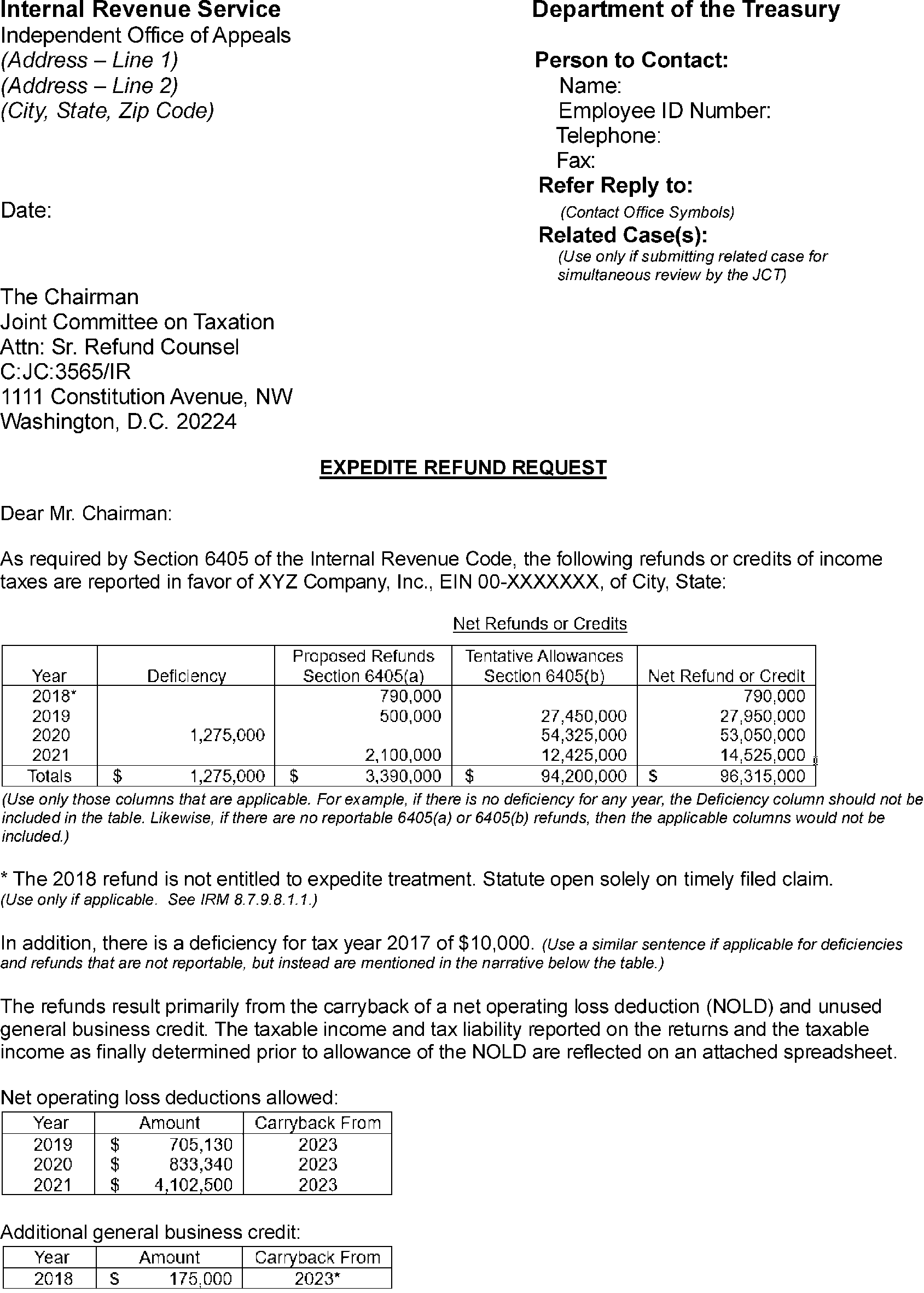
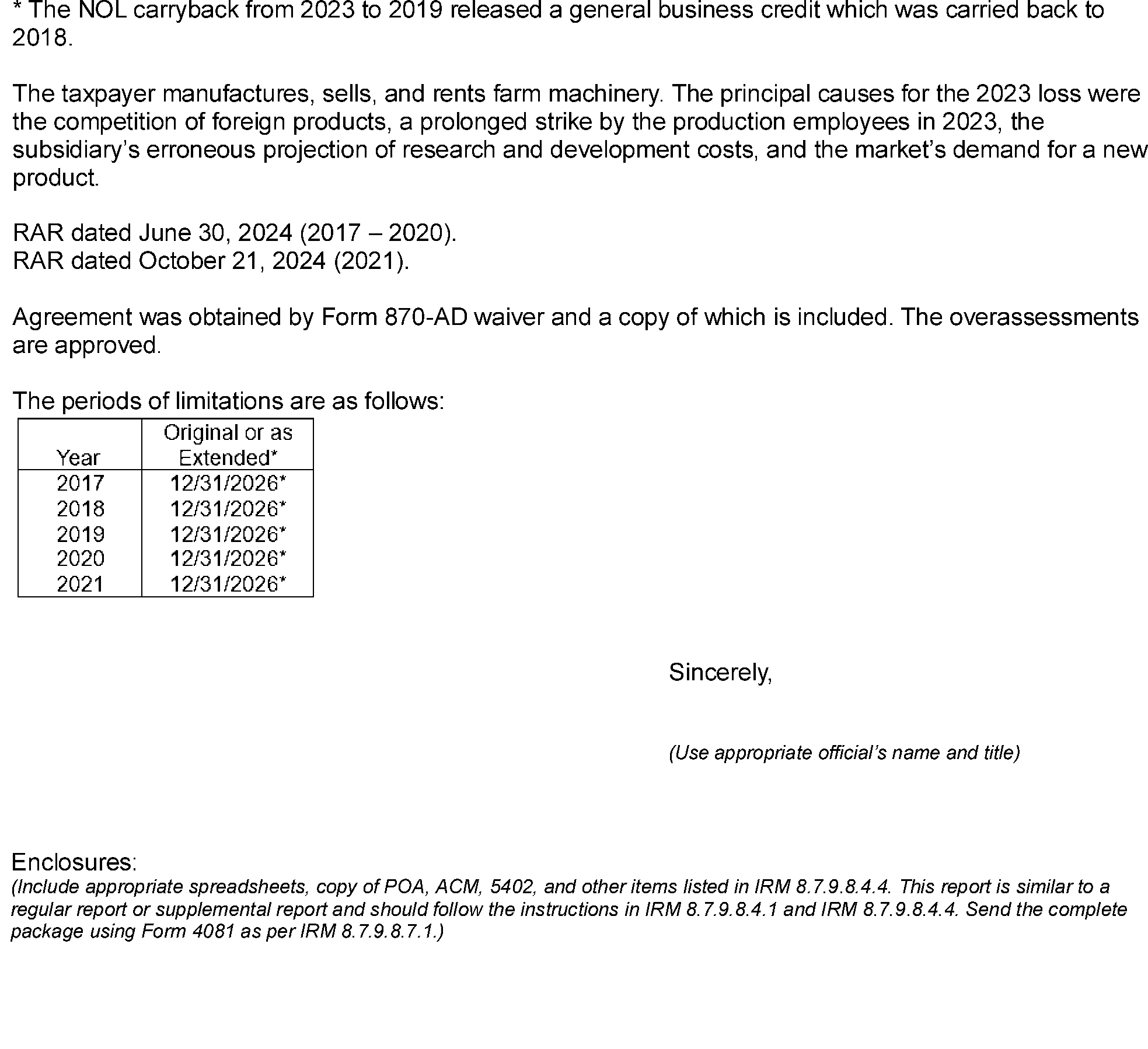
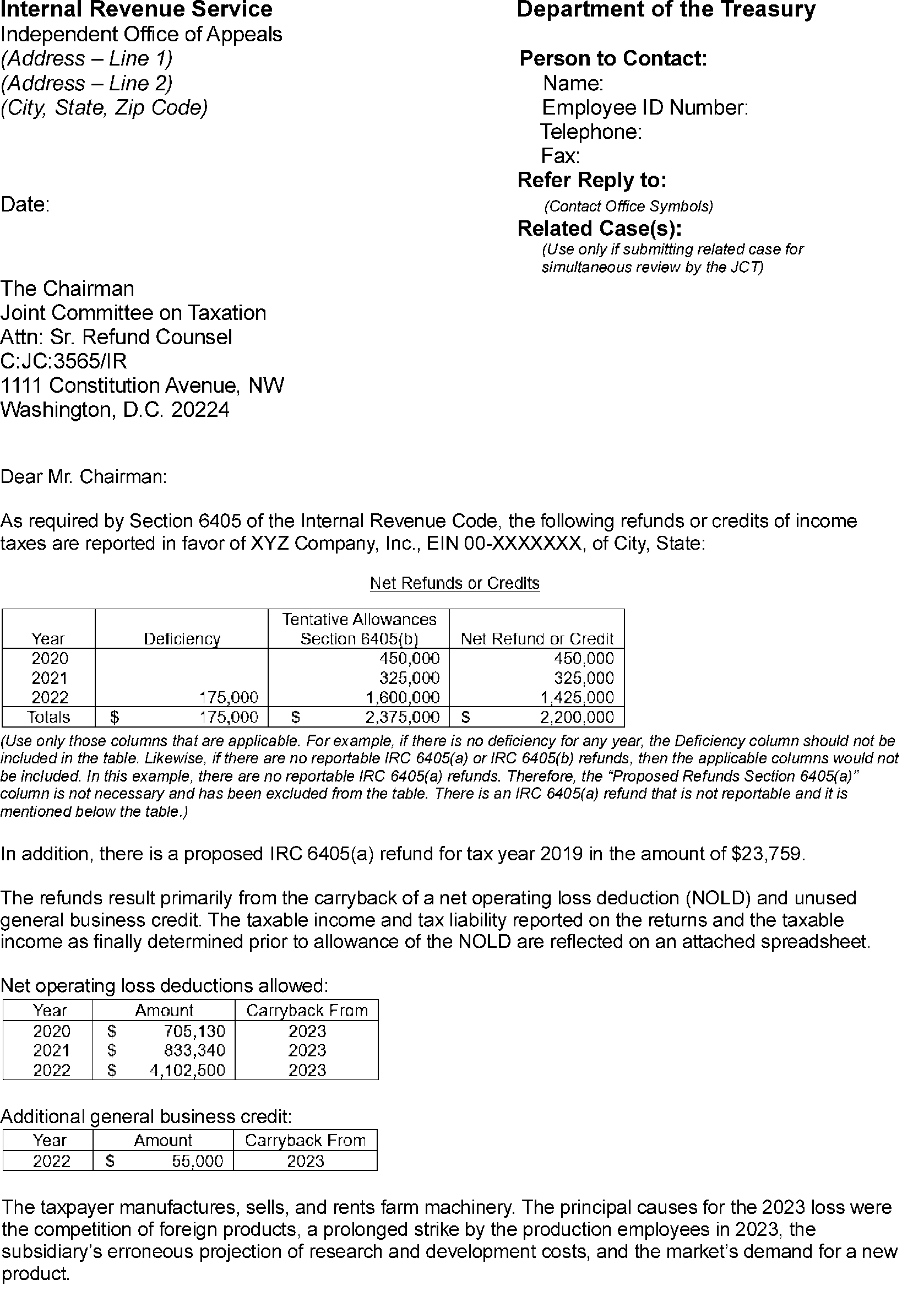
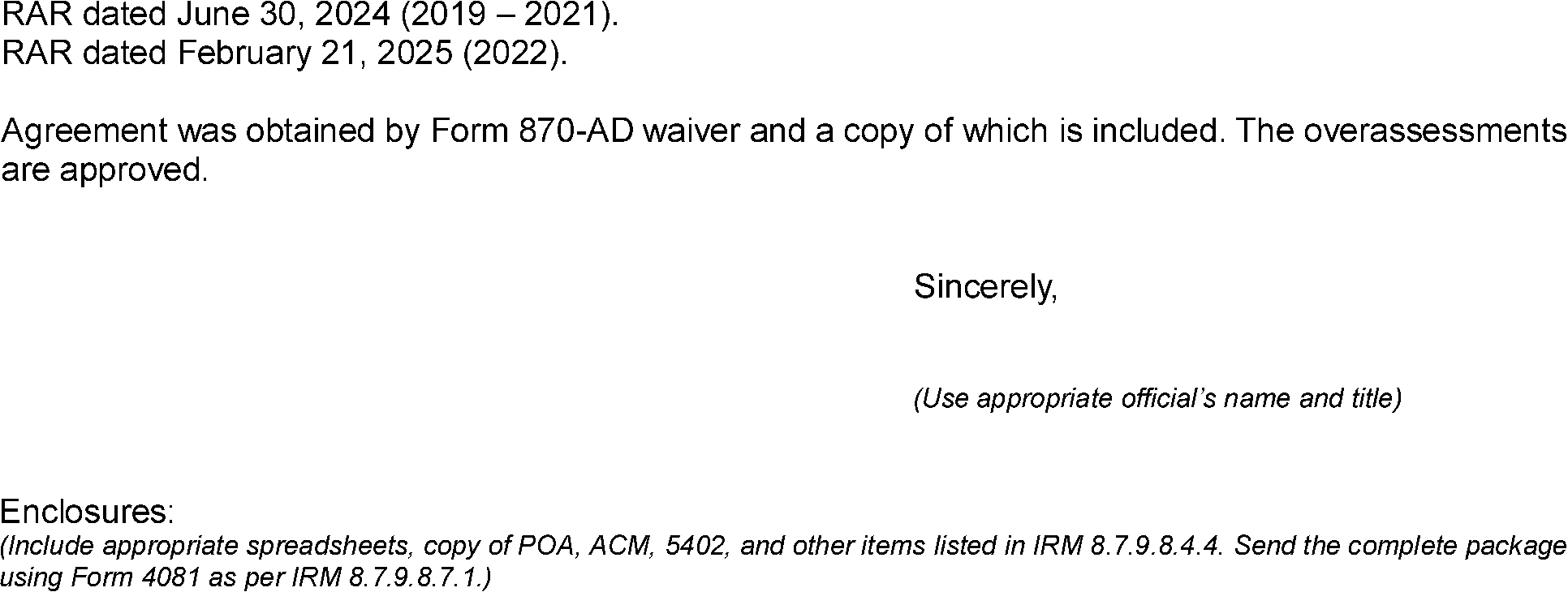
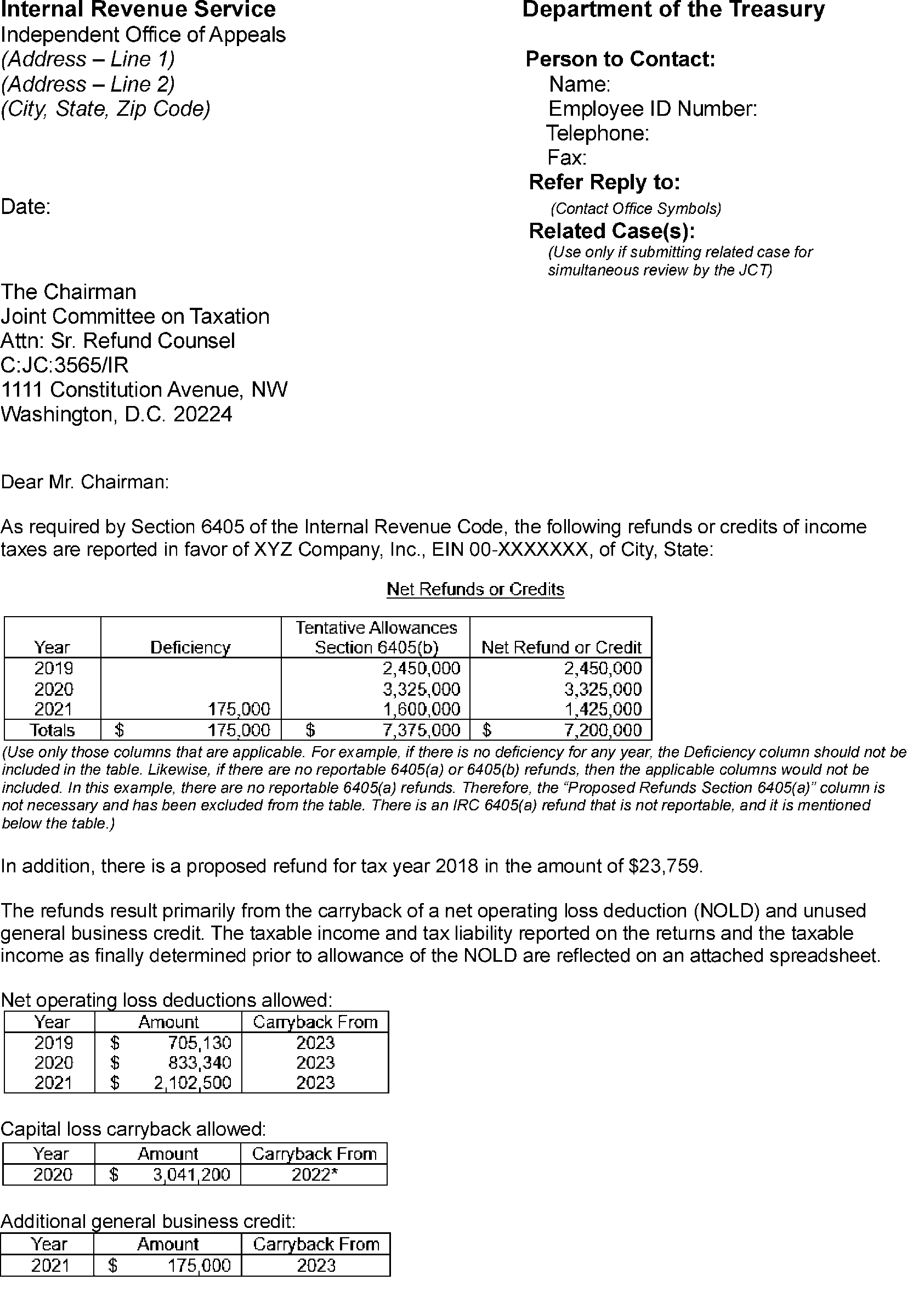
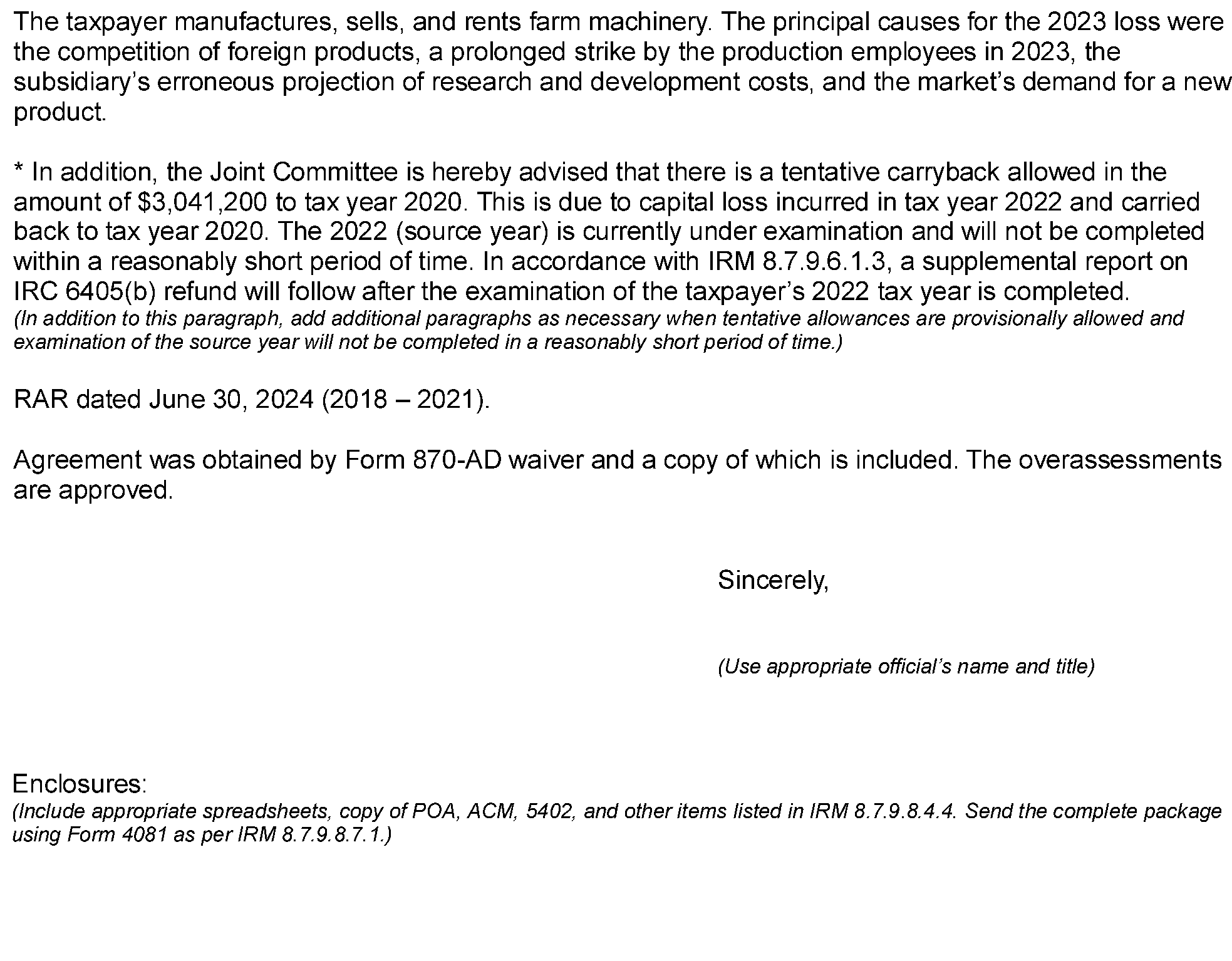
Supplemental reports may have different formats depending on the reason for the report. This is just one example.
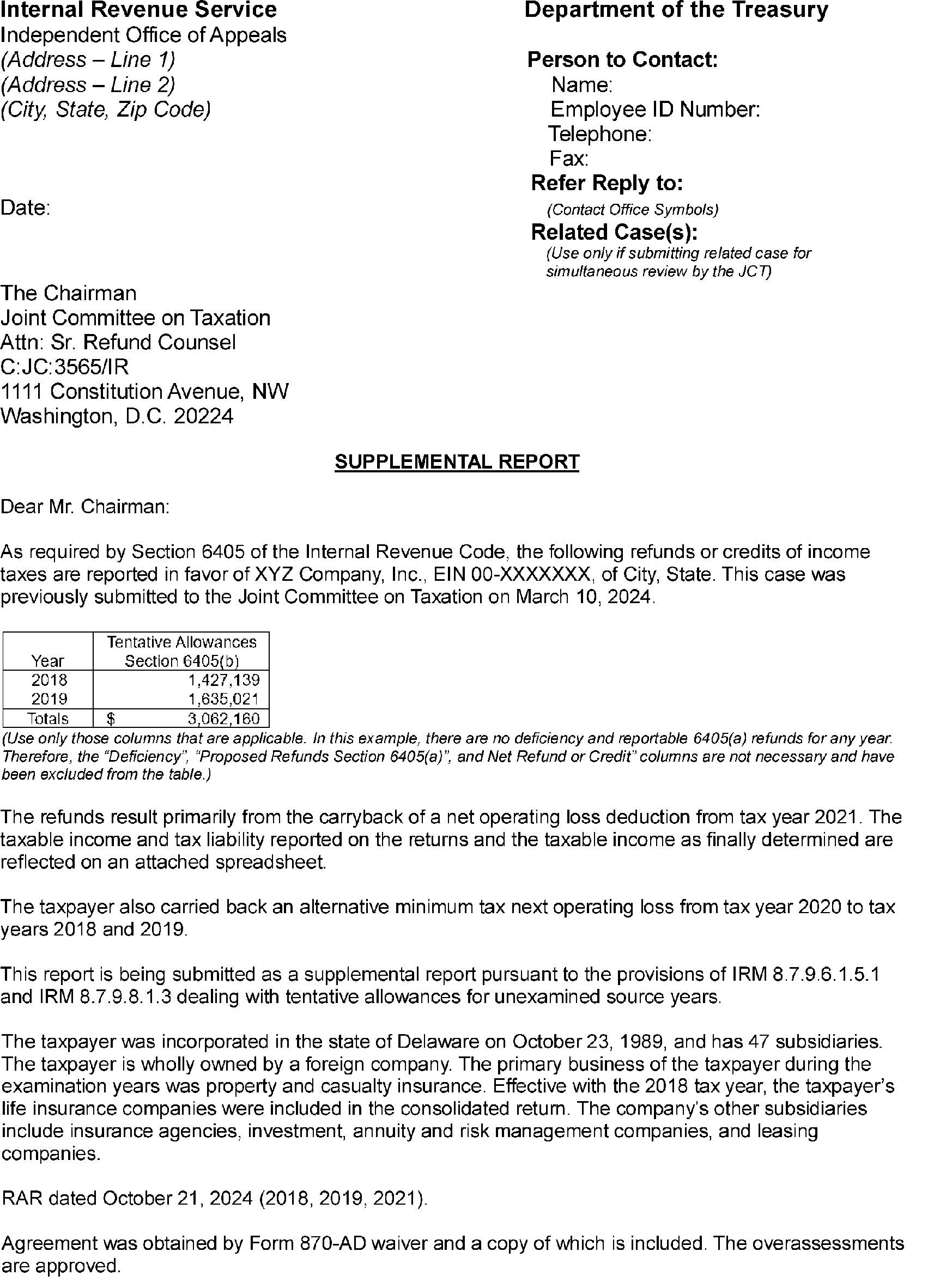
Please click here for the text description of the image.
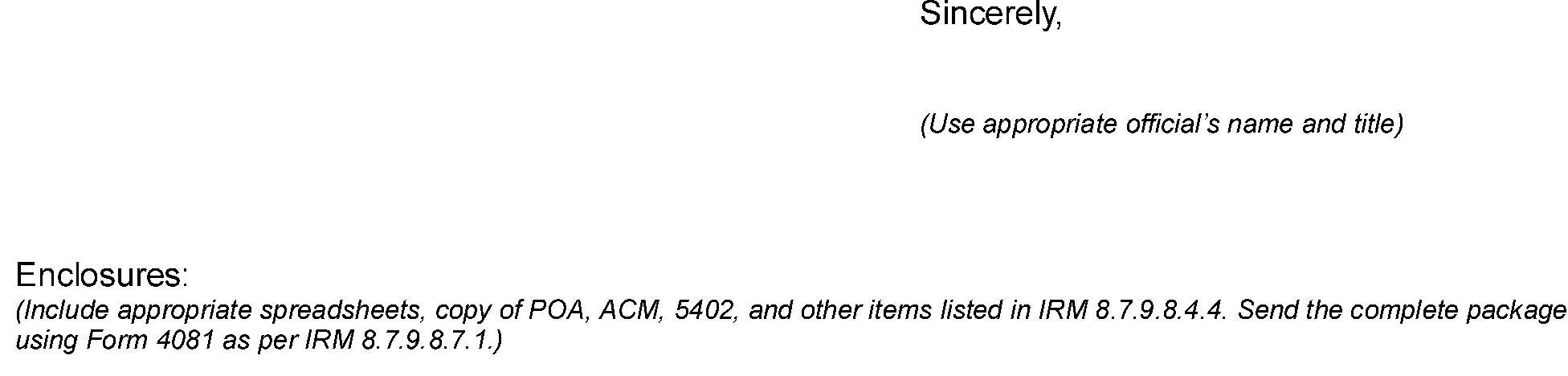
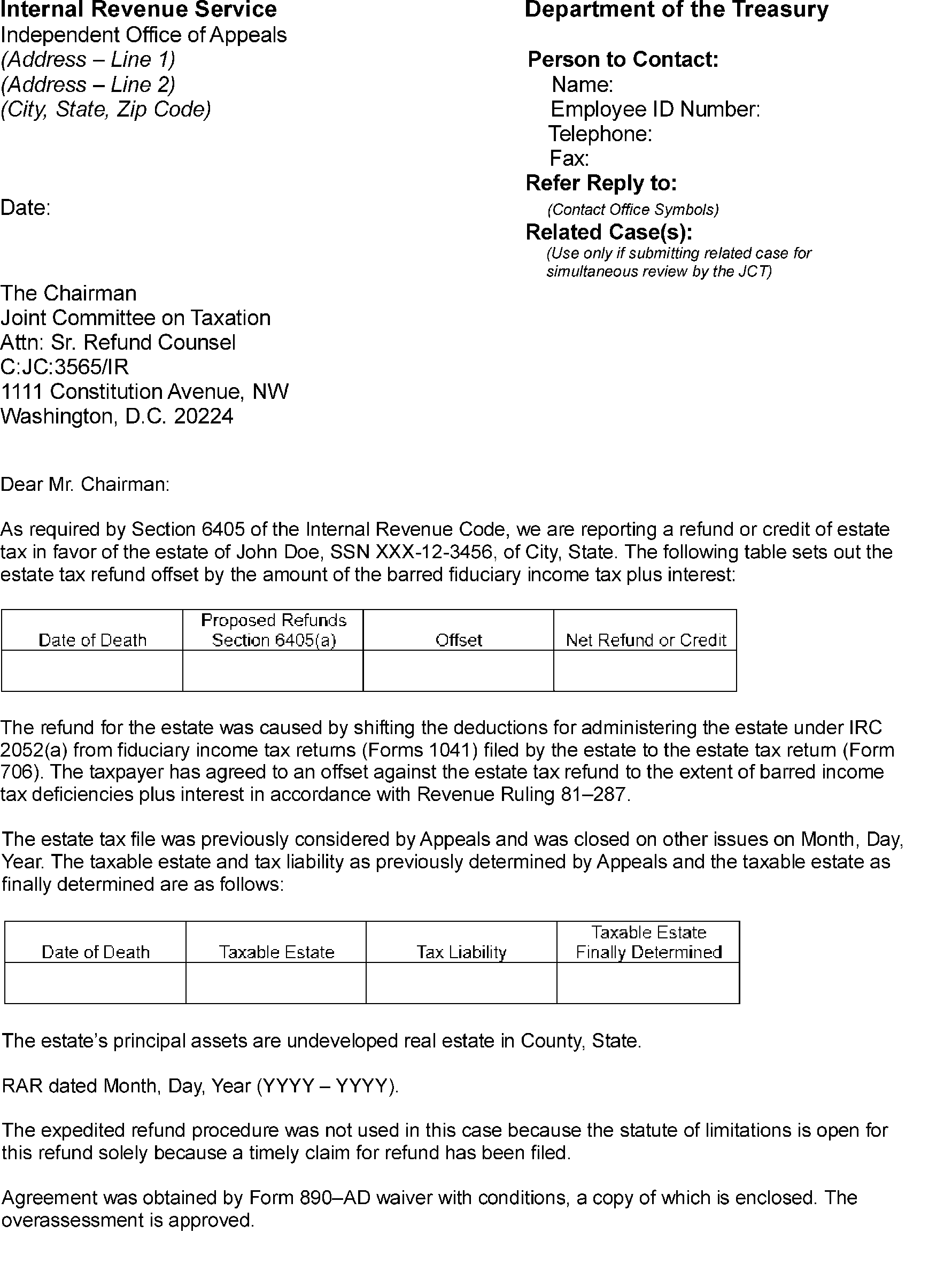
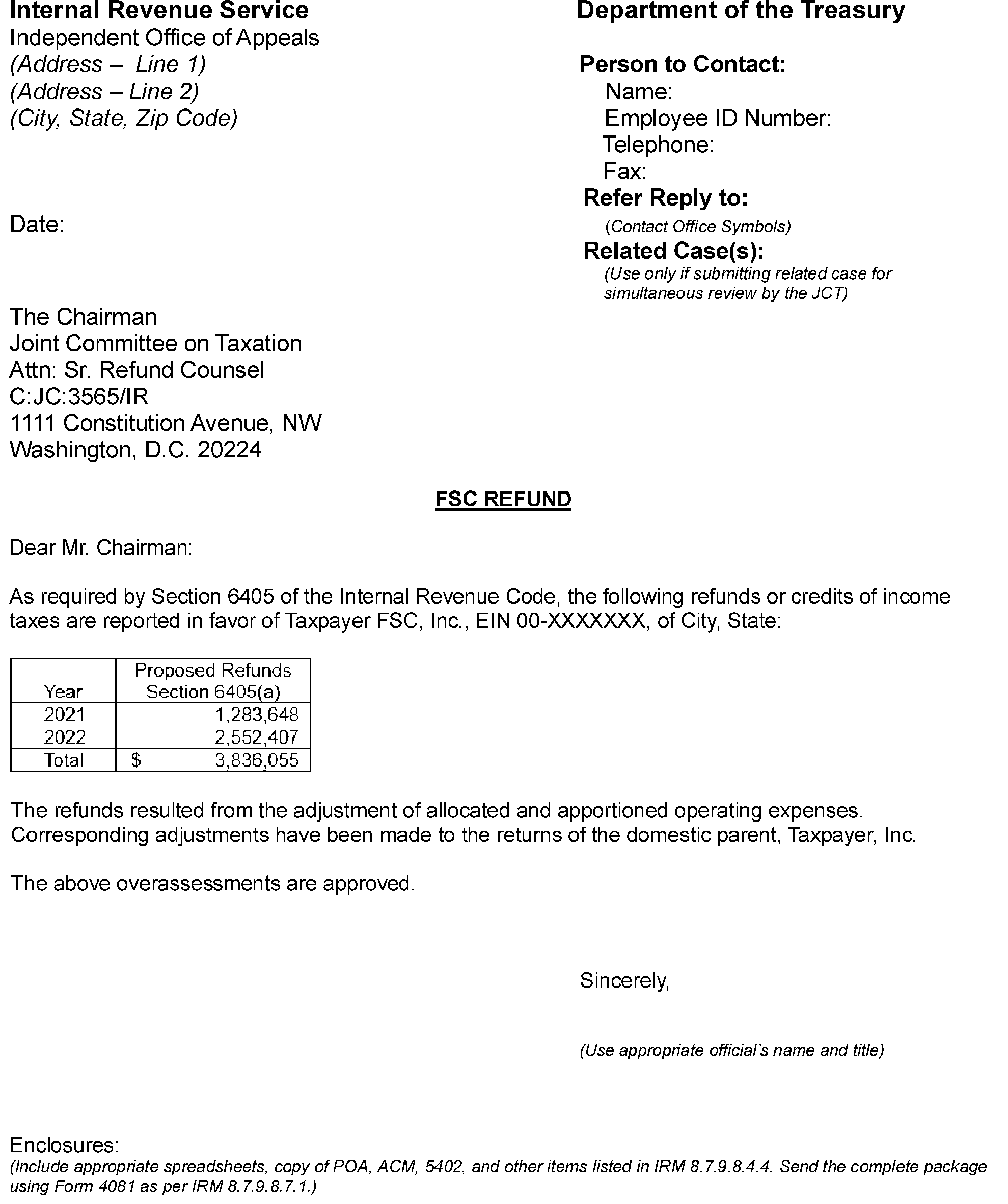
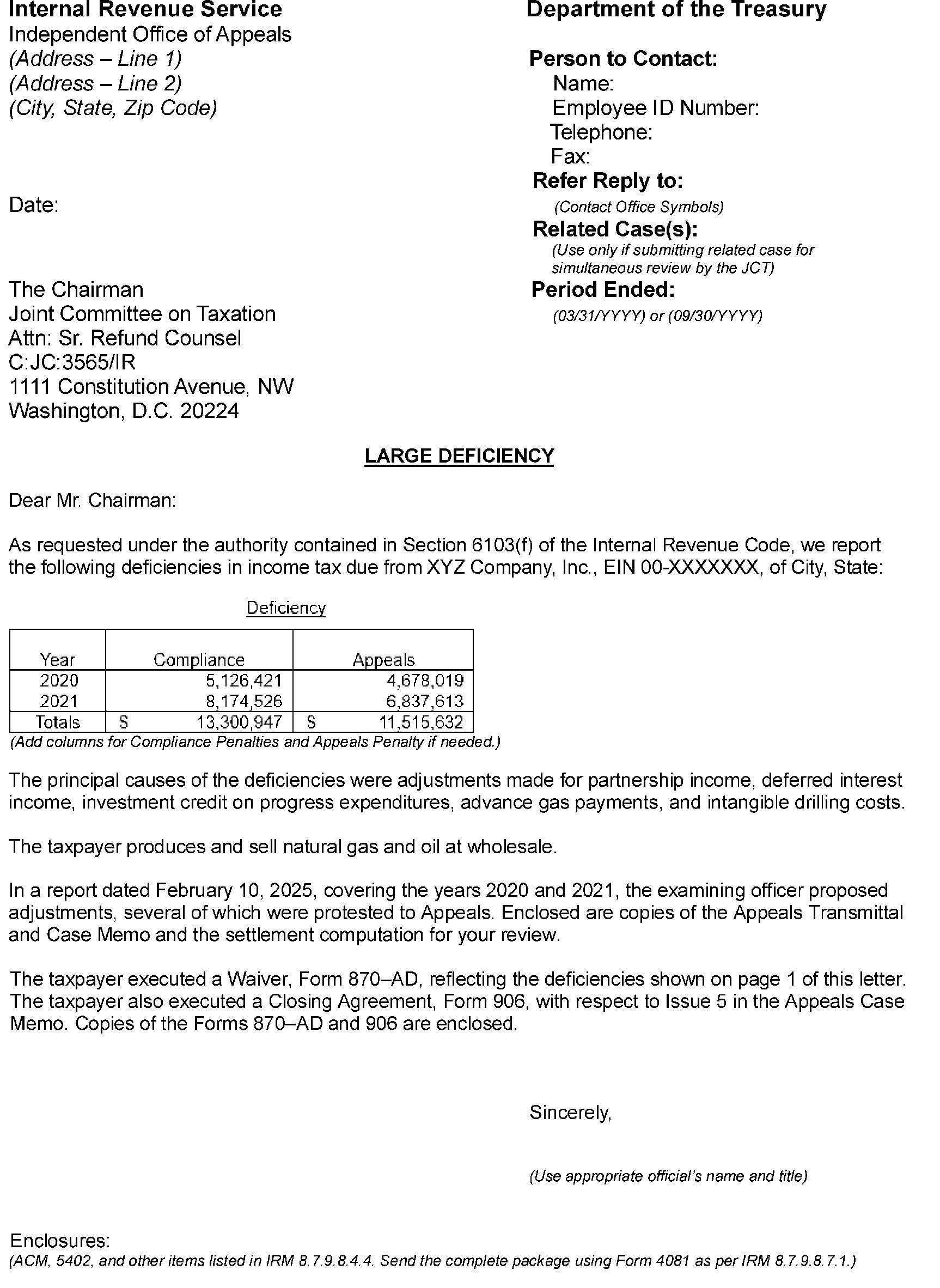
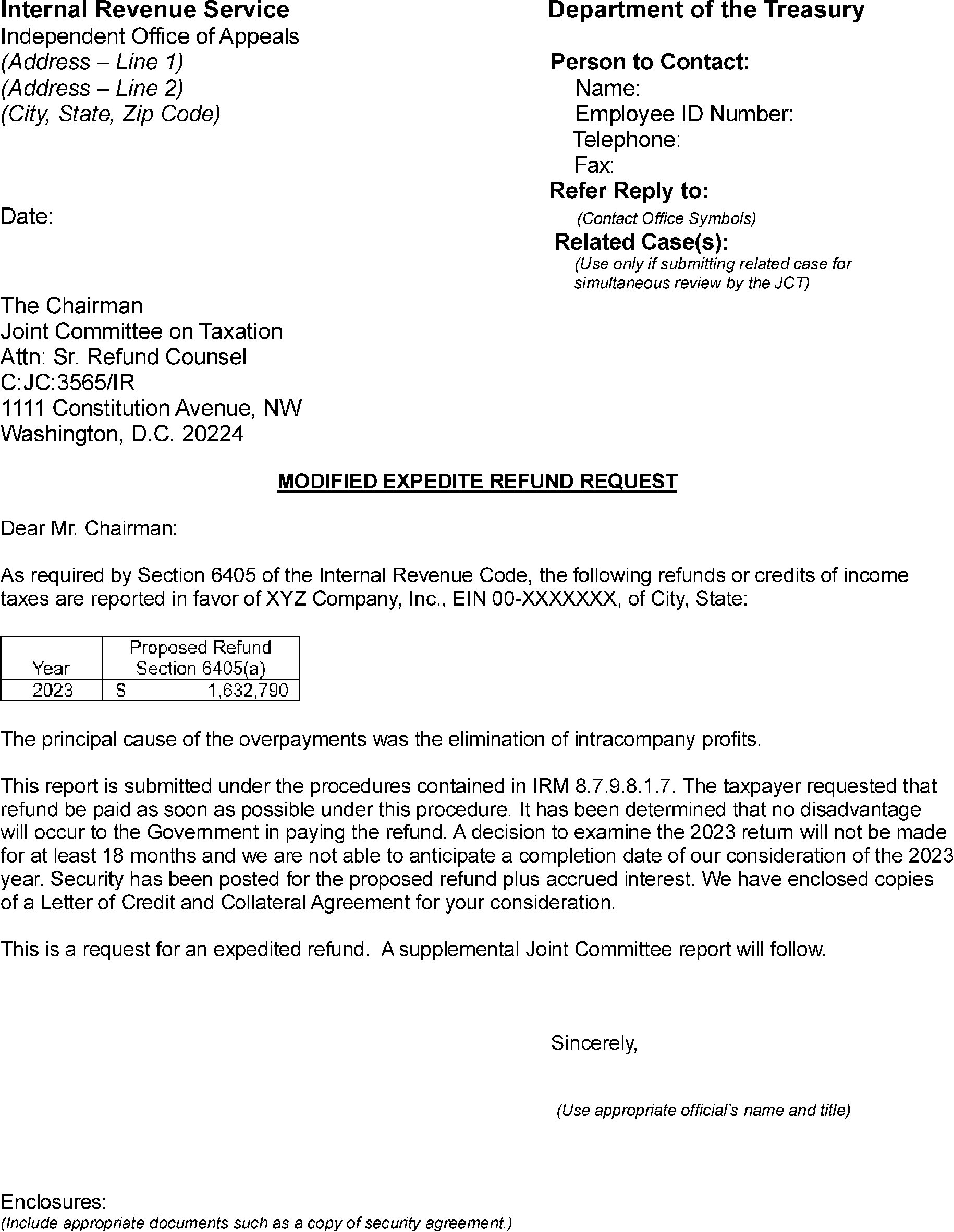
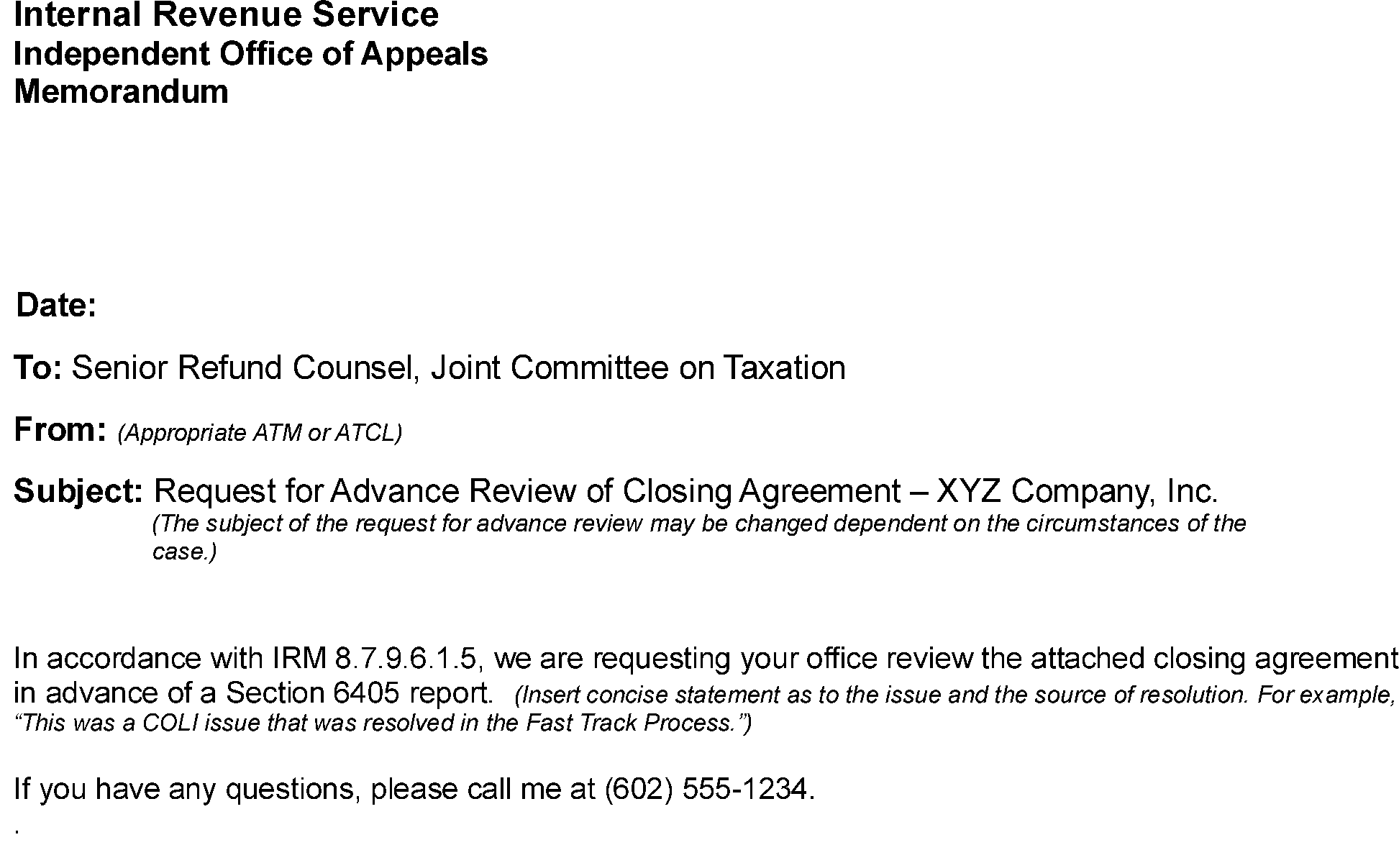
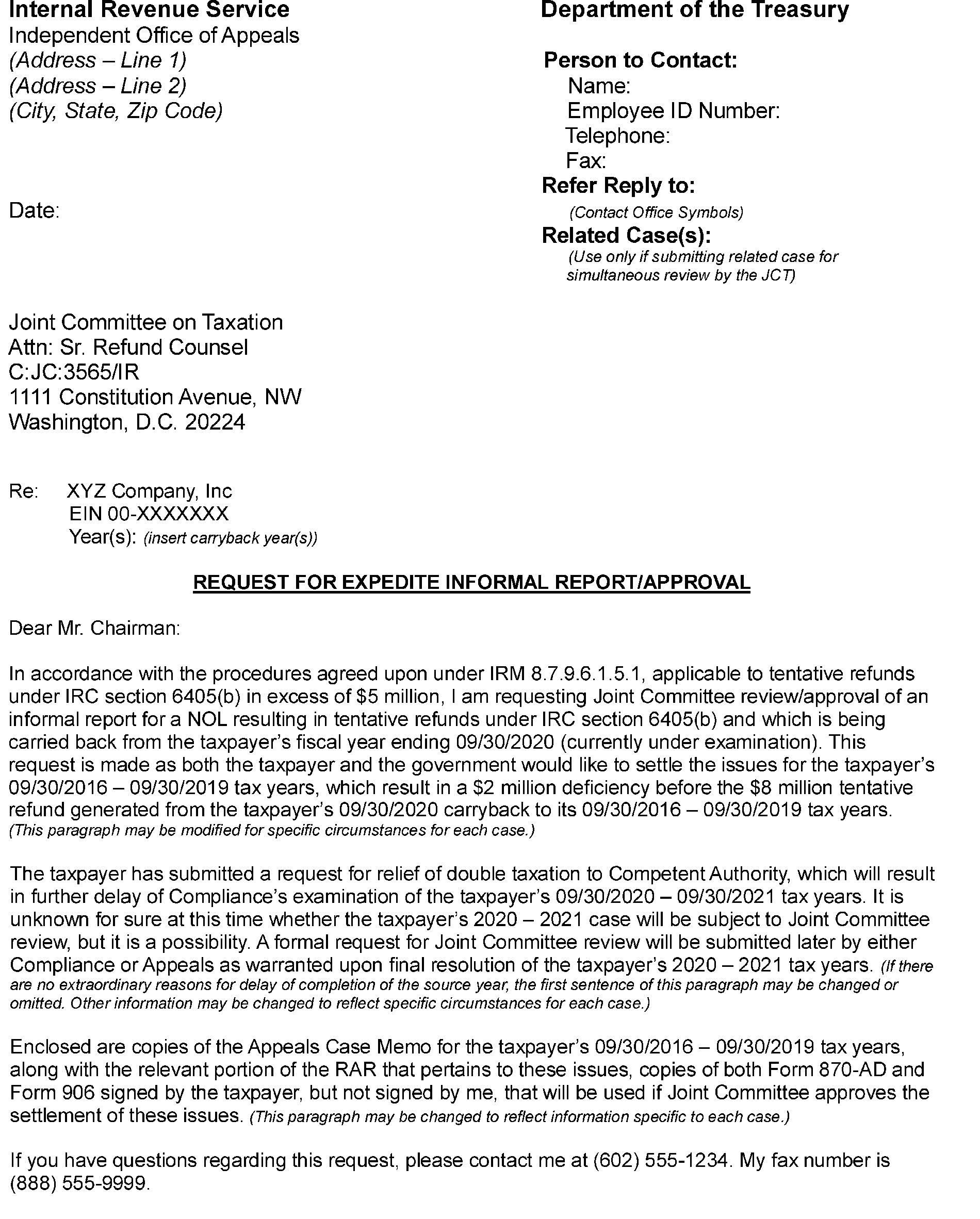
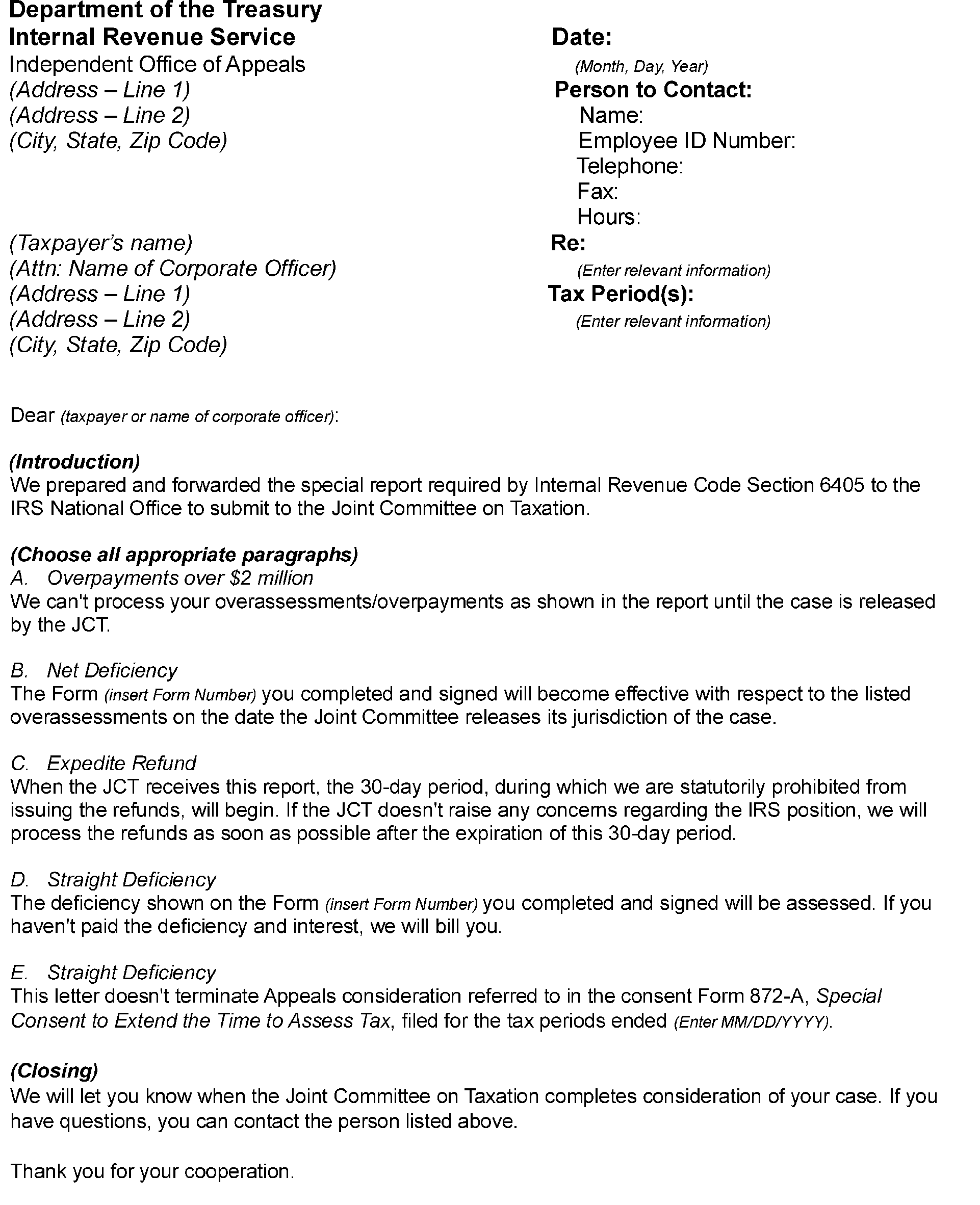
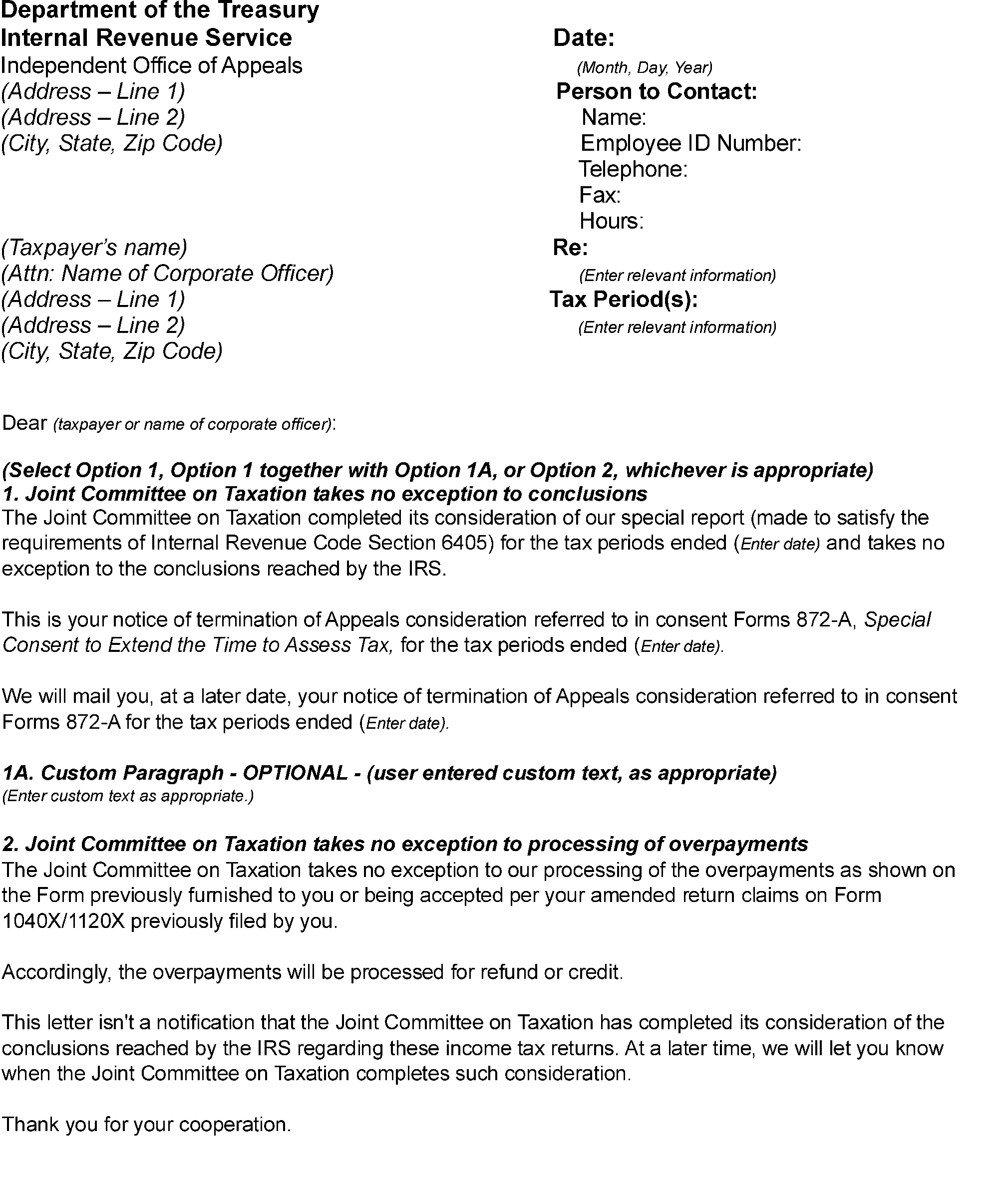
Use applicable sections as needed.
Taxpayer: XYZ Corporation, Inc.
EIN: XX-9999999
Refunds and Credits
| Year | Proposed Refund Section 6405(a) | Tentative Allowance Section 6405(b) | Net Refund or Credit |
|---|---|---|---|
| 2020 | 6,380,000 | 6,380,000 | |
| 2021 | 5,720,000 | 5,720,000 | |
| Totals | 5,720,000 | 6,380,000 | 12,000,000 |
In addition to the above, deficiencies of $370,000 and $125,000 were determined for tax years 2022 and 2023, respectively. (Use applicable columns. If there is no deficiency or a particular type of refund for any year, then do not include a column for that category.)
Net Operating Loss Deduction
| Year | Amount | Carryback From |
|---|---|---|
| 2019 | 2,000,000 | 2022 |
| 2020 | 3,500,000 | 2022 |
| 2021 | 5,250,000 | 2024 |
Alternative Tax Net Operating Loss Deduction
| Year | Amount | Carryback From |
|---|---|---|
| 2020 | 3,200,000 | 2022 |
| 2021 | 4,900,000 | 2024 |
Additional Foreign Tax Credits
| Year | Amount | Carryover or Carryback From |
|---|---|---|
| 2020 | 75,000 | 2022 |
| 2020 | 125,000 | 2023 |
* 2019 credit was released due to NOL carryback from 2022 to 2019.
* 2020 credit was due to NOL carryback from 2022 to 2019.
Taxpayer: XYZ Corporation, Inc.
EIN: XX-9999999
Example 2: 6405(a) Refund and Deficiency - 1 Year
| Year | Deficiency | Proposed Refund Section 6405(a) | Net Refund or Credit |
| 2021 | 250,000 | 2,500,000 | 2,250,000 |
Example 4: 6405(b) Refund and Deficiency - 1 Year
| Year | Deficiency | Tentative Allowance Section 6405(b) | Net Refund or Credit |
| 2021 | 250,000 | 2,500,000 | 2,250,000 |
Example 5: 6405(a) and 6405(b) - 1 Year
| Year | Proposed Refund Section 6405(a) | Tentative Allowance Section 6405(b) | Net Refund or Credit |
| 2021 | 2,500,000 | 3,000,000 | 5,500,000 |
Example 6: 6405(a) Refund - Multiple Years
| Year | Proposed Refunds Section 6405(a) |
| 2021 | 2,500,000 |
| 2022 | 1,300,000 |
| Total | 3,800,000 |
Example 7: 6405(b) Refund - Multiple Years
| Year | Tentative Allowances Section 6405(b) |
| 2021 | 2,500,000 |
| 2022 | 1,300,000 |
| Total | 3,800,000 |
Example 8: 6405(a), 6405(b), and Deficiency - Multiple Years
| Year | Deficiency | Proposed Refunds Section 6405(a) | Tentative Allowances Section 6405(b) | Net Refund or Credit |
| 2021 | 2,500,000 | 3,000,000 | 5,500,000 | |
| 2022 | 1,500,000 | 1,500,000 | ||
| 2023 | 250,000 | 5,000,000 | 4,750,000 | |
| Total | 250,000 | 4,000,000 | 8,000,000 | 11,750,000 |
Example 9: 6405(a), 6405(b), and Deficiency - Multiple Years
| Year | Proposed Refunds Section 6405(a) | Tentative Allowances Section 6405(b) | Net Refund or Credit |
| 2021 | 2,500,000 | 3,000,000 | 5,500,000 |
| 2022 | 1,500,000 | 1,500,000 | |
| Total | 4,000,000 | 3,000,000 | 7,000,000 |
In addition, there are deficiencies in the amounts of $110,000 and $650,000 for the years 2020 and 2023, respectively.
Example 10: 6405(b) and Deficiency - Multiple Years - 6405(a) Below Jurisdictional Amount
| Year | Deficiency | Tentative Allowances Section 6405(b) | Net Refund or Credit |
| 2021 | 125,000 | 3,000,000 | 2,875,000 |
| 2022 | 3,500,000 | 3,500,000 | |
| Total | 125,000 | 6,500,000 | 6,375,000 |
In addition, there are IRC Section 6405(a) refunds in the amounts of $55,000 and $95,750 for the years 2019 and 2020, respectively.
Example 11: 6405(a) and Deficiency - Multiple Years - Deficiencies in Work Unit Years with No Offsetting Refunds: 6405(b) below Jurisidictional Amount
| Year | Proposed Refunds Section 6405(a) |
| 2021 | 3,000,000 |
| 2022 | 2,500,000 |
| Total | 5,500,000 |
In addition, there is a deficiency in the amount of $125,000 for the year 2020 and IRC Section 6405(b) refund in the amount of $200,000 for the year 2022.
Example 12: 6405(a), 6405(b), and Deficiency - Multiple Years- Deficiency Which Exceeds Refund in Work Unit Year
| Year | Deficiency | Proposed Refunds Section 6405(a) | Tentative Allowances Section 6405(b) | Net Refund or Credit |
| 2021 | 125,000 | 2,500,000 | 3,000,000 | 5,375,000 |
| 2023 | 1,500,000 | 1,500,000 | ||
| Total | 125,000 | 4,000,000 | 3,000,000 | 6,875,000 |
In addition, there is an IRC Section 6405(b) refund for 2022 in the amount of $1,477,312 which is eliminated by a deficiency for the same year in the amount of $2,140,717.
ABC Inc. & Subsidiaries
EIN: XX-0000000
| Tax Year | 202012 | 202112 | 202212 | 202312 |
|---|---|---|---|---|
| Taxable Income/(Loss) b/f NOLD - Per Return | 8,000,000 | 9,000,000 | 5,000,000 | 4,000,000 |
| Current Adjustments | ______0 | (8,000,000) | 500,000 | 100,000 |
| Taxable Income/(Loss) Before NOLD and CLCB | 8,000,000 | 1,000,000 | 5,500,000 | 4,100,000 |
| Capital loss c/b from 200312 | (7,000,000) | _________ |
_________ |
_________ |
| Corrected Taxable Income/(Loss) | 1,000,000 ======== |
1,000,000 ======== |
5,500,000 ======== |
4,100,000 ======== |
| Corrected Tax b/f Credits | 340,000 | 340,000 | 1,870,000 | 1,394,000 |
| Foreign Tax Credit | 0 |
0 |
0 |
0 |
| General Business Credits | 0 |
0 |
0 |
0 |
| Prior Year Minimum Tax Credit | ______0 | _______0 | ______0 | ______0 |
| Balance of Tax Less Credits | 340,000 | 340,000 | 1,870,0000 | 1,394,000 |
| Plus Recapture Taxes | 0 | 0 | 0 | 0 |
| Less: Regular Tax Before Credits Less FTC | 340,000 | 340,000 | 1,870,000 | 1,394,000 |
| Alternative Minimum Tax as Corrected | 0 | 0 | 0 | 0 |
| Alternative Minimum Tax | 0 | 0 | 0 | 0 |
| Plus: Environmental Tax Correct | ______0 | ______0 | _____N/A | _____N/A |
| Total Corrected Tax Liability | 340,000 | 340,000 | 1,870,000 | 1,394,000 |
| Total Tax Per Return | 2,720,000 | 3,060,000 | 1,700,000 | 1,360,000 |
| Less: Tentative Refunds | 0 | 0 | 0 | 0 |
| 10/15/2004 - Carryback from 200312 | (2,380,000) | _________ | _________ | _________ |
| Tax per Return or as Previously Adjusted | 340,000 | 3,060,000 | 1,700,000 | 1,360,000 |
| Deficiency/Overassessment) | 0 ======== |
(2,720,000) ======== |
170,000 ======== |
34,000 ======= |
ABC Inc. & Subsidiaries
EIN: XX-0000000
| Tax Year | 202012 | 202112 | 202212 | 202312 |
|---|---|---|---|---|
| Alt Taxable Income/(Loss) Per Return | 8,000,000 | 9,000,000 | 5,000,000 | 4,000,000 |
| Current Adjustments & Capital loss c/b: | ||||
| Adjustments & Preferences Items | (8,000,000) | 500,000 | 100,000 | |
| Capital loss c/b from 200312 | (7,000,0000 | _________ |
_________ |
_________ |
| Alt Taxable Income/(Loss) Before ATNOLD | 1,000,000 | 1,000,000 | 5,500,000 | 4,100,000 |
| ATNOLD | _____0 | _____0 | _____0 | _____0 |
| Corrected Alternative Taxable Income/(Loss) | 1,000,000 ======== |
1,000,000 ======== |
5,500,000 ======== |
4,100,000 ======== |
| ATNOLD Limitation | 900,000 ======= |
900,000 ======= |
4,950,000 ======== |
3,690,000 ======== |
| Tentative Minimum Tax Before Credits | 200,000 | 200,000 | 1,100,000 | 820,000 |
| Less: AMT Foreign Tax Credit | 0 | 0 | 0 | 0 |
| Tentative Minimum Tax | 200,000 | 200,000 | 1,100,000 | 820,000 |
| Less: Regular Tax Before Credits Less FTC | 340,000 | 340,000 | 1,870,000 | 1,394,000 |
| Alternative Minimum Tax as Corrected | 0 | 0 | 0 | 0 |
| Alternative Minimum Tax per Return | 0 | 0 | 0 | 0 |
| Alternative Minimum Tax per Return | 0 | 0 | 0 | 0 |
| Plus: Increases/(Decreases) | ______0 | ______0 | ______0 | ______0 |
| Net Alternative Min Tax Increase/(Decrease) | 0 ====== |
0 ====== |
0 ====== |
0 ====== |
| Environmental Tax as Corrected | 0 | 0 | 0 | 0 |
| Environmental Tax per Return | N/A | N/A | N/A | N/A |
| Plus: Increases/(Decreases) | ______0 | ______0 | ______0 | ______0 |
| Env Tax as Previously Adjusted | ______0 | ______0 | ______0 | ______0 |
| Net Env Tax Increase/(Decrease) | 0 ======= |
0 ======= |
0 ======= |
0 ======= |