)
or https:// means you've safely connected to the .gov website. Share sensitive information only on official, secure websites.
)
or https:// means you've safely connected to the .gov website. Share sensitive information only on official, secure websites.


- 8.17.6 Interest Issues in Settlement Computations
- 8.17.6.1 Program Scope and Objectives
- 8.17.6.1.1 Background
- 8.17.6.1.2 Authority
- 8.17.6.1.3 Responsibilities
- 8.17.6.1.4 Acronyms
- 8.17.6.1.5 Related Resources
- 8.17.6.2 Introduction to Cases With Restricted Interest
- 8.17.6.3 Restricted Interest
- 8.17.6.4 Forms Needed for Restricted Interest Cases Due to Carrybacks
- 8.17.6.5 Preparation of Form 2285
- 8.17.6.5.1 Restricted Interest on Cases with No Deficiencies
- 8.17.6.5.2 Sections I and II of Form 2285
- 8.17.6.5.3 Additions to Tax/Penalties on Form 2285
- 8.17.6.5.4 Annotating the Settlement Computation When Form 2285 Prepared
- 8.17.6.6 Repeal of Tax Motivated Transaction (TMT) Interest under IRC 6621(c)
- 8.17.6.7 Large Corporation Underpayment Interest (LCU) under IRC 6621(c)
- 8.17.6.7.1 Requirements for LCU Rate
- 8.17.6.7.1.1 "C" Corporation Requirement
- 8.17.6.7.1.2 Threshold Underpayment Requirement
- 8.17.6.7.1.3 Letter or Notice Requirement
- 8.17.6.7.1.4 Start Date or "Applicable" Date Requirement
- 8.17.6.7.1.4.1 Determining the LCU Start Date or "Applicable" Date
- 8.17.6.7.2 Annotating the Settlement Computation for Large Corporate Underpayment Rate
- 8.17.6.7.3 Information to include on the Form 5403 Worksheet
- 8.17.6.7.1 Requirements for LCU Rate
- 8.17.6.8 Interest on Underpayments Satisfied with Foreign Tax Credits
- 8.17.6.9 GATT Interest for Large Corporate Overpayments
- 8.17.6.10 IRC 6404(g) Suspension of Interest
- 8.17.6.10.1 Liabilities Subject to IRC 6404(g) Suspension
- 8.17.6.10.2 Determining Adequate Notice Period
- 8.17.6.10.3 Adequate Notices in an IRC 6404(g) Case
- 8.17.6.10.4 IRC 6404(g) and Multiple Notice Dates
- 8.17.6.10.5 IRC 6404(g) and Amended Returns
- 8.17.6.10.6 Campus Posts Notice Date to Master File
- 8.17.6.10.7 IRC 6404(g) in Settlement Computations
- 8.17.6.11 Rev. Rul. 99-40 and Credit Elects (May/Sequa)
- 8.17.6.11.1 Determining if May/Sequa Applies
- 8.17.6.11.1.1 Determining if there is an Underpayment
- 8.17.6.11.1.2 Determining if there is a Credit Elect
- 8.17.6.11.2 Completing the Sequa Worksheets
- 8.17.6.11.3 Documenting Case File for Sequa
- 8.17.6.11.4 Credit for Increasing Research Activities
- 8.17.6.11.1 Determining if May/Sequa Applies
- Exhibit 8.17.6-1 Internal Revenue Code Provisions Restricting and Prohibiting Interest
- Exhibit 8.17.6-2 May/Sequa Computation - Sequa Worksheet
- 8.17.6.1 Program Scope and Objectives
Part 8. Appeals
Chapter 17. Settlement Computations and Statutory Notices of Deficiency
Section 6. Interest Issues in Settlement Computations
8.17.6 Interest Issues in Settlement Computations
Manual Transmittal
March 13, 2025
Purpose
(1) This transmits a revised IRM 8.17.6, Settlement Computations and Statutory Notices of Deficiencies, Interest Issues in Settlement Computations.
Material Changes
(1) Added new IRM 8.17.6.1, Program Scope and Objectives, to include Internal Control information required by IRM 1.11.2, Internal Revenue Manual Process.
(2) Added new IRM 8.17.6.1.5, Related Resources, to include updated Taxpayer Bill of Rights (TBOR) content based on guidance from the Division Counsel/Associate Chief Counsel (National Taxpayer Advocate Program) and Branch 3 of the Associate Chief Counsel (Procedure and Administration). Added content related to IRM 25.30.2.3, Statement of Commitment, Service Level Agreement (SLA) between Appeals and Taxpayer Advocate Service (TAS).
Effect on Other Documents
IRM 8.17.6 dated 09/24/2013 is superseded.Audience
AppealsEffective Date
(03-13-2025)
Patrick E. McGuire
Acting Director, Operations Support
-
Purpose: The purpose of this IRM section is to provide guidance to Appeals Tax Computation Specialists (TCSs) for the accurate and efficient preparation of settlement computations on cases involving interest on underpayments and overpayments worked in the IRS Independent Office of Appeals (Appeals).
-
Audience: The primary users of the IRM section are Appeals TCSs and Appeals Technical Employees (ATEs).
-
Policy Owner: Policy, Planning, Quality and Analysis (PPQ&A) is under the Director, Operations Support.
-
Program Owner: Appeals Policy is the program office responsible for providing technical and procedural guidance to the Appeals organization and is under the Director of PPQ&A.
-
Contact Information: Appeals employees should follow established procedures on How to Contact an Analyst. Other employees should contact the Product Content Owner shown on the Product Catalog Information page for this IRM.
-
This section covers procedures for preparing settlement computations involving interest on cases worked in Appeals.
-
As stated in IRC 7803(e)(3), the Appeals mission is to resolve Federal tax controversies without litigation on a basis that is fair and impartial to both the Government and the taxpayer, promotes a consistent application and interpretation of, and voluntary compliance with, the Federal tax laws, and enhances public confidence in the integrity and efficiency of the IRS. Appeals accomplishes its mission by considering protested and Tax Court cases and negotiating settlements in a manner which ensures Appeals employees act in accord with the Taxpayer Bill of Rights (TBOR) in every interaction with taxpayers.
-
IRM 8.17, Settlement Computations and Statutory Notices of Deficiency, establishes the TCS policy framework for Appeals.
-
The Appeals TCS is responsible for the accurate preparation of tax computations, including all applicable computation schedules.
-
The Appeals TCS Program Analyst is responsible for:
-
Updating the applicable IRM sections as needed
-
Reviewing training modules
-
Responding to inquiries
-
-
See IRM 8.1.1-1, Common Terms Used in Appeals, for common terms and definitions used in IRM Part 8.
-
The Taxpayer Bill of Rights (TBOR) lists rights that already existed in the tax code, putting them in simple language and grouping them into 10 fundamental rights. Employees are responsible for being familiar with and acting in accord with taxpayer rights. See IRC 7803(a)(3), Execution of Duties in Accord with Taxpayer Rights. For additional information about the TBOR, see https://www.irs.gov/taxpayer-bill-of-rights.
-
In accordance with IRM 25.30.2.3, Statement of Commitment, Appeals will work collaboratively with the Taxpayer Advocate Service (TAS) to enhance the taxpayer experience. For more information, see IRM 25.30.2, Service Level Agreement between the IRS Independent Office of Appeals and the Taxpayer Advocate Service.
-
Payment of interest is mandatory on underpayments and overpayments of tax as provided by the Internal Revenue Code unless specifically prohibited by law or mutual agreement.
-
Interest may be limited to specific time periods or rates, or it may be statutorily prohibited. This gives rise to the term "restricted interest". There are two reasons why interest is restricted:
-
Conditions may exist that prevent the computer from generating an accurate amount; and
-
Special provisions in law limit or prohibit interest. (See IRM 20.2.8.6, Reasons for Restriction, for more information.)
-
-
References to an Appeals Officer (AO) within this IRM section include both an AO and an Appeals Team Case Leader (ATCL).
-
In certain instances, the Code prohibits or limits interest on deficiencies and overassessments in tax to specific periods. These special interest accrual periods are shorter than the regular interest periods established by provisions of IRC 6601 and IRC 6611. These prohibitions cause regular interest to become restricted interest. In some situations, these interest periods cannot be calculated by the computer.
-
Some resources which discuss restricted interest are listed below:
-
Exhibit 8.17.6-1, Internal Revenue Code Provisions Restricting and Prohibiting Interest.
-
Exhibit 20.2.1-1, Provisions Restricting Interest.
-
IRM 20.2.5.6.1, Reasons to Manually Compute Interest.
-
-
In addition to the items listed in the above referenced resources, the following situations require special interest computations:
-
Certain transferee liability cases.
-
Estate tax deficiency where installment payments under IRC 6166 are elected. See IRM 8.7.4, Appeals Estate and Gift Tax Cases, for a format to use in the computation of installment payments.
-
Employer's liability is eliminated due to withholding tax being paid by employee. See IRC 3402(d) and IRM 8.7.16, Appeals Employment Tax Procedures, for further details.
-
IRC 6404(g) cases.
-
Suspended research credit cases.
-
-
IRM 20.2, Interest, contains detailed instructions for computing both normal and restricted interest and may be used to resolve a specific interest problem.
-
Refer to Rev. Proc. 2005-18 and Rev. Proc. 84-58 for application of payments.
-
When a case involves restricted interest due to loss or credit carrybacks, Form 2285, Concurrent Determinations of Deficiencies (sometimes called a Restricted Interest Worksheet), is needed. Generally, Section I of this form is prepared by the Tax Computation Specialist (TCS). The TCS may also add comments and notations in Section II. See IRM 8.17.6.5.2 for more information.
-
Appeals Officers (AO's) and Appeals Team Case Leaders (ATCL's) annotate Form 5402, Appeals Transmittal and Case Memo, to alert Account and Processing Support (APS) that the case needs a restricted interest computation. The form is needed whether the case is closed based on a settlement, a defaulted statutory notice of deficiency, or the final decision of the Tax Court.
-
The employee who prepares the settlement computations is also responsible for completing the Instructions to APS Spreadsheet, referred to as "Form 5403 Worksheet" throughout this IRM section. When Form 2285 has been prepared and restricted interest applies, the employee will indicate on the Form 5403 Worksheet that restricted interest is applicable.
-
The Appeals Officer is responsible for ensuring that the Form 2285 referred to in paragraph (1) above is attached to the Form 5403 Worksheet and that both documents are attached to the inside left flap of the administrative file folder when the case is closed.
-
When APS prepares Form 5403, Appeals Closing Record, they check the "Restricted Interest" block in the Special Handling Instructions section.
-
The best time to prepare Form 2285 is when preparing the settlement computations because information pertaining to the case is more familiar.
-
The top portion of the form (Section I) is generally prepared by a Tax Computation Specialist (TCS) in the circumstances discussed below:
-
When a carryback is allowed, disallowed in part or full, or a tentative carryback allowance is ignored in the settlement computations.
-
When there is a carryback shown on the transcript, and no change is being made to that carryback in the settlement computation.
-
When there are carrybacks but the settlement results in zero deficiency or overassessment.
-
-
Cases with research credit suspension may also require a Form 2285. See IRM 8.7.1.4, Credit for Increasing Research Activities, IRC 41.
-
Generally schedules detailing the computation of tax before and after carrybacks are needed. However, there are situations in which schedules might not be needed. Some examples would be:
-
A case which involves only one credit carryback.
-
A case where the reduction in tax due to the carryback is the same as the tentative allowance or carryback claim allowed on the transcript. (Line 11 in the carryback year columns on Form 2285 would show zero for the net increase or decrease in tax.)
-
-
Form 2285 is available on the electronic Publishing Catalog, and includes instructions for completing the form.
-
Appeals considers cases where the taxpayer does not agree even though the prior examination report shows no deficiency or overassessment due to the allowance of carrybacks. These cases are subject to restricted interest provisions.
-
Normally, restricted interest is assessed on potential deficiencies (before allowance of carrybacks) within the period of limitations applicable to the tax even though the deficiency in tax is eliminated by a carryback. When an unassessed deficiency that is barred by the statute of limitations is offset by a carryback, see IRM 20.2.9.7.2, Interest on Barred Assessments, for further information.
-
While these types of cases may contain a zero deficiency, it is recommended that an agreement be secured for the following reasons:
-
To notify the taxpayer of the adjustment(s) so that such adjustment(s) will be properly reflected in subsequent year returns.
-
To notify the taxpayer of the applicability of restricted interest.
-
-
Whether an agreement is secured or not, there are statutory requirements for calculating interest on underpayments and overpayments under IRC 6601 and 6611. The payment of interest on underpayments and overpayments under these provisions is mandatory unless specifically prohibited by law.
-
The TCS will complete Form 2285 (as outlined below in IRM 8.17.6.5.2), and the Form 5403 Worksheet, and return the case to the requestor.
-
Form 2285 is used in individual, corporation, and fiduciary income tax cases requiring restricted interest computations.
-
Section I of Form 2285:
-
Section I of Form 2285 is generally completed by the TCS.
-
Section I shows various tax adjustments that would result if separate examinations were made for the general adjustment and for each of the carryback adjustments. The columns and lines on Section I of Form 2285 are arranged to facilitate the application of adjustments in a predetermined order prescribed for concurrent determinations of tax liability. APS computes a running module working from the left to the right side of the form in column order.
-
Form 2285 is divided into eight columns (a through h) and eleven lines. The general adjustment amount shown in column (a) reflects tax determined without carrybacks. Columns (c), (d), (e), (f), and (g) show the year(s) involving a carryback from the subsequent years. Column (b) is generally used if there are six carryback years, or other unusual situations such as the suspended research credit.
-
Line 11 in each column, shows the amount of deficiency and/or overassessment subject to interest. Column (h) shows the net deficiency to assess or net overassessment to abate.
-
-
Section II of Form 2285:
-
Section II of Form 2285 can be used to enter other notations or comments, such as the information shown below in paragraph (4).
-
The information in the lower right hand corner (870 date, 23C date, LCU date, etc) may be entered by APS if applicable. The TCS is not required to enter any of this information.
-
-
On Form 2285 or a separate attachment to Form 2285 it is recommended that you notate the following:
-
Prior assessments and abatements for column (a), line 8.
-
Prior assessments and abatements for columns (b) through (g), line 10.
-
Prior Form 2285's that were in error, if available.
-
Any other information that helps APS recompute the module.
-
-
The Excel version of Form 2285 found on the Appeals Technical Support Sharepoint site contains formulas in some of the cells to aid in the completion of the form.
-
Follow these guidelines when computing additions to tax or penalties on cases involving carrybacks:
-
Generally, compute additions to tax and penalties before applying carrybacks.
-
Additions to tax and penalties already assessed are generally not decreased because a carryback is applied (with the possible exception of failure to pay when it accrues beyond the effective date of the carryback).
-
Additions to tax and penalties are due even when all the tax is eliminated as a result of the carryback.
-
It is not necessary to include information regarding the additions to the tax or penalties on Form 2285.
-
-
See IRM 20.2.5.3, Interest on Penalties and Additions to Tax, paragraph (4) for information about interest on penalties due to a carryback recapture.
-
When Form 2285 has been prepared and restricted interest applies, annotate either Form 3610 (if prepared) or the tax computation form using a statement similar to the one shown below:
"Restricted Interest applies for __(enter tax year)" .
-
The restricted interest code sections are no longer required.
-
Prior to its repeal, IRC 6621(c) imposed an interest rate of 120% of the underpayment rate determined in IRC 6621, for interest accruing after December 31, 1984, on substantial underpayments attributable to Tax Motivated Transactions (TMT).
-
IRC 6621(c) as it pertained to TMT was repealed for returns with due dates (determined without regard to extensions) after December 31, 1989. As of January 1, 1991, IRC 6621(c) refers to Large Corporate Underpayment (LCU) interest. (See IRM 8.17.6.7,
-
However, some tax motivated transaction (TMT) cases are still active, and/or TMT rates still apply to those in collection status. For detailed information on preparing a settlement computation when TMT applies, refer to the historical IRM 8.17.2 archived on the Publishing web site. Also see IRM 20.2.5.9, Tax Motivated Transaction (TMT) Interest, for additional information.
-
The Revenue Reconciliation Act of 1990 (P.L. 101–508) added a new provision in IRC 6621(c) which increased the interest rate on a large corporate underpayment (LCU) to a rate 2 percentage points higher than the normal underpayment interest rate in IRC 6621(a). Large Corporate Underpayment (LCU) interest is also referred to as "2% interest" or "corporate interest" .
-
The effective date of this provision is January 1,1991. If the statutory requirements are met, interest accrues at the higher rate beginning on January 1,1991, for all open corporate tax periods.
-
Special Application of 2% Interest Periods On or Before December 31, 1997:
-
Prior to January 1, 1998, an unpaid notice for any amount could activate the additional 2% for large corporate underpayments if the other criteria were met. After December 31, 1997, the notice must show an amount of greater than $100,000, not taking into account interest, penalties, or additions to tax.
-
Information concerning IRC 6621(c) and letters and notices issued before January 1, 1998 can be found in IRM 20.2.5.8, Large Corporate Underpayment (LCU).
-
For detailed information on preparing a settlement computation with IRC 6621(c) when a letter or notice was issued before January 1, 1998, refer to the historical IRM 8.17.6 archived on the Publishing web site. Also see IRM 20.2.5.8 for additional information.
-
-
The employee preparing the settlement computations is responsible for determining if IRC 6621(c) applies. The AO, ATCL, or Counsel Attorney must provide the administrative file or the information necessary to make the determination when requesting that TCS prepare the settlement computations.
-
All of the following conditions must be present in order for the LCU rate to apply:
-
The taxpayer must be a "C" Corporation.
-
A "threshold underpayment" of over $100,000 in tax must exist.
-
A notice of underpayment or proposed deficiency (or the assessment of the proposed underpayment/deficiency) is greater than $100,000 (determined without regard to interest, penalties, or additions to the tax).
-
The amount shown on a proposed deficiency of tax by either a 30/90 Day Letter is not paid within 30 days from the notice date OR the amount shown in a notice and demand (if deficiency procedures do not apply) is not paid within 30 days of the date of notice and demand (whichever is earlier).
-
-
See Treas. Reg. 301.6621-3(d) for comprehensive examples for applying the LCU rate.
-
A "C" Corporation is any BMF taxable entity with a Form 1120 filing requirement (except Form 1120S).
-
A "C" Corporation is also any BMF taxable entity without a Form 1120 filing requirement, but having an Exempt Organization Section present with a corporate indicator.
-
Usually a "C-CORP>1" indicator is shown at the top of the TXMOD if the taxpayer is a C Corporation. However, do not depend solely on the presence of the indicator (or lack thereof) to determine if the taxpayer is a C Corporation.
-
If the taxpayer is not a "C" Corporation, the LCU rate does not apply.
-
The underpayment of tax must be greater than $100,000 to meet the threshold underpayment requirement. (See IRC 6621(c)(3).)
-
A threshold underpayment is the aggregate of unpaid tax (excluding interest, penalties, additional amounts, or additions to tax) as of the last date prescribed for payment (typically, the due date of the return without considering extensions, or if a carryback recapture, the due date of the loss year return). Payments made after the prescribed due date for payment do not affect the determination of a threshold underpayment.
-
The threshold refers to the underpaid tax (TC 150, TC 29X, and/or TC30X) of over $100,000 for a single tax period and type of tax. Do not include any abatements (such as a TC 291 or TC 301) that have been refunded. Recaptures of a tentative carryback are included in the underpaid tax amount for the threshold.
-
In determining whether there is a threshold underpayment, the same or different types of taxes (such as income tax and FICA tax) and amounts that relate to different taxable periods are not added together.
Example:
ABC Corporation has an assessment of $80,000 on the 200812 Form 1120, U.S. Corporate Income Tax Return, and $50,000 on the 200812 Form 941, Employer’s Quarterly Federal Tax Return. While the total underpayment of tax is $130,000, no threshold underpayment exists since amounts from different tax types may not be combined. Nor would a threshold underpayment exist if both modules were for the same type of tax but different tax periods.
-
Payments and credits that have already been refunded or offset are not considered when determining if a threshold underpayment exists. (See paragraph (9) for further discussion and example.)
-
Payments cannot be reallocated to reduce the threshold.
-
When the $100,000 threshold is exceeded and the other requirements of IRC 6621(c) are met, the additional 2% interest is computed on the entire balance due, including interest, penalties, and additions to tax.
-
Do not consider net operating loss carrybacks, capital loss carrybacks or credit carrybacks when determining whether the underpayment meets the $100,000 threshold amount.
-
If a general adjustment meets the threshold, the LCU rate applies from the letter date plus 30 days on any unpaid balance after the carryback.
-
-
In general, you can use the following formula to compute the underpayment of tax:
Correct tax liability (general adjustment before carrybacks) Less: Tax paid by due date of return (without extensions) Equals underpayment of tax This underpayment of tax must be greater than $100,000 to meet the threshold underpayment requirement. Caution:
When using this formula, the "Tax paid by the due date of the return" means the payments made towards the tax. If payments made by the due date exceeded the tax and were refunded or credited to another year, then those payments should not be included as tax payments. See example below.
Example:
Corporation X filed a timely 2009 Form 1120 reporting a total tax of $110,000 and made estimated tax payments of $240,000 by the due date of the return. The IRS refunded $130,000 to Corporation X. As a result of a subsequent exam, a 30-day letter for a tax deficiency of $120,000 was sent to Corporation X.
• In this situation, the threshold underpayment of tax is $120,000.
• The $130,000 overpaid tax refunded to the taxpayer is not considered when determining the amount of the threshold underpayment.
-
The taxpayer must have received a 30-day or 90-day letter, or notice and demand for payment under non-deficiency procedures, and must not have paid the amount shown as due in the letter or notice within 30 days of the notice date. In this context, "notice" refers to a bill for payment of tax, penalties, and interest (such as a Master File assessment notice).
-
For letters or notices issued after 12/31/1997, the amount of unpaid tax for a single letter or notice must be for more than $100,000 (not including interest, penalties or additions to tax).
-
To avoid the additional 2% interest, all of the tax, penalty, interest and additions to tax shown as due in the notice or letter must be paid within 30 days of the notice or 30/90-day letter date.
-
IRC 6603 deposits and cash bonds are not considered payments for purposes of determining whether the underpayment (shown in the notice or letter) is paid within 30 days.
Example:
The taxpayer has a threshold underpayment that exceeds $100,000 and submits an IRC 6603 deposit that reduces the underpayment to below $100,000. The taxpayer is subject to the additional 2% interest, because the IRC 6603 deposit is not considered a payment when determining if the liability has been paid within 30 days for purposes of charging the LCU rate.
-
The date of a 30-day letter, 90-day letter or the date of notice and demand (when the bill was sent) is known as the "notice" date.
-
The notice date plus 30 days is referred to as the "applicable" date. (The applicable date is also referred to as the "trigger" date or "2%" date.)
-
When a 30-day letter, 90-day letter or notice and demand is issued and the amount shown as due in the letter or notice is not fully paid within 30 days, an "applicable" date is set, marking the beginning of the LCU rate. (All of the tax, penalty, additions to the tax and interest shown as due must be paid.)
-
The applicable date is the date that starts the additional 2% interest on the entire liability on the tax module that is unpaid. The earliest notice date is used for purposes of determining when the additional 2% interest starts. An applicable date is seldom voided once it is determined. For purposes of determining the applicable date, a letter or notice will be disregarded if:
-
As a result of an administrative error, the letter or notice is issued to the wrong taxpayer or for the wrong taxable period.
-
The tax assessment for which the letter or notice was sent is subsequently abated in full.
-
The notice of deficiency is rescinded under IRC 6212(d).
-
-
If not full paid, the additional interest start date is the 31st day after the 30-day letter, 90-day letter, or a notice and demand was mailed to the taxpayer. The additional 2% interest applies to the entire balance due (including interest, penalties and additions to tax) until it is paid in full or abated.
-
Once the additional 2% interest rate becomes applicable, it remains in effect even after the balance is reduced below the $100,000 threshold. Even if the underpayment is paid, the applicable date remains, and any large corporate underpayment for that year will accrue an additional 2% interest from the applicable date for any subsequent unpaid balances.
-
A Revenue Agent’s Report (RAR) sent to the taxpayer prior to the 30-day letter will not set an applicable date for LCU interest.
-
Review current transcripts and the administrative file to determine the first "applicable date" . The first "applicable date" is usually 30 days after an unpaid notice date.
-
The LCU date may show on TXMODA as the "2%-INT" date and on BMFOLT as the "2%TRIGGER DATE" .
-
Do not rely on the LCU date from TXMOD or BMFOL to be correct. Always verify the start date (or "applicable date" ) of LCU interest through careful analysis of transcripts and the administrative file.
-
Review the TXMOD/ BMFOLT for the "2%-INT" date or the "2%TRIGGER DATE" . If one appears, verify it is 30 days after the letter/notice date. If one does not appear, check the transcript for any assessment that has been unpaid for more than 30 days after the notice date. This includes the return, amended returns and assessments due to examinations.
-
The employee preparing the settlement computations is responsible for determining if IRC 6621(c) applies. However, the AO, ATCL, or Counsel Attorney must provide the administrative file or the information necessary to make the determination when requesting that TCS prepare the settlement computations.
-
If a TCS is preparing the computation and the 30/90 day letter or taxpayer's protest is not in the file or the TCS does not have the administrative file, the AO or ATCL should provide a copy of the 30/90 letter or protest.
-
If the letter can't be located or the notice date determined, the 30 day letter date notated in the taxpayer’s protest can be used as the notice date. (The date found on the RAR may or may not coincide with the 30-day letter date.)
-
-
Command Code AMDISA may assist in determining if a letter has been issued to the taxpayer.
-
AIMS Status 13 or 22 reflects a 30-day letter may have been issued.
-
AIMS Status 24 reflects that a 90-day letter (Statutory Notice of Deficiency) may have been sent.
-
After 2008, a TC 971 AC 257 indicates a statutory notice of deficiency (90-day letter) was issued by Exam.
-
-
See IRM 20.2.5.8 for additional information on how to determine if a 30/90 day letter or notice was sent to the taxpayer.
-
When the LCU rate applies, annotate either Form 3610 (if prepared) or the tax computation form using a paragraph similar to the ones shown below:
-
"It is determined the deficiency for the taxable year __is a large corporate underpayment under section 6621(c) of the Internal Revenue Code. Accordingly, the annual rate of interest payable on your income tax is two percentage points higher than the underpayment rate established under section 6621(a) of the Internal Revenue Code."
-
A shorter statement may also be used, such as:
"IRC section 6621(c) applies for __(enter tax year)."
-
-
Enter the "Notice Date" on the Form 5403 Worksheet.
-
APS determines the applicable date by adding 30 days to the "notice date."
-
The Form 5403 Worksheet is available on the Appeals TCS web site.
-
It is helpful to APS if the AO or ATCL attaches a copy of the document showing the letter date to the Form 5403 Worksheet, if it is available. This will be helpful when assisting a taxpayer who may subsequently inquire about the LCU rate. This will also help APS in processing the case accurately.
-
See IRM 20.2.10, Interest on Estate Tax, Foreign Tax and Excise Tax, for information about tax underpayments satisfied with a foreign tax credit carryback.
-
Effective after December 31, 1994, the General Agreement on Tariffs and Trade (GATT) established a lower credit interest rate for large corporate overpayments. Interest on the first $10,000 of tax overpayment runs at the normal corporate rate. Interest on overpayments exceeding $10,000 runs at a special rate that is 1.5 points less than the normal corporate rate.
-
See IRM 20.2.4.10, Special Overpayment Interest Rules for Corporations, for more information on GATT interest.
-
Section 3305 of the IRS Restructuring and Reform Act (RRA) of 1998 added IRC 6404(g) to provide for the suspension of interest, penalties and additions to tax when the IRS fails to provide timely and adequate notice of a tax liability. The intent of Congress was to prevent interest from accruing excessively before the taxpayer was aware that a problem existed.
-
See IRM 20.2.7, Abatement and Suspension of Interest, for a detailed discussion of IRC 6404(g).
-
IRC 6404(g) applies to increases in liabilities on timely filed individual income tax returns for taxable years ending after July 22, 1998.
-
The IRC 6404(g) interest suspension applies to an increase in liability for any taxes reportable on a Form 1040, U.S. Individual Income Tax Return, and therefore would apply to an individual’s liability as a result of an adjustment to a flow-through entity, or TEFRA adjustment
-
Per IRC 6404(g)(2), the IRC 6404(g)(1) suspension rules do not apply for:
-
Any penalty imposed under IRC 6651.
-
Any interest, penalty, addition to tax, or additional amount for any of the following:
-
Fraud Case
-
Tax Liability Shown on a Return
-
Gross Misstatement (applicable to tax years beginning after 12/31/2003)
-
Undisclosed Reportable Transaction with respect to which the requirement of IRC 6664(d)(3)(A) is not met and any listed transaction as defined in IRC 6707A
-
Any Criminal Penalty
-
-
-
IRC 6404(g) interest suspension also does not apply to the deficiency resulting from the disallowance of all or a portion of a tentative carryback (Form 1045 or Form 1139 recapture) since a carryback adjustment restores the liability to what was reported on the return.
-
IRC 6404(g) refers to the suspension of interest, penalties, and additions to tax. However, its practical effect is only on the suspension of underpayment interest since there are no current penalties or additions to tax suspended by IRC 6404(g). Interest on both the tax and applicable penalties (except as described above) is suspended if the conditions of IRC 6404(g) occur.
-
If tax has been abated as a result of an amended return or other signed written document filed by the taxpayer and later adjustments are made to those amended items, IRC 6404(g) does not apply to those adjustments.
-
AO's or ATCL's must identify gross misstatements and provide this information on the TCS work request if requesting that TCS prepare the settlement computations. See IRM 8.17.6.10.1.1 for information which must be provided on the TCS work request for cases with listed transactions and undisclosed and reportable transactions.
-
The American Jobs Creation Act (AJCA) of 2004 added IRC 6404(g)(2)(E). This section denies interest suspension for listed transactions and reportable transactions having a significant tax avoidance purpose not disclosed on the tax return, applicable for interest accruing after October 3, 2004. The Gulf Opportunity Zone Act (GOZA) of 2005 amended IRC 6404(g) so that there is no interest suspension allowed on or before October 3, 2004 for listed transactions and undisclosed reportable transactions, except for the following:
-
Participants in settlement agreements: If, as of January 23, 2006, the taxpayer is participating in a settlement initiative described in IRS Announcement 2005-80 with respect to a transaction, or the taxpayer has entered into a settlement pursuant to such an initiative. (This exception does not apply to any taxpayer who withdraws from or terminates participation in the initiative. It also does not apply to any taxpayer if the Service determines that a settlement will not be reached within a reasonable period of time.)
-
Closed transactions: If as of December 14, 2005, the year is barred by the statute of limitations or a closing agreement was entered into with respect to the transaction.
-
Taxpayers acting in good faith: Any transaction in which the taxpayer acted reasonably and in good faith, as determined by the Secretary of the Treasury.
-
-
The AO or ATCL must identify listed transactions and undisclosed reportable transactions not eligible for interest suspension and provide this information on the TCS work request if requesting that TCS prepare the settlement computations. If the taxpayer is a participant in the settlement initiative, the AO or ATCL must identify the transactions and specify the interest suspension period allowable if adequate notice was not provided timely.
-
For taxable years ending after July 22, 1998, the IRS must provide adequate notice of a liability before the close of the 18 month period (extended to 36 months as explained in (2) below), which begins on the later of the following:
-
The due date of the return, if filed on or before the return due date, or
-
The filing date of the return, if filed timely under a valid extension.
Note:
GOZA amended IRC 6404(g) so that if, after the taxable year return is filed, the taxpayer provides the IRS with one or more signed written documents showing they owe an additional amount of tax for the taxable year, clause (a) above is applied by substituting the date the last of the documents was provided for the date on which the return is filed. This is effective for documents provided on or after December 21, 2005. (This is referred to subsequently as the "taxpayer document" .)
-
-
Section 8242 of the Small Business and Work Opportunity Tax Act (SWOTA) of 2007 extended the notification period from 18 months to 36 months for notices issued on or after November 26, 2007. (See Treas. Reg. 301.6404-4.) This amendment affects tax years where the 18-month period, starting from the return due date or the return filed date per (1) above, is still open as of November 25, 2007.
-
To determine which notification period applies if the notice was provided on or after November 25, 2007, 18 months is added to the return due date (or timely return filed date). See whether this date falls before or after November 25, 2007. If the date falls on or before November 25, 2007, the Service has 18 months to notify the taxpayer. But if the date falls after November 25, 2007, the Service has 36 months to notify the taxpayer.
Note:
Chief Counsel calculates the "months" in the 36 (or 18) months notification period as "36 (or 18) months minus 1 day" . If the 18 months minus 1 day falls on a Saturday, Sunday, or legal Holiday, the next business day is the "end date" of the 18 month period. If the 36 months minus 1 day falls on a Saturday, Sunday, or legal Holiday, the next business day becomes the "end date" of the 36 month period.
-
-
A notice provided within the 18/36 month period prevents the suspension of interest if the notice adequately states the amount of the liability and the basis for the liability.
-
The date when adequate notice is provided is referred to as the IRC 6404(g) notice date.
-
No IRC 6404(g) suspension is allowable if the IRC 6404(g) notice date is PRIOR TO 18/36 months from the later of the original return due date, the date the return was filed (if filed under a valid extension) or a signed taxpayer document asserting an increase in tax liability.
-
If the IRC 6404(g) notice date is AFTER the 18/36 month date, interest is suspended beginning on the day after the close of the 18/36 month period. If the close of the 18/36 month period falls on a weekend or holiday, the next business day becomes the close of the 18/36 month period. Interest accrues from the due date of the return to the beginning of the suspension period for IRC 6404(g) purposes.
-
The suspension period ends on the 21st day after the notice is sent to the taxpayer. Interest resumes on the 22nd day after the IRC 6404(g) notice date.
-
-
The notice requirement applies separately to each item or adjustment. An adequate notice provided within the prescribed time period prevents the suspension of interest only on those items or adjustments described in that notice.
-
An adequate notice should be in a written format which includes the amount of the liability, the basis for that liability, and sufficient information or explanation regarding the adjustment to enable the taxpayer to challenge the adjustment.
-
The following items are considered sufficient notice:
Note:
The list is not inclusive and notice may be provided by letter or other written statement satisfying the statutory requirements.
-
Math error notices
-
Underreporter Program (URP) notices such as the CP 2000
-
Revenue agent reports (RAR's)
-
30-day letters with accompanying RAR's
-
Statutory notices of deficiency with accompanying explanations of adjustments.
-
Amended returns and any other signed written documents with additional taxes.
Note:
An amended return (or written notice) which is received on or after 12/21/2005 can serve as both the start of the 18/36 month period and as an adequate notice. In this situation, the increase in the liability due to the adjustments on the amended return will not receive interest suspension. See IRM 8.17.6.10.5 for further information.
-
-
Examination reports such as Form 4549 and Form 1902-B are sufficient notice if they contain an explanation of each item of adjustment.
-
For TEFRA cases, the notice requirements of IRC 6404(g) are met if notice is provided to the taxpayer as a partner under the TEFRA provisions. Generally, the following TEFRA related items meet the notice requirements of IRC 6404(g) or are referred to as IRC 6404(g) notices:
-
Form 5701, Notice of Proposed Adjustment
-
TEFRA entity Summary Report
-
60-day letter (The 60-day letter for TEFRA cases is the equivalent of a 30-day letter in deficiency proceedings. It gives the investors the opportunity to appeal the findings of the examiner.)
-
Appeals settlement letter
-
FPAA, Final Partnership Administrative Adjustment
-
-
In the case of an adjustment resulting in an increased deficiency in a Tax Court proceeding, consult with the Counsel Attorney to determine when notice was provided to the taxpayer. See CC Notice N(35)000-172 for further information.
-
There may be more than one notice for the same return and more than one IRC 6404(g) notice date.
-
For example, Compliance may issue more than one report for a tax return during the course of an examination. If a subsequent report contains no new items or adjustments and the proposed deficiency is equal to or less than the earliest report, there is one IRC 6404(g) notice date. The IRC 6404(g) notice date is the date of the earliest report.
-
There are separate IRC 6404(g) notice dates for the following subsequent reports issued by Compliance:
-
Those containing new items or adjustments, even if the proposed deficiency is the same as in the previous report.
-
Those involving an increase in the proposed deficiency even if there are no new items or adjustments.
-
-
See IRM 20.2.7.8.5.1, Multiple Section 6404(g) Notices, for examples of multiple notice dates.
-
When requesting that TCS prepare computations, the requestor (AO or Counsel) must provide all the notices and attached explanatory schedules for the TCS to be able to determine whether multiple notice dates apply.
-
-
New issues can result in multiple notice dates. Since the IRC 6404(g) notice requirement applies separately to each item or adjustment, a new issue included in the settlement computation causes there to be more than one IRC 6404(g) notice date. The settlement computation containing the new issue has a separate IRC 6404(g) notice date.
-
The settlement computation must contain an explanation of adjustment for each new issue or it is not considered a notice.
-
-
An amended return can cause more than one notice date. See IRM 8.17.6.10.5,
-
When requesting that TCS prepare computations, the requestor (AO or Counsel) must provide the TCS with all the applicable amended returns.
-
-
If there is more than one IRC 6404(g) notice date, compute the portion of the liability attributable to each notice date and include the computation in the settlement computation. Clearly indicate the portion of the liability attributable to each notice date on the IRC 6404(g) Worksheet and attach it to the Form 5403 Worksheet.
-
Rev. Rul. 2005-4 extends the scope of the IRC 6404(g) suspension rules to additional taxes voluntarily reported by taxpayers on amended returns. The IRC 6404(g) interest suspension also applies to liability increases based on any other written notice submitted by the taxpayer to the IRS. The ruling was made retroactive, so it is effective for tax years ending after July 22, 1998.
Example: For documents filed prior to December 21, 2005, interest is suspended on any additional tax shown on an amended return (or other written notice to the IRS of additional liability not listed on the original return) if filed more than 18 months after the later of the original return due date, or the date on which the return is timely filed under a valid extension. The filing date of the amended return (or other written notice) is considered the IRC 6404(g) notice date with respect to this increase in tax liability. The suspension period would be from the day following the end of the 18 month period to 21 days after the received date of the amended return.
-
Subsequently, GOZA amended IRC 6404(g) effective for documents provided on or after December 21, 2005. Amended returns received after December 21, 2005 no longer qualify for section 6404(g) interest suspension, because the notification period starts from the amended return received date and the amended return is considered a "notice" for IRC 6404(g) purposes.
-
The following are examples of IRC 6404(g) and amended returns under Rev. Rul. 2005-4.
Example 1: An individual filed an income tax return for the 2002 tax year on the due date of April 15, 2003. On October 4, 2004, within 18 months after the due date, the individual reported (but didn’t pay) additional tax due for 2002 on an amended return. The IRS hadn’t notified the individual of the amount or the basis for any additional tax that was reported on the amended return. Because the amended return was filed within the applicable 18 month notification period, interest wasn’t suspended on the additional tax reported on the amended return. The IRS didn’t have to notify the taxpayer of the amount and basis of the additional tax reported on the amended return.
Example 2: The facts are the same as in Example 1, except that the individual files the amended return on November 26, 2004, more than 18 months after the due date of the individual’s return, and remits payment with the amended return. Here, because the IRS didn’t provide the individual with the required notice on or before October 14, 2004, the date on which the applicable 18 month notification period expired, interest was suspended starting on October 15, 2004 and ending November 26, 2004, the date on which the additional tax was paid.
Example 2 Note: If only tax was paid with the amended return, there is still interest accruing on the tax that qualifies for 6404(g) interest suspension. In Example 2, if only tax had been paid then accrued interest would be suspended starting on October 15, 2004, and ending on December 17, 2004. December 17, 2004 is 21 days after the date that the individual filed an amended return (on November 26, 2004).
Example 3: The facts are the same as in Example 2, except that the individual didn’t remit payment with the amended return. Here, interest was suspended starting on October 15, 2004, and ending on December 17, 2004.
-
When requesting that TCS prepare computations, the requestor (AO or Counsel) must provide the TCS with the amended return information or other written notice if applicable.
-
A timely filed Form 1040 or Form 1040X requires posting the IRC 6404(g) notice date to Master File if notification of a liability is not made within the 18/36 month period. Campus inputs TC 971 with Action Code 064 on Master File to record the 6404(g) notice date. Master File systemically computes the interest when there is only one 6404(g) notice date. Cases with multiple 6404(g) notice dates require manual interest computation and restriction. (TC 340).
-
Effective January 1, 2004, the liability amount shown on the notice or amended return must also be input by the Campus along with the IRC 6404(g) notice date.
-
The employee preparing the settlement computations is responsible for determining if IRC 6404(g) applies and for preparing the IRC 6404(g) worksheet. The AO or Counsel Attorney must provide the administrative file or the information necessary to make the determination when requesting that TCS prepare the settlement computations.
-
The RGS web site and the Appeals TCS web site contain Excel worksheets to help determine if IRC 6404(g) applies. Use the Appeals TCS web site worksheets when there are multiple IRC 6404(g) notice dates. These worksheets also take into account gross misstatements, and listed and reportable transactions.
-
When IRC 6404(g) applies, use the following procedures:
-
Annotate IRC 6404(g) applies on the Form 5403 Worksheet.
-
If Form 3610 is prepared, include a statement on Form 3610 in both docketed and non-docketed cases. For Rule 155 cases include a statement on the Rule 155 face sheet. Use language from the following table for the statement:
If ... Then ... The entire deficiency has the same notice date - Use "IRC 6404(g) applies, and notice was provided on (enter date)." There is more than one IRC 6404(g) notice date - Use "IRC 6404(g) applies, see attached schedule." . Any portion of the tax liability involves adjustments that are based on gross misstatements for which no interest suspension is allowed (for returns due after 12/31/2003) - Use the statement: "IRC 6404(g) applies, see attached schedule." Interest suspension is not allowed on part of the deficiency because a portion of the tax liability involves adjustments that are based on undisclosed reportable or listed transactions - Use the statement: "IRC 6404(g) applies, see attached schedule." -
The applicable language from the above table may be shown on the tax computation form (Form 5278 , Form 4549, Form 4549-A , etc.) instead of on Form 3610. The "schedule" referred to in the table can be the IRC 6404(g) Worksheet, or another computational schedule.
-
Any computations used to determine the portion of deficiency attributable to gross misstatements, and undisclosed reportable or listed transactions must be attached to the IRC 6404(g) Worksheet as a separate schedule or exhibit.
-
The Appeals Officer is responsible for ensuring that the IRC 6404(g) Worksheet is attached to the Form 5403 Worksheet, and that both documents are attached to the inside left flap of the administrative file folder when the case is closed.
-
-
The purpose of "May/Sequa" computations is to determine when interest begins to accrue on an underpayment in tax when the taxpayer does the following two things:
-
Initially overpays tax; and
-
Elects to credit this overpayment to the subsequent year's estimated tax.
-
-
Rev. Rul. 99-40 states that when a taxpayer files a return and elects to apply an overpayment to the succeeding year’s estimated taxes, the overpayment is applied to unpaid installments of estimated tax due on or after the date(s) the overpayment arose in the order required to avoid an estimated tax penalty with respect to that year. Interest on a subsequently determined deficiency is assessed for the overpayment return year in an amount less than or equal to the overpayment as of the date the overpayment is applied to the succeeding year’s estimated taxes.
-
Counsel Notice N(35)000-168 provides procedures for determining whether the overpayment of tax - which the taxpayer elected to apply to the subsequent year - is needed to avoid an estimated tax penalty:
-
Determine the amount of each of the taxpayer’s required installments of estimated tax for the succeeding year.
-
Required installments less than or equal to payments of estimated tax – If the amount of the taxpayer’s required first installment is equal to or less than the amount of any payments of estimated tax made on or before the due date for the first installment, not including the credited overpayment, the taxpayer does not need the overpayment to avoid a penalty for failure to pay the first installment of estimated taxes. For the second required installment, all payments made on or before the due date for that installment, not including the credited overpayment, are added together and, if the total payments exceed the sum of the first two installments, the taxpayer does not need the overpayment to avoid the penalty. Similar calculations are made with respect to third and fourth installments.
-
Required installments greater than payments of estimated tax – If the amount of any of the taxpayer’s required installments exceeds the amount of all payments of estimated tax made on or before the due date for that installment, not including the credited overpayment, the taxpayer needs the overpayment (or a portion thereof) to avoid a penalty for failure to pay an installment of estimated tax. The overpayment is reduced by the amount that the required installment exceeds the amount of all other payments made on or before the installment due date. If the remaining overpayment is less than the determined deficiency, underpayment interest accrues on the difference from the due date of the installment until the date the deficiency is paid.
-
-
For additional information, see IRM 20.2.5, Interest on Underpayments.
-
The employee preparing the settlement computations is responsible for determining if May/Sequa applies. If Sequa applies, the TCS is responsible for preparing the Sequa Worksheet.
-
Three criteria must be present for Sequa to apply:
-
There must be an underpayment of tax,
-
There must have been a "credit elect" applied to the succeeding year which originated from the year having the underpayment, and
-
The filers of such returns are required to make estimated tax payments.
Note:
In general, the provisions of 6654 and 6655 apply to taxes reportable on income tax returns and to similar taxes for certain tax exempt organizations.
Caution:
Sequa could apply even if the taxpayer doesn't make estimated tax payments. For example, consider a case where a taxpayer’s Form 1040 showed an overpayment in 2005 that was applied to 2006. 2005 is now in Appeals and has an underpayment. The taxpayer did not need to make estimated tax payments in 2006 because the taxpayer had no tax in 2006. Sequa would still apply in this case since all three criteria are present. The taxpayer's underpayment is attributable to taxes reportable on a Form 1040 return, and filers of these returns need to make estimated tax payments to pay their tax liability.
-
-
Sequa does not apply to employment tax returns (such as Form 940, Form 941, Form 943, Form 945) or Form 1042 (Annual Withholding Tax Return for U.S. Source Income of Foreign Persons), because filers of such returns are not required to make estimated tax payments. Filers of these returns are required to make federal tax deposits, but federal tax deposits are not considered estimated tax payments.
-
Sequa also does not apply to excise tax returns. Excise tax returns have required federal tax deposits like the deposits made for employment tax returns. Federal tax deposits are not considered estimated tax payments. Since filers of excise tax returns are not required to make estimated tax payments, Sequa does not apply.
-
Definitions:
-
"Underpayment" - Generally, for purposes of Sequa, there is an underpayment of tax when the finally determined tax is greater than the tax on the original return, when considering only general adjustment tax, (i.e. tax liability determined before adjustments to tax due to carrybacks).
-
"Credit elect" - The taxpayer reported an overpayment of tax on the original return and elected to have it credited to the succeeding year's estimated tax.
-
-
For information on how to determine if there is an underpayment or credit elect, see IRM 8.17.6.11.1.1 and IRM 8.17.6.11.1.2.
-
Generally, for purposes of Sequa, there is an underpayment of tax when the finally determined tax is greater than the tax on the original return, when considering only general adjustments, (i.e. tax liability determined before adjustments to tax due to carrybacks). If there is no underpayment of tax, then Sequa procedures do not apply. If there were carrybacks, only consider the final tax liability in the general adjustment column (Column a) on Form 2285.
Example:
1. The taxpayer filed their Form 1120 reporting a tax liability of $250,000. A subsequent examination determines that the corrected tax liability is $750,000. There is an underpayment of tax since the finally determined tax was $500,000 more than the tax on the original return. Therefore, Sequa procedures may apply if the taxpayer had a credit elect on the return.
Example:
2. The taxpayer filed a Form 1045 to carry back a net operating loss from 2009 back to 2007. The carryback is tentatively allowed and decreases tax in 2007 by $10,000. (There is a TC 295 for $10,000 on the transcript for 2007.) Appeals determines that the carryback is not allowable, and that there is a $10,000 deficiency for 2007. The Form 2285 shows no deficiency in general adjustment column (a). Sequa procedures do not apply even if the taxpayer had a credit elect on the return. No Sequa worksheet is required.
-
It is possible to have an overassessment in your settlement computation, but for an underpayment of tax to exist, whereby Sequa could apply. See example below.
Example:
After the Appeals settlement the general adjustment tax deficiency is $20,000 before carrybacks. A carryback allowed from the third succeeding year decreases tax by $30,000. The net overassessment determined by Appeals is $10,000. However, there is an underpayment of tax since the finally determined tax is $20,000 greater than the tax on the original return, when considering only general adjustment tax deficiencies. Therefore, Sequa procedures may apply if the taxpayer had a credit elect on the return.
-
It is possible to have a tax deficiency in your settlement computation, but not have an underpayment of tax under the general definition in paragraph (1) above, yet Sequa would still apply. See discussion below.
-
Within module netting: "Within module netting" refers to overlapping periods when the taxpayer owes underpayment interest on an assessment during a time when the IRS previously owed overpayment interest to the taxpayer. A problem surfaces when a refund or offset accrues overpayment interest, but an interest free period for another overpayment (a refund, offset, or credit elect) runs concurrently. (See IRM 20.2.5.7.2, Rev. Rul. 99-40 and Credit Elects (May/Sequa), paragraph (6)(d) for information about erroneous within module netting.)
-
When there has been a refund previously issued in which credit interest was paid, and there is a subsequent deficiency which is less than the amount of the previous refund, the definition of an underpayment of tax must be modified to account for the overpayments previously refunded or offset because under IRS procedures, Revenue Ruling 99-40 applies before within module netting.
Example:
The taxpayer filed a Form 1040X for a $1,200 refund which was allowed and refunded with interest. Subsequently, this return was examined and a $700 deficiency was determined. This is not an underpayment of tax under the general definition since the finally determined tax was $500 less than the tax on the original return. However, the Sequa provisions would apply if the taxpayer had a credit elect on the return.
-
-
There must be a credit elect originating from the underpayment year for Sequa to apply. "Credit elect" means the taxpayer reported an overpayment of tax on the original return underpayment year (YR 1) and elected to have it credited to the succeeding year’s (YR 2) estimated tax.
-
To determine if there is a “credit elect”, analyze the IDRS transcripts:
-
Transaction Code 830 or 836 must be present in YR 1 to identify a “credit elect” overpayment
-
Transaction Code 710 or 716 is present in YR 2 to identify the “credit elect” amount applied to the succeeding year.
-
-
Sequa does not apply if the subsequent year return has not been filed. So for example if the YR 2 return has not been filed, then Sequa does not apply for YR1 and a Sequa worksheet is not needed.
-
If May/Sequa applies, the TCS is responsible for preparing the Sequa Worksheets. If the AO prepared the settlement computations and determines that May/Sequa applies, the AO should submit a work request to TCS for preparation of the Sequa Worksheets.
-
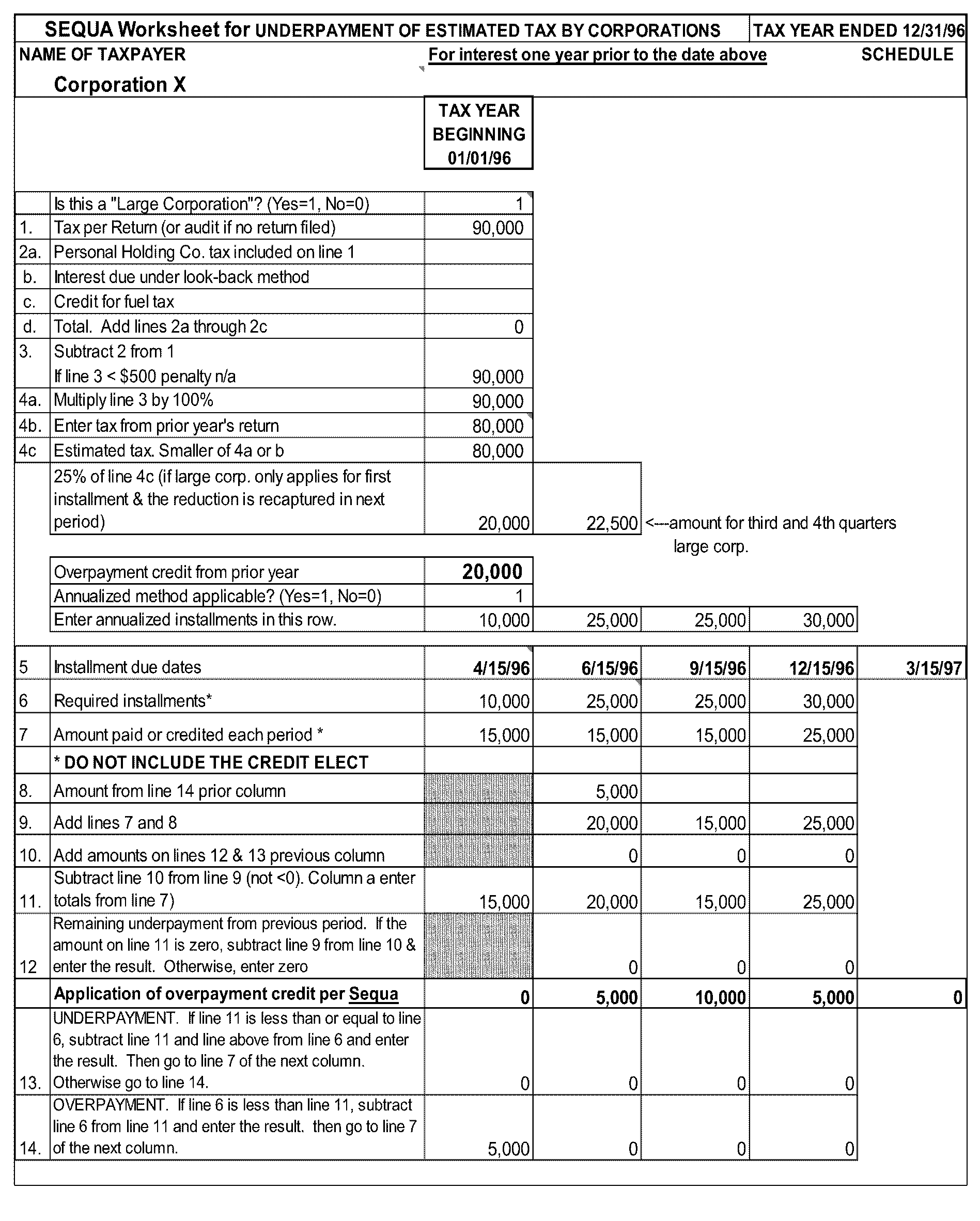
See Exhibit 8.17.6-2 for a sample of a completed Sequa Worksheet.
-
Excel versions of the Sequa Worksheet are available on the Appeals Technical Support SharePoint site, which is reached by the "Spreadsheets Sharepoint" link on the TCS web site. Sequa worksheets for individuals are located in the "Individual" spreadsheets folder, and the Sequa Worksheets for corporations in the "Corporate Spreadsheets" folder
-
It is very important to use the correct worksheet for the year involved. Instructions for completing the Sequa Worksheets are contained within the Excel workbook.
• Individuals - The Sequa worksheet for individuals has an Input tab so that the year can be input correctly.
• Corporations - Use the worksheet corresponding to the subsequent year for the year of the underpayment of tax. For example, for a 2007 year tax underpayment, you will need to complete the Sequa worksheet for the 2008 year.
-
-
Use the Sequa Worksheet to help determine the following:
-
Amount and due date of each required installment of estimated tax for the succeeding year.
-
Amount of overpayment required to satisfy the unpaid installments of estimated tax due so that an estimated tax penalty does not apply.
-
-
When completing this worksheet, use IRC 6654 and IRC 6655 to determine the required installments and installment dates. Use Chief Counsel Notice N(35)000-168 to determine the overpayment needed to avoid the estimated tax penalty.
-
The following information is needed to complete the worksheet:
-
When tax became overpaid. (Sequa Worksheets assume tax became overpaid on the due date of the return and was available to apply to required estimated tax installments for the succeeding taxable year.)
-
The dates and amounts of estimated tax payments made, if any, for the succeeding taxable year.
-
Tax reported for the succeeding year.
-
Method used to determine the amount of required installments of estimated tax for purposes of IRC 6654 or IRC 6655.
-
This information is found on the taxpayer’s transcripts of account for the deficiency and succeeding year, and the taxpayer’s return for the succeeding year, including Form 2220, Underpayment of Estimated Tax by Corporations; Form 2210, Underpayment of Estimated Tax by Individuals, Estates, and Trusts; or Form 2210-F, Underpayment of Estimated Tax by Farmers and Fisherman.
-
-
Some items to be aware of when preparing the Sequa worksheets are discussed below:
-
Subsequent Year Return Not Filed:
Sequa does not apply if the subsequent year tax return has not been filed. (See discussion in IRM 8.17.6.11.1.2.) -
Timely Filed vs. Non Timely Filed Returns:
The return does not have to be timely filed for Sequa to apply. There is no requirement that the return be timely filed for a taxpayer to make an election to have their overpayment applied to the next year as a credit elect. Treas. Reg. 301.6402-3(a)(5) expressly authorizes that taxpayers may make an election to credit an overpayment on an amended return. -
Prior Year Tax Liability - Individuals:
For individuals, if the taxpayer did not file a prior year tax return but was required to, a zero should be entered in the prior year tax liability. -
Prior Year Tax Liability - Corporations:
For corporations, the prior year tax liability should be left blank if:
• A tax return was not filed for the prior year, or
• The tax for the prior year was zero, or
• It was a short year return. -
Short Year Returns:
When there is a short year return, the number of required installment payments may be less than four, and you may need to manually adjust the installment due dates on your Sequa worksheet. If you have a short year return of less than four months, there are no installment payments required. Since the credit elect date cannot be greater than the Return Due Date (RDD), the RDD is used for your application of overpayment credit per Sequa. In addition, the taxpayer cannot use the preceding year tax if it was not a taxable year of 12 months and the prior year tax liability should be left blank in this situation. -
52-53 Week Year End:
The installment due dates will not automatically be computed correctly on the Sequa worksheet when you enter your tax year beginning date for a 52/53 week tax period. Since the installment due dates will always be the 15th day of the 4th, 6th, 9th and 12th months, they will be the same as whatever month end was originally elected for the 52/53 week period. -
Payments and Credits for Individuals:
Some payments and credits that post to the transcript as a TC 766 are treated as a refundable credit which reduces the tax liability for both YR 1 and YR 2. The Sequa worksheet for individuals found on the SharePoint site has been revised to include the new refundable credits on lines 4 through 11 for the YR 2 tax amount. The tax amount entered for YR 1 (on line D of the Input tab of the Excel spreadsheet) should also be reduced by the refundable credit amounts. (See IRM 8.17.6.11.1.2 for definition of "YR 1" and "YR 2" .) Backup withholding credits for individuals are included on the same line with the rest of their federal tax withholding. -
Payments and Credits for Corporations:
Some payments and credits that post to the transcript as a TC 766 for corporations, such as fuel tax credits and backup withholding credits are treated as a refundable credit which reduces the tax liability for both YR 1 and YR 2. If you are unable to determine whether a TC 766 is a fuel tax credit vs. another type credit, you should insert a footnote on your Sequa worksheet to explain. -
Telephone Excise Tax Credit (TETR):
TETR credits are also posted as a TC 766; however they are not considered a credit against tax for purposes of IRC 6654 and IRC 6655. (See Notice 2006-50, 2006-25 I.R.B. 1141, Section 5 paragraph (f) for more information.) -
Refunds Issued Before the Succeeding Year’s Due Date for Corporations:
In some instances, use of money on credit elect that is not applied to an estimated tax installment for the succeeding year will cease prior to the due date of that tax return. If a refund is issued before the normal due date, use of money under Rev. Rul. 99-40 will cease on the date of the refund, up to the amount of the refund. The corporate Sequa worksheet has been modified accordingly. -
Annualized Method of Accounting:
If you determine that the taxpayer used the annualized installment method, attempts should be made to secure the Form 2220/2210 for the subsequent year before preparing the Sequa worksheet. A Computer Condition Code (CCC) of 8 on a TXMODA for BMF returns could be an indicator that the annualized installment method was used. On TXMODA, it is listed as RCC>8 under the posted return information. (Note that IRM 3.11.16.9.1.33, CCC “8” – Waiver of Estimated Tax Penalty, lists other reasons why there might be a CCC 8 notated on a transcript, so a CCC 8 indicator could signify something other than the taxpayer using the annualized installment method.) -
Merged and acquired corporations:
For merged and acquired corporations, further research may be needed to determine the correct due date and payment dates.
-
-
The employee who prepares the settlement computations is also responsible for completing the "Form 5403 Worksheet" . Indicate if Sequa applies on the Form 5403 Worksheet.
-
The Appeals Officer or ATCL is responsible for attaching the Sequa Worksheet to the Form 5403 worksheet.
-
The Appeals Officer or ATCL is responsible for attaching all the documents to the inside left flap of the administrative file folder.
-
Also it is helpful to APS if the Forms 2210/2220 filed with the original returns (if any) are attached to the Form 5403 Worksheet.
-
If the taxpayer claimed research credits which are subject to the suspension periods required by Section 502(d) of the Tax Relief Act of 1999 (see IRM 8.7.1.4, Credit for Increasing Research Activities, IRC 41, for a full discussion). The suspended credits may not be taken into account in the May/Sequa computation before the expiration of their respective suspension periods. Thus:
-
The research credit attributable to the period beginning on July 1, 1999 and ending on September 30, 2000 may not be taken into account before October 1, 2000.
-
The research credit attributable to the period beginning on October 1, 2000 and ending on September 30, 2001 may not be taken into account before October 1, 2001.
-
-
The research credit suspension may have multiple effects on the May/Sequa computations, as follows:
-
The current year tax may not include the suspended research credit.
-
The prior year tax liability may not include the suspended research credit.
-
The estimated tax payments may be adjusted after the suspension period where either the taxpayer files a claim for a credit elect with respect to the suspended research credit, or the taxpayer files an amended return and indicates that the suspended research credit is to be applied to its estimated tax for the succeeding taxable year.
-
The required estimated payment may be reduced after the suspension period for the suspended research credit that relates to the current year tax liability.
Example:
-
Assume that the taxpayer, a calendar year corporation, had $800 of research credit for 1999 and $1,000 of research credit for 2000 (before taking into account any suspended credits). The amount of research credit from tax year 1999 attributable to the first suspension period (July 1 through December 31) is $400 (6/12 of $800) and the amount of research credit from tax year 2000 attributable to the 1st suspension period (January 1 through September 30) is $750 (9/12 of $1,000). The amount of the research credit from tax year 2000 attributable to the second suspension period (October 1 through December 31, 2000) is $250 (3/12 of $1,000).
-
Estimated tax payment based on current year tax liability – If the taxpayer makes an estimated tax payment for its 2000 taxes based on its current year tax liability, whether or not that liability is annualized, that liability must be determined without regard to the $750 of research credit attributable to the period January 1 through September 30, 2000 and the $250 of research credit attributable to the second research suspension period (October 1 through December 31, 2000).
-
Estimated tax payment based on prior year tax liability – The prior year tax liability must be determined without regard to the $400 of research credit attributable to the period July 1 through December 31, 1999.
-
Adjustment to estimated tax payments – If the taxpayer indicates on its amended return for 1999 (filed on or after October 1, 2000) that all or part of the $400 of research credit attributable to the period July 1 through December 31, 1999, and available on October 1, 2000, is to be applied to its estimated tax for the succeeding taxable year (in lieu of a refund), then the amount requested will be applied to the taxpayer’s estimated tax payment due on or after December 15, 2000 since this is the first estimated tax payment due on or after October 1, 2000.
-
Reduction to required estimated payments – The taxpayer may use its $750 suspended 2000 year research credit that is attributable to the period January 1 through September 30, 2000 (and available on October 1, 2000) to reduce the amount of estimated tax payments otherwise required to be paid on December 15, 2000 since this is the first estimated tax payment due on or after October 1, 2000.
-
The $250 suspended 2000 year research credit attributable to the second suspension period from October 1 through December 31, 2000 does not enter into the May/Sequa computation since it is not available until October 1, 2001.
-
-
-
See Notice 2001-2 and IRM 21.7.4.4.8.3.4.1, Research Credit Suspension Periods, for additional information. Also, refer to the Form 2210 and Form 2220 instructions in the IRS forms catalog for the applicable year.
| The Internal Revenue Code defines, in some instances generally and in others in specific terms, the conditions under which interest is either restricted or prohibited on Internal Revenue taxes. The table below lists some of the sections of the Internal Revenue Code and certain provisions having the effect of law, which govern adjustments resulting in deficiencies or overassessments on which interest is restricted. It also lists an identifying title and the related provision which governs the computation of interest. |
| Code Section | Subject | Interest Restricted on Underpayments | Overpayments |
|---|---|---|---|
| INCOME TAX | |||
| 172(b) | Net Operating Loss Carryback | 6601(d) | 6611(f) |
| 39 | Unused Credit Carryback | 6601(d) | 6611(f) |
| 1212(a) | Capital Loss Carrybacks | 6601(d) | 6611(f) |
| 6411(b) | Tentative Carryback Allowance | 6601(d) | 6611(f) |
| 6601(d) as amended by P.L. 105-34 Sec. 1055(a) 6611(f) as amended by P.L. 105-34 Sec. 1055(b)(1) | Carryback of Foreign Tax Credit | 6601(d)(2) | 6611(f)(2) |
| 901 | Foreign Tax Credit | 905(c) | Not Restricted |
| 547(a) | Deficiency Dividend Deduction Personal Holding Co. Tax |
547(f)(2) | 547(b)(2) |
| 1341(b)(2) as amended by P.L. 94-455 Sec. 1901(a)(146) | Renegotiation of Certain Subcontracts | Sec. 60(e) P.L. 85-866 | |
| 1341(a) | Computation of Tax Where Taxpayer Restores Substantial Amount Held Under Claim of Right | 1341(b) | |
| 7508 | Time for Performing Certain Acts Postponed by Reason of War | 7508(a) | 7508(a) and (b) |
| 1402(e) | Self-Employment Income Social Security Coverage by Ministers, etc. | Sec. 101(d) of P.L. 86-778 9-13-60 | Sec. 101(d) of P.L. 86-778, 9-13-60 |
| 1383(a) | Tax Treatment of Cooperatives and Patrons | 1383(b) | |
| 7405 | Erroneous Refunds | 6404(e)(2) | |
| EMPLOYMENT TAXES | See IRM 8.7.16 for additional information on employment tax cases in Appeals. | ||
| 3101, 3111 | FICA | 6205(a) | 6413(a) |
| 3201, 3221 | RRTA | 6205(a) | 6413(a) |
| 3402 | Income Tax Collected at Source | 6205(a) | 6413(a) |
| 3121(l) | Foreign Subsidiaries of Domestic Corporations | 3121(l)(5)(A) | 3121(l)(5)(A) |
| 3302(a), 3302(b) | Federal Unemployment Tax Credit Against Tax Imposed by Sec. 3301 | 6413(d) | |
| 7405 | Erroneous Refunds | 6404(e)(2) | |
Exhibit 8.17.6-2 is a completed Sequa worksheet based on the facts in Chief Counsel Notice N(35)000-68. The following are the facts of the case.
1) Pursuant to a six month extension, Corporation X, a calendar year taxpayer, timely files its 1995 return on September 15, 1996. On its 1995 return, Corporation X reported a tax liability of $80,000 and total payments of $100,000, all of which were made on or before March 15, 1996. Corporation X has elected to have its entire overpayment of $20,000 applied to its estimated tax for 1996. In April, 1998, it is determined that Corporation X’s correct tax liability for 1995 is $100,000, and Corporation X pays the deficiency of $20,000. For its 1996 tax year, Corporation X reported total tax of $90,000 and that, by annualizing its income, as it was permitted to do, its required installments of estimated tax were $10,000, $25,000, $25,000, and $30,000, respectively. Corporation X also made a timely payment of each of its installments of estimated tax for 1996, not including the overpayment credited from 1995, in the amounts of $15,000, $15,000, $15,000, and $25,000, respectively.
2) Corporation X’s required first installment of estimated tax for 1996, ($10,000) was less than the payments of estimated tax it made prior to the installment due date ($15,000), not including the overpayment credited from 1995. Corporation X, therefore, did not need to use the overpayment to avoid an addition to tax with respect to that installment. For interest purposes, the 1995 overpayment of $20,000 is considered a payment of 1995 tax through the first installment of estimated tax for 1996, and Corporation X’s payment of tax for 1995 through the first installment of estimated tax for 1996 is equal to its correct tax liability for 1995. Interest, therefore, does not begin to accrue on the 1995 deficiency before the due date of the second installment of estimated tax for 1996.
3) With respect to the second installment of estimated tax for 1996, Corporation X did not make sufficient cash payments ($15,000 + $15,000 = $30,000) to satisfy the amount required to be paid ($10,000 + $25,000 = $35,000). To avoid an estimated tax penalty, Corporation X, therefore, is required to use $5,000 of the 1995 overpayment as a payment of estimated tax for 1996 as of the due date for the second installment. For interest purposes, only $15,000 of the 1995 overpayment is still considered a payment of tax for 1995, and Corporation X's correct tax liability for 1995 now exceeds its payment of tax for 1995 by $5,000. Interest on the $5,000 therefore begins to accrue on $5,000 of the deficiency as of the due date of the second installment of estimated tax for 1996.
4) By the due date for the third installment, Corporation X’s estimated tax liability for 1996 ($10,000 + $25,000 + $25,000 = $60,000) exceeded its payments ($45,000 (cash) + $5,000 (overpayment previously credit) = $50,000) by an additional $10,000. Corporation X avoids an estimated tax penalty because it uses an additional $10,000 of the 1995 overpayment as of the due date for the third installment of estimated tax for 1996. Corporation X’s correct tax liability for 1995 now exceeds its payment of tax for 1995 by $15,000 and interest accrues on $15,000 of the 1995 deficiency as of the due date for the third installment of estimated tax for 1996.
5) Corporation X’s estimated tax liability for the fourth installment ($10,000 + $25,000 + $25,000 + $30,000 = $90,000) exceeded its payments ($70,000 (cash) + $15,000 (overpayment previously credited) = $85,000) by $5,000. Corporation X avoids an estimated tax penalty because it has $5,000 of additional 1995 overpayment, which is credited against the 1996 estimated tax liability as of the due date for the fourth installment. Corporation X’s correct tax liability for 1995 now exceeds its payment for that year by the full amount of the deficiency ($20,000), and interest accrues on the $20,000 as of the due date for the fourth installment of estimated tax for 1996.