)
or https:// means you've safely connected to the .gov website. Share sensitive information only on official, secure websites.
)
or https:// means you've safely connected to the .gov website. Share sensitive information only on official, secure websites.


- 8.19.6 Partner Cases
- 8.19.6.1 Program Scope and Objectives
- 8.19.6.1.1 Background
- 8.19.6.1.2 Authority
- 8.19.6.1.3 Responsibilities
- 8.19.6.1.4 Program Reports
- 8.19.6.1.5 Terms and acronyms
- 8.19.6.1.6 Related Resources
- 8.19.6.2 Partner Cases
- 8.19.6.2.1 Overview
- 8.19.6.3 Partner Case Responsibility
- 8.19.6.4 Statute For Partner's Case
- 8.19.6.5 Appeals Centralized Database System (ACDS) Processing
- 8.19.6.6 Partner Case Statutes
- 8.19.6.6.1 Securing Partner Case Consents
- 8.19.6.6.1.1 Executed by Power of Attorney
- 8.19.6.6.1.2 Consolidated Returns
- 8.19.6.6.2 Updating ACDS and the Partnership Control System (PCS) After a Consent Has Been Secured
- 8.19.6.6.1 Securing Partner Case Consents
- 8.19.6.7 Partner Case Research
- 8.19.6.8 Partner Power of Attorney
- 8.19.6.9 Assessment of TEFRA Partnership Issues
- 8.19.6.10 Settlement Computations For TEFRA Partner Cases
- 8.19.6.10.1 TEFRA Issues Resolved Before Non-TEFRA Issues
- 8.19.6.10.2 Non-TEFRA Issues Resolved Before TEFRA Issues---Agreed Cases
- 8.19.6.10.3 Non-TEFRA Issues Resolved Before TEFRA Issues---Unagreed Cases
- 8.19.6.10.3.1 Munro Computations
- 8.19.6.10.3.2 Oversheltered Returns (For Partnership Tax Years Ending After August 5, 1997)
- 8.19.6.10.4 TEFRA and Non-TEFRA Issues Resolved At the Same Time
- 8.19.6.10.5 Rule 155 -Partner Case
- 8.19.6.10.6 Accelerated Closing for TEFRA Partner
- 8.19.6.11 Penalties on Partner Cases
- 8.19.6.12 Partner Case Closings
- 8.19.6.13 Use of Closing Agreements
- 8.19.6.14 Innocent Spouse Relief
- 8.19.6.15 Closing Joint Committee Partner Cases
- 8.19.6.16 Failure to File Return – Partner
- 8.19.6.17 Working Partner Cases When Key Case File Is Destroyed
- 8.19.6.17.1 Source of Partner Cases
- 8.19.6.17.2 Contents of Partner Case File
- 8.19.6.17.3 Additional Sources of Information
- 8.19.6.18 Bankruptcy
- 8.19.6.18.1 Effect of Bankruptcy on Partner Case
- 8.19.6.18.2 Effect of Partner Bankruptcy on Statute of Limitations
- 8.19.6.18.3 Partner Files for Bankruptcy - Appeals has Key Case
- 8.19.6.18.4 Partner Files for Bankruptcy - Appeals has the Non-TEFRA Issues
- 8.19.6.18.5 Determining if a Partner is Named in a Bankruptcy Petition
- 8.19.6.19 Affected Items Cases in Appeals
- 8.19.6.19.1 ACDS Processing
- 8.19.6.19.2 Statute of Limitations on Affected Items
- 8.19.6.19.3 Affected Item Proceeding With No Partnership Proceeding
- 8.19.6.19.4 Affected Item Cases After a Partnership Proceeding
- 8.19.6.19.5 Affected Item Cases With Overpayments
- 8.19.6.20 Conforming the Partner Return with the TEFRA Partnership Return
- 8.19.6.21 Closing the CIC Corporation, Joint Committee or Other Corporate Specialty Partner Case
- 8.19.6.22 Best Practices for Appeals Team Case Leaders and Appeals Officers
- Exhibit 8.19.6-1 Sample Joint Committee ReportTEFRA Issues Unresolved--Expedited Refund Request
- Exhibit 8.19.6-2 Sample Joint Committee ReportTEFRA Issues Unresolved
- Exhibit 8.19.6-3 Sample Joint Committee ReportTEFRA Issues Resolved--Expedited Refund Request
- Exhibit 8.19.6-4 Sample Joint Committee ReportTEFRA Issues Resolved
- Exhibit 8.19.6-5 Case Summary Card for a Related Non-Key TEFRA Partnership Case
- Exhibit 8.19.6-6 Munro Language for Forms 870 or 870-AD for Agreed Non-Docketed Cases
- Exhibit 8.19.6-7 Example of Munro Computation
- Exhibit 8.19.6-8 Munro Stipulation for Deficiency Cases
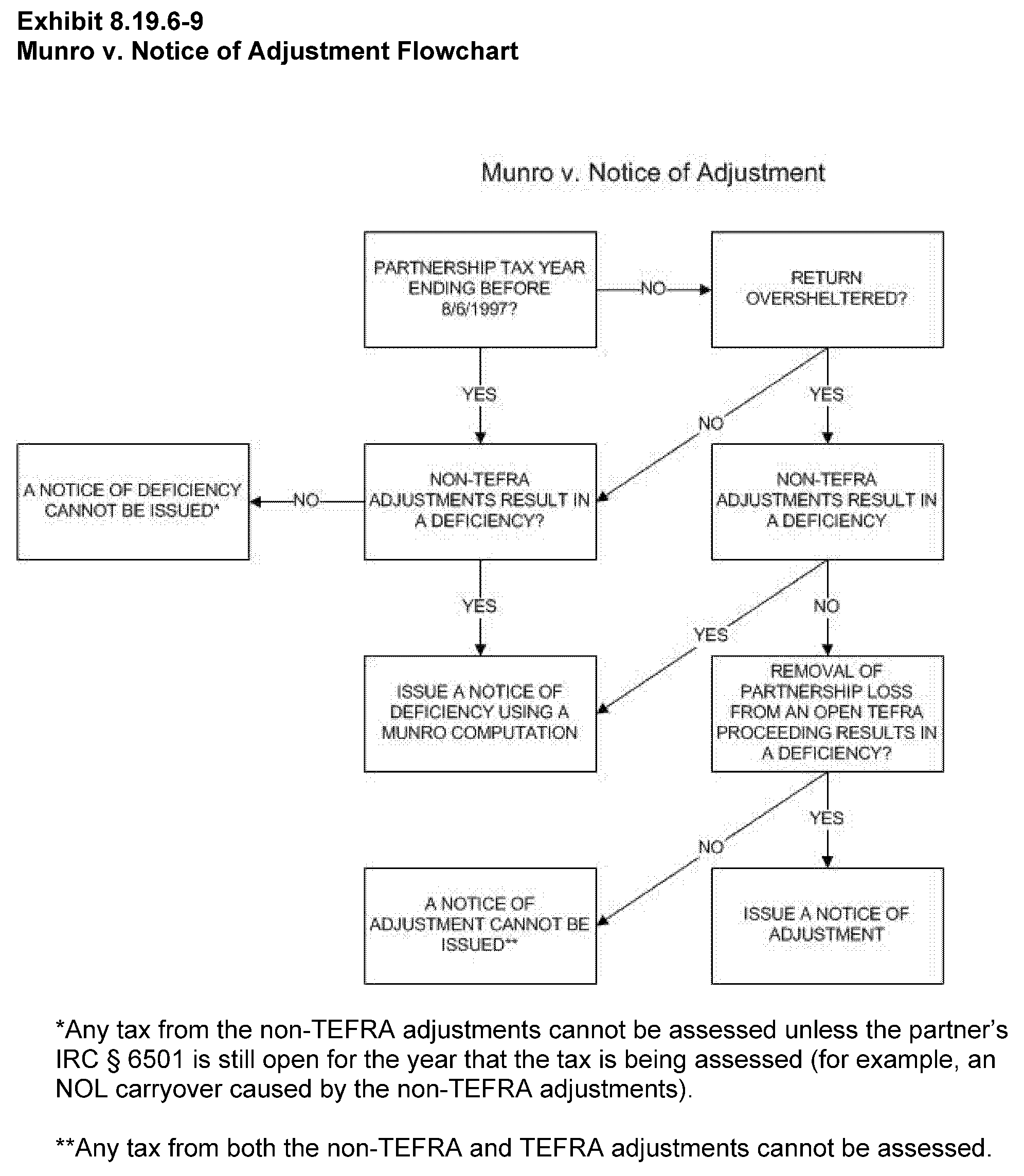
- Exhibit 8.19.6-9 Munro v. Notice of Adjustment Flowchart
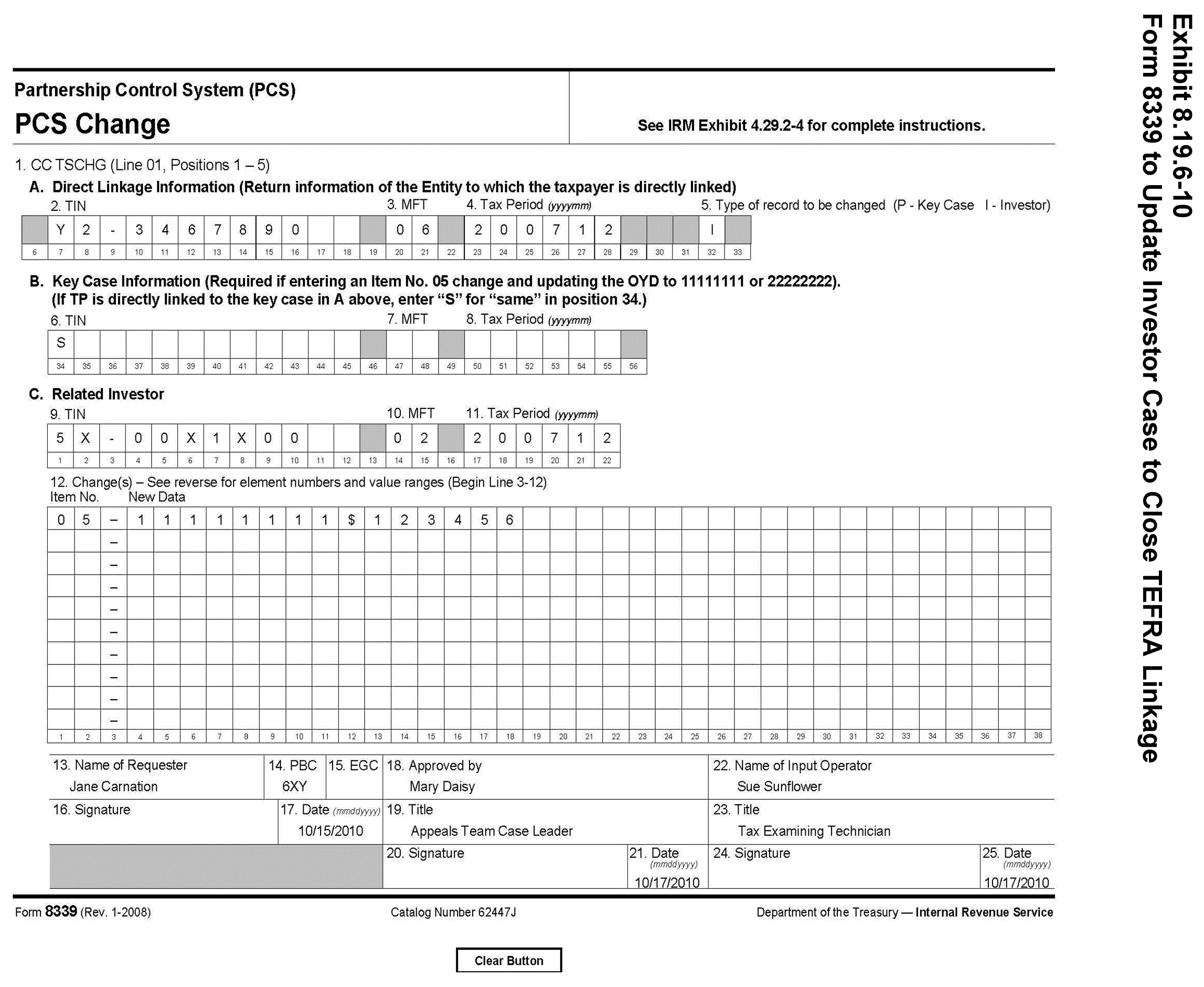
- Exhibit 8.19.6-10 Form 8339 to Update Partner Case to Close TEFRA Linkage
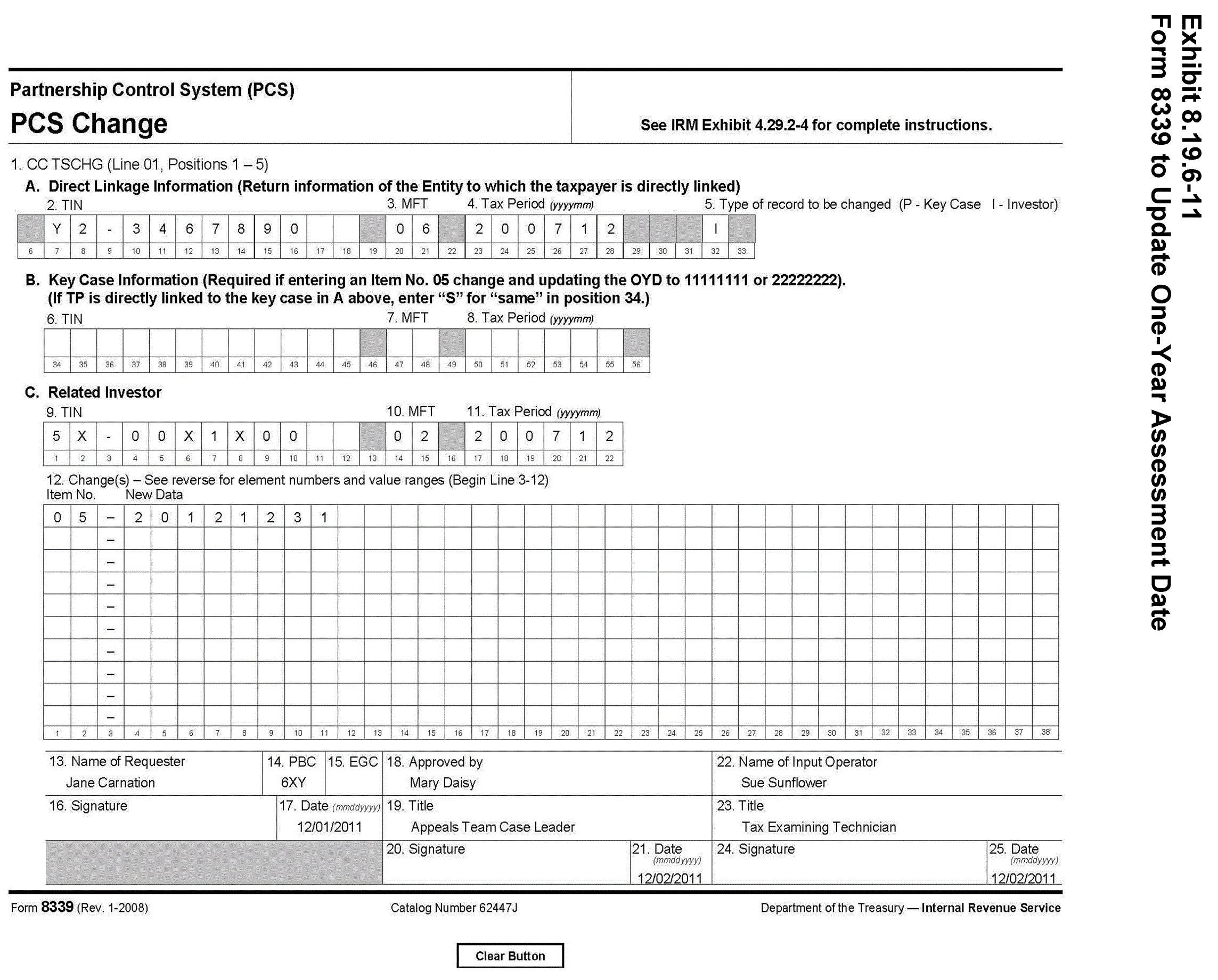
- Exhibit 8.19.6-11 Form 8339 to Update One-Year Statute Date
- 8.19.6.1 Program Scope and Objectives
Part 8. Appeals
Chapter 19. Appeals Pass-Through Entity Handbook
Section 6. Partner Cases
8.19.6 Partner Cases
Manual Transmittal
May 13, 2025
Purpose
(1) This transmits revised IRM 8.19.6, Partner Cases.
Material Changes
(1) Added new IRM section, Program Scope and Objectives and related subsections to comply with the Deputy Commissioner of Services and Enforcement and Operation Support memo, dated September 14, 2016, entitled Heightened Awareness, Sensitivity and Understanding of Internal Controls.
(2) Added Taxpayer Bill of Rights (TBOR) content based on guidance from the Division Counsel/Associate Chief Counsel (National Taxpayer Advocate Program) and Branch 3 of the Associate Chief Counsel (Procedure and Administration) to the Related Resources section of the Internal Controls.
(3) Added the following statement to the Related Resources section of the Internal Controls: "In accordance with IRM 25.30.2.3, Statement of Commitment, Appeals will work collaboratively with the Taxpayer Advocate Service (TAS) to enhance the taxpayer experience. For more information, see IRM 25.30.2, Service Level Agreement between the IRS Independent Office of Appeals and the Taxpayer Advocate Service."
Effect on Other Documents
IRM 8.19.6 dated April 19, 2016 is superseded.Audience
All IRS Independent Office of Appeals employees working with TEFRA partner returns.Effective Date
(05-13-2025)
John Hinding
Director, Specialized Examination Programs and Referrals
-
Purpose: This IRM section describes the statute processes and procedures for working partners in the Tax Equity and Fiscal Responsibility Act (TEFRA) partnerships in the IRS Independent Office of Appeals (Appeals).
-
Audience: Appeals Technical Employees and Appeals Team Managers that work partner cases.
-
Policy Owner: Appeals Technical Guidance is under the Director, Specialized Examination Programs and Referrals.
-
Program Owner: Appeals Technical Guidance is the program office responsible for providing technical and Procedural Guidance to Appeals employees for TEFRA partnership and partner issues.
-
Contact Information: Appeals employees should follow established procedures on How to Contact an Analyst. Other employees should contact the Product Content Owner shown on the Product Catalog Information Page for this IRM.
-
IRM 8.19.6 is intended to give Appeals employees, including Appeals Technical Employees (ATEs), Tax Computation Specialists (TCSs), and Account and Processing Support (APS) specific guidance in working partners in TEFRA partnerships. Since these cases require different technical and procedural treatment, Appeals employees should be familiar with the contents of this Handbook.
-
All guidance in this section of the IRM is for partners in TEFRA partnerships in Appeals for consideration of non-TEFRA issues (issues not from TEFRA partnerships or other flow-through entities). These cases may be considered by one ATE before, after, or at the same time the ATE or another ATE is considering the TEFRA partnership key case.
-
This section includes partner cases in Appeals for which Appeals has jurisdiction of the computation and assessment of the TEFRA adjustment.
-
Although the partner case may be in Appeals at the same time as the key case, they are managed as two separate cases since the partnership items are considered in the unified proceeding.
-
References concerning the Campus TEFRA Functions (CTFs) are for cases controlled on the Partnership Control System (PCS). The CTFs only work with key cases and partners controlled by PCS.
-
All references to the Internal Revenue Code (IRC) are to IRC sections in effect for TEFRA partnerships, before amendment by the Bipartisan Budget Act (BBA) of 2015.
-
For non-TEFRA cases, see IRM 8.19.9, Non-TEFRA Procedures. For partners in BBA partnerships linked for chapter 2/2A issues, see IRM 8.19.14, Bipartisan Budget Act of 2015 Procedures.
-
Appeals partner case procedures were established in response to the partnership provisions of TEFRA. These procedures, as updated, are still needed notwithstanding the repeal of the TEFRA partnership provisions by BBA for partnerships with tax years beginning on or after January 1, 2018.
-
The author of this IRM is shown on the Product Catalog page as the originator.
-
Policy, Planning, Quality and Analysis (PPQA) provides trend and data analyses and detailed summary reports for Appeals.
-
See IRM 8.1.1-1, Common Terms Used in Appeals, for common terms and definitions used in IRM Part 8.
-
The Taxpayer Bill of Rights (TBOR) lists rights that already existed in the tax code, putting them in simple language and grouping them into 10 fundamental rights. Employees are responsible for being familiar with and acting in accord with taxpayer rights. See IRC 7803 (a)(3), Execution of Duties in Accord with Taxpayer Rights. For additional information about the TBOR, see https://www.irs.gov/taxpayer-bill-of-rights.
-
In accordance with IRM 25.30.2.3, Statement of Commitment, Appeals will work collaboratively with the Taxpayer Advocate Service (TAS) to enhance the taxpayer experience. For more information, see IRM 25.30.2, Service Level Agreement between the IRS Independent Office of Appeals and the Taxpayer Advocate Service.
-
All guidance in this section of the IRM concerning the Campus TEFRA Functions (CTFs) is for cases controlled on the Partnership Control System (PCS). The CTFs only work with key cases and partners controlled by PCS.
-
All references in this IRM to appeals officers (AO) applies equally to appeals team case leaders (ATCL) and any actions required by appeals team managers (ATM) are performed by appeals team case leaders as to their own cases.
-
IRM 8.19.6 deals with partner cases in Appeals for consideration of non-TEFRA issues. These cases may be considered by one AO before, after, or at the same time that the AO or another AO is considering the TEFRA partnership key case.
-
Although the partner case may be in Appeals at the same time as the key case, they are controlled as two separate and unrelated cases since the partnership items are considered in the unified proceeding.
-
IRM 8.19.6 also covers partner cases in Appeals for which Appeals has jurisdiction of the computation and assessment of the TEFRA adjustment.
-
Generally, the returns of partners in TEFRA partnerships are not sent to Appeals with the TEFRA key case return for consideration of the partnership items. The partner cases are suspensed and controlled at the key case Campus TEFRA Function (CTF) if the partner cases are controlled on PCS.
-
For partners who are not Coordinated Industry Case (CIC) corporation, Joint Committee, or other corporate specialty cases, tax computations, assessments, and statute controls are the responsibility of the partner CTF even if the partner case is in Compliance or Appeals.
-
For CIC corporation, Joint Committee, or other corporate specialty cases, tax computations, assessments and statute controls are the responsibility of the Compliance function or Appeals, whichever has jurisdiction over the partner. This is true even if the key case return is in Appeals.
-
For Appeals, other corporate specialty cases include:
-
Form 1120 followed by a letter (for example, Form L, Life insurance company). However, Form 1120–A, Form 1120–S, and Form 1120–X are NOT corporate specialty cases.
-
All corporations with AIMS activity codes of 219 or higher.
-
-
If the partner's case is received in Appeals after the partnership examination is started, the file will contain the following documents:
-
Form 5546 (Examination Return Charge-out Sheet) and/or Form 6658 (Notice of Special Investor Action) marked "TEFRA."
-
Schedule K-1.
-
-
If the partner's case is received in Appeals before the partnership examination is started, the key case CTF will notify Appeals when the partnership examination is started. They will mail to APS the documents shown in paragraph (5) above, and the CTF may also request a copy of the return. The AO will send a copy of the requested return as soon as it is requested.
-
The non-TEFRA issue case statute of limitations is determined under IRC 6501. This statute is shown on ACDS as the partner case statute.
-
A separate minimum assessment period applies to the partner for each TEFRA partnership in which the taxpayer invested. Appeals now tracks the separate TEFRA period for the CIC corporate partner, the Joint Committee partner, and partners which are other corporate specialty cases.
-
Partner cases will be established as separate work units on ACDS and will be closed separately when a decision is reached on the non-TEFRA issues.
-
When an income tax case is received in Appeals, if an AMDIS or AMDISA is missing, APS will secure an AMDIS or AMDISA for each tax year.
-
If the AMDIS or AMDISA has a PICF code of 4 or 5, this indicates that the partner has at least one open TEFRA key case linkage (either an eight-digit date or a blank date). If the PICF code is 4 or 5, the AO will verify that APS took the following actions:
-
Updated the type code on ACDS to "TEFRAI"
-
Requested a TSUMYI for each year in Appeals jurisdiction to determine the TEFRA key case linkages and the status of the linkages
-
Retained the AMDIS/AMDISA and TSUMYI in the administrative file for the AO
-
-
For CIC corporations, Joint Committee, or other corporate specialty cases, if there is a PICF 4 or 5, APS will card in the open TEFRA linkage from the TSUMYI on ACDS for the purposes of tracking the statute of limitations and assessment.
-
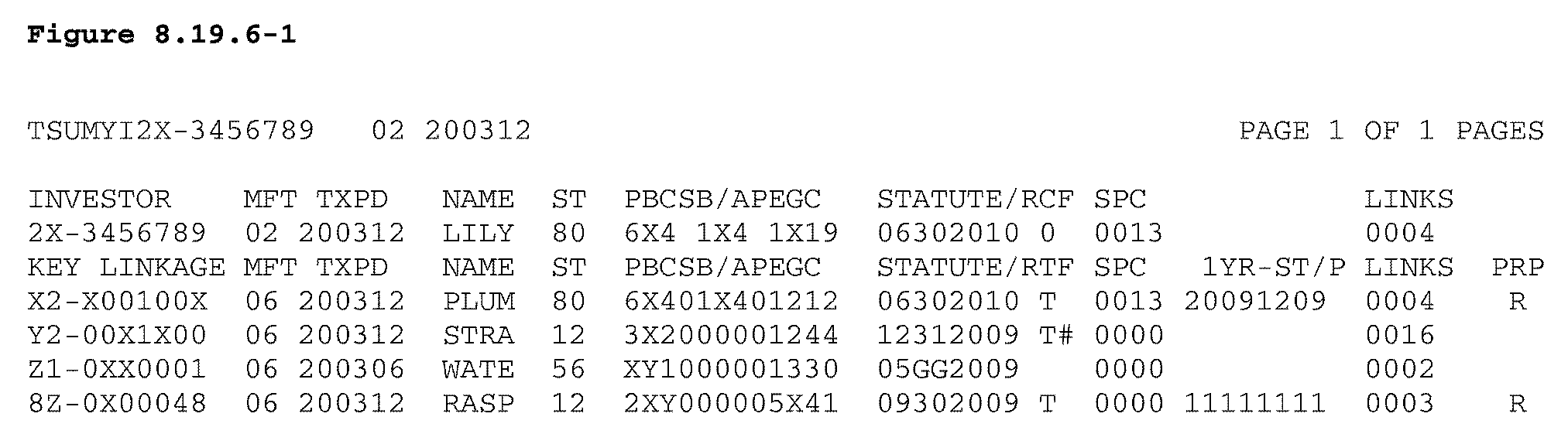
If the one-year statute date on the TSUMYI is "11111111," this particular linkage is not an open TEFRA linkage. The entry "11111111" under the one-year statute date indicates that a TEFRA linkage was closed, and any computational adjustment and assessment was made for this partnership. Do not card in the key linkages with a one-year statute date of "11111111."
-
A sample TSUMYI is shown below in Figure 8.19.6-1.
-
TEFRA linkages are identified on a TSUMYI by the letter T to the right of the partnership statute date. In the sample TSUMYI in Figure 8.19.6-1, the partnership linkages with the name controls of PLUM, STRA, and RASP are TEFRA linkages, while the partnership linkage with the name control of WATE is a non-TEFRA linkage.
-
In the sample TSUMYI in Figure 8.19.6-1, the TEFRA linkage to PLUM has an eight digit date (12-9-2009), the TEFRA linkage to STRA has a blank date, and the TEFRA linkage to RASP has 11111111. The TEFRA linkages to PLUM and STRA are therefore open TEFRA linkages and must be carded in on ACDS.
Caution:
If any of the TEFRA linkages has a tier indicator (a # sign) to the right of the letter T, this linkage is a tier meaning that it is a partner in at least one other key case. It is recommended that a TSUMYI be secured on any tier linkages in order to ensure that there are no eight digit dates above the tier that have not been input to PCS for this partner.
-
When there is an open TEFRA linkage (the TSUMYI is either an eight-digit date or blank), the AO will verify that APS created a case summary card for each linked partnership and carded it into ACDS as a related non-key case as follows:
-
WUNO: WUNO of the partner case
-
TP: Name of the partnership. If necessary, research IDRS for the full name of the partnership (INOLE, NAMEE or NAMES).
-
TIN: Partnership TIN from TSUMYI, key linkage field
-
MFT: MFT of partnership (06) from TSUMYI, MFT field
-
TYPE: REF
-
FEATRCD: N/A
-
AO: Same as the partner case
-
ASNDATE: Actual date assigned
-
REQAPPL: N/A
-
RECDATE: Date case received
-
CREATED: Computer generated
-
SOURCE: Applicable source code of partner case
-
Location: Same as the partner case
-
KEYTP: Name of the partner case
-
KEYTIN: TIN of the partner case
-
KEYPER: Enter the earliest tax period of the partner case.
-
NOTE: "TEFRA LINKAGE"
-
-
The AO will verify that APS input the following in the Case Return Information section:
-
A (AIMS): "E" since these cases will not be controlled on AIMS.
-
TAXPER: Enter all tax periods for which there’s an open TEFRA linkage for this partnership. Add a tax period modifier to each tax period. Usually, the modifier will be "N" (no return).
-
STATDATE: If the one-year statute date is blank on the TSUMYI, leave STATDATE blank and input TFINV in CODE (statute code). If the one-year statute date on the TSUMYI is an eight-digit date other than "11111111" , input the one-year statute date from the TSUMYI as STATDATE and leave CODE (statute code) blank.
-
CODE (statute code): If the one-year statute date is blank on the TSUMYI, input TFINV. If the one-year statute date is an eight-digit date other than "11111111" , leave CODE blank.
-
PropdTax/PropdPen: Leave blank.
-
RevsdTax/RevsdPen: Leave blank.
-
DUPLICAT: Do not enter any duplication.
-
-
APS cards in each partnership case that shows an open TEFRA linkage to the partner in Appeals assigned to the AO. For example, if a CIC corporate partner has a PICF of 4 or 5 and the TSUMYI shows four open TEFRA linkages to this partner, APS inputs four different related non-key case summary cards following the instructions above. See Exhibit 8.19.6-5 for a sample related non-key case summary card.
-
Each case summary card may have more than one year if the CIC corporation, Joint Committee, or other corporate specialty case has an open TEFRA linkage to that partnership in more than one of the years for which Appeals has jurisdiction of the partner. However, only one partnership may be shown on each case summary card.
-
Appeals Officers will do the following:
-
Verify the AMDIS/AMDISA and if necessary TSUMYI against the case summary cards when a case is received.
-
Submit corrections to the case summary cards to APS. If the TSUMYI shows a one-year statute date of "11111111," verify that the assessment was made.
-
At least every quarter, research all cases assigned that have TEFRA linkages controlled on ACDS and CODE (statute code) = TFINV to determine if a one-year statute date appears on the TSUMYI. The AO should request that APS generate an Ad Hoc report based on CODE (statute code) = TFINV to assist in this determination.
-
If a one-year statute date appears on the TSUMYI, and the one-year statute date is not on ACDS, submit an ACDS related non-key case summary card update to APS. Also, secure a copy of the closing package from the CTF to ensure timely assessment of partnership adjustments.
-
-
As noted in IRM 8.19.6.2, Appeals is not responsible for making the computational adjustments and assessments for partners in a TEFRA partnership for these types of cases.
-
The procedures in IRM 8.19.6.4.1 for carding in any open TEFRA linkage on these cases do not apply. However, the TYPE code on ACDS should be "TEFRAI." This will allow instructions for sending these cases to TEFRA suspense (if applicable) to be generated using the customized Form 5402.
-
For any taxpayer who invests in a TEFRA partnership, the Service has a minimum of two dates of expiration for the period of limitations for assessments on the taxpayer's tax return. IRC 6501 provides the period of limitations for assessing all taxes assessed under the Code, while the period under IRC 6501 for assessing any income tax attributable to partnership items (or affected items) for a partnership taxable year may be extended by IRC 6229. The taxpayer will have additional expiration dates for the period of limitations if he/she is an partner in more than one TEFRA partnership.
-
Non-TEFRA issues on a taxpayer's return are always controlled by IRC 6501. Generally, the period for assessment under IRC 6501 is the later of three years from the date the return is due or filed, unless extended by consent. Other exceptions may apply to extend the time the IRS has to assess. See IRM 25.6.1 for more information.
-
The limitations period for partnership items and affected items is controlled by the partner's statute under IRC 6501, as extended by IRC 6229(a) until such time as the partnership items become nonpartnership items under IRC 6231(b). The most common circumstance listed in subsection (b) is a TEFRA settlement executed by the Service. See IRM 8.19.1.6.9.2.1 for additional information.
-
Once the conversion to nonpartnership items occurs, the statute on the partner's return relative to such items becomes the one-year assessment period under IRC 6229(f). This statute may be extended with either Form 872-F, Form 872 or Form 872-A. This one-year assessment period is sometimes called the one-year statute date or the one-year assessment date or the one-year date.
-
For defaulted FPAAs and entered court decisions, the statute on the partner's return is the one-year assessment period controlled by IRC 6229(d). This statute may be extended with either Form 872 or Form 872-A. Form 872-F cannot be used in this situation.
-
It is at the discretion of the ATM and/or AO whether to accept an partner case with a one-year statute date or to return the case to Examination for computation and assessment of the tax before returning the case to Appeals for consideration of the non-TEFRA issues.
-
If a partner case with a one-year statute date is accepted in Appeals, at least 365 (or at least 180 for cases being returned from Compliance after their consideration of a new issue or new information) days must remain on the statute for all partner cases which are CIC corporation, Joint Committee, or other corporate specialty cases. If there are not at least 365 days remaining on the one-year statute date, it is recommended that the case be returned to Examination as a premature referral. Compliance is responsible for computing and assessing the tax from all TEFRA linkages which have a live one-year statute date before the case reaches Appeals for CIC corporation, Joint Committee, and corporate speciality cases.
-
Form 872-F, Consent to Extend the Time to Assess Tax Attributable to Items of a Partnership That Have Converted Under Section 6231(b) of the Internal Revenue Code, will extend the statute of limitations for partnership items that have converted to nonpartnership items under IRC 6231(b). Form 872-F will also extend the statute for affected items on these partnership items. Form 872-F is limited to one partnership, though multiple years may be included. The most common situation where items are converted under IRC 6231(b) is a settlement agreement. A defaulted FPAA or entered court decision does not result in the conversion of partnership items to nonpartnership items. Thus, Form 872-F cannot be used in these situations.
-
Form 872, Consent to Extend the Time to Assess Tax, will extend the statute for partnership items, affected items, partnership items converted to nonpartnership items under IRC 6231(b) (including such items arising from defaulted FPAAs and entered court decisions during the statute period under IRC 6229(d)). Form 872 is not limited to one partnership and may include multiple years.
-
Form 872-A, Special Consent to Extend the Time to Assess Tax, is an open-ended version of Form 872.
-
In Ginsburg v. Commissioner, 127 T. C. 75 (2006), the Tax Court held that a consent that did not reference tax attributable to partnership items was not sufficient to extend the statute for affected items. As a result of Ginsburg, the Form 872 and Form 872-A now contain such language. Either a Form 872 or a Form 872-A should be solicited from the taxpayer when the taxpayer is either a direct or indirect partner in one or more entities that file (or should file) a Form 1065 (including a limited liability company), in the event that there are affected items at issue.
Note:
As stated above, Form 872-F will also extend the statute for affected items, but is limited to one partnership.
-
If the partnership proceeding is still open as to the taxpayer, and the taxpayer declines to sign a Form 872 or Form 872-A (Form 872-F would not be applicable at this time), an affected item notice of deficiency should not be issued as it would be premature. The IRS employee who is considering the partnership case is responsible for the partnership's IRC 6229(a) statute, which includes any affected items.
-
If the partnership proceeding is closed as to the taxpayer (by defaulted FPAA, settlement agreement, or Court decision), and the taxpayer declines to sign a Form 872 or Form 872-A (or Form 872-F for each settled partnership), an affected item notice of deficiency should be issued for any affected items (assuming that the taxpayer has not previously agreed to them) before the expiration of the applicable one-year statute date that was triggered by the closure of the partnership proceeding.
-
If the partnership proceeding is closed as to the taxpayer (because a proceeding was never opened or was closed as a no-change), and the taxpayer declines to sign a Form 872 or Form 872-A, an affected item notice of deficiency should be issued for any affected items (assuming that the taxpayer has not previously agreed to them) before the expiration of the IRC 6229(a) statute date of the partnership.
-
-
Any additional tax resulting from the partnership item adjustments must be assessed by the one-year statute date that was triggered by the closure of the partnership proceeding.
-
If the taxpayer declines to sign a statute extension, the case activity record should be documented accordingly in addition to taking any appropriate action to protect the statute of limitations.
-
The following are IRM references for more information on securing and processing consents:
-
IRM 8.21.3 - Appeals Technical Employees Statute Responsibility
-
IRM 8.21.6 - Statute Information on TEFRA Cases
-
IRM 25.6.22.3 - Notification of Taxpayer's Rights
-
IRM 25.6.22.3.1 - Separate Notification of Each Spouse
-
IRM 25.6.22.8 - Restricted Consents
-
-
The power of attorney must comply with Treas. Reg. 301.6223(c)-1(e) when signing the extension for an individual partner on either Form 872-F, Form 872 or Form 872-A. See IRM 8.19.6.8.
-
For consolidated corporate returns for tax years beginning before June 28, 2002, Treas. Reg. 1.1502-77A(a) provides in part:
"The common parent, for all purposes (other than the making of the consent required by paragraph (a)(1) of § 1.1502-75, the making of an election under section 936(e), the making of an election to be treated as a DISC under § 1.992-2, and a change of the annual accounting period pursuant to paragraph (b)(3)(ii) of § 1.991-1) shall be the sole agent for each subsidiary in the group, duly authorized to act in its own name in all matters relating to the tax liability for the consolidated return year. Except as provided in the preceding sentence, no subsidiary shall have authority to act for or to represent itself in any such matter" .
-
For consolidated corporate returns for tax years beginning on or after June 28, 2002, Treas. Reg. 1.1502-77(a)(1) sets forth essentially the same general rule as Treas. Reg. 1.1502-77A(a) (quoted above), but in addition Treas. Reg. 1.1502-77(a)(6)(iii) provides in part:
"Members as partners in partnerships. The Commissioner generally will deal directly with any member in its capacity as a partner of a partnership that is subject to the provisions of sections 6221 through 6234 and the accompanying regulations (but see paragraph (a)(2)(ix) of this section regarding the mailing of a final partnership administrative adjustment to the common parent)" .
-
In all cases, the consent (Form 872-F, Form 872, or Form 872-A, whichever is used), should be prepared in the name of (and for the signature of) the common parent corporation as agent for the consolidated group.
-
The name in the caption of the consent should reference both the common parent corporation and the affiliated companies. For example, where the common parent of the group is ABC Corporation, a proper caption would read: ABC Corporation and Subsidiaries.
-
The name of the common parent should be followed by the signature and title of an officer who is authorized to bind the common parent corporation.
-
-
For consolidated corporate returns beginning on or after June 28, 2002, if a subsidiary corporation that filed as part of the consolidated return was the partner in the TEFRA partnership, it is recommended that the consent also be signed on behalf of the subsidiary corporation.
-
The name of the subsidiary corporation should be followed by the signature and title of an officer who is authorized to bind the subsidiary corporation.
-
If there was more than one subsidiary corporation that was a partner in a TEFRA partnership, Form 13923 and Form 13924 may be used (as attachments to Forms 872-A and 872, respectively), to secure the signatures on behalf of the subsidiary corporations.
Note:
If either of these forms is used as an attachment, it should be referenced below the signature on behalf of the common parent on the Form 872-A or Form 872. Language such as "See Attachments 1 and 2 for additional corporate officer signatures" may be inserted below the signature on behalf of the common parent.
-
If it is unknown whether a subsidiary corporation was a partner in a TEFRA partnership, have all of the subsidiaries that filed as part of the consolidated return sign the attachment (Form 13923 or Form 13924) to the consent (Form 872-A or Form 872), if practical (i.e., when there are only a few subsidiaries).
-
-
After securing and signing the consent, the AO will update the non-key case statute on ACDS (Normal Update) with the new one-year statute date using the AIVP Statute Validation System (SVS). A validation will be submitted confirming that the statute critical data fields are accurate in ACDS.
-
If Form 872 or Form 872-A were secured, APS will update the statute on AIMS within 5 workdays of the receipt of the update request from the AO.
-
-
In addition to updating ACDS, the new one-year statute date must also be updated on PCS. The AO should complete either Form 8339 or Form 8344. A sample Form 8339 is found in Exhibit 8.19.6-11.
-
Instructions for completing and processing Forms 8339 and 8344 may be found on the Appeals TEFRA website. Also see Exhibit 8.19.6–11.
Note:
PCS is not programmed to accept open-ended one-year statute dates (when a Form 872-A is secured) or dates more than 32 months in the future. Accordingly, the statute date on PCS will not necessarily correspond to the statute date on ACDS. The AO will have to ensure the one-year statute date is updated on PCS as the actual one-year statute date approaches.
-
-
The Partnership Control System (PCS) is a separate database for pass-thru entity information. PCS interfaces with Master File and AIMS. The information in PCS includes TEFRA and non-TEFRA information for linked pass-thru entities and their investors.
-
Use the PCS database to assist in resolving a partner's case.
-
See IRM 8.19.10.3 for an overview of PCS and references to complete PCS information.
-
Refer to IRM 4.29, Partnership Control System (PCS) Handbook for additional information on the PCS.
-
-
A partner power of attorney for other tax matters such as non-TEFRA items may not cover partnership items and affected items unless the power of attorney so states. See Treas. Reg. 301.6223(c)-1(e), in respect of partnership proceedings that began on or after January 2, 2002.
-
For a Form 2848 to cover both partnership items and nonpartnership items, the partner should state in the power of attorney that authority for both matters is granted to the representative. Authority to represent a partner for penalties and affected items is granted to the representative in the same way as is representation on partnership items.
-
On the Form 2848 a partner may indicate his intent to delegate representation on his partnership items. The Form 2848 should show the following:
-
Section 3, Matters, under the heading "Description of Matter" insert "Income, including TEFRA Partnership Items"
-
Section 3, Matters, under the heading "Tax Form Number" enter the form number of the partner's return and "1065" (for example: 1040 and 1065)
-
Section 3, Matters, under the heading "Year(s) or Period(s)" enter the applicable year(s) or period(s)
-
-
If the "TEFRA partnership items" and "1065" are not included on the power of attorney, the representative may not be authorized to discuss partnership items, penalties, and affected item issues. See IRM 8.19.1.6.5.2, IRM 8.19.10.4.3.4, and IRM 8.19.2.16 for more information on powers of attorney.
-
Appeals may receive a TEFRA partner closing package from the CTF consisting of documents showing the resolution of the TEFRA partnership issues (decision document, defaulted FPAA or settlement agreement form), a Form 4605-A, and a Form 886-Z showing the corrected amount on all issues for the partner under Appeals jurisdiction.
-
If Appeals receives a TEFRA partner closing package from the CTF and the ACDS case record has a CODE = TFINV, either APS or the AO (whoever receives the package) will request a TSUMYI and update ACDS to reflect the one-year statute date and remove the TFINV code. If APS receives the closing package, then forward the TEFRA partner closing package and the updated case summary card, if appropriate, to the AO.
-
When the AO receives a TEFRA partner closing package from the CTF, the AO will request a computation of tax to reflect the adjustments from the completed TEFRA proceeding. This will be a partial computation as the non-TEFRA issues are still under Appeals consideration.
-
The assessment must be made within the one-year assessment period. One-year assessment periods under IRC 6229(f)(1), including settlements, can be extended on a Form 872-F, Form 872 or Form 872-A. One-year assessment periods under IRC 6229(d) (defaulted FPAAs and court decisions) can be extended using Form 872 or Form 872-A. One-year statute dates extended by Form 872-F, Form 872 or Form 872-A should be updated on both ACDS and on PCS. See Exhibit 8.19.6-11 for a Form 8339 updating the one-year statute date and Exhibit 8.19.6-10 for a Form 8339 closing the linkage. Instructions for completing the Form 8339 are found on the Appeals TEFRA website and in IRM 4.29.
-
The AO will prepare and submit Form 8339 to APS to update the PCS system to reflect the extension of a one-year statute date or follow other local procedures for updating PCS.
Note:
PCS is not programmed to accept open-ended statute dates or dates more than 32 months in the future. Accordingly, the statute date on PCS will not necessarily correspond to the statute date on ACDS. The AO will have to ensure the one-year statute date is updated on PCS as the actual one-year date approaches.
-
The AO should update ACDS to reflect an extension of a one-year statute date by Form 872-F, Form 872, or Form 872-A as follows:
-
If the consent is a Form 872-F or Form 872, enter the statute date on the form in STATDATE; for the Form 872-F, also enter "872–F" in CODE (Statute Code);
-
If the consent is a Form 872-A, enter "872–A" in CODE (Statute Code).
-
-
The AO will forward the computation of tax, a Form 5402 requesting a partial assessment, a copy of the decision document, defaulted FPAA, or settlement agreement with a copy of the Form 886-Z to APS for processing the partial.
-
Refer to IRM 8.20.6 (Appeals Case Processing Manual, Interim Actions) for procedures to process a partial. In addition APS will update ACDS to reflect the assessment of the partial as follows:
-
ACTION: INTERIM (other local procedures may apply).
-
TODATE: Enter date case sent to APS.
-
-
After the AO verifies that the assessment was made, the AO will update ACDS by removing the STATDATE and entering the CODE "ASESD" for each TEFRA linkage tax period assessed.
-
The AO will instruct APS to close the related non-key case summary card using ACDS closing code 45.
-
After verification that the assessment was made, PCS must be updated. The AO will prepare and submit Form 8339 showing the assessment, the amount, and new one-year statute date of "11111111," and instruct APS to close the linkage. See Exhibit 8.19.6-10 for an example Form 8339 to close a linkage. Local procedures may vary for updating the PCS system.
-
If affected items are applicable and the partner does not agree, issue a statutory notice of deficiency to the partner. Account and Processing Support will update the related non-key case summary card on ACDS to reflect the issuance of the statutory notice of deficiency per IRM 8.20.6. The case will remain a reference return at this time.
-
For partner cases which are not CIC corporation, Joint Committee or other corporate specialty cases:
-
The CTF has the responsibility to prepare computations on partner cases to reflect TEFRA key case adjustments if the case is linked on PCS. If the case is not linked on PCS, the examiner assigned the TEFRA key case has the responsibility to prepare the partner tax computations.
-
Appeals will only prepare the computations of the non-TEFRA adjustments for these partner cases.
-
In the event that Appeals does a courtesy computation for the partner to show the tentative tax from TEFRA adjustments before the CTF or the examiner completes their calculations, no assessment of the tax should be made by Appeals. The computation should be clearly marked "tentative."
-
In a very rare instance, Appeals will make the computation and assessment of a deficiency from TEFRA adjustments when the partner is not a CIC corporation, Joint Committee, or other corporate specialty case. For timely filed individual returns for tax years ending after July 22, 1998, interest is suspended if IRS fails to give notice of the liability and the basis of the liability within the time frame established by IRC 6404(g). See IRM 8.19.1.7. The TCS will complete the IRC 6404(g) worksheet and include the following:
-
Date the return was filed or due, whichever is later
-
Was the return filed timely - yes or no
-
Name of TEFRA partnership
-
IRC 6404(g) notice date and form of notice ( Form 5701, summary report, 60-day letter, Appeals Settlement Letter, or FPAA)
-
Amount of deficiency to which IRC 6404(g) applies for this TEFRA partnership
-
-
For partner cases which are CIC corporation, Joint Committee or other corporate specialty cases:
-
Appeals prepares computations and makes assessments if the partner is in Appeals jurisdiction.
-
If the case is in Compliance jurisdiction, the Compliance function makes the computations and assessments on the partner cases to reflect TEFRA key case adjustments.
-
See information above on IRC 6404(g).
-
-
If the TEFRA partnership key case is resolved, the CTF will process (including computing and assessing any tax) the partnership adjustments for the partners who are not CIC corporation, Joint Committee, or other corporate specialty cases. The CTF will send a copy of the computations (Form 5344 and Form 4549–A) to APS. APS will forward these documents to the AO. The AO will associate these documents with the partner file for use in preparing settlement computations.
-
If Appeals did not receive the Form 5344 and Form 4549–A, and there are indications in the case file that the taxpayer is a party to a TEFRA proceeding, the AO or TCS will request a transcript for that partner prior to preparation of the settlement computation or closing documents for the non-TEFRA adjustments. If necessary, request copies of the TEFRA computations from the taxpayer or the CTF.
-
If the TEFRA adjustments have been made and assessed before the non-TEFRA adjustments, as noted in paragraphs (1) and (2) above, the TCS will combine the TEFRA examination results with taxable income to produce the corrected taxable income when the non-TEFRA adjustments are computed.
-
If unagreed, follow normal procedures for preparation and issuance of a statutory notice of deficiency. The notice will show only non-TEFRA adjustments. Include TEFRA issues in taxable income as previously adjusted and tax as previously adjusted.
-
If the taxpayer has an IRC 6405(a) refund in excess of $2,000,000 and the criteria of IRM 8.7.9.7.1.1 are met, an expedited refund report should be submitted to the Joint Committee. See IRM 8.19.6.15.
-
If non-TEFRA issues are agreed when there is a TEFRA proceeding open and the case is in non-docketed status, take the following actions:
-
The TCS will calculate the partial computations taking into account the TEFRA partnership items as reported on the return.
-
The AO will secure the normal closing documents (Form 870 or Form 870-AD).
-
The AO will include language on the reverse side of the Form 870 or Form 870-AD to the effect that any change to the deficiency caused by resolution of the TEFRA proceeding can be assessed at the conclusion of the TEFRA proceeding as a computational adjustment. See Exhibit 8.19.6-6 for the approved language.
-
If the taxpayer will not sign the agreement form with this language, issue a statutory notice of deficiency, and, if issued, compute the deficiency using a Munro computation. See IRM 8.19.6.10.3.1 and Exhibit 8.19.6-7.
-
For partnership tax years ending after August 5, 1997, if the non-TEFRA adjustments do not create a deficiency because the return was oversheltered under IRC 6234, issue a Notice of Adjustment. See IRM 8.19.6.10.3.2.
-
-
If the non-TEFRA issues are agreed when there is a TEFRA proceeding open and the case is in docketed status, take the following actions:
-
The TCS will calculate the deficiency taking into account the TEFRA partnership items as reported on the return.
-
The AO will Include in a stipulated decision document language to the effect that any change to tax liability caused by resolution of the TEFRA proceeding can be assessed at the conclusion of the TEFRA proceeding as a computational adjustment. See Exhibit 8.19.6-8 for the approved language.
-
Secure an agreement from the taxpayer to use the Munro stipulation early in the proceeding. If the taxpayer does not agree, area counsel may need to move for an increased deficiency unless a Munro computation was used in the notice of deficiency.
-
-
There are two separate procedures that may apply when preparing a statutory notice of deficiency for non-TEFRA issues.
-
For partnership tax years ending before August 6, 1997, all TEFRA items are removed from the computations, resulting in deficiencies attributable only to the non-TEFRA adjustments. (Munro v. Commissioner, 92 T.C. 71 (1989)). See IRM 8.19.6.9.3.1.
-
For partnership tax years ending after August 5, 1997, whether the Munro decision will be followed depends on whether or not the partner return is oversheltered. An oversheltered return for the purposes of IRC 6234 is a return that shows no taxable income and shows a net loss from partnership items. See IRM 8.19.6.9.3.2.
-
Tax computation specialists should seek assistance from the AO if help is needed in determining whether the return is oversheltered or not.
-
See Exhibit 8.19.6-9 for a flowchart that may be used in determining whether to issue a statutory notice using a Munro computation or to issue a Notice of Adjustment.
-
-
A statutory notice of deficiency may be issued for affected items (including penalties for partnership tax years ending before August 6, 1997) that are considered by Appeals after the TEFRA proceedings are completed.
-
With the exception of Munro computations, the statutory notice of deficiency for non-TEFRA issues will be prepared following the guidelines shown in IRM 8.17.4, Notices of Deficiency.
-
If the partner case is unagreed for both the TEFRA and non-TEFRA issues, both a statutory notice of deficiency and an FPAA will be issued.
-
If the taxpayer is a partner in several TEFRA partnerships, a separate FPAA will generally be issued for each partnership.
-
For partners with open TEFRA linkages, Munro computations should be used for all statutory notice of deficiency (SND) cases, except when the returns involved are determined to be oversheltered as described in IRM 8.19.6.10.3.2. See Exhibit 8.19.6-7. This exhibit shows an example of a Munro computation.
-
When preparing a statutory notice on a case with an open TEFRA proceeding, the following paragraph should be included on an attachment to Form 4089:
" In computing the deficiency attributable to the adjustments in this notice, which adjustments are neither partnership items nor affected items, as defined by IRC 6231, all TEFRA partnership items subject to an open TEFRA proceeding, whether income, loss, deductions or credits have been ignored exclusively for the purpose of computing the deficiency which is attributable to the adjustments set forth herein. All TEFRA partnership items subject to an open TEFRA proceeding have been ignored in this notice of deficiency for computational purposes only and this notice is not a substitute for any Notices of Final Partnership Administrative Adjustment (FPAA) which may be issued in regard to the TEFRA partnerships. This computation is being made pursuant to the Tax Court decision in Munro v. Commissioner, 92 T.C. 71 (1989)."
-
A statutory notice which is prepared using Munro computations will start with what is called "modified taxable income" . Modified taxable income for Munro computations is the regular taxable income starting point for a statutory notice modified to disregard TEFRA partnership items.
-
Modified taxable income may be computed in an exhibit included with the statutory notice of deficiency as discussed below.
-
The computation of modified taxable income will start with taxable income per the return or as previously adjusted.
-
Make adjustments to eliminate (disregard) partnership items. All partnership items should be disregarded.
-
Examples of items to be disregarded: partnership income, partnership losses, separately stated income, separately stated deductions, credits, AMT adjustments, any other separately stated items.
-
Make any statutory adjustments such as itemized deduction limitations or exemptions adjustments that result from the adjustment made to TEFRA partnership items.
-
-
Compute "modified tax liability" using the modified taxable income.
-
When computing the modified tax liability, make any necessary adjustments to nonrefundable credits due to TEFRA adjustments being disregarded.
-
Recompute limitations for allowable nonrefundable credits based on the tax computed on the modified taxable income.
-
Recompute any refundable credits that are affected by the modified taxable income or the tax computed on the modified taxable income, for example, Earned Income Credit and Additional Child Tax Credit.
-
Recompute any taxes that are affected by the modified taxable income or the tax computed on the modified taxable income, such as self-employment tax or AMT.
-
-
The Form 5278 prepared for the statutory notice computation will start with modified taxable income:
-
The "Total tax shown on return or as previously adjusted" amount on line 19 of Form 5278 for the statutory notice will be the tax computed on the modified taxable income (the modified tax liability).
-
Any EIC or refundable credits computed on the modified taxable income will be considered to be the amounts as previously adjusted. For example:
EIC per return $3,000.00 EIC computed on Modified Taxable Income $2,000.00 Allowable EIC per SND $500.00 SND Adjustment to EIC $1,500.00
-
-
This is a sample paragraph to be included in the explanation of items:
"The following TEFRA partnerships are subject to partnership level proceedings pursuant to the partnership audit and litigation procedures of IRC 6221 through IRC 6234 with respect to the taxable year (years) and accordingly, all partnership items, whether income, loss, deductions or credits, have been disregarded for purposes of computing a deficiency attributable to the adjustments in this notice:"
ABC Partnership- Ordinary loss $(30,000.00) ABC Partnership - 50% Charitable contributions (6,000.00) LKJ Partnership - Ordinary Income 15,000.00 XYZ Partnership - Ordinary loss (7,000.00) HIJ Partnership - Ordinary loss (27,700.00) Total $(55,700.00) XYZ Partnership - General Business Credit $3,500.00 -
The use of Munro in the preparation of a statutory notice may result in an inflated deficiency until treatment of the TEFRA items is finally determined. Counsel has worked out a procedure with the Tax Court whereby the tax computation on a final decision may include the TEFRA item amounts as reported on the return.
-
If a return is oversheltered but the non-TEFRA adjustments do result in a deficiency, issue a statutory notice of deficiency using a Munro computation instead of issuing a Notice of Adjustment.
-
The AO should note "Munro on the Form 5402."
-
An oversheltered return for the purposes of IRC 6234 is a return which:
-
Shows no taxable income.
-
Shows a net loss from partnership items.
-
-
If a return is oversheltered, a Notice of Adjustment (Letter 4151) is prepared for the determined nonpartnership adjustments (IRC 6234(a)) if:
-
The partner case has adjustments to nonpartnership items,
-
There is an open TEFRA linkage, and
-
The adjustments to nonpartnership items do not give rise to a deficiency in tax, but would give rise to a deficiency if there was no net loss from partnership items.
-
-
A statement is enclosed with the letter that lists the adjustments to nonpartnership items. The AO or TCS may prepare the statement. If the TCS prepares the statement, then the AO should identify the nonpartnership adjustments.
-
The determined nonpartnership adjustments may be assessed as part of the computational adjustment of the partnership items following the conclusion of any TEFRA proceeding that concludes after the Notice of Adjustment is issued (IRC 6234(g)).
-
If the partnership items are determined before the conclusion of the nonpartnership proceeding, the entire proceeding is converted to a deficiency proceeding (IRC 6234(g)(3)).
-
-
If a notice of adjustment is issued when a deficiency could have been determined, the notice of adjustment is considered to be a notice of deficiency (IRC 6234(h)).
-
If a notice of deficiency is issued when a notice of adjustment would have been appropriate, the notice of deficiency is considered a proper notice of adjustment (IRC 6234(h)).
-
-
The partner may allow the notice of adjustment to default since there is no immediate tax consequence. Defaulted nonpartnership adjustments may be readjusted under refund procedures. The partner may challenge the defaulted nonpartnership adjustments through a refund action if the partner is later assessed following the conclusion of the partnership proceeding (IRC 6234(d)(2)(B)).
-
If the TEFRA and non-TEFRA adjustments are computed at the same time, there are usually two settlement computations in the file, one for the non-TEFRA adjustments and the other for the TEFRA adjustments. However, a combined settlement computation can also be prepared. If there is a combined settlement computation, generally the deficiency attributable to the TEFRA issues for each tax year and for each TEFRA partnership should be separately identified.
-
If the TEFRA and non-TEFRA adjustments are combined on the same settlement computation, the TCS should generally include a statement in the remarks section of the settlement computation that identifies the deficiency attributable to the TEFRA issues for each tax year and for each TEFRA partnership, similar to the following example:
Example:
The following identifies the deficiencies attributable to the TEFRA issues for each tax year and for each TEFRA partnership:
12/31/2000 12/31/2001 TEFRA Partnership A $2,000 TEFRA Partnership B 500 $1,000 TEFRA Partnership C 200 Exception:
If it is known that the deficiencies from multiple TEFRA partnerships will not have a different interest computation date (for example, if none related to a settlement agreement for a partnership tax year beginning after August 5, 1997), then it is not necessary to separately identify the deficiencies from each TEFRA partnership on either separate settlement computations or a combined settlement computation. See IRM 8.19.1.7.
-
If TEFRA adjustments had been previously assessed by Compliance, the TCS should work from the TEFRA adjustments report when preparing the non-TEFRA report.
-
In the rare instance where the TEFRA partner case requires a report to the Joint Committee on Taxation and the partner is an individual, interest suspension on the TEFRA adjustments may apply. The TCS will determine if the partner case is subject to interest suspension under IRC 6404(g). The TCS will include a statement on the Form 3610, Form 5278, or Form 4549/4549-A when IRC 6404(g) applies. See IRM 8.17.6.9.7 for procedures. See IRM 8.19.6.12.
-
The TCS may be asked to assist in the preparation of the IRC 6601(c) comment the AO is required to make on the Form 5402 by notating the information on the first page of the settlement computation for each TEFRA linkage to be assessed, the amount of the deficiency for each TEFRA linkage, the name of the TEFRA key case, and the date that the settlement agreement (if applicable) was signed on behalf of the IRS. See IRM 8.19.6.12.
-
Partner cases which are tried for non-TEFRA issues will be processed as Rule 155 cases, as explained in IRM 8.17.2. The Rule 155 procedures in IRM 8.17.2 are generally followed for computations prepared for the non-TEFRA issues.
-
If the TEFRA case has been resolved by agreement or default, the TCS will take the TEFRA adjustments into account when preparing the Rule 155 computation.
-
If the TEFRA issues are unresolved, the deficiency will be computed taking into account the TEFRA amounts as reported on the return.
-
A stipulated decision document must include language that any change to the deficiency liability caused by resolution of the TEFRA proceeding can be assessed at the conclusion of the TEFRA proceeding as a computational adjustment. See Exhibit 8.19.6-8 for the approved language.
-
When the non-TEFRA examination of a TEFRA partner is complete, the case cannot close if there is an open TEFRA linkage. In some cases, primarily CIC cases, the partner may request that their case be closed early before the TEFRA key case examination or appeal is complete. This is known as an accelerated closure.
-
To resolve the partner’s share of the TEFRA examination or appeal before the TEFRA key case partnership proceeding is complete, the AO must coordinate with the key case agent or AO. Failing to consult with the key case agent or AO could jeopardize the examination or appeal.
-
The key case agent or AO will provide the terms for settlement. To avoid the risk of consistent settlement problems, it is recommended that the partner wanting an accelerated settlement understand they must concede 100% of all potential adjustments.
-
The key case agent or AO must provide the AO working the partner case with the key case adjustments used in the settlement agreement. IRC 6224(c)(2) requires that all partners may request the same settlement; therefore, a settlement to one partner may result in a settlement of all partners. Avoiding the risk of consistent settlement problems is why it is critical that the key case agent or AO be involved with any settlement issued to a partner before completion of the key case examination.
-
A settlement agreement Form 870–PT(AD), Form 870–LT(AD), or Form 906 must be secured from the partner. The agreement is a final determination on the tax effect of the partnership and affected items. The partner may not later file an Administrative Adjustment Request (AAR) nor may they request to go to court on the settled issues.
-
A copy of the executed settlement agreement must be sent to the appropriate Campus TEFRA Function (CTF) controlling the key case linkage. Refer to Exhibit 8.19.11-8 for a sample Form 3210 that lists the documents needed in the closing package transmitting the agreement form.
-
For partner cases which are CIC corporation, Joint Committee, or other corporate specialty cases, Appeals prepares computations and makes assessments if the partner is in Appeals jurisdiction. If the case is in Compliance jurisdiction, the Compliance function makes the computations and assessments on the partner cases to reflect TEFRA key case adjustments.
-
When a taxpayer is in Appeals for a penalty issue and the taxpayer remains a party to an open TEFRA proceeding, the AO must consider the potential TEFRA adjustments to determine whether or not the penalty meets any required floor for assertion. In the ACM, the AO will explain the consideration of potential TEFRA adjustments in computing the required floor for assertion of the penalty. When considering the hazards to litigation of the penalty, take into account the potential TEFRA adjustments in determining the floor for assertion.
-
If the substantial valuation misstatement (IRC 6662(b)(3)) or the substantial understatement of income tax (IRC 6662(b)(2)) penalty applies but is mathematically zero for the partial settlement computation, the TCS will insert a statement on the first page of the settlement computation similar to the following:
"The _________penalty has been sustained; however, due to the statutory floor, the penalty does not apply to the partner at this time. Any subsequent application of the penalty will be based upon the computations in the schedule attached to the settlement computation."
-
If the penalty does not apply to all the adjustments, the TCS will prepare the schedule of items to which the penalty will apply. See Treas. Reg. 301.6231(a)(5)-1(e).
-
The penalty computations will be provided to the CTF so they can be taken into account when the TEFRA issues are resolved.
-
For partnership tax years ending after August 5, 1997, the applicability of penalties is determined at the partnership level.
Caution:
The penalties determined at the partnership level must be assessed within the one-year statute date even if an affected item notice of deficiency resulting from partnership adjustments is required. Issuing a statutory notice of deficiency does not suspend the one-year statute date for assessing the penalties.
-
If the issues generating penalties are finalized and the TEFRA proceeding is completed before examination of the non-TEFRA issues is completed, the TCS will include the TEFRA issues subject to the penalty in the revised penalty calculation in the settlement computation.
-
The AO will determine the proper routing of the partner case file by researching PCS. The AO will note the proper routing in the remarks of the Form 5402 for APS. After closing, APS will forward cases with an open TEFRA linkage to the appropriate destination as follows:
-
CIC corporation, Joint Committee, or other corporate specialty case files should be sent to the appropriate Examination Technical Services unit based on the location of the originating Examination group.
-
All other case files should be sent to the key case CTF.
-
-
If a TEFRA audit remains open, the assessments to the non-TEFRA issues must be done as partials. However, the ACDS closings will be done as a full closure. For details on closing procedures, refer to IRM 8.19.6.21.
-
For partnership tax years beginning after August 5, 1997, in the case of a partner's settlement under IRC 6224(c), interest is suspended under IRC 6601(c) starting 30 days after the settlement agreement is executed by the Commissioner's delegate and ending with notice and demand. See IRC 6601(c).
-
In the case of a CIC corporation, Joint Committee, or other corporate specialty case, when the taxpayer enters into a TEFRA settlement, the AO assigned the partner return will secure a computation and assessment of the deficiency as quickly as possible in order to minimize the loss of interest.
-
If the AO deems it necessary to extend the one-year statute date to avoid the expense of time consuming computations while the partner case is in Appeals for non-TEFRA consideration, the AO will encourage an advance payment of tax.
Note:
The AO will include a comment in the remarks of the Form 5402 asking APS to use restricted interest when interest suspension under IRC 6601(c) applies. The comment will include the amount of deficiency from each TEFRA linkage to be assessed, the name of the TEFRA key case, and the date the settlement agreement accepted on behalf of the Commissioner. If multiple TEFRA linkages will be assessed, there must be an IRC 6601(c) comment for each TEFRA linkage to which IRC 6601(c) suspension of interest applies. The TCS may assist in the preparation of the IRC 6601(c) comment.
-
-
In a very rare instance, Appeals will make the computation and assessment of a deficiency from TEFRA adjustments when the partner is not a CIC corporation, Joint Committee, or other corporate specialty case. For timely filed individual returns for tax years ending after July 22, 1998, interest is suspended if the Service fails to provide notice of the liability and the reason for the liability within a 36-month period (18 months effective for tax years where the 18-month period ended on or before November 25, 2007) beginning with the due date of the return (without extensions) or the filing date of the return, whichever is later. See IRC 6404(g). The interest suspension ends 21 days after IRC 6404(g) notice is given.
-
For TEFRA partnerships, IRC 6404(g) notice is the earlier of the Form 5701, summary report, 60-day letter, Appeals Settlement Letter, or FPAA. Notice is deemed given to the partners when the notice is given to the TMP provided the notice includes the reason for the liability. Even though the TEFRA notice does not include the partner's liability, the partner can compute the liability from the adjustments to the partnership return.
-
For timely filed individual returns with tax years ending after July 22, 1998, the AO will note on the Form 5402 in remarks that IRC 6404(g) applies and refer APS to the IRC 6404(g) worksheet attached. Refer to IRM 8.19.6.10 for worksheet details.
-
When a closing agreement is entered into for non-TEFRA issues, the closing agreement should contain language which states that the taxpayer is a partner in a TEFRA partnership, and that the closing agreement does not cover adjustments concerning the tax treatment of the TEFRA partnership.
-
For additional information refer to IRM 8.13.1, Processing Closing Agreements in Appeals, IRM 8.19.1.6.11, and IRM 8.19.2.10.4.
-
Final determinations of tax liability pursuant to IRC 7121 are ordinarily reflected on Form 866, Agreement As To Final Determination of Tax Liability.
-
If the taxpayer is a partner in a TEFRA pass-thru entity, the Form 866 should include the following statement in the Determination section:
"This agreement does not cover a deficiency or overassessment resulting from adjustments made under Subchapters C and D of Chapter 63 in Subtitle F of the Internal Revenue Code concerning the tax treatment of partnership items determined at the partnership level."
-
Final determinations of specific matters pursuant to IRC 7121 are ordinarily reflected on Form 906, Closing Agreement on Final Determination Covering Specific Matters.
-
If the taxpayer is a partner in a TEFRA pass-thru entity, Form 906 should include the following statement in the Determination section:
"This agreement does not cover adjustments made under Subchapters C and D of Chapter 63 in Subtitle F of the Internal Revenue Code concerning the tax treatment of partnership Items at the partnership level."
-
A taxpayer may claim relief from joint and several liabilities under IRC 6015 (sometimes called "Innocent Spouse Relief" ) as a defense to an adjustment.
-
Unique issues arise in the context of the TEFRA provisions when applied to persons who file a joint return. The AO may encounter a situation where a spouse of a partner in the TEFRA case seeks relief from joint and several liability. This situation may arise in any number of scenarios such as when an AO is considering a claim filed for innocent spouse relief or a Collection Due Process case.
-
For innocent spouse Appeals procedures, see generally IRM 25.15.12 (Relief from Joint and Several Liability, Appeals Procedures). For innocent spouse procedures relating to TEFRA closing agreements, see IRM 25.15.1.2.8 (Relief from Joint and Several Liability, TEFRA Settlement Agreements).
-
The Restructuring and Reform Act of 1998 (RRA 98) gave taxpayers the right to a due process hearing with Appeals when they receive a Notice of Federal Tax Lien Filing or a Notice of Intent to Levy. A taxpayer may raise any relevant issue related to the unpaid tax or proposed levy including spousal defenses, such as relief under IRC 6015.
-
Upon receipt of the computational adjustments, a spouse or former spouse of a partner in a TEFRA partnership may request innocent spouse relief by filing Form 8857, Request for Innocent Spouse Relief. If the claim is denied it will be forwarded to an AO for consideration of the innocent spouse issue.
-
The AO may find that the unpaid liabilities relate to adjustments of TEFRA partnership items, including penalties, additions to tax, and affected items.
-
If the taxpayer entered into a specific matters closing agreement, innocent spouse relief is available unless the closing agreement addressed the innocent spouse issue. If the taxpayer entered into an agreement for final determination of tax liability, innocent spouse relief may or may not be available depending on whether the agreement was signed pursuant to IRC 6224(c). See Treas. Reg. 1.6015-1(c)(2).
-
Innocent spouse relief cannot be granted prior to the assessment of the tax relating to TEFRA partnership adjustments.
-
Taxpayers requesting innocent spouse relief prior to the assessment of the deficiency should be directed to contact the IRS employee with jurisdiction of the pass-thru entity return to resolve the issues raised in the TEFRA examination. Form 8857, Request for Innocent Spouse Relief, should be filed after the assessment is made.
-
The existence of an open TEFRA linkage should not prevent resolution of the innocent spouse relief issue regarding non-TEFRA issues and TEFRA issues that have been assessed. If a taxpayer wants to obtain innocent spouse relief from potential liability due to the open TEFRA linkage, the taxpayer may file another Form 8857 to request innocent spouse relief from the TEFRA liability after the assessment for the open TEFRA linkage is made.
-
Special procedures have been developed to supplement the Joint Committee on Taxation reporting requirements of IRM 8.7.9 in situations where the return of one taxpayer involves both TEFRA and non-TEFRA issues.
-
Also, see Delegation Order 4-18, as revised in Delegation of Authorities for the Examining Process, IRM 1.2.43.16.
-
Prepare a report to the Joint Committee when any one of the following sources result in a refund to a taxpayer in excess of $2,000,000:
-
Audit of a TEFRA partnership return in which the taxpayer is an partner.
-
Audit of the partner's return.
-
AAR filed by a TMP on behalf of a partnership in which the taxpayer is a partner.
-
AAR filed by any partner.
-
Refund claim based on non-TEFRA items.
-
-
The Appeals or Compliance employee with jurisdiction of the partner case is responsible for ensuring that a report is made to the Joint Committee on Taxation when the TEFRA adjustments result in a refund in excess of $2,000,000 to the taxpayer. See Exhibit 8.19.6-3 and see Exhibit 8.19.6-4 for sample Joint Committee on Taxation letters when the refund results from TEFRA partnership adjustments.
-
The AO who considered the appeal of the partnership, if applicable, should cooperate as much as possible with the employee preparing the Joint Committee on Taxation report for the partner, if so requested.
-
When the partner case is in Appeals jurisdiction, the AO should determine the need for a Joint Committee referral on TEFRA issues when the tax computations are made at the partner level. The AO will not suspend a report to the Joint Committee for a refund from TEFRA issues waiting on the outcome of the non-TEFRA issues.
-
Do not add the refund from TEFRA adjustments to the refund from non-TEFRA adjustments to determine if a Joint Committee referral is needed. These are separate refunds and, if a referral to the Joint Committee is necessary, report the TEFRA refund to the Joint Committee separately from the report of the non-TEFRA refund.
Example:
If a case results in a refund due to TEFRA issues of $1,400,000 and a refund due to non-TEFRA issues of $800,000, do not refer the case to the Joint Committee. Both the TEFRA refund and the non-TEFRA refund are less than $2,000,001.
Example:
If a case results in a refund due to TEFRA issues of $300,000 and a refund due to non-TEFRA issues of $2,500,000, refer the non-TEFRA issues to the Joint Committee. Do not refer the TEFRA issues to the Joint Committee. It does not matter whether the TEFRA issues or the non-TEFRA issues are completed first for determining whether to refer to the Joint Committee.
Example:
If a case results in a refund due to non-TEFRA issues of $300,000 and a refund due to TEFRA issues of $2,500,000, refer the TEFRA issues to the Joint Committee. Do not refer the non-TEFRA issues to the Joint Committee. It does not matter whether the TEFRA issues or the non-TEFRA issues are finished first for determining whether to refer to the Joint Committee.
Example:
If a case results in a refund due to TEFRA issues of $2,500,000 and a refund due to non-TEFRA issues of $3,000,000, do not combine the TEFRA and non-TEFRA issues in the same report to the Joint Committee. Issue two separate reports, one for the TEFRA issues and one for the non-TEFRA issues.
-
The Appeals or Compliance employee with jurisdiction over the partner will be responsible for seeing that a Joint Committee report is made when the TEFRA adjustments result in a refund in excess of $2,000,000 to the partner.
-
The settlement agreement Form 870-P, Form 870-PT, Form 870-P(AD), Form 870-PT(AD), Form 870-L(AD), or Form 870-LT(AD), showing the correct treatment of the partnership items, will have been secured from the partner and executed by the ATM or ATCL. Do not add the qualifying language referred to in IRM 8.7.9.5.5 to the agreements. Close the partnership case following established procedures.
-
When the non-TEFRA issues are resolved (settled or litigated), the AO will prepare an ACM and Form 5402 to close the case. APS will prepare a Form 5403.
-
If the final determination on the partner's non-TEFRA issues results in a refund to the partner in excess of $2,000,000, prepare a report to the Joint Committee for the non-TEFRA issues. Also the AO will secure from the partner the appropriate agreements (Form 870 or Form 870-AD) with the qualifying language typed on the agreement as required by IRM 8.7.9.5.5.
-
The procedures in IRM 8.7.9 will then be followed in submitting the report to the Joint Committee and closing the case. If the non-TEFRA issues do not create a refund in excess of $2,000,000, do not send a report to the Joint Committee for the non-TEFRA issues.
-
If the taxpayer had an IRC 6405(a) refund and the criteria of IRM 8.7.9.7.1.1 are met, an expedited refund report should be submitted to the Joint Committee.
See IRM 8.7.9.5.6.
-
On all potential Joint Committee cases the AO should secure an AMDISA and TSUMY to determine whether the taxpayer is a party to a TEFRA proceeding before making a report to the Joint Committee on Taxation on the non-TEFRA issues. If the taxpayer is a party to a TEFRA proceeding, the Joint Committee on Taxation report must be modified as discussed in IRM 8.19.6.14.3.1. See Exhibit 8.19.6-1 and Exhibit 8.19.6-2.
-
Appeals Officers will not suspend Joint Committee referrals on partner cases under Appeals jurisdiction for non-TEFRA issues to wait for the results of a TEFRA proceeding.
-
The AO will secure from the partner a signed agreement (Form 870 or Form 870-AD), as appropriate, for the non-TEFRA issues with the qualifying language typed on the agreement as required by IRM 8.7.9.5.5. Prepare an appeals case memorandum on the partner's case and complete all other documents necessary to close the case.
-
Prepare a Joint Committee report, similar to Exhibit 8.19.6-1 or Exhibit 8.19.6-2 and forward to the Joint Committee for review of the non-TEFRA issues even though the review of the TEFRA partnership case has not been completed. Exhibit 8.19.6-1 may be used if the taxpayer has requested an expedited refund. See IRM 8.7.9 and IRC 6405(a). The report for the expedited refund must include a brief explanation for the early submission.
-
After the unified TEFRA proceedings are completed, do not make a further Joint Committee report on the partner's case to cover these TEFRA proceedings unless the adjustments to the partner from the partnership case results in an additional refund to the partner in excess of $2,000,000. Follow this procedure even if the partnership items are treated as nonpartnership items with respect to the partner.
-
If an partner does not file a return, it will be the responsibility of Compliance to take necessary action to secure the delinquent return. Local procedures may vary. See IRM 4.31.2.6.10 for information about procedures taken by the Compliance function when a partner fails to file a return.
-
The filing date of a partner's return starts the three-year assessment limitation period under IRC 6501. The unextended IRC 6501 statute and IRC 6229(a) govern the period for assessment for any tax attributable to partnership items or affected items with respect to any partners.
-
Adjustments made to a partner's return for partnership items are computational, and the Service has one year to make the assessment. This one-year assessment period begins with one of the following events (whichever is applicable):
-
The date of conversion to a nonpartnership item (for example, by settlement, prompt assessment or jeopardy assessment).
-
150 days after an FPAA is mailed to a TMP if the FPAA defaults.
-
The date a court decision becomes final.
-
-
Failure to file allows the Service to assess at any time (i.e., after we generate a substitute for return and issue a notice of deficiency).
-
A partner who contests a computational assessment may file a claim for refund under IRC 6230(c).
-
The statute for collection of tax is 10 years and the retention period for key case administrative files is less. Because of this, partner cases (for example, offers in compromise and claims) may come to Appeals after IRS destroyed the key case administrative file under the retention period guidelines.
-
To assist AOs with appeals of such partner cases, guidelines are provided for situations when part of the records needed are destroyed with the key case administrative file.
-
After tax from the adjustment of TEFRA partnership items is assessed, Appeals may receive the partner case for consideration from any of the following sources:
-
Protest of 30-day letter adjusting affected items or penalties.
-
Counsel referral of a Tax Court petition of a statutory notice of deficiency for affected items or penalties.
-
Protest of the denial of an offer in compromise based on doubt as to liability.
-
Protest of the denial of a claim for refund.
-
-
The partner file generally includes these items:
-
Partner’s return
-
Schedule K-1
-
Form 886-Z for the partner from the key case
-
Partner campus workpapers and Form 4318
-
Penalty information
-
-
The file should also include documents that authorize the assessment of tax based on the adjustment of partnership items:
-
Decision document
-
Settlement agreement
-
FPAA
-
-
The file should also include TEFRA letters sent to the partner such as the following:
-
Cover letter for computational adjustment
-
Partner’s tax computation for the TEFRA items adjusted (RAR)
-
Statutory notice of deficiency for affected items or penalties, if applicable
-
Correspondence to or from the partner after the computational report
-
-
Examine the partner case file carefully for documents. The partner case file may contain all the documents to complete Appeals consideration.
-
Request the key case administrative file if needed. Do not assume it was destroyed or misplaced just because you did not receive it.
-
Contact the key case CTF for the certified mailing records for its key cases. See IRM 4.29.5.2.2 for NBAPs and IRM 4.29.5.2.4 for FPAAs.
-
The key case CTF maintains certain records for its key cases for a period after the final closing. Contact the key case CTF for records located in the CTF. Local procedures may vary.
-
Additional actions to consider are these:
-
Secure a transcript for statute information.
-
Secure a TSINQI for the partner.
-
Contact the key case AO, key case attorney or key case revenue agent.
-
Contact the TMP and/or the partnership’s representative.
-
Research the tax services for previous litigation by other partners in this key case.
-
Use the internet to find TMP’s and/or partnership’s representatives.
-
Use the IRS global email address book to find IRS employees associated with the key case.
-
-
Contact an Appeals TEFRA resource person for additional guidance. The contacts are found on the Appeals TEFRA website.
-
A bankruptcy filing by a key case entity has no effect on the administration of a TEFRA partnership proceeding. See Chef’s Choice Produce, Ltd. v. Commissioner, 95 T.C. 388 (1990). The applicability of the TEFRA procedures is determined at the end of the tax year with respect to which a partnership proceeding is conducted.
-
The dissolution, termination or bankruptcy of a partnership in a later year has no effect on the outcome of a partnership action filed with respect to the years when the partnership was in existence. However, the bankruptcy of a partnership may require notice to a state official. Consult state law to determine the official to notify of legal proceedings concerning a dissolved partnership. This is usually the Secretary of State.
-
A bankruptcy filing by a tier partnership should generally be treated the same as the bankruptcy of a key case partnership. The indirect partners should be treated as if the tier partnership was not named in a bankruptcy petition although consideration should be given to sending notices to the indirect partners. However, if an indirect partner files for bankruptcy, treat the indirect partner the same as any other partner filing for bankruptcy.
-
A bankruptcy filing by a partner can have a significant effect on the administration of a TEFRA partnership proceeding. The filing of the bankruptcy petition removes the partner from the TEFRA proceeding and converts the partner’s partnership items to nonpartnership items. As a result, a bankrupt partner cannot serve as TMP.
Note:
Partnership items do not convert to nonpartnership items, however, if the bankruptcy petition is filed after the partnership items have been finally determined under TEFRA procedures. Treas. Reg. 301.6231(c)-3(a). For these purposes, a defaulted FPAA is considered a final determination of the partnership item.
-
The filing of a petition in bankruptcy is one of the special enforcement areas that convert the partner’s partnership items to nonpartnership items (Treas. Reg. 301.6231(c)-7(a)).
-
Treas. Reg. 301.6231(c)-7(a) can be reduced to a simple three-part test. The items convert if:
-
the partnership taxable year has ended;
-
the partner's taxable year in which the partnership items are reported has ended; and
-
the bankruptcy proceeding is still open at the time the partner's year ends so that a claim (secured, administrative, priority, or general unsecured) could be filed against the partner.
-
-
It may be difficult to determine whether a claim could be filed against the partner in a bankruptcy case where the debtor is an individual.
-
In Katz v. Commissioner, 335 F.3d 1121 (10th Cir. 2003), a case involving an individual Chapter 7 debtor, the Court held that the debtors partnership items arising in 1990, the year that the bankruptcy petition was filed, did not convert on the petition date because the debtor did not elect to split the 1990 tax year into two short taxable years pursuant to IRC 1398(d)(2). Thus, the debtor's 1990 taxes were treated as post-petition debt of the debtor that could not be claimed in the bankruptcy case. It followed that the latest taxable year of the debtor-partner with respect to which the United States could file a claim for income tax due in the bankruptcy proceeding was 1989, not 1990. The debtor's bankruptcy failed to convert the 1990 partnership items even though the partnership items may effect the bankruptcy estate's liability by virtue of the debtor's partnership interest having passed to the estate.
-
If you have a Chapter 7 or Chapter 11 bankruptcy case and a tax year that ends after the bankruptcy petition date, please consult Area Counsel to determine whether a claim could be filed against the partner.
-
-
The filing of a petition in bankruptcy also starts the minimum one-year assessment period under IRC 6229(f). Within one year of the filing of the bankruptcy petition, the tax must be assessed after the partner signs a waiver of assessment (Form 870 or Form 870-AD) under the deficiency procedures or the IRS must issue a statutory notice of deficiency within the partner's IRC 6501 period if longer. The one-year assessment date may be extended with Form 872-F, Form 872, or Form 872-A.
Note:
For bankruptcy petitions filed on or after October 22, 1994, there is no longer a prohibition against assessing tax. Consequently, the period of limitation on assessment is not stayed by the bankruptcy filing. (See 11 U.S.C. 362(b)(9)).
-
If a joint return is filed, and one spouse owns a separate interest in the partnership, and that spouse files for bankruptcy, the partnership items convert to nonpartnership items for that spouse. The spouse who was a partner only by virtue of filing a joint return is no longer considered a partner in the partnership. See Treas. Reg. 301.6231(a)(2)-1.
-
If a joint return is filed, and one spouse owns a separate interest in the partnership, and the other spouse files for bankruptcy, the partnership items for the spouse who owns the interest do not convert to nonpartnership items. However, the spouse that does not have an interest is no longer treated as a partner. See Treas. Reg. 301.6231(a)(2)-1.
-
If a husband and wife own a joint interest in a partnership, each spouse is treated as a separate partner. Therefore, if one spouse files for bankruptcy, only the partnership items of the spouse filing for bankruptcy convert to nonpartnership items. The spouse who did not file for bankruptcy continues as a partner in the partnership proceeding. Deficiency procedures would apply to the spouse filing for bankruptcy. See Treas. Reg. 301.6231(a)(2)-1.
-
The bankruptcy of a consolidated group member converts that member's separately held partnership items to nonpartnership items for all group members. The other members of the consolidated group will no longer be considered partners under IRC 6231(a)(2)(B) with respect to the bankrupt corporation's separately held items.
Example:
A corporation that is a member of a consolidated group and holds a separate interest in a partnership declares bankruptcy. Its partnership items convert to nonpartnership items. After these items convert to nonpartnership items, the other non-partner members of the consolidated group who are severally liable for these items will no longer have their tax liability determined by reference to these items as "partnership items."
-
IRC 6229(h) provides for a suspension of the running of the period of limitations with respect to the bankrupt partner while the bankruptcy proceeding prohibits assessment plus 60 more days. There is no longer a prohibition against assessment, making this provision inapplicable. It is strongly recommended that a statutory notice of deficiency be issued. (See 11 U.S.C. 362(b)(9).)
-
Treasury Reg. 301.6229(b)-2 provides that a statute extension signed by a bankrupt partner who would be the TMP except for the bankruptcy is binding on all partners in the partnership unless the IRS was notified of the bankruptcy proceeding in accordance with Treas. Reg. 301.6223(c)-1. (For partnership taxable years beginning prior to October 4, 2001, see Temporary Treas. Reg. 301.6229(b)-2T.)
-
Any agreement to extend the statute of limitations signed by a tax matters partner before the date of his personal bankruptcy remains valid.
-
The TMP’s bankruptcy will not toll the statute of limitations. See Tempest Associates v. Commissioner, 94 T. C. 794 (1990).
-
When a partner files for bankruptcy, the bankrupt partner’s partnership items are converted to nonpartnership items if the partnership items were not previously converted. The conversion to nonpartnership items is permanent. There is no reinstatement even if the bankruptcy is dismissed or discharged.
-
The one-year assessment date per IRC 6229(f) begins on the day the petition naming the partner in a bankruptcy proceeding is filed. See Treas. Reg. 301.6231(c)-7(a). The one-year assessment date may be extended with Form 872-F, Form 872 or Form 872-A.
-
If a partner’s one-year assessment date started before the bankruptcy petition, the one-year assessment date continues the same as if the bankruptcy petition had not been filed. The one-year assessment date could start before the bankruptcy petition due to the conversion of partnership items to nonpartnership items, by settlement or other conversion events. Issuing a statutory notice of deficiency on partnership items made final by a defaulted FPAA or a final court decision will not suspend the period of limitations.
-
Under IRC 6871(b) the period for assessment under IRC 6229(f) is not suspended by IRC 6503(a)(1) if a statutory notice is issued for tax which may be assessed immediately. The deficiency from the previously converted or finalized partnership items can now be assessed immediately under IRC 6871(b) and 11 U.S.C. 362(b)(9)(D)without having to ask the bankruptcy court to lift the stay of 11 U.S.C. 362(a)(6) of the Bankruptcy Code. The deficiency must be assessed within one year of the settlement or the finalizing of the partnership items by default of the FPAA or entry of the final court decision, whichever is appropriate.
Example:
A partner and the government settle the partnership items with a Form 870–P(AD). Subsequently, the partner files for bankruptcy. The one-year assessment date is one year after the Form 870-P(AD) is executed. The bankruptcy filing does not change the one-year date. IRS must assess the deficiency from the settlement to protect the government. A statutory notice of deficiency cannot be issued on the settled partnership adjustments to protect the government. The only ways to protect the settled partnership’s adjustments are to assess the bankrupt partner or extend the one-year assessment date with a Form 872-F, Form 872, or Form 872-A.
-
If a partner files for bankruptcy, the CTF will send a notice to the key case Appeals Office alerting them of that occurrence. The Appeals Office with the key case is not responsible for the partner case.
-
If Appeals becomes aware of a partner bankruptcy for which no notice was received from the CTF, Appeals will notify the CTF of the occurrence.
-
The AO assigned the key case must determine if the bankrupt partner is the TMP. If the bankrupt partner is the TMP and the partnership does not select a new TMP, Appeals may have to seek the designation of a new TMP. If the case is docketed, consult with associate area counsel about asking the court to appoint a new TMP. Note on the Form 886-Z that the partner was removed from the partnership proceeding by the bankruptcy.
-
The CTF will notify Compliance that the partner filed for bankruptcy and will forward the partner case to the appropriate Compliance office to work the converted bankrupt partner case. Appeals should provide the key case adjustment information to the Compliance employee charged with the partner case.
-
A partner may file for bankruptcy while the CTF has the TEFRA issues on the partner case and Appeals has the non-TEFRA issues on the partner case.
-
Cooperate with the employee who has the TEFRA issues on the partner case to provide information for the adjustment to the partner case.
-
The Compliance function may issue a statutory notice of deficiency on the partner including the pass-thru entity adjustments.
-
Additional statutory notices of deficiency may be issued even though the partner in Appeals jurisdiction already has been issued a statutory notice. See IRC 6230(a)(2). Under IRC 6230(a)(2)(A) and (B) Compliance may issue a statutory notice of deficiency combining partnership items in multiple partnerships in one notice of deficiency (IRC 6230(a)(2)(A)(ii) and IRC 6231(e)(1)(B)).
-
If a statutory notice of deficiency is issued, this will terminate a Form 872-A. If you become aware that a partner in your inventory, whose statute is extended with a Form 872-A, filed for bankruptcy, and the compliance function will issue a statutory notice of deficiency, secure an extension of the statute with a Form 872 to protect the statute in your jurisdiction.
-
See IRM 8.7.6 for additional requirements for a bankruptcy case.
-
There is no one sure method to determine if a partner is named in a bankruptcy petition. Sometimes the taxpayer, representative or TMP may make remarks that raise questions about a partner filing for bankruptcy.
-
IRM 8.7.6, Appeals Bankruptcy Cases, contains detailed information about bankruptcy cases. Some specific sections that may be helpful in identifying and verifying bankruptcy cases are:
-
IRM 8.7.6.2.1 - Verification of Bankruptcy Filing
-
IRM 8.7.6.5.1 - Notification Procedures
-
IRM 8.7.6.9.1 - Identifying Bankruptcy Cases.
-
-
After the completion of a partnership proceeding, the CTF generally issues statutory notices of deficiency for affected items. These cases usually come to Appeals in docketed status.
-
The CTF issues a different notice for each partnership in accordance with IRC 6230(a)(2)(B). IRC 6230(a)(2)(C) gives the authority to issue more than one statutory notice to a partner for a given year if the deficiency is attributable to affected items.
-
For partnership tax years ending after August 5, 1997, the statutory notice will cover affected items other than penalties because the applicability of the penalties is determined at the partnership level.
-
The key case CTF maintains information on the key case for eighteen (18) months after the key case is completed. Contact the key case CTF or the Appeals Office responsible for the key case settlement for the key case affected item ACM.
-
The AO will verify the TYPE TEFRAP for TEFRA penalty only cases and for affected item only cases.
-
The partner case may be either docketed or non-docketed.
-
Since the partner will have resolved the partnership issues, the statute for a non-docketed partner case is the one-year statute date or as extended. Form 872-F, Form 872, or Form 872-A can be used to extend the one-year statute date depending on the type of event that started the one-year statute date.
-
The statute for a docketed case is the same as any other deficiency determined under IRC 6503, IRC 7481, and IRC 7483. The issuance of an affected item notice of deficiency during the one year period will suspend the period for assessment under IRC 6503 in the same manner as a normal notice of deficiency.
-
-
For partnership tax years ending after August 5, 1997, penalties are assessed when the tax from the partnership items is assessed. Any partner who objects to the penalty must pay the tax and file a claim for refund. The partner cases will be claims cases.
-
Sometimes an affected item case reaches Appeals in non-docketed status. The statute for the non-docketed affected item case is one year from the date one of the following events occurred:
-
The partnership items were converted to nonpartnership items for that partner.
-
The FPAA defaulted.
-
The decision of the court became final.
-
-
The one-year statute date by which the period of limitations is suspended by a defaulted FPAA or a final court decision can be extended. See IRC 6229(d). A Form 872 or a Form 872-A can be used in this instance to extend the IRC 6229(a) statute.
-
A one-year statute date created by a conversion of partnership items to nonpartnership items as described in IRC 6229(f) can be extended. Use Form 872-F, Form 872 or Form 872-A.
-
A partnership proceeding is not necessarily required prior to an affected item proceeding. See Roberts v. Commissioner, 94 T. C. 853 (1990).
-
In such an affected item proceeding, no partnership level item may be challenged. Only affected items and issues that require partner level determinations may be considered.
Example:
Appeals could receive an at-risk issue case where the government challenges some aspect of at-risk which requires looking to the partner’s records for a determination. The case cannot extend into the aspects of at-risk that are determined at the partnership level such as whether a partnership note is non-recourse. See IRM 8.19.1.6.9.4, Issues With Both Partnership and Partner Level Elements, and IRM 8.19.10.4.9.2 for a discussion of partnership level aspects of some affected items and partner level aspects of those affected items.
-
If there is no prior partnership proceeding, the statute of limitations for an affected item proceeding is determined under IRC 6229(a) or IRC 6501. The issuance of an affected item notice of deficiency suspends these periods under IRC 6503.
-
In an affected item case after a partnership proceeding, neither the taxpayer nor the government may challenge a partnership level item. Only issues that require partner level determinations may be challenged.
-
Consider the partnership level evaluation along with evidence and facts provided by the individual to arrive at a settlement position on the individual partner's case. If the partner does not present additional evidence and facts, follow the partnership level evaluation.
-
If the partner's case is docketed, the decision documents should specify that the penalties or affected items are attributable to a specific TEFRA partnership. See IRM 35.8.6.1.5.
-
Appeals may not settle partnership items as part of an affected item proceeding. Doing so may reopen partnership items for all other partners under the consistent agreement rule of IRC 6224(c)(2).
-
A docketed affected item case may result in an overpayment. A statement of account is generally needed.
-
For partnership tax years ending after August 5, 1997, IRC 6230(c)(1)(C) and IRC 6230(d) provide for the refund of penalties, additions to tax or additional amounts that related to an adjustment to a partnership item. Refunds for affected items requiring deficiency procedures are provided under IRC 6512(b). IRC 6230(c)(1) and IRC 6230(d) provide for refunds of affected items which do not require deficiency procedures (computational affected items).
-
For pass-thru entity tax years ending before August 6, 1997, IRC 6512(b) provides for refund of penalties and affected items that require deficiency procedures. Alternatively, the partner may allow the notice of deficiency to default, pay the tax and sue for refund in a district court or the U.S. Court of Federal Claims.
-
On no-change TEFRA key cases the AO will verify that the amounts reported by the CIC corporate, Joint Committee, or other corporate specialty partner agree with the amounts shown on that taxpayer’s Schedule K-1. If the amounts do not agree, and the partner did not file a Form 8082 with its return (see below), a computational adjustment will be necessary to conform the partner's return to the items shown on the Schedule K-1.
-
The AO will complete the verification as soon as possible after receipt of the no-change closing package from the applicable TEFRA campus. If the no-change closing package does not contain a copy of the taxpayer's Schedule K-1 from the TEFRA key case, a copy should be requested from either the TEFRA campus or from the taxpayer. If the taxpayer's return or other information in the administrative file does not contain sufficient information in order to determine what amounts were reported by the taxpayer from the TEFRA key case, the AO should request this information from the taxpayer.
Note:
If the taxpayer's return is in the possession of the TCS at the time that the AO receives the no-change closing package from the applicable TEFRA campus, the TCS will provide the AO with copies of any schedules from the return or information from the file that are needed for the AO to verify what was reported.
-
If the partner did not file a Form 8082, Notice of Inconsistent Treatment, the adjustment to conform the partner's return to the Schedule K-1 does not require a settlement agreement. It should be directly assessed as a computational adjustment unless a further partner-level determination is required, necessitating a notice of deficiency.
-
The AO will request that the TCS compute the related deficiency.
-
The AO will request APS to assess the deficiency to conform the partner return with the key case return prior to the expiration of the statute by so requesting in the remarks section of Form 5402 and submitting the Form 5402 and a copy of the computations to APS with the appropriate statute noted on the Form 5402. See Figure 6-2 to determine the statute of limitations for conforming the partner's return to the Schedule K-1.
-
APS will make the interim assessment per IRM 8.20.6 and return the case to the AO.
Note:
If the TCS discovers a situation where a CIC corporate, Joint Committee, or other corporate specialty partner did not report amounts shown on the taxpayer's Schedule K-1 and the key case examination resulted in a no-change, this should be brought to the attention of the AO as soon as possible.
-
-
The statute to assess the deficiency from the computational adjustment may be extended by securing either Form 872 or Form 872-A from the partner before the expiration of the applicable statute reflected in Figure 6-1.
-
If the partner did file a Form 8082, Notice of Inconsistent Treatment, the partner's return cannot be corrected to agree with the Schedule K-1 unless the partnership return is examined or the partner's partnership items are converted to nonpartnership items by the Commissioner under IRC 6231(b)(1)(A). If the Service did not convert the partnership items under IRC 6231(b)(1)(A), the adjustment to conform the partner's return to the Schedule K-1 requires a settlement agreement or an FPAA. If the Service did convert the partnership items under IRC 6231(b)(1)(A), non-TEFRA deficiency procedures must be followed.
Figure 8.19.6-2
If status of partnership exam is… Then assessment must be made No adjustments letter issued Before the partnership statute date expires or in 3 years after partner return is filed, whichever is longer No change FPAA issued or no change settlement agreement Before the one-year statute date expires Partnership return examined and changes proposed Before the one-year statute expires (Include as part of computational adjustment when partnership issues are resolved).
-
If the partner defaults on a statutory notice of deficiency for affected items, APS will prepare the case for final closing.
-
Use ACDS closing code 45 to close the related non-key case summary card.
-
After verification that the assessment was made, APS should update PCS using the Form 8339 from the AO to reflect the new one-year statute date of "11111111" , and close the linkage. See Exhibit 8.19.6-10 for a sample Form 8339.
-
-
If the partner petitions the Tax Court in response to a statutory notice of deficiency for affected items, APS will take the following action:
-
Create a new work unit for the docketed case. Use the date Appeals receives the petition for the date received.
-
Close the related non-key case summary card on ACDS using closing code "45."
-
Follow the general procedures for new case receipts.
-
-
If the TEFRA issues are completed prior to the non-TEFRA issues, use interim procedures to process the TEFRA issues. See IRM 8.19.6.9. The AO will prepare a Form 8339 for PCS closing. See Exhibit 8.19.6-11 for a sample Form 8339 closing the linkage. The AO will note on Form 5402 in remarks that APS is to update PCS according to the Form(s) 8339 attached. See IRM 8.19.6.12 for instructions on interest suspension under IRC 6601(c).
-
When the non-TEFRA issues are subsequently completed (after the completion of the TEFRA issues discussed in paragraph (3) above) and there are no remaining open TEFRA linkages, prepare the case for final closing as follows:
-
The AO will prepare Form 5402 explaining to APS this is a final closing.
-
APS will process Form 5403 following normal closing procedures in IRM 8.20.7.
-
On Form 5403 mark the TSCLS box.
-
Update PCS using TSCLS to update the PICF code 5 to 7 or PICF code 6 to 8 prior to inputting the AIMS closing.
-
Update ACDS with ACTION=ACKCLS, TODATE, Closing Code, Date Closed, Revised Tax & Penalty as appropriate.
-
Close the related non-key case summary card for the partner case, using closing code "45" .
-
-
When the TEFRA issues are completed prior to the non-TEFRA issues, and the computation of the partnership item adjustments causes no change in the partner’s tax (perhaps due to an unused net operating loss or credits) the procedures are different.
-
If the partner does not wish to wait for the resolution of the nonpartnership issues, the AO should send a copy of the notice of computational adjustment to the partner. This starts the running of the statute under IRC 6230(c).
-
The AO should also submit a package to APS that includes a Form 5402 requesting an update of ACDS due to the no change, a copy of the settlement computation and a Form 8339 to update the one-year statute date on PCS to "11111111" and the dollars to NC. Note on Form 5402 in remarks that APS should update PCS according to Form(s) 8339 attached.
-
APS should update PCS to show a new one-year statute date of "11111111." Do not update AIMS because AIMS will not accept an interim assessment of transaction code 300 amount zero. APS will also update the related non-key case summary card to show a CODE of "ASESD" and remove the statute date.
-
-
If the non-TEFRA issues are completed prior to the TEFRA issues, and there are open TEFRA linkages remaining, prepare the case for partial closing as follows:
-
Prepare Form 5403 following partial procedures. In item A, Special Handling Instructions, write "TEFRA Linkage [Insert CIC 1120, Joint Committee, or Other Corporate Specialty Case] - After Partial Closing, Forward to Examination Technical Services." For this purpose, an other corporate speciality partner case only includes Form 1120 followed by a letter (other than A, S, or X)--it does not include corporations with AIMS activity codes of 219 or higher.
-
After the partial assessment has been input, APS will update the AIMS database to status 21. AIMS will reset to the closing PBC.
-
APS will forward the administrative file via Form 3210 to the appropriate Examination Technical Services unit based on the location of the originating Examination group. Ensure a copy of the input Form 5403 is attached to the face of the return. Examination Technical Services will forward the case to the appropriate group, who will place the file in suspense awaiting the outcome of the TEFRA examination.
-
-
If the non-TEFRA issues and the TEFRA issues are completed at the same time, prepare the case for final closing. The AO will note on the Form 5402 in remarks that this is a final closing. The AO will attach Form(s) 8339 to close the appropriate TEFRA linkages on PCS. Also the AO will note in the remarks section of Form 5402 that APS is to update PCS according to Form(s) 8339 attached. See IRM 8.19.6.11 for instructions for interest suspension under IRC 6601(c).
-
APS will prepare the key case and the Form 5403 following general closing procedures in IRM 8.20.7.
-
APS will update PCS using TSCLS to update the PICF code 5 to 7 or PICF code 6 to 8 prior to inputting the AIMS closing.
-
Close the related non-key case summary card with the corporate case using ACDS closing code "45."
-
-
There usually should be two settlement computations in the file, one for the non-TEFRA adjustments and the other for the TEFRA adjustments. However, a combined computation is sometimes prepared. If there is one combined settlement computation, there should be a statement identifying the deficiency attributable to the TEFRA issues for each partnership for each tax year. See IRM 8.19.6.9.4(2) for additional information about combined settlement computations.
-
Update ACDS to reflect the revised tax and penalties attributable to the non-TEFRA adjustments.
-
Update PCS with a Form 8339 to reflect the revised tax attributable to the TEFRA adjustments and to close the linkage with a statute date of "11111111."
-
-
If the non-TEFRA issues case is transferred to associate area counsel jurisdiction before all TEFRA partnership issues are resolved, APS will return the case to the AO to take additional action. The AO will take the following steps to ensure Counsel is aware of the transfer of statute responsibility for the TEFRA adjustments:
-
On Form 5402 in remarks, request APS to assess all TEFRA partnership issues that are resolved but not assessed before transfer to associate area counsel. Include the computation for the assessment and prepare a Form 8339 for PCS closing of the resolved TEFRA linkages. See Exhibit 8.19.6-10 for a sample Form 8339 closing the linkage.
-
Prepare and present to associate area counsel a written memorandum that lists the name of each TEFRA partnership with an open TEFRA linkage to the partner being transferred, the partnership TIN and years under examination. Explain that the responsibility for monitoring the TEFRA statutes is being transferred from Appeals to Counsel.
-
Return the case to APS to transfer to associate area counsel.
-
-
Return a partner case to Compliance for assessment of any open TEFRA linkages that have one-year statute dates (one-year assessment date) on the TSUMYI when the case is received in Appeals with less than 365 (or at least 180 for cases being returned from Compliance after their consideration of a new issue or new information) days remaining on the one-year statute date.
-
Instruct APS to make the assessment of the tax from TEFRA partnership adjustments as soon as possible after settlement or other event triggers the one-year statute date. This protects the interest assessment.
-
If the taxpayer requests an extension of the one-year statute date to avoid the expense of time consuming computations while the case is in Appeals for non-TEFRA consideration, advise the taxpayer as follows:
-
For pass-thru entity tax years beginning prior to August 6, 1997, interest is not suspended. Recommend an advance payment of tax.
-
For partnership tax years beginning after August 5, 1997, when a settlement agreement has been executed, interest is suspended after 30 days while the computation of tax and the assessment are delayed. Encourage an advance payment of tax to avoid the loss of interest if the one-year statute date is extended.
-
-
Remember that the assessment of tax resulting from a defaulted FPAA or final court decision of the partnership cannot be extended using a Form 872-F.
-
Keep all assessments and closings as partial on AIMS and IDRS until all TEFRA and non-TEFRA issues are resolved for this taxpayer.
-
When Appeals resolves its issues (for CIC, Corporate, Joint Committee, and other corporate specialty cases) but there are open TEFRA linkages, do the following:
-
Update ACDS as if the case were a full closure whether or not there are open TEFRA linkages with no one-year statute date.
-
Return the case to Examination Technical Services, status 21, if there are open TEFRA linkages. Notate the case is being returned to Examination through Technical Services due to open TEFRA linkage. Also notate if the issues settled by Appeals have already been assessed/refunded or Examination is responsible for the assessment/refund and the one year date. Examination will suspend the case pending the outcome of the TEFRA partnership proceedings.
-
-
When a case is transferred to Counsel jurisdiction and there are open TEFRA linkages with no one-year statute date, notify associate area counsel by written memorandum that Counsel now has responsibility for the open TEFRA linkages.
-
Before forwarding a case outside Appeals or issuing a statutory notice of deficiency, ensure that the tax from all open TEFRA linkages with one-year statute dates are assessed and PCS updated.
-
Review entries on ACDS to ensure accuracy of statute controls for both the non-TEFRA aspects of the case and the TEFRA aspects of the case.
-
Ensure assessments of TEFRA adjustments that show "11111111" on the TSUMYI have been made. If not in the administrative file, secure closing packages or interim computations to reflect assessments showing on the transcript. This will be needed when Appeals makes its tax computation.
-
Protect the affected items as well as the partnership level items. Ensure that the computational affected items are assessed with the partnership level items. For partner level affected items that are not computational, either assess if previously agreed, secure an agreement or issue a statutory notice of deficiency.
-
Request assistance from an Appeals TEFRA resource person.
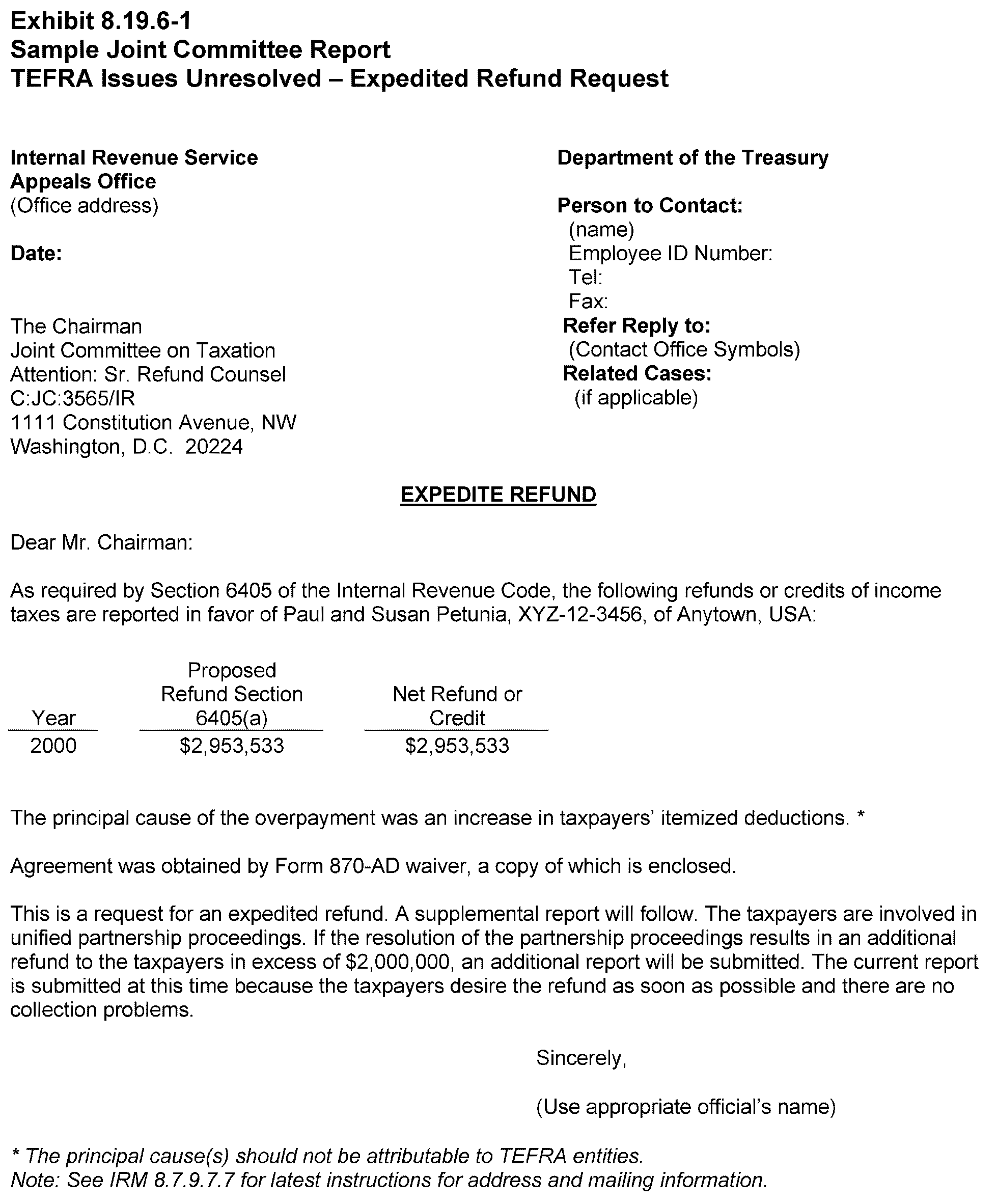
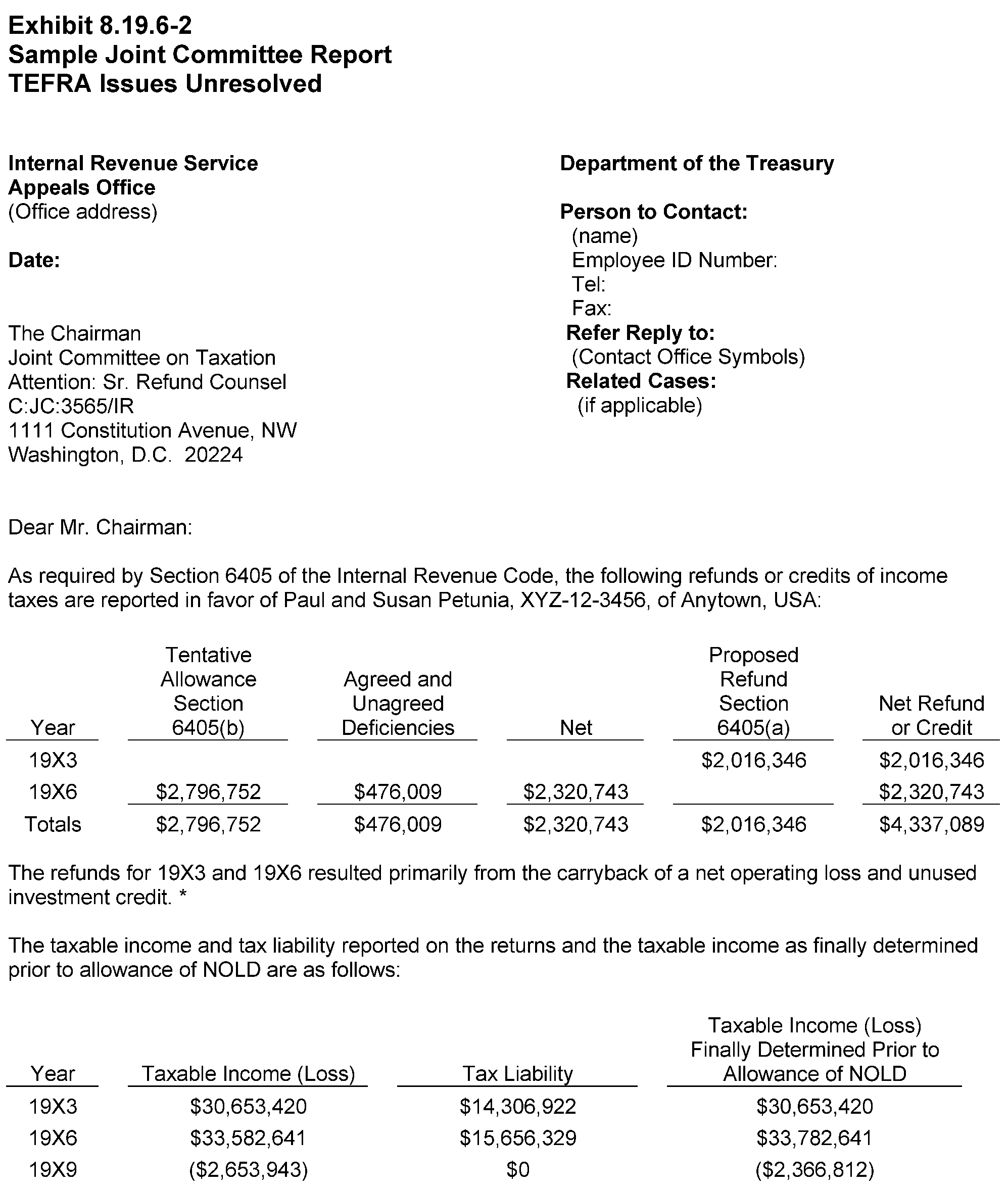
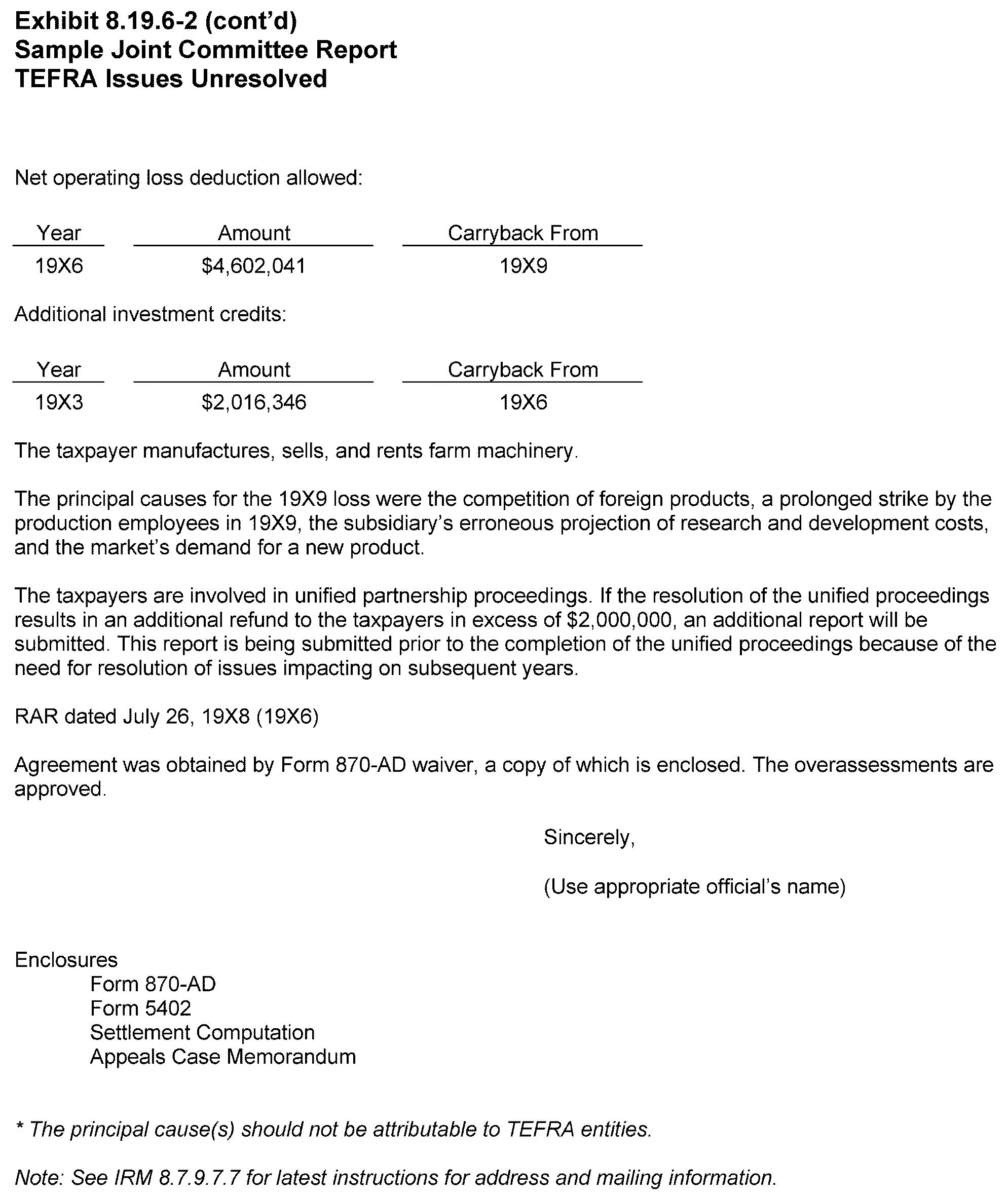
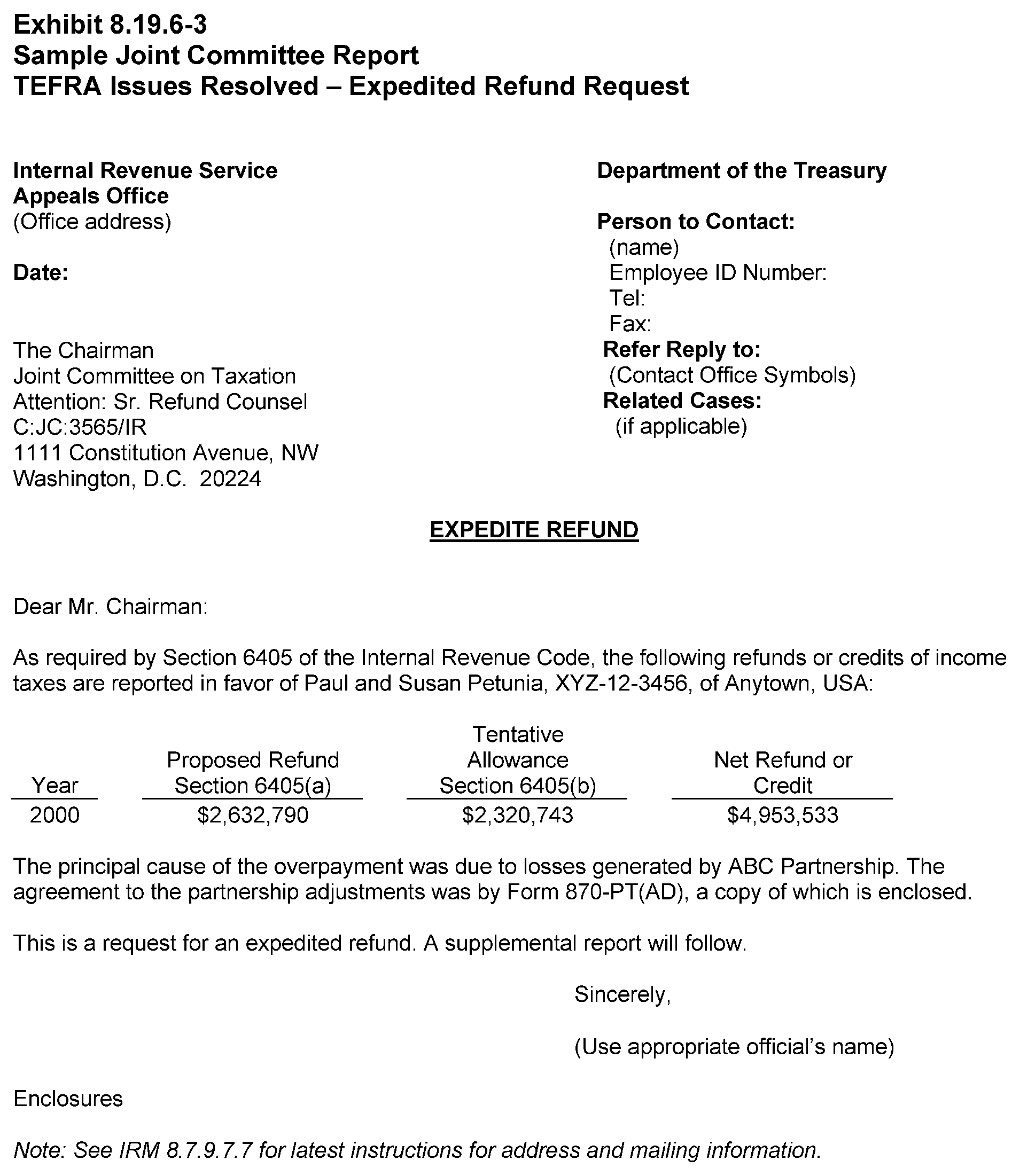
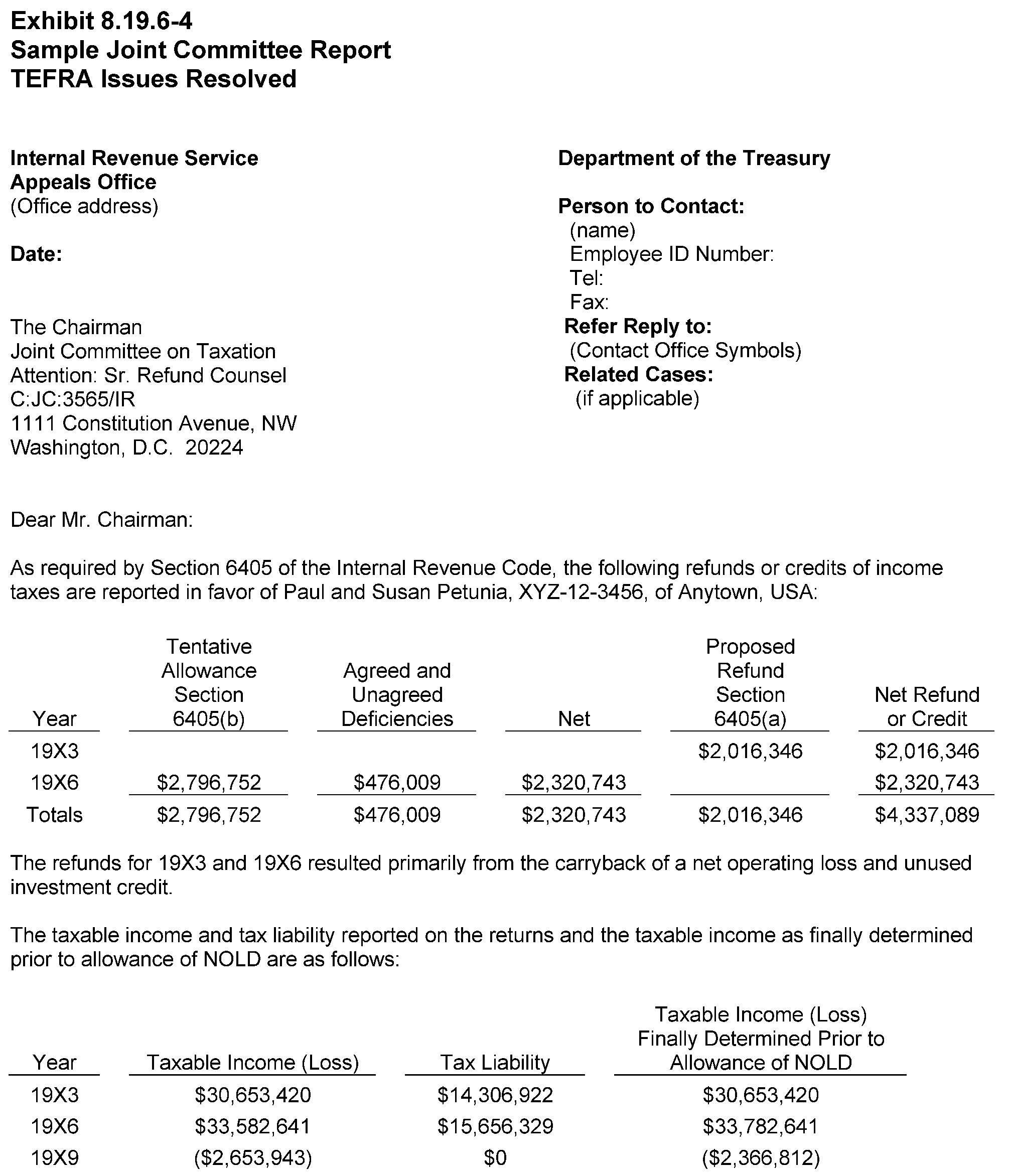
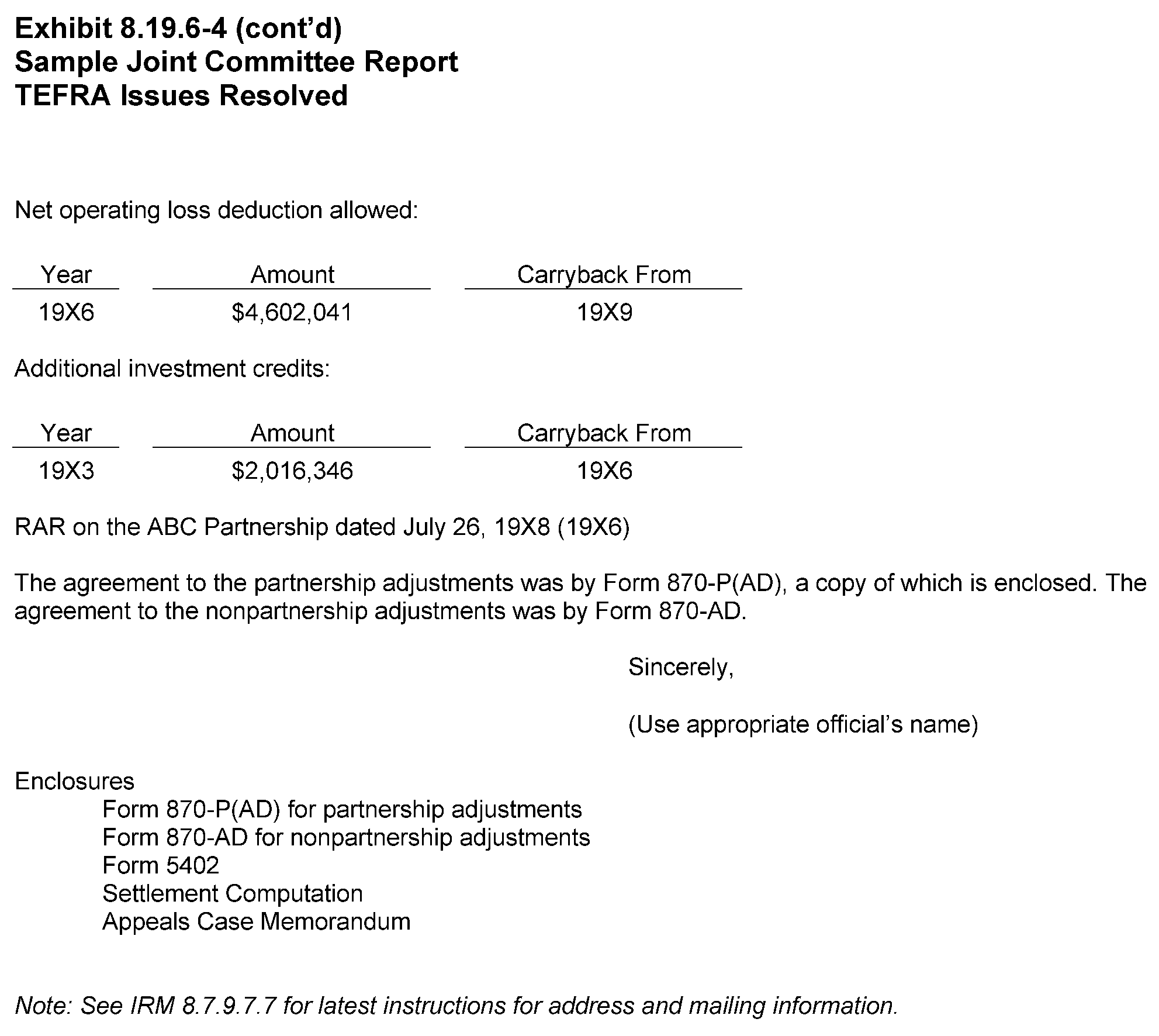
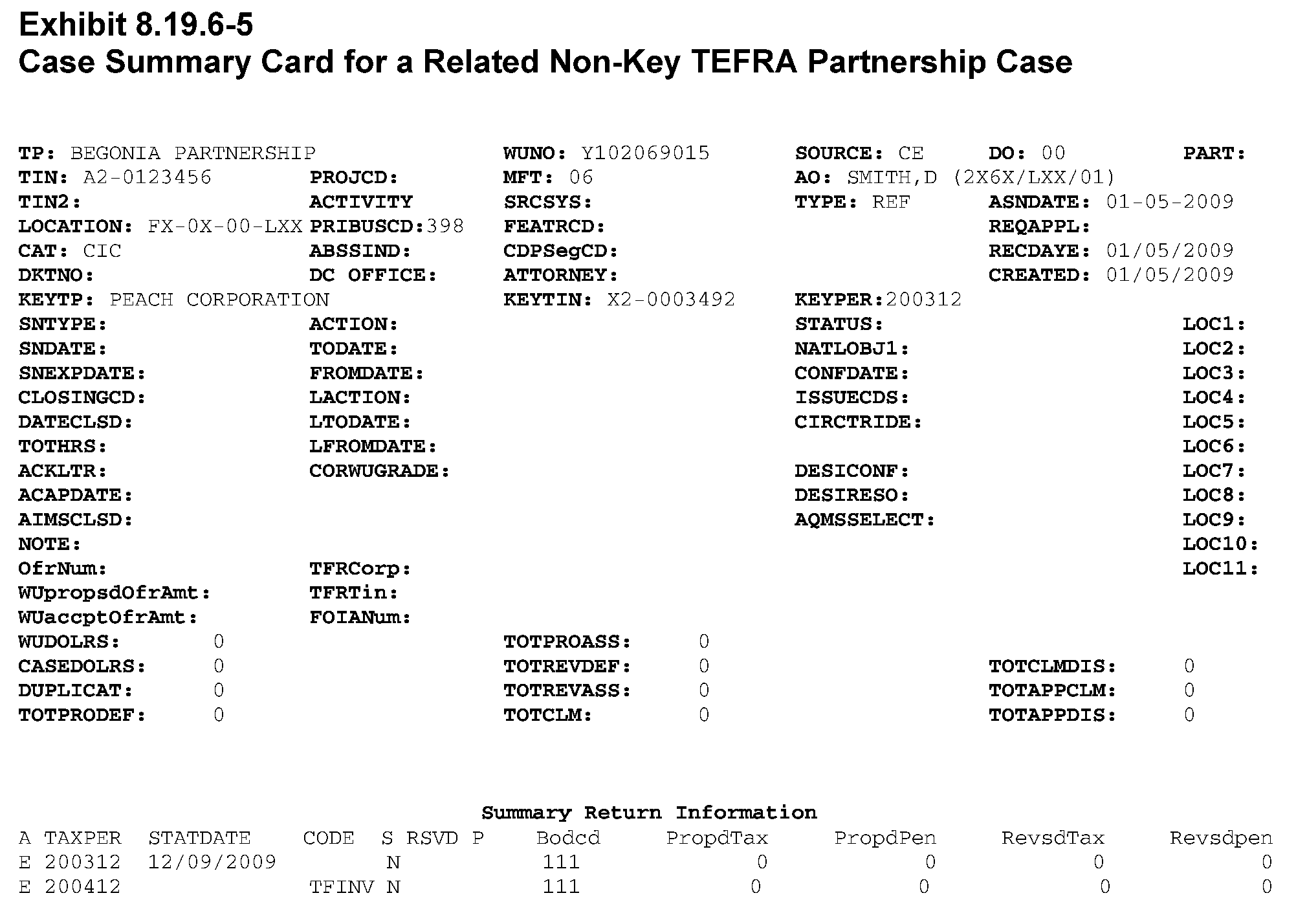
| The following language should be added on the reverse side of Form 870 or 870-AD: |
| It is hereby agreed: |
| 1. Taxpayer(s) reported certain items on the [year] income tax return related to the investment in [partnership name]. |
| 2. [Partnership name] is a partnership which is subject to the unified partnership audit and litigation procedures set forth in I.R.C. §§ 6221 et seq. (TEFRA partnership procedures). |
| 3. For purposes of computing the deficiency [or overpayment] in this case, taxpayer’s partnership items relating to [partnership name] have been treated as if they were correctly reported on taxpayer’s income tax returns for the [taxable year(s)] and they have not been adjusted as part of this proceeding. |
| 4. The tax treatment of taxpayer’s partnership items relating to [partnership name] will be resolved in a separate partnership proceeding conducted in accordance with the TEFRA partnership procedures. |
| 5. The adjustments necessary to apply the results of the TEFRA partnership proceeding described in subparagraph 4 to taxpayer, shall be treated as computational adjustments under I.R.C. § 6231(a)(6) and assessed, credited or refunded accordingly. |
| 6. To the extent that the computation of taxpayer’s tax liability which properly reflects the tax treatment of the partnership items relating to [partnership name], as determined in the TEFRA partnership proceeding described in subparagraph 4, would also result in a change in taxpayer’s tax liability attributable to nonpartnership items, as previously determined in this proceeding, such change may be treated as a computational adjustment under I.R.C. § 6231(a)(6) and assessed, credited or refunded accordingly. |
| 7. Taxpayer waives any restrictions on assessment or overpayment imposed by I.R.C. §§ 6501, 6511 or 6512, with respect to any assessment, credit or refund described in subparagraph 6, provided such assessment, credit or refund is made within the time period provided for computational adjustments as defined in I.R.C. § 6231(a)(6). |
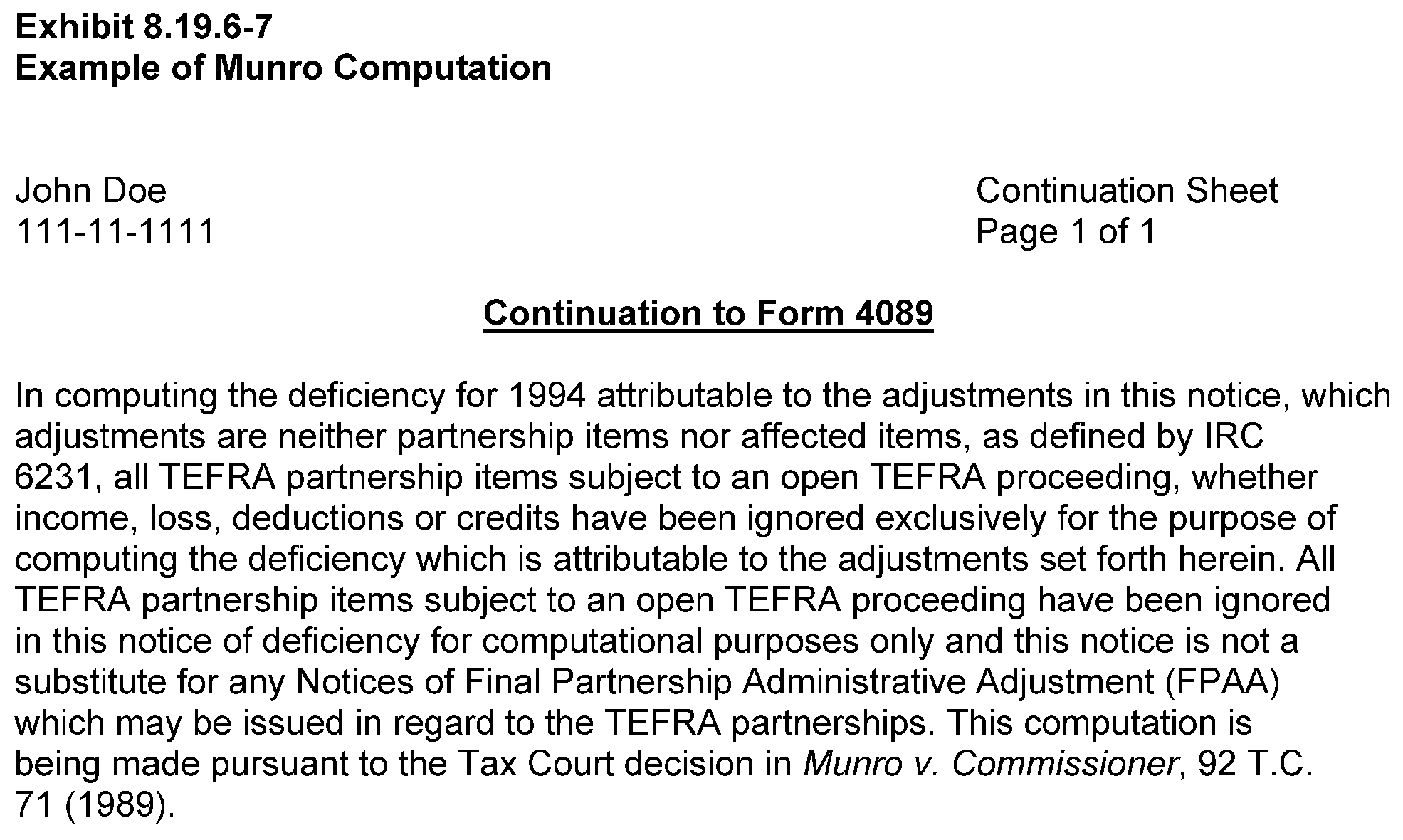
Please click here for the text description of the image.
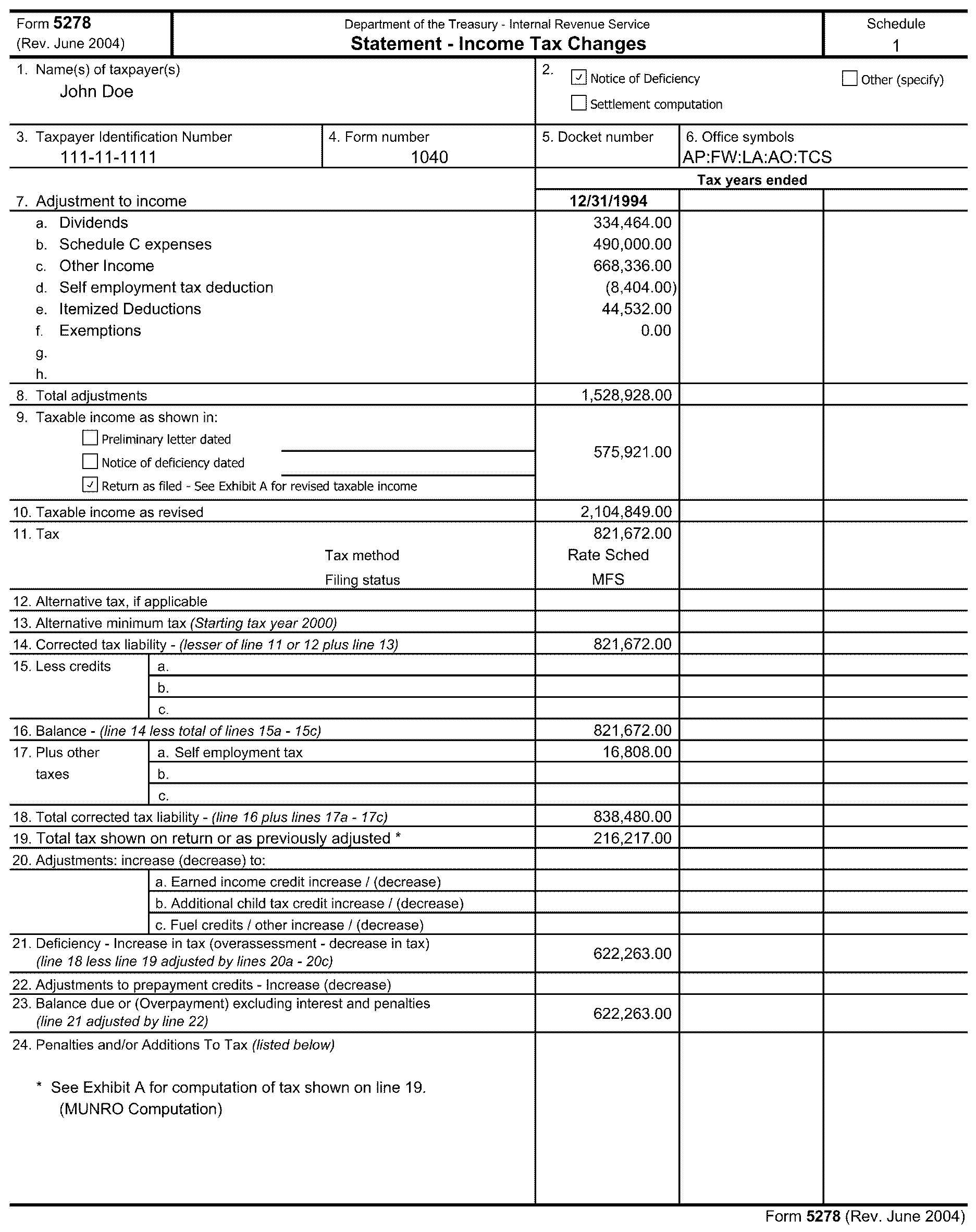
Please click here for the text description of the image.
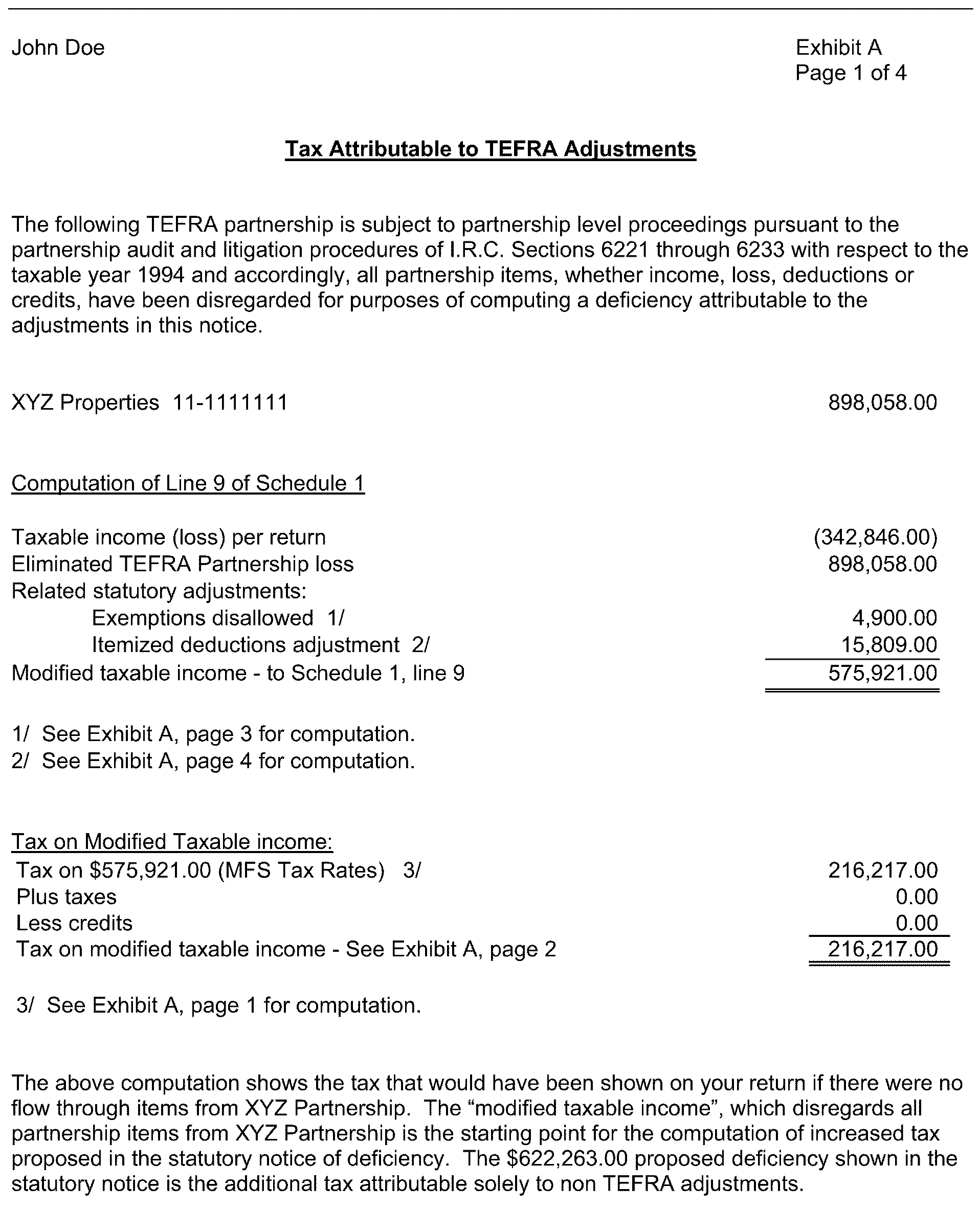
Please click here for the text description of the image.
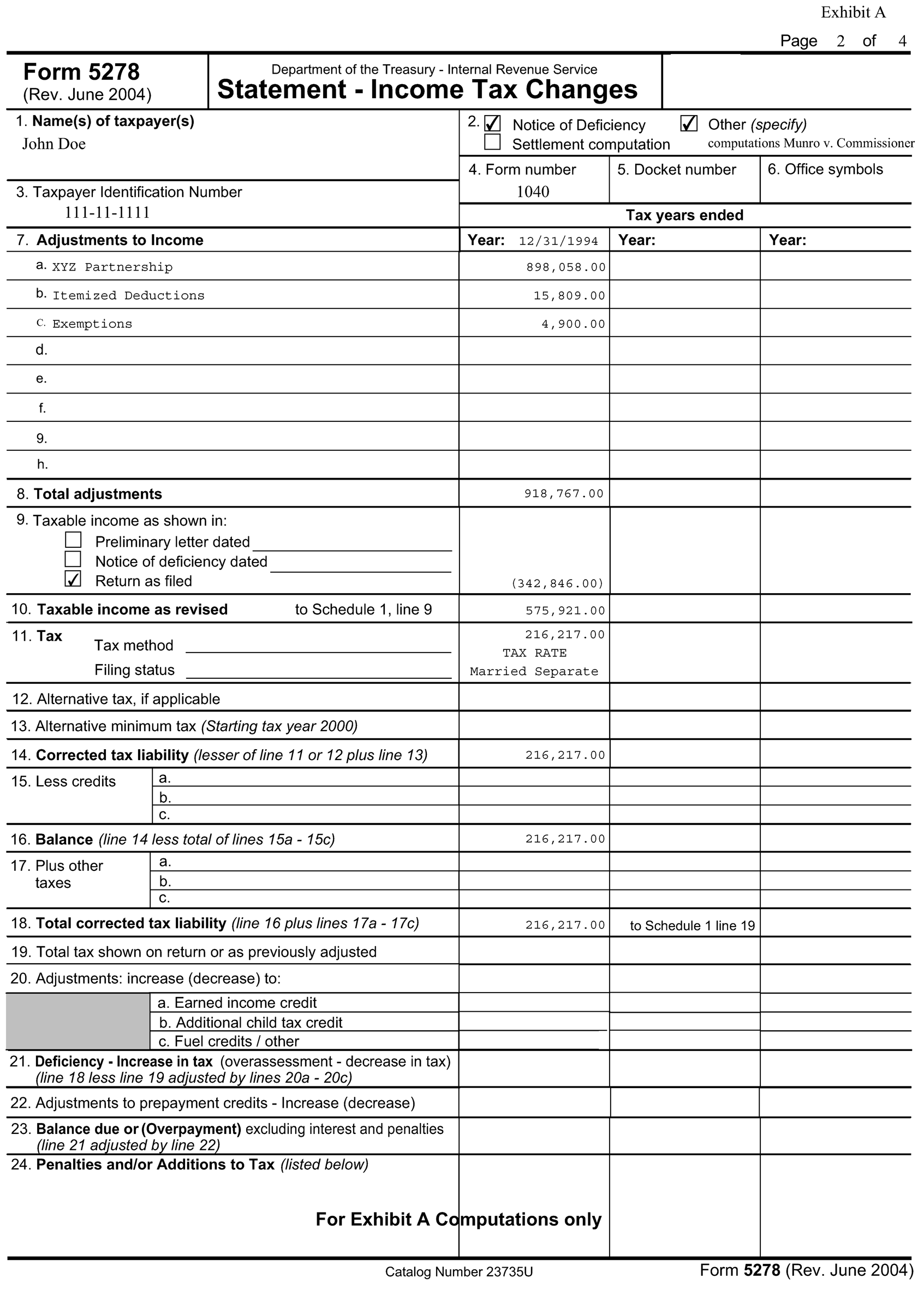
Please click here for the text description of the image.
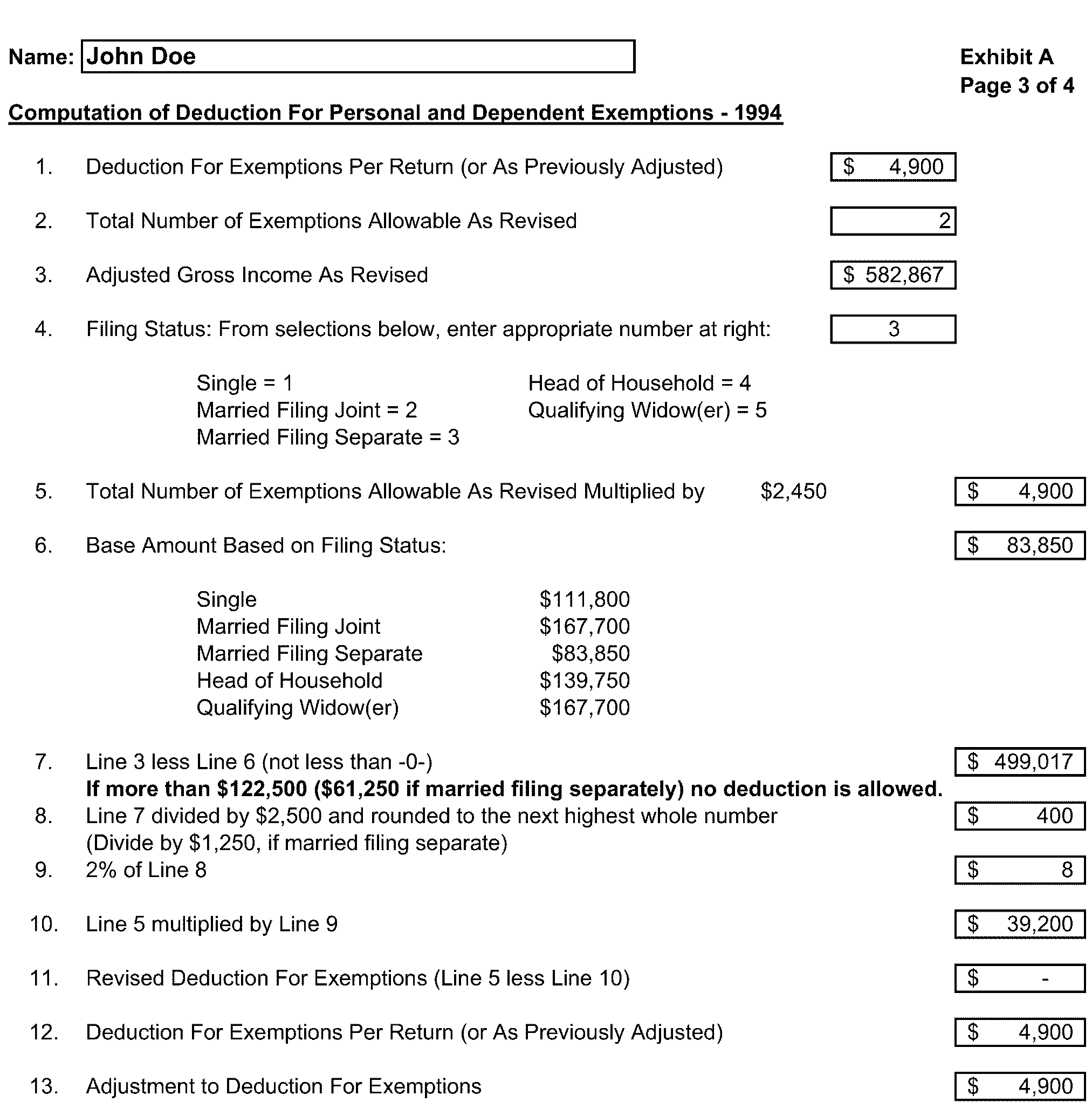
Please click here for the text description of the image.
| The following language should be incorporated as a stipulation below the judge’s signature: |
| STIPULATION |
| It is hereby stipulated: |
| 1.Petitioner(s) reported certain items on the [year] income tax return related to the investment in [partnership name]. |
| 2.[Partnership name] is a partnership which is subject to the unified partnership audit and litigation procedures set forth in I.R.C. §§ 6221 et seq. (TEFRA partnership procedures). |
| 3.For purposes of computing the deficiency [or overpayment] in this case, petitioner’s partnership items relating to [partnership name] have been treated as if they were correctly reported on petitioner’s income tax returns for the [taxable year(s)] and they have not been adjusted as part of this docketed proceeding. |
| 4.The tax treatment of petitioner’s partnership items relating to [partnership name] will be resolved in a separate partnership proceeding conducted in accordance with the TEFRA partnership procedures. |
| 5.The adjustments necessary to apply the results of the TEFRA partnership proceeding described in subparagraph 4 to petitioners, shall be treated as computational adjustments under I.R.C. § 6231(a)(6) and assessed, credited or refunded accordingly. |
| 6.To the extent that the computation of petitioner’s tax liability which properly reflects the tax treatment of the partnership items relating to [partnership name], as determined in the TEFRA partnership proceeding described in subparagraph 4, would also result in a change in petitioner’s tax liability attributable to nonpartnership items, as previously determined in this docketed proceeding, such change may be treated as a computational adjustment under I.R.C. § 6231(a)(6) and assessed, credited or refunded accordingly. |
| 7.Petitioner waives any restrictions on assessment or overpayment imposed by I.R.C. §§ 6501, 6511 or 6512, with respect to any assessment, credit or refund described in subparagraph 6, provided such assessment, credit or refund is made within the time period provided for computational adjustments under I.R.C. § 6231(a)(6). |