


 )
or https:// means you've safely connected to the .gov website. Share sensitive information only on official, secure websites.
)
or https:// means you've safely connected to the .gov website. Share sensitive information only on official, secure websites.


- Publication 957 - Introductory Material
- Publication 957 - Main Contents
- 1. What is Back Pay?
- 2. Special Wage Payments
- Additional Reporting Examples for Nonqualified Deferred Compensation (NQDC) Plans
Publication 957 (01/2024), Reporting Back Pay and Special Wage Payments to the Social Security Administration
Revised: January 2024
For the latest information about developments related to Publication 957, such as legislation enacted after it was published, go to www.irs.gov/pub957.
Introduction
The Social Security Administration (SSA) has special rules for back pay awarded by a court or government agency to enforce a worker protection statute (law). The SSA also has rules for reporting special wage payments made to employees after they retire. These rules enable the SSA to correctly compute an employee's benefits under the social security earnings test. These rules are for social security coverage and benefit purposes only. This publication, written primarily for employers, discusses back pay under a statute and special wage payments. It also explains how to report these payments to the SSA. For more information, go to SSA's website at SSA.gov/employer. To get a copy of Form SSA-131, Employer Report of Special Wage Payments, go to SSA's website at SSA.gov/forms, and enter SSA-131 into the search box.
1. What is Back Pay?
Back pay is pay received in a tax year(s) for actual or deemed employment in an earlier tax year(s). For social security coverage and benefit purposes, all back pay, whether or not under a statute, is wages if it is payment for covered employment. Damages for personal injury, interest, penalties, and legal fees included with back pay awards are not wages. Report all back pay. However, the tax year(s) for which back pay is credited as wages for social security purposes is different if it is awarded under a statute. See Back Pay Under a Statute, later, for more information.
Reporting Back Pay
The IRS and the SSA consider back pay awards to be wages. However, for income tax purposes, the IRS treats all back pay as wages in the year paid.
Employers should use Form W-2, Wage and Tax Statement, or electronic wage reports to report back pay as wages in the year they actually pay the employee. The SSA no longer accepts reports on tapes, cartridges, and diskettes.
Example.
In 2023, Terry Morris earned wages of $80,000. In the same year, she received $100,000 in settlement of a back pay case against her employer that covered the periods January 2018 through December 2022. Her employer properly reflected social security wages of $160,200 and Medicare wages of $180,000 on her 2023 Form W-2.
However, if an employer did not include back pay wages on a previously filed Form W-2, magnetic media, or electronically filed wage report, the employer should prepare a wage correction report, Form W-2c, Corrected Wage and Tax Statement, or electronically filed report, to add the back pay award to the wages previously reported.
Example.
If, in the above example, Terry Morris' employer had prepared her 2023 Form W-2 reporting social security and Medicare wages of only $80,000 each, the employer would have to correct that report. A Form W-2c correcting the 2023 Form W-2 would show previously reported social security and Medicare wages of $80,000 and the correct amount of $160,200 for social security wages and $180,000 for Medicare wages.
SSA treatment of back pay under a statute.
Under the law, the SSA credits back pay awarded under a statute to an individual's earnings record in the period(s) the wages should have been paid. This is important because wages not credited to the proper year may result in lower social security benefits or failure to meet the requirements for benefits.
However, back pay under statute payments will remain posted to the employee's social security earnings record in the year reported on Form W-2 (or Form W-2c) unless the employer or employee notifies the SSA (in a separate, special report) of the back pay under a statute payment. Then, the SSA can allocate the statutory back pay to the appropriate periods.
If a back pay award is not made under a statute, the SSA credits back pay as wages in the year paid.
. If employers do notify the SSA of this payment, they should prepare a special report (with the information noted below) and send it to:.
Attn: DEBS Back Pay Staff
OEIO DEBS EAB 3–A-8
6100 Wabash Avenue
Baltimore, MD 21215–3757 Be sure to send this special report to the above address because the SSA handles it separately from other reports..
. If you paid the back pay award in the same tax year to which it applies, report the wages on that year's Form W-2. No further action is necessary..
Example.
In 2023, Judy Wilson received a salary of $50,000 and a back pay under statute award of $2,000 for the period January through June 2023. Her employer properly reported wages of $52,000 for social security and Medicare on her 2023 Form W-2. No further action is necessary.
Information the SSA needs to properly credit back pay under a statute (special report).
After you complete the special report, you or the employee should send it to the SSA when or after you submit the Form W-2 (on paper or electronically) to the SSA for the year you pay the statutory back pay to the employee. There is no statute of limitations on the filing of the special report to enable the SSA to allocate the wages. The special report must include the following information.
-
The employer's name, address, and employer identification number (EIN).
-
A signed statement citing the federal or state statute under which the payment was made. If the statute is not identified, the SSA will assume the payment was not under a statute and will not allocate to earlier period(s).
-
The name and telephone number of a person to contact. The SSA may have additional questions concerning the back pay case or the individual employee's information.
-
A list of employees receiving the payment and the following information for each employee:
-
The tax year you paid and reported the back pay.
-
The employee's social security number (SSN).
-
The employee's name (as shown on their social security card).
-
The amount of the back pay award excluding any amounts specifically designated otherwise, for example, damages for personal injury, interest, penalties, and legal fees.
-
The period(s) the back pay award covers (beginning and ending dates—month and year).
-
The other wages paid subject to social security and/or Medicare taxes and reported in the same year as the back pay award (if none, show zero)*. Do not include the back pay award shown in that wage report. If you originally submitted the report under an establishment number, show that number and the amount of money that is to remain under that establishment number.
-
The amount to allocate to each reporting period*. This includes any amount you want allocated (if applicable) to the tax year of the award payment. If you do not give the SSA specific amounts to allocate, the SSA does the allocation by dividing the back pay award by the number of months or years covered by the award.
-
*Note.
For periods before January 1, 1978 (before January 1, 1981, for state and local government employers covered by a Section 218 agreement), show the wage amounts for each calendar quarter ending March 31, June 30, September 30, and December 31. For all tax years, show and identify the social security and/or Medicare Qualified Government Employment (MQGE) wages (where applicable) separately. MQGE is applicable to federal employees beginning in 1983, and for certain state and local government employees beginning in 1986. For tax years 1991 and later, list the social security and Medicare wages separately. If you originally reported the individual's wages under an establishment or payroll record unit number, show the amount of wages to remain in the award year for that number and furnish that number to the SSA along with the EIN.
Back Pay Under a Statute
Back pay awarded under a statute is a payment by an employer following an award, determination, or agreement approved or sanctioned by a court or government agency responsible for enforcing a federal or state statute that protects an employee's right to employment or wages.
Examples of pertinent statutes include:
-
Age Discrimination in Employment Act,
-
Americans with Disabilities Act,
-
Equal Pay Act,
-
Fair Labor Standards Act,
-
National Labor Relations Act,
-
State minimum wage laws, and
-
State statutes that protect rights to employment and wages.
Payments based on laws that have a similar effect to those listed above also may qualify as payments made under a statute.
. Back pay awards, under some of the statutes listed above, may be compensation for personal injury and not pay for employment. Such awards are not wages for social security coverage purposes..
If a court-approved or sanctioned settlement agreement states that the agreement is not an admission of discrimination, liability, or act of wrongdoing, the statement does not change the nature of a back pay award. The payments made in such a settlement may still be back pay and wages under the rules discussed here.
Nonstatutory Back Pay
A payment for back wages negotiated between an employer and employee without an award, determination, or agreement approved or sanctioned by a court or government agency, is not made under a statute. Delayed wage payments and retroactive pay increases resulting from union negotiation or payments under local ordinances or regulations are back pay and are wages. However, they are not payments made under a statute.
If you are uncertain whether the back pay award was under a qualified statute, you may need to contact your personnel department or legal counsel or the attorney who filed the suit.
Format for Report to the SSA
Use the format shown in Table 1, later, to send the SSA the information needed to properly credit back pay under a statute.
In a cover letter, include:
-
Name and address of the employer,
-
Statute under which you paid the back pay,
-
Name and telephone number of the employer contact, and
-
Signature of the reporting official.
.Under certain circumstances, back pay may be a special wage payment and excluded from wages counted under the social security earnings test. If you pay back pay to an employee age 61 or older, report it to the SSA in accordance with this section. Read Special Wage Payments, later, for additional reporting instructions..
Questions
If you have questions concerning back pay under a statute, call the SSA at 1-800-772-6270.
| Employer's EIN: xx-xxxxxxx |
| Tax Year in Which Award Payment Was Paid: 2023 |
| (1) SSN and Employee Name |
(2)1 Award Amount and Period(s) |
(3)2,3 Other Soc. Sec./Med. Wages Paid In Award Year |
(4)3 Allocation |
|||
| Soc. Sec. | Med./MQGE | Year | Soc. Sec. | Med./MQGE | ||
| xxx-xx-xxxx HELEN T. SMITH |
$100,000 January 2020–December 2023 |
$40,000 | $40,000 | 2020 2021 2022 2023 |
$20,000 25,000 27,000 28,000 |
$20,000 25,000 27,000 28,000 |
| xxx-xx-xxxx SAM W. EVANS |
$30,000 July 2000–December 2002 |
-0- | -0- | 2000 2001 2002 |
6,000 12,000 12,000 |
|
| xxx-xx-xxxx ROLAND S. ADAMS |
$15,000 July 1991–December 1992 |
-0- | -0- | July 1991 December 1991 1992 |
3,500 3,500 8,000 |
|
| 1Exclude amounts specifically designated as damages, penalties, etc. 2Exclude the amount of back pay, if any, included in that amount. 3For periods before January 1, 1978 (and for state and local government (Section 218) employers before January 1, 1981), show the wage amounts by calendar quarters. The social security and/or Medicare Qualified Government Employment (MQGE) wages (where applicable) must be shown separately FOR ALL YEARS. (Wages subject ONLY to MQGE would be shown in the Medicare/MQGE column; no wages would be shown in the Soc. Sec. column.) For tax years 1991 and later, the social security and Medicare wages must be listed separately. |
||||||
| Explanation of examples. | ||||||
| Helen T. Smith–The back pay award, excluding interest, was $100,000 for the periods January 2020–December 2023. In 2023, this employee was also paid $40,000 in other wages. (Her Form W-2 for 2023 reported $140,000 for social security and $140,000 for Medicare. The SSA allocation will result in adjusted posted wages of $68,000 for social security and $68,000 for Medicare for 2023.) | ||||||
| Sam W. Evans–The back pay award was $30,000 for the periods July 2000–December 2002. This employee was hired in 2000 and was subject to MQGE only. He was no longer employed by this governmental employer in 2023. (His Form W-2 for 2023 reported $30,000 for social security and $30,000 for Medicare. After the SSA allocation, he will not have any net posted wages for 2023.) | ||||||
| Roland S. Adams–The back pay award was $15,000 for the periods July 1991–December 1992. He was no longer employed by this state and local government (Section 218) employer in 2023. (His Form W-2 for 2023 reported $15,000 for social security and $15,000 for Medicare; after the SSA allocation, he will not have any net posted wages for 2023.) | ||||||
.If the state Social Security Administrator's office needs more information, they can contact the SSA at the following address:
Office of Income Security Programs
Office of Earnings, Enumeration and Medicare Policy
6401 Security Blvd., 2514 RMD Bldg.
Baltimore, MD 21235 .
2. Special Wage Payments
A special wage payment is an amount paid by an employer to an employee (or former employee) for services performed in a prior year. Employers should report to the SSA special wage payments made to employees and former employees who are recipients of social security retirement benefits. Special wage payments made to a retired employee receiving social security or to an employee who continues to work while receiving social security benefits may reduce the benefits the individual receives if not reported to the SSA. Special wage payments may include (but are not limited to):
-
Accumulated sick and vacation pay,
-
Back pay,
-
Bonuses,
-
Deferred compensation,
-
Payments because of retirement,
-
Sales commissions,
-
Severance pay, and
-
Stock options.
Note.
Payments made after retirement that are part of the normal payroll cycle should not be routinely reported as special wage payments.
Earnings test.
Benefits paid to a social security beneficiary under full retirement age may be reduced if the beneficiary continues to work. The SSA uses the information in boxes 1, 3, and 5 of Form W-2 to determine the beneficiary's current year earnings. Special wage payments, which are for services performed in a prior year, will increase the current year earnings on Form W-2, which also may result in a reduction in the beneficiary's benefits. If a benefit is reduced because of a special wage payment, the beneficiary must get documentation from the employer before the SSA can restore the deducted portion. Therefore, employer reports of special wage payments help prevent incorrect benefit reductions.
Reporting Special Wage Payments
Employers must report special wage payments for income tax purposes and social security and Medicare taxes in the year received. Report income, social security, and/or Medicare taxes for special wage payments on Form W-2.
.See Nonqualified Deferred Compensation and Section 457 Plans, later, for reporting nonqualified deferred compensation (NQDC) plan deferrals and payments on Form W-2..
In addition, report to the SSA special wage payments made during the reporting year to retired employees and employees who continue to work while receiving social security benefits. Submit reports after the close of the tax year. To avoid delays in processing, submit reports in time to reach the SSA by April 1. Use one of the following reporting methods.
Electronic reporting.
Special wage payment files can be sent electronically by logging onto Business Services Online (BSO) via the SSA’s website. BSO enables organizations and authorized individuals to conduct business with and submit confidential information to the Social Security Administration. You must register to use this website. The web address is SSA.gov/bso/bsowelcome.htm.
Use the specifications and record layout shown in
Table 2, later. Only one file at a time may be submitted. If your file is large (>10MB), or you have a slow internet connection, the transmission will be faster if the file is zipped. A zipped file contains a file that has been compressed to reduce its file size. WinZip and PKZIP are examples of acceptable compression packages.
Electronic submissions not meeting the specifications in Table 2 will be rejected.
Paper listing.
A paper listing can be used to report special wage payments to several employees. Use the format shown in Table 3, later. Submit paper listings to the local SSA office nearest your place of business. Go to SSA.gov/locator to find a Social Security Administration office near you.
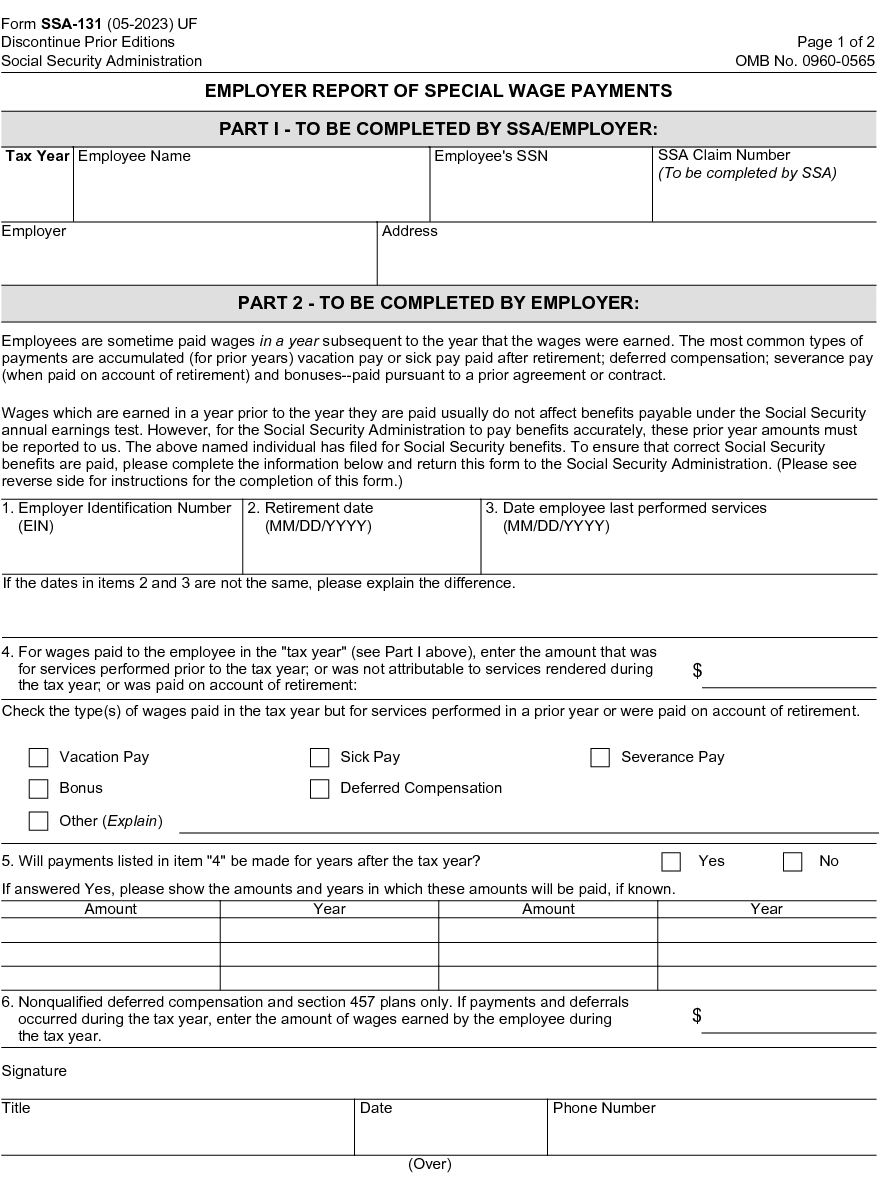
Form SSA-131.
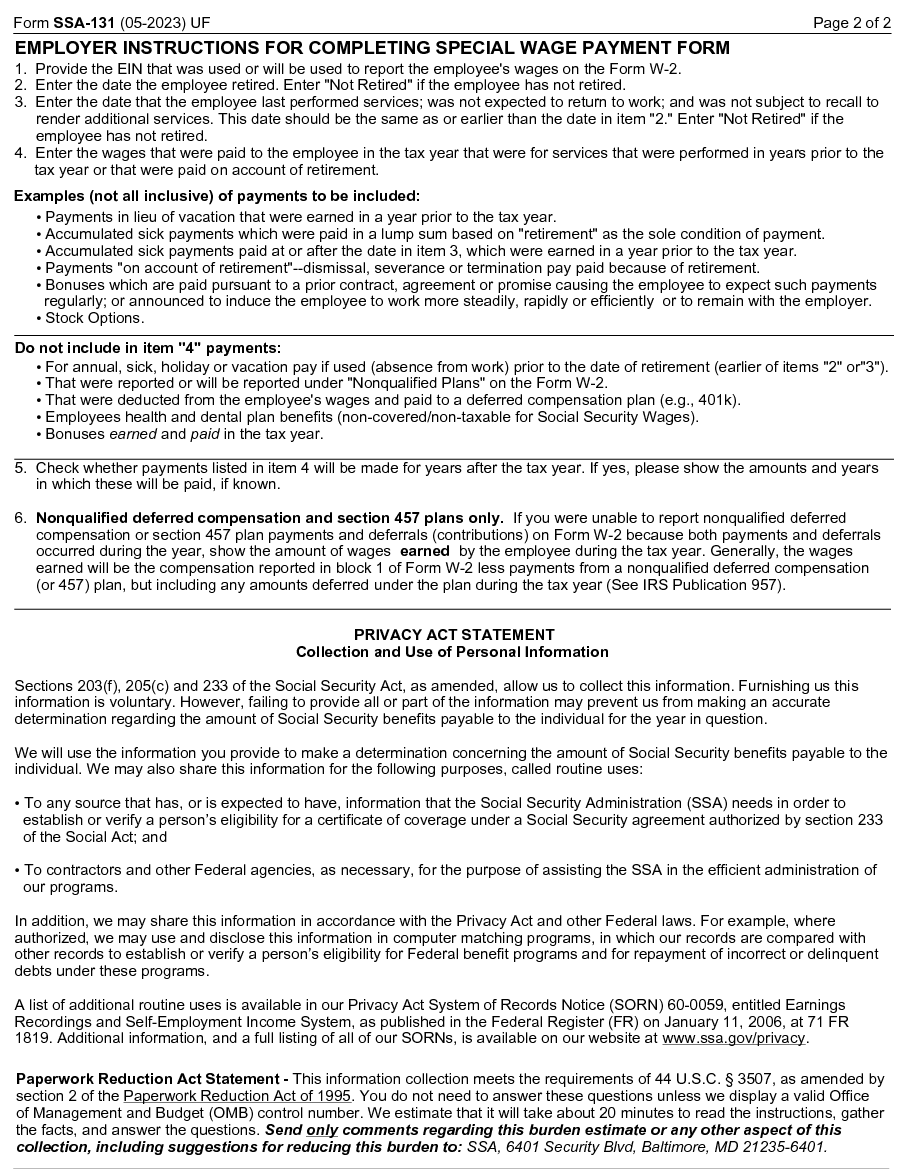
Use Form SSA-131 to report special wage payments made to an employee. Also use this form to report nonqualified deferred compensation and section 457 plan deferrals and payments that could not be reported in box 11 of Form W-2.
Note.
Submit Form SSA-131 to the SSA office nearest your place of business. Or, the employee can submit it to the SSA office handling the claim. You or the employee must submit this form before the SSA can exclude the special wage payments for purposes of the earnings test. If reporting on more than one employee, complete a separate Form SSA-131 for each employee or use the paper listing format (except for reporting nonqualified and section 457 plan deferrals and payments) in Table 3.
.Do not report payments from nonqualified deferred compensation or section 457 plans that were reported in box 11 of Form W-2. Use Form SSA-131 if deferrals to and payments from nonqualified or section 457 plans occurred during the tax year..
Publication 957 Reporting Back Pay to the Social Security Administration
Please click here for the text description of the image.
PUBLICATION 957 Reporting Back Pay to the Social Security Administration
Please click here for the text description of the image.
Reporting Nonstatutory (Nonqualified) Stock Options as Special Wage Payments
A nonstatutory (nonqualified) option to purchase stock which is exercised in a year after the year in which the option was earned is a special wage payment. It should not count for the social security earnings test. Nonstatutory (nonqualified) options exercised as special wage payments by retired employees or employees who continue to work while receiving social security benefits should be reported by employers using the above reporting methods.
Nonqualified Deferred Compensation and Section 457 Plans
An NQDC plan is a plan or arrangement established and maintained by an employer for one or more of its employees that provides for the deferral of compensation, but does not meet the requirements for a tax-qualified deferred compensation plan. For social security and Medicare purposes, deferred compensation plans for employees of state and local governments (section 457 plans) are treated the same as nonqualified plans. Nonqualified and section 457 plans are reported differently than other special wage payments. See Reporting Amounts Deferred to Nonqualified and Section 457 Plans below for specific instructions.
Generally, when the related services are performed, nonqualified deferred compensation is subject to social security and Medicare tax when deferred. However, if nonqualified and section 457 plans contain provisions that delay the employee's right to receive payments from the plan, a period of substantial risk of forfeiture exists. The plans' deferrals, or contributions, are not subject to social security and Medicare taxes until the period of substantial risk of forfeiture ends.
No risk of forfeiture.
If there is no risk of forfeiture, report wage amounts deferred to a nonqualified deferred compensation or section 457 plan in box 3 (up to the wage base maximum) and/or box 5 of Form W-2.
Example.
Company X's NQDC plan allows the deferral of up to $20,000 of employee salaries each year. The plan has no risk of forfeiture. In 2023, Employee A defers $20,000 to the plan from a total salary of $200,000.
| Form W-2 Completion | Amount |
| Box 1 | $200,000 |
| Box 3* | 160,200 |
| Box 5 | 200,000 |
| *Wage base maximum for tax year 2023 | |
Risk of forfeiture lapses before retirement.
If the substantial risk of forfeiture lapses before the employee retires, report all past contributions to the plan (or the value of the plan), including accumulated earned interest, in box 3 (up to the wage base maximum) and/or box 5 of Form W-2. The accumulated deferrals are reported along with any other social security and Medicare wages earned during the year.
Report in box 11 of Form W-2 the amount of deferrals, including any accumulated interest, that became taxable for social security and Medicare taxes during the year (but were for prior year services) because the deferred amounts were no longer subject to a substantial risk of forfeiture. If the employee continues working, future deferrals are social security and Medicare wages when they are earned.
.Do not include in box 11 deferrals that are included in boxes 3 and/or 5 and that are for current year services..
Risk of forfeiture lapses at retirement.
When an employee's right to a payment is contingent upon working until retirement, report all past contributions to the plan (or the value of the plan), including accumulated earned interest, as social security and/or Medicare wages in the year of retirement. Add the amount to other wages paid in that year, and enter in box 3 (up to the wage base maximum) and/or box 5 of Form W-2.
Report in box 11 of Form W-2 the amount of deferrals, including any accumulated interest, that became taxable for social security and Medicare taxes during the year (but were for prior year services) because the deferred amounts were no longer subject to a substantial risk of forfeiture.
.Do not include in box 11 deferrals that are included in boxes 3 and/or 5 and that are for current year services..
Example—risk of forfeiture.
At the end of the risk-of-forfeiture period for Company Y's NQDC plan, Employee B's accumulated deferrals, plus interest earned by the plan, are $180,000, not including B's $20,000 deferral for this year. B's wages, including this year's deferred amount, are $100,000.
| Form W-2 Completion | Amount |
| Box 1 | $80,000 |
| Box 3* | 160,200 |
| Box 5 | 280,000 |
| Box 11 | 180,000 |
| *Wage base maximum for tax year 2023 | |
When an employee or former employee retires and begins receiving payments (distributions) from a nonqualified or nongovernmental section 457 plan, report the payments in boxes 1 and 11 of Form W-2. Report payments (distributions) from a governmental section 457 plan on Form 1099-R, Distributions from Pensions, Annuities, Retirement or Profit-Sharing Plans, IRAs, Insurance Contracts, etc.
Example.
Employee D retired from the XYZ company and began receiving social security benefits. XYZ paid D a $12,000 bonus upon retirement for sales made in a prior year, and D received $25,000 in payments from XYZ's NQDC plan. In addition, D agreed to continue performing services for XYZ, but on a part-time basis for wages of $15,000 per year. D made no deferrals to the nonqualified plan this year.
| Form W-2 Completion | Amount |
| Box 1 | $52,000 |
| Box 3 | 27,000 |
| Box 5 | 27,000 |
| Box 11 | 25,000 |
| Report the $12,000 bonus to the SSA using electronic reporting, a paper listing, or Form SSA-131. For more information, see Reporting Special Wage Payments, earlier. | |
Do not complete box 11 when payments (distributions) are made from a nonqualified plan and deferrals are reported in boxes 3 and/or 5 of Form W-2 (including current year deferrals). Report to the SSA on Form SSA-131 the total amount the employee earned during the tax year. Normally, the amount earned is the amount reported in box 1 of Form W-2 less payments from a nonqualified or section 457 plan, but including any amounts deferred under the plan during the tax year. See Form SSA-131 and its instructions, earlier.
Example.
Employee K retired this year from Company XYZ and began receiving social security benefits. During the year he earned wages of $50,000 and deferred $35,000 of the wages into the company's NQDC plan. K also received $75,000 in payments from the company's nonqualified plan.
| Form W-2 Completion | Amount |
| Special Wage Payment | $75,000 |
| Wages | 50,000 |
| Minus: deferral | 35,000 |
| Total reported in Box 1 | $90,000 |
| Wages including deferral reported in Boxes 3 and 5 |
$50,000 |
| Leave Box 11 blank. File Form SSA-131 | -0- |
| Form SSA-131 Completion | |
| Amount from Box 1 of Form W-2 | $90,000 |
| Minus: payments from a nonqualified plan | 75,000 |
| Plus: amounts deferred into the plan during the year | 35,000 |
| Total wages earned for purposes of Form SSA-131 (item 6) | $50,000 |
Additional Reporting Examples for Nonqualified Deferred Compensation (NQDC) Plans
It is not necessary to show amounts deferred during the year under an NQDC plan subject to section 409A. If you report section 409A deferrals, show the amount in box 12 of Form W-2 using code Y. For more information, see Notice 2008-115, 2008-52 I.R.B. 1367, available at IRS.gov/irb/2008-52_IRB#NOT-2008-115.
Special reporting rules apply when an NQDC plan is not compliant with section 409A (when there has been a “plan failure”). Income included under section 409A from an NQDC plan is reported in box 1 and box 12 of Form W-2 using code Z. See Notice 2008-115.
The following examples use small dollar amounts for illustrative purposes. However, the amount reported in box 3 of Form W-2 is always limited by the social security earnings wage base (for example, $160,200 for 2023). The term “vested” in the following examples means that the amount deferred is not subject to a substantial risk of forfeiture. Conversely, the term “not vested” means that the amount deferred is subject to a substantial risk of forfeiture. The examples assume that the NQDC plan is in compliance with section 409A, and that amounts deferred under the plan are not includible in gross income as they are deferred. For purposes of the examples, it is assumed that the regular pay of the employee is remuneration for employment and wages for employment tax purposes except to the extent the deferral of a portion of the regular pay results in a reduction in wages.
Example 1: Deferral that is immediately vested (no substantial risk of forfeiture) with no distributions and no vesting of prior-year deferrals.
For the year, the employee’s regular pay was $200, and the employee deferred $20 of the pay into the employer’s NQDC plan. The deferral of $20 was vested upon deferral and there was an employer match of $10 under the plan, which was also vested.
Regular pay = $200; Deferral, vested = $20; Employer match, vested = $10.
| Form W-2 Completion | Amount |
| Box 1 ($200 Regular pay minus $20 vested deferral) | $180 |
| Box 3 ($200 Regular pay plus $10 Employer match, vested) | 210 |
| Box 5 ($200 Regular pay plus $10 Employer match, vested) | 210 |
| Box 11 | -0- |
Example 2: Deferral with delayed vesting (substantial risk of forfeiture) of employee and employer portions (no distributions and no vesting of prior-year deferrals).
For the year, the employee’s regular pay was $200, and the employee deferred $20 of the pay into the employer’s NQDC plan. The deferral of $20 was not vested upon deferral, and there was an employer match of $10 under the plan, which was also not vested.
Regular pay = $200; Deferral, not vested = $20; Employer match, not vested = $10.
| Form W-2 Completion | Amount |
| Box 1 ($200 Regular pay minus $20 Deferral, not vested) | $180 |
| Box 3 ($200 Regular pay minus $20 Deferral, not vested) | 180 |
| Box 5 ($200 Regular pay minus $20 Deferral, not vested) | 180 |
| Box 11 | -0- |
Example 3: Deferral that is immediately vested with prior-year deferrals and investment earnings on the prior-year deferrals that are now vesting (no distributions).
For the year, the employee’s regular pay was $200, and the employee deferred $20 of the pay into the employer’s NQDC plan. The deferral of $20 was vested upon deferral. During the year, $100 of prior-year deferrals and $15 of investment earnings on the $100 of prior-year deferrals became vested.
Regular pay = $200; Deferral, vested = $20; Vesting of prior-year deferrals = $100; Vesting of investment earnings on $100 of prior-year deferral = $15.
| Form W-2 Completion | Amount |
| Box 1 ($200 Regular pay minus $20 Deferral, vested) | $180 |
| Box 3 ($200 Regular pay plus $100 vested prior-year deferral plus $15 earnings on deferral) | 315 |
| Box 5 ($200 Regular pay plus $100 vested prior-year deferral plus $15 vested investment earnings on prior-year deferral) | 315 |
| Box 11 ($100 vested prior-year deferral plus $15 earnings) | 115 |
Example 4: No deferrals but there are distributions (no vesting of prior-year deferrals).
For the year, the employee’s regular pay was $100, and the employee deferred no pay into the employer’s NQDC plan. There was no vesting of prior-year deferrals under the plan. During the year, there were total distributions of $50 from the plan to the employee.
Regular pay = $100; Distribution = $50.
| Form W-2 Completion | Amount |
| Box 1 ($100 Regular pay plus $50 Distribution) | $150 |
| Box 3 ($100 Regular pay) | 100 |
| Box 5 ($100 Regular pay) | 100 |
| Box 11 ($50 Distribution) | 50 |
Special rule for box 11 of Form W-2 (distributions and deferral in the same year).
If, in the same year, there are nonqualified deferred compensation distributions and there are deferrals that are reportable in boxes 3 and/or 5 (current or prior-year deferrals) of Form W-2, do not complete box 11. Instead, report on Form SSA-131 the total amount the employee earned during the year.* Submit the SSA-131 to the nearest SSA office or give it to the employee.
*Generally, the amount earned by the employee during the tax year for purposes of item 6 of Form SSA-131 is the amount reported in box 1 of Form W-2 plus current-year deferrals that are vested (employee and employer portions) less distributions. Do not consider prior-year deferrals that are vesting in the current year. If there was a plan failure, the box 1 amount in this calculation should be as if there were no plan failure.
Example 5: Deferral that is immediately vested and there are distributions (no vesting of prior-year deferrals).
For the year, the employee’s regular pay was $200, and the employee deferred $20 of the pay into the employer’s NQDC plan. There was also an employer match of $10. The deferral and employer match were vested upon deferral. There was no vesting of prior-year deferrals under the plan. During the year, there were total distributions of $50 from the plan to the employee.
Regular pay = $200; Deferral, vested = $20; Employer match, vested = $10; Distribution = $50.
| Form W-2 Completion | Amount |
| Box 1 ($50 Special Wage Payment (Distribution) plus $200 Regular pay minus $20 Deferral, vested) | $230 |
| Boxes 3 and 5 ($200 Regular pay plus $10 vested employer match) | 210 |
| Leave Box 11 blank. File Form SSA-131 | -0- |
| Form SSA-131 Completion | |
| Item 6 - amount of wages earned by the employee during the tax year ($230 from Box 1 of Form W-2 minus $50 Distribution plus $30 vested current-year employee deferral and employer match) | $210 |
Example 6: Deferral with delayed vesting and there are distributions (no vesting of prior-year deferrals).
For the year, the employee’s regular pay was $200, and the employee deferred $20 of the pay into the employer’s NQDC plan. The deferral was not vested upon deferral. There was no vesting of prior-year deferrals under the plan. During the year, there were total distributions of $50 from the plan to the employee.
Regular pay = $200; Deferral, not vested = $20; Distribution = $50.
| Form W-2 Completion | Amount |
| Box 1 ($50 Special Wage Payment (Distribution) plus $200 Regular pay minus $20 Deferral, not vested) | $230 |
| Boxes 3 and 5 ($200 Regular pay minus $20 deferral that is not vested) | 180 |
| Box 11 ($50 Distribution). | 50 |
Example 7: Deferral that is immediately vested and there are distributions (also vesting of prior-year deferrals and earnings on those prior-year deferrals).
For the year, the employee’s regular pay was $200, and the employee deferred $20 of the pay into the employer’s NQDC plan. The deferral was vested upon deferral. There was vesting of $100 of prior-year deferrals and $15 of earnings on the $100 prior-year deferral under the plan. During the year, there were total distributions of $50 from the plan to the employee.
Regular pay = $200; Deferral, vested = $20; Distribution = $50; Vesting of prior-year deferrals ($100) and earnings on those prior-year deferrals ($15) = $115.
| Form W-2 Completion | Amount |
| Box 1 ($50 Special Wage Payment (Distribution) plus $200 Regular pay minus $20 vested deferral | $230 |
| Boxes 3 and 5 ($200 Regular pay Plus $115 vested prior deferral (with vested earnings on the deferral)) | 315 |
| Leave Box 11 blank. File Form SSA-131 | -0- |
| Form SSA-131 Completion | |
| Item 6, amount of wages earned by the employee during the tax year ($230 from Box 1 of Form W-2 minus $50 Distribution plus $20 vested current-year deferral) | $200 |
Example 8: Deferral with delayed vesting and there are distributions (vesting of prior-year deferrals, including employer matches, and earnings on those deferrals).
For the year, the employee’s regular pay was $200, and the employee deferred $20 of the pay into the employer’s NQDC plan. The deferral was not vested upon deferral. There was also vesting of prior-year deferrals and employer matches and earnings on these amounts under the plan ($115). During the year, there were total distributions of $50 from the plan to the employee.
Regular pay = $200; Deferral, not vested = $20; Distribution = $50; Vesting of prior-year deferrals and employer match = $100 plus earnings on that $100 of $15.
| Form W-2 Completion | Amount |
| Box 1 ($50 Special Wage Payment (Distribution) plus $200 regular pay minus $20 Deferral, not vested) | $230 |
| Boxes 3 and 5 ($200 Regular pay plus $115 vested prior-year deferral and prior-year employer match and earning on the prior-year amounts minus $20 deferral that is not vested) | 295 |
| Leave Box 11 blank. File Form SSA-131 | -0- |
| Form SSA-131 Completion | |
| Item 6 ($230 Amount from Box 1 of Form W-2 minus $50 Distribution) | $180 |
| Record Position | Field Size |
Description |
|
| Start | End | ||
| 1 | 3 | 3 | Record Type—must include only the capital letters “SWP” |
| 4 | 12 | 9 | SSN—must be numeric and may not be all zeros |
| 13 | 27 | 15 | Last Name—all capitals and no punctuation; may have blanks on right only |
| 28 | 38 | 11 | First Name—all capitals and no punctuation; may have blanks on right only |
| 39 | 39 | 1 | Middle Initial—must be either a capital letter or blank |
| 40 | 48 | 9 | EIN—must be numeric and may not be all zeros |
| 49 | 59 | 11 | Payment—must be numeric; may not be all zeros; last two digits on right are assumed to be cents; no period or dollar sign |
| 60 | 63 | 4 | Payment Year—must be only a four-digit year |
| 64 | 66 | 3 | SSA Office Code—must be numeric and may be all zeros |
| 67 | 67 | 1 | Payment Type Code—must be the capital letter “T” |
| 68 | 117 | 50 | Filler |
The record format is a fixed length of 117. |
|||
The file format is ASCII. |
|||
Submit only one file at a time. |
|||
| Report of Special Wage Payments Tax Year: Page of | |||||||
|---|---|---|---|---|---|---|---|
| A. | Employer Name: EIN: | ||||||
| Address: Contact Name: | |||||||
| Phone: ( ) | |||||||
| . | |||||||
| 1) | B. | Employee Name: (Last) | (First) (MI) | ||||
| C. | SSN: | D. | SWP:$ | E. | Type: Other: | ||
| 2) | B. | Employee Name: (Last) | (First) (MI) | ||||
| C. | SSN: | D. | SWP:$ | E. | Type: Other: | ||
| 3) | B. | Employee Name: (Last) | (First) (MI) | ||||
| C. | SSN: | D. | SWP:$ | E. | Type: Other: | ||
| 4) | B. | Employee Name: (Last) | (First) (MI) | ||||
| C. | SSN: | D. | SWP:$ | E. | Type: Other: | ||
| 5) | B. | Employee Name: (Last) | (First) (MI) | ||||
| C. | SSN: | D. | SWP:$ | E. | Type: Other: | ||
| INSTRUCTIONS: | |||||||
| Enter tax year and page number. | |||||||
| A. Employer name, employer identification number (EIN), address, the name of a contact person, and a phone number where the contact person can be reached during normal business hours. | |||||||
| B. Employee's name. | |||||||
| C. Employee's social security number (SSN). | |||||||
| D. Total amount of special wage payments made to the employee. | |||||||
| E. Type of special wage payment from the following list: (1) Vacation Pay, (2) Sick Pay, (3) Severance Pay, (4) Bonus, (5) Deferred Compensation, (6) Stock Options, and (7) Other—Please explain. |
|||||||
| Do not use a paper listing for nonqualified deferred compensation and section 457 plan deferrals and payments that could not be reported in block 11 of Form W-2. (Get Form SSA-131.) | |||||||