


 )
or https:// means you've safely connected to the .gov website. Share sensitive information only on official, secure websites.
)
or https:// means you've safely connected to the .gov website. Share sensitive information only on official, secure websites.


Instructions for Form 706-GS(D) (12/2025)
Generation-Skipping Transfer Tax Return for Distributions
Revised: 12/2025
Future Developments
For the latest information about developments related to Form 706-GS(D) and its instructions, such as legislation enacted after they were published, go to IRS.gov/Form706GSD.
What’s New
Part I, General information.
Entry lines in this section were reorganized and the address includes foreign address entries.
Part II, Tax computation.
Part III was moved to Part II, and the overpayment line now includes option for direct deposit.
Part III, Distributions.
Part II was moved to Part III on the second page of Form 706-GS(D) to allow more entry lines.
Electronic payments.
If you have access to U.S. banking services or electronic payment systems, you should use direct deposit for any refunds and pay electronically for any payments, whenever possible.
Making a payment.
If there is a balance due on Part II, line 9, go to IRS.gov/Payments for information on how to make a payment. See the instructions for Part II, line 9, later, for more details.
Direct deposit.
We have added direct deposit fields on lines 10b, 10c, and 10d. If there is an overpayment on Part II, line 10a, enter your direct deposit information on Part II, lines 10b, 10c, and 10d. See the instructions for Part II, line 10, later, for more details.
Purpose of Form
Form 706-GS(D) is used by a skip person distributee to calculate and report the tax due on distributions from a trust that are subject to the generation-skipping transfer (GST) tax.
Who Must File
In general, any skip person who receives a taxable distribution from a trust must file Form 706-GS(D). Trustees are required to report taxable distributions to skip person distributees on Form 706-GS(D-1), Notification of Distribution From a Generation-Skipping Trust.
If you receive a Form 706-GS(D-1) and the inclusion ratio found on Part II, line 3, column(d), is zero for all distributions, you do not need to file Form 706-GS(D). If you are required to file Form 706-GS(D), you do not have to include any distributions that have an inclusion ratio of zero.
When To File
The GST tax on distributions is figured and reported on a calendar year basis, regardless of your income tax accounting period. Generally, you must file Form 706-GS(D) on or after January 1 but not later than April 15 of the year following the calendar year when the distributions were made.
If you are not able to file the return by the due date, you may request an automatic 6-month extension of time to file by filing Form 7004, Application for Automatic Extension of Time To File Certain Business Income Tax, Information, and Other Returns. The extension is automatic, so you do not have to sign the form or provide a reason for your request. You must file Form 7004 on or before the regular due date of Form 706-GS(D). See Form 7004 for more information.
Private delivery services (PDSs).
Filers can use certain PDSs designated by the IRS to meet the “timely mailing as timely filing” rule for tax returns. Go to IRS.gov/PDS for the current list of designated services.
The PDS can tell you how to get written proof of the mailing date.
For the IRS mailing address to use if you’re using a PDS, go to IRS.gov/PDSStreetAddresses.
Caution:
PDSs can’t deliver items to P.O. boxes. You must use the U.S. Postal Service to mail any item to an IRS P.O. box address.
Where To File
File Form 706-GS(D) at the following address.
Department of the TreasuryInternal Revenue Service Center
Kansas City, MO 64999
If using a PDS, use this address.
Internal Revenue Submission Processing Center333 W. Pershing
Kansas City, MO 64108
Supplementing Form 706-GS(D)
If you find that you must change something on a return that has already been filed, you should:
-
File another Form 706-GS(D);
-
Enter “Supplemental Information” across the top of page 1 of the form;
-
Include a statement of what has changed, along with the supporting information; and
-
Attach a copy of the original Form 706-GS(D) that has already been filed.
For the mailing address for supplemental Form 706-GS(D), see Filing Estate and Gift Tax Returns.
File the supplemental Form 706-GS(D) at the following address.
Internal Revenue Service CenterStop 824G
7940 Kentucky Drive
Florence, KY 41042-2915
If you’re using a PDS, file at this address.
Internal Revenue Service CenterStop 824G
7940 Kentucky Drive
Florence, KY 41042-2915
If you have already been notified that the return has been selected for examination, you should provide the additional information directly to the office conducting the examination.
Penalties and Interest
Section 6651 provides penalties for both late filing and late payment unless there is reasonable cause for the delay. The law also provides penalties for willful attempts to evade payment of tax.
A return is late when it is filed after the due date, including extensions. The late filing penalty will not be imposed if the taxpayer can show that the failure to file a timely return is due to reasonable cause.
Section 6662 provides a 20% penalty for underpayments of estate or GST taxes due to negligence, intentional disregard of rules and regulations, or a substantial or gross valuation understatement. A substantial valuation understatement occurs when the reported value of property is 65% or less of the actual value of the property. A gross valuation understatement occurs when the reported value of the property listed is 40% or less of the actual value of the property. No penalty will be assessed if the underpayment of estate tax, attributable to substantial or gross valuation understatement, does not exceed $5,000.
Interest will be charged on taxes not paid by their due date, even if an extension of time to file is granted. Interest is also charged on additions to tax for failure to file imposed by section 6651(a)(1) and on the section 6662 penalty from the due date of the return (including any extensions) until the addition to tax or penalty is paid.
Reasonable cause determinations.
If you receive a notice about penalties and interest after you file Form 706-GS(D), send us an explanation and we will determine if you meet reasonable cause criteria. Do not attach an explanation when you file Form 706-GS(D). Explanations attached to the return at the time of filing will not be considered.
Return preparer.
Return preparers who prepare any return or claim for refund that reflects an understatement of tax liability due to an unreasonable position are subject to a penalty equal to the greater of $1,000 or 50% of the income derived (or to be derived) for the preparation of each such return. Return preparers who prepare a return or claim for refund that reflects an understatement of tax liability due to willful or reckless conduct are subject to a penalty of $5,000 or 75% of the income derived (or to be derived), whichever is greater, for the preparation of each such return. See sections 6694(a) and 6694(b), the related regulations, and Announcement 2009-15, 2009-11 I.R.B. 687 (available at IRS.gov/pub/irs-irbs/irb09-11.pdf), for more information.
Signature
Either the distributee or an authorized representative must sign Form 706-GS(D).
If you fill in your own return, leave the Paid Preparer Use Only space blank. If someone prepares your return and does not charge you, that person should not sign the return.
Paid Preparer Use Only
Generally, anyone who is paid to prepare the return must sign the return in the space provided and fill in the Paid Preparer Use Only area. See section 7701(a)(36)(B) for exceptions.
In addition to signing and completing the required information, the paid preparer must give a copy of the completed return to the distributee.
Part I—General Information
Line 1b
For skip person distributees who are individuals, enter the distributee’s social security number (SSN) here and leave line 1c blank. If the skip person distributee is a trust, see the instructions for line 1c. Do not enter a number on both line 1b and line 1c.
Line 1c
If the skip person distributee is a trust, enter the trust’s taxpayer identification number (TIN) and leave line 1b blank. Do not enter a number on both line 1b and line 1c.
Line 2a
If the skip person distributee is a trust, enter the trustee’s name here. If the skip person distributee is a minor or is under some disability that precludes the individual from filing the return, enter the name of the person who is legally responsible for conducting the affairs of the distributee, such as a parent or guardian. Also, include the title or relationship to the distributee.
Part II—Tax Computation
Line 3
Add all amounts of transfer entered in Part III, line 11, column (c), and, if needed, from additional sheets.
Line 4
You may deduct any adjusted allowable expenses incurred in connection with the preparation of this Form 706-GS(D) or any other expenses incurred in connection with the determination, collection, or refund of the GST tax reported or which should have been reported on this return from the amount of the distribution you received.
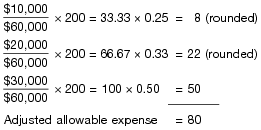
Adjusted allowable expenses are equal to the total allowable expenses multiplied by the inclusion ratio. If you have more than one inclusion ratio in Part II, column (d), of Form 706-GS(D-1), prorate the total expense among the inclusion ratios based on the relative value of each distribution made at the various inclusion ratios.
You may deduct an expense even though it has not been paid at the time the return is filed as long as the amount of the expense is clearly ascertainable at that time. If an additional allowable expense is incurred after the return is filed, file Form 843, Claim for Refund and Request for Abatement, to claim a refund.
Example.
The following example illustrates the rules above.
You listed three distributions in Part III of Form 706-GS(D). The value of the first distribution is $10,000 and has an inclusion ratio of 0.25. The value of the second distribution is $20,000 and has an inclusion ratio of 0.33. The value of the third distribution is $30,000 and has an inclusion ratio of 0.50. You received the completed return from the preparer along with the bill for the preparer’s fee on April 14 and filed the return on April 15. You paid the preparer’s $200 fee on April 20. The adjusted allowable expense you should report on line 4 of Part II is $80, calculated as follows.
Line 6
Enter, using the table below, the applicable rate in effect at the time the generation-skipping distribution occurred.
Table of Maximum Tax Rates
| If the generation-skipping transfer occurred: | The maximum tax rate is: |
| After December 31, 2002, but before January 1, 2004 | 49% |
| After December 31, 2003, but before January 1, 2005 | 48% |
| After December 31, 2004, but before January 1, 2006 | 47% |
| After December 31, 2005, but before January 1, 2007 | 46% |
| After December 31, 2006, but before January 1, 2010 | 45% |
| After December 31, 2009, but before January 1, 2011 | 0% |
| After December 31, 2010, but before January 1, 2013 | 35% |
| After December 31, 2012 | 40% |
Line 9—Tax Due
If the amount on line 7 is more than the amount of line 8, subtract line 8 from line 7. This is the amount you owe.
The IRS recommends paying electronically whenever possible. Options to pay electronically include any of the payment options below. Also, go to IRS.gov/Payments and Frequently asked questions on estate taxes for more detailed information.
EFTPS.
Payment of the tax due may be submitted electronically through the Electronic Federal Tax Payment System (EFTPS). EFTPS is a free service of the Department of the Treasury. See IRS.gov/EFTPS and EFTPS.gov for more information.
Same-day wire.
Payment of the tax due may be submitted electronically through same-day wire from your financial institution. Contact your financial institution for availability, cost, and time frames. See IRS.gov/SameDayWire and How do I make an electronic payment under Frequently asked questions on estate taxes on IRS.gov for the worksheet and more information.
Paying by check.
Make the check payable to “United States Treasury.” Write the SSN of individual distributee, or TIN of trust distributee, and “Form 706-GS(D)” on the check to assist us in posting it to the proper account. See IRS.gov/PayByMail for more information.
Paying by cash.
You may be able to pay your balance due with cash at participating retail stores. See IRS.gov/PayCash.
Line 10—Overpayment
If you have access to U.S. banking services, you should use direct deposit for any refunds, whenever possible. See IRS.gov/DirectDeposit for more information.
Direct deposit is available for this form. If there is an overpayment when filing your return, complete Part II, lines 10b, 10c, and 10d to input your direct deposit information.
The routing number must be nine digits. The first two digits must be 01 through 12 or 21 through 32. Ask your financial institution for the correct routing number to enter on line 10b if:
-
The routing number on a deposit slip is different from the routing number on your checks,
-
Your deposit is to a savings account that doesn’t allow you to write checks, or
-
Your checks state they are payable through a financial institution different from the one at which you have your checking account.
Check the appropriate box for the type of account. Don’t check more than one box. You must check the correct box to ensure your deposit is accepted.
Part III—Distributions
Report all the taxable distributions with inclusion ratios greater than zero that you received during the year. The trustee will report these distributions to you on Form 706-GS(D-1). Attach a copy of each Form 706-GS(D-1) you received during the year to this return. You should also keep a copy for your records.
If you need more space than is provided in Part III, duplicate and use if additional entries are needed. Make sure that the total tentative transfers from the continuation sheet are included on line 3 of Part II.
Column (b)
In column (b), use the same item number that was used for the corresponding distribution on Form 706-GS(D-1). If you receive distributions from more than one trust, you may need to repeat item numbers.
Column (c)
There may be instances when the trustee has either not completed columns (e) (value) and (f) (tentative transfer) of Form 706-GS(D-1) or when you disagree with the amounts the trustee entered. If this occurs, attach a statement to this return showing what you think are the correct amounts and how you figured them.
To figure the tentative transfer (column (c) of this form), multiply the applicable inclusion ratio from Form 706-GS(D-1), Part II, column (d), by the value of the distribution. Use the following guidelines to determine the value of the distribution.
The value of a distribution is its fair market value on the date of distribution. Fair market value (FMV) is the price at which the property would change hands between a willing buyer and a willing seller when neither is forced to buy or to sell, and both have reasonable knowledge of all the relevant facts. FMV may not be determined by a forced sale price nor by the sale price of the item in a market other than that in which the item is most commonly sold to the public. The location of the item must be taken into account whenever appropriate.
Determine the value of the property distributed as of the date of the distribution. The date of distribution is listed in Form 706-GS(D-1), Part II, column (c).
Reduce the value of any property being reported in Part III by the amount of any consideration provided by the distributee.
Value the stock of close corporations or inactive stock on the basis of net worth, earnings, earning and dividend capacity, and other relevant factors. For such stock, attach balance sheets, particularly the one nearest the date of the distribution, and statements of net earnings or operating results and dividends paid for each of the 5 preceding years.
Reduce the reported value of real estate by the amount of any outstanding lien against the property on the date of distribution. Attach copies of any such liens. Explain how the reported values were determined and attach copies of any appraisals.
For more information, see the Instructions for Form 706, United States Estate (and Generation-Skipping Transfer) Tax Return.
Go to IRS.gov/OrderForms to order current forms, instructions, and publications; call 800-829-3676 to order prior-year forms and instructions. Go to IRS.gov/Forms to view, download, or print all the forms, instructions, and publications you may need.