


 )
or https:// means you've safely connected to the .gov website. Share sensitive information only on official, secure websites.
)
or https:// means you've safely connected to the .gov website. Share sensitive information only on official, secure websites.


- Instructions for Form 8889 - Introductory Material
- General Instructions
- Purpose of Form
- Who Must File
- Definitions
- Specific Instructions
What's New
P.L. 119-21, July 4, 2025, amended Code section 223 to provide that:
-
An HSA eligible individual may have disregarded coverage (besides the HDHP) for telehealth and other remote care.
-
A plan will not fail to be treated as a HDHP by reason of failing to have a deductible for telehealth and other remote care services.
Reminders
Preventive care for purposes of qualifying as a high deductible health plan under section 223.
Notice 2024-75, October 28, 2024, expands the list of preventive care benefits permitted to be provided by a high deductible health plan (HDHP) without a deductible, or with a deductible below the applicable minimum deductible for the HDHP, to include over-the-counter oral contraceptives (including emergency contraceptives) and male condoms. Notice 2024-75 also clarifies that (1) all types of breast cancer screening for individuals who have not been diagnosed with breast cancer are treated as preventive care, (2) continuous glucose monitors for individuals diagnosed with diabetes are generally treated as preventive care, and (3) the safe harbor for absence of a deductible for certain insulin products applies without regard to whether the insulin product is prescribed to treat an individual diagnosed with diabetes or prescribed for the purpose of preventing the exacerbation of diabetes or the development of a secondary condition. (See Notice 2024-75, 2024-44 I.R.B. 1026, available at IRS.gov/irb/2024-44_IRB#NOT-2024-75.)
Expenses treated as amounts paid for medical care.
Notice 2024-71, October 28, 2024, provides a safe harbor under section 213 of the Internal Revenue Code for amounts paid for condoms. The Treasury Department and the IRS will treat amounts paid for condoms as amounts paid for medical care under section 213(d). Because amounts paid for condoms are treated as expenses for medical care under section 213(d), if the other requirements of section 213(a) are met (for example, if a taxpayer's total medical expenses exceed the 7.5% adjusted gross income limitation and are not compensated for by insurance or otherwise), then amounts paid by the taxpayer for condoms for the taxpayer, the taxpayer's spouse, or the taxpayer's dependent are deductible as expenses for medical care under section 213. Additionally, because amounts paid for condoms are treated as expenses for medical care under section 213(d), the amounts are also eligible to be paid or reimbursed under a health FSA, Archer MSA, HRA, or HSA. However, if an amount paid for condoms is paid or reimbursed under a health FSA, Archer MSA, HRA, HSA, or any other health plan or otherwise, it is not a deductible expense under section 213. (See Notice 2024-71, 2024-44 I.R.B. 1026, available at IRS.gov/irb/2024-44_IRB#NOT-2024-71.)
Q&As on certain qualified medical expenses.
You can find answers to questions regarding whether certain costs related to nutrition, wellness, and general health are medical expenses that may be paid or reimbursed under an HSA at IRS.gov/Individuals/Frequently-asked-questions-about-medical-expenses-related-to-nutrition-wellness-and-general-health.
 Ask your HSA trustee whether your HSA and trustee meet the requirements of Code section 223.
Ask your health insurance provider(s) whether your HDHP and any disregarded coverage meet the requirements of Code section 223.
Purpose of Form
Use Form 8889 to:
-
Report contributions to your HSA,
-
Figure your HSA deduction,
-
Report distributions from HSAs, and
-
Figure amounts you must include in income and additional tax you may owe if you fail to be an eligible individual.
Additional information.
See Pub. 969, Health Savings Accounts and Other Tax-Favored Health Plans, for more details on HSAs. Also, see the Instructions for Form 1040 and the Instructions for Form 1040-NR.
Who Must File
You must file Form 8889 if any of the following applies.
-
You, your employer, or someone else made contributions to your HSA.
-
Your HSA made a distribution.
-
You failed to be an “eligible individual” during a “testing period” and must recognize income.
-
You acquired an interest in an HSA because of the death of the account beneficiary. See Death of Account Beneficiary, later.
If you (or your spouse, if filing jointly) received HSA distributions in 2025, you must file Form 8889 with Form 1040, Form 1040-SR, or Form 1040-NR, even if you have no taxable income or any other reason for filing Form 1040, Form 1040-SR, or Form 1040-NR.
Definitions
Eligible Individual
To be eligible to have contributions made to your HSA, you must be covered under a high deductible health plan (HDHP) and have no other health coverage except certain disregarded coverage. If you are an eligible individual, anyone can contribute to your HSA. However, you cannot be enrolled in Medicare or be another person's dependent. An individual does not fail to be treated as an eligible individual for any period merely because the individual receives hospital care or medical services under any law administered by the Secretary of Veterans Affairs for a service-connected disability. You will not fail to be considered an eligible individual because you receive benefits from a health plan under surprise billing laws. You must be, or be considered, an eligible individual on the first day of a month to take an HSA deduction for that month (see Last-month rule next).
Last-month rule.
You may consider yourself an "eligible individual" for the entire year if you are an eligible individual on the 1st day of the last month of the tax year (December 1, for most individuals). You are then subject to a "testing period". See below.
Testing period.
The testing period begins with the last month of your tax year and ends on the last day of the 12th month following that month (for example, December 1, 2025 – December 31, 2026). If you fail to remain an eligible individual during this period, other than because of death or becoming disabled, you will have to include in income the total contributions made that would not have been made except for the last-month rule. You include this amount in income in the year in which you fail to be an eligible individual. This amount is also subject to a 10% additional tax. (See Part III.)
Certain coverage disregarded.
An eligible individual may have:
-
Coverage for any benefit provided by permitted insurance; and
-
Coverage for accidents, disability, dental care, vision care, long-term care, or telehealth and other remote care. (Code section 223(c)(1)(B).)
The account beneficiary is the individual on whose behalf the HSA was established.
Generally, an HSA is a health savings account set up exclusively for paying the qualified medical expenses of the account beneficiary or the account beneficiary's spouse or dependents.
Distributions from an HSA used exclusively to pay qualified medical expenses of the account beneficiary, spouse, or dependents are excludable from gross income. (See theLine 15 instructions for information on medical expenses of dependents.) You can receive distributions from an HSA even if you are not currently eligible to have contributions made to the HSA. Any part of a distribution not used to pay qualified medical expenses is includible in gross income and is subject to an additional 20% tax unless an exception applies.
Generally, “qualified medical expenses” for HSA purposes are unreimbursed medical expenses that could otherwise be deducted on Schedule A (Form 1040). See the Instructions for Schedule A and Pub. 502, Medical and Dental Expenses. As the HSA account beneficiary, you can pay these expenses for medical care for yourself, your spouse, and your dependents. Even though nonprescription medicines (other than insulin) do not qualify for the medical and dental expenses deduction, they do qualify as expenses for HSA purposes. The cost of menstrual care products (tampons, pads, liners, cups, sponges, or other similar products) are also reimbursable for HSA purposes. Amounts paid for condoms are treated as amounts paid for medical care and qualify as reimbursable expenses for HSA purposes.
Amounts you pay for personal protective equipment, such as masks, hand sanitizer, and sanitizing wipes for you, your spouse, and your dependents for the primary purpose of preventing the spread of COVID-19 are treated as medical expenses eligible to be reimbursed from an HSA.
The cost of home testing for COVID-19 for you, your spouse, or your dependents is an eligible medical expense for tax purposes, which may be paid or reimbursed from an HSA.
You can find answers regarding whether certain costs related to nutrition, wellness, and general health are medical expenses that may be paid or reimbursed under an HSA at IRS.gov/Individuals/Frequently-asked-questions-about-medical-expenses-related-to-nutrition-wellness-and-general-health.
Expenses incurred before you establish your HSA are not qualified medical expenses. If, under the last-month rule, you are considered to be an eligible individual for the entire year for determining the contribution amount, only those expenses incurred after you actually establish your HSA are qualified medical expenses.
You cannot treat insurance premiums as qualified medical expenses unless the premiums are for:
-
Long-term care (LTC) insurance,
-
Health care continuation coverage (such as coverage under COBRA),
-
Health care coverage while receiving unemployment compensation under federal or state law, or
-
Medicare and other health care coverage if you were 65 or older (other than premiums for a Medicare supplemental policy, such as Medigap).
 Coverage under (2) and (3) can be for your spouse or a dependent meeting the requirement. For (4), if you, the account beneficiary, are under age 65, Medicare premiums for your spouse or dependents (who are age 65 or older) are generally not qualified medical expenses.
An HDHP is a health plan that meets the following requirements.
| Self-only coverage | Family coverage | ||
| Minimum annual deductible | $1,650 | $3,300 | |
| Maximum annual out-of-pocket expenses* | $8,300 | $16,600 |
| * This limit does not apply to deductibles and expenses for out-of-network services if the plan uses a network of providers. Instead, only deductibles and out-of-pocket expenses (such as copayments and other amounts, but not premiums) for services within the network should be used to figure whether the limit is reached. |
Safe harbor for absence of deductible for certain insulin products.
In general, a plan will not fail to be treated as a high deductible health plan by reason of failing to have a deductible for selected insulin products. (See Code section 223(c)(2)(G).) This applies without regard to whether the insulin product is prescribed to treat an individual diagnosed with diabetes or prescribed for the purpose of preventing the exacerbation of diabetes or the development of a secondary condition. (See Notice 2024-75.)
Safe harbor for absence of preventive care deductible.
A plan will not fail to be treated as a high deductible health plan by reason of failing to have a deductible for preventive care. (See Code section 223(c)(2)(C) and Notice 2024-75.)
Safe harbor for absence of deductible for telehealth.
A plan will not fail to be treated as a high deductible health plan by reason of failing to have a deductible for telehealth and other remote care services. (Code section 223(c)(2)(E).)
Special rule for surprise billing.
A plan will not fail to be treated as a high deductible health plan by reason of providing benefits for medical care in accordance with surprise billing laws prior to the satisfaction of a deductible. (Code section 223(c)(2)(F).)
If the account beneficiary's surviving spouse is the designated beneficiary, the HSA is treated as if the surviving spouse were the account beneficiary. The surviving spouse completes Form 8889 as though the HSA belonged to the surviving spouse.
If the designated beneficiary is not the account beneficiary's surviving spouse, or there is no designated beneficiary, the account ceases to be an HSA as of the date of death. The beneficiary completes Form 8889 as follows.
-
Enter “Death of HSA account beneficiary” across the top of Form 8889.
-
Enter the name(s) shown on the beneficiary's tax return and the beneficiary's SSN in the spaces provided at the top of the form and skip Part I.
-
On Part II, line 14a, enter the fair market value of the HSA as of the date of death.
-
On Part II, line 15, for a beneficiary other than the estate, enter qualified medical expenses incurred by the account beneficiary before the date of death that the beneficiary paid within 1 year after the date of death.
-
Complete the rest of Part II.
If the account beneficiary's estate is the beneficiary, the value of the HSA as of the date of death is included on the account beneficiary's final income tax return. Complete Form 8889 as described above, except you should complete Part I, if applicable.
The distribution is not subject to the additional 20% tax. Report any earnings on the account after the date of death as income on your tax return.
Note.
If, during the tax year, you are the beneficiary of two or more HSAs or you are a beneficiary of an HSA and you have your own HSA, you must complete a separate Form 8889 for each HSA. Enter “statement” at the top of each Form 8889 and complete the form as instructed. Next, complete a controlling Form 8889, combining the amounts shown on each of the statement Forms 8889. Attach the statements to your paper tax return after the controlling Form 8889.
The following situations result in deemed distributions from your HSA.
-
You engaged in any transaction prohibited by section 4975 with respect to any of your HSAs, at any time in 2025. Your account ceases to be an HSA as of January 1, 2025, and you must include the fair market value of all assets in the account as of January 1, 2025, on line 14a.
-
You used any portion of any of your HSAs as security for a loan at any time in 2025. You must include the fair market value of the assets used as security for the loan as income on Schedule 1 (Form 1040), line 8f.
Any deemed distribution will not be treated as used to pay qualified medical expenses. Generally, these distributions are subject to the additional 20% tax.
A rollover is a tax-free distribution (withdrawal) of assets from one HSA or Archer MSA that is reinvested in another HSA of the same account beneficiary. Generally, you must complete the rollover within 60 days after you received the distribution. An HSA can only receive one rollover contribution during a 1-year period. See Pub. 590-A, Contributions to Individual Retirement Arrangements (IRAs), for more details and additional requirements regarding rollovers.
Note.
If you instruct the trustee of your HSA to transfer funds directly to the trustee of another of your HSAs, the transfer is not considered a rollover. There is no limit on the number of these transfers. Do not include the amount transferred in income, deduct it as a contribution, or include it as a distribution on line 14a.
Name and social security number (SSN).
Enter your name(s) as shown on your tax return and the SSN of the HSA account beneficiary. If married filing jointly and both you and your spouse have HSAs, complete a separate Form 8889 for each of you.
Part I—HSA Contributions and Deductions
Use Part I to figure:
-
Your HSA deduction,
-
Any excess contributions you made (or those made on your behalf), and
-
Any excess contributions made by an employer (see Excess Employer Contributions, later).
Figuring Your HSA Deduction
The maximum amount that can be contributed to your HSA depends on the type of HDHP coverage you have. If you have self-only coverage, your maximum contribution is $4,300. If you have family coverage, your maximum contribution is $8,550.
Note.
If you are age 55 or older at the end of your tax year, you can make an additional contribution of $1,000.
Your maximum contribution is reduced by any employer contributions to your HSA, any contributions made to your Archer MSA, and any qualified HSA funding distributions.
You cannot deduct any contributions for any month in which you were enrolled in Medicare. Also, you cannot deduct contributions if you are someone else's dependent for 2025.
How To Complete Part I
If both you and your spouse have HSAs, complete lines 1 through 13 as instructed on the form. However, if you and your spouse are both eligible individuals and either of you has an HDHP with family coverage, you both are treated as having only the family coverage plan. Disregard any plans with self-only coverage.
Complete a separate Form 8889 for each spouse. Combine the amounts on line 13 of both Forms 8889 and enter this amount on Schedule 1 (Form 1040), line 13. Be sure to attach both Forms 8889 to your paper tax return.
Line 1
If you were covered, or considered covered, by a self-only HDHP and a family HDHP at different times during the year, check the box for the plan that was in effect for a longer period. If you were covered by both a self-only HDHP and a family HDHP at the same time, you are treated as having family coverage during that period. If you and your spouse are considered covered by a family HDHP, you are considered covered by a family HDHP regardless of whether you file jointly or separately. If, on the first day of the last month of your tax year (December 1 for most taxpayers), you had family coverage, check the “family” box.
Line 2
Include on line 2 only those amounts you, or others on your behalf, contributed to your HSA for 2025. Also, include amounts contributed for 2025 made in 2026 by the unextended deadline for filing your 2025 federal income tax return, April 15, 2026. If you were serving in, or in support of, the U.S. Armed Forces in a designated combat zone or contingency operation, you may be able to file later. See Pub. 3 for details. Thus, you may contribute to your 2025 HSA through April 15, 2026, or a later date if you served in a designated combat zone or contingency operation.
Do not include employer contributions (see line 9) or amounts rolled over from another HSA or Archer MSA. See Rollovers, earlier. Also, do not include any qualified HSA funding distributions (see line 10). Payroll contributions through a salary reduction agreement elected by an employee (a cafeteria plan) are treated as employer contributions and are not included on line 2.
Line 3
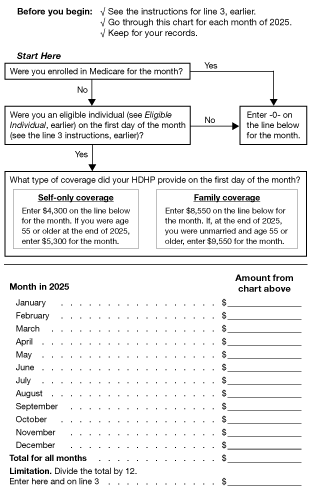
When figuring the amount to enter on line 3, apply the following rules.
-
Use the family coverage amount if you or your spouse had an HDHP with family coverage. Disregard any plan with self-only coverage.
-
If the last-month rule (see Last-month rule, earlier) applies, you are considered an eligible individual for the entire year. You are treated as having the same HDHP coverage for the entire year as you had on the first day of the last month of your tax year.
-
If you were, or were considered, an eligible individual for the entire year and you did not change your type of coverage, enter $4,300 for a self-only HDHP or $8,550 for a family HDHP on line 3. (See (6) in this list.)
-
If you were, or were considered, an eligible individual for the entire year and you changed your type of coverage during the year, enter on line 3 (see (6) in this list) the greater of:
-
The limitation shown on the last line of the Line 3 Limitation Chart and Worksheet (in these instructions), or
-
The maximum amount that can be contributed based on the type of HDHP coverage you had on the first day of the last month of your tax year.
If you had family coverage on the first day of the last month, you do not need to use the worksheet; enter $8,550 on line 3.
-
-
If you were not an eligible individual on the first day of the last month of your tax year, use the Line 3 Limitation Chart and Worksheet (in these instructions) to determine the amount to enter on line 3. (See (6) in this list.)
-
If, at the end of 2025, you were age 55 or older and unmarried or married with self-only HDHP coverage for the entire year, you can increase the amount determined in (3) or (4) by $1,000 (the additional contribution amount). The $1,000 additional contribution amount is not allocable among spouses, unlike the $8,550 family contribution discussed below. For the Line 3 Limitation Chart and Worksheet, the additional contribution amount is included for each month you are an eligible individual.
See Pub. 969 for more information.
If you must complete the Line 3 Limitation Chart and Worksheet (in these instructions), and your eligibility and coverage did not change from one month to the next, enter the same number you entered for the previous month.
Line 6
Spouses who have separate HSAs and had family coverage under an HDHP at any time during 2025, use the following rules to figure the amount on line 6.
-
If you are treated as having family coverage for each month, divide the amount on line 5 equally between you and your spouse, unless you both agree on a different allocation (such as allocating nothing to one spouse). Enter your allocable share on line 6.
-
If you are not treated as having family coverage for each month, use the following steps to determine the amount to enter on line 6.
Step 1.
Refigure the contribution limit that would have been entered on line 5 if you had entered on line 3 the total of the worksheet amounts only for the months you were treated as having family coverage. When refiguring line 5, use the same amount you previously entered on line 4.
Step 2.
Divide the refigured contribution limit from Step 1 equally between you and your spouse, unless you both agree on a different allocation (such as allocating nothing to one spouse).
Line 7
If, at the end of 2025, you were age 55 or older and married, use the Additional Contribution Amount Worksheet (in these instructions) if both of the following apply.
-
You or your spouse had family coverage under an HDHP and were, or were considered to be, an eligible individual on the first day of the month.
-
You were not enrolled in Medicare for the month.
Enter the result on line 7.
If items (1) and (2) apply to all months during 2025, enter $1,000 on line 7.
Line 9
Employer contributions (including employee payroll contributions through a cafeteria plan) include any amount an employer contributes to any HSA for you for 2025. Also, include contributions made by a health insurance plan on an employer's behalf. These contributions should be shown on Form W-2, box 12, code W. If either of the following apply, complete the Employer Contribution Worksheet.
-
Employer contributions for 2024 are included on your 2025 Form W-2, box 12, code W.
-
Employer contributions for 2025 are made in 2026.
Employer Contribution Worksheet
| 1. | Enter the employer contributions reported on your 2025 Form W-2, box 12, code W | 1. | _____ | |||||||
| 2. | Enter employer contributions made in 2025 for tax year 2024 | 2. | _____ | |||||||
| 3. | Subtract line 2 from line 1 | 3. | _____ | |||||||
| 4. | Enter employer contributions made in 2026 for tax year 2025 | 4. | _____ | |||||||
| 5. | Employer contributions for 2025. Add lines 3 and 4. Enter here and on your 2025 Form 8889, line 9 | 5. | _____ | |||||||
Line 10
Qualified HSA funding distribution.
A distribution from your traditional IRA or Roth IRA to your HSA in a direct trustee-to-trustee transfer is called an HSA funding distribution. Note that these funds are not being distributed from your HSA, but rather are being distributed from your IRA and contributed to your HSA. Enter this amount on line 10.
The qualified HSA funding distribution is not included in your income, is not deductible, and reduces the amount that can be contributed to your HSA by you and from other sources (including employer contributions). This distribution cannot be made from an ongoing SEP IRA or SIMPLE IRA. For this purpose, a SEP IRA or SIMPLE IRA is ongoing if an employer contribution is made for the plan year ending with or within your tax year in which the distribution would be made.
The maximum amount that can be excluded from income is based on your age at the end of the year and your HDHP coverage (self-only or family) at the time of the distribution. You can make only one qualified HSA funding distribution during your lifetime. However, if you make the distribution during a month when you have self-only HDHP coverage, you can make another qualified HSA funding distribution in a later month in that tax year if you change to family HDHP coverage.
See the discussions under Line 13 for the treatment of excess contributions.
See Pub. 969 for more information.
Testing period.
If you received a traditional IRA or Roth IRA distribution, you must remain an eligible individual during the testing period. The testing period begins with the month in which the traditional IRA or Roth IRA distribution is contributed to the HSA and lasts through the last day of the 12th month following that month. For example, if the distribution is contributed on June 17, 2025, the testing period lasts through June 30, 2026. If you fail to remain an eligible individual during this period, other than because of death or becoming disabled, you will have to include the qualified HSA funding distribution in income in the year in which you fail to be an eligible individual. This amount is also subject to a 10% additional tax. (See Part III.)
Line 13
Generally, enter the smaller of line 2 or line 12 on line 13 and on Schedule 1 (Form 1040), Part II, line 13. However, if the amount on line 2 is more than the amount on line 13, you, your employer, or someone else contributed more to your HSA than is allowable and you may have to pay an additional tax on the excess contributions. Figure the excess contributions using the following instructions. See Form 5329, Additional Taxes on Qualified Plans (Including IRAs) and Other Tax-Favored Accounts, to figure the additional tax.
Note.
If the amount on line 2 is less than the amount on line 12 and you have prior year excess contributions, see Prior Year Excess Contributions, later.
To figure your excess contributions (including those made on your behalf), subtract your deductible contributions (line 13) from your actual contributions (line 2). However, you can withdraw some or all of your excess contributions for 2025 and they will be treated as if they had not been contributed if:
-
You make the withdrawal by the due date, including extensions, of your 2025 tax return (but see the Note under Excess Employer Contributions, later);
-
You do not claim a deduction for the amount of the withdrawn contributions; and
-
You also withdraw any income earned on the withdrawn contributions and include the earnings in “Other income” on your tax return for the year you withdraw the contributions and earnings.
Excess employer contributions are the excess, if any, of your employer's contributions over your limitation on line 8. If you made a qualified HSA funding distribution (line 10) during the tax year, reduce your limitation (line 8) by that distribution/contribution before you determine whether you have excess employer contributions. If the excess was not included in income on Form W-2, you must report it as “Other income” on your tax return. However, you can withdraw some or all of the excess employer contributions for 2025 and they will be treated as if they had not been contributed if:
-
You make the withdrawal by the due date, including extensions, of your 2025 tax return (but see the following Note);
-
You do not claim an exclusion from income for the amount of the withdrawn contributions; and
-
You also withdraw any income earned on the withdrawn contributions and include the earnings in “Other income” on your tax return for the year you withdraw the contributions and earnings.
Note.
If you timely filed your return without withdrawing the excess contributions, you can still make the withdrawal no later than 6 months after the due date of your tax return, excluding extensions. If you do, file an amended return with “Filed pursuant to section 301.9100-2” written at the top. Include an explanation of the withdrawal. Make all necessary changes on the amended return (for example, if you reported the contributions as excess contributions on your original return, include an amended Form 5329 reflecting that the withdrawn contributions are no longer treated as having been contributed).
If your current year contributions from line 2 are less than your current year maximum HSA contribution limit shown on line 12 and you have prior year excess contributions, see the Instructions for Form 5329, Part VII, line 43, for more information.
Any excess contribution remaining at the end of the tax year is subject to the additional tax. See Form 5329.
Part II—HSA Distributions
Line 14a
Enter the total distributions your HSAs made in 2025. These amounts should be shown on Form 1099-SA, box 1.
Line 14b
Include on line 14b any distributions your HSA made in 2025 that qualified as a rollover contribution to another HSA. See Rollovers, earlier. Also include any excess contributions (and the earnings on those excess contributions) included on line 14a that were withdrawn by the due date, including extensions, of your return. See the instructions for line 13, earlier.
Line 15
Only include on line 15 distributions from your HSA that were used to pay you for qualified medical expenses not reimbursed by insurance or other coverage and that you incurred after the HSA was established. Do not include the distribution of an excess contribution taken out after the due date, including extensions, of your return even if used for qualified medical expenses.
In general, include on line 15 distributions from all HSAs in 2025 that were used for the qualified medical expenses of:
-
You and your spouse.
-
All your dependents.
-
Any person who would be a dependent except that:
-
The person filed a joint return.
-
The person had gross income.
-
You, or your spouse if filing jointly, are dependents of someone else.
-
For this purpose, a child of parents who are divorced, separated, or living apart for the last 6 months of the calendar year is treated as the dependent of both parents whether or not the custodial parent releases claim to the child as the custodial parent’s dependent.
You cannot take a deduction on Schedule A (Form 1040) for any amount you include on line 15.
Lines 17a and 17b
HSA distributions included in income (line 16) are subject to an additional 20% tax unless one of the following exceptions applies.
The additional 20% tax does not apply to distributions made after the account beneficiary:
-
Dies,
-
Becomes disabled or
-
Turns age 65.
If any of the exceptions apply to any of the distributions included on line 16, check the box on line 17a. Enter on line 17b only 20% (0.20) of any amount included on line 16 that does not meet any of the exceptions.
Note.
There may be very limited and unusual circumstances in which you may be able to return mistaken distributions such that the amount will not be subject to the additional tax. For more information, see Notice 2004-50, Q/A 37 and 76, at IRS.gov/IRB/2004-33_IRB#NOT-2004-50.
Part III—Income and Additional Tax for Failure To Maintain HDHP Coverage
Use Part III to figure any additional income and adjustments to income that must be reported on Schedule 1 (Form 1040) and additional taxes that must be reported on Schedule 2 (Form 1040) for failure to be an eligible individual during the testing period for:
-
Last-month rule (see Last-month rule, earlier), or
-
A qualified HSA funding distribution (see the Instructions for line 10, earlier).
See the discussion, earlier, on determining the testing period for both the last-month rule and a qualified HSA funding distribution. Include the amount in income in the year in which you fail to be an eligible individual.
Line 18
You can use the Line 3 Limitation Chart and Worksheet (in these instructions) for the year the contribution was made to determine the contribution you could have made if the last-month rule did not apply. Enter on line 18 the excess of the amount contributed over the redetermined amount.