


 )
or https:// means you've safely connected to the .gov website. Share sensitive information only on official, secure websites.
)
or https:// means you've safely connected to the .gov website. Share sensitive information only on official, secure websites.


- Publication 1544 - Introductory Material
- Publication 1544 - Main Content
- Why Report These Payments?
- Who Must File Form 8300?
- When, Where, and What To File
- Examples
- Penalties
- How To Get Tax Help
Publication 1544 (09/2014), Reporting Cash Payments of Over $10,000
(Received in a Trade or Business)
Revised: September 2014
For the latest information about developments related to Publication 1544, such as legislation enacted after it was published, go to www.irs.gov/pub1544.
Electronic filing. You may be able to file Form 8300 by using FinCEN's Bank Secrecy Act (BSA) Electronic Filing (E-Filing) System. See When, Where, and What To File, later.
Introduction
If, in a 12-month period, you receive more than $10,000 in cash from one buyer as a result of a transaction in your trade or business, you must report it to the Internal Revenue Service (IRS) and the Financial Crimes Enforcement Network (FinCEN) on Form 8300, Report of Cash Payments Over $10,000 Received in a Trade or Business.
This publication explains why, when, and where to report these cash payments. It also discusses the substantial penalties for not reporting them.
Some organizations do not have to file Form 8300, including financial institutions and casinos who must file FinCEN Report 112, BSA Currency Transaction Report (BCTR). They are not discussed in this publication.
This publication explains key issues and terms related to Form 8300. You should also read the instructions attached to the form. They explain what to enter on each line.
Why Report These Payments?
Drug dealers and smugglers often use large cash payments to "launder" money from illegal activities. Laundering means converting "dirty" or illegally-gained money to "clean" money.
The government can often trace this laundered money through the payments you report. Laws passed by Congress require you to report these payments. Your compliance with these laws provides valuable information that can stop those who evade taxes and those who profit from the drug trade and other criminal activities.
The USA PATRIOT Act of 2001 increased the scope of these laws to help trace funds used for terrorism.
Who Must File Form 8300?
Generally, any person in a trade or business who receives more than $10,000 in cash in a single transaction or in related transactions must file Form 8300.
For example, you may have to file Form 8300 if you are a dealer in jewelry, furniture, boats, aircraft, or automobiles; a pawnbroker; an attorney; a real estate broker; an insurance company; or a travel agency. Special rules for clerks of federal or state courts are discussed later under Bail received by court clerks.
However, you do not have to file Form 8300 if the transaction is not related to your trade or business. For example, if you own a jewelry store and sell your personal automobile for more than $10,000 in cash, you would not submit a Form 8300 for that transaction.
Transaction defined.
A "transaction" occurs when:
-
Goods, services, or property are sold;
-
Property is rented;
-
Cash is exchanged for other cash;
-
A contribution is made to a trust or escrow account;
-
A loan is made or repaid; or
-
Cash is converted to a negotiable instrument, such as a check or a bond.
Person defined.
A "person" includes an individual, a company, a corporation, a partnership, an association, a trust, or an estate.
Exempt organizations, including employee plans, are also "persons." However, exempt organizations do not have to file Form 8300 for a more-than-$10,000 charitable cash contribution they receive since it is not received in the course of a trade or business.
Foreign transactions.
You do not have to file Form 8300 if the entire transaction (including the receipt of cash) takes place outside of:
-
The 50 states,
-
The District of Columbia,
-
Puerto Rico, or
-
A possession or territory of the United States.
However, you must file Form 8300 if any part of the transaction (including the receipt of cash) occurs in Puerto Rico or a possession or territory of the United States and you are subject to the Internal Revenue Code.
Bail received by court clerks.
Any clerk of a federal or state court who receives more than $10,000 in cash as bail for an individual charged with any of the following criminal offenses must file Form 8300:
-
Any federal offense involving a controlled substance,
-
Racketeering,
-
Money laundering, and
-
Any state offense substantially similar to (1), (2), or (3) above.
For more information about the rules that apply to court clerks, see Section 1.6050I-2 of the Income Tax Regulations.
What Payments Must Be Reported?
You must file Form 8300 to report cash paid to you if it is:
-
Over $10,000,
-
Received as:
-
One lump sum of over $10,000,
-
Installment payments that cause the total cash received within 1 year of the initial payment to total more than $10,000, or
-
Other previously unreportable payments that cause the total cash received within a 12-month period to total more than $10,000,
-
-
Received in the course of your trade or business,
-
Received from the same buyer (or agent), and
-
Received in a single transaction or in related transactions (defined later).
What Is Cash?
Cash is:
-
The coins and currency of the United States (and any other country), and
-
A cashier's check, bank draft, traveler's check, or money order you receive, if it has a face amount of $10,000 or less and you receive it in:
-
A designated reporting transaction (defined later), or
-
Any transaction in which you know the payer is trying to avoid the reporting of the transaction on Form 8300.
-

Cash may include a cashier's check even if it is called a "treasurer's check" or "bank check."
Cash does not include a check drawn on an individual's personal account.
A cashier's check, bank draft, traveler's check, or money order with a face amount of more than $10,000 is not treated as cash. These items are not defined as cash and you do not have to file Form 8300 when you receive them because, if they were bought with currency, the bank or other financial institution that issued them must file a report on FinCEN Report 112.
Example 1.
You are a coin dealer. Bob Green buys gold coins from you for $13,200. He pays for them with $6,200 in U.S. currency and a cashier's check having a face amount of $7,000. The cashier's check is treated as cash. You have received more than $10,000 cash and must file Form 8300 for this transaction.
Example 2.
You are a retail jeweler. Mary North buys an item of jewelry from you for $12,000. She pays for it with a personal check payable to you in the amount of $9,600 and traveler's checks totaling $2,400. Because the personal check is not treated as cash, you have not received more than $10,000 cash in the transaction. You do not have to file Form 8300.
Example 3.
You are a boat dealer. Emily Jones buys a boat from you for $16,500. She pays for it with a cashier's check payable to you in the amount of $16,500. The cashier's check is not treated as cash because its face amount is more than $10,000. You do not have to file Form 8300 for this transaction.
A designated reporting transaction is the retail sale of any of the following:
-
A consumer durable, such as an automobile or boat. A consumer durable is property, other than land or buildings, that:
-
Is suitable for personal use,
-
Can reasonably be expected to last at least 1 year under ordinary use,
-
Has a sales price of more than $10,000, and
-
Can be seen or touched (tangible property).
For example, a $20,000 car is a consumer durable, but a $20,000 dump truck or factory machine is not. The car is a consumer durable even if you sell it to a buyer who will use it in a business.
-
-
A collectible (for example, a work of art, rug, antique, metal, gem, stamp, or coin).
-
Travel or entertainment, if the total sales price of all items sold for the same trip or entertainment event in one transaction (or related transactions) is more than $10,000.
To figure the total sales price of all items sold for a trip or entertainment event, you include the sales price of items such as airfare, hotel rooms, and admission tickets.
Example.
You are a travel agent. Ed Johnson asks you to charter a passenger airplane to take a group to a sports event in another city. He also asks you to book hotel rooms and admission tickets for the group. In payment, he gives you two money orders, each for $6,000. You have received more than $10,000 cash in this designated reporting transaction. You must file Form 8300.
Retail sale.
The term "retail sale" means any sale made in the course of a trade or business that consists mainly of making sales to ultimate consumers.
Thus, if your business consists mainly of making sales to ultimate consumers, all sales you make in the course of that business are retail sales. This includes any sales of items that will be resold.
Broker or intermediary.
A designated reporting transaction includes the retail sale of items (1), (2), or (3) of the preceding list, even if the funds are received by a broker or other intermediary, rather than directly by the seller.
A cashier's check, bank draft, traveler's check, or money order you received in a designated reporting transaction is not treated as cash if one of the following exceptions applies.
Exception for certain bank loans.
A cashier's check, bank draft, traveler's check, or money order is not treated as cash if it is the proceeds from a bank loan. As proof that it is from a bank loan, you may rely on a copy of the loan document, a written statement or lien instruction from the bank, or similar proof.
Example.
You are a car dealer. Mandy White buys a new car from you for $11,500. She pays you with $2,000 of U.S. currency and a cashier's check for $9,500 payable to you and her. You can tell that the cashier's check is the proceeds of a bank loan because it includes instructions to you to have a lien put on the car as security for the loan. For this reason, the cashier's check is not treated as cash. You do not have to file Form 8300 for the transaction.
Exception for certain installment sales.
A cashier's check, bank draft, traveler's check, or money order is not treated as cash if it is received in payment on a promissory note or an installment sales contract (including a lease that is considered a sale for federal tax purposes). However, this exception applies only if:
-
You use similar notes or contracts in other sales to ultimate consumers in the ordinary course of your trade or business, and
-
The total payments for the sale that you receive on or before the 60th day after the sale are 50% or less of the purchase price.
Exception for certain down payment plans.
A cashier's check, bank draft, traveler's check, or money order is not treated as cash if you received it in payment for a consumer durable or collectible, and all three of the following statements are true.
-
You receive it under a payment plan requiring:
-
One or more down payments, and
-
Payment of the rest of the purchase price by the date of sale.
-
-
You receive it more than 60 days before the date of sale.
-
You use payment plans with the same or substantially similar terms when selling to ultimate consumers in the ordinary course of your trade or business.
Exception for travel and entertainment.
A cashier's check, bank draft, traveler's check, or money order received for travel or entertainment is not treated as cash if all three of the following statements are true.
-
You receive it under a payment plan requiring:
-
One or more down payments, and
-
Payment of the rest of the purchase price by the earliest date that any travel or entertainment item (such as airfare) is furnished for the trip or entertainment event.
-
-
You receive it more than 60 days before the date on which the final payment is due.
-
You use payment plans with the same or substantially similar terms when selling to ultimate consumers in the ordinary course of your trade or business.
Taxpayer Identification Number (TIN)
You must furnish the correct TIN of the person or persons from whom you receive the cash. If the transaction is conducted on the behalf of another person or persons, you must furnish the TIN of that person or persons. If you do not know a person's TIN, you have to ask for it. You may be subject to penalties for an incorrect or missing TIN.
There are three types of TINs.
-
The TIN for an individual, including a sole proprietor, is the individual's social security number (SSN).
-
The TIN for a nonresident alien individual who needs a TIN but is not eligible to get an SSN is an IRS individual taxpayer identification number (ITIN). An ITIN has nine digits, similar to an SSN.
-
The TIN for other persons, including corporations, partnerships, and estates, is the employer identification number (EIN).
Exception.
You are not required to provide the TIN of a person who is a nonresident alien individual or a foreign organization if that person or foreign organization:
-
Does not have income effectively connected with the conduct of a U.S. trade or business;
-
Does not have an office or place of business, or a fiscal or paying agent in the United States;
-
Does not file a federal tax return;
-
Does not furnish a withholding certificate described in §1.1441-1(e)(2) or (3) or 1.1441-5(c)(2)(iv) or (3)(iii) to the extent required under 1.1441-1(e)(4)(vii);
-
Does not have to furnish a TIN on any return, statement, or other document as required by the income tax regulations under section 897 or 1445; or
-
In the case of a nonresident alien individual, the individual has not chosen to file a joint federal income tax return with a spouse who is a U.S. citizen or resident.
What Is a Related Transaction?
Any transactions between a buyer (or an agent of the buyer) and a seller that occur within a 24-hour period are related transactions. If you receive over $10,000 in cash during two or more transactions with one buyer in a 24-hour period, you must treat the transactions as one transaction and report the payments on Form 8300.
For example, if you sell two products for $6,000 each to the same customer in 1 day and the customer pays you in cash, these are related transactions. Because they total $12,000 (more than $10,000), you must file Form 8300.
More than 24 hours between transactions.
Transactions are related even if they are more than 24 hours apart if you know, or have reason to know, that each is one of a series of connected transactions.
For example, you are a travel agent. A client pays you $8,000 in cash for a trip. Two days later, the same client pays you $3,000 more in cash to include another person on the trip. These are related transactions, and you must file Form 8300 to report them.
What About Suspicious Transactions?
If you receive $10,000 or less in cash, you may voluntarily file Form 8300 if the transaction appears to be suspicious.
A transaction is suspicious if it appears that a person is trying to cause you not to file Form 8300 or is trying to cause you to file a false or incomplete Form 8300, or if there is a sign of possible illegal activity.
If you are suspicious, you are encouraged to call the local IRS Criminal Investigation Division as soon as possible. Or, you can call the FinCEN Financial Institution Hotline toll free at 1-866-556-3974.
When, Where, and What To File
The amount you receive and when you receive it determine when you must file. Generally, you must file Form 8300 within 15 days after receiving a payment. If the Form 8300 due date (the 15th or last day you can timely file the form) falls on a Saturday, Sunday, or legal holiday, it is delayed until the next day that is not a Saturday, Sunday, or legal holiday.
More than one payment.
In some transactions, the buyer may arrange to pay you in cash installment payments. If the first payment is more than $10,000, you must file Form 8300 within 15 days. If the first payment is not more than $10,000, you must add the first payment and any later payments made within 1 year of the first payment. When the total cash payments are more than $10,000, you must file Form 8300 within 15 days.
After you file Form 8300, you must start a new count of cash payments received from that buyer. If you receive more than $10,000 in additional cash payments from that buyer within a 12-month period, you must file another Form 8300. You must file the form within 15 days of the payment that causes the additional payments to total more than $10,000.
If you are already required to file Form 8300 and you receive additional payments within the 15 days before you must file, you can report all the payments on one form.
Example.
On January 10, you receive a cash payment of $11,000. You receive additional cash payments on the same transaction of $4,000 on February 15, $5,000 on March 20, and $6,000 on May 12. By January 25, you must file a Form 8300 for the $11,000 payment. By May 27, you must file an additional Form 8300 for the additional payments that total $15,000.
Amending a Report?
If you are amending a report, check box 1a at the top of Form 8300. Complete the form in its entirety (Parts I-IV) and include the amended information. Do not attach a copy of the original report.
Where to file.
Mail the form to the address given in the Form 8300 instructions.
You may file the form electronically by using FinCEN's BSA E-Filing System. To get more information, visit bsaefiling.fincen.treas.gov.
Required statement to buyer.
You must give a written or electronic statement to each person named on any Form 8300 you must file. You can give the statement electronically only if the recipient agrees to receive it in that format. The statement must show the name and address of your business, the name and phone number of a contact person, and the total amount of reportable cash you received from the person during the year. It must state that you are also reporting this information to the IRS.
You must send this statement to the buyer by January 31 of the year after the year in which you received the cash that caused you to file the form.

You must keep a copy of every Form 8300 you file for 5 years.
Examples
Example 1.
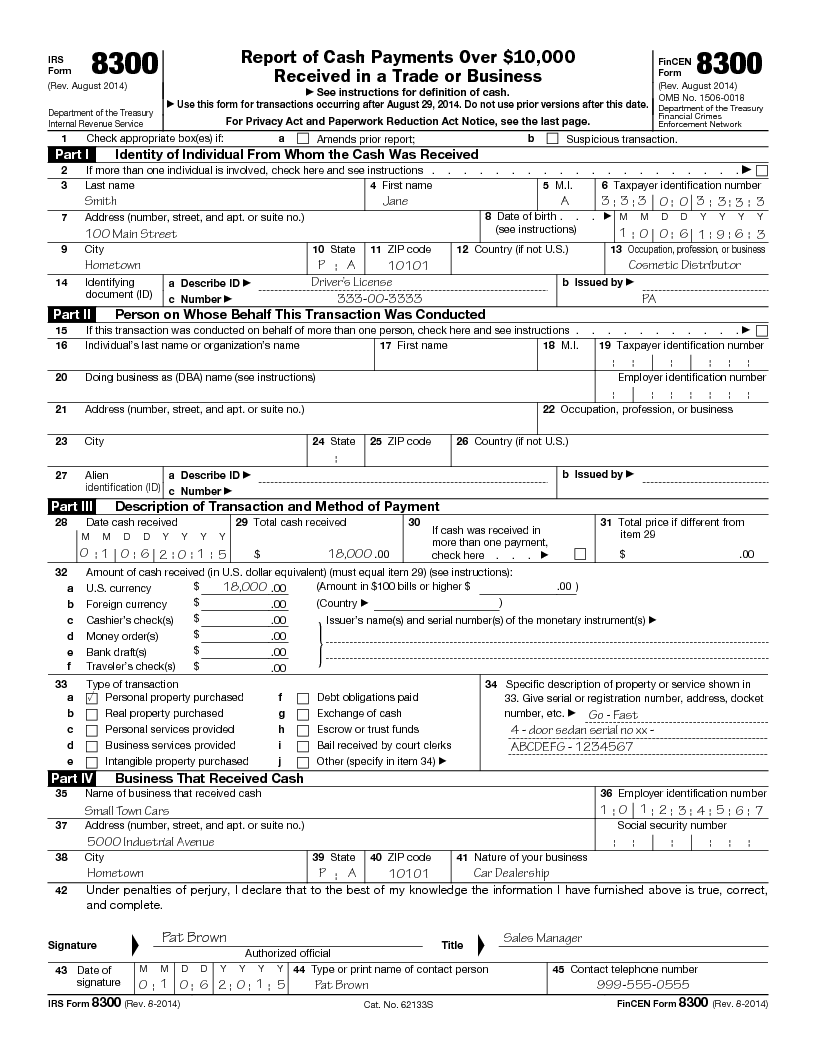
Pat Brown is the sales manager for Small Town Cars. On January 6, 2015, Jane Smith buys a new car from Pat and pays $18,000 in cash. Pat asks for identification from Jane to get the necessary information to complete Form 8300. A filled-in form is shown in this publication.
Pat must mail the form to the address shown in the form's instructions or file the form electronically using FinCen's BSA E-Filing System by January 21, 2015. He must also send a statement to Jane by January 31, 2016.
Example 2.
Using the same facts given in Example 1, suppose Jane had arranged to make cash payments of $6,000 each on January 6, February 6, and March 6. Pat would have to file a Form 8300 by February 23 (17 days after receiving total cash payments within 1 year over $10,000 because February 21, 2015, is a Saturday). Pat would not have to report the remaining $6,000 cash payment because it is not more than $10,000. However, he could report it if he felt it was a suspicious transaction.
Penalties
There are civil penalties for failure to:
-
File a correct Form 8300 by the date it is due, and
-
Provide the required statement to those named in the Form 8300.
If you intentionally disregard the requirement to file a correct Form 8300 by the date it is due, the penalty is the greater of:
-
$25,000, or
-
The amount of cash you received and were required to report (up to $100,000).
There are criminal penalties for:
-
Willful failure to file Form 8300,
-
Willfully filing a false or fraudulent Form 8300,
-
Stopping or trying to stop Form 8300 from being filed, and
-
Setting up, helping to set up, or trying to set up a transaction in a way that would make it seem unnecessary to file Form 8300.
If you willfully fail to file Form 8300, you can be fined up to $250,000 for individuals ($500,000 for corporations) or sentenced to up to 5 years in prison, or both. These dollar amounts are based on Section 3571 of Title 18 of the U.S. Code.
The penalties for failure to file may also apply to any person (including a payer) who attempts to interfere with or prevent the seller (or business) from filing a correct Form 8300. This includes any attempt to structure the transaction in a way that would make it seem unnecessary to file Form 8300. Structuring means breaking up a large cash transaction into small cash transactions.
How To Get Tax Help
Whether it's help with a tax issue, preparing your tax return or a need for a free publication or form, get the help you need the way you want it: online, use a smart phone, call or walk in to an IRS office or volunteer site near you.
Free help with your tax return.
You can get free help preparing your return nationwide from IRS-certified volunteers. The Volunteer Income Tax Assistance (VITA) program helps low-to-moderate income, elderly, people with disabilities, and limited English proficient taxpayers. The Tax Counseling for the Elderly (TCE) program helps taxpayers age 60 and older with their tax returns. Most VITA and TCE sites offer free electronic filing and all volunteers will let you know about credits and deductions you may be entitled to claim. In addition, some VITA and TCE sites provide taxpayers the opportunity to prepare their own return with help from an IRS-certified volunteer. To find the nearest VITA or TCE site, you can use the VITA Locator Tool on IRS.gov, download the IRS2Go app, or call 1-800-906-9887.
As part of the TCE program, AARP offers the Tax-Aide counseling program. To find the nearest AARP Tax-Aide site, visit AARP's website at www.aarp.org/money/taxaide or call 1-888-227-7669. For more information on these programs, go to IRS.gov and enter "VITA" in the search box.
Internet.
IRS.gov and IRS2Go are ready when you are —24 hours a day, 7 days a week.
-
Download the free IRS2Go app from the iTunes app store or from Google Play. Use it to check your refund status, order transcripts of your tax returns or tax account, watch the IRS YouTube channel, get IRS news as soon as it's released to the public, subscribe to filing season updates or daily tax tips, and follow the IRS Twitter news feed, @IRSnews, to get the latest federal tax news, including information about tax law changes and important IRS programs.
-
Check the status of your 2013 refund with the Where's My Refund? application on IRS.gov or download the IRS2Go app and select the Refund Status option. The IRS issues more than 9 out of 10 refunds in less than 21 days. Using these applications, you can start checking on the status of your return within 24 hours after we receive your e-filed return or 4 weeks after you mail a paper return. You will also be given a personalized refund date as soon as the IRS processes your tax return and approves your refund. The IRS updates Where's My Refund? every 24 hours, usually overnight, so you only need to check once a day.
-
Use the Interactive Tax Assistant (ITA) to research your tax questions. No need to wait on the phone or stand in line. The ITA is available 24 hours a day, 7 days a week, and provides you with a variety of tax information related to general filing topics, deductions, credits, and income. When you reach the response screen, you can print the entire interview and the final response for your records. New subject areas are added on a regular basis.
Answers not provided through ITA may be found in Tax Trails, one of the Tax Topics on IRS.gov which contain general individual and business tax information or by searching the IRS Tax Map, which includes an international subject index. You can use the IRS Tax Map, to search publications and instructions by topic or keyword. The IRS Tax Map integrates forms and publications into one research tool and provides single-point access to tax law information by subject. When the user searches the IRS Tax Map, they will be provided with links to related content in existing IRS publications, forms and instructions, questions and answers, and Tax Topics. -
Coming this filing season, you can immediately view and print for free all 5 types of individual federal tax transcripts (tax returns, tax account, record of account, wage and income statement, and certification of non-filing) using Get Transcript. You can also ask the IRS to mail a return or an account transcript to you. Only the mail option is available by choosing the Tax Records option on the IRS2Go app by selecting Mail Transcript on IRS.gov or by calling 1-800-908-9946. Tax return and tax account transcripts are generally available for the current year and the past three years.
-
Determine if you are eligible for the EITC and estimate the amount of the credit with the Earned Income Tax Credit (EITC) Assistant.
-
Visit Understanding Your IRS Notice or Letter to get answers to questions about a notice or letter you received from the IRS.
-
If you received the First Time Homebuyer Credit, you can use the First Time Homebuyer Credit Account Look-up tool for information on your repayments and account balance.
-
Check the status of your amended return using Where's My Amended Return? Go to IRS.gov and enter Where's My Amended Return? in the search box. You can generally expect your amended return to be processed up to 12 weeks from the date we receive it. It can take up to 3 weeks from the date you mailed it to show up in our system.
-
Make a payment using one of several safe and convenient electronic payment options available on IRS.gov. Select the Payment tab on the front page of IRS.gov for more information.
-
Determine if you are eligible and apply for an online payment agreement, if you owe more tax than you can pay today.
-
Figure your income tax withholding with the IRS Withholding Calculator on IRS.gov. Use it if you've had too much or too little withheld, your personal situation has changed, you're starting a new job or you just want to see if you're having the right amount withheld.
-
Determine if you might be subject to the Alternative Minimum Tax by using the Alternative Minimum Tax Assistant on IRS.gov.
-
Request an Electronic Filing PIN by going to IRS.gov and entering Electronic Filing PIN in the search box.
-
Download forms, instructions and publications, including accessible versions for people with disabilities.
-
Locate the nearest Taxpayer Assistance Center (TAC) using the Office Locator tool on IRS.gov, or choose the Contact Us option on the IRS2Go app and search Local Offices. An employee can answer questions about your tax account or help you set up a payment plan. Before you visit, check the Office Locator on IRS.gov, or Local Offices under Contact Us on IRS2Go to confirm the address, phone number, days and hours of operation, and the services provided. If you have a special need, such as a disability, you can request an appointment. Call the local number listed in the Office Locator, or look in the phone book under United States Government, Internal Revenue Service.
-
Apply for an Employer Identification Number (EIN). Go to IRS.gov and enter Apply for an EIN in the search box.
-
Read the Internal Revenue Code, regulations, or other official guidance.
-
Read Internal Revenue Bulletins.
-
Sign up to receive local and national tax news and more by email. Just click on "subscriptions" above the search box on IRS.gov and choose from a variety of options.
Phone.
You can call the IRS, or you can carry it in your pocket with the IRS2Go app on your smart phone or tablet. Download the free IRS2Go app from the iTunes app store or from Google Play.
-
Call to locate the nearest volunteer help site, 1-800-906-9887 or you can use the VITA Locator Tool on IRS.gov, or download the IRS2Go app. Low-to-moderate income, elderly, people with disabilities, and limited English proficient taxpayers can get free help with their tax return from the nationwide Volunteer Income Tax Assistance (VITA) program. The Tax Counseling for the Elderly (TCE) program helps taxpayers age 60 and older with their tax returns. Most VITA and TCE sites offer free electronic filing. Some VITA and TCE sites provide IRS-certified volunteers who can help prepare your tax return. Through the TCE program, AARP offers the Tax-Aide counseling program; call 1-888-227-7669 to find the nearest Tax-Aide location.
-
Call the automated Where's My Refund? information hotline to check the status of your 2013 refund 24 hours a day, 7 days a week at 1-800-829-1954. If you e-file, you can start checking on the status of your return within 24 hours after the IRS receives your tax return or 4 weeks after you've mailed a paper return. The IRS issues more than 9 out of 10 refunds in less than 21 days. Where's My Refund? will give you a personalized refund date as soon as the IRS processes your tax return and approves your refund. Before you call this automated hotline, have your 2013 tax return handy so you can enter your social security number, your filing status, and the exact whole dollar amount of your refund. The IRS updates Where's My Refund? every 24 hours, usually overnight, so you only need to check once a day. Note, the above information is for our automated hotline. Our live phone and walk-in assistors can research the status of your refund only if it's been 21 days or more since you filed electronically or more than 6 weeks since you mailed your paper return.
-
Call the Amended Return Hotline, 1-866-464-2050, to check the status of your amended return. You can generally expect your amended return to be processed up to 12 weeks from the date we receive it. It can take up to 3 weeks from the date you mailed it to show up in our system.
-
Call 1-800-TAX-FORM (1-800-829-3676) to order current-year forms, instructions, publications, and prior-year forms and instructions (limited to 5 years). You should receive your order within 10 business days.
-
Call TeleTax, 1-800-829-4477, to listen to pre-recorded messages covering general and business tax information. If, between January and April 15, you still have questions about the Form 1040, 1040A, or 1040EZ (like filing requirements, dependents, credits, Schedule D, pensions and IRAs or self-employment taxes), call 1-800-829-1040.
-
Call using TTY/TDD equipment, 1-800-829-4059 to ask tax questions or order forms and publications. The TTY/TDD telephone number is for people who are deaf, hard of hearing, or have a speech disability. These individuals can also contact the IRS through relay services such as the Federal Relay Service.
Walk-in.
You can find a selection of forms, publications and services — in-person.
-
Products. You can walk in to some post offices, libraries, and IRS offices to pick up certain forms, instructions, and publications. Some IRS offices, libraries, and city and county government offices have a collection of products available to photocopy from reproducible proofs.
-
Services. You can walk in to your local TAC for face-to-face tax help. An employee can answer questions about your tax account or help you set up a payment plan. Before visiting, use the Office Locator tool on IRS.gov, or choose the Contact Us option on the IRS2Go app and search Local Offices for days and hours of operation, and services provided.
Mail.
You can send your order for forms, instructions, and publications to the address below. You should receive a response within 10 business days after your request is received.
Internal Revenue Service1201 N. Mitsubishi Motorway
Bloomington, IL 61705-6613
The Taxpayer Advocate Service Is Here to Help You. The Taxpayer Advocate Service (TAS) is your voice at the IRS. Our job is to ensure that every taxpayer is treated fairly and that you know and understand your rights.
What can TAS do for you? We can offer you free help with IRS problems that you can't resolve on your own. We know this process can be confusing, but the worst thing you can do is nothing at all! TAS can help if you can't resolve your tax problem and:
-
Your problem is causing financial difficulties for you, your family, or your business.
-
You face (or your business is facing) an immediate threat of adverse action.
-
You've tried repeatedly to contact the IRS but no one has responded, or the IRS hasn't responded by the date promised.
If you qualify for our help, you'll be assigned to one advocate who'll be with you at every turn and will do everything possible to resolve your problem. Here's why we can help:
-
TAS is an independent organization within the IRS.
-
Our advocates know how to work with the IRS.
-
Our services are free and tailored to meet your needs.
-
We have offices in every state, the District of Columbia, and Puerto Rico.
How can you reach us? If you think TAS can help you, call your local advocate, whose number is in your local directory and at Taxpayer Advocate, or call us toll-free at 1-877-777-4778.
How else does TAS help taxpayers?
TAS also works to resolve large-scale, systemic problems that affect many taxpayers. If you know of one of these broad issues, please report it to us through our Systemic Advocacy Management System.
Low Income Taxpayer Clinics.
Low Income Taxpayer Clinics (LITCs) serve individuals whose income is below a certain level and need to resolve tax problems such as audits, appeals and tax collection disputes. Some clinics can provide information about taxpayer rights and responsibilities in different languages for individuals who speak English as a second language. Visit Taxpayer Advocate or see IRS Publication 4134, Low Income Taxpayer Clinic List.
Symbols
- $10,000, cash payments over,
A
- Assistance (see Tax help)
C
- Cash transactions over $10,000,
F
- Form, Who Must File Form 8300?
-
- 8300, Who Must File Form 8300?
- Free tax services, Free help with your tax return.
H
- Help (see Tax help)
P
- Publications (see Tax help)
R
- Reporting cash payments over $10,000,
T
- Tax help, How To Get Tax Help