


 )
or https:// means you've safely connected to the .gov website. Share sensitive information only on official, secure websites.
)
or https:// means you've safely connected to the .gov website. Share sensitive information only on official, secure websites.


- Publication 527 - Introductory Material
- Future Developments
- What’s New
- Reminders
- Introduction
- Sale or exchange of rental property.
- Sale of main home used as rental property.
- Tax-free exchange of rental property occasionally used for personal purposes.
- Comments and suggestions.
- Getting answers to your tax questions.
- Getting tax forms, instructions, and publications.
- Ordering tax forms, instructions, and publications.
- Useful Items - You may want to see:
- Rental Income and Expenses (If No Personal Use of Dwelling)
- Rental Income
- Rental Expenses
- Personal use of rental property.
- Part interest.
- When To Deduct
- Types of Expenses
- Depreciation.
- Insurance premiums paid in advance.
- Interest expense.
- Expenses paid to obtain a mortgage.
- Form 1098, Mortgage Interest Statement.
- Legal and other professional fees.
- Local benefit taxes.
- Local transportation expenses.
- Pre-rental expenses.
- Rental of equipment.
- Rental of property.
- Travel expenses.
- Uncollected rent.
- Vacant rental property.
- Vacant while listed for sale.
- Points
- Repairs and Improvements
- Depreciation of Rental Property
- Section 179 deduction.
- Alternative minimum tax (AMT).
- The Basics
- Special Depreciation Allowance
- MACRS Depreciation
- Claiming the Correct Amount of Depreciation
- Reporting Rental Income, Expenses, and Losses
- Which Forms To Use
- Limits on Rental Losses
- Excess business loss limitation.
- At-Risk Rules
- Passive Activity Limits
- Casualties and Thefts
- Example
- Special Situations
- Personal Use of Dwelling Unit (Including Vacation Home)
- How To Get Tax Help
- Tax reform.
- Preparing and filing your tax return.
- Free options for tax preparation.
- Using online tools to help prepare your return.
- Need someone to prepare your tax return?
- Employers can register to use Business Services Online.
- Business tax account.
- IRS social media.
- Online tax information in other languages.
- Over-the-Phone Interpreter (OPI) Service.
- Accessibility Helpline available for taxpayers with disabilities.
- Alternative media preference.
- Disasters.
- Getting tax forms and publications.
- Mobile-friendly forms.
- Getting tax publications and instructions in eBook format.
- Access your online account (individual taxpayers only).
- Get a transcript of your return.
- Tax Pro Account.
- Using direct deposit.
- Reporting and resolving your tax-related identity theft issues.
- Ways to check on the status of your refund.
- Making a tax payment.
- What if I can’t pay now?
- Filing an amended return.
- Checking the status of your amended return.
- Understanding an IRS notice or letter you’ve received.
- IRS Document Upload Tool.
- Schedule LEP.
- Contacting your local TAC.
- The Taxpayer Advocate Service (TAS) Is Here To Help You
- Publication 527 - Additional Material
Publication 527 (2025), Residential Rental Property
(Including Rental of Vacation Homes)
For use in preparing 2025 Returns
For the latest information about developments related to Pub. 527, such as legislation enacted after it was published, go to IRS.gov/Pub527.
Standard mileage rate. For 2025, the standard mileage rate for the cost of operating your car, van, pickup, or panel truck increased to 70 cents a mile.
Bonus depreciation. The 100% special depreciation allowance is restored for qualified property acquired and placed into service after January 19, 2025. However, property put into service between January 1, 2025, and January 19, 2025, or acquired before January 20, 2025, and put into service later will remain subject to the phase-down rules under prior law. For more information, see Form 4562, Depreciation and Amortization and its instructions.
Increased section 179 deduction dollar limits. For tax years beginning in 2025, the maximum section 179 expense deduction is $2,500,000. This limit is reduced by the amount by which the cost of section 179 property placed in service during the year exceeds $4,000,000.
Business interest expense limitation. The business interest expense in your rental real estate activity may be limited. For tax years beginning in 2025, the calculation of adjusted taxable income includes a requirement to add back to taxable income the deductions for depreciation, amortization, and depletion to arrive at the amount that is used to determine if your interest expense is limited. For more information, see Form 8990, Limitation on Business Interest Expense Under Section 163(j), and its instructions.
No tax on car loan interest. If you are self-employed and use your vehicle for personal and business use, you may be eligible to take a deduction for the interest for the personal use on Schedule 1-A (Form 1040). You can only deduct the part of the interest expense that represents the business use of your vehicle on Schedule E (Form 1040). See the Instructions for Schedule 1-A (Form 1040) for more information.
State and local tax (SALT) deduction limit increased. The overall limit on the deduction for state and local income, sales, and property taxes has increased to $40,000 ($20,000 if married filing separately). The overall limit is reduced if your modified adjusted gross income is more than $500,000 ($250,000 if married filing separately) but will not be reduced below $10,000 ($5,000 if married filing separately). See Worksheet 5-1, later.
Net Investment Income Tax (NIIT). You may be subject to the NIIT. NIIT is a 3.8% tax on the lesser of net investment income or the excess of modified adjusted gross income (MAGI) over the threshold amount. Net investment income may include rental income and other income from passive activities. Use Form 8960 to figure this tax. For more information on NIIT, go to IRS.gov/NIIT.
Form 7205, Energy Efficient Commercial Buildings Deduction. This form and its separate instructions are used to claim the section 179D deduction for qualifying energy efficient commercial building expense(s).
Excess business loss limitation. If you report a loss on line 26, 32, 37, or 39 of your Schedule E (Form 1040), you may be subject to a business loss limitation. The disallowed loss resulting from the limitation will not be reflected on line 26, 32, 37, or 39 of your Schedule E. Instead, use Form 461 to determine the amount of your excess business loss, which will be included as income on Schedule 1 (Form 1040), line 8p. Any disallowed loss resulting from this limitation will be treated as a net operating loss that must be carried forward and deducted in a subsequent year.See Form 461 and its instructions for details on the excess business loss limitation.
Photographs of missing children. The Internal Revenue Service is a proud partner with the National Center for Missing & Exploited Children® (NCMEC). Photographs of missing children selected by the Center may appear in this publication on pages that would otherwise be blank. You can help bring these children home by looking at the photographs and calling 1-800-THE-LOST (1-800-843-5678) if you recognize a child.
Introduction
Do you own a second house that you rent out all the time? Do you own a vacation home that you rent out when you or your family isn’t using it?
These are two common types of residential rental activities discussed in this publication. In most cases, all rental income must be reported on your tax return, but there are differences in the expenses you are allowed to deduct and in the way the rental activity is reported on your return.
Chapter 1 discusses rental-for-profit activity in which there is no personal use of the property. It examines some common types of rental income and when each is reported, as well as some common types of expenses and which are deductible.
Chapter 2 discusses depreciation as it applies to your rental real estate activity—what property can be depreciated and how much it can be depreciated.
Chapter 3 covers the reporting of your rental income and deductions, including casualties and thefts, limitations on losses, and claiming the correct amount of depreciation.
Chapter 4 discusses special rental situations. These include condominiums, cooperatives, property changed to rental use, renting only part of your property, and a not-for-profit rental activity.
Chapter 5 discusses the rules for rental income and expenses when there is also personal use of the dwelling unit, such as a vacation home.
Finally, chapter 6 explains how to get tax help from the IRS.
Sale or exchange of rental property.
For information on how to figure and report any gain or loss from the sale, exchange, or other disposition of your rental property, see Pub. 544.
Sale of main home used as rental property.
For information on how to figure and report any gain or loss from the sale or other disposition of your main home that you also used as rental property, see Pub. 523.
Tax-free exchange of rental property occasionally used for personal purposes.
If you meet certain qualifying use standards, you may qualify for a tax-free exchange (a like-kind or section 1031 exchange) of one piece of rental property you own for a similar piece of rental property, even if you have used the rental property for personal purposes.
For information on the qualifying use standards, see Revenue Procedure 2008-16, 2008-10 I.R.B. 547, available at IRS.gov/irb/2008-10_IRB#RP-2008-16. For more information on like-kind exchanges, see chapter 1 of Pub. 544.
Comments and suggestions.
We welcome your comments about this publication and suggestions for future editions.
You can send us comments through IRS.gov/FormComments. Or, you can write to the Internal Revenue Service, Tax Forms and Publications, 1111 Constitution Ave. NW, IR-6526, Washington, DC 20224.
Although we can’t respond individually to each comment received, we do appreciate your feedback and will consider your comments and suggestions as we revise our tax forms, instructions, and publications. Don’t send tax questions, tax returns, or payments to the above address.
Getting answers to your tax questions.
If you have a tax question not answered by this publication or the How To Get Tax Help section at the end of this publication, go to the IRS Interactive Tax Assistant page at IRS.gov/Help/ITA where you can find topics by using the search feature or viewing the categories listed.
Getting tax forms, instructions, and publications.
Go to IRS.gov/Forms to download current and prior-year forms, instructions, and publications.
Ordering tax forms, instructions, and publications.
Go to IRS.gov/OrderForms to order current forms, instructions, and publications; call 800-829-3676 to order prior-year forms and instructions. The IRS will process your order for forms and publications as soon as possible. Don’t resubmit requests you’ve already sent us. You can get forms and publications faster online.
Useful Items
You may want to see:Publication
-
463 Travel, Gift, and Car Expenses
-
523 Selling Your Home
-
534 Depreciating Property Placed in Service Before 1987
-
544 Sales and Other Dispositions of Assets
-
547 Casualties, Disasters, and Thefts
-
551 Basis of Assets
-
925 Passive Activity and At-Risk Rules
-
946 How To Depreciate Property
Form (and Instructions)
-
461 Excess Business Loss Limitation
-
4562 Depreciation and Amortization
-
5213 Election To Postpone Determination as To Whether the Presumption Applies That an Activity Is Engaged in for Profit
-
7205 Energy Efficient Commercial Buildings Deduction
-
8582 Passive Activity Loss Limitations
-
8960 Net Investment Income Tax—Individuals, Estates, and Trusts
-
Schedule E (Form 1040) Supplemental Income and Loss
This chapter discusses the various types of rental income and expenses for a residential rental activity with no personal use of the dwelling. Generally, each year, you will report all income and deduct all out-of-pocket expenses in full. The deduction to recover the cost of your rental property—depreciation—is taken over a prescribed number of years, and is discussed in chapter 2.
. If your rental income is from property you also use personally or rent to someone at less than a fair rental price, first read chapter 5..
Rental Income
In most cases, you must include in your gross income all amounts you receive as rent. Rental income is any payment you receive for the use or occupation of property. It isn’t limited to amounts you receive as normal rental payments.
When To Report
When you report rental income on your tax return generally depends on whether you are a cash or an accrual basis taxpayer. Most individual taxpayers use the cash method.
Cash method.
You are a cash basis taxpayer if you report income on your return in the year you actually or constructively receive it, regardless of when it was earned. You constructively receive income when it is made available to you, for example, by being credited to your bank account.
Types of Income
The following are common types of rental income.
Advance rent.
Advance rent is any amount you receive before the period that it covers. Include advance rent in your rental income in the year you receive it regardless of the period covered or the method of accounting you use.
Example.
On March 18, 2025, you signed a 10-year lease to rent your property. During 2025, you received $9,600 for the first year’s rent and $9,600 as rent for the last year of the lease. You must include $19,200 in your rental income in 2025.
Canceling a lease.
If your tenant pays you to cancel a lease, the amount you receive is rent. Include the payment in your rental income in the year you receive it regardless of your method of accounting.
Expenses paid by tenant.
If your tenant pays any of your expenses, those payments are rental income. Because you must include this amount in income, you can also deduct the expenses if they are deductible rental expenses. For more information, see Rental Expenses, later.
Example 1.
Your tenant pays the water and sewage bill for your rental property and deducts the amount from the normal rent payment. Under the terms of the lease, your tenant doesn’t have to pay this bill. Include the utility bill paid by the tenant and any amount received as a rent payment in your rental income. You can deduct the utility payment made by your tenant as a rental expense.
Example 2.
While you are out of town, the furnace in your rental property stops working. Your tenant pays for the necessary repairs and deducts the repair bill from the rent payment. Include the repair bill paid by the tenant and any amount received as a rent payment in your rental income. You can deduct the repair payment made by your tenant as a rental expense.
Property or services.
If you receive property or services as rent, instead of money, include the fair market value (FMV) of the property or services in your rental income.
If the services are provided at an agreed upon or specified price, that price is the FMV unless there is evidence to the contrary.
Example.
Your tenant is a house painter. He offers to paint your rental property instead of paying 2 months rent. You accept his offer.
Include in your rental income the amount the tenant would have paid for 2 months rent. You can deduct that same amount as a rental expense for painting your property.
Security deposits.
Don’t include a security deposit in your income when you receive it if you plan to return it to your tenant at the end of the lease. But if you keep part or all of the security deposit during any year because your tenant doesn’t live up to the terms of the lease, include the amount you keep in your income in that year.
If an amount called a security deposit is to be used as a final payment of rent, it is advance rent. Include it in your income when you receive it.
Lease with option to buy.
If the rental agreement gives your tenant the right to buy your rental property, the payments you receive under the agreement are generally rental income. If your tenant exercises the right to buy the property, the payments you receive for the period after the date of sale are considered part of the selling price.
Part interest.
If you own a part interest in rental property, you must report your part of the rental income from the property.
Rental of property also used as your home.
If you rent property that you also use as your home and you rent it less than 15 days during the tax year, don’t include the rent you receive in your income. Also, expenses from this activity are not considered rental expenses. For more information, see Used as a home but rented less than 15 days under Reporting Income and Deductions in chapter 5.
Rental Expenses
In most cases, the expenses of renting your property, such as maintenance, insurance, taxes, and interest, can be deducted from your rental income.
Personal use of rental property.
If you sometimes use your rental property for personal purposes, you must divide your expenses between rental and personal use. Also, your rental expense deductions may be limited. See chapter 5.
Part interest.
If you own a part interest in rental property, you can deduct expenses you paid according to your percentage of ownership.
Example.
Roger owns a one-half undivided interest in a rental house. Last year, he paid $968 for necessary repairs on the property. Roger can deduct $484 (50% (0.50) × $968) as a rental expense. He is entitled to reimbursement for the remaining half from the co-owner.
When To Deduct
You generally deduct your rental expenses in the year you pay them.
If you use the accrual method, see Pub. 538 for more information.
Types of Expenses
Listed below are the most common rental expenses.
Depreciation.
Depreciation is a capital expense. It is the mechanism for recovering your cost in an income-producing property and must be taken over the expected life of the property.
You can begin to depreciate rental property when it is ready and available for rent. See Placed in Service under When Does Depreciation Begin and End? in chapter 2.
Insurance premiums paid in advance.
If you pay an insurance premium for more than 1 year in advance, you can’t deduct the total premium in the year you pay it. For each year of coverage, you can deduct only the part of the premium payment that applies to that year.
Interest expense.
You can deduct mortgage interest you pay on your rental property. When you refinance a rental property for more than the previous outstanding balance, the portion of the interest allocable to loan proceeds not related to rental use generally can’t be deducted as a rental expense.
Expenses paid to obtain a mortgage.
Certain expenses you pay to obtain a mortgage on your rental property can’t be deducted as interest. These expenses, which include mortgage commissions, abstract fees, and recording fees, are capital expenses that are part of your basis in the property.
Form 1098, Mortgage Interest Statement.
If you paid $600 or more of mortgage interest on your rental property to any one person, you should receive a Form 1098 or similar statement showing the interest you paid for the year. If you and at least one other person (other than your spouse if you file a joint return) were liable for, and paid interest on, the mortgage, and the other person received the Form 1098, report your share of the interest on Schedule E (Form 1040), line 13. Attach a statement to your return showing the name and address of the other person. On the dotted line next to line 13, enter “See attached.”
Legal and other professional fees.
You can deduct, as a rental expense, legal and other professional expenses such as tax return preparation fees you paid to prepare Schedule E, Part I. For example, on your 2025 Schedule E, you can deduct fees paid in 2025 to prepare Part I of your 2024 Schedule E. You can also deduct, as a rental expense, any expense (other than federal taxes and penalties) you paid to resolve a tax underpayment related to your rental activities.
Local benefit taxes.
In most cases, you can’t deduct charges for local benefits that increase the value of your property, such as charges for putting in streets, sidewalks, or water and sewer systems. These charges are nondepreciable capital expenditures and must be added to the basis of your property. However, you can deduct local benefit taxes that are for maintaining, repairing, or paying interest charges for the benefits.
Local transportation expenses.
You may be able to deduct your ordinary and necessary local transportation expenses if you incur them to collect rental income or to manage, conserve, or maintain your rental property. However, transportation expenses incurred to travel between your home and a rental property generally constitute nondeductible commuting costs unless you use your home as your principal place of business. See Pub. 587, Business Use of Your Home, for information on determining if your home office qualifies as a principal place of business.
Generally, if you use your personal car, pickup truck, or light van for rental activities, you can deduct the expenses using one of two methods: actual expenses or the standard mileage rate. For 2025, the standard mileage rate is 70 cents a mile. For more information, see chapter 4 of Pub. 463.
. To deduct car expenses under either method, you must keep records that follow the rules in chapter 5 of Pub. 463. In addition, you must complete Form 4562, Part V, and attach it to your tax return. .
.If you use your vehicle for both business and personal purposes and you claimed a deduction in 2025 on Schedule 1-A (Form 1040) for the vehicle loan interest allocable to your personal use, then you can't claim a deduction for that same interest on Schedule E (or Schedule C, if applicable). See Schedule 1-A (Form 1040) and its instructions for more information. .
Pre-rental expenses.
You can deduct your ordinary and necessary expenses for managing, conserving, or maintaining rental property from the time you make it available for rent.
Rental of equipment.
You can deduct the rent you pay for equipment that you use for rental purposes. However, in some cases, lease contracts are actually purchase contracts. If so, you can’t deduct these payments. You can recover the cost of purchased equipment through depreciation.
Rental of property.
You can deduct the rent you pay for property that you use for rental purposes. If you buy a leasehold for rental purposes, you can deduct an equal part of the cost each year over the term of the lease.
Travel expenses.
You can deduct the ordinary and necessary expenses of traveling away from home if the primary purpose of the trip is to collect rental income or to manage, conserve, or maintain your rental property. You must properly allocate your expenses between rental and nonrental activities. You can’t deduct the cost of traveling away from home if the primary purpose of the trip is to improve the property. The cost of improvements is recovered by taking depreciation. For information on travel expenses, see chapter 1 of Pub. 463.
. To deduct travel expenses, you must keep records that follow the rules in chapter 5 of Pub. 463. .
Uncollected rent.
If you are a cash basis taxpayer, don’t deduct uncollected rent. Because you haven’t included it in your income, it’s not deductible.
If you use an accrual method, report income when you earn it. If you are unable to collect the rent, you may be able to deduct it as a business bad debt. See section 166 and its regulations for more information about business bad debts.
Vacant rental property.
If you hold property for rental purposes, you may be able to deduct your ordinary and necessary expenses (including depreciation) for managing, conserving, or maintaining the property while the property is vacant. However, you can’t deduct any loss of rental income for the period the property is vacant.
Vacant while listed for sale.
If you sell property you held for rental purposes, you can deduct the ordinary and necessary expenses for managing, conserving, or maintaining the property until it is sold. If the property isn’t held out and available for rent while listed for sale, the expenses aren’t deductible rental expenses.
The term “points” is often used to describe some of the charges paid, or treated as paid, by a borrower to take out a loan or a mortgage. These charges are also called loan origination fees, maximum loan charges, or premium charges. Any of these charges (points) that are solely for the use of money are interest. Because points are prepaid interest, you generally can’t deduct the full amount in the year paid, but must deduct the interest over the term of the loan.
The method used to figure the amount of points you can deduct each year follows the original issue discount (OID) rules. In this case, points paid (or treated as paid (such as seller paid points)), by a borrower to a lender increase OID which is the excess of:
-
Stated redemption price at maturity (generally the stated principal amount of the mortgage loan) over
-
Issue price (generally the amount borrowed reduced by the points).
Note:
For more detailed information to determine OID on a mortgage loan, including how to determine the stated redemption price at maturity and issue price of a mortgage loan, see the regulations under section 1273.
The first step to determine the amount of your deduction for the points is to determine whether your total OID on the mortgage loan, including the OID resulting from the points, is de minimis. If the OID isn’t de minimis, you must use the constant-yield method to figure how much you can deduct.
De minimis OID.
The OID is de minimis if it is less than one-fourth of 1% (0.0025) of the stated redemption price at maturity multiplied by the number of full years from the date of original issue to maturity (term of the loan).
If the OID is de minimis, you can choose one of the following ways to figure the amount of points you can deduct each year.
-
On a constant-yield basis over the term of the loan.
-
On a straight line basis over the term of the loan.
-
In proportion to stated interest payments.
-
In its entirety at maturity of the loan.
Example.
Carol took out a $100,000 mortgage loan on January 1, 2025, to buy a house she will use as a rental during 2025. The loan is to be repaid over 30 years. The loan requires interest payable each year at a fixed rate. During 2025, Carol paid $10,000 of mortgage interest (stated interest) to the lender. When the loan was made, she paid $1,500 in points to the lender. The amount of the OID on the loan is $1,500, which is the excess of the stated redemption price at maturity of $100,000 over the issue price of $98,500 (the amount borrowed of $100,000 minus the points paid of $1,500). Carol determines that the points (OID) she paid are de minimis based on the following computation.
| Stated redemption price at maturity (principal amount of the loan in this case) | $100,000 |
| Multiplied by: The term of the loan in complete years |
× 30 |
| Multiplied by | × 0.0025 |
| De minimis amount | $ 7,500 |
Constant-yield method.
If the OID (including the points) isn’t de minimis, you must use the constant-yield method to figure how much you can deduct each year.
You figure your deduction for the first year in the following manner.
-
Determine the issue price of the loan. If you paid points on the loan, the issue price is generally the difference between the amount borrowed and the points.
-
Multiply the result in (1) by the yield to maturity (defined later).
-
Subtract any qualified stated interest payments (defined later) from the result in (2). This is the OID you can deduct in the first year.
Yield to maturity (YTM).
This rate is generally shown in the literature you receive from your lender. If you don’t have this information, consult your lender or tax advisor. In general, the YTM is the discount rate that, when used in computing the present value of all principal and interest payments, produces an amount equal to the issue price of the loan.
Qualified stated interest (QSI).
In general, this is the stated interest that is unconditionally payable in cash or property (other than another debt instrument of the borrower) at least annually over the term of the loan at a fixed rate.
Example—Year 1.
The facts are the same as in the previous example. The YTM on Carol’s loan is 10.2467%, compounded annually.
She figured the amount of points (OID) she could deduct in 2025 as follows.
| Amount borrowed | $100,000 |
| Minus: Points (OID) | – 1,500 |
| Issue price of the loan | $ 98,500 |
| Multiplied by: YTM | × 0.102467 |
| Total | 10,093 |
| Minus: QSI | – 10,000 |
| Points (OID) deductible in 2025 | $ 93 |
To figure your deduction in any subsequent year, you start with the adjusted issue price. To get the adjusted issue price, add to the issue price figured in Year 1 any OID previously deducted. Then, follow steps (2) and (3), earlier.
Example—Year 2.
Carol figured the deduction for 2026 as follows.
| Issue price | $98,500 |
| Plus: Points (OID) deducted in 2025 |
+ 93 |
| Adjusted issue price | $98,593 |
| Multiplied by: YTM | × 0.102467 |
| Total | 10,103 |
| Minus: QSI | – 10,000 |
| Points (OID) deductible in 2026 | $ 103 |
Loan or mortgage ends.
If your loan or mortgage ends, you may be able to deduct any remaining points (OID) in the tax year in which the loan or mortgage ends. A loan or mortgage may end due to a refinancing, prepayment, foreclosure, or similar event. However, if the refinancing is with the same lender, the remaining points (OID) generally aren’t deductible in the year in which the refinancing occurs, but may be deductible over the term of the new mortgage or loan.
Points when loan refinance is more than the previous outstanding balance.
When you refinance a rental property for more than the previous outstanding balance, the portion of the points allocable to loan proceeds not related to rental use generally can’t be deducted as a rental expense.
Example.
You refinanced a loan with a balance of $100,000. The amount of the new loan was $120,000. You used the additional $20,000 to purchase a car. The points allocable to the $20,000 would be treated as nondeductible personal interest.
Generally, an expense for repairing or maintaining your rental property may be deducted if you aren’t required to capitalize the expense.
Improvements.
You must capitalize any expense you pay to improve your rental property. An expense is for an improvement if it results in a betterment to your property, restores your property, or adapts your property to a new or different use. Table 1-1 shows examples of many improvements.
Betterments.
Expenses that may result in a betterment to your property include expenses for fixing a pre-existing defect or condition, enlarging or expanding your property, or increasing the capacity, strength, or quality of your property.
Restoration.
Expenses that may be for restoration include expenses for replacing a substantial structural part of your property, repairing damage to your property after you properly adjusted the basis of your property as a result of a casualty loss, or rebuilding your property to a like-new condition.
Adaptation.
Expenses that may be for adaptation include expenses for altering your property to a use that isn’t consistent with the intended ordinary use of your property when you began renting the property.
De minimis safe harbor for tangible property.
If you elect this de minimis safe harbor for your rental activity for the tax year, you aren’t required to capitalize the de minimis costs of acquiring or producing certain real and tangible personal property and may deduct these amounts as rental expenses on line 19 of Schedule E. For more information on electing and using the de minimis safe harbor for tangible property, see Tangible Property Regulations-Frequently Asked Questions.
Safe harbor for routine maintenance.
If you determine that your cost was for an improvement to a building or equipment, you may still be able to deduct your cost under the routine maintenance safe harbor. See Tangible Property Regulations-Frequently Asked Questions for more information.
.Separate the costs of repairs and improvements, and keep accurate records. You will need to know the cost of improvements when you sell or depreciate your property. .
The expenses you capitalize for improving your property can generally be depreciated as if the improvement were separate property.
| Additions Bedroom Bathroom Deck Garage Porch Patio Lawn & Grounds Landscaping Driveway Walkway Fence Retaining wall Sprinkler system Swimming pool |
Miscellaneous Storm windows, doors New roof Central vacuum Wiring upgrades Satellite dish Security system Heating & Air Conditioning Heating system Central air conditioning Furnace Duct work Central humidifier Filtration system |
Plumbing Septic system Water heater Soft water system Filtration system Interior Improvements Built-in appliances Kitchen modernization Flooring Wall-to-wall carpeting Insulation Attic Walls, floor Pipes, duct work |
You recover the cost of income-producing property through yearly tax deductions. You do this by depreciating the property; that is, by deducting some of the cost each year on your tax return.
Three factors determine how much depreciation you can deduct each year: (1) your basis in the property, (2) the recovery period for the property, and (3) the depreciation method used. You can’t simply deduct your mortgage or principal payments, or the cost of furniture, fixtures, and equipment, as an expense.
You can deduct depreciation only on the part of your property used for rental purposes. Depreciation reduces your basis for figuring gain or loss on a later sale or exchange.
You may have to use Form 4562 to figure and report your depreciation. See Which Forms To Use in chapter 3. Also, see Pub. 946.
Section 179 deduction.
The section 179 deduction is a means of recovering part or all of the cost of certain qualifying property in the year you place the property in service. It is separate from your depreciation deduction. See chapter 2 of Pub. 946 for more information about claiming this deduction.
Alternative minimum tax (AMT).
If you use accelerated depreciation, you may be subject to the AMT. Accelerated depreciation allows you to deduct more depreciation earlier in the recovery period than you could deduct using a straight line method (same deduction each year).
The prescribed depreciation methods for rental real estate aren’t accelerated, so the depreciation deduction isn’t adjusted for the AMT. However, accelerated methods are generally used for other property connected with rental activities (for example, appliances and wall-to-wall carpeting).
To find out if you are subject to the AMT, see the Instructions for Form 6251.
The Basics
The following section discusses the information you will need to have about the rental property and the decisions to be made before figuring your depreciation deduction.
What Rental Property Can Be Depreciated?
You can depreciate your property if it meets all the following requirements.
Property you own.
To claim depreciation, you must usually be the owner of the property. You are considered to be the owner of the property even if it’s subject to a debt.
Rented property.
Generally, if you pay rent for property, you can’t depreciate that property. Usually, only the owner can depreciate it. However, if you make permanent improvements to leased property, you may be able to depreciate the improvements. See Additions or improvements to property, later in this chapter, under Recovery Periods Under GDS.
Cooperative apartments.
If you are a tenant-stockholder in a cooperative housing corporation and rent your cooperative apartment to others, you can depreciate your stock in the corporation. See chapter 4.
Property having a determinable useful life.
To be depreciable, your property must have a determinable useful life. This means that it must be something that wears out, decays, gets used up, becomes obsolete, or loses its value from natural causes.
Certain property can’t be depreciated. This includes land and certain excepted property.
Land.
You can’t depreciate the cost of land because land generally doesn’t wear out, become obsolete, or get used up. But if it does, the loss is accounted for upon disposition. The costs of clearing, grading, planting, and landscaping are usually all part of the cost of land and can’t be depreciated. You may, however, be able to depreciate certain land preparation costs if the costs are so closely associated with other depreciable property that you can determine a life for them along with the life of the associated property.
Example.
You built a new house to use as a rental and paid for grading, clearing, seeding, and planting bushes and trees. Some of the bushes and trees were planted right next to the house, while others were planted around the outer border of the lot. If you replace the house, you would have to destroy the bushes and trees right next to it. These bushes and trees are closely associated with the house, so they have a determinable useful life. Therefore, you can depreciate them. Add your other land preparation costs to the basis of your land because they have no determinable life and you can’t depreciate them.
Excepted property.
Even if the property meets all the requirements listed earlier under What Rental Property Can Be Depreciated, you can’t depreciate the following property.
-
Property placed in service and disposed of (or taken out of business use) in the same year.
-
Equipment used to build capital improvements. You must add otherwise allowable depreciation on the equipment during the period of construction to the basis of your improvements.
When Does Depreciation Begin and End?
You begin to depreciate your rental property when you place it in service for the production of income. You stop depreciating it either when you have fully recovered your cost or other basis, or when you retire it from service, whichever happens first.
You place property in service in a rental activity when it is ready and available for a specific use in that activity. Even if you aren’t using the property, it is in service when it is ready and available for its specific use.
Example 1.
On November 22 of last year, you purchased a dishwasher for your rental property. The appliance was delivered on December 7, but wasn’t installed and ready for use until January 3 of this year. Because the dishwasher wasn’t ready for use last year, it isn’t considered placed in service until this year.
If the appliance had been installed and ready for use when it was delivered in December of last year, it would have been considered placed in service in December, even if it wasn’t actually used until this year.
Example 2.
On April 6, you purchased a house to use as residential rental property. You made extensive repairs to the house and had it ready for rent on July 5. You began to advertise the house for rent in July and actually rented it beginning September 1. The house is considered placed in service in July when it was ready and available for rent. You can begin to depreciate the house in July.
Example 3.
You moved from your home in July. During August and September, you made several repairs to the house. On October 1, you listed the property for rent with a real estate company, which rented it on December 1. The property is considered placed in service on October 1, the date when it was available for rent.
Conversion to business use.
If you place property in service in a personal activity, you can’t claim depreciation. However, if you change the property’s use to business or the production of income, you can begin to depreciate it at the time of the change. You place the property in service for business or income-producing use on the date of the change.
Example.
You bought a house and used it as your personal home several years before you converted it to rental property. Although its specific use was personal and no depreciation was allowable, you placed the home in service when you began using it as your home. You can begin to claim depreciation in the year you converted it to rental property because at that time its use changed to the production of income.
Continue to claim a deduction for depreciation on property used in your rental activity even if it is temporarily idle (not in use). For example, if you must make repairs after a tenant moves out, you still depreciate the rental property during the time it isn’t available for rent.
You must stop depreciating property when the total of your yearly depreciation deductions equals your cost or other basis of your property. For this purpose, your yearly depreciation deductions include any depreciation that you were allowed to claim, even if you didn’t claim it. See Basis of Depreciable Property, later.
You stop depreciating property when you retire it from service, even if you haven’t fully recovered its cost or other basis. You retire property from service when you permanently withdraw it from use in a trade or business or from use in the production of income because of any of the following events.
-
You sell or exchange the property.
-
You convert the property to personal use.
-
You abandon the property.
-
The property is destroyed.
Depreciation Methods
Generally, you must use the Modified Accelerated Cost Recovery System (MACRS) to depreciate residential rental property placed in service after 1986.
If you placed rental property in service before 1987, you are using one of the following methods.
-
Accelerated Cost Recovery System (ACRS) for property placed in service after 1980 but before 1987.
-
Straight line or declining balance method over the useful life of property placed in service before 1981.
Rental property placed in service before 2025.
Continue to use the same method of figuring depreciation that you used in the past.
Use of real property changed.
Generally, you must use MACRS to depreciate real property that you acquired for personal use before 1987 and changed to business or income-producing use after 1986. This includes your residence that you changed to rental use. See Property Owned or Used in 1986 in chapter 1 of Pub. 946 for those situations in which MACRS isn’t allowed.
Improvements made after 1986.
Treat an improvement made after 1986 to property you placed in service before 1987 as separate depreciable property. As a result, you can depreciate that improvement as separate property under MACRS if it is the type of property that otherwise qualifies for MACRS depreciation. For more information about improvements, see Additions or improvements to property, later in this chapter, under Recovery Periods Under GDS.
.This publication discusses MACRS depreciation only. If you need information about depreciating property placed in service before 1987, see Pub. 534..
Basis of Depreciable Property
The basis of property used in a rental activity is generally its adjusted basis when you place it in service in that activity. This is its cost or other basis when you acquired it, adjusted for certain items occurring before you place it in service in the rental activity.
If you depreciate your property under MACRS, you may also have to reduce your basis by certain deductions and credits with respect to the property.
Basis and adjusted basis are explained in the following discussions.
.If you used the property for personal purposes before changing it to rental use, its basis for depreciation is the lesser of its adjusted basis or its FMV when you change it to rental use. See Basis of Property Changed to Rental Use in chapter 4..
The basis of property you buy is usually its cost. The cost is the amount you pay for it in cash, in debt obligation, in other property, or in services. Your cost also includes amounts you pay for:
-
Sales tax charged on the purchase (but see Exception next),
-
Freight charges to obtain the property, and
-
Installation and testing charges.
Exception.
If you deducted state and local general sales taxes as an itemized deduction on Schedule A (Form 1040), don’t include as part of your cost basis the sales taxes you deducted. Such taxes were deductible before 1987 and after 2003.
Loans with low or no interest.
If you buy property on any payment plan that charges little or no interest, the basis of your property is your stated purchase price, less the amount considered to be unstated interest. See Unstated Interest and Original Issue Discount (OID) in Pub. 537, Installment Sales.
Real property.
If you buy real property, such as a building and land, certain fees and other expenses you pay are part of your cost basis in the property.
Real estate taxes.
If you buy real property and agree to pay real estate taxes on it that were owed by the seller and the seller doesn’t reimburse you, the taxes you pay are treated as part of your basis in the property. You can’t deduct them as taxes paid.
If you reimburse the seller for real estate taxes the seller paid for you, you can usually deduct that amount. Don’t include that amount in your basis in the property.
Settlement fees and other costs.
The following settlement fees and closing costs for buying the property are part of your basis in the property.
The following are settlement fees and closing costs you can’t include in your basis in the property.
-
Fire insurance premiums.
-
Rent or other charges relating to occupancy of the property before closing.
-
Charges connected with getting or refinancing a loan, such as:
Also, don’t include amounts placed in escrow for the future payment of items such as taxes and insurance.
Assumption of a mortgage.
If you buy property and become liable for an existing mortgage on the property, your basis is the amount you pay for the property plus the amount remaining to be paid on the mortgage.
Example.
You buy a building for $60,000 cash and assume a mortgage of $240,000 on it. Your basis is $300,000.
Separating cost of land and buildings.
If you buy buildings and your cost includes the cost of the land on which they stand, you must divide the cost between the land and the buildings to figure the basis for depreciation of the buildings. The part of the cost that you allocate to each asset is the ratio of the FMV of that asset to the FMV of the whole property at the time you buy it.
If you aren’t certain of the FMVs of the land and the buildings, you can divide the cost between them based on their assessed values for real estate tax purposes.
Example.
You buy a house and land for $200,000. The purchase contract doesn’t specify how much of the purchase price is for the house and how much is for the land.
The latest real estate tax assessment on the property was based on an assessed value of $160,000, of which $136,000 was for the house and $24,000 was for the land.
You can allocate 85% ($136,000 ÷ $160,000) of the purchase price to the house and 15% ($24,000 ÷ $160,000) of the purchase price to the land.
Your basis in the house is $170,000 (85% of $200,000) and your basis in the land is $30,000 (15% of $200,000).
You can’t use cost as a basis for property that you received:
-
In return for services you performed;
-
In an exchange for other property;
-
As a gift;
-
From your spouse, or from your former spouse as the result of a divorce; or
-
As an inheritance.
If you received property in one of these ways, see Pub. 551 for information on how to figure your basis.
To figure your property’s basis for depreciation, you may have to make certain adjustments (increases and decreases) to the basis of the property for events occurring between the time you acquired the property and the time you placed it in service for business or the production of income. The result of these adjustments to the basis is the adjusted basis.
Increases to basis.
You must increase the basis of any property by the cost of all items properly added to a capital account. These include the following.
-
The cost of any additions or improvements made before placing your property into service as a rental that have a useful life of more than 1 year.
-
Amounts spent after a casualty to restore the damaged property.
-
The cost of extending utility service lines to the property.
-
Legal fees, such as the cost of defending and perfecting title, or settling zoning issues.
Additions or improvements.
Add to the basis of your property the amount an addition or improvement actually costs you, including any amount you borrowed to make the addition or improvement. This includes all direct costs, such as material and labor, but doesn’t include your own labor. It also includes all expenses related to the addition or improvement.
For example, if you had an architect draw up plans for remodeling your property, the architect’s fee is a part of the cost of the remodeling. Or, if you had your lot surveyed to put up a fence, the cost of the survey is a part of the cost of the fence.
Keep separate accounts for depreciable additions or improvements made after you place the property in service in your rental activity. For information on depreciating additions or improvements, see Additions or improvements to property, later in this chapter, under Recovery Periods Under GDS.
.The cost of landscaping improvements is usually treated as an addition to the basis of the land, which isn’t depreciable. However, see What Rental Property Can’t Be Depreciated, earlier..
Assessments for local improvements.
Assessments for items which tend to increase the value of property, such as streets and sidewalks, must be added to the basis of the property. For example, if your city installs curbing on the street in front of your house, and assesses you and your neighbors for its cost, you must add the assessment to the basis of your property. Also, add the cost of legal fees paid to obtain a decrease in an assessment levied against property to pay for local improvements. You can’t deduct these items as taxes or depreciate them.
However, you can deduct assessments for the purpose of maintenance or repairs or for the purpose of meeting interest charges related to the improvements. Don’t add them to your basis in the property.
Deducting vs. capitalizing costs.
Don’t add to your basis costs you can deduct as current expenses. However, there are certain costs you can choose either to deduct or to capitalize. If you capitalize these costs, include them in your basis. If you deduct them, don’t include them in your basis.
The costs you may choose to deduct or capitalize include carrying charges, such as interest and taxes, that you must pay to own property.
For more information about deducting or capitalizing costs and how to make the election, see Carrying Charges in sections 263A and 266.
Decreases to basis.
You must decrease the basis of your property by any items that represent a return of your cost. These include the following.
-
Insurance or other payment you receive as the result of a casualty or theft loss.
-
Casualty loss not covered by insurance for which you took a deduction.
-
Amount(s) you receive for granting an easement.
-
Residential energy credits you were allowed before 1986 or after 2005 if you added the cost of the energy items to the basis of your home.
-
Exclusion from income of subsidies for energy conservation measures.
-
Special depreciation allowance or a section 179 deduction claimed on qualified property.
-
Depreciation you deducted or could have deducted on your tax returns under the method of depreciation you chose. If you didn’t deduct enough or deducted too much in any year, see Depreciation under Decreases to Basis in Pub. 551.
If your rental property was previously used as your main home, you must also decrease the basis by the following.
-
Gain you postponed from the sale of your main home before May 7, 1997, if the replacement home was converted to your rental property.
-
District of Columbia first-time homebuyer credit allowed on the purchase of your main home after August 4, 1997, and before January 1, 2012.
-
Amount of qualified principal residence indebtedness discharged on or after January 1, 2007.
Special Depreciation Allowance
For 2025, some properties used in connection with residential real property activities may qualify for a special depreciation allowance. This allowance is figured before you figure your regular depreciation deduction. See chapter 3 of Pub. 946 for details. Also, see the instructions for Form 4562, line 14.
If you qualify for, but choose not to take, a special depreciation allowance, you must attach a statement to your return. The details of this election are in chapter 3 of Pub. 946 and the instructions for Form 4562, line 14.
MACRS Depreciation
Most business and investment property placed in service after 1986 is depreciated using MACRS.
This section explains how to determine which MACRS depreciation system applies to your property. It also discusses other information you need to know before you can figure depreciation under MACRS. This information includes the property’s:
-
Recovery class,
-
Applicable recovery period,
-
Convention,
-
Placed-in-service date,
-
Basis for depreciation, and
-
Depreciation method.
Depreciation Systems
MACRS consists of two systems that determine how you depreciate your property—the General Depreciation System (GDS) and the Alternative Depreciation System (ADS). You must use GDS unless you are specifically required by law to use ADS or you elect to use ADS.
You can’t use MACRS for certain personal property (such as furniture or appliances) placed in service in your rental property in 2025 if it had been previously placed in service before 1987, when MACRS became effective.
In most cases, personal property is excluded from MACRS if you (or a person related to you) owned or used it in 1986 or if your tenant is a person (or someone related to the person) who owned or used it in 1986. However, the property isn’t excluded if your 2025 deduction under MACRS (using a half-year convention) is less than the deduction you would have under ACRS. For more information, see What Method Can You Use To Depreciate Your Property? in chapter 1 of Pub. 946.
If you choose, you can use the ADS method for most property. Under ADS, you use the straight line method of depreciation.
The election of ADS for one item in a class of property generally applies to all property in that class placed in service during the tax year of the election. However, the election applies on a property-by-property basis for residential rental property and nonresidential real property.
If you choose to use ADS for your residential rental property, the election must be made in the first year the property is placed in service. Once you make this election, you can never revoke it.
For property placed in service during 2025, you make the election to use ADS by entering the depreciation on Form 4562, Part III, Section C, line 20c.
Property Classes Under GDS
Each item of property that can be depreciated under MACRS is assigned to a property class, determined by its class life. The property class generally determines the depreciation method, recovery period, and convention.
The property classes under GDS are:
-
3-year property,
-
5-year property,
-
7-year property,
-
10-year property,
-
15-year property,
-
20-year property,
-
Nonresidential real property, and
-
Residential rental property.
Under MACRS, property that you placed in service during 2025 in your rental activities generally falls into one of the following classes.
-
5-year property. This class includes computers and peripheral equipment, office machinery (typewriters, calculators, copiers, etc.), automobiles, and light trucks.
This class also includes appliances, carpeting, and furniture used in a residential rental real estate activity.
Depreciation is limited on automobiles and other property used for transportation and property of a type generally used for entertainment, recreation, or amusement. See chapter 5 of Pub. 946.
-
7-year property. This class includes office furniture and equipment (desks, file cabinets, and similar items). This class also includes any property that doesn’t have a class life and that hasn’t been designated by law as being in any other class.
-
15-year property. This class includes roads, fences, and shrubbery (if depreciable).
-
Residential rental property. This class includes any real property that is a rental building or structure (including a mobile home) for which 80% or more of the gross rental income for the tax year is from dwelling units. It doesn’t include a unit in a hotel, motel, inn, or other establishment where more than half of the units are used on a transient basis. If you live in any part of the building or structure, the gross rental income includes the fair rental value of the part you live in.
.The other property classes generally don’t apply to property used in rental activities. These classes aren’t discussed in this publication. See Pub. 946 for more information..
Recovery Periods Under GDS
The recovery period of property is the number of years over which you recover its cost or other basis. The recovery periods are generally longer under ADS than GDS.
The recovery period of property depends on its property class. Under GDS, the recovery period of an asset is generally the same as its property class.
Class lives and recovery periods for most assets are listed in Appendix B of Pub. 946. See Table 2-1 for recovery periods of property commonly used in residential rental activities.
Additions or improvements to property.
Treat additions or improvements you make to your depreciable rental property as separate property items for depreciation purposes.
The property class and recovery period of the addition or improvement are the ones that would apply to the original property if you had placed it in service at the same time as the addition or improvement.
The recovery period for an addition or improvement to property begins on the later of:
-
The date the addition or improvement is placed in service, or
-
The date the property to which the addition or improvement was made is placed in service.
Example.
You own a residential rental house that you have been renting since 1999 and depreciating under MACRS. You built an addition onto the house and placed it in service in 2025. You must begin depreciating the addition in 2025 using MACRS. Under GDS, the addition is depreciated as residential rental property over 27.5 years.
Table 2-1. MACRS Recovery Periods for Property Used in Rental Activities
| MACRS Recovery Period | ||
| Type of Property | General Depreciation System |
Alternative Depreciation System |
| Computers and their peripheral equipment | 5 years | 5 years |
Office machinery, such as:
|
5 years | 6 years |
| Automobiles | 5 years | 5 years |
| Light trucks | 5 years | 5 years |
Appliances, such as:
|
5 years | 9 years |
| Carpets | 5 years | 9 years |
| Furniture used in rental property | 5 years | 9 years |
Office furniture and equipment, such as:
|
7 years | 10 years |
| Any property that doesn’t have a class life and that hasn’t been designated by law as being in any other class | 7 years | 12 years |
| Roads | 15 years | 20 years |
| Shrubbery | 15 years | 20 years |
| Fences | 15 years | 20 years |
| Residential rental property (buildings or structures) and structural components such as furnaces, waterpipes, venting, etc. | 27.5 years | 30 years1 |
| Additions and improvements, such as a new roof | The same recovery period as that of the property to which the addition or improvement is made, determined as if the property were placed in service at the same time as the addition or improvement. | |
| 1 40 years for property placed in service before January 1, 2018. However, the ADS recovery period for residential rental property placed in service before January 1, 2018, is 30 years if the property is held by an electing real property trade or business (as defined in section 163(j)(7)(B)) and section 168(g)(1)(A), (B), (C), (D), or (E) did not apply to the property before January 1, 2018. |
Conventions
A convention is a method established under MACRS to set the beginning and end of the recovery period. The convention you use determines the number of months for which you can claim depreciation in the year you place property in service and in the year you dispose of the property.
Mid-month convention.
A mid-month convention is used for all residential rental property and nonresidential real property. Under this convention, you treat all property placed in service, or disposed of, during any month as placed in service, or disposed of, at the midpoint of that month.
Mid-quarter convention.
A mid-quarter convention must be used if the mid-month convention doesn’t apply and the total depreciable basis of MACRS property placed in service in the last 3 months of a tax year (excluding nonresidential real property, residential rental property, and property placed in service and disposed of in the same year) is more than 40% of the total basis of all such property you place in service during the year.
Under this convention, you treat all property placed in service, or disposed of, during any quarter of a tax year as placed in service, or disposed of, at the midpoint of the quarter.
Example.
During the tax year, you purchased the following items to use in your rental property. You elect not to claim the special depreciation allowance discussed earlier.
-
A dishwasher for $400 that you placed in service in January.
-
Used furniture for $100 that you placed in service in September.
-
A refrigerator for $800 that you placed in service in October.
Half-year convention.
The half-year convention is used if neither the mid-quarter convention nor the mid-month convention applies. Under this convention, you treat all property placed in service, or disposed of, during a tax year as placed in service, or disposed of, at the midpoint of that tax year.
If this convention applies, you deduct a half year of depreciation for the first year and the last year that you depreciate the property. You deduct a full year of depreciation for any other year during the recovery period.
Figuring Your Depreciation Deduction
You can figure your MACRS depreciation deduction in one of two ways. The deduction is substantially the same both ways. You can figure the deduction using either:
-
The depreciation method and convention that apply over the recovery period of the property, or
-
The percentage from the MACRS percentage tables.
In this publication, we will use the percentage tables. For instructions on how to compute the deduction, see chapter 4 of Pub. 946.
Residential rental property.
You must use the straight line method and a mid-month convention for residential rental property. In the first year that you claim depreciation for residential rental property, you can claim depreciation only for the number of months the property is in use. Use the mid-month convention (explained under Conventions, earlier).
5-, 7-, or 15-year property.
For property in the 5- or 7-year class, use the 200% declining balance (DB) method and a half-year convention. However, in limited cases, you must use the mid-quarter convention, if it applies. For property in the 15-year class, use the 150% DB method and a half-year convention, unless the mid-quarter convention applies.
You can also choose to use the 150% DB method for property in the 5- or 7-year class. The choice to use the 150% method for one item in a class of property applies to all property in that class that is placed in service during the tax year of the election. You make this election on Form 4562. In Part III, column (f), enter “150 DB.” Once you make this election, you can’t change to another method.
If you use either the 200% or 150% DB method, figure your deduction using the straight line method in the first tax year that the use of the straight line method gives you an equal or larger deduction than the use of the 200% or 150% DB method.
You can also choose to use the straight line method with a half-year or mid-quarter convention for 5-, 7-, or 15-year property. The choice to use the straight line method for one item in a class of property applies to all property in that class that is placed in service during the tax year of the election. You elect the straight line method on Form 4562. In Part III, column (f), enter “S/L.” Once you make this election, you can’t change to another method.
You can use the percentages in Table 2-2 to compute annual depreciation under MACRS. The tables show the percentages for the first few years or until the change to the straight line method is made. See Appendix A of Pub. 946 for complete tables. The percentages in Tables 2-2a, 2-2b, and 2-2c make the change from using the DB method to the straight line method in the first tax year that the use of the straight line method gives you an equal or greater deduction than the use of the DB method.
If you elect to use the straight line method for 5-, 7-, or 15-year property, or the 150% DB method for 5- or 7-year property, use the tables in Appendix A of Pub. 946.
How to use the percentage tables.
You must apply the table rates to your property’s unadjusted basis (defined later) each year of the recovery period.
Once you begin using a percentage table to figure depreciation, you must continue to use it for the entire recovery period unless there is an adjustment to the basis of your property for a reason other than:
-
Depreciation allowed or allowable, or
-
An addition or improvement that is depreciated as a separate item of property.
If there is an adjustment for any reason other than (1) or (2), for example, because of a deductible casualty loss, you can no longer use the table. For the year of the adjustment and for the remaining recovery period, figure depreciation using the property’s adjusted basis at the end of the year and the appropriate depreciation method, as explained earlier under Figuring Your Depreciation Deduction. See Figuring the Deduction Without Using the Tables in chapter 4 of Pub. 946.
Unadjusted basis.
This is the same basis you would use to figure gain on a sale (see Basis of Depreciable Property, earlier), but without reducing your original basis by any MACRS depreciation taken in earlier years.
However, you do reduce your original basis by other amounts claimed on the property, including:
-
Any amortization,
-
Any section 179 deduction, and
-
Any special depreciation allowance.
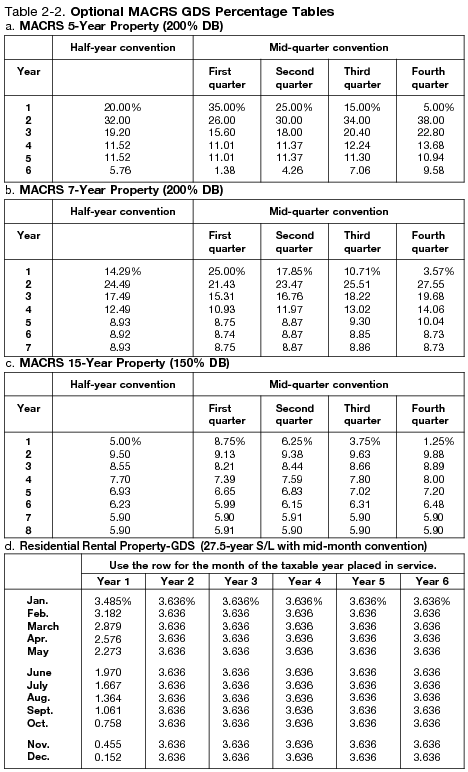
Tables 2-2a, 2-2b, and 2-2c.
The percentages in these tables take into account the half-year and mid-quarter conventions. Use Table 2-2a for 5-year property, Table 2-2b for 7-year property, and Table 2-2c for 15-year property. Use the percentage in the second column (half-year convention) unless you are required to use the mid-quarter convention (explained earlier). If you must use the mid-quarter convention, use the column that corresponds to the calendar year quarter in which you placed the property in service.
Example 1.
You purchased a stove and refrigerator and placed them in service in June. Your basis in the stove is $600 and your basis in the refrigerator is $1,000. Both are 5-year property. Using the half-year convention column in Table 2-2a, the depreciation percentage for Year 1 is 20%. For that year, your depreciation deduction is $120 ($600 × 20% (0.20)) for the stove and $200 ($1,000 × 20% (0.20)) for the refrigerator.
For Year 2, the depreciation percentage is 32%. That year’s depreciation deduction will be $192 ($600 × 32% (0.32)) for the stove and $320 ($1,000 × 32% (0.32)) for the refrigerator.
Example 2.
Assume the same facts as in Example 1, except you buy the refrigerator in October instead of June. Because the refrigerator was placed in service in the last 3 months of the tax year, and its basis ($1,000) is more than 40% of the total basis of all property placed in service during the year ($1,600 × 40% (0.40) = $640), you are required to use the mid-quarter convention to figure depreciation on both the stove and refrigerator.
Because you placed the refrigerator in service in October, you use the fourth quarter column of Table 2-2a and find the depreciation percentage for Year 1 is 5%. Your depreciation deduction for the refrigerator is $50 ($1,000 x 5% (0.05)).
Because you placed the stove in service in June, you use the second quarter column of Table 2-2a and find the depreciation percentage for Year 1 is 25%. For that year, your depreciation deduction for the stove is $150 ($600 x 25% (0.25)).
Table 2-2d.
Use this table when you are using the GDS 27.5-year option for residential rental property. Find the row for the month that you placed the property in service. Use the percentages listed for that month to figure your depreciation deduction. The mid-month convention is taken into account in the percentages shown in the table. Continue to use the same row (month) under the column for the appropriate year.
Example.
You purchased a single family rental house for $185,000 and placed it in service on February 8. The sales contract showed that the building cost $160,000 and the land cost $25,000. Your basis for depreciation is its original cost, $160,000. This is the first year of service for your residential rental property and you decide to use GDS, which has a recovery period of 27.5 years. Using Table 2-2d, you find that the depreciation percentage for property placed in service in February of Year 1 is 3.182%. That year’s depreciation deduction is $5,091 ($160,000 x 3.182% (0.03182)).
Figuring MACRS Depreciation Under ADS
Table 2-1 shows the ADS recovery periods for property used in rental activities.
See Appendix B of Pub. 946 for other property. If your property isn’t listed in Appendix B, it is considered to have no class life. Under ADS, personal property with no class life is depreciated using a recovery period of 12 years.
Use the mid-month convention for residential rental property and nonresidential real property. For all other property, use the half-year or mid-quarter convention, as appropriate.
See Pub. 946 for ADS depreciation tables.
Claiming the Correct Amount of Depreciation
You should claim the correct amount of depreciation each tax year. If you didn’t claim all the depreciation you were entitled to deduct, you must still reduce your basis in the property by the full amount of depreciation that you could have deducted. For more information, see Depreciation under Decreases to Basis in Pub. 551.
If you deducted an incorrect amount of depreciation for property in any year, you may be able to make a correction by filing Form 1040-X, Amended U.S. Individual Income Tax Return. If you aren’t allowed to make the correction on an amended return, you may be able to change your accounting method to claim the correct amount of depreciation. See How Do You Correct Depreciation Deductions? in Pub. 946 for more information.
Figuring the net income or loss for a residential rental activity may involve more than just listing the income and deductions on Schedule E (Form 1040). There are activities that don’t qualify to use Schedule E, such as when the activity isn’t engaged in to make a profit or when you provide substantial services in conjunction with the property.
There are also the limitations that may need to be applied if you have a net loss on Schedule E. There are two: (1) the limitation based on the amount of investment you have at risk in your rental activity, and (2) the special limits imposed on passive activities.
You may also have a gain or loss related to your rental property from a casualty or theft. This is considered separately from the income and expense information you report on Schedule E.
Which Forms To Use
The basic form for reporting residential rental income and expenses is Schedule E (Form 1040). However, don’t use that schedule to report a not-for-profit activity. See Not Rented for Profit, later, in chapter 4. There are also other rental situations in which forms other than Schedule E would be used.
Schedule E (Form 1040)
If you rent buildings, rooms, or apartments, and provide basic services such as heat and light, trash collection, etc., you normally report your rental income and expenses on Schedule E, Part I.
List your total income, expenses, and depreciation for each rental property. Be sure to enter the number of fair rental and personal-use days on line 2.
If you have more than three rental or royalty properties, complete and attach as many Schedules E as are needed to separately list all of the properties. However, fill in lines 23a through 26 on only one Schedule E. The figures on lines 23a through 26 on that Schedule E should be the combined totals for all properties reported on your Schedules E.
On Schedule E, page 1, line 18, enter the depreciation you are claiming for each property. You may also need to attach Form 4562 to claim some or all of your depreciation. See Form 4562, later, for more information.
If you have a loss from your rental real estate activity, you may also need to complete one or both of the following forms.
-
Form 6198, At-Risk Limitations. See At-Risk Rules, later. Also, see Pub. 925.
-
Form 8582, Passive Activity Loss Limitations. See Passive Activity Limits, later.
Page 2 of Schedule E is used to report income or loss from partnerships, S corporations, estates, trusts, and real estate mortgage investment conduits. If you need to use page 2 of Schedule E and you have more than three rental or royalty properties, be sure to use page 2 of the same Schedule E you used to enter the combined totals for your rental activity on page 1. Also, include the amount from line 26 (Part I) in the “Total income or (loss)” on line 41 (Part V).
Form 4562.
You must complete and attach Form 4562 if you are claiming the following depreciation in your rental activity.
-
Depreciation, including the special depreciation allowance, on property placed in service during 2025.
-
Depreciation on listed property (such as a car), regardless of when it was placed in service.
You may also need to attach Form 4562 if you are claiming a section 179 deduction, amortizing costs that began during 2025, or claiming any other deduction for a vehicle, including the standard mileage rate or lease expenses.
Schedule C (Form 1040), Profit or Loss From Business
Generally, Schedule C is used when you provide substantial services in conjunction with the property or the rental is part of a trade or business as a real estate dealer.
Providing substantial services.
If you provide substantial services that are primarily for your tenant’s convenience, such as regular cleaning, changing linen, or maid service, you report your rental income and expenses on Schedule C. Use Form 1065, U.S. Return of Partnership Income, if your rental activity is a partnership (including a partnership with your spouse unless it is a qualified joint venture). Substantial services don’t include the furnishing of heat and light, cleaning of public areas, trash collection, etc. For more information, see Pub. 334, Tax Guide for Small Business. Also, you may have to pay self-employment tax on your rental income using Schedule SE (Form 1040), Self-Employment Tax. For a discussion of “substantial services,” see Real Estate Rents in chapter 5 of Pub. 334.
Qualified Joint Venture (QJV)
If you and your spouse each materially participate (see Material participation under Passive Activity Limits, later) as the only members of a jointly owned and operated real estate business, and you file a joint return for the tax year, you can make a joint election to be treated as a QJV instead of a partnership. This election, in most cases, won’t increase the total tax owed on the joint return, but it does give each of you credit for social security earnings on which retirement benefits are based and for Medicare coverage if your rental income is subject to self-employment tax.
If you make this election, you must report rental real estate income on Schedule E (or Schedule C, if you provide substantial services). You won’t be required to file Form 1065 for any year the election is in effect. Rental real estate income generally isn’t included in net earnings from self-employment subject to self-employment tax and is generally subject to the passive activity limits.
If you and your spouse filed a Form 1065 for the year prior to the election, the partnership terminates at the end of the tax year immediately preceding the year the election takes effect.
For more information on QJVs, go to IRS.gov/QJV.
Limits on Rental Losses
If you have a loss from your rental real estate activity, two sets of rules may limit the amount of loss you can report on Schedule E. You must consider these rules in the order shown below. Both are discussed in this section.
-
At-risk rules. These rules are applied first if there is investment in your rental real estate activity for which you aren’t at risk. This applies only if the real property was placed in service after 1986.
-
Passive activity limits. Generally, rental real estate activities are considered passive activities and losses aren’t deductible unless you have income from other passive activities to offset them. However, there are exceptions.
Excess business loss limitation.
In addition to at-risk rules and passive activity limits, excess business loss rules apply to losses from all noncorporate trades or businesses. This business loss limitation is figured using Form 461 after you complete your Schedule E. Any limitation to your loss resulting from these rules will not be reflected on your Schedule E. Instead, it will be added to your income on Form 1040 or 1040-SR and treated as a net operating loss that must be carried forward and deducted in a subsequent year.
At-Risk Rules
You may be subject to the at-risk rules if you have:
-
A loss from an activity carried on as a trade or business or for the production of income, and
-
Amounts invested in the activity for which you aren’t fully at risk.
Losses from holding real property (other than mineral property) placed in service before 1987 aren’t subject to the at-risk rules.
In most cases, any loss from an activity subject to the at-risk rules is allowed only to the extent of the total amount you have at risk in the activity at the end of the tax year. You are considered at risk in an activity to the extent of cash and the adjusted basis of other property you contributed to the activity and certain amounts borrowed for use in the activity. Any loss that is disallowed because of the at-risk limits is treated as a deduction from the same activity in the next tax year. See Pub. 925 for a discussion of the at-risk rules.
Form 6198.
If you are subject to the at-risk rules, file Form 6198 with your tax return.
Passive Activity Limits
In most cases, all rental real estate activities (except those of certain real estate professionals, discussed later) are passive activities. For this purpose, a rental activity is an activity from which you receive income mainly for the use of tangible property, rather than for services. For a discussion of activities that aren’t considered rental activities, see Rental Activities in Pub. 925.
Deductions or losses from passive activities are limited. You generally can’t offset income, other than passive income, with losses from passive activities. Nor can you offset taxes on income, other than passive income, with credits resulting from passive activities. Any excess loss or credit is carried forward to the next tax year. Exceptions to the rules for figuring passive activity limits for personal use of a dwelling unit and for rental real estate with active participation are discussed later.
For a detailed discussion of these rules, see Pub. 925.
Real estate professionals.
If you are a real estate professional, complete line 43 of Schedule E.
You qualify as a real estate professional for the tax year if you meet both of the following requirements.
-
More than half of the personal services you perform in all trades or businesses during the tax year are performed in real property trades or businesses in which you materially participate.
-
You perform more than 750 hours of services during the tax year in real property trades or businesses in which you materially participate.
Don’t count personal services you perform as an employee in real property trades or businesses unless you are a 5% owner of your employer. You are a 5% owner if you own (or are considered to own) more than 5% of your employer’s outstanding stock, or capital or profits interest.
Don’t count your spouse’s personal services to determine whether you met the requirements listed earlier to qualify as a real estate professional. However, you can count your spouse’s participation in an activity in determining if you materially participated.
Real property trades or businesses.
A real property trade or business is a trade or business that does any of the following with real property.
-
Develops or redevelops it.
-
Constructs or reconstructs it.
-
Acquires it.
-
Converts it.
-
Rents or leases it.
-
Operates or manages it.
-
Brokers it.
Choice to treat all interests as one activity.
If you were a real estate professional and had more than one rental real estate interest during the year, you can choose to treat all the interests as one activity. You can make this choice for any year that you qualify as a real estate professional. If you forgo making the choice for one year, you can still make it for a later year.
If you make the choice, it is binding for the tax year you make it and for any later year that you are a real estate professional. This is true even if you aren’t a real estate professional in any intervening year. (For that year, the exception for real estate professionals won’t apply in determining whether your activity is subject to the passive activity rules.)
See the Instructions for Schedule E for information about making this choice.
Material participation.
Generally, you materially participated in an activity for the tax year if you were involved in its operations on a regular, continuous, and substantial basis during the year. For details, see Pub. 925 or the Instructions for Schedule C.
Participating spouse.
If you are married, determine whether you materially participated in an activity by also counting any participation in the activity by your spouse during the year. Do this even if your spouse owns no interest in the activity or files a separate return for the year.
Form 8582.
You may have to complete Form 8582 to figure the amount of any passive activity loss for the current tax year for all activities and the amount of the passive activity loss allowed on your tax return. See Form 8582 not required, later in this chapter, to determine if you must complete Form 8582.
If you are required to complete Form 8582 and are also subject to the at-risk rules, include the amount from Form 6198, line 21 (deductible loss), in column (b) of Form 8582, Worksheet 1 or 2, as required.
If you used the rental property as a home during the year, any income, deductions, gain, or loss allocable to such use is not to be taken into account for purposes of the passive activity loss limitation. Instead, follow the rules explained in chapter 5.
If you or your spouse actively participated in a passive rental real estate activity, you may be able to deduct up to $25,000 of loss from the activity from your nonpassive income. This special allowance is an exception to the general rule disallowing losses in excess of income from passive activities. Similarly, you may be able to offset credits from the activity against the tax on up to $25,000 of nonpassive income after taking into account any losses allowed under this exception.
Example.
You are single and have $40,000 in wages, $2,000 of passive income from a limited partnership, and $3,500 of passive loss from a rental real estate activity in which you actively participated. $2,000 of your $3,500 loss offsets your passive income. The remaining $1,500 loss can be deducted from your $40,000 wages.
.The special allowance isn’t available if you were married, lived with your spouse at any time during the year, and are filing a separate return. .
Active participation.
You actively participated in a rental real estate activity if you (and your spouse) owned at least 10% of the rental property and you made management decisions or arranged for others to provide services (such as repairs) in a significant and bona fide sense. Management decisions that may count as active participation include approving new tenants, deciding on rental terms, approving expenditures, and other similar decisions.
Example.
You are single and had the following income and losses during the tax year.
| Salary | $42,300 | ||
| Dividends | 300 | ||
| Interest | 1,400 | ||
| Rental loss | (4,000) |
The rental loss was from the rental of a house you owned. You had advertised and rented the house to the current tenant yourself. You also collected the rents, which usually came by mail. You made or contracted out all repairs.
Although the rental loss is from a passive activity, because you actively participated in the rental property management, you can use the entire $4,000 loss to offset your other income.
Maximum special allowance.
The maximum special allowance is:
-
$25,000 for single individuals and married individuals filing a joint return for the tax year,
-
$12,500 for married individuals who file separate returns for the tax year and lived apart from their spouses at all times during the tax year, and
-
$25,000 for a qualifying estate reduced by the special allowance for which the surviving spouse qualified.
If your MAGI is $100,000 or less ($50,000 or less if married filing separately), you can deduct your loss up to the amount specified above. If your MAGI is more than $100,000 (more than $50,000 if married filing separately), your special allowance is limited to 50% of the difference between $150,000 ($75,000 if married filing separately) and your MAGI.
Generally, if your MAGI is $150,000 or more ($75,000 or more if you are married filing separately), there is no special allowance.
Modified adjusted gross income (MAGI).
For more information on the definition of MAGI, see Special $25,000 allowance in Pub. 925. Also see Line 6 in the Instructions for Form 8582.
Form 8582 not required.
Don’t complete Form 8582 if you meet all of the following conditions.
-
Your only passive activities were rental real estate activities in which you actively participated.
-
Your overall net loss from these activities is $25,000 or less ($12,500 or less if married filing separately and you lived apart from your spouse all year).
-
If married filing separately, you lived apart from your spouse all year.
-
You have no prior-year unallowed losses from these (or any other passive) activities.
-
You have no current or prior-year unallowed credits from passive activities.
-
Your MAGI is $100,000 or less ($50,000 or less if married filing separately and you lived apart from your spouse all year).
-
You don’t hold any interest in a rental real estate activity as a limited partner or as a beneficiary of an estate or a trust.
If you meet all of the conditions listed above, your rental real estate activities aren’t limited by the passive activity rules and you don’t have to complete Form 8582. On lines 23a through 23e of your Schedule E, enter the applicable amounts.
Casualties and Thefts
As a result of a casualty or theft, you may have a loss related to your rental property. You may be able to deduct the loss on your income tax return.
Casualty.
This is the damage, destruction, or loss of property resulting from an identifiable event that is sudden, unexpected, or unusual. Such events include a storm, fire, or earthquake.
Theft.
This is defined as the unlawful taking and removing of your money or property with the intent to deprive you of it.
Gain from casualty or theft.
It is also possible to have a gain from a casualty or theft if you receive money, including insurance, that is more than your adjusted basis in the property. Generally, you must report this gain. However, under certain circumstances, you may defer paying tax by choosing to postpone reporting the gain. To do this, you must generally buy replacement property within 2 years after the close of the first tax year in which any part of your gain is realized. In certain circumstances, the replacement period can be greater than 2 years; see Replacement Period in Pub. 547 for more information. The cost of the replacement property must be equal to or more than the net insurance or other payment you received.
More information.
For information on business and nonbusiness casualty and theft losses, see Pub. 547.
Example
In February 2020, you bought a rental house for $135,000 (house $120,000 and land $15,000) and immediately began renting it out. In 2025, you rented it all 12 months for a monthly rental fee of $1,125. In addition to your rental income of $13,500 (12 x $1,125), you had the following expenses.
| Mortgage interest | $8,000 |
| Fire insurance (1-year policy) | 250 |
| Miscellaneous repairs | 400 |
| Real estate taxes imposed and paid | 500 |
| Maintenance | 200 |
You depreciate the residential rental property under MACRS GDS. This means using the straight line method over a recovery period of 27.5 years.
You use Table 2-2d to find your depreciation percentage. Because you placed the property in service in February 2020, you continue to use that row of Table 2-2d. For Year 6, the rate is 3.636%.
You figure your net rental income or loss for the house as follows.
| Total rental income received ($1,125 × 12) |
$13,500 | |
| Minus: Expenses | ||
| Mortgage interest | $8,000 | |
| Fire insurance | 250 | |
| Miscellaneous repairs | 400 | |
| Real estate taxes | 500 | |
| Maintenance | 200 | |
| Total expenses | 9,350 | |
| Balance | $4,150 | |
| Minus: Depreciation ($120,000 x 3.636% (0.03636)) | 4,363 | |
| Net rental (loss) for house | ($213) | |
You had a net loss for the year. Because you actively participated in your passive rental real estate activity and your loss was less than $25,000, you can deduct the loss on your return. You also meet all of the requirements for not having to file Form 8582. You use Schedule E, Part I, to report your rental income and expenses. You enter your income, expenses, and depreciation for the house in the column for Property A and enter your loss on line 22. Form 4562 isn’t required.
This chapter discusses some rental real estate activities that are subject to additional rules.
Condominiums
A condominium is most often a dwelling unit in a multi-unit building, but can also take other forms, such as a townhouse or garden apartment.
If you own a condominium, you also own a share of the common elements, such as land, lobbies, elevators, and service areas. You and the other condominium owners may pay dues or assessments to a special corporation that is organized to take care of the common elements.
Special rules apply if you rent your condominium to others. You can deduct as rental expenses all the expenses discussed in chapters 1 and 2. In addition, you can deduct any dues or assessments paid for maintenance of the common elements.
You can’t deduct special assessments you pay to a condominium management corporation for improvements. However, you may be able to recover your share of the cost of any improvement by taking depreciation.
Cooperatives
If you live in a cooperative, you don’t own your apartment. Instead, a corporation owns the apartments and you are a tenant-stockholder in the cooperative housing corporation. If you rent your apartment to others, you can usually deduct, as a rental expense, all the maintenance fees you pay to the cooperative housing corporation.
In addition to the maintenance fees paid to the cooperative housing corporation, you can deduct your direct payments for repairs, upkeep, and other rental expenses, including interest paid on a loan used to buy your stock in the corporation.
Depreciation
You will be depreciating your stock in the corporation rather than the apartment itself. Figure your depreciation deduction as follows.
-
Figure the depreciation for all the depreciable real property owned by the corporation. (Depreciation methods are discussed in chapter 2 of this publication and Pub. 946.) If you bought your cooperative stock after its first offering, figure the depreciable basis of this property as follows.
-
Multiply your cost per share by the total number of outstanding shares.
-
Add to the amount figured in (a) any mortgage debt on the property on the date you bought the stock.
-
Subtract from the amount figured in (b) any mortgage debt that isn’t for the depreciable real property, such as the part for the land.
-
-
Subtract from the amount figured in (1) any depreciation for space owned by the corporation that can be rented but can’t be lived in by tenant-stockholders.
-
Divide the number of your shares of stock by the total number of shares outstanding, including any shares held by the corporation.
-
Multiply the result of (2) by the percentage you figured in (3). This is your depreciation on the stock.
Your depreciation deduction for the year can’t be more than the part of your adjusted basis (defined in chapter 2) in the stock of the corporation that is allocable to your rental property.
Payments added to capital account.
Payments earmarked for a capital asset or improvement, or otherwise charged to the corporation’s capital account, are added to the basis of your stock in the corporation. For example, you can’t deduct a payment used to pave a community parking lot, install a new roof, or pay the principal of the corporation’s mortgage.
Treat as a capital cost the amount you were assessed for capital items. This can’t be more than the amount by which your payments to the corporation exceeded your share of the corporation’s mortgage interest and real estate taxes.
Your share of interest and taxes is the amount the corporation elected to allocate to you, if it reasonably reflects those expenses for your apartment. Otherwise, figure your share in the following manner.
-
Divide the number of your shares of stock by the total number of shares outstanding, including any shares held by the corporation.
-
Multiply the corporation’s deductible interest by the number you figured in (1). This is your share of the interest.
-
Multiply the corporation’s deductible taxes by the number you figured in (1). This is your share of the taxes.
Property Changed to Rental Use
If you change your home or other property (or a part of it) to rental use at any time other than the beginning of your tax year, you must divide yearly expenses, such as taxes and insurance, between rental use and personal use.
You can deduct as rental expenses only the part of the expense that is for the part of the year the property was used or held for rental purposes.
You can’t deduct depreciation or insurance for the part of the year the property was held for personal use. However, you can include the home mortgage interest and real estate tax expenses for the part of the year the property was held for personal use when figuring the amount you can deduct on Schedule A.
Example.
Your tax year is the calendar year. You moved from your home in May and started renting it out on June 1. You can deduct as rental expenses seven-twelfths of your yearly expenses, such as taxes and insurance.
Starting with June, you can deduct as rental expenses the amounts you pay for items generally billed monthly, such as utilities.
When figuring depreciation, treat the property as placed in service on June 1.
Basis of Property Changed to Rental Use
When you change property you held for personal use to rental use (for example, you rent your former home), the basis for depreciation will be the lesser of the FMV or adjusted basis on the date of conversion.
FMV.
This is the price at which the property would change hands between a willing buyer and a willing seller, neither having to buy or sell, and both having reasonable knowledge of all the relevant facts. Sales of similar property, on or about the same date, may be helpful in figuring the FMV of the property.
Figuring the basis.
The basis for depreciation is the lesser of:
-
The FMV of the property on the date you changed it to rental use; or
-
Your adjusted basis on the date of the change—that is, your original cost or other basis of the property, plus the cost of permanent additions or improvements since you acquired it, minus deductions for any casualty or theft losses claimed on earlier years’ income tax returns and other decreases to basis. For other increases and decreases to basis, see Adjusted Basis in chapter 2.
Example.
You originally built a house for $140,000 on a lot that cost you $14,000, which you used as your home for many years. Before changing the property to rental use this year, you added $28,000 of permanent improvements to the house and claimed a $3,500 casualty loss deduction for damage to the house. Part of the improvements qualified for a $500 residential energy credit, which you claimed on a prior-year tax return. Because land isn’t depreciable, you can only include the cost of the house when figuring the basis for depreciation.
The adjusted basis of the house at the time of the change in its use was $164,000 ($140,000 + $28,000 − $3,500 − $500).
On the date of the change in use, your property had an FMV of $168,000, of which $21,000 was for the land and $147,000 was for the house.
The basis for depreciation on the house is the FMV on the date of the change ($147,000) because it is less than your adjusted basis ($164,000).
If you change your cooperative apartment to rental use, figure your allowable depreciation as explained earlier. (Depreciation methods are discussed in chapter 2 of this publication and Pub. 946.) The basis of all the depreciable real property owned by the cooperative housing corporation is the smaller of the following amounts.
-
The FMV of the property on the date you change your apartment to rental use. This is considered to be the same as the corporation’s adjusted basis minus straight line depreciation, unless this value is unrealistic.
-
The corporation’s adjusted basis in the property on that date. Don’t subtract depreciation when figuring the corporation’s adjusted basis.
If you bought the stock after its first offering, the corporation’s adjusted basis in the property is the amount figured in (1) under Depreciation, earlier. The FMV of the property is considered to be the same as the corporation’s adjusted basis figured in this way minus straight line depreciation, unless the value is unrealistic.
Figuring the Depreciation Deduction
To figure the deduction, use the depreciation system in effect when you convert your residence to rental use. Generally, that will be MACRS for any conversion after 1986. Treat the property as placed in service on the conversion date.
Example.
Your converted residence (see the previous example under Figuring the basis, earlier) was available for rent on August 1. Using Table 2-2d (see chapter 2), the percentage for Year 1 beginning in August is 1.364% and the depreciation deduction for Year 1 is $2,005 ($147,000 × 1.364% (0.01364)).
Renting Part of Property
If you rent part of your property, you must divide certain expenses between the part of the property used for rental purposes and the part of the property used for personal purposes, as though you actually had two separate pieces of property.
You can deduct the expenses related to the part of the property used for rental purposes, such as home mortgage interest and real estate taxes, as rental expenses on Schedule E (Form 1040). You can also deduct as rental expenses a portion of other expenses that are normally nondeductible personal expenses, such as expenses for electricity or painting the outside of the house.
There is no change in the types of expenses deductible for the personal-use part of your property. Generally, these expenses may be deducted only if you itemize your deductions on Schedule A (Form 1040).
You can’t deduct any part of the cost of the first phone line even if your tenants have unlimited use of it.
You don’t have to divide the expenses that belong only to the rental part of your property. For example, if you paint a room that you rent or pay premiums for liability insurance in connection with renting a room in your home, your entire cost is a rental expense. If you install a second phone line strictly for your tenant’s use, all the cost of the second line is deductible as a rental expense. You can deduct depreciation on the part of the house used for rental purposes as well as on the furniture and equipment you use for rental purposes.
How to divide expenses.
If an expense is for both rental use and personal use, such as mortgage interest or heat for the entire house, you must divide the expense between rental use and personal use. You can use any reasonable method for dividing the expense. It may be reasonable to divide the cost of some items (for example, water) based on the number of people using them. The two most common methods for dividing an expense are (1) the number of rooms in your home, and (2) the square footage of your home.
Example.
You rent a room in your house. The room is 12 × 15 feet, or 180 square feet. Your entire house has 1,800 square feet of floor space. You can deduct as a rental expense 10% of any expense that must be divided between rental use and personal use. If your heating bill for the year for the entire house was $600, $60 ($600 × 10% (0.10)) is a rental expense. The balance, $540, is a personal expense that you can’t deduct.
Duplex.
A common situation is the duplex where you live in one unit and rent out the other. Certain expenses apply to the entire property, such as mortgage interest and real estate taxes, and must be split to determine rental and personal expenses.
Example.
You own a duplex and live in one half, renting out the other half. Both units are approximately the same size. Last year, you paid a total of $10,000 mortgage interest and $2,000 real estate taxes for the entire property. You can deduct $5,000 mortgage interest and $1,000 real estate taxes on Schedule E. If you itemize your deductions, include the other $5,000 mortgage interest and $1,000 real estate taxes when figuring the amount you can deduct on Schedule A.
Not Rented for Profit
If you don’t rent your property to make a profit, you must still report your rental income, however, you can no longer deduct rental expenses.
Where to report.
Report your not-for-profit rental income on Schedule 1 (Form 1040), line 8j. If you itemize your deductions, include your mortgage interest (if you use the property as your main home or second home), real estate taxes, and casualty losses from your not-for-profit rental activity when figuring the amount you can deduct on Schedule A.
Presumption of profit.
If your rental income is more than your rental expenses for at least 3 years out of a period of 5 consecutive years, you are presumed to be renting your property to make a profit.
Postponing decision.
If you are starting your rental activity and don’t have 3 years showing a profit, you can elect to have the presumption made after you have the 5 years of experience required by the test. You may choose to postpone the decision of whether the rental is for profit by filing Form 5213. You must file Form 5213 within 3 years after the due date of your return (determined without extensions) for the year in which you first carried on the activity or, if earlier, within 60 days after receiving written notice from the IRS proposing to disallow deductions attributable to the activity.
More information.
For more information about the rules for an activity not engaged in for profit, see Hobby or business: here’s what to know about that side hustle.
Example—Property Changed to Rental Use
In January, you bought a condominium apartment to live in. Instead of selling the house you had been living in, you decided to change it to a rental property. You selected a tenant and started renting the house on February 1. You charged $750 a month for rent and collected it yourself. You also received a $750 security deposit from your tenant. Because you plan to return it to your tenant at the end of the lease, you don’t include it in your income. Your rental expenses for the year are as follows.
| Mortgage interest | $1,800 | ||
| Fire insurance (1-year policy) | 100 | ||
| Miscellaneous repairs (after renting) | 297 | ||
| Real estate taxes imposed and paid | 1,200 |
You must divide the real estate taxes, mortgage interest, and fire insurance between the personal use of the property and the rental use of the property. You can deduct eleven-twelfths of these expenses as rental expenses. You can include the balance of the real estate taxes and mortgage interest when figuring the amount you can deduct on Schedule A, if you itemize. You can’t deduct the balance of the fire insurance because it is a personal expense.
You bought this house in 2008 for $35,000. Your property tax was based on assessed values of $10,000 for the land and $25,000 for the house. Before changing it to rental property, you added several improvements to the house. You figure your adjusted basis as follows.
| Improvements | Cost | ||
| House | $25,000 | ||
| Remodeled kitchen | 4,200 | ||
| Recreation room | 5,800 | ||
| New roof | 1,600 | ||
| Patio and deck | 2,400 | ||
| Adjusted basis | $39,000 |
On February 1, when you changed your house to rental property, the property had an FMV of $152,000. Of this amount, $35,000 was for the land and $117,000 was for the house.
Because your adjusted basis is less than the FMV on the date of the change, you use $39,000 as your basis for depreciation.
As specified for residential rental property, you must use the straight line method of depreciation over the GDS or ADS recovery period. You choose the GDS recovery period of 27.5 years.
You use Table 2-2d to find your depreciation percentage. Because you placed the property in service in February, the percentage is 3.182%.
On April 1, you bought a new dishwasher for the rental property at a cost of $425. The dishwasher is personal property used in a rental real estate activity, which has a 5-year recovery period. You use Table 2-2a to find the depreciation percentage for Year 1 under “Half-year convention” (20%) to figure your depreciation deduction.
On May 1, you paid $4,000 to have a furnace installed in the house. The furnace is residential rental property. Because you placed the property in service in May, the depreciation percentage from Table 2-2d is 2.273%.
You figured your net rental income or loss for the house as follows.
| Total rental income received ($750 × 11) |
$8,250 | |
| Minus: Expenses | ||
| Mortgage interest ($1,800 × 11/12) | $1,650 | |
| Fire insurance ($100 × 11/12) | 92 | |
| Miscellaneous repairs | 297 | |
| Real estate taxes ($1,200 × 11/12) | 1,100 | |
| Total expenses | 3,139 | |
| Balance | $5,111 | |
| Minus: Depreciation | ||
| House ($39,000 × 0.03182) | $1,241 | |
| Dishwasher ($425 × 0.20) | 85 | |
| Furnace ($4,000 × 0.02273) | 91 | |
| Total depreciation | 1,417 | |
| Net rental income for house | $3,694 | |
You use Schedule E, Part I, to report your rental income and expenses. You enter your income, expenses, and depreciation for the house in the column for Property A. Because all property was placed in service this year, you must use Form 4562 to figure the depreciation. See the instructions for Form 4562 for more information on preparing the form.
If you have any personal use of a dwelling unit (including a vacation home) that you rent, you must divide your expenses between rental use and personal use. In general, your rental expenses will be no more than your total expenses multiplied by a fraction, the denominator of which is the total number of days the dwelling unit is used and the numerator of which is the total number of days actually rented at a fair rental price. Only your rental expenses may be deducted on Schedule E (Form 1040). Some of your personal expenses may be deductible on Schedule A (Form 1040) if you itemize your deductions.
You must also determine if the dwelling unit is considered a home. The amount of rental expenses that you can deduct may be limited if the dwelling unit is considered a home. Whether a dwelling unit is considered a home depends on how many days during the year are considered to be days of personal use. There is a special rule if you used the dwelling unit as a home and you rented it for less than 15 days during the year.
Dwelling unit.
A dwelling unit includes a house, apartment, condominium, mobile home, boat, vacation home, or similar property. It also includes all structures or other property belonging to the dwelling unit. A dwelling unit has basic living accommodations, such as sleeping space, a toilet, and cooking facilities.
A dwelling unit doesn’t include property (or part of the property) used solely as a hotel, motel, inn, or similar establishment. Property is used solely as a hotel, motel, inn, or similar establishment if it is regularly available for occupancy by paying customers and isn’t used by an owner as a home during the year.
Example.
You rent a room in your home that is always available for short-term occupancy by paying customers. You don’t use the room yourself and you allow only paying customers to use the room. This room is used solely as a hotel, motel, inn, or similar establishment and isn’t a dwelling unit.
Dividing Expenses
If you use a dwelling unit for both rental and personal purposes, divide your expenses between the rental use and the personal use based on the number of days used for each purpose.
When dividing your expenses, follow these rules.
-
Any day that the unit is rented at a fair rental price is a day of rental use even if you used the unit for personal purposes that day. (This rule doesn’t apply when determining whether you used the unit as a home.)
-
Any day that the unit is available for rent but not actually rented isn’t a day of rental use.
Fair rental price.
A fair rental price for your property is generally the amount of rent that a person who isn’t related to you would be willing to pay. The rent you charge isn’t a fair rental price if it is substantially less than the rents charged for other properties that are similar to your property in your area.
Ask yourself the following questions when comparing another property with yours.
-
Is it used for the same purpose?
-
Is it approximately the same size?
-
Is it in approximately the same condition?
-
Does it have similar furnishings?
-
Is it in a similar location?
Example.
Your beach cottage was available for rent from June 1 through August 31 (92 days). Except for the first week in August (7 days), when you were unable to find a renter, you rented the cottage at a fair rental price during that time. The person who rented the cottage for July allowed you to use it over the weekend (2 days) without any reduction in or refund of rent. Your family also used the cottage during the last 2 weeks of May (14 days). The cottage wasn’t used at all before May 17 or after August 31.
You figure the part of the cottage expenses to treat as rental expenses as follows.
-
The cottage was used for rental a total of 85 days (92 − 7). The days it was available for rent but not rented (7 days) aren’t days of rental use. The July weekend (2 days) you used it is rental use because you received a fair rental price for the weekend.
-
You used the cottage for personal purposes for 14 days (the last 2 weeks in May).
-
The total use of the cottage was 99 days (14 days personal use + 85 days rental use).
-
Your rental expenses are 85/99 (86%) of the cottage expenses.
Note:
When determining whether you used the cottage as a home, the July weekend (2 days) you used it is considered personal use even though you received a fair rental price for the weekend. Therefore, you had 16 days of personal use and 83 days of rental use for this purpose. Because you used the cottage for personal purposes more than 14 days and more than 10% of the days of rental use (8 days), you used it as a home. If you have a net loss, you may not be able to deduct all of the rental expenses. See Dwelling Unit Used as a Home next.
Dwelling Unit Used as a Home
If you use a dwelling unit for both rental and personal purposes, the tax treatment of the rental expenses you figured earlier under Dividing Expenses and rental income depends on whether you are considered to be using the dwelling unit as a home.
You use a dwelling unit as a home during the tax year if you use it for personal purposes more than the greater of:
-
14 days, or
-
10% of the total days it is rented to others at a fair rental price.
If a dwelling unit is used for personal purposes on a day it is rented at a fair rental price (discussed earlier), don’t count that day as a day of rental use in applying (2) above. Instead, count it as a day of personal use in applying both (1) and (2) above.
What is a day of personal use?
A day of personal use of a dwelling unit is any day that the unit is used by any of the following persons.
-
You or any other person who owns an interest in it, unless you rent it to another owner as their main home under a shared equity financing agreement (defined later). However, see Days used as a main home before or after renting, later.
-
A member of your family or a member of the family of any other person who owns an interest in it, unless the family member uses the dwelling unit as their main home and pays a fair rental price. Family includes only your spouse, siblings, half siblings, ancestors (parents, grandparents, etc.), and lineal descendants (children, grandchildren, etc.).
-
Anyone under an arrangement that lets you use some other dwelling unit.
-
Anyone at less than a fair rental price.
Main home.
If the other person or member of the family in (1) or (2) has more than one home, their main home is ordinarily the one they lived in most of the time.
Shared equity financing agreement.
This is an agreement under which two or more persons acquire undivided interests for more than 50 years in an entire dwelling unit, including the land, and one or more of the co-owners are entitled to occupy the unit as their main home upon payment of rent to the other co-owner(s).
Donation of use of the property.
You use a dwelling unit for personal purposes if:
-
You donate the use of the unit to a charitable organization,
-
The organization sells the use of the unit at a fundraising event, and
-
The “purchaser” uses the unit.
Examples.
The following examples show how to determine if you have days of personal use.
Example 1.
You and your neighbor are co-owners of a condominium at the beach. Last year, you rented the unit to vacationers whenever possible. The unit wasn’t used as a main home by anyone. Your neighbor used the unit for 2 weeks last year; you didn’t use it at all.
Because your neighbor has an interest in the unit, both of you are considered to have used the unit for personal purposes during those 2 weeks.
Example 2.
You and your neighbors are co-owners of a house under a shared equity financing agreement. Your neighbors live in the house and pay you a fair rental price.
Even though your neighbors have an interest in the house, the days your neighbors live there aren’t counted as days of personal use by you. This is because your neighbors rent the house as their main home under a shared equity financing agreement.
Example 3.
You own a rental property that you rent to your son. Your son doesn’t own any interest in this property. He uses it as his main home and pays you a fair rental price.
Your son’s use of the property isn’t personal use by you because your son is using it as his main home, he owns no interest in the property, and he is paying you a fair rental price.
Example 4.
You rent your beach house to Rosa. Rosa rents her cabin in the mountains to you. You each pay a fair rental price.
You are using your beach house for personal purposes on the days that Rosa uses it because your house is used by Rosa under an arrangement that allows you to use her cabin.
Example 5.
You rent an apartment to your mother at less than a fair rental price. You are using the apartment for personal purposes on the days that your mother rents it because you rent it for less than a fair rental price.
Days used for repairs and maintenance.
Any day that you spend working substantially full time repairing and maintaining (not improving) your property isn’t counted as a day of personal use. Don’t count such a day as a day of personal use even if family members use the property for recreational purposes on the same day.
Example.
Corey owns a cabin in the mountains that he rents for most of the year. He spends a week at the cabin with family members. Corey works on maintenance of the cabin 3 or 4 hours each day during the week and spends the rest of the time fishing, hiking, and relaxing. Corey’s family members, however, work substantially full time on the cabin each day during the week. The main purpose of being at the cabin that week is to do maintenance work. Therefore, the use of the cabin during the week by Corey and his family won’t be considered personal use by Corey.
Days used as a main home before or after renting.
For purposes of determining whether a dwelling unit was used as a home, you may not have to count days you used the property as your main home before or after renting it or offering it for rent as days of personal use. Don’t count them as days of personal use if:
-
You rented or tried to rent the property for 12 or more consecutive months, or
-
You rented or tried to rent the property for a period of less than 12 consecutive months and the period ended because you sold or exchanged the property.
Example 1.
On February 29, 2024, you moved out of the house you had lived in for 6 years because you accepted a job in another town. You rented your house at a fair rental price from March 15, 2024, to May 14, 2025 (14 months). On June 1, 2025, you moved back into your old house.
The days you used the house as your main home from January 1 to February 29, 2024, and from June 1 to December 31, 2025, aren’t counted as days of personal use. Therefore, you would use the rules in chapter 1 when figuring your rental income and expenses.
Example 2.
On January 31, you moved out of the condominium where you had lived for 3 years. You offered it for rent at a fair rental price beginning on February 1. You were unable to rent it until April. On September 15, you sold the condominium.
The days you used the condominium as your main home from January 1 to January 31 aren’t counted as days of personal use when determining whether you used it as a home.
Examples.
The following examples show how to determine whether you used your rental property as a home.
Example 1.
You converted the basement of your home into an apartment with a bedroom, a bathroom, and a small kitchen. You rented the basement apartment at a fair rental price to college students during the regular school year. You rented to them on a 9-month lease (273 days). You figured 10% of the total days rented to others at a fair rental price is 27 days.
During June (30 days), your brothers stayed with you and lived in the basement apartment rent free.
Your basement apartment was used as a home because you used it for personal purposes for 30 days. Rent-free use by your brothers is considered personal use. Your personal use (30 days) is more than the greater of 14 days or 10% of the total days it was rented (27 days).
Example 2.
You rented the guest bedroom in your home at a fair rental price during the local college’s homecoming, commencement, and football weekends (a total of 27 days). Your sister-in-law stayed in the room rent free for the last 3 weeks (21 days) in July. You figured 10% of the total days rented to others at a fair rental price is 3 days.
The room was used as a home because you used it for personal purposes for 21 days. That is more than the greater of 14 days or 10% of the 27 days it was rented (3 days).
Example 3.
You own a condominium apartment in a resort area. You rented it at a fair rental price for a total of 170 days during the year. For 12 of these days, the tenant wasn’t able to use the apartment and allowed you to use it even though you didn’t refund any of the rent. Your family actually used the apartment for 10 of those days. Therefore, the apartment is treated as having been rented for 160 (170 – 10) days. You figured 10% of the total days rented to others at a fair rental price is 16 days. Your family also used the apartment for 7 other days during the year.
You used the apartment as a home because you used it for personal purposes for 17 days. That is more than the greater of 14 days or 10% of the 160 days it was rented (16 days).
Minimal rental use.
If you use the dwelling unit as a home and you rent it less than 15 days during the year, that period isn’t treated as rental activity. See Used as a home but rented less than 15 days, later, for more information.
Limit on deductions.
Renting a dwelling unit that is considered a home isn’t a passive activity. Instead, if your rental expenses are more than your rental income, some or all of the excess expenses can’t be used to offset income from other sources. The excess expenses that can’t be used to offset income from other sources are carried forward to the next year and treated as rental expenses for the same property. Any expenses carried forward to the next year will be subject to any limits that apply for that year. This limitation will apply to expenses carried forward to another year even if you don’t use the property as your home for that subsequent year.
To figure your deductible rental expenses for this year and any carryover to next year, use Worksheet 5-1.
Reporting Income and Deductions
Property not used for personal purposes.
If you don’t use a dwelling unit for personal purposes, see chapter 3 for how to report your rental income and expenses.
Property used for personal purposes.
If you do use a dwelling unit for personal purposes, then how you report your rental income and expenses depends on whether you used the dwelling unit as a home.
Not used as a home.
If you use a dwelling unit for personal purposes, but not as a home, report all the rental income in your income. Because you used the dwelling unit for personal purposes, you must divide your expenses between the rental use and the personal use, as described earlier in this chapter under Dividing Expenses. The expenses for personal use aren’t deductible as rental expenses.
Your deductible rental expenses can be more than your gross rental income; however, see Limits on Rental Losses in chapter 3.
Used as a home but rented less than 15 days.
If you use a dwelling unit as a home and you rent it less than 15 days during the year, its primary function isn’t considered to be rental and it shouldn’t be reported on Schedule E (Form 1040). You aren’t required to report the rental income and rental expenses from this activity. Any expenses related to the home, such as mortgage interest, property taxes, and any qualified casualty loss, will be reported as normally allowed on Schedule A (Form 1040). See the Instructions for Schedule A for more information on deducting these expenses.
Used as a home and rented 15 days or more.
If you use a dwelling unit as a home and rent it 15 days or more during the year, include all your rental income in your income. Because you used the dwelling unit for personal purposes, you must divide your expenses between the rental use and the personal use, as described earlier in this chapter under Dividing Expenses. The expenses for personal use aren’t deductible as rental expenses.
If you had a net profit from renting the dwelling unit for the year (that is, if your rental income is more than the total of your rental expenses, including depreciation), deduct all of your rental expenses. You don’t need to use Worksheet 5-1.
However, if you had a net loss from renting the dwelling unit for the year, your deduction for certain rental expenses is limited. To figure your deductible rental expenses and any carryover to next year, use Worksheet 5-1.
Worksheet 5-1. Worksheet for Figuring Rental Deductions for a Dwelling Unit Used as a Home
Use this worksheet only if you answer “Yes” to all of the following questions.
|
|||||
| PART I. Rental Use Percentage | |||||
| A. | Total days available for rent at fair rental price | A. | _____ | ||
| B. | Total days available for rent (line A) but not rented | B. | _____ | ||
| C. | Total days of rental use. Subtract line B from line A | C. | _____ | ||
| D. | Total days of personal use (including days rented at less than fair rental price) | D. | _____ | ||
| E. | Total days of rental and personal use. Add lines C and D | E. | _____ | ||
| F. | Percentage of expenses allowed for rental. Divide line C by line E | F. | . | ||
| PART II. Allowable Rental Expenses | |||||
| 1. | Enter rents received | 1. | _____ | ||
| 2a. | Enter the rental portion of deductible home mortgage interest. See instructions | 2a. | _____ | ||
| b. | Enter the rental portion of deductible real estate taxes. See instructions | b. | _____ | ||
| c. | Enter the rental portion of deductible casualty and theft losses. See instructions | c. | _____ | ||
| d. | Enter direct rental expenses. See instructions | d. | _____ | ||
| e. | Fully deductible rental expenses. Add lines 2a–2d. Enter here and on the appropriate lines on Schedule E. See instructions |
2e. | _____ | ||
| 3. | Subtract line 2e from line 1. If zero or less, enter -0- | 3. | _____ | ||
| 4a. | Enter the rental portion of expenses directly related to operating or maintaining the dwelling unit (such as repairs, insurance, and utilities) |
4a. | _____ | ||
| b. | Enter the rental portion of excess mortgage interest. See instructions | b. | _____ | ||
| c. | Enter the rental portion of excess real estate taxes. See instructions | c. | _____ | ||
| d. | Carryover of operating expenses from 2024 worksheet | d. | _____ | ||
| e. | Add lines 4a–4d | e. | _____ | ||
| f. | Allowable expenses. Enter the smaller of line 3 or line 4e. See instructions | 4f. | _____ | ||
| 5. | Subtract line 4f from line 3. If zero or less, enter -0- | 5. | _____ | ||
| 6a. | Enter the rental portion of excess casualty and theft losses. See instructions | 6a. | _____ | ||
| b. | Enter the rental portion of depreciation of the dwelling unit | b. | _____ | ||
| c. | Carryover of excess casualty and theft losses and depreciation from 2024 worksheet | c. | _____ | ||
| d. | Add lines 6a–6c | d. | _____ | ||
| e. | Allowable excess casualty and theft losses and depreciation. Enter the smaller of line 5 or line 6d. See instructions |
6e. | _____ | ||
| PART III. Carryover of Unallowed Expenses to Next Year | |||||
| 7a. | Operating expenses to be carried over to next year. Subtract line 4f from line 4e | 7a. | _____ | ||
| b. | Excess casualty and theft losses and depreciation to be carried over to next year. Subtract line 6e from line 6d |
b. | _____ | ||
Worksheet 5-1 Instructions. Worksheet for Figuring Rental Deductions for a Dwelling Unit Used as a Home
| Caution. Use the percentage determined in Part I, line F, to figure the rental portions to enter on lines 2a–2c, 4a–4c, and 6a–6b of Part II. | ||||
| Line 2a. | If you are claiming the standard deduction, do not report an amount on line 2a; instead, report the rental portion of your mortgage interest on line 4b. | |||
| If you are itemizing your deductions on Schedule A, figure the amount of mortgage interest to include on line 2a by using the following steps. | ||||
| Step 1. Treat all the mortgage interest you paid for mortgages secured by your home(s) as a personal expense and figure the amount that would be deductible as an itemized expense on Schedule A. See Pub. 936 for more information about figuring the home mortgage interest deduction and the limits that may apply. | ||||
| Step 2. Include on line 2a the rental portion of deductible mortgage interest figured in Step 1 that is attributable to the home you are renting. | ||||
| Note: Be sure to claim only the personal portion of your deductible mortgage interest on Schedule A. The personal portion of mortgage interest on the dwelling unit doesn’t include the rental portion you reported on line 2a of this Worksheet 5-1 or any portion that you deducted on other forms, such as Schedule C or F. | ||||
| Line 2b. | If you are claiming the standard deduction, do not report an amount on line 2b; instead, report the rental portion of your real estate taxes on line 4c. | |||
| If you are itemizing your deductions on Schedule A, figure the amount to report on line 2b by using the following steps. | ||||
| Step 1. If the total of your state and local income (or, if elected on your Schedule A, general sales) taxes, real estate taxes, and personal property taxes is not more than $40,000 ($20,000 if married filing separately), enter the rental portion of the real estate taxes attributable to the dwelling unit you are renting on line 2b. | ||||
| Step 2. If you do not meet the condition of Step 1, use the following worksheet to figure the amount to include on line 2b. | ||||
| Line 2b Worksheet | ||||
| 1. | Enter your state and local income taxes (or, if you elect on Schedule A, your state and local general sales taxes) that are personal expenses | _____ | ||
| 2. | Enter all the state and local real estate taxes you paid on the dwelling unit you are renting | _____ | ||
| 3. | Enter any other state and local real estate taxes you paid that are a personal expense and not included on line 2 | _____ | ||
| 4. | Enter your state and local personal property taxes that are a personal expense | _____ | ||
| 5. | Add lines 1 through 4 | _____ | ||
| 6. | Multiply line 2 by the percentage of expenses allowed for rental (Part I, line F) | _____ | ||
| 7. | Subtract line 6 from line 5 | _____ | ||
| 8. | Subtract line 7 from $40,000 ($20,000 if married filing separately). If zero or less, enter -0- | _____ | ||
| 9. | Real estate taxes reported on line 2b. Enter the smaller of line 6 or line 8 here and on line 2b | _____ | ||
| 10. | Excess real estate taxes reported on line 4c. Subtract line 9 from line 6 | _____ | ||
| Note: Be sure to report only the personal portion of your real estate taxes on line 5b of Schedule A. The personal portion of real estate taxes on the dwelling unit doesn’t include the rental portion you reported on line 2b of this Worksheet 5-1 or any portion that you deducted on other forms, such as Schedule C or F. | ||||
| Line 2c. | If you are claiming the standard deduction and you are not increasing your standard deduction by a net qualified disaster loss, do not report an amount on line 2c; instead, report the rental portion of your casualty losses on line 6a. | |||
| If you are itemizing your deductions on Schedule A or filing a Schedule A to increase your standard deduction by a net qualified disaster loss, figure the amount to report on line 2c by using the following steps. | ||||
| Step 1. Complete a worksheet version of Section A of Form 4684 treating all your casualty losses (and gains) as personal expenses. If you are itemizing your deductions, when completing line 17 of this worksheet version of Form 4684, enter 10% of your adjusted gross income figured without your rental income and expenses from the dwelling unit. Don’t file this worksheet version of Form 4684; instead, keep it for your records. You will complete a separate Form 4684 to attach to your return using only the personal portion of your casualty losses (and gains) for Section A. | ||||
| Step 2. Include on line 2c the rental portion of the loss amounts from lines 15 and 18 of this worksheet version of Form 4684 that are the result of a federally declared disaster. If you are claiming an increased standard deduction instead of itemizing your deductions, only use the rental portion of a net qualified disaster loss on line 15 of the worksheet version of Form 4684 for this Step 2. | ||||
| Note: Be sure to use only the personal portion of your casualty losses (and gains) when completing Section A of the separate Form 4684 you attach to your return. The separate Form 4684 you attach to your return is used to figure the casualty losses you can include on line 15 of Schedule A and the net qualified disaster losses you can include on line 16 of Schedule A. You will report casualty and theft losses attributable to your rental activity in Section B of the separate Form 4684 you attach to your return. | ||||
Worksheet 5-1 Instructions—Continued
| Line 2d. | Enter the total of your rental expenses that are directly related only to the rental activity. These include interest on loans used for rental activities other than to buy, build, or improve the dwelling unit. Also, include rental agency fees, advertising, office supplies, and depreciation on office equipment used in your rental activity. | |||
| Line 2e. | You can deduct the amounts on lines 2a, 2b, 2c, and 2d as rental expenses even if your rental expenses are more than your rental income. Enter the amounts on lines 2a, 2b, and 2d on the appropriate lines of Schedule E. Include the amount from line 2c with the casualty loss from line 6e, if any, in Section B of Form 4684, on line 27, and enter “See attached statement” above line 27. Attach a statement to your tax return showing how you calculated the deductible loss (you can use the worksheet as your attachment). | |||
| Line 4b. | If you are claiming the standard deduction, enter the rental portion of all the home mortgage interest paid for loans used to buy, build, or substantially improve the dwelling unit you are renting on line 4b. Do not include mortgage interest on a loan that did not benefit the dwelling unit (for example, a home equity loan used to pay off credit card bills, to buy a car, or to pay tuition costs). | |||
| If you are itemizing your deductions and the amount you figured in Step 1 under Line 2a was less than the full amount of interest you paid because of the limits on deducting home mortgage interest as a personal expense, include on line 4b the rental portion of the excess attributable to the loans used to buy, build, or substantially improve the dwelling unit you rented. | ||||
| Line 4c. | If you are claiming the standard deduction, enter the rental portion of all the real estate taxes paid on the dwelling unit you rented. | |||
| If you are itemizing your deductions and you used the Line 2b Worksheet to figure the amount to include on line 2b, then include the amount from line 10 of the Line 2b Worksheet on line 4c; otherwise, do not enter an amount on line 4c. | ||||
| Line 4f. | You can deduct the amounts on lines 4a, 4b, 4c, and 4d as rental expenses on Schedule E only to the extent they aren’t more than the amount on line 4f.* | |||
| Line 6a. | If you are claiming the standard deduction and not increasing it by a net qualified disaster loss, enter the rental portion of all casualty losses attributable to the dwelling unit you rented. | |||
| If you are itemizing your deductions on Schedule A or filing a Schedule A to increase your standard deduction by a net qualified disaster loss, enter the rental portion of the casualty losses attributable to the dwelling unit you rented that are in excess of the amount you figured on lines 15 and 18 of your worksheet version of Form 4684. | ||||
| Line 6e. | You can deduct the amounts on lines 6a, 6b, and 6c as rental expenses only to the extent they aren’t more than the amount on line 6e.* Include the depreciation from line 6e, if any, on the appropriate line of Schedule E. Include the casualty loss from line 6e, if any, with the casualty loss from line 2c in Section B of Form 4684, on line 27, and enter “See attached statement” above line 27. Attach a statement to your tax return showing how you calculated the deductible loss (you can use the worksheet as your attachment). | |||
| * Allocating the limited deduction. If you can’t deduct all of the amount on line 4e or 6d this year, you can allocate the allowable deduction in any way you wish among the expenses included on line 4e or 6d. Enter the amount you allocate to each expense on the appropriate line of Schedule E, Part I, or if a casualty loss, as instructed earlier on Form 4684, line 27. |
If you have questions about a tax issue; need help preparing your tax return; or want to download free publications, forms, or instructions, go to IRS.gov to find resources that can help you right away.
Tax reform.
Tax reform legislation impacting federal taxes, credits, and deductions was enacted in P.L. 119-21, commonly known as the One Big Beautiful Bill Act, on July 4, 2025. Go to IRS.gov/OBBB for more information and updates on how this legislation affects your taxes.
Preparing and filing your tax return.
After receiving all your wage and earnings statements (Forms W-2, W-2G, 1099-R, 1099-MISC, 1099-NEC, etc.); unemployment compensation statements (by mail or in a digital format) or other government payment statements (Form 1099-G); and interest, dividend, and retirement statements from banks and investment firms (Forms 1099), you have several options to choose from to prepare and file your tax return. You can prepare the tax return yourself, see if you qualify for free tax preparation, or hire a tax professional to prepare your return.
Free options for tax preparation.
Your options for preparing and filing your return online or in your local community, if you qualify, include the following.
-
Free File. This program lets you prepare and file your federal individual income tax return for free using software or Free File Fillable Forms. However, state tax preparation may not be available through Free File. Go to IRS.gov/FreeFile to see if you qualify for free online federal tax preparation, e-filing, and direct deposit or payment options.
-
VITA. The Volunteer Income Tax Assistance (VITA) program offers free tax help to people with low-to-moderate incomes, persons with disabilities, and limited-English-speaking taxpayers who need help preparing their own tax returns. Go to IRS.gov/VITA, download the free IRS2Go app, or call 800-906-9887 for information on free tax return preparation.
-
TCE. The Tax Counseling for the Elderly (TCE) program offers free tax help for all taxpayers, particularly those who are 60 years of age and older. TCE volunteers specialize in answering questions about pensions and retirement-related issues unique to seniors. Go to IRS.gov/TCE or download the free IRS2Go app for information on free tax return preparation.
-
MilTax. Members of the U.S. Armed Forces and qualified veterans may use MilTax, a free tax service offered by the Department of Defense through Military OneSource. For more information, go to MilitaryOneSource (MilitaryOneSource.mil/MilTax).
Also, the IRS offers Free Fillable Forms, which can be completed online and then e-filed regardless of income.
Using online tools to help prepare your return.
Go to IRS.gov/Tools for the following.
-
The Earned Income Tax Credit Assistant (IRS.gov/EITCAssistant) determines if you’re eligible for the earned income credit (EITC).
-
The Online EIN Application (IRS.gov/EIN) helps you get an employer identification number (EIN) at no cost.
-
The Tax Withholding Estimator (IRS.gov/W4App) makes it easier for you to estimate the federal income tax you want your employer to withhold from your paycheck. This is tax withholding. See how your withholding affects your refund, take-home pay, or tax due.
-
The Sales Tax Deduction Calculator (IRS.gov/SalesTax) figures the amount you can claim if you itemize deductions on Schedule A (Form 1040).
. Getting answers to your tax questions. On IRS.gov, you can get up-to-date information on current events and changes in tax law..
-
IRS.gov/Help: A variety of tools to help you get answers to some of the most common tax questions.
-
IRS.gov/ITA: The Interactive Tax Assistant, a tool that will ask you questions and, based on your input, provide answers on a number of tax topics.
-
IRS.gov/Forms: Find forms, instructions, and publications. You will find details on the most recent tax changes and interactive links to help you find answers to your questions.
-
You may also be able to access tax information in your e-filing software.
Need someone to prepare your tax return?
There are various types of tax return preparers, including enrolled agents, certified public accountants (CPAs), accountants, and many others who don’t have professional credentials. If you choose to have someone prepare your tax return, choose that preparer wisely. A paid tax preparer is:
-
Primarily responsible for the overall substantive accuracy of your return,
-
Required to sign the return, and
-
Required to include their preparer tax identification number (PTIN).
.Although the tax preparer always signs the return, you’re ultimately responsible for providing all the information required for the preparer to accurately prepare your return and for the accuracy of every item reported on the return. Anyone paid to prepare tax returns for others should have a thorough understanding of tax matters. For more information on how to choose a tax preparer, go to Tips for Choosing a Tax Preparer on IRS.gov..
Employers can register to use Business Services Online.
The Social Security Administration (SSA) offers online service at SSA.gov/employer for fast, free, and secure W-2 filing options to CPAs, accountants, enrolled agents, and individuals who process Form W-2, Wage and Tax Statement; and Form W-2c, Corrected Wage and Tax Statement.
Business tax account.
If you are a sole proprietor, a partnership, an S corporation, a C corporation, or a single-member limited liability company (LLC), you can view your tax information on record with the IRS and do more with a business tax account. Go to IRS.gov/BusinessAccount for more information.
IRS social media.
Go to IRS.gov/SocialMedia to see the various social media tools the IRS uses to share the latest information on tax changes, scam alerts, initiatives, products, and services. At the IRS, privacy and security are our highest priority. We use these tools to share public information with you. Don’t post your social security number (SSN) or other confidential information on social media sites. Always protect your identity when using any social networking site.
The following IRS YouTube channels provide short, informative videos on various tax-related topics in English and ASL.
Online tax information in other languages.
You can find information on IRS.gov/MyLanguage if English isn’t your native language.
Over-the-Phone Interpreter (OPI) Service.
The IRS offers the OPI Service to taxpayers needing language interpretation. The OPI Service is available at Taxpayer Assistance Centers (TACs), most IRS offices, and every VITA/TCE tax return site. This service is available in Spanish, Mandarin, Cantonese, Korean, Vietnamese, Russian, and Haitian Creole.
Accessibility Helpline available for taxpayers with disabilities.
Taxpayers who need information about accessibility services can call 833-690-0598. The Accessibility Helpline can answer questions related to current and future accessibility products and services available in alternative media formats (for example, braille-ready, large print, audio, etc.). The Accessibility Helpline does not have access to your IRS account. For help with tax law, refunds, or account-related issues, go to IRS.gov/LetUsHelp.
Alternative media preference.
Form 9000, Alternative Media Preference, or Form 9000(SP) allows you to elect to receive certain types of written correspondence in the following formats.
-
Standard Print.
-
Large Print.
-
Braille.
-
Audio (MP3).
-
Plain Text File (TXT).
-
Braille-Ready File (BRF).
Disasters.
Go to IRS.gov/DisasterRelief to review the available disaster tax relief.
Getting tax forms and publications.
Go to IRS.gov/Forms to view, download, or print all the forms, instructions, and publications you may need. Or you can go to IRS.gov/OrderForms to place an order.
Mobile-friendly forms.
You’ll need an IRS Online Account (OLA) to complete mobile-friendly forms that require signatures. You’ll have the option to submit your form(s) online or download a copy for mailing. You’ll need scans of your documents to support your submission. Go to IRS.gov/MobileFriendlyForms for more information.
Getting tax publications and instructions in eBook format.
Download and view most tax publications and instructions (including the Instructions for Form 1040) on mobile devices as eBooks at IRS.gov/eBooks.
IRS eBooks have been tested using Apple’s iBooks for iPad. Our eBooks haven’t been tested on other dedicated eBook readers, and eBook functionality may not operate as intended.
Access your online account (individual taxpayers only).
Go to IRS.gov/Account to securely access information about your federal tax account.
-
View the amount you owe and a breakdown by tax year.
-
See payment plan details or apply for a new payment plan.
-
Make a payment or view 5 years of payment history and any pending or scheduled payments.
-
Access your tax records, including key data from your most recent tax return, and transcripts.
-
View digital copies of select notices from the IRS.
-
Approve or reject authorization requests from tax professionals.
Get a transcript of your return.
With an online account, you can access a variety of information to help you during the filing season. You can get a transcript, review your most recently filed tax return, and get your adjusted gross income. Create or access your online account at IRS.gov/Account.
Tax Pro Account.
This tool lets your tax professional submit an authorization request to access your individual taxpayer IRS OLA. For more information, go to IRS.gov/TaxProAccount.
Using direct deposit.
The safest and easiest way to receive a tax refund is to e-file and choose direct deposit, which securely and electronically transfers your refund directly into your financial account. Direct deposit also avoids the possibility that your check could be lost, stolen, destroyed, or returned undeliverable to the IRS. Eight in 10 taxpayers use direct deposit to receive their refunds. If you don’t have a bank account, go to IRS.gov/DirectDeposit for more information on where to find a bank or credit union that can open an account online.
Reporting and resolving your tax-related identity theft issues.
-
Tax-related identity theft happens when someone steals your personal information to commit tax fraud. Your taxes can be affected if your SSN is used to file a fraudulent return or to claim a refund or credit.
-
The IRS doesn’t initiate contact with taxpayers by email, text messages (including shortened links), telephone calls, or social media channels to request or verify personal or financial information. This includes requests for personal identification numbers (PINs), passwords, or similar information for credit cards, banks, or other financial accounts.
-
Go to IRS.gov/IdentityTheft, the IRS Identity Theft Central webpage, for information on identity theft and data security protection for taxpayers, tax professionals, and businesses. If your SSN has been lost or stolen or you suspect you’re a victim of tax-related identity theft, you can learn what steps you should take.
-
Get an Identity Protection PIN (IP PIN). IP PINs are six-digit numbers assigned to taxpayers to help prevent the misuse of their SSNs on fraudulent federal income tax returns. When you have an IP PIN, it prevents someone else from filing a tax return with your SSN. To learn more, go to IRS.gov/IPPIN.
Ways to check on the status of your refund.
-
Go to IRS.gov/Refunds.
-
Download the official IRS2Go app to your mobile device to check your refund status.
-
Call the automated refund hotline at 800-829-1954.
.The IRS can’t issue refunds before mid-February for returns that claimed the EITC or the additional child tax credit (ACTC). This applies to the entire refund, not just the portion associated with these credits..
Making a tax payment.
The IRS recommends paying electronically whenever possible. Options to pay electronically are included in the list below. Payments of U.S. tax must be remitted to the IRS in U.S. dollars. Digital assets are not accepted. Go to IRS.gov/Payments for information on how to make a payment using any of the following options.
-
IRS Direct Pay: Pay taxes from your bank account. It’s free and secure, and no sign-in is required. You can change or cancel within 2 days of scheduled payment.
-
Debit Card, Credit Card, or Digital Wallet: Choose an approved payment processor to pay online or by phone.
-
Electronic Funds Withdrawal: Schedule a payment when filing your federal taxes using tax return preparation software or through a tax professional.
-
Electronic Federal Tax Payment System: This is the best option for businesses. Enrollment is required.
-
Check or Money Order: Mail your payment to the address listed on the notice or instructions.
-
Cash: You may be able to pay your taxes with cash at a participating retail store.
-
Same-Day Wire: You may be able to do same-day wire from your financial institution. Contact your financial institution for availability, cost, and time frames.
What if I can’t pay now?
Go to IRS.gov/Payments for more information about your options.
-
Apply for an online payment agreement (IRS.gov/OPA) to meet your tax obligation in monthly installments if you can’t pay your taxes in full today. Once you complete the online process, you will receive immediate notification of whether your agreement has been approved.
-
Use the Offer in Compromise Pre-Qualifier to see if you can settle your tax debt for less than the full amount you owe. For more information on the Offer in Compromise program, go to IRS.gov/OIC.
Filing an amended return.
Go to IRS.gov/1040X for information and updates.
Checking the status of your amended return.
Go to IRS.gov/WMAR to track the status of Form 1040-X amended returns.
.It can take up to 3 weeks from the date you filed your amended return for it to show up in our system, and processing it can take up to 16 weeks..
Understanding an IRS notice or letter you’ve received.
Go to IRS.gov/Notices to find additional information about responding to an IRS notice or letter.
IRS Document Upload Tool.
You may be able to use the Document Upload Tool to respond digitally to eligible IRS notices and letters by securely uploading required documents online through IRS.gov. For more information, go to IRS.gov/DUT.
Schedule LEP.
You can use Schedule LEP (Form 1040), Request for Change in Language Preference, to state a preference to receive notices, letters, or other written communications from the IRS in an alternative language. You may not immediately receive written communications in the requested language. The IRS’s commitment to LEP taxpayers is part of a multi-year timeline that began providing translations in 2023. You will continue to receive communications, including notices and letters, in English until they are translated to your preferred language.
Contacting your local TAC.
Keep in mind, many questions can be answered on IRS.gov without visiting a TAC. Go to IRS.gov/LetUsHelp for the topics people ask about most. If you still need help, TACs provide tax help when a tax issue can’t be handled online or by phone. All TACs now provide service by appointment, so you’ll know in advance that you can get the service you need without long wait times. Before you visit, go to IRS.gov/TAC to find the nearest TAC and to check hours, available services, and appointment options. Or, on the IRS2Go app, under the Stay Connected tab, choose the Contact Us option and click on “Local Offices.”
—————————————————————————–
Below is a message to you from the Taxpayer Advocate Service, an independent organization established by Congress.
The Taxpayer Advocate Service (TAS) Is Here To Help You
What Is the Taxpayer Advocate Service?
The Taxpayer Advocate Service (TAS) is an independent organization within the Internal Revenue Service (IRS). TAS helps taxpayers resolve problems with the IRS, makes administrative and legislative recommendations to prevent or correct the problems, and protects taxpayer rights. We work to ensure that every taxpayer is treated fairly and that you know and understand your rights under the Taxpayer Bill of Rights. We are Your Voice at the IRS.
TAS can help you resolve problems that you haven’t been able to resolve with the IRS on your own. Always try to resolve your problem with the IRS first, but if you can’t, then come to TAS. Our services are free.
-
TAS helps all taxpayers (and their representatives), including individuals, businesses, and exempt organizations. You may be eligible for TAS help if your IRS problem is causing financial difficulty, if you’ve tried and been unable to resolve your issue with the IRS, or if you believe an IRS system, process, or procedure just isn’t working as it should.
-
To get help any time with general tax topics, visit www.TaxpayerAdvocate.IRS.gov. The site can help you with common tax issues and situations, such as what to do if you make a mistake on your return or if you get a notice from the IRS.
-
TAS works to resolve large-scale (systemic) problems that affect many taxpayers. You can report systemic issues at www.IRS.gov/SAMS. (Be sure not to include any personal identifiable information.)
TAS has offices in every state, the District of Columbia, and Puerto Rico. To find your local advocate’s number:
-
Check your local directory, or
-
Call TAS toll free at 877-777-4778.
The Taxpayer Bill of Rights describes ten basic rights that all taxpayers have when dealing with the IRS. Go to www.TaxpayerAdvocate.IRS.gov/Taxpayer-Rights for more information about the rights, what they mean to you, and how they apply to specific situations you may encounter with the IRS. TAS strives to protect taxpayer rights and ensure the IRS is administering the tax law in a fair and equitable way.
A
- Accelerated Cost Recovery System (ACRS), MACRS Depreciation
-
- (see also Modified Accelerated Cost Recovery System (MACRS))
- Effective date, Depreciation Methods
- Accounting methods
-
- Accrual method, Accrual method.
- Cash method, Cash method.
- Constructive receipt of income, Cash method., More information.
- Accrual method taxpayers, Accrual method.
- ACRS (Accelerated Cost Recovery System)
-
- Effective date, Depreciation Methods
- Active participation, Active participation.
- Activities not for profit, Duplex.
- Additions to property, Additions or improvements to property.
-
- (see also Improvements)
- Basis, Increases to basis., Additions or improvements.
- MACRS recovery period, Additions or improvements to property.
- Adjusted basis
-
- MACRS depreciation, Adjusted Basis
- Adjusted gross income (AGI)
-
- Modified (see Modified adjusted gross income (MAGI))
- Advance rent, Advance rent.
-
- Security deposits, Security deposits.
- Advertising, Types of Expenses
- Allocation of expenses
-
- Change of property to rental use, Payments added to capital account.
- How to divide expenses, Dividing Expenses
- Part of property rented, Renting Part of Property, How to divide expenses.
- Personal use of rental property, Personal use of rental property., Personal Use of Dwelling Unit (Including Vacation Home)
- Alternative Depreciation System (ADS)
-
- Election of, Electing ADS
- MACRS, MACRS Depreciation, Table 2-2d.
- Alternative minimum tax (AMT)
-
- Accelerated depreciation methods, Alternative minimum tax (AMT).
- Apartments
-
- Basement apartments, Examples.
- Dwelling units, Dwelling unit.
- Appraisal fees, Settlement fees and other costs.
- Assessments for maintenance, Assessments for local improvements.
- Assessments, local (see Local assessments)
- Assistance (see Tax help)
- Assumption of mortgage, Assumption of a mortgage.
- Attorneys’ fees, Settlement fees and other costs., Increases to basis.
- Automobiles
-
- MACRS recovery periods, Property Classes Under GDS
B
- Basis
-
- Adjusted basis, Adjusted Basis
- Assessments for local improvements, Assessments for local improvements.
- Basis other than cost, Basis Other Than Cost
- Cost basis, Cost Basis
- Decreases to, Decreases to basis.
- Deductions
-
- Capitalization of costs vs., Deducting vs. capitalizing costs.
- Not greater than basis, Cost or Other Basis Fully Recovered
- Fair market value, FMV.
- Increases to, Increases to basis.
- MACRS depreciable basis, Basis of Depreciable Property
- Property changed to rental use, Basis of Property Changed to Rental Use
C
- Capital expenditures
-
- Deductions vs. effect on basis, Deducting vs. capitalizing costs.
- Local benefit taxes, Local benefit taxes.
- Mortgages, payments to obtain, Expenses paid to obtain a mortgage.
- Cars
-
- MACRS recovery periods, Property Classes Under GDS
- Cash method taxpayers, Cash method.
- Casualty losses, Exception for Rental Real Estate With Active Participation
- Charitable contributions
-
- Use of property, Donation of use of the property.
- Cleaning and maintenance, Types of Expenses
- Closing costs, Settlement fees and other costs.
- Commissions, Types of Expenses
- Computers
-
- MACRS recovery periods, Property Classes Under GDS
- Condominiums, Condominiums, Dwelling unit.
- Constructive receipt of income, Cash method., More information.
- Cooperative housing, Cooperative apartments., Cooperatives, Dwelling unit.
- Cost basis, Cost Basis
- Credit reports, Settlement fees and other costs.
- Credits
-
- Residential energy credits, Decreases to basis.
D
- Days of personal use, What is a day of personal use?
- Days used for repairs and maintenance, Days used for repairs and maintenance.
- Deductions
-
- Capitalizing costs vs. effect on basis, Deducting vs. capitalizing costs.
- Depreciation (see Depreciation)
- Limitations on, Form 4562.
- Passive activity losses (see Passive activity)
- Depreciation, Depreciation of Rental Property
-
- Alternative Depreciation System (ADS) (see Modified Accelerated Cost Recovery System (MACRS))
- Basis (see Basis)
- Change of property to rental use, Property Changed to Rental Use
- Claiming correct amount of, Claiming the Correct Amount of Depreciation
- Declining balance method, Depreciation Methods
- Duration of property expected to last more than one year, What Rental Property Can Be Depreciated?
- Eligible property, What Rental Property Can Be Depreciated?
- First-year expensing, Section 179 deduction.
- MACRS (see Modified Accelerated Cost Recovery System (MACRS))
- Methods, Depreciation Methods, Figuring Your Depreciation Deduction
- Ownership of property, What Rental Property Can Be Depreciated?, Property you own.
- Rental expense, Depreciation.
- Rented property, Rented property.
- Section 179 deduction, Section 179 deduction.
- Special depreciation allowances, Special Depreciation Allowance
- Straight line method, Depreciation Methods
- Useful life, What Rental Property Can Be Depreciated?, Property having a determinable useful life.
- Vacant rental property, Vacant rental property.
- Discount, bonds and notes issued at (see Original issue discount (OID))
- Dividing of expenses (see Allocation of expenses)
- Dwelling units
-
- Definition, Dwelling unit.
- Fair rental price, Fair rental price.
- Personal use of, Personal Use of Dwelling Unit (Including Vacation Home), What is a day of personal use?
E
- Easements, Decreases to basis.
- Equipment rental expense, Rental of equipment.
F
- Fair market value (FMV), FMV.
- Fair rental price, Dividing Expenses, Fair rental price.
- Fees
-
- Loan origination fees, Points, Settlement fees and other costs.
- Points (see Points)
- Settlement fees and other costs, Settlement fees and other costs.
- Tax return preparation fees, Legal and other professional fees.
- First-year expensing, Section 179 deduction.
- Form 1040 or 1040-SR
-
- Not rented for profit income, Where to report.
- Part of property rented, Renting Part of Property
- Rental income and expenses, Reporting Rental Income, Expenses, and Losses
- Schedule E, Schedule E (Form 1040)
- Form 1098
-
- Mortgage interest, Form 1098, Mortgage Interest Statement.
- Form 4684
-
- Casualties and thefts, How to report.
- Form 4797
-
- Sales of business property, How to report.
- Form 8582
-
- Passive activity losses, Form 8582., Form 8582 not required.
G
- Gains and losses
-
- At-risk rules, At-Risk Rules
- Casualty and theft losses, Exception for Rental Real Estate With Active Participation
- Limits on rental losses, Form 4562.
- Passive activity losses, Passive Activity Limits
- Rental real estate activities, Exception for Rental Real Estate With Active Participation
- Sale of rental property, Sale or exchange of rental property., How to report.
- General depreciation system (GDS) (see Modified Accelerated Cost Recovery System (MACRS))
H
- Home
-
- Main home, Main home.
- Use as rental property (see Use of home)
I
- Improvements, Table 1-1. Examples of Improvements
-
- (see also Repairs)
- Assessments for local improvements, Assessments for local improvements.
- Basis, Increases to basis., Additions or improvements.
- Depreciation of rented property, Rented property.
- MACRS recovery period, Additions or improvements to property.
- Insurance, Types of Expenses
-
- Casualty or theft loss payments, Decreases to basis.
- Change of property to rental use, Property Changed to Rental Use
- Fire insurance premiums, cost basis, Settlement fees and other costs.
- Part of property rented, Renting Part of Property
- Premiums paid in advance, Insurance premiums paid in advance.
- Title insurance, cost basis, Settlement fees and other costs.
- Interest payments, Interest expense.
-
- (see also Mortgages)
- Loan origination fees, Points
- Rental expenses, Types of Expenses
L
- Land
-
- Cost basis, Separating cost of land and buildings.
- Depreciation, Land.
- Leases
-
- Cancellation payments, Canceling a lease.
- Equipment leasing, Rental of equipment.
- Limits
-
- Passive activity losses and credits, Passive Activity Limits
- Rental losses, Limits on Rental Losses
- Loans
-
- Assumption fees, Settlement fees and other costs.
- Charges connected with getting or refinancing, cost basis, Settlement fees and other costs.
- Low or no interest, Loans with low or no interest.
- Origination fees, Points
- Local assessments, Assessments for local improvements.
- Losses (see Gains and losses)
M
- Missing children, photographs of, Reminders
- Modified Accelerated Cost Recovery System (MACRS), MACRS Depreciation, Figuring MACRS Depreciation Under ADS
-
- Additions or improvements to property, Additions or improvements to property.
- Adjusted basis, Adjusted Basis
- Alternative Depreciation System (ADS), MACRS Depreciation, Figuring MACRS Depreciation Under ADS
- Basis other than cost, Basis Other Than Cost
- Conventions, Conventions
- Cost basis, Cost Basis
- Depreciable basis, Basis of Depreciable Property
- Effective date, Depreciation Methods
- Excluded property, Excluded Property
- General Depreciation System (GDS), MACRS Depreciation, Property Classes Under GDS, Figuring Your Depreciation Deduction
- Nonresidential rental property, Property Classes Under GDS
- Property used in rental activities (Table 2-1), Table 2-1. MACRS Recovery Periods for Property Used in Rental Activities
- Recovery periods, Table 2-1. MACRS Recovery Periods for Property Used in Rental Activities, 5-, 7-, or 15-year property.
- Residential rental property, Property Classes Under GDS, Residential rental property.
- Special depreciation allowances, Special Depreciation Allowance
- Mortgages, Expenses paid to obtain a mortgage., Settlement fees and other costs.
-
- Assumption of, cost basis, Assumption of a mortgage.
- Change of property to rental use, Property Changed to Rental Use
- End of, OID, Loan or mortgage ends.
- Interest, Interest expense., Property Changed to Rental Use, Renting Part of Property
- Part of property rented, Renting Part of Property
N
- Nonresidential real property, Property Classes Under GDS
- Not-for-profit activities, Duplex.
O
- Original issue discount (OID), Points, Loan or mortgage ends.
P
- Part interest
-
- Expenses, Part interest.
- Income, Part interest.
- Passive activity
-
- Maximum special allowance, Maximum special allowance.
- Personal property
-
- Rental income from, Property or services.
- Personal use of rental property, Payments added to capital account., Personal Use of Dwelling Unit (Including Vacation Home)
-
- (see also Property changed to rental use)
- Placed-in-service date, Placed in Service
- Points, Types of Expenses, Points, Settlement fees and other costs.
- Pre-rental expenses, Pre-rental expenses.
- Principal residence (see Home)
- Profit, property not rented for, Duplex.
- Property changed to rental use, Payments added to capital account.
- Publications (see Tax help)
R
- Real estate professionals, Real estate professionals.
- Real estate taxes, Real estate taxes.
- Real property trades or businesses, Real property trades or businesses.
- Recordkeeping requirements
-
- Travel and transportation expenses, Local transportation expenses., Travel expenses.
- Recovery periods, Property Classes Under GDS
- Rent, Settlement fees and other costs.
-
- Advance rent, Advance rent.
- Fair price, Fair rental price.
- Rental expenses, Rental Expenses
-
- Advertising, Types of Expenses
- Allocation between rental and personal uses, Dividing Expenses
- Change of property to rental use, Property Changed to Rental Use
- Cleaning and maintenance, Types of Expenses
- Commissions, Types of Expenses
- Depreciation, Depreciation.
- Dwelling unit used as home, Dwelling Unit Used as a Home
- Equipment rental, Rental of equipment.
- Home, property also used as, Rental of property also used as your home.
- Improvements, Table 1-1. Examples of Improvements
- Insurance, Types of Expenses, Insurance premiums paid in advance.
- Interest payments, Types of Expenses, Interest expense.
- Local transportation expenses, Types of Expenses, Local transportation expenses.
- Part of property rented, Renting Part of Property
- Points, Types of Expenses, Points
- Pre-rental expenses, Pre-rental expenses.
- Rental payments, Types of Expenses
- Repairs, Types of Expenses, Repairs and Improvements
- Sale of property, Vacant while listed for sale.
- Tax return preparation fees, Legal and other professional fees.
- Taxes, Types of Expenses
- Tenant, paid by, Expenses paid by tenant.
- Travel expenses, Types of Expenses
- Utilities, Types of Expenses
- Vacant rental property, Vacant rental property.
- Rental income
-
- Advance rent, Advance rent.
- Cancellation of lease payments, Canceling a lease.
- Dwelling unit used as home, Dwelling Unit Used as a Home
- Lease with option to buy, Lease with option to buy.
- Not rented for profit, Not Rented for Profit
- Part interest, Part interest.
- Property received from tenant, Property or services.
- Reporting, Accrual method., Which Forms To Use
- Security deposit, Security deposits.
- Services received from tenant, Property or services.
- Uncollected rent, Uncollected rent.
- Used as home, Rental of property also used as your home.
- Rental losses, Exception for Rental Real Estate With Active Participation
-
- (see also Gains and losses)
- (see also Passive activity)
- Repairs, Types of Expenses, Repairs and Improvements
-
- (see also Improvements)
- Assessments for maintenance, Assessments for local improvements.
- Personal use of rental property exception for days used for repairs and maintenance, Days used for repairs and maintenance.
S
- Sale of property
-
- Expenses, Vacant while listed for sale.
- Gain or loss, Sale or exchange of rental property., How to report.
- Main home, Sale of main home used as rental property.
- Section 179 deductions, Section 179 deduction.
- Security deposits, Security deposits.
- Settlement fees, Settlement fees and other costs.
- Shared equity financing agreements, Shared equity financing agreement.
- Special depreciation allowances, Special Depreciation Allowance
- Spouse
-
- Material participation, Participating spouse.
- Standard mileage rates, Local transportation expenses.
- Surveys, Settlement fees and other costs.
T
- Tables and figures
-
- Improvements, examples of (Table 1-1), Table 1-1. Examples of Improvements
- MACRS optional tables (Table 2-2d), Table 2-2d.
- MACRS optional tables (Tables 2-2a, 2-2b, and 2-2c), Tables 2-2a, 2-2b, and 2-2c.
- MACRS recovery periods for property used in rental activities (Table 2-1), Table 2-1. MACRS Recovery Periods for Property Used in Rental Activities
- Tax credits
-
- Residential energy credits, effect on basis, Decreases to basis.
- Tax help, How To Get Tax Help
- Tax return preparation fees, Legal and other professional fees.
- Taxes
-
- Deduction of, Types of Expenses
- Local benefit taxes, Local benefit taxes.
- Real estate taxes, Real estate taxes.
- Transfer taxes, Settlement fees and other costs.
- Theft losses, Theft.
- Title insurance, Settlement fees and other costs.
- Transfer taxes, Settlement fees and other costs.
- Travel and transportation expenses
-
- Local transportation expenses, Types of Expenses, Local transportation expenses.
- Recordkeeping, Travel expenses.
- Rental expenses, Types of Expenses
- Standard mileage rate, Local transportation expenses.
U
- Uncollected rent
-
- Income, Uncollected rent.
- Use of home
-
- Before or after renting, Days used as a main home before or after renting.
- Change to rental use, Property Changed to Rental Use
- Days of personal use, What is a day of personal use?
- Fair rental price, Fair rental price.
- Passive activity rules exception, Exception for Personal Use of Dwelling Unit
- Personal use as dwelling unit, Personal Use of Dwelling Unit (Including Vacation Home)
- Utilities, Types of Expenses, Increases to basis.
V
- Vacant rental property, Vacant rental property.
- Vacation homes
-
- Dwelling unit, Dwelling unit.
- Fair rental price, Fair rental price.
- Personal use of, Personal Use of Dwelling Unit (Including Vacation Home)
- Valuation
-
- Fair market value, FMV.