


 )
or https:// means you've safely connected to the .gov website. Share sensitive information only on official, secure websites.
)
or https:// means you've safely connected to the .gov website. Share sensitive information only on official, secure websites.


- Publication 530 - Introductory Material
- Publication 530 - Main Contents
- What You Can and Can’t Deduct
- Your house payment.
- Minister's or military housing allowance.
- Nondeductible payments.
- State and Local Real Estate Taxes
- Sales Taxes
- Home Mortgage Interest
- Limits on home mortgage interest.
- Limit for loan proceeds not used to buy, build, or substantially improve your home.
- Limit on loans taken out on or before December 15, 2017.
- Limit on loans taken out after December 15, 2017.
- Limit when loans exceed the fair market value of the home.
- Refund of home mortgage interest.
- Deductible Mortgage Interest
- Mortgage Interest Paid at Settlement
- Points
- General rule.
- Exception.
- Home improvement loan.
- Refinanced loan.
- Points not fully deductible in year paid.
- Figure A.
- Amounts charged for services.
- Points paid by the seller.
- Treatment by seller.
- Treatment by buyer.
- Funds provided are less than points.
- Excess points.
- Mortgage ending early.
- Exception.
- Form 1098.
- Where To Deduct Home Mortgage Interest
- Mortgage Interest Statement
- Home Acquisition Debt
- Qualified Home
- Mortgage Interest Credit
- Basis
- Keeping Records
- How To Get Tax Help
- Tax reform.
- Preparing and filing your tax return.
- Free options for tax preparation.
- Using online tools to help prepare your return.
- Need someone to prepare your tax return?
- Employers can register to use Business Services Online.
- Business tax account.
- IRS social media.
- Over-the-Phone Interpreter (OPI) Service.
- Accessibility Helpline available for taxpayers with disabilities.
- Alternative media preference.
- Disasters.
- Getting tax forms and publications.
- Mobile-friendly forms.
- Getting tax publications and instructions in eBook format.
- Access your online account (individual taxpayers only).
- Get a transcript of your return.
- Tax Pro Account.
- Using direct deposit.
- Reporting and resolving your tax-related identity theft issues.
- Ways to check on the status of your refund.
- Making a tax payment.
- What if I can’t pay now?
- Filing an amended return.
- Checking the status of your amended return.
- Understanding an IRS notice or letter you’ve received.
- IRS Document Upload Tool.
- Schedule LEP.
- Contacting your local TAC.
- The Taxpayer Advocate Service (TAS) Is Here To Help You
- What You Can and Can’t Deduct
- Publication 530 - Additional Material
State and local tax (SALT) deduction limit increased. The overall limit on the deduction for state and local income, sales, and property taxes has increased to $40,000 ($20,000 if married filing separately). The overall limit is reduced if your modified adjusted gross income is more than $500,000 ($250,000 if married filing separately) but will not be reduced below $10,000 ($5,000 if married filing separately).
Termination of credits. You can’t claim residential clean energy credits for expenditures made after December 31, 2025. You can’t claim energy efficient home improvement credits for any property placed in service after December 31, 2025. See the Instructions for Form 5695, Residential Energy Credits, for more information.
Future developments. For the latest information about developments related to Pub. 530, such as legislation enacted after it was published, go to IRS.gov/Pub530.
Home energy audits. Beginning January 1, 2024, home energy audits must be performed by a Qualified Home Energy Auditor or under the supervision of a Qualified Home Energy Auditor. The Qualified Home Energy Auditor must be certified by a Qualified Certification Program. Taxpayers must maintain a written report provided by the Qualified Home Energy Auditor that identifies the most significant and cost-effective energy efficiency improvements for their home. This report must include an estimate of the energy and cost savings for each identified improvement. See the Instructions for Form 5695, Residential Energy Credits, for more information.
Residential energy efficient property credit. The residential energy efficient property credit is now the residential clean energy credit. The credit rate for property placed in service in 2022 through 2025 is 30%.
Residential clean energy credit. The residential clean energy credit added a credit for qualified battery storage technology expenditures made in 2022 through 2025.
Energy efficient home improvement credit. The nonbusiness energy property credit is now the energy efficient home improvement credit. The credit is allowed for property placed in service through December 31, 2025.The energy efficient home improvement credit is now divided into two sections to differentiate between qualified energy efficiency improvements and residential energy property expenditures. There is no lifetime limit on the amount of the credit. See the Instructions for Form 5695 for more information.
Mortgage insurance premiums. The itemized deduction for mortgage insurance premiums has expired. You can no longer claim the deduction.
Home Affordable Modification Program (HAMP). If you benefit from Pay-for-Performance Success Payments, the payments aren’t taxable under HAMP.
Home equity loan interest. No matter when the indebtedness was incurred, for tax years beginning in 2018 through 2025, you cannot deduct the interest from a loan secured by your home to the extent the loan proceeds weren’t used to buy, build, or substantially improve your home.
Homeowner Assistance Fund. The Homeowner Assistance Fund program (HAF) was established to provide financial assistance to eligible homeowners for purposes of paying certain expenses related to their principal residence to prevent mortgage delinquencies, defaults, foreclosures, loss of utilities or home energy services, and also displacements of homeowners experiencing financial hardship after January 21, 2020. If you are a homeowner who received assistance under the HAF, the payments from the HAF program are not considered income to you and you cannot take a deduction or credit for expenditures paid from the HAF program. Revenue Procedure 2021-47 provides an optional method for certain homeowners who itemize their deductions to determine the amount you can deduct for home mortgage interest and state and local real property taxes if you paid the mortgage servicer with your own funds but also received financial assistance from the HAF program described in Revenue Procedure 2021-47. Though Revenue Procedure 2021-47 provides for the possible deduction of home mortgage insurance premiums, you cannot deduct any home mortgage insurance premiums you paid after 2021. For more details about the HAF program, see Homeowner Assistance Fund. You may use the optional method if you meet the following two requirements.
-
You paid a portion of the mortgage interest or state and local real property taxes from your own sources (that is, out-of-pocket payments not subsidized by any governmental financial assistance programs).
-
You meet the rules to deduct all of the mortgage interest on your loan and all of the real estate taxes on your main home.
The optional method allows you to deduct the mortgage interest and state and local real property taxes reported on Form 1098, Mortgage Interest Statement, but only up to the amount you paid from your own sources to the mortgage servicer during the tax year. You are not required to use this optional method to figure your deduction for mortgage interest and state and local real property taxes on your main home.See State and Local Real Estate Taxes and Home Mortgage Interest, later, to determine whether you meet the rules to deduct all of the mortgage interest on your loan and all of the real estate taxes on your main home. For more details about the HAF program, see Homeowner Assistance Fund at Treasury.gov/haf. If you received HAF funds from an Indian Tribal Government or an Alaska Native Corporation and want more details about the HAF program, see frequently asked questions (FAQs) at IRS.gov/ITGANCFAQs. Caution: See State and Local Real Estate Taxes and Home Mortgage Interest, later, to determine whether you meet the rules to deduct all of the mortgage interest on your loan and all of the real estate taxes on your main home.
Extended tax benefit. Certain tax benefits, including the following, that were set to expire have been extended.
-
The nonbusiness energy property credit has changed to the energy efficient home improvement credit. The credit is allowed for property placed in service through 2025.
-
The exclusion from income of discharges of qualified principal residence indebtedness has been extended until January 1, 2026.
Residential energy credits. You may be able to take a credit if you made energy saving improvements to your home located in the United States in 2025. See the Instructions for Form 5695, Residential Energy Credits, for more information.
Mortgage debt forgiveness. You can exclude from gross income any discharges of qualified principal residence indebtedness made after 2006 and in most cases before 2026. You must reduce the basis of your principal residence (but not below zero) by the amount you exclude. See Discharges of qualified principal residence indebtedness, later, and Form 982, Reduction of Tax Attributes Due to Discharge of Indebtedness (and Section 1082 Basis Adjustment) for more information.
Photographs of missing children. The IRS is a proud partner with the National Center for Missing & Exploited Children® (NCMEC). Photographs of missing children selected by the Center may appear in this publication on pages that would otherwise be blank. You can help bring these children home by looking at the photographs and calling 1-800-THE-LOST (1-800-843-5678) if you recognize a child.
Introduction
This publication provides tax information for homeowners. Your home may be a house, condominium, cooperative apartment, mobile home, houseboat, or house trailer that contains sleeping space and toilet and cooking facilities.
This publication explains how you treat items such as settlement and closing costs, real estate taxes, sales taxes, home mortgage interest, and repairs.
The following topics are explained.
-
What you can and can’t deduct on your tax return.
-
The tax credit you can claim if you received a mortgage credit certificate when you bought your home.
-
Why you should keep track of adjustments to the basis of your home. (Your home's basis is generally what it cost; adjustments include the cost of any improvements you might make.)
-
What records you should keep as proof of the basis and adjusted basis.
Comments and suggestions.
We welcome your comments about this publication and suggestions for future editions.
You can send us comments through IRS.gov/FormComments. Or, you can write to the Internal Revenue Service, Tax Forms and Publications, 1111 Constitution Ave. NW, IR-6526, Washington, DC 20224.
Although we can’t respond individually to each comment received, we do appreciate your feedback and will consider your comments and suggestions as we revise our tax forms, instructions, and publications. Don’t send tax questions, tax returns, or payments to the above address.
Getting answers to your tax questions.
If you have a tax question not answered by this publication or the How To Get Tax Help section at the end of this publication, go to the IRS Interactive Tax Assistant page at IRS.gov/Help/ITA where you can find topics by using the search feature or viewing the categories listed.
Getting tax forms, instructions, and publications.
Go to IRS.gov/Forms to download current and prior-year forms, instructions, and publications.
Ordering tax forms, instructions, and publications.
Go to IRS.gov/OrderForms to order current forms, instructions, and publications; call 800-829-3676 to order prior-year forms and instructions. The IRS will process your order for forms and publications as soon as possible. Don’t resubmit requests you’ve already sent us. You can get forms and publications faster online.
Useful Items
You may want to see:Publication
-
4681 Canceled Debts, Foreclosures, Repossessions, and Abandonments
-
523 Selling Your Home
-
525 Taxable and Nontaxable Income
-
527 Residential Rental Property
-
547 Casualties, Disasters, and Thefts
-
551 Basis of Assets
-
555 Community Property
-
587 Business Use of Your Home
-
936 Home Mortgage Interest Deduction
Form (and Instructions)
-
Schedule A (Form 1040) Itemized Deductions
-
5695 Residential Energy Credits
-
8396 Mortgage Interest Credit
-
982 Reduction of Tax Attributes Due to Discharge of Indebtedness (and Section 1082 Basis Adjustment)
See How To Get Tax Help, near the end of this publication, for information about getting publications and forms.
What You Can and Can’t Deduct
To deduct expenses of owning a home, you must file Form 1040, U.S. Individual Income Tax Return, or Form 1040-SR, U.S. Income Tax Return for Seniors, and itemize your deductions on Schedule A (Form 1040). If you itemize, you can’t take the standard deduction.
This section explains what expenses you can deduct as a homeowner. It also points out expenses that you can’t deduct. There are three primary discussions: state and local real estate taxes, sales taxes, and home mortgage interest.
Generally, your real estate taxes and home mortgage interest are included in your house payment.
Your house payment.
If you took out a mortgage (loan) to finance the purchase of your home, you probably have to make monthly house payments. Your house payment may include several costs of owning a home. The only costs you can deduct are state and local real estate taxes actually paid to the taxing authority and interest that qualifies as home mortgage interest.These are discussed in more detail later.
Some nondeductible expenses that may be included in your house payment include:
-
Fire or homeowner's insurance premiums,
-
Mortgage insurance premiums, and
-
The amount applied to reduce the principal of the mortgage.
Minister's or military housing allowance.
If you are a minister or a member of the uniformed services and receive a housing allowance that isn’t taxable, you can still deduct your real estate taxes and your home mortgage interest. You don’t have to reduce your deductions by your nontaxable allowance. For more information, see Pub. 517, Social Security and Other Information for Members of the Clergy and Religious Workers, and Pub. 3, Armed Forces' Tax Guide.
Nondeductible payments.
You can’t deduct any of the following items.
-
Insurance, including fire and comprehensive coverage, and title insurance.
-
Wages you pay for domestic help.
-
Depreciation.
-
The cost of utilities, such as gas, electricity, or water.
-
Most settlement costs. See Settlement or closing costs under Cost as Basis, later, for more information.
-
Forfeited deposits, down payments, or earnest money.
-
Internet or wifi system or service.
-
Homeowners association fees, condominium association fees, or common charges.
-
Repairs to home.
State and Local Real Estate Taxes
Most state and local governments charge an annual tax on the value of real property. This is called a real estate tax. You can deduct the tax if it is assessed uniformly at a like rate on all real property throughout the community. The proceeds must be for general community or governmental purposes and not be a payment for a special privilege granted or special service rendered to you.
Caution: The state and local tax deduction limit increased. The overall limit on the deduction for state and local income, sales, and property tax has increased to $40,000 ($20,000 if married filing separately). For more information, see the Instructions for Schedule A (Form 1040).
You can deduct real estate taxes imposed on you. You must have paid them either at settlement or closing, or to a taxing authority (either directly or through an escrow account) during the year. If you own a cooperative apartment, see Special Rules for Cooperatives, later.
Where to deduct real estate taxes.
Enter the amount of your deductible state and local real estate taxes on Schedule A (Form 1040), line 5b.
Real estate taxes paid at settlement or closing.
Real estate taxes are generally divided so that you and the seller each pay taxes for the part of the property tax year you owned the home. Your share of these taxes is deductible if you itemize your deductions.
Division of real estate taxes.
For federal income tax purposes, the seller is treated as paying the property taxes up to but not including the date of sale. You (the buyer) are treated as paying the taxes beginning with the date of sale. This applies regardless of the lien dates under local law. Generally, this information is included on the settlement statement you get at closing.
You and the seller each are considered to have paid your own share of the taxes, even if one or the other paid the entire amount. You each can deduct your own share, if you itemize deductions, for the year the property is sold.
Example.
You bought your home on September 1. The property tax year (the period to which the tax relates) in your area is the calendar year. The tax for the year was $730 and was due and paid by the seller on August 15.
You owned your new home during the property tax year for 122 days (September 1 to December 31, including your date of purchase). You figure your deduction for real estate taxes on your home as follows.
| 1. | Enter the total real estate taxes for the real property tax year | $730 |
| 2. | Enter the number of days in the property tax year that you owned the property | 122 |
| 3. | Divide line 2 by 365 | 0.3342 |
| 4. | Multiply line 1 by line 3. This is your deduction. Enter it on Schedule A (Form 1040), line 5b | $244 |
You can deduct $244 on your return for the year if you itemize your deductions. You are considered to have paid this amount and can deduct it on your return even if, under the contract, you didn’t have to reimburse the seller.
Delinquent taxes.
Delinquent taxes are unpaid taxes that were imposed on the seller for an earlier tax year. If you agree to pay delinquent taxes when you buy your home, you can’t deduct them. You treat them as part of the cost of your home. See Real estate taxes, later, under Basis.
Escrow accounts.
Many monthly house payments include an amount placed in escrow (put in the care of a third party) for real estate taxes. You may not be able to deduct the total you pay into the escrow account. You can deduct only the real estate taxes that the lender actually paid from escrow to the taxing authority. Your real estate tax bill will show this amount.
Refund or rebate of real estate taxes.
If you receive a refund or rebate of real estate taxes this year for amounts you paid this year, you must reduce your real estate tax deduction by the amount refunded to you. If the refund or rebate was for real estate taxes paid for a prior year, you may have to include some or all of the refund in your income. For more information, see Recoveries in Pub. 525.
The following items aren’t deductible as real estate taxes.
Charges for services.
An itemized charge for services to specific property or people isn’t a tax, even if the charge is paid to the taxing authority. You can’t deduct the charge as a real estate tax if it is:
-
A unit fee for the delivery of a service (such as a $5 fee charged for every 1,000 gallons of water you use),
-
A periodic charge for a residential service (such as a $20 per month or $240 annual fee charged to each homeowner for trash collection), or
-
A flat fee charged for a single service provided by your local government (such as a $30 charge for mowing your lawn because it had grown higher than permitted under a local ordinance).
Caution: You must look at your real estate tax bill to decide if any nondeductible itemized charges, such as those listed above, are included in the bill. If your taxing authority (or lender) doesn’t furnish you a copy of your real estate tax bill, ask for it. Contact the taxing authority if you need additional information about a specific charge on your real estate tax bill.
Assessments for local benefits.
You can’t deduct amounts you pay for local benefits that tend to increase the value of your property. Local benefits include the construction of streets, sidewalks, or water and sewer systems. You must add these amounts to the basis of your property.
You can, however, deduct assessments (or taxes) for local benefits if they are for maintenance, repair, or interest charges related to those benefits. An example is a charge to repair an existing sidewalk and any interest included in that charge.
If only a part of the assessment is for maintenance, repair, or interest charges, you must be able to show the amount of that part to claim the deduction. If you can’t show what part of the assessment is for maintenance, repair, or interest charges, you can’t deduct any of it.
An assessment for a local benefit may be listed as an item in your real estate tax bill. If so, use the rules in this section to find how much of it, if any, you can deduct.
Transfer taxes (or stamp taxes).
You can't deduct transfer taxes and similar taxes and charges on the sale of a personal home. If you are the buyer and you pay them, include them in the cost basis of the property. If you are the seller and you pay them, they are expenses of the sale and reduce the amount realized on the sale.
Homeowners’ association assessments.
You can't deduct these assessments because the homeowners’ association, rather than a state or local government, imposes them.
Foreign taxes you paid on real estate.
You can't deduct foreign taxes you paid on real estate.
If you own a cooperative apartment, some special rules apply to you, though you generally receive the same tax treatment as other homeowners. As an owner of a cooperative apartment, you own shares of stock in a corporation that owns or leases housing facilities. You can deduct your share of the corporation's deductible real estate taxes if the cooperative housing corporation meets the following conditions.
-
The corporation has only one class of stock outstanding.
-
Each stockholder, solely because of ownership of the stock, can live in a house, apartment, or house trailer owned or leased by the corporation.
-
No stockholder can receive any distribution out of capital, except on a partial or complete liquidation of the corporation.
-
At least one of the following.
-
At least 80% of the corporation's gross income for the tax year was paid by the tenant-stockholders. For this purpose, gross income means all income received during the entire tax year, including any received before the corporation changed to cooperative ownership.
-
At least 80% of the total square footage of the corporation's property must be available for use by the tenant-stockholders during the entire tax year.
-
At least 90% or more of the expenditures paid or incurred by the corporation were used for the acquisition, construction, management, maintenance, or care of the corporation’s property for the benefit of the tenant-shareholders during the entire tax year.
-
Tenant-stockholders.
A tenant-stockholder can be any entity (such as a company or corporation, trust, estate, partnership, or association) as well as an individual. The tenant-stockholder doesn't have to live in any of the cooperative's dwelling units. The units that the tenant-stockholder has the right to occupy can be rented to others.
Deductible taxes.
You figure your share of real estate taxes in the following way.
-
Divide the number of your shares of stock by the total number of shares outstanding, including any shares held by the corporation.
-
Multiply the corporation's deductible real estate taxes by the number you figured in (1). This is your share of the real estate taxes.
Generally, the corporation will tell you your share of its real estate tax. This is the amount you can deduct if it reasonably reflects the cost of real estate taxes for your dwelling unit.
Refund of real estate taxes.
If the corporation receives a refund of real estate taxes it paid in an earlier year, it must reduce the amount of real estate taxes paid this year when it allocates the tax expense to you. Your deduction for real estate taxes the corporation paid this year is reduced by your share of the refund the corporation received.
Sales Taxes
Generally, you can elect to deduct state and local general sales taxes instead of state and local income taxes as an itemized deduction on Schedule A (Form 1040). You must check the box on Schedule A (Form 1040), line 5a, if you elect this option. Deductible sales taxes may include sales taxes paid on your home (including mobile and prefabricated), or home building materials if the tax rate was the same as the general sales tax rate. For information on figuring your deduction, see the Instructions for Schedule A (Form 1040).
Caution: The overall limit on the deduction for state and local income, sales, and property tax has increased to $40,000 ($20,000 if married filing separately). For more information, see the Instructions for Schedule A (Form 1040).
Caution: If you elect to deduct the sales taxes paid on your home, or home building materials, you can't include them as part of your cost basis in the home.
Home Mortgage Interest
This section of the publication gives you basic information about home mortgage interest, including information on interest paid at settlement, points, and Form 1098.
Most home buyers take out a mortgage (loan) to buy their home. They then make monthly payments to either the mortgage holder or someone collecting the payments for the mortgage holder.
Usually, you can deduct the entire part of your payment that is for mortgage interest for acquisition debt (or debt that qualifies as acquisition debt) if you itemize your deductions on Schedule A (Form 1040). See
Home Acquisition Debt for more information.
Limits on home mortgage interest.
Your deduction for home mortgage interest is subject to a number of limits. If one or more of the following limits apply, see Pub. 936 to figure your deduction. Also see Pub. 936 if you later refinance your mortgage or buy a second home.
Limit for loan proceeds not used to buy, build, or substantially improve your home.
You can only deduct home mortgage interest to the extent that the loan proceeds from your home mortgage are used to buy, build, or substantially improve the home securing the loan. The only exception to this limit is for loans taken out on or before October 13, 1987; the loan proceeds for these loans are treated as having been used to buy, build, or substantially improve the home. See Pub. 936 for more information about loans taken out on or before October 13, 1987.
Limit on loans taken out on or before December 15, 2017.
For qualifying debt taken out on or before December 15, 2017, you can only deduct home mortgage interest on up to $1 million ($500,000 if you are married filing separately) of that debt. The only exception is for loans taken out on or before October 13, 1987; see Pub. 936 for more information about loans taken out on or before October 13, 1987.
See Pub. 936 to figure your deduction if you have loans taken out on or before December 15, 2017, that exceed $1 million ($500,000 if you are married filing separately).
Limit on loans taken out after December 15, 2017.
For qualifying debt taken out after December 15, 2017, you can only deduct home mortgage interest on up to $750,000 ($375,000 if you are married filing separately) of that debt. If you also have qualifying debt subject to the $1 million ($500,000 if you are married filing separately) limitation discussed under Limit on loans taken out on or before December 15, 2017, earlier, the $750,000 limit for debt taken out after December 15, 2017, is reduced by the amount of your qualifying debt subject to the $1 million limit. An exception exists for certain loans taken out after December 15, 2017, but before April 1, 2018. If the exception applies, your loan may be treated in the same manner as a loan taken out on or before December 15, 2017. See Pub. 936 for more information about this exception.
See Pub. 936 to figure your deduction if you have loans taken out after October 13, 1987, that exceed $750,000 ($375,000 or less if you are married filing separately).
Limit when loans exceed the fair market value of the home.
If the total amount of all mortgages is more than the fair market value of the home, see Pub. 936 to figure your deduction.
Refund of home mortgage interest.
If you receive a refund of home mortgage interest that you deducted in an earlier year and that reduced your tax, you must generally include the refund in income in the year you receive it. For more information, see Recoveries in Pub. 525. The amount of the refund will usually be shown on the mortgage interest statement you receive from your mortgage lender. See Mortgage Interest Statement, later.
To be deductible, the interest you pay must be on a loan secured by your main home or a second home, regardless of how the loan is labeled. The loan can be a first or second mortgage, a home improvement loan, a home equity loan, or a refinanced mortgage.
Caution: Interest paid on home mortgage proceeds is only deductible to the extent the loan proceeds were used to buy, build, or substantially improve your home.
Prepaid interest.
If you pay interest in advance for a period that goes beyond the end of the tax year, you must spread this interest over the tax years to which it applies. Generally, you can deduct in each year only the interest that qualifies as home mortgage interest for that year. An exception (discussed later) applies to points.
Late payment charge on mortgage payment.
You can deduct as home mortgage interest a late payment charge if it wasn't for a specific service in connection with your mortgage loan.
Mortgage prepayment penalty.
If you pay off your home mortgage early, you may have to pay a penalty. You can deduct that penalty as home mortgage interest, provided the penalty isn't for a specific service performed or cost incurred in connection with your mortgage loan.
Ground rent.
In some states (such as Maryland), you may buy your home subject to a ground rent. A ground rent is an obligation you assume to pay a fixed amount per year on the property. Under this arrangement, you are leasing (rather than buying) the land on which your home is located.
Redeemable ground rents.
If you make annual or periodic rental payments on a redeemable ground rent, you can deduct the payments as mortgage interest. The ground rent is a redeemable ground rent only if all of the following are true.
-
Your lease, including renewal periods, is for more than 15 years.
-
You can freely assign the lease.
-
You have a present or future right (under state or local law) to end the lease and buy the lessor's entire interest in the land by paying a specified amount.
-
The lessor's interest in the land is primarily a security interest to protect the rental payments to which the lessor is entitled.
Payments made to end the lease and buy the lessor's entire interest in the land aren't redeemable ground rents. You can't deduct them.
Nonredeemable ground rents.
Payments on a nonredeemable ground rent aren't mortgage interest. You can deduct them as rent only if they are a business expense or if they are for rental property.
Cooperative apartment.
You can usually treat the interest on a loan you took out to buy stock in a cooperative housing corporation as home mortgage interest if you own a cooperative apartment, and the cooperative housing corporation meets the conditions described earlier under Special Rules for Cooperatives. In addition, you can treat as home mortgage interest your share of the corporation's deductible mortgage interest. Figure your share of mortgage interest the same way that is shown for figuring your share of real estate taxes in the Example under Division of real estate taxes, earlier. For more information on cooperatives, see Special Rule for Tenant-Stockholders in Cooperative Housing Corporations in Pub. 936.
Refund of cooperative's mortgage interest.
You must reduce your mortgage interest deduction by your share of any cash portion of a patronage dividend that the cooperative receives. The patronage dividend is a partial refund to the cooperative housing corporation of mortgage interest it paid in a prior year.
If you receive a Form 1098 from the cooperative housing corporation, the form should show only the amount you can deduct.
Small Business Administration (SBA) disaster home loans.
Interest paid on disaster home loans from the SBA is deductible as mortgage interest if the requirements discussed earlier under Home Mortgage Interest are met.
One item that normally appears on a settlement or closing statement is home mortgage interest.
You can deduct the interest that you pay at settlement if you itemize your deductions on Schedule A (Form 1040). This amount should be included in the mortgage interest statement provided by your lender. See the discussion under Mortgage Interest Statement, later. Also, if you pay interest in advance, see Prepaid interest, earlier, and Points next.
The term “points” is used to describe certain charges paid or treated as paid by a borrower to obtain a home mortgage. Points may also be called loan origination fees, maximum loan charges, loan discount, or discount points.
A borrower is treated as paying any points that a home seller pays for the borrower's mortgage. See Points paid by the seller, later.
General rule.
You can't deduct the full amount of points in the year paid. They are prepaid interest, so you must generally deduct them over the life (term) of the mortgage.
Exception.
You can deduct the full amount of points in the year paid if you meet all the following tests.
-
Your loan is secured by your main home. (Generally, your main home is the one you live in most of the time.)
-
Paying points is an established business practice in the area where the loan was made.
-
The points paid weren't more than the points generally charged in that area.
-
You use the cash method of accounting. This means you report income in the year you receive it and deduct expenses in the year you pay them. Most individuals use this method.
-
The points weren't paid in place of amounts that are ordinarily stated separately on the settlement statement, such as appraisal fees, inspection fees, title fees, attorney fees, and property taxes.
-
The funds you provided at or before closing plus any points the seller paid were at least as much as the points charged. The funds you provided aren't required to have been applied to the points. They can include a down payment, an escrow deposit, earnest money, and other funds you paid at or before closing for any purpose. You can't have borrowed these funds.
-
You use your loan to buy or build your main home.
-
The points were figured as a percentage of the principal amount of the mortgage.
-
The amount is clearly shown on the settlement statement (such as the Uniform Settlement Statement, Form HUD-1) as points charged for the mortgage. The points may be shown as paid from either your funds or the seller's.
Note:
If you meet all of the tests listed above and you itemize your deductions in the year you get the loan, you can either deduct the full amount of points in the year paid or deduct them over the life of the loan beginning in the year you get the loan. If you do not itemize your deductions in the year you get the loan, you can spread the points over the life of the loan and deduct the appropriate amount in each future year, if any, when you do itemize your deductions.
Home improvement loan.
You can also fully deduct in the year paid points paid on a loan to substantially improve your main home if you meet the first six tests listed earlier.
Refinanced loan.
If you use part of the refinanced mortgage proceeds to substantially improve your main home and you meet the first six tests listed earlier, you can fully deduct the part of the points related to the improvement in the year you paid them with your own funds. You can deduct the rest of the points over the life of the loan.
Points not fully deductible in year paid.
If you don’t qualify under the exception to deduct the full amount of points in the year paid (or choose not to do so), see Points in Pub. 936 for the rules on when and how much you can deduct.
Figure A.
You can use Figure A as a quick guide to see whether your points are fully deductible in the year paid.
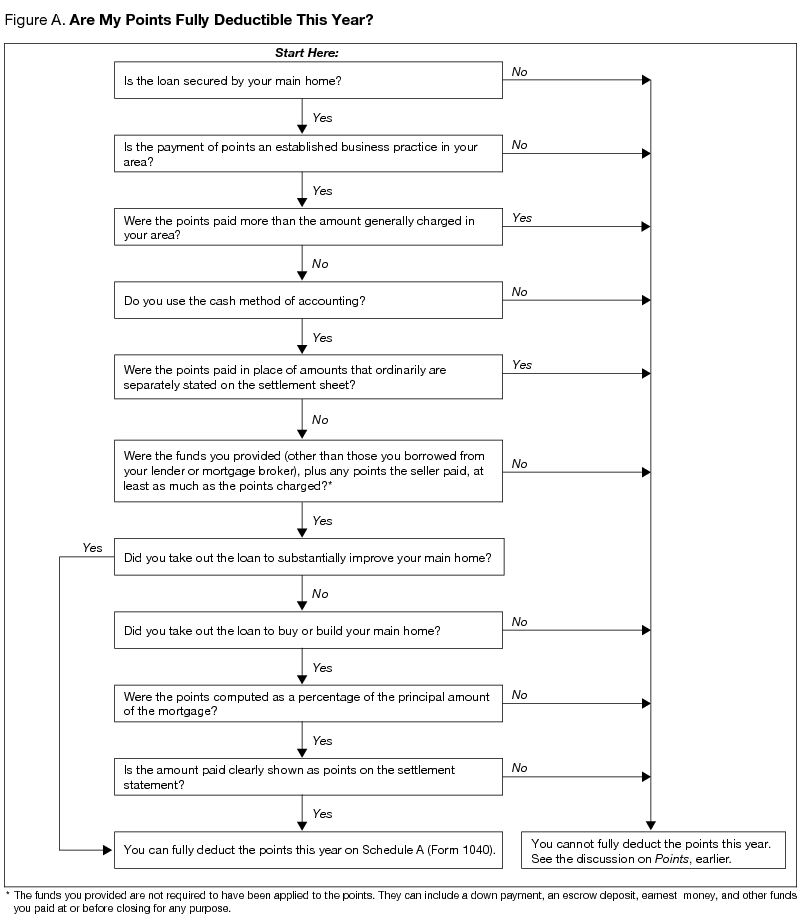
Figure A. Are my points fully deductible this year?
Please click here for the text description of the image.
Amounts charged for services.
Amounts charged by the lender for specific services connected to the loan aren't interest. Examples of these charges are:
-
Appraisal fees,
-
Notary fees,
-
Preparation costs for the mortgage note or deed of trust, and
-
Mortgage insurance premiums.
Points paid by the seller.
The term “points” includes loan placement fees that the seller pays to the lender to arrange financing for the buyer.
Treatment by seller.
The seller can't deduct these fees as interest. However, they are a selling expense that reduces the seller's amount realized. See Pub. 523 for more information.
Treatment by buyer.
The buyer treats seller-paid points as if the buyer had paid them. If all the tests listed earlier under Exception are met, the buyer can deduct the points in the year paid. If any of those tests aren't met, the buyer must deduct the points over the life of the loan.
The buyer must also reduce the basis of the home by the amount of the seller-paid points. For more information about the basis of your home, see Basis, later.
Funds provided are less than points.
If you meet all the tests listed earlier under Exception except that the funds you provided were less than the points charged to you (test 6), you can deduct the points in the year paid up to the amount of funds you provided. In addition, you can deduct any points paid by the seller.
Example 1.
When you took out a $100,000 mortgage loan to buy your home in December, you were charged one point ($1,000). You meet all the tests for deducting points in the year paid (see Exception, earlier), except the only funds you provided were a $750 down payment. Of the $1,000 you were charged for points, you can deduct $750 in the year paid. You spread the remaining $250 over the life of the mortgage.
Example 2.
The facts are the same as in Example 1, except that the person who sold you your home also paid one point ($1,000) to help you get your mortgage. In the year paid, you can deduct $1,750 ($750 of the amount you were charged plus the $1,000 paid by the seller). You spread the remaining $250 over the life of the mortgage. You must reduce the basis of your home by the $1,000 paid by the seller.
Excess points.
If you meet all the tests under Exception, earlier, except that the points paid were more than are generally charged in your area (test 3), you can deduct in the year paid only the points that are generally charged. You must spread any additional points over the life of the mortgage.
Mortgage ending early.
If you spread your deduction for points over the life of the mortgage, you can deduct any remaining balance in the year the mortgage ends. A mortgage may end early due to a prepayment, refinancing, foreclosure, or similar event.
Example.
You paid $3,000 in points in 2017 that you had to spread out over the 15-year life of your mortgage. You deducted $1,600 of these points through 2024.
You prepaid your mortgage in full in 2025. You can deduct the remaining $1,400 of points in 2025.
Exception.
If you refinance the mortgage with the same lender, you can't deduct any remaining points for the year. Instead, deduct them over the term of the new loan.
Form 1098.
The mortgage interest statement you receive should show not only the total interest paid during the year but also your deductible points paid during the year. See Mortgage Interest Statement, later.
Enter on Schedule A (Form 1040), line 8a, the home mortgage interest and points reported to you on Form 1098 (discussed next). If you didn't receive a Form 1098, enter your deductible interest on line 8b and any deductible points on line 8c. See Table 1 for a summary of where to deduct home mortgage interest and state and local real estate taxes.
If you paid home mortgage interest to the person from whom you bought your home, show that person's name, address, and social security number (SSN) or employer identification number (EIN) on the dotted lines next to line 8b. The seller must give you this number and you must give the seller your SSN. Form W-9, Request for Taxpayer Identification Number and Certification, can be used for this purpose. Failure to meet either of these requirements may result in a $50 penalty for each failure.
See the text for information on what expenses are eligible. |
| IF you are eligible to deduct . . . | THEN report the amount on Schedule A (Form 1040) . . . |
|---|---|
| state and local real estate taxes | line 5b. |
| home mortgage interest and points reported on Form 1098 | line 8a. |
| home mortgage interest not reported on Form 1098 | line 8b. |
| points not reported on Form 1098 | line 8c. |
If you paid $600 or more of mortgage interest (including certain points during the year) on any one mortgage to a mortgage holder in the course of that holder's trade or business, you should receive a Form 1098 or similar statement from the mortgage holder. The statement will show the total interest paid on your mortgage during the year. If you bought a main home during the year, it will also show the deductible points you paid and any points you can deduct that were paid by the person who sold you your home. See Points, earlier.
The interest you paid at settlement should be included on the statement. If it isn't, add the interest from the settlement sheet that qualifies as home mortgage interest to the total shown on Form 1098 or similar statement. Put the total on Schedule A (Form 1040), line 8a, and attach a statement to your return explaining the difference. Enter “See attached” to the right of line 8a.
A mortgage holder can be a financial institution, a governmental unit, or a cooperative housing corporation. If a statement comes from a cooperative housing corporation, it will generally show your share of interest.
Your mortgage interest statement for 2025 should be provided or sent to you by January 31, 2026. If it is mailed, you should allow adequate time to receive it before contacting the mortgage holder. A copy of this form will also be sent to the IRS.
Example.
You bought a new home on May 3. You paid no points on the purchase. During the year, you made mortgage payments that included $4,480 deductible interest on your new home. The settlement sheet for the purchase of the home included interest of $620 for 29 days in May. The mortgage statement you receive from the lender includes total interest of $5,100 ($4,480 + $620). You can deduct the $5,100 if you itemize your deductions.
Refund of overpaid interest.
If you receive a refund of mortgage interest you overpaid in a prior year, you will generally receive a Form 1098 showing the refund in box 4. Generally, you must include the refund in income in the year you receive it. See Refund of home mortgage interest, earlier, under Home Mortgage Interest.
More than one borrower.
If you and at least one other person (other than your spouse if you file a joint return) were liable for and paid interest on a mortgage that was for your home, and the other person received a Form 1098 showing the interest that was paid during the year, attach a statement to your paper return explaining this. Show how much of the interest each of you paid and give the name and address of the person who received the form. Deduct your share of the interest on Schedule A (Form 1040), line 8b, and enter “See attached” to the right of that line.
Home acquisition debt is a mortgage you took out after October 13, 1987, to buy, build, or substantially improve a qualified home. It must also be secured by that home.
If the amount of your mortgage is more than the cost of the home plus the cost of any substantial improvements, only the debt that is not more than the cost of the home plus improvements qualifies as home acquisition debt.
Home acquisition debt limit.
With the exception of grandfathered debt, the total amount you can treat as home acquisition debt at any time on your home cannot be more than $1 million ($500,000 if married filing separately). However, for tax years beginning after 2017, there is a further limitation. If you purchased your home during this time, the total amount you can treat as home acquisition debt at any time on your home generally cannot be more than $750,000 ($375,000 if married filing separately). See Pub. 936, Home Mortgage Interest Deduction, for more information.
Discharges of qualified principal residence indebtedness.
You can exclude from gross income any discharges of qualified principal residence indebtedness made after 2006 and in most cases before 2026. You must reduce the basis of your principal residence (but not below zero) by the amount you exclude.
Principal residence.
Your principal residence is the home where you ordinarily live most of the time. You can have only one principal residence at any one time.
Qualified principal residence indebtedness.
This indebtedness is a mortgage that you took out to buy, build, or substantially improve your principal residence and that is secured by that residence. If the amount of your original mortgage is more than the cost of your principal residence plus the cost of substantial improvements, qualified principal residence indebtedness can’t be more than the cost of your principal residence plus improvements.
Any debt secured by your principal residence that you use to refinance qualified principal residence indebtedness is qualified principal residence indebtedness up to the amount of your old mortgage principal just before the refinancing. Additional debt incurred to substantially improve your principal residence is also qualified principal residence indebtedness.
Amount you can exclude.
You can only exclude debt discharged after 2006 and in most cases before 2026. The most you can exclude is $750,000 ($375,000 if married filing separately). You can’t exclude any amount that was discharged because of services performed for the lender or on account of any other factor not directly related either to a decline in the value of your residence or to your financial condition.
Ordering rule.
If only a part of a loan is qualified principal residence indebtedness, you can exclude only the amount of the discharge that is more than the amount of the loan (immediately before the discharge) that is not qualified principal residence indebtedness.
This means your main home or your second home. A home includes a house, condominium, cooperative, mobile home, house trailer, boat, or similar property that has sleeping, cooking, and toilet facilities.
Main home.
You can have only one main home at any one time. This is the home where you ordinarily live most of the time.
Second home and other special situations.
If you have a second home, use part of your home for other than residential living (such as a home office), rent out part of your home, or are having your home constructed, see Qualified Home in Pub. 936.
Mortgage Interest Credit
The mortgage interest credit is intended to help lower-income individuals afford home ownership. If you qualify, you can claim the credit on Form 8396 each year for part of the home mortgage interest you pay.
Who qualifies.
You may be eligible for the credit if you were issued a qualified Mortgage Credit Certificate (MCC) from your state or local government. Generally, an MCC is issued only in connection with a new mortgage for the purchase of your main home.
The MCC will show the certificate credit rate you will use to figure your credit. It will also show the certified indebtedness amount. Only the interest on that amount qualifies for the credit. See Figuring the Credit, later.
Tip: You must contact the appropriate government agency about getting an MCC before you get a mortgage and buy your home. Contact your state or local housing finance agency for information about the availability of MCCs in your area.
How to claim the credit.
To claim the credit, complete Form 8396 and attach it to your Form 1040, 1040-SR, or 1040-NR. Include the credit in your total for Schedule 3 (Form 1040), line 6g.
Reducing your home mortgage interest deduction.
If you itemize your deductions on Schedule A (Form 1040), you must reduce your home mortgage interest deduction by the amount of the mortgage interest credit shown on Form 8396, line 3. You must do this even if part of that amount is to be carried forward to 2026.
Selling your home.
If you purchase a home after 1990 using an MCC, and you sell that home within 9 years, you may have to recapture (repay) all or part of the benefit you received from the MCC program. For additional information, see Paying Back Credits and Subsidies in Pub. 523.
Figuring the Credit
Figure your credit on Form 8396.
Mortgage not more than certified indebtedness.
If your mortgage loan amount is equal to (or smaller than) the certified indebtedness amount shown on your MCC, enter on Form 8396, line 1, all the interest you paid on your mortgage during the year.
Mortgage more than certified indebtedness.
If your mortgage loan amount is larger than the certified indebtedness amount shown on your MCC, you can figure the credit on only part of the interest you paid. To find the amount to enter on line 1, multiply the total interest you paid during the year on your mortgage by the following fraction.
Mortgage Larger than Certified Indebtedness
| Certified indebtedness amount on your MCC |
| Original amount of your mortgage |
The fraction won’t change as long as you are entitled to take the mortgage interest credit.
Example.
You bought a home this year. Your mortgage loan is $125,000. The certified indebtedness amount on the MCC is $100,000. You paid $7,500 interest this year. You figure the interest to enter on Form 8396, line 1, as follows:
| $100,000 | = | 80% | (0.80) | |||
| $125,000 | ||||||
| $7,500 | x | 0.80 | = | $6,000 |
Two limits may apply to your credit.
-
A limit based on the credit rate.
-
A limit based on your tax.
Limit based on credit rate.
If the certificate credit rate is higher than 20%, the credit you are allowed can't be more than $2,000.
Limit based on tax.
After applying the limit based on the credit rate, your credit generally can't be more than your tax liability. See the Credit Limit Worksheet in the Form 8396 instructions to figure the limit based on tax.
If two or more persons (other than a married couple filing a joint return) hold an interest in the home to which the MCC relates, the credit must be divided based on the interest held by each person.
Example.
You and your sibling were issued an MCC. You used it to get a mortgage on their main home. You have a 60% ownership interest in the home, and your sibling has a 40% ownership interest in the home. You paid $5,400 mortgage interest this year and your sibling paid $3,600.
The MCC shows a credit rate of 25% and a certified indebtedness amount of $130,000. The loan amount (mortgage) on their home is $120,000. The credit is limited to $2,000 because the credit rate is more than 20%.
You figure the credit by multiplying the mortgage interest you paid this year ($5,400) by the certificate credit rate (25%) for a total of $1,350. Your credit is limited to $1,200 ($2,000 × 60% (0.60)).
Your sibling figures the credit by multiplying the mortgage interest paid this year ($3,600) by the certificate credit rate (25%) for a total of $900. Your sibling’s credit is limited to $800 ($2,000 × 40% (0.40)).
If your allowable credit is reduced because of the limit based on your tax, you can carry forward the unused portion of the credit to the next 3 years or until used, whichever comes first.
Example.
You receive an MCC from State X. This year, your regular tax liability is $1,100, you owe no alternative minimum tax, and your mortgage interest credit is $1,700. You claim no other credits. Your unused mortgage interest credit for this year is $600 ($1,700 − $1,100). You can carry forward this amount to the next 3 years or until used, whichever comes first.
Credit rate more than 20%.
If you are subject to the $2,000 limit because your certificate credit rate is more than 20%, you can't carry forward any amount more than $2,000 (or your share of the $2,000 if you must divide the credit).
Example.
In the earlier example under Dividing the Credit, you and your sibling used the entire $2,000 credit. The excess
| You | $1,350 − $1,200 | = | $150 | ||
| Your sibling | $900 − $800 | = | $100 |
If you refinance your original mortgage loan on which you had been given an MCC, you must get a new MCC to be able to claim the credit on the new loan. The amount of credit you can claim on the new loan may change. Table 2 summarizes how to figure your credit if you refinance your original mortgage loan.
Table 2. Effect of Refinancing on Your Credit
| IF you get a new (reissued) MCC and the amount of your new mortgage is... | THEN the interest you claim on Form 8396, line 1, is...* | ||
| smaller than or equal to the certified indebtedness amount on the new MCC | all the interest paid during the year on your new mortgage. | ||
| larger than the certified indebtedness amount on the new MCC | interest paid during the year on your new mortgage multiplied by the following fraction. | ||
| Certified indebtedness amount on your new MCC |
|||
| Original amount of your mortgage |
|||
| * The credit using the new MCC can't be more than the credit using the old MCC. See New MCC can't increase your credit, later. |
An issuer may reissue an MCC after you refinance your mortgage. If you didn't get a new MCC, you may want to contact the state or local housing finance agency that issued your original MCC for information about whether you can get a reissued MCC.
Year of refinancing.
In the year of refinancing, add the applicable amount of interest paid on the old mortgage and the applicable amount of interest paid on the new mortgage, and enter the total on Form 8396, line 1.
If your new MCC has a credit rate different from the rate on the old MCC, you must attach a statement to Form 8396. The statement must show the calculation for lines 1, 2, and 3 for the part of the year when the old MCC was in effect. It must show a separate calculation for the part of the year when the new MCC was in effect. Combine the amounts from both calculations for line 3, enter the total on line 3 of the form, and enter “See attached” on the dotted line next to line 2.
New MCC can't increase your credit.
The credit that you claim with your new MCC can't be more than the credit that you could have claimed with your old MCC.
In most cases, the agency that issues your new MCC will make sure that it doesn't increase your credit. However, if either your old loan or your new loan has a variable (adjustable) interest rate, you will need to check this yourself. In that case, you will need to know the amount of the credit you could have claimed using the old MCC.
There are two methods for figuring the credit you could have claimed. Under one method, you figure the actual credit that would have been allowed. This means you use the credit rate on the old MCC and the interest you would have paid on the old loan.
If your old loan was a variable rate mortgage, you can use another method to determine the credit that you could have claimed. Under this method, you figure the credit using a payment schedule of a hypothetical self-amortizing mortgage with level payments projected to the final maturity date of the old mortgage. The interest rate of the hypothetical mortgage is the annual percentage rate (APR) of the new mortgage for purposes of the Federal Truth in Lending Act. The principal of the hypothetical mortgage is the remaining outstanding balance of the certified mortgage indebtedness shown on the old MCC.
Caution: You must choose one method and use it consistently beginning with the first tax year for which you claim the credit based on the new MCC.
Tip: As part of your tax records, you should keep your old MCC and the schedule of payments for your old mortgage.
Basis
Basis is your starting point for figuring a gain or loss if you later sell your home, or for figuring depreciation if you later use part of your home for business purposes or for rent.
While you own your home, you may add certain items to your basis. You may subtract certain other items from your basis. These items are called adjustments to basis and are explained later under Adjusted Basis.
It is important that you understand these terms when you first acquire your home because you must keep track of your basis and adjusted basis during the period you own your home. You must also keep records of the events that affect basis or adjusted basis. See Keeping Records, later.
Figuring Your Basis
How you figure your basis depends on how you acquire your home. Generally, if you buy or build your home, your cost is your basis. If you receive your home as a gift, your basis is usually the same as the adjusted basis of the person who gave you the property. If you inherit your home from a decedent, different rules apply depending on the date of the decedent's death. Each of these topics is discussed later.
Property transferred from a spouse.
If your home is transferred to you from your spouse, or from your former spouse as a result of a divorce, your basis is the same as your spouse's (or former spouse's) adjusted basis just before the transfer. Pub. 504, Divorced or Separated Individuals, fully discusses transfers between spouses.
The cost of your home, whether you purchased it or constructed it, is the amount you paid for it, including any debt you assumed.
The cost of your home includes most settlement or closing costs you paid when you bought the home. If you built your home, your cost includes most closing costs paid when you bought the land or settled on your mortgage. See Settlement or closing costs, later.
Caution: If you elect to deduct the sales taxes on the purchase or construction of your home as an itemized deduction on Schedule A (Form 1040), you can't include the sales taxes as part of your cost basis in the home.
Purchase.
The basis of a home you bought is the amount you paid for it. This usually includes your down payment and any debt you assumed. The basis of a cooperative apartment is the amount you paid for your shares in the corporation that owns or controls the property. This amount includes any purchase commissions or other costs of acquiring the shares.
Construction.
If you contracted to have your home built on land that you own, your basis in the home is your basis in the land plus the amount you paid to have the home built. This includes the cost of labor and materials, the amount you paid the contractor, any architect's fees, building permit charges, utility meter and connection charges, and legal fees that are directly connected with building your home. If you built all or part of your home yourself, your basis is the total amount it cost you to build it. You can't include in basis the value of your own labor or any other labor for which you didn't pay.
Real estate taxes.
Real estate taxes are usually divided so that you and the seller each pay taxes for the part of the property tax year that each owned the home. See Real estate taxes paid at settlement or closing under State and Local Real Estate Taxes, earlier, to figure the real estate taxes you paid or are considered to have paid.
If you pay any part of the seller's share of the real estate taxes (the taxes up to the date of sale) and the seller didn't reimburse you, add those taxes to your basis in the home. You can't deduct them as taxes paid.
If the seller paid any of your share of the real estate taxes (the taxes beginning with the date of sale), you can still deduct those taxes. Don’t include those taxes in your basis. If you didn't reimburse the seller, you must reduce your basis by the amount of those taxes.
Example 1.
You bought your home on September 1, 2025. The property tax year in your area is the calendar year, and the tax is due on August 15. The real estate taxes on the home you bought were $1,275 for the year and had been paid by the seller on August 15. You didn't reimburse the seller for your share of the real estate taxes from September 1 through December 31. You must reduce the basis of your home by the $426 [(122 ÷ 365) × $1,275] the seller paid for you. You can deduct your $426 share of real estate taxes on your return for the year you purchased your home.
Example 2.
You bought your home on May 3, 2025. The property tax year in your area is the calendar year. The taxes for the previous year are assessed on January 2 and are due on May 31 and November 30. Under state law, the taxes become a lien on May 31. You agreed to pay all taxes due after the date of sale. The taxes due in 2025 for 2024 were $1,375. The taxes due in 2026 for 2025 will be $1,425.
You can't deduct any of the taxes paid in 2025 because they relate to the 2024 property tax year and you didn't own the home until 2025. Instead, you add the $1,375 to the cost (basis) of your home.
You owned the home in 2025 for 243 days (May 3 to December 31), so you can take a tax deduction on your 2026 return of $949 [(243 ÷ 365) × $1,425] paid in 2026 for 2025. You add the remaining $476 ($1,425 − $949) of taxes paid in 2026 to the cost (basis) of your home.
Settlement or closing costs.
If you bought your home, you probably paid settlement or closing costs in addition to the contract price. These costs are divided between you and the seller according to the sales contract, local custom, or understanding of the parties. If you built your home, you probably paid these costs when you bought the land or settled on your mortgage.
The only settlement or closing costs you can deduct are home mortgage interest and certain real estate taxes. You deduct them in the year you buy your home if you itemize your deductions. You can add certain other settlement or closing costs to the basis of your home.
Items added to basis.
You can include in your basis some of the settlement fees and closing costs you paid for buying your home. A fee is for buying the home if you would have had to pay it even if you paid cash for the home.
The following are some of the settlement fees and closing costs that you can include in the original basis of your home.
-
Abstract fees (abstract of title fees).
-
Charges for installing utility services.
-
Legal fees (including fees for the title search and preparation of the sales contract and deed).
-
Recording fees.
-
Surveys.
-
Transfer or stamp taxes.
-
Owner's title insurance.
-
Any amount the seller owes that you agree to pay, such as back taxes or interest, recording or mortgage fees, cost for improvements or repairs, and sales commissions.
If the seller actually paid for any item for which you are liable and for which you can take a deduction (such as your share of the real estate taxes for the year of sale), you must reduce your basis by that amount unless you are charged for it in the settlement.
Items not added to basis and not deductible.
Here are some settlement and closing costs that you can't deduct or add to your basis.
-
Charges for using utilities or other services related to occupancy of the home before closing.
-
Rent for occupying the home before closing.
-
Charges connected with getting or refinancing a mortgage loan, such as:
-
Loan assumption fees,
-
Cost of a credit report,
-
Fee for an appraisal required by a lender, and
-
Mortgage insurance premiums.
-
Points paid by seller.
If you bought your home after April 3, 1994, you must reduce your basis by any points paid for your mortgage by the person who sold you your home.
If you bought your home after 1990 but before April 4, 1994, you must reduce your basis by seller-paid points only if you deducted them. See Points, earlier, for the rules on deducting points.
To figure the basis of property you receive as a gift, you must know its adjusted basis (defined later) to the donor just before it was given to you, its fair market value at the time it was given to you, and any gift tax paid on it.
Fair market value (FMV).
FMV is the price at which property would change hands between a willing buyer and a willing seller, neither being under any compulsion to buy or sell and who both have a reasonable knowledge of all the necessary facts.
Donor's adjusted basis is more than FMV.
If someone gave you your home and the donor's adjusted basis, when it was given to you, was more than the FMV, your basis at the time of receipt is the same as the donor's adjusted basis.
Disposition basis.
If the donor's adjusted basis at the time of the gift is more than the FMV, your basis (plus or minus any required adjustments; see Adjusted Basis, later) when you dispose of the property will depend on whether you have a gain or a loss.
-
Your basis for figuring a gain is the same as the donor's adjusted basis.
-
Your basis for figuring a loss is the FMV when you received the gift.
Example 1.
You received a house as a gift. At the time of the gift, the home had an FMV of $80,000. The donor’s adjusted basis was $100,000. After you receive the house, no events occurred to increase or decrease the basis. If you sell the house for $120,000, you will have a $20,000 gain because you must use the donor's adjusted basis ($100,000) at the time of the gift as the basis to figure the gain.
Example 2.
The facts are the same as in Example 1, except this time you sell the house for $70,000. You will have a loss of $10,000 because the donor must use the FMV ($80,000) at the time of the gift as the basis to figure the loss.
Example 3.
The facts are the same as in Example 1, except this time you sell the house for $90,000. Initially, you figure the gain using the donor’s adjusted basis ($100,000), which results in a loss of $10,000. Because it is a loss, you must now recalculate the loss using the FMV ($80,000), which results in a gain of $10,000. So in this situation, you will have neither a gain nor a loss.
Donor's adjusted basis equal to or less than the FMV.
If someone gave you your home after 1976 and the donor's adjusted basis, when it was given to you, was equal to or less than the FMV, your basis at the time of receipt is the same as the donor's adjusted basis, plus the part of any federal gift tax paid that is due to the net increase in value of the home.
Part of federal gift tax due to net increase in value.
Figure the part of the federal gift tax paid that is due to the net increase in value of the home by multiplying the total federal gift tax paid by a fraction. The numerator (top part) of the fraction is the net increase in the value of the home, and the denominator (bottom part) is the value of the home for gift tax purposes after reduction for any annual exclusion and marital or charitable deduction that applies to the gift. The net increase in the value of the home is its FMV minus the adjusted basis of the donor.
Pub. 551 gives more information, including examples, on figuring your basis when you receive property as a gift.
Your basis in a home you inherited is generally the FMV of the home on the date of the decedent's death or on the alternative valuation date if the personal representative for the estate chooses to use alternative valuation.
If an estate tax return was filed, your basis is generally the value of the home listed on the estate tax return. If you received a Schedule A (Form 8971) statement from an executor of an estate or other person required to file an estate tax return after July 2015, you may be required to report a basis consistent with the estate tax value of the property.
If an estate tax return wasn't filed, your basis is the appraised value of the home at the decedent's date of death for state inheritance or transmission taxes.
For more information on consistent basis reporting, see Column (e)—Cost or Other Basis in the Instructions for Form 8949. For more information on basis of inherited property generally, see Pub. 551 and Pub. 559.
If you inherited your home from someone who died in 2010, and the executor of the decedent's estate made the election to file Form 8939, Allocation of Increase in Basis for Property Acquired From a Decedent, refer to the information provided by the executor or see Pub. 4895, Tax Treatment of Property Acquired From a Decedent Dying in 2010, available at IRS.gov/Pub/IRS-Prior/p4895-2011.pdf.
Adjusted Basis
While you own your home, various events may take place that can change the original basis of your home. These events can increase or decrease your original basis. The result is called adjusted basis. See Table 3 for a list of some of the items that can adjust your basis.
This table lists examples of some items that will generally increase or decrease your basis in your home. It isn’t intended to be all inclusive. |
| Increases to Basis | Decreases to Basis |
|
|
Improvements.
An improvement materially adds to the value of your home, considerably prolongs its useful life, or adapts it to new uses. You must add the cost of any improvements to the basis of your home. You can't deduct these costs.
Improvements include putting a recreation room in your unfinished basement, adding another bathroom or bedroom, putting up a fence, putting in new plumbing or wiring, installing a new roof, and paving your driveway.
Amount added to basis.
The amount you add to your basis for improvements is your actual cost. This includes all costs for material and labor, except your own labor, and all expenses related to the improvement. For example, if you had your lot surveyed to put up a fence, the cost of the survey is a part of the cost of the fence.
You must also add to your basis state and local assessments for improvements such as streets and sidewalks if they increase the value of the property. These assessments are discussed earlier under State and Local Real Estate Taxes.
Improvements no longer part of home.
Your home's adjusted basis doesn't include the cost of any improvements that are replaced and are no longer part of the home.
Example.
You put wall-to-wall carpeting in your home 15 years ago. Later, you replaced that carpeting with new wall-to-wall carpeting. The cost of the old carpeting you replaced is no longer part of your home's adjusted basis.
Repairs versus improvements.
A repair keeps your home in an ordinary, efficient operating condition. It doesn't add to the value of your home or prolong its life. Repairs include repainting your home inside or outside, fixing your gutters or floors, fixing leaks or plastering, and replacing broken window panes. You can't deduct repair costs and generally can't add them to the basis of your home.
However, repairs that are done as part of an extensive remodeling or restoration of your home are considered improvements. You add them to the basis of your home.
Records to keep.
You can use Table 4 as a guide to help you keep track of improvements to your home. Also see Keeping Records below.
Energy conservation subsidy.
If a public utility gives you (directly or indirectly) a subsidy for the purchase or installation of an energy conservation measure for your home, don’t include the value of that subsidy in your income. You must reduce the basis of your home by that value.
An energy conservation measure is an installation or modification primarily designed to reduce consumption of electricity or natural gas or to improve the management of energy demand.
Adoption tax benefits.
If you claim an adoption credit for the cost of improvements you added to the basis of your home, decrease the basis of your home by the credit allowed. This also applies to amounts you received under an employer's adoption assistance program and excluded from income. For more information, see Form 8839, Qualified Adoption Expenses.
Keeping Records
. Keeping full and accurate records is vital to properly report your income and expenses, to support your deductions and credits, and to know the basis or adjusted basis of your home. These records include your purchase contract and settlement papers if you bought the property, or other objective evidence if you acquired it by gift, inheritance, or similar means. You should keep any receipts, canceled checks, and similar evidence for improvements or other additions to the basis. In addition, you should keep track of any decreases to the basis such as those listed in Table 3. .
How to keep records.
How you keep records is up to you, but they must be clear and accurate and must be available to the IRS.
How long to keep records.
You must keep your records for as long as they are important for meeting any provision of the federal tax law.
Keep records that support an item of income, a deduction, or a credit appearing on a return until the period of limitations for the return runs out. (A period of limitations is the period of time after which no legal action can be brought.) For assessment of tax you owe, this is generally 3 years from the date you filed the return. For filing a claim for credit or refund, this is generally 3 years from the date you filed the original return, or 2 years from the date you paid the tax, whichever is later. Returns filed before the due date are treated as filed on the due date.
You may need to keep records relating to the basis of property (discussed earlier) for longer than the period of limitations. Keep those records as long as they are important in figuring the basis of the original or replacement property. Generally, this means for as long as you own the property and after you dispose of it for the period of limitations that applies to you.
Table 4. Record of Home Improvements
Keep this for your records. Also, keep receipts or other proof of improvements. |
| Caution: | Remove from this record any improvements that are no longer part of your main home. For example, if you put wall-to-wall carpeting in your home and later replace it with new wall-to-wall carpeting, remove the cost of the first carpeting. | ||||||
|---|---|---|---|---|---|---|---|
| (a) Type of Improvement |
(b) Date |
(c) Amount |
(a) Type of Improvement |
(b) Date |
(c) Amount |
||
| Additions: | Heating & Air Conditioning: |
||||||
| Bedroom | Heating system | ||||||
| Bathroom | Central air conditioning | ||||||
| Deck | Furnace | ||||||
| Garage | Duct work | ||||||
| Porch | Central humidifier | ||||||
| Patio | Filtration system | ||||||
| Storage shed | Other | ||||||
| Fireplace | Electrical: | ||||||
| Other | |||||||
| Lawn & Grounds: | Lighting fixtures | ||||||
| Wiring upgrades | |||||||
| Landscaping | Other | ||||||
| Driveway | Plumbing: | ||||||
| Walkway | |||||||
| Fences | Water heater | ||||||
| Retaining wall | Soft water system | ||||||
| Sprinkler system | Filtration system | ||||||
| Swimming pool | Other | ||||||
| Exterior lighting | Insulation: | ||||||
| Other | |||||||
| Communications: | Attic | ||||||
| Walls | |||||||
| Satellite dish | Floors | ||||||
| Intercom | Pipes and duct work | ||||||
| Security system | Other | ||||||
| Other | |||||||
| Miscellaneous: | Interior Improvements: |
||||||
| Storm windows and doors | Built-in appliances | ||||||
| Roof | Kitchen modernization | ||||||
| Central vacuum | Bathroom modernization | ||||||
| Other | Flooring | ||||||
| Wall-to-wall carpeting | |||||||
| Other | |||||||
How To Get Tax Help
If you have questions about a tax issue; need help preparing your tax return; or want to download free publications, forms, or instructions, go to IRS.gov to find resources that can help you right away.
Tax reform.
Tax reform legislation impacting federal taxes, credits, and deductions was enacted in P.L. 119-21, commonly known as the One Big Beautiful Bill Act, on July 4, 2025. Go to IRS.gov/OBBB for more information and updates on how this legislation affects your taxes.
Preparing and filing your tax return.
After receiving all your wage and earnings statements (Forms W-2, W-2G, 1099-R, 1099-MISC, 1099-NEC, etc.); unemployment compensation statements (by mail or in a digital format) or other government payment statements (Form 1099-G); and interest, dividend, and retirement statements from banks and investment firms (Forms 1099), you have several options to choose from to prepare and file your tax return. You can prepare the tax return yourself, see if you qualify for free tax preparation, or hire a tax professional to prepare your return.
Free options for tax preparation.
Your options for preparing and filing your return online or in your local community, if you qualify, include the following.
-
Free File. This program lets you prepare and file your federal individual income tax return for free using software or Free File Fillable Forms. However, state tax preparation may not be available through Free File. Go to IRS.gov/FreeFile to see if you qualify for free online federal tax preparation, e-filing, and direct deposit or payment options.
-
VITA. The Volunteer Income Tax Assistance (VITA) program offers free tax help to people with low-to-moderate incomes, persons with disabilities, and limited-English-speaking taxpayers who need help preparing their own tax returns. Go to IRS.gov/VITA, download the free IRS2Go app, or call 800-906-9887 for information on free tax return preparation.
-
TCE. The Tax Counseling for the Elderly (TCE) program offers free tax help for all taxpayers, particularly those who are 60 years of age and older. TCE volunteers specialize in answering questions about pensions and retirement-related issues unique to seniors. Go to IRS.gov/TCE or download the free IRS2Go app for information on free tax return preparation.
-
MilTax. Members of the U.S. Armed Forces and qualified veterans may use MilTax, a free tax service offered by the Department of Defense through Military OneSource. For more information, go to MilitaryOneSource (MilitaryOneSource.mil/MilTax).
Also, the IRS offers Free Fillable Forms, which can be completed online and then e-filed regardless of income.
Using online tools to help prepare your return.
Go to IRS.gov/Tools for the following.
-
The Earned Income Tax Credit Assistant (IRS.gov/EITCAssistant) determines if you’re eligible for the earned income credit (EITC).
-
The Online EIN Application (IRS.gov/EIN) helps you get an employer identification number (EIN) at no cost.
-
The Tax Withholding Estimator (IRS.gov/W4App) makes it easier for you to estimate the federal income tax you want your employer to withhold from your paycheck. This is tax withholding. See how your withholding affects your refund, take-home pay, or tax due.
-
The Sales Tax Deduction Calculator (IRS.gov/SalesTax) figures the amount you can claim if you itemize deductions on Schedule A (Form 1040).
. Getting answers to your tax questions. On IRS.gov, you can get up-to-date information on current events and changes in tax law..
-
IRS.gov/Help: A variety of tools to help you get answers to some of the most common tax questions.
-
IRS.gov/ITA: The Interactive Tax Assistant, a tool that will ask you questions and, based on your input, provide answers on a number of tax topics.
-
IRS.gov/Forms: Find forms, instructions, and publications. You will find details on the most recent tax changes and interactive links to help you find answers to your questions.
-
You may also be able to access tax information in your e-filing software.
Need someone to prepare your tax return?
There are various types of tax return preparers, including enrolled agents, certified public accountants (CPAs), accountants, and many others who don’t have professional credentials. If you choose to have someone prepare your tax return, choose that preparer wisely. A paid tax preparer is:
-
Primarily responsible for the overall substantive accuracy of your return,
-
Required to sign the return, and
-
Required to include their preparer tax identification number (PTIN).
. Although the tax preparer always signs the return, you’re ultimately responsible for providing all the information required for the preparer to accurately prepare your return and for the accuracy of every item reported on the return. Anyone paid to prepare tax returns for others should have a thorough understanding of tax matters. For more information on how to choose a tax preparer, go to Tips for Choosing a Tax Preparer on IRS.gov..
Employers can register to use Business Services Online.
The Social Security Administration (SSA) offers online service at SSA.gov/employer for fast, free, and secure W-2 filing options to CPAs, accountants, enrolled agents, and individuals who process Form W-2, Wage and Tax Statement; and Form W-2c, Corrected Wage and Tax Statement.
Business tax account.
If you are a sole proprietor, a partnership, an S corporation, a C corporation, or a single-member limited liability company (LLC), you can view your tax information on record with the IRS and do more with a business tax account. Go to IRS.gov/BusinessAccount for more information.
IRS social media.
Go to IRS.gov/SocialMedia to see the various social media tools the IRS uses to share the latest information on tax changes, scam alerts, initiatives, products, and services. At the IRS, privacy and security are our highest priority. We use these tools to share public information with you. Don’t post your social security number (SSN) or other confidential information on social media sites. Always protect your identity when using any social networking site.
The following IRS YouTube channels provide short, informative videos on various tax-related topics in English and ASL.
Over-the-Phone Interpreter (OPI) Service.
The IRS offers the OPI Service to taxpayers needing language interpretation. The OPI Service is available at Taxpayer Assistance Centers (TACs), most IRS offices, and every VITA/TCE tax return site. This service is available in Spanish, Mandarin, Cantonese, Korean, Vietnamese, Russian, and Haitian Creole.
Accessibility Helpline available for taxpayers with disabilities.
Taxpayers who need information about accessibility services can call 833-690-0598. The Accessibility Helpline can answer questions related to current and future accessibility products and services available in alternative media formats (for example, braille-ready, large print, audio, etc.). The Accessibility Helpline does not have access to your IRS account. For help with tax law, refunds, or account-related issues, go to IRS.gov/LetUsHelp.
Alternative media preference.
Form 9000, Alternative Media Preference, or Form 9000(SP) allows you to elect to receive certain types of written correspondence in the following formats.
-
Standard Print.
-
Large Print.
-
Braille.
-
Audio (MP3).
-
Plain Text File (TXT).
-
Braille-Ready File (BRF).
Disasters.
Go to IRS.gov/DisasterRelief to review the available disaster tax relief.
Getting tax forms and publications.
Go to IRS.gov/Forms to view, download, or print all the forms, instructions, and publications you may need. Or you can go to IRS.gov/OrderForms to place an order.
Mobile-friendly forms.
You’ll need an IRS Online Account (OLA) to complete mobile-friendly forms that require signatures. You’ll have the option to submit your form(s) online or download a copy for mailing. You’ll need scans of your documents to support your submission. Go to IRS.gov/MobileFriendlyForms for more information.
Getting tax publications and instructions in eBook format.
Download and view most tax publications and instructions (including the Instructions for Form 1040) on mobile devices as eBooks at IRS.gov/eBooks.
IRS eBooks have been tested using Apple’s iBooks for iPad. Our eBooks haven’t been tested on other dedicated eBook readers, and eBook functionality may not operate as intended.
Access your online account (individual taxpayers only).
Go to IRS.gov/Account to securely access information about your federal tax account.
-
View the amount you owe and a breakdown by tax year.
-
See payment plan details or apply for a new payment plan.
-
Make a payment or view 5 years of payment history and any pending or scheduled payments.
-
Access your tax records, including key data from your most recent tax return, and transcripts.
-
View digital copies of select notices from the IRS.
-
Approve or reject authorization requests from tax professionals.
Get a transcript of your return.
With an online account, you can access a variety of information to help you during the filing season. You can get a transcript, review your most recently filed tax return, and get your adjusted gross income. Create or access your online account at IRS.gov/Account.
Tax Pro Account.
This tool lets your tax professional submit an authorization request to access your individual taxpayer IRS OLA. For more information, go to IRS.gov/TaxProAccount.
Using direct deposit.
The safest and easiest way to receive a tax refund is to e-file and choose direct deposit, which securely and electronically transfers your refund directly into your financial account. Direct deposit also avoids the possibility that your check could be lost, stolen, destroyed, or returned undeliverable to the IRS. Eight in 10 taxpayers use direct deposit to receive their refunds. If you don’t have a bank account, go to IRS.gov/DirectDeposit for more information on where to find a bank or credit union that can open an account online.
Reporting and resolving your tax-related identity theft issues.
-
Tax-related identity theft happens when someone steals your personal information to commit tax fraud. Your taxes can be affected if your SSN is used to file a fraudulent return or to claim a refund or credit.
-
The IRS doesn’t initiate contact with taxpayers by email, text messages (including shortened links), telephone calls, or social media channels to request or verify personal or financial information. This includes requests for personal identification numbers (PINs), passwords, or similar information for credit cards, banks, or other financial accounts.
-
Go to IRS.gov/IdentityTheft, the IRS Identity Theft Central webpage, for information on identity theft and data security protection for taxpayers, tax professionals, and businesses. If your SSN has been lost or stolen or you suspect you’re a victim of tax-related identity theft, you can learn what steps you should take.
-
Get an Identity Protection PIN (IP PIN). IP PINs are six-digit numbers assigned to taxpayers to help prevent the misuse of their SSNs on fraudulent federal income tax returns. When you have an IP PIN, it prevents someone else from filing a tax return with your SSN. To learn more, go to IRS.gov/IPPIN.
Ways to check on the status of your refund.
-
Go to IRS.gov/Refunds.
-
Download the official IRS2Go app to your mobile device to check your refund status.
-
Call the automated refund hotline at 800-829-1954.
.The IRS can’t issue refunds before mid-February for returns that claimed the EITC or the additional child tax credit (ACTC). This applies to the entire refund, not just the portion associated with these credits..
Making a tax payment.
The IRS recommends paying electronically whenever possible. Options to pay electronically are included in the list below. Payments of U.S. tax must be remitted to the IRS in U.S. dollars. Digital assets are not accepted. Go to IRS.gov/Payments for information on how to make a payment using any of the following options.
-
IRS Direct Pay: Pay taxes from your bank account. It’s free and secure, and no sign-in is required. You can change or cancel within 2 days of scheduled payment.
-
Debit Card, Credit Card, or Digital Wallet: Choose an approved payment processor to pay online or by phone.
-
Electronic Funds Withdrawal: Schedule a payment when filing your federal taxes using tax return preparation software or through a tax professional.
-
Electronic Federal Tax Payment System: This is the best option for businesses. Enrollment is required.
-
Check or Money Order: Mail your payment to the address listed on the notice or instructions.
-
Cash: You may be able to pay your taxes with cash at a participating retail store.
-
Same-Day Wire: You may be able to do same-day wire from your financial institution. Contact your financial institution for availability, cost, and time frames.
Note:
The IRS uses the latest encryption technology to ensure that the electronic payments you make online, by phone, or from a mobile device using the IRS2Go app are safe and secure. Paying electronically is quick and easy.
What if I can’t pay now?
Go to IRS.gov/Payments for more information about your options.
-
Apply for an online payment agreement (IRS.gov/OPA) to meet your tax obligation in monthly installments if you can’t pay your taxes in full today. Once you complete the online process, you will receive immediate notification of whether your agreement has been approved.
-
Use the Offer in Compromise Pre-Qualifier to see if you can settle your tax debt for less than the full amount you owe. For more information on the Offer in Compromise program, go to IRS.gov/OIC.
Filing an amended return.
Go to IRS.gov/1040X for information and updates.
Checking the status of your amended return.
Go to IRS.gov/WMAR to track the status of Form 1040-X amended returns.
.It can take up to 3 weeks from the date you filed your amended return for it to show up in our system, and processing it can take up to 16 weeks..
Understanding an IRS notice or letter you’ve received.
Go to IRS.gov/Notices to find additional information about responding to an IRS notice or letter.
IRS Document Upload Tool.
You may be able to use the Document Upload Tool to respond digitally to eligible IRS notices and letters by securely uploading required documents online through IRS.gov. For more information, go to IRS.gov/DUT.
Schedule LEP.
You can use Schedule LEP (Form 1040), Request for Change in Language Preference, to state a preference to receive notices, letters, or other written communications from the IRS in an alternative language. You may not immediately receive written communications in the requested language. The IRS’s commitment to LEP taxpayers is part of a multi-year timeline that began providing translations in 2023. You will continue to receive communications, including notices and letters, in English until they are translated to your preferred language.
Contacting your local TAC.
Keep in mind, many questions can be answered on IRS.gov without visiting a TAC. Go to IRS.gov/LetUsHelp for the topics people ask about most. If you still need help, TACs provide tax help when a tax issue can’t be handled online or by phone. All TACs now provide service by appointment, so you’ll know in advance that you can get the service you need without long wait times. Before you visit, go to IRS.gov/TAC to find the nearest TAC and to check hours, available services, and appointment options. Or, on the IRS2Go app, under the Stay Connected tab, choose the Contact Us option and click on “Local Offices.”
————————————————————————
Below is a message to you from the Taxpayer Advocate Service, an independent organization established by Congress.
The Taxpayer Advocate Service (TAS) Is Here To Help You
The Taxpayer Advocate Service (TAS) is an independent organization within the Internal Revenue Service (IRS). TAS helps taxpayers resolve problems with the IRS, makes administrative and legislative recommendations to prevent or correct the problems, and protects taxpayer rights. We work to ensure that every taxpayer is treated fairly and that you know and understand your rights under the Taxpayer Bill of Rights. We are Your Voice at the IRS.
TAS can help you resolve problems that you haven’t been able to resolve with the IRS on your own. Always try to resolve your problem with the IRS first, but if you can’t, then come to TAS. Our services are free.
-
TAS helps all taxpayers (and their representatives), including individuals, businesses, and exempt organizations. You may be eligible for TAS help if your IRS problem is causing financial difficulty, if you’ve tried and been unable to resolve your issue with the IRS, or if you believe an IRS system, process, or procedure just isn’t working as it should.
-
To get help any time with general tax topics, visit www.TaxpayerAdvocate.IRS.gov. The site can help you with common tax issues and situations, such as what to do if you make a mistake on your return or if you get a notice from the IRS.
-
TAS works to resolve large-scale (systemic) problems that affect many taxpayers. You can report systemic issues at www.IRS.gov/SAMS. (Be sure not to include any personal identifiable information.)
TAS has offices in every state, the District of Columbia, and Puerto Rico. To find your local advocate’s number:
-
Check your local directory, or
-
Call TAS toll free at 877-777-4778.
The Taxpayer Bill of Rights describes ten basic rights that all taxpayers have when dealing with the IRS. Go to www.TaxpayerAdvocate.IRS.gov/Taxpayer-Rights for more information about the rights, what they mean to you, and how they apply to specific situations you may encounter with the IRS. TAS strives to protect taxpayer rights and ensure the IRS is administering the tax law in a fair and equitable way.
A
- Adjusted basis, Adjusted Basis
- Assessments
-
- For local benefits, Assessments for local benefits.
- Homeowners association, Homeowners’ association assessments.
- Assistance (see Tax help)
B
- Basis, Basis
C
- Certificate, mortgage credit, Who qualifies.
- Construction, Construction.
- Cooperatives, Special Rules for Cooperatives, Cooperative apartment.
- Cost basis, Cost as Basis
- Credit
-
- Mortgage interest, Mortgage Interest Credit
D
- Deduction
-
- Home mortgage interest, Deductible Mortgage Interest
- Real estate taxes, Deductible Real Estate Taxes
- Disaster loans, Small Business Administration (SBA) disaster home loans.
E
- Escrow accounts, Escrow accounts.
F
- Fire insurance premiums, Items not added to basis and not deductible.
- Form
G
- Gift of home, Gift
- Ground rent, Ground rent.
H
- Home
-
- Acquisition debt, Home Acquisition Debt
- Inherited, Inheritance
- Mortgage interest, Home Mortgage Interest
- Purchase of, Purchase.
- Received as gift, Gift
- Homeowners association assessments, Homeowners’ association assessments.
- House payment, Your house payment.
- Housing allowance, minister or military, Minister's or military housing allowance.
I
- Improvements, Improvements.
- Inheritance, Inheritance
- Insurance, Items not added to basis and not deductible.
- Interest
-
- Home mortgage, Home Mortgage Interest
- Prepaid, Prepaid interest.
K
- Keeping records, Keeping Records
L
- Late payment charge, Late payment charge on mortgage payment.
- Local benefits, assessments for, Assessments for local benefits.
M
- MCC (Mortgage credit certificate), Who qualifies.
- Minister's or military housing allowance, Minister's or military housing allowance.
- Mortgage credit certificate (MCC), Who qualifies.
- Mortgage debt forgiveness, Discharges of qualified principal residence indebtedness.
- Mortgage interest
-
- Credit, Mortgage Interest Credit
- Deduction, Deductible Mortgage Interest
- Late payment charge, Late payment charge on mortgage payment.
- Paid at settlement, Mortgage Interest Paid at Settlement
- Refund, Refund of home mortgage interest., Refund of overpaid interest.
- Statement, Mortgage Interest Statement
- Mortgage prepayment penalty, Mortgage prepayment penalty.
N
- Nondeductible payments, Nondeductible payments., Items not added to basis and not deductible.
P
- Points, Points
- Prepaid interest, Prepaid interest.
- Publications (see Tax help)
R
- Recordkeeping, Keeping Records
- Refund of
-
- Mortgage interest, Refund of home mortgage interest., Refund of overpaid interest.
- Real estate taxes, Refund or rebate of real estate taxes.
- Repairs, Repairs versus improvements.
S
- Sales taxes, Sales Taxes
- SBA Disaster loans, Small Business Administration (SBA) disaster home loans.
- Settlement or closing costs
-
- Basis of home, Settlement or closing costs.
- Mortgage interest, Mortgage Interest Paid at Settlement
- Real estate taxes, Real estate taxes paid at settlement or closing., Real estate taxes.
- Stamp taxes, Transfer taxes (or stamp taxes).
- State and local real estate taxes, State and Local Real Estate Taxes
-
- Deductible, Deductible Real Estate Taxes
- Paid at settlement or closing, Real estate taxes paid at settlement or closing.
- Refund or rebate, Refund or rebate of real estate taxes.
- Statement, mortgage interest, Mortgage Interest Statement
T
- Tax help, How To Get Tax Help
- Taxes
-
- Real estate, Refund of real estate taxes.
- Sales taxes, Sales Taxes
- State and local real estate, State and Local Real Estate Taxes
- Transfer taxes, Transfer taxes (or stamp taxes).
W
- What you can and can’t deduct, What You Can and Can’t Deduct