


 )
or https:// means you've safely connected to the .gov website. Share sensitive information only on official, secure websites.
)
or https:// means you've safely connected to the .gov website. Share sensitive information only on official, secure websites.


- Publication 596 - Introductory Material
- Rules for Everyone
- Rule 1—Adjusted Gross Income (AGI) Limits
- Rule 2—You Must Have a Valid Social Security Number (SSN)
- Rule 3—If You Are Separated From Your Spouse and Not Filing a Joint Return, You Must Meet Certain Rules
- Rule 4—You Must Be a U.S. Citizen or Resident Alien All Year
- Rule 5—You Cannot File Form 2555
- Rule 6—Your Investment Income Must Be $11,950 or Less
- Rule 7—You Must Have Earned Income
- Rules if You Have a Qualifying Child
- No qualifying child.
- Rule 8—Your Child Must Meet the Relationship, Age, Residency, and Joint Return Tests
- Rule 9—Your Qualifying Child Cannot Be Used by More Than One Person To Claim the EIC
- Rule 10—You Cannot Be a Qualifying Child of Another Taxpayer
- Rules if You Do Not Have a Qualifying Child
- Figuring and Claiming the EIC
- Disallowance of the EIC
- Detailed Examples
- How To Get Tax Help
- Tax reform.
- Preparing and filing your tax return.
- Free options for tax preparation.
- Using online tools to help prepare your return.
- Need someone to prepare your tax return?
- Employers can register to use Business Services Online.
- Business tax account.
- IRS social media.
- Online tax information in other languages.
- Over-the-Phone Interpreter (OPI) Service.
- Accessibility Helpline available for taxpayers with disabilities.
- Alternative media preference.
- Disasters.
- Getting tax forms and publications.
- Mobile-friendly forms.
- Getting tax publications and instructions in eBook format.
- Access your online account (individual taxpayers only).
- Get a transcript of your return.
- Tax Pro Account.
- Using direct deposit.
- Reporting and resolving your tax-related identity theft issues.
- Ways to check on the status of your refund.
- Making a tax payment.
- What if I can’t pay now?
- Filing an amended return.
- Checking the status of your amended return.
- Understanding an IRS notice or letter you’ve received.
- IRS Document Upload Tool.
- Schedule LEP.
- Contacting your local TAC.
- The Taxpayer Advocate Service (TAS) Is Here To Help You
- Publication 596 - Additional Material
For the latest information about developments related to Pub. 596, such as legislation enacted after it was published, go to IRS.gov/Pub596.
The EIC is a tax credit for certain people who work and have earned income under $68,675. A tax credit usually means more money in your pocket. It reduces the amount of tax you owe. The EIC may also give you a refund.
To claim the EIC, you must meet certain rules. These rules are summarized in Table 1.
Table 1. Earned Income Credit in a Nutshell
Certain people who file Form 1040 or 1040-SR must use Worksheet 1 in this publication, instead of Step 2 in their Form 1040 instructions, when they are checking whether they can take the EIC. You are one of those people if any of the following statements are true for 2025.
-
You are filing Schedule E (Form 1040).
-
You are reporting income from the rental of personal property not used in a trade or business.
-
You are reporting income on Schedule 1 (Form 1040), line 8z, from Form 8814 (relating to election to report child’s interest and dividends).
-
You have income or loss from a passive activity.
-
You are reporting an amount on Form 1040 or 1040-SR, line 7a, that includes an amount from Form 4797.
If none of the statements above apply to you, your tax form instructions may have all the information you need to find out if you can claim the EIC and to figure your EIC. You may not need this publication. But you can read it to find out whether you can take the EIC and to learn more about the EIC.
No, you can qualify for the EIC without a qualifying child if you are at least age 25 but under age 65 and your earned income is less than $19,104 ($26,214 if married filing jointly). See chapter 3.
If you can claim the EIC, you can either have the IRS figure your credit, or you can figure it yourself. To figure it yourself, you can complete a worksheet in the instructions for the form you file. To find out how to have the IRS figure it for you, see chapter 4.
You can use the index to look up specific information. In most cases, index entries will point you to headings, tables, or a worksheet.
Yes. You can use the EITC Qualification Assistant at IRS.gov/EITC to find out if you may be eligible for the credit. The EITC Qualification Assistant is available in English and Spanish.
Trump accounts and new Form 4547. Recent legislation allows parents, guardians, and other authorized individuals to elect to establish a new type of individual retirement account, called a Trump account, for the exclusive benefit of certain children. If the child was born after 2024 and before 2029, is a U.S. citizen, and meets certain other requirements, the authorized individual may also elect to receive a $1,000 pilot program contribution to the child’s Trump account. Both elections can be made on Form 4547, which can be filed at the same time as the authorized individual’s 2025 income tax return. For more information on Trump accounts, and to learn how to make these elections, see Form 4547 and its instructions.
EIC related changes to Form 1040. Form 1040 has been redesigned for several changes that relate to the EIC and make it easier for the IRS to determine your eligibility for the EIC. These changes include the following.
-
Changes to the Dependents section. The Dependents section now has numbered rows and asks for more information about you and your dependents.
-
A checkbox on the front of Form 1040 to indicate if your main home (and your spouse if filing a joint return) was in the U.S. for over half of 2025.
-
A checkbox in the Dependents section to indicate if you meet the special rule for separated spouses on page 1 of Form 1040 or 1040-SR.
-
New checkboxes and new lines to indicate if you are a member of the clergy filing Schedule SE and to indicate if you don’t want, or are not eligible, to claim the EIC.
Earned income amount. The maximum amount of income you can earn and still get the credit has changed. You may be able to take the credit if:
-
You have three or more qualifying children who have valid SSNs and you earned less than $61,555 ($68,675 if married filing jointly),
-
You have two qualifying children who have valid SSNs and you earned less than $57,310 ($64,430 if married filing jointly),
-
You have one qualifying child who has a valid SSN and you earned less than $50,434 ($57,554 if married filing jointly), or
-
You don’t have a qualifying child who has a valid SSN and you earned less than $19,104 ($26,214 if married filing jointly).
Your AGI must also be less than the amount just listed that applies to you. For details, see Rule 1 and Rule 15, later.
Investment income amount. The maximum amount of investment income you can have and still get the credit is $11,950. See Rule 6 Your Investment Income Must Be $11,950 or Less.
Self-only EIC. If your qualifying child is treated under the tiebreaker rules as the qualifying child of another person for 2025, you may be able to take the EIC using the rules in chapter 3 for taxpayers who don’t have a qualifying child.
File Schedule EIC (Form 1040) if you have a qualifying child. If you have at least one child who meets the conditions to be your qualifying child for purposes of claiming the EIC, complete and attach Schedule EIC to your Form 1040 or 1040-SR even if that child doesn’t have a valid SSN. For more information, including how to complete Schedule EIC if your qualifying child doesn’t have a valid SSN, see Schedule EIC.
Increased EIC on certain joint returns. A married person filing a joint return may get more EIC than someone with the same income but a different filing status. As a result, the EIC Table has different columns for married persons filing jointly than for everyone else. When you look up your EIC in the EIC Table, be sure to use the correct column for your filing status and the number of qualifying children with valid SSNs you have.
Separated spouses. If you are married, but don’t file a joint return, you may qualify to claim the EIC. See Rule 3—If You Are Separated From Your Spouse and Not Filing a Joint Return, You Must Meet Certain Rules, for more information.
EIC has no effect on certain welfare benefits. Any refund you receive because of the EIC can’t be counted as income when determining whether you or anyone else is eligible for benefits or assistance, or how much you or anyone else can receive, under any federal program or under any state or local program financed in whole or in part with federal funds. These programs include the following.
-
Temporary Assistance for Needy Families (TANF).
-
Medicaid.
-
Supplemental Security Income (SSI).
-
Supplemental Nutrition Assistance Program (food stamps).
-
Low-income housing.
In addition, when determining eligibility, the refund can’t be counted as a resource for at least 12 months after you receive it. Check with your local benefit coordinator to find out if your refund will affect your benefits.
Medicaid waiver payments. For information on how Medicaid waiver payments are treated for purposes of the EIC, see Earned Income.
Don’t overlook your state credit. If you can claim the EIC on your federal income tax return, you may be able to take a similar credit on your state or local income tax return. For a list of states that offer a state EIC, go to IRS.gov/EITC.
EIC questioned by IRS. The IRS may ask you to provide documents to prove you are entitled to claim the EIC. We will tell you what documents to send us. These may include birth certificates, school records, etc. The process of establishing your eligibility will delay your refund.
Spanish version of Pub. 596. Pub. 596(sp), Crédito por Ingreso del Trabajo, is a Spanish translation of Pub. 596. Go to IRS.gov/Pub596SP. Or see Ordering forms and publications or How To Get Tax Help, later, to find out how to order this and other IRS forms and publications.
Photographs of missing children. The Internal Revenue Service is a proud partner with the National Center for Missing & Exploited Children® (NCMEC). Photographs of missing children selected by the Center may appear in this publication on pages that would otherwise be blank. You can help bring these children home by looking at the photographs and calling 800-THE-LOST (800-843-5678) if you recognize a child.
Comments and suggestions. We welcome your comments about this publication and suggestions for future editions.You can send us comments through IRS.gov/FormComments. Or, you can write to the Internal Revenue Service, Tax Forms and Publications, 1111 Constitution Ave. NW, IR-6526, Washington, DC 20224.Although we can’t respond individually to each comment received, we do appreciate your feedback and will consider your comments and suggestions as we revise our tax forms, instructions, and publications. Don’t send tax questions, tax returns, or payments to the above address.
Getting answers to your tax questions. If you have a tax question not answered by this publication or the How To Get Tax Help section at the end of this publication, go to the IRS Interactive Tax Assistant page at IRS.gov/Help/ITA where you can find topics by using the search feature or viewing the categories listed.
Getting tax forms, instructions, and publications. Go to IRS.gov/Forms to download current and prior-year forms, instructions, and publications.
Ordering tax forms, instructions, and publications. Go to IRS.gov/OrderForms to order current forms, instructions, and publications; call 800-829-3676 to order prior-year forms and instructions. The IRS will process your order for forms and publications as soon as possible. Don’t resubmit requests you’ve already sent us. You can get forms and publications faster online.
This chapter discusses Rules 1 through 7. You must meet all seven rules to qualify for the EIC. If you don’t meet all seven rules, you can’t get the credit and you don’t need to read the rest of the publication.
If you meet all seven rules in this chapter, then read either chapter 2 or chapter 3 (whichever applies) for more rules you must meet.
Rule 1—Adjusted Gross Income (AGI) Limits
Your adjusted gross income (AGI) must be less than:
-
$61,555 ($68,675 for married filing jointly) if you have three or more qualifying children who have valid SSNs,
-
$57,310 ($64,430 for married filing jointly) if you have two qualifying children who have valid SSNs,
-
$50,434 ($57,554 for married filing jointly) if you have one qualifying child who has a valid SSN, or
-
$19,104 ($26,214 for married filing jointly) if you don’t have a qualifying child who has a valid SSN.
Adjusted gross income (AGI).
AGI is the amount on Form 1040 or 1040-SR, line 11b.
If your AGI is equal to or more than the applicable limit listed above, you can’t claim the EIC. You don’t need to read the rest of this publication.
Example—AGI is more than limit.
Your AGI is $53,000, you are single, and you have one qualifying child who has a valid SSN. You can’t claim the EIC because your AGI isn’t less than $50,434. However, if your filing status was married filing jointly, you might be able to claim the EIC because your AGI is less than $57,554.
Community property.
If you are married, but qualify to file as head of household or married filing separately under special rules for married taxpayers living apart (see Rule 3), and live in a state that has community property laws, your AGI includes that portion of both your and your spouse’s wages that you are required to include in gross income. This is different from the community property rules that apply under Rule 7.
Rule 2—You Must Have a Valid Social Security Number (SSN)
To claim the EIC, you (and your spouse if filing a joint return) must have a valid SSN issued by the Social Security Administration (SSA) by the due date of your 2025 return (including extensions).
Your qualifying child must have a valid SSN issued on or before the due date of your return (including extensions) for you to claim a higher EIC amount based on that child. If you have at least one child who meets the conditions to be your qualifying child for purposes of claiming the EIC, but that child doesn’t have a valid SSN issued on or before the due date of your 2025 return (including extensions), you may be eligible to claim a self-only EIC if you are otherwise eligible. For information about how to complete Schedule EIC if your qualifying child or children don’t have valid SSNs issued on or before the due date of your return, see Schedule EIC.
An SSN is valid for the EIC unless it was issued after the due date of your 2025 return (including extensions) or it was issued solely to apply for or receive a federally funded benefit and does not authorize you to work. An example of a federally funded benefit is Medicaid.
. If you, your spouse, or your child has a social security card with “Not valid for employment” printed on it and the immigration status of you, your spouse, or your child has changed so that the individual is now a U.S. citizen or permanent resident, ask the SSA for a social security card without the legend..
U.S. citizen.
If you were a U.S. citizen when you received your SSN, you have a valid SSN.
Valid for work only with INS authorization or DHS authorization.
If your social security card reads “Valid for work only with INS authorization” or “Valid for work only with DHS authorization,” you have a valid SSN, but only if that authorization is still valid.
SSN missing or incorrect.
If an SSN for you or your spouse is missing from your tax return or is incorrect, you may not get the EIC.
If an SSN for you or your spouse is missing from your return because either you or your spouse didn’t have a valid SSN on or before the due date of your 2025 return (including extensions) and you later get a valid SSN, you can’t file an amended return to claim the EIC. However, if you or your spouse were issued an SSN that wasn’t valid for the EIC, but by the due date of your 2025 return (including extensions) you or your spouse became eligible for a social security card without “Not valid for employment” printed on it, you may claim the EIC on an original or amended 2025 return even if the social security card wasn’t updated by the due date of your 2025 return (including extensions).
Other taxpayer identification number.
You can’t get the EIC if, instead of an SSN, you (or your spouse if filing a joint return) have an individual taxpayer identification number (ITIN). ITINs are issued by the IRS to noncitizens who can’t get an SSN.
No SSN.
If you don’t have a valid SSN on or before the due date of your 2025 return (including extensions), check the box on line 27c (Form 1040 or 1040-SR). You can’t claim the EIC on either your original or an amended 2025 return.
Getting an SSN.
If you (or your spouse if filing a joint return) don’t have an SSN, you can apply for one by filing Form SS-5 with the SSA. You can get Form SS-5 online at SSA.gov/forms/ss-5.pdf, from your local SSA office, or by calling the SSA at 800-772-1213.
Filing deadline approaching and still no SSN.
If the filing deadline is approaching and you still don’t have an SSN, you can request an automatic 6-month extension of time to file your return. You can get this extension by filing Form 4868, Application for Automatic Extension of Time To File U.S. Individual Income Tax Return. For more information, see the instructions for Form 4868. Instead of filing Form 4868, you can apply for an automatic extension by making an electronic payment by the due date of your return.
Rule 3—If You Are Separated From Your Spouse and Not Filing a Joint Return, You Must Meet Certain Rules
If you are married, you must usually file a joint return to claim the EIC. However, there is a special rule for separated spouses.
Special rule for separated spouses.
You can claim the EIC if you are married, not filing a joint return, had a qualifying child who lived with you for more than half of 2025, and either of the following apply.
-
You lived apart from your spouse for the last 6 months of 2025, or
-
You are legally separated according to your state law under a written separation agreement or a decree of separate maintenance and you didn’t live in the same household as your spouse at the end of 2025.
.Make sure you complete and attach Schedule EIC to your return to list your qualifying child (or children). Complete and attach Schedule EIC whether or not your qualifying child (or children) has a valid SSN. .
.If the child who meets the conditions to be your qualifying child for purposes of claiming the EIC doesn’t have a valid SSN, you may still qualify to claim a self-only EIC. .
Rule 4—You Must Be a U.S. Citizen or Resident Alien All Year
If you were a nonresident alien for any part of the year, you can’t claim the EIC unless your filing status is married filing jointly. You can use that filing status only if your spouse is a U.S. citizen or resident alien and you choose to be treated as a U.S. resident. If you make this choice, you and your spouse are taxed on your worldwide income. If you need more information on making this choice, get Pub. 519. If you were a nonresident alien for any part of the year and your filing status isn’t married filing jointly, check the box on line 27c (Form 1040 or 1040-SR). See Nonresident aliens and dual-status aliens in the Form 1040 instructions for more information, including information on making the election to treat a nonresident or dual-status alien spouse as a U.S. resident for the entire tax year.
Rule 5—You Cannot File Form 2555
You can’t claim the EIC if you file Form 2555, Foreign Earned Income. You file these forms to exclude income earned in foreign countries from your gross income or to deduct or exclude a foreign housing amount. U.S. territories aren’t foreign countries. See Pub. 54 for more detailed information.
Rule 6—Your Investment Income Must Be $11,950 or Less
You can’t claim the EIC unless your investment income is $11,950 or less. If your investment income is more than $11,950, you can’t claim the credit.
Use Worksheet 1 in this chapter to figure your investment income.
Worksheet 1. Investment Income
Use this worksheet to figure investment income for the EIC when you file Form 1040 or 1040-SR. |
Worksheet 2. Worksheet for Line 4 of Worksheet 1
Complete this worksheet only if Form 8814 includes an Alaska Permanent Fund dividend. |
| Note: Fill out a separate Worksheet 2 for each Form 8814. | |||
| 1. | Enter the amount from Form 8814, line 2a | 1. | _____ |
| 2. | Enter the amount from Form 8814, line 2b | 2. | _____ |
| 3. | Subtract line 2 from line 1 | 3. | _____ |
| 4. | Enter the amount from Form 8814, line 1a | 4. | _____ |
| 5. | Add lines 3 and 4 | 5. | _____ |
| 6. | Enter the amount of the child’s Alaska Permanent Fund dividend | 6. | _____ |
| 7. | Divide line 6 by line 5. Enter the result as a decimal (rounded to at least three places) | 7. | _____ |
| 8. | Enter the amount from Form 8814, line 12 | 8. | _____ |
| 9. | Multiply line 7 by line 8 | 9. | _____ |
| 10. | Subtract line 9 from line 8. Enter the result on line 4 of Worksheet 1 | 10. | _____ |
| (If filing more than one Form 8814, enter on line 4 of Worksheet 1 the total of the amounts on line 10 of all Worksheets 2.) | |||
Rule 7—You Must Have Earned Income
This credit is called the “earned income” credit because, to qualify, you must work and have earned income. If you are married and file a joint return, you meet this rule if at least one spouse works and has earned income. If you are an employee, earned income includes all the taxable income you get from your employer.
Rule 15 has information that will help you figure the amount of your earned income. If you are self-employed or a statutory employee, you will figure your earned income on EIC Worksheet B in the Form 1040 instructions.
Earned Income
Earned income includes all of the following types of income.
-
Wages, salaries, tips, and other taxable employee pay. Employee pay is earned income only if it is taxable. Nontaxable employee pay, such as certain dependent care benefits and adoption benefits, isn’t earned income. But there is an exception for nontaxable combat pay, which you can choose to include in earned income, as explained later in this chapter.
-
Net earnings from self-employment.
-
Gross income received as a statutory employee.
Wages, salaries, and tips reported in box 1 of Form(s) W-2.
Wages, salaries, and tips you receive for working are reported to you on Form W-2, in box 1. You should report these on Form 1040 or 1040-SR, line 1a.
Other types of earned income.
Other types of earned income not reported on Form W-2, in box 1, include household employee wages, tip income not reported to your employer, certain Medicaid waiver payments if you choose to include nontaxable payments in earned income for purposes of claiming the EIC, taxable dependent care benefits, employer provided adoption benefits from Form 8839, wages from Form 8919, and other earned income. You should report these on Form 1040 or 1040-SR, lines 1b through 1h.
Nontaxable combat pay election.
You can elect to include your nontaxable combat pay in earned income for the EIC. The amount of your nontaxable combat pay should be shown on your Form W-2, in box 12, with code Q. Electing to include nontaxable combat pay in earned income may increase or decrease your EIC. For details, see Nontaxable combat pay in chapter 4.
Net earnings from self-employment.
You may have net earnings from self-employment if:
Minister’s housing.
The rental value of a home or a housing allowance provided to a minister as part of the minister’s pay generally isn’t subject to income tax but is included in net earnings from self-employment. For that reason, it is included in earned income for the EIC (except in the cases described in Approved Form 4361 or Form 4029, later).
Statutory employee.
You are a statutory employee if you receive a Form W-2 on which the “Statutory employee” box (box 13) is checked. You report your income and expenses as a statutory employee on Schedule C (Form 1040).
Strike and lockout benefits.
Benefits paid to you as strike or lockout benefits, including both cash and the fair market value of other property (other than bona fide gifts), are generally taxable to you. If strike and lockout benefits are taxable, the benefits are generally earned income. You should report the amount of your taxable strike and lockout benefits on Form 1040 or 1040-SR, line 1h.
Approved Form 4361 or Form 4029
This section is for persons who have an approved:
-
Form 4361, Application for Exemption From Self-Employment Tax for Use by Ministers, Members of Religious Orders, and Christian Science Practitioners; or
-
Form 4029, Application for Exemption From Social Security and Medicare Taxes and Waiver of Benefits.
Each approved form exempts certain income from social security taxes. Each form is discussed here in terms of what is or isn’t earned income for the EIC.
Form 4361.
Whether or not you have an approved Form 4361, amounts you received for performing ministerial duties as an employee count as earned income. This includes wages, salaries, tips, and other taxable employee compensation.
If you have an approved Form 4361, a nontaxable housing allowance or the nontaxable rental value of a home isn’t earned income. Also, amounts you received for performing ministerial duties, but not as an employee, don’t count as earned income. Examples include fees for performing marriages and honoraria for delivering speeches.
Form 4029.
Whether or not you have an approved Form 4029, all wages, salaries, tips, and other taxable employee compensation count as earned income. However, amounts you received as a self-employed individual don’t count as earned income. Also, in figuring earned income, don’t subtract losses on Schedule C or F from wages reported on lines 1a through 1h of Form 1040 or 1040-SR.
Disability Benefits
If you retired on disability, taxable benefits you receive under your employer’s disability retirement plan are considered earned income until you reach minimum retirement age. Minimum retirement age is generally the earliest age at which you could have received a pension or annuity if you weren’t disabled. You must report your taxable disability payments on line 1h of Form 1040 or 1040-SR until you reach minimum retirement age.
Beginning on the day after you reach minimum retirement age, payments you receive are taxable as a pension and aren’t considered earned income. Report taxable pension payments on Form 1040 or 1040-SR, lines 5a and 5b.
Disability insurance payments.
Payments you received from a disability insurance policy that you paid the premiums for aren’t earned income. It doesn’t matter whether you have reached minimum retirement age. If this policy is through your employer, the amount may be shown in box 12 of your Form W-2 with code J.
Income That Is Not Earned Income
Examples of items that aren’t earned income include interest and dividends, pensions and annuities, social security and railroad retirement benefits (including disability benefits), alimony and child support, welfare benefits, workers’ compensation benefits, unemployment compensation (insurance), nontaxable foster care payments, and veterans’ benefits, including VA rehabilitation payments. Don’t include any of these items in your earned income.
Earnings while an inmate.
Amounts received for services performed while an inmate in a penal institution aren’t earned income when figuring the EIC.
Workfare payments.
Nontaxable workfare payments aren’t earned income for the EIC. These are cash payments certain people receive from a state or local agency that administers public assistance programs funded under the federal TANF program in return for certain work activities such as (1) work experience activities (including remodeling or repairing public housing) if sufficient private sector employment isn’t available, or (2) community service program activities.
Community property.
If you are married, but qualify to file as head of household or married filing separately under special rules for married taxpayers living apart (see Rule 3), and live in a state that has community property laws, your earned income for the EIC doesn’t include any amount earned by your spouse that is treated as belonging to you under those laws. That amount isn’t earned income for the EIC, even though you must include it in your gross income on your income tax return. Your earned income includes the entire amount you earned, even if part of it is treated as belonging to your spouse under your state’s community property laws.
Nevada, Washington, and California domestic partners.
If you are a registered domestic partner in Nevada, Washington, or California, the same rules apply. Your earned income for the EIC doesn’t include any amount earned by your partner. Your earned income includes the entire amount you earned. For details, see Pub. 555.
Conservation Reserve Program (CRP) payments.
If you were receiving social security retirement benefits or social security disability benefits at the time you received any CRP payments, your CRP payments aren’t earned income for the EIC.
Nontaxable military pay.
Nontaxable pay for members of the Armed Forces isn’t considered earned income for the EIC. Examples of nontaxable military pay are combat pay, the Basic Allowance for Housing (BAH), and the Basic Allowance for Subsistence (BAS). See Pub. 3 for more information.
. Combat pay. You can elect to include your nontaxable combat pay in earned income for the EIC. See Nontaxable combat pay in chapter 4..
If you have met all the rules in chapter 1, use this chapter to see if you have a qualifying child. This chapter discusses Rules 8 through 10. You must meet all three of those rules, in addition to the rules in chapters 1 and 4, to qualify for the EIC with a qualifying child.
Follow these rules if you have a child who meets the conditions to be your qualifying child for purposes of claiming the EIC, even if the child who qualifies you to claim the EIC doesn’t have a valid SSN issued on or before the due date of your 2025 return (including extensions).
When you file Form 1040 or 1040-SR, you must attach Schedule EIC to your return if you have at least one child who meets the conditions to be your qualifying child for purposes of claiming the EIC, even if that child doesn’t have a valid SSN issued on or before the due date of your return (including extensions). For information about how to complete Schedule EIC if your qualifying child or children don’t have valid SSNs, see Schedule EIC. If you meet all the rules in chapter 1 and this chapter, read chapter 4 to find out what to do next.
No qualifying child.
If you don’t meet Rule 8, you don’t have a qualifying child. Read chapter 3 to find out if you can get the EIC without a qualifying child.
.If your child meets the tests to be your qualifying child, but also meets the tests to be the qualifying child of another person, only one of you can actually treat the child as a qualifying child to claim the EIC. If the other person can claim the child under the tiebreaker rules, you can’t claim the EIC as a taxpayer with a qualifying child unless you have another qualifying child. However, you may be able to claim the EIC without a qualifying child..
Rule 8—Your Child Must Meet the Relationship, Age, Residency, and Joint Return Tests
Your child is a qualifying child if your child meets four tests. The four tests are:
-
Relationship,
-
Age,
-
Residency, and
-
Joint return.
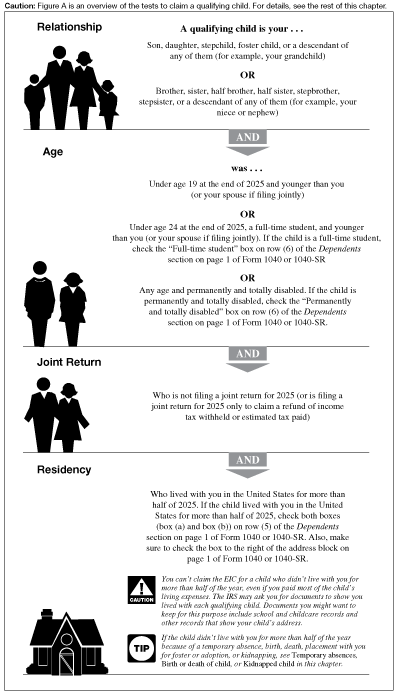
The four tests are illustrated in Figure A. The paragraphs that follow contain more information about each test.
Relationship Test
To be your qualifying child, a child must be your:
The following definitions clarify the relationship test.
Adopted child.
An adopted child is always treated as your own child. The term “adopted child” includes a child who was lawfully placed with you for legal adoption.
Foster child.
For the EIC, a person is your foster child if the child is placed with you by an authorized placement agency or by judgment, decree, or other order of any court of competent jurisdiction. An authorized placement agency includes:
-
A state or local government agency,
-
A tax-exempt organization licensed by a state, and
-
An Indian tribal government or an organization authorized by an Indian tribal government to place Indian children.
Example.
Dean, who is 12 years old, was placed in your care 2 years ago by an authorized agency responsible for placing children in foster homes. Dean is your foster child.
Age Test
-
Under age 19 at the end of 2025 and younger than you (or your spouse if filing jointly);
-
Under age 24 at the end of 2025, a full-time student, and younger than you (or your spouse if filing jointly); or
-
Any age and permanently and totally disabled.
.If your child is a full-time student or permanently and totally disabled, be sure to check the appropriate box on line 6 of the Dependents section on page 1 of Form 1040 or 1040-SR..
The following examples and definitions clarify the age test.
Example 1—Child not under age 19.
Your child, Sam, turned 19 on December 10. Unless Sam was permanently and totally disabled or a student, Sam isn’t a qualifying child because, at the end of the year, Sam wasn’t under age 19.
Example 2—Child not younger than you or your spouse.
Your 23-year-old sibling, Blake, who is a full-time student and unmarried, lives with you and your spouse. Blake isn’t disabled. Both you and your spouse are 21 years old, and you file a joint return. Blake isn’t your qualifying child because Blake isn’t younger than you or your spouse.
Example 3—Child younger than your spouse but not younger than you.
The facts are the same as in Example 2 except that your spouse is 25 years old. Because Blake is younger than your spouse, Blake is your qualifying child, even though Blake isn’t younger than you.
Full-time student defined.
To qualify as a full-time student, your child must be, during some part of each of any 5 calendar months during the calendar year:
-
A full-time student at a school that has a regular teaching staff, course of study, and regular student body at the school; or
-
A student taking a full-time, on-farm training course given by a school described in (1), or a state, county, or local government.
The 5 calendar months need not be consecutive.
A full-time student is a student who is enrolled for the number of hours or courses the school considers to be full-time attendance.
School defined.
A school can be an elementary school; junior or senior high school; college; university; or technical, trade, or mechanical school. However, on-the-job training courses, correspondence schools, and schools offering courses only through the Internet don’t count as schools for the EIC.
Vocational high school students.
Students who work in co-op jobs in private industry as a part of a school’s regular course of classroom and practical training are considered full-time students.
Permanently and totally disabled.
Your child is permanently and totally disabled if both of the following apply.
-
Your child can’t engage in any substantial gainful activity because of a physical or mental condition.
-
A doctor determines the condition has lasted or can be expected to last continuously for at least a year or can lead to death.
Substantial gainful activity.
Substantial gainful activity means performing significant duties over a reasonable period of time while working for pay or profit, or in work generally done for pay or profit. Full-time work (or part-time work done at an employer’s convenience) in a competitive work situation for at least the minimum wage shows that the child can engage in substantial gainful activity.
Substantial gainful activity isn’t work done to take care of yourself or your home. It isn’t unpaid work on hobbies, institutional therapy or training, school attendance, clubs, social programs, and similar activities. However, doing this kind of work may show that the child is able to engage in substantial gainful activity.
The fact that the child hasn’t worked for some time doesn’t, by itself, prove the child can’t engage in substantial gainful activity.
For examples of substantial gainful activity, see the Instructions for Schedule R (Form 1040).
Residency Test
Your child must have lived with you in the United States for more than half of 2025.
. You can’t claim the EIC for a child who didn’t live with you for more than half of the year, even if you paid most of the child’s living expenses. The IRS may ask you for documents to show you lived with each qualifying child. Documents you might want to keep for this purpose include school and childcare records and other records that show your child’s address..
.If the child lived with you in the United States for more than half of 2025, check both boxes (box (a) and box (b)) on row (5) of the Dependents section on page 1 of Form 1040 or 1040-SR. Also, make sure to check the box to the right of the address block on page 1 of Form 1040 or 1040-SR..
The following paragraphs clarify the residency test.
United States.
This means the 50 states and the District of Columbia. It doesn’t include Puerto Rico or U.S. territories such as Guam.
Homeless shelter.
Your home can be any location where you regularly live. You don’t need a traditional home. For example, if your child lived with you for more than half the year in one or more homeless shelters, your child meets the residency test.
Military personnel stationed outside the United States.
U.S. military personnel stationed outside the United States on extended active duty are considered to live in the United States during that duty period for purposes of the EIC.
Extended active duty.
Extended active duty means you are called or ordered to duty for an indefinite period or for a period of more than 90 days. Once you begin serving your extended active duty, you are still considered to have been on extended active duty even if you don’t serve more than 90 days.
Birth or death of child.
A child who was born or died in 2025 is treated as having lived with you for more than half of 2025 if your home was the child’s home for more than half the time the child was alive in 2025.
Temporary absences.
Count time that you or your child is away from home on a temporary absence due to a special circumstance as time the child lived with you. Examples of a special circumstance include illness, school attendance, business, vacation, military service, and detention in a juvenile facility.
Adopted child.
If you adopted a child in 2025, and that child was lawfully placed with you for legal adoption by you in 2025, or the child was an eligible foster child placed with you during 2025, the child is considered to have lived with you for more than half of 2025 if your main home was this child’s main home for more than half the time this child was adopted or placed with you in 2025.
Kidnapped child.
A kidnapped child is treated as living with you for more than half of the year if the child lived with you for more than half the part of the year before the date of the kidnapping or following the date of the child’s return. The child must be presumed by law enforcement authorities to have been kidnapped by someone who isn’t a member of your family or the child’s family. This treatment applies for all years until the child is returned. However, the last year this treatment can apply is the earlier of:
-
The year there is a determination that the child is dead, or
-
The year the child would have reached age 18.
If your qualifying child has been kidnapped and meets these requirements, enter “KC,” instead of a number, on line 6 of Schedule EIC.
Joint Return Test
To meet this test, the child can’t file a joint return for the year.
Exception.
An exception to the joint return test applies if your child and your child’s spouse file a joint return only to claim a refund of income tax withheld or estimated tax paid.
Example 1—Child files joint return.
You supported your 18-year-old child who lived with you all year while the child’s spouse was in the Armed Forces. Your child’s spouse earned $25,000 for the year. The couple files a joint return so this child isn’t your qualifying child.
Example 2—Child files joint return to get refund of tax withheld.
Your 18-year-old child and your child’s 17-year-old spouse had $800 of wages from part-time jobs and no other income. They don’t have a child. Neither is required to file a tax return. Taxes were taken out of their pay, so they file a joint return only to get a refund of the withheld taxes. The exception to the joint return test applies, so this child may be your qualifying child if all the other tests are met.
Example 3—Child files joint return to claim American opportunity credit.
The facts are the same as in Example 2 except no taxes were taken out of your child’s pay. Your child and their spouse aren’t required to file a tax return, but they file a joint return to claim an American opportunity credit of $124 and get a refund of that amount. Because claiming the American opportunity credit is their reason for filing the return, they aren’t filing it only to claim a refund of income tax withheld or estimated tax paid. The exception to the joint return test doesn’t apply, so this child isn’t your qualifying child.
Married child.
Even if your child doesn’t file a joint return, if your child was married at the end of the year, your child can’t be your qualifying child unless:
-
You can claim the child as a dependent, or
-
The reason you can’t claim the child as a dependent is that you let the child’s other parent claim the child as a dependent under the Special rule for divorced or separated parents (or parents who live apart), described later.
. Social security number (SSN). To claim a higher EIC amount based on a qualifying child, that qualifying child must have a valid SSN issued on or before the due date of your 2025 return (including extensions), unless the child was born and died in 2025 and you attach to your return a copy of the child’s birth certificate, death certificate, or hospital records showing a live birth. You can’t claim a higher EIC amount on the basis of a qualifying child if:.
-
The qualifying child’s SSN is missing from your tax return or is incorrect;
-
The qualifying child’s social security card says “Not valid for employment” and was issued for use in getting a federally funded benefit; or
-
Instead of an SSN, the qualifying child has:
.If “Not Valid for Employment” is printed on your child’s social security card and your child’s immigration status has changed so that your child is now a U.S. citizen or permanent resident, ask the SSA for a social security card without the legend..
.If you have a child who meets the conditions to be a qualifying child for purposes of claiming the EIC, but that child doesn’t have a valid SSN, you may be eligible to claim a self-only EIC..
Rule 9—Your Qualifying Child Cannot Be Used by More Than One Person To Claim the EIC
Sometimes a child meets the tests to be a qualifying child of more than one person. However, only one of these persons can actually treat the child as a qualifying child. Only that person can use the child as a qualifying child to take all of the following tax benefits (provided the person is eligible for each benefit).
The tiebreaker rules, which follow, explain who, if anyone, can claim the EIC when more than one person has the same qualifying child. However, the tiebreaker rules don’t apply if the other person is your spouse and you file a joint return.
Tiebreaker rules.
To determine which person can treat the child as a qualifying child to claim the five tax benefits just listed, the following tiebreaker rules apply. For purposes of these tiebreaker rules, the term “parent” means a biological or adoptive parent of an individual. It does not include a stepparent or foster parent unless that person has adopted the individual.
-
If only one of the persons is the child’s parent, the child is treated as the qualifying child of the parent.
-
If the parents file a joint return together and can claim the child as a qualifying child, the child is treated as the qualifying child of the parents.
-
If the parents don’t file a joint return together but both parents claim the child as a qualifying child, the IRS will treat the child as the qualifying child of the parent with whom the child lived for the longer period of time during the year. If the child lived with each parent for the same amount of time, the IRS will treat the child as the qualifying child of the parent who had the higher AGI for the year.
-
If no parent can claim the child as a qualifying child, the child is treated as the qualifying child of the person who had the highest AGI for the year.
-
If a parent can claim the child as a qualifying child but no parent claims the child, the child is treated as the qualifying child of the person who had the highest AGI for the year, but only if that person’s AGI is higher than the highest AGI of any of the child’s parents who can claim the child.
.If your qualifying child is treated under the tiebreaker rules as the qualifying child of another person for 2025, you may be able to take the EIC using the rules in chapter 3 for taxpayers who don’t have a qualifying child..
Subject to these tiebreaker rules, you and the other person may be able to choose which of you claims the child as a qualifying child. See Example 1 through Example 12, later.
If you can’t claim the EIC because your qualifying child is treated under the tiebreaker rules as the qualifying child of another person for 2025, you may be able to take the EIC using a different qualifying child, or take the EIC using the rules in chapter 3 for people who don’t have a qualifying child.
If the other person cannot claim the EIC.
If you and someone else have the same qualifying child but the other person can’t claim the EIC because the other person isn’t eligible or their earned income or AGI is too high, you may be able to treat the child as a qualifying child. See Example 6 and Example 7, later. But you can’t treat the child as a qualifying child to claim the EIC if the other person uses the child to claim any of the other five tax benefits listed earlier in this chapter.
Examples.
The following examples may help you in determining whether you can claim the EIC when you and someone else have the same qualifying child.
Example 1—Child lived with parent and grandparent.
You and your 2-year-old child Sam lived with your parent all year. You are 25 years old, unmarried, and your AGI is $9,000. Your only income was $9,000 from a part-time job. Your parent’s only income was $22,000 from a job, and their AGI is $22,000. Your child’s other parent did not live with you or Sam. The special rule explained later for divorced or separated parents (or parents who live apart) doesn’t apply. Sam is a qualifying child of both you and your parent because Sam meets the relationship, age, residency, and joint return tests for both you and your parent. However, only one of you can treat Sam as a qualifying child to claim the EIC (and the other tax benefits listed earlier in this chapter for which that person qualifies). Sam isn’t a qualifying child of anyone else, including the child’s other parent. If you don’t claim Sam as a qualifying child for the EIC or any of the other tax benefits listed earlier, your parent can treat Sam as a qualifying child to claim the EIC (and any of the other tax benefits listed earlier for which your parent qualifies).
Example 2—Parent has higher AGI than grandparent.
The facts are the same as in Example 1 except your AGI is $25,000. Because your parent’s AGI isn’t higher than yours, your parent can’t claim Sam as a qualifying child. Only you can claim Sam.
Example 3—Two persons claim same child.
The facts are the same as in Example 1 except that you and your parent both claim Sam as a qualifying child. In this case, you as the child’s parent will be the only one allowed to claim Sam as a qualifying child for the EIC and the other tax benefits listed earlier for which you qualify. The IRS will disallow your parent’s claim to the EIC and any of the other tax benefits listed earlier based on Sam. Your parent can’t take the EIC for a taxpayer without a qualifying child because your parent’s AGI is more than $19,104.
Example 4—Qualifying children split between two persons.
The facts are the same as in Example 1 except that you also have two other young children who are qualifying children of both you and your parent. Only one of you can claim each child. However, if your parent’s AGI is higher than yours, you can allow your parent to claim one or more of the children. For example, if you claim one child, your parent can claim the other two.
Example 5—Taxpayer who is a qualifying child.
The facts are the same as in Example 1 except that you are only 18 years old. This means you are a qualifying child of your parent. Because of Rule 10, discussed later, you can’t claim the EIC and can’t claim Sam as a qualifying child. Only your parent may be able to treat Sam as a qualifying child to claim the EIC. If your parent meets all the other requirements for claiming the EIC and you don’t claim Sam as a qualifying child for any of the other tax benefits listed earlier, your parent can claim both you and Sam as qualifying children for the EIC.
Example 6—Grandparent with too much earned income to claim EIC.
The facts are the same as in Example 1 except that your parent earned $50,000 from employment. Because your parent’s earned income is too high for your parent to claim the EIC, only you can claim the EIC using Sam.
Example 7—Parent with too much earned income to claim EIC.
The facts are the same as in Example 1 except that you earned $50,000 from your job and your AGI is $50,500. Your earned income is too high for you to claim the EIC. But your parent can’t claim the EIC either, because your parent’s AGI isn’t higher than yours.
Example 8—Separated parents.
You, your spouse, and your 10-year-old child, Jordan, lived together until August 1, 2025, when your spouse moved out of the household. In August and September, Jordan lived with you. For the rest of the year, Jordan lived with Jordan’s other parent. Jordan is a qualifying child of both you and your spouse because Jordan lived with each of you for more than half the year and because Jordan met the relationship, age, and joint return tests for both of you. At the end of the year, you and your spouse still weren’t divorced, legally separated, or separated under a written separation agreement, so the Special rule for divorced or separated parents (or parents who live apart) doesn’t apply.
You and your spouse will file separate returns. Your spouse agrees to let you treat Jordan as a qualifying child. This means, if your spouse doesn’t claim Jordan as a qualifying child for any of the tax benefits listed earlier, you can claim Jordan as a qualifying child for any tax benefit listed earlier for which you qualify. However, you can’t take the EIC because you and your spouse didn’t live apart for the last 6 months of 2025 and, while you did live apart at the end of 2025, you aren’t legally separated under a written separation agreement or decree of separate maintenance. Therefore, you don’t meet the requirements for certain separated spouses to take the EIC when they don’t file a joint return. See Rule 3. You also can’t take the credit for child and dependent care expenses because your filing status is married filing separately and you and your spouse didn’t live apart for the last 6 months of 2025. See Pub. 503.
Example 9—Separated parents claim same child.
The facts are the same as in Example 8, except that you and your spouse both claim Jordan as a qualifying child. In this case, only your spouse will be allowed to treat Jordan as a qualifying child. This is because, during 2025, Jordan lived with your spouse longer than with you. You can’t claim the EIC because you are a separated spouse who isn’t filing a joint return and you don’t have a qualifying child. However, your spouse’s filing status is also married filing separately, so your spouse can’t claim the EIC because you and your spouse didn’t live apart for the last 6 months of 2025 or you aren’t legally separated under a written separation agreement or decree of separate maintenance. Therefore, your spouse doesn’t meet the requirements to claim the EIC as a separated spouse who isn’t filing a joint return. See Rule 3. Your spouse also can’t take the credit for child and dependent care expenses because your spouse’s filing status is married filing separately and you and your spouse didn’t live apart for the last 6 months of 2025. See Pub. 503.
Example 10—Unmarried parents.
You, your 5-year-old child, Logan, and Logan’s other parent lived together all year. You and Logan’s other parent aren’t married. Logan is a qualifying child of both you and Logan’s other parent because Logan meets the relationship, age, residency, and joint return tests for both you and Logan’s other parent. Your earned income and AGI are $12,000, and Logan’s other parent’s earned income and AGI are $14,000. Neither of you had any other income. Logan’s other parent agrees to let you treat the child as a qualifying child. This means if Logan’s other parent doesn’t claim Logan as a qualifying child for the EIC or any of the other tax benefits listed earlier, you can claim Logan as a qualifying child for the EIC and any of the other tax benefits listed earlier for which you qualify.
Example 11—Unmarried parents claim same child.
The facts are the same as in Example 10 except that you and Logan’s other parent both claim Logan as a qualifying child. In this case, only Logan’s other parent will be allowed to treat Logan as a qualifying child. This is because Logan’s other parent’s AGI, $14,000, is more than your AGI, $12,000. You can claim the EIC without a qualifying child.
Example 12—Child did not live with a parent.
You and your sibling’s child, Morgan, lived with your parent all year. You are 25 years old, and your AGI is $9,300. Your only income was from a part-time job. Your parent’s AGI is $15,000. Your parent’s only income was from a job. Morgan’s parents file jointly, have an AGI of less than $9,000, and don’t live with you or Morgan. Morgan is a qualifying child of both you and your parent because Morgan meets the relationship, age, residency, and joint return tests for both you and your parent. However, only your parent can treat Morgan as a qualifying child. This is because your parent’s AGI, $15,000, is more than your AGI, $9,300.
Special rule for divorced or separated parents (or parents who live apart).
A child will be treated as the qualifying child of the noncustodial parent if all of the following statements are true.
-
The parents:
-
Are divorced or legally separated under a decree of divorce or separate maintenance;
-
Are separated under a written separation agreement; or
-
Lived apart at all times during the last 6 months of 2025.
-
-
The child received over half of the child’s support for the year from the parents.
-
The child is in the custody of one or both parents for more than half of 2025.
-
Either of the following statements is true.
-
The custodial parent signs Form 8332 or a substantially similar statement that the custodial parent will not claim the child as a dependent for the year, and the noncustodial parent attaches the form or statement to their return. If the divorce decree or separation agreement went into effect after 1984 and before 2009, the noncustodial parent may be able to attach certain pages from the decree or agreement instead of Form 8332.
-
A pre-1985 decree of divorce or separate maintenance or written separation agreement that applies to 2025 provides that the noncustodial parent can claim the child as a dependent, and the noncustodial parent provides at least $600 for support of the child during 2025.
-
Rule 10—You Cannot Be a Qualifying Child of Another Taxpayer
You are a qualifying child of another taxpayer (such as your parent, guardian, or foster parent) if all of the following statements are true.
-
You are that person’s son, daughter, stepchild, foster child, or a descendant of any of them. Or, you are that person’s brother, sister, half brother, half sister, stepbrother, stepsister, or a descendant of any of them.
-
You were:
-
Under age 19 at the end of the year and younger than that person (or that person’s spouse if the person files jointly);
-
Under age 24 at the end of the year, a full-time student, and younger than that person (or that person’s spouse if the person files jointly); or
-
Any age and permanently and totally disabled.
-
-
You lived with that person in the United States for more than half of the year.
-
You aren’t filing a joint return for the year (or are filing a joint return only to claim a refund of withheld income tax or estimated tax paid).
If you are a qualifying child of another taxpayer, you can’t claim the EIC. This is true even if the person for whom you are a qualifying child doesn’t claim the EIC or meet all of the rules to claim the EIC. Check the box on line 27c (Form 1040 or 1040-SR).
Example.
You and your child lived with your parent all year. You are 22 years old, unmarried, and attended a trade school full time. You had a part-time job and earned $5,700. You had no other income. Because you meet the relationship, age, residency, and joint return tests, you are a qualifying child of your parent. Your parent can claim the EIC if your parent meets all the other requirements. Because you are your parent’s qualifying child, you can’t claim the EIC. This is so even if your parent can’t or doesn’t claim the EIC.
Child of person not required to file a return.
You aren’t the qualifying child of another taxpayer (and so may qualify to claim the EIC) if the person for whom you met the relationship, age, residency, and joint return tests isn’t required to file an income tax return and either:
-
Doesn’t file an income tax return, or
-
Files a return only to get a refund of income tax withheld or estimated tax paid.
Example 1—Return not required.
The facts are the same as in the last example except your parent had no gross income, isn’t required to file a 2025 tax return, and doesn’t file a 2025 tax return. As a result, you aren’t your parent’s qualifying child. You can claim the EIC if you meet all the other requirements to do so.
Example 2—Return filed to get refund of tax withheld.
The facts are the same as in Example 1 except your parent had wages of $1,500 and had income tax withheld from those wages. Your parent files a return only to get a refund of the income tax withheld and doesn’t claim the EIC or any other tax credits or deductions. As a result, you aren’t your parent’s qualifying child. You can claim the EIC if you meet all the other requirements to do so.
Example 3—Return filed to get EIC.
The facts are the same as in Example 2 except your parent claimed the EIC on their return. Since your parent filed the return to get the EIC, your parent isn’t filing it only to get a refund of income tax withheld. As a result, you are your parent’s qualifying child. You can’t claim the EIC.
Use this chapter if you don’t have a qualifying child and have met all the rules in chapter 1. This chapter discusses Rule 11 through Rule 14, later. You must meet all four of these rules, in addition to the rules in chapters 1 and 4, to qualify for the EIC without a qualifying child. If you meet all the rules in chapter 1 and this chapter, read chapter 4 to find out what to do next.
If you have a qualifying child.
If you meet Rule 8, you have a qualifying child. If you meet Rule 8 and don’t claim the EIC with a qualifying child, you can claim the EIC without a qualifying child.
.If your child meets the tests to be your qualifying child, but also meets the tests to be the qualifying child of another person, only one of you can actually treat the child as a qualifying child to claim the EIC. If the other person can claim the child under the tiebreaker rules, you can’t claim the EIC as a taxpayer with a qualifying child unless you have another qualifying child. However, you may be able to claim the EIC without a qualifying child..
Rule 11—You Must Meet the Age Requirements
You must be at least age 25 but under age 65 at the end of 2025. If you are married filing a joint return, either you or your spouse must be at least age 25 but under age 65 at the end of 2025. It doesn’t matter which spouse meets the age test, as long as one of the spouses does.
You meet the age test if you were born after December 31, 1960, and before January 2, 2001. If you are married filing a joint return, you meet the age test if either you or your spouse was born after December 31, 1960, and before January 2, 2001.
If neither you nor your spouse meets the age test, you can’t claim the EIC. Check the box on line 27c (Form 1040 or 1040-SR).
Example 1.
You are age 28 and unmarried. You meet the age test.
Example 2—Spouse meets age test.
You are married and filing a joint return. You are age 23 and your spouse is age 27. You meet the age test because your spouse is at least age 25 but under age 65.
Death of spouse.
If you are filing a joint return with your spouse who died in 2025, you meet the age test if you are at least age 25 but under age 65 at the end of 2025, or your spouse was at least age 25 but under age 65 at the time of death.
Your spouse is considered to reach age 25 on the day before their 25th birthday. However, the rule for reaching age 65 is different; your spouse reaches age 65 on their 65th birthday.
Even if your spouse was born before January 2, 2001, they aren’t considered at least age 25 at the end of 2025 unless they were at least age 25 at the time of death.
Example 1.
You are married and filing a joint return with your spouse who died in August 2025. You are age 67. Your spouse would have become age 65 in November 2025. Because your spouse was under age 65 at the time of death, you meet the age test.
Example 2.
Your spouse was born on February 14, 2000, and died on February 13, 2025. Your spouse is considered age 25 at the time of death. However, if your spouse died on February 12, 2025, your spouse isn’t considered age 25 at the time of death and isn’t at least age 25 at the end of 2025.
Death of taxpayer.
A taxpayer who died in 2025 meets the age test if the taxpayer was at least age 25 but under age 65 at the time of death.
A taxpayer is considered to reach age 25 on the day before the taxpayer’s 25th birthday. However, the rule for reaching age 65 is different; a taxpayer reaches age 65 on the taxpayer’s 65th birthday.
Even if the taxpayer was born before January 2, 2001, they aren’t considered at least age 25 at the end of 2025 unless they were at least age 25 at the time of death.
Rule 12—You Cannot Be the Dependent of Another Person
If you aren’t filing a joint return, you meet this rule if you did not check the box on line 12a that says “Someone can claim you as a dependent.”
If you are filing a joint return, you meet this rule if you did not check either box that says “Someone can claim you as a dependent” or “Someone can claim your spouse as a dependent.”
If you aren’t sure whether someone else can claim you as a dependent, get Pub. 501 and read the rules for claiming a dependent.
If someone else can claim you as a dependent on their return, but doesn’t, you still can’t claim the credit unless the person who can claim you on their tax return isn’t required to file an income tax return and doesn’t file a tax return or files a return only to claim a refund of withheld income tax or estimated tax paid.
Example 1.
In 2025, you were age 25, single, and living at home with your parents. You worked and weren’t a student. You earned $7,500. Your parents can’t claim you as a dependent. When you file your return, you do not check the "Someone can claim you as a dependent" checkbox. You meet this rule. You can claim the EIC if you meet all the other requirements.
Example 2.
The facts are the same as in Example 1, except that you earned $2,000. Your parents can claim you as a dependent but decide not to. You don’t meet this rule. You can’t claim the credit because your parents could have claimed you as a dependent.
Joint returns.
You generally can’t be claimed as a dependent by another person if you are married and file a joint return.
However, another person may be able to claim you as a dependent if you and your spouse file a joint return merely to claim a refund of income tax withheld or estimated tax paid. But neither you nor your spouse can be claimed as a dependent by another person if you claim the EIC on your joint return.
Example 1—Return filed to get refund of tax withheld.
You are 26 years old. You and your spouse live with your parents and had $800 of wages from part-time jobs and no other income. Neither you nor your spouse is required to file a tax return. You don’t have a child. Taxes were taken out of your pay so you file a joint return only to get a refund of the withheld taxes. Your parents aren’t disqualified from claiming you as a dependent just because you filed a joint return.
Example 2—Return filed to get EIC.
The facts are the same as in Example 1 except no taxes were taken out of your pay. Also, you and your spouse aren’t required to file a tax return, but you file a joint return to claim an EIC of $63 and get a refund of that amount. Because claiming the EIC is your reason for filing the return, you aren’t filing it only to claim a refund of income tax withheld or estimated tax paid. Your parents can’t claim you or your spouse as a dependent.
Rule 13—You Cannot Be a Qualifying Child of Another Taxpayer
You are a qualifying child of another taxpayer (your parent, guardian, foster parent, etc.) if all of the following statements are true.
-
You are that person’s son, daughter, stepchild, foster child, or a descendant of any of them. Or, you are that person’s brother, sister, half brother, half sister, stepbrother, stepsister, or a descendant of any of them.
-
You were:
-
Under age 19 at the end of the year and younger than that person (or that person’s spouse if the person files jointly);
-
Under age 24 at the end of the year, a student, and younger than that person (or that person’s spouse if the person files jointly); or
-
Any age and permanently and totally disabled.
-
-
You lived with that person in the United States for more than half of the year.
-
You aren’t filing a joint return for the year (or are filing a joint return only to claim a refund of withheld income tax or estimated tax paid).
If you are a qualifying child of another taxpayer, you can’t claim the EIC. This is true even if the person for whom you are a qualifying child doesn’t claim the EIC or meet all of the rules to claim the EIC. Check the box on line 27c (Form 1040 or 1040-SR).
Example.
You lived with your parent all year. You are age 26, unmarried, and permanently and totally disabled. Your only income was from a community center where you went 3 days a week to answer telephones. You earned $5,000 for the year and provided more than half of your own support. Because you meet the relationship, age, residency, and joint return tests, you are a qualifying child of your parent for the EIC. Your parent can claim the EIC if your parent meets all the other requirements. Because you are a qualifying child of your parent, you can’t claim the EIC. This is so even if your parent can’t or doesn’t claim the EIC.
Joint returns.
You generally can’t be a qualifying child of another taxpayer if you are married and file a joint return.
However, you may be a qualifying child of another taxpayer if you and your spouse file a joint return merely to claim a refund of income tax withheld or estimated tax paid. But neither you nor your spouse can be a qualifying child of another taxpayer if you claim the EIC on your joint return.
Child of person not required to file a return.
You aren’t the qualifying child of another taxpayer (and so may qualify to claim the EIC) if the person for whom you meet the relationship, age, residency, and joint return tests isn’t required to file an income tax return and either:
-
Doesn’t file an income tax return, or
-
Files a return only to get a refund of income tax withheld or estimated tax paid.
Example 1—Return not required.
You lived all year with your parent. You are 27 years old, unmarried, permanently and totally disabled, and earned $13,000. You have no other income, no children, and provided more than half of your own support. Your parent had no gross income, isn’t required to file a 2025 tax return, and doesn’t file a 2025 tax return. As a result, you aren’t your parent’s qualifying child. You can claim the EIC if you meet all the other requirements to do so.
Example 2—Return filed to get refund of tax withheld.
The facts are the same as in Example 1 except your parent had wages of $1,500 and had income tax withheld from wages. Your parent files a return only to get a refund of the income tax withheld and doesn’t claim the EIC or any other tax credits or deductions. As a result, you aren’t your parent’s qualifying child. You can claim the EIC if you meet all the other requirements to do so.
Example 3—Return filed to get EIC.
The facts are the same as in Example 2 except your parent claimed the EIC on their return. Since your parent filed the return to get the EIC, your parent isn’t filing it only to get a refund of income tax withheld. As a result, you are your parent’s qualifying child. You can’t claim the EIC.
Rule 14—You Must Have Lived in the United States More Than Half of the Year
Your home (and your spouse's if filing a joint return) must have been in the United States for more than half the year.
.Make sure to check the box to the right of the address block on page 1 of Form 1040 or 1040-SR asking if your main home, and your spouse’s if filing jointly, was in the U.S. for more than half of 2025..
If it wasn’t, check the box on line 27c (Form 1040 or 1040-SR).
United States.
This means the 50 states and the District of Columbia. It doesn’t include Puerto Rico or U.S. territories such as Guam.
You must meet one more rule to claim the EIC.
You need to know the amount of your earned income to see if you meet the rule in this chapter. You also need to know that amount to figure your EIC.
Rule 15—Earned Income Limits
Your earned income must be less than:
-
$61,555 ($68,675 for married filing jointly) if you have three or more qualifying children who have valid SSNs,
-
$57,310 ($64,430 for married filing jointly) if you have two qualifying children who have valid SSNs,
-
$50,434 ($57,554 for married filing jointly) if you have one qualifying child who has a valid SSN, or
-
$19,104 ($26,214 for married filing jointly) if you don’t have a qualifying child who has a valid SSN.
Earned Income
Earned income generally means wages, salaries, tips, other taxable employee pay, and net earnings from self-employment. Employee pay is earned income only if it is taxable. Nontaxable employee pay, such as certain dependent care benefits and adoption benefits, isn’t earned income. But there is an exception for nontaxable combat pay, which you can choose to include in earned income. Earned income is explained in detail in Rule 7 in chapter 1.
Figuring earned income.
If you are self-employed, a statutory employee, or a member of the clergy or a church employee who files Schedule SE (Form 1040), you will figure your earned income by using the worksheet in Step 5 of the Form 1040 instructions for line 27a and then filling out Part 4 of EIC Worksheet B in the Form 1040 instructions. Be sure to see Clergy or Church employees, whichever applies, before completing the worksheet in Step 5.
Clergy.
If you are a member of the clergy who files Schedule SE and the amount on line 2 of that schedule includes an amount that was also reported on Form 1040 or 1040-SR, line 1z, subtract that amount from the amount on Form 1040 or 1040-SR, line 1z, and enter the result on line 1 of the worksheet in Step 5 of the Form 1040 instructions for line 27a. Check the “Clergy filing Schedule SE” box on line 27b (Form 1040 or 1040-SR).
Church employees.
A church employee means an employee (other than a minister or member of a religious order) of a church or qualified church-controlled organization that is exempt from employer social security and Medicare taxes. If you received wages as a church employee and included any amount on both line 5a of Schedule SE and Form 1040, line 1a, subtract that amount from the amount on Form 1040 or 1040-SR, line 1a, and enter the result on line 1 of the worksheet in Step 5 of the Form 1040 instructions for line 27a.
Medicaid waiver payments.
When completing the worksheet in Step 5 of the Form 1040 instructions, line 27a, enter the Medicaid waiver payments you excluded from income on Schedule 1 (Form 1040), line 8s, unless you choose to include these amounts in earned income, in which case enter -0-. For more information about these payments, see Pub. 525.
.Your nontaxable Medicaid waiver payments may have been reported to you on Form(s) W-2, box 12, with Code II..
.If you and your spouse both received Medicaid waiver payments during the year, you and your spouse can make different choices about including the full amount of your payments in earned income. Enter only the amount of Medicaid waiver payments that you or your spouse, if filing a joint return, do not want to include in earned income. To include all nontaxable Medicaid waiver payment amounts in earned income, enter -0-..
Nontaxable combat pay.
You can elect to include your nontaxable combat pay in earned income for the EIC. If you make the election, you must include in earned income all nontaxable combat pay you received.
If you are filing a joint return and both you and your spouse received nontaxable combat pay, you can each make your own election. In other words, if one of you makes the election, the other one can also make it but doesn’t have to.
The amount of your nontaxable combat pay should be shown on your Form W-2 in box 12 with code Q.
Electing to include nontaxable combat pay in earned income may increase or decrease your EIC. Figure the credit with and without your nontaxable combat pay before making the election. Whether the election increases or decreases your EIC depends on your total earned income, filing status, and number of qualifying children. If your earned income without your combat pay is less than the amount shown below for your number of children, you may benefit from electing to include your nontaxable combat pay in earned income and you should figure the credit both ways. If your earned income without your combat pay is equal to or more than these amounts, you will not benefit from including your combat pay in your earned income.
-
$8,490 if you have no children who have valid SSNs.
-
$12,730 if you have one child who has a valid SSN.
-
$17,880 if you have two or more children who have valid SSNs.
.If you elect to use your nontaxable combat pay in figuring your EIC, enter that amount on Form 1040 or 1040-SR, line 1i..
IRS Will Figure the EIC for You
The IRS will figure your EIC for you if you follow the instructions for line 27a in the Instructions for Form 1040.
.Please don’t ask the IRS to figure your EIC unless you are eligible for it. To be eligible, you must meet Rule 15 in this chapter as well as the rules in chapter 1 and either chapter 2 or chapter 3, whichever applies to you. If your credit was reduced or disallowed for any year after 1996, the rules in chapter 5 may apply as well..
How To Figure the EIC Yourself
To figure the EIC yourself, use the EIC Worksheet in the Instructions for Form 1040. If you have a qualifying child, complete Schedule EIC (discussed later in this chapter) and attach it to your tax return.
If you want the IRS to figure your EIC for you, see IRS Will Figure the EIC for You, earlier.
Special Instructions—EIC Worksheets
You will need to decide whether to use EIC Worksheet A or EIC Worksheet B to figure the amount of your EIC. This section explains how to use these worksheets and how to report the EIC on your return.
EIC Worksheet A.
Use EIC Worksheet A if you weren’t self-employed at any time in 2025 and aren’t a member of the clergy, a church employee who files Schedule SE, or a statutory employee filing Schedule C.
EIC Worksheet B.
Use EIC Worksheet B if you were self-employed at any time in 2025 or are a member of the clergy, a church employee who files Schedule SE, or a statutory employee filing Schedule C. If any of the following situations apply to you, read the paragraph and then complete EIC Worksheet B.
Net earnings from self-employment of $400 or more.
If your net earnings from self-employment are $400 or more, be sure to correctly fill out Schedule SE (Form 1040) and pay the proper amount of self-employment tax. If you don’t, you may not get all the EIC you are entitled to receive.
.When figuring your net earnings from self-employment, you must claim all your allowable business expenses..
When to use the optional methods of figuring net earnings.
Using the optional methods on Schedule SE to figure your net earnings from self-employment may qualify you for the EIC or give you a larger credit. If your net earnings (without using the optional methods) are less than $7,240, see the Instructions for Schedule SE for details about the optional methods.
When both spouses have self-employment income.
You must complete both Parts 1 and 2 of EIC Worksheet B if all of the following conditions apply to you.
Schedule EIC
You must complete Schedule EIC and attach it to your tax return if you have a qualifying child and are claiming the EIC. Schedule EIC provides the IRS with information about your qualifying children, including their names, ages, SSNs, relationship to you, and the amount of time they lived with you during the year.
.If you are required to complete and attach Schedule EIC but don’t, it will take longer to process your return and issue your refund..
.Attach and complete Schedule EIC to your tax return even if your qualifying child doesn’t have a valid SSN. For information about how to complete Schedule EIC if your qualifying child or children do not have valid SSNs, see Schedule EIC. .
.If your EIC for any year after 1996 was denied (disallowed) or reduced by the IRS, you may need to complete an additional form to claim the credit for 2025..
This chapter is for people whose EIC for any year after 1996 was denied or reduced by the IRS. If this applies to you, you may need to complete Form 8862, Information To Claim Certain Credits After Disallowance, and attach it to your 2025 return to claim the credit for 2025. This chapter explains when you need to attach Form 8862. For more information, see Form 8862 and its instructions.
This chapter also explains the rules for certain people who can’t claim the EIC for a period of years after their EIC was denied or reduced.
Form 8862
If your EIC for any year after 1996 was denied or reduced for any reason other than a math or clerical error, you must attach a completed Form 8862 to your next tax return to claim the EIC. You must also qualify to claim the EIC by meeting all the rules described in this publication.
Exception 1.
Don’t file Form 8862 if either (1) or (2) below is true.
-
After your EIC was reduced or disallowed in the earlier year:
-
You filed Form 8862 in a later year and your EIC for that later year was allowed, and
-
Your EIC hasn’t been reduced or disallowed again for any reason other than a math or clerical error.
-
-
You are claiming the EIC without a qualifying child for 2025 and the only reason your EIC was reduced or disallowed in the earlier year was because the IRS determined that a child listed on Schedule EIC wasn’t your qualifying child.
Exception 2.
Don’t file Form 8862 or take the EIC for:
More information.
For details, see Are You Prohibited From Claiming the EIC for a Period of Years? in this chapter.
The date on which your EIC was denied and the date on which you file your 2025 return affect whether you need to attach Form 8862 to your 2025 return or to a later return. The following examples demonstrate whether Form 8862 is required for 2025 or 2026.
Example 1—Form 8862 required for 2025.
You filed your 2024 tax return in March 2025 and claimed the EIC with a qualifying child. The IRS questioned the EIC, and you were unable to prove the child was a qualifying child. In September 2025, you received a statutory notice of deficiency telling you that an adjustment would be made and tax assessed unless you filed a petition with the Tax Court within 90 days. You didn’t act on this notice within 90 days. Therefore, your EIC was denied in December 2025. To claim the EIC with a qualifying child on your 2025 return, you must complete and attach Form 8862 to that return. However, to claim the EIC without a qualifying child on your 2025 return, you don’t need to file Form 8862.
Example 2—Form 8862 required for 2026.
The facts are the same as in the previous example except that you received the statutory notice of deficiency in February 2026. Because the 90-day period referred to in the statutory notice isn’t over when you are ready to file your return for 2025, you shouldn’t attach Form 8862 to your 2025 return. However, to claim the EIC with a qualifying child for 2026, you must complete and attach Form 8862 to your return for that year. To claim the EIC without a qualifying child for 2026, you don’t need to file Form 8862.
Exception for math or clerical errors.
If your EIC was denied or reduced as a result of a math or clerical error, don’t attach Form 8862 to your next tax return. For example, if your arithmetic is incorrect, the IRS can correct it. If you don’t provide a correct SSN, the IRS can deny the EIC. These types of errors are called math or clerical errors.
Omission of Form 8862.
If you are required to attach Form 8862 to your 2025 tax return, and you claim the EIC without attaching a completed Form 8862, your claim will be automatically denied. This is considered a math or clerical error. You won’t be permitted to claim the EIC without a completed Form 8862.
Additional documents may be required.
You may have to provide the IRS with additional documents or information before a refund relating to the EIC you claim is released to you, even if you attach a properly completed Form 8862 to your return.
Are You Prohibited From Claiming the EIC for a Period of Years?
If your EIC for any year after 1996 was denied and it was determined that your error was due to reckless or intentional disregard of the EIC rules, then you can’t claim the EIC for the next 2 years. If your error was due to fraud, then you can’t claim the EIC for the next 10 years. The date on which your EIC was denied and the date on which you file your 2025 return affect the years for which you are prohibited from claiming the EIC. The following examples demonstrate which years you are prohibited from claiming the EIC.
Example 3—Cannot claim EIC for 2 years.
You claimed the EIC on your 2024 tax return, which you filed in March 2025. The IRS determined you weren’t entitled to the EIC and that your error was due to reckless or intentional disregard of the EIC rules. In September 2025, you received a statutory notice of deficiency telling you an adjustment would be made and tax assessed unless you filed a petition with the Tax Court within 90 days. You didn’t act on this notice within 90 days. Therefore, your EIC was denied in December 2025. You can’t claim the EIC for tax year 2025 or 2026. To claim the EIC on your return for 2027, you must complete and attach Form 8862 to your return for that year.
Example 4.
The facts are the same as in Example 3, except that your 2024 EIC wasn’t denied until after you filed your 2025 return. You can’t claim the EIC for tax year 2026 or 2027. To claim the EIC on your return for 2028, you must complete and attach Form 8862 to your return for that year.
Example 5—Cannot claim EIC for 10 years.
You claimed the EIC on your 2024 tax return, which you filed in February 2025. The IRS determined you weren’t entitled to the EIC and that your error was due to fraud. In September 2025, you received a statutory notice of deficiency telling you an adjustment would be made and tax assessed unless you filed a petition with the Tax Court within 90 days. You didn’t act on this notice within 90 days. Therefore, your EIC was denied in December 2025. You can’t claim the EIC for tax years 2025 through 2034. To claim the EIC on your return for 2035, you must complete and attach Form 8862 to your return for that year.
If you disagree with the final determination of the IRS that you are prohibited from claiming the EIC for a period of years and want to appeal this determination, see How to appeal the disallowance period in the Instructions for Form 8862.
The next few pages contain two detailed examples that may be helpful if you have questions about claiming the EIC.
Example 1—Jamie Smith
Jamie Smith is age 63 and retired. Jamie received $7,000 in social security benefits during the year and $17,000 from a part-time job. Jamie also received a taxable pension of $7,400. Jamie had no other income. Jamie’s AGI on line 11b of Form 1040 is $24,400 ($17,000 + $7,400).
Jamie isn’t married and lived alone in the United States for the entire year. Jamie can’t be claimed as a dependent on anyone else’s return, doesn’t have any investment income, and doesn’t have a qualifying child.
Jamie reads the steps for eligibility in the Form 1040 instructions. In Step 1, Jamie discovers that, because Jamie’s AGI ($24,400) isn’t less than $19,104, Jamie can’t take the EIC. Jamie completes the rest of Form 1040 and files it with the IRS.
Example 2—Cameron and Jordan Grey
Cameron and Jordan Grey have two children, ages 10 and 8. The children lived with them for all of 2025. Cameron earned wages of $15,000 and Jordan had wages of $18,030. The Greys received $525 in interest on their savings account. They had no other income in 2025.
Cameron and Jordan have the 2025 Form 1040 and instructions. They want to see if they qualify for the EIC, so they follow the steps for line 27a in the Instructions for Form 1040.
Step 1.
The amount Cameron and Jordan entered on Form 1040, line 11b, was $33,555. They both have valid SSNs, which they have had for many years. They are married and will file a joint return. Neither Cameron nor Jordan is a nonresident alien. Therefore, the answers they give to the questions in Step 1 allow them to proceed to Step 2.
Step 2.
The only investment income the Greys have is their $525 interest income. That amount isn’t more than $11,950, so they answer “No” to the second question in Step 2 and go to Step 3.
Step 3.
Their children meet the relationship, age, residency, and joint return tests to be Cameron and Jordan’s qualifying children, so Cameron and Jordan answer “Yes” to the first question in Step 3. Their children aren’t qualifying children of anyone else. Both children have valid SSNs, which they received soon after birth. Cameron and Jordan are filing a joint return, so they answer “Yes” to the second question in Step 3. This means they can skip questions 3 though 6 and Step 4 and go to Step 5.
Step 5.
Cameron and Jordan figure their earned income to be $33,030, the amount of their combined wages. This is less than $64,430, so they go to Step 6 to figure their credit.
Step 6.
Cameron and Jordan want to figure their EIC themselves, so they complete the EIC Worksheet in the Form 1040 instructions.
Completing the EIC Worksheet.
Cameron and Jordan complete their worksheet as follows.
-
Cameron and Jordan enter their total earned income ($33,030) on line 1.
-
To find their credit, they go to the EIC Table. They find their earned income of $33,030 in the range of $33,000 to $33,050. Because both of their children have valid SSNs, they follow this line across to the column for 2 children under Married filing jointly and find $6,614. They enter $6,614 on line 2.
-
They enter on line 3 their AGI ($33,555) and see that it is different from the amount on line 1.
-
They look up $33,555 in the EIC Table and enter the amount of $6,498 on line 5.
-
They enter $6,498 on line 6. This is the smaller of the line 2 amount ($6,614) and the line 5 amount ($6,498).
-
The Greys enter $6,498 on line 27a of their Form 1040. They will now complete Schedule EIC and attach it to their return. They will keep the EIC Worksheet for their records.
EIC Eligibility Checklist
| You may claim the EIC if you answer “Yes” to all the following questions. | |||
| Yes | No | ||
| 1. | Is your AGI less than:
|
□ | □ |
| 2. | Do you and your spouse, if filing jointly, each have a valid SSN issued by the due date of your 2025 return (including extensions)? (See Rule 2 .) | □ | □ |
| 3. | Are you filing a joint return with your spouse or do you meet the special rule for separated spouses? (See Rule 3 .) Answer “Yes” if you weren’t married at the end of 2025. Caution: If you are a nonresident alien, answer “Yes” only if your filing status is married filing jointly. (See Rule 4 .) |
□ | □ |
| 4. | Answer “Yes” if you aren’t filing Form 2555. Otherwise, answer “No.” (See Rule 5 .) | □ | □ |
| 5. | Is your investment income $11,950 or less? (See Rule 6 .) | □ | □ |
| 6. | Is your total earned income at least $1 but less than:
|
□ | □ |
| 7. | Answer “Yes” if (a) you aren’t a qualifying child of another taxpayer, or (b) you are filing a joint return. Otherwise, answer “No.” (See Rules 10 and 13 .) | □ | □ |
| STOP: If you have a child you want to claim for the EIC, answer questions 8 and 9 and skip 10–12. If you don’t have a qualifying child or if another person is entitled to treat your child as a qualifying child under the tiebreaker rules explained in Rule 9, skip questions 8 and 9 and answer 10–12. | |||
| 8. | Does your child meet the relationship, age, residency, and joint return tests for a qualifying child? (See Rule 8 .) | □ | □ |
| 9. | Is your child a qualifying child only for you? Answer “Yes” if (a) your qualifying child doesn’t meet the tests to be a qualifying child of any other person, or (b) your qualifying child meets the tests to be a qualifying child of another person but you are the person entitled to treat the child as a qualifying child under the tiebreaker rules explained in Rule 9. | □ | □ |
| 10. | Were you (or your spouse if filing a joint return) at least age 25 but under age 65 at the end of 2025? (See Rule 11 .) | □ | □ |
| 11. | Answer “Yes” if (a) you can’t be claimed as a dependent on anyone else’s return, or (b) you are filing a joint return. Otherwise, answer “No.” (See Rule 12 .) | □ | □ |
| 12. | Was your main home (and your spouse’s if filing a joint return) in the United States for more than half the year? (See Rule 14 .) |
□ | □ |
| If you answered “No” to any question that applies to you: You can’t claim the EIC. | |||
How To Get Tax Help
If you have questions about a tax issue; need help preparing your tax return; or want to download free publications, forms, or instructions, go to IRS.gov to find resources that can help you right away.
Tax reform.
Tax reform legislation impacting federal taxes, credits, and deductions was enacted in P.L. 119-21, commonly known as the One Big Beautiful Bill Act, on July 4, 2025. Go to IRS.gov/OBBB for more information and updates on how this legislation affects your taxes.
Preparing and filing your tax return.
After receiving all your wage and earnings statements (Forms W-2, W-2G, 1099-R, 1099-MISC, 1099-NEC, etc.); unemployment compensation statements (by mail or in a digital format) or other government payment statements (Form 1099-G); and interest, dividend, and retirement statements from banks and investment firms (Forms 1099), you have several options to choose from to prepare and file your tax return. You can prepare the tax return yourself, see if you qualify for free tax preparation, or hire a tax professional to prepare your return.
Free options for tax preparation.
Your options for preparing and filing your return online or in your local community, if you qualify, include the following.
-
Free File. This program lets you prepare and file your federal individual income tax return for free using software or Free File Fillable Forms. However, state tax preparation may not be available through Free File. Go to IRS.gov/FreeFile to see if you qualify for free online federal tax preparation, e-filing, and direct deposit or payment options.
-
VITA. The Volunteer Income Tax Assistance (VITA) program offers free tax help to people with low-to-moderate incomes, persons with disabilities, and limited-English-speaking taxpayers who need help preparing their own tax returns. Go to IRS.gov/VITA, download the free IRS2Go app, or call 800-906-9887 for information on free tax return preparation.
-
TCE. The Tax Counseling for the Elderly (TCE) program offers free tax help for all taxpayers, particularly those who are 60 years of age and older. TCE volunteers specialize in answering questions about pensions and retirement-related issues unique to seniors. Go to IRS.gov/TCE or download the free IRS2Go app for information on free tax return preparation.
-
MilTax. Members of the U.S. Armed Forces and qualified veterans may use MilTax, a free tax service offered by the Department of Defense through Military OneSource. For more information, go to MilitaryOneSource (MilitaryOneSource.mil/MilTax).
Also, the IRS offers Free Fillable Forms, which can be completed online and then e-filed regardless of income.
Using online tools to help prepare your return.
Go to IRS.gov/Tools for the following.
-
The Earned Income Tax Credit Assistant (IRS.gov/EITCAssistant) determines if you’re eligible for the earned income credit (EITC).
-
The Online EIN Application (IRS.gov/EIN) helps you get an employer identification number (EIN) at no cost.
-
The Tax Withholding Estimator (IRS.gov/W4App) makes it easier for you to estimate the federal income tax you want your employer to withhold from your paycheck. This is tax withholding. See how your withholding affects your refund, take-home pay, or tax due.
-
The Sales Tax Deduction Calculator (IRS.gov/SalesTax) figures the amount you can claim if you itemize deductions on Schedule A (Form 1040).
. Getting answers to your tax questions. On IRS.gov, you can get up-to-date information on current events and changes in tax law..
-
IRS.gov/Help: A variety of tools to help you get answers to some of the most common tax questions.
-
IRS.gov/ITA: The Interactive Tax Assistant, a tool that will ask you questions and, based on your input, provide answers on a number of tax topics.
-
IRS.gov/Forms: Find forms, instructions, and publications. You will find details on the most recent tax changes and interactive links to help you find answers to your questions.
-
You may also be able to access tax information in your e-filing software.
Need someone to prepare your tax return?
There are various types of tax return preparers, including enrolled agents, certified public accountants (CPAs), accountants, and many others who don’t have professional credentials. If you choose to have someone prepare your tax return, choose that preparer wisely. A paid tax preparer is:
-
Primarily responsible for the overall substantive accuracy of your return,
-
Required to sign the return, and
-
Required to include their preparer tax identification number (PTIN).
.Although the tax preparer always signs the return, you’re ultimately responsible for providing all the information required for the preparer to accurately prepare your return and for the accuracy of every item reported on the return. Anyone paid to prepare tax returns for others should have a thorough understanding of tax matters. For more information on how to choose a tax preparer, go to Tips for Choosing a Tax Preparer on IRS.gov..
Employers can register to use Business Services Online.
The Social Security Administration (SSA) offers online service at SSA.gov/employer for fast, free, and secure W-2 filing options to CPAs, accountants, enrolled agents, and individuals who process Form W-2, Wage and Tax Statement; and Form W-2c, Corrected Wage and Tax Statement.
Business tax account.
If you are a sole proprietor, a partnership, an S corporation, a C corporation, or a single-member limited liability company (LLC), you can view your tax information on record with the IRS and do more with a business tax account. Go to IRS.gov/BusinessAccount for more information.
IRS social media.
Go to IRS.gov/SocialMedia to see the various social media tools the IRS uses to share the latest information on tax changes, scam alerts, initiatives, products, and services. At the IRS, privacy and security are our highest priority. We use these tools to share public information with you. Don’t post your social security number (SSN) or other confidential information on social media sites. Always protect your identity when using any social networking site.
The following IRS YouTube channels provide short, informative videos on various tax-related topics in English, Spanish, and ASL.
Online tax information in other languages.
You can find information on IRS.gov/MyLanguage if English isn’t your native language.
Over-the-Phone Interpreter (OPI) Service.
The IRS offers the OPI Service to taxpayers needing language interpretation. The OPI Service is available at Taxpayer Assistance Centers (TACs), most IRS offices, and every VITA/TCE tax return site. This service is available in Spanish, Mandarin, Cantonese, Korean, Vietnamese, Russian, and Haitian Creole.
Accessibility Helpline available for taxpayers with disabilities.
Taxpayers who need information about accessibility services can call 833-690-0598. The Accessibility Helpline can answer questions related to current and future accessibility products and services available in alternative media formats (for example, braille-ready, large print, audio, etc.). The Accessibility Helpline does not have access to your IRS account. For help with tax law, refunds, or account-related issues, go to IRS.gov/LetUsHelp.
Alternative media preference.
Form 9000, Alternative Media Preference, or Form 9000(SP) allows you to elect to receive certain types of written correspondence in the following formats.
-
Standard Print.
-
Large Print.
-
Braille.
-
Audio (MP3).
-
Plain Text File (TXT).
-
Braille-Ready File (BRF).
Disasters.
Go to IRS.gov/DisasterRelief to review the available disaster tax relief.
Getting tax forms and publications.
Go to IRS.gov/Forms to view, download, or print all the forms, instructions, and publications you may need. Or you can go to IRS.gov/OrderForms to place an order.
Mobile-friendly forms.
You’ll need an IRS Online Account (OLA) to complete mobile-friendly forms that require signatures. You’ll have the option to submit your form(s) online or download a copy for mailing. You’ll need scans of your documents to support your submission. Go to IRS.gov/MobileFriendlyForms for more information.
Getting tax publications and instructions in eBook format.
Download and view most tax publications and instructions (including the Instructions for Form 1040) on mobile devices as eBooks at IRS.gov/eBooks.
IRS eBooks have been tested using Apple’s iBooks for iPad. Our eBooks haven’t been tested on other dedicated eBook readers, and eBook functionality may not operate as intended.
Access your online account (individual taxpayers only).
Go to IRS.gov/Account to securely access information about your federal tax account.
-
View the amount you owe and a breakdown by tax year.
-
See payment plan details or apply for a new payment plan.
-
Make a payment or view 5 years of payment history and any pending or scheduled payments.
-
Access your tax records, including key data from your most recent tax return, and transcripts.
-
View digital copies of select notices from the IRS.
-
Approve or reject authorization requests from tax professionals.
Get a transcript of your return.
With an online account, you can access a variety of information to help you during the filing season. You can get a transcript, review your most recently filed tax return, and get your adjusted gross income. Create or access your online account at IRS.gov/Account.
Tax Pro Account.
This tool lets your tax professional submit an authorization request to access your individual taxpayer IRS OLA. For more information, go to IRS.gov/TaxProAccount.
Using direct deposit.
The safest and easiest way to receive a tax refund is to e-file and choose direct deposit, which securely and electronically transfers your refund directly into your financial account. Direct deposit also avoids the possibility that your check could be lost, stolen, destroyed, or returned undeliverable to the IRS. Eight in 10 taxpayers use direct deposit to receive their refunds. If you don’t have a bank account, go to IRS.gov/DirectDeposit for more information on where to find a bank or credit union that can open an account online.
Reporting and resolving your tax-related identity theft issues.
-
Tax-related identity theft happens when someone steals your personal information to commit tax fraud. Your taxes can be affected if your SSN is used to file a fraudulent return or to claim a refund or credit.
-
The IRS doesn’t initiate contact with taxpayers by email, text messages (including shortened links), telephone calls, or social media channels to request or verify personal or financial information. This includes requests for personal identification numbers (PINs), passwords, or similar information for credit cards, banks, or other financial accounts.
-
Go to IRS.gov/IdentityTheft, the IRS Identity Theft Central webpage, for information on identity theft and data security protection for taxpayers, tax professionals, and businesses. If your SSN has been lost or stolen or you suspect you’re a victim of tax-related identity theft, you can learn what steps you should take.
-
Get an Identity Protection PIN (IP PIN). IP PINs are six-digit numbers assigned to taxpayers to help prevent the misuse of their SSNs on fraudulent federal income tax returns. When you have an IP PIN, it prevents someone else from filing a tax return with your SSN. To learn more, go to IRS.gov/IPPIN.
Ways to check on the status of your refund.
-
Go to IRS.gov/Refunds.
-
Download the official IRS2Go app to your mobile device to check your refund status.
-
Call the automated refund hotline at 800-829-1954.
.The IRS can’t issue refunds before mid-February for returns that claimed the EITC or the additional child tax credit (ACTC). This applies to the entire refund, not just the portion associated with these credits..
Making a tax payment.
The IRS recommends paying electronically whenever possible. Options to pay electronically are included in the list below. Payments of U.S. tax must be remitted to the IRS in U.S. dollars. Digital assets are not accepted. Go to IRS.gov/Payments for information on how to make a payment using any of the following options.
-
IRS Direct Pay: Pay taxes from your bank account. It’s free and secure, and no sign-in is required. You can change or cancel within 2 days of scheduled payment.
-
Debit Card, Credit Card, or Digital Wallet: Choose an approved payment processor to pay online or by phone.
-
Electronic Funds Withdrawal: Schedule a payment when filing your federal taxes using tax return preparation software or through a tax professional.
-
Electronic Federal Tax Payment System: This is the best option for businesses. Enrollment is required.
-
Check or Money Order: Mail your payment to the address listed on the notice or instructions.
-
Cash: You may be able to pay your taxes with cash at a participating retail store.
-
Same-Day Wire: You may be able to do same-day wire from your financial institution. Contact your financial institution for availability, cost, and time frames.
What if I can’t pay now?
Go to IRS.gov/Payments for more information about your options.
-
Apply for an online payment agreement (IRS.gov/OPA) to meet your tax obligation in monthly installments if you can’t pay your taxes in full today. Once you complete the online process, you will receive immediate notification of whether your agreement has been approved.
-
Use the Offer in Compromise Pre-Qualifier to see if you can settle your tax debt for less than the full amount you owe. For more information on the Offer in Compromise program, go to IRS.gov/OIC.
Filing an amended return.
Go to IRS.gov/1040X for information and updates.
Checking the status of your amended return.
Go to IRS.gov/WMAR to track the status of Form 1040-X amended returns.
.It can take up to 3 weeks from the date you filed your amended return for it to show up in our system, and processing it can take up to 16 weeks..
Understanding an IRS notice or letter you’ve received.
Go to IRS.gov/Notices to find additional information about responding to an IRS notice or letter.
IRS Document Upload Tool.
You may be able to use the Document Upload Tool to respond digitally to eligible IRS notices and letters by securely uploading required documents online through IRS.gov. For more information, go to IRS.gov/DUT.
Schedule LEP.
You can use Schedule LEP (Form 1040), Request for Change in Language Preference, to state a preference to receive notices, letters, or other written communications from the IRS in an alternative language. You may not immediately receive written communications in the requested language. The IRS’s commitment to LEP taxpayers is part of a multi-year timeline that began providing translations in 2023. You will continue to receive communications, including notices and letters, in English until they are translated to your preferred language.
Contacting your local TAC.
Keep in mind, many questions can be answered on IRS.gov without visiting a TAC. Go to IRS.gov/LetUsHelp for the topics people ask about most. If you still need help, TACs provide tax help when a tax issue can’t be handled online or by phone. All TACs now provide service by appointment, so you’ll know in advance that you can get the service you need without long wait times. Before you visit, go to IRS.gov/TAC to find the nearest TAC and to check hours, available services, and appointment options. Or, on the IRS2Go app, under the Stay Connected tab, choose the Contact Us option and click on “Local Offices.”
————————————————————————
Below is a message to you from the Taxpayer Advocate Service, an independent organization established by Congress.
The Taxpayer Advocate Service (TAS) Is Here To Help You
The Taxpayer Advocate Service (TAS) is an independent organization within the Internal Revenue Service (IRS). TAS helps taxpayers resolve problems with the IRS, makes administrative and legislative recommendations to prevent or correct the problems, and protects taxpayer rights. We work to ensure that every taxpayer is treated fairly and that you know and understand your rights under the Taxpayer Bill of Rights. We are Your Voice at the IRS.
TAS can help you resolve problems that you haven’t been able to resolve with the IRS on your own. Always try to resolve your problem with the IRS first, but if you can’t, then come to TAS. Our services are free.
-
TAS helps all taxpayers (and their representatives), including individuals, businesses, and exempt organizations. You may be eligible for TAS help if your IRS problem is causing financial difficulty, if you’ve tried and been unable to resolve your issue with the IRS, or if you believe an IRS system, process, or procedure just isn’t working as it should.
-
To get help any time with general tax topics, visit www.TaxpayerAdvocate.IRS.gov. The site can help you with common tax issues and situations, such as what to do if you make a mistake on your return or if you get a notice from the IRS.
-
TAS works to resolve large-scale (systemic) problems that affect many taxpayers. You can report systemic issues at www.IRS.gov/SAMS. (Be sure not to include any personal identifiable information.)
TAS has offices in every state, the District of Columbia, and Puerto Rico. To find your local advocate’s number:
-
Check your local directory, or
-
Call TAS toll free at 877-777-4778.
The Taxpayer Bill of Rights describes ten basic rights that all taxpayers have when dealing with the IRS. Go to www.TaxpayerAdvocate.IRS.gov/Taxpayer-Rights for more information about the rights, what they mean to you, and how they apply to specific situations you may encounter with the IRS. TAS strives to protect taxpayer rights and ensure the IRS is administering the tax law in a fair and equitable way.
EIC Table
| 2025 Earned Income Credit (EIC) Table Caution. This is not a tax table. |
|||
| 1. To find your credit, read down the “At least - But less than” columns and find the line that includes the amount you were told to look up from your EIC Worksheet. | 2. Then, go to the column that includes your filing status and the number of qualifying children you have who have valid SSNs as defined earlier. Enter the credit from that column on your EIC Worksheet. | Example. If your filing status is single, you have one qualifying child, and the amount you are looking up from your EIC Worksheet is $2,455, you would enter $842. | |
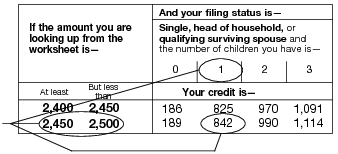
| And your filing status is– | |||||||||
|---|---|---|---|---|---|---|---|---|---|
| If the amount you are looking up from the worksheet is– | Single, head of household, or qualifying surviving spouse★ and you have–
★ Use this column if your filing status is married filing separately and you qualify to claim the EIC. |
Married filing jointly and you have– | |||||||
| 0 | 1 | 2 | 3 | 0 | 1 | 2 | 3 | ||
| At least | But less than | Your credit is– | Your credit is– | ||||||
| 1 | 50 | 2 | 9 | 10 | 11 | 2 | 9 | 10 | 11 |
| 50 | 100 | 6 | 26 | 30 | 34 | 6 | 26 | 30 | 34 |
| 100 | 150 | 10 | 43 | 50 | 56 | 10 | 43 | 50 | 56 |
| 150 | 200 | 13 | 60 | 70 | 79 | 13 | 60 | 70 | 79 |
| 200 | 250 | 17 | 77 | 90 | 101 | 17 | 77 | 90 | 101 |
| 250 | 300 | 21 | 94 | 110 | 124 | 21 | 94 | 110 | 124 |
| 300 | 350 | 25 | 111 | 130 | 146 | 25 | 111 | 130 | 146 |
| 350 | 400 | 29 | 128 | 150 | 169 | 29 | 128 | 150 | 169 |
| 400 | 450 | 33 | 145 | 170 | 191 | 33 | 145 | 170 | 191 |
| 450 | 500 | 36 | 162 | 190 | 214 | 36 | 162 | 190 | 214 |
| 500 | 550 | 40 | 179 | 210 | 236 | 40 | 179 | 210 | 236 |
| 550 | 600 | 44 | 196 | 230 | 259 | 44 | 196 | 230 | 259 |
| 600 | 650 | 48 | 213 | 250 | 281 | 48 | 213 | 250 | 281 |
| 650 | 700 | 52 | 230 | 270 | 304 | 52 | 230 | 270 | 304 |
| 700 | 750 | 55 | 247 | 290 | 326 | 55 | 247 | 290 | 326 |
| 750 | 800 | 59 | 264 | 310 | 349 | 59 | 264 | 310 | 349 |
| 800 | 850 | 63 | 281 | 330 | 371 | 63 | 281 | 330 | 371 |
| 850 | 900 | 67 | 298 | 350 | 394 | 67 | 298 | 350 | 394 |
| 900 | 950 | 71 | 315 | 370 | 416 | 71 | 315 | 370 | 416 |
| 950 | 1,000 | 75 | 332 | 390 | 439 | 75 | 332 | 390 | 439 |
| 1,000 | 1,050 | 78 | 349 | 410 | 461 | 78 | 349 | 410 | 461 |
| 1,050 | 1,100 | 82 | 366 | 430 | 484 | 82 | 366 | 430 | 484 |
| 1,100 | 1,150 | 86 | 383 | 450 | 506 | 86 | 383 | 450 | 506 |
| 1,150 | 1,200 | 90 | 400 | 470 | 529 | 90 | 400 | 470 | 529 |
| 1,200 | 1,250 | 94 | 417 | 490 | 551 | 94 | 417 | 490 | 551 |
| 1,250 | 1,300 | 98 | 434 | 510 | 574 | 98 | 434 | 510 | 574 |
| 1,300 | 1,350 | 101 | 451 | 530 | 596 | 101 | 451 | 530 | 596 |
| 1,350 | 1,400 | 105 | 468 | 550 | 619 | 105 | 468 | 550 | 619 |
| 1,400 | 1,450 | 109 | 485 | 570 | 641 | 109 | 485 | 570 | 641 |
| 1,450 | 1,500 | 113 | 502 | 590 | 664 | 113 | 502 | 590 | 664 |
| 1,500 | 1,550 | 117 | 519 | 610 | 686 | 117 | 519 | 610 | 686 |
| 1,550 | 1,600 | 120 | 536 | 630 | 709 | 120 | 536 | 630 | 709 |
| 1,600 | 1,650 | 124 | 553 | 650 | 731 | 124 | 553 | 650 | 731 |
| 1,650 | 1,700 | 128 | 570 | 670 | 754 | 128 | 570 | 670 | 754 |
| 1,700 | 1,750 | 132 | 587 | 690 | 776 | 132 | 587 | 690 | 776 |
| 1,750 | 1,800 | 136 | 604 | 710 | 799 | 136 | 604 | 710 | 799 |
| 1,800 | 1,850 | 140 | 621 | 730 | 821 | 140 | 621 | 730 | 821 |
| 1,850 | 1,900 | 143 | 638 | 750 | 844 | 143 | 638 | 750 | 844 |
| 1,900 | 1,950 | 147 | 655 | 770 | 866 | 147 | 655 | 770 | 866 |
| 1,950 | 2,000 | 151 | 672 | 790 | 889 | 151 | 672 | 790 | 889 |
| 2,000 | 2,050 | 155 | 689 | 810 | 911 | 155 | 689 | 810 | 911 |
| 2,050 | 2,100 | 159 | 706 | 830 | 934 | 159 | 706 | 830 | 934 |
| 2,100 | 2,150 | 163 | 723 | 850 | 956 | 163 | 723 | 850 | 956 |
| 2,150 | 2,200 | 166 | 740 | 870 | 979 | 166 | 740 | 870 | 979 |
| 2,200 | 2,250 | 170 | 757 | 890 | 1,001 | 170 | 757 | 890 | 1,001 |
| 2,250 | 2,300 | 174 | 774 | 910 | 1,024 | 174 | 774 | 910 | 1,024 |
| 2,300 | 2,350 | 178 | 791 | 930 | 1,046 | 178 | 791 | 930 | 1,046 |
| 2,350 | 2,400 | 182 | 808 | 950 | 1,069 | 182 | 808 | 950 | 1,069 |
| 2,400 | 2,450 | 186 | 825 | 970 | 1,091 | 186 | 825 | 970 | 1,091 |
| 2,450 | 2,500 | 189 | 842 | 990 | 1,114 | 189 | 842 | 990 | 1,114 |
| 2,500 | 2,550 | 193 | 859 | 1,010 | 1,136 | 193 | 859 | 1,010 | 1,136 |
| 2,550 | 2,600 | 197 | 876 | 1,030 | 1,159 | 197 | 876 | 1,030 | 1,159 |
| 2,600 | 2,650 | 201 | 893 | 1,050 | 1,181 | 201 | 893 | 1,050 | 1,181 |
| 2,650 | 2,700 | 205 | 910 | 1,070 | 1,204 | 205 | 910 | 1,070 | 1,204 |
| 2,700 | 2,750 | 208 | 927 | 1,090 | 1,226 | 208 | 927 | 1,090 | 1,226 |
| 2,750 | 2,800 | 212 | 944 | 1,110 | 1,249 | 212 | 944 | 1,110 | 1,249 |
| 2,800 | 2,850 | 216 | 961 | 1,130 | 1,271 | 216 | 961 | 1,130 | 1,271 |
| 2,850 | 2,900 | 220 | 978 | 1,150 | 1,294 | 220 | 978 | 1,150 | 1,294 |
| 2,900 | 2,950 | 224 | 995 | 1,170 | 1,316 | 224 | 995 | 1,170 | 1,316 |
| 2,950 | 3,000 | 228 | 1,012 | 1,190 | 1,339 | 228 | 1,012 | 1,190 | 1,339 |
| 3,000 | 3,050 | 231 | 1,029 | 1,210 | 1,361 | 231 | 1,029 | 1,210 | 1,361 |
| 3,050 | 3,100 | 235 | 1,046 | 1,230 | 1,384 | 235 | 1,046 | 1,230 | 1,384 |
| 3,100 | 3,150 | 239 | 1,063 | 1,250 | 1,406 | 239 | 1,063 | 1,250 | 1,406 |
| 3,150 | 3,200 | 243 | 1,080 | 1,270 | 1,429 | 243 | 1,080 | 1,270 | 1,429 |
| 3,200 | 3,250 | 247 | 1,097 | 1,290 | 1,451 | 247 | 1,097 | 1,290 | 1,451 |
| 3,250 | 3,300 | 251 | 1,114 | 1,310 | 1,474 | 251 | 1,114 | 1,310 | 1,474 |
| 3,300 | 3,350 | 254 | 1,131 | 1,330 | 1,496 | 254 | 1,131 | 1,330 | 1,496 |
| 3,350 | 3,400 | 258 | 1,148 | 1,350 | 1,519 | 258 | 1,148 | 1,350 | 1,519 |
| 3,400 | 3,450 | 262 | 1,165 | 1,370 | 1,541 | 262 | 1,165 | 1,370 | 1,541 |
| 3,450 | 3,500 | 266 | 1,182 | 1,390 | 1,564 | 266 | 1,182 | 1,390 | 1,564 |
| 3,500 | 3,550 | 270 | 1,199 | 1,410 | 1,586 | 270 | 1,199 | 1,410 | 1,586 |
| 3,550 | 3,600 | 273 | 1,216 | 1,430 | 1,609 | 273 | 1,216 | 1,430 | 1,609 |
| 3,600 | 3,650 | 277 | 1,233 | 1,450 | 1,631 | 277 | 1,233 | 1,450 | 1,631 |
| 3,650 | 3,700 | 281 | 1,250 | 1,470 | 1,654 | 281 | 1,250 | 1,470 | 1,654 |
| 3,700 | 3,750 | 285 | 1,267 | 1,490 | 1,676 | 285 | 1,267 | 1,490 | 1,676 |
| 3,750 | 3,800 | 289 | 1,284 | 1,510 | 1,699 | 289 | 1,284 | 1,510 | 1,699 |
| 3,800 | 3,850 | 293 | 1,301 | 1,530 | 1,721 | 293 | 1,301 | 1,530 | 1,721 |
| 3,850 | 3,900 | 296 | 1,318 | 1,550 | 1,744 | 296 | 1,318 | 1,550 | 1,744 |
| 3,900 | 3,950 | 300 | 1,335 | 1,570 | 1,766 | 300 | 1,335 | 1,570 | 1,766 |
| 3,950 | 4,000 | 304 | 1,352 | 1,590 | 1,789 | 304 | 1,352 | 1,590 | 1,789 |
| 4,000 | 4,050 | 308 | 1,369 | 1,610 | 1,811 | 308 | 1,369 | 1,610 | 1,811 |
| 4,050 | 4,100 | 312 | 1,386 | 1,630 | 1,834 | 312 | 1,386 | 1,630 | 1,834 |
| 4,100 | 4,150 | 316 | 1,403 | 1,650 | 1,856 | 316 | 1,403 | 1,650 | 1,856 |
| 4,150 | 4,200 | 319 | 1,420 | 1,670 | 1,879 | 319 | 1,420 | 1,670 | 1,879 |
| 4,200 | 4,250 | 323 | 1,437 | 1,690 | 1,901 | 323 | 1,437 | 1,690 | 1,901 |
| 4,250 | 4,300 | 327 | 1,454 | 1,710 | 1,924 | 327 | 1,454 | 1,710 | 1,924 |
| 4,300 | 4,350 | 331 | 1,471 | 1,730 | 1,946 | 331 | 1,471 | 1,730 | 1,946 |
| 4,350 | 4,400 | 335 | 1,488 | 1,750 | 1,969 | 335 | 1,488 | 1,750 | 1,969 |
| 4,400 | 4,450 | 339 | 1,505 | 1,770 | 1,991 | 339 | 1,505 | 1,770 | 1,991 |
| 4,450 | 4,500 | 342 | 1,522 | 1,790 | 2,014 | 342 | 1,522 | 1,790 | 2,014 |
| 4,500 | 4,550 | 346 | 1,539 | 1,810 | 2,036 | 346 | 1,539 | 1,810 | 2,036 |
| 4,550 | 4,600 | 350 | 1,556 | 1,830 | 2,059 | 350 | 1,556 | 1,830 | 2,059 |
| 4,600 | 4,650 | 354 | 1,573 | 1,850 | 2,081 | 354 | 1,573 | 1,850 | 2,081 |
| 4,650 | 4,700 | 358 | 1,590 | 1,870 | 2,104 | 358 | 1,590 | 1,870 | 2,104 |
| 4,700 | 4,750 | 361 | 1,607 | 1,890 | 2,126 | 361 | 1,607 | 1,890 | 2,126 |
| 4,750 | 4,800 | 365 | 1,624 | 1,910 | 2,149 | 365 | 1,624 | 1,910 | 2,149 |
| 4,800 | 4,850 | 369 | 1,641 | 1,930 | 2,171 | 369 | 1,641 | 1,930 | 2,171 |
| 4,850 | 4,900 | 373 | 1,658 | 1,950 | 2,194 | 373 | 1,658 | 1,950 | 2,194 |
| 4,900 | 4,950 | 377 | 1,675 | 1,970 | 2,216 | 377 | 1,675 | 1,970 | 2,216 |
| 4,950 | 5,000 | 381 | 1,692 | 1,990 | 2,239 | 381 | 1,692 | 1,990 | 2,239 |
| 5,000 | 5,050 | 384 | 1,709 | 2,010 | 2,261 | 384 | 1,709 | 2,010 | 2,261 |
| 5,050 | 5,100 | 388 | 1,726 | 2,030 | 2,284 | 388 | 1,726 | 2,030 | 2,284 |
| 5,100 | 5,150 | 392 | 1,743 | 2,050 | 2,306 | 392 | 1,743 | 2,050 | 2,306 |
| 5,150 | 5,200 | 396 | 1,760 | 2,070 | 2,329 | 396 | 1,760 | 2,070 | 2,329 |
| 5,200 | 5,250 | 400 | 1,777 | 2,090 | 2,351 | 400 | 1,777 | 2,090 | 2,351 |
| 5,250 | 5,300 | 404 | 1,794 | 2,110 | 2,374 | 404 | 1,794 | 2,110 | 2,374 |
| 5,300 | 5,350 | 407 | 1,811 | 2,130 | 2,396 | 407 | 1,811 | 2,130 | 2,396 |
| 5,350 | 5,400 | 411 | 1,828 | 2,150 | 2,419 | 411 | 1,828 | 2,150 | 2,419 |
| 5,400 | 5,450 | 415 | 1,845 | 2,170 | 2,441 | 415 | 1,845 | 2,170 | 2,441 |
| 5,450 | 5,500 | 419 | 1,862 | 2,190 | 2,464 | 419 | 1,862 | 2,190 | 2,464 |
| 5,500 | 5,550 | 423 | 1,879 | 2,210 | 2,486 | 423 | 1,879 | 2,210 | 2,486 |
| 5,550 | 5,600 | 426 | 1,896 | 2,230 | 2,509 | 426 | 1,896 | 2,230 | 2,509 |
| 5,600 | 5,650 | 430 | 1,913 | 2,250 | 2,531 | 430 | 1,913 | 2,250 | 2,531 |
| 5,650 | 5,700 | 434 | 1,930 | 2,270 | 2,554 | 434 | 1,930 | 2,270 | 2,554 |
| 5,700 | 5,750 | 438 | 1,947 | 2,290 | 2,576 | 438 | 1,947 | 2,290 | 2,576 |
| 5,750 | 5,800 | 442 | 1,964 | 2,310 | 2,599 | 442 | 1,964 | 2,310 | 2,599 |
| 5,800 | 5,850 | 446 | 1,981 | 2,330 | 2,621 | 446 | 1,981 | 2,330 | 2,621 |
| 5,850 | 5,900 | 449 | 1,998 | 2,350 | 2,644 | 449 | 1,998 | 2,350 | 2,644 |
| 5,900 | 5,950 | 453 | 2,015 | 2,370 | 2,666 | 453 | 2,015 | 2,370 | 2,666 |
| 5,950 | 6,000 | 457 | 2,032 | 2,390 | 2,689 | 457 | 2,032 | 2,390 | 2,689 |
| 6,000 | 6,050 | 461 | 2,049 | 2,410 | 2,711 | 461 | 2,049 | 2,410 | 2,711 |
| 6,050 | 6,100 | 465 | 2,066 | 2,430 | 2,734 | 465 | 2,066 | 2,430 | 2,734 |
| 6,100 | 6,150 | 469 | 2,083 | 2,450 | 2,756 | 469 | 2,083 | 2,450 | 2,756 |
| 6,150 | 6,200 | 472 | 2,100 | 2,470 | 2,779 | 472 | 2,100 | 2,470 | 2,779 |
| 6,200 | 6,250 | 476 | 2,117 | 2,490 | 2,801 | 476 | 2,117 | 2,490 | 2,801 |
| 6,250 | 6,300 | 480 | 2,134 | 2,510 | 2,824 | 480 | 2,134 | 2,510 | 2,824 |
| 6,300 | 6,350 | 484 | 2,151 | 2,530 | 2,846 | 484 | 2,151 | 2,530 | 2,846 |
| 6,350 | 6,400 | 488 | 2,168 | 2,550 | 2,869 | 488 | 2,168 | 2,550 | 2,869 |
| 6,400 | 6,450 | 492 | 2,185 | 2,570 | 2,891 | 492 | 2,185 | 2,570 | 2,891 |
| 6,450 | 6,500 | 495 | 2,202 | 2,590 | 2,914 | 495 | 2,202 | 2,590 | 2,914 |
| 6,500 | 6,550 | 499 | 2,219 | 2,610 | 2,936 | 499 | 2,219 | 2,610 | 2,936 |
| 6,550 | 6,600 | 503 | 2,236 | 2,630 | 2,959 | 503 | 2,236 | 2,630 | 2,959 |
| 6,600 | 6,650 | 507 | 2,253 | 2,650 | 2,981 | 507 | 2,253 | 2,650 | 2,981 |
| 6,650 | 6,700 | 511 | 2,270 | 2,670 | 3,004 | 511 | 2,270 | 2,670 | 3,004 |
| 6,700 | 6,750 | 514 | 2,287 | 2,690 | 3,026 | 514 | 2,287 | 2,690 | 3,026 |
| 6,750 | 6,800 | 518 | 2,304 | 2,710 | 3,049 | 518 | 2,304 | 2,710 | 3,049 |
| 6,800 | 6,850 | 522 | 2,321 | 2,730 | 3,071 | 522 | 2,321 | 2,730 | 3,071 |
| 6,850 | 6,900 | 526 | 2,338 | 2,750 | 3,094 | 526 | 2,338 | 2,750 | 3,094 |
| 6,900 | 6,950 | 530 | 2,355 | 2,770 | 3,116 | 530 | 2,355 | 2,770 | 3,116 |
| 6,950 | 7,000 | 534 | 2,372 | 2,790 | 3,139 | 534 | 2,372 | 2,790 | 3,139 |
| 7,000 | 7,050 | 537 | 2,389 | 2,810 | 3,161 | 537 | 2,389 | 2,810 | 3,161 |
| 7,050 | 7,100 | 541 | 2,406 | 2,830 | 3,184 | 541 | 2,406 | 2,830 | 3,184 |
| 7,100 | 7,150 | 545 | 2,423 | 2,850 | 3,206 | 545 | 2,423 | 2,850 | 3,206 |
| 7,150 | 7,200 | 549 | 2,440 | 2,870 | 3,229 | 549 | 2,440 | 2,870 | 3,229 |
| 7,200 | 7,250 | 553 | 2,457 | 2,890 | 3,251 | 553 | 2,457 | 2,890 | 3,251 |
| 7,250 | 7,300 | 557 | 2,474 | 2,910 | 3,274 | 557 | 2,474 | 2,910 | 3,274 |
| 7,300 | 7,350 | 560 | 2,491 | 2,930 | 3,296 | 560 | 2,491 | 2,930 | 3,296 |
| 7,350 | 7,400 | 564 | 2,508 | 2,950 | 3,319 | 564 | 2,508 | 2,950 | 3,319 |
| 7,400 | 7,450 | 568 | 2,525 | 2,970 | 3,341 | 568 | 2,525 | 2,970 | 3,341 |
| 7,450 | 7,500 | 572 | 2,542 | 2,990 | 3,364 | 572 | 2,542 | 2,990 | 3,364 |
| 7,500 | 7,550 | 576 | 2,559 | 3,010 | 3,386 | 576 | 2,559 | 3,010 | 3,386 |
| 7,550 | 7,600 | 579 | 2,576 | 3,030 | 3,409 | 579 | 2,576 | 3,030 | 3,409 |
| 7,600 | 7,650 | 583 | 2,593 | 3,050 | 3,431 | 583 | 2,593 | 3,050 | 3,431 |
| 7,650 | 7,700 | 587 | 2,610 | 3,070 | 3,454 | 587 | 2,610 | 3,070 | 3,454 |
| 7,700 | 7,750 | 591 | 2,627 | 3,090 | 3,476 | 591 | 2,627 | 3,090 | 3,476 |
| 7,750 | 7,800 | 595 | 2,644 | 3,110 | 3,499 | 595 | 2,644 | 3,110 | 3,499 |
| 7,800 | 7,850 | 599 | 2,661 | 3,130 | 3,521 | 599 | 2,661 | 3,130 | 3,521 |
| 7,850 | 7,900 | 602 | 2,678 | 3,150 | 3,544 | 602 | 2,678 | 3,150 | 3,544 |
| 7,900 | 7,950 | 606 | 2,695 | 3,170 | 3,566 | 606 | 2,695 | 3,170 | 3,566 |
| 7,950 | 8,000 | 610 | 2,712 | 3,190 | 3,589 | 610 | 2,712 | 3,190 | 3,589 |
| 8,000 | 8,050 | 614 | 2,729 | 3,210 | 3,611 | 614 | 2,729 | 3,210 | 3,611 |
| 8,050 | 8,100 | 618 | 2,746 | 3,230 | 3,634 | 618 | 2,746 | 3,230 | 3,634 |
| 8,100 | 8,150 | 622 | 2,763 | 3,250 | 3,656 | 622 | 2,763 | 3,250 | 3,656 |
| 8,150 | 8,200 | 625 | 2,780 | 3,270 | 3,679 | 625 | 2,780 | 3,270 | 3,679 |
| 8,200 | 8,250 | 629 | 2,797 | 3,290 | 3,701 | 629 | 2,797 | 3,290 | 3,701 |
| 8,250 | 8,300 | 633 | 2,814 | 3,310 | 3,724 | 633 | 2,814 | 3,310 | 3,724 |
| 8,300 | 8,350 | 637 | 2,831 | 3,330 | 3,746 | 637 | 2,831 | 3,330 | 3,746 |
| 8,350 | 8,400 | 641 | 2,848 | 3,350 | 3,769 | 641 | 2,848 | 3,350 | 3,769 |
| 8,400 | 8,450 | 645 | 2,865 | 3,370 | 3,791 | 645 | 2,865 | 3,370 | 3,791 |
| 8,450 | 8,500 | 649 | 2,882 | 3,390 | 3,814 | 649 | 2,882 | 3,390 | 3,814 |
| 8,500 | 8,550 | 649 | 2,899 | 3,410 | 3,836 | 649 | 2,899 | 3,410 | 3,836 |
| 8,550 | 8,600 | 649 | 2,916 | 3,430 | 3,859 | 649 | 2,916 | 3,430 | 3,859 |
| 8,600 | 8,650 | 649 | 2,933 | 3,450 | 3,881 | 649 | 2,933 | 3,450 | 3,881 |
| 8,650 | 8,700 | 649 | 2,950 | 3,470 | 3,904 | 649 | 2,950 | 3,470 | 3,904 |
| 8,700 | 8,750 | 649 | 2,967 | 3,490 | 3,926 | 649 | 2,967 | 3,490 | 3,926 |
| 8,750 | 8,800 | 649 | 2,984 | 3,510 | 3,949 | 649 | 2,984 | 3,510 | 3,949 |
| 8,800 | 8,850 | 649 | 3,001 | 3,530 | 3,971 | 649 | 3,001 | 3,530 | 3,971 |
| 8,850 | 8,900 | 649 | 3,018 | 3,550 | 3,994 | 649 | 3,018 | 3,550 | 3,994 |
| 8,900 | 8,950 | 649 | 3,035 | 3,570 | 4,016 | 649 | 3,035 | 3,570 | 4,016 |
| 8,950 | 9,000 | 649 | 3,052 | 3,590 | 4,039 | 649 | 3,052 | 3,590 | 4,039 |
| 9,000 | 9,050 | 649 | 3,069 | 3,610 | 4,061 | 649 | 3,069 | 3,610 | 4,061 |
| 9,050 | 9,100 | 649 | 3,086 | 3,630 | 4,084 | 649 | 3,086 | 3,630 | 4,084 |
| 9,100 | 9,150 | 649 | 3,103 | 3,650 | 4,106 | 649 | 3,103 | 3,650 | 4,106 |
| 9,150 | 9,200 | 649 | 3,120 | 3,670 | 4,129 | 649 | 3,120 | 3,670 | 4,129 |
| 9,200 | 9,250 | 649 | 3,137 | 3,690 | 4,151 | 649 | 3,137 | 3,690 | 4,151 |
| 9,250 | 9,300 | 649 | 3,154 | 3,710 | 4,174 | 649 | 3,154 | 3,710 | 4,174 |
| 9,300 | 9,350 | 649 | 3,171 | 3,730 | 4,196 | 649 | 3,171 | 3,730 | 4,196 |
| 9,350 | 9,400 | 649 | 3,188 | 3,750 | 4,219 | 649 | 3,188 | 3,750 | 4,219 |
| 9,400 | 9,450 | 649 | 3,205 | 3,770 | 4,241 | 649 | 3,205 | 3,770 | 4,241 |
| 9,450 | 9,500 | 649 | 3,222 | 3,790 | 4,264 | 649 | 3,222 | 3,790 | 4,264 |
| 9,500 | 9,550 | 649 | 3,239 | 3,810 | 4,286 | 649 | 3,239 | 3,810 | 4,286 |
| 9,550 | 9,600 | 649 | 3,256 | 3,830 | 4,309 | 649 | 3,256 | 3,830 | 4,309 |
| 9,600 | 9,650 | 649 | 3,273 | 3,850 | 4,331 | 649 | 3,273 | 3,850 | 4,331 |
| 9,650 | 9,700 | 649 | 3,290 | 3,870 | 4,354 | 649 | 3,290 | 3,870 | 4,354 |
| 9,700 | 9,750 | 649 | 3,307 | 3,890 | 4,376 | 649 | 3,307 | 3,890 | 4,376 |
| 9,750 | 9,800 | 649 | 3,324 | 3,910 | 4,399 | 649 | 3,324 | 3,910 | 4,399 |
| 9,800 | 9,850 | 649 | 3,341 | 3,930 | 4,421 | 649 | 3,341 | 3,930 | 4,421 |
| 9,850 | 9,900 | 649 | 3,358 | 3,950 | 4,444 | 649 | 3,358 | 3,950 | 4,444 |
| 9,900 | 9,950 | 649 | 3,375 | 3,970 | 4,466 | 649 | 3,375 | 3,970 | 4,466 |
| 9,950 | 10,000 | 649 | 3,392 | 3,990 | 4,489 | 649 | 3,392 | 3,990 | 4,489 |
| 10,000 | 10,050 | 649 | 3,409 | 4,010 | 4,511 | 649 | 3,409 | 4,010 | 4,511 |
| 10,050 | 10,100 | 649 | 3,426 | 4,030 | 4,534 | 649 | 3,426 | 4,030 | 4,534 |
| 10,100 | 10,150 | 649 | 3,443 | 4,050 | 4,556 | 649 | 3,443 | 4,050 | 4,556 |
| 10,150 | 10,200 | 649 | 3,460 | 4,070 | 4,579 | 649 | 3,460 | 4,070 | 4,579 |
| 10,200 | 10,250 | 649 | 3,477 | 4,090 | 4,601 | 649 | 3,477 | 4,090 | 4,601 |
| 10,250 | 10,300 | 649 | 3,494 | 4,110 | 4,624 | 649 | 3,494 | 4,110 | 4,624 |
| 10,300 | 10,350 | 649 | 3,511 | 4,130 | 4,646 | 649 | 3,511 | 4,130 | 4,646 |
| 10,350 | 10,400 | 649 | 3,528 | 4,150 | 4,669 | 649 | 3,528 | 4,150 | 4,669 |
| 10,400 | 10,450 | 649 | 3,545 | 4,170 | 4,691 | 649 | 3,545 | 4,170 | 4,691 |
| 10,450 | 10,500 | 649 | 3,562 | 4,190 | 4,714 | 649 | 3,562 | 4,190 | 4,714 |
| 10,500 | 10,550 | 649 | 3,579 | 4,210 | 4,736 | 649 | 3,579 | 4,210 | 4,736 |
| 10,550 | 10,600 | 649 | 3,596 | 4,230 | 4,759 | 649 | 3,596 | 4,230 | 4,759 |
| 10,600 | 10,650 | 649 | 3,613 | 4,250 | 4,781 | 649 | 3,613 | 4,250 | 4,781 |
| 10,650 | 10,700 | 645 | 3,630 | 4,270 | 4,804 | 649 | 3,630 | 4,270 | 4,804 |
| 10,700 | 10,750 | 641 | 3,647 | 4,290 | 4,826 | 649 | 3,647 | 4,290 | 4,826 |
| 10,750 | 10,800 | 637 | 3,664 | 4,310 | 4,849 | 649 | 3,664 | 4,310 | 4,849 |
| 10,800 | 10,850 | 633 | 3,681 | 4,330 | 4,871 | 649 | 3,681 | 4,330 | 4,871 |
| 10,850 | 10,900 | 629 | 3,698 | 4,350 | 4,894 | 649 | 3,698 | 4,350 | 4,894 |
| 10,900 | 10,950 | 626 | 3,715 | 4,370 | 4,916 | 649 | 3,715 | 4,370 | 4,916 |
| 10,950 | 11,000 | 622 | 3,732 | 4,390 | 4,939 | 649 | 3,732 | 4,390 | 4,939 |
| 11,000 | 11,050 | 618 | 3,749 | 4,410 | 4,961 | 649 | 3,749 | 4,410 | 4,961 |
| 11,050 | 11,100 | 614 | 3,766 | 4,430 | 4,984 | 649 | 3,766 | 4,430 | 4,984 |
| 11,100 | 11,150 | 610 | 3,783 | 4,450 | 5,006 | 649 | 3,783 | 4,450 | 5,006 |
| 11,150 | 11,200 | 607 | 3,800 | 4,470 | 5,029 | 649 | 3,800 | 4,470 | 5,029 |
| 11,200 | 11,250 | 603 | 3,817 | 4,490 | 5,051 | 649 | 3,817 | 4,490 | 5,051 |
| 11,250 | 11,300 | 599 | 3,834 | 4,510 | 5,074 | 649 | 3,834 | 4,510 | 5,074 |
| 11,300 | 11,350 | 595 | 3,851 | 4,530 | 5,096 | 649 | 3,851 | 4,530 | 5,096 |
| 11,350 | 11,400 | 591 | 3,868 | 4,550 | 5,119 | 649 | 3,868 | 4,550 | 5,119 |
| 11,400 | 11,450 | 587 | 3,885 | 4,570 | 5,141 | 649 | 3,885 | 4,570 | 5,141 |
| 11,450 | 11,500 | 584 | 3,902 | 4,590 | 5,164 | 649 | 3,902 | 4,590 | 5,164 |
| 11,500 | 11,550 | 580 | 3,919 | 4,610 | 5,186 | 649 | 3,919 | 4,610 | 5,186 |
| 11,550 | 11,600 | 576 | 3,936 | 4,630 | 5,209 | 649 | 3,936 | 4,630 | 5,209 |
| 11,600 | 11,650 | 572 | 3,953 | 4,650 | 5,231 | 649 | 3,953 | 4,650 | 5,231 |
| 11,650 | 11,700 | 568 | 3,970 | 4,670 | 5,254 | 649 | 3,970 | 4,670 | 5,254 |
| 11,700 | 11,750 | 564 | 3,987 | 4,690 | 5,276 | 649 | 3,987 | 4,690 | 5,276 |
| 11,750 | 11,800 | 561 | 4,004 | 4,710 | 5,299 | 649 | 4,004 | 4,710 | 5,299 |
| 11,800 | 11,850 | 557 | 4,021 | 4,730 | 5,321 | 649 | 4,021 | 4,730 | 5,321 |
| 11,850 | 11,900 | 553 | 4,038 | 4,750 | 5,344 | 649 | 4,038 | 4,750 | 5,344 |
| 11,900 | 11,950 | 549 | 4,055 | 4,770 | 5,366 | 649 | 4,055 | 4,770 | 5,366 |
| 11,950 | 12,000 | 545 | 4,072 | 4,790 | 5,389 | 649 | 4,072 | 4,790 | 5,389 |
| 12,000 | 12,050 | 542 | 4,089 | 4,810 | 5,411 | 649 | 4,089 | 4,810 | 5,411 |
| 12,050 | 12,100 | 538 | 4,106 | 4,830 | 5,434 | 649 | 4,106 | 4,830 | 5,434 |
| 12,100 | 12,150 | 534 | 4,123 | 4,850 | 5,456 | 649 | 4,123 | 4,850 | 5,456 |
| 12,150 | 12,200 | 530 | 4,140 | 4,870 | 5,479 | 649 | 4,140 | 4,870 | 5,479 |
| 12,200 | 12,250 | 526 | 4,157 | 4,890 | 5,501 | 649 | 4,157 | 4,890 | 5,501 |
| 12,250 | 12,300 | 522 | 4,174 | 4,910 | 5,524 | 649 | 4,174 | 4,910 | 5,524 |
| 12,300 | 12,350 | 519 | 4,191 | 4,930 | 5,546 | 649 | 4,191 | 4,930 | 5,546 |
| 12,350 | 12,400 | 515 | 4,208 | 4,950 | 5,569 | 649 | 4,208 | 4,950 | 5,569 |
| 12,400 | 12,450 | 511 | 4,225 | 4,970 | 5,591 | 649 | 4,225 | 4,970 | 5,591 |
| 12,450 | 12,500 | 507 | 4,242 | 4,990 | 5,614 | 649 | 4,242 | 4,990 | 5,614 |
| 12,500 | 12,550 | 503 | 4,259 | 5,010 | 5,636 | 649 | 4,259 | 5,010 | 5,636 |
| 12,550 | 12,600 | 499 | 4,276 | 5,030 | 5,659 | 649 | 4,276 | 5,030 | 5,659 |
| 12,600 | 12,650 | 496 | 4,293 | 5,050 | 5,681 | 649 | 4,293 | 5,050 | 5,681 |
| 12,650 | 12,700 | 492 | 4,310 | 5,070 | 5,704 | 649 | 4,310 | 5,070 | 5,704 |
| 12,700 | 12,750 | 488 | 4,328 | 5,090 | 5,726 | 649 | 4,328 | 5,090 | 5,726 |
| 12,750 | 12,800 | 484 | 4,328 | 5,110 | 5,749 | 649 | 4,328 | 5,110 | 5,749 |
| 12,800 | 12,850 | 480 | 4,328 | 5,130 | 5,771 | 649 | 4,328 | 5,130 | 5,771 |
| 12,850 | 12,900 | 476 | 4,328 | 5,150 | 5,794 | 649 | 4,328 | 5,150 | 5,794 |
| 12,900 | 12,950 | 473 | 4,328 | 5,170 | 5,816 | 649 | 4,328 | 5,170 | 5,816 |
| 12,950 | 13,000 | 469 | 4,328 | 5,190 | 5,839 | 649 | 4,328 | 5,190 | 5,839 |
| 13,000 | 13,050 | 465 | 4,328 | 5,210 | 5,861 | 649 | 4,328 | 5,210 | 5,861 |
| 13,050 | 13,100 | 461 | 4,328 | 5,230 | 5,884 | 649 | 4,328 | 5,230 | 5,884 |
| 13,100 | 13,150 | 457 | 4,328 | 5,250 | 5,906 | 649 | 4,328 | 5,250 | 5,906 |
| 13,150 | 13,200 | 454 | 4,328 | 5,270 | 5,929 | 649 | 4,328 | 5,270 | 5,929 |
| 13,200 | 13,250 | 450 | 4,328 | 5,290 | 5,951 | 649 | 4,328 | 5,290 | 5,951 |
| 13,250 | 13,300 | 446 | 4,328 | 5,310 | 5,974 | 649 | 4,328 | 5,310 | 5,974 |
| 13,300 | 13,350 | 442 | 4,328 | 5,330 | 5,996 | 649 | 4,328 | 5,330 | 5,996 |
| 13,350 | 13,400 | 438 | 4,328 | 5,350 | 6,019 | 649 | 4,328 | 5,350 | 6,019 |
| 13,400 | 13,450 | 434 | 4,328 | 5,370 | 6,041 | 649 | 4,328 | 5,370 | 6,041 |
| 13,450 | 13,500 | 431 | 4,328 | 5,390 | 6,064 | 649 | 4,328 | 5,390 | 6,064 |
| 13,500 | 13,550 | 427 | 4,328 | 5,410 | 6,086 | 649 | 4,328 | 5,410 | 6,086 |
| 13,550 | 13,600 | 423 | 4,328 | 5,430 | 6,109 | 649 | 4,328 | 5,430 | 6,109 |
| 13,600 | 13,650 | 419 | 4,328 | 5,450 | 6,131 | 649 | 4,328 | 5,450 | 6,131 |
| 13,650 | 13,700 | 415 | 4,328 | 5,470 | 6,154 | 649 | 4,328 | 5,470 | 6,154 |
| 13,700 | 13,750 | 411 | 4,328 | 5,490 | 6,176 | 649 | 4,328 | 5,490 | 6,176 |
| 13,750 | 13,800 | 408 | 4,328 | 5,510 | 6,199 | 649 | 4,328 | 5,510 | 6,199 |
| 13,800 | 13,850 | 404 | 4,328 | 5,530 | 6,221 | 649 | 4,328 | 5,530 | 6,221 |
| 13,850 | 13,900 | 400 | 4,328 | 5,550 | 6,244 | 649 | 4,328 | 5,550 | 6,244 |
| 13,900 | 13,950 | 396 | 4,328 | 5,570 | 6,266 | 649 | 4,328 | 5,570 | 6,266 |
| 13,950 | 14,000 | 392 | 4,328 | 5,590 | 6,289 | 649 | 4,328 | 5,590 | 6,289 |
| 14,000 | 14,050 | 389 | 4,328 | 5,610 | 6,311 | 649 | 4,328 | 5,610 | 6,311 |
| 14,050 | 14,100 | 385 | 4,328 | 5,630 | 6,334 | 649 | 4,328 | 5,630 | 6,334 |
| 14,100 | 14,150 | 381 | 4,328 | 5,650 | 6,356 | 649 | 4,328 | 5,650 | 6,356 |
| 14,150 | 14,200 | 377 | 4,328 | 5,670 | 6,379 | 649 | 4,328 | 5,670 | 6,379 |
| 14,200 | 14,250 | 373 | 4,328 | 5,690 | 6,401 | 649 | 4,328 | 5,690 | 6,401 |
| 14,250 | 14,300 | 369 | 4,328 | 5,710 | 6,424 | 649 | 4,328 | 5,710 | 6,424 |
| 14,300 | 14,350 | 366 | 4,328 | 5,730 | 6,446 | 649 | 4,328 | 5,730 | 6,446 |
| 14,350 | 14,400 | 362 | 4,328 | 5,750 | 6,469 | 649 | 4,328 | 5,750 | 6,469 |
| 14,400 | 14,450 | 358 | 4,328 | 5,770 | 6,491 | 649 | 4,328 | 5,770 | 6,491 |
| 14,450 | 14,500 | 354 | 4,328 | 5,790 | 6,514 | 649 | 4,328 | 5,790 | 6,514 |
| 14,500 | 14,550 | 350 | 4,328 | 5,810 | 6,536 | 649 | 4,328 | 5,810 | 6,536 |
| 14,550 | 14,600 | 346 | 4,328 | 5,830 | 6,559 | 649 | 4,328 | 5,830 | 6,559 |
| 14,600 | 14,650 | 343 | 4,328 | 5,850 | 6,581 | 649 | 4,328 | 5,850 | 6,581 |
| 14,650 | 14,700 | 339 | 4,328 | 5,870 | 6,604 | 649 | 4,328 | 5,870 | 6,604 |
| 14,700 | 14,750 | 335 | 4,328 | 5,890 | 6,626 | 649 | 4,328 | 5,890 | 6,626 |
| 14,750 | 14,800 | 331 | 4,328 | 5,910 | 6,649 | 649 | 4,328 | 5,910 | 6,649 |
| 14,800 | 14,850 | 327 | 4,328 | 5,930 | 6,671 | 649 | 4,328 | 5,930 | 6,671 |
| 14,850 | 14,900 | 323 | 4,328 | 5,950 | 6,694 | 649 | 4,328 | 5,950 | 6,694 |
| 14,900 | 14,950 | 320 | 4,328 | 5,970 | 6,716 | 649 | 4,328 | 5,970 | 6,716 |
| 14,950 | 15,000 | 316 | 4,328 | 5,990 | 6,739 | 649 | 4,328 | 5,990 | 6,739 |
| 15,000 | 15,050 | 312 | 4,328 | 6,010 | 6,761 | 649 | 4,328 | 6,010 | 6,761 |
| 15,050 | 15,100 | 308 | 4,328 | 6,030 | 6,784 | 649 | 4,328 | 6,030 | 6,784 |
| 15,100 | 15,150 | 304 | 4,328 | 6,050 | 6,806 | 649 | 4,328 | 6,050 | 6,806 |
| 15,150 | 15,200 | 301 | 4,328 | 6,070 | 6,829 | 649 | 4,328 | 6,070 | 6,829 |
| 15,200 | 15,250 | 297 | 4,328 | 6,090 | 6,851 | 649 | 4,328 | 6,090 | 6,851 |
| 15,250 | 15,300 | 293 | 4,328 | 6,110 | 6,874 | 649 | 4,328 | 6,110 | 6,874 |
| 15,300 | 15,350 | 289 | 4,328 | 6,130 | 6,896 | 649 | 4,328 | 6,130 | 6,896 |
| 15,350 | 15,400 | 285 | 4,328 | 6,150 | 6,919 | 649 | 4,328 | 6,150 | 6,919 |
| 15,400 | 15,450 | 281 | 4,328 | 6,170 | 6,941 | 649 | 4,328 | 6,170 | 6,941 |
| 15,450 | 15,500 | 278 | 4,328 | 6,190 | 6,964 | 649 | 4,328 | 6,190 | 6,964 |
| 15,500 | 15,550 | 274 | 4,328 | 6,210 | 6,986 | 649 | 4,328 | 6,210 | 6,986 |
| 15,550 | 15,600 | 270 | 4,328 | 6,230 | 7,009 | 649 | 4,328 | 6,230 | 7,009 |
| 15,600 | 15,650 | 266 | 4,328 | 6,250 | 7,031 | 649 | 4,328 | 6,250 | 7,031 |
| 15,650 | 15,700 | 262 | 4,328 | 6,270 | 7,054 | 649 | 4,328 | 6,270 | 7,054 |
| 15,700 | 15,750 | 258 | 4,328 | 6,290 | 7,076 | 649 | 4,328 | 6,290 | 7,076 |
| 15,750 | 15,800 | 255 | 4,328 | 6,310 | 7,099 | 649 | 4,328 | 6,310 | 7,099 |
| 15,800 | 15,850 | 251 | 4,328 | 6,330 | 7,121 | 649 | 4,328 | 6,330 | 7,121 |
| 15,850 | 15,900 | 247 | 4,328 | 6,350 | 7,144 | 649 | 4,328 | 6,350 | 7,144 |
| 15,900 | 15,950 | 243 | 4,328 | 6,370 | 7,166 | 649 | 4,328 | 6,370 | 7,166 |
| 15,950 | 16,000 | 239 | 4,328 | 6,390 | 7,189 | 649 | 4,328 | 6,390 | 7,189 |
| 16,000 | 16,050 | 236 | 4,328 | 6,410 | 7,211 | 649 | 4,328 | 6,410 | 7,211 |
| 16,050 | 16,100 | 232 | 4,328 | 6,430 | 7,234 | 649 | 4,328 | 6,430 | 7,234 |
| 16,100 | 16,150 | 228 | 4,328 | 6,450 | 7,256 | 649 | 4,328 | 6,450 | 7,256 |
| 16,150 | 16,200 | 224 | 4,328 | 6,470 | 7,279 | 649 | 4,328 | 6,470 | 7,279 |
| 16,200 | 16,250 | 220 | 4,328 | 6,490 | 7,301 | 649 | 4,328 | 6,490 | 7,301 |
| 16,250 | 16,300 | 216 | 4,328 | 6,510 | 7,324 | 649 | 4,328 | 6,510 | 7,324 |
| 16,300 | 16,350 | 213 | 4,328 | 6,530 | 7,346 | 649 | 4,328 | 6,530 | 7,346 |
| 16,350 | 16,400 | 209 | 4,328 | 6,550 | 7,369 | 649 | 4,328 | 6,550 | 7,369 |
| 16,400 | 16,450 | 205 | 4,328 | 6,570 | 7,391 | 649 | 4,328 | 6,570 | 7,391 |
| 16,450 | 16,500 | 201 | 4,328 | 6,590 | 7,414 | 649 | 4,328 | 6,590 | 7,414 |
| 16,500 | 16,550 | 197 | 4,328 | 6,610 | 7,436 | 649 | 4,328 | 6,610 | 7,436 |
| 16,550 | 16,600 | 193 | 4,328 | 6,630 | 7,459 | 649 | 4,328 | 6,630 | 7,459 |
| 16,600 | 16,650 | 190 | 4,328 | 6,650 | 7,481 | 649 | 4,328 | 6,650 | 7,481 |
| 16,650 | 16,700 | 186 | 4,328 | 6,670 | 7,504 | 649 | 4,328 | 6,670 | 7,504 |
| 16,700 | 16,750 | 182 | 4,328 | 6,690 | 7,526 | 649 | 4,328 | 6,690 | 7,526 |
| 16,750 | 16,800 | 178 | 4,328 | 6,710 | 7,549 | 649 | 4,328 | 6,710 | 7,549 |
| 16,800 | 16,850 | 174 | 4,328 | 6,730 | 7,571 | 649 | 4,328 | 6,730 | 7,571 |
| 16,850 | 16,900 | 170 | 4,328 | 6,750 | 7,594 | 649 | 4,328 | 6,750 | 7,594 |
| 16,900 | 16,950 | 167 | 4,328 | 6,770 | 7,616 | 649 | 4,328 | 6,770 | 7,616 |
| 16,950 | 17,000 | 163 | 4,328 | 6,790 | 7,639 | 649 | 4,328 | 6,790 | 7,639 |
| 17,000 | 17,050 | 159 | 4,328 | 6,810 | 7,661 | 649 | 4,328 | 6,810 | 7,661 |
| 17,050 | 17,100 | 155 | 4,328 | 6,830 | 7,684 | 649 | 4,328 | 6,830 | 7,684 |
| 17,100 | 17,150 | 151 | 4,328 | 6,850 | 7,706 | 649 | 4,328 | 6,850 | 7,706 |
| 17,150 | 17,200 | 148 | 4,328 | 6,870 | 7,729 | 649 | 4,328 | 6,870 | 7,729 |
| 17,200 | 17,250 | 144 | 4,328 | 6,890 | 7,751 | 649 | 4,328 | 6,890 | 7,751 |
| 17,250 | 17,300 | 140 | 4,328 | 6,910 | 7,774 | 649 | 4,328 | 6,910 | 7,774 |
| 17,300 | 17,350 | 136 | 4,328 | 6,930 | 7,796 | 649 | 4,328 | 6,930 | 7,796 |
| 17,350 | 17,400 | 132 | 4,328 | 6,950 | 7,819 | 649 | 4,328 | 6,950 | 7,819 |
| 17,400 | 17,450 | 128 | 4,328 | 6,970 | 7,841 | 649 | 4,328 | 6,970 | 7,841 |
| 17,450 | 17,500 | 125 | 4,328 | 6,990 | 7,864 | 649 | 4,328 | 6,990 | 7,864 |
| 17,500 | 17,550 | 121 | 4,328 | 7,010 | 7,886 | 649 | 4,328 | 7,010 | 7,886 |
| 17,550 | 17,600 | 117 | 4,328 | 7,030 | 7,909 | 649 | 4,328 | 7,030 | 7,909 |
| 17,600 | 17,650 | 113 | 4,328 | 7,050 | 7,931 | 649 | 4,328 | 7,050 | 7,931 |
| 17,650 | 17,700 | 109 | 4,328 | 7,070 | 7,954 | 649 | 4,328 | 7,070 | 7,954 |
| 17,700 | 17,750 | 105 | 4,328 | 7,090 | 7,976 | 649 | 4,328 | 7,090 | 7,976 |
| 17,750 | 17,800 | 102 | 4,328 | 7,110 | 7,999 | 646 | 4,328 | 7,110 | 7,999 |
| 17,800 | 17,850 | 98 | 4,328 | 7,130 | 8,021 | 642 | 4,328 | 7,130 | 8,021 |
| 17,850 | 17,900 | 94 | 4,328 | 7,152 | 8,046 | 638 | 4,328 | 7,152 | 8,046 |
| 17,900 | 17,950 | 90 | 4,328 | 7,152 | 8,046 | 634 | 4,328 | 7,152 | 8,046 |
| 17,950 | 18,000 | 86 | 4,328 | 7,152 | 8,046 | 630 | 4,328 | 7,152 | 8,046 |
| 18,000 | 18,050 | 83 | 4,328 | 7,152 | 8,046 | 626 | 4,328 | 7,152 | 8,046 |
| 18,050 | 18,100 | 79 | 4,328 | 7,152 | 8,046 | 623 | 4,328 | 7,152 | 8,046 |
| 18,100 | 18,150 | 75 | 4,328 | 7,152 | 8,046 | 619 | 4,328 | 7,152 | 8,046 |
| 18,150 | 18,200 | 71 | 4,328 | 7,152 | 8,046 | 615 | 4,328 | 7,152 | 8,046 |
| 18,200 | 18,250 | 67 | 4,328 | 7,152 | 8,046 | 611 | 4,328 | 7,152 | 8,046 |
| 18,250 | 18,300 | 63 | 4,328 | 7,152 | 8,046 | 607 | 4,328 | 7,152 | 8,046 |
| 18,300 | 18,350 | 60 | 4,328 | 7,152 | 8,046 | 603 | 4,328 | 7,152 | 8,046 |
| 18,350 | 18,400 | 56 | 4,328 | 7,152 | 8,046 | 600 | 4,328 | 7,152 | 8,046 |
| 18,400 | 18,450 | 52 | 4,328 | 7,152 | 8,046 | 596 | 4,328 | 7,152 | 8,046 |
| 18,450 | 18,500 | 48 | 4,328 | 7,152 | 8,046 | 592 | 4,328 | 7,152 | 8,046 |
| 18,500 | 18,550 | 44 | 4,328 | 7,152 | 8,046 | 588 | 4,328 | 7,152 | 8,046 |
| 18,550 | 18,600 | 40 | 4,328 | 7,152 | 8,046 | 584 | 4,328 | 7,152 | 8,046 |
| 18,600 | 18,650 | 37 | 4,328 | 7,152 | 8,046 | 581 | 4,328 | 7,152 | 8,046 |
| 18,650 | 18,700 | 33 | 4,328 | 7,152 | 8,046 | 577 | 4,328 | 7,152 | 8,046 |
| 18,700 | 18,750 | 29 | 4,328 | 7,152 | 8,046 | 573 | 4,328 | 7,152 | 8,046 |
| 18,750 | 18,800 | 25 | 4,328 | 7,152 | 8,046 | 569 | 4,328 | 7,152 | 8,046 |
| 18,800 | 18,850 | 21 | 4,328 | 7,152 | 8,046 | 565 | 4,328 | 7,152 | 8,046 |
| 18,850 | 18,900 | 17 | 4,328 | 7,152 | 8,046 | 561 | 4,328 | 7,152 | 8,046 |
| 18,900 | 18,950 | 14 | 4,328 | 7,152 | 8,046 | 558 | 4,328 | 7,152 | 8,046 |
| 18,950 | 19,000 | 10 | 4,328 | 7,152 | 8,046 | 554 | 4,328 | 7,152 | 8,046 |
| 19,000 | 19,050 | 6 | 4,328 | 7,152 | 8,046 | 550 | 4,328 | 7,152 | 8,046 |
| 19,050 | 19,100 | 2 | 4,328 | 7,152 | 8,046 | 546 | 4,328 | 7,152 | 8,046 |
| 19,100 | 19,150 | * | 4,328 | 7,152 | 8,046 | 542 | 4,328 | 7,152 | 8,046 |
| 19,150 | 19,200 | 0 | 4,328 | 7,152 | 8,046 | 538 | 4,328 | 7,152 | 8,046 |
| 19,200 | 19,250 | 0 | 4,328 | 7,152 | 8,046 | 535 | 4,328 | 7,152 | 8,046 |
| 19,250 | 19,300 | 0 | 4,328 | 7,152 | 8,046 | 531 | 4,328 | 7,152 | 8,046 |
| 19,300 | 19,350 | 0 | 4,328 | 7,152 | 8,046 | 527 | 4,328 | 7,152 | 8,046 |
| 19,350 | 19,400 | 0 | 4,328 | 7,152 | 8,046 | 523 | 4,328 | 7,152 | 8,046 |
| 19,400 | 19,450 | 0 | 4,328 | 7,152 | 8,046 | 519 | 4,328 | 7,152 | 8,046 |
| 19,450 | 19,500 | 0 | 4,328 | 7,152 | 8,046 | 516 | 4,328 | 7,152 | 8,046 |
| 19,500 | 19,550 | 0 | 4,328 | 7,152 | 8,046 | 512 | 4,328 | 7,152 | 8,046 |
| 19,550 | 19,600 | 0 | 4,328 | 7,152 | 8,046 | 508 | 4,328 | 7,152 | 8,046 |
| 19,600 | 19,650 | 0 | 4,328 | 7,152 | 8,046 | 504 | 4,328 | 7,152 | 8,046 |
| 19,650 | 19,700 | 0 | 4,328 | 7,152 | 8,046 | 500 | 4,328 | 7,152 | 8,046 |
| 19,700 | 19,750 | 0 | 4,328 | 7,152 | 8,046 | 496 | 4,328 | 7,152 | 8,046 |
| 19,750 | 19,800 | 0 | 4,328 | 7,152 | 8,046 | 493 | 4,328 | 7,152 | 8,046 |
| 19,800 | 19,850 | 0 | 4,328 | 7,152 | 8,046 | 489 | 4,328 | 7,152 | 8,046 |
| 19,850 | 19,900 | 0 | 4,328 | 7,152 | 8,046 | 485 | 4,328 | 7,152 | 8,046 |
| 19,900 | 19,950 | 0 | 4,328 | 7,152 | 8,046 | 481 | 4,328 | 7,152 | 8,046 |
| 19,950 | 20,000 | 0 | 4,328 | 7,152 | 8,046 | 477 | 4,328 | 7,152 | 8,046 |
| 20,000 | 20,050 | 0 | 4,328 | 7,152 | 8,046 | 473 | 4,328 | 7,152 | 8,046 |
| 20,050 | 20,100 | 0 | 4,328 | 7,152 | 8,046 | 470 | 4,328 | 7,152 | 8,046 |
| 20,100 | 20,150 | 0 | 4,328 | 7,152 | 8,046 | 466 | 4,328 | 7,152 | 8,046 |
| 20,150 | 20,200 | 0 | 4,328 | 7,152 | 8,046 | 462 | 4,328 | 7,152 | 8,046 |
| 20,200 | 20,250 | 0 | 4,328 | 7,152 | 8,046 | 458 | 4,328 | 7,152 | 8,046 |
| 20,250 | 20,300 | 0 | 4,328 | 7,152 | 8,046 | 454 | 4,328 | 7,152 | 8,046 |
| 20,300 | 20,350 | 0 | 4,328 | 7,152 | 8,046 | 450 | 4,328 | 7,152 | 8,046 |
| 20,350 | 20,400 | 0 | 4,328 | 7,152 | 8,046 | 447 | 4,328 | 7,152 | 8,046 |
| 20,400 | 20,450 | 0 | 4,328 | 7,152 | 8,046 | 443 | 4,328 | 7,152 | 8,046 |
| 20,450 | 20,500 | 0 | 4,328 | 7,152 | 8,046 | 439 | 4,328 | 7,152 | 8,046 |
| 20,500 | 20,550 | 0 | 4,328 | 7,152 | 8,046 | 435 | 4,328 | 7,152 | 8,046 |
| 20,550 | 20,600 | 0 | 4,328 | 7,152 | 8,046 | 431 | 4,328 | 7,152 | 8,046 |
| 20,600 | 20,650 | 0 | 4,328 | 7,152 | 8,046 | 428 | 4,328 | 7,152 | 8,046 |
| 20,650 | 20,700 | 0 | 4,328 | 7,152 | 8,046 | 424 | 4,328 | 7,152 | 8,046 |
| 20,700 | 20,750 | 0 | 4,328 | 7,152 | 8,046 | 420 | 4,328 | 7,152 | 8,046 |
| 20,750 | 20,800 | 0 | 4,328 | 7,152 | 8,046 | 416 | 4,328 | 7,152 | 8,046 |
| 20,800 | 20,850 | 0 | 4,328 | 7,152 | 8,046 | 412 | 4,328 | 7,152 | 8,046 |
| 20,850 | 20,900 | 0 | 4,328 | 7,152 | 8,046 | 408 | 4,328 | 7,152 | 8,046 |
| 20,900 | 20,950 | 0 | 4,328 | 7,152 | 8,046 | 405 | 4,328 | 7,152 | 8,046 |
| 20,950 | 21,000 | 0 | 4,328 | 7,152 | 8,046 | 401 | 4,328 | 7,152 | 8,046 |
| 21,000 | 21,050 | 0 | 4,328 | 7,152 | 8,046 | 397 | 4,328 | 7,152 | 8,046 |
| 21,050 | 21,100 | 0 | 4,328 | 7,152 | 8,046 | 393 | 4,328 | 7,152 | 8,046 |
| 21,100 | 21,150 | 0 | 4,328 | 7,152 | 8,046 | 389 | 4,328 | 7,152 | 8,046 |
| 21,150 | 21,200 | 0 | 4,328 | 7,152 | 8,046 | 385 | 4,328 | 7,152 | 8,046 |
| 21,200 | 21,250 | 0 | 4,328 | 7,152 | 8,046 | 382 | 4,328 | 7,152 | 8,046 |
| 21,250 | 21,300 | 0 | 4,328 | 7,152 | 8,046 | 378 | 4,328 | 7,152 | 8,046 |
| 21,300 | 21,350 | 0 | 4,328 | 7,152 | 8,046 | 374 | 4,328 | 7,152 | 8,046 |
| 21,350 | 21,400 | 0 | 4,328 | 7,152 | 8,046 | 370 | 4,328 | 7,152 | 8,046 |
| 21,400 | 21,450 | 0 | 4,328 | 7,152 | 8,046 | 366 | 4,328 | 7,152 | 8,046 |
| 21,450 | 21,500 | 0 | 4,328 | 7,152 | 8,046 | 363 | 4,328 | 7,152 | 8,046 |
| 21,500 | 21,550 | 0 | 4,328 | 7,152 | 8,046 | 359 | 4,328 | 7,152 | 8,046 |
| 21,550 | 21,600 | 0 | 4,328 | 7,152 | 8,046 | 355 | 4,328 | 7,152 | 8,046 |
| 21,600 | 21,650 | 0 | 4,328 | 7,152 | 8,046 | 351 | 4,328 | 7,152 | 8,046 |
| 21,650 | 21,700 | 0 | 4,328 | 7,152 | 8,046 | 347 | 4,328 | 7,152 | 8,046 |
| 21,700 | 21,750 | 0 | 4,328 | 7,152 | 8,046 | 343 | 4,328 | 7,152 | 8,046 |
| 21,750 | 21,800 | 0 | 4,328 | 7,152 | 8,046 | 340 | 4,328 | 7,152 | 8,046 |
| 21,800 | 21,850 | 0 | 4,328 | 7,152 | 8,046 | 336 | 4,328 | 7,152 | 8,046 |
| 21,850 | 21,900 | 0 | 4,328 | 7,152 | 8,046 | 332 | 4,328 | 7,152 | 8,046 |
| 21,900 | 21,950 | 0 | 4,328 | 7,152 | 8,046 | 328 | 4,328 | 7,152 | 8,046 |
| 21,950 | 22,000 | 0 | 4,328 | 7,152 | 8,046 | 324 | 4,328 | 7,152 | 8,046 |
| 22,000 | 22,050 | 0 | 4,328 | 7,152 | 8,046 | 320 | 4,328 | 7,152 | 8,046 |
| 22,050 | 22,100 | 0 | 4,328 | 7,152 | 8,046 | 317 | 4,328 | 7,152 | 8,046 |
| 22,100 | 22,150 | 0 | 4,328 | 7,152 | 8,046 | 313 | 4,328 | 7,152 | 8,046 |
| 22,150 | 22,200 | 0 | 4,328 | 7,152 | 8,046 | 309 | 4,328 | 7,152 | 8,046 |
| 22,200 | 22,250 | 0 | 4,328 | 7,152 | 8,046 | 305 | 4,328 | 7,152 | 8,046 |
| 22,250 | 22,300 | 0 | 4,328 | 7,152 | 8,046 | 301 | 4,328 | 7,152 | 8,046 |
| 22,300 | 22,350 | 0 | 4,328 | 7,152 | 8,046 | 297 | 4,328 | 7,152 | 8,046 |
| 22,350 | 22,400 | 0 | 4,328 | 7,152 | 8,046 | 294 | 4,328 | 7,152 | 8,046 |
| 22,400 | 22,450 | 0 | 4,328 | 7,152 | 8,046 | 290 | 4,328 | 7,152 | 8,046 |
| 22,450 | 22,500 | 0 | 4,328 | 7,152 | 8,046 | 286 | 4,328 | 7,152 | 8,046 |
| 22,500 | 22,550 | 0 | 4,328 | 7,152 | 8,046 | 282 | 4,328 | 7,152 | 8,046 |
| 22,550 | 22,600 | 0 | 4,328 | 7,152 | 8,046 | 278 | 4,328 | 7,152 | 8,046 |
| 22,600 | 22,650 | 0 | 4,328 | 7,152 | 8,046 | 275 | 4,328 | 7,152 | 8,046 |
| 22,650 | 22,700 | 0 | 4,328 | 7,152 | 8,046 | 271 | 4,328 | 7,152 | 8,046 |
| 22,700 | 22,750 | 0 | 4,328 | 7,152 | 8,046 | 267 | 4,328 | 7,152 | 8,046 |
| 22,750 | 22,800 | 0 | 4,328 | 7,152 | 8,046 | 263 | 4,328 | 7,152 | 8,046 |
| 22,800 | 22,850 | 0 | 4,328 | 7,152 | 8,046 | 259 | 4,328 | 7,152 | 8,046 |
| 22,850 | 22,900 | 0 | 4,328 | 7,152 | 8,046 | 255 | 4,328 | 7,152 | 8,046 |
| 22,900 | 22,950 | 0 | 4,328 | 7,152 | 8,046 | 252 | 4,328 | 7,152 | 8,046 |
| 22,950 | 23,000 | 0 | 4,328 | 7,152 | 8,046 | 248 | 4,328 | 7,152 | 8,046 |
| 23,000 | 23,050 | 0 | 4,328 | 7,152 | 8,046 | 244 | 4,328 | 7,152 | 8,046 |
| 23,050 | 23,100 | 0 | 4,328 | 7,152 | 8,046 | 240 | 4,328 | 7,152 | 8,046 |
| 23,100 | 23,150 | 0 | 4,328 | 7,152 | 8,046 | 236 | 4,328 | 7,152 | 8,046 |
| 23,150 | 23,200 | 0 | 4,328 | 7,152 | 8,046 | 232 | 4,328 | 7,152 | 8,046 |
| 23,200 | 23,250 | 0 | 4,328 | 7,152 | 8,046 | 229 | 4,328 | 7,152 | 8,046 |
| 23,250 | 23,300 | 0 | 4,328 | 7,152 | 8,046 | 225 | 4,328 | 7,152 | 8,046 |
| 23,300 | 23,350 | 0 | 4,328 | 7,152 | 8,046 | 221 | 4,328 | 7,152 | 8,046 |
| 23,350 | 23,400 | 0 | 4,324 | 7,147 | 8,041 | 217 | 4,328 | 7,152 | 8,046 |
| 23,400 | 23,450 | 0 | 4,316 | 7,136 | 8,030 | 213 | 4,328 | 7,152 | 8,046 |
| 23,450 | 23,500 | 0 | 4,308 | 7,126 | 8,020 | 210 | 4,328 | 7,152 | 8,046 |
| 23,500 | 23,550 | 0 | 4,300 | 7,115 | 8,009 | 206 | 4,328 | 7,152 | 8,046 |
| 23,550 | 23,600 | 0 | 4,292 | 7,105 | 7,999 | 202 | 4,328 | 7,152 | 8,046 |
| 23,600 | 23,650 | 0 | 4,284 | 7,094 | 7,988 | 198 | 4,328 | 7,152 | 8,046 |
| 23,650 | 23,700 | 0 | 4,276 | 7,084 | 7,978 | 194 | 4,328 | 7,152 | 8,046 |
| 23,700 | 23,750 | 0 | 4,268 | 7,073 | 7,967 | 190 | 4,328 | 7,152 | 8,046 |
| 23,750 | 23,800 | 0 | 4,260 | 7,062 | 7,956 | 187 | 4,328 | 7,152 | 8,046 |
| 23,800 | 23,850 | 0 | 4,252 | 7,052 | 7,946 | 183 | 4,328 | 7,152 | 8,046 |
| 23,850 | 23,900 | 0 | 4,244 | 7,041 | 7,935 | 179 | 4,328 | 7,152 | 8,046 |
| 23,900 | 23,950 | 0 | 4,236 | 7,031 | 7,925 | 175 | 4,328 | 7,152 | 8,046 |
| 23,950 | 24,000 | 0 | 4,228 | 7,020 | 7,914 | 171 | 4,328 | 7,152 | 8,046 |
| 24,000 | 24,050 | 0 | 4,220 | 7,010 | 7,904 | 167 | 4,328 | 7,152 | 8,046 |
| 24,050 | 24,100 | 0 | 4,212 | 6,999 | 7,893 | 164 | 4,328 | 7,152 | 8,046 |
| 24,100 | 24,150 | 0 | 4,204 | 6,989 | 7,883 | 160 | 4,328 | 7,152 | 8,046 |
| 24,150 | 24,200 | 0 | 4,196 | 6,978 | 7,872 | 156 | 4,328 | 7,152 | 8,046 |
| 24,200 | 24,250 | 0 | 4,188 | 6,968 | 7,862 | 152 | 4,328 | 7,152 | 8,046 |
| 24,250 | 24,300 | 0 | 4,180 | 6,957 | 7,851 | 148 | 4,328 | 7,152 | 8,046 |
| 24,300 | 24,350 | 0 | 4,172 | 6,947 | 7,841 | 144 | 4,328 | 7,152 | 8,046 |
| 24,350 | 24,400 | 0 | 4,164 | 6,936 | 7,830 | 141 | 4,328 | 7,152 | 8,046 |
| 24,400 | 24,450 | 0 | 4,156 | 6,926 | 7,820 | 137 | 4,328 | 7,152 | 8,046 |
| 24,450 | 24,500 | 0 | 4,148 | 6,915 | 7,809 | 133 | 4,328 | 7,152 | 8,046 |
| 24,500 | 24,550 | 0 | 4,140 | 6,905 | 7,799 | 129 | 4,328 | 7,152 | 8,046 |
| 24,550 | 24,600 | 0 | 4,132 | 6,894 | 7,788 | 125 | 4,328 | 7,152 | 8,046 |
| 24,600 | 24,650 | 0 | 4,124 | 6,883 | 7,777 | 122 | 4,328 | 7,152 | 8,046 |
| 24,650 | 24,700 | 0 | 4,116 | 6,873 | 7,767 | 118 | 4,328 | 7,152 | 8,046 |
| 24,700 | 24,750 | 0 | 4,108 | 6,862 | 7,756 | 114 | 4,328 | 7,152 | 8,046 |
| 24,750 | 24,800 | 0
* If the amount you are looking up from the worksheet is at least $19,100 but less than $19,104, and you have no qualifying children who have valid SSNs, your credit is $0. If the amount you are looking up from the worksheet is $19,104 or more, and you have no qualifying children who have valid SSNs, you can’t take the credit. |
4,100 | 6,852 | 7,746 | 110 | 4,328 | 7,152 | 8,046 |
| 24,800 | 24,850 | 0 | 4,092 | 6,841 | 7,735 | 106 | 4,328 | 7,152 | 8,046 |
| 24,850 | 24,900 | 0 | 4,084 | 6,831 | 7,725 | 102 | 4,328 | 7,152 | 8,046 |
| 24,900 | 24,950 | 0 | 4,076 | 6,820 | 7,714 | 99 | 4,328 | 7,152 | 8,046 |
| 24,950 | 25,000 | 0 | 4,068 | 6,810 | 7,704 | 95 | 4,328 | 7,152 | 8,046 |
| 25,000 | 25,050 | 0 | 4,060 | 6,799 | 7,693 | 91 | 4,328 | 7,152 | 8,046 |
| 25,050 | 25,100 | 0 | 4,052 | 6,789 | 7,683 | 87 | 4,328 | 7,152 | 8,046 |
| 25,100 | 25,150 | 0 | 4,044 | 6,778 | 7,672 | 83 | 4,328 | 7,152 | 8,046 |
| 25,150 | 25,200 | 0 | 4,036 | 6,768 | 7,662 | 79 | 4,328 | 7,152 | 8,046 |
| 25,200 | 25,250 | 0 | 4,028 | 6,757 | 7,651 | 76 | 4,328 | 7,152 | 8,046 |
| 25,250 | 25,300 | 0 | 4,020 | 6,747 | 7,641 | 72 | 4,328 | 7,152 | 8,046 |
| 25,300 | 25,350 | 0 | 4,012 | 6,736 | 7,630 | 68 | 4,328 | 7,152 | 8,046 |
| 25,350 | 25,400 | 0 | 4,004 | 6,726 | 7,620 | 64 | 4,328 | 7,152 | 8,046 |
| 25,400 | 25,450 | 0 | 3,996 | 6,715 | 7,609 | 60 | 4,328 | 7,152 | 8,046 |
| 25,450 | 25,500 | 0 | 3,988 | 6,704 | 7,598 | 57 | 4,328 | 7,152 | 8,046 |
| 25,500 | 25,550 | 0 | 3,980 | 6,694 | 7,588 | 53 | 4,328 | 7,152 | 8,046 |
| 25,550 | 25,600 | 0 | 3,972 | 6,683 | 7,577 | 49 | 4,328 | 7,152 | 8,046 |
| 25,600 | 25,650 | 0 | 3,964 | 6,673 | 7,567 | 45 | 4,328 | 7,152 | 8,046 |
| 25,650 | 25,700 | 0 | 3,956 | 6,662 | 7,556 | 41 | 4,328 | 7,152 | 8,046 |
| 25,700 | 25,750 | 0 | 3,948 | 6,652 | 7,546 | 37 | 4,328 | 7,152 | 8,046 |
| 25,750 | 25,800 | 0 | 3,940 | 6,641 | 7,535 | 34 | 4,328 | 7,152 | 8,046 |
| 25,800 | 25,850 | 0 | 3,932 | 6,631 | 7,525 | 30 | 4,328 | 7,152 | 8,046 |
| 25,850 | 25,900 | 0 | 3,925 | 6,620 | 7,514 | 26 | 4,328 | 7,152 | 8,046 |
| 25,900 | 25,950 | 0 | 3,917 | 6,610 | 7,504 | 22 | 4,328 | 7,152 | 8,046 |
| 25,950 | 26,000 | 0 | 3,909 | 6,599 | 7,493 | 18 | 4,328 | 7,152 | 8,046 |
| 26,000 | 26,050 | 0 | 3,901 | 6,589 | 7,483 | 14 | 4,328 | 7,152 | 8,046 |
| 26,050 | 26,100 | 0 | 3,893 | 6,578 | 7,472 | 11 | 4,328 | 7,152 | 8,046 |
| 26,100 | 26,150 | 0 | 3,885 | 6,568 | 7,462 | 7 | 4,328 | 7,152 | 8,046 |
| 26,150 | 26,200 | 0 | 3,877 | 6,557 | 7,451 | 3 | 4,328 | 7,152 | 8,046 |
| 26,200 | 26,250 | 0 | 3,869 | 6,547 | 7,441 | * | 4,328 | 7,152 | 8,046 |
| 26,250 | 26,300 | 0 | 3,861 | 6,536 | 7,430 | 0 | 4,328 | 7,152 | 8,046 |
| 26,300 | 26,350 | 0 | 3,853 | 6,525 | 7,419 | 0 | 4,328 | 7,152 | 8,046 |
| 26,350 | 26,400 | 0 | 3,845 | 6,515 | 7,409 | 0 | 4,328 | 7,152 | 8,046 |
| 26,400 | 26,450 | 0 | 3,837 | 6,504 | 7,398 | 0 | 4,328 | 7,152 | 8,046 |
| 26,450 | 26,500 | 0 | 3,829 | 6,494 | 7,388 | 0 | 4,328 | 7,152 | 8,046 |
| 26,500 | 26,550 | 0 | 3,821 | 6,483 | 7,377 | 0 | 4,328 | 7,152 | 8,046 |
| 26,550 | 26,600 | 0 | 3,813 | 6,473 | 7,367 | 0 | 4,328 | 7,152 | 8,046 |
| 26,600 | 26,650 | 0 | 3,805 | 6,462 | 7,356 | 0 | 4,328 | 7,152 | 8,046 |
| 26,650 | 26,700 | 0 | 3,797 | 6,452 | 7,346 | 0 | 4,328 | 7,152 | 8,046 |
| 26,700 | 26,750 | 0 | 3,789 | 6,441 | 7,335 | 0 | 4,328 | 7,152 | 8,046 |
| 26,750 | 26,800 | 0 | 3,781 | 6,431 | 7,325 | 0 | 4,328 | 7,152 | 8,046 |
| 26,800 | 26,850 | 0 | 3,773 | 6,420 | 7,314 | 0 | 4,328 | 7,152 | 8,046 |
| 26,850 | 26,900 | 0 | 3,765 | 6,410 | 7,304 | 0 | 4,328 | 7,152 | 8,046 |
| 26,900 | 26,950 | 0 | 3,757 | 6,399 | 7,293 | 0 | 4,328 | 7,152 | 8,046 |
| 26,950 | 27,000 | 0 | 3,749 | 6,389 | 7,283 | 0 | 4,328 | 7,152 | 8,046 |
| 27,000 | 27,050 | 0 | 3,741 | 6,378 | 7,272 | 0 | 4,328 | 7,152 | 8,046 |
| 27,050 | 27,100 | 0 | 3,733 | 6,368 | 7,262 | 0 | 4,328 | 7,152 | 8,046 |
| 27,100 | 27,150 | 0 | 3,725 | 6,357 | 7,251 | 0 | 4,328 | 7,152 | 8,046 |
| 27,150 | 27,200 | 0 | 3,717 | 6,346 | 7,240 | 0 | 4,328 | 7,152 | 8,046 |
| 27,200 | 27,250 | 0 | 3,709 | 6,336 | 7,230 | 0 | 4,328 | 7,152 | 8,046 |
| 27,250 | 27,300 | 0 | 3,701 | 6,325 | 7,219 | 0 | 4,328 | 7,152 | 8,046 |
| 27,300 | 27,350 | 0 | 3,693 | 6,315 | 7,209 | 0 | 4,328 | 7,152 | 8,046 |
| 27,350 | 27,400 | 0 | 3,685 | 6,304 | 7,198 | 0 | 4,328 | 7,152 | 8,046 |
| 27,400 | 27,450 | 0 | 3,677 | 6,294 | 7,188 | 0 | 4,328 | 7,152 | 8,046 |
| 27,450 | 27,500 | 0 | 3,669 | 6,283 | 7,177 | 0 | 4,328 | 7,152 | 8,046 |
| 27,500 | 27,550 | 0 | 3,661 | 6,273 | 7,167 | 0 | 4,328 | 7,152 | 8,046 |
| 27,550 | 27,600 | 0 | 3,653 | 6,262 | 7,156 | 0 | 4,328 | 7,152 | 8,046 |
| 27,600 | 27,650 | 0 | 3,645 | 6,252 | 7,146 | 0 | 4,328 | 7,152 | 8,046 |
| 27,650 | 27,700 | 0 | 3,637 | 6,241 | 7,135 | 0 | 4,328 | 7,152 | 8,046 |
| 27,700 | 27,750 | 0 | 3,629 | 6,231 | 7,125 | 0 | 4,328 | 7,152 | 8,046 |
| 27,750 | 27,800 | 0 | 3,621 | 6,220 | 7,114 | 0 | 4,328 | 7,152 | 8,046 |
| 27,800 | 27,850 | 0 | 3,613 | 6,210 | 7,104 | 0 | 4,328 | 7,152 | 8,046 |
| 27,850 | 27,900 | 0 | 3,605 | 6,199 | 7,093 | 0 | 4,328 | 7,152 | 8,046 |
| 27,900 | 27,950 | 0 | 3,597 | 6,189 | 7,083 | 0 | 4,328 | 7,152 | 8,046 |
| 27,950 | 28,000 | 0 | 3,589 | 6,178 | 7,072 | 0 | 4,328 | 7,152 | 8,046 |
| 28,000 | 28,050 | 0 | 3,581 | 6,167 | 7,061 | 0 | 4,328 | 7,152 | 8,046 |
| 28,050 | 28,100 | 0 | 3,573 | 6,157 | 7,051 | 0 | 4,328 | 7,152 | 8,046 |
| 28,100 | 28,150 | 0 | 3,565 | 6,146 | 7,040 | 0 | 4,328 | 7,152 | 8,046 |
| 28,150 | 28,200 | 0 | 3,557 | 6,136 | 7,030 | 0 | 4,328 | 7,152 | 8,046 |
| 28,200 | 28,250 | 0 | 3,549 | 6,125 | 7,019 | 0 | 4,328 | 7,152 | 8,046 |
| 28,250 | 28,300 | 0 | 3,541 | 6,115 | 7,009 | 0 | 4,328 | 7,152 | 8,046 |
| 28,300 | 28,350 | 0 | 3,533 | 6,104 | 6,998 | 0 | 4,328 | 7,152 | 8,046 |
| 28,350 | 28,400 | 0 | 3,525 | 6,094 | 6,988 | 0 | 4,328 | 7,152 | 8,046 |
| 28,400 | 28,450 | 0 | 3,517 | 6,083 | 6,977 | 0 | 4,328 | 7,152 | 8,046 |
| 28,450 | 28,500 | 0 | 3,509 | 6,073 | 6,967 | 0 | 4,328 | 7,152 | 8,046 |
| 28,500 | 28,550 | 0 | 3,501 | 6,062 | 6,956 | 0 | 4,328 | 7,152 | 8,046 |
| 28,550 | 28,600 | 0 | 3,493 | 6,052 | 6,946 | 0 | 4,328 | 7,152 | 8,046 |
| 28,600 | 28,650 | 0 | 3,485 | 6,041 | 6,935 | 0 | 4,328 | 7,152 | 8,046 |
| 28,650 | 28,700 | 0 | 3,477 | 6,031 | 6,925 | 0 | 4,328 | 7,152 | 8,046 |
| 28,700 | 28,750 | 0 | 3,469 | 6,020 | 6,914 | 0 | 4,328 | 7,152 | 8,046 |
| 28,750 | 28,800 | 0 | 3,461 | 6,009 | 6,903 | 0 | 4,328 | 7,152 | 8,046 |
| 28,800 | 28,850 | 0 | 3,453 | 5,999 | 6,893 | 0 | 4,328 | 7,152 | 8,046 |
| 28,850 | 28,900 | 0 | 3,445 | 5,988 | 6,882 | 0 | 4,328 | 7,152 | 8,046 |
| 28,900 | 28,950 | 0 | 3,437 | 5,978 | 6,872 | 0 | 4,328 | 7,152 | 8,046 |
| 28,950 | 29,000 | 0 | 3,429 | 5,967 | 6,861 | 0 | 4,328 | 7,152 | 8,046 |
| 29,000 | 29,050 | 0 | 3,421 | 5,957 | 6,851 | 0 | 4,328 | 7,152 | 8,046 |
| 29,050 | 29,100 | 0 | 3,413 | 5,946 | 6,840 | 0 | 4,328 | 7,152 | 8,046 |
| 29,100 | 29,150 | 0 | 3,405 | 5,936 | 6,830 | 0 | 4,328 | 7,152 | 8,046 |
| 29,150 | 29,200 | 0 | 3,397 | 5,925 | 6,819 | 0 | 4,328 | 7,152 | 8,046 |
| 29,200 | 29,250 | 0 | 3,389 | 5,915 | 6,809 | 0 | 4,328 | 7,152 | 8,046 |
| 29,250 | 29,300 | 0 | 3,381 | 5,904 | 6,798 | 0 | 4,328 | 7,152 | 8,046 |
| 29,300 | 29,350 | 0 | 3,373 | 5,894 | 6,788 | 0 | 4,328 | 7,152 | 8,046 |
| 29,350 | 29,400 | 0 | 3,365 | 5,883 | 6,777 | 0 | 4,328 | 7,152 | 8,046 |
| 29,400 | 29,450 | 0 | 3,357 | 5,873 | 6,767 | 0 | 4,328 | 7,152 | 8,046 |
| 29,450 | 29,500 | 0 | 3,349 | 5,862 | 6,756 | 0 | 4,328 | 7,152 | 8,046 |
| 29,500 | 29,550 | 0 | 3,341 | 5,852 | 6,746 | 0 | 4,328 | 7,152 | 8,046 |
| 29,550 | 29,600 | 0 | 3,333 | 5,841 | 6,735 | 0 | 4,328 | 7,152 | 8,046 |
| 29,600 | 29,650 | 0 | 3,325 | 5,830 | 6,724 | 0 | 4,328 | 7,152 | 8,046 |
| 29,650 | 29,700 | 0 | 3,317 | 5,820 | 6,714 | 0 | 4,328 | 7,152 | 8,046 |
| 29,700 | 29,750 | 0 | 3,309 | 5,809 | 6,703 | 0 | 4,328 | 7,152 | 8,046 |
| 29,750 | 29,800 | 0 | 3,301 | 5,799 | 6,693 | 0 | 4,328 | 7,152 | 8,046 |
| 29,800 | 29,850 | 0 | 3,293 | 5,788 | 6,682 | 0 | 4,328 | 7,152 | 8,046 |
| 29,850 | 29,900 | 0 | 3,285 | 5,778 | 6,672 | 0 | 4,328 | 7,152 | 8,046 |
| 29,900 | 29,950 | 0 | 3,277 | 5,767 | 6,661 | 0 | 4,328 | 7,152 | 8,046 |
| 29,950 | 30,000 | 0 | 3,269 | 5,757 | 6,651 | 0 | 4,328 | 7,152 | 8,046 |
| 30,000 | 30,050 | 0 | 3,261 | 5,746 | 6,640 | 0 | 4,328 | 7,152 | 8,046 |
| 30,050 | 30,100 | 0 | 3,253 | 5,736 | 6,630 | 0 | 4,328 | 7,152 | 8,046 |
| 30,100 | 30,150 | 0 | 3,245 | 5,725 | 6,619 | 0 | 4,328 | 7,152 | 8,046 |
| 30,150 | 30,200 | 0 | 3,237 | 5,715 | 6,609 | 0 | 4,328 | 7,152 | 8,046 |
| 30,200 | 30,250 | 0 | 3,229 | 5,704 | 6,598 | 0 | 4,328 | 7,152 | 8,046 |
| 30,250 | 30,300 | 0 | 3,221 | 5,694 | 6,588 | 0 | 4,328 | 7,152 | 8,046 |
| 30,300 | 30,350 | 0 | 3,213 | 5,683 | 6,577 | 0 | 4,328 | 7,152 | 8,046 |
| 30,350 | 30,400 | 0 | 3,205 | 5,673 | 6,567 | 0 | 4,328 | 7,152 | 8,046 |
| 30,400 | 30,450 | 0 | 3,197 | 5,662 | 6,556 | 0 | 4,328 | 7,152 | 8,046 |
| 30,450 | 30,500 | 0 | 3,189 | 5,651 | 6,545 | 0 | 4,328 | 7,152 | 8,046 |
| 30,500 | 30,550 | 0 | 3,181 | 5,641 | 6,535 | 0 | 4,319 | 7,140 | 8,034 |
| 30,550 | 30,600 | 0 | 3,173 | 5,630 | 6,524 | 0 | 4,311 | 7,130 | 8,024 |
| 30,600 | 30,650 | 0 | 3,165 | 5,620 | 6,514 | 0 | 4,303 | 7,119 | 8,013 |
| 30,650 | 30,700 | 0 | 3,157 | 5,609 | 6,503 | 0 | 4,295 | 7,109 | 8,003 |
| 30,700 | 30,750 | 0 | 3,149 | 5,599 | 6,493 | 0 | 4,287 | 7,098 | 7,992 |
| 30,750 | 30,800 | 0 | 3,141 | 5,588 | 6,482 | 0 | 4,279 | 7,088 | 7,982 |
| 30,800 | 30,850 | 0 | 3,133 | 5,578 | 6,472 | 0 | 4,271 | 7,077 | 7,971 |
| 30,850 | 30,900 | 0 | 3,126 | 5,567 | 6,461 | 0 | 4,263 | 7,067 | 7,961 |
| 30,900 | 30,950 | 0 | 3,118 | 5,557 | 6,451 | 0 | 4,255 | 7,056 | 7,950 |
| 30,950 | 31,000 | 0 | 3,110 | 5,546 | 6,440 | 0 | 4,247 | 7,046 | 7,940 |
| 31,000 | 31,050 | 0 | 3,102 | 5,536 | 6,430 | 0 | 4,239 | 7,035 | 7,929 |
| 31,050 | 31,100 | 0 | 3,094 | 5,525 | 6,419 | 0 | 4,231 | 7,025 | 7,919 |
| 31,100 | 31,150 | 0 | 3,086 | 5,515 | 6,409 | 0 | 4,223 | 7,014 | 7,908 |
| 31,150 | 31,200 | 0
* If the amount you are looking up from the worksheet is at least $26,200 but less than $26,214, and you have no qualifying children who have valid SSNs, your credit is $1. If the amount you are looking up from the worksheet is $26,214 or more, and you have no qualifying children who have valid SSNs, you can’t take the credit. |
3,078 | 5,504 | 6,398 | 0 | 4,215 | 7,004 | 7,898 |
| 31,200 | 31,250 | 0 | 3,070 | 5,494 | 6,388 | 0 | 4,207 | 6,993 | 7,887 |
| 31,250 | 31,300 | 0 | 3,062 | 5,483 | 6,377 | 0 | 4,199 | 6,982 | 7,876 |
| 31,300 | 31,350 | 0 | 3,054 | 5,472 | 6,366 | 0 | 4,191 | 6,972 | 7,866 |
| 31,350 | 31,400 | 0 | 3,046 | 5,462 | 6,356 | 0 | 4,183 | 6,961 | 7,855 |
| 31,400 | 31,450 | 0 | 3,038 | 5,451 | 6,345 | 0 | 4,175 | 6,951 | 7,845 |
| 31,450 | 31,500 | 0 | 3,030 | 5,441 | 6,335 | 0 | 4,167 | 6,940 | 7,834 |
| 31,500 | 31,550 | 0 | 3,022 | 5,430 | 6,324 | 0 | 4,159 | 6,930 | 7,824 |
| 31,550 | 31,600 | 0 | 3,014 | 5,420 | 6,314 | 0 | 4,151 | 6,919 | 7,813 |
| 31,600 | 31,650 | 0 | 3,006 | 5,409 | 6,303 | 0 | 4,143 | 6,909 | 7,803 |
| 31,650 | 31,700 | 0 | 2,998 | 5,399 | 6,293 | 0 | 4,135 | 6,898 | 7,792 |
| 31,700 | 31,750 | 0 | 2,990 | 5,388 | 6,282 | 0 | 4,127 | 6,888 | 7,782 |
| 31,750 | 31,800 | 0 | 2,982 | 5,378 | 6,272 | 0 | 4,119 | 6,877 | 7,771 |
| 31,800 | 31,850 | 0 | 2,974 | 5,367 | 6,261 | 0 | 4,111 | 6,867 | 7,761 |
| 31,850 | 31,900 | 0 | 2,966 | 5,357 | 6,251 | 0 | 4,103 | 6,856 | 7,750 |
| 31,900 | 31,950 | 0 | 2,958 | 5,346 | 6,240 | 0 | 4,095 | 6,846 | 7,740 |
| 31,950 | 32,000 | 0 | 2,950 | 5,336 | 6,230 | 0 | 4,088 | 6,835 | 7,729 |
| 32,000 | 32,050 | 0 | 2,942 | 5,325 | 6,219 | 0 | 4,080 | 6,825 | 7,719 |
| 32,050 | 32,100 | 0 | 2,934 | 5,315 | 6,209 | 0 | 4,072 | 6,814 | 7,708 |
| 32,100 | 32,150 | 0 | 2,926 | 5,304 | 6,198 | 0 | 4,064 | 6,803 | 7,697 |
| 32,150 | 32,200 | 0 | 2,918 | 5,293 | 6,187 | 0 | 4,056 | 6,793 | 7,687 |
| 32,200 | 32,250 | 0 | 2,910 | 5,283 | 6,177 | 0 | 4,048 | 6,782 | 7,676 |
| 32,250 | 32,300 | 0 | 2,902 | 5,272 | 6,166 | 0 | 4,040 | 6,772 | 7,666 |
| 32,300 | 32,350 | 0 | 2,894 | 5,262 | 6,156 | 0 | 4,032 | 6,761 | 7,655 |
| 32,350 | 32,400 | 0 | 2,886 | 5,251 | 6,145 | 0 | 4,024 | 6,751 | 7,645 |
| 32,400 | 32,450 | 0 | 2,878 | 5,241 | 6,135 | 0 | 4,016 | 6,740 | 7,634 |
| 32,450 | 32,500 | 0 | 2,870 | 5,230 | 6,124 | 0 | 4,008 | 6,730 | 7,624 |
| 32,500 | 32,550 | 0 | 2,862 | 5,220 | 6,114 | 0 | 4,000 | 6,719 | 7,613 |
| 32,550 | 32,600 | 0 | 2,854 | 5,209 | 6,103 | 0 | 3,992 | 6,709 | 7,603 |
| 32,600 | 32,650 | 0 | 2,846 | 5,199 | 6,093 | 0 | 3,984 | 6,698 | 7,592 |
| 32,650 | 32,700 | 0 | 2,838 | 5,188 | 6,082 | 0 | 3,976 | 6,688 | 7,582 |
| 32,700 | 32,750 | 0 | 2,830 | 5,178 | 6,072 | 0 | 3,968 | 6,677 | 7,571 |
| 32,750 | 32,800 | 0 | 2,822 | 5,167 | 6,061 | 0 | 3,960 | 6,667 | 7,561 |
| 32,800 | 32,850 | 0 | 2,814 | 5,157 | 6,051 | 0 | 3,952 | 6,656 | 7,550 |
| 32,850 | 32,900 | 0 | 2,806 | 5,146 | 6,040 | 0 | 3,944 | 6,646 | 7,540 |
| 32,900 | 32,950 | 0 | 2,798 | 5,136 | 6,030 | 0 | 3,936 | 6,635 | 7,529 |
| 32,950 | 33,000 | 0 | 2,790 | 5,125 | 6,019 | 0 | 3,928 | 6,624 | 7,518 |
| 33,000 | 33,050 | 0 | 2,782 | 5,114 | 6,008 | 0 | 3,920 | 6,614 | 7,508 |
| 33,050 | 33,100 | 0 | 2,774 | 5,104 | 5,998 | 0 | 3,912 | 6,603 | 7,497 |
| 33,100 | 33,150 | 0 | 2,766 | 5,093 | 5,987 | 0 | 3,904 | 6,593 | 7,487 |
| 33,150 | 33,200 | 0 | 2,758 | 5,083 | 5,977 | 0 | 3,896 | 6,582 | 7,476 |
| 33,200 | 33,250 | 0 | 2,750 | 5,072 | 5,966 | 0 | 3,888 | 6,572 | 7,466 |
| 33,250 | 33,300 | 0 | 2,742 | 5,062 | 5,956 | 0 | 3,880 | 6,561 | 7,455 |
| 33,300 | 33,350 | 0 | 2,734 | 5,051 | 5,945 | 0 | 3,872 | 6,551 | 7,445 |
| 33,350 | 33,400 | 0 | 2,726 | 5,041 | 5,935 | 0 | 3,864 | 6,540 | 7,434 |
| 33,400 | 33,450 | 0 | 2,718 | 5,030 | 5,924 | 0 | 3,856 | 6,530 | 7,424 |
| 33,450 | 33,500 | 0 | 2,710 | 5,020 | 5,914 | 0 | 3,848 | 6,519 | 7,413 |
| 33,500 | 33,550 | 0 | 2,702 | 5,009 | 5,903 | 0 | 3,840 | 6,509 | 7,403 |
| 33,550 | 33,600 | 0 | 2,694 | 4,999 | 5,893 | 0 | 3,832 | 6,498 | 7,392 |
| 33,600 | 33,650 | 0 | 2,686 | 4,988 | 5,882 | 0 | 3,824 | 6,488 | 7,382 |
| 33,650 | 33,700 | 0 | 2,678 | 4,978 | 5,872 | 0 | 3,816 | 6,477 | 7,371 |
| 33,700 | 33,750 | 0 | 2,670 | 4,967 | 5,861 | 0 | 3,808 | 6,466 | 7,360 |
| 33,750 | 33,800 | 0 | 2,662 | 4,956 | 5,850 | 0 | 3,800 | 6,456 | 7,350 |
| 33,800 | 33,850 | 0 | 2,654 | 4,946 | 5,840 | 0 | 3,792 | 6,445 | 7,339 |
| 33,850 | 33,900 | 0 | 2,646 | 4,935 | 5,829 | 0 | 3,784 | 6,435 | 7,329 |
| 33,900 | 33,950 | 0 | 2,638 | 4,925 | 5,819 | 0 | 3,776 | 6,424 | 7,318 |
| 33,950 | 34,000 | 0 | 2,630 | 4,914 | 5,808 | 0 | 3,768 | 6,414 | 7,308 |
| 34,000 | 34,050 | 0 | 2,622 | 4,904 | 5,798 | 0 | 3,760 | 6,403 | 7,297 |
| 34,050 | 34,100 | 0 | 2,614 | 4,893 | 5,787 | 0 | 3,752 | 6,393 | 7,287 |
| 34,100 | 34,150 | 0 | 2,606 | 4,883 | 5,777 | 0 | 3,744 | 6,382 | 7,276 |
| 34,150 | 34,200 | 0 | 2,598 | 4,872 | 5,766 | 0 | 3,736 | 6,372 | 7,266 |
| 34,200 | 34,250 | 0 | 2,590 | 4,862 | 5,756 | 0 | 3,728 | 6,361 | 7,255 |
| 34,250 | 34,300 | 0 | 2,582 | 4,851 | 5,745 | 0 | 3,720 | 6,351 | 7,245 |
| 34,300 | 34,350 | 0 | 2,574 | 4,841 | 5,735 | 0 | 3,712 | 6,340 | 7,234 |
| 34,350 | 34,400 | 0 | 2,566 | 4,830 | 5,724 | 0 | 3,704 | 6,330 | 7,224 |
| 34,400 | 34,450 | 0 | 2,558 | 4,820 | 5,714 | 0 | 3,696 | 6,319 | 7,213 |
| 34,450 | 34,500 | 0 | 2,550 | 4,809 | 5,703 | 0 | 3,688 | 6,309 | 7,203 |
| 34,500 | 34,550 | 0 | 2,542 | 4,799 | 5,693 | 0 | 3,680 | 6,298 | 7,192 |
| 34,550 | 34,600 | 0 | 2,534 | 4,788 | 5,682 | 0 | 3,672 | 6,287 | 7,181 |
| 34,600 | 34,650 | 0 | 2,526 | 4,777 | 5,671 | 0 | 3,664 | 6,277 | 7,171 |
| 34,650 | 34,700 | 0 | 2,518 | 4,767 | 5,661 | 0 | 3,656 | 6,266 | 7,160 |
| 34,700 | 34,750 | 0 | 2,510 | 4,756 | 5,650 | 0 | 3,648 | 6,256 | 7,150 |
| 34,750 | 34,800 | 0 | 2,502 | 4,746 | 5,640 | 0 | 3,640 | 6,245 | 7,139 |
| 34,800 | 34,850 | 0 | 2,494 | 4,735 | 5,629 | 0 | 3,632 | 6,235 | 7,129 |
| 34,850 | 34,900 | 0 | 2,486 | 4,725 | 5,619 | 0 | 3,624 | 6,224 | 7,118 |
| 34,900 | 34,950 | 0 | 2,478 | 4,714 | 5,608 | 0 | 3,616 | 6,214 | 7,108 |
| 34,950 | 35,000 | 0 | 2,470 | 4,704 | 5,598 | 0 | 3,608 | 6,203 | 7,097 |
| 35,000 | 35,050 | 0 | 2,462 | 4,693 | 5,587 | 0 | 3,600 | 6,193 | 7,087 |
| 35,050 | 35,100 | 0 | 2,454 | 4,683 | 5,577 | 0 | 3,592 | 6,182 | 7,076 |
| 35,100 | 35,150 | 0 | 2,446 | 4,672 | 5,566 | 0 | 3,584 | 6,172 | 7,066 |
| 35,150 | 35,200 | 0 | 2,438 | 4,662 | 5,556 | 0 | 3,576 | 6,161 | 7,055 |
| 35,200 | 35,250 | 0 | 2,430 | 4,651 | 5,545 | 0 | 3,568 | 6,151 | 7,045 |
| 35,250 | 35,300 | 0 | 2,422 | 4,641 | 5,535 | 0 | 3,560 | 6,140 | 7,034 |
| 35,300 | 35,350 | 0 | 2,414 | 4,630 | 5,524 | 0 | 3,552 | 6,130 | 7,024 |
| 35,350 | 35,400 | 0 | 2,406 | 4,620 | 5,514 | 0 | 3,544 | 6,119 | 7,013 |
| 35,400 | 35,450 | 0 | 2,398 | 4,609 | 5,503 | 0 | 3,536 | 6,108 | 7,002 |
| 35,450 | 35,500 | 0 | 2,390 | 4,598 | 5,492 | 0 | 3,528 | 6,098 | 6,992 |
| 35,500 | 35,550 | 0 | 2,382 | 4,588 | 5,482 | 0 | 3,520 | 6,087 | 6,981 |
| 35,550 | 35,600 | 0 | 2,374 | 4,577 | 5,471 | 0 | 3,512 | 6,077 | 6,971 |
| 35,600 | 35,650 | 0 | 2,366 | 4,567 | 5,461 | 0 | 3,504 | 6,066 | 6,960 |
| 35,650 | 35,700 | 0 | 2,358 | 4,556 | 5,450 | 0 | 3,496 | 6,056 | 6,950 |
| 35,700 | 35,750 | 0 | 2,350 | 4,546 | 5,440 | 0 | 3,488 | 6,045 | 6,939 |
| 35,750 | 35,800 | 0 | 2,342 | 4,535 | 5,429 | 0 | 3,480 | 6,035 | 6,929 |
| 35,800 | 35,850 | 0 | 2,334 | 4,525 | 5,419 | 0 | 3,472 | 6,024 | 6,918 |
| 35,850 | 35,900 | 0 | 2,327 | 4,514 | 5,408 | 0 | 3,464 | 6,014 | 6,908 |
| 35,900 | 35,950 | 0 | 2,319 | 4,504 | 5,398 | 0 | 3,456 | 6,003 | 6,897 |
| 35,950 | 36,000 | 0 | 2,311 | 4,493 | 5,387 | 0 | 3,448 | 5,993 | 6,887 |
| 36,000 | 36,050 | 0 | 2,303 | 4,483 | 5,377 | 0 | 3,440 | 5,982 | 6,876 |
| 36,050 | 36,100 | 0 | 2,295 | 4,472 | 5,366 | 0 | 3,432 | 5,972 | 6,866 |
| 36,100 | 36,150 | 0 | 2,287 | 4,462 | 5,356 | 0 | 3,424 | 5,961 | 6,855 |
| 36,150 | 36,200 | 0 | 2,279 | 4,451 | 5,345 | 0 | 3,416 | 5,951 | 6,845 |
| 36,200 | 36,250 | 0 | 2,271 | 4,441 | 5,335 | 0 | 3,408 | 5,940 | 6,834 |
| 36,250 | 36,300 | 0 | 2,263 | 4,430 | 5,324 | 0 | 3,400 | 5,929 | 6,823 |
| 36,300 | 36,350 | 0 | 2,255 | 4,419 | 5,313 | 0 | 3,392 | 5,919 | 6,813 |
| 36,350 | 36,400 | 0 | 2,247 | 4,409 | 5,303 | 0 | 3,384 | 5,908 | 6,802 |
| 36,400 | 36,450 | 0 | 2,239 | 4,398 | 5,292 | 0 | 3,376 | 5,898 | 6,792 |
| 36,450 | 36,500 | 0 | 2,231 | 4,388 | 5,282 | 0 | 3,368 | 5,887 | 6,781 |
| 36,500 | 36,550 | 0 | 2,223 | 4,377 | 5,271 | 0 | 3,360 | 5,877 | 6,771 |
| 36,550 | 36,600 | 0 | 2,215 | 4,367 | 5,261 | 0 | 3,352 | 5,866 | 6,760 |
| 36,600 | 36,650 | 0 | 2,207 | 4,356 | 5,250 | 0 | 3,344 | 5,856 | 6,750 |
| 36,650 | 36,700 | 0 | 2,199 | 4,346 | 5,240 | 0 | 3,336 | 5,845 | 6,739 |
| 36,700 | 36,750 | 0 | 2,191 | 4,335 | 5,229 | 0 | 3,328 | 5,835 | 6,729 |
| 36,750 | 36,800 | 0 | 2,183 | 4,325 | 5,219 | 0 | 3,320 | 5,824 | 6,718 |
| 36,800 | 36,850 | 0 | 2,175 | 4,314 | 5,208 | 0 | 3,312 | 5,814 | 6,708 |
| 36,850 | 36,900 | 0 | 2,167 | 4,304 | 5,198 | 0 | 3,304 | 5,803 | 6,697 |
| 36,900 | 36,950 | 0 | 2,159 | 4,293 | 5,187 | 0 | 3,296 | 5,793 | 6,687 |
| 36,950 | 37,000 | 0 | 2,151 | 4,283 | 5,177 | 0 | 3,289 | 5,782 | 6,676 |
| 37,000 | 37,050 | 0 | 2,143 | 4,272 | 5,166 | 0 | 3,281 | 5,772 | 6,666 |
| 37,050 | 37,100 | 0 | 2,135 | 4,262 | 5,156 | 0 | 3,273 | 5,761 | 6,655 |
| 37,100 | 37,150 | 0 | 2,127 | 4,251 | 5,145 | 0 | 3,265 | 5,750 | 6,644 |
| 37,150 | 37,200 | 0 | 2,119 | 4,240 | 5,134 | 0 | 3,257 | 5,740 | 6,634 |
| 37,200 | 37,250 | 0 | 2,111 | 4,230 | 5,124 | 0 | 3,249 | 5,729 | 6,623 |
| 37,250 | 37,300 | 0 | 2,103 | 4,219 | 5,113 | 0 | 3,241 | 5,719 | 6,613 |
| 37,300 | 37,350 | 0 | 2,095 | 4,209 | 5,103 | 0 | 3,233 | 5,708 | 6,602 |
| 37,350 | 37,400 | 0 | 2,087 | 4,198 | 5,092 | 0 | 3,225 | 5,698 | 6,592 |
| 37,400 | 37,450 | 0 | 2,079 | 4,188 | 5,082 | 0 | 3,217 | 5,687 | 6,581 |
| 37,450 | 37,500 | 0 | 2,071 | 4,177 | 5,071 | 0 | 3,209 | 5,677 | 6,571 |
| 37,500 | 37,550 | 0 | 2,063 | 4,167 | 5,061 | 0 | 3,201 | 5,666 | 6,560 |
| 37,550 | 37,600 | 0 | 2,055 | 4,156 | 5,050 | 0 | 3,193 | 5,656 | 6,550 |
| 37,600 | 37,650 | 0 | 2,047 | 4,146 | 5,040 | 0 | 3,185 | 5,645 | 6,539 |
| 37,650 | 37,700 | 0 | 2,039 | 4,135 | 5,029 | 0 | 3,177 | 5,635 | 6,529 |
| 37,700 | 37,750 | 0 | 2,031 | 4,125 | 5,019 | 0 | 3,169 | 5,624 | 6,518 |
| 37,750 | 37,800 | 0 | 2,023 | 4,114 | 5,008 | 0 | 3,161 | 5,614 | 6,508 |
| 37,800 | 37,850 | 0 | 2,015 | 4,104 | 4,998 | 0 | 3,153 | 5,603 | 6,497 |
| 37,850 | 37,900 | 0 | 2,007 | 4,093 | 4,987 | 0 | 3,145 | 5,593 | 6,487 |
| 37,900 | 37,950 | 0 | 1,999 | 4,083 | 4,977 | 0 | 3,137 | 5,582 | 6,476 |
| 37,950 | 38,000 | 0 | 1,991 | 4,072 | 4,966 | 0 | 3,129 | 5,571 | 6,465 |
| 38,000 | 38,050 | 0 | 1,983 | 4,061 | 4,955 | 0 | 3,121 | 5,561 | 6,455 |
| 38,050 | 38,100 | 0 | 1,975 | 4,051 | 4,945 | 0 | 3,113 | 5,550 | 6,444 |
| 38,100 | 38,150 | 0 | 1,967 | 4,040 | 4,934 | 0 | 3,105 | 5,540 | 6,434 |
| 38,150 | 38,200 | 0 | 1,959 | 4,030 | 4,924 | 0 | 3,097 | 5,529 | 6,423 |
| 38,200 | 38,250 | 0 | 1,951 | 4,019 | 4,913 | 0 | 3,089 | 5,519 | 6,413 |
| 38,250 | 38,300 | 0 | 1,943 | 4,009 | 4,903 | 0 | 3,081 | 5,508 | 6,402 |
| 38,300 | 38,350 | 0 | 1,935 | 3,998 | 4,892 | 0 | 3,073 | 5,498 | 6,392 |
| 38,350 | 38,400 | 0 | 1,927 | 3,988 | 4,882 | 0 | 3,065 | 5,487 | 6,381 |
| 38,400 | 38,450 | 0 | 1,919 | 3,977 | 4,871 | 0 | 3,057 | 5,477 | 6,371 |
| 38,450 | 38,500 | 0 | 1,911 | 3,967 | 4,861 | 0 | 3,049 | 5,466 | 6,360 |
| 38,500 | 38,550 | 0 | 1,903 | 3,956 | 4,850 | 0 | 3,041 | 5,456 | 6,350 |
| 38,550 | 38,600 | 0 | 1,895 | 3,946 | 4,840 | 0 | 3,033 | 5,445 | 6,339 |
| 38,600 | 38,650 | 0 | 1,887 | 3,935 | 4,829 | 0 | 3,025 | 5,435 | 6,329 |
| 38,650 | 38,700 | 0 | 1,879 | 3,925 | 4,819 | 0 | 3,017 | 5,424 | 6,318 |
| 38,700 | 38,750 | 0 | 1,871 | 3,914 | 4,808 | 0 | 3,009 | 5,413 | 6,307 |
| 38,750 | 38,800 | 0 | 1,863 | 3,903 | 4,797 | 0 | 3,001 | 5,403 | 6,297 |
| 38,800 | 38,850 | 0 | 1,855 | 3,893 | 4,787 | 0 | 2,993 | 5,392 | 6,286 |
| 38,850 | 38,900 | 0 | 1,847 | 3,882 | 4,776 | 0 | 2,985 | 5,382 | 6,276 |
| 38,900 | 38,950 | 0 | 1,839 | 3,872 | 4,766 | 0 | 2,977 | 5,371 | 6,265 |
| 38,950 | 39,000 | 0 | 1,831 | 3,861 | 4,755 | 0 | 2,969 | 5,361 | 6,255 |
| 39,000 | 39,050 | 0 | 1,823 | 3,851 | 4,745 | 0 | 2,961 | 5,350 | 6,244 |
| 39,050 | 39,100 | 0 | 1,815 | 3,840 | 4,734 | 0 | 2,953 | 5,340 | 6,234 |
| 39,100 | 39,150 | 0 | 1,807 | 3,830 | 4,724 | 0 | 2,945 | 5,329 | 6,223 |
| 39,150 | 39,200 | 0 | 1,799 | 3,819 | 4,713 | 0 | 2,937 | 5,319 | 6,213 |
| 39,200 | 39,250 | 0 | 1,791 | 3,809 | 4,703 | 0 | 2,929 | 5,308 | 6,202 |
| 39,250 | 39,300 | 0 | 1,783 | 3,798 | 4,692 | 0 | 2,921 | 5,298 | 6,192 |
| 39,300 | 39,350 | 0 | 1,775 | 3,788 | 4,682 | 0 | 2,913 | 5,287 | 6,181 |
| 39,350 | 39,400 | 0 | 1,767 | 3,777 | 4,671 | 0 | 2,905 | 5,277 | 6,171 |
| 39,400 | 39,450 | 0 | 1,759 | 3,767 | 4,661 | 0 | 2,897 | 5,266 | 6,160 |
| 39,450 | 39,500 | 0 | 1,751 | 3,756 | 4,650 | 0 | 2,889 | 5,256 | 6,150 |
| 39,500 | 39,550 | 0 | 1,743 | 3,746 | 4,640 | 0 | 2,881 | 5,245 | 6,139 |
| 39,550 | 39,600 | 0 | 1,735 | 3,735 | 4,629 | 0 | 2,873 | 5,234 | 6,128 |
| 39,600 | 39,650 | 0 | 1,727 | 3,724 | 4,618 | 0 | 2,865 | 5,224 | 6,118 |
| 39,650 | 39,700 | 0 | 1,719 | 3,714 | 4,608 | 0 | 2,857 | 5,213 | 6,107 |
| 39,700 | 39,750 | 0 | 1,711 | 3,703 | 4,597 | 0 | 2,849 | 5,203 | 6,097 |
| 39,750 | 39,800 | 0 | 1,703 | 3,693 | 4,587 | 0 | 2,841 | 5,192 | 6,086 |
| 39,800 | 39,850 | 0 | 1,695 | 3,682 | 4,576 | 0 | 2,833 | 5,182 | 6,076 |
| 39,850 | 39,900 | 0 | 1,687 | 3,672 | 4,566 | 0 | 2,825 | 5,171 | 6,065 |
| 39,900 | 39,950 | 0 | 1,679 | 3,661 | 4,555 | 0 | 2,817 | 5,161 | 6,055 |
| 39,950 | 40,000 | 0 | 1,671 | 3,651 | 4,545 | 0 | 2,809 | 5,150 | 6,044 |
| 40,000 | 40,050 | 0 | 1,663 | 3,640 | 4,534 | 0 | 2,801 | 5,140 | 6,034 |
| 40,050 | 40,100 | 0 | 1,655 | 3,630 | 4,524 | 0 | 2,793 | 5,129 | 6,023 |
| 40,100 | 40,150 | 0 | 1,647 | 3,619 | 4,513 | 0 | 2,785 | 5,119 | 6,013 |
| 40,150 | 40,200 | 0 | 1,639 | 3,609 | 4,503 | 0 | 2,777 | 5,108 | 6,002 |
| 40,200 | 40,250 | 0 | 1,631 | 3,598 | 4,492 | 0 | 2,769 | 5,098 | 5,992 |
| 40,250 | 40,300 | 0 | 1,623 | 3,588 | 4,482 | 0 | 2,761 | 5,087 | 5,981 |
| 40,300 | 40,350 | 0 | 1,615 | 3,577 | 4,471 | 0 | 2,753 | 5,077 | 5,971 |
| 40,350 | 40,400 | 0 | 1,607 | 3,567 | 4,461 | 0 | 2,745 | 5,066 | 5,960 |
| 40,400 | 40,450 | 0 | 1,599 | 3,556 | 4,450 | 0 | 2,737 | 5,055 | 5,949 |
| 40,450 | 40,500 | 0 | 1,591 | 3,545 | 4,439 | 0 | 2,729 | 5,045 | 5,939 |
| 40,500 | 40,550 | 0 | 1,583 | 3,535 | 4,429 | 0 | 2,721 | 5,034 | 5,928 |
| 40,550 | 40,600 | 0 | 1,575 | 3,524 | 4,418 | 0 | 2,713 | 5,024 | 5,918 |
| 40,600 | 40,650 | 0 | 1,567 | 3,514 | 4,408 | 0 | 2,705 | 5,013 | 5,907 |
| 40,650 | 40,700 | 0 | 1,559 | 3,503 | 4,397 | 0 | 2,697 | 5,003 | 5,897 |
| 40,700 | 40,750 | 0 | 1,551 | 3,493 | 4,387 | 0 | 2,689 | 4,992 | 5,886 |
| 40,750 | 40,800 | 0 | 1,543 | 3,482 | 4,376 | 0 | 2,681 | 4,982 | 5,876 |
| 40,800 | 40,850 | 0 | 1,535 | 3,472 | 4,366 | 0 | 2,673 | 4,971 | 5,865 |
| 40,850 | 40,900 | 0 | 1,528 | 3,461 | 4,355 | 0 | 2,665 | 4,961 | 5,855 |
| 40,900 | 40,950 | 0 | 1,520 | 3,451 | 4,345 | 0 | 2,657 | 4,950 | 5,844 |
| 40,950 | 41,000 | 0 | 1,512 | 3,440 | 4,334 | 0 | 2,649 | 4,940 | 5,834 |
| 41,000 | 41,050 | 0 | 1,504 | 3,430 | 4,324 | 0 | 2,641 | 4,929 | 5,823 |
| 41,050 | 41,100 | 0 | 1,496 | 3,419 | 4,313 | 0 | 2,633 | 4,919 | 5,813 |
| 41,100 | 41,150 | 0 | 1,488 | 3,409 | 4,303 | 0 | 2,625 | 4,908 | 5,802 |
| 41,150 | 41,200 | 0 | 1,480 | 3,398 | 4,292 | 0 | 2,617 | 4,898 | 5,792 |
| 41,200 | 41,250 | 0 | 1,472 | 3,388 | 4,282 | 0 | 2,609 | 4,887 | 5,781 |
| 41,250 | 41,300 | 0 | 1,464 | 3,377 | 4,271 | 0 | 2,601 | 4,876 | 5,770 |
| 41,300 | 41,350 | 0 | 1,456 | 3,366 | 4,260 | 0 | 2,593 | 4,866 | 5,760 |
| 41,350 | 41,400 | 0 | 1,448 | 3,356 | 4,250 | 0 | 2,585 | 4,855 | 5,749 |
| 41,400 | 41,450 | 0 | 1,440 | 3,345 | 4,239 | 0 | 2,577 | 4,845 | 5,739 |
| 41,450 | 41,500 | 0 | 1,432 | 3,335 | 4,229 | 0 | 2,569 | 4,834 | 5,728 |
| 41,500 | 41,550 | 0 | 1,424 | 3,324 | 4,218 | 0 | 2,561 | 4,824 | 5,718 |
| 41,550 | 41,600 | 0 | 1,416 | 3,314 | 4,208 | 0 | 2,553 | 4,813 | 5,707 |
| 41,600 | 41,650 | 0 | 1,408 | 3,303 | 4,197 | 0 | 2,545 | 4,803 | 5,697 |
| 41,650 | 41,700 | 0 | 1,400 | 3,293 | 4,187 | 0 | 2,537 | 4,792 | 5,686 |
| 41,700 | 41,750 | 0 | 1,392 | 3,282 | 4,176 | 0 | 2,529 | 4,782 | 5,676 |
| 41,750 | 41,800 | 0 | 1,384 | 3,272 | 4,166 | 0 | 2,521 | 4,771 | 5,665 |
| 41,800 | 41,850 | 0 | 1,376 | 3,261 | 4,155 | 0 | 2,513 | 4,761 | 5,655 |
| 41,850 | 41,900 | 0 | 1,368 | 3,251 | 4,145 | 0 | 2,505 | 4,750 | 5,644 |
| 41,900 | 41,950 | 0 | 1,360 | 3,240 | 4,134 | 0 | 2,497 | 4,740 | 5,634 |
| 41,950 | 42,000 | 0 | 1,352 | 3,230 | 4,124 | 0 | 2,490 | 4,729 | 5,623 |
| 42,000 | 42,050 | 0 | 1,344 | 3,219 | 4,113 | 0 | 2,482 | 4,719 | 5,613 |
| 42,050 | 42,100 | 0 | 1,336 | 3,209 | 4,103 | 0 | 2,474 | 4,708 | 5,602 |
| 42,100 | 42,150 | 0 | 1,328 | 3,198 | 4,092 | 0 | 2,466 | 4,697 | 5,591 |
| 42,150 | 42,200 | 0 | 1,320 | 3,187 | 4,081 | 0 | 2,458 | 4,687 | 5,581 |
| 42,200 | 42,250 | 0 | 1,312 | 3,177 | 4,071 | 0 | 2,450 | 4,676 | 5,570 |
| 42,250 | 42,300 | 0 | 1,304 | 3,166 | 4,060 | 0 | 2,442 | 4,666 | 5,560 |
| 42,300 | 42,350 | 0 | 1,296 | 3,156 | 4,050 | 0 | 2,434 | 4,655 | 5,549 |
| 42,350 | 42,400 | 0 | 1,288 | 3,145 | 4,039 | 0 | 2,426 | 4,645 | 5,539 |
| 42,400 | 42,450 | 0 | 1,280 | 3,135 | 4,029 | 0 | 2,418 | 4,634 | 5,528 |
| 42,450 | 42,500 | 0 | 1,272 | 3,124 | 4,018 | 0 | 2,410 | 4,624 | 5,518 |
| 42,500 | 42,550 | 0 | 1,264 | 3,114 | 4,008 | 0 | 2,402 | 4,613 | 5,507 |
| 42,550 | 42,600 | 0 | 1,256 | 3,103 | 3,997 | 0 | 2,394 | 4,603 | 5,497 |
| 42,600 | 42,650 | 0 | 1,248 | 3,093 | 3,987 | 0 | 2,386 | 4,592 | 5,486 |
| 42,650 | 42,700 | 0 | 1,240 | 3,082 | 3,976 | 0 | 2,378 | 4,582 | 5,476 |
| 42,700 | 42,750 | 0 | 1,232 | 3,072 | 3,966 | 0 | 2,370 | 4,571 | 5,465 |
| 42,750 | 42,800 | 0 | 1,224 | 3,061 | 3,955 | 0 | 2,362 | 4,561 | 5,455 |
| 42,800 | 42,850 | 0 | 1,216 | 3,051 | 3,945 | 0 | 2,354 | 4,550 | 5,444 |
| 42,850 | 42,900 | 0 | 1,208 | 3,040 | 3,934 | 0 | 2,346 | 4,540 | 5,434 |
| 42,900 | 42,950 | 0 | 1,200 | 3,030 | 3,924 | 0 | 2,338 | 4,529 | 5,423 |
| 42,950 | 43,000 | 0 | 1,192 | 3,019 | 3,913 | 0 | 2,330 | 4,518 | 5,412 |
| 43,000 | 43,050 | 0 | 1,184 | 3,008 | 3,902 | 0 | 2,322 | 4,508 | 5,402 |
| 43,050 | 43,100 | 0 | 1,176 | 2,998 | 3,892 | 0 | 2,314 | 4,497 | 5,391 |
| 43,100 | 43,150 | 0 | 1,168 | 2,987 | 3,881 | 0 | 2,306 | 4,487 | 5,381 |
| 43,150 | 43,200 | 0 | 1,160 | 2,977 | 3,871 | 0 | 2,298 | 4,476 | 5,370 |
| 43,200 | 43,250 | 0 | 1,152 | 2,966 | 3,860 | 0 | 2,290 | 4,466 | 5,360 |
| 43,250 | 43,300 | 0 | 1,144 | 2,956 | 3,850 | 0 | 2,282 | 4,455 | 5,349 |
| 43,300 | 43,350 | 0 | 1,136 | 2,945 | 3,839 | 0 | 2,274 | 4,445 | 5,339 |
| 43,350 | 43,400 | 0 | 1,128 | 2,935 | 3,829 | 0 | 2,266 | 4,434 | 5,328 |
| 43,400 | 43,450 | 0 | 1,120 | 2,924 | 3,818 | 0 | 2,258 | 4,424 | 5,318 |
| 43,450 | 43,500 | 0 | 1,112 | 2,914 | 3,808 | 0 | 2,250 | 4,413 | 5,307 |
| 43,500 | 43,550 | 0 | 1,104 | 2,903 | 3,797 | 0 | 2,242 | 4,403 | 5,297 |
| 43,550 | 43,600 | 0 | 1,096 | 2,893 | 3,787 | 0 | 2,234 | 4,392 | 5,286 |
| 43,600 | 43,650 | 0 | 1,088 | 2,882 | 3,776 | 0 | 2,226 | 4,382 | 5,276 |
| 43,650 | 43,700 | 0 | 1,080 | 2,872 | 3,766 | 0 | 2,218 | 4,371 | 5,265 |
| 43,700 | 43,750 | 0 | 1,072 | 2,861 | 3,755 | 0 | 2,210 | 4,360 | 5,254 |
| 43,750 | 43,800 | 0 | 1,064 | 2,850 | 3,744 | 0 | 2,202 | 4,350 | 5,244 |
| 43,800 | 43,850 | 0 | 1,056 | 2,840 | 3,734 | 0 | 2,194 | 4,339 | 5,233 |
| 43,850 | 43,900 | 0 | 1,048 | 2,829 | 3,723 | 0 | 2,186 | 4,329 | 5,223 |
| 43,900 | 43,950 | 0 | 1,040 | 2,819 | 3,713 | 0 | 2,178 | 4,318 | 5,212 |
| 43,950 | 44,000 | 0 | 1,032 | 2,808 | 3,702 | 0 | 2,170 | 4,308 | 5,202 |
| 44,000 | 44,050 | 0 | 1,024 | 2,798 | 3,692 | 0 | 2,162 | 4,297 | 5,191 |
| 44,050 | 44,100 | 0 | 1,016 | 2,787 | 3,681 | 0 | 2,154 | 4,287 | 5,181 |
| 44,100 | 44,150 | 0 | 1,008 | 2,777 | 3,671 | 0 | 2,146 | 4,276 | 5,170 |
| 44,150 | 44,200 | 0 | 1,000 | 2,766 | 3,660 | 0 | 2,138 | 4,266 | 5,160 |
| 44,200 | 44,250 | 0 | 992 | 2,756 | 3,650 | 0 | 2,130 | 4,255 | 5,149 |
| 44,250 | 44,300 | 0 | 984 | 2,745 | 3,639 | 0 | 2,122 | 4,245 | 5,139 |
| 44,300 | 44,350 | 0 | 976 | 2,735 | 3,629 | 0 | 2,114 | 4,234 | 5,128 |
| 44,350 | 44,400 | 0 | 968 | 2,724 | 3,618 | 0 | 2,106 | 4,224 | 5,118 |
| 44,400 | 44,450 | 0 | 960 | 2,714 | 3,608 | 0 | 2,098 | 4,213 | 5,107 |
| 44,450 | 44,500 | 0 | 952 | 2,703 | 3,597 | 0 | 2,090 | 4,203 | 5,097 |
| 44,500 | 44,550 | 0 | 944 | 2,693 | 3,587 | 0 | 2,082 | 4,192 | 5,086 |
| 44,550 | 44,600 | 0 | 936 | 2,682 | 3,576 | 0 | 2,074 | 4,181 | 5,075 |
| 44,600 | 44,650 | 0 | 928 | 2,671 | 3,565 | 0 | 2,066 | 4,171 | 5,065 |
| 44,650 | 44,700 | 0 | 920 | 2,661 | 3,555 | 0 | 2,058 | 4,160 | 5,054 |
| 44,700 | 44,750 | 0 | 912 | 2,650 | 3,544 | 0 | 2,050 | 4,150 | 5,044 |
| 44,750 | 44,800 | 0 | 904 | 2,640 | 3,534 | 0 | 2,042 | 4,139 | 5,033 |
| 44,800 | 44,850 | 0 | 896 | 2,629 | 3,523 | 0 | 2,034 | 4,129 | 5,023 |
| 44,850 | 44,900 | 0 | 888 | 2,619 | 3,513 | 0 | 2,026 | 4,118 | 5,012 |
| 44,900 | 44,950 | 0 | 880 | 2,608 | 3,502 | 0 | 2,018 | 4,108 | 5,002 |
| 44,950 | 45,000 | 0 | 872 | 2,598 | 3,492 | 0 | 2,010 | 4,097 | 4,991 |
| 45,000 | 45,050 | 0 | 864 | 2,587 | 3,481 | 0 | 2,002 | 4,087 | 4,981 |
| 45,050 | 45,100 | 0 | 856 | 2,577 | 3,471 | 0 | 1,994 | 4,076 | 4,970 |
| 45,100 | 45,150 | 0 | 848 | 2,566 | 3,460 | 0 | 1,986 | 4,066 | 4,960 |
| 45,150 | 45,200 | 0 | 840 | 2,556 | 3,450 | 0 | 1,978 | 4,055 | 4,949 |
| 45,200 | 45,250 | 0 | 832 | 2,545 | 3,439 | 0 | 1,970 | 4,045 | 4,939 |
| 45,250 | 45,300 | 0 | 824 | 2,535 | 3,429 | 0 | 1,962 | 4,034 | 4,928 |
| 45,300 | 45,350 | 0 | 816 | 2,524 | 3,418 | 0 | 1,954 | 4,024 | 4,918 |
| 45,350 | 45,400 | 0 | 808 | 2,514 | 3,408 | 0 | 1,946 | 4,013 | 4,907 |
| 45,400 | 45,450 | 0 | 800 | 2,503 | 3,397 | 0 | 1,938 | 4,002 | 4,896 |
| 45,450 | 45,500 | 0 | 792 | 2,492 | 3,386 | 0 | 1,930 | 3,992 | 4,886 |
| 45,500 | 45,550 | 0 | 784 | 2,482 | 3,376 | 0 | 1,922 | 3,981 | 4,875 |
| 45,550 | 45,600 | 0 | 776 | 2,471 | 3,365 | 0 | 1,914 | 3,971 | 4,865 |
| 45,600 | 45,650 | 0 | 768 | 2,461 | 3,355 | 0 | 1,906 | 3,960 | 4,854 |
| 45,650 | 45,700 | 0 | 760 | 2,450 | 3,344 | 0 | 1,898 | 3,950 | 4,844 |
| 45,700 | 45,750 | 0 | 752 | 2,440 | 3,334 | 0 | 1,890 | 3,939 | 4,833 |
| 45,750 | 45,800 | 0 | 744 | 2,429 | 3,323 | 0 | 1,882 | 3,929 | 4,823 |
| 45,800 | 45,850 | 0 | 736 | 2,419 | 3,313 | 0 | 1,874 | 3,918 | 4,812 |
| 45,850 | 45,900 | 0 | 729 | 2,408 | 3,302 | 0 | 1,866 | 3,908 | 4,802 |
| 45,900 | 45,950 | 0 | 721 | 2,398 | 3,292 | 0 | 1,858 | 3,897 | 4,791 |
| 45,950 | 46,000 | 0 | 713 | 2,387 | 3,281 | 0 | 1,850 | 3,887 | 4,781 |
| 46,000 | 46,050 | 0 | 705 | 2,377 | 3,271 | 0 | 1,842 | 3,876 | 4,770 |
| 46,050 | 46,100 | 0 | 697 | 2,366 | 3,260 | 0 | 1,834 | 3,866 | 4,760 |
| 46,100 | 46,150 | 0 | 689 | 2,356 | 3,250 | 0 | 1,826 | 3,855 | 4,749 |
| 46,150 | 46,200 | 0 | 681 | 2,345 | 3,239 | 0 | 1,818 | 3,845 | 4,739 |
| 46,200 | 46,250 | 0 | 673 | 2,335 | 3,229 | 0 | 1,810 | 3,834 | 4,728 |
| 46,250 | 46,300 | 0 | 665 | 2,324 | 3,218 | 0 | 1,802 | 3,823 | 4,717 |
| 46,300 | 46,350 | 0 | 657 | 2,313 | 3,207 | 0 | 1,794 | 3,813 | 4,707 |
| 46,350 | 46,400 | 0 | 649 | 2,303 | 3,197 | 0 | 1,786 | 3,802 | 4,696 |
| 46,400 | 46,450 | 0 | 641 | 2,292 | 3,186 | 0 | 1,778 | 3,792 | 4,686 |
| 46,450 | 46,500 | 0 | 633 | 2,282 | 3,176 | 0 | 1,770 | 3,781 | 4,675 |
| 46,500 | 46,550 | 0 | 625 | 2,271 | 3,165 | 0 | 1,762 | 3,771 | 4,665 |
| 46,550 | 46,600 | 0 | 617 | 2,261 | 3,155 | 0 | 1,754 | 3,760 | 4,654 |
| 46,600 | 46,650 | 0 | 609 | 2,250 | 3,144 | 0 | 1,746 | 3,750 | 4,644 |
| 46,650 | 46,700 | 0 | 601 | 2,240 | 3,134 | 0 | 1,738 | 3,739 | 4,633 |
| 46,700 | 46,750 | 0 | 593 | 2,229 | 3,123 | 0 | 1,730 | 3,729 | 4,623 |
| 46,750 | 46,800 | 0 | 585 | 2,219 | 3,113 | 0 | 1,722 | 3,718 | 4,612 |
| 46,800 | 46,850 | 0 | 577 | 2,208 | 3,102 | 0 | 1,714 | 3,708 | 4,602 |
| 46,850 | 46,900 | 0 | 569 | 2,198 | 3,092 | 0 | 1,706 | 3,697 | 4,591 |
| 46,900 | 46,950 | 0 | 561 | 2,187 | 3,081 | 0 | 1,698 | 3,687 | 4,581 |
| 46,950 | 47,000 | 0 | 553 | 2,177 | 3,071 | 0 | 1,691 | 3,676 | 4,570 |
| 47,000 | 47,050 | 0 | 545 | 2,166 | 3,060 | 0 | 1,683 | 3,666 | 4,560 |
| 47,050 | 47,100 | 0 | 537 | 2,156 | 3,050 | 0 | 1,675 | 3,655 | 4,549 |
| 47,100 | 47,150 | 0 | 529 | 2,145 | 3,039 | 0 | 1,667 | 3,644 | 4,538 |
| 47,150 | 47,200 | 0 | 521 | 2,134 | 3,028 | 0 | 1,659 | 3,634 | 4,528 |
| 47,200 | 47,250 | 0 | 513 | 2,124 | 3,018 | 0 | 1,651 | 3,623 | 4,517 |
| 47,250 | 47,300 | 0 | 505 | 2,113 | 3,007 | 0 | 1,643 | 3,613 | 4,507 |
| 47,300 | 47,350 | 0 | 497 | 2,103 | 2,997 | 0 | 1,635 | 3,602 | 4,496 |
| 47,350 | 47,400 | 0 | 489 | 2,092 | 2,986 | 0 | 1,627 | 3,592 | 4,486 |
| 47,400 | 47,450 | 0 | 481 | 2,082 | 2,976 | 0 | 1,619 | 3,581 | 4,475 |
| 47,450 | 47,500 | 0 | 473 | 2,071 | 2,965 | 0 | 1,611 | 3,571 | 4,465 |
| 47,500 | 47,550 | 0 | 465 | 2,061 | 2,955 | 0 | 1,603 | 3,560 | 4,454 |
| 47,550 | 47,600 | 0 | 457 | 2,050 | 2,944 | 0 | 1,595 | 3,550 | 4,444 |
| 47,600 | 47,650 | 0 | 449 | 2,040 | 2,934 | 0 | 1,587 | 3,539 | 4,433 |
| 47,650 | 47,700 | 0 | 441 | 2,029 | 2,923 | 0 | 1,579 | 3,529 | 4,423 |
| 47,700 | 47,750 | 0 | 433 | 2,019 | 2,913 | 0 | 1,571 | 3,518 | 4,412 |
| 47,750 | 47,800 | 0 | 425 | 2,008 | 2,902 | 0 | 1,563 | 3,508 | 4,402 |
| 47,800 | 47,850 | 0 | 417 | 1,998 | 2,892 | 0 | 1,555 | 3,497 | 4,391 |
| 47,850 | 47,900 | 0 | 409 | 1,987 | 2,881 | 0 | 1,547 | 3,487 | 4,381 |
| 47,900 | 47,950 | 0 | 401 | 1,977 | 2,871 | 0 | 1,539 | 3,476 | 4,370 |
| 47,950 | 48,000 | 0 | 393 | 1,966 | 2,860 | 0 | 1,531 | 3,465 | 4,359 |
| 48,000 | 48,050 | 0 | 385 | 1,955 | 2,849 | 0 | 1,523 | 3,455 | 4,349 |
| 48,050 | 48,100 | 0 | 377 | 1,945 | 2,839 | 0 | 1,515 | 3,444 | 4,338 |
| 48,100 | 48,150 | 0 | 369 | 1,934 | 2,828 | 0 | 1,507 | 3,434 | 4,328 |
| 48,150 | 48,200 | 0 | 361 | 1,924 | 2,818 | 0 | 1,499 | 3,423 | 4,317 |
| 48,200 | 48,250 | 0 | 353 | 1,913 | 2,807 | 0 | 1,491 | 3,413 | 4,307 |
| 48,250 | 48,300 | 0 | 345 | 1,903 | 2,797 | 0 | 1,483 | 3,402 | 4,296 |
| 48,300 | 48,350 | 0 | 337 | 1,892 | 2,786 | 0 | 1,475 | 3,392 | 4,286 |
| 48,350 | 48,400 | 0 | 329 | 1,882 | 2,776 | 0 | 1,467 | 3,381 | 4,275 |
| 48,400 | 48,450 | 0 | 321 | 1,871 | 2,765 | 0 | 1,459 | 3,371 | 4,265 |
| 48,450 | 48,500 | 0 | 313 | 1,861 | 2,755 | 0 | 1,451 | 3,360 | 4,254 |
| 48,500 | 48,550 | 0 | 305 | 1,850 | 2,744 | 0 | 1,443 | 3,350 | 4,244 |
| 48,550 | 48,600 | 0 | 297 | 1,840 | 2,734 | 0 | 1,435 | 3,339 | 4,233 |
| 48,600 | 48,650 | 0 | 289 | 1,829 | 2,723 | 0 | 1,427 | 3,329 | 4,223 |
| 48,650 | 48,700 | 0 | 281 | 1,819 | 2,713 | 0 | 1,419 | 3,318 | 4,212 |
| 48,700 | 48,750 | 0 | 273 | 1,808 | 2,702 | 0 | 1,411 | 3,307 | 4,201 |
| 48,750 | 48,800 | 0 | 265 | 1,797 | 2,691 | 0 | 1,403 | 3,297 | 4,191 |
| 48,800 | 48,850 | 0 | 257 | 1,787 | 2,681 | 0 | 1,395 | 3,286 | 4,180 |
| 48,850 | 48,900 | 0 | 249 | 1,776 | 2,670 | 0 | 1,387 | 3,276 | 4,170 |
| 48,900 | 48,950 | 0 | 241 | 1,766 | 2,660 | 0 | 1,379 | 3,265 | 4,159 |
| 48,950 | 49,000 | 0 | 233 | 1,755 | 2,649 | 0 | 1,371 | 3,255 | 4,149 |
| 49,000 | 49,050 | 0 | 225 | 1,745 | 2,639 | 0 | 1,363 | 3,244 | 4,138 |
| 49,050 | 49,100 | 0 | 217 | 1,734 | 2,628 | 0 | 1,355 | 3,234 | 4,128 |
| 49,100 | 49,150 | 0 | 209 | 1,724 | 2,618 | 0 | 1,347 | 3,223 | 4,117 |
| 49,150 | 49,200 | 0 | 201 | 1,713 | 2,607 | 0 | 1,339 | 3,213 | 4,107 |
| 49,200 | 49,250 | 0 | 193 | 1,703 | 2,597 | 0 | 1,331 | 3,202 | 4,096 |
| 49,250 | 49,300 | 0 | 185 | 1,692 | 2,586 | 0 | 1,323 | 3,192 | 4,086 |
| 49,300 | 49,350 | 0 | 177 | 1,682 | 2,576 | 0 | 1,315 | 3,181 | 4,075 |
| 49,350 | 49,400 | 0 | 169 | 1,671 | 2,565 | 0 | 1,307 | 3,171 | 4,065 |
| 49,400 | 49,450 | 0 | 161 | 1,661 | 2,555 | 0 | 1,299 | 3,160 | 4,054 |
| 49,450 | 49,500 | 0 | 153 | 1,650 | 2,544 | 0 | 1,291 | 3,150 | 4,044 |
| 49,500 | 49,550 | 0 | 145 | 1,640 | 2,534 | 0 | 1,283 | 3,139 | 4,033 |
| 49,550 | 49,600 | 0 | 137 | 1,629 | 2,523 | 0 | 1,275 | 3,128 | 4,022 |
| 49,600 | 49,650 | 0 | 129 | 1,618 | 2,512 | 0 | 1,267 | 3,118 | 4,012 |
| 49,650 | 49,700 | 0 | 121 | 1,608 | 2,502 | 0 | 1,259 | 3,107 | 4,001 |
| 49,700 | 49,750 | 0 | 113 | 1,597 | 2,491 | 0 | 1,251 | 3,097 | 3,991 |
| 49,750 | 49,800 | 0 | 105 | 1,587 | 2,481 | 0 | 1,243 | 3,086 | 3,980 |
| 49,800 | 49,850 | 0 | 97 | 1,576 | 2,470 | 0 | 1,235 | 3,076 | 3,970 |
| 49,850 | 49,900 | 0 | 89 | 1,566 | 2,460 | 0 | 1,227 | 3,065 | 3,959 |
| 49,900 | 49,950 | 0 | 81 | 1,555 | 2,449 | 0 | 1,219 | 3,055 | 3,949 |
| 49,950 | 50,000 | 0 | 73 | 1,545 | 2,439 | 0 | 1,211 | 3,044 | 3,938 |
| 50,000 | 50,050 | 0 | 65 | 1,534 | 2,428 | 0 | 1,203 | 3,034 | 3,928 |
| 50,050 | 50,100 | 0 | 57 | 1,524 | 2,418 | 0 | 1,195 | 3,023 | 3,917 |
| 50,100 | 50,150 | 0 | 49 | 1,513 | 2,407 | 0 | 1,187 | 3,013 | 3,907 |
| 50,150 | 50,200 | 0 | 41 | 1,503 | 2,397 | 0 | 1,179 | 3,002 | 3,896 |
| 50,200 | 50,250 | 0 | 33 | 1,492 | 2,386 | 0 | 1,171 | 2,992 | 3,886 |
| 50,250 | 50,300 | 0 | 25 | 1,482 | 2,376 | 0 | 1,163 | 2,981 | 3,875 |
| 50,300 | 50,350 | 0 | 17 | 1,471 | 2,365 | 0 | 1,155 | 2,971 | 3,865 |
| 50,350 | 50,400 | 0 | 9 | 1,461 | 2,355 | 0 | 1,147 | 2,960 | 3,854 |
| 50,400 | 50,450 | 0 | * | 1,450 | 2,344 | 0 | 1,139 | 2,949 | 3,843 |
| 50,450 | 50,500 | 0 | 0 | 1,439 | 2,333 | 0 | 1,131 | 2,939 | 3,833 |
| 50,500 | 50,550 | 0 | 0 | 1,429 | 2,323 | 0 | 1,123 | 2,928 | 3,822 |
| 50,550 | 50,600 | 0 | 0 | 1,418 | 2,312 | 0 | 1,115 | 2,918 | 3,812 |
| 50,600 | 50,650 | 0 | 0 | 1,408 | 2,302 | 0 | 1,107 | 2,907 | 3,801 |
| 50,650 | 50,700 | 0 | 0 | 1,397 | 2,291 | 0 | 1,099 | 2,897 | 3,791 |
| 50,700 | 50,750 | 0 | 0 | 1,387 | 2,281 | 0 | 1,091 | 2,886 | 3,780 |
| 50,750 | 50,800 | 0 | 0 | 1,376 | 2,270 | 0 | 1,083 | 2,876 | 3,770 |
| 50,800 | 50,850 | 0 | 0 | 1,366 | 2,260 | 0 | 1,075 | 2,865 | 3,759 |
| 50,850 | 50,900 | 0 | 0 | 1,355 | 2,249 | 0 | 1,067 | 2,855 | 3,749 |
| 50,900 | 50,950 | 0 | 0 | 1,345 | 2,239 | 0 | 1,059 | 2,844 | 3,738 |
| 50,950 | 51,000 | 0 | 0 | 1,334 | 2,228 | 0 | 1,051 | 2,834 | 3,728 |
| 51,000 | 51,050 | 0 | 0 | 1,324 | 2,218 | 0 | 1,043 | 2,823 | 3,717 |
| 51,050 | 51,100 | 0 | 0 | 1,313 | 2,207 | 0 | 1,035 | 2,813 | 3,707 |
| 51,100 | 51,150 | 0 | 0 | 1,303 | 2,197 | 0 | 1,027 | 2,802 | 3,696 |
| 51,150 | 51,200 | 0 | 0 | 1,292 | 2,186 | 0 | 1,019 | 2,792 | 3,686 |
| 51,200 | 51,250 | 0 | 0 | 1,282 | 2,176 | 0 | 1,011 | 2,781 | 3,675 |
| 51,250 | 51,300 | 0 | 0 | 1,271 | 2,165 | 0 | 1,003 | 2,770 | 3,664 |
| 51,300 | 51,350 | 0 | 0 | 1,260 | 2,154 | 0 | 995 | 2,760 | 3,654 |
| 51,350 | 51,400 | 0 | 0 | 1,250 | 2,144 | 0 | 987 | 2,749 | 3,643 |
| 51,400 | 51,450 | 0 | 0 | 1,239 | 2,133 | 0 | 979 | 2,739 | 3,633 |
| 51,450 | 51,500 | 0 | 0 | 1,229 | 2,123 | 0 | 971 | 2,728 | 3,622 |
| 51,500 | 51,550 | 0 | 0 | 1,218 | 2,112 | 0 | 963 | 2,718 | 3,612 |
| 51,550 | 51,600 | 0 | 0 | 1,208 | 2,102 | 0 | 955 | 2,707 | 3,601 |
| 51,600 | 51,650 | 0 | 0 | 1,197 | 2,091 | 0 | 947 | 2,697 | 3,591 |
| 51,650 | 51,700 | 0 | 0 | 1,187 | 2,081 | 0 | 939 | 2,686 | 3,580 |
| 51,700 | 51,750 | 0 | 0 | 1,176 | 2,070 | 0 | 931 | 2,676 | 3,570 |
| 51,750 | 51,800 | 0 | 0 | 1,166 | 2,060 | 0 | 923 | 2,665 | 3,559 |
| 51,800 | 51,850 | 0 | 0 | 1,155 | 2,049 | 0 | 915 | 2,655 | 3,549 |
| 51,850 | 51,900 | 0 | 0 | 1,145 | 2,039 | 0 | 907 | 2,644 | 3,538 |
| 51,900 | 51,950 | 0 | 0 | 1,134 | 2,028 | 0 | 899 | 2,634 | 3,528 |
| 51,950 | 52,000 | 0 | 0 | 1,124 | 2,018 | 0 | 892 | 2,623 | 3,517 |
| 52,000 | 52,050 | 0 | 0 | 1,113 | 2,007 | 0 | 884 | 2,613 | 3,507 |
| 52,050 | 52,100 | 0 | 0 | 1,103 | 1,997 | 0 | 876 | 2,602 | 3,496 |
| 52,100 | 52,150 | 0 | 0 | 1,092 | 1,986 | 0 | 868 | 2,591 | 3,485 |
| 52,150 | 52,200 | 0 | 0 | 1,081 | 1,975 | 0 | 860 | 2,581 | 3,475 |
| 52,200 | 52,250 | 0 | 0 | 1,071 | 1,965 | 0 | 852 | 2,570 | 3,464 |
| 52,250 | 52,300 | 0 | 0 | 1,060 | 1,954 | 0 | 844 | 2,560 | 3,454 |
| 52,300 | 52,350 | 0 | 0 | 1,050 | 1,944 | 0 | 836 | 2,549 | 3,443 |
| 52,350 | 52,400 | 0 | 0 | 1,039 | 1,933 | 0 | 828 | 2,539 | 3,433 |
| 52,400 | 52,450 | 0 | 0 | 1,029 | 1,923 | 0 | 820 | 2,528 | 3,422 |
| 52,450 | 52,500 | 0 | 0 | 1,018 | 1,912 | 0 | 812 | 2,518 | 3,412 |
| 52,500 | 52,550 | 0 | 0 | 1,008 | 1,902 | 0 | 804 | 2,507 | 3,401 |
| 52,550 | 52,600 | 0 | 0 | 997 | 1,891 | 0 | 796 | 2,497 | 3,391 |
| 52,600 | 52,650 | 0 | 0 | 987 | 1,881 | 0 | 788 | 2,486 | 3,380 |
| 52,650 | 52,700 | 0 | 0 | 976 | 1,870 | 0 | 780 | 2,476 | 3,370 |
| 52,700 | 52,750 | 0 | 0 | 966 | 1,860 | 0 | 772 | 2,465 | 3,359 |
| 52,750 | 52,800 | 0 | 0 | 955 | 1,849 | 0 | 764 | 2,455 | 3,349 |
| 52,800 | 52,850 | 0 | 0 | 945 | 1,839 | 0 | 756 | 2,444 | 3,338 |
| 52,850 | 52,900 | 0 | 0 | 934 | 1,828 | 0 | 748 | 2,434 | 3,328 |
| 52,900 | 52,950 | 0 | 0 | 924 | 1,818 | 0 | 740 | 2,423 | 3,317 |
| 52,950 | 53,000 | 0 | 0 | 913 | 1,807 | 0 | 732 | 2,412 | 3,306 |
| 53,000 | 53,050 | 0 | 0 | 902 | 1,796 | 0 | 724 | 2,402 | 3,296 |
| 53,050 | 53,100 | 0 | 0 | 892 | 1,786 | 0 | 716 | 2,391 | 3,285 |
| 53,100 | 53,150 | 0 | 0 | 881 | 1,775 | 0 | 708 | 2,381 | 3,275 |
| 53,150 | 53,200 | 0 | 0 | 871 | 1,765 | 0 | 700 | 2,370 | 3,264 |
| 53,200 | 53,250 | 0 | 0 | 860 | 1,754 | 0 | 692 | 2,360 | 3,254 |
| 53,250 | 53,300 | 0 | 0 | 850 | 1,744 | 0 | 684 | 2,349 | 3,243 |
| 53,300 | 53,350 | 0 | 0 | 839 | 1,733 | 0 | 676 | 2,339 | 3,233 |
| 53,350 | 53,400 | 0 | 0 | 829 | 1,723 | 0 | 668 | 2,328 | 3,222 |
| 53,400 | 53,450 | 0 | 0 | 818 | 1,712 | 0 | 660 | 2,318 | 3,212 |
| 53,450 | 53,500 | 0 | 0 | 808 | 1,702 | 0 | 652 | 2,307 | 3,201 |
| 53,500 | 53,550 | 0 | 0 | 797 | 1,691 | 0 | 644 | 2,297 | 3,191 |
| 53,550 | 53,600 | 0 | 0 | 787 | 1,681 | 0 | 636 | 2,286 | 3,180 |
| 53,600 | 53,650 | 0 | 0 | 776 | 1,670 | 0 | 628 | 2,276 | 3,170 |
| 53,650 | 53,700 | 0 | 0 | 766 | 1,660 | 0 | 620 | 2,265 | 3,159 |
| 53,700 | 53,750 | 0 | 0 | 755 | 1,649 | 0 | 612 | 2,254 | 3,148 |
| 53,750 | 53,800 | 0 | 0 | 744 | 1,638 | 0 | 604 | 2,244 | 3,138 |
| 53,800 | 53,850 | 0 | 0 | 734 | 1,628 | 0 | 596 | 2,233 | 3,127 |
| 53,850 | 53,900 | 0 | 0 | 723 | 1,617 | 0 | 588 | 2,223 | 3,117 |
| 53,900 | 53,950 | 0 | 0 | 713 | 1,607 | 0 | 580 | 2,212 | 3,106 |
| 53,950 | 54,000 | 0 | 0 | 702 | 1,596 | 0 | 572 | 2,202 | 3,096 |
| 54,000 | 54,050 | 0 | 0 | 692 | 1,586 | 0 | 564 | 2,191 | 3,085 |
| 54,050 | 54,100 | 0 | 0 | 681 | 1,575 | 0 | 556 | 2,181 | 3,075 |
| 54,100 | 54,150 | 0 | 0 | 671 | 1,565 | 0 | 548 | 2,170 | 3,064 |
| 54,150 | 54,200 | 0 | 0 | 660 | 1,554 | 0 | 540 | 2,160 | 3,054 |
| 54,200 | 54,250 | 0 | 0 | 650 | 1,544 | 0 | 532 | 2,149 | 3,043 |
| 54,250 | 54,300 | 0 | 0 | 639 | 1,533 | 0 | 524 | 2,139 | 3,033 |
| 54,300 | 54,350 | 0 | 0 | 629 | 1,523 | 0 | 516 | 2,128 | 3,022 |
| 54,350 | 54,400 | 0 | 0 | 618 | 1,512 | 0 | 508 | 2,118 | 3,012 |
| 54,400 | 54,450 | 0 | 0 | 608 | 1,502 | 0 | 500 | 2,107 | 3,001 |
| 54,450 | 54,500 | 0 | 0 | 597 | 1,491 | 0 | 492 | 2,097 | 2,991 |
| 54,500 | 54,550 | 0 | 0 | 587 | 1,481 | 0 | 484 | 2,086 | 2,980 |
| 54,550 | 54,600 | 0 | 0 | 576 | 1,470 | 0 | 476 | 2,075 | 2,969 |
| 54,600 | 54,650 | 0 | 0 | 565 | 1,459 | 0 | 468 | 2,065 | 2,959 |
| 54,650 | 54,700 | 0 | 0 | 555 | 1,449 | 0 | 460 | 2,054 | 2,948 |
| 54,700 | 54,750 | 0 | 0 | 544 | 1,438 | 0 | 452 | 2,044 | 2,938 |
| 54,750 | 54,800 | 0 | 0 | 534 | 1,428 | 0 | 444 | 2,033 | 2,927 |
| 54,800 | 54,850 | 0 | 0 | 523 | 1,417 | 0 | 436 | 2,023 | 2,917 |
| 54,850 | 54,900 | 0 | 0 | 513 | 1,407 | 0 | 428 | 2,012 | 2,906 |
| 54,900 | 54,950 | 0 | 0 | 502 | 1,396 | 0 | 420 | 2,002 | 2,896 |
| 54,950 | 55,000 | 0 | 0 | 492 | 1,386 | 0 | 412 | 1,991 | 2,885 |
| 55,000 | 55,050 | 0 | 0 | 481 | 1,375 | 0 | 404 | 1,981 | 2,875 |
| 55,050 | 55,100 | 0 | 0 | 471 | 1,365 | 0 | 396 | 1,970 | 2,864 |
| 55,100 | 55,150 | 0 | 0 | 460 | 1,354 | 0 | 388 | 1,960 | 2,854 |
| 55,150 | 55,200 | 0 | 0 | 450 | 1,344 | 0 | 380 | 1,949 | 2,843 |
| 55,200 | 55,250 | 0 | 0 | 439 | 1,333 | 0 | 372 | 1,939 | 2,833 |
| 55,250 | 55,300 | 0 | 0 | 429 | 1,323 | 0 | 364 | 1,928 | 2,822 |
| 55,300 | 55,350 | 0 | 0 | 418 | 1,312 | 0 | 356 | 1,918 | 2,812 |
| 55,350 | 55,400 | 0 | 0 | 408 | 1,302 | 0 | 348 | 1,907 | 2,801 |
| 55,400 | 55,450 | 0 | 0 | 397 | 1,291 | 0 | 340 | 1,896 | 2,790 |
| 55,450 | 55,500 | 0 | 0 | 386 | 1,280 | 0 | 332 | 1,886 | 2,780 |
| 55,500 | 55,550 | 0 | 0 | 376 | 1,270 | 0 | 324 | 1,875 | 2,769 |
| 55,550 | 55,600 | 0 | 0 | 365 | 1,259 | 0 | 316 | 1,865 | 2,759 |
| 55,600 | 55,650 | 0 | 0 | 355 | 1,249 | 0 | 308 | 1,854 | 2,748 |
| 55,650 | 55,700 | 0 | 0 | 344 | 1,238 | 0 | 300 | 1,844 | 2,738 |
| 55,700 | 55,750 | 0 | 0 | 334 | 1,228 | 0 | 292 | 1,833 | 2,727 |
| 55,750 | 55,800 | 0 | 0 | 323 | 1,217 | 0 | 284 | 1,823 | 2,717 |
| 55,800 | 55,850 | 0 | 0 | 313 | 1,207 | 0 | 276 | 1,812 | 2,706 |
| 55,850 | 55,900 | 0 | 0 | 302 | 1,196 | 0 | 268 | 1,802 | 2,696 |
| 55,900 | 55,950 | 0 | 0 | 292 | 1,186 | 0 | 260 | 1,791 | 2,685 |
| 55,950 | 56,000 | 0 | 0 | 281 | 1,175 | 0 | 252 | 1,781 | 2,675 |
| 56,000 | 56,050 | 0 | 0 | 271 | 1,165 | 0 | 244 | 1,770 | 2,664 |
| 56,050 | 56,100 | 0 | 0 | 260 | 1,154 | 0 | 236 | 1,760 | 2,654 |
| 56,100 | 56,150 | 0 | 0 | 250 | 1,144 | 0 | 228 | 1,749 | 2,643 |
| 56,150 | 56,200 | 0 | 0 | 239 | 1,133 | 0 | 220 | 1,739 | 2,633 |
| 56,200 | 56,250 | 0 | 0 | 229 | 1,123 | 0 | 212 | 1,728 | 2,622 |
| 56,250 | 56,300 | 0 | 0 | 218 | 1,112 | 0 | 204 | 1,717 | 2,611 |
| 56,300 | 56,350 | 0 | 0 | 207 | 1,101 | 0 | 196 | 1,707 | 2,601 |
| 56,350 | 56,400 | 0 | 0 | 197 | 1,091 | 0 | 188 | 1,696 | 2,590 |
| 56,400 | 56,450 | 0 | 0 | 186 | 1,080 | 0 | 180 | 1,686 | 2,580 |
| 56,450 | 56,500 | 0 | 0 | 176 | 1,070 | 0 | 172 | 1,675 | 2,569 |
| 56,500 | 56,550 | 0 | 0 | 165 | 1,059 | 0 | 164 | 1,665 | 2,559 |
| 56,550 | 56,600 | 0 | 0 | 155 | 1,049 | 0 | 156 | 1,654 | 2,548 |
| 56,600 | 56,650 | 0 | 0 | 144 | 1,038 | 0 | 148 | 1,644 | 2,538 |
| 56,650 | 56,700 | 0 | 0 | 134 | 1,028 | 0 | 140 | 1,633 | 2,527 |
| 56,700 | 56,750 | 0 | 0 | 123 | 1,017 | 0 | 132 | 1,623 | 2,517 |
| 56,750 | 56,800 | 0
* If the amount you are looking up from the worksheet is at least $50,400 but less than $50,434, and you have one qualifying child who has a valid SSN, your credit is $3. If the amount you are looking up from the worksheet is $50,434 or more, and you have one qualifying child who has a valid SSN, you can’t take the credit. |
0 | 113 | 1,007 | 0 | 124 | 1,612 | 2,506 |
| 56,800 | 56,850 | 0 | 0 | 102 | 996 | 0 | 116 | 1,602 | 2,496 |
| 56,850 | 56,900 | 0 | 0 | 92 | 986 | 0 | 108 | 1,591 | 2,485 |
| 56,900 | 56,950 | 0 | 0 | 81 | 975 | 0 | 100 | 1,581 | 2,475 |
| 56,950 | 57,000 | 0 | 0 | 71 | 965 | 0 | 93 | 1,570 | 2,464 |
| 57,000 | 57,050 | 0 | 0 | 60 | 954 | 0 | 85 | 1,560 | 2,454 |
| 57,050 | 57,100 | 0 | 0 | 50 | 944 | 0 | 77 | 1,549 | 2,443 |
| 57,100 | 57,150 | 0 | 0 | 39 | 933 | 0 | 69 | 1,538 | 2,432 |
| 57,150 | 57,200 | 0 | 0 | 28 | 922 | 0 | 61 | 1,528 | 2,422 |
| 57,200 | 57,250 | 0 | 0 | 18 | 912 | 0 | 53 | 1,517 | 2,411 |
| 57,250 | 57,300 | 0 | 0 | 7 | 901 | 0 | 45 | 1,507 | 2,401 |
| 57,300 | 57,350 | 0 | 0 | * | 891 | 0 | 37 | 1,496 | 2,390 |
| 57,350 | 57,400 | 0 | 0 | 0 | 880 | 0 | 29 | 1,486 | 2,380 |
| 57,400 | 57,450 | 0 | 0 | 0 | 870 | 0 | 21 | 1,475 | 2,369 |
| 57,450 | 57,500 | 0 | 0 | 0 | 859 | 0 | 13 | 1,465 | 2,359 |
| 57,500 | 57,550 | 0 | 0 | 0 | 849 | 0 | 5 | 1,454 | 2,348 |
| 57,550 | 57,600 | 0 | 0 | 0 | 838 | 0 | ** | 1,444 | 2,338 |
| 57,600 | 57,650 | 0 | 0 | 0 | 828 | 0 | 0 | 1,433 | 2,327 |
| 57,650 | 57,700 | 0 | 0 | 0 | 817 | 0 | 0 | 1,423 | 2,317 |
| 57,700 | 57,750 | 0 | 0 | 0 | 807 | 0 | 0 | 1,412 | 2,306 |
| 57,750 | 57,800 | 0 | 0 | 0 | 796 | 0 | 0 | 1,402 | 2,296 |
| 57,800 | 57,850 | 0 | 0 | 0 | 786 | 0 | 0 | 1,391 | 2,285 |
| 57,850 | 57,900 | 0 | 0 | 0 | 775 | 0 | 0 | 1,381 | 2,275 |
| 57,900 | 57,950 | 0 | 0 | 0 | 765 | 0 | 0 | 1,370 | 2,264 |
| 57,950 | 58,000 | 0 | 0 | 0 | 754 | 0 | 0 | 1,359 | 2,253 |
| 58,000 | 58,050 | 0 | 0 | 0 | 743 | 0 | 0 | 1,349 | 2,243 |
| 58,050 | 58,100 | 0 | 0 | 0 | 733 | 0 | 0 | 1,338 | 2,232 |
| 58,100 | 58,150 | 0 | 0 | 0 | 722 | 0 | 0 | 1,328 | 2,222 |
| 58,150 | 58,200 | 0 | 0 | 0 | 712 | 0 | 0 | 1,317 | 2,211 |
| 58,200 | 58,250 | 0 | 0 | 0 | 701 | 0 | 0 | 1,307 | 2,201 |
| 58,250 | 58,300 | 0 | 0 | 0 | 691 | 0 | 0 | 1,296 | 2,190 |
| 58,300 | 58,350 | 0 | 0 | 0 | 680 | 0 | 0 | 1,286 | 2,180 |
| 58,350 | 58,400 | 0 | 0 | 0 | 670 | 0 | 0 | 1,275 | 2,169 |
| 58,400 | 58,450 | 0 | 0 | 0 | 659 | 0 | 0 | 1,265 | 2,159 |
| 58,450 | 58,500 | 0 | 0 | 0 | 649 | 0 | 0 | 1,254 | 2,148 |
| 58,500 | 58,550 | 0 | 0 | 0 | 638 | 0 | 0 | 1,244 | 2,138 |
| 58,550 | 58,600 | 0 | 0 | 0 | 628 | 0 | 0 | 1,233 | 2,127 |
| 58,600 | 58,650 | 0 | 0 | 0 | 617 | 0 | 0 | 1,223 | 2,117 |
| 58,650 | 58,700 | 0 | 0 | 0 | 607 | 0 | 0 | 1,212 | 2,106 |
| 58,700 | 58,750 | 0 | 0 | 0 | 596 | 0 | 0 | 1,201 | 2,095 |
| 58,750 | 58,800 | 0 | 0 | 0 | 585 | 0 | 0 | 1,191 | 2,085 |
| 58,800 | 58,850 | 0 | 0 | 0 | 575 | 0 | 0 | 1,180 | 2,074 |
| 58,850 | 58,900 | 0 | 0 | 0 | 564 | 0 | 0 | 1,170 | 2,064 |
| 58,900 | 58,950 | 0 | 0 | 0 | 554 | 0 | 0 | 1,159 | 2,053 |
| 58,950 | 59,000 | 0 | 0 | 0 | 543 | 0 | 0 | 1,149 | 2,043 |
| 59,000 | 59,050 | 0 | 0 | 0 | 533 | 0 | 0 | 1,138 | 2,032 |
| 59,050 | 59,100 | 0 | 0 | 0 | 522 | 0 | 0 | 1,128 | 2,022 |
| 59,100 | 59,150 | 0 | 0 | 0 | 512 | 0 | 0 | 1,117 | 2,011 |
| 59,150 | 59,200 | 0 | 0 | 0 | 501 | 0 | 0 | 1,107 | 2,001 |
| 59,200 | 59,250 | 0 | 0 | 0 | 491 | 0 | 0 | 1,096 | 1,990 |
| 59,250 | 59,300 | 0 | 0 | 0 | 480 | 0 | 0 | 1,086 | 1,980 |
| 59,300 | 59,350 | 0 | 0 | 0 | 470 | 0 | 0 | 1,075 | 1,969 |
| 59,350 | 59,400 | 0 | 0 | 0 | 459 | 0 | 0 | 1,065 | 1,959 |
| 59,400 | 59,450 | 0 | 0 | 0 | 449 | 0 | 0 | 1,054 | 1,948 |
| 59,450 | 59,500 | 0 | 0 | 0 | 438 | 0 | 0 | 1,044 | 1,938 |
| 59,500 | 59,550 | 0 | 0 | 0 | 428 | 0 | 0 | 1,033 | 1,927 |
| 59,550 | 59,600 | 0 | 0 | 0 | 417 | 0 | 0 | 1,022 | 1,916 |
| 59,600 | 59,650 | 0 | 0 | 0 | 406 | 0 | 0 | 1,012 | 1,906 |
| 59,650 | 59,700 | 0 | 0 | 0 | 396 | 0 | 0 | 1,001 | 1,895 |
| 59,700 | 59,750 | 0 | 0 | 0 | 385 | 0 | 0 | 991 | 1,885 |
| 59,750 | 59,800 | 0 | 0 | 0 | 375 | 0 | 0 | 980 | 1,874 |
| 59,800 | 59,850 | 0 | 0 | 0 | 364 | 0 | 0 | 970 | 1,864 |
| 59,850 | 59,900 | 0 | 0 | 0 | 354 | 0 | 0 | 959 | 1,853 |
| 59,900 | 59,950 | 0 | 0 | 0 | 343 | 0 | 0 | 949 | 1,843 |
| 59,950 | 60,000 | 0 | 0 | 0 | 333 | 0 | 0 | 938 | 1,832 |
| 60,000 | 60,050 | 0 | 0 | 0 | 322 | 0 | 0 | 928 | 1,822 |
| 60,050 | 60,100 | 0 | 0 | 0 | 312 | 0 | 0 | 917 | 1,811 |
| 60,100 | 60,150 | 0 | 0 | 0 | 301 | 0 | 0 | 907 | 1,801 |
| 60,150 | 60,200 | 0 | 0 | 0 | 291 | 0 | 0 | 896 | 1,790 |
| 60,200 | 60,250 | 0 | 0 | 0 | 280 | 0 | 0 | 886 | 1,780 |
| 60,250 | 60,300 | 0 | 0 | 0 | 270 | 0 | 0 | 875 | 1,769 |
| 60,300 | 60,350 | 0 | 0 | 0 | 259 | 0 | 0 | 865 | 1,759 |
| 60,350 | 60,400 | 0 | 0 | 0 | 249 | 0 | 0 | 854 | 1,748 |
| 60,400 | 60,450 | 0 | 0 | 0 | 238 | 0 | 0 | 843 | 1,737 |
| 60,450 | 60,500 | 0 | 0 | 0 | 227 | 0 | 0 | 833 | 1,727 |
| 60,500 | 60,550 | 0 | 0 | 0 | 217 | 0 | 0 | 822 | 1,716 |
| 60,550 | 60,600 | 0 | 0 | 0 | 206 | 0 | 0 | 812 | 1,706 |
| 60,600 | 60,650 | 0 | 0 | 0 | 196 | 0 | 0 | 801 | 1,695 |
| 60,650 | 60,700 | 0 | 0 | 0 | 185 | 0 | 0 | 791 | 1,685 |
| 60,700 | 60,750 | 0 | 0 | 0 | 175 | 0 | 0 | 780 | 1,674 |
| 60,750 | 60,800 | 0 | 0 | 0 | 164 | 0 | 0 | 770 | 1,664 |
| 60,800 | 60,850 | 0 | 0 | 0 | 154 | 0 | 0 | 759 | 1,653 |
| 60,850 | 60,900 | 0 | 0 | 0 | 143 | 0 | 0 | 749 | 1,643 |
| 60,900 | 60,950 | 0 | 0 | 0 | 133 | 0 | 0 | 738 | 1,632 |
| 60,950 | 61,000 | 0 | 0 | 0 | 122 | 0 | 0 | 728 | 1,622 |
| 61,000 | 61,050 | 0 | 0 | 0 | 112 | 0 | 0 | 717 | 1,611 |
| 61,050 | 61,100 | 0 | 0 | 0 | 101 | 0 | 0 | 707 | 1,601 |
| 61,100 | 61,150 | 0 | 0 | 0 | 91 | 0 | 0 | 696 | 1,590 |
| 61,150 | 61,200 | 0 | 0 | 0 | 80 | 0 | 0 | 686 | 1,580 |
| 61,200 | 61,250 | 0 | 0 | 0 | 70 | 0 | 0 | 675 | 1,569 |
| 61,250 | 61,300 | 0 | 0 | 0 | 59 | 0 | 0 | 664 | 1,558 |
| 61,300 | 61,350 | 0 | 0 | 0 | 48 | 0 | 0 | 654 | 1,548 |
| 61,350 | 61,400 | 0 | 0 | 0 | 38 | 0 | 0 | 643 | 1,537 |
| 61,400 | 61,450 | 0 | 0 | 0 | 27 | 0 | 0 | 633 | 1,527 |
| 61,450 | 61,500 | 0 | 0 | 0 | 17 | 0 | 0 | 622 | 1,516 |
| 61,500 | 61,550 | 0 | 0 | 0 | 6 | 0 | 0 | 612 | 1,506 |
| 61,550 | 61,600 | 0
* If the amount you are looking up from the worksheet is at least $57,300 but less than $57,310, and you have two qualifying children who have valid SSNs, your credit is $1. If the amount you are looking up from the worksheet is $57,310 or more, and you have two qualifying children who have valid SSNs, you can’t take the credit. ** If the amount you are looking up from the worksheet is at least $57,550 but less than $57,554, and you have one qualifying child who has a valid SSN, your credit is $0. If the amount you are looking up from the worksheet is $57,554 or more, and you have one qualifying child who has a valid SSN, you can’t take the credit. *** If the amount you are looking up from the worksheet is at least $61,550 but less than $61,555, and you have three qualifying children who have valid SSNs, your credit is $1. If the amount you are looking up from the worksheet is $61,555 or more, and you have three qualifying children who have valid SSNs, you can’t take the credit. |
0 | 0 | *** | 0 | 0 | 601 | 1,495 |
| 61,600 | 61,650 | 0 | 0 | 0 | 0 | 0 | 0 | 591 | 1,485 |
| 61,650 | 61,700 | 0 | 0 | 0 | 0 | 0 | 0 | 580 | 1,474 |
| 61,700 | 61,750 | 0 | 0 | 0 | 0 | 0 | 0 | 570 | 1,464 |
| 61,750 | 61,800 | 0 | 0 | 0 | 0 | 0 | 0 | 559 | 1,453 |
| 61,800 | 61,850 | 0 | 0 | 0 | 0 | 0 | 0 | 549 | 1,443 |
| 61,850 | 61,900 | 0 | 0 | 0 | 0 | 0 | 0 | 538 | 1,432 |
| 61,900 | 61,950 | 0 | 0 | 0 | 0 | 0 | 0 | 528 | 1,422 |
| 61,950 | 62,000 | 0 | 0 | 0 | 0 | 0 | 0 | 517 | 1,411 |
| 62,000 | 62,050 | 0 | 0 | 0 | 0 | 0 | 0 | 507 | 1,401 |
| 62,050 | 62,100 | 0 | 0 | 0 | 0 | 0 | 0 | 496 | 1,390 |
| 62,100 | 62,150 | 0 | 0 | 0 | 0 | 0 | 0 | 485 | 1,379 |
| 62,150 | 62,200 | 0 | 0 | 0 | 0 | 0 | 0 | 475 | 1,369 |
| 62,200 | 62,250 | 0 | 0 | 0 | 0 | 0 | 0 | 464 | 1,358 |
| 62,250 | 62,300 | 0 | 0 | 0 | 0 | 0 | 0 | 454 | 1,348 |
| 62,300 | 62,350 | 0 | 0 | 0 | 0 | 0 | 0 | 443 | 1,337 |
| 62,350 | 62,400 | 0 | 0 | 0 | 0 | 0 | 0 | 433 | 1,327 |
| 62,400 | 62,450 | 0 | 0 | 0 | 0 | 0 | 0 | 422 | 1,316 |
| 62,450 | 62,500 | 0 | 0 | 0 | 0 | 0 | 0 | 412 | 1,306 |
| 62,500 | 62,550 | 0 | 0 | 0 | 0 | 0 | 0 | 401 | 1,295 |
| 62,550 | 62,600 | 0 | 0 | 0 | 0 | 0 | 0 | 391 | 1,285 |
| 62,600 | 62,650 | 0 | 0 | 0 | 0 | 0 | 0 | 380 | 1,274 |
| 62,650 | 62,700 | 0 | 0 | 0 | 0 | 0 | 0 | 370 | 1,264 |
| 62,700 | 62,750 | 0 | 0 | 0 | 0 | 0 | 0 | 359 | 1,253 |
| 62,750 | 62,800 | 0 | 0 | 0 | 0 | 0 | 0 | 349 | 1,243 |
| 62,800 | 62,850 | 0 | 0 | 0 | 0 | 0 | 0 | 338 | 1,232 |
| 62,850 | 62,900 | 0 | 0 | 0 | 0 | 0 | 0 | 328 | 1,222 |
| 62,900 | 62,950 | 0 | 0 | 0 | 0 | 0 | 0 | 317 | 1,211 |
| 62,950 | 63,000 | 0 | 0 | 0 | 0 | 0 | 0 | 306 | 1,200 |
| 63,000 | 63,050 | 0 | 0 | 0 | 0 | 0 | 0 | 296 | 1,190 |
| 63,050 | 63,100 | 0 | 0 | 0 | 0 | 0 | 0 | 285 | 1,179 |
| 63,100 | 63,150 | 0 | 0 | 0 | 0 | 0 | 0 | 275 | 1,169 |
| 63,150 | 63,200 | 0 | 0 | 0 | 0 | 0 | 0 | 264 | 1,158 |
| 63,200 | 63,250 | 0 | 0 | 0 | 0 | 0 | 0 | 254 | 1,148 |
| 63,250 | 63,300 | 0 | 0 | 0 | 0 | 0 | 0 | 243 | 1,137 |
| 63,300 | 63,350 | 0 | 0 | 0 | 0 | 0 | 0 | 233 | 1,127 |
| 63,350 | 63,400 | 0 | 0 | 0 | 0 | 0 | 0 | 222 | 1,116 |
| 63,400 | 63,450 | 0 | 0 | 0 | 0 | 0 | 0 | 212 | 1,106 |
| 63,450 | 63,500 | 0 | 0 | 0 | 0 | 0 | 0 | 201 | 1,095 |
| 63,500 | 63,550 | 0 | 0 | 0 | 0 | 0 | 0 | 191 | 1,085 |
| 63,550 | 63,600 | 0 | 0 | 0 | 0 | 0 | 0 | 180 | 1,074 |
| 63,600 | 63,650 | 0 | 0 | 0 | 0 | 0 | 0 | 170 | 1,064 |
| 63,650 | 63,700 | 0 | 0 | 0 | 0 | 0 | 0 | 159 | 1,053 |
| 63,700 | 63,750 | 0 | 0 | 0 | 0 | 0 | 0 | 148 | 1,042 |
| 63,750 | 63,800 | 0 | 0 | 0 | 0 | 0 | 0 | 138 | 1,032 |
| 63,800 | 63,850 | 0 | 0 | 0 | 0 | 0 | 0 | 127 | 1,021 |
| 63,850 | 63,900 | 0 | 0 | 0 | 0 | 0 | 0 | 117 | 1,011 |
| 63,900 | 63,950 | 0 | 0 | 0 | 0 | 0 | 0 | 106 | 1,000 |
| 63,950 | 64,000 | 0 | 0 | 0 | 0 | 0 | 0 | 96 | 990 |
| 64,000 | 64,050 | 0 | 0 | 0 | 0 | 0 | 0 | 85 | 979 |
| 64,050 | 64,100 | 0 | 0 | 0 | 0 | 0 | 0 | 75 | 969 |
| 64,100 | 64,150 | 0 | 0 | 0 | 0 | 0 | 0 | 64 | 958 |
| 64,150 | 64,200 | 0 | 0 | 0 | 0 | 0 | 0 | 54 | 948 |
| 64,200 | 64,250 | 0 | 0 | 0 | 0 | 0 | 0 | 43 | 937 |
| 64,250 | 64,300 | 0 | 0 | 0 | 0 | 0 | 0 | 33 | 927 |
| 64,300 | 64,350 | 0 | 0 | 0 | 0 | 0 | 0 | 22 | 916 |
| 64,350 | 64,400 | 0 | 0 | 0 | 0 | 0 | 0 | 12 | 906 |
| 64,400 | 64,450 | 0 | 0 | 0 | 0 | 0 | 0 | * | 895 |
| 64,450 | 64,500 | 0 | 0 | 0 | 0 | 0 | 0 | 0 | 885 |
| 64,500 | 64,550 | 0 | 0 | 0 | 0 | 0 | 0 | 0 | 874 |
| 64,550 | 64,600 | 0 | 0 | 0 | 0 | 0 | 0 | 0 | 863 |
| 64,600 | 64,650 | 0 | 0 | 0 | 0 | 0 | 0 | 0 | 853 |
| 64,650 | 64,700 | 0 | 0 | 0 | 0 | 0 | 0 | 0 | 842 |
| 64,700 | 64,750 | 0 | 0 | 0 | 0 | 0 | 0 | 0 | 832 |
| 64,750 | 64,800 | 0 | 0 | 0 | 0 | 0 | 0 | 0 | 821 |
| 64,800 | 64,850 | 0 | 0 | 0 | 0 | 0 | 0 | 0 | 811 |
| 64,850 | 64,900 | 0 | 0 | 0 | 0 | 0 | 0 | 0 | 800 |
| 64,900 | 64,950 | 0 | 0 | 0 | 0 | 0 | 0 | 0 | 790 |
| 64,950 | 65,000 | 0 | 0 | 0 | 0 | 0 | 0 | 0 | 779 |
| 65,000 | 65,050 | 0 | 0 | 0 | 0 | 0 | 0 | 0 | 769 |
| 65,050 | 65,100 | 0 | 0 | 0 | 0 | 0 | 0 | 0 | 758 |
| 65,100 | 65,150 | 0 | 0 | 0 | 0 | 0 | 0 | 0 | 748 |
| 65,150 | 65,200 | 0 | 0 | 0 | 0 | 0 | 0 | 0 | 737 |
| 65,200 | 65,250 | 0 | 0 | 0 | 0 | 0 | 0 | 0 | 727 |
| 65,250 | 65,300 | 0 | 0 | 0 | 0 | 0 | 0 | 0 | 716 |
| 65,300 | 65,350 | 0 | 0 | 0 | 0 | 0 | 0 | 0 | 706 |
| 65,350 | 65,400 | 0 | 0 | 0 | 0 | 0 | 0 | 0 | 695 |
| 65,400 | 65,450 | 0 | 0 | 0 | 0 | 0 | 0 | 0 | 684 |
| 65,450 | 65,500 | 0 | 0 | 0 | 0 | 0 | 0 | 0 | 674 |
| 65,500 | 65,550 | 0 | 0 | 0 | 0 | 0 | 0 | 0 | 663 |
| 65,550 | 65,600 | 0 | 0 | 0 | 0 | 0 | 0 | 0 | 653 |
| 65,600 | 65,650 | 0 | 0 | 0 | 0 | 0 | 0 | 0 | 642 |
| 65,650 | 65,700 | 0 | 0 | 0 | 0 | 0 | 0 | 0 | 632 |
| 65,700 | 65,750 | 0 | 0 | 0 | 0 | 0 | 0 | 0 | 621 |
| 65,750 | 65,800 | 0 | 0 | 0 | 0 | 0 | 0 | 0 | 611 |
| 65,800 | 65,850 | 0 | 0 | 0 | 0 | 0 | 0 | 0 | 600 |
| 65,850 | 65,900 | 0 | 0 | 0 | 0 | 0 | 0 | 0 | 590 |
| 65,900 | 65,950 | 0 | 0 | 0 | 0 | 0 | 0 | 0 | 579 |
| 65,950 | 66,000 | 0 | 0 | 0 | 0 | 0 | 0 | 0 | 569 |
| 66,000 | 66,050 | 0 | 0 | 0 | 0 | 0 | 0 | 0 | 558 |
| 66,050 | 66,100 | 0 | 0 | 0 | 0 | 0 | 0 | 0 | 548 |
| 66,100 | 66,150 | 0 | 0 | 0 | 0 | 0 | 0 | 0 | 537 |
| 66,150 | 66,200 | 0 | 0 | 0 | 0 | 0 | 0 | 0 | 527 |
| 66,200 | 66,250 | 0 | 0 | 0 | 0 | 0 | 0 | 0 | 516 |
| 66,250 | 66,300 | 0 | 0 | 0 | 0 | 0 | 0 | 0 | 505 |
| 66,300 | 66,350 | 0 | 0 | 0 | 0 | 0 | 0 | 0 | 495 |
| 66,350 | 66,400 | 0
* If the amount you are looking up from the worksheet is at least $64,400 but less than $64,430, and you have two qualifying children who have valid SSNs, your credit is $3. If the amount you are looking up from the worksheet is $64,430 or more, and you have two qualifying children who have valid SSNs, you can’t take the credit. |
0 | 0 | 0 | 0 | 0 | 0 | 484 |
| 66,400 | 66,450 | 0 | 0 | 0 | 0 | 0 | 0 | 0 | 474 |
| 66,450 | 66,500 | 0 | 0 | 0 | 0 | 0 | 0 | 0 | 463 |
| 66,500 | 66,550 | 0 | 0 | 0 | 0 | 0 | 0 | 0 | 453 |
| 66,550 | 66,600 | 0 | 0 | 0 | 0 | 0 | 0 | 0 | 442 |
| 66,600 | 66,650 | 0 | 0 | 0 | 0 | 0 | 0 | 0 | 432 |
| 66,650 | 66,700 | 0 | 0 | 0 | 0 | 0 | 0 | 0 | 421 |
| 66,700 | 66,750 | 0 | 0 | 0 | 0 | 0 | 0 | 0 | 411 |
| 66,750 | 66,800 | 0 | 0 | 0 | 0 | 0 | 0 | 0 | 400 |
| 66,800 | 66,850 | 0 | 0 | 0 | 0 | 0 | 0 | 0 | 390 |
| 66,850 | 66,900 | 0 | 0 | 0 | 0 | 0 | 0 | 0 | 379 |
| 66,900 | 66,950 | 0 | 0 | 0 | 0 | 0 | 0 | 0 | 369 |
| 66,950 | 67,000 | 0 | 0 | 0 | 0 | 0 | 0 | 0 | 358 |
| 67,000 | 67,050 | 0 | 0 | 0 | 0 | 0 | 0 | 0 | 348 |
| 67,050 | 67,100 | 0 | 0 | 0 | 0 | 0 | 0 | 0 | 337 |
| 67,100 | 67,150 | 0 | 0 | 0 | 0 | 0 | 0 | 0 | 326 |
| 67,150 | 67,200 | 0 | 0 | 0 | 0 | 0 | 0 | 0 | 316 |
| 67,200 | 67,250 | 0 | 0 | 0 | 0 | 0 | 0 | 0 | 305 |
| 67,250 | 67,300 | 0 | 0 | 0 | 0 | 0 | 0 | 0 | 295 |
| 67,300 | 67,350 | 0 | 0 | 0 | 0 | 0 | 0 | 0 | 284 |
| 67,350 | 67,400 | 0 | 0 | 0 | 0 | 0 | 0 | 0 | 274 |
| 67,400 | 67,450 | 0 | 0 | 0 | 0 | 0 | 0 | 0 | 263 |
| 67,450 | 67,500 | 0 | 0 | 0 | 0 | 0 | 0 | 0 | 253 |
| 67,500 | 67,550 | 0 | 0 | 0 | 0 | 0 | 0 | 0 | 242 |
| 67,550 | 67,600 | 0 | 0 | 0 | 0 | 0 | 0 | 0 | 232 |
| 67,600 | 67,650 | 0 | 0 | 0 | 0 | 0 | 0 | 0 | 221 |
| 67,650 | 67,700 | 0 | 0 | 0 | 0 | 0 | 0 | 0 | 211 |
| 67,700 | 67,750 | 0 | 0 | 0 | 0 | 0 | 0 | 0 | 200 |
| 67,750 | 67,800 | 0 | 0 | 0 | 0 | 0 | 0 | 0 | 190 |
| 67,800 | 67,850 | 0 | 0 | 0 | 0 | 0 | 0 | 0 | 179 |
| 67,850 | 67,900 | 0 | 0 | 0 | 0 | 0 | 0 | 0 | 169 |
| 67,900 | 67,950 | 0 | 0 | 0 | 0 | 0 | 0 | 0 | 158 |
| 67,950 | 68,000 | 0 | 0 | 0 | 0 | 0 | 0 | 0 | 147 |
| 68,000 | 68,050 | 0 | 0 | 0 | 0 | 0 | 0 | 0 | 137 |
| 68,050 | 68,100 | 0 | 0 | 0 | 0 | 0 | 0 | 0 | 126 |
| 68,100 | 68,150 | 0 | 0 | 0 | 0 | 0 | 0 | 0 | 116 |
| 68,150 | 68,200 | 0 | 0 | 0 | 0 | 0 | 0 | 0 | 105 |
| 68,200 | 68,250 | 0 | 0 | 0 | 0 | 0 | 0 | 0 | 95 |
| 68,250 | 68,300 | 0 | 0 | 0 | 0 | 0 | 0 | 0 | 84 |
| 68,300 | 68,350 | 0 | 0 | 0 | 0 | 0 | 0 | 0 | 74 |
| 68,350 | 68,400 | 0 | 0 | 0 | 0 | 0 | 0 | 0 | 63 |
| 68,400 | 68,450 | 0 | 0 | 0 | 0 | 0 | 0 | 0 | 53 |
| 68,450 | 68,500 | 0 | 0 | 0 | 0 | 0 | 0 | 0 | 42 |
| 68,500 | 68,550 | 0 | 0 | 0 | 0 | 0 | 0 | 0 | 32 |
| 68,550 | 68,600 | 0 | 0 | 0 | 0 | 0 | 0 | 0 | 21 |
| 68,600 | 68,650 | 0 | 0 | 0 | 0 | 0 | 0 | 0 | 11 |
| 68,650 | 68,700 | 0
* If the amount you are looking up from the worksheet is at least $68,650 but less than $68,675, and you have three qualifying children who have valid SSNs, your credit is $3. If the amount you are looking up from the worksheet is $68,675 or more, and you have three qualifying children who have valid SSNs, you can’t take the credit. |
0 | 0 | 0 | 0 | 0 | 0 | * |
A
- Adopted child, Adopted child.
- Adoption taxpayer identification number (ATIN), Married child.
- Age test (see Qualifying child)
- Alimony, Income That Is Not Earned Income
- Annuities, Income That Is Not Earned Income
- Armed forces, Nontaxable military pay., Military personnel stationed outside the United States., Temporary absences., Joint Return Test, Military personnel stationed outside the United States.
- Assistance (see Tax help)
B
- Basic Allowance for Housing (BAH), Nontaxable military pay.
- Basic Allowance for Subsistence (BAS), Nontaxable military pay.
- Birth of child, Birth or death of child.
C
- California domestic partner, Nevada, Washington, and California domestic partners.
- Child
-
- Adopted child, Adopted child.
- Birth or death of, Birth or death of child.
- Foster child, Relationship Test, Foster child., Rule 10—You Cannot Be a Qualifying Child of Another Taxpayer, Rule 13—You Cannot Be a Qualifying Child of Another Taxpayer
- Kidnapped child, Kidnapped child.
- Married child, Married child.
- Child support, Income That Is Not Earned Income
- Clergy, Clergy.
- Combat zone pay, Nontaxable combat pay.
- Community, Community property., Community property.
- Conservation Reserve Program payments, Conservation Reserve Program (CRP) payments.
D
- Death of child, Birth or death of child.
- Detailed examples, Detailed Examples
- Disability benefits, Disability Benefits
- Disabled, Permanently and totally disabled.
- Disallowance of the EIC, Disallowance of the EIC
- Dividend income, Income That Is Not Earned Income
- Divorced parents, special rule, Special rule for divorced or separated parents (or parents who live apart).
- Domestic partner, Nevada, Washington, and California domestic partners.
E
- Earned income, Rule 7—You Must Have Earned Income, Earned Income
- EITC Assistant, Is There Help Online?
- Examples, detailed, Detailed Examples
- Extended active duty, Extended active duty., Military personnel stationed outside the United States.
F
- Figuring EIC yourself, Figuring and Claiming the EIC, How To Figure the EIC Yourself
- Filing status
- Forms
-
- 1040, Do I Need This Publication?, Adjusted gross income (AGI)., No SSN., Rule 6—Your Investment Income Must Be $11,950 or Less
- 1040X, Rule 2—You Must Have a Valid Social Security Number (SSN)
- 2555, Rule 5—You Cannot File Form 2555
- 4029, Minister’s housing., Approved Form 4361 or Form 4029, Form 4029.
- 4361, Minister’s housing., Approved Form 4361 or Form 4029, Form 4361.
- 4797, Do I Need This Publication?
- 8814, Do I Need This Publication?
- 8862, Disallowance of the EIC, Form 8862
- Foster care payments, Income That Is Not Earned Income
- Foster child, Relationship Test, Foster child., Rule 10—You Cannot Be a Qualifying Child of Another Taxpayer, Rule 13—You Cannot Be a Qualifying Child of Another Taxpayer
- Fraud, Exception 2., Are You Prohibited From Claiming the EIC for a Period of Years?
H
- Head of household, Community property., Community property., Rule 9—Your Qualifying Child Cannot Be Used by More Than One Person To Claim the EIC
- Home
- Homeless, Homeless shelter., Homeless shelter.
I
- Income that is not earned income, Income That Is Not Earned Income
- Individual taxpayer identification number (ITIN), Other taxpayer identification number., Married child.
- Inmate, Earnings while an inmate.
- Interest, Income That Is Not Earned Income
- Investment income, Rule 6—Your Investment Income Must Be $11,950 or Less
J
- Joint return test (see Qualifying child)
K
- Kidnapped child, Kidnapped child.
M
- Married child, Married child.
- Married filing a joint return, Rule 4—You Must Be a U.S. Citizen or Resident Alien All Year
- Military
-
- Combat pay, Nontaxable military pay.
- Nontaxable pay, Nontaxable military pay.
- Outside U.S., Military personnel stationed outside the United States.
- Minister, Net earnings from self-employment., Minister’s housing., Church employees.
N
- Net earnings, self-employment, Net earnings from self-employment.
- Nevada domestic partner, Nevada, Washington, and California domestic partners.
- Nonresident alien, Rule 4—You Must Be a U.S. Citizen or Resident Alien All Year, Step 1.
O
- Online help
-
- EITC Assistant, Is There Help Online?
P
- Parents, divorced or separated, Married child., Examples., Special rule for divorced or separated parents (or parents who live apart).
- Partner, domestic, Nevada, Washington, and California domestic partners.
- Passive activity, Worksheet 1. Investment Income
- Pensions, Income That Is Not Earned Income
- Permanently and totally disabled, Permanently and totally disabled.
- Publications (see Tax help)
Q
- Qualifying child, Can I Claim the EIC?, Do I Have To Have a Child To Qualify for the EIC?, Rules if You Have a Qualifying Child
-
- Age test, Rule 8—Your Child Must Meet the Relationship, Age, Residency, and Joint Return Tests, Age Test
- Home, Residency Test
- Joint return test, Rule 8—Your Child Must Meet the Relationship, Age, Residency, and Joint Return Tests
- Permanently and totally disabled, Permanently and totally disabled.
- Relationship test, Rule 8—Your Child Must Meet the Relationship, Age, Residency, and Joint Return Tests
- Residency test, Residency Test
- United States, Residency Test
R
- Railroad retirement benefits, Income That Is Not Earned Income
- Registered domestic partner, Nevada, Washington, and California domestic partners.
- Relationship test (see Qualifying child)
- Reminders, Reminders
- Residency test (see Qualifying child)
S
- Salaries, wages, and tips, Earned Income, Wages, salaries, and tips reported in box 1 of Form(s) W-2., Earned Income
- Schedules
-
- C, EIC Worksheet A., EIC Worksheet B.
- C-EZ, EIC Worksheet A., EIC Worksheet B.
- EIC, Rules if You Have a Qualifying Child, Kidnapped child., Figuring earned income., How To Figure the EIC Yourself, When to use the optional methods of figuring net earnings., Schedule EIC
- SE, Figuring earned income., Clergy., Church employees., EIC Worksheet A., EIC Worksheet B., Net earnings from self-employment of $400 or more., When to use the optional methods of figuring net earnings., When both spouses have self-employment income.
- School, School defined.
- Self-employed persons, Rule 7—You Must Have Earned Income, Figuring earned income., EIC Worksheet B.
- Self-employment income, Earned Income
- Self-employment tax, Net earnings from self-employment of $400 or more.
- Separated parents, special rule, Married child.
- Social security benefits, Income That Is Not Earned Income
- Social security number (SSN), Rule 2—You Must Have a Valid Social Security Number (SSN), Valid for work only with INS authorization or DHS authorization., No SSN., Getting an SSN., Married child., Exception for math or clerical errors.
- Statutory employee, Statutory employee., Figuring earned income., EIC Worksheet A., Statutory employees.
- Strike benefits, Strike and lockout benefits.
- Student, Full-time student defined.
T
- Tax help, How To Get Tax Help
- Taxpayer identification number
-
- Adoption identification number (ATIN), Married child.
- Individual taxpayer identification number (ITIN), Other taxpayer identification number.
- Social security number (SSN), Other taxpayer identification number.
- Tiebreaker rules, Tiebreaker rules.
- Tips, wages, and salaries, Earned Income, Wages, salaries, and tips reported in box 1 of Form(s) W-2., Earned Income
U
- Unemployment compensation, Income That Is Not Earned Income
- United States, United States.
V
- Veterans’ benefits, Income That Is Not Earned Income
W
- Wages, salaries, and tips, Earned Income, Wages, salaries, and tips reported in box 1 of Form(s) W-2., Earned Income
- Washington domestic partner, Nevada, Washington, and California domestic partners.
- Welfare benefits, Income That Is Not Earned Income
- Workers’ compensation benefits, Income That Is Not Earned Income
- Workfare payments, Workfare payments.
- Worksheet 1, Worksheet 1. Investment Income
- Worksheet 2, Worksheet 2. Worksheet for Line 4 of Worksheet 1