


 )
or https:// means you've safely connected to the .gov website. Share sensitive information only on official, secure websites.
)
or https:// means you've safely connected to the .gov website. Share sensitive information only on official, secure websites.


- Publication 970 - Introductory Material
- Scholarships, Fellowship Grants, Grants, and Tuition Reductions
- Reminders
- Introduction
- Scholarships and Fellowship Grants
- Other Types of Educational Assistance
- American Opportunity Credit
- Reminders
- Introduction
- Can You Claim the Credit?
- What Expenses Qualify?
- Academic period.
- Paid with borrowed funds.
- Student withdraws from class(es).
- Qualified Education Expenses
- No Double Benefit Allowed
- Adjustments to Qualified Education Expenses
- Tax-free educational assistance.
- Refunds.
- Refunds received in 2025.
- Refunds received after 2025 but before your income tax return is filed.
- Refunds received after 2025 and after your income tax return is filed.
- Credit recapture.
- Example.
- Amounts that don’t reduce qualified education expenses.
- Coordination with Pell grants and other scholarships.
- Adjustments to Qualified Education Expenses
- Expenses That Don’t Qualify
- Who Is an Eligible Student?
- Who Can Claim a Dependent’s Expenses?
- Figuring the Credit
- Claiming the Credit
- Lifetime Learning Credit
- Reminders
- Introduction
- Can You Claim the Credit?
- What Expenses Qualify?
- Academic period.
- Paid with borrowed funds.
- Student withdraws from class(es).
- Qualified Education Expenses
- No Double Benefit Allowed
- Adjustments to Qualified Education Expenses
- Tax-free educational assistance.
- Refunds.
- Refunds received in 2025.
- Refunds received after 2025 but before your income tax return is filed.
- Refunds received after 2025 and after your income tax return is filed.
- Credit recapture.
- Example.
- Amounts that don’t reduce qualified education expenses.
- Coordination with Pell grants and other scholarships.
- Adjustments to Qualified Education Expenses
- Expenses That Don’t Qualify
- Who Is an Eligible Student?
- Who Can Claim a Dependent’s Expenses?
- Figuring the Credit
- Claiming the Credit
- Student Loan Interest Deduction
- Student Loan Cancellations and Repayment Assistance
- Coverdell Education Savings Account (ESA)
- Introduction
- What Is a Coverdell ESA?
- Contributions
- Rollovers and Other Transfers
- Distributions
- Adjusted qualified education expenses (AQEE).
- Tax-Free Distributions
- Taxable Distributions
- When Assets Must Be Distributed
- Qualified Tuition Program (QTP)
- Reminders
- Introduction
- What Is a QTP?
- How Much Can You Contribute?
- Recontribution of Refunded Amounts
- Are Distributions Taxable?
- Rollovers and Other Transfers
- Education Exception to Additional Tax on Early IRA Distributions
- Education Savings Bond Program
- Employer-Provided Educational Assistance
- Business Deduction for Work-Related Education
- What’s New
- Reminder
- Introduction
- Qualifying Work-Related Education
- What Expenses Can Be Deducted?
- How To Treat Reimbursements
- Deducting Business Expenses
- Recordkeeping
- How To Get Tax Help
- Tax reform.
- Preparing and filing your tax return.
- Free options for tax preparation.
- Using online tools to help prepare your return.
- Need someone to prepare your tax return?
- Employers can register to use Business Services Online.
- Business tax account.
- IRS social media.
- Over-the-Phone Interpreter (OPI) Service.
- Accessibility Helpline available for taxpayers with disabilities.
- Alternative media preference.
- Disasters.
- Getting tax forms and publications.
- Mobile-friendly forms.
- Getting tax publications and instructions in eBook format.
- Access your online account (individual taxpayers only).
- Get a transcript of your return.
- Tax Pro Account.
- Using direct deposit.
- Reporting and resolving your tax-related identity theft issues.
- Ways to check on the status of your refund.
- Making a tax payment.
- What if I can’t pay now?
- Filing an amended return.
- Checking the status of your amended return.
- Understanding an IRS notice or letter you’ve received.
- IRS Document Upload Tool.
- Schedule LEP.
- Contacting your local TAC.
- The Taxpayer Advocate Service (TAS) Is Here To Help You
- Publication 970 - Additional Material
For the latest information about developments related to Pub. 970, such as legislation enacted after it was published, go to IRS.gov/Pub970.
Trump accounts and new Form 4547. Recent legislation allows parents, guardians, and other authorized individuals to elect to establish a new type of individual retirement account, called a Trump account, for the exclusive benefit of certain children. If the child was born after 2024 and before 2029, is a U.S. citizen, and meets certain other requirements, the authorized individual may also elect to receive a $1,000 pilot program contribution to the child’s Trump account. Both elections can be made on Form 4547, which can be filed at the same time as the authorized individual’s 2025 income tax return. For more information on Trump accounts, and to learn how to make these elections, see Form 4547 and its instructions.
Student loan interest deduction. For 2025, the amount of your student loan interest deduction is gradually reduced (phased out) if your MAGI is between $85,000 and $100,000 ($170,000 and $200,000 if you file a joint return). You can’t claim the deduction if your MAGI is $100,000 or more ($200,000 or more if you file a joint return). See chapter 4.
Education savings bond program. For 2025, the amount of your education savings bond interest exclusion is gradually reduced (phased out) if your MAGI is between $99,500 and $114,500 ($149,250 and $179,250 if you file a joint return). You can’t exclude any of the interest if your MAGI is $114,500 or more ($179,250 or more if you file a joint return). See chapter 9.
Business deduction for work-related education. Generally, if you claim a business deduction for work-related education and you drive your car to and from school, the amount you can deduct for miles driven from January 1, 2025, through December 31, 2025, is 70 cents a mile. See chapter 11.
Identification requirement. Beginning in 2026, individuals claiming the American opportunity credit or the lifetime learning credit will be required to have a Social Security Number (SSN) that is valid for work and that was issued before the due date of the return. In cases where the individual claiming the credit is not the student for whom the tuition and related expenses were paid, the student will also need a valid SSN in order to qualify for the credit.
Form 1098-T, Tuition Statement. When figuring an education credit, use only the amounts you paid and are deemed to have paid during the tax year for qualified education expenses. In most cases, the student should receive Form 1098-T from the eligible educational institution by February 2, 2026 (January 31 falls on a Saturday). However, the amount on Form 1098-T might be different from the amount you actually paid and are deemed to have paid. In addition, Form 1098-T should give you other information for that institution, such as adjustments made for prior years; the amount of scholarships or grants, reimbursements, or refunds; and whether the student was enrolled at least half-time or was a graduate student. The eligible educational institution may ask for a completed Form W-9S, Request for Student’s or Borrower’s Taxpayer Identification Number and Certification, or similar statement to obtain the student’s name, address, and taxpayer identification number.
Form 1098-T requirement. To be eligible to claim the American opportunity credit or lifetime learning credit, the law requires a taxpayer (or a dependent) to have received Form 1098-T from an eligible educational institution, whether domestic or foreign. However, you may claim a credit if the student doesn’t receive a Form 1098-T because the student’s educational institution isn’t required to furnish a Form 1098-T to the student under existing rules (for example, if the student is a qualified nonresident alien, has qualified education expenses paid entirely with scholarships, has qualified education expenses paid under a formal billing arrangement, or is enrolled in courses for which no academic credit is awarded). If a student’s educational institution isn’t required to provide Form 1098-T to the student, you may claim a credit without Form 1098-T if you otherwise qualify, can demonstrate that you (or a dependent) were enrolled at an eligible educational institution, and can substantiate the payment of qualified tuition and related expenses.You may also claim a credit if the student attended an eligible educational institution required to furnish Form 1098-T but the student doesn’t receive Form 1098-T before you file your tax return (for example, if the institution is otherwise required to furnish Form 1098-T and doesn’t furnish it or refuses to do so) and you take the following required steps: After February 2, 2026 (January 31 falls on a Saturday), but before you file your 2025 tax return, you or the student must request that the educational institution furnish Form 1098-T. You must fully cooperate with the educational institution’s efforts to gather the information needed to furnish Form 1098-T. You must also otherwise qualify for the benefit, be able to demonstrate that you (or a dependent) were enrolled at an eligible educational institution, and substantiate the payment of qualified tuition and related expenses.
Educational institution’s EIN required. To claim the American opportunity credit, you must provide the educational institution’s employer identification number (EIN) on your Form 8863. You should be able to obtain this information from Form 1098-T or the educational institution. See chapter 2.
Form 8862 may be required. If your American opportunity credit was denied or reduced for any reason other than a math or clerical error for any tax year beginning after 2015, you must attach a completed Form 8862, Information To Claim Certain Credits After Disallowance, to your tax return for the next year for which you claim the credit. See chapter 2.
Ban on claiming the American opportunity credit. If you claim the American opportunity credit even though you’re not eligible, you may be banned from claiming the credit for 2 or 10 years depending on your conduct. See chapter 2.
Taxpayer identification number (TIN) needed by due date of return. If you haven’t been issued a TIN by the due date of your 2025 return (including extensions), you can’t claim the American opportunity credit on either your original or an amended 2025 return. Also, the American opportunity credit isn’t allowed on either your original or an amended 2025 return for a student who hasn’t been issued a TIN by the due date of your return (including extensions). See chapter 2.
Higher education emergency grants. Emergency financial aid grants under the following are not included in your gross income.
-
The CARES Act.
-
The Coronavirus Response and Relief Supplemental Appropriations Act, 2021.
-
The American Rescue Plan Act of 2021.
Also, for purposes of the American opportunity tax credit (see chapter 2) and lifetime learning credit (see chapter 3), a student does not reduce an amount of qualified tuition and related expenses by the amount of an emergency financial aid grant. For more information, go to Higher Education Emergency Grants Frequently Asked Questions.
Coordination with Pell grants and other scholarships or fellowship grants. It may benefit you to choose to include otherwise tax-free scholarships or fellowship grants in income. This may increase your education credit and lower your total tax or increase your refund. See Coordination with Pell grants and other scholarships in chapter 2 and chapter 3.
Student loan interest deduction. You can’t deduct as interest on a student loan any interest paid by your employer after March 27, 2020, under an educational assistance program. See chapter 4.
Student loan forgiveness. The American Rescue Plan Act of 2021 modified the treatment of student loan forgiveness for discharges in 2021 through 2025. See chapter 5.
Achieving a Better Life Experience (ABLE) account. This is a savings account for individuals with disabilities and their families. Distributions are tax free if used to pay the beneficiary’s qualified disability expenses, which may include education expenses. For more information, see Pub. 907, Tax Highlights for Persons With Disabilities.
Estimated tax payments. If you have taxable income from any of your education benefits and the payer doesn’t withhold enough income tax, you may need to make estimated tax payments. For more information, see Pub. 505, Tax Withholding and Estimated Tax.
Employer-provided educational assistance benefits. Employer-provided educational assistance benefits include payments made after March 27, 2020, for principal or interest on any qualified education loan you incurred for your education. See chapter 10.
Miscellaneous itemized deductions. For tax years beginning after 2017, you no longer deduct work-related education expenses as a miscellaneous itemized deduction subject to a 2%-of-adjusted-gross-income floor. See chapter 11.
Photographs of missing children. The IRS is a proud partner with the National Center for Missing & Exploited Children® (NCMEC). Photographs of missing children selected by the Center may appear in this publication on pages that would otherwise be blank. You can help bring these children home by looking at the photographs and calling 1-800-THE-LOST (1-800-843-5678) if you recognize a child.
Introduction
This publication explains tax benefits that may be available to you if you are saving for or paying education costs for yourself or, in many cases, another student who is a member of your immediate family. Most benefits apply only to higher education.
What is in this publication.
Chapter 1 explains the tax treatment of various types of educational assistance, including scholarships, fellowship grants, and tuition reductions.
Two tax credits for which you may be eligible are explained in chapter 2 and chapter 3. These benefits, which reduce the amount of income tax you may have to pay, are:
-
The American opportunity credit, and
-
The lifetime learning credit.
Nine other types of benefits are explained in chapters 4 through 11. These benefits, which reduce the amount of income tax you may have to pay, are:
-
Deduct student loan interest;
-
Receive tax-free treatment of a canceled student loan;
-
Receive tax-free student loan repayment assistance;
-
Establish and contribute to a Coverdell education savings account (ESA), which features tax-free earnings;
-
Participate in a qualified tuition program (QTP), which features tax-free earnings;
-
Take early distributions from any type of individual retirement arrangement (IRA) for education costs without paying the 10% additional tax on early distributions;
-
Cash in savings bonds for education costs without having to pay tax on the interest;
-
Receive tax-free education benefits from your employer; and
-
Claim a business deduction for work-related education.
Comparison table.
Some of the features of these benefits are highlighted in the Appendix, later in this publication. This general comparison table may guide you in determining which benefits you may be eligible for and which chapters you may want to read.
. When you figure your taxes, you may want to compare these tax benefits so you can choose the method(s) that give(s) you the lowest tax liability. If you qualify, you may find that a combination of credit(s) and deduction(s) gives you the lowest tax..
Analyzing your tax withholding.
After you estimate your education tax benefits for the year, you may be able to reduce the amount of your federal income tax withholding. Also, you may want to recheck your withholding during the year if your personal or financial situation changes. For more information, see Pub. 505.
Glossary.
In this publication, wherever appropriate, we have tried to use the same or similar terminology when referring to the basic components of each education benefit. Some of the terms used are:
-
Qualified education expenses,
-
Eligible educational institution, and
-
Modified adjusted gross income (MAGI).
Even though the same term, such as “qualified education expenses,” is used to label a basic component of many of the education benefits, the same expenses aren’t necessarily allowed for each benefit. For example, the cost of room and board is a qualified education expense for the QTP, but not for the education savings bond program.
Many of the terms used in the publication are defined in the glossary near the end of the publication. The glossary isn’t intended to be a substitute for reading the chapter on a particular education benefit, but it will give you an overview of how certain terms are used in discussing the different benefits.
Comments and suggestions.
We welcome your comments about this publication and suggestions for future editions.
You can send us comments through IRS.gov/FormComments. Or, you can write to the Internal Revenue Service, Tax Forms and Publications, 1111 Constitution Ave. NW, IR-6526, Washington, DC 20224.
Although we can’t respond individually to each comment received, we do appreciate your feedback and will consider your comments and suggestions as we revise our tax forms, instructions, and publications. Don’t send tax questions, tax returns, or payments to the above address.
Getting answers to your tax questions.
If you have a tax question not answered by this publication or the How To Get Tax Help section at the end of this publication, go to the IRS Interactive Tax Assistant page at IRS.gov/Help/ITA where you can find topics by using the search feature or viewing the categories listed.
Getting tax forms, instructions, and publications.
Go to IRS.gov/Forms to download current and prior-year forms, instructions, and publications.
Ordering tax forms, instructions, and publications.
Go to IRS.gov/OrderForms to order current forms, instructions, and publications; call 800-829-3676 to order prior-year forms and instructions. The IRS will process your order for forms and publications as soon as possible. Don’t resubmit requests you’ve already sent us. You can get forms and publications faster online.
Useful Items
You may want to see:Publication
-
463 Travel, Gift, and Car Expenses
-
525 Taxable and Nontaxable Income
-
550 Investment Income and Expenses
-
590-A Contributions to Individual Retirement Arrangements
-
590-B Distributions from Individual Retirement Arrangements
Form (and Instructions)
-
1040 U.S. Individual Income Tax Return
-
1040-NR U.S. Nonresident Alien Income Tax Return
-
1040-SR U.S. Income Tax Return for Seniors
-
2106 Employee Business Expenses
-
5329 Additional Taxes on Qualified Plans and Other Tax-Favored Accounts
-
8815 Exclusion of Interest From Series EE and I U.S. Savings Bonds Issued After 1989
-
8863 Education Credits
See chapter 12 for information about getting these publications and forms.
Individual retirement arrangements (IRAs). You can set up and make contributions to an IRA if you receive taxable compensation. A scholarship or fellowship grant is generally taxable compensation only if it is shown in box 1 of your Form W-2, Wage and Tax Statement. However, for tax years beginning after 2019, certain non-tuition fellowship and stipend payments not reported to you on Form W-2 are treated as taxable compensation for IRA purposes. These include amounts paid to you to aid you in the pursuit of graduate or postdoctoral study and included in your gross income under the rules discussed in this chapter. Taxable amounts not reported to you on Form W-2 are generally included in gross income, as discussed later under Reporting Scholarships and Fellowship Grants. For more information about IRAs, see Pub. 590-A and Pub. 590-B.
Higher education emergency grants. Emergency financial aid grants under the following are not included in your gross income.
-
The CARES Act.
-
The Coronavirus Response and Relief Supplemental Appropriations Act, 2021.
-
The American Rescue Plan Act of 2021.
Also, for purposes of the American opportunity credit (see chapter 2) and lifetime learning credit (see chapter 3), a student does not reduce an amount of qualified tuition and related expenses by the amount of an emergency financial aid grant. For more information, see Higher Education Emergency Grants Frequently Asked Questions on IRS.gov.
Introduction
This chapter discusses the income tax treatment of various types of educational assistance you may receive if you are studying, teaching, or researching in the United States. The educational assistance can be for a primary or secondary school, a college or university, or a vocational school. Included are discussions of:
-
Scholarships;
-
Fellowship grants;
-
Need-based education grants, such as a Pell grant; and
-
Qualified tuition reductions.
Special rules apply to U.S. citizens and resident aliens who have received scholarships or fellowship grants for studying, teaching, or researching abroad. For information about these rules, see Pub. 54, Tax Guide for U.S. Citizens and Resident Aliens Abroad.
Scholarships and Fellowship Grants
A scholarship is generally an amount paid or allowed to, or for the benefit of, a student (whether an undergraduate or a graduate) at an educational institution to aid in the pursuit of their studies.
A fellowship grant is generally an amount paid for the benefit of an individual to aid in the pursuit of study or research.
Amount of scholarship or fellowship grant.
The amount of a scholarship or fellowship grant includes the following.
-
The value of contributed services and accommodations. This includes such services and accommodations as room (lodging), board (meals), laundry service, and similar services or accommodations that are received by an individual as a part of a scholarship or fellowship grant.
-
The amount of tuition, matriculation, and other fees that are paid for or remitted to the student to aid the student in pursuing study or research.
-
Any amount received in the nature of a family allowance as a part of a scholarship or fellowship grant.
Tax-Free Scholarships and Fellowship Grants
A scholarship or fellowship grant is tax free (excludable from gross income) only if you are a candidate for a degree at an eligible educational institution.
.You may be able to increase the combined value of an education credit and certain educational assistance if the student includes some or all of the educational assistance in income in the year it is received. See the examples under Coordination with Pell grants and other scholarships in chapter 2 and chapter 3..
A scholarship or fellowship grant is tax free only to the extent:
-
It doesn’t exceed your qualified education expenses;
-
It isn’t designated or earmarked for other purposes (such as room and board), and doesn’t require (by its terms) that it can’t be used for qualified education expenses; and
-
It doesn’t represent payment for teaching, research, or other services required as a condition for receiving the scholarship. For exceptions, see Payment for services, later.
Use Worksheet 1-1 to figure the amount of a scholarship or fellowship grant you can exclude from gross income.
Candidate for a degree.
You are a candidate for a degree if you:
-
Attend a primary or secondary school or are pursuing a degree at a college or university; or
-
Attend an educational institution that:
-
Provides a program that is acceptable for full credit toward a bachelor’s or higher degree, or offers a program of training to prepare students for gainful employment in a recognized occupation; and
-
Is authorized under federal or state law to provide such a program and is accredited by a nationally recognized accreditation agency.
-
Eligible educational institution.
An eligible educational institution is one whose primary function is the presentation of formal instruction and that normally maintains a regular faculty and curriculum and normally has a regularly enrolled body of students in attendance at the place where it regularly carries on its educational activities.
Qualified education expenses.
For purposes of tax-free scholarships and fellowship grants, these are expenses for:
-
Tuition and fees required to enroll at or attend an eligible educational institution; and
-
Course-related expenses, such as fees, books, supplies, and equipment that are required for the courses at the eligible educational institution. These items must be required of all students in your course of instruction.
Expenses that don’t qualify.
Qualified education expenses don’t include the cost of:
-
Room and board,
-
Travel,
-
Research,
-
Clerical help, or
-
Equipment and other expenses that aren’t required for enrollment in or attendance at an eligible educational institution.
Payment for services.
Generally, you can’t exclude from your gross income the part of any scholarship or fellowship grant that represents payment for teaching, research, or other services required as a condition for receiving the scholarship. This applies even if all candidates for a degree must perform the services to receive the degree. However, see Exceptions next.
Exceptions.
You don’t have to treat as payment for services the part of any scholarship or fellowship grant that represents payment for teaching, research, or other services if you receive the amount under:
-
The Armed Forces Health Professions Scholarship and Financial Assistance Program, or
-
A comprehensive student work-learning-service program (as defined in section 448(e) of the Higher Education Act of 1965) operated by a work college (as defined in that section).
Example 1.
You received a scholarship of $2,500. The scholarship wasn’t received under any of the exceptions mentioned above. As a condition for receiving the scholarship, you must serve as a part-time teaching assistant. Of the $2,500 scholarship, $1,000 represents payment for teaching. The provider of your scholarship gives you a Form W-2 showing $1,000 as income. Your qualified education expenses were at least $1,500. Assuming that all other conditions are met, the most you can exclude from your gross income is $1,500. The $1,000 you received for teaching must be included in your gross income.
Example 2.
You are a candidate for a degree at a medical school. You receive a scholarship (not under any of the exceptions mentioned above) for your medical education and training. The terms of your scholarship require you to perform future services. A substantial penalty applies if you don’t comply. The entire amount of your grant is taxable as payment for services in the year it is received.
An athletic scholarship is tax free only if and to the extent it meets the requirements discussed earlier.
Worksheet 1-1.
You can use Worksheet 1-1 to figure the tax-free and taxable parts of your athletic scholarship.
Figuring tax-free and taxable (Worksheet 1-1) Scholarships and fellowship grantsTaxable scholarship and fellowship grant income (Worksheet 1-1) WorksheetsScholarships and fellowship grants (Worksheet 1-1)Worksheet 1-1. Taxable Scholarship and Fellowship Grant Income
| 1. | Enter the total amount of any scholarship or fellowship grant for 2025. See Amount of scholarship or fellowship grant, earlier . . . . . . . . . . . . . . . . . . . . . . . . . . . . . . . . . . . . . . . . . . . . . | 1. | _____ | |
|
||||
| 2. | Enter the amount from line 1 that was for teaching, research, or any other services required as a condition for receiving the scholarship. Don’t include amounts received for these items under the National Health Service Corps Scholarship Program, the Armed Forces Health Professions Scholarship and Financial Assistance Program, or a comprehensive student work-learning-service program (as defined in section 448(e) of the Higher Education Act of 1965) operated by a work college (as defined in that section) | 2. | _____ | |
| 3. | Subtract line 2 from line 1 | 3. | _____ | |
| 4. | Enter the amount from line 3 that your scholarship or fellowship grant required you to use for other than qualified education expenses | 4. | _____ | |
| 5. | Subtract line 4 from line 3 | 5. | _____ | |
| 6. | Enter the amount of your qualified education expenses | 6. | _____ | |
| 7. | Enter the smaller of line 5 or line 6. This amount is the most you can exclude from your gross income (the tax-free part of the scholarship or fellowship grant) | 7. | _____ | |
| 8. | Subtract line 7 from line 5 | 8. | _____ | |
| 9. | Taxable part. Add lines 2, 4, and 8. See Reporting Scholarships and Fellowship Grants, earlier, for information on how to report this amount on your tax return | 9. | _____ |
Taxable Scholarships and Fellowship Grants
If and to the extent your scholarship or fellowship grant doesn’t meet the requirements described earlier, it is taxable and must be included in gross income. You can use Worksheet 1-1 to figure the tax-free and taxable parts of your scholarship or fellowship grant.
Reporting Scholarships and Fellowship Grants
Whether you must report your scholarship or fellowship grant depends on whether you must file a return and whether any part of your scholarship or fellowship grant is taxable.
If your only income is a completely tax-free scholarship or fellowship grant, you don’t have to file a tax return and no reporting is necessary. If all or part of your scholarship or fellowship grant is taxable and you are required to file a tax return, report the taxable amount as explained below. You must report the taxable amount whether or not you received a Form W-2. If you receive an incorrect Form W-2, ask the payer for a corrected one.
For information on whether you must file a return, see Pub. 501, Dependents, Standard Deduction, and Filing Information, or your income tax form instructions.
How you report any taxable scholarship or fellowship grant income depends on which return you file.
Form 1040 or 1040-SR.
If you file Form 1040 or 1040-SR, include any taxable amount reported to you in box 1 of Form W-2 in the total on line 1a. Include any taxable amount not reported to you in box 1 of Form W-2 on Schedule 1 (Form 1040), line 8r.
Form 1040-NR.
If you file Form 1040-NR, report any taxable amount on Schedule 1 (Form 1040), line 8r. Generally, you must report the amount reported to you in box 2 of Form(s) 1042-S, Foreign Person’s U.S. Source Income Subject to Withholding. For more information, see the Instructions for Form 1040-NR.
Other Types of Educational Assistance
The following discussions deal with other common types of educational assistance.
Fulbright Grants
A Fulbright grant is generally treated as a scholarship or fellowship grant in figuring how much of the grant is tax free.
Pell Grants and Other Title IV Need-Based Education Grants
These need-based grants are treated as scholarships for purposes of determining their tax treatment. They are tax free to the extent used for qualified education expenses during the period for which a grant is awarded.
Payment to Service Academy Cadets
An appointment to a U.S. military academy isn’t a scholarship or fellowship grant. Payment you receive as a cadet or midshipman at an armed services academy is pay for personal services and will be reported to you in box 1 of Form W-2. Include this pay in your income in the year you receive it.
Veterans’ Benefits
Payments you receive for education, training, or subsistence under any law administered by the Department of Veterans Affairs (VA) are tax free. Don't include these payments as income on your federal tax return.
If you qualify for one or more of the education tax benefits discussed in chapters 2 through 11, you may have to reduce the amount of education expenses qualifying for a specific tax benefit by part or all of your VA payments. This applies only to the part of your VA payments that is required to be used for education expenses.
You may want to visit the Veterans Administration website at www.va.gov/education for specific information about the various VA benefits for education.
Example.
You have returned to college and are receiving two education benefits under the latest GI Bill: (1) a $1,534 monthly basic housing allowance (BHA) that is directly deposited to your checking account, and (2) $3,840 paid directly to your college for tuition. Neither of these benefits is taxable and you don’t report them on your tax return. You also want to claim an American opportunity credit on your return. Your total tuition charges are $5,000. To figure the amount of credit, you must first subtract the $3,840 from your qualified education expenses because this payment under the GI Bill was required to be used for education expenses. You don’t subtract any amount of the BHA because it was paid to you and its use wasn’t restricted.
Qualified Tuition Reduction
If you are allowed to study tuition free or for a reduced rate of tuition, you may not have to pay tax on this benefit. This is called a tuition reduction. You don’t have to include a qualified tuition reduction in your income.
A tuition reduction is qualified only if you receive it from, and use it at, an eligible educational institution. You don’t have to use the tuition reduction at the eligible educational institution from which you received it. In other words, if you work for an eligible educational institution and the institution arranges for you to take courses at another eligible educational institution without paying any tuition, you may not have to include the value of the free courses in your income.
The rules for determining if a tuition reduction is qualified, and therefore tax free, are different if the education provided is below the graduate level or is graduate education.
You must include in your income any tuition reduction you receive that is payment for your services.
Eligible educational institution.
An eligible educational institution is one that maintains a regular faculty and curriculum and normally has a regularly enrolled body of students in attendance at the place where it regularly carries on its educational activities.
Officers, owners, and highly compensated employees.
Qualified tuition reductions apply to officers, owners, or highly compensated employees only if benefits are available to employees on a nondiscriminatory basis. This means that the tuition reduction benefits must be available on substantially the same basis to each member of a group of employees. The group must be defined under a reasonable classification set up by the employer. The classification must not discriminate in favor of owners, officers, or highly compensated employees.
Payment for services.
Generally, you must include in income the part of any qualified tuition reduction that represents payment for teaching, research, or other services by the student required as a condition of receiving the qualified tuition reduction. This applies even if all candidates for a degree must perform the services to receive the degree. However, see Exceptions next.
Exceptions.
You don’t have to include in income the part of any scholarship or fellowship grant that represents payment for teaching, research, or other services if you receive the amount under:
If you receive a tuition reduction for education below the graduate level (including primary and secondary school), it is a qualified tuition reduction, and therefore tax free, only if your relationship to the educational institution providing the benefit is described below.
-
You are an employee of the eligible educational institution.
-
You were an employee of the eligible educational institution, but you retired or left on disability.
-
You are the surviving spouse of an individual who died while an employee of the eligible educational institution or who retired or left on disability.
-
You are the dependent child or spouse of an individual described in (1) through (3) above.
Child of deceased parents.
For purposes of the qualified tuition reduction, a child is a dependent child if the child is under age 25 and both parents have died.
Child of divorced parents.
For purposes of the qualified tuition reduction, a dependent child of divorced parents is treated as the dependent of both parents.
A tuition reduction you receive for graduate education is qualified, and therefore tax free, if both of the following requirements are met.
-
It is provided by an eligible educational institution.
-
You are a graduate student who performs teaching or research activities for the educational institution.
Educational institution’s EIN required. To claim the American opportunity credit, you must provide the educational institution’s employer identification number (EIN) on your Form 8863. You should be able to obtain this information from Form 1098-T or the educational institution.
Form 8862 may be required. If your American opportunity credit was denied or reduced for any reason other than a math or clerical error for any tax year beginning after 2015, you must attach a completed Form 8862, Information To Claim Certain Credits After Disallowance, to your tax return for the next year for which you claim the credit. See Form 8862 and its instructions for details.
Form 1098-T requirement. To be eligible to claim the American opportunity credit, the law requires a taxpayer (or a dependent) to have received Form 1098-T, Tuition Statement, from an eligible educational institution, whether domestic or foreign. However, you may claim the credit if the student doesn’t receive a Form 1098-T because the student’s educational institution isn’t required to furnish a Form 1098-T to the student under existing rules (for example, if the student is a qualified nonresident alien, has qualified education expenses paid entirely with scholarships, has qualified education expenses paid under a formal billing arrangement, or is enrolled in courses for which no academic credit is awarded). If a student’s educational institution isn’t required to provide a Form 1098-T to the student, you may claim the credit without a Form 1098-T if you otherwise qualify, can demonstrate that you (or a dependent) were enrolled at an eligible educational institution, and can substantiate the payment of qualified tuition and related expenses.You may also claim a credit if the student attended an eligible educational institution required to furnish Form 1098-T but the student doesn’t receive Form 1098-T before you file your tax return (for example, if the institution is otherwise required to furnish the Form 1098-T and doesn’t furnish it or refuses to do so) and you take the following required steps: After February 2, 2026 (January 31 falls on a Saturday), but before you file your 2025 tax return, you or the student must request that the educational institution furnish a Form 1098-T. You must fully cooperate with the educational institution’s efforts to gather the information needed to furnish the Form 1098-T. You must also otherwise qualify for the benefit, be able to demonstrate that you (or a dependent) were enrolled at an eligible educational institution, and substantiate the payment of qualified tuition and related expenses.
Ban on claiming the American opportunity credit. If you claim the American opportunity credit even though you’re not eligible, you may be banned from claiming the credit for 2 or 10 years depending on your conduct. See Caution under Introduction below.
Taxpayer identification number (TIN) needed by due date of return. If you haven’t been issued a TIN by the due date of your 2025 return (including extensions), you can’t claim the American opportunity credit on either your original or an amended 2025 return. Also, the American opportunity credit isn’t allowed on either your original or an amended 2025 return for a student who hasn’t been issued a TIN by the due date of your return (including extensions).
Introduction
For 2025, there are two tax credits available to help you offset the costs of higher education by reducing the amount of your income tax. They are the American opportunity credit (this chapter) and the lifetime learning credit (chapter 3).
This chapter explains:
-
Who can claim the American opportunity credit,
-
What expenses qualify for the credit,
-
Who is an eligible student,
-
Who can claim a dependent’s expenses,
-
How to figure the credit,
-
How to claim the credit, and
-
When the credit must be repaid.
What is the tax benefit of the American opportunity credit?
For 2025, you may be able to claim a credit of up to $2,500 for adjusted qualified education expenses paid for each student who qualifies for the American opportunity credit.
A tax credit reduces the amount of income tax you may have to pay. Unlike a deduction, which reduces the amount of income subject to tax, a credit directly reduces the tax itself. Forty percent of the American opportunity credit may be refundable. This means that if the refundable portion of your credit is more than your tax, the excess will be refunded to you.
Your allowable American opportunity credit may be limited by the amount of your income. Also, the nonrefundable part of the credit may be limited by the amount of your tax.
Overview of the American opportunity credit for 2025.
See Table 2-1 for the basics of this credit. The details are discussed in this chapter.
Can you claim more than one education credit this year?
For each student, you can elect for any year only one of the credits. For example, if you elect to claim the American opportunity credit for a dependent on your 2025 tax return, you can’t use that same dependent’s qualified education expenses to figure the lifetime learning credit for 2025.
If you pay qualified education expenses for more than one student in the same year, you can choose to claim the American opportunity credit on a per-student, per-year basis. If you pay qualified education expenses for a student (or students) for whom you don’t claim the American opportunity credit, you can use the adjusted qualified education expenses of that student (or those students) in figuring your lifetime learning credit. This means that, for example, you can claim the American opportunity credit for one student and the lifetime learning credit for another student in the same year.
Differences between the American opportunity and lifetime learning credits.
There are several differences between these two credits. For example, you can claim the American opportunity credit based on the same student’s expenses for no more than 4 tax years. However, there is no limit on the number of years for which you can claim a lifetime learning credit based on the same student’s expenses. The differences between these credits are shown in the Appendix near the end of this publication.
.If you claim the American opportunity credit for any student, you can choose between using that student’s adjusted qualified education expenses for the American opportunity credit or the lifetime learning credit. If you have the choice, the American opportunity credit will always be greater than the lifetime learning credit..
Form 8862 may be required.
If your American opportunity credit was denied or reduced for any reason other than a math or clerical error for any tax year beginning after 2015, you must attach a completed Form 8862 to your tax return for the next tax year for which you claim the credit. See Form 8862 and its instructions for details.
. Don’t claim the American opportunity credit for 2 years after there was a final determination that your claim was due to reckless or intentional disregard of the rules, or 10 years after there was a final determination that your claim was due to fraud. If you disagree with the final determination, see the Instructions for Form 8862. .
Table 2-1. Overview of the American Opportunity Credit for 2025
| Maximum credit | Up to $2,500 credit per eligible student |
| Limit on modified adjusted gross income (MAGI) | $180,000 if married filing jointly; $90,000 if single, head of household, or qualifying surviving spouse |
| Refundable or nonrefundable | 40% of credit may be refundable; the rest is nonrefundable |
| Number of years of postsecondary education | Available ONLY if the student had not completed the first 4 years of postsecondary education before 2025 (generally, the freshman through senior years, determined by the eligible educational institution, not including academic credit awarded solely because of the student’s performance on proficiency examinations) |
| Number of tax years credit available | Available ONLY for 4 tax years per eligible student |
| Type of program required | Student must be pursuing a program leading to a degree or other recognized education credential |
| Number of courses | Student must be enrolled at least half-time for at least one academic period that begins during 2025 (or the first 3 months of 2026 if the qualified expenses were paid in 2025) |
| Felony drug conviction | As of the end of 2025, the student had not been convicted of a felony for possessing or distributing a controlled substance |
| Qualified expenses | Tuition, required enrollment fees, and course materials that the student needs for a course of study whether or not the materials are bought at the educational institution as a condition of enrollment or attendance |
| Payments for academic periods | Payments made in 2025 for academic periods beginning in 2025 or beginning in the first 3 months of 2026 |
| TIN needed by filing due date | Filers and students must have been issued a TIN by the due date of their 2025 return (including extensions) |
| Educational institution’s EIN | You must provide the educational institution’s employer identification number (EIN) on your Form 8863 |
Can You Claim the Credit?
The following rules will help you determine if you are eligible to claim the American opportunity credit on your tax return.
Who Can Claim the Credit?
Generally, you can claim the American opportunity credit if all three of the following requirements are met.
-
You pay qualified education expenses of higher education.
-
You pay the education expenses for an eligible student.
-
The eligible student is either yourself, your spouse, or a dependent you claim on your tax return.
Note:
Qualified education expenses paid by a dependent you claim on your tax return, or by a third party for that dependent, are considered paid by you.
Student qualifications.
Generally, you can claim the American opportunity credit for a student only if all of the following four requirements are met.
-
As of the beginning of 2025, the student had not completed the first 4 years of postsecondary education (generally, the freshman through senior years of college), as determined by the eligible educational institution. For this purpose, don’t include academic credit awarded solely because of the student’s performance on proficiency examinations.
-
The American opportunity credit has not been claimed by you or anyone else (see below) for this student for any 4 tax years before 2025. If the American opportunity credit has been claimed for this student for any 3 or fewer tax years before 2025, this requirement is met.
-
For at least one academic period beginning (or treated as beginning) in 2025, the student both:
-
Was enrolled in a program that leads to a degree, certificate, or other recognized educational credential; and
-
Carried at least one-half the normal full-time workload for his or her course of study.
The standard for what is half of the normal full-time workload is determined by each eligible educational institution. However, the standard may not be lower than any of those established by the U.S. Department of Education under the Higher Education Act of 1965.
For 2025, treat an academic period beginning in the first 3 months of 2026 as if it began in 2025 if qualified education expenses for the student were paid in 2025 for that academic period. See Prepaid expenses, later.
-
-
As of the end of 2025, the student had not been convicted of a federal or state felony for possessing or distributing a controlled substance.
Example 1.
Sharon was eligible for the American opportunity credit for 2019, 2020, 2022, and 2024. Sharon’s parents claimed the American opportunity credit for Sharon on their 2019, 2020, and 2022 tax returns. Sharon claimed the American opportunity credit on her 2024 tax return. The American opportunity credit has been claimed for Sharon for 4 tax years before 2025. Therefore, the American opportunity credit can’t be claimed for Sharon for 2025. If Sharon files Form 8863 for 2025, the box on line 23 should be checked “Yes” and only the lifetime learning credit would be able to be claimed.
Example 2.
Wilbert was eligible for the American opportunity credit for 2021, 2022, 2023, and 2025. Wilbert’s parents claimed the American opportunity credit for Wilbert on their tax returns for 2021, 2022, and 2023. No one claimed an American opportunity credit for Wilbert for any other tax year. The American opportunity credit has been claimed for Wilbert for only 3 tax years before 2025. Therefore, Wilbert meets the second requirement to be eligible for the American opportunity credit. If Wilbert files Form 8863 for 2025, the box on line 23 should be checked “No.” If Wilbert meets all of the other requirements, he is eligible for the American opportunity credit.
Example 3.
Glenda enrolls on a full-time basis in a degree program for the 2026 spring semester, which begins in January 2026. Glenda pays the tuition for the 2026 spring semester in December 2025. Because the tuition Glenda paid in 2025 relates to an academic period that begins in the first 3 months of 2026, the eligibility to claim an American opportunity credit in 2025 is determined as if the 2026 spring semester began in 2025. Therefore, Glenda satisfies this third requirement.
. If the requirements above aren’t met for any student, you can’t claim the American opportunity credit for that student. You may be able to claim the lifetime learning credit for part or all of that student’s qualified education expenses instead..
“Qualified education expenses” are defined later under Qualified Education Expenses. “Eligible students” are defined later under Who Is an Eligible Student. A dependent you claim on your tax return is defined later under Who Can Claim a Dependent’s Expenses.
You may find Figure 2-1 helpful in determining if you can claim an American opportunity credit on your tax return.
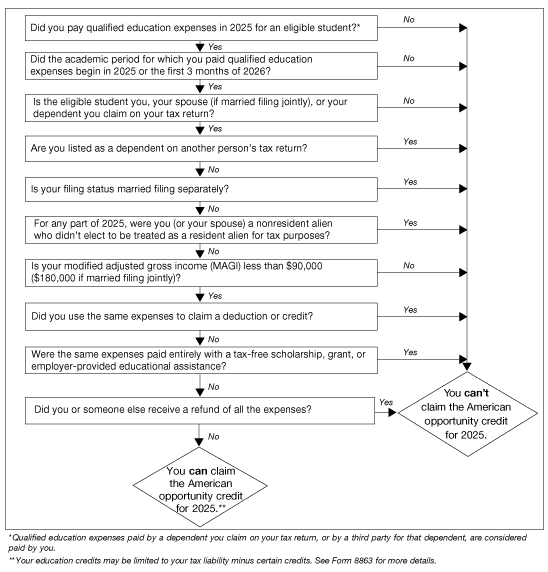
Who Can’t Claim the Credit?
You can’t claim the American opportunity credit for 2025 if any of the following apply.
-
Your filing status is married filing separately.
-
You are claimed as a dependent on another person’s tax return, such as your parent’s return. See Who Can Claim a Dependent’s Expenses, later.
-
Your modified adjusted gross income (MAGI) is $90,000 or more ($180,000 or more if married filing jointly). MAGI is explained later under Effect of the Amount of Your Income on the Amount of Your Credit.
-
You (or your spouse) were a nonresident alien for any part of 2025 and the nonresident alien didn’t elect to be treated as a resident alien for tax purposes. More information on nonresident aliens can be found in Pub. 519, U.S. Tax Guide for Aliens.
-
You weren’t issued an SSN (or ITIN) by the due date of your 2025 return (including extensions). You can’t claim the American opportunity credit on either your original or an amended 2025 return. Also, you can’t claim this credit on your original or an amended 2025 return for a student who wasn’t issued an SSN, ATIN, or ITIN by the due date of your return (including extensions). If an ATIN or ITIN is applied for on or before the due date of a 2025 return (including extensions) and the IRS issues an ATIN or ITIN as a result of the application, the IRS will consider the ATIN or ITIN as issued on or before the due date of the return.
What Expenses Qualify?
The American opportunity credit is based on adjusted qualified education expenses you pay for yourself, your spouse, or a dependent you claim on your tax return. Generally, the credit is allowed for adjusted qualified education expenses paid in 2025 for an academic period beginning in 2025 or beginning in the first 3 months of 2026.
For example, if you paid $1,500 in December 2025 for qualified tuition for the spring 2026 semester beginning January 2026, you can use that $1,500 in figuring your 2025 credit.
Academic period.
An academic period includes a semester, trimester, quarter, or other period of study (such as a summer school session) as reasonably determined by an educational institution. If an educational institution uses credit hours or clock hours and doesn’t have academic terms, each payment period can be treated as an academic period.
Paid with borrowed funds.
You can claim an American opportunity credit for qualified education expenses paid with the proceeds of a loan. Use the expenses to figure the American opportunity credit for the year in which the expenses are paid, not the year in which the loan is repaid. Treat loan payments sent directly to the educational institution as paid on the date the institution credits the student’s account.
Student withdraws from class(es).
You can claim an American opportunity credit for qualified education expenses not refunded when a student withdraws.
Qualified Education Expenses
For purposes of the American opportunity credit, qualified education expenses are tuition and certain related expenses required for enrollment or attendance at an eligible educational institution.
Eligible educational institution.
An eligible educational institution is any college, university, vocational school, or other postsecondary educational institution eligible to participate in a student aid program administered by the U.S. Department of Education. Virtually all accredited public, nonprofit, and proprietary (privately owned profit-making) postsecondary institutions meet this definition.
An eligible educational institution also includes certain educational institutions located outside the United States that are eligible to participate in a student aid program administered by the U.S. Department of Education.
.The educational institution should be able to tell you if it is an eligible educational institution..
Related expenses.
Student activity fees are included in qualified education expenses only if the fees must be paid to the institution as a condition of enrollment or attendance.
However, expenses for books, supplies, and equipment needed for a course of study are included in qualified education expenses whether or not the materials are purchased from the educational institution.
Prepaid expenses.
Qualified education expenses paid in 2025 for an academic period that begins in the first 3 months of 2026 can be used in figuring an education credit for 2025 only. See Academic period , earlier. For example, if you pay $2,000 in December 2025 for qualified tuition for the 2026 winter quarter that begins in January 2026, you can use that $2,000 in figuring an education credit for 2025 only (if you meet all the other requirements).
.You can’t use any amount you paid in 2024 or 2026 to figure the qualified education expenses you use to figure your 2025 education credit(s)..
In the following examples, assume that each student is an eligible student at an eligible educational institution.
Example 1.
Jefferson is a sophomore in University V’s degree program in dentistry. This year, in addition to tuition, there is a requirement to pay a fee to the university for the rental of the dental equipment used in this program. Because the equipment rental is needed for this course of study, Jefferson’s equipment rental fee is a qualified expense.
Example 2.
Grace and William, both first-year students at College W, are required to have certain books and other reading materials to use in their mandatory first-year classes. The college has no policy about how students should obtain these materials, but any student who purchases them from College W’s bookstore will receive a bill directly from the college. William bought the books from a friend; Grace bought the books at College W’s bookstore. Both are qualified education expenses for the American opportunity credit.
Example 3.
When Kelly enrolled at College X for the freshman year, the school required payment of a separate student activity fee in addition to the tuition. This activity fee is required of all students, and is used solely to fund on-campus organizations and activities run by students, such as the student newspaper and the student government. No portion of the fee covers personal expenses. Although labeled as a student activity fee, the fee is required for Kelly’s enrollment and attendance at College X and is a qualified expense.
No Double Benefit Allowed
You can’t do any of the following.
-
Deduct higher education expenses on your income tax return (as, for example, a business expense) and also claim an American opportunity credit based on those same expenses.
-
Claim an American opportunity credit for any student and use any of that student’s expenses in figuring your lifetime learning credit.
-
Figure the tax-free portion of a distribution from a Coverdell education savings account (ESA) or qualified tuition program (QTP) using the same expenses you used to figure the American opportunity credit. See Coordination With American Opportunity and Lifetime Learning Credits in chapter 6 and Coordination With American Opportunity and Lifetime Learning Credits in chapter 7.
-
Claim a credit based on qualified education expenses paid with tax-free educational assistance, such as a scholarship, grant, or assistance provided by an employer. See Adjustments to Qualified Education Expenses next.
For each student, reduce the qualified education expenses paid by or on behalf of that student under the following rules. The result is the amount of adjusted qualified education expenses for each student.
Tax-free educational assistance.
For tax-free educational assistance received in 2025, reduce the qualified educational expenses for each academic period by the amount of tax-free educational assistance allocable to that academic period. See Academic period , earlier.
Some tax-free educational assistance received after 2025 may be treated as a refund of qualified education expenses paid in 2025. This tax-free educational assistance is any tax-free educational assistance received by you or anyone else after 2025 for qualified education expenses paid on behalf of a student in 2025 (or attributable to enrollment at an eligible educational institution during 2025).
If this tax-free educational assistance is received after 2025 but before you file your 2025 income tax return, see Refunds received after 2025 but before your income tax return is filed, later. If this tax-free educational assistance is received after 2025 and after you file your 2025 income tax return, see Refunds received after 2025 and after your income tax return is filed, later.
Tax-free educational assistance includes:
-
The tax-free parts of scholarships and fellowship grants (see Tax-Free Scholarships and Fellowship Grants in chapter 1),
-
The tax-free part of Pell grants (see Pell Grants and Other Title IV Need-Based Education Grants in chapter 1),
-
Employer-provided educational assistance (see chapter 10),
-
Veterans’ educational assistance (see Veterans’ Benefits in chapter 1), and
-
Any other nontaxable (tax-free) payments (other than gifts or inheritances) received as educational assistance.
Generally, any scholarship or fellowship grant is treated as tax free. However, a scholarship or fellowship grant isn’t treated as tax free to the extent the student includes it in gross income (the student may or may not be required to file a tax return for the year the scholarship or fellowship grant is received) and either of the following is true.
-
The scholarship or fellowship grant (or any part of it) must be applied (by its terms) to expenses (such as room and board) other than qualified education expenses as defined in Qualified education expenses in chapter 1.
-
The scholarship or fellowship grant (or any part of it) may be applied (by its terms) to expenses (such as room and board) other than qualified education expenses as defined in Qualified education expenses in chapter 1.
.A student can’t choose to include in income a scholarship or fellowship grant provided by an Indian tribal government that is excluded from income under the Tribal General Welfare Exclusion Act of 2014 or benefits provided by an educational program described in Revenue Procedure 2014-35, section 5.02(2)(b)(ii), available at
IRS.gov/irb/2014-26_IRB#RP-2014-35. .
.You may be able to increase the combined value of an education credit if the student includes some or all of a scholarship or fellowship grant in income in the year it is received. For examples, see Coordination with Pell grants and other scholarships , later..
Refunds.
A refund of qualified education expenses may reduce adjusted qualified education expenses for the tax year or require repayment (recapture) of a credit claimed in an earlier year. Some tax-free educational assistance received after 2025 may be treated as a refund. See Tax-free educational assistance , earlier.
Refunds received in 2025.
For each student, figure the adjusted qualified education expenses for 2025 by adding all the qualified education expenses for 2025 and subtracting any refunds of those expenses received from the eligible educational institution during 2025.
Refunds received after 2025 but before your income tax return is filed.
If anyone receives a refund after 2025 of qualified education expenses paid on behalf of a student in 2025 and the refund is paid before you file an income tax return for 2025, the amount of qualified education expenses for 2025 is reduced by the amount of the refund.
Refunds received after 2025 and after your income tax return is filed.
If anyone receives a refund after 2025 of qualified education expenses paid on behalf of a student in 2025 and the refund is paid after you file an income tax return for 2025, you may need to repay some or all of the credit. See Credit recapture next.
Credit recapture.
If any tax-free educational assistance for the qualified education expenses paid in 2025, or any refund of your qualified education expenses paid in 2025, is received after you file your 2025 income tax return, you must recapture (repay) any excess credit. You do this by refiguring the amount of your adjusted qualified education expenses for 2025 by reducing the expenses by the amount of the refund or tax-free educational assistance. You then refigure your education credit(s) for 2025 and figure the amount by which your 2025 tax liability would have increased if you claimed the refigured credit(s). Include that amount as an additional tax for the year the refund or tax-free assistance was received.
Example.
You paid $7,000 tuition and fees in August 2025, and your child began college in September 2025. You filed your 2025 tax return on February 17, 2026, and claimed an American opportunity credit of $2,500. After you filed your return, you received a refund of $4,000. You must refigure your 2025 American opportunity credit using $3,000 of qualified education expenses instead of $7,000. The refigured credit is $2,250. The increase to your tax liability is $250. Include the difference of $250 as additional tax on your 2026 tax return. See the instructions for your 2026 income tax return to determine where to include this tax.
.If you pay qualified education expenses in both 2025 and 2026 for an academic period that begins in the first 3 months of 2026 and you receive tax-free educational assistance, or a refund, as described above, you may choose to reduce your qualified education expenses for 2026 instead of reducing your expenses for 2025..
Amounts that don’t reduce qualified education expenses.
Don’t reduce qualified education expenses by amounts paid with funds the student receives as:
-
Payment for services, such as wages;
-
A loan;
-
A gift;
-
An inheritance; or
-
A withdrawal from the student’s personal savings.
Don’t reduce the qualified education expenses by any scholarship or fellowship grant reported as income on the student’s tax return in the following situations.
-
The use of the money is restricted, by the terms of the scholarship or fellowship grant, to costs of attendance (such as room and board) other than qualified education expenses as defined in Qualified education expenses in chapter 1.
-
The use of the money isn’t restricted.
Example 1.
Joan paid $3,000 for tuition and $5,000 for room and board at University X. The university did not require payment of any fees in addition to the tuition in order to enroll in or attend classes. To help pay these costs, Joan was awarded a $2,000 scholarship and a $4,000 student loan. The terms of the scholarship state that it can be used to pay any of Joan’s college expenses.
University X applies the $2,000 scholarship against Joan’s $8,000 total bill, and Joan pays the $6,000 balance of the bill from University X with a combination of the student loan and personal savings. Joan doesn’t report any portion of the scholarship as income on the tax return.
In figuring the amount of either education credit (American opportunity or lifetime learning), Joan must reduce the qualified education expenses by the amount of the scholarship ($2,000) because the entire scholarship was excluded from the reported income on Joan’s tax return. The student loan isn’t tax-free educational assistance, so the qualified expenses don’t need to be reduced by any part of the loan proceeds. Joan is treated as having paid $1,000 in qualified education expenses ($3,000 tuition − $2,000 scholarship).
Example 2.
The facts are the same as in Example 1, except that Joan reports the entire scholarship as income on the tax return. Because Joan reported the entire $2,000 scholarship as income, the qualified education expenses don’t need to be reduced. Joan is treated as having paid $3,000 in qualified education expenses.
Coordination with Pell grants and other scholarships.
You may be able to increase your American opportunity credit when the student (you, your spouse, or your dependent) includes certain scholarships or fellowship grants in the student’s gross income. Your credit may increase only if the amount of the student’s qualified education expenses minus the total amount of scholarships and fellowship grants is less than $4,000. If this situation applies, consider including some or all of the scholarship or fellowship grant in the student’s income in order to treat the included amount as paying nonqualified expenses instead of qualified education expenses. Nonqualified expenses are expenses such as room and board that aren’t qualified education expenses such as tuition and related fees.
Scholarships and fellowship grants that the student includes in income don’t reduce the student’s qualified education expenses available to figure your American opportunity credit. Thus, including enough scholarship or fellowship grant in the student’s income to report up to $4,000 in qualified education expenses for your American opportunity credit may increase the credit by enough to increase your tax refund or reduce the amount of tax you owe even considering any increased tax liability from the additional income. However, the increase in tax liability as well as the loss of other tax credits may be greater than the additional American opportunity credit and may cause your tax refund to decrease or the amount of tax you owe to increase. Your specific circumstances will determine what amount, if any, of scholarship or fellowship grant to include in income to maximize your tax refund or minimize the amount of tax you owe.
The scholarship or fellowship grant must be one that may qualify as a tax-free scholarship under the rules discussed in chapter 1. Also, the scholarship or fellowship grant must be one that may (by its terms) be used for nonqualified expenses. Finally, the amount of the scholarship or fellowship grant that is applied to nonqualified expenses can’t exceed the amount of the student’s actual nonqualified expenses that are paid in the tax year. This amount may differ from the student’s living expenses estimated by the student’s school in figuring the official cost of attendance under student aid rules.
The fact that the educational institution applies the scholarship or fellowship grant to qualified education expenses, such as tuition and related fees, doesn’t prevent the student from choosing to apply certain scholarships or fellowship grants to the student’s actual nonqualified expenses. By making this choice (that is, by including the part of the scholarship or fellowship grant applied to the student’s nonqualified expenses in income), the student may increase taxable income and may be required to file a tax return. But this allows payments made in cash, by check, by credit or debit card, or with borrowed funds such as a student loan to be applied to qualified education expenses.
Example 1—no scholarship.
Bill, age 28 and unmarried, enrolled full-time in 2025 as a first-year student at a local college to earn a degree in law enforcement. This was Bill’s first year of postsecondary education. During 2025, Bill paid $5,600 for qualified education expenses and $4,400 for room and board for the fall 2025 semester. Bill and the college meet all the requirements for the American opportunity credit. Bill’s adjusted gross income (AGI) and MAGI, for purposes of figuring the credit, are $39,250. Bill claims the standard deduction of $15,750, resulting in taxable income of $23,500 and an income tax liability before credits of $2,585. Bill claims no credits other than the American opportunity credit. Bill figures the American opportunity credit based on qualified education expenses of $4,000, which results in a credit of $2,500 and a tax liability after credits of $85 ($2,585 − $2,500).
Example 2—scholarship excluded from income.
The facts are the same as in Example 1, except that Bill was awarded a $5,600 scholarship. Under the terms of the scholarship, it may be used to pay any educational expenses, including room and board. If Bill excludes the scholarship from income, it will be deemed (for purposes of figuring the education credit) to have been applied to pay tuition, required fees, and course materials. Bill’s adjusted qualified education expenses would be zero, and there would be no education credit. Therefore, Bill’s tax liability after credits would be $2,585.
Example 3—scholarship partially included in income.
The facts are the same as in Example 2. If, unlike Example 2, Bill includes $4,000 of the scholarship in income, the $4,000 will be deemed to have been applied to pay for room and board. The remaining $1,600 of the $5,600 scholarship would reduce the qualified education expenses, and the adjusted qualified education expenses would be $4,000. Bill’s AGI and MAGI would increase to $43,250, the taxable income would increase to $27,500, and the tax liability before credits would increase to $3,065. Based on the adjusted qualified education expenses of $4,000, Bill would be able to claim an American opportunity credit of $2,500, and the tax liability after credits would be $565 ($3,065 − $2,500).
Example 4—scholarship applied by the postsecondary school to tuition.
The facts are the same as in Example 3, except the $5,600 scholarship is paid directly to the local college. The fact that the local college applies the scholarship to Bill’s tuition and related fees doesn’t prevent Bill from including $4,000 of the scholarship in income. As in Example 3, by doing so, Bill will be deemed to have applied $4,000 to pay for room and board. Bill would be able to claim the American opportunity credit of $2,500, and the tax liability after credits would be $565.
Example 5—student with a dependent child.
Jane, age 28 and unmarried, enrolled full-time as a first-year student at a local technical college to get a certificate as a computer technician. This was Jane’s first year of postsecondary education. During 2025, Jane paid $6,000 for qualified education expenses. Jane and the college meet all the requirements for the American opportunity credit. Jane has a dependent child, age 10, who is a qualifying child for purposes of receiving the earned income credit (EIC) and the child tax credit. Jane’s wages are $24,125. Jane withheld no income taxes on these wages and has no other income or adjustments. Jane was awarded a $5,500 scholarship. Under the terms of the scholarship, it may be used to pay tuition and any living expense, including rent. Jane paid $10,000 in living expenses in 2025.
If Jane excludes the entire scholarship from income, Jane will be deemed to have applied the entire scholarship to pay qualified education expenses. The AGI and MAGI would be $24,125. The tax liability before any credits would be $51. The qualified education expenses would be reduced to $500. Jane would be able to receive a $251 American opportunity credit ($200 refundable and $51 nonrefundable), a $1,700 additional child tax credit, and a $4,204 EIC. In total, Jane would be able to receive a tax refund of $6,104.
If Jane includes the entire scholarship in income, Jane will be deemed to have applied the entire scholarship to pay living expenses. The qualified education expenses would be $6,000, and the AGI and MAGI would be $29,625. The tax liability before any credits would be $603. Jane would be able to receive a $1,603 American opportunity credit ($1,000 refundable and $603 nonrefundable), a $1,700 additional child tax credit, and a $3,325 EIC. In total, Jane would be able to receive a tax refund of $6,025.
If Jane includes $3,500 of the scholarship in income, Jane will be deemed to have applied $3,500 of the scholarship to pay living expenses, and $2,000 to pay qualified education expenses. The qualified education expenses would be $4,000, and the AGI and MAGI would be $27,625. The tax liability before any credits would be $403. Jane would be able to receive a $1,403 American opportunity credit ($1,000 refundable and $403 nonrefundable), a $1,700 additional child tax credit, and a $3,645 EIC. In total, Jane would be able to receive a tax refund of $6,345.
If Jane includes $1,500 of the scholarship in income, Jane will be deemed to have applied $1,500 of the scholarship to pay living expenses, and $4,000 to pay qualified education expenses. The qualified education expenses would be $2,000, and the AGI and MAGI would be $25,625. The tax liability before any credits would be $201. Jane would be able to receive a $1,001 American opportunity credit ($800 refundable and $201 nonrefundable), a $1,700 additional child tax credit, and a $3,964 EIC. In total, Jane would be able to receive a tax refund of $6,464. This is the highest tax refund among these scenarios.
Note:
Whether you will benefit from applying a scholarship or fellowship grant to nonqualified expenses will depend on the amount of the student’s qualified education expenses, the amount of the scholarship or fellowship grant, and whether the scholarship or fellowship grant may (by its terms) be used for nonqualified expenses. Any benefit will also depend on the student’s federal and state marginal tax rates as well as any federal and state tax credits the student claims. Before deciding, look at the total amount of your federal and state tax refunds or taxes owed and, if the student is your dependent, the student’s tax refunds or taxes owed. For example, if you are the student and you also claim the EIC, choosing to apply a scholarship or fellowship grant to nonqualified expenses by including the amount in your income may benefit you if the increase to your American opportunity credit is more than the decrease to your EIC.
Expenses That Don’t Qualify
Qualified education expenses don’t include amounts paid for:
-
Insurance;
-
Medical expenses (including student health fees);
-
Room and board;
-
Transportation; or
-
Similar personal, living, or family expenses.
Sports, games, hobbies, and noncredit courses.
Qualified education expenses generally don’t include expenses that relate to any course of instruction or other education that involves sports, games, or hobbies, or any noncredit course. However, if the course of instruction or other education is part of the student’s degree program, these expenses can qualify.
Comprehensive or bundled fees.
Some eligible educational institutions combine all of their fees for an academic period into one amount. If you don’t receive or don’t have access to an allocation showing how much you paid for qualified education expenses and how much you paid for personal expenses, such as those listed earlier, contact the institution. The institution is generally required to make this allocation and provide you with the amount you paid for qualified education expenses on Form 1098-T. See Figuring the Credit, later, for more information about Form 1098-T.
Who Is an Eligible Student?
To claim the American opportunity credit, the student for whom you pay qualified education expenses must be an eligible student. This is a student who meets all of the following requirements.
-
The student didn’t have expenses that were used to figure an American opportunity credit in any 4 earlier tax years.
-
The student hadn’t completed the first 4 years of postsecondary education (generally, the freshman, sophomore, junior, and senior years of college) before 2025.
-
For at least one academic period beginning in 2025 (or the first 3 months of 2026 if the qualified expenses were paid in 2025), the student was enrolled at least half-time in a program leading to a degree, certificate, or other recognized educational credential.
-
The student hasn’t been convicted of any federal or state felony for possessing or distributing a controlled substance as of the end of 2025.
Completion of first 4 years.
A student has completed the first 4 years of postsecondary education if the institution at which the student is enrolled awards the student 4 years of academic credit at that institution for coursework completed by the student before 2025. This student generally wouldn’t be an eligible student for purposes of the American opportunity credit.
Exception.
Any academic credit awarded solely on the basis of the student’s performance on proficiency examinations is disregarded in determining whether the student has completed 4 years of postsecondary education.
Enrolled at least half-time.
A student was enrolled at least half-time if the student was taking at least half the normal full-time workload for their course of study.
The standard for what is half of the normal full-time workload is determined by each eligible educational institution. However, the standard may not be lower than any of those established by the U.S. Department of Education under the Higher Education Act of 1965.
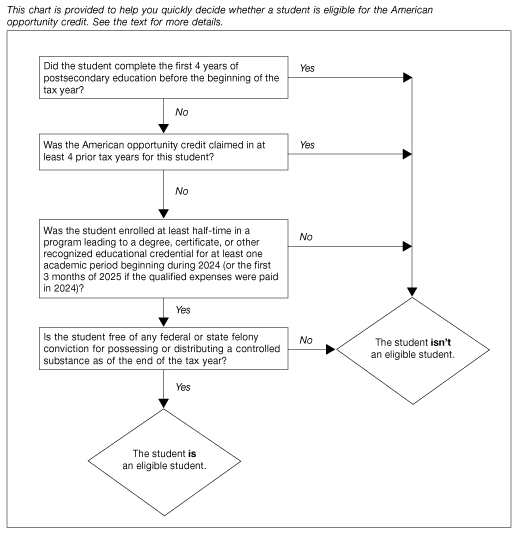
Example 1.
Mack graduated from high school in June 2024. In September, Mack enrolled in an undergraduate degree program at College U and attended full-time for both the 2024 fall and 2025 spring semesters. For the 2025 fall semester, Mack was enrolled less than half-time. Because Mack was enrolled in an undergraduate degree program on at least a half-time basis for at least one academic period that began in 2024 and at least one academic period that began in 2025, Mack is an eligible student for tax years 2024 and 2025 (including the 2025 fall semester when Mack enrolled at College U on less than a half-time basis).
Example 2.
After taking classes at College V on a part-time basis for a few years, Shelly became a full-time student for the 2025 spring semester. College V classified Shelly as a second-semester senior (fourth year) for the 2025 spring semester and as a first-semester graduate student (fifth year) for the 2025 fall semester. Because College V didn’t classify Shelly as having completed the first 4 years of postsecondary education as of the beginning of 2025, Shelly is an eligible student for tax year 2025. Therefore, the qualified education expenses paid for the 2025 spring semester and the 2025 fall semester are taken into account in figuring the American opportunity credit for 2025.
Example 3.
During the 2024 fall semester, Larry was a high school student who took classes on a half-time basis at College X. Larry wasn’t enrolled as part of a degree program at College X because College X only admits students to a degree program if they have a high school diploma or equivalent. Because Larry wasn’t enrolled in a degree program at College X during 2024, Larry wasn’t an eligible student for tax year 2024.
Example 4.
The facts are the same as in Example 3. During the 2025 spring semester, Larry again attended College X but not as part of a degree program. Larry graduated from high school in June 2025. For the 2025 fall semester, Larry enrolled as a full-time student in College X as part of a degree program, and College X awarded Larry credit for the prior coursework at College X. Because Larry was enrolled in a degree program at College X for the 2025 fall term on at least a half-time basis, Larry is an eligible student for all of tax year 2025. Therefore, the qualified education expenses paid for classes taken at College X during both the 2025 spring semester (during which Larry wasn’t enrolled in a degree program) and the 2025 fall semester are taken into account in figuring any American opportunity credit.
Example 5.
Dee graduated from high school in June 2024. In January 2025, Dee enrolled in a 1-year postsecondary certificate program on a full-time basis to obtain a certificate as a travel agent. Dee completed the program in December 2025 and was awarded a certificate. In January 2026, Dee enrolled in a 1-year postsecondary certificate program on a full-time basis to obtain a certificate as a computer programmer. Dee is an eligible student for both tax years 2025 and 2026 because the degree requirement, the workload requirement, and the year of study requirement for those years have been met.
Who Can Claim a Dependent’s Expenses?
If there are qualified education expenses for your dependent during a tax year, either you or your dependent, but not both of you, can claim an American opportunity credit for your dependent’s expenses for that year.
For you to claim an American opportunity credit for your dependent’s expenses, you must also claim your dependent on your tax return. You do this by listing your dependent’s name and other required information on Form 1040 or 1040-SR.
| IF you... | THEN only... |
| claim on your tax return a dependent who is an eligible student |
you can claim the American opportunity credit based on that dependent’s expenses. The dependent can’t claim the credit. |
| don’t claim on your tax return a dependent who is an eligible student (even if entitled to claim the dependent) | the dependent can claim the American opportunity credit. You can’t claim the credit based on this dependent’s expenses. |
Expenses paid by dependent.
If you claim on your tax return an eligible student who is your dependent, treat any expenses paid (or deemed paid) by your dependent as if you had paid them. Include these expenses when figuring the amount of your American opportunity credit.
.Qualified education expenses paid directly to an eligible educational institution for your dependent under a court-approved divorce decree are treated as paid by your dependent. .
Expenses paid by you.
If you claim a dependent who is an eligible student, only you can include any expenses you paid when figuring the amount of the American opportunity credit. If neither you nor anyone else claims the dependent, only the dependent can include any expenses you paid when figuring the American opportunity credit.
Expenses paid by others.
Someone other than you, your spouse, or your dependent (such as a relative or former spouse) may make a payment directly to an eligible educational institution to pay for an eligible student’s qualified education expenses. In this case, the student is treated as receiving the payment from the other person and, in turn, paying the institution. If you claim the student as a dependent on your tax return, you are considered to have paid the expenses.
Example.
In 2025, Todd’s grandparent makes a payment directly to an eligible educational institution for Todd’s qualified education expenses. For purposes of claiming an American opportunity credit, Todd is treated as receiving the money from the grandparent and, in turn, paying the qualified education expenses himself.
Unless Todd is claimed as a dependent on someone else’s 2025 tax return, only Todd can use the payment to claim an American opportunity credit.
If anyone, such as Todd’s parents, claims Todd on his or her 2025 tax return, whoever claims Todd may be able to use the expenses to claim an American opportunity credit. If anyone else claims Todd, Todd can’t claim an American opportunity credit.
Tuition reduction.
When an eligible educational institution provides a reduction in tuition to an employee of the institution (or spouse or dependent child of an employee), the amount of the reduction may or may not be taxable. If it is taxable, the employee is treated as receiving a payment of that amount and, in turn, paying it to the educational institution on behalf of the student. For more information on tuition reductions, see Qualified Tuition Reduction in chapter 1.
Figuring the Credit
The amount of the American opportunity credit (per eligible student) is the sum of:
-
100% of the first $2,000 of qualified education expenses you paid for the eligible student, and
-
25% of the next $2,000 of qualified education expenses you paid for that student.
The maximum amount of American opportunity credit you can claim in 2025 is $2,500 multiplied by the number of eligible students. You can claim the full $2,500 for each eligible student for whom you paid at least $4,000 of adjusted qualified education expenses. However, the credit may be reduced based on your MAGI. See Effect of the Amount of Your Income on the Amount of Your Credit, later.
Example.
Jack and Kay are married and file a joint tax return. For 2025, they claim their dependent child on their tax return. Their MAGI is $70,000. Their child is in the junior (third) year of studies at the local university. Jack and Kay paid qualified education expenses of $4,300 in 2025.
Jack and Kay, their child, and the local university meet all of the requirements for the American opportunity credit. Jack and Kay can claim a $2,500 American opportunity credit in 2025. This is 100% of the first $2,000 of qualified education expenses, plus 25% of the next $2,000.
Form 1098-T.
To help you figure your American opportunity credit, the student may receive Form 1098-T. Generally, an eligible educational institution (such as a college or university) must send Form 1098-T (or acceptable substitute) to each enrolled student by February 2, 2026 (January 31 falls on a Saturday). An institution will report payments received (box 1) for qualified education expenses. However, the amount on Form 1098-T might be different from what you paid. When figuring the credit, use only the amounts you paid or are deemed to have paid in 2025 for qualified education expenses.
In addition, Form 1098-T should give other information for that institution, such as adjustments made for prior years, the amount of scholarships or grants, reimbursements or refunds, and whether the student was enrolled at least half-time or was a graduate student.
The eligible educational institution may ask for a completed Form W-9S, Request for Student’s or Borrower’s Taxpayer Identification Number and Certification, or similar statement to obtain the student’s name, address, and TIN.
.To claim the American opportunity credit, you must provide the educational institution’s EIN on your Form 8863. You should be able to obtain this information from Form 1098-T or the educational institution..
Effect of the Amount of Your Income on the Amount of Your Credit
The amount of your American opportunity credit is phased out (gradually reduced) if your MAGI is between $80,000 and $90,000 ($160,000 and $180,000 if you file a joint return). You can’t claim an American opportunity credit if your MAGI is $90,000 or more ($180,000 or more if you file a joint return).
Modified adjusted gross income (MAGI).
For most taxpayers, MAGI is adjusted gross income (AGI) as figured on their federal income tax return.
MAGI when using Form 1040 or 1040-SR.
If you file Form 1040 or 1040-SR, your MAGI is the AGI on line 11a of that form, modified by adding back any:
-
Foreign earned income exclusion,
-
Foreign housing exclusion,
-
Foreign housing deduction,
-
Exclusion of income by bona fide residents of American Samoa, and
-
Exclusion of income by bona fide residents of Puerto Rico.
Worksheet 2-1. MAGI for the American Opportunity Credit
| 1. | Enter your adjusted gross income (Form 1040 or 1040-SR, line 11a) |
1. | _____ | ||||
| 2. | Enter your foreign earned income exclusion and/or housing exclusion (Form 2555, line 45) | 2. | _____ | ||||
| 3. | Enter your foreign housing deduction (Form 2555, line 50) | 3. | _____ | ||||
| 4. | Enter the amount of income from Puerto Rico you are excluding | 4. | _____ | ||||
| 5. | Enter the amount of income from American Samoa you are excluding (Form 4563, line 15) | 5. | _____ | ||||
| 6. | Add the amounts on lines 2, 3, 4, and 5 |
6. | _____ | ||||
| 7. | Add the amounts on lines 1 and 6. This is your modified adjusted gross income. Enter here and on Form 8863, line 3 |
7. | _____ | ||||
Phaseout.
If your MAGI is within the range of incomes where the credit must be reduced, you will figure your reduced credit using lines 2–7 of Form 8863. The same method is shown in the following example.
Example.
You are filing a joint return and your MAGI is $165,000. In 2025, you paid $5,000 of qualified education expenses.
You figure a tentative American opportunity credit of $2,500 (100% of the first $2,000 of qualified education expenses, plus 25% of the next $2,000 of qualified education expenses).
Because your MAGI is within the range of incomes where the credit must be reduced, you must multiply your tentative credit ($2,500) by a fraction. The numerator (top part) of the fraction is $180,000 (the upper limit for those filing a joint return) minus your MAGI. The denominator (bottom part) is $20,000, the range of incomes for the phaseout ($160,000 to $180,000). The result is the amount of your phased out (reduced) American opportunity credit ($1,875).
| $2,500 | × | $180,000-$165,000 | = | $1,875 | ||
| $20,000 |
Refundable Part of Credit
Forty percent of the American opportunity credit is refundable for most taxpayers. However, if you were under age 24 at the end of 2025 and the conditions listed below apply to you, you can’t claim any part of the American opportunity credit as a refundable credit on your tax return. Instead, your allowed credit (figured on Form 8863, Part II) will be used to reduce your tax as a nonrefundable credit only.
You don’t qualify for a refund if items 1 (a, b, or c), 2, and 3 below apply to you.
-
You were:
-
Under age 18 at the end of 2025, or
-
Age 18 at the end of 2025 and your earned income (defined below) was less than one-half of your support (defined below), or
-
Over age 18 and under age 24 at the end of 2025 and a full-time student (defined below) and your earned income (defined below) was less than one-half of your support (defined below).
-
-
At least one of your parents was alive at the end of 2025.
-
You are filing a return as single, head of household, qualifying surviving spouse, or married filing separately for 2025.
Earned income.
Earned income includes wages, salaries, professional fees, and other payments received for personal services actually performed. Earned income includes the part of any scholarship or fellowship grant that represents payment for teaching, research, or other services performed by the student that are required as a condition for receiving the scholarship or fellowship grant. Earned income doesn’t include that part of the compensation for personal services rendered to a corporation that represents a distribution of earnings or profits rather than a reasonable allowance as compensation for the personal services actually rendered.
If you are a sole proprietor or a partner in a trade or business in which both personal services and capital are material income-producing factors, earned income also includes a reasonable allowance for compensation for personal services, but not more than 30% of your share of the net profits from that trade or business (after subtracting the deduction for one-half of self-employment tax). However, if capital isn’t an income-producing factor and your personal services produced the business income, the 30% limit doesn’t apply.
Support.
Your support includes food, shelter, clothing, medical and dental care, education, and the like. Generally, the amount of the item of support will be the amount of expenses incurred by the one furnishing such item. If the item of support is in the form of property or lodging, measure the amount of such item of support by its fair market value. However, a scholarship received by you isn’t considered support if you are a full-time student. See Pub. 501 for details.
Full-time student.
You are a full-time student for 2025 if during any part of any 5 calendar months during the year you were enrolled as a full-time student at an eligible educational institution (defined earlier), or took a full-time, on-farm training course given by such an institution or by a state, county, or local government agency.
Modified adjusted gross income (MAGI) limits. For 2025, the amount of your lifetime learning credit is gradually reduced (phased out) if your MAGI is between $80,000 and $90,000 ($160,000 and $180,000 if you file a joint return). You can’t claim the credit if your MAGI is $90,000 or more ($180,000 or more if you file a joint return). For more information, see Figuring the Credit .
Form 1098-T requirement. To be eligible to claim the lifetime learning credit, the law requires a taxpayer (or a dependent) to have received Form 1098-T, Tuition Statement, from an eligible educational institution, whether domestic or foreign.However, you may claim the credit if the student doesn’t receive a Form 1098-T because the student’s educational institution isn’t required to furnish a Form 1098-T to the student under existing rules (for example, if the student is a qualified nonresident alien, has qualified education expenses paid entirely with scholarships, has qualified education expenses paid under a formal billing arrangement, or is enrolled in courses for which no academic credit is awarded). If a student’s educational institution isn’t required to provide a Form 1098-T to the student, you may claim the credit without a Form 1098-T if you otherwise qualify, can demonstrate that you (or a dependent) were enrolled at an eligible educational institution, and can substantiate the payment of qualified tuition and related expenses.You may also claim the credit if the student attended an eligible educational institution required to furnish Form 1098-T but the student doesn’t receive Form 1098-T before you file your tax return (for example, if the institution is otherwise required to furnish Form 1098-T and doesn’t furnish it or refuses to do so) and you take the following required steps: After February 2, 2026 (January 31 falls on a Saturday), but before you file your 2025 tax return, you or the student must request that the educational institution furnish Form 1098-T. You must fully cooperate with the educational institution’s efforts to gather the information needed to furnish Form 1098-T. You must also otherwise qualify for the benefit, be able to demonstrate that you (or a dependent) were enrolled at an eligible educational institution, and substantiate the payment of qualified tuition and related expenses.
Introduction
For 2025, there are two tax credits available to help you offset the costs of higher education by reducing the amount of your income tax. They are the American opportunity credit and the lifetime learning credit. This chapter discusses the lifetime learning credit. The American opportunity credit is discussed in chapter 2.
This chapter explains:
-
Who can claim the lifetime learning credit,
-
What expenses qualify for the credit,
-
Who is an eligible student,
-
Who can claim a dependent’s expenses,
-
How to figure the credit,
-
How to claim the credit, and
-
When the credit must be repaid.
What is the tax benefit of the lifetime learning credit?
For the tax year, you may be able to claim a lifetime learning credit of up to $2,000 for qualified education expenses paid for all eligible students. There is no limit on the number of years the lifetime learning credit can be claimed for each student.
A tax credit reduces the amount of income tax you may have to pay. Unlike a deduction, which reduces the amount of income subject to tax, a credit directly reduces the tax itself. The lifetime learning credit is a nonrefundable credit. This means that it can reduce your tax to zero, but if the credit is more than your tax, the excess won’t be refunded to you.
Your allowable lifetime learning credit may be limited by the amount of your income and the amount of your tax.
Can you claim more than one education credit this year?
For each student, you can elect for any year only one of the credits. For example, if you elect to claim the lifetime learning credit for a child on your 2025 tax return, you can’t, for that same child, also claim the American opportunity credit for 2025.
If you are eligible to claim the lifetime learning credit and you are also eligible to claim the American opportunity credit for the same student in the same year, you can choose to claim either credit, but not both.
.If you claim the American opportunity credit for any student, you can choose between using that student’s adjusted qualified education expenses for the American opportunity credit or the lifetime learning credit. If you have the choice, the American opportunity credit will always be greater than the lifetime learning credit..
If you pay qualified education expenses for more than one student in the same year, you can choose to claim certain credits on a per-student, per-year basis. This means that, for example, you can claim the American opportunity credit for one student and the lifetime learning credit for another student in the same year.
Differences between the American opportunity and lifetime learning credits.
There are several differences between these two credits. For example, you can claim the American opportunity credit for the same student for no more than 4 tax years. However, there is no limit on the number of years for which you can claim a lifetime learning credit based on the same student’s expenses. The differences between these credits are shown in the Appendix near the end of this publication.
Overview of the lifetime learning credit for 2025.
See Table 3-1 for the basics of the credit. The details are discussed in this chapter.
Can You Claim the Credit?
The following rules will help you determine if you are eligible to claim the lifetime learning credit on your tax return.
Who Can Claim the Credit?
Generally, you can claim the lifetime learning credit if all three of the following requirements are met.
-
You pay qualified education expenses of higher education.
-
You pay the education expenses for an eligible student.
-
The eligible student is either yourself, your spouse, or a dependent you claim on your tax return.
| Maximum credit | Up to $2,000 credit per return | ||
| Limit on modified adjusted gross income (MAGI) | $180,000 if married filling jointly; $90,000 if single, head of household, or qualifying surviving spouse |
||
| Refundable or nonrefundable | Nonrefundable—credit limited to the amount of tax you must pay on your taxable income | ||
| Number of years of postsecondary education | Available for all years of postsecondary education and for courses to acquire or improve job skills | ||
| Number of tax years credit available | Available for an unlimited number of tax years | ||
| Type of program required | Student doesn’t need to be pursuing a program leading to a degree or other recognized education credential | ||
| Number of courses | Available for one or more courses | ||
| Felony drug conviction | Felony drug convictions don’t make the student ineligible | ||
| Qualified expenses | Tuition and fees required for enrollment or attendance (including amounts required to be paid to the institution for course-related books, supplies, and equipment) | ||
| Payments for academic periods | Payments made in 2025 for academic periods beginning in 2025 or beginning in the first 3 months of 2026 |
Note:
Qualified education expenses paid by a dependent you claim on your tax return, or by a third party for that dependent, are considered paid by you.
“Qualified education expenses” are defined later under Qualified Education Expenses. “Eligible students” are defined later under Who Is an Eligible Student. A dependent you claim on your tax return is defined later under Who Can Claim a Dependent’s Expenses.
You may find Figure 3-1 helpful in determining if you can claim a lifetime learning credit on your tax return.
Who Can’t Claim the Credit?
You can’t claim the lifetime learning credit for 2025 if any of the following apply.
-
Your filing status is married filing separately.
-
You are listed as a dependent on another person’s tax return (such as your parents’). See Who Can Claim a Dependent’s Expenses, later.
-
Your modified adjusted gross income (MAGI) is $90,000 or more ($180,000 or more if filing married filing jointly). MAGI is explained later under Effect of the Amount of Your Income on the Amount of Your Credit.
-
You (or your spouse) were a nonresident alien for any part of 2025 and the nonresident alien didn’t elect to be treated as a resident alien for tax purposes. More information on nonresident aliens can be found in Pub. 519.
-
You claim the American opportunity credit (see chapter 2) for the same student in 2025.
What Expenses Qualify?
The lifetime learning credit is based on qualified education expenses you pay for yourself, your spouse, or a dependent you claim on your tax return. Generally, the credit is allowed for qualified education expenses paid in 2025 for an academic period beginning in 2025 or in the first 3 months of 2026.
For example, if you paid $1,500 in December 2025 for qualified tuition for the spring 2026 semester beginning in January 2026, you may be able to use that $1,500 in figuring your 2025 credit.
Academic period.
An academic period includes a semester, trimester, quarter, or other period of study (such as a summer school session) as reasonably determined by an educational institution. If an educational institution uses credit hours or clock hours and doesn’t have academic terms, each payment period can be treated as an academic period.
Paid with borrowed funds.
You can claim a lifetime learning credit for qualified education expenses paid with the proceeds of a loan. You use the expenses to figure the lifetime learning credit for the year in which the expenses are paid, not the year in which the loan is repaid. Treat loan disbursements sent directly to the educational institution as paid on the date the institution credits the student’s account.
Student withdraws from class(es).
You can claim a lifetime learning credit for qualified education expenses not refunded when a student withdraws.
Qualified Education Expenses
For purposes of the lifetime learning credit, qualified education expenses are tuition and certain related expenses required for enrollment in a course at an eligible educational institution. The course must be either part of a postsecondary degree program or taken by the student to acquire or improve job skills.
Eligible educational institution.
An eligible educational institution is any college, university, vocational school, or other postsecondary educational institution eligible to participate in a student aid program administered by the U.S. Department of Education. Virtually all accredited public, nonprofit, and proprietary (privately owned profit-making) postsecondary institutions meet this definition.
An eligible educational institution also includes certain educational institutions located outside the United States that are eligible to participate in a student aid program administered by the U.S. Department of Education.
.The educational institution should be able to tell you if it is an eligible educational institution..
Related expenses.
Student activity fees and expenses for course-related books, supplies, and equipment are included in qualified education expenses only if the fees and expenses must be paid to the institution for enrollment or attendance.
Prepaid expenses.
Qualified education expenses paid in 2025 for an academic period that begins in the first 3 months of 2026 can be used in figuring an education credit for 2025 only. See Academic period, earlier. For example, if you pay $2,000 in December 2025 for qualified tuition for the 2026 winter quarter that begins in January 2026, you can use that $2,000 in figuring an education credit for 2025 only (if you meet all the other requirements).
.You can’t use any amount you paid in 2024 or 2026 to figure the qualified education expenses you use to figure your 2025 education credit(s)..
In the following examples, assume that each student is an eligible student at an eligible educational institution.
Example 1.
Jackson is a sophomore in University V’s degree program in dentistry. This year, in addition to tuition, Jackson is required to pay a fee to the university for the rental of the dental equipment that will be used in this program. Because the equipment rental fee must be paid to University V for enrollment and attendance, the equipment rental fee is a qualified expense.
Example 2.
Donna and Charles, both first-year students at College W, are required to have certain books and other reading materials to use in their mandatory first-year classes. The college has no policy about how students should obtain these materials, but any student who purchases them from College W’s bookstore will receive a bill directly from the college. Charles bought the books from a friend, so what was paid for them isn’t a qualified education expense. Donna bought the books at College W’s bookstore. Although Donna paid College W directly for the first-year books and materials, the payment isn’t a qualified expense because the books and materials aren’t required to be purchased from College W for enrollment or attendance at the institution.
Example 3.
When Marci enrolled at College X for freshman year, a separate student activity fee in addition to tuition had to be paid. This activity fee is required of all students, and is used solely to fund on-campus organizations and activities run by students, such as the student newspaper and student government. No portion of the fee covers personal expenses. Although labeled as a student activity fee, the fee is required for Marci’s enrollment and attendance at College X. Therefore, it is a qualified expense.
No Double Benefit Allowed
You can’t do any of the following.
-
Deduct higher education expenses on your income tax return (as, for example, a business expense) and also claim a lifetime learning credit based on those same expenses.
-
Claim a lifetime learning credit for any student and use any of that student’s expenses in figuring your American opportunity credit.
-
Claim a lifetime learning credit based on the same expenses used to figure the tax-free portion of a distribution from a Coverdell education savings account (ESA) or qualified tuition program (QTP). See Coordination With American Opportunity and Lifetime Learning Credits in chapter 6 and Coordination With American Opportunity and Lifetime Learning Credits in chapter 7.
-
Claim a credit based on qualified education expenses paid with tax-free educational assistance, such as a scholarship, grant, or assistance provided by an employer. See Adjustments to Qualified Education Expenses next.
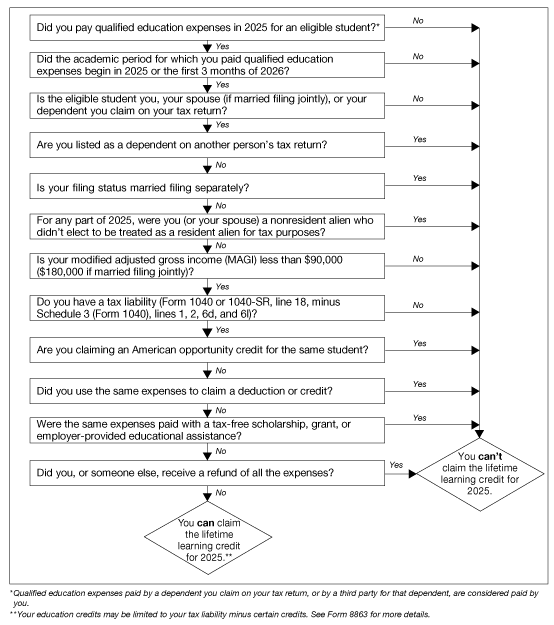
For each student, reduce the qualified education expenses paid by or on behalf of that student under the following rules. The result is the amount of adjusted qualified education expenses for each student.
Tax-free educational assistance.
For tax-free educational assistance received in 2025, reduce the qualified education expenses for each academic period by the amount of tax-free educational assistance allocable to that academic period. See Academic period, earlier.
Some tax-free educational assistance received after 2025 may be treated as a refund of qualified education expenses paid in 2025. This tax-free educational assistance is any tax-free educational assistance received by you or anyone else after 2025 for qualified education expenses paid on behalf of a student in 2025 (or attributable to enrollment at an eligible educational institution during 2025).
If this tax-free educational assistance is received after 2025 but before you file your 2025 income tax return, see Refunds received after 2025 but before your income tax return is filed, later. If this tax-free educational assistance is received after 2025 and after you file your 2025 income tax return, see Refunds received after 2025 and after your income tax return is filed, later.
Tax-free educational assistance includes:
-
The tax-free part of scholarships and fellowship grants (see Tax-Free Scholarships and Fellowship Grants in chapter 1);
-
The tax-free part of Pell grants (see Pell Grants and Other Title IV Need-Based Education Grants in chapter 1);
-
Employer-provided educational assistance (see chapter 10);
-
Veterans’ educational assistance (see Veterans’ Benefits in chapter 1); and
-
Any other nontaxable (tax-free) payments (other than gifts or inheritances) received as educational assistance.
Generally, any scholarship or fellowship grant is treated as tax free. However, a scholarship or fellowship grant isn’t treated as tax free to the extent the student includes it in gross income (the student may or may not be required to file a tax return for the year the scholarship or fellowship grant is received) and either of the following is true.
-
The scholarship or fellowship grant (or any part of it) must be applied (by its terms) to expenses (such as room and board) other than qualified education expenses as defined in Qualified education expenses in chapter 1.
-
The scholarship or fellowship grant (or any part of it) may be applied (by its terms) to expenses (such as room and board) other than qualified education expenses as defined in Qualified education expenses in chapter 1.
.A student can’t choose to include in income a scholarship or fellowship grant provided by an Indian tribal government that is excluded from income under the Tribal General Welfare Exclusion Act of 2014 or benefits provided by an educational program described in Revenue Procedure 2014-35, section 5.02(2)(b)(ii), available at
IRS.gov/irb/2014-26_IRB#RP-2014-35..
.You may be able to increase the combined value of an education credit if the student includes some or all of a scholarship or fellowship grant in income in the year it is received. For examples, see Coordination with Pell grants and other scholarships, later..
Refunds.
A refund of qualified education expenses may reduce adjusted qualified education expenses for the tax year or require repayment (recapture) of a credit claimed in an earlier year. Some tax-free educational assistance received after 2025 may be treated as a refund. See Tax-free educational assistance, earlier.
Refunds received in 2025.
For each student, figure the adjusted qualified education expenses for 2025 by adding all the qualified education expenses for 2025 and subtracting any refunds of those expenses received from the eligible educational institution during 2025.
Refunds received after 2025 but before your income tax return is filed.
If anyone receives a refund after 2025 of qualified education expenses paid on behalf of a student in 2025 and the refund is paid before you file an income tax return for 2025, the amount of qualified education expenses for 2025 is reduced by the amount of the refund.
Refunds received after 2025 and after your income tax return is filed.
If anyone receives a refund after 2025 of qualified education expenses paid on behalf of a student in 2025 and the refund is paid after you file an income tax return for 2025, you may need to repay some or all of the credit. See Credit recapture next.
Credit recapture.
If any tax-free educational assistance for the qualified education expenses paid in 2025 or any refund of your qualified education expenses paid in 2025 is received after you file your 2025 income tax return, you must recapture (repay) any excess credit. You do this by refiguring the amount of your adjusted qualified education expenses for 2025 by reducing the expenses by the amount of the refund or tax-free educational assistance. You then refigure your education credit(s) for 2025 and figure the amount by which your 2025 tax liability would have increased if you had claimed the refigured credit(s). Include that amount as an additional tax for the year the refund or tax-free assistance was received.
Example.
You pay $9,300 in tuition and fees in December 2025, and your child began college in January 2026. You filed your 2025 tax return on February 14, 2026, and claimed a lifetime learning credit of $1,860. You claimed no other tax credits. After you filed your return, your child withdrew from two courses and you received a refund of $2,900. You must refigure your 2025 lifetime learning credit using $6,400 of qualified education expenses instead of $9,300. The refigured credit is $1,280 and your tax liability increased by $580. See the instructions for your 2026 income tax return to determine where to include this tax.
.If you pay qualified education expenses in both 2025 and 2026 for an academic period that begins in the first 3 months of 2026 and you receive tax-free educational assistance, or a refund, as described above, you may choose to reduce your qualified education expenses for 2026 instead of reducing your expenses for 2025..
Amounts that don’t reduce qualified education expenses.
Don’t reduce qualified education expenses by amounts paid with funds the student receives as:
-
Payment for services, such as wages;
-
A loan;
-
A gift;
-
An inheritance; or
-
A withdrawal from the student’s personal savings.
Don’t reduce the qualified education expenses by any scholarship or fellowship grant reported as income on the student’s tax return in the following situations.
-
The use of the money is restricted, by the terms of the scholarship or fellowship grant, to costs of attendance (such as room and board) other than qualified education expenses, as defined in Qualified education expenses in chapter 1.
-
The use of the money isn’t restricted.
Coordination with Pell grants and other scholarships.
You may be able to increase your lifetime learning credit when the student (you, your spouse, or your dependent) includes certain scholarships or fellowship grants in the student’s gross income. Your credit may increase only if the amount of the student’s qualified education expenses minus the total amount of scholarships and fellowship grants is less than $10,000. If this situation applies, consider including some or all of the scholarship or fellowship grant in the student’s income in order to treat the included amount as paying nonqualified expenses instead of qualified education expenses. Nonqualified expenses are expenses such as room and board that aren’t qualified education expenses such as tuition and related fees.
Scholarships and fellowship grants that the student includes in income don’t reduce the student’s qualified education expenses available to figure your lifetime learning credit. Thus, including enough of the scholarship or fellowship grant in the student’s income to report up to $10,000 in qualified education expenses for your lifetime learning credit may increase the credit by enough to increase your tax refund or reduce the amount of tax you owe even considering any increased tax liability from the additional income. However, the increase in tax liability as well as the loss of other tax credits may be greater than the additional lifetime learning credit and may cause your tax refund to decrease or the amount of tax you owe to increase. Your specific circumstances will determine what amount, if any, of the scholarship or fellowship grant to include in income to maximize your tax refund or minimize the amount of tax you owe.
The scholarship or fellowship grant must be one that may qualify as a tax-free scholarship under the rules discussed in chapter 1. Also, the scholarship or fellowship grant must be one that may (by its terms) be used for nonqualified expenses. Finally, the amount of the scholarship or fellowship grant that is applied to nonqualified expenses can’t exceed the amount of the student’s actual nonqualified expenses that are paid in the tax year. This amount may differ from the student’s living expenses estimated by the student’s school in figuring the official cost of attendance under student aid rules.
The fact that the educational institution applies the scholarship or fellowship grant to qualified education expenses, such as tuition and related fees, doesn’t prevent the student from choosing to apply certain scholarships or fellowship grants to the student’s actual nonqualified expenses. By making this choice (that is, by including the part of the scholarship or fellowship grant applied to the student’s nonqualified expenses in income), the student may increase taxable income and may be required to file a tax return. But this allows payments made in cash, by check, by credit or debit card, or with borrowed funds such as a student loan to be applied to qualified education expenses.
Example 1—no scholarship.
Judy, who is unmarried, is taking courses at a public community college to be recertified to teach in public schools. The adjusted gross income (AGI) and the MAGI, for purposes of the credit, are $30,600. Judy claims the standard deduction of $15,750, resulting in taxable income of $14,850 and a tax liability before credits of $1,547. Judy claims no credits other than the lifetime learning credit. In July 2025, Judy paid $700 for the summer 2025 semester; in August 2025, Judy paid $1,900 for the fall 2025 semester; and in December 2025, Judy paid another $1,900 for the spring semester beginning in January 2026. Judy and the college meet all requirements for the lifetime learning credit. All of the $4,500 tuition paid in 2025 can be used when figuring the 2025 lifetime learning credit. Judy claims a $900 lifetime learning credit and the tax liability after credits is $647.
Example 2—scholarship excluded from income.
The facts are the same as in Example 1, except that Judy was awarded a $1,500 scholarship. Under the terms of the scholarship, it may be used to pay any education expenses, including room and board. If the scholarship is excluded from income, Judy will be deemed (for purposes of figuring the education credit) to have applied the scholarship to pay for tuition, required fees, and course materials. Only $3,000 of the $4,500 tuition paid in 2025 could be used when figuring the 2025 lifetime learning credit. The lifetime learning credit would be reduced to $600 and the tax liability after credits would be $947.
Example 3—scholarship included in income.
The facts are the same as in Example 2. If, unlike Example 2, Judy includes the $1,500 scholarship in income, Judy will be deemed to have applied the entire scholarship to pay for room and board. Judy’s AGI and MAGI would increase to $32,100, the taxable income would be $16,350, and the tax liability before credits would be $1,727. Judy would be able to use the $4,500 of adjusted qualified education expenses to figure the credit. Judy could claim a $900 lifetime learning credit and the tax liability after credits would be $827.
Example 4—scholarship applied by the postsecondary school to tuition.
The facts are the same as in Example 3, except the $1,500 scholarship is paid directly to the public community college. The fact that the public community college applies the scholarship to Judy’s tuition and related fees doesn’t prevent Judy from including the $1,500 scholarship in income. As in Example 3, by doing so, Judy will be deemed to have applied the entire scholarship to pay for room and board. Judy could claim the $900 lifetime learning credit and the tax liability after credits would be $827.
Note:
Whether you will benefit from applying a scholarship or fellowship grant to nonqualified expenses will depend on the amount of the student’s qualified education expenses, the amount of the scholarship or fellowship grant, and whether the scholarship or fellowship grant may (by its terms) be used for nonqualified expenses. Any benefit will also depend on the student’s federal and state marginal tax rates as well as any federal and state tax credits the student claims. Before deciding, look at the total amount of your federal and state tax refunds or taxes owed and, if the student is your dependent, the student’s tax refunds or taxes owed. For example, if you are the student and you also claim the earned income credit, choosing to apply a scholarship or fellowship grant to nonqualified expenses by including the amount in your income may not benefit you if the decrease to your earned income credit as a result of including the scholarship or fellowship grant in income is more than the increase to your lifetime learning credit as a result of including this amount in income.
Expenses That Don’t Qualify
Qualified education expenses don’t include amounts paid for:
-
Insurance;
-
Medical expenses (including student health fees);
-
Room and board;
-
Transportation; or
-
Similar personal, living, or family expenses.
Sports, games, hobbies, and noncredit courses.
Qualified education expenses generally don’t include expenses that relate to any course of instruction or other education that involves sports, games, or hobbies, or any noncredit course. However, if the course of instruction or other education is part of the student’s degree program or is taken by the student to acquire or improve job skills, these expenses can qualify.
Comprehensive or bundled fees.
Some eligible educational institutions combine all of their fees for an academic period into one amount. If you don’t receive or don’t have access to an allocation showing how much you paid for qualified education expenses and how much you paid for personal expenses, such as those listed above, contact the institution. The institution is generally required to make this allocation and provide you with the amount you paid for qualified education expenses on Form 1098-T. See Figuring the Credit, later, for more information about Form 1098-T.
Who Is an Eligible Student?
For purposes of the lifetime learning credit, an eligible student is a student who is enrolled in one or more courses at an eligible educational institution (as defined under Qualified Education Expenses, earlier).
Who Can Claim a Dependent’s Expenses?
If there are qualified education expenses for your dependent during a tax year, either you or your dependent, but not both of you, can claim a lifetime learning credit for your dependent’s expenses for that year.
For you to claim a lifetime learning credit for your dependent’s expenses, you must also claim your dependent on your tax return. You do this by listing your dependent’s name and other required information on Form 1040 or 1040-SR.
| IF you... | THEN only... |
| claim on your tax return a dependent who is an eligible student | you can claim the lifetime learning credit based on that dependent’s expenses. The dependent can’t claim the credit. |
| don’t claim on your tax return a dependent who is an eligible student (even if entitled to claim the dependent) | the dependent can claim the lifetime learning credit. You can’t claim the credit based on this dependent’s expenses. |
Expenses paid by dependent.
If you claim on your tax return an eligible student who is your dependent, treat any expenses paid (or deemed paid) by your dependent as if you had paid them. Include these expenses when figuring the amount of your lifetime learning credit.
.Qualified education expenses paid directly to an eligible educational institution for your dependent under a court-approved divorce decree are treated as paid by your dependent. .
Expenses paid by you.
If you claim a dependent who is an eligible student, only you can include any expenses you paid when figuring the amount of the lifetime learning credit. If neither you nor anyone else claims the dependent, only the dependent can include any expenses you paid when figuring the lifetime learning credit.
Expenses paid by others.
Someone other than you, your spouse, or your dependent (such as a relative or former spouse) may make a payment directly to an eligible educational institution to pay for an eligible student’s qualified education expenses. In this case, the student is treated as receiving the payment from the other person and, in turn, paying the institution. If you claim the student as a dependent on your tax return, you are considered to have paid the expenses.
Example.
In 2025, Todd’s grandparent makes a payment directly to an eligible educational institution for Todd’s qualified education expenses. For purposes of claiming a lifetime learning credit, Todd is treated as receiving the money from the grandparent and, in turn, paying the qualified education expenses.
Unless Todd is claimed as a dependent on someone else’s 2025 tax return, only Todd can use the payment to claim a lifetime learning credit.
If anyone, such as Todd’s parents, claims Todd on his or her 2025 tax return, whoever claims Todd may be able to use the expenses to claim a lifetime learning credit. If anyone else claims Todd, Todd can’t claim a lifetime learning credit.
Tuition reduction.
When an eligible educational institution provides a reduction in tuition to an employee of the institution (or spouse or dependent child of an employee), the amount of the reduction may or may not be taxable. If it is taxable, the employee is treated as receiving a payment of that amount and, in turn, paying it to the educational institution on behalf of the student. For more information on tuition reductions, see Qualified Tuition Reduction in chapter 1.
Figuring the Credit
The amount of the lifetime learning credit is 20% of the first $10,000 of qualified education expenses you paid for all eligible students. The maximum amount of lifetime learning credit you can claim for 2025 is $2,000 (20% × $10,000). However, that amount may be reduced based on your MAGI. See Effect of the Amount of Your Income on the Amount of Your Credit, later.
Example.
Bruce and Toni are married and file a joint tax return. For 2025, their MAGI is $75,000. Toni is attending a local college (an eligible educational institution) to earn credits toward a degree in nursing. Toni already has a bachelor’s degree in history and wants to become a nurse. In August 2025, Toni paid $5,000 of qualified education expenses for the fall 2025 semester. Bruce and Toni can claim a $1,000 (20% × $5,000) lifetime learning credit on their 2025 joint tax return.
Form 1098-T.
To help you figure your lifetime learning credit, the student may receive Form 1098-T. Generally, an eligible educational institution (such as a college or university) must send Form 1098-T (or acceptable substitute) to each enrolled student by February 2, 2026 (January 31 falls on a Saturday). An institution will report payments received (box 1) for qualified education expenses. However, the amount on Form 1098-T might be different from what you paid. When figuring the credit, use only the amounts you paid or are deemed to have paid in 2025 for qualified education expenses.
In addition, Form 1098-T should give other information for that institution, such as adjustments made for prior years, the amount of scholarships or grants, reimbursements or refunds, and whether the student was enrolled at least half-time or was a graduate student.
The eligible educational institution may ask for a completed Form W-9S or similar statement to obtain the student’s name, address, and taxpayer identification number.
Effect of the Amount of Your Income on the Amount of Your Credit
The amount of your lifetime learning credit is phased out (gradually reduced) if your MAGI is between $80,000 and $90,000 ($160,000 and $180,000 if you file a joint return). You can’t claim a lifetime learning credit if your MAGI is $90,000 or more ($180,000 or more if you file a joint return).
Modified adjusted gross income (MAGI).
For most taxpayers, MAGI is adjusted gross income (AGI) as figured on their federal income tax return.
MAGI when using Form 1040 or 1040-SR.
If you file Form 1040 or 1040-SR, your MAGI is the AGI on line 11a of that form, modified by adding back any:
-
Foreign earned income exclusion,
-
Foreign housing exclusion,
-
Foreign housing deduction,
-
Exclusion of income by bona fide residents of American Samoa, and
-
Exclusion of income by bona fide residents of Puerto Rico.
Lifetime learning creditModified adjusted gross income (MAGI)Worksheet 3-1 Modified adjusted gross income (MAGI)Lifetime learning creditWorksheet 3-1 WorksheetsLifetime learning credit MAGI calculation (Worksheet 3-1)Worksheet 3-1. MAGI for the Lifetime Learning Credit
| 1. | Enter your adjusted gross income (Form 1040 or 1040-SR, line 11a) |
1. | _____ | ||||
| 2. | Enter your foreign earned income exclusion and/or housing exclusion (Form 2555, line 45) | 2. | _____ | ||||
| 3. | Enter your foreign housing deduction (Form 2555, line 50) | 3. | _____ | ||||
| 4. | Enter the amount of income from Puerto Rico you’re excluding | 4. | _____ | ||||
| 5. | Enter the amount of income from American Samoa you’re excluding (Form 4563, line 15) | 5. | _____ | ||||
| 6. | Add the amounts on lines 2, 3, 4, and 5 |
6. | _____ | ||||
| 7. | Add the amounts on lines 1 and 6. This is your modified adjusted gross income. Enter this amount on Form 8863, line 14 |
7. | _____ | ||||
Phaseout.
If your MAGI is within the range of incomes where the credit must be reduced, you will figure your reduced credit using lines 10–18 of Form 8863. The same method is shown in the following example.
Example.
You are filing a joint return with a MAGI of $161,000. In 2025, you paid $6,600 of qualified education expenses.
You figure the tentative lifetime learning credit (20% of the first $10,000 of qualified education expenses you paid for all eligible students). The result is a $1,320 (20% x $6,600) tentative credit.
Because your MAGI is within the range of incomes where the credit must be reduced, you must multiply your tentative credit ($1,320) by a fraction. The numerator (top part) of the fraction is $180,000 (the upper limit for those filing a joint return) minus your MAGI. The denominator (bottom part) is $20,000, the range of incomes for the phaseout ($160,000 to $180,000). The result is the amount of your phased-out (reduced) lifetime learning credit ($1,254).
| $1,320 | × | $180,000 - $161,000 | = | $1,254 | ||
| $20,000 |
Modified adjusted gross income (MAGI) limits. For 2025, the amount of your student loan interest deduction is gradually reduced (phased out) if your MAGI is between $85,000 and $100,000 ($170,00 and $200,000 if you file a joint return). You can’t claim the deduction if your MAGI is $100,000 or more ($200,000 or more if you file a joint return). For more information, see Figuring the Deduction.
No double benefit allowed. You can’t deduct as interest on a student loan any interest paid by your employer after March 27, 2020, under an educational assistance program. See No Double Benefit Allowed.
Introduction
Generally, personal interest you pay, other than certain mortgage interest, isn’t deductible on your tax return. However, if your MAGI is less than $100,000 ($200,000 if filing a joint return), you may be allowed a special deduction for paying interest on a student loan (also known as an education loan) used for higher education. For most taxpayers, MAGI is the adjusted gross income (AGI) as figured on their federal income tax return before subtracting any deduction for student loan interest. This deduction can reduce the amount of your income subject to tax by up to $2,500.
The student loan interest deduction is claimed as an adjustment to income. This means you can claim this deduction even if you don’t itemize deductions on Schedule A (Form 1040).
This chapter explains:
-
What type of loan interest you can deduct,
-
Whether you can claim the deduction,
-
What expenses you must have paid with the student loan,
-
Who is an eligible student,
-
How to figure the deduction, and
-
How to claim the deduction.
This table summarizes the features of the student loan interest deduction. Don’t rely on this table alone. Refer to the text for more details. |
| Feature | Description | |
|---|---|---|
| Maximum benefit | You can reduce your income subject to tax by up to $2,500. | |
| Loan qualifications | Your student loan: • Must have been taken out solely to pay qualified education expenses, and • Can’t be from a related person or made under a qualified employer plan. |
|
| Student qualifications | The student must be: • You, your spouse, or your dependent (as defined later for this purpose); and • Enrolled at least half-time in a program leading to a degree, certificate, or other recognized educational credential at an eligible educational institution. |
|
| Limit on MAGI | $200,000 if married filing a joint return; $100,000 if single, head of household, or qualifying surviving spouse. |
Student Loan Interest Defined
Student loan interest is interest you paid during the year on a qualified student loan. It includes both required and voluntary interest payments.
Qualified Student Loan
This is a loan you took out solely to pay qualified education expenses (defined later) that were:
-
For you, your spouse, or a person who was your dependent (as defined later for this purpose) when you took out the loan;
-
Paid or incurred within a reasonable period of time before or after you took out the loan; and
-
For education provided during an academic period for an eligible student.
Loans from the following sources aren’t qualified student loans.
-
A related person.
-
A qualified employer plan.
Your dependent.
Generally, your dependent is someone who is either a:
-
Qualifying child, or
-
Qualifying relative.
For this purpose, the term “dependent” also includes any person you could have claimed as a dependent on your return except that:
-
You or your spouse if filing jointly could be claimed as a dependent of another taxpayer (like on your parent’s tax return);
-
The person filed a joint return; or
-
The person had gross income for the year that was equal to or more than $5,200 (for 2025).
Reasonable period of time.
Qualified education expenses are treated as paid or incurred within a reasonable period of time before or after you take out the loan if they are paid with the proceeds of student loans that are part of a federal postsecondary education loan program.
Even if not paid with the proceeds of that type of loan, the expenses are treated as paid or incurred within a reasonable period of time if both of the following requirements are met.
-
The expenses relate to a specific academic period.
-
The loan proceeds are disbursed within a period that begins 90 days before the start of that academic period and ends 90 days after the end of that academic period.
If neither of the above situations applies, the reasonable period of time is usually determined based on all the relevant facts and circumstances.
Academic period.
An academic period includes a semester, trimester, quarter, or other period of study (such as a summer school session) as reasonably determined by an educational institution. If an educational institution uses credit hours or clock hours and doesn’t have academic terms, each payment period can be treated as an academic period.
Eligible student.
An eligible student is a student who was enrolled at least half-time in a program leading to a degree, certificate, or other recognized educational credential.
Enrolled at least half-time.
A student was enrolled at least half-time if the student was taking at least half the normal full-time workload for their course of study.
The standard for what is half of the normal full-time workload is determined by each eligible educational institution. However, the standard may not be lower than any of those established by the U.S. Department of Education under the Higher Education Act of 1965.
Related person.
You can’t deduct interest on a loan you get from a related person. Related persons include:
-
Your spouse;
-
Your brothers and sisters;
-
Your half brothers and half sisters;
-
Your ancestors (parents, grandparents, etc.);
-
Your lineal descendants (children, grandchildren, etc.); and
-
Certain corporations, partnerships, trusts, and exempt organizations.
Qualified Education Expenses
For purposes of the student loan interest deduction, these expenses are the total costs of attending an eligible educational institution. They include amounts paid for the following items.
-
Tuition and fees.
-
Room and board.
-
Books, supplies, and equipment.
-
Other necessary expenses (such as transportation).
The cost of room and board qualifies only to the extent it isn’t more than:
-
The allowance for room and board, as determined by the eligible educational institution, that was included in the cost of attendance (for federal financial aid purposes) for a particular academic period and living arrangement of the student; or
-
If greater, the actual amount charged if the student is residing in housing owned or operated by the eligible educational institution.
Eligible educational institution.
An eligible educational institution is generally any college, university, vocational school, or other postsecondary educational institution eligible to participate in a student aid program administered by the U.S. Department of Education. Virtually all accredited public, nonprofit, and proprietary (privately owned profit-making) postsecondary institutions meet this definition.
An eligible educational institution also includes certain educational institutions located outside the United States that are eligible to participate in a student aid program administered by the U.S. Department of Education.
For purposes of the student loan interest deduction, an eligible educational institution also includes an institution conducting an internship or residency program leading to a degree or certificate from an institution of higher education, a hospital, or a health care facility that offers postgraduate training.
An educational institution must meet the above criteria only during the academic period(s) for which the student loan was incurred. The deductibility of interest on the loan isn’t affected by the institution’s subsequent loss of eligibility.
.The educational institution should be able to tell you if it is an eligible educational institution..
You must reduce your qualified education expenses by the total amount paid for them with the following tax-free items.
-
Employer-provided educational assistance. See chapter 10.
-
Tax-free distribution of earnings from a Coverdell education savings account (ESA). See Tax-Free Distributions in chapter 6.
-
Tax-free distribution of earnings from a qualified tuition program (QTP). See Figuring the Taxable Portion of a Distribution in chapter 7.
-
U.S. savings bond interest that you exclude from income because it is used to pay qualified education expenses. See chapter 9.
-
The tax-free part of scholarships and fellowship grants. See Tax-Free Scholarships and Fellowship Grants in chapter 1.
-
Veterans’ educational assistance. See Veterans' Benefits in chapter 1.
-
Any other nontaxable (tax-free) payments (other than gifts or inheritances) received as educational assistance.
Include as Interest
In addition to simple interest on the loan, if all other requirements are met, the items discussed below can be student loan interest.
Loan origination fee.
In general, this is a one-time fee charged by the lender when a loan is made. To be deductible as interest, a loan origination fee must be for the use of money rather than for property or services (such as commitment fees or processing costs) provided by the lender. A loan origination fee treated as interest accrues over the life of the loan.
Loan origination fees weren’t required to be reported on Form 1098-E, Student Loan Interest Statement, for loans made before September 1, 2004. If loan origination fees aren’t included in the amount reported on your Form 1098-E, you can use any reasonable method to allocate the loan origination fees over the term of the loan.
Capitalized interest.
This is unpaid interest on a student loan that is added by the lender to the outstanding principal balance of the loan. Capitalized interest is treated as interest for tax purposes and is deductible as payments of principal are made on the loan. No deduction for capitalized interest is allowed in a year in which no loan payments were made.
Interest on revolving lines of credit.
This interest, which includes interest on credit card debt, is student loan interest if the borrower uses the line of credit (credit card) only to pay qualified education expenses. See Qualified Education Expenses, earlier.
Interest on refinanced and consolidated student loans.
This includes interest on a loan used solely to refinance a qualified student loan of the same borrower. It also includes a single consolidation loan used solely to refinance two or more qualified student loans of the same borrower.
.If you refinance a qualified student loan for more than your original loan and you use the additional amount for any purpose other than qualified education expenses, you can’t deduct any interest paid on the refinanced loan. .
The allocation of payments between interest and principal for tax purposes might not be the same as the allocation shown on the Form 1098-E or other statement you receive from the lender or loan servicer. To make the allocation for tax purposes, a payment generally applies first to stated interest that remains unpaid as of the date the payment is due, second to any loan origination fees allocable to the payment, third to any capitalized interest that remains unpaid as of the date the payment is due, and fourth to the outstanding principal.
Example.
In August 2024, you took out a $10,000 student loan to pay the tuition for your senior year of college. The lender charged a 3% loan origination fee ($300) that was withheld from the funds you received. The interest (5% simple) on this loan accrued while you completed your senior year and for 6 months after graduating. At the end of that period, the lender determined the amount to be repaid by capitalizing all accrued but unpaid interest ($625 interest accrued from August 2024 through October 2025) and adding it to the outstanding principal balance of the loan. The loan is payable over 60 months, with a payment of $200.51 due on the first of each month, beginning November 2025.
You didn’t receive a Form 1098-E for 2025 from the lender because the amount of interest you paid didn’t require the lender to issue an information return. However, you did receive an account statement from the lender that showed the following 2025 payments on your outstanding loan of $10,625 ($10,000 principal + $625 accrued but unpaid interest).
| Payment Date | Payment | Stated Interest | Principal | |||
| November 2025 | $200.51 | $44.27 | $156.24 | |||
| December 2025 | $200.51 | $43.62 | $156.89 | |||
| Totals | $401.02 | $87.89 | $313.13 |
To determine the amount of interest that could be deducted on the loan for 2025, you start with the total amount of stated interest you paid, $87.89. Next, allocate the loan origination fee over the term of the loan ($300 ÷ 60 months = $5 per month). A total of $10 ($5 of each of the two principal payments) should be treated as interest for tax purposes. You then apply the unpaid capitalized interest ($625) to the two principal payments in the order in which they were made and determine that the remaining amount of principal of both payments is treated as interest for tax purposes. Assuming that you qualify to claim the student loan interest deduction, you can deduct $401.02 ($87.89 + $10 + $303.13).
For 2026, you will continue to allocate $5 of the loan origination fee to the principal portion of each monthly payment you make and treat that amount as interest for tax purposes. You will also apply the remaining amount of capitalized interest ($625 − $303.13 = $321.87) to the principal payments in the order in which they are made until the balance is zero and treat those amounts as interest for tax purposes.
Don’t Include as Interest
You can’t claim a student loan interest deduction for any of the following items.
-
Interest you paid on a loan if, under the terms of the loan, you aren’t legally obligated to make interest payments.
-
Loan origination fees that are payments for property or services provided by the lender, such as commitment fees or processing costs.
-
Interest you paid on a loan to the extent payments were made through your participation in the National Health Service Corps Loan Repayment Program (the NHSC Loan Repayment Program) or certain other loan repayment assistance programs. For more information, see Student Loan Repayment Assistance in chapter 5.
Can You Claim the Deduction?
Generally, you can claim the deduction if all of the following requirements are met.
-
Your filing status is any filing status except married filing separately.
-
No one else is claiming you as a dependent on their tax return.
-
You are legally obligated to pay interest on a qualified student loan.
-
You paid interest on a qualified student loan.
Claiming you as a dependent.
Another taxpayer is claiming you as a dependent if they list your name and other required information on page 1 of their Form 1040, 1040-SR, or 1040-NR.
Example 1.
During 2025, you paid $600 interest on your qualified student loan. Only you are legally obligated to make the payments. No one claimed you as a dependent for 2025. Assuming all other requirements are met, you can deduct the $600 of interest you paid on your 2025 Form 1040 or 1040-SR.
Example 2.
During 2025, you paid $1,100 interest on your qualified student loan. Only you are legally obligated to make the payments. Your parents claimed you as a dependent on their 2025 tax return. In this case, neither you nor your parents may deduct the student loan interest you paid in 2025.
Interest paid by others.
If you are the person legally obligated to make interest payments and someone else makes a payment of interest on your behalf, you are treated as receiving the payments from the other person and, in turn, paying the interest.
Example 1.
You obtained a qualified student loan to attend college. After graduating from college, you worked as an intern for a nonprofit organization. As part of the internship program, the nonprofit organization made an interest payment on your behalf. This payment was treated as additional compensation and reported in box 1 of your Form W-2. Assuming all other qualifications are met, you can deduct this payment of interest on your tax return.
Example 2.
You obtained a qualified student loan to attend college. After graduating from college, the first monthly payment on the loan was due in December. As a gift, your mother made this payment. No one is claiming you as a dependent on their tax return. Assuming all other qualifications are met, you can deduct this payment of interest on your tax return.
No Double Benefit Allowed
You can’t deduct as interest on a student loan any amount that is an allowable deduction under any other provision of the tax law (for example, home mortgage interest).
You also can’t deduct as interest on a student loan any amount paid from a distribution of earnings made from a QTP after 2018 to the extent the earnings are treated as tax free because they were used to pay student loan interest. For more information, see chapter 7.
For payments made after March 27, 2020, do not deduct as interest on a student loan any interest paid by your employer under an educational assistance program. See chapter 10.
Figuring the Deduction
Your student loan interest deduction is generally the smaller of:
-
$2,500, or
-
The interest you paid during the tax year.
Form 1098-E.
To help you figure your student loan interest deduction, you should receive Form 1098-E. Generally, an institution (such as a bank or governmental agency) that received interest payments of $600 or more during 2025 on one or more qualified student loans must send Form 1098-E (or an acceptable substitute) to each borrower by February 2, 2026 (January 31 falls on a Saturday).
For qualified student loans taken out before September 1, 2004, the institution is required to include on Form 1098-E only payments of stated interest. Other interest payments, such as certain loan origination fees and capitalized interest, may not appear on the form you receive. However, if you pay qualifying interest that isn’t included on Form 1098-E, you can also deduct those amounts. See Allocating Payments Between Interest and Principal, earlier.
The lender may ask for a completed Form W-9S or similar statement to obtain the borrower’s name, address, and taxpayer identification number. The form may also be used by the borrower to certify that the student loan was incurred solely to pay for qualified education expenses.
Effect of the Amount of Your Income on the Amount of Your Deduction
The amount of your student loan interest deduction is phased out (gradually reduced) if your MAGI is between $85,000 and $100,000 ($170,00 and $200,000 if you file a joint return). You can’t claim a student loan interest deduction if your MAGI is $100,000 or more ($200,000 or more if you file a joint return).
Modified adjusted gross income (MAGI).
For most taxpayers, MAGI is AGI as figured on their federal income tax return before subtracting any deduction for student loan interest. However, as discussed below, there may be other modifications.
Table 4-2 shows how the amount of your MAGI can affect your student loan interest deduction.
| IF your filing status is... | AND your MAGI is... | THEN your student loan interest deduction is... |
| single, head of household, or qualifying surviving spouse |
not more than $85,000 | not affected by the phaseout. |
| more than $85,000 but less than $100,000 |
reduced because of the phaseout. | |
| $100,000 or more | eliminated by the phaseout. | |
| married filing joint return | not more than $170,000 | not affected by the phaseout. |
| more than $170,000 but less than $200,000 |
reduced because of the phaseout. | |
| $200,000 or more | eliminated by the phaseout. |
MAGI when using Form 1040 or 1040-SR.
If you file Form 1040 or 1040-SR, your MAGI is the AGI on line 11a of that form figured without taking into account any amount on Schedule 1 (Form 1040), line 21 (student loan interest deduction), and modified by adding back any:
-
Foreign earned income exclusion,
-
Foreign housing exclusion,
-
Foreign housing deduction,
-
Exclusion of income by bona fide residents of American Samoa, and
-
Exclusion of income by bona fide residents of Puerto Rico.
MAGI when using Form 1040-NR.
If you file Form 1040-NR, your MAGI is the AGI on line 11a of that form figured without taking into account any amount on Schedule 1 (Form 1040), line 21 (student loan interest deduction).
Phaseout.
If your MAGI is within the range of incomes where the credit must be reduced, you must figure your reduced deduction. To figure the phaseout, multiply your interest deduction (before the phaseout but not more than $2,500) by a fraction. The numerator (top part) is your MAGI minus $85,000 ($170,000 in the case of a joint return). The denominator (bottom part) is $15,000 ($30,000 in the case of a joint return). Subtract the result from your deduction (before the phaseout) to give you the amount you can deduct.
Example 1.
During 2025, you paid $800 of interest on a qualified student loan. Your 2025 MAGI is $185,000 and you are filing a joint return. You must reduce your deduction by $400, figured as follows.
| $800 | × | $185,000 − $170,000 $30,000 |
= | $400 |
Example 2.
The facts are the same as in Example 1, except that you paid $2,750 interest. Your maximum deduction for 2025 is $2,500. You must reduce your maximum deduction by $1,250, figured as follows.
| $2,500 | × | $185,000 − $170,000 $30,000 |
= | $1,250 |
Which Worksheet To Use
Generally, you figure the deduction using the Student Loan Interest Deduction Worksheet in the Schedule 1 (Form 1040) instructions included in the Instructions for Form 1040. However, if you are filing Form 2555, Foreign Earned Income; Form 4563, Exclusion of Income for Bona Fide Residents of American Samoa; or you are excluding income from sources within Puerto Rico, you must complete Worksheet 4-1.
Claiming the Deduction
The student loan interest deduction is an adjustment to income. To claim the deduction, enter the allowable amount on Schedule 1 (Form 1040), line 21.
Student loan interest deductionWorksheet 4-1 WorksheetsStudent loan interest deduction (Worksheet 4-1)Worksheet 4-1. Student Loan Interest Deduction Worksheet
Use this worksheet instead of the worksheet in the Schedule 1 (Form 1040) instructions if you are filing Form 2555 or 4563, or you are excluding income from sources within Puerto Rico. Before using this worksheet, you must complete Form 1040 or 1040-SR, line 9, and Schedule 1 (Form 1040), lines 11 through 20 and 23 and 25. |
| 1. | Enter the total interest you paid in 2025 on qualified student loans. Don’t enter more than $2,500 | 1. | _____ | |||||
| 2. | Enter the amount from Form 1040 or 1040-SR, line 9 | 2. | _____ | |||||
| 3. | Enter the total of the amounts from Schedule 1 (Form 1040), lines 11 through 20 and 23 and 25 | 3. | _____ | |||||
| 4. | Subtract line 3 from line 2 | 4. | _____ | |||||
| 5. | Enter any foreign earned income exclusion and/or housing exclusion (Schedule 1 (Form 1040), line 8d) |
5. | _____ | |||||
| 6. | Enter any foreign housing deduction (Schedule 1 (Form 1040), line 24j) | 6. | _____ | |||||
| 7. | Enter the amount of income from Puerto Rico you are excluding | 7. | _____ | |||||
| 8. | Enter the amount of income from American Samoa you are excluding (Form 4563, line 15) |
8. | _____ | |||||
| 9. | Add lines 4 through 8. This is your modified adjusted gross income | 9. | _____ | |||||
| 10. | Enter the amount shown below for your filing status | 10. | _____ | |||||
| • Single, head of household, or qualifying surviving spouse—$85,000 | ||||||||
| • Married filing jointly—$170,000 | ||||||||
| 11. | Is the amount on line 9 more than the amount on line 10? | |||||||
| □ | No. Skip lines 11 and 12, enter -0- on line 13, and go to line 14. | |||||||
| □ | Yes. Subtract line 10 from line 9 | 11. | _____ | |||||
| 12. | Divide line 11 by $15,000 ($30,000 if married filing jointly). Enter the result as a decimal (rounded to at least three places). If the result is 1.000 or more, enter 1.000 |
12. | . | |||||
| 13. | Multiply line 1 by line 12 | 13. | _____ | |||||
| 14. | Student loan interest deduction. Subtract line 13 from line 1. Enter the result here and on Schedule 1 (Form 1040), line 21. Don’t include this amount in figuring any other deduction on your return (such as on Schedule A, C, E, etc.) |
14. | _____ | |||||
Student loan forgiveness. The American Rescue Plan Act of 2021 modified the treatment of student loan forgiveness for discharges in 2021 through 2025.
Introduction
Generally, if you are responsible for making loan payments and the loan is canceled or repaid by someone else, you must include the amount that was canceled or paid on your behalf in your gross income for tax purposes. However, in certain circumstances, you may be able to exclude this amount from gross income if the loan was one of the following.
-
A loan for postsecondary educational expenses.
-
A private education loan.
-
A loan from an educational organization described in section 170(b)(1)(A)(ii).
-
A loan from an organization exempt from tax under section 501(a) to refinance a student loan.
Loan for Postsecondary Educational Expenses
This is any loan provided expressly for postsecondary education, regardless of whether provided through the educational institution or directly to the borrower, if such loan was made, insured, or guaranteed by one of the following.
-
The United States or an instrumentality or agency thereof.
-
A state or territory of the United States or the District of Columbia or any political subdivision thereof.
-
An eligible educational institution.
Eligible educational institution.
An eligible educational institution is any college, university, vocational school, or other postsecondary educational institution eligible to participate in a student aid program administered by the U.S. Department of Education. Virtually all accredited public, nonprofit, and proprietary (privately owned profit-making) postsecondary institutions meet this definition.
An eligible educational institution also includes certain educational institutions located outside the United States that are eligible to participate in a student aid program administered by the U.S. Department of Education.
.The educational institution should be able to tell you if it is an eligible educational institution..
Private Education Loan
A private education loan is a loan provided by a private educational lender that:
-
Is not made, insured, or guaranteed under Title IV of the Higher Education Act of 1965; and
-
Is issued expressly for postsecondary educational expenses to a borrower, regardless of whether the loan is provided through the educational institution that the student attends or directly to the borrower from the private educational lender. A private education loan does not include an extension of credit under an open-end consumer credit plan, a reverse mortgage transaction, a residential mortgage transaction, or any other loan that is secured by real property or a dwelling.
Private educational lender.
A private educational lender is one of the following.
-
A financial institution that solicits, makes, or extends private education loans.
-
A federal credit union that solicits, makes, or extends private education loans.
-
Any other person engaged in the business of soliciting, making, or extending private education loans.
.The cancellation of your loan won't qualify for tax-free treatment if it is canceled because of services you performed for the private educational lender that made the loan or other organization that provided the funds. .
Loan From an Educational Organization Described in Section 170(b)(1)(A)(ii)
This is any loan made by the organization if the loan is made:
-
As part of an agreement with an entity described earlier under which the funds to make the loan were provided to the educational organization, or
-
Under a program of the educational organization that is designed to encourage its students to serve in occupations with unmet needs or in areas with unmet needs where the services provided by the students (or former students) are for or under the direction of a governmental unit or a tax-exempt section 501(c)(3) organization.
Educational organization described in section 170(b)(1)(A)(ii).
This is an educational institution that maintains a regular faculty and curriculum and normally has a regularly enrolled body of students in attendance at the place where it carries on its educational activities.
Section 501(c)(3) organization.
This is any corporation, community chest, fund, or foundation organized and operated exclusively for one or more of the following purposes.
-
Charitable.
-
Religious.
-
Educational.
-
Scientific.
-
Literary.
-
Testing for public safety.
-
Fostering national or international amateur sports competition (but only if none of its activities involve providing athletic facilities or equipment).
-
The prevention of cruelty to children or animals.
.The cancellation of your loan won't qualify for tax-free treatment if it is canceled because of services you performed for the educational organization that made the loan or other organization that provided the funds..
Refinanced Loan
If you refinanced a student loan with another loan from an educational organization or a tax-exempt organization, the cancellation of that loan may also be treated as discussed above. This applies if the new loan is made under a program of the refinancing organization that is designed to encourage students to serve in occupations with unmet needs or in areas with unmet needs where the services required of the students are for or under the direction of a governmental unit or a tax-exempt section 501(c)(3) organization (defined earlier).
Student Loan Repayment Assistance
Student loan repayments made to you are tax free if you received them for any of the following.
-
The National Health Service Corps Loan Repayment Program (NHSC Loan Repayment Program).
-
A state education loan repayment program eligible for funds under the Public Health Service Act.
-
Any other state loan repayment or loan forgiveness program that is intended to provide for the increased availability of health services in underserved or health professional shortage areas (as determined by such state).
.You can't deduct the interest you paid on a student loan to the extent payments were made through your participation in the above programs..
Introduction
If your modified adjusted gross income (MAGI) is less than $110,000 ($220,000 if filing a joint return), you may be able to establish a Coverdell ESA to finance the qualified education expenses of a designated beneficiary. For most taxpayers, MAGI is adjusted gross income (AGI) as figured on their federal income tax return.
Total contributions for the beneficiary in any year can’t be more than $2,000, no matter how many separate Coverdell ESAs have been established for the beneficiary. See Contributions, later.
.This benefit applies not only to higher education expenses, but also to elementary and secondary education expenses..
What is the tax benefit of the Coverdell ESA?
Contributions to a Coverdell ESA aren’t deductible, but amounts deposited in the account grow tax free until distributed.
If, for a year, distributions from an account aren’t more than a designated beneficiary’s adjusted qualified education expenses (AQEE) at an eligible educational institution, the beneficiary won’t owe tax on the distributions. See Tax-Free Distributions, later.
Table 6-1 summarizes the main features of the Coverdell ESA.
Table 6-1. Coverdell ESA at a Glance
Don’t rely on this table alone. It provides only general highlights. See the text for definitions of terms and for more complete explanations. |
| Question | Answer |
|---|---|
| What is a Coverdell ESA? | A savings account that is set up to pay the qualified education expenses of a designated beneficiary. |
| Where can it be established? | It can be opened in the United States at any bank or other IRS-approved entity that offers Coverdell ESAs. |
| Who can have a Coverdell ESA? | Any beneficiary who is under age 18 or is a special needs beneficiary. |
| Who can contribute to a Coverdell ESA? | Generally, any individual (including the beneficiary) whose MAGI for the year is less than $110,000 ($220,000 in the case of a joint return). |
| Are distributions tax free? | Yes, if the distributions aren’t more than the beneficiary’s AQEE for the year. |
What Is a Coverdell ESA?
A Coverdell ESA is a trust or custodial account created or organized in the United States only for the purpose of paying the qualified education expenses of the Designated beneficiary (defined later) of the account.
When the account is established, the designated beneficiary must be under age 18 or a special needs beneficiary.
To be treated as a Coverdell ESA, the account must be designated as a Coverdell ESA when it is created.
The document creating and governing the account must be in writing and must satisfy the following requirements.
-
The trustee or custodian must be a bank or an entity approved by the IRS.
-
The document must provide that the trustee or custodian can only accept a contribution that meets all of the following conditions.
-
The contribution is in cash.
-
The contribution is made before the beneficiary reaches age 18, unless the beneficiary is a special needs beneficiary.
-
The contribution wouldn’t result in total contributions for the year (not including rollover contributions) being more than $2,000.
-
-
Money in the account can’t be invested in life insurance contracts.
-
Money in the account can’t be combined with other property except in a common trust fund or common investment fund.
-
The balance in the account must generally be distributed within 30 days after the earlier of the following events.
-
The beneficiary reaches age 30, unless the beneficiary is a special needs beneficiary.
-
The beneficiary’s death.
-
Qualified Education Expenses
Generally, these are expenses required for the enrollment or attendance of the designated beneficiary at an eligible educational institution. The expenses can be either qualified higher education expenses or qualified elementary and secondary education expenses.
Designated beneficiary.
This is the individual named in the document creating the trust or custodial account to receive the benefit of the funds in the account.
Contributions to a qualified tuition program (QTP).
A contribution to a QTP is a qualified education expense if the contribution is on behalf of the designated beneficiary of the Coverdell ESA. In the case of a change in beneficiary, this is a qualified expense only if the new beneficiary is a family member of that designated beneficiary. See chapter 7.
An eligible educational institution can be either an eligible postsecondary school or an eligible elementary or secondary school.
Eligible postsecondary school.
An eligible postsecondary school is generally any accredited public, nonprofit, or proprietary (privately owned profit-making) college, university, vocational school, or other postsecondary educational institution. Also, the institution must be eligible to participate in a student aid program administered by the U.S. Department of Education. Virtually all accredited postsecondary institutions meet this definition. The educational institution should be able to tell you if it is an eligible educational institution.
An eligible educational institution also includes certain educational institutions located outside the United States that are eligible to participate in a student aid program administered by the U.S. Department of Education.
These are expenses related to enrollment or attendance at an eligible postsecondary school. As shown in the following list, to be qualified, some of the expenses must be required by the school and some must be incurred by students who are enrolled at least half-time.
-
The following expenses must be required for enrollment or attendance of a designated beneficiary at an eligible postsecondary school.
-
Tuition and fees.
-
Books, supplies, and equipment.
-
-
Expenses for special needs services needed by a special needs beneficiary must be incurred in connection with enrollment or attendance at an eligible postsecondary school.
-
Expenses for room and board must be incurred by students who are enrolled at least half-time (defined below).
The expense for room and board qualifies only to the extent that it isn’t more than the greater of the following two amounts.
You may need to contact the eligible educational institution for qualified room and board costs.-
The allowance for room and board, as determined by the school, that was included in the cost of attendance (for federal financial aid purposes) for a particular academic period and living arrangement of the student.
-
The actual amount charged if the student is residing in housing owned or operated by the school.
-
-
The purchase of computer or peripheral equipment, computer software, or Internet access and related services if it is to be used primarily by the beneficiary during any of the years the beneficiary is enrolled at an eligible postsecondary school. (This doesn’t include expenses for computer software for sports, games, or hobbies unless the software is predominantly educational in nature.)
These are expenses related to enrollment or attendance at an eligible elementary or secondary school. As shown in the following list, to be qualified, some of the expenses must be required or provided by the school. There are special rules for computer-related expenses.
-
The following expenses must be incurred by a designated beneficiary in connection with enrollment or attendance at an eligible elementary or secondary school.
-
Tuition and fees.
-
Books, supplies, and equipment.
-
Academic tutoring.
-
Special needs services for a special needs beneficiary.
-
-
The following expenses must be required or provided by an eligible elementary or secondary school in connection with attendance or enrollment at the school.
-
Room and board.
-
Uniforms.
-
Transportation.
-
Supplementary items and services (including extended day programs).
-
-
The purchase of computer or peripheral equipment, computer software, fiber optic cables related to computer use, or Internet access and related services is a qualified elementary and secondary education expense if it is to be used by the beneficiary and the beneficiary’s family during any of the years the beneficiary is in elementary or secondary school. (This doesn’t include expenses for computer software designed for sports, games, or hobbies unless the software is predominantly educational in nature.)
Contributions
Any individual (including the designated beneficiary) can contribute to a Coverdell ESA if the individual’s MAGI (defined later under Contribution Limits) for the year is less than $110,000. For individuals filing joint returns, that amount is $220,000.
Organizations, such as corporations and trusts, can also contribute to Coverdell ESAs. There is no requirement that an organization’s income be below a certain level.
Contributions must meet all of the following requirements.
-
They must be in cash.
-
They can’t be made after the beneficiary reaches age 18, unless the beneficiary is a special needs beneficiary.
-
They must be made by the due date of the contributor’s tax return (not including extensions).
Contributions can be made to one or several Coverdell ESAs for the same designated beneficiary provided that the total contributions aren’t more than the contribution limits (defined later) for a year.
Contributions can be made, without penalty, to both a Coverdell ESA and a QTP in the same year for the same beneficiary.
Table 6-2 summarizes many of the features of contributing to a Coverdell ESA.
Don’t rely on this table alone. It provides only general highlights. See the text for more complete explanations. |
| Question | Answer |
|---|---|
| Are contributions deductible? | No. |
| What is the annual contribution limit per designated beneficiary? | $2,000 for each designated beneficiary. |
| What if more than one Coverdell ESA has been opened for the same designated beneficiary? | The annual contribution limit is $2,000 for each beneficiary, no matter how many Coverdell ESAs are set up for that beneficiary. |
| What if more than one individual makes contributions for the same designated beneficiary? | The annual contribution limit is $2,000 per beneficiary, no matter how many individuals contribute. |
| Can contributions other than cash be made to a Coverdell ESA? | No. |
| When must contributions stop? | No contributions can be made to a beneficiary’s Coverdell ESA after they reach age 18, unless the beneficiary is a special needs beneficiary. |
When contributions are considered made.
Contributions made to a Coverdell ESA for the preceding tax year are considered to have been made on the last day of the preceding year. They must be made by the due date (not including extensions) for filing your return for the preceding year.
For example, if you make a contribution to a Coverdell ESA in February 2026, and you designate it as a contribution for 2025, you are considered to have made that contribution on December 31, 2025.
Contribution Limits
There are two yearly limits.
-
One on the total amount that can be contributed for each designated beneficiary in any year.
-
One on the amount that any individual can contribute for any one designated beneficiary for a year.
Limit for each designated beneficiary.
For 2025, the total of all contributions to all Coverdell ESAs set up for the benefit of any one designated beneficiary can’t be more than $2,000. This includes contributions (other than rollovers) to all the beneficiary’s Coverdell ESAs from all sources. Rollovers are discussed under Rollovers and Other Transfers, later.
Example.
When a beneficiary was born in 2024, three separate Coverdell ESAs were set up, one by the parents, one by a grandparent, and one by an aunt. In 2025, the total of all contributions to the three Coverdell ESAs can’t be more than $2,000. For example, if the grandparent contributed $2,000 to one of the Coverdell ESAs, no one else could contribute to any of the three accounts. Or, if the parents contributed $1,000 and the aunt $600, the grandparent or someone else could contribute no more than $400. These contributions could be put into any of the beneficiary’s Coverdell ESA accounts.
Limit for each contributor.
Generally, you can contribute up to $2,000 for each designated beneficiary for 2025. This is the most you can contribute for the benefit of any one beneficiary for the year, regardless of the number of Coverdell ESAs set up for the beneficiary.
Example.
The facts are the same as in the previous example except that the beneficiary’s older sibling also has a Coverdell ESA. If the grandparent contributed $2,000 to the beneficiary’s Coverdell ESA in 2025, the grandparent could also contribute $2,000 to the sibling’s Coverdell ESA.
Reduced limit.
Your contribution limit may be reduced. If your MAGI (defined later) is between $95,000 and $110,000 (between $190,000 and $220,000 if filing a joint return), the $2,000 limit for each designated beneficiary is gradually reduced (see Figuring the limit, later). If your MAGI is $110,000 or more ($220,000 or more if filing a joint return), you can’t contribute to anyone’s Coverdell ESA.
Modified adjusted gross income (MAGI).
For most taxpayers, MAGI is adjusted gross income (AGI) as figured on their federal income tax return.
MAGI when using Form 1040 or 1040-SR.
If you file Form 1040 or 1040-SR, your MAGI is the AGI on line 11a of that form, modified by adding back any:
-
Foreign earned income exclusion,
-
Foreign housing exclusion,
-
Foreign housing deduction,
-
Exclusion of income by bona fide residents of American Samoa, and
-
Exclusion of income by bona fide residents of Puerto Rico.
If you have any of these adjustments, you can use Worksheet 6-1 to figure your MAGI for Form 1040 or 1040-SR.
MAGI when using Form 1040-NR.
If you file Form 1040-NR, your MAGI is the AGI on line 11a of that form.
Coverdell education savings account (ESA)Modified adjusted gross income (MAGI)Worksheet 6-2 Modified adjusted gross income (MAGI)Coverdell ESAWorksheet 6-1 WorksheetsCoverdell ESAMAGI, calculation of (Worksheet 6-1) Coverdell education savings account (ESA)Contribution limitsFiguring the limit (Worksheet 6-1)Worksheet 6-1. MAGI for a Coverdell ESA
| 1. | Enter your AGI (Form 1040 or 1040-SR, line 11a) | 1. | _____ | ||||
| 2. | Enter your foreign earned income exclusion and/or housing exclusion (Form 2555, line 45) | 2. | _____ | ||||
| 3. | Enter your foreign housing deduction (Form 2555, line 50) | 3. | _____ | ||||
| 4. | Enter the amount of income from Puerto Rico you’re excluding | 4. | _____ | ||||
| 5. | Enter the amount of income from American Samoa you’re excluding (Form 4563, line 15) | 5. | _____ | ||||
| 6. | Add lines 2, 3, 4, and 5 | 6. | _____ | ||||
| 7. | Add lines 1 and 6. This is your MAGI | 7. | |||||
Figuring the limit.
To figure the limit on the amount you can contribute for each designated beneficiary, multiply $2,000 by a fraction. The numerator (top part) is your MAGI minus $95,000 ($190,000 if filing a joint return). The denominator (bottom part) is $15,000 ($30,000 if filing a joint return). Subtract the result from $2,000. This is the amount you can contribute for each beneficiary. You can use Worksheet 6-2 to figure the limit on contributions.
WorksheetsCoverdell ESAContribution limit (Worksheet 6-2)Worksheet 6-2. Coverdell ESA Contribution Limit
| 1. | Maximum contribution | 1. | $ 2,000 | ||||
| 2. | Enter your MAGI for purposes of figuring the contribution limit to a Coverdell ESA (see definition or Worksheet 6-1) | 2. | _____ | ||||
| 3. | Enter $190,000 if married filing jointly; $95,000 for all other filers | 3. | _____ | ||||
| 4. | Subtract line 3 from line 2. If zero or less, enter -0- on line 4, skip lines 5 through 7, and enter $2,000 on line 8 | 4. | _____ | ||||
| 5. | Enter $30,000 if married filing jointly; $15,000 for all other filers | 5. | _____ | ||||
| Note. If the amount on line 4 is greater than or equal to the amount on line 5, stop here. You aren’t allowed to contribute to a Coverdell ESA for 2025. | |||||||
| 6. | Divide line 4 by line 5 and enter the result as a decimal (rounded to at least 3 places) | 6. | . | ||||
| 7. | Multiply line 1 by line 6 | 7. | _____ | ||||
| 8. | Subtract line 7 from line 1 | 8. | |||||
| Note. The total Coverdell ESA contributions from all sources for the designated beneficiary during the tax year may not exceed $2,000. | |||||||
Example.
A taxpayer filing as single had MAGI of $96,500 for 2025. The taxpayer can contribute up to $1,800 in 2025 for each beneficiary, as shown in the illustrated Worksheet 6-2.
Worksheet 6-2. Coverdell ESA Contribution Limit—Illustrated
| 1. | Maximum contribution | 1. | $ 2,000 | ||||
| 2. | Enter your MAGI for purposes of figuring the contribution limit to a Coverdell ESA (see definition or Worksheet 6-1) | 2. | 96,500 | ||||
| 3. | Enter $190,000 if married filing jointly; $95,000 for all other filers | 3. | 95,000 | ||||
| 4. | Subtract line 3 from line 2. If zero or less, enter -0- on line 4, skip lines 5 through 7, and enter $2,000 on line 8 | 4. | 1,500 | ||||
| 5. | Enter $30,000 if married filing jointly; $15,000 for all other filers | 5. | 15,000 | ||||
| Note. If the amount on line 4 is greater than or equal to the amount on line 5, stop here. You aren’t allowed to contribute to a Coverdell ESA for 2025. |
|||||||
| 6. | Divide line 4 by line 5 and enter the result as a decimal (rounded to at least 3 places) | 6. | .100 | ||||
| 7. | Multiply line 1 by line 6 | 7. | 200 | ||||
| 8. | Subtract line 7 from line 1 | 8. | 1,800 | ||||
| Note. The total Coverdell ESA contributions from all sources for the designated beneficiary during the tax year may not exceed $2,000. | |||||||
Additional Tax on Excess Contributions
The beneficiary may owe a 6% excise tax each year on excess contributions that are in a Coverdell ESA at the end of the year. Excess contributions are the total of the following two amounts.
-
Contributions to any designated beneficiary’s Coverdell ESA for the year that are more than $2,000 (or, if less, the total of each contributor’s limit for the year, as discussed earlier).
-
Excess contributions for the preceding year, reduced by the total of the following two amounts.
-
Distributions (other than those rolled over, as discussed later) during the year.
-
The contribution limit for the current year minus the amount contributed for the current year.
-
Exceptions.
The excise tax doesn’t apply if excess contributions made during 2025 (and any earnings on them) are distributed before the first day of the sixth month of the following tax year (June 1, 2026, for a calendar year taxpayer).
However, you must include the distributed earnings in gross income for the year in which the excess contribution was made. You should receive Form 1099-Q, Payments From Qualified Education Programs, from each institution from which excess contributions were distributed. Box 2 of that form will show the amount of earnings on your excess contributions. Code “2” or “3” entered in box 7 indicates the year in which the earnings are taxable. See Instructions for Recipient of your Form 1099-Q, on the back of Copy B. Enter the amount of earnings on Schedule 1 (Form 1040), line 8z, for the applicable tax year. For more information, see Taxable Distributions, later.
The excise tax doesn’t apply to any rollover contribution.
Note.
Contributions made in one year for the preceding tax year are considered to have been made on the last day of the preceding year.
Example.
In 2024, your parents and grandparents contributed a total of $2,300 to your Coverdell ESA—an excess contribution of $300. Because you didn’t withdraw the excess before June 1, 2025, you had to pay an additional tax of $18 (6% × $300) when you filed your 2024 tax return.
In 2025, excess contributions of $500 were made to your account; however, you withdrew $250 from that account to use for qualified education expenses. Using the steps shown earlier under Additional Tax on Excess Contributions, you figure the excess contribution in your account at the end of 2025 as follows.
| 1. | $500 excess contributions made in 2025 | ||
| 2. | + | $300 excess contributions made in 2024 | |
| 2a. | - | $250 distribution made during 2025 | |
| = | $550 excess at the end of 2025 | ||
| 3. | $550 excess at the end of 2025 x 6% = $33 | ||
If you limit 2026 contributions to $1,450 ($2,000 maximum allowed − $550 excess contributions from 2025), you won’t owe any additional tax in 2026 for excess contributions.
Rollovers and Other Transfers
Assets can be rolled over from one Coverdell ESA to another or the designated beneficiary can be changed. The beneficiary’s interest can be transferred to a spouse or former spouse because of divorce.
Rollovers
Any amount distributed from a Coverdell ESA isn’t taxable if it is rolled over to another Coverdell ESA for the benefit of the same beneficiary or a member of the beneficiary’s family (including the beneficiary’s spouse) who is under age 30. This age limitation doesn’t apply if the new beneficiary is a special needs beneficiary.
An amount is rolled over if it is paid to another Coverdell ESA within 60 days after the date of the distribution.
Don’t report qualifying rollovers (those that meet the above criteria) anywhere on Form 1040, 1040-SR, or 1040-NR. These aren’t taxable distributions.
Members of the beneficiary’s family.
For these purposes, the beneficiary’s family includes the beneficiary’s spouse and the following other relatives of the beneficiary.
-
Son, daughter, stepchild, foster child, adopted child, or a descendant of any of them.
-
Brother, sister, half brother, half sister, stepbrother, or stepsister.
-
Father or mother or ancestor of either.
-
Stepfather or stepmother.
-
Son or daughter of a brother, sister, half brother, or half sister.
-
Brother or sister of father or mother.
-
Son-in-law, daughter-in-law, father-in-law, mother-in-law, brother-in-law, or sister-in-law.
-
The spouse of any individual listed above.
-
First cousin.
Example.
When you graduated from college in January last year, you had $5,000 left in your Coverdell ESA. You wanted to give this money to your younger sibling, who was still in high school. In order to avoid paying tax on the distribution of the amount remaining in your account, you contributed the same amount to your sibling’s Coverdell ESA within 60 days of the distribution.
.You can make only one rollover from a Coverdell ESA to another Coverdell ESA in any 12-month period regardless of the number of Coverdell ESAs you own. However, you can make unlimited transfers from one Coverdell ESA trustee directly to another Coverdell ESA trustee because such transfers aren't considered to be distributions or rollovers. The limit of one rollover during any 12-month period doesn't apply to the rollover of a military death gratuity or Servicemembers' Group Life Insurance (SGLI) payment..
Military death gratuity.
If you received a military death gratuity or a payment from SGLI, you may roll over all or part of the amount received to one or more Coverdell ESAs for the benefit of members of the beneficiary’s family (see Members of the beneficiary’s family, earlier). Such payments are made to an eligible survivor upon the death of a member of the U.S. Armed Forces. The contribution to a Coverdell ESA from survivor benefits received can’t be made later than 1 year after the date on which you receive the gratuity or SGLI payment.
This rollover contribution isn’t subject to (but is in addition to) the contribution limits discussed earlier under Contribution Limits. The amount you roll over can’t exceed the total survivor benefits you received, reduced by contributions from these benefits to a Roth IRA or other Coverdell ESAs.
The amount contributed from the survivor benefits is treated as part of your basis (cost) in the Coverdell ESA, and won’t be taxed when distributed. See Distributions, later.
.The limit of one rollover during any 12-month period doesn't apply to the rollover of a military death gratuity or SGLI payment. .
Changing the Designated Beneficiary
The designated beneficiary can be changed. See Members of the beneficiary’s family, earlier. There aren’t any tax consequences if, at the time of the change, the new beneficiary is under age 30 or is a special needs beneficiary.
Example.
Assume the same situation as in the last example (see Rollovers, earlier). Instead of closing your Coverdell ESA and paying the distribution into your sibling’s Coverdell ESA, you could have instructed the trustee of your account to simply change the name of the beneficiary on your account to that of your sibling.
Transfer Because of Divorce
If a spouse or former spouse receives a Coverdell ESA under a divorce or separation instrument, it isn’t a taxable transfer. After the transfer, the spouse or former spouse treats the Coverdell ESA as their own.
Example.
In their divorce settlement, Taxpayer A received Taxpayer B’s Coverdell ESA. In this process, the account was transferred into Taxpayer A’s name. Taxpayer A now treats the funds in this Coverdell ESA as if they were the original owner.
Distributions
The designated beneficiary of a Coverdell ESA can take a distribution at any time. Whether the distributions are tax free depends, in part, on whether the distributions are equal to or less than the amount of Adjusted qualified education expenses (AQEE) (defined later) the beneficiary has in the same tax year.
See Table 6-3 for highlights.
Table 6-3. Coverdell ESA Distributions at a Glance
Don’t rely on this table alone. It provides only general highlights. See the text for definitions of terms and for more complete explanations. |
| Question | Answer |
|---|---|
| Is a distribution from a Coverdell ESA to pay for a designated beneficiary’s qualified education expenses tax free? | Generally, yes, to the extent the amount of the distribution isn’t more than the designated beneficiary’s AQEE. |
| After the designated beneficiary completes the educational requirements at an eligible educational institution, can amounts remaining in the Coverdell ESA be distributed? | Yes. Amounts must be distributed when the designated beneficiary reaches age 30, unless the beneficiary is a special needs beneficiary. Also, certain transfers to members of the beneficiary’s family are permitted. |
| Does the designated beneficiary need to be enrolled for a minimum number of courses to claim tax-free distribution? | No. |
Adjusted qualified education expenses (AQEE).
To determine if total distributions for the year are more than the amount of qualified education expenses, reduce total qualified education expenses by any tax-free educational assistance. Tax-free educational assistance includes:
-
The tax-free part of scholarships and fellowship grants (see Tax-Free Scholarships and Fellowship Grants in chapter 1);
-
Veterans’ educational assistance (see Veterans’ Benefits in chapter 1);
-
The tax-free part of Pell grants (see Pell Grants and Other Title IV Need-Based Education Grants in chapter 1);
-
Employer-provided educational assistance (see chapter 10); and
-
Any other nontaxable (tax-free) payments (other than gifts or inheritances) received as educational assistance.
The amount you get by subtracting tax-free educational assistance from your total qualified education expenses is your AQEE.
Tax-Free Distributions
Generally, distributions are tax free if they aren’t more than the beneficiary’s AQEE for the year. Don’t report tax-free distributions (including qualifying rollovers) on your tax return.
Taxable Distributions
A portion of the distributions is generally taxable to the beneficiary if the total distributions are more than the beneficiary’s AQEE for the year.
Excess distribution.
This is the part of the total distribution that is more than the beneficiary’s AQEE for the year.
Earnings and basis.
You will receive a Form 1099-Q for each of the Coverdell ESAs from which money was distributed in 2025. The amount of your gross distribution will be shown in box 1. For 2025, instead of dividing the gross distribution between your earnings (box 2) and your basis (amount already taxed) (box 3), the payer or trustee may report the fair market value (account balance) of the Coverdell ESA as of December 31, 2025. This will be shown in box 7.
The amount contributed from survivor benefits (see Military death gratuity, earlier) is treated as part of your basis and won’t be taxed when distributed.
The taxable portion is the amount of the excess distribution that represents earnings that have accumulated tax free in the account. Figure the taxable portion for 2025 as shown in the following steps.
-
Multiply the total amount distributed by a fraction. The numerator (top part) is the basis (contributions not previously distributed) at the end of 2024, plus total contributions for 2025, and the denominator (bottom part) is the value (balance) of the account at the end of 2025 plus the amount distributed during 2025.
-
Subtract the amount figured in (1) from the total amount distributed during 2025. The result is the amount of earnings included in the distribution(s).
-
Multiply the amount of earnings figured in (2) by a fraction. The numerator (top part) is the AQEE paid during 2025, and the denominator (bottom part) is the total amount distributed during 2025.
-
Subtract the amount figured in (3) from the amount figured in (2). The result is the amount the beneficiary must include in income.
The taxable amount must be reported on Schedule 1 (Form 1040), line 8z.
Example.
You received an $850 distribution from your Coverdell ESA, to which $1,500 had been contributed before 2025. There were no contributions in 2025. This is your first distribution from the account, so your basis in the account on December 31, 2024, was $1,500. The value (balance) of your account on December 31, 2025, was $950. You had $700 of AQEE for the year. Using the steps in Figuring the Taxable Portion of a Distribution, earlier, figure the taxable portion of your distribution as follows.
| 1. | $850 (distribution) | x | $1,500 basis + $0 contributions | ||
| $950 value + $850 distribution | |||||
| = $708 (basis portion of distribution) | |||||
| 2. | $850 (distribution) | - | $708 (basis portion of distribution) | ||
| = $142 (earnings included in distribution) | |||||
| 3. | $142 (earnings) | x | $700 AQEE | ||
| $850 distribution | |||||
| = $117 (tax-free earnings) | |||||
| 4. | $142 (earnings) | - | $117 (tax-free earnings) | ||
| = $25 (taxable earnings) | |||||
You must include $25 in income as distributed earnings not used for qualified education expenses. Report this amount on Schedule 1 (Form 1040), line 8z, listing the type and amount of income.
Worksheet 6-3 , at the end of this chapter, can help you figure your AQEE, how much of your distribution must be included in income, and the remaining basis in your Coverdell ESA(s).
The American opportunity or lifetime learning credit can be claimed in the same year the beneficiary takes a tax-free distribution from a Coverdell ESA, as long as the same expenses aren’t used for both benefits. This means the beneficiary must reduce qualified higher education expenses (QHEE) by tax-free educational assistance, and then further reduce them by any expenses taken into account in determining an American opportunity or lifetime learning credit.
Example.
In 2025, during your first year in college you had $5,800 of QHEE. You paid your college expenses from the following sources.
| Partial tuition scholarship (tax free) | $1,500 | ||
| Coverdell ESA distribution | 1,000 | ||
| Gift from parents | 2,100 | ||
| Earnings from part-time job | 1,200 | ||
Before you can determine the taxable portion of your Coverdell ESA distribution, you must reduce your total QHEE.
| 1. | $1,000 (distribution) | x | $2,100 basis + $400 contributions | |||
| $1,800 value + $1,000 distribution | ||||||
| = | $893 (basis portion of distribution) | |||||
| 2. | $1,000 (distribution) | - | $893 (basis portion of distribution) | |||
| = | $107 (earnings included in distribution) | |||||
| 3. | $107 (earnings) | x | $300 AQHEE | |||
| $1,000 distribution | ||||||
| = | $32 (tax-free earnings) | |||||
| 4. | $107 (earnings) | - | $32 (tax-free earnings) | |||
| = | $75 (taxable earnings) | |||||
If a designated beneficiary receives distributions from both a Coverdell ESA and a QTP in the same year, and the total distribution is more than the beneficiary’s AQEE, those expenses must be allocated between the distribution from the Coverdell ESA and the distribution from the QTP before figuring how much of each distribution is taxable. The following two examples illustrate possible allocations.
Example 1.
In 2025, you graduated from high school and began your first semester of college. That year, you had $1,000 of qualified elementary and secondary education expenses (QESEE) for high school and $3,000 of QHEE for college. Your QESEE doesn’t include tuition. To pay these expenses, you withdrew $800 from your Coverdell ESA and $4,200 from your QTP. No one claimed you as a dependent, nor were you eligible for an education credit. You didn’t receive any tax-free educational assistance in 2025. You must allocate your total qualified education expenses between the two distributions.
-
You know that tax-free treatment will be available if you apply your $800 Coverdell ESA distribution toward your $1,000 of qualified education expenses for high school. The qualified expenses are greater than the distribution, making the $800 Coverdell ESA distribution tax free.
-
Next, you match your $4,200 QTP distribution to your $3,000 of QHEE, and find you have an excess QTP distribution of $1,200 ($4,200 QTP − $3,000 QHEE). You can’t use the extra $200 of high school expenses (from (1) above) against the QTP distribution because those expenses are not high school tuition expenses and don’t qualify a QTP for tax-free treatment.
-
Finally, you figure the taxable and tax-free portions of your QTP distribution based on your $3,000 of QHEE. (See Figuring the Taxable Portion of a Distribution in chapter 7 for more information.)
Example 2.
Assume the same facts as in Example 1, except that you withdrew $1,800 from your Coverdell ESA and $3,200 from your QTP. In this case, you allocate your qualified education expenses as follows.
-
Using the same reasoning as in Example 1, you match $1,000 of your Coverdell ESA distribution to your $1,000 of QESEE—you have $800 of your distribution remaining.
-
Because higher education expenses can also qualify a Coverdell ESA distribution for tax-free treatment, you allocate your $3,000 of QHEE between the remaining $800 Coverdell ESA and the $3,200 QTP distributions ($4,000 total).
$3,000 x $800 ESA distribution $4,000 total distribution = $600 QHEE (ESA) $3,000 x $3,200 QTP distribution $4,000 total distribution = $2,400 QHEE (QTP) -
You then figure the taxable part of the following.
-
Coverdell ESA distribution based on qualified education expenses of $1,600 ($1,000 QESEE + $600 QHEE). See Figuring the Taxable Portion of a Distribution, earlier, in this chapter.
-
QTP distribution based on their $2,400 of QHEE (see Figuring the Taxable Portion of a Distribution in chapter 7).
-
.The above examples show two types of allocation between distributions from a Coverdell ESA and a QTP. However, you don't have to allocate your expenses in the same way. You can use any reasonable method..
For tax years beginning after 2017 and before 2026, if you have a loss on your investment in a Coverdell ESA, you can’t deduct the loss on your income tax return. You have a loss only when all amounts from that account have been distributed and the total distributions are less than your unrecovered basis. Your basis is the total amount of contributions to that Coverdell ESA.
Generally, if you receive a taxable distribution, you must also pay a 10% additional tax on the amount included in income.
Exceptions.
The 10% additional tax doesn’t apply to the following distributions.
-
Paid to a beneficiary (or to the estate of the designated beneficiary) on or after the death of the designated beneficiary.
-
Made because the designated beneficiary is disabled. A person is considered to be disabled if proof is provided showing there is a physical or mental impairment that substantially limits any gainful activity. A physician must determine that the person’s condition can be expected to result in death or to be of long-continued and indefinite duration.
-
Included in income because the designated beneficiary received:
-
A tax-free scholarship or fellowship grant (see Tax-Free Scholarships and Fellowship Grants in chapter 1);
-
Veterans’ educational assistance (see Veterans’ Benefits in chapter 1);
-
Employer-provided educational assistance (see chapter 10); or
-
Any other nontaxable (tax-free) payments (other than gifts or inheritances) received as educational assistance.
This exception applies only to the extent the distribution isn’t more than the scholarship, allowance, or payment.
-
-
Made on account of the attendance of the designated beneficiary at a U.S. military academy (such as the USMA at West Point). This exception applies only to the extent that the amount of the distribution doesn’t exceed the costs of advanced education (as defined in section 2005(d)(3) of title 10 of the U.S. Code) attributable to such attendance.
-
Included in income only because the qualified education expenses were taken into account in determining the American opportunity or lifetime learning credit (see Coordination With American Opportunity and Lifetime Learning Credits, earlier).
-
Made before June 1, 2026, of an excess 2025 contribution (and any earnings on it). The distributed earnings must be included in gross income for the year in which the excess contribution was made.
When Assets Must Be Distributed
Any assets remaining in a Coverdell ESA must be distributed when either one of the following two events occurs.
-
The designated beneficiary reaches age 30. In this case, the remaining assets must be distributed within 30 days after the beneficiary reaches age 30. However, this rule doesn’t apply if the beneficiary is a special needs beneficiary.
-
The designated beneficiary dies. In this case, the remaining assets must generally be distributed within 30 days after the date of death.
If a Coverdell ESA is transferred to a surviving spouse or other family member as the result of the death of the designated beneficiary, the Coverdell ESA retains its status. (“Family member” was defined earlier under Rollovers.) This means the spouse or other family member can treat the Coverdell ESA as their own and doesn’t need to withdraw the assets until they reach age 30. This age limitation doesn’t apply if the new beneficiary is a special needs beneficiary. There are no tax consequences as a result of the transfer.
When a total distribution is made because the designated beneficiary either reached age 30 or died, the earnings that accumulated tax free in the account must be included in taxable income. You determine these earnings as shown in the following two steps.
-
Multiply the amount distributed by a fraction. The numerator (top part) is the basis (contributions not previously distributed) at the end of 2024 plus total contributions for 2025, and the denominator (bottom part) is the balance in the account at the end of 2025 plus the amount distributed during 2025.
-
Subtract the amount figured in (1) from the total amount distributed during 2025. The result is the amount of earnings included in the distribution.
For an example, see steps 1 and 2 of the Example under Figuring the Taxable Portion of a Distribution, earlier.
The beneficiary or other person receiving the distribution must report this amount on Schedule 1 (Form 1040), line 8z, listing the type and amount of income.
Worksheet 6-3 Instructions. Coverdell ESA—Taxable Distributions and Basis
| Line G. | Enter the total distributions received from all Coverdell ESAs during 2025. Don’t include amounts rolled over to another ESA within 60 days (only one rollover is allowed during any 12-month period). Also, don’t include excess contributions that were distributed with the related earnings (or less any loss) before the first day of the sixth month of the tax year following the year for which the contributions were made. |
| Line 2. | Your basis (amount already taxed) in this Coverdell ESA as of December 31, 2024, is the total of: |
| • All contributions to this Coverdell ESA before 2025, minus • The tax-free portion of any distributions from this Coverdell ESA before 2025. |
|
| If your last distribution from this Coverdell ESA was before 2025, you must start with the basis in your account as of the end of the last year in which you took a distribution. For years before 2002, you can find that amount on the last line of the worksheet in the Instructions for Form 8606, Nondeductible IRAs, that you completed for that year. For years after 2001, you can find that amount by using the ending basis from the worksheet in Pub. 970 for that year. You can determine your basis in this Coverdell ESA as of December 31, 2024, by adding to the basis as of the end of that year any contributions made to that account after the year of the distribution and before 2025. | |
| Line 4. | Enter the total distributions received from this Coverdell ESA in 2025. Don’t include amounts rolled over to another Coverdell ESA within 60 days (only one rollover is allowed during any 12-month period). |
| Also, don’t include excess contributions that were distributed with the related earnings (or less any loss) before the first day of the sixth month of the tax year following the year of the contributions. | |
| Line 7. | Enter the total value of this Coverdell ESA as of December 31, 2025, plus any outstanding rollovers contributed to the account after 2024, but before the end of the 60-day rollover period. A statement should be sent to you by February 2, 2026 (January 31 falls on a Saturday), for this Coverdell ESA showing the value on December 31, 2025. |
| A rollover is a tax-free withdrawal from one Coverdell ESA that is contributed to another Coverdell ESA. An outstanding rollover is any amount withdrawn within 60 days before the end of 2025 (November 2 through December 31) that was rolled over after December 31, 2025, but within the 60-day rollover period. |
Coverdell education savings account (ESA)Figuring taxable portion of distributionWorksheet 6-3 Coverdell education savings account (ESA)Taxable distributionsWorksheet 6-3 to figure WorksheetsCoverdell ESATaxable distributions and basis (Worksheet 6-3)Worksheet 6-3. Coverdell ESA—Taxable Distributions and Basis
| How to complete this worksheet. | |||||||
| • • • |
Complete Part I, lines A through H, on only one worksheet. Complete a separate Part II, lines 1 through 15, for each of your Coverdell ESAs. Complete Part III, the Summary (line 16), on only one worksheet. |
||||||
| Caution. If you had a distribution from a qualified tuition program (QTP), see Coordination With Qualified Tuition Program (QTP) Distributions. | |||||||
| Part I. Qualified Education Expenses (Complete for total expenses.) | |||||||
| A. | Enter your total qualified education expenses for 2025 | A. | _____ | ||||
| B. | Enter those qualified education expenses paid for with tax-free educational assistance (for example, tax-free scholarships, veterans’ educational benefits, Pell grants, employer-provided educational assistance) | B. | _____ | ||||
| C. | Enter those qualified higher education expenses deducted on Schedule C (Form 1040), Schedule F (Form 1040), or Schedule 1 (Form 1040), line 12 | C. | _____ | ||||
| D. | Enter those qualified higher education expenses on which an American opportunity or lifetime learning credit was based |
D. | _____ | ||||
| E. | Add lines B, C, and D | E. | _____ | ||||
| F. | Subtract line E from line A. This is your AQEE for 2025 | F. | _____ | ||||
| G. | Enter your total distributions from all Coverdell ESAs during 2025. Don’t include rollovers or the return of excess contributions. See instructions |
G. | _____ | ||||
| H. | Divide line F by line G. Enter the result as a decimal (rounded to at least 3 places). If the result is 1.000 or more, enter 1.000 |
H. | . | ||||
| Part II. Taxable Distributions and Basis (Complete separately for each account.) | |||||||
| 1. | Enter the amount contributed to this Coverdell ESA for 2025, including contributions made for 2025 from January 1, 2026, through the due date (not including extensions) for filing your 2025 return. Don’t include rollovers or the return of excess contributions | 1. | _____ | ||||
| 2. | Enter your basis in this Coverdell ESA as of December 31, 2024. See instructions | 2. | _____ | ||||
| 3. | Add lines 1 and 2 | 3. | _____ | ||||
| 4. | Enter the total distributions from this Coverdell ESA during 2025. Don’t include rollovers or the return of excess contributions. See instructions |
4. | _____ | ||||
| 5. | Multiply line 4 by line H. This is the amount of AQEE attributable to this Coverdell ESA | 5. | _____ | ||||
| 6. | Subtract line 5 from line 4 | 6. | _____ | ||||
| 7. | Enter the total value of this Coverdell ESA as of December 31, 2025, plus any outstanding rollovers. See instructions |
7. | _____ | ||||
| 8. | Add lines 4 and 7 | 8. | _____ | ||||
| 9. | Divide line 3 by line 8. Enter the result as a decimal (rounded to at least 3 places). If the result is 1.000 or more, enter 1.000 | 9. | . | ||||
| 10. | Multiply line 4 by line 9. This is the amount of basis allocated to your distributions, and is tax free | 10. | _____ | ||||
| Note. If line 6 is zero, skip lines 11 through 13, enter -0- on line 14, and go to line 15. | |||||||
| 11. | Subtract line 10 from line 4 | 11. | _____ | ||||
| 12. | Divide line 5 by line 4. Enter the result as a decimal (rounded to at least 3 places). If the result is 1.000 or more, enter 1.000 |
12. | . | ||||
| 13. | Multiply line 11 by line 12. This is the amount of qualified education expenses allocated to your distributions, and is tax free | 13. | _____ | ||||
| 14. | Subtract line 13 from line 11. This is the portion of the distributions from this Coverdell ESA in 2025 that you must include in income | 14. | _____ | ||||
| 15. | Subtract line 10 from line 3. This is your basis in this Coverdell ESA as of December 31, 2025 | 15. | _____ | ||||
| Part III. Summary (Complete only once.) | |||||||
| 16. | Taxable amount. Add together all amounts on line 14 for all your Coverdell ESAs. Enter here and include on Schedule 1 (Form 1040), line 8z, listing the type and amount of income |
16. | _____ | ||||
Rollover to Roth IRA. For certain distributions made after 2023, you can roll over limited amounts from long-term QTPs to Roth IRAs. See Rollovers and Other Transfers.
Introduction
QTPs are also called 529 plans. States may establish and maintain programs that allow you to either prepay or contribute to an account for paying a student’s qualified education expenses at an eligible educational institution. Eligible educational institutions may establish and maintain programs that allow you to prepay a student’s qualified education expenses. If you prepay tuition, the student (designated beneficiary) will be entitled to a waiver or a payment of qualified education expenses. You can’t deduct either payments or contributions to a QTP. For information on a specific QTP, you will need to contact the state agency or eligible educational institution that established and maintains it.
What is the tax benefit of a QTP?
No tax is due on a distribution from a QTP unless the amount distributed is greater than the beneficiary’s adjusted qualified education expenses (AQEE). See Are Distributions Taxable, later, for more information.
.Even if a QTP is used to finance a student’s education, the student or the student’s parents may still be eligible to claim the American opportunity credit or the lifetime learning credit. See Coordination With American Opportunity and Lifetime Learning Credits, later..
What Is a QTP?
A QTP is a program set up to allow you to either prepay or contribute to an account established for paying a student’s qualified education expenses at an eligible educational institution. QTPs can be established and maintained by states (or agencies or instrumentalities of a state) and eligible educational institutions. The program must meet certain requirements. Your state government or the eligible educational institution in which you are interested can tell you whether or not they participate in a QTP.
Qualified Education Expenses
Generally, these are expenses required for the enrollment or attendance of the designated beneficiary at an eligible educational institution. For purposes of QTPs, the expenses can be either qualified higher education expenses, qualified elementary and secondary education expenses, or post secondary credential expenses.
Designated beneficiary.
The designated beneficiary is generally the student (or future student) for whom the QTP is intended to provide benefits. The designated beneficiary can be changed after participation in the QTP begins. If a state or local government or certain tax-exempt organizations purchase an interest in a QTP as part of a scholarship program, the designated beneficiary is the person who receives the interest as a scholarship.
For purposes of a QTP, an eligible educational institution can be either an eligible postsecondary school or an eligible elementary or secondary school.
Eligible postsecondary school.
An eligible postsecondary school is generally any accredited public, nonprofit, or proprietary (privately owned profit-making) college, university, vocational school, or other postsecondary educational institution. Also, the institution must be eligible to participate in a student aid program administered by the U.S. Department of Education. Virtually all accredited postsecondary institutions meet this definition. The educational institution should be able to tell you if it’s an eligible educational institution.
An eligible educational institution also includes certain educational institutions located outside the United States that are eligible to participate in a student aid program administered by the U.S. Department of Education.
Eligible elementary or secondary school.
An eligible elementary or secondary school is any public, private, or religious school that provides elementary or secondary education (kindergarten through grade 12), as determined under state law.
These are expenses related to enrollment or attendance at an eligible postsecondary school. As shown in the following list, to be qualified, some of the expenses must be required by the school and some must be incurred by students who are enrolled at least half-time, defined later.
-
The following expenses must be required for enrollment or attendance of a designated beneficiary at an eligible postsecondary school.
-
Tuition and fees.
-
Books, supplies, and equipment.
-
-
Expenses for special needs services needed by a special needs beneficiary must be incurred in connection with enrollment or attendance at an eligible postsecondary school.
-
Expenses for room and board must be incurred by students who are enrolled at least half-time (defined later).
The expense for room and board qualifies only to the extent that it isn’t more than the greater of the following two amounts.
-
The allowance for room and board, as determined by the school, that was included in the cost of attendance (for federal financial aid purposes) for a particular academic period and living arrangement of the student.
-
The actual amount charged if the student is residing in housing owned or operated by the school.
You may need to contact the eligible educational institution for qualified room and board costs.
-
-
The purchase of computer or peripheral equipment, computer software, or Internet access and related services, if it’s to be used primarily by the beneficiary during any of the years the beneficiary is enrolled at an eligible postsecondary school. (This doesn’t include expenses for computer software for sports, games, or hobbies unless the software is predominantly educational in nature.)
-
The expenses for fees, books, supplies, and equipment required for the designated beneficiary’s participation in an apprenticeship program registered and certified with the Secretary of Labor under section 1 of the National Apprenticeship Act.
-
No more than $10,000 paid as principal or interest on qualified student loans of the designated beneficiary or the designated beneficiary’s sibling. A sibling includes a brother, sister, stepbrother, or stepsister. For purposes of the $10,000 limitation, amounts treated as a qualified higher education expense for the loans of a sibling are taken into account for the sibling and not for the designated beneficiary. You can’t deduct as interest on a student loan (see chapter 4) any amount paid from a distribution of earnings from a QTP after 2018 to the extent the earnings are treated as tax free because they were used to pay student loan interest.
Half-time student.
A student is enrolled “at least half-time” if the student is enrolled for at least half the full-time academic workload for the course of study the student is pursuing, as determined under the standards of the school where the student is enrolled.
These are expenses related to enrollment or attendance at or for students enrolled at or attending an eligible elementary and secondary school.
-
Tuition.
-
Curriculum and curricular materials.
-
Books or other instructional materials.
-
Online educational materials.
-
Tuition for tutoring or educational classes outside of the home, including at a tutoring facility, but only if the tutor or instructor is not related to the student, and
-
is licensed as a teacher in any state,
-
has taught at an eligible education institution, or
-
is a subject matter expert in the relevant subject.
-
-
Fees for nationally standardized norm-referenced achievement test, an advance placement examination, or any examinations related to college or university admission.
-
Fees for dual enrollment in an institution of higher education.
-
Educational therapies for students with disabilities provided by a licensed or accredited practitioner or provider, including occupational, behavioral, physical, and speech-language therapies.
These are expenses for no more than $10,000 of tuition, incurred by a designated beneficiary, in connection with enrollment or attendance at or for students enrolled at or attending an eligible elementary or secondary school.
These are expenses related to the enrollment or attendance of a designated beneficiary in a recognized postsecondary credential program.
-
The following expenses must be required for enrollment or attendance of a designated beneficiary in a recognized postsecondary credential program, or any other expense incurred in connection with enrollment in or attendance at an eligible education institution (defined under Eligible Educational Institution, earlier).
-
Tuition and fees.
-
Books, supplies, and equipment.
-
Expenses related to enrollment or attendance at an eligible educational institution.
-
-
Fees for testing if the testing is required to obtain or maintain a recognized postsecondary credential.
-
Fees for continuing education if the education is required to maintain a recognized postsecondary credential.
Recognized postsecondary credential program.
A recognized postsecondary credential program is any program to obtain a recognized postsecondary credential if it meets the following:
-
The program is included on a State list prepared under section 122(d) of the Workforce Innovation and Opportunity Act.
-
The program is listed in the public directory of the Web Enabled Approval Management System (WEAMS) of the Veterans Benefits Administration.
-
The examination (developed or administered by an organization widely recognized as providing reputable credentials in the occupation) is required to obtain or maintain the credential and the organization recognizes the program as providing training or education which prepares individuals to take the examination; or
-
The program is identified by the Secretary of Treasury as being a reputable program for obtaining a recognized postsecondary credential.
Recognized postsecondary credential.
A recognized postsecondary credential is:
-
A postsecondary employment credential that is industry recognized and is
-
Any postsecondary employment credential issued by a program that is accredited by the Institute for Credentialing Excellence, the National Commission on Certifying Agencies, or the American National Standards Institute,
-
Any postsecondary employment credential that is included in the Credentialing Opportunities On-Line (COOL) directory of credentialing programs maintained by the Department of Defense or by any branch of the Armed Forces, or
-
Any postsecondary employment credential identified by the Secretary of Treasury as being industry recognized.
-
-
Any certificate of completion of an apprenticeship that is registered and certified by the Secretary of Labor under the National Apprenticeship Act,
-
Any occupational or professional license issued or recognized by a State of the Federal Government, and any certification that satisfies a condition for obtaining the license, and
-
Any recognized postsecondary credential as defined in section 3(52) of the Workforce Innovation and Opportunity Act provided through a program described in paragraph (2)(A).
How Much Can You Contribute?
Contributions to a QTP on behalf of any beneficiary can’t be more than the amount necessary to provide for the qualified education expenses of the beneficiary. There are no income restrictions on the individual contributors.
You can contribute to both a QTP and a Coverdell education savings account (ESA) in the same year for the same designated beneficiary.
Recontribution of Refunded Amounts
If a student receives a refund of qualified education expenses that were treated as paid by a QTP distribution, the student can recontribute these amounts into any QTP for which they are the beneficiary within 60 days after the date of the refund to avoid the need to figure the taxable part of the QTP distribution.
Are Distributions Taxable?
The part of a distribution representing the amount paid or contributed to a QTP doesn’t have to be included in income. This is a return of the investment in the plan.
The recipient of the distribution generally doesn’t have to include in income any earnings distributed from a QTP if the total distribution is less than or equal to AQEE (defined under Figuring the Taxable Portion of a Distribution, below). The designated beneficiary is considered the recipient only if the distribution is made (a) directly to the designated beneficiary, or (b) to an eligible educational institution for the benefit of the designated beneficiary. Otherwise, the account owner is considered the recipient of the distribution.
Earnings and return of investment.
You will receive a Form 1099-Q from each of the programs from which you received a QTP distribution in 2025. The amount of your gross distribution (box 1) shown on each form will be divided between your earnings (box 2) and your basis, or return of investment (box 3). Form 1099-Q should be sent to you by February 2, 2026 (January 31 falls on a Saturday).
Figuring the Taxable Portion of a Distribution
To determine if total distributions for the year are more or less than the amount of qualified education expenses, you must compare the total of all QTP distributions for the tax year to the AQEE.
Adjusted qualified education expenses (AQEE).
This amount is the total qualified education expenses reduced by any tax-free educational assistance. Tax-free educational assistance includes:
-
The tax-free part of scholarships and fellowship grants (see Tax-Free Scholarships and Fellowship Grants in chapter 1);
-
Veterans’ educational assistance (see Veterans’ Benefits in chapter 1);
-
The tax-free part of Pell grants (see Pell Grants and Other Title IV Need-Based Education Grants in chapter 1);
-
Employer-provided educational assistance (see chapter 10); and
-
Any other nontaxable (tax-free) payments (other than gifts or inheritances) received as educational assistance.
Taxable earnings.
Use the following steps to figure the taxable part.
-
Multiply the total distributed earnings shown in box 2 of Form 1099-Q by a fraction. The numerator (top part) is the AQEE paid during the year, and the denominator (bottom part) is the total amount distributed during the year.
-
Subtract the amount figured in (1) from the total distributed earnings. The result is the amount the beneficiary must include in income. Report it on Schedule 1 (Form 1040), line 8z.
Example 1.
In 2016, a young student’s parents opened a savings account for them with a QTP maintained by their state government. Over the years, the parents contributed $18,000 to the account. The total balance in the account was $27,000 on the date the distribution was made. In the summer of 2025, the student enrolled in college and had $8,300 of qualified education expenses for the rest of the year. The college expenses were paid from the following sources.
| Gift from parents | $1,600 | ||
| Partial tuition scholarship (tax free) | 3,100 | ||
| QTP distribution | 5,300 | ||
Before the student can determine the taxable part of their QTP distribution, they must reduce their total qualified education expenses by any tax-free educational assistance.
| Total qualified education expenses | $8,300 | ||
| Minus: Tax-free educational assistance | – 3,100 | ||
| Equals: AQEE | $5,200 |
The student’s Form 1099-Q shows that $950 of the QTP distribution is earnings. They figure the taxable part of the distributed earnings as follows.
| 1. | $950 (earnings) | × | $5,200 AQEE | ||||
$5,300 distribution |
|||||||
| = $932 (tax-free earnings) | |||||||
| 2. | $950 (earnings) − $932 (tax-free earnings) | ||||||
| = $18 (taxable earnings) | |||||||
An American opportunity or lifetime learning credit (education credit) can be claimed in the same year the beneficiary takes a tax-free distribution from a QTP, as long as the same expenses aren’t used for both benefits. This means that after the beneficiary reduces qualified education expenses by tax-free educational assistance, the beneficiary must further reduce them by the expenses taken into account in determining the credit.
Example 2.
Assume the same facts as in Example 1, except that the parents claimed an American opportunity credit of $2,500 (based on $4,000 expenses).
| Total qualified education expenses | $8,300 | ||
| Minus: Tax-free educational assistance | − 3,100 | ||
| Minus: Expenses taken into account in figuring American opportunity credit | − 4,000 | ||
| Equals: AQEE | $1,200 | ||
| 1. | $950 (earnings) | × | $1,200 AQEE $5,300 distribution |
|||||
| = $215 (tax-free earnings) | ||||||||
| 2. | $950 (earnings) − $215 (tax-free earnings) | ||||||
| = $735 (taxable earnings) | |||||||
If a designated beneficiary receives distributions from both a QTP and a Coverdell ESA in the same year, and the total of these distributions is more than the beneficiary’s AQEE, the expenses must be allocated between the distributions.
Example 3.
Assume the same facts as in Example 2, except that instead of receiving a $5,300 distribution from their QTP, the student received $4,600 from that account and $700 from their Coverdell ESA. In this case, the student must allocate their $1,200 of AQEE between the two distributions.
| $1,200 AQEE | × | $700 ESA distribution $5,300 total distribution |
= | $158 AQEE (ESA) |
| $1,200 AQEE | × | $4,600 QTP distribution $5,300 total distribution |
= | $1,042 AQEE (QTP) |
The student then figures the taxable portion of their Coverdell ESA distribution based on qualified education expenses of $158, and the taxable portion of their QTP distribution based on the other $1,042.
For tax years beginning after 2017 and before 2026, if you have a loss on your investment in a QTP account, you can’t claim the loss on your income tax return. You have a loss only when all amounts from that account have been distributed and the total distributions are less than your unrecovered basis. Your basis is the total amount of contributions to that QTP account.
.The aggregation rules that applied if you had distributions from more than one QTP account during a year were eliminated for distributions after 2014. For more information, see Notice 2016-13, available at IRS.gov/IRB/2016-07_IRB#NOT-2016-13..
Additional Tax on Taxable Distributions
Generally, if you receive a taxable distribution, you must also pay a 10% additional tax on the amount included in income.
Exceptions.
The 10% additional tax doesn’t apply to the following distributions.
-
Paid to a beneficiary (or to the estate of the designated beneficiary) on or after the death of the designated beneficiary.
-
Made because the designated beneficiary is disabled. A person is considered to be disabled if proof is provided showing there is a physical or mental impairment that substantially limits any gainful activity. A physician must determine that the person’s condition can be expected to result in death or to be of long-continued and indefinite duration.
-
Included in income because the designated beneficiary received:
-
A tax-free scholarship or fellowship grant (see Tax-Free Scholarships and Fellowship Grants in chapter 1);
-
Veterans’ educational assistance (see Veterans’ Benefits in chapter 1);
-
Employer-provided educational assistance (see chapter 10); or
-
Any other nontaxable (tax-free) payments (other than gifts or inheritances) received as educational assistance.
This exception only applies to the extent the distribution isn’t more than the scholarship, allowance, or payment.
-
-
Made on account of the attendance of the designated beneficiary at a U.S. military academy (such as the USNA at Annapolis). This exception applies only to the extent that the amount of the distribution doesn’t exceed the costs of advanced education (as defined in section 2005(d)(3) of title 10 of the U.S. Code) attributable to such attendance.
-
Included in income only because the qualified education expenses were taken into account in determining the American opportunity or lifetime learning credit (see Coordination With American Opportunity and Lifetime Learning Credits, earlier).
Rollovers and Other Transfers
Assets can be rolled over or transferred from one QTP to another or from a QTP to an ABLE account. In addition, the designated beneficiary can be changed without transferring accounts. Assets can also be transferred from a QTP to a Roth IRA if certain requirements are met.
Rollovers
Any amount distributed from a QTP isn’t taxable if it’s rolled over to:
-
Another QTP for the benefit of the same beneficiary or for the benefit of a member of the beneficiary’s family (including the beneficiary’s spouse),
-
An ABLE account for the benefit of the same beneficiary or for the benefit of a member of the beneficiary’s family (including the beneficiary’s spouse). But this doesn’t apply to the extent the amount distributed when added to other amounts contributed to the ABLE account exceeds the annual contribution limit. For more information about ABLE accounts, see Pub. 907, Tax Highlights for Persons With Disabilities, or
-
A Roth IRA for the benefit of the same beneficiary, if the distribution is a direct trustee-to-trustee transfer from a QTP account that has been open for more than 15 years and the amount distributed does not exceed total contributions (and attributable earnings) made to the QTP more than 5 years before the distribution date. However, this doesn’t apply to the extent the amount distributed when added to other amounts contributed to Roth IRAs exceeds the annual contribution limit. For more information about contributions to Roth IRAs, see Pub. 590-A.
.You should contact the qualified ABLE program before contributing any funds to the ABLE account to ensure that the contribution limit will not be exceeded..
An amount is rolled over if it’s paid to an ABLE account or another QTP within 60 days after the date of the distribution.
Don’t report qualifying rollovers (those that meet the above criteria) anywhere on Form 1040, 1040-SR, or 1040-NR. These aren’t taxable distributions.
Members of the beneficiary’s family.
For these purposes, the beneficiary’s family includes the beneficiary’s spouse and the following other relatives of the beneficiary.
-
Son, daughter, stepchild, foster child, adopted child, or a descendant of any of them.
-
Brother, sister, half brother, half sister, stepbrother, or stepsister.
-
Father or mother or ancestor of either.
-
Stepfather or stepmother.
-
Son or daughter of a brother, sister, half brother, or half sister.
-
Brother or sister of father or mother.
-
Son-in-law, daughter-in-law, father-in-law, mother-in-law, brother-in-law, or sister-in-law.
-
The spouse of any individual listed above.
-
First cousin.
Example.
When you graduated from college in January last year, you had $5,000 left in your QTP. You wanted to give this money to your younger sibling, who was in junior high school. In order to avoid paying tax on the distribution of the amount remaining in your account, you contributed the same amount to your sibling’s QTP within 60 days of the distribution.
.If the rollover is to another QTP for the same beneficiary, generally, only one rollover is allowed within 12 months of a previous transfer to any QTP for that designated beneficiary. However, taxpayers who receive a Form 1099-Q with respect to a qualifying rollover to or from the Maryland Prepaid College Trust (MPCT) and meet the criteria of Notice 2024-23 are not subject to the 12-month limitation. Notice 2024-23 is available at IRS.gov/irb/2024-07_IRB#NOT-2024-23..
Changing the Designated Beneficiary
There are no income tax consequences if the designated beneficiary of an account is changed to a member of the beneficiary’s family. See Members of the beneficiary’s family, earlier.
Introduction
Generally, if you take a distribution from your IRA before you reach age 59½, you must pay a 10% additional tax on the early distribution. This applies to any IRA you own, whether it is a traditional IRA (including a SEP IRA), a Roth IRA, or a SIMPLE IRA. The additional tax on an early distribution from a SIMPLE IRA may be as high as 25%. See Pub. 560, Retirement Plans for Small Business, for information on SEP IRAs, and Pub. 590-B for information about distributions from all other IRAs.
However, you can take distributions from your IRAs for qualified higher education expenses without having to pay the 10% additional tax. You may owe income tax on at least part of the amount distributed, but you may not have to pay the 10% additional tax.
Generally, if the taxable part of the distribution is less than or equal to the adjusted qualified education expenses (AQEE), none of the distribution is subject to the additional tax. If the taxable part of the distribution is more than the AQEE, only the excess is subject to the additional tax.
Who Is Eligible? Individual retirement arrangements (IRAs)Early distributions from IRAs
You can take a distribution from your IRA before you reach age 59½ and not have to pay the 10% additional tax if, for the year of the distribution, you pay qualified education expenses for:
-
Yourself;
-
Your spouse;
-
Your or your spouse's child, foster child, or adopted child; or
-
Your or your spouse’s grandchild.
Qualified education expenses.
Qualified education expenses, eligible for the exception to the 10% additional tax for early distributions from IRAs, are tuition, fees, books, supplies, and equipment (including computer equipment and related services) required for the enrollment or attendance at an eligible educational institution, including those expenses incurred in connection with a recognized postsecondary credential program.
They also include expenses for special needs services incurred by or for special needs students in connection with their enrollment or attendance at an eligible educational institution.
In addition, if the student is at least a half-time student, room and board are qualified education expenses.
The expense for room and board qualifies only to the extent that it isn't more than the greater of the following two amounts.
-
The allowance for room and board, as determined by the eligible educational institution, that was included in the cost of attendance (for federal financial aid purposes) for a particular academic period and living arrangement of the student.
-
The actual amount charged if the student is residing in housing owned or operated by the eligible educational institution.
Additional qualified education expenses in connection with elementary and secondary tuition.
Qualified higher education expenses include the following expenses in connection with the enrollment or attendance at an elementary or secondary public, private, or religious school:
-
Tuition.
-
Curriculum and curricular materials.
-
Books or other instructional materials.
-
Online education materials.
-
Tuition for tutoring or educational classes outside of the home, including at a tutoring facility, but only if the tutor or instructor meets certain requirements. (See Requirements for tutors later.)
-
Fees for a nationally standardized norm-referenced achievement test, an advanced placement examination, or any examinations related to college or university admission.
-
Fees for dual enrollment in an institution of higher education.
-
Educational therapies for students with disabilities provided by a licensed or accredited practitioner or provider, including occupational, behavioral, physical, and speech-language therapies.
Requirements for tutors.
Tutors or teachers tutoring or providing educational classes outside of the home must not be related to the student and meet the following requirements.
-
They must be licensed as a teacher in any state, or
-
They must have taught at an eligible educational institution, or
-
They must be a subject matter expert in the relevant subject.
Eligible educational institution.
An eligible educational institution is any college, university, vocational school, or other postsecondary educational institution eligible to participate in a student aid program administered by the U.S. Department of Education. Virtually all accredited public, non-profit, and proprietary (privately owned profit-making) postsecondary institutions meet this definition.
An eligible educational institution also includes certain educational institutions located outside the United States that are eligible to participate in a student aid program administered by the U.S. Department of Education.
.The educational institution should be able to tell you if it is an eligible educational institution..
Figuring the Amount Not Subject to the 10% Additional Tax
To determine the amount of your distribution that isn't subject to the 10% additional tax, first figure your AQEE. You do this by reducing your total qualified education expenses by any tax-free educational assistance, which includes:
-
Expenses used to figure the tax-free portion of distributions from a Coverdell education savings account (ESA) (see Distributions in chapter 6);
-
The tax-free part of scholarships and fellowship grants (see Tax-Free Scholarships and Fellowship Grants in chapter 1);
-
The tax-free part of Pell grants (see Pell Grants and Other Title IV Need-Based Education Grants in chapter 1);
-
Veterans' educational assistance (see Veterans' Benefits in chapter 1);
-
Employer-provided educational assistance (see chapter 10); and
-
Any other nontaxable (tax-free) payments (other than gifts or inheritances) received as educational assistance.
-
Payment for services, such as wages;
-
A loan;
-
A gift;
-
An inheritance given to either the student or the individual making the withdrawal; or
-
A withdrawal from personal savings (including savings from a qualified tuition program (QTP)).
If your IRA distribution is equal to or less than your AQEE, you aren't subject to the 10% additional tax.
Example 1.
In 2025, a teacher (age 32) took a year off from teaching to attend graduate school full time. They paid $5,800 of qualified education expenses from the following sources.
| Employer-provided educational assistance (tax free) |
$5,000 | ||
| Early distribution from IRA (taxable part is $500) |
3,200 | ||
Before the teacher can determine if they must pay the 10% additional tax on their IRA distribution, they must reduce their total qualified education expenses.
| Total qualified education expenses | $5,800 | ||
| Minus: Tax-free educational assistance | − 5,000 | ||
| Equals: AQEE | $ 800 |
Example 2.
Assume the same facts as in Example 1, except that the teacher deducted some of the contributions to their IRA, so the taxable part of their early distribution is $1,000. This must be included in their income subject to income tax.
The taxable part of the teacher’s IRA distribution ($1,000) is larger than their $800 AQEE. Therefore, they must pay the 10% additional tax on $200, the taxable part of their distribution ($1,000) that is more than their AQEE ($800). The teacher doesn’t have to pay the 10% additional tax on the remaining $800 of their taxable distribution.
Reporting Early Distributions
By February 2, 2026 (January 31 falls on a Saturday), the payer of your IRA distribution should send you Form 1099-R, Distributions From Pensions, Annuities, Retirement or Profit-Sharing Plans, IRAs, Insurance Contracts, etc. The information on this form will help you determine how much of your distribution is taxable for income tax purposes and how much is subject to the 10% additional tax.
If you received an early distribution from your IRA, you must report the taxable part of the distribution on Form 1040, 1040-SR, or 1040-NR, line 4b. Then, if you qualify for an exception for qualified higher education expenses, you must file Form 5329 to show how much, if any, of your early distribution is subject to the 10% additional tax. See the instructions for Form 5329, Part I, for help in completing the form and entering the results on Schedule 2 (Form 1040), line 8.
There are many other situations in which Form 5329 is required. If, during 2025, you had other distributions from IRAs or qualified retirement plans, or have made excess contributions to certain tax-favored accounts, see the instructions for Schedule 2 (Form 1040), line 8, to determine if you must file Form 5329.
Modified adjusted gross income (MAGI) limits. For 2025, the amount of your education savings bond interest exclusion is gradually reduced (phased out) if your MAGI is between $99,500 and $114,500 ($149,250 and $179,250 if you file a joint return). You can’t exclude any of the interest if your MAGI is $114,500 or more ($179,250 or more if you file a joint return).
Introduction
Generally, you must pay tax on the interest earned on U.S. savings bonds. If you don’t include the interest in income in the years it is earned, you must include it in your income in the year in which you cash in the bonds.
However, when you cash in certain savings bonds under an education savings bond program, you may be able to exclude the interest from income.
Who Can Cash in Bonds Tax Free?
You may be able to cash in qualified U.S. savings bonds without having to include in your income some or all of the interest earned on the bonds if you meet all of the following conditions.
-
You pay qualified education expenses for yourself, your spouse, or a dependent.
-
Your MAGI is less than $114,500 ($179,250 if married filing jointly).
-
Your filing status isn’t married filing separately.
Qualified U.S. savings bonds.
A qualified U.S. savings bond is a series EE bond issued after 1989 or a series I bond. The bond must be issued either in your name (as the sole owner) or in the name of both you and your spouse (as co-owners).
The owner must be at least 24 years old before the bond’s issue date. The issue date is printed in the upper-right corner of a paper bond and shown in TreasuryDirect for an electronic bond.
Qualified education expenses.
These include the following items you pay for either yourself, your spouse, or a dependent.
-
Tuition and fees required to enroll at or attend an eligible educational institution. Qualified education expenses don’t include expenses for room and board or for courses involving sports, games, or hobbies that aren’t part of a degree- or certificate-granting program.
-
Contributions to a qualified tuition program (QTP) (see How Much Can You Contribute? in chapter 7).
-
Contributions to a Coverdell education savings account (ESA) (see Contributions in chapter 6).
Adjusted qualified education expenses (AQEE).
You must reduce your qualified education expenses by all of the following tax-free benefits.
-
Tax-free part of scholarships and fellowship grants (see Tax-Free Scholarships and Fellowship Grants in chapter 1).
-
Expenses used to figure the tax-free portion of distributions from a Coverdell ESA (see Qualified Education Expenses in chapter 6).
-
Expenses used to figure the tax-free portion of distributions from a QTP (see Qualified Education Expenses in chapter 7).
-
Any tax-free payments (other than gifts or inheritances) received as educational assistance, such as:
-
Veterans’ educational assistance benefits (see Veterans' Benefits in chapter 1),
-
Qualified tuition reductions (see Qualified Tuition Reduction in chapter 1), or
-
Employer-provided educational assistance (see chapter 10).
-
-
Any expenses used in figuring the American opportunity and lifetime learning credits. See What Expenses Qualify? in chapter 2 (American opportunity credit), and What Expenses Qualify? in chapter 3 (lifetime learning credit), for more information.
Eligible educational institution.
An eligible educational institution is any college, university, vocational school, or other postsecondary educational institution eligible to participate in a student aid program administered by the U.S. Department of Education. Virtually all accredited public, non-profit, and proprietary (privately owned profit-making) postsecondary institutions meet this definition.
An eligible educational institution also includes certain educational institutions located outside the United States that are eligible to participate in a student aid program administered by the U.S. Department of Education.
.The educational institution should be able to tell you if it is an eligible educational institution..
Dependent.
A person who qualifies as your dependent will be listed by name in the Dependents section of your Form 1040 or 1040-SR. See the Instructions for Form 1040.
Modified adjusted gross income (MAGI).
For most taxpayers, MAGI is adjusted gross income (AGI) as figured on their federal income tax return without taking into account this interest exclusion. However, as discussed below, there may be other modifications.
Your MAGI is the AGI on line 11a of Form 1040 or 1040-SR figured without taking into account any savings bond interest exclusion and modified by adding back any:
-
Foreign earned income exclusion,
-
Foreign housing exclusion,
-
Foreign housing deduction,
-
Exclusion of income by bona fide residents of American Samoa,
-
Exclusion of income by bona fide residents of Puerto Rico,
-
Exclusion for adoption benefits received under an employer’s adoption assistance program, and
-
Deduction for student loan interest.
Use the worksheet in the instructions for line 9 of Form 8815 to figure your MAGI. If you claim any of the exclusion or deduction items (1)–(6) listed above, add the amount of the exclusion or deduction to the amount on line 5 of the worksheet. Don’t add in the deduction for (7) student loan interest, because line 4 of the worksheet already includes this amount. Enter the total on Form 8815, line 9, as your MAGI.
.Because the deduction for interest expenses attributable to royalties and other investments is limited to your net investment income, you can’t figure the deduction until you have figured this interest exclusion. Therefore, if you had interest expenses attributable to royalties and deductible on Schedule E (Form 1040), Supplemental Income and Loss, you must make a special computation of your deductible interest without regard to this exclusion to figure the net royalty income included in your MAGI. See Form 8815 and its instructions for more information. .
Figuring the Tax-Free Amount
If the total you receive when you cash in the bonds isn’t more than the AQEE for the year, all of the interest on the bonds may be tax free. However, if the total you receive when you cash in the bonds is more than the adjusted expenses, only part of the interest may be tax free.
To determine the tax-free amount, multiply the interest part of the proceeds by a fraction. The numerator (top part) of the fraction is the AQEE you paid during the year. The denominator (bottom part) of the fraction is the total proceeds you received during the year.
Example.
In February 2025, a married couple cashed a qualified series EE U.S. savings bond. They received proceeds of $9,000, representing principal of $6,000 and interest of $3,000. In 2025, they paid $7,650 of their child’s college tuition. They aren’t claiming an American opportunity or lifetime learning credit for those expenses, and their child doesn’t have any tax-free educational assistance. Their MAGI for 2025 was $90,000.
| $3,000 interest |
× | $7,650 AQEE | = | $2,550 tax-free interest |
|
| $9,000 proceeds |
They can exclude $2,550 of interest in 2025. They must pay tax on the remaining $450 ($3,000 − $2,550) of interest.
Effect of the Amount of Your Income on the Amount of Your Exclusion
The amount of your interest exclusion is gradually reduced (phased out) if your MAGI is between $99,500 and $114,500 (between $149,250 and $179,250 if your filing status is married filing jointly). You can’t exclude any of the interest if your MAGI is equal to or more than the upper limit.
The phaseout, if any, is figured for you when you fill out Form 8815.
Educational assistance benefits. Employer-provided educational assistance benefits include payments made after March 27, 2020 for principal or interest on any qualified education loan you incurred for your education. See Educational assistance benefits.
Introduction
If you receive educational assistance benefits from your employer under an educational assistance program, you can exclude up to $5,250 of those benefits each year. This means your employer shouldn’t include those benefits with your wages, tips, and other compensation shown in box 1 of your Form W-2. This also means that you don’t have to include the benefits on your income tax return.
.You can’t use any of the tax-free education expenses paid for by your employer as the basis for any other deduction or credit, including the American opportunity credit and lifetime learning credit..
Educational assistance program.
To qualify as an educational assistance program, the plan must be written and must meet certain other requirements. Your employer can tell you whether there is a qualified program where you work.
Educational assistance benefits.
Tax-free educational assistance benefits include payments for tuition, fees and similar expenses, books, supplies, and equipment. Education generally includes any form of instruction or training that improves or develops your capabilities. The payments don't have to be for work-related courses or courses that are part of a degree program.
Tax-free educational assistance benefits also include payments made after March 27, 2020, whether paid to the employee or to a lender, of principal or interest on any qualified education loan (defined later) incurred by the employee for education of the employee.
Educational assistance benefits don't include payments for the following items.
-
Meals, lodging, or transportation.
-
Tools or supplies (other than textbooks) that you can keep after completing the course of instruction.
-
Courses involving sports, games, or hobbies unless they:
-
Have a reasonable relationship to the business of your employer, or
-
Are required as part of a degree program.
-
Qualified education loan.
A qualified education loan is generally the same as a qualified student loan. See Qualified Student Loan in chapter 4. However, as discussed earlier, the loan must be incurred by the employee for education of the employee.
Benefits over $5,250.
If your employer pays more than $5,250 in educational assistance benefits for you during the year, you must generally pay tax on the amount over $5,250. Your employer should include in your wages (box 1 of Form W-2) the amount that you must include in income.
Working condition fringe benefit.
If the benefits over $5,250 also qualify as a working condition fringe benefit, your employer doesn't have to include them in your wages. A working condition fringe benefit is a benefit that, had you paid for it, would be allowable as a business expense deduction. For more information on working condition fringe benefits, see Working Condition Benefits in chapter 2 of Pub. 15-B, Employer's Tax Guide to Fringe Benefits.
Standard mileage rate. Generally, if you claim a business deduction for work-related education and you drive your car to and from school, the amount you can deduct for miles driven from January 1, 2025, through December 31, 2025, is 70 cents a mile. For more information, see Transportation Expenses under What Expenses Can Be Deducted.
Miscellaneous itemized deductions. For tax years beginning after 2017, you no longer deduct work-related education expenses as a miscellaneous itemized deduction subject to a 2%-of-adjusted-gross-income floor.
Introduction
This chapter discusses work-related education expenses you may be able to deduct as business expenses.
To claim such a deduction, you must:
-
File Schedule C (Form 1040), Profit or Loss From Business, or Schedule F (Form 1040), Profit or Loss From Farming, if you are self-employed;
-
File Form 2106, Employee Business Expenses, if you are an Armed Forces reservist, a qualified performing artist, a fee-based state or local government official, or an individual with a disability claiming impairment-related education expenses;
-
Itemize your deductions on Schedule A (Form 1040) or Schedule A (Form 1040-NR), if you are an individual with a disability claiming impairment-related education expenses; and
-
Have expenses for education that meet the requirements discussed under Qualifying Work-Related Education, later.
What is the tax benefit of taking a business deduction for work-related education?
If you are self-employed, you deduct your expenses for qualifying work-related education directly from your self-employment income. This reduces the amount of your income subject to both income tax and self-employment tax.
If you are an Armed Forces reservist, qualified performing artist, or a fee-based state or local government official, you deduct your expenses for qualifying work-related education directly from your income as you figure your adjusted gross income.
If you are an individual with a disability and can itemize your deductions, you deduct your impairment-related education expenses as an itemized deduction. An itemized deduction reduces the amount of your income subject to tax.
Your work-related education expenses may also qualify you for other tax benefits, such as the American opportunity (see chapter 2) and lifetime learning (see chapter 3) credits. You may qualify for these other benefits even if you don’t meet the requirements listed above.
Also, your work-related education expenses may qualify you to claim more than one tax benefit. Generally, you may claim any number of benefits as long as you use different expenses to figure each one.
Qualifying Work-Related Education
As discussed earlier, self-employed individuals, Armed Forces reservists, certain artists, and certain government officials can deduct the costs of qualifying work-related education as business expenses. Individuals with a disability can deduct impairment expenses related to this education as an itemized deduction. This is education that meets at least one of the following two tests.
-
The education is required by your employer or the law to keep your present salary, status, or job. The required education must serve a bona fide business purpose of your employer.
-
The education maintains or improves skills needed in your present work.
However, even if the education meets one or both of the above tests, it isn’t qualifying work-related education if it:
-
Is needed to meet the minimum educational requirements of your present trade or business, or
-
Is part of a program of study that will qualify you for a new trade or business.
You can deduct the costs of qualifying work-related education as a business expense even if the education could lead to a degree.
Use Figure 11-1 as a quick check to see if your education qualifies.
Education Required by Employer or by Law
Once you have met the minimum educational requirements for your job, your employer or the law may require you to get more education. This additional education is qualifying work-related education if all three of the following requirements are met.
-
It is required for you to keep your present salary, status, or job.
-
The requirement serves a bona fide business purpose of your employer.
-
The education isn’t part of a program that will qualify you for a new trade or business.
When you get more education than your employer or the law requires, the additional education can be qualifying work-related education only if it maintains or improves skills required in your present work. See Education To Maintain or Improve Skills, later.
Example.
You are a teacher who has satisfied the minimum requirements for teaching. Your employer requires you to take an additional college course each year to keep your teaching job. If the courses won’t qualify you for a new trade or business, they are qualifying work-related education even if you eventually receive a master’s degree and an increase in salary because of this extra education.
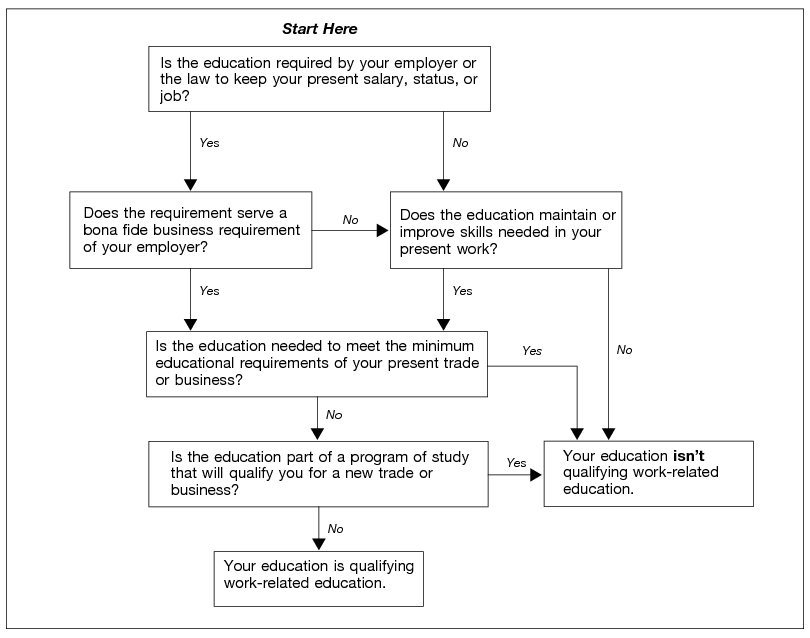
Education To Maintain or Improve Skills
If your education isn’t required by your employer or the law, it can be qualifying work-related education only if it maintains or improves skills needed in your present work. This could include refresher courses, courses on current developments, and academic or vocational courses.
Example.
You repair televisions, radios, and stereo systems for XYZ Store. To keep up with the latest changes, you take special courses in radio and stereo service. These courses maintain and improve skills required in your work.
Maintaining skills vs. qualifying for new job.
Education to maintain or improve skills needed in your present work isn’t qualifying education if it will also qualify you for a new trade or business.
Education during temporary absence.
If you stop working for a year or less in order to get education to maintain or improve skills needed in your present work and then return to the same general type of work, your absence is considered temporary. Education that you get during a temporary absence is qualifying work-related education if it maintains or improves skills needed in your present work.
Example.
You quit your biology research job to become a full-time biology graduate student for 1 year. If you return to work in biology research after completing the courses, the education is related to your present work even if you don’t go back to work with the same employer.
Education during indefinite absence.
If you stop work for more than a year, your absence from your job is considered indefinite. Education during an indefinite absence, even if it maintains or improves skills needed in the work from which you are absent, is considered to qualify you for a new trade or business. Therefore, it isn’t qualifying work-related education.
Education To Meet Minimum Requirements
Education you need to meet the minimum educational requirements for your present trade or business isn’t qualifying work-related education. The minimum educational requirements are determined by:
-
Laws and regulations;
-
Standards of your profession, trade, or business; and
-
Your employer.
Once you have met the minimum educational requirements that were in effect when you were hired, you don’t have to meet any new minimum educational requirements. This means that if the minimum requirements change after you were hired, any education you need to meet the new requirements can be qualifying education.
.You haven’t necessarily met the minimum educational requirements of your trade or business simply because you are already doing the work. .
Example 1.
You are a full-time engineering student. Although you haven’t received your degree or certification, you work part time as an engineer for a firm that will employ you as a full-time engineer after you finish college. Although your college engineering courses improve your skills in your present job, they are also needed to meet the minimum job requirements for a full-time engineer. The education isn’t qualifying work-related education.
Example 2.
You are an accountant and you have met the minimum educational requirements of your employer. Your employer later changes the minimum educational requirements and requires you to take college courses to keep your job. These additional courses can be qualifying work-related education because you have already satisfied the minimum requirements that were in effect when you were hired.
States or school districts usually set the minimum educational requirements for teachers. The requirement is the college degree or the minimum number of college hours usually required of a person hired for that position.
If there are no requirements, you will have met the minimum educational requirements when you become a faculty member. The determination of whether you are a faculty member of an educational institution must be made on the basis of the particular practices of the institution. You will generally be considered a faculty member when one or more of the following occurs.
-
You have tenure.
-
Your years of service count toward obtaining tenure.
-
You have a vote in faculty decisions.
-
Your school makes contributions for you to a retirement plan other than social security or a similar program.
Example 1.
The law in your state requires beginning secondary school teachers to have a bachelor’s degree, including 10 professional education courses. In addition, to keep the job, a teacher must complete a fifth year of training within 10 years from the date of hire. If the employing school certifies to the state Department of Education that qualified teachers can’t be found, the school can hire persons with only 3 years of college. However, to keep their jobs, these teachers must get a bachelor’s degree and the required professional education courses within 3 years.
Under these facts, the bachelor’s degree, whether or not it includes the 10 professional education courses, is considered the minimum educational requirement for qualification as a teacher in your state.
If you have all the required education except the fifth year, you have met the minimum educational requirements. The fifth year of training is qualifying work-related education unless it is part of a program of study that will qualify you for a new trade or business.
Example 2.
Assume the same facts as in Example 1, except that you have a bachelor’s degree and only six professional education courses. The additional four education courses can be qualifying work-related education. Although you don’t have all the required courses, you have already met the minimum educational requirements.
Example 3.
Assume the same facts as in Example 1, except that you are hired with only 3 years of college. The courses you take that lead to a bachelor’s degree (including those in education) aren’t qualifying work-related education. They are needed to meet the minimum educational requirements for employment as a teacher.
Example 4.
You have a bachelor’s degree and you work as a temporary instructor at a university. At the same time, you take graduate courses toward an advanced degree. The rules of the university state that you can become a faculty member only if you get a graduate degree. Also, you can keep your job as an instructor only as long as you show satisfactory progress toward getting this degree. You haven’t met the minimum educational requirements to qualify you as a faculty member. The graduate courses aren’t qualifying work-related education.
Certification in a new state.
Once you have met the minimum educational requirements for teachers for your state, you are considered to have met the minimum educational requirements in all states. This is true even if you must get additional education to be certified in another state. Any additional education you need is qualifying work-related education. You have already met the minimum requirements for teaching. Teaching in another state isn’t a new trade or business.
Example.
You hold a permanent teaching certificate in State A and are employed as a teacher in that state for several years. You move to State B and are promptly hired as a teacher. You are required, however, to complete certain prescribed courses to get a permanent teaching certificate in State B. These additional courses are qualifying work-related education because the teaching position in State B involves the same general kind of work for which you were qualified in State A.
Education That Qualifies You for a New Trade or Business
Education that is part of a program of study that will qualify you for a new trade or business isn’t qualifying work-related education. This is true even if you don’t plan to enter that trade or business.
If you are an employee, a change of duties that involves the same general kind of work isn’t a new trade or business.
Example 1.
You are an accountant. Your employer requires you to get a law degree at your own expense. You register at a law school for the regular curriculum that leads to a law degree. Even if you don’t intend to become a lawyer, the education isn’t qualifying because the law degree will qualify you for a new trade or business.
Example 2.
You are a general practitioner of medicine. You take a 2-week course to review developments in several specialized fields of medicine. The course doesn’t qualify you for a new profession. It is qualifying work-related education because it maintains or improves skills required in your present profession.
Example 3.
While working in the private practice of psychiatry, you enter a program to study and train at an accredited psychoanalytic institute. The program will lead to qualifying you to practice psychoanalysis. The psychoanalytic training doesn’t qualify you for a new profession. It is qualifying work-related education because it maintains or improves skills required in your present profession.
Review courses to prepare for the bar examination or the certified public accountant (CPA) examination aren’t qualifying work-related education. They are part of a program of study that can qualify you for a new profession.
All teaching and related duties are considered the same general kind of work. A change in duties in any of the following ways isn’t considered a change to a new business.
-
Elementary school teacher to secondary school teacher.
-
Teacher of one subject, such as biology, to teacher of another subject, such as art.
-
Classroom teacher to guidance counselor.
-
Classroom teacher to school administrator.
What Expenses Can Be Deducted?
If your education meets the requirements described earlier under Qualifying Work-Related Education, you may be able to deduct your education expenses as business expenses. If you aren’t self-employed, you can deduct business expenses only if you are an Armed Forces reservist, qualified performing artist, fee-based state or local government official, or, for impairment-related expenses, an individual with a disability.
You can’t deduct expenses related to tax-exempt and excluded income.
Deductible expenses.
The following education expenses can be deducted.
-
Tuition, books, supplies, lab fees, and similar items.
-
Certain transportation and travel costs.
-
Other education expenses, such as costs of research and typing when writing a paper as part of an educational program.
Nondeductible expenses.
You can’t deduct personal or capital expenses. For example, you can’t deduct the dollar value of vacation time or annual leave you take to attend classes. This amount is a personal expense.
Unclaimed reimbursement.
If you don’t claim reimbursement that you are entitled to receive from your employer, you can’t deduct the expenses that apply to that unclaimed reimbursement.
Example.
Your employer agrees to pay your education expenses if you file a voucher showing your expenses. You don’t file a voucher and you don’t get reimbursed. Because you didn’t file a voucher, you can’t deduct the expenses on your tax return.
Transportation Expenses
If your education qualifies, you can deduct local transportation costs of going directly from work to school. If you are regularly employed and go to school on a temporary basis, you can also deduct the costs of returning from school to home.
Temporary basis.
You go to school on a temporary basis if either of the following situations applies to you.
-
Your attendance at school is realistically expected to last 1 year or less and does indeed last for 1 year or less.
-
Initially, your attendance at school is realistically expected to last 1 year or less, but at a later date your attendance is reasonably expected to last more than 1 year. Your attendance is temporary up to the date you determine it will last more than 1 year.
Attendance not on a temporary basis.
You don’t go to school on a temporary basis if either of the following situations applies to you.
-
Your attendance at school is realistically expected to last more than 1 year. It doesn’t matter how long you actually attend.
-
Initially, your attendance at school is realistically expected to last 1 year or less, but at a later date your attendance is reasonably expected to last more than 1 year. Your attendance isn’t temporary after the date you determine it will last more than 1 year.
If you are regularly employed and go directly from home to school on a temporary basis, you can deduct the roundtrip costs of transportation between your home and school. This is true regardless of the location of the school, the distance traveled, or whether you attend school on nonwork days.
Transportation expenses include the actual costs of bus, subway, cab, or other fares, as well as the costs of using your car. Transportation expenses don’t include amounts spent for travel, meals, or lodging while you are away from home overnight.
Example 1.
You regularly work in a nearby town, and go directly from work to home. You also attend school every work night for 3 months to take a course that improves your job skills. Since you are attending school on a temporary basis, you can deduct your daily roundtrip transportation expenses in going between home and school. This is true regardless of the distance traveled.
Example 2.
Assume the same facts as in Example 1, except that on certain nights you go directly from work to school and then home. You can deduct your transportation expenses from your regular work site to school and then home.
Example 3.
Assume the same facts as in Example 1, except that you attend the school for 9 months on Saturdays, nonwork days. Since you are attending school on a temporary basis, you can deduct your roundtrip transportation expenses in going between home and school.
Example 4.
Assume the same facts as in Example 1, except that you attend classes twice a week for 15 months. Since your attendance in school isn’t considered temporary, you can’t deduct your transportation expenses in going between home and school. If you go directly from work to school, you can deduct the one-way transportation expenses of going from work to school. If you go from work to home to school and return home, your transportation expenses can’t be more than if you had gone directly from work to school.
Using your car.
If you use your car (whether you own or lease it) for transportation to school, you can deduct your actual expenses or use the standard mileage rate to figure the amount you can deduct. The standard mileage rate for miles driven from January 1, 2025, through December 31, 2025, is 70 cents a mile. Whichever method you use, you can also deduct parking fees and tolls. See Pub. 463, chapter 4, for information on deducting your actual expenses of using a car.
Travel Expenses
You can deduct expenses for travel, meals (see 50% limit on meals, later), and lodging if you travel overnight mainly to obtain qualifying work-related education.
Travel expenses for qualifying work-related education are treated the same as travel expenses for other employee business purposes. For more information, see chapter 1 of Pub. 463.
.You can’t deduct expenses for personal activities such as sightseeing, visiting, or entertaining. .
Mainly personal travel.
If your travel away from home is mainly personal, you can’t deduct all of your expenses for travel, meals, and lodging. You can deduct only your expenses for lodging and meals (see 50% limit on meals, later) during the time you attend the qualified educational activities.
Whether a trip’s purpose is mainly personal or educational depends upon the facts and circumstances. An important factor is the comparison of time spent on personal activities with time spent on educational activities. If you spend more time on personal activities, the trip is considered mainly educational only if you can show a substantial nonpersonal reason for traveling to a particular location.
Example 1.
You work in Newark, New Jersey. You traveled to Chicago to take a deductible 1-week course at the request of your employer. Your main reason for going to Chicago was to take the course.
While there, you took a sightseeing trip, entertained some friends, and took a side trip to Pleasantville for a day.
Since the trip was mainly for business, you can deduct your roundtrip airfare to Chicago. You can’t deduct your transportation expenses of going to Pleasantville. You can deduct only the meals (see 50% limit on meals, later) and lodging connected with your educational activities.
Example 2.
You work in Boston. You went to a university in Michigan to take a course for work. The course is qualifying work-related education.
You took one course, which is one-fourth of a full course load of study. You spent the rest of the time on personal activities. Your reasons for taking the course in Michigan were all personal.
Your trip is mainly personal because three-fourths of your time is considered personal time. You can’t deduct the cost of your roundtrip train ticket to Michigan. You can deduct one-fourth of the meals (see 50% limit on meals, later) and lodging costs for the time you attended the university.
Example 3.
You work in Nashville and recently traveled to California to take a 2-week seminar. The seminar is qualifying work-related education.
While there, you spent an extra 8 weeks on personal activities. The facts, including the extra 8-week stay, show that your main purpose was to take a vacation.
You can’t deduct your roundtrip airfare or your meals and lodging for the 8 weeks. You can deduct only your expenses for meals (see 50% limit on meals, later) and lodging for the 2 weeks you attended the seminar.
Cruises and conventions.
Certain cruises and conventions offer seminars or courses as part of their itinerary. Even if the seminars or courses are work related, your deduction for travel may be limited. This applies to:
-
Travel by ocean liner, cruise ship, or other form of luxury water transportation; and
-
Conventions outside the North American area.
For a discussion of the limits on travel expense deductions that apply to cruises and conventions, see Luxury Water Travel and Conventions in chapter 1 of Pub. 463.
50% limit on meals.
You can deduct only 50% of the cost of your meals while traveling away from home to obtain qualifying work-related education. If you were reimbursed for the meals, see How To Treat Reimbursements, later.
Qualified performing artists and fee-based state or local government officials must use Form 2106 to apply the 50% limit.
You can’t deduct the cost of travel as a form of education even if it is directly related to your duties in your work or business.
Example.
You are a French language teacher. While on sabbatical leave granted for travel, you traveled through France to improve your knowledge of the French language. You chose your itinerary and most of your activities to improve your French language skills. You can’t deduct your travel expenses as education expenses. This is true even if you spent most of your time learning French by visiting French schools and families, attending movies or plays, and engaging in similar activities.
No Double Benefit Allowed
You can’t do the following.
-
Deduct work-related education expenses as business expenses if you benefit from these expenses under any other provision of the law.
-
Deduct work-related education expenses paid with tax-free scholarship, grant, or employer-provided educational assistance.
If you pay qualifying work-related education expenses with certain tax-free funds, you can’t claim a deduction for those amounts. You must reduce the qualifying expenses by the amount of such expenses allocable to the tax-free educational assistance.
Tax-free educational assistance.
This includes:
-
The tax-free part of scholarships and fellowship grants (see Tax-Free Scholarships and Fellowship Grants in chapter 1);
-
The tax-free part of Pell grants (see Pell Grants and Other Title IV Need-Based Education Grants in chapter 1);
-
Employer-provided educational assistance (see chapter 10);
-
Veterans’ educational assistance (see Veterans' Benefits in chapter 1); and
-
Any other nontaxable (tax-free) payments (other than gifts or inheritances) received as educational assistance.
Amounts that don’t reduce qualifying work-related education expenses.
Don’t reduce the qualifying work-related education expenses by amounts paid with funds the student receives as:
-
Payment for services, such as wages;
-
A loan;
-
A gift;
-
An inheritance; or
-
A withdrawal from the student’s personal savings.
Also, don’t reduce the qualifying work-related education expenses by any scholarship or fellowship grant reported as income on the student’s return or any scholarship that, by its terms, can’t be applied to qualifying work-related education expenses.
How To Treat Reimbursements
How you treat reimbursements depends on the arrangement you have with your employer.
There are two basic types of reimbursement arrangements—accountable plans and nonaccountable plans. You can tell the type of plan you are reimbursed under by the way the reimbursement is reported on your Form W-2.
Note.
The following rules about reimbursement arrangements also apply to expense allowances received from your employer.
Accountable Plans
To be an accountable plan, your employer’s reimbursement arrangement must require you to meet all three of the following rules.
-
Your expenses must have a business connection. This means your expenses must be allowed under the rules for qualifying work-related education explained earlier.
-
You must adequately account to your employer for your expenses within a reasonable period of time.
-
You must return any reimbursement or allowance in excess of the expenses accounted for within a reasonable period of time.
If you are reimbursed under an accountable plan, your employer shouldn’t include any reimbursement of income on your Form W-2, box 1.
.If your employer included reimbursements on your Form W-2, box 1, and you meet all three rules for accountable plans, ask your employer for a corrected Form W-2. .
Accountable plan rules not met.
Even though you are reimbursed under an accountable plan, some of your expenses may not meet all three rules for accountable plans. Those expenses that fail to meet the three rules are treated as having been reimbursed under a Nonaccountable Plan (discussed later).
Expenses equal reimbursement.
Under an accountable plan, if your expenses equal your reimbursement, you don’t complete Form 2106. Because your expenses and reimbursements are equal, you don’t have unreimbursed work-related education expenses.
Excess expenses.
If your expenses are more than your reimbursement, you generally cannot deduct your excess expenses. See Deducting Business Expenses, later.
Allocating your reimbursements for meals.
Because your excess meal expenses are subject to the 50% limit, you must figure them separately from your other expenses. If your employer paid you a single amount to cover both meals and other expenses, you must allocate the reimbursement so that you can figure your excess meal expenses separately. Make the allocation as follows.
-
Divide your meal expenses by your total expenses.
-
Multiply your total reimbursement by the result from (1). This is the allocated reimbursement for your meal expenses.
-
Subtract the amount figured in (2) from your total reimbursement. The difference is the allocated reimbursement for your other expenses of qualifying work-related education.
Example.
You are a qualified performing artist and one of your employers paid you an expense allowance of $2,000 under an accountable plan. The allowance was to cover all of your expenses of traveling away from home to take a 2-week training course for work. There was no indication of how much of the reimbursement was for each type of expense. Your actual expenses equal $2,500 ($425 for meals + $700 lodging + $150 transportation expenses + $1,225 for books and tuition).
Using the steps listed above, allocate the reimbursement between the $425 meal expenses and the $2,075 other expenses.
| 1. | $425 meal expenses | = | 0.17 | |
| $2,500 total expenses |
| 2. | $2,000 (reimbursement) × 0.17 | |||||||
| = $340 (allocated reimbursement for meal expenses) | ||||||||
| 3. | $2,000 (reimbursement) − $340 (meals) | ||||||
| = | $1,660 (allocated reimbursement for other qualifying work-related education expenses) | ||||||
Nonaccountable Plans
Your employer will combine the amount of any reimbursement or other expense allowance paid to you under a nonaccountable plan with your wages, salary, or other pay and report the total on your Form W-2, box 1.
You generally cannot deduct your expenses regardless of whether they are more than, less than, or equal to your reimbursement. See Deducting Business Expenses, later.
Reimbursements for nondeductible expenses.
Reimbursements you received for nondeductible expenses are treated as paid under a nonaccountable plan. You must include them in your income. For example, you must include in your income reimbursements your employer gave you for expenses of education that:
-
You need to meet the minimum educational requirements for your job, or
-
Is part of a program of study that can qualify you for a new trade or business.
For more information on accountable and nonaccountable plans, see chapter 6 of Pub. 463.
Deducting Business Expenses
Self-employed persons and employees report their business expenses differently.
The following information explains what forms you must use to deduct the cost of your qualifying work-related education as a business expense.
Self-Employed Persons
If you are self-employed, you must report the cost of your qualifying work-related education on the appropriate form used to report your business income and expenses (generally, Schedule C (Form 1040), or Schedule F (Form 1040)). If your education expenses include expenses for a car or truck, travel, or meals, report those expenses the same way you report other business expenses for those items. See the instructions for the form you file for information on how to complete it.
Armed Forces Reservists, Performing Artists, and Fee-Basis Officials
If you are an Armed Forces reservist, a qualified performing artist, or a state (or local) government official who is paid in whole or in part on a fee basis, you can deduct the cost of your qualifying work-related education as an adjustment to gross income.
Include the cost of your qualifying work-related education with any other employee business expenses on Schedule 1 (Form 1040), line 12. You must complete Form 2106 to figure your deduction.
For more information on qualified performing artists, see chapter 6 of Pub. 463.
Impairment-Related Work Expenses
If you are an individual with a disability and have impairment-related work expenses that are necessary for you to be able to get qualifying work-related education, you can deduct these expenses on Schedule A (Form 1040), line 16, or Schedule A (Form 1040-NR), line 7. To deduct these expenses, you must complete Form 2106.
For more information on impairment-related work expenses, see chapter 6 of Pub. 463.
Recordkeeping
. You must keep records as proof of any deduction claimed on your tax return. Generally, you should keep your records for 3 years from the date of filing the tax return and claiming the deduction. .
If you are an employee who is reimbursed for expenses and you give your records and documentation to your employer, you don’t have to keep duplicate copies of this information. However, you should keep your records for a 3-year period if:
-
You claim deductions for expenses that are more than your reimbursement,
-
Your employer doesn’t use adequate accounting procedures to verify expense accounts,
-
You are related to your employer, or
-
Your expenses are reimbursed under a nonaccountable plan.
Examples of records to keep.
If any of the above cases apply to you, you must be able to prove that your expenses are deductible. You should keep adequate records or have sufficient evidence that will support your expenses. Estimates or approximations don’t qualify as proof of an expense. Some examples of what can be used to help prove your expenses are the following.
-
Documents, such as transcripts, course descriptions, catalogs, etc., showing periods of enrollment in educational institutions, principal subjects studied, and descriptions of educational activity.
-
Canceled checks and receipts to verify amounts you spent for:
-
Tuition and books,
-
Meals and lodging while away from home overnight for educational purposes,
-
Travel and transportation, and
-
Other education expenses.
-
-
Statements from your employer explaining whether the education was necessary for you to keep your job, salary, or status; how the education helped maintain or improve skills needed in your job; how much reimbursement you received; and, if you are a teacher, the type of certificate and subjects taught.
-
Complete information about any scholarship or fellowship grants, including amounts you received during the year.
If you have questions about a tax issue; need help preparing your tax return; or want to download free publications, forms, or instructions, go to IRS.gov to find resources that can help you right away.
Tax reform.
Tax reform legislation impacting federal taxes, credits, and deductions was enacted in P.L. 119-21, commonly known as the One Big Beautiful Bill Act, on July 4, 2025. Go to IRS.gov/OBBB for more information and updates on how this legislation affects your taxes.
Preparing and filing your tax return.
After receiving all your wage and earnings statements (Forms W-2, W-2G, 1099-R, 1099-MISC, 1099-NEC, etc.); unemployment compensation statements (by mail or in a digital format) or other government payment statements (Form 1099-G); and interest, dividend, and retirement statements from banks and investment firms (Forms 1099), you have several options to choose from to prepare and file your tax return. You can prepare the tax return yourself, see if you qualify for free tax preparation, or hire a tax professional to prepare your return.
Free options for tax preparation.
Your options for preparing and filing your return online or in your local community, if you qualify, include the following.
-
Free File. This program lets you prepare and file your federal individual income tax return for free using software or Free File Fillable Forms. However, state tax preparation may not be available through Free File. Go to IRS.gov/FreeFile to see if you qualify for free online federal tax preparation, e-filing, and direct deposit or payment options.
-
VITA. The Volunteer Income Tax Assistance (VITA) program offers free tax help to people with low-to-moderate incomes, persons with disabilities, and limited-English-speaking taxpayers who need help preparing their own tax returns. Go to IRS.gov/VITA, download the free IRS2Go app, or call 800-906-9887 for information on free tax return preparation.
-
TCE. The Tax Counseling for the Elderly (TCE) program offers free tax help for all taxpayers, particularly those who are 60 years of age and older. TCE volunteers specialize in answering questions about pensions and retirement-related issues unique to seniors. Go to IRS.gov/TCE or download the free IRS2Go app for information on free tax return preparation.
-
MilTax. Members of the U.S. Armed Forces and qualified veterans may use MilTax, a free tax service offered by the Department of Defense through Military OneSource. For more information, go to MilitaryOneSource (MilitaryOneSource.mil/MilTax).
Also, the IRS offers Free Fillable Forms, which can be completed online and then e-filed regardless of income.
Using online tools to help prepare your return.
Go to IRS.gov/Tools for the following.
-
The Earned Income Tax Credit Assistant (IRS.gov/EITCAssistant) determines if you’re eligible for the earned income credit (EITC).
-
The Online EIN Application (IRS.gov/EIN) helps you get an employer identification number (EIN) at no cost.
-
The Tax Withholding Estimator (IRS.gov/W4App) makes it easier for you to estimate the federal income tax you want your employer to withhold from your paycheck. This is tax withholding. See how your withholding affects your refund, take-home pay, or tax due.
-
The Sales Tax Deduction Calculator (IRS.gov/SalesTax) figures the amount you can claim if you itemize deductions on Schedule A (Form 1040).
. Getting answers to your tax questions. On IRS.gov, you can get up-to-date information on current events and changes in tax law..
-
IRS.gov/Help: A variety of tools to help you get answers to some of the most common tax questions.
-
IRS.gov/ITA: The Interactive Tax Assistant, a tool that will ask you questions and, based on your input, provide answers on a number of tax topics.
-
IRS.gov/Forms: Find forms, instructions, and publications. You will find details on the most recent tax changes and interactive links to help you find answers to your questions.
-
You may also be able to access tax information in your e-filing software.
Need someone to prepare your tax return?
There are various types of tax return preparers, including enrolled agents, certified public accountants (CPAs), accountants, and many others who don’t have professional credentials. If you choose to have someone prepare your tax return, choose that preparer wisely. A paid tax preparer is:
-
Primarily responsible for the overall substantive accuracy of your return,
-
Required to sign the return, and
-
Required to include their preparer tax identification number (PTIN).
.Although the tax preparer always signs the return, you’re ultimately responsible for providing all the information required for the preparer to accurately prepare your return and for the accuracy of every item reported on the return. Anyone paid to prepare tax returns for others should have a thorough understanding of tax matters. For more information on how to choose a tax preparer, go to Tips for Choosing a Tax Preparer on IRS.gov..
Employers can register to use Business Services Online.
The Social Security Administration (SSA) offers online service at SSA.gov/employer for fast, free, and secure W-2 filing options to CPAs, accountants, enrolled agents, and individuals who process Form W-2, Wage and Tax Statement; and Form W-2c, Corrected Wage and Tax Statement.
Business tax account.
If you are a sole proprietor, a partnership, an S corporation, a C corporation, or a single-member limited liability company (LLC), you can view your tax information on record with the IRS and do more with a business tax account. Go to IRS.gov/BusinessAccount for more information.
IRS social media.
Go to IRS.gov/SocialMedia to see the various social media tools the IRS uses to share the latest information on tax changes, scam alerts, initiatives, products, and services. At the IRS, privacy and security are our highest priority. We use these tools to share public information with you. Don’t post your social security number (SSN) or other confidential information on social media sites. Always protect your identity when using any social networking site.
The following IRS YouTube channels provide short, informative videos on various tax-related topics in English and ASL.
Over-the-Phone Interpreter (OPI) Service.
The IRS offers the OPI Service to taxpayers needing language interpretation. The OPI Service is available at Taxpayer Assistance Centers (TACs), most IRS offices, and every VITA/TCE tax return site. This service is available in Spanish, Mandarin, Cantonese, Korean, Vietnamese, Russian, and Haitian Creole.
Accessibility Helpline available for taxpayers with disabilities.
Taxpayers who need information about accessibility services can call 833-690-0598. The Accessibility Helpline can answer questions related to current and future accessibility products and services available in alternative media formats (for example, braille-ready, large print, audio, etc.). The Accessibility Helpline does not have access to your IRS account. For help with tax law, refunds, or account-related issues, go to IRS.gov/LetUsHelp.
Alternative media preference.
Form 9000, Alternative Media Preference, or Form 9000(SP) allows you to elect to receive certain types of written correspondence in the following formats.
-
Standard Print.
-
Large Print.
-
Braille.
-
Audio (MP3).
-
Plain Text File (TXT).
-
Braille-Ready File (BRF).
Disasters.
Go to IRS.gov/DisasterRelief to review the available disaster tax relief.
Getting tax forms and publications.
Go to IRS.gov/Forms to view, download, or print all the forms, instructions, and publications you may need. Or you can go to IRS.gov/OrderForms to place an order.
Mobile-friendly forms.
You’ll need an IRS Online Account (OLA) to complete mobile-friendly forms that require signatures. You’ll have the option to submit your form(s) online or download a copy for mailing. You’ll need scans of your documents to support your submission. Go to IRS.gov/MobileFriendlyForms for more information.
Getting tax publications and instructions in eBook format.
Download and view most tax publications and instructions (including the Instructions for Form 1040) on mobile devices as eBooks at IRS.gov/eBooks.
IRS eBooks have been tested using Apple’s iBooks for iPad. Our eBooks haven’t been tested on other dedicated eBook readers, and eBook functionality may not operate as intended.
Access your online account (individual taxpayers only).
Go to IRS.gov/Account to securely access information about your federal tax account.
-
View the amount you owe and a breakdown by tax year.
-
See payment plan details or apply for a new payment plan.
-
Make a payment or view 5 years of payment history and any pending or scheduled payments.
-
Access your tax records, including key data from your most recent tax return, and transcripts.
-
View digital copies of select notices from the IRS.
-
Approve or reject authorization requests from tax professionals.
Get a transcript of your return.
With an online account, you can access a variety of information to help you during the filing season. You can get a transcript, review your most recently filed tax return, and get your adjusted gross income. Create or access your online account at IRS.gov/Account.
Tax Pro Account.
This tool lets your tax professional submit an authorization request to access your individual taxpayer IRS OLA. For more information, go to IRS.gov/TaxProAccount.
Using direct deposit.
The safest and easiest way to receive a tax refund is to e-file and choose direct deposit, which securely and electronically transfers your refund directly into your financial account. Direct deposit also avoids the possibility that your check could be lost, stolen, destroyed, or returned undeliverable to the IRS. Eight in 10 taxpayers use direct deposit to receive their refunds. If you don’t have a bank account, go to IRS.gov/DirectDeposit for more information on where to find a bank or credit union that can open an account online.
Reporting and resolving your tax-related identity theft issues.
-
Tax-related identity theft happens when someone steals your personal information to commit tax fraud. Your taxes can be affected if your SSN is used to file a fraudulent return or to claim a refund or credit.
-
The IRS doesn’t initiate contact with taxpayers by email, text messages (including shortened links), telephone calls, or social media channels to request or verify personal or financial information. This includes requests for personal identification numbers (PINs), passwords, or similar information for credit cards, banks, or other financial accounts.
-
Go to IRS.gov/IdentityTheft, the IRS Identity Theft Central webpage, for information on identity theft and data security protection for taxpayers, tax professionals, and businesses. If your SSN has been lost or stolen or you suspect you’re a victim of tax-related identity theft, you can learn what steps you should take.
-
Get an Identity Protection PIN (IP PIN). IP PINs are six-digit numbers assigned to taxpayers to help prevent the misuse of their SSNs on fraudulent federal income tax returns. When you have an IP PIN, it prevents someone else from filing a tax return with your SSN. To learn more, go to IRS.gov/IPPIN.
Ways to check on the status of your refund.
-
Go to IRS.gov/Refunds.
-
Download the official IRS2Go app to your mobile device to check your refund status.
-
Call the automated refund hotline at 800-829-1954.
.The IRS can’t issue refunds before mid-February for returns that claimed the EITC or the additional child tax credit (ACTC). This applies to the entire refund, not just the portion associated with these credits..
Making a tax payment.
The IRS recommends paying electronically whenever possible. Options to pay electronically are included in the list below. Payments of U.S. tax must be remitted to the IRS in U.S. dollars. Digital assets are not accepted. Go to IRS.gov/Payments for information on how to make a payment using any of the following options.
-
IRS Direct Pay: Pay taxes from your bank account. It’s free and secure, and no sign-in is required. You can change or cancel within 2 days of scheduled payment.
-
Debit Card, Credit Card, or Digital Wallet: Choose an approved payment processor to pay online or by phone.
-
Electronic Funds Withdrawal: Schedule a payment when filing your federal taxes using tax return preparation software or through a tax professional.
-
Electronic Federal Tax Payment System: This is the best option for businesses. Enrollment is required.
-
Check or Money Order: Mail your payment to the address listed on the notice or instructions.
-
Cash: You may be able to pay your taxes with cash at a participating retail store.
-
Same-Day Wire: You may be able to do same-day wire from your financial institution. Contact your financial institution for availability, cost, and time frames.
What if I can’t pay now?
Go to IRS.gov/Payments for more information about your options.
-
Apply for an online payment agreement (IRS.gov/OPA) to meet your tax obligation in monthly installments if you can’t pay your taxes in full today. Once you complete the online process, you will receive immediate notification of whether your agreement has been approved.
-
Use the Offer in Compromise Pre-Qualifier to see if you can settle your tax debt for less than the full amount you owe. For more information on the Offer in Compromise program, go to IRS.gov/OIC.
Filing an amended return.
Go to IRS.gov/1040X for information and updates.
Checking the status of your amended return.
Go to IRS.gov/WMAR to track the status of Form 1040-X amended returns.
.It can take up to 3 weeks from the date you filed your amended return for it to show up in our system, and processing it can take up to 16 weeks..
Understanding an IRS notice or letter you’ve received.
Go to IRS.gov/Notices to find additional information about responding to an IRS notice or letter.
IRS Document Upload Tool.
You may be able to use the Document Upload Tool to respond digitally to eligible IRS notices and letters by securely uploading required documents online through IRS.gov. For more information, go to IRS.gov/DUT.
Schedule LEP.
You can use Schedule LEP (Form 1040), Request for Change in Language Preference, to state a preference to receive notices, letters, or other written communications from the IRS in an alternative language. You may not immediately receive written communications in the requested language. The IRS’s commitment to LEP taxpayers is part of a multi-year timeline that began providing translations in 2023. You will continue to receive communications, including notices and letters, in English until they are translated to your preferred language.
Contacting your local TAC.
Keep in mind, many questions can be answered on IRS.gov without visiting a TAC. Go to IRS.gov/LetUsHelp for the topics people ask about most. If you still need help, TACs provide tax help when a tax issue can’t be handled online or by phone. All TACs now provide service by appointment, so you’ll know in advance that you can get the service you need without long wait times. Before you visit, go to IRS.gov/TAC to find the nearest TAC and to check hours, available services, and appointment options. Or, on the IRS2Go app, under the Stay Connected tab, choose the Contact Us option and click on “Local Offices.”
—————————————————————
Below is a message to you from the Taxpayer Advocate Service, an independent organization established by Congress.
The Taxpayer Advocate Service (TAS) Is Here To Help You
What Is the Taxpayer Advocate Service?
The Taxpayer Advocate Service (TAS) is an independent organization within the Internal Revenue Service (IRS). TAS helps taxpayers resolve problems with the IRS, makes administrative and legislative recommendations to prevent or correct the problems, and protects taxpayer rights. We work to ensure that every taxpayer is treated fairly and that you know and understand your rights under the Taxpayer Bill of Rights. We are Your Voice at the IRS.
TAS can help you resolve problems that you haven’t been able to resolve with the IRS on your own. Always try to resolve your problem with the IRS first, but if you can’t, then come to TAS. Our services are free.
-
TAS helps all taxpayers (and their representatives), including individuals, businesses, and exempt organizations. You may be eligible for TAS help if your IRS problem is causing financial difficulty, if you’ve tried and been unable to resolve your issue with the IRS, or if you believe an IRS system, process, or procedure just isn’t working as it should.
-
To get help any time with general tax topics, visit www.TaxpayerAdvocate.IRS.gov. The site can help you with common tax issues and situations, such as what to do if you make a mistake on your return or if you get a notice from the IRS.
-
TAS works to resolve large-scale (systemic) problems that affect many taxpayers. You can report systemic issues at www.IRS.gov/SAMS. (Be sure not to include any personal identifiable information.)
TAS has offices in every state, the District of Columbia, and Puerto Rico. To find your local advocate’s number:
-
Check your local directory, or
-
Call TAS toll free at 877-777-4778.
The Taxpayer Bill of Rights describes ten basic rights that all taxpayers have when dealing with the IRS. Go to www.TaxpayerAdvocate.IRS.gov/Taxpayer-Rights for more information about the rights, what they mean to you, and how they apply to specific situations you may encounter with the IRS. TAS strives to protect taxpayer rights and ensure the IRS is administering the tax law in a fair and equitable way.
Appendix
The following appendix is provided to help you claim the education benefits that will give you the lowest tax. It consists of a chart summarizing some of the major differences between the education tax benefits discussed in this publication. It is intended only as a guide. Look in this publication for more complete information.
Highlights of Education Tax Benefits for Tax Year 2025
This chart highlights some differences among the benefits discussed in this publication. See the text for definitions and details.Don’t rely on this chart alone. |
| Scholarships, fellowship grants, grants, and tuition reductions |
American opportunity credit | Lifetime learning credit | Student loan interest deduction | Coverdell ESA† | Qualified Tuition Program (QTP)† | Education exception to additional tax on early IRA distributions† | Education savings bond program† | Employer- provided educational assistance† |
Business deduction for work-related education | |
| What is your benefit? |
Amounts received may not be taxable |
Credits can reduce the amount of tax you must pay 40% of the credit may be refundable (limited to $1,000 per student) |
Credits can reduce the amount of tax you must pay | Can deduct interest paid | Earnings not taxed |
Earnings not taxed | No 10% additional tax on early distribution |
Interest not taxed | Employer benefits not taxed | Individuals who are self- employed, Armed Forces reservists, qualified performing artists, fee- based officials, or disabled can deduct certain expenses |
| What is the annual limit? | None | $2,500 credit per student | $2,000 credit per tax return |
$2,500 deduction | $2,000 contribution per beneficiary | None | Amount of qualified education expenses |
Amount of qualified education expenses |
$5,250 exclusion | Amount of qualifying work-related education expenses |
| What expenses qualify besides tuition and required enrollment fees? |
Course-related expenses such as fees, books, supplies, and equipment | Course-related books, supplies, and equipment | Amounts paid for required books, etc., that must be paid to the educational institution are required fees | Books Supplies Equipment Room & board Transportation Other necessary expenses |
Books Supplies Equipment Computer equipment, computer software, or Internet access and related services Expenses for special needs services Payments to QTP Higher education: Room & board if at least half-time student Elem/sec (K–12) education: See chapter 6 |
Higher education: Books Supplies Equipment Room & board if at least half-time student Computer equipment, computer software, or Internet access and related services Expenses for special needs services Elem/sec (K–12) education: See chapter 7 Postsecondary credential: See chapter 7 |
Books Supplies Equipment Room & board if at least half-time student Computer equipment, computer software, or Internet access and related services Expenses for special needs services Elem/sec (K–12) education: See chapter 8 Postsecondary credential: See chapter 8 |
Contributions to Coverdell ESA Contributions to QTP |
Books Supplies Equipment |
Transportation Travel Other necessary expenses |
| Scholarships, fellowship grants, grants, and tuition reductions |
American opportunity credit | Lifetime learning credit | Student loan interest deduction | Coverdell ESA† | Qualified Tuition Program (QTP)† | Education exception to additional tax on early IRA distributions† | Education savings bond program† | Employer- provided educational assistance† |
Business deduction for work-related education | |
| What education qualifies? | Undergraduate & graduate K–12 |
Undergraduate & graduate | Undergraduate & graduate Courses to acquire or improve job skills |
Undergraduate & graduate | Undergraduate & graduate K–12 |
Undergraduate & graduate K–12 for no more than $10,000 of tuition Postsecondary credential |
Undergraduate & graduate K–12 Postsecondary credential |
Undergraduate & graduate | Undergraduate & graduate | Required by employer or law to keep present job, salary, status Maintain or improve job skills |
| What are some of the other conditions that apply? |
Must be in degree or vocational program Payment of tuition and required fees must be allowed under the grant |
Can be claimed for only 4 tax years Must be enrolled at least half-time in degree program No felony drug conviction(s) Must not have completed first 4 years of postsecondary education before end of preceding tax year |
No other conditions | Must have been at least half-time student in degree program |
Assets must be distributed at age 30 unless special needs beneficiary |
No other conditions | No other conditions | Applies only to qualified series EE bonds issued after 1989 or series I bonds |
No other conditions | Can’t be to meet minimum educational requirements of present trade/business Can’t qualify you for new trade/business |
| In what income range do benefits phase out? |
No phaseout | $80,000 – $90,000 $160,000 – $180,000 for joint returns |
$80,000 – $90,000 $160,000 – $180,000 for joint returns |
$85,000 – $100,000 $170,000 – $200,000 for joint returns |
$95,000 – $110,000 $190,000 – $220,000 for joint returns |
No phaseout | No phaseout | $99,500 – $114,500 $149,250 – $179,250 for joint returns |
No phaseout | No phaseout |
| † Any nontaxable distribution is limited to the amount that doesn’t exceed qualified education expenses. | ||||||||||
Glossary
The education benefits included in this publication were enacted over many years, leading to a number of common terms being defined differently from one benefit to the next. For example, an eligible educational institution means one thing when determining if earnings from a Coverdell ESA aren’t taxable and something else when determining if a scholarship or fellowship grant isn’t taxable.
For each term listed below that has more than one definition, the definition for each education benefit is listed.
Academic period:
A semester, trimester, quarter, or other period of study (such as a summer school session) as reasonably determined by an educational institution. If an educational institution uses credit hours or clock hours and doesn’t have academic terms, each payment period can be treated as an academic period.
Adjusted qualified education expenses (AQEE):
Qualified education expenses (defined later) reduced by any tax-free educational assistance, such as a tax-free scholarship or employer-provided educational assistance. They must also be reduced by any qualified education expenses deducted elsewhere on your return, used to determine an education credit or other benefit, or used to determine a tax-free distribution. For information on a specific benefit, see the appropriate chapter in this publication.
Candidate for a degree:
A student who meets either of the following requirements.
-
Attends a primary or secondary school or pursues a degree at a college or university.
-
Attends an accredited educational institution that is authorized to provide:
-
A program that is acceptable for full credit toward a bachelor’s or higher degree, or
-
A program of training to prepare students for gainful employment in a recognized occupation.
-
Designated beneficiary:
The individual named in the document creating the account/plan who is to receive the benefit of the funds in the account/plan.
Eligible educational institution:
-
American opportunity credit. Any college, university, vocational school, or other postsecondary educational institution eligible to participate in a student aid program administered by the U.S. Department of Education. It includes virtually all accredited public, nonprofit, and proprietary (privately owned profit-making) postsecondary institutions.
-
Coverdell education savings account (ESA). Any college, university, vocational school, or other postsecondary educational institution eligible to participate in a student aid program administered by the U.S. Department of Education. It includes virtually all accredited public, nonprofit, and proprietary (privately owned profit-making) postsecondary institutions. Also included is any public, private, or religious school that provides elementary or secondary education (kindergarten through grade 12), as determined under state law.
-
Education savings bond program. Same as American opportunity credit in this category.
-
IRA, early distributions from. Same as American opportunity credit in this category.
-
Lifetime learning credit. Same as American opportunity credit in this category.
-
Qualified tuition program (QTP). Generally, same as Coverdell education savings account (ESA) in this category.
-
Scholarships and fellowship grants. An institution that maintains a regular faculty and curriculum and normally has a regularly enrolled body of students in attendance at the place where it carries on its educational activities.
-
Student loan, cancellation of. Same as Scholarships and fellowship grants in this category.
-
Student loan interest deduction. Any college, university, vocational school, or other postsecondary educational institution eligible to participate in a student aid program administered by the U.S. Department of Education. It includes virtually all accredited public, nonprofit, and proprietary (privately owned profit-making) postsecondary institutions. Also included is an institution that conducts an internship or residency program leading to a degree or certificate from an institution of higher education, a hospital, or a health care facility that offers postgraduate training.
Eligible student:
-
American opportunity credit. A student who meets all of the following requirements for the tax year for which the credit is being determined.
-
Didn’t have expenses that were used to figure an American opportunity credit in any 4 earlier tax years.
-
Hadn’t completed the first 4 years of postsecondary education (generally, the freshman through senior years) in an earlier tax year.
-
For at least one academic period beginning in the tax year, was enrolled at least half-time in a program leading to a degree, certificate, or other recognized educational credential at an eligible educational institution.
-
Was free of any federal or state felony conviction for possessing or distributing a controlled substance as of the end of the tax year.
-
-
Lifetime learning credit. A student who is enrolled in one or more courses at an eligible educational institution.
-
Student loan interest deduction. A student who was enrolled at least half-time in a program leading to a postsecondary degree, certificate, or other recognized educational credential at an eligible educational institution.
Half-time student:
A student who is enrolled for at least half the full-time academic workload for the course of study the student is pursuing, as determined under the standards of the school where the student is enrolled.
Modified adjusted gross income (MAGI):
-
American opportunity credit. Adjusted gross income (AGI) as figured on the federal income tax return, modified by adding back any:
-
Foreign earned income exclusion,
-
Foreign housing exclusion,
-
Foreign housing deduction,
-
Exclusion of income by bona fide residents of American Samoa, and
-
Exclusion of income by bona fide residents of Puerto Rico.
-
-
Coverdell education savings account (ESA). Same as American opportunity credit in this category.
-
Education savings bond program. AGI as figured on the federal income tax return without taking into account any savings bond interest exclusion and modified by adding back any:
-
Foreign earned income exclusion,
-
Foreign housing exclusion,
-
Foreign housing deduction,
-
Exclusion of income by bona fide residents of American Samoa,
-
Exclusion of income by bona fide residents of Puerto Rico,
-
Exclusion for adoption benefits received under an employer’s adoption assistance program, and
-
Deduction for student loan interest.
-
-
Lifetime learning credit. Same as American opportunity credit in this category.
-
Student loan interest deduction. AGI as figured on the federal income tax return without taking into account any student loan interest deduction, and modified by adding back any:
-
Foreign earned income exclusion,
-
Foreign housing exclusion,
-
Foreign housing deduction,
-
Exclusion of income by bona fide residents of American Samoa, and
-
Exclusion of income by bona fide residents of Puerto Rico.
-
Phaseout:
The amount of credit or deduction allowed is reduced when the MAGI is greater than a specified amount of income.
Qualified education expenses:
See the pertinent chapter for specific items.
-
American opportunity credit. Tuition and certain related expenses (including student activity fees) required for enrollment or attendance at an eligible educational institution. Books, supplies, and equipment needed for a course of study are included even if not purchased from the educational institution. Doesn’t include expenses for room and board. Doesn’t include expenses for courses involving sports, games, or hobbies (including noncredit courses) that aren’t part of the student’s postsecondary degree program.
-
Coverdell education savings account (ESA). Expenses related to or required for enrollment or attendance of the designated beneficiary at an eligible elementary, secondary, or postsecondary school. Includes computer or peripheral equipment, computer software, or Internet access and related services. Many specialized expenses included for K–12. Also includes expenses for special needs services and contributions to a QTP.
-
Education savings bond program. Tuition and fees required to enroll at or attend an eligible educational institution. Also includes contributions to a QTP or Coverdell ESA. Doesn’t include expenses for room and board. Doesn’t include expenses for courses involving sports, games, or hobbies that aren’t part of a degree or certificate-granting program.
-
IRA, early distributions from. Tuition, fees, books, supplies, and equipment required for enrollment or attendance at an eligible educational institution, including expenses incurred in connection with a recognized postsecondary credential program, plus certain limited costs of room and board for students who are enrolled at least half-time. Also includes expenses for special needs services incurred by or for special needs students in connection with their enrollment or attendance. Additionally, includes certain expenses in connection with the enrollment or attendance at an elementary or secondary school.
-
Lifetime learning credit. Tuition and certain related expenses required for enrollment or attendance at an eligible educational institution. Student activity fees and expenses for course-related books, supplies, and equipment are included only if the fees and expenses must be paid to the institution as a condition of enrollment or attendance. Doesn’t include expenses for room and board. Doesn’t include expenses for courses involving sports, games, or hobbies (including noncredit courses) that aren’t part of the student’s postsecondary degree program, unless taken by the student to acquire or improve job skills.
-
Qualified tuition program (QTP). Tuition, fees, books, supplies, and equipment required for enrollment or attendance at an eligible higher educational institution, plus certain limited costs of room and board for students who are enrolled at least half-time. Includes computer or peripheral equipment, computer software, or Internet access and related services. Also includes expenses for special needs services and computer access. Also, for amounts paid from distributions made after 2017, includes no more than $10,000 of elementary and secondary school (K–12) tuition incurred after 2017. Additionally, includes expenses related to enrollment or attendance at a postsecondary credential program.
-
Scholarships and fellowship grants. Expenses for tuition and fees required to enroll at or attend an eligible educational institution, and course-related expenses, such as fees, books, supplies, and equipment that are required for the courses at the eligible educational institution. Course-related items must be required of all students in the course of instruction.
-
Student loan interest deduction. Total costs of attending an eligible educational institution, including graduate school (however, limitations may apply to the cost of room and board allowed).
Recapture:
To include as income on your current year’s return an amount allowed as a deduction in a prior year. To include as tax on your current year’s return an amount allowed as a credit in a prior year.
Rollover:
A tax-free distribution to you of cash or other assets from a tax-favored plan that you contribute to another tax-favored plan.
Symbols
- 529 program (see Qualified tuition program (QTP))
A
- Academic period
-
- American opportunity credit, Academic period.
- Lifetime learning credit, Academic period.
- Student loan interest deduction, Academic period.
- Accountable plans, Accountable Plans, Allocating your reimbursements for meals.
- Additional tax
-
- Coverdell ESA
-
- On excess contributions, Additional Tax on Excess Contributions
- On taxable distributions, Additional Tax on Taxable Distributions
- IRA distributions, education exception, Education Exception to Additional Tax on Early IRA Distributions
- Qualified tuition program (QTP), on taxable distributions, Additional Tax on Taxable Distributions
- Adjusted qualified education expenses (see Qualified education expenses)
- Adjusted qualified higher education expenses
- American opportunity credit
-
- Adjustments to qualified education expenses, Adjustments to Qualified Education Expenses
- Claiming dependent’s expenses, Who Can Claim a Dependent’s Expenses?, Tuition reduction.
-
- Tuition reduction, Tuition reduction.
- Claiming the credit, Can You Claim the Credit?, Who Can’t Claim the Credit?, Claiming the Credit
-
- Qualifying to claim (Figure 2-1), Figure 2-1. Can You Claim the American Opportunity Credit for 2025?
- Coordination with Coverdell ESA distributions, Coordination With American Opportunity and Lifetime Learning Credits
- Coordination with qualified tuition program (QTP) distributions, Coordination With American Opportunity and Lifetime Learning Credits
- Eligible educational institution, Eligible educational institution.
- Eligible student, Who Is an Eligible Student?
-
- Requirements (Figure 2-2), Figure 2-2. Who Is an Eligible Student for the American Opportunity Credit?
- Expenses qualifying for, What Expenses Qualify?, Adjustments to Qualified Education Expenses
- Figuring the credit, Figuring the Credit
- Income level, effect on amount of credit, Effect of the Amount of Your Income on the Amount of Your Credit
- Income limits, Effect of the Amount of Your Income on the Amount of Your Credit
- Modified adjusted gross income (MAGI), Modified adjusted gross income (MAGI).
- Modified adjusted gross income (MAGI) Worksheet 2-1, Modified adjusted gross income (MAGI).
- Overview of American opportunity credit (Table 2-1),
- Phaseout, Phaseout.
- Qualified education expenses, Qualified Education Expenses
- Tax benefit of, What is the tax benefit of the American opportunity credit?
- AQEE
-
- Adjusted qualified education expenses, Adjusted qualified education expenses (AQEE).
- AQHEE
-
- Adjusted qualified higher education expenses, Coordination With American Opportunity and Lifetime Learning Credits
- Armed Forces Health Professions Scholarship and Financial Assistance Program, Exceptions.
- Assistance (see Tax help)
- Athletic scholarships, Athletic Scholarships
B
- Bar review course, Bar or CPA Review Course
- Bonds, education savings (see Education savings bond program)
- Business deduction for work-related education, Business Deduction for Work-Related Education, Examples of records to keep.
-
- Accountable plans, Accountable Plans, Allocating your reimbursements for meals.
- Adjustments to qualifying work-related education expenses, Adjustments to Qualifying Work-Related Education Expenses
- Allocating meal reimbursements, Allocating your reimbursements for meals.
- Deductible education expenses, What Expenses Can Be Deducted?, Adjustments to Qualifying Work-Related Education Expenses
- Deducting business expenses, Deducting Business Expenses, Impairment-Related Work Expenses
- Double benefit not allowed, No Double Benefit Allowed
- Education required by employer or by law, Education Required by Employer or by Law
- Education to maintain or improve skills, Education To Maintain or Improve Skills
- Education to meet minimum requirements, Education To Meet Minimum Requirements, Certification in a new state.
- Education to qualify for new trade or business, Education That Qualifies You for a New Trade or Business, Teaching and Related Duties
- Excess expenses, accountable plan, Excess expenses.
- Indefinite absence, Education during indefinite absence.
- Maintaining skills vs. qualifying for new job, Maintaining skills vs. qualifying for new job.
- Nonaccountable plans, Nonaccountable Plans
- Nondeductible expenses, Nondeductible expenses.
- Qualified education expenses, What Expenses Can Be Deducted?, Adjustments to Qualifying Work-Related Education Expenses
- Recordkeeping requirements, Recordkeeping
- Reimbursements, treatment of, How To Treat Reimbursements, Reimbursements for nondeductible expenses.
- Tax benefit of, What is the tax benefit of taking a business deduction for work-related education?
- Tax-free educational assistance, Tax-free educational assistance.
- Teachers, Requirements for Teachers, Teaching and Related Duties
- Temporary absence to acquire education, Education during temporary absence.
- Transportation expenses, Transportation Expenses, Using your car.
- Travel expenses, Travel Expenses
C
- Cancellation of student loan (see Student loan cancellation)
- Candidate for a degree
-
- Scholarships and fellowship grants, Candidate for a degree.
- Change of designated beneficiary
-
- Coverdell ESA, Changing the Designated Beneficiary
- Qualified tuition program, Changing the Designated Beneficiary
- Comprehensive or bundled fees
-
- American opportunity credit, Comprehensive or bundled fees.
- Lifetime learning credit, Comprehensive or bundled fees.
- Conventions outside U.S., Cruises and conventions.
- Coverdell education savings account (ESA), Coverdell Education Savings Account (ESA), Figuring the Taxable Portion of a Distribution, Coordination With American Opportunity and Lifetime Learning Credits, Worksheet 6-3. Coverdell ESA—Taxable Distributions and Basis
-
- Additional tax
-
- On excess contributions, Additional Tax on Excess Contributions
- On taxable distributions, Additional Tax on Taxable Distributions
- Assets to be distributed at age 30 or death of beneficiary, When Assets Must Be Distributed
- Contribution limits, Contribution Limits, Figuring the limit.
-
- Figuring the limit (Worksheet 6-1), Worksheet 6-1. MAGI for a Coverdell ESA
- Contributions to, Contributions, Figuring and reporting the additional tax.
-
- Table 6-2, Contributions
- Coordination with American opportunity and lifetime learning credits, Coordination With American Opportunity and Lifetime Learning Credits
- Coordination with qualified tuition program (QTP), Coordination With Qualified Tuition Program (QTP) Distributions
- Defined, What Is a Coverdell ESA?
- Distributions, Distributions, How To Figure the Taxable Earnings
-
- Overview (Table 6-3), Distributions
- Divorce, transfer due to, Transfer Because of Divorce
- Eligible educational institution, Eligible Educational Institution
- Figuring taxable portion of distribution, Figuring the Taxable Portion of a Distribution
-
- Worksheet 6-3, Worksheet 6-3. Coverdell ESA—Taxable Distributions and Basis
- Figuring the taxable earnings in required distribution, How To Figure the Taxable Earnings
- Losses, Losses on Coverdell ESA Investments
- Modified adjusted gross income (MAGI), Modified adjusted gross income (MAGI)., MAGI when using Form 1040-NR.
-
- Worksheet 6-2, Worksheet 6-1. MAGI for a Coverdell ESA
- Overview (Table 6-1), Coverdell Education Savings Account (ESA)
- Qualified education expenses, Qualified Education Expenses, Qualified Elementary and Secondary Education Expenses
- Rollovers, Rollovers
- Tax benefit of, What is the tax benefit of the Coverdell ESA?
- Tax-free distributions, Tax-Free Distributions
- Taxable distributions, Taxable Distributions, Figuring the additional tax.
-
- Worksheet 6-3 to figure, Worksheet 6-3. Coverdell ESA—Taxable Distributions and Basis
- Transfers, Rollovers
- CPA review course, Bar or CPA Review Course
- Credits
-
- American opportunity (see American opportunity credit)
- Lifetime learning (see Lifetime learning credit)
- Cruises, educational, Cruises and conventions.
D
- Deductions (see Business deduction for work-related education)
- Designated beneficiary
-
- Coverdell ESA, What Is a Coverdell ESA?, Changing the Designated Beneficiary
- Qualified tuition program (QTP), Designated beneficiary., Changing the Designated Beneficiary
- Disabilities, persons with
-
- Impairment-related work expenses, Impairment-Related Work Expenses
- Distributions (see specific benefit)
- Divorce
-
- Coverdell ESA transfer due to, Transfer Because of Divorce
- Expenses paid under decree
-
- American opportunity credit, Expenses paid by dependent.
- Lifetime learning credit, Expenses paid by dependent.
- Double benefit not allowed
-
- American opportunity credit, No Double Benefit Allowed
- Lifetime learning credit, No Double Benefit Allowed
- Student loan interest deduction, No Double Benefit Allowed
- Work-related education, No Double Benefit Allowed
E
- Early distributions from IRAs, Education Exception to Additional Tax on Early IRA Distributions, Reporting Early Distributions
-
- Eligible educational institution, Eligible educational institution.
- Figuring amount not subject to 10% tax, Figuring the Amount Not Subject to the 10% Additional Tax
- Qualified education expenses, Qualified education expenses.
- Reporting, Reporting Early Distributions
- Education IRA (see Coverdell education savings account (ESA))
- Education loans (see Student loan interest deduction)
- Education savings account (see Coverdell education savings account (ESA))
- Education savings bond program
-
- Cashing in bonds tax free, Who Can Cash in Bonds Tax Free?, Modified adjusted gross income (MAGI).
- Claiming exclusion, Claiming the Exclusion
- Eligible educational institution, Eligible educational institution.
- Figuring tax-free amount, Figuring the Tax-Free Amount
- Income level, effect on amount of exclusion, Effect of the Amount of Your Income on the Amount of Your Exclusion
- Modified adjusted gross income (MAGI), Modified adjusted gross income (MAGI).
- Phaseout, Effect of the Amount of Your Income on the Amount of Your Exclusion
- Qualified education expenses, Qualified education expenses.
- Educational assistance, employer-provided (see Employer-provided educational assistance)
- Eligible educational institution
-
- American opportunity credit, Eligible educational institution.
- Coverdell ESA, Eligible Educational Institution
- Early distributions from IRAs, Eligible educational institution.
- Education savings bond program, Eligible educational institution.
- Lifetime learning credit, Eligible educational institution.
- Qualified tuition program (QTP), Eligible Educational Institution
- Qualified tuition reduction, Qualified Tuition Reduction
- Scholarships and fellowship grants, Eligible educational institution., Eligible educational institution.
- Student loan interest deduction, Eligible educational institution.
- Eligible elementary or secondary school
-
- Coverdell ESA, Eligible elementary or secondary school.
- Eligible student
-
- American opportunity credit, Who Is an Eligible Student?
- Lifetime learning credit, Who Is an Eligible Student?
- Student loan interest deduction, Eligible student.
- Employer-provided educational assistance, Employer-Provided Educational Assistance
- ESAs (see Coverdell education savings account (ESA))
- Estimated tax, Reminders
- Excess contributions
-
- Coverdell ESA, Additional Tax on Excess Contributions
- Excess expenses, accountable plan, Excess expenses.
- Expenses (see specific benefit)
F
- Family members, beneficiary
-
- Coverdell ESA, Members of the beneficiary’s family.
- Qualified tuition program (QTP), Members of the beneficiary’s family.
- Fee-basis officials, work-related education deduction, Armed Forces Reservists, Performing Artists, and Fee-Basis Officials
- Fellowship grants (see Scholarships and fellowship grants)
- Figures (see Tables and figures)
- Figuring tax-free and taxable (Worksheet 1-1), Worksheet 1-1. Taxable Scholarship and Fellowship Grant Income
- Financial aid (see Scholarships and fellowship grants)
- Form 1098-E
-
- Student loan interest deduction, Loan origination fee., Form 1098-E.
- Form 1098-T
-
- American opportunity credit, Form 1098-T.
- Lifetime learning credit, Form 1098-T.
- Form 1099-Q
-
- Coverdell ESA, Exceptions., Earnings and basis.
- Qualified tuition program (QTP), Earnings and return of investment.
- Form 1099-R
-
- Early distributions from IRAs, Reporting Early Distributions
- Form 2106, 50% limit on meals.
- Form 5329
-
- Coverdell ESA, Figuring the additional tax.
- Early distributions from IRAs, Reporting Early Distributions
- Qualified tuition program (QTP), Figuring the additional tax.
- Form 8815, Modified adjusted gross income (MAGI)., Claiming the Exclusion
- Form W-9S, Form 1098-T., Form 1098-T., Form 1098-E.
- Fulbright grants, Fulbright Grants
G
- Glossary, Glossary., Glossary, Transfer:
- Graduate education tuition reduction, Graduate Education
- Grants
-
- Fulbright, Fulbright Grants
- Pell, Pell Grants and Other Title IV Need-Based Education Grants
- Title IV need-based education, Pell Grants and Other Title IV Need-Based Education Grants
H
- Half-time student
-
- American opportunity credit, Enrolled at least half-time.
- Coverdell ESA, Half-time student.
- Early distributions from IRAs, Half-time student.
- Student loan interest deduction, Enrolled at least half-time.
I
- Impairment-related work expenses
-
- Work-related education deduction, Impairment-Related Work Expenses
- Individual retirement arrangements (IRAs) (see Early distributions from IRAs)
L
- Lifetime learning credit, Differences between the American opportunity and lifetime learning credits.
-
- Academic period, Academic period.
- Adjustments to qualified education expenses, Adjustments to Qualified Education Expenses
- Claiming dependent’s expenses, Who Can Claim a Dependent’s Expenses?
-
- Tuition reduction, Tuition reduction.
- Claiming the credit, Can You Claim the Credit?, Who Can’t Claim the Credit? , Claiming the Credit
-
- Qualifying to claim (Figure 3-1), Figure 3-1. Can You Claim the Lifetime Learning Credit for 2025?
- Coordination with Coverdell ESA distributions, Coordination With American Opportunity and Lifetime Learning Credits
- Coordination with qualified tuition program (QTP) distributions, Coordination With American Opportunity and Lifetime Learning Credits
- Eligible educational institution, Eligible educational institution.
- Eligible student, Who Is an Eligible Student?
- Expenses qualifying for, What Expenses Qualify? , Amounts that don’t reduce qualified education expenses.
- Figuring the credit, Figuring the Credit
- Income level, effect on amount of credit, Effect of the Amount of Your Income on the Amount of Your Credit
- Income limits, Effect of the Amount of Your Income on the Amount of Your Credit
- Modified adjusted gross income (MAGI), Modified adjusted gross income (MAGI).
-
- Worksheet 3-1, Worksheet 3-1. MAGI for the Lifetime Learning Credit
- Overview (Table 3-1), Table 3-1. Overview of the Lifetime Learning Credit for 2025
- Phaseout, Phaseout.
- Qualified education expenses, Qualified Education Expenses, Amounts that don’t reduce qualified education expenses.
- Qualifying to claim (Figure 3-1), Figure 3-1. Can You Claim the Lifetime Learning Credit for 2025?
- Tax benefit of, What is the tax benefit of the lifetime learning credit?
- Loans
-
- Cancellation (see Student loan cancellation)
- Capitalized interest on student loan, Capitalized interest.
- Origination fees on student loan, Loan origination fee.
- Qualified education expenses paid with
-
- American opportunity credit, Paid with borrowed funds.
- Lifetime learning credit, Paid with borrowed funds.
- Student loan repayment assistance, Student Loan Repayment Assistance
- Losses, deducting
-
- Coverdell ESA, Losses on Coverdell ESA Investments
- Qualified tuition program (QTP), Losses on QTP Investments
- Luxury water transportation, Cruises and conventions.
M
- Mileage deduction for work-related education, What’s New, Using your car.
- Military academy cadets, Payment to Service Academy Cadets
- Missing children, photographs of, Reminders
- Modified adjusted gross income (MAGI)
-
- American opportunity credit, Modified adjusted gross income (MAGI).
- Coverdell ESA, Modified adjusted gross income (MAGI)., MAGI when using Form 1040-NR.
-
- Worksheet 6-1, Worksheet 6-1. MAGI for a Coverdell ESA
- Education savings bond program, Modified adjusted gross income (MAGI).
- Lifetime learning credit, Modified adjusted gross income (MAGI).
-
- Worksheet 3-1, Worksheet 3-1. MAGI for the Lifetime Learning Credit
- Student loan interest deduction, Modified adjusted gross income (MAGI).
N
- National Health Service Corps Scholarship Program, Exceptions., Exceptions.
- Nonaccountable plans
-
- Work-related education, Nonaccountable Plans
P
- Pell grants, Pell Grants and Other Title IV Need-Based Education Grants, Coordination with Pell grants and other scholarships.
- Performing artists, work-related education deduction, Armed Forces Reservists, Performing Artists, and Fee-Basis Officials
- Phaseout
-
- American opportunity credit, Phaseout.
- Education savings bond program, Effect of the Amount of Your Income on the Amount of Your Exclusion
- Lifetime learning credit, Phaseout.
- Student loan interest deduction, Phaseout.
- Publications (see Tax help)
Q
- QESEE
-
- qualified elementary and secondary education expenses, Coordination With Qualified Tuition Program (QTP) Distributions
- Qualified education expenses, Qualified education expenses.
-
- Adjustments to
-
- American opportunity credit, Adjustments to Qualified Education Expenses
- Coverdell ESA, Adjusted qualified education expenses (AQEE).
- Education savings bond program, Adjusted qualified education expenses (AQEE).
- Lifetime learning credit, Adjustments to Qualified Education Expenses
- Qualified tuition program (QTP), Adjusted qualified education expenses (AQEE).
- Student loan interest deduction, Adjustments to Qualified Education Expenses
- Work-related education, Adjustments to Qualifying Work-Related Education Expenses
- American opportunity credit, Qualified Education Expenses, Adjustments to Qualified Education Expenses
- Coverdell ESA, Qualified Education Expenses, Qualified Elementary and Secondary Education Expenses
- Early distributions from IRAs, Qualified education expenses.
- Education savings bond program, Qualified education expenses.
- Expenses not qualified
-
- American opportunity credit, Expenses That Don’t Qualify, Comprehensive or bundled fees.
- Lifetime learning credit, Expenses That Don’t Qualify
- Lifetime learning credit, Qualified Education Expenses, Amounts that don’t reduce qualified education expenses.
- Qualified tuition program (QTP), Qualified Education Expenses
- Scholarships and fellowship grants, Qualified education expenses.
- Student loan interest deduction, Qualified Education Expenses
- Work-related education, What Expenses Can Be Deducted?, Adjustments to Qualifying Work-Related Education Expenses
- Qualified elementary and secondary education expenses
-
- Coverdell ESAs, Qualified Elementary and Secondary Education Expenses
- qualified elementary and secondary education expenses
- Qualified employer plans
-
- Student loan interest deduction not allowed, Qualified employer plan.
- Qualified student loans, Qualified Student Loan, Qualified employer plan.
- Qualified tuition program (QTP), Qualified Tuition Program (QTP), Changing the Designated Beneficiary
-
- Additional tax on taxable distributions, Additional Tax on Taxable Distributions
- Change of designated beneficiary, Changing the Designated Beneficiary
- Contributions to, How Much Can You Contribute?
- Coordination with American opportunity and lifetime learning credits, Coordination With American Opportunity and Lifetime Learning Credits
- Coordination with Coverdell ESA distributions, Coordination With Coverdell ESA Distributions
- Defined, What Is a QTP?
- Eligible educational institution, Eligible Educational Institution
- Figuring taxable portion of distribution, Figuring the Taxable Portion of a Distribution
- Losses, Losses on QTP Investments
- Recontribution, Recontribution of Refunded Amounts
- Rollovers, Rollovers and Other Transfers, Changing the Designated Beneficiary
- Tax benefit of, What is the tax benefit of a QTP?
- Taxability of distributions, Are Distributions Taxable?, Figuring the additional tax.
- Taxable earnings, Taxable earnings.
- Transfers, Rollovers and Other Transfers, Changing the Designated Beneficiary
- Qualified tuition reduction, Qualified Tuition Reduction, How To Report
- Qualified U.S. savings bonds, Qualified U.S. savings bonds.
- Qualifying work-related education, Qualifying Work-Related Education, Teaching and Related Duties
-
- Determining if qualified (Figure 11-1), Figure 11-1. Does Your Work-Related Education Qualify?
R
- Recapture
-
- American opportunity credit, Credit recapture.
- Lifetime learning credit, Credit recapture.
- Recordkeeping requirements
-
- Work-related education, Recordkeeping
- Refinanced and consolidated student loans, Interest on refinanced and consolidated student loans.
- Reimbursements
-
- Nondeductible expenses, Reimbursements for nondeductible expenses.
- Work-related education, How To Treat Reimbursements, Reimbursements for nondeductible expenses.
- Related persons
-
- Coverdell ESA, Members of the beneficiary’s family.
- Qualified tuition program (QTP), Members of the beneficiary’s family.
- Student loan interest deduction, Related person.
- Repayment programs (see Student loan repayment assistance)
- Reporting
-
- American opportunity credit, Claiming the Credit
- Coverdell ESA, Exceptions., Figuring and reporting the additional tax., Figuring the Taxable Portion of a Distribution, Figuring the additional tax.
- Early distributions from IRAs, Reporting Early Distributions
- Education savings bond program, Claiming the Exclusion
- Lifetime learning credit, Claiming the Credit
- Qualified tuition program (QTP), Taxable earnings., Losses on QTP Investments, Rollovers
- Scholarships and fellowship grants, taxable, Reporting Scholarships and Fellowship Grants
- Student loan interest deduction, Claiming the Deduction
- Tuition reduction, taxable, How To Report
- Work-related education expenses, Deducting Business Expenses, Impairment-Related Work Expenses
- Revolving lines of credit, interest on, Interest on revolving lines of credit.
- Rollovers
-
- Coverdell ESA, Rollovers
- Qualified tuition program (QTP), Rollovers and Other Transfers, Changing the Designated Beneficiary
S
- Scholarships and fellowship grants, Scholarships and Fellowship Grants, Coordination with Pell grants and other scholarships.
-
- Athletic scholarships, Athletic Scholarships
- Eligible educational institution, Eligible educational institution., Eligible educational institution.
- Qualified education expenses, Qualified education expenses.
- Reporting, Reporting Scholarships and Fellowship Grants
- Scholarship, defined, Scholarships and Fellowship Grants
- Tax treatment of, Tax-Free Scholarships and Fellowship Grants
- Tax-free, Tax-Free Scholarships and Fellowship Grants, Athletic Scholarships
- Taxable, Taxable Scholarships and Fellowship Grants
- Taxable scholarship and fellowship grant income (Worksheet 1-1), Worksheet 1-1. Taxable Scholarship and Fellowship Grant Income
- Section 501(c)(3) organizations (see Student loan cancellation)
- Section 529 program (see Qualified tuition program (QTP))
- Self-employed persons
-
- Deducting work-related education expenses, Self-Employed Persons
- Service academy cadets, Payment to Service Academy Cadets
- Sports, games, hobbies, and noncredit courses
-
- American opportunity credit, Sports, games, hobbies, and noncredit courses.
- Education savings bond program, Qualified education expenses.
- Lifetime learning credit, Sports, games, hobbies, and noncredit courses.
- Standard mileage rate
-
- Work-related education, What’s New, Using your car.
- State prepaid education accounts (see Qualified tuition program (QTP))
- Student loan cancellation, Loan for Postsecondary Educational Expenses
-
- Section 501(c)(3) organizations, Section 501(c)(3) organization.
- Student loan interest deduction
-
- Academic period, Academic period.
- Adjustments to qualified education expenses, Adjustments to Qualified Education Expenses
- Allocation between interest and principal, Allocating Payments Between Interest and Principal
- Claiming the deduction, Claiming the Deduction
- Eligible educational institution, Eligible educational institution.
- Eligible student, Eligible student.
- Figuring the deduction, Figuring the Deduction, Which Worksheet To Use
- Include as interest, Include as Interest
- Income level, effect on amount of deduction, Effect of the Amount of Your Income on the Amount of Your Deduction
- Loan repayment assistance, Don’t Include as Interest
- Modified adjusted gross income (MAGI), Modified adjusted gross income (MAGI).
- Not included as interest, Don’t Include as Interest
- Phaseout, Phaseout.
- Qualified education expenses, Qualified Education Expenses
- Qualified employer plans, Qualified employer plan.
- Qualified student loans, Qualified Student Loan, Qualified employer plan.
- Reasonable period of time, Reasonable period of time.
- Related persons, Related person.
- Student loan interest, defined, Student Loan Interest Defined, When Must Interest Be Paid?
- Third-party interest payments, Interest paid by others.
- When interest must be paid, When Must Interest Be Paid?
- Worksheet 4-1, Worksheet 4-1. Student Loan Interest Deduction Worksheet
- Student loan repayment assistance, Student Loan Repayment Assistance
- Surviving spouse
-
- Coverdell ESA transfer to, Exception for Transfer to Surviving Spouse or Family Member
T
- Tables and figures
-
- American opportunity credit
-
- Eligible student requirements (Figure 2-2), Figure 2-2. Who Is an Eligible Student for the American Opportunity Credit?
- Overview (Table 2-1),
- Qualifying to claim (Figure 2-1), Figure 2-1. Can You Claim the American Opportunity Credit for 2025?
- Coverdell ESAs
-
- Contributions to (Table 6-2), Contributions
- Distributions (Table 6-3), Distributions
- Overview (Table 6-1), Coverdell Education Savings Account (ESA)
- Education credits
-
- Overview of American opportunity credit (Table 2-1),
- Overview of lifetime learning credit (Table 3-1), Table 3-1. Overview of the Lifetime Learning Credit for 2025
- Lifetime learning credit
-
- Overview (Table 3-1), Table 3-1. Overview of the Lifetime Learning Credit for 2025
- Qualifying to claim (Figure 3-1), Figure 3-1. Can You Claim the Lifetime Learning Credit for 2025?
- Student loan interest deduction
-
- MAGI, effect of (Table 4-2), Table 4-2. Effect of MAGI on Student Loan Interest Deduction
- Overview (Table 4-1), Table 4-1. Student Loan Interest Deduction at a Glance
- Work-related education, qualifying (Figure 11-1), Figure 11-1. Does Your Work-Related Education Qualify?
- Tax help, How To Get Tax Help
- Tax-free educational assistance
-
- American opportunity credit, Tax-free educational assistance.
- Coverdell ESA, Adjusted qualified education expenses (AQEE).
- Early distributions from IRAs, Figuring the Amount Not Subject to the 10% Additional Tax
- Education savings bond program, Adjusted qualified education expenses (AQEE).
- Lifetime learning credit, Tax-free educational assistance.
- Qualified tuition program (QTP), Adjusted qualified education expenses (AQEE).
- Work-related education, Tax-free educational assistance.
- Taxable scholarships and fellowship grants, Taxable Scholarships and Fellowship Grants
- Teachers, Requirements for Teachers, Teaching and Related Duties
- Temporary-basis student, transportation expenses of, Temporary basis.
- Title IV need-based education grants, Pell Grants and Other Title IV Need-Based Education Grants
- Transfers
-
- Coverdell ESA, Rollovers
- Qualified tuition program (QTP), Rollovers and Other Transfers, Changing the Designated Beneficiary
- Transportation expenses
-
- Work-related education, Transportation Expenses, Using your car.
- Travel expenses
-
- 50% limit on meals, 50% limit on meals.
- Not deductible as form of education, Travel as Education
- Work-related education, Travel Expenses
- Tuition reduction
-
- American opportunity credit, Tuition reduction.
- Lifetime learning credit, Tuition reduction.
- Qualified, Qualified Tuition Reduction, How To Report
U
- U.S. savings bonds, Qualified U.S. savings bonds.
- Unclaimed reimbursement
-
- Work-related education, Unclaimed reimbursement.
V
- Veterans’ benefits, Veterans’ Benefits
W
- Withholding, Analyzing your tax withholding.
- Work-related education (see Business deduction for work-related education)
- Working condition fringe benefit, Working condition fringe benefit.
- Worksheets
-
- American opportunity credit MAGI calculation (Worksheet 2-1), MAGI when using Form 1040 or 1040-SR.
- Coverdell ESA
-
- Contribution limit (Worksheet 6-2), Worksheet 6-2. Coverdell ESA Contribution Limit
- MAGI, calculation of (Worksheet 6-1), Worksheet 6-1. MAGI for a Coverdell ESA
- Taxable distributions and basis (Worksheet 6-3), Worksheet 6-3. Coverdell ESA—Taxable Distributions and Basis
- Lifetime learning credit MAGI calculation (Worksheet 3-1), Worksheet 3-1. MAGI for the Lifetime Learning Credit
- Scholarships and fellowship grants (Worksheet 1-1), Worksheet 1-1. Taxable Scholarship and Fellowship Grant Income
- Student loan interest deduction (Worksheet 4-1), Worksheet 4-1. Student Loan Interest Deduction Worksheet