


 )
or https:// means you've safely connected to the .gov website. Share sensitive information only on official, secure websites.
)
or https:// means you've safely connected to the .gov website. Share sensitive information only on official, secure websites.


- Publication 514 - Introductory Material
- Publication 514 - Main Contents
- Choosing To Take Credit or Deduction
- Why Choose the Credit?
- Credit for Taxes Paid or Accrued
- Foreign Currency and Exchange Rates
- Foreign Tax Redetermination
- Notice to the IRS of Redetermination
- Change in U.S. tax liability.
- No change in U.S. tax liability.
- Contents of statement.
- Due date of notification to IRS.
- Multiple redeterminations of U.S. tax liability for same tax year.
- Additional U.S. tax due eliminated by foreign tax credit carryback or carryover.
- Failure-to-notify penalty.
- Foreign tax refund.
- Foreign tax imposed on foreign refund.
- Time Limit on Refund Claims
- Notice to the IRS of Redetermination
- Who Can Take the Credit?
- What Foreign Taxes Qualify for the Credit?
- Foreign Taxes for Which You Cannot Take a Credit
- Taxes on Excluded Income
- Taxes for Which You Can Only Take an Itemized Deduction
- Taxes on Foreign Mineral Income
- Taxes From International Boycott Operations
- Taxes on Combined Foreign Oil and Gas Income
- Taxes of U.S. Persons Controlling Foreign Corporations and Partnerships
- Taxes Related to a Foreign Tax Credit Splitting Event
- How To Figure the Credit
- Exemption from foreign tax credit limit.
- Caution:
- Limit on the Credit
- Separate Limit Income
- Allocation of Foreign Taxes
- Foreign Taxes From a Partnership or an S Corporation
- Figuring the Limit
- Determining the source of income from U.S. territories.
- Determining the Source of Compensation for Labor or Personal Services
- Transportation Income
- Determining the Source of Income From the Sales or Exchanges of Certain Personal Property
- Determining Taxable Income From Sources Outside the United States
- Definitely related.
- Classes of gross income.
- Exempt income.
- Interest expense and state income taxes.
- Class of gross income that includes more than one separate limit category.
- Interest expense.
- Business interest.
- Investment interest.
- Passive activity interest.
- Partnership interest.
- Home mortgage interest.
- Other deductible interest.
- State income taxes.
- Foreign income not exempt from state tax.
- Foreign income exempt from state tax.
- Example.
- Deductions not definitely related.
- Itemized deduction limit.
- Qualified Dividends
- Capital Gains and Losses
- Form 1116, lines 1a and 5.
- Form 1116, line 18.
- Adjustments to Foreign Source Capital Gains and Losses
- U.S. capital loss adjustment.
- Step 1.
- Step 2.
- Capital gain rate differential adjustment.
- How to make the adjustment.
- Net capital gain in a separate category rate group.
- How to determine the amount of net capital gain that must be adjusted.
- Capital gain rate differential adjustment for net capital gains.
- Net capital loss in a separate category rate group.
- How to determine the rate group of the capital gain offset by the net capital loss.
- Step 1.
- Step 2.
- Step 3.
- Capital gain rate differential adjustment for net capital loss.
- Allocation of Foreign and U.S. Losses
- Tax Treaties
- Carryback and Carryover
- How To Claim the Credit
- How To Get Tax Help
- Tax reform.
- Preparing and filing your tax return.
- Free options for tax preparation.
- Using online tools to help prepare your return.
- Need someone to prepare your tax return?
- Employers can register to use Business Services Online.
- Business tax account.
- IRS social media.
- Over-the-Phone Interpreter (OPI) Service.
- Accessibility Helpline available for taxpayers with disabilities.
- Alternative media preference.
- Disasters.
- Getting tax forms and publications.
- Mobile-friendly forms.
- Getting tax publications and instructions in eBook format.
- Access your online account (individual taxpayers only).
- Get a transcript of your return.
- Tax Pro Account.
- Using direct deposit.
- Reporting and resolving your tax-related identity theft issues.
- Ways to check on the status of your refund.
- Making a tax payment.
- What if I can’t pay now?
- Filing an amended return.
- Checking the status of your amended return.
- Understanding an IRS notice or letter you’ve received.
- IRS Document Upload Tool.
- Schedule LEP.
- Contacting your local TAC.
- The Taxpayer Advocate Service (TAS) Is Here To Help You
- Publication 514 - Additional Material
For the latest information about developments related to Pub. 514, such as legislation enacted after it was published, go to IRS.gov/Pub514.
New legislation. Recent legislation (P.L. 119-21) adds new section 151(d)(5)(C), which generally provides a $6,000 deduction for the taxpayer and (in the case of a joint return) the taxpayer’s spouse, if they have reached age 65 before the close of the tax year. This deduction is reported on Schedule 1-A (Form 1040), line 37, and needs to be removed from taxable income for purposes of computing the foreign tax credit limitation. This deduction is in effect for tax years 2025 through 2028. See the Instructions for Form 1116.P.L. 119-21 also adds new section 960(d)(4), which disallows a credit under section 901 for 10% of any foreign income taxes paid or accrued (or deemed paid under section 960(b)(1)) with respect to any amount excluded from gross income under section 959(a) by reason of an inclusion in gross income under section 951A(a). Section 960(d)(4) applies to foreign income taxes paid or accrued (or deemed paid under section 960(b)(1)) with respect to any amount excluded from gross income under section 959(a) by reason of an inclusion in gross income under section 951A(a) after June 28, 2025.
Final foreign tax credit regulations. Final foreign tax credit regulations were published January 4, 2022. The regulations made changes to the rules relating to the creditability of foreign taxes under Internal Revenue Code sections 901 and 903, the applicable period for claiming a credit or deduction for foreign taxes, and the election to claim a provisional credit for contested foreign taxes. A Notice was subsequently released on July 21, 2023, allowing taxpayers to apply prior rules in place of certain rules provided in the regulations. The rules described in this Notice were modified in part by a Notice released on December 11, 2023, to address their application to partnerships and their partners and to extend the relief period until further notice. For more information, see Treasury Decision 9959, 2022-03 I.R.B. 328, available at IRS.gov/irb/2022-03_IRB#TD-9959; Notice 2023-55, 2023-32 I.R.B. 427, available at IRS.gov/irb/2023-32_IRB#NOT-2023-55; and Notice 2023-80, 2023-52 I.R.B. 1583, available at IRS.gov/irb/2023-52_IRB#NOT-2023-80.
Schedule K-3. Beginning in 2021, certain information that was previously reported on Schedule K-1 (Form 1065), Schedule K-1 (Form 1120-S), and Schedule K-1 (Form 8865) is now reported on Schedule K-3 (Form 1065), Schedule K-3 (Form 1120-S), and Schedule K-3 (Form 8865), respectively. Certain partnerships and S corporations are excepted from providing Schedule K-3 to partners and shareholders that might otherwise benefit from Schedule K-3 information in claiming a foreign tax credit. However, you have the right to request the Schedule K-3 from the partnership or S corporation to obtain this information. See the partnership and S corporation instructions for Schedules K-2 and K-3 (Form 1065 or 1120-S) and the partner and shareholder instructions for Schedule K-3 (Form 1065 or 1120-S), available at IRS.gov/Form1065 and IRS.gov/Form1120S, respectively, for further information.
Alternative minimum tax. In addition to your regular income tax, you may be liable for the alternative minimum tax. A foreign tax credit may be allowed in figuring this tax. See the Instructions for Form 6251 for a discussion of the alternative minimum tax foreign tax credit.
Photographs of missing children. The IRS is a proud partner with the National Center for Missing & Exploited Children® (NCMEC). Photographs of missing children selected by the Center may appear in this publication on pages that would otherwise be blank. You can help bring these children home by looking at the photographs and calling 1-800-THE-LOST (1-800-843-5678) if you recognize a child.
Introduction
If you paid or accrued income taxes to a foreign country on foreign source income and are subject to U.S. tax on your foreign source income, you may be able to take either a credit or an itemized deduction for those taxes. Taken as a deduction, foreign income taxes reduce your U.S. taxable income. Taken as a credit, foreign income taxes reduce your U.S. tax liability.
In most cases, it is to your advantage to take foreign income taxes as a tax credit. The major scope of this publication is the foreign tax credit.
This publication discusses:
-
How to choose to take the credit or the deduction,
-
Who can take the credit,
-
What foreign taxes qualify for the credit,
-
How to figure the credit, and
-
How to carry over unused foreign taxes to other tax years.
Unless you qualify for exemption from the foreign tax credit limit, you claim the credit by filing Form 1116 with your U.S. income tax return.
Comments and suggestions.
We welcome your comments about this publication and suggestions for future editions.
You can send us comments through IRS.gov/FormComments. Or you can write to the Internal Revenue Service, Tax Forms and Publications, 1111 Constitution Ave. NW, IR-6526, Washington, DC 20224.
Although we can’t respond individually to each comment received, we do appreciate your feedback and will consider your comments and suggestions as we revise our tax forms, instructions, and publications. Don’t send tax questions, tax returns, or payments to the above address.
Getting answers to your tax questions.
If you have a tax question not answered by this publication or the How To Get Tax Help section at the end of this publication, go to the IRS Interactive Tax Assistant page at IRS.gov/Help/ITA where you can find topics by using the search feature or viewing the categories listed.
Getting tax forms, instructions, and publications.
Go to IRS.gov/Forms to download current and prior-year forms, instructions, and publications.
Ordering tax forms, instructions, and publications.
Go to IRS.gov/OrderForms to order current forms, instructions, and publications; call 800-829-3676 to order prior-year forms and instructions. The IRS will process your order for forms and publications as soon as possible. Don’t resubmit requests you’ve already sent us. You can get forms and publications faster online.
Useful Items
You may want to see:Publication
-
54 Tax Guide for U.S. Citizens and Resident Aliens Abroad
-
519 U.S. Tax Guide for Aliens
-
570 Tax Guide for Individuals With Income From U.S. Territories
Form (and Instructions)
-
1116 Foreign Tax Credit
-
Schedule B (Form 1116) Foreign Tax Carryover Reconciliation Schedule
-
Schedule C (Form 1116) Foreign Tax Redeterminations
-
Form 7204 Consent To Extend the Time To Assess Tax Related to Contested Foreign Income Taxes—Provisional Foreign Tax Credit Agreement
See How To Get Tax Help at the end of this publication for additional information.
Choosing To Take Credit or Deduction
You can choose whether to take the amount of any qualified foreign taxes paid or accrued during the year as a foreign tax credit or as an itemized deduction. You can change your choice for each year’s taxes.
To choose the foreign tax credit, in most cases, you must complete Form 1116 and attach it to your U.S. tax return. However, you may qualify for the exception that allows you to claim the foreign tax credit without using Form 1116. See How To Figure the Credit, later. To claim the taxes as an itemized deduction, use Schedule A (Form 1040).
Tip:
Figure your tax both ways—claiming the credit and claiming the deduction. Then, fill out your return the way that benefits you more. See Why Choose the Credit, later.
Choice Applies to All Qualified Foreign Taxes
As a general rule, you must choose each year to take either a credit or a deduction for all qualified foreign taxes paid or accrued in that year.
If you choose to take a credit for any qualified foreign taxes in a year, you must take the credit for all qualified foreign taxes paid or accrued in that year. You cannot deduct any of them. Conversely, if you choose to deduct qualified foreign taxes, you must deduct all of them. You cannot take a credit for any of them.
See What Foreign Taxes Qualify for the Credit, later, for the meaning of “qualified foreign taxes.”
There are exceptions to this general rule, which are described next.
Exception for taxes that relate to a prior year in which you deducted foreign income taxes.
If you are an accrual-basis taxpayer (or you elected to claim your foreign tax credit on an accrual basis, see Credit for Taxes Paid or Accrued, later) that has chosen to claim a credit for foreign taxes this year, and you paid additional qualified foreign tax this year that relates to a prior year in which you chose to deduct foreign taxes, then you may claim a deduction for the additional tax paid (you may not claim a credit for such taxes). See Regulations section 1.901-1(c)(3).
Exceptions for foreign taxes not allowed as a credit.
Even if you claim a credit for other foreign taxes, you can deduct any foreign tax that is not allowed as a credit if you did any of the following.
-
You paid the tax to a country for which a credit is not allowed because it provides support for acts of international terrorism, or because the United States does not have or does not conduct diplomatic relations with it or recognize its government and that government is not otherwise eligible to purchase defense articles or services under the Arms Export Control Act.
-
You paid withholding tax on dividends from foreign corporations whose stock you did not hold for the required period of time.
-
You paid withholding tax on income or gain (other than dividends) from property you did not hold for the required period of time.
-
You paid withholding tax on income or gain to the extent you had to make related payments on positions in substantially similar or related property.
-
You participated in or cooperated with an international boycott.
-
You paid taxes in connection with the purchase or sale of oil or gas.
-
You paid or accrued taxes on income or gain in connection with a covered asset acquisition. Covered asset acquisitions include certain acquisitions that result in a stepped-up basis for U.S. tax purposes. For more information, see Internal Revenue Code section 901(m) and the regulations under that section, including Treasury Decision 9895, 2020-15 I.R.B. 565, available at IRS.gov/irb/2020-15_IRB#TD-9895.
For more information on these items, see Taxes for Which You Can Only Take an Itemized Deduction, later, under Foreign Taxes for Which You Cannot Take a Credit.
Foreign taxes that are not income taxes.
In most cases, only foreign income taxes qualify for the foreign tax credit. Other taxes, such as foreign real and personal property taxes, do not qualify. But you may be able to deduct these other taxes even if you claim the foreign tax credit for foreign income taxes if they are expenses incurred in a trade or business or in the production of income.
Caution:
Final foreign tax credit regulations issued on January 4, 2022, revised the creditability requirements under Regulations sections 1.901-2 and 1.903-1, applicable for foreign taxes paid or accrued in tax years beginning on or after December 28, 2021. A Notice was subsequently released on July 21, 2023, allowing taxpayers to apply prior rules in place of certain rules provided in the regulations. The rules described in this Notice were modified in part by a Notice released on December 11, 2023, to address their application to partnerships and their partners and to extend the relief period until further notice. For more information, see Treasury Decision 9959, 2022-03 I.R.B. 328, available at IRS.gov/irb/2022-03_IRB#TD-9959; Notice 2023-55, 2023-32 I.R.B. 427, available at IRS.gov/irb/2023-32_IRB#NOT-2023-55; and Notice 2023-80, 2023-52 I.R.B. 1583, available at IRS.gov/irb/2023-52_IRB#NOT-2023-80.
Carrybacks and carryovers.
There is a limit on the credit you can claim in a tax year. If your qualified foreign taxes exceed the credit limit, you may be able to carry over or carry back the excess to another tax year. If you deduct qualified foreign taxes in a tax year, you cannot take a credit for qualified foreign taxes that are carried back or carried over to that tax year from another tax year. That is because you cannot take both a deduction and a credit for qualified foreign taxes in the same tax year.
For more information on the limit, see How To Figure the Credit, later. For more information on carrybacks and carryovers, see Carryback and Carryover, later.
Making or Changing Your Choice
You can choose to claim a credit or to change from claiming a deduction to claiming a credit at any time during the period within 10 years from the regular due date for filing the return (without regard to any extension of time to file) for the tax year in which the taxes were actually paid or accrued. You can also choose to claim a deduction or to change from claiming a credit to claiming a deduction at any time during the period within 3 years from the time you filed the return or 2 years from when you paid the tax, whichever is later. This 10-year or 3-year (or 2-year) period may be extended by an agreement. You make or change your choice on your tax return (or on an amended return) for the year your choice is to be effective.
Example.
You paid foreign taxes for the last 13 years and chose to deduct them on your U.S. income tax returns. In February 2025, you file an amended return for tax year 2014, choosing to take a credit for your 2014 foreign taxes because you now realize that the credit is more advantageous than the deduction for that year. This choice is timely because it was made within 10 years of the unextended due date of your tax return for 2014.
Because there is a limit on the credit for your 2014 foreign tax, you have unused 2014 foreign taxes. Ordinarily, you first carry back unused foreign taxes arising in 2014 to, and claim them as a credit in, the preceding tax year. If you are unable to claim all of them in that year, you carry them forward to the 10 years following the year in which they arose.
Because you originally chose to deduct your foreign taxes and the 10-year period for changing the choice for 2013 has passed, you cannot change your choice and carry the unused 2014 foreign taxes back to tax year 2013.
Because the 10-year period for changing the choice has not passed for your 2015 through 2024 income tax returns, you can still choose to claim the credit for those years and carry forward any unused 2014 foreign taxes. However, you must reduce the unused 2014 foreign taxes that you carry forward by the amount that would have been allowed as a carryback if you had timely carried back the foreign tax to tax year 2013.
Caution:
You cannot take a credit or a deduction for foreign taxes paid on income you exclude under the foreign earned income exclusion or the foreign housing exclusion. See Foreign Earned Income and Housing Exclusions under Foreign Taxes for Which You Cannot Take a Credit, later.
Why Choose the Credit?
The foreign tax credit is intended to relieve you of a double tax burden when your foreign source income is taxed by both the United States and the foreign country. In most cases, if the foreign tax rate is higher than the U.S. rate, there will be no U.S. tax on the foreign income. If the foreign tax rate is lower than the U.S. rate, U.S. tax on the foreign income will be limited to the difference between the rates. The foreign tax credit can only reduce U.S. taxes on foreign source income; it cannot reduce U.S. taxes on U.S. source income.
Although no one rule covers all situations, in most cases, it is better to take a credit for qualified foreign taxes than to deduct them as an itemized deduction. The following bullets explain why the credit may provide a greater tax benefit.
-
A credit reduces your actual U.S. income tax on a dollar-for-dollar basis, while a deduction reduces only your income subject to tax.
-
You can choose to take the foreign tax credit even if you do not itemize your deductions. You are then allowed the standard deduction in addition to the credit.
-
If you choose to take the foreign tax credit, and the taxes paid or accrued exceed the credit limit for the tax year, you may be able to carry over or carry back the excess to another tax year. (See Limit on the Credit under How To Figure the Credit, later.)
Example 1.
For 2025, you and your spouse have adjusted gross income of $130,000, including $20,000 of dividend income from foreign sources. None of the dividends are qualified dividends. You file a joint return. You had to pay $1,900 in foreign income taxes on the dividend income. If you take the foreign taxes as an itemized deduction, your total itemized deductions are $42,000. Your taxable income then is $88,000 and your tax is $10,086.
If you take the credit instead, your itemized deductions are only $40,100. Your taxable income then is $89,900 and your tax before the credit is $10,314. After the credit, however, your tax is only $8,414. Therefore, your tax is $1,672 lower ($10,086 − $8,414) by taking the credit.
Example 2.
In 2025, you receive investment income of $5,000 from a foreign country, which imposes a tax of $1,500 on that income. You report on your U.S. return this income as well as $56,000 of U.S. source wages and an allowable $40,000 partnership loss from a U.S. partnership. Your share of the partnership’s gross income is $25,000 and your share of its expenses is $65,000. You are single and have other itemized deductions of $15,850. If you deduct the foreign tax on your U.S. return, your taxable income is $3,650 ($5,000 + $56,000 − $40,000 − $1,500 − $15,850) and your tax is $368.
If you take the credit instead, your taxable income is $5,150 ($5,000 + $56,000 − $40,000 − $15,850) and your tax before the credit is $518. You can take a credit of only $410 because of limits discussed under Limit on the Credit, later. Your tax after the credit is $108 ($518 − $410), which is $260 ($368 – $108) less than if you deduct the foreign tax.
If you choose the credit, you will have unused foreign taxes of $1,090 ($1,500 − $410). When deciding whether to take the credit or the deduction, you should also consider whether you can benefit from a carryback or carryover of that unused foreign tax.
Credit for Taxes Paid or Accrued
You can claim the credit for a qualified foreign tax in the tax year in which you pay it or accrue it, depending on your method of accounting. “Tax year” refers to the tax year for which your U.S. return is filed, not the tax year for which your foreign return is filed.
Accrual method of accounting.
If you use an accrual method of accounting, you can claim the credit only in the year in which you accrue the tax. You are using an accrual method of accounting if you report income when you earn it, rather than when you receive it, and you deduct your expenses when you incur them, rather than when you pay them.
In most cases, foreign taxes accrue when all the events have taken place that fix the amount of the tax and your liability to pay it. Generally, this occurs on the last day of the foreign tax year for which your foreign return is filed.
You may have to post a bond.
If you claim a credit for taxes accrued but not paid, you may have to post an income tax bond to guarantee your payment of any tax due in the event the amount of foreign tax paid differs from the amount claimed.
The IRS can request this bond at any time without regard to the time limit on tax assessment, discussed later under Carryback and Carryover.
Cash method of accounting.
If you use the cash method of accounting, you can claim the credit only in the year in which you pay the tax. You are using the cash method of accounting if you report income in the year you actually or constructively receive it, and deduct expenses in the year you pay them. You can choose to take the credit in the year you accrue it. See Choosing to take credit in the year taxes accrue next.
Choosing to take credit in the year taxes accrue.
Even if you use the cash method of accounting, you can choose to take a credit for foreign taxes in the year they accrue. You make the choice by checking the “Accrued” box in Part II of Form 1116 on a timely filed original return. You cannot make this choice on an amended return. Once you make that choice, you must follow it in all later years and take a credit for foreign taxes in the year they accrue.
In addition, the choice to take the credit when foreign taxes accrue applies to all foreign taxes qualifying for the credit. You cannot take a credit for some foreign taxes when paid and take a credit for others when accrued.
If you make the choice to take the credit when foreign taxes accrue and pay them in a later year, you cannot claim a deduction for any part of the previously accrued taxes.
Credit based on taxes paid in earlier year.
If, in earlier years, you took the credit based on taxes paid, and this year you choose to take the credit based on taxes accrued, you may be able to take the credit this year for taxes from more than 1 year. See Regulations section 1.905-1(e)(3).
Example.
Last year, you took the credit based on taxes paid. This year, you chose to take the credit based on taxes accrued. During the year, you paid foreign income taxes owed for last year. You also accrued foreign income taxes for this year that you did not pay by the end of the year. You can base the credit on your return for this year on both last year’s taxes that you paid and this year’s taxes that you accrued.
Contesting your foreign tax liability.
In general, you cannot claim a credit for a contested foreign income tax liability until the contest is resolved and the amount of the liability is finally determined.
If you use the cash method of accounting, you cannot claim a credit for any portion of a tax liability you are contesting, even if you paid any portion of the liability to the foreign country. You can claim a credit once the contest is resolved and your foreign tax liability is determined. The tax is considered paid in the tax year in which the payment was made. See Regulations section 1.905-1(c)(2). Alternatively, you may elect to claim a provisional credit for contested taxes, as discussed later.
If you chose to take the credit in the year the foreign taxes accrue, you cannot claim a credit for any portion of a tax liability you are contesting, even if you paid any portion of the liability to the foreign country. You can claim a credit once the contest is resolved and your foreign tax liability is determined and paid. The tax is considered to accrue in the foreign tax year to which the contested tax liability is related (“relation-back year”). See Regulations section 1.905-1(d)(3). Alternatively, you can elect to claim a provisional credit for contested taxes. See the next paragraph for details.
Election to claim a provisional credit for contested taxes.
If you use the cash method of accounting, you may elect to take a provisional credit for any portion of a contested foreign income tax liability that you have paid to the foreign country in the year that you pay the tax. If you are an accrual-basis taxpayer or if you elected to claim your foreign tax credit on an accrual basis, you may elect to take a credit for any portion of a contested foreign income tax liability that you have paid to the foreign country in the relation-back year. To make the election, you must file Form 7204 with your return. In addition, for each subsequent tax year up to and including the tax year in which the contest is resolved, you must annually file Schedule C (Form 1116). If you receive from the foreign country a refund of any portion of the tax liability you contested and paid, you may have to adjust your credit, as discussed later under Foreign Tax Redetermination.
Foreign Currency and Exchange Rates
U.S. income tax is imposed on income expressed in U.S. dollars, while in most cases, the foreign tax is imposed on income expressed in foreign currency. Therefore, fluctuations in the value of the foreign currency relative to the U.S. dollar may affect the foreign tax credit.
Translating foreign currency into U.S. dollars.
If you receive all or part of your income or pay some or all of your expenses in foreign currency, you must translate the foreign currency into U.S. dollars. How and when you do this depends on your functional currency. In most cases, your functional currency is the U.S. dollar unless you are required to use the currency of a foreign country.
You must make all federal income tax determinations in your functional currency. The U.S. dollar is the functional currency for all taxpayers except some qualified business units (QBUs). A QBU is a separate and clearly identified unit of a trade or business that maintains separate books and records. Unless you are self-employed, your functional currency is the U.S. dollar.
Even if you are self-employed and have a QBU, your functional currency is the U.S. dollar if any of the following apply.
-
You conduct the business primarily in dollars.
-
The principal place of business is located in the United States.
-
You choose to or are required to use the dollar as your functional currency.
-
The business books and records are not kept in the currency of the economic environment in which a significant part of the business activities are conducted.
If your functional currency is the U.S. dollar, you must immediately translate into dollars all items of income, expense, etc., that you receive, pay, or accrue in a foreign currency and that will affect computation of your income tax. If there is more than one exchange rate, use the one that most properly reflects your income. In most cases, you can get exchange rates from banks and U.S. embassies.
If your functional currency is not the U.S. dollar, make all income tax determinations in your functional currency. At the end of the year, translate the results, such as income or loss, into U.S. dollars to report on your income tax return.
For more information, write to:
Internal Revenue Service
International Section
Philadelphia, PA 19255-0725
Rate of exchange for foreign taxes paid.
Use the rate of exchange in effect on the date you paid the foreign taxes to the foreign country unless you meet the exception discussed next. If your tax was withheld in foreign currency, use the rate of exchange in effect for the date on which the tax was withheld. If you make foreign estimated tax payments, you use the rate of exchange in effect for the date on which you made the estimated tax payment.
The exchange rate rules discussed here apply even if the foreign taxes are paid or accrued with respect to a foreign tax credit splitting event (discussed later).
Exception.
If you claim the credit for foreign taxes on an accrual basis, in most cases, you must use the average exchange rate for the tax year to which the taxes relate. This rule applies to accrued taxes only under the following conditions.
-
The foreign taxes are paid on or after the first day of the tax year to which they relate.
-
The foreign taxes are paid not later than 24 months after the close of the tax year to which they relate.
-
The foreign tax liability is not denominated in an inflationary currency (defined in the Form 1116 instructions).
For all other foreign taxes, you should use the exchange rate in effect on the date you paid them.
Election to use exchange rate on date paid.
If you have accrued foreign taxes that you are otherwise required to convert using the average exchange rate, you may elect to use the exchange rate in effect on the date the foreign taxes are paid if the taxes are denominated in a nonfunctional foreign currency. If any of the accrued taxes are unpaid, you must translate them into U.S. dollars using the exchange rate on the last day of the U.S. tax year to which those taxes relate. You may make the election for all nonfunctional currency foreign income taxes or only those nonfunctional currency foreign income taxes that are attributable to QBUs with a U.S. dollar functional currency. Once made, the election applies to the tax year for which made and all subsequent tax years unless revoked with the consent of the IRS. It must be made by the due date (including extensions) for filing the tax return for the first tax year to which the election applies. Make the election by attaching a statement to the applicable tax return. The statement must identify whether the election is made for all foreign taxes or only for foreign taxes attributable to QBUs with a U.S. dollar functional currency.
Foreign Tax Redetermination
A foreign tax redetermination is a change in your foreign tax liability, and certain other changes that may affect your U.S. income tax liability, including by reason of a change in the amount of your foreign tax credit claimed. See Regulations section 1.905-3(a) for more information.
If a foreign tax redetermination occurs, a redetermination of your U.S. tax liability is required if any of the following conditions apply.
-
The accrued taxes, when paid, differ from the amounts claimed as a credit.
-
The accrued taxes you claimed as a credit in a tax year are not paid within 24 months after the end of that tax year.
If this applies to you, you must reduce the credit previously claimed by the amount of the unpaid taxes. You will not be allowed a credit for the unpaid taxes until you pay them. When you pay the accrued taxes, a new foreign tax redetermination occurs and you must translate the taxes into U.S. dollars using the exchange rate as of the date they were paid. The foreign tax credit is allowed for the year to which the foreign tax relates. See Rate of exchange for foreign taxes paid, earlier, under Foreign Currency and Exchange Rates.
-
The foreign taxes you paid are refunded in whole or in part.
-
You change your election and claim a credit for foreign income taxes that you previously deducted, or you change your election and claim a deduction for foreign income taxes that you previously credited.
-
There is a change in foreign tax liability that affects the amount of distributions or inclusions under section 951, 951A, or 1293, or affects the application of the high-tax exception described in section 954(b)(4).
-
For taxes taken into account when accrued but translated into dollars on the date of payment, the dollar value of the accrued tax differs from the dollar value of the tax paid because of fluctuations in the exchange rate between the date of accrual and the date of payment. However, no redetermination is required if the change in foreign tax liability for each foreign country is solely attributable to exchange rate fluctuations and is less than the smaller of:
-
$10,000, or
-
2% of the total dollar amount of the foreign tax initially accrued for that foreign country for the U.S. tax year.
In this case, you must adjust your U.S. tax in the tax year in which the accrued foreign taxes are paid.
-
Generally, you must take into account foreign tax redeterminations in the tax year to which the tax relates.
Note:
If you use the cash method of accounting and choose to take credits for taxes in the year they are paid (see Credit for Taxes Paid or Accrued, earlier), and you pay additional foreign income taxes that relate to a prior tax year, that is not a foreign tax redetermination. You report those additional foreign income taxes in the tax year in which you paid the additional taxes.
Change in U.S. tax liability.
If any of the above foreign tax redeterminations occur after you file your tax return, and the foreign tax redeterminations change the amount of U.S. tax due for any tax year, you must generally file Form 1040-X, Amended U.S. Individual Income Tax Return, or other amended return, to notify the IRS so that your U.S. tax for the year or years affected can be redetermined. Complete and attach to Form 1040-X (or other amended return) a revised Form 1116 for the tax year(s) affected and a statement that contains information sufficient for the IRS to redetermine your U.S. tax liability. See Contents of statement, later. In some cases, you may not have to file Form 1040-X or attach Form 1116.
In addition to filing an amended return with Form 1116 and attached statement for your tax year(s) for which your U.S. tax liability is changed as a result of the foreign tax redetermination, you must file Schedule C (Form 1116) with your current-year tax return summarizing the foreign tax redeterminations that occurred in the current year that relate to prior tax years. You must file Schedule C (Form 1116) for each applicable separate category of income.
No change in U.S. tax liability.
If a foreign tax redetermination doesn’t change the amount of U.S. tax due for any tax year including in instances where the additional U.S. tax due by reason of the redetermination is eliminated by a carryback or carryover of an unused foreign tax, you don’t need to file an amended return and may instead notify the IRS of the redetermination by attaching for each applicable separate category of income a completed Schedule C (Form 1116) to the original return for your tax year in which the foreign tax redetermination occurs. See the Instructions for Schedule C (Form 1116) for additional information.
You are not required to attach Form 1116 for a tax year affected by a redetermination if you meet both of the following criteria.
-
The amount of your creditable taxes paid or accrued during the tax year is not more than $300 ($600 if married filing a joint return) as a result of the foreign tax redetermination.
-
You meet the requirements listed under Exemption from foreign tax credit limit under How To Figure the Credit, later.
There are other exceptions to this requirement. They are discussed later under Due date of notification to IRS.
Contents of statement.
The statement must include all of the following.
-
Your name, address, and taxpayer identification number.
-
The tax year or years that are affected by the foreign tax redetermination.
-
The date or dates the foreign taxes were accrued, if applicable.
-
The date or dates the foreign taxes were paid.
-
The amount of foreign taxes paid or accrued on each date (in foreign currency) and the exchange rate used to translate each amount.
-
Information sufficient to determine any interest due from or owing to you, including the amount of any interest paid to you by the foreign government, and the dates received.
In the case of any foreign taxes that were not paid before the date 24 months after the close of the tax year to which those taxes relate, you must provide the amount of those taxes in foreign currency and the exchange rate that was used to translate that amount when originally claimed as a credit.
If any foreign tax was refunded in whole or in part, you must provide the date and amount (in foreign currency) of each refund, the exchange rate that was used to translate each amount when originally claimed as a credit, and the exchange rate for the date the refund was received (for purposes of figuring foreign currency gain or loss under Internal Revenue Code section 988).
Due date of notification to IRS.
If you pay less foreign tax than you originally claimed a credit for, in most cases, you must file a notification by the due date (with extensions) of your original return for your tax year in which the foreign tax redetermination occurred. There is no limit on the time the IRS has to redetermine and assess the correct U.S. tax due. If you pay more foreign tax than you originally claimed a credit for, you have 10 years to file a claim for refund of U.S. taxes. See Time Limit on Refund Claims, later.
Exceptions to this due date are explained in the next two paragraphs.
Multiple redeterminations of U.S. tax liability for same tax year.
Where more than one foreign tax redetermination requires a redetermination of U.S. tax liability for the same tax year and those redeterminations occur in the same tax year or within 2 consecutive tax years, you can file for that tax year one notification (Form 1040-X with a Form 1116 and the required statement) that reflects all those tax redeterminations. If you choose to file one notification for multiple redeterminations which, taken together, increase your U.S. tax liability for the tax year, the due date for that notification is the due date (with extensions) for the year in which the first foreign tax redetermination that increased your U.S. tax liability occurred. On the other hand, if multiple redeterminations, taken together, decrease your U.S. tax liability for the tax year, the due date for that notification is the applicable due date for filing a claim for credit or refund for an overpayment of U.S. tax. However, foreign tax redeterminations with respect to the tax year for which a redetermination of U.S. tax liability is required may occur after the due date for providing that notification. In this situation, you may have to file more than one Form 1040-X for that tax year.
Additional U.S. tax due eliminated by foreign tax credit carryback or carryover.
If a foreign tax redetermination requires a redetermination of U.S. tax liability that would otherwise result in an additional amount of U.S. tax due, but the additional tax is eliminated by a carryback or carryover of an unused foreign tax, you do not have to amend your tax return for the year affected by the redetermination. Instead, you can notify the IRS by attaching Schedule C (Form 1116) to the original return for the tax year in which the foreign tax redetermination occurred.
Failure-to-notify penalty.
If you fail to notify the IRS of a foreign tax redetermination and cannot show reasonable cause for the failure, you may have to pay a penalty.
For each month, or part of a month, that the failure continues, you pay a penalty of 5% of the tax due resulting from a redetermination of your U.S. tax. This penalty cannot be more than 25% of the tax due.
Foreign tax refund.
If you receive a foreign tax refund without interest from the foreign government, you will not have to pay interest on the amount of tax due resulting from the adjustment to your U.S. tax for the time before the date of the refund.
However, if you receive a foreign tax refund with interest, you must pay interest to the IRS up to the amount of the interest paid to you by the foreign government. The interest you must pay cannot be more than the interest you would have had to pay on taxes that were unpaid for any other reason for the same period. Interest is also owed from the time you receive a refund until you pay the additional tax due.
Foreign tax imposed on foreign refund.
If your foreign tax refund is taxed by the foreign country, you cannot take a separate credit or deduction for this additional foreign tax. However, when you refigure the foreign tax credit taken for the original foreign tax, reduce the amount of the refund by the foreign tax paid on the refund.
Example.
You paid a foreign income tax of $3,000 in 2023, and received a foreign tax refund of $500 in 2025 on which a foreign tax of $100 was imposed. When you refigure your credit for 2023, you must reduce the $3,000 you paid by $400.
You have 10 years to file a claim for refund of U.S. tax if you find that you paid or accrued a larger foreign tax than you claimed a credit for. The 10-year period begins the day after the regular due date for filing the return (without extensions) for the year in which the taxes were actually paid or accrued.
You have 10 years to file your claim regardless of whether you claim the credit for taxes paid or taxes accrued. The 10-year period applies to claims for refund or credit based on:
-
Fixing math errors in figuring qualified foreign taxes,
-
Reporting qualified foreign taxes not originally reported on the return, or
-
Any other change in the size of the credit (including one caused by correcting the foreign tax credit limit).
The special 10-year period also applies to claiming a credit or to changing from claiming a deduction to claiming a credit for foreign taxes. See Making or Changing Your Choice, earlier, under Choosing To Take Credit or Deduction.
Who Can Take the Credit?
U.S. citizens, resident aliens, and nonresident aliens who paid foreign income tax and are subject to U.S. tax on foreign source income may be able to take a foreign tax credit.
U.S. Citizens
If you are a U.S. citizen, you are taxed by the United States on your worldwide income wherever you live. You are normally entitled to take a credit for foreign taxes you pay or accrue.
Resident Aliens
If you are a resident alien of the United States, you can take a credit for foreign taxes subject to the same general rules as U.S. citizens. If you are a bona fide resident of Puerto Rico for the entire tax year, you also fall under the same rules.
Usually, you can take a credit only for those foreign taxes imposed on income you actually or constructively received while you had resident alien status.
For information on alien status, see Pub. 519, U.S. Tax Guide for Aliens.
Nonresident Aliens
If you are a nonresident alien, you cannot take the credit in most cases. However, you may be able to take the credit if you meet either of the following conditions.
-
You were a bona fide resident of Puerto Rico during your entire tax year.
-
You pay or accrue tax to a foreign country or U.S. territory on income from foreign sources that is effectively connected with a trade or business in the United States. But if you must pay tax to a foreign country or U.S. territory on income from U.S. sources only because you are a citizen or a resident of that country or U.S. territory, do not use that tax in figuring the amount of your credit.
What Foreign Taxes Qualify for the Credit?
In most cases, the following four tests must be met for any foreign tax to qualify for the credit.
-
The tax must be imposed on you.
-
You must have paid or accrued the tax.
-
The tax must be the legal and actual foreign tax liability.
-
The tax must be an income tax (or a tax in lieu of an income tax).
Caution:
Certain foreign taxes do not qualify for the credit even if the four tests are met. See Foreign Taxes for Which You Cannot Take a Credit, later.
Tax Must Be Imposed on You
You can claim a credit only for foreign taxes that are imposed on you by a foreign country or U.S. territory. For example, a tax that is deducted from your wages is considered to be imposed on you. You cannot shift the right to claim the credit by contract or other means.
Foreign country.
A foreign country includes any foreign state and its political subdivisions. Income, war profits, and excess profits taxes paid or accrued to a foreign city or province qualify for the foreign tax credit.
U.S. territories.
For foreign tax credit purposes, all qualified taxes paid to U.S. territories are considered foreign taxes. For this purpose, U.S. territories include Puerto Rico, the U.S. Virgin Islands, Guam, the Commonwealth of the Northern Mariana Islands, and American Samoa.
When the term “foreign country” is used in this publication, it includes U.S. territories unless otherwise stated.
You Must Have Paid or Accrued the Tax
In most cases, you can claim the credit only if you paid or accrued the foreign tax to a foreign country or U.S. territory. However, the paragraphs that follow describe some instances in which you can claim the credit even if you did not directly pay or accrue the tax yourself.
Joint return.
If you file a joint return, you can claim the credit based on the total foreign income taxes paid or accrued by you and your spouse.
Combined income.
If foreign tax is imposed on the combined income of two or more persons (for example, spouses), the tax is allocated among, and considered paid by, these persons on a pro rata basis in proportion to each person’s portion of the combined income, as determined under foreign law and Regulations section 1.901-2(f)(3)(iii). Combined income with respect to each foreign tax that is imposed on a combined basis (and combined income subject to tax exemption or preferential tax rates) is figured separately, and the tax on that combined income is allocated separately.
Example.
You and your spouse reside in Country X, which imposes income tax on your combined incomes. Both of you use the “u” as your functional currency. Country X apportions tax based on income. You had income of 30,000u and your spouse had income of 20,000u. Your filing status on your U.S. income tax return is married filing separately. You can claim only 60% (30,000u/50,000u) of the foreign taxes imposed on your income on your U.S income tax return. Your spouse can claim only 40% (20,000u/50,000u).
Partner or S corporation shareholder.
If you are a partner in a partnership, or a shareholder in an S corporation, you can claim the credit based on your proportionate share of the foreign income taxes paid or accrued by the partnership or the S corporation. These amounts will be shown on the Schedule K-3 you receive from the partnership or S corporation. However, if you are a partner in a partnership or a shareholder in an S corporation that in turn owns stock in a foreign corporation, you cannot claim a credit for your share of foreign taxes paid by the foreign corporation unless you make a section 962 election, discussed later under Controlled foreign corporation (CFC) shareholder.
Beneficiary.
If you are a beneficiary of an estate or trust, you may be able to claim the credit based on your proportionate share of foreign income taxes paid or accrued by the estate or trust. This amount will be shown on the Schedule K-1 you receive from the estate or trust. However, you must show that the tax was imposed on income of the estate and not on income received by the decedent.
Mutual fund shareholder.
If you are a shareholder of a mutual fund or other regulated investment company (RIC), you may be able to claim the credit based on your share of foreign income taxes paid by the fund if it chooses to pass the credit on to its shareholders. You should receive from the mutual fund or other RIC a Form 1099-DIV, or similar statement, showing your share of the foreign income and your share of the foreign taxes paid. If you do not receive this information, you will need to contact the fund.
Controlled foreign corporation (CFC) shareholder.
If you are a shareholder of a CFC and elect under section 962 to be taxed at corporate rates on your section 951(a) amount (which is generally your share of subpart F income and your section 956 amount with respect to investment of earnings in U.S. property), and your global intangible low-taxed income (GILTI) inclusion for the tax year, you may be able to claim a credit for certain foreign taxes paid or accrued by the CFC, but only against your separately computed U.S. tax liability with respect to your section 951(a) amount and GILTI inclusion. To claim the credit, you must file Forms 1118, as applicable, and you must also include the statement required under Regulations section 1.962-2 to make the section 962 election.
You should include the following information for the tax year in your statement.
-
Your section 951(a) amount broken out between subpart F income and section 956 amount.
-
Your GILTI inclusion.
-
The amount of your deduction under section 250 with respect to your GILTI inclusion (your section 250 deduction).
-
The amount of the foreign tax credit taken on your section 951(a) amount broken out between subpart F income and section 956 amount, and your GILTI inclusion.
-
The amount of your U.S. tax liability with respect to amounts subject to section 962.
Tip:
If you are a shareholder in a CFC who has made a section 962 election and you figured a foreign tax credit, see the instructions for Form 1040 or 1040-SR, line 16.
Controlled foreign corporation (CFC).
A CFC is a foreign corporation in which U.S. shareholders directly, indirectly, or constructively own more than 50% of the voting power or value of the stock. You are considered a U.S. shareholder if you own, directly, indirectly, or constructively, 10% or more of the total voting power or value of all classes of the foreign corporation’s stock. For tax years beginning after 2017, the definition of U.S. shareholder is expanded to include U.S. persons who own 10% or more of the total value of shares of all classes of stock of such foreign corporation. See Internal Revenue Code sections 951(b) and 958(b) for more information.
Tax Must Be the Legal and Actual Foreign Tax Liability
The amount of foreign tax that qualifies is not necessarily the amount of tax withheld by the foreign country. Only the legal and actual foreign tax liability that you paid or accrued during the year qualifies for the credit.
Foreign tax refund and credits.
You cannot take a foreign tax credit for income taxes paid to a foreign country if it is reasonably certain the amount would be refunded, credited, rebated, abated, or forgiven if you made a claim.
For example, the United States has tax treaties with many countries allowing U.S. citizens and residents reductions in the rates of tax of those foreign countries. However, some treaty countries require U.S. citizens and residents to pay the tax figured without regard to the lower treaty rates and then claim a refund for the amount by which the tax actually paid is more than the amount of tax figured using the lower treaty rate. The qualified foreign tax is the amount figured using the lower treaty rate and not the amount actually paid, because the excess tax is refundable.
You cannot take a credit for taxes paid to a foreign country that are reduced or offset by a tax credit. This includes foreign taxes offset or reduced by a tax credit that is refundable to you in cash only if an excess credit remains after offsetting your foreign income tax liability as well as a tax credit purchased from another taxpayer. See Regulations section 1.901-2(e)(2)(ii). However, if the foreign income taxes are offset or reduced by a tax credit that is fully refundable to you in cash at your option, without having to first offset your foreign income tax liability, you can claim a foreign tax credit against your U.S. income tax for those foreign taxes. See Regulations section 1.901-2(e)(2)(iii).
Subsidy received.
Tax payments a foreign country returns to you in the form of a subsidy do not qualify for the foreign tax credit. This rule applies even if the subsidy is given to a person related to you, or persons who participated with you in a transaction or a related transaction. A subsidy can be provided by any means but must be determined, directly or indirectly, in relation to the amount of tax, or to the base used to figure the tax.
The term “subsidy” includes any type of benefit. Some ways of providing a subsidy are refunds, credits, deductions, payments, or discharges of obligations.
Shareholder receiving refund for corporate tax in integrated system.
Under some foreign tax laws and treaties, a shareholder is considered to have paid part of the tax that is imposed on the corporation. You may be able to claim a refund of these taxes from the foreign government. You must include the refund (including any amount withheld) in your income in the year received. Any tax withheld from the refund is a qualified foreign tax.
Example.
You are a shareholder of a French corporation. You receive a $100 refund of the tax paid to France by the corporation on the earnings distributed to you as a dividend. The French government imposes a 15% withholding tax ($15) on the refund you received. You receive a check for $85. You include $100 in your income. The $15 of tax withheld is a qualified foreign tax.
Tax Must Be an Income Tax (or Tax in Lieu of Income Tax)
In most cases, only income, war profits, and excess profits taxes (income taxes) qualify for the foreign tax credit. Furthermore, foreign taxes on income can qualify even though they are not imposed under an income tax law if the tax is in lieu of an income, war profits, or excess profits tax. See Taxes in Lieu of Income Taxes, later.
Simply because the levy is called an income tax by the foreign taxing authority does not make it an income tax for this purpose. A foreign levy is a foreign income tax only if it meets both of the following requirements.
-
It is a tax; that is, you have to pay it and you get no specific economic benefit (discussed below) from paying it.
-
Either (a) the foreign tax is a net income tax that meets the requirements of Regulations section 1.901-2(b), or (b) the foreign tax is a tax in lieu of an income tax that meets the requirements of Regulations section 1.903-1.
Specific economic benefit.
In most cases, you get a specific economic benefit if you receive, or are considered to receive, an economic benefit from the foreign country imposing the levy, and:
-
If there is a generally imposed income tax, the economic benefit is not available on substantially the same terms to all persons subject to the income tax; or
-
If there is no generally imposed income tax, the economic benefit is not available on substantially the same terms to the population of the foreign country in general.
You are considered to receive a specific economic benefit if you have a business transaction with a person who receives a specific economic benefit from the foreign country and, under the terms and conditions of the transaction, you receive, directly or indirectly, all or part of the benefit.
However, see the exception discussed later under Pension, unemployment, and disability fund payments.
Economic benefits.
Economic benefits include the following.
-
Goods.
-
Services.
-
Fees or other payments.
-
Rights to use, acquire, or extract resources, patents, or other property the foreign country owns or controls.
-
Reductions or discharges of contractual obligations.
In most cases, the right or privilege merely to engage in business is not an economic benefit.
Dual-capacity taxpayers.
If you are subject to a foreign country’s levy and you also receive a specific economic benefit from that foreign country, you are a “dual-capacity taxpayer.” As a dual-capacity taxpayer, you cannot claim a credit for any part of the foreign levy, unless you establish that the amount paid under a distinct element of the foreign levy is a tax, rather than a compulsory payment for a direct or indirect specific economic benefit.
For more information on how to establish amounts paid under separate elements of a levy, write to:
Internal Revenue ServiceInternational Section
Philadelphia, PA 19255-0725
Pension, unemployment, and disability fund payments.
A foreign tax imposed on an individual to pay for retirement, old-age, death, survivor, unemployment, illness, or disability benefits, or for substantially similar purposes, is not payment for a specific economic benefit if the amount of the tax does not depend on the age, life expectancy, or similar characteristics of that individual.
No deduction or credit is allowed, however, for social security taxes paid or accrued to a foreign country with which the United States has a social security agreement. For more information about these agreements, see Pub. 54.
Net income tax.
A foreign tax is a net income tax if it is imposed on realized gross receipts reduced by costs and expenses related to those gross receipts. In addition, the foreign tax must meet the attribution requirement, described next. In order for the foreign tax to be a net income tax, the foreign tax must generally allow for deduction of significant costs and expenses, including capital expenditures, interest, rents, royalties, wages or other payments for services, and research and experimentation. However, the foreign tax does not need to allow deductions for costs and expenses attributable to wage income or to investment income that is not derived from a trade or business. For more information, see Regulations section 1.901-2(b)(4).
Attribution requirement.
A foreign tax must meet the attribution requirement in Regulations section 1.901-2(b)(5). For a tax that is imposed on nonresidents of a country, the foreign tax must meet one of the following three requirements.
-
Activities nexus: The base of the foreign tax must be determined based on gross receipts and costs that are attributable to the activities (without using the location of customers as a criterion) of the nonresident.
-
Source-based nexus: For a tax that is imposed on the basis of source, the foreign country’s source rules must be reasonably similar to U.S. source rules.
-
Property situs nexus: For a tax imposed on gain from the sale or disposition of property, the base of the tax only includes gains from the sale or disposition of real property located in the foreign country (or interest in a resident entity that owns real property) or gain from the sale or disposition of interest in a pass-through entity that is attributable to business property forming part of a taxable presence in the foreign country.
For a tax that is imposed on residents of the foreign country, the rules for allocating income, deduction, and losses between related parties must be consistent with arm’s-length principles.
Caution:
Notice 2023-55, issued on July 21, 2023, provides temporary relief in determining whether a foreign tax meets the definition of a foreign income tax under section 901. For foreign taxes paid or accrued during any tax year within the relief period, taxpayers may apply former sections 1.901-2(a) and (b), before it was amended by Treasury Decision 9959, subject to a modification to the nonconfiscatory gross basis tax rule as described in the Notice. Those former regulations do not include the attribution requirement described above. The rules described in this Notice were modified in part by a Notice released on December 11, 2023, to address their application to partnerships and their partners and to extend the relief period until further notice. For more information, see Treasury Decision 9959, 2022-03 I.R.B. 328, available at IRS.gov/irb/2022-03_IRB#TD-9959; Notice 2023-55, 2023-32 I.R.B. 427, available at IRS.gov/irb/2023-32_IRB#NOT-2023-55; and Notice 2023-80, 2023-52 I.R.B. 1583, available at IRS.gov/irb/2023-52_IRB#NOT-2023-80.
Soak-up taxes.
An amount paid to a foreign country is not an amount of foreign income tax paid and does not qualify for the foreign tax credit to the extent it is a soak-up tax. A tax is a soak-up tax to the extent that liability for it depends on the availability of a credit for it against income tax imposed by another country. This rule applies only if and to the extent that the foreign tax would not be imposed if the credit were not available.
Penalties and interest.
Amounts paid to a foreign government to satisfy a liability for interest, fines, penalties, or any similar obligation are not taxes and do not qualify for the credit.
Taxes not based on income.
Foreign taxes based on gross receipts or the number of units produced, rather than on realized net income, do not qualify unless they are imposed in lieu of an income tax, as discussed next. Taxes based on assets, such as property taxes, do not qualify for the credit.
A tax paid or accrued to a foreign country qualifies for the credit if it is imposed in lieu of an income tax otherwise generally imposed. A foreign levy is a tax in lieu of an income tax only if it meets both of the following requirements.
-
It is not payment for a specific economic benefit, as discussed earlier.
-
The tax meets the attribution requirement and is imposed in place of, and not in addition to, a generally imposed net income tax.
A tax in lieu of an income tax does not have to be based on realized net income. A foreign tax imposed on gross income, gross receipts or sales, or the number of units produced or exported can qualify for the credit. However, the tax must meet the attribution requirement, described earlier. That means that a withholding tax imposed on gross interest, dividends, royalties, or other gross income of a nonresident is only creditable if the foreign country’s source rule for those items of income is reasonably similar to U.S. source rules.
In most cases, soak-up taxes (discussed earlier) do not qualify as a tax in lieu of an income tax. However, if the foreign country imposes a soak-up tax in lieu of an income tax, the amount that does not qualify for foreign tax credit is the lesser of the following amounts.
-
The soak-up tax.
-
The foreign tax you paid that is more than the amount you would have paid if you had been subject to the generally imposed income tax.
Foreign Taxes for Which You Cannot Take a Credit
This part discusses the foreign taxes for which you cannot take a credit. These are:
-
Taxes on excluded income,
-
Taxes for which you can only take an itemized deduction,
-
Taxes on foreign mineral income,
-
Taxes from international boycott operations,
-
A portion of taxes on combined foreign oil and gas income,
-
Taxes of U.S. persons controlling foreign corporations and partnerships who fail to file required information returns,
-
Taxes related to a foreign tax splitting event,
-
Foreign taxes disallowed under section 965(g) and Regulations section 1.965-5, and
-
Foreign taxes disallowed under section 960(d)(4). Section 960(d)(4) applies to foreign income taxes paid or accrued (or deemed paid under section 960(b)(1)) with respect to any amount excluded from gross income under section 959(a) by reason of an inclusion in gross income under section 951A(a) after June 28, 2025.
Taxes on Excluded Income
You cannot take a credit for foreign taxes paid or accrued on certain income that is excluded from U.S. gross income.
You must reduce your foreign taxes available for the credit by the amount of those taxes paid or accrued on income that is excluded from U.S. income under the foreign earned income exclusion or the foreign housing exclusion. See Pub. 54 for more information on the foreign earned income and housing exclusions.
Wages completely excluded.
If your wages are completely excluded, you cannot take a credit for any of the foreign taxes paid or accrued on these wages.
Wages partly excluded.
If only part of your wages are excluded, you cannot take a credit for the foreign income taxes allocable to the excluded part. You find the amount allocable to your excluded wages by multiplying the foreign tax paid or accrued on foreign earned income received or accrued during the tax year by a fraction.
The numerator of the fraction is your foreign earned income and housing amounts excluded under the foreign earned income and housing exclusions for the tax year minus otherwise deductible expenses definitely related and properly apportioned to that income. Deductible expenses do not include the foreign housing deduction.
The denominator is your total foreign earned income received or accrued during the tax year minus all deductible expenses allocable to that income (including the foreign housing deduction). If the foreign law taxes foreign earned income and some other income (for example, earned income from U.S. sources or a type of income not subject to U.S. tax), and the taxes on the other income cannot be segregated, the denominator of the fraction is the total amount of income subject to the foreign tax minus deductible expenses allocable to that income.
Example.
You are a U.S. citizen and a cash-basis taxpayer, employed by Company X and living in Country A. Your records show the following.
| Foreign earned income received | $175,000 |
| Unreimbursed business travel expenses | 20,000 |
| Income tax paid to Country A | 30,000 |
| Exclusion of foreign earned income and housing allowance |
130,000 |
Because you can exclude part of your wages, you cannot claim a credit for part of the foreign taxes. To find that part, do the following.
First, find the amount of business expenses allocable to excluded wages and therefore not deductible. To do this, multiply the otherwise deductible expenses by a fraction. That fraction is the excluded wages over your foreign earned income.
| $20,000 | × | $130,000 $175,000 |
= | $14,857 | |
Next, find the numerator of the fraction by which you will multiply the foreign taxes paid. To do this, subtract business expenses allocable to excluded wages ($14,857) from excluded wages ($130,000). The result is $115,143.
Then, find the denominator of the fraction by subtracting all your deductible expenses from all your foreign earned income ($175,000 − $20,000 = $155,000).
Finally, multiply the foreign tax you paid by the resulting fraction.
| $30,000 | × | $115,143 $155,000 |
= | $22,286 |
If you have income from Puerto Rican sources that is not taxable, you must reduce your foreign taxes paid or accrued by the taxes allocable to the exempt income. For information on figuring the reduction, see Pub. 570.
Taxes for Which You Can Only Take an Itemized Deduction
You cannot claim a foreign tax credit for foreign income taxes paid or accrued under the following circumstances. However, you can claim an itemized deduction for these taxes. See Choosing To Take Credit or Deduction, earlier.
You cannot claim a foreign tax credit for income taxes paid or accrued to any country if the income giving rise to the tax is for a period (the sanction period) during which:
-
The Secretary of State has designated the country as one that repeatedly provides support for acts of international terrorism;
-
The United States has severed or does not conduct diplomatic relations with the country; or
-
The United States does not recognize the country’s government, and that government is not otherwise eligible to purchase defense articles or services under the Arms Export Control Act.
-
Iran.
-
Libya (but see Note, later).
-
North Korea.
-
Sudan.
-
Syria.
Waiver of denial of the credit.
A waiver can be granted to a sanctioned country if the President of the United States determines that granting the waiver is in the national interest of the United States and will expand trade and investment opportunities for U.S. companies in the sanctioned country. The President must report to Congress, not less than 30 days before the date on which the waiver is granted, the intention to grant the waiver and the reason for the waiver.
Note:
Effective December 10, 2004, the President granted a waiver to Libya. Income taxes arising on or after this date qualify for the credit if they meet the other requirements in this publication.
Limit on credit.
In figuring the foreign tax credit limit, discussed later, income from a sanctioned country is a separate category of foreign income unless a Presidential waiver is granted. You must fill out a separate Form 1116 for this income and check box e at the top of the form. Because no credit is allowed for taxes paid to sanctioned countries, you would generally complete Form 1116 for this category only through line 17.
Example.
You lived and worked in Iran until August, when you were transferred to Italy. You paid taxes to each country on the income earned in that country. You cannot claim a foreign tax credit for the foreign taxes paid on the income earned in Iran. Because the income earned in Iran is a separate category of foreign income, you must fill out a separate Form 1116 for that income. You cannot take a credit for taxes paid on the income earned in Iran, but that income is taxable by the United States.
Note:
A foreign tax credit may be claimed for foreign taxes paid or accrued with respect to section 901(j) income if such tax is paid or accrued to a country other than a sanctioned country. For example, if a U.S. citizen resident in a nonsanctioned country pays a residence-based income tax in that country on income derived from business activities in a sanctioned country, those foreign taxes would be eligible for a foreign tax credit. In this situation, you would continue completing Form 1116, and not stop at line 17.
Figuring the credit when a sanction ends.
Table 1 lists the countries for which sanctions have ended or for which a Presidential waiver has been granted. For any of these countries, you can claim a foreign tax credit for the taxes paid or accrued to that country on the income for the period that begins after the end of the sanction period or the date the Presidential waiver was granted.
| Sanction period | ||
| Country | Starting date | Ending date |
| Cuba | January 1, 1987 | December 21, 2015 |
| Iraq | February 1, 1991 | June 27, 2004 |
| Libya | January 1, 1987 | December 9, 2004* |
| * Presidential waiver granted for qualified income taxes arising after December 9, 2004. | ||
Example.
The sanctions against Country X ended on July 31. On August 19, you receive a distribution from a mutual fund of Country X income. The fund paid Country X income tax for you on the distribution. Because the distribution was made after the sanction ended, you may include the foreign tax paid on the distribution to figure your foreign tax credit.
Amounts for the nonsanctioned period.
If a sanction period ends (or a Presidential waiver is granted) during your tax year and you are not able to determine the actual income and taxes for that period, you can allocate amounts to that period based on the number of days in the period that fall in your tax year. Multiply the income or taxes for the year by the following fraction to determine the amounts allocable to that period.
| Number of nonsanctioned days in year Number of days in year |
Example.
You are a calendar-year filer and received $20,000 of income from Country X in 2025 on which you paid tax of $4,500. Sanctions against Country X ended on July 11, 2025. You are unable to determine how much of the income or tax is for the nonsanctioned period. Because your tax year starts on January 1, and the Country X sanction ended on July 11, 2025, 173 days of your tax year are in the nonsanctioned period. You would figure the income for the nonsanctioned period as follows.
| 173 365 |
× | $20,000 | = | $9,479 | |
| 173 365 |
× | $4,500 | = | $2,133 | |
Further information.
The rules for figuring the foreign tax credit after a country’s sanction period ends are more fully explained in Revenue Ruling 92-62, Cumulative Bulletin 1992-2, page 193. Issues of the Cumulative Bulletin are available in most IRS offices and you are welcome to read them there.
You cannot claim a foreign tax credit for withholding tax (defined later) on dividends paid or accrued if either of the following applies to the dividends.
-
The dividends are on stock you held for less than 16 days during the 31-day period that begins 15 days before the ex-dividend date (defined later).
-
The dividends are for a period or periods totaling more than 366 days on preferred stock you held for less than 46 days during the 91-day period that begins 45 days before the ex-dividend date. If the dividend is not for more than 366 days, rule (1) applies to the preferred stock.
Regardless of how long you held the stock, you cannot claim the credit to the extent you have an obligation under a short sale or otherwise to make payments related to the dividend for positions in substantially similar or related property.
Withholding tax.
For this purpose, withholding tax includes any tax determined on a gross basis. It does not include any tax which is in the nature of a prepayment of a tax imposed on a net basis.
Ex-dividend date.
The ex-dividend date is the first date following the declaration of a dividend on which the purchaser of a stock is not entitled to receive the next dividend payment.
Example 1.
You bought common stock from a foreign corporation on November 3. You sold the stock on November 19. You received a dividend on this stock because you owned it on the ex-dividend date of November 5. To claim the credit, you must have held the stock for at least 16 days within the 31-day period that began on October 21 (15 days before the ex-dividend date). Because you held the stock for 16 days, from November 4 until November 19, you are entitled to the credit.
Example 2.
The facts are the same as in Example 1, except that you sold the stock on November 14. You held the stock for only 11 days. You are not entitled to the credit.
Exception.
If you are a securities dealer who actively conducts business in a foreign country, you may be able to claim a foreign tax credit for qualified taxes paid on dividends regardless of how long you held the stock or whether you were obligated to make payments for positions in substantially similar or related property. See section 901(k)(4) of the Internal Revenue Code for more information.
For income or gain (other than dividends) paid or accrued on property, you cannot claim a foreign tax credit for withholding tax (defined later):
-
If you have not held the property for at least 16 days during the 31-day period that begins 15 days before the date on which the right to receive the payment arises, or
-
To the extent you have to make related payments on positions in substantially similar or related property.
Withholding tax.
For this purpose, withholding tax includes any tax determined on a gross basis. It does not include any tax which is in the nature of a prepayment of a tax imposed on a net basis.
Exception for dealers.
If you are a dealer in property who actively conducts business in a foreign country, you may be able to claim a foreign tax credit for qualified taxes withheld on income or gain from that property regardless of how long you held it or whether you have to make related payments on positions in substantially similar or related property. See section 901(I)(2) of the Internal Revenue Code for more information.
You cannot take a credit for the disqualified portion of any foreign tax paid or accrued in connection with a covered asset acquisition. A covered asset acquisition includes certain acquisitions that result in a stepped-up basis for U.S. tax purposes but not for foreign tax purposes. For more information, see Internal Revenue Code section 901(m) and the regulations under that section, including Treasury Decision 9895, 2020-15 I.R.B. 565, available at IRS.gov/irb/2020-15_IRB#TD-9895.
You cannot claim a foreign tax credit for taxes paid or accrued to a foreign country in connection with the purchase or sale of oil or gas extracted in that country if you do not have an economic interest in the oil or gas, and the purchase price or sales price is different from the fair market value (FMV) of the oil or gas at the time of purchase or sale.
Taxes on Foreign Mineral Income
You must reduce any taxes paid or accrued to a foreign country or territory on mineral income from that country or territory if you were allowed a deduction for percentage depletion for any part of the mineral income. For details, see Regulations section 1.901-3.
Taxes From International Boycott Operations
If you participate in or cooperate with an international boycott during the tax year, your foreign taxes resulting from boycott activities will reduce the total taxes available for credit. See the instructions for line 12 in the Form 1116 instructions to figure this reduction.
In most cases, this rule does not apply to employees with wages who are working and living in boycotting countries, or to retirees with pensions who are living in these countries.
List of boycotting countries.
A list of the countries that may require participation in or cooperation with an international boycott is published by the Department of the Treasury. As of July 2025, the following countries are listed.
-
Iraq.
-
Kuwait.
-
Lebanon.
-
Libya.
-
Qatar.
-
Saudi Arabia.
-
Syria.
-
Yemen.
For information concerning changes to the list, write to:
Internal Revenue Service
International Section
Philadelphia, PA 19255-0725
Determinations of whether the boycott rule applies.
You may request a determination from the IRS as to whether a particular operation constitutes participation in or cooperation with an international boycott. The procedures for obtaining a determination from the IRS are outlined in Revenue Procedure 77-9 in Cumulative Bulletin 1977-1. Cumulative Bulletins are available in most IRS offices and you are welcome to read them there.
Public inspection.
A determination and any related background file are open to public inspection. However, your identity and certain other information will remain confidential.
Reporting requirements.
You must file a report with the IRS if you or any of the following persons have operations in or related to a boycotting country or with the government, a company, or a national of a boycotting country.
-
A foreign corporation in which you own 10% or more of the voting power or value of all classes of stock but only if you own the stock of the foreign corporation directly or through foreign entities.
-
A partnership in which you are a partner.
-
A trust you are treated as owning.
Taxes on Combined Foreign Oil and Gas Income
You must reduce your foreign taxes by a portion of any foreign taxes imposed on combined foreign oil and gas income. The amount of the reduction is the amount by which your foreign oil and gas taxes exceed the amount of your combined foreign oil and gas income multiplied by a fraction equal to your pre-credit U.S. tax liability divided by your worldwide taxable income. You may be entitled to carry over to other years taxes reduced under this rule. See Internal Revenue Code section 907(f).
“Combined foreign oil and gas income” means the sum of foreign oil-related income and foreign oil and gas extraction income. Foreign oil and gas taxes are the sum of foreign oil and gas extraction taxes and foreign oil-related taxes.
Taxes of U.S. Persons Controlling Foreign Corporations and Partnerships
If you had control of a foreign corporation or a foreign partnership for the annual accounting period of that corporation or partnership that ended with or within your tax year, you may have to file an annual information return. If you do not file the required information return, you may have to reduce the foreign taxes that may be used for the foreign tax credit. See Penalty for not filing Form 5471 or Form 8865, later.
U.S. persons controlling foreign corporations.
If you are a U.S. citizen or resident who had control of a foreign corporation during the annual accounting period of that corporation, and you owned the stock on the last day of the foreign corporation’s annual accounting period, you may have to file an annual information return on Form 5471. Under this rule, you generally had control of a foreign corporation if, at any time during your tax year, you owned stock possessing:
-
More than 50% of the total combined voting power of all classes of stock entitled to vote, or
-
More than 50% of the total value of shares of all classes of stock of the foreign corporation.
U.S. persons controlling foreign partnerships.
If you are a U.S. citizen or resident who had control of a foreign partnership at any time during the partnership’s tax year, you may have to file an annual information return on Form 8865, Return of U.S. Persons With Respect to Certain Foreign Partnerships. Under this rule, you generally had control of the partnership if you owned more than 50% of the capital or profits interest, or an interest to which more than 50% of the deductions or losses were allocated.
You may also have to file Form 8865 if, at any time during the tax year of the partnership, you owned a 10% or greater interest in the partnership while the partnership was controlled by U.S. persons owning at least a 10% interest. See the Instructions for Form 8865 for more information.
Penalty for not filing Form 5471 or Form 8865.
In most cases, there is a penalty of $10,000 for each annual accounting period for which you fail to furnish information. Additional penalties apply if the failure continues for more than 90 days after the day the IRS mails you notice of the failure to furnish the information.
If you fail to file either Form 5471 or Form 8865 when due, you may also be required to reduce by 10% all foreign taxes that may be used for the foreign tax credit. Additional reductions apply if the failure continues for 90 days or more after the date the IRS mails you notice of the failure to furnish the information. The total reductions shall not exceed the greater of $10,000 or the income of the foreign corporation or foreign partnership for the accounting period for which the failure occurs. This foreign tax credit penalty is also reduced by the amount of the dollar penalty imposed.
Taxes Related to a Foreign Tax Credit Splitting Event
Reduce taxes paid or accrued by any taxes paid or accrued with respect to a foreign tax credit splitting event. For foreign taxes paid or accrued in tax years beginning after 2010, if there is a foreign tax credit splitting event, you may not take the foreign tax into account before the tax year in which you take the income into account. There is a foreign tax credit splitting event with respect to a foreign income tax if (in connection with a splitter arrangement listed below) the related income is (or will be) taken into account by a covered person. A covered person is either of the following.
-
An entity in which you hold, directly or indirectly, at least a 10% ownership interest (determined by vote or value).
-
Any person who is related to you. For a list of related persons, see Nondeductible Loss in chapter 2 of Pub. 544.
A covered asset acquisition under Internal Revenue Code section 901(m) is not a foreign tax credit splitting event under Internal Revenue Code section 909.
For more information, see section 909 and the regulations under that section.
Splitter arrangements.
The following paragraphs summarize the splitter arrangements. For more details, see Regulations section 1.909-2(b).
Reverse hybrid splitter arrangement.
A reverse hybrid is a splitter arrangement if you pay or accrue foreign income taxes with respect to income of a reverse hybrid. A reverse hybrid is an entity that is a corporation for U.S. federal income tax purposes but is a fiscally transparent entity (under the principles of Regulations section 1.894-1(d)(3)) or a branch under the laws of a foreign country imposing tax on the income of the entity.
Loss-sharing splitter arrangement.
A foreign group relief or other loss-sharing regime is a loss-sharing splitter arrangement to the extent that a shared loss of a U.S. combined income group could have been used to offset income of that group (usable shared loss) but is used instead to offset income of another U.S. combined income group.
U.S. equity hybrid instrument splitter arrangement.
A U.S. equity hybrid instrument is a splitter arrangement if payments or accruals on or with respect to this instrument meet all of the following conditions.
-
They give rise to foreign income taxes paid or accrued by the owner of this instrument.
-
They give rise to income tax deductions for the issuer under the laws of a foreign jurisdiction in which the issuer is subject to tax.
-
They do not give rise to income for U.S. federal income tax purposes.
U.S. debt hybrid instrument splitter arrangement.
A U.S. debt hybrid instrument is an instrument that is treated as equity for foreign tax purposes but as indebtedness for U.S. federal income tax purposes.
A U.S. debt hybrid instrument is a splitter arrangement if the issuer of the U.S. debt hybrid instrument pays or accrues foreign income taxes with respect to income in an amount equal to the interest (including original issue discount) paid or accrued on the instrument that is deductible for U.S. federal income tax purposes but that does not give rise to a deduction under the laws of a foreign jurisdiction in which the issuer is subject to tax.
Partnership interbranch payment splitter arrangement.
An allocation of foreign income tax that a partnership pays or accrues with respect to an interbranch payment as described in Regulations section 1.704-1(b)(4)(viii)(d)(3) (the interbranch payment tax) is a splitter arrangement to the extent the interbranch payment tax is not allocated to the partners in the same proportion as the distributive shares of income in the creditable foreign tax expenditures (CFTE) category to which the interbranch payment tax is or would be assigned under Regulations section 1.704-1(b)(4)(viii)(d) without regard to Regulations section 1.704-1(b)(4)(viii)(d)(3).
How To Figure the Credit
As already indicated, you can claim a foreign tax credit only for foreign taxes on income, war profits, or excess profits, or taxes in lieu of those taxes. In addition, there is a limit on the amount of the credit that you can claim. You figure this limit and your credit on Form 1116. Your credit is the amount of foreign tax you paid or accrued or, if smaller, the limit.
If you have foreign taxes available for credit but you cannot use them because of the limit, you may be able to carry them back 1 tax year and forward to the next 10 tax years. See Carryback and Carryover, later.
Also, certain tax treaties have special rules that you must consider when figuring your foreign tax credit. See Tax Treaties, later.
Exemption from foreign tax credit limit.
You will not be subject to this limit and will be able to claim the credit without using Form 1116 if the following requirements are met.
-
Your only foreign source gross income for the tax year is passive category income. Passive category income is defined later under Separate Limit Income. However, for purposes of this rule, high-taxed income and export financing interest are also passive category income.
-
Your qualified foreign taxes for the tax year are not more than $300 ($600 if married filing a joint return).
-
All of your gross foreign income and the foreign taxes are reported to you on a payee statement (such as a Form 1099-DIV or 1099-INT).
-
You elect this procedure for the tax year.
If you make this election, you cannot carry back or carry over any unused foreign tax to or from this tax year.
Caution:
This election exempts you only from the limit figured on Form 1116 and not from the other requirements described in this publication. For example, the election does not exempt you from the requirements discussed earlier under What Foreign Taxes Qualify for the Credit.
Limit on the Credit
Your foreign tax credit cannot be more than your total U.S. tax liability multiplied by a fraction. The numerator of the fraction is your taxable income from sources outside the United States. The denominator is your total taxable income from U.S. and foreign sources.
To determine the limit, you must separate your foreign source income into categories, as discussed later under Separate Limit Income. The limit treats all foreign income and expenses in each separate category as a single unit and limits the credit to the U.S. income tax on the taxable income in that category from all sources outside the United States.
Determining the foreign tax credit limit if you elect to be taxed at corporate tax rates under section 962.
If you elect under Internal Revenue Code section 962 to be taxed initially at corporate rates on your section 951(a) amount and GILTI inclusion for the tax year, determine the limit on the related foreign tax credit on the applicable separate category Forms 1118. For purposes of completing the Forms 1118, the numerator determined for each separate category includes only your foreign source section 951(a) amount and your foreign source GILTI inclusion (less its portion of the section 250 deduction), as applicable. The total taxable income in the denominator is equal to your total section 951(a) amount and GILTI inclusion less your section 250 deduction. Your total U.S. tax liability multiplied by this fraction is the amount of your U.S. tax liability computed with respect to amounts subject to section 962 for the tax year (before taking into account foreign tax credits).
Complete Form 1116 to determine the limit on the credit that you are allowed to take with respect to any other foreign income taxes that you paid or accrued during the tax year, but do not include in the numerator or denominator of the fraction your section 951(a) amount, your GILTI inclusion, and the amount of your section 250 deduction for the tax year. Do not include in the amount of your total U.S. tax liability, which you multiply by this fraction, the amount of your U.S. tax liability computed with respect to amounts subject to section 962 for the tax year (before taking into account foreign tax credits). See Internal Revenue Code sections 960 and 962 and the regulations under those sections for more information. See, in particular, Regulations section 1.962-1(c) for a detailed example of computing separate foreign tax credit limits required when you are filing both a Form 1116 and a Form 1118.
Separate Limit Income
You must figure the limit on a separate Form 1116 for each of the following categories of income.
-
Section 951A category income.
-
Foreign branch category income.
-
Passive category income.
-
General category income.
-
Section 901(j) income.
-
Certain income re-sourced by treaty.
-
Lump-sum distributions (LSDs).
In figuring your separate limits, you must combine the income (and losses) in each category from all foreign sources, and then apply the limit.
Income from controlled foreign corporations (CFCs).
As a U.S. shareholder, certain income that you receive or accrue from a CFC is treated as separate limit income. You are considered a U.S. shareholder in a CFC if you own 10% or more of the total voting power or value of all classes of the corporation’s stock.
In most cases, subpart F inclusions are treated as separate limit income in the same category to which they are attributable at the level of the CFC. Interest, rents, and royalties from a CFC are treated as passive category income if they are attributable to the passive category income of the CFC. A dividend paid or accrued out of the earnings and profits of a CFC is treated as passive category income in the same proportion that the part of earnings and profits attributable to passive category income bears to the total earnings and profits of the CFC. The portions of interest, rents, royalties, and dividends that are not treated as passive category income are treated as separate limit income in another category following the rules described below for each category as applied at the level of the U.S. shareholder.
Partnership distributive share.
In most cases, a partner’s distributive share of partnership income is treated as separate limit income if it is from the separate limit income of the partnership. However, if the partner owns less than a 10% interest in the partnership, the income is treated as passive income in most cases. For more information, see the Partner’s Instructions for Schedule K-3 (Form 1065), and Regulations section 1.904-4(n).
Section 951A category income, a new category beginning in 2018, consists of the GILTI a U.S. shareholder of a CFC is required to include in income under section 951A (other than GILTI that is passive category income). A U.S. shareholder’s GILTI is determined based on its aggregate pro rata share of the tested income of all CFCs it owns, offset by its pro rata share of tested loss of any CFCs it owns, and the shareholder’s net deemed tangible income return with respect to the CFCs. A CFC’s tested income does not include effectively connected income, subpart F income, foreign oil and gas income, or certain related party payments. GILTI is included in income in a manner generally similar to inclusions of subpart F income. See Internal Revenue Code section 951A for more information.
Foreign branch category income consists of the business profits of a U.S. person that are attributable to one or more QBUs in one or more foreign countries. Foreign branch category income does not include any passive category income. See Internal Revenue Code section 904(d)(2)(J) and Regulations section 1.904-4(f).
Passive category income consists of passive income and specified passive category income.
Passive income.
Except as described earlier under Income from controlled foreign corporations and Partnership distributive share, passive income generally includes the following.
-
Dividends.
-
Interest.
-
Rents.
-
Royalties.
-
Annuities.
-
Net gain from the sale of non-income-producing investment property or property that generates passive income.
-
Net gain from commodities transactions, except for hedging and active business gains or losses of producers, processors, merchants, or handlers of commodities.
-
Amounts includible in income under section 1293 of the Internal Revenue Code (relating to certain passive foreign investment companies).
If you receive foreign source distributions from a mutual fund or other RIC that elects to pass through to you the foreign tax credit, in most cases, the income is considered passive. The mutual fund will provide you with a Form 1099-DIV or substitute statement showing the amount of foreign taxes it elected to pass through to you.
What is not passive income.
Passive income does not include any of the following.
-
Gains or losses from the sale of inventory property or property held mainly for sale to customers in the ordinary course of your trade or business.
-
Export financing interest.
-
High-taxed income.
-
Active business rents and royalties.
-
Any income that is defined in another separate limit category.
Passive income also does not include financial services income derived by a financial services entity. See Financial services income, later.
Export financing interest.
This is interest derived from financing the sale or other disposition of property for use outside the United States if:
-
The property is manufactured, produced, grown, or extracted in the United States by you or a related person; and
-
50% or less of the FMV of the property is due to imports into the United States.
High-taxed income.
High-taxed income is income if the foreign taxes you paid on the income (after allocation of expenses) exceed the highest U.S. tax that can be imposed on the income. See Regulations section 1.904-4(c) for more information.
Specified passive category income.
Specified passive category income consists of:
-
Dividends from a domestic international sales corporation (DISC) or former DISC to the extent the dividends are treated as foreign source income; and
-
Distributions from a former foreign sales corporation (FSC) out of earnings and profits that are attributable to:
-
Foreign trade income, or
-
Interest and carrying charges derived from a transaction that results in foreign trade income.
-
General category income is income that is not section 951A category income, foreign branch category income, or passive category income, or does not fall into one of the other separate limit categories discussed later. In most cases, it includes active business income and wages, salaries, and overseas allowances of an individual as an employee. General category income includes high-taxed income that would otherwise be passive income. See High-taxed income, earlier, under What is not passive income.
Financial services income.
In general, financial services income is treated as general category income if it is derived by a financial services entity. You are a financial services entity if you are predominantly engaged in the active conduct of a banking, insurance, financing, or similar business for the tax year. Financial services income of a financial services entity generally includes income derived in the active conduct of a banking, financing, insurance, or similar business.
If you qualify as a financial services entity because you treat certain items of income as active financing income under Regulations section 1.904-4(e)(2)(i)(Y), you must show the type and amount of each item on an attachment to Form 1116.
This is income earned from activities conducted in sanctioned countries. Income derived from each sanctioned country is subject to a separate foreign tax credit limitation. Therefore, you must use a separate Form 1116 for income earned from each such country. See Taxes Imposed by Sanctioned Countries (Section 901(j) Income) under Taxes for Which You Can Only Take an Itemized Deduction, earlier.
If an applicable income tax treaty provides that certain U.S. source income is treated as foreign source, and you elect to apply the treaty, the income will be treated as foreign source.
You must figure a separate foreign tax credit limitation for any such income for which you claim benefits under a treaty, using a separate Form 1116 for each amount of re-sourced income from a treaty country. This rule does not apply to income that is re-sourced by reason of the relief from double taxation rules in any U.S. income tax treaty that is solely applicable to U.S. citizens who are residents of the foreign treaty country. See Internal Revenue Code sections 865(h), 904(d)(6), and 904(h)(10) and the regulations under those sections (including Regulations section 1.904-4(k)) for any grouping rules and other exceptions.
See Tax Treaties, later, for further information regarding income re-sourced by treaty.
If you receive a foreign source LSD from a retirement plan, and you figure the tax on it using the special averaging treatment for LSDs, you must make a special computation. Follow the Form 1116 instructions and complete the worksheet in those instructions to determine your foreign tax credit on the LSD.
Tip:
The special averaging treatment for LSDs is elected by filing Form 4972, Tax on Lump-Sum Distributions.
Allocation of Foreign Taxes
Solely for purposes of allocating foreign taxes to separate limit income categories, those separate limit categories include any U.S. source income that is taxed by the foreign country or U.S. territory.
If you paid or accrued foreign income tax for a tax year on income in more than one separate limit income category, allocate the tax to the income category to which the tax specifically relates. If the tax is not specifically related to any one category, you must allocate the tax to each category of income.
You do this by multiplying the foreign income tax related to more than one category by a fraction. The numerator of the fraction is the net income taxed by the foreign country in a separate category. The denominator is the total net income.
You figure net income by deducting from the gross income in each category and from the total gross income taxed by the foreign country or U.S. territory any expenses, losses, and other deductions definitely related to them under the laws of the foreign country or U.S. territory. If the expenses, losses, and other deductions are not definitely related to a category of income under foreign law, they are apportioned under the principles of the foreign law. If the foreign law does not provide for apportionment, use the principles covered in the regulations under Internal Revenue Code sections 861 and 904.
Example.
You paid foreign income taxes of $3,200 to Country A on wages of $80,000 and interest income of $3,000. These were the only items of income on your foreign return. You also have deductions of $4,400 that, under foreign law, are not definitely related to either the wages or interest income. Your total net income is $78,600 ($83,000 – $4,400).
Because the foreign tax is not specifically for either item of income, you must allocate the tax between the wages and the interest under the tax laws of Country A. For purposes of this example, assume that the laws of Country A do this in a manner similar to the Internal Revenue Code. First, figure the net income in each category by allocating those expenses that are not definitely related to either category of income.
You figure the expenses allocable to wages (general category income) as follows.
| $80,000 (wages) $83,000 (total income) |
× | $4,400 | = | $4,241 |
| The net wages are $75,759 ($80,000 − $4,241). | ||||
You figure the expenses allocable to interest (passive category income) as follows.
| $3,000 (interest) $83,000 (total income) |
× | $4,400 | = | $159 |
| The net interest is $2,841 ($3,000 − $159). | ||||
Then, to figure the foreign tax on the wages, you multiply the total foreign income tax by the following fraction.
| $75,759 (net wages) $78,600 (total net income) |
× | $3,200 | = | $3,084 |
You figure the foreign tax on the interest income as follows.
| $2,841 (net interest) $78,600 (total net income) |
× | $3,200 | = | $116 |
Foreign Taxes From a Partnership or an S Corporation
If foreign taxes were paid or accrued on your behalf by a partnership or an S corporation, you will figure your credit using certain foreign tax information from the Schedule K-3 you received from the partnership or S corporation. See the Instructions for Form 1116, and the partner and shareholder instructions for Schedule K-3 (Form 1065 or 1120-S) for instructions on how to report that information.
Figuring the Limit
Before you can determine the limit on your credit, you must first figure your total taxable income from all sources before the deduction for personal exemptions. For individuals, this is the sum of (i) Form 1040, 1040-SR, or 1040-NR, line 11b, minus Form 1040, 1040-SR, or 1040-NR, line 14; and (ii) Schedule 1-A (Form 1040), line 37. Then, for each category of income, you must figure your taxable income from sources outside the United States.
If your taxable income from sources outside the United States for a category of income is zero or less, your limit for that category of income is zero. If your total taxable income from all sources is zero or less, your limit is zero for all categories of income.
Before you can figure your taxable income in each category from sources outside the United States, you must first determine whether your gross income in each category is from U.S. sources or foreign sources. Some of the general rules for figuring the source of income are outlined in Table 2.
See Determining the foreign tax credit limit if you elect to be taxed at corporate tax rates under section 962, earlier, for more details that apply to you if you make a section 962 election.
See Determining the Source of Compensation for Labor or Personal Services and Determining the Source of Income From the Sales or Exchanges of Certain Personal Property, later, for a more detailed discussion on determining the source of these types of income.
Determining the source of income from U.S. territories.
In most cases, the rules for determining whether income is from sources in a U.S. territory are the same as those for determining whether income is from U.S. sources. However, exceptions do apply. See Pub. 570 for more information.
If you are an employee and receive compensation for labor or personal services performed both inside and outside the United States, special rules apply in determining the source of the compensation. Compensation (other than certain fringe benefits) is sourced on a time basis. Certain fringe benefits (such as housing and education) are sourced on a geographical basis.
Or you may be permitted to use an alternative basis to determine the source of compensation. See Alternative basis, later.
If you are self-employed, you determine the source of compensation for labor or personal services from self-employment on the basis that most correctly reflects the proper source of that income under the facts and circumstances of your particular case. In many cases, the facts and circumstances will call for an apportionment on a time basis as explained next.
Time basis.
Use a time basis to figure your foreign source compensation (other than the fringe benefits discussed later). Do this by multiplying your total compensation (other than the fringe benefits discussed later) by the following fraction.
| Number of days you performed services in the foreign country during the year | |||
| Total number of days you performed services during the year | |||
You can use a unit of time less than a day in the above fraction, if appropriate. The time period for which the compensation is made does not have to be a year. Instead, you can use another distinct, separate, and continuous time period if you can establish to the satisfaction of the IRS that this other period is more appropriate.
| Item of income | Factor determining source |
| Salaries, wages, other compensation | Where services performed |
| Business income: | |
| Personal services | Where services performed |
| Sale of inventory—purchased | Where sold |
| Sale of inventory—produced | Allocation |
| Interest | Residence of payer |
| Dividends | Whether a U.S. or foreign corporation* |
| Rents | Location of property |
| Royalties: | |
| Natural resources | Location of property |
| Patents, copyrights, etc. | Where property is used |
| Sale of real property | Location of property |
| Sale of personal property | Seller’s tax home (but see Determining the Source of Income From the Sales or Exchanges of Certain Personal Property, later, for exceptions) |
| Pension distributions attributable to contributions | Where services were performed that earned the pension |
| Investment earnings on pension contributions | Location of pension trust |
| Sale of natural resources | Allocation based on FMV of product at export terminal. For more information, see Regulations section 1.863-1(b). |
| * Exception: Part of a dividend paid by a foreign corporation is U.S. source if at least 25% of the corporation’s gross income is effectively connected with a U.S. trade or business for the 3 tax years before the year in which the dividends are declared. |
Example 1.
Christina, a U.S. citizen, worked 240 days for a U.S. company during the tax year. Christina received $80,000 in compensation. None of it was for fringe benefits. Christina performed services in the United States for 60 days and performed services in the United Kingdom for 180 days. Using the time basis for determining the source of compensation, $60,000 ($80,000 × 180/240) is Christina’s foreign source income.
Example 2.
Robert, a U.S. citizen, is employed by a U.S. corporation. Robert’s principal place of work is in the United States. Robert’s annual salary is $100,000. None of Robert’s annual salary is for fringe benefits. During the first quarter of the year, Robert worked entirely within the United States. On April 1, Robert was transferred to Singapore for the remainder of the year. Robert is able to establish that the first quarter of the year and the last 3 quarters of the year are two separate, distinct, and continuous periods of time. Accordingly, $25,000 of Robert’s annual salary is attributable to the first quarter of the year (0.25 × $100,000). All of it is U.S. source income because Robert worked entirely within the United States during that quarter. The remaining $75,000 is attributable to the last 3 quarters of the year. During those quarters, Robert worked 150 days in Singapore and 30 days in the United States. Robert’s periodic performance of services in the United States did not result in distinct, separate, and continuous periods of time. Of Robert’s $75,000 salary, $62,500 ($75,000 × 150/180) is foreign source income for the year.
Multi-year compensation.
In most cases, the source of multi-year compensation is determined on a time basis over the period to which the compensation is attributable. Multi-year compensation is compensation that is included in your income in 1 tax year but that is attributable to a period that includes 2 or more tax years.
You determine the period to which the compensation is attributable based on the facts and circumstances of your case. For example, an amount of compensation that specifically relates to a period of time that includes several calendar years is attributable to the entire multi-year period.
The amount of compensation treated as from foreign sources is figured by multiplying the total multi-year compensation by a fraction. The numerator of the fraction is the number of days (or unit of time less than a day, if appropriate) that you performed labor or personal services in the foreign country in connection with the project. The denominator of the fraction is the total number of days (or unit of time less than a day, if appropriate) that you performed labor or personal services in connection with the project.
Geographical basis.
Compensation you receive as an employee in the form of the following fringe benefits is sourced on a geographical basis.
-
Housing.
-
Education.
-
Local transportation.
-
Tax reimbursement.
-
Hazardous or hardship duty pay.
-
Moving expense reimbursement.
| Fringe benefit | Factor determining source |
| Housing, education, and local transportation | Location of your principal place of work |
| Tax reimbursement | Location of the jurisdiction that imposed the tax for which you were reimbursed |
| Hazardous or hardship duty pay | Location of the hazardous or hardship duty zone for which you received the pay |
| Moving expense reimbursement | Location of your new principal place of work* |
| * You can determine the source based on the location of your former principal place of work if you have sufficient evidence that such determination of source is more appropriate under the facts and circumstances of your case. |
Housing.
The source of a housing fringe benefit is determined based on the location of your principal place of work. A housing fringe benefit includes payments to you or on your behalf (and your family if your family resides with you) only for the following.
-
Rent.
-
Utilities (except telephone charges).
-
Real and personal property insurance.
-
Occupancy taxes not deductible under section 164 or 216(a).
-
Nonrefundable fees for securing a leasehold.
-
Rental of furniture and accessories.
-
Household repairs.
-
Residential parking.
-
Fair rental value of housing provided in kind by your employer.
A housing fringe benefit does not include:
-
Deductible interest and taxes (including deductible interest and taxes of a tenant-stockholder in a cooperative housing corporation);
-
The cost of buying property, including principal payments on a mortgage;
-
The cost of domestic labor (maids, gardeners, etc.);
-
Pay television subscriptions;
-
Improvements and other expenses that increase the value or appreciably prolong the life of property;
-
Purchased furniture or accessories;
-
Depreciation or amortization of property or improvements;
-
The value of meals or lodging that you exclude from gross income; or
-
The value of meals or lodging that you deduct as moving expenses.
Education.
The source of an education fringe benefit for the education expenses of your dependents is determined based on the location of your principal place of work. An education fringe benefit includes payments only for the following expenses for education at an elementary or secondary school.
-
Tuition, fees, academic tutoring, special needs services for a special needs student, books, supplies, and other equipment.
-
Room and board and uniforms that are required or provided by the school in connection with enrollment or attendance.
Local transportation.
The source of a local transportation fringe benefit is determined based on the location of your principal place of work. Your local transportation fringe benefit is the amount that you receive as compensation for your local transportation or that of your spouse or dependents at the location of your principal place of work. The amount treated as a local transportation fringe benefit is limited to actual expenses incurred for local transportation and the fair rental value of any employer-provided vehicle used predominantly by you or your spouse or dependents for local transportation. Actual expenses do not include the cost (including interest) of any vehicle purchased by you or on your behalf.
Tax reimbursement.
The source of a foreign tax reimbursement fringe benefit is determined based on the location of the jurisdiction that imposed the tax for which you are reimbursed.
Hazardous or hardship duty pay.
The source of a hazardous or hardship duty pay fringe benefit is determined based on the location of the hazardous or hardship duty zone for which the hazardous or hardship duty pay fringe benefit is paid. A hazardous or hardship duty zone is any place in a foreign country which meets either of the following conditions.
-
The zone is designated by the Secretary of State as a place where living conditions are extraordinarily difficult, notably unhealthy, or where excessive physical hardships exist, and for which a post differential of 15% or more would be provided under section 5925(b) of title 5 of the U.S. Code to any officer or employee of the U.S. Government at that place.
-
The zone is where civil insurrection, civil war, terrorism, or wartime conditions threaten physical harm or imminent danger to your health and well-being.
Compensation is treated as a hazardous or hardship duty pay fringe benefit only if your employer provides the hazardous or hardship duty pay fringe benefit only to employees performing labor or personal services in a hazardous or hardship duty zone.
The amount of compensation treated as a hazardous or hardship duty pay fringe benefit cannot exceed the maximum amount that the U.S. Government would allow its officers or employees present at that location.
Moving expense reimbursement.
In most cases, the source of a moving expense reimbursement is based on the location of your new principal place of work. However, the source is determined based on the location of your former principal place of work if you have sufficient evidence that such determination of source is more appropriate under the facts and circumstances of your case. Sufficient evidence generally requires an agreement between you and your employer in most cases, or a written statement of company policy, which is reduced to writing before the move and which is entered into or established to induce you or other employees to move to another country. The written statement or agreement must state that your employer will reimburse you for moving expenses that you incur to return to your former principal place of work regardless of whether you continue to work for your employer after returning to that location. It may contain certain conditions upon which the right to reimbursement is determined as long as those conditions set forth standards that are definitely ascertainable and can only be fulfilled prior to, or through completion of, your return move to your former principal place of work.
Alternative basis.
If you are an employee, you can determine the source of your compensation under an alternative basis if you establish to the satisfaction of the IRS that, under the facts and circumstances of your case, the alternative basis more properly determines the source of your compensation than the time or geographical basis. If you use an alternative basis, you must keep (and have available for inspection) records to document why the alternative basis more properly determines the source of your compensation. Also, if your total compensation from all sources was $250,000 or more, you must check the box on Form 1116, line 1b, and attach a written statement to your tax return that sets forth all of the following.
-
Your name and social security number (written across the top of the statement).
-
The specific compensation income, or the specific fringe benefit, for which you are using the alternative basis.
-
For each item in (2), the alternative basis of allocation of source used.
-
For each item in (2), a computation showing how the alternative allocation was computed.
-
A comparison of the dollar amount of the U.S. compensation and foreign compensation sourced under both the alternative basis and the time or geographical basis discussed earlier.
Transportation income is income from the use of a vessel or aircraft or for the performance of services directly related to the use of any vessel or aircraft. This is true whether the vessel or aircraft is owned, hired, or leased. The term “vessel or aircraft” includes any container used in connection with a vessel or aircraft.
All income from transportation that begins and ends in the United States is treated as derived from sources in the United States. If the transportation begins or ends in the United States, 50% of the transportation income is treated as derived from sources in the United States.
For transportation income from personal services, 50% of the income is U.S. source income if the transportation is between the United States and a U.S. territory. For nonresident aliens, this only applies to income derived from, or in connection with, an aircraft.
In most cases, if personal property is sold by a U.S. resident, the gain or loss from the sale is treated as U.S. source. If personal property is sold by a nonresident, the gain or loss is treated as foreign source.
This rule does not apply to the sale of inventory, intangible property, or depreciable property, or property sold through a foreign office or fixed place of business. The rules for these types of property are discussed later.
U.S. resident.
The term “U.S. resident,” for this purpose, means a U.S. citizen or resident alien who does not have a tax home in a foreign country. The term also includes a nonresident alien who has a tax home in the United States. In most cases, your tax home is the general area of your main place of business, employment, or post of duty, regardless of where you maintain your family home. Your tax home is the place where you are permanently or indefinitely engaged to work as an employee or self-employed individual. If you do not have a regular or main place of business because of the nature of your work, then your tax home is the place where you regularly live. If you do not fit either of these categories, you are considered an itinerant and your tax home is wherever you work.
Nonresident.
A nonresident is any person who is not a U.S. resident.
U.S. citizens and resident aliens with a foreign tax home will be treated as nonresidents for a sale of personal property only if an income tax of at least 10% of the gain on the sale is paid to a foreign country.
This rule also applies to losses if the foreign country would have imposed a 10% or higher marginal tax rate had the sale resulted in a gain.
Inventory.
Gains, profits, and income from the sale or exchange of inventory property produced partly in, and partly outside, the United States must be sourced on the basis of the location of production with respect to that property. For example, income derived from the sale of inventory property to a foreign jurisdiction is sourced wholly within the United States if the property was produced entirely in the United States, even if title passage occurred elsewhere. Likewise, income derived from inventory property sold in the United States, but produced entirely in another country, is sourced in that country even if title passage occurs in the United States. If the inventory property is produced partly in, and partly outside, the United States, the income derived from its sale is sourced partly in the United States. See Internal Revenue Code section 863(b).
Intangibles.
Intangibles include patents, copyrights, trademarks, and goodwill. The gain from the sale of amortizable or depreciable intangible property, up to the previously allowable amortization or depreciation deductions, is sourced in the same way as the original deductions were sourced. This is the same as the source rule for gain from the sale of depreciable property. See Depreciable property next for details on how to apply this rule.
Gain in excess of the amortization or depreciation deduction is sourced in the country where the property is used if the income from the sale is contingent on the productivity, use, or disposition of that property. If the income is not contingent on the productivity, use, or disposition of the property, the income is sourced according to the seller’s tax home, as discussed earlier. Payments for goodwill are sourced in the country where the goodwill was generated if the payments are not contingent on the productivity, use, or disposition of the property.
Depreciable property.
The gain from the sale of depreciable personal property, up to the amount of the previously allowable depreciation, is sourced in the same way as the original deductions were sourced. Thus, to the extent the previous deductions for depreciation were allocable to U.S. source income, the gain is U.S. source. To the extent the depreciation deductions were allocable to foreign sources, the gain is foreign source income. Gain in excess of the depreciation deductions is sourced the same as inventory.
If personal property is used predominantly in the United States, treat the gain from the sale, up to the amount of the allowable depreciation deductions, entirely as U.S. source income.
If the property is used predominantly outside the United States, treat the gain, up to the amount of the depreciation deductions, entirely as foreign source income.
A loss is sourced in the same way as the depreciation deductions were sourced. However, if the property was used predominantly outside the United States, the entire loss reduces foreign source income.
Depreciation includes amortization and any other allowable deduction for a capital expense that is treated as a deductible expense.
Sales through foreign office or fixed place of business.
In most cases, income earned by U.S. residents from the sale of personal property through an office or other fixed place of business outside the United States is treated as foreign source if:
-
The income from the sale is from the business operations located outside the United States, and
-
At least 10% of the income is paid as tax to the foreign country.
This rule also applies to losses if the foreign country would have imposed a 10% or higher marginal tax rate had the sale resulted in a gain.
This rule does not apply to income sourced under the rules for inventory property, depreciable personal property, intangible property (when payments in consideration for the sale are contingent on the productivity, use, or disposition of the property), or goodwill.
To figure your taxable income in each category from sources outside the United States, you first allocate to specific classes (kinds) of gross income the expenses, losses, and other deductions (including the deduction for foreign housing costs) that are definitely related to that income.
Definitely related.
A deduction is definitely related to a specific class of gross income if it is incurred either:
-
As a result of, or incident to, an activity from which that income is derived; or
-
In connection with property from which that income is derived.
Classes of gross income.
You must determine which of the following classes of gross income your deductions are definitely related to.
-
Compensation for services, including wages, salaries, fees, and commissions.
-
Gross income from business.
-
Gains from dealings in property.
-
Interest.
-
Rents.
-
Royalties.
-
Dividends.
-
Alimony and separate maintenance.
-
Annuities.
-
Pensions.
-
Income from life insurance and endowment contracts.
-
Income from canceled debts.
-
Your share of partnership gross income.
-
Income in respect of a decedent.
-
Income from an estate or trust.
-
Global intangible low-taxed income (GILTI).
Exempt income.
When you allocate deductions that are definitely related to one or more classes of gross income, you take exempt income into account for the allocation. However, do not take exempt income into account to apportion deductions that are not definitely related to a separate limit category.
Interest expense and state income taxes.
You must allocate and apportion your interest expense and state income taxes under the special rules discussed later under Interest expense and State income taxes.
Class of gross income that includes more than one separate limit category.
If the class of gross income to which a deduction definitely relates includes either:
-
More than one separate limit category, or
-
At least one separate limit category and U.S. source income,
To apportion, you can use any method that reflects a reasonable relationship between the deduction and the income in each separate limit category. One acceptable method for many individuals is based on a comparison of the gross income in a class of income to the gross income in a separate limit income category.
Use the following formula to figure the amount of the definitely related deduction apportioned to the income in the separate limit category.
| Gross income in separate limit category Total gross income in the class |
× | Deduction |
Interest expense.
In most cases, you apportion your interest expense on the basis of your assets. However, certain special rules apply. If you have gross foreign source income (including income that is excluded under the foreign earned income exclusion) of $5,000 or less, your interest expense can be allocated entirely to U.S. source income.
Business interest.
Apportion interest incurred in a trade or business using the asset method based on your business assets.
Under the asset method, you apportion the interest expense to your separate limit categories based on the value of the assets that produced the income. You can value assets at the tax book value or the alternative book value. For more information about the asset method, see Regulations section 1.861-9T(g).
Investment interest.
Apportion this interest on the basis of your investment assets.
Passive activity interest.
Apportion interest incurred in a passive activity on the basis of your passive activity assets.
Partnership interest.
General partners and limited partners with partnership interests of 10% or more must classify their distributive shares of partnership interest expense under the three categories listed above. They must apportion the interest expense according to the rules for those categories by taking into account their distributive shares of partnership gross income or pro rata shares of partnership assets. For special rules that may apply, see Regulations section 1.861-9(e).
Limited partners with partnership interests of less than 10% must directly allocate their distributive shares of partnership interest expense to their distributive shares of partnership gross income. They must apportion the interest expense according to their relative distributive shares of gross foreign source income in each income category and of U.S. source income from the partnership. For special rules that may apply, see Regulations sections 1.861-9T(e) and 1.861-9(e)(2) and (3). Also, see the Partner’s Instructions for Schedule K-3 (Form 1065) for further information.
Home mortgage interest.
This is your deductible home mortgage interest, including points from Schedule A (Form 1040). Apportion it under the gross income method, taking into account all income (including business, passive activity, and investment income), but excluding income that is exempt under the foreign earned income exclusion. The gross income method is based on a comparison of the gross income in a separate limit category with total gross income.
The Instructions for Form 1116 have a worksheet for apportioning your deductible home mortgage interest expense.
For this purpose, however, any qualified home (as defined in Pub. 936) that is rented is considered a business asset for the period in which it is rented. You therefore apportion this interest under the rules for passive activity or business interest.
Other deductible interest.
Apportion other deductible interest, such as deductible student loan interest and qualified passenger vehicle loan interest, using the asset method based on all of your assets.
Example.
You are operating a business as a sole proprietorship. Your business generates only U.S. source income. Your investment portfolio consists of several less-than-10% stock investments. You have stocks with an adjusted basis of $100,000. Some of your stocks (with an adjusted basis of $40,000) generate U.S. source income. Your other stocks (with an adjusted basis of $60,000) generate foreign passive income. You own your main home, which is subject to a mortgage of $120,000. Interest on this loan is home mortgage interest. You also have a bank loan in the amount of $40,000. The proceeds from the bank loan were divided equally between your business and your investment portfolio. Your gross income from your business is $50,000. Your investment portfolio generated $4,000 in U.S. source income and $6,000 in foreign source passive income. All of your debts bear interest at the annual rate of 10%.
The interest expense for your business is $2,000. It is apportioned on the basis of the business assets. All of your business assets generate U.S. source income; therefore, they are U.S. assets. This $2,000 is interest expense allocable to U.S. source income.
The interest expense for your investments is also $2,000. It is apportioned on the basis of investment assets. $800 ($40,000/$100,000 × $2,000) of your investment interest is apportioned to U.S. source income and $1,200 ($60,000/$100,000 × $2,000) is apportioned to foreign source passive income.
Your home mortgage interest expense is $12,000. It is apportioned on the basis of all your gross income. Your gross income is $60,000, $54,000 of which is U.S. source income and $6,000 of which is foreign source passive income. Thus, $1,200 ($6,000/$60,000 × $12,000) of the home mortgage interest is apportioned to foreign source passive income.
State income taxes.
State income taxes (and certain taxes measured by taxable income) are definitely related and allocable to the gross income on which the taxes are imposed. If state income tax is imposed in part on foreign source income, the part of your state tax imposed on the foreign source income is definitely related and allocable to foreign source income.
Foreign income not exempt from state tax.
If the state does not specifically exempt foreign income from tax, the following rules apply.
-
If the total income taxed by the state is greater than the amount of U.S. source income for federal tax purposes, then the state tax is allocable to both U.S. source and foreign source income.
-
If the total income taxed by the state is less than or equal to the U.S. source income for federal tax purposes, none of the state tax is allocable to foreign source income.
Foreign income exempt from state tax.
If state law specifically exempts foreign income from tax, the state taxes are allocable to the U.S. source income.
Example.
Your total income for federal tax purposes, before deducting state tax, is $100,000. Of this amount, $25,000 is foreign source income and $75,000 is U.S. source income. Your total income for state tax purposes is $90,000, on which you pay state income tax of $6,000. The state does not specifically exempt foreign source income from tax. The total state income of $90,000 is greater than the U.S. source income for federal tax purposes. Therefore, the $6,000 is definitely related and allocable to both U.S. and foreign source income.
Assuming that $15,000 ($90,000 − $75,000) is the foreign source income taxed by the state, $1,000 of state income tax is apportioned to foreign source income, figured as follows.
| $15,000 $90,000 |
× | $6,000 | = | $1,000 |
Deductions not definitely related.
You must apportion to your foreign income in each separate limit category a fraction of your other deductions that are not definitely related to a specific class of gross income. If you itemize, these deductions are medical expenses, general sales taxes, and real estate taxes for your home. If you do not itemize, this is your standard deduction. You should also apportion any other deductions that are not definitely related to a specific class of income, including deductions shown on Schedule 1 (Form 1040), Part II, Adjustments to Income.
The numerator of the fraction is your gross foreign income in the separate limit category, and the denominator is your total gross income from all sources. For this purpose, gross income includes income that is excluded under the foreign earned income provisions but does not include any other exempt income.
Itemized deduction limit.
The overall limitation on itemized deductions is suspended for tax years beginning after 2017 and before 2026.
Qualified Dividends
Qualified dividends are the amounts you entered on line 3a of Form 1040, 1040-SR, or 1040-NR. If you have any qualified dividends, you may be required to make adjustments to the amount of those qualified dividends before you take them into account on line 1a or line 18 of Form 1116. See Foreign Qualified Dividends and Capital Gains (Losses) in the Form 1116 instructions to determine the adjustments you may be required to make before taking foreign qualified dividends into account on line 1a of Form 1116. See the instructions for line 18 in the Instructions for Form 1116 to determine the adjustments you may be required to make before taking U.S. or foreign qualified dividends into account on line 18 of Form 1116.
Capital Gains and Losses
If you have capital gains (including any capital gain distributions) or capital losses, you may have to make certain adjustments to those gains or losses before taking them into account on line 1a (gains), line 5 (losses), or line 18 (taxable income before subtracting exemptions) of Form 1116.
Form 1116, lines 1a and 5.
If you have foreign source capital gains or losses, you may be required to make certain adjustments to those foreign source capital gains or losses before you take them into account on line 1a or line 5 of Form 1116. Use the instructions under Foreign Qualified Dividends and Capital Gains (Losses) in the Instructions for Form 1116 to determine if you are required to make adjustments. Also, use the instructions under Foreign Qualified Dividends and Capital Gains (Losses) in the Instructions for Form 1116 to determine if you can use those instructions to make adjustments or if you must use the instructions in this publication to make adjustments.
If you use the instructions in this publication, see Adjustments to Foreign Source Capital Gains and Losses below to determine the adjustments you must make.
Form 1116, line 18.
If you have U.S. or foreign source capital gains, you may be required to adjust the amount you enter on line 18 of Form 1116. Use the instructions for line 18 in the Instructions for Form 1116 to determine whether you are required to make an adjustment and to determine the amount of the adjustment.
You may have to make the following adjustments to your foreign source capital gains and losses.
-
U.S. capital loss adjustment.
-
Capital gain rate differential adjustment.
U.S. capital loss adjustment.
You must adjust the amount of your foreign source capital gains to the extent that your foreign source capital gain exceeds the amount of your worldwide capital gain (the “U.S. capital loss adjustment”).
Your “foreign source capital gain” is the amount of your foreign source capital gains in excess of your foreign source capital losses. If your foreign source capital gains do not exceed your foreign source capital losses, you do not have a foreign source capital gain and you do not need to make the U.S. capital loss adjustment. See Capital gain rate differential adjustment, later, for adjustments you must make to your foreign source capital gains or losses.
Your “worldwide capital gain” is the amount of your worldwide (U.S. and foreign) capital gains in excess of your worldwide (U.S. and foreign) capital losses. If your worldwide capital losses equal or exceed your worldwide capital gains, your “worldwide capital gain” is zero.
Your U.S. capital loss adjustment is the amount of your foreign source capital gain in excess of your worldwide capital gain. (If the amount of your foreign source capital gain does not exceed the amount of your worldwide capital gain, you do not have a U.S. capital loss adjustment.) See Capital gain rate differential adjustment, later, for adjustments you must make to your foreign source capital gains or losses. If you have a U.S. capital loss adjustment, you must reduce your foreign source capital gains by the amount of the U.S. capital loss adjustment. To make this adjustment, you must allocate the total amount of the U.S. capital loss adjustment among your foreign source capital gains using the following steps.
Step 1.
You must apportion the U.S. capital loss adjustment among your separate categories that have a net capital gain. A separate category has a net capital gain if the amount of foreign source capital gains in the separate category exceeds the amount of foreign source capital losses in the separate category. You must apportion the U.S. capital loss adjustment pro rata based on the amount of net capital gain in each separate category.
Example 1.
Alfie has a $300 foreign source capital gain that is passive category income, a $1,000 foreign source capital gain that is general category income, a $400 foreign source capital loss that is general category income, and a $150 U.S. source capital loss. Alfie figures the net gains and U.S. capital loss adjustment as follows.
| Foreign source capital gain = $900 (($1,000 + $300) − $400) Worldwide capital gain = $750 (($1,000 + $300) − ($400 + $150)) U.S. capital loss adjustment = $150 ($900 − $750) |
||
| $50 apportioned to passive category income ($150 × $300/$900) |
|
| $100 apportioned to general category income ($150 × $600/$900) |
Step 2.
If you apportioned any amount of the total U.S. capital loss adjustment to a separate category with a net capital gain in more than one rate group, you must further apportion the U.S. capital loss adjustment among the rate groups in that separate category (separate category rate groups) that have a net capital gain.
The rate groups are the 28% rate group, the 25% rate group, the 20% rate group, the 15% rate group, the 0% rate group, and the short-term rate group. The 28% rate group, the 25% rate group, the 20% rate group, the 15% rate group, and the 0% rate group are “long-term” rate groups. Table 4 explains the rate groups.
You must apportion the U.S. capital loss adjustment pro rata based on the amount of net capital gain in each separate category rate group. Your net capital gain in a separate category rate group is the amount of your foreign source capital gains in that separate category in the rate group in excess of your foreign source capital losses in that separate category in the rate group. If your foreign source capital losses exceed your foreign source capital gains, you have a net capital loss in the separate category rate group.
| A capital gain or loss is in the... | IF... | ||
| 28% rate group | it is included on the 28% Rate Gain Worksheet in the Instructions for Schedule D. | ||
| 25% rate group | it is included on lines 1 through 13 of the Unrecaptured Section 1250 Gain Worksheet in the Instructions for Schedule D. | ||
| 20% rate group | it is a long-term capital gain that is not in the 28% or 25% rate group and is taxed at a 20% rate or it is a long-term capital loss that is not in the 28%, 25%, or 15% rate group. | ||
| 15% rate group | it is a long-term capital gain that is not in the 28% or 25% rate group and is taxed at a 15% rate or it is a long-term capital loss that is not in the 28%, 25%, or 20% rate group. | ||
| 0% rate group | it is a long-term capital gain that is not in the 25% or 28% rate group and is taxed at a rate of 0%. | ||
| short-term rate group | it is a short-term capital gain or loss. |
Example 2.
Dennis has a $300 U.S. source long-term capital loss. Dennis also has foreign source capital gains and losses in the following categories.
| Income category | 28% rate | 15% rate | Short-term | |||
| Passive | $200 | ($100) | $100 | |||
| General | $700 ($300) |
|||||
Dennis figures the U.S. capital loss adjustment as follows.
| Dennis’ foreign source capital gain is $600. (($200 + $700 + $100) − ($100 + $300)) Dennis’ worldwide capital gain is $300. (($200 + $700 + $100) − ($100 + $300 + $300)) Dennis’ U.S. capital loss adjustment is $300. ($600 − $300) |
||
Dennis must apportion the $300 U.S. capital loss adjustment between passive category income and general category income based on the amount of net capital gain in each separate category.
| Dennis’ net capital gain, passive category income is $200. (($100 + $200) − $100) Dennis apportions $100 to passive category income. ($300 × $200/$600) |
||
| Dennis’ net capital gain, general category income is $400. ($700 − $300) Dennis apportions $200 to general category income. ($300 × $400/$600) |
||
Dennis has net capital gain in more than one rate group that is passive category income. Therefore, the $100 apportioned to passive category income must be further apportioned between the short-term rate group and the 28% rate group based on the amount of net capital gain in each rate group.
| Dennis apportions $33.33 to the short-term rate group. ($100 × $100/$300) Dennis apportions $66.67 to the 28% rate group. ($100 × $200/$300) |
||
After the U.S. capital loss adjustment, Dennis has $100 of foreign source 15% capital loss that is passive category income, $66.67 of foreign source short-term capital gain that is passive category income, $133.33 of foreign source 28% gain that is passive category income, and $200 of foreign source 15% capital gain that is general category income, as shown in the following table.
| Income category | 28% rate | 15% rate | Short-term | |||
| Passive | $200.00 −66.67 $133.33 |
($100) | $100.00 –33.33 $66.67 |
|||
| General | $700.00 (300.00) −200.00 $200.00 |
|||||
Capital gain rate differential adjustment.
After you have made your U.S. capital loss adjustment, you must make additional adjustments (capital gain rate differential adjustments) to your foreign source capital gains and losses.
You must make adjustments to each separate category rate group that has a net capital gain or loss. See Step 2 under U.S. capital loss adjustment, earlier, for instructions on how to determine whether you have a net capital gain or loss in a separate category rate group.
How to make the adjustment.
How you make the capital gain rate differential adjustment depends on whether you have a net capital gain or net capital loss in a separate category rate group.
Net capital gain in a separate category rate group.
If you have a net capital gain in a separate category rate group, you must do the following.
-
First, determine the amount of your net capital gain in each separate category rate group that must be adjusted.
-
Then, make the capital gain rate differential adjustment. See Capital gain rate differential adjustment for net capital gains, later.
How to determine the amount of net capital gain that must be adjusted.
You must adjust the net capital gain in each separate category long-term rate group that remains after the U.S. capital loss adjustment. You must adjust the entire amount of that remaining net capital gain if you do not have a net long-term capital loss from U.S. sources or you do not have any short-term capital gains. If you have a net long-term capital loss from U.S. sources and you have any short-term capital gains, you only need to adjust a portion of the remaining net capital gain in each separate category long-term rate group. In that case, the portion you must adjust is limited to the portion of the remaining net capital gain in the separate category long-term rate group in excess of the U.S. long-term loss adjustment amount (if any) allocated to that separate category long-term rate group. You have a net long-term capital loss from U.S. sources if your long-term capital losses from U.S. sources exceed your long-term capital gains from U.S. sources.
The U.S. long-term loss adjustment amount is the excess of your net long-term capital loss from U.S. sources over the amount by which you reduced your long-term capital gains from foreign sources under U.S. capital loss adjustment, earlier. If only one separate category long-term rate group has a net capital gain after the U.S. capital loss adjustment, your U.S. long-term loss adjustment amount is allocated to that separate category long-term rate group. If more than one separate category long-term rate group has a net capital gain after the U.S. capital loss adjustment, you must allocate the U.S. long-term loss adjustment amount among the separate category long-term rate groups pro rata based on the amount of the remaining net capital gain in each separate category long-term rate group.
You must adjust the portion of your net capital gain in a separate category long-term rate group in excess of the U.S. long-term loss adjustment amount you allocated to that separate category long-term rate group. See Capital gain rate differential adjustment for net capital gains, later. The remaining portion of your net capital gain in the separate category long-term rate group must be entered on line 1a of Form 1116 without adjustment.
Example 3.
Mary has a $200 15% capital loss from U.S. sources, a $50 15% capital gain from U.S. sources, and a $200 short-term capital gain from U.S. sources. Mary also has a $300 28% capital gain and a $150 15% capital gain from foreign sources that are passive category income.
Mary does not have a U.S. capital loss adjustment because the foreign source capital gain ($450) does not exceed the worldwide capital gain ($500).
Mary’s net long-term capital loss from U.S. sources is $150 ($200 − $50). The U.S. long-term loss adjustment amount is $150 ($150 − $0). Mary allocates the $150 between the 28% rate group and the 15% rate group as follows.
Mary allocates $100 ($150 x $300/$450) to the 28% rate group that is passive category income. Therefore, $200 ($300 − $100) of the $300 28% capital gain must be adjusted before it is included on line 1a. The remaining $100 of 28% capital gain is included on line 1a without adjustment.
Mary allocates $50 ($150 x $150/$450) to the 15% rate group that is passive category income. Therefore, only $100 ($150 − $50) of the $150 15% capital gain must be adjusted before it is included on line 1a. The remaining $50 of 15% capital gain is included on line 1a without adjustment.
Capital gain rate differential adjustment for net capital gains.
Adjust your net capital gain (or the applicable portion of your net capital gain) in each separate category long-term rate group as follows.
-
For each separate category that has a net capital gain in the 0% rate group, do not include the applicable amount on Form 1116.
-
For each separate category that has a net capital gain in the 15% rate group, multiply the applicable amount of the net capital gain by 0.4054.
-
For each separate category that has a net capital gain in the 20% rate group, multiply the applicable amount of the net capital gain by 0.5405.
-
For each separate category that has a net capital gain in the 25% rate group, multiply the applicable amount of the net capital gain by 0.6757.
-
For each separate category that has a net capital gain in the 28% rate group, multiply the applicable amount of the foreign source net capital gain by 0.7568.
No adjustment is required if you have a net capital gain in a short-term rate group. Include the amount of net capital gain in any short-term rate group on line 1a of the applicable Form 1116 without adjustment.
Example 4.
Beth has $200 of capital gains in the 28% rate group that are general category income and no other items of capital gain or loss. Beth must adjust the capital gain before it is included on line 1a as follows.
| $200 × 0.7568 = $151.36 | |
Example 5.
The facts are the same as in Example 3, earlier. Mary includes the following amounts of passive category income on line 1a of Form 1116 for passive category income.
| Mary includes $251.36 of the 28% capital gain. ($200 × 0.7568) + $100 |
| Mary includes $90.54 of the 15% capital gain. ($100 × 0.4054) + $50 |
Example 6.
The facts are the same as in Example 2, earlier. After making the U.S. capital loss adjustment, Dennis has the following.
| Income category | 28% rate | 15% rate | Short-term | |||
| Passive | $133.33 | ($100) | $66.67 | |||
| General | $200 | |||||
Dennis’ net long-term capital loss from U.S. sources is $300. The U.S. long-term loss adjustment amount is $33.33 ($300 − $266.67). Dennis must allocate this amount between the $133.33 of net capital gain remaining in the 28% rate group that is passive category income and the $200 of net capital gain remaining in the 15% rate group that is general category income.
Dennis allocates $13.33 ($33.33 × $133.33 ÷ $333.33) of the U.S. long-term loss adjustment to passive category income in the 28% rate group. Therefore, Dennis must adjust $120 ($133.33 − $13.33) of the $133.33 net capital gain remaining in the 28% rate group that is passive category income. Dennis includes $104.15 (($120 × 0.7568) + $13.33) of 28% capital gain and $66.67 of short-term capital gain on line 1a of Form 1116 for passive category income.
Dennis allocates $20 ($33.33 × $200 ÷ $333.33) to the 15% rate group for general category income. Therefore, Dennis must adjust $180 ($200 − $20) of the $200 net capital gain remaining in the 15% rate group that is general category income. Dennis includes $92.97 (($180 × 0.4054) + $20) of 15% capital gain on line 1a of Form 1116 for general category income.
Net capital loss in a separate category rate group.
If you have a net capital loss in a separate category rate group, you must do the following.
-
First, determine the rate group of the capital gain offset by that net capital loss. See How to determine the rate group of the capital gain offset by the net capital loss next.
-
Then, make the capital gain rate differential adjustment. See Capital gain rate differential adjustment for net capital loss, later.
How to determine the rate group of the capital gain offset by the net capital loss.
Use the following ordering rules to determine the rate group of the capital gain offset by the net capital loss.
Determinations under the following ordering rules are made after you have taken into account any U.S. capital loss adjustment. However, determinations under the following ordering rules do not take into account any capital gain rate differential adjustments that you made to any net capital gain in a separate category rate group.
Step 1.
Net capital losses from each separate category rate group are netted against net capital gains in the same rate group in other separate categories.
Step 2.
U.S. source capital losses are netted against U.S. source capital gains in the same rate group.
Step 3.
Net capital losses from each separate category rate group in excess of the amount netted against foreign source net capital gains in Step 1 are netted against your remaining foreign source net capital gains and your U.S. source net capital gains as follows.
-
First, against U.S. source net capital gains in the same rate group.
-
Next, against net capital gains in other rate groups (without regard to whether such net capital gains are U.S. or foreign source net capital gains) as follows.
-
A foreign source net capital loss in the short-term rate group is first netted against any net capital gain in the 28% rate group, then against any net capital gain in the 25% rate group, then against any net capital gain in the 20% rate group, then against any net capital gain in the 15% rate group, and finally to offset capital gain net income in the 0% rate group.
-
A foreign source net capital loss in the 28% rate group is netted first against any net capital gain in the 25% rate group, then against any net capital gain in the 20% rate group, then against any net capital gain in the 15% rate group, and finally to offset capital gain net income in the 0% rate group.
-
A foreign source net capital loss in the 20% rate group is netted first against any net capital gain in the 15% rate group, then against any net capital gain in the 0% rate group, then against any net capital gain in the 28% rate group, and finally to offset net capital gain in the 25% rate group.
-
A foreign source net capital loss in the 15% rate group is netted first against any net capital gain in the 0% rate group, then against any net capital gain in the 28% rate group, and finally against any net capital gain in the 25% rate group.
-
Capital gain rate differential adjustment for net capital loss.
After you have determined the rate group of the capital gain offset by the net capital loss, you make the capital gain rate differential adjustment by doing the following.
-
To the extent a net capital loss in a separate category rate group offsets capital gain in the 0% rate group, multiply the net capital loss by zero.
-
To the extent a net capital loss in a separate category rate group offsets capital gain in the 15% rate group, multiply that amount of the net capital loss by 0.4054.
-
To the extent a net capital loss in a separate category rate group offsets capital gain in the 20% rate group, multiply that amount of the net capital loss by 0.5405.
-
To the extent that a net capital loss in a separate category rate group offsets capital gain in the 25% rate group, multiply that amount of the net capital loss by 0.6757.
-
To the extent that a net capital loss in a separate category rate group offsets capital gain in the 28% rate group, multiply that amount of the net capital loss by 0.7568.
No adjustment is required to the extent a net capital loss offsets short-term capital gain. Thus, a net capital loss is included on line 5 of the applicable Form 1116 without adjustment to the extent the net capital loss offsets net capital gain in the short-term rate group.
Example 7.
The facts are the same as in Example 2, earlier. Dennis has a $100 foreign source 15% capital loss that is passive category income.
This loss is netted against the $200 foreign source 15% capital gain that is general category income according to Step 1.
Dennis includes $40.54 of the capital loss on line 5 of the Form 1116 for general category income.
| ($100 × 0.4054) | ||
Example 8.
Dawn has a $20 net capital loss in the 15% rate group that is passive category income, a $40 net capital loss in the 15% rate group that is general category income, a $50 U.S. source net capital gain in the 15% rate group, and a $50 net capital gain in the 28% rate group that is passive category income, as shown in the following table.
| Income category | 28% rate | 15% rate |
| Foreign passive |
$50 | ($20) |
| Foreign general |
($40) | |
| U.S. source | $50 |
| $16.67 of the $50 is treated as coming from passive category income. ($50 × $20/$60) $33.33 of the $50 is treated as coming from general category income. ($50 × $40/$60) |
||
| $3.33 is treated as coming from passive category income. ($10 × $20/$60) $6.67 is treated as coming from general category income. ($10 × $40/$60) |
||
| This is $6.76 ($16.67 × 0.4054) plus $2.52 ($3.33 × 0.7568) |
||
| This is $13.51 ($33.33 × 0.4054) plus $5.05 ($6.67 × 0.7568) |
||
Allocation of Foreign and U.S. Losses
You must allocate foreign losses for any tax year and U.S. losses for any tax year (to the extent such losses do not exceed the separate limitation incomes for such year) among incomes on a proportionate basis.
If you have a foreign loss when figuring your taxable income in a separate limit income category, and you have income in one or more of the other separate categories, you must first reduce the income in these other categories by the loss before reducing income from U.S. sources.
Note:
The amount of your taxable income (or loss) in a separate category is determined after any adjustments you make to your foreign source qualified dividends or your foreign source capital gains (losses). See Qualified Dividends and Adjustments to Foreign Source Capital Gains and Losses, earlier, under Capital Gains and Losses.
Example.
You have $10,000 of passive category income and incur a loss of $5,000 of general category income. You must use the $5,000 loss to offset $5,000 of passive category income.
How to allocate.
You must allocate foreign losses among the separate limit income categories in the same proportion as each category’s income bears to total foreign income.
Example.
You have a $2,000 loss that is general category income, $3,000 of passive category income, and $2,000 of income re-sourced by treaty. You must allocate the $2,000 loss to the income in the other separate categories. 60% ($3,000/$5,000) of the $2,000 loss (or $1,200) reduces passive category income and 40% ($2,000/$5,000) (or $800) reduces the income re-sourced by treaty.
Loss more than foreign income.
If you have a loss remaining after reducing the income in other separate limit categories, use the remaining loss to reduce U.S. source income. For this purpose, the amount of your U.S. source income is your taxable income from U.S. sources increased by the amount of capital losses from U.S. sources that reduced foreign source capital gains as part of a U.S. capital loss adjustment. See U.S. capital loss adjustment, earlier, under Adjustments to Foreign Source Capital Gains and Losses. When you use a foreign loss to offset U.S. source income, you must recapture the loss as explained later under Recapture of Prior-Year Overall Foreign Loss Accounts.
You should allocate any net loss from sources in the United States among the different categories of foreign income after allocating all foreign losses as described earlier, and before any of the adjustments discussed later.
The amount of your net loss from sources in the United States is equal to the excess of (1) your foreign source taxable income in all of your separate categories in the aggregate, after taking into account any adjustments under Qualified Dividends and Adjustments to Foreign Source Capital Gains and Losses, earlier; over (2) the amount computed for purposes of line 18 of Form 1116 (this amount may be a loss).
If you have only losses in your separate limit categories, or if you have a loss remaining after allocating your foreign losses to other separate categories, you have an overall foreign loss. If you use this loss to offset U.S. source income (resulting in a reduction of your U.S. tax liability), you must recapture your loss in each succeeding year in which you have taxable income from foreign sources in the same separate limit category. You must recapture the overall loss regardless of whether you chose to claim the foreign tax credit for the loss year.
You recapture the loss by treating part of your taxable income from foreign sources in a later year as U.S. source income. In addition, if, in a later year, you sell or otherwise dispose of property used in your foreign trade or business, you may have to recognize gain and treat it as U.S. source income, even if the disposition would otherwise be nontaxable. See Dispositions, later. The amount you treat as U.S. source income reduces the foreign source income and therefore reduces the foreign tax credit limit.
You must establish separate accounts for each type of foreign loss that you sustain. The balances in these accounts are the overall foreign loss subject to recapture. Reduce these balances at the end of each tax year by the loss that you recaptured. You must attach a statement to your Form 1116 to report the balances (if any) in your overall foreign loss accounts.
Overall foreign loss.
You have an overall foreign loss if your gross income from foreign sources for a tax year is less than the sum of your expenses, losses, or other deductions that you allocated and apportioned to foreign income under the rules explained earlier under Determining Taxable Income From Sources Outside the United States. But see Losses not considered, later, for exceptions.
Example.
You are single and have gross dividend income of $75,000 from U.S. sources. You also have a greater-than-10% interest in a foreign partnership in which you materially participate. The partnership has a loss for the year, and your distributive share of the loss is $15,000. Your share of the partnership’s gross income is $220,000, and your share of its expenses is $235,000. Your only foreign source income is your share of partnership income, which is foreign branch category income. You are a bona fide resident of a foreign country and you elect to exclude your foreign earned income. You exclude the maximum $130,000. You also have itemized deductions of $34,000 that are not definitely related to any item of income.
In figuring your overall foreign loss for foreign branch category income for the year, you must allocate a ratable part of the $34,000 in itemized deductions to the foreign source income. You figure the ratable part of the $34,000 that is for foreign source income, based on gross income, as follows.
| $220,000 (Foreign gross income) $295,000 (Total gross income) |
× | $34,000 | = | $25,356 | |
Therefore, your overall foreign loss for the year is $31,492 figured as follows.
| Foreign gross income | $220,000 | |||
| Less: Foreign earned income exclusion |
$130,000 | |||
| Allowable definitely related expenses [($90,000/$220,000) × $235,000] |
96,136 | |||
| Ratable part of itemized deductions |
25,356 | 251,492 | ||
| Overall foreign loss | $ 31,492 | |||
Losses not considered.
You do not consider the following in figuring an overall foreign loss in a given year.
-
Net operating loss deduction.
-
Foreign expropriation loss not compensated by insurance or other reimbursement.
-
Casualty or theft loss not compensated by insurance or other reimbursement.
Recapture provision.
If you have an overall foreign loss for any tax year and use the loss to offset U.S. source income, part of your foreign source taxable income (in the same separate limit category as the loss) for each succeeding year is treated as U.S. source taxable income. The part that is treated as U.S. source taxable income is the smaller of the following.
-
The total amount of maximum potential recapture in all overall foreign loss accounts. The maximum potential recapture in any account for a category is the lesser of:
-
The current year taxable income from foreign sources in that category (the amount from Form 1116, line 15, less any adjustment for allocation of foreign losses and U.S. losses for that category, discussed earlier); or
-
The balance in the overall foreign loss account for that category.
-
-
50% (or more, if you choose) of your total taxable income from foreign sources.
| Maximum potential recapture amount for the overall foreign loss account in the separate category | |||
| Total amount of maximum potential recapture in all overall foreign loss accounts | |||
Example.
During 2024 and 2025, you were single and a 20% general partner in a partnership that derived its income from Country X. You also received dividend income from U.S. sources during those years.
For 2024, the partnership had a loss and your share was $20,000, consisting of $225,000 gross income less $245,000 expenses. Your net loss from the partnership was $8,756, after deducting the foreign earned income exclusion and definitely related allowable expenses. This loss is related to foreign branch category income. Your U.S. dividend income was $20,000. Your itemized deductions totaled $30,000 and were not definitely related to any item of income. In figuring your taxable income for 2024, you deducted your share of the partnership loss from Country X from your U.S. source income.
During 2025, the partnership had net income from Country X. Your share of the net income was $140,000, consisting of $200,000 gross income less $60,000 expenses. Your net income from the partnership was $49,000 after deducting the foreign earned income exclusion and the definitely related allowable expenses. This is foreign branch category income. You also received dividend income of $20,000 from U.S. sources. Your itemized deductions were $30,000, which are not definitely related to any item of income. You paid income taxes of $14,000 to Country X on your share of the partnership income.
When figuring your foreign tax credit for 2025, you must find the foreign source taxable income that you must treat as U.S. source income because of the foreign loss recapture provisions.
You figure the foreign taxable income that you must recharacterize as follows.
| A. | Determination of 2024 Overall Foreign Loss | |||
| 1) | Partnership loss from Country X | $8,756 | ||
| 2) | Add: Part of itemized deductions allocable to gross income from Country X |
|||
| $225,000 $245,000 |
× | $30,000 | = | $27,551 |
| 3) | Overall foreign loss for 2024 | $36,307 | ||
| B. | Amount of Recapture for 2025 | |||
| 1) | Balance for foreign branch category income foreign loss account |
$36,307 | ||
| 2) | Taxable foreign branch category income after allocation of foreign losses—Foreign branch category income | $49,000 | ||
| Less: Itemized deductions allocable to that income [($200,000/$220,000) × $30,000] |
27,273 | |||
| Foreign branch category taxable income less allocated foreign losses ($21,727 − 0) |
$21,727 | |||
| 3) | Total amount of maximum potential recapture in all foreign loss accounts (smaller of (1) or (2)) | $21,727 | ||
| 4) | Foreign source net income | $49,000 | ||
| Less: Itemized deductions allocable to foreign source net income [($200,000/ $220,000) × $30,000] |
27,273 | $21,727 | ||
| 5) | 50% of foreign source taxable income subject to recharacterization | $10,864 | ||
| 6) | Recapture for 2025 (smaller of (3) or (5)) | $10,864 | ||
The amount of the recapture is shown on Form 1116, line 16.
Recapturing more overall foreign loss than required.
If you want to make an election or change a prior election to recapture a greater part of the balance of an overall foreign loss account than is required (as discussed earlier), you must attach a statement to your Form 1116. If you change a prior year’s election, you should file Form 1040-X.
The statement you attach to Form 1116 must show:
-
The percentage and amount of your foreign taxable income that you are treating as U.S. source income, and
-
The percentage and amount of the balance (both before and after the recapture) in the overall foreign loss account that you are recapturing.
Deduction for foreign taxes.
You must recapture part (or all, if applicable) of an overall foreign loss in tax years in which you deduct, rather than credit, your foreign taxes. You recapture the lesser of:
-
The balance in the applicable overall foreign loss account, or
-
The foreign source taxable income of the same separate limit category that resulted in the overall foreign loss minus the foreign taxes imposed on that income.
Dispositions.
If you dispose of appreciated trade or business property used predominantly outside the United States, and that property generates foreign source taxable income of the same separate limit category that resulted in an overall foreign loss, the disposition is subject to the recapture rules. In most cases, you are considered to recognize foreign source taxable income in the same separate limit category as the overall foreign loss to the extent of the lesser of:
-
The FMV of the property that is more than your adjusted basis in the property, or
-
The remaining amount of the overall foreign loss not recaptured in prior years or in the current year as described earlier under Recapture provision and Recapturing more overall foreign loss than required.
In most cases, this rule also applies to a gain on the disposition of stock in a CFC if you owned more than 50% (by vote or value) of the stock right before you disposed of it. See Internal Revenue Code section 904(f)(3)(D) for more information.
All of the foreign source taxable income that you are considered to recognize under these rules is subject to recharacterization as U.S. source income in most cases. See Regulations section 1.904(f)-2(d).
If you actually recognized foreign source gain in the same separate limit category as the overall foreign loss on a disposition of property described earlier, you must reduce the foreign source taxable income in that separate limit category by the amount of gain you are required to recharacterize. If you recognized foreign source gain in a different separate limit category than the overall foreign loss on a disposition of property described earlier, you are required to reduce your foreign source taxable income in that separate limit category for gain that is considered foreign source taxable income in the overall foreign loss category and subject to recharacterization. If you did not otherwise recognize gain on a disposition of property described earlier, you must include in your U.S. source income the foreign source taxable income you are required to recognize and recharacterize.
Predominant use outside United States.
Property is used predominantly outside the United States if it was located outside the United States more than 50% of the time during the 3-year period ending on the date of disposition. If you used the property fewer than 3 years, count the use during the period it was used in a trade or business.
Disposition defined.
A disposition includes the following transactions.
-
A sale, exchange, distribution, or gift of property.
-
A transfer upon the foreclosure of a security interest (but not a mere transfer of title to a creditor or debtor upon creation or termination of a security interest).
-
An involuntary conversion.
-
A contribution to a partnership, trust, or corporation.
-
A transfer at death.
-
Any other transfer of property whether or not gain or loss is normally recognized on the transfer.
However, a disposition does not include either of the following.
-
A disposition of property that is not a material factor in producing income. (This exception does not apply to the disposition of stock in a CFC to which Internal Revenue Code section 904(f)(3)(D) applies.)
-
A transaction in which gross income is not realized.
Basis adjustment.
If gain is recognized on a disposition solely because of an overall foreign loss account balance at the time of the disposition, the recipient of the property must increase its basis by the amount of gain deemed recognized. If the property was transferred by gift, its basis in the hands of the donor immediately prior to the gift is increased by the amount of gain deemed recognized.
If, in a prior tax year, you reduced your foreign taxable income in the separate limit category by a pro rata share of a loss from another category, you must recharacterize in 2025 all or part of any income you receive in 2025 in that loss category. If you have separate limitation loss accounts in the loss category relating to more than one other category and the total balances in those loss accounts exceed the income you receive in 2025 in the loss category, then income in the loss category is recharacterized as income in those other categories in proportion to the balances of the separate limitation loss accounts for those other categories. You recharacterize the income by:
-
Increasing foreign taxable income (adjusted by any of the other adjustments previously mentioned) for each of the separate categories (other than the loss category) previously reduced by any separate limitation loss, and
-
Decreasing foreign taxable income (adjusted by any of the other adjustments previously mentioned) for the loss category by the amount of recharacterized income.
Example.
In 2024, you had a $2,000 loss that was general category income, $3,000 of passive category income, and $2,000 of income re-sourced by treaty. You had to allocate the $2,000 loss to the income in the other separate categories. 60% ($3,000 ÷ $5,000) of the $2,000 loss (or $1,200) reduced passive category income and 40% ($2,000 ÷ $5,000) (or $800) reduced the income re-sourced by treaty.
In 2025, you have $4,000 of passive category income, $1,000 of income re-sourced by treaty, and $5,000 of general category income. Because $1,200 of the general category loss was used to reduce your passive category income in 2024, $1,200 of the 2025 general category income of $5,000 must be recharacterized as passive category income. This makes the 2025 total passive category income $5,200 ($4,000 + $1,200). Similarly, because $800 of the general category loss was used to reduce your income re-sourced by treaty, $800 of the general category income must be recharacterized as income re-sourced by treaty. This makes the 2025 total of income re-sourced by treaty $1,800 ($1,000 + $800). The total general category income is $3,000 ($5,000 − $1,200 − $800).
Caution:
If you dispose of appreciated property that generates, or would generate, gain in a separate limitation loss account, the disposition is subject to recapture rules similar to those applicable to overall foreign loss accounts. See Internal Revenue Code section 904(f)(5)(F).
If you have an overall domestic loss for any tax year beginning after 2006, you create, or increase the balance in, an overall domestic loss account and you must recharacterize a portion of your U.S. source taxable income as foreign source taxable income in succeeding years for purposes of the foreign tax credit.
The part that is treated as foreign source taxable income for the tax year is the smaller of:
-
The total balance in your overall domestic loss account in each separate category (less amounts recaptured in earlier years), or
-
50% of your U.S. source taxable income for the tax year.
Caution:
Internal Revenue Code section 904(g)(5) allows for an election to recapture up to 100% of an unused pre-2018 overall domestic loss from a prior year, as opposed to the 50% stated in the previous paragraph. This election is applicable for any tax year beginning after 2017 and before 2028.
You must establish and maintain separate overall domestic loss accounts for each separate category in which foreign source income is offset by the domestic loss. The balance in each overall domestic loss account is the amount of the overall domestic loss subject to recapture. The recharacterized income is allocated among and increases foreign source income in separate categories in proportion to the balances of the overall domestic loss accounts for those separate categories.
For more information, see the Instructions for Form 1116.
Tax Treaties
The United States is a party to tax treaties that are designed, in part, to mitigate double taxation of the same income by the United States and the treaty country. Many treaties do this by allowing you to treat certain items of U.S. source income as foreign source income. Certain treaties have special rules you must consider when figuring your foreign tax credit if you are a U.S. citizen residing in the treaty country. These rules generally limit the amount of U.S. source income that is treated as foreign source income. The treaties that provide for this type of restriction include those with Australia, Austria, Bangladesh, Belgium, Bulgaria, Canada, the Czech Republic, Denmark, Finland, France, Germany, Iceland, Ireland, Israel, Italy, Japan, Luxembourg, Malta, Mexico, the Netherlands, New Zealand, Portugal, the Slovak Republic, Slovenia, South Africa, Spain, Sweden, Switzerland, and the United Kingdom. There is a worksheet near the end of this publication to help you figure the additional credit that is allowed by reason of these limited re-sourcing rules. But do not use this worksheet to figure the additional credit under the treaties with Australia and New Zealand. In addition, the worksheet only applies for tax years beginning on or before August 10, 2010, and tax years after the 2017 tax year.
You can get more information by writing to:
Internal Revenue Service
International Section
Philadelphia, PA 19255-0725
Report required.
You may have to report certain information with your return if you claim a foreign tax credit under a treaty provision. For example, if a treaty provision allows you to take a foreign tax credit for a specific tax that is not allowed by the Internal Revenue Code, you must report this information with your return. To report the necessary information, use Form 8833, Treaty-Based Return Position Disclosure Under Section 6114 or 7701(b). See the instructions for Form 8833, and Regulations section 301.6114-1 for more information.
If you do not report this information, you may have to pay a penalty of $1,000.
Tip:
You do not have to file Form 8833 if you are claiming the additional foreign tax credit that is allowed by reason of the limited re-sourcing rules discussed previously. See Regulations section 301.6114-1(c) for more information.
Carryback and Carryover
If, because of the limit on the credit, you cannot use the full amount of qualified foreign taxes paid or accrued in the tax year, you are allowed a 1-year carryback and then a 10-year carryover of the unused foreign taxes.
This means that you can treat the unused foreign tax of a tax year as though the tax were paid or accrued in your first preceding and 10 succeeding tax years up to the amount of any excess limit in those years. A period of less than 12 months for which you make a return is considered a tax year.
The unused foreign tax in each category is the amount by which the qualified taxes paid or accrued are more than the limit for that category. The excess limit in each category is the amount by which the limit is more than the qualified taxes paid or accrued for that category.
Figure your carrybacks or carryovers separately for each separate limit income category.
The 1-year carryback and 10-year carryover do not apply to unused taxes in the section 951A category.
Use Schedule B (Form 1116) to reconcile your prior-year foreign tax carryover with your current-year foreign tax carryover. See Schedule B (Form 1116) and its instructions for more information.
The mechanics of the carryback and carryover are illustrated by the following examples.
Example 1.
All of your foreign income is general category income for 2024 and 2025. The limit on your credit and the qualified foreign taxes paid on the income are as follows.
| Your limit |
Tax paid |
Unused foreign tax (+) or excess limit (−) |
||||
| 2024 | $200 | $100 | −100 | |||
| 2025 | $300 | $500 | +200 | |||
In 2025, you had unused foreign tax of $200 to carry to other years. You are considered to have paid this unused foreign tax first in 2024 (the first preceding tax year) up to the excess limit in that year of $100. You can then carry forward the remaining $100 of unused tax.
Example 2.
All your foreign income is general category income for 2021 through 2026. In 2021, you had an unused foreign tax of $200. Because you had no foreign income in 2020, you cannot carry back the unused foreign tax to that year. However, you may be able to carry forward the unused tax to the next 10 years. The limit on your credit and the qualified foreign taxes paid on general category income for 2021 through 2026 are as follows.
| Your limit |
Tax paid |
Unused foreign tax (+) or excess limit (−) |
||||
| 2021 | $600 | $800 | +200 | |||
| 2022 | $600 | $700 | +100 | |||
| 2023 | $500 | $700 | +200 | |||
| 2024 | $550 | $400 | −150 | |||
| 2025 | $800 | $700 | −100 | |||
| 2026 | $500 | $550 | + 50 | |||
You cannot carry the $200 of unused foreign tax from 2021 to 2022 or 2023 because you have no excess limit in any of those years. Therefore, you carry the tax forward to 2024, up to the excess limit of $150. The carryover reduces your excess limit in that year to zero. The remaining unused foreign tax of $50 from 2021 can be carried to 2025. At this point, you have fully absorbed the unused foreign tax from 2021 and can carry it no further. You can also carry forward the unused foreign tax from 2022 and 2023.
Special rules for carryforwards of pre-2018 unused foreign taxes.
Unused foreign taxes in the pre-2018 separate category for general income carried forward are generally allocated to your post-2017 separate category for general income. Alternatively, you can allocate those foreign taxes to the post-2017 separate category for foreign branch category income to the extent the unused foreign taxes would have been allocated to your post-2017 separate category for foreign branch category income, and would have been unused foreign taxes with respect to that separate category, if that separate category had applied in the year or years the unused foreign taxes arose. A simplified safe harbor is also available for determining the portion of the unused foreign taxes that may be allocated to the post-2017 separate category for foreign branch category income. See Regulations section 1.904-2(j)(1)(iii) for further details.
Effect of bankruptcy or insolvency.
If your debts are canceled because of bankruptcy or insolvency, you may have to reduce your unused foreign tax carryovers to or from the tax year of the debt cancellation by 331/3 cents for each $1 of canceled debt that you exclude from your gross income. Your bankruptcy estate may have to make this reduction if it has acquired your unused foreign tax carryovers. Also, you may not be allowed to carry back any unused foreign tax to a year before the year in which the bankruptcy case began. For more information, see Reduction of Tax Attributes in Pub. 908.
Note:
No foreign tax carryovers are allowed for foreign taxes paid or accrued on section 951A category income. Leave line 10 of Form 1116 blank if you complete a Form 1116 for section 951A category income, as carrybacks and carryovers are not allowed for this category of income.
Time Limit on Tax Assessment
When you carry back an unused foreign tax, the IRS is given additional time to assess any tax resulting from the carryback. An assessment can be made up to the end of 1 year after the expiration of the statutory period for an assessment relating to the year in which the carryback originated.
Claim for Refund
If you have an unused foreign tax that you are carrying back to the first preceding tax year, you should file Form 1040-X for that tax year and attach a revised Form 1116.
Taxes All Credited or All Deducted
In a given year, you must either claim a credit for all foreign taxes that qualify for the credit or claim a deduction for all of them. This rule is applied with the carryback and carryover procedure, as follows.
-
You cannot claim a credit carryback or carryover from a year in which you deducted qualified foreign taxes.
-
You cannot deduct unused foreign taxes in any year to which you carry them, even if you deduct qualified foreign taxes actually paid in that year.
-
You cannot claim a credit for unused foreign taxes in a year to which you carry them unless you also claim a credit for foreign taxes actually paid or accrued in that year.
-
You cannot carry back or carry over any unused foreign taxes to or from a year for which you elect not to be subject to the foreign tax credit limit. See Exemption from foreign tax credit limit under How To Figure the Credit, earlier.
Unused taxes carried to deduction year.
If you carry unused foreign taxes to a year in which you chose to deduct qualified foreign taxes, you must compute a foreign tax credit limit for the deduction year as if you had chosen to credit foreign taxes for that year. If the credit computation results in an excess limit (as defined earlier) for the deduction year, you must treat the unused foreign taxes carried to the deduction year as absorbed in that year. You cannot actually deduct or claim a credit for the unused foreign taxes carried to the deduction year. But this treatment reduces the amount of unused foreign taxes that you can carry to another year.
Because you cannot deduct or claim a credit for unused foreign taxes treated as absorbed in a deduction year, you will get no tax benefit for them unless you file an amended return to change your choice from deducting the taxes to claiming the credit. You have 10 years from the regular due date of the return for the deduction year to make this change. See Making or Changing Your Choice under Choosing To Take Credit or Deduction, earlier.
Example.
In 2025, you paid foreign taxes of $600 on general category income. You have a foreign tax credit carryover of $200 from the same category from 2024. For 2025, your foreign tax credit limit is $700.
If you choose to claim a credit for your foreign taxes in 2025, you would be allowed a credit of $700, consisting of $600 paid in 2025 and $100 of the $200 carried over from 2024. You will have a credit carryover to 2026 of $100, which is your unused 2024 foreign tax credit carryover.
If you choose to deduct your foreign taxes in 2025, your deduction will be limited to $600, which is the amount of taxes paid in 2025. You are not allowed a deduction for any part of the carryover from 2024. However, you must treat $100 of the credit carryover as used in 2025, because you have an unused credit limit of $100 ($700 limit minus $600 of foreign taxes paid in 2025). This reduces your carryover to later years.
If you claimed the deduction for 2025 and later decided you wanted to receive a benefit for that $100 part of the 2024 carryover, you could change the choice of a deduction for 2025. You would have to claim a credit for those taxes by filing an amended return for 2025 within the time allowed.
Married Couples
For a tax year in which you and your spouse file a joint return, you must figure the unused foreign tax or excess limit in each separate limit category on the basis of your combined income, deductions, taxes, and credits.
For a tax year in which you and your spouse file separate returns, you figure the unused foreign tax or excess limit by using only your own separate income, deductions, taxes, and credits. However, if you file a joint return for any other year involved in figuring a carryback or carryover of unused foreign tax to the current tax year, you will need to make an allocation, as explained under Allocations Between Spouses, later.
Continuous use of joint return.
If you and your spouse file a joint return for the current tax year, and file joint returns for each of the other tax years involved in figuring the carryback or carryover of unused foreign tax to the current tax year, you figure the joint carryback or carryover to the current tax year using the joint unused foreign tax and the joint excess limits.
Joint and separate returns in different years.
If you and your spouse file a joint return for the current tax year, but file separate returns for all the other tax years involved in figuring the carryback or carryover of the unused foreign tax to the current tax year, your separate carrybacks or carryovers will be a joint carryback or carryover to the current tax year.
In other cases in which you and your spouse file joint returns for some years and separate returns for other years, you must make the allocation described under Allocations Between Spouses next.
You may have to allocate an unused foreign tax or excess limit for a tax year in which you and your spouse filed a joint return. This allocation is needed in the following three situations.
-
You and your spouse file separate returns for the current tax year, to which you carry an unused foreign tax from a tax year for which you and your spouse filed a joint return.
-
You and your spouse file separate returns for the current tax year, to which you carry an unused foreign tax from a tax year for which you and your spouse filed separate returns, but through a tax year for which you and your spouse filed a joint return.
-
You and your spouse file a joint return for the current tax year, to which you carry an unused foreign tax from a tax year for which you and your spouse filed a joint return, but through a tax year for which you and your spouse filed separate returns.
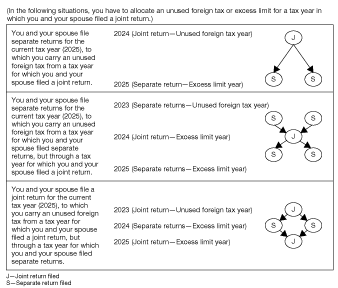
Method of allocation.
For a tax year in which you must allocate the unused foreign tax or the excess limit for your separate income categories between you and your spouse, you must take the following steps.
-
Figure a percentage for each separate income category by dividing the taxable income of each spouse from sources outside the United States in that category by the joint taxable income from sources outside the United States in that category. Then, apply each percentage to its category’s joint foreign tax credit limit to find the part of the limit allocated to each spouse.
-
Figure the part of the unused foreign tax, or of the excess limit, for each separate income category allocable to each spouse. You do this by comparing the allocated limit (figured in (1)) with the foreign taxes paid or accrued by each spouse on income in that category. If the foreign taxes you paid or accrued for that category are more than your part of its limit, you have an unused foreign tax. If, however, your part of that limit is more than the foreign taxes you paid or accrued, you have an excess limit for that category.
Allocation of the carryback and carryover.
The mechanics of the carryback and carryover, when allocations between spouses are needed, are illustrated by the following example.
Example.
H and W filed joint returns for 2021, 2023, and 2024, and separate returns for 2022 and 2025. Neither H nor W had any unused foreign tax or excess limit for any year before 2021. For the tax years involved, the income, unused foreign tax, excess limits, and carrybacks and carryovers are general category income and are shown in Table 5.
| Tax year | 2021 | 2022 | 2023 | 2024 | 2025 |
| Return | Joint | Separate | Joint | Joint | Separate |
| H’s unused foreign tax to be carried back or over, or excess limit* (enclosed in parentheses) | $50 | $25 | ($65) | $104 | ($50) |
| W’s unused foreign tax to be carried back or over, or excess limit* (enclosed in parentheses) | $30 | ($20) | ($20) | $69 | ($10) |
| Carryover absorbed: | |||||
| W’s from 2021 | — | 20W | 10W | — | — |
| H’s from 2021 | — | — | 50H | — | — |
| H’s from 2022 | — | — | 15H | — | — |
| ″ | — | — | 10W | — | — |
| W’s from 2024 | — | — | — | — | 10W |
| H’s from 2024 | — | — | — | — | 50H |
| W = Absorbed by W’s excess limit H = Absorbed by H’s excess limit |
| * General category income only |
W’s allocated part of the unused foreign tax from 2021 ($30) is partly absorbed by her separate excess limit of $20 for 2022 and then fully absorbed by her allocated part of the joint excess limit for 2023 ($20). H’s allocated part of the unused foreign tax from 2021 ($50) is fully absorbed by his allocated part of the joint excess limit ($65) for 2023.
H’s separate unused foreign tax from 2022 ($25) is partly absorbed (up to $15) by his remaining excess limit in 2023, and then fully absorbed by W’s remaining part of the joint excess limit for 2023 ($10). Each spouse’s excess limit on the 2023 joint return is reduced by the following.
-
Each spouse’s carryover from earlier years. (W’s carryover of $10 from 2021 and H’s carryovers of $50 from 2021 and $15 from 2022.)
-
The other spouse’s carryover. (H’s carryover of $10 from 2022 is absorbed by W’s remaining excess limit.)
W’s allocated part of the unused foreign tax of $69 from 2024 is partly absorbed by her excess limit in 2025 ($10), and the remaining $59 will be a carryover to general category income for 2026 and the following 8 years unless absorbed sooner. H’s allocated part of the unused foreign tax of $104 from 2024 is partly absorbed by his excess limit in 2025 ($50), and the remaining $54 will be a carryover to 2026 and the following 8 years unless absorbed sooner.
When you file a joint return in a deduction year, and carry unused foreign tax through that year from the prior year in which you and your spouse filed separate returns, the amount absorbed in the deduction year is the unused foreign tax of each spouse deemed paid or accrued in the deduction year up to the amount of that spouse’s excess limit in that year. You cannot reduce either spouse’s excess limit in the deduction year by the other’s unused foreign taxes in that year.
How To Claim the Credit
You must file Form 1116 to claim the foreign tax credit unless you meet one of the following exceptions.
Exceptions.
If you meet the requirements discussed under Exemption from foreign tax credit limit, earlier, and choose to be exempt from the foreign tax credit limit, do not file Form 1116. Instead, enter your foreign taxes directly on Schedule 3 (Form 1040), line 1.
If you are a shareholder of a CFC and chose to be taxed at corporate rates on the amount you must include in gross income from that corporation, use Form 1118 to claim the credit. See Controlled foreign corporation (CFC) shareholder under You Must Have Paid or Accrued the Tax, earlier.
Form 1116
You must file a Form 1116 with your U.S. income tax return, Form 1040, 1040-SR, or 1040-NR. You must file a separate Form 1116 for each of the following categories of income for which you claim a foreign tax credit.
-
Section 951A category income.
-
Foreign branch category income.
-
Passive category income.
-
General category income.
-
Section 901(j) income.
-
Certain income re-sourced by treaty.
-
Lump-sum distributions.
A Form 1116 consists of four parts.
-
Part I—Taxable Income or Loss From Sources Outside the United States (for category checked above). Enter the gross amounts of your foreign, or U.S. territory, source income in the separate limit category for which you are completing the form. Do not include income you excluded on Form 2555. From these, subtract the deductions that are definitely related to the separate limit income, and a ratable share of the deductions not definitely related to that income. If, in a separate limit category, you received income from more than one foreign country or U.S. territory, complete a separate column for each. You do not need to report income passed through from a mutual fund or other RIC on a country-by-country basis. Total all income, in the applicable category, passed through from the mutual fund or other RIC and enter the total in a single column in Part I. Enter “RIC” on line i of Part I. Total all foreign taxes passed through and enter the total on a single line in Part II for the applicable category. Because computations for inclusions under section 951A are reported on separate Form 8992, U.S. Shareholder Calculation of Global Intangible Low-Taxed Income (GILTI), you do not need to report those inclusions on a country-by-country basis. Enter the total inclusion in a single column in Part l and enter “951A” on line i. See the instructions for line i in the Instructions for Form 1116 for information about reporting section 863(b) gross income and deductions and high-taxed income.
-
Part II—Foreign Taxes Paid or Accrued. This part shows the foreign taxes you paid or accrued on the income in the separate limit category in foreign currency and U.S. dollars. If you paid (or accrued) foreign tax to more than one foreign country or U.S. territory, complete a separate line for each. If you receive income passed through from a RIC, aggregate all foreign taxes paid or accrued on that income on a single line in Part II.
-
Part III—Figuring the Credit. You use this part to figure the foreign tax credit that is allowable. No foreign tax carryovers are allowed for foreign taxes paid or accrued on section 951A category income. Leave line 10 of Form 1116 blank if you complete a Form 1116 for section 951A category income, as carrybacks and carryovers are not allowed for this category of income.
-
Part IV—Summary of Separate Credits From Parts III. You use this part on one Form 1116 (the one with the largest amount entered on line 24) to summarize the foreign tax credits figured on separate Forms 1116.
Records To Keep
You should keep the following records in case you are later asked to verify the taxes shown on your Form 1116, 1040, 1040-SR, or 1040-NR. You do not have to attach these records to your Form 1040, 1040-SR, or 1040-NR.
-
A receipt for each foreign tax payment.
-
The foreign tax return if you claim a credit for taxes accrued.
-
Any payee statement (such as Form 1099-DIV or Form 1099-INT) showing foreign taxes reported to you.
The receipt or return you keep as proof should either be the original, a duplicate original, or a duly certified or authenticated copy. If the receipt or return is in a foreign language, you should also have a certified translation of it. Revenue Ruling 67-308 in Cumulative Bulletin 1967-2 discusses in detail the requirements of the certified translation. Issues of the Cumulative Bulletin are available in most IRS offices and you are welcome to read them there.
Worksheet. Additional Foreign Tax Credit on U.S. Income*
Note: File this worksheet with your Form 1040 or 1040-SR as an attachment to Form 1116. |
| I. U.S. tax on U.S. source income (U.S. source rules) | Col. A | Col. B | ||||
|---|---|---|---|---|---|---|
| 1. | Dividends | _____ | _____ | |||
| 2. | Interest | _____ | _____ | |||
| 3. | Royalties | _____ | _____ | |||
| 4. | Capital gain | _____ | _____ | |||
| 5. | a. | Gross earned income | _____ | |||
| b. | Allocable employee business expenses | _____ | ||||
| c. | Net compensation. Subtract line 5b from line 5a | _____ | ||||
| 6. | a. | Gross rent, real property | _____ | |||
| b. | Direct expenses | _____ | ||||
| c. | Net rent. Subtract line 6b from line 6a | _____ | ||||
| 7. | Other | _____ | _____ | |||
| 8. | In column A, enter the sum of column A, lines 1–5a, 6a, and 7. In column B, enter the sum of column B, lines 1–4, 5c, 6c, and 7 | _____ | _____ | |||
| 9. | Enter tax from Form 1040 or 1040-SR. (See instructions.) | _____ | ||||
| 10. | Enter adjusted gross income (AGI) from line 11a of Form 1040 or 1040-SR | _____ | ||||
| 11. | Divide line 9 by line 10. Enter the result as a decimal. This is the average tax rate on your AGI | _____ | ||||
| 12. | Multiply line 11 by line 8 (column B). This is your estimated U.S. tax on your U.S. source income | _____ | ||||
| II. Tax at source allowable under treaty | ||||||
| A. | Items fully taxable by the United States. | |||||
| 13. | a. | Identify | _____ | |||
| b. | Multiply line 13a by line 11 | _____ | ||||
| B. | Items partly taxable by the United States. | |||||
| 14. | a. | Identify | _____ | |||
| b. | Treaty rate | _____ | ||||
| c. | Allowable tax at source (Multiply line 14a by line 14b.) | _____ | ||||
| 15. | a. | Identify | _____ | |||
| b. | Treaty rate | _____ | ||||
| c. | Allowable tax at source (Multiply line 15a by line 15b.) | _____ | ||||
| 16. | Total (Add lines 13b, 14c, and 15c.) | _____ | ||||
| C. | Identify each item of U.S. source income from column A in Step 1 on which the United States may not, under treaty, tax residents of the other country who are not U.S. citizens. | |||||
| _____ | ||||||
| _____ | ||||||
| III. Additional credit | ||||||
| 17. | Residence country tax on U.S. source income before foreign tax credit | _____ | ||||
| 18. | Foreign tax credit allowed by residence country for U.S. income tax paid | _____ | ||||
| 19. | Maximum credit. Subtract the greater of line 16 or line 18 from line 12 | _____ | ||||
| 20. | a. | Enter the amount from line 17 | _____ | |||
| b. | Enter the greater of line 16 or line 18 | _____ | ||||
| c. | Subtract line 20b from line 20a | _____ | ||||
| 21. | Additional credit. Enter the smaller of line 19 or line 20c. Add this amount to line 12 of Part III and line 32 of Part IV of Form 1116 | _____ | ||||
| * See Tax Treaties, earlier, for information on when you should use this worksheet. |
Worksheet Instructions. Additional Foreign Tax Credit on U.S. Income
| Note: Complete a separate worksheet for each separate limit income category. | |
| STEP I | |
| Figure the estimated tax on U.S. source income in the separate limit income category using U.S. rules for determining the source of income. | |
| Lines 1–7 Enter the gross amount for each type of income in column A, and the net amount in column B. | |
| Line 9 Enter the amounts from Form 1040 or 1040-SR, line 16, and Schedule 2 (Form 1040), line 1z, less any decrease in tax reported on Form 8978, line 14. | |
| STEP II | |
| Determine the amount of tax that the United States is allowed to collect at source under the treaty on income in the separate limit income category of residents of the other country who are not U.S. citizens. (In most cases, this amount should be claimed, to the extent allowable, as a foreign tax credit on your foreign tax return.) | |
| PART A Income in the separate limit income category fully taxable by the United States. In most cases, this includes income from a U.S. trade or business and gains from dispositions of U.S. real property. Identify the type and amount on line 13a. | |
| PART B Income in the separate limit income category for which treaty limits U.S. tax at source. This may include dividends, interest, royalties, and certain pensions. | |
| Lines 14 and 15 Identify each type and amount of income. Use the specified treaty rate. (The current treaty rates are available at IRS.gov/Individuals/International-Taxpayers/Tax-Treaty-Tables.) | |
| PART C Identify the items in the separate limit income category not taxable at source by the United States under the treaty. | |
| STEP III | |
| Figure the amount of the additional credit for foreign taxes paid or accrued on U.S. source income. The additional credit is limited to the difference between the estimated U.S. tax (Step I) and the greater of the allowable U.S. tax at source (Step II) or the foreign tax credit allowed by the residence country (line 18). | |
| Line 17 Enter the amount of the residence country tax on your U.S. source income before reduction for foreign tax credits. If possible, use the fraction of the pre-credit residence country tax which U.S. source taxable income bears to total taxable income. Otherwise, report that fraction of the pre-credit foreign tax which gross U.S. income bears to total gross income for foreign tax purposes. | |
| Line 21 This amount may be claimed as a foreign tax credit on Form 1116. First, add this amount to the reduction in foreign taxes on Part III, line 12, and complete Form 1116 according to the instructions. Also, add this amount as an additional credit to Form 1116, Part IV, line 32, and report that total on your Form 1040 or 1040-SR. File this worksheet with your Form 1040 or 1040-SR as an attachment to Form 1116. | |
How To Get Tax Help
If you have questions about a tax issue; need help preparing your tax return; or want to download free publications, forms, or instructions, go to IRS.gov to find resources that can help you right away.
Tax reform.
Tax reform legislation impacting federal taxes, credits, and deductions was enacted in P.L. 119-21, commonly known as the One Big Beautiful Bill Act, on July 4, 2025. Go to IRS.gov/OBBB for more information and updates on how this legislation affects your taxes.
Preparing and filing your tax return.
After receiving all your wage and earnings statements (Forms W-2, W-2G, 1099-R, 1099-MISC, 1099-NEC, etc.); unemployment compensation statements (by mail or in a digital format) or other government payment statements (Form 1099-G); and interest, dividend, and retirement statements from banks and investment firms (Forms 1099), you have several options to choose from to prepare and file your tax return. You can prepare the tax return yourself, see if you qualify for free tax preparation, or hire a tax professional to prepare your return.
Free options for tax preparation.
Your options for preparing and filing your return online or in your local community, if you qualify, include the following.
-
Free File. This program lets you prepare and file your federal individual income tax return for free using software or Free File Fillable Forms. However, state tax preparation may not be available through Free File. Go to IRS.gov/FreeFile to see if you qualify for free online federal tax preparation, e-filing, and direct deposit or payment options.
-
VITA. The Volunteer Income Tax Assistance (VITA) program offers free tax help to people with low-to-moderate incomes, persons with disabilities, and limited-English-speaking taxpayers who need help preparing their own tax returns. Go to IRS.gov/VITA, download the free IRS2Go app, or call 800-906-9887 for information on free tax return preparation.
-
TCE. The Tax Counseling for the Elderly (TCE) program offers free tax help for all taxpayers, particularly those who are 60 years of age and older. TCE volunteers specialize in answering questions about pensions and retirement-related issues unique to seniors. Go to IRS.gov/TCE or download the free IRS2Go app for information on free tax return preparation.
-
MilTax. Members of the U.S. Armed Forces and qualified veterans may use MilTax, a free tax service offered by the Department of Defense through Military OneSource. For more information, go to MilitaryOneSource (MilitaryOneSource.mil/MilTax).
Also, the IRS offers Free Fillable Forms, which can be completed online and then e-filed regardless of income.
Using online tools to help prepare your return.
Go to IRS.gov/Tools for the following.
-
The Earned Income Tax Credit Assistant (IRS.gov/EITCAssistant) determines if you’re eligible for the earned income credit (EITC).
-
The Online EIN Application (IRS.gov/EIN) helps you get an employer identification number (EIN) at no cost.
-
The Tax Withholding Estimator (IRS.gov/W4App) makes it easier for you to estimate the federal income tax you want your employer to withhold from your paycheck. This is tax withholding. See how your withholding affects your refund, take-home pay, or tax due.
-
The Sales Tax Deduction Calculator (IRS.gov/SalesTax) figures the amount you can claim if you itemize deductions on Schedule A (Form 1040).
. Getting answers to your tax questions. On IRS.gov, you can get up-to-date information on current events and changes in tax law..
-
IRS.gov/Help: A variety of tools to help you get answers to some of the most common tax questions.
-
IRS.gov/ITA: The Interactive Tax Assistant, a tool that will ask you questions and, based on your input, provide answers on a number of tax topics.
-
IRS.gov/Forms: Find forms, instructions, and publications. You will find details on the most recent tax changes and interactive links to help you find answers to your questions.
-
You may also be able to access tax information in your e-filing software.
Need someone to prepare your tax return?
There are various types of tax return preparers, including enrolled agents, certified public accountants (CPAs), accountants, and many others who don’t have professional credentials. If you choose to have someone prepare your tax return, choose that preparer wisely. A paid tax preparer is:
-
Primarily responsible for the overall substantive accuracy of your return,
-
Required to sign the return, and
-
Required to include their preparer tax identification number (PTIN).
. Although the tax preparer always signs the return, you’re ultimately responsible for providing all the information required for the preparer to accurately prepare your return and for the accuracy of every item reported on the return. Anyone paid to prepare tax returns for others should have a thorough understanding of tax matters. For more information on how to choose a tax preparer, go to Tips for Choosing a Tax Preparer on IRS.gov..
Employers can register to use Business Services Online.
The Social Security Administration (SSA) offers online service at SSA.gov/employer for fast, free, and secure W-2 filing options to CPAs, accountants, enrolled agents, and individuals who process Form W-2, Wage and Tax Statement; and Form W-2c, Corrected Wage and Tax Statement.
Business tax account.
If you are a sole proprietor, a partnership, an S corporation, a C corporation, or a single-member limited liability company (LLC), you can view your tax information on record with the IRS and do more with a business tax account. Go to IRS.gov/BusinessAccount for more information.
IRS social media.
Go to IRS.gov/SocialMedia to see the various social media tools the IRS uses to share the latest information on tax changes, scam alerts, initiatives, products, and services. At the IRS, privacy and security are our highest priority. We use these tools to share public information with you. Don’t post your social security number (SSN) or other confidential information on social media sites. Always protect your identity when using any social networking site.
The following IRS YouTube channels provide short, informative videos on various tax-related topics in English and ASL.
Over-the-Phone Interpreter (OPI) Service.
The IRS offers the OPI Service to taxpayers needing language interpretation. The OPI Service is available at Taxpayer Assistance Centers (TACs), most IRS offices, and every VITA/TCE tax return site. This service is available in Spanish, Mandarin, Cantonese, Korean, Vietnamese, Russian, and Haitian Creole.
Accessibility Helpline available for taxpayers with disabilities.
Taxpayers who need information about accessibility services can call 833-690-0598. The Accessibility Helpline can answer questions related to current and future accessibility products and services available in alternative media formats (for example, braille-ready, large print, audio, etc.). The Accessibility Helpline does not have access to your IRS account. For help with tax law, refunds, or account-related issues, go to IRS.gov/LetUsHelp.
Alternative media preference.
Form 9000, Alternative Media Preference, or Form 9000(SP) allows you to elect to receive certain types of written correspondence in the following formats.
-
Standard Print.
-
Large Print.
-
Braille.
-
Audio (MP3).
-
Plain Text File (TXT).
-
Braille-Ready File (BRF).
Disasters.
Go to IRS.gov/DisasterRelief to review the available disaster tax relief.
Getting tax forms and publications.
Go to IRS.gov/Forms to view, download, or print all the forms, instructions, and publications you may need. Or you can go to IRS.gov/OrderForms to place an order.
Mobile-friendly forms.
You’ll need an IRS Online Account (OLA) to complete mobile-friendly forms that require signatures. You’ll have the option to submit your form(s) online or download a copy for mailing. You’ll need scans of your documents to support your submission. Go to IRS.gov/MobileFriendlyForms for more information.
Getting tax publications and instructions in eBook format.
Download and view most tax publications and instructions (including the Instructions for Form 1040) on mobile devices as eBooks at IRS.gov/eBooks.
IRS eBooks have been tested using Apple’s iBooks for iPad. Our eBooks haven’t been tested on other dedicated eBook readers, and eBook functionality may not operate as intended.
Access your online account (individual taxpayers only).
Go to IRS.gov/Account to securely access information about your federal tax account.
-
View the amount you owe and a breakdown by tax year.
-
See payment plan details or apply for a new payment plan.
-
Make a payment or view 5 years of payment history and any pending or scheduled payments.
-
Access your tax records, including key data from your most recent tax return, and transcripts.
-
View digital copies of select notices from the IRS.
-
Approve or reject authorization requests from tax professionals.
Get a transcript of your return.
With an online account, you can access a variety of information to help you during the filing season. You can get a transcript, review your most recently filed tax return, and get your adjusted gross income. Create or access your online account at IRS.gov/Account.
Tax Pro Account.
This tool lets your tax professional submit an authorization request to access your individual taxpayer IRS OLA. For more information, go to IRS.gov/TaxProAccount.
Using direct deposit.
The safest and easiest way to receive a tax refund is to e-file and choose direct deposit, which securely and electronically transfers your refund directly into your financial account. Direct deposit also avoids the possibility that your check could be lost, stolen, destroyed, or returned undeliverable to the IRS. Eight in 10 taxpayers use direct deposit to receive their refunds. If you don’t have a bank account, go to IRS.gov/DirectDeposit for more information on where to find a bank or credit union that can open an account online.
Reporting and resolving your tax-related identity theft issues.
-
Tax-related identity theft happens when someone steals your personal information to commit tax fraud. Your taxes can be affected if your SSN is used to file a fraudulent return or to claim a refund or credit.
-
The IRS doesn’t initiate contact with taxpayers by email, text messages (including shortened links), telephone calls, or social media channels to request or verify personal or financial information. This includes requests for personal identification numbers (PINs), passwords, or similar information for credit cards, banks, or other financial accounts.
-
Go to IRS.gov/IdentityTheft, the IRS Identity Theft Central webpage, for information on identity theft and data security protection for taxpayers, tax professionals, and businesses. If your SSN has been lost or stolen or you suspect you’re a victim of tax-related identity theft, you can learn what steps you should take.
-
Get an Identity Protection PIN (IP PIN). IP PINs are six-digit numbers assigned to taxpayers to help prevent the misuse of their SSNs on fraudulent federal income tax returns. When you have an IP PIN, it prevents someone else from filing a tax return with your SSN. To learn more, go to IRS.gov/IPPIN.
Ways to check on the status of your refund.
-
Go to IRS.gov/Refunds.
-
Download the official IRS2Go app to your mobile device to check your refund status.
-
Call the automated refund hotline at 800-829-1954.
.The IRS can’t issue refunds before mid-February for returns that claimed the EITC or the additional child tax credit (ACTC). This applies to the entire refund, not just the portion associated with these credits..
Making a tax payment.
The IRS recommends paying electronically whenever possible. Options to pay electronically are included in the list below. Payments of U.S. tax must be remitted to the IRS in U.S. dollars. Digital assets are not accepted. Go to IRS.gov/Payments for information on how to make a payment using any of the following options.
-
IRS Direct Pay: Pay taxes from your bank account. It’s free and secure, and no sign-in is required. You can change or cancel within 2 days of scheduled payment.
-
Debit Card, Credit Card, or Digital Wallet: Choose an approved payment processor to pay online or by phone.
-
Electronic Funds Withdrawal: Schedule a payment when filing your federal taxes using tax return preparation software or through a tax professional.
-
Electronic Federal Tax Payment System: This is the best option for businesses. Enrollment is required.
-
Check or Money Order: Mail your payment to the address listed on the notice or instructions.
-
Cash: You may be able to pay your taxes with cash at a participating retail store.
-
Same-Day Wire: You may be able to do same-day wire from your financial institution. Contact your financial institution for availability, cost, and time frames.
What if I can’t pay now?
Go to IRS.gov/Payments for more information about your options.
-
Apply for an online payment agreement (IRS.gov/OPA) to meet your tax obligation in monthly installments if you can’t pay your taxes in full today. Once you complete the online process, you will receive immediate notification of whether your agreement has been approved.
-
Use the Offer in Compromise Pre-Qualifier to see if you can settle your tax debt for less than the full amount you owe. For more information on the Offer in Compromise program, go to IRS.gov/OIC.
Filing an amended return.
Go to IRS.gov/1040X for information and updates.
Checking the status of your amended return.
Go to IRS.gov/WMAR to track the status of Form 1040-X amended returns.
.It can take up to 3 weeks from the date you filed your amended return for it to show up in our system, and processing it can take up to 16 weeks..
Understanding an IRS notice or letter you’ve received.
Go to IRS.gov/Notices to find additional information about responding to an IRS notice or letter.
IRS Document Upload Tool.
You may be able to use the Document Upload Tool to respond digitally to eligible IRS notices and letters by securely uploading required documents online through IRS.gov. For more information, go to IRS.gov/DUT.
Schedule LEP.
You can use Schedule LEP (Form 1040), Request for Change in Language Preference, to state a preference to receive notices, letters, or other written communications from the IRS in an alternative language. You may not immediately receive written communications in the requested language. The IRS’s commitment to LEP taxpayers is part of a multi-year timeline that began providing translations in 2023. You will continue to receive communications, including notices and letters, in English until they are translated to your preferred language.
Contacting your local TAC.
Keep in mind, many questions can be answered on IRS.gov without visiting a TAC. Go to IRS.gov/LetUsHelp for the topics people ask about most. If you still need help, TACs provide tax help when a tax issue can’t be handled online or by phone. All TACs now provide service by appointment, so you’ll know in advance that you can get the service you need without long wait times. Before you visit, go to IRS.gov/TAC to find the nearest TAC and to check hours, available services, and appointment options. Or, on the IRS2Go app, under the Stay Connected tab, choose the Contact Us option and click on “Local Offices.”
————————————————————————
Below is a message to you from the Taxpayer Advocate Service, an independent organization established by Congress.
The Taxpayer Advocate Service (TAS) Is Here To Help You
The Taxpayer Advocate Service (TAS) is an independent organization within the Internal Revenue Service (IRS). TAS helps taxpayers resolve problems with the IRS, makes administrative and legislative recommendations to prevent or correct the problems, and protects taxpayer rights. We work to ensure that every taxpayer is treated fairly and that you know and understand your rights under the Taxpayer Bill of Rights. We are Your Voice at the IRS.
TAS can help you resolve problems that you haven’t been able to resolve with the IRS on your own. Always try to resolve your problem with the IRS first, but if you can’t, then come to TAS. Our services are free.
-
TAS helps all taxpayers (and their representatives), including individuals, businesses, and exempt organizations. You may be eligible for TAS help if your IRS problem is causing financial difficulty, if you’ve tried and been unable to resolve your issue with the IRS, or if you believe an IRS system, process, or procedure just isn’t working as it should.
-
To get help any time with general tax topics, visit www.TaxpayerAdvocate.IRS.gov. The site can help you with common tax issues and situations, such as what to do if you make a mistake on your return or if you get a notice from the IRS.
-
TAS works to resolve large-scale (systemic) problems that affect many taxpayers. You can report systemic issues at www.IRS.gov/SAMS. (Be sure not to include any personal identifiable information.)
TAS has offices in every state, the District of Columbia, and Puerto Rico. To find your local advocate’s number:
-
Check your local directory, or
-
Call TAS toll free at 877-777-4778.
The Taxpayer Bill of Rights describes ten basic rights that all taxpayers have when dealing with the IRS. Go to www.TaxpayerAdvocate.IRS.gov/Taxpayer-Rights for more information about the rights, what they mean to you, and how they apply to specific situations you may encounter with the IRS. TAS strives to protect taxpayer rights and ensure the IRS is administering the tax law in a fair and equitable way.
A
- Accrual foreign taxes, adjustments, You may have to post a bond.
- Accrual method of accounting, Accrual method of accounting.
- Allocation
-
- Carryback/carryover between spouses, Allocations Between Spouses
- Foreign losses, Foreign Losses
- Foreign taxes, Allocation of Foreign Taxes
- U.S. losses, U.S. Losses
- Alternative minimum tax, Reminders
- Amended return, Claim for Refund
- American Samoa, resident of, Territory Exclusion
- Assistance (see Tax help)
B
- Bankruptcy, effect of, Effect of bankruptcy or insolvency.
- Beneficiary, Partner or S corporation shareholder.
- Bond, income tax, You may have to post a bond.
- Boycotting countries, Taxes From International Boycott Operations
C
- Capital gains and losses, Capital Gains and Losses
- Carryback and carryover, Carrybacks and carryovers., Carryback and Carryover
-
- Allocations between spouses, Allocations Between Spouses
- Claim for refund, Time Limit on Tax Assessment
- Joint return, Married Couples
- Joint return–deduction year, Joint Return Filed in a Deduction Year
- Taxes all credited or deducted, Claim for Refund
- Time limit on tax assessment, Time Limit on Tax Assessment
- Choice to take credit or deduction
-
- Changing your choice, Making or Changing Your Choice
- Choice applied to all qualified foreign taxes, Choice Applies to All Qualified Foreign Taxes
- Claim for refund, Claim for Refund
- Classes of gross income, Classes of gross income.
- Compensation for labor or personal services, Determining the Source of Compensation for Labor or Personal Services
-
- Geographical basis, Geographical basis.
- Controlled foreign corporation (CFC) shareholder, Controlled foreign corporation (CFC) shareholder., Income from controlled foreign corporations (CFCs).
- Covered asset acquisition, Covered Asset Acquisition
- Credit
-
- How to claim, How To Claim the Credit
- How to figure, How To Figure the Credit
- Limit on, Limit on the Credit
- Credit for taxes paid or accrued, Credit for Taxes Paid or Accrued
D
- Deduction for foreign taxes that are not income taxes, Foreign taxes that are not income taxes.
- Distributions
-
- Lump-sum, Lump-Sum Distributions (LSDs)
- Dividends
-
- Taxes on, Taxes Imposed on Certain Dividends
- Dual-capacity taxpayers, Dual-capacity taxpayers.
E
- Economic benefits, Specific economic benefit.
- Excess limit, Carryback and Carryover
- Exchange rates, Foreign Currency and Exchange Rates
- Excluded income
-
- Foreign earned, Foreign Earned Income and Housing Exclusions
- Taxes on, Taxes on Excluded Income
- Exemption from foreign tax credit limit, Exemption from foreign tax credit limit.
- Export financing interest, Export financing interest.
- Extraterritorial income, Extraterritorial Income Exclusion
F
- Financial services income, Financial services income.
- Foreign corporation—U.S. shareholders, filing requirements, Taxes of U.S. Persons Controlling Foreign Corporations and Partnerships
- Foreign country, Foreign country.
- Foreign currency and exchange rates, Foreign Currency and Exchange Rates
- Foreign income, translating, Translating foreign currency into U.S. dollars.
- Foreign losses
-
- Allocation of, Foreign Losses
- Recapture of, Recapture of Prior-Year Overall Foreign Loss Accounts
- Foreign mineral income, taxes on, Taxes on Foreign Mineral Income
- Foreign oil and gas extraction income, taxes on, Taxes on Combined Foreign Oil and Gas Income
- Foreign partnerships—U.S. partners, filing requirement, Taxes of U.S. Persons Controlling Foreign Corporations and Partnerships
- Foreign tax refund, Foreign tax refund., Foreign tax refund and credits.
- Foreign tax(es)
-
- Allocation to income categories, Allocation of Foreign Taxes
- For which you cannot take a credit, Foreign Taxes for Which You Cannot Take a Credit
- Imposed on foreign refund, Foreign tax imposed on foreign refund.
- Qualifying for credit, What Foreign Taxes Qualify for the Credit?
- Redetermination, Foreign Tax Redetermination
- Refund, Foreign tax imposed on foreign refund.
- Form
-
- 1040-X, Claim for Refund
- 1116, Form 1116
- 5471, Taxes of U.S. Persons Controlling Foreign Corporations and Partnerships
- 5713, Form 5713 required.
- 7204, Election to claim a provisional credit for contested taxes.
- 8833, Report required.
- 8865, Taxes of U.S. Persons Controlling Foreign Corporations and Partnerships
- 8873, Extraterritorial Income Exclusion
- Functional currency, Translating foreign currency into U.S. dollars.
G
- General category income, separate limit, General Category Income
H
- High-taxed income, High-taxed income.
I
- Income from sources in U.S. territories, Determining the source of income from U.S. territories.
- Income re-sourced by treaty, separate limit, Certain Income Re-Sourced by Treaty
- Income tax bond, You may have to post a bond.
- Interest, Penalties and interest.
- Interest expense, apportioning, Interest expense.
- International boycott, Taxes From International Boycott Operations
- Itemized deduction, Taxes for Which You Can Only Take an Itemized Deduction
J
- Joint return
-
- Carryback and carryover, Married Couples
- Credit based on foreign tax of both spouses, Joint return.
- Filed in a deduction year, Joint Return Filed in a Deduction Year
L
- Limit on credit, Limit on the Credit
- Losses, foreign, Foreign Losses
-
- Allocation of, Foreign Losses
- Recapture of, Recapture of Prior-Year Overall Foreign Loss Accounts
- Losses, U.S., U.S. Losses
-
- Allocation of, U.S. Losses
- Lump-sum distributions (LSDs), Lump-Sum Distributions (LSDs)
M
- Making or changing your choice, Making or Changing Your Choice
- Married couples
-
- Carryback and carryover, Married Couples
- Joint return, Joint return.
- Mineral income, foreign,, Taxes on Foreign Mineral Income
- Mutual fund distributions, Mutual fund shareholder., Passive income.
- Mutual fund shareholder, Mutual fund shareholder.
N
- Nonresident aliens, Nonresident Aliens
- Notice to the IRS of change in tax, Notice to the IRS of Redetermination
O
- Overall foreign loss, Overall foreign loss.
P
- Partner, Partner or S corporation shareholder., Partnership distributive share., Foreign Taxes From a Partnership or an S Corporation
- Passive category income, Passive Category Income
- Penalties, Failure-to-notify penalty., Penalties and interest.
-
- Failure to file Form 5471, 8865, Penalty for not filing Form 5471 or Form 8865.
- Failure to file Form 5713, Penalty for failure to file.
- Failure to notify, foreign tax change, Failure-to-notify penalty.
- Failure to report treaty information, Report required.
- Pension, employment, and disability fund payments, Pension, unemployment, and disability fund payments.
- Personal property, sales or exchanges of, Determining the Source of Income From the Sales or Exchanges of Certain Personal Property
- Publications (see Tax help)
- Purchase or sale of oil or gas, taxes in connection with, Taxes in Connection With the Purchase or Sale of Oil or Gas
Q
- Qualified business unit (QBU), Translating foreign currency into U.S. dollars.
- Qualified dividends, Capital Gains and Losses
R
- Rate of exchange, Rate of exchange for foreign taxes paid.
- Recapture of foreign losses, Recapture of Prior-Year Overall Foreign Loss Accounts
- Records to keep, Records To Keep
- Redetermination of foreign tax, Foreign Tax Redetermination
- Refund claims, time limit, Time Limit on Refund Claims
- Refund, foreign tax, Foreign tax refund and credits.
- Reporting requirements (international boycott), Reporting requirements.
- Resident aliens, Resident Aliens
S
- S corporation shareholder, Partner or S corporation shareholder., Foreign Taxes From a Partnership or an S Corporation
- Sanctioned countries, Taxes Imposed by Sanctioned Countries (Section 901(j) Income)
- Schedule B (Form 1116), Carryback and Carryover
- Schedule C (Form 1116), Notice to the IRS of Redetermination
- Section 901(j) income, Section 901(j) Income
- Section 901(j) sanctioned income, Taxes Imposed by Sanctioned Countries (Section 901(j) Income)
- Separate limit income, Separate Limit Income
-
- General category income, General Category Income
- Income re-sourced by treaty, Certain Income Re-Sourced by Treaty
- Lump-sum distribution, Lump-Sum Distributions (LSDs)
- Passive category income, Passive Category Income
- Section 901(j) income, Section 901(j) Income
- Shareholder, Mutual fund shareholder.
- Soak-up taxes, Soak-up taxes.
- Social security taxes, Pension, unemployment, and disability fund payments.
- Source of compensation for labor or personal services
-
- Alternative basis, Alternative basis.
- Multi-year compensation, Multi-year compensation.
- Time basis, Time basis.
- Transportation income, Transportation Income
- State income taxes, State income taxes.
- Subsidy, Subsidy received.
T
- Tax help, How To Get Tax Help
- Tax treaties, Tax Treaties
- Taxable income from sources outside the U.S., determination of, Determining Taxable Income From Sources Outside the United States
- Taxes
-
- Excluded income, Foreign Earned Income and Housing Exclusions
- In lieu of income taxes, Taxes in Lieu of Income Taxes
- On dividends, Taxes Imposed on Certain Dividends
- Paid or accrued, Credit for Taxes Paid or Accrued
- Withheld on income or gain, Taxes Withheld on Income or Gain (Other Than Dividends)
- Taxes related to a foreign tax credit splitting event, Taxes Related to a Foreign Tax Credit Splitting Event
- Territory exclusion, Territory Exclusion
- Time limit
-
- Refund claims, Time Limit on Refund Claims
- Tax assessment, Time Limit on Tax Assessment
- Translating foreign currency, Translating foreign currency into U.S. dollars.
U
- U.S. citizens, U.S. Citizens
- U.S. losses
-
- Allocation of, U.S. Losses
- U.S. territories, U.S. territories.
- Unused foreign tax credits, carryback or carryover, Carrybacks and carryovers., Carryback and Carryover
W
- Wages, Wages completely excluded.
- When refunds can be claimed, Time Limit on Refund Claims
- When tax can be assessed, Time Limit on Tax Assessment
- Who can take the credit, Who Can Take the Credit?
- Why choose the credit, Why Choose the Credit?