


 )
or https:// means you've safely connected to the .gov website. Share sensitive information only on official, secure websites.
)
or https:// means you've safely connected to the .gov website. Share sensitive information only on official, secure websites.


- Publication 946 - Introductory Material
- Overview of Depreciation
- Introduction
- Useful Items - You may want to see:
- What Property Can Be Depreciated?
- What Property Cannot Be Depreciated?
- When Does Depreciation Begin and End?
- What Method Can You Use To Depreciate Your Property?
- What Is the Basis of Your Depreciable Property?
- How Do You Treat Repairs and Improvements?
- Do You Have To File Form 4562?
- How Do You Correct Depreciation Deductions?
- Electing the Section 179 Deduction
- Introduction
- Useful Items - You may want to see:
- What Property Qualifies?
- What Property Does Not Qualify?
- How Much Can You Deduct?
- How Do You Elect the Deduction?
- When Must You Recapture the Deduction?
- Claiming a Special Depreciation Allowance
- Introduction
- What Is Qualified Property?
- Qualified Reuse and Recycling Property
- Certain Qualified Property Acquired and Placed in Service After January 19, 2025
- Certain Qualified Property Acquired after September 27, 2017, and Before January 20, 2025
- Certain Plants Bearing Fruits and Nuts Planted or Grafted After January 19, 2025
- Certain Plants Bearing Fruits and Nuts Planted or Grafted Before January 20, 2025
- How Much Can You Deduct?
- How Can You Elect Not To Claim an Allowance?
- When Must You Recapture an Allowance?
- Recapture of allowance deducted for qualified GO Zone property.
- Qualified cellulosic biomass ethanol plant property, qualified cellulosic biofuel plant property, and qualified second generation biofuel plant property.
- Recapture of allowance for qualified Recovery Assistance property.
- Recapture of allowance for qualified disaster assistance property.
- Qualified Production Property
- Figuring Depreciation Under MACRS
- Introduction
- Useful Items - You may want to see:
- Which Depreciation System (GDS or ADS) Applies?
- Which Property Class Applies Under GDS?
- Qualified rent-to-own property.
- Rent-to-own dealer.
- Rent-to-own contract.
- Motorsports entertainment complex.
- Qualified smart electric grid system.
- Retail motor fuels outlet.
- Qualified improvement property.
- Qualified smart electric meter.
- Natural gas gathering line and electric transmission property.
- What Is the Placed in Service Date?
- What Is the Basis for Depreciation?
- Which Recovery Period Applies?
- Which Convention Applies?
- Which Depreciation Method Applies?
- How Is the Depreciation Deduction Figured?
- Using the MACRS Percentage Tables
- Figuring the Deduction Without Using the Tables
- Figuring the Deduction for Property Acquired in a Nontaxable Exchange
- Figuring the Deduction for a Short Tax Year
- How Do You Use General Asset Accounts?
- When Do You Recapture MACRS Depreciation?
- Additional Rules for Listed Property
- Introduction
- Useful Items - You may want to see:
- What Is Listed Property?
- Can Employees Claim a Deduction?
- What Is the Business-Use Requirement?
- Do the Passenger Automobile Limits Apply?
- What Records Must Be Kept?
- How Is Listed Property Information Reported?
- How To Get Tax Help
- Tax reform.
- Preparing and filing your tax return.
- Free options for tax preparation.
- Using online tools to help prepare your return.
- Getting answers to your tax questions.
- Need someone to prepare your tax return?
- Caution:
- Employers can register to use Business Services Online.
- Business tax account.
- IRS social media.
- Online tax information in other languages.
- Over-the-Phone Interpreter (OPI) Service.
- Accessibility Helpline available for taxpayers with disabilities.
- Alternative media preference.
- Disasters.
- Getting tax forms and publications.
- Mobile-friendly forms.
- Getting tax publications and instructions in eBook format.
- Access your online account (individual taxpayers only).
- Get a transcript of your return.
- Tax Pro Account.
- Using direct deposit.
- Reporting and resolving your tax-related identity theft issues.
- Ways to check on the status of your refund.
- Caution:
- Making a tax payment.
- What if I can’t pay now?
- Filing an amended return.
- Checking the status of your amended return.
- Caution:
- Understanding an IRS notice or letter you’ve received.
- IRS Document Upload Tool.
- Schedule LEP.
- Contacting your local TAC.
- The Taxpayer Advocate Service (TAS) Is Here To Help You
- Publication 946 - Additional Material
Publication 946 (2025), How To Depreciate Property
• Section 179 Deduction • Special Depreciation Allowance • MACRS • Listed Property
For use in preparing 2025 Returns
For the latest information about developments related to Pub. 946, such as legislation enacted after it was published, go to IRS.gov/Pub946.
Section 179 deduction dollar limits. For tax years beginning in 2025, the maximum section 179 expense deduction is $2,500,000. This limit is reduced by the amount by which the cost of section 179 property placed in service during the tax year exceeds $4,000,000. See Dollar Limits in chapter 2.Also, the maximum section 179 expense deduction for sport utility vehicles placed in service in tax years beginning in 2025 is $31,300.
Phase down of special depreciation allowance for qualified property acquired before January 20, 2025, and certain plants bearing fruits and nuts planted or grafted before January 20, 2025. The special depreciation allowance is limited to 40% for certain qualified property acquired after September 27, 2017, and placed in service after December 31, 2024, and before January 1, 2026 (other than certain property with a long production period and certain aircraft). Property with a long production period and certain aircraft placed in service after December 31, 2024, and before January 1, 2026, is limited to a special depreciation allowance is 60% of the depreciable basis of the property. The special depreciation allowance is also limited to 40% for certain specified plants bearing fruits and nuts planted or grafted after December 31, 2024, and before January 20, 2025. See Certain Qualified Property Acquired after September 27, 2017, and Before January 20, 2025, and Certain Plants Bearing Fruits and Nuts Planted or Grafted Before January 20, 2025, under What Is Qualified Property? in chapter 3.
Special depreciation allowance for certain qualified property acquired after January 19, 2025, and certain plants bearing fruits and nuts planted or grafted after January 19, 2025. P.L. 119-21, commonly known as the One Big Beautiful Bill Act, reinstated the 100% special depreciation allowance for certain qualified property acquired and placed in service after January 19, 2025 (including long production period property and certain aircraft), and certain specified plants bearing fruits and nuts planted or grafted after January 19, 2025. However, you can elect to take a 40% special depreciation allowance (60% for long production period property and certain aircraft) for this property during first tax year ending after January 19, 2025, instead of taking the 100% special depreciation allowance. See Certain Qualified Property Acquired After January 19, 2025, and Certain Plants Bearing Fruits and Nuts Planted or Grafted After January 19, 2025, under What Is Qualified Property? in chapter 3.
Special depreciation allowance for qualified production property. P.L. 119-21 added new section 168(n) which allows an elective special depreciation allowance for qualified production property. Qualified production property placed in service after July 4, 2025, the construction of which began or that was acquired after January 19, 2025, is eligible for a 100% special depreciation allowance. See Qualified Production Property in chapter 3.
Additions to 5-year property. Any qualified facility (as defined in section 45Y(b)(1)(A) of the Internal Revenue Code), any qualified property (as defined in subsection (b)(2) of section 48E of the Internal Revenue Code) which is a qualified investment (as defined in subsection (b)(1) of such section), or any energy storage technology (as defined in subsection (c)(2) of such section) that is placed in service after December 31, 2024, is 5-year property.
Removal of solar or wind energy property from the definition of 5-year property. Section 70509 of P.L. 119-21 removed solar or wind energy property from the definition of 5-year property under section 168(e)(3)(B)(vi) of the Internal Revenue Code. This applies to solar or wind energy property beginning construction after December 31, 2024.
Section 179 deduction dollar limits. For tax years beginning in 2026, the maximum section 179 expense deduction is $2,560,000. This limit is reduced by the amount by which the cost of section 179 property placed in service during the tax year exceeds $4,090,000.Also, the maximum section 179 expense deduction for sport utility vehicles placed in service in tax years beginning in 2026 is $32,000.
Photographs of missing children. The Internal Revenue Service is a proud partner with the National Center for Missing & Exploited Children® (NCMEC). Photographs of missing children selected by the Center may appear in this publication on pages that would otherwise be blank. You can help bring these children home by looking at the photographs and calling 1-800-THE-LOST (1-800-843-5678) if you recognize a child.
Introduction
This publication explains how you can recover the cost of business or income-producing property through deductions for depreciation (for example, the special depreciation allowance and deductions under the Modified Accelerated Cost Recovery System (MACRS)). It also explains how you can elect to take a section 179 deduction, instead of depreciation deductions, for certain property and the additional rules for listed property.
Caution:
The depreciation methods discussed in this publication generally do not apply to property placed in service before 1987. For more information, see Pub. 534, Depreciating Property Placed in Service Before 1987.
Definitions.
Many of the terms used in this publication are defined in the Glossary at the end of this publication. Glossary terms used in each discussion under the major headings are listed before the beginning of each discussion throughout this publication.
Do you need a different publication?
The following table shows where you can get more detailed information when depreciating certain types of property.
| For information on depreciating: |
See Publication: |
|---|---|
| a car | 463, Travel, Gift, and Car Expenses. |
| residential rental property | 527, Residential Rental Property. |
| office space in your home | 587, Business Use of Your Home. |
| farm property | 225, Farmer’s Tax Guide. |
Comments and suggestions.
We welcome your comments about this publication and suggestions for future editions.
You can send us comments through IRS.gov/FormComments. Or, you can write:
Internal Revenue ServiceTax Forms and Publications
1111 Constitution Ave. NW, IR-6526
Washington, DC 20224
Although we can’t respond individually to each comment received, we do appreciate your feedback and will consider your comments and suggestions as we revise our tax forms, instructions, and publications. Don’t send tax questions, tax returns, or payments to the above address.
Getting answers to your tax questions.
If you have a tax question not answered by this publication or the How To Get Tax Help section at the end of this publication, go to the IRS Interactive Tax Assistant page at IRS.gov/Help/ITA where you can find topics by using the search feature or viewing the categories listed.
Getting tax forms, instructions, and publications.
Go to IRS.gov/Forms to download current and prior-year forms, instructions, and publications.
Ordering tax forms, instructions, and publications.
Go to IRS.gov/OrderForms to order current forms, instructions, and publications; call 800-829-3676 to order prior-year forms and instructions. The IRS will process your order for forms and publications as soon as possible. Don’t resubmit requests you’ve already sent us. You can get forms and publications faster online.
Introduction
Depreciation is an annual income tax deduction that allows you to recover the cost or other basis of certain property over the time you use the property. It is an allowance for the wear and tear, deterioration, or obsolescence of the property.
This chapter discusses the general rules for depreciating property and answers the following questions.
-
What property can be depreciated?
-
What property cannot be depreciated?
-
When does depreciation begin and end?
-
What method can you use to depreciate your property?
-
What is the basis of your depreciable property?
-
How do you treat repairs and improvements?
-
Do you have to file Form 4562?
-
How do you correct depreciation deductions?
Useful Items
You may want to see:Publication
-
534 Depreciating Property Placed in Service Before 1987
-
538 Accounting Periods and Methods
-
551 Basis of Assets
Form (and Instructions)
-
Sch C (Form 1040) Profit or Loss From Business
-
2106 Employee Business Expenses
-
3115 Application for Change in Accounting Method
-
4562 Depreciation and Amortization
See How To Get Tax Help at the end of this publication for information about getting publications and forms.
What Property Can Be Depreciated?
You can depreciate most types of tangible property (except land), such as buildings, machinery, vehicles, furniture, and equipment. You can also depreciate certain intangible property, such as patents, copyrights, and computer software.
To be depreciable, the property must meet all the following requirements.
-
It must be property you own.
-
It must be used in your business or income-producing activity.
-
It must have a determinable useful life.
-
It must be expected to last more than 1 year.
Property You Own
To claim depreciation, you must usually be the owner of the property. You are considered as owning property even if it is subject to a debt.
Example 1.
You made a down payment to purchase rental property and assumed the previous owner’s mortgage. You own the property and you can depreciate it.
Example 2.
You bought a new van that you will use only for your courier business. You will be making payments on the van over the next 5 years. You own the van and you can depreciate it.
Leased property.
You can depreciate leased property only if you retain the incidents of ownership in the property (explained below). This means you bear the burden of exhaustion of the capital investment in the property. Therefore, if you lease property from someone to use in your trade or business or for the production of income, generally you cannot depreciate its cost because you do not retain the incidents of ownership. You can, however, depreciate any capital improvements you make to the property. See How Do You Treat Repairs and Improvements, later in this chapter, and Additions and Improvements under Which Recovery Period Applies? in chapter 4.
If you lease property to someone, you can generally depreciate its cost even if the lessee (the person leasing from you) has agreed to preserve, replace, renew, and maintain the property. However, if the lease provides that the lessee is to maintain the property and return to you the same property or its equivalent in value at the expiration of the lease in as good condition and value as when leased, you cannot depreciate the cost of the property.
Incidents of ownership.
Incidents of ownership in property include the following.
-
The legal title to the property.
-
The legal obligation to pay for the property.
-
The responsibility to pay maintenance and operating expenses.
-
The duty to pay any taxes on the property.
-
The risk of loss if the property is destroyed, condemned, or diminished in value through obsolescence or exhaustion.
Life tenant.
Generally, if you hold business or investment property as a life tenant, you can depreciate it as if you were the absolute owner of the property. However, see Certain term interests in property under Excepted Property, later.
Cooperative apartments.
If you are a tenant-stockholder in a cooperative housing corporation and use your cooperative apartment in your business or for the production of income, you can depreciate your stock in the corporation, even though the corporation owns the apartment.
Figure your depreciation deduction as follows.
-
Figure the depreciation for all the depreciable real property owned by the corporation in which you have a proprietary lease or right of tenancy. If you bought your cooperative stock after its first offering, figure the depreciable basis of this property as follows.
-
Multiply your cost per share by the total number of outstanding shares, including any shares held by the corporation.
-
Add to the amount figured in (a) any mortgage debt on the property on the date you bought the stock.
-
Subtract from the amount figured in (b) any mortgage debt that is not for the depreciable real property, such as the part for the land.
-
-
Subtract from the amount figured in (1) any depreciation for space owned by the corporation that can be rented but cannot be lived in by tenant-stockholders.
-
Divide the number of your shares of stock by the total number of outstanding shares, including any shares held by the corporation.
-
Multiply the result of (2) by the percentage you figured in (3). This is your depreciation on the stock.
Your depreciation deduction for the year cannot be more than the part of your adjusted basis in the stock of the corporation that is allocable to your business or income-producing property. You must also reduce your depreciation deduction if only a portion of the property is used in a business or for the production of income.
Example.
You figure your share of the cooperative housing corporation’s depreciation to be $30,000. Your adjusted basis in the stock of the corporation is $50,000. You use one-half of your apartment solely for business purposes. Your depreciation deduction for the stock for the year cannot be more than $25,000 (½ of $50,000).
Change to business use.
If you change your cooperative apartment to business use, figure your allowable depreciation as explained earlier. The basis of all the depreciable real property owned by the cooperative housing corporation is the smaller of the following amounts.
-
The FMV of the property on the date you change your apartment to business use. This is considered to be the same as the corporation’s adjusted basis minus straight line depreciation, unless this value is unrealistic.
-
The corporation’s adjusted basis in the property on that date. Do not subtract depreciation when figuring the corporation’s adjusted basis.
If you bought the stock after its first offering, the corporation’s adjusted basis in the property is the amount figured in (1) under Cooperative apartments, earlier. The FMV of the property is considered to be the same as the corporation’s adjusted basis figured in this way minus straight line depreciation, unless the value is unrealistic.
For a discussion of FMV and adjusted basis, see Pub. 551.
Property Used in Your Business or Income-Producing Activity
To claim depreciation on property, you must use it in your business or income-producing activity. If you use property to produce income (investment use), the income must be taxable. You cannot depreciate property that you use solely for personal activities.
Partial business or investment use.
If you use property for business or investment purposes and for personal purposes, you can deduct depreciation based only on the business or investment use. For example, you cannot deduct depreciation on a car used only for commuting, personal shopping trips, family vacations, driving children to and from school, or similar activities.
Records you should keep.
You must keep records showing the business, investment, and personal use of your property. For more information on the records you must keep for listed property, such as a car, see What Records Must Be Kept? in chapter 5.
Caution:
Although you can combine business and investment use of property when figuring depreciation deductions, do not treat investment use as qualified business use when determining whether the business-use requirement for listed property is met. For information about qualified business use of listed property, see What Is the Business-Use Requirement? in chapter 5.
Office in the home.
If you use part of your home as an office, you may be able to deduct depreciation on that part based on its business use. For information about depreciating your home office, see Pub. 587.
Inventory.
You cannot depreciate inventory because it is not held for use in your business. Inventory is any property you hold primarily for sale to customers in the ordinary course of your business.
If you are a rent-to-own dealer, you may be able to treat certain property held in your business as depreciable property rather than as inventory. See Rent-to-own dealer under Which Property Class Applies Under GDS? in chapter 4.
In some cases, it is not clear whether property is held for sale (inventory) or for use in your business. If it is unclear, examine carefully all the facts in the operation of the particular business. The following example shows how a careful examination of the facts in two similar situations results in different conclusions.
Example.
Maple Corporation is in the business of leasing cars. At the end of their useful lives, when the cars are no longer profitable to lease, Maple sells them. Maple does not have a showroom, used car lot, or individuals to sell the cars. Instead, it sells them through wholesalers or by similar arrangements in which a dealer’s profit is not intended or considered. Maple can depreciate the leased cars because the cars are not held primarily for sale to customers in the ordinary course of business, but are leased.
If Maple buys cars at wholesale prices, leases them for a short time, and then sells them at retail prices or in sales in which a dealer’s profit is intended, the cars are treated as inventory and are not depreciable property. In this situation, the cars are held primarily for sale to customers in the ordinary course of business.
Containers.
Generally, containers for the products you sell are part of inventory and you cannot depreciate them. However, you can depreciate containers used to ship your products if they have a life longer than 1 year and meet the following requirements.
-
They qualify as property used in your business.
-
Title to the containers does not pass to the buyer.
To determine if these requirements are met, consider the following questions.
-
Does your sales contract, sales invoice, or other type of order acknowledgment indicate whether you have retained title?
-
Does your invoice treat the containers as separate items?
-
Do any of your records state your basis in the containers?
Property Having a Determinable Useful Life
To be depreciable, your property must have a determinable useful life. This means that it must be something that wears out, decays, gets used up, becomes obsolete, or loses its value from natural causes.
Property Lasting More Than 1 Year
To be depreciable, property must have a useful life that extends substantially beyond the year you place it in service.
Example.
You maintain a library for use in your profession. You can depreciate it. However, if you buy technical books, journals, or information services for use in your business that have a useful life of 1 year or less, you cannot depreciate them. Instead, you deduct their cost as a business expense.
What Property Cannot Be Depreciated?
Certain property cannot be depreciated. This includes land and certain excepted property.
Land
You cannot depreciate the cost of land because land does not wear out, become obsolete, or get used up. The cost of land generally includes the cost of clearing, grading, planting, and landscaping.
Although you cannot depreciate land, you can depreciate certain land preparation costs, such as landscaping costs, incurred in preparing land for business use. These costs must be so closely associated with other depreciable property that you can determine a life for them along with the life of the associated property.
Example.
You constructed a new building for use in your business and paid for grading, clearing, seeding, and planting bushes and trees. Some of the bushes and trees were planted right next to the building, while others were planted around the outer border of the lot. If you replace the building, you would have to destroy the bushes and trees right next to it. These bushes and trees are closely associated with the building, so they have a determinable useful life. Therefore, you can depreciate them. Add your other land preparation costs to the basis of your land because they have no determinable life and you cannot depreciate them.
Excepted Property
Even if the requirements explained in the preceding discussions are met, you cannot depreciate the following property.
-
Property placed in service and disposed of in the same year. Determining when property is placed in service is explained later.
-
Equipment used to build capital improvements. You must add otherwise allowable depreciation on the equipment during the period of construction to the basis of your improvements. See Uniform Capitalization Rules in Pub. 551.
-
Section 197 intangibles. You must amortize these costs. Intangible property, such as certain computer software, that is not section 197 intangible property, can be depreciated if it meets certain requirements. See Intangible Property, later.
-
Certain term interests.
Certain term interests in property.
You cannot depreciate a term interest in property created or acquired after July 27, 1989, for any period during which the remainder interest is held, directly or indirectly, by a person related to you. A term interest in property means a life interest in property, an interest in property for a term of years, or an income interest in a trust.
Related persons.
For a description of related persons, see Related persons, later. For this purpose, however, treat as related persons only the relationships listed in items (1) through (10) of that discussion and substitute “50%” for “10%” each place it appears.
Basis adjustments.
If you would be allowed a depreciation deduction for a term interest in property except that the holder of the remainder interest is related to you, you must generally reduce your basis in the term interest by any depreciation or amortization not allowed.
If you hold the remainder interest, you must generally increase your basis in that interest by the depreciation not allowed to the term interest holder. However, do not increase your basis for depreciation not allowed for periods during which either of the following situations applies.
-
The term interest is held by an organization exempt from tax.
-
The term interest is held by a nonresident alien individual or foreign corporation, and the income from the term interest is not effectively connected with the conduct of a trade or business in the United States.
Exceptions.
The above rules do not apply to the holder of a term interest in property acquired by gift, bequest, or inheritance. They also do not apply to the holder of dividend rights that were separated from any stripped preferred stock if the rights were purchased after April 30, 1993, or to a person whose basis in the stock is determined by reference to the basis in the hands of the purchaser.
When Does Depreciation Begin and End?
You begin to depreciate your property when you place it in service for use in your trade or business or for the production of income. You stop depreciating property either when you have fully recovered your cost or other basis or when you retire it from service, whichever happens first.
Placed in Service
You place property in service when it is ready and available for a specific use, whether in a business activity, an income-producing activity, a tax-exempt activity, or a personal activity. Even if you are not using the property, it is in service when it is ready and available for its specific use.
Example 1.
You bought a machine for your business. The machine was delivered last year. However, it was not installed and operational until this year. It is considered placed in service this year. If the machine had been ready and available for use when it was delivered, it would be considered placed in service last year even if it was not actually used until this year.
Example 2.
On April 6, Sue Thorn bought a house to use as residential rental property. Sue made several repairs and had it ready for rent on July 5. At that time, Sue began to advertise it for rent in the local newspaper. The house is considered placed in service in July when it was ready and available for rent. Sue can begin to depreciate it in July.
Example 3.
James Elm is a building contractor who specializes in constructing office buildings. James bought a truck last year that had to be modified to lift materials to second-story levels. The installation of the lifting equipment was completed and James accepted delivery of the modified truck on January 10 of this year. The truck was placed in service on January 10, the date it was ready and available to perform the function for which it was bought.
Conversion to business use.
If you place property in service in a personal activity, you cannot claim depreciation. However, if you change the property’s use to use in a business or income-producing activity, then you can begin to depreciate it at the time of the change. You place the property in service in the business or income-producing activity on the date of the change.
Example.
You bought a home and used it as your personal home several years before you converted it to rental property. Although its specific use was personal and no depreciation was allowable, you placed the home in service when you began using it as your home. You can begin to claim depreciation in the year you converted it to rental property because its use changed to an income-producing use at that time.
Idle Property
Continue to claim a deduction for depreciation on property used in your business or for the production of income even if it is temporarily idle (not in use). For example, if you stop using a machine because there is a temporary lack of a market for a product made with that machine, continue to deduct depreciation on the machine.
Cost or Other Basis Fully Recovered
You stop depreciating property when you have fully recovered your cost or other basis. You fully recover your basis when your section 179 deduction, allowed or allowable depreciation deductions, and salvage value, if applicable, equal the cost or investment in the property. See What Is the Basis of Your Depreciable Property, later.
Retired From Service
You stop depreciating property when you retire it from service, even if you have not fully recovered its cost or other basis. You retire property from service when you permanently withdraw it from use in a trade or business or from use in the production of income because of any of the following events.
-
You sell or exchange the property.
-
You convert the property to personal use.
-
You abandon the property.
-
You transfer the property to a supplies or scrap account.
-
The property is destroyed.
Caution:
If you included the property in a general asset account, see How Do You Use General Asset Accounts? in chapter 4 for the rules that apply when you dispose of that property.
What Method Can You Use To Depreciate Your Property?
You must use the Modified Accelerated Cost Recovery System (MACRS) to depreciate most property. MACRS is discussed in chapter 4.
You cannot use MACRS to depreciate the following property.
-
Property you placed in service before 1987.
-
Certain property owned or used in 1986.
-
Intangible property.
-
Films, videotapes, and recordings.
-
Certain corporate or partnership property acquired in a nontaxable transfer.
-
Property you elected to exclude from MACRS.
Property You Placed in Service Before 1987
You cannot use MACRS for property you placed in service before 1987 (except property you placed in service after July 31, 1986, if MACRS was elected). Property placed in service before 1987 must be depreciated under the methods discussed in Pub. 534.
For a discussion of when property is placed in service, see When Does Depreciation Begin and End, earlier.
Use of real property changed.
You must generally use MACRS to depreciate real property that you acquired for personal use before 1987 and changed to business or income-producing use after 1986.
Improvements made after 1986.
You must treat an improvement made after 1986 to property you placed in service before 1987 as separate depreciable property. Therefore, you can depreciate that improvement as separate property under MACRS if it is the type of property that otherwise qualifies for MACRS depreciation. For more information about improvements, see How Do You Treat Repairs and Improvements, later, and Additions and Improvements under Which Recovery Period Applies? in chapter 4.
Property Owned or Used in 1986
You may not be able to use MACRS for property you acquired and placed in service after 1986 if any of the situations described below apply. If you cannot use MACRS, the property must be depreciated under the methods discussed in Pub. 534.
Caution:
For the following discussions, do not treat property as owned before you placed it in service. If you owned property in 1986 but did not place it in service until 1987, you do not treat it as owned in 1986.
Personal property.
You cannot use MACRS for personal property (section 1245 property) in any of the following situations.
-
You or someone related to you owned or used the property in 1986.
-
You acquired the property from a person who owned it in 1986 and as part of the transaction the user of the property did not change.
-
You lease the property to a person (or someone related to this person) who owned or used the property in 1986.
-
You acquired the property in a transaction in which:
-
The user of the property did not change, and
-
The property was not MACRS property in the hands of the person from whom you acquired it because of (2) or (3) above.
-
Real property.
You generally cannot use MACRS for real property (section 1250 property) in any of the following situations.
-
You or someone related to you owned the property in 1986.
-
You lease the property to a person who owned the property in 1986 (or someone related to that person).
-
You acquired the property in a like-kind exchange, an involuntary conversion, or a repossession of property you or someone related to you owned in 1986. For property acquired in a like-kind exchange or an involuntary conversion, MACRS applies only to the portion of the acquired property’s basis that exceeds the adjusted basis of property given up at the time of the like-kind exchange or the time of the involuntary conversion. This is referred to as “excess basis.” It does not apply to the adjusted basis of the property at the time it was given up or involuntarily converted, which is referred to as the “carryover basis.” See Property acquired in a nontaxable transaction, later, and Pub. 551.
Exceptions.
The rules above do not apply to the following.
-
Residential rental property or nonresidential real property.
-
Any property if, in the first tax year it is placed in service, the deduction under the Accelerated Cost Recovery System (ACRS) is more than the deduction under MACRS using the half-year convention. For information on how to figure depreciation under ACRS, see Pub. 534.
-
Property that was MACRS property in the hands of the person from whom you acquired it because of (2) above.
Related persons.
For this purpose, the following are related persons.
-
An individual and a member of their family, including only a spouse, child, parent, sibling, half sibling, ancestor, and lineal descendant.
-
A corporation and an individual who directly or indirectly owns more than 10% of the value of the outstanding stock of that corporation.
-
Two corporations that are members of the same controlled group.
-
A trust fiduciary and a corporation if more than 10% of the value of the outstanding stock is directly or indirectly owned by or for the trust or grantor of the trust.
-
The grantor and fiduciary, and the fiduciary and beneficiary, of any trust.
-
The fiduciaries of two different trusts, and the fiduciaries and beneficiaries of two different trusts, if the same person is the grantor of both trusts.
-
A tax-exempt educational or charitable organization and any person (or, if that person is an individual, a member of that person’s family) who directly or indirectly controls the organization.
-
Two S corporations, and an S corporation and a regular corporation, if the same persons own more than 10% of the value of the outstanding stock of each corporation.
-
A corporation and a partnership if the same persons own both of the following.
-
More than 10% of the value of the outstanding stock of the corporation.
-
More than 10% of the capital or profits interest in the partnership.
-
-
The executor and beneficiary of any estate.
-
A partnership and a person who directly or indirectly owns more than 10% of the capital or profits interest in the partnership.
-
Two partnerships, if the same persons directly or indirectly own more than 10% of the capital or profits interest in each.
-
The related person and a person who is engaged in trades or businesses under common control. See sections 52(a) and 52(b) of the Internal Revenue Code.
When to determine relationship.
You must determine whether you are related to another person at the time you acquire the property.
A partnership acquiring property from a terminating partnership must determine whether it is related to the terminating partnership immediately before the event causing the termination.
Constructive ownership of stock or partnership interest.
To determine whether a person directly or indirectly owns any of the outstanding stock of a corporation or an interest in a partnership, apply the following rules.
-
Stock or a partnership interest directly or indirectly owned by or for a corporation, partnership, estate, or trust is considered owned proportionately by or for its shareholders, partners, or beneficiaries. However, for a partnership interest owned by or for a C corporation, this applies only to shareholders who directly or indirectly own 5% or more of the value of the stock of the corporation.
-
An individual is considered to own the stock or partnership interest directly or indirectly owned by or for the individual’s family.
-
An individual who owns, except by applying rule (2), any stock in a corporation is considered to own the stock directly or indirectly owned by or for the individual’s partner.
-
For purposes of rule (1), (2), or (3), stock or a partnership interest considered to be owned by a person under rule (1) is treated as actually owned by that person. However, stock or a partnership interest considered to be owned by an individual under rule (2) or (3) is not treated as owned by that individual for reapplying either rule (2) or (3) to make another person considered to be the owner of the same stock or partnership interest.
Intangible Property
Generally, if you can depreciate intangible property, you usually use the straight line method of depreciation. However, you can choose to depreciate certain intangible property under the income forecast method (discussed later).
Caution:
You cannot depreciate intangible property that is a section 197 intangible or that does not otherwise meet all the requirements discussed earlier under What Property Can Be Depreciated.
This method lets you deduct the same amount of depreciation each year over the useful life of the property. To figure your deduction, first determine the adjusted basis, salvage value, and estimated useful life of your property. Subtract the salvage value, if any, from the adjusted basis. The balance is the total depreciation you can take over the useful life of the property.
Divide the balance by the number of years in the useful life. This gives you your yearly depreciation deduction. Unless there is a big change in adjusted basis or useful life, this amount will stay the same throughout the time you depreciate the property. If, in the first year, you use the property for less than a full year, you must prorate your depreciation deduction for the number of months in use.
Example.
In April, you bought a patent for $5,100 that is not a section 197 intangible. You depreciate the patent under the straight line method, using a 17-year useful life and no salvage value. You divide the $5,100 basis by 17 years to get your $300 yearly depreciation deduction. You only used the patent for 9 months during the first year, so you multiply $300 by 9/12 to get your deduction of $225 for the first year. Next year, you can deduct $300 for the full year.
Patents and copyrights.
If you can depreciate the cost of a patent or copyright, use the straight line method over the useful life. The useful life of a patent or copyright is the lesser of the life granted to it by the government or the remaining life when you acquire it. However, if the patent or copyright becomes valueless before the end of its useful life, you can deduct in that year any of its remaining cost or other basis.
Computer software.
Computer software is generally a section 197 intangible and cannot be depreciated if you acquired it in connection with the acquisition of assets constituting a business or a substantial part of a business.
However, computer software is not a section 197 intangible and can be depreciated, even if acquired in connection with the acquisition of a business, if it meets all of the following tests.
-
It is readily available for purchase by the general public.
-
It is subject to a nonexclusive license.
-
It has not been substantially modified.
If the software meets the tests above, it may also qualify for the section 179 deduction and the special depreciation allowance, discussed later in chapters 2 and 3. If you can depreciate the cost of computer software, use the straight line method over a useful life of 36 months.
Tax-exempt use property subject to a lease.
The useful life of computer software leased under a lease agreement entered into after March 12, 2004, to a tax-exempt organization, governmental unit, or foreign person or entity (other than a partnership) cannot be less than 125% of the lease term.
Certain created intangibles.
You can amortize certain intangibles created on or after December 31, 2003, over a 15-year period using the straight line method and no salvage value, even though they have a useful life that cannot be estimated with reasonable accuracy. For example, amounts paid to acquire memberships or privileges of indefinite duration, such as a trade association membership, are eligible costs.
The following are not eligible.
-
Any intangible asset acquired from another person.
-
Created financial interests.
-
Any intangible asset that has a useful life that can be estimated with reasonable accuracy.
-
Any intangible asset that has an amortization period or limited useful life that is specifically prescribed or prohibited by the Internal Revenue Code, regulations, or other published IRS guidance.
-
Any amount paid to facilitate an acquisition of a trade or business, a change in the capital structure of a business entity, and certain other transactions.
You must also increase the 15-year safe harbor amortization period to a 25-year period for certain intangibles related to benefits arising from the provision, production, or improvement of real property. For this purpose, real property includes property that will remain attached to the real property for an indefinite period of time, such as roads, bridges, tunnels, pavements, and pollution control facilities.
You can choose to use the income forecast method instead of the straight line method to depreciate the following depreciable intangibles.
-
Motion picture films or videotapes.
-
Sound recordings.
-
Copyrights.
-
Books.
-
Patents.
Under the income forecast method, each year’s depreciation deduction is equal to the cost of the property, multiplied by a fraction. The numerator of the fraction is the current year’s net income from the property, and the denominator is the total income anticipated from the property through the end of the 10th tax year following the tax year the property is placed in service. For more information, see section 167(g) of the Internal Revenue Code.
Films, videotapes, and recordings.
You cannot use MACRS for motion picture films, videotapes, and sound recordings. For this purpose, sound recordings are discs, tapes, or other phonorecordings resulting from the fixation of a series of sounds. You can depreciate this property using either the straight line method or the income forecast method.
Participations and residuals.
You can include participations and residuals in the adjusted basis of the property for purposes of computing your depreciation deduction under the income forecast method. The participations and residuals must relate to income to be derived from the property before the end of the 10th tax year after the property is placed in service. For this purpose, participations and residuals are defined as costs, which by contract vary with the amount of income earned in connection with the property.
Instead of including these amounts in the adjusted basis of the property, you can deduct the costs in the tax year that they are paid. To elect a method for the treatment of participations and residuals, attach a statement to the timely filed (including extensions) return for the tax year the income forecast property is placed in service providing a description of the property to which the participations and residuals relate, the date the property was placed in service, and how you elect to treat the participations and residuals for that property.
Videocassettes.
If you are in the business of renting videocassettes, you can depreciate only those videocassettes bought for rental. If the videocassette has a useful life of 1 year or less, you can currently deduct the cost as a business expense.
Corporate or Partnership Property Acquired in a Nontaxable Transfer
MACRS does not apply to property used before 1987 and transferred after 1986 to a corporation or partnership (except property the transferor placed in service after July 31, 1986, if MACRS was elected) to the extent its basis is carried over from the property’s adjusted basis in the transferor’s hands. You must continue to use the same depreciation method as the transferor and figure depreciation as if the transfer had not occurred. However, if MACRS would otherwise apply, you can use it to depreciate the part of the property’s basis that exceeds the carried-over basis.
The nontaxable transfers covered by this rule include the following.
-
A distribution in complete liquidation of a subsidiary.
-
A transfer to a corporation controlled by the transferor.
-
An exchange of property solely for corporate stock or securities in a reorganization.
-
A contribution of property to a partnership in exchange for a partnership interest.
-
A partnership distribution of property to a partner.
Election To Exclude Property From MACRS
If you can properly depreciate any property under a method not based on a term of years, such as the unit-of-production method, you can elect to exclude that property from MACRS. You make the election by reporting your depreciation for the property on line 15 in Part II of Form 4562 and attaching a statement, as described in the Instructions for Form 4562. You must make this election by the return due date (including extensions) for the tax year you place your property in service. However, if you timely filed your return for the year without making the election, you can still make the election by filing an amended return within 6 months of the due date of the return (excluding extensions). Attach the election to the amended return and write “Filed pursuant to section 301.9100-2” on the election statement. File the amended return at the same address you filed the original return.
Use of standard mileage rate.
If you use the standard mileage rate to figure your tax deduction for your business automobile, you are treated as having made an election to exclude the automobile from MACRS. See Pub. 463 for a discussion of the standard mileage rate.
What Is the Basis of Your Depreciable Property?
To figure your depreciation deduction, you must determine the basis of your property. To determine basis, you need to know the cost or other basis of your property.
Cost as Basis
The basis of property you buy is its cost plus amounts you paid for items such as sales tax (see Exception, later), freight charges, and installation and testing fees. The cost includes the amount you pay in cash, debt obligations, other property, or services.
Exception.
You can elect to deduct state and local general sales taxes instead of state and local income taxes as an itemized deduction on Schedule A (Form 1040). If you make that choice, you cannot include those sales taxes as part of your cost basis.
Assumed debt.
If you buy property and assume (or buy subject to) an existing mortgage or other debt on the property, your basis includes the amount you pay for the property plus the amount of the assumed debt.
Example.
You make a $20,000 down payment on property and assume the seller’s mortgage of $120,000. Your total cost is $140,000, the cash you paid plus the mortgage you assumed.
Settlement costs.
The basis of real property also includes certain fees and charges you pay in addition to the purchase price. These are generally shown on your settlement statement and include the following.
-
Legal and recording fees.
-
Abstract fees.
-
Survey charges.
-
Owner’s title insurance.
-
Amounts the seller owes that you agree to pay, such as back taxes or interest, recording or mortgage fees, charges for improvements or repairs, and sales commissions.
For fees and charges you cannot include in the basis of property, see Real Property in Pub. 551.
Property you construct or build.
If you construct, build, or otherwise produce property for use in your business, you may have to use the uniform capitalization rules to determine the basis of your property. For information about the uniform capitalization rules, see Pub. 551 and the regulations under section 263A of the Internal Revenue Code.
Other Basis
Other basis usually refers to basis that is determined by the way you received the property. For example, your basis is other than cost if you acquired the property in exchange for other property, as payment for services you performed, as a gift, or as an inheritance. If you acquired property in this or some other way, see Pub. 551 to determine your basis.
Property changed from personal use.
If you held property for personal use and later use it in your business or income-producing activity, your depreciable basis is the lesser of the following.
-
The FMV of the property on the date of the change in use.
-
Your original cost or other basis adjusted as follows.
-
Increased by the cost of any permanent improvements or additions and other costs that must be added to basis.
-
Decreased by any deductions you claimed for casualty and theft losses and other items that reduced your basis.
-
Example.
Several years ago, Nia paid $160,000 to have a home built on a lot that cost $25,000. Before changing the property to rental use last year, Nia paid $20,000 for permanent improvements to the house and claimed a $2,000 casualty loss deduction for damage to the house. Land is not depreciable, so Nia includes only the cost of the house when figuring the basis for depreciation.
The adjusted basis in the house when Nia changed its use was $178,000 ($160,000 + $20,000 − $2,000). On the same date, the property had an FMV of $180,000, of which $15,000 was for the land and $165,000 was for the house. The basis for depreciation on the house is the FMV on the date of change ($165,000) because it is less than Nia’s adjusted basis ($178,000).
Property acquired in a nontaxable transaction.
Generally, if you receive property in a nontaxable exchange, the basis of the property you receive is the same as the adjusted basis of the property you gave up. This is referred to as the “carryover basis.” Special rules apply in determining the basis and figuring the MACRS depreciation deduction and special depreciation allowance for property acquired in a like-kind exchange or an involuntary conversion. See Like-kind exchanges and involuntary conversions under How Much Can You Deduct? in chapter 3, and Figuring the Deduction for Property Acquired in a Nontaxable Exchange in chapter 4.
There are also special rules for determining the basis of MACRS property involved in a like-kind exchange or an involuntary conversion when the property is contained in a general asset account. See How Do You Use General Asset Accounts? in chapter 4.
Adjusted Basis
To find your property’s basis for depreciation, you may have to make certain adjustments (increases and decreases) to the basis of the property for events occurring between the time you acquired the property and the time you placed it in service. These events could include the following.
-
Installing utility lines.
-
Paying legal fees for perfecting the title.
-
Settling zoning issues.
-
Receiving rebates.
-
Incurring a casualty or theft loss.
If you depreciate your property under MACRS, you may also have to reduce your basis by certain deductions and credits with respect to the property. For more information, see What Is the Basis for Depreciation? in chapter 4.
Basis adjustment for depreciation allowed or allowable.
You must reduce the basis of property by the depreciation allowed or allowable, whichever is greater. Depreciation allowed is depreciation you actually deducted (from which you received a tax benefit). Depreciation allowable is depreciation you are entitled to deduct.
If you do not claim depreciation you are entitled to deduct, you must still reduce the basis of the property by the full amount of depreciation allowable.
If you deduct more depreciation than you should, you must reduce your basis by any amount deducted from which you received a tax benefit (the depreciation allowed).
How Do You Treat Repairs and Improvements?
If you improve depreciable property, you must treat the improvement as separate depreciable property. Improvement means an addition to or partial replacement of property that is a betterment to the property, restores the property, or adapts it to a new or different use. See section 1.263(a)-3 of the regulations.
You generally deduct the cost of repairing business property in the same way as any other business expense. However, if the cost is for a betterment to the property, to restore the property, or to adapt the property to a new or different use, you must treat it as an improvement and depreciate it.
Example.
You repair a small section on one corner of the roof of a rental house. You deduct the cost of the repair as a rental expense. However, if you completely replace the roof, the new roof is an improvement because it is a restoration of the building. You depreciate the cost of the new roof.
Do You Have To File Form 4562?
Use Form 4562 to figure your deduction for depreciation and amortization. Attach Form 4562 to your tax return for the current tax year if you are claiming any of the following items.
-
A section 179 deduction for the current year or a section 179 carryover from a prior year. See chapter 2 for information on the section 179 deduction.
-
Depreciation for property placed in service during the current year.
-
Depreciation on any vehicle or other listed property, regardless of when it was placed in service. See chapter 5 for information on listed property.
-
A deduction for any vehicle if the deduction is reported on a form other than Schedule C (Form 1040).
-
Amortization of costs if the current year is the first year of the amortization period.
-
Depreciation or amortization on any asset on a corporate income tax return (other than Form 1120-S, U.S. Income Tax Return for an S Corporation) regardless of when it was placed in service.
Caution:
You must submit a separate Form 4562 for each business or activity on your return for which a Form 4562 is required.
Table 1-1 presents an overview of the purpose of the various parts of Form 4562.
How Do You Correct Depreciation Deductions?
If you deducted an incorrect amount of depreciation in any year, you may be able to make a correction by filing an amended return for that year. See Filing an Amended Return next. If you are not allowed to make the correction on an amended return, you may be able to change your accounting method to claim the correct amount of depreciation. See Changing Your Accounting Method, later.
Filing an Amended Return
You can file an amended return to correct the amount of depreciation claimed for any property in any of the following situations.
-
You claimed the incorrect amount because of a mathematical error made in any year.
-
You claimed the incorrect amount because of a posting error made in any year.
-
You have not adopted a method of accounting for property placed in service by you in tax years ending after December 29, 2003.
-
You claimed the incorrect amount on property placed in service by you in tax years ending before December 30, 2003.
Adoption of accounting method defined.
Generally, you adopt a method of accounting for depreciation by using a permissible method of determining depreciation when you file your first tax return, or by using the same impermissible method of determining depreciation in two or more consecutively filed tax returns.
For an exception to the 2-year rule, see sections 6.01(1)(b) of Revenue Procedure 2025-23 on page 1476 of Internal Revenue Bulletin 2025-24, available at IRS.gov/irb/2025-24_IRB#REV-PROC-2025-23; or any successor.
When to file.
If an amended return is allowed, you must file it by the later of the following.
-
3 years from the date you filed your original return for the year in which you did not deduct the correct amount. A return filed before an unextended due date is considered filed on that due date.
-
2 years from the time you paid your tax for that year.
Changing Your Accounting Method
Generally, you must get IRS approval to change your method of accounting. You must generally file Form 3115 to request a change in your method of accounting for depreciation.
The following are examples of a change in method of accounting for depreciation.
-
A change from an impermissible method of determining depreciation for depreciable property if the impermissible method was used in two or more consecutively filed tax returns.
-
A change in the treatment of an asset from nondepreciable to depreciable or vice versa.
-
A change in the depreciation method, period of recovery, or convention of a depreciable asset.
-
A change from not claiming to claiming the special depreciation allowance if you did not make the election to not claim any special allowance.
-
A change from claiming a 50% special depreciation allowance to claiming a 100% special depreciation allowance for qualified property acquired and placed in service by you after September 27, 2017 (if you did not make the election under section 168(k)(10) to claim a 50% special depreciation allowance).
Changes in depreciation that are not a change in method of accounting (and may only be made on an amended return) include the following.
-
An adjustment in the useful life of a depreciable asset for which depreciation is determined under section 167.
-
A change in use of an asset in the hands of the same taxpayer.
-
Making a late depreciation election or revoking a timely valid depreciation election (including the election not to deduct the special depreciation allowance). If you elected not to claim any special depreciation allowance, a change from not claiming to claiming the special depreciation allowance is a revocation of the election and is not an accounting method change. Generally, you must get IRS approval to make a late depreciation election or revoke a depreciation election. You must submit a request for a letter ruling to make a late election or revoke an election.
-
Any change in the placed in service date of a depreciable asset.
See sections 1.446-1(e)(2)(ii)(d) and 1.446-1(e)(2)(iii) of the regulations for more information and examples.
IRS approval.
If your change in method of accounting for depreciation is described in Revenue Procedure 2025-23, on page 1476 of Internal Revenue Bulletin 2025-24; or Revenue Procedure 2019-43, on page 1107 of Internal Revenue Bulletin 2019-48, as modified, amplified, and superseded by Revenue Procedure 2022-14, on page 502 of Internal Revenue Bulletin 2022-7, as modified, amplified, and superseded by Revenue Procedure 2023-34, on page 1207 of Internal Revenue Bulletin 2023-28, you may be able to get approval from the IRS to make that change under the automatic change request procedures generally covered in Revenue Procedure 2015-13 on page 419 of Internal Revenue Bulletin 2015-5. If you do not qualify to use the automatic procedures to get approval, you must use the advance consent request procedures generally covered in Revenue Procedure 2015-13. Also, see the Instructions for Form 3115 for more information on getting approval, including lists of scope limitations and automatic accounting method changes.
Additional guidance.
For additional guidance and special procedures for changing your accounting method, automatic change procedures, amending your return, and filing Form 3115, see Revenue Procedure 2015-13 on page 419 of Internal Revenue Bulletin 2015-5, available at IRS.gov/irb/2015-05_IRB#RP-2015-13; Revenue Procedure 2019-43 on page 1107 of Internal Revenue Bulletin 2019-48, available at IRS.gov/irb/2019-48_IRB#REV-PROC-2019-43; Revenue Procedure 2022-14 on page 502 of Internal Revenue Bulletin 2022-7, available at IRS.gov/irb/2022-7_IRB#REV-PROC-2022-14; Revenue Procedure 2023-34 on page 1207 of Internal Revenue Bulletin 2023-28, available at IRS.gov/irb/2023-28_IRB#REV-PROC-2023-24; and Revenue Procedure 2025-23 on page 1476 of Internal Revenue Bulletin 2025-24, available at IRS.gov/irb/2025-24_IRB#REV-PROC-2025-23.
Section 481(a) adjustment.
If you file Form 3115 and change from an impermissible method to a permissible method of accounting for depreciation, you can make a section 481(a) adjustment for any unclaimed or excess amount of allowable depreciation. The adjustment is the difference between the total depreciation actually deducted for the property and the total amount allowable prior to the year of change. If no depreciation was deducted, the adjustment is the total depreciation allowable prior to the year of change. A negative section 481(a) adjustment results in a decrease in taxable income. It is taken into account in the year of change and is reported on your business tax returns as “other expenses.” A positive section 481(a) adjustment results in an increase in taxable income. It is generally taken into account over 4 tax years and is reported on your business tax returns as “other income.” However, you can elect to use a 1-year adjustment period and report the adjustment in the year of change if the total adjustment is less than $50,000. Make the election by completing the appropriate line on Form 3115.
If you file a Form 3115 and change from one permissible method to another permissible method, the section 481(a) adjustment is zero.
This table describes the purpose of the various parts of Form 4562. For more information, see Form 4562 and its instructions. |
| Part | Purpose |
| I | • Electing the section 179 deduction • Figuring the maximum section 179 deduction for the current year • Figuring any section 179 deduction carryover to the next year |
| II | • Reporting the special depreciation allowance for property (other than listed property) placed in service during the tax year • Reporting depreciation deductions on property being depreciated under any method other than MACRS |
| III | • Reporting MACRS depreciation deductions for property placed in service before this year • Reporting MACRS depreciation deductions for property (other than listed property) placed in service during the current year |
| IV | • Summarizing other parts |
| V | • Reporting the special depreciation allowance for automobiles and other listed property • Reporting MACRS depreciation on automobiles and other listed property • Reporting the section 179 cost elected for automobiles and other listed property • Reporting information on the use of automobiles and other transportation vehicles |
| VI | • Reporting amortization deductions |
Introduction
You can elect to recover all or part of the cost of certain qualifying property, up to a limit, by deducting it in the year you place the property in service. This is the section 179 deduction. You can elect the section 179 deduction instead of recovering the cost by taking depreciation deductions.
This chapter explains what property does and does not qualify for the section 179 deduction, what limits apply to the deduction (including special rules for partnerships and corporations), and how to elect it. It also explains when and how to recapture the deduction.
Useful Items
You may want to see:Publication
-
537 Installment Sales
-
544 Sales and Other Dispositions of Assets
Form (and Instructions)
-
4562 Depreciation and Amortization
-
4797 Sales of Business Property
See How To Get Tax Help at the end of this publication for information about getting publications and forms.
What Property Qualifies?
To qualify for the section 179 deduction, your property must meet all the following requirements.
-
It must be eligible property.
-
It must be acquired for business use.
-
It must have been acquired by purchase.
-
It must not be property described later under What Property Does Not Qualify.
The following discussions provide information about these requirements and exceptions.
Eligible Property
To qualify for the section 179 deduction, your property must be one of the following types of depreciable property.
-
Tangible personal property.
-
Other tangible property (except buildings and their structural components) used as:
-
An integral part of manufacturing, production, or extraction, or of furnishing transportation, communications, electricity, gas, water, or sewage disposal services;
-
A research facility used in connection with any of the activities in (a) above; or
-
A facility used in connection with any of the activities in (a) for the bulk storage of fungible commodities.
-
-
Single-purpose agricultural (livestock) or horticultural structures. See chapter 7 of Pub. 225 for definitions and information regarding the use requirements that apply to these structures.
-
Storage facilities (except buildings and their structural components) used in connection with distributing petroleum or any primary product of petroleum.
-
Off-the-shelf computer software.
-
Qualified section 179 real property (described below).
Tangible personal property.
Tangible personal property is any tangible property that is not real property. It includes the following property.
-
Machinery and equipment.
-
Property contained in or attached to a building (other than structural components), such as refrigerators, grocery store counters, office equipment, printing presses, testing equipment, and signs.
-
Gasoline storage tanks and pumps at retail service stations.
-
Livestock, including horses, cattle, hogs, sheep, goats, and mink and other fur-bearing animals.
-
Portable air conditioners or heaters placed in service by you in tax years beginning after 2015.
-
Certain property used predominantly to furnish lodging or in connection with the furnishing of lodging (except as provided in section 50(b)(2)).
The treatment of property as tangible personal property for the section 179 deduction is not controlled by its treatment under local law. For example, property may not be tangible personal property for the deduction even if treated so under local law, and some property (such as fixtures) may be tangible personal property for the deduction even if treated as real property under local law.
Off-the-shelf computer software.
Off-the-shelf computer software is qualifying property for purposes of the section 179 deduction. This is computer software that is readily available for purchase by the general public, is subject to a nonexclusive license, and has not been substantially modified. It includes any program designed to cause a computer to perform a desired function. However, a database or similar item is not considered computer software unless it is in the public domain and is incidental to the operation of otherwise qualifying software.
Qualified section 179 real property.
You can elect to treat certain qualified real property you placed in service during the tax year as section 179 property. If this election is made, the term “section 179 property” will include any qualified real property that is:
-
Qualified improvement property, as described in section 168(e)(6) of the Internal Revenue Code; and
-
Any of the following improvements to nonresidential real property placed in service after the date the nonresidential real property was first placed in service.
-
Roofs.
-
Heating, ventilation, and air-conditioning property.
-
Fire protection and alarm systems.
-
Security systems.
-
Qualified improvement property.
Generally, this is any improvement to an interior portion of a building that is nonresidential real property if the improvement is placed in service after the date the building was first placed in service.
Also, qualified improvement property does not include the cost of any improvement attributable to the following.
-
The enlargement of the building.
-
Any elevator or escalator.
-
The internal structural framework of the building.
Property Acquired for Business Use
To qualify for the section 179 deduction, your property must have been acquired for use in your trade or business. Property you acquire only for the production of income, such as investment property, rental property (if renting property is not your trade or business), and property that produces royalties, does not qualify.
Partial business use.
When you use property for both business and nonbusiness purposes, you can elect the section 179 deduction only if you use the property more than 50% for business in the year you place it in service. If you use the property more than 50% for business, multiply the cost of the property by the percentage of business use. Use the resulting business cost to figure your section 179 deduction.
Example.
May Oak bought and placed in service an item of section 179 property costing $11,000. May used the property 80% for business and 20% for personal purposes. The business part of the cost of the property is $8,800 (80% (0.80) × $11,000).
Property Acquired by Purchase
To qualify for the section 179 deduction, your property must have been acquired by purchase. For example, property acquired by gift or inheritance does not qualify.
Property is not considered acquired by purchase in the following situations.
-
It is acquired by one component member of a controlled group from another component member of the same group.
-
Its basis is determined either:
-
In whole or in part by its adjusted basis in the hands of the person from whom it was acquired, or
-
Under the stepped-up basis rules for property acquired from a decedent.
-
-
It is acquired from a related person.
Related persons.
Related persons are described under Related persons, earlier. However, to determine whether property qualifies for the section 179 deduction, treat as an individual’s family only their spouse, ancestors, and lineal descendants and substitute "50%" for "10%" each place it appears.
Example.
You are a tailor. You bought two industrial sewing machines from your father. You placed both machines in service in the same year you bought them. They do not qualify as section 179 property because you and your father are related persons. You cannot claim a section 179 deduction for the cost of these machines.
What Property Does Not Qualify?
Certain property does not qualify for the section 179 deduction. This includes the following.
Land and Improvements
Land and land improvements do not qualify as section 179 property. Land improvements include swimming pools, paved parking areas, wharves, docks, bridges, and fences.
Excepted Property
Even if the requirements explained earlier under What Property Qualifies? are met, you cannot elect the section 179 deduction for the following property.
-
Certain property you lease to others (if you are a noncorporate lessor).
-
Property used predominantly outside the United States, except property described in section 168(g)(4) of the Internal Revenue Code.
-
Property used by certain tax-exempt organizations, except property used in connection with the production of income subject to the tax on unrelated trade or business income.
-
Property used by governmental units or foreign persons or entities, except property used under a lease with a term of less than 6 months.
Leased property.
Generally, you cannot claim a section 179 deduction based on the cost of property you lease to someone else. This rule does not apply to corporations. However, you can claim a section 179 deduction for the cost of the following property.
-
Property you manufacture or produce and lease to others.
-
Property you purchase and lease to others if both the following tests are met.
-
The term of the lease (including options to renew) is less than 50% of the property’s class life.
-
For the first 12 months after the property is transferred to the lessee, the total business deductions you are allowed on the property (other than rents and reimbursed amounts) are more than 15% of the rental income from the property.
-
How Much Can You Deduct?
Your section 179 deduction is generally the cost of the qualifying property. However, the total amount you can elect to deduct under section 179 is subject to a dollar limit and a business income limit. These limits apply to each taxpayer, not to each business. However, see Married Individuals under Dollar Limits, later. For a passenger automobile, the total section 179 deduction and depreciation deduction are limited. See Do the Passenger Automobile Limits Apply? in chapter 5.
If you deduct only part of the cost of qualifying property as a section 179 deduction, you can generally depreciate the cost you do not deduct.
Trade-in of other property.
If you acquire qualified property in a like-kind exchange, only the excess basis of the acquired property is eligible for the section 179 deduction. For more information on excess basis, see Pub. 551.
Caution:
Like-kind exchanges beginning after December 31, 2017, are generally limited to exchanges of real property not held primarily for sale. Section 1.168(i)-6 of the regulations does not reflect this change in law.
If you buy qualifying property with cash and a trade-in, its cost for purposes of the section 179 deduction includes only the cash you paid.
Example.
Silver Leaf, a retail bakery, traded in two ovens having a total adjusted basis of $680, for a new oven costing $1,320. They received an $800 trade-in allowance for the old ovens and paid $520 in cash for the new oven. On the date that Silver Leaf traded in the two old ovens for the new oven, the old ovens and the new oven are classified as real property under the law of the state in which the old and new ovens are located and, as a result, the old and new ovens are real property for purposes of section 1031. The new oven is section 179 property.
Only the portion of the new oven’s basis paid by cash qualifies for the section 179 deduction. Therefore, Silver Leaf’s qualifying cost for the section 179 deduction is $520.
Dollar Limits
The total amount you can elect to deduct under section 179 for most property placed in service in tax years beginning in 2025 generally cannot be more than $2,500,000. If you acquire and place in service more than one item of qualifying property during the year, you can allocate the section 179 deduction among the items in any way, as long as the total deduction is not more than $2,500,000. You do not have to claim the full $2,500,000.
Tip:
The amount you can elect to deduct is not affected if you place qualifying property in service in a short tax year or if you place qualifying property in service for only a part of a 12-month tax year.
Caution:
After you apply the dollar limit to determine a tentative deduction, you must apply the business income limit (described later) to determine your actual section 179 deduction.
Example.
In 2025, you bought and placed in service $2,500,000 in machinery and a $25,000 circular saw for your business. You elect to deduct $2,475,000 for the machinery and the entire $25,000 for the saw, a total of $2,500,000. This is the maximum amount you can deduct. Your $25,000 deduction for the saw completely recovered its cost. Your basis for depreciation is zero. The basis for depreciation of your machinery is $25,000. You figure this by subtracting your $2,475,000 section 179 deduction for the machinery from the $2,500,000 cost of the machinery.
Situations affecting dollar limit.
Under certain circumstances, the general dollar limits on the section 179 deduction may be reduced or increased or there may be additional dollar limits. The general dollar limit is affected by any of the following situations.
-
The cost of your section 179 property placed in service exceeds $4,000,000.
-
You placed in service a sport utility or certain other vehicles.
-
You are married filing a joint or separate return.
If the cost of your qualifying section 179 property placed in service in a year is more than $4,000,000, you must generally reduce the dollar limit (but not below zero) by the amount of cost over $4,000,000. If the cost of your section 179 property placed in service during 2025 is $6,500,000 or more, you cannot take a section 179 deduction.
Example.
In 2025, Jane Ash placed in service machinery costing $4,050,000. This cost is $50,000 more than $4,000,000, so Jane must reduce the dollar limit to $2,450,000 ($2,500,000 − $50,000).
You cannot elect to expense more than $31,300 of the cost of any heavy sport utility vehicle (SUV) and certain other vehicles placed in service in tax years beginning in 2025. This rule applies to any 4-wheeled vehicle primarily designed or used to carry passengers over public streets, roads, or highways that is rated at more than 6,000 pounds gross vehicle weight and not more than 14,000 pounds gross vehicle weight. However, the $31,300 limit does not apply to any vehicle:
-
Designed to seat more than nine passengers behind the driver’s seat;
-
Equipped with a cargo area (either open or enclosed by a cap) of at least 6 feet in interior length that is not readily accessible from the passenger compartment; or
-
That has an integral enclosure fully enclosing the driver compartment and load carrying device, does not have seating rearward of the driver’s seat, and has no body section protruding more than 30 inches ahead of the leading edge of the windshield.
If you are married, how you figure your section 179 deduction depends on whether you file jointly or separately. If you file a joint return, you and your spouse are treated as one taxpayer in determining any reduction to the dollar limit, regardless of which of you purchased the property or placed it in service. If you and your spouse file separate returns, you are treated as one taxpayer for the dollar limit, including the reduction for costs over $4,000,000. You must allocate the dollar limit (after any reduction) between you equally, unless you both elect a different allocation. If the percentages elected by each of you do not total 100%, 50% will be allocated to each of you.
Example.
You are married. You and your spouse file separate returns. You bought and placed in service $4,000,000 of qualified farm machinery in 2025. Your spouse has a separate business, and bought and placed in service $300,000 of qualified business equipment. Your combined dollar limit is $2,200,000. This is because you and your spouse must figure the limit as if you were one taxpayer. You reduce the $2,500,000 dollar limit by the $300,000 excess of your costs over $4,000,000.
You elect to allocate the $2,200,000 dollar limit as follows.
-
$2,090,000 ($2,200,000 x 95% (0.95)) to your machinery.
-
$110,000 ($2,200,000 x 5% (0.05)) to your spouse’s equipment.
Joint return after filing separate returns.
If you and your spouse elect to amend your separate returns by filing a joint return after the due date for filing your return, the dollar limit on the joint return is the lesser of the following amounts.
-
The dollar limit (after reduction for any cost of section 179 property over $4,000,000).
-
The total cost of section 179 property you and your spouse elected to expense on your separate returns.
Example.
The facts are the same as in the previous example, except that you elected to deduct $900,000 of the cost of section 179 property on your separate return and your spouse elected to deduct $100,000. After the due date of your returns, you and your spouse file a joint return. The dollar limit for the section 179 deduction is $1,000,000. This is the lesser of the following amounts.
-
$2,200,000—The dollar limit less the cost of section 179 property over $4,000,000.
-
$1,000,000—The total you and your spouse elected to expense on your separate returns.
Business Income Limit
The total cost you can deduct each year after you apply the dollar limit is limited to the taxable income from the active conduct of any trade or business during the year. Generally, you are considered to actively conduct a trade or business if you meaningfully participate in the management or operations of the trade or business.
Any cost not deductible in 1 year under section 179 because of this limit can be carried to the next year. Special rules apply to a deduction of qualified section 179 real property that is placed in service by you in tax years beginning before 2016 and disallowed because of the business income limit. See Special rules for qualified section 179 real property under Carryover of disallowed deduction, later.
Taxable income.
In general, figure taxable income for this purpose by totaling the net income and losses from all trades and businesses you actively conducted during the year. Net income or loss from a trade or business includes the following items.
-
Section 1231 gains (or losses).
-
Interest from working capital of your trade or business.
-
Wages, salaries, tips, or other pay earned as an employee.
In addition, figure taxable income without regard to any of the following.
-
The section 179 deduction.
-
The self-employment tax deduction.
-
Any net operating loss carryback or carryforward.
-
Any unreimbursed employee business expenses.
Two different taxable income limits.
In addition to the business income limit for your section 179 deduction, you may have a taxable income limit for some other deduction. You may have to figure the limit for this other deduction taking into account the section 179 deduction. If so, complete the following steps.
| Step | Action |
| 1 | Figure taxable income without the section 179 deduction or the other deduction. |
| 2 | Figure a hypothetical section 179 deduction using the taxable income figured in Step 1. |
| 3 | Subtract the hypothetical section 179 deduction figured in Step 2 from the taxable income figured in Step 1. |
| 4 | Figure a hypothetical amount for the other deduction using the amount figured in Step 3 as taxable income. |
| 5 | Subtract the hypothetical other deduction figured in Step 4 from the taxable income figured in Step 1. |
| 6 | Figure your actual section 179 deduction using the taxable income figured in Step 5. |
| 7 | Subtract your actual section 179 deduction figured in Step 6 from the taxable income figured in Step 1. |
| 8 | Figure your actual other deduction using the taxable income figured in Step 7. |
Example.
On February 1, 2025, the XYZ Corporation purchased and placed in service qualifying section 179 property that cost $2,500,000. It elects to expense the entire $2,500,000 cost under section 179. In June, the corporation gave a charitable contribution of $10,000. A corporation’s limit on charitable contributions is figured after subtracting any section 179 deduction. The business income limit for the section 179 deduction is figured after subtracting any allowable charitable contributions. XYZ’s taxable income figured without the section 179 deduction or the deduction for charitable contributions is $2,520,000. XYZ figures its section 179 deduction and its deduction for charitable contributions as follows.
|
Step 1—Taxable income figured without either deduction is $2,500,000. |
|
Step 2—Using $2,520,000 as taxable income, XYZ’s hypothetical section 179 deduction is $2,500,000. |
|
Step 3—$20,000 ($2,520,000 − $2,500,000). |
|
Step 4—Using $20,000 (from Step 3) as taxable income, XYZ’s hypothetical charitable contribution (limited to 10% of taxable income) is $2,000. |
|
Step 5—$2,518,000 ($2,520,000 − $2,000). |
|
Step 6—Using $2,518,000 (from Step 5) as taxable income, XYZ figures the actual section 179 deduction. Because the taxable income is at least $2,500,000, XYZ can take a $2,500,000 section 179 deduction. |
|
Step 7—$20,000 ($2,520,000 − $2,500,000). |
|
Step 8—Using $20,000 (from Step 7) as taxable income, XYZ’s actual charitable contribution (limited to 10% of taxable income) is $2,000. |
Carryover of disallowed deduction.
You can carry over for an unlimited number of years the cost of any qualified section 179 real property that you placed in service in tax years beginning after 2015, and that you elected to expense, but were unable to deduct because of the business income limitation. This disallowed deduction amount is shown on line 13 of Form 4562. You use the amount you carry over to determine your section 179 deduction in the next year. Enter that amount on line 10 of your Form 4562 for the next year.
If you place more than one property in service in a year, you can select the properties for which all or a part of the costs will be carried forward. Your selections must be shown in your books and records. For this purpose, treat section 179 costs allocated from a partnership or an S corporation as one item of section 179 property. If you do not make a selection, the total carryover will be allocated equally among the properties you elected to expense for the year.
If costs from more than 1 year are carried forward to a subsequent year in which only part of the total carryover can be deducted, you must deduct the costs being carried forward from the earliest year first.
Special rules for qualified section 179 real property.
You can carry over to 2026 a 2025 deduction attributable to qualified section 179 real property that you placed in service during the tax year and that you elected to expense but were unable to take because of the business income limitation. See Carryover of disallowed deduction, earlier. Thus, the amount of any 2025 disallowed section 179 expense deduction attributable to qualified section 179 real property will be reported on line 13 of Form 4562.
Tip:
If there is a sale or other disposition of your property (including a transfer at death) before you can use the full amount of any outstanding carryover of your disallowed section 179 deduction, neither you nor the new owner can deduct any of the unused amount. Instead, you must add it back to the property’s basis.
Partnerships and Partners
The section 179 deduction limits apply both to the partnership and to each partner. The partnership determines its section 179 deduction subject to the limits. It then allocates the deduction among its partners.
Each partner adds the amount allocated from partnerships (shown on Schedule K-1 (Form 1065), Partner’s Share of Income, Deductions, Credits, etc.) to their nonpartnership section 179 costs and then applies the dollar limit to this total. To determine any reduction in the dollar limit for costs over $4,000,000, the partner does not include any of the cost of section 179 property placed in service by the partnership. After the dollar limit (reduced for any nonpartnership section 179 costs over $4,000,000) is applied, any remaining cost of the partnership and nonpartnership section 179 property is subject to the business income limit.
Partnership’s taxable income.
For purposes of the business income limit, figure the partnership’s taxable income by adding together the net income and losses from all trades or businesses actively conducted by the partnership during the year. See the Instructions for Form 1065 for information on how to figure partnership net income (or loss). However, figure taxable income without regard to credits, tax-exempt income, the section 179 deduction, and guaranteed payments under section 707(c) of the Internal Revenue Code.
Partner’s share of partnership’s taxable income.
For purposes of the business income limit, the taxable income of a partner engaged in the active conduct of one or more of a partnership’s trades or businesses includes their allocable share of taxable income derived from the partnership’s active conduct of any trade or business.
Example.
In 2025, Beech Partnership placed in service section 179 property with a total cost of $4,050,000. The partnership must reduce its dollar limit by $50,000 ($4,050,000 − $4,000,000). Its maximum section 179 deduction is $2,450,000 ($2,500,000 − $50,000), and it elects to expense that amount. The partnership’s taxable income from the active conduct of all its trades or businesses for the year was $3,500,000, so it can deduct the full $2,450,000. It allocates $40,000 of its section 179 deduction and $50,000 of its taxable income to Dean, one of its partners.
In addition to being a partner in Beech Partnership, Dean is also a partner in Cedar Partnership, which allocated to Dean a $30,000 section 179 deduction and $35,000 of its taxable income from the active conduct of its business. Dean also conducts a business as a sole proprietor and, in 2025, placed in service in that business qualifying section 179 property costing $55,000. Dean had a net loss of $5,000 from that business for the year.
Dean does not have to include section 179 partnership costs to figure any reduction in the dollar limit, so the total section 179 costs for the year are not more than $4,000,000 and the dollar limit is not reduced. Dean’s maximum section 179 deduction is $2,500,000. Dean elects to expense all of the $70,000 in section 179 deductions allocated from the partnerships ($40,000 from Beech Partnership plus $30,000 from Cedar Partnership), plus $55,000 of the sole proprietorship’s section 179 costs, and notes that information in the books and records. However, Dean’s deduction is limited to the business taxable income of $80,000 ($50,000 from Beech Partnership, plus $35,000 from Cedar Partnership, minus $5,000 loss from Dean’s sole proprietorship). Dean carries over $45,000 ($125,000 − $80,000) of the elected section 179 costs to 2026. Dean allocates the carryover amount to the cost of section 179 property placed in service in Dean’s sole proprietorship, and notes that allocation in the books and records.
Different tax years.
For purposes of the business income limit, if the partner’s tax year and that of the partnership differ, the partner’s share of the partnership’s taxable income for a tax year is generally the partner’s distributive share for the partnership tax year that ends with or within the partner’s tax year.
Example.
John and James Oak are equal partners in Oak Partnership. Oak Partnership uses a tax year ending January 31. John and James both use a tax year ending December 31. For its tax year ending January 31, 2025, Oak Partnership’s taxable income from the active conduct of its business is $80,000, of which $70,000 was earned during 2024. John and James each include $40,000 (each partner’s entire share) of partnership taxable income in computing their business income limit for the 2025 tax year.
Adjustment of partner’s basis in partnership.
A partner must reduce the basis of their partnership interest by the total amount of section 179 expenses allocated from the partnership even if the partner cannot currently deduct the total amount. If the partner disposes of their partnership interest, the partner’s basis for determining gain or loss is increased by any outstanding carryover of disallowed section 179 expenses allocated from the partnership.
Adjustment of partnership’s basis in section 179 property.
The basis of a partnership’s section 179 property must be reduced by the section 179 deduction elected by the partnership. This reduction of basis must be made even if a partner cannot deduct all or part of the section 179 deduction allocated to that partner by the partnership because of the limits.
S Corporations
Generally, the rules that apply to a partnership and its partners also apply to an S corporation and its shareholders. The deduction limits apply to an S corporation and to each shareholder. The S corporation allocates its deduction to the shareholders who then take their section 179 deduction subject to the limits.
Figuring taxable income for an S corporation.
To figure taxable income (or loss) from the active conduct by an S corporation of any trade or business, you total the net income and losses from all trades or businesses actively conducted by the S corporation during the year.
To figure the net income (or loss) from a trade or business actively conducted by an S corporation, you take into account the items from that trade or business that are passed through to the shareholders and used in determining each shareholder’s tax liability. However, you do not take into account any credits, tax-exempt income, the section 179 deduction, and deductions for compensation paid to shareholder-employees. For purposes of determining the total amount of S corporation items, treat deductions and losses as negative income. In figuring the taxable income of an S corporation, disregard any limits on the amount of an S corporation item that must be taken into account when figuring a shareholder’s taxable income.
Other Corporations
A corporation’s taxable income from its active conduct of any trade or business is its taxable income figured with the following changes.
-
It is figured before deducting the section 179 deduction, any net operating loss deduction, and special deductions (as reported on the corporation’s income tax return).
-
It is adjusted for items of income or deduction included in the amount figured in (1) not derived from a trade or business actively conducted by the corporation during the tax year.
How Do You Elect the Deduction?
Election.
You elect to take the section 179 deduction by completing Part I of Form 4562.
Caution:
If you elect the deduction for listed property (described in chapter 5), complete Part V of Form 4562 before completing Part I.
For property placed in service in 2025, file Form 4562 with either of the following.
-
Your original 2025 tax return, whether or not you file it timely.
-
An amended return for 2025 filed within the time prescribed by law. An election made on an amended return must specify the item of section 179 property to which the election applies and the part of the cost of each such item to be taken into account. The amended return must also include any resulting adjustments to taxable income.
Records you should keep.
You must keep records that show the specific identification of each piece of qualifying section 179 property. These records must show how you acquired the property, the person you acquired it from, and when you placed it in service.
Election for qualified section 179 real property.
You can elect to expense certain qualified real property that you placed in service as section 179 property for tax years beginning in 2025. For more information, see Election above. Also, see Revenue Procedure 2019-8 on page 347 of Internal Revenue Bulletin 2019-3, available at IRS.gov/irb/2019-03_IRB#RP-2019-08.
Revoking an election.
An election (or any specification made in the election) to take a section 179 deduction in 2025 can be revoked without IRS approval by filing an amended return. The amended return must be filed within the time prescribed by law. The amended return must also include any resulting adjustments to taxable income. Once made, the revocation is irrevocable.
When Must You Recapture the Deduction?
You may have to recapture the section 179 deduction if, in any year during the property’s recovery period, the percentage of business use drops to 50% or less. In the year the business use drops to 50% or less, you include the recapture amount as ordinary income in Part IV of Form 4797. You also increase the basis of the property by the recapture amount. Recovery periods for property are discussed under Which Recovery Period Applies? in chapter 4.
Caution:
If you sell, exchange, or otherwise dispose of the property, do not figure the recapture amount under the rules explained in this discussion. Instead, use the rules for recapturing depreciation explained in chapter 3 of Pub. 544 under Section 1245 Property. For qualified real property, see Notice 2013-59 for determining the portion of the gain that is attributable to section 1245 property upon the sale or other disposition of qualified real property. You can find Notice 2013-59 at IRS.gov/irb/2013-40_IRB/ar14.html.
Caution:
If the property is listed property (described in chapter 5), do not figure the recapture amount under the rules explained in this discussion when the percentage of business use drops to 50% or less. Instead, use the rules for recapturing excess depreciation in chapter 5 under What Is the Business-Use Requirement.
Figuring the recapture amount.
To figure the amount to recapture, take the following steps.
-
Figure the depreciation that would have been allowable on the section 179 deduction you claimed. Begin with the year you placed the property in service and include the year of recapture.
-
Subtract the depreciation figured in (1) from the section 179 deduction you claimed. The result is the amount you must recapture.
Example.
In January 2023, Paul Lamb, a calendar year taxpayer, bought and placed in service section 179 property costing $10,000. The property is not listed property. The property is 3-year property. Paul elected a $5,000 section 179 deduction for the property and also elected not to claim a special depreciation allowance. Paul used the property only for business in 2023 and 2024. In 2025, Paul used the property 40% for business and 60% for personal use. Paul figures the recapture amount as follows.
| Section 179 deduction claimed (2021) | $5,000.00 | |
| Minus: Allowable depreciation using Table A-1 (instead of section 179 deduction): |
||
| 2023 | $1,666.50 | |
| 2024 | 2,222.50 | |
| 2025 ($740.50 × 40% (0.40)(business)) | 296.20 | 4,185.20 |
| 2025—Recapture amount | $814.80 | |
Paul must include $814.80 in income for 2025.
Introduction
You can take a special depreciation allowance to recover part or all of the cost of certain property (described next) placed in service during the tax year. The allowance applies only for the first year you place the property in service. The allowance is an additional deduction you can take after any section 179 deduction and before you figure regular depreciation under MACRS for the year you place the property in service.
This chapter explains what types of property for which you may claim a special depreciation allowance. It also includes rules regarding how to figure an allowance, how to elect to claim or not to claim an allowance, and when you must recapture an allowance.
See How To Get Tax Help at the end of this publication for information about getting publications and forms.
What Is Qualified Property?
You can take a special depreciation allowance for the following types of property.
-
Qualified reuse and recycling property.
-
Certain qualified property acquired after January 19, 2025.
-
Certain qualified property acquired after September 27, 2017, and before January 20, 2025.
-
Certain plants bearing fruits and nuts planted or grafted after January 19, 2025.
-
Certain plants bearing fruits and nuts planted or grafted before January 20, 2025.
-
Qualified production property.
The following discussions provide information about the types of property listed above for which you can take a special depreciation allowance.
Qualified Reuse and Recycling Property
Unless you elect out, you must take a 50% special depreciation allowance for qualified reuse and recycling property. Qualified reuse and recycling property is any machinery or equipment (not including buildings or real estate), along with any appurtenance, that is used exclusively to collect, distribute, or recycle qualified reuse and recyclable materials (as defined in section 168(m)(3)(B) of the Internal Revenue Code). Qualified reuse and recycling property also includes software necessary to operate such equipment. The property must meet the following requirements.
-
The property must be depreciated under MACRS.
-
The property must have a useful life of at least 5 years.
-
The original use of the property must begin with you after August 31, 2008.
-
You must have acquired the property by purchase (as discussed under Property Acquired by Purchase in chapter 2) after August 31, 2008, with no binding written contract for the acquisition in effect before September 1, 2008.
-
The property must be placed in service for use in your trade or business after August 31, 2008.
Qualified reuse and recycling property does not include any of the following.
-
Any rolling stock or other equipment used to transport reuse or recyclable materials.
-
Property required to be depreciated using the Alternative Depreciation System (ADS). For other property required to be depreciated using ADS, see Required use of ADS under Which Depreciation System (GDS or ADS) Applies? in chapter 4.
-
Other bonus depreciation property to which section 168(k) of the Internal Revenue Code applies.
-
Property for which you elected not to claim any special depreciation allowance (discussed later).
-
Property placed in service and disposed of in the same tax year.
-
Property converted from business use to personal use in the same tax year acquired. Property converted from personal use to business use in the same or later tax year may be qualified reuse and recycling property.
Certain Qualified Property Acquired and Placed in Service After January 19, 2025
Unless you elect out, you must take a 100% special depreciation allowance for certain qualified property (including long production period property and certain aircraft) acquired and placed in service after January 19, 2025. However, you can elect to take a 40% special depreciation allowance for certain qualified property acquired and placed in service after January 19, 2025 (60% for property with a long production period and certain aircraft), instead of the 100% special depreciation allowance in the first tax year ending after January 19, 2025.
Your property is qualified property if it is the following.
-
Tangible property depreciated under MACRS with a recovery period of 20 years or less.
-
Computer software defined in and depreciated under section 167(f)(1) of the Internal Revenue Code.
-
Water utility property.
-
Qualified film, television, and live theatrical productions, as defined in sections 181(d) and (e) of the Internal Revenue Code.
-
Qualified sound recording productions, as defined in section 181(f) of the Internal Revenue Code, of which production commenced in tax years ending after July 4, 2025.
Qualified property can be either new property or certain used property.
See section 168(k) of the Internal Revenue Code as amended by sections 70301 and 70434(g) of P.L. 119-21.
Certain Qualified Property Acquired after September 27, 2017, and Before January 20, 2025
Unless you elect out, you must take a 40% special depreciation allowance for certain qualified property acquired after September 27, 2017, and placed in service after December 31, 2024, and before January 1, 2026 (other than certain property with a long production period and certain aircraft). If the property was acquired before January 20, 2025, you can elect to take a 60% special depreciation allowance for certain property with a long production period and certain aircraft acquired and placed in service after December 31, 2024, and before January 1, 2026. Your property is qualified property if it meets the following.
-
Tangible property depreciated under MACRS with a recovery period of 20 years or less.
-
Computer software defined in and depreciated under section 167(f)(1) of the Internal Revenue Code.
-
Water utility property.
-
Qualified film, television, and live theatrical productions, as defined in sections 181(d) and (e) of the Internal Revenue Code.
-
Qualified sound recording productions, as defined in section 181(f) of the Internal Revenue Code, of which production commenced in tax years ending after July 4, 2025.
-
A specified plant for which you made the election to apply section 168(k)(5) for the tax year in which the plant is planted or grafted (explained later under Certain Plants Bearing Fruits and Nuts Planted or Grafted Before January 20, 2025).
-
It is not excepted property (explained later under Excepted Property).
Qualified property must also be placed in service before January 1, 2026, and can be either new property or certain used property.
To be qualified property, long production period property must meet the following requirements.
-
The property has a recovery period of at least 10 years or is transportation property. Transportation property is tangible personal property used in the trade or business of transporting persons or property.
-
The property is subject to section 263A of the Internal Revenue Code.
-
The property has an estimated production period exceeding 1 year and an estimated production cost exceeding $1 million.
-
If the property was acquired before January 20, 2025, you must have acquired the property, or acquired the property pursuant to a written contract entered into, before January 1, 2026. See section 168(k)(2)(B) of the Internal Revenue Code as in effect prior to amendment by section 70301 of P.L. 119-21.
To be qualified property, noncommercial aircraft must meet the following requirements.
-
The aircraft must not be tangible personal property used in the trade or business of transporting persons or property (except for agricultural or firefighting purposes).
-
The aircraft must be purchased (as discussed under Property Acquired by Purchase in chapter 2) by a purchaser who at the time of the contract for purchase makes a nonrefundable deposit of the lesser of 10% of the cost or $100,000.
-
The aircraft must have an estimated production period exceeding 4 months and a cost exceeding $200,000.
-
If the property was acquired before January 20, 2025, you must have acquired the aircraft, or acquired the aircraft pursuant to a written contract entered into, before January 1, 2026. See section 168(k)(2)(C) of the Internal Revenue Code as in effect prior to amendment by section 70301 of P.L. 119-21.
Syndicated leasing transactions.
If qualified property is originally placed in service by a lessor, the property is sold within 3 months of the date it was placed in service, and the user of the property does not change, then the property is treated as originally placed in service by the taxpayer no earlier than the date of the last sale.
Multiple units of property subject to the same lease will be treated as originally placed in service no earlier than the date of the last sale if the property is sold within 3 months after the final unit is placed in service and the period between the time the first and last units are placed in service does not exceed 12 months.
Qualified property acquired after September 27, 2017, does not include any of the following.
-
Property placed in service, or planted or grafted, and disposed of in the same tax year.
-
Property converted from business use to personal use in the same tax year acquired. Property converted from personal use to business use in the same or later tax year may be qualified property.
-
Property required to be depreciated under the Alternative Depreciation System (ADS). This includes listed property used 50% or less in a qualified business use. For other property required to be depreciated using ADS, see Required use of ADS under Which Depreciation System (GDS or ADS) Applies? in chapter 4.
-
Property for which you elected not to claim any special depreciation allowance (discussed later).
-
Property described in section 168(k)(9)(A) and placed in service in any tax year beginning after December 31, 2017.
-
Property described in section 168(k)(9)(B) and placed in service in any tax year beginning after December 31, 2017.
Certain Plants Bearing Fruits and Nuts Planted or Grafted After January 19, 2025
You can elect to claim a 100% special depreciation allowance for the adjusted basis of certain specified plants (defined later) bearing fruits and nuts planted or grafted after January 19, 2025.
A specified plant is:
-
Any tree or vine that bears fruits or nuts, and
-
Any other plant that will have more than one yield of fruits or nuts and generally has a pre-productive period of more than 2 years from planting or grafting to the time it begins bearing fruits or nuts.
Any property planted or grafted outside the United States does not qualify as a specified plant.
If you elect to claim the special depreciation allowance for any specified plant, the special depreciation allowance applies only for the tax year in which the plant is planted or grafted. The plant will not be treated as qualified property eligible for the special depreciation allowance in the subsequent tax year in which it is placed in service.
To make the election, attach a statement to your timely filed return (including extensions) for the tax year in which you plant or graft the specified plant(s), indicating you are electing to apply section 168(k)(5) and identifying the specified plant(s) for which you are making the election. The election, once made, cannot be revoked without IRS consent.
Certain Plants Bearing Fruits and Nuts Planted or Grafted Before January 20, 2025
You can elect to claim a 40% special depreciation allowance for the adjusted basis of certain specified plants (defined later) bearing fruits and nuts planted or grafted after December 31, 2024, and before January 20, 2025.
A specified plant is:
-
Any tree or vine that bears fruits or nuts, and
-
Any other plant that will have more than one yield of fruits or nuts and generally has a pre-productive period of more than 2 years from planting or grafting to the time it begins bearing fruits or nuts.
Any property planted or grafted outside the United States does not qualify as a specified plant.
If you elect to claim the special depreciation allowance for any specified plant, the special depreciation allowance applies only for the tax year in which the plant is planted or grafted. The plant will not be treated as qualified property eligible for the special depreciation allowance in the subsequent tax year in which it is placed in service.
To make the election, attach a statement to your timely filed return (including extensions) for the tax year in which you plant or graft the specified plant(s), indicating you are electing to apply section 168(k)(5) and identifying the specified plant(s) for which you are making the election. The election, once made, cannot be revoked without IRS consent.
See section 168(k)(5) of the Internal Revenue Code as in effect prior to amendment by section 70301 of P.L. 119-21.
How Much Can You Deduct?
Figure the special depreciation allowance by multiplying the depreciable basis of qualified reuse and recycling property; certain qualified property acquired after January 19, 2025; certain qualified property acquired after September 27, 2017, and before January 20, 2025; certain plants bearing fruits and nuts planted or grafted after January 19, 2025; and certain plants bearing fruits and nuts plant or grafted before January 20, 2025, by the applicable percentage.
For qualified production property (discussed later), figure the special depreciation allowance by designating the amount of the depreciable basis of the eligible property that you wish to treat as qualified production property.
For qualified property other than listed property, enter the special depreciation allowance on Form 4562, Part II, line 14. For qualified property that is listed property, enter the special depreciation allowance on Form 4562, Part V, line 25. For qualified production property, report the amount of the special depreciation allowance you are claiming by attaching a statement to your timely filed return for the tax year you place the property in service which includes the information listed in Notice 2026-16, section 7.02.
Tip:
If you place qualified property in service in a short tax year, you can take the full amount of a special depreciation allowance.
Depreciable basis.
This is the property’s cost or other basis multiplied by the percentage of business/investment use, reduced by the total amount of any credits and deductions allocable to the property.
The following are examples of some credits and deductions that reduce depreciable basis.
-
Any section 179 deduction.
-
Any deduction for removal of barriers to the disabled and the elderly.
-
Any disabled access credit, enhanced oil recovery credit, and credit for employer-provided childcare facilities and services.
-
Basis adjustment to investment credit property under section 50(c) of the Internal Revenue Code.
-
Section 181 expense deduction.
For additional credits and deductions that affect basis, see section 1016 of the Internal Revenue Code.
For information about how to determine the cost or other basis of property, see What Is the Basis of Your Depreciable Property? in chapter 1. For a discussion of business/investment use, see Partial business or investment use under Property Used in Your Business or Income-Producing Activity in chapter 1.
Depreciating the remaining cost.
After you figure your special depreciation allowance for your qualified property or qualified production property, you can use the remaining cost to figure your regular MACRS depreciation deduction (discussed in chapter 4). Therefore, you must reduce the depreciable basis of the property by the special depreciation allowance before figuring your regular MACRS depreciation deduction.
Example.
On January 7, 2025, you placed in service in your business qualified property (that is not long production period property or certain aircraft) that cost $450,000 and that you acquired after September 27, 2017. You did not elect to claim a section 179 deduction. You deduct 40% of the cost ($180,000) as a special depreciation allowance for 2025. You use the remaining cost of the property to figure a regular MACRS depreciation deduction for your property for 2025 and later years.
Like-kind exchanges and involuntary conversions.
If you acquired qualified property in a like-kind exchange or an involuntary conversion after September 27, 2017, and the qualified property is new property, the carryover basis and any excess basis of the acquired property are eligible for the special depreciation allowance. The excess basis is the amount of any additional consideration given by the taxpayer in the exchange, for example, additional cash, liabilities, non-like-kind property, or other boot paid for the new property. See Pub. 551 for more information on carryover basis and excess basis.
If you acquired qualified property in a like-kind exchange or an involuntary conversion after September 27, 2017, and the qualified property is used property, only the excess basis of the acquired property is eligible for the special depreciation allowance. After you figure your special depreciation allowance, you can use the remaining carryover basis to figure your regular MACRS depreciation deduction. See Figuring the Deduction for Property Acquired in a Nontaxable Exchange in chapter 4 under How Is the Depreciation Deduction Figured.
How Can You Elect Not To Claim an Allowance?
You can elect, for any class of property, not to deduct any special depreciation allowances for all property in such class placed in service during the tax year.
To make an election, attach a statement to your return indicating what election you are making and the class of property for which you are making the election.
The election must be made separately by each person owning qualified property (for example, by the partnerships, by the S corporation, or for each member of a consolidated group by the common parent of the group).
When to make election.
Generally, you must make the election on a timely filed tax return (including extensions) for the year in which you place the property in service.
However, if you timely filed your return for the year without making the election, you can still make the election by filing an amended return within 6 months of the due date of the original return (not including extensions). Attach the election statement to the amended return. On the amended return, write “Filed pursuant to section 301.9100-2.”
Revoking an election.
Once you elect not to deduct a special depreciation allowance for a class of property, you cannot revoke the election without IRS consent. A request to revoke the election is a request for a letter ruling.
When Must You Recapture an Allowance?
When you dispose of property for which you claimed a special depreciation allowance, any gain on the disposition is generally recaptured (included in income) as ordinary income up to the amount of the special depreciation allowance previously allowed or allowable. See When Do You Recapture MACRS Depreciation? in chapter 4 for more information.
Recapture of allowance deducted for qualified GO Zone property.
If, in any year after the year you claim the special depreciation allowance for qualified GO Zone property (including specified GO Zone extension property), the property ceases to be used in the GO Zone, you may have to recapture as ordinary income the excess benefit you received from claiming the special depreciation allowance. For additional guidance, see Notice 2008-25 on page 484 of Internal Revenue Bulletin 2008-9, available at IRS.gov/irb/2008-09_IRB/index.html.
Qualified cellulosic biomass ethanol plant property, qualified cellulosic biofuel plant property, and qualified second generation biofuel plant property.
If, in any year after the year you claim the special depreciation allowance for any qualified cellulosic biomass ethanol plant property, qualified cellulosic biofuel plant property, or qualified second generation biofuel plant property, the property ceases to be qualified cellulosic biomass ethanol plant property, qualified cellulosic biofuel plant property, or qualified second generation biofuel plant property, you may have to recapture as ordinary income the excess benefit you received from claiming the special depreciation allowance.
Recapture of allowance for qualified Recovery Assistance property.
If, in any year after the year you claim the special depreciation allowance for qualified Recovery Assistance property, the property ceases to be used in the Kansas disaster area, you may have to recapture as ordinary income the excess benefit you received from claiming the special depreciation allowance. For additional guidance, see Notice 2008-67 on page 307 of Internal Revenue Bulletin 2008-32, available at IRS.gov/irb/2008-32_IRB/index.html.
Recapture of allowance for qualified disaster assistance property.
If, in any year after the year you claim the special depreciation allowance for qualified disaster assistance property, the property ceases to be used in the applicable disaster area, you may have to recapture as ordinary income the excess benefit you received from claiming the special depreciation allowance.
Qualified Production Property
You can elect to take a special depreciation allowance for qualified production property (QPP) by designating up to 100% of the depreciable basis of eligible property as QPP.
Your property is eligible property if it is all of the following.
-
Nonresidential real property.
-
Used as an integral part of a qualified production activity (described below).
-
Constructed beginning after January 19, 2025, and before January 1, 2029.
-
Placed in service in the United States or a United States territory, after July 4, 2025, and before January 1, 2031.
Eligible property can be either new property or certain used property.
Qualified Production Activity
A qualified production activity (QPA) is the manufacturing, production, or refining, of a product of tangible personal property, that results in a substantial transformation of the property comprising the product. Additionally, certain activities that do not themselves result in a substantial transformation of the property comprising the product may still be a QPA if they are essential to the quantity or quality of the main activity’s output. If you lease property to someone else that conducts a QPA within it, you generally do not qualify for the special depreciation allowance.
Note:
If only a portion of a building is used for a QPA, the depreciable basis of eligible property may be less than the depreciable basis of the overall property (i.e., the depreciable basis of the eligible property you may designate as QPP may be less than the depreciable basis of the building in which the QPA is conducted).
Excepted Property
Eligible property does not include any of the following.
-
Property placed in service and disposed of in the same tax year, including property converted from business use to personal use in the same tax year the property is placed in service.
-
Property required to be depreciated under the Alternative Depreciation System (ADS).
-
Ineligible property, which generally includes space used for activities other than a QPA, such as offices, research activities, and storage of finished goods.
How to Elect and Designate Qualified Production Property
To make the election and designation, attach a statement to your timely filed return (including extensions) for the tax year in which you place the eligible property in service, containing the information listed in section 7.02 of Notice 2026-16. The election and designation, once made, cannot be revoked except in extraordinary circumstances.
For more information on eligible property and on how to make an election to treat eligible property as QPP, see Notice 2026-16 on page 685 of Internal Revenue Bulletin 2026-11, available at IRS.gov/irb/2026-11_IRB#NOT-2026-16. Also, see section 168(n) of the Internal Revenue Code.
Recapture of Allowance for Qualified Production Property
Note that if, within 10-calendar years of placing QPP in service, you cease using the QPP as an integral part of a QPA and begin using it in another productive use, you will generally recapture the entire allowance as ordinary income, even if you do not dispose of the QPP. For additional guidance, see Notice 2026-16.
Introduction
The Modified Accelerated Cost Recovery System (MACRS) is used to recover the basis of most business and investment property placed in service after 1986. MACRS consists of two depreciation systems, the General Depreciation System (GDS) and the Alternative Depreciation System (ADS). Generally, these systems provide different methods and recovery periods to use in figuring depreciation deductions.
Caution:
To be sure you can use MACRS to figure depreciation for your property, see What Method Can You Use To Depreciate Your Property? in chapter 1.
This chapter explains how to determine which MACRS depreciation system applies to your property. It also discusses other information you need to know before you can figure depreciation under MACRS. This information includes the property’s recovery class, placed in service date, and basis, as well as the applicable recovery period, convention, and depreciation method. It explains how to use this information to figure your depreciation deduction and how to use a general asset account to depreciate a group of properties. Finally, it explains when and how to recapture MACRS depreciation.
Useful Items
You may want to see:Publication
-
225 Farmer’s Tax Guide
-
463 Travel, Gift, and Car Expenses
-
544 Sales and Other Dispositions of Assets
-
551 Basis of Assets
-
587 Business Use of Your Home
Form (and Instructions)
-
2106 Employee Business Expenses
-
4562 Depreciation and Amortization
See How To Get Tax Help at the end of this publication for information about getting publications and forms.
Which Depreciation System (GDS or ADS) Applies?
Your use of either the General Depreciation System (GDS) or the Alternative Depreciation System (ADS) to depreciate property under MACRS determines what depreciation method and recovery period you use. You must generally use GDS unless you are specifically required by law to use ADS or you elect to use ADS.
If you placed your property in service in 2025, complete Part III of Form 4562 to report depreciation using MACRS. Complete Section B of Part III to report depreciation using GDS, and complete Section C of Part III to report depreciation using ADS. If you placed your property in service before 2025 and are required to file Form 4562, report depreciation using either GDS or ADS on line 17 in Part III.
Required use of ADS.
You must use ADS for the following property.
-
Nonresidential real property, residential real property, and qualified improvement property held by an electing real property trade or business (as defined in section 163(j)(7)(B) of the Internal Revenue Code). For more information, see Revenue Procedure 2019-8 on page 347 of Internal Revenue Bulletin 2019-3, available at IRS.gov/irb/2019-03_IRB#RP-2019-08, as modified by Revenue Procedure 2021-28 on page 5 of Internal Revenue Bulletin 2021-27, available at IRS.gov/irb/2021-27_IRB#RP-2021-28.
-
Any property with a recovery period of 10 years or more under GDS held by an electing farming business (as defined in section 163(j)(7)(C) of the Internal Revenue Code). For more information, see Revenue Procedure 2019-8 on page 347 of Internal Revenue Bulletin 2019-3, available at IRS.gov/irb/2019-03_IRB#RP-2019-08.
-
Any tax-exempt use property.
-
Any tax-exempt bond-financed property.
-
All property used predominantly in a farming business and placed in service in any tax year during which an election not to apply the uniform capitalization rules to certain farming costs is in effect.
-
Any property imported from a foreign country for which an Executive order is in effect because the country maintains trade restrictions or engages in other discriminatory acts.
-
Any tangible property used predominantly outside the United States during the tax year.
-
Any listed property used 50% or less in a qualified business use during the tax year (discussed later in chapter 5).
Caution:
If you are required to use ADS to depreciate your property, you cannot claim any special depreciation allowance (discussed in chapter 3) for the property.
Electing ADS.
Although your property may qualify for GDS, you can elect to use ADS. The election must generally cover all property in the same property class that you placed in service during the year. However, the election for residential rental property and nonresidential real property can be made on a property-by-property basis. Once you make this election, you can never revoke it.
You make the election by completing Form 4562, Part III, line 20.
Which Property Class Applies Under GDS?
The following is a list of the nine property classifications under GDS and examples of the types of property included in each class. These property classes are also listed under column (a) in Section B of Part III of Form 4562. For detailed information on property classes, see Appendix B, Table of Class Lives and Recovery Periods, in this publication.
-
3-year property.
-
Tractor units for over-the-road use.
-
Any race horse over 2 years old when placed in service.
-
Any other horse (other than a race horse) over 12 years old when placed in service.
-
Qualified rent-to-own property (defined later).
-
-
5-year property.
-
Automobiles, taxis, buses, helicopters, and trucks.
-
Non-commercial (that is not used in commercial or contract carrying of passengers or freight).
-
Any qualified technological equipment.
-
Office machinery (such as typewriters, calculators, and copiers).
-
Any property used in research and experimentation.
-
Breeding cattle and dairy cattle.
-
Appliances, carpets, furniture, etc., used in a residential rental real estate activity.
-
Certain geothermal property.
-
Any machinery or equipment (other than any grain bin, cotton ginning asset, fence, or other land improvement) used in a farming business and placed in service after 2017, in tax years ending after 2017. The original use of the property must begin with you after 2017.
-
Any qualified facility (as defined in section 45Y(b)(1)(A)) of the Internal Revenue Code, any qualified property (as defined in subsection (b)(2) of section 48E of the Internal Revenue Code) which is a qualified investment (as defined in subsection (b)(1) of such section), or any energy storage technology (as defined in subsection (c)(2) of such section).
-
-
7-year property.
-
Office furniture and fixtures (such as desks, files, and safes).
-
Used agricultural machinery and equipment placed in service after 2017, grain bins, cotton ginning assets, or fences used in a farming business (but no other land improvements).
-
Railroad track.
-
Any property that does not have a class life and has not been designated by law as being in any other class.
-
Certain motorsports entertainment complex property (defined later).
-
Any natural gas gathering line placed in service after April 11, 2005. See Natural gas gathering line and electric transmission property, later.
-
-
10-year property.
-
Vessels, barges, tugs, and similar water transportation equipment.
-
Any single-purpose agricultural or horticultural structure.
-
Any tree or vine bearing fruits or nuts.
-
Qualified small electric meter and qualified smart electric grid system (defined later) placed in service on or after October 3, 2008.
-
-
15-year property.
-
Certain improvements made directly to land or added to it (such as shrubbery, fences, roads, sidewalks, and bridges).
-
Any retail motor fuels outlet (defined later), such as a convenience store.
-
Any municipal wastewater treatment plant.
-
Initial clearing and grading land improvements for gas utility property.
-
Electric transmission property (that is section 1245 property) used in the transmission at 69 or more kilovolts of electricity placed in service after April 11, 2005. See Natural gas gathering line and electric transmission property, later.
-
Any natural gas distribution line placed in service after April 11, 2005, and before January 1, 2011.
-
Any telephone distribution plant and comparable equipment used for 2-way exchange of voice and data communications.
-
Qualified improvement property (defined later) placed in service after 2017.
-
-
20-year property.
-
Farm buildings (other than single-purpose agricultural or horticultural structures).
-
Municipal sewers not classified as 25-year property.
-
Initial clearing and grading land improvements for electric utility transmission and distribution plants.
-
-
25-year property. This class is water utility property, which is either of the following.
-
Property that is an integral part of the gathering, treatment, or commercial distribution of water, and that, without regard to this provision, would be 20-year property.
-
Municipal sewers other than property placed in service under a binding contract in effect at all times since June 9, 1996.
-
-
Residential rental property. This is any building or structure, such as a rental home (including a mobile home), if 80% or more of its gross rental income for the tax year is from dwelling units. A dwelling unit is a house or apartment used to provide living accommodations in a building or structure. It does not include a unit in a hotel, motel, or other establishment where more than half the units are used on a transient basis. If you occupy any part of the building or structure for personal use, its gross rental income includes the fair rental value of the part you occupy.
-
Nonresidential real property. This is section 1250 property, such as an office building, store, or warehouse, that is neither residential rental property nor property with a class life of less than 27.5 years.
Qualified rent-to-own property.
Qualified rent-to-own property is property held by a rent-to-own dealer for purposes of being subject to a rent-to-own contract. It is tangible personal property generally used in the home for personal use. It includes computers and peripheral equipment, televisions, videocassette recorders, stereos, camcorders, appliances, furniture, washing machines and dryers, refrigerators, and other similar consumer durable property. Consumer durable property does not include real property, aircraft, boats, motor vehicles, or trailers.
If some of the property you rent to others under a rent-to-own agreement is of a type that may be used by the renters for either personal or business purposes, you can still treat this property as qualified property as long as it does not represent a significant portion of your leasing property. However, if this dual-use property does represent a significant portion of your leasing property, you must prove that this property is qualified rent-to-own property.
Rent-to-own dealer.
You are a rent-to-own dealer if you meet all the following requirements.
-
You regularly enter into rent-to-own contracts (defined below) in the ordinary course of your business for the use of consumer property.
-
A substantial portion of these contracts ends with the customer returning the property before making all the payments required to transfer ownership.
-
The property is tangible personal property of a type generally used within the home for personal use.
Rent-to-own contract.
This is any lease for the use of consumer property between a rent-to-own dealer and a customer who is an individual, which meets all of the following requirements.
-
Is titled “Rent-to-Own Agreement,” “Lease Agreement with Ownership Option,” or other similar language.
-
Provides a beginning date and a maximum period of time, not to exceed 156 weeks or 36 months from the beginning date, for which the contract can be in effect (including renewals or options to extend).
-
Provides for regular periodic (weekly or monthly) payments that can be either level or decreasing. If the payments are decreasing, no payment can be less than 40% of the largest payment.
-
Provides for total payments that generally exceed the normal retail price of the property plus interest.
-
Provides for total payments that do not exceed $10,000 for each item of property.
-
Provides that the customer has no legal obligation to make all payments outlined in the contract and that, at the end of each weekly or monthly payment period, the customer can either continue to use the property by making the next payment or return the property in good working order with no further obligations and no entitlement to a return of any prior payments.
-
Provides that legal title to the property remains with the rent-to-own dealer until the customer makes either all the required payments or the early purchase payments required under the contract to acquire legal title.
-
Provides that the customer has no right to sell, sublease, mortgage, pawn, pledge, or otherwise dispose of the property until all contract payments have been made.
Motorsports entertainment complex.
This is a racing track facility permanently situated on land that hosts one or more racing events for automobiles, trucks, or motorcycles during the 36-month period after the first day of the month in which the facility is placed in service. The events must be open to the public for the price of admission.
Qualified smart electric grid system.
A qualified smart electric grid system means any smart grid property used as part of a system for electric distribution grid communications, monitoring, and management placed in service after October 3, 2008, by a taxpayer who is a supplier of electrical energy or a provider of electrical energy services. Smart grid property includes electronics and related equipment that is capable of:
-
Sensing, collecting, and monitoring data of or from all portions of a utility’s electric distribution grid;
-
Providing real-time, two-way communications to monitor or to manage the grid; and
-
Providing real-time analysis of an event prediction based on collected data that can be used to provide electric distribution system reliability, quality, and performance.
Retail motor fuels outlet.
Real property is a retail motor fuels outlet if it is used to a substantial extent in the retail marketing of petroleum or petroleum products (whether or not it is also used to sell food or other convenience items) and meets any one of the following three tests.
-
It is not larger than 1,400 square feet.
-
50% or more of the gross revenues generated from the property are derived from petroleum sales.
-
50% or more of the floor space in the property is devoted to petroleum marketing sales.
Qualified improvement property.
Generally, this is any improvement to an interior part of a building that is nonresidential real property, and the improvement is section 1250 property, is made by you, and is placed in service by you after 2017 and after the date the building was first placed in service by any person.
However, a qualified improvement does not include any improvement for which the expenditure is attributable to any of the following.
-
The enlargement of the building.
-
Any elevator or escalator.
-
The internal structural framework of the building.
Qualified smart electric meter.
A qualified smart electric meter is any time-based meter and related communication equipment, which is placed in service by a supplier of electric energy or a provider of electric energy services and which is capable of being used by you as part of a system that meets all of the following requirements.
-
Measures and records electricity usage data on a time-differentiated basis in at least 24 separate time segments per day.
-
Provides for the exchange of information between the supplier or provider and the customer’s smart electric meter in support of time-based rates or other forms of demand response.
-
Provides data to the supplier or provider so that the supplier or provider can provide energy usage information to customers electronically.
-
Provides all commercial and residential customers of such supplier or provider with net metering. Net metering means allowing a customer a credit, if any, as complies with applicable federal and state laws and regulations for providing electricity to the supplier or provider.
Natural gas gathering line and electric transmission property.
Any natural gas gathering line placed in service after April 11, 2005, is treated as 7-year property, and electric transmission property (that is section 1245 property) used in the transmission at 69 or more kilovolts of electricity and any natural gas distribution line placed in service after April 11, 2005, are treated as 15-year property, if the following requirements are met.
-
The original use of the property must have begun with you after April 11, 2005. Original use means the first use to which the property is put, whether or not by you. Therefore, property used by any person before April 12, 2005, is not original use. Original use includes additional capital expenditures you incurred to recondition or rebuild your property. However, original use does not include the cost of reconditioned or rebuilt property you acquired. Property containing used parts will not be treated as reconditioned or rebuilt if the cost of the used parts is not more than 20% of the total cost of the property.
-
The property must not be placed in service under a binding contract in effect before April 12, 2005.
-
The property must not be self-constructed property (property you manufacture, construct, or produce for your own use) if you began the manufacture, construction, or production of the property before April 12, 2005. Property that is manufactured, constructed, or produced for your use by another person under a written binding contract entered into by you or a related party before the manufacture, construction, or production of the property is considered to be manufactured, constructed, or produced by you.
What Is the Placed in Service Date?
You begin to claim depreciation when your property is placed in service for either use in a trade or business or the production of income. The placed in service date for your property is the date the property is ready and available for a specific use. It is therefore not necessarily the date it is first used. If you converted property held for personal use to use in a trade or business or for the production of income, treat the property as being placed in service on the conversion date. See Placed in Service under When Does Depreciation Begin and End? in chapter 1 for examples illustrating when property is placed in service.
What Is the Basis for Depreciation?
The basis for depreciation of MACRS property is the property’s cost or other basis multiplied by the percentage of business/investment use. For a discussion of business/investment use, see Partial business or investment use under Property Used in Your Business or Income-Producing Activity in chapter 1. Reduce that amount by any credits and deductions allocable to the property. The following are examples of some credits and deductions that reduce basis.
-
Any deduction for section 179 property.
-
Any deduction under section 179B of the Internal Revenue Code for capital costs to comply with Environmental Protection Agency sulfur regulations.
-
Any deduction under section 179D of the Internal Revenue Code for certain energy efficient commercial building property.
-
Any deduction for removal of barriers to the disabled and the elderly.
-
Any disabled access credit, enhanced oil recovery credit, and credit for employer-provided childcare facilities and services.
-
Any special depreciation allowance.
-
Basis adjustment for investment credit property under section 50(c) of the Internal Revenue Code.
-
Basis adjustment for advanced manufacturing investment credit property. See section 48D(d)(5) of the Internal Revenue Code.
For additional credits and deductions that affect basis, see section 1016 of the Internal Revenue Code.
Enter the basis for depreciation under column (c) in Part III of Form 4562. For information about how to determine the cost or other basis of property, see What Is the Basis of Your Depreciable Property? in chapter 1.
Which Recovery Period Applies?
The recovery period of property is the number of years over which you recover its cost or other basis. It is determined based on the depreciation system (GDS or ADS) used.
Recovery Periods Under GDS
Under GDS, property is depreciated over one of the following recovery periods.
| Property Class | Recovery Period | |||
| 3-year property | 3 years1 | |||
| 5-year property | 5 years | |||
| 7-year property | 7 years | |||
| 10-year property | 10 years | |||
| 15-year property | 15 years2 | |||
| 20-year property | 20 years | |||
| 25-year property | 25 years3 | |||
| Residential rental property | 27.5 years | |||
| Nonresidential real property | 39 years4 | |||
| 1 5 years for qualified rent-to-own property placed in service before August 6, 1997. | ||||
| 2 39 years for property that is a retail motor fuels outlet placed in service before August 20, 1996 (31.5 years if placed in service before May 13, 1993), unless you elected to depreciate it over 15 years. | ||||
| 3 20 years for property placed in service before June 13, 1996, or under a binding contract in effect before June 10, 1996. | ||||
| 4 31.5 years for property placed in service before May 13, 1993 (or before January 1, 1994, if the purchase or construction of the property is under a binding contract in effect before May 13, 1993, or if construction began before May 13, 1993). | ||||
The GDS recovery periods for property not listed above can be found in Appendix B, Table of Class Lives and Recovery Periods. Residential rental property and nonresidential real property are defined earlier under Which Property Class Applies Under GDS.
Enter the appropriate recovery period on Form 4562 under column (d) in Section B of Part III, unless already shown (for 25-year property, residential rental property, and nonresidential real property).
Office in the home.
If your home is a personal-use single family residence and you begin to use part of your home as an office, depreciate that part of your home as nonresidential real property over 39 years (31.5 years if you began using it for business before May 13, 1993). However, if your home is an apartment in an apartment building that you own and the building is residential rental property, as defined earlier under Which Property Class Applies Under GDS, depreciate the part used as an office as residential rental property over 27.5 years. See Pub. 587 for a discussion of the tests you must meet to claim expenses, including depreciation, for the business use of your home.
Home changed to rental use.
If you begin to rent a home that was your personal home before 1987, you depreciate it as residential rental property over 27.5 years.
Recovery Periods Under ADS
The recovery periods for most property are generally longer under ADS than they are under GDS. The following table shows some of the ADS recovery periods.
| Property | Recovery Period |
| Rent-to-own property | 4 years |
| Automobiles and light duty trucks | 5 years |
| Computers and peripheral equipment | 5 years |
| High technology telephone station equipment installed on customer premises | 5 years |
| High technology medical equipment | 5 years |
| Non-commercial aircraft | 6 years |
| Personal property with no class life | 12 years |
| Commercial aircraft | 12 years |
| Natural gas gathering lines | 14 years |
| Single-purpose agricultural and horticultural structures | 15 years |
| Any tree or vine bearing fruits or nuts | 20 years |
| Initial clearing and grading land improvements for gas utility property |
20 years |
| Initial clearing and grading land improvements for electric utility transmission and distribution plants |
25 years |
| Electric transmission property used in the transmission at 69 or more kilovolts of electricity | 30 years |
| Natural gas distribution lines | 35 years |
| Nonresidential real property | 40 years |
| Residential rental property | 30 years1 |
| Section 1245 real property not listed in Appendix B | 40 years |
| Railroad grading and tunnel bore | 50 years |
| 1 40 years for property placed in service before January 1, 2018. Note: The ADS recovery period for residential rental property placed in service before January 1, 2018, is 30 years if the property is held by an electing real property trade or business (as defined in section 163(j)(7)(B)) and section 168(g)(1)(A), (B), (C), (D), or (E) did not apply to the property before January 1, 2018. | |
The ADS recovery periods for property not listed above can be found in the tables in Appendix B. Rent-to-own property, residential rental property, and nonresidential real property are defined earlier under Which Property Class Applies Under GDS.
Tax-exempt use property subject to a lease.
The ADS recovery period for any property leased under a lease agreement to a tax-exempt organization, governmental unit, or foreign person or entity (other than a partnership) cannot be less than 125% of the lease term.
Additions and Improvements
An addition or improvement you make to depreciable property is treated as separate depreciable property. See How Do You Treat Repairs and Improvements? in chapter 1 for a definition of improvements. Its property class and recovery period are the same as those that would apply to the original property if you had placed it in service at the same time you placed the addition or improvement in service. The recovery period begins on the later of the following dates.
-
The date you place the addition or improvement in service.
-
The date you place in service the property to which you made the addition or improvement.
Example.
You own a rental home that you have been renting out since 1981. If you put an addition on the home and place the addition in service this year, you would use MACRS to figure your depreciation deduction for the addition. Under GDS, the property class for the addition is residential rental property and its recovery period is 27.5 years because the home to which the addition is made would be residential rental property if you had placed it in service this year.
Which Convention Applies?
Under MACRS, averaging conventions establish when the recovery period begins and ends. The convention you use determines the number of months for which you can claim depreciation in the year you place property in service and in the year you dispose of the property.
The mid-month convention.
Use this convention for nonresidential real property, residential rental property, and any railroad grading or tunnel bore.
Under this convention, you treat all property placed in service or disposed of during a month as placed in service or disposed of at the midpoint of the month. This means that a one-half month of depreciation is allowed for the month the property is placed in service or disposed of.
Your use of the mid-month convention is indicated by the “MM” already shown under column (e) in Part III of Form 4562.
The mid-quarter convention.
Use this convention if the mid-month convention does not apply and the total depreciable bases of MACRS property you placed in service during the last 3 months of the tax year (excluding nonresidential real property, residential rental property, any railroad grading or tunnel bore, property placed in service and disposed of in the same year, and property that is being depreciated under a method other than MACRS) are more than 40% of the total depreciable bases of all MACRS property you placed in service during the entire year.
Under this convention, you treat all property placed in service or disposed of during any quarter of the tax year as placed in service or disposed of at the midpoint of that quarter. This means that, for a 12-month tax year, 1½ months of depreciation is allowed for the quarter the property is placed in service or disposed of.
If you use this convention, enter “MQ” under column (e) in Part III of Form 4562.
Caution:
For purposes of determining whether the mid-quarter convention applies, the depreciable basis of property you placed in service during the tax year reflects the reduction in basis for amounts expensed under section 179 and the part of the basis of property attributable to personal use. However, it does not reflect any reduction in basis for any special depreciation allowance.
The half-year convention.
Use this convention if neither the mid-quarter convention nor the mid-month convention applies.
Under this convention, you treat all property placed in service or disposed of during a tax year as placed in service or disposed of at the midpoint of the year. This means that for a 12-month tax year, a one-half year of depreciation is allowed for the year the property is placed in service or disposed of.
If you use this convention, enter “HY” under column (e) in Part III of Form 4562.
See Figuring the Deduction for a Short Tax Year, later, for information on the short tax year rules.
Which Depreciation Method Applies?
MACRS provides three depreciation methods under GDS and one depreciation method under ADS.
-
The 200% declining balance method over a GDS recovery period.
-
The 150% declining balance method over a GDS recovery period.
-
The straight line method over a GDS recovery period.
-
The straight line method over an ADS recovery period.
Caution:
For property placed in service before 1999, you could have elected the 150% declining balance method using the ADS recovery periods for certain property classes. If you made this election, continue to use the same method and recovery period for that property.
Table 4-1 lists the types of property you can depreciate under each method. It also gives a brief explanation of the method, including any benefits that may apply.
Depreciation Methods for Farm Property
If you place personal property in service in a farming business after 1988, and before 2018, you must generally depreciate it under GDS using the 150% declining balance method unless you are a farmer who must depreciate the property under ADS using the straight line method or you elect to depreciate the property under GDS or ADS using the straight line method. You can depreciate real property using the straight line method under either GDS or ADS.
Note:
For 3-, 5-, 7-, or 10-year property used in a farming business and placed in service after 2017, in tax years ending after 2017, the 150% declining balance method is no longer required. However, the 150% declining balance method will continue to apply to any 15- or 20-year property used in a farming business to which the straight line method does not apply or to property for which you elect the use of the 150% declining balance method.
Fruit or nut trees and vines.
Depreciate trees and vines bearing fruits or nuts under GDS using the straight line method over a recovery period of 10 years.
ADS required for some farmers.
If you elect not to apply the uniform capitalization rules to any plant produced in your farming business, you must use ADS. You must use ADS for all property you place in service in any year the election is in effect. See the regulations under section 263A of the Internal Revenue Code for information on the uniform capitalization rules that apply to farm property.
Electing a Different Method
As shown in Table 4-1, you can elect a different method for depreciation for certain types of property. You must make the election by the due date of the return (including extensions) for the year you placed the property in service. However, if you timely filed your return for the year without making the election, you can still make the election by filing an amended return within 6 months of the due date of the return (excluding extensions). Attach the election to the amended return and write “Filed pursuant to section 301.9100-2” on the election statement. File the amended return at the same address you filed the original return. Once you make the election, you cannot change it.
Caution:
If you elect to use a different method for one item in a property class, you must apply the same method to all property in that class placed in service during the year of the election. However, you can make the election on a property-by-property basis for nonresidential real and residential rental property.
150% election.
Instead of using the 200% declining balance method over the GDS recovery period for property in the 3-, 5-, 7-, or 10-year property class, you can elect to use the 150% declining balance method. Make the election by entering “150 DB” under column (f) in Part III of Form 4562.
Straight line election.
Instead of using either the 200% or 150% declining balance method over the GDS recovery period, you can elect to use the straight line method over the GDS recovery period. Make the election by entering “S/L” under column (f) in Part III of Form 4562.
Election of ADS.
As explained earlier under Which Depreciation System (GDS or ADS) Applies, you can elect to use ADS even though your property may come under GDS. ADS uses the straight line method of depreciation over fixed ADS recovery periods. Most ADS recovery periods are listed in Appendix B, or see the table under Recovery Periods Under ADS, earlier.
Make the election by completing line 20 in Part III of Form 4562.
15- or 20-year farm property.
Instead of using the 150% declining balance method over a GDS recovery period for 15- or 20-year property you use in a farming business (other than real property), you can elect to depreciate it using either of the following methods.
-
The straight line method over a GDS recovery period.
-
The straight line method over an ADS recovery period.
| Note: The declining balance method is abbreviated as DB and the straight line method is abbreviated as SL. | ||
|---|---|---|
| Method | Type of Property | Benefit |
| GDS using 200% DB | • Nonfarm 3-, 5-, 7-, and 10-year property • Farm 3-, 5-, 7-, and 10-year property placed in service after 2017, in tax years ending after 2017 |
• Provides a greater deduction during the earlier recovery years • Changes to SL when that method provides an equal or greater deduction |
| GDS using 150% DB | • Farm 3-, 5-, 7-, or 10-year property placed in service before 2018 • All 15- and 20-year property • Nonfarm 3-, 5-, 7-, or 10-year property2 • Farm 3-, 5-, 7-, or 10-year property placed in service after 20172 |
• Provides a greater deduction during the earlier recovery years • Changes to SL when that method provides an equal or greater deduction1 |
| GDS using SL | • Nonresidential real property • Residential rental property • Trees or vines bearing fruits or nuts • Water utility property • All 3-, 5-, 7-, 10-, 15-, and 20-year property2 • Property for which you elected section 168(k)(4) of the Internal Revenue Code for a tax year beginning before January 1, 2018 • Qualified improvement property (as defined in section 168(e)(6) of the Internal Revenue Code) placed in service after 2017 |
• Provides for equal yearly deductions (except for the first and last years) |
| ADS using SL | • Listed property used 50% or less for business • Property used predominantly outside the United States • Tax-exempt property • Tax-exempt bond-financed property • Farm property used when an election not to apply the uniform capitalization rules is in effect • Imported property3 • Any property for which you elect to use this method4 • Any nonresidential real property, residential rental property, or qualfied improvement property held by an electing real property trade or business (as defined in section 163(j)(7)(B) of the Internal Revenue Code) • Any property that has a recovery period of 10 years or more under GDS that is held by an electing farming business (as defined in section 163(j)(7)(C) of the Internal Revenue Code) |
• Provides for equal yearly deductions (except for the first and last years) |
| 1 The MACRS percentage tables in Appendix A have the switch to the straight line method built into their rates. | ||
| 2 See section 168(b)(5) of the Internal Revenue Code. | ||
| 3 See section 168(g)(6) of the Internal Revenue Code. | ||
| 4 See section 168(g)(7) of the Internal Revenue Code. | ||
How Is the Depreciation Deduction Figured?
To figure your depreciation deduction under MACRS, you first determine the depreciation system, property class, placed in service date, basis amount, recovery period, convention, and depreciation method that apply to your property. Then, you are ready to figure your depreciation deduction. You can figure it using a percentage table provided by the IRS, or you can figure it yourself without using the table.
Using the MACRS Percentage Tables
To help you figure your deduction under MACRS, the IRS has established percentage tables that incorporate the applicable convention and depreciation method. These percentage tables are in Appendix A near the end of this publication.
Which table to use.
Appendix A contains the MACRS Percentage Table Guide, which is designed to help you locate the correct percentage table to use for depreciating your property. The percentage tables immediately follow the guide.
The following rules cover the use of the percentage tables.
-
You must apply the rates in the percentage tables to your property’s unadjusted basis.
-
You cannot use the percentage tables for a short tax year. See Figuring the Deduction for a Short Tax Year, later, for information on the short tax year rules.
-
Once you start using the percentage tables for any item of property, you must generally continue to use them for the entire recovery period of the property.
-
You must stop using the tables if you adjust the basis of the property for any reason other than:
-
Depreciation allowed or allowable, or
-
An addition or improvement to that property that is depreciated as a separate item of property.
-
Basis adjustment due to recapture of clean-fuel vehicle deduction or credit.
If you increase the basis of your property because of the recapture of part or all of a deduction for clean-fuel vehicles or the credit for clean-fuel vehicle refueling property placed in service before January 1, 2006, you cannot continue to use the percentage tables. For the year of the adjustment and the remaining recovery period, you must figure the depreciation deduction yourself using the property’s adjusted basis at the end of the year. See Figuring the Deduction Without Using the Tables, later.
Basis adjustment due to casualty loss.
If you reduce the basis of your property because of a casualty, you cannot continue to use the percentage tables. For the year of the adjustment and the remaining recovery period, you must figure the depreciation yourself using the property’s adjusted basis at the end of the year. See Figuring the Deduction Without Using the Tables, later.
Example.
On October 26, 2024, Sandra and Frank Elm, calendar year taxpayers, bought and placed in service in their business a new item of 7-year property. It cost $39,000 and they elected a section 179 deduction of $24,000. They also made an election under section 168(k)(7) not to deduct the special depreciation allowance for 7-year property placed in service in 2024. Their unadjusted basis after the section 179 deduction was $15,000 ($39,000 – $24,000). They figured their MACRS depreciation deduction using the percentage tables. For 2024, their MACRS depreciation deduction was $536.
In July 2025, the property was vandalized and they had a deductible casualty loss of $3,000. Sandra and Frank must adjust the property’s basis for the casualty loss, so they can no longer use the percentage tables. Their adjusted basis at the end of 2025, before figuring their 2025 depreciation, is $11,464. They figure that amount by subtracting the 2024 MACRS depreciation of $536 and the casualty loss of $3,000 from the unadjusted basis of $15,000. They must now figure their depreciation for 2025 without using the percentage tables.
You must apply the table rates to your property’s unadjusted basis each year of the recovery period. Unadjusted basis is the same basis amount you would use to figure gain on a sale, but you figure it without reducing your original basis by any MACRS depreciation taken in earlier years. However, you do reduce your original basis by other amounts, including the following.
-
Any amortization taken on the property.
-
Any section 179 deduction claimed.
-
Any special depreciation allowance taken on the property.
For business property you purchase during the year, the unadjusted basis is its cost minus these and other applicable adjustments. If you trade property, your unadjusted basis in the property received is the cash paid plus the adjusted basis of the property traded minus these adjustments.
You can use this worksheet to help you figure your depreciation deduction using the percentage tables. Use a separate worksheet for each item of property. Then, use the information from this worksheet to prepare Form 4562.
Caution:
Do not use this worksheet for automobiles. Use the Depreciation Worksheet for Passenger Automobiles in chapter 5.
MACRS Worksheet
| Part I | |||
| 1. | MACRS system (GDS or ADS) | _____ | |
| 2. | Property class | _____ | |
| 3. | Date placed in service | _____ | |
| 4. | Recovery period | _____ | |
| 5. | Method and convention | _____ | |
| 6. | Depreciation rate (from tables) | _____ | |
| Part II | |||
| 7. | Cost or other basis* | $ | |
| 8. | Business/investment use | % | |
| 9. | Multiply line 7 by line 8 | $ | |
| 10. | Total claimed for section 179 deduction and other items | $ | |
| 11. | Subtract line 10 from line 9. This is your tentative basis for depreciation | $ | |
| 12. | Multiply line 11 by the applicable percentage if the special depreciation allowance applies. This is your special depreciation allowance. Enter -0- if this is not the year you placed the property in service, the property is not qualified property, or you elected not to claim a special allowance | $ | |
| 13. | Subtract line 12 from line 11. This is your basis for depreciation | _____ | |
| 14. | Depreciation rate (from line 6) | _____ | |
| 15. | Multiply line 13 by line 14. This is your MACRS depreciation deduction | $ | |
| * If real estate, do not include cost (basis) of land. | |||
The following example shows how to figure your MACRS depreciation deduction using the percentage tables and the MACRS Worksheet.
Example.
You bought office furniture (7-year property) for $10,000 and placed it in service on August 11, 2025. You use the furniture only for business. This is the only property you placed in service this year. You did not elect a section 179 deduction and the property is not qualified property for purposes of claiming a special depreciation allowance, so your property’s unadjusted basis is its cost, $10,000. You use GDS and the half-year convention to figure your depreciation. You refer to the MACRS Percentage Table Guide in Appendix A and find that you should use Table A-1. Multiply your property’s unadjusted basis each year by the percentage for 7-year property given in Table A-1. You figure your depreciation deduction using the MACRS Worksheet as follows.
MACRS Worksheet
| Part I | |||
| 1. | MACRS system (GDS or ADS) | GDS | |
| 2. | Property class | 7-year | |
| 3. | Date placed in service | 8/11/25 | |
| 4. | Recovery period | 7-year | |
| 5. | Method and convention | 200%DB/Half-Year | |
| 6. | Depreciation rate (from tables) | 0.1429 | |
| Part II | |||
| 7. | Cost or other basis* | $10,000 | |
| 8. | Business/investment use | 100% | |
| 9. | Multiply line 7 by line 8 | $10,000 | |
| 10. | Total claimed for section 179 deduction and other items | -0- | |
| 11. | Subtract line 10 from line 9. This is your tentative basis for depreciation | $10,000 | |
| 12. | Multiply line 11 by the applicable percentage if the special depreciation allowance applies. This is your special depreciation allowance. Enter -0- if this is not the year you placed the property in service, the property is not qualified property, or you elected not to claim a special allowance | -0- | |
| 13. | Subtract line 12 from line 11. This is your basis for depreciation | $10,000 | |
| 14. | Depreciation rate (from line 6) | 0.1429 | |
| 15. | Multiply line 13 by line 14. This is your MACRS depreciation deduction | $1,429 | |
| * If real estate, do not include cost (basis) of land. | |||
If there are no adjustments to the basis of the property other than depreciation, your depreciation deduction for each subsequent year of the recovery period will be as follows.
| Year | Basis | Percentage | Deduction | |||
| 2024 | $10,000 | 24.49% | $2,449 | |||
| 2025 | 10,000 | 17.49 | 1,749 | |||
| 2026 | 10,000 | 12.49 | 1,249 | |||
| 2027 | 10,000 | 8.93 | 893 | |||
| 2028 | 10,000 | 8.92 | 892 | |||
| 2029 | 10,000 | 8.93 | 893 | |||
| 2030 | 10,000 | 4.46 | 446 | |||
The following examples are provided to show you how to use the percentage tables. In both examples, assume the following.
-
You use the property only for business.
-
You use the calendar year as your tax year.
-
You use GDS for all the properties.
Example 1.
You bought a building and land for $120,000 and placed it in service on March 8. The sales contract showed that the building cost $100,000 and the land cost $20,000. It is nonresidential real property. The building’s unadjusted basis is its original cost, $100,000.
You refer to the MACRS Percentage Table Guide in Appendix A and find that you should use Table A-7a. March is the third month of your tax year, so multiply the building’s unadjusted basis, $100,000, by the percentages for the third month in Table A-7a. Your depreciation deduction for each of the first 3 years is as follows.
| Year | Basis | Percentage | Deduction | |||
| 1st | $ | 100,000 | 2.033% | $2,033 | ||
| 2nd | 100,000 | 2.564 | 2,564 | |||
| 3rd | 100,000 | 2.564 | 2,564 | |||
Example 2.
During the year, you bought a machine (7-year property) for $4,000, office furniture (7-year property) for $1,000, and a computer (5-year property) for $5,000. You placed the machine in service in January, the furniture in September, and the computer in October. You do not elect a section 179 deduction and none of these items are qualified property for purposes of claiming a special depreciation allowance.
You placed property in service during the last 3 months of the year, so you must first determine if you have to use the mid-quarter convention. The total bases of all property you placed in service during the year are $10,000. The $5,000 basis of the computer, which you placed in service during the last 3 months (the fourth quarter) of your tax year, is more than 40% of the total bases of all property ($10,000) you placed in service during the year. Therefore, you must use the mid-quarter convention for all three items.
You refer to the MACRS Percentage Table Guide in Appendix A to determine which table you should use under the mid-quarter convention. The machine is 7-year property placed in service in the first quarter, so you use Table A-2. The furniture is 7-year property placed in service in the third quarter, so you use Table A-4. Finally, because the computer is 5-year property placed in service in the fourth quarter, you use Table A-5. Knowing what table to use for each property, you figure the depreciation for the first 2 years as follows.
| Year | Property | Basis | Percentage | Deduction | |
| 1st | Machine | $4,000 | 25.00 | $1,000 | |
| 2nd | Machine | 4,000 | 21.43 | 857 | |
| 1st | Furniture | 1,000 | 10.71 | 107 | |
| 2nd | Furniture | 1,000 | 25.51 | 255 | |
| 1st | Computer | 5,000 | 5.00 | 250 | |
| 2nd | Computer | 5,000 | 38.00 | 1,900 | |
If you sell or otherwise dispose of your property before the end of its recovery period, your depreciation deduction for the year of the disposition will be only part of the depreciation amount for the full year. You have disposed of your property if you have permanently withdrawn it from use in your business or income-producing activity because of its sale, exchange, retirement, abandonment, involuntary conversion, or destruction. After you figure the full-year depreciation amount, figure the deductible part using the convention that applies to the property.
Half-year convention used.
For property for which you used a half-year convention, the depreciation deduction for the year of the disposition is half the depreciation determined for the full year.
Mid-quarter convention used.
For property for which you used the mid-quarter convention, figure your depreciation deduction for the year of the disposition by multiplying a full year of depreciation by the percentage listed below for the quarter in which you disposed of the property.
| Quarter | Percentage |
| First | 12.5% |
| Second | 37.5 |
| Third | 62.5 |
| Fourth | 87.5 |
Example.
On December 2, 2022, you placed in service an item of 5-year property costing $10,000. You did not claim a section 179 deduction and the property does not qualify for a special depreciation allowance. Your unadjusted basis for the property was $10,000. You used the mid-quarter convention because this was the only item of business property you placed in service in 2022 and it was placed in service during the last 3 months of your tax year. Your property is in the 5-year property class, so you used Table A-5 to figure your depreciation deduction. Your deductions for 2022, 2023, and 2024 were $500 (5% of $10,000), $3,800 (38% of $10,000), and $2,280 (22.80% of $10,000), respectively. You disposed of the property on April 6, 2025. To determine your depreciation deduction for 2025, first figure the deduction for the full year. This is $1,368 (13.68% of $10,000). April is in the second quarter of the year, so you multiply $1,368 by 37.5% (0.375) to get your depreciation deduction of $513 for 2025.
Mid-month convention used.
If you dispose of residential rental or nonresidential real property, figure your depreciation deduction for the year of the disposition by multiplying a full year of depreciation by a fraction. The numerator of the fraction is the number of months (including partial months) in the year that the property is considered in service. The denominator is 12.
Example.
On July 2, 2023, you purchased and placed in service residential rental property. The property cost $100,000, not including the cost of land. You used Table A-6 to figure your MACRS depreciation for this property. You sold the property on March 2, 2025. You file your tax return based on the calendar year.
A full year of depreciation for 2025 is $3,636. This is $100,000 multiplied by 0.03636 (the percentage for the seventh month of the third recovery year) from Table A-6. You then apply the mid-month convention for the 2½ months of use in 2025. Treat the month of disposition as one-half month of use. Multiply $3,636 by the fraction, 2.5 over 12, to get your 2025 depreciation deduction of $757.50.
Figuring the Deduction Without Using the Tables
Instead of using the rates in the percentage tables to figure your depreciation deduction, you can figure it yourself. Before making the computation each year, you must reduce your adjusted basis in the property by the depreciation claimed the previous year(s).
Caution:
Figuring MACRS deductions without using the tables will generally result in a slightly different amount than using the tables.
When using a declining balance method, you apply the same depreciation rate each year to the adjusted basis of your property. You must use the applicable convention for the first tax year and you must switch to the straight line method beginning in the first year for which it will give an equal or greater deduction. The straight line method is explained later.
You figure depreciation for the year you place property in service as follows.
-
Multiply your adjusted basis in the property by the declining balance rate.
-
Apply the applicable convention.
You figure depreciation for all other years (before the year you switch to the straight line method) as follows.
-
Reduce your adjusted basis in the property by the depreciation allowed or allowable in earlier years.
-
Multiply this new adjusted basis by the same declining balance rate used in earlier years.
If you dispose of property before the end of its recovery period, see Using the Applicable Convention, later, for information on how to figure depreciation for the year you dispose of it.
Figuring depreciation under the declining balance method and switching to the straight line method is illustrated in Example 1, later, under Examples.
Declining balance rate.
You figure your declining balance rate by dividing the specified declining balance percentage (150% or 200% changed to a decimal) by the number of years in the property’s recovery period. For example, for 3-year property depreciated using the 200% declining balance method, divide 2.00 (200%) by 3 to get 0.6667, or a 66.67% declining balance rate. For 15-year property depreciated using the 150% declining balance method, divide 1.50 (150%) by 15 to get 0.10, or a 10% declining balance rate.
The following table shows the declining balance rate for each property class and the first year for which the straight line method gives an equal or greater deduction.
| Property Class | Method | Declining Balance Rate | Year |
|---|---|---|---|
| 3-year | 200% DB | 66.667% | 3rd |
| 5-year | 200% DB | 40.0 | 4th |
| 7-year | 200% DB | 28.571 | 5th |
| 10-year | 200% DB | 20.0 | 7th |
| 15-year | 150% DB | 10.0 | 7th |
| 20-year | 150% DB | 7.5 | 9th |
When using the straight line method, you apply a different depreciation rate each year to the adjusted basis of your property. You must use the applicable convention in the year you place the property in service and the year you dispose of the property.
You figure depreciation for the year you place property in service as follows.
-
Multiply your adjusted basis in the property by the straight line rate.
-
Apply the applicable convention.
You figure depreciation for all other years (including the year you switch from the declining balance method to the straight line method) as follows.
-
Reduce your adjusted basis in the property by the depreciation allowed or allowable in earlier years (under any method).
-
Determine the depreciation rate for the year.
-
Multiply the adjusted basis figured in (1) by the depreciation rate figured in (2).
If you dispose of property before the end of its recovery period, see Using the Applicable Convention, later, for information on how to figure depreciation for the year you dispose of it.
Straight line rate.
You determine the straight line depreciation rate for any tax year by dividing the number 1 by the years remaining in the recovery period at the beginning of that year. When figuring the number of years remaining, you must take into account the convention used in the year you placed the property in service. If the number of years remaining is less than 1, the depreciation rate for that tax year is 1.0 (100%).
The applicable convention (discussed earlier under Which Convention Applies) affects how you figure your depreciation deduction for the year you place your property in service and for the year you dispose of it. It determines how much of the recovery period remains at the beginning of each year, so it also affects the depreciation rate for property you depreciate under the straight line method. See Straight line rate in the previous discussion. Use the applicable convention, as explained in the following discussions.
Half-year convention.
If this convention applies, you deduct a half-year of depreciation for the first year and the last year that you depreciate the property. You deduct a full year of depreciation for any other year during the recovery period.
Figure your depreciation deduction for the year you place the property in service by dividing the depreciation for a full year by 2. If you dispose of the property before the end of the recovery period, figure your depreciation deduction for the year of the disposition the same way. If you hold the property for the entire recovery period, your depreciation deduction for the year that includes the final 6 months of the recovery period is the amount of your unrecovered basis in the property.
Mid-quarter convention.
If this convention applies, the depreciation you can deduct for the first year you depreciate the property depends on the quarter in which you place the property in service.
A quarter of a full 12-month tax year is a period of 3 months. The first quarter in a year begins on the first day of the tax year. The second quarter begins on the first day of the fourth month of the tax year. The third quarter begins on the first day of the seventh month of the tax year. The fourth quarter begins on the first day of the tenth month of the tax year. A calendar year is divided into the following quarters.
| Quarter | Months |
| First | January, February, March |
| Second | April, May, June |
| Third | July, August, September |
| Fourth | October, November, December |
Figure your depreciation deduction for the year you place the property in service by multiplying the depreciation for a full year by the percentage listed below for the quarter you place the property in service.
| Quarter | Percentage |
|---|---|
| First | 87.5% |
| Second | 62.5 |
| Third | 37.5 |
| Fourth | 12.5 |
If you dispose of the property before the end of the recovery period, figure your depreciation deduction for the year of the disposition by multiplying a full year of depreciation by the percentage listed below for the quarter you dispose of the property.
| Quarter | Percentage |
|---|---|
| First | 12.5% |
| Second | 37.5 |
| Third | 62.5 |
| Fourth | 87.5 |
If you hold the property for the entire recovery period, your depreciation deduction for the year that includes the final quarter of the recovery period is the amount of your unrecovered basis in the property.
Mid-month convention.
If this convention applies, the depreciation you can deduct for the first year that you depreciate the property depends on the month in which you place the property in service. Figure your depreciation deduction for the year you place the property in service by multiplying the depreciation for a full year by a fraction. The numerator of the fraction is the number of full months in the year that the property is in service plus ½ (or 0.5). The denominator is 12.
If you dispose of the property before the end of the recovery period, figure your depreciation deduction for the year of the disposition the same way. If you hold the property for the entire recovery period, your depreciation deduction for the year that includes the final month of the recovery period is the amount of your unrecovered basis in the property.
Example.
You use the calendar year and place nonresidential real property in service in August. The property is in service 4 full months (September, October, November, and December). Your numerator is 4.5 (4 full months plus 0.5). You multiply the depreciation for a full year by 4.5/12, or 0.375.
The following examples show how to figure depreciation under MACRS without using the percentage tables. Figures are rounded for purposes of the examples. Assume for all the examples that you use a calendar year as your tax year.
Example 1—200% DB method and half-year convention.
In February, you placed in service depreciable property with a 5-year recovery period and a basis of $1,000. You do not elect to take the section 179 deduction and the property does not qualify for a special depreciation allowance. You use GDS and the 200% DB method to figure your depreciation. When the SL method results in an equal or larger deduction, you switch to the SL method. You did not place any property in service in the last 3 months of the year, so you must use the half-year convention.
First year. You figure the depreciation rate under the 200% DB method by dividing 2 (200%) by 5 (the number of years in the recovery period). The result is 40%. You multiply the adjusted basis of the property ($1,000) by the 40% DB rate. You apply the half-year convention by dividing the result ($400) by 2. Depreciation for the first year under the 200% DB method is $200.
You figure the depreciation rate under the SL method by dividing 1 by 5, the number of years in the recovery period. The result is 20%.You multiply the adjusted basis of the property ($1,000) by the 20% SL rate. You apply the half-year convention by dividing the result ($200) by 2. Depreciation for the first year under the SL method is $100.
The DB method provides a larger deduction, so you deduct the $200 figured under the 200% DB method.
Second year. You reduce the adjusted basis ($1,000) by the depreciation claimed in the first year ($200). You multiply the result ($800) by the DB rate (40%). Depreciation for the second year under the 200% DB method is $320.
You figure the SL depreciation rate by dividing 1 by 4.5, the number of years remaining in the recovery period. (Based on the half-year convention, you used only half a year of the recovery period in the first year.) You multiply the reduced adjusted basis ($800) by the result (22.22%). Depreciation under the SL method for the second year is $178.
The DB method provides a larger deduction, so you deduct the $320 figured under the 200% DB method.
Third year. You reduce the adjusted basis ($800) by the depreciation claimed in the second year ($320). You multiply the result ($480) by the DB rate (40%). Depreciation for the third year under the 200% DB method is $192.
You figure the SL depreciation rate by dividing 1 by 3.5. You multiply the reduced adjusted basis ($480) by the result (28.57%). Depreciation under the SL method for the third year is $137.
The DB method provides a larger deduction, so you deduct the $192 figured under the 200% DB method.
Fourth year. You reduce the adjusted basis ($480) by the depreciation claimed in the third year ($192). You multiply the result ($288) by the DB rate (40%). Depreciation for the fourth year under the 200% DB method is $115.
You figure the SL depreciation rate by dividing 1 by 2.5. You multiply the reduced adjusted basis ($288) by the result (40%). Depreciation under the SL method for the fourth year is $115.
The SL method provides an equal deduction, so you switch to the SL method and deduct the $115.
Fifth year. You reduce the adjusted basis ($288) by the depreciation claimed in the fourth year ($115) to get the reduced adjusted basis of $173. You figure the SL depreciation rate by dividing 1 by 1.5. You multiply the reduced adjusted basis ($173) by the result (66.67%). Depreciation under the SL method for the fifth year is $115.
Sixth year. You reduce the adjusted basis ($173) by the depreciation claimed in the fifth year ($115) to get the reduced adjusted basis of $58. There is less than 1 year remaining in the recovery period, so the SL depreciation rate for the sixth year is 100%. You multiply the reduced adjusted basis ($58) by 100% to arrive at the depreciation deduction for the sixth year ($58).
Example 2—SL method and mid-month convention.
In January, you bought and placed in service a building for $100,000 that is nonresidential real property with a recovery period of 39 years. The adjusted basis of the building is its cost of $100,000. You use GDS, the SL method, and the mid-month convention to figure your depreciation.
First year. You figure the SL depreciation rate for the building by dividing 1 by 39 years. The result is 0.02564. The depreciation for a full year is $2,564 ($100,000 × 0.02564). Under the mid-month convention, you treat the property as placed in service in the middle of January. You get 11.5 months of depreciation for the year. Expressed as a decimal, the fraction of 11.5 months divided by 12 months is 0.958. Your first-year depreciation for the building is $2,456 ($2,564 × 0.958).
Second year. You subtract $2,456 from $100,000 to get your adjusted basis of $97,544 for the second year. The SL rate is 0.02629. This is 1 divided by the remaining recovery period of 38.042 years (39 years reduced by 11.5 months or 0.958). Your depreciation for the building for the second year is $2,564 ($97,544 × 0.02629).
Third year. The adjusted basis is $94,980 ($97,544 − $2,564). The SL rate is 0.027 (1 divided by 37.042 remaining years). Your depreciation for the third year is $2,564 ($94,980 × 0.027).
Example 3—200% DB method and mid-quarter convention.
During the year, you bought and placed in service in your business the following items.
| Item | Month Placed in Service |
Cost |
| Safe | January | $4,000 |
| Office furniture | September | 1,000 |
| Computer | October | 5,000 |
First- and second-year depreciation for safe. The 200% DB rate for 7-year property is 0.28571. You determine this by dividing 2.00 (200%) by 7 years. The depreciation for the safe for a full year is $1,143 ($4,000 × 0.28571). You placed the safe in service in the first quarter of your tax year, so you multiply $1,143 by 87.5% (the mid-quarter percentage for the first quarter). The result, $1,000, is your deduction for depreciation on the safe for the first year.
For the second year, the adjusted basis of the safe is $3,000. You figure this by subtracting the first year’s depreciation ($1,000) from the basis of the safe ($4,000). Your depreciation deduction for the second year is $857
($3,000 × 0.28571).
First- and second-year depreciation for furniture. The furniture is also 7-year property, so you use the same 200% DB rate of 0.28571. You multiply the basis of the furniture ($1,000) by 0.28571 to get the depreciation of $286 for the full year. You placed the furniture in service in the third quarter of your tax year, so you multiply $286 by 37.5% (the mid-quarter percentage for the third quarter). The result, $107, is your deduction for depreciation on the furniture for the first year.
For the second year, the adjusted basis of the furniture is $893. You figure this by subtracting the first year’s depreciation ($107) from the basis of the furniture ($1,000). Your depreciation for the second year is $255 ($893 × 0.28571).
First- and second-year depreciation for computer. The 200% DB rate for 5-year property is 0.40. You determine this by dividing 2.00 (200%) by 5 years. The depreciation for the computer for a full year is $2,000 ($5,000 × 0.40). You placed the computer in service in the fourth quarter of your tax year, so you multiply the $2,000 by 12.5% (the mid-quarter percentage for the fourth quarter). The result, $250, is your deduction for depreciation on the computer for the first year.
For the second year, the adjusted basis of the computer is $4,750. You figure this by subtracting the first year’s depreciation ($250) from the basis of the computer ($5,000). Your depreciation deduction for the second year is $1,900 ($4,750 × 0.40).
Example 4—200% DB method and half-year convention.
Last year, in July, you bought and placed in service in your business a new item of 7-year property. This was the only item of property you placed in service last year. The property cost $39,000 and you elected a $24,000 section 179 deduction. You also made an election under section 168(k)(7) not to deduct the special depreciation allowance for 7-year property placed in service last year. Your unadjusted basis for the property is $15,000. Because you did not place any property in service in the last 3 months of your tax year, you used the half-year convention. You figured your deduction using the percentages in Table A-1 for 7-year property. Last year, your depreciation was $2,144 ($15,000 × 14.29% (0.1429)).
In July of this year, your property was vandalized. You had a deductible casualty loss of $3,000. You spent $3,500 to put the property back in operational order. Your adjusted basis at the end of this year is $13,356. You figured this by first subtracting the first year’s depreciation ($2,144) and the casualty loss ($3,000) from the unadjusted basis of $15,000. To this amount ($9,856), you then added the $3,500 repair cost.
You cannot use the table percentages to figure your depreciation for this property for this year because of the adjustments to basis. You must figure the deduction yourself. You determine the DB rate by dividing 2.00 (200%) by 7 years. The result is 0.28571 or 28.571%. You multiply the adjusted basis of your property ($13,356) by the DB rate of 0.28571 to get your depreciation deduction of $3,816 for this year.
Figuring the Deduction for Property Acquired in a Nontaxable Exchange
If your property has a carryover basis because you acquired it in a nontaxable transfer such as a like-kind exchange or involuntary conversion, you must generally figure depreciation for the property as if the transfer had not occurred. However, see Like-kind exchanges and involuntary conversions, earlier, in chapter 3 under How Much Can You Deduct; and Property Acquired in a Like-Kind Exchange or Involuntary Conversion next.
You must generally depreciate the carryover basis of property acquired in a like-kind exchange or involuntary conversion over the remaining recovery period of the property exchanged or involuntarily converted. You also generally continue to use the same depreciation method and convention used for the exchanged or involuntarily converted property. This applies only to acquired property with the same or a shorter recovery period and the same or more accelerated depreciation method than the property exchanged or involuntarily converted. The excess basis (the part of the acquired property’s basis that exceeds its carryover basis), if any, of the acquired property is treated as newly placed in service property.
For acquired property that has a longer recovery period or a less accelerated depreciation method than the exchanged or involuntarily converted property, you must generally depreciate the carryover basis of the acquired property as if it were placed in service in the same tax year as the exchanged or involuntarily converted property. You also generally continue to use the longer recovery period and less accelerated depreciation method of the acquired property.
If the MACRS property you acquired in the exchange or involuntary conversion is a new qualified property, discussed earlier in chapter 3 under What Is Qualified Property, you can claim a special depreciation allowance on at least a portion of the carryover basis. Special rules apply to vehicles acquired in a trade-in before 2018. For information on how to figure depreciation for a vehicle acquired in a trade-in that is subject to the passenger automobile limits, see Deductions for Passenger Automobiles Acquired in a Trade-In under Do the Passenger Automobile Limits Apply? in chapter 5.
Caution:
Like-kind exchanges completed after December 31, 2017, are generally limited to exchanges of real property not held primarily for sale.
Election out.
Instead of using the above rules, you can elect, for depreciation purposes, to treat the adjusted basis of the exchanged or involuntarily converted property as if disposed of at the time of the exchange or involuntary conversion. Treat the carryover basis and excess basis, if any, for the acquired property as if placed in service the later of the date you acquired it or the time of the disposition of the exchanged or involuntarily converted property. The depreciable basis of the property acquired is the carryover basis of the property exchanged or involuntarily converted plus any excess basis. The election, if made, applies to both the acquired property and the exchanged or involuntarily converted property. This election does not affect the amount of gain or loss recognized on the exchange or involuntary conversion or the amount of the special depreciation allowance.
When to make the election.
You must make the election on a timely filed return (including extensions) for the year of replacement. The election must be made separately by each person acquiring replacement property. In the case of a partnership, an S corporation, or a consolidated group, the election is made by the partnership, by the S corporation, or by the common parent of a consolidated group, respectively. Once made, the election may not be revoked without IRS consent. Note that by making this election, it does not change whether the basis is subject to bonus depreciation, but rather only effects how the depreciation is calculated. See Like-kind exchanges and involuntary conversions under How Much Can You Deduct? in chapter 3.
For more information and special rules, see the Instructions for Form 4562.
You must depreciate MACRS property acquired by a corporation or partnership in certain nontaxable transfers over the property’s remaining recovery period in the transferor’s hands, as if the transfer had not occurred. You must continue to use the same depreciation method and convention as the transferor. You can depreciate the part of the property’s basis that exceeds its carryover basis (the transferor’s adjusted basis in the property) as newly purchased MACRS property.
The nontaxable transfers covered by this rule include the following.
-
A distribution in complete liquidation of a subsidiary.
-
A transfer to a corporation controlled by the transferor.
-
An exchange of property solely for corporate stock or securities in a reorganization.
-
A contribution of property to a partnership in exchange for a partnership interest.
-
A partnership distribution of property to a partner.
Figuring the Deduction for a Short Tax Year
You cannot use the MACRS percentage tables to determine depreciation for a short tax year. A short tax year is any tax year with less than 12 full months. This section discusses the rules for determining the depreciation deduction for property you place in service or dispose of in a short tax year. It also discusses the rules for determining depreciation when you have a short tax year during the recovery period (other than the year the property is placed in service or disposed of).
For more information on figuring depreciation for a short tax year, see Revenue Procedure 89-15, 1989-1 C.B. 816.
The applicable convention establishes the date property is treated as placed in service and disposed of. Depreciation is allowable only for that part of the tax year the property is treated as in service. The recovery period begins on the placed in service date determined by applying the convention. The remaining recovery period at the beginning of the next tax year is the full recovery period less the part for which depreciation was allowable in the first tax year.
The following discussions explain how to use the applicable convention in a short tax year.
Mid-month convention.
Under the mid-month convention, you always treat your property as placed in service or disposed of on the midpoint of the month it is placed in service or disposed of. You apply this rule without regard to your tax year.
Half-year convention.
Under the half-year convention, you treat property as placed in service or disposed of on the midpoint of the tax year it is placed in service or disposed of.
First or last day of month.
For a short tax year beginning on the first day of a month or ending on the last day of a month, the tax year consists of the number of months in the tax year. If the short tax year includes part of a month, you generally include the full month in the number of months in the tax year. You determine the midpoint of the tax year by dividing the number of months in the tax year by 2. For the half-year convention, you treat property as placed in service or disposed of on either the first day or the midpoint of a month.
For example, a short tax year that begins on June 20 and ends on December 31 consists of 7 months. You use only full months for this determination, so you treat the tax year as beginning on June 1 instead of June 20. The midpoint of the tax year is the middle of September (3½ months from the beginning of the tax year). You treat property as placed in service or disposed of on this midpoint.
Example.
Tara Corporation, a calendar year taxpayer, was incorporated on March 15. For purposes of the half-year convention, it has a short tax year of 10 months, ending on December 31, 2025. During the short tax year, Tara placed property in service for which it uses the half-year convention. Tara treats this property as placed in service on the first day of the sixth month of the short tax year, or August 1, 2025.
Not on first or last day of month.
For a short tax year not beginning on the first day of a month and not ending on the last day of a month, the tax year consists of the number of days in the tax year. You determine the midpoint of the tax year by dividing the number of days in the tax year by 2. For the half-year convention, you treat property as placed in service or disposed of on either the first day or the midpoint of a month. If the result of dividing the number of days in the tax year by 2 is not the first day or the midpoint of a month, you treat the property as placed in service or disposed of on the nearest preceding first day or midpoint of a month.
Mid-quarter convention.
To determine if you must use the mid-quarter convention, compare the basis of property you place in service in the last 3 months of your tax year to that of property you place in service during the full tax year. The length of your tax year does not matter. If you have a short tax year of 3 months or less, use the mid-quarter convention for all applicable property you place in service during that tax year.
You treat property under the mid-quarter convention as placed in service or disposed of on the midpoint of the quarter of the tax year in which it is placed in service or disposed of. Divide a short tax year into 4 quarters and determine the midpoint of each quarter.
For a short tax year of 4 or 8 full calendar months, determine quarters on the basis of whole months. The midpoint of each quarter is either the first day or the midpoint of a month. Treat property as placed in service or disposed of on this midpoint.
To determine the midpoint of a quarter for a short tax year of other than 4 or 8 full calendar months, complete the following steps.
-
Determine the number of days in your short tax year.
-
Determine the number of days in each quarter by dividing the number of days in your short tax year by 4.
-
Determine the midpoint of each quarter by dividing the number of days in each quarter by 2.
If the result of (3) gives you a midpoint of a quarter that is on a day other than the first day or midpoint of a month, treat the property as placed in service or disposed of on the nearest preceding first day or midpoint of that month.
Example.
Tara Corporation, a calendar year taxpayer, was incorporated and began business on March 15. It has a short tax year of 9½ months, ending on December 31. During December, it placed property in service for which it must use the mid-quarter convention. This is a short tax year of other than 4 or 8 full calendar months, so it must determine the midpoint of each quarter.
-
First, it determines that its short tax year beginning March 15 and ending December 31 consists of 292 days.
-
Next, it divides 292 by 4 to determine the length of each quarter, 73 days.
-
Finally, it divides 73 by 2 to determine the midpoint of each quarter, the 37th day.
The following table shows the quarters of Tara Corporation’s short tax year, the midpoint of each quarter, and the date in each quarter that Tara must treat its property as placed in service.
| Quarter | Midpoint | Placed in Service |
|---|---|---|
| 3/15 – 5/26 | 4/20 | 4/15 |
| 5/27 – 8/07 | 7/02 | 7/01 |
| 8/08 – 10/19 | 9/13 | 9/01 |
| 10/20 – 12/31 | 11/25 | 11/15 |
The last quarter of the short tax year begins on October 20, which is 73 days from December 31, the end of the tax year. The 37th day of the last quarter is November 25, which is the midpoint of the quarter. November 25 is not the first day or the midpoint of November, so Tara Corporation must treat the property as placed in service in the middle of November (the nearest preceding first day or midpoint of that month).
To figure your MACRS depreciation deduction for the short tax year, you must first determine the depreciation for a full tax year. You do this by multiplying your basis in the property by the applicable depreciation rate. Then, determine the depreciation for the short tax year. Do this by multiplying the depreciation for a full tax year by a fraction. The numerator (top number) of the fraction is the number of months (including parts of a month) the property is treated as in service during the tax year (applying the applicable convention). The denominator (bottom number) is 12. See Depreciation After a Short Tax Year, later, for information on how to figure depreciation in later years.
Example 1—half-year convention.
Tara Corporation, with a short tax year beginning March 15 and ending December 31, placed in service on March 16 an item of 5-year property with a basis of $1,000. This is the only property the corporation placed in service during the short tax year. Tara does not elect to claim a section 179 deduction and the property does not qualify for a special depreciation allowance. The depreciation method for this property is the 200% declining balance method. The depreciation rate is 40% and Tara applies the half-year convention.
Tara treats the property as placed in service on August 1. The determination of this August 1 date is explained in the example illustrating the half-year convention under Using the Applicable Convention in a Short Tax Year, earlier. Tara is allowed 5 months of depreciation for the short tax year that consists of 10 months. The corporation first multiplies the basis ($1,000) by 40% (the declining balance rate) to get the depreciation for a full tax year of $400. The corporation then multiplies $400 by 5/12 to get the short tax year depreciation of $167.
Example 2—mid-quarter convention.
Tara Corporation, with a short tax year beginning March 15 and ending December 31, placed in service on October 16 an item of 5-year property with a basis of $1,000. Tara does not elect to claim a section 179 deduction and the property does not qualify for a special depreciation allowance. The depreciation method for this property is the 200% declining balance method. The depreciation rate is 40%. The corporation must apply the mid-quarter convention because the property was the only item placed in service that year and it was placed in service in the last 3 months of the tax year.
Tara treats the property as placed in service on September 1. This date is shown in the table provided in the example illustrating the mid-quarter convention under Using the Applicable Convention in a Short Tax Year, earlier, for property that Tara Corporation placed in service during the quarter that begins on August 8 and ends on October 19. Under MACRS, Tara is allowed 4 months of depreciation for the short tax year that consists of 10 months. The corporation first multiplies the basis ($1,000) by 40% to get the depreciation for a full tax year of $400. The corporation then multiplies $400 by 4/12 to get the short tax year depreciation of $133.
If you have a short tax year after the tax year in which you began depreciating property, you must change the way you figure depreciation for that property. If you were using the percentage tables, you can no longer use them. You must figure depreciation for the short tax year and each later tax year as explained next.
You can use either of the following methods to figure the depreciation for years after a short tax year.
-
The simplified method.
-
The allocation method.
Using the simplified method for a 12-month year.
Under the simplified method, you figure the depreciation for a later 12-month year in the recovery period by multiplying the adjusted basis of your property at the beginning of the year by the applicable depreciation rate.
Example.
Assume the same facts as in Example 1 under Property Placed in Service in a Short Tax Year, earlier. Tara Corporation claimed depreciation of $167 for its short tax year. The adjusted basis on January 1 of the next year is $833 ($1,000 − $167). Tara’s depreciation for that next year is 40% of $833, or $333.
Using the simplified method for a short tax year.
If a later tax year in the recovery period is a short tax year, you figure depreciation for that year by multiplying the adjusted basis of the property at the beginning of the tax year by the applicable depreciation rate, and then by a fraction. The fraction’s numerator is the number of months (including parts of a month) in the tax year. Its denominator is 12.
Using the simplified method for an early disposition.
If you dispose of property in a later tax year before the end of the recovery period, determine the depreciation for the year of disposition by multiplying the adjusted basis of the property at the beginning of the tax year by the applicable depreciation rate and then multiplying the result by a fraction. The fraction’s numerator is the number of months (including parts of a month) the property is treated as in service during the tax year (applying the applicable convention). Its denominator is 12.
Using the allocation method for a 12-month or short tax year.
Under the allocation method, you figure the depreciation for each later tax year by allocating to that year the depreciation attributable to the parts of the recovery years that fall within that year. Whether your tax year is a 12-month or short tax year, you figure the depreciation by determining which recovery years are included in that year. For each recovery year included, multiply the depreciation attributable to that recovery year by a fraction. The fraction’s numerator is the number of months (including parts of a month) that are included in both the tax year and the recovery year. Its denominator is 12. The allowable depreciation for the tax year is the sum of the depreciation figured for each recovery year.
Example.
Assume the same facts as in Example 1 under Property Placed in Service in a Short Tax Year, earlier. Tara Corporation’s first tax year after the short tax year is a full year of 12 months, beginning January 1 and ending December 31. The first recovery year for the 5-year property placed in service during the short tax year extends from August 1 to July 31. Tara deducted 5 months of the first recovery year on its short-year tax return. Seven months of the first recovery year and 5 months of the second recovery year fall within the next tax year. The depreciation for the next tax year is $333, which is the sum of the following.
-
$233—The depreciation for the first recovery year ($400 × 7/12).
-
$100—The depreciation for the second recovery year. This is figured by multiplying the adjusted basis of $600 ($1,000 − $400) by 40% (0.40), then multiplying the $240 result by 5/12.
Using the allocation method for an early disposition.
If you dispose of property before the end of the recovery period in a later tax year, determine the depreciation for the year of disposition by multiplying the depreciation figured for each recovery year (or part of a recovery year) included in the tax year by a fraction. The numerator of the fraction is the number of months (including parts of months) the property is treated as in service in the tax year (applying the applicable convention). The denominator is 12. If there is more than one recovery year in the tax year, you add together the depreciation for each recovery year.
How Do You Use General Asset Accounts?
To make it easier to figure MACRS depreciation, you can group separate properties into one or more general asset accounts (GAAs). You can then depreciate all the properties in each account as a single item of property.
Property you cannot include.
You cannot include property in a GAA if you use it in both a personal activity and a trade or business (or for the production of income) in the year in which you first place it in service. If property you included in a GAA is later used in a personal activity, see Terminating GAA Treatment, later.
Property generating foreign source income.
For information on the GAA treatment of property that generates foreign source income, see sections 1.168(i)-1(c)(1)(ii) and 1.168(i)-1(f) of the regulations.
Change in use.
Special rules apply to figuring depreciation for property in a GAA for which the use changes during the tax year. Examples include a change in use resulting in a shorter recovery period and/or a more accelerated depreciation method or a change in use resulting in a longer recovery period and/or a less accelerated depreciation method. See sections 1.168(i)-1(h) and 1.168(i)-4 of the regulations.
Grouping Property
Each GAA must include only property you placed in service in the same tax year and that has the following in common.
-
Recovery period.
-
Depreciation method.
-
Convention.
The following rules also apply when you establish a GAA.
-
Mid-quarter convention. Property subject to the mid-quarter convention can only be grouped into a GAA with property placed in service in the same quarter of the tax year.
-
Mid-month convention. Property subject to the mid-month convention can only be grouped into a GAA with property placed in service in the same month of the tax year.
-
Passenger automobiles. Passenger automobiles subject to the limits on passenger automobile depreciation must be grouped into a separate GAA.
Figuring Depreciation for a GAA
After you have set up a GAA, you generally figure the MACRS depreciation for it by using the applicable depreciation method, recovery period, and convention for the property in the GAA. For each GAA, record the depreciation allowance in a separate depreciation reserve account.
Example.
Make & Sell, a calendar year corporation, set up a GAA for 10 machines. The machines cost a total of $10,000 and were placed in service in June 2025. One of the machines cost $8,200 and the rest cost a total of $1,800. This GAA is depreciated under the 200% declining balance method with a 5-year recovery period and a half-year convention. Make & Sell did not claim the section 179 deduction on the machines and the machines did not qualify for a special depreciation allowance. The depreciation allowance for 2025 is $2,000 [($10,000 × 40% (0.40)) ÷ 2]. As of January 1, 2026, the depreciation reserve account is $2,000.
Passenger automobiles.
To figure depreciation on passenger automobiles in a GAA, apply the deduction limits discussed in chapter 5 under Do the Passenger Automobile Limits Apply. Multiply the amount determined using these limits by the number of automobiles originally included in the account, reduced by the total number of automobiles removed from the GAA, as discussed under Terminating GAA Treatment, later.
Disposing of GAA Property
When you dispose of property included in a GAA, the following rules generally apply.
-
Neither the unadjusted depreciable basis (defined later) nor the depreciation reserve account of the GAA is affected. You continue to depreciate the account as if the disposition had not occurred.
-
The property is treated as having an adjusted basis of zero, so you cannot realize a loss on the disposition. If the property is transferred to a supplies, scrap, or similar account, its basis in that account is zero.
-
Any amount realized on the disposition is treated as ordinary income, up to the limit discussed later under Treatment of amount realized.
However, these rules do not apply to any disposition described later under Terminating GAA Treatment.
Disposition.
Property in a GAA is considered disposed of when you do any of the following.
-
Permanently withdraw it from use in your trade or business or from the production of income.
-
Transfer it to a supplies, scrap, or similar account.
-
Sell, exchange, retire, physically abandon, or destroy it.
Treatment of amount realized.
When you dispose of property in a GAA, you must recognize any amount realized from the disposition as ordinary income, up to a limit. The limit is:
-
The unadjusted depreciable basis of the GAA, plus
-
Any expensed costs for property in the GAA that are subject to recapture as depreciation (not including any expensed costs for property that you removed from the GAA under the rules discussed later under Terminating GAA Treatment), minus
-
Any amount previously recognized as ordinary income upon the disposition of other property from the GAA.
Unadjusted depreciable basis.
The unadjusted depreciable basis of a GAA is the total of the unadjusted depreciable bases of all the property in the GAA. The unadjusted depreciable basis of an item of property in a GAA is the amount you would use to figure gain or loss on its sale, but figured without reducing your original basis by any depreciation allowed or allowable in earlier years. However, you do reduce your original basis by other amounts, including any amortization deduction, section 179 deduction, special depreciation allowance, and electric vehicle credit.
Expensed costs.
Expensed costs that are subject to recapture as depreciation include the following.
-
The section 179 deduction.
-
Amortization deductions for the following.
-
Pollution control facilities.
-
Removal of barriers for the elderly and disabled.
-
Tertiary injectants.
-
Reforestation expenses.
-
Example 1.
The facts are the same as in the example under Figuring Depreciation for a GAA, earlier. In February 2025, Make & Sell sells the machine that cost $8,200 to an unrelated person for $9,000. The machine is treated as having an adjusted basis of zero.
On its 2025 tax return, Make & Sell recognizes the $9,000 amount realized as ordinary income because it is not more than the GAA’s unadjusted depreciable basis ($10,000) plus any expensed cost (for example, the section 179 deduction) for property in the GAA ($0), minus any amounts previously recognized as ordinary income because of dispositions of other property from the GAA ($0).
The unadjusted depreciable basis and depreciation reserve of the GAA are not affected by the sale of the machine. The depreciation allowance for the GAA in 2025 is $3,200 [($10,000 − $2,000) × 40% (0.40)].
Example 2.
Assume the same facts as in Example 1. In June 2026, Make & Sell sells seven machines to an unrelated person for a total of $1,100. These machines are treated as having an adjusted basis of zero.
On its 2026 tax return, Make & Sell recognizes $1,000 as ordinary income. This is the GAA’s unadjusted depreciable basis ($10,000) plus the expensed costs ($0), minus the amount previously recognized as ordinary income ($9,000). The remaining amount realized of $100 ($1,100 − $1,000) is section 1231 gain (discussed in chapter 3 of Pub. 544).
The unadjusted depreciable basis and depreciation reserve of the GAA are not affected by the disposition of the machines. The depreciation allowance for the GAA in 2026 is $1,920 [($10,000 − $5,200) × 40% (0.40)].
Terminating GAA Treatment
You must remove the following property from a GAA.
-
Property held by a partnership that terminates under section 708(b)(1).
-
Property you dispose of in a nonrecognition transaction or an abusive transaction.
-
Property you dispose of in a qualifying disposition or in a disposition of all the property in the GAA, if you choose to terminate GAA treatment.
-
Property you dispose of in a like-kind exchange or an involuntary conversion.
-
Property you change to personal use.
-
Property for which you must recapture any allowable credit or deduction, such as the investment credit, the credit for qualified electric vehicles, the credit for alternative fuel vehicle refueling property, the section 179 deduction, or the deduction for clean-fuel vehicles and clean-fuel vehicle refueling property placed in service before 2006.
If you remove property from a GAA, you must make the following adjustments.
-
Reduce the unadjusted depreciable basis of the GAA by the unadjusted depreciable basis of the property as of the first day of the tax year in which the disposition, change in use, partnership technical termination, or recapture event occurs. You can use any reasonable method that is consistently applied to determine the unadjusted depreciable basis of the property you remove from a GAA.
-
Reduce the depreciation reserve account by the depreciation allowed or allowable for the property (computed in the same way as computed for the GAA) as of the end of the tax year immediately preceding the year in which the disposition, change in use, or recapture event occurs.
Nonrecognition transactions.
If you dispose of GAA property in a nonrecognition transaction, you must remove it from the GAA. The following are nonrecognition transactions.
-
The receipt by one corporation of property distributed in complete liquidation of another corporation.
-
The transfer of property to a corporation solely in exchange for stock in that corporation if the transferor is in control of the corporation immediately after the exchange.
-
The transfer of property by a corporation that is a party to a reorganization in exchange solely for stock and securities in another corporation that is also a party to the reorganization.
-
The contribution of property to a partnership in exchange for an interest in the partnership.
-
The distribution of property (including money) from a partnership to a partner.
-
Any transaction between members of the same affiliated group during any year for which the group makes a consolidated return.
Rules for recipient (transferee).
The recipient of the property (the person to whom it is transferred) must include your (the transferor’s) adjusted basis in the property in a GAA. If you transferred either all of the property, the last item of property, or the remaining portion of the last item of property, in a GAA, the recipient’s basis in the property is the result of the following.
-
The adjusted depreciable basis of the GAA as of the beginning of your tax year in which the transaction takes place, minus
-
The depreciation allowable to you for the year of the transfer.
For this purpose, the adjusted depreciable basis of a GAA is the unadjusted depreciable basis of the GAA minus any depreciation allowed or allowable for the GAA.
Abusive transactions.
If you dispose of GAA property in an abusive transaction, you must remove it from the GAA. A disposition is an abusive transaction if it is not a nonrecognition transaction (described earlier) or a like-kind exchange or involuntary conversion and a main purpose for the disposition is to get a tax benefit or a result that would not be available without the use of a GAA. Examples of abusive transactions include the following.
-
A transaction with a main purpose of shifting income or deductions among taxpayers in a way that would not be possible without choosing to use a GAA to take advantage of differing effective tax rates.
-
A choice to use a GAA with a main purpose of disposing of property from the GAA so that you can use an expiring net operating loss or credit. For example, if you have a net operating loss carryover or a credit carryover, the following transactions will be considered abusive transactions unless there is strong evidence to the contrary.
-
A transfer of GAA property to a related person.
-
A transfer of GAA property under an agreement where the property continues to be used, or is available for use, by you.
-
Figuring gain or loss.
You must determine the gain, loss, or other deduction due to an abusive transaction by taking into account the property’s adjusted basis. The adjusted basis of the property at the time of the disposition is the result of the following.
-
The unadjusted depreciable basis of the property, minus
-
The depreciation allowed or allowable for the property figured by using the depreciation method, recovery period, and convention that applied to the GAA in which the property was included.
If there is a gain, the amount subject to recapture as ordinary income is the smaller of the following.
-
The depreciation allowed or allowable for the property, including any expensed cost (such as section 179 deductions) or the special depreciation allowance for the property.
-
The result of the following.
-
The original unadjusted depreciable basis of the GAA (plus, for section 1245 property originally included in the GAA, any expensed cost), minus
-
The total gain previously recognized as ordinary income on the disposition of property from the GAA.
-
Qualifying dispositions.
If you dispose of GAA property in a qualifying disposition, you can choose to remove the property from the GAA. A qualifying disposition is one that does not involve all the property, or the last item of property, remaining in a GAA and that is described by any of the following.
-
A disposition that is a direct result of fire, storm, shipwreck, other casualty, or theft.
-
A charitable contribution for which a deduction is allowed.
-
A disposition that is a direct result of a cessation, termination, or disposition of a business, manufacturing or other income-producing process, operation, facility, plant, or other unit (other than by transfer to a supplies, scrap, or similar account).
-
A nontaxable transaction other than a nonrecognition transaction (described earlier), a like-kind exchange or involuntary conversion, a technical termination of a partnership, or a transaction that is nontaxable only because it is a disposition from a GAA.
If you choose to remove the property from the GAA, figure your gain, loss, or other deduction resulting from the disposition in the manner described earlier under Abusive transactions.
Like-kind exchanges and involuntary conversions.
If you dispose of GAA property as a result of a like-kind exchange or involuntary conversion, you must remove from the GAA the property that you transferred. See chapter 1 of Pub. 544 for information on these transactions. Figure your gain, loss, or other deduction resulting from the disposition in the manner described earlier under Abusive transactions.
Example.
Sankofa, a calendar year corporation, maintains one GAA for 12 machines. Each machine costs $15,000 and was placed in service in 2023. Of the 12 machines, nine cost a total of $135,000 and are used in Sankofa’s New York plant and three machines cost $45,000 and are used in Sankofa’s New Jersey plant. Assume this GAA uses the 200% declining balance method, a 5-year recovery period, and a half-year convention. Sankofa does not claim the section 179 deduction and the machines do not qualify for a special depreciation allowance. As of January 1, 2025, the depreciation reserve account for the GAA is $93,600.
In May 2025, Sankofa sells its entire manufacturing plant in New Jersey to an unrelated person. The sales proceeds allocated to each of the three machines at the New Jersey plant is $5,000. This transaction is a qualifying disposition, so Sankofa chooses to remove the three machines from the GAA and figure the gain, loss, or other deduction by taking into account their adjusted bases.
For Sankofa’s 2025 return, the depreciation allowance for the GAA is figured as follows. As of December 31, 2024, the depreciation allowed or allowable for the three machines at the New Jersey plant is $23,400. As of January 1, 2025, the unadjusted depreciable basis of the GAA is reduced from $180,000 to $135,000 ($180,000 minus the $45,000 unadjusted depreciable bases of the three machines), and the depreciation reserve account is decreased from $93,600 to $70,200 ($93,600 minus $23,400 depreciation allowed or allowable for the three machines as of December 31, 2024). The depreciation allowance for the GAA in 2025 is $25,920 [($135,000 − $70,200) × 40% (0.40)].
For Sankofa’s 2025 return, gain or loss for each of the three machines at the New Jersey plant is determined as follows. The depreciation allowed or allowable in 2025 for each machine is $1,440 [(($15,000 − $7,800) × 40% (0.40)) ÷ 2]. The adjusted basis of each machine is $5,760 (the adjusted depreciable basis of $7,200 removed from the account less the $1,440 depreciation allowed or allowable in 2025). As a result, the loss recognized in 2025 for each machine is $760 ($5,760 − $5,000). This loss is subject to section 1231 treatment. See chapter 3 of Pub. 544 for information on section 1231 losses.
Disposition of all property in a GAA.
If you dispose of all the property, or the last item of property, in a GAA, you can choose to end the GAA. If you make this choice, you figure the gain or loss by comparing the adjusted depreciable basis of the GAA with the amount realized.
If there is a gain, the amount subject to recapture as ordinary income is limited to the result of the following.
-
The depreciation allowed or allowable for the GAA, including any expensed cost (such as section 179 deductions or the additional depreciation allowed or allowable for the GAA), minus
-
The total gain previously recognized as ordinary income on the disposition of property from the GAA.
Like-kind exchanges and involuntary conversions.
If you dispose of all the property or the last item of property in a GAA as a result of a like-kind exchange or involuntary conversion, the GAA terminates. You must figure the gain or loss in the manner described above under Disposition of all property in a GAA.
Example.
Duforcelf, a calendar year corporation, maintains a GAA for 1,000 calculators that cost a total of $60,000 and were placed in service in 2022. Assume this GAA is depreciated under the 200% declining balance method, has a recovery period of 5 years, and uses a half-year convention. Duforcelf does not claim the section 179 deduction and the calculators do not qualify for a special depreciation allowance. In 2024, Duforcelf sells 200 of the calculators to an unrelated person for $10,000. The $10,000 is recognized as ordinary income.
In March 2025, Duforcelf sells the remaining calculators in the GAA to an unrelated person for $35,000. Duforcelf decides to end the GAA.
On the date of the disposition, the adjusted depreciable basis of the account is $23,040 (unadjusted depreciable basis of $60,000 minus the depreciation allowed or allowable of $36,960). In 2025, Duforcelf recognizes a gain of $11,960. This is the amount realized of $35,000 minus the adjusted depreciable basis of $23,040. The gain subject to recapture as ordinary income is limited to the depreciation allowed or allowable minus the amounts previously recognized as ordinary income ($36,960 − $10,000 = $26,960). Therefore, the entire gain of $11,960 is recaptured as ordinary income.
Electing To Use a GAA
An election to include property in a GAA is made separately by each owner of the property. This means that an election to include property in a GAA must be made by each member of a consolidated group and at the partnership or S corporation level (and not by each partner or shareholder separately).
How to make the election.
Make the election by completing line 18 of Form 4562.
When to make the election.
You must make the election on a timely filed tax return (including extensions) for the year in which you place in service the property included in the GAA. However, if you timely filed your return for the year without making the election, you can still make the election by filing an amended return within 6 months of the due date of the return (excluding extensions). Attach the election to the amended return and write “Filed pursuant to section 301.9100-2” on the election statement.
Records you should keep.
You must maintain records that identify the property included in each GAA, that establish the unadjusted depreciable basis and depreciation reserve of the GAA, and that reflect the amount realized during the year upon dispositions from each GAA. However, see chapter 2 for the recordkeeping requirements for section 179 property.
Revoking an election.
You can revoke an election to use a GAA only in the following situations.
-
You include in the GAA property that generates foreign source income both U.S. and foreign source income, or combined gross income of a foreign sales corporation, a domestic international sales corporation, or a possessions corporation and its related supplier, and that inclusion results in a substantial distortion of income.
-
You remove property from the GAA, as described under Terminating GAA Treatment, earlier.
When Do You Recapture MACRS Depreciation?
When you dispose of property that you depreciated using MACRS, any gain on the disposition is generally recaptured (included in income) as ordinary income up to the amount of the depreciation previously allowed or allowable for the property. Depreciation, for this purpose, includes the following.
-
Any section 179 deduction claimed on the property.
-
Any deduction under section 179B of the Internal Revenue Code for capital costs to comply with Environmental Protection Agency sulfur regulations.
-
Any deduction under section 179C of the Internal Revenue Code for certain qualified refinery property placed in service after August 8, 2005, and before January 1, 2014.
-
Any deduction under section 179D of the Internal Revenue Code for certain energy efficient commercial building property placed in service after December 31, 2005.
-
Any deduction under section 179E of the Internal Revenue Code for qualified advanced mine safety equipment property placed in service after December 20, 2006, and before January 1, 2018.
-
Any deduction under section 190 of the Internal Revenue Code for removal of barriers to the disabled and the elderly.
-
Any deduction under section 193 of the Internal Revenue Code for tertiary injectants.
-
Any special depreciation allowance previously allowed or allowable for the property (unless you elected not to claim it).
Introduction
This chapter discusses the deduction limits and other special rules that apply to certain listed property. Listed property includes cars, business aircraft, and other property used for transportation, property used for entertainment, and certain computers.
Deductions for listed property (other than certain leased property) are subject to the following special rules and limits.
-
Deduction for employees. If your use of the property is not for your employer’s convenience or is not required as a condition of your employment, you cannot deduct depreciation or rent expenses for your use of the property as an employee.
-
Business-use requirement. If the property is not used predominantly (more than 50%) for qualified business use, you cannot claim the section 179 deduction or a special depreciation allowance. For business aircraft, there is also a 25% test that must be met. In addition, you must figure any depreciation deduction under MACRS using the straight line method over the ADS recovery period. You may also have to recapture (include in income) any excess depreciation claimed in previous years. A similar inclusion amount applies to certain leased property.
-
Passenger automobile limits and rules. Annual limits apply to depreciation deductions (including section 179 deductions and any special depreciation allowance) for certain passenger automobiles. You can continue to deduct depreciation for the unrecovered basis resulting from these limits after the end of the recovery period.
This chapter defines listed property and explains the special rules and depreciation deduction limits that apply, including the special inclusion amount rule for leased property. It also discusses the recordkeeping rules for listed property and explains how to report information about the property on your tax return.
Useful Items
You may want to see:Publication
-
463 Travel, Gift, and Car Expenses
-
587 Business Use of Your Home
Form (and Instructions)
-
2106 Employee Business Expenses
-
4562 Depreciation and Amortization
-
4797 Sales of Business Property
See How To Get Tax Help at the end of this publication for information about getting publications and forms.
What Is Listed Property?
Listed property is any of the following.
-
Passenger automobiles (as defined later).
-
Business aircraft (discussed later).
-
Any other property used for transportation, unless it is an excepted vehicle.
-
Property generally used for entertainment, recreation, or amusement (including photographic, phonographic, communication, and video recording equipment).
Improvements to listed property.
An improvement made to listed property that must be capitalized is treated as a new item of depreciable property. The recovery period and method of depreciation that apply to the listed property as a whole also apply to the improvement. For example, if you must depreciate the listed property using the straight line method, you must also depreciate the improvement using the straight line method.
Passenger Automobiles
A passenger automobile is any four-wheeled vehicle made primarily for use on public streets, roads, and highways and rated at 6,000 pounds or less of unloaded gross vehicle weight (6,000 pounds or less of gross vehicle weight for trucks and vans). It includes any part, component, or other item physically attached to the automobile at the time of purchase or usually included in the purchase price of an automobile.
The following vehicles are not considered passenger automobiles for these purposes.
-
An ambulance, hearse, or combination ambulance-hearse used directly in a trade or business.
-
A vehicle used directly in the trade or business of transporting persons or property for pay or hire.
-
A truck or van that is a qualified nonpersonal use vehicle.
Qualified nonpersonal use vehicles.
Qualified nonpersonal use vehicles are vehicles that by their nature are not likely to be used more than a minimal amount for personal purposes. They include the trucks and vans listed as excepted vehicles under Other Property Used for Transportation next. They also include trucks and vans that have been specially modified so that they are not likely to be used more than a minimal amount for personal purposes, such as by installation of permanent shelving and painting the vehicle to display advertising or the company’s name.
For a detailed discussion of passenger automobiles, including leased passenger automobiles, see Pub. 463.
Business Aircraft
A business aircraft may be depreciated using straight line depreciation over its useful life. Business aircraft may also be eligible for accelerated depreciation including the section 179 election deduction, the special depreciation allowance, and MACRS which allows the aircraft owner to immediately expense a portion of the aircraft if certain tests are met. These tests are based on the qualified business use of the aircraft.
Qualified business-use tests.
Qualified business use is defined as any use in a trade or business. To claim accelerated depreciation on business aircraft, you must meet the 50% test under section 280F(b) of the Internal Revenue Code and the 25% test under section 280F(d)(6)(C)(ii) of the Internal Revenue Code. Failure to meet either of these tests disqualifies the aircraft from claiming accelerated depreciation, including the special depreciation allowance. Qualified business use is determined on a flight-by-flight basis and each passenger on every flight leg must be classified as qualified business or non-qualified business use. You must also maintain contemporaneous records to substantiate the following.
-
The amount of the aircraft expense.
-
Time and place of travel.
-
Business purpose of the travel.
-
Business relationship of each individual using the aircraft.
See sections 280F(b) and 280F(d)(6)(C)(ii) of the Internal Revenue Code.
Note:
If you claimed accelerated depreciation on a business aircraft and fail to meet either the 25% or 50% qualified business-use tests at any time during the class life for the aircraft, then the aircraft is placed on straight line depreciation. You must also recapture, as ordinary income, the excess depreciation claimed using accelerated depreciation in prior years over the amount which would have been allowable for the aircraft using the straight line method of depreciation under ADS.
Other Property Used for Transportation
Caution:
Although vehicles used to transport persons or property for pay or hire and vehicles rated at more than the 6,000-pound threshold are not passenger automobiles, they are still “other property used for transportation” and are subject to the special rules for listed property.
Other property used for transportation includes trucks, buses, boats, airplanes, motorcycles, and any other vehicles used to transport persons or goods.
Excepted vehicles.
Other property used for transportation does not include the following qualified nonpersonal use vehicles (defined earlier under Passenger Automobiles).
-
Clearly marked police and fire vehicles.
-
Unmarked vehicles used by law enforcement officers if the use is officially authorized.
-
Ambulances used as such and hearses used as such.
-
Any vehicle with a loaded gross vehicle weight of over 14,000 pounds that is designed to carry cargo.
-
Bucket trucks (cherry pickers), cement mixers, dump trucks (including garbage trucks), flatbed trucks, and refrigerated trucks.
-
Combines, cranes and derricks, and forklifts.
-
Delivery trucks with seating only for the driver, or only for the driver plus a folding jump seat.
-
Qualified moving vans.
-
Qualified specialized utility repair trucks.
-
School buses used in transporting students and employees of schools.
-
Other buses with a capacity of at least 20 passengers that are used as passenger buses.
-
Tractors and other special purpose farm vehicles.
Clearly marked police or fire vehicle.
A clearly marked police or fire vehicle is a vehicle that meets all the following requirements.
-
It is owned or leased by a governmental unit or an agency or instrumentality of a governmental unit.
-
It is required to be used for commuting by a police officer or firefighter who, when not on a regular shift, is on call at all times.
-
It is prohibited from being used for personal use (other than commuting) outside the limit of the police officer’s arrest powers or the firefighter’s obligation to respond to an emergency.
-
It is clearly marked with painted insignia or words that make it readily apparent that it is a police or fire vehicle. A marking on a license plate is not a clear marking for these purposes.
Qualified moving van.
A qualified moving van is any truck or van used by a professional moving company for moving household or business goods if the following requirements are met.
-
No personal use of the van is allowed other than for travel to and from a move site or for minor personal use, such as a stop for lunch on the way from one move site to another.
-
Personal use for travel to and from a move site happens no more than five times a month on average.
-
Personal use is limited to situations in which it is more convenient to the employer, because of the location of the employee’s residence in relation to the location of the move site, for the van not to be returned to the employer’s business location.
Qualified specialized utility repair truck.
A truck is a qualified specialized utility repair truck if it is not a van or pickup truck and all the following apply.
-
The truck was specifically designed for and is used to carry heavy tools, testing equipment, or parts.
-
Shelves, racks, or other permanent interior construction has been installed to carry and store the tools, equipment, or parts and would make it unlikely that the truck would be used, other than minimally, for personal purposes.
-
The employer requires the employee to drive the truck home in order to be able to respond in emergency situations for purposes of restoring or maintaining electricity, gas, telephone, water, sewer, or steam utility services.
Can Employees Claim a Deduction?
If you are an employee, you can claim a depreciation deduction for the use of your listed property (whether owned or rented) in performing services as an employee only if your use is a business use. The use of your property in performing services as an employee is a business use only if both the following requirements are met.
-
The use is for your employer’s convenience.
-
The use is required as a condition of your employment.
If these requirements are not met, you cannot deduct depreciation (including the section 179 deduction) or rent expenses for your use of the property as an employee.
Note:
Employee expenses for transportation and for the depreciation of certain listed property (such as computers placed in service before 2018) paid or incurred in a tax year beginning after December 31, 2017, and before January 1, 2026, may not be claimed as a miscellaneous itemized deduction subject to the 2% floor. If you are not entitled to claim these expenses as an above-the-line deduction, you may not claim a deduction for the expense on your 2025 return.
Employer’s convenience.
Whether the use of listed property is for your employer’s convenience must be determined from all the facts. The use is for your employer’s convenience if it is for a substantial business reason of the employer. The use of listed property during your regular working hours to carry on your employer’s business is generally for the employer’s convenience.
Condition of employment.
Whether the use of listed property is a condition of your employment depends on all the facts and circumstances. The use of property must be required for you to perform your duties properly. Your employer does not have to require explicitly that you use the property. However, a mere statement by the employer that the use of the property is a condition of your employment is not sufficient.
Example 1.
Virginia Sycamore is employed as a courier with We Deliver, which provides local courier services. Virginia owns and uses a motorcycle to deliver packages to downtown offices. We Deliver explicitly requires all delivery persons to own a car or motorcycle for use in their employment. Virginia’s use of the motorcycle is for the convenience of We Deliver and is required as a condition of employment.
Example 2.
You are an inspector for Uplift, a construction company with many sites in the local area. You must travel to these sites on a regular basis. Uplift does not furnish an automobile or explicitly require you to use your own automobile. However, it pays you for any costs you incur in traveling to the various sites. The use of your own automobile or a rental automobile is for the convenience of Uplift and is required as a condition of employment.
Example 3.
Assume the same facts as in Example 2, except that Uplift furnishes a car to you, and you choose to use your own car and receive payment for using it. The use of your own car is neither for the convenience of Uplift nor required as a condition of employment.
Example 4.
Marilyn Lee is a pilot for Y Company, a small charter airline. Y requires pilots to obtain 80 hours of flight time annually in addition to flight time spent with the airline. Pilots can usually obtain these hours by flying with the Air Force Reserve or by flying part-time with another airline. Marilyn owns an airplane. The use of that airplane to obtain the required flight hours is neither for the convenience of the employer nor required as a condition of employment.
Example 5.
David Rule is employed as an engineer with Zip, an engineering contracting firm. David occasionally takes work home at night rather than work late in the office. David owns and uses a home computer, which is virtually identical to the office model. David’s use of the computer is neither for the convenience of David’s employer nor required as a condition of employment.
What Is the Business-Use Requirement?
You can claim the section 179 deduction and a special depreciation allowance for listed property and depreciate listed property using GDS and a declining balance method if the property meets the business-use requirement. To meet this requirement, listed property must be used predominantly (more than 50% of its total use) for qualified business use. There is also a 25% test for business aircraft (discussed earlier). If this requirement is not met, the following rules apply.
-
Property not used predominantly for qualified business use during the year it is placed in service does not qualify for the section 179 deduction.
-
Property not used predominantly for qualified business use during the year it is placed in service does not qualify for a special depreciation allowance.
-
Any depreciation deduction under MACRS for property not used predominantly for qualified business use during any year must be figured using the straight line method over the ADS recovery period. This rule applies each year of the recovery period.
-
Excess depreciation on property previously used predominantly for qualified business use must be recaptured (included in income) in the first year in which it is no longer used predominantly for qualified business use.
-
A lessee must add an inclusion amount to income in the first year in which the leased property is not used predominantly for qualified business use.
Caution:
Being required to use the straight line method for an item of listed property not used predominantly for qualified business use is not the same as electing the straight line method. It does not mean that you have to use the straight line method for other property in the same class as the item of listed property.
Exception for leased property.
The business-use requirement generally does not apply to any listed property leased or held for leasing by anyone regularly engaged in the business of leasing listed property.
You are considered regularly engaged in the business of leasing listed property only if you enter into contracts for the leasing of listed property with some frequency over a continuous period of time. This determination is made on the basis of the facts and circumstances in each case and takes into account the nature of your business in its entirety. Occasional or incidental leasing activity is insufficient. For example, if you lease only one passenger automobile during a tax year, you are not regularly engaged in the business of leasing automobiles. An employer who allows an employee to use the employer’s property for personal purposes and charges the employee for the use is not regularly engaged in the business of leasing the property used by the employee.
How To Allocate Use
To determine whether the business-use requirement is met, you must allocate the use of any item of listed property used for more than one purpose during the year among its various uses.
For passenger automobiles and other means of transportation, allocate the property’s use on the basis of mileage. You determine the percentage of qualified business use by dividing the number of miles you drove the vehicle for business purposes during the year by the total number of miles you drove the vehicle for all purposes (including business miles) during the year.
For other listed property, allocate the property’s use on the basis of the most appropriate unit of time the property is actually used (rather than merely being available for use). For example, you can determine the percentage of business use of an item of listed property by dividing the number of hours you used the item of listed property for business purposes during the year by the total number of hours you used the item of listed property for all purposes (including business use) during the year.
Entertainment use.
Treat the use of listed property for entertainment, recreation, or amusement purposes as a business use only to the extent you can deduct expenses (other than interest and property tax expenses) due to its use as an ordinary and necessary business expense.
Commuting use.
The use of an automobile for commuting is not business use, regardless of whether work is performed during the trip. For example, a business telephone call made on a car telephone while commuting to work does not change the character of the trip from commuting to business. This is also true for a business meeting held in a car while commuting to work. Similarly, a business call made on an otherwise personal trip does not change the character of a trip from personal to business. The fact that an automobile is used to display material that advertises the owner’s or user’s trade or business does not convert an otherwise personal use into business use.
Use of your automobile by another person.
If someone else uses your automobile, do not treat that use as business use unless one of the following conditions applies.
-
That use is directly connected with your business.
-
You properly report the value of the use as income to the other person and withhold tax on the income where required.
-
You are paid a fair market rent.
Employee deductions.
If you are an employee, do not treat your use of listed property as business use unless it is for your employer’s convenience and is required as a condition of your employment. See Can Employees Claim a Deduction, earlier.
Qualified Business Use
Qualified business use of listed property is any use of the property in your trade or business. However, it does not include the following uses.
-
The leasing of property to any 5% owner or related person (to the extent the property is used by a 5% owner or person related to the owner or lessee of the property).
-
The use of property as pay for the services of a 5% owner or related person.
-
The use of property as pay for services of any person (other than a 5% owner or related person), unless the value of the use is included in that person’s gross income and income tax is withheld on that amount where required.
Caution:
Property does not stop being used predominantly for qualified business use because of a transfer at death.
Exception for leasing or compensatory use of aircraft.
Treat the leasing of any aircraft by a 5% owner or related person, or the compensatory use of any aircraft, as a qualified business use if at least 25% of the total use of the aircraft during the year is for a qualified business use. If the 25% test is not met, you cannot take accelerated depreciation
For business aircraft, allocate the use based on mileage or hours on a per-passenger basis for the year. This can be done using the flight-by-flight method or the occupied-seat method computations.
5% owner.
For a business entity that is not a corporation, a 5% owner is any person who owns more than 5% of the capital or profits interest in the business.
For a corporation, a 5% owner is any person who owns, or is considered to own, either of the following.
-
More than 5% of the outstanding stock of the corporation.
-
Stock possessing more than 5% of the total combined voting power of all stock in the corporation.
Related persons.
For a description of related persons, see Related persons in the discussion on property owned or used in 1986 under What Method Can You Use To Depreciate Your Property? in chapter 1. For this purpose, however, treat as related persons only the relationships listed in items (1) through (10) of that discussion and substitute “50%” for “10%” each place it appears.
Examples.
The following examples illustrate whether the use of business property is qualified business use.
Example 1.
John Maple is the sole proprietor of a plumbing contracting business. Richard, John’s sibling, is employed by John in the business. As part of Richard’s pay, Richard is allowed to use one of the company automobiles for personal use. The company includes the value of the personal use of the automobile in Richard’s gross income and properly withholds tax on it. The use of the automobile is pay for the performance of services by a related person, so it is not a qualified business use.
Example 2.
John, in Example 1, allows unrelated employees to use company automobiles for personal purposes. John does not include the value of the personal use of the company automobiles as part of their compensation and does not withhold tax on the value of the use of the automobiles. This use of company automobiles by employees is not a qualified business use.
Example 3.
James Company Inc. owns several automobiles that its employees use for business purposes. The employees are also allowed to take the automobiles home at night. The FMV of each employee’s use of an automobile for any personal purpose, such as commuting to and from work, is reported as income to the employee and James Company withholds tax on it. This use of company automobiles by employees, even for personal purposes, is a qualified business use for the company.
The use of property to produce income in a nonbusiness activity (investment use) is not a qualified business use. However, you can treat the investment use as business use to figure the depreciation deduction for the property in a given year.
Example 1.
You use an item of listed property 50% of the time to manage your investments. You also use the item of listed property 40% of the time in your part-time consumer research business. Your item of listed property is listed property because it is not used at a regular business establishment. You do not use the item of listed property predominantly for qualified business use. Therefore, you cannot elect a section 179 deduction or claim a special depreciation allowance for the item of listed property. You must depreciate it using the straight line method over the ADS recovery period. Your combined business/investment use for determining your depreciation deduction is 90%.
Example 2.
If you use your item of listed property 30% of the time to manage your investments and 60% of the time in your consumer research business, it is used predominantly for qualified business use. You can elect a section 179 deduction and, if you do not deduct all the item of listed property’s cost, you can claim a special depreciation allowance and depreciate the item of listed property using the 200% declining balance method over the GDS recovery period. Your combined business/investment use for determining your depreciation deduction is 90%.
Recapture of Excess Depreciation
If you used listed property more than 50% in a qualified business use in the year you placed it in service, you must recapture (include in income) excess depreciation in the first year you use it 50% or less. You also increase the adjusted basis of your property by the same amount.
Excess depreciation is:
-
The depreciation allowable for the property (including any section 179 deduction and special depreciation allowance claimed) for years before the first year you do not use the property predominantly for qualified business use, minus
-
The depreciation that would have been allowable for those years if you had not used the property predominantly for qualified business use in the year you placed it in service.
Example.
In June 2021, Ellen Rye purchased and placed in service a pickup truck that cost $18,000. Ellen used it only for qualified business use for 2021 through 2024. Ellen claimed a section 179 deduction of $10,000 based on the purchase of the truck. Ellen began depreciating it using the 200% DB method over a 5-year GDS recovery period. The pickup truck’s gross vehicle weight was over 6,000 pounds, so it was not subject to the passenger automobile limits discussed later under Do the Passenger Automobile Limits Apply. During 2025, Ellen used the truck 50% for business and 50% for personal purposes. Ellen includes $4,018 excess depreciation in her gross income for 2025. The excess depreciation is determined as follows.
| Total section 179 deduction ($10,000) and depreciation claimed ($6,618) for 2021 through 2024. (Depreciation is from Table A-1.) | $16,618 | ||
| Minus: Depreciation allowable (Table A-8): | |||
| 2021—10% of $18,000 | $1,800 | ||
| 2022—20% of $18,000 | 3,600 | ||
| 2023—20% of $18,000 | 3,600 | ||
| 2024—20% of $18,000 | 3,600 | 12,600 | |
| Excess depreciation | $4,018 | ||
If Ellen’s use of the truck does not change to 50% for business and 50% for personal purposes until 2027, there will be no excess depreciation. The total depreciation allowable using Table A-8 through 2027 will be $18,000, which equals the total of the section 179 deduction and depreciation Ellen will have claimed.
Where to figure and report recapture.
Use Form 4797, Part IV, to figure the recapture amount. Report the recapture amount as other income on the same form or schedule on which you took the depreciation deduction. For example, report the recapture amount as other income on Schedule C (Form 1040) if you took the depreciation deduction on Schedule C. If you took the depreciation deduction on Form 2106, report the recapture amount as other income on Schedule 1 (Form 1040), line 8z.
Lessee’s Inclusion Amount
If you use leased listed property other than a passenger automobile for business/investment use, you must include an amount in your income in the first year your qualified business-use percentage is 50% or less. Your qualified business-use percentage is the part of the property’s total use that is qualified business use (defined earlier). For the inclusion amount rules for a leased passenger automobile, see Leasing a Car in chapter 4 of Pub. 463.
The inclusion amount is the sum of Amount A and Amount B, described next. However, see the special rules for the inclusion amount, later, if your lease begins in the last 9 months of your tax year or is for less than 1 year.
Amount A.
Amount A is:
-
The FMV of the property, multiplied by
-
The business/investment use for the first tax year the qualified business-use percentage is 50% or less, multiplied by
-
The applicable percentage from Table A-19 in Appendix A.
The FMV of the property is the value on the first day of the lease term. If the capitalized cost of an item of listed property is specified in the lease agreement, you must treat that amount as the FMV.
Amount B.
Amount B is:
-
The FMV of the property, multiplied by
-
The average of the business/investment use for all tax years the property was leased that precede the first tax year the qualified business-use percentage is 50% or less, multiplied by
-
The applicable percentage from Table A-20 in Appendix A.
Maximum inclusion amount.
The inclusion amount cannot be more than the sum of the deductible amounts of rent for the tax year in which the lessee must include the amount in gross income.
Inclusion amount worksheet.
The following worksheet is provided to help you figure the inclusion amount for leased listed property.
Inclusion Amount Worksheet for Leased Listed Property
| 1. | Fair market value | _____ |
| 2. | Business/investment use for first year business use is 50% or less | _____ |
| 3. | Multiply line 1 by line 2 | _____ |
| 4. | Rate (%) from Table A-19 | _____ |
| 5. | Multiply line 3 by line 4. This is Amount A | _____ |
| 6. | Fair market value | _____ |
| 7. | Average business/investment use for years property leased before the first year business use is 50% or less . . . . . . . . . . . . . | _____ |
| 8. | Multiply line 6 by line 7 | _____ |
| 9. | Rate (%) from Table A-20 | _____ |
| 10. | Multiply line 8 by line 9. This is Amount B | _____ |
| 11. | Add line 5 and line 10. This is your inclusion amount. Enter here and as other income on the form or schedule on which you originally took the deduction (for example, Schedule C or F (Form 1040), Schedule 1 (Form 1040), Form 1120, etc.) | _____ |
Example.
On February 1, 2023, Larry House, a calendar year taxpayer, leased and placed in service an item of listed property with an FMV of $3,000. The lease is for a period of 5 years. Larry does not use the item of listed property at a regular business establishment, so it is listed property. Larry’s business use of the property (all of which is qualified business use) is 80% in 2023, 60% in 2024, and 40% in 2025. Larry must add an inclusion amount to gross income for 2025, the first tax year Larry’s qualified business-use percentage is 50% or less. The item of listed property has a 5-year recovery period under both GDS and ADS. 2025 is the third tax year of the lease, so the applicable percentage from Table A-19 is −19.8%. The applicable percentage from Table A-20 is 22%. Larry’s deductible rent for the item of listed property for 2025 is $800.
Larry uses the inclusion amount worksheet to figure the amount that must be included in income for 2025. Larry’s inclusion amount is $224, which is the sum of −$238 (Amount A) and $462 (Amount B).
Inclusion Amount Worksheet for Leased Listed Property
| 1. | Fair market value | $3,000 | |
| 2. | Business/investment use for first year business use is 50% or less | 40% | |
| 3. | Multiply line 1 by line 2 | 1,200 | |
| 4. | Rate (%) from Table A-19 | −19.8% | |
| 5. | Multiply line 3 by line 4. This is Amount A | −238 | |
| 6. | Fair market value | 3,000 | |
| 7. | Average business/investment use for years property leased before the first year business use is 50% or less | 70% | |
| 8. | Multiply line 6 by line 7 | 2,100 | |
| 9. | Rate (%) from Table A-20 | 22.0% | |
| 10. | Multiply line 8 by line 9. This is Amount B | 462 | |
| 11. | Add line 5 and line 10. This is your inclusion amount. Enter here and as other income on the form or schedule on which you originally took the deduction (for example, Schedule C or F (Form 1040), Schedule 1 (Form 1040), Form 1120, etc.) | $224 | |
Lease beginning in the last 9 months of your tax year.
The inclusion amount is subject to a special rule if all the following apply.
-
The lease term begins within 9 months before the close of your tax year.
-
You do not use the property predominantly (more than 50%) for qualified business use during that part of the tax year.
-
The lease term continues into your next tax year.
Example 1.
On August 1, 2024, Julie Rule, a calendar year taxpayer, leased and placed in service an item of listed property. The property is 5-year property with an FMV of $10,000. Julie’s property has a recovery period of 5 years under ADS. The lease is for 5 years. Julie’s business use of the property was 50% in 2024 and 90% in 2025. Julie paid rent of $3,600 for 2024, of which $3,240 is deductible. Julie must include $147 in income in 2025. The $147 is the sum of Amount A and Amount B. Amount A is $147 ($10,000 × 70% (0.70) × 2.1% (0.021)), the product of the FMV, the average business use for 2024 and 2025, and the applicable percentage for year 1 from Table A-19. Amount B is zero.
Lease for less than 1 year.
A special rule for the inclusion amount applies if the lease term is less than 1 year and you do not use the property predominantly (more than 50%) for qualified business use. The amount included in income is the inclusion amount (figured as described in the preceding discussions) multiplied by a fraction. The numerator of the fraction is the number of days in the lease term, and the denominator is 365 (or 366 for leap years).
The lease term for listed property includes options to renew. If you have two or more successive leases that are part of the same transaction (or a series of related transactions) for the same or substantially similar property, treat them as one lease.
Example 2.
On October 1, 2024, John Joyce, a calendar year taxpayer, leased and placed in service an item of listed property that is 3-year property. This property had an FMV of $15,000 and a recovery period of 5 years under ADS. The lease term was 6 months (ending on March 31, 2025), during which John used the property 45% in business. John must include $71 in income in 2025. The $71 is the sum of Amount A and Amount B. Amount A is $71 ($15,000 × 45% (0.45) × 2.1% (0.021) × 183/365), the product of the FMV, the average business use for both years, and the applicable percentage for year 1 from Table A-19, prorated for the length of the lease. Amount B is zero.
Where to report the inclusion amount.
Report the inclusion amount figured (as described in the preceding discussions) as other income on the same form or schedule on which you took the deduction for your rental costs. For example, report the inclusion amount as other income on Schedule C (Form 1040) if you took the deduction on Schedule C. If you took the deduction for rental costs on Form 2106, report the inclusion amount as other income on Schedule 1 (Form 1040), line 8z.
Do the Passenger Automobile Limits Apply?
The depreciation deduction, including the section 179 deduction and special depreciation allowance, you can claim for a passenger automobile (defined earlier) each year is limited.
This section describes the maximum depreciation deduction amounts for 2025 and explains how to deduct, after the recovery period, the unrecovered basis of your property that results from applying the passenger automobile limits.
Exception for leased cars.
The passenger automobile limits generally do not apply to passenger automobiles leased or held for leasing by anyone regularly engaged in the business of leasing passenger automobiles. For information on when you are considered regularly engaged in the business of leasing listed property, including passenger automobiles, see Exception for leased property, earlier, under What Is the Business-Use Requirement.
Maximum Depreciation Deduction
The passenger automobile limits are the maximum depreciation amounts you can deduct for a passenger automobile. They are based on the date you placed the automobile in service.
The maximum deduction amounts for most passenger automobiles are shown in the following table.
Maximum Depreciation Deduction for Passenger Automobiles (Including Trucks and Vans) Acquired After September 27, 2017, and Placed in Service Before 2026
| Date | 4th & | |||
| Placed | 1st | 2nd | 3rd | Later |
| in Service | Year | Year | Year | Year |
| 2025 | $20,2001 | $19,600 | $11,800 | $7,060 |
| 2024 | $20,4002 | $19,800 | $11,900 | $7,160 |
| 2023 | 20,200 3 | 19,500 | 11,700 | 6,960 |
| 2022 | 19,2004 | 18,000 | 10,800 | 6,460 |
| 2021 | 18,2005 | 16,400 | 9,800 | 5,860 |
| 2020 | 18,1005 | 16,100 | 9,700 | 5,760 |
| 2019 | 18,1006 | 16,100 | 9,700 | 5,760 |
| 2018 | 18,0007 | 16,000 | 9,600 | 5,760 |
| 1If you elected not to claim any special depreciation allowance or the vehicle is not qualified property, the maximum depreciation deduction is $12,200. | ||||
| 2 If you elected not to claim any special depreciation allowance or the vehicle is not qualified property, the maximum depreciation deduction is $12,400. | ||||
| 3 If you elected not to claim any special depreciation allowance or the vehicle is not qualified property, the maximum depreciation deduction is $12,200. | ||||
| 4 If you elected not to claim any special depreciation allowance or the vehicle is not qualified property, the maximum depreciation deduction is $11,200. | ||||
| 5 If you elected not to claim any special depreciation allowance or the vehicle is not qualified property, the maximum depreciation deduction is $10,200. | ||||
| 6 If you elected not to claim any special depreciation allowance or the vehicle is not qualified property, the maximum depreciation deduction is $10,100. | ||||
| 7 If you elected not to claim any special depreciation allowance or the vehicle is not qualified property, the maximum depreciation deduction is $10,000. | ||||
Maximum Depreciation Deduction for Passenger Automobiles (Including Trucks and Vans) Acquired Before September 28, 2017, and Placed in Service Before 2020
| Date | 4th & | |||
| Placed | 1st | 2nd | 3rd | Later |
| in Service | Year | Year | Year | Year |
| 2019 | $14,9001 | $16,100 | $9,700 | $5,760 |
| 2018 | 16,4002 | 16,000 | 9,600 | 5,760 |
| 1 If you elected not to claim any special depreciation allowance or the vehicle is not qualified property, the maximum depreciation deduction is $10,100. | ||||
| 2 If you elected not to claim any special depreciation allowance or the vehicle is not qualified property, the maximum depreciation deduction is $10,000. | ||||
Maximum Depreciation Deduction for Passenger Automobiles Placed in Service Before 2018
| Date | 4th & | |||
| Placed | 1st | 2nd | 3rd | Later |
| in Service | Year | Year | Year | Years |
| 2017 | $11,1601 | $5,100 | $3,050 | $1,875 |
| 2016 | 11,1601 | 5,100 | 3,050 | 1,875 |
| 2015 | 11,1602 | 5,100 | 3,050 | 1,875 |
| 2014 | 11,1603 | 5,100 | 3,050 | 1,875 |
| 2013 | 11,1603 | 5,100 | 3,050 | 1,875 |
| 2012 | 11,1603 | 5,100 | 3,050 | 1,875 |
| 2011 | 11,0604 | 4,900 | 2,950 | 1,775 |
| 2010 | 11,0604 | 4,900 | 2,950 | 1,775 |
| 2009 | 10,9605 | 4,800 | 2,850 | 1,775 |
| 2008 | 10,9605 | 4,800 | 2,850 | 1,775 |
| 2007 | 3,060 | 4,900 | 2,850 | 1,775 |
| 2006 | 2,960 | 4,800 | 2,850 | 1,775 |
| 1 If you elected not to claim any special depreciation allowance or the vehicle is not qualified property, the maximum deduction is $3,160. | ||||
| 2 If you elected not to claim any special depreciation allowance or the vehicle is not qualified property, the maximum deduction is $3,160. Also, if you placed the vehicle in service in a tax year beginning in 2015 and ending in 2016, and you elected to accelerate certain credits in lieu of the special depreciation for that tax year, the maximum deduction is $3,160. | ||||
| 3 If you elected not to claim any special depreciation allowance or the vehicle is not qualified property, the maximum deduction is $3,160. | ||||
| 4 If you elected not to claim any special depreciation allowance or the vehicle is not qualified property, the maximum deduction is $3,060. | ||||
| 5 If you elected not to claim any special depreciation allowance for the vehicle or the vehicle is not qualified property, the maximum deduction is $2,960. | ||||
Caution:
If your business/investment use of the automobile is less than 100%, you must reduce the maximum deduction amount by multiplying the maximum amount by the percentage of business/investment use determined on an annual basis during the tax year.
Caution:
If you have a short tax year, you must reduce the maximum deduction amount by multiplying the maximum amount by a fraction. The numerator of the fraction is the number of months and partial months in the short tax year, and the denominator is 12.
Example.
On April 15, 2025, you bought and placed in service a new car for $14,500. You used the car only in your business. You file your tax return based on the calendar year. You do not elect a section 179 deduction and elected not to claim any special depreciation allowance for the 5-year property. Under MACRS, a car is 5-year property. Because you placed your car in service on April 15 and used it only for business, you use the percentages in Table A-1 to figure your MACRS depreciation on the car. You multiply the $14,500 unadjusted basis of your car by 0.20 to get your MACRS depreciation of $2,900 for 2025. This $2,900 is below the maximum depreciation deduction of $12,200 for passenger automobiles placed in service in 2025. You can deduct the full $2,900.
The maximum depreciation deductions for passenger automobiles that are produced to run primarily on electricity are higher than those for other automobiles. The maximum deduction amounts for electric vehicles placed in service after August 5, 1997, and before January 1, 2007, are shown in the following table. Owners of electric vehicles placed in service after December 31, 2006, should use the table of maximum deduction amounts in the previous section titled Passenger Automobiles for electric vehicles classified as passenger automobiles or use the table of maximum deduction amounts for trucks and vans, later, for electric vehicles classified as trucks and vans.
Maximum Depreciation Deduction for Electric Vehicles
| Date | 4th & | |||
| Placed | 1st | 2nd | 3rd | Later |
| in Service | Year | Year | Year | Years |
| 2006 | $8,980 | $14,400 | $8,650 | $5,225 |
| 2005 | 8,880 | 14,200 | 8,450 | 5,125 |
| 2004 | 31,8301 | 14,300 | 8,550 | 5,125 |
| 5/06/2003– 12/31/2003 |
32,0302 | 14,600 | 8,750 | 5,225 |
| 1/01/2003– 5/05/2003 |
22,8803 | 14,600 | 8,750 | 5,225 |
| 1 If you elected not to claim any special depreciation allowance for the vehicle, or the vehicle is not qualified property, or the vehicle is qualified Liberty Zone property, the maximum deduction is $8,880. | ||||
| 2 If you acquired the vehicle before 5/06/03, the maximum deduction is $22,880. If you elected not to claim any special depreciation allowance for the vehicle, the vehicle is not qualified property, or the vehicle is qualified Liberty Zone property, the maximum deduction is $9,080. | ||||
| 3 If you elected not to claim any special depreciation allowance for the vehicle, the vehicle is not qualified property, or the vehicle is qualified Liberty Zone property, the maximum deduction is $9,080. | ||||
The maximum depreciation deductions for trucks and vans placed in service after 2002 are higher than those for other passenger automobiles. The maximum deduction amounts for trucks and vans are shown in the following table.
Maximum Depreciation Deduction for Trucks and Vans Placed in Service Before 2018
| Date | 4th & | |||
| Placed | 1st | 2nd | 3rd | Later |
| in Service | Year | Year | Year | Years |
| 2017 | $11,5601 | $5,700 | $3,450 | $2,075 |
| 2016 | 11,5601 | 5,700 | 3,350 | 2,075 |
| 2015 | 11,4602 | 5,600 | 3,350 | 1,975 |
| 2014 | 11,4603 | 5,500 | 3,350 | 1,975 |
| 2013 | 11,3604 | 5,400 | 3,250 | 1,975 |
| 2012 | 11,3604 | 5,300 | 3,150 | 1,875 |
| 2011 | 11,2605 | 5,200 | 3,150 | 1,875 |
| 2010 | 11,1606 | 5,100 | 3,050 | 1,875 |
| 2009 | 11,0607 | 4,900 | 2,950 | 1,775 |
| 2008 | 11,1608 | 5,100 | 3,050 | 1,875 |
| 2007 | 3,260 | 5,200 | 3,050 | 1,875 |
| 2006 | 3,260 | 5,200 | 3,150 | 1,875 |
| 1 If you elected not to claim any special depreciation allowance or the vehicle is not qualified property, the maximum deduction is $3,560. | ||||
| 2 If you elected not to claim any special depreciation allowance or the vehicle is not qualified property, the maximum deduction is $3,460. Also, if you placed the vehicle in service in a tax year beginning in 2015 and ending in 2016, and you elected to accelerate certain credits in lieu of the special depreciation for that tax year, the maximum deduction is $3,460. | ||||
| 3 If you elected not to claim any special depreciation allowance or the vehicle is not qualified property, the maximum deduction is $3,460. | ||||
| 4 If you elected not to claim any special depreciation allowance or the vehicle is not qualified property, the maximum deduction is $3,360. | ||||
| 5 If you elected not to claim any special depreciation allowance or the vehicle is not qualified property, the maximum deduction is $3,260. | ||||
| 6 If you elected not to claim any special depreciation allowance or the vehicle is not qualified property, the maximum deduction is $3,160. | ||||
| 7 If you elected not to claim any special depreciation allowance for the vehicle or the vehicle is not qualified property, the maximum deduction is $3,060. | ||||
| 8 If you elected not to claim any special depreciation allowance for the vehicle or the vehicle is not qualified property, the maximum deduction is $3,160. | ||||
You can use the Depreciation Worksheet for Passenger Automobiles on the next page to figure your depreciation deduction using the percentage tables. Then, use the information from this worksheet to prepare Form 4562.
Depreciation Worksheet for Passenger Automobiles
| Part I | ||||
| 1. | MACRS system (GDS or ADS) | _____ | ||
| 2. | Property class | _____ | ||
| 3. | Date placed in service | _____ | ||
| 4. | Recovery period | _____ | ||
| 5. | Method and convention | _____ | ||
| 6. | Depreciation rate (from tables) | _____ | ||
| 7. | Maximum depreciation deduction for this year from the appropriate table | _____ | ||
| 8. | Business/investment-use percentage | _____ | ||
| 9. | Multiply line 7 by line 8. This is your adjusted maximum depreciation deduction | _____ | ||
| 10. | Section 179 deduction claimed this year (not more than line 9). Enter -0- if this is not the year you placed the car in service | _____ | ||
| Note: 1) If line 10 is equal to line 9, stop here. Your combined section 179 and depreciation deduction (including your special depreciation allowance) is limited to the amount on line 9. 2) If line 10 is less than line 9, complete Part II. |
||||
| Part II | ||||
| 11. | Subtract line 10 from line 9. This is the limit on the amount you can deduct for depreciation (including any special depreciation allowance) | _____ | ||
| 12. | Cost or other basis (reduced by any alternative motor vehicle credit1 or credit for electric vehicles2) | _____ | ||
| 13. | Multiply line 12 by line 8. This is your business/investment cost | _____ | ||
| 14. | Section 179 deduction claimed in the year you placed the car in service | _____ | ||
| 15. | Subtract line 14 from line 13. This is your tentative basis for depreciation | _____ | ||
| 16. | Multiply line 15 by the applicable percentage if the special depreciation allowance applies. This is your special depreciation allowance. Enter -0- if this is not the year you placed the car in service, the car is not qualified property, or you elected not to claim a special depreciation allowance | _____ | ||
| Note: 1) If line 16 is equal to line 11, stop here. Your depreciation deduction (including your special depreciation allowance) is limited to the amount on line 11. 2) If line 16 is less than line 11, complete Part III. |
||||
| Part III | ||||
| 17. | Subtract line 16 from line 11. This is the limit on the amount you can deduct for MACRS depreciation | _____ | ||
| 18. | Subtract line 16 from line 15. This is your basis for depreciation | _____ | ||
| 19. | Multiply line 18 by line 6. This is your tentative MACRS depreciation deduction | _____ | ||
| 20. | Enter the lesser of line 17 or line 19. This is your MACRS depreciation deduction | |||
| 1 When figuring the amount to enter on line 12, do not reduce your cost or other basis by any section 179 deduction you claimed for your car. | ||||
| 2 Reduce the basis by the lesser of $4,000 or 10% of the cost of the vehicle even if the credit is less than that amount. | ||||
Deductions After the Recovery Period
If the depreciation deductions for your automobile are reduced under the passenger automobile limits, you will have unrecovered basis in your automobile at the end of the recovery period. If you continue to use the automobile for business, you can deduct that unrecovered basis after the recovery period ends. You can claim a depreciation deduction in each succeeding tax year until you recover your full basis in the car. The maximum amount you can deduct each year is determined by the date you placed the car in service and your business/investment-use percentage. See Maximum Depreciation Deduction, earlier.
Unrecovered basis is the cost or other basis of the passenger automobile reduced by any clean-fuel vehicle deduction, electric vehicle credit, depreciation, and section 179 deductions that would have been allowable if you had used the car 100% for business and investment use and the passenger automobile limits had not applied.
Caution:
You cannot claim a depreciation deduction for listed property other than passenger automobiles after the recovery period ends. There is no unrecovered basis at the end of the recovery period because you are considered to have used this property 100% for business and investment purposes during all of the recovery period.
Example.
In May 2019, you bought and placed in service a car costing $31,500. The car was 5-year property under GDS (MACRS). You did not elect a section 179 deduction and elected not to claim any special depreciation allowance for the 5-year property. You used the car exclusively for business during the recovery period (2019 through 2024). You figured your depreciation as shown below.
| Year | Percentage | Amount | Limit | Allowed | |
| 2019 | 20.0% | $6,300 | $3,160 | $3,160 | |
| 2020 | 32.0 | 10,080 | 5,100 | 5,100 | |
| 2021 | 19.2 | 6,048 | 3,050 | 3,050 | |
| 2022 | 11.52 | 3,629 | 1,875 | 1,875 | |
| 2023 | 11.52 | 3,629 | 1,875 | 1,875 | |
| 2024 | 5.76 | 1,814 | 1,875 | 1,875 | |
| Total | $16,935 | ||||
At the end of 2024, you had an unrecovered basis of $14,565 ($31,500 − $16,935). If in 2025 and later years you continue to use the car 100% for business, you can deduct each year the lesser of $1,875 or your remaining unrecovered basis.
If your business use of the car had been less than 100% during any year, your depreciation deduction would have been less than the maximum amount allowable for that year. However, in figuring your unrecovered basis in the car, you would still reduce your basis by the maximum amount allowable as if the business use had been 100%. For example, if you had used your car 60% for business instead of 100%, your allowable depreciation deductions would have been $8,739 ($14,565 × 60% (0.60)), but you would still have to reduce your basis by $14,565 to determine your unrecovered basis.
Deductions for Passenger Automobiles Acquired in a Trade-In
Caution:
Like-kind exchanges beginning after December 31, 2017, are generally limited to exchanges of real property not held primarily for sale. Section 1.168(i)-6 of the regulations does not reflect this change in law.
If you acquire a passenger automobile in a trade-in, depreciate the carryover basis separately as if the trade-in did not occur. Depreciate the part of the new automobile’s basis that exceeds its carryover basis (excess basis) as if it were newly placed in service property. This excess basis is the additional cash paid for the new automobile in the trade-in.
The depreciation figured for the two components of the basis (carryover basis and excess basis) is subject to a single passenger automobile limit. Special rules apply in determining the passenger automobile limits. These rules and examples are discussed in section 1.168(i)-6(d)(3) of the regulations.
Instead of figuring depreciation for the carryover basis and the excess basis separately, you can elect to treat the old automobile as disposed of and both of the basis components for the new automobile as if placed in service at the time of the trade-in. For more information, including how to make this election, see Election out under Property Acquired in a Like-Kind Exchange or Involuntary Conversion in chapter 4, and sections 1.168(i)-6(i) and 1.168(i)-6(j) of the regulations.
What Records Must Be Kept?
You cannot take any depreciation or section 179 deduction for the use of listed property unless you can prove your business/investment use with adequate records or with sufficient evidence to support your own statements. For listed property, you must keep records for as long as any recapture can still occur. Recapture can occur in any tax year of the recovery period.
Adequate Records
Records you should keep.
To meet the adequate records requirement, you must maintain an account book, diary, log, statement of expense, trip sheet, or similar record or other documentary evidence that, together with the receipt, is sufficient to establish each element of an expenditure or use. You do not have to record information in an account book, diary, or similar record if the information is already shown on the receipt. However, your records should back up your receipts in an orderly manner.
Elements of expenditure or use.
Your records or other documentary evidence must support all the following.
-
The amount of each separate expenditure, such as the cost of acquiring the item, maintenance and repair costs, capital improvement costs, lease payments, and any other expenses.
-
The amount of each business and investment use (based on an appropriate measure, such as mileage for vehicles and time for other listed property), and the total use of the property for the tax year.
-
The date of the expenditure or use.
-
The business or investment purpose for the expenditure or use.
Written documents of your expenditure or use are generally better evidence than oral statements alone. You do not have to keep a daily log. However, some type of record containing the elements of an expenditure or the business or investment use of listed property made at or near the time of the expenditure or use and backed up by other documents is preferable to a statement you prepare later.
Timeliness.
You must record the elements of an expenditure or use at the time you have full knowledge of the elements. An expense account statement made from an account book, diary, or similar record prepared or maintained at or near the time of the expenditure or use is generally considered a timely record if, in the regular course of business:
-
The statement is given by an employee to the employer, or
-
The statement is given by an independent contractor to the client or customer.
For example, a log maintained on a weekly basis, that accounts for use during the week, will be considered a record made at or near the time of use.
Business purpose supported.
Generally, an adequate record of business purpose must be in the form of a written statement. However, the amount of detail necessary to establish a business purpose depends on the facts and circumstances of each case. A written explanation of the business purpose will not be required if the purpose can be determined from the surrounding facts and circumstances. For example, a salesperson visiting customers on an established sales route will not normally need a written explanation of the business purpose of their travel.
Business use supported.
An adequate record contains enough information on each element of every business or investment use. The amount of detail required to support the use depends on the facts and circumstances. For example, a taxpayer who uses a truck for both business and personal purposes and whose only business use of the truck is to make customer deliveries on an established route can satisfy the requirement by recording the length of the route, including the total number of miles driven during the tax year and the date of each trip at or near the time of the trip.
Although you must generally prepare an adequate written record, you can prepare a record of the business use of listed property in a computer memory device that uses a logging program.
Separate or combined expenditures or uses.
Each use by you is normally considered a separate use. However, you can combine repeated uses as a single item.
Record each expenditure as a separate item. Do not combine it with other expenditures. If you choose, however, you can combine amounts you spent for the use of listed property during a tax year, such as for gasoline or automobile repairs. If you combine these expenses, you do not need to support the business purpose of each expense. Instead, you can divide the expenses based on the total business use of the listed property.
You can account for uses that can be considered part of a single use, such as a round trip or uninterrupted business use, by a single record. For example, you can account for the use of a truck to make deliveries at several locations that begin and end at the business premises and can include a stop at the business in between deliveries by a single record of miles driven. You can account for the use of a passenger automobile by a salesperson for a business trip away from home over a period of time by a single record of miles traveled. Minimal personal use (such as a stop for lunch between two business stops) is not an interruption of business use.
Confidential information.
If any of the information on the elements of an expenditure or use is confidential, you do not need to include it in the account book or similar record if you record it at or near the time of the expenditure or use. You must keep it elsewhere and make it available as support to the IRS director for your area on request.
Substantial compliance.
If you have not fully supported a particular element of an expenditure or use, but have complied with the adequate records requirement for the expenditure or use to the satisfaction of the IRS director for your area, you can establish this element by any evidence the IRS director for your area deems adequate.
If you fail to establish to the satisfaction of the IRS director for your area that you have substantially complied with the adequate records requirement for an element of an expenditure or use, you must establish the element as follows.
-
By your own oral or written statement containing detailed information as to the element.
-
By other evidence sufficient to establish the element.
If the element is the cost or amount, time, place, or date of an expenditure or use, its supporting evidence must be direct evidence, such as oral testimony by witnesses or a written statement setting forth detailed information about the element or the documentary evidence. If the element is the business purpose of an expenditure, its supporting evidence can be circumstantial evidence.
Sampling.
You can maintain an adequate record for part of a tax year and use that record to support your business and investment use of listed property for the entire tax year if it can be shown by other evidence that the periods for which you maintain an adequate record are representative of the use throughout the year.
Example 1.
You are a sole proprietor and calendar year taxpayer who operates an interior decorating business out of your home. You use your automobile for local business visits to the homes or offices of clients, for meetings with suppliers and subcontractors, and to pick up and deliver items to clients. There is no other business use of the automobile, but you and family members also use it for personal purposes. You maintain adequate records for the first 3 months of the year showing that 75% of the automobile use was for business. Subcontractor invoices and paid bills show that your business continued at approximately the same rate for the rest of the year. If there is no change in circumstances, such as the purchase of a second car for exclusive use in your business, the determination that your combined business/investment use of the automobile for the tax year is 75% rests on sufficient supporting evidence.
Example 2.
Assume the same facts as in Example 1, except that you maintain adequate records during the first week of every month showing that 75% of your use of the automobile is for business. Your business invoices show that your business continued at the same rate during the later weeks of each month so that your weekly records are representative of the automobile’s business use throughout the month. The determination that your business/investment use of the automobile for the tax year is 75% rests on sufficient supporting evidence.
Example 3.
You are a sole proprietor and calendar year taxpayer who works as a sales representative in a large metropolitan area for a company that manufactures household products. For the first 3 weeks of each month, you occasionally used your own automobile for business travel within the metropolitan area. During these weeks, your business use of the automobile does not follow a consistent pattern. During the fourth week of each month, you delivered all business orders taken during the previous month. The business use of your automobile, as supported by adequate records, is 70% of its total use during that fourth week. The determination based on the record maintained during the fourth week of the month that your business/investment use of the automobile for the tax year is 70% does not rest on sufficient supporting evidence because your use during that week is not representative of use during other periods.
Loss of records.
When you establish that failure to produce adequate records is due to loss of the records through circumstances beyond your control, such as through fire, flood, earthquake, or other casualty, you have the right to support a deduction by reasonable reconstruction of your expenditures and use.
How Is Listed Property Information Reported?
You must provide the information about your listed property requested in Section A of Part V of Form 4562, if you claim either of the following deductions.
-
Any deduction for a vehicle.
-
A depreciation deduction for any other listed property.
Vehicles used by your employees.
You do not have to complete Section B of Part V, for vehicles used by your employees who are not more-than-5% owners or related persons if you meet at least one of the following requirements.
-
You maintain a written policy statement that prohibits one of the following uses of the vehicles.
-
All personal use, including commuting.
-
Personal use, other than commuting, by employees who are not officers, directors, or 1%-or-more owners.
-
-
You treat all use of the vehicles by your employees as personal use.
-
You provide more than five vehicles for use by your employees, and you keep in your records the information on their use given to you by the employees.
-
For demonstrator automobiles provided to full-time salespersons, you maintain a written policy statement that limits the total mileage outside the salesperson’s normal working hours and prohibits use of the automobile by anyone else, for vacation trips, or to store personal possessions.
Exceptions.
If you file Form 2106, and you are not required to file Form 4562, report information about listed property on that form and not on Form 4562. Also, if you file Schedule C (Form 1040) and are claiming the standard mileage rate or actual vehicle expenses (except depreciation) and you are not required to file Form 4562 for any other reason, report vehicle information in Part IV of Schedule C and not on Form 4562.
How To Get Tax Help
If you have questions about a tax issue; need help preparing your tax return; or want to download free publications, forms, or instructions, go to IRS.gov to find resources that can help you right away.
Tax reform.
Tax reform legislation impacting federal taxes, credits, and deductions was enacted in P.L. 119-21, commonly known as the One Big Beautiful Bill Act, on July 4, 2025. Go to IRS.gov/OBBB for more information and updates on how this legislation affects your taxes.
Preparing and filing your tax return.
After receiving all your wage and earnings statements (Forms W-2, W-2G, 1099-R, 1099-MISC, 1099-NEC, etc.); unemployment compensation statements (by mail or in a digital format) or other government payment statements (Form 1099-G); and interest, dividend, and retirement statements from banks and investment firms (Forms 1099), you have several options to choose from to prepare and file your tax return. You can prepare the tax return yourself, see if you qualify for free tax preparation, or hire a tax professional to prepare your return.
Free options for tax preparation.
Your options for preparing and filing your return online or in your local community, if you qualify, include the following.
-
Free File. This program lets you prepare and file your federal individual income tax return for free using software or Free File Fillable Forms. However, state tax preparation may not be available through Free File. Go to IRS.gov/FreeFile to see if you qualify for free online federal tax preparation, e-filing, and direct deposit or payment options.
-
VITA. The Volunteer Income Tax Assistance (VITA) program offers free tax help to people with low-to-moderate incomes, persons with disabilities, and limited-English-speaking taxpayers who need help preparing their own tax returns. Go to IRS.gov/VITA, download the free IRS2Go app, or call 800-906-9887 for information on free tax return preparation.
-
TCE. The Tax Counseling for the Elderly (TCE) program offers free tax help for all taxpayers, particularly those who are 60 years of age and older. TCE volunteers specialize in answering questions about pensions and retirement-related issues unique to seniors. Go to IRS.gov/TCE or download the free IRS2Go app for information on free tax return preparation.
-
MilTax. Members of the U.S. Armed Forces and qualified veterans may use MilTax, a free tax service offered by the Department of Defense through Military OneSource. For more information, go to MilitaryOneSource (MilitaryOneSource.mil/MilTax).
Also, the IRS offers Free Fillable Forms, which can be completed online and then e-filed regardless of income.
Using online tools to help prepare your return.
Go to IRS.gov/Tools for the following.
-
The Earned Income Tax Credit Assistant (IRS.gov/EITCAssistant) determines if you’re eligible for the earned income credit (EITC).
-
The Online EIN Application (IRS.gov/EIN) helps you get an employer identification number (EIN) at no cost.
-
The Tax Withholding Estimator (IRS.gov/W4App) makes it easier for you to estimate the federal income tax you want your employer to withhold from your paycheck. This is tax withholding. See how your withholding affects your refund, take-home pay, or tax due.
-
The Sales Tax Deduction Calculator (IRS.gov/SalesTax) figures the amount you can claim if you itemize deductions on Schedule A (Form 1040).
Getting answers to your tax questions.
On IRS.gov, you can get up-to-date information on current events and changes in tax law.
-
IRS.gov/Help: A variety of tools to help you get answers to some of the most common tax questions.
-
IRS.gov/ITA: The Interactive Tax Assistant, a tool that will ask you questions and, based on your input, provide answers on a number of tax topics.
-
IRS.gov/Forms: Find forms, instructions, and publications. You will find details on the most recent tax changes and interactive links to help you find answers to your questions.
-
You may also be able to access tax information in your e-filing software.
Need someone to prepare your tax return?
There are various types of tax return preparers, including enrolled agents, certified public accountants (CPAs), accountants, and many others who don’t have professional credentials. If you choose to have someone prepare your tax return, choose that preparer wisely. A paid tax preparer is:
-
Primarily responsible for the overall substantive accuracy of your return,
-
Required to sign the return, and
-
Required to include their preparer tax identification number (PTIN).
Caution:
Although the tax preparer always signs the return, you’re ultimately responsible for providing all the information required for the preparer to accurately prepare your return and for the accuracy of every item reported on the return. Anyone paid to prepare tax returns for others should have a thorough understanding of tax matters. For more information on how to choose a tax preparer, go to Tips for Choosing a Tax Preparer on IRS.gov.
Employers can register to use Business Services Online.
The Social Security Administration (SSA) offers online service at SSA.gov/employer for fast, free, and secure W-2 filing options to CPAs, accountants, enrolled agents, and individuals who process Form W-2, Wage and Tax Statement; and Form W-2c, Corrected Wage and Tax Statement.
Business tax account.
If you are a sole proprietor, a partnership, an S corporation, a C corporation, or a single-member limited liability company (LLC), you can view your tax information on record with the IRS and do more with a business tax account. Go to IRS.gov/BusinessAccount for more information.
IRS social media.
Go to IRS.gov/SocialMedia to see the various social media tools the IRS uses to share the latest information on tax changes, scam alerts, initiatives, products, and services. At the IRS, privacy and security are our highest priority. We use these tools to share public information with you. Don’t post your social security number (SSN) or other confidential information on social media sites. Always protect your identity when using any social networking site.
The following IRS YouTube channels provide short, informative videos on various tax-related topics in English, Spanish, and ASL.
Online tax information in other languages.
You can find information on IRS.gov/MyLanguage if English isn’t your native language.
Over-the-Phone Interpreter (OPI) Service.
The IRS offers the OPI Service to taxpayers needing language interpretation. The OPI Service is available at Taxpayer Assistance Centers (TACs), most IRS offices, and every VITA/TCE tax return site. This service is available in Spanish, Mandarin, Cantonese, Korean, Vietnamese, Russian, and Haitian Creole.
Accessibility Helpline available for taxpayers with disabilities.
Taxpayers who need information about accessibility services can call 833-690-0598. The Accessibility Helpline can answer questions related to current and future accessibility products and services available in alternative media formats (for example, braille-ready, large print, audio, etc.). The Accessibility Helpline does not have access to your IRS account. For help with tax law, refunds, or account-related issues, go to IRS.gov/LetUsHelp.
Alternative media preference.
Form 9000, Alternative Media Preference, or Form 9000(SP) allows you to elect to receive certain types of written correspondence in the following formats.
-
Standard Print.
-
Large Print.
-
Braille.
-
Audio (MP3).
-
Plain Text File (TXT).
-
Braille-Ready File (BRF).
Disasters.
Go to IRS.gov/DisasterRelief to review the available disaster tax relief.
Getting tax forms and publications.
Go to IRS.gov/Forms to view, download, or print all the forms, instructions, and publications you may need. Or you can go to IRS.gov/OrderForms to place an order.
Mobile-friendly forms.
You’ll need an IRS Online Account (OLA) to complete mobile-friendly forms that require signatures. You’ll have the option to submit your form(s) online or download a copy for mailing. You’ll need scans of your documents to support your submission. Go to IRS.gov/MobileFriendlyForms for more information.
Getting tax publications and instructions in eBook format.
Download and view most tax publications and instructions (including the Instructions for Form 1040) on mobile devices as eBooks at IRS.gov/eBooks.
IRS eBooks have been tested using Apple’s iBooks for iPad. Our eBooks haven’t been tested on other dedicated eBook readers, and eBook functionality may not operate as intended.
Access your online account (individual taxpayers only).
Go to IRS.gov/Account to securely access information about your federal tax account.
-
View the amount you owe and a breakdown by tax year.
-
See payment plan details or apply for a new payment plan.
-
Make a payment or view 5 years of payment history and any pending or scheduled payments.
-
Access your tax records, including key data from your most recent tax return, and transcripts.
-
View digital copies of select notices from the IRS.
-
Approve or reject authorization requests from tax professionals.
Get a transcript of your return.
With an online account, you can access a variety of information to help you during the filing season. You can get a transcript, review your most recently filed tax return, and get your adjusted gross income. Create or access your online account at IRS.gov/Account.
Tax Pro Account.
This tool lets your tax professional submit an authorization request to access your individual taxpayer IRS OLA. For more information, go to IRS.gov/TaxProAccount.
Using direct deposit.
The safest and easiest way to receive a tax refund is to e-file and choose direct deposit, which securely and electronically transfers your refund directly into your financial account. Direct deposit also avoids the possibility that your check could be lost, stolen, destroyed, or returned undeliverable to the IRS. Eight in 10 taxpayers use direct deposit to receive their refunds. If you don’t have a bank account, go to IRS.gov/DirectDeposit for more information on where to find a bank or credit union that can open an account online.
Reporting and resolving your tax-related identity theft issues.
-
Tax-related identity theft happens when someone steals your personal information to commit tax fraud. Your taxes can be affected if your SSN is used to file a fraudulent return or to claim a refund or credit.
-
The IRS doesn’t initiate contact with taxpayers by email, text messages (including shortened links), telephone calls, or social media channels to request or verify personal or financial information. This includes requests for personal identification numbers (PINs), passwords, or similar information for credit cards, banks, or other financial accounts.
-
Go to IRS.gov/IdentityTheft, the IRS Identity Theft Central webpage, for information on identity theft and data security protection for taxpayers, tax professionals, and businesses. If your SSN has been lost or stolen or you suspect you’re a victim of tax-related identity theft, you can learn what steps you should take.
-
Get an Identity Protection PIN (IP PIN). IP PINs are six-digit numbers assigned to taxpayers to help prevent the misuse of their SSNs on fraudulent federal income tax returns. When you have an IP PIN, it prevents someone else from filing a tax return with your SSN. To learn more, go to IRS.gov/IPPIN.
Ways to check on the status of your refund.
-
Go to IRS.gov/Refunds.
-
Download the official IRS2Go app to your mobile device to check your refund status.
-
Call the automated refund hotline at 800-829-1954.
Caution:
The IRS can’t issue refunds before mid-February for returns that claimed the EITC or the additional child tax credit (ACTC). This applies to the entire refund, not just the portion associated with these credits.
Making a tax payment.
The IRS recommends paying electronically whenever possible. Options to pay electronically are included in the list below. Payments of U.S. tax must be remitted to the IRS in U.S. dollars. Digital assets are not accepted. Go to IRS.gov/Payments for information on how to make a payment using any of the following options.
-
IRS Direct Pay: Pay taxes from your bank account. It’s free and secure, and no sign-in is required. You can change or cancel within 2 days of scheduled payment.
-
Debit Card, Credit Card, or Digital Wallet: Choose an approved payment processor to pay online or by phone.
-
Electronic Funds Withdrawal: Schedule a payment when filing your federal taxes using tax return preparation software or through a tax professional.
-
Electronic Federal Tax Payment System: This is the best option for businesses. Enrollment is required.
-
Check or Money Order: Mail your payment to the address listed on the notice or instructions.
-
Cash: You may be able to pay your taxes with cash at a participating retail store.
-
Same-Day Wire: You may be able to do same-day wire from your financial institution. Contact your financial institution for availability, cost, and time frames.
What if I can’t pay now?
Go to IRS.gov/Payments for more information about your options.
-
Apply for an online payment agreement (IRS.gov/OPA) to meet your tax obligation in monthly installments if you can’t pay your taxes in full today. Once you complete the online process, you will receive immediate notification of whether your agreement has been approved.
-
Use the Offer in Compromise Pre-Qualifier to see if you can settle your tax debt for less than the full amount you owe. For more information on the Offer in Compromise program, go to IRS.gov/OIC.
Filing an amended return.
Go to IRS.gov/1040X for information and updates.
Checking the status of your amended return.
Go to IRS.gov/WMAR to track the status of Form 1040-X amended returns.
Caution:
It can take up to 3 weeks from the date you filed your amended return for it to show up in our system, and processing it can take up to 16 weeks.
Understanding an IRS notice or letter you’ve received.
Go to IRS.gov/Notices to find additional information about responding to an IRS notice or letter.
IRS Document Upload Tool.
You may be able to use the Document Upload Tool to respond digitally to eligible IRS notices and letters by securely uploading required documents online through IRS.gov. For more information, go to IRS.gov/DUT.
Schedule LEP.
You can use Schedule LEP (Form 1040), Request for Change in Language Preference, to state a preference to receive notices, letters, or other written communications from the IRS in an alternative language. You may not immediately receive written communications in the requested language. The IRS’s commitment to LEP taxpayers is part of a multi-year timeline that began providing translations in 2023. You will continue to receive communications, including notices and letters, in English until they are translated to your preferred language.
Contacting your local TAC.
Keep in mind, many questions can be answered on IRS.gov without visiting a TAC. Go to IRS.gov/LetUsHelp for the topics people ask about most. If you still need help, TACs provide tax help when a tax issue can’t be handled online or by phone. All TACs now provide service by appointment, so you’ll know in advance that you can get the service you need without long wait times. Before you visit, go to IRS.gov/TAC to find the nearest TAC and to check hours, available services, and appointment options. Or, on the IRS2Go app, under the Stay Connected tab, choose the Contact Us option and click on “Local Offices.”
————————————————————————
Below is a message to you from the Taxpayer Advocate Service, an independent organization established by Congress.
The Taxpayer Advocate Service (TAS) Is Here To Help You
The Taxpayer Advocate Service (TAS) is an independent organization within the Internal Revenue Service (IRS). TAS helps taxpayers resolve problems with the IRS, makes administrative and legislative recommendations to prevent or correct the problems, and protects taxpayer rights. We work to ensure that every taxpayer is treated fairly and that you know and understand your rights under the Taxpayer Bill of Rights. We are Your Voice at the IRS.
TAS can help you resolve problems that you haven’t been able to resolve with the IRS on your own. Always try to resolve your problem with the IRS first, but if you can’t, then come to TAS. Our services are free.
-
TAS helps all taxpayers (and their representatives), including individuals, businesses, and exempt organizations. You may be eligible for TAS help if your IRS problem is causing financial difficulty, if you’ve tried and been unable to resolve your issue with the IRS, or if you believe an IRS system, process, or procedure just isn’t working as it should.
-
To get help any time with general tax topics, visit www.TaxpayerAdvocate.IRS.gov. The site can help you with common tax issues and situations, such as what to do if you make a mistake on your return or if you get a notice from the IRS.
-
TAS works to resolve large-scale (systemic) problems that affect many taxpayers. You can report systemic issues at www.IRS.gov/SAMS. (Be sure not to include any personal identifiable information.)
TAS has offices in every state, the District of Columbia, and Puerto Rico. To find your local advocate’s number:
-
Check your local directory, or
-
Call TAS toll free at 877-777-4778.
The Taxpayer Bill of Rights describes ten basic rights that all taxpayers have when dealing with the IRS. Go to www.TaxpayerAdvocate.IRS.gov/Taxpayer-Rights for more information about the rights, what they mean to you, and how they apply to specific situations you may encounter with the IRS. TAS strives to protect taxpayer rights and ensure the IRS is administering the tax law in a fair and equitable way.
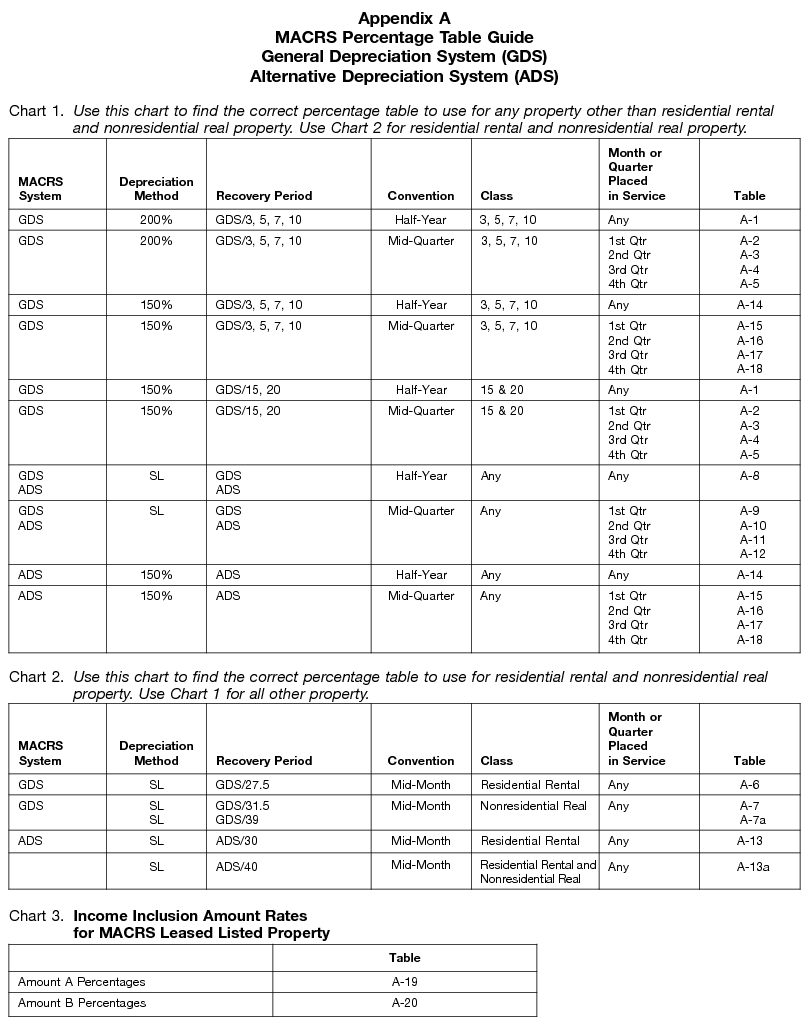
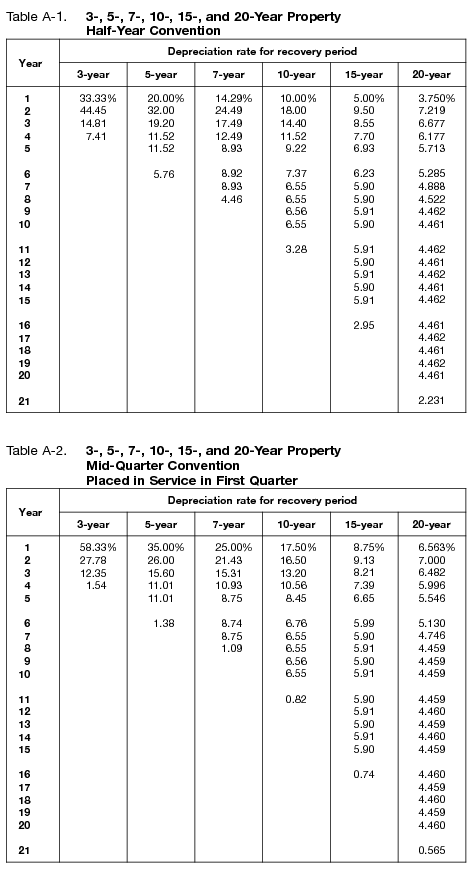
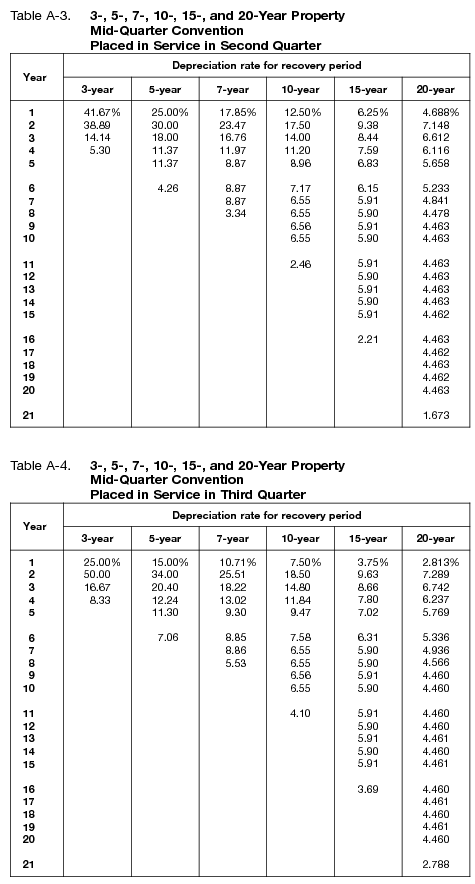
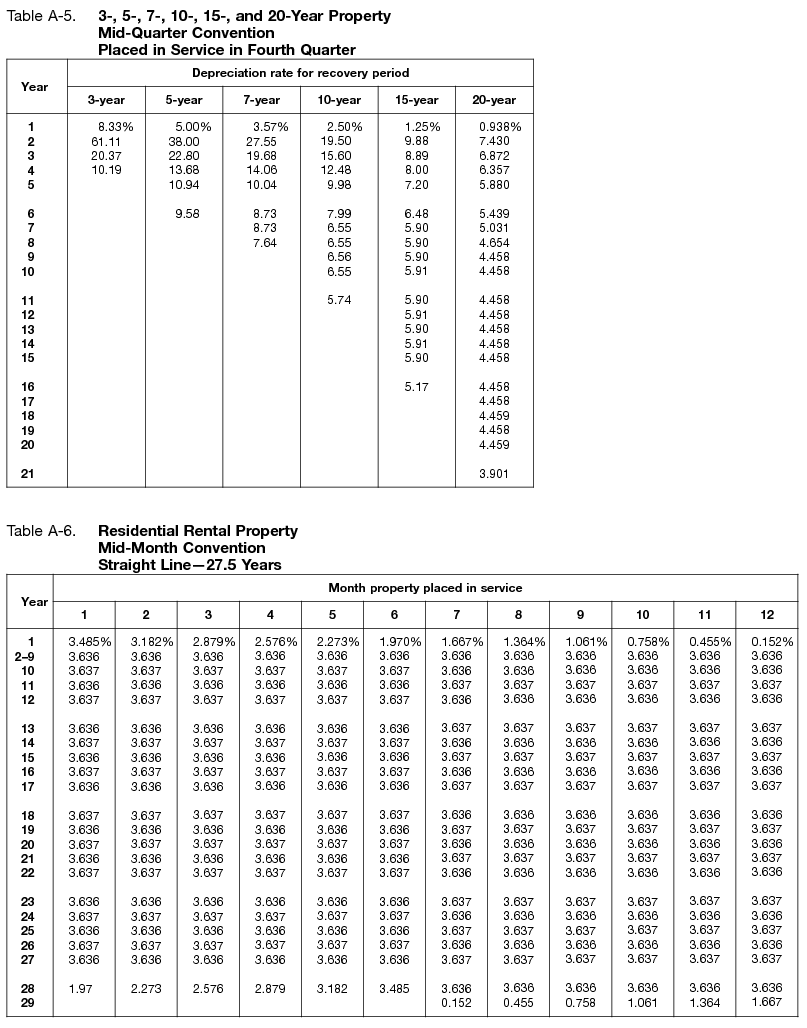
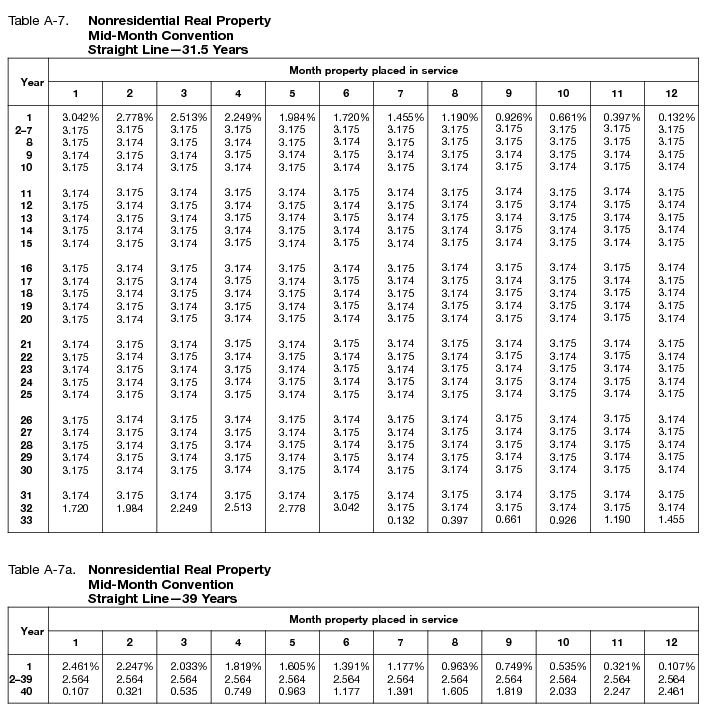
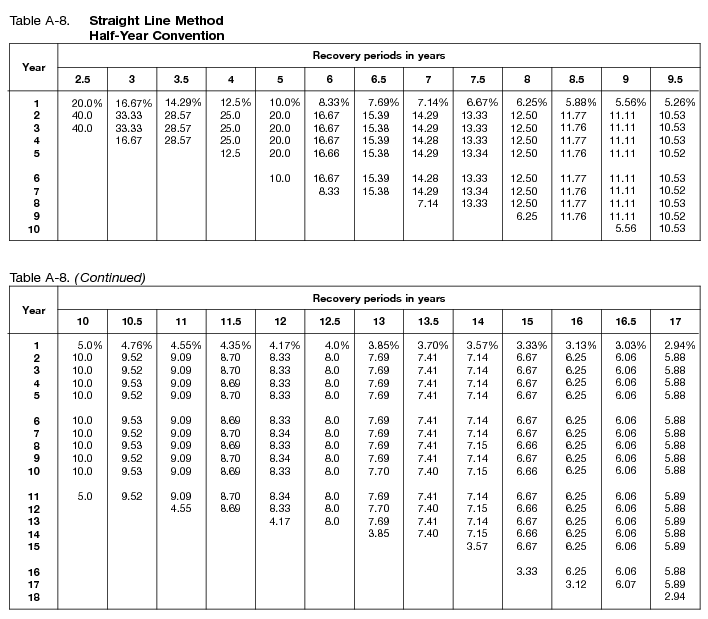
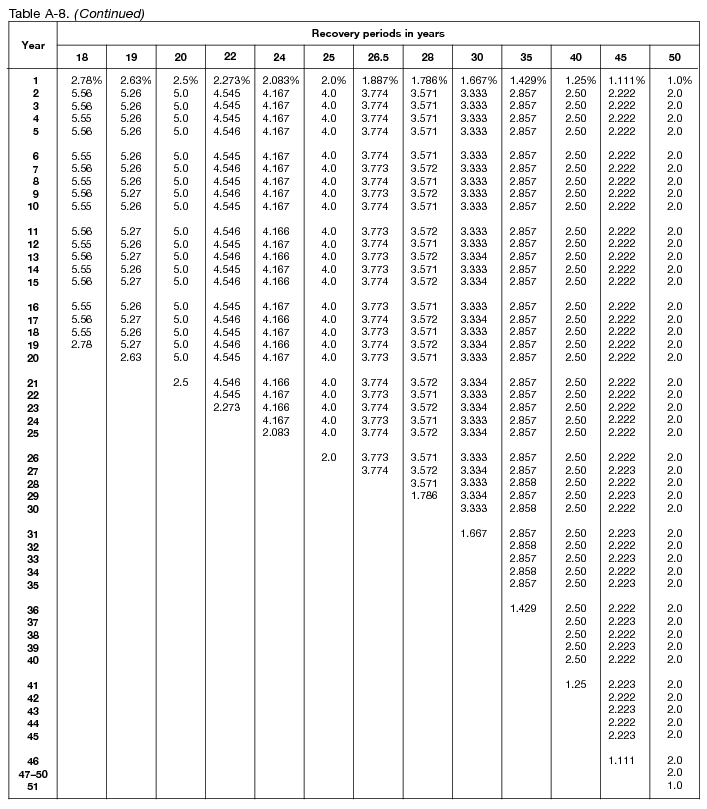
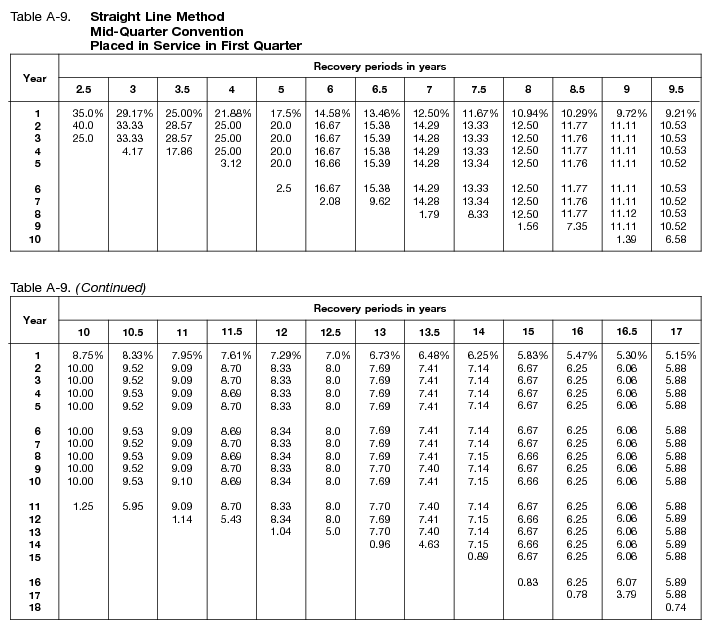
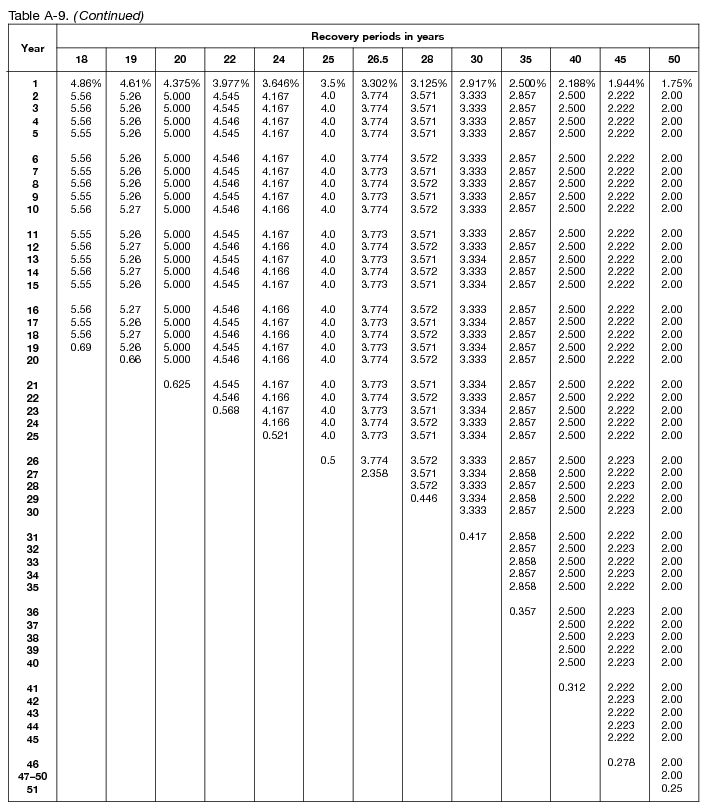
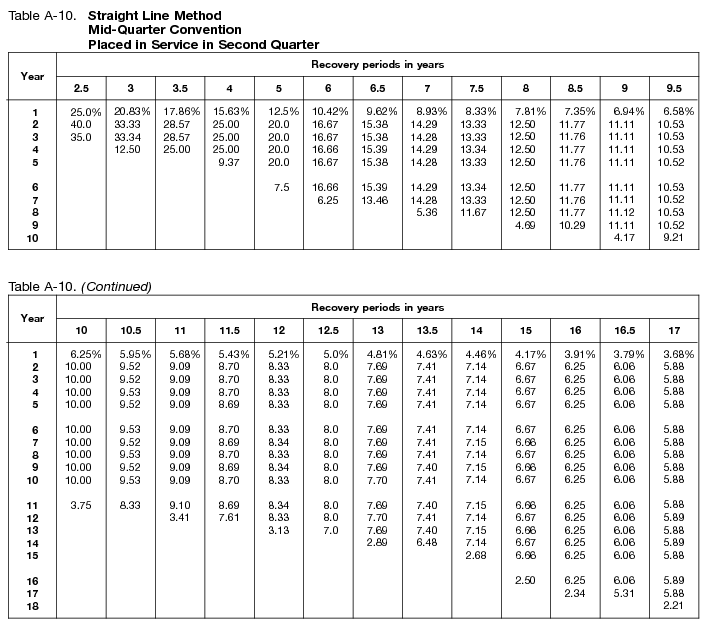
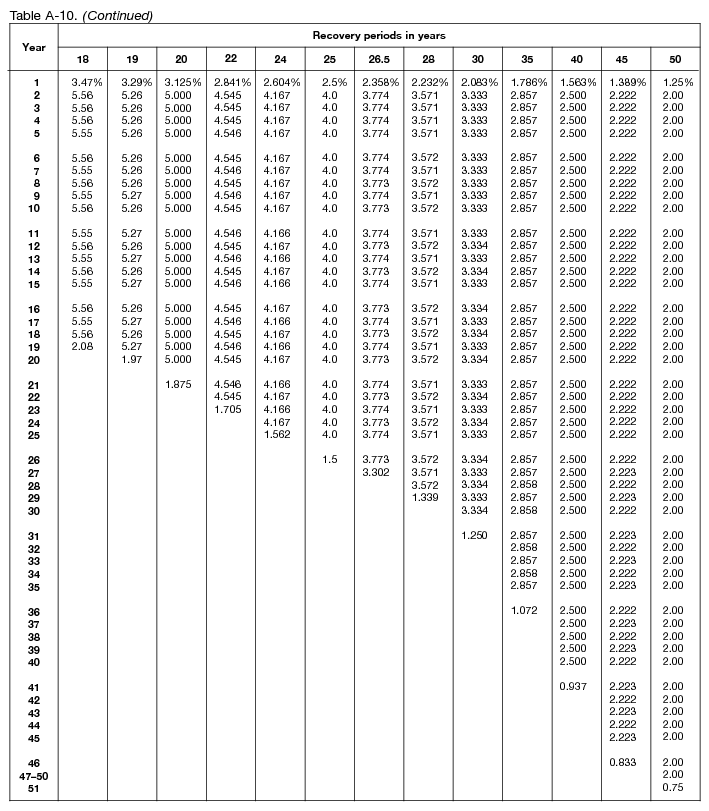
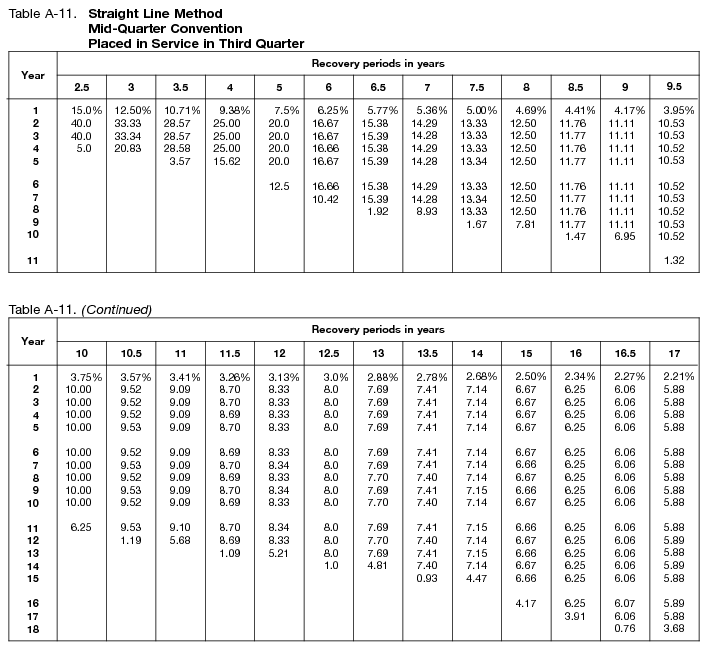
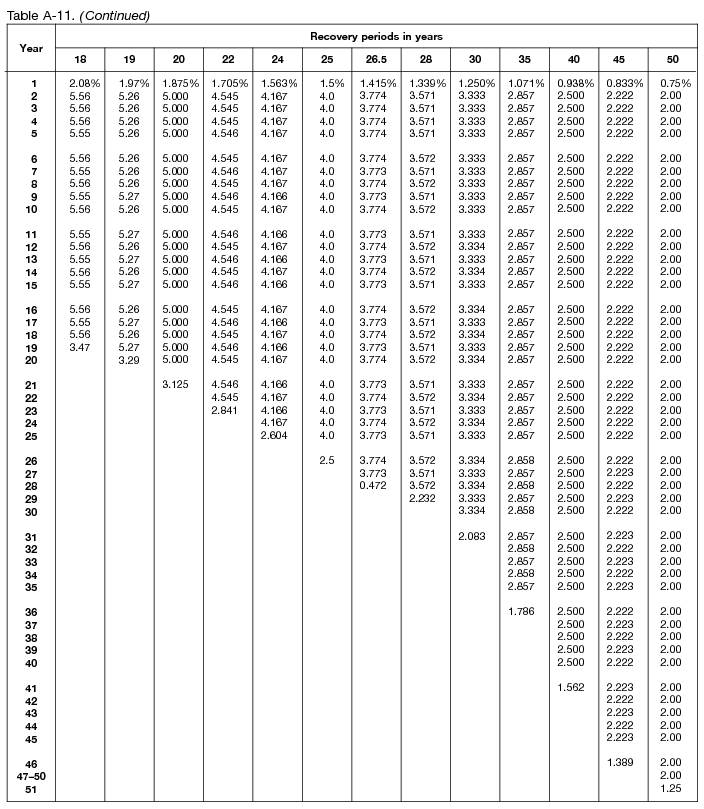
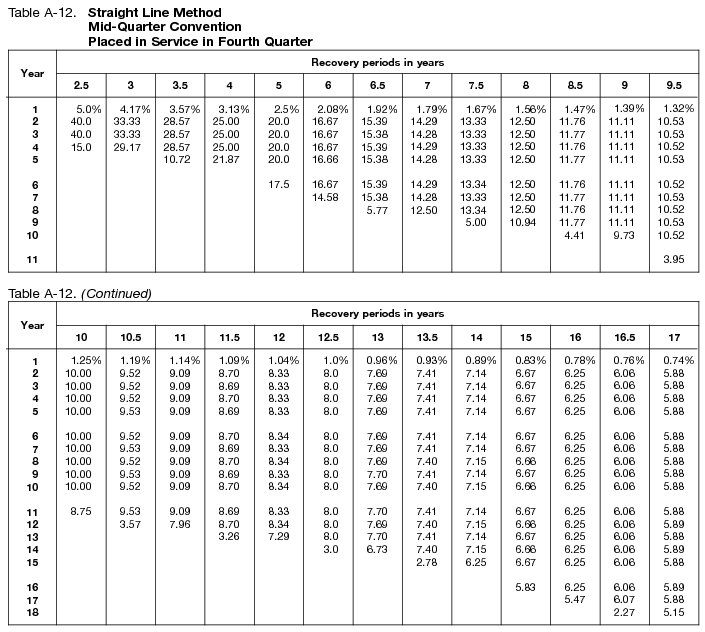
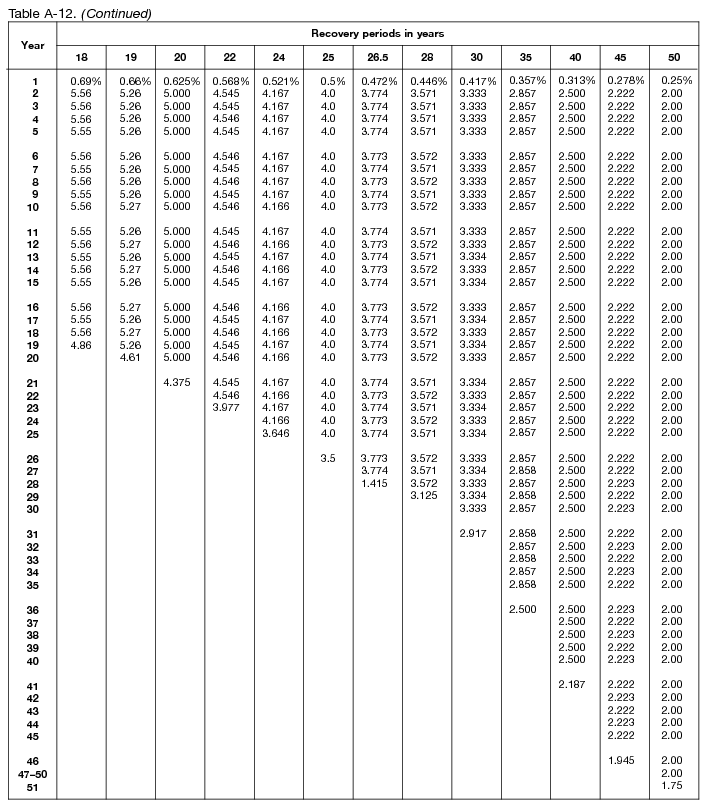
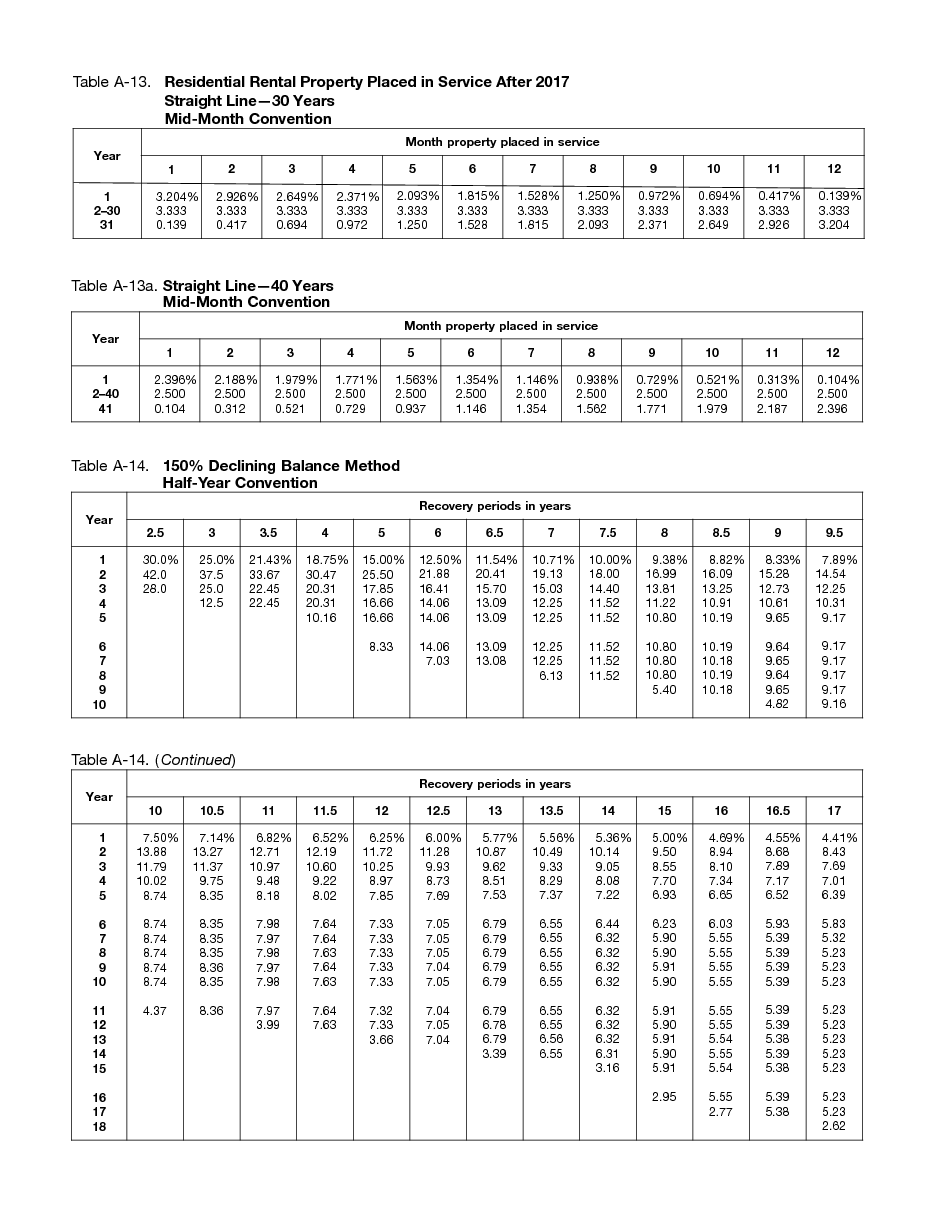
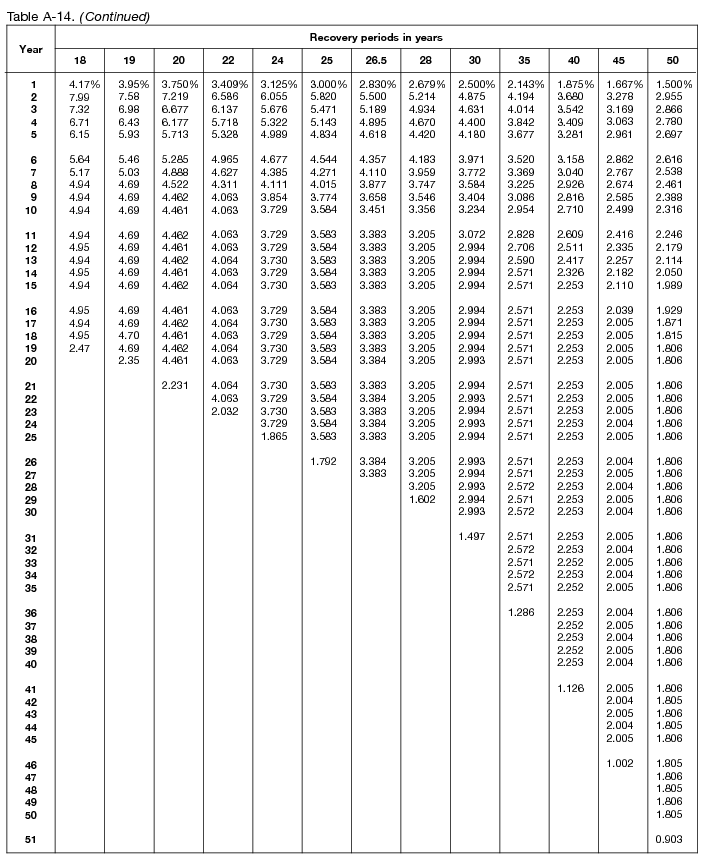
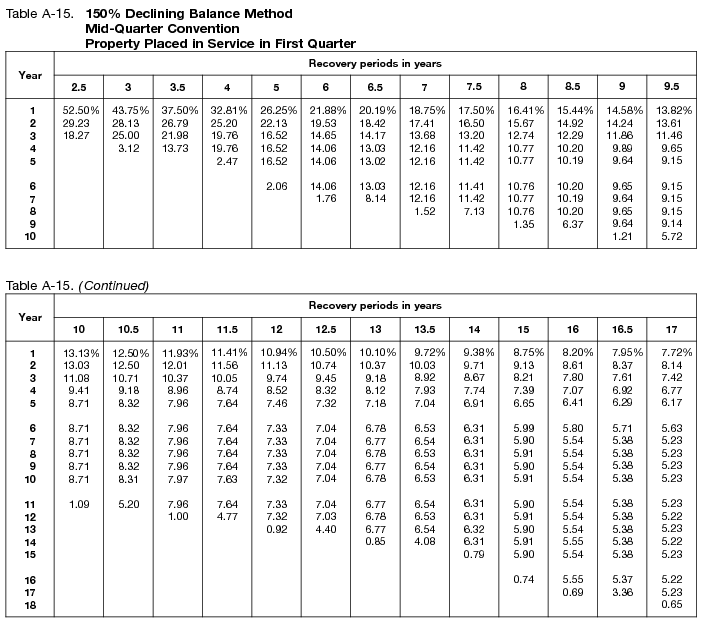
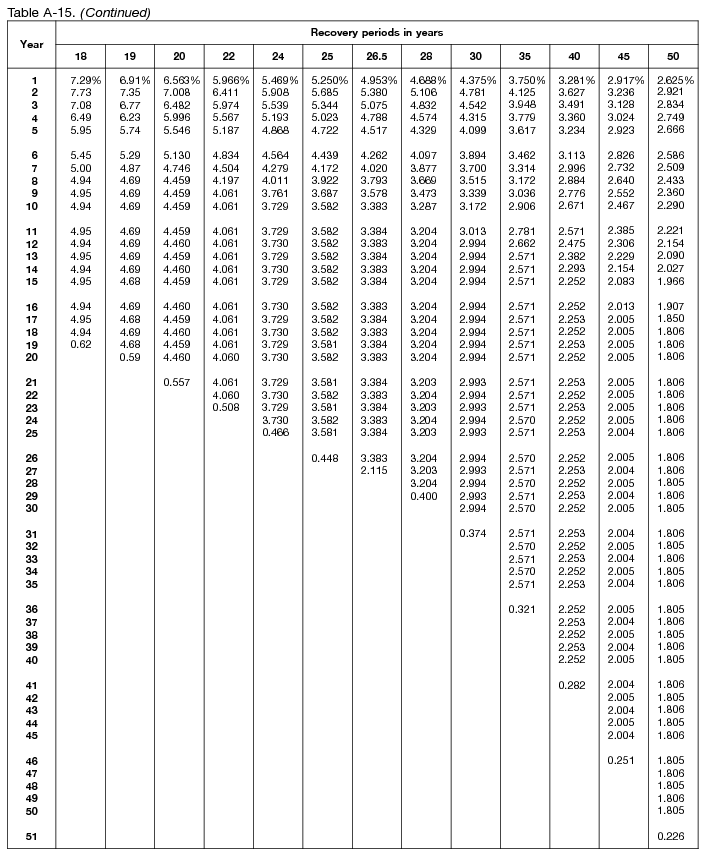
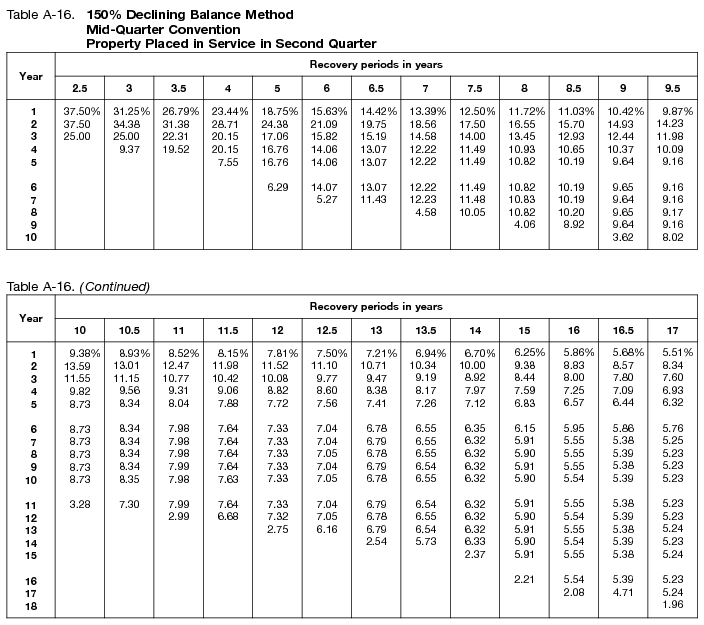
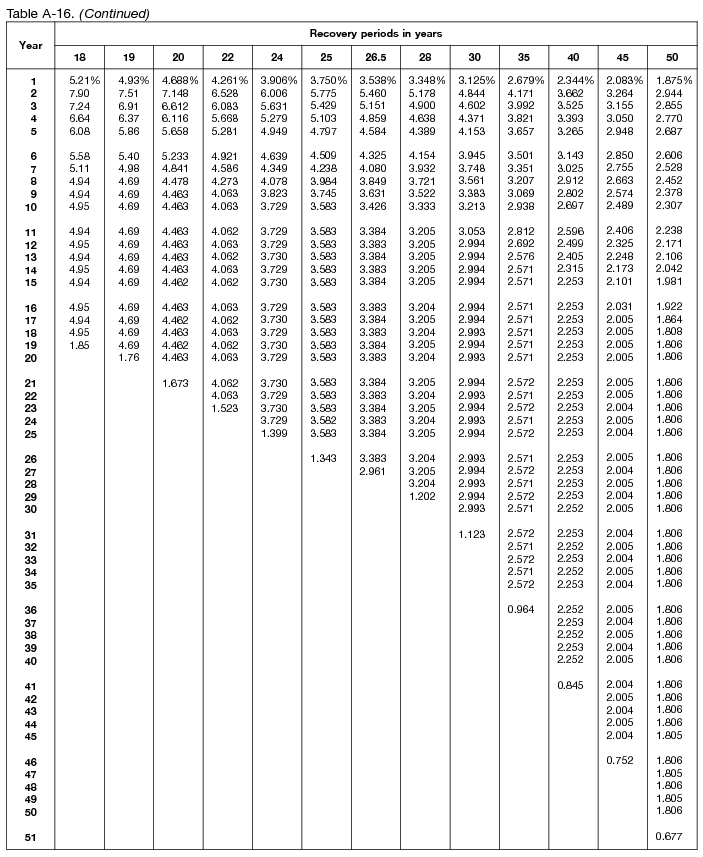
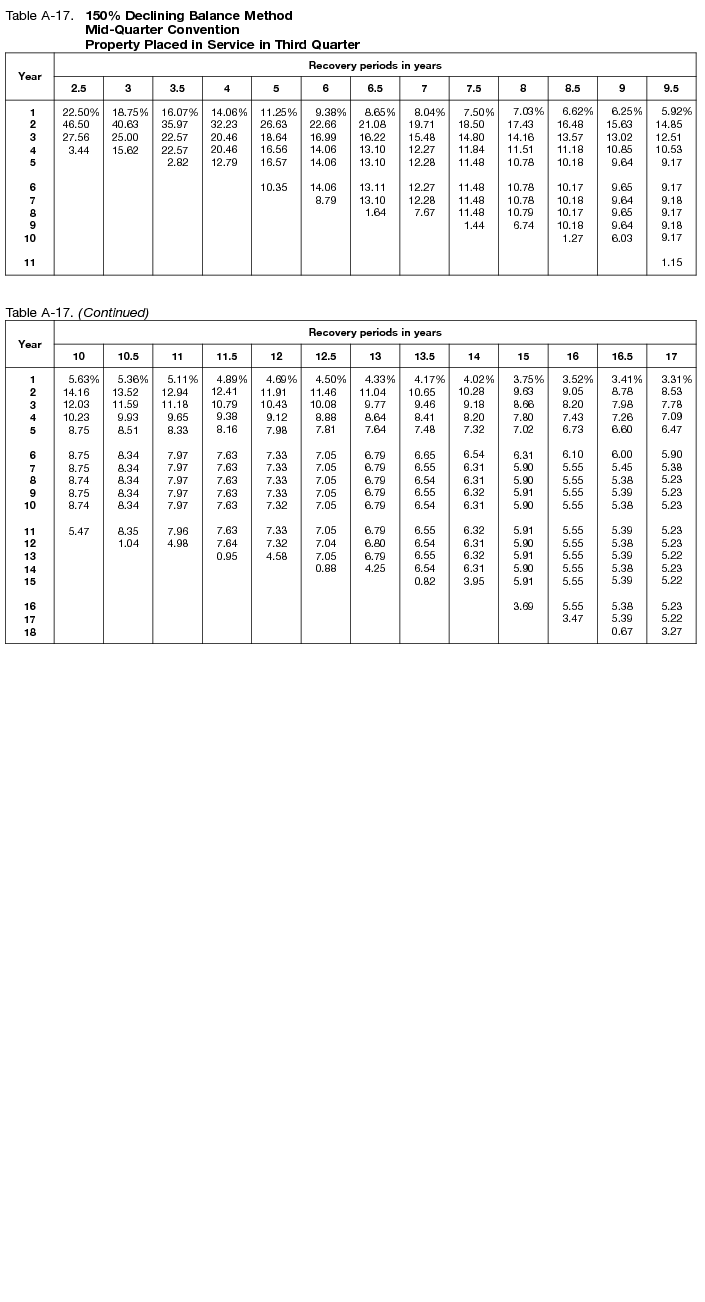
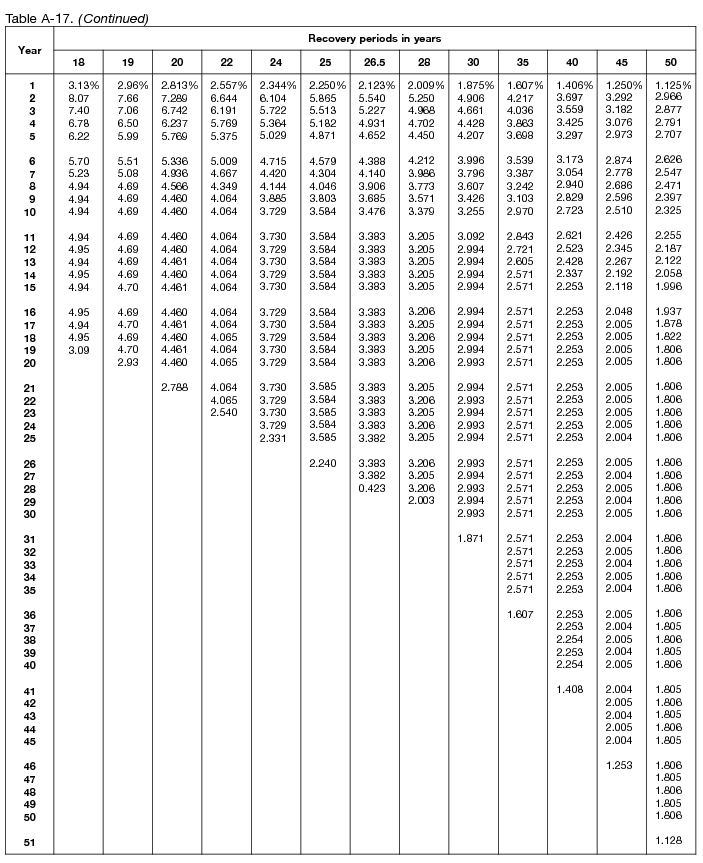
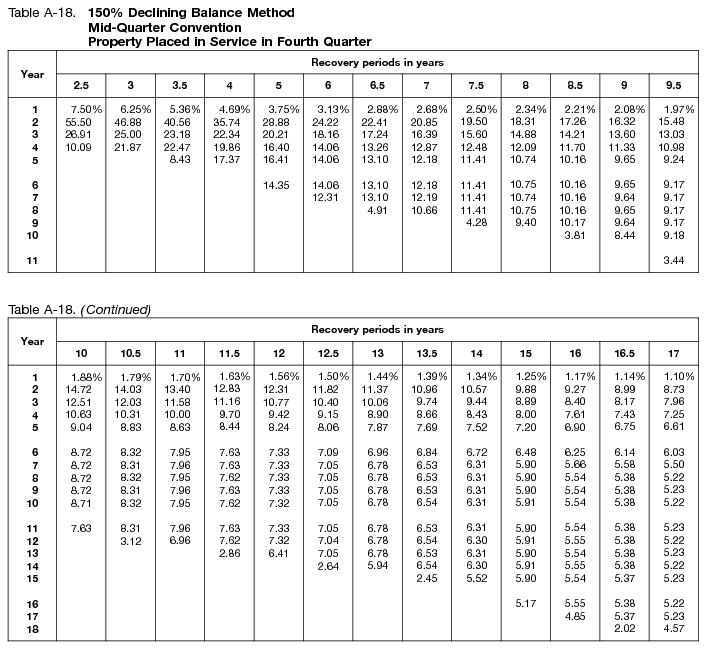
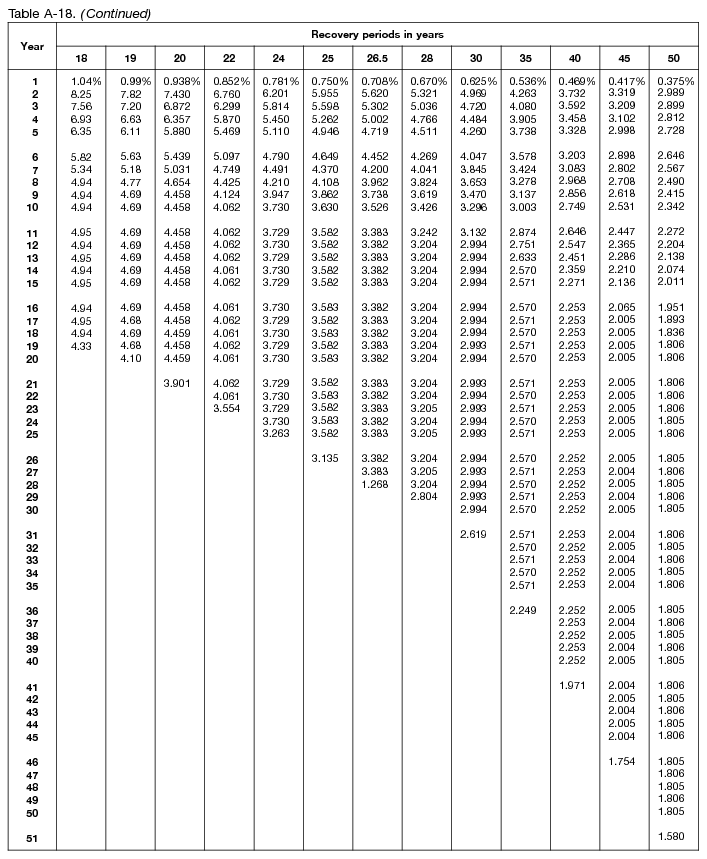
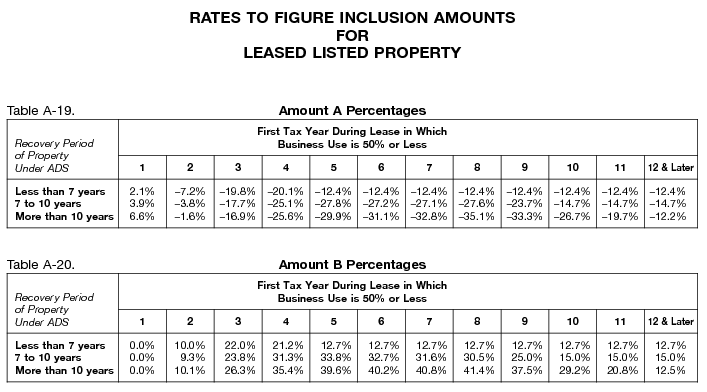
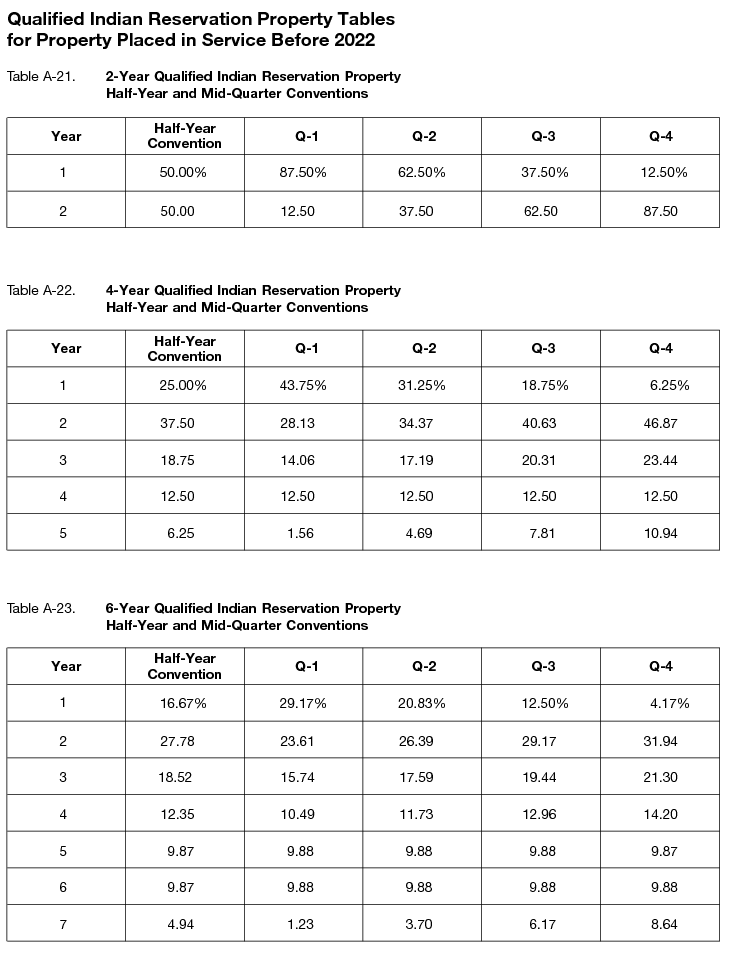
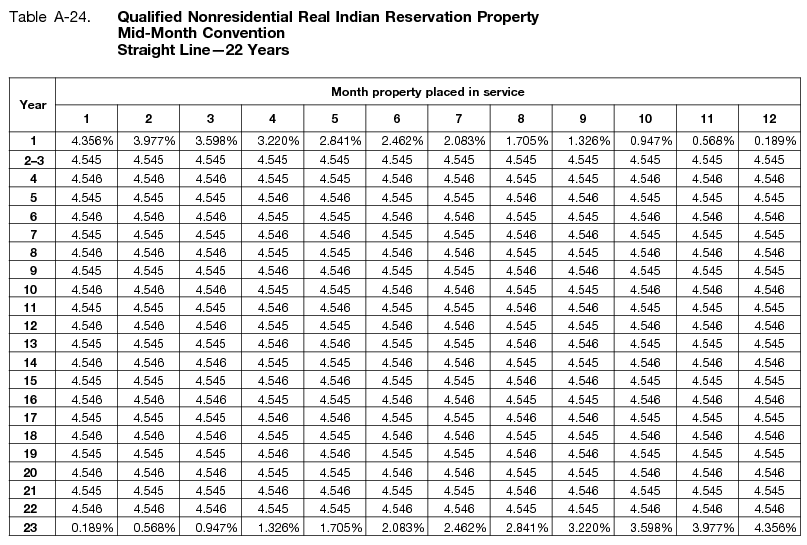
Appendix B—Table of Class Lives and Recovery Periods
The Table of Class Lives and Recovery Periods has two sections. The first section, Specific Depreciable Assets Used in All Business Activities, Except as Noted, generally lists assets used in all business activities. It is shown as Table B-1. The second section, Depreciable Assets Used in the Following Activities, describes assets used only in certain activities. It is shown as Table B-2.
How To Use the Tables
You will need to look at both Table B-1 and Table B-2 to find the correct recovery period. Generally, if the property is listed in Table B-1, you use the recovery period shown in that table. However, if the property is specifically listed in Table B-2 under the type of activity in which it is used, you use the recovery period listed under the activity in that table. Use the tables in the order shown below to determine the recovery period of your depreciable property.
Table B-1.
Check Table B-1 for a description of the property. If it is described in Table B-1, also check Table B-2 to find the activity in which the property is being used. If the activity is described in Table B-2, read the text (if any) under the title to determine if the property is specifically included in that asset class. If it is, use the recovery period shown in the appropriate column of Table B-2 following the description of the activity. If the activity is not described in Table B-2 or if the activity is described but the property either is not specifically included in or is specifically excluded from that asset class, then use the recovery period shown in the appropriate column following the description of the property in Table B-1.
Tax-exempt use property subject to a lease.
The recovery period for ADS cannot be less than 125% of the lease term for any property leased under a leasing arrangement to a tax-exempt organization, governmental unit, or foreign person or entity (other than a partnership).
Table B-2.
If the property is not listed in Table B-1, check Table B-2 to find the activity in which the property is being used and use the recovery period shown in the appropriate column following the description.
Property not in either table.
If the activity or the property is not included in either table, check the end of Table B-2 to find Certain Property for Which Recovery Periods Assigned. This property generally has a recovery period of 7 years for GDS or 12 years for ADS. See Which Property Class Applies Under GDS? and Which Recovery Period Applies? in chapter 4 for the class lives or the recovery periods for GDS and ADS for the following.
-
Residential rental property and nonresidential real property (also see Appendix A, Chart 2).
-
Qualified rent-to-own property.
-
A motorsport entertainment complex.
-
Any retail motor fuels outlet.
-
Initial clearing and grading land improvements for gas utility property and electric utility transmission and distribution plants.
-
Any water utility property.
-
Certain electric transmission property used in the transmission at 69 or more kilovolts of electricity for sale and placed in service after April 11, 2005.
-
Natural gas gathering and distribution lines placed in service after April 11, 2005.
Example 1.
You are a paper manufacturer. During the year, you made substantial improvements to the land on which your paper plant is located. You check Table B-1 and find land improvements under asset class 00.3. You then check Table B-2 and find your activity, paper manufacturing, under asset class 26.1, Manufacture of Pulp and Paper. You use the recovery period under this asset class because it specifically includes land improvements. The land improvements have a 13-year class life and a 7-year recovery period for GDS. If you elect to use ADS, the recovery period is 13 years. If you only looked at Table B-1, you would select asset class 00.3, Land Improvements, and incorrectly use a recovery period of 15 years for GDS or 20 years for ADS.
Example 2.
You produce rubber products. During the year, you made substantial improvements to the land on which your rubber plant is located. You check Table B-1 and find land improvements under asset class 00.3. You then check Table B-2 and find your activity, producing rubber products, under asset class 30.1, Manufacture of Rubber Products. Reading the headings and descriptions under asset class 30.1, you find that it does not include land improvements. Therefore, you use the recovery period under asset class 00.3. The land improvements have a 20-year class life and a 15-year recovery period for GDS. If you elect to use ADS, the recovery period is 20 years.
Example 3.
You own a retail clothing store. During the year, you purchased a desk and a cash register for use in your business. You check Table B-1 and find office furniture under asset class 00.11. Cash registers are not listed in any of the asset classes in Table B-1. You then check Table B-2 and find your activity, retail store, under asset class 57.0, Distributive Trades and Services, which includes assets used in wholesale and retail trade. This asset class does not specifically list office furniture or a cash register. You look back at Table B-1 and use asset class 00.11 for the desk. The desk has a 10-year class life and a 7-year recovery period for GDS. If you elect to use ADS, the recovery period is 10 years. For the cash register, you use asset class 57.0 because cash registers are not listed in Table B-1 but it is an asset used in your retail business. The cash register has a 9-year class life and a 5-year recovery period for GDS. If you elect to use the ADS method, the recovery period is 9 years.
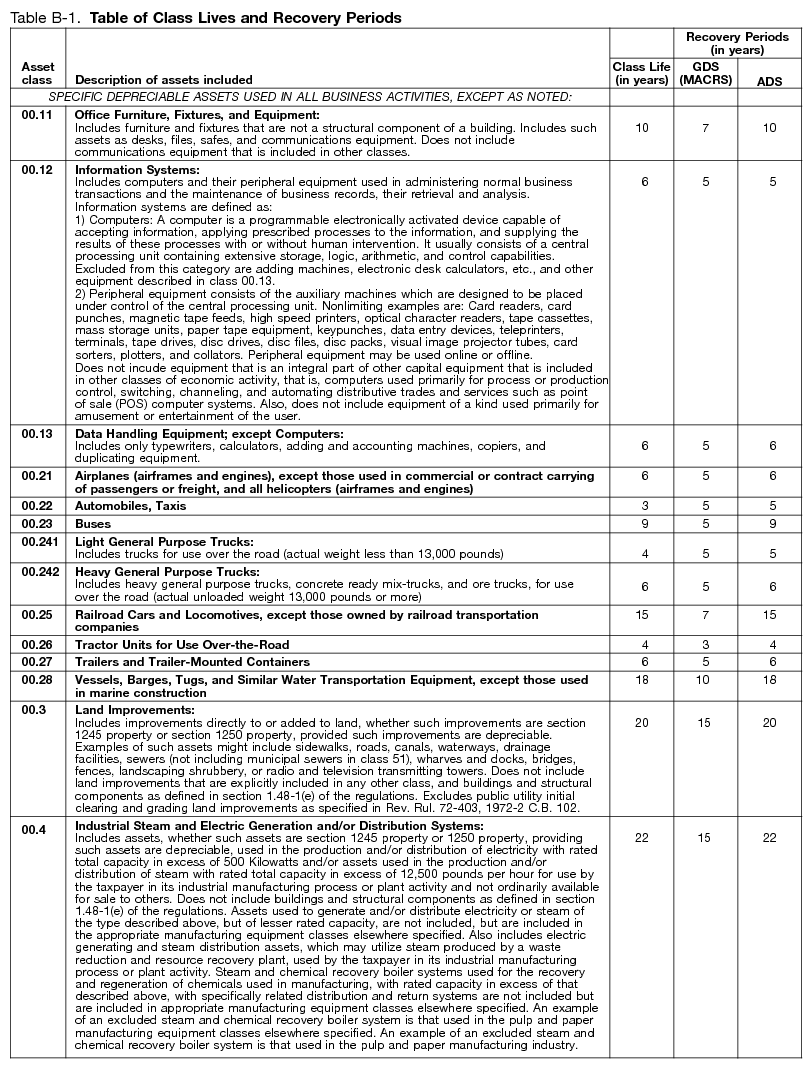
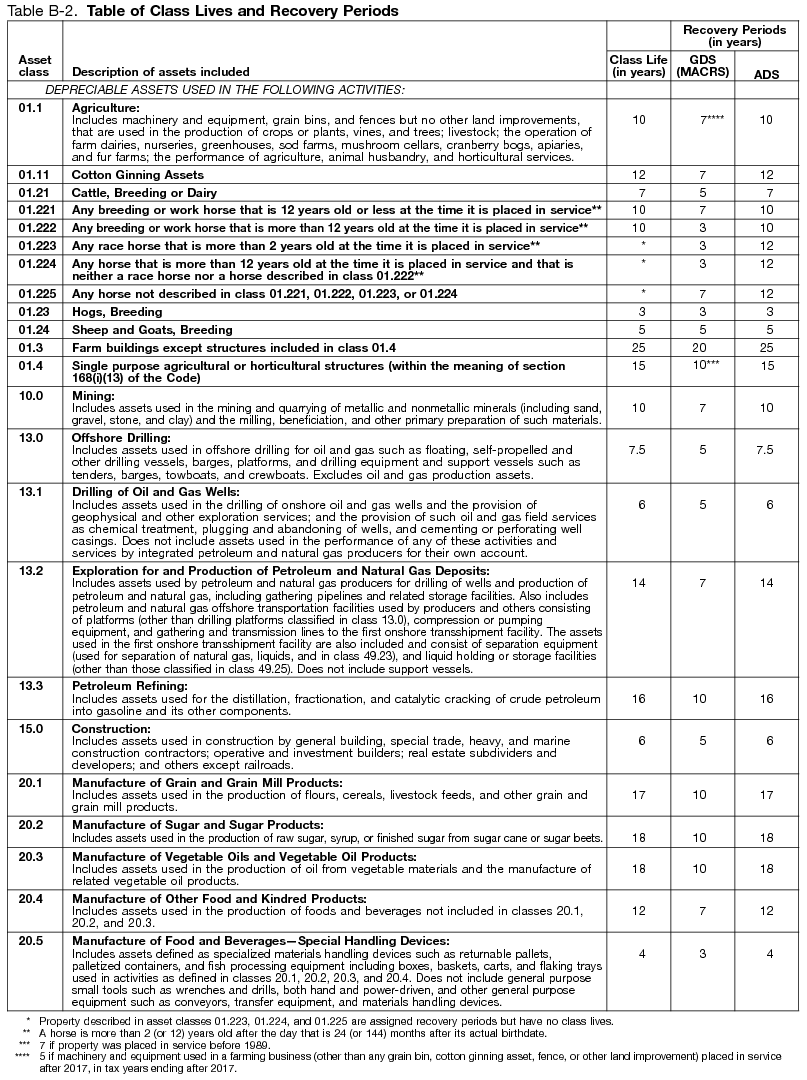
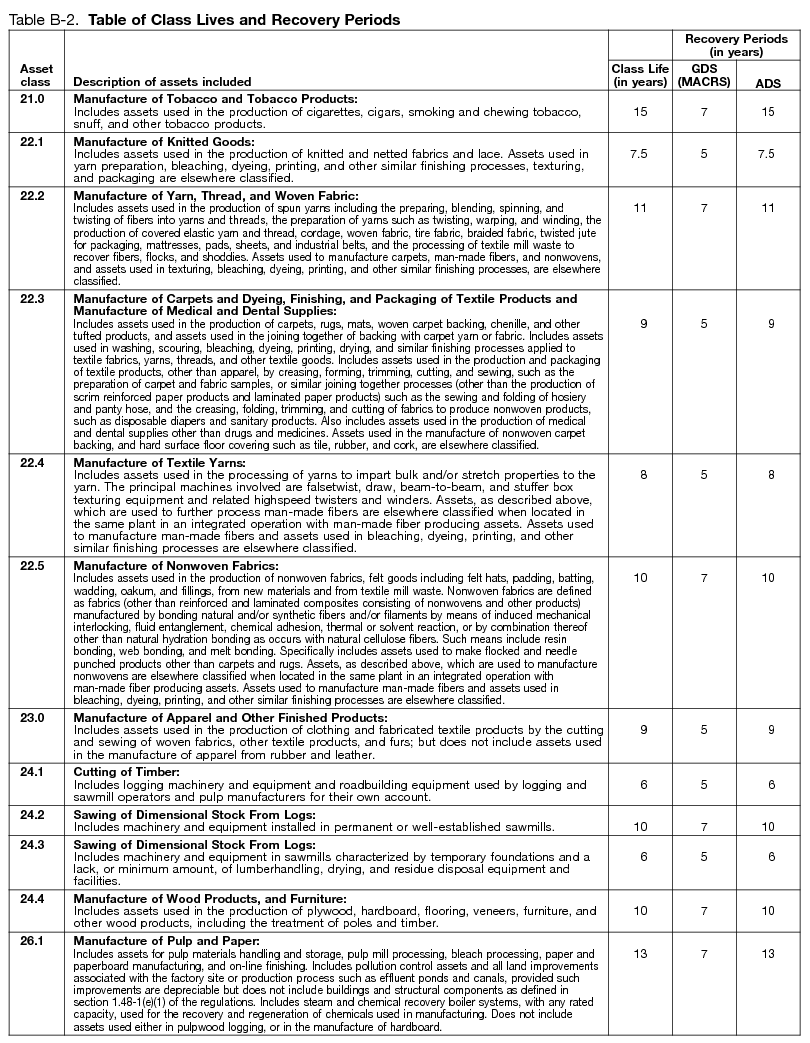
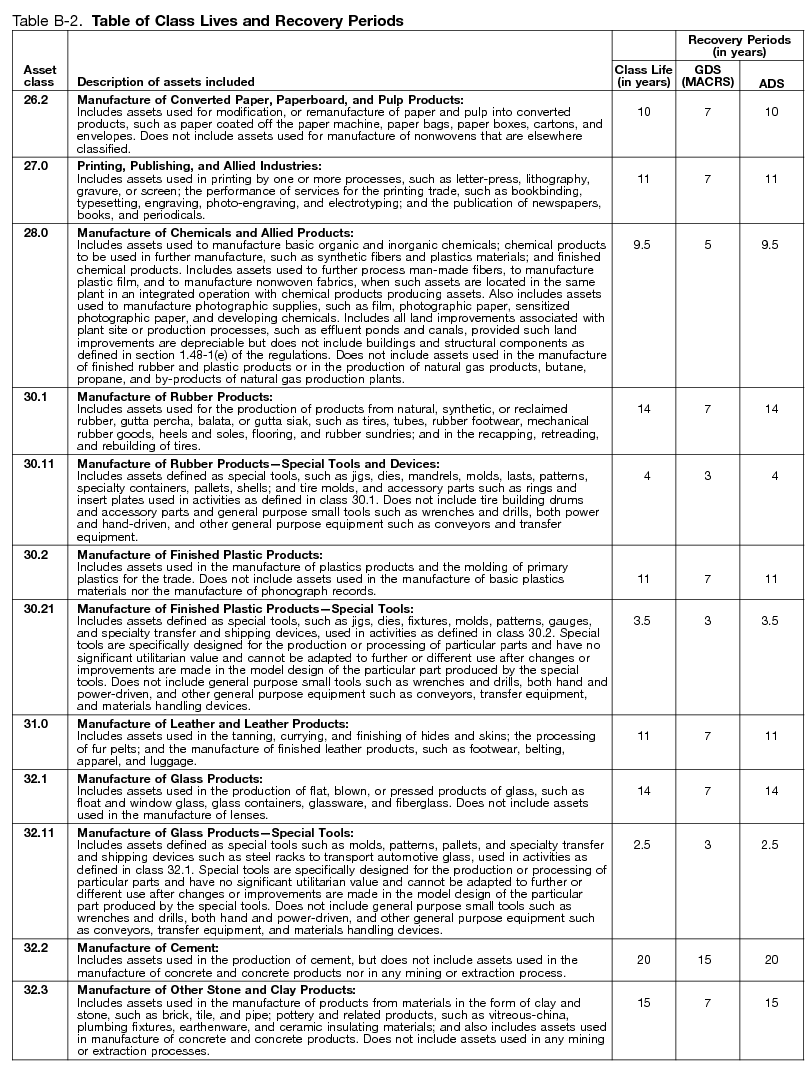
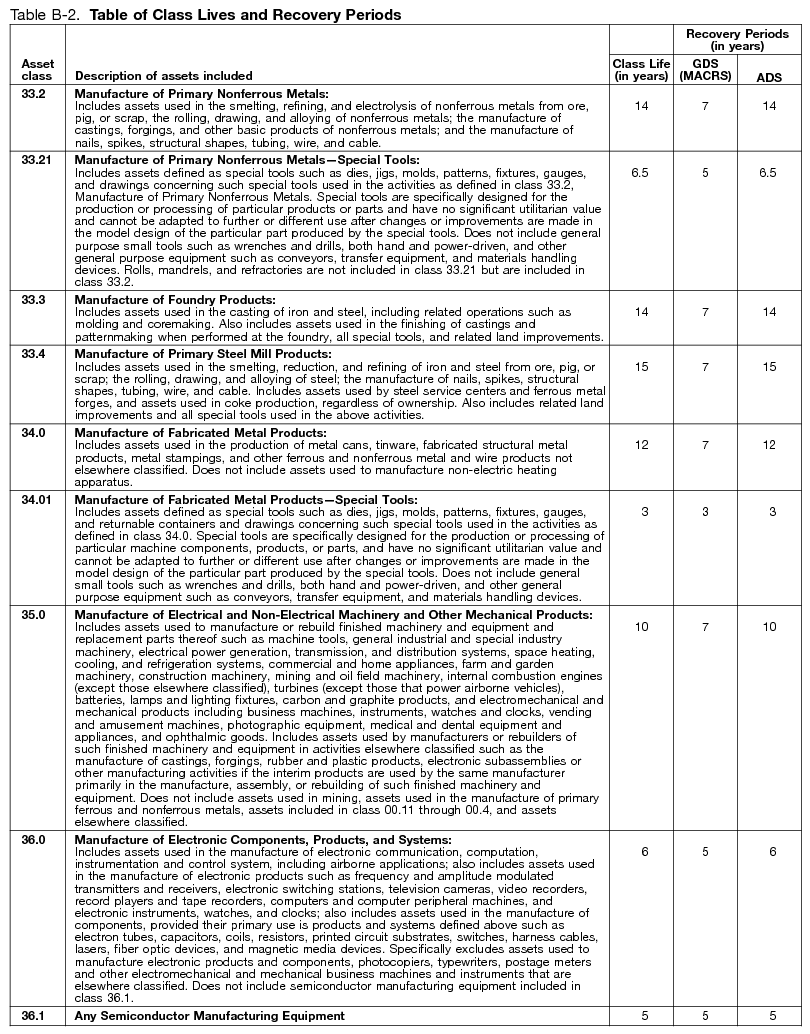
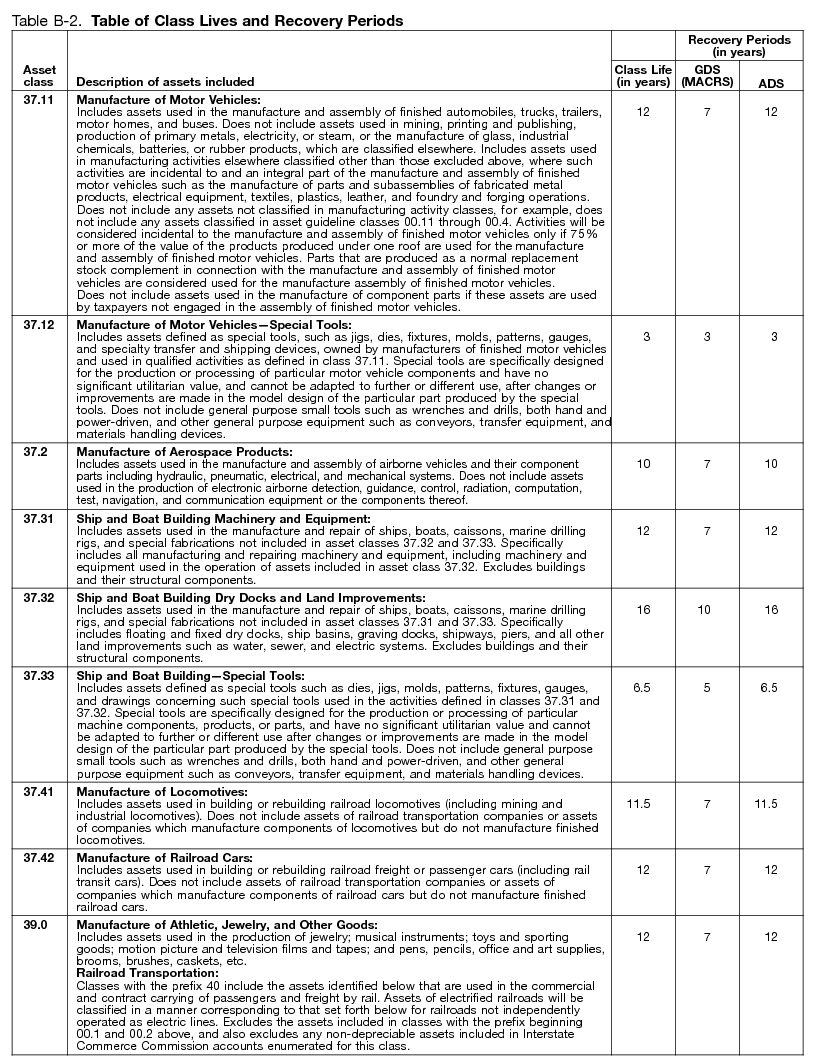
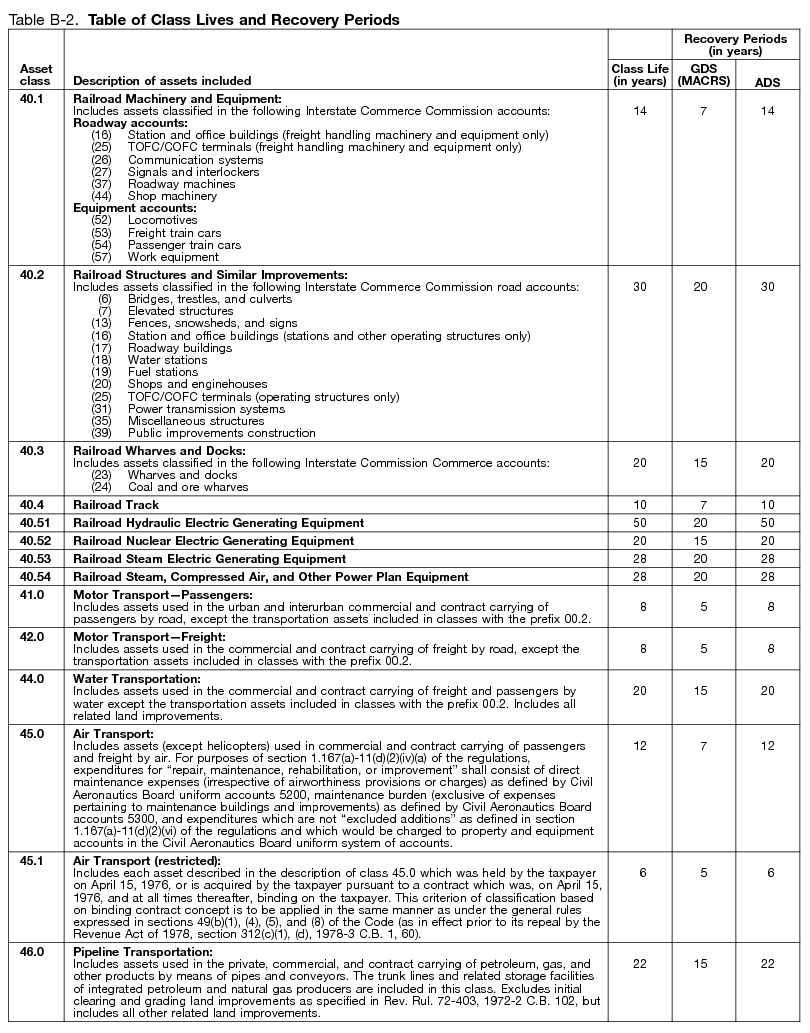
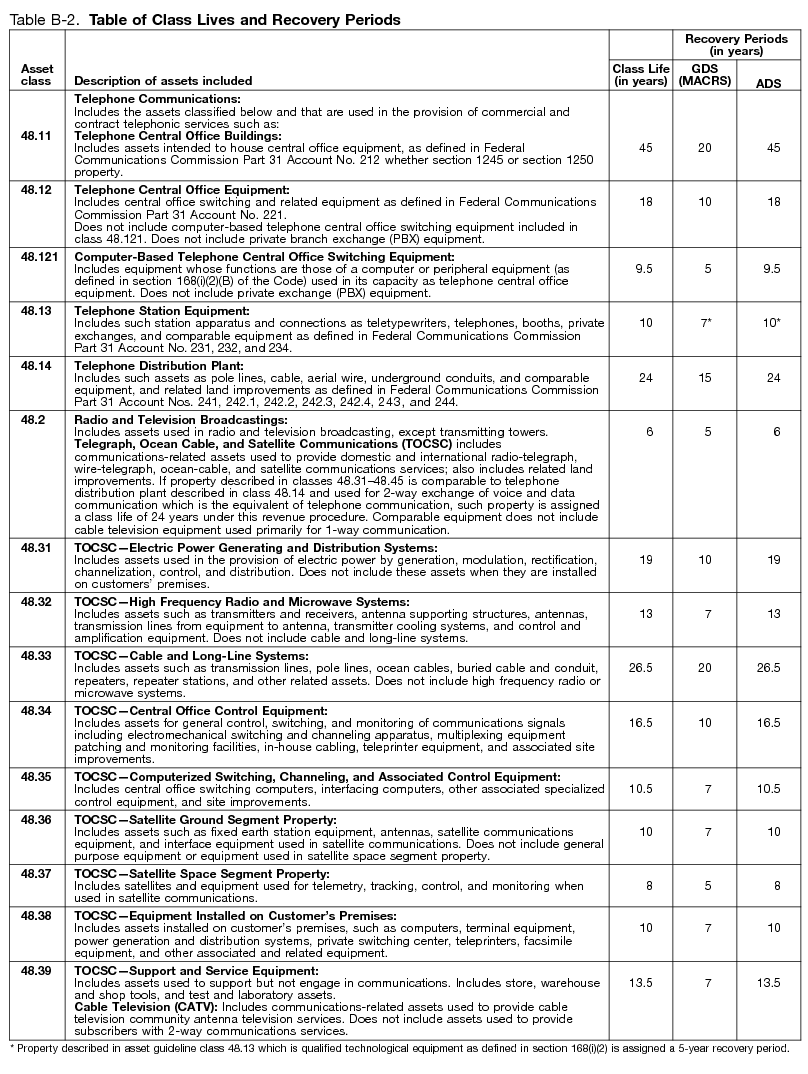
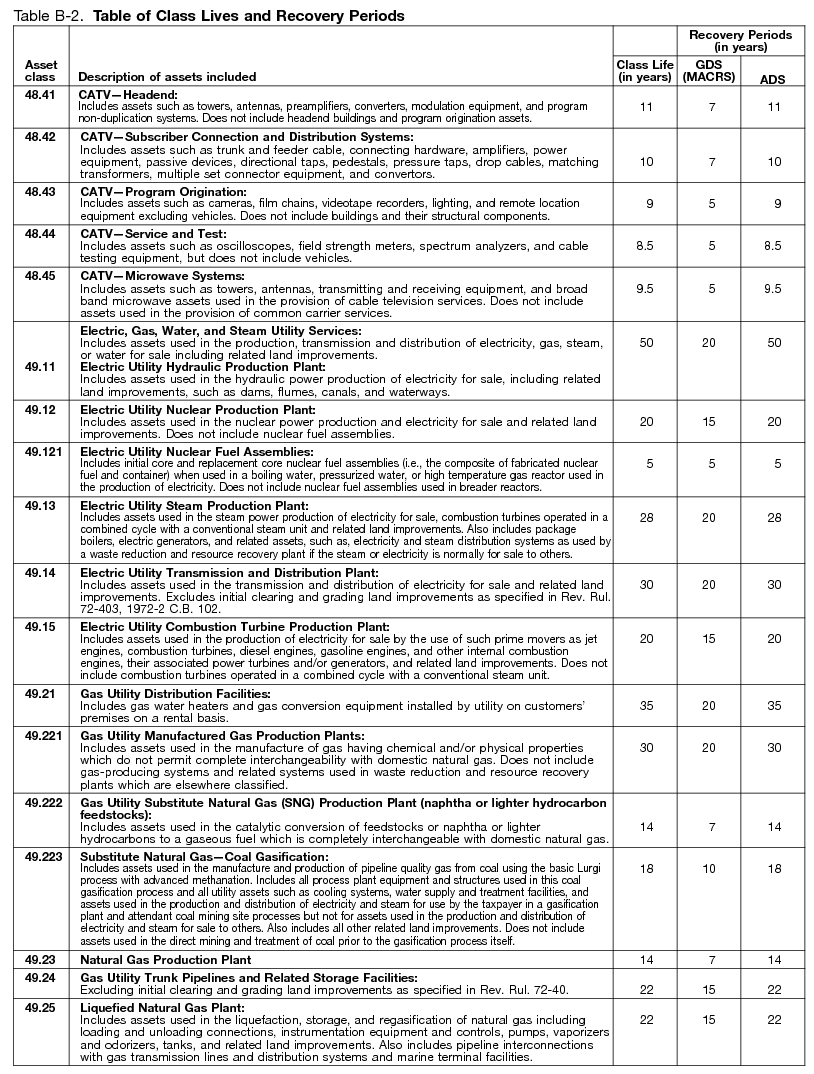
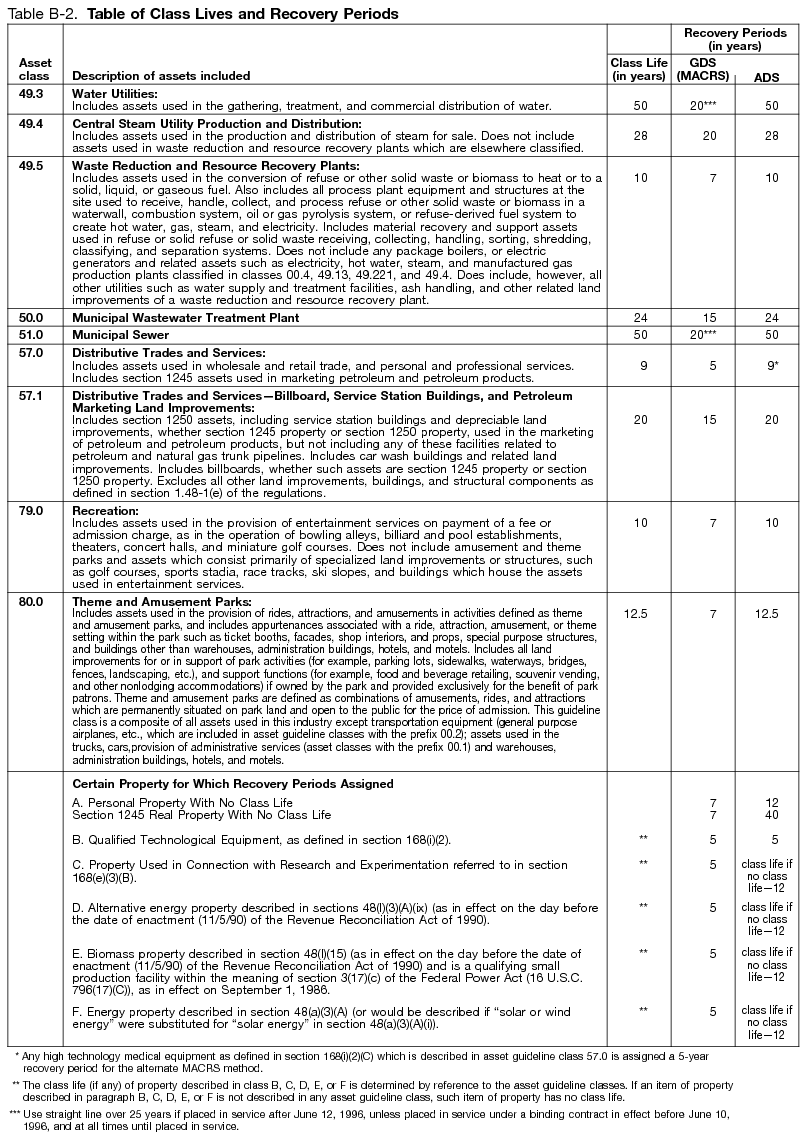
- Abstract fees:
-
Expenses generally paid by a buyer to research the title of real property.
- Active conduct of a trade or business:
-
Generally, for the section 179 deduction, a taxpayer is considered to conduct a trade or business actively if they meaningfully participate in the management or operations of the trade or business. A mere passive investor in a trade or business does not actively conduct the trade or business.
- Adjusted basis:
-
The original cost of property, plus certain additions and improvements, minus certain deductions such as depreciation allowed or allowable and casualty losses.
- Amortization:
-
A ratable deduction for the cost of intangible property over its useful life.
- Amount realized:
-
The total of all money received plus the fair market value of all property or services received from a sale or exchange. The amount realized also includes any liabilities assumed by the buyer and any liabilities to which the property transferred is subject, such as real estate taxes or a mortgage.
- Basis:
-
A measure of an individual’s investment in property for tax purposes.
- Business/investment use:
-
Usually, a percentage showing how much an item of property, such as an automobile, is used for business and investment purposes.
- Capitalized:
-
Expended or treated as an item of a capital nature. A capitalized amount is not deductible as a current expense and must be included in the basis of property.
- Circumstantial evidence:
-
Details or facts which indirectly point to other facts.
- Class life:
-
A number of years that establish the property class and recovery period for most types of property under the General Depreciation System (GDS) and Alternative Depreciation System (ADS).
- Commuting:
-
Travel between a personal home and work or job site within the area of an individual’s tax home.
- Convention:
-
A method established under the Modified Accelerated Cost Recovery System (MACRS) to determine the portion of the year to depreciate property both in the year the property is placed in service and in the year of disposition.
- Declining balance method:
-
An accelerated method to depreciate property. The GDS of MACRS uses the 150% and 200% declining balance methods for certain types of property. A depreciation rate (percentage) is determined by dividing the declining balance percentage by the recovery period for the property.
- Disposition:
-
The permanent withdrawal from use in a trade or business or from the production of income.
- Documentary evidence:
-
Written records that establish certain facts. Other records, such as emails, pictures, or other electronic records could serve as evidence.
- Exchange:
-
To barter, swap, part with, give, or transfer property for other property or services.
- Fair market value (FMV):
-
The price that property brings when it is offered for sale by one who is willing but not obligated to sell, and is bought by one who is willing or desires to buy but is not compelled to do so.
- Fiduciary:
-
The one who acts on behalf of another as a guardian, trustee, executor, administrator, receiver, or conservator.
- Fungible commodity:
-
A commodity of a nature that one part may be used in place of another part.
- Goodwill:
-
An intangible property such as the advantage or benefit received in property beyond its mere value. It is not confined to a name but can also be attached to a particular area where business is transacted, to a list of customers, or to other elements of value in business as a going concern.
- Grantor:
-
The one who transfers property to another.
- Improvement:
-
An addition to or partial replacement of property that adds to its value, appreciably lengthens the time you can use it, or adapts it to a different use.
- Intangible property:
-
Property that has value but cannot be seen or touched, such as goodwill, patents, copyrights, and computer software.
- Listed property:
-
Passenger automobiles; any other property used for transportation; and property of a type generally used for entertainment, recreation, or amusement.
- Nonresidential real property:
-
Most real property other than residential rental property.
- Placed in service:
-
Ready and available for a specific use whether in a trade or business, the production of income, a tax-exempt activity, or a personal activity.
- Property class:
-
A category for property under MACRS. It generally determines the depreciation method, recovery period, and convention.
- Recapture:
-
To include as income on your return an amount allowed or allowable as a deduction in a prior year.
- Recovery period:
-
The number of years over which the basis of an item of property is recovered.
- Remainder interest:
-
That part of an estate that is left after all the other provisions of a will have been satisfied.
- Residential rental property:
-
Real property, generally buildings or structures, if 80% or more of its annual gross rental income is from dwelling units.
- Salvage value:
-
An estimated value of property at the end of its useful life. Not used under MACRS.
- Section 1245 property:
-
Property that is or has been subject to an allowance for depreciation or amortization. Section 1245 property includes personal property, single-purpose agricultural and horticultural structures, storage facilities used in connection with the distribution of petroleum or primary products of petroleum, and railroad grading or tunnel bores.
- Section 1250 property:
-
Real property (other than section 1245 property) which is or has been subject to an allowance for depreciation.
- Standard mileage rate:
-
The established amount for optional use in determining a tax deduction for automobiles instead of deducting depreciation and actual operating expenses.
- Straight line method:
-
A way to figure depreciation for property that ratably deducts the same amount for each year in the recovery period. The rate (in percentage terms) is determined by dividing 1 by the number of years in the recovery period.
- Structural components:
-
Parts that together form an entire structure, such as a building. The term includes those parts of a building such as walls, partitions, floors, and ceilings, as well as any permanent coverings such as paneling or tiling, windows and doors, and all components of a central air conditioning or heating system including motors, compressors, pipes, and ducts. It also includes plumbing fixtures such as sinks, bathtubs, electrical wiring and lighting fixtures, and other parts that form the structure.
- Tangible property:
-
Property you can see or touch, such as buildings, machinery, vehicles, furniture, and equipment.
- Tax exempt:
-
Not subject to tax.
- Term interest:
-
A life interest in property, an interest in property for a term of years, or an income interest in a trust. It generally refers to a present or future interest in income from property or the right to use property that terminates or fails upon the lapse of time, the occurrence of an event, or the failure of an event to occur.
- Unadjusted basis:
-
The basis of an item of property for purposes of figuring gain on a sale without taking into account any depreciation taken in earlier years but with adjustments for other amounts, including amortization, the section 179 deduction, any special depreciation allowance, any deduction claimed for clean-fuel vehicles or clean-fuel vehicle refueling property placed in service before January 1, 2006, and any electric vehicle credit.
- Unit-of-production method:
-
A way to figure depreciation for certain property. It is determined by estimating the number of units that can be produced before the property is worn out. For example, if it is estimated that a machine will produce 1,000 units before its useful life ends, and it actually produces 100 units in a year, the percentage to figure depreciation for that year is 10% of the machine’s cost less its salvage value.
- Useful life:
-
An estimate of how long an item of property can be expected to be usable in a trade or business or to produce income.
A
- Addition to property, Additions and Improvements
- Adjusted basis, Adjusted Basis
- Alternative Depreciation System (ADS)
-
- Recovery periods, Recovery Periods Under ADS
- Required use, Required use of ADS.
- Amended return, Filing an Amended Return
- Apartment
-
- Cooperative, Cooperative apartments.
- Rental, Which Property Class Applies Under GDS?
- Assistance (see Tax help)
- Automobile (see Passenger automobile)
B
- Basis
-
- Adjustments, Basis adjustment for depreciation allowed or allowable., Adjustment of partner’s basis in partnership., Basis adjustment due to recapture of clean-fuel vehicle deduction or credit., Basis adjustment due to casualty loss.
- Basis for depreciation, What Is the Basis for Depreciation?
- Casualty loss, Basis adjustment due to casualty loss.
- Change in use, Property changed from personal use.
- Cost, Cost as Basis
- Depreciable basis, Depreciable basis.
- Other than cost, Other Basis
- Recapture of clean-fuel vehicle deduction or credit, Basis adjustment due to recapture of clean-fuel vehicle deduction or credit.
- Term interest, Basis adjustments.
- Unadjusted, Figuring the Unadjusted Basis of Your Property
- Business use of property, partial, Partial business or investment use.
- Business-use limit, recapture of Section 179 deduction, When Must You Recapture the Deduction?
- Business-use requirement, listed property, What Is the Business-Use Requirement?
C
- Car (see Passenger automobile)
- Carryover of section 179 deduction, Carryover of disallowed deduction.
- Casualty loss, effect of, Basis adjustment due to casualty loss.
- Changing accounting method, Changing Your Accounting Method
- Communication equipment (see Listed property)
- Commuting, Commuting use.
- Computer software, Computer software., Off-the-shelf computer software.
- Containers, Containers.
- Conventions, Which Convention Applies?
- Cooperative apartment, Cooperative apartments.
- Copyright, Patents and copyrights.
-
- (see also Section 197 intangibles)
- Correcting depreciation deductions, How Do You Correct Depreciation Deductions?
- Cost basis, Cost as Basis
D
- Declining balance
-
- Method, Declining Balance Method
- Rates, Declining balance rate.
- Deduction limit
-
- Automobile, Do the Passenger Automobile Limits Apply?
- Section 179, How Much Can You Deduct?
- Depreciation
-
- Deduction
-
- Employee, Can Employees Claim a Deduction?
- Listed property, Can Employees Claim a Deduction?
- Determinable useful life, Property Having a Determinable Useful Life
- Excepted property, Excepted Property
- Incorrect amount deducted, How Do You Correct Depreciation Deductions?
- Methods, Which Depreciation Method Applies?
- Property lasting more than one year, Property Lasting More Than 1 Year
- Property owned, Property You Own
- Property used in business, Property Used in Your Business or Income-Producing Activity
- Recapture, Revoking an election., Recapture of Excess Depreciation
- Depreciation allowable, Basis adjustment for depreciation allowed or allowable.
- Depreciation allowed, Basis adjustment for depreciation allowed or allowable.
- Depreciation deduction
-
- Listed property, What Is the Business-Use Requirement?
- Determinable useful life, Property Having a Determinable Useful Life
- Disposition
-
- Before recovery period ends, Sale or Other Disposition Before the Recovery Period Ends
- General asset account property, Disposing of GAA Property
- Section 179 deduction, When Must You Recapture the Deduction?
E
- Election
-
- ADS, Electing ADS., Election of ADS.
- Declining balance (150% DB) method, 150% election.
- Exclusion from MACRS, Election To Exclude Property From MACRS
- General asset account, Electing To Use a GAA
- Not to claim special depreciation allowance, How Can You Elect Not To Claim an Allowance?
- Section 179 deduction, How Do You Elect the Deduction?
- Straight line method, Straight line election.
- Electric vehicle, Electric Vehicles
- Employee
-
- Depreciation deduction, Can Employees Claim a Deduction?
- How to claim depreciation, Employee.
- Employee deduction, listed property, Can Employees Claim a Deduction?
- Exchange of MACRS property, Property Acquired in a Like-Kind Exchange or Involuntary Conversion
F
- Farm
-
- Property, Depreciation Methods for Farm Property
- Figuring MACRS
-
- Using percentage tables, How Is the Depreciation Deduction Figured?
- Without using percentage tables, Figuring the Deduction Without Using the Tables
- Films, Films, videotapes, and recordings.
G
- General asset account
-
- Abusive transaction, Abusive transactions.
- Disposing of property, Disposing of GAA Property
- Grouping property in, Grouping Property
- Nonrecognition transaction, Nonrecognition transactions.
- General Depreciation System (GDS), recovery periods, Recovery Periods Under GDS
- Gift (see Basis, other than cost)
- Glossary, Glossary
I
- Idle property, Idle Property
- Improvements, How Do You Treat Repairs and Improvements?, Additions and Improvements
- Income forecast method, Income Forecast Method
- Incorrect depreciation deductions, How Do You Correct Depreciation Deductions?
- Index, What Property Cannot Be Depreciated?
- index, When Does Depreciation Begin and End?, What Method Can You Use To Depreciate Your Property?, What Is the Basis of Your Depreciable Property?, Do You Have To File Form 4562?, What Property Qualifies?, What Property Does Not Qualify?, How Much Can You Deduct?, How Do You Use General Asset Accounts?, When Do You Recapture MACRS Depreciation?, What Records Must Be Kept?
- Inheritance (see Basis, other than cost)
- Intangible property
-
- Depreciation method, Intangible Property, Income Forecast Method
- Income forecast method, Income Forecast Method
- Straight line method, Intangible Property
- Inventory, Inventory.
- Investment use of property, partial, Partial business or investment use.
- Involuntary conversion of MACRS property, Property Acquired in a Like-Kind Exchange or Involuntary Conversion
L
- Land
- Leased property, Leased property.
- Leasehold improvement property, defined, Qualified improvement property.
- Life tenant, Life tenant.
-
- (see also Term interests)
- Limit on deduction
-
- Automobile, Do the Passenger Automobile Limits Apply?
- Section 179, How Much Can You Deduct?
- Listed property
-
- 5% owner, 5% owner.
- Condition of employment, Condition of employment.
- Defined, What Is Listed Property?
- Employee deduction, Can Employees Claim a Deduction?
- Employer convenience, Employer’s convenience.
- Improvements to, Improvements to listed property.
- Leased, Lessee’s Inclusion Amount
- Passenger automobile, Passenger Automobiles
- Qualified business use, Qualified Business Use
- Recordkeeping, Adequate Records
- Related person, Related persons.
- Reporting on Form 4562, How Is Listed Property Information Reported?
M
- Maximum deduction
-
- Electric vehicles, Electric Vehicles
- Passenger automobiles, Maximum Depreciation Deduction
- Trucks, Trucks and Vans
- Vans, Trucks and Vans
- Mobile home (see Residential rental property)
- Modified ACRS (MACRS)
-
- Addition or improvement, Additions and Improvements
- Alternative Depreciation System (ADS), Which Depreciation System (GDS or ADS) Applies?
- Conventions, Which Convention Applies?
- Declining balance method, Declining Balance Method
- Depreciation methods, Which Depreciation Method Applies?
- Farm property, Depreciation Methods for Farm Property
- Figuring, short tax year, Property Placed in Service in a Short Tax Year
- General Depreciation System (GDS), Which Depreciation System (GDS or ADS) Applies?
- Percentage tables, Using the MACRS Percentage Tables
- Property classes, Which Property Class Applies Under GDS?
- Recovery periods, Which Recovery Period Applies?
- Short tax year, Figuring the Deduction for a Short Tax Year
- Straight line method, Straight Line Method
N
- Nonresidential real property, Which Property Class Applies Under GDS?
- Nontaxable transfer of MACRS property, Property Acquired in a Nontaxable Transfer
O
- Office in the home, Office in the home., Office in the home.
- Ownership, incidents of, Incidents of ownership.
P
- Partial business use, Partial business use.
- Passenger automobile
-
- Defined, Passenger Automobiles
- Electric vehicles, Electric Vehicles
- Limit on, Do the Passenger Automobile Limits Apply?
- Maximum depreciation deduction, Maximum Depreciation Deduction
- Trucks, Trucks and Vans
- Vans, Trucks and Vans
- Patent, Patents and copyrights.
-
- (see also Section 197 intangibles)
- Personal property, Personal property.
- Phonographic equipment (see Listed property)
- Photographic equipment (see Listed property)
- Placed in service
-
- Before 1987, Property You Placed in Service Before 1987
- Date, What Is the Placed in Service Date?
- Rule, Placed in Service
- Property
-
- Classes, Which Property Class Applies Under GDS?
- Depreciable, What Property Can Be Depreciated?
- Idle, Idle Property
- Improvements, How Do You Treat Repairs and Improvements?
- Leased, Leased property., Leased property.
- Listed, What Is Listed Property?
- Personal, Personal property.
- Real, Real property.
- Retired from service, Retired From Service
- Tangible personal, Tangible personal property.
- Term interest, Certain term interests in property.
- Publications (see Tax help)
Q
- Qualified leasehold improvement property, defined, Qualified improvement property.
- Qualified production property, Qualified Production Property
- Qualified property, special depreciation allowance, What Is Qualified Property?
R
- Real property, Real property.
- Recapture
-
- Clean-fuel vehicle deduction or credit, Basis adjustment due to recapture of clean-fuel vehicle deduction or credit.
- General asset account, abusive transaction, Abusive transactions.
- Listed property, Recapture of Excess Depreciation
- MACRS depreciation, Revoking an election.
- Section 179 deduction, When Must You Recapture the Deduction?
- Special depreciation allowance, When Must You Recapture an Allowance?
- Recordkeeping
-
- Listed property, Adequate Records
- Section 179, How Do You Elect the Deduction?
- Recovery periods
- Related persons, Related persons., Related persons., Related persons., Related persons.
- Rent-to-own property, defined, Qualified rent-to-own property.
- Rental home (see Residential rental property)
- Rented property, improvements, Improvements to rented property.
- Repairs, How Do You Treat Repairs and Improvements?
- Residential rental property, Which Property Class Applies Under GDS?
- Retail motor fuels outlet, Retail motor fuels outlet.
- Revoking
-
- ADS election, Electing ADS.
- General asset account election, Revoking an election.
- Section 179 election, Revoking an election.
S
- Sale of property, Sale or Other Disposition Before the Recovery Period Ends
- Section 179 deduction
-
- Business use required, Partial business use.
- Carryover, Carryover of disallowed deduction.
- Dispositions, When Must You Recapture the Deduction?
- Electing, How Do You Elect the Deduction?
- Limits
-
- Business (taxable) income, Business Income Limit
- Business-use, recapture, When Must You Recapture the Deduction?
- Dollar, Dollar Limits
- Partial business use, Partial business use.
- Married filing separate returns, Married Individuals
- Partnership rules, Partnerships and Partners
- Property
-
- Eligible, Eligible Property
- Excepted, Excepted Property
- Purchase required, Property Acquired by Purchase
- Recapture, When Must You Recapture the Deduction?
- Recordkeeping, How Do You Elect the Deduction?
- S corporation rules, S Corporations
- Settlement fees, Settlement costs.
- Short tax year
-
- Figuring depreciation, Property Placed in Service in a Short Tax Year
- Figuring placed-in-service date, Using the Applicable Convention in a Short Tax Year
- Software, computer, Computer software., Off-the-shelf computer software.
- Sound recording, Films, videotapes, and recordings.
- Special depreciation allowance
-
- Election not to claim, How Can You Elect Not To Claim an Allowance?
- Qualified property, What Is Qualified Property?
- Recapture, When Must You Recapture an Allowance?
- Stock, constructive ownership of, Constructive ownership of stock or partnership interest.
- Straight line method, Intangible Property, Straight Line Method
-
- Created intangibles, Certain created intangibles.
T
- Tangible personal property, Tangible personal property.
- Tax help, How To Get Tax Help
- Term interest, Certain term interests in property.
- Trade-in of property, Trade-in of other property.
- Trucks, Trucks and Vans
U
- Unadjusted basis, Figuring the Unadjusted Basis of Your Property
- Useful life, Property Having a Determinable Useful Life
V
- Vans, Trucks and Vans
- Video tape, Films, videotapes, and recordings.
- Video-recording equipment (see Listed property)
W
- When to use ADS, Which Depreciation System (GDS or ADS) Applies?
- Worksheet
-
- Leased listed property, Inclusion amount worksheet.
- MACRS, MACRS Worksheet