


 )
or https:// means you've safely connected to the .gov website. Share sensitive information only on official, secure websites.
)
or https:// means you've safely connected to the .gov website. Share sensitive information only on official, secure websites.


- Instructions for Form 990-PF - Introductory Material
- General Instructions
- Purpose of form.
- A. Who Must File
- B. Which Parts To Complete
- C. Definitions
- D. Other Forms You May Need To File
- Form 720, Quarterly Federal Excise Tax Return.
- Form 926, Return by a U.S. Transferor of Property to a Foreign Corporation.
- Form 990–T, Exempt Organization Business Income Tax Return (and proxy tax under section 6033(e)).
- Form 990-W, Estimated Tax on Unrelated Business Taxable Income for Tax-Exempt Organizations.
- Form 1023, Application for Recognition of Exemption Under Section 501(c)(3) of the Internal Revenue Code.
- Form 1023-EZ, Streamlined Application for Recognition of Exemption Under Section 501(c)(3) of the Internal Revenue Code.
- Form 1041, U.S. Income Tax Return for Estates and Trusts.
- Form 1041-ES, Estimated Income Tax for Estates and Trusts.
- Form 1096, Annual Summary and Transmittal of U.S. Information Returns.
- Form 1098 series.
- Form 1099 series.
- Form 1120, U.S. Corporation Income Tax Return.
- Form 1120-POL, U.S. Income Tax Return for Certain Political Organizations.
- Form 1128, Application To Adopt, Change, or Retain a Tax Year.
- Form 2220, Underpayment of Estimated Tax by Corporations.
- Form 2848, Power of Attorney and Declaration of Representative.
- Form 3115, Application for Change in Accounting Method.
- Form 3520, Annual Return To Report Transactions With Foreign Trusts and Receipt of Certain Foreign Gifts.
- Form 4506-A, Request for a Copy of Exempt or Political Organization IRS Form.
- Form 4506-B, Request for a Copy of Exempt Organization IRS Application or Letter.
- Form 4720, Return of Certain Excise Taxes Under Chapters 41 and 42 of the Internal Revenue Code.
- Form 5471, Information Return of U.S. Persons With Respect to Certain Foreign Corporations.
- Form 5500, Annual Return/Report of Employee Benefit Plan.
- Form 7004, Application for Automatic Extension of Time to File Certain Business Income Tax, Information, and Other Returns.
- Form 8282, Donee Information Return.
- Form 8283, Noncash Charitable Contributions.
- Form 8275, Disclosure Statement.
- Form 8275-R, Regulation Disclosure Statement.
- Form 8300, Report of Cash Payments Over $10,000 Received in a Trade or Business.
- Form 8621, Information Return by a Shareholder of a Passive Foreign Investment Company or Qualified Electing Fund.
- Form 8821, Tax Information Authorization.
- Form 8822-B, Change of Address or Responsible Party—Business.
- Form 8865, Return of U.S. Persons With Respect to Certain Foreign Partnerships.
- Form 8868, Application for Extension of Time To File an Exempt Organization Return or Excise Taxes Related to Employee Benefit Plans.
- Form 8870, Information Return for Transfers Associated With Certain Personal Benefit Contracts.
- Form 8886, Reportable Transaction Disclosure Statement.
- Form 8886-T, Disclosure by Tax-Exempt Entity Regarding Prohibited Tax Shelter Transaction.
- Form 8899, Notice of Income From Donated Intellectual Property.
- Form 8940, Request for Miscellaneous Determination.
- FinCEN Form 114, Report of Foreign Bank and Financial Accounts.
- E. Useful Publications
- F. Use of Form 990-PF To Satisfy State Reporting Requirements
- G. Furnishing Copies of Form 990-PF to State Officials
- H. Accounting Period
- I. Accounting Methods
- J. When and How To File
- Required electronic filing.
- K. Extension of Time To File
- L. Amended Return
- M. Penalty for Failure To File Timely, Completely, or Correctly
- N. Additions to Tax for Not Paying Tax on Time
- O. Figuring and Paying Estimated Tax
- P. Tax Payment Methods for Domestic Private Foundations
- Q. Public Inspection Requirements
- Definitions
- Who Must Make the Annual Returns and Exemption Application Available for Public Inspection?
- How Does a Private Foundation Make Its Annual Returns and Exemption Application Available for Public Inspection?
- Public Inspection by Office Visitation
- Public Inspection—Providing Copies
- Making the Annual Returns and Exemption Application Widely Available
- Penalties
- Requirements Placed on the IRS
- R. Disclosures Regarding Certain Information and Services Furnished
- S. Organizations Organized or Created in a Foreign Country
- T. Liquidation, Dissolution, Termination, or Substantial Contraction
- U. Section 507(b)(1)(B) Termination—Notice and Filing Requirements
- V. Payment of Section 4940 Tax During Section 507(b)(1)(B) Termination
- W. Rounding, Currency, and Attachments
- Specific Instructions
- Heading
- Name and Address
- Item A. Employer Identification Number
- Item B. Telephone Number
- Item D2. Foreign Organizations
- Item E. Section 507(b)(1)(A) Terminations
- Item F. 60-Month Termination Under Section 507(b)(1)(B)
- Item G. Initial Return of Certain Former Public Charities
- Item H. Type of Organization
- Item I. Fair Market Value of All Assets
- Part I. Analysis of Revenue and Expenses
- Column Instructions
- Line Instructions
- Line 1. Contributions, gifts, grants, etc., received.
- Line 2.
- Line 3. Interest on savings and temporary cash investments.
- Line 4. Dividends and interest from securities.
- Line 5a. Gross rents.
- Line 5b. Net rental income or (loss).
- Line 6a. Net gain or (loss) from sale of assets.
- Line 6b. Gross sales price for all assets on line 6a.
- Line 7. Capital gain net income.
- Line 8. Net short-term capital gain.
- Line 9. Income modifications.
- Lines 10a, b, c. Gross profit from sales of inventory.
- Line 11. Other income.
- Line 12. Total.
- Line 13. Compensation of officers, directors, trustees, etc.
- Line 14. Other employee salaries and wages.
- Line 15. Contributions to employee pension plans and other benefits.
- Lines 16a, b, and c. Legal, accounting, and other professional fees.
- Line 18. Taxes.
- Line 19. Depreciation and depletion.
- In column (a).
- In columns (b) and (c).
- Line 20. Occupancy.
- Line 21. Travel, conferences, and meetings.
- Line 22. Printing and publications.
- Line 23. Other expenses.
- Line 25. Contributions, gifts, grants paid.
- In column (a).
- In column (d).
- Net Amounts
- Part II. Balance Sheets
- Line 1. Cash—Non-interest-bearing.
- Line 2. Savings and temporary cash investments.
- Line 3. Accounts receivable.
- Line 4. Pledges receivable.
- Line 5. Grants receivable.
- Line 6. Receivables due from officers, directors, trustees, and other disqualified persons.
- Line 7. Other notes and loans receivable.
- Line 8. Inventories for sale or use.
- Line 9. Prepaid expenses and deferred charges.
- Lines 10a, b, and c. Investments—government obligations, corporate stock and bonds.
- Line 11. Investments—land, buildings, and equipment.
- Line 12. Investments—mortgage loans.
- Line 13. Investments—other.
- Line 14. Land, buildings, and equipment.
- Line 15. Other assets.
- Line 16. Total assets.
- Line 17. Accounts payable and accrued expenses.
- Line 18. Grants payable.
- Line 19. Deferred revenue.
- Line 20. Loans from officers, directors, trustees, and other disqualified persons.
- Line 21. Mortgages and other notes payable.
- Line 22. Other liabilities.
- Lines 24 Through 30. Net Assets or Fund Balances
- FASB Accounting Standards Codification 958, Not‐for‐Profit Entities (ASC 958).
- Foundations that follow ASC 958.
- Line 24. Net assets without donor restrictions.
- Line 25. Net assets with donor restrictions.
- Foundations that don’t follow ASC 958.
- Line 26. Capital stock, trust principal, or current funds.
- Line 27. Paid-in or capital surplus, or land, building, and equipment fund.
- Line 28. Retained earnings, accumulated income, endowment, or other funds.
- Line 29. Total net assets or fund balances.
- Line 30. Total liabilities and net assets/fund balances.
- Part III. Analysis of Changes in Net Assets or Fund Balances
- Part IV. Capital Gains and Losses for Tax on Investment Income
- Part V. Excise Tax Based on Investment Income (Section 4940(a), 4940(b), or 4948)
- Part VI-A. Statements Regarding Activities
- Line 1b.
- Line 3.
- Line 4a.
- Line 6.
- Line 8a.
- Line 8b.
- Line 9.
- Line 10. Substantial contributors.
- Line 11. Controlled entities.
- Attached schedule for transfers to controlled entities.
- Attached schedule for transfers from controlled entities.
- Line 12. Distribution to a donor-advised fund.
- Line 13. Public inspection requirements and website address.
- Line 15. Section 4947(a)(1) trusts.
- Line 16. Foreign accounts.
- Part VI-B. Statements Regarding Activities for Which Form 4720 May Be Required
- Line 1. Self-dealing.
- Line 1b.
- Line 2a.
- Line 2b. Taxes on failure to distribute income.
- Line 3a.
- Line 4. Taxes on investments that jeopardize charitable purposes.
- Line 5. Taxes on taxable expenditures and political expenditures.
- Line 5a(2).
- Line 5a(3).
- Line 5a(4).
- Line 5b.
- Line 6b.
- Line 7a.
- PTST.
- Listed transaction.
- Prohibited reportable transaction.
- Line 7b.
- Line 8.
- Part VII. Information About Officers, Directors, Trustees, Foundation Managers, Highly Paid Employees, and Contractors
- Part VIII-A. Summary of Direct Charitable Activities
- Part VIII-B. Summary of Program-Related Investments
- Part IX. Minimum Investment Return
- Who must complete this section?
- Overview.
- Minimum investment return.
- Line 1a. Average monthly fair market value of securities.
- Line 1b. Average of monthly cash balances.
- Line 1c. Fair market value of all other assets.
- Line 1e. Reduction claimed for blockage or other factors.
- Line 2. Acquisition indebtedness.
- Line 4. Cash deemed held for charitable activities.
- Line 6. Short tax periods.
- Part X. Distributable Amount
- Part XI. Qualifying Distributions
- Part XII. Undistributed Income
- Excess distribution carryovers.
- Line 1. Distributable amount.
- Line 2. Undistributed income.
- Line 2b.
- Line 3. Excess distributions carryover to 2025.
- Lines 3a through 3e.
- Line 3f.
- Line 4. Qualifying distributions.
- Line 4a.
- Lines 4b and 4c.
- Line 4d.
- Line 4e.
- Line 5. Excess qualifying distributions carryover applied to 2025.
- Line 6a.
- Line 6c.
- Lines 6d and 6e.
- Line 6f.
- Line 7. Distributions out of corpus for 2025 pass-through distributions.
- Line 8. Outdated excess distributions carryover.
- Line 9. Excess distributions carryover to 2026.
- Line 10. Analysis of line 9.
- Part XIII. Private Operating Foundations
- Part XIV. Supplementary Information
- Part XV-A. Analysis of Income-Producing Activities
- Part XV-B. Relationship of Activities to the Accomplishment of Exempt Purposes
- Part XVI. Information Regarding Transfers to and Transactions and Relationships With Noncharitable Exempt Organizations
- Signature
- Paid Preparer
- How To Get Forms and Publications
- Heading
- Instructions for Form 990-PF - Notices
- Instructions for Form 990-PF - Additional Material
Instructions for Form 990-PF (2025)
Return of Private Foundation or Section 4947(a)(1) Trust Treated as Private Foundation
2025
Future Developments
For the latest information about developments related to Form 990-PF and its instructions, such as legislation enacted after they were published, go to IRS.gov/Form990PF.
What’s New
Electronic payments.
The United States is transitioning from paper-based payments (including checks and money orders) to and from the federal government to electronic payments in order to improve efficiency and prevent delays, risks of fraud, lost payments, and theft.
Reminders
Pub. 15-T.
Pub. 15-T, Federal Income Tax Withholding Methods, contains the federal income tax withholding tables that were previously provided in Pubs. 15 and 15-A and explains how to use the tables.
Initial Form 990-PF by former public charity.
If you are filing Form 990-PF because you no longer meet a public support test under section 509(a)(1) and you haven't previously filed Form 990-PF, check Initial return of a former public charity in Item G of the Heading section on page 1 of your return. Before filing Form 990-PF for the first time, you may want to go to IRS.gov/EO for the latest information and filing tips to confirm you are no longer a publicly supported organization.
Automatic revocation.
Most tax-exempt organizations are required to file an annual Form 990, 990-EZ, or 990-PF with the IRS, or to submit a Form 990-N e-Postcard to the IRS. For information on the exception requirement, visit IRS.gov/Annual Exempt Organizations: Who Must File. If a tax-exempt private foundation fails to file an annual return as required for 3 consecutive years, it will automatically lose its tax-exempt status and will become a taxable private foundation. See M. Penalty for Failure To File Timely, Completely, or Correctly, later.
Don’t include social security numbers on publicly disclosed forms.
Because the IRS is required to publicly disclose the organization's annual information returns, social security numbers shouldn't be included on this form. Documents subject to disclosure include schedules and attachments filed with the form.
Photographs of Missing Children
The IRS is a proud partner with the National Center for Missing & Exploited Children® (NCMEC). Photographs of missing children selected by the Center may appear in instructions on pages that would otherwise be blank. You can help bring these children home by looking at the photographs and calling 1-800-THE-LOST (1-800-843-5678) if you recognize a child.
Phone Help
If you have questions and/or need help completing this form, please call 877-829-5500. This toll-free telephone service is available Monday through Friday.
IRS e-Services Makes Taxes Easier
Now more than ever before, businesses can enjoy the benefits of filing and paying their federal taxes electronically. Whether you rely on a tax professional or handle your own taxes, the IRS offers you convenient programs to make taxes easier.
-
You can e-file your Form 990-PF, Form 940 and 941 employment tax returns, and Forms 1099 and other information returns. Visit IRS.gov/Charities-Non-Profits/Annual-Reporting-and-Filing for details.
-
You can pay taxes online or by phone using the free Electronic Federal Tax Payment System (EFTPS). To get more information about EFTPS or to enroll in EFTPS, visit EFTPS.gov or call 800-555-4477. To contact EFTPS using the Telecommunications Relay Services (TRS), for people who are deaf, hard of hearing, or have a speech disability, dial 711 and provide the TRS assistant the 800-555-4477 number above or 800-733-4829.
-
Electronic Funds Withdrawal (EFW) from a checking or savings account is also available to those who file electronically.
Purpose of form.
Form 990-PF is used:
-
To figure the tax based on investment income, and
-
To report charitable distributions and activities.
Also, Form 990-PF serves as a substitute for the section 4947(a)(1) nonexempt charitable trust's income tax return, Form 1041, U.S. Income Tax Return for Estates and Trusts, when the trust has no taxable income.
A. Who Must File
Form 990-PF is an annual information return that must be filed by the following.
-
Private foundations exempt under section 501(a) (section 6033(a)).
-
Taxable private foundations (section 6033(d)).
-
Organizations that agree to private foundation status and whose applications for exempt status are pending on the due date for filing Form 990-PF.
-
Organizations that claim private foundation status, haven't yet applied for exempt status, and whose applications aren’t yet untimely under section 508(a) for retroactive recognition of exemption.
-
Organizations that made an election under section 41(e)(6)(D)(iv).
-
Private foundations that are making a section 507(b) termination.
-
Section 4947(a)(1) nonexempt charitable trusts treated as private foundations (section 6033(d)).
Tip:
Include on the foundation's return the financial and other information of any disregarded entity owned by the foundation. See Regulations sections 301.7701-1 through 3 for information on the classification of certain business organizations, including an eligible entity that is disregarded as an entity separate from its owner (disregarded entity).
Other section 4947(a)(1) nonexempt charitable trusts.
Section 4947(a)(1) nonexempt charitable trusts not treated as private foundations don't file Form 990-PF. However, they may need to file Form 990, Return of Organization Exempt From Income Tax, or Form 990-EZ, Short Form Return of Organization Exempt From Income Tax. With either of these forms, the trust must also file Schedule A (Form 990 or 990-EZ), Public Charity Status and Public Support, and other required schedules. See the Form 990 and Form 990-EZ instructions.
B. Which Parts To Complete
See the chart showing which parts of the form must be completed, later.
Some parts of the form listed below don't apply to some filers. SeeHow to avoid filing an incomplete return, earlier, for information on what to do if a part or an item doesn't apply. |
| Part of Form 990-PF | Foundations Which Must Complete This Part |
| Heading | All |
| Part I (analysis of revenues and expenses), columns (a) (revenue and expenses per books) and (d) (disbursements for charitable purposes) | All |
| Part I (analysis of revenues and expenses), column (b) (net investment income) | All except (1) foreign taxable foundations, and (2) foreign nonexempt charitable trusts; foreign 501(c)(3) foundations need not complete line 7 (capital gain net income) or expense lines |
| Part I (analysis of revenues and expenses), column (c) (adjusted net income) | Only foundations claiming operating foundation status, foundations (not described in section 4948(b)) that derive income from a charitable activity and claim a qualifying distribution for net losses from the activity, and domestic 501(c)(3) foundations that maintain a common fund, as described in section 170(b)(1)(F)(iii) |
| Part II (balance sheets), columns (a) and (b) (beginning and end-of-year book value) | All |
| Part II (balance sheets), column (c) (end-of-year fair market value) | All foundations with at least $5,000 in assets per books at some time during tax year; other foundations complete only line 16 |
| Part III (analysis of changes in net assets or fund balances) | All |
| Part IV (capital gains and losses for tax on investment income) | All except foreign foundations; line 3 must be completed only by foundations that must complete Part I, column (c) |
| Part V (excise tax based on investment income) | All except (1) organizations electing private foundation status under section 41(e)(6)(D), (2) foreign taxable foundations, and (3) foreign nonexempt charitable trusts |
| Part VI-A (statements regarding activities) | All; foreign foundations described in section 4948(b) need not complete lines 6 and 8, and in line 10, foreign foundations don't list persons who aren't U.S. citizens |
| Part VI-B (statements regarding activities for which Form 4720 may be required) | All; foreign foundations described in section 4948(b) need not complete line 2 |
| Part VII (information about officers, directors, trustees, foundation managers, highly paid employees, and contractors) | All |
| Part VIII-A (summary of direct charitable activities) | All |
| Part VIII-B (summary of program-related investments) | All |
| Part IX (minimum investment return) | All except foreign foundations described in section 4948(b) that aren't claiming operating foundation status |
| Part X (distributable amount) | All except (1) foreign foundations described in section 4948(b), and (2) foundations claiming operating foundation status |
| Part XI (qualifying distributions) | All except foreign foundations described in section 4948(b) that aren't claiming operating foundation status |
| Part XII (undistributed income) | All except foreign foundations described in section 4948(b); if the foundation claims operating foundation status for any of the years shown in Part XII, it doesn't complete those portions of Part XII that apply to those years |
| Part XIII (private operating foundations) | Only foundations claiming operating foundation status |
| Part XIV (supplementary information) | All except (1) foundations with less than $5,000 of assets per books at all times during tax year, and (2) foreign foundations described in section 4948(b) |
| Part XV-A (analysis of income-producing activities) | All |
| Part XV-B (relationship of activities to the accomplishment of exempt purposes) | All |
| Part XVI (information regarding transfers to and transactions and relationships with noncharitable exempt organizations) | All |
| Signature block | All |
How to avoid filing an incomplete return.
-
Complete all applicable line items.
-
Answer “Yes,” “No,” or “N/A” (not applicable) to each question on the return.
-
Make an entry (including a zero when appropriate) on all total lines.
-
Enter “None” or “N/A” if an entire part doesn't apply.
Sequencing Chart To Complete the Form
You may find the following chart helpful. It limits jumping from one part of the form to another to figure an amount needed to complete an earlier part. If you complete the parts in the listed order below, any information you may need from another part will already be entered.
| Step | Part | Step | Part |
| 1 | IV | 8 | XI, lines 1–4 |
| 2 | I & II | 9 | V |
| 3 | Heading | 10 | XI, lines 5–6 |
| 4 | III | 11 | X |
| 5 | VI-A | 12 | XII |
| 6 | VII | 13 | VI-B |
| 7 | VIII-A – X | 14 | XIII – XVI |
C. Definitions
-
A private foundation is a domestic or foreign organization exempt from income tax under section 501(a), described in section 501(c)(3), and is other than an organization described in sections 509(a)(1) through (4).
Churches, hospitals, schools, broadly publicly supported organizations, supporting organizations, and organizations that test for public safety are excluded from private foundation status by sections 509(a)(1) through (4). These organizations may be required to file Form 990, Form 990-EZ, or Form 990-N (“e-Postcard”) instead of Form 990-PF.
-
A nonexempt charitable trust treated as a private foundation is a trust that isn't exempt from tax under section 501(a) and all of the unexpired interests of which are devoted to religious, charitable, or other purposes described in section 170(c)(2)(B), and for which a charitable deduction was allowed under a section of the Code listed in section 4947(a)(1).
-
A taxable private foundation is an organization that previously was recognized as being exempt under section 501(a) as an organization described in section 501(c)(3), but has lost that recognition. Though it may operate as a taxable entity, it will continue to be treated as a private foundation until that status is terminated under section 507.
-
A private operating foundation is an organization that is described under section 4942(j)(3) or (5). It means any private foundation that spends at least 85% of the smaller of its adjusted net income (figured in Part I) or its minimum investment return (figured in Part IX) directly for the active conduct of the exempt purpose or functions for which it is organized and operated and that also meets the assets test, the endowment test, or the support test (discussed in Part XIII). Also, certain elderly care facilities created before 1970 are treated as private operating foundations.
-
A nonoperating private foundation is a private foundation that isn't a private operating foundation. These often are referred to as “grant-making foundations.”
-
A foundation manager is an officer, director, or trustee of a foundation, or an individual who has powers similar to those of officers, directors, or trustees. In the case of any act or failure to act, the term “foundation manager” may also include employees of the foundation who have the authority to act.
-
A disqualified person is any of the following.
-
A substantial contributor (see the instructions for Part VI-A, line 10, later).
-
A foundation manager.
-
A person who owns more than 20% of a corporation, partnership, trust, or unincorporated enterprise that is itself a substantial contributor.
-
A family member of an individual described in (a), (b), or (c) above.
-
A corporation, partnership, trust, estate, or unincorporated enterprise in which persons described in (a), (b), (c), or (d) above own more than 35% of the voting power, profits interest, or beneficial interest, respectively.
-
For purposes of section 4941 (self-dealing), a disqualified person also includes certain government officials. (See section 4946(c) and the related regulations.)
-
For purposes of section 4943 (excess business holdings), a disqualified person also includes:
-
A private foundation effectively controlled (directly or indirectly) by the same persons who control the private foundation in question; or
-
A private foundation to which substantially all contributions were made (directly or indirectly) by one or more of the persons described in (a), (b), and (c) above, or members of their families, within the meaning of section 4946(d).
-
-
-
An organization is controlled by a foundation or by one or more disqualified persons with respect to the foundation if any of these persons may, by combining their votes or positions of authority, require the organization to make an expenditure or prevent the organization from making an expenditure, regardless of the method of control. “Control” is determined regardless of how the foundation requires the contribution to be used.
D. Other Forms You May Need To File
-
Form W-2, Wage and Tax Statement.
-
Form W-3, Transmittal of Wage and Tax Statements.
-
Form 940, Employer's Annual Federal Unemployment (FUTA) Tax Return (section 4947(a)(1) trusts and taxable private foundations may need to file).
-
Form 941, Employer's QUARTERLY Federal Tax Return.
These forms are used to report social security, Medicare, and income taxes withheld by an employer and social security and Medicare taxes paid by an employer.
If income, social security, and Medicare taxes that must be withheld aren't withheld or aren't paid to the IRS, a trust fund recovery penalty may apply. The penalty is 100% of such unpaid taxes.
This penalty may be imposed on all persons (including volunteers (see below)) whom the IRS determines to be responsible for collecting, accounting for, and paying over these taxes, and who willfully didn't do so.
This penalty doesn't apply to any volunteer, unpaid member of any board of trustees or directors of a tax-exempt organization if this member:
-
Is solely serving in an honorary capacity;
-
Doesn’t participate in the day-to-day or financial activities of the organization; and
-
Doesn’t have actual knowledge of the failure to collect, account for, and pay over these taxes.
Form 720, Quarterly Federal Excise Tax Return.
In addition to various federal excise taxes that are paid with the filing of this form, the Patient-Centered Outcomes Research Institute fee that is imposed on health insurers and employers who maintain self-insured health plans is payable annually and reported on the Form 720 that is filed for the second quarter of each year, which is due no later than July 31 of each calendar year.
Form 926, Return by a U.S. Transferor of Property to a Foreign Corporation.
U.S. persons (including domestic corporations and trusts) must file Form 926 to report certain transfers of tangible or intangible property to a foreign corporation, as required by section 6038B.
Form 990–T, Exempt Organization Business Income Tax Return (and proxy tax under section 6033(e)).
Every organization exempt from income tax under section 501(a) with total gross income of $1,000 or more from all trades or businesses unrelated to the organization's exempt purpose must file Form 990-T. The form is also used by tax-exempt organizations to report other additional taxes, including the additional tax figured in Part IV of Form 8621, Information Return by a Shareholder of a Passive Foreign Investment Company or Qualified Electing Fund.
Form 990-W, Estimated Tax on Unrelated Business Taxable Income for Tax-Exempt Organizations.
Use of this form is optional. It is provided only to aid you in determining your tax liability. You must use electronic funds transfer to make all depository tax deposits. See P. Tax Payment Methods for Domestic Private Foundations , later, for information about electronic deposits.
Form 1023, Application for Recognition of Exemption Under Section 501(c)(3) of the Internal Revenue Code.
This form for recognition of exemption from federal income tax under section 501(c)(3) must be used by private foundations that don't qualify to use Form 1023-EZ or that are also requesting advance approval of individual grant procedures or recognition as an operating foundation. Form 8940 may also be used for requesting advance approval of individual grant procedures or recognition as an operating foundation.
Form 1023-EZ, Streamlined Application for Recognition of Exemption Under Section 501(c)(3) of the Internal Revenue Code.
Certain small private foundations may apply for recognition of exemption under section 501(c)(3) using this form instead of Form 1023.
Form 1041, U.S. Income Tax Return for Estates and Trusts.
Required of section 4947(a)(1) nonexempt charitable trusts that also file Form 990-PF. However, if the trust doesn't have any taxable income under the income tax provisions (subtitle A of the Code), it may use the filing of Form 990-PF to satisfy its Form 1041 filing requirement under section 6012. If this condition is met, check the box on line 15, Part VI-A, of Form 990-PF and don't file Form 1041.
Form 1041-ES, Estimated Income Tax for Estates and Trusts.
Used to make estimated tax payments.
Form 1096, Annual Summary and Transmittal of U.S. Information Returns.
Used to transmit Forms 1097, 1098, 1099, 3921, 3922, 5498, and W-2G to the IRS. Don’t use it to transmit electronically.
Form 1098 series.
Information returns to report mortgage interest, student loan interest, qualified tuition and related expenses, and a contribution of a qualified vehicle that has a claimed value of more than $500.
Form 1099 series.
Information returns to report acquisitions or abandonments of secured property; proceeds from broker and barter exchange transactions; cancellation of debt; dividends and distributions; certain government and state qualified tuition program payments; taxable distributions from cooperatives; interest payments; payments of long-term care and accelerated death benefits; miscellaneous income payments; nonemployee compensation; distributions from an HSA, Archer MSA or Medicare Advantage MSA; original issue discount; distributions from pensions, annuities, retirement or profit-sharing plans, IRAs, insurance contracts, etc.; and proceeds from real estate transactions. Also, use certain of these returns to report amounts that were received as a nominee on behalf of another person.
Form 1120, U.S. Corporation Income Tax Return.
Filed by nonexempt taxable private foundations that have taxable income under the income tax provisions (subtitle A of the Code). Form 990-PF is also filed by these taxable foundations.
Form 1120-POL, U.S. Income Tax Return for Certain Political Organizations.
Section 501(c) organizations must file Form 1120-POL if they are treated as having political organization taxable income under section 527(f)(1).
Form 1128, Application To Adopt, Change, or Retain a Tax Year.
Form 1128 is used to request approval from the IRS to change a tax year or to adopt or retain a certain tax year.
Form 2220, Underpayment of Estimated Tax by Corporations.
Form 2220 is used by corporations and trusts filing Form 990-PF to see if the foundation owes an addition to tax and to figure the amount of the addition to tax. Generally, the foundation isn't required to file this form because the IRS can figure the amount of any addition to tax and bill the foundation for it. However, complete and attach Form 2220 even if the foundation doesn't owe the addition to tax if:
-
The annualized income or the adjusted seasonal installment method is used; or
-
The foundation is a “large organization,” (see O. Figuring and Paying Estimated Tax, later) figuring its first required installment based on the prior year's tax.
Form 2848, Power of Attorney and Declaration of Representative.
Used to authorize an individual to represent you in matters before the IRS, such as the filing of Form 1023.
Form 3115, Application for Change in Accounting Method.
Used to request a change in either an overall method of accounting or the accounting treatment of any item, in situations not covered by Rev. Proc. 85-58, 1985-18 I.R.B. 5.
Form 3520, Annual Return To Report Transactions With Foreign Trusts and Receipt of Certain Foreign Gifts.
Used by U.S. persons to report certain transactions with foreign trusts, ownership of foreign trusts under the grantor trust rules of sections 671–679, and receipt of certain large gifts or bequests from certain foreign persons.
Form 4506-A, Request for a Copy of Exempt or Political Organization IRS Form.
Used to inspect or request a copy of an exempt or political organization's return, report, or notice.
Form 4506-B, Request for a Copy of Exempt Organization IRS Application or Letter.
Used to request a copy of an exempt or political organization's exempt application, determination letter, or affirmation letter.
Form 4720, Return of Certain Excise Taxes Under Chapters 41 and 42 of the Internal Revenue Code.
Is primarily used to determine the excise taxes imposed on:
-
Acts of self-dealing between private foundations and disqualified persons,
-
Failure to distribute income,
-
Excess business holdings,
-
Investments that jeopardize a foundation's charitable purposes,
-
Making political or other noncharitable expenditures,
-
Prohibited tax shelter transactions, and
-
Excess executive compensation.
Form 5471, Information Return of U.S. Persons With Respect to Certain Foreign Corporations.
Used by certain U.S. persons that are shareholders in certain foreign corporations, in compliance with sections 6038 and 6046.
Form 5500, Annual Return/Report of Employee Benefit Plan.
Used to report information concerning employee benefit plans and Direct Filing Entities.
Form 7004, Application for Automatic Extension of Time to File Certain Business Income Tax, Information, and Other Returns.
Used by nonexempt charitable trusts and taxable foundations to request extension of time to file income tax returns.
Form 8282, Donee Information Return.
Required of the donee of “charitable deduction property” that sells, exchanges, or otherwise disposes of the property within 3 years after the date it received the property. Also required of any successor donee that disposes of charitable deduction property within 3 years after the date the donor gave the property to the original donee. It doesn't matter who gave the property to the successor donee. It may have been the original donee or another successor donee.
Form 8283, Noncash Charitable Contributions.
Donors must file Form 8283 to report information about certain noncash charitable contributions in order to substantiate a charitable deduction under section 170. The donor may need to obtain an acknowledgement by the donee foundation in Part IV of Form 8283.
Form 8275, Disclosure Statement.
Taxpayers and tax return preparers should attach this form to Form 990-PF to disclose items or positions (except those contrary to a regulation—see Form 8275-R below) that aren't otherwise adequately disclosed on the tax return. The disclosure is made to avoid parts of the accuracy-related penalty imposed for substantial understatement of tax or disregard of rules or regulations language in sections 1.6662-3(b)(2) and 1.6662-3(c)(2). See also IRM 20.1.5.8.2.1. Form 8275 is also used for disclosures relating to preparer penalties for understatements due to unrealistic positions or for willful or reckless conduct.
Form 8275-R, Regulation Disclosure Statement.
Use this form to disclose any item on a tax return for which a position has been taken that is contrary to Treasury regulations.
Form 8300, Report of Cash Payments Over $10,000 Received in a Trade or Business.
Used to report cash amounts in excess of $10,000 received in a single transaction (or in two or more related transactions) in the course of a trade or business (as defined in section 162).
Form 8621, Information Return by a Shareholder of a Passive Foreign Investment Company or Qualified Electing Fund.
A U.S. person that is a direct or indirect shareholder of a passive foreign investment company (PFIC) may need to file. But see Regulations section 1.1291–1(e) with respect to tax-exempt foundations.
Form 8821, Tax Information Authorization.
Used to authorize an individual or organization to inspect and/or receive your confidential tax information on designated matters.
Form 8822-B, Change of Address or Responsible Party—Business.
Used by taxpayers to notify the IRS of changes in business mailing address, business location, or responsible party.
Form 8865, Return of U.S. Persons With Respect to Certain Foreign Partnerships.
Used by U.S. persons to report information required under section 6038 (controlled foreign partnerships), section 6038B (transfers to foreign partnerships), or section 6046A (acquisitions, dispositions, and changes in foreign partnership interests).
Form 8868, Application for Extension of Time To File an Exempt Organization Return or Excise Taxes Related to Employee Benefit Plans.
Used by an exempt organization to request an automatic 6-month extension of time to file its return or, by a Form 5330 filer to request an extension of up to 6 months to file a return for excise taxes related to employee benefit plans.
Form 8870, Information Return for Transfers Associated With Certain Personal Benefit Contracts.
Used to identify those personal benefit contracts for which funds were transferred to the organization, directly or indirectly, as well as the transferors and beneficiaries of those contracts.
Form 8886, Reportable Transaction Disclosure Statement.
Used to disclose information for each reportable transaction in which the organization participated, including but not limited to a prohibited tax shelter transaction. Exempt organizations may also be required to file Form 8886-T in such case.
Form 8886-T, Disclosure by Tax-Exempt Entity Regarding Prohibited Tax Shelter Transaction.
Used by an exempt organization to disclose that it was a party to a prohibited tax shelter transaction.
Form 8899, Notice of Income From Donated Intellectual Property.
Used to report income from qualified intellectual property.
Form 8940, Request for Miscellaneous Determination.
Used by private foundations, government entities requesting voluntary termination of exempt status under section 501(c)(3), and nonexempt charitable trusts to obtain certain determinations including advance approval of individual grant procedures (section 4945(g)), advance approval of certain set-asides (section 4942(g)(2)), advance approval of voter registration activities (section 4945(f)), and termination of private foundation status (section 507(b)(1)(B)). Nonexempt charitable trusts also file this form to request an initial determination under section 509(a)(3). Canadian registered charities file this form to be listed as an organization described in section 501(c)(3) on IRS.gov or request classification as a public charity rather than a private foundation.
FinCEN Form 114, Report of Foreign Bank and Financial Accounts.
Used by organizations formed or organized in or under the laws of the United States to report a financial interest in or signature authority over a foreign financial account if the aggregate value exceeds $10,000 at any time during the calendar year.
E. Useful Publications
The following publications may be helpful in preparing Form 990-PF or for other tax compliance purposes.
-
Pub. 15 (Circular E), Employer’s Tax Guide.
-
Pub. 15-A, Employer’s Supplemental Tax Guide (Supplement to Pub. 15, Employer’s Tax Guide).
-
Pub. 15-T, Federal Income Tax Withholding Methods.
-
Pub. 525, Taxable and Nontaxable Income.
-
Pub. 526, Charitable Contributions.
-
Pub. 538, Accounting Periods and Methods.
-
Pub. 557, Tax-Exempt Status for Your Organization.
-
Pub. 561, Determining the Value of Donated Property.
-
Pub. 583, Starting a Business and Keeping Records.
-
Pub. 598, Tax on Unrelated Business Income of Exempt Organizations.
-
Pub. 892, How To Appeal an IRS Determination on Tax-Exempt Status.
-
Pub. 946, How To Depreciate Property.
-
Pub. 966, Electronic Federal Tax Payment System: A Guide to Getting Started.
-
Pub. 1771, Charitable Contributions—Substantiation and Disclosure Requirements.
-
Pub. 3079, Tax-Exempt Organizations and Gaming.
-
Pub. 3833, Disaster Relief, Providing Assistance Through Charitable Organizations.
-
Pub. 4220, Applying for 501(c)(3) Tax-Exempt Status.
-
Pub. 4221-PF, Compliance Guide for 501(c)(3) Private Foundations.
-
Pub. 4302, A Charity’s Guide to Vehicle Donation.
-
Pub. 4303, A Donor’s Guide to Vehicle Donation.
-
Pub. 4386, Compliance Checks—Examination, Audit, or Compliance Check?
Publications and forms are available at no charge on the IRS website at IRS.gov/FormsPubs.
F. Use of Form 990-PF To Satisfy State Reporting Requirements
Some states and local government units will accept a copy of Form 990-PF and required attachments instead of all or part of their own financial report forms.
If the organization plans to use Form 990-PF to satisfy state or local filing requirements, such as those from state charitable solicitation acts, note the following.
Determine state filing requirements.
Consult the appropriate officials of all states and other jurisdictions in which the organization does business to determine their specific filing requirements. “Doing business” in a jurisdiction may include any of the following.
-
Soliciting contributions or grants by mail or otherwise from individuals, businesses, or other charitable organizations.
-
Conducting programs.
-
Having employees within that jurisdiction.
-
Maintaining a checking account or owning or renting property there.
Monetary tests may differ.
Some or all of the dollar limitations that apply to Form 990-PF when filed with the IRS may not apply when using Form 990-PF instead of state or local report forms. IRS dollar limitations that may not meet some state requirements are the $5,000 total assets minimum that requires completion of Part II, column (c), and Part XIV; and the $50,000 minimum for listing the highest paid employees and for listing professional fees in Part VII.
Additional information may be required.
State and local filing requirements may require attaching to Form 990-PF one or more of the following.
-
Additional financial statements, such as a complete analysis of functional expenses or a statement of changes in net assets.
-
Notes to financial statements.
-
Additional financial schedules.
-
A report on the financial statements by an independent accountant.
-
Answers to additional questions and other information.
Each jurisdiction may require the additional material to be presented on forms they provide. The additional material doesn't have to be submitted with the Form 990-PF filed with the IRS.
If required information isn't provided to a state, the organization may be asked by the state to provide it or to submit an amended return even if the Form 990-PF is accepted by the IRS as complete.
Amended returns.
If the organization submits supplemental information or files an amended Form 990-PF with the IRS, it must also submit a copy of the information or amended return to any state with which it filed a copy of Form 990-PF.
Method of accounting.
Many states require that all amounts be reported based on the accrual method of accounting.
Time for filing may differ.
The time for filing Form 990-PF with the IRS may differ from the time for filing state reports.
G. Furnishing Copies of Form 990-PF to State Officials
If required under applicable state law, the foundation managers must furnish a copy of Form 990-PF and Form 4720 (if applicable) to the Attorney General of:
-
Each state required to be listed in Part VI-A, line 8a;
-
The state in which the foundation's principal office is located; and
-
The state in which the foundation was incorporated or created.
A copy of the annual return must be sent to the Attorney General at the same time the annual return is filed with the IRS.
Other requirements.
If the Attorney General or other appropriate state official of any state requests a copy of the annual return, the foundation managers must comply with the request.
Exceptions.
These rules don't apply to any foreign foundation that, from the date of its creation, has received at least 85% of its support (excluding gross investment income) from sources outside the United States. See S. Organizations Organized or Created in a Foreign Country, later, for other exceptions that affect this type of organization.
Coordination with state reporting requirements.
If the foundation managers submit a copy of Form 990-PF and Form 4720 (if applicable) to a state Attorney General to satisfy a state reporting requirement, they don't have to furnish a second copy to that Attorney General to comply with the Internal Revenue Code requirements discussed in this section.
If there is a state reporting requirement to file a copy of Form 990-PF with a state official other than the Attorney General (for instance, the Secretary of State), then the foundation managers must also send a copy of the Form 990-PF and Form 4720 (if applicable) to the Attorney General of that state if required under applicable state law.
H. Accounting Period
Calendar or fiscal year.
File the 2025 return for the calendar year 2025 or fiscal year beginning in 2025. If the return is for a fiscal year, fill in the beginning and ending dates of the tax year in the spaces at the top of the return.
The return must be filed on the basis of the established annual accounting period of the organization. If the organization has no established accounting period, the return should be on the calendar-year basis.
Short period.
For an initial or final return or for a short tax year resulting from a change in accounting period, the 2025 form may also be used as the return for a short period (less than 12 months) ending November 30, 2025, or earlier. The 2025 form may also be used for a short period beginning after November 30, 2025, and ending before December 31, 2026 (not on or after December 31, 2026). Note on the short period return the change of accounting period.
Accounting period change.
If the organization changes its accounting period, it must file a Form 990 for the short period resulting from the change. If you are filing a short period return because you changed your accounting period, use the change of accounting period field provided by the software provider to file. Also, include the reason for the change, either “Form 1128 was approved” or “Revenue Procedure 85-58 rules apply.”
If the organization has previously changed its annual accounting period at any time within the 10-calendar-year period that includes the beginning of the short period resulting from the current change in account period, and it had Form 990 series or income tax return filing requirement at any time during the 10-year period, it must also file Form 1128, Application To Adopt, Change, or Retain a Tax Year, with the short-period return. See Rev. Proc. 85-58, 1985-2 C.B. 740. See also IRS.gov for further instructions.
I. Accounting Methods
An “accounting method,” for federal income tax purposes, is a practice a taxpayer follows to determine the taxable year in which to report revenue and expenses for federal income tax purposes. An accounting method includes not only the overall plan of accounting for gross income or deductions (for example, an accrual method or the cash receipts and disbursement method), but also the treatment of any item that involves the proper time for the inclusion of an item in income or the taking of an item as a deduction, or both. However, a practice that does not affect the timing for reporting an item of income or deduction for purposes of determining taxable income is not an accounting method. A taxpayer, including a tax-exempt entity, generally adopts any permissible accounting method in the first year in which it uses the method in determining its taxable income. See Rev. Proc. 2015-13, 2015-5 I.R.B. 419.
Caution:
An exempt organization may adopt an accounting method not only for purposes of calculating taxable income but also for purposes of determining whether taxable income will be subject to federal income tax. For example, a tax-exempt entity may adopt an accounting method for an item of income from an unrelated trade or business activity even if the gross income from such activity is less than $1,000 and is therefore not taxed for federal income tax purposes pursuant to Regulations section 1.6012-2(e).
An accounting method for an item of income or deduction may generally be adopted separately for each of the taxpayer’s trades or businesses. However, in order to be permissible, an accounting method must clearly reflect the taxpayer’s income. Unless instructed otherwise, the organization should generally use the same accounting method on the return (including the Form 990-PF and all schedules) to report revenue and expenses that it regularly uses to keep its books and records.
Accounting method change.
Once a taxpayer, including a tax-exempt entity, adopts an accounting method for federal income tax purposes, the taxpayer must generally request the IRS’s consent before it can change its accounting method (even if the year in which the taxpayer seeks to make the change is a year in which it generates only tax-exempt income or is otherwise not taxed on its taxable income). In most cases, a taxpayer requests consent to change an accounting method by filing a Form 3115, Application for Change in Accounting Method. See Rev. Proc. 2015-13, or any successor, for general procedures for obtaining consent to change an accounting method.
Caution:
Depending upon the specific accounting method change being requested, the taxpayer may be able to request “automatic” consent. This means that as long as the taxpayer follows the applicable procedures, the taxpayer does not have to wait for formal approval by the IRS before applying the new accounting method. See Rev. Proc. 2019-43, 2019-48 I.R.B. 1107, as modified by Rev. Proc. 2021-34, 2021-35 I.R.B. 337, or its successor, for a list of accounting method changes that generally qualify for automatic consent.
For example, a tax-exempt entity that has adopted an accounting method for an item of income from an unrelated trade or business must generally request consent before it can change its method of accounting for that item in any subsequent year. This is true regardless of whether gross income from the unrelated trade or business is greater than or equal to $1,000 in such subsequent year.
Alternatively, if a taxpayer, including a tax-exempt entity, has not yet adopted an accounting method for an item of income or deduction, a change in how the entity reports the item is not a change in accounting method. In this case, the procedures applicable to requests for accounting method changes (for example, the requirement to file a Form 3115) are not applicable.
Thus, a tax-exempt entity that has never taken into account an item of income or deduction in determining taxable income does not have to request consent to change its method of reporting that item on Form 990-PF. Additionally, a tax-exempt entity that has never been subject to federal income tax on an item of income or deduction but that is required to file a Form 990-T solely due to owing a section 6033(e)(2) proxy tax does not have to request consent to change its method for reporting the item.
Exception.
Complete Part I, column (d), on the cash receipts and disbursements method of accounting.
J. When and How To File
This return must be filed by the 15th day of the 5th month following the close of the foundation's tax year. If the regular due date falls on a Saturday, Sunday, or legal holiday, file by the next business day. If the return is filed late, see M. Penalty for Failure To File Timely, Completely, or Correctly, later.
In the case of a complete liquidation, dissolution, or termination, file the return by the 15th day of the 5th month following complete liquidation, dissolution, or termination.
Required electronic filing.
If you are filing a 2025 Form 990-PF, you are required to file electronically.
Electronic filing is only available for the current tax year and 2 prior tax periods. If the return you are attempting to file is for a prior year, you must instead paper file the return regardless of the current e-file requirement. As of December 26, 2023, the IRS will no longer accept electronically filed returns for years 2020 and older.
When paper filing an older tax year, such as 2020, write at the top of the return, “The IRS no longer accepts electronic filing of the tax year 2020 returns after December 26, 2023.”
For additional information on the electronic filing requirement and e-file providers, visit IRS.gov/EOefile.
K. Extension of Time To File
A foundation generally uses Form 8868 to request an automatic extension of time to file its return.
An automatic extension will be granted if you properly complete this form, file it, and pay any balance due by the due date for Form 990-PF.
L. Amended Return
To change the organization's return for any year, file an amended return, including attachments, with the correct information. The amended return must provide all the information required by the form and instructions, not just the new or corrected information. Check “Amended return” in Item G at the top of page 1 of the form. See Line 9. Tax due, later.
If the organization files an amended return to claim a refund of tax paid under section 4940 or 4948, it must file the amended return within 3 years after the date the original return was filed, or within 2 years from the date the tax was paid, whichever date is later.
State reporting requirements.
See Amended returns, earlier.
Need a copy of an old return or form?
Use Form 4506-A to obtain a copy of a previously filed return. You can download items from the IRS website at IRS.gov/FormsPubs.
M. Penalty for Failure To File Timely, Completely, or Correctly
To avoid filing an incomplete return or having to respond to requests for missing information, see B. Which Parts To Complete, earlier.
Against the organization.
If an organization doesn't file timely and completely, or doesn't furnish the correct information, it must pay $25 for each day the failure continues ($130 a day if it is a large organization), unless it can show that the failure was due to reasonable cause. The maximum penalty for each return won't exceed the lesser of $13,000 ($65,000 for a large organization) or 5% of the gross receipts of the organization for the year.
Large organization.
A large organization is one that has gross receipts exceeding $1,309,500 for the tax year.
Gross receipts.
Gross receipts means the gross amount received during the foundation's annual accounting period from all sources without reduction for any costs or expenses.
To calculate the foundation's gross receipts, figure the following.
-
Part I, line 12, column (a).
-
Add lines 6b and 10b.
-
Subtract line 6a.
Against the responsible person.
The IRS will make written demand that the delinquent return be filed or the information furnished within a reasonable time after the mailing of the notice of the demand. The person failing to comply with the demand on or before the date specified will have to pay $10 for each day the failure continues, unless there is reasonable cause. The maximum penalty imposed on all persons for any one return is $6,500. If more than one person is liable for any failures, all such persons are jointly and severally liable for such failures. See section 6652(c) for further information.
Other penalties.
Because this return also satisfies the filing requirements of a tax return under section 6011 for the tax on investment income imposed by section 4940 (or 4948 if an exempt foreign organization), the penalties imposed by section 6651 for not filing a return (without reasonable cause) also apply.
There are also criminal penalties for willful failure to file and for filing fraudulent returns and statements. See sections 7203, 7206, and 7207.
Most tax-exempt organizations, other than churches, are required to file an annual Form 990, 990-EZ, 990-PF, or 990-N e-Postcard with the IRS. If an organization fails to file an annual return or notice for 3 consecutive years, it will automatically lose its tax-exempt status. A private foundation that loses its exemption must file income tax returns and pay income taxes and must file Form 990-PF as a taxable private foundation. For details, go to IRS.gov/EO.
N. Additions to Tax for Not Paying Tax on Time
There is an addition to tax for not paying tax when due (section 6651). The penalty is generally ½ of 1% of the unpaid tax for each month or part of a month the tax remains unpaid, not to exceed 25% of the unpaid tax. If there was reasonable cause for not paying the tax on time, the penalty can be waived. However, interest is charged on any tax not paid on time, at the rate provided by section 6621.
Estimated tax penalty.
The section 6655 penalty for failure to pay estimated tax applies to the tax on net investment income of domestic private foundations and section 4947(a)(1) nonexempt charitable trusts. The penalty also applies to any tax on unrelated business income of a private foundation. Generally, if a private foundation's tax liability is $500 or more and it didn't make the required payments on time, then it is subject to the penalty.
For more details, see the discussion of Form 2220, Underpayment of Estimated Tax by Corporations, in D. Other Forms You May Need To File, earlier.
A private foundation is also subject to the section 6656 penalty for failure to deposit employment taxes when due. See sections 11 and 12 of Pub. 15 (Circular E), Employer’s Tax Guide, for details.
O. Figuring and Paying Estimated Tax
A domestic exempt private foundation, a domestic taxable private foundation, or a nonexempt charitable trust treated as a private foundation must make estimated tax payments for the excise tax based on investment income if it can expect its estimated tax (section 4940 tax minus allowable credits) to be $500 or more. The number of installment payments it must make under the depository method is determined at the time during the year that it first meets this requirement. For calendar-year taxpayers, the first deposit of estimated taxes for a year should generally be made by May 15 of the year.
Although Form 990-W is used primarily to figure the installment payments of unrelated business income tax, it is also used to determine the timing and amounts of installment payments of the section 4940 tax based on investment income. Figure separately any required deposits of excise tax based on investment income and unrelated business income tax.
To figure the estimated tax for the excise tax based on investment income, see Part V. Enter the tax you figured on line 10a of Form 990-W.
The Form 990-W line items and instructions for large organizations also apply to private foundations. For purposes of paying the estimated tax on net investment income, a “large organization” is one that had net investment income of $1 million or more for any of the 3 tax years immediately preceding the tax year involved.
Addition to Tax.
A foundation that doesn't pay the proper estimated tax when due may be subject to the estimated addition to tax for the period of the underpayment. See sections 6655(b) and (d) and the Form 2220 instructions for further information.
With regard to figuring and paying employment taxes, see Pub. 15 (Circular E).
P. Tax Payment Methods for Domestic Private Foundations
The foundation must deposit all depository taxes (such as employment tax, excise tax, and unrelated business income tax) electronically using electronic funds transfer. Generally, such transfers are made using the Electronic Federal Tax Payment System (EFTPS). To get more information about EFTPS or to enroll in EFTPS, visit EFTPS.gov, or call 800-555-4477. To contact EFTPS using the Telecommunications Relay Services (TRS), for people who are deaf, hard of hearing, or have a speech disability, dial 711 and provide the TRS assistant the 800-555-4477 number above or 800-733-4829. Additional information about EFTPS is also available in Pub. 966, Electronic Federal Tax Payment System: A Guide to Getting Started. See below for an exception to this rule for small foundations.
Depositing on time.
For deposits made by EFTPS to be on time, the foundation must generally submit the transaction at least 1 business day before the date the deposit is due. See Pub. 15 (Circular E) for information on a same-day payment option under some circumstances.
Q. Public Inspection Requirements
A private foundation must make its annual returns and exemption application available for public inspection.
Definitions
Annual returns.
Annual returns include an exact copy of the following documents as filed with the IRS.
-
Form 990-PF, including all schedules, attachments, and supporting documents, and any amended return that is 3 or fewer years old from:
-
The date the original return was filed or required to be filed, or
-
The date the return was required to be filed.
-
-
Form 990-T, if it was used to report any tax on unrelated business income.
Exemption application.
An application for tax exemption includes (except as described later):
-
Any prescribed application form (such as Form 1023 or Form 1024),
-
Any letter application where a form isn't required,
-
All documents and statements the IRS requires an applicant to file with the form or letter application,
-
Any statement or other supporting document submitted in support of the application, and
-
Any letter or other document issued by the IRS concerning the application.
An application for tax exemption doesn't include:
-
Any application for tax exemption filed before July 15, 1987, unless the private foundation filing the application had a copy of the application on July 15, 1987; or
-
Any material that isn't available for public inspection under section 6104.
Who Must Make the Annual Returns and Exemption Application Available for Public Inspection?
The foundation's Form 990-PF, Form 990-T, and exemption application must be made available to the public by the foundation and the IRS.
How Does a Private Foundation Make Its Annual Returns and Exemption Application Available for Public Inspection?
A private foundation must make its annual returns and exemption application available in three ways.
-
By office visitation.
-
By providing copies.
-
By Internet posting.
A private foundation must make its annual returns and exemption application available for public inspection without charge at its principal, regional, and district offices during regular business hours.
Conditions that may be set for public inspection at the office.
A private foundation:
-
May have an employee present,
-
Must allow the individual conducting the inspection to take notes freely during the inspection, and
-
Must allow an individual to make photocopies of documents at no charge but only if the individual brings photocopying equipment to the place of inspection.
Determining if a site is a regional or district office.
A regional or district office is any office of a private foundation, other than its principal office, that has paid employees whose total number of paid hours a week are normally 120 hours or more. Include the hours worked by part-time (as well as full-time) employees in making that determination.
What sites aren't considered a regional or district office?
A site isn't considered a regional or district office if:
-
The only services provided at the site further the foundation's exempt purposes (for example, day care, health care, or scientific or medical research); and
-
The site doesn't serve as an office for management staff, other than managers who are involved only in managing the exempt function activities at the site.
What if the private foundation doesn't maintain a permanent office?
If the private foundation doesn't maintain a permanent office, it will comply with the public inspection by office visitation requirement by making the annual returns and exemption application available at a reasonable location of its choice. It must permit public inspection:
-
Within a reasonable amount of time after receiving a request for inspection (normally, not more than 2 weeks), and
-
At a reasonable time of day.
Optional method of complying.
If a private foundation that doesn't have a permanent office wishes not to allow an inspection by office visitation, it may mail a copy of the requested documents instead of allowing an inspection. However, it must mail the documents within 2 weeks of receiving the request and may charge for copying and postage only if the requester consents to the charge.
Private foundations with a permanent office but limited or no hours.
Even if a private foundation has a permanent office but no office hours or very limited hours during certain times of the year, it must still meet the office visitation requirement. To meet this requirement during those periods when office hours are limited or not available, follow the rules above under What if the private foundation doesn't maintain a permanent office, earlier.
A private foundation must provide copies of its annual returns or exemption application to any individual who makes a request for a copy in person or in writing unless it makes these documents widely available.
In-person requests for document copies.
A private foundation must provide copies to any individual who makes a request in person at the private foundation's principal, regional, or district offices during regular business hours on the same day that the individual makes the request.
Accepted delay in fulfilling an in-person request.
If unusual circumstances exist and fulfilling a request on the same day places an unreasonable burden on the private foundation, it must provide copies by the earlier of:
-
The next business day following the day that the unusual circumstances end, or
-
The fifth business day after the date of the request.
Examples of unusual circumstances include:
-
Receipt of a volume of requests (for document copies) that exceeds the private foundation's daily capacity to make copies,
-
Requests received shortly before the end of regular business hours that require an extensive amount of copying, or
-
Requests received on a day when the organization's managerial staff capable of fulfilling the request is conducting official duties (for instance, student registration or attending an off-site meeting or convention) instead of its regular administrative duties.
Use of local agents for providing copies.
A private foundation may use a local agent to handle in-person requests for document copies. If a private foundation uses a local agent, it must immediately provide the local agent's name, address, and telephone number to the requester.
The local agent must:
-
Be located within reasonable proximity to the principal, regional, or district office where the individual makes the request; and
-
Provide document copies within the same time frames as the private foundation.
Written requests for document copies.
If a private foundation receives a written request for a copy of its annual returns or exemption application (or parts of these documents), it must give a copy to the requester. However, this rule only applies if the request:
-
Is addressed to a private foundation's principal, regional, or district office;
-
Is delivered to that address by mail, electronic mail (email), facsimile (fax), or a private delivery service approved by the IRS (go to IRS.gov/PDS for the current list of approved services); and
-
Gives the address to which the document copies should be sent.
How and when a written request is fulfilled.
Requested document copies must be mailed within 30 days from the date the private foundation receives the request.
Unless other evidence exists, a mailed request or payment is considered to be received by the private foundation 7 days after the postmark date.
If an advance payment is required, copies must be provided within 30 days from the date payment is received.
If the private foundation requires payment in advance and it receives a request without payment or with insufficient payment, it must notify the requester of the prepayment policy and the amount due within 7 days from the date it receives the request.
A request that is transmitted to the private foundation by email or fax is considered received the day the request is transmitted successfully.
Requested documents can be emailed instead of the traditional method of mailing if the requester consents to this method.
A document copy is considered as provided on the:
-
Postmark date,
-
Private delivery date,
-
Registration date for certified or registered mail,
-
Postmark date on the sender's receipt for certified or registered mail, or
-
Day the email is successfully transmitted (if the requester agreed to this method).
Requests for parts of a document copy.
A person can request all or any specific part or schedule of the annual returns or exemption application, and the private foundation must fulfill the person's request for a copy.
Can an agent be used to provide copies?
A private foundation can use an agent to provide document copies for the written requests it receives. However, the agent must provide the document copies under the same conditions imposed on the private foundation itself. Also, if an agent fails to provide the documents as required, the private foundation will continue to be subject to penalties.
Example.
The ABC Foundation retained an agent to provide copies for all written requests for documents. However, ABC Foundation received a request for document copies before the agent did.
The deadline for providing a response is referenced by the date the ABC Foundation received the request and not when the agent received it. If the agent received the request first, then a response would be referenced to the date the agent received it.
Can a fee be charged for providing copies?
A private foundation may charge a reasonable fee for providing copies. Also, it can require the fee to be paid before providing a copy of the requested document.
What is a reasonable fee?
A fee is reasonable only if it is no more than the per-page copying fee charged by the IRS for providing copies, plus no more than the actual postage costs incurred to provide the copies.
What forms of payment must the private foundation accept?
The form of payment depends on whether the request for copies is made in person or in writing.
Cash and money orders must be accepted for in-person requests for document copies. The private foundation, if it wishes, may accept additional forms of payment.
A certified check, money order, and either a personal check or credit card must be accepted for written requests for document copies. The private foundation, if it wishes, may accept additional forms of payment.
Other fee information.
If a private foundation provides a requester with notice of a fee and the requester doesn't pay the fee within 30 days, the private foundation may ignore the request.
If a requester's check doesn't clear on deposit, the private foundation may ignore the request.
If a private foundation doesn't require prepayment and the requester doesn't prepay, the private foundation must receive consent from the requester if the copying and postage charge exceeds $20.
Private foundations subject to a harassment campaign.
If the IRS determines that a private foundation is being harassed, it isn't required to comply with any request for copies that it reasonably believes is part of the harassment campaign.
A group of requests for a private foundation's annual returns or exemption application is indicative of a harassment campaign if the requests are part of a single coordinated effort to disrupt the operations of the private foundation rather than to collect information about it.
See Regulations section 301.6104(d)-3 for more information.
Requests that may be disregarded without IRS approval.
A private foundation may disregard any request for copies of all or part of any document beyond the first two received within any 30-day period or the first four received within any 1-year period from the same individual or the same address.
A private foundation doesn't have to provide copies of its annual returns and/or its exemption application if it makes these documents widely available. However, it must still allow public inspection by office visitation.
How does a private foundation make its annual returns and exemption application widely available?
A private foundation's annual returns and/or exemption application is widely available if it meets all four of the following requirements.
-
Internet posting requirement—This is met if:
-
The document is posted on the foundation's website, or
-
The document is posted as part of a database of like documents of other tax-exempt organizations on a website established and maintained by another entity.
-
-
Additional posting information requirement—This is met if:
-
The website through which the document is available clearly informs readers that the document is available and provides instructions for downloading the document;
-
After it is downloaded and viewed, the web document exactly reproduces the image of the annual returns or exemption application as it was originally filed with the IRS, except for any information permitted by statute to be withheld from public disclosure; and
-
Any individual with access to the Internet can access, download, view, and print the document without special computer hardware or software required for that format (except software that is readily available to members of the public without payment of any fee) and without payment of a fee to the private foundation or to another entity maintaining the web page.
-
-
Reliability and accuracy requirements—To meet this, the entity maintaining the website must:
-
Have procedures for ensuring the reliability and accuracy of the document that it posts on the page;
-
Take reasonable precautions to prevent alteration, destruction, or accidental loss of the document when posted on its page; and
-
Correct or replace the document if a posted document is altered, destroyed, or lost.
-
-
Notice requirement—To meet this, a private foundation must notify any individual requesting copies of its annual returns and/or exemption application where the documents are available (including the Internet address). If the request is made in person, the private foundation must notify the individual immediately. If the request is in writing, it must notify the individual within 7 days of receiving the request.
A penalty may be imposed on any person who doesn't make the annual returns (including all required attachments to each return) or the exemption application available for public inspection according to the section 6104(d) rules discussed above. If more than one person fails to comply, each person is jointly and severally liable for the full amount of the penalty. The penalty amount is $25 for each day during which a failure occurs. The maximum penalty that may be imposed on all persons for any one annual return is $13,000. There is no maximum penalty amount for failure to make the exemption application available for public inspection.
Any person who willfully fails to comply with the section 6104(d) public inspection requirements is subject to an additional penalty of $6,500.
Requirements Placed on the IRS
The IRS makes available a private foundation's Form 990-PF, Form 990-T, and approved exemption application. You may view exempt organization returns free of charge on Tax Exempt Organization Search (TEOS) at IRS.gov/TEOS. You may contact the IRS to obtain a copy of a return if it is not available online. Complete information is available on the IRS website at IRS.gov/Charities-Non-Profits/Copies-of-EO-Returns-Available.
R. Disclosures Regarding Certain Information and Services Furnished
A section 501(c) organization that offers to sell or solicits money for specific information or a routine service to any individual that could be obtained by the individual from a federal government agency free or for a nominal charge must disclose that fact conspicuously when making such offer or solicitation.
Any organization that intentionally disregards this requirement will be subject to a penalty for each day the offers or solicitations are made. The penalty is the greater of $1,000 or 50% of the total cost of the offers and solicitations made on that day.
S. Organizations Organized or Created in a Foreign Country
If the organization applies any provision of any U.S. tax treaty to figure the foundation's taxable income, tax liability, or tax credits in a manner different from these instructions, attach an explanation.
Section 4948(a) imposes a 4% tax on the gross investment income (but not capital gain net income) of an exempt foreign private foundation from U.S. sources, such as dividends; interest; rents; payments received on securities loans, as defined in section 512(a)(5); and royalties. Amounts taken into income on Form 990-T are excepted. The section 4948(a) tax replaces the section 4940 tax on the net investment income of a domestic private foundation. A foreign foundation doesn't complete Form 990-PF, Part IV.
Under section 4948(b), sections 507 and 508 and chapter 42 (other than section 4948) don't apply to a foreign organization that from the date of its creation has received at least 85% of its support (as defined in section 509(d), excluding gross investment income) from sources outside the United States. The foreign foundation's section 501(c)(3) status can be revoked, however, if it commits a violation of chapter 42 (other than section 4942) after receiving a warning of a violation from the IRS, or if it commits a willful and flagrant violation. A foreign foundation described in section 4948(b) doesn't complete Form 990-PF, Parts IX (unless claiming status as an operating foundation), X, XII, and XIV; isn't required to send a copy of its annual return to a state official; and isn't required to comply with the public inspection requirements for annual returns (see G. Furnishing Copies of Form 990-PF to State Officials and Q. Public Inspection Requirements, earlier). The foundation must attach a computation of the 85% test to the return.
Taxable foreign private foundations and foreign section 4947(a)(1) nonexempt charitable trusts aren't subject to excise tax under section 4948(a) or 4940, but are subject to income tax under subtitle A of the Code.
For these purposes, U.S. territories are considered part of the United States, and thus territories' organizations aren't considered foreign organizations.
T. Liquidation, Dissolution, Termination, or Substantial Contraction
If there is a liquidation, dissolution, termination, or substantial contraction (defined below) of the organization, attach the following to the return.
-
A statement to the return that describes the transaction.
-
A certified copy of the liquidation plan, resolution, etc. (if any) and all amendments or supplements that weren't previously filed.
-
A schedule that lists the names and addresses of all recipients of assets.
-
An explanation of the nature and fair market value of the assets distributed to each recipient.
Additional requirements.
For a complete corporate liquidation or trust termination, attach a statement as to whether a final distribution of assets was made and the date it was made (if applicable).
Also, an organization must indicate:
-
That it has ceased to exist and check Final return in Item G of the Heading section on page 1 of the return; or
-
That it is terminating its private foundation status under section 507(b)(1)(B), according to U. Section 507(b)(1)(B) Termination Notice and Filing Requirements and V. Payment of Section 4940 Tax During Section 507(b)(1)(B) Termination, later; or
-
That it is voluntarily terminating its private foundation status under section 507(a)(1) and owes a termination tax and must send the notice (and tax payment, if applicable) required by Rev. Rul. 2003-13, 2003-4 I.R.B. 305, and Rev. Rul. 2002-28, 2002-20 I.R.B. 941, to the Manager, Exempt Organizations Determinations.
Relief from public inspection requirements.
If the organization has terminated its private foundation status under section 507(b)(1)(A), it doesn't have to comply with the notice and public inspection requirements of the return for the termination year.
Filing date.
See J. When and How To File, earlier, for the filing date.
Definitions.
The term “substantial contraction” includes any partial liquidation or any other significant disposition of assets. However, this doesn't include transfers for full and adequate consideration or distributions of current income.
A significant disposition of assets doesn't include any disposition for a tax year if:
-
The total of the dispositions for the tax year is less than 25% of the fair market value of the net assets of the organization at the beginning of the tax year, and
-
The total of the related dispositions made during prior tax years (if a disposition is part of a series of related dispositions made during these prior tax years) is less than 25% of the fair market value of the net assets of the organization at the beginning of the tax year in which any of the series of related dispositions was made.
The facts and circumstances of the particular case will determine whether a significant disposition has occurred through a series of related dispositions. Ordinarily, a distribution described in section 170(b)(1)(F)(ii) (relating to private foundations making qualifying distributions out of corpus equal to 100% of contributions received during the foundation's tax year) won't be taken into account as a significant disposition of assets. See Regulations section 1.170A-9(h)(2).
U. Section 507(b)(1)(B) Termination—Notice and Filing Requirements
A private foundation or nonexempt charitable trust (other than a foundation or trust described in section 4948(b)) may terminate its private foundation status under section 507(b)(1)(B) by meeting the requirements of public charity status under section 509(a)(1), (2), or (3) over a continuous 60-month period that begins with the beginning of a tax year of the organization. The organization must give proper notice to the IRS prior to the start of the 60-month period, and establish to the satisfaction of the IRS within 90 days after the end of the 60-month period that it so qualified.
If the organization fails to qualify as a public charity over the entire 60-month period, then it will be treated as a private foundation after the end of the 60-month period, and for any tax year within the 60-month period in which it didn't qualify as a public charity.
An organization gives the IRS notice of termination under section 507(b)(1)(B) by submitting Form 8940, Request for Miscellaneous Determinations, on which it provides the information set forth in Regulations section 1.507-2(b)(3).
An organization may also give the notice with a request for an advance ruling that the organization can be expected to meet the requirements of public charity status during the 60-month period. Form 8940, Request for Miscellaneous Determination, is also used for this purpose. No user fee is required to provide the required notice, but a user fee is required if an advance ruling is requested. See the Instructions for Form 8940 for more information. The advantage of an advance ruling is that the organization’s grantors and contributors can generally rely on it during the 60-month period, and the ruling constitutes reasonable cause for abatement of penalties for failure to pay section 4940 tax during the period. The organization itself can't rely on the ruling to avoid private foundation status during or after the 60-month period.
Although an organization terminating its private foundation status under section 507(b)(1)(B) may be regarded as a public charity for certain purposes, it is considered a private foundation for filing requirement purposes and must file an annual return on Form 990-PF. The return must be filed for each year in the 60-month termination period, if that period hasn't expired before the due date of the return.
Within 90 days after the end of the termination period, the organization must supply information to the IRS establishing that it has terminated its private foundation status and, as a result, qualifies as a public charity. This information is provided on Form 8940.
If information is furnished establishing a successful termination, then, for the final year of the termination period, the organization should comply with the filing requirements for the type of public charity it has become. See the Instructions for Form 990 and the Instructions for Schedule A (Form 990 or 990-EZ) for details on filing requirements. This applies even if the IRS hasn't confirmed that the organization has terminated its private foundation status by the time the return for the final year of the termination is due (or would be due if a return were required).
The organization will be allowed a reasonable period of time to file any private foundation returns required (for the last year of the termination period) but not previously filed if it is later determined that the organization didn't terminate its private foundation status. Interest on any tax due will be charged from the original due date of Form 990-PF, but penalties under sections 6651 and 6652 won't be assessed if Form 990-PF is filed within the period allowed by the IRS.
V. Payment of Section 4940 Tax During Section 507(b)(1)(B) Termination
An organization terminating its private foundation status under section 507(b)(1)(B) may file Form 990-PF without paying the section 4940 tax based on investment income if it filed a consent under section 6501(c)(4) with its notice of termination prior to the start of the 60-month period. The consent provides that the period of limitation on the assessment of tax under chapter 42, based on investment income for any tax year in the 60-month period, won't expire until at least 1 year after the period for assessing a deficiency for the last tax year in which the 60-month period would normally expire. Any foundation not paying the tax when it files Form 990-PF must attach a copy of the signed consent.
If the foundation didn't file the consent, the tax must be paid in the normal manner as explained in O. Figuring and Paying Estimated Tax and P. Tax Payment Methods for Domestic Private Foundations, earlier. The organization may file a claim for refund after completing termination or during the termination period. The claim for refund must be filed on time and the organization must supply information establishing that it qualified as a public charity for the period for which it paid the tax.
W. Rounding, Currency, and Attachments
Rounding off to whole dollars.
You must round off cents to whole dollars on your return and schedules. To round, drop amounts under 50 cents and increase amounts from 50 to 99 cents to the next dollar. For example, $1.39 becomes $1 and $2.50 becomes $3.
If you have to add two or more amounts to figure the amount to enter on a line, include cents when adding the amounts and round off only the total.
Heading
Name and Address
If the organization operates under a name different from its legal name, give the legal name of the organization but identify its alternate name, after the legal name, by writing “aka” (also known as) and the alternate name of the organization. The address used must be that of the principal office of the foundation.
Include the suite, room, or other unit number after the street address. If the post office doesn't deliver mail to the street address and the organization has a P.O. box, show the box number instead of the street address.
Item A. Employer Identification Number
The organization should have only one EIN. If it has more than one EIN, notify the Internal Revenue Service Center at the address shown under J. When and How To File, earlier. Explain what numbers the organization has, the name and address to which each number was assigned, and the address of the organization's principal office. The IRS will then advise which number to use.
Item B. Telephone Number
Enter a foundation telephone number (including the area code) that the public and government regulators may use to obtain information about the foundation's finances and activities. This information should be available at this telephone number during normal business hours. If the foundation doesn't have a telephone, enter a telephone number of a foundation official who can provide this information during normal business hours.
Item D2. Foreign Organizations
If the foreign organization meets the 85% test of Regulations section 53.4948-1(b), then:
-
Check the box in D2 in the Heading section on page 1 of Form 990-PF,
-
Check the box at the top of Part X,
-
Don’t fill in Parts X and XII,
-
Don’t fill in Part IX unless it is claiming status as a private operating foundation, and
-
Attach the computation of the 85% test to Form 990-PF.
Note:
In addition to these requirements, foreign organizations checking the box in D1 of the Heading on Form 990-PF don't complete Part IV or Part I, line 7. See B. Which Parts To Complete, earlier, for more details.
Item E. Section 507(b)(1)(A) Terminations
A private foundation that has terminated its private foundation status under section 507(b)(1)(A) during the tax year being reported, by distributing all its net assets to one or more public charities without keeping any right, title, or interest in those assets, should check this box. See Q. Public Inspection Requirements and T. Liquidation, Dissolution, Termination, or Substantial Contraction, earlier.
Item F. 60-Month Termination Under Section 507(b)(1)(B)
Check this box if the organization is terminating its private foundation status under the 60-month provisions of section 507(b)(1)(B) during the period covered by this return. To begin such a termination, a private foundation must have given advance notice to TE/GE and provided the information outlined in Regulations section 1.507-2(b)(3). See U. Section 507(b)(1)(B) Termination Notice and Filing Requirements, earlier, for information regarding filing requirements during a section 507(b)(1)(B) termination.
See V. Payment of Section 4940 Tax During Section 507(b)(1)(B) Termination, earlier, for information regarding payment of the tax based on investment income (figured in Part V) during a section 507(b)(1)(B) termination.
Item G. Initial Return of Certain Former Public Charities
If this is the initial Form 990-PF return of a former public charity under section 170(b)(1)(A)(vi) or 509(a)(2) or 509(a)(3), then the organization is treated as a private foundation for the tax year being reported only for purposes of section 6033 (filing Form 990-PF), section 4940 (paying excise tax on investment income), and section 507 (terminating private foundation status).
Item H. Type of Organization
Check the box for “Section 501(c)(3) exempt private foundation” if the foundation has a ruling or determination letter from the IRS in effect that recognizes its exemption from federal income tax as an organization described in section 501(c)(3) or if the organization's exemption application is pending with the IRS.
Check the “Section 4947(a)(1) nonexempt charitable trust” box if the trust is a nonexempt charitable trust treated as a private foundation. All others, check the “Other taxable private foundation” box.
Part I. Analysis of Revenue and Expenses
Column Instructions
The total of amounts in columns (b), (c), and (d) (or any combination of them, such as columns (b) and (d)) may differ from the amount in column (a).
The amounts entered in column (a) and on line 5b must be analyzed in Part XV-A.
Enter in column (a) all items of revenue and expense shown in the books and records that increased or decreased the net assets of the organization. However, don't include the value of services donated to the foundation or items such as free use of equipment or facilities in contributions received. Also, don't include any expenses used to figure capital gains and losses on lines 6, 7, and 8 or expenses included in cost of goods sold on line 10b. For foundations that don't use the cash method of accounting for book purposes, charitable expenditures reported in column (a) won't necessarily match amounts reported in column (d).
All domestic private foundations (including section 4947(a)(1) nonexempt charitable trusts) are required to pay an excise tax each tax year on net investment income.
Exempt foreign foundations are subject to an excise tax on gross investment income from U.S. sources. These foreign organizations should complete lines 3, 4, 5a, 5b, 11, 12, and 27b of column (b) and report only income derived from U.S. sources. No other income should be included. No expenses are allowed as deductions.
Definitions.
See below.
Gross investment income.
Gross investment income is the total amount of investment income that was received by a private foundation from all sources. However, it doesn't include any income subject to the unrelated business income tax. It includes interest, dividends, rents, payments with respect to securities loans (as defined in section 512(a)(5)), royalties received from assets devoted to charitable activities, income from notional principal contracts (as defined in Regulations section 1.863-7), annuities, substantially similar income from ordinary and routine investments, and income from similar sources. Therefore, interest received on a student loan is includible in the gross investment income of a private foundation making the loan.
Investment income.
Include in column (b) all or part of any amount from column (a) that applies to investment income. However, don't include in column (b) any income and related expenses reported on Form 990-T.
For example, investment income from debt-financed property unrelated to the organization's charitable purpose and certain rents (and related expenses) treated as unrelated trade or business income should be reported on Form 990-T. Income from debt-financed property that isn't taxed under section 511 is taxed under section 4940. Thus, if the debt/basis percentage of a debt-financed property is 80%, only 80% of the gross income (and expenses) for that property is used to figure the section 511 tax on Form 990-T. The remaining 20% of the gross income (and expenses) of that property is used to figure the section 4940 tax on net investment income on Form 990-PF. (See Form 990-T and its instructions for more information.)
Investment expenses.
Include in column (b) all ordinary and necessary expenses paid or incurred to produce or collect investment income from interest, dividends, rents, amounts received from payments on securities loans (as defined in section 512(a)(5)), royalties, income from notional principal contracts, annuities, substantially similar income from ordinary and routine investments, and income from similar sources; or for the management, conservation, or maintenance of property held for the production of income that is taxable under section 4940.
If any of the expenses listed in column (a) are paid or incurred for both investment and charitable purposes, they must be allocated on a reasonable basis between the investment activities and the charitable activities so that only expenses from investment activities appear in column (b). Examples of allocation methods are given in the instructions for Part VIII-A.
Limitation.
The deduction for expenses paid or incurred in any tax year for producing gross investment income earned incident to a charitable function can't be more than income earned from the function includible as gross investment income for the year.
For example, if rental income is incidentally realized in 2025 from historic buildings held open to the public, deductions for amounts paid or incurred in 2025 for the production of this income may not be more than the amount of rental income includible as gross investment income in column (b) for 2025.
Tip:
If the foundation is a partner in a partnership, then pertinent items of income, gain, loss, deduction, or credit from the entity's Schedule K-1 (Form 1065) should generally be reported in columns (b) and (c) for the tax year of the entity ending with or within the foundation's tax year. See Regulations sections 53.4940-1(c)(1) and 53.4942(a)-2(d)(1).
By contrast, if the foundation is a beneficiary of a trust, distributions from the trust aren't included in income in column (c) if the trust was created and funded by a person other than the foundation and aren't included in column (b). See Regulations section 53.4942(a)-2(d)(2)(vii) and Notice 2004-35, 2004-19 I.R.B. 889, available at IRS.gov/irb/2004-19_IRB/index.html.
Tip:
Nonoperating private foundations should see Nonoperating private foundations, later, to find out if they need to complete column (c).
Private operating foundations.
All organizations that claim status as private operating foundations under section 4942(j)(3) or (5) must complete all lines of column (c) that apply, according to the general rules for income and expenses that apply to this column, the specific line instructions for lines 3–27c, the Special rule, later, and Examples 1 and 2 , later.
General rules.
In general, adjusted net income is the amount of a private foundation's gross income that is more than the expenses of earning the income. The modifications and exclusions explained below are applied to gross income and expenses in figuring adjusted net income.
For income and expenses, include on each line of column (c) only that portion of the amount from column (a) allocable to the adjusted net income computation.
Income.
For column (c), include income from charitable functions, investments, related and unrelated business, and amounts set aside; short-term capital gains and losses; recoveries of amounts that were treated as qualifying distributions in prior tax years; and amounts set aside that are determined not to be needed for the purposes for which they were set aside. Don’t include gifts, grants or contributions, or long-term capital gains or losses.
Expenses.
Deductible expenses include the part of a private foundation's operating expenses paid or incurred to produce or collect gross income reported on lines 3–11 of column (c). If only part of the property produces income includible in column (c), deductions such as interest, taxes, and rent must be divided between the charitable and noncharitable uses of the property. If the deductions for property used for a charitable, educational, or other similar purpose are more than the income from the property, the excess won't be allowed as a deduction but may be treated as a qualifying distribution in Part I, column (d). See Examples 1 and 2 , below.
Special rule.
The expenses attributable to each specific charitable activity, limited by the amount of income from the activity, must be reported in column (c) on lines 13–26. If the expenses of any charitable activity exceed the income generated by that activity, only the excess of these expenses over the income should be reported in column (d).
Examples.
-
A charitable activity generated $5,000 of income and $4,000 of expenses. Report all income and expenses in column (c) and none in column (d).
-
A charitable activity generated $5,000 of income and $6,000 of expenses. Report $5,000 of income and $5,000 of expenses in column (c) and the excess expenses of $1,000 in column (d).
Nonoperating private foundations.
A foundation that doesn't claim status as a private operating foundation isn't required to complete column (c) unless either of the following applies.
-
The foundation received income from a charitable activity and wishes to claim a qualifying distribution for expenses incurred in the activity in excess of the income. The foundation must report such income only on lines 10 and/or 11 in column (c), and any expenses relating to this income following the general rules and the special rule above. See Examples 1 and 2 , above. The foundation need not report other kinds of income and expenses (such as investment income and expenses) in column (c).
-
The foundation claims status under section 170(b)(1)(F)(iii) (relating to foundations that maintain a common fund). The foundation must complete all lines of column (c) that apply.
Expenses entered in column (d) relate to activities that constitute the charitable purpose(s) of the foundation.
For amounts entered in column (d):
-
Use the cash receipts and disbursements method of accounting no matter what accounting method is used in keeping the books of the foundation;
-
Don’t include any amount or part of an amount included in column (b) or (c);
-
Include on lines 13–25 all expenses, including necessary and reasonable administrative expenses, paid by the foundation for religious, charitable, scientific, literary, educational, or other public purposes, or for the prevention of cruelty to children or animals;
-
Include a distribution of property at the fair market value on the date the distribution was made; and
-
Include only the part entered in column (a) that is allocable to the charitable purposes of the foundation.
Example.
An educational seminar produced $1,000 in income that was reportable in columns (a) and (c). Expenses attributable to this charitable activity were $1,900. Only $1,000 of expense should be reported in column (c) and the remaining $900 in expense should be reported in column (d).
Qualifying distributions.
Generally, amounts paid to accomplish the foundation’s exempt purposes are qualifying distributions. Special rules apply in certain situations—see the line 25, column (d), instructions.
Tip:
The total of the expenses and disbursements on line 26 is also entered on line 1a in Part XI to figure qualifying distributions.
Alternative to completing lines 13–25.
If you want to provide an analysis of disbursements that is more detailed than column (d), you may attach a schedule instead of completing lines 13–25. The schedule must include all the specific items of lines 13–25, and the total from the schedule must be entered on line 26, column (d).
Line Instructions
Line 1. Contributions, gifts, grants, etc., received.
Enter the total of gross contributions, gifts, grants, and similar amounts received.
Schedule B (Form 990).
If money, securities, or other property valued at $5,000 or more was received, directly or indirectly, from any one person during the year, complete Schedule B and attach it to the return. If the foundation isn't required to complete Schedule B (no person contributed $5,000 or more), be sure to check the box on line 2.
To determine whether a person has contributed $5,000 or more, total only gifts of $1,000 or more from each person. Separate and independent gifts need not be totaled if less than $1,000. If a contribution is in the form of property, describe the property and include its fair market value.
The term “person” includes individuals, fiduciaries, partnerships, corporations, associations, trusts, and exempt organizations.
Split-interest trusts.
Distributions from split-interest trusts should be entered on line 1, column (a). They are a part of the amount on line 1.
Substantiation requirements.
An organization must keep records, as required by the regulations under section 170.
Generally, a donor making a charitable contribution of $250 or more won't be allowed a federal income tax deduction unless the donor obtains a written acknowledgment from the donee organization by the earlier of the date on which the donor files a tax return for the tax year in which the contribution was made or the due date, including extensions, for filing that return. However, see section 170(f)(8)(D) and Regulations section 1.170A-13(f) for exceptions to this rule.
The written acknowledgment the foundation provides to the donor must show:
-
The amount of cash contributed;
-
A description of any property contributed;
-
Whether the foundation provided any goods or services to the donor; and
-
A description and a good-faith estimate of the value of any goods or services the foundation gave in return for the contribution, unless:
-
The goods and services have insubstantial value, or
-
A statement is included that these goods and services consist solely of intangible religious benefits.
-
Generally, if a charitable organization solicits or receives a contribution of more than $75 for which it gives the donor something in return (a quid pro quo contribution), the organization must inform the donor, by written statement, that the amount of the contribution deductible for federal income tax purposes is limited to the amount by which the contribution exceeds the value of the goods or services received by the donor. The written statement must also provide the donor with a good-faith estimate of the value of goods or services given in return for the contribution.
Line 2.
Check this box if the foundation isn't required to attach Schedule B.
Line 3. Interest on savings and temporary cash investments.
Enter in the columns below.
In column (a).
Enter the total amount of interest income from investments reportable in Part II, line 2. These include savings or other interest-bearing accounts and temporary cash investments, such as money market funds, commercial paper, certificates of deposit, and U.S. Treasury bills or other government obligations that mature in less than 1 year.
Line 4. Dividends and interest from securities.
Enter in the columns below.
In column (a).
Enter the amount of dividend and interest income from securities (stocks and bonds) reportable in Part II, line 10. Include amounts received from payments on securities loans, as defined in section 512(a)(5). Don’t include any capital gain dividends reportable on line 6a. Report income from program-related investments on line 11. For debt instruments with an original issue discount, report the original issue discount ratably over the life of the bond on line 4. See section 1272 for more information.
Line 5a. Gross rents.
Enter in the columns below.
Line 5b. Net rental income or (loss).
Figure the net rental income or (loss) for the year and enter that amount on the entry line to the left of column (a).
Report rents from other sources on line 11. Enter any expenses attributable to the rental income reported on line 5, such as interest and depreciation, on lines 13–23.
Line 6a. Net gain or (loss) from sale of assets.
Enter the net gain or (loss) per books from all asset sales not included on line 10.
For assets sold and not included in Part IV, attach a schedule showing:
-
Date acquired;
-
Manner of acquisition;
-
Gross sales price;
-
Cost, other basis, or value at time of acquisition (if donated) and which of these methods was used;
-
Date sold;
-
To whom sold;
-
Expense of sale and cost of improvements made subsequent to acquisition; and
-
Depreciation since acquisition (if depreciable property).
Line 6b. Gross sales price for all assets on line 6a.
Enter the gross sales price from all asset sales whose net gain or loss was reported on line 6a.
Line 7. Capital gain net income.
Enter the capital gain net income from Part IV, line 2. See the Part IV instructions.
Line 8. Net short-term capital gain.
Include only net short-term capital gain for the year (assets sold or exchanged that were held not more than 1 year). Don’t include net long-term capital gain or net loss in column (c).
Don’t include on line 8 a net gain from the sale or exchange of depreciable property, or land used in a trade or business (section 1231) and held for more than 1 year. However, include net loss from such property on line 23 as an Other expense.
In general, foundations may carry to line 8 the net short-term capital gain reported in Part IV, line 3. However, if the foundation had any short-term capital gain from sales of debt-financed property, add it to the amount reported in Part IV, line 3, to figure the amount to include on line 8. For information dealing with “debt-financed property,” see the Instructions for Form 990-T.
Line 9. Income modifications.
Include on this line:
-
Amounts received or accrued as repayments of amounts taken into account as qualifying distributions;
-
Amounts received or accrued from the sale or other disposition of property to the extent that the acquisition of the property was considered a qualifying distribution for any tax year;
-
Any amount set aside for a specific project (see explanation in the instructions for Part XI) that wasn't necessary for the purposes for which it was set aside;
-
Income received from an estate, but only if the estate was considered terminated for income tax purposes due to a prolonged administration period; and
-
Amounts treated in an earlier tax year as qualifying distributions to:
-
A nonoperating private foundation if the amounts weren't redistributed by the grantee organization by the close of its tax year following the year in which it received the funds, or
-
An organization controlled by the distributing foundation or a disqualified person if the amounts weren't redistributed by the grantee organization by the close of its tax year following the year in which it received the funds.
Lines 10a, b, c. Gross profit from sales of inventory.
Enter the gross sales (less returns and allowances), cost of goods sold, and gross profit or (loss) from the sale of all inventory items, including those sold in the course of special events and activities. These inventory items are the ones the organization either makes to sell to others or buys for resale.
Don’t report any sales or exchanges of investments on line 10.
Don’t include any profit or (loss) from the sale of capital items such as securities, land, buildings, or equipment on line 10. Enter these amounts on line 6a.
Don’t include any business expenses such as salaries, taxes, rent, etc., on line 10. Include them on lines 13–23.
Attach a schedule showing the following items: gross sales, cost of goods sold, and gross profit or (loss). These items should be classified according to type of inventory sold (such as books, tapes, other educational or religious material, etc.). The totals from the schedule should agree with the entries on lines 10a–10c.
In column (c), enter the gross profit or (loss) from sales of inventory shown on line 10c, column (a).
Line 11. Other income.
Enter the total of all the foundation's other income for the year. Attach a schedule that gives a description and the amount of the income. Include all income not reported on lines 1 through 10c. Also, see Part XV-A, Line 11 , later.
Include imputed interest on certain deferred payments figured under section 483 and any investment income not reportable on lines 3 through 5, including income from program-related investments (defined in the instructions for Part VIII-B).
Don’t include unrealized gains and losses on investments carried at market value. Report those as fund balance or net asset adjustments in Part III.
Line 12. Total.
Enter the total of lines 1–11 in columns (a)–(c).
Line 13. Compensation of officers, directors, trustees, etc.
Enter in the columns below.
Line 14. Other employee salaries and wages.
Enter the salaries and wages of all employees other than those included on line 13.
Employee leasing companies and professional employer organizations.
In some cases, an exempt organization “leases” one or more “employees” from another company, which may be in the business of leasing employees. Alternatively, the organization may enter into an agreement with a professional employer organization to perform some or all of the federal employment tax withholding, reporting, and payment functions related to workers performing services for the organization. The organization should treat employees of an employee leasing company or a professional employer organization (whether or not certified under the Certified Professional Employer Organization Program (CPEO)) as the organization's own employees and should report the compensation and other items in Part IV as if the organization had paid the officers, directors, trustees, and key employees directly. For more information, visit IRS.gov/CPEO. An employee is defined as, any individual who, under the usual common law rules applicable in determining the employer-employee relationship, has the status of an employee, and any other individual who is treated as an employee for federal employment tax purposes under section 3121(d). See Pub. 1779 for more information.
Line 15. Contributions to employee pension plans and other benefits.
Enter the employer's share of contributions the organization paid to qualified and nonqualified pension plans and the employer's share of contributions to employee benefit programs (such as insurance, health, and welfare programs) that aren't an incidental part of a pension plan. Complete the return/report of the Form 5500 series appropriate for the organization's plan. See the Instructions for Form 5500 for information about employee welfare benefit plans required to file that form.
Also include the amount of federal, state, and local payroll taxes for the year, but only include those that are imposed on the organization as an employer. This includes the employer's share of social security and Medicare taxes, FUTA tax, state unemployment compensation tax, and other state and local payroll taxes. Don’t include taxes withheld from employees' salaries and paid over to the various governmental units (such as federal and state income taxes and the employee's share of social security and Medicare taxes).
Lines 16a, b, and c. Legal, accounting, and other professional fees.
On the appropriate line(s), enter the legal, accounting, auditing, and other professional fees (such as fees for fundraising or investment services) charged by outside firms and individuals who aren't employees of the foundation.
Attach a schedule for lines 16a, b, and c. Show the type of service and expense for each. If the same person provided more than one of these services, include an allocation of those expenses.
Report any fines, penalties, or judgments imposed against the foundation as a result of legal proceedings on line 23.
Line 18. Taxes.
Attach a schedule listing the type and amount of each tax reported on line 18. Don’t enter any taxes included on line 15.
In column (a).
Enter the taxes paid (or accrued) during the year. Include all types of taxes recorded on the books, including real estate tax not reported on line 20, the tax on investment income, and any income tax.
In column (b).
Enter only those taxes included in column (a) related to investment income taxable under section 4940. Don’t include the section 4940 tax paid or incurred on net investment income or the section 511 tax on unrelated business income. Sales taxes may not be deducted separately but must be treated as a part of the cost of acquired property or as a reduction of the amount realized on disposition of the property.
In column (a).
Enter the expense recorded in the books for the year.
For depreciation, attach a schedule showing:
-
A description of the property,
-
The date acquired,
-
The cost or other basis (exclude any land),
-
The depreciation allowed or allowable in prior years,
-
The method of computation,
-
The rate (%) or life (years), and
-
The depreciation this year.
On a separate line on the schedule, show the amount of depreciation included in cost of goods sold and not included on line 19.
In columns (b) and (c).
A deduction for depreciation is allowed only for property used in the production of income reported in the column, and only using the straight line method of figuring depreciation. A deduction for depletion is allowed but must be figured only using the cost depletion method.
The basis used in figuring depreciation and depletion is the basis determined under normal basis rules, without regard to the special rules for using the fair market value on December 31, 1969, that relate only to gain or loss on dispositions for purposes of the tax on net investment income.
Line 20. Occupancy.
Enter the amount paid or incurred for the use of office space or other facilities. If the space is rented or leased, enter the amount of rent. If the space is owned, enter the amount of mortgage interest, real estate taxes, and similar expenses, but not depreciation reportable on line 19. In either case, include the amount for utilities and related expenses (for example, heat, lights, water, power, telephone, sewer, trash removal, outside janitorial services, and similar services). Don’t include any salaries of the organization's own employees reportable on line 14.
Line 21. Travel, conferences, and meetings.
Enter the expenses for officers, employees, or others during the year for travel, attending conferences, meetings, etc. Include transportation (including fares, mileage allowance, or automobile expenses), meals and lodging, and related costs whether paid on the basis of a per diem allowance or actual expenses incurred. Don’t include any compensation paid to those who participate.
In column (b).
Only 50% of the expense for business meals paid or incurred in connection with travel, meetings, etc., relating to the production of investment income may be deducted in figuring net investment income (section 274(n)).
In column (c).
Subject to the Special rule, earlier, limiting amounts reported in column (c) by the income generated by a charitable activity, enter the total amount of expenses paid or incurred by officers, employees, or others for travel, conferences, meetings, etc., related to income included in column (c).
Line 22. Printing and publications.
Enter the expenses for printing or publishing and distributing any newsletters, magazines, etc. Also include the cost of subscriptions to, or purchases of, magazines, newspapers, etc.
Line 23. Other expenses.
Enter all other expenses for the year. Include all expenses not reported on lines 13–22. Attach a schedule showing the type and amount of each expense.
If a deduction is claimed for amortization, attach a schedule showing:
-
Description of the amortized expenses;
-
Date acquired, completed, or expended;
-
Amount amortized;
-
Deduction for prior years;
-
Amortization period (number of months);
-
Current-year amortization; and
-
Total amount of amortization.
In column (c).
In addition to the applicable portion of expenses from column (a), include any net loss from the sale or exchange of land or depreciable property that was held for more than 1 year and used in a trade or business.
A deduction for amortization is allowed but only for assets used for the production of income reported in column (c).
Line 25. Contributions, gifts, grants paid.
Don’t report on line 25 direct program expenditures that aren't contributions, gifts, or grants. These amounts should be reported on lines 13–24.
In column (a).
Enter the total of all contributions, gifts, grants, and similar amounts paid (or accrued) for the year. List each contribution, gift, grant, etc., in Part XIV, or attach a schedule of the items included on line 25 and list:
-
Name and address of donee;
-
Relationship of donee if related by:
-
Blood,
-
Marriage,
-
Adoption, or
-
Employment (including children of employees) to any disqualified person (see C. Definitions, earlier, for definitions); and
-
-
The organizational status of donee (for instance, public charity—an organization described in section 509(a)(1), (2), or (3)).
You don't have to give the name of any indigent person who received one or more gifts or grants from the foundation unless that individual is a disqualified person or one who received a total of more than $1,000 from the foundation during the year.
Activities should be described according to purpose and in greater detail than merely charitable, educational, religious, or scientific activities. For example, use identification such as payments for nursing service, for fellowships, or for assistance to indigent families.
Foundations may include, as a single entry on the schedule, the total of amounts paid as grants for which the foundation exercised expenditure responsibility. Attach a separate report for each grant.
When the fair market value of the property at the time of disbursement is the measure of a contribution, the schedule must also show:
-
A description of the contributed property,
-
The book value of the contributed property,
-
The method used to determine the book value,
-
The method used to determine the fair market value, and
-
The date of the gift.
In column (d).
Enter on line 25 all contributions, gifts, and grants the foundation paid during the year with the following exceptions.
-
Don’t include contributions to organizations controlled by the foundation or by one or more disqualified persons, or contributions to nonoperating private foundations, unless the donee organization is exempt from tax under section 501(c)(3) and redistributes the contributions, and the foundation maintains sufficient evidence of redistribution, in accordance with section 4942(g)(3) and Regulations section 53.4942(a)-3(c).
-
Don’t include contributions paid from a nonoperating private foundation to a Type III supporting organization, as defined under section 4943(f)(5), that isn't a functionally integrated Type III supporting organization, as defined under section 4943(f)(5)(B). See Regulations section 1.509(a)-4(i).
-
Don’t include contributions paid from a nonoperating private foundation to any supporting organization if a disqualified person of the private foundation controls the supporting organization or any of its supported organizations. See Regulations section 53.4942(a)-3(a)(3).
-
Don’t reduce the amount of grants paid in the current year by the amount of grants paid in a prior year returned or recovered in the current year. Report those repayments on Part I, line 9, column (c), and in Part X, line 4.
-
Don’t include any payments of set-asides (see the instructions for Part XI, line 3) taken into account as qualifying distributions in the current year or any prior year. All set-asides are included in qualifying distributions (Part XI, line 3) in the year of the set-aside, regardless of when paid.
-
Don’t include current-year write-offs of prior years' program-related investments. All program-related investments are included in qualifying distributions (Part XI, line 1b) in the year the investment is made.
-
Don’t include any payments that aren't qualifying distributions, as defined in section 4942(g)(1).
Line 27a. Excess of revenue over expenses and disbursements.
Subtract line 26, column (a), from line 12, column (a), and enter the result. Generally, the amount shown in column (a) on this line is also the amount by which net assets (or fund balances) have increased or decreased for the year. See Part III. Analysis of Changes in Net Assets or Fund Balances, later.
Line 27b. Net investment income.
Domestic organizations should subtract line 26, column (b), from line 12, column (b), and enter the result. Exempt foreign organizations should enter the amount shown on line 12, column (b). However, if the organization is a domestic organization and line 26, column (b), is more than line 12, column (b) (such as when expenses exceed income), enter zero (not a negative amount).
Line 27c. Adjusted net income.
Subtract line 26, column (c), from line 12, column (c), and enter the result.
Part II. Balance Sheets
For column (b), show the book value at the end of the year. For column (c), show the fair market value at the end of the year. Attached schedules must show the end-of-year value for each asset listed in columns (b) and (c).
Foundations whose books of account included total assets of $5,000 or more at any time during the year must complete all of columns (a), (b), and (c).
Foundations with less than $5,000 of total assets per books at all times during the year must complete all of columns (a) and (b) and only line 16 of column (c).
Line 1. Cash—Non-interest-bearing.
Enter the amount of cash on deposit in checking accounts, deposits in transit, change funds, petty cash funds, and any other non-interest-bearing account. Don’t include advances to employees or officers or refundable deposits paid to suppliers or others.
Line 2. Savings and temporary cash investments.
Enter the total of cash in savings or other interest-bearing accounts and temporary cash investments, such as money market funds, commercial paper, certificates of deposit, and U.S. Treasury bills or other governmental obligations that mature in less than 1 year.
Line 3. Accounts receivable.
On the dashed lines to the left of column (a), enter the year-end figures for total accounts receivable and allowance for doubtful accounts from the sale of goods and/or the performance of services. In columns (a), (b), and (c), enter net amounts (total accounts receivable reduced by the corresponding allowance for doubtful accounts). Claims against vendors or refundable deposits with suppliers or others may be reported here if not significant in amount. (Otherwise, report them on line 15.) Any receivables due from officers, directors, trustees, foundation managers, or other disqualified persons must be reported on line 6. Report receivables (including loans and advances) due from other employees on line 15.
Line 4. Pledges receivable.
On the dashed lines to the left of column (a), enter the year-end figures for total pledges receivable and allowance for doubtful accounts (pledges estimated to be uncollectible). In columns (a), (b), and (c), enter net amounts (total pledges receivable reduced by the corresponding allowance for doubtful accounts).
Line 5. Grants receivable.
Enter the total grants receivable from governmental agencies, foundations, and other organizations as of the beginning and end of the year.
Line 6. Receivables due from officers, directors, trustees, and other disqualified persons.
Enter here (and on an attached schedule described below) all receivables due from officers, directors, trustees, foundation managers, and other disqualified persons and all secured and unsecured loans (including advances) to such persons. Don’t adjust the amounts reported by any amount(s) estimated to be uncollectible. “Disqualified person” is defined in C. Definitions, earlier.
Attached schedules.
2. Receivables that are subject to the same terms and conditions (including credit limits and rate of interest) as receivables due from the general public from an activity functionally related to the foundation's charitable purposes may be reported as a single total for all the officers, directors, etc. Travel advances made for official business of the organization may also be reported as a single total.
For each outstanding loan or other receivable that must be reported separately, the attached schedule should show the following information (preferably using columns).
-
Borrower's name and title.
-
Original amount.
-
Balance due.
-
Date of note.
-
Maturity date.
-
Repayment terms.
-
Interest rate.
-
Security provided by the borrower.
-
Purpose of the loan.
-
Description and fair market value of the consideration furnished by the lender (for example, cash—$1,000; or 100 shares of XYZ, Inc., common stock— $9,000).
Line 7. Other notes and loans receivable.
On the dashed lines to the left of column (a), enter the combined total year-end figures for other notes receivable and loans receivable and the allowance for doubtful accounts.
Notes receivable.
In columns (a), (b), and (c), enter the amount of all notes receivable not listed on line 6 and not acquired as investments. Attach a schedule similar to the one for line 6. The schedule should also identify the relationship of the borrower to any officer, director, trustee, foundation manager, or other disqualified person.
For a note receivable from any section 501(c)(3) organization, list only the name of the borrower and the balance due on the required schedule.
Loans receivable.
In columns (a), (b), and (c), enter the gross amount of loans receivable, minus the allowance for doubtful accounts, from the normal activities of the filing organization (such as scholarship loans). An itemized list of these loans isn't required, but attach a schedule showing the total amount of each type of outstanding loan. Report loans to officers, directors, trustees, foundation managers, or other disqualified persons on line 6 and loans to other employees on line 15.
Line 8. Inventories for sale or use.
Enter the amount of materials, goods, and supplies purchased or manufactured by the organization and held for sale or use in some future period.
Line 9. Prepaid expenses and deferred charges.
Enter the amount of short-term and long-term prepayments of expenses attributable to one or more future accounting periods. Examples include prepayments of rent, insurance, and pension costs, and expenses incurred in connection with a solicitation campaign to be conducted in a future accounting period.
Lines 10a, b, and c. Investments—government obligations, corporate stock and bonds.
Enter the book value (which may be market value) of these investments.
Attach a schedule that lists each security held at the end of the year and shows whether the security is listed at cost (including the value recorded at the time of receipt in the case of donated securities) or end-of-year market value. Don’t include amounts shown on line 2. Governmental obligations reported on line 10a are those that mature in 1 year or more. Debt securities of the U.S. Government may be reported as a single total rather than itemized. Obligations of state and municipal governments may also be reported as a lump-sum total. Don’t combine U.S. Government obligations with state and municipal obligations on this schedule.
Line 11. Investments—land, buildings, and equipment.
On the first dashed line to the left of column (a), enter the year-end book value (excluding accumulated depreciation), and on the second dashed line, enter the accumulated depreciation of all land, buildings, and equipment held for investment purposes, such as rental properties. In columns (a) and (b), enter the book value of all land, buildings, and equipment held for investment less accumulated depreciation. In column (c), enter the fair market value of these assets. Attach a schedule listing these investment fixed assets held at the end of the year and showing, for each item or category listed, the original cost or other basis, accumulated depreciation, and ending book value.
Line 12. Investments—mortgage loans.
Enter the amount of mortgage loans receivable held as investments but don't include program-related investments (see the instructions for line 15).
Line 13. Investments—other.
Enter the amount of all other investment holdings not reported on lines 10 through 12. Attach a schedule listing and describing each of these investments held at the end of the year. Show the book value for each and indicate whether the investment is listed at cost or end-of-year market value. Don’t include program-related investments (see the instructions for line 15).
Line 14. Land, buildings, and equipment.
On the first dashed line to the left of column (a), enter the year-end book value (excluding accumulated depreciation), and on the second dashed line, enter the accumulated depreciation of all land, buildings, and equipment owned by the organization and not held for investment. In columns (a) and (b), enter the book value of all land, buildings, and equipment not held for investment less accumulated depreciation. In column (c), enter the fair market value of these assets. Include any property, plant, and equipment owned and used by the organization to conduct its charitable activities. Attach a schedule listing these fixed assets held at the end of the year and showing the original cost or other basis, accumulated depreciation, and ending book value of each item or category listed.
Line 15. Other assets.
List and show the book value of each category of assets not reportable on lines 1 through 14. Attach a separate schedule if more space is needed.
One type of asset reportable on line 15 is program-related investments. These are investments made primarily to accomplish a charitable purpose of the filing organization with no significant purpose to produce income.
Line 16. Total assets.
All filers must complete line 16 of columns (a), (b), and (c). These entries represent the totals of lines 1 through 15 of each column. However, foundations that have assets of less than $5,000 per books at all times during the year need not complete lines 1 through 15 of column (c).
Line 17. Accounts payable and accrued expenses.
Enter the total of accounts payable to suppliers and others and accrued expenses, such as salaries payable, accrued payroll taxes, and interest payable.
Line 18. Grants payable.
Enter the unpaid portion of grants and awards the organization has made a commitment to pay other organizations or individuals, whether or not the commitments have been communicated to the grantees.
Line 19. Deferred revenue.
Include revenue that the organization has received but not yet earned as of the balance sheet date under its method of accounting.
Line 20. Loans from officers, directors, trustees, and other disqualified persons.
Enter the unpaid balance of loans received from officers, directors, trustees, and other disqualified persons. For loans outstanding at the end of the year, attach a schedule that shows (for each loan) the name and title of the lender and the information listed in items 2 through 10 of the instructions for line 6, earlier.
Line 21. Mortgages and other notes payable.
Enter the amount of mortgages and other notes payable at the beginning and end of the year. Attach a schedule showing, as of the end of the year, the total amount of all mortgages payable and, for each nonmortgage note payable, the name of the lender and the other information specified in items 2 through 10 of the instructions for line 6, earlier. The schedule should also identify the relationship of the lender to any officer, director, trustee, foundation manager, or other disqualified person.
Line 22. Other liabilities.
List and show the amount of each liability not reportable on lines 17 through 21. Attach a separate schedule if more space is needed.
Lines 24 Through 30. Net Assets or Fund Balances
FASB Accounting Standards Codification 958, Not‐for‐Profit Entities (ASC 958).
ASC 958 provides standards for external financial statements certified by an independent accountant for certain types of nonprofit organizations.
While some states may require reporting according to ASC 958, the IRS does not. However, a Form 990‐PF return prepared according to ASC 958 will be acceptable to the IRS.
Foundations that follow ASC 958.
Check the box above line 24, and complete lines 24 and 25 and lines 29 and 30. Classify and report net assets in two groups in Part II (net assets without donor restrictions and net assets with donor restrictions) based on the existence or absence of donor-imposed restrictions and the nature of those restrictions. Enter the sum of the two classes of net assets on line 29. On line 30, add the amounts on lines 23 and 29 to show total liabilities and net assets. The amount on line 16 must equal line 30.
Caution:
Effective for reporting years ending after December 15, 2017, ASC 958‐205, Not-for‐Profit Entities—Presentation of Financial Statements (ASC 958), addresses reporting of donor-restricted endowments and board‐designated (quasi) endowments. Further, many states have enacted the Uniform Prudent Management of Institutional Funds Act (UPMIFA). If the organization is subject to the UPMIFA or ASC 958, it may affect the amounts reported on lines 24 and 25.
Line 24. Net assets without donor restrictions.
Enter the balances per books of the net assets without donor restrictions class of net assets. For years ending after December 15, 2017, ASC 958 refers to “unrestricted net assets” as “net assets without donor restrictions.” Net assets without donor restrictions are neither permanently restricted nor temporarily restricted by donor-imposed stipulations. All funds without donor-imposed restrictions must be classified as net assets without donor restrictions, regardless of the existence of any board designations or appropriations.
Line 25. Net assets with donor restrictions.
This line can be used to show the balance per books of net assets with donor‐imposed restrictions that may require resources to be used after a specified date (time restrictions), or used for a specified purpose (purpose restrictions), or both.
Foundations that don’t follow ASC 958.
Check the box above line 26 and report account balances on lines 26 through 30. Report capital stock, trust principal, or current funds on line 26. Report paid-in capital surplus or land, building, or equipment funds on line 27. Report retained earnings, endowment, accumulated income, or other funds on line 28.
Line 26. Capital stock, trust principal, or current funds.
For corporations, enter the balance per books for capital stock accounts. Show par or stated value (or for stock with no par or stated value, total amount received upon issuance) of all classes of stock issued and, as yet, uncanceled. For trusts, enter the amount in the trust principal or corpus account. For foundations continuing to use the fund method of accounting, enter the fund balances for the foundation's current restricted and unrestricted funds.
Line 27. Paid-in or capital surplus, or land, building, and equipment fund.
Enter the balance per books for all paid-in capital in excess of par or stated value for all stock issued and uncanceled. If stockholders or others gave donations that the organization records as paid-in capital, include them here. Report any current-year donations you included on line 27 in Part I, line 1. The fund balance for the land, building, and equipment fund would be entered here.
Line 28. Retained earnings, accumulated income, endowment, or other funds.
For corporations, enter the balance in the retained earnings, or similar account, minus the cost of any corporate treasury stock. For trusts, enter the balance per books in the accumulated income or similar account. For foundations using fund accounting, enter the total of the fund balances for the permanent and term endowment funds as well as balances of any other funds not reported on lines 26 and 27.
Line 29. Total net assets or fund balances.
For foundations that follow FASB ASC 958, enter the total of lines 24 and 25. For all other foundations, enter the total of lines 26 through 28. Enter the beginning-of-year figure in Part III, line 1. The end-of-year figure in column (b) must agree with the figure in Part III, line 6.
Line 30. Total liabilities and net assets/fund balances.
Enter the total of lines 23 and 29. This amount must equal the amount for total assets reported on line 16 for both the beginning and end of the year.
Part III. Analysis of Changes in Net Assets or Fund Balances
Generally, the excess of revenue over expenses, or vice versa, accounts for the difference between the net assets at the beginning and end of the year.
On Part III, line 2, re-enter the figure from Part I, line 27(a), column (a).
On lines 3 and 5, list any changes in net assets that weren't caused by the receipts or expenses shown in Part I, column (a). For example, if a foundation follows FASB ASC 958 (formerly “SFAS 115”) (ASC 320-10-35) and shows an asset in the ending balance sheet at a higher value than in the beginning balance sheet because of an increased market value (after a larger decrease in a prior year), include the increase in Part III, line 3.
If the organization uses a stepped-up basis to determine gains on sales of assets included in Part I, column (a), then include the amount of step-up in basis in Part III. If you entered a contribution, gift, or grant of property valued at fair market value in Part I, line 25, column (a), the difference between fair market value and book value should be shown in the books of account and as a net asset adjustment in Part III.
Part IV. Capital Gains and Losses for Tax on Investment Income
Use Part IV to figure the amount of net capital gain to report on lines 7 and 8 of Part I.
Part IV doesn't apply to foreign organizations.
Nonoperating private foundations may not have to figure their short-term capital gain or loss on line 3. See Nonoperating private foundations, earlier.
Reportable gains and losses.
Capital gains or losses include gains or losses from the sale or other disposition of property that:
-
Is used for a charitable purpose (for sales or other dispositions in tax years beginning after August 17, 2006),
-
Is held for investment, or
-
Is used in the production of income. Don't include the gain or loss that is included in figuring the foundation's unrelated business taxable income.
However, don't include gains or losses for any portion of property if:
-
The property was used for 1 year or more in furthering the foundation's exempt purpose or function; and
-
Immediately following the use, is exchanged for property of like kind that is to be used primarily in furthering the foundation's exempt purpose or function. Rules similar to the rules of section 1031 relating to exchange of property held for productive use or investment apply. See Gross investment income, earlier.
Capital gains and losses may arise from the deemed sale of section 1256 contracts (marked to market).
Basis.
The basis for determining gain from the sale or other disposition of property is the larger of:
-
The fair market value of the property on December 31, 1969, plus or minus all adjustments after December 31, 1969, and before the date of disposition, if the foundation held the property on that date and continuously after that date until disposition; or
-
The basis of the property on the date of disposition under normal basis rules (actual basis). See sections 1011–1016.
To figure a loss, basis on the date of disposition is determined under normal basis rules.
The rules that generally apply to property dispositions reported in this part are:
-
Section 1011, adjusted basis for determining gain or loss;
-
Section 1012, basis of property-cost;
-
Section 1014, basis of property acquired from a decedent;
-
Section 1015, basis of property acquired by gifts and transfers in trust; and
-
Section 1016, adjustments to basis.
Tip:
Section 1015 provides in most circumstances for a carryover basis of property acquired by gift, that is, the basis in the hands of the donor carries over to the foundation. Section 1014 generally provides for a stepped-up basis of property acquired by bequest (other than an item of income in respect of a decedent), that is, the fair market value of the property at the decedent's death.
Losses.
If the disposition of investment property results in a loss, that loss may be subtracted from capital gains realized from the disposition of property during the same tax year but only to the extent of the gains. If losses are more than gains, the excess may not be subtracted from gross investment income nor may the losses be carried back or forward to other tax years.
Reporting Transactions in Part IV
Publicly traded securities.
For sales of publicly traded securities through a broker, enter the description “publicly traded securities” on line 1, column (a). Leave columns (b), (c), and (d) blank. Total the gross sales price, the cost or other basis, and the expense of sale on all such securities sold. Report these lump-sum figures in columns (e) through (l), as appropriate. You must maintain detailed records of each transaction in your books and records.
Publicly traded securities are securities that are listed and regularly traded on an over-the-counter market or an established exchange in which market quotations are published or otherwise readily available. Securities include:
-
Common and preferred stock,
-
Bonds (including governmental obligations), and
-
Mutual fund shares.
Other gains and losses.
For sales of anything other than publicly traded securities sold, each transaction must be listed and reported separately, completing all appropriate columns in Part IV.
Part V. Excise Tax Based on Investment Income (Section 4940(a), 4940(b), or 4948)
General Rules
Domestic exempt private foundations.
These foundations are subject to a 1.39% tax on net investment income under section 4940(a). However, certain exempt operating foundations described in section 4940(d)(2) may not owe any tax.
Domestic taxable private foundations and section 4947(a)(1) nonexempt charitable trusts.
These organizations are subject to a modified 1.39% tax on net investment income under section 4940(b). However, they must first figure the tax under section 4940(a) as if that tax applied to them.
Foreign organizations.
Under section 4948, exempt foreign private foundations are subject to a 4% tax on their gross investment income derived from U.S. sources.
Caution:
Under section 871(m), added by the Hiring Incentives to Restore Employment Act (HIRE), a “dividend equivalent” is treated as a dividend from U.S. sources for certain purposes, including U.S. withholding tax rules applicable to foreign organizations. See section 871(m) for more information.
Taxable foreign private foundations that filed Form 1040-NR, U.S. Nonresident Alien Income Tax Return, or Form 1120-F, U.S. Income Tax Return of a Foreign Corporation should not complete Part V.
Estimated tax.
Domestic exempt and taxable private foundations and section 4947(a)(1) nonexempt charitable trusts may have to make estimated tax payments for the excise tax based on investment income. See O. Figuring and Paying Estimated Tax, earlier, for more information.
Tax Computation
Caution:
Line 1a only applies to domestic exempt operating foundations described in section 4940(d)(2) that have a ruling or determination letter from the IRS establishing exempt operating foundation status. If your organization doesn't have this letter, skip line 1a.
Line 1a.
A domestic exempt private foundation that qualifies as an exempt operating foundation under section 4940(d)(2) isn't liable for any tax on net investment income on this return.
If your organization qualifies, check the box and enter the date of the ruling or determination letter on line 1a and enter “N/A” on line 1. Leave the rest of Part V blank. For the first year, the organization must attach a copy of the ruling or determination letter establishing exempt operating foundation status. As long as the organization retains this status, enter the date of the ruling or determination letter in the space on line 1a. If the organization no longer qualifies under section 4940(d)(2), leave the date line blank and figure the section 4940 tax in the normal manner.
Qualification.
To qualify as an exempt operating foundation for a tax year, an organization must meet the following requirements of section 4940(d)(2).
-
It is an operating foundation described in section 4942(j)(3).
-
It has been publicly supported for at least 10 tax years.
-
Its governing body, at all times during the tax year, consists of individuals, at least 75% of whom aren't disqualified individuals (as defined in section 4940(d)(3)), and is broadly representative of the general public.
-
It has no officer who was a disqualified individual at any time during the tax year.
Line 1b.
Exempt foreign organizations shouldn't include net capital gain income when figuring the excise tax due under section 4948(a).
Line 2. Section 511 tax.
Under section 4940(b), a domestic section 4947(a)(1) nonexempt charitable trust or taxable private foundation must add to the tax figured under section 4940(a) (on line 1) the tax which would have been imposed under section 511 for the tax year if it had been exempt from tax under section 501(a). If the domestic section 4947(a)(1) nonexempt charitable trust or taxable private foundation has unrelated business taxable income that would have been subject to the tax imposed by section 511, the computation of tax must be shown in an attachment. Form 990-T may be used as the attachment. All other filers, enter zero.
Line 4. Subtitle A (income) tax.
Domestic section 4947(a)(1) nonexempt charitable trusts and taxable private foundations, enter the amount of subtitle A (income) tax for the year reported on Form 1041 or Form 1120. All other filers, enter zero.
Line 5. Tax based on investment income.
Subtract line 4 from line 3 and enter the difference (but not less than zero) on line 5. Any overpayment entered on line 10 that is the result of a negative amount shown on line 5 won't be refunded. Unless the organization is a domestic section 4947(a)(1) nonexempt charitable trust or taxable private foundation, the amount on line 5 is the same as on line 1.
Line 6a.
Enter the amount of 2025 estimated tax payments and any 2024 overpayment of taxes that the organization specified on its 2024 return to be credited toward payment of 2025 estimated taxes.
Trust payments treated as beneficiary payments.
A trust may treat any part of estimated taxes it paid as taxes paid by the beneficiary. If the filing organization was a beneficiary that received the benefit of such a payment from a trust, include the amount on line 6a of Part V and write, “Includes section 643(g) payment.” See section 643(g) for more information about estimated tax payments treated as paid by a beneficiary.
Line 6b.
Exempt foreign foundations must enter the amount of tax withheld at the source. Attach Form 1042-S, Foreign Person's U.S. Source Income Subject to Withholding, or other form that verifies the withheld tax reported on line 6b (Form 8288-A, Statement of Withholding on Certain Dispositions by Foreign Persons, or Form 8805, Foreign Partner's Information Statement of Section 1446 Withholding Tax).
Line 6d.
Enter the amount of any backup withholding erroneously withheld. Recipients of interest or dividend payments must generally certify their correct taxpayer identification number to the bank or other payer on Form W-9, Request for Taxpayer Identification Number and Certification. If the payer doesn't get this information, it must withhold part of the payments as “backup withholding.” If the organization files Form 990-PF and was subject to erroneous backup withholding because the payer didn't realize the payee was an exempt organization and not subject to this withholding, the organization can claim credit for the amount withheld.
Line 8. Addition to Tax.
Enter any addition to tax for underpayment of estimated tax shown on Form 2220.
Line 9. Tax due.
Domestic foundations should see P. Tax Payment Methods for Domestic Private Foundations, earlier.
Go to IRS.gov/Payments for more detailed information on using any of the payment options below.
To pay by check or money order. If you pay by check or money order:
-
Make it payable to “United States Treasury”;
-
Make sure the name of the estate or trust appears on the payment;
-
Write the estate’s or trust’s EIN and “2025 Form 1041” on the payment;
-
Consider completing the 2025 Form 1041-V; and
-
Enclose, but don’t attach, the payment (and Form 1041-V, if completed) with Form 1041.
Note: The IRS can’t accept a single check (including a cashier’s check) for amounts of $100,000,000 ($100 million) or more. If you’re sending $100 million or more by check, you’ll need to spread the payments over two or more checks with each check made out for an amount less than $100 million. The $100 million or more amount limit doesn’t apply to other methods of payment (such as electronic payments), so please consider paying by means other than checks.
To pay by cash. You may be able to pay your balance due with cash at a participating retail store. See IRS.gov/PayYourTaxesWithCash.
Line 11. Refund.
If there is a refund, complete and attach Form 8050, Direct Deposit of Tax Exempt or Government Entity Tax Refund. All payments to the federal government are to be processed electronically.
Amended return.
If you are amending Part V, be sure to combine any tax due that was paid with the original return (or any overpayment credited or refunded) in the total for line 7. On the dotted line to the left of the line 7 entry space, write “Tax Paid w/ O.R.” and the amount paid. If you had an overpayment, write “O.R. Overpayment” and the amount credited or refunded in brackets.
If you file more than one amended return, attach a schedule listing the tax due amounts that were paid and overpayment amounts that were credited or refunded. Write “See Attachment” on the dotted line and enter the net amount in the entry space for line 7.
Part VI-A. Statements Regarding Activities
Each question in this section must be answered “Yes,” “No,” or “N/A”.
Line 1b.
“Political purposes” include, but aren't limited to, directly or indirectly accepting contributions or making payments to influence the selection, nomination, election, or appointment of any individual to any federal, state, or local public office or office in a political organization, or the election of Presidential or Vice Presidential electors, whether or not the individual or electors are actually selected, nominated, elected, or appointed.
Line 3.
A “conformed copy” of an organizational document is one that agrees with the original document and all its amendments. If copies aren't signed, attach a written declaration signed by an officer authorized to sign for the organization, certifying that they are complete and accurate copies of the original documents.
Line 4a.
See Pub. 598, Tax on Unrelated Business Income of Exempt Organizations, for a description of unrelated business income and Form 990-T filing requirements for foundations having such income.
Line 6.
For a private foundation to be exempt from income tax, its governing instrument must include provisions that require it to act or refrain from acting so as not to engage in an act of self-dealing (section 4941) or subject the foundation to the taxes imposed by sections 4942 (failure to distribute income), 4943 (excess business holdings), 4944 (investments that jeopardize charitable purpose), and 4945 (taxable expenditures). A private foundation may satisfy these section 508(e) requirements either by express language in its governing instrument or by application of state law that imposes the above requirements on the foundation or treats these requirements as being contained in the governing instrument. If an organization claims it satisfies the requirements of section 508(e) by operation of state law, the provisions of state law must effectively impose the section 508(e) requirements on the organization. See Rev. Rul. 2024-10, 2024-22 I.R.B. 1240.
However, if the state law doesn't apply to a governing instrument that contains mandatory directions conflicting with any of its requirements and the organization has such mandatory directions in its governing instrument, then the organization hasn't satisfied the requirements of section 508(e) by the operation of that legislation.
Line 6 doesn't apply to foreign foundations described in section 4948(b).
Line 8a.
In the space provided, list all states:
-
To which the organization reports in any way about its organization, assets, or activities; and
-
With which the organization has registered (or which it has otherwise notified in any manner) that it intends to be, or is, a charitable organization or that it is, or intends to be, a holder of property devoted to a charitable purpose.
Attach a separate list if you need more space.
Line 8 doesn't apply to foreign foundations described in section 4948(b).
Line 8b.
If the organization hasn't furnished a copy of its Form 990-PF to the Attorney General (or the person designated) of each state required to be listed in the response to line 8a, then explain in an attached statement why not. If the Attorney General (or the person designated) won't accept such filings, then so state.
Line 9.
If the organization claims status as a private operating foundation for 2025 and, in fact, meets the private operating foundation requirements for that year (as reflected in Part XIII), any excess distributions carryover from 2024 or prior years may not be carried over to 2025 or any year after 2025 even if it doesn't meet the private operating foundation requirements. See Part XII. Undistributed Income, later.
Line 10. Substantial contributors.
If you answer “Yes,” attach a schedule listing the names and addresses of all persons who became substantial contributors during the year.
The term “substantial contributor” means any person whose contributions or bequests, during the current tax year and prior tax years, total more than $5,000 and are more than 2% of the total contributions and bequests received by the foundation from its creation through the close of its tax year. An individual is treated as making all contributions and bequests made by the individual's spouse (section 507(d)(2)(B)(iii)). In the case of a trust, the term “substantial contributor” also means the creator of the trust (section 507(d)(2)(A)).
The term “person” includes individuals, trusts, estates, partnerships, associations, corporations, and other exempt organizations.
Each contribution or bequest must be valued at fair market value on the date it was received.
Any person who is a substantial contributor on any date will remain a substantial contributor for all later periods.
However, a person will cease to be a substantial contributor with respect to any private foundation if:
-
The person, and all related persons, made no contributions to the foundation during the 10-year period ending with the close of the tax year;
-
The person, or any related person, was never the foundation's manager during this 10-year period; and
-
The aggregate contributions made by the person, and related persons, are determined by the IRS to be insignificant compared to the aggregate amount of contributions to the foundation by any other person and the appreciated value of contributions held by the foundation.
The term “related person” includes any other person who would be a disqualified person because of a relationship with the substantial contributor (section 4946). When the substantial contributor is a corporation, the term also includes any officer or director of the corporation. The term “substantial contributor” doesn't include public charities (organizations described in section 509(a)(1), (2), or (3)).
A foreign foundation described in section 4948(b) should report only substantial contributors that are U.S. citizens.
Line 11. Controlled entities.
Answer “Yes” if at any time during the tax year the foundation owned a controlled entity. A controlled entity is an entity in which the foundation owns more than 50% of the:
-
Stock (by vote or value) in a corporation,
-
Interest (of profit or capital) in a partnership, or
-
Beneficial interest of any other entity.
The foundation must apply section 318 in determining its ownership of stock in a corporation and use similar principles in determining its ownership interests in other entities.
Attached schedule for transfers to controlled entities.
If at any time during the tax year, the foundation made any loans or transfers to a corporation, partnership, or other entity, which it controlled within the meaning of section 512(b)(13), attach a schedule using the format provided in the sample schedule, Line 11—Example A Statement of Information Regarding Transfers to a Controlled Entity, later. In column (c), describe each loan or transfer. In column (d), enter the amount for each loan or transfer to each controlled entity.
Attached schedule for transfers from controlled entities.
If at any time during the tax year, the foundation received any transfers of funds or payments from a controlled entity within the meaning of section 512(b)(13), attach a schedule using the format provided in the sample schedule, Line 11—Example B Statement of Information Regarding Transfers From a Controlled Entity, later. In column (c), describe each transfer or payment received, including payment of interest, annuities, royalties, rents, dividends, fees, or other payments for services, contributions to capital, and loans. In column (d), enter the amount of each loan or transfer from each controlled entity.
Line 12. Distribution to a donor-advised fund.
If a distribution was made from the foundation to a donor-advised fund over which the foundation or a disqualified person had advisory privileges, then in an attachment state whether the foundation treated any distribution to a donor-advised fund as a qualifying distribution, and explain how the distributions will be used to accomplish a purpose described in section 170(c)(2)(B).
Line 13. Public inspection requirements and website address.
All domestic private foundations (including section 4947(a)(1) nonexempt charitable trusts treated as private foundations) are subject to the public inspection requirements. See Q. Public Inspection Requirements, earlier, for information on making the foundation's annual returns and exemption application available for public inspection.
Enter the foundation's website address if the foundation has a website. Otherwise, enter “N/A.”
Line 15. Section 4947(a)(1) trusts.
Section 4947(a)(1) nonexempt charitable trusts that file Form 990-PF instead of Form 1041 must complete this line. The trust should include exempt-interest dividends received from a mutual fund or other regulated investment company as well as tax-exempt interest received directly.
Line 16. Foreign accounts.
Answer “Yes” if either (1) or (2) below applies.
-
At any time during the calendar year ending with or within the foundation's tax year, the foundation had an interest in, or signature or other authority over, a financial account in a foreign country (such as a bank account, securities account, or other financial account); and
-
The combined value of all such accounts was more than $10,000 at any time during the calendar year; and
-
The accounts weren't with a U.S. military banking facility operated by a U.S. financial institution.
-
-
The foundation owns more than 50% of the stock in any corporation that would answer “Yes” to item 1 above.
Go to www.fincen.gov for more information.
Caution:
If you are required to file FinCEN Form 114 but don't do so, you may have to pay a penalty of up to $10,000 (more in some cases).
Enter the name of each foreign country in which a foreign account described on line 16 is located.
| (A) Name and address of each controlled entity |
(B) Employer identification number |
(C) Description of transfer |
(D) Amount of transfer |
|
| a | ||||
| b | ||||
| c | ||||
| d | ||||
| e | ||||
| Total | ||||
Part VI-B. Statements Regarding Activities for Which Form 4720 May Be Required
The purpose of these questions is to determine whether there is any initial excise tax due under sections 4941–4945, 170(f)(10), 4960, and 4965. If the answer is “Yes” to the question on line 1b, 1c, 2b, 3b, 4a, 4b, 5b, 6b, 7b, or 8, complete and file Form 4720 unless an exception applies. Foundations described in section 4948(b) must complete Part VI-B (except line 2) and file Form 4720, but chapter 42 taxes don't apply to such foundations (except section 4948). Organizations in a 60-month termination under section 507(b)(1)(B) must complete this part but might not be liable for private foundation excise taxes—see U. Section 507(b)(1)(B) Termination Notice and Filing Requirements and V. Payment of Section 4940 Tax During Section 507(b)(1)(B) Termination, earlier.
Line 1. Self-dealing.
The activities listed in lines 1a(1)–(6) are considered self-dealing under section 4941 unless one of the exceptions applies. See IRS.gov/Charities/Foundations/Acts-of-Self-Dealing.
The terms “disqualified person” and “foundation manager” are defined under C. Definitions, earlier.
Line 1b.
If you answered “Yes” to any of the questions in line 1a, you should answer “Yes” to line 1b unless all of the acts engaged in were acts excepted by the regulations under section 4941 or other guidance, including notices published in the Internal Revenue Bulletin relating to disaster assistance.
Line 2a.
Under section 4942, a foundation (other than an operating foundation) must make qualifying distributions of its distributable amount for a tax year by the end of the following tax year. Otherwise, the foundation’s undistributed income as of the end of the following tax year is generally subject to tax until corrected. Parts IX through XII are used in determining whether the foundation has met its requirements under section 4942.
Line 2b. Taxes on failure to distribute income.
If you answer “No” to the question on line 2b, attach a statement explaining:
-
All the facts regarding the incorrect valuation of assets; and
-
The actions taken (or planned) to comply with section 4942(a)(2)(B), (C), and (D) and the related regulations.
Foreign foundations described in section 4948(b) need not complete line 2.
Line 3a.
A private foundation is generally subject to tax under section 4943 if it owns any excess business holdings. In general, the holdings of a private foundation, combined with the holdings of related foundations and other disqualified persons, can't exceed 20% of the voting stock of a corporation, the profits interest in a partnership, or the beneficial remainder interest in a trust. (See “disqualified person” under C. Definitions, earlier.) Regardless of the holdings of disqualified persons, however, a foundation is permitted to own holdings that don't exceed 2% of either the voting stock or value of all outstanding shares of all classes of stock in a corporation. A similar exception applies to a beneficial or profits interest in any business enterprise that is a trust or partnership.
Section 4943(g), added by the Bipartisan Budget Act of 2018, P.L. 115-123, 132 Stat. 64 (2018), provides an exception for certain limited holdings to independently operated businesses. In general, the excess business holdings provisions of section 4943(a) shall not apply with respect to the holdings of a private foundation in any business enterprise that meets all the requirements of section 4943(g)(2), (3), and (4). Accordingly, answer “No” to line 3a if the following requirements are met.
The requirements of section 4943(g)(2) are met if:
-
100% of the voting stock in the business enterprise is held by the private foundation at all times during the tax year; and
-
All of the private foundation’s ownership interests were acquired by means other than purchase, such as a gift or bequest.
The requirements of section 4943(g)(3) are met if the business enterprise, no later than 120 days after the close of the tax year, distributes an amount equal to its net operating income for such tax year to the private foundation. For purposes of this paragraph, the net operating income of any business enterprise for any tax year is an amount equal to the gross income of the business enterprise for the tax year, reduced by the sum of:
-
The deductions allowed by chapter 1 for the tax year that are directly connected with the production of such income,
-
The tax imposed by chapter 1 on the business enterprise for the tax year, and
-
An amount for a reasonable reserve for working capital and other business needs of the business enterprise.
The requirements of section 4943(g)(4) are met if, at all times during the tax year:
-
No substantial contributor (as defined in section 4958(c)(3)(C)) to the private foundation or family member (as determined under section 4958(f)(4)) of such a contributor is a director, officer, trustee, manager, employee, or contractor of the business enterprise (or an individual having powers or responsibilities similar to any of the foregoing);
-
At least a majority of the board of directors of the private foundation are persons who are not (i) directors or officers of the business enterprise, or (ii) family members of a substantial contributor to the private foundation; and
-
There is no loan outstanding from the business enterprise to a substantial contributor to the private foundation or to any family member of such a contributor.
This provision does not apply to any donor-advised fund treated as a private foundation by section 4943(e), a supporting organization treated as a private foundation by section 4943(f), a trust described in section 4947(a)(1), or a trust described in section 4947(a)(2).
Section 4943(g) shall apply to tax years beginning after December 31, 2017.
For more information about excess business holdings, see the Instructions for Form 4720.
Line 4. Taxes on investments that jeopardize charitable purposes.
In general, an investment that jeopardizes any of the charitable purposes of a private foundation is one for which a foundation manager didn't exercise ordinary business care to provide for the long- and short-term financial needs of the foundation in carrying out its charitable purposes. For more details, see the regulations under section 4944.
Line 5. Taxes on taxable expenditures and political expenditures.
In general, payments made for the activities described on lines 5a(1)–(5) are taxable expenditures.
Line 5a(2).
Under section 4955, a section 501(c)(3) organization must pay an excise tax for any amount paid or incurred on behalf of or in opposition to any candidate for public office. The organization must pay an additional excise tax if it doesn't correct the expenditure timely.
A manager of a section 501(c)(3) organization who knowingly agrees to a political expenditure must pay an excise tax unless the agreement isn't willful and there is reasonable cause. A manager who doesn't agree to a correction of the political expenditure may have to pay an additional excise tax.
A section 501(c)(3) organization will lose its exempt status if it engages in political activity.
A political expenditure that is treated as an expenditure under section 4955 isn't treated as a taxable expenditure under section 4945.
For purposes of the section 4955 tax, when an organization promotes a candidate for public office (or is used or controlled by a candidate or prospective candidate), amounts paid or incurred for the following purposes are political expenditures.
-
Remuneration to the individual (or candidate or prospective candidate) for speeches or other services.
-
Travel expenses of the individual.
-
Expenses of conducting polls, surveys, or other studies, or preparing papers or other material for use by the individual.
-
Expenses of advertising, publicity, and fundraising for such individual.
-
Any other expense that has the primary effect of promoting public recognition or otherwise primarily accruing to the benefit of the individual.
See the regulations under section 4945 for more information.
Line 5a(3).
Answer “Yes” if the organization made a grant to an individual for travel, study, or similar purposes. Such purposes include scholarships, fellowships, certain prizes and awards, and grants to achieve a specific objective, produce a report or similar product, or improve a literary, artistic, musical, scientific, teaching, or other similar skill of the grantee. Similar purposes don't include grants to individuals in relief of poverty or distress (other than grants of the type described above), or prizes or awards that don't finance any future activities of the recipient.
A grant to an individual for travel, study, or similar purposes is a taxable expenditure under section 4945(d)(3) unless the foundation awarded the grant on an objective and nondiscriminatory basis under a procedure approved in advance by the IRS, as required under section 4945(g). The foundation may request approval of its procedure in the process of applying for exemption with Form 1023 (Schedule H), or thereafter with Form 8940, Request for Miscellaneous Determination.
Line 5a(4).
Except as discussed below, a grant by a private foundation to a public charity described in section 509(a)(1), (2), or (3) or to an exempt operating foundation (as defined in section 4940(d)(2) and the instructions for Part VI) isn't a taxable expenditure if the private foundation doesn't earmark the grant for any of the activities described in lines 5a(1)–(5), and there is no oral or written agreement by which the grantor foundation may cause the grantee to engage in any such prohibited activity or to select the grant recipient.
A grant made to a section 509(a)(3) Type III supporting organization (as defined in section 4943(f)(5)) that isn't a functionally integrated supporting organization (as defined in section 4943(f)(5)(B)) is a taxable expenditure unless you exercise expenditure responsibility. Check “Yes” on line 5a(4) if you made a grant to such an organization. See Regulations section 1.509(a)-4(i), for more information about whether an organization is functionally integrated.
A grant made to any other supporting organization (including a functionally integrated Type III), if a disqualified person of the private foundation controls the supporting organization or any of its supported organizations, is also a taxable expenditure unless you exercise expenditure responsibility. Check “Yes” on line 5a(4) if you made a grant to such an organization. In addition, check “Yes” on line 5a(4) if you made a grant in a prior year with respect to which you have a continuing obligation to exercise expenditure responsibility. See Regulations sections 53.4942(a)-3(a)(3) and 53.4945-5(a) for more information.
Line 5b.
If you answered “Yes” to any of the questions in line 5a, you should answer “Yes” to line 5b unless all of the transactions engaged in were “excepted” transactions. Excepted transactions are described in Regulations section 53.4945-2 through 53.4945-5 and appear in Notices published in the Internal Revenue Bulletin relating to disaster assistance. For example, see Pub. 3833, Disaster Relief.
Line 6b.
Check “Yes” if, in connection with any transfer of funds to a private foundation, the foundation directly or indirectly pays premiums on any personal benefit contract, or there is an understanding or expectation that any person will directly or indirectly pay these premiums.
Report the premiums it paid and the premiums paid by others, but treated as paid by the private foundation, on Form 8870, Information Return for Transfers Associated With Certain Personal Benefit Contracts, and pay the excise tax (which is equal to premiums paid) on Form 4720.
For more information, see Form 8870 and Notice 2000-24, 2000-17 I.R.B. 952.
Line 7a.
Answer “Yes” if the foundation was a party to a prohibited tax shelter transaction (PTST) as described in section 4965(e) at any time during the tax year.
PTST.
In general, a PTST means any listed transaction and any prohibited reportable transaction.
Listed transaction.
A listed transaction, within the meaning of section 6707A(c)(2), is a transaction that is the same as, or substantially similar to, any transaction that has been specifically identified by the Secretary in published guidance as a tax avoidance transaction for purposes of section 6011.
Prohibited reportable transaction.
Prohibited reportable transaction means any confidential transaction or any transaction with contractual protection (as defined under regulations prescribed by the Secretary) (see Regulations section 1.6011-4(b)(3) and (4)) that is a reportable transaction (as defined in section 6707A(c)(1)).
If the answer to this question is “Yes,” the foundation must also file Form 8886-T, Disclosure by Tax-Exempt Entity Regarding Prohibited Tax Shelter Transaction.
Line 7b.
Answer “Yes” if the foundation answered “Yes” to line 7a, and it had net income or received proceeds attributable to the PTST during the tax year.
If the foundation answers “Yes” to both lines 7a and 7b, it may be required to file Form 4720 and pay tax with respect to each PTST. The foundation's managers may also be required to file Form 4720 and pay tax with respect to the relevant PTSTs.
Part VII. Information About Officers, Directors, Trustees, Foundation Managers, Highly Paid Employees, and Contractors
Line 1. List all officers, directors, trustees, and foundation managers and their compensation.
List the names, addresses, and other information requested for those who were officers, directors, and trustees (or any person who had responsibilities or powers similar to those of officers, directors, or trustees) of the foundation at any time during the year. Each must be listed whether or not they receive any compensation from the foundation. Give the address at which officers, etc., prefer the IRS to contact them.
Also include on this list any officers or directors (or any person who had responsibilities or powers similar to those of officers or directors) of a disregarded entity owned by the foundation who aren't officers, directors, etc., of the foundation.
If the foundation (or disregarded entity) pays any other person, such as a management services company, for the services provided by any of the foundation's officers, directors, or trustees (or any person who had responsibilities or powers similar to those of officers, directors, or trustees), report the compensation and other items on Part VII as if you had paid the officers, etc., directly.
Show all forms of compensation earned by each listed officer, etc. In addition to completing Part VII, if you want to explain the compensation of one or more officers, directors, and trustees, you may provide an attachment describing the person's entire 2025 compensation package.
Enter zero in columns (c), (d), and (e) if no compensation was paid. Attach a schedule if more space is needed.
Column (b).
A numerical estimate of the average hours per week devoted to the position is required for the answer to be considered complete.
Column (c).
Enter salary, fees, bonuses, and severance payments received by each person listed. Include current-year payments of amounts reported or reportable as deferred compensation in any prior year.
Column (d).
Include all forms of deferred compensation and future severance payments (whether or not funded or vested, and whether or not the deferred compensation plan is a qualified plan under section 401(a)). Include payments to welfare benefit plans (employee welfare benefit plans covered by Part I of Title 1 of the Employee Retirement Income Security Act of 1974 (ERISA), providing benefits such as medical, dental, life insurance, apprenticeship and training, scholarship funds, severance pay, disability, etc.) on behalf of the officers, etc. Reasonable estimates may be used if precise cost figures aren't readily available.
Unless the amounts are reported in column (c), report, as deferred compensation in column (d), salaries and other compensation earned during the period covered by the return, but not yet paid by the date the foundation files its return.
Column (e).
Enter both taxable and nontaxable fringe benefits, expense account and other allowances (other than de minimis fringe benefits described in section 132(e)). See Pub. 525, Taxable and Nontaxable Income, for more information. Examples of allowances include amounts for which the recipient didn't account to the organization or allowances that were more than the payee spent on serving the organization. Include payments made in connection with indemnification arrangements, the value of the personal use of housing, automobiles, or other assets owned or leased by the organization (or provided for the organization's use without charge).
Line 2. Compensation of five highest-paid employees.
Fill in the information requested for the five employees (if any) of the foundation (or disregarded entity that the foundation owns) who received the greatest amount of annual compensation over $50,000. Don't include employees listed on line 1. Also enter the total number of other employees who received more than $50,000 in annual compensation.
Show each listed employee's entire compensation package for the period covered by the return. Include all forms of compensation that each listed employee received in return for the employee’s services. See the line 1 instructions for more details on includible compensation.
Line 3. Five highest-paid independent contractors for professional services.
Fill in the information requested for the five highest-paid independent contractors (if any), whether individuals or professional service corporations or associations, to whom the organization paid more than $50,000 for the year to perform personal services of a professional nature for the organization (for example, attorneys, accountants, and doctors). Also show the total number of all other independent contractors who received more than $50,000 for the year for performing professional services.
Part VIII-A. Summary of Direct Charitable Activities
List the foundation's four largest programs as measured by the direct and indirect expenses attributable to each that consist of the direct active conduct of charitable activities. Whether any expenditure is for the direct active conduct of a charitable activity is determined, generally, by the definitions and special rules of section 4942(j)(3) and the related regulations, which define a private operating foundation.
Except for significant involvement grant programs, described below, don't include in Part VIII-A any grants or expenses attributable to administering grant programs, such as reviewing grant applications, interviewing or testing applicants, selecting grantees, and reviewing reports relating to the use of the grant funds.
Include scholarships, grants, or other payments to individuals as part of an active program in which the foundation maintains some significant involvement. Related administrative expenses should also be included. Examples of active programs and definitions of the term “significant involvement” are provided in Regulations sections 53.4942(b)-1(b)(2) and 53.4942(b)-1(d).
Don't include any program-related investments (reportable in Part VIII-B) in the description and expense totals.
Include qualified set-asides for direct charitable activities reported on line 3 of Part XI. Also, include in Part VIII-A amounts paid or set aside to acquire assets used in the direct active conduct of charitable activities. Don't include current-year expenditures of amounts previously reported as set-asides in Part VIII-A.
Expenditures for direct charitable activities include, among others, amounts paid or set aside to:
-
Acquire or maintain the operating assets of a museum, library, or historic site or to operate the facility;
-
Provide goods, shelter, or clothing to indigent or disaster victims if the foundation maintains some significant involvement in the activity rather than merely making grants to the recipients;
-
Conduct educational conferences and seminars;
-
Operate a home for the elderly or disabled;
-
Conduct scientific, historic, public policy, or other research with significance beyond the foundation's grant program that doesn't constitute a prohibited attempt to influence legislation;
-
Publish and disseminate the results of such research, reports of educational conferences, or similar educational material;
-
Support the service of foundation staff on boards or advisory committees of other charitable organizations or on public commissions or task forces;
-
Provide technical advice or assistance to a governmental body, a governmental committee, or subdivision of either, in response to a written request by the governmental body, committee, or subdivision;
-
Conduct performing arts performances; or
-
Provide technical assistance to grantees and other charitable organizations. This assistance must have significance beyond the purposes of the grants made to the grantees and must not consist merely of monitoring or advising the grantees in their use of the grant funds. Technical assistance involves the furnishing of expert advice and related assistance regarding, for example:
-
Compliance with governmental regulations,
-
Reducing operating costs or increasing program accomplishments,
-
Fundraising methods, and
-
Maintaining complete and accurate financial records.
-
Report both direct and indirect expenses in the expense totals. Direct expenses are those that can be specifically identified as connected with a particular activity. These include, among others, compensation and travel expenses of employees and officers directly engaged in an activity, the cost of materials and supplies utilized in conducting the activity, and fees paid to outside firms and individuals in connection with a specific activity.
Indirect (overhead) expenses are those that aren't specifically identified as connected with a particular activity but that relate to the direct costs incurred in conducting the activity. Examples of indirect expenses include:
-
Occupancy expenses;
-
Supervisory and clerical compensation;
-
Repair, rental, and maintenance of equipment;
-
Expenses of other departments or cost centers (such as accounting, personnel, and payroll departments or units) that service the department or function that incurs the direct expenses of conducting an activity; and
-
Other applicable general and administrative expenses, including the compensation of top management, to the extent reasonably allocable to a particular activity.
No specific method of allocation is required. The method used, however, must be reasonable and must be used consistently.
Examples of acceptable allocation methods include:
-
Compensation allocated on a time basis;
-
Employee benefits allocated on the basis of direct salary expenses;
-
Travel, conference, and meeting expenses charged directly to the activity that incurred the expense;
-
Occupancy expenses allocated on a space-utilized basis; and
-
Other indirect expenses allocated on the basis of direct salary expenses or total direct expenses.
Part VIII-B. Summary of Program-Related Investments
Program-related investment.
Section 4944(c) and corresponding regulations define a program-related investment as one that is made primarily to accomplish a charitable purpose of the foundation and no substantial purpose of which is to produce investment income or a capital gain from the sale of the investment. Examples of program-related investments include educational loans to individuals and low-interest loans to other section 501(c)(3) organizations.
General instructions.
Report all program-related investments made in the current tax year. Don't report any investments made in a prior year even if they were still held by the foundation in the current tax year.
Report in the amount column only the amounts of program-related investments that may be treated as qualifying distributions. Don't report in the amount column (1) the amount of a loan guarantee except to the extent that the foundation makes a guarantee payment that would be a qualifying distribution, or (2) the amount of a program-related investment in an organization described in the exceptions set forth in the Part I, line 25, column (d), instructions. If an amount isn't reportable in the amount column, then report it in the column describing the program-related investment.
Investments consisting of loans to individuals (such as educational loans) aren't required to be listed separately but may be grouped with other program-related investments of the same type. Loans to other section 501(c)(3) organizations and all other types of program-related investments must be listed separately on lines 1 through 3 or on an attachment.
Lines 1 and 2.
List the two largest program-related investments made by the foundation in 2025, if any, whether or not the investments were still held by the foundation at the end of the year. If none, enter “NONE.”
Line 3.
Combine all other program-related investments and enter the total on line 3 in the Amount column. List the individual investments or groups of investments included (attach a schedule, if necessary).
Part IX. Minimum Investment Return
Who must complete this section?
All domestic foundations must complete Part IX.
Foreign foundations that checked Item D2 in the Heading section don’t have to complete Part IX unless claiming status as a private operating foundation.
Private operating foundations described in section 4942(j)(3) or 4942(j)(5) must complete Part IX in order to complete Part XIII.
Overview.
A private foundation that isn't a private operating foundation must pay out, as qualifying distributions, its distributable amount, as determined in Part X. The distributable amount is the minimum investment return with certain adjustments. An organization’s minimum investment return, as determined in Part IX, is 5% of the total fair market value (less acquisition indebtedness) of its noncharitable-use assets.
Minimum investment return.
In figuring the minimum investment return, include only those assets that aren't actually used or held for use by the organization for a charitable, educational, or other similar function that contributed to the charitable status of the foundation. Cash on hand and on deposit is considered used or held for use for charitable purposes only to the extent of the reasonable cash balances reported in Part IX, line 4. See the instructions for lines 1b and 4, later.
Assets held for the production of income or for investment aren't considered to be used directly for charitable functions even though the income from the assets is used for charitable functions. It is a factual question whether an asset is held for the production of income or for investment rather than used or held for use directly by the foundation for charitable purposes.
For example, an office building used to provide offices for employees engaged in managing endowment funds for the foundation isn't considered an asset used for charitable purposes.
Dual-use property.
When property is used both for charitable and other purposes, the property is considered used entirely for charitable purposes if 95% or more of its total use is for that purpose. If less than 95% of its total use is for charitable purposes, a reasonable allocation must be made between charitable and noncharitable uses.
Line 1a. Average monthly fair market value of securities.
If market quotations are readily available, a foundation may use any reasonable method to determine the average monthly fair market value of securities such as common and preferred stock, bonds, and mutual fund shares, as long as that method is consistently used. For example, a value for a particular month might be determined by the closing price on the first or last trading days of the month or an average of the closing prices on the first and last trading days of the month. Market quotations are considered readily available if a security is any of the following.
-
Listed on an exchange in which quotations appear on a daily basis, including foreign securities listed on a recognized foreign national or regional exchange.
-
Regularly traded in the national or regional over-the-counter market for which published quotations are available.
-
Locally traded, for which quotations can be readily obtained from established brokerage firms.
If securities are held in trust for, or on behalf of, a foundation by a bank or other financial institution that values those securities periodically using a computer pricing system, a foundation may use that system to determine the value of the securities. The system must be acceptable to the IRS for federal estate tax purposes.
The foundation may reduce the fair market value of securities only to the extent that it can establish that the securities could only be liquidated in a reasonable period of time at a price less than the fair market value because of:
-
The size of the block of the securities,
-
The fact that the securities held are securities in a closely held corporation, or
-
The fact that the sale of the securities would result in a forced or distress sale.
Any reduction in value allowed under these provisions may not be more than 10% of the fair market value (determined without regard to any reduction in value).
Also, see Regulations sections 53.4942(a)-2(c)(4)(i)(b), (c), and (iv)(a), relating to the rules summarized above and to the general rules for valuing other assets.
Line 1b. Average of monthly cash balances.
Figure cash balances on a monthly basis by averaging the amount of cash on hand on the first and last days of each month. Include all cash balances and amounts that may be used for charitable purposes (see Line 4. Cash deemed held for charitable activities, later) or set aside and taken as a qualifying distribution (see Part XI. Qualifying Distributions, later).
Line 1c. Fair market value of all other assets.
The foundation must report on line 1c the value of all assets other than charitable-use assets, publicly traded securities, cash, and certain “excluded assets” described in Regulations section 53.4942(a)-2(c)(2). The foundation must value the assets reported on line 1c annually, except that real estate may be valued every 5 years if the independent appraisal procedures discussed under 5-year valuation below are followed. Alternatively, an annual valuation may be made by private foundation employees or by any other person even if that person is a disqualified person. If the IRS accepts an annual valuation, it is valid only for the tax year for which it is made. A new valuation is required for the next tax year.
5-year valuation.
A written, certified, and independent appraisal of the fair market value of any real estate, including any improvements, may be determined on a 5-year basis by a qualified person.
The qualified person may not be a disqualified person (see C. Definitions, earlier) with respect to the private foundation or an employee of the foundation.
Commonly accepted valuation methods must be used in making the appraisal. A valuation based on acceptable methods of valuing property for federal estate tax purposes will be considered acceptable.
The appraisal must include a closing statement that, in the appraiser's opinion, the appraised assets were valued according to valuation principles regularly employed in making appraisals of such property, using all reasonable valuation methods. The foundation must keep a copy of the independent appraisal for its records. If a valuation is reasonable, the foundation may use it for the tax year for which the valuation is made and for each of the 4 following tax years.
Any valuation of real estate by a certified, independent appraisal may be replaced during the 5-year period by a subsequent 5-year certified, independent appraisal or by an annual valuation as described above. The most recent valuation should be used to figure the foundation's minimum investment return.
If the valuation is made according to the above rules, the IRS will continue to accept it during the 5-year period for which it applies even if the actual fair market value of the property changes during the period. For specific rules, see Regulations section 53.4942(a)-2(c)(4)(iv)(b).
Valuation date.
An asset required to be valued annually may be valued as of any day in the private foundation's tax year, provided the foundation values the asset as of that date in all tax years. However, a valuation of real estate determined on a 5-year basis by a certified, independent appraisal may be made as of any day in the first tax year of the foundation to which the valuation applies.
Line 1e. Reduction claimed for blockage or other factors.
If the fair market value of any securities, real estate holdings, or other assets reported on lines 1a and 1c reflects a blockage discount, marketability discount, or other reduction from full fair market value because of the size of the asset holding or any other factor, enter on line 1e the aggregate amount of the discounts claimed. Attach an explanation that includes the following information for each asset or group of assets involved.
-
A description of the asset or asset group (for example, 20,000 shares of XYZ, Inc., common stock).
-
For securities, the percentage of the total issued and outstanding securities of the same class that is represented by the foundation's holding.
-
The fair market value of the asset or asset group before any claimed blockage discount or other reduction.
-
The amount of the discount claimed.
-
A statement that explains why the claimed discount is appropriate in valuing the asset or group of assets for section 4942 purposes.
In the case of securities, there are certain limitations on the size of the reduction in value that can be claimed. See the instructions for Part IX, line 1a.
Line 2. Acquisition indebtedness.
Enter the total acquisition indebtedness that applies to assets included on line 1. For details, see section 514(c)(1).
Line 4. Cash deemed held for charitable activities.
Foundations may exclude from the assets used in the minimum investment return computation the reasonable cash balances necessary to cover current administrative expenses and other normal and current disbursements directly connected with the charitable, educational, or other similar activities. The amount of cash that may be excluded is generally 1.5% of the fair market value of all assets (minus any acquisition indebtedness) as figured in Part IX, line 3. However, if under the facts and circumstances an amount larger than the deemed amount is necessary to pay expenses and disbursements, then you may enter the larger amount instead of 1.5% of the fair market value on line 4. If you use a larger amount, attach an explanation.
Line 6. Short tax periods.
If the foundation's tax period is less than 12 months, determine the applicable percentage by dividing the number of days in the short tax period by 365 (or 366 in a leap year). Multiply the result by 5% (0.05). Then multiply the modified percentage by the amount on line 5 and enter the result on line 6.
Part X. Distributable Amount
If the organization is claiming status as a private operating foundation described in section 4942(j)(3) or (j)(5) or if it is a foreign foundation that checked Item D2 in the Heading section on page 1, check the box in the Heading section for Part X. You don't need to complete this part. See the Part XIII instructions for more details on private operating foundations.
Section 4942(j)(5) foundations are classified as private operating foundations for purposes of section 4942 only if they meet the requirements of Regulations section 53.4942(b)-1(a)(2).
The distributable amount for 2025 is the amount that the foundation must distribute by the end of 2026 as qualifying distributions to avoid the 30% tax on the undistributed portion.
Line 4.
Enter the total of recoveries of amounts treated as qualifying distributions for any year under section 4942(g). Include recoveries of part or all (as applicable) of grants previously made, proceeds from the sale or other disposition of property whose cost was treated as a qualifying distribution when the property was acquired, and any amount set aside under section 4942(g) to the extent it is determined that this amount isn't necessary for the purposes of the set-aside.
Line 6. Deduction from distributable amount.
If the foundation was organized before May 27, 1969, and its governing instrument or any other instrument continues to require the accumulation of income after a judicial proceeding pursuant to section 508(e) to reform the instrument has terminated, then the income required to be accumulated must be subtracted from the distributable amount beginning with the first tax year after the tax year in which the judicial proceeding was terminated.
Part XI. Qualifying Distributions
“Qualifying distributions” are amounts spent or set aside for religious, educational, or similar charitable purposes. The total amount of qualifying distributions for any year is used to reduce the distributable amount for specified years to arrive at the undistributed income (if any) for those years. Foreign foundations described in section 4948(b) not claiming operating foundation status need not complete this part.
Line 1a. Expenses, contributions, gifts, etc.
Enter the amount from Part I, line 26, column (d).
Line 1b. Program-related investments.
Enter the total of the Amount column from Part VIII-B. See the Part VIII-B instructions for the definition of “program-related investments.”
Line 3. Amounts set aside.
Amounts set aside may be treated as qualifying distributions only if the private foundation establishes to the satisfaction of the IRS that the amount will be paid for the specific project within 60 months from the date of the first set-aside and meets (1) or (2) below.
-
The project can be better accomplished by a set-aside than by the immediate payment of funds (suitability test).
-
The private foundation meets the requirements of section 4942(g)(2)(B)(ii) (cash distribution test).
Set-aside under item 1.
For any set-aside under (1) above, the private foundation must apply for IRS approval by the end of the tax year in the amount of the set-aside. The request for approval is submitted with Form 8940, Request for Miscellaneous Determination, under sections 507, 509(a), 4940, 4942, 4945, and 6033. The Instructions for Form 8940 provide what information is required to be included with the set-aside ruling request. Submit the completed Form 8940, user fee payment, and all other required information as directed in the Instructions for Form 8940.
Set-aside under item 2.
For any set-aside under (2) above, the private foundation must attach a schedule to its annual information return showing how the requirements are met. A schedule is required for the year of the set-aside and for each subsequent year until the set-aside amount has been distributed. See Regulations section 53.4942(a)-3(b)(7)(ii) for specific requirements.
Part XII. Undistributed Income
If you checked Item D2 in the Heading section on page 1, don't fill in this part.
If the organization is a private operating foundation for any of the years shown in Part XII, don't complete the portions of Part XII that apply to those years. If there are excess qualifying distributions for any tax year, don't carry them over to a year in which the organization is a private operating foundation or to any later year. For example, if a foundation made excess qualifying distributions in 2023 and became a private operating foundation in 2025, the excess qualifying distributions from 2023 could be applied against the distributable amount for 2024 but not to any year after 2024.
The purpose of this part is to enable the foundation to comply with the rules for applying its qualifying distributions for the year 2025. In applying the qualifying distributions, there are three basic steps.
-
Reduce any undistributed income for 2024 (but not below zero).
-
The organization may use any part of or all remaining qualifying distributions for 2025 to satisfy elections. For example, if undistributed income remained for any year before 2024, it could be reduced to zero or, if the foundation wished, the distributions could be treated as distributions out of corpus.
-
If no elections are involved, apply remaining qualifying distributions to the 2025 distributable amount on line 4d. If the remaining qualifying distributions are greater than the 2025 distributable amount, the excess is treated as a distribution out of corpus on line 4e.
If for any reason the 2025 qualifying distributions don't reduce any 2024 undistributed income to zero, the amount not distributed is subject to a 30% tax. If the 2023 income remains undistributed at the end of 2026, it could be subject again to the 30% tax. Also, see section 4942(b) for the circumstances under which a second-tier tax could be imposed.
Excess distribution carryovers.
An excess of qualifying distributions is created for a particular tax year (and available as a carryover for the 5 succeeding years) if the total qualifying distributions treated as made out of the undistributed income for the year or out of corpus with respect to the year (other than amounts distributed in satisfaction of section 170(b)(1)(F)(ii) or 4942(g)(3) or applied to a prior tax year by election) exceeds the distributable amount for the year. See Regulations section 53.4942(a)-3(e)(2). Thus, in no case does the excess for the particular tax year exceed the qualifying distributions for the year less the distributable amount for the year.
Example.
X Foundation has an excess distribution carryover of $100,000 from 5 years ago that will expire to the extent that it isn't used in its current tax year. For its current tax year, X Foundation has a distributable amount of $110,000, qualifying distributions of $90,000, and no undistributed income from prior years. X Foundation doesn't elect to distribute any part of its qualifying distributions in satisfaction of section 170(b)(1)(F)(ii) or 4942(g)(3). Under these circumstances, X Foundation has no excess distributions for its current tax year. X Foundation may apply $20,000 of its $100,000 carryover from 5 years ago to its undistributed income in the current tax year, but the remaining $80,000 must expire. X Foundation can't create an excess distribution for its current tax year by electing to treat all or part of its qualifying distributions for the current year as made out of corpus and applying the $100,000 carryover from the prior year in satisfaction of its distributable amount for the current year.
Line 1. Distributable amount.
Enter the distributable amount for 2025 from Part X, line 7.
Line 2. Undistributed income.
Enter the distributable amount for 2024 and amounts for earlier years that remained undistributed at the beginning of the 2025 tax year.
Line 2b.
Enter the amount of undistributed income for years before 2024.
Line 3. Excess distributions carryover to 2025.
If the foundation has made excess distributions out of corpus in prior years, which haven't been applied in any year, enter the amount for each year. Don't enter an amount for a particular year if the organization was a private operating foundation for any later year.
Lines 3a through 3e.
Enter the amount of any excess distribution made on the line for each year listed. Don't include any amount that was applied against the distributable amount of an earlier year or that was already used to meet pass-through distribution requirements. (See Line 7. Distributions out of corpus for 2025 pass-through distributions., later.)
Line 3f.
This amount can be applied in 2025.
Line 4. Qualifying distributions.
Enter the total amount of qualifying distributions made in 2025 from Part XI, line 4, on the line next to column (a). The total of the amounts applied on lines 4a through 4e is equal to the qualifying distributions made in 2025.
Line 4a.
The qualifying distributions for 2025 are first used to reduce any undistributed income remaining from 2024. Enter only enough of the 2025 qualifying distributions to reduce the 2024 undistributed income to zero.
Lines 4b and 4c.
If there are any 2025 qualifying distributions remaining after reducing the 2024 undistributed income to zero, one or more elections can be made under Regulations section 53.4942(a)-3(d)(2) to apply all or part of the remaining qualifying distributions to any undistributed income remaining from years before 2024 or to apply to corpus.
Caution:
A foundation may make a corpus election on line 4c in order to qualify under section 170(b)(1)(F)(ii) for the benefit of its contributors or in order for a foundation grantor to the foundation to obtain a qualifying distribution under section 4942(g)(3), as described in the Part XII, line 7, instructions. A foundation can't make a corpus election on line 4c in an attempt to create or increase an excess distributions carryover for the current year on line 10e by applying excess distribution carryovers to its current-year distributable amount on line 5. See Regulations section 53.4942(a)-3(e)(2).
Elections.
To make these elections, the organization must file a statement with the IRS or attach a statement, as described in the above regulations section, to Form 990-PF. An election made by filing a separate statement with the IRS must be made within the year for which the election is made. Otherwise, attach a statement to the Form 990-PF filed for the year the election was made.
Where to enter.
If the organization elected to apply all or part of the remaining amount to the undistributed income remaining from years before 2024, enter the amount on line 4b.
If the organization elected to treat those qualifying distributions as a distribution out of corpus, enter the amount on line 4c.
Line 4d.
Treat as a distribution of the distributable amount for 2025 any qualifying distributions for 2025 that remain after reducing the 2024 undistributed income to zero and after electing to treat any part of the remaining distributions as a distribution out of corpus or as a distribution of a prior year's undistributed income. Enter only enough of the remaining 2025 qualifying distributions to reduce the 2025 distributable amount to zero.
Line 4e.
Any 2025 qualifying distributions remaining after reducing the 2025 distributable amount to zero should be treated as an excess distribution out of corpus. This amount may be carried over and applied to later years.
Line 5. Excess qualifying distributions carryover applied to 2025.
The foundation may apply excess qualifying distribution carryovers from its 5 prior years to its current-year undistributed income, but only to the extent that the undistributed income exceeds its qualifying distributions for the year. For example, if for the tax year X Foundation has a distributable amount of $1,000, qualifying distributions of $800 that it elects to treat as made out of corpus, prior-year carryovers of $700, and no undistributed income for prior years, then it may apply only $200 of the carryovers to its current-year undistributed income. See Regulations section 53.4942(a)-3(e)(1).
Enter any excess qualifying distributions from line 3, which were applied to 2025, in both the Corpus column and the 2025 column. Apply the oldest excess qualifying distributions first. Thus, the organization will apply any excess qualifying distributions carried forward from 2020 before those from later years.
Line 6a.
Add lines 3f, 4c, and 4e. Subtract line 5 from the total. Enter the net total in the Corpus column.
Line 6c.
Enter only the undistributed income from 2023 and prior years for which either a notice of deficiency under section 6212(a) has been mailed for the section 4942(a) first-tier tax, or on which the first-tier tax has been assessed because the organization filed a Form 4720 for a tax year that began before 2024.
Lines 6d and 6e.
These amounts are taxable under the provisions of section 4942(a), except for any part that is due solely to improper valuation of assets to which the provisions of section 4942(a)(2) are being applied (see Line 2b. Taxes on failure to distribute income, earlier). Report the taxable amount on Form 4720. If the exception applies, attach an explanation.
Line 6f.
In the 2025 column, enter the amount by which line 1 is more than the total of lines 4d and 5. This is the undistributed income for 2025. The organization must distribute the amount shown by the end of its 2026 tax year so that it won't be liable for the tax on undistributed income.
Line 7. Distributions out of corpus for 2025 pass-through distributions.
If the foundation is the donee and receives a contribution from another private foundation, the donor foundation may treat the contribution as a qualifying distribution only if the donee foundation makes a distribution equal to the full amount of the contribution and the distribution is a qualifying distribution that is treated as a distribution of corpus. The donee foundation must, no later than the close of the first tax year after the tax year in which it receives the contributions, distribute an amount equal in value to the contributions received in the prior tax year and have no remaining undistributed income for the prior year. For example, if private Foundation X received $1,000 in tax year 2023 from Foundation Y, Foundation X would have to distribute the $1,000 as a qualifying distribution out of corpus by the end of 2024 and have no remaining undistributed income for 2024.
If a private foundation receives a contribution from an individual or a corporation and the individual is seeking the 60% contribution base limit on deductions for the tax year (or the individual or corporation isn't applying the limit imposed on deductions for contributions to the foundation of capital gain property), the foundation must comply with certain distribution requirements.
By the 15th day of the 3rd month after the end of the tax year in which the foundation received the contributions, the donee foundation must distribute, as qualifying distributions out of corpus, 100% of the value as of the date of receipt of the following.
1. All contributions of cash and property received during the year, in order for the individual contributor to receive the benefit of the 60% limit on deductions under section 170(b)(1)(F)(ii).
2. All contributions of property only, in order for the individual or corporate contributor not to be subject to the section 170(e)(1)(B)(ii) limitations.
Elections.
If the organization is applying excess distributions from prior years (for instance, any part of the amount in Part XII, line 3f) to satisfy the distribution requirements of section 170(b)(1)(F) or 4942(g)(3), it must make the election under Regulations section 53.4942(a)-3(c)(2) by attaching a statement in accordance with that section. Also, see Regulations section 1.170A-9(h)(2).
Enter on line 7 the total distributions out of corpus made to satisfy the restrictions on amounts received from donors described, earlier.
Line 8. Outdated excess distributions carryover.
Because of the 5-year carryover limitation under section 4942(i)(2), the organization must reduce any excess distributions carryover by any amounts from 2020 that weren't applied in 2025.
Line 9. Excess distributions carryover to 2026.
Enter the amount by which line 6a is more than the total of lines 7 and 8. This is the amount the organization may apply to 2026 and following years. Line 9 can never be less than zero.
Line 10. Analysis of line 9.
In the space provided for each year, enter the amount of excess distributions carryover from that year that hasn't been applied as of the end of the 2025 tax year. If there is an amount on the line for 2021, it must be applied by the end of the 2026 tax year since the 5-year carryover period for 2021 ends in 2026.
Part XIII. Private Operating Foundations
All organizations that claim status as private operating foundations under section 4942(j)(3) or (5) for 2025 must complete Part XIII.
Certain elderly care facilities (section 4942(j)(5)).
For purposes of section 4942 only, certain elderly care facilities that, on May 26, 1969, and at all times thereafter before the close of the tax year, operated and maintained as their principal functional purpose facilities for the long-term care, comfort, maintenance, or education of permanently and totally disabled persons, elderly persons, needy widows, or children may be classified as private operating foundations. To be so classified, they must also meet the endowment test described below.
If the foundation is a section 4942(j)(5) organization, complete only lines 1a, 1b, 2c, 2d, 2e, and 3b. Enter “N/A” on all other lines in the Total column for Part XIII.
Private operating foundation (section 4942(j)(3)).
The term “private operating foundation” means any private foundation that spends at least 85% of the smaller of its adjusted net income or its minimum investment return directly for the active conduct of the exempt purpose or functions for which the foundation is organized and operated (the income test) and that also meets one of the three tests below.
-
Assets test. 65% or more of the foundation's assets are devoted directly to those activities or functionally related businesses, or both; or 65% or more of the foundation's assets are stock of a corporation that is controlled by the foundation, and substantially all of the assets of the corporation are devoted to those activities or functionally related businesses.
-
Endowment test. The foundation normally makes qualifying distributions directly for the active conduct of the exempt purpose or functions for which it is organized and operated in an amount that is two-thirds or more of its minimum investment return.
-
Support test. The foundation normally receives 85% or more of its support (other than gross investment income as defined in section 509(e)) from the public and from five or more exempt organizations that aren't described in section 4946(a)(1)(H) with respect to each other or the recipient foundation. Not more than 25% of the support (other than gross investment income) normally may be received from any one of the exempt organizations and not more than one-half of the support normally may be received from gross investment income.
See the regulations under section 4942 for the meaning of “directly for the active conduct” of exempt activities for purposes of these tests.
Complying with these tests.
A foundation may meet the income test and either the assets, endowment, or support test by satisfying the tests for any 3 years during a 4-year period consisting of the tax year in question and the 3 immediately preceding tax years. It may also meet the tests based on the total of all related amounts of income or assets held, received, or distributed during that 4-year period. A foundation may not use one method for satisfying the income test and another for satisfying one of the three alternative tests. Thus, if a foundation meets the income test on the 3-out-of-4-year basis for a particular tax year, it may not use the 4-year aggregation method for meeting one of the three alternative tests for that same year.
In completing line 3c(3) of Part XIII under the aggregation method, the largest amount of support from an exempt organization will be based on the total amount received for the 4-year period from any one exempt organization.
A new private foundation must use the aggregation method to satisfy the tests for its first tax year in order to be treated as a private operating foundation from the beginning of that year. It must continue to use the aggregation method for its second and third tax years to maintain its status for those years.
Part XIV. Supplementary Information
Complete this part only if the foundation had assets of $5,000 or more at any time during the year. This part doesn't apply to a foreign foundation that during its entire period of existence received substantially all (85% or more) of its support (other than gross investment income) from sources outside the United States.
Line 2.
In the space provided (or in an attachment, if necessary), furnish the required information about the organization's grant, scholarship, fellowship, loan, etc., programs. In addition to restrictions or limitations on awards by geographical areas, charitable fields, and kinds of recipients, indicate any specific dollar limitations or other restrictions applicable to each type of award the organization makes. This information benefits the grant seeker and the foundation. The grant seekers will be aware of the grant eligibility requirements, and the foundation should receive only applications that adhere to these grant application requirements.
If the foundation only makes contributions to preselected charitable organizations and doesn't accept unsolicited applications for funds, check the box on line 2.
Line 3.
If necessary, attach a schedule for lines 3a and 3b that lists separately amounts given to individuals and amounts given to organizations.
Foundation Status of Recipient
| Use the following codes: | |
| PF | Private non-operating foundation (section 509(a)) |
| POF | Private operating foundation (section 4942(j)(3)) other than an EOF |
| EOF | Exempt operating foundation (section 4940(d)) |
| PC | Public charity described in section 509(a)(1) or (2) |
| GOV | Domestic or foreign government (including Indian tribal governments) or instrumentality, or international organization designated by Executive Order under 22 U.S.C. 288 |
| SO-DP | Type I, Type II, or Type III functionally integrated supporting organization if a disqualified person of the private foundation controls the supporting organization or a supported organization (sections 509(a)(3) and 4942(g)(4)) |
| SO I | Type I supporting organization (sections 509(a)(3) and 509(a)(3)(B)(i)) other than an SO-DP |
| SO II | Type II supporting organization (sections 509(a)(3) and 509(a)(3)(B)(ii)) other than an SO-DP |
| SO III FI | Functionally integrated Type III supporting organization (sections 509(a)(3), 509(a)(3)(B)(iii), and 4943(f)(5)(B)) other than an SO-DP |
| SO III NFI | Non-functionally integrated Type III supporting organization (sections 509(a)(3), 509(a)(3)(B)(iii), and 4943(f)(5)(B)) |
| TPS | Testing for public safety organization (section 509(a)(4)) |
| NC | Organization not otherwise classified |
| I | Individual person |
See Regulations section 1.509(a)-4 and Rev. Proc. 2018-32, 2018-23 I.R.B. 739, available at IRS.gov/pub/irs-irbs/irb18-23.pdf, for guidance on determining whether a grantee is a Type I, Type II, Type III functionally integrated, or Type III non-functionally integrated supporting organization.
Purpose of grant or contribution.
Entries under this column should reflect the grant's or contribution's purpose and should be in greater detail than merely classifying them as charitable, educational, religious, or scientific activities.
For example, use an identification such as payments:
-
For nursing service,
-
For fellowships, or
-
For assistance to indigent families.
Line 3a. Paid during year.
List all contributions, grants, etc., actually paid during the year, including grants or contributions that aren't qualifying distributions under section 4942(g). Include current-year payments of set-asides treated as qualifying distributions in the current tax year or any prior year.
Line 3b. Approved for future payment.
List all contributions, grants, etc., approved during the year but not paid by the end of the year, including the unpaid portion of any current-year set-aside. Don't report contributions and grants approved or set aside in a prior tax year but still unpaid as of the end of the tax year.
Part XV-A. Analysis of Income-Producing Activities
In Part XV-A, analyze revenue items that are also entered in Part I, lines 3–11, column (a), and on line 5b. Contributions reported on line 1 of Part I aren't entered in Part XV-A. For information on unrelated business income, see the Instructions for Form 990-T and Pub. 598.
Columns (a) and (c).
In column (a), enter a six-digit business code, from the list in the Instructions for Form 990-T, to identify any income reported in column (b). In column (c), enter an exclusion code, from the list later, to identify any income reported in column (d). If more than one exclusion code is applicable to a particular revenue item, select the lowest numbered exclusion code that applies. Also, if nontaxable revenues from several sources are reportable on the same line in column (d), use the exclusion code that applies to the largest revenue source.
Columns (b), (d), and (e).
For amounts reported in Part XV-A on lines 1–11, enter in column (b) any income earned that is unrelated business income (see section 512). In column (d), enter any income earned that is excluded from the computation of unrelated business taxable income by section 512, 513, or 514. In column (e), enter any related or exempt function income; that is, any income earned that is related to the organization's purpose or function that constitutes the basis for the organization's exemption.
Also enter in column (e) any income specifically excluded from gross income other than by section 512, 513, or 514, such as interest on state and local bonds that is excluded from tax by section 103. You must explain in Part XV-B any amount shown in column (e).
Comparing Part XV-A with Part I.
The sum of the amounts entered on each line of lines 1–11 of columns (b), (d), and (e) of Part XV-A should equal corresponding amounts entered on Part I, lines 3–11, column (a), and on line 5b as shown below.
| Amounts in Part XV-A on line . . . |
Correspond to amounts in Part I, column (a), line . . . |
|
| 1a–g | 11 | |
| 2 | 11 | |
| 3 | 3 | |
| 4 | 4 | |
| 5 and 6 | 5b (description column) | |
| 7 | 11 | |
| 8 | 6a | |
| 9 | 11 minus any special event expenses included on lines 13 through 23 of Part I, column (a) | |
| 10 | 10c | |
| 11a–e | 11 | |
Line 1. Program service revenue.
On lines 1a–g, list each revenue-producing program service activity of the organization. For each program service activity listed, enter the gross revenue earned for each activity, as well as identifying business and exclusion codes, in the appropriate columns. For line 1g, enter amounts that are payments for services rendered to governmental units. Don't include governmental grants that are reportable on Part I, line 1.
Report the total of lines 1a–g on line 11 of Part I, along with any other income reportable on line 11.
Program services are mainly those activities that the reporting organization was created to conduct and that, along with any activities begun later, form the basis of the organization's current exemption from tax.
Program services can also include the organization's unrelated trade or business activities. Program service revenue also includes income from program-related investments (such as interest earned on scholarship loans) as defined in the instructions for Part VIII-B.
Line 11.
On lines 11a–e, list each “Other revenue” activity not reported on lines 1 through 10. Report the sum of the amounts entered for lines 11a–e, columns (b), (d), and (e), on Part I, line 11.
Line 13.
On line 13, enter the total of columns (b), (d), and (e) of line 12.
You may use the following worksheet to verify your calculations.
| Line 13, | Part XV-A | _____ |
| Minus: | Part I, line 5b | _____ |
| Note: If Part I, line 5b, reflects a loss, add that amount here instead of subtracting. | ||
| Plus: | Part I, line 1 | _____ |
| Plus: | Part I, line 5a | _____ |
| Plus: | Expenses of special events deducted in figuring Part XV-A, line 9 | _____ |
| Equal: | Part I, line 12, column (a) | _____ |
Part XV-B. Relationship of Activities to the Accomplishment of Exempt Purposes
To explain how each amount in column (e) of Part XV-A was related or exempt function income, show the line number of the amount in column (e) and give a brief description of how each activity reported in column (e) contributed importantly to the accomplishment of the organization's exempt purposes (other than by providing funds for such purposes). Activities that generate exempt-function income are activities that form the basis of the organization's exemption from tax.
Also, explain any income entered in column (e) that is specifically excluded from gross income other than by section 512, 513, or 514. If no amount is entered in column (e), don't complete Part XV-B.
Example.
M, a performing arts association, is primarily supported by endowment funds. It raises revenue by charging admissions to its performances. These performances are the primary means by which the organization accomplishes its cultural and educational purposes.
M reported admissions income in column (e) of Part XV-A and explained in Part XV-B that these performances are the primary means by which it accomplishes its cultural and educational purposes.
Because M also reported interest from state bonds in column (e) of Part XV-A, M explained in Part XV-B that such interest was excluded from gross income by section 103.
Part XVI. Information Regarding Transfers to and Transactions and Relationships With Noncharitable Exempt Organizations
Part XVI is used to report direct and indirect transfers to (line 1a) and direct and indirect transactions with (line 1b) and relationships with (line 2) any other noncharitable exempt organization. A “noncharitable exempt organization” is a tax-exempt organization described in section 501(c), other than in paragraph (3) of section 501(c), or a political organization described in section 527.
For purposes of these instructions, the section 501(c)(3) organization completing Part XVI is referred to as the “reporting organization.”
A noncharitable exempt organization is “related to or affiliated with” the reporting organization if either:
-
The two organizations share some element of common control, or
-
A historic and continuing relationship exists between the two organizations.
A noncharitable exempt organization is unrelated to the reporting organization if:
-
The two organizations share no element of common control, and
-
A historic and continuing relationship doesn't exist between the two organizations.
An “element of common control” is present when one or more of the officers, directors, or trustees of one organization are elected or appointed by the officers, directors, trustees, or members of the other. An element of common control is also present when more than 25% of the officers, directors, or trustees of one organization serve as officers, directors, or trustees of the other organization.
A “historic and continuing relationship” exists when two organizations participate in a joint effort to achieve one or more common purposes on a continuous or recurring basis rather than on the basis of one or more isolated transactions or activities. Such a relationship also exists when two organizations share facilities, equipment, or paid personnel during the year, regardless of the length of time the arrangement is in effect.
Line 1. Reporting of certain transfers and transactions.
Generally, report on line 1 any transfer to or transaction with a noncharitable exempt organization even if the transfer or transaction constitutes the only connection with the noncharitable exempt organization.
Related organizations.
If the noncharitable exempt organization is related to or affiliated with the reporting organization, report all direct and indirect transfers and transactions except for contributions and grants to the reporting organization.
Unrelated organizations.
All transfers to an unrelated noncharitable exempt organization must be reported on line 1a. All transactions between the reporting organization and an unrelated noncharitable exempt organization must be shown on line 1b unless they meet an exception in the specific instructions for line 1b.
Line 1a. Transfers.
Answer “Yes” to lines 1a(1) and 1a(2) if the reporting organization made any direct or indirect transfers of any value to a noncharitable exempt organization.
A “transfer” is any transaction or arrangement whereby one organization transfers something of value (cash, other assets, services, use of property, etc.) to another organization without receiving something of more than nominal value in return. Contributions, gifts, and grants are examples of transfers.
If the only transfers between the two organizations were contributions and grants made by the noncharitable exempt organization to the reporting organization, answer “No.”
Line 1b. Other transactions.
Answer “Yes” for any transaction described on line 1b(1)–(6), regardless of its amount, if it is with a related or affiliated organization.
Unrelated organizations.
Answer “Yes” for any transaction between the reporting organization and an unrelated noncharitable exempt organization, regardless of its amount, if the reporting organization received less than adequate consideration. There is adequate consideration when the fair market value of the goods and other assets or services furnished by the reporting organization isn't more than the fair market value of the goods and other assets or services received from the unrelated noncharitable exempt organization. The exception described below doesn't apply to transactions for less than adequate consideration.
Answer “Yes” for any transaction between the reporting organization and an unrelated noncharitable exempt organization if the “amount involved” is more than $500. The “amount involved” is the fair market value of the goods, services, or other assets furnished by the reporting organization.
Line 1b(3).
Answer “Yes” for transactions in which the reporting organization was either the lessor or the lessee.
Line 1b(4).
Answer “Yes” if either organization reimbursed expenses incurred by the other.
Line 1b(5).
Answer “Yes” if either organization made loans to the other or if the reporting organization guaranteed the other's loans.
Line 1b(6).
Answer “Yes” if either organization performed services or membership or fundraising solicitations for the other.
Line 1c.
Complete line 1c regardless of whether the noncharitable exempt organization is related to or closely affiliated with the reporting organization. For purposes of this line, “facilities” includes office space and any other land, building, or structure whether owned or leased by, or provided free of charge to, the reporting organization or the noncharitable exempt organization.
Line 1d.
Use this schedule to describe the transfers and transactions for which “Yes” was entered on lines 1a–c, earlier. You must describe each transfer or transaction for which the answer was “Yes.” You may combine all of the cash transfers (line 1a(1)) to each organization into a single entry. Otherwise, make a separate entry for each transfer or transaction.
Line 2. Reporting of certain relationships.
Enter on line 2 each noncharitable exempt organization that the reporting organization is related to or affiliated with, as defined earlier. If the control factor or the historic and continuing relationship factor (or both) is present at any time during the year, identify the organization on line 2 even if neither factor is present at the end of the year.
Don't enter unrelated noncharitable exempt organizations on line 2 even if transfers to or transactions with those organizations were entered on line 1. For example, if a one-time transfer to an unrelated noncharitable exempt organization was entered on line 1a(2), don't enter the organization on line 2.
Column (c).
In most cases, a simple description, such as “common directors” or “auxiliary of reporting organization,” will be sufficient. If you need more space, enter “See Attached” in column (c) and use an attached sheet to describe the relationship. If you are entering more than one organization on line 2, identify which organization you are describing on the attached sheet.
Signature
The return must be signed by the president, vice president, treasurer, assistant treasurer, chief accounting officer, or other corporate officer (such as tax officer) who is authorized to sign. A receiver, trustee, or assignee must sign any return that the authorized person is required to file for a corporation. If the return is filed for a trust, it must be signed by the authorized trustee or trustees. Sign and date the form and fill in the signer's title.
If an officer or employee of the organization prepares the return, the Paid Preparer Use Only area should remain blank. If someone prepares the return without charge, that person shouldn't sign the return.
Paid Preparer
Generally, anyone who is paid to prepare the return must sign the return and fill in the other blanks in the Paid Preparer Use Only area. An employee of the filing organization isn't a paid preparer.
-
Sign the return in the space provided for the preparer's signature;
-
Enter the preparer information;
-
Enter the preparer tax identification number (PTIN); and
-
Give a copy of the return to the organization, in addition to the copy to be filed with the IRS.
Failure to provide required information may result in a penalty for each violation under section 6695.
Caution:
Enter the paid preparer's PTIN, not the social security number (SSN), in the “PTIN” box in the paid preparer's block. Because this form is publicly disclosable, any information entered in this block will be publicly disclosed. For more information about PTINs, visit the IRS website at IRS.gov/PTIN.
Paid Preparer Authorization
On the “Sign Here” line, check “Yes” if the IRS can contact the paid preparer who signed the return to discuss the return. This authorization applies only to the individual whose signature appears in the Paid Preparer Use Only section of Form 990-PF. It doesn't apply to the firm, if any, shown in that section.
By checking “Yes” to this box, the organization is authorizing the IRS to contact the paid preparer to answer any questions that arise during the processing of the return. The organization is also authorizing the paid preparer to:
-
Give the IRS any information missing from the return;
-
Call the IRS for information about processing the return; and
-
Respond to certain IRS notices about math errors, offsets, and return preparation.
The organization isn't authorizing the paid preparer to bind the organization to anything or otherwise represent the organization before the IRS.
The authorization will automatically end no later than the due date (excluding extensions) for filing of the organization's Form 990-PF for its next tax year. If the organization wants to expand the paid preparer's authorization or revoke it before it ends, see Pub. 947, Practice Before the IRS and Power of Attorney.
Check “No” if the IRS should contact the organization listed in the Heading section rather than the paid preparer.
How To Get Forms and Publications
Getting tax forms, instructions, and publications.
Go to IRS.gov/Forms to download current and prior-year forms, instructions, and publications.
Ordering tax forms, instructions, and publications.
Go to IRS.gov/OrderForms to order current forms, instructions, and publications; call 800-829-3676 to order prior-year forms and instructions. The IRS will process your order for forms and publications as soon as possible. Don’t resubmit requests you've already sent us. You can get forms and publications faster online.
We ask for the information on this form to carry out the Internal Revenue laws of the United States. You are required to give us the information. We need it to ensure that you are complying with these laws and to allow us to figure and collect the right amount of tax. You are not required to provide the information requested on a form that is subject to the Paperwork Reduction Act unless the form displays a valid OMB control number. Books or records relating to a form or its instructions must be retained as long as their contents may become material in the administration of any Internal Revenue law. Generally, tax returns and return information are confidential, as required by section 6103. However, certain returns and return information of tax-exempt organizations and trusts are subject to public disclosure and inspection, as required by section 6104.
Estimates of Taxpayer Burden. The following table shows burden estimates based upon current statutory requirements as of October 1, 2025, for taxpayers filing a 2025 return. These include forms in the 990 series, schedules and all the forms tax-exempt organizations attach to their tax returns. Time spent and out-of-pocket costs are presented separately. Time burden includes the time spent preparing to file and to file, with recordkeeping representing the largest component. Out-of-pocket costs include any expenses incurred by taxpayers to prepare and submit their tax returns. Examples include tax return preparation and submission fees, postage and photocopying costs, and tax preparation software costs. Note that these estimates don't include burden associated with post-filing activities. IRS operational data indicate that electronically prepared and filed returns have fewer arithmetic errors, implying lower post-filing burden.
Reported time and out-of-pocket cost burdens are national averages and include all associated forms and schedules, across all preparation methods and taxpayer activities. As a result, the averages don't necessarily reflect a “typical” case. Most taxpayers experience lower-than-average burden, with taxpayer burden varying considerably by taxpayer type.
| Tax-Exempt Entity Estimated Average Burden by Form Type | |||||
|---|---|---|---|---|---|
| 2025 Tax Forms | |||||
| Form 990 | Form 990-EZ | Form 990-PF | Form 990-T | Form 990-N | |
| Projected Number of Returns To Be Filed with IRS | 371,700 | 215,600 | 134,000 | 212,300 | 796,200 |
| Average Time (Hours) | 108 | 71 | 53 | 42 | 5 |
| Average Out-of-Pocket Costs | $3,000 | $700 | $2,200 | $2,300 | $20 |
| Average Total Monetized Burden | $10,200 | $1,800 | $4,500 | $6,000 | $100 |
| Estimated Total Time (Hours) | 40,230,000 | 15,260,000 | 7,070,000 | 8,930,000 | 3,980,000 |
| Estimated Total Out-of-Pocket Costs | $1,123,000,000 | $140,700,000 | $292,300,000 | $491,200,000 | $16,300,000 |
| Estimated Total Monetized Burden | $3,793,500,000 | $388,700,000 | $605,400,000 | $1,284,100,000 | $82,600,000 |
| Source: IRS:RAAS:KDA:BRDN (10-1-2025) | |||||
Comments and suggestions. We welcome your comments about this publication and suggestions for future editions.
You can send us comments through IRS.gov/FormComments. Or you can write to the Internal Revenue Service, Tax Forms and Publications, 1111 Constitution Ave. NW, IR-6526, Washington, DC 20224.
Although we can’t respond individually to each comment received, we do appreciate your feedback and will consider your comments and suggestions as we revise our tax forms, instructions, and publications. Don’t send the form, tax questions, tax returns, or payments to the above address. Instead, see J. When and How To File, earlier.
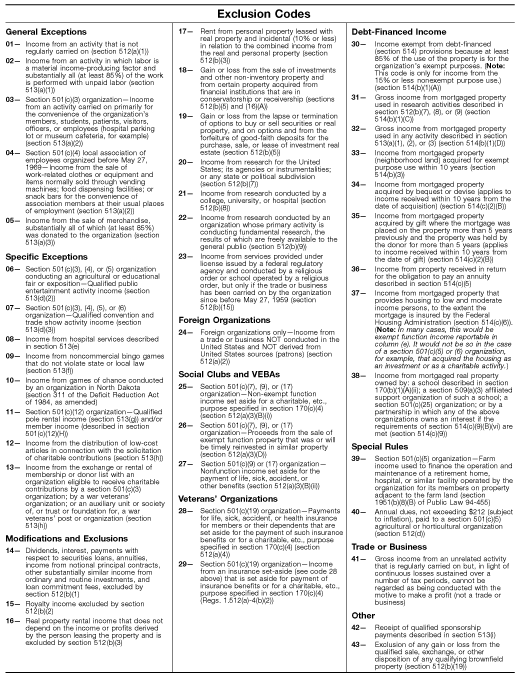
A
- Accounting methods, I. Accounting Methods
- Accounting period, H. Accounting Period
- Adjusted net income, Column (c). Adjusted Net Income
- Amended return, L. Amended Return, Amended return.
- Amended returns, state, Amended returns.
- Annual return
-
- Amended, L. Amended Return
- Copies to state officials, G. Furnishing Copies of Form 990-PF to State Officials
- Extension for filing, K. Extension of Time To File
- Failure to file timely or completely, Against the organization.
- How to file, J. When and How To File
- Purpose of form, Purpose of form.
- State reporting requirements, F. Use of Form 990-PF To Satisfy State Reporting Requirements
- Termination, U. Section 507(b)(1)(B) Termination—Notice and Filing Requirements
- When to file, J. When and How To File
- Which parts to complete, B. Which Parts To Complete
- Assets test, Private operating foundation (section 4942(j)(3)).
- Attorney, Paid Preparer Authorization
B
- Bank account, Line 16. Foreign accounts.
- Business meals, In column (b).
C
- Capital gains and losses
-
- Basis, Basis.
- Gains, Part IV. Capital Gains and Losses for Tax on Investment Income
- Losses, Losses.
- Charitable donation
-
- Substantiation of, Substantiation requirements.
- Children, Photographs of Missing Children
- Contributions, Line 25. Contributions, gifts, grants paid.
- Copy of old return, Need a copy of an old return or form?
- Currency, Currency and language requirements.
D
- Definitions, C. Definitions
-
- Disqualified person, C. Definitions
- Distributable amount, Part X. Distributable Amount
- Foundation manager, C. Definitions
- Gross investment income, Gross investment income.
- Net investment income, Net investment income.
- Noncharitable exempt organization, Part XVI. Information Regarding Transfers to and Transactions and Relationships With Noncharitable Exempt Organizations
- Nonexempt charitable trust, C. Definitions
- Private foundation, C. Definitions
- Private operating foundation, C. Definitions
- Program-related investment, Program-related investment.
- Qualifying distributions, Part XI. Qualifying Distributions
- Significant disposition, Definitions.
- Substantial contraction, Definitions.
- Taxable private foundation, C. Definitions
- Depreciation, Line 19. Depreciation and depletion.
- Disqualified person, C. Definitions
- Disregarded entity, Line 1. List all officers, directors, trustees, and foundation managers and their compensation.
- Dissolution, T. Liquidation, Dissolution, Termination, or Substantial Contraction
- Distributable amount, Part X. Distributable Amount
E
- Elections, Exception., Elections., Elections.
- Endowment test, Private operating foundation (section 4942(j)(3)).
- Estimated tax, O. Figuring and Paying Estimated Tax
-
- Penalty, Estimated tax penalty., Addition to Tax.
- Excise tax based on excess business holdings, Line 3a.
- Excise tax based on excessive executive compensation, Line 8.
- Excise tax based on investment income
-
- Domestic exempt private foundations, Domestic exempt private foundations.
- Domestic taxable private foundations and section 4947(a)(1) nonexempt charitable trusts, Domestic taxable private foundations and section 4947(a)(1) nonexempt charitable trusts.
- Foreign organizations, Foreign organizations.
- Exempt operating foundation qualification, Qualification.
- Extension for filing, K. Extension of Time To File
F
- Failure to file timely or completely, Against the organization.
- Failure to pay tax when due, N. Additions to Tax for Not Paying Tax on Time
- Filing extension, K. Extension of Time To File
- Financial account, Line 16. Foreign accounts.
- Foreign, Line 16. Foreign accounts.
-
- Accounts, Line 16. Foreign accounts.
- Foreign organizations, S. Organizations Organized or Created in a Foreign Country, Item D2. Foreign Organizations, Foreign organizations.
- Foundation manager, C. Definitions
G
- Gifts, Line 25. Contributions, gifts, grants paid.
- Grants, Line 25. Contributions, gifts, grants paid.
- Gross investment income, Gross investment income.
- Gross profit, Lines 10a, b, c. Gross profit from sales of inventory.
- Gross receipts, Gross receipts.
H
- How To Get Forms and Publications, How To Get Forms and Publications
I
- Income test, Private operating foundation (section 4942(j)(3)).
- Incomplete return
-
- How to avoid, How to avoid filing an incomplete return.
- Penalties, Against the organization.
- Inventory, Lines 10a, b, c. Gross profit from sales of inventory.
L
- Large organization, Large organization.
- Liquidation, T. Liquidation, Dissolution, Termination, or Substantial Contraction
M
- Minimum investment return, Overview.
-
- Short tax year, Line 6. Short tax periods.
N
- Net investment income, Column (b). Net Investment Income, Net investment income., Line 27b. Net investment income.
-
- Business meals, In column (b).
- Noncharitable exempt organization, Part XVI. Information Regarding Transfers to and Transactions and Relationships With Noncharitable Exempt Organizations
- Nonexempt charitable trust, C. Definitions, Section 4947(a)(1) nonexempt charitable trusts., Line 15. Section 4947(a)(1) trusts.
- Nonoperating private foundation, Nonoperating private foundations., Line 9. Income modifications.
-
- Nonoperating private foundation, C. Definitions
O
- Other expenses, Line 23. Other expenses.
P
- Paid preparer, Paid Preparer
- Penalties
-
- Against responsible person, Against the responsible person.
- Estimated tax, Estimated tax penalty., Addition to Tax.
- Failure to disclose quid pro quo contributions, Penalties.
- Failure to file timely or completely, Against the organization.
- Failure to make return available for public inspection, Penalties
- Failure to pay timely, N. Additions to Tax for Not Paying Tax on Time
- Photographs of missing children, Photographs of Missing Children
- Private foundation, C. Definitions
- Private operating foundation, C. Definitions, Private operating foundations., Private operating foundation (section 4942(j)(3)).
- Program services, Line 1. Program service revenue.
- Program-related investment, Program-related investment., Line 1b. Program-related investments.
- Public inspection, Line 13. Public inspection requirements and website address.
- Publications
-
- Pub. 947, Practice Before the IRS and Power of Attorney, Paid Preparer Authorization
Q
- Qualifying distributions, Qualifying distributions., Line 9. Income modifications., Part XI. Qualifying Distributions, Line 4. Qualifying distributions.
-
- Amounts set aside, Line 3. Amounts set aside.
- Qualifying distributions (see the instructions for Part XII for an explanation of qualifying distributions) for any year., Line 9. Income modifications.
R
- Required electronic filing, Required electronic filing.
- Rounding, Rounding off to whole dollars.
S
- Schedule B (Form 990, 990–EZ, or 990–PF), Schedule B (Form 990).
- Section 4943(g), exception from excise tax on excess business holdings, Line 3a.
- Self-dealing, Line 1. Self-dealing.
- Signature, Signature
- Significant disposition, Definitions.
- Significant involvement, Part VIII-A. Summary of Direct Charitable Activities
- State reporting requirements, F. Use of Form 990-PF To Satisfy State Reporting Requirements
-
- Amended returns, Amended returns.
- Substantial contraction, T. Liquidation, Dissolution, Termination, or Substantial Contraction, Definitions.
- Substantial contributor, Line 10. Substantial contributors.
- Support test, Private operating foundation (section 4942(j)(3)).
T
W
- When to file, J. When and How To File
-
- Extension, K. Extension of Time To File
- Where to file, K. Extension of Time To File
- Which parts to complete, B. Which Parts To Complete
- Who must file, A. Who Must File