


 )
or https:// means you've safely connected to the .gov website. Share sensitive information only on official, secure websites.
)
or https:// means you've safely connected to the .gov website. Share sensitive information only on official, secure websites.


- Publication 225 - Introductory Material
- Introduction
- The IRS Mission.
- Comments and suggestions.
- Getting answers to your tax questions.
- Getting tax forms, instructions, and publications.
- Ordering tax forms, instructions, and publications.
- Comments on IRS enforcement actions.
- Treasury Inspector General for Tax Administration (TIGTA).
- Farm tax classes.
- Rural Tax Education website.
- Future Developments
- What’s New for 2025
- What’s New for 2026
- Reminders
- Introduction
- Importance of Records
- Accounting Methods
- Introduction
- Topics - This chapter discusses:
- Useful Items - You may want to see:
- Accounting Methods
- Farm Income
- Introduction
- Topics - This chapter discusses:
- Useful Items - You may want to see:
- Schedule F (Form 1040)
- Sales of Farm Products
- Rents
- Agricultural Program Payments
- Income From Cooperatives
- Cancellation of Debt
- Income From Other Sources
- Tax for Certain Children Who Have Unearned Income.
- Barter income.
- Below-market loans.
- Commodity futures and options.
- Custom hire (machine work).
- Easements and rights-of-way.
- Fuel tax credit and refund.
- Illegal federal irrigation subsidy.
- Prizes.
- Property sold, destroyed, stolen, or condemned.
- Recapture of section 179 expense deduction.
- Refund or reimbursement.
- Sale of soil and other natural deposits.
- Sod.
- Granting the right to remove deposits.
- Timber sales.
- Income Averaging for Farmers
- Farm Business Expenses
- What’s New
- Reminder
- Topics - This chapter discusses:
- Useful Items - You may want to see:
- Deductible Expenses
- Reimbursed expenses.
- Personal and business expenses.
- Reasonable allocation.
- Prepaid Farm Supplies
- Prepaid Livestock Feed
- Labor Hired
- Repairs and Maintenance
- Interest
- Breeding Fees
- Fertilizer and Lime
- Taxes
- Insurance
- Rent and Leasing
- Depreciation
- Business Use of Your Home
- Truck and Car Expenses
- Travel Expenses
- Marketing Quota Penalties
- Employee Meal and Housing Expenses
- Items Purchased for Resale
- Other Expenses
- Capital Expenses
- Nondeductible Expenses
- Personal, Living, and Family Expenses
- Other Nondeductible Items
- Loss of growing plants, produce, and crops.
- Repayment of loans.
- Estate, inheritance, legacy, succession, and gift taxes.
- Loss of livestock.
- Losses from sales or exchanges between related persons.
- Cost of raising unharvested crops.
- Cost of unharvested crops bought with land.
- Cost related to gifts.
- Club dues and membership fees.
- Exception.
- Fines and penalties.
- Losses From Operating a Farm
- Not-for-Profit Farming
- Soil and Water Conservation Expenses
- Basis of Assets
- Introduction
- Topics - This chapter discusses:
- Useful Items - You may want to see:
- Cost Basis
- Adjusted Basis
- Basis Other Than Cost
- Property changed from personal to business or rental use.
- Property received for services.
- Taxable Exchanges
- Nontaxable Exchanges
- Property Received as a Gift
- Property Transferred From a Spouse
- Inherited Property
- Property Distributed From a Partnership or Corporation
- Depreciation, Depletion, and Amortization
- What’s New for 2025
- Introduction
- Topics - This chapter discusses:
- Useful Items - You may want to see:
- Overview of Depreciation
- What Property Can Be Depreciated?
- What Property Cannot Be Depreciated?
- When Does Depreciation Begin and End?
- Can You Use MACRS To Depreciate Your Property?
- What Is the Basis of Your Depreciable Property?
- How Do You Treat Repairs and Improvements?
- Do You Have To File Form 4562?
- How Do You Correct Depreciation Deductions?
- Section 179 Expense Deduction
- Claiming the Special Depreciation Allowance
- What Is Qualified Property?
- Certain qualified property acquired after September 27, 2017, and placed in service before January 20, 2025.
- Excepted property.
- Certain specified plants planted or grafted before January 20, 2025.
- Certain qualified property acquired and placed in service after January 19, 2025.
- Excepted property.
- Certain specified plants planted or grafted after January 19, 2025.
- Qualified production property.
- Exclusions.
- How Can You Elect Not To Claim the Allowance?
- When Must You Recapture an Allowance?
- What Is Qualified Property?
- Figuring Depreciation Under MACRS
- Which Depreciation System (GDS or ADS) Applies?
- Which Property Class Applies Under GDS?
- What Is the Placed-in-Service Date?
- What Is the Basis for Depreciation?
- Which Recovery Period Applies?
- Which Convention Applies?
- Which Depreciation Method Applies?
- How Is the Depreciation Deduction Figured? Modified ACRS (MACRS)Figuring the deduction
- How Do You Use General Asset Accounts?
- When Do You Recapture MACRS Depreciation?
- Additional Rules for Listed Property
- Depletion
- Amortization
- Gains and Losses
- Introduction
- Topics - This chapter discusses:
- Useful Items - You may want to see:
- Sales and Exchanges
- Determining Gain or Loss
- Like-Kind Exchanges
- Multiple-party transactions.
- Receipt of title from third party.
- Basis of property received.
- Money paid.
- Reporting the exchange.
- Qualifying property.
- Nonqualifying property.
- Special rule for stock in a mutual ditch, reservoir, or irrigation company.
- Like-kind property.
- Note.
- Partially nontaxable exchange.
- Unlike property given up.
- Liabilities.
- Like-kind exchanges between related persons.
- Related persons.
- Exceptions to the rules for related persons.
- Multiple property exchanges.
- Deferred exchange.
- Transfer to Spouse
- Ordinary or Capital Gain or Loss
- Dispositions of Property Used in Farming
- Installment Sales
- Introduction
- Topics - This chapter discusses:
- Useful Items - You may want to see:
- Installment Sale of a Farm
- Installment Method
- Electing out of the installment method.
- When to elect out.
- Revoking the election.
- Inventory.
- More information.
- Sale at a loss.
- Figuring Installment Sale Income
- Payments Received or Considered Received
- Buyer pays seller’s expenses.
- Buyer assumes mortgage.
- Mortgage less than basis.
- Mortgage more than basis.
- Buyer assumes other debts.
- Property used as a payment.
- Exception.
- Debt not payable on demand.
- Fair market value (FMV).
- Third-party note.
- Bond.
- Buyer’s note.
- Sale to a related person.
- Trading property for like-kind property.
- Unstated interest.
- More information.
- Example
- Adjusted basis and depreciation.
- Adjusted basis for installment sale purposes.
- Depreciation recapture.
- Gross profit.
- Home.
- Section 1231 gains.
- Contract price and gross profit percentage.
- Figuring the gain to report on the installment method.
- Reporting the sale.
- Section 1231 gains.
- Installment income for years after 2025.
- Summary.
- Casualties, Thefts, and Condemnations
- What’s New
- Reminder
- Introduction
- Topics - This chapter discusses:
- Useful Items - You may want to see:
- Casualties and Thefts
- Casualty.
- Deductible losses.
- Nondeductible losses.
- Family pet.
- Progressive deterioration.
- Theft.
- Decline in market value of stock.
- Mislaid or lost property.
- Farm Property Losses
- How To Figure a Loss
- Farm property.
- Personal-use property.
- Adjusted basis.
- Decrease in fair market value (FMV).
- Appraisal.
- Cost of cleaning up or making repairs.
- Landscaping.
- Safe harbor methods for individual taxpayers to determine casualty and theft losses.
- Related expenses.
- Separate computations for more than one item of property.
- Exception for personal-use real property.
- Insurance and other reimbursements.
- Reimbursement received after deducting loss.
- Actual reimbursement less than expected.
- Actual reimbursement more than expected.
- Actual reimbursement same as expected.
- Lump-sum reimbursement.
- Disaster assistance.
- Adjustments to basis.
- Deduction Limits on Losses of Personal-Use Property
- When Loss Is Deductible
- Proof of Loss
- Figuring a Gain
- Other Involuntary Conversions
- Postponing Gain
- Disaster Area Losses
- Qualified disaster losses.
- Disaster year.
- When to deduct the loss.
- Increased standard deduction reporting.
- Federal disaster relief grants.
- Qualified disaster relief payments.
- East Palestine disaster relief payments.
- Qualified wildfire relief payments.
- Qualified disaster mitigation payments.
- Sale of property under hazard mitigation program.
- Other federal assistance programs.
- Postponed tax deadlines.
- Who is eligible.
- Covered disaster area.
- Abatement of interest and penalties.
- Reporting Gains and Losses
- Self-Employment Tax
- What’s New for 2025
- Introduction
- Topics - This chapter discusses:
- Useful Items - You may want to see:
- Why Pay SE Tax?
- How To Pay SE Tax
- Who Must Pay SE Tax?
- Figuring Self-Employment Earnings
- Methods for Figuring Net Earnings
- Reporting SE Tax
- Employment Taxes
- What’s New for 2025
- What’s New for 2026
- Reminders
- Important Dates for 2026
- Introduction
- Topics - This chapter discusses:
- Useful Items - You may want to see:
- Farm Employment
- Family Employees
- Crew Leaders
- Social Security and Medicare Taxes
- Federal Income Tax Withholding
- Reporting and Paying Social Security, Medicare, and Withheld Federal Income Taxes
- Federal Unemployment (FUTA) Tax
- Fuel Excise Tax Credits and Refunds
- What’s New
- Reminders
- Introduction
- Topics - This chapter discusses:
- Useful Items - You may want to see:
- Fuels Used in Farming
- Farm.
- Dyed versus undyed diesel.
- Dyed diesel fuel and dyed kerosene.
- Penalty.
- Farming purposes.
- Fuel not used for farming.
- Buyer of fuel, including undyed diesel fuel or undyed kerosene.
- Undyed diesel fuel, undyed kerosene, and other fuels (including alternative fuel).
- Custom application of fertilizer and pesticide.
- All-terrain vehicles (ATVs).
- Fuels Used in Off-Highway Business Use
- Fuels Used for Household Purposes or Other Than as a Fuel for Propulsion Engines
- How To Claim a Credit or Refund
- Including the Credit or Refund in Income
- Estimated Tax
- How To Get Tax Help
- Tax reform.
- Preparing and filing your tax return.
- Free options for tax preparation.
- Using online tools to help prepare your return.
- Need someone to prepare your tax return?
- Employers can register to use Business Services Online.
- Business tax account.
- IRS social media.
- Online tax information in other languages.
- Over-the-Phone Interpreter (OPI) Service.
- Accessibility Helpline available for taxpayers with disabilities.
- Alternative media preference.
- Disasters.
- Getting tax forms and publications.
- Mobile-friendly forms.
- Getting tax publications and instructions in eBook format.
- Access your online account (individual taxpayers only).
- Get a transcript of your return.
- Tax Pro Account.
- Using direct deposit.
- Reporting and resolving your tax-related identity theft issues.
- Ways to check on the status of your refund.
- Making a tax payment.
- What if I can’t pay now?
- Filing an amended return.
- Checking the status of your amended return.
- Understanding an IRS notice or letter you’ve received.
- IRS Document Upload Tool.
- Schedule LEP.
- Contacting your local TAC.
- The Taxpayer Advocate Service (TAS) Is Here To Help You
- Publication 225 - Additional Material
Introduction
You are in the business of farming if you cultivate, operate, or manage a farm for profit, either as owner or tenant. A farm includes livestock, dairy, poultry, fish, fruit, and truck farms. It also includes plantations, ranches, ranges, and orchards and groves.
This publication explains how the federal tax laws apply to farming. Use this publication as a guide to figure your taxes and complete your farm tax return. If you need more information on a subject, get the specific IRS tax publication covering that subject. We refer to many of these free publications throughout this publication. See How To Get Tax Help for information on ordering these publications.
The explanations and examples in this publication reflect the IRS’s interpretation of tax laws enacted by Congress, Treasury regulations, and court decisions. However, the information given does not cover every situation and is not intended to replace the law or change its meaning. This publication covers subjects on which a court may have rendered a decision more favorable to taxpayers than the interpretation by the IRS. Until these differing interpretations are resolved by higher court decisions, or in some other way, this publication will continue to present the interpretation by the IRS.
The IRS Mission.
Provide America’s taxpayers top-quality service by helping them understand and meet their tax responsibilities and enforce the tax law with integrity and fairness to all.
Comments and suggestions.
We welcome your comments about this publication and suggestions for future editions.
You can send us comments through IRS.gov/FormComments. Or, you can write to the Internal Revenue Service, Tax Forms and Publications, 1111 Constitution Ave. NW, IR-6526, Washington, DC 20224.
Although we can’t respond individually to each comment received, we do appreciate your feedback and will consider your comments and suggestions as we revise our tax forms, instructions, and publications. Don’t send tax questions, tax returns, or payments to the above address.
Getting answers to your tax questions.
If you have a tax question not answered by this publication or the How To Get Tax Help section at the end of this publication, go to the IRS Interactive Tax Assistant page at IRS.gov/Help/ITA where you can find topics by using the search feature or viewing the categories listed.
Getting tax forms, instructions, and publications.
Go to IRS.gov/Forms to download current and prior-year forms, instructions, and publications.
Ordering tax forms, instructions, and publications.
Go to IRS.gov/OrderForms to order current forms, instructions, and publications; call 800-829-3676 to order prior-year forms and instructions. The IRS will process your order for forms and publications as soon as possible. Don’t resubmit requests you’ve already sent us. You can get forms and publications faster online.
Comments on IRS enforcement actions.
The Small Business and Agricultural Regulatory Enforcement Ombudsman and 10 Regional Fairness Boards were established to receive comments from small business about federal agency enforcement actions. The Ombudsman will annually evaluate the enforcement activities of each agency and rate its responsiveness to small business. If you wish to comment on the enforcement actions of the IRS, you can:
-
Call 888-734-3247;
-
Write to:
Office of the National Ombudsman
U.S. Small Business Administration
409 3rd Street SW
Washington, DC 20416; -
Send an email to ombudsman@sba.gov; or
-
Complete and submit a Federal Agency Comment Form online at
sba.gov/ombudsman/comment.
Treasury Inspector General for Tax Administration (TIGTA).
If you want to confidentially report misconduct, waste, fraud, or abuse by an IRS employee, you can visit TIGTA. You can remain anonymous.
Farm tax classes.
Many state Cooperative Extension Services conduct farm tax workshops in conjunction with the IRS. Contact your county or regional extension office for more information.
Rural Tax Education website.
The Rural Tax Education website is a source for information concerning agriculturally related income and deductions and self-employment tax. The website is available for farmers and ranchers, other agricultural producers, Extension educators, and anyone interested in learning about the tax side of the agricultural community. Members of the National Farm Income Tax Extension Committee are contributors to the website, and the website is hosted by Utah State University Cooperative Extension. You can visit the website at ruraltax.org.
The IRS has created a page on IRS.gov for information about Pub. 225 at
IRS.gov/Pub225. Information about recent developments affecting Pub. 225 will be posted on that page.
The following items highlight a number of administrative and tax law changes for 2025. They are discussed in more detail throughout this publication.
Standard mileage rate. The business standard mileage rate for 2025 has increased to 70 cents per business mile. See chapter 4.
Increased section 179 expense deduction dollar limits. The maximum amount you can elect to deduct for most section 179 property you placed in service in 2025 has increased to $2,500,000. This limit is reduced by the amount by which the cost of the section 179 property placed in service during the tax year exceeds $4,000,000. Also, the maximum section 179 expense deduction for sport utility vehicles placed in service in tax years beginning in 2025 is $31,300. See chapter 7.
Changes to special depreciation allowance. The 100% special allowance is restored for qualified property acquired and placed into service after January 19, 2025, including tangible property with a class life of 20 years or less, computer software, qualified improvement property, and certain other property. The 100% special allowance for depreciation is also permanently restored for specified plants (like fruit trees) when they are planted or grafted after January 19, 2025. However, property put into service between January 1, 2025, and January 19, 2025, or acquired before January 20, 2025, and put into service later will remain subject to the phase-down rules under prior law. See chapter 7.
Special depreciation allowance for qualified production property. You can elect to take a 100% special depreciation allowance for qualified production property placed in service after July 4, 2025, and before January 1, 2031. See chapter 7.
Expansion of mandatory postponement. Certain taxpayers affected by federally declared disasters and qualified state declared disasters after July 24, 2025, may be eligible for a mandatory 120-day extension for certain tax deadlines. For more information, see Pub. 547, Casualties, Disasters, and Thefts.
Extension of limitation on personal casualty and theft losses. For tax years beginning after 2017, the limitation on casualty and theft losses for personal use property is now permanent.
Extended disaster relief benefits. The Federal Disaster Relief Tax Relief Act of 2023 extended the special rules and return procedures for personal casualty losses attributable to certain major federal disasters declared between February 26, 2021, and February 10, 2025. P.L. 119-21, commonly known as the One Big Beautiful Bill Act (OBBBA), further extended the special rules and return procedures for personal casualty losses attributable to certain major federal disasters declared between February 11, 2025, and September 2, 2025. Qualified disaster losses can be claimed on Form 4684, Casualties and Thefts. For more information, see Qualified disaster losses in chapter 11.
Qualified wildfire relief payments. Certain relief payments received between 2020 and 2025 following a wildfire disaster are not taxable. For more information, see Qualified wildfire relief payments in chapter 11.
East Palestine disaster relief payments. Certain relief payments for the train derailment in East Palestine, Ohio, on February 3, 2023, are not taxable. For more information, see East Palestine disaster relief payments in chapter 11.
Maximum net earnings. The maximum net self-employment earnings subject to the social security part (12.4%) of the self-employment tax is $176,100 for 2025, up from $168,600 for 2024. There is no maximum limit on earnings subject to the Medicare part (2.9%) or, if applicable, the Additional Medicare Tax (0.9%). The maximum net self-employment earnings subject to the social security part of the self-employment tax for 2026 will be discussed in the 2025 Pub. 334.
Social security and Medicare taxes for 2025. The social security tax rate on these wages is 6.2% each for the employee and employer. The social security wage base limit is $176,100.The Medicare tax rate is 1.45% (0.0145) each for the employee and employer, unchanged from 2024. There is no wage base limit for Medicare tax.
2025 withholding tables. The federal income tax withholding tables are now included in Pub. 15-T, Federal Income Tax Withholding Methods.
Direct deposit of Form 943 refund is now available. Executive Order (EO) 14247, Modernizing Payments To and From America’s Bank Account, issued on March 25, 2025, promotes operational efficiency by mandating the transition to electronic payments for all federal disbursements. Accordingly, the IRS will not issue Form 943 tax refunds by direct deposit. Direct deposit is a fast, simple, safe, and secure way to have your refund deposited automatically to your checking or savings account. Instead of a direct deposit refund, you can still choose to have your Form 943 overpayment applied to your next return by checking the appropriate box on Form 943, line 16b.
Make balance due payments electronically. EO 14247 also promotes operational efficiency by mandating the transition to electronic payments for all payments made to the federal government. Therefore, pay your balance due on Form 943 electronically. There are several easy, safe, and secure ways to pay your balance due electronically.
No federal income tax on qualified overtime compensation. For tax years beginning after 2024 and ending before 2029, OBBBA allows individuals to deduct up to $12,500 ($25,000 if married filing jointly) in qualified overtime compensation. See chapter 13 and the Instructions for Form 1040. Also, monitor IRS.gov for more information and the latest updates.
Election to pay tax on farmland sale or exchange in installments. OBBBA created a new section 1062 that allows taxpayers to elect to pay the net income tax attributable to the gain on the sale or exchange of qualified farmland property to a qualified farmer through four equal annual installments beginning in the year of sale or exchange. This election is available for tax years beginning after July 4, 2025. For more information, see section 1062 and the new Form 1062 when it becomes available.
Domestic research and experimental expenditures. Beginning in 2025, research and experimental (R&E) expenses can be fully deducted on your tax return. Certain small businesses may elect to apply the full expensing of R&E expenses retroactively by amending returns back to 2022. You can also elect to charge your R&E expenses to a capital account and amortize the costs ratably over a period of no less than 60 months. See Revenue Procedure 2025-28 for more information.
Sustainable aviation fuel (SAF) mixture credit. The SAF credit has been terminated and will no longer apply to any sale or use after September 30, 2025.
Social security and Medicare taxes for 2026. The employee and employer tax rates for social security and the maximum amount of wages subject to social security tax for 2026 will be discussed in Pub. 15 (for use in 2026).The Medicare tax rate for 2026 will also be discussed in Pub. 15 (for use in 2026). There’s no limit on the amount of wages subject to Medicare tax.
The following reminders and other items may help you file your tax return.
Principal agricultural activity codes. You must enter on line B of Schedule F (Form 1040) a code that identifies your principal agricultural activity. It is important to use the correct code because this information will identify market segments of the public for IRS Taxpayer Education programs. The U.S. Census Bureau also uses this information for its economic census. See the list of Principal Agricultural Activity Codes on page 2 of Schedule F (Form 1040).
Publication on employer identification numbers (EINs). Pub. 1635, Understanding Your Employer Identification Number, provides general information on EINs. Topics include how to apply for an EIN and how to complete Form SS-4.
Change of address. If you change your home address, you should use Form 8822, Change of Address, to notify the IRS. If you change your business address, you should use Form 8822-B, Change of Address or Responsible Party - Business, to notify the IRS. Be sure to include your suite, room, or other unit number.
Pub. 51 discontinued after 2023. Pub. 51, Agricultural Employer’s Tax Guide, was discontinued for tax years beginning after December 31, 2023. Instead, the information specific to agricultural employers will be included in Pub. 15, Employer’s Tax Guide. There’s a new Pub. 15 (sp) that is a Spanish-language version of Pub. 15.
Business meals deduction. The temporary 100% deduction for food or beverages provided by a restaurant has expired. The business meal deduction reverted back to the 50% allowable deduction beginning January 1, 2023.
The COVID-19 related credit for qualified sick and family leave wages is limited to leave taken after March 31, 2020, and before October 1, 2021, and may no longer be claimed on Form 943. Generally, the credit for qualified sick and family leave wages, as enacted under the Families First Coronavirus Response Act (FFCRA) and amended and extended by the COVID-related Tax Relief Act of 2020, for leave taken after March 31, 2020, and before April 1, 2021, and the credit for qualified sick and family leave wages under sections 3131, 3132, and 3133 of the Internal Revenue Code, as enacted under the American Rescue Plan Act of 2021 (the ARP), for leave taken after March 31, 2021, and before October 1, 2021, have expired. However, employers that pay qualified sick and family leave wages in 2025 for leave taken after March 31, 2020, and before October 1, 2021, are eligible to claim a credit for qualified sick and family leave wages in 2025. Effective for tax periods beginning after 2023, the lines used to claim the credit for qualified sick and family leave wages have been removed from Form 943, Employer’s Annual Federal Tax Return for Agricultural Employees, because it would be extremely rare for an employer to pay wages after December 31, 2023, for qualified sick and family leave taken after March 31, 2020, and before October 1, 2021. Instead, if you’re eligible to claim the credit for qualified sick and family leave wages because you paid the wages in 2025 for an earlier applicable leave period, file Form 943-X, Adjusted Employer’s Annual Federal Tax Return for Agricultural Employees or Claim for Refund, after filing Form 943, to claim the credit for qualified sick and family leave wages paid in 2025. Filing a Form 943-X before filing a Form 943 for the year may result in errors or delays in processing your Form 943-X.
Qualified small business payroll tax credit for increasing research activities. For tax years beginning before January 1, 2023, a qualified small business may elect to claim up to $250,000 of its credit for increasing research activities as a payroll tax credit. The Inflation Reduction Act of 2022 (the IRA) increases the election amount to $500,000 for tax years beginning after December 31, 2022. The payroll tax credit election must be made on or before the due date of the originally filed income tax return (including extensions). The portion of the credit used against payroll taxes is allowed in the first calendar quarter beginning after the date that the qualified small business filed its income tax return. The election and determination of the credit amount that will be used against the employer’s payroll taxes are made on Form 6765, Credit for Increasing Research Activities. The amount from Form 6765 must then be reported on Form 8974, Qualified Small Business Payroll Tax Credit for Increasing Research Activities.Starting in the first quarter of 2023, the payroll tax credit is first used to reduce the employer share of social security tax up to $250,000 per quarter and any remaining credit reduces the employer share of Medicare tax for the quarter. Any remaining credit, after reducing the employer share of social security tax and the employer share of Medicare tax, is then carried forward to the next quarter. Form 8974 is used to determine the amount of the credit that can be used in the current quarter. The amount from Form 8974, line 12, or, if applicable, line 17, is reported on Form 943, line 12. For more information about the payroll tax credit, see the Instructions for Form 8974 and go to IRS.gov/ResearchPayrollTC.
Certification program for professional employer organizations (PEOs). The Stephen Beck, Jr., ABLE Act of 2014 required the IRS to establish a voluntary certification program for PEOs. PEOs handle various payroll administration and tax reporting responsibilities for their business clients and are typically paid a fee based on payroll costs. To become and remain certified under the certification program, certified professional employer organizations (CPEOs) must meet various requirements described in sections 3511 and 7705 and related published guidance. Certification as a CPEO may affect the employment tax liabilities of both the CPEO and its customers. A CPEO is generally treated for employment tax purposes as the employer of any individual who performs services for a customer of the CPEO and is covered by a contract described in section 7705(e)(2) between the CPEO and the customer (CPEO contract), but only for wages and other compensation paid to the individual by the CPEO. To become a CPEO, the organization must apply through the IRS Online Registration System. For more information or to apply to become a CPEO, go to IRS.gov/CPEO.CPEOs must generally file Form 943 and Schedule R (Form 943), Allocation Schedule for Aggregate Form 943 Filers, electronically. For more information about a CPEO’s requirement to file electronically, see Revenue Procedure 2023-18, 2023-13 I.R.B. 605, available at IRS.gov/irb/2023-13_IRB#REV-PROC-2023-18.
Work opportunity tax credit for qualified tax-exempt organizations hiring qualified veterans. Qualified tax-exempt organizations that hire eligible unemployed veterans may be able to claim the work opportunity tax credit against their payroll tax liability using Form 5884-C. For more information, go to IRS.gov/WOTC.
Correcting a previously filed Form 943. If you discover an error on a previously filed Form 943, or if you otherwise need to amend a previously filed Form 943, make the correction using Form 943-X, Adjusted Employer’s Annual Federal Tax Return for Agricultural Employees or Claim for Refund. Form 943-X is filed separately from Form 943. For more information, see the Instructions for Form 943-X or go to IRS.gov/CorrectingEmploymentTaxes.
Federal tax deposits must be made by electronic funds transfer (EFT). You must use EFT to make all federal tax deposits. An EFT can be made using the Electronic Federal Tax Payment System (EFTPS), IRS Direct Pay, or your IRS business tax account. If you don’t want to use one of these methods, you can arrange for your tax professional, financial institution, payroll service, or other trusted third party to make electronic deposits on your behalf. Also, you may arrange for your financial institution to initiate a same-day wire payment on your behalf. EFTPS is a free service provided by the Department of the Treasury. Payments made using IRS Direct Pay or through your IRS business tax account are also free. Services provided by your tax professional, financial institution, payroll service, or other third party may have a fee.
Note:
An exception applies to the EFT requirement for making your federal tax deposits. If your liability is less than $2,500 (Form 943, line 13), you may pay in full with a check or money order with a timely filed return. See the Instructions for Form 943 for more information.
For more information on making federal tax deposits, see Pub 3151-A. To get more information about EFTPS or to enroll in EFTPS, go to EFTPS.gov or call one of the following numbers.
-
800-555-4477,
-
800-244-4829 (Spanish), or
-
303-967-5916 if you’re outside the United States (toll call).
To contact EFTPS using Telecommunications Relay Services (TRS) for people who are deaf, hard of hearing, or have a speech disability, dial 711 and then provide the TRS assistant the 800-555-4477 number above or 800-733-4829. Additional information about EFTPS is also available in Pub. 966.For more information about IRS Direct Pay, go to IRS.gov/BusinessAccount.
Electronic filing and payment. Businesses can enjoy the benefits of filing tax returns and paying their federal taxes electronically. Whether you rely on a tax professional or handle your own taxes, the IRS offers you convenient and secure programs to make filing and paying easier. Spend less time worrying about taxes and more time running your business. Use e-file and EFTPS to your benefit.
-
For e-file, go to IRS.gov/EmploymentEfile for additional information. A fee may be charged to file electronically.
-
For electronic payment options, go to IRS.gov/Pay.
-
For electronic filing of Form W-2, Wage and Tax Statement, go to SSA.gov/employer. You may be required to file Forms W-2 electronically. For details, see the General Instructions for Forms W-2 and W-3.
Special rules for qualified disaster losses. Special rules apply to federally declared disaster area losses. A federally declared disaster is a disaster that occurred in an area declared by the President to be eligible for federal assistance under the Robert T. Stafford Disaster Relief and Emergency Assistance Act.See Disaster Area Losses, later, and Pub. 547, Casualties, Disasters, and Thefts, for more information on the special relief. Also, see IRS.gov/DisasterTaxRelief for more information.
Additional employment tax information for farmers. See Pub. 15 for more detailed guidance on employment taxes for tax years 2024 and 2025 for employers of agricultural workers. For the latest information about developments related to Pub. 15, such as legislation enacted after it was published, go to IRS.gov/Pub15. For general tax information relevant to agricultural employers, go to IRS.gov/AgricultureTaxCenter. For general information about employment taxes, go to IRS.gov/EmploymentTaxes. For information about employer responsibilities under the Affordable Care Act, go to IRS.gov/ACA.
. You may have nonfarm employees as well as farm employees, for example, workers at a retail farm market. See Pub.15 for employment tax rules for wages and noncash wages paid to these employees as they may differ from those discussed in this chapter..
Photographs of missing children. The IRS is a proud partner with the National Center for Missing & Exploited Children® (NCMEC). Photographs of missing children selected by the Center may appear in this publication on pages that would otherwise be blank. You can help bring these children home by looking at the photographs and calling 1-800-THE-LOST (1-800-843-5678) (24 hours a day, 7 days a week) if you recognize a child.
Introduction
A farmer, like other taxpayers, must keep records to prepare an accurate income tax return and determine the correct amount of tax. This chapter explains the benefits of keeping records, what kinds of records you must keep, and how long you must keep them for federal tax purposes.
While this publication only discusses tax records, the records you keep as a farm business owner should allow you to accurately measure your farm’s financial performance, create financial statements, and help you make management decisions in addition to calculating taxable farm income.
Records that provide information beyond your tax return require additional information and effort on the part of the record keeper. To assist you in developing or improving your recordkeeping system, the Farm Financial Standards Council produces publications that provide recommendations for financial reporting and analysis. You can order these publications and download the Implementation Guide at ffsc.org. For more information, contact the Farm Financial Standards Council in the following manner.
-
Email contact@ffsc.org.
-
Write to:
Farm Financial Standards Council
P.O. Box 35
Downs, IL 61736-0035.
Topics
This chapter discusses:-
Benefits of recordkeeping
-
Kinds of records to keep
-
How long to keep records
Useful Items
You may want to see:Publication
-
15 (Circular E), Employer’s Tax Guide
-
17 Your Federal Income Tax For Individuals
-
463 Travel, Gift, and Car Expenses
-
544 Sales and Other Dispositions of Assets
-
946 How To Depreciate Property
See How To Get Tax Help, later, for information about getting publications.
Benefits of Recordkeeping
Everyone in business, including farmers, must keep appropriate records. Recordkeeping will help you do the following.
Monitor the progress of your farming business.
You need records to monitor the progress of your business. In addition to measuring overall profitability, detailed records can help you identify which crop or livestock enterprises are most profitable or indicate where management changes may be needed to improve profitability. Records that help you make better decisions should also increase the likelihood of business success.
Prepare your financial statements.
You will need records to prepare accurate financial statements. These include income (profit and loss) statements, cash flow statements, balance sheets, and statements of owner’s equity. These statements will be required and helpful when working with your bank or creditors and may also help you manage your farm business.
Identify source of receipts.
You will receive money, property, and/or services from many sources. Your records can identify the source of your receipts. You need this information to separate farm from nonfarm receipts and taxable from nontaxable income. See chapter 3 for more information.
Keep track of deductible expenses.
You may forget expenses when you prepare your tax return unless you record them when they occur. Your records can identify the purpose and timing of expenses. You need this information to separate farm business expenses from nonfarm payments and other expenses. You also need to keep these records to separate expenses deductible for tax purposes from those that are non-tax related. See chapter 4 for more information.
Prepare your tax returns.
You need records to prepare your tax return. These records must accurately support the income, expenses, and credits you report. Generally, these are the same records you use to monitor your farming business and prepare your financial statements. You will also need records to prepare information returns such as a Form 1099-MISC or Form 1099-NEC provided to a vendor or a Form W-2 provided to an employee.
Support items reported on tax returns.
You must keep your business records available at all times for inspection by the IRS. If the IRS examines any of your tax returns, you may be asked to explain the items reported. A complete set of records will assist in the examination.
Kinds of Records To Keep
Except in a few cases, the law does not require any specific kind of records. You can choose any recordkeeping system suited to your farming business that clearly shows, for example, your income and expenses.
You should set up your recordkeeping system using an accounting method that clearly shows your income for your tax year. If you are in more than one business, you should keep a complete and separate set of records for each business. A corporation’s recordkeeping system should include board of directors meeting minutes. See chapter 2 for more information.
Your recordkeeping system should include a summary of your business transactions, which shows your gross income, as well as any expenses, deductions, and credits you are reporting. In addition, you must keep supporting documents, such as invoices and receipts, for purchases, sales, payroll, and other business transactions.
It is important to keep these documents because they support the entries in your journals and ledgers and on your tax return. Keep them in an orderly fashion and in a safe place. For instance, organize them by year and type of income or expense.
Electronic records.
All requirements that apply to hard copy books and records also apply to electronic storage systems that maintain tax books and records. When you replace hard copy books and records, you must maintain the electronic storage systems for as long as the systems are material to the administration of tax law.
An electronic storage system is any system for preparing or keeping your records either by electronic imaging or by transfer to electronic storage media. The electronic storage system must index, store, preserve, retrieve, and reproduce the electronically stored books and records in legible format. All electronic storage systems must provide a complete and accurate record of your data that is accessible to the IRS.
Electronic storage systems are also subject to the same controls and retention guidelines as those imposed on your original hard copy books and records. The original hard copy books and records may be destroyed, provided that the electronic storage system has been tested to establish that the hard copy books and records are being reproduced in compliance with IRS requirements for an electronic storage system and procedures are established to ensure continued compliance with all applicable rules and regulations. You still have the responsibility of retaining any other books and records that are required to be retained.
The IRS may test your electronic storage system, including the equipment used, indexing methodology, software, and retrieval capabilities. This test is not considered an examination and the results must be shared with you. If your electronic storage system meets the requirements mentioned earlier, you will be in compliance. If not, you may be subject to penalties for noncompliance, unless you continue to maintain your original hard copy books and records in a manner that allows you and the IRS to determine your correct tax. For details on electronic storage system requirements, see Revenue Procedure 97-22. You can find Revenue Procedure 97-22 on page 9 of Internal Revenue Bulletin 1997-13 at
IRS.gov/pub/irs-irbs/irb97-13.pdf.
Travel, transportation, entertainment, and gift expenses.
Specific recordkeeping rules apply to these expenses. For more information, see Pub 463.
Employment taxes.
There are specific employment tax records you must keep. Payroll records are important when claiming various tax deductions and credits based on payroll items such as number of employees and wages paid. For a list of employment tax records you must keep, see Pub. 15.
Excise taxes.
See How To Claim a Credit or Refund in chapter 14 for the specific records you must keep to verify your claim for credit or refund of excise taxes on certain fuels.
Assets.
Assets are the property, such as machinery and equipment, you own and use in your business. You must keep records to verify certain information about your business assets. You need records to figure your annual depreciation deduction and the gain or loss when you sell the assets. Your records should show all the following.
-
When and how you acquired the asset (whether the asset was new or used).
-
Full purchase cost of the asset.
-
Cost of any improvements.
-
Section 179 deduction taken.
-
Deductions taken for depreciation and any special depreciation allowance.
-
Deductions taken for casualty losses, such as losses resulting from fires or storms.
-
How you used the asset.
-
When and how you disposed of the asset.
-
Fair market value of property when traded.
-
Selling price.
-
Expenses of sale.
The following are examples of records that may show this information.
-
Invoices, bills of sale, and receipts.
-
Real estate closing statements.
-
Canceled checks.
-
Bank and credit card statements.
Financial account statements as proof of payment.
If you do not have a canceled check, you may be able to prove payment with certain financial account statements prepared by financial institutions. These include account statements prepared for the financial institution by a third party. These account statements must be legible. The following table lists acceptable account statements.
| IF payment is by... | THEN the statement must show the... |
| check |
|
| electronic funds transfer |
|
| credit or debit card |
|
.Proof of payment of an amount, by itself, does not establish you are entitled to a tax deduction. You should also keep other documents, such as credit card sales slips and invoices, to show that you also incurred the cost..
Tax returns.
Keep copies of your filed tax returns. They help in preparing future tax returns and making computations if you file an amended return. Keep copies of your information returns such as Form 1099-NEC, Form 1099-MISC, Schedule K-1, and Form W-2.
How Long To Keep Records
You must keep your records as long as the records may be needed for the administration of any provision of the Internal Revenue Code. Keep records that support an item of income or a deduction appearing on a return until the period of limitations for the return runs out. A period of limitations is the period of time after which no legal action can be brought. Generally, that means you must keep your records for at least 3 years from when your tax return was due or filed or within 2 years of the date the tax was paid, whichever is later. However, records must be kept for a longer period of time in certain instances, some of which are discussed below. For more details, see chapter 1 of Pub. 17.
Employment taxes.
If you have employees, you must keep all employment tax records for at least 4 years after the date the tax becomes due or is paid, whichever is later.
Assets.
Keep records relating to property until the period of limitations expires for the year in which you dispose of the property in a taxable disposition. You must keep these records to figure any depreciation, amortization, or depletion deduction and to figure your basis for computing gain or loss when you sell or otherwise dispose of the property.
You may need to keep records relating to the basis of property longer than the period of limitations. Keep those records as long as they are important in figuring the basis of the original or replacement property. Generally, this means as long as you own the property and, after you dispose of it, for the period of limitations that applies to you. For example, if you received property in a nontaxable exchange, you must keep the records for the old property, as well as for the new property, until the period of limitations expires for the year in which you dispose of the new property in a taxable disposition. For more information on basis, see chapter 6.
Records for nontax purposes.
When your records are no longer needed for tax purposes, do not discard them until you check to see if you have to keep them longer for other purposes. For example, your insurance company or creditors may require you to keep them longer than the IRS does.
Introduction
You must use an accounting method that clearly shows the income and expenses used to figure your taxable income. You must also file an income tax return for an annual accounting period called a “tax year.”
This chapter discusses accounting methods. For information on accounting periods, see Pub. 538, Accounting Periods and Methods, and the Instructions for Form 1128, Application To Adopt, Change, or Retain a Tax Year.
Topics
This chapter discusses:-
Cash method
-
Accrual method
-
Farm inventory
-
Special methods of accounting
-
Changes in methods of accounting
Useful Items
You may want to see:Publication
-
538 Accounting Periods and Methods
Form (and Instructions)
-
1128 Application To Adopt, Change, or Retain a Tax Year
-
3115 Application for Change in Accounting Method
See How To Get Tax Help for information about getting publications and forms.
Accounting Methods
An accounting method is a set of rules used to determine when and how your income and expenses are reported on your tax return. Your accounting method includes not only your overall method of accounting, but also the accounting treatment you use for any material item.
Facts and circumstances affect whether an item is material. Factors to consider in determining the materiality of an item include the size of the item (both in absolute terms and in relation to income and expenses) and the treatment of the item on your financial statements. Generally, an item considered material for financial statement purposes is also considered material for income tax purposes. See Pub. 538 for more information.
You generally choose an accounting method for your farm business when you file your first income tax return that includes a Schedule F (Form 1040), Profit or Loss From Farming. If you later want to change your accounting method, you must generally get IRS approval. How to obtain IRS approval is discussed later under Changes in Methods of Accounting.
Types of accounting methods.
Generally, you can use any of the following accounting methods. Each method is discussed in detail below.
-
Cash method.
-
Accrual method.
-
Special methods of accounting for certain items of income and expenses.
-
Combination (hybrid) method using elements of two or more of the above methods.
Business and other items.
You can account for business and personal items using different accounting methods. For example, you can figure your business income under an accrual method, even if you use the cash method to figure personal items.
Two or more businesses.
If you operate two or more separate and distinct businesses, you can use a different accounting method for each business. Generally, no business is separate and distinct unless a complete and separate set of books and records is maintained for each business.
Cash Method
Most farmers use the cash method because they find it easier to keep records and reflect income and expenses using this method. Certain farm corporations and partnerships and all tax shelters are generally required to use an accrual method of accounting. However, for tax years beginning in 2025, farm corporations or partnerships that have average annual gross receipts of $31 million or less for the 3 preceding tax years and are not tax shelters can use the cash method instead of the accrual method. See Accrual Method Required, later. Also, see Inventory, later.
Under the cash method, include in your gross income all items of income you actually or constructively received during the tax year. Items of income include money received and the fair market value (FMV) of property and or services received. See chapter 3 for information on how to report farm income on your income tax return.
Constructive receipt.
Income is constructively received when an amount is credited to your account or made available to you without restriction. You do not need to have possession of the income for it to be treated as income for the tax year. You need to have the ability to receive the income. If you authorize someone to be your agent and receive income for you, you are considered to have received the income when your agent receives it. Income is not constructively received if your receipt of the income is subject to substantial restrictions or limitations.
Delaying receipt of income.
You cannot hold checks or postpone taking possession of similar property from one tax year to another to avoid paying tax on the income. You must report the income in the year the money or property is received or made available to you without restriction.
Example.
You are, a farmer who uses the cash method of accounting, and you’re entitled to receive a $10,000 payment on a grain contract in December 2025. You were told in December that the payment was available, and requested not to be paid until January 2026. You must include this payment in 2025 income because it was made available in 2025.
Debts paid by another person or canceled.
If your debts are paid by another person or canceled by your creditors, you may have to report part or all of this debt relief as income. If you receive income in this way, you constructively receive the income when the debt is canceled or paid. See Cancellation of Debt in chapter 3 for more information.
Deferred payment contract.
If you sell an item under a deferred payment contract that calls for payment in a future year, there is no constructive receipt in the year of sale. However, if the sales contract states that you have the right to the proceeds of the sale from the buyer at any time after delivery of the item, then you must include the selling price of the item in income in the year of the sale, regardless of when you actually receive payment.
Example.
You are a farmer who uses the cash method and a calendar tax year. You sell grain in December 2025 under a bona fide arm's-length contract that calls for payment in 2026. You include the proceeds from the sale in your 2026 gross income since that is the year payment is received. However, if the contract states that you have the right to the proceeds from the buyer at any time after the grain is delivered, you must include the sales price in your 2025 income, even if payment is received in the following year.
Repayment of income.
If you include an amount in income and in a later year you have to repay all or part of it, then you may be able to deduct the repayment in the year repaid. The type of deduction you are allowed in the year of repayment depends on the type of income you included in the earlier year. If you use the cash method of accounting, you can take the deduction (or credit, if applicable) for the tax year in which you actually make the repayment. If you use any other accounting method, you can deduct the repayment or claim a credit for it only for the tax year in which it is a proper deduction under your accounting method. For example, if you use the accrual method, you are entitled to the deduction or credit in the tax year in which the obligation for the repayment accrues.
Under the cash method, you generally deduct expenses in the tax year you pay them. This includes business expenses for which you contest liability. However, you may not be able to deduct an expense paid in advance or you may be required to capitalize certain costs, as explained under Uniform Capitalization Rules in chapter 6. See chapter 4 for information on how to deduct farm business expenses on your income tax return.
Prepayment.
Generally, you cannot deduct expenses paid in advance. This rule applies to any expense paid far enough in advance to, in effect, create an asset with a useful life extending substantially beyond the end of the current tax year.
Example.
On November 1, 2025, you signed and paid $3,600 for a 3-year (36-month) insurance contract for equipment. In 2025, you are allowed to deduct only $200 (2/36 x $3,600) of the cost of the policy that is attributable to 2025. In 2026, you'll be able to deduct $1,200 (12/36 x $3,600); in 2027, you'll be able to deduct $1,200 (12/36 x $3,600); and in 2028, you'll be able to deduct the remaining balance of $1,000.
An exception applies if the expense qualifies for the 12-month rule. Under the 12-month rule, a taxpayer is not required to capitalize amounts paid to create certain rights or benefits for the earlier of:
-
12 months after the right or benefit begins, or
-
The end of the tax year after the tax year in which payment is made.
See chapter 4 for special rules for prepaid farm supplies and prepaid livestock feed.
Accrual Method
Under the accrual method of accounting, you generally report income in the year earned and deduct or capitalize expenses in the year incurred. The purpose of an accrual method of accounting is to correctly match income and expenses in the correct tax year. Certain large farm businesses must use an accrual method of accounting for its farm activities and for sales and purchases of inventory items. See Accrual Method Required and Farm Inventory, later.
Generally, you include an amount in income for the tax year in which all events that fix your right to receive the income have occurred, and you can determine the amount with reasonable accuracy. Under this rule, include an amount in income on the earliest of the following dates.
-
When you receive payment.
-
When the income amount is due to you.
-
When you earn the income.
-
When title passes.
-
When included as revenue in an applicable financial statement, if you have an applicable financial statement.
For more information, see Pub. 538. If you use an accrual method of accounting, complete Part III of Schedule F (Form 1040) to report your income.
Generally, if you keep an inventory, you must use an accrual method of accounting to determine your gross income. However, see Exception below. An inventory is necessary to clearly show income when the production, purchase, or sale of merchandise is an income-producing factor. See Pub. 538 for more information. Also, see Farm Inventory, later, for more information on items that must be included in inventory by farmers and inventory valuation methods for farmers.
Exception.
For tax years beginning in 2025, you are not required to maintain an inventory if the average annual gross receipts for the 3 preceding tax years for the farm is $31 million or less and the farm is not a tax shelter. In this case, the farm can use a method of accounting that (1) treats inventory as nonincidental materials and supplies, or (2) accounts for the inventory in the same manner as the applicable financial statements. If it does not have an applicable financial statement, it can use the method of accounting used in its books and records prepared according to its accounting procedures.
Under an accrual method of accounting, you generally deduct or capitalize a business expense when both of the following apply.
-
The all-events test has been met. This test is met when:
-
All events have occurred that fix the fact that you have a liability, and
-
The amount of the liability can be determined with reasonable accuracy.
-
-
Economic performance has occurred.
Economic performance.
Generally, you cannot deduct or capitalize a business expense until economic performance occurs. If your expense is for property or services provided to you, or for your use of property, economic performance occurs as the property or services are provided or as the property is used. If your expense is for property or services you provide to others, economic performance occurs as you provide the property or services.
Example.
You are a farmer who uses a calendar tax year and an accrual method of accounting. To take advantage of early payment discounts, you paid for seed in October 2024. The seed was delivered in March 2025. Economic performance did not occur until the seed was delivered and planted. You incur the expense in 2025.
An exception to the economic performance rule allows certain recurring items to be treated as incurred during a tax year even though economic performance has not occurred. For more information, see Economic Performance in Pub. 538.
Special rule for related persons.
Business expenses and interest owed to a related person who uses the cash method of accounting are not deductible until you make the payment and the corresponding amount is includible in the related person's gross income. Determine the relationship for this rule as of the end of the tax year for which the expense or interest would otherwise be deductible.
Generally, the following businesses, if engaged in farming, are required to use an accrual method of accounting.
-
A corporation that has gross receipts of more than $31 million.
-
A partnership with a corporation as a partner, if that corporation meets the requirements of (1) above.
-
A tax shelter (discussed below).
Items (1) and (2) above do not apply to an S corporation or a business operating a nursery or sod farm, or the raising or harvesting of trees (other than fruit and nut trees).
Note.
Gross receipts include the aggregate gross receipts from all persons treated as a single employer, such as a controlled group of corporations, commonly controlled partnerships or proprietorships, and affiliated service groups.
Tax shelter.
A tax shelter is a partnership, noncorporate enterprise, or S corporation that meets either of the following tests.
-
Its principal purpose is the avoidance or evasion of federal income tax.
-
It is a farming syndicate. A farming syndicate is an entity that meets either of the following tests.
-
Interests in the activity have been offered for sale in an offering required to be registered with a federal or state agency with the authority to regulate the offering of securities for sale.
-
More than 35% of the losses during the tax year are allocable to limited partners or limited entrepreneurs.
-
A “limited partner” is one whose personal liability for partnership debts is limited to the money or other property the partner contributed or is required to contribute to the partnership.
A “limited entrepreneur” is one who has an interest in an enterprise other than as a limited partner and does not actively participate in the management of the enterprise.
Farm Inventory
If you are required to keep an inventory, you should keep a complete record of your inventory as part of your farm records. This record should show the actual count or measurement of the inventory. It should also show all factors that enter into its valuation, including quality and weight, if applicable. Below are some items that could be included in inventory.
Hatchery business.
If you are in the hatchery business, and use an accrual method of accounting, you must include in inventory eggs in the process of incubation.
Products held for sale.
All harvested and purchased farm products held for sale or for feed or seed, such as grain, hay, silage, concentrates, cotton, tobacco, etc., must be included in inventory.
Supplies.
Supplies acquired for sale or that become a physical part of items held for sale must be included in inventory. Deduct the cost of supplies in the year used or consumed in operations. Do not include incidental supplies in inventory as these are deductible in the year of purchase.
Livestock.
Livestock held primarily for sale must be included in inventory. Livestock held for draft, breeding, or dairy purposes can either be depreciated or included in inventory. Also, see Unit-livestock-price method, later. If you are in the business of breeding and raising chinchillas, mink, foxes, or other fur-bearing animals, these animals are livestock for inventory purposes.
Growing crops.
Generally, growing crops are not required to be included in inventory. However, if the crop has a preproductive period of more than 2 years, you may have to capitalize (or include in inventory) costs associated with the crop.
Uniform capitalization rules.
The following applies if you are required to use an accrual method of accounting.
-
The uniform capitalization rules apply to all costs of raising a plant, even if the preproductive period of raising a plant is 2 years or less.
-
The costs of animals are subject to the uniform capitalization rules.
Items to include in inventory.
Your inventory should include all items held for sale, or for use as feed, seed, etc., whether raised or purchased, that are unsold at the end of the year.
Inventory valuation methods.
The following methods, described below, are those generally available for valuing inventory. The method you use must conform to generally accepted accounting principles for similar businesses and must clearly reflect income.
-
Cost.
-
Lower of cost or market.
-
Farm-price method.
-
Unit-livestock-price method.
Cost and lower of cost or market methods.
See Pub. 538 for information on these valuation methods.
. If you value your livestock inventory at cost or the lower of cost or market, you do not need IRS approval to change to the unit-livestock-price method. However, if you value your livestock inventory using the farm-price method, then you must obtain permission from the IRS to change to the unit-livestock-price method..
Farm-price method.
Under this method, each item, whether raised or purchased, is valued at its market price less the direct cost of disposition. Market price is the current price at the nearest market in the quantities you usually sell. Cost of disposition includes broker's commissions, freight, hauling to market, and other marketing costs. If you use this method, you must use it for your entire inventory, except that livestock can be inventoried under the unit-livestock-price method.
Unit-livestock-price method.
This method recognizes the difficulty of establishing the exact costs of producing and raising each animal. You group or classify livestock according to type and age and use a standard unit price for each animal within a class or group. The unit price you assign should reasonably approximate the normal costs incurred in producing the animals in such classes. Unit prices and classifications are subject to approval by the IRS on examination of your return. You must annually reevaluate your unit livestock prices and adjust the prices upward or downward to reflect increases or decreases in the costs of raising livestock. IRS approval is not required for these adjustments. Any other changes in unit prices or classifications do require IRS approval.
If you use this method, include all raised livestock in inventory, regardless of whether they are held for sale or for draft, breeding, sport, or dairy purposes. This method accounts only for the increase in cost of raising an animal to maturity. It does not provide for any decrease in the animal's market value after it reaches maturity. Also, if you raise cattle, you are not required to inventory hay you grow to feed your herd.
Do not include animals that were sold or lost in the year-end inventory. If your records do not show which animals were sold or lost, treat the first animals acquired as sold or lost. The animals on hand at the end of the year are considered those most recently acquired.
You must include in inventory all livestock purchased primarily for sale. You can choose either to include in inventory or depreciate livestock purchased for draft, breeding, sport, or dairy purposes. However, you must be consistent from year to year, regardless of the method you have chosen. You cannot change your method without obtaining approval from the IRS.
You must include in inventory animals purchased after maturity or capitalize them at their purchase price. If the animals are not mature at purchase, increase the cost at the end of each tax year according to the established unit price. However, in the year of purchase, do not increase the cost of any animal purchased during the last 6 months of the year. This “no increase” rule does not apply to tax shelters, which must make an adjustment for any animal purchased during the year. It also does not apply to taxpayers that must make an adjustment to reasonably reflect the particular period in the year in which animals are purchased, if necessary, to avoid significant distortions in income.
Note.
A farmer can determine costs required to be allocated under the uniform capitalization rules by using the farm-price or unit-livestock-price inventory method. This applies to any plant or animal, even if the farmer does not hold or treat the plant or animal as inventory property.
Cash Versus Accrual Method
The following examples compare the cash and accrual methods of accounting.
Example 1—Accrual Method.
You are a farmer who uses an accrual method of accounting. You keep your books on the calendar year basis. You sell grain in December 2025 but you are not paid until January 2026. Because you use the accrual method, you report the grain sale in 2025 because that is when the income was earned, even though you did not receive the income until 2026.
Example 2—Cash Method.
Assume the same facts as in Example 1 except that you use the cash method and there was no constructive receipt of the sales proceeds in 2025. Under the cash method, you include the sales proceeds in income in 2026, the year you receive payment. You deduct the costs of producing the grain in the year you pay for them.
Special Methods of Accounting
There are special methods of accounting for certain items of income and expense.
Crop method.
If you do not harvest and dispose of your crop in the same tax year that you plant it, you can, with IRS approval, use the crop method of accounting. You cannot use the crop method for any tax return, including your first tax return, unless you receive approval from the IRS. Under this method, you deduct the entire cost of producing the crop, including the expense of seed or young plants, in the year you realize income from the crop.
See chapter 4 for details on deducting the costs of operating a farm. Also, see Regulations section 1.162-12.
Other special methods.
Other special methods of accounting apply to the following items.
-
Amortization, see chapter 7.
-
Casualties, see chapter 11.
-
Condemnations, see chapter 11.
-
Depletion, see chapter 7.
-
Depreciation, see chapter 7.
-
Farm business expenses, see chapter 4.
-
Farm income, see chapter 3.
-
Installment sales, see chapter 10.
-
Soil and water conservation expenses, see chapter 5.
-
Thefts, see chapter 11.
Combination Method
Generally, you can use any combination of cash, accrual, and special methods of accounting if the combination clearly shows your income and expenses and you use it consistently. However, the following restrictions apply.
-
If you use the cash method for figuring your income, you must use the cash method for reporting your expenses.
-
If you use an accrual method for reporting your expenses, you must use an accrual method for figuring your income.
Changes in Methods of Accounting
A change in your method of accounting includes a change in:
-
Your overall method, such as from the cash method to an accrual method, and
-
Your treatment of any material item, such as a change in your method of valuing inventory. For example, you change your inventory method from the farm-price method to the unit-livestock-price method.
Form 3115.
To obtain approval, you must generally file Form 3115. There are instances when you can obtain automatic consent to change certain accounting methods. In other instances, you can file Form 3115 using the non-automatic change request procedures to request an accounting method change. For more information, see Form 3115 and the Instructions for Form 3115. Also, see Pub. 538.
Introduction
You may receive income from many sources. You must report the income from all the different sources on your tax return, unless it is excluded by law. Where you report the income on your tax return depends on its source.
This chapter discusses farm income you report on Schedule F (Form 1040), Profit or Loss From Farming. For information on where to report other income, see the Instructions for Forms 1040 and 1040-SR, U.S. Individual Income Tax Return.
Accounting method.
The rules discussed in this chapter assume you use the cash method of accounting. Under the cash method, you generally include an item of income in gross income in the year you receive it. See Cash Method in chapter 2.
If you use an accrual method of accounting, different rules may apply to your situation. See Accrual Method in chapter 2.
Topics
This chapter discusses:-
Schedule F (Form 1040)
-
Sales of farm products
-
Rents
-
Agricultural program payments
-
Income from cooperatives
-
Cancellation of debt
-
Income from other sources
-
Income averaging for farmers
Useful Items
You may want to see:Publication
-
525 Taxable and Nontaxable Income
-
544 Sales and Other Dispositions of Assets
-
550 Investment Income and Expenses
-
908 Bankruptcy Tax Guide
-
925 Passive Activity and At-Risk Rules
-
4681 Canceled Debts, Foreclosures, Repossessions, and Abandonments
Form (and Instructions)
-
982 Reduction of Tax Attributes Due to Discharge of Indebtedness
-
Sch E (Form 1040) Supplemental Income and Loss
-
Sch F (Form 1040) Profit or Loss From Farming
-
Sch J (Form 1040) Income Averaging for Individuals with Income from Farming or Fishing
-
1099-G Certain Government Payments
-
1099-MISC Miscellaneous Information
-
1099 NEC Nonemployee Compensation
-
1099-PATR Taxable Distributions
Received From Cooperatives -
4797 Sales of Business Property
-
4835 Farm Rental Income and
Expenses
See How To Get Tax Help for information about getting publications and forms.
Schedule F (Form 1040)
Individuals, trusts, partnerships, S corporations, LLCs taxed as partnerships, and sole members of a domestic LLC engaged in the business of farming report farm income on Schedule F (Form 1040). Use this schedule to figure the net profit or loss from regular farming operations.
.Corporations use Form 1120 to report the income or loss from regular farming operations..
Income from farming reported on Schedule F includes amounts you receive from cultivating, operating, or managing a farm for gain or profit, either as owner or tenant. This includes income from operating a stock, dairy, poultry, fish, fruit, or truck farm and income from operating a plantation, ranch, range, orchard, or grove. It also includes income from the sale of crop shares if you materially participate in producing the crop. See Rents (Including Crop Shares), later.
Income received from operating a nursery, which specializes in growing ornamental plants, is considered to be income from farming.
Income reported on Schedule F doesn’t include gains or losses from sales or other dispositions of the following farm assets.
-
Land.
-
Depreciable farm equipment.
-
Buildings and structures.
-
Livestock held for draft, breeding, sport, or dairy purposes.
Gains and losses from most dispositions of farm assets are discussed in chapters 8 and 9. Gains and losses from casualties, thefts, and condemnations are discussed in chapter 11.
Sales of Farm Products
Where to report.
Table 3-1 shows where to report the sale of farm products on your tax return.
Schedule F.
Amounts received from the sales of products you raised on your farm for sale (or bought for resale), such as livestock, produce, or grains, are reported on Schedule F. This includes money and the fair market value of any property or services you receive. When you sell farm products bought for resale, your profit or loss is the difference between your selling price (money plus the fair market value of any property) and your basis in the item (usually the cost). See chapter 6 for information on the basis of assets. You generally report these amounts on Schedule F for the year you receive payment.
Example.
In 2024, you bought 20 feeder calves for $20,000 for resale. You sold them in 2025 for $25,000. You report the $25,000 sales price on Schedule F, line 1a, subtract your $20,000 basis on line 1b, and report the resulting $5,000 profit on line 1c.
Form 4797.
Sales of livestock held for draft, breeding, sport, or dairy purposes may result in ordinary or capital gains or losses, depending on the circumstances. In either case, you should not report these sales on Schedule F. Instead, report these sales on Form 4797. See Livestock under Ordinary or Capital Gain or Loss in chapter 8. Animals that you don’t hold primarily for sale are considered business assets of your farm. Some sales of timber/forest products are also reported on Form 4797. See Timber in chapter 8for more information.
| Item Sold | Schedule F* | Form 4797** |
|---|---|---|
| Farm products raised for sale | X | |
| Farm products bought for resale | X | |
| Farm assets not held primarily for sale, such as livestock held for draft, breeding, sport, or dairy purposes (bought or raised), and equipment | X | |
| Buildings and structures | X | |
| Land | X | |
| * See the Instructions for Schedule F for more information. ** See the Instructions for Form 4797 for more information. |
||
Sale by agent.
If your agent sells your farm products, you have constructive receipt of the income when your agent receives payment and you must include the net proceeds from the sale in gross income for the year the agent receives payment. This applies even if your agent pays you in a later year. For a discussion on constructive receipt of income, see Cash Method under Accounting Methods in chapter 2.
Sales Caused by Weather-Related Conditions
If you sell or exchange more livestock, including poultry, than you normally would in a year because of a drought, flood, or other weather-related condition, you may be able to postpone reporting the gain from the additional animals until the next year. This applies to livestock that are held for sale (either raised or purchased) as well as livestock held for draft, breeding, sport, or dairy purposes. You must meet all the following conditions to qualify.
-
Your principal trade or business is farming.
-
You use the cash method of accounting.
-
You can show that, under your usual business practices, you wouldn’t have sold or exchanged the additional animals this year except for the weather-related condition.
-
The weather-related condition caused an area to be designated as eligible for assistance by the federal government.
. Disaster assistance and emergency relief for individuals and businesses. Special tax law provisions may help taxpayers and businesses recover financially from the impact of a disaster, especially when the federal government declares their location to be a major disaster area. Get the latest tax relief guidance in disaster situations at IRS.gov/uac/Tax-Relief-in-Disaster-Situations and with regards to disaster area losses, at IRS.gov/businesses/Small-Businesses-Self-Employed/Disaster-Assistance-and-Emergency-Relief-for-Individuals-and-Businesses. .
Sales or exchanges made before an area became eligible for federal assistance qualify if the weather-related condition that caused the sale or exchange also caused the area to be designated as eligible for federal assistance. The designation can be made by the President, the Department of Agriculture (or any of its agencies), or by other federal departments or agencies.
.A weather-related sale or exchange of livestock (other than poultry) held for draft, breeding, or dairy purposes may be an involuntary conversion. See Other Involuntary Conversions in chapter 11. Table 3-2 shows a comparison of the difference between Section 451(g) and Section 1033(e)..
.If you qualified for a 4-year replacement period for livestock sold or exchanged on account of drought under Notice 2006-82 and if your replacement period is scheduled to end in 2025, the replacement period is extended if the applicable region includes any county listed on Notice 2025-52. This extension period will continue until your first tax year ending after a drought-free year in the applicable region..
| Section 451(g) | Section 1033(e) | |
|---|---|---|
| Qualified livestock | All livestock | Livestock held for draft, breeding, or dairy purposes |
| Required to buy back replacements | No | Yes |
| Disaster declaration required | Yes | No |
| Time period for replacement | Not applicable | Two years from the end of the taxable year of sale, or 4 years if area is eligible for federal assistance. |
Usual business practice.
You must determine the number of animals you would have sold had you followed your usual business practice in the absence of the weather-related condition. Do this by considering all the facts and circumstances, but don’t take into account your sales in any earlier year for which you postponed the gain. If you haven’t yet established a usual business practice, rely on the usual business practices of similarly situated farmers in your general region.
Connection with affected area.
The livestock doesn’t have to be raised or sold in an area affected by a weather-related condition for the postponement to apply. However, the sale must occur solely because of a weather-related condition that affected the water, grazing, or other requirements of the livestock. This requirement generally won’t be met if the costs of feed, water, or other requirements of the livestock affected by the weather-related condition aren’t substantial in relation to the total costs of holding the livestock.
Classes of livestock.
You must figure the amount to be postponed separately for each generic class of animals—for example, hogs, sheep, and cattle. Don’t separate animals into classes based on age, sex, or breed.
Amount to be postponed.
Follow these steps to figure the amount of gain to be postponed for each class of animals.
-
Divide the total income realized from the sale of all livestock in the class during the tax year by the total number of such livestock sold. For this purpose, don’t treat any postponed gain from the previous year as income received from the sale of livestock.
-
Multiply the result in (1) by the excess number of such livestock sold solely because of weather-related conditions.
Example.
You’re a calendar-year taxpayer and you normally wean 100 beef calves in the fall and feed them through the winter, selling in January or February. As a result of drought, you decide you don’t have enough feed for all of your calves, so you sell 35 head in the fall at weaning and plan to sell the remaining 65 calves in January. As a result, you sold 135 head in 2024 (100 sold in February and 35 sold at weaning in 2024). You realized $121,500 from the sale ($121,500 ÷ 135 = $900 per head). On August 10, 2024, as a result of drought, the affected area was declared a disaster area eligible for federal assistance. The income you can postpone until 2025 is $31,500 [($121,500 ÷ 135) × 35].
How to postpone gain.
To postpone gain, attach a statement to your tax return for the year of the sale. The statement must include your name and address and give the following information for each class of livestock for which you’re postponing gain.
-
A statement that you’re postponing gain under section 451(g).
-
Evidence of the weather-related conditions that forced the early sale or exchange of the livestock and the date, if known, on which an area was designated as eligible for assistance by the federal government because of weather-related conditions.
-
A statement explaining the relationship of the area affected by the weather-related condition to your early sale or exchange of the livestock.
-
The number of animals sold in each of the 3 preceding years.
-
The number of animals you would have sold in the tax year had you followed your normal business practice in the absence of weather-related conditions.
-
The total number of animals sold and the number sold because of weather-related conditions during the tax year.
-
A computation, as described above, of the income to be postponed for each class of livestock.
Generally, you must file the statement and the return by the due date of the return, including extensions. However, for sales or exchanges treated as an involuntary conversion from weather-related sales of livestock in an area eligible for federal assistance (discussed in chapter 11), you are required to attach a statement in the year you realize the gain and again in the year you replace the livestock. For other sales or exchanges, if you timely filed your return for the year without postponing gain, you can still postpone gain by filing an amended return within 6 months of the due date of the return (excluding extensions). Attach the statement to the amended return and write “Filed pursuant to section 301.9100-2” at the top of the amended return. File the amended return at the same address you filed the original return. Once you have filed the statement, you can cancel your postponement of gain only with the approval of the IRS.
Rents
The cash rent you receive for the use of your farmland by another person or entity is generally rental income, reported on Schedule E, and not farm income. However, the rent is farm income if:
-
Your arrangement with your tenant provides that you will materially participate in the production or management of production of the farm products on the land, and
-
You materially participate.
Pasture income and rental.
If you pasture someone else’s livestock and take care of them for a fee, the income is from your farming business. You must enter it as “Other Income” on Schedule F. If you simply rent your pasture or other farm real estate for a flat cash amount without providing services, report the income as rent on Schedule E (Form 1040), Part I.
Crop Shares
You must include rent you receive in the form of crop shares in income in the year you convert the shares to money or the equivalent of money. It doesn’t matter whether you use the cash method of accounting or an accrual method of accounting.
If you receive rent in the form of crop shares or livestock, the rental income is included in self-employment income if:
-
Your arrangement with your tenant provides that you will materially participate in the production or management of production of the farm products on the land, and
-
You materially participate.
The crop share income isn’t included in self-employment income if:
-
Your arrangement with your tenant doesn’t provide that you will materially participate in the production or management of production of the farm products on the land, or
-
You don’t materially participate in operating the farm.
Crop shares you use to feed livestock.
Crop shares you receive as a landlord and feed to your livestock are considered converted to money when fed to the livestock. You must include the fair market value of the crop shares in income at that time. You’re entitled to a business expense deduction for the livestock feed in the same amount and at the same time you include the fair market value of the crop share as rental income. Although these two transactions cancel each other for figuring adjusted gross income on Form 1040 or 1040-SR, they may be necessary to figure your self-employment tax. See Landlord Participation in Farming and Farm Optional Method in chapter 12.
Crop shares you give to others (gift).
Crop shares you receive as a landlord and give to others are considered converted to money when you make the gift. You must report the fair market value of the crop share as income, even though someone else receives payment for the crop share. This applies even if the gift is made to a qualified charitable organization.
Example.
A tenant farmed part of your land under a crop-share arrangement. The tenant harvested and delivered the crop in your name to an elevator company. Before selling any of the crop, you instructed the elevator company to cancel your warehouse receipt and make out new warehouse receipts in equal amounts of the crop in the names of your children. They sell their crop shares in the following year and the elevator company makes payments directly to your children.
In this situation, you’re considered to have received rental income and then made a gift of that income. You must include the fair market value of the crop shares in your income for the tax year you gave the crop shares to your children.
Crop share loss.
If you’re involved in a rental or crop-share lease arrangement that isn’t included in self-employment income, any loss from these activities may be subject to the limits under the passive loss rules.
Machinery or Equipment
Income from renting machinery or equipment to others is subject to self-employment tax if the equipment is not leased with real property and the rental activity is a trade or business. Table 3-3. Income from Renting Machinery or Equipment summarizes the different tax treatments:
| Report on | Subject to self-employment tax | |
|---|---|---|
| Machinery rented with land | Schedule E | No |
| Machinery rented without land, rising to the level of a trade or business | Schedule C | Yes |
| Machinery rented without land, not rising to the level of a trade or business | Schedule 1, Line 8l | No |
| Machinery rented with land in a crop-share arrangement | Form 4835, line 6 | No |
.Rental income may be recharacterized as non-passive. This can happen when income from rental property of which less than 30% of the unadjusted basis is subject to depreciation must be recharacterized as nonpassive. Be cautious of farmland rentals that may be subject to this provision. .
Agricultural Program Payments
You must include in income most government payments, such as those for approved conservation practices, livestock indemnity payments, or livestock forage disaster payments whether you receive them in cash, materials, services, or commodity certificates. However, you can exclude from income some payments you receive under certain cost-sharing conservation programs if there is a corresponding reduction in basis of a related improvement. See Cost-Sharing Exclusion (Improvements), later.
Report the agricultural program payment on the appropriate line of Schedule F, Part I. Report the full amount even if you return a government check for cancellation, refund any of the payment you receive, or the government collects all or part of the payment from you by reducing the amount of some other payment or Market Assistance Loans (MALs). However, you can deduct the amount you refund or return or that reduces some other payment or loan to you. Claim the deduction on Schedule F, Part II, for the year of repayment or reduction.
Market Assistance Loans (MALs)
Generally, you don’t report loans you receive as income. However, if you pledge part or all of your production to secure a MAL, you can treat the loan as if it were a sale of the crop and report the loan proceeds as income in the year you receive them. You don’t need approval from the IRS to adopt this method of reporting MALs.
Once you report a MAL as income for the year received, you must generally report all MALs in that year and later years in the same way. However, you can obtain for your tax year an automatic consent to change your method of accounting for loans received from the Commodity Credit Corporation (CCC), from including the loan amount in gross income for the tax year in which the loan is received to treating the loan amount as a loan. For more information, see Part I of the Instructions for Form 3115 and Revenue Procedure 2008-52. Revenue Procedure 2008-52, 2008-36 I.R.B. 587, is available at
IRS.gov/irb/2008-36_IRB#NOT-2008-52.
. You can request income tax withholding from MAL payments you receive. Use Form W-4V. See How To Get Tax Help for information about ordering the form..
To elect to report a MAL as income, include the loan proceeds as income on Schedule F for the year you receive it. Attach a statement to your return showing the details of the loan.
You must file the statement and the return by the due date of the return, including extensions. If you timely filed your return for the year without making the election, you can still make the election by filing an amended return within 6 months of the due date of the return (excluding extensions). Attach the statement to the amended return and write “Filed pursuant to section 301.9100-2” at the top of the return. File the amended return at the same address you filed the original return.
When you make this election, the amount you report as income becomes your basis in the commodity. See chapter 6 for information on the basis of assets. If you later repay the loan, redeem the pledged commodity, and sell it, you report as income at the time of sale the sale proceeds minus your basis in the commodity. If the sale proceeds are less than your basis in the commodity, you can report the difference as a loss on Schedule F.
If you forfeit the pledged crops to the CCC in full payment of the loan, the forfeiture is treated for tax purposes as a sale of the crops. If you didn’t report the loan proceeds as income for the year you received them, you must include them in your income for the year of the forfeiture.
Form 1099-A.
If you forfeit pledged crops to the CCC in full payment of a loan, you may receive a Form 1099-A. “CCC” should be shown in box 6. The amount of any MAL outstanding when you forfeited your commodity should also be indicated on the form.
Under the CCC nonrecourse marketing assistance loan program, your repayment amount for a loan secured by your pledge of an eligible commodity is generally based on the lower of the loan rate or the prevailing world market price for the commodity on the date of repayment. If you repay the loan when the world price is lower, the difference between that repayment amount and the original loan amount is market gain. Whether you use cash or CCC certificates to repay the loan, you will receive a Form 1099-G showing the market gain you realized. Market gain should be reported as follows.
-
If you elected to include the MAL in income in the year you received it, don’t include the market gain in income. However, reduce (adjust) the basis of the commodity for the amount of the market gain.
-
If you didn’t include the MAL in income in the year received, include the market gain in your income.
The following examples show how to report market gain.
Example 1.
Mike Green is a cotton farmer. He uses the cash method of accounting and files his tax return on a calendar-year basis. He has deducted all expenses incurred in producing the cotton and has a zero basis in the commodity. In 2024, Mike pledged 10,000 pounds of cotton as collateral for a MAL of $5,200 (a loan rate of $0.52 per pound). In 2025, he repaid the loan and redeemed the cotton for $4,000 when the world price was $0.40 per pound (lower than the loan amount). Later in 2025, he sold the cotton for $6,500.
The market gain on the redemption was $0.12 ($0.52 – $0.40) per pound. Mike realized total market gain of $1,200 ($0.12 x 10,000 pounds). How he reports this market gain and figures his gain or loss from the sale of the cotton depends on whether he included MALs in income in 2024.
Included MAL.
Mike reported the $5,200 MAL as income for 2024 on Schedule F, line 5a, so he is treated as if he sold the cotton for $5,200 when he pledged it and repurchased the cotton for $4,000 when he redeemed it. The $1,200 market gain isn’t recognized on the redemption. He reports it for 2025 as an agricultural program payment on Schedule F, line 4a, but doesn’t include it as a taxable amount on line 4b.
Mike’s basis in the cotton after he redeemed it was $4,000, which is the redemption (repurchase) price paid for the cotton. His gain from the sale is $1,200 ($5,200 – $4,000). He reports the $5,000 sale on line 1a and the $4,000 basis on line 1b. After subtracting his basis from the sale, Mike will have a $1,200 gain for 2025 on Schedule F, line 1c.
Excluded MAL.
Mike didn’t elect to report the $5,200 MAL as income and therefore didn’t include it on his 2024 Schedule F. When he paid $4,000 to pay off the loan in 2025, he had to recognize $1,200 of income from market gain.
Example 2.
The facts are the same as in Example 1, except that, instead of selling the cotton for $6,500 after redeeming it, Mike entered into an option-to-purchase contract with a cotton buyer before redeeming the cotton. Under that contract, Mike authorized the cotton buyer to pay the MAL on Mike’s behalf. In 2025, the cotton buyer repaid the loan for $4,000 and immediately exercised his option, buying the cotton for $4,000. How Mike reports the $1,200 market gain on the redemption of the cotton and figures his gain or loss from its sale depends on whether he included MALs in income in 2024.
Included MAL.
As in Example 1, Mike is treated as though he sold the cotton for $5,200 when he pledged it and repurchased the cotton for $4,000 when the cotton buyer redeemed it for him. The $1,200 market gain isn’t recognized on the redemption. Mike reports it for 2025 as an agricultural program payment on Schedule F, line 4a, but doesn’t include it as a taxable amount on line 4b.
Also, as in Example 1, Mike’s basis in the cotton when the cotton buyer redeemed it for him was $4,000. Mike has no gain or loss on its sale to the cotton buyer for that amount.
Excluded MAL.
As in Example 1, Mike didn’t report the $5,200 loan as income in 2024 and must recognize $1,200 of income from market gain in 2025.
Conservation Reserve Program (CRP)
Under the CRP, if you own or operate highly erodible or other specified cropland, you may enter into a long-term contract with the USDA, agreeing to convert to a less intensive use of that cropland. You must include the annual payments and any one-time incentive payment you receive under the program on the appropriate lines of Schedule F. Cost-share payments you receive may qualify for the cost-sharing exclusion. See Cost-Sharing Exclusion (Improvements), later. CRP payments are reported to you on Form 1099-G.
.Individuals who are receiving social security retirement or disability benefits may exclude CRP payments when calculating self-employment tax. See the Instructions for Schedule SE (Form 1040)..
Crop Insurance and Crop Disaster Payments
You must include in income any crop insurance proceeds you receive as the result of physical crop damage or reduction of crop revenue, or both. Livestock insurance plans, such as livestock gross margin (LGM) and livestock risk protection (LRP) are also considered crop insurance. You generally include them in the year you receive them. Treat as crop insurance proceeds the crop disaster payments you receive from the federal government as the result of destruction or damage to crops, or the inability to plant crops, because of drought, flood, or any other natural disaster.
. You can request income tax withholding from crop disaster payments you receive from the federal government. Use Form W-4V. See How To Get Tax Help for information about ordering the form..
Election to postpone reporting until the following year.
You can postpone reporting eligible crop insurance proceeds as income until the year following the year the physical damage occurred if you meet all the following conditions.
-
You use the cash method of accounting.
-
You receive the crop insurance proceeds in the same tax year the crops are damaged.
-
You can show that under your normal business practice you would have included more than 50% of the income from the damaged crops in any tax year following the year the damage occurred.
Proceeds received from revenue insurance policies may be the result of either yield loss due to physical damage or to decline in price from planting to harvest. For these policies, only the amount of the proceeds received as a result of yield loss can be deferred. Proceeds received from weather insurance policies cannot be deferred if the payment is based on rainfall amounts and is not a result of physical damage to a crop.
To postpone reporting eligible crop insurance proceeds received in 2025, report the amount you received on Schedule F, line 6a, but don’t include it as a taxable amount on line 6b. Check the box on line 6c and attach a statement to your tax return. The statement must include your name and address and contain the following information.
-
A statement that you’re making an election under section 451(f) and Regulations section 1.451-6.
-
The specific crop or crops physically destroyed or damaged.
-
A statement that under your normal business practice you would have included more than 50% of the income from some or all of the destroyed or damaged crops in gross income for a tax year following the year the crops were destroyed or damaged.
-
The cause of the physical destruction or damage and the date or dates it occurred.
-
The total payments you received from insurance carriers, itemized for each specific crop, and the date you received each payment.
-
The name of each insurance carrier from whom you received payments.
One election covers all crops representing a single trade or business. If you have more than one farming business, make a separate election for each one. For example, if you operate two separate farms on which you grow different crops and you keep separate books for each farm, you should make two separate elections to postpone reporting insurance proceeds you receive for crops grown on each of your farms.
An election is binding for the year unless the IRS approves your request to change it. To request IRS approval to change your election, write to the IRS at the following address, giving your name, address, identification number, the year you made the election, and your reasons for wanting to change it.
Ogden Submission Processing CenterP. O. Box 9941
Ogden, UT 84409
Feed Assistance and Payments
The Disaster Assistance Act of 1988 authorizes programs to provide feed assistance, reimbursement payments, and other benefits to qualifying livestock producers if the Secretary of Agriculture determines that, because of a natural disaster, a livestock emergency exists. These programs include partial reimbursement for the cost of purchased feed and for certain transportation expenses. They also include the donation or sale at a below-market price of feed owned by the CCC.
Include in income:
-
The market value of donated feed received,
-
The difference between the market value and the price you paid for feed you buy at below-market prices, and
-
Any cost reimbursement you receive.
You must include these benefits in income in the year you receive them. You can’t postpone reporting them under the rules explained earlier for weather-related sales of livestock or crop insurance proceeds. Report the benefits on Schedule F, Part I, as agricultural program payments. You can usually take a current deduction for the same amount as a feed expense.
Cost-Sharing Exclusion (Improvements)
You can exclude from your income part or all of a payment you receive under certain federal or state cost-sharing conservation, reclamation, and restoration programs. However, see Effects of the exclusion, later. A payment is any economic benefit you get as a result of an improvement. However, this exclusion applies only to that part of a payment that meets all three of the following tests.
-
It was for a capital expense. You can’t exclude any part of a payment for an expense you can deduct in the year you pay or incur it. You must include the payment for a deductible expense in income, and you can take any offsetting deduction. See chapter 5 for information on deducting soil and water conservation expenses.
-
It doesn’t substantially increase your annual income from the property for which it’s made. An increase in annual income is substantial if it’s more than the greater of the following amounts.
-
10% of the average annual income derived from the affected property before receiving the improvement.
-
$2.50 times the number of affected acres.
-
-
The Secretary of Agriculture certified that the payment was primarily made for conserving soil and water resources, protecting or restoring the environment, improving forests, or providing a habitat for wildlife.
Qualifying programs.
If the three tests listed above are met, you can exclude part or all of the payments from the following programs.
-
The rural clean water program authorized by the Federal Water Pollution Control Act.
-
The rural abandoned mine program authorized by the Surface Mining Control and Reclamation Act of 1977.
-
The water bank program authorized by the Water Bank Act.
-
The emergency conservation measures program authorized by title IV of the Agricultural Credit Act of 1978.
-
The agricultural conservation program authorized by the Soil Conservation and Domestic Allotment Act.
-
The great plains conservation program authorized by the Soil Conservation and Domestic Policy Act.
-
The resource conservation and development program authorized by the Bankhead-Jones Farm Tenant Act and by the Soil Conservation and Domestic Allotment Act.
-
Certain small watershed programs, listed later.
-
Any program of a state, territory of the United States, a political subdivision of any of these, or of the District of Columbia, under which payments are made to individuals primarily for conserving soil, protecting or restoring the environment, improving forests, or providing a habitat for wildlife. Several state programs have been approved. For information about the status of those programs, contact the state offices of the Farm Service Agency (FSA) and the Natural Resources and Conservation Service (NRCS).
Small watershed programs.
If the three tests listed earlier are met, you can exclude part or all of the payments you receive under the following programs for improvements made in connection with a watershed.
-
The programs under the Watershed Protection and Flood Prevention Act.
-
The flood prevention projects under the Flood Control Act of 1944.
-
The Emergency Watershed Protection Program under the Flood Control Act of 1950.
-
Certain programs under the Colorado River Basin Salinity Control Act.
-
The Wetlands Reserve Program authorized by the Food Security Act of 1985, the Federal Agriculture Improvement and Reform Act of 1996, and the Farm Security and Rural Investment Act of 2002.
-
The Environmental Quality Incentives Program (EQIP) authorized by the Federal Agriculture Improvement and Reform Act of 1996.
-
The Wildlife Habitat Incentives Program (WHIP) authorized by the Federal Agriculture Improvement and Reform Act of 1996.
-
The Soil and Water Conservation Assistance Program authorized by the Agricultural Risk Protection Act of 2000.
-
The Agricultural Management Assistance Program authorized by the Agricultural Risk Protection Act of 2000.
-
The Conservation Reserve Program authorized by the Food Security Act of 1985 and the Federal Agriculture Improvement and Reform Act of 1996.
-
The Forest Land Enhancement Program authorized under the Farm Security and Rural Investment Act of 2002.
-
The Conservation Security Program authorized by the Food Security Act of 1985.
-
The Forest Health Protection Program (FHPP) authorized by the Cooperative Forestry Assistance Act of 1978.
Income realized.
The gross income you realize upon getting an improvement under these cost-sharing programs is the value of the improvement reduced by the sum of the excludable portion and your share of the cost of the improvement (if any).
Value of the improvement.
You determine the value of the improvement by multiplying its fair market value (defined in chapter 6) by a fraction. The numerator of the fraction is the total cost of the improvement (all amounts paid either by you or by the government for the improvement) reduced by the sum of the following items.
-
Any government payments under a program not listed earlier.
-
Any part of a government payment under a program listed earlier that the Secretary of Agriculture hasn’t certified as primarily for conservation.
-
Any government payment to you for rent or for your services.
Excludable portion.
The excludable portion is the present fair market value of the right to receive annual income from the affected acreage of the greater of the following amounts.
-
10% of the prior average annual income from the affected acreage. The prior average annual income is the average of the gross receipts from the affected acreage for the last 3 tax years before the tax year in which you started to install the improvement.
-
$2.50 times the number of affected acres.
.The calculation of present fair market value of the right to receive annual income is too complex to discuss in this publication. You may need to consult your tax advisor for assistance..
Example.
One hundred acres of your land was reclaimed under a rural abandoned mine program contract with the NRCS of the USDA. The total cost of the improvement was $500,000. The USDA paid $490,000. You paid $10,000. The value of the cost-sharing improvement is $15,000.
The present fair market value of the right to receive the annual income described in (1) above was calculated to be $1,380, and the present fair market value of the right to receive the annual income described in (2) is $1,550. The excludable portion is the greater amount, $1,550.
You figure the amount to include in gross income as follows:
| Value of cost-sharing improvement | $15,000 | ||
| Minus: | Your share | $10,000 | |
| Excludable portion | 1,550 | 11,550 | |
| Amount included in income | $ 3,450 | ||
Effects of the exclusion.
When you figure the basis of property you acquire or improve using cost-sharing payments excluded from income, subtract the excluded payments from your capital costs. Any payment excluded from income isn’t part of your basis. In the example above, the increase in basis is $500,000 – $490,000 + $3,450 = $13,450.
In addition, you can’t take depreciation, amortization, or depletion deductions for the part of the cost of the property for which you receive cost-sharing payments you exclude from income.
How to report the exclusion.
Attach a statement to your tax return (or amended return) for the tax year you receive the last government payment for the improvement. The statement must include the following information.
-
The dollar amount of the cost funded by the government payment.
-
The value of the improvement.
-
The amount you’re excluding.
Report the total cost-sharing payments you receive on Schedule F, line 4a, and the taxable amount on line 4b.
Recapture.
If you dispose of the property within 20 years after you received the excluded payments, you must treat as ordinary income part or all of the cost-sharing payments you excluded. In the above example, if the 100 acres were sold within 20 years of the exclusion for a gain of $2,000, $1,550 of that amount would be included in ordinary income. You must report the recapture on Form 4797. See Section 1255 property under Other Gains in chapter 9.
Electing not to exclude payments.
You can elect not to exclude all or part of any payments you receive under these programs. If you make this election for all of these payments, none of the above restrictions and rules apply. You must make this election by the due date, including extensions, for filing your return. In the example above, an election not to exclude payments results in $5,000 included in income and a $15,000 increase in basis. If you timely filed your return for the year without making the election, you can still make the election by filing an amended return within 6 months of the due date of the return (excluding extensions). Write “Filed pursuant to section 301.9100-2” at the top of the amended return and file it at the same address you filed the original return.
Other Payments
You must include most other government program payments in income.
Include in income the value of fertilizer or lime you receive under a government program. How to claim the offsetting deduction is explained under Fertilizer and Lime in chapter 4.
If government payments are based on improvements, such as a pollution control facility, you must include them in income. You must also capitalize the full cost of the improvement. Since you have included the payments in income, they don’t reduce your basis. However, see Cost-Sharing Exclusion (Improvements), earlier, for additional information.
Payment to More Than One Person
The USDA reports program payments to the IRS. It reports a program payment intended for more than one person as having been paid to the person whose identification number is on record for that payment (payee of record). If you, as the payee of record, receive a program payment belonging to someone else, such as your landlord, the amount belonging to the other person is a nominee distribution. You should file Form 1099-G to report the identity of the actual recipient to the IRS. You should also give this information to the recipient. You can avoid the inconvenience of unnecessary inquiries about the identity of the recipient if you file this form.
Report the total amount reported to you as the payee of record on Schedule F, line 4a. However, don’t report as a taxable amount on line 4b any amount belonging to someone else.
See How To Get Tax Help for information about ordering Form 1099-G.
Income From Cooperatives
If you buy farm supplies through a cooperative, you may receive income from the cooperative in the form of patronage dividends (refunds). If you sell your farm products through a cooperative, you may receive either patronage dividends or a per-unit retain certificate, explained later, from the cooperative.
Form 1099-PATR.
The cooperative will report the income to you on Form 1099-PATR or a similar form and send a copy to the IRS. Form 1099-PATR may also show an alternative minimum tax adjustment that you must include on Form 6251 if you’re required to file the form. For information on the alternative minimum tax, see the Instructions for Form 6251.
Patronage Dividends
You generally report patronage dividends as income on Schedule F for the tax year you receive them. They include the following items.
-
Money paid as a patronage dividend, including cash advances received (for example, from a marketing cooperative).
-
The stated dollar value of qualified written notices of allocation.
-
The fair market value of other property.
If you can’t determine what the dividend is for, report it as income on Schedule F, lines 3a and 3b.
Qualified written notice of allocation.
If you receive a qualified written notice of allocation as part of a patronage dividend, you must generally include its stated dollar value in your income on Schedule F in the year you receive it. A written notice of allocation is qualified if at least 20% of the patronage dividend is paid in money or by qualified check and either of the following conditions is met.
-
The notice must be redeemable in cash for at least 90 days after it’s issued, and you must have received a written notice of your right of redemption at the same time as the written notice of allocation.
-
You must have agreed to include the stated dollar value in income in the year you receive the notice by doing one of the following.
-
Signing and giving a written agreement to the cooperative.
-
Getting or keeping membership in the cooperative after it adopted a bylaw providing that membership constitutes agreement. The cooperative must notify you in writing of this bylaw and give you a copy.
-
Endorsing and cashing a qualified check paid as part of the same patronage dividend. You must cash the check by the 90th day after the close of the payment period for the cooperative’s tax year for which the patronage dividend was paid.
-
Qualified check.
A qualified check is any instrument that’s redeemable in money and meets both of the following requirements.
-
It’s part of a patronage dividend that also includes a qualified written notice of allocation for which you met condition 2c above.
-
It’s imprinted with a statement that endorsing and cashing it constitutes the payee’s consent to include in income the stated dollar value of any written notices of allocation paid as part of the same patronage dividend.
Loss on redemption.
You can deduct on Schedule F, Part II, any loss incurred on the redemption of a qualified written notice of allocation you received in the ordinary course of your farming business. The loss is the difference between the stated dollar amount of the qualified written notice you included in income and the amount you received when you redeemed it. Report the loss on redemption as an expense on Schedule F, Part II, line 32 (Other expenses). Label the expense as “Loss of Qualified Co-op Allocation.”
Nonqualified notice of allocation.
Don’t include the stated dollar value of any nonqualified notice of allocation in income when you receive it. Your basis in the notice is zero. You must include in income for the tax year of disposition any amount you receive from its sale, redemption, or other disposition. Report that amount, up to the stated dollar value of the notice, on Schedule F. However, don’t include that amount in your income if the notice resulted from buying or selling capital assets or depreciable property or from buying personal items, as explained in the following discussions.
If the amount you receive is more than the stated dollar value of the notice, report the excess as the type of income it represents. For example, if it represents interest income, report it on your return as interest.
Buying or selling capital assets or depreciable property.
Patronage dividends from buying capital assets or depreciable property used in your business are not included in income. You must, however, reduce the basis of these assets by the dividends. This reduction is taken into account as of the first day of the tax year in which the dividends are received. If the dividends are more than your unrecovered basis, reduce the unrecovered basis to zero and include the difference on Schedule F for the tax year you receive them.
This rule and the exceptions explained below also apply to amounts you receive from the sale, redemption, or other disposition of a nonqualified notice of allocation that resulted from buying or selling capital assets or depreciable property.
Example.
On July 1, 2024, Mr. Brown, a patron of a cooperative association, bought a used machine for his dairy farm business from the association for $12,900. The machine has a life of 7 years under MACRS. Mr. Brown files his return on a calendar-year basis. For 2024, he claimed a depreciation deduction of $1,382, using the 10.71% depreciation rate from the 150% declining balance, half-year convention table (shown in Table A-14 in Appendix A of Pub. 946). On July 2, 2025, the cooperative association paid Mr. Brown a $300 cash patronage dividend for buying the machine. Mr. Brown adjusts the basis of the machine and figures his depreciation deduction for 2024 (and later years) as follows.
| Cost of machine on July 1, 2024 | $12,900 | ||
| Minus: | 2024 depreciation | $1,382 | |
| 2025 cash dividend | $300 | $1,682 | |
| Adjusted basis for depreciation for 2025: |
$11,218 | ||
| Depreciation rate: 1.0 ÷ 6½ (remaining recovery period as of 1/1/2025) = (0.1538) × 1.5 = 23.07% | |||
| Depreciation deduction for 2025 ($11,218 × 0.2307) |
$2,588 | ||
Exceptions.
If the dividends are for buying or selling capital assets or depreciable property you didn’t own at any time during the year you received the dividends, you must include them on Schedule F, unless one of the following rules applies.
-
If the dividends relate to a capital asset you held for more than 1 year for which a loss was or would have been deductible, treat them as gain from the sale or exchange of a capital asset held for more than 1 year.
-
If the dividends relate to a capital asset for which a loss wasn’t or wouldn’t have been deductible, don’t report them as income (ordinary or capital gain).
If the dividends are for selling capital assets or depreciable property during the year you received the dividends, treat them as an additional amount received on the sale.
Personal purchases.
Because you can’t deduct the cost of personal, living, or family items, such as supplies, equipment, or services not related to the production of farm income, you can omit from the taxable amount of patronage dividends on Schedule F any dividends from buying those items (and you must reduce the cost or other basis of those items by the amount of the dividends). This rule also applies to amounts you receive from the sale, redemption, or other disposition of a nonqualified written notice of allocation resulting from these purchases.
Per-Unit Retain Certificates
A per-unit retain certificate is any written notice that shows the stated dollar amount of a per-unit retain allocation made to you by the cooperative. A per-unit retain allocation is an amount paid to patrons for products sold for them that’s fixed without regard to the net earnings of the cooperative. These allocations can be paid in money, other property, or qualified certificates.
Per-unit retain certificates issued by a cooperative generally receive the same tax treatment as patronage dividends, discussed earlier.
Qualified certificates.
Qualified per-unit retain certificates are those issued to patrons who have agreed to include the stated dollar amount of these certificates in income in the year of receipt. The agreement may be made in writing or by getting or keeping membership in a cooperative whose bylaws or charter states that membership constitutes agreement. If you receive qualified per-unit retain certificates, include the stated dollar amount of the certificates in income on Schedule F, for the tax year you receive them.
Nonqualified certificates.
Don’t include the stated dollar value of a nonqualified per-unit retain certificate in income when you receive it. Your basis in the certificate is zero. You must include in income any amount you receive from its sale, redemption, or other disposition. Report the amount you receive from the disposition as ordinary income on Schedule F, lines 3a and 3b, for the tax year of disposition.
Cancellation of Debt
This section explains the general rule for including canceled debt in income and the exceptions to the general rule. For more information on canceled debt, see Pub. 4681.
General Rule
Generally, if your debt is canceled or forgiven, other than as a gift or bequest to you, you must include the canceled amount in gross income for tax purposes. Report the canceled amount on Schedule F if you incurred the debt in your farming business. If the debt is a nonbusiness debt, report the canceled amount as “Other income” on Schedule 1 (Form 1040), line 8.
Special rules apply to C and S corporations and partnerships. See section 108(i), Regulations sections 1.108(i)-0 and 1.108(i)-2, and Pub. 4681 for details.
Exceptions
The following discussion covers some exceptions to the general rule for canceled debt. These exceptions apply before the exclusions discussed below.
Price reduced after purchase.
If your purchase of property was financed by the seller and the seller reduces the amount of the debt at a time when you aren’t insolvent and the reduction doesn’t occur in a chapter 11 bankruptcy case, the amount of the debt reduction will be treated as a reduction in the purchase price of the property. Reduce your basis in the property by the amount of the reduction in the debt. The rules that apply to bankruptcy and insolvency are explained below under Exclusions.
Deductible debt.
You don’t realize income from a canceled debt to the extent the payment of the debt would have been a deductible expense. This exception applies before the price reduction exception discussed above and the bankruptcy and insolvency exclusions discussed next.
Example.
You get accounting services for your farm on credit. Later, you have trouble paying your farm debts, but you aren’t bankrupt or insolvent. Your accountant forgives part of the amount you owe for the accounting services. How you treat the canceled debt depends on your method of accounting.
-
Cash method—You don’t include the canceled debt in income because payment of the debt would have been deductible as a business expense.
-
Accrual method—You include the canceled debt in income because the expense was deductible when you incurred the debt.
Exclusions
Don’t include canceled debt in income in the following situations.
-
The cancellation takes place in a bankruptcy case under title 11 of the U.S. Code.
-
The cancellation takes place when you‘re insolvent.
-
The canceled debt is a qualified farm debt.
-
The canceled debt is a qualified real property business debt (in the case of a taxpayer other than a C corporation). See chapter 5 of Pub. 334.
-
The canceled debt is qualified principal residence indebtedness which is:
-
Discharged before 2025, or
-
Subject to an arrangement that is entered into and evidenced in writing before January 1, 2026.
-
The exclusions don’t apply in the following situations.
-
If a canceled debt is excluded from income because it takes place in a bankruptcy case, the exclusions in situations (2), (3), (4), and (5) don’t apply.
-
If a canceled debt is excluded from income because it takes place when you’re insolvent, the exclusions in situations (3) and (4) don’t apply to the extent you’re insolvent.
-
If a canceled debt is excluded from income because it’s qualified principal residence indebtedness, the exclusion in situation (2) doesn’t apply unless you elect to apply situation (2) instead of the exclusion for qualified principal residence indebtedness.
See Form 982, later, for information on how to claim an exclusion for a canceled debt.
Debt.
For this discussion, debt includes any debt for which you’re liable or that attaches to property you hold.
You can exclude a canceled debt from income if you’re bankrupt or to the extent you’re insolvent.
Bankruptcy.
A bankruptcy case is a case under title 11 of the U.S. Code if you’re under the jurisdiction of the court and the cancellation of the debt is granted by the court or is the result of a plan approved by the court.
Don’t include debt canceled in a bankruptcy case in your income in the year it’s canceled. Instead, you must use the amount canceled to reduce your tax attributes, explained below under Reduction of tax attributes.
Insolvency.
You’re insolvent to the extent your liabilities are more than the fair market value of your assets immediately before the cancellation of debt.
You can exclude canceled debt from gross income up to the amount by which you’re insolvent. If the canceled debt is more than this amount and the debt qualifies, you can apply the rules for qualified farm debt or qualified real property business debt to the difference. Otherwise, you include the difference in gross income. Use the amount excluded because of insolvency to reduce any tax attributes, as explained below under Reduction of tax attributes. You must reduce the tax attributes under the insolvency rules before applying the rules for qualified farm debt or for qualified real property business debt.
Example.
You had a $15,000 debt that wasn’t qualified principal residence debt canceled outside of bankruptcy. Immediately before the cancellation, your liabilities totaled $80,000 and your assets totaled $75,000. Since your liabilities were more than your assets, you were insolvent to the extent of $5,000 ($80,000 − $75,000). You can exclude this amount from income. The remaining canceled debt ($10,000) may be subject to the qualified farm debt or qualified real property business debt rules. If not, you must include it in income.
Reduction of tax attributes.
If you exclude canceled debt from income in a bankruptcy case or during insolvency, you must use the excluded debt to reduce certain tax attributes.
Order of reduction.
You must use the excluded canceled debt to reduce the following tax attributes in the order listed unless you elect to reduce the basis of depreciable property first, as explained later.
-
Net operating loss (NOL). Reduce any NOL for the tax year of the debt cancellation, and then any NOL carryover to that year. Reduce the NOL or NOL carryover 1 dollar for each dollar of excluded canceled debt.
-
General business credit carryover. Reduce the credit carryover to or from the tax year of the debt cancellation. Reduce the carryover 331/3 cents for each dollar of excluded canceled debt.
-
Minimum tax credit. Reduce the minimum tax credit available at the beginning of the tax year following the tax year of the debt cancellation. Reduce the credit 331/3 cents for each dollar of excluded canceled debt.
-
Capital loss. Reduce any net capital loss for the tax year of the debt cancellation, and then any capital loss carryover to that year. Reduce the capital loss or loss carryover 1 dollar for each dollar of excluded canceled debt.
-
Basis. Reduce the basis of the property you hold at the beginning of the tax year following the tax year of the debt cancellation in the following order.
-
Real property (except inventory) used in your trade or business or held for investment that secured the canceled debt.
-
Personal property (except inventory and accounts and notes receivable) used in your trade or business or held for investment that secured the canceled debt.
-
Other property (except inventory and accounts and notes receivable) used in your trade or business or held for investment.
-
Inventory and accounts and notes receivable.
-
Other property.
Reduce the basis 1 dollar for each dollar of excluded canceled debt. However, the reduction can’t be more than the total basis of property and the amount of money you hold immediately after the debt cancellation minus your total liabilities immediately after the cancellation.
For allocation rules that apply to basis reductions for multiple canceled debts, see Regulations section 1.1017-1(b)(2). Also see Electing to reduce the basis of depreciable property first, later.
-
-
Passive activity loss and credit carryovers. Reduce the passive activity loss and credit carryovers from the tax year of the debt cancellation. Reduce the loss carryover 1 dollar for each dollar of excluded canceled debt. Reduce the credit carryover 331/3 cents for each dollar of excluded canceled debt.
-
Foreign tax credit. Reduce the credit carryover to or from the tax year of the debt cancellation. Reduce the carryover 331/3 cents for each dollar of excluded canceled debt.
How to make tax attribute reductions.
Always make the required reductions in tax attributes after figuring your tax for the year of the debt cancellation. In making the reductions in (1) and (4) earlier, first reduce the loss for the tax year of the debt cancellation. Then reduce any loss carryovers to that year in the order of the tax years from which the carryovers arose, starting with the earliest year. In making the reductions in (2) and (7) earlier, reduce the credit carryovers to the tax year of the debt cancellation in the order in which they are taken into account for that year.
Electing to reduce the basis of depreciable property first.
You can elect to apply any portion of the excluded canceled debt first to reduce the basis of depreciable property you hold at the beginning of the tax year following the tax year of the debt cancellation in the following order.
-
Depreciable real property used in your trade or business or held for investment that secured the canceled debt.
-
Depreciable personal property used in your trade or business or held for investment that secured the canceled debt.
-
Other depreciable property used in your trade or business or held for investment.
-
Real property held as inventory if you elect to treat it as depreciable property on Form 982.
The amount you apply can’t be more than the total adjusted basis of all the depreciable properties. Depreciable property for this purpose means any property subject to depreciation, but only if a reduction of basis will reduce the depreciation or amortization otherwise allowable for the period immediately following the basis reduction.
You make this reduction before reducing the other tax attributes listed earlier. If the excluded canceled debt is more than the depreciable basis you elect to reduce first, use the difference to reduce the other tax attributes. In figuring the limit on the basis reduction in (5) under Order of reduction, earlier, use the remaining adjusted basis of your properties after making this election.
See Form 982, later, for information on how to make this election. If you make this election, you can revoke it only with the consent of the IRS.
Recapture of basis reductions.
If you reduce the basis of property under these provisions (either the election to reduce basis first or the basis reduction without that election) and later sell or otherwise dispose of the property at a gain, the part of the gain due to this basis reduction is taxable as ordinary income under the depreciation recapture provisions. Treat any property that isn’t section 1245 or section 1250 property as section 1245 property. For section 1250 property, determine the straight-line depreciation adjustments as though there were no basis reduction for debt cancellation. Sections 1245 and 1250 property and the recapture of gain as ordinary income are explained in chapter 9.
More information.
For more information on debt cancellation in bankruptcy proceedings or during insolvency, see Pub. 908.
You can exclude from income a canceled debt that’s qualified farm debt owed to a qualified person. This exclusion applies only if you were solvent when the debt was canceled or, if you were insolvent, only to the extent the canceled debt is more than the amount by which you were insolvent. This exclusion doesn’t apply to a canceled debt excluded from income because it relates to your principal residence or it takes place in a bankruptcy case.
Your debt is qualified farm debt if both the following requirements are met.
-
You incurred it directly in operating a farming business.
-
At least 50% of your total gross receipts for the 3 tax years preceding the year of debt cancellation were from your farming business.
Qualified person.
This is a person who is actively and regularly engaged in the business of lending money. A qualified person includes any federal, state, or local government, or any of their agencies or subdivisions. The USDA is a qualified person. A qualified person doesn’t include any of the following.
-
A person related to you.
-
A person from whom you acquired the property (or a person related to this person).
-
A person who receives a fee from your investment in the property (or a person related to this person).
For the definition of a related person, see Related persons under At-Risk Amounts in Pub. 925.
Exclusion limit.
The amount of canceled qualified farm debt you can exclude from income is limited. It can’t be more than the sum of your adjusted tax attributes and the total adjusted basis of the qualified property you hold at the beginning of the tax year following the tax year of the debt cancellation. Figure this limit after taking into account any reduction of tax attributes because of the exclusion of canceled debt from gross income during insolvency.
If the canceled debt is more than this limit, you must include the difference in gross income.
Adjusted tax attributes.
Adjusted tax attributes means the sum of the following items.
-
Any NOL for the tax year of the debt cancellation and any NOL carryover to that year.
-
Any general business credit carryover to or from the year of the debt cancellation, multiplied by 3.
-
Any minimum tax credit available at the beginning of the tax year following the tax year of the debt cancellation, multiplied by 3.
-
Any net capital loss for the tax year of the debt cancellation and any capital loss carryover to that year.
-
Any passive activity loss and credit carryovers from the tax year of the debt cancellation. Any credit carryover is multiplied by 3.
-
Any foreign tax credit carryovers to or from the tax year of the debt cancellation, multiplied by 3.
Qualified property.
This is any property you use or hold for use in your trade or business or for the production of income.
Reduction of tax attributes.
If you exclude canceled debt from income under the qualified farm debt rules, you must use the excluded debt to reduce tax attributes. (If you also excluded canceled debt under the insolvency rules, you reduce the amount of the tax attributes remaining after reduction for the exclusion allowed under the insolvency rules.) You must generally follow the reduction rules previously explained under Bankruptcy and Insolvency. However, don’t follow the rules in (5) under Order of reduction, earlier. Instead, follow the special rules explained next.
Special rules for reducing the basis of property.
You must use special rules to reduce the basis of property for excluded canceled qualified farm debt. Under these special rules, you only reduce the basis of qualified property (defined earlier). Reduce it in the following order.
-
Depreciable qualified property. You may elect on Form 982 to treat real property held as inventory as depreciable property.
-
Land that’s qualified property and is used or held for use in your farming business.
-
Other qualified property.
Use Form 982 to show the amounts of canceled debt excluded from income and the reduction of tax attributes in the order listed on the form. Also use it if you’re electing to apply the excluded canceled debt to reduce the basis of depreciable property before reducing tax attributes. You make this election by showing the amount you elect to apply on line 5 of the form.
When to file.
You must file Form 982 with your timely filed income tax return (including extensions) for the tax year in which the cancellation of debt occurred. If you timely filed your return for the year without electing to apply the excluded canceled debt to reduce the basis of depreciable property first, you can still make the election by filing an amended return within 6 months of the due date of the return (excluding extensions). For more information, see When To File in the Form 982 instructions.
Income From Other Sources
This section discusses other types of income you may receive.
Tax for Certain Children Who Have Unearned Income.
If your child was under age 19 (24 if a full-time student) at the end of the tax year and had unearned income of more than $1,350 but less than $13,500, this income will be taxed at the parent’s tax rate if the parent’s tax rate is higher than the child’s rate. For more information, see the Instructions for Form 8615.
Barter income.
If you’re paid for your work in farm products, other property, or services, you must report as income the fair market value of what you receive. The same rule applies if you trade farm products for other farm products, property, or someone else’s labor. This is called barter income. For example, if you help a neighbor build a barn and receive a cow for your work, you must report the fair market value of the cow as ordinary income. Your basis for property you receive in a barter transaction is usually the fair market value that you include in income. If you pay someone with property, see Property for services under Labor Hired in chapter 4.
Below-market loans.
A below-market loan is a loan on which either no interest is charged or interest is charged at a rate below the applicable federal rate. If you make a below-market loan, you may have to report income from the loan in addition to any stated interest you receive from the borrower. See chapter 1 of Pub. 550 for more information on below-market loans.
Commodity futures and options.
See Hedging in chapter 8 for information on gains and losses from commodity futures and options transactions.
Custom hire (machine work).
Pay you receive for contract work or custom work that you or your hired help perform off your farm for others, or for the use of your property or machines, is income to you whether or not income tax was withheld. This rule applies whether you receive the pay in cash, services, or merchandise. Report this income on Schedule F. If you perform custom work activities that are more than incidental to your farming business, include the income and expenses from the custom work on Schedule C.
Easements and rights-of-way.
Income you receive for granting easements or rights-of-way on your farm or ranch for flooding land, laying pipelines, constructing electric or telephone lines, etc., may result in income, a reduction in the basis of all or part of your farmland, or both.
Income you received for granting a temporary construction easement is rental income. Report the income as rent on Part I of Schedule E (Form 1040).
Example.
You granted a permanent right-of-way for a gas pipeline through your property for $10,000. Only a specific part of your farmland was affected. You reserved the right to continue farming the surface land after the pipe was laid. Treat the payment for the right-of-way in one of the following ways.
-
If the payment is less than the basis properly allocated to the part of your land affected by the right-of-way, reduce the basis by $10,000. Report the payment as a sale on Form 4797, report the basis amount of land affected as a deduction, and include any excess amount as gain.
-
If the payment is equal to or more than the basis of the affected part of your land, reduce the basis to zero and the rest, if any, is gain from a sale. The gain is reported on Form 4797 and is treated as section 1231 gain if you held the land for more than 1 year. See chapter 9.
.Easement contracts usually describe the affected land using square feet. Your basis may be figured per acre. One acre equals 43,560 square feet..
If construction of the pipeline damaged growing crops and you later receive a settlement of $250 for this damage, the $250 is income and is included on Schedule F. It doesn’t affect the basis of your land.
Fuel tax credit and refund.
Include any credit or refund of federal excise taxes on fuels in your gross income if you deducted the cost of the fuel (including excise tax) as an expense that reduced your income tax. See chapter 14 for more information about fuel tax credits and refunds.
Illegal federal irrigation subsidy.
The federal government, operating through the Bureau of Reclamation, has made irrigation water from certain reclamation and irrigation projects available for agricultural purposes. The excess of the amount required to be paid for water from these projects over the amount you actually paid is an illegal subsidy.
For example, if the amount required to be paid is full cost and you paid less than full cost, the difference is an illegal subsidy and you must include it in income. Report this on Schedule F, line 8. You can‘t take a deduction for the amount you must include in income.
For more information on reclamation and irrigation projects, contact your local Bureau of Reclamation.
Prizes.
Report prizes you win on farm livestock or products at contests, exhibitions, fairs, etc., on Schedule F, line 8. If you receive a prize in cash, include the full amount in income. If you receive a prize in produce or other property, include the fair market value of the property. For prizes of $600 or more, you should receive a Form 1099-MISC.
See chapter 12 for information about prizes related to 4-H Club or FFA projects. See Pub. 525 for information about other prizes.
Property sold, destroyed, stolen, or condemned.
You may have an ordinary or capital gain if property you own is sold or exchanged; stolen; destroyed by fire, flood, or other casualty; or condemned by a public authority. In some situations, you can postpone the tax on the gain to a later year. See chapters 8 through 11.
Recapture of section 179 expense deduction.
If you took a section 179 expense deduction for property used in your farming business and at any time during the property’s recovery period you don’t use it more than 50% in your business, you must include part of the deduction in income. See chapter 7 for information on the section 179 expense deduction and when to recapture that deduction.
In addition, if the percentage of business use of listed property (see chapter 7) falls to 50% or less in any tax year during the recovery period, you must include in income any excess section 179 expense deduction you took on the property.
Both of these amounts are farm income. Use Form 4797, Part IV, to figure how much to include in income.
Refund or reimbursement.
You must generally include in income a reimbursement, refund, or recovery of an item for which you took a deduction in an earlier year. Include it for the tax year you receive it. However, if any part of the earlier deduction didn’t decrease your income tax, you don’t have to include that part of the reimbursement, refund, or recovery.
Example.
A tenant farmer purchased fertilizer for $1,000 in April 2024. He deducted $1,000 on his 2024 Schedule F and the entire deduction reduced his tax. The landowner reimbursed him $500 of the cost of the fertilizer in February 2025. The tenant farmer must include $500 in income on his 2025 tax return because the entire deduction decreased his 2024 tax.
Sale of soil and other natural deposits.
If you remove and sell topsoil, loam, fill dirt, sand, gravel, or other natural deposits from your property, the proceeds are ordinary income. A reasonable allowance for depletion of the natural deposit sold may be claimed as a deduction. See Depletion in chapter 7.
Sod.
Report proceeds from the sale of sod on Schedule F. A deduction for cost depletion is allowed, but only for the topsoil removed with the sod.
Granting the right to remove deposits.
If you enter into a legal relationship granting someone else the right to excavate and remove natural deposits from your property, you must determine whether the transaction is a sale or another type of transaction (for example, a lease).
If you receive a specified sum or an amount fixed without regard to the quantity produced and sold from the deposit and you retain no economic interest in the deposit, your transaction is a sale. You’re considered to retain an economic interest if, under the terms of the legal relationship, you depend on the income derived from extraction of the deposit for a return of your capital investment in the deposit.
Your income from the deposit is capital gain if the transaction is a sale. Otherwise, it’s ordinary income subject to an allowance for depletion. See chapter 7 for information on depletion and chapter 8 for the tax treatment of capital gains.
Timber sales.
Timber sales, including sales of logs, firewood, and pulpwood, are discussed in chapter 8.
.Tree farmers, in the business of tree farming, may use section 631(a) to capture favorable income tax treatment of timber sales and then report the actual cash sale of timber on Schedule F. Section 2032A defines sale of trees as farm income (under the special use valuation for estate tax purposes). However, land owners who make frequent sales (for example, two to three within 5 years, per case law) may use Schedule F to report this business income..
Income Averaging for Farmers
If you’re engaged in a farming business, you may be able to average all or some of your farm income by using income tax rates from the 3 prior years (base years) to calculate the tax on that income. Income averaging may lower your income tax liability in a year when farm income and taxable income are higher compared to 1 or more of the 3 prior years. See the Instructions for Schedule J (Form 1040) for the definition of the term “farming business.”
.Farmers electing farm income averaging may want to include taxable income from the fair market value (trade value) of traded farm assets as electable farm income. Under the Tax Cuts and Jobs Act, personal property, such as tractors and equipment, no longer qualifies for a like-kind exchange and is now subject to depreciation recapture on the fair market value of the trade as if cash was exchanged..
Who can use income averaging?
You can use income averaging to figure your tax for any year in which you were engaged in a farming business as an individual, a partner in a partnership, or a shareholder in an S corporation. Services performed as an employee are disregarded in determining whether an individual is engaged in a farming business. However, if you’re a shareholder of an S corporation engaged in a farming business, you may treat compensation received from the corporation that’s attributable to the farming business as farm income. You don’t need to have been engaged in a farming business in any base year.
Corporations, partnerships, S corporations, estates, and trusts can’t use income averaging.
Elected Farm Income (EFI)
EFI is the amount of income from your farming business that you elect to have taxed at base year rates. You can designate as EFI any type of income attributable to your farming business. However, your EFI can’t be more than your taxable income, and any EFI from a net capital gain attributable to your farming business can’t be more than your total net capital gain.
Income from your farming business is the sum of any farm income or gain minus any farm expenses or losses allowed as deductions in figuring your taxable income. However, it doesn’t include gain or loss from the sale or other disposition of land, or from the sale of development rights, grazing rights, and other similar rights.
Gains or losses from the sale or other disposition of farm property.
Gains or losses from the sale or other disposition of farm property other than land can be designated as EFI if you (or your partnership or S corporation) used the property regularly for a substantial period in a farming business. Whether the property has been regularly used for a substantial period depends on all the facts and circumstances.
Liquidation of a farming business.
If you (or your partnership or S corporation) liquidate your farming business, gains or losses on property sold within a reasonable time after operations stop can be designated as EFI. A period of 1 year after stopping operations is a reasonable time. After that, what is a reasonable time depends on the facts and circumstances.
EFI and base year rates.
If your EFI includes both ordinary income and capital gains, you must use tax rates from each base year to compute tax on an equal portion of each type of income. For example, you can’t tax all of the capital gains at the rate for capital gains from a single base year.
How To Figure the Tax
If you average your farm income, you will figure your tax on Schedule J (Form 1040).
Negative taxable income for base year.
If your taxable income for any base year was zero because your deductions were more than your income, you may have negative taxable income for that year to combine with your EFI on Schedule J.
Filing status.
You aren’t prohibited from using income averaging solely because your filing status isn’t the same as your filing status in the base years. For example, if you’re married and file jointly, but filed as single in all of the base years, you may still average farm income.
Effect on Other Tax Determinations
You subtract your EFI from your taxable income and add one-third of it to the taxable income of each of the base years to determine the tax rate to use for income averaging. The allocation of your EFI to the base years doesn’t affect other tax determinations. For example, you make the following determinations before subtracting your EFI (or adding it to income in the base years).
-
The amount of your self-employment tax.
-
Whether, in the aggregate, sales and other dispositions of business property (section 1231 transactions) produce long-term capital gain or ordinary loss.
-
The amount of any NOL carryover or net capital loss carryover applied and the amount of any carryover to another year.
-
The limit on itemized deductions based on your adjusted gross income.
-
The amount of any net capital loss or NOL in a base year.
Alternative Minimum Tax (AMT)
You can elect to use income averaging to compute your regular tax liability. However, income averaging isn’t used to determine your regular tax or tentative minimum tax when figuring your AMT. Using income averaging may reduce your total tax even if you owe AMT.
Credit for prior year minimum tax.
You may be able to claim a nonrefundable tax credit if you owed AMT in a prior year. See the Instructions for Form 8801.
Schedule J
You can use income averaging by filing Schedule J (Form 1040) with your timely filed (including extensions) return for the year. You can also use income averaging on a late return, or use, change, or cancel it on an amended return if the time for filing a claim for refund hasn’t expired for that election year. You must generally file the claim for refund within 3 years from the date you filed your original return or 2 years from the date you paid the tax, whichever is later.
Standard mileage rate. The standard mileage rate for the cost of operating your car, van, pickup, or panel truck for each mile of business use is 70 cents per mile. See Truck and Car Expenses, later.
Business meals deduction. The temporary 100% deduction for food or beverages provided by a restaurant has expired. The business meal deduction reverts back to the previous 50% allowable deduction beginning January 1, 2023.
Topics
This chapter discusses:-
Deductible expenses
-
Capital expenses
-
Nondeductible expenses
-
Losses from operating a farm
-
Not-for-profit farming
Useful Items
You may want to see:Publication
-
463 Travel, Gift, and Car Expenses
-
334 Tax Guide for Small Business
-
587 Business Use of Your Home
-
925 Passive Activity and At-Risk Rules
-
936 Home Mortgage Interest Deduction
Form (and Instructions)
-
Sch A (Form 1040) Itemized
Deductions -
Sch F (Form 1040) Profit or Loss From Farming
-
461 Limitation on Business Losses
-
172 Net Operating Losses (NOLs)
-
5213 Election To Postpone
Determination as To Whether the Presumption Applies That an
Activity Is Engaged in for Profit -
8990 Limitation on Business Interest Expense IRC 163(j)
See How To Get Tax Help for information about getting publications and forms.
Deductible Expenses
The ordinary and necessary costs of operating a farm for profit are deductible business expenses. “Ordinary” means what most farmers do, and “necessary” means what is useful and helpful in farming. Schedule F, Part II, lists some common farm expenses that are typically deductible. This chapter discusses many of these expenses, as well as others not listed on Schedule F.
Reimbursed expenses.
If you are reimbursed in the same year that the expense is claimed, reduce the expense by the amount of the reimbursement. If the reimbursement is received in a year after the expense is claimed, include the reimbursement amount in income. See Refund or reimbursement under Income From Other Sources in chapter 3.
Personal and business expenses.
Some expenses you pay during the tax year may be part personal and part business. These may include expenses for gasoline, oil, fuel, water, rent, electricity, telephone, automobile upkeep, repairs, insurance, interest, and taxes.
You must allocate these mixed expenses between their business and personal parts. Generally, the personal part of these expenses isn’t deductible. The business portion of the expenses is deductible on Schedule F.
Example.
You paid $3,600 for electricity during the tax year. You used 1/3 of the electricity for personal purposes and 2/3 for farming. Under these circumstances, you can deduct $2,400 (2/3 of $3,600) of your electricity expense as a farm business expense. The personal portion of electricity expense ($1,200) is not deductible.
Reasonable allocation.
It isn’t always easy to determine the business and nonbusiness parts of an expense. There is no method of allocation that applies to all mixed expenses. Any reasonable allocation is acceptable. What is reasonable depends on the circumstances in each case.
Prepaid Farm Supplies
Prepaid farm supplies include the following items if paid for during the year.
-
Feed, seed, fertilizer, and similar farm supplies not used or consumed during the year, but not including farm supplies that you would have consumed during the year if not for a fire, storm, flood, other casualty, disease, or drought.
-
Poultry (including egg-laying hens and baby chicks) bought for use (or for both use and resale) in your farm business. However, include only the amount that would be deductible in the following year if you had capitalized the cost and deducted it ratably over the lesser of 12 months or the useful life of the poultry.
-
Poultry bought for resale and not resold during the year.
Deduction limit.
If you use the cash method of accounting to report your income and expenses, your deduction for prepaid farm supplies in the year you pay for them may be limited to 50% of your other deductible farm expenses for the year (all Schedule F deductions, including depreciation and amortization expenses, except prepaid farm supplies). This limit doesn’t apply if you meet one of the exceptions described later. See chapter 2 for a discussion of the Cash Method of accounting.
If the limit applies, you can deduct the excess cost of farm supplies other than poultry in the year you use or consume the supplies. The excess cost of poultry bought for use (or for both use and resale) in your farm business is deductible in the year following the year you pay for it. The excess cost of poultry bought for resale is deductible in the year you sell or otherwise dispose of that poultry.
Example.
During 2025, you bought fertilizer ($40,000), feed ($10,000), and seed ($5,000) for use on your farm in the following year. Your total prepaid farm supplies expense for 2025 is $55,000. Your other deductible farm expenses totaled $100,000 for 2025. Therefore, your deduction for prepaid farm supplies can’t be more than $50,000 (50% of $100,000) for 2025. The excess prepaid farm supplies expense of $5,000 ($55,000 − $50,000) is deductible in a later tax year when you use or consume the supplies. However, the deduction limit doesn’t apply if you qualify for the exceptions listed next.
Exceptions.
This limit on the deduction for prepaid farm supplies expense doesn’t apply if you are a farm-related taxpayer and either of the following apply.
-
Your prepaid farm supplies expense is more than 50% of your other deductible farm expenses because of a change in business operations caused by unusual circumstances.
-
Your total prepaid farm supplies expense for the preceding 3 tax years is less than 50% of your total other deductible farm expenses for those 3 tax years.
If one of the exceptions is applicable, then the 50% limit on the deduction doesn’t apply. Therefore, you can deduct more than 50% of prepaid farm supplies.
You are a farm-related taxpayer if any of the following tests apply.
-
Your main home is on a farm.
-
Your principal business is farming.
-
A member of your family meets (1) or (2).
Note. Previous tax court cases have stated the 50% limitation applies to “feed, seed, fertilizer, or other similar farm supplies.” This means marketing, packaging, and other supply items not used directly in production may not be subject to the 50% limitation. Agro-Jal Farming Enterprises, Inc. et al. v. Comm., 145 T.C. No. 5 (2015).
Prepaid Livestock Feed
.Whether or not the deduction limit for prepaid farm supplies applies, your expenses for prepaid livestock feed may be subject to the rules for advance payment of livestock feed, discussed next. Although written for livestock feed, these rules may apply to any prepaid farm supplies..
If you report your income and expenses under the cash method of accounting, you can’t deduct in the year paid the cost of feed your livestock will consume in a later year unless you meet all the following tests.
-
The payment is for the purchase of feed rather than a deposit.
-
The prepayment has a business purpose and isn’t merely for tax avoidance.
-
Deducting the prepayment doesn’t result in a material distortion of your income.
If you meet all three tests, you can deduct the prepaid feed, subject to the limit on prepaid farm supplies discussed earlier.
If you fail any of these tests, you can deduct the prepaid feed only in the year it is consumed.
.This rule doesn’t apply to the purchase of commodity futures contracts..
Payment for the purchase of feed.
Whether a payment is for the purchase of feed or a deposit depends on the facts and circumstances in each case. It is for the purchase of feed if you can show you made it under a binding commitment to accept delivery of a specific quantity of feed at a fixed price and you aren’t entitled, by contract or business custom, to a refund or repurchase.
The following are some factors that show a payment is a deposit rather than for the purchase of feed.
-
The absence of specific quantity terms.
-
The right to a refund of any unapplied payment credit at the end of the contract.
-
The seller’s treatment of the payment as a deposit.
-
The right to substitute other goods or products for those specified in the contract.
A provision permitting substitution of ingredients to vary the particular feed mix to meet your livestock’s current diet requirements won’t suggest a deposit. Further, a price adjustment to reflect market value at the date of delivery isn’t, by itself, proof of a deposit.
Business purpose.
The prepayment has a business purpose only if you have a reasonable expectation of receiving some business benefit from prepaying the cost of livestock feed. The following are some examples of business benefits.
-
Fixing maximum prices and securing an assured feed supply.
-
Securing preferential treatment in anticipation of a feed shortage.
Other factors considered in determining the existence of a business purpose are whether the prepayment was a condition imposed by the seller and whether that condition was meaningful.
No material distortion of income.
The following are some factors considered in determining whether deducting prepaid livestock feed materially distorts income.
-
Your customary business practice in conducting your livestock operations.
-
The expense in relation to past purchases.
-
The time of year you made the purchase.
-
The expense in relation to your income for the year.
Labor Hired
You can deduct reasonable wages paid for regular farm labor, piecework, contract labor, and other forms of labor hired to perform your farming operations. You can pay wages in cash or in noncash items such as inventory, capital assets, or assets used in your business. The cost of boarding farm labor is a deductible labor cost. Other deductible costs you incur for farm labor include health insurance, workers’ compensation insurance, and other benefits.
If you must withhold social security, Medicare, and income taxes from your employees’ cash wages, you can still deduct the full amount of wages before withholding. See chapter 13 for more information on Employment Taxes. Also, deduct the employer’s share of the social security and Medicare taxes you must pay on your employees’ wages as a farm business expense on Schedule F, line 29. See Taxes, later.
Property for services.
If you transfer property to an employee in payment for services, you can deduct as wages paid the fair market value of the property on the date of transfer. If the employee pays you anything for the property, deduct as wages the fair market value of the property minus the payment by the employee for the property.
Treat the wages deducted as an amount received for the property. You may have a gain or loss to report if the property’s adjusted basis on the date of transfer is different from its fair market value. Any gain or loss has the same character the exchanged property had in your hands. For more information, see chapter 8.
Child as an employee.
You can deduct reasonable wages or other compensation you pay to your child for doing farmwork if a true employer-employee relationship exists between you and your child. Include these wages in the child’s income. The child may have to file an income tax return. These wages may also be subject to social security and Medicare taxes if your child is age 18 or older. Wages paid to minor children become subject to social security and Medicare taxes in the month the dependent child turns 18 years of age. For more information, see Family Employees in chapter 13.
.A Form W-2 should be issued to the child employee..
The fact that your child spends the wages to buy clothes or other necessities you normally furnish doesn’t prevent you from deducting your child’s wages as a farm expense.
.The amount of wages paid to the child could cause a loss of the dependency exemption depending on how the child uses the money..
Spouse as an employee.
You can deduct reasonable wages or other compensation you pay to your spouse if a true employer-employee relationship exists between you and your spouse. Wages you pay to your spouse are subject to social security and Medicare taxes. For more information, see Family Employees in chapter 13.
You can’t deduct wages paid for certain household work, construction work, and maintenance of your home. However, those wages may be subject to the employment taxes discussed in chapter 13.
Household workers.
Do not deduct amounts paid to persons engaged in household work, except to the extent their services are used in boarding or otherwise caring for farm laborers.
Construction labor.
Do not deduct wages paid for the construction of new buildings or other improvements. These wages are part of the cost of the building or other improvement. You must capitalize them.
Maintaining your home.
If your farm employee spends time maintaining or repairing your home, the wages and employment taxes you pay for that work are nondeductible personal expenses. For example, assume you have a farm employee for the entire tax year and the employee spends 5% of the time maintaining your home. The employee devotes the remaining time to work on your farm. You can’t deduct 5% of the wages and employment taxes you pay for that employee.
Repairs and Maintenance
You can deduct most expenses for the repair and maintenance of your farm property. Common items of repair and maintenance are repainting, sealing cracks or replacing broken windows on a farm building, and routine maintenance of trucks, tractors, and other farm machinery. However, expenses for improvements to depreciable property are generally capital expenditures. Amounts are paid for improvements if they are for the betterment of your property, are for a restoration of your property, such as the replacement of major components and substantial structural parts, or if your expenditures adapt your property to a new or different use. For example, if you replace a few shingles on the barn roof, these expenses are generally deductible as repairs and maintenance. If you replace (not repair) the entire barn roof with a new roof, then this expense is generally a capital expenditure. For more information, see Capital Expenses, later.
Under certain conditions, you can elect to capitalize amounts paid for repair and maintenance. See Regulations section 1.263(a)-3(n) for more information.
Interest
There may be a limit on the amount you can deduct as farming business interest paid or accrued during the tax year related to your farming business, such as for farm mortgages and other farm obligations. However, a small business taxpayer is not subject to the business interest expense limitation and is not required to file Form 8990. A small business taxpayer is a taxpayer that is not a tax shelter (as defined in section 448(d)(3)) and has average annual gross receipts of $31 million or less for the 3 prior tax years under the gross receipts test of section 448(c). Gross receipts include the aggregate gross receipts from all persons treated as a single employer, such as a controlled group of corporations, commonly controlled partnerships or proprietorships, and affiliated service groups.
The gross receipts test of section 448(c) applies only to corporations and partnerships, but for purposes of the business interest limitation the gross receipts test applies to individuals as if they were corporations or partnerships. Thus, any individual with a farming trade or business operating as a sole proprietorship is subject to the gross receipts test.
Certain businesses subject to the business interest expense limitation may elect out of the limitation. Certain farming businesses and specified agricultural or horticultural cooperatives (as defined in section 199A(g)(4)) qualify to make an election not to limit business interest expenses. This is an irrevocable election. If you make this election, you are required to use the alternative depreciation system (ADS), discussed later in chapter 7, to depreciate any farming property with a recovery period of 10 years or more. Also, you are not entitled to the special depreciation allowance for that property. For an individual with more than one qualifying business, the election is made with respect to each business. If you are required to limit your business interest expense, the amount you cannot deduct for the tax year is generally carried forward to the next tax year. However, there are special rules for partnership treatment of disallowed business interest. See the Instructions for Form 8990 for more information.
Subject to the preceding rules, and assuming other limitations do not apply, you can deduct as a farm business expense interest paid or accrued during the tax year related to your farming business, such as for farm mortgages and other farm obligations.
Cash method.
If you use the cash method of accounting, you can generally deduct interest paid during the tax year. You can’t deduct interest paid with funds received from the original lender through another loan, advance, or other arrangement similar to a loan. You can, however, deduct the interest when you start making payments on the new loan. For more information, see Cash Method in chapter 2.
Example.
You have a term debt payment due to your local bank November 1 that consists of $15,000 of principal and $5,000 of interest. Your checking account does not contain enough funds to make the term debt payment, so you advance $20,000 from your line of credit at the same bank. The interest portion of the term debt payment is not deductible until the line of credit is repaid.
Prepaid interest.
Under the cash method, you generally can’t deduct any interest paid before the year it is due. Interest paid in advance may be deducted only in the tax year in which it is due.
Accrual method.
If you use an accrual method of accounting, you can deduct only interest that has accrued during the tax year. However, you can’t deduct interest owed to a related person who uses the cash method until payment is made and the interest is includible in the gross income of that person. For more information, see Accrual Method in chapter 2.
Allocation of interest.
If you use the proceeds of a loan for more than one purpose, you must allocate the interest on that loan to each use. Allocate the interest to the following categories.
-
Trade or business interest.
-
Passive activity interest.
-
Investment interest.
-
Portfolio interest.
-
Personal interest.
You generally allocate interest on a loan the same way you allocate the loan proceeds. You allocate loan proceeds by tracing disbursements to specific uses.
.The easiest way to trace disbursements to specific uses is to keep the proceeds of a particular loan separate from any other funds. .
Secured loan.
The allocation of loan proceeds and the related interest is generally not affected by the use of property that secures the loan.
Example.
You secure a loan with property used in your farming business. You use the loan proceeds to buy a car for personal use. You must allocate interest expense on the loan to personal use (purchase of the car) even though the loan is secured by farm business property.
Allocation period.
The period for which a loan is allocated to a particular use begins on the date the proceeds are used and ends on the earlier of the following dates.
-
The date the loan is repaid.
-
The date the loan is reallocated to another use.
More information.
For more information on interest, see chapter 8 of Pub. 334.
Breeding Fees
You can generally deduct breeding fees as a farm business expense. However, if the breeder guarantees live offspring as a result of the breeding or other veterinary procedure, you must capitalize these costs as the cost basis of the offspring. Also, if you use an accrual method of accounting, you must capitalize breeding fees and allocate them to the cost basis of the calf, foal, etc. For more information on who must use an accrual method of accounting, see Accrual Method Required under Accounting Methods in chapter 2.
If you purchase a frozen embryo and implant it into a breeding female, the cost of the embryo, and associated transplant costs, is not immediately deductible as a farm business expense. If the implant is successful, your basis in the resulting offspring is equal to the cost of the embryo plus the cost of implanting it. If you intend to retain the offspring as part of your breeding herd, you may be able to take a deduction for depreciation. However, if you intend to sell the resulting offspring, deduct the basis from the proceeds of the sale in the year the offspring is sold. If the embryo is not successfully transplanted, deduct the cost of the embryo along with transplant costs as a breeding fee.
Fertilizer and Lime
You can deduct in the year paid or incurred the cost of fertilizer, lime, and other materials applied to farmland to enrich, neutralize, or condition it if the benefits last a year or less. You can also deduct the cost of applying these materials in the year you pay or incur it. However, see Prepaid Farm Supplies, earlier, for a rule that may limit your deduction for these materials.
If the benefits of the fertilizer, lime, or other materials last substantially more than 1 year, you generally capitalize their cost and deduct a part each year the benefits last. However, you can choose to deduct these expenses in the year paid or incurred. If you make this choice, you will need IRS approval if you later decide to capitalize the cost of previously deducted items. If you sell farmland on which fertilizer or lime has been applied and if the selling price of the land includes part or all of the cost of the fertilizer or lime, you report the sale amount attributable to the fertilizer or lime as ordinary income. See section 180 for more information.
Farmland, for these purposes, is land used for producing crops, fruits, or other agricultural products or for sustaining livestock. It doesn’t include land you have never used previously for producing crops or sustaining livestock. You can’t deduct initial land preparation costs. (See Capital Expenses, later.)
Include government payments you receive for lime or fertilizer in income. See Fertilizer and Lime under Agricultural Program Payments in chapter 3.
Taxes
You can deduct as a farm business expense the real estate and personal property taxes on farm business assets, such as farm equipment, animals, farmland, and farm buildings. You can also deduct the portion of social security and Medicare taxes you pay to match the amount withheld from the wages of farm employees and any federal unemployment tax you pay. For information on employment taxes, see chapter 13.
Allocation of taxes.
The taxes on the part of your farm you use as your home (including the furnishings and surrounding land not used for farming) are nonbusiness taxes. You may be able to deduct these nonbusiness taxes as itemized deductions on Schedule A (Form 1040). To determine the nonbusiness part, allocate the taxes between the farm assets and nonbusiness assets. The allocation can be done from the assessed valuations. If your tax statement doesn’t show the assessed valuations, you can usually get them from the tax assessor.
State and local general sales taxes.
State and local general sales taxes on nondepreciable farm business expense items are deductible as part of the cost of those items. Include state and local general sales taxes imposed on the purchase of assets for use in your farm business as part of the cost you depreciate. Also treat the taxes as part of your cost if they are imposed on the seller and passed on to you.
State and federal income taxes.
Individuals can’t deduct state and federal income taxes as farm business expenses. Individuals can deduct state and local income taxes only as an itemized deduction on Schedule A (Form 1040). For tax years after 2017 and before 2026, the Schedule A (Form 1040) deduction for combined state and local income and property taxes is limited to $10,000 ($5,000 if married filing separately). However, you can’t deduct federal income tax.
Highway use tax.
You can deduct the federal use tax on highway motor vehicles paid on a truck or truck tractor used in your farm business. For information on the tax itself, including information on vehicles subject to the tax, see the Instructions for Form 2290.
Self-employment tax.
You cannot deduct the self-employment tax you pay as a farm business expense. However, you can deduct as an adjustment to income on Schedule 1 (Form 1040), line 15, one-half of your self-employment tax in figuring your adjusted gross income. For more information, see chapter 12.
Insurance
You can generally deduct the ordinary and necessary cost of insurance for your farm business as a business expense. This includes premiums you pay for the following types of insurance.
-
Fire, storm, crop, theft, liability, and other insurance on farm business assets.
-
Health and accident insurance on your farm employees.
-
Workers’ compensation insurance set by state law that covers any claims for job-related bodily injuries or diseases suffered by employees on your farm, regardless of fault.
-
Business interruption insurance.
-
State unemployment insurance on your farm employees (deductible as taxes if they are considered taxes under state law).
Insurance to secure a loan.
If you take out a policy on your life or on the life of another person with a financial interest in your farm business to get or protect a business loan, you can’t deduct the premiums as a business expense. In the event of death, the proceeds of the policy aren’t taxed as income even if they are used to liquidate the debt.
Advance premiums.
Deduct advance payments of insurance premiums only in the year to which they apply, regardless of your accounting method.
Example.
On June 29, 2025, you paid a premium of $3,000 for fire insurance on your barn. The policy will cover a period of 3 years beginning on July 1, 2025. Only the cost for the 6 months in 2025 is deductible as an insurance expense on your 2025 calendar-year tax return. Deduct $500, which is the premium for 6 months of the 36-month premium period, or 6/36 of $3,000. In both 2026 and 2027, deduct $1,000 (12/36 of $3,000). Deduct the remaining $500 in 2028. Had the policy been effective on January 1, 2025, the deductible expense would have been $1,000 for each of the years 2025, 2026, and 2027, based on one-third of the premium used each year.
.If you are a cash basis taxpayer, the 12-month rule may allow you to deduct the cost of an insurance premium in year one, even though you receive a portion of the benefit from that premium in the following year. See Chapter 2, Expenses under the Cash Method, and/or Publication 538 for more information on the 12-month rule..
Business interruption insurance.
Use and occupancy and business interruption insurance premiums are deductible as a business expense. This insurance pays for lost profits if your business is shut down due to a fire or other cause. Report any proceeds in full on Schedule F, Part I.
Self-employed health insurance deduction.
If you are self-employed, you can deduct as an adjustment to income on Schedule 1 (Form 1040) your payments for medical, dental, and qualified long-term care insurance coverage for yourself (including Medicare premiums), your spouse, and your dependents when figuring your adjusted gross income on your Schedule 1 (Form 1040). Medical sharing programs and health plans that are not insurance do not qualify for the self-employed health insurance deduction. The insurance can also cover any child of yours under age 27 at the end of 2025, even if the child was not your dependent. Generally, this deduction can’t be more than the net profit from the business under which the plan was established.
If you or your spouse is also an employee of another person, you can’t take the deduction for any month in which you are eligible to participate in a subsidized health plan maintained by your employer or your spouse’s employer.
Generally, use the Self-Employed Health Insurance Deduction Worksheet in the Instructions for Schedule 1 (Form 1040) to figure your deduction. Include the remaining part of the insurance payment in your medical expenses on Schedule A (Form 1040) if you itemize your deductions.
Health insurance that is purchased through the marketplace which qualifies for a Premium Tax Credit may be deductible as a self-employed health insurance deduction, but only to the extent that it is not subsidized. See Pub. 974 for more information.
For more information, see Deductible Premiums in chapter 8 of Pub. 334.
Rent and Leasing
If you lease property for use in your farm business, you can generally deduct the rent you pay on Schedule F. However, you can’t deduct rent you pay in crop shares if you deduct the cost of raising the crops as farm expenses.
Advance payments.
Deduct advance payments of rent only in the year to which they apply, regardless of your accounting method.
.If you are a cash basis taxpayer, the 12-month rule may allow you to deduct the cost of advance rental or leasing payments in year one, even though you receive a portion of the benefit from that payment in the following year. See Chapter 2, Expenses under the Cash Method, and/or Publication 538 for more information on the 12-month rule..
Farm home.
If you rent a farm, don’t deduct the part of the rental expense that represents the fair rental value of the farm home in which you live.
If you lease a farm building or equipment, you must determine whether or not the agreement must be treated as a conditional sales contract rather than a lease. If the agreement is treated as a conditional sales contract, the payments under the agreement (so far as they don’t represent interest or other charges) are payments for the purchase of the property. Do not deduct these payments as rent, but capitalize the cost of the property and recover this cost through depreciation.
Conditional sales contract.
Whether an agreement is a conditional sales contract depends on the intent of the parties. Determine intent based on the provisions of the agreement and the facts and circumstances that exist when you make the agreement. No single test, or special combination of tests, always applies. However, in general, an agreement may be considered a conditional sales contract rather than a lease if any of the following is true.
-
The agreement applies part of each payment toward an equity interest you will receive.
-
You get title to the property after you make a stated amount of required payments.
-
The amount you must pay to use the property for a short time is a large part of the amount you would pay to get title to the property.
-
You pay much more than the current fair rental value of the property.
-
You have an option to buy the property at a nominal price compared to the value of the property when you may exercise the option. Determine this value when you make the agreement.
-
You have an option to buy the property at a nominal price compared to the total amount you have to pay under the agreement.
-
The agreement designates part of the payments as interest, or part of the payments can be easily recognized as interest.
Example.
You lease new farm equipment from a dealer who both sells and leases. The agreement includes an option to purchase the equipment for a specified price. The lease payments and the specified option price equal the sales price of the equipment plus interest. Under the agreement, you are responsible for maintenance, repairs, and the risk of loss. For federal income tax purposes, the agreement is a conditional sales contract. You can’t deduct any of the lease payments as rent. You can deduct interest, repairs, insurance, depreciation, and other expenses related to the equipment.
Motor vehicle leases.
Special rules apply to lease agreements that have a terminal rental adjustment clause. In general, this is a clause that provides for a rental price adjustment based on the amount the lessor is able to sell the vehicle for at the end of the lease. If your rental agreement contains a terminal rental adjustment clause, treat the agreement as a lease if the agreement otherwise qualifies as a lease. For more information, see section 7701(h).
Leveraged leases.
Special rules apply to leveraged leases of equipment (arrangements in which the equipment is financed by a nonrecourse loan from a third party). For more information, see Revenue Procedure 2001-28, which begins on page 1156 of Internal Revenue Bulletin 2001-19 at IRS.gov/pub/irs-irbs/irb01-19.pdf.
Depreciation
If property you acquire to use in your farm business is expected to last more than 1 year, you generally can’t deduct the entire cost in the year you acquire it. You must recover the cost over more than 1 year and deduct part of it each year on Schedule F as depreciation or amortization. However, you can choose to deduct part or all of the cost of certain qualifying property, up to a limit, as a section 179 deduction or special depreciation allowance in the year you place it in service.
Depreciation, amortization, and the section 179 deduction are discussed in chapter 7.
Business Use of Your Home
You can deduct expenses for the business use of your home if you use part of your home exclusively and regularly:
-
As the principal place of business for any trade or business in which you engage;
-
As a place to meet or deal with patients, clients, or customers in the normal course of your trade or business; or
-
In connection with your trade or business, if you are using a separate structure that isn’t attached to your home.
Your home office will qualify as your principal place of business for deducting expenses for its use if you meet both of the following requirements.
-
You use it exclusively and regularly for the administrative or management activities of your trade or business.
-
You have no other fixed location where you conduct substantial administrative or management activities of your trade or business.
If you use part of your home for business, you must divide the expenses of operating your home between personal and business use.
The IRS provides a simplified method to determine your expenses for business use of your home. For more information, see Pub. 587.
Deduction limit.
If your gross income from farming equals or exceeds your total farm expenses (including expenses for the business use of your home), you can deduct all your farm expenses. But if your gross income from farming is less than your total farm expenses, your deduction for certain expenses for the use of your home in your farming business is limited.
Your deduction for otherwise nondeductible expenses, such as utilities, insurance, and depreciation (with depreciation taken last), can’t be more than the gross income from farming minus the following expenses.
-
The business part of expenses you could deduct even if you didn’t use your home for business (such as deductible mortgage interest, real estate taxes, and casualty and theft losses).
-
Farm expenses other than expenses that relate to the use of your home. If you are self-employed, don’t include your deduction for half of your self-employment tax.
Deductions over the current year’s limit can be carried over to your next tax year. They are subject to the deduction limit for the next tax year.
More information.
See Pub. 587 for more information on deducting expenses for the business use of your home.
Telephone expense.
You can’t deduct the cost of basic local telephone service (including any taxes) for the first telephone line you have in your home, even if you have an office in your home. However, charges for business long-distance phone calls on that line, as well as the cost of a second line into your home used exclusively for your farm business, are deductible business expenses. Cell phone charges for calls relating to your farm business are deductible. If the cell phone you use for your farm business is part of a family cell phone plan, you must allocate and deduct only the portion of the charges attributable to farm business calls.
Truck and Car Expenses
You can deduct the actual cost of operating a truck or car in your farm business. Only expenses for business use are deductible. These include such items as gasoline, oil, repairs, license tags, insurance, and depreciation (subject to certain limits).
Standard mileage rate.
Instead of using actual costs, under certain conditions you can use the standard mileage rate. The standard mileage rate for 2025 is 70 cents per mile. You can use the standard mileage rate for a car or a light truck, such as a van, pickup, or SUV, you own or lease.
You can’t use the standard mileage rate if you operate five or more cars or light trucks at the same time. You aren’t using five or more vehicles at the same time if you alternate using the vehicles (you use them at different times) for business.
Example.
You own a car and four pickup trucks that are used in your farm business. Your farm employees use the trucks and you use the car for business. You can’t use the standard mileage rate for the car or the trucks. This is because all five vehicles are used in your farm business at the same time. You must use actual expenses for all vehicles.
Business use percentage.
You can claim 75% of the use of a car or light truck as business use without any allocation records if you used the vehicle during most of the normal business day directly in connection with the business of farming. A taxpayer claiming 75% use can use either the standard mileage rate or actual expenses. You choose this method of substantiating business use the first year the vehicle is placed in service. Once you make this choice, you may not change to another method later. The following are uses directly connected with the business of farming.
-
Cultivating land.
-
Raising or harvesting any agricultural or horticultural commodity.
-
Raising, shearing, feeding, caring for, training, and managing animals.
-
Driving to the feed or supply store.
If you keep records and they show that your business use was more than 75%, you may be able to claim more. See Recordkeeping requirements under Travel Expenses, later.
More information.
For more information on deductible truck and car expenses and the disposition of a truck or car, see chapter 4 of Pub. 463. If you pay your employees for the use of their truck or car in your farm business, see Reimbursements to employees under Travel Expenses next.
Travel Expenses
You can deduct ordinary and necessary expenses you incur while traveling away from home for your farm business. You can’t deduct lavish or extravagant expenses. Usually, the location of your farm business is considered your home for tax purposes. You are traveling away from home if:
-
Your duties require you to be absent from your farm substantially longer than an ordinary workday, and
-
You need to get sleep or rest to meet the demands of your work while away from home.
If you meet these requirements and can prove the time, place, and business purpose of your travel, you can deduct your ordinary and necessary travel expenses.
The following are some types of deductible travel expenses.
-
Air, rail, bus, and car transportation.
-
Meals and lodging.
-
Dry cleaning and laundry.
-
Telephone and fax.
-
Transportation between your hotel and your temporary work or business meeting location.
-
Tips for any of the above expenses.
Meals.
You can deduct only 50% of your nonentertainment business-related meal expenses. You can deduct the cost of your meals while traveling on business only if your business trip is overnight or long enough to require you to stop for sleep or rest to properly perform your duties. You can’t deduct any of the cost of meals if it isn’t necessary for you to rest. For information on entertainment expenses, see chapter 2 of Pub. 463.
The expense of a meal includes amounts you spend for your food, beverages, taxes, and tips relating to the meal. You can deduct either 50% of the actual cost or 50% of a standard meal allowance that covers your daily meal and incidental expenses.
Note.
No deduction is allowed for certain entertainment expenses, membership dues, and facilities used in connection with these activities for amounts paid or incurred after December 31, 2017. See section 274, as amended by the Tax Cuts and Jobs Act, section 13304.
. Recordkeeping requirements. You must be able to prove your deductions for travel by adequate records or other evidence that will support your own statement. Estimates or approximations don’t qualify as proof of an expense. .
You should keep an account book or similar record, supported by adequate documentary evidence, such as receipts, that together support each element of an expense. Generally, it is best to record the expense and get documentation of it at the time you pay it.
If you choose to deduct a standard meal allowance rather than the actual expense, you don’t have to keep records to prove amounts spent for meals and incidental items. However, you must still keep records to prove the actual amount of other travel expenses, and the time, place, and business purpose of your travel.
More information.
For detailed information on travel, recordkeeping, and the standard meal allowance, see Pub. 463.
Reimbursements to employees.
You can generally deduct reimbursements you pay to your employees for travel and transportation expenses they incur in the conduct of your business. Employees may be reimbursed under an accountable or nonaccountable plan. Under an accountable plan, the employee must provide evidence of expenses. Under a nonaccountable plan, no evidence of expenses is required. If you reimburse expenses under an accountable plan, deduct them as travel and transportation expenses. If you reimburse expenses under a nonaccountable plan, you must report the reimbursements as wages on Form W-2 and deduct them as wages. For more information, see chapter 8 of Pub. 334.
Marketing Quota Penalties
You can deduct as Other expenses on Schedule F penalties you pay for marketing crops in excess of farm marketing quotas. However, if you don’t pay the penalty, but instead the purchaser of your crop deducts it from the payment to you, include in gross income only the amount you received. Do not take a separate deduction for the penalty.
Employee Meal and Housing Expenses
You can deduct the costs of maintaining houses and their furnishings for hired help as farm business expenses. These costs include repairs, utilities, insurance, and depreciation.
The value of a dwelling you furnish to an employee isn’t taxable income to the employee, providing it meets the following tests.
-
It is furnished on your business premises.
-
It is furnished for your convenience.
-
The employee must accept it as a condition of employment.
You can deduct the cost of meals you furnish to an employee if they meet the following tests.
-
They are furnished on your business premises.
-
They are furnished for your convenience.
-
They are furnished to more than half of your employees.
Items Purchased for Resale
If you use the cash method of accounting, you ordinarily deduct the cost of livestock and other items purchased for resale only in the year of sale. You deduct this cost, including freight charges for transporting the livestock to the farm, on Schedule F, Part I. However, see Chickens, seeds, and young plants below.
Example.
You use the cash method of accounting. In 2025, you bought 50 steers that you sold in 2026. You can’t deduct the cost of the steers on your 2025 tax return. You deduct their cost on your 2026 Schedule F, Part I once the livestock has been sold.
Chickens, seeds, and young plants.
If you are a cash method farmer, you can deduct the cost of hens and baby chicks bought for commercial egg production, or for raising and resale, as an expense on Schedule F, Part I, in the year paid if you do it consistently and it doesn’t distort income. You can also deduct the cost of seeds and young plants bought for further development and cultivation before sale as an expense on Schedule F, Part I, when paid if you do this consistently and you don’t figure your income on the crop method. However, see Prepaid Farm Supplies, earlier, for a rule that may limit your deduction for these items.
If you deduct the cost of chickens, seeds, and young plants as an expense, report their entire selling price as income. You also can’t deduct the cost from the selling price.
You can’t deduct the cost of seeds and young plants for Christmas trees and timber as an expense. Capitalize the cost of these seeds and plants, and later deduct, through depletion. For more information, see Depletion in chapter 7.
The cost of chickens and plants used as food for your family is never deductible.
Capitalize the cost of plants with a preproductive period of more than 2 years, unless you can elect out of the uniform capitalization rules. These rules are discussed in chapter 6.
Example.
You use the cash method of accounting. In 2025, you buy 500 baby chicks to raise for resale in 2026. You also buy 50 bushels of winter wheat seed in 2025 that you sow in the fall. Unless you previously adopted the method of deducting these costs in the year you sell the chickens or the harvested crops, you can deduct the cost of both the baby chicks and the seed wheat in 2025.
Election to use crop method.
If you use the crop method, you can delay deducting the cost of seeds and young plants until you sell them. You must get IRS approval to use the crop method. If you follow this method, deduct the cost from the selling price to determine your profit on Schedule F, Part I. For more information, see Crop method under Special Methods of Accounting in chapter 2.
Choosing a method.
You can adopt either the crop method or the cash method for deducting the cost in the first year you buy egg-laying hens, pullets, chicks, or seeds and young plants.
Although you must use the same method for egg-laying hens, pullets, and chicks, you can use a different method for seeds and young plants. Once you use a particular method for any of these items, use it for those items until you get IRS approval to change your method. For more information, see Changes in Methods of Accounting in chapter 2.
Other Expenses
The following list, while not all-inclusive, shows some expenses you can deduct as other farm expenses on Schedule F, Part II. These expenses must be for business purposes and
(1) paid, if you use the cash method of accounting; or (2) incurred, if you use an accrual method of accounting.
-
Accounting fees.
-
Advertising.
-
Business travel and meals.
-
Commissions.
-
Consultant fees.
-
Crop scouting expenses.
-
Dues to cooperatives.
-
Educational expenses (to maintain and improve farming skills).
-
Farm-related attorney fees.
-
Farm magazines.
-
Ginning.
-
Insect sprays and dusts.
-
Litter and bedding.
-
Livestock fees.
-
Marketing fees.
-
Milk assessment.
-
Recordkeeping expenses.
-
Service charges.
-
Small tools expected to last 1 year or less.
-
Stamps and stationery.
-
Subscriptions to professional, technical, and trade journals that deal with farming.
-
Tying material and containers.
-
Utilities and Internet.
De minimis safe harbor for tangible property.
If you elected to use the de minimis safe harbor for tangible property for the tax year, you can deduct as a farm business expense on Schedule F amounts paid for tangible property qualifying under the de minimis safe harbor. For more information, see Capital Expenses, later.
Capital Expenses
A capital expense is payment, or debt incurred, for the acquisition, production, or improvement of a unit of property. You include the expense in the basis of the asset. Uniform capitalization rules also require you to capitalize or include in inventory certain other expenses. See chapters 2 and 6 for more information.
Capital expenses are generally not deductible, but they may be depreciable. However, you can elect to deduct certain capital expenses, such as the following.
-
The cost of fertilizer, lime, etc. (See Fertilizer and Lime under Deductible Expenses, earlier.)
-
Soil and water conservation expenses. (See chapter 5.)
-
The cost of property that qualifies for a deduction under section 179. (See chapter 7.)
-
Business start-up costs. (See Business start-up and organizational costs, later.)
-
Forestation and reforestation costs. (See Forestation and reforestation costs, later.)
Generally, the costs of the following items, including the costs of material, hired labor, and installation, are capital expenses.
-
Land and buildings.
-
Additions, alterations, and improvements to buildings, etc.
-
Cars and trucks.
-
Equipment and machinery.
-
Fences.
-
Draft, breeding, sport, and dairy livestock.
-
Repairs to machinery, equipment, trucks, and cars that prolong their useful life, increase their value, or adapt them to different use.
-
Water wells, including drilling and equipping costs.
-
Land preparation costs, such as:
-
Clearing land for farming;
-
Leveling and conditioning land;
-
Purchasing and planting trees;
-
Building irrigation canals and ditches;
-
Laying irrigation pipes;
-
Installing drain tile;
-
Modifying channels or streams;
-
Constructing earthen, masonry, or concrete tanks, reservoirs, or dams; and
-
Building roads.
-
Business start-up and organizational costs.
You can elect to deduct up to $5,000 of business start-up costs and $5,000 of organizational costs paid or incurred after October 22, 2004. The $5,000 deduction is reduced by the amount your total start-up or organizational costs exceed $50,000. Any remaining costs must be amortized. See chapter 7 for more information.
You elect to deduct start-up or organizational costs by claiming the deduction on the income tax return filed by the due date (including extensions) for the tax year in which the active trade or business begins. However, if you timely filed your return for the year without making the election, you can still make the election by filing an amended return within 6 months of the due date of the return (excluding extensions). Clearly indicate the election on your amended return and write “Filed pursuant to section 301.9100-2” at the top of the amended return. File the amended return at the same address you filed the original return. The election applies when figuring taxable income for the current tax year and all subsequent years.
You can choose to forgo the election by clearly electing to capitalize your start-up or organizational costs on an income tax return filed by the due date (including extensions) for the tax year in which the active trade or business begins. For more information about start-up and organizational costs, see chapter 7.
Exception for tangible real and personal property under the de minimis safe harbor.
If you elect the de minimis safe harbor for your farming business for the tax year, you’re not required to capitalize the de minimis costs of acquiring or producing certain real and tangible personal property and may deduct these amounts as farm expenses on Schedule F. Amounts qualifying under this de minimis safe harbor should be included as other expenses on Schedule F. Don’t include these amounts on any other line. For more information on electing and using the de minimis safe harbor, see chapter 8 of Pub. 334.
Crop production expenses.
The uniform capitalization rules generally require you to capitalize expenses incurred in producing plants. However, except for certain taxpayers required to use an accrual method of accounting, the capitalization rules don’t apply to plants with a preproductive period of 2 years or less. For more information, see Uniform Capitalization Rules in chapter 6.
Timber.
Capitalize the cost of acquiring timber. Do not include the cost of land in the cost of the timber. You must generally capitalize direct costs incurred in reforestation. However, you can elect to deduct some forestation and reforestation costs. See Forestation and reforestation costs next. Reforestation costs include the following.
-
Site preparation costs, such as:
-
Girdling,
-
Applying herbicide,
-
Baiting rodents, and
-
Clearing and controlling brush.
-
-
The cost of seed or seedlings.
-
Labor and tool expenses.
-
Depreciation on equipment used in planting or seeding.
-
Costs incurred in replanting to replace lost seedlings.
These capitalized amounts are your basis for the timber. Recover your basis when you sell the timber or take depletion allowances when you cut the timber. See Depletion in chapter 7.
Forestation and reforestation costs.
You can elect to deduct up to $10,000 ($5,000 if married filing separately; $0 for a trust) of qualifying reforestation costs paid or incurred after October 22, 2004, for each qualified timber property. Any remaining costs can be amortized over an 84-month period. See chapter 7. If you make an election to deduct or amortize qualifying reforestation costs, you should create and maintain separate timber accounts for each qualified timber property. The accounts should include all reforestation treatments and the dates they were applied. Any qualified timber property that is subject to the deduction or amortization election can’t be included in any other timber account for which depletion is allowed. The timber account should be maintained until the timber is disposed of. For more information, see Notice 2006-47, 2006-20 I.R.B. 892, available at IRS.gov/irb/2006-20_IRB/ar11.html.
You elect to deduct forestation and reforestation costs by claiming the deduction on the income tax return filed by the due date (including extensions) for the tax year in which the expenses were paid or incurred. If you are filing Form T (Timber), Forest Activities Schedule, also complete Form T (Timber), Part IV. If you aren’t filing Form T (Timber), attach a statement to your return with the following information.
-
The unique stand identification numbers.
-
The total number of acres reforested during the tax year.
-
The nature of the reforestation treatments.
-
The total amounts of the qualified reforestation expenditures eligible to be amortized or deducted.
However, if you timely filed your return for the year without making the election, you can still make the election by filing an amended return within 6 months of the due date of the return (excluding extensions). Clearly indicate the election on your amended return and write “Filed pursuant to section 301.9100-2” at the top of the amended return. File the amended return at the same address you filed the original return.
For more information about forestation and reforestation costs, see chapter 7.
. For more information about timber, see the Agriculture Handbook Number 731, Form T (Timber), and the Hardwood Industry Audit Technique Guide..
Christmas tree cultivation.
If you are in the business of planting and cultivating Christmas trees to sell when they are more than 6 years old, capitalize expenses incurred for planting and stump culture and add them to the basis of the standing trees. Recover these expenses as part of your adjusted basis when you sell the standing trees or as depletion allowances when you cut the trees. For more information, see Timber Depletion under Depletion in chapter 7.
You can deduct as business expenses the costs incurred for shearing and basal pruning of these trees. Expenses incurred for silviculture practices, such as weeding or cleaning, and noncommercial thinning are also deductible as business expenses.
Capitalize the cost of land improvements, such as road grading, ditching, and fire breaks, that have a useful life beyond the tax year. If the improvements don’t have a determinable useful life, add their cost to the basis of the land. The cost is recovered when you sell or otherwise dispose of it. If the improvements have a determinable useful life, recover their cost through depreciation. Capitalize the cost of equipment and other depreciable assets, such as culverts and fences, to the extent you don’t use them in planting Christmas trees. Recover these costs through depreciation.
Nondeductible Expenses
You can’t deduct personal expenses and certain other items on your tax return even if they relate to your farm.
Personal, Living, and Family Expenses
You can’t deduct certain personal, living, and family expenses as business expenses. These include rent and insurance premiums paid on property used as your home; life insurance premiums on yourself or your family; the cost of maintaining cars, trucks, or horses for personal use; allowances to minor children; attorneys’ fees and legal expenses incurred in personal matters; and household expenses. Likewise, the cost of purchasing or raising produce or livestock consumed by you or your family isn’t deductible.
Other Nondeductible Items
You can’t deduct the following items on your tax return.
Loss of growing plants, produce, and crops.
Losses of plants, produce, and crops raised for sale are generally not deductible. However, you may have a deductible loss on plants with a preproductive period of more than 2 years. See chapter 11 for more information.
Repayment of loans.
You can’t deduct the repayment of a loan. However, if you use the proceeds of a loan for farm business expenses, you can deduct the interest on the loan. See Interest, earlier.
Estate, inheritance, legacy, succession, and gift taxes.
You can’t deduct estate, inheritance, legacy, succession, and gift taxes.
Loss of livestock.
You can’t deduct as a loss the value of raised livestock that die if you deducted the cost of raising them as an expense.
Losses from sales or exchanges between related persons.
You can’t deduct losses from sales or exchanges of property between you and certain related persons, including your spouse, brother, sister, ancestor, or lineal descendant. For more information, see chapter 2 of Pub. 544.
Cost of raising unharvested crops.
You can’t deduct the cost of raising unharvested crops sold with land owned more than 1 year if you sell both at the same time and to the same person. Add these costs to the basis of the land to determine the gain or loss on the sale. For more information, see Section 1231 Gains and Losses in chapter 9.
Cost of unharvested crops bought with land.
Capitalize the purchase price of land, including the cost allocable to unharvested crops. You can’t deduct the cost of the crops at the time of purchase. However, you can deduct this cost in figuring net profit or loss in the tax year you sell the crops.
Cost related to gifts.
You can’t deduct costs related to your gifts of agricultural products or property held for sale in the ordinary course of your business. The costs aren’t deductible in the year of the gift or any later year. For example, you can’t deduct the cost of raising cattle or the cost of planting and raising unharvested wheat on parcels of land given as a gift to your children.
Club dues and membership fees.
Generally, you can’t deduct amounts you pay or incur for membership in any club organized for business, pleasure, recreation, or any other social purpose. This includes country clubs, golf and athletic clubs, hotel clubs, sporting clubs, airline clubs, and clubs operated to provide meals under circumstances generally considered to be conducive to business discussions.
Exception.
The following organizations won’t be treated as a club organized for business, pleasure, recreation, or other social purposes, unless one of its main purposes is to conduct entertainment activities for members or their guests or to provide members or their guests with access to entertainment facilities.
-
Boards of trade.
-
Business leagues.
-
Chambers of commerce.
-
Civic or public service organizations.
-
Professional associations.
-
Trade associations.
-
Real estate boards.
Fines and penalties.
Generally, no deduction is allowed for fines and penalties paid to a government or specified nongovernmental entity for the violation of any law except:
-
Amounts that constitute restitution,
-
Amount paid to come into compliance with the law,
-
Amounts paid or incurred as the result of certain court orders in which no government or specified non-governmental agency is a party, and
-
Amounts paid or incurred for taxes due.
On or after December 22, 2017, no deduction is allowed for the restitution amount or amount paid to come into compliance with the law unless the amounts are specifically identified in the settlement agreement or court order. Also, any amount paid or incurred as reimbursement to the government for the costs of any investigation or litigation are not eligible for the exceptions and are nondeductible.
See section 162(f), as amended by the Tax Cuts and Jobs Act, section 13306.
For the deductibility of penalites for exceeding marketing quotas, see Marketing Quota Penalties, discussed earlier.
Losses From Operating a Farm
If your deductible farm expenses are more than your farm income, you have a loss from the operation of your farm. The amount of the loss you can deduct when figuring your taxable income may be limited. To figure your deductible loss, you must apply the following limits.
-
The at-risk limits.
-
The passive activity limits.
If your deductible loss after applying these limits is more than your other income for the year, you may have a net operating loss. See Instructions to Form 172, Net Operating Losses (NOLs).
.If you don’t carry on your farming activity to make a profit, your loss deduction may be limited by the not-for-profit rules. See Not-for-Profit Farming, later..
At-Risk Limits
The at-risk rules limit your deduction for losses from most business or income-producing activities, including farming. These rules limit the losses you can deduct when figuring your taxable income. The deductible loss from an activity is limited to the amount you have at risk in the activity.
You are at risk in any activity for:
-
The money and adjusted basis of property you contribute to the activity; and
-
Amounts you borrow for use in the activity if:
-
You are personally liable for repayment, or
-
You pledge property (other than property used in the activity) as security for the loan.
-
You aren’t at risk, however, for amounts you borrow for use in a farming activity from a person who has an interest in the activity (other than as a creditor) or a person related to someone (other than you) having such an interest.
For more information, see Pub. 925.
Passive Activity Limits
A passive activity is generally any activity involving the conduct of any trade or business in which you don’t materially participate. Generally, a rental activity is a passive activity.
If you have a passive activity, special rules limit the loss you can deduct in the tax year. You can generally deduct losses from passive activities only up to income from passive activities. Credits are similarly limited.
For more information, see Pub. 925.
Excess Business Loss Limitation
Noncorporate taxpayers may be subject to excess business loss limitations. The at-risk limits and the passive activity limits are applied before calculating the amount of any excess business loss. An excess business loss is the amount by which the total deductions attributable to all of your trades or businesses exceed your total gross income and gains attributable to those trades or businesses plus $313,000 (or $626,000 in the case of a joint return). Business gains and losses reported on Form 4797 and Form 8949 are included in the excess business loss calculation. This includes farming losses from casualty losses or losses by reason of disease or drought. Excess business losses that are disallowed are treated as a net operating loss carryover to the following tax year. See Form 461 and its instructions for details.
Taxpayers with losses from a farming business must apply the excess business loss limitation before carrying any net operating losses back 2 years. See the Instructions for Form 172, Net Operating Losses (NOLs).
If you incur both farming and nonfarming business losses that are more than the threshold amount, you must allocate the threshold amount first to the farming losses to the extent you have a net operating loss.
Excess farm losses that are disallowed can be carried forward to the next tax year and treated as a net operating loss deduction from that year.
Net Operating Loss Limitation
If you have a 2025 net operating loss attributable to farming, you must carry it back two years, unless you elect to forgo the carryback. Farming businesses can elect to forgo the carryback and carry forward the farm net operating loss to a later year. See the Instructions for Form 172 or Form 1138 for more information.
Not-for-Profit Farming
If you operate a farm for profit, you can deduct all the ordinary and necessary expenses of carrying on the business of farming on Schedule F. However, if you don’t carry on your farming activity, or other activity you engage or invest in, to make a profit, you report the income from the activity on Schedule 1 (Form 1040), line 8j. You can no longer deduct expenses of carrying on the activity, even if you itemize your deductions on Schedule A (Form 1040).
Expenses for activities you do as a hobby, or mainly for sport or recreation cannot be deducted. This also applies to an investment activity intended only to produce tax losses for the investors.
The deductibility of not-for-profit losses applies to individuals, partnerships, estates, trusts, and S corporations. It doesn’t apply to corporations other than S corporations.
In determining whether you are carrying on your farming activity for profit, all the facts are taken into account. No one factor alone is decisive. Among the factors to consider are whether:
-
You operate your farm in a businesslike manner;
-
The time and effort you spend on farming indicate you intend to make it profitable;
-
You depend on income from farming for your livelihood;
-
Your losses are due to circumstances beyond your control or are normal in the start-up phase of farming;
-
You change your methods of operation in an attempt to improve profitability;
-
You, or your advisors, have the knowledge needed to carry on the farming activity as a successful business;
-
You were successful in making a profit in similar activities in the past;
-
You make a profit from farming in some years and the amount of profit you make; and
-
You can expect to make a future profit from the appreciation of the assets used in the farming activity.
Presumption of profit.
Your farming or other activity is presumed carried on for profit if it produced a profit in at least 3 of the last 5 tax years, including the current year. Activities that consist primarily of breeding, training, showing, or racing horses are presumed carried on for profit if they produced a profit in at least 2 of the last 7 tax years, including the current year. The activity must be substantially the same for each year within this period. You have a profit when the gross income from an activity is more than the deductions for it.
If a taxpayer dies before the end of the 5-year (or 7-year) period, the period ends on the date of the taxpayer’s death.
If your business or investment activity passes this 3- (or 2-) years-of-profit test, presume it is carried on for profit. This means the limits discussed here don’t apply. You can take all your business deductions from the activity on Schedule F, even for the years that you have a loss. You can rely on this presumption in every case, unless the IRS shows it isn’t valid.
If you fail the 3- (or 2-) years-of-profit test, you may still be considered to operate your farm for profit by considering the factors listed earlier.
Using the presumption later.
If you are starting out in farming and don’t have 3 (or 2) years showing a profit, you may want to take advantage of this presumption later, after you have had the 5 (or 7) years of experience allowed by the test.
You can choose to do this by filing Form 5213. Filing this form postpones any determination that your farming activity isn’t carried on for profit until 5 (or 7) years have passed since you first started farming. You must file Form 5213 within 3 years after the due date of your return for the year in which you first carried on the activity, or, if earlier, within 60 days after receiving a written notice from the IRS proposing to disallow deductions attributable to the activity.
The benefit gained by making this choice is that the IRS won’t immediately question whether your farming activity is engaged in for profit. Accordingly, it won’t limit your deductions. Rather, you will gain time to earn a profit in 3 (or 2) out of the first 5 (or 7) years you carry on the farming activity. If you show 3 (or 2) years of profit at the end of this period, your deductions aren’t limited under these rules. If you don’t have 3 (or 2) years of profit (and can’t otherwise show that you operated your farm for profit), the limit applies retroactively to any year in the 5-year (or 7-year) period with a loss.
Filing Form 5213 automatically extends the period of limitations on any year in the 5-year (or 7-year) period to 2 years after the due date of the return for the last year of the period. The period is extended only for deductions of the activity and any related deductions that might be affected.
Limit on deductions and losses.
If your activity isn’t carried on for profit, take deductions only in the following order, and only to the extent stated in the three categories.
Category 1.
Deductions you can take for personal as well as for business activities are allowed in full. For individuals, all nonbusiness deductions, such as those for home mortgage interest, taxes, and casualty losses (attributable to a federally declared disaster), belong in this category. See chapter 11 for more information. For the limits that apply to mortgage interest, see Pub. 936.
Category 2.
Deductions that don’t result in an adjustment to the basis of property are allowed next, but only to the extent your gross income from the activity is more than the deductions you take (or could take) under the first category. Most business deductions, such as those for fertilizer, feed, insurance premiums, utilities, wages, etc., belong in this category.
Category 3.
Business deductions that decrease the basis of property are allowed last, but only to the extent the gross income from the activity is more than deductions you take (or could take) under the first two categories. The deductions for depreciation, amortization, and the part of a casualty loss an individual could not deduct in category 1 belong in this category. Where more than one asset is involved, divide depreciation and these other deductions proportionally among those assets.
.The Tax Cuts and Jobs Acts (TCJA) suspended miscellaneous itemized deductions, so these deductions are not available for tax years beginning after December 31, 2017 and before January 1, 2026..
Partnerships and S corporations.
If a partnership or S corporation carries on a not-for-profit activity, these limits apply at the partnership or S corporation level. They are reflected in the individual shareholder’s or partner’s distributive shares.
More information.
For more information on not-for-profit activities, see Not-for-Profit Activities in chapter 9 of Pub. 334.
Introduction
If you are in the business of farming, you can choose to deduct certain expenses for:
-
Soil or water conservation,
-
Prevention of erosion of land used in farming, or
-
Endangered species recovery.
Otherwise, these are capital expenses that must be added to the basis of the land. (See chapter 6 for information on determining basis.)
Generally, once a farmer has adopted this method of treating soil and water conservation expenditures, the farmer must deduct all such expenditures (up to the 25% limitation) for the current and later tax years. See Change of method, later.
The deduction for conservation expenses cannot be more than 25% of your gross income from farming. See 25% Limit on Deduction, later.
.Conservation expenses for land in a foreign country do not qualify for this special treatment..
Although some expenses are not deductible as soil and water conservation expenses, they may be deductible as ordinary and necessary farm expenses. These expenses include interest and taxes, the cost of periodically clearing brush from productive land, other ordinary maintenance activities related to property already used in farming, repairs of completed soil or water conservation structures (such as costs for the regular removal of sediment from a drainage ditch), and expenses paid or incurred primarily to produce an agricultural crop that may only incidentally conserve soil.
You must include in income most government payments for approved conservation practices. However, you can exclude some payments you receive under certain cost-sharing conservation programs. For more information, see Agricultural Program Payments in chapter 3.
.To get the full deduction to which you are entitled, you should maintain your records to clearly distinguish between your ordinary and necessary farm business expenses and your soil and water conservation expenses or endangered species recovery expenses..
Topics. This chapter discusses the following.
-
Business of farming,
-
Plan certification,
-
Conservation expenses,
-
Assessment by conservation district,
-
25% limit on deduction,
-
When to deduct or capitalize, and
-
Sale of a farm.
Business of Farming
For purposes of soil and water conservation expenses, you are in the business of farming if you cultivate, operate, or manage a farm for profit, either as an owner or a tenant. You are not in the business of farming if you cultivate or operate a farm for recreation or pleasure, rather than for profit. You are not farming if you are engaged only in forestry or the growing of timber.
Farm defined.
A farm includes livestock, dairy, poultry, fish, fruit, and truck farms. It also includes plantations, ranches, ranges, and orchards. A fish farm is an area where fish and other marine animals are grown or raised and artificially fed, protected, etc. It doesn’t include an area where fish are merely caught or harvested. A plant nursery is a farm for purposes of deducting soil and water conservation expenses.
Farm rental.
If you own a farm and receive farm rental payments based on farm production, either in cash or other form of monetary payment, goods or services in lieu of money, such as crop shares, you are in the business of farming.
If you receive a fixed rental payment that is not based on farm production, you are in the business of farming only if you materially participate in operating or managing the farm.
Example.
You own a farm in Iowa. You rent out the farm for $250 per acre and don’t materially participate in producing or managing production of the crops grown on the farm. You can’t deduct your soil conservation expenses for this farm. You must capitalize the expenses and add them to the basis of the land.
. If you receive rent for a farm you own that is not used in farm production, you can’t deduct soil and water conservation expenses for that farm..
For more information, see Material participation for landlords under Landlord Participation in Farming in chapter 12.
Plan Certification
You can deduct soil and water conservation expenses only if the expenses are consistent with a plan approved by the Natural Resources Conservation Service (NRCS) of the Department of Agriculture. If no such plan exists, the expenses must be consistent with a soil conservation plan of a comparable state agency. Keep a copy of the plan with your books and records to support your deductions.
Conservation plan.
A conservation plan includes the farming conservation practices approved for the area where your farmland is located. There are three types of approved plans.
-
NRCS individual site plans. These plans are issued individually to farmers who request assistance from NRCS to develop a conservation plan designed specifically for their farmland.
-
NRCS county plans. These plans include a listing of farm conservation practices approved for the county where the farmland is located. You can deduct expenses for conservation practices not included on the NRCS county plans only if the practice is a part of an individual site plan.
-
Comparable state agency plans. These plans are approved by state agencies and can be approved individual site plans or county plans.
A list of NRCS conservation programs is available at NRCS.USDA.gov/programs. Individual site plans can be obtained from NRCS offices and the comparable state agencies.
Conservation Expenses
You can deduct conservation expenses only for land you or your tenant are using, or have used in the past, for farming. These expenses include, but are not limited to, the following.
-
The treatment or movement of earth, such as:
-
Leveling,
-
Conditioning,
-
Grading,
-
Terracing,
-
Contour furrowing, and
-
Restoration of soil fertility.
-
-
The construction, control, and protection of:
-
Diversion channels;
-
Drainage ditches;
-
Irrigation ditches;
-
Earthen dams; and
-
Watercourses, outlets, and ponds.
-
-
The eradication of brush.
-
The planting of windbreaks.
.If you choose to deduct soil and water conservation expenses, you must include as gross income any cost-sharing payments you receive for those expenses. See chapter 3 for information about payments eligible for the cost-sharing exclusion..
New farm or farmland.
If you acquire a new farm or new farmland from someone who was using it in farming immediately before you acquired the land, soil and water conservation expenses you incur on it will be treated as made on land used in farming at the time the expenses were paid or incurred. You can deduct soil and water conservation expenses for this land if your use of it is substantially a continuation of its use in farming. The new farming activity doesn’t have to be the same as the old farming activity. For example, if you buy land that was used for grazing cattle and then prepare it for use as an apple orchard, you can deduct your conservation expenses.
Land not used for farming.
If your conservation expenses benefit both land that doesn’t qualify as land used for farming and land that does qualify, you must allocate the expenses between the two types of land. Land that doesn’t qualify as land used for farming would include uncultivated land, which would need to be developed for farming. Because the land is not used in farming during the time that developmental expenditures are made, no deduction for soil and water conservation expenses is available under section 175. For example, if the expenses benefit 200 acres of your land, but only 120 acres of this land are used for farming, then you can deduct 60% (120 ÷ 200) of the expenses. You can use another method to allocate these expenses if you can clearly show that your method is more reasonable.
Depreciable conservation assets.
You generally can’t deduct your expenses for depreciable conservation assets. However, you can deduct certain amounts you pay or incur for an assessment for depreciable property that a soil and water conservation or drainage district levies against your farm. See Assessment for Depreciable Property, later.
You must capitalize expenses to buy, build, install, or improve depreciable structures or facilities. These expenses include those for materials, tile (including drainage tile), pipe, pumps (and other equipment), supplies, wages, fuel, hauling, and moving dirt when making or installing structures such as tanks, reservoirs, culverts, canals, dams, drainage systems, waste management systems or wells composed of masonry, concrete, tile (including drainage tile), metal, or wood. You recover your capital investment through annual allowances for depreciation.
You can deduct soil and water conservation expenses for nondepreciable earthen items. Nondepreciable earthen items include certain dams, ponds, and terraces described under Property Having a Determinable Useful Life in chapter 7.
Water well.
You can’t deduct the cost of drilling a water well for irrigation and other agricultural purposes as a soil and water conservation expense. It is a capital expense. You recover your cost through depreciation. You must also capitalize your cost for drilling a test hole. If the test hole produces no water and you continue drilling, the cost of the test hole is added to the cost of the producing well. You can recover the total cost through depreciation deductions.
If a test hole, dry hole, or dried-up well (resulting from prolonged lack of rain, for instance) is abandoned, you can deduct your unrecovered cost in the year of abandonment. Abandonment means that all economic benefits from the well are terminated. For example, filling or sealing a well excavation or casing so that all economic benefits from the well are terminated constitutes an abandonment.
Endangered species recovery expenses.
After 2008, taxpayers engaged in the trade or business of farming are allowed to deduct qualifying expenditures under section 175 for endangered species recovery. Expenditures must be for a qualifying purpose under an approved recovery plan and would generally include expenditures designed to recover listed species and ecosystems on which they depend to levels where protection is no longer needed. Otherwise, these are capital expenses that must be added to the basis of the land.
Expenditures don’t need to be paid or incurred with respect to land used in farming. However, the expenses must be paid or incurred for the purpose of achieving site-specific management actions recommended in a recovery plan approved under section 4(f) of the Endangered Species Act (ESA) of 1973 for the area in which the land is located. For applicable expenditures, determine which part of your land is in an ESA recovery zone and what the applicable recovery plans require. See section 175 for more information.
Assessment by Conservation District
In some localities, a soil or water conservation or drainage district incurs expenses for soil or water conservation and levies an assessment against the farmers who benefit from the expenses. You can deduct as a conservation expense amounts you pay or incur for the part of an assessment that:
-
Covers expenses you could deduct if you had paid them directly, or
-
Covers expenses for depreciable property used in the district’s business.
A water or drainage district assessment for repairs or maintenance of district property or for interest paid by the district for a loan to buy property may qualify as a business deduction. See Regulations section 1.164-4(b)(1).
Assessment for Depreciable Property
You can generally deduct as a conservation expense amounts you pay or incur for the part of a conservation or drainage district assessment that covers expenses for depreciable property. This includes items such as pumps, locks, concrete structures (including dams and weir gates), draglines, and similar equipment. The depreciable property must be used in the district’s soil and water conservation activities. However, the following limits apply to these assessments.
-
The total assessment limit.
-
The yearly assessment limit.
After you apply these limits, the amount you can deduct is added to your other conservation expenses for the year. The total for these expenses is then subject to the 25% of gross income from farming limit on the deduction, discussed later. See Table 5-1 for a brief summary of these limits.
Table 5-1. Limits on Deducting an Assessment by a Conservation District for Depreciable Property
| Total Limit on Deduction for Assessment for Depreciable Property | Yearly Limit on Deduction for Assessment for Depreciable Property | Yearly Limit for All Conservation Expenses |
| 10% of: | $500 + 10% of: | 25% of: |
| Total assessment against all members of the district for the property. | Your deductible share of the cost to the district for the property. | Your gross income from farming. |
|
|
|
.To ensure your deduction is within the deduction limits, keep records to show the following..
-
The total assessment against all members of the district for the depreciable property.
-
Your deductible share of the cost to the district for the depreciable property.
-
Your gross income from farming.
Total assessment limit.
You can’t deduct more than 10% of the total amount assessed to all members of the conservation or drainage district for the depreciable property. This applies whether you pay the assessment in one payment or in installments. If your assessment is more than 10% of the total amount assessed, both the following rules apply.
-
The amount over 10% is a capital expense and is added to the basis of your land.
-
If the assessment is paid in installments, each payment must be prorated between the conservation expense and the capital expense.
Yearly assessment limit.
The maximum amount you can deduct in any 1 year is the total of 10% of your deductible share of the cost as explained earlier, plus $500. If the amount you pay or incur is equal to or less than the maximum amount, you can deduct it in the year it is paid or incurred. If the amount you pay or incur is more, you can deduct in that year only 10% of your deductible share of the cost. You can deduct the remainder in equal amounts over the next 9 tax years. Your total conservation expense deduction for each year is also subject to the 25% of gross income from farming limit on the deduction, discussed later.
Example 1.
This year, the soil conservation district levies, and you pay an assessment of $2,400 against your farm. Of the assessment, $1,500 is for digging drainage ditches. You can deduct this part as a soil or conservation expense as if you had paid it directly. The remaining $900 is for depreciable equipment to be used in the district’s irrigation activities. The total amount assessed by the district against all its members for the depreciable equipment is $7,000.
The total amount you can deduct for the depreciable equipment is limited to 10% of the total amount assessed by the district against all its members for depreciable equipment, or $700. The $200 excess ($900 − $700) is a capital expense you must add to the basis of your farm.
To figure the maximum amount you can deduct for the depreciable equipment this year, multiply your deductible share of the total assessment ($700) by 10% (0.10). Add $500 to the result for a total of $570. Your deductible share, $700, is greater than the maximum amount deductible in 1 year, so you can deduct only $70 of the amount you paid or incurred for depreciable property this year (10% of $700). You can deduct the balance at the rate of $70 a year over the next 9 years.
You add $70 to the $1,500 portion of the assessment for drainage ditches. You can deduct $1,570 of the $2,400 assessment as a soil and water conservation expense this year, subject to the 25% of gross income from farming limit on the deduction, discussed later.
Example 2.
Assume the same facts as in Example 1 except that $1,850 of the $2,400 assessment is for digging drainage ditches and $550 is for depreciable equipment. The total amount assessed by the district against all its members for depreciable equipment is $5,500. The total amount you can deduct for the depreciable equipment is limited to 10% of this amount, or $550.
The maximum amount you can deduct this year for the depreciable equipment is $555 (10% of your deductible share of the total assessment, $55, plus $500). Since your deductible share is less than the maximum amount deductible in 1 year, you can deduct the entire $550 this year. You can deduct the entire assessment, $2,400, as a soil and water conservation expense this year, subject to the 25% of gross income from farming limit on the deduction, discussed below.
Sale or other disposal of land during 9-year period.
If you dispose of the land during the 9-year period for deducting conservation expenses subject to the yearly limit, any amounts you have not yet deducted because of this limit are added to the basis of the property.
Death of farmer during 9-year period.
If a farmer dies during the 9-year period, any remaining amounts not yet deducted are deducted in the year of death.
25% Limit on Deduction
The total deduction for conservation expenses in any tax year is limited to 25% of your gross income from farming for that year. For farming partnerships and S corporations, this is applied to each partner or shareholder.
Gross income from farming.
Gross income from farming is the income you derive in the business of farming from the production of crops, fish, fruits, other agricultural products, or livestock. Gains from sales of draft, breeding, or dairy livestock are included. Gains from sales of assets such as farm machinery, or from the disposition of land, are not included.
Example.
In 2025, you report gross income from farming for your single-member LLC (SMLLC) on Schedule F (Form 1040) of $85,000. Additionally, your gain from sales of cull raised breeding animals reported on Form 4797, line 2(g), is $15,000. Therefore, your gross income from farming is $100,000 ($85,000 + $15,000). Thus, the applicable 25% limitation ($100,000 x 25% (0.25)) is $25,000 for soil and water expenses in 2025.
.The calculation of farm income for soil and water conservation expenses differs from the calculations for income averaging and estimated tax payments. For more information, see Income Averaging for Farmers in chapter 3 and Gross Income in chapter 15. .
Carryover of deduction.
If your deductible conservation expenses in any year are more than 25% of your gross income from farming for that year, you can carry the unused deduction over to later years. However, the deduction in any later year is limited to 25% of the gross income from farming for that year as well.
Example.
In 2025, you have gross income of $32,000. During the year, you incurred $10,000 of deductible soil and water conservation expenses. However, your deduction is limited to 25% of $32,000, or $8,000. The $2,000 excess ($10,000 − $8,000) is carried over to 2026 and added to deductible soil and water conservation expenses made in that year. The total of the 2025 carryover plus 2026 expenses is deductible in 2026, subject to the limit of 25% of your gross income from farming in 2026. Any expenses over the limit in that year are carried to 2027 and later years.
Net operating loss (NOL).
The deduction for soil and water conservation expenses, after applying the 25% limit, is included when figuring an NOL for the year. If the NOL is carried to another year, the soil and water conservation deduction included in the NOL is not subject to the 25% limit in the year to which it is carried.
When To Deduct or Capitalize
If you choose to deduct soil and water conservation expenses, you must deduct the total allowable amount on your tax return for the first year you pay or incur these expenses. If you choose not to deduct the expenses, you must capitalize them.
Change of method.
If you want to change your method for the treatment of soil and water conservation expenses, or you want to treat the expenses for a particular project or a single farm in a different manner, you must get the approval of the IRS. To get this approval, submit a written request by the due date of your return for the first tax year you want the new method to apply. You or your authorized representative must sign the request. Do not use Form 3115 for this request. Use the procedure outlined below.
Your request must include the following information.
-
Your name and address.
-
The first tax year the method or change of method is to apply.
-
Whether the method or change of method applies to all your soil and water conservation expenses or only to those for a particular project or farm. If the method or change of method doesn’t apply to all your expenses, identify the project or farm to which the expenses apply.
-
The total expenses you paid or incurred in the first tax year the method or change of method is to apply.
-
A statement that you will account separately in your books for the expenses to which this method or change of method relates.
.Send your request to the following
address..
Department of the Treasury
Internal Revenue Service Center
Cincinnati, OH 45999
For more information, see Changes in Methods of Accounting in chapter 2.
Sale of a Farm
If you sell your farm, you can’t adjust the basis of the land at the time of the sale for any unused carryover of soil and water conservation expenses (except for deductions of assessments for depreciable property, discussed earlier). However, if you acquire another farm and return to the business of farming, you can start taking deductions again for the unused carryovers.
Gain on sale of farmland.
If you held the land 5 years or less before you sold it, gain on the sale of the land is treated as ordinary income up to the amount you previously deducted for soil and water conservation expenses. If you held the land less than 10 but more than 5 years, the gain is treated as ordinary income up to a specified percentage of the previous deductions. See Section 1252 property under Other Gains in chapter 9.
Treatment of capital gains from the sale of certain farmland property.
Public Law 119-21, section 70437, added provisions which generally allow deferred payments of net income tax from the sale or exchange of qualified farmland to a qualified farmer. Effective for tax years beginning after July 4, 2025, eligible sellers may elect to pay the income tax liability from the sale in four equal installments. See Form 1062 and its instructions.
Introduction
Your basis is the amount of your investment in property for tax purposes. Use basis to figure the gain or loss on the sale, exchange, or other disposition of property. Also use basis to figure depreciation, amortization, depletion, and casualty losses. You may have property that you use for both business or the production of income purposes and for personal purposes. You must allocate the basis of this property based on its use. Only the basis allocated to the business or the production of business income use of the property can be depreciated.
Your original basis in property is adjusted (increased or decreased) by certain events. For example, if you make improvements to the property, increase your basis. If you take deductions for depreciation, or casualty losses, or claim certain credits, reduce your basis.
.Keep accurate records of all items that affect the basis of your assets. For information on keeping records, see chapter 1..
Topics
This chapter discusses:-
Cost basis
-
Adjusted basis
-
Basis other than cost
Useful Items
You may want to see:Publication
-
544 Sales and Other Dispositions of Assets
-
551 Basis of Assets
-
946 How To Depreciate Property
See How To Get Tax Help for information about getting publications and forms.
Cost Basis
The basis of property you buy is usually its cost. Cost is the amount you pay in cash, debt obligations, other property, or services. Your cost includes amounts you pay for sales tax, freight, installation, and testing. The basis of real estate and business assets will include other items, discussed later. Basis generally does not include interest payments.
You may also have to capitalize (add to basis) certain other costs related to buying or producing property. Under the uniform capitalization rules, discussed later, you may have to capitalize direct costs and certain indirect costs of producing property.
Loans with low or no interest.
If you buy property on a time-payment plan that charges little or no interest, the basis of your property is your stated purchase price minus the amount considered to be unstated interest. You generally have unstated interest if your interest rate is less than the applicable federal rate. See the discussion of unstated interest in Pub. 537, Installment Sales.
Real Property
Real property, also called real estate, is land and generally anything built on, growing on, or attached to land.
If you buy real property, certain fees and other expenses related to the purchase of the property are part of your cost basis in the property. Some of these expenses are discussed next.
Lump-sum purchase.
If you buy improvements, such as buildings, and the land on which they stand for a lump sum, allocate your cost basis between the land and improvements. See Allocating the Basis, later.
Real estate taxes.
If you pay the real estate taxes the seller owed on real property you bought, and the seller did not reimburse you, treat those taxes as part of your basis. If the seller reimburses you for the portion of real estate taxes from the time they owned the property, reduce your deductible real estate tax expense by the amount of the reimbursement.
If you reimburse the seller for taxes the seller paid for you, you can generally deduct that amount as a tax expense in the year of purchase. If you do not reimburse the seller for real estate taxes, you cannot deduct the amount paid on your behalf as a tax expense. In either case, do not include that amount in the basis of your property.
Settlement costs.
Your basis includes the settlement fees and closing costs for buying the property. See Pub. 551 for a detailed list of items you can and cannot include in basis.
Do not include fees and costs for getting a loan on the property. Also, do not include amounts placed in escrow for the future payment of items such as taxes and insurance.
Points.
If you pay points to get a loan (including a mortgage, second mortgage, home equity loan, or line of credit), do not add the points to the basis of the related property. You may be able to deduct the points currently or over the term of the loan.
Assumption of a mortgage.
If you buy property and assume (or buy the property subject to) an existing mortgage, your basis includes the amount you pay for the property plus the amount of the mortgage that you assumed.
Example.
If you buy a farm for $100,000 cash and assume a mortgage of $400,000, your basis is $500,000.
Constructing assets.
If you build property or have assets built for you, your expenses for this construction are part of your basis. Some of these expenses include the following costs.
-
Land.
-
Labor and materials.
-
Architect’s fees.
-
Building permit charges.
-
Payments to contractors.
-
Payments for rental equipment.
-
Inspection fees.
In addition, if you use your own employees, farm materials, and equipment to build an asset, you must capitalize the following expenses by including them in the asset’s basis. Do not deduct them as current business expenses.
-
Employee wages paid for the construction work, reduced by any employment credits allowed.
-
Depreciation on equipment you own while it is used in the construction.
-
Operating and maintenance costs for equipment used in the construction.
-
The cost of business supplies and materials used in construction.
.Do not include the value of your own labor, or any other labor you did not pay for, in the basis of any property you construct. .
Allocating the Basis
In some instances, the rules for determining basis apply to a group of assets acquired in the same transaction or to property that consists of separate items. To determine the basis of these assets or separate items, there must be an allocation of basis.
Land and buildings.
Allocate the cost basis according to the respective fair market values (FMVs) of the land and improvements at the time of purchase. Figure the basis of each asset by multiplying the lump sum by a fraction. The numerator is the FMV of that asset, and the denominator is the FMV of the whole property at the time of purchase.
Fair market value (FMV).
FMV is the price at which property would change hands between a willing buyer and a willing seller, neither having to buy or sell, and both having reasonable knowledge of all necessary facts. Sales of similar property on or about the same date may help in figuring the FMV of the property.
Group of assets acquired.
If you buy multiple assets for a lump sum, allocate the amount you pay among the assets. Use this allocation to figure your basis for depreciation and gain or loss on a later disposition of any of these assets. You and the seller may agree in the sales contract to a specific allocation of the purchase price among the assets. If this allocation is based on the value of each asset and you and the seller have adverse tax interests, the allocation will generally be accepted.
Farming business acquired.
If you buy a group of assets that make up a farming business, there are special rules you must use to allocate the purchase price among the assets. Generally, reduce the purchase price by any cash received. Allocate the remaining purchase price to the other business assets received in proportion to (but not more than) their FMVs and in a certain order. See Trade or Business Acquired under Allocating the Basis in Pub. 551 for more information. Also, see the examples under Sale of a Farm in chapter 8.
Transplanted embryo.
If you buy a cow that is pregnant with a transplanted embryo, allocate to the basis of the cow the part of the purchase price equal to the FMV of the cow without the implant. Allocate the rest of the purchase price to the basis of the calf. Neither the cost allocated to the cow nor the cost allocated to the calf is deductible as a current business expense, however, you may be able to take a deduction for depreciation for the cow. The tax treatment for the basis of the cost allocated to the calf will depend on producer’s intent.
Example.
You buy 10 embryo transplanted cows that are 5 months pregnant for $40,000. The FMV of 10 cows without implanted embryos is $12,000. Therefore, the 10 calves that were born from the embryo implanted cows would have a basis of $28,000 ($40,000 − $12,000) which is their basis at birth.
If you placed these calves in service in the breeding herd, their basis for depreciation is $28,000. If you decide to sell the calves instead of putting them in the breeding herd, you deduct their $28,000 basis from the sales proceeds.
Uniform Capitalization Rules
Under the uniform capitalization rules, you must include certain direct and indirect costs in the basis of property you produce or in your inventory costs, rather than claim them as a current year deduction. You recover these costs through depreciation, amortization, or cost of goods sold when you use, sell, or otherwise dispose of the property.
.Any farming business that has average annual gross receipts of $31 million or less for the 3 preceding tax years and is not a tax shelter is not subject to the uniform capitalization rules..
Generally, you are subject to the uniform capitalization rules if you do either of the following.
-
Produce real property or tangible personal property.
-
Acquire property for resale.
You produce property if you construct, build, install, manufacture, develop, improve, or create the property.
.You are not subject to the uniform capitalization rules if the property is produced for personal use..
In a farming business, you produce property if you raise or grow any agricultural or horticultural commodity, including plants and animals.
Plants.
A plant produced in a farming business includes the following items.
-
A fruit, nut, or other crop-bearing tree.
-
An ornamental tree.
-
A vine.
-
A bush.
-
Sod.
-
The crop or yield of a plant that will have more than one crop or yield.
Animals.
An animal produced in a farming business includes any stock, poultry or other bird, and fish or other sea life.
The direct and indirect costs of producing plants or animals include preparatory costs and preproductive period costs. Preparatory costs include the acquisition costs of the seed, seedling, plant, or animal. For plants, preproductive period costs include the costs of items such as irrigation, pruning, frost protection, spraying, and harvesting. For animals, preproductive period costs include the costs of items such as feed, maintaining pasture or pen areas, breeding, veterinary services, and bedding.
Exceptions.
In a farming business, the uniform capitalization rules do not apply to:
-
Any animal,
-
Any plant with a preproductive period of 2 years or less, or
-
Any costs of replanting certain plants lost or damaged due to casualty.
Exceptions (1) and (2) do not apply to a corporation, partnership, or tax shelter required to use an accrual method of accounting. See Accrual Method Required under Accounting Methods in chapter 2.
In addition, you can elect not to use the uniform capitalization rules for plants with a preproductive period of more than 2 years. This election cannot be made by a corporation, partnership, or tax shelter required to use an accrual method of accounting. This election also does not apply to any costs incurred for the planting, cultivation, maintenance, or development of any citrus or almond grove (or any part thereof) within the first 4 years the trees were planted.
.If you elect not to use the uniform capitalization rules, you must use the alternative depreciation system for all property used in any of your farming businesses and placed in service in any tax year during which the election is in effect. See chapter 7 for additional information on depreciation..
Example.
You grow trees that have a preproductive period of more than 2 years. The trees produce an annual crop. You are an individual and the uniform capitalization rules apply to your farming business. You must capitalize the direct costs and an allocable part of indirect costs incurred due to the production of the trees. You are not required to capitalize the costs of producing the annual crop because its preproductive period is 2 years or less.
Preproductive period of more than 2 years.
The preproductive period of plants grown in commercial quantities in the United States is based on their nationwide weighted average preproductive period. Plants producing the crops or yields shown in Table 6-1 have a nationwide weighted average preproductive period of more than 2 years. Other plants (not shown in Table 6-1) may also have a nationwide weighted average preproductive period of more than 2 years.
More information.
For more information on the uniform capitalization rules that apply to property produced in a farming business, see Regulations section 1.263A-4.
| Plants producing the following crops or yields have a nationwide weighted average preproductive period of more than 2 years. | |||
|---|---|---|---|
|
|
|
|
Adjusted Basis
Before figuring gain or loss on a sale, exchange, or other disposition of property or figuring allowable depreciation, depletion, or amortization, you must usually make certain adjustments to the cost basis or basis other than cost (discussed later) of the property. The adjustments to the original basis are increases or decreases to the cost basis or other basis which result in the adjusted basis of the property.
Increases to Basis
Increase the basis of any property by all items properly added to a capital account. These include the cost of any improvements having a useful life of more than 1 year.
The following costs increase the basis of property.
-
The cost of extending utility service lines to property.
-
Legal fees, such as the cost of defending and perfecting title.
-
Legal fees for seeking a decrease in an assessment levied against property to pay for local improvements.
-
Assessments for items such as paving roads and building ditches that increase the value of the property assessed. Do not deduct these expenses as taxes. However, you can deduct as taxes amounts assessed for maintenance or repairs, or for meeting interest charges related to the improvements.
If you make additions or improvements to business property, depreciate the basis of each addition or improvement as separate depreciable property using the rules that would apply to the original property if you had placed it in service at the same time you placed the addition or improvement in service. See chapter 7 for more information.
Deducting vs. capitalizing costs.
Do not add to your basis costs that you can deduct as current expenses. For example, amounts paid for incidental repairs or maintenance are deductible as business expenses and are not added to basis. However, you can elect either to deduct or to capitalize certain other costs. See Deducting vs. Capitalizing Costs under Increase to Basis in Pub. 551.
Note.
Generally, you can deduct amounts paid for repairs and maintenance to your tangible property if the amounts paid are not otherwise required to be capitalized. However, you may elect to capitalize amounts paid for repair and maintenance consistent with the treatment on your books and records. If you make this election, it applies to all amounts paid for repair and maintenance to tangible property that you treat as capital expenditures on your books and records for the tax year. To make the election to treat repairs and maintenance as capital expenditures, attach a statement titled “Section 1.263(a)-3(n) Election” to your timely filed return (excluding extensions). For more information on what to include in the statement, see Regulations section 1.263(a)-3(n). If you timely filed your return for the year without making the election, you can still make the election by filing an amended return within 6 months of the due date of the return (excluding extensions). Attach the statement to the amended return and enter “Filed pursuant to section 301.9100-2” on the statement. File the amended return at the same address you filed the original return.
Decreases to Basis
The following are some items that reduce the basis of property.
-
Section 179 deduction.
-
Deductions previously allowed or allowable for amortization, depreciation, and depletion.
-
Residential energy efficient property credits, if applicable. See Form 5695.
-
Investment credit (part or all) taken.
-
Casualty and theft losses and insurance reimbursements.
-
Payments you receive for granting an easement.
-
Exclusion from income of subsidies for energy conservation measures.
-
Certain canceled debt excluded from income.
-
Rebates from a manufacturer or seller.
-
Patronage dividends received from a cooperative association as a result of a purchase of property. See Patronage Dividends in chapter 3.
-
Gas-guzzler tax. See Form 6197.
Depreciation and section 179 deduction.
The adjustments you must make to the basis of the property if you take the section 179 deduction or depreciate the property are explained next. For more information on these deductions, see chapter 7.
Section 179 deduction.
If you take the section 179 expense deduction for all or part of the cost of qualifying business property, decrease the basis of the property by the deduction.
Depreciation.
Decrease the basis of property by the depreciation you deducted or could have deducted on your tax returns under the method of depreciation you chose. If you took less depreciation than you could have under the method chosen, decrease the basis by the amount you could have taken under that method. If you did not take a depreciation deduction, reduce the basis by the full amount of the depreciation you could have taken.
If you deducted more depreciation than you should have, decrease your basis by the amount you should have deducted plus the part of the excess depreciation you deducted that actually reduced your tax liability for any year.
See chapter 7 for information on figuring the depreciation you should have claimed.
In decreasing your basis for depreciation, take into account the amount deducted on your tax returns as depreciation and any depreciation you must capitalize under the uniform capitalization rules.
Casualty and theft losses.
If you have a casualty or theft loss, decrease the basis in your property by any insurance or other reimbursement and by any deductible loss not covered by insurance. See chapter 11 for information about figuring your casualty or theft loss.
You must increase your basis in the property by the amount you spend on clean-up costs (such as debris removal) and repairs that substantially prolong the life of the property, increase its value, or adapt it to a different use. To make this determination, compare the repaired property to the property before the casualty. For more information on casualty and theft losses, see Pub. 547.
Easements.
The amount you receive for granting an easement is usually considered to be proceeds from the sale of an interest in the real property. It reduces the basis of the affected part of the property. If the amount received is more than the basis of the part of the property affected by the easement, reduce your basis in that part to zero and treat the excess as a recognized gain. See Easements and rights-of-way in chapter 3.
Exclusion from income of subsidies for energy conservation measures.
You can exclude from gross income any subsidy you received from a public utility company for the purchase or installation of an energy conservation measure for a dwelling unit. Reduce the basis of the property by the excluded amount.
Canceled debt excluded from income.
If a debt you owe is canceled or forgiven, other than as a gift or bequest, you must generally include the canceled amount in your gross income for tax purposes. A debt includes any indebtedness for which you are liable or which attaches to property you hold.
You can exclude your canceled debt from income if the debt is any of the following.
-
Debt canceled in a bankruptcy case or when you are insolvent.
-
Qualified farm debt.
-
Qualified real property business debt (provided you are not a C corporation).
For more information about canceled debt in a bankruptcy case, see Pub. 908, Bankruptcy Tax Guide. For more information about insolvency and canceled debt that is qualified farm debt, see chapter 3. For more information about qualified real property business debt, see Pub. 334, Tax Guide for Small Business.
Basis Other Than Cost
There are times when you cannot use cost as basis. In these situations, the FMV or the adjusted basis of property may be used. Examples are discussed next.
Property changed from personal to business or rental use.
When you hold property for personal use and then change it to business use or use it to produce rent, you must figure its basis for depreciation. An example of changing property from personal to business use would be changing the use of your pickup truck that you originally purchased for your personal use to use in your farming business.
The basis for depreciation is the lesser of:
-
The FMV of the property on the date of the change, or
-
Your adjusted basis on the date of the change.
If you later sell or dispose of this property, the basis you use will depend on whether you are figuring a gain or loss. The basis for figuring a gain is your adjusted basis in the property when you sell the property. Figure the basis for a loss starting with the smaller of your adjusted basis or the FMV of the property at the time of the change to business or rental use. Then make adjustments (increases and decreases) for the period after the change in the property’s use, as discussed earlier under Adjusted Basis.
Property received for services.
If you receive property for services, include the property’s FMV in income. The amount you include in income becomes your basis. If the services were performed for a price agreed on beforehand, it will be accepted as the FMV of the property if there is no evidence to the contrary.
Example.
Rocco Stowsa is an accountant and also operates a farming business. Rocco agreed to do some accounting work for a neighbor in exchange for a dairy cow. The accounting work and the cow are each worth $1,500. Rocco must include $1,500 in income for the accounting services. Rocco’s basis in the cow is $1,500.
Taxable Exchanges
A taxable exchange is one in which the gain is taxable, or the loss is deductible. A taxable gain or deductible loss is also known as a recognized gain or loss. A taxable exchange occurs when you receive cash or get property that is not similar or related in use to the property exchanged. If you receive property in exchange for other property in a taxable exchange, the basis of the property you receive is usually its FMV at the time of the exchange.
Example.
You trade a tract of farmland with an adjusted basis of $20,000 for a tractor that has an FMV of $60,000. You must report a taxable gain of $40,000 for the land. The tractor has a basis of $60,000.
Nontaxable Exchanges
A nontaxable exchange is an exchange in which you are not taxed on any gain and you cannot deduct any loss. A nontaxable gain or loss is also known as an unrecognized gain or loss. If you receive property in a nontaxable exchange, its basis is usually the same as the basis of the property you transferred.
If you receive property as a result of an involuntary conversion, such as a casualty, theft, or condemnation, figure the basis of the replacement property you receive using the basis of the converted property.
Similar or related property.
If the replacement property is similar or related in service or use to the converted property, the replacement property’s basis is the same as the old property’s basis on the date of the conversion. However, make the following adjustments.
-
Decrease the basis by the following amounts.
-
Any loss you recognize on the involuntary conversion.
-
Any money you receive that you do not spend on similar property.
-
-
Increase the basis by the following amounts.
-
Any gain you recognize on the involuntary conversion.
-
Any cost of acquiring the replacement property.
-
Money or property not similar or related.
If you receive money or property not similar or related in service or use to the converted property and you buy replacement property similar or related in service or use to the converted property, the basis of the replacement property is its cost decreased by the gain not recognized on the involuntary conversion.
Allocating the basis.
If you buy more than one piece of replacement property, allocate your basis among the properties based on their respective costs.
Basis for depreciation.
Special rules apply in determining and depreciating the basis of MACRS property acquired in an involuntary conversion. For more information, see Figuring the Deduction for Property Acquired in a Nontaxable Exchange under Figuring Depreciation Under MACRS in chapter 7.
For more information about involuntary conversions, see chapter 11.
Generally, if you exchange real property you use in your business or hold for investment solely for other business or investment real property of a like kind, you do not recognize the gain or loss from the exchange. If you also receive non-like-kind property or money as part of the exchange, you do recognize gain, but only to the extent of the value of the other property or money you received in the exchange, and you do not recognize any loss.
For an exchange to qualify as a like-kind exchange, you must hold for business or investment purposes both the property you transfer and the property you receive. There must also be an exchange of like-kind property. For more information, see Like-Kind Exchanges in chapter 8.
The basis of the property you receive is generally the same as the adjusted basis of the property you gave up.
Example.
You trade farmland for another larger tract of farmland. Your adjusted basis in your farmland is $110,000. The FMV of the new tract of farmland is $150,000. Because this is a nontaxable exchange, you do not recognize any gain and your basis in the farmland you receive is $110,000, the same as the adjusted basis in the farmland you exchanged.
Note.
An exchange of personal property, such as machinery or equipment, does not qualify as a like-kind exchange.
Exchange expenses.
Exchange expenses are generally the closing costs that you pay. They include such items as brokerage commissions, attorney fees, and deed preparation fees. Add them to the basis of the like-kind property you receive.
Property plus cash.
If you trade property in a like-kind exchange and also pay money, the basis of the property you receive is increased by the money you paid.
Example.
Assume the same facts from the previous example except you pay an additional $20,000 in cash. Your adjusted basis in the newly acquired farming real estate is $130,000 ($110,000 adjusted basis of your old farmland plus the $20,000 cash you paid).
Special rules for related persons.
If a like-kind exchange takes place directly or indirectly between related persons and either party disposes of the property within 2 years after the exchange, the exchange no longer qualifies for like-kind exchange treatment. Each person must report any gain or loss not recognized on the original exchange unless the loss is not deductible under the related-party rules. Each person reports it on the tax return filed for the year in which the later disposition occurred. If this rule applies, the basis of the property received in the original exchange will be its FMV. For more information, see chapter 8.
Basis for depreciation.
Special rules apply in determining and depreciating the basis of MACRS property acquired in a like-kind transaction. For more information, see Figuring the Deduction for Property Acquired in a Nontaxable Exchange under Figuring Depreciation Under MACRS in chapter 7.
A partially nontaxable exchange is an exchange in which you receive property that is not a like-kind property or money in addition to a like-kind property. The basis of the property you receive is the same as the adjusted basis of the property you gave up with the following adjustments.
-
Decrease the basis by the following amounts.
-
Any money you receive.
-
Any loss you recognize on the exchange.
-
-
Increase the basis by the following amounts.
-
Any additional costs you incur.
-
Any gain you recognize on the exchange.
-
Example.
You trade farmland (basis of $100,000) for another tract of farmland (FMV of $110,000) and $30,000 cash. You realize a gain of $40,000. This is the FMV of the land received plus the cash minus the basis of the land you traded ($110,000 + $30,000 − $100,000). Include your gain in income (recognize gain) only to the extent of the cash received. Your basis in the land you received is figured as follows.
| Basis of land traded | $100,000 |
| Minus: Cash received (adjustment 1a) | − 30,000 |
| $70,000 | |
| Plus: Gain recognized (adjustment 2b) | + 30,000 |
| Basis of land received | $100,000 |
Allocation of basis.
If you receive like-kind and unlike properties in the exchange, allocate the basis first to the unlike property, other than money, up to its FMV on the date of the exchange. The rest is the basis of the like-kind property.
Example.
You trade a tract of farmland with an adjusted basis of $100,000 for another tract of farmland that has an FMV of $92,500. You also receive $4,000 in cash and a pickup truck with an FMV of $11,000. Since only real property qualifies for like-kind exchange treatment, your receipt of the truck and cash means you must recognize gain on the exchange. You realize a gain of $7,500. This is the sum of the FMV of the tract of farmland you receive, the FMV of the truck you receive, and the cash you receive, minus the adjusted basis of the farmland you traded ($92,500 + $11,000 + $4,000 – $100,000). You include in income (recognize) all $7,500 of the gain because it is the lesser of the realized gain ($7,500) and the sum of the FMV of the unlike property and the cash received ($15,000). Your basis in the properties you received is figured as follows.
| Adjusted basis old farmland | $100,000 |
| Minus: Cash received (adjustment 1a) | − 4,000 |
| $96,000 | |
| Plus: Gain recognized (adjustment 2b) | + 7,500 |
| Total basis of properties received | $103,500 |
If you sell property and buy similar property in two mutually dependent transactions, you may have to treat the sale and purchase as a single nontaxable exchange.
Example.
You own farmland with a barn. The properties have a combined adjusted basis of $70,000, and an FMV of $150,000. You are interested in another tract of farmland with a larger barn owned by your neighbor who is interested in exchanging the property with you. The total FMV of your neighbor’s farmland and barn is $200,000. You want the new barn to have a larger basis for depreciation, so you arrange to sell your old farmland and barn to your neighbor for $150,000. Your neighbor then sells the farmland and barn to you for $200,000. However, you are treated as having exchanged the old property for the new property because the sale and purchase are reciprocal and mutually dependent. Your basis in the new property is $120,000 ($50,000 cash paid plus $70,000 adjusted basis in your old property), which must be allocated between the farmland and the barn.
Property Received as a Gift
To figure the basis of property you receive as a gift, you must know the donor’s adjusted basis (defined earlier) just before it was given to you. You must also know its FMV at the time it was given to you and any gift tax paid on it.
FMV equal to or greater than donor’s adjusted basis.
If the FMV of the property is equal to or greater than the donor’s adjusted basis, your basis is the donor’s adjusted basis when you received the gift. Increase your basis by all or part of any gift tax paid, depending on the date of the gift.
Also, for figuring gain or loss from a sale or other disposition of the property, or for figuring depreciation, depletion, or amortization deductions on business property, you must increase or decrease your basis (the donor’s adjusted basis) by any required adjustments to basis while you held the property. See Adjusted Basis, earlier.
If you received a gift during the tax year, increase your basis in the gift (the donor’s adjusted basis) by the part of the gift tax paid on it due to the net increase in value of the gift. Figure the increase by multiplying the gift tax paid by the following fraction.
| Net increase in value of the gift |
| Amount of the gift |
The net increase in value of the gift is the FMV of the gift minus the donor’s adjusted basis. The amount of the gift is its value for gift tax purposes after reduction by any annual exclusion and marital or charitable deduction that applies to the gift.
Example.
In 2025, you received a gift of property from your mother that had an FMV of $50,000. Your mother’s adjusted basis was $20,000. The amount of the gift for gift tax purposes was $31,000 ($50,000 minus the $19,000 annual exclusion). Your mother paid a gift tax of $6,220. Your basis, $26,033, is figured as follows.
| Fair market value | $50,000 |
| Minus: Adjusted basis | − 20,000 |
| Net increase in value | $30,000 |
| Gift tax paid | $6,220 |
| Multiplied by ($30,000 ÷ $31,000) | × 0.97 |
| Gift tax due to net increase in value | $6,033 |
| Adjusted basis of property to your mother | + 20,000 |
| Your basis in the property | $26,033 |
Note.
If you received a gift before 1977, your basis in the gift (the donor’s adjusted basis) includes any gift tax paid on it. However, your basis cannot exceed the FMV of the gift when it was given to you.
FMV less than donor’s adjusted basis.
If the FMV of the property at the time of the gift is less than the donor’s adjusted basis, your basis depends on whether you have a gain or a loss when you dispose of the property. Your basis for figuring gain is the donor’s adjusted basis plus or minus any required adjustments to basis while you held the property. Your basis for figuring loss is its FMV when you received the gift plus or minus any required adjustments to basis while you held the property. (See Adjusted Basis, earlier.)
If you use the donor’s adjusted basis for figuring a gain and get a loss, and then use the FMV for figuring a loss and get a gain, you have neither gain nor loss on the sale or other disposition of the property.
Example.
You received farmland as a gift from your parents when they retired from farming. At the time of the gift, the land had an FMV of $80,000. Your parents’ adjusted basis was $100,000. After you received the land, no events occurred that would increase or decrease your basis.
If you sell the land for $120,000, you will have a $20,000 gain because you must use the donor’s adjusted basis at the time of the gift ($100,000) as your basis to figure a gain. If you sell the land for $70,000, you will have a $10,000 loss because you must use the FMV at the time of the gift ($80,000) as your basis to figure a loss.
If the sales price is between $80,000 and $100,000, you have neither gain nor loss. For instance, if the sales price was $90,000 and you tried to figure a gain using the donor’s adjusted basis ($100,000), you would get a $10,000 loss. If you then tried to figure a loss using the FMV ($80,000), you would get a $10,000 gain.
Business property.
If you hold the gift as business property, your basis for figuring any depreciation, depletion, or amortization deductions is the same as the donor’s adjusted basis plus or minus any required adjustments to basis while you hold the property. For more information on depreciation, depletion or amortization, see chapter 7.
Property Transferred From a Spouse
The basis of property transferred to you or transferred in trust for your benefit by your spouse is the same as your spouse’s adjusted basis. The same rule applies to a transfer by your former spouse if the transfer is incident to divorce. However, for property transferred in trust, adjust your basis for any gain recognized by your spouse or former spouse if the liabilities assumed plus the liabilities to which the property is subject are more than the adjusted basis of the property transferred.
The transferor must give you the records needed to determine the adjusted basis and holding period of the property as of the date of the transfer.
For more information, see Property Settlements in Pub. 504, Divorced or Separated Individuals.
Inherited Property
Your basis in property you inherited from a decedent is generally one of the following.
-
The FMV of the property at the date of the decedent’s death. If you filed Form 706, United States Estate (and Generation-Skipping Transfer) Tax Return, you can use its appraised value.
-
The FMV on the alternate valuation date if the personal representative for the estate elects to use alternate valuation. For information on the alternate valuation, see the Instructions for Form 706.
-
The decedent’s adjusted basis in land to the extent of the value that is excluded from the decedent’s taxable estate as a qualified conservation easement.
If a federal estate tax return does not have to be filed, your basis in the inherited property is its appraised value at the date of death for state inheritance or transmission taxes.
Special-use valuation method.
Under certain conditions, when a person dies, the executor or personal representative of that person’s estate may elect to value qualified real property at other than its FMV. If so, the executor or personal representative values the qualified real property based on its use as a farm or other closely held business. If the executor or personal representative elects this method of valuation for estate tax purposes, this value is the basis of the property for the qualified heirs. The qualified heirs should be able to get the necessary value from the executor or personal representative of the estate.
If you are a qualified heir who received special-use valuation property, increase your basis by any gain recognized by the estate or trust because of post-death appreciation. Post-death appreciation is the property’s FMV on the date of distribution minus the property’s FMV either on the date of the individual’s death or on the alternate valuation date. Figure all FMVs without regard to the special-use valuation.
You may be liable for an additional estate tax if, within 10 years after the death of the decedent, you transfer the property or the property stops being used as a farm. This tax does not apply if you dispose of the property in a like-kind exchange or in an involuntary conversion in which all of the proceeds are reinvested in qualified replacement property. The tax also does not apply if you transfer the property to a member of your family and certain requirements are met.
You can elect to increase your basis in special-use valuation property if it becomes subject to the additional estate tax. To increase your basis, you must make an irrevocable election and pay interest on the additional estate tax figured from the date 9 months after the decedent’s death until the date of payment of the additional estate tax. If you meet these requirements, increase your basis in the property to its FMV on the date of the decedent’s death or the alternate valuation date. The increase in your basis is considered to have occurred immediately before the event that resulted in the additional estate tax.
You make the election by filing, with Form 706-A, United States Additional Estate Tax Return, a statement that:
-
Contains your (and the estate’s) name, address, and taxpayer identification number;
-
Identifies the election as an election under section 1016(c) of the Internal Revenue Code;
-
Specifies the property for which you are making the election; and
-
Provides any additional information required by the Form 706-A instructions.
For more information, see Form 706; Form 706-A; and the related instructions.
Property Distributed From a Partnership or Corporation
The following rules apply to determine a partner’s basis and a shareholder’s basis in property distributed respectively from a partnership to the partner with respect to the partner’s interest in the partnership and from a corporation to the shareholder with respect to the shareholder’s ownership of stock in the corporation.
Partner’s basis.
Unless there is a complete liquidation of a partner’s interest, the basis of property (other than money) distributed by a partnership to the partner is its adjusted basis to the partnership immediately before the distribution. However, the basis of the property to the partner cannot be more than the adjusted basis of their interest in the partnership reduced by any money received in the same transaction. For more information, see Partner’s Basis for Distributed Property in Pub. 541, Partnerships.
Shareholder’s basis.
The basis of property distributed by a corporation to a shareholder is its FMV. For more information about corporate distributions, see Distributions to Shareholders in Pub. 542, Corporations.
Increased section 179 expense deduction dollar limits. The maximum amount you can elect to deduct for most section 179 property you placed in service in 2025 has increased to $2,500,000. This limit is reduced by the amount by which the cost of the section 179 property placed in service during the tax year exceeds $4,000,000. Also, the maximum section 179 expense deduction for sport utility vehicles placed in service in tax years beginning in 2025 is $31,300. See Dollar Limits under Section 179 Expense Deduction, later.
Phase down of special depreciation allowance for certain qualified property acquired and placed in service before January 20, 2025, and certain specified plants planted or grafted before January 20, 2025. The special depreciation allowance is 40% for certain qualified property acquired after September 27, 2017, and before January 20, 2025, and placed in service after 2024, and before January 20, 2025 (other than certain property with a long production period and certain aircraft). For certain property with a long production period and certain aircraft placed in service after 2024, and before January 20, 2025, the special depreciation allowance is 60%. The special depreciation allowance is also 40% for certain specified plants bearing fruits and nuts planted or grafted after 2024, and before January 20, 2025. See Certain qualified property acquired after September 27, 2017, and placed in service before January 20, 2025 and Certain specified plants planted or grafted before January 20, 2025 under What Is Qualified Property, later.
Special depreciation for certain qualified property acquired and placed in service after January 19, 2025, and certain specified plants planted or grafted after January 19, 2025. The 100% special depreciation allowance has been reinstated for certain property acquired and placed in service after January 19, 2025 (including long production period property and certain aircraft). The special depreciation is also 100% for certain specified plants bearing fruits and nuts planted or grafted after January 19, 2025. See Certain qualified property acquired and placed in service after January 19, 2025 and Certain specified plants planted or grafted after January 19, 2025 under What Is Qualified Property, later.
Special depreciation allowance for qualified production property. You can elect to take a 100% special depreciation allowance for qualified production property placed in service after July 4, 2025, and before January 1, 2031. See Qualified production property under What Is Qualified Property, later.
Introduction
If you buy or make improvements to farm property, such as machinery, equipment, livestock, or a structure with a useful life of more than a year, you generally cannot deduct its entire cost in 1 year. Instead, you must spread the cost over the time you use the property and deduct part of it each year. For most types of property, this is called depreciation.
This chapter gives information on depreciation methods that generally apply to property placed in service after 1986. For information on depreciating pre-1987 property, see Pub. 534, Depreciating Property Placed in Service Before 1987.
Topics
This chapter discusses:-
Overview of depreciation
-
Section 179 expense deduction
-
Special depreciation allowance
-
Modified Accelerated Cost Recovery
System (MACRS) -
Listed property
-
Basic information on cost depletion (including timber depletion) and percentage depletion
-
Amortization of the costs of going into business, reforestation costs, the costs of pollution control facilities, and the costs of section 197 intangibles
Useful Items
You may want to see:Publication
-
463 Travel, Gift, and Car Expenses
-
534 Depreciating Property Placed in Service Before 1987
-
544 Sales and Other Dispositions of Assets
-
551 Basis of Assets
-
946 How To Depreciate Property
Form (and Instructions)
-
T (Timber), Forest Activities Schedule
-
3115 Application for Change in Accounting Method
-
4562 Depreciation and Amortization
-
4797 Sales of Business Property
See How To Get Tax Help for information about getting publications and forms.
.It is important to keep good records for property you depreciate. Do not file these records with your return. Instead, you should keep them as part of the permanent records of the depreciated property. They will help you verify the accuracy of the depreciation of assets placed in service in the current and previous tax years. For general information on recordkeeping, see Pub. 583, Starting a Business and Keeping Records. For specific information on keeping records for section 179 property and listed property, see Pub. 946..
Overview of Depreciation
This overview discusses basic information on the following.
-
What property can be depreciated.
-
What property cannot be depreciated.
-
When depreciation begins and ends.
-
Whether MACRS can be used to figure depreciation.
-
What is the basis of your depreciable property.
-
How to treat repairs and improvements.
-
When you must file Form 4562.
-
How you can correct depreciation claimed incorrectly.
What Property Can Be Depreciated?
You can depreciate most types of tangible property (except land), such as buildings, machinery, equipment, vehicles, certain livestock, and furniture. You can also depreciate certain intangible property, such as copyrights, patents, and computer software. To be depreciable, the property must meet all the following requirements.
-
It must be property you own.
-
It must be used in your business or income-producing activity.
-
It must have a determinable useful life.
-
It must have a useful life that extends substantially beyond the year you place it in service.
To claim depreciation, you must usually be the owner of the property. You are considered as owning property even if it is subject to a debt.
Leased property.
You can depreciate leased property only if you retain the incidents of ownership in the property (explained below). This means you bear the burden of exhaustion of the capital investment in the property.
If you lease property from someone to use in your trade or business or for the production of income, you generally cannot depreciate its cost because you do not have the incidents of ownership. You can, however, depreciate any capital improvements you make to the leased property. See Additions and Improvements under Which Recovery Period Applies? in chapter 4 of Pub. 946.
You can generally depreciate the cost of property you lease to someone even if the lessee (the person leasing from you) has agreed to preserve, replace, renew, and maintain the property. However, you cannot depreciate the cost of the property if the lease provides that the lessee is to maintain the property and return to you the same property or its equivalent in value at the expiration of the lease in as good condition and value as when leased.
Incidents of ownership.
Incidents of ownership in property include the following.
-
The legal title to the property.
-
The legal obligation to pay for the property.
-
The responsibility to pay maintenance and operating expenses.
-
The duty to pay any taxes on the property.
-
The risk of loss if the property is destroyed, condemned, or diminished in value through obsolescence or exhaustion.
Life tenant.
Generally, if you hold business or investment property as a life tenant, you can depreciate it as if you were the absolute owner of the property. See Certain term interests in property, later, for an exception.
To claim depreciation on property, you must use it in your business or income-producing activity. If you use property to produce income (investment use), the income must be taxable. You cannot depreciate property that you use solely for personal activities. However, if you use property for business or investment purposes and for personal purposes, you can deduct depreciation based only on the percentage of business or investment use.
Example 1.
If you use your car for farm business, you can deduct depreciation based on its percentage of use in farming. If you also use it for investment purposes, you can depreciate it based on its percentage of investment use.
Example 2.
If you use part of your home for business, you may be able to deduct depreciation on that part based on its business use. For more information, see Business Use of Your Home in chapter 4.
.You may be able to use the simplified method to determine your business use of the home deduction. If you choose to use the simplified method, you cannot also deduct depreciation on the part of the home used for business. For more information about the simplified method, see Pub. 587, Business Use of Your Home..
Inventory.
You can never depreciate inventory because it is not held for use in your business. Inventory is any property you hold primarily for sale to customers in the ordinary course of your business. For example, livestock or poultry purchased to grow and resell is inventory.
Livestock.
Livestock purchased for draft, breeding, or dairy purposes can be depreciated only if they are not kept in an inventory account. Livestock you raise usually has no depreciable basis because the costs of raising them are deducted and not added to their basis. However, see Immature livestock under When Does Depreciation Begin and End, later, for a special rule.
To be depreciable, your property must have a determinable useful life. This means it must be something that wears out, decays, gets used up, becomes obsolete, or loses its value from natural causes.
Irrigation systems and water wells.
Irrigation systems and water wells used in a trade or business can be depreciated if their useful life can be determined. You can depreciate irrigation systems and water wells composed of masonry, concrete, tile (including drainage tile), metal, or wood. In addition, you can depreciate costs for moving dirt to construct irrigation systems and water wells composed of these materials. However, land preparation costs for center pivot irrigation systems are not depreciable.
Dams, ponds, and terraces.
In general, you cannot depreciate earthen dams, ponds, and terraces unless the structures have a determinable useful life.
What Property Cannot Be Depreciated?
Certain property cannot be depreciated, even if the requirements explained earlier are met. This includes the following.
-
Land. You can never depreciate the cost of land because land does not wear out, become obsolete, or get used up. The cost of land generally includes the cost of clearing, grading, planting, and landscaping. Although you cannot depreciate land, you can depreciate certain costs incurred in preparing land for business use. See chapter 1 of Pub. 946.
-
Property placed in service and disposed of in the same year. Determining when property is placed in service is explained later.
-
Equipment used to build capital improvements. You must add otherwise allowable depreciation on the equipment during the period of construction to the basis of your improvements.
-
Intangible property such as section 197 intangibles. This property does not have a determinable useful life and generally cannot be depreciated. However, see Amortization, later. Special rules apply to computer software (discussed below).
-
Certain term interests (discussed below).
Computer software.
Computer software is generally not a section 197 intangible even if acquired in connection with the acquisition of a business, if it meets all of the following tests.
-
It is readily available for purchase by the general public.
-
It is subject to a nonexclusive license.
-
It has not been substantially modified.
If the software meets the tests above, it can be depreciated and may qualify for the section 179 expense deduction and the special depreciation allowance (if applicable), discussed later.
Certain term interests in property.
You cannot depreciate a term interest in property created or acquired after July 27, 1989, for any period during which the remainder interest is held, directly or indirectly, by a person related to you. This rule does not apply to the holder of a term interest in property acquired by gift, bequest, or inheritance. For more information, see chapter 1 of Pub. 946.
Example.
You retain a life interest in a dairy facility but transfer the remainder interest to your daughter. Your term interest in the dairy facility is not depreciable even though you may still be using it in your dairy operation.
When Does Depreciation Begin and End?
You begin to depreciate your property when you place it in service for use in your trade or business or for the production of income. You stop depreciating property either when you have fully recovered your cost or other basis or when you retire it from service, whichever happens first.
Property is placed in service when it is ready and available for a specific use, whether in a business activity, an income-producing activity, a tax-exempt activity, or a personal activity. Even if you are not using the property, it is in service when it is ready and available for its specific use even if you paid for the property in a prior tax year.
Example.
You bought a planter for use in your farm business that was delivered and assembled in December 2024 after harvest was over. You begin to depreciate the planter in 2024 because it was ready and available for its specific use in 2024, even though it will not be used until the spring of 2025.
If your planter comes unassembled in December 2024 and is put together in February 2025, it is not placed in service until 2025. You begin to depreciate it in 2025.
Fruit or nut trees and vines.
If you acquire an orchard, grove, or vineyard before the trees or vines have reached the income-producing stage, and they have a preproductive period of more than 2 years, you must capitalize the preproductive-period costs under the uniform capitalization rules (unless you meet the small business taxpayer exception or elect not to use these rules). See chapter 6 for information about the uniform capitalization rules. Your depreciation begins when the trees and vines reach the income-producing stage (that is, when they bear fruits, nuts, or grapes in quantities sufficient to commercially warrant harvesting). For information on claiming the special depreciation allowance for certain specified plants bearing fruits and nuts, see Certain specified plants planted or grafted before January 20, 2025 and Certain specified plants planted or grafted after January 19, 2025, later.
Note:
Any farming business that has average annual gross receipts of $31 million or less for the 3 preceding tax years and is not a tax shelter is not subject to the uniform capitalization rules.
Immature livestock.
Depreciation for livestock begins when the livestock reaches the age of maturity. If you bought immature livestock for drafting purposes, depreciation begins when they can be worked. If you bought immature livestock for breeding or dairy purposes, depreciation begins when they can be bred. Your basis for depreciation is your initial cost for the immature livestock.
Continue to claim a deduction for depreciation on property used in your business or for the production of income even if it is temporarily idle. For example, if you stop using a machine because there is a temporary lack of a market for a product made with that machine, continue to deduct depreciation on the machine.
You stop depreciating property when you have fully recovered your cost or other basis. This happens when your section 179 and allowed or allowable depreciation deductions equal your cost or investment in the property.
You stop depreciating property when you retire it from service, even if you have not fully recovered its cost or other basis. You retire property from service when you permanently withdraw it from use in a trade or business or from use in the production of income because of any of the following events.
-
You sell or exchange the property.
-
You convert the property to personal use.
-
You abandon the property.
-
You transfer the property to a supplies or scrap account.
-
The property is destroyed.
For information on abandonment of property, see chapter 8. For information on destroyed property, see chapter 11, and Pub. 547, Casualties, Disasters, and Thefts.
Can You Use MACRS To Depreciate Your Property?
You must use the Modified Accelerated Cost Recovery System (MACRS) to depreciate most business and investment property placed in service after 1986. MACRS is explained later under Figuring Depreciation Under MACRS.
You cannot use MACRS to depreciate the following property.
-
Property you placed in service before 1987. Use the methods discussed in Pub. 534.
-
Certain property owned or used in 1986. See chapter 1 of Pub. 946.
-
Intangible property.
-
Films, videotapes, and recordings.
-
Certain corporate or partnership property acquired in a nontaxable transfer.
-
Property you elected to exclude from MACRS.
For more information, see chapter 1 of Pub. 946.
What Is the Basis of Your Depreciable Property?
To figure your depreciation deduction, you must determine the basis of your property. To determine basis, you need to know the cost or other basis of your property.
Cost or other basis.
The basis of property you buy is usually its cost plus amounts you paid for items such as sales tax, freight charges, installation, and testing fees. The cost includes the amount you pay in cash, debt obligations, other property, or services. For more information, see chapter 6.
There are times when you cannot use cost as basis. In these situations, the fair market value (FMV) or the adjusted basis of the property may be used.
Adjusted basis.
To find your property’s basis for depreciation, you may have to make certain adjustments (increases and decreases) to the basis of the property for events occurring between the time you acquired the property and the time you placed it in service.
Basis adjustment for depreciation allowed or allowable.
After you place your property in service, you must reduce the basis of the property by the depreciation allowed or allowable, whichever is greater. Depreciation allowed is depreciation you actually deducted (from which you received a tax benefit). Depreciation allowable is depreciation you are entitled to deduct.
If you do not claim depreciation you are entitled to deduct, you must still reduce the basis of the property by the full amount of depreciation allowable.
If you deduct more depreciation than you should, you must reduce your basis by any amount deducted from which you received a tax benefit (the depreciation allowed).
For more information, see chapter 6.
How Do You Treat Repairs and Improvements?
If you improve depreciable property, you must treat the improvement as separate depreciable property. Improvement means an addition to or partial replacement of property that is a betterment to the property, restores the property, or adapts it to a new or different use. See Regulations section 1.263(a)-3.
You generally deduct the cost of repairing business property in the same way as any other business expense. However, if the cost is for a betterment to the property, restores the property, or adapts it to a new or different use, you must treat it as an improvement and depreciate it. See chapter 1 of Pub. 946 for more information.
Example.
You repair a small section on a corner of the roof of a barn that you rent to others. You deduct the cost of the repair as a business expense. However, if you replace the entire roof, the new roof is considered to be an improvement because it increases the value and lengthens the life of the property. You depreciate the cost of the new roof.
Improvements to rented property.
You can depreciate permanent improvements you make to business property you rent from someone else.
Example.
You rent 100 acres from your landlord on a 5-year term. You install $25,000 of drainage tile. The recovery period for drainage tile is 15 years, not the term of the lease. You may be able to take a section 179 expense deduction, special depreciation allowance, or depreciation expense under MACRS for the drainage tile. See Section 179 Expense Deduction, Claiming the Special Depreciation Allowance, Figuring Depreciation Under MACRS, later.
Do You Have To File Form 4562?
Use Form 4562 to claim your deduction for depreciation and amortization. You must complete and attach Form 4562 to your tax return if you are claiming any of the following.
-
A section 179 expense deduction for the current year or a section 179 carryover from a prior year.
-
Depreciation for property placed in service during the current year.
-
Depreciation on any vehicle or other listed property, regardless of when it was placed in service.
-
Depreciation or amortization on any asset on a corporate income tax return (other than Form 1120-S, U.S. Income Tax Return for an S Corporation) regardless of when it was placed in service.
-
Amortization of costs that began in the current year.
For more information, see the Instructions for Form 4562.
How Do You Correct Depreciation Deductions?
If you deducted an incorrect amount of depreciation in any year, you may be able to make a correction by filing an amended return for that year. You can file an amended return to correct the amount of depreciation claimed for any property in any of the following situations.
-
You claimed the incorrect amount because of a mathematical error made in any year.
-
You claimed the incorrect amount because of a posting error made in any year (for example, omitting an asset from the depreciation schedule).
-
You have not adopted a method of accounting for the property placed in service by you in tax years ending after December 29, 2003.
-
You claimed the incorrect amount on property placed in service by you in tax years ending before December 30, 2003.
When to file.
If an amended return is allowed, you must file it by the later of the following.
-
3 years from the date you filed your original return for the year in which you did not deduct the correct amount. A return filed before an unextended due date is considered filed on that due date.
-
2 years from the time you paid your tax for that year.
Note:
You have adopted a method of accounting if you used the same incorrect method of depreciation for two or more consecutively filed returns.
If you are not allowed to make the correction on an amended return, you may be able to change your accounting method to claim the correct amount of depreciation. You must generally file Form 3115 to request a change in your method of accounting for depreciation. See the Instructions for Form 3115. Also, see Changing Your Accounting Method in chapter 1 of Pub. 946.
Section 179 Expense Deduction
You can elect to recover all or part of the cost of certain qualifying property, up to a limit, by deducting it in the year you place the property in service. This is the section 179 expense deduction. You can elect the section 179 expense deduction instead of recovering the cost by taking depreciation deductions.
This part of the chapter explains the rules for the section 179 expense deduction. It explains what property qualifies for the deduction, what property does not qualify for the deduction, the limits that may apply, how to elect the deduction, and when you may have to recapture the deduction.
For more information, see chapter 2 of Pub. 946.
What Property Qualifies?
To qualify for the section 179 expense deduction, your property must meet all the following requirements.
-
It must be eligible property.
-
It must be acquired primarily for business use.
-
It must have been acquired by purchase.
To qualify for the section 179 expense deduction, your property must be one of the following types of depreciable property.
-
Tangible personal property.
-
Other tangible property (except buildings and their structural components) used as:
-
An integral part of manufacturing, production, or extraction or of furnishing transportation, communications, electricity, gas, water, or sewage disposal services;
-
A research facility used in connection with any of the activities in (a), earlier; or
-
A facility used in connection with any of the activities in (a) for the bulk storage of fungible commodities.
-
-
Single-purpose agricultural (livestock) or horticultural structures.
-
Storage facilities (except buildings and their structural components) used in connection with distributing petroleum or any primary product of petroleum.
-
Qualified real property. (Special rules apply to qualified real property that you elect to treat as qualified section 179 real property. For more information, see chapter 2 of Pub. 946, and section 179(f) of the Internal Revenue Code.)
-
Off-the-shelf computer software that is readily available for purchase by the general public, is subject to a nonexclusive lease, and has not been substantially modified.
Tangible personal property.
Tangible personal property is any tangible property that is not real property. It includes the following property.
-
Machinery and equipment.
-
Property contained in or attached to a building (other than structural components), such as milk tanks, automatic feeders, barn cleaners, and office equipment.
-
Gasoline storage tanks and pumps at retail service stations.
-
Livestock, including horses, cattle, hogs, sheep, and goat used for draft, breeding or dairy purposes.
-
Mink and other fur-bearing animals.
Facility used for the bulk storage of fungible commodities.
A facility used for the bulk storage of fungible commodities is qualifying property for purposes of the section 179 expense deduction if it is used in connection with any of the activities listed earlier in item 2c under Eligible Property. Bulk storage means the storage of a commodity in a large mass before it is used.
Grain bins.
A grain bin is an example of a storage facility that is qualifying section 179 property. It is a facility used in connection with the production of grain or livestock for the bulk storage of fungible commodities.
Single-purpose agricultural or horticultural structures.
A single-purpose agricultural (livestock) or horticultural structure is qualifying property for purposes of the section 179 expense deduction.
Agricultural structure.
A single-purpose agricultural (livestock) structure is any building or enclosure specifically designed, constructed, and used for both the following reasons.
-
To house, raise, and feed a particular type of livestock and its produce.
-
To house the equipment, including any replacements, needed to house, raise, or feed the livestock.
Single-purpose structures are qualifying property if used, for example, to breed chickens or hogs, produce milk from dairy cattle, or produce feeder cattle or pigs, broiler chickens, or eggs. The facility must include, as an integral part of the structure or enclosure, equipment necessary to house, raise, and feed the livestock.
Horticultural structure.
A single-purpose horticultural structure is either of the following.
-
A greenhouse specifically designed, constructed, and used for the commercial production of plants.
-
A structure specifically designed, constructed, and used for the commercial production of mushrooms.
Use of structure.
A structure must be used only for the purpose that qualified it. For example, a hog barn will not be qualifying property if you use it to house poultry. Similarly, using part of your greenhouse to sell plants will make the greenhouse nonqualifying property.
If a structure includes work space, the work space can be used only for the following activities.
-
Stocking, caring for, or collecting livestock or plants or their produce.
-
Maintaining the enclosure or structure.
-
Maintaining or replacing the equipment or stock enclosed or housed in the structure.
Note:
The treatment of qualified improvement property placed in service after December 31, 2017, has been changed to 15-year property under MACRS. See chapter 3 of Pub. 946 for more information.
Qualified real property.
Qualified real property is any qualified improvement property described in section 168(e)(6), and any of the following improvements to nonresidential real property placed in service after the date such qualified real property was first placed in service.
-
Roofs.
-
Heating, ventilation, and air conditioning.
-
Fire protection and alarms.
-
Security systems.
To qualify for the section 179 expense deduction, your property must have been acquired by purchase. For example, property acquired by gift or inheritance does not qualify. Property acquired from a related person (that is, your spouse, ancestors, or lineal descendants) is not considered acquired by purchase. New or used equipment you acquired by purchase during the current tax year qualifies for the section 179 deduction.
Example.
You are a farmer. You purchased two tractors, one from your sibling and one from your parent. You placed both tractors in service in the same year you bought them. The tractor purchased from your parent does not qualify for the section 179 expense deduction because you are a related person (as defined above). The tractor purchased from your sibling does qualify for the deduction because you are not a related person (as defined above).
What Property Does Not Qualify?
Land and improvements.
Land and land improvements do not qualify as section 179 property. Land improvements include swimming pools, paved parking areas, wharves, docks, bridges, and nonagricultural fences. However, certain additions to agricultural land are considered to be an integral part of agricultural production so they may qualify as section 179 property. For example, agricultural fences used to confine livestock do qualify as section 179 property. Similarly, field drainage tile also qualifies as section 179 property.
Excepted property.
Even if the requirements explained in the preceding discussions are met, farmers cannot elect the section 179 expense deduction for the following property.
-
Certain property you lease to others (if you are a noncorporate lessor).
-
Certain property used predominantly to furnish lodging or in connection with the furnishing of lodging.
-
Property used by a tax-exempt organization (other than a tax-exempt farmers’ cooperative) unless the property is used mainly in a taxable unrelated trade or business.
-
Property used by governmental units or foreign persons or entities (except property used under a lease with a term of less than 6 months).
How Much Can You Deduct?
Your section 179 expense deduction is generally the cost of the qualifying property. However, the total amount you can elect to deduct under section 179 is subject to a dollar limit and a business income limit. These limits apply to each taxpayer, not to each business. However, see Married individuals under Dollar Limits, later. Also, see the special rules for applying the limits for partnerships and S corporations under Partnerships and S Corporations, later.
If you deduct only part of the cost of qualifying property as a section 179 expense deduction, you can generally depreciate the cost you do not deduct.
Use Part I of Form 4562 to figure your section 179 expense deduction.
Partial business use.
When you use property for business and nonbusiness purposes, you can elect the section 179 expense deduction only if you use it more than 50% for business in the year you place it in service. If you used the property more than 50% for business, multiply the cost of the property by the percentage of business use. Use the resulting business cost to figure your section 179 expense deduction.
Trade-in of other property and like-kind exchanges.
If you acquire qualified property in a like-kind exchange, only the excess basis of the acquired property is eligible for the section 179 deduction. For more information, see Pub. 551.
.Like-kind exchanges beginning after December 31, 2017, are generally limited to exchanges of real property not held for sale. Treasury regulations section 1.168(i)-6 does not reflect this change in law..
If you buy qualifying property with cash and a trade-in, its cost for purposes of the section 179 expense deduction includes only the cash you paid.
Example.
Adyo Farms traded real property X having a total adjusted basis of $6,800 for new real property Z costing $13,200. They received an $8,000 trade-in allowance for the old real property X, and paid $5,200 in cash for the new real property Z.
For purposes of the section 179 expense deduction, only the cash paid by Adyo qualifies for the section 179 expense deduction. Adyo’s business costs that qualify for a section 179 expense deduction are $5,200. For information on the maximum amount you can elect to deduct, see Dollar Limits, next.
The total amount you can elect to deduct under section 179 for most property placed in service in 2025 is $2,500,000. If you acquire and place in service more than one item of qualifying property during the year, you can allocate the section 179 expense deduction among the items in any way, as long as the total deduction is not more than $2,500,000. You cannot carry costs in excess of the $2,500,000 limit over to future years.
Reduced dollar limit for cost exceeding $4,000,000.
If the cost of your qualifying section 179 property placed in service in 2025 is over $4,000,000, you must reduce the dollar limit (but not below zero) by the amount of cost over $4,000,000. If the cost of your section 179 property placed in service during 2025 is $6,500,000 or more, you cannot take a section 179 expense deduction and you cannot carry over any of the cost that is more than $6,500,000.
Example.
This year, George Thomas placed in service machinery costing $4,100,000. Because this cost is $100,000 more than $4,000,000, George must reduce the dollar limit to $2,400,000 ($2,500,000 − $100,000). George cannot carry over any of the costs that exceed the $2,400,000 reduced limit. The remaining cost of the machinery not allowed as a section 179 expense deduction is eligible for a depreciation expense under MACRS. See Figuring Depreciation Under MACRS, later.
Limits for sport utility vehicles.
The total amount you can elect to deduct for certain sport utility vehicles and certain other vehicles placed in service in 2025 is $31,300. This rule applies to any 4-wheeled vehicle primarily designed or used to carry passengers over public streets, roads, and highways that is rated at more than 6,000 pounds gross vehicle weight and not more than 14,000 pounds gross vehicle weight.
For more information, see chapter 2 of Pub. 946.
Limits for passenger automobiles.
For a passenger automobile that is placed in service in 2025, the total section 179 and depreciation deduction is limited. See Do the Passenger Automobile Limits Apply, later.
Married individuals.
If you are married, how you figure your section 179 expense deduction depends on whether you file jointly or separately. If you file a joint return, you and your spouse are treated as one taxpayer in determining any reduction to the dollar limit, regardless of which of you purchased the property or placed it in service. If you and your spouse file separate returns, you are treated as one taxpayer for the dollar limit, including the reduction for costs over $4,000,000. You must allocate the dollar limit (after any reduction) equally between you, unless you both elect a different allocation. If the percentages elected by each of you do not total 100%, 50% will be allocated to each of you.
Joint return after separate returns.
If you and your spouse elect to amend your separate returns by filing a joint return after the due date for filing your return, the dollar limit on the joint return is the lesser of the following amounts.
-
The dollar limit (after reduction for any cost of section 179 property over $4,000,000).
-
The total cost of section 179 property you and your spouse elected to expense on your separate returns.
The total cost you can deduct each year after you apply the dollar limit is limited to the taxable income from the active conduct of any trade or business during the year. Generally, you are considered to actively conduct a trade or business if you meaningfully participate in the management or operations of the trade or business.
Any cost not deductible in one year under section 179 because of this limit can be carried to the next year. See Carryover of disallowed deduction, later.
Taxable income.
In general, figure taxable income for this purpose by totaling the net income and losses from all trades and businesses you actively conducted during the year. In addition to net income or loss from a sole proprietorship, partnership, or S corporation, net income or loss derived from a trade or business also includes the following items.
-
Section 1231 gains (or losses) as discussed in chapter 9.
-
Interest from working capital of your trade or business.
-
Wages, salaries, tips, or other pay earned by you (or your spouse if you file a joint return) as an employee of any employer.
In addition, figure taxable income without regard to any of the following.
-
The section 179 expense deduction.
-
The self-employment tax deduction.
-
Any net operating loss carryback or carryforward.
-
Any unreimbursed employee business expenses.
Also, see chapter 2 of Pub. 946.
Two different taxable income limits.
In addition to the business income limit for your section 179 expense deduction, you may have a taxable income limit for some other deduction (for example, charitable contributions). You may have to figure the limit for this other deduction taking into account the section 179 expense deduction. If so, complete the following steps.
| Step | Action |
|---|---|
| 1 | Figure taxable income without the section 179 expense deduction or the other deduction. |
| 2 | Figure a hypothetical section 179 expense deduction using the taxable income figured in Step 1. |
| 3 | Subtract the hypothetical section 179 expense deduction figured in Step 2 from the taxable income figured in Step 1. |
| 4 | Figure a hypothetical amount for the other deduction using the amount figured in Step 3 as taxable income. |
| 5 | Subtract the hypothetical other deduction figured in Step 4 from the taxable income figured in Step 1. |
| 6 | Figure your actual section 179 expense deduction using the taxable income figured in Step 5. |
| 7 | Subtract your actual section 179 expense deduction figured in Step 6 from the taxable income figured in Step 1. |
| 8 | Figure your actual other deduction using the taxable income figured in Step 7. |
Example.
On February 1, 2025, the XYZ farm corporation purchased and placed in service qualifying section 179 property that cost $500,000. It elects to expense the entire $500,000 cost under section 179. In June, the corporation gave a charitable contribution of $100,000. A corporation’s limit on charitable contributions is figured after subtracting any section 179 expense deduction. The business income limit for the section 179 expense deduction is figured after subtracting any allowable charitable contributions. XYZ’s taxable income figured without the section 179 expense deduction or the deduction for charitable contributions is $700,000. XYZ figures its section 179 expense deduction and its deduction for charitable contributions as follows.
|
Step 1. Taxable income figured without either deduction is $700,000. |
|
Step 2. Using $700,000 as taxable income, XYZ’s hypothetical section 179 expense deduction is $500,000. |
|
Step 3. $200,000 ($700,000 − $500,000). |
|
Step 4. Using $200,000 (from Step 3) as taxable income, XYZ’s hypothetical charitable contribution (limited to 10% of taxable income) is $20,000. |
|
Step 5. $680,000 ($700,000 − $20,000). |
|
Step 6. Using $680,000 (from Step 5) as taxable income, XYZ figures the actual section 179 expense deduction. Because the taxable income is at least $500,000, XYZ can take a $500,000 section 179 expense deduction. |
|
Step 7. $200,000 ($700,000 − $500,000). |
|
Step 8. Using $200,000 (from Step 7) as taxable income, XYZ’s actual charitable contribution (limited to 10% of taxable income) is $20,000. |
Carryover of disallowed deduction.
You can carry over for an unlimited number of years the cost of any section 179 property you elected to expense but were unable to deduct because of the business income limit.
The amount you carry over is used in determining your section 179 expense deduction in the next year. However, it is subject to the limits in that year. If you place more than one property in service in a year, you can select the properties for which all or a part of the cost will be carried forward. Your selections must be shown in your books and records.
Example.
Last year, you placed in service a machine that cost $100,000 and elected to deduct all $100,000 under section 179. The taxable income from your business (determined without regard to both a section 179 expense deduction for the cost of the machine and the self-employment tax deduction) was $80,000. Your section 179 expense deduction was limited to $80,000. The $20,000 cost that was not allowed as a section 179 expense deduction (because of the business income limit) is carried to this year.
This year, you placed another machine in service that cost $110,000. Your taxable income from business (determined without regard to both a section 179 expense deduction for the cost of the machine and the self-employment tax deduction) is $125,000. You can deduct the full cost of the machine ($110,000) but only $15,000 of the carryover from last year because of the business income limit. You can carry over the balance of $5,000 to next year.
The section 179 expense deduction limits apply both to the partnership or S corporation and to each partner or shareholder. The partnership or S corporation determines its section 179 expense deduction subject to the limits. It then allocates the deduction among its partners or shareholders.
If you are a partner in a partnership or shareholder of an S corporation, you add the amount allocated from the partnership or S corporation to any section 179 costs not related to the partnership or S corporation and then apply the dollar limit to this total. To determine any reduction in the dollar limit for costs over $4,000,000, you do not include any of the cost of section 179 property placed in service by the partnership or S corporation. After you apply the dollar limit, you apply the business income limit to any remaining section 179 costs. For more information, see chapter 2 of Pub. 946.
Example.
In 2025, Partnership P placed in service section 179 property with a total cost of $4,100,000. P must reduce its dollar limit by $100,000 ($4,100,000 − $4,000,000). Its maximum section 179 expense deduction is $2,400,000 ($2,500,000 − $100,000), and it elects to expense that amount. Because P’s taxable income from the active conduct of all its trades or businesses for the year was $5,000,000, it can deduct the full $2,400,000. P allocates $265,000 of its section 179 expense deduction and $500,000 of its taxable income to John, one of its partners.
John also conducts a business as a sole proprietor and, in 2025, placed in service in that business, section 179 property costing $800,000. John’s taxable income from that business was $200,000. In addition to the $265,000 allocated from P, John elects to expense $550,000 of the sole proprietorship’s section 179 costs. However, John’s deduction is limited to the business taxable income of $700,000 ($500,000 from P plus $200,000 from the sole proprietorship). John carries over $115,000 ($815,000 − $700,000) of the elected section 179 costs to 2026.
How Do You Elect the Deduction?
You elect to take the section 179 expense deduction by completing Part I of Form 4562.
.If you elect the deduction for listed property, complete Part V of
Form 4562 before completing Part I.
.
File Form 4562 with either of the following.
-
Your original tax return (whether or not you filed it timely).
-
An amended return filed within the time prescribed by law. An election made on an amended return must specify the item of section 179 property to which the election applies and the part of the cost of each such item to be taken into account. The amended return must also include any resulting adjustments to taxable income.
Revoking an election.
An election (or any specification made in the election) to take a section 179 expense deduction for 2025 can be revoked without IRS approval by filing an amended return. The amended return must be filed within the time prescribed by law. The amended return must also include any resulting adjustments to taxable income (for example, allowable depreciation in that tax year for the item of section 179 property for which the election pertains). Once made, the revocation is irrevocable.
When Must You Recapture the Deduction? Section 179 expense deductionRecapture RecaptureSection 179 expense deduction
You may have to recapture the section 179 expense deduction if, in any year during the property’s recovery period, the percentage of business use drops to 50% or less. In the year the business use drops to 50% or less, you include the recapture amount as ordinary income. You also increase the basis of the property by the recapture amount. Recovery periods for property are discussed later.
.If you sell, exchange, or otherwise dispose of the property, do not figure the recapture amount under the rules explained in this discussion. Instead, use the rules for recapturing depreciation explained
under Section 1245 Property in chapter 9.
.
.If the property is listed property, do not figure the recapture amount under the rules explained in this discussion when the percentage of business use drops to 50% or less. Instead, use the rules for recapturing depreciation explained under Recapture of Excess Depreciation in chapter 5 of Pub. 946..
Figuring the recapture amount.
To figure the amount to recapture, take the following steps.
-
Figure the allowable depreciation for the section 179 expense deduction you claimed. Begin with the year you placed the property in service and include the year of recapture.
-
Subtract the depreciation figured in (1) from the section 179 expense deduction you actually claimed. The result is the amount you must recapture.
Example.
In January 2023, you are a calendar year taxpayer. You bought and placed in service section 179 property costing $10,000. The property is 3-year property and is depreciated under MACRS and a half-year convention. The property is not listed property. You elected a $5,000 section 179 expense deduction for the property and also elected not to claim a special depreciation allowance. You used the property only for business in 2023 and 2024. During 2025, you used the property 40% for business and 60% for personal use. You figure the recapture amount as follows.
| Section 179 expense deduction claimed (2023) | $5,000 | |
| Minus: Allowable depreciation (instead of section 179 expense deduction): |
||
| 2023 | $1,250 | |
| 2024 | 1,875 | |
| 2025 ($1,250 × 40% (business)) | 500 | 3,625 |
| 2025 — Recapture amount | $1,375 | |
You must include $1,375 in income for 2025.
Where to report recapture.
Report any recapture of the section 179 expense deduction as ordinary income in Part IV of Form 4797 and include it in income on Schedule F (Form 1040).
Claiming the Special Depreciation Allowance
For qualified property (defined below) placed in service in 2025, you can take a special depreciation allowance depending on the date you acquired the qualified property. The allowance is an additional deduction you can take after the elected section 179 deduction and before you figure regular depreciation under MACRS. Figure the special depreciation allowance by multiplying the depreciable basis of the qualified property by the applicable percentage.
What Is Qualified Property?
For farmers, qualified property is:
-
Certain qualified property acquired after September 27, 2017, and placed in service before January 20, 2025;
-
Certain specified plants planted or grafted before January 20, 2025;
-
Certain qualified property acquired and placed in service after January 19, 2025;
-
Certain specified plants planted or grafted after January 19, 2025; and
-
Qualified production property.
Certain qualified property acquired after September 27, 2017, and placed in service before January 20, 2025.
You can elect to take a 40% special depreciation allowance for certain qualified property acquired after September 27, 2017, and placed in service after 2024, and before January 20, 2025 (other than certain property with a long production period and certain aircraft).
You can elect to take a 60% special depreciation allowance for certain property with a long production period and certain aircraft acquired after September 27, 2017, and placed in service after 2024 and before January 20, 2025.
Your property is qualified property if it meets the following requirements.
-
It is one of the following types of property.
-
Tangible property depreciated under MACRS with a recovery period of 20 years or less.
-
Water utility property depreciated under MACRS.
-
Computer software defined in and depreciated under section 167(f)(1) of the Internal Revenue Code.
-
-
Qualified property can be either new property or certain used property.
-
It is not excepted property (defined next).
Qualified property must also be placed in service before January 20, 2025. For more information, see chapter 3 of Pub. 946.
Excepted property.
Qualified property acquired after September 27, 2017, does not include any of the following.
-
Property placed in service, or planted or grafted and disposed of in the same tax year.
-
Property converted from business use to personal use in the same tax year acquired. Property converted from personal use to business use in the same or later tax year may be qualified property.
-
Property required to be depreciated under the Alternative Depreciation System (ADS). This includes listed property used 50% or less in a qualified business use. For other property required to be depreciated using ADS, see Required use of ADS under Which Depreciation System (GDS or ADS) Applies later.
-
Property for which you elected not to claim any special depreciation allowance (discussed later).
-
Property described in section 168(k)(9)(A) of the Internal Revenue Code and placed in service in any tax year beginning after December 31, 2017.
-
Property described in section 168(k)(9)(B) of the Internal Revenue Code and placed in service in any tax year beginning after December 31, 2017.
Certain specified plants planted or grafted before January 20, 2025.
You can elect to claim a 40% special depreciation allowance for the adjusted basis of certain specified plants (defined later) bearing fruits and nuts planted or grafted after 2024, and before January 20, 2025.
A specified plant is:
-
Any tree or vine that bears fruits or nuts, and
-
Any other plant that will have more than one yield of fruits or nuts and generally has a pre-productive period of more than 2 years from planting and grafting to the time it begins bearing fruits or nuts.
Any property planted or grafted outside the United States does not qualify as a specified plant.
If you elect to claim the special depreciation allowance for any specified plant, the plant will not be treated as qualified property eligible for the special depreciation allowance in the subsequent tax year in which it is placed in service.
To make the election, attach a statement to your timely filed return (including extensions) for the tax year in which you plant or graft the specified plant(s) indicating you are electing to apply section 168(k)(5) and identifying the specified plant(s) for which you are making the election. Once made, the election cannot be revoked without IRS consent.
See section 168(k)(5) of the Internal Revenue Code as in effect prior to amendment by section 70301(a) of P.L. 119-21.
Certain qualified property acquired and placed in service after January 19, 2025.
You can elect to take a 100% special depreciation allowance for certain qualified property acquired and placed in service after January 19, 2025 (including certain property with a long production period and certain aircraft).
Your property is qualified property if it meets the following requirements.
-
It is one of the following types of property.
-
Tangible property depreciated under MACRS with a recovery period of 20 years or less.
-
Water utility property depreciated under MACRS.
-
Computer software defined in and depreciated under section 167(f)(1) of the Internal Revenue Code.
-
-
Qualified property can be either new property or certain used property.
-
It is not excepted property (defined later).
For more information, see chapter 3 of Pub. 946.
Note:
For the first tax year ending after January 19, 2025, you can elect to a 40% special depreciation allowance for certain qualified property (other than property with a long production period and certain aircraft) acquired and placed in service after January 19, 2025. For property with a long production period and certain aircraft, you can elect to take a 60% special depreciation allowance in the first tax year ending after January 19, 2025. See chapter 3 of Pub. 946 for details on how to make this election.
Excepted property.
Qualified property acquired after January 19, 2025, does not include any of the following.
-
Property placed in service, or planted or grafted and disposed of in the same tax year.
-
Property converted from business use to personal use in the same tax year acquired. Property converted from personal use to business use in the same or later tax year may be qualified property.
-
Property required to be depreciated under the Alternative Depreciation System (ADS). This includes listed property used 50% or less in a qualified business use. For other property required to be depreciated using ADS, see Required use of ADS under Which Depreciation System (GDS or ADS) Applies, later.
-
Property for which you elected not to claim any special depreciation allowance (discussed later).
-
Property described in section 168(k)(9)(A) of the Internal Revenue Code.
-
Property described in section 168(k)(9)(B) of the Internal Revenue Code.
Certain specified plants planted or grafted after January 19, 2025.
You can elect to claim a 100% special depreciation allowance for the adjusted basis of certain specified plants (defined later) bearing fruits and nuts planted or grafted after January 19, 2025.
A specified plant is:
-
Any tree or vine that bears fruits or nuts, and
-
Any other plant that will have more than one yield of fruits or nuts and generally has a pre-productive period of more than 2 years from planting and grafting to the time it begins bearing fruits or nuts.
Any property planted or grafted outside the United States does not qualify as a specified plant.
If you elect to claim the special depreciation allowance for any specified plant, the plant will not be treated as qualified property eligible for the special depreciation allowance in the subsequent tax year in which it is placed in service.
To make the election, attach a statement to your timely filed return (including extensions) for the tax year in which you plant or graft the specified plant(s) indicating you are electing to apply section 168(k)(5) and identifying the specified plant(s) for which you are making the election. Once made, the election cannot be revoked without IRS consent.
See section 168(k)(5) of the Internal Revenue Code.
Note:
For the first tax year ending after January 19, 2025, you can elect to take a 40% special depreciation allowance for certain specified plants planted or grafted after January 19, 2025. See chapter 3 of Pub. 946 for information on how to make this election.
Qualified production property.
You can elect to take a 100% special depreciation allowance for qualified production property (defined later) placed in service after July 4, 2025. Any portion of nonresidential real property is qualified production property if it meets the following requirements.
-
The property is used by you as an integral part of a qualified manufacturing, agricultural or chemical production, or refining of a qualified product that results in the substantial transformation of the product. A qualified product is any tangible personal property that is not a food or beverage prepared in the same building as a retail establishment in which it is sold.
-
The construction of which begins after January 19, 2025, and before January 1, 2029.
-
The property is placed in service in the United States or any territory of the United States before January 1, 2031.
-
The original use of the property must begin with you.
Exclusions.
Qualified production property excludes the portion of any nonresidential real property which is used for:
-
Offices,
-
Administrative services,
-
Lodging,
-
Parking,
-
Sales activities,
-
Research activities,
-
Software development or engineering activities, or
-
Other functions unrelated to the manufacturing, production, or refining of tangible personal property.
For more information, see chapter 3 of Pub. 946. Also, see section 168(n) of the Internal Revenue Code.
How Can You Elect Not To Claim the Allowance?
You can elect, for any class of property, not to deduct the special depreciation allowance for all property in such class placed in service during the tax year. To make the election, attach a statement to your return indicating the class of property for which you are making the election.
Generally, you must make the election on a timely filed tax return (including extensions) for the year in which you place the property in service. However, if you timely filed your return for the year without making the election, you can still make the election by filing an amended return within 6 months of the due date of the original return (not including extensions). Attach the election statement to the amended return. On the amended return, write “Filed pursuant to section 301.9100-2.”
Once made, the election may not be revoked without IRS consent.
.If you elect not to have the special depreciation allowance apply, the property may be subject to an alternative minimum tax adjustment for depreciation..
When Must You Recapture an Allowance?
When you dispose of property for which you claimed a special depreciation allowance, any gain on the disposition is generally recaptured (included in income) as ordinary income up to the amount of the special depreciation allowance previously allowed or allowable. For more information, see chapter 3 of Pub. 946.
Figuring Depreciation Under MACRS
MACRS is used to recover the basis of most business and investment property placed in service after 1986. MACRS consists of two depreciation systems, the General Depreciation System (GDS) and the Alternative Depreciation System (ADS). Generally, these systems provide different methods and recovery periods to use in figuring depreciation deductions.
.To be sure you can use MACRS to figure depreciation for your property, see Can You Use MACRS To Depreciate Your Property, earlier..
This part explains how to determine which MACRS depreciation system applies to your property. It also discusses the following information that you need to know before you can figure depreciation under MACRS.
-
Property’s recovery class.
-
Placed-in-service date.
-
Basis for depreciation.
-
Recovery period.
-
Convention.
-
Depreciation method.
Which Depreciation System (GDS or ADS) Applies?
Your use of either GDS or ADS to depreciate property under MACRS determines what depreciation method and recovery period you use. You must generally use GDS unless you are specifically required by law to use ADS or you elect to use ADS.
Required use of ADS.
You must use ADS for the following property.
-
All property used predominantly in a farming business and placed in service in any tax year during which an election not to apply the uniform capitalization rules to certain farming costs is in effect.
-
Listed property used 50% or less in a qualified business use. See Additional Rules for Listed Property, later.
-
Any tax-exempt use property.
-
Any tax-exempt bond-financed property.
-
Any property imported from a foreign country for which an Executive order is in effect because the country maintains trade restrictions or engages in other discriminatory acts.
-
Any tangible property used predominantly outside the United States during the year.
Note:
You must use ADS if you are required to file Form 8990 and you elect to expense farming interest expense.
.If you are required to use ADS to depreciate your property, you cannot claim the special depreciation allowance..
Electing ADS.
Although your property may qualify for GDS, you can elect to use ADS. The election must generally cover all property in the same property class you placed in service during the year. However, the election for residential rental property and nonresidential real property can be made on a property-by-property basis. Once you make this election, you can never revoke it.
You make the election by completing line 20 in Part III of Form 4562.
Which Property Class Applies Under GDS?
The following is a list of the nine property classes under GDS.
-
3-year property.
-
5-year property.
-
7-year property.
-
10-year property.
-
15-year property.
-
20-year property.
-
25-year property.
-
Residential rental property.
-
Nonresidential real property.
What Is the Placed-in-Service Date?
You begin to claim depreciation when your property is placed in service for use either in a trade or business or for the production of income. The placed-in-service date for your property is the date the property is ready and available for a specific use. It is therefore not necessarily the date it is first used. If you converted property held for personal use to use in a trade or business or for the production of income, treat the property as being placed in service on the conversion date. See Placed in Service under When Does Depreciation Begin and End, earlier, for examples illustrating when property is placed in service.
Also, see Certain specified plants planted or grafted before January 20, 2025 and Certain specified plants planted or grafted after January 19, 2025, earlier, for information on the placed-in-service date for specified plants bearing fruits and nuts for which you elect to claim the special depreciation allowance.
What Is the Basis for Depreciation? Basis of assetsDepreciation
The basis for depreciation of MACRS property is the property’s cost or other basis multiplied by the percentage of business/investment use. Reduce that amount by any credits and deductions allocable to the property. The following are examples of some of the credits and deductions that reduce basis.
-
Any deduction for section 179 property.
-
Any deduction for removal of barriers to the disabled and the elderly.
-
Any disabled access credit, enhanced oil recovery credit, and credit for employer-provided childcare facilities and services.
-
Any special depreciation allowance.
-
Basis adjustment for investment credit property under section 50(c) of the Internal Revenue Code.
For additional credits and deductions that affect basis, see section 1016 of the Internal Revenue Code.
Which Recovery Period Applies?
The recovery period of property is the number of years over which you recover its cost or other basis. It is determined based on the depreciation system (GDS or ADS) used. See Table 7-1 for recovery periods under both GDS and ADS for some commonly used assets. For a complete list of recovery periods, see the Table of Class Lives and Recovery Periods in Appendix B of Pub. 946.
House trailers for farm laborers.
To depreciate a house trailer you supply as housing for those who work on your farm, use one of the following recovery periods if the house trailer is mobile (it has wheels and a history of movement).
-
A 7-year recovery period under GDS.
-
A 10-year recovery period under ADS.
However, if the house trailer is not mobile (its wheels have been removed and permanent utilities and pipes attached to it), use one of the following recovery periods.
-
A 20-year recovery period under GDS.
-
A 25-year recovery period under ADS.
Water wells.
Water wells used to provide water for raising poultry and livestock are land improvements. If they are depreciable, use one of the following recovery periods.
-
A 15-year recovery period under GDS.
-
A 20-year recovery period under ADS.
The types of water wells that can be depreciated were discussed earlier in Irrigation systems and water wells under Property Having a Determinable Useful Life.
| Recovery Period in Years | ||
|---|---|---|
| Assets | GDS | ADS |
| Agricultural structures (single purpose) | 10 | 15 |
| Automobiles | 5 | 5 |
| Copiers | 5 | 6 |
| Cattle (dairy or breeding) | 5 | 7 |
| Communication equipment1 | 7 | 10 |
| Computer and peripheral equipment | 5 | 5 |
| Drainage facilities | 15 | 20 |
| Farm buildings2 | 20 | 25 |
| New farm machinery and equipment3 | 5 | 10 |
| Used farm machinery and equipment | 7 | 10 |
| Fences (agricultural) | 7 | 10 |
| Goats and sheep (breeding) | 5 | 5 |
| Grain bin | 7 | 10 |
| Hogs (breeding) | 3 | 3 |
| Horses (age when placed in service) | ||
| Breeding and working (12 years or less) | 7 | 10 |
| Breeding and working (more than 12 years) | 3 | 10 |
| Racing horses (more than 2 years) | 3 | 12 |
| Horticultural structures (single purpose) | 10 | 15 |
| Logging machinery and equipment4 | 5 | 6 |
| Nonresidential real property | 395 | 40 |
| Office furniture, fixtures, and equipment (not copiers) | 7 | 10 |
| Paved lots | 15 | 20 |
| Residential rental property | 27.5 | 40 |
| Tractor units (over-the-road) | 3 | 4 |
| Trees or vines bearing fruits or nuts | 10 | 20 |
| Truck (heavy duty, unloaded weight 13,000 lbs. or more) | 5 | 6 |
| Truck (actual weight less than 13,000 lbs.) | 5 | 5 |
| Water wells | 15 | 20 |
| 1 Not including communication equipment listed in other classes. |
| 2 Not including single-purpose agricultural or horticultural structures. |
| 3 Not including grain bin, cotton ginning, asset fence, or other land improvement and the original use starts with you and placed in service after December 31, 2017. |
| 4 Used by logging and sawmill operators for cutting of timber. |
| 5 For property placed in service after May 12, 1993; for property placed in service before May 13, 1993, the recovery period is 31.5 years. |
Which Convention Applies? Modified ACRS (MACRS)Conventions
Under MACRS, averaging conventions establish when the recovery period begins and ends. The convention you use determines the number of months for which you can claim depreciation in the year you place property in service and in the year you dispose of the property. Use one of the following conventions.
-
The half-year convention.
-
The mid-month convention.
-
The mid-quarter convention.
For a detailed explanation of each convention, see Which Convention Applies? in chapter 4 of Pub. 946. Also, see the Instructions for Form 4562.
Which Depreciation Method Applies?
MACRS provides three depreciation methods under GDS and one depreciation method under ADS.
-
The 200% declining balance method over a GDS recovery period.
-
The 150% declining balance method over a GDS recovery period.
-
The straight line method over a GDS recovery period.
-
The straight line method over an ADS recovery period.
Depreciation Table.
The following table lists the types of property you can depreciate under each method. The declining balance method is abbreviated as DB and the straight line method is abbreviated as SL.
Depreciation Table
| System/Method | Type of Property | |
|---|---|---|
| GDS using 150% DB |
• | All 15- and 20-year property |
| • | Farm or Nonfarm 3-, 5-, 7-, and 10-year property1 | |
| GDS using SL | • | Nonresidential real property |
| • | Residential rental property | |
| • | Trees or vines bearing fruits or nuts | |
| • | All 3-, 5-, 7-, 10-, 15-, and 20-year property1 | |
| ADS using SL | • | Property used predomi- nantly outside the United States |
| • | Farm property used when an election not to apply the uniform capitalization rules is in effect | |
| • | Tax-exempt property | |
| • | Tax-exempt bond-financed property | |
| • | Imported property2 | |
| • | Any property for which you elect to use this method1 | |
| GDS using 200% DB |
• | Nonfarm 3-, 5-, 7-, and 10-year property |
| • | Farm 3-, 5-, 7-, and 10-year property placed in service after 2017 |
| 1Elective method. |
| 2See section 168(g)(6) of the Internal Revenue Code. |
Property used in farming business.
For 3-, 5-, 7-, or 10-year property used in a farming business and placed in service after 2017, the 150% declining balance method is no longer required, but may be elected. However, for 15- or 20-year property placed in service in a farming business, you must use the 150% declining balance method over a GDS recovery period or you can elect one of the following methods.
-
The straight line method over a GDS recovery period.
-
The straight line method over an ADS recovery period.
Real property.
You depreciate real property, such as residential rental property or nonresidential real property, using the straight line method under either GDS or ADS.
Switching to straight line.
If you use a declining balance method, you switch to the straight line method in the year it provides an equal or greater deduction. If you use the MACRS percentage tables, discussed later under How Is the Depreciation Deduction Figured, you do not need to determine in which year your deduction is greater using the straight line method. The tables have the switch to the straight line method built into their rates.
Fruit or nut trees and vines.
Depreciate trees and vines bearing fruits or nuts under GDS using the straight line method over a 10-year recovery period, or under ADS using the straight line method over a 20-year period.
ADS required for some farmers.
If you are not considered a small business taxpayer, you may be required to limit your business interest expense deduction under section 163(j) of the Internal Revenue Code. However, farming businesses may elect to not be subject to the section 163(j) limitations. If you elect not to limit interest expense, you must use ADS to depreciate any property with a recovery period of 10 years or more. Also, you are not entitled to claim the special depreciation allowance for that property. See chapter 4 for a discussion of interest rules.
If you elect not to apply the uniform capitalization rules to any plant shown in Table 6-1 of chapter 6 and produced in your farming business, you must use ADS for all property you place in service in any year the election is in effect. See chapter 6 for a discussion of the application of the uniform capitalization rules to farm property.
Electing a different method.
As shown in the Depreciation Table, you can elect a different method for depreciation for certain types of property. You must make the election by the due date of the return (including extensions) for the year you placed the property in service. However, if you timely filed your return for the year without making the election, you can still make the election by filing an amended return within 6 months of the due date of your return (excluding extensions). Attach the election to the amended return and write “Filed pursuant to section 301.9100-2” on the election statement. File the amended return at the same address you filed the original return. Once you make the election, you cannot change it.
.If you elect to use a different method for one item in a property class, you must apply the same method to all property in that class placed in service during the year of the election. However, you can make the election on a property-by-property basis for residential rental and nonresidential real property..
Straight line election.
Instead of using the declining balance method, you can elect to use the straight line method over the GDS recovery period. Make the election by entering “S/L” under column (f) in Part III of Form 4562.
ADS election.
As explained earlier under Which Depreciation System (GDS or ADS) Applies, you can elect to use ADS even though your property may come under GDS. ADS uses the straight line method of depreciation over the ADS recovery periods, which are generally longer than the GDS recovery periods. The ADS recovery periods for many assets used in the business of farming are listed in Table 7-1. Additional ADS recovery periods for other classes of property may be found in the Table of Class Lives and Recovery Periods in Appendix B of Pub. 946.
How Is the Depreciation Deduction Figured? Modified ACRS (MACRS)Figuring the deduction
To figure your depreciation deduction under MACRS, you first determine the depreciation system, property class, placed-in-service date, basis amount, recovery period, convention, and depreciation method that applies to your property. Then you are ready to figure your depreciation deduction. You can figure it in one of two ways.
-
You can use the percentage tables provided by the IRS.
-
You can figure your own deduction without using the tables.
.Figuring your own MACRS deduction will generally result in a slightly different amount than using the tables..
See Using the MACRS Percentage Tables and Figuring the Deduction Without Using the Tables under How is the Depreciation Deduction Figured? in chapter 4 of Pub. 946, for details on how to figure your depreciation deduction under MACRS.
If your property has a carryover basis because you acquired it in an exchange or involuntary conversion of other property or in a nontaxable transfer, you generally figure depreciation for the property as if the exchange, conversion, or transfer had not occurred.
Property acquired in a like-kind exchange or involuntary conversion.
You must generally depreciate the carryover basis of MACRS property acquired in a like-kind exchange or involuntary conversion over the remaining recovery period of the property exchanged or involuntarily converted. You also generally continue to use the same depreciation method and convention used for the exchanged or involuntarily converted property. This applies only to acquired property with the same or a shorter recovery period and the same or more accelerated depreciation method than the property exchanged or involuntarily converted. The excess basis, if any, of the acquired MACRS property is treated as newly placed-in-service MACRS property.
Election out.
You can elect not to use the above rules. The election, if made, applies to both the acquired property and the exchanged or involuntarily converted property. If you make the election, figure depreciation by treating the carryover basis and excess basis, if any, for the acquired property as if placed in service the later of the date you acquired it, or the time of the disposition of the exchanged or involuntarily converted property. For depreciation purposes, the adjusted basis of the exchanged or involuntarily converted property is treated as if it were disposed of at the time of the exchange or conversion.
When to make the election.
You must make the election on a timely filed return (including extensions) for the year of replacement. Once made, the election may not be revoked without IRS consent.
For more information and special rules, see chapter 4 of Pub. 946.
Property acquired in a nontaxable transfer.
You must depreciate MACRS property acquired by a corporation or partnership in certain nontaxable transfers over the property’s remaining recovery period in the transferor’s hands, as if the transfer had not occurred. You must continue to use the same depreciation method and convention as the transferor. You can depreciate the part of the property’s basis in excess of its carried-over basis (the transferor’s adjusted basis in the property) as newly purchased MACRS property. For information on the kinds of nontaxable transfers covered by this rule, see chapter 4 of Pub. 946.
How Do You Use General Asset Accounts?
To make it easier to figure MACRS depreciation, you can group separate assets into one or more general asset accounts (GAAs). You can then depreciate all the assets in each account as a single asset. Each account must include only assets of the same recovery period, depreciation method, and convention. You cannot include an asset if you use it in both a personal activity and a trade or business (or for the production of income) in the year in which you first placed it in service.
After you have set up a GAA, you generally figure the depreciation for it by using the applicable depreciation method, recovery period, and convention for the assets in the GAA. For each GAA, record the depreciation allowance in a separate depreciation reserve account.
There are additional rules for grouping assets in a GAA, figuring depreciation for a GAA, disposing of GAA assets, and terminating GAA treatment. Special rules apply in determining the basis and figuring the depreciation deduction for MACRS property in a GAA acquired in a like-kind exchange or involuntary conversion. For more details, see Regulations section 1.168(i)-1 (as in effect for tax years beginning after December 31, 2013). Also, see chapter 4 of Pub. 946.
When Do You Recapture MACRS Depreciation?
When you dispose of property you depreciated using MACRS, any gain on the disposition is generally recaptured (included in income) as ordinary income up to the amount of the depreciation previously allowed or allowable for the property. For more information on depreciation recapture, see chapter 9. Also, see chapter 4 of Pub. 946.
Additional Rules for Listed Property
Listed property includes cars and other property used for transportation, property used for entertainment, and certain computers.
Deductions for listed property (other than certain leased property) are subject to the following special rules and limits.
-
Deduction for employees.
-
Business-use requirement.
-
Passenger automobile limits and rules.
What Is Listed Property?
Listed property is any of the following.
-
Passenger automobiles weighing 6,000 pounds or less.
-
Any other property used for transportation, unless it is an excepted vehicle.
-
Property generally used for entertainment, recreation, or amusement.
-
Certain aircraft.
Passenger automobiles.
A passenger automobile is any 4-wheeled vehicle made primarily for use on public streets, roads, and highways and rated at 6,000 pounds or less of unloaded gross vehicle weight (6,000 pounds or less of gross vehicle weight for trucks and vans). It includes any part, component, or other item physically attached to the automobile or usually included in the purchase price of an automobile. Electric passenger automobiles are vehicles produced by an original equipment manufacturer and designed to run primarily on electricity.
Note:
A truck or van that is a qualified nonpersonal use vehicle is not considered a passenger automobile. See Qualified nonpersonal use vehicles under Passenger Automobiles in chapter 5 of Pub. 946 for the definition of qualified nonpersonal use vehicles.
.For most vehicles, the gross vehicle weight rating can generally be found on the driver door post of the vehicle..
Other property used for transportation.
This includes trucks, buses, boats, airplanes, motorcycles, and other vehicles used for transporting persons or goods.
Excepted vehicles.
Other property used for transportation does not include the following vehicles.
-
Tractors and other special-purpose farm vehicles.
-
Bucket trucks (cherry pickers), dump trucks, flatbed trucks, and refrigerated trucks.
-
Combines, cranes and derricks, and forklifts.
-
Any vehicle designed to carry cargo with a loaded gross vehicle weight of over 14,000 pounds.
For more information, see chapter 5 of Pub. 946.
What Is the Business-Use Requirement?
You can claim the section 179 expense deduction for listed property and depreciate listed property using GDS and a declining balance method if the property meets the business-use requirement. To meet this requirement, listed property must be used predominantly (more than 50% of its total use) for qualified business use. To determine whether the business-use requirement is met, you must allocate the use of any item of listed property used for more than one purpose during the year among its various uses.
Do the Passenger Automobile Limits Apply?
The depreciation deduction (including the section 179 expense deduction) you can claim for a passenger automobile each year is limited. The passenger automobile limits are the maximum depreciation amounts you can deduct for a passenger automobile. They are based on the date you placed the vehicle in service. See chapter 5 of Pub. 946 for tables that show the maximum depreciation deduction for passenger automobiles. Also, see the Instructions for Form 4562.
For information about deducting expenses for the business use of your passenger automobile, see chapter 4 of Pub. 463.
Deductions for passenger automobiles acquired in a trade-in.
Special rules apply in figuring the depreciation for a passenger automobile received in a like-kind exchange or involuntary conversion. See chapter 5 of Pub. 946 and Regulations section 1.168(i)-6(d)(3).
Depletion
Depletion is the using up of natural resources by mining, quarrying, drilling, or cutting. The depletion deduction allows an owner or operator to account for the reduction of a product’s reserves.
Who Can Claim Depletion?
If you have an economic interest in mineral property or standing timber (defined below), you can take a deduction for depletion. More than one person can have an economic interest in the same mineral deposit or timber.
You have an economic interest if both the following apply.
-
You have acquired by investment any interest in mineral deposits or standing timber.
-
You have a legal right to income from the extraction of the mineral or the cutting of the timber, to which you must look for a return of your capital investment.
Mineral property is each separate interest you own in each mineral deposit in each separate tract or parcel of land. You can treat two or more separate interests as one property or as separate properties. See section 614 of the Internal Revenue Code and the related regulations for rules on how to treat separate mineral interests.
Timber property is your economic interest in standing timber in each tract or block representing a separate timber account.
Figuring Depletion
There are two ways of figuring depletion.
-
Cost depletion.
-
Percentage depletion.
To figure cost depletion, you must first determine the following.
-
The property’s basis for depletion.
-
The total recoverable units of mineral in the property’s natural deposit.
-
The number of units of mineral sold during the tax year.
You must estimate or determine recoverable units (tons, barrels, board feet, thousands of cubic feet, or other measure) using the current industry method and the most accurate and reliable information you can obtain.
Basis for depletion.
To figure the property’s basis for depletion, subtract all of the following from the property’s adjusted basis.
-
Amounts recoverable through:
-
Depreciation deductions,
-
Deferred expenses (including deferred exploration and development costs), and
-
Deductions other than depletion.
-
-
The residual value of land and improvements at the end of operations.
-
The cost or value of land acquired for purposes other than mineral production.
Adjusted basis.
The adjusted basis of your property is your original cost or other basis, plus certain additions and improvements, and minus certain deductions such as depletion allowed or allowable and casualty losses. Your adjusted basis can never be less than zero. See Pub. 551 for more information on adjusted basis.
Total recoverable units.
The total recoverable units is the sum of the following.
-
The number of units of mineral remaining at the end of the year (including units recovered but not sold).
-
The number of units of mineral sold during the tax year (determined under your method of accounting, as explained next).
You must estimate or determine recoverable units (tons, pounds, ounces, barrels, thousands of cubic feet, or other measure) of mineral products using the current industry method and the most accurate and reliable information you can obtain. You must include ores and minerals that are developed, in sight, blocked out, or assured. You must also include probable or prospective ores or minerals that are believed to exist based on good evidence.
Number of units sold.
You determine the number of units sold during the tax year based on your method of accounting. Use the following table to make this determination.
| IF you use... | THEN the units sold during the year are... |
|---|---|
| the cash method of accounting | the units sold for which you receive payment during the tax year (regardless of the year of sale). |
| an accrual method of accounting | the units sold based on your inventories. |
The number of units sold during the tax year does not include any units for which depletion deductions were allowed or allowable in earlier years.
Figuring the cost depletion deduction.
Once you have figured your property’s basis for depletion, the total recoverable units, and the number of units sold during the tax year, you can figure your cost depletion deduction by taking the following steps.
| Step | Action | Result |
|---|---|---|
| 1 | Divide your property’s basis for depletion by total recoverable units. | Rate per unit. |
| 2 | Multiply the rate per unit by units sold during the tax year. | Cost depletion deduction. |
Cost depletion for ground water in Ogallala Formation.
Farmers who extract ground water from the Ogallala Formation for irrigation are allowed cost depletion. Cost depletion is allowed when it can be demonstrated the ground water is being depleted and the rate of recharge is so low that, once extracted, the water would be lost to the taxpayer and immediately succeeding generations. To figure your cost depletion deduction, use the guidance provided in Revenue Procedure 66-11 in Cumulative Bulletin 1966-1.
Depletion takes place when you cut standing timber (including Christmas trees). You can figure your depletion deduction when the quantity of cut timber is first accurately measured in the process of exploitation.
Figuring the timber depletion deduction.
To figure your cost depletion allowance, multiply the number of units of standing timber cut by your depletion unit.
Timber units.
When you acquire timber property, you must make an estimate of the quantity of marketable timber that exists on the property. You measure the timber using board feet, log scale, cords, or other units. If you later determine that you have more or less units of timber, you must adjust the original estimate.
Depletion units.
You figure your depletion unit each year by taking the following steps.
-
Determine your cost or the adjusted basis of the timber on hand at the beginning of the year.
-
Add to the amount determined in (1) the cost of any timber units acquired during the year and any additions to capital.
-
Figure the number of timber units to take into account by adding the number of timber units acquired during the year to the number of timber units on hand in the account at the beginning of the year and then adding (or subtracting) any correction to the estimate of the number of timber units remaining in the account.
-
Divide the result of (2) by the result of (3). This is your depletion unit.
When to claim timber depletion.
Claim your depletion allowance as a deduction in the year of sale or other disposition of the products cut from the timber, unless you elect to treat the cutting of timber as a sale or exchange, as explained in chapter 8. Include allowable depletion for timber products not sold during the tax year the timber is cut as a cost item in the closing inventory of timber products for the year. The inventory is your basis for determining gain or loss in the tax year you sell the timber products.
Form T (Timber).
Complete and attach Form T (Timber) to your income tax return if you are claiming a deduction for timber depletion, electing to treat the cutting of timber as a sale or exchange, or making an outright sale of timber. See the Instructions for Form T (Timber).
Example.
You bought a farm that included standing timber. This year you determined that the standing timber could produce 300,000 units when cut. At that time, the adjusted basis of the standing timber was $24,000. You then cut and sold 27,000 units. (You did not elect to treat the cutting of the timber as a sale or exchange.) Your depletion for each unit for the year is $0.08 ($24,000 ÷ 300,000). Your deduction for depletion is $2,160 (27,000 × $0.08). If you had cut 27,000 units but sold only 20,000 units during the year, your depletion for each unit would have remained at $0.08. However, your depletion deduction would have been $1,600 (20,000 × $0.08) for this year and you would have included the balance of $560 (7,000 × $0.08) in the closing inventory for the year.
You can use percentage depletion on certain mines, wells, and other natural deposits. You cannot use the percentage method to figure depletion for standing timber, soil, sod, dirt, or turf.
To figure percentage depletion, you multiply a certain percentage, specified for each mineral, by your gross income from the property during the year. You can find a complete list of the percentages in section 613(b) of the Internal Revenue Code. The basis of your property must be reduced by the amount of percentage depletion deducted.
Taxable income limit.
The percentage depletion deduction cannot be more than 50% (100% for oil and gas property) of your taxable income from the property figured without the depletion deduction and the domestic production activities deduction.
The following rules apply when figuring your taxable income from the property for purposes of the taxable income limit.
-
Do not deduct any net operating loss deduction from the gross income from the property.
-
Corporations do not deduct charitable contributions from the gross income from the property.
-
If, during the year, you disposed of an item of section 1245 property used in connection with the mineral property, reduce any allowable deduction for mining expenses by the part of any gain you must report as ordinary income that is allocable to the mineral property. See Regulations section 1.613-5(b)(1) for information on how to figure the ordinary gain allocable to the property.
Amortization
Amortization is a method of recovering (deducting) certain capital costs over a fixed period of time. It is similar to the straight line method of depreciation. The amortizable costs discussed in this section include the startup costs of going into business, reforestation costs, the costs of pollution control facilities, and the costs of section 197 intangibles. See the Instructions for Form 4562 for more information on these topics.
Business Startup Costs
When you go into business, treat all costs you incur to get your business started as capital expenses. Capital expenses are a part of your basis in the business. Generally, you recover costs for particular assets through depreciation deductions. However, you generally cannot recover other costs until you sell the business or otherwise go out of business.
Startup costs are costs for creating an active trade or business or investigating the creation or acquisition of an active trade or business. Startup costs include any amounts paid or incurred in connection with any activity engaged in for profit and for the production of income before the trade or business begins, in anticipation of the activity becoming an active trade or business.
You can elect to currently deduct a limited amount of business startup costs paid or incurred after October 22, 2004. See Capital Expenses in chapter 4. If this election is made, any costs that are not currently deducted can be amortized.
Amortization period.
For startup costs paid or incurred after October 22, 2004, the amortization period is 180 months. The period starts with the month your active trade or business begins. The amortization period for business startup costs paid or incurred before October 23, 2004, is 60 months or more.
Reporting requirements.
To amortize your startup costs that are not currently deductible under the election to deduct, complete Part VI of Form 4562 and attach a statement containing any required information. See the Instructions for Form 4562.
Reforestation Costs Reforestation costs AmortizationReforestation expenses ElectionAmortizationReforestation costs LimitsReforestation costs
You can elect to currently deduct a limited amount of qualifying reforestation costs for each qualified timber property. See Capital Expenses in chapter 4. You can elect to amortize over 84 months any amount not deducted. There is no annual limit on the amount you can elect to amortize. Reforestation costs are the direct costs of planting or seeding for forestation or reforestation.
Qualifying costs.
Qualifying costs include only those costs you must otherwise capitalize and include in the adjusted basis of the property. They include costs for the following items.
-
Site preparation.
-
Seeds or seedlings.
-
Labor.
-
Tools.
-
Depreciation on equipment used in planting and seeding.
If the government reimburses you for reforestation costs under a cost-sharing program, you can amortize these costs only if you include the reimbursement in your income.
Qualified timber property.
Qualified timber property is property that contains trees in significant commercial quantities. It can be a woodlot or other site that you own or lease. The property qualifies only if it meets all the following requirements.
-
It is located in the United States.
-
It is held for the growing and cutting of timber you will either use in or sell for use in the commercial production of timber products.
-
It consists of at least 1 acre planted with tree seedlings in the manner normally used in forestation or reforestation.
Qualified timber property does not include property on which you have planted shelter belts or ornamental trees, such as Christmas trees.
Amortization period.
The 84-month amortization period starts on the first day of the first month of the second half of the tax year you incur the costs (July 1 for a calendar year taxpayer), regardless of the month you actually incur the costs. You can claim amortization deductions for no more than 6 months of the first and last (eighth) tax years of the period.
How to make the election.
To elect to amortize qualifying reforestation costs, enter your deduction in Part VI of Form 4562. Attach a statement containing any required information. See the Instructions for Form 4562.
Generally, you must make the election on a timely filed return (including extensions) for the year in which you incurred the costs. However, if you timely filed your return for the year without making the election, you can still make the election by filing an amended return within 6 months of the due date of your return (excluding extensions). Attach Form 4562 and the statement to the amended return and write “Filed pursuant to section 301.9100-2” on Form 4562. File the amended return at the same address you filed the original return.
Section 197 Intangibles
You must generally amortize over 15 years the capitalized costs of section 197 intangibles you acquired after August 10, 1993. You must amortize these costs if you hold the section 197 intangible in connection with your farming business or in an activity engaged in for the production of income. Your amortization deduction each year is the applicable part of the intangible’s adjusted basis (for purposes of determining gain), figured by amortizing it ratably over 15 years (180 months). You are not allowed any other depreciation or amortization deduction for an amortizable section 197 intangible.
Section 197 intangibles include the following assets.
-
Goodwill.
-
Patents.
-
Copyrights.
-
Designs.
-
Formulas.
-
Licenses.
-
Permits.
-
Covenants not to compete.
-
Franchises.
-
Trademarks.
Introduction
This chapter explains how to figure, and report on your tax return, your gain or loss on the disposition of your property or debt and whether such gain or loss is ordinary or capital. Ordinary gain is taxed at the same rates as wages and interest income, while net capital gain is generally taxed at a lower rate. This chapter discusses dispositions such as sales and exchanges (including like-kind exchanges and sales of capital and noncapital assets); hedging transactions; sale of livestock; cutting timber; sale of a farm; and cancellation of debt from foreclosures, repossessions, and abandonments.
Topics
This chapter discusses:-
Sales and exchanges
-
Ordinary or capital gain or loss
Useful Items
You may want to see:Publication
-
334 Tax Guide for Small Business
-
523 Selling Your Home
-
544 Sales and Other Dispositions of Assets
-
550 Investment Income and Expenses
-
908 Bankruptcy Tax Guide
Form (and Instructions)
-
982 Reduction of Tax Attributes Due to Discharge of Indebtedness (and Section 1082 Basis Adjustment)
-
Sch D (Form 1040) Capital Gains and Losses
-
Sch F (Form 1040) Profit or Loss From Farming
-
1099-A Acquisition or Abandonment of Secured Property
-
1099-C Cancellation of Debt
-
4797 Sales of Business Property
-
8824 Like-Kind Exchanges
-
8949 Sales and Other Dispositions of Capital Assets
-
8960 Net Investment Income Tax—Individuals, Estates, and Trusts
-
8995 Qualified Business Income Deduction Simplified Computation
-
8995-A Qualified Business Income Deduction
See How To Get Tax Help for information about getting publications and forms.
Sales and Exchanges
If you sell, exchange, or otherwise dispose of your property, you usually have a gain or a loss. This section explains certain rules for determining whether any gain you have is taxable and whether any loss you have is deductible.
A sale is a transfer of property for money or a mortgage, a note, or other promise to pay money. An exchange is a transfer of property for other property or services.
Property sold or exchanged may include the sale of a portion of a MACRS asset. For details, see Partial Dispositions of MACRS Property in chapter 1 of Pub. 544.
Determining Gain or Loss
You usually realize a gain or loss when you sell or exchange property. If the amount you realize from a sale or exchange of property is more than its adjusted basis, you have a gain. If the adjusted basis of the property is more than the amount you realize, you have a loss.
Basis and adjusted basis.
The basis of property you buy is usually its cost. The adjusted basis of the property is the basis plus certain additions and minus certain deductions. See chapter 6 for more information about basis and adjusted basis.
Amount realized.
The amount you realize from a sale or exchange is the total of all money you receive plus the fair market value (FMV) (defined in chapter 6) of all property or services you receive. The amount you realize also includes any of your liabilities assumed by the buyer and any liabilities to which the property you transferred is subject, such as real estate taxes or a mortgage.
If the liabilities relate to an exchange of multiple properties, see Multiple Property Exchanges in chapter 1 of Pub. 544.
Amount recognized.
Your gain or loss realized from a sale or exchange of certain property is usually a recognized gain or loss for tax purposes. A recognized gain is a gain you must include in gross income and report on your income tax return. A recognized loss is a loss you deduct from gross income. However, your gain or loss realized from the exchange of certain property may not be recognized for tax purposes. See Like-Kind Exchanges next. Also, a loss from the disposition of property held for personal use is not deductible.
Like-Kind Exchanges
Generally, if you exchange real property you use in your business or hold for investment solely for other like-kind business or investment real property, you do not recognize the gain or loss from the exchange. However, if you also receive non-like-kind property or money as part of the exchange, you recognize gain to the extent of the value of the other property or money you received in the exchange. You do not recognize any losses. In general, your gain or loss will not be recognized until you sell or otherwise dispose of the property you receive in the exchange. See Qualifying property, later, for details and exceptions.
The exchange of property for the same kind of property is the most common type of nontaxable exchange. To qualify for treatment as a like-kind exchange, the property traded and the property received must be both of the following (discussed later).
-
Qualifying property.
-
Like-kind property.
Multiple-party transactions.
The like-kind exchange rules also apply to property exchanges that involve three- and four-party transactions. Any part of these multiple-party transactions can qualify as a like-kind exchange if it meets all the requirements described in this section.
Receipt of title from third party.
If you receive property in a like-kind exchange and the other party who transfers the property to you does not give you the title, but a third party does, you can still treat this transaction as a like-kind exchange if it meets all the requirements.
Basis of property received.
If you receive property in a like-kind exchange, generally the basis of the property will be the same as the basis of the property you gave up. See chapter 6 for more information on basis.
Money paid.
If, in addition to giving up like-kind property, you pay money in a like-kind exchange, the basis of the property received is the basis of the property given up, increased by the money paid.
Example.
You own farmland with a barn. The combined adjusted basis of the properties is $70,000 and the FMV is $150,000. You are interested in another tract of farmland, with a larger barn, worth $200,000. You exchange your existing property and $50,000 in cash for the new property. Your basis in the new property is $120,000 ($70,000 adjusted basis in your old property plus $50,000 in cash paid).
Reporting the exchange.
Report the exchange of like-kind property, even though no gain or loss is recognized, on Form 8824. The Instructions for Form 8824 explain how to report the details of the exchange.
If you have any recognized gain because you received money or unlike property, report it on Schedule D (Form 1040) or Form 4797, whichever applies. You may also have to report the recognized gain as ordinary income because of depreciation recapture on Form 4797. See chapter 9 for more information.
Qualifying property.
In a like-kind exchange, both the real property you give up and the real property you receive must be held by you for investment or for productive use in your trade or business. The nonrecognition rules for like-kind exchanges apply only to exchanges of real property (as defined in Regulations section 1.1031(a)-3). The following are examples of property that may qualify.
-
Land and improvements to land.
-
Unsevered natural products of land.
-
Water and air space superjacent to land.
-
An intangible interest in real property including fee ownership; co-ownership; a leasehold; an option to acquire real property; an easement; and stock in a cooperative housing corporation.
-
Real property that, on the date it is transferred in an exchange, is real property under the law of the state or local jurisdiction in which that property is located.
Nonqualifying property.
The rules for like-kind exchanges do not apply to exchanges of the following property.
-
Real property used for personal purposes, such as your home.
-
Real property held primarily for sale.
-
Any personal or intangible property that is not defined as an interest in real property in Regulations section 1.1031(a)-3(a)(5).
You may have a nontaxable exchange under other rules. See Other Nontaxable Exchanges in chapter 1 of Pub. 544.
Special rule for stock in a mutual ditch, reservoir, or irrigation company.
For purposes of real property, stock in a mutual ditch, reservoir, or irrigation company is treated as real property if both of the following conditions are met at the time of the trade.
-
The mutual ditch, reservoir, or irrigation company is an organization described in section 501(c)(12)(A) of the Internal Revenue Code (determined without regard to the percentage of its income that is collected from its members for the purpose of meeting losses and expenses).
-
The shares in the company have been recognized by the highest court of the state in which the company was organized or by applicable state statute as constituting or representing real property or an interest in real property.
Like-kind property.
To qualify as a nontaxable exchange, the properties exchanged must be of like kind. Like-kind properties are properties of the same nature or character, even if they differ in grade or quality. Generally, real property exchanged for real property qualifies as an exchange of like-kind property. For example, an exchange of city property for farm property or improved property for unimproved property is a like-kind exchange.
Note.
Whether you engaged in a like-kind exchange depends on an analysis of each asset involved in the exchange.
Partially nontaxable exchange.
If, in addition to like-kind property, you receive money or unlike property in an exchange on which you realize gain, you have a partially nontaxable exchange. You are taxed on the gain you realize, but only to the extent of the money and the FMV of the unlike property you receive. If you realize a loss on the exchange, no loss is deductible. However, see Unlike property given up below.
Example 1.
You trade farmland that cost $130,000 for $10,000 cash and other land to be used in farming with an FMV of $150,000. You have a realized gain of $30,000 ($150,000 FMV of new land + $10,000 cash − $130,000 basis of old farmland = $30,000 realized gain). However, only $10,000, the cash received, is recognized gain (included in income).
Example 2.
Assume the same facts as in Example 1, except that, instead of money, you received a tractor with an FMV of $10,000. Your recognized gain is still limited to $10,000, the value of the tractor (the unlike property).
Example 3.
Assume in Example 1 that the FMV of the land you received was only $115,000. You have a realized loss of $5,000 ($115,000 FMV + $10,000 cash – $130,000 basis of old farmland = $5,000 loss). However, your $5,000 loss is not recognized.
Unlike property given up.
If, in addition to like-kind property, you give up unlike property, you must recognize gain or loss on the unlike property you give up. The gain or loss is the difference between the FMV of the unlike property and the adjusted basis of the unlike property.
Liabilities.
If, in a like-kind exchange, you transfer property subject to debt, the debt transferred is considered the same as the receipt of unlike property. For purposes of figuring your realized gain, add any liabilities assumed by the other party to your amount realized. Subtract any liabilities of the other party that you assume from your amount realized. For more information, see Partial Nontaxable Exchanges in chapter 1 of Pub. 544.
Like-kind exchanges between related persons.
Special rules apply to like-kind exchanges between related persons. These rules affect both direct and indirect exchanges. Under these rules, if either person disposes of the property within 2 years after the exchange, the exchange is disqualified from nonrecognition treatment. The gain or loss on the original exchange must be recognized as of the date of the later disposition. The 2-year holding period begins on the date of the last transfer of property that was part of the like-kind exchange.
Related persons.
Under these rules, related persons include, for example, you and a member of your family (spouse, sibling, parent, child, etc.), you and a corporation in which you have more than 50% ownership, you and a partnership in which you directly or indirectly own more than a 50% interest of the capital or profits, and two partnerships in which you directly or indirectly own more than 50% of the capital interests or profits.
For the complete list of related persons, see Related persons in chapter 2 of Pub. 544.
.If you transfer property using a qualified intermediary involving related persons, see Multiple-party transactions involving related persons in chapter 1 of Pub. 544..
Example.
You own real property used in your business. Your sibling owns real property used in their business. In December 2024, you exchanged your property plus $15,000 for your sibling’s property. At that time, the FMV of your real property was $200,000 and its adjusted basis was $65,000. The FMV of your sibling’s real property was $215,000 and its adjusted basis was $70,000. You realized a gain of $135,000 (the $215,000 FMV of the real property received, minus the $15,000 you paid, minus your $65,000 adjusted basis in the property). Your sibling realized a gain of $145,000 (the $200,000 FMV of your real property, plus the $15,000 you paid, minus their $70,000 adjusted basis in the property).
However, because this was a like-kind exchange and you received no cash or non-like-kind property in the exchange, you recognize no gain on the exchange. Your basis in the real property you received is $80,000 (the $65,000 adjusted basis of the real property given up plus the $15,000 you paid). Your sibling recognizes gain only to the extent of the money they received, $15,000. The basis in the real property received was $70,000 (the $70,000 adjusted basis of the real property exchanged minus the $15,000 received, plus the $15,000 gain recognized).
In 2025, you sold the real property you received to a third party for $220,000. Because you sold property you acquired from a related party (your sibling) within 2 years after the exchange with your sibling, that exchange is disqualified from nonrecognition treatment and the deferred gain must be recognized on your 2025 return. On your 2025 tax return, you must report your $135,000 gain on the 2024 exchange. You must also report the gain on the 2025 sale on your 2025 return. Additionally, for 2025, your sibling must report a gain of $130,000, which is the $145,000 gain on the 2024 exchange, minus the $15,000 recognized in 2024. Your sibling’s adjusted basis in the property is increased to $200,000 ($70,000 basis plus the $130,000 gain recognized).
Exceptions to the rules for related persons.
The following property dispositions are excluded from these rules.
-
Dispositions due to the death of either related person.
-
Involuntary conversions.
-
Dispositions where it is established to the satisfaction of the IRS that neither the exchange nor the disposition has, as a main purpose, the avoidance of federal income tax.
Multiple property exchanges.
Under the like-kind exchange rules, you must generally make a property-by-property comparison to figure your recognized gain and the basis of the property you receive in the exchange. However, for exchanges of multiple properties, you do not make a property-by-property comparison if you do either of the following.
-
Transfer and receive properties in two or more exchange groups.
-
Transfer or receive more than one property within a single exchange group.
For more information, see Multiple Property Exchanges in chapter 1 of Pub. 544.
Deferred exchange.
A deferred exchange for like-kind property may qualify for nonrecognition of gain or loss. A deferred exchange is an exchange in which you transfer property you use in business or hold for investment and later receive like-kind property you will use in business or hold for investment. The property you receive is replacement property. The transaction must be an exchange of property for property rather than a transfer of property for money used to buy replacement property. In addition, the replacement property will not be treated as like-kind property unless certain identification and receipt requirements are met.
For more information, see Deferred Exchange in chapter 1 of Pub. 544.
Transfer to Spouse
Generally, no gain or loss is recognized on a transfer of property from an individual to (or in trust for the benefit of) a spouse, or a former spouse if incident to divorce. This rule does not apply in the following situations.
-
Your spouse or former spouse is a nonresident alien (unless special elections have been made).
-
Certain transfers in trust.
-
Certain stock redemptions under a divorce or separation instrument or a valid written agreement.
For more information and special rules for transfers of property incident to divorce, see Property Settlements in Pub. 504, Divorced or Separated Individuals.
Any transfer of property to a spouse or former spouse on which gain or loss is not recognized is not considered a sale or exchange. The recipient’s basis in the property will be the same as the adjusted basis of the giver immediately before the transfer. This carryover basis rule applies whether the adjusted basis of the transferred property is less than, equal to, or greater than either its FMV at the time of transfer or any consideration paid by the recipient. This rule applies for determining loss as well as gain. Any gain recognized on a transfer in trust increases the basis.
Ordinary or Capital Gain or Loss
Generally, you will have a capital gain or loss if you sell or exchange a capital asset (defined below). You may also have a capital gain if your section 1231 transactions result in a net gain. See Section 1231 Gains and Losses in
chapter 9.
To figure your net capital gain or loss, you must classify your gains and losses as either ordinary or capital, and your capital gains or losses as either short term or long term.
Your net capital gains may be taxed at a lower tax rate than ordinary income. See Capital Gains Tax Rates, later. Your deduction for a net capital loss may be limited. See Treatment of Capital Losses, later.
Capital Assets
Almost everything you own and use for personal purposes, pleasure, or investment is a capital asset.
The following items are examples of capital assets.
-
A home owned and occupied by you and your family.
-
Household furnishings.
-
A car used for pleasure. If your car is used both for pleasure and for farm business, it is partly a capital asset and partly a noncapital asset, defined later.
-
Stocks and bonds. However, there are special rules for gains on qualified small business stock. For more information on this subject, see Gains on Qualified Small Business Stock and Losses on Section 1244 (Small Business) Stock in chapter 4 of Pub. 550.
Personal-use property.
Gain from a sale or exchange of personal-use property is a capital gain and is taxable. Loss from the sale or exchange of personal-use property is not deductible. You can deduct a loss relating to personal-use property only if it results from a casualty or theft. For information on casualties and thefts, see chapter 11.
Where you report a capital gain or loss depends on how long you own the asset before you sell or exchange it. The time you own an asset before disposing of it is the holding period.
If you hold a capital asset 1 year or less, the gain or loss resulting from its disposition is short term. Report it in Part I of Form 8949, and/or Schedule D (Form 1040), as applicable. If you hold a capital asset longer than 1 year, the gain or loss resulting from its disposition is long term. Report it in Part II of Form 8949 and/or Schedule D, as applicable. See the Instructions for Form 8949 and the Instructions for Schedule D (Form 1040) for more information, including when Form 8949 is required. Also see chapter 4 of Pub. 544.
Holding period.
To figure if you held property longer than 1 year, start counting on the day after the day you acquired the property. The day you disposed of the property is part of your holding period.
Example.
If you bought an asset on June 19, 2024, you should start counting on June 20, 2024. If you sold the asset on June 19, 2025, your holding period is not longer than 1 year, but if you sold it on June 20, 2025, your holding period is longer than 1 year.
Livestock.
See Holding period under Livestock, later.
Inherited property.
If you inherit property, you are considered to have held the property longer than 1 year, regardless of how long you actually held it. This rule does not apply to livestock used in a farm business. See Holding period under Livestock, later.
Nonbusiness bad debt.
A nonbusiness bad debt is a short-term capital loss, deductible in the year the debt becomes worthless. See chapter 4 of Pub. 550.
Nontaxable exchange.
If you acquire an asset in exchange for another asset and your basis for the new asset is figured, in whole or in part, by using your basis in the old property, the holding period of the new property includes the holding period of the old property. That is, it begins on the same day as your holding period for the old property.
Gift.
If you receive a gift of property and your basis in it is figured using the donor’s basis, your holding period includes the donor’s holding period.
Real property.
To figure how long you held real property, start counting on the day after you received title to it or, if earlier, on the day after you took possession of it and assumed the burdens and privileges of ownership.
However, taking possession of real property under an option agreement is not enough to start the holding period. The holding period cannot start until there is an actual contract of sale. The holding period of the seller cannot end before that time.
The totals for short-term capital gains and losses and the totals for long-term capital gains and losses must be figured separately.
Net short-term capital gain or loss.
Combine your short-term capital gains and losses. Do this by adding all of your short-term capital gains. Then add all of your short-term capital losses. Subtract the lesser total from the greater. The difference is your net short-term capital gain or loss.
Net long-term capital gain or loss.
Follow the same steps to combine your long-term capital gains and losses. The result is your net long-term capital gain or loss.
Net gain.
If the total of your capital gains is more than the total of your capital losses, the difference is taxable. However, part of your gain (but not more than your net capital gain) may be taxed at a lower rate than the rate of tax on your ordinary income. See Capital Gains Tax Rates, later.
Net loss.
If the total of your capital losses is more than the total of your capital gains, the difference is deductible. But there are limits on how much loss you can deduct and when you can deduct it. See Treatment of Capital Losses next.
If your capital losses are more than your capital gains, you must claim the difference even if you do not have ordinary income to offset it. For taxpayers, other than corporations, the yearly limit on the capital loss that you can deduct is $3,000 ($1,500 if you are married and file a separate return). If your other income is low, you may not be able to use the full $3,000. The part of the $3,000 you cannot use becomes part of your capital loss carryover (discussed next).
Capital loss carryover.
Generally, you have a capital loss carryover if either of the following situations applies to you.
-
Your net loss on Schedule D (Form 1040) is more than the yearly limit.
-
Your taxable income is less than zero.
.To figure your capital loss carryover from 2025 to 2026, you will need a copy of your 2025 Form 1040 or Form 1040-SR and Schedule D (Form 1040)..
The tax rates that apply to a net capital gain are generally lower than the tax rates that apply to other income. These lower rates are called the maximum capital gains rates.
The term “net capital gain” means the amount by which your net long-term capital gain for the year is more than your net short-term capital loss.
See Schedule D (Form 1040) and the Instructions for Schedule D (Form 1040). Also see Pub. 550.
Noncapital Assets
Generally, noncapital assets include property such as inventory and depreciable property used in a trade or business. A list of properties that are not capital assets is provided in the Instructions for Schedule D (Form 1040). Noncapital assets used in farming are discussed below.
Property held for sale in the ordinary course of your farm business.
Property you hold mainly for sale to customers, such as livestock, poultry, livestock products, and crops, is a noncapital asset. Gain or loss from sales or other dispositions of this property is reported on Schedule F (Form 1040) (not on Schedule D (Form 1040) or Form 4797). The treatment of this property is discussed in chapter 3.
Land and depreciable properties.
Land and depreciable property you use in farming are not capital assets. Noncapital assets also include livestock held for draft, breeding, dairy, or sporting purposes. However, your gains and losses from sales and exchanges of your farmland and depreciable properties must be considered together with certain other transactions to determine whether the gains and losses are treated as capital or ordinary gains and losses. The sales of these business assets are reported on Form 4797. See chapter 9 for more information.
Hedging
Hedging transactions are transactions that you enter into in the normal course of business primarily to manage the risk of interest rate or price changes, or currency fluctuations, with respect to borrowings, ordinary property, or ordinary obligations. Ordinary property or obligations are those that cannot produce capital gain or loss if sold or exchanged.
A commodity futures contract is a standardized, exchange-traded contract for the sale or purchase of a fixed amount of a commodity at a future date for a fixed price. The holder of an option on a futures contract has the right (but not the obligation) for a specified period of time to enter into a futures contract to buy or sell at a particular price.
A forward contract is much different from a futures contract because its terms are not standardized and it is not exchange traded.
Businesses may enter into commodity futures contracts or forward contracts and may acquire options on commodity futures contracts as either of the following.
-
Hedging transactions.
-
Transactions that are not hedging transactions.
Futures transactions with exchange-traded commodity futures contracts that are not hedging transactions generally result in capital gain or loss and are subject to the mark-to-market rules discussed in Pub. 550. There is a limit on the amount of capital losses you can deduct each year. Hedging transactions are not subject to the mark-to-market rules and the deduction for hedging losses is not limited.
If, as a farmer-producer, to protect yourself from the risk of unfavorable price fluctuations, you enter into commodity forward contracts, futures contracts, or options on futures contracts and the contracts cover an amount of the commodity within your range of production, the transactions are generally considered hedging transactions. They can take place at any time you have the commodity under production, have it on hand for sale, or reasonably expect to have it on hand.
The gain or loss on the termination of these hedges is generally ordinary gain or loss. Farmers who file their income tax returns on the cash method report any profit or loss on the hedging transaction on Schedule F, line 8.
Gains or losses from hedging transactions that hedge supplies of a type regularly used or consumed in the ordinary course of your trade or business may be ordinary gains or losses. Examples include fuel and feed.
.If you have numerous transactions in the commodity futures market during the year, you must be able to show which transactions are hedging transactions. Clearly identify a hedging transaction on your books and records before the end of the day you entered into the transaction. It may be helpful to have separate brokerage accounts for your hedging and speculation transactions. .
Retain the identification of each hedging transaction with your books and records. Also, identify the item(s) or aggregate risk that is being hedged in your records. Although the identification of the hedging transaction must be made before the end of the day it was entered into, you have 35 days after entering into the transaction to identify the hedged item(s) or risk.
For more information on the tax treatment of futures and options contracts, see Commodity Futures and Section 1256 Contracts Marked to Market in Pub. 550.
Accounting methods for hedging transactions.
The accounting method you use for a hedging transaction must clearly reflect income. This means that your accounting method must reasonably match the timing of income, deduction, gain, or loss from a hedging transaction with the timing of income, deduction, gain, or loss from the item or items being hedged. There are requirements and limits on the method you can use for certain hedging transactions. See Regulations section 1.446-4(e) for those requirements and limits.
Hedging transactions must be accounted for under the rules stated above unless the transaction is subject to mark-to-market accounting under section 475 or you use an accounting method other than the following methods.
-
Cash method.
-
Farm-price method.
-
Unit-livestock-price method.
Once you adopt a method, you must apply it consistently and must have IRS approval before changing it.
Your books and records must describe the accounting method used for each type of hedging transaction. They must also contain any additional identification necessary to verify the application of the accounting method you used for the transaction. You must make the additional identification no more than 35 days after entering into the hedging transaction.
Example of a hedging transaction.
You are a calendar year taxpayer and file your income tax returns on the cash method. On July 2, you anticipate a yield of 50,000 bushels of corn this year. The December futures price is $5.75 a bushel, but there are indications that by harvest time the price will drop. To protect yourself against a drop in the price, you enter into the following hedging transaction. You sell 10 December futures contracts of 5,000 bushels each for a total of 50,000 bushels of corn at $5.75 a bushel.
The price did not drop as anticipated but rose to $6 a bushel. In November, you sell your crop at a local elevator for $6 a bushel. You also close out your futures position by buying 10 December contracts for $6 a bushel. You paid a broker’s commission of $1,400 ($70 per contract) for the complete in-and-out position in the futures market.
The result is that the price of corn rose 25 cents a bushel and the actual selling price is $6 a bushel. Your loss on the hedge is 25 cents a bushel. In effect, the net selling price of your corn is $5.75 a bushel.
Report the results of your futures transactions and your sale of corn separately on Schedule F. See the Instructions for Schedule F (Form 1040).
The loss on your futures transactions is $13,900, figured as follows.
| July 2—Sold December corn futures (50,000 bu. @ $5.75) | $287,500 |
| November 6—Bought December corn futures (50,000 bu. @ $6 plus $1,400 broker’s commission) | 301,400 |
| Futures loss | ($13,900) |
The proceeds from your corn sale at the local elevator are $300,000 (50,000 bu. × $6). Report it on Schedule F, Part I, line 2, as income from sales of products you raised.
Assume you were right and the price went down 25 cents a bushel. In effect, you would still net $5.75 a bushel, figured as follows.
| Sold cash corn, per bushel | $5.50 |
| Gain on hedge, per bushel | .25 |
| Net price, per bushel | $5.75 |
The gain on your futures transactions would have been $11,100, figured as follows.
| July 2—Sold December corn futures (50,000 bu. @ $5.75) | $287,500 |
| November 6—Bought December corn futures (50,000 bu. @ $5.50 plus $1,400 broker’s commission) | 276,400 |
| Futures gain | $11,100 |
The proceeds from the sale of your corn at the local elevator, $275,000 (50,000 bu. x $5.50), are reported on Schedule F, Part I, line 2, as income from sales of products you raised.
Livestock
This part discusses the sale or exchange of livestock used in your farm business. Gain or loss from the sale or exchange of this livestock may qualify as a section 1231 gain or loss. However, any part of the gain that is ordinary income from the recapture of depreciation is not included as section 1231 gain. See chapter 9 for more information on section 1231 gains and losses and the recapture of depreciation under section 1245.
.The rules discussed here do not apply to the sale of livestock held primarily for sale to customers. The sale of this livestock is reported on Schedule F. See chapter 3 for more information..
Also, special rules apply to sales or exchanges caused by weather-related conditions. See Sales Caused by Weather-Related Conditions in chapter 3 for more information.
Holding period.
The sale or exchange of livestock used in your farm business (defined below) qualifies as a section 1231 transaction if you held the livestock for 12 months or more (24 months or more for horses and cattle).
Livestock.
For section 1231 transactions, livestock includes cattle, hogs, horses, mules, donkeys, sheep, goats, fur-bearing animals, and other mammals. Also, for section 1231 transactions, livestock does not include chickens, turkeys, pigeons, geese, emus, ostriches, rheas, or other birds, fish, frogs, reptiles, etc.
Livestock used in farm business.
If livestock is held primarily for draft, breeding, dairy, or sporting purposes, it is considered to be used in your farm business. The purpose for which an animal is held is ordinarily determined by a farmer’s actual use of the animal. An animal is not held for draft, breeding, dairy, or sporting purposes merely because it is suitable for that purpose, or because it is held for sale to other persons for use by them for that purpose. However, a draft, breeding, dairy, or sporting purpose may be present if an animal is disposed of within a reasonable time after it is prevented from its intended use or made undesirable as a result of an accident, disease, drought, or unfitness of the animal.
Example 1.
You discover an animal that you intend to use for breeding purposes is sterile. You dispose of it within a reasonable time. This animal was held for breeding purposes.
Example 2.
You retire and sell your entire herd, including young animals that you would have used for breeding or dairy purposes had you remained in business. These young animals were held for breeding or dairy purposes for the appropriate holding period. Also, if you sell young animals to reduce your breeding or dairy herd because of drought, these animals are treated as having been held for breeding or dairy purposes. See Sales Caused by Weather-Related Conditions in chapter 3.
Example 3.
You are in the business of raising hogs for slaughter. Customarily, before selling your sows, you obtain a single litter of pigs that you will raise for sale. You sell the brood sows after obtaining the litter. Even though you hold these brood sows for ultimate sale to customers in the ordinary course of your business, they are considered to be held for breeding purposes.
Example 4.
You are in the business of raising registered cattle for sale to others for use as breeding cattle. The business practice is to breed the cattle before sale to establish their fitness as registered breeding cattle. Your use of the young cattle for breeding purposes is ordinary and necessary for selling them as registered breeding cattle. Such use does not demonstrate that you are holding the cattle for breeding purposes, but rather you are holding them primarily for sale to customers. However, those cattle you held as additions or replacements to your own breeding herd to produce calves are considered to be held for breeding purposes, even though they may not actually have produced calves. The same applies to hog and sheep breeders.
Example 5.
You breed, raise, and train horses for racing purposes. Every year, you cull horses from your racing stable. In 2025, you decided that to prevent your racing stable from getting too large to be effectively operated, you must cull six horses that had been raced at public tracks in 2024. These horses are all considered held for sporting purposes.
Figuring gain or loss on the cash method.
Farmers or ranchers who use the cash method of accounting figure their gain or loss on the sale of livestock used in their farming business as follows.
Raised livestock.
Gain on the sale of raised livestock is generally the gross sales price reduced by any expenses of the sale. Expenses of sale include sales commissions, freight or hauling from farm to commission company, and other similar expenses. The basis of the animal sold is zero if the costs of raising it were deducted during the years the animal was being raised. However, if you are required to use the accrual accounting method, see Uniform Capitalization Rules in chapter 6.
Purchased livestock.
The gross sales price minus your adjusted basis and any expenses of sale is the gain or loss.
Example.
A farmer sold a breeding cow on January 8, 2025, for $1,250. Expenses of the sale were $125. The cow was bought July 2, 2021, for $1,300. Depreciation (not less than the amount allowable) was $1,225.
| Gross sales price | $1,250 | |
| Cost (basis) | $1,300 | |
| Minus: Depreciation deduction | 1,225 | |
| Unrecovered cost (adjusted basis) |
$ 75 | |
| Plus: Expense of sale | 125 | 200 |
| Gain realized | $1,050 | |
Converted Wetland and Highly Erodible Cropland
Special rules apply to dispositions of land converted to farming use after March 1, 1986. Any gain realized on the disposition of converted wetland or highly erodible cropland is treated as ordinary income. Any loss on the disposition of such property is treated as a long-term capital loss.
Converted wetland.
This is generally land that was drained or filled to make the production of agricultural commodities possible. It includes converted wetland held by the person who originally converted it or held by any other person who used the converted wetland at any time after conversion for farming.
A wetland (before conversion) is land that meets all the following conditions.
-
It is mostly soil that, in its undrained condition, is saturated, flooded, or ponded long enough during a growing season to develop an oxygen-deficient state that supports the growth and regeneration of plants growing in water.
-
It is saturated by surface or groundwater at a frequency and duration sufficient to support mostly plants that are adapted for life in saturated soil.
-
It supports, under normal circumstances, mostly plants that grow in saturated soil.
Highly erodible cropland.
This is cropland subject to erosion that you used at any time for farming purposes other than grazing animals. Generally, highly erodible cropland is land currently classified by the Department of Agriculture as Class IV, VI, VII, or VIII under its classification system. Highly erodible cropland also includes land that would have an excessive average annual erosion rate in relation to the soil loss tolerance level, as determined by the Department of Agriculture.
Successor.
Converted wetland or highly erodible cropland is also land held by any person whose basis in the land is figured by reference to the adjusted basis of a person in whose hands the property was converted wetland or highly erodible cropland.
Timber
Standing timber you held as investment property is a capital asset. Gain or loss from its sale is capital gain or loss reported on Form 8949 and Schedule D (Form 1040), as applicable. If you held the timber primarily for sale to customers, it is not a capital asset. Gain or loss on its sale is ordinary business income or loss. It is reported on Schedule F, line 1 (if purchased timber) or line 2 (if raised timber).
Farmers who cut timber on their land and sell it as logs, firewood, or pulpwood usually have no cost or other basis for that timber if no allocation was made at the time of acquisition. Amounts realized from these sales, and the expenses incurred in cutting, hauling, etc., are ordinary farm income and expenses reported on Schedule F.
Different rules apply if you owned the timber longer than 1 year and elect to treat timber cutting as a sale or exchange or you enter into a cutting contract, discussed below.
Timber considered cut.
Timber is considered cut on the date when, in the ordinary course of business, the quantity of felled timber is first definitely determined. This is true whether the timber is cut under contract or whether you cut it yourself.
Christmas trees.
Evergreen trees, such as Christmas trees, that are more than 6 years old when severed from their roots and sold for ornamental purposes are included in the term “timber.” They qualify for both rules discussed below.
Election to treat cutting as a sale or exchange.
Under the general rule, the cutting of timber results in no gain or loss. It is not until a sale or exchange occurs that gain or loss is realized. But if you owned or had a contractual right to cut timber, you can elect to treat the cutting of timber as a section 1231 transaction in the year it is cut. Even though the cut timber is not actually sold or exchanged, you report your gain or loss on the cutting for the year the timber is cut. Any later sale results in ordinary business income or loss. See the example below.
To elect this treatment, you must:
-
Own or hold a contractual right to cut the timber for a period of more than 1 year before it is cut, and
-
Cut the timber for sale or use in your trade or business.
Making the election.
You make the election on your return for the year the cutting takes place by including in income the gain or loss on the cutting and including a computation of your gain or loss. You do not have to make the election in the first year you cut timber. You can make it in any year to which the election would apply. If the timber is partnership property, the election is made on the partnership return. This election cannot be made on an amended return.
Once you have made the election, it remains in effect for all later years unless you revoke it.
Election under section 631(a) may be revoked.
If you previously elected for any tax year ending before October 23, 2004, to treat the cutting of timber as a sale or exchange under section 631(a), you may revoke this election without the consent of the IRS for any tax year ending after October 22, 2004. The prior election (and revocation) is disregarded for purposes of making a subsequent election. See Form T (Timber), Forest Activities Schedule, for more information.
Gain or loss.
Your gain or loss on the cutting of standing timber is the difference between its adjusted basis for depletion and its FMV on the first day of your tax year in which it is cut. The FMV becomes your basis in the cut timber, and a later sale of the cut timber, including any by-product or tree tops, will result in ordinary business income or loss.
Your adjusted basis for depletion of cut timber is based on the number of units (board feet, log scale, or other units) of timber cut during the tax year and considered to be sold or exchanged. Your adjusted basis for depletion is also based on the depletion unit of timber in the account used for the cut timber, and should be figured in the same manner as shown in section 611 and Regulations section 1.611-3.
Depletion of timber is discussed in chapter 7.
Example.
In April 2025, you owned 4,000 MBF (1,000 board feet) of standing timber longer than 1 year. It had an adjusted basis for depletion of $40 per MBF. You are a calendar year taxpayer. On January 1, 2025, the timber had an FMV of $350 per MBF. It was cut in April for sale. On your 2025 tax return, you elect to treat the cutting of the timber as a sale or exchange. You report the difference between the FMV and your adjusted basis for depletion as a gain. This amount is reported on Form 4797 along with your other section 1231 gains and losses to figure whether it is treated as a capital gain or as ordinary gain. You figure your gain as follows.
| FMV of timber January 1, 2025 | $1,400,000 |
| Minus: Adjusted basis for depletion | 160,000 |
| Section 1231 gain | $1,240,000 |
Outright sales of timber.
Outright sales of timber by landowners qualify for capital gains treatment using rules similar to the rules for certain disposal of timber under a contract with retained economic interest (defined later). However, for outright sales, the date of disposal is not deemed to be the date the timber is cut because the landowner can elect to treat the payment date as the date of disposal (see Date of disposal, later).
Cutting contract.
You must treat the disposal of standing timber under a cutting contract as a section 1231 transaction if all the following apply to you.
-
You are the owner of the timber.
-
You held the timber longer than 1 year before its disposal.
-
You kept an economic interest in the timber.
You have kept an economic interest in standing timber if, under the cutting contract, the expected return on your investment is conditioned on the cutting of the timber.
The difference between the amount realized from the disposal of the timber and its adjusted basis for depletion is treated as gain or loss on its sale. Include this amount on Form 4797 along with your other section 1231 gains or losses.
Date of disposal.
The date of disposal is the date the timber is cut. However, for outright sales by landowners or if you receive payment under the contract before the timber is cut, you can elect to treat the date of payment as the date of disposal.
This election applies only to figure the holding period of the timber. It has no effect on the time for reporting gain or loss (generally when the timber is sold or exchanged).
To make this election, attach a statement to the tax return filed by the due date (including extensions) for the year payment is received. The statement must identify the advance payments subject to the election and the contract under which they were made.
If you timely filed your return for the year you received payment without making the election, you can still make the election by filing an amended return within 6 months after the due date for that year’s return (excluding extensions). Attach the statement to the amended return and enter “Filed pursuant to section 301.9100-2” at the top of the statement. File the amended return at the same address the original return was filed.
Owner.
An owner is any person who owns an interest in the timber, including a sublessor and the holder of a contract to cut the timber. You own an interest in timber if you have the right to cut it for sale on your own account or for use in your business.
Tree stumps.
Tree stumps are a capital asset if they are on land held by an investor who is not in the timber or stump business as a buyer, seller, or processor. Gain from the sale of stumps sold in one lot by such a holder is taxed as a capital gain. However, tree stumps held by timber operators after the saleable standing timber was cut and removed from the land are considered by-products. Gain from the sale of stumps in lots or tonnage by such operators is taxed as ordinary income.
See Form T (Timber) and its separate instructions for more information about dispositions of timber.
Sale of a Farm
The sale of your farm may involve the sale of both nonbusiness property (your home) and business property (the land and buildings used in the farm operation and perhaps machinery and livestock). If any gain from the sale includes a gain from the sale of your home, you may be allowed to exclude the gain on your home. For more information, see Pub. 523.
The gain on the sale of your business property is taxable. A loss on the sale of your business property to an unrelated person is deducted as an ordinary loss. Your taxable gain or loss on the sale of property used in your farm business is taxed under the rules for section 1231 transactions. See chapter 9. Losses from personal-use property, other than casualty or theft losses, are not deductible. If you receive payments for your farm in installments, certain gains may be eligible to be taxed over the period of years the payments are received. See chapter 10 for information about installment sales.
When you sell your farm, the gain or loss on each asset is figured separately. The tax treatment of gain or loss on the sale of each asset is determined by the classification of the asset. Each of the assets sold must be classified as one of the following.
-
Capital asset held 1 year or less.
-
Capital asset held longer than 1 year.
-
Property (including real estate) used in your business and held 1 year or less (including draft, breeding, dairy, and sporting animals held less than the holding periods discussed earlier under Livestock).
-
Property (including real estate) used in your business and held longer than 1 year (including only draft, breeding, dairy, and sporting animals held for the holding periods discussed earlier).
-
Property held primarily for sale or which is of the kind that would be included in inventory if on hand at the end of your tax year.
Allocation of consideration paid for a farm.
The sale of a farm for a lump sum is considered a sale of each individual asset rather than a single asset. If the group of assets sold constitutes a trade or business, the residual method must be used. This method determines gain or loss from the transfer of each asset. It also determines the buyer’s basis in the business assets. For more information, see Sale of a Business in chapter 2 of Pub. 544.
Property used in farm operation.
The rules for excluding the gain on the sale of your home, described later under Sale of your home, do not apply to the property used for your farming business. Recognized gains and losses on business property must be reported on your return for the year of the sale. If the property was held longer than 1 year, it may qualify for section 1231 treatment (see chapter 9).
Example.
You sell your farm, including your main home, which you have owned since December 2007. You realize gain on the sale as follows.
| Farm | Farm | ||
| With | Home | Without | |
| Home | Only | Home | |
| Selling price | $382,000 | $158,000 | $224,000 |
| Cost (or other basis) | 240,000 | 110,000 | 130,000 |
| Gain | $142,000 | $48,000 | $94,000 |
You must report the $94,000 gain from the sale of the property used in your farm business. All or a part of that gain may have to be reported as ordinary income from the recapture of depreciation or soil and water conservation expenses. Treat the balance as section 1231 gain.
The $48,000 gain from the sale of your home is not taxable if you meet the requirements explained later under Sale of your home.
Partial sale.
If you sell only part of your farm, you must report any recognized gain or loss on the sale of that part on your tax return for the year of the sale. You cannot wait until you have sold enough of the farm to recover its entire cost before reporting gain or loss. For a detailed discussion on installment sales, see Pub. 544.
Adjusted basis of the part sold.
This is the properly allocated part of your original cost or other basis of the entire farm plus or minus necessary adjustments for improvements, depreciation, etc., on the part sold. If your home is on the farm, you must properly adjust the basis to exclude those costs from your farm asset costs, as discussed later under Sale of your home.
Example.
You bought a 200-acre farm for $700,000. The farm included land and buildings. The purchase contract designated $600,000 of the purchase price to the land. You later sold 20 acres of land on which you had installed a fence. Your adjusted basis for the part of your farm sold is $60,000 (1/10 of $600,000), plus any unrecovered cost (cost not depreciated) of the fence on the 20 acres at the time of sale. Use this amount to determine your gain or loss on the sale of the 20 acres.
Assessed values for local property taxes.
If you paid a flat sum for the entire farm and no other facts are available for properly allocating your original cost or other basis between the land and the buildings, you can use the values for local property taxes for the year of purchase to allocate the costs.
Example.
Assume that in the preceding example there was no breakdown of the $700,000 purchase price between land and buildings. However, in the year of purchase, local taxes on the entire property were based on valuations of $420,000 for land and $140,000 for improvements, or a total of $560,000. The valuation of the land is 3/4 (75%) of the total valuation. Multiply the $700,000 total purchase price by 75% to figure basis of $525,000 for the 200 acres of land. The unadjusted basis of the 20 acres you sold would then be $52,500 (1/10 of $525,000).
Sale of your home.
Your home is a capital asset and not property used in the trade or business of farming. If you sell a farm that includes a house you and your family occupy, you must determine the part of the selling price and the part of the cost or other basis allocable to your home. Your home includes the immediate surroundings and outbuildings relating to it that are not used for business purposes.
If you use part of your home for business, you must make an appropriate adjustment to the basis for depreciation allowed or allowable. For more information on basis, see chapter 6.
More information.
For more information on selling your home, see Pub. 523.
Gain from condemnation.
If you have a gain from a condemnation or sale of your home under threat of condemnation, you may use the preceding rules for excluding the gain, rather than the rules discussed under Postponing Gain in chapter 11. However, any gain that cannot be excluded (because it is more than the limit) may be postponed under the rules discussed under Postponing Gain in chapter 11.
Foreclosure or Repossession
If you do not make payments you owe on a loan secured by property, the lender may foreclose on the loan or repossess the property. The foreclosure or repossession is treated as a sale or exchange from which you may realize gain or loss. This is true even if you voluntarily return the property to the lender. You may also realize ordinary income from cancellation of debt if the loan balance is more than the FMV of the property.
Buyer’s (borrower’s) gain or loss.
You figure and report gain or loss from a foreclosure or repossession in the same way as gain or loss from a sale or exchange. The gain or loss is the difference between your adjusted basis in the transferred property and the amount realized. See Determining Gain or Loss, earlier.
Worksheet 8-1. Worksheet for Foreclosures and Repossessions
| Part 1. Use Part 1 to figure your ordinary income from the cancellation of debt upon foreclosure or repossession. Complete this part only if you were personally liable for the debt. Otherwise, go to Part 2. | |
| 1. Enter the amount of outstanding debt immediately before the transfer of property reduced by any amount for which you remain personally liable after the transfer of property | _____ |
| 2. Enter the FMV of the transferred property | _____ |
| 3. Ordinary income from cancellation of debt upon foreclosure or repossession.* Subtract line 2 from line 1. If zero or less, enter -0- | |
| Part 2. Figure your gain or loss from foreclosure or repossession. | |
| 4. If you completed Part 1, enter the smaller of line 1 or line 2. If you did not complete Part 1, enter the outstanding debt immediately before the transfer of property | _____ |
| 5. Enter any proceeds you received from the foreclosure sale | _____ |
| 6. Add lines 4 and 5 | _____ |
| 7. Enter the adjusted basis of the transferred property | _____ |
| 8. Gain or loss from foreclosure or repossession. Subtract line 7 from line 6 |
| * The income may not be taxable. See Cancellation of debt, later. |
.You can use Worksheet 8-1 to figure your gain or loss from a foreclosure or repossession..
Amount realized on a nonrecourse debt.
If you are not personally liable for repaying the debt (nonrecourse debt) secured by the transferred property, the amount you realize includes the full amount of the debt canceled by the transfer. The full canceled debt is included in the amount realized even if the FMV of the property is less than the canceled debt.
Example 1.
You paid $200,000 for land used in your farming business. You paid $15,000 down and borrowed the remaining $185,000 from a bank. You are not personally liable for the loan (nonrecourse debt), but pledge the land as security. The bank foreclosed on the loan 2 years after you stopped making payments. When the bank foreclosed, the balance due on the loan was $180,000 and the FMV of the land was $170,000. The amount you realized on the foreclosure was $180,000, the debt canceled by the foreclosure. You figure your gain or loss on Form 4797, Part I, by comparing the amount realized ($180,000) with your adjusted basis ($200,000). You have a $20,000 deductible loss.
Example 2.
Assume the same facts as in Example 1, except the FMV of the land was $210,000. The result is the same. The amount you realized on the foreclosure is $180,000, the debt canceled by the foreclosure. Because your adjusted basis is $200,000, you have a deductible loss of $20,000, which you report on Form 4797, Part I.
Amount realized on a recourse debt.
If you are personally liable for the debt (recourse debt), the amount realized on the foreclosure or repossession includes the lesser of:
-
The outstanding debt immediately before the transfer reduced by any amount for which you remain personally liable immediately after the transfer, or
-
The FMV of the transferred property.
You are treated as receiving ordinary income from the canceled debt for the part of the debt that is more than the FMV. The amount realized does not include the canceled debt that is your income from cancellation of debt. See Cancellation of debt, later.
Example 3.
Assume the same facts as in Example 1 earlier, except you are personally liable for the loan (recourse debt). In this case, the amount you realize is $170,000. This is the canceled debt ($180,000) up to the FMV of the land ($170,000). You figure your gain or loss on the foreclosure by comparing the amount realized ($170,000) with your adjusted basis ($200,000). You have a $30,000 deductible loss, which you figure on Form 4797, Part I. You are also treated as receiving ordinary income from cancellation of debt. That income is $10,000 ($180,000 − $170,000). This is the part of the canceled debt not included in the amount realized. You report this as other income on Schedule F, line 8.
Seller’s (lender’s) gain or loss on repossession.
If you finance a buyer’s purchase of your property in an installment sale and later acquire an interest in it through foreclosure or repossession, you may have a gain or loss on the acquisition. For more information, see Repossession in Pub. 537, Installment Sales.
Cancellation of debt.
If property that is repossessed or foreclosed upon secures a debt for which you are personally liable (recourse debt), you must generally report as ordinary income the amount by which the canceled debt is more than the FMV of the property. This income is separate from any gain or loss realized from the foreclosure or repossession. Report the income from cancellation of a business debt on Schedule F, line 8. Report the income from cancellation of a nonbusiness debt as miscellaneous income on Form 1040 or Form 1040-SR.
.You can use Worksheet 8-1 to figure your income from cancellation of debt..
However, income from cancellation of debt is not taxed in certain situations. See Cancellation of Debt in chapter 3.
Abandonment
The abandonment of property is a disposition of property. You abandon property when you voluntarily and permanently give up possession and use of the property with the intention of ending your ownership, but without passing it on to anyone else.
Business or investment property.
Loss from abandonment of business or investment property is deductible as a loss. Loss from abandonment of business or investment property that is not treated as a sale or exchange is generally an ordinary loss. If your adjusted basis is more than the amount you realize (if any), then you have a loss. If the amount you realize (if any) is more than your adjusted basis, then you have a gain. This rule also applies to leasehold improvements the lessor made for the lessee. However, if the property is foreclosed on or repossessed in lieu of abandonment, gain or loss is figured as discussed earlier under Foreclosure or Repossession.
If the abandoned property is secured by debt, special rules apply. The tax consequences of abandonment of property that secures a debt depend on whether you are personally liable for the debt (recourse debt) or were not personally liable for the debt (nonrecourse debt). For more information, see chapter 3 of Pub. 4681, Canceled Debts, Foreclosures, Repossessions, and Abandonments.
The abandonment loss is deducted in the tax year in which the loss is sustained. Report the loss on Form 4797, Part II, line 10.
Personal-use property.
You cannot deduct any loss from abandonment of your home or other property held for personal use.
Canceled debt.
If the abandoned property secures a debt for which you are personally liable and the debt is canceled, you may realize ordinary income equal to the canceled debt. This income is separate from any loss realized from abandonment of the property. Report income from cancellation of a debt related to a business or rental activity as business or rental income. Report income from cancellation of a nonbusiness debt on Form 1040 or Form 1040-SR.
However, income from cancellation of debt is not taxed in certain circumstances. See Cancellation of debt, earlier, under Foreclosure or Repossession.
Forms 1099-A and 1099-C.
A lender who acquires an interest in your property in a foreclosure, repossession, or abandonment should send you Form 1099-A showing the information you need to figure your loss from the foreclosure, repossession, or abandonment. However, if the lender cancels part of your debt and the lender must file Form 1099-C, the lender may include the information about the foreclosure, repossession, or abandonment on that form instead of Form 1099-A. The lender must file Form 1099-C and send you a copy if the canceled debt is $600 or more and the lender is a financial institution, credit union, or federal government agency, or any organization that has a significant trade or business of lending money. For foreclosures, repossessions, abandonments of property, and debt cancellations occurring in 2025, these forms should be sent to you by February 2, 2026.
Introduction
When you dispose of property used in your farm business, your taxable gain or loss is usually treated as ordinary income or capital gain (under the rules for section 1231 transactions). Ordinary income is taxed at the same rate as wages and interest income. Capital gain is generally taxed at lower rates.
When you dispose of depreciable property (section 1245 property or section 1250 property) at a gain, you may have to recognize all or part of the gain as ordinary income under the depreciation recapture rules. Any gain remaining after applying the depreciation recapture rules is a section 1231 gain, which may be taxed as a capital gain. Similar rules apply to the sale of property on which soil and water conservation expenses have been deducted or government cost-sharing payments have been received.
Gains and losses from property used in farming are reported on Form 4797, Sales of Business Property. Table 9-1 contains examples of items reported on Form 4797 and refers to the part of that form on which they should first be reported.
Topics
This chapter discusses:-
Section 1231 gains and losses
-
Depreciation recapture
-
Other gains
Useful Items
You may want to see:Publication
-
544 Sales and Other Dispositions
of Assets
Form (and Instructions)
-
4797 Sales of Business Property
See How To Get Tax Help for information about getting publications and forms.
Section 1231 Gains and Losses
Section 1231 gains and losses are the taxable gains and losses from section 1231 transactions (explained below). Their treatment as ordinary income or loss or capital gains depends on whether you have a net gain or a net loss from all of your section 1231 transactions in the tax year.
| Type of property | Held 1 year or less |
Held more than 1 year |
|
| 1 | Depreciable trade or business property: | ||
| a Sold or exchanged at a gain | Part II | Part III (1245, 1250) | |
| b Sold or exchanged at a loss | Part II | Part I | |
| 2 | Farmland held less than 10 years for which soil or water expenses were deducted: | ||
| a Sold at a gain | Part II | Part III (1252) | |
| b Sold at a loss | Part II | Part I | |
| 3 | All other farmland used in a trade or business | Part II | Part I |
| 4 | Disposition of cost-sharing payment property described in section 126 | Part II | Part III (1255) |
| 5 | Cattle and horses used in a trade or business for draft, breeding, dairy, or sporting purposes: | Held less than 24 mos. |
Held 24 mos. or more |
| a Sold at a gain | Part II | Part III (1245) | |
| b Sold at a loss | Part II | Part I | |
| c Raised cattle and horses sold at a gain | Part II | Part I | |
| 6 | Livestock other than cattle and horses used in a trade or business for draft, breeding, dairy, or sporting purposes: | Held less than 12 mos. |
Held 12 mos. or more |
| a Sold at a gain | Part II | Part III (1245) | |
| b Sold at a loss | Part II | Part I | |
| c Raised livestock sold at a gain | Part II | Part I | |
| 7 | Real or tangible trade or business property which was deducted under the de minimis safe harbor | Held 1 year or less |
Held more than 1 year |
| Part II | Part II | ||
If you have a gain from a section 1231 transaction, first determine whether any of the gain is ordinary income under the depreciation (or other) recapture rules explained later. Do not take that gain into account as section 1231 gain. Only gain in excess of the recapture amount is considered section 1231 gain. See Treatment as ordinary or capital, later.
Section 1231 transactions.
Section 1231 transactions are sales and exchanges of real or depreciable property used in a trade or business and held for the required holding period (based on type of asset, as discussed below). Gain or loss on the following transactions is subject to section 1231 treatment.
-
Sale or exchange of cattle and horses. The cattle and horses must be held for draft, breeding, dairy, or sporting purposes and held for 24 months or longer.
-
Sale or exchange of other livestock. This livestock must be held for draft, breeding, dairy, or sporting purposes and held for 12 months or longer. Other livestock includes hogs, mules, sheep, goats, donkeys, and other fur-bearing animals. Other livestock does not include poultry.
-
Sale or exchange of depreciable real property or personal property. This property must be used in your business and held longer than 1 year. Generally, property held for the production of rents or royalties is considered to be used in a trade or business. This property must also be either real property or is of a kind that is subject to depreciation under section 167 of the Internal Revenue Code. Examples of depreciable personal property include farm machinery and trucks. It also includes amortizable section 197 intangibles.
-
Sale or exchange of real estate. This property must be used in your business and held longer than 1 year. Examples include your farm or ranch (including barns and sheds).
-
Sale or exchange of unharvested crops. The crop and land must be sold, exchanged, or involuntarily converted at the same time and to the same person, and the land must have been held longer than 1 year. You cannot keep any right or option to reacquire the land directly or indirectly (other than a right customarily incident to a mortgage or other security transaction). Growing crops sold with a leasehold on the land, even if sold to the same person in a single transaction, is not considered a section 1231 transaction.
-
Distributive share of partnership gains and losses. Your distributive share must be from the sale or exchange of property listed above and held by the partnership for longer than 1 year (or for the required period for certain livestock). You will receive Schedule K-1 (Form 1065) showing the appropriate classification of any gains or losses distributed to you.
-
Cutting or disposal of timber. Special rules apply if you owned the timber longer than 1 year and elect to treat timber cutting as a sale or exchange, or you enter into a cutting contract, as described in chapter 8 under Timber.
-
Condemnation. The condemned property (defined in chapter 11) must have been held longer than 1 year. It must be business property or a capital asset held in connection with a trade or business or a transaction entered into for profit, such as investment property. It cannot be property held for personal use.
-
Casualty or theft. The casualty or theft must have affected business property, property held for the production of rents or royalties, or investment property (such as notes and bonds). You must have held the property longer than the required holding period. However, if your casualty or theft losses are more than your casualty or theft gains, the net casualty or theft loss is fully deductible and is not combined with other section 1231 transactions in the section 1231 computation. Section 1231 does not apply to personal casualty gains and losses. See chapter 11 for information on how to treat those gains and losses.
.If the property is not held for the required holding period, the transaction is not subject to section 1231 treatment, and any gain or loss is ordinary income reported in Part II of Form 4797. See Table 9-1..
Treatment as ordinary or capital.
To determine the treatment of section 1231 gains and losses, combine all of your section 1231 gains and losses for the year.
-
If you have a net section 1231 loss, it is an ordinary loss.
-
If you have a net section 1231 gain, it is ordinary income up to your nonrecaptured section 1231 losses from previous years, explained next. The rest, if any, is long-term capital gain.
Nonrecaptured section 1231 losses.
Your nonrecaptured section 1231 losses are your net section 1231 losses for the previous 5 years that have not been applied against a net section 1231 gain. Therefore, if in any of your 5 preceding tax years you had section 1231 losses, a net gain for the current year from the sale of section 1231 assets is ordinary gain to the extent of your prior losses. These losses are applied against your net section 1231 gain beginning with the earliest loss in the 5-year period.
Example.
In 2025, you have a $20,000 net section 1231 gain. To figure how much you have to report as ordinary income and long-term capital gain, you must first determine your section 1231 gains and losses from the previous 5-year period. From 2020 through 2024, you had the following section 1231 gains and losses.
| Year | Amount | ||
| 2020 | -0- | ||
| 2021 | -0- | ||
| 2022 | ($25,000) | ||
| 2023 | -0- | ||
| 2024 | $18,000 | ||
You used this information to figure how to report your net section 1231 gain for 2025 as shown below.
| 1. | Net section 1231 gain (2025) | $20,000 | |
| 2. | Net section 1231 loss (2022) | ($25,000) | |
| 3. | Net section 1231 gain (2024) | $18,000 | |
| 4. | Remaining net section 1231 loss from prior 5 years |
($7,000) | |
| 5. | Gain treated as ordinary income |
$7,000 | |
| 6. | Gain treated as long-term capital gain |
$13,000 | |
Your remaining net section 1231 loss from 2022 is completely recaptured in 2025.
Property held for sale to customers.
A sale, exchange, or involuntary conversion of property held mainly for sale to customers is not a section 1231 transaction. If you will get back all, or nearly all, of your investment in the property by selling it rather than by using it up in your business, it is property held mainly for sale to customers.
Property deducted under the de minimis safe harbor for tangible property.
If you deducted the cost of a property under the de minimis safe harbor for tangible property (currently $2,500 or less, or $5,000 or less, if you have an applicable financial statement), then upon its sale or disposition, this property is not treated as a capital asset or as property used in the trade or business under section 1231. Generally, any gain on the disposition of this property is treated as ordinary income reported on Part II of Form 4797.
Depreciation Recapture
If you dispose of depreciable property (section 1245 or section 1250 property) or amortizable property at a gain, you may have to treat all or part of the gain (even if it is otherwise nontaxable) as ordinary income. Any remaining gain is section 1231 gain (discussed earlier).
. To figure any gain that must be reported as ordinary income, you must keep permanent records of the facts necessary to figure the depreciation or amortization allowed or allowable on your property. For more information on depreciation recapture, see chapter 3 of Pub. 544. Also see Pub. 946..
Section 1245 Property
A gain on the disposition of section 1245 property is treated as ordinary income to the extent of depreciation allowed or allowable. Any recognized gain that is more than the part that is ordinary income is a section 1231 gain.
Section 1245 property includes any property that is or has been subject to an allowance for depreciation or amortization and that is any of the following types of property.
-
Personal property (either tangible or intangible).
-
Other tangible property (except buildings and their structural components) used as any of the following. See Buildings and structural components, later.
-
An integral part of manufacturing, production, or extraction, or of furnishing certain services.
-
A research facility in any of the activities in (a).
-
A facility in any of the activities in (a) above, for the bulk storage of fungible commodities (discussed later).
-
-
Where applicable, that part of real property (not included in (2)) with an adjusted basis reduced by (but not limited to) the following.
-
Amortization of certified pollution control facilities.
-
The section 179 expense deduction.
-
Deduction for clean-fuel vehicles and certain refueling property.
-
Expenditures to remove architectural and transportation barriers to the handicapped and elderly.
-
Certain reforestation expenditures (as described under Reforestation Costs in chapter 7).
-
-
Single-purpose agricultural (livestock) or horticultural structures.
-
Storage facilities (except buildings and their structural components) used in distributing petroleum or any primary product of petroleum.
Buildings and structural components.
Section 1245 property does not include buildings and structural components. The term “building” includes a house, barn, warehouse, or garage. The term “structural component” includes walls, floors, windows, doors, central air conditioning systems, light fixtures, etc.
Do not treat a structure that is essentially machinery or equipment as a building or structural component. Also, do not treat a structure that houses property used as an integral part of an activity as a building or structural component if the structure’s use is so closely related to the property's use that the structure can be expected to be replaced when the property it initially houses is replaced.
The fact that the structure is specially designed to withstand the stress and other demands of the property and cannot be used economically for other purposes indicates it is closely related to the use of the property it houses. Structures such as oil and gas storage tanks, grain storage bins, and silos are not treated as buildings, but as section 1245 property.
Facility for bulk storage of fungible commodities.
This is a facility used mainly for the bulk storage of fungible commodities. Bulk storage means storage of a commodity in a large mass before it is used. For example, if a facility is used to store oranges that have been sorted and boxed, it is not used for bulk storage. To be fungible, a commodity must be such that each of its parts is essentially interchangeable, and each of its parts is indistinguishable from another part.
The gain treated as ordinary income on the sale, exchange, or involuntary conversion of section 1245 property, including a sale and leaseback transaction, is the lesser of the following amounts.
-
The depreciation (which includes any section 179 deduction claimed) and amortization allowed or allowable on the property.
-
The gain realized on the disposition (the amount realized from the disposition minus the adjusted basis of the property).
Use Part III of Form 4797 to figure the ordinary income part of the gain.
Depreciation claimed on other property or claimed by other taxpayers.
Depreciation and amortization include the amounts you claimed on the section 1245 property as well as the following depreciation and amortization amounts.
-
Amounts you claimed on property you exchanged for, or converted to, your section 1245 property in an applicable like-kind exchange or involuntary conversion. For details on exchanges of property that are not taxable, see Like-Kind Exchanges in chapter 8.
-
Amounts a previous owner of the section 1245 property claimed if your basis is determined with reference to that person’s adjusted basis (for example, the donor’s depreciation deductions on property you received as a gift).
Depreciation and amortization.
Depreciation and amortization deductions that must be recaptured as ordinary income include (but are not limited to) the following items. See Depreciation Recapture in chapter 3 of Pub. 544 for more details.
-
Ordinary depreciation deductions.
-
The section 179 expense deduction (see chapter 7).
-
Any special depreciation allowance.
-
Amortization deductions for any of the following costs.
-
Acquiring a lease.
-
Lessee improvements.
-
Pollution control facilities.
-
Reforestation expenses.
-
Section 197 intangibles.
-
Qualified disaster expenses.
-
Franchises, trademarks, and trade names acquired before August 11, 1993.
-
Example.
You file your returns on a calendar year basis. In February 2023, you bought and placed in service for 100% use in your farming business a light-duty truck (5-year property) that cost $30,000. You used the half-year convention and your MACRS deductions for the truck were $6,000 in 2023 and $9,600 in 2024. You did not claim the section 179 expense deduction for the truck. You sold it in May 2025 for $21,000. The MACRS deduction in 2025, the year of sale, is $2,880 (½ of $5,760). Figure the gain treated as ordinary income as follows.
| 1. | Amount realized | $21,000 | |
| 2. | Cost (February 2023) | $30,000 | |
| 3. | Depreciation allowed or allowable (MACRS deductions: $6,000 + $9,600 + $2,880) | 18,480 | |
| 4. | Adjusted basis (subtract line 3 from line 2) |
$11,520 | |
| 5. | Gain realized (subtract line 4 from line 1) |
$9,480 | |
| 6. | Gain treated as ordinary income (lesser of line 3 or line 5) |
$9,480 | |
Depreciation allowed or allowable.
You generally use the greater of the depreciation allowed or allowable when figuring the part of gain to report as ordinary income. If, in prior years, you have consistently taken proper deductions under one method, the amount allowed for your prior years will not be increased even though a greater amount would have been allowed under another proper method. If you did not take any deductions in prior years for depreciation, your adjustments to basis for depreciation allowable are figured by using the straight line method. This treatment applies only when figuring what part of the gain is treated as ordinary income under the rules for section 1245 depreciation recapture. For more information on depreciation allowed or allowable, see chapter 7. For information on adjustments to basis for depreciation allowed or allowable, see chapter 6.
Disposition of plants.
If you elect not to use the uniform capitalization rules (see chapter 6), you must treat any plant that would have been subject to the uniform capitalization rules as section 1245 property. If you have a gain on the property’s disposition, you must recapture the pre-productive expenses you would have capitalized if you had not made the election by treating the gain, up to the amount of these expenses, as ordinary income. For section 1231 transactions, show these expenses as depreciation on Form 4797, Part III, line 22. For plant sales that are reported on Schedule F (Form 1040), Profit or Loss From Farming, this recapture rule does not change the reporting of income because the gain is already ordinary income. You can use the farm-price method discussed in chapter 2 to figure these expenses.
Example.
You sold your apple orchard in 2025 for $80,000. Your adjusted basis at the time of sale was $60,000. You bought the orchard in 2018, but the trees did not produce a crop until 2021. Your pre-productive expenses were $6,000. You elected not to use the uniform capitalization rules. You must treat $6,000 of the gain as ordinary income in addition to recapturing depreciation allowed or allowable on the orchard. This amount would be reported on Form 4797, Part III, as ordinary income.
.See Uniform Capitalization Rules in chapter 6 for more information regarding electing out of, or being exempt from, using the uniform capitalization rules..
Section 1250 Property
Section 1250 property includes all real property subject to an allowance for depreciation that is not and never has been section 1245 property. It includes buildings and structural components that are not section 1245 property (discussed earlier). It includes a leasehold of land or section 1250 property subject to an allowance for depreciation. A fee simple interest in land is not section 1250 property because, like land, it is not depreciable.
Gain on the disposition of section 1250 property is treated as ordinary income to the extent of additional depreciation allowed or allowable. To determine the additional depreciation on section 1250 property, see Depreciation Recapture in chapter 3 of Pub. 544.
Use Part III of Form 4797 to figure the ordinary income part of the gain.
You will not have additional depreciation if any of the following apply to the property disposed of.
-
You figured depreciation for the property using the straight line method or any other method that does not result in depreciation that is more than the amount figured by the straight line method and you have held the property longer than 1 year.
-
You chose the alternate ACRS (straight line) method for the property, which was a type of 15-, 18-, or 19-year real property covered by the section 1250 rules.
-
The property was nonresidential real property placed in service after 1986 (or after July 31, 1986, if the choice to use MACRS was made) and you held it longer than 1 year. These properties are depreciated using the straight line method.
Installment Sale
If you report the sale of property under the installment method, any depreciation recapture under section 1245 or 1250 is taxable as ordinary income in the year of sale. This applies even if no payments are received in that year. If the gain is more than the depreciation recapture income, report the rest of the gain using the rules of the installment method. For this purpose, include the recapture income in your installment sale basis to determine your gross profit on the installment sale.
If you dispose of more than one asset in a single transaction, you must separately figure the gain on each asset so that it may be properly reported. To do this, allocate the selling price and the payments you receive in the year of sale to each asset. Report any depreciation recapture income in the year of sale before using the installment method for any remaining gain.
For more information on installment sales, see chapter 10.
Other Gains
This section discusses gain on the disposition of farmland for which you were allowed either of the following.
-
Deductions for soil and water conservation expenditures (section 1252 property).
-
Exclusions from income for certain cost-sharing payments (section 1255 property).
Section 1252 property.
If you disposed of farmland you held more than 1 year and less than 10 years at a gain and you were allowed deductions for soil and water conservation expenses for the land, as discussed in chapter 5, you must treat part of the gain as ordinary income and treat the balance as section 1231 gain.
Exceptions.
Do not treat gain on the following transactions as gain on section 1252 property.
-
Disposition of farmland by gift.
-
Transfer of farm property at death (except for income in respect of a decedent).
Amount to report as ordinary income.
You report as ordinary income the lesser of the following amounts.
-
Your gain (determined by subtracting the adjusted basis from the amount realized from a sale, exchange, or involuntary conversion, or the fair market value for all other dispositions).
-
The total deductions allowed for soil and water conservation expenses multiplied by the applicable percentage, discussed next.
Applicable percentage.
The applicable percentage is based on the length of time you held the land. If you dispose of your farmland within 5 years after the date you acquired it, the percentage is 100%. If you dispose of the land within the sixth through ninth years after you acquired it, the applicable percentage is reduced by 20% a year for each year or part of a year you hold the land after the fifth year. If you dispose of the land 10 or more years after you acquired it, the percentage is 0%, and the entire gain is a section 1231 gain.
Example.
You acquired farmland on January 19, 2017. You incurred $15,000 of soil and water conservation expenditures for the land that were fully deductible. On October 5, 2025, you sold the land at a $30,000 gain. The applicable percentage is 40% because you sold the land within the eighth year after you acquired it. You treat $6,000 (40% of $15,000) of the $30,000 gain as ordinary income and the $24,000 balance as a section 1231 gain.
Section 1255 property.
If you receive certain cost-sharing payments on property and you exclude those payments from income (as discussed in chapter 3), you may have to treat part of any gain as ordinary income and treat the balance as a section 1231 gain. If you chose not to exclude these payments, you will not have to recognize ordinary income under this provision.
Amount to report as ordinary income.
You report as ordinary income the lesser of the following amounts.
-
The applicable percentage of the total excluded cost-sharing payments.
-
The gain on the disposition of the property.
Applicable percentage.
The applicable percentage of the excluded cost-sharing payments to be reported as ordinary income is based on the length of time you hold the property after receiving the payments. If the property is held less than 10 years after you receive the payments, the percentage is 100%. After 10 years, the percentage is reduced by 10% a year, or part of a year, until the rate is 0%.
Form 4797, Part III.
Use Form 4797, Part III, to figure the ordinary income part of a gain from the sale, exchange, or involuntary conversion of section 1252 property and section 1255 property.
Introduction
An installment sale is a sale of property where you receive at least one payment after the tax year of the sale. If you realize a gain on an installment sale, you may be able to report part of your gain when you receive each payment. This method of reporting gain is called the installment method. You can’t use the installment method to report a loss. You can choose to report all of your gain in the year of sale.
Topics
This chapter discusses:-
The general rules that apply to using the installment method, and
-
Installment sale of a farm.
Useful Items
You may want to see:Publication
-
523 Selling Your Home
-
537 Installment Sales
-
538 Accounting Periods and Methods
-
544 Sales and Other Dispositions of Assets
-
551 Basis of Assets
Form (and Instructions)
-
4797 Sales of Business Property
-
6252 Installment Sale Income
-
8594 Asset Acquisition Statement Under Section 1060
-
8949 Sales and Other Dispositions of Capital Assets
See How To Get Tax Help for information about getting publications and forms.
Installment Sale of a Farm
The installment sale of a farm for one overall price under a single contract isn’t the sale of a single asset. It generally includes the sale of real property and personal property reportable on the installment method. It may also include the sale of property for which you must maintain an inventory, which can’t be reported on the installment method. See Inventory, later. The selling price must be allocated to determine the amount received for each class of asset.
Note:
You may be required to report the sale of your farm on Form 8594. For more information, see Form 8594 and its instructions.
The tax treatment of the gain or loss on the sale of each class of asset is determined by its classification as a capital asset, as property used in the business, or as property held for sale and by the length of time the asset was held. (See chapter 8 for a discussion of capital assets and chapter 9 for a discussion of property used in the business.) Separate computations must be made to figure the gain or loss for each class of asset sold. See Sale of a Farm in chapter 8.
Election to pay tax on farmland sale or exchange in installments.
If you sold or exchanged farmland to a qualified farmer after July 4, 2025, you can elect to pay the net income tax liability on the sale or exchange in four equal installments. For more information, see the instructions for Schedule 2 and Schedule 3. Also see Form 1062 and its instructions.
.If you report the sale of property on the installment method, any depreciation recapture under section 1245 or 1250 is generally taxable as ordinary income in the year of sale. See Depreciation recapture, later. This applies even if no payments are received in that year. .
Related parties.
If you sell depreciable property to a related person and the sale is an installment sale, you may not be able to report the sale using the installment method. If you sell property to a related person and the related person disposes of the property before you receive all payments with respect to the sale, you may have to treat the amount realized by the related person as received by you when the related person disposes of the property. The definition of related parties differs based on which of these applies. For more information, see Related Person under Sale to a Related Person in Pub. 537.
Installment Method
An installment sale is a sale of property where you receive at least one payment after the tax year of the sale. A farmer who isn’t required to maintain an inventory can use the installment method to report gain from the sale of property used or produced in farming. See Inventory, later, for information on the sale of farm property where inventory items are included in the assets sold.
If a sale qualifies as an installment sale, the gain must be reported under the installment method unless you elect out of using the installment method.
Electing out of the installment method.
If you elect not to use the installment method, you generally report the entire gain in the year of sale, even though you don’t receive all the sale proceeds in that year.
To make this election, don’t report your sale on Form 6252. Instead, report it on Schedule F (Form 1040), Schedule D (Form 1040), Form 4797, or all three.
You may also need to file Form 8949 along with Schedule D (Form 1040), Capital Gains and Losses. For more information, see Form 8949 and its instructions.
When to elect out.
Make this election by the due date, including extensions, for filing your tax return for the year the sale takes place.
However, if you timely file your tax return for the year the sale takes place without making the election, you can still make the election by filing an amended return within 6 months of the due date of the return (excluding extensions). Enter “Filed pursuant to section 301.9100-2” at the top of the amended return. File the amended return at the same address you filed the original return. If you electronically filed your Form 1040 or 1040-SR, you may electronically file the Form 1040-X.
Revoking the election.
Once made, the election can be revoked only with IRS approval. An approved revocation is retroactive.
The taxpayer can’t revoke the election if either of the following applies.
-
One of the purposes is to avoid federal income tax.
-
The tax year in which any payment was received has closed.
To revoke the election, you must obtain a private letter ruling from the IRS. The procedures and user fees for obtaining a private letter ruling are published annually in the first revenue procedure issued each calendar year. For 2025, go to IRS.gov/irb/2025-01_IRB#RP-2025-1.
Send your request for a private letter ruling, including the applicable user fee, to the IRS following the instructions in section 7 of Revenue Procedure 2025-1. A schedule of the current user fees is available in Appendix A of Revenue Procedure 2025-1, starting on page 84.
Inventory.
If you aren’t required to maintain (keep a record of beginning and ending) inventories under your method of accounting, you can report gain from the sale of farm inventory using the installment method. Complete Form 6252 to figure the amount of installment gain to report each year from the sale of farm inventory and carry that amount to line 8 of Schedule F (Form 1040).
If you are required to maintain inventories under your method of accounting, you can’t report gain from the sale of farm inventory using the installment method. All gain or loss on the sale of farm inventory must be reported in the year of sale, even if you receive payment in later years. If inventory items are included in an installment sale, you may have an agreement stating which payments are for inventory and which are for the other assets being sold. If you don’t, each payment must be allocated between the inventory and the other assets sold. However, see Election to pay tax on farmland sale or exchange in installments earlier.
More information.
See Inventory under Sale of a Business in Pub. 537 for more information.
Sale at a loss.
If your sale results in a loss, you can’t use the installment method. If the loss is on an installment sale of business assets, you can deduct it only in the tax year of sale.
Figuring Installment Sale Income
Each payment on an installment sale usually consists of the following three parts.
-
Interest income.
-
Return of your adjusted basis in the property.
-
Gain on the sale.
Interest income.
You must report interest as ordinary income. Interest generally isn’t included in a down payment. However, you may have to treat part of each later payment as interest, even if it isn’t called interest in your agreement with the buyer. Interest provided in the agreement is called stated interest. If the agreement doesn’t provide for enough stated interest, there may be unstated interest or original issue discount (OID). See Unstated interest, later.
.You must continue to report the interest income on payments you receive in subsequent years as interest income whether it’s stated or unstated..
Adjusted basis and installment sale income (gain on sale).
After you have determined how much of each payment to treat as interest, you treat the rest of each payment as if it were made up of the following two parts.
-
A tax-free return of your adjusted basis in the property.
-
Your gain (referred to as “installment sale income” on Form 6252).
Figuring adjusted basis and gross profit percentage for installment sale purposes.
You can use Worksheet 10-1 to figure your adjusted basis in the property for installment sale purposes. When you have completed the worksheet, you will also have determined the gross profit percentage necessary to figure your installment sale income (gain) for this year.
-
Selling price. The selling price is the total cost of the property to the buyer and includes the following.
-
Any money you’re to receive.
-
The fair market value (FMV) of any property you’re to receive (FMV is discussed under Property used as a payment, later).
-
Any existing mortgage or other debt the buyer pays, assumes, or takes the property subject to (a note, a mortgage, or any other liability, such as a lien, accrued interest, or taxes you owe on the property).
-
Any of your selling expenses the buyer pays.
Don’t include stated interest, unstated interest, any amount recomputed or recharacterized as interest, or OID in the selling price.
-
-
Adjusted basis. Your adjusted basis in property immediately before the installment sale is your original basis increased or reduced as a result of various events while you own the property.
-
Some events, such as adding rooms or making permanent improvements, increase basis. Others, such as deductible casualty losses or depreciation previously allowed or allowable, decrease basis.
-
The way you figure your original basis depends on how you acquire the property. The basis of property you buy is generally its cost. The basis of property you inherit, receive as a gift, build yourself, or receive in a tax-free exchange is figured differently. See chapter 6 and Pub. 551 for more information.
-
Generally, your adjusted basis in raised farm products, such as grain or market livestock, is zero.
-
-
Selling expenses. Selling expenses relate to the sale of the property. Review the closing statement for fees, which may qualify as selling expenses. These may include appraisal fees, attorney fees, closing fees, document preparation fees, escrow fees, mortgage satisfaction fees, notary fees, points paid by the seller to obtain financing for the buyer, real estate broker’s commission, recording fees (if paid by the seller), costs of removing title clouds, settlement fees, title search fees, and transfer or stamp taxes charged by city, county, or state governments.
-
Depreciation recapture. If the property you sold was depreciable property:
-
You may need to recapture part of the gain on the sale as ordinary income, and
-
See Depreciation Recapture in chapter 9 and Depreciation Recapture Income in Pub. 537.
-
-
Adjusted basis for installment sale purposes. Your adjusted basis for installment sale purposes is the total of the following three items.
-
Adjusted basis.
-
Selling expenses.
-
Depreciation recapture.
-
-
Gross profit. Gross profit is the total gain you report on the installment method.
-
To figure your gross profit, subtract your adjusted basis for installment sale purposes from the selling price.
-
If the property you sold was your home, subtract from the gross profit any gain you can exclude. See Pub. 523 for more information.
-
-
Contract price. Contract price equals:
-
The selling price, minus
-
The amount of any mortgages, debts, and other liabilities assumed or taken by the buyer, plus
-
The amount, if any, by which the mortgages, debts, and other liabilities assumed or taken by the buyer exceed your adjusted basis for installment sale purposes.
-
-
Gross profit percentage. A certain percentage of each payment (after subtracting interest) is reported as installment sale income. This percentage is called the gross profit percentage and is figured by dividing your gross profit from the sale by the contract price.
-
The gross profit percentage generally remains the same for each payment you receive. However, see Example under Selling price reduced, later, for a situation where the gross profit percentage changes.
-
| 1. | Enter the selling price for the property | _____ | |
| 2. | Enter your adjusted basis for the property | _____ | |
| 3. | Enter your selling expenses | _____ | |
| 4. | Enter any depreciation recapture | _____ | |
| 5. | Add lines 2, 3, and 4. This is your adjusted basis for installment sale purposes |
_____ | |
| 6. | Subtract line 5 from line 1. If zero or less, enter -0-. This is your gross profit |
_____ | |
| If the amount entered on line 6 is zero, stop here. You can’t use the installment method. | |||
| 7. | Enter the contract price for the property | _____ | |
| 8. | Divide line 6 by line 7. This is your gross profit percentage | _____ | |
Example.
You sell property at a contract price of $60,000 and your gross profit is $15,000. Your gross profit percentage is 25% ($15,000 ÷ $60,000). After subtracting interest from each payment, you report 25% of each payment, including the down payment, as installment sale income from the sale for the tax year you receive the payment. The remainder (balance) of each payment is the tax-free return of your adjusted basis.
Amount to report as installment sale income.
Multiply the payments you receive each year (less interest) by the gross profit percentage. The result is your installment sale income for the tax year. In certain circumstances, you may be treated as having received a payment, even though you received nothing directly. A receipt of property or the assumption of a mortgage on the property sold may be treated as a payment. For a detailed discussion, see Payments Received or Considered Received, later.
Selling price reduced.
If the selling price is reduced at a later date, the gross profit on the sale will also change. You must then refigure the gross profit percentage for the remaining payments. Refigure your gross profit using Worksheet 10-2. You will spread any remaining gain over future installments.
| 1. | Enter the reduced selling price for the property |
_____ | |
| 2. | Enter your adjusted basis for the property |
_____ | |
| 3. | Enter your selling expenses |
_____ | |
| 4. | Enter any depreciation recapture |
_____ | |
| 5. | Add lines 2, 3, and 4 | _____ | |
| 6. | Subtract line 5 from line 1. This is your adjusted gross profit |
_____ | |
| 7. | Enter any installment sale income reported in prior year(s) |
_____ | |
| 8. | Subtract line 7 from line 6 | _____ | |
| 9. | Future installments | _____ | |
| 10. | Divide line 8 by line 9. This is your new gross profit percentage* |
_____ | |
| * Apply this percentage to all future payments to determine how much of each of those payments is installment sale income. |
Example.
In 2023, you sold land with a basis of $40,000 for $100,000. Your gross profit was $60,000. You received a $20,000 down payment and the buyer’s note for $80,000. The note provides for monthly payments of $1,953 each, figured at 8% interest, amortized over 4 years, beginning in January 2024. Your gross profit percentage was 60%. You received the down payment of $20,000 in 2023 and total payments of $23,436 in 2024, of which $17,675 was principal and $5,761 was interest according to the amortization schedule. You reported a gain of $12,000 on the down payment received in 2023 and $10,605 ($17,675 x 60% (0.60)) in 2024.
In January 2025, you and the buyer agreed to reduce the purchase price to $85,000; and payments during 2025, 2026, and 2027 are reduced to $1,483 a month amortized over the remaining 3 years.
The new gross profit percentage, 47.32%, is figured in Example—Worksheet 10-2.
Example—Worksheet 10-2. New Gross Profit Percentage—Selling Price Reduced
| 1. | Enter the reduced selling price for the property |
85,000 | |
| 2. | Enter your adjusted basis for the property |
40,000 | |
| 3. | Enter your selling expenses |
-0- | |
| 4. | Enter any depreciation recapture |
-0- | |
| 5. | Add lines 2, 3, and 4 | 40,000 | |
| 6. | Subtract line 5 from line 1. This is your adjusted gross profit |
45,000 | |
| 7. | Enter any installment sale income reported in prior year(s) |
22,605 | |
| 8. | Subtract line 7 from line 6 | 22,395 | |
| 9. | Future installments | 47,325 | |
| 10. | Divide line 8 by line 9. This is your new gross profit percentage* |
47.32% | |
| * Apply this percentage to all future payments to determine how much of each of those payments is installment sale income. |
You will report installment sale income of $6,878 (47.32% of $14,535) in 2025, $7,449 (47.32% of $15,742) in 2026, and $8,067 (47.32% of $17,048) in 2027.
Form 6252.
Use Form 6252 to report an installment sale in the year it takes place and to report payments received, or considered received because of related party resales, in later years. Attach it to your tax return for each year.
A disposition generally includes a sale, exchange, cancellation, bequest, distribution, or transmission of an installment obligation. An installment obligation is the buyer’s note, deed of trust, or other evidence that the buyer will make future payments to you.
If you’re using the installment method and you dispose of the installment obligation, you will generally have a gain or loss to report. It’s considered gain or loss on the sale of the property for which you received the installment obligation.
Cancellation.
If an installment obligation is canceled or otherwise becomes unenforceable, it’s treated as a disposition other than a sale or exchange. Your gain or loss is the difference between your basis in the obligation and its FMV at the time you cancel it. If the parties are related, the FMV of the obligation is considered to be no less than its full face value.
Transfer due to death.
The transfer of an installment obligation (other than to a buyer) as a result of the death of the seller isn’t a disposition. Any unreported gain from the installment obligation isn’t treated as gross income to the decedent. No income is reported on the decedent’s return due to the transfer. It is income in respect of a decedent. Whoever receives the installment obligation as a result of the seller’s death is taxed on the installment payments the same as the seller would’ve been had the seller lived to receive the payments.
However, if the installment obligation is canceled, becomes unenforceable, or is transferred to the buyer because of the death of the holder of the obligation, it’s a disposition. The estate must figure its gain or loss on the disposition. If the holder and the buyer were related, the FMV of the installment obligation is considered to be no less than its full face value.
More information.
For more information, see Disposition of an Installment Obligation in Pub. 537.
Sale of depreciable property.
You generally can’t report gain from the sale of depreciable property to a related person on the installment method. However, see Related parties under Installment Sale of a Farm, earlier.
You generally can’t use the installment method to report any depreciation recapture income. However, you can report any gain greater than the recapture income on the installment method.
The recapture income reported in the year of sale is included in your installment sale basis to determine your gross profit on the installment sale.
Figure your depreciation recapture income (including the section 179 deduction and the section 179A deduction recapture) in Part III of Form 4797. As instructed on the form, transfer the depreciation recapture income to Part II of Form 4797 as ordinary income in the year of sale.
.If you sell depreciable business property, prepare Form 4797 first in order to figure the amount to enter on Form 6252, Part I, line 12. See the Form 6252 instructions for details..
For more information on the section 179 deduction, see Section 179 Expense Deduction in chapter 7. For more information on depreciation recapture, see Depreciation Recapture in chapter 9.
Payments Received or Considered Received
You must figure your gain each year on the payments you receive, or are treated as receiving, from an installment sale.
In certain situations, you’re considered to have received a payment, even though the buyer doesn’t pay you directly. These situations occur when the buyer assumes or pays any of your debts, such as a loan, or pays any of your expenses, such as a sales commission. However, as discussed later, the buyer’s assumption of your debt is treated as a recovery of basis, rather than as a payment, in many cases.
Buyer pays seller’s expenses.
If the buyer pays any of your expenses related to the sale of your property, it’s considered a payment to you in the year of sale. Include these expenses in the selling and contract prices when figuring the gross profit percentage.
Buyer assumes mortgage.
If the buyer assumes or pays off your mortgage, or otherwise takes the property subject to the mortgage, the following rules apply.
Mortgage less than basis.
If the buyer assumes a mortgage that isn’t more than your installment sale basis in the property, it isn’t considered a payment to you. It’s considered a recovery of your basis. The contract price is the selling price minus the mortgage.
Example.
You sell property with an adjusted basis of $19,000. You have selling expenses of $1,000. The buyer assumes your existing mortgage of $15,000 and agrees to pay you $10,000 (a cash down payment of $2,000 and $2,000 (plus 8% interest) in each of the next 4 years).
The selling price is $25,000 ($15,000 + $10,000). Your gross profit is $5,000 ($25,000 − $20,000 installment sale basis). The contract price is $10,000 ($25,000 − $15,000 mortgage). Your gross profit percentage is 50% ($5,000 ÷ $10,000). You report half of each $2,000 payment received as gain from the sale. You also report all interest you receive as ordinary income.
Mortgage more than basis.
If the buyer assumes a mortgage that is more than your installment sale basis in the property, you recover your entire basis. The part of the mortgage greater than your basis is treated as a payment received in the year of sale.
To figure the contract price, subtract the mortgage from the selling price. This is the total amount (other than interest) you will receive directly from the buyer. Add to this amount the payment you’re considered to have received (the difference between the mortgage and your installment sale basis). The contract price is then the same as your gross profit from the sale.
.If the mortgage the buyer assumes is equal to or more than your installment sale basis, the gross profit percentage will always be 100%. .
Example.
The selling price for your property is $90,000. The buyer will pay you $10,000 annually (plus 8% interest) over the next 3 years and assume an existing mortgage of $60,000. Your adjusted basis in the property is $44,000. You have selling expenses of $6,000, for a total installment sale basis of $50,000. The part of the mortgage that is more than your installment sale basis is $10,000 ($60,000 − $50,000). This amount is included in the contract price and treated as a payment received in the year of sale. The contract price is $40,000.
| Selling price | $90,000 | |
| Minus: Mortgage | (60,000) | |
| Amount actually received | $30,000 | |
| Add difference: | ||
| Mortgage | $60,000 | |
| Minus: Installment sale basis | (50,000) | 10,000 |
| Contract price | $40,000 | |
Your gross profit on the sale is also $40,000.
| Selling price | $90,000 |
| Minus: Installment sale basis | (50,000) |
| Gross profit | $40,000 |
Your gross profit percentage is 100%. Report 100% of each payment (less interest) as gain from the sale. Treat the $10,000 excess of the mortgage over your installment sale basis as a payment and report 100% of it as gain in the year of sale.
Buyer assumes other debts.
If the buyer assumes any other debts, such as a loan or back taxes, it may be considered a payment to you in the year of sale.
If the buyer assumes the debt instead of paying it off, only part of it may have to be treated as a payment. Compare the debt to your installment sale basis in the property being sold. If the debt is less than your installment sale basis, none of it is treated as a payment. If it’s more, only the difference is treated as a payment. If the buyer assumes more than one debt, any part of the total that is more than your installment sale basis is considered a payment. These rules are the same as the rules discussed earlier under Buyer assumes mortgage. However, they apply only to the following types of debt the buyer assumes.
-
Those acquired from ownership of the property you’re selling, such as a mortgage, a lien, overdue interest, or back taxes.
-
Those acquired in the ordinary course of your business, such as a balance due for inventory you purchased.
If the buyer assumes any other type of debt, such as a personal loan or your legal fees relating to the sale, it’s treated as if the buyer had paid off the debt at the time of the sale. The value of the assumed debt is then considered a payment to you in the year of sale.
Property used as a payment.
If you receive property rather than money from the buyer, it’s still considered a payment in the year received. However, see Trading property for like-kind property, later. Generally, the amount of the payment is the property’s FMV on the date you receive it.
Exception.
If the property the buyer gives you is payable on demand or readily tradable (see examples later), the amount you should consider as payment in the year received is:
-
The FMV of the property on the date you receive it if you use the cash method of accounting;
-
The face amount of the obligation on the date you receive it if you use an accrual method of accounting; or
-
The stated redemption price at maturity less any OID or, if there is no OID, the stated redemption price at maturity appropriately discounted to reflect total unstated interest. See Unstated interest, later.
Examples.
If you receive a note from the buyer as payment, and the note stipulates that you can demand payment from the buyer at any time, the note is payable on demand. If you receive marketable securities from the buyer as payment, and you can sell the securities on an established securities market (such as the New York Stock Exchange) at any time, the securities are readily tradable. In these examples, use the above rules to determine the amount you should consider as payment in the year received.
Debt not payable on demand.
Any evidence of debt you receive from the buyer that isn’t payable on demand isn’t considered a payment. This is true even if the debt is guaranteed by a third party, including a government agency.
Fair market value (FMV).
This is the price at which property would change hands between a willing buyer and a willing seller, neither being under any compulsion to buy or sell and both having a reasonable knowledge of all the necessary facts.
Third-party note.
If the property the buyer gives you is a third-party note (or other obligation of a third party), you’re considered to have received a payment equal to the note’s FMV. Because the FMV of the note is itself a payment on your installment sale, any payments you later receive from the third party aren’t considered payments on the sale. The excess of the note’s face value over its FMV is interest. Exclude this interest in determining the selling price of the property. However, see Exception under Property used as a payment, earlier.
Example.
You sold real estate in an installment sale. As part of the down payment, the buyer assigned to you a $50,000, 8% third-party note. The FMV of the third-party note at the time of the sale was $30,000. This amount, not $50,000, is a payment to you in the year of sale. The third-party note had an FMV equal to 60% of its face value ($30,000 ÷ $50,000), so 60% of each principal payment you receive on this note is a nontaxable return of capital. The remaining 40% is interest taxed as ordinary income.
Bond.
A bond or other evidence of debt you receive from the buyer that is payable on demand or readily tradable in an established securities market is treated as a payment in the year you receive it. For more information on the amount you should treat as a payment, see Exception under Property used as a payment, earlier.
If you receive a government or corporate bond for a sale before October 22, 2004, and the bond has interest coupons attached or can be readily traded in an established securities market, you’re considered to have received payment equal to the bond’s FMV. However, see Exception under Property used as a payment, earlier.
Buyer’s note.
The buyer’s note (unless payable on demand) isn’t considered payment on the sale. However, its full face value is included when figuring the selling price and the contract price. Payments you receive on the note are used to figure your gain in the year received.
Sale to a related person.
If you sell depreciable property to a related person and the sale is an installment sale, you may not be able to report the sale using the installment method. For information on these rules, see the Instructions for Form 6252 and Related parties under Installment Sale of a Farm, earlier.
Trading property for like-kind property.
If you trade business or investment real property solely for other business or investment real property of a like kind, you can postpone reporting the gain from the trade. These trades are known as like-kind exchanges. The property you receive in a like-kind exchange is treated as if it were a continuation of the property you gave up. A trade isn’t a like-kind exchange if the property you trade or the property you receive is property you hold primarily for sale to customers. See Like-Kind Exchanges in chapter 8 for a discussion of like-kind property.
If, in addition to like-kind property, you receive an installment obligation in the exchange, the following rules apply to determine installment sale income each year.
-
The contract price is reduced by the FMV of the like-kind property received in the trade.
-
The gross profit is reduced by any gain on the trade that can be postponed.
-
Like-kind property received in the trade isn’t considered payment on the installment obligation.
Unstated interest.
An installment sale contract may provide that each deferred payment on the sale will include interest or that there will be an interest payment in addition to the principal payment. Interest provided in the contract is called stated interest.
If an installment sale contract doesn’t provide for adequate stated interest, section 483 provides that part of the stated principal amount of the contract may be recharacterized as interest. This interest is called unstated interest.
If section 1274 applies to the contract, this interest is called original issue discount (OID).
Generally, if a buyer gives a debt in consideration for personal-use property, the unstated interest rules don’t apply to the buyer. Therefore, the buyer can’t deduct the unstated interest. The seller must report the unstated interest as income. Personal-use property is any property in which substantially all of its use by the buyer isn’t in connection with a trade or business or an investment activity.
If the debt is subject to section 483 rules and is also subject to the below-market loan rules, such as a gift loan, compensation-related loan, or corporation-shareholder loan, then both parties are subject to the below-market loan rules rather than the unstated interest rules.
Unstated interest reduces the stated selling price of the property and the buyer’s basis in the property. It increases the seller’s interest income and the buyer’s interest expense.
In general, an installment sale contract provides for adequate stated interest if the stated interest rate (based on an appropriate compounding period) is at least equal to the applicable federal rate (AFR).
. The AFRs are published monthly in the Internal Revenue Bulletin (IRB). You can access the IRBs at IRS.gov/Guidance..
More information.
For more information, see Unstated Interest and Original Issue Discount (OID) in Pub. 537.
Example
On January 3, 2025, you sold your farm, including the home, farmland, and buildings. You received $50,000 down and the buyer’s note for $200,000. In addition, the buyer assumed an outstanding $50,000 mortgage on the farmland. The total selling price was $300,000. The note payments of $25,000 each, plus adequate interest, are due every July 1 and January 1, beginning in July 2025. Your selling expenses were $15,000.
Adjusted basis and depreciation.
The adjusted basis and depreciation claimed on each asset sold are as follows.
| Seller’s | Depreciation | Adjusted | |
|---|---|---|---|
| basis | claimed | basis | |
| Home* | $33,743 | $0 | $33,743 |
| Farmland | 73,610 | 0 | 73,610 |
| Buildings | 66,630 | 31,500 | 35,130 |
| * Owned and used as main home for at least 2 of the 5 years prior to the sale. | |||
Adjusted basis for installment sale purposes.
To determine the adjusted basis for installment sale purposes, prorate the selling expense based on the relative FMV of each asset and add it to the adjusted basis (see above).
| Selling expense |
Adjusted basis |
Adjusted basis for installment sale |
||
| Home* | $3,000 | $33,743 | $36,743 | |
| Farmland | 8,250 | 73,610 | 81,860 | |
| Buildings | 3,750 | 35,130 | 38,880 | |
| $15,000 | $142,483 | $157,483 | ||
| * Owned and used as main home for at least 2 of the 5 years prior to the sale. | ||||
Depreciation recapture.
The buildings are section 1250 property. There may be specific rules for depreciation recapture of buildings (1250 property) using the straight-line method. See chapter 9 for more information on depreciation recapture.
Special rules may apply when you sell section 1250 assets depreciated under the straight-line method. See the Unrecaptured Section 1250 Gain Worksheet in the Instructions for Schedule D (Form 1040). As payments are received on the installment sale, unrecognized 1250 gain must be recognized before any section 1231 gain is recognized. See chapter 3 of Pub. 544 for more information on section 1250 assets.
Gross profit.
The following table shows each asset reported on the installment method, its selling price, adjusted basis for installment sale, gain, and gross profit.
| Selling | Adjusted | Gross | ||
| price | basis | Gain | profit | |
| Home | $60,000 | $36,743 | $23,257 | $0 |
| Farmland | 165,000 | 81,860 | 83,140 | 83,140 |
| Buildings | 75,000 | 38,880 | 36,120 | 36,120 |
| $300,000 | $157,483 | $142,517 | $119,260 |
Home.
The gain on the home ($23,257) is excluded from your income because it qualifies for the exclusion of gain from the sale of a principal residence. Therefore, don’t include that gain when you figure your gross profit percentage.
Section 1231 gains.
The gain on the farmland and buildings is reported as section 1231 gains. See Section 1231 Gains and Losses in chapter 9.
Contract price and gross profit percentage.
The contract price is $250,000. This is calculated by subtracting the $50,000 mortgage assumed from the $300,000 selling price.
Gross profit percentage for the sale is 47.704% ($119,260 gross profit ÷ $250,000 contract price). The gross profit percentage for each asset is figured as follows.
| Percent | |
| Home | 0 |
| Farmland ($83,140 ÷ $250,000) | 33.256 |
| Buildings ($36,120 ÷ $250,000) | 14.448 |
| Total | 47.704 |
Figuring the gain to report on the installment method.
One hundred percent (100%) of each payment is reported on the installment method. The total amount received on the sale in 2025 is $75,000 ($50,000 down payment + $25,000 payment on July 1). The installment sale part of the total payments received in 2025 is also $75,000. Figure the gain to report for each asset by multiplying its gross profit percentage times $75,000.
| Income | |
| Home | $0 |
| Farmland (33.256% × $75,000) | 24,942 |
| Buildings (14.448% × $75,000) | 10,836 |
| Total installment income for 2025 | $35,778 |
Reporting the sale.
Report the installment sale on three separate Forms 6252. One form should be filed for each component of the sale. Then, report the amounts from Form 6252 on Form 4797 and Schedule D (Form 1040). Attach a separate page to each Form 6252 that shows the computations in the example.
.If you sell depreciable business property, prepare Form 4797 first in order to figure the amount to enter on Form 6252..
Section 1231 gains.
The gains on the farmland and buildings are section 1231 gains. They are combined with any other section 1231 gains and losses. A net section 1231 gain is capital gain and a net section 1231 loss is an ordinary loss.
Installment income for years after 2025.
You figure installment income for the years after 2025 by applying the same gross profit percentages to the payments you receive each year. If you receive $50,000 during the year, the entire $50,000 is considered received on the installment sale (100% × $50,000). You realize income as follows.
| Income | |
| Home | $0 |
| Farmland (33.256% × $50,000) | 16,628 |
| Buildings (14.448% × $50,000) | 7,224 |
| Total installment income | $23,852 |
In this example, no gain is ever recognized from the sale of your home. You will combine your section 1231 gains from this sale with section 1231 gains and losses from other sales in each of the later years to determine whether to report them as ordinary or capital gains. The interest received with each payment will be included in full as ordinary income.
Summary.
The installment income (rounded to the nearest dollar) from the sale of the farm is reported as follows.
| Selling price | $300,000 |
| Minus: Adjusted basis for installment reporting | (157,483) |
| Minus: Excluded gain from home | (23,257) |
| Gross profit | $119,260 |
| Gain reported in 2025 (year of sale) | $35,778 |
| Gain reported in 2026: | |
| $50,000 × 47.704% | 23,852 |
| Gain reported in 2027: | |
| $50,000 × 47.704% | 23,852 |
| Gain reported in 2028: | |
| $50,000 × 47.704% | 23,852 |
| Gain reported in 2029: | |
| $25,000 × 47.704% | 11,926 |
| Total gain reported | $119,260 |
Expansion of mandatory postponement. Certain taxpayers affected by federally declared disasters and qualified state declared disasters after July 24, 2025, may be eligible for a mandatory 120-day extension for certain tax deadlines. For more information, see Pub. 547, Casualties, Disasters, and Thefts.
Extension of limitation on personal casualty and theft losses. For tax years beginning after 2017, the limitation on casualty and theft losses for personal-use property is now permanent.
Extended disaster tax relief benefits. The Federal Disaster Tax Relief Act of 2023 and P.L. 119-21, commonly known as the One Big Beautiful Bill Act, extended the special rules and return procedures for personal casualty losses attributable to certain major federal disasters declared between January 1, 2020, and September 2, 2025. Qualified disaster losses can be claimed on Form 4684, Casualties and Thefts. For more information, see Qualified disaster losses, later.
Qualified wildfire relief payments. Certain relief payments received between 2020 and 2025 following a wildfire disaster are not taxable. For more information, see Qualified wildfire relief payments, later.
East Palestine disaster relief payments. Certain relief payments for the train derailment in East Palestine, Ohio, on February 3, 2023, are not taxable. For more information, see East Palestine disaster relief payments, later.
Special rules for qualified disaster losses. Special rules apply to federally declared disaster area losses. A federally declared disaster is a disaster that occurred in an area declared by the President to be eligible for federal assistance under the Robert T. Stafford Disaster Relief and Emergency Assistance Act.See Disaster Area Losses, later, and Pub. 547 for more information on the special relief. Also, see IRS.gov/DisasterTaxRelief for more information.
Introduction
This chapter explains the tax treatment of casualties, thefts, and condemnations. A casualty occurs when property is damaged, destroyed, or lost due to a sudden, unexpected, or unusual event. A theft occurs when property is stolen. A condemnation occurs when private property is legally taken for public use without the owner’s consent. A casualty, theft, or condemnation may result in a deductible loss or taxable gain on your federal income tax return. You may have a deductible loss or a taxable gain even if only a portion of your property was affected by a casualty, theft, or condemnation.
An involuntary conversion occurs when you receive money or other property as reimbursement for a casualty, theft, condemnation, disposition of property under threat of condemnation, or certain other events discussed in this chapter.
If an involuntary conversion results in a gain and you buy qualified replacement property within the specified replacement period, you can postpone reporting the gain on your income tax return. For more information, see Postponing Gain, later.
Topics
This chapter discusses:-
Casualties and thefts
-
How to figure a loss or gain
-
Other involuntary conversions
-
Postponing gain
-
Disaster area losses
-
Reporting gains and losses
Useful Items
You may want to see:Publication
-
523 Selling Your Home
-
525 Taxable and Nontaxable Income
-
542 Corporations
-
544 Sales and Other Dispositions of Assets
-
547 Casualties, Disasters, and Thefts
-
584 Casualty, Disaster, and Theft Loss Workbook (Personal-Use Property)
-
584-B Business Casualty, Disaster, and Theft Loss Workbook
Form (and Instructions)
-
Sch A (Form 1040) Itemized Deductions
-
Sch D (Form 1040) Capital Gains and Losses
-
Sch F (Form 1040) Profit or Loss From Farming
-
172 Net Operating Losses (NOLs) for Individuals, Estates, and Trusts
-
4684 Casualties and Thefts
-
4797 Sales of Business Property
See How To Get Tax Help for information about getting publications and forms.
Casualties and Thefts
.For tax years beginning after 2017, personal casualty and theft losses of an individual are deductible only to the extent they’re attributable to a federally declared disaster. An exception to the rule limiting the deduction for personal casualty and theft losses to federal disaster losses applies where you have personal casualty gains to the extent the losses don’t exceed your gains..
If your property is destroyed, damaged, or stolen, you may have a deductible loss. If the insurance or other reimbursement is more than the adjusted basis of the destroyed, damaged, or stolen property, you may have a taxable gain.
Casualty.
A casualty is the damage, destruction, or loss of property resulting from an identifiable event that is sudden, unexpected, or unusual.
-
A sudden event is one that is swift, not gradual or progressive.
-
An unexpected event is one that is ordinarily unanticipated and unintended.
-
An unusual event is one that isn’t a day-to-day occurrence and that isn’t typical of the activity in which you were engaged.
Deductible losses.
Deductible casualty losses can result from a number of different causes, including the following.
-
Airplane crashes.
-
Car, truck, or farm equipment accidents not resulting from your willful act or willful negligence.
-
Earthquakes.
-
Fires (but see Nondeductible losses next for exceptions).
-
Floods.
-
Freezing.
-
Government-ordered demolition or relocation of a home that is unsafe to use because of a disaster, as discussed under Disaster Area Losses in Pub. 547.
-
Lightning.
-
Storms, including hurricanes and tornadoes.
-
Terrorist attacks.
-
Vandalism.
-
Volcanic eruptions.
Note:
For tax years beginning after 2017, if you are an individual and you have a loss of personal-use property caused by one the events listed above or other casualties or thefts, this loss is deductible only if it is attributable to a federally declared disaster. See Pub. 547 for more information.
Example.
The event causing you to suffer a personal casualty loss occurred before January 1, 2018, but the casualty loss was not sustained until January 1, 2018, or later. If this loss was not attributed to a federally declared disaster, it is not deductible.
Nondeductible losses.
A casualty loss isn’t deductible if the damage or destruction is caused by the following.
-
Accidentally breaking articles such as glassware or china under normal conditions.
-
A family pet (explained below).
-
A fire if you willfully set it or pay someone else to set it.
-
A car, truck, or farm equipment accident if your willful negligence or willful act caused it. The same is true if the willful act or willful negligence of someone acting for you caused the accident.
-
Progressive deterioration (explained below).
Family pet.
Loss of property due to damage by a family pet isn’t deductible as a casualty loss unless the requirements discussed above under Casualty are met.
Example.
You keep your horse in your yard. The ornamental fruit trees in your yard were damaged when your horse stripped the bark from them. Some of the trees were completely girdled and died. Because the damage wasn’t unexpected or unusual, the loss isn’t deductible.
Progressive deterioration.
Loss of property due to progressive deterioration isn’t deductible as a casualty loss. This is because the damage results from a steadily operating cause or a normal process rather than from a sudden event. Examples of damage due to progressive deterioration include damage from rust, corrosion, or termites. However, weather-related conditions or disease may cause another type of involuntary conversion. See Other Involuntary Conversions, later.
Theft.
A theft is the taking and removing of money or property with the intent to deprive the owner of it. The taking of property must be illegal under the law of the state where it occurred and it must have been done with criminal intent. You don’t need to show a conviction for theft.
Theft includes the taking of money or property by the following means.
-
Blackmail.
-
Burglary.
-
Embezzlement.
-
Extortion.
-
Kidnapping for ransom.
-
Larceny.
-
Robbery.
-
Threats.
-
Timber trespass.
Decline in market value of stock.
You can’t deduct as a theft loss the decline in market value of stock acquired on the open market for investment if the decline is caused by disclosure of accounting fraud or other illegal misconduct by the officers or directors of the corporation that issued the stock. However, you may be able to deduct it as a capital loss on Schedule D (Form 1040) if the stock is sold or exchanged or becomes completely worthless. You report a capital loss on Schedule D (Form 1040). For more information about stock sales, worthless stock, and capital losses, see chapter 4 of Pub. 550.
Mislaid or lost property.
The simple disappearance of money or property isn’t a theft. However, an accidental loss or disappearance of property can qualify as a casualty if it results from an identifiable event that is sudden, unexpected, or unusual.
Example.
A car door is accidentally slammed on your hand, breaking the setting of your diamond ring. The diamond falls from the ring and is never found. The loss of the diamond is a casualty.
Farm Property Losses
You can deduct certain casualty or theft losses that occur in the business of farming. The following is a discussion of some losses you can deduct and some you can’t deduct.
Livestock or produce bought for resale.
Casualty or theft losses of livestock or produce bought for resale are deductible on Schedule F (Form 1040) if you report your income on the cash method. If you report your income on an accrual method, take casualty and theft losses on property bought for resale by omitting the item from the closing inventory for the year of the loss. You can’t take a separate deduction.
Livestock, plants, produce, and crops raised for sale.
Losses of livestock, plants, produce, and crops raised for sale are generally not deductible if you report your income on the cash method. You have already deducted the cost of raising these items as farm expenses, so their basis is equal to zero.
For plants with a preproductive period of more than 2 years, you may have a deductible loss if you have a tax basis in the plants. You usually have a tax basis if you capitalized the expenses associated with these plants under the uniform capitalization rules. The uniform capitalization rules are discussed in chapter 6.
If you report your income on an accrual method, casualty or theft losses are deductible only if you included the items in your inventory at the beginning of your tax year. You get the deduction by omitting the item from your inventory at the close of your tax year. You can’t take a separate casualty or theft deduction.
Income loss.
A loss of future income isn’t deductible.
Example.
A severe flood destroyed your crops. Because you are a cash method taxpayer and already deducted the cost of raising the crops as farm expenses, this loss isn’t deductible, as explained above under Livestock, plants, produce, and crops raised for sale. You estimate that the crop loss will reduce your farm income by $25,000. This loss of future income is also not deductible.
Loss of timber.
If you sell timber downed as a result of a casualty, you may have a reportable gain. If you use the proceeds to buy qualified replacement property, you can postpone reporting the gain. See Timber loss in the section Postponing Gain, later.
Property used in farming.
Casualty and theft losses of property used in your farm business usually result in deductible losses. If a fire or storm destroyed your barn or you lose by casualty or theft farm equipment or an animal you bought for draft, breeding, dairy, or sport, you may have a deductible loss. See How To Figure a Loss, later.
Raised draft, breeding, dairy, or sporting animals.
Generally, losses of raised draft, breeding, dairy, or sporting animals don’t result in deductible casualty or theft losses because you have no basis in the animals. However, you may have a basis in the animal and therefore may be able to claim a deduction if you report your income using the accrual method, use inventories to determine your income, and included the animals in your inventory.
When you include livestock in inventory, its last inventory value is its basis. When you lose an inventoried animal held for draft, breeding, dairy, or sport by casualty or theft during the year, decrease ending inventory by the amount you included in inventory for the animal. You can’t take a separate deduction.
How To Figure a Loss
How you figure a deductible casualty or theft loss depends on whether the loss was to farm or personal-use property and whether the property was stolen or partly or completely destroyed.
Farm property.
Farm property is the property you use in your farming business. If your farm property was completely destroyed or stolen, your loss is figured as follows:
| Your adjusted basis in the property | ||
| MINUS | ||
| Any salvage value | ||
| MINUS | ||
| Any insurance or other reimbursement you receive or expect to receive |
.You can use the schedules in Pub. 584-B to list your stolen, damaged, or destroyed business property and to figure your loss..
If your farm property was partially damaged, use the following steps to figure your casualty loss.
-
Determine your adjusted basis in the property before the casualty or theft.
-
Determine the decrease in fair market value of the property as a result of the casualty or theft.
-
From the smaller of the amounts you determined in (1) and (2), subtract any insurance or other reimbursement you receive or expect to receive.
Personal-use property.
For tax years beginning after 2017, personal casualty and theft losses of an individual are deductible only to the extent they’re attributable to a federally declared disaster. An exception to the rule limiting the deduction for personal casualty and theft losses to federal disaster losses applies where you have personal casualty gains to the extent the losses don’t exceed your gains.
Personal-use property is property used by you or your family members for personal purposes and not used in your farm business or for income-producing purposes. The following items are examples of personal-use property.
-
Your main home.
-
Furniture and electronics used in your main home and not used in a home office or for business purposes.
-
Clothing and jewelry.
-
An automobile used for nonbusiness purposes.
-
Determine your adjusted basis in the property before the casualty or theft.
-
Determine the decrease in fair market value of the property as a result of the casualty or theft.
-
From the smaller of the amounts you determined in (1) and (2), subtract any insurance or other reimbursement you receive or expect to receive.
.You can use Pub. 584 to list your stolen or damaged personal-use property and figure your loss. It includes schedules to help you figure the loss on your home, its contents, and your motor vehicles..
Adjusted basis.
Adjusted basis is your basis (usually cost) increased or decreased by various events, such as improvements and casualty losses. For more information about adjusted basis, see chapter 6.
Decrease in fair market value (FMV).
The decrease in FMV is the difference between the property’s value immediately before the casualty or theft and its value immediately afterward. FMV is defined in chapter 10 under Payments Received or Considered Received.
Appraisal.
To figure the decrease in FMV because of a casualty or theft, you generally need a competent appraisal. But other measures, such as the cost of cleaning up or making repairs and certain safe harbor methods, can be used to establish decreases in FMV.
An appraisal to determine the difference between the FMV of the property immediately before a casualty or theft and immediately afterward should be made by a competent appraiser. The appraiser must recognize the effects of any general market decline that may occur along with the casualty. This information is needed to limit any deduction to the actual loss resulting from damage to the property.
Cost of cleaning up or making repairs.
The cost of cleaning up after a casualty isn’t part of a casualty loss. Neither is the cost of repairing damaged property after a casualty. But you can use the cost of cleaning up or making repairs after a casualty as a measure of the decrease in FMV if you meet all the following conditions.
-
The repairs are actually made.
-
The repairs are necessary to bring the property back to its condition before the casualty.
-
The amount spent for repairs isn’t excessive.
-
The repairs fix the damage only.
-
The value of the property after the repairs is not, due to the repairs, more than the value of the property before the casualty.
Landscaping.
The cost of restoring landscaping to its original condition after a casualty may indicate the decrease in FMV. You may be able to measure your loss by what you spend on the following.
-
Removing destroyed or damaged trees and shrubs, minus any salvage you receive.
-
Pruning and other measures taken to preserve damaged trees and shrubs.
-
Replanting necessary to restore the property to its approximate value before the casualty.
Safe harbor methods for individual taxpayers to determine casualty and theft losses.
Revenue Procedure 2018-08, 2018-2 I.R.B. 286, available at IRS.gov/IRB/2018-02_IRB#RP-2018-08, provides safe harbor methods that you may use to figure the amount of your casualty and theft losses of your personal-use residential real property and personal belongings. If you qualify for and use a safe harbor method described in Revenue Procedure 2018-08, the IRS won’t challenge your determination. The use of a safe harbor method described in Revenue Procedure 2018-08 isn’t mandatory. For more information about this safe harbor method, see Pub. 547.
Related expenses.
The incidental expenses due to a casualty or theft, such as expenses for the treatment of personal injuries, temporary housing, or a rental car, aren’t part of your casualty or theft loss. However, they may be deductible as farm business expenses if the damaged or stolen property is farm property.
Separate computations for more than one item of property.
Generally, if a single casualty or theft involves more than one item of property, you must figure your loss separately for each item of property. Then, combine the losses to determine your total loss.
Example.
A fire on your farm damaged a tractor and the barn in which it was stored. The tractor had an adjusted basis of $3,300. Its FMV was $28,000 just before the fire and $10,000 immediately afterward. The barn had an adjusted basis of $28,000. Its FMV was $55,000 just before the fire and $25,000 immediately afterward. You received insurance reimbursements of $2,100 on the tractor and $26,000 on the barn. Figure your deductible casualty loss separately for the two items of property.
| Tractor | Barn | ||
| 1) | Adjusted basis | $3,300 | $28,000 |
| 2) | FMV before fire | $28,000 | $55,000 |
| 3) | FMV after fire | 10,000 | 25,000 |
| 4) | Decrease in FMV (line 2 − line 3) |
$18,000 | $30,000 |
| 5) | Loss (lesser of line 1 or line 4) | $3,300 | $28,000 |
| 6) | Minus: Insurance | 2,100 | 26,000 |
| 7) | Deductible casualty loss | $1,200 | $2,000 |
| 8) | Total deductible casualty loss | $3,200 | |
You spent $10,800 restoring the tractor to its pre-casualty condition and $30,000 restoring the barn to its pre-casualty condition. Your adjusted basis in the tractor after the casualty is $10,800 ($3,300 − $2,100 − $1,200 + $10,800). Your adjusted basis in the barn after the casualty is $30,000 ($28,000 − $26,000 − $2,000 + $30,000).
Exception for personal-use real property.
In figuring a casualty loss on personal-use real property, the entire property (including any improvements, such as buildings, trees, and shrubs) is treated as one item. Figure the loss using the smaller of the following.
-
The decrease in FMV of the entire property.
-
The adjusted basis of the entire property.
Example.
You bought a farm in 2011 for $300,000. The adjusted basis of the residential part is now $64,000. In 2025, a tornado, which was a federally declared disaster, blew down shade trees and three ornamental trees planted at a cost of $3,750 on the residential part. The adjusted basis of the residential part includes the $3,750. The FMV of the residential part immediately before the tornado was $120,000 and $112,500 immediately after the tornado. The trees weren’t covered by insurance. Your adjusted gross income (AGI) for 2025 is $55,000.
| 1) | Adjusted basis | $64,000 |
| 2) | FMV before the tornado | $120,000 |
| 3) | FMV after the tornado | 112,500 |
| 4) | Decrease in FMV (line 2 − line 3) |
$7,500 |
| 5) | Loss before insurance (lesser of line 1 or line 4) |
$7,500 |
| 6) | Minus: Insurance | -0- |
| 7) | Loss before applying limits | $7,500 |
| As explained later under Deduction Limits on Losses of Personal-Use Property, you have to reduce the $7,500 amount by the applicable limit or limits. As this loss is not a qualified disaster loss, the applicable limits would be $100 and 10% of your AGI. Because this loss is not attributed to a qualified disaster, your deductible loss would be figured as follows. | ||
| 8) | Subtract $100 | 100 |
| 9) | Loss after $100 rule | $7,400 |
| 10) | Subtract 10% of $55,000 AGI | 5,500 |
| 11) | Casualty loss deduction | $1,900 |
You never replaced the trees. Your adjusted basis in the residential part of your property after the casualty is $62,100 ($64,000 − $1,900).
Insurance and other reimbursements.
If you receive an insurance or other type of reimbursement, you must subtract the reimbursement when you figure your business or personal loss. You don’t have a casualty or theft loss to the extent you are reimbursed.
If you expect to be reimbursed for part or all of your loss, you must subtract the expected reimbursement when you figure your loss. You must reduce your loss even if you don’t receive payment until a later tax year.
.Don’t subtract from your loss any insurance payments you receive for living expenses if you lose the use of your main home or are denied access to it because of a casualty. You may have to include a portion of these payments in your income. See Insurance payments for living expenses in Pub. 547 for details. .
Reimbursement received after deducting loss.
If you figure your casualty or theft loss using your expected reimbursement, you may have to adjust your tax return for the tax year in which you get your actual reimbursement.
Actual reimbursement less than expected.
If you later receive less reimbursement than you expected, include that difference as a loss with your other losses (if any) on your return for the year in which you can reasonably expect no more reimbursement.
Actual reimbursement more than expected.
If you later receive more reimbursement than you expected after you have claimed a deduction for the loss, you may have to include the extra reimbursement in your income for the year you receive it. However, if any part of your original deduction didn’t reduce your tax for the earlier year, don’t include that part of the reimbursement in your income. Don’t refigure your tax for the year you claimed the deduction. See Recoveries in Pub. 525 to find out how much extra reimbursement to include in income.
.If the total of all the reimbursements you receive is more than your adjusted basis in the destroyed or stolen property, you will have a gain on the casualty or theft. See Figuring a Gain in Pub. 547 for information on how to treat a gain from the reimbursement you receive because of a casualty or theft. .
Actual reimbursement same as expected.
If you later receive exactly the reimbursement you expected to receive, you don’t have to include any of the reimbursement in your income and you can’t deduct any additional loss.
Lump-sum reimbursement.
If you have a casualty or theft loss of several assets at the same time without an allocation of reimbursement to specific assets, divide the lump-sum reimbursement among the assets according to the FMV of each asset at the time of the loss. Figure the gain or loss separately for each asset that has a separate basis.
Disaster assistance.
Food, medical supplies, and other forms of assistance you receive don’t reduce your casualty loss unless they are replacements for lost or destroyed property. Excludable cash gifts you receive also do not reduce your casualty loss if there are no restrictions on how you can use the money.
Generally, disaster relief grants received under the Robert T. Stafford Disaster Relief and Emergency Assistance Act aren’t included in your income. See Federal disaster relief grants, later, under Disaster Area Losses.
Qualified disaster relief payments for expenses you incurred as a result of a federally declared disaster aren’t taxable income to you. See Qualified disaster relief payments, later, under Disaster Area Losses.
Adjustments to basis.
If you have a casualty or theft loss, you must decrease your basis in the property by any insurance or other reimbursement you receive and by any deductible loss. The result is your adjusted basis in the property. If you make either of the basis adjustments described above, amounts you spend on repairs to restore your property to its pre-casualty condition increase your adjusted basis. See Adjusted Basis in chapter 6 for more information.
Example.
You built a new grain storage facility for $50,000. This is the basis in your grain storage facility because that is the total cost you incurred to build it. During the year, a tornado damaged your grain storage facility and your allowable casualty loss deduction was $2,000. In addition, your insurance company reimbursed you $8,000 for the damage and you spent $12,000 to restore the grain storage facility to its pre-casualty condition. Your adjusted basis in the grain storage facility after the casualty is $52,000 ($50,000 − $2,000 − $8,000 + $12,000).
Deduction Limits on Losses of Personal-Use Property
Casualty and theft losses of personal-use property may be deducted using Form 4684. For more information see the Instructions for Form 4684. This deduction will be entered on Schedule A (Form 1040) as an itemized deduction but you can increase your standard deduction by qualified disaster losses if you elect not to itemize your deductions. See Increased standard deduction reporting, later.
For tax years beginning after 2017, casualty and theft losses of personal-use property are deductible only to the extent they’re attributable to a federally declared disaster.
An exception to the rule above (limiting the personal casualty and theft loss deduction to losses attributable to a federally declared disaster) applies if you have personal casualty gains for the tax year. In this case, you may reduce your personal casualty gains by any casualty losses not attributable to a federally declared disaster. Any excess gain is used to reduce losses from a federally declared disaster.
There are two limits on the deduction for casualty or theft loss of personal-use property. You figure these limits on Form 4684.
$100 rule.
You must reduce each casualty or theft loss on personal-use property by $100. This rule applies after you have subtracted any reimbursement.
10% rule.
You must further reduce the total of all your casualty or theft losses on personal-use property by 10% of your AGI. Apply this rule after you reduce each loss by $100. AGI is reported on line 11b of Form 1040 or 1040-SR.
Example.
In June, you discovered that your house had been burglarized. Your loss after insurance reimbursement was $2,000. Your AGI for the year you discovered the burglary is $57,000. Figure your theft loss deduction as follows:
| 1) | Loss after insurance | $2,000 |
| 2) | Subtract $100 | 100 |
| 3) | Loss after $100 rule | $1,900 |
| 4) | Subtract 10% (0.10) × $57,000 AGI | $5,700 |
| 5) | Theft loss deduction | -0- |
You don’t have a theft loss deduction because your loss ($1,900) is less than 10% of your AGI ($5,700).
.Please note this theft loss was not attributed to a major disaster declared by the President under section 401 of the Stafford Act and therefore would not be a deductible loss..
.If you have personal casualty losses that were attributable to a major disaster declared by the President under section 401 of the Stafford Act, your net casualty loss from this qualified disaster doesn’t have to exceed 10% of your AGI to qualify for the deduction. However, this disaster must meet the following requirements:.
-
It must have been declared by the President during the period between January 1, 2020, and February 10, 2025.
-
It must have an incident period that began on or after December 28, 2019, and on or before December 12, 2024, and ended no later than January 11, 2025.
.If you have a casualty or theft gain in addition to a loss, you will have to make a special computation before you figure your 10% limit. See 10% Rule in Pub. 547. .
When Loss Is Deductible
Generally, you can deduct casualty losses that aren’t reimbursable only in the tax year in which they occur. You can generally deduct theft losses that aren’t reimbursable only in the year you discover your property was stolen.
Example.
In November 2024, engine parts were stolen from Frank’s stored tractor. Frank didn’t know that the theft occurred until March 2025, when he attempted to start the tractor. Any theft loss to which Frank is entitled as a deduction will be deductible in the 2025 tax year.
Losses in federally declared disaster areas are subject to different rules. See Disaster Area Losses, later, for an exception.
If you aren’t sure whether part of your casualty or theft loss will be reimbursed, don’t deduct that part until the tax year when you become reasonably certain that it won’t be reimbursed.
Leased property.
If you lease property from someone else, you can deduct a loss on the property in the year your liability for the loss is determined. This is true even if the loss occurred or the liability was paid in a different year. You aren’t entitled to a deduction until your liability under the lease can be determined with reasonable accuracy. Your liability can be determined when a claim for recovery is settled, adjudicated, or abandoned.
Example.
Robert leased a tractor from First Implement, Inc., for use in his farm business. The tractor was destroyed by a tornado in June 2024. The loss wasn’t insured. First Implement billed Robert for the FMV of the tractor on the date of the loss. Robert disagreed with the bill and refused to pay it. First Implement later filed suit in court against Robert. In 2025, Robert and First Implement agreed to settle the suit for $20,000, and the court entered a judgment in favor of First Implement. Robert paid $20,000 in June 2025. He can claim the $20,000 as a loss on his 2025 tax return.
Net operating loss (NOL).
If your deductions, including casualty or theft loss deductions, are more than your income for the year, you may have an NOL. See Form 172 and its instructions for more information.
.Generally, an NOL arising in a tax year beginning in 2018 or later may not be carried back and instead must be carried forward indefinitely. However, farming losses resulting in an NOL, arising in tax years beginning in 2018 or later, may be carried back 2 years and carried forward indefinitely..
Proof of Loss
To deduct a casualty or theft loss, you must be able to prove that there was a casualty or theft. You must have records to support the amount you claim for the loss.
Casualty loss proof.
For a casualty loss, your records should show all the following information.
-
That you were the owner of the property or, if you leased the property from someone else, that you were contractually liable to the owner for the damage.
-
The type of casualty (car accident, fire, storm, etc.) and when it occurred.
-
That the loss was a direct result of the casualty.
-
Whether a claim for reimbursement exists for which there is a reasonable expectation of recovery.
Theft loss proof.
For a theft loss, your records should show all the following information.
-
That you were the owner of the property.
-
That your property was stolen.
-
When you discovered your property was missing.
-
Whether a claim for reimbursement exists for which there is a reasonable expectation of recovery.
Figuring a Gain
A casualty or theft may result in a taxable gain. If you receive an insurance payment or other reimbursement that is more than your adjusted basis in the destroyed, damaged, or stolen property, you have a gain from the casualty or theft. You generally report your gain as income in the year you receive the reimbursement. However, depending on the type of property you receive, you may not have to report your gain. See Postponing Gain, later.
Your gain is figured as follows:
-
The amount you receive, minus
-
Your adjusted basis in the property at the time of the casualty or theft.
Even if the decrease in FMV of your property is smaller than the adjusted basis of your property, use your adjusted basis to figure the gain.
Amount you receive.
The amount you receive includes any money plus the value of any property you receive, minus any expenses you have in obtaining reimbursement. It also includes any reimbursement used to pay off a mortgage or other lien on the damaged, destroyed, or stolen property.
Example.
A tornado severely damaged your barn. The adjusted basis of the barn was $25,000. Your insurance company reimbursed you $40,000 for the damaged barn. However, you had legal expenses of $2,000 to collect that insurance. Your insurance minus your expenses to collect the insurance is more than your adjusted basis in the barn, so you have a gain.
| 1) | Insurance reimbursement | $40,000 |
| 2) | Legal expenses | 2,000 |
| 3) | Amount received (line 1 − line 2) |
$38,000 |
| 4) | Adjusted basis | 25,000 |
| 5) | Gain on casualty (line 3 − line 4) | $13,000 |
The adjusted basis of the barn after the casualty is $0 ($25,000 + $13,000 − $38,000) if you recognized gain and did not repair the barn.
Other Involuntary Conversions
In addition to casualties and thefts, other events cause involuntary conversions of property. Some of these are discussed in the following paragraphs.
Gain or loss from an involuntary conversion of your property is usually recognized for tax purposes. You report the gain or deduct the loss on your tax return for the year you realize it. However, depending on the type of property you receive, you may not have to report your gain on the involuntary conversion. See Postponing Gain, later.
Condemnation
Condemnation is the process by which private property is legally taken for public use without the owner’s consent. The property may be taken by the federal government, a state government, a political subdivision, or a private organization that has the power to legally take property. The owner receives a condemnation award (money or property) in exchange for the property taken. A condemnation is a forced sale, the owner being the seller and the condemning authority being the buyer.
Threat of condemnation.
Treat the sale of your property under threat of condemnation as a condemnation, provided you have reasonable grounds to believe that your property will be condemned.
Main home condemned.
If you have a gain because your main home is condemned, you generally can exclude the gain from your income as if you had sold or exchanged your home. For information on this exclusion, see Pub. 523. If your gain is more than the amount you can exclude, but you buy replacement property, you may be able to postpone reporting the excess gain. See Postponing Gain, later.
More information.
For information on how to figure the gain or loss on condemned property, see chapter 1 in Pub. 544. Also, see Postponing Gain, later, to find out if you can postpone reporting the gain.
Irrigation Project
The sale or other disposition of property located within an irrigation project to conform to the acreage limits of federal reclamation laws is an involuntary conversion.
Livestock Losses
Diseased livestock.
If your livestock die from disease or are destroyed, sold, or exchanged because of disease, even though the disease isn’t of epidemic proportions, treat these occurrences as involuntary conversions. If the livestock were raised or purchased for resale, follow the rules for livestock discussed earlier under Farm Property Losses. Otherwise, figure the gain or loss from these conversions using the rules discussed under Determining Gain or Loss in chapter 8. If you replace the livestock, you may be able to postpone reporting the gain. See Postponing Gain below.
Reporting dispositions of diseased livestock.
If you choose to postpone reporting gain on the disposition of diseased livestock, you must attach a statement to your return explaining that the livestock were disposed of because of disease. You must also include other information on this statement. See How To Postpone Gain, later, under Postponing Gain.
Weather-related sales of livestock.
If you sell or exchange livestock (other than poultry) held for draft, breeding, or dairy purposes solely because of drought, flood, or other weather-related conditions, treat the sale or exchange as an involuntary conversion. Only livestock sold in excess of the number you normally would sell under usual business practice, in the absence of weather-related conditions, are considered involuntary conversions. Figure the gain or loss using the rules discussed under Determining Gain or Loss in chapter 8. If you replace the livestock, you may be able to postpone reporting the gain. See Postponing Gain below.
Example.
It is your usual business practice to sell five of your dairy animals during the year. This year, you sold 20 dairy animals because of drought. The sale of 15 animals is treated as an involuntary conversion.
.If you don’t replace the livestock, you may be able to report the gain in the following year’s income. This rule also applies to other livestock (including poultry). See Sales Caused by Weather-Related Conditions in chapter 3. .
Tree Seedlings
If, because of an abnormal drought, the failure of planted tree seedlings is greater than normally anticipated, you may have a deductible loss. Treat the loss as a loss from an involuntary conversion. The loss equals the previously capitalized reforestation costs you had to duplicate on replanting. You deduct the loss on the return for the year the seedlings died.
Postponing Gain
Don’t report a gain if you receive reimbursement in the form of property similar or related in service or use to the destroyed, stolen, or other involuntarily converted property. Your basis in the new property is generally the same as your adjusted basis in the property it replaces.
You must generally report the gain on your stolen, destroyed, or other involuntarily converted property if you receive money or unlike property as reimbursement. However, you can choose to postpone reporting the gain if you purchase replacement property similar or related in service or use to your destroyed, stolen, or other involuntarily converted property within a specific replacement period.
If you have a gain on damaged property, you can postpone reporting the gain if you spend an amount at least equal to the reimbursement to restore the property.
To postpone reporting all the gain, the cost of your replacement property must be at least as much as the reimbursement you receive. If the cost of the replacement property is less than the reimbursement, you must include the gain in your income up to the amount of the unspent reimbursement. For more information about postponing gain on the replacement of damaged property, see Code section 1033.
Example 1.
In 2005, you constructed a barn to store farm equipment at a cost of $70,000. In 2010, you added a grain bin to the barn at a cost of $30,000. In May of this year, the property was worth $140,000. In June, the barn and grain storage facility were destroyed by a tornado. At the time of the tornado, you had an adjusted basis of $0 in the property. You received $140,000 from the insurance company. You had a gain of $140,000 ($140,000 − $0).
You spent $130,000 to rebuild the barn and grain bin. Since this is less than the insurance proceeds received, you must include $10,000 ($140,000 − $130,000) in your income. You choose to postpone the remaining $130,000 gain.
Example 2.
In 2013, you bought a cabin in the mountains for your personal use at a cost of $70,000. You made no further improvements or additions to it. When a storm destroyed the cabin this January, the cabin was worth $250,000. You received $146,000 from the insurance company in March. You had a gain of $76,000 ($146,000 − $70,000).
You spent $144,000 to rebuild the cabin. Since this is less than the insurance proceeds received, you must include $2,000 ($146,000 − $144,000) in your income. You choose to postpone reporting the remaining $74,000 gain.
Buying replacement property from a related person.
You can’t postpone reporting a gain from a casualty, theft, or other involuntary conversion if you buy the replacement property from a related person (discussed later) or any of the following taxpayers.
-
C corporations.
-
Partnerships in which more than 50% of the capital or profits interest is owned by C corporations.
-
Individuals, partnerships (other than those in (2) above), and S corporations if the total realized gain for the tax year on all involuntarily converted properties on which there are realized gains is more than $100,000.
Exception.
This rule doesn’t apply if the related person acquired the property from an unrelated person within the period of time allowed for replacing the involuntarily converted property.
Related persons.
Under this rule, related persons include, for example, a parent and child, a brother and sister, a corporation and an individual who owns more than 50% of its outstanding stock, and two partnerships in which the same C corporations own more than 50% of the capital or profits interests.
For more information on related persons, see Nondeductible Loss under Sales and Exchanges Between Related Persons in chapter 2 of Pub. 544.
Death of a taxpayer.
If a taxpayer dies after realizing a gain, but before buying replacement property, the gain must be reported for the year in which the decedent realized the gain. The executor of the estate or the person succeeding to the funds from the involuntary conversion can’t postpone reporting the gain by buying replacement property.
Replacement Property
You must buy replacement property for the specific purpose of replacing your property. Your replacement property must be similar or related in service or use to the property it replaces. You don’t have to use the same funds you receive as reimbursement for your old property to acquire the replacement property. If you spend the money you receive for other purposes, and borrow money to buy replacement property, you can still choose to postpone reporting the gain if you meet the other requirements. Property you acquire by gift or inheritance doesn’t qualify as replacement property.
Owner-user.
If you are an owner-user, similar or related in service or use means that replacement property must function in the same way as the property it replaces. Examples of property that functions in the same way as the property it replaces are a home that replaces another home, a dairy cow that replaces another dairy cow, and farm land that replaces other farm land. A grinding mill that replaces a tractor doesn’t qualify. Neither does a draft animal that replaces a breeding or dairy cow.
Soil or other environmental contamination.
If, because of soil or other environmental contamination, it isn’t feasible for you to reinvest your insurance money or other proceeds from destroyed or damaged livestock in property similar or related in service or use to the livestock, you can treat other property (including real property) used for farming purposes as property similar or related in service or use to the destroyed or damaged livestock.
Weather-related conditions.
If, because of drought, flood, or other weather-related conditions, it isn’t feasible for you to reinvest the insurance money or other proceeds in property similar or related in service or use to the livestock, you can treat other property (excluding real property) used for farming purposes as property similar or related in service or use to the livestock you disposed of.
Example.
Each year, you normally sell 25 cows from your beef herd. However, this year you had to sell 50 cows. This is because a severe drought significantly reduced the amount of hay and pasture yield needed to feed your herd for the rest of the year. Because, as a result of the severe drought, it isn’t feasible for you to use the proceeds from selling the extra cows to buy new cows, you can treat other property (excluding real property) used for farming purposes as property similar or related in service or use to the cows you sold.
Standing crop destroyed by casualty.
If a storm or other casualty destroyed your standing crop and you use the insurance money to acquire either another standing crop or a harvested crop, this purchase qualifies as replacement property. The costs of planting and raising a new crop qualify as replacement costs for the destroyed crop only if you use the crop method of accounting (discussed in chapter 2). In that case, the costs of bringing the new crop to the same level of maturity as the destroyed crop qualify as replacement costs to the extent they are incurred during the replacement period.
Timber loss.
Standing timber (not land) you bought with the proceeds from the sale of timber downed as a result of a casualty, such as high winds, earthquakes, or volcanic eruptions, qualifies as replacement property. If you bought the standing timber within the replacement period, you can postpone reporting the gain.
Business or income-producing property located in a federally declared disaster area.
If your destroyed business or income-producing property was located in a federally declared disaster area, any tangible replacement property you acquire for use in any business is treated as similar or related in service or use to the destroyed property. For more information, see Disaster Area Losses in Pub. 547.
Substituting replacement property.
Once you have acquired qualified replacement property and have designated it as replacement property in a statement attached to your tax return, you can’t substitute other qualified replacement property. This is true even if you acquire the other property within the replacement period. However, if you discover that the original replacement property wasn’t qualified replacement property, you can, within the replacement period, substitute the new qualified replacement property.
Basis of replacement property.
You must reduce the cost basis of your replacement property by the amount of postponed gain. In this way, tax on the gain is postponed until you dispose of the replacement property. Amounts paid for replacement property that exceed the amount of the gain postponed can be depreciated.
Example.
In 2025, you sold 50 cows with a $0 basis due to severe drought. This is more than the 25 cows you normally sell each year. The proceeds from the sale of the additional 25 cows are $31,250. Because of the severe drought, it isn’t feasible for you to use these proceeds to buy replacement cows. Instead, you use the proceeds to buy a hay baler for $40,000. You choose to postpone reporting the $31,250 gain ($31,250 − $0) from the sale of the cows. Therefore, the basis of the hay baler is $8,750 ($40,000 − $31,250).
Replacement Period
To postpone reporting your gain, you must buy replacement property within a specified period of time. This is the replacement period.
The replacement period begins on the date your property was damaged, destroyed, stolen, sold, or exchanged. The replacement period generally ends 2 years after the close of the first tax year in which you realize any part of your gain from the involuntary conversion.
Example.
You are a calendar year taxpayer. Farm equipment that cost $2,200 was stolen from your farm. You discovered the theft when you returned to your farm on November 11, 2024. Your insurance company investigated the theft and didn’t settle your claim until January 3, 2025, when they paid you $3,000. You first realized a gain from the reimbursement for the theft during 2025, so you have until December 31, 2027, to replace the property.
Main home in disaster area.
For your main home (or its contents) located in a federally declared disaster area, the replacement period ends 4 years after the close of the first tax year in which you realize any part of your gain from the involuntary conversion. See Disaster Area Losses, later.
Weather-related sales of livestock in an area eligible for federal assistance.
For the sale or exchange of livestock due to drought, flood, or other weather-related conditions in an area eligible for federal assistance, the replacement period ends 4 years after the close of the first tax year in which you realize any part of your gain from the sale or exchange. The IRS may extend the replacement period on a regional basis if the weather-related conditions continue for longer than 3 years.
For information on extensions of the replacement period because of persistent drought, see Notice 2006-82, 2006-39 I.R.B. 529, available at https://www.irs.gov/irb/2006-39_IRB#NOT-2006-82. For a list of counties for which exceptional, extreme, or severe drought was reported during the 12 months ending August 31, 2025, see Notice 2025-52, available at https://www.irs.gov/pub/irs-drop/n-52-25.pdf.
If you qualified for a 4-year replacement period for livestock sold or exchanged on account of drought under Notice 2006-82 and if your replacement period is scheduled to end in 2025, the replacement period is extended if the applicable region includes any county listed on Notice 2025-52. This extension period will continue until your first taxable year ending after a drought-free year in the applicable region.
Condemnation.
The replacement period for a condemnation begins on the earlier of the following dates.
-
The date on which you disposed of the condemned property.
-
The date on which the threat of condemnation began.
Business or investment real property.
If real property held for use in a trade or business or for investment (not including property held primarily for sale) is condemned, the replacement period ends 3 years after the close of the first tax year in which any part of the gain on the condemnation is realized.
Extension.
You can request an extension of the replacement period. You should request the extension before the end of the replacement period. Ordinarily, requests for extensions aren’t made or granted until near the end of the replacement period or the extended replacement period.
About the extension.
Extensions are usually limited to a period of not more than 1 year. The high market value or scarcity of replacement property isn’t sufficient grounds for granting an extension. If your replacement property is being constructed and you clearly show that the construction can’t be completed within the replacement period, you may be granted an extension of the period.
Making your request.
You can request an extension of the replacement period by faxing your written request to 877-477-9193 or mailing your request to Internal Revenue Service, 985 Michigan Ave, Stop 16, Detroit, MI 48226. The submission should include a cover sheet with the following information.
-
Date.
-
Your name, title, phone number, and address.
-
Attention: SB/SE Field Examination Area Director [Your State].
-
Subject: 1033 Extension Request for Replacement Period of Involuntarily Converted Property.
-
Number of pages faxed (inclusive of cover sheet).
What to include in your request.
Your request must contain all the details describing why you need the extension. Include:
-
The name, address, and taxpayer identification number of the taxpayer,
-
A detailed description of the property converted,
-
Date the property was converted,
-
Adjusted basis of the property converted,
-
Date(s) and amount(s) of the payments received,
-
Copy of the return with the involuntary conversion of property at a gain and related deferral of the gain, and
-
A description of the actions taken to replace the property.
Filing after the replacement period.
You can file a request within a reasonable time after the replacement period ends if you can show a good reason for the delay. An extension may be granted if you can show that there is a reasonable cause for not making the replacement within the replacement period.
How To Postpone Gain
You postpone reporting your gain from a casualty or theft by reporting your choice on your tax return for the year you have the gain. You have the gain in the year you receive insurance proceeds or other reimbursements that result in a gain.
Required statement.
You should attach a statement to your return for the year you have the gain. This statement should include all the following information.
-
The date and details of the casualty, theft, or other involuntary conversion.
-
The insurance or other reimbursement you received.
-
How you figured the gain.
Replacement property acquired before return filed.
If you acquire replacement property before you file your return for the year you have the gain, your statement should also include detailed information about all the following items.
-
The replacement property.
-
The postponed gain.
-
The basis adjustment that reflects the postponed gain.
-
Any gain you are reporting as income.
Replacement property acquired after return filed.
If you intend to buy replacement property after you file your return for the year you realize gain, your statement should also say that you are choosing to replace the property within the required replacement period.
You should then attach another statement to your return for the year in which you acquire the replacement property. This statement should contain detailed information on the replacement property. If you acquire part of your replacement property in one year and part in another year, you must attach a statement to each year’s return. Include in the statement detailed information on the replacement property bought in that year.
Reporting weather-related sales of livestock.
If you choose to postpone reporting the gain on weather-related sales or exchanges of livestock, show all the following information on a statement attached to your return for the tax year in which you first realize any of the gain.
-
Evidence of the weather-related conditions that forced the sale or exchange of the livestock.
-
The gain realized on the sale or exchange.
-
The number and kind of livestock sold or exchanged.
-
The number of livestock of each kind you would have sold or exchanged under your usual business practice.
Show all the following information and the preceding information on the return for the year in which you replace the livestock.
-
The dates you bought the replacement property.
-
The cost of the replacement property.
-
Description of the replacement property (for example, the number and kind of the replacement livestock).
Amended return for changes regarding replacement property.
You must file an amended return (Form 1040-X) for the tax year of the gain in either of the following situations.
-
You don’t acquire replacement property within the replacement period, plus extensions. On this amended return, you must report the gain and pay any additional tax due.
-
You acquire replacement property within the required replacement period, plus extensions, but at a cost less than the amount you receive from the casualty, theft, or other involuntary conversion. On this amended return, you must report the part of the gain that can’t be postponed and pay any additional tax due.
Disaster Area Losses
Personal casualty and theft losses of an individual are subject to special rules for those personal casualty and theft losses attributable to federally declared disasters that occur during tax years beginning after 2017.
Personal casualty and theft losses are subject to the $100 per casualty and 10% of your AGI limitations. In this case you reduce your personal casualty gains by any casualty losses not attributable to a federally declared disaster. Net qualified disaster losses (disaster losses reduced by any excess personal casualty gains) are subject to the $500 per casualty limitation but are not subject to the 10% of your AGI limitation.
.For tax years beginning after 2017, personal casualty and theft losses of an individual are deductible only to the extent they’re attributable to a federally declared disaster. An exception to the rule limiting the deduction for personal casualty and theft losses to federal casualty losses applies where you have personal casualty gains to the extent the losses don’t exceed your gains. .
.A list of the areas warranting public or individual assistance (or both) under the Stafford Act is available at the Federal Emergency Management Agency (FEMA) web site at FEMA.gov/Disaster..
Qualified disaster losses.
A qualified disaster loss includes an individual’s casualty or theft loss of personal-use property that is attributable to:
-
A major disaster declared by the President under section 401 of the Stafford Act in 2016;
-
Hurricane Harvey;
-
Tropical Storm Harvey;
-
Hurricane Irma;
-
Hurricane Maria;
-
The California wildfires in 2017 and January 2018;
-
A major disaster that was declared by the President under section 401 of the Stafford Act and that occurred in 2018 and before December 21, 2019, and continued until no later than January 19, 2020 (except those attributable to the California wildfires in January 2018 that received prior relief); and
-
A major disaster that was declared by the President during the period between January 1, 2020, and September 2, 2025. Also, this disaster must have an incident period that began on or after December 28, 2019, and on or before July 4, 2025, and must have ended no later than August 3, 2025.
See IRS.gov/DisasterTaxRelief for date-specific declarations associated with these disasters and for more information.
Casualty and theft losses of personal-use property may be claimed as a qualified disaster loss on your Form 4684 for the year in which the loss was sustained. This deduction will be entered on Schedule A (Form 1040) as an itemized deduction but you can increase your standard deduction by qualified disaster losses if you elect not to itemize your deductions. See Increased standard deduction reporting, later.
Moreover, your net casualty loss from these disasters does not need to exceed 10% of your AGI to qualify for the deduction, but the $100 limit per casualty is increased to $500.
Disaster year.
The disaster year is the tax year in which you sustained the loss attributable to a federally declared disaster. Generally, a disaster loss is sustained in the year the disaster occurred. A disaster loss may also be sustained in a year after the disaster occurred. For example, if a claim for reimbursement exists for which there is a reasonable prospect of recovery, no part of the loss for which reimbursement may be received is sustained until it can be ascertained with reasonable certainty whether you will be reimbursed.
When to deduct the loss.
You must generally deduct a casualty loss in the disaster year. However, if you have a deductible loss from a disaster that occurred in an area warranting public or individual assistance (or both), you can choose to deduct that loss on your return or amended return for the tax year immediately preceding the disaster year. If you make this choice, the loss is treated as having occurred in the preceding year.
.Claiming a qualifying disaster loss on the previous year’s return may result in a lower tax for that year, often producing or increasing a cash refund..
You must make an election to deduct a 2025 disaster loss on your 2024 return on or before the date that is 6 months after the regular due date for filing your original return (without extensions) for the disaster year. For calendar year individual taxpayers, the deadline for electing to take a 2025 disaster loss on your 2024 tax return is October 15, 2026.
If you claimed a deduction for a disaster loss in the disaster year and you wish to deduct the loss in the preceding year, you must file an amended return to remove the previously deducted loss on or before you file the return or amended return for the preceding year that includes the disaster loss deduction. For more information, see Pub. 547.
Increased standard deduction reporting.
If you have a net qualified disaster loss on Form 4684, line 15, and you aren’t itemizing your deductions, you can claim an increased standard deduction using Schedule A (Form 1040) by doing the following.
-
Enter the amount from Form 4684, line 15, on the dotted line next to line 16 on Schedule A and the description “Net Qualified Disaster Loss.”
-
Enter on the dotted line next to line 16 your standard deduction amount and the description “Standard Deduction Claimed With Qualified Disaster Loss.”
-
Combine these two amounts and enter on line 16 of Schedule A and Form 1040 or 1040-SR, line 12e.
.The AMT adjustment for the standard deduction is made retroactively inapplicable to net qualified disaster losses. See Taxpayers who also file the 2025 Form 6251, Alternative Minimum Tax for Individuals, in the Instructions for Form 4684 for more information..
Federal disaster relief grants.
Don’t include post-disaster relief grants received under the Robert T. Stafford Disaster Relief and Emergency Assistance Act in your income if the grant payments are made to help you meet necessary expenses or serious needs for medical, dental, housing, personal property, transportation, or funeral expenses. Don’t deduct casualty losses or medical expenses to the extent they are specifically reimbursed by these disaster relief grants. If the casualty loss was specifically reimbursed by the grant and you received the grant after the year in which you deducted the casualty loss, see Reimbursement received after deducting loss, earlier. Unemployment assistance payments under the Act are taxable unemployment compensation.
Qualified disaster relief payments.
Qualified disaster relief payments aren’t included in the income of individuals to the extent any expenses compensated by these payments aren’t otherwise compensated for by insurance or other reimbursement. These payments aren’t subject to income tax, self-employment tax, or employment taxes (social security, Medicare, and federal unemployment taxes). No withholding applies to these payments.
Qualified disaster relief payments include payments you receive (regardless of the source) for the following expenses.
-
Reasonable and necessary personal, family, living, or funeral expenses incurred as a result of a federally declared disaster.
-
Reasonable and necessary expenses incurred for the repair or rehabilitation of a personal residence due to a federally declared disaster. (A personal residence can be a rented residence or one you own.)
-
Reasonable and necessary expenses incurred for the repair or replacement of the contents of a personal residence due to a federally declared disaster.
Qualified disaster relief payments include amounts paid by a federal, state, or local government in connection with a federally declared disaster to individuals affected by the disaster. These payments must be made from a governmental fund, be based on individual or family needs, and not be compensation for services. Payments to businesses generally don’t qualify.
East Palestine disaster relief payments.
Certain relief payments related to the train derailment in East Palestine, Ohio, on February 3, 2023, are not taxable. The payment can be excluded from income if it was provided by a government agency or Norfolk Southern Railway (including any subsidiary, insurer, agent, or related person) and received on or after February 3, 2023. Further, the amount must have been paid to you to compensate for the following.
-
Loss, damages, or expenses.
-
Loss in real property value.
-
Closing costs with respect to real property (including realtor commissions).
-
Inconvenience (including access to real property).
.Qualified disaster relief payments don’t include:.
-
Payments for expenses otherwise paid for by insurance or other reimbursements; or
-
Income replacement payments, such as payments of lost wages, lost business income, or unemployment compensation.
Qualified wildfire relief payments.
Certain qualified wildfire relief payments are not taxable to the extent your losses, expenses, or damages compensated by these payments were not otherwise compensated for by insurance or other reimbursement. You can exclude qualified wildfire relief payments you received between January 1, 2020, and December 31, 2025, for any forest or range fire declared a federal disaster in 2015 or a later year.
Qualified wildfire relief payments include any amount you receive for losses, expenses, or damages, including compensation for:
-
Additional living expenses,
-
Lost wages (other than compensation paid by an employer who would have otherwise paid your wages),
-
Personal injury or death, or
-
Emotional distress.
You cannot take a credit or deduction, or increase the basis in your property, related to any expense for which you were compensated by a qualified wildfire relief payment.
Qualified disaster mitigation payments.
Qualified disaster mitigation payments made under the Robert T. Stafford Disaster Relief and Emergency Assistance Act or the National Flood Insurance Act (as in effect on April 15, 2005) aren’t included in income. These are payments you, as a property owner, received to reduce the risk of future damage to your property. You can’t increase your basis in property, or take a deduction or credit, for expenditures made with respect to those payments.
Sale of property under hazard mitigation program.
Generally, if you sell or otherwise transfer property, you must recognize any gain or loss for tax purposes unless the property is your main home. You report the gain or deduct the loss on your tax return for the year you realize it. (You can’t deduct a loss on personal-use property unless the loss resulted from a casualty, as discussed earlier.) However, if you sell or otherwise transfer property to the federal government, a state or local government, or an Indian tribal government under a hazard mitigation program, you can choose to postpone reporting the gain if you buy qualifying replacement property within a certain period of time. See Postponing Gain, earlier, for the rules that apply.
Other federal assistance programs.
For more information about other federal assistance programs, see Crop Insurance and Crop Disaster Payments and Feed Assistance and Payments in chapter 3.
Postponed tax deadlines.
The IRS may postpone for up to 1 year certain tax deadlines of taxpayers who are affected by a federally declared (or state declared) disaster. The tax deadlines the IRS may postpone include those for filing income, excise, and employment tax returns; paying income, excise, and employment taxes; and making contributions to a traditional IRA or Roth IRA.
If any tax deadline is postponed, the IRS will publicize the postponement in your area and publish a news release and, where necessary, a revenue ruling, revenue procedure, notice, announcement, or other guidance in the Internal Revenue Bulletin (IRB). Go to IRS.gov/DisasterTaxRelief to find out if a tax deadline has been postponed for your area.
Who is eligible.
If the IRS postpones a tax deadline, the following taxpayers are eligible for the postponement.
-
Any individual whose main home is located in a covered disaster area (defined next).
-
Any business entity or sole proprietor whose principal place of business is located in a covered disaster area.
-
Any individual who is a relief worker affiliated with a recognized government or philanthropic organization and who is assisting in a covered disaster area.
-
Any individual, business entity, or sole proprietorship whose records are needed to meet a postponed tax deadline, provided those records are maintained in a covered disaster area. The main home or principal place of business doesn’t have to be located in the covered disaster area.
-
Any estate or trust that has tax records necessary to meet a postponed tax deadline, provided those records are maintained in a covered disaster area.
-
The spouse on a joint return with a taxpayer who is eligible for postponements.
-
Any individual, business entity, or sole proprietorship not located in a covered disaster area but whose necessary records to meet a postponed tax deadline are located in the covered disaster area.
-
Any individual visiting the covered disaster area who was killed or injured as a result of the disaster.
-
Any other person determined by the IRS to be affected by a federally declared disaster.
Covered disaster area.
This is an area of a federally or state declared disaster area in which the IRS has decided to postpone tax deadlines for up to 1 year.
Abatement of interest and penalties.
The IRS may abate the interest and penalties on the underpaid income tax for the length of any postponement of tax deadlines.
Reporting Gains and Losses
You will have to file one or more of the following forms to report your gains or losses from involuntary conversions.
Form 4684.
Use this form to report your gains and losses from casualties and thefts.
Form 4797.
Use this form to report involuntary conversions (other than from casualty or theft) of property used in your trade or business and capital assets held in connection with a trade or business or a transaction entered into for profit. Also use this form if you have a gain from a casualty or theft on trade, business, or income-producing property held for more than 1 year and you have to recapture some or all of your gain as ordinary income.
Form 8949.
Use this form to report gain from an involuntary conversion (other than from casualty or theft) of personal-use property.
Schedule A (Form 1040).
Use this form to deduct your losses from casualties and thefts of personal-use property and income-producing property that you reported on Form 4684.
Schedule D (Form 1040).
Use this form to carry over the following gains.
-
Net gain shown on Form 4797 from an involuntary conversion of business property held for more than 1 year.
-
Net gain shown on Form 4684 from the casualty or theft of personal-use property.
Also use this form to figure the overall gain or loss from transactions reported on Form 8949.
Schedule F (Form 1040).
Use this form to deduct your losses from casualty or theft of livestock or produce bought for sale on line 32 (Other expenses) if you use the cash method of accounting and haven’t otherwise deducted these losses.
Maximum net earnings. The maximum net self-employment earnings subject to the social security part (12.4%) of the self-employment tax is $176,100 for 2025, up from $168,600 for 2024. There is no maximum limit on earnings subject to the Medicare part (2.9%) or, if applicable, the Additional Medicare Tax (0.9%). The maximum net self-employment earnings subject to the social security part of the self-employment tax for 2026 will be discussed in the 2025 Pub. 334.
Introduction
Self-employment tax (SE tax) is a social security and Medicare tax primarily for individuals who work for themselves. It is similar to the social security and Medicare taxes withheld from the pay of most wage earners.
You usually have to pay SE tax if you are self-employed. You are usually self-employed if you operate your own farm on land you either own or rent. You have to figure SE tax on Schedule SE (Form 1040).
Farmers who have employees may have to pay the employer’s share of social security and Medicare taxes as well. See chapter 13 for information on employment taxes.
If your self-employment income exceeds a certain threshold amount, you may also be subject to a 0.9% Additional Medicare Tax on the income that is more than that amount. You figure this tax using Form 8959. For more information about the Additional Medicare Tax, including the threshold amounts, see the Instructions for Form 8959.
Topics
This chapter discusses:-
Why pay SE tax
-
How to pay SE tax
-
Who must pay SE tax
-
Figuring SE earnings
-
Landlord participation in farming
-
Methods for figuring net earnings
-
Reporting SE tax
Useful Items
You may want to see:Publication
-
541 Partnerships
Form (and Instructions)
-
1040 U.S. Individual Income Tax Return
-
1040-SR U.S. Tax Return for Seniors
-
Sch F (Form 1040) Profit or Loss From Farming
-
Sch SE (Form 1040) Self-Employment Tax
-
1065 U.S. Return of Partnership Income
-
Sch K-1 (Form 1065) Partner’s Share of Income, Deductions, Credits, etc.
-
8959 Additional Medicare Tax
See How To Get Tax Help for information about getting publications and forms.
Why Pay SE Tax?
Social security benefits are available to self-employed persons just as they are to wage earners. Your payments of SE tax contribute to your coverage under the social security system. Social security coverage provides you with retirement benefits, disability benefits, survivor benefits, and hospital insurance (Medicare) benefits.
How to become insured under social security.
You must be insured under the social security system before you begin receiving social security benefits. You are insured if you have the required number of credits (also called “quarters of coverage”).
Earning credits in 2025.
You can earn a maximum of four credits per year. For 2025, you earn one credit for each $1,810 of combined wages and self-employment earnings subject to social security tax. You need $7,240 ($1,810 × 4) of combined wages and self-employment earnings subject to social security tax to earn four credits in 2025. It doesn’t matter whether the income is earned in 1 quarter or is spread over 2 or more quarters.
For an explanation of the number of credits you must have to be insured and the benefits available to you and your family under the social security program, consult your nearest Social Security Administration (SSA) office or go to the SSA website at SSA.gov.
.Making false statements to get or to increase social security benefits may subject you to penalties. .
The SSA time limit for posting self-employment earnings.
Generally, the SSA will give you credit only for self-employment earnings reported on a tax return filed within 3 years, 3 months, and 15 days after the tax year you earned the income.
.If you file your tax return or report a change in your self-employment earnings after the SSA time limit for posting self-employment earnings, the SSA may change its records, but only to remove or reduce the amount. The SSA won’t change its records to increase your self-employment earnings after the SSA time limit listed above. .
How To Pay SE Tax
To pay SE tax, you must have a social security number (SSN) or an individual taxpayer identification number (ITIN). This section explains how to:
-
Obtain an SSN or ITIN, and
-
Pay your SE tax using estimated tax.
.An ITIN doesn’t entitle you to social security benefits. Obtaining an ITIN doesn’t change your immigration or employment status under U.S. law..
Obtaining an SSN.
If you have never had an SSN, apply for one using Form SS-5, Application for a Social Security Card. The application is also available in Spanish. You can get this form at any SSA office or by calling 800-772-1213, or by going to SSA.gov/Forms.
If you have an SSN from the time you were an employee, you must use that number. Don’t apply for a new one.
Replacing a lost social security card.
If you have a number but lost your card, file Form SS-5. You will get a new card showing your original number, not a new number. In some areas, you may be able to request a replacement card online.
Name change.
If your name has changed since you received your social security card, complete Form SS-5 to report a name change.
.You can find more information about obtaining an SSN, replacing a lost card, or requesting a name change at SSA.gov..
Obtaining an ITIN.
The IRS will issue you an ITIN, for tax use only, if you are a nonresident or resident alien and you don’t have, and aren’t eligible to get, an SSN. To apply for an ITIN, file Form W-7, Application for IRS Individual Taxpayer Identification Number. You can download Form W-7 from the IRS website at IRS.gov. For more information on ITINs, see Pub. 1915. Form W-7 and Pub. 1915 are also available in Spanish.
.If you were assigned an ITIN before 2013, or if you have an ITIN that you haven’t included on a tax return in the last 3 consecutive years, you may need to renew it. Form more information, see the Instructions for Form W-7 or go to IRS.gov/ITIN..
Paying estimated tax.
Estimated tax is the method used to pay tax (including SE tax) on income not subject to withholding. You generally have to make estimated tax payments if you expect to owe tax, including SE tax, of $1,000 or more when you file your return. Use Form 1040-ES, Estimated Tax for Individuals, to figure and pay the tax.
However, if at least two-thirds of your gross income for the current tax year or the prior tax year is from farming and you file your tax return and pay all the tax due by March 2, you don’t have to pay any estimated tax. For example, if at least two-thirds of your gross income for 2024 or 2025 is from farming and you file your 2025 Form 1040 and pay all the tax due by March 2, 2026, you don’t have to make any estimated tax payments for 2025. For more information about estimated tax for farmers, the definition of “farming income,” and exceptions to what constitutes farming income, see chapter 15.
Penalty for underpayment of estimated tax.
You may have to pay a penalty if you don’t pay enough estimated tax by its due date.
Who Must Pay SE Tax?
You must pay SE tax and file Schedule SE (Form 1040) if your net earnings from self-employment were $400 or more.
.The SE tax rules apply no matter how old you are and even if you are already receiving social security or Medicare benefits..
Aliens.
Generally, resident aliens must pay SE tax under the same rules that apply to U.S. citizens. Nonresident aliens aren’t subject to SE tax unless an international social security agreement determines that they are covered under the U.S. social security system. Residents of the U.S. Virgin Islands, Puerto Rico, Guam, the Commonwealth of the Northern Mariana Islands, or American Samoa are subject to SE tax, as they are considered U.S. residents for SE tax purposes. For more information on aliens, see Pub. 519, U.S. Tax Guide for Aliens, and the Instructions for Schedule SE (Form 1040).
Are you self-employed?
You are self-employed if you carry on a trade or business (such as running a farm) as a sole proprietor, an independent contractor, or a partner of a partnership, or are otherwise in business for yourself. A trade or business is generally an activity carried on for a livelihood or in good faith to make a profit.
Share farmer.
You are a self-employed farmer under an income-sharing arrangement if both the following apply.
-
You produce a crop or raise livestock on land belonging to another person.
-
Your share of the crop or livestock, or the proceeds from their sale, depends on the amount produced.
If you produce a crop or livestock on land belonging to another person and are to receive a specified rate of pay, a fixed sum of money, or a fixed quantity of the crop or livestock, and not a share of the crop or livestock or their proceeds, you may be either self-employed or an employee of the landowner. This will depend on whether the landowner has the right to direct or control your performance of services.
Example.
A share farmer produces a crop on land owned by another person on a 50-50 crop-share basis. Under the terms of their agreement, the share farmer furnishes the labor and half the cost of seed and fertilizer. The landowner furnishes the machinery and equipment used to produce and harvest the crop, and half the cost of seed and fertilizer. The share farmer is provided a house in which to live. The landowner and the share farmer decide on a cropping plan.
The share farmer is a self-employed farmer for purposes of the agreement to produce the crops, and the share farmer’s part of the profit or loss from the crops is reported on Schedule F (Form 1040) and included in self-employment earnings.
The tax treatment of the landowner is discussed later under Landlord Participation in Farming.
Contract farming.
Under typical contract farming arrangements, the grower receives a fixed payment per acre, per unit of crops or per head. Because the grower typically furnishes labor and assumes some production risk, the payments are reported on Schedule F (Form 1040) and are therefore subject to SE tax.
4-H Club or FFA project.
If an individual participates in a 4-H Club or National FFA Organization (FFA) project, any net income received from sales or prizes related to the project may be subject to income tax. Report the net income as “Other income” on Schedule 1 (Form 1040), line 8z. If necessary, attach a statement showing the gross income and expenses. The net income may not be subject to SE tax if the project is primarily for educational purposes and not for profit, and is completed by the individual under the rules and economic restrictions of the sponsoring 4-H or FFA organization. Such a project is generally not considered a trade or business. For information on the filing requirements and other tax information for dependents, see Pub. 501.
Partners in a partnership.
Generally, you are self-employed if you are a partner of a partnership that carries on a trade or business.
Limited partner.
If you are a limited partner, your partnership income is generally not subject to SE tax. However, guaranteed payments you receive for services you perform for the partnership are subject to SE tax and should be reported to you in box 14 of your Schedule K-1 (Form 1065). Whether a partner qualifies as a limited partner for purposes of self-employment tax depends on whether the partner is considered a limited partner under section 1402(a)(13).
Community property.
If you are a partner and your distributive share of any income or loss from a trade or business carried on by the partnership is community property, treat your share as your self-employment earnings. Don’t treat any of your share as self-employment earnings of your spouse.
Business owned and operated by spouses.
If you and your spouse jointly own and operate a farm as an unincorporated business and share in the profits and losses, you are partners in a partnership whether or not you have a formal partnership agreement. You must file Form 1065 instead of Schedule F (Form 1040). However, you and your spouse may still report income using Schedule F (Form 1040) instead of Form 1065 if either of the following applies.
-
You and your spouse elect to be treated as a qualified joint venture. See Qualified joint venture (QJV), later.
-
You and your spouse wholly own the unincorporated farming business as community property and you treat the business as a sole proprietorship. See Community income, later.
.If your spouse is your employee, not your partner, you must withhold and pay social security and Medicare taxes for your spouse. For more information about employment taxes, see chapter 13..
Qualified joint venture (QJV).
If you and your spouse each materially participate as the only members of a jointly owned and operated farm, and you file a joint tax return for the tax year, you can make a joint election to be treated as a QJV instead of a partnership for the tax year. Making this election will allow you to avoid the complexity of Form 1065 but still give each spouse credit for social security earnings on which retirement benefits are based. For an explanation of “material participation,” see the instructions for Schedule C, line G, and the instructions for Schedule F, line E.
To make this election, you must divide all items of income, gain, loss, deduction, and credit attributable to the business between you and your spouse in accordance with your respective interests in the venture. Each of you must file a separate Schedule F and a separate Schedule SE. For more information, see Qualified Joint Ventures in the Instructions for Schedule SE (Form 1040).
.Only businesses that are owned and operated by spouses as co-owners (and not in the name of a state law entity) qualify for the election. Thus, a business owned and operated by spouses through a limited liability company does not qualify for the election of a QJV..
Community income.
If you and your spouse wholly own an unincorporated business as community property under the community property laws of a state, foreign country, or U.S. territory, you can treat your wholly owned, unincorporated business as a sole proprietorship, instead of a partnership. Any change in your reporting position will be treated as a conversion of the entity.
Report your income and deductions as follows.
-
If only one spouse participates in the business, all of the income from that business is the self-employment earnings of the spouse who carried on the business.
-
If both spouses participate, the income and deductions are allocated to the spouses based on their distributive shares.
-
If you and your spouse elected to treat the business as a QJV, see Qualified joint venture (QJV), earlier.
States with community property laws include Arizona, California, Idaho, Louisiana, Nevada, New Mexico, Texas, Washington, and Wisconsin. See Pub. 555 for more information about community property laws.
Figuring Self-Employment Earnings
Farmer.
If you are self-employed as a farmer, use Schedule F (Form 1040) to figure your self-employment earnings.
Partnership income or loss.
If you are a partner of a partnership that carries on a trade or business, the partnership should report your self-employment earnings in box 14, code A, of your Schedule K-1 (Form 1065). Box 14 of Schedule K-1 may also provide amounts for gross farming or fishing income (code B) and gross nonfarm income (code C). Use these amounts if you use the farm or nonfarm optional method to figure net earnings from self-employment (see Methods for Figuring Net Earnings, later).
If you are a general partner, you may need to reduce these reported earnings by amounts you claim as a section 179 deduction, unreimbursed partnership expenses, or depletion on oil and gas properties.
If the amount reported is a loss, include only the deductible amount when you figure your total self-employment earnings.
For more information, see the Partner’s Instructions for Schedule K-1 (Form 1065).
For general information on partnerships, see Pub. 541.
More than one business.
If you have self-employment earnings from more than one trade, business, or profession, you must generally combine the net profit or loss from each to determine your total self-employment earnings. A loss from one business reduces your profit from another business. However, don’t combine earnings from farm and nonfarm businesses if you are using one of the optional methods (discussed later) to figure net earnings.
Generally, an individual taxpayer with multiple businesses with self-employment income will fill out one Schedule SE (Form 1040) to report their total earnings. In addition, an individual spouse or business partner must each file their own Schedule SE (Form 1040) in order to pay the tax and receive credit for their social security earnings.
Community property.
If any of the income from a farm or business, other than a partnership, is community property under state law, it is included in the self-employment earnings of the spouse carrying on the trade or business.
Payments for lost income.
Include in self-employment earnings any payments you receive from insurance or other sources to replace income lost because you reduced or stopped farming activities. These include USDA payments under the Dairy Margin Coverage (DMC) Program, which provides dairy producers with payments when dairy margins are below the margin coverage levels. Go to USDA.gov for additional information about other USDA programs. Even if you aren’t farming when you receive the payment, it is included in self-employment earnings if it relates to your farm business (even though it is temporarily inactive). A connection exists if it is clear the payment would not have been made but for your conduct of your farm business.
Gain or loss.
A gain or loss from the disposition of property that is neither stock in trade nor held primarily for sale to customers isn’t included in self-employment earnings. It doesn’t matter whether the disposition is a sale, exchange, or involuntary conversion. For example, gains or losses from the disposition of the following types of property aren’t included in self-employment earnings.
-
Investment property.
-
Depreciable property or other fixed assets used in your trade or business.
-
Livestock held for draft, breeding, sport, or dairy purposes, and not held primarily for sale, regardless of how long the livestock was held, or whether it was raised or purchased. Livestock does not include poultry.
-
Unharvested standing crops sold with land held more than 1 year.
-
Timber, coal, or iron ore held for more than 1 year if an economic interest was retained, such as a right to receive coal royalties.
A gain or loss from the cutting of timber isn’t included in self-employment earnings if the cutting is treated as a sale or exchange. For more information on electing to treat the cutting of timber as a sale or exchange, see Timber in chapter 8.
Wages and salaries.
Wages and salaries received for services performed as an employee and covered by social security or railroad retirement aren’t included in self-employment earnings.
Wages paid in kind to you for agricultural labor performed as an employee, such as commodity wages, aren’t included in self-employment earnings.
Retired partner.
Retirement income received by a partner from a partnership under a written plan isn’t included in self-employment earnings if all the following apply.
-
The retired partner performs no services for the partnership during the year.
-
The retired partner is owed only the retirement payments.
-
The retired partner’s share (if any) of the partnership capital was fully paid to the retired partner.
-
The payments to the retired partner are lifelong periodic payments.
Conservation Reserve Program (CRP) payments.
Under the CRP, if you own or operate highly erodible or other specified cropland, you may enter into a long-term contract with the USDA, agreeing to convert to a less intensive use of that cropland. You must include the annual rental payments and any one-time incentive payment you receive under the program on Schedule F, lines 4a and 4b, thereby increasing earnings subject to self-employment tax. Cost-share payments you receive may qualify for the cost-sharing exclusion. See Cost-Sharing Exclusion (Improvements), earlier, in chapter 3. CRP payments are reported to you on Form 1099-G.
.Individuals who are receiving social security retirement or disability benefits may exclude CRP payments when calculating SE tax. See the Instructions for Schedule SE (Form 1040)..
Self-employed health insurance deduction.
You can’t deduct the self-employed health insurance deduction you report on Schedule 1 (Form 1040), line 17, from self-employment earnings on Schedule SE (Form 1040).
Landlord Participation in Farming
As a general rule, income and deductions from rentals and from personal property leased with real estate aren’t included in determining self-employment earnings. However, income and deductions from farm rentals, including government commodity program payments received by a landowner who rents land, are included if the rental arrangement provides that the landowner will, and does, materially participate in the production or management of production of the farm products on the land.
Material participation for landlords.
You materially participate if you have an arrangement with your tenant for your participation and you meet one or more of the following tests.
-
You do at least three of the following.
-
Pay, using cash or credit, at least half the direct costs of producing the crop or livestock.
-
Furnish at least half the tools, equipment, and livestock used in the production activities.
-
Advise or consult with your tenant on something like deciding what crops to plant, the type of seed or fertilizer to use, or when and at what price the crops should be sold.
-
Inspect the production activities periodically.
-
-
You regularly and frequently make, or take an important part in making, management decisions substantially contributing to or affecting the success of the enterprise. For example, you make decisions about when and where to plant or spray, when to harvest, what standards to follow, and what records to keep.
-
You work 100 hours or more spread over a period of 5 weeks or more in activities connected with agricultural production.
-
You do things that, considered in their totality, show you are materially and significantly involved in the production of the farm commodities.
Crop shares.
Rent paid in the form of crop shares is included in self-employment earnings for the year you sell, exchange, give away, or use the crop shares if you meet one of the four material participation tests (discussed above) at the time the crop shares are produced. Feeding such crop shares to livestock is considered using them. Your gross income for figuring your self-employment earnings includes the fair market value of the crop shares when they are used as feed.
Example.
Nancy agrees to produce a crop on G. Cohen’s cotton farm, with each receiving half the proceeds. Cohen agrees to furnish all the necessary equipment, and it is understood that Cohen will advise Nancy on when to plant, spray, and pick the cotton. It is also understood that he will inspect the crop every few days to determine whether Nancy is properly taking care of the crop. Under their arrangement, it is further understood that Nancy will furnish all labor needed to grow and harvest the crop. Cohen provides the advice, makes inspections, and furnishes the equipment; Nancy furnishes all labor needed to grow and harvest the crop.
The management decisions made by Cohen in connection with the care of the cotton crop and his regular inspection of the crop establish that Cohen participates materially in the cotton production operations. The income Cohen receives from the cotton farm is included in Cohen’s self-employment earnings.
Methods for Figuring Net Earnings
There are three ways to figure net earnings from self-employment.
-
The regular method.
-
The farm optional method.
-
The nonfarm optional method.
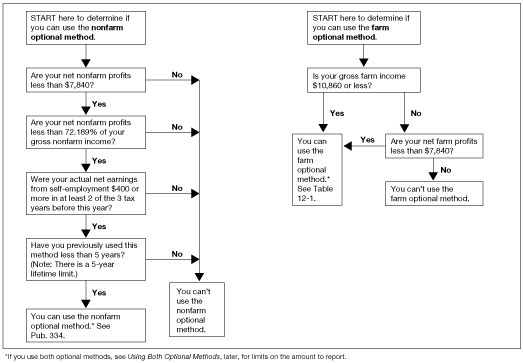
Why use an optional method?
You may want to use the optional methods (discussed later) when you have a loss or a small net profit and any one of the following applies.
-
You want to receive credit for social security benefit coverage.
-
You incurred child or dependent care expenses for which you could claim a credit. (An optional method may increase your earned income, which could increase your credit.)
-
You are entitled to the earned income credit. (An optional method may increase your earned income, which could increase your credit.)
-
You are entitled to the additional child tax credit. (An optional method may increase your earned income, which could increase your credit.)
Effects of using an optional method.
Using an optional method could increase your SE tax. Paying more SE tax may result in you getting higher social security disability or retirement benefits.
Using the optional methods may also decrease your adjusted gross income (AGI) due to the deduction for one-half of SE tax on Form 1040, which may affect your eligibility for credits, deductions, or other items that are subject to an AGI limit. Figure your AGI with and without using the optional methods to see if the optional methods will benefit you.
If you use either or both optional methods, you must figure and pay the SE tax due under these methods even if you would have had a smaller SE tax or no SE tax using the regular method.
The optional methods may be used only to figure your SE tax. To figure your income tax, include your actual self-employment earnings in gross income, regardless of which method you use to determine SE tax.
Regular Method
To figure net earnings using the regular method, multiply your self-employment earnings by 92.35% (0.9235). For your net earnings figured using the regular method, see line 4a of your Schedule SE (Form 1040).
Net earnings figured using the regular method are also called actual net earnings.
Farm Optional Method
Use the farm optional method only for self-employment earnings from a farming business. You can use this method if you meet either of the following tests.
-
Your gross farm income is $10,860 or less.
-
Your net farm profits are less than $7,840.
Gross farm income.
Your gross farm income is the total of the amounts from:
-
Schedule F (Form 1040), line 9; and
-
Box 14, code B, of Schedule K-1 (Form 1065) (from farm partnerships).
Net farm profits.
Net farm profits are generally the total of the amounts from:
-
Schedule F (Form 1040), line 34; and
-
Box 14, code A of Schedule K-1 (Form 1065) (from farm partnerships).
Figuring farm net earnings.
If you meet either of the two tests explained above, use Table 12-1 to figure your net earnings from self-employment under the farm optional method.
Table 12-1. Figuring Farm Net Earnings
| IF your gross farm income is... | THEN your net earnings are equal to... |
| $10,860 or less | two-thirds of your gross farm income. |
| more than $10,860 | $7,240. |
Optional method can reduce or eliminate SE tax.
If your gross farm income is $10,860 or less and your farm net earnings figured under the farm optional method are less than your actual farm net earnings, you can use the farm optional method to reduce or eliminate your SE tax. Your actual farm net earnings are your farm net earnings figured using the regular method, explained earlier.
Example.
Your gross farm income is $540 and your net farm profit is $460. Consequently, your net earnings figured under the farm optional method are $360 (2/3 of $540) and your actual net earnings are $425 (92.35% of $460). You owe no SE tax if you use the optional method because your net earnings under the farm optional method are less than $400.
Nonfarm Optional Method
This is an optional method available for determining net earnings from nonfarm self-employment, much like the farm optional method.
If you are also engaged in a nonfarm business, you may be able to use this method to figure your nonfarm net earnings. You can use this method even if you don’t use the farm optional method for determining your farm net earnings and even if you have a net loss from your nonfarm business. For more information about the nonfarm optional method, see Pub. 334.
.You can’t combine farm and nonfarm self-employment earnings to figure your net earnings under either of the optional methods..
Using Both Optional Methods
If you use both optional methods, you must add the net earnings figured under each method to arrive at your total net earnings from self-employment. You can report less than your total actual farm and nonfarm net earnings but not less than actual nonfarm net earnings. If you use both optional methods, you can report no more than $7,240 as your combined net earnings from self-employment.
Reporting SE Tax
Use Schedule SE (Form 1040) to figure and report your SE tax. Then, enter the SE tax on Schedule 2 (Form 1040), line 4, and attach Schedule SE to Form 1040 or 1040-SR.
.If you have to pay SE tax, you must file Form 1040 or 1040-SR (with Schedule SE attached) even if you don’t otherwise have to file a federal income tax return..
SE tax deduction.
You can deduct half of your SE tax in figuring your AGI. This deduction only affects your income tax. It doesn’t affect either your net earnings from self-employment or your SE tax.
To deduct the tax, enter on Schedule 1 (Form 1040), line 15, the amount from line 13 of Schedule SE (Form 1040).
Joint return.
Even if you file a joint return, you can’t file a joint Schedule SE. This is true whether one spouse or both spouses have self-employment earnings. Your spouse isn’t considered self-employed just because you are. If both of you have self-employment earnings, each of you must complete a separate Schedule SE. Attach both schedules to the joint return. If you and your spouse operate a business as a partnership, see Business owned and operated by spouses and Qualified joint venture (QJV), earlier.
Social security and Medicare taxes for 2025. The social security tax rate is 6.2% each for the employee and employer. The social security wage base limit is $176,100.The Medicare tax rate is 1.45% each for the employee and employer, unchanged from 2024. There’s no wage base limit for Medicare tax.
2025 withholding tables. The federal income tax withholding tables are included in Pub. 15-T, Federal Income Tax Withholding Methods.
Aggregate return filers must identify themselves. Aggregate return filers must use the new Aggregate Return Filers Only section on Form 943, Employer’s Annual Federal Tax Return for Agricultural Employees, to identify whether they’re filing an aggregate return as a section 3504 agent, certified professional employer organization (CPEO), or other third party. For more information about these types of aggregate return filers, see the Instructions for Form 943.
Direct deposit of Form 943 refund is now available. Executive Order (EO) 14247, Modernizing Payments To and From America’s Bank Account, issued on March 25, 2025, promotes operational efficiency by mandating the transition to electronic payments for all federal disbursements. Accordingly, the IRS will now issue Form 943 tax refunds by direct deposit. Direct deposit is a fast, simple, safe, and secure way to have your refund deposited automatically to your checking or savings account. Instead of a direct deposit refund, you can still choose to have your Form 943 overpayment applied to your next return by checking the appropriate box on Form 943, line 16b.
Make balance due payments electronically. EO 14247 also promotes operational efficiency by mandating the transition to electronic payments for all payments made to the federal government. Therefore, pay your balance due on Form 943 electronically. There are several easy, safe, and secure ways to pay your balance due electronically.
Form 943 return transcripts are now available electronically. You can now access your Form 943 return transcript for tax years 2023 and later using your IRS business tax account. For more information, go to IRS.gov/BusinessTranscript. To access your IRS business tax account, go to IRS.gov/BusinessAccount.
Electronic filing of Form 943-X. You can now file Form 943-X, Adjusted Employer’s Annual Federal Tax Return for Agricultural Employees or Claim for Refund, electronically using Modernized e-File (MeF). For more information on electronic filing, go to IRS.gov/EmploymentEfile.
Withholding on qualified overtime compensation. For tax years beginning after 2024, and ending before 2029, P.L. 119-21, commonly known as the One Big Beautiful Bill Act, allows individuals (employees and other workers not treated as employees) to deduct up to $12,500 ($25,000 if married filing jointly) in qualified overtime compensation on their income tax returns. Qualified overtime is overtime compensation that exceeds the regular rate of pay (such as the “and-a-half” portion of time-and-a-half compensation) that is required to be paid to an individual under section 7 of the Fair Labor Standards Act (FLSA) of 1938. The FLSA provides that employers must generally pay covered, nonexempt employees at least one-and-a-half times their regular rate of pay for hours worked over 40 hours per week. For more information about agricultural employment under the FLSA, go to dol.gov/agencies/whd/fact-sheets/12-agricultural-employment-flsa. Employers use an employee’s updated Form W-4, Employee’s Withholding Certificate, if one is submitted by the employee, and the federal income tax withholding procedures in Pub. 15-T to allow the employee to account for their expected deduction and receive more money in each paycheck instead of waiting until filing their income tax return to receive the benefit of this deduction. Overtime compensation is still subject to both the employer share and employee share of social security tax and Medicare tax. Employers and other payers must file information returns (for example, Forms W-2 and Forms 1099-MISC) with the SSA or IRS, as applicable, and furnish statements to overtime recipients showing qualified overtime compensation paid during the year. However, the IRS will provide transition relief to employers and payers for the tax year 2025 reporting requirements. Monitor IRS.gov for more information about the available relief.
Social security and Medicare taxes for 2026. The employee and employer tax rates for social security and the maximum amount of wages subject to social security tax for 2026 will be discussed in Pub. 15 (for use in 2026).The Medicare tax rate for 2026 will also be discussed in Pub. 15 (for use in 2026). There’s no limit on the amount of wages subject to Medicare tax.
References applicable to other forms. Unless otherwise noted, references throughout this chapter to Form W-2 include Forms W-2AS, W-2CM, W-2GU, W-2VI, and 499R-2/W-2PR; references to Form W-2c include Form 499R-2c/W-2cPR; references to Form W-3 include Form W-3SS and Form W-3 (PR); and references to Form W-3c include Form W-3C (PR).
The COVID-19 related credit for qualified sick and family leave wages is limited to leave taken after March 31, 2020, and before October 1, 2021, and may no longer be claimed on Form 943. Generally, the credit for qualified sick and family leave wages, as enacted under the Families First Coronavirus Response Act (FFCRA) and amended and extended by the COVID-related Tax Relief Act of 2020, for leave taken after March 31, 2020, and before April 1, 2021, and the credit for qualified sick and family leave wages under sections 3131, 3132, and 3133 of the Internal Revenue Code, as enacted under the American Rescue Plan Act of 2021 (the ARP), for leave taken after March 31, 2021, and before October 1, 2021, have expired. However, employers that pay qualified sick and family leave wages in 2025 for leave taken after March 31, 2020, and before October 1, 2021, are eligible to claim a credit for qualified sick and family leave wages in 2025. Effective for tax periods beginning after 2023, the lines used to claim the credit for qualified sick and family leave wages have been removed from Form 943 because it would be extremely rare for an employer to pay wages after 2023 for qualified sick and family leave taken after March 31, 2020, and before October 1, 2021. Instead, if you’re eligible to claim the credit for qualified sick and family leave wages because you paid the wages in 2025 for an earlier applicable leave period, file Form 943-X after filing Form 943, to claim the credit for qualified sick and family leave wages paid in 2025. Filing a Form 943-X before filing a Form 943 for the year may result in errors or delays in processing your Form 943-X.
Qualified small business payroll tax credit for increasing research activities. For tax years beginning before 2023, a qualified small business may elect to claim up to $250,000 of its credit for increasing research activities as a payroll tax credit. The Inflation Reduction Act of 2022 (the IRA) increases the election amount to $500,000 for tax years beginning after 2022. The payroll tax credit election must be made on or before the due date of the originally filed income tax return (including extensions). The portion of the credit used against payroll taxes is allowed in the first calendar quarter beginning after the date that the qualified small business filed its income tax return. The election and determination of the credit amount that will be used against the employer’s payroll taxes are made on Form 6765, Credit for Increasing Research Activities. The amount from Form 6765 must then be reported on Form 8974, Qualified Small Business Payroll Tax Credit for Increasing Research Activities.Starting in the first quarter of 2023, the payroll tax credit is first used to reduce the employer share of social security tax up to $250,000 per quarter and any remaining credit reduces the employer share of Medicare tax for the quarter. Any remaining credit, after reducing the employer share of social security tax and the employer share of Medicare tax, is then carried forward to the next quarter. Form 8974 is used to determine the amount of the credit that can be used in the current quarter. The amount from Form 8974, line 12 or, if applicable, line 17, is reported on Form 943, line 12. For more information about the payroll tax credit, see the Instructions for Form 8974 and go to IRS.gov/ResearchPayrollTC.
Forms in Spanish. Many forms and instructions discussed in this publication have Spanish-language versions available for employers and employees. Some examples include Form 943 (sp), Form SS-4 (sp), and Form W-4 (sp). Although this publication doesn’t reference Spanish-language forms and instructions in each instance that one is available, you can see Pub. 15 (sp) and go to IRS.gov/SpanishForms to determine if a Spanish-language version is available.
Pub. 51 discontinued after 2023. Pub. 51, Agricultural Employer’s Tax Guide, was discontinued for tax years beginning after 2023. Instead, information specific to agricultural employers is included in Pub. 15, Employer’s Tax Guide. If you prefer Pub. 15 in Spanish, see Pub. 15 (sp).
Additional employment tax information for farmers. See Pub. 15 for more detailed guidance on employment taxes for employers of agricultural workers. For the latest information about developments related to Pub. 15, such as legislation enacted after it was published, go to IRS.gov/Pub15. For general tax information relevant to agricultural employers, go to IRS.gov/AgricultureTaxCenter. For general information about employment taxes, go to IRS.gov/EmploymentTaxes.
.You may have nonfarm employees as well as farm employees, for example, workers at a retail farm market. See Pub. 15 for employment tax rules for wages and noncash wages paid to these employees, as they may differ from those discussed in this chapter..
Certification program for professional employer organizations (PEOs). The Stephen Beck, Jr., Achieving a Better Life Experience (ABLE) Act of 2014 required the IRS to establish a voluntary certification program for PEOs. PEOs handle various payroll administration and tax reporting responsibilities for their business clients and are typically paid a fee based on payroll costs. To become and remain certified under the certification program, CPEOs must meet various requirements described in sections 3511 and 7705 and related published guidance. Certification as a CPEO may affect the employment tax liabilities of both the CPEO and its customers. A CPEO is generally treated for employment tax purposes as the employer of any individual who performs services for a customer of the CPEO and is covered by a contract described in section 7705(e)(2) between the CPEO and the customer (CPEO contract), but only for wages and other compensation paid to the individual by the CPEO. To become a CPEO, the organization must apply through the IRS Online Registration System. For more information or to apply to become a CPEO, go to IRS.gov/CPEO.CPEOs must generally file Form 943 and Schedule R (Form 943), Allocation Schedule for Aggregate Form 943 Filers, electronically. For more information about a CPEO’s requirement to file electronically, see Rev. Proc. 2023-18, 2023-13 I.R.B. 605, available at IRS.gov/irb/2023-13_IRB#REV-PROC-2023-18.
Work opportunity tax credit for qualified tax-exempt organizations hiring qualified veterans. Qualified tax-exempt organizations that hire eligible unemployed veterans may be able to claim the work opportunity tax credit against their payroll tax liability using Form 5884-C. For more information, go to IRS.gov/WOTC.
Correcting a previously filed Form 943. If you discover an error on a previously filed Form 943, or if you otherwise need to amend a previously filed Form 943, make the correction using Form 943-X. Form 943-X is filed separately from Form 943. For more information, see the Instructions for Form 943-X, section 13 of Pub. 15, or go to IRS.gov/CorrectingEmploymentTaxes.
Federal tax deposits must be made by electronic funds transfer (EFT). You must use EFT to make all federal tax deposits. An EFT can be made using the Electronic Federal Tax Payment System (EFTPS), IRS Direct Pay, or your IRS business tax account. If you don’t want to use one of these methods, you can arrange for your tax professional, financial institution, payroll service, or other trusted third party to make electronic deposits on your behalf. Also, you may arrange for your financial institution to initiate a same-day wire payment on your behalf. EFTPS is a free service provided by the Department of the Treasury. Payments made using IRS Direct Pay or through your IRS business tax account are also free. Services provided by your tax professional, financial institution, payroll service, or other third party may have a fee.
Note:
An exception applies to the EFT requirement for making your federal tax deposits. If your total taxes after adjustments and nonrefundable credits (Form 943, line 13) are less than $2,500 for the year, you can pay the tax due with your return if you file on time. See the Instructions of Form 943 for more information.
For more information on making federal tax deposits, see section 11 of Pub. 15. For more information about IRS Direct Pay, go to IRS.gov/DirectPay. For more information about making a payment through your IRS business tax account, go to IRS.gov/BusinessAccount. To get more information about EFTPS or to enroll in EFTPS, go to EFTPS.gov or call one of the following numbers.
-
800-555-4477
-
800-244-4829 (Spanish)
-
303-967-5916 (toll call)
To contact EFTPS using Telecommunications Relay Services (TRS) for people who are deaf, hard of hearing, or have a speech disability, dial 711 and then provide the TRS assistant the 800-555-4477 number above or 800-733-4829. Additional information about EFTPS is also available in Pub. 966.
.EFTPS accepts same-day payments of $1 million or less if the payment is submitted before 3:00 p.m. Eastern time on a business day. If your payment is more than $1 million, you must submit the deposit by 8:00 p.m. Eastern time the day before the date the deposit is due..
Electronic filing and payment. Businesses can enjoy the benefits of filing tax returns and paying their federal taxes electronically. Whether you rely on a tax professional or handle your own taxes, the IRS offers you convenient and secure programs to make filing and paying easier. Spend less time worrying about taxes and more time running your business. Use e-file and electronic payment options to your benefit.
-
For e-file, go to IRS.gov/EmploymentEfile for additional information. A fee may be charged to file electronically.
-
For electronic payment options, go to IRS.gov/Pay.
-
For electronic filing of Form W-2, Wage and Tax Statement, go to SSA.gov/employer. You may be required to file Forms W-2 electronically. For details, see the General Instructions for Forms W-2 and W-3. The Social Security Administration’s Business Services Online (BSO) is an independent program from the Government of Puerto Rico electronic filing system. Employers in Puerto Rico must go to Hacienda.pr.gov for additional information.
You should take the actions indicated by the dates listed. The dates listed here aren’t adjusted for Saturdays, Sundays, and legal holidays (see the Tip next). Pub. 509, Tax Calendars (for use in 2026), adjusts the dates for Saturdays, Sundays, and legal holidays. Due dates for deposits of withheld federal income tax, social security tax, and Medicare tax aren’t listed here. Also, the due dates for forms required for health coverage reporting aren’t listed here. For these dates, see Pub. 509.
.If any date shown next for filing a return, furnishing a form, or depositing taxes falls on a Saturday, Sunday, or legal holiday, the due date is the next business day. The term “legal holiday” means any legal holiday in the District of Columbia. Legal holidays in the District of Columbia are provided in section 11 of Pub. 15. A statewide legal holiday delays a filing or furnishing due date only if the IRS office where you’re required to file a return or furnish a form is located in that state. However, a statewide legal holiday doesn’t delay the due date of federal tax deposits. For any due date, you’ll meet the “file” or “furnish” date requirement if the envelope containing the tax return or form is properly addressed, contains sufficient postage, and is postmarked by the U.S. Postal Service on or before the due date, or sent by an IRS-designated private delivery service (PDS) on or before the due date. Go to IRS.gov/PDS for the current list of PDSs. For the IRS mailing address to use if you’re using a PDS, go to IRS.gov/PDSstreetAddresses..
Fiscal-year taxpayers. The due dates listed next apply whether you use a calendar or a fiscal year.
-
File Form 943 with the IRS. If you deposited all Form 943 taxes when due, you may file Form 943 by February 10.
-
File Form 940, Employer’s Annual Federal Unemployment (FUTA) Tax Return, with the IRS. If you deposited all the FUTA tax when due, you may file Form 940 by February 10.
-
File Copy A of all paper and electronic Forms W-2 with Form W-3, Transmittal of Wage and Tax Statements, with the Social Security Administration (SSA). If filing electronically, the SSA generates Form W-3 automatically based on your Forms W-2. For more information on reporting Form W-2 information to the SSA electronically, go to the SSA’s Employer W-2 Filing Instructions & Information webpage at SSA.gov/employer.
-
Furnish each employee with a completed Form W-2.
-
File Copy A of all paper and electronic Forms 1099-NEC, Nonemployee Compensation, that report nonemployee compensation with Form 1096, Annual Summary and Transmittal of U.S. Information Returns, with the IRS. For information on filing information returns electronically with the IRS, see Pub. 1220. Other Forms 1099, including Forms 1099-MISC, Miscellaneous Information, have different due dates. For details about filing Forms 1099 and for information about required electronic filing, see the General Instructions for Certain Information Returns for general information, and the separate, specific instructions for each information return you file (for example, the Instructions for Forms 1099-MISC and 1099-NEC).
-
Furnish a completed Form 1099-NEC to each recipient to whom you paid $600 or more in nonemployee compensation.
-
File Form 945, Annual Return of Withheld Federal Income Tax, with the IRS to report any nonpayroll income tax withheld. If you deposited all Form 945 taxes when due, you may file Form 945 by February 10.
By February 15. Ask for a new Form W-4, or Formulario W-4 (sp) from each employee who claimed exemption from federal income tax withholding last year.
On February 16. Any Form W-4 claiming exemption from withholding for the previous year has now expired. Begin withholding for any employee who previously claimed exemption from withholding but hasn’t given you a new Form W-4 for the current year. If the employee doesn’t give you a new Form W-4, withhold taxes as if they had checked the box for Single or Married filing separately in Step 1(c) and made no entries in Step 2, Step 3, or Step 4 of the 2026 Form W-4. If the employee furnishes a new Form W-4 claiming exemption from withholding after February 15, you may apply the exemption to future wages, but don’t refund taxes withheld while the exempt status wasn’t in place.
By April 30, July 31, October 31, and January 31. Deposit FUTA tax. Deposit FUTA tax due if the undeposited amount is over $500.
Before December 1. Provide employees an opportunity to submit a new Form W-4 if their filing status, other income, deductions, or credits have changed or will change for the next year.
Introduction
You’re generally required to withhold federal income tax from the wages of your employees. You may be required to withhold social security and Medicare taxes from your employees’ wages and pay the employer’s share of these taxes under the Federal Insurance Contributions Act (FICA). You may also have to pay federal unemployment tax under FUTA. You must also withhold Additional Medicare Tax from wages you pay to an employee in excess of $200,000 in a calendar year. This chapter includes information about these taxes.
You must also pay self-employment tax on your net earnings from farming. See chapter 12 for information on self-employment tax.
Topics
This chapter discusses:-
Farm employment;
-
Family employees;
-
Crew leaders;
-
Social security and Medicare taxes;
-
Federal income tax withholding;
-
Required notice to employees about the earned income credit (EIC);
-
Reporting and paying social security, Medicare, and withheld federal income taxes; and
-
FUTA tax.
Useful Items
You may want to see:Publication
-
15 Employer’s Tax Guide
-
15-A Employer’s Supplemental Tax Guide
-
15-B Employer’s Tax Guide to Fringe Benefits
-
15-T Federal Income Tax Withholding Methods
-
926 Household Employer’s Tax Guide
Form (and Instructions)
-
W-2 Wage and Tax Statement
-
W-4 Employee’s Withholding Certificate
-
W-9 Request for Taxpayer Identification Number and Certification
-
940 Employer’s Annual Federal Unemployment (FUTA) Tax Return
-
943 Employer’s Annual Federal Tax Return for Agricultural Employees
-
943-X Adjusted Employer’s Annual Federal Tax Return for Agricultural Employees or Claim for Refund
See How To Get Tax Help, near the end of this publication, for information about getting publications and forms.
Farm Employment
In general, you’re an employer of farmworkers if your employees do any of the following types of work.
-
Raising or harvesting agricultural or horticultural products on a farm, including raising and feeding of livestock and raising bees for pollination and the production of honey.
-
Operating, managing, conserving, improving, or maintaining your farm and its tools and equipment, if the major part of such service is performed on a farm.
-
Services performed in salvaging timber, or clearing land of brush and other debris, left by a hurricane (also known as hurricane labor) if the major part of such service is performed on a farm.
-
Handling, processing, or packaging any agricultural or horticultural commodity in its unmanufactured state if you produced more than half of the commodity (for a group of up to 20 unincorporated operators, all of the commodity).
-
Work related to cotton ginning, turpentine, gum resin products, or the operation and maintenance of irrigation facilities.
Generally, a worker who performs services for you is your employee if you have the right to control what will be done and how it will be done. This is so even when you give the employee freedom of action. What matters is that you have the right to control the details of how the services are performed. You’re responsible for withholding and paying employment taxes for your employees. You’re also required to file employment tax returns. These requirements don’t apply to amounts that you pay to independent contractors, as discussed later under Nonemployee compensation. See sections 1 and 2 of Pub. 15-A for more information on how to determine whether an individual providing services is an independent contractor or an employee.
If you employ a family of workers, each worker subject to your control (not just the head of the family) is an employee.
Special rules apply to crew leaders. See Crew Leaders, later.
Employer identification number (EIN).
If you’re required to report employment taxes or give tax statements to employees, you must have an EIN. If you don’t have an EIN, you may apply for one online by going to IRS.gov/EIN. You may also apply for an EIN by faxing or mailing Form SS-4 to the IRS. Be aware that you may already have an EIN if you have previously had farm employees; previously had nonfarm employees in a different business; you file Form 2290, Heavy Highway Vehicle Use Tax Return; or your farm business is structured as a partnership, limited liability company, S corporation, or C corporation.
Employee’s social security number (SSN).
An employee who doesn’t have an SSN and is legally eligible to work in the United States should submit Form SS-5, Application for a Social Security Card, to the SSA. Form SS-5 is available from any SSA office or by calling 800-772-1213. It is also available from the SSA’s website at SSA.gov/online/ss-5.pdf.
The employee must furnish evidence of age, identity, and U.S. citizenship or lawful immigration status permitting employment with the Form SS-5.
Form I-9.
You must verify that each new employee is legally eligible to work in the United States. This includes completing the U.S. Citizenship and Immigration Services (USCIS) Form I-9, Employment Eligibility Verification. You can get Form I-9 at USCIS.gov/Forms. For more information, go to the USCIS website at USCIS.gov/I-9-Central or call 800-375-5283 or 800-767-1833 (TTY).
You may use the Social Security Number Verification Service (SSNVS) at SSA.gov/employer/ssnv.htm to verify that an employee name matches an SSN. A person may have a valid SSN but not be authorized to work in the United States. You may use E-Verify at E-Verify.gov to confirm the employment eligibility of newly hired employees. Some states may require employers to also use E-Verify; check with the appropriate agency in your state.
Form W-4.
You should give each new employee a Form W-4 (IRS.gov/W4) as soon as you hire the employee. For Spanish-speaking employees, you may use Formulario W-4 (sp), which is the Spanish translation of Form W-4. Have the employee complete and return Form W-4 to you before the first payday. If the employee doesn’t return the completed form, you must withhold federal income tax as if the employee had checked the box for Single or Married filing separately in Step 1(c) and made no entries in Step 2, Step 3, or Step 4 of Form W-4.
New hire reporting.
You’re required to report any new employee to a designated state new hire registry. A new employee is an employee who hasn’t previously been employed by you or was previously employed by you but has been separated from such prior employment for at least 60 consecutive days. Many states accept a copy of Form W-4 with employer information added. Go to the Office of Child Support Enforcement website at acf.hhs.gov/css/employers for more information.
Family Employees
Generally, the wages you pay to family members who are your employees are subject to employment taxes. However, certain exemptions may apply to wages paid to your child, spouse, or parent.
Exemptions for your child.
Payments for the services of your child under age 18 who works for you in your trade or business (including a farm) aren’t subject to social security and Medicare taxes. However, see Nonexempt services of a child or spouse, later. Payments for the services of your child under age 21 employed by you in other than a trade or business, such as payments for household services in your home, also aren’t subject to social security or Medicare tax. Payments for the services of your child under age 21 employed by you, whether or not in your trade or business, aren’t subject to FUTA tax. Although not subject to social security, Medicare, or FUTA tax, the child’s wages may still be subject to federal income tax withholding.
Exemptions for your spouse.
Payments for the services of your spouse who works for you in your trade or business are subject to federal income tax withholding and social security and Medicare taxes, but not FUTA tax.
Payments for the services of your spouse employed by you in other than a trade or business, such as payments for household services in your home, aren’t subject to social security, Medicare, or FUTA tax.
Nonexempt services of a child or spouse.
Payments for the services of your child or spouse are subject to federal income tax withholding as well as social security, Medicare, and FUTA taxes if they work for any of the following entities.
-
A corporation, even if it’s controlled by you.
-
A partnership, even if you’re a partner. This doesn’t apply to wages paid to your child if each partner is a parent of the child.
-
An estate or trust, even if it’s the estate of a deceased parent.
Exemptions for your parent.
Payments for the services of your parent employed by you in your trade or business are subject to federal income tax withholding and social security and Medicare taxes. Social security and Medicare taxes don’t apply to wages paid to your parent for services not in your trade or business, but they do apply to payments for household services in your home if both of the following conditions are satisfied.
-
You have a child (including an adopted child or stepchild) living in your home who is under age 18 or has a physical or mental condition that requires care by an adult for at least 4 continuous weeks in the calendar quarter services were performed.
-
You’re a qualifying surviving spouse; or divorced and not remarried; or have a spouse in the home who, because of a physical or mental condition, can’t care for your child for at least 4 continuous weeks in the calendar quarter services were performed.
Wages you pay to your parent aren’t subject to FUTA tax, regardless of the type of services provided.
Qualified joint venture (QJV).
If spouses elect to be treated as a QJV instead of a partnership, either spouse may report and pay the employment taxes due on the wages paid to employees using the EIN of that spouse’s sole proprietorship. For more information about QJVs, see chapter 12.
Crew Leaders
If farmworkers are provided by a crew leader, the crew leader may be the employer of the workers.
Social security and Medicare taxes.
For social security and Medicare tax purposes, the crew leader is the employer of the workers if both of the following requirements are met.
-
The crew leader pays (either on their own behalf or on behalf of the farmer) the workers for their farm labor.
-
The crew leader hasn’t entered into a written agreement with the farmer under which the crew leader is designated as an employee of the farmer.
If both requirements are met, the crew leader isn’t considered the employee of the farmer for services performed by the crew leader in furnishing farmworkers and as a member of the crew.
Federal income tax withholding.
If the crew leader is the employer for social security and Medicare tax purposes, the crew leader is the employer for federal income tax withholding purposes.
Federal unemployment (FUTA) tax.
For FUTA tax purposes, the crew leader is the employer of the workers if, in addition to the earlier requirements, either of the following requirements is met.
-
The crew leader is registered under the Migrant and Seasonal Agricultural Worker Protection Act.
-
Substantially all crew members operate or maintain mechanized equipment provided by the crew leader as part of the service to the farmer.
The farmer is the employer of workers furnished by a crew leader in all other situations. In addition, the farmer is the employer of workers furnished by a registered crew leader if the workers are the employees of the farmer under the common-law test. For example, some farmers employ individuals to recruit farmworkers exclusively for them. Although these individuals may be required to register under the Migrant and Seasonal Agricultural Worker Protection Act, the workers are employed directly by the farmer. The farmer is the employer in these cases. For information about common-law employees, see section 1 of Pub. 15-A. For information about the Migrant and Seasonal Agricultural Worker Protection Act, which protects migrant and seasonal agricultural workers by establishing employment standards related to wages, housing, transportation, and disclosures and recordkeeping, and which requires farm labor contractors to register with the U.S. Department of Labor (DOL), go to the DOL website at dol.gov/whd/regs/compliance/whdfs49.htm.
Social Security and Medicare Taxes
All cash wages that you pay to farmworkers are subject to social security and Medicare taxes for any calendar year for which you meet either of the following tests.
-
You pay an employee cash wages of $150 or more in a year for farmwork (count all wages paid on a time, piecework, or other basis). The $150 test applies separately to each farmworker that you employ. If you employ a family of workers, each member is treated separately. Don’t count wages paid by other employers.
-
The total (cash and noncash) wages that you pay to all farmworkers is $2,500 or more.
If the $2,500-or-more test for the group isn’t met, the $150-or-more test for an individual still applies. Similarly, if the $150-or-more test isn’t met for any individual, the $2,500-or-more test for the group still applies.
Exceptions.
Annual cash wages of less than $150 you pay to a seasonal farmworker aren’t subject to social security and Medicare taxes, even if you pay $2,500 or more to all your farmworkers. However, these wages count toward the $2,500 test for determining whether other farmworkers’ wages are subject to social security and Medicare taxes.
A seasonal farmworker is a worker who:
-
Works as a hand-harvest laborer,
-
Is paid piece rates in an operation usually paid on this basis in the region of employment,
-
Commutes daily from their permanent home to the farm, and
-
Worked in agriculture less than 13 weeks in the preceding calendar year.
See Family Employees, earlier, for certain exemptions from social security and Medicare taxes that apply to your child, spouse, and parent.
Religious exemption.
An exemption from social security and Medicare taxes is available to members of a recognized religious group or division opposed to public insurance. This exemption is available only if both the employee and the employer are members of the group or division. These employees are still subject to federal income tax. For more information, see Pub. 517.
Cash wages.
Only cash wages paid to farmworkers are subject to social security and Medicare taxes. Cash wages include checks, money orders, and any kind of money or cash.
Only cash wages subject to social security and Medicare taxes are credited to your employees for social security benefit purposes. Payments not subject to these taxes, such as certain commodity wages (discussed next), don’t contribute to your employees’ social security coverage. For information about social security benefits, go to SSA.gov or call the SSA at 800-772-1213.
Noncash wages (including commodity wages).
Noncash wages include food, lodging, clothing, transportation passes, farm products, or other goods or commodities. Noncash wages paid to farmworkers, including commodity wages, aren’t subject to social security and Medicare taxes. However, they’re subject to these taxes if the substance of the transaction is a cash payment. For information on lodging provided as a condition of employment, see Pub. 15-B.
Report the value of noncash wages in box 1 of Form W-2 together with cash wages. Don’t show noncash wages in box 3 or in box 5 (unless the substance of the transaction is a cash payment).
Tax rates and social security wage base limit.
For 2025, the employer and the employee will pay the following taxes.
-
The employer and employee each pay 6.2% of cash wages for social security tax (old-age, survivors, and disability insurance).
-
The employer and employee each pay 1.45% of cash wages for Medicare tax (hospital insurance).
-
The employee pays 0.9% of cash wages in excess of $200,000 for Additional Medicare Tax.
Wage base limit.
The limit on wages subject to social security tax for 2025 is $176,100. There’s no limit on wages subject to Medicare tax. All covered wages are subject to Medicare tax. Additionally, all wages in excess of $200,000 are subject to Additional Medicare Tax withholding.
Paying employee’s share.
If you would rather pay the employee’s share of social security and Medicare taxes without deducting it from their wages, you may do so. It’s additional income to the employee, thus it’s subject to income tax withholding. You must include it in box 1 of the employee’s Form W-2, but don’t count it as social security and Medicare wages (boxes 3 and 5 of Form W-2) or as wages for FUTA tax purposes.
Example.
Gabrielle operates a small family fruit farm. She employs day laborers in the picking season to enable her to timely get her crop to market. She doesn’t deduct the employees’ share of social security and Medicare taxes from their pay; instead, she pays it on their behalf. When she prepares her employees’ Forms W-2, she adds each employee’s share of social security and Medicare taxes that she paid to the employee’s wage income (box 1 of Form W-2), but doesn’t include it in box 3 (social security wages) or box 5 (Medicare wages and tips).
For 2025, Gabrielle paid Dan $1,000 during the year. She enters $1,076.50 in box 1 of Dan’s Form W-2 ($1,000 wages plus $76.50 social security and Medicare taxes paid for Dan). She enters $1,000.00 in boxes 3 and 5 of Dan’s Form W-2.
Additional Medicare Tax.
In addition to withholding Medicare tax at 1.45%, you must also withhold a 0.9% Additional Medicare Tax from wages you pay to an employee in excess of $200,000 in a calendar year. You’re required to begin withholding Additional Medicare Tax in the pay period in which you pay wages in excess of $200,000 to an employee and continue to withhold it each pay period until the end of the calendar year. Additional Medicare Tax is only imposed on the employee. There’s no employer share of Additional Medicare Tax. All wages that are subject to Medicare tax are subject to Additional Medicare Tax withholding if paid in excess of the $200,000 withholding threshold.
For more information on what wages are subject to Medicare tax, see the chart, Special Rules for Various Types of Services and Payments, in section 15 of Pub. 15. For more information on Additional Medicare Tax, go to IRS.gov/ADMTfaqs.
Federal Income Tax Withholding
If the cash wages you pay to farmworkers are subject to social security and Medicare taxes, they’re also subject to federal income tax withholding. Although noncash wages are subject to federal income tax, withhold income tax on these noncash wages only if you and the employee agree to do so. The amount to withhold is figured on gross wages without taking out social security and Medicare taxes, union dues, etc.
Form W-4.
Generally, the amount of federal income tax you withhold is based on the employee’s filing status and other information reported on the employee’s Form W-4. Don’t withhold federal income tax from the wages of an employee who, by writing “Exempt” on Form W-4, certifies that they had no federal income tax liability last year and anticipates no liability for the current year.
You should give each new employee a Form W-4 as soon as you hire the employee. For Spanish-speaking employees, you may use Formulario W-4 (sp), which is the Spanish translation of Form W-4. Have the employee complete and return Form W-4 to you before the first payday. If the employee doesn’t return the completed form, you must withhold federal income tax as if the employee had checked the box for Single or Married filing separately in Step 1(c) and made no entries in Step 2, Step 3, or Step 4 of Form W-4.
You should make the 2026 Form W-4 available to your employees and encourage them to check their income tax withholding for 2026. Those employees who owed a large amount of tax or received a large refund for 2025 may want to submit a new Form W-4. You can’t accept substitute Forms W-4 developed by employees. Advise your employees to use the IRS Tax Withholding Estimator available at IRS.gov/W4App to determine accurate withholding.
Form W-2.
By January 31, you must furnish each employee a Form W-2 showing total wages for the previous year and total federal income tax, social security tax, and Medicare tax withheld. However, if an employee stops working for you and asks for the form earlier, you must give it to the employee within 30 days of the later of the following dates.
-
The date the employee asks for the form.
-
The date you make your final payment of wages to the employee.
Compensation paid to H-2A agricultural workers.
Report compensation of $600 or more paid to foreign agricultural workers who entered the country on H-2A visas in box 1 of Form W-2. Compensation paid to H-2A agricultural workers for agricultural labor performed in connection with this visa isn’t subject to social security and Medicare taxes, and therefore shouldn’t be reported as wages subject to social security tax (line 2), Medicare tax (line 4), or Additional Medicare Tax withholding (line 6) on Form 943, and shouldn’t be reported as social security wages (box 3) or Medicare wages (box 5) on Form W-2. On Form W-2, don’t check box 13 (Statutory employee), as H-2A agricultural workers aren’t statutory employees.
An employer isn’t required to withhold federal income tax from compensation paid to an H-2A agricultural worker for agricultural labor performed in connection with this visa unless the worker asks for withholding and the employer agrees. In this case, the worker must give the employer a completed Form W-4. Federal income tax withheld should be reported on Form 943, line 8, and in box 2 of Form W-2.
These reporting rules apply when the H-2A agricultural worker provides their taxpayer identification number (TIN) to the employer. However, if an H-2A agricultural worker didn’t provide the employer with a TIN, the employee is subject to backup withholding. The employer must report the wages and backup withholding on Form 1099-MISC. The employer must also report the backup withholding on Form 945, line 2.
For more information, see the Instructions for Forms 1099-MISC and 1099-NEC and the Instructions for Form 945. For more information on foreign agricultural workers on H-2A visas, go to IRS.gov/H2A.
Required notice to employees about the earned income credit (EIC).
You must provide notification about the EIC to each employee who worked for you at any time during the year and from whom you didn’t withhold any federal income tax. However, you don’t have to notify employees who claim exemption from federal income tax withholding on Form W-4. You meet the notification requirement by giving each employee any of the following.
-
The official IRS Form W-2, which has the required information about the EIC on the back of Copy B.
-
A substitute Form W-2 with the same EIC information on the back of the employee’s copy that is on Copy B of the official IRS Form W-2.
-
Notice 797, Possible Federal Tax Refund Due to the Earned Income Credit (EIC).
-
Your own written statement with the exact wording of Notice 797. For more information, see Pub. 15 and Notice 1015, Have You Told Your Employees About the Earned Income Credit (EIC).
How to figure withholding.
You can use one of several methods to determine the amount to withhold. The methods are described in Pub. 15-T, which contains tables showing the correct amount of federal income tax you should withhold. Section 9 of Pub. 15 also contains additional information about federal income tax withholding.
Nonemployee compensation.
Generally, you don’t have to withhold federal income tax on payments for services to individuals who aren’t your employees. However, you may be required to report these payments on Form 1099-NEC and to withhold under the backup withholding rules. For example, persons who haven’t furnished their TINs to you are subject to withholding on payments required to be reported on Form 1099-NEC. For more information, see the Instructions for Forms 1099-MISC and 1099-NEC. For backup withholding on H-2A agricultural workers, see Compensation paid to H-2A agricultural workers, earlier.
Example.
You contract Sean Black to complete custom corn chopping on your farm. Because Sean Black is a contracted individual and not an employee, you’ll issue him a Form 1099-NEC to report the compensation paid for the custom corn chopping services.
Example.
You rent a barn from Valerie Brown for the operation of your business. Because you pay more than $600 annually for the rental, you’ll need to issue a Form 1099-MISC to Valerie Brown to report the rent you paid to her.
Reporting and Paying Social Security, Medicare, and Withheld Federal Income Taxes
You must withhold federal income, social security, and Medicare taxes required to be withheld from the salaries and wages of your employees. You’re liable for the payment of these taxes to the federal government whether or not you collect them from your employees. If, for example, you withhold less than the correct tax from an employee’s wages, you’re still liable for the full amount. You must also pay the employer’s share of social security and Medicare taxes. There’s no employer share of Additional Medicare Tax.
Form 943.
Report withheld federal income tax, social security tax, and Medicare tax on Form 943. Your 2025 Form 943 is due by February 2, 2026 (or February 10, 2026, if you made deposits on time in full payment of the taxes due for the year).
Deposits.
Generally, you must deposit both the employer share and employee share of social security and Medicare taxes and federal income tax withheld during the year. However, you may make payments with Form 943 instead of depositing them if you accumulate less than a $2,500 tax liability (“Total taxes after adjustments and nonrefundable credits” line on Form 943) during the year and you pay in full with a timely filed return. See the Instructions for Form 943 for more information on making a payment with your return.
For more information on deposit rules, see section 11 of Pub. 15.
Electronic deposit requirement.
You must use EFT to make all federal tax deposits. See Federal tax deposits must be made by electronic funds transfer (EFT), earlier.
Trust fund recovery penalty.
If you’re responsible for withholding, accounting for, depositing, or paying federal income, social security, and Medicare taxes (that is, trust fund taxes) and willfully fail to do so, you can be held liable for a penalty equal to the withheld tax not paid. The trust fund recovery penalty won’t apply to any amount of trust fund taxes an employer holds back in anticipation of any credits they’re entitled to.
A responsible person can be an officer of a corporation, a partner, a sole proprietor, or an employee of any form of business. A trustee or agent with authority over the funds of the business can also be held responsible for the penalty. “Willfully” means voluntarily, consciously, and intentionally. Paying other expenses of the business instead of the taxes due is acting willfully.
Consequences of treating an employee as an independent contractor.
If you classify an employee as an independent contractor and you have no reasonable basis for doing so, you may be held liable for employment taxes for that worker. See Pub. 15-A for more information.
Federal Unemployment (FUTA) Tax
You must pay FUTA tax if you meet either of the following tests.
-
You paid cash wages of $20,000 or more to farmworkers in any calendar quarter during the current or preceding calendar year.
-
You employed 10 or more farmworkers for some part of at least 1 day (whether or not all at the same time) during any 20 or more different calendar weeks during the current or preceding calendar year.
Alien farmworkers.
Wages paid to aliens admitted on a temporary basis to the United States to perform farmwork (also known as H-2A agricultural workers) are exempt from FUTA tax. However, include your employment of these workers and the wages you paid them to determine whether you meet either of the above tests.
Commodity wages.
Payments in kind for farm labor aren’t cash wages. Don’t count them to figure whether you’re subject to FUTA tax or to figure how much tax you owe.
Tax rate and credit.
The gross FUTA tax rate is 6.0% of the first $7,000 cash wages you pay to each employee during the year. However, you’re given a credit of up to 5.4% of the first $7,000 cash wages you pay to each employee for the state unemployment tax you pay. If your state tax rate (experience rate) is less than 5.4%, you may still be allowed the full 5.4% credit.
If all of the taxable FUTA wages you paid were excluded from state unemployment tax, the full 6.0% rate applies. See the Instructions for Form 940 for additional information.
More information.
For more information on FUTA tax, see section 14 of Pub. 15.
Reporting and Paying FUTA Tax
The FUTA tax is imposed on you as the employer. It must not be collected or deducted from the wages of your employees.
Form 940.
Report FUTA tax on Form 940. The 2025 Form 940 is due by February 2, 2026 (or February 10, 2026, if you timely deposited the full amount of your 2025 FUTA tax).
Deposits.
If at the end of any calendar quarter you owe, but haven’t yet deposited, more than $500 in FUTA tax for the year, you must make a deposit by the end of the following month. If the undeposited tax is $500 or less at the end of a quarter, you don’t have to deposit it. You can add it to the tax for the next quarter. If the total undeposited tax is more than $500 at the end of the next quarter, a deposit will be required. If the total undeposited tax at the end of the 4th quarter is $500 or less, you can either make a deposit or pay it with your return by the February 2, 2026, due date.
Sustainable aviation fuel (SAF) mixture credit. The SAF credit has been terminated and will no longer apply to any sale or use after September 30, 2025.
Expired credits. The biodiesel mixture and alternative fuel mixture credits expired for any sale or use after 2024.
Introduction
You may be eligible to claim a credit on your income tax return for the federal excise tax on certain fuels. You may also be eligible to claim a quarterly refund of the fuel taxes during the year instead of waiting to claim a credit on your income tax return.
Whether you can claim a credit or refund depends on whether the fuel was taxed and the purpose (nontaxable use) for which you used the fuel. The nontaxable uses of fuel for which a farmer may claim a credit or refund are generally the following.
-
Use on a farm for farming purposes.
-
Off-highway business use.
-
Uses other than as a fuel in a propulsion engine, such as home use.
Table 14-1 presents an overview of credits and refunds that may be claimed for fuels used for the nontaxable uses listed above. See Pub. 510, Excise Taxes, for more information.
Topics
This chapter discusses:-
Fuels used in farming
-
Dyed diesel fuel and dyed kerosene
-
Fuels used in off-highway business use
-
Fuels used for household purposes
-
How to claim a credit or refund
-
Including the credit or refund in income
Useful Items
You may want to see:Publication
-
510 Excise Taxes
Form (and Instructions)
-
720 Quarterly Federal Excise Tax Return
-
4136 Credit for Federal Tax Paid on Fuels
-
8849 Claim for Refund of Excise Taxes
See How To Get Tax Help for information about getting publications and forms.
Fuels Used in Farming
Owners, operators, and tenants of farms and certain other persons may be eligible to claim a credit or refund of excise taxes on fuel used in the trade or business of farming when used on a farm in the United States for farming purposes. See Table 14-1 for a list of available fuel excise tax credits and refunds. Fuel is used on a farm for farming purposes only if used in carrying on a trade or business of farming, on a farm in the United States, and for farming purposes.
Farm.
A farm includes livestock, dairy, fish, poultry, fruit, fur-bearing animals, truck farms, orchards, plantations, ranches, nurseries, ranges, and feed yards for finishing cattle. It also includes structures such as greenhouses used primarily for raising agricultural or horticultural commodities. A fish farm is an area where fish are grown or raised and not merely caught or harvested.
Use this table to see if you can take a credit or refund for a nontaxable use of the fuel listed. |
| Fuel Used | On a Farm for Farming Purposes | Off-Highway Business Use | Household Use or Use Other Than as a Fuel 1 |
|---|---|---|---|
| Gasoline | Credit only | Credit or refund | None |
| Aviation gasoline | Credit only | None | None |
| Undyed diesel fuel and undyed kerosene | Credit or refund | Credit or refund2 | Credit or refund2 |
| Kerosene for use in aviation | Credit or refund | None | None |
| Dyed diesel fuel and dyed kerosene | None | None | None |
| Other Fuels (including alternative fuels)3 | Credit or refund | Credit or refund | None |
| 1 For a use other than as fuel in a propulsion engine. | |||
| 2 Applies to undyed kerosene not sold from a blocked pump or, under certain circumstances, for blending with undyed diesel fuel to be used for heating purposes. See Regulations section 48.6427-10(b)(1) for the definition of a blocked pump. | |||
| 3 Other Fuels means any liquid except gas oil, fuel oil, or any product taxable under section 4081. It includes the alternative fuels: liquefied petroleum gas (LPG), “P” Series fuels, compressed natural gas (CNG), liquefied hydrogen, Fischer-Tropsch process liquid fuel from coal (including peat), liquid fuel derived from biomass, liquefied natural gas (LNG), liquefied gas derived from biomass, and compressed gas derived from biomass. | |||
Dyed versus undyed diesel.
Diesel is undyed when sold for highway use vehicles and excise tax is collected at the time of sale. The diesel is dyed when the intended use is for nontaxable purposes, such as farming, and no excise tax is collected at the time of sale. When undyed diesel is used in farming or any other qualifying purpose, the taxpayer may recover the excise tax paid by claiming a credit or filing for a refund (see Table 14-1).
Dyed diesel fuel and dyed kerosene.
If you purchase dyed diesel fuel or dyed kerosene for a nontaxable use, you must use it only on a farm for farming purposes or for other nontaxable purposes. For example, you shouldn't use dyed diesel fuel in a truck that is used both on the farm for farming purposes and on the highway, even though the highway use is in connection with farm business. Excise tax applies to the fuel used by the truck on the highways. In this situation, undyed (taxed) fuel should be purchased for the truck. You should keep fuel records of the use of the truck on the farm for farming purposes and for other uses. You may be eligible for a credit or refund for the excise tax on fuel used on the farm for farming purposes.
Penalty.
A penalty is imposed on any person who knowingly uses, sells, or alters dyed diesel fuel or dyed kerosene for any purpose other than a nontaxable use. The penalty is the greater of $1,000 or $10 per gallon of the dyed diesel fuel or dyed kerosene involved. After the first violation, the $1,000 portion of the penalty increases depending on the number of violations. For more information on this penalty, see Pub. 510.
Farming purposes.
As the owner, tenant, or operator and the ultimate purchaser of fuel that you purchased, you use the fuel on a farm for farming purposes if you use it in any of the following ways.
-
To cultivate the soil or to raise or harvest any agricultural or horticultural commodity.
-
To raise, shear, feed, care for, train, or manage livestock, bees, poultry, fur-bearing animals, or wildlife.
-
To operate, manage, conserve, improve, or maintain your farm and its tools and equipment.
-
To handle, dry, pack, grade, or store any raw agricultural or horticultural commodity. For this use to qualify, you must have produced more than half the commodity so treated during the tax year. The more-than-one-half test applies separately to each commodity. Commodity means a single raw product. For example, apples and peaches are two separate commodities.
-
To plant, cultivate, care for, or cut trees or to prepare (other than sawing logs into lumber, chipping, or other milling) trees for market, but only if these activities are incidental to your farming operations. Your tree operations are incidental only if they are minor in nature when compared to the total farming operations.
If any other person, such as a neighbor or custom operator (independent contractor), performs a service for you on your farm for any of the purposes included in list item (1) or (2) above, you are considered to be the ultimate purchaser who used the fuel on a farm for farming purposes. Therefore, you can still claim the credit or refund for the fuel so used. However, see Custom application of fertilizer and pesticide, later. If the other person performs any other services for you on your farm for purposes not included in list item (1) or (2) above, no one can claim the credit or refund for fuel used on your farm for those other services.
Fuel not used for farming.
You don’t use fuel on a farm for farming purposes when you use it in any of the following ways.
-
Off the farm, such as on the highway or in noncommercial aviation, even if the fuel is used in transporting livestock, feed, crops, or equipment.
-
For personal use, such as lawn mowing.
-
In processing, packaging, freezing, or canning operations.
-
In processing crude gum into gum spirits of turpentine or gum resin or in processing maple sap into maple syrup or maple sugar.
Buyer of fuel, including undyed diesel fuel or undyed kerosene.
If doubt exists whether the owner, tenant, or operator of the farm bought the fuel, determine who actually bore the cost of the fuel. For example, if the owner of a farm and his or her tenant equally share the cost of gasoline used on the farm, each can claim a credit for the tax on half the fuel used.
Undyed diesel fuel, undyed kerosene, and other fuels (including alternative fuel).
Usually, the farmer is the only person who can make a claim for credit or refund for the tax on undyed diesel fuel, undyed kerosene, or other fuels (including alternative fuel) used for farming purposes. However, see Custom application of fertilizer and pesticide next. Also see Dyed diesel fuel and dyed kerosene, earlier.
Example.
Farm owner Haleigh Blue hired custom operator Tyler Steele to cultivate the soil on Haleigh’s farm. Tyler purchased 200 gallons of undyed diesel fuel to perform the work on Haleigh's farm. In addition, Haleigh hired contractor Lee Brown to pack and store the farm’s apple crop. Lee bought 25 gallons of undyed diesel fuel to use in packing the apples. Haleigh can claim the credit for the 200 gallons of undyed diesel fuel used by Tyler on the farm because it qualifies as fuel used on the farm for farming purposes. No one can claim a credit for the 25 gallons used by Lee because that fuel wasn’t used for a farming purpose included in list item (1) or (2) above.
In the above example, both Tyler Steele and Lee Brown could have purchased dyed (untaxed) diesel fuel for their tasks.
Custom application of fertilizer and pesticide.
Fuel used on a farm for farming purposes includes fuel used in the application (including aerial application) of fertilizer, pesticides, or other substances. Generally, the applicator is treated as having used the fuel on a farm for farming purposes and therefore claims the credit or refund. For applicators using highway vehicles, only the fuel used on the farm is exempt. Fuel used traveling on the highway to and from the farm is taxable. Fuel used by an aerial applicator for the direct flight between the airfield and one or more farms is treated as used for a farming purpose. For aviation gasoline, the aerial applicator makes the claim as the ultimate purchaser. For kerosene used in aviation, the ultimate purchaser may make the claim or waive the right to make the claim to the registered ultimate vendor. A sample waiver is included as Model Waiver L in the appendix of Pub. 510.
A registered ultimate vendor is the person who sells undyed diesel fuel, undyed kerosene, or kerosene for use in aviation to the user (ultimate purchaser) of the fuel for use on a farm for farming purposes. To claim a credit or refund of tax, the ultimate vendor must be registered with the IRS at the time the claim is made. However, registered ultimate vendors can’t make claims for undyed diesel fuel and undyed kerosene sold for use on a farm for farming purposes.
All-terrain vehicles (ATVs).
Fuel used in ATVs on a farm for farming purposes, discussed earlier, is eligible for a credit or refund of excise taxes on the fuel. Fuel used in ATVs for nonfarming purposes isn’t eligible for a credit or refund of the taxes. If ATVs are used both for farming and nonfarming purposes, only that portion of the fuel used for farming purposes is eligible for the credit or refund.
Fuels Used in Off-Highway Business Use
You may be eligible to claim a credit or refund for the excise tax on fuel used in an off-highway business use.
Off-highway business use.
This is any use of fuel in a trade or business or in an income-producing activity. The use must not be in a highway vehicle registered or required to be registered for use on public highways. Off-highway business use generally doesn’t include any use in a recreational motorboat.
Examples.
Off-highway business use includes the use of fuels in a trade or business in any of the following ways.
-
In stationary machines such as generators, compressors, power saws, and similar equipment.
-
For cleaning.
-
In forklift trucks, bulldozers, and earthmovers.
Off-highway nonbusiness (taxable) use of fuel includes use in minibikes, snowmobiles, power lawn mowers, chain saws, and other yard equipment. For more information, see Pub. 510.
Fuels Used for Household Purposes or Other Than as a Fuel for Propulsion Engines
You may be eligible to claim a credit or refund for the excise tax on undyed diesel fuel or kerosene used for home heating, lighting, and cooking. This also applies to diesel fuel and kerosene used in a home generator to produce electricity for home use. Home use of a fuel doesn’t include use in a propulsion engine and it's also not considered an off-highway business use.
How To Claim a Credit or Refund
You may be able to claim a credit or refund of the excise tax on fuels you use for nontaxable uses. The basic rules for claiming credits and refunds are listed in Table 14-2.
This table gives the basic rules for claiming a credit or refund of excise taxes on fuels used for a nontaxable use. |
| Credit | Refund | |
|---|---|---|
| Which form to use | Form 4136, Credit for Federal Tax Paid on Fuels | Form 8849, Claim for Refund of Excise Taxes; and Schedule 1 (Form 8849), Nontaxable Use of Fuels |
| Type of form | Annual | Quarterly |
| When to file | With your income tax return | By the last day of the quarter following the last quarter included in the claim |
| Amount of tax | Any amount | $750 or more1 |
| 1 You may carry over an amount less than $750 to the next quarter. | ||
.Keep at your principal place of business all records needed to enable the IRS to verify that you are the person entitled to claim a credit or refund and the amount you claimed. You don’t have to use any special form, but the records should establish the following information. .
-
The total number of gallons bought and used during the period covered by your claim.
-
The date of each purchase.
-
The names and addresses of suppliers and amounts bought from each during the period covered by your claim.
-
The nontaxable use for which you used the fuel.
-
The number of gallons used for each nontaxable use.
It's important that your records separately show the number of gallons used for each nontaxable use that qualifies as a claim. For more information about recordkeeping, see Pub. 583, Starting a Business and Keeping Records.
Credit or refund.
A credit is an amount that reduces the tax on your income tax return when you file it at the end of the year. If you meet certain requirements, you may claim a refund during the year instead of waiting until you file your income tax return.
Credit only.
You can claim the following taxes only as a credit on your income tax return.
-
Tax on gasoline and aviation gasoline you used on a farm for farming purposes.
-
Tax on fuels (including undyed diesel fuel or undyed kerosene) you used for nontaxable uses if the total for the tax year is less than $750.
-
Tax on fuel you didn’t include in any claim for refund previously filed for any quarter of the tax year.
Claiming a Credit
You make a claim for a fuel tax credit on Form 4136 and attach it to your income tax return. Don’t claim a credit for any excise tax for which you have filed a refund claim.
How to claim a credit.
How you claim a credit depends on whether you are an individual, partnership, corporation, S corporation, trust, or farmers' cooperative association.
Individuals.
You claim the credit on the “Credit for federal tax on fuels” line of your Form 1040 or 1040-SR. If you wouldn’t otherwise have to file an income tax return, you must do so to get a fuel tax credit.
Partnerships.
Partnerships claim the credit by including a statement on Schedule K-1 (Form 1065), Partner's Share of Income, Deductions, Credits, etc., showing each partner's share of the number of gallons of each fuel sold or used for a nontaxable use, the type of use, and the applicable credit per gallon. Each partner claims the credit on his or her income tax return for the partner's share of the fuel used by the partnership.
Other entities.
Corporations, S corporations, farmers' cooperative associations, and trusts make the claim on the appropriate line of their income tax return.
When to claim a credit.
You can claim a fuel tax credit on your income tax return for the year you used the fuel.
.You may be able to make a fuel tax claim on an amended income tax return for the year you used the fuel. A claim for credit or refund of an overpayment must generally be filed within the later of: .
-
3 years from the date the original return was filed, or
-
2 years from the date the tax was paid.
Claiming a Refund
If eligible, you can claim a refund of excise taxes using Schedule 1 (Form 8849); if you file Form 720, you can use its Schedule C to claim a refund for the quarter; if you file Form 4136, you can use it to claim a refund for your tax year by attaching it to your tax return. Don't claim a refund on any of these forms for any amount that you have filed or will file a claim for refund on another form.
You can use Schedule 1 (Form 8849) to file a claim for a refund for any quarter of your tax year for which you can claim $750 or more. This amount is the excise tax on all fuels used for a nontaxable use during that quarter or any prior quarter (for which no other claim has been filed) during the tax year.
If you can’t claim at least $750 at the end of a quarter, you carry the amount over to the next quarter of your tax year to determine if you can claim at least $750 for that quarter. If you can’t claim at least $750 at the end of the fourth quarter of your tax year, you must claim a credit on your income tax return using Form 4136. Only one claim can be filed for a quarter.
.You can’t claim a refund for excise tax on gasoline and aviation gasoline used on a farm for farming purposes. You must claim a credit on your income tax return for the tax..
How to file a quarterly claim.
File the claim for refund by completing Schedule 1 (Form 8849) and attaching it to Form 8849. Send it to the address shown in the instructions. If you file Form 720, you can use its Schedule C for your refund claims. See the Instructions for Form 720.
When to file a quarterly claim.
You must file a quarterly claim by the last day of the first quarter following the last quarter included in the claim. If you don’t file a timely refund claim for the fourth quarter of your tax year, you will have to claim a credit for that amount on your income tax return, as discussed earlier.
.In most situations, the amount claimed as a credit or refund will be less than the amount of fuel tax paid, because the Leaking Underground Storage Tank (LUST) tax of $0.001 per gallon is generally not subject to credit or refund..
Including the Credit or Refund in Income
Include any credit or refund of excise taxes on fuels in your gross income if you claimed the total cost of the fuel (including the excise taxes) as an expense deduction that reduced your income tax liability.
Which year you include a credit or refund in gross income depends on whether you use the cash or an accrual method of accounting.
Cash method.
If you use the cash method and file a claim for refund, include the refund amount in gross income for the tax year in which you receive the refund. If you claim a credit on your income tax return, include the credit amount in gross income for the tax year in which you file Form 4136. If you file an amended return and claim a credit, include the credit amount in gross income for the tax year in which you receive the credit.
Example.
Morgan Brown, a farmer who uses the cash method, filed a 2025 Form 1040 on March 2, 2026. On the Schedule F, Morgan deducted the total cost of gasoline (including $110 of excise taxes) used on the farm for farming purposes. Then, on Form 4136, Morgan claimed the $110 as a credit, then reports the $110 as other income on line 8 of the 2025 Schedule F.
Accrual method.
If you use an accrual method, include the amount of credit or refund in gross income for the tax year in which you used the fuels. It doesn’t matter whether you filed for a quarterly refund or claimed the entire amount as a credit.
Example.
Amy Johnson, a farmer who uses the accrual method, files a 2025 Form 1040 on April 15, 2026, because she made an estimated tax payment by January 15, 2026. On Schedule F, Amy deducts the total cost of gasoline (including $155 of excise taxes) used on the farm for farming purposes during 2025. On Form 4136, Amy claims the $155 as a credit, then reports the $155 as other income on line 8 of 2025 Schedule F.
Introduction
Estimated tax is the method used to pay tax on income that is not subject to withholding. See Pub. 505 for the general rules and requirements for paying estimated tax. If you are a qualified farmer, defined below, you are subject to the special rules covered in this chapter for paying estimated tax.
Topics
This chapter discusses:-
Special estimated tax rules for qualified farmers
-
Estimated tax penalty
Useful Items
You may want to see:Publication
-
505 Tax Withholding and Estimated Tax
Form (and Instructions)
-
1040 U.S. Individual Income Tax Return
-
1040-SR U.S. Tax Return for Seniors
-
1040-ES Estimated Tax for Individuals
-
2210-F Underpayment of Estimated Tax by Farmers and Fishers
See How To Get Tax Help for information about getting publications and forms.
Special Estimated Tax Rules for Qualified Farmers
Special rules apply to the payment of estimated tax by individuals who are qualified farmers. If you are not a qualified farmer, as defined next, see Pub. 505 for the estimated tax rules that apply.
Qualified Farmer
An individual is a qualified farmer for 2025 if at least two-thirds of their gross income from all sources for 2024 or 2025 was from farming. See Gross Income next for information on how to figure your gross income from all sources, and see Gross Income From Farming, later, for information on how to figure your gross income from farming. See also Percentage From Farming, later, for information on how to determine the percentage of your gross income from farming.
Gross income is all income you receive in the form of money, goods, property, and services that is not exempt from income tax. On a joint return, you must add your spouse’s gross income to your gross income. To decide whether two-thirds of your gross income was from farming, use as your gross income the total of the following income (not loss) amounts from your tax return.
-
Wages, salaries, tips, etc.
-
Taxable interest.
-
Ordinary dividends.
-
Taxable refunds, credits, or offsets of state and local income taxes.
-
Gross business income from Schedule C (Form 1040).
-
Capital gains from Schedule D (Form 1040). Losses are not netted against gains.
-
Gains on sales of business property from Form 4797.
-
Taxable IRA distributions, pensions, annuities, and social security benefits.
-
Gross rental income from Schedule E (Form 1040).
-
Gross royalty income from Schedule E (Form 1040).
-
Taxable net income from an estate or trust reported on Schedule E (Form 1040).
-
Income from a Real Estate Mortgage Investment Conduit reported on Schedule E (Form 1040).
-
Gross farm rental income from Form 4835.
-
Gross farm income from Schedule F (Form 1040).
-
Your distributive share of gross income from a partnership, or limited liability company treated as a partnership, from Schedule K-1 (Form 1065).
-
Your pro rata share of gross income from an S corporation, from Schedule K-1 (Form 1120-S).
-
Unemployment compensation.
-
Other income not included with any of the items listed above.
.The calculation of farm income for soil and water conservation expenses differs from the calculations for income averaging and estimated tax payments. See Income Averaging for Farmers and Estimated Tax, earlier..
Gross income from farming is income from cultivating the soil or raising agricultural commodities. It includes the following amounts.
-
Income from operating a stock, dairy, poultry, bee, fruit, or truck farm.
-
Income from a plantation, ranch, nursery, range, orchard, or oyster bed.
-
Crop shares for the use of your land.
-
Gains from sales of draft, breeding, dairy, or sporting livestock.
Gross income from farming is the total of the following amounts from your tax return.
-
Gross farm income from Schedule F (Form 1040).
-
Gross farm rental income from Form 4835.
-
Gross farm income from Schedule E (Form 1040), Parts II and III.
-
Gains from the sale of livestock used for draft, breeding, sport, or dairy purposes reported on Form 4797.
For more information about income from farming, see chapter 3.
.Farm income does not include:.
-
Wages you receive as a farm employee,
-
Income you receive from contract grain harvesting and hauling with workers and machines you furnish, and
-
Gains you receive from the sale of farmland.
Figure your gross income from all sources, discussed earlier. Then, figure your gross income from farming, discussed earlier. Divide your gross farm income by your total gross income to determine the percentage of gross income from farming.
Example 1.
You had the following total gross income and gross farm income amounts in 2025.
Gross Income
| Total | Farm | |
| Taxable interest | $3,000 | |
| Rental income (Sch E) | 41,500 | |
| Gross Farm Income (Sch F) | 75,000 | $75,000 |
| Livestock Gain (Form 4797) | 5,000 | 5,000 |
| Machinery Gain (Form 4797) | 25,000 | 25,000 |
| Total | $149,500 | $105,000 |
Your gross farm income is 70% of your total gross income ($105,000 ÷ $149,500 = .70). Because your gross farm income is more than two-thirds of your total gross income, you are a qualified farmer and the special estimated tax rules apply.
Special Rules for Qualified Farmers
The following special estimated tax rules apply if you are a qualified farmer for 2025.
-
You do not have to pay estimated tax if you file your 2025 tax return and pay all the tax due by March 2, 2026. Failure to file your return and pay all tax due by March 2, 2026, may result in an underpayment of estimated tax penalty.
-
You do not have to pay estimated tax if your 2025 income tax withholding (including any amount applied to your 2025 estimated tax from your 2024 return) will be at least 662/3% (0.6667) of the total tax shown on your 2025 tax return or 100% of the total tax shown on your 2024 return.
-
If you must pay estimated tax, you are required to make only one estimated tax payment (your required annual payment) by January 15, 2026, using special rules to figure the amount of the payment. See Required Annual Payment next for details.
Figure 15-1 presents an overview of the special estimated tax rules that apply to qualified farmers.
Example 2.
Assume the same facts as in Example 1 except that your farm income from Schedule F was $90,000 instead of $75,000. This made your total gross income $164,500 ($3,000 + $41,500 + $90,000 + $5,000 + $25,000) and your gross farm income $120,000 ($90,000 + $5,000 + $25,000). You qualify to use the special estimated tax rules for qualified farmers, because 73.2% (at least two-thirds) of your gross income is from farming ($120,000 ÷ $164,500 = 0.7317).
.If your farm income falls below two-thirds for the previous year and current year, you may no longer meet the Qualified Farmer Designation..
If you are a qualified farmer and must pay estimated tax for 2025, use the worksheet on Form 1040-ES to figure the amount of your required annual payment. Apply the following special rules for qualified farmers to the worksheet.
-
On line 12a, multiply line 11c by 662/3% (0.6667).
-
On line 12b, enter 100% of the tax shown on your 2024 tax return regardless of the amount of your adjusted gross income. For this purpose, the “tax shown on your 2024 tax return” is the amount on line 16 of your 2024 return modified by certain adjustments. For more information, see chapter 2 of Pub. 505.
Estimated Tax Penalty for 2025
If you do not pay all your required estimated tax for 2025 by January 15, 2026, or file your 2025 return and pay any tax due by March 2, 2026, you may owe a penalty. Use Form 2210-F to determine if you owe a penalty. See the Instructions for Form 2210-F. Also, see the Instructions for Form 2210-F for information on how to request a waiver of the penalty.
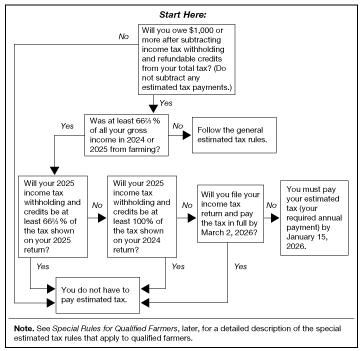
.If you receive a penalty notice, do not ignore it, even if you think it is wrong. You may get a penalty notice even if you filed your return on time, attached Form 2210-F, and met the gross income from farming requirement. If you receive a penalty notice for underpaying estimated tax and you think it is wrong, write to the address on the notice. Explain why you think the notice is wrong. Include a computation like the one in Example 1 (earlier), showing that you met the gross income from farming requirement..
How To Get Tax Help
If you have questions about a tax issue; need help preparing your tax return; or want to download free publications, forms, or instructions, go to IRS.gov to find resources that can help you right away.
Tax reform.
Tax reform legislation impacting federal taxes, credits, and deductions was enacted in P.L. 119-21, commonly known as the One Big Beautiful Bill Act, on July 4, 2025. Go to IRS.gov/OBBB for more information and updates on how this legislation affects your taxes.
Preparing and filing your tax return.
After receiving all your wage and earnings statements (Forms W-2, W-2G, 1099-R, 1099-MISC, 1099-NEC, etc.); unemployment compensation statements (by mail or in a digital format) or other government payment statements (Form 1099-G); and interest, dividend, and retirement statements from banks and investment firms (Forms 1099), you have several options to choose from to prepare and file your tax return. You can prepare the tax return yourself, see if you qualify for free tax preparation, or hire a tax professional to prepare your return.
Free options for tax preparation.
Your options for preparing and filing your return online or in your local community, if you qualify, include the following.
-
Free File. This program lets you prepare and file your federal individual income tax return for free using software or Free File Fillable Forms. However, state tax preparation may not be available through Free File. Go to IRS.gov/FreeFile to see if you qualify for free online federal tax preparation, e-filing, and direct deposit or payment options.
-
VITA. The Volunteer Income Tax Assistance (VITA) program offers free tax help to people with low-to-moderate incomes, persons with disabilities, and limited-English-speaking taxpayers who need help preparing their own tax returns. Go to IRS.gov/VITA, download the free IRS2Go app, or call 800-906-9887 for information on free tax return preparation.
-
TCE. The Tax Counseling for the Elderly (TCE) program offers free tax help for all taxpayers, particularly those who are 60 years of age and older. TCE volunteers specialize in answering questions about pensions and retirement-related issues unique to seniors. Go to IRS.gov/TCE or download the free IRS2Go app for information on free tax return preparation.
-
MilTax. Members of the U.S. Armed Forces and qualified veterans may use MilTax, a free tax service offered by the Department of Defense through Military OneSource. For more information, go to MilitaryOneSource (MilitaryOneSource.mil/MilTax).
Also, the IRS offers Free Fillable Forms, which can be completed online and then e-filed regardless of income.
Using online tools to help prepare your return.
Go to IRS.gov/Tools for the following.
-
The Earned Income Tax Credit Assistant (IRS.gov/EITCAssistant) determines if you’re eligible for the earned income credit (EITC).
-
The Online EIN Application (IRS.gov/EIN) helps you get an employer identification number (EIN) at no cost.
-
The Tax Withholding Estimator (IRS.gov/W4App) makes it easier for you to estimate the federal income tax you want your employer to withhold from your paycheck. This is tax withholding. See how your withholding affects your refund, take-home pay, or tax due.
-
The Sales Tax Deduction Calculator (IRS.gov/SalesTax) figures the amount you can claim if you itemize deductions on Schedule A (Form 1040).
. Getting answers to your tax questions. On IRS.gov, you can get up-to-date information on current events and changes in tax law..
-
IRS.gov/Help: A variety of tools to help you get answers to some of the most common tax questions.
-
IRS.gov/ITA: The Interactive Tax Assistant, a tool that will ask you questions and, based on your input, provide answers on a number of tax topics.
-
IRS.gov/Forms: Find forms, instructions, and publications. You will find details on the most recent tax changes and interactive links to help you find answers to your questions.
-
You may also be able to access tax information in your e-filing software.
Need someone to prepare your tax return?
There are various types of tax return preparers, including enrolled agents, certified public accountants (CPAs), accountants, and many others who don’t have professional credentials. If you choose to have someone prepare your tax return, choose that preparer wisely. A paid tax preparer is:
-
Primarily responsible for the overall substantive accuracy of your return,
-
Required to sign the return, and
-
Required to include their preparer tax identification number (PTIN).
.Although the tax preparer always signs the return, you’re ultimately responsible for providing all the information required for the preparer to accurately prepare your return and for the accuracy of every item reported on the return. Anyone paid to prepare tax returns for others should have a thorough understanding of tax matters. For more information on how to choose a tax preparer, go to Tips for Choosing a Tax Preparer on IRS.gov..
Employers can register to use Business Services Online.
The Social Security Administration (SSA) offers online service at SSA.gov/employer for fast, free, and secure W-2 filing options to CPAs, accountants, enrolled agents, and individuals who process Form W-2, Wage and Tax Statement; and Form W-2c, Corrected Wage and Tax Statement.
Business tax account.
If you are a sole proprietor, a partnership, an S corporation, a C corporation, or a single-member limited liability company (LLC), you can view your tax information on record with the IRS and do more with a business tax account. Go to IRS.gov/BusinessAccount for more information.
IRS social media.
Go to IRS.gov/SocialMedia to see the various social media tools the IRS uses to share the latest information on tax changes, scam alerts, initiatives, products, and services. At the IRS, privacy and security are our highest priority. We use these tools to share public information with you. Don’t post your social security number (SSN) or other confidential information on social media sites. Always protect your identity when using any social networking site.
The following IRS YouTube channels provide short, informative videos on various tax-related topics in English, Spanish, and ASL.
Online tax information in other languages.
You can find information on IRS.gov/MyLanguage if English isn’t your native language.
Over-the-Phone Interpreter (OPI) Service.
The IRS offers the OPI Service to taxpayers needing language interpretation. The OPI Service is available at Taxpayer Assistance Centers (TACs), most IRS offices, and every VITA/TCE tax return site. This service is available in Spanish, Mandarin, Cantonese, Korean, Vietnamese, Russian, and Haitian Creole.
Accessibility Helpline available for taxpayers with disabilities.
Taxpayers who need information about accessibility services can call 833-690-0598. The Accessibility Helpline can answer questions related to current and future accessibility products and services available in alternative media formats (for example, braille-ready, large print, audio, etc.). The Accessibility Helpline does not have access to your IRS account. For help with tax law, refunds, or account-related issues, go to IRS.gov/LetUsHelp.
Alternative media preference.
Form 9000, Alternative Media Preference, or Form 9000(SP) allows you to elect to receive certain types of written correspondence in the following formats.
-
Standard Print.
-
Large Print.
-
Braille.
-
Audio (MP3).
-
Plain Text File (TXT).
-
Braille-Ready File (BRF).
Disasters.
Go to IRS.gov/DisasterRelief to review the available disaster tax relief.
Getting tax forms and publications.
Go to IRS.gov/Forms to view, download, or print all the forms, instructions, and publications you may need. Or you can go to IRS.gov/OrderForms to place an order.
Mobile-friendly forms.
You’ll need an IRS Online Account (OLA) to complete mobile-friendly forms that require signatures. You’ll have the option to submit your form(s) online or download a copy for mailing. You’ll need scans of your documents to support your submission. Go to IRS.gov/MobileFriendlyForms for more information.
Getting tax publications and instructions in eBook format.
Download and view most tax publications and instructions (including the Instructions for Form 1040) on mobile devices as eBooks at IRS.gov/eBooks.
IRS eBooks have been tested using Apple’s iBooks for iPad. Our eBooks haven’t been tested on other dedicated eBook readers, and eBook functionality may not operate as intended.
Access your online account (individual taxpayers only).
Go to IRS.gov/Account to securely access information about your federal tax account.
-
View the amount you owe and a breakdown by tax year.
-
See payment plan details or apply for a new payment plan.
-
Make a payment or view 5 years of payment history and any pending or scheduled payments.
-
Access your tax records, including key data from your most recent tax return, and transcripts.
-
View digital copies of select notices from the IRS.
-
Approve or reject authorization requests from tax professionals.
Get a transcript of your return.
With an online account, you can access a variety of information to help you during the filing season. You can get a transcript, review your most recently filed tax return, and get your adjusted gross income. Create or access your online account at IRS.gov/Account.
Tax Pro Account.
This tool lets your tax professional submit an authorization request to access your individual taxpayer IRS OLA. For more information, go to IRS.gov/TaxProAccount.
Using direct deposit.
The safest and easiest way to receive a tax refund is to e-file and choose direct deposit, which securely and electronically transfers your refund directly into your financial account. Direct deposit also avoids the possibility that your check could be lost, stolen, destroyed, or returned undeliverable to the IRS. Eight in 10 taxpayers use direct deposit to receive their refunds. If you don’t have a bank account, go to IRS.gov/DirectDeposit for more information on where to find a bank or credit union that can open an account online.
Reporting and resolving your tax-related identity theft issues.
-
Tax-related identity theft happens when someone steals your personal information to commit tax fraud. Your taxes can be affected if your SSN is used to file a fraudulent return or to claim a refund or credit.
-
The IRS doesn’t initiate contact with taxpayers by email, text messages (including shortened links), telephone calls, or social media channels to request or verify personal or financial information. This includes requests for personal identification numbers (PINs), passwords, or similar information for credit cards, banks, or other financial accounts.
-
Go to IRS.gov/IdentityTheft, the IRS Identity Theft Central webpage, for information on identity theft and data security protection for taxpayers, tax professionals, and businesses. If your SSN has been lost or stolen or you suspect you’re a victim of tax-related identity theft, you can learn what steps you should take.
-
Get an Identity Protection PIN (IP PIN). IP PINs are six-digit numbers assigned to taxpayers to help prevent the misuse of their SSNs on fraudulent federal income tax returns. When you have an IP PIN, it prevents someone else from filing a tax return with your SSN. To learn more, go to IRS.gov/IPPIN.
Ways to check on the status of your refund.
-
Go to IRS.gov/Refunds.
-
Download the official IRS2Go app to your mobile device to check your refund status.
-
Call the automated refund hotline at 800-829-1954.
.The IRS can’t issue refunds before mid-February for returns that claimed the EITC or the additional child tax credit (ACTC). This applies to the entire refund, not just the portion associated with these credits..
Making a tax payment.
The IRS recommends paying electronically whenever possible. Options to pay electronically are included in the list below. Payments of U.S. tax must be remitted to the IRS in U.S. dollars. Digital assets are not accepted. Go to IRS.gov/Payments for information on how to make a payment using any of the following options.
-
IRS Direct Pay: Pay taxes from your bank account. It’s free and secure, and no sign-in is required. You can change or cancel within 2 days of scheduled payment.
-
Debit Card, Credit Card, or Digital Wallet: Choose an approved payment processor to pay online or by phone.
-
Electronic Funds Withdrawal: Schedule a payment when filing your federal taxes using tax return preparation software or through a tax professional.
-
Electronic Federal Tax Payment System: This is the best option for businesses. Enrollment is required.
-
Check or Money Order: Mail your payment to the address listed on the notice or instructions.
-
Cash: You may be able to pay your taxes with cash at a participating retail store.
-
Same-Day Wire: You may be able to do same-day wire from your financial institution. Contact your financial institution for availability, cost, and time frames.
What if I can’t pay now?
Go to IRS.gov/Payments for more information about your options.
-
Apply for an online payment agreement (IRS.gov/OPA) to meet your tax obligation in monthly installments if you can’t pay your taxes in full today. Once you complete the online process, you will receive immediate notification of whether your agreement has been approved.
-
Use the Offer in Compromise Pre-Qualifier to see if you can settle your tax debt for less than the full amount you owe. For more information on the Offer in Compromise program, go to IRS.gov/OIC.
Filing an amended return.
Go to IRS.gov/1040X for information and updates.
Checking the status of your amended return.
Go to IRS.gov/WMAR to track the status of Form 1040-X amended returns.
.It can take up to 3 weeks from the date you filed your amended return for it to show up in our system, and processing it can take up to 16 weeks..
Understanding an IRS notice or letter you’ve received.
Go to IRS.gov/Notices to find additional information about responding to an IRS notice or letter.
IRS Document Upload Tool.
You may be able to use the Document Upload Tool to respond digitally to eligible IRS notices and letters by securely uploading required documents online through IRS.gov. For more information, go to IRS.gov/DUT.
Schedule LEP.
You can use Schedule LEP (Form 1040), Request for Change in Language Preference, to state a preference to receive notices, letters, or other written communications from the IRS in an alternative language. You may not immediately receive written communications in the requested language. The IRS’s commitment to LEP taxpayers is part of a multi-year timeline that began providing translations in 2023. You will continue to receive communications, including notices and letters, in English until they are translated to your preferred language.
Contacting your local TAC.
Keep in mind, many questions can be answered on IRS.gov without visiting a TAC. Go to IRS.gov/LetUsHelp for the topics people ask about most. If you still need help, TACs provide tax help when a tax issue can’t be handled online or by phone. All TACs now provide service by appointment, so you’ll know in advance that you can get the service you need without long wait times. Before you visit, go to IRS.gov/TAC to find the nearest TAC and to check hours, available services, and appointment options. Or, on the IRS2Go app, under the Stay Connected tab, choose the Contact Us option and click on “Local Offices.”
————————————————————————
Below is a message to you from the Taxpayer Advocate Service, an independent organization established by Congress.
The Taxpayer Advocate Service (TAS) Is Here To Help You
The Taxpayer Advocate Service (TAS) is an independent organization within the Internal Revenue Service (IRS). TAS helps taxpayers resolve problems with the IRS, makes administrative and legislative recommendations to prevent or correct the problems, and protects taxpayer rights. We work to ensure that every taxpayer is treated fairly and that you know and understand your rights under the Taxpayer Bill of Rights. We are Your Voice at the IRS.
TAS can help you resolve problems that you haven’t been able to resolve with the IRS on your own. Always try to resolve your problem with the IRS first, but if you can’t, then come to TAS. Our services are free.
-
TAS helps all taxpayers (and their representatives), including individuals, businesses, and exempt organizations. You may be eligible for TAS help if your IRS problem is causing financial difficulty, if you’ve tried and been unable to resolve your issue with the IRS, or if you believe an IRS system, process, or procedure just isn’t working as it should.
-
To get help any time with general tax topics, visit www.TaxpayerAdvocate.IRS.gov. The site can help you with common tax issues and situations, such as what to do if you make a mistake on your return or if you get a notice from the IRS.
-
TAS works to resolve large-scale (systemic) problems that affect many taxpayers. You can report systemic issues at www.IRS.gov/SAMS. (Be sure not to include any personal identifiable information.)
TAS has offices in every state, the District of Columbia, and Puerto Rico. To find your local advocate’s number:
-
Check your local directory, or
-
Call TAS toll free at 877-777-4778.
The Taxpayer Bill of Rights describes ten basic rights that all taxpayers have when dealing with the IRS. Go to www.TaxpayerAdvocate.IRS.gov/Taxpayer-Rights for more information about the rights, what they mean to you, and how they apply to specific situations you may encounter with the IRS. TAS strives to protect taxpayer rights and ensure the IRS is administering the tax law in a fair and equitable way.
A
- Abandonment, Abandonment
- Accounting method
-
- Accrual, Accrual Method
- Cash, Cash Method
- Change in, Changes in Methods of Accounting
- Crop, Crop method.
- Farm inventory, Farm Inventory
- Accounting periods,
- Accrual method of accounting, Accrual Method
- Additional Medicare Tax withholding, Additional Medicare Tax.
- Adjusted basis of assets, Adjusted Basis
- Agricultural activity codes, Schedule F, Reminders
- Agricultural program payments, Agricultural Program Payments
- Agricultural structure, defined, Agricultural structure.
- Alternative Depreciation System (ADS), Required use of ADS., ADS election.
- Amortization
-
- Going into business, Business Startup Costs
- Reforestation expenses, Reforestation Costs
- Section 197 intangibles, Section 197 Intangibles
- Assessments
-
- By conservation district, Assessment by Conservation District
- Depreciable property, Assessment for Depreciable Property
- Assistance (see Tax help)
- Automobiles, depreciation, Limits for passenger automobiles.
B
- Bankruptcy, Bankruptcy.
- Barter income, Barter income.
- Basis
-
- Involuntary conversion, Basis for depreciation.
- Like-kind exchange, Basis for depreciation.
- Partner’s basis, Property Distributed From a Partnership or Corporation
- Replacement property, Basis of replacement property.
- Shareholder’s basis, Property Distributed From a Partnership or Corporation
- Basis of assets
-
- Adjusted basis, Adjusted Basis
- Allocating to several assets, Allocating the Basis
- Changed to business use, Property changed from personal to business or rental use.
- Constructing assets, Constructing assets.
- Cost, Cost Basis
- Decreases, Decreases to Basis
- Depreciation, What Is the Basis for Depreciation?
- Exchanges
-
- Like-kind, Like-Kind Exchanges
- Nontaxable, Nontaxable Exchanges
- Partially nontaxable, Partially Nontaxable Exchanges
- Taxable, Taxable Exchanges
- Gifts, Property Received as a Gift
- Increases, Increases to Basis
- Real property, Real Property
- Received for services, Property received for services.
- Uniform capitalization rules, Uniform Capitalization Rules
- Below-market loans, Below-market loans.
- Books and records, Importance of Records
- Breeding fees, Breeding Fees
- Business income limit, section 179 expense deduction, Business Income Limit
- Business meals, Reminders
- Business use of home, Business Use of Your Home
C
- Canceled debt, Cancellation of Debt
- Capital assets, Capital Assets
- Capital expenses, Capital Expenses
- Car expenses, Truck and Car Expenses
- Cash method of accounting, Cash Method
- Casualties and thefts
-
- Adjustments to basis, Adjustments to basis.
- Casualty, defined, Casualty.
- Disaster area losses, Disaster Area Losses
- Leased property, Leased property.
- Livestock, Livestock or produce bought for resale., Raised draft, breeding, dairy, or sporting animals.
- Reimbursement, Insurance and other reimbursements.
- Reporting gains and losses, Reporting Gains and Losses
- Theft, defined, Theft.
- Certification program for professional employer organizations (PEOs)., Reminders, Reminders
- Change in accounting method, Changes in Methods of Accounting
- Chickens, purchased, Chickens, seeds, and young plants.
- Christmas trees, Christmas tree cultivation., Christmas trees.
- Club dues, Club dues and membership fees.
- Commodity
- Commodity Credit Corporation (CCC)
-
- Loans, Market Assistance Loans (MALs)
- Market gain, Market Gain
- Community property, Community property., Community property.
- Computer, software, Computer software.
- Condemnation, Casualties, Thefts, and Condemnations, Condemnation
- Conservation
-
- Cost-sharing exclusion, Conservation Expenses
- District assessments, Assessment by Conservation District
- Expenses, Conservation Expenses
- Plans, Conservation plan.
- Conservation Reserve Program, Conservation Reserve Program (CRP) payments.
- Conservation Reserve Program (CRP), Conservation Reserve Program (CRP)
- Constructing assets, Constructing assets.
- Constructive receipt of income, Constructive receipt.
- Contamination, Soil or other environmental contamination.
- Converted wetland, Converted wetland.
- Cooperatives, income from, Income From Cooperatives
- Cost-sharing exclusion, Cost-Sharing Exclusion (Improvements)
- Credits
-
- Employment, Employment Credits
- Fuel tax, Fuel tax credit and refund., How To Claim a Credit or Refund, Claiming a Credit
- Social security and Medicare, Earning credits in 2025.
- Social security coverage, How to become insured under social security.
- State unemployment tax, Tax rate and credit.
- Crew leaders, Crew Leaders
- Crop
-
- Destroyed, Standing crop destroyed by casualty.
- Insurance proceeds, Crop Insurance and Crop Disaster Payments
- Method of accounting, Crop method.
- Shares, Rents
- Unharvested, Cost of raising unharvested crops., Section 1231 transactions., Gain or loss.
- Cropland, highly erodible, Highly erodible cropland.
D
- Damage
-
- Casualties and thefts, Casualties and Thefts
- Crop insurance, Crop Insurance and Crop Disaster Payments
- Tree seedlings, Tree Seedlings
- Debt
-
- Canceled, Cancellation of Debt, Canceled debt excluded from income., Cancellation of debt., Canceled debt.
- Nonbusiness bad, Nonbusiness bad debt.
- Nonrecourse, Amount realized on a nonrecourse debt.
- Qualified farm, Qualified Farm Debt
- Recourse, Amount realized on a recourse debt.
- Depletion, Depletion
- Depreciation, Claiming the Special Depreciation Allowance
-
- ADS election, ADS election.
- Conservation assets, Depreciable conservation assets.
- Deduction, Overview of Depreciation
- Incorrect amount deducted, How Do You Correct Depreciation Deductions?
- Limit for automobiles, Limits for passenger automobiles.
- Listed property, Additional Rules for Listed Property
- Raised livestock, Livestock.
- Recapture, When Do You Recapture MACRS Depreciation?, Depreciation Recapture, Section 1250 Property
- When to file, Do You Have To File Form 4562?
- Depreciation allowable, Basis adjustment for depreciation allowed or allowable.
- Depreciation allowed, Basis adjustment for depreciation allowed or allowable.
- Depreciation, Special depreciation allowance, What’s New for 2025
- Direct deposit, What’s New for 2025
- Disaster area losses, Disaster Area Losses
- Disaster payments, Crop Insurance and Crop Disaster Payments
- Disaster relief grants, Federal disaster relief grants.
- Disaster relief payments, Qualified disaster relief payments.
- Disposition of installment obligation, Disposition of Installment Obligation
- Dispositions, Sale or other disposal of land during 9-year period., Gain on sale of farmland.,
- Drainage tile, Depreciable conservation assets.
- Dyed diesel fuel, Dyed diesel fuel and dyed kerosene.
- Dyed kerosene, Dyed diesel fuel and dyed kerosene.
E
- Easement, Easements and rights-of-way., Easements.
- East Palestine disaster relief payments, What’s New for 2025, What’s New, East Palestine disaster relief payments.
- Election
-
- ADS depreciation, Electing ADS., ADS election.
- Amortization
-
- Business start-up costs, Business Startup Costs
- Reforestation costs, Reforestation Costs
- Crop method, Election to use crop method.
- Cutting of timber, Election to treat cutting as a sale or exchange.
- Deducting conservation expenses, When To Deduct or Capitalize
- Not excluding cost-sharing payments, Electing not to exclude payments.
- Out of installment method, Electing out of the installment method.
- Postponing casualty gain, Postponing Gain
- Postponing reporting crop insurance proceeds, Election to postpone reporting until the following year.
- Section 179 expense deduction, How Do You Elect the Deduction?
- Electronic payments, What’s New for 2025
- Embryo transplants, Transplanted embryo.
- Employer identification number, Reminders
- Employer identification number (EIN), Employer identification number (EIN).
- Endangered species recovery expenses, Endangered species recovery expenses.
- Environmental contamination, Soil or other environmental contamination.
- Estimated tax
-
- Gross farm income, Gross Income From Farming
- Gross income, Gross Income
- Penalties, Estimated Tax Penalty for 2025
- Exchanges
-
- Basis
-
- Like-kind, Like-Kind Exchanges
- Nontaxable, Nontaxable Exchanges
- Partially nontaxable, Partially Nontaxable Exchanges
- Taxable, Taxable Exchanges
- Like-kind, Like-Kind Exchanges
- Nontaxable, Like-Kind Exchanges
- Excise taxes
-
- Credit, Claiming a Credit
- Diesel fuel, Dyed diesel fuel and dyed kerosene.
- Farming purposes, Fuels Used in Farming
- Home use of fuels, Fuels Used for Household Purposes or Other Than as a Fuel for Propulsion Engines
- Off-highway uses, Fuels Used in Off-Highway Business Use
- Refund, Claiming a Refund
F
- Fair market value (FMV), Fair market value (FMV).
- Family member
-
- Business expenses, Special rule for related persons.
- Like-kind exchange, Like-kind exchanges between related persons.
- Loss on sale or exchange of property, Losses from sales or exchanges between related persons.
- Personal-use property, Personal-use property.
- Social security coverage, Family Employees
- Farm
-
- Business expenses, Farm Business Expenses
- Business, defined, Business of Farming
- Defined, Farm defined., Farm.
- Income averaging, Income Averaging for Farmers
- Rental, Farm rental.
- Sale of, Sale of a Farm
- Farmer, Farmer.
- Federal unemployment tax (FUTA), Federal Unemployment (FUTA) Tax
- Fertilizer, Fertilizer and Lime, Fertilizer and Lime
- Figuring installment sale income
-
- Adjusted basis, Figuring Installment Sale Income
- Adjusted basis and installment sale income (gain on sale), Figuring Installment Sale Income
- Adjusted basis for installment sale purposes, Figuring Installment Sale Income
- Amount to report as installment sale income, Figuring Installment Sale Income
- Cancellation, Figuring Installment Sale Income
- Contract price, Figuring Installment Sale Income
- Depreciation recapture, Figuring Installment Sale Income
- Disposition of installment obligation, Figuring Installment Sale Income
- Figuring adjusted basis and gross profit percentage for installment sale purposes, Figuring Installment Sale Income
- Form 6252, Figuring Installment Sale Income
- Gross profit, Figuring Installment Sale Income
- Gross profit percentage, Figuring Installment Sale Income
- Interest income, Figuring Installment Sale Income
- Sale of depreciable property, Figuring Installment Sale Income
- Selling expenses, Figuring Installment Sale Income
- Selling price, Figuring Installment Sale Income
- Selling price reduced, Figuring Installment Sale Income
- Transfer due to death, Figuring Installment Sale Income
- Foreclosure, Foreclosure or Repossession
- Forestation costs, Forestation and reforestation costs.
- Form
-
- 1099-A, Form 1099-A., Forms 1099-A and 1099-C.
- 1099-C, Cancellation of Debt, Form 1099-C., Forms 1099-A and 1099-C.
- 1099-G, Market Gain, Payment to More Than One Person
- 1099-NEC, Nonemployee compensation.
- 1099-PATR, Form 1099-PATR.
- 1128,
- 2210-F, Estimated Tax Penalty for 2025
- 3115, Form 3115.
- 4136, Claiming a Credit
- 4562, Do You Have To File Form 4562?
- 4797, Form 4797., Recapture., Reporting the exchange.
- 4835, Rents
- 5213, Using the presumption later.
- 8822, Reminders
- 8824, Reporting the exchange.
- 8849, Claiming a Refund
- 940, Form 940.
- 943, Form 943.
- 982, Form 982
- I-9, Form I-9.
- SS-4, Reminders, Employer identification number (EIN).
- SS-5, Obtaining an SSN.
- T (Timber), Form T (Timber).
- W-4, New hire reporting., Form W-4.
- W-4V, Market Assistance Loans (MALs), Crop Insurance and Crop Disaster Payments
- W-7, Obtaining an ITIN.
- Fuel tax credit or refund, Fuel tax credit and refund., How To Claim a Credit or Refund
G
- Gains
-
- Section 1231 gains, Section 1231 gains.
- Gains and losses
-
- Basis of assets, Cost Basis
- Capital assets, defined, Capital Assets
- Casualty, How To Figure a Loss, Figuring a Gain
- Installment sales, Installment Sales
- Livestock, Livestock
- Long- or short-term, Long and Short Term
- Ordinary or capital, Ordinary or Capital Gain or Loss
- Sale of farm, Sale of a Farm
- Section 1231, Section 1231 Gains and Losses
- Theft, How To Figure a Loss, Figuring a Gain
- Timber, Timber
- General asset accounts, How Do You Use General Asset Accounts?
- Gifts, Crop shares you give to others (gift)., Cost related to gifts., Property Received as a Gift, Gift.
- Going into business, Business Startup Costs
- Grants, disaster relief, Federal disaster relief grants.
H
- Health insurance deduction, Self-employed health insurance deduction.
- Highway use tax, Highway use tax.
- Holding period, Holding period., Holding period.
- Home, Home.
- Horticultural structure, Horticultural structure.
I
- Illegal irrigation subsidy, Illegal federal irrigation subsidy.
- Important dates, Important Dates for 2026
- Improvements, Cost-Sharing Exclusion (Improvements)
- Income
-
- Accounting for, Accounting Methods
- Accrual method of accounting, Income
- Canceled debt excluded, Cancellation of Debt
- From farming, Farm Income, Gross income from farming., Gross Income From Farming
- Gross, Gross Income
- Not-for-profit farming, Not-for-Profit Farming
- Pasture, Pasture income and rental., Machinery or Equipment
- Schedule F, Farm Income
- Withholding of tax, Federal Income Tax Withholding
- Income averaging (see Farm: Income averaging)
- Incorrect amount of depreciation deducted, How Do You Correct Depreciation Deductions?
- Individual taxpayer identification number (ITIN), Obtaining an ITIN.
- Inherited property, Inherited Property
- Insolvency, Insolvency.
- Installment method
-
- Electing out of the installment method, Installment Method
- Inventory (see More information)
- Revoking the election (see More information)
- Sale at a loss, Installment Method
- When to elect out, Installment Method
- Installment payment of tax on sale of qualified farmland, What’s New for 2025
- Installment sales
-
- Electing out, Electing out of the installment method.
- Example, Unstated interest.
- Farm, sale of, Installment Sale of a Farm
- Installment obligation, Installment obligation.
- Related parties, Installment Sale of a Farm
- Unstated interest, Unstated interest.
- Insurance, Insurance, Self-employed health insurance deduction.
- Intangible property, Section 197 Intangibles
- Interest
-
- Expense, Interest
- Inventory
-
- Items included, Farm Inventory
- Methods of valuation, Inventory valuation methods.
- Involuntary conversions, Property acquired in a like-kind exchange or involuntary conversion.,
- Irrigation
-
- Illegal subsidy, Illegal federal irrigation subsidy.
- Project, Irrigation Project
L
- Labor hired, Labor Hired
- Landlord participation, Landlord Participation in Farming
- Lease or purchase, Lease or Purchase
- Life tenant (see Term interests)
- Like-kind exchanges, Like-Kind Exchanges, Like-Kind Exchanges
- Lime, Fertilizer and Lime
- Limitation on personal casualty and theft losses, What’s New for 2025, What’s New
- Limits
-
- At-risk, At-Risk Limits
- Business use of home, Deduction limit.
- Capital losses, Treatment of Capital Losses
- Conservation expenses, Assessment for Depreciable Property, 25% Limit on Deduction
- Depreciation
-
- Business-use, What Is the Business-Use Requirement?
- Excluded farm debt, Exclusion limit.
- Farm losses, Losses From Operating a Farm
- Loss of personal-use property, Deduction Limits on Losses of Personal-Use Property
- Not-for-profit farming, Not-for-Profit Farming
- Passive activity, Passive Activity Limits
- Percentage depletion, Taxable income limit.
- Prepaid farm supplies, Deduction limit.
- Reforestation costs, Reforestation Costs
- Section 179 expense deduction
-
- Automobile, Limits for passenger automobiles.
- Business income, Business Income Limit
- Dollar, Dollar Limits
- Time to keep records, How Long To Keep Records
- Listed property
-
- Defined, What Is Listed Property?
- Passenger automobile, Passenger automobiles.
- Rules, Additional Rules for Listed Property
- Livestock, Section 1231 transactions.
-
- Casualty and theft losses, Livestock or produce bought for resale.
- Crop shares, Crop shares you use to feed livestock.
- Depreciation, Livestock.
- Diseased, Diseased livestock.
- Feed assistance, Feed Assistance and Payments
- Immature, Immature livestock.
- Losses, Loss of livestock., Livestock
- Purchased, Purchased livestock.
- Raised, Raised livestock.
- Sale of, Sales of Farm Products, Livestock
- Unit-livestock-price, inventory valuation, Unit-livestock-price method.
- Used in a farm business, Livestock used in farm business.
- Weather-related sales, Sales Caused by Weather-Related Conditions, Weather-related sales of livestock.
- Loans, Market Assistance Loans (MALs), Loan expenses.
- Losses
-
- At-risk limits, At-Risk Limits
- Casualty, Casualties, Thefts, and Condemnations
- Disaster areas, Disaster Area Losses
- Farming, Farm Property Losses
- Growing crops, Loss of growing plants, produce, and crops.
- Hobby farming, Not-for-Profit Farming
- Livestock, Livestock, Diseased livestock.
- Nondeductible, Other Nondeductible Items
- Theft, Casualties, Thefts, and Condemnations
- Lost income payments, Payments for lost income.
- Lost property, Mislaid or lost property.
M
- MACRS property
-
- Involuntary conversion, Property acquired in a like-kind exchange or involuntary conversion.
- Like-kind exchange, Property acquired in a like-kind exchange or involuntary conversion.
- Nontaxable transfer, Property acquired in a nontaxable transfer.
- Market gain, reporting, Market Gain
- Marketing quota penalties, Marketing Quota Penalties
- Material participation, Landlord Participation in Farming
- Meals, Meals.
- Membership fees, Club dues and membership fees.
- Methods of accounting, Accounting Methods
- Modified ACRS (MACRS)
-
- ADS election, ADS election.
- Conventions, Which Convention Applies?
- Depreciation methods, Which Depreciation Method Applies?
- Exchange, Property acquired in a like-kind exchange or involuntary conversion.
- Figuring the deduction, How Is the Depreciation Deduction Figured?
- Involuntary conversion, Property acquired in a like-kind exchange or involuntary conversion.
- Nontaxable transfer, Property acquired in a nontaxable transfer.
- Property classes, Which Property Class Applies Under GDS?
- Recovery periods, Which Recovery Period Applies?
N
- National Center for Missing & Exploited Children, Reminders
- Net operating losses
-
- Net operating loss (NOL), Net operating loss (NOL).
- New hire reporting, New hire reporting.
- Noncapital asset, Noncapital Assets
- Nontaxable exchanges, Like-Kind Exchanges
- Nontaxable transfer of MACRS property, Property acquired in a nontaxable transfer.
- Not-for-profit farming, Not-for-Profit Farming
O
- Organizational costs, Business start-up and organizational costs.
- Overtime Compensation, What’s New for 2025
P
- Partners, limited, Limited partner.
- Partners, retired, Retired partner.
- Partners, spouses, Business owned and operated by spouses.
- Partnership, Partnership income or loss.
- Passenger automobile, Passenger automobiles.
- Pasture income, Pasture income and rental., Machinery or Equipment
- Patronage dividends, Patronage Dividends
- Payments considered received
-
- Bond, Payments Received or Considered Received
- Buyer assumes mortgage, Payments Received or Considered Received
- Buyer assumes other debts, Payments Received or Considered Received
- Buyer pays seller’s expenses, Payments Received or Considered Received
- Buyer’s note, Payments Received or Considered Received
- Debt not payable on demand, Payments Received or Considered Received
- Mortgage less than basis, Payments Received or Considered Received
- Mortgage more than basis, Payments Received or Considered Received
- Property used as a payment, Payments Received or Considered Received
- Sale to a related person, Payments Received or Considered Received
- Third-party note, Payments Received or Considered Received
- Trading property for like-kind property, Payments Received or Considered Received
- Payments received, Payments Received or Considered Received
- Penalties
-
- Estimated tax, Estimated Tax Penalty for 2025
- Returns, Estimated Tax Penalty for 2025
- Trust fund recovery, Trust fund recovery penalty.
- Per-unit retain certificates, Per-Unit Retain Certificates
- Personal expenses, Personal, Living, and Family Expenses
- Placed in service, Placed in Service, What Is the Placed-in-Service Date?
- Postponed tax deadlines, What’s New for 2025, What’s New, Postponed tax deadlines.
- Postponing casualty gain, Postponing Gain
- Prepaid expense
-
- Advance premiums, Advance premiums.
- Extends useful life, Prepayment.
- Farm supplies, Prepaid Farm Supplies
- Livestock feed, Prepaid Livestock Feed
- Prizes, Prizes.
- Produce, Sales of Farm Products
- Property
-
- Changed to business use, Property changed from personal to business or rental use.
- Received for services, Property received for services.
- Repairs and improvements, How Do You Treat Repairs and Improvements?
- Section 1231, Section 1231 transactions.
- Section 1245, Section 1245 Property
- Section 1250, Section 1250 Property
- Section 1252, Section 1252 property.
- Section 1255, Section 1255 property.
- Tangible personal, Tangible personal property.
- Property used as a payment
-
- Examples, Property used as a payment.
- Exception, Property used as a payment.
- Publications (see Tax help)
Q
- Qualified disaster losses, What’s New for 2025, What’s New, Qualified disaster losses.
- Qualified disaster relief payments, Qualified disaster relief payments.
- Qualified farm debt, Qualified Farm Debt
- Qualified joint venture, Qualified joint venture (QJV).
- Qualified small business payroll tax credit for increasing research activities, Reminders, Reminders
- Qualified wildfire relief payments, What’s New for 2025, What’s New, Qualified wildfire relief payments.
R
- Recapture
-
- Amortization, Depreciation and amortization.
- Basis reductions, Recapture of basis reductions.
- Certain depreciation, Recapture of section 179 expense deduction.
- Cost-sharing payments, Recapture.
- Depreciation, When Do You Recapture MACRS Depreciation?, Depreciation Recapture
- Section 1245 property, Section 1245 Property
- Section 1250 property, Section 1250 Property
- Section 179 expense deduction, When Must You Recapture the Deduction?
- Section 179 GO Zone property, Recapture for qualified section 179 GO Zone property.
- Special depreciation allowance, When Must You Recapture an Allowance?
- Recordkeeping, Importance of Records, Travel Expenses
- Records on depreciable property, Depreciation Recapture
- Reforestation costs, Forestation and reforestation costs., Reforestation Costs
- Refund
-
- Deduction taken, Refund or reimbursement.
- Fuel tax, Fuel tax credit and refund., Including the Credit or Refund in Income
- Reimbursements
-
- Casualties and thefts, Casualty and theft losses., Casualties and Thefts, Insurance and other reimbursements.
- Deduction taken, Refund or reimbursement.
- Expenses, Reimbursed expenses.
- Feed assistance, Feed Assistance and Payments
- Real estate taxes, Real estate taxes.
- Reforestation expenses, Qualifying costs.
- To employees, Reimbursements to employees.
- Related parties, Related parties.
- Related persons, Special rule for related persons., Losses from sales or exchanges between related persons., Special rules for related persons., Like-kind exchanges between related persons., Buying replacement property from a related person., Related persons.
- Rental income, Rents
- Rented property, improvements, Improvements to rented property.
- Repairs, Repairs and Maintenance
- Repairs and improvements, How Do You Treat Repairs and Improvements?
- Repayment of income, Repayment of income.
- Replacement
-
- Period, Replacement Period
- Property, Replacement Property
- Repossessions, Foreclosure or Repossession
- Research and experimental expenses, What’s New for 2025
- Right-of-way income, Easements and rights-of-way.
S
- Sale of home, Sale of your home.
- Section 179 expense, What’s New for 2025
- Section 179 expense deduction, Section 179 Expense Deduction
-
- How to elect, How Do You Elect the Deduction?
- Listed property, Additional Rules for Listed Property
- Qualifying property, What Property Qualifies?
- Recapture, When Must You Recapture the Deduction?
- Self-employed health insurance, Self-employed health insurance deduction.
- Self-employed health insurance deduction, Self-employed health insurance deduction.
- Self-employment (SE) tax
-
- Community property, Community property.
- Deduction, SE tax deduction.
- How to pay, How To Pay SE Tax
- Landlord participation, Landlord Participation in Farming
- Material participation, Material participation for landlords.
- Maximum net earnings, What’s New for 2025, What’s New for 2025
- Methods for figuring net earnings, Methods for Figuring Net Earnings
- Optional method, Farm Optional Method
- Regular method, Regular Method
- Rental income, Landlord Participation in Farming
- Reporting, Reporting SE Tax
- Self-employment tax rate, SE tax rate.
- Share farming, Share farmer.
- Who must pay, Who Must Pay SE Tax?
- Selling price reduced, Selling price reduced.
- Settlement costs (fees), Settlement costs.
- Social security and Medicare
-
- Credits of coverage, Earning credits in 2025.
- Withholding of tax, Social Security and Medicare Taxes
- Social security number (SSN), Obtaining an SSN.
- Software, computer, Computer software.
- Soil
-
- Conservation, Conservation Expenses
- Contamination, Soil or other environmental contamination.
- Special depreciation allowance, What’s New for 2025
-
- How to elect not to claim, How Can You Elect Not To Claim the Allowance?
- Recapture, When Must You Recapture an Allowance?
- Standard mileage rate, Standard mileage rate.
- Start-up costs for businesses, Business start-up and organizational costs.
T
- Tangible personal property, Tangible personal property.
- Tax help, How To Get Tax Help
- Tax preparation fees, Tax preparation fees.
- Tax shelter
-
- At-risk limits, At-Risk Limits
- Defined, Tax shelter.
- Tax-free exchanges, Like-Kind Exchanges
- Taxes
-
- Credits and Refunds, Fuel Excise Tax Credits and Refunds
- Federal use, Highway use tax.
- General, Taxes
- Self-employment, Self-Employment Tax
- State and federal, State and federal income taxes.
- State and local general sales, State and local general sales taxes.
- Withholding, Federal income tax withholding., Social Security and Medicare Taxes, Federal Income Tax Withholding
- Telephone expense, Telephone expense.
- Tenant house expenses, Employee Meal and Housing Expenses
- Term interests, Certain term interests in property.
- Theft losses, Casualties, Thefts, and Condemnations
- Third-party note, Third-party note.
- Timber, Timber., Timber Depletion, Timber
- Trade-in, Sale and Purchase
- Travel expenses, Travel Expenses
- Truck expenses, Truck and Car Expenses
- Trust fund recovery penalty, Trust fund recovery penalty.
U
- Uniform capitalization rules
-
- Basis of assets, Uniform Capitalization Rules
W
- Wages and salaries, Wages and salaries.
- Water conservation, Conservation Expenses
- Water well, Water well., Water wells.
- Weather-related sales, livestock, Sales Caused by Weather-Related Conditions, Weather-related sales of livestock.
- Withholding
-
- Income tax, Federal Income Tax Withholding
- Social security and Medicare tax, Social Security and Medicare Taxes