


 )
or https:// means you've safely connected to the .gov website. Share sensitive information only on official, secure websites.
)
or https:// means you've safely connected to the .gov website. Share sensitive information only on official, secure websites.


- Publication 526 - Introductory Material
- Publication 526 - Main Contents
- Organizations That Qualify To Receive Deductible Contributions
- Contributions You Can Deduct
- Contributions You Can’t Deduct
- Contributions of Property
- Contributions Subject to Special Rules
- Clothing and Household Items
- Cars, Boats, and Airplanes
- Taxidermy Property
- Property Subject to a Debt
- Partial Interest in Property
- Fractional Interest in Tangible Personal Property
- Qualified Conservation Contribution
- Qualified organization.
- Qualified real property interest.
- Conservation purposes.
- Certified historic structure.
- Rehabilitation credit.
- Disallowance of deductions for certain conservation contributions by partnerships and S corporations.
- Exceptions.
- Recordkeeping for the disallowance rule.
- More information.
- Future Interest in Tangible Personal Property
- Inventory
- Patents and Other Intellectual Property
- Determining FMV
- Giving Property That Has Decreased in Value
- Giving Property That Has Increased in Value
- Ordinary Income Property
- Capital Gain Property
- Capital assets.
- Real property.
- Depreciable property.
- Amount of deduction—general rule.
- Exceptions.
- Contributions to private nonoperating foundations.
- Tangible personal property put to unrelated use.
- Unrelated use.
- Deduction limited.
- Recapture if no exempt use.
- Ordinary or capital gain income included in gross income.
- Food Inventory
- Bargain Sales
- Penalty
- Contributions Subject to Special Rules
- When To Deduct
- Limits on Deductions
- Substantiation Requirements
- How To Report
- Cash contributions and out-of-pocket expenses.
- Reporting expenses for student living with you.
- Noncash contributions.
- Total deduction over $500.
- Deduction over $5,000.
- Vehicle donations.
- Clothing and household items not in good used condition.
- Qualified appraisal.
- Qualified appraiser.
- Deduction over $500,000.
- Form 8282.
- How To Get Tax Help
- Tax reform.
- Preparing and filing your tax return.
- Free options for tax preparation.
- Using online tools to help prepare your return.
- Need someone to prepare your tax return?
- Employers can register to use Business Services Online.
- Business tax account.
- IRS social media.
- Over-the-Phone Interpreter (OPI) Service.
- Accessibility Helpline available for taxpayers with disabilities.
- Disasters.
- Getting tax forms and publications.
- Mobile-friendly forms.
- Getting tax publications and instructions in eBook format.
- Access your online account (individual taxpayers only).
- Get a transcript of your return.
- Tax Pro Account.
- Using direct deposit.
- Reporting and resolving your tax-related identity theft issues.
- Ways to check on the status of your refund.
- Making a tax payment.
- What if I can’t pay now?
- Filing an amended return.
- Checking the status of your amended return.
- Understanding an IRS notice or letter you’ve received.
- IRS Document Upload Tool.
- Schedule LEP.
- Contacting your local TAC.
- The Taxpayer Advocate Service (TAS) Is Here To Help You
- Publication 526 - Additional Material
For the latest information about developments related to Pub. 526 (such as legislation enacted after we release it), go to IRS.gov/Pub526.
Deductibility of contributions to certain organizations serving members of the Armed Forces. Beginning in 2025, a charitable contribution made to any federally chartered veteran service organization that is exempt from taxation under section 501(c)(19) of the Internal Revenue Code is deductible for federal income tax purposes. You can now deduct charitable contributions to these organizations even if their membership is not limited primarily to wartime veterans.
Qualified charitable distribution one-time election. You can elect to make a one-time distribution up to $54,000 from an individual retirement arrangement to charities through a charitable remainder annuity trust, a charitable remainder unitrust, or a charitable gift annuity if it is funded only by qualified charitable distributions. See Pub. 590-B, Distributions from Individual Retirement Arrangements (IRAs), for more information.
Disallowance of deduction for certain conservation contributions by partnerships and S corporations. If you are an ultimate member of a partnership or an S corporation, and the amount of the partnership or S corporation’s qualified conservation contribution exceeds 2.5 times the sum of each ultimate member’s relevant basis, then the contribution is not treated as a qualified conservation contribution. Unless the conservation contribution meets an exception, it will be disallowed. See Disallowance of deductions for certain conservation contributions by partnerships or S corporations, later.
Deduction over $5,000. You must complete Section B of Form 8283 for each item—or group of similar non-cash items—for which you claim a deduction of over $5,000 except as provided in Deductions Over $5,000, later. The organization that received the property must complete and sign Part V of Section B, Form 8283.
Photographs of missing children. The IRS is a proud partner with the National Center for Missing & Exploited Children® (NCMEC). Photographs of missing children selected by the Center may appear in this publication on pages that would otherwise be blank. You can help bring these children home by looking at the photographs and calling 800-THE-LOST (800-843-5678) or visiting www.missingkids.org if you recognize a child.
Introduction
This publication explains how individuals claim a deduction for charitable contributions. It discusses the types of organizations to which you can make deductible charitable contributions and the types of contributions you can deduct. It also discusses how much you can deduct, what records you must keep, and how to report charitable contributions.
A charitable contribution is a donation or gift to, or for the use of, a qualified organization. It is voluntary and is made without getting, or expecting to get, anything of equal value.
Qualified organizations.
Qualified organizations include nonprofit groups that are religious, charitable, educational, scientific, or literary in purpose, or that work to prevent cruelty to children or animals. You will find descriptions of these organizations under Organizations That Qualify To Receive Deductible Contributions.
Schedule A (Form 1040) required.
Generally, to deduct a charitable contribution, you must itemize deductions on Schedule A (Form 1040). The amount of your deduction may be limited if certain rules and limits explained in this publication apply to you.
Comments and suggestions.
We welcome your comments about this publication and suggestions for future editions.
You can send us comments through IRS.gov/FormComments. Or, you can write to the Internal Revenue Service, Tax Forms and Publications, 1111 Constitution Ave. NW, IR-6526, Washington, DC 20224.
Although we can’t respond individually to each comment received, we do appreciate your feedback and will consider your comments and suggestions as we revise our tax forms, instructions, and publications. Don’t send tax questions, tax returns, or payments to the above address.
Getting answers to your tax questions.
If you have a tax question not answered by this publication or the How To Get Tax Help section at the end of this publication, go to the IRS Interactive Tax Assistant page at IRS.gov/Help/ITA where you can find topics by using the search feature or viewing the categories listed.
Getting tax forms, instructions, and publications.
Go to IRS.gov/Forms to download current and prior-year forms, instructions, and publications.
Ordering tax forms, instructions, and publications.
Go to IRS.gov/Forms to order current forms, instructions, and publications; call 800-829-3676 to order prior-year forms and instructions. The IRS will process your order for forms and publications as soon as possible. Don’t resubmit requests you’ve already sent us. You can get forms and publications faster online.
Useful Items
You may want to see:Publication
-
561 Determining the Value of Donated Property
Forms (and Instructions)
-
Schedule A (Form 1040) Itemized Deductions
-
8283 Noncash Charitable Contributions
See How To Get Tax Help near the end of this publication for information about getting these publications and forms.
Organizations That Qualify To Receive Deductible Contributions
You can deduct your contributions only if you make them to a qualified organization.
How to check whether an organization can receive deductible charitable contributions.
You can ask any organization whether it is a qualified organization, and most will be able to tell you. You can also check by going to IRS.gov/TEOS. This online tool will enable you to search for qualified organizations.
Types of Qualified Organizations
Generally, only the following types of organizations can be qualified organizations.
-
A community chest, corporation, trust, fund, or foundation organized or created in or under the laws of the United States, any state, the District of Columbia, or any possession of the United States (including Puerto Rico). It must, however, be organized and operated only for charitable, religious, scientific, literary, or educational purposes, or for the prevention of cruelty to children or animals. Certain organizations that foster national or international amateur sports competition also qualify.
-
War veterans’ organizations, including posts, auxiliaries, trusts, or foundations organized in the United States or any of its possessions (including Puerto Rico). Also, federally chartered veteran service organizations that are exempt from taxation under section 501(c)(19) even if their membership is not limited primarily to wartime veterans.
-
Domestic fraternal societies, orders, and associations operating under the lodge system. (Your contribution to this type of organization is deductible only if it is to be used solely for charitable, religious, scientific, literary, or educational purposes, or for the prevention of cruelty to children or animals.)
-
Certain nonprofit cemetery companies or corporations. (Your contribution to this type of organization isn’t deductible if it can be used for the care of a specific lot or mausoleum crypt.)
-
The United States or any state, the District of Columbia, a U.S. territory (including Puerto Rico), a political subdivision of a state or U.S. territory, or an Indian tribal government or any of its subdivisions that perform substantial government functions. (Your contribution to this type of organization is deductible only if it is to be used solely for public purposes.)
Example 1. You contribute cash to your city’s police department to be used as a reward for information about a crime. The city police department is a qualified organization, and your contribution is for a public purpose. You can deduct your contribution.
Example 2. You make a voluntary contribution to the social security trust fund, not earmarked for a specific account. Because the trust fund is part of the U.S. Government, you contributed to a qualified organization. You can deduct your contribution.
Examples.
The following list gives some examples of qualified organizations.
-
Churches, a convention or association of churches, temples, synagogues, mosques, and other religious organizations.
-
Most nonprofit charitable organizations such as the American Red Cross and the United Way.
-
Most nonprofit educational organizations, including Scouting America, Girl Scouts of the USA, colleges, and museums. This also includes nonprofit daycare centers that provide childcare to the general public if substantially all the childcare is provided to enable parents and guardians to be gainfully employed. However, if your contribution is a substitute for tuition or other enrollment fee, it isn’t deductible as a charitable contribution, as explained later under Contributions You Can’t Deduct.
-
Nonprofit hospitals and medical research organizations.
-
Utility company emergency energy programs, if the utility company is an agent for a charitable organization that assists individuals with emergency energy needs.
-
Nonprofit volunteer fire companies.
-
Nonprofit organizations that develop and maintain public parks and recreation facilities.
-
Civil defense organizations.
-
Federally chartered tax-exempt veteran service organizations as described in section 501(c)(19).
Canadian charities.
You may be able to deduct contributions to certain Canadian charitable organizations covered under an income tax treaty with Canada. To deduct your contribution to a Canadian charity, you must generally have income from sources in Canada. See Pub. 597, Information on the United States-Canada Income Tax Treaty, for information on how to figure your deduction.
Mexican charities.
Under the United States-Mexico income tax treaty, a contribution to a Mexican charitable organization may be deductible, but only if and to the extent the contribution would have been treated as a charitable contribution to a public charity created or organized under U.S. law. To deduct your contribution to a Mexican charity, you must have income from sources in Mexico. The limits described in Limits on Deductions, later, apply and are figured using your income from Mexican sources.
Israeli charities.
Under the United States-Israel income tax treaty, a contribution to an Israeli charitable organization is deductible if and to the extent the contribution would have been treated as a charitable contribution if the organization had been created or organized under U.S. law. To deduct your contribution to an Israeli charity, you must have income from sources in Israel. The limits described in Limits on Deductions, later, apply. The deduction is also limited to 25% of your AGI from Israeli sources.
Contributions You Can Deduct
Generally, you can deduct contributions of money or property you make to, or for the use of, a qualified organization. A contribution is “for the use of” a qualified organization when it is held in a legally enforceable trust for the qualified organization or in a similar legal arrangement.
The contributions must be made to a qualified organization and not set aside for use by a specific person.
If you give property to a qualified organization, you can generally deduct the fair market value (FMV) of the property at the time of the contribution. See Contributions of Property, later.
Your deduction for charitable contributions generally can’t be more than 60% of your AGI, but in some cases 20%, 30%, or 50% limits may apply.
Table 1 gives examples of contributions you can and can’t deduct.
Use the following lists for a quick check of whether you can deduct a contribution. See the rest of this publication for more information and additional rules and limits that may apply. |
| Deductible As Charitable Contributions |
Not Deductible As Charitable Contributions |
| Money or property you give to: | Money or property you give to: |
Expenses paid for a student living with you, sponsored by a qualified organization Out-of-pocket expenses when you serve a qualified organization as a volunteer |
Cost of raffle, bingo, or lottery tickets Dues, fees, or bills paid to country clubs, lodges, fraternal orders, or similar groups Tuition Value of your time or services Value of blood given to a blood bank |
Contributions From Which You Benefit
If you receive a benefit as a result of making a contribution to a qualified organization, you can deduct only the amount of your contribution that is more than the value of the benefit you receive. Also, see Contributions From Which You Benefit under Contributions You Can’t Deduct, later.
If you pay more than FMV to a qualified organization for goods or services, the excess may be a charitable contribution. For the excess amount to qualify, you must pay it with the intent to make a charitable contribution.
Example 1.
You pay $65 for a ticket to a dinner dance at a church. Your entire $65 payment goes to the church. The ticket to the dinner dance has an FMV of $25. When you buy your ticket, you know its value is less than your payment. To figure the amount of your charitable contribution, subtract the value of the benefit you receive ($25) from your total payment ($65). You can deduct $40 as a charitable contribution to the church.
Example 2.
At a fundraising auction conducted by a charity, you pay $600 for a week’s stay at a beach house. The amount you pay is no more than the fair rental value. You haven’t made a deductible charitable contribution.
Charity benefit events.
If you pay a qualified organization more than FMV for the right to attend a charity ball, banquet, show, sporting event, or other benefit event, you can deduct only the amount that is more than the value of the privileges or other benefits you receive.
If there is an established charge for the event, that charge is the value of your benefit. If there is no established charge, the reasonable value of the right to attend the event is the value of your benefit. Whether you use the tickets or other privileges has no effect on the amount you can deduct. However, if you return the ticket to the qualified organization for resale, you can deduct the entire amount you paid for the ticket.
Caution: Even if the ticket or other evidence of payment indicates that the entire price of admission for the special event is a “contribution,” this doesn’t mean you can deduct the entire amount. If the ticket shows both the price of admission and the established charge, and the cost of admission exceeds the established charge, you can deduct the difference between the two amounts.
Example.
You pay $40 to see a special showing of a movie for the benefit of a qualified organization. Printed on the ticket is “Contribution—$40.” If the regular price for the movie is $8, your contribution is $32 ($40 payment − $8 regular price).
State or local tax credit.
If you make a payment or transfer property to or for the use of a qualified organization and receive or expect to receive a state or local tax credit in return, then the amount treated as a charitable contribution deduction is reduced by the amount of the state or local tax credit you receive or expect to receive in consideration for your payment or transfer, but an exception may apply. If an exception doesn’t apply, you must reduce your charitable contribution deduction even if you can’t claim the state tax credit in the year.
Exception.
If the state or local tax credit you receive or expect to receive doesn’t exceed 15% of your payment amount or 15% of the FMV of the transferred property, then your charitable contribution deduction isn’t reduced.
Example 1.
You make a cash contribution of $1,000 to a qualified organization. In return for your payment, you receive or expect to receive a state tax credit of 70% of your $1,000 contribution. The amount of your charitable contribution is reduced by $700 (70% of $1,000). The result is your charitable contribution deduction can’t exceed $300 ($1,000 donation − $700 state tax credit). The reduction applies even if you can’t claim the state tax credit for that year. Your deductible charitable contribution is $300. Your total contributions may still be subject to limitations. See Limits on Deductions, later.
Example 2.
You donate a painting to a qualified organization. At the time of the donation, the painting has an FMV of $100,000. In return for the painting, you receive or expect to receive a state tax credit of 10% of the FMV of the painting. The state tax credit is $10,000 (10% of $100,000). The amount of your state tax credit does not exceed 15% of the FMV of the painting. As a result, your charitable contribution deduction is not reduced. Your deductible charitable contribution for your noncash contribution is $100,000. However, your total contributions may still be subject to limitations and substantiation requirements. See Limits on Deductions and Noncash Contributions, later.
State or local tax deduction.
If you make a payment or transfer property to a qualified organization and receive or expect to receive a state or local tax deduction in return, then the amount of your charitable contribution deduction to the organization may be reduced in some circumstances. If the amount of the state or local tax deduction exceeds the amount of your cash contribution or the FMV of the transferred property, then your charitable contribution deduction is reduced. However, if the amount of the state or local tax deduction doesn’t exceed the amount of your payment or the FMV of the transferred property, then no reduction is necessary.
Example 1.
You make a cash contribution of $1,000 to a qualified organization. Under state law, you are entitled to receive a state tax deduction of $1,000 in return for your payment. The amount of your charitable contribution deduction isn’t reduced. Your charitable contribution deduction is $1,000. However, your total contributions may still be subject to limitations. See Limits on Deductions, later.
Membership fees or dues.
You may be able to deduct membership fees or dues you pay to a qualified organization. However, you can deduct only the amount that is more than the value of the benefits you receive.
You can’t deduct dues, fees, or assessments paid to country clubs and other social organizations. They aren’t qualified organizations.
Certain membership benefits can be disregarded.
Both you and the organization can disregard the following membership benefits if you get them in return for an annual payment of $75 or less.
-
Any rights or privileges that you can use frequently while you are a member, such as:
-
Free or discounted admission to the organization’s facilities or events,
-
Free or discounted parking,
-
Preferred access to goods or services, and
-
Discounts on the purchase of goods and services.
But, item (1) doesn’t include rights to purchase tickets for seating at an athletic event in an athletic stadium of a college or university as a result of a contribution to such institution.
-
-
Admission, while you are a member, to events open only to members of the organization if the organization reasonably projects that the cost per person (excluding any allocated overhead) isn’t more than $13.60.
Token items.
You don’t have to reduce your contribution by the value of any benefit you receive if both of the following are true.
-
You receive only a small item or other benefit of token value.
-
The qualified organization correctly determines that the value of the item or benefit you received isn’t substantial and informs you that you can deduct your payment in full.
Written statement.
A qualified organization must give you a written statement if you make a payment of more than $75 that is partly a contribution and partly for goods or services. The statement must say you can deduct only the amount of your payment that is more than the value of the goods or services you received. It must also give you a good faith estimate of the value of those goods or services.
The organization can give you the statement either when it solicits or when it receives the payment from you.
Exception.
An organization won’t have to give you this statement if one of the following is true.
-
The organization is:
-
A governmental organization described in (5) under Types of Qualified Organizations, earlier, or
-
An organization formed only for religious purposes, and the only benefit you receive is an intangible religious benefit (such as admission to a religious ceremony) that generally isn’t sold in commercial transactions outside the donative context.
-
-
You receive only items whose value isn’t substantial, as described under Token items, earlier.
-
You receive only membership benefits that can be disregarded, as described under Membership fees or dues, earlier.
Expenses Paid for Student Living With You
You may be able to deduct some expenses of having a student live with you. You can deduct qualifying expenses for a foreign or American student who:
-
Lives in your home under a written agreement between you and a qualified organization (defined later) as part of a program of the organization to provide educational opportunities for the student,
-
Isn’t your relative (defined later) or dependent (also defined later), and
-
Is a full-time student in the 12th or any lower grade at a school in the United States.
Tip: You can deduct up to $50 a month for each full calendar month the student lives with you. Any month when conditions (1) through (3) are met for 15 or more days counts as a full month.
Qualified organization.
For these purposes, a qualified organization can be any of the organizations described earlier under Types of Qualified Organizations, except those in (4) and (5). For example, if you are providing a home for a student as part of a state or local government program, you can’t deduct your expenses as charitable contributions. But see Foster parents under Out-of-Pocket Expenses in Giving Services, later, if you provide the home as a foster parent.
Relative.
The term “relative” means any of the following persons.
-
Your child, stepchild, foster child, or a descendant of any of them (for example, your grandchild). A legally adopted child is considered your child.
-
Your sibling(s), half sibling(s), or step-sibling(s).
-
Your parent(s), grandparent(s), or other direct ancestor(s).
-
Your step-parent(s).
-
A child of your sibling(s).
-
A sibling of your parent(s).
-
The spouse of your child, the parent(s) of your spouse, the sibling(s) of your spouse.
Dependent.
For this purpose, the term “dependent” means:
-
A person you can claim as a dependent, or
-
A person you could have claimed as a dependent except that:
-
The person received gross income of $5,200 or more;
-
The person filed a joint return; or
-
You, or your spouse if filing jointly, could be claimed as a dependent on someone else’s 2025 return.
-
Tip: Foreign students brought to this country under a qualified international education exchange program and placed in American homes for a temporary period generally aren’t U.S. residents and can’t be claimed as dependents.
Qualifying expenses.
You may be able to deduct the cost of books, tuition, food, clothing, transportation, medical and dental care, entertainment, and other amounts you actually spend for the well-being of the student.
Expenses that don’t qualify.
You can’t deduct depreciation on your home, the FMV of lodging, and similar items not considered amounts actually spent by you. Nor can you deduct general household expenses, such as taxes, insurance, and repairs.
Reimbursed expenses.
In most cases, you can’t claim a charitable contribution deduction if you are compensated or reimbursed for any part of the costs of having a student live with you. However, you may be able to claim a charitable contribution deduction for the unreimbursed portion of your expenses if you are reimbursed only for an extraordinary or one-time item, such as a hospital bill or vacation trip that you paid in advance at the request of the student’s parents or the sponsoring organization.
Mutual exchange program.
You can’t deduct the costs of a foreign student living in your home under a mutual exchange program through which your child will live with a family in a foreign country.
Reporting expenses.
For a list of what you must file with your return if you deduct expenses for a student living with you, see Reporting expenses for student living with you under How To Report, later.
Out-of-Pocket Expenses in Giving Services
If you volunteer for a qualified organization, the following questions and answers may apply to you. All of the rules explained in this publication also apply. See, in particular, Out-of-Pocket Expenses in Giving Services. |
| Question | Answer |
| I volunteer 6 hours a week in the office of a qualified organization. The receptionist is paid $10 an hour for the same work. Can I deduct $60 a week for my time? | No, you can’t deduct the value of your time or services. |
The office is 30 miles from my home. Can I deduct any of my car expenses for these trips? |
Yes, you can deduct the costs of gas and oil that are directly related to getting to and from the place where you volunteer. If you don’t want to figure your actual costs, you can deduct 14 cents for each mile. |
| I volunteer as a Red Cross nurse’s aide at a hospital. Can I deduct the cost of the uniforms I must wear? | Yes, you can deduct the cost of buying and cleaning your uniforms if the hospital is a qualified organization, the uniforms aren’t suitable for everyday use, and you must wear them when volunteering. |
| I pay a babysitter to watch my children while I volunteer for a qualified organization. Can I deduct these costs? | No, you can’t deduct payments for childcare expenses as a charitable contribution, even if you would be unable to volunteer without childcare. (If you have childcare expenses so you can work for pay, see Pub. 503, Child and Dependent Care Expenses.) |
Although you can’t deduct the value of your services given to a qualified organization, you may be able to deduct some amounts you pay in giving services to a qualified organization. The amounts must be:
-
Unreimbursed;
-
Directly connected with the services;
-
Expenses you had only because of the services you gave; and
-
Not personal, living, or family expenses.
Table 2 contains questions and answers that apply to some individuals who volunteer their services.
Underprivileged youths selected by charity.
You can deduct reasonable unreimbursed out-of-pocket expenses you pay to allow underprivileged youths to attend athletic events, movies, or dinners. The youths must be selected by a charitable organization whose goal is to reduce juvenile delinquency. Your own similar expenses in accompanying the youths aren’t deductible.
Conventions.
If a qualified organization selects you to attend a convention as its representative, you can deduct your unreimbursed expenses for travel, including reasonable amounts for meals and lodging, while away from home overnight for the convention. However, see Travel, later.
You can’t deduct personal expenses for sightseeing, fishing parties, theater tickets, or nightclubs. You also can’t deduct travel, meals and lodging, and other expenses for your spouse or children.
You can’t deduct your travel expenses in attending a church convention if you go only as a member of your church rather than as a chosen representative. You can, however, deduct unreimbursed expenses that are directly connected with giving services for your church during the convention.
Uniforms.
You can deduct the cost and upkeep of uniforms that aren’t suitable for everyday use and that you must wear while performing donated services for a qualified organization.
Foster parents.
You may be able to deduct as a charitable contribution some of the costs of being a foster parent (foster care provider) if you have no profit motive in providing the foster care and aren’t, in fact, making a profit. A qualified organization must select the individuals you take into your home for foster care.
You can deduct expenses that meet both of the following requirements.
-
They are unreimbursed out-of-pocket expenses to feed, clothe, and care for the foster child.
-
They are incurred primarily to benefit the qualified organization.
Unreimbursed expenses that you can’t deduct as charitable contributions may be considered support provided by you in determining whether you can claim the foster child as a dependent. For details, see Pub. 501, Dependents, Standard Deduction, and Filing Information.
Example.
You cared for a foster child because you wanted to adopt the child, not to benefit the agency that placed the child in your home. Your unreimbursed expenses aren’t deductible as charitable contributions.
Church deacon.
You can deduct as a charitable contribution any unreimbursed expenses you have while in a permanent diaconate program established by your church. These expenses include the cost of vestments, books, and transportation required in order to serve in the program as either a deacon candidate or an ordained deacon.
Car expenses.
You can deduct as a charitable contribution any unreimbursed out-of-pocket expenses, such as the cost of gas and oil, directly related to the use of your car in giving services to a charitable organization. You can’t deduct general repair and maintenance expenses, depreciation, registration fees, or the costs of tires or insurance.
If you don’t want to deduct your actual expenses, you can use a standard mileage rate of 14 cents a mile to figure your contribution.
You can deduct parking fees and tolls whether you use your actual expenses or the standard mileage rate.
You must keep reliable written records of your car expenses. For more information, see Car expenses under Substantiation Requirements, later.
Travel.
Generally, you can claim a charitable contribution deduction for travel expenses necessarily incurred while you are away from home performing services for a qualified organization only if there is no significant element of personal pleasure, recreation, or vacation in the travel. This applies whether you pay the expenses directly or indirectly. You are paying the expenses indirectly if you make a payment to the qualified organization and the organization pays for your travel expenses.
The deduction for travel expenses won’t be denied simply because you enjoy providing services to the qualified organization. Even if you enjoy the trip, you can take a charitable contribution deduction for your travel expenses if you are on duty in a genuine and substantial sense throughout the trip. However, if you have only nominal duties, or if for significant parts of the trip you don’t have any duties, you can’t deduct your travel expenses.
Example 1.
You are a troop leader for a tax-exempt youth group and you take the group on a camping trip. You are responsible for overseeing the setup of the camp and for providing adult supervision for other activities during the entire trip. You participate in the activities of the group and enjoy your time with them. You oversee the breaking down of camp and you transport the group home. You can deduct your travel expenses.
Example 2.
You sail from one island to another and spend 8 hours a day counting whales and other forms of marine life. The project is sponsored by a qualified organization. In most circumstances, you can’t deduct your expenses.
Example 3.
You work for several hours each morning on an archeological dig sponsored by a qualified organization. The rest of the day is free for recreation and sightseeing. You can’t take a charitable contribution deduction even though you work very hard during those few hours.
Example 4.
You spend the entire day attending a qualified organization’s regional meeting as a chosen representative. In the evening, you go to the theater. You can claim your travel expenses as charitable contributions, but you can’t claim the cost of your evening at the theater.
Daily allowance (per diem).
If you provide services for a qualified organization and receive a daily allowance to cover reasonable travel expenses, including meals and lodging while away from home overnight, you must include in income any part of the allowance that is more than your deductible travel expenses. You may be able to deduct any necessary travel expenses that are more than the allowance.
Deductible travel expenses.
These include:
-
Air, rail, and bus transportation;
-
Out-of-pocket expenses for your car;
-
Taxi fares or other costs of transportation between the airport or station and your hotel;
-
Lodging costs; and
-
The cost of meals.
Expenses of Whaling Captains
You may be able to deduct as a charitable contribution any reasonable and necessary whaling expenses you pay during the year to carry out sanctioned whaling activities. The deduction is limited to $10,000 a year. To claim the deduction, you must be recognized by the Alaska Eskimo Whaling Commission as a whaling captain charged with the responsibility of maintaining and carrying out sanctioned whaling activities.
Sanctioned whaling activities are subsistence bowhead whale hunting activities conducted under the management plan of the Alaska Eskimo Whaling Commission.
Whaling expenses include expenses for:
-
Acquiring and maintaining whaling boats, weapons, and gear used in sanctioned whaling activities;
-
Supplying food for the crew and other provisions for carrying out these activities; and
-
Storing and distributing the catch from these activities.
Note: You must keep records showing the time, place, date, amount, and nature of the expenses. For details, see Revenue Procedure 2006-50, 2006-47 I.R.B. 944, available at IRS.gov/irb/2006-47_IRB#RP-2006-50.
Contributions You Can’t Deduct
There are some contributions you can’t deduct and others you can deduct only in part.
You can’t deduct as a charitable contribution:
-
A contribution to a specific individual;
-
A contribution to a nonqualified organization;
-
The part of a contribution from which you receive or expect to receive a benefit;
-
The value of your time or services;
-
Your personal expenses;
-
Generally, a qualified charitable distribution from an individual retirement arrangement (IRA); see Qualified Charitable Distributions, later.
-
Appraisal fees;
-
Certain contributions to donor-advised funds;
-
Certain contributions of partial interests in property;
-
Certain conservation contributions by pass-through entities. See Instructions for Form 8283 for more information.
Detailed discussions of these items follow.
Contributions to Individuals
You can’t deduct contributions to specific individuals, including the following.
-
Contributions to fraternal societies made for the purpose of paying medical or burial expenses of members.
-
Contributions to individuals who are needy or worthy. You can’t deduct these contributions even if you make them to a qualified organization for the benefit of a specific person. But you can deduct a contribution to a qualified organization that helps needy or worthy individuals if you don’t indicate that your contribution is for a specific person.
Example. You can deduct contributions to a qualified organization for flood relief, hurricane relief, or other disaster relief. However, you can’t deduct contributions earmarked for relief of a particular individual or family.
-
Payments to a member of the clergy that can be spent as they wish, such as for personal expenses.
-
Expenses you paid for another person who provided services to a qualified organization.
Example. Your child does missionary work. You pay their expenses. You can’t claim a deduction for the expenses you paid related to their contribution of services.
-
Payments to a hospital that are for a specific patient’s care or for services for a specific patient. You can’t deduct these payments even if the hospital is operated by a city, state, or other qualified organization.
Contributions to Nonqualified Organizations
You can’t deduct contributions to organizations that aren’t qualified to receive tax-deductible contributions, including the following.
-
Certain state bar associations if:
-
The bar isn’t a political subdivision of a state;
-
The bar has private, as well as public, purposes, such as promoting the professional interests of members; and
-
Your contribution is unrestricted and can be used for private purposes.
-
-
Chambers of commerce and other business leagues or organizations.
-
Civic leagues and associations.
-
Country clubs and other social clubs.
-
Foreign organizations other than certain Canadian, Israeli, or Mexican charitable organizations. (See Canadian charities, Mexican charities, and Israeli charities under Organizations That Qualify To Receive Deductible Contributions, earlier.) Also, you can’t deduct a contribution you made to any qualifying organization if the contribution is earmarked to go to a foreign organization. However, certain contributions to a qualified organization for use in a program conducted by a foreign charity may be deductible as long as they aren’t earmarked to go to the foreign charity. For the contribution to be deductible, the qualified organization must approve the program as furthering its own exempt purposes and must keep control over the use of the contributed funds. The contribution is also deductible if the foreign charity is only an administrative arm of the qualified organization.
-
Homeowners’ associations.
-
Labor unions.
-
Political organizations and candidates.
Contributions From Which You Benefit
If you receive or expect to receive a financial or economic benefit as a result of making a contribution to a qualified organization, you can’t deduct the part of the contribution that represents the value of the benefit you receive. See Contributions From Which You Benefit under Contributions You Can Deduct, earlier. These contributions include the following.
-
Contributions to a college or university if the amount paid is to (or for the benefit of) a college or university in exchange for tickets (or the right to buy tickets) to an athletic event in an athletic stadium of the college or university.
-
Contributions from which you receive or expect to receive a credit or deduction against state or local taxes unless an exception applies. See State or local tax credit and State or local tax deduction, earlier.
-
Contributions for lobbying. This includes amounts you earmark for use in, or in connection with, influencing specific legislation.
-
Contributions to a retirement home for room, board, maintenance, or admittance. Also, if the amount of your contribution depends on the type or size of apartment you will occupy, it isn’t a charitable contribution.
-
Costs of raffles, bingo, lottery, etc. You can’t deduct as a charitable contribution amounts you pay to buy raffle or lottery tickets or to play bingo or other games of chance. For information on how to report gambling winnings and losses, see Expenses You Can Deduct in Pub. 529.
-
Dues to fraternal orders and similar groups. However, see Membership fees or dues under Contributions From Which You Benefit, earlier.
-
Tuition, or amounts you pay instead of tuition. You can’t deduct as a charitable contribution amounts you pay as tuition even if you pay them for children to attend parochial schools or qualifying nonprofit daycare centers. You also can’t deduct any fixed amount you must pay in addition to, or instead of, tuition to enroll in a private school, even if it is designated as a “donation.”
-
Contributions connected with split-dollar insurance arrangements. You can’t deduct any part of a contribution to a qualified organization if, in connection with the contribution, the organization directly or indirectly pays, has paid, or is expected to pay any premium on any life insurance, annuity, or endowment contract for which you, any member of your family, or any other person chosen by you (other than a qualified charitable organization) is a beneficiary.
Example. You donate money to a qualified organization. The charity uses the money to purchase a cash value life insurance policy. The beneficiaries under the insurance policy include members of your family. Even though the charity may eventually get some benefit out of the insurance policy, you can’t deduct any part of the donation.
A qualified charitable distribution (QCD) is a distribution made directly by the trustee of your individual retirement arrangement (IRA), other than an ongoing SEP or SIMPLE IRA, to certain qualified organizations. You must have been at least age 70½ when the distribution was made. Your total QCDs for the year can’t be more than $108,000. If all the requirements are met, a QCD may be nontaxable; however, if the QCD is nontaxable, you can’t claim it as a charitable contribution deduction. See the Instructions for Form 1040 and Pub. 590-B, Distributions from Individual Retirement Arrangements (IRAs), for more information about QCDs.
Qualified charitable distribution one-time election.
You can elect to make a one-time distribution of up to $54,000 from an individual retirement arrangement. This one-time distribution may be made through a charitable remainder annuity trust, a charitable remainder unitrust, or a charitable gift annuity if it is funded only by qualified charitable distributions. For more information, see the Instructions for Form 1040 and Pub. 590-B.
Personal Expenses
You can’t deduct personal, living, or family expenses, such as the following items.
-
The cost of meals you eat while you perform services for a qualified organization, unless it is necessary for you to be away from home overnight while performing the services.
-
Adoption expenses, including fees paid to an adoption agency and the costs of keeping a child in your home before the adoption is final. However, you may be able to claim a tax credit for these expenses. Also, you may be able to exclude from your gross income amounts paid or reimbursed by your employer for your adoption expenses. See Form 8839, Qualified Adoption Expenses, and its instructions, for more information.
Appraisal Fees
You can’t deduct as a charitable contribution any fees you pay to find the FMV of donated property.
Contributions to Donor-Advised Funds
You can’t deduct a contribution to a donor-advised fund if:
-
The qualified organization that sponsors the fund is a war veterans’ organization, a fraternal society, or a nonprofit cemetery company; or
-
You don’t have a contemporaneous written acknowledgment from that sponsoring organization that it has exclusive legal control over the assets contributed.
Generally, a donor-advised fund is a fund or account in which a donor can, because of being a donor, advise the fund how to distribute or invest amounts held in the fund. For details, see Internal Revenue Code section 170(f)(18).
Partial Interest in Property
Generally, you can’t deduct a contribution of less than your entire interest in property. For details, see Partial Interest in Property under Contributions of Property, later.
Contributions of Property
If you contribute property to a qualified organization, the amount of your charitable contribution is generally the FMV of the property at the time of the contribution. However, if the property has increased in value, you may have to make some adjustments to the amount of your deduction. See Giving Property That Has Increased in Value, later.
For information about the records you must keep and the information you must furnish with your return if you donate property, see Substantiation Requirements and How To Report, later.
Contributions Subject to Special Rules
Special rules apply if you contribute:
-
Clothing or household items;
-
A car, boat, or airplane;
-
Taxidermy property;
-
Property subject to a debt;
-
A partial interest in property;
-
A fractional interest in tangible personal property;
-
A qualified conservation contribution;
-
A future interest in tangible personal property;
-
Inventory from your business; or
-
A patent or other intellectual property.
These special rules are described next.
You can’t take a deduction for clothing or household items you donate unless the clothing or household items are in good used condition or better.
Exception.
You can take a deduction for a contribution of an item of clothing or a household item that isn’t in good used condition or better if you deduct more than $500 for it, and include a qualified appraisal prepared by a qualified appraiser and a completed Form 8283, Section B.
Household items.
Household items include:
-
Furniture and furnishings,
-
Electronics,
-
Appliances,
-
Linens, and
-
Other similar items.
Household items don’t include:
-
Food;
-
Paintings, antiques, and other objects of art;
-
Jewelry and gems; and
-
Collections.
FMV.
To determine the FMV of these items, use the rules under Determining FMV, later.
The following rules apply to any donation of a qualified vehicle.
A qualified vehicle is:
-
A car or any motor vehicle manufactured mainly for use on public streets, roads, and highways;
-
A boat; or
-
An airplane.
Deduction more than $500.
If you donate a qualified vehicle with a claimed FMV of more than $500 and the exceptions discussed later don’t apply, you can deduct the smaller of:
-
The gross proceeds from the sale of the vehicle by the organization, or
-
The vehicle’s FMV on the date of the contribution. If the vehicle’s FMV was more than your cost or other basis, you may have to reduce the FMV to figure the deductible amount, as described under Giving Property That Has Increased in Value, later.
Form 1098-C.
You must attach to your return Copy B of the Form 1098-C, Contributions of Motor Vehicles, Boats, and Airplanes (or other statement containing the same information as Form 1098-C) you received from the organization. The Form 1098-C (or other statement) will show the gross proceeds from the sale of the vehicle.
If you e-file your return, you must:
-
Attach Copy B of Form 1098-C to Form 8453, U.S. Individual Income Tax Transmittal for an IRS e-file Return, and mail the forms to the IRS; or
-
Include Copy B of Form 1098-C as a PDF attachment if your software program allows it.
If you don’t attach Form 1098-C (or other statement), you can’t deduct your contribution.
You must get Form 1098-C (or other statement) within 30 days of the sale of the vehicle. But if Exception 1 or 2 (described later) applies, you must get Form 1098-C (or other statement) within 30 days of your donation.
Filing deadline approaching and still no Form 1098-C.
If the filing deadline is approaching and you still don’t have a Form 1098-C, you have two choices.
-
Request an automatic 6-month extension of time to file your return. You can get this extension by filing Form 4868, Application for Automatic Extension of Time To File U.S. Individual Income Tax Return. For more information, see the Instructions for Form 4868.
-
File the return on time without claiming the deduction for the qualified vehicle. After receiving the Form 1098-C, file an amended return, Form 1040-X, Amended U.S. Individual Income Tax Return, claiming the deduction. Attach Copy B of Form 1098-C (or other statement) to the amended return.
Exceptions.
There are two exceptions to the rules just described for deductions of more than $500.
Exception 1—vehicle used or improved by organization.
If the qualified organization makes a significant intervening use of, or material improvement to, the vehicle before transferring it, you can generally deduct the vehicle’s FMV at the time of the contribution. But if the vehicle’s FMV was more than your cost or other basis, you may have to reduce the FMV to get the deductible amount, as described under Giving Property That Has Increased in Value, later. The Form 1098-C (or other statement) will show whether this exception applies.
Exception 2—vehicle given or sold to needy individual.
If the qualified organization will give the vehicle, or sell it for a price well below FMV, to a needy individual to further the organization’s charitable purpose, you can generally deduct the vehicle’s FMV at the time of the contribution. But if the vehicle’s FMV was more than your cost or other basis, you may have to reduce the FMV to get the deductible amount, as described under Giving Property That Has Increased in Value, later. The Form 1098-C (or other statement) will show whether this exception applies.
This exception doesn’t apply if the organization sells the vehicle at auction. In that case, you can’t deduct the vehicle’s FMV.
Example.
You donate a used car to a qualified organization. You bought it 3 years ago for $9,000. A used car guide shows the FMV for this type of car is $6,000. However, you get a Form 1098-C from the organization showing the car was sold for $2,900. Neither Exception 1 nor Exception 2 applies. If you itemize your deductions, you can deduct $2,900 for the donation. You must attach Form 1098-C and Form 8283, Noncash Charitable Contributions, to your tax return.
Deduction $500 or less.
If the qualified organization sells the vehicle for $500 or less and Exceptions 1 and 2 don’t apply, you can deduct the smaller of:
-
$500, or
-
The vehicle’s FMV on the date of the contribution. But if the vehicle’s FMV was more than your cost or other basis, you may have to reduce the FMV to get the deductible amount, as described under Giving Property That Has Increased in Value, later.
If the vehicle’s FMV is at least $250 but not more than $500, you must have a written statement from the qualified organization acknowledging your donation. The statement must contain the information and meet the tests for an acknowledgment described under Deductions of at Least $250 but Not More Than $500 under Substantiation Requirements, later.
FMV.
To determine a vehicle’s FMV, use the rules described under Determining FMV, later.
Donations of inventory.
The vehicle donation rules just described don’t apply to donations of inventory. For example, these rules don’t apply if you are a car dealer who donates a car you had been holding for sale to customers. See Inventory, later.
If you donate taxidermy property to a qualified organization, your deduction is limited to your basis in the property or its FMV, whichever is less. This applies if you prepared, stuffed, or mounted the property or paid or incurred the cost of preparing, stuffing, or mounting the property.
Your basis for this purpose includes only the cost of preparing, stuffing, and mounting the property. Your basis doesn’t include transportation or travel costs. It also doesn’t include the direct or indirect costs for hunting or killing an animal, such as equipment costs. In addition, it doesn’t include the value of your time.
Taxidermy property means any work of art that:
-
Is the reproduction or preservation of an animal, in whole or in part;
-
Is prepared, stuffed, or mounted to recreate one or more characteristics of the animal; and
-
Contains a part of the body of the dead animal.
If you contribute property subject to a debt (such as a mortgage), you must reduce the FMV of the property by:
-
Any allowable deduction for interest you paid (or will pay) that is attributable to any period after the contribution, and
-
If the property is a bond, the lesser of:
-
Any allowable deduction for interest you paid (or will pay) to buy or carry the bond that is attributable to any period before the contribution; or
-
The interest, including bond discount, receivable on the bond that is attributable to any period before the contribution and that isn’t includible in your income due to your accounting method.
-
If the recipient (or another person) assumes the debt, you must also reduce the FMV of the property by the amount of the outstanding debt assumed.
The amount of the debt is also treated as an amount realized on the sale or exchange of property for purposes of figuring your taxable gain (if any). For more information, see Bargain Sales under Giving Property That Has Increased in Value, later.
Generally, you can’t deduct a charitable contribution of less than your entire interest in property.
Right to use property.
A contribution of the right to use property is a contribution of less than your entire interest in that property and isn’t deductible.
Example 1.
You own a 10-story office building and donate rent-free use of the top floor to a qualified organization. Because you still own the building, you have contributed a partial interest in the property and can’t take a deduction for the contribution.
Example 2.
You own a vacation home at the beach and sometimes rent it to others. For a fundraising auction at church, you donated the right to use the vacation home for 1 week. At the auction, the church received and accepted a bid equal to the fair rental value of the home for 1 week. You can’t claim a deduction because of the partial interest rule. The auction winner can’t claim a deduction either because of the received benefit equal to the amount of the auction winner’s payment. See Contributions From Which You Benefit, earlier.
Exceptions.
You can deduct a charitable contribution of a partial interest in property only if that interest represents one of the following items.
-
A remainder interest in your personal home or farm. A remainder interest is one that passes to a beneficiary after the end of an earlier interest in the property.
Example. You keep the right to live in your home during your lifetime and give your church a remainder interest that begins upon your death. You can deduct the value of the remainder interest.
-
An undivided part of your entire interest. This must consist of a part of every substantial interest or right you own in the property and must last as long as your interest in the property lasts. But see Fractional Interest in Tangible Personal Property, later.
Example. You contribute voting stock to a qualified organization but keep the right to vote the stock. The right to vote is a substantial right in the stock. You haven’t contributed an undivided part of your entire interest and can’t deduct your contribution.
-
A partial interest that would be deductible if transferred to certain types of trusts.
-
A qualified conservation contribution (defined later).
For information about how to figure the value of a contribution of a partial interest in property, see Partial Interest in Property Not in Trust in Pub. 561.
You can’t deduct a charitable contribution of a fractional interest in tangible personal property unless all interests in the property are held immediately before the contribution by:
-
You, or
-
You and the qualifying organization receiving the contribution.
If you make an additional contribution later, the FMV of that contribution will be determined by using the smaller of:
-
The FMV of the property at the time of the initial contribution, or
-
The FMV of the property at the time of the additional contribution.
Tangible personal property is defined later under Future Interest in Tangible Personal Property. A fractional interest in property is an undivided portion of your entire interest in the property.
Example.
An undivided one-quarter interest in a painting that entitles an art museum to possession of the painting for 3 months of each year is a fractional interest in the property.
Recapture of deduction.
You must recapture your charitable contribution deduction by including it in your income if both of the following statements are true.
-
You contributed a fractional interest in tangible personal property after August 17, 2006.
-
You don’t contribute the rest of your interests in the property to the original recipient or, if it no longer exists, another qualified organization on or before the earlier of:
-
The date that is 10 years after the date of the initial contribution, or
-
The date of your death.
-
Recapture is also required if the qualified organization hasn’t taken substantial physical possession of the property and used it in a way related to the organization’s purpose during the period beginning on the date of the initial contribution and ending on the earlier of:
-
The date that is 10 years after the date of the initial contribution, or
-
The date of your death.
Additional tax.
If you must recapture your deduction, you must also pay interest and an additional tax equal to 10% of the amount recaptured.
A qualified conservation contribution is a contribution of a qualified real property interest to a qualified organization to be used only for conservation purposes.
Qualified organization.
For purposes of a qualified conservation contribution, a qualified organization is:
-
A governmental unit;
-
A publicly supported charity; or
-
An organization controlled by, and operated for the exclusive benefit of, a governmental unit or a publicly supported charity.
A publicly supported charity is an organization of the type described in (1) under Types of Qualified Organizations, earlier, that normally receives a substantial part of its support, other than income from its exempt activities, from direct or indirect contributions from the general public or from governmental units.
Qualified real property interest.
This is any of the following interests in real property.
-
Your entire interest in real estate other than a mineral interest (subsurface oil, gas, or other minerals, and the right of access to these minerals).
-
A remainder interest.
-
A restriction (granted in perpetuity) on the use that may be made of the real property, such as a conservation easement.
Conservation purposes.
Your contribution must be made only for one or more of the following conservation purposes.
-
Preserving land areas for outdoor recreation by, or for the education of, the general public.
-
Protecting a relatively natural habitat of fish, wildlife, or plants, or a similar ecosystem.
-
Preserving open space, including farmland and forest land, if it yields a significant public benefit. The open space must be preserved either for the scenic enjoyment of the general public or under a clearly defined federal, state, or local governmental conservation policy.
-
Preserving a historically important land area or a certified historic structure.
Certified historic structure.
There are two types of buildings that may be certified historic structures: a National Register building and a historic district building. A National Register building and a historic district building can be certified by the Department of the Interior as a certified historic structure.
A National Register building is a building that is individually listed in the National Register of Historic Places (“National Register”). If the building you’re claiming a deduction for is listed in the National Register as one building, no certification from the Department of the Interior is required, as it is already a certified historic structure. Alternatively, if the listing in the National Register consists of more than one building (for example, a house and a separate garage), certification is required to identify which building is the certified historic structure.
A historic district building is an individual building that is located in a registered historic district and has been separately certified by the Secretary of the Interior as a certified historic structure. The mere listing of the building as contributing to a registered historic district is not sufficient. A registered historic district is any district listed in the National Register. No deduction is available unless the National Register building or the historic district building is a certified historic structure.
Many of the requirements for a deduction on a National Register building and a historic district building are the same; however, there are additional requirements for a restriction on the exterior of a historic district building.
To claim a deduction for the donation of a restriction on all or part of the interior or exterior of a National Register building or all or part of the interior of a historic district building, you must include with your return:
-
Form 8283, completed as specified in the Instructions for Form 8283;
-
A signed qualified appraisal, performed by a qualified appraiser; and
-
The National Park Service project number (NPS #), if applicable. See the instructions for Form 8283 for more information.
As previously mentioned, there are additional requirements for a restriction on the exterior of a historic district building. These additional requirements are:
-
The restriction must preserve the entire exterior of the building (including its front, sides, rear, and height) and must prohibit any change to the exterior of the building that is inconsistent with its historical character;
-
You and the organization receiving the contribution must enter into a written agreement certifying, under penalty of perjury, that the organization:
-
Is a qualified organization with a purpose of environmental protection, land conservation, open space preservation, or historic preservation; and
-
Has the resources to manage and enforce the restriction and a commitment to do so; and
-
-
You must also include with your return:
-
Photographs of the building’s entire exterior;
-
A description of all restrictions on development of the building, such as zoning laws and restrictive covenants; and
-
If the claimed donation exceeds $10,000, you must include a $500 filing fee and a Form 8283-V, Payment Voucher for Filing Fee Under Section 170(f)(13).
-
Rehabilitation credit.
If a rehabilitation credit was allowed on a National Register building or a historic district building for any of the 5 years before the year of the donation, your charitable deduction is reduced. For more information, see Form 3468, Investment Credit (and its instructions), and Internal Revenue Code section 170(f)(14).
For more information on how an NPS # applies to a certified historic structure, see Easements on certified historic structures in the Instructions for Form 8283.
Disallowance of deductions for certain conservation contributions by partnerships and S corporations.
If you are an ultimate member of a partnership or an S corporation and the amount of the partnership or S corporation’s qualified conservation contribution exceeds 2.5 times the sum of each ultimate member’s relevant basis, the contribution is not treated as a qualified conservation contribution and no one may claim a deduction for the contribution (section 170(h)(7) disallowance rule). Thus, your charitable conservation contribution deduction is disallowed.
The term “ultimate member” means, with respect to any partnership or S corporation, any partner (that is not itself a partnership or S corporation) or S corporation shareholder that receives a distributive share or pro rata share, directly or indirectly (through one or more upper-tier partnerships or upper-tier S corporations), of a qualified conservation contribution.
Relevant basis is, with respect to any ultimate member, the portion of the ultimate member’s modified basis that is allocable to the portion of the real property with respect to which the qualified conservation contribution is made.
An upper-tier partnership or upper-tier S corporation is a partnership or S corporation that does not itself make the contribution, but instead receives an allocated portion of a qualified conservation contribution from another partnership. The term “allocated portion” means a distributive share of a qualified conservation contribution made by a lower-tier partnership.
If the amount of a contributing partnership’s or contributing S corporation’s qualified conservation contribution exceeds 2.5 times the sum of each ultimate member’s relevant basis, the contribution is not treated as a qualified conservation contribution with respect to the contributing partnership or contributing S corporation, any upper-tier partnership or upper-tier S corporation, or any ultimate member. No one may claim a deduction for the contribution. The amount of a contributing partnership’s or an S corporation’s qualified conservation contribution is generally the amount the partnership or S corporation claims as a qualified conservation contribution on its return.
If the amount of a contributing partnership’s or contributing S corporation’s qualified conservation contribution equals or is less than 2.5 times the sum of each ultimate member’s relevant basis, then any upper-tier partnership or upper-tier S corporation must determine whether the section 170(h)(7) disallowance rule applies to its allocated portion of the qualified conservation contribution.
If an upper-tier partnership’s or upper-tier S corporation’s allocated portion exceeds 2.5 times the sum of each ultimate member’s relevant basis, the contribution is not treated as a qualified conservation contribution with respect to the upper-tier partnership or upper-tier S corporation, any subsequent upper-tier partnership or upper-tier S corporation, or any ultimate member. No one may claim a deduction for the allocated portion attributable to that upper-tier partnership or upper-tier S corporation.
If an upper-tier partnership’s allocated portion does not exceed 2.5 times the sum of each ultimate member’s relevant basis, then any subsequent upper-tier partnership or upper-tier S corporation must determine whether the section 170(h)(7) disallowance rule applies to its allocated portion.
The contributing partnership or contributing S corporation must determine each ultimate member’s relevant basis. That determination will require information from any upper-tier partnership or upper-tier S corporation and may also require information from ultimate members.
See Regulations section 1.170A-14(j) through (n) for more details on the section 170(h)(7) disallowance rule, including guidance on the computation of modified basis and relevant basis.
Exceptions.
There are three exceptions to the section 170(h)(7) disallowance rule.
Exception 1—contribution outside 3-year rule period. The disallowance rule does not apply if the qualified conservation contribution is made at least 3 years after the latest of:
-
The last date on which the contributing partnership or contributing S corporation acquired any portion of the real property with respect to which such qualified conservation contribution is made;
-
The last date any partner in the contributing partnership or shareholder in the contributing S corporation acquired any interest in such partnership or S corporation; and
-
If the interest in the contributing partnership is held through one or more upper-tier partnerships or upper-tier S corporations:
-
The last date any such upper-tier partnership or upper-tier S corporation acquired any interest in the contributing partnership or any other upper-tier partnership, and
-
The last date on which any partner or shareholder in any such upper-tier partnership or upper-tier S corporation acquired any interest in such upper-tier partnership or upper-tier S corporation.
-
For the definition of “acquired,” see Regulations section 1.170A-14(n)(2).
The exception for the 3-year holding period is determined by the contributing partnership or contributing S corporation. If the contributing partnership or contributing S corporation satisfies the 3-year holding period, then the section 170(h)(7) disallowance rule does not apply to any upper-tier partnership, upper-tier S corporation, or ultimate member. However, if the contributing partnership or contributing S corporation does not satisfy the 3-year holding period, then the 3-year holding period exception does not apply to any upper-tier partnership, upper-tier S corporation, or ultimate member.
Exception 2—family pass-through entity. The disallowance rule does not apply to a qualified conservation contribution made by a family pass-through entity. A family pass-through entity is a partnership or S corporation in which 90% or more of the interests are held by an individual and members of the family of such individual. For these purposes, members of an individual’s family are the individual’s spouse and individuals described in section 152(d)(2)(A)–(G). Additionally, members of the family also include an estate of someone who was a member of the family and a trust where all beneficiaries (including those who would receive a portion of the trust if the trust were to terminate) are members of the family.
A partnership or S corporation does not qualify as a family pass-through entity unless the individual and members of the family held the property for at least 1 year prior to the qualified conservation contribution, unless the amount of the contribution is limited to basis under section 170(e).
If the contributing partnership or contributing S corporation qualifies as a family pass-through entity, then the disallowance rule does not apply to the contributing partnership or contributing S corporation, any upper-tier partnership or upper-tier S corporation, or any ultimate member. However, if the contributing partnership or contributing S corporation does not qualify as a family pass-through entity, then the exception does not apply to the contributing partnership or contributing S corporation, any upper-tier partnership or upper-tier S corporation, or any ultimate member. See Regulations section 1.170A-14(n)(3) for additional guidance.
Exception 3—certified historic structure. The disallowance rule does not apply if the purpose of the qualified conservation contribution is the preservation of a certified historic structure. The contributing partnership, the contributing S corporation, the upper-tier partnership, or the upper-tier S corporation must include on its return, for the taxable year the contribution is made, a statement that the partnership or corporation made the contribution and the partnership or S corporation files a completed Form 8283, including the sum of each ultimate member’s relevant basis. See Certified historic structure earlier, Regulations section 1.170A-14(n)(4), and the Instructions for Form 8283 for more information.
Recordkeeping for the disallowance rule.
The disallowance rule requires contributing partnerships, contributing S corporations, upper-tier partnerships, and upper-tier S corporations to maintain dated, written statements in their books and records. These records must be created by the due dates—including extensions—of their federal income tax returns. The records must calculate the sum of each ultimate member’s adjusted basis, modified basis, and relevant basis.
These statements don’t need to be maintained (nor does the modified basis or relevant basis need to be calculated) for contributions that meet the 3-year holding period exception or the family pass-through entity exception. If the contribution also meets the certified historic structure exception, the statements mentioned earlier need to be maintained and the modified basis and relevant basis need to be calculated.
More information.
For information about determining the FMV of qualified conservation contributions, see Pub. 561 and the Instructions for Form 8283. For information about the limits that apply to deductions for this type of contribution, see Limits on Deductions, later. For more information about qualified conservation contributions, see Regulations section 1.170A-14.
You can’t deduct the value of a charitable contribution of a future interest in tangible personal property until all intervening interests in and rights to the actual possession or enjoyment of the property have either expired or been turned over to someone other than yourself, a related person, or a related organization. But see Fractional Interest in Tangible Personal Property, earlier, and Tangible personal property put to unrelated use, later.
Related persons include your spouse, children, grandchildren, sibling(s), and parents. Related organizations may include a partnership or corporation in which you have an interest, or an estate or trust with which you have a connection.
Tangible personal property.
This is any property, other than land or buildings, that can be seen or touched. It includes furniture, books, jewelry, paintings, and cars.
Future interest.
This is any interest that is to begin at some future time, regardless of whether it is designated as a future interest under state law.
Example.
You own an antique car that you contribute to a museum. You give up ownership, but retain the right to keep the car in your garage with your personal collection. Because you keep an interest in the property, you can’t deduct the contribution. If you turn the car over to the museum in a later year, giving up all rights to its use, possession, and enjoyment, you can take a deduction for the contribution in that later year.
If you contribute inventory (property you sell in the course of your business), your charitable contribution deduction is determined differently depending on whether or not the contributed property was initially in opening inventory for the year of the contribution. If it was, the amount you can deduct is the smaller of its FMV on the day you contributed it or its basis. The basis of contributed inventory is any cost incurred for the inventory in an earlier year that you would otherwise include in your opening inventory for the year of the contribution. You must remove the amount of your charitable contribution deduction from your opening inventory. It isn’t part of the cost of goods sold.
If the cost of donated inventory isn’t included in your opening inventory, the inventory’s basis is zero and you can’t claim a charitable contribution deduction. Treat the inventory’s cost as you would ordinarily treat it under your method of accounting. For example, include the purchase price of inventory bought and donated in the same year in the cost of goods sold for that year.
A special rule applies to certain donations of food inventory. See Food Inventory, later.
If you donate intellectual property to a qualified organization, your deduction is limited to the basis of the property or the FMV of the property, whichever is smaller. Intellectual property means any of the following.
-
Patents.
-
Copyrights (other than a copyright described in Internal Revenue Code sections 1221(a)(3) or 1231(b)(1)(C)).
-
Trademarks.
-
Trade names.
-
Trade secrets.
-
Know-how.
-
Software (other than software described in Internal Revenue Code section 197(e)(3)(A)(i)).
-
Other similar property or applications or registrations of such property.
Additional deduction based on income.
You may be able to claim additional charitable contribution deductions in the year of the contribution and years following, based on the income, if any, from the donated property.
The following table shows the percentage of income from the property that you can deduct for each of your tax years ending on or after the date of the contribution. In the table, “tax year 1,” for example, means your first tax year ending on or after the date of the contribution. However, you can take the additional deduction only to the extent the total of the amounts figured using this table is more than the amount of the deduction claimed for the original donation of the property.
After the legal life of the intellectual property ends, or after the 10th anniversary of the donation, whichever is earlier, no additional deduction is allowed.
The additional deductions can’t be taken for intellectual property donated to certain private foundations.
| Tax year | Deductible percentage |
| 1 | 100% |
| 2 | 100% |
| 3 | 90% |
| 4 | 80% |
| 5 | 70% |
| 6 | 60% |
| 7 | 50% |
| 8 | 40% |
| 9 | 30% |
| 10 | 20% |
| 11 | 10% |
| 12 | 10% |
Reporting requirements.
You must inform the organization at the time of the donation that you intend to treat the donation as a contribution subject to the provisions just discussed.
The organization is required to file an information return showing the income from the property, and provide a copy to you. This is done on Form 8899, Notice of Income From Donated Intellectual Property.
Determining FMV
This section discusses general guidelines for determining the FMV of various types of donated property. Pub. 561 contains a more complete discussion.
FMV is the price at which property would change hands between a willing buyer and a willing seller, neither having to buy or sell, and both having reasonable knowledge of all the relevant facts.
Used clothing.
The FMV of used clothing and other personal items is usually far less than the price you paid for them. There are no fixed formulas or methods for finding the value of items of clothing.
You should claim as the value the price that buyers of used items actually pay in used clothing stores, such as consignment or thrift shops.
Also, see Clothing and Household Items, earlier.
Example.
You donated a coat to a thrift store operated by a place of worship. You paid $300 for the coat 3 years ago. Similar coats in the thrift store sell for $50. The FMV of the coat is $50. Your donation is limited to $50.
Household items.
The FMV of used household items, such as furniture, appliances, and linens, is usually much lower than the price paid when new. These items may have little or no market value because they are in a worn condition, out of style, or no longer useful. For these reasons, formulas (such as using a percentage of the cost to buy a new replacement item) aren’t acceptable in determining value.
You should support your valuation with photographs, canceled checks, receipts from your purchase of the items, or other evidence. Magazine or newspaper articles and photographs that describe the items and statements by the recipients of the items are also useful. Don’t include any of this evidence with your tax return.
If the property is valuable because it is old or unique, see the discussion under Art and Collectibles in Pub. 561.
Also, see Clothing and Household Items, earlier.
Article of clothing or household item over $500 not in good used condition.
Form 8283, Section B, must be completed and the Form 8283 attached to the tax return if you are contributing a single article of clothing or household item over $500 that is not in good used condition. See the Form 8283 instructions for more information.
Cars, boats, and airplanes.
If you contribute a car, boat, or airplane to a qualified organization, you must determine its FMV.
Qualified vehicle donation.
You don’t need a written appraisal for a qualified vehicle—such as a car, boat, or airplane—if your deduction for the qualified vehicle is limited to the gross proceeds from its sale and you obtained a contemporaneous written acknowledgment (CWA), defined later. If you donate a qualified vehicle with a claimed value of more than $500, you can’t claim a deduction unless you attach to Form 8283 a copy of the CWA you received from the donee organization. See Qualified Vehicle Donations in the Instructions for Form 8283.
Boats.
Except for small, inexpensive boats, the valuation of boats should be based on an appraisal by a marine surveyor or appraiser because the physical condition is critical to the value.
Cars.
Certain commercial firms and trade organizations publish used car pricing guides, commonly called “blue books,” containing complete dealer sale prices or dealer average prices for recent model years. The guides may be published monthly or seasonally, and for different regions of the country. These guides also provide estimates for adjusting for unusual equipment, unusual mileage, and physical condition. The prices aren’t “official” and these publications aren’t considered an appraisal of any specific donated property. But they do provide clues for making an appraisal and suggest relative prices for comparison with current sales and offerings in your area.
These publications are sometimes available from public libraries, or from the loan officer at a bank, credit union, or finance company. You can also find used car pricing information on the Internet.
To find the FMV of a donated car, use the price listed in a used car guide for a private party sale, not the dealer retail value. However, the FMV may be less if the car has engine trouble, body damage, high mileage, or any type of excessive wear. The FMV of a donated car is the same as the price listed in a used car guide for a private party sale only if the guide lists a sales price for a car that is the same make, model, and year, sold in the same area, in the same condition, with the same or similar options or accessories, and with the same or similar warranties as the donated car.
Example.
You donate a used car in poor condition to a local high school for use by students studying car repair. A used car guide shows the dealer retail value for this type of car in poor condition is $1,600. However, the guide shows the price for a private party sale of the car is only $750. The FMV of the car is considered to be $750.
Large quantities.
If you contribute a large number of the same item, FMV is the price at which comparable numbers of the item are being sold.
Example.
You purchase 500 copies of a religious book for $1,000. The person who sells them to you says the retail value of these books is $3,000. If you contribute the books to a qualified organization that uses the books for the purpose or function constituting the basis for its exemption, you can claim a deduction only for the FMV price at which similar numbers of the same books are currently being sold. Your charitable contribution is no more than $1,000 unless you can show that similar numbers of that book are selling at a higher price at the time of the contribution.
Giving Property That Has Decreased in Value
If you contribute property with an FMV that is less than your basis in it, your deduction is limited to its FMV. You can’t claim a deduction for the difference between the property’s basis and its FMV.
Your basis in property is generally what you paid for it. If you need more information about basis, see Pub. 551, Basis of Assets. You may want to see Pub. 551 if you contribute property that you:
-
Received as a gift or inheritance;
-
Used in a trade, business, or activity conducted for profit; or
-
Claimed a casualty loss deduction for.
Common examples of property that decrease in value include clothing, furniture, appliances, and cars.
Giving Property That Has Increased in Value
If you contribute property with an FMV that is more than your basis in it, you may have to reduce the FMV by the amount of appreciation (increase in value) when you figure your deduction.
Your basis in property is generally what you paid for it. If you need more information about basis, see Pub. 551.
Different rules apply to figuring your deduction, depending on whether the property is:
-
Ordinary income property, or
-
Capital gain property.
Property is ordinary income property if you would have recognized ordinary income or short-term capital gain had you sold it at FMV on the date it was contributed. Examples of ordinary income property are inventory, works of art created by the donor, manuscripts prepared by the donor, and capital assets (defined later, under Capital Gain Property) held 1 year or less.
Property used in a trade or business.
Property used in a trade or business is considered ordinary income property to the extent of any gain that would have been treated as ordinary income because of depreciation had the property been sold at its FMV at the time of contribution. See chapter 3 of Pub. 544, Sales and Other Dispositions of Assets, for the kinds of property to which this rule applies.
Amount of deduction.
The amount you can deduct for a contribution of ordinary income property is its FMV minus the amount that would be ordinary income or short-term capital gain if you sold the property for its FMV. Generally, this rule limits the deduction to your basis in the property.
Example.
You donate stock you held for 5 months to your synagogue. The FMV of the stock on the day you donate it is $1,000, but you paid only $800 (your basis). Because the $200 of appreciation would be short-term capital gain if you sold the stock, your deduction is limited to $800 (FMV minus the appreciation).
Exception.
Don’t reduce your charitable contribution if you include the ordinary or capital gain income in your gross income in the same year as the contribution. See Ordinary or capital gain income included in gross income under Capital Gain Property next, if you need more information.
Property is capital gain property if you would have recognized long-term capital gain had you sold it at FMV on the date of the contribution. Capital gain property includes capital assets held more than 1 year.
Capital assets.
Capital assets include most items of property you own and use for personal purposes or investment. Examples of capital assets are stocks, bonds, jewelry, coin or stamp collections, and cars or furniture used for personal purposes.
For purposes of figuring your charitable contribution, capital assets also include certain real property and depreciable property used in your trade or business and, generally, held more than 1 year. You may, however, have to treat this property as partly ordinary income property and partly capital gain property. See Property used in a trade or business under Ordinary Income Property, earlier.
Real property.
Real property is land and generally anything built on, growing on, or attached to land.
Depreciable property.
Depreciable property is property used in business or held for the production of income and for which a depreciation deduction is allowed.
For more information about what is a capital asset, see chapter 2 of Pub. 544.
Amount of deduction—general rule.
When figuring your deduction for a contribution of capital gain property, you can generally use the FMV of the property.
Exceptions.
However, in certain situations, you must reduce the FMV by any amount that would have been long-term capital gain if you had sold the property for its FMV. Generally, this means reducing the FMV to the property’s cost or other basis. You must do this if:
-
The property (other than qualified appreciated stock) is contributed to certain private nonoperating foundations;
-
You choose the 50%-limit instead of the 30% limit for capital gain property given to 50% limit organizations, discussed later;
-
The contributed property is intellectual property (as defined earlier under Patents and Other Intellectual Property);
-
The contributed property is certain taxidermy property, as explained earlier; or
-
The contributed property is tangible personal property (defined earlier) that:
-
Is put to an unrelated use (defined later) by the charity; or
-
Has a claimed value of more than $5,000 and is sold, traded, or otherwise disposed of by the qualified organization during the year in which you made the contribution, and the qualified organization hasn’t made the required certification of exempt use (such as on Form 8282, Donee Information Return, Part IV). See also Recapture if no exempt use, later.
-
Contributions to private nonoperating foundations.
The reduced deduction applies to contributions to all private nonoperating foundations other than those qualifying for the 50% limit, discussed later.
However, the reduced deduction doesn’t apply to contributions of qualified appreciated stock. Qualified appreciated stock is any stock in a corporation that is capital gain property and for which market quotations are readily available on an established securities market on the day of the contribution. But stock in a corporation doesn’t count as qualified appreciated stock to the extent you and your family contributed more than 10% of the value of all the outstanding stock in the corporation.
Tangible personal property put to unrelated use.
Tangible personal property is defined earlier under Future Interest in Tangible Personal Property.
Unrelated use.
The term “unrelated use” means a use unrelated to the exempt purpose or function of the qualified organization. For a governmental unit, it means the use of the contributed property for other than exclusively public purposes.
Example.
If a painting contributed to an educational institution is used by that organization for educational purposes by being placed in its library for display and study by art students, the use isn’t an unrelated use. But if the painting is sold and the proceeds are used by the organization for educational purposes, the use is an unrelated use.
Deduction limited.
Your deduction for a contribution of tangible personal property may be limited. See (5) under Exceptions, earlier.
Recapture if no exempt use.
You must recapture part of your charitable contribution deduction by including it in your income if all the following statements are true.
-
You donate tangible personal property with a claimed value of more than $5,000, and your deduction is more than your basis in the property.
-
The organization sells, trades, or otherwise disposes of the property after the year it was contributed but within 3 years of the contribution.
-
The organization doesn’t provide a written statement (such as on Form 8282, Part IV), signed by an officer of the organization under penalty of perjury, that either:
-
Certifies its use of the property was substantial and related to the organization’s purpose, or
-
Certifies its intended use of the property became impossible.
-
If all the preceding statements are true, include in your income:
-
The deduction you claimed for the property, minus
-
Your basis in the property when you made the contribution.
Ordinary or capital gain income included in gross income.
You don’t reduce your charitable contribution if you include the ordinary or capital gain income in your gross income in the same year as the contribution. This may happen when you transfer installment or discount obligations or when you assign income to a qualified organization. If you contribute an obligation received in a sale of property that is reported under the installment method, see Pub. 537, Installment Sales.
Example.
You donate an installment note to a qualified organization. The note has an FMV of $10,000 and a basis to you of $7,000. As a result of the donation, you have a short-term capital gain of $3,000 ($10,000 − $7,000), which you include in your income for the year. Your charitable contribution is $10,000.
Special rules apply to certain donations of food inventory to a qualified organization. These rules apply if all the following conditions are met.
-
You made a contribution of apparently wholesome food from your trade or business. Generally, apparently wholesome food is food intended for human consumption that meets all quality and labeling standards imposed by federal, state, and local laws and regulations even though the food may not be readily marketable due to appearance, age, freshness, grade, size, surplus, or other conditions.
-
The food is to be used only for the care of the ill, the needy, or infants.
-
The use of the food is related to the organization’s exempt purpose or function.
-
The organization doesn’t transfer the food for money, other property, or services.
-
You receive a written statement from the organization stating it will comply with requirements (2), (3), and (4).
-
The organization isn’t a private nonoperating foundation.
-
The food satisfies any applicable requirements of the Federal Food, Drug, and Cosmetic Act and regulations on the date of transfer and for the previous 180 days.
If all the conditions just described are met, use the following worksheet to figure your deduction.
| Worksheet 1. | |||||
| Donations of Food Inventory | |||||
| See separate Worksheet instructions. | |||||
| (Keep for your records.) | |||||
| 1. | Enter FMV of the donated food |
_____ | |||
| 2. | Enter basis of the donated food |
_____ | |||
| 3. | Subtract line 2 from line 1. If the result is zero or less, stop here. Don’t complete the rest of this worksheet. Your charitable contribution deduction for food is the amount on line 1 |
_____ | |||
| 4. | Enter one-half of line 3 | _____ | |||
| 5. | Subtract line 4 from line 1 | _____ | |||
| 6. | Multiply line 2 by 2.0 | _____ | |||
| 7. | Subtract line 6 from line 5. If the result is less than zero, enter -0- | _____ | |||
| 8. | Add lines 4 and 7 | _____ | |||
| 9. | Compare line 3 and line 8. Enter the smaller amount | _____ | |||
| 10. | Subtract line 9 from line 1 | _____ | |||
| 11. | Enter 15% of your total net income for the year from all trades or businesses from which food inventory was donated |
_____ | |||
| 12. | Compare line 10 and line 11. Enter the smaller amount. This is your charitable contribution deduction for the food |
_____ | |||
Worksheet instructions.
When determining the FMV to enter on line 1 of the worksheet, take into account the price at which the same or substantially the same food items (as to both type and quality) were sold by you at the time of the contribution. Don’t reduce this amount because the food wasn’t or couldn’t be sold by reason of your internal standards, lack of market, or similar circumstances. Also, don’t reduce this amount even though you produced the food exclusively for the purpose of transferring the food to a qualified organization.
If you don’t account for inventories under section 471 and you aren’t required to capitalize indirect costs under section 263A, you may elect, solely for the purpose of line 2 of the worksheet, to treat the basis of any apparently wholesome food as being equal to 25% of the FMV of such food.
Enter on line 11 of the worksheet 15% of your net income for the year from all sole proprietorships, S corporations, or partnerships (or other entity that isn’t a C corporation) from which contributions of food inventory were made. Figure net income before any deduction for a charitable contribution of food inventory.
If you made more than one contribution of food inventory, complete a separate worksheet for each contribution. Complete lines 11 and 12 on only one worksheet. On that worksheet, complete line 11. Then compare line 11 and the total of the line 10 amounts on all worksheets and enter the smaller of those amounts on line 12.
If line 11 is smaller than line 10, you can carry over the excess as a qualifying food inventory contribution to the following year. You may be able to include the excess in your charitable contribution deduction for the food in each of the next 5 years in order of time until it is used up, but not beyond that time.
More information.
See Inventory, earlier, for information about determining the basis of donated inventory and the effect on cost of goods sold. For additional details, see section 170(e)(3) of the Internal Revenue Code.
A bargain sale of property is a sale or exchange for less than the property’s FMV. A bargain sale to a qualified organization is partly a charitable contribution and partly a sale or exchange.
Part that is a sale or exchange.
The part of the bargain sale that is a sale or exchange may result in a taxable gain. For more information on figuring the amount of any taxable gain, see Bargain sales to charity in chapter 1 of Pub. 544.
Part that is a charitable contribution.
Figure the amount of your charitable contribution in three steps.
Step 1.
Subtract the amount you received for the property from the property’s FMV at the time of sale. This gives you the FMV of the contributed part.
Step 2.
Find the adjusted basis of the contributed part. It equals:
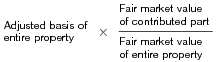
Adjusted basis of entire property x fair market value of contributed part ÷ fair market value of entire property
Please click here for the text description of the image.
Step 3.
Determine whether the amount of your charitable contribution is the FMV of the contributed part (which you found in Step 1) or the adjusted basis of the contributed part (which you found in Step 2). Generally, if the property sold was capital gain property, your charitable contribution is the FMV of the contributed part. If it was ordinary income property, your charitable contribution is the adjusted basis of the contributed part. See Ordinary Income Property and Capital Gain Property, both earlier, for more information.
Example.
You sell ordinary income property with an FMV of $10,000 to a mosque for $2,000. Your basis is $4,000 and your AGI is $20,000. You make no other contributions during the year. The FMV of the contributed part of the property is $8,000 ($10,000 − $2,000). The adjusted basis of the contributed part is $3,200 ($4,000 × ($8,000 ÷ $10,000)). Because the property is ordinary income property, your charitable deduction is limited to the adjusted basis of the contributed part. You can deduct $3,200.
Penalty
You may be liable for an accuracy-related penalty under section 6662 if you overstate the value or adjusted basis of contributed property.
20% penalty.
The penalty is 20% of the amount by which you underpaid your tax because of the overstatement, if:
-
The value or adjusted basis claimed on your return is 150% or more of the correct amount, and
-
You underpaid your tax by more than $5,000 because of the overstatement.
40% penalty.
The penalty is 40%, rather than 20%, if:
-
The value or adjusted basis claimed on your return is 200% or more of the correct amount, and
-
You underpaid your tax by more than $5,000 because of the overstatement.
When To Deduct
You can deduct your contributions only in the year you actually make them in cash or other property (or in a later carryover year, as explained under How To Figure Your Deduction When Limits Apply, later). This applies whether you use the cash or an accrual method of accounting.
Time of making contribution.
Usually, you make a contribution at the time of its unconditional delivery.
Checks.
A check you mail to a charity is considered delivered on the date you mail it.
Text message.
Contributions made by text message are deductible in the year you send the text message if the contribution is charged to your telephone or wireless account.
Credit card.
Contributions charged on your bank credit card are deductible in the year you make the charge.
Pay-by-phone account.
Contributions made through a pay-by-phone account are considered delivered on the date the financial institution pays the amount. This date should be shown on the statement the financial institution sends you.
Stock certificate.
A properly endorsed stock certificate is considered delivered on the date of mailing or other delivery to the charity or to the charity’s agent. However, if you give a stock certificate to your agent or to the issuing corporation for transfer to the name of the charity, your contribution isn’t delivered until the date the stock is transferred on the books of the corporation.
Promissory note.
If you issue and deliver a promissory note to a charity as a contribution, it isn’t a contribution until you make the note payments.
Option.
If you grant a charity an option to buy real property at a bargain price, it isn’t a contribution until the charity exercises the option.
Borrowed funds.
If you contribute borrowed funds, you can deduct the contribution in the year you deliver the funds to the charity, regardless of when you repay the loan.
Conditional gift.
If your contribution depends on a future act or event to become effective, you can’t take a deduction unless there is only a negligible chance the act or event won’t take place.
If your contribution could be undone by a later act or event, you can’t take a deduction unless there is only a negligible chance the act or event will take place.
Example 1.
You contribute cash to a local school board, which is a political subdivision of a state, to help build a school gym. The school board will refund the money to you if it doesn’t collect enough to build the gym. You can’t deduct your contribution until there is no chance (or only a negligible chance) of a refund.
Example 2.
You donate land to a city for as long as the city uses it for a public park. The city plans to use the land for a park, and there is no chance (or only a negligible chance) of the land being used for any different purpose. You can deduct your charitable contribution in the year you make the contribution.
Limits on Deductions
Tip: If your total contributions for the year are 20% or less of your AGI, you don’t need to read the rest of this section. The remaining limits discussed in this section don’t apply to you.
The amount you can deduct for charitable contributions is generally limited to no more than 60% of your AGI. Your deduction may be further limited to 50%, 30%, or 20% of your AGI, depending on the type of property you give and the type of organization you give it to. Your deduction for cash contributions is limited to 60% of your AGI minus your deductions for all other contributions. These limits are described in detail in this section.
Your AGI is the amount on Form 1040, line 11b.
If your contributions are more than any of the limits that apply, see Carryovers under How To Figure Your Deduction When Limits Apply, later.
Out-of-pocket expenses.
Amounts you spend performing services for a charitable organization may be deductible as a contribution to a qualified organization. If so, your deduction is subject to the limit applicable to donations to that organization. For example, the 30% limit applies to amounts you spend on behalf of a private nonoperating foundation.
Types of Qualified Organizations
For the purpose of applying the deduction limits to your charitable contributions, qualified organizations can be divided into two categories.
First category of qualified organizations (50% limit organizations).
The first category includes only the following types of qualified organizations. (These organizations are also sometimes referred to as “50% limit organizations.”)
-
Churches and conventions or associations of churches.
-
Educational organizations with a regular faculty and curriculum that normally have a regularly enrolled student body attending classes on site.
-
Hospitals and certain medical research organizations associated with these hospitals.
-
Organizations that are operated only to receive, hold, invest, and administer property and to make expenditures to or for the benefit of state and municipal colleges and universities and that normally receive substantial support from the United States or any state or their political subdivisions, or from the general public.
-
The United States or any state, the District of Columbia, a U.S. territory (including Puerto Rico), a political subdivision of a state or U.S. possession, or an Indian tribal government or any of its subdivisions that perform substantial government functions.
-
Publicly supported charities, defined earlier under Qualified Conservation Contribution.
-
Organizations that may not qualify as “publicly supported” but that meet other tests showing they respond to the needs of the general public, not a limited number of donors or other persons. They must normally receive more than one-third of their support either from organizations described in (1) through (6), or from persons other than “disqualified persons.”
-
Most organizations operated or controlled by, and operated for the benefit of, those organizations described in (1) through (7).
-
Federally chartered veteran service organizations as described in section 501(c)(19).
-
Private nonoperating foundations that make qualifying distributions of 100% of contributions within 2½ months following the year they receive the contribution. A deduction for charitable contributions to any of these private nonoperating foundations must be supported by evidence from the foundation confirming it made the qualifying distributions timely. Attach a copy of this supporting data to your tax return.
-
A private foundation whose contributions are pooled into a common fund, if the foundation would be described in (8) but for the right of substantial contributors to name the public charities that receive contributions from the fund. The foundation must distribute the common fund’s income within 2½ months following the tax year in which it was realized and must distribute the corpus not later than 1 year after the donor’s death (or after the death of the donor’s surviving spouse if the spouse can name the recipients of the corpus).
You can ask any organization whether it is a 50% limit organization, and most will be able to tell you. Also see How to check whether an organization can receive deductible charitable contributions, earlier.
Second category of qualified organizations.
The second category includes any type of qualified organization that isn’t in the first category.
Limits
The limit that applies to a contribution depends on the type of property you give and which category of qualified organization you give it to. The amount of a contribution you can deduct is generally limited to a percentage of your AGI, but may be further reduced if you make contributions that are subject to more than one of the limits discussed in this section.
Your total deduction of charitable contributions can’t exceed your AGI. If your contributions are subject to more than one of the limits, you include all or part of each contribution in a certain order, carrying over any excess to a subsequent year (if allowed). See How To Figure Your Deduction When Limits Apply and Carryovers, later, for more information about ordering and carryovers.
Qualified conservation contributions of farmers and ranchers.
If you are a qualified farmer or rancher, your deduction for a qualified conservation contribution (QCC) is limited to 100% of your AGI minus your deduction for all other charitable contributions. However, if the donated property is used in agriculture or livestock production (or is available for such production), the contribution must be subject to a restriction that the property remain available for such production. If not, the limit is 50%. For more information about applying the 50% limit to a QCC, see Qualified conservation contributions, later, under Limits based on 50% of AGI.
Qualified farmer or rancher.
You are a qualified farmer or rancher if your gross income from the trade or business of farming is more than 50% of your gross income for the year.
If you make cash contributions during the year to an organization described earlier under First category of qualified organizations (50% limit organizations), your deduction for the cash contributions is 60% of your AGI. See Cash Contributions for what is included in cash contributions.
This 60% limit doesn’t apply to noncash charitable contributions. See Noncash contributions to 50% limit organizations, later, if you contribute something other than cash to a 50% limit organization.
Example 1.
You gave your temple a $200 cash contribution. The limit based on 60% of AGI will apply to the cash contribution to the temple because it is an organization described earlier under First category of qualified organizations (50% limit organizations) and because the contribution was cash.
Example 2.
You donated clothing to your synagogue with an FMV of $200. The limit based on 60% of AGI doesn’t apply because the contribution is not cash. Instead, a limit based on 50% of AGI discussed later will apply to the contribution to the synagogue because it is an organization described earlier under First category of qualified organizations (50% limit organizations).
“For the use of” contribution exception.
A 30% limit applies to cash contributions that are “for the use of” the qualified organizations instead of “to” the qualified organization. A contribution is “for the use of” a qualified organization when it is held in a legally enforceable trust for the qualified organization or in a similar legal arrangement. See Contributions to the second category of qualified organizations or for the use of any qualified organization, later, under Limits based on 30% of AGI, for more information.
There are two 50% limits that may apply to your contributions.
Noncash contributions to 50% limit organizations.
If you make noncash contributions to organizations described earlier under First category of qualified organizations (50% limit organizations), your deduction for the noncash contributions is limited to 50% of your AGI minus your cash contributions subject to the 60% limit.
Capital gain property exception.
A 30% limit applies to noncash contributions of capital gain property if you figure your deduction using FMV without reduction for appreciation. See Certain capital gain property contributions to 50% limit organizations, later, under Limits based on 30% of AGI, for more information.
“For the use of” contribution exception.
A 20% or 30% limit applies to noncash contributions that are “for the use of” the qualified organization instead of “to” the qualified organization. A contribution is “for the use of” a qualified organization when it is held in a legally enforceable trust for the qualified organization or in a similar legal arrangement. If the noncash contribution is capital gain property, see Limit based on 20% of AGI, later, for more information; otherwise, see Contributions to the second category of qualified organizations or for the use of any qualified organization, later, under Limits based on 30% of AGI, for more information.
Qualified conservation contributions.
Your deduction for qualified conservation contributions (QCCs) is limited to 50% of your AGI minus your deduction for all other charitable contributions.
Tip: If you are a farmer or rancher, go to Qualified conservation contributions of farmers or ranchers, earlier, under Limits based on 100% of AGI, to see if that limit applies to your QCC instead.
These are two 30% limits that may apply to your contributions. The 30% limit for capital gain property contributions to a 50% limit organization is separate from the 30% limit that applies to your other contributions. Both are separately reduced by contributions made to a 50% limit organization, but the amount allowed after applying one of the 30% limits doesn’t reduce the amount allowed after applying the other 30% limit. However, as a result of applying the separate limits, the total contributions subject to a 30% limit will never be more than 50% of your AGI.
Example.
Your AGI is $50,000. During the year, you gave capital gain property with an FMV of $15,000 to an organization described earlier under First category of qualified organizations (50% limit organizations). You don’t choose to reduce the property’s FMV by its appreciation in value. You also gave $10,000 cash to a qualified organization that is described earlier under Second category of qualified organizations (meaning it isn’t a 50% limit organization). The $15,000 contribution of capital gain property is subject to one 30% limit and the $10,000 cash contribution is subject to the other 30% limit. The $10,000 cash contribution is fully deductible because the contribution is not more than the smaller of (i) 30% of your AGI ($15,000), and (ii) 50% of your AGI minus all contributions to a 50% limit organization ($25,000 − $15,000 = $10,000). The $15,000 is also fully deductible because the contribution is not more than 30% of your AGI minus all contributions to a 50% limit organization subject to the 60% or 50% limit (other than qualified conservation contributions) ($25,000 − $10,000 = $15,000). Neither amount is reduced by the other, so the total deductible contribution is $25,000 (which is also not more than 50% of your AGI).
Contributions to the second category of qualified organizations or “for the use of” any qualified organization.
If you make cash contributions or noncash contributions (other than capital gain property) during the year (1) to an organization described earlier under Second category of qualified organizations, or (2) “for the use of” any qualified organization, your deduction for those contributions is limited to 30% of your AGI, or if less, 50% of your AGI minus all your contributions to 50% limit organizations (other than contributions subject to a 100% limit or qualified conservation contributions). For this purpose, contributions to 50% limit organizations include all capital gain property contributions to a 50% limit organization (other than qualified conservation contributions), even those that are subject to the 30% limit, discussed later.
A contribution is “for the use of” a qualified organization when it is held in a legally enforceable trust for the qualified organization or in a similar legal arrangement.
If you make a contribution of capital gain property to an organization other than a 50% limit organization or “for the use of” any qualified organization, see Limit based on 20% of AGI, later.
Student living with you.
Deductible amounts you spend on behalf of a student living with you are subject to this 30% limit. These amounts are considered a contribution for the use of a qualified organization. See Expenses Paid for Student Living With You, earlier, for more information.
Certain capital gain property contributions to 50% limit organizations.
Your noncash contributions of capital gain property to 50% limit organizations is limited to 30% of your AGI minus all your contributions to 50% limit organizations that are subject to the 60% and 50% limits (other than qualified conservation contributions). The limit that applies to capital gain property contributions to 50% limit organizations doesn’t apply to qualified conservation contributions. If you are making a qualified conservation contribution (QCC), see Qualified conservation contributions and Qualified conservation contributions of farmers and ranchers, earlier, for the limits to apply to a QCC.
Election to apply the 50% limit.
You may choose the 50% limit for contributions of capital gain property to organizations described earlier under First category of qualified organizations (50% limit organizations) instead of the 30% limit that would otherwise apply. See Capital gain property election, later, under How To Figure Your Deduction When Limits Apply, for more information about making this election and how to adjust the amount of your contribution.
If you make noncash contributions of capital gain property during the year (1) to an organization described earlier under Second category of qualified organizations, or (2) “for the use of” any qualified organization, your deduction for those contributions is limited to 20% of your AGI or, if less, the smallest of the following.
-
30% of your AGI minus all your contributions that are subject to a limit based on 30% of AGI.
-
30% of your AGI minus all your capital gain contributions that are subject to the limit based on 30% of AGI.
-
50% of your AGI minus all contributions subject to the limits based on 60%, 50%, and 30% of AGI (other than qualified conservation contributions).
A contribution is “for the use of” a qualified organization when it is held in a legally enforceable trust for the qualified organization or in a similar legal arrangement.
How To Figure Your Deduction When Limits Apply
If your contributions are subject to more than one of the limits discussed earlier, use the following steps to figure the amount of your contributions that you can deduct.
-
Cash contributions subject to the limit based on 60% of AGI. Deduct the contributions that don’t exceed 60% of your AGI.
-
Noncash contributions (other than qualified conservation contributions) subject to the limit based on 50% of AGI. Deduct the contributions that don’t exceed 50% of your AGI minus your cash contributions to a 50% limit organization.
-
Cash and noncash contributions (other than capital gain property) subject to the limit based on 30% of AGI. Deduct the contributions that don’t exceed the smaller of:
-
30% of your AGI, or
-
50% of your AGI minus your contributions to a 50% limit organization (other than qualified conservation contributions), including capital gain property subject to the limit based on 30% of AGI.
-
-
Contributions of capital gain property subject to the limit based on 30% of AGI. Deduct the contributions that don’t exceed the smaller of:
-
30% of your AGI; or
-
50% of your AGI minus your contributions subject to the limits based on 60% or 50% of AGI (other than qualified conservation contributions).
-
-
Contributions of capital gain property subject to the limit based on 20% of AGI. Deduct the contributions that don’t exceed the smaller of:
-
20% of your AGI;
-
30% of your AGI minus your contributions of capital gain property subject to the limit based on 30% of AGI;
-
30% of your AGI minus your other contributions subject to the limit based on 30% of AGI; or
-
50% of your AGI minus your contributions subject to the limits based on 60%, 50%, and 30% of AGI (other than qualified conservation contributions).
-
-
Qualified conservation contributions subject to the limit based on 50% of AGI. Deduct the contributions that don’t exceed 50% of your AGI minus any deductible contributions figured in (1) through (5).
-
Qualified conservation contributions of farmers and ranchers subject to the limit based on 100% of AGI. Deduct the contributions that don’t exceed 100% of your AGI minus any deductible contributions figured in (1) through (6).
-
Carryovers of qualified contributions for relief efforts in a qualified disaster area subject to the limit based on 60% of AGI. Deduct the carryover contributions that don’t exceed 60% of your AGI minus all your other deductible contributions.
These steps are incorporated into Worksheet 2.
Example.
Your AGI is $50,000. In March, you gave your place of worship $2,000 cash and land with an FMV of $28,000 and a basis of $22,000. You held the land for investment purposes for more than 1 year. You don’t make the capital gain property election for this year. See Capital gain property election, later. Therefore, the amount of your charitable contribution for the land would be its FMV of $28,000. You also gave $5,000 cash to a private nonoperating foundation to which the 30% limit applies.
The $2,000 cash donated to your place of worship is considered first and is fully deductible. Your contribution to the private nonoperating foundation is considered next. Because the total of your cash contribution of $2,000 and your capital gain property of $28,000 to a 50% limit organization ($30,000) is more than $25,000 (50% of $50,000), your contribution to the private nonoperating foundation isn’t deductible for the year. It can be carried over to later years. See Carryovers, later. The contribution of land is considered next. Your deduction for the land is limited to $15,000 (30% × $50,000). The unused part of the contribution ($13,000) can be carried over. For this year, your deduction is limited to $17,000 ($2,000 + $15,000).
Capital gain property election.
You may choose the 50% limit for contributions of capital gain property to qualified organizations described earlier under First category of qualified organizations (50% limit organizations) instead of the 30% limit that would otherwise apply. If you make this choice, you must reduce the FMV of the property contributed by the appreciation in value that would have been long-term capital gain if the property had been sold.
This choice applies to all capital gain property contributed to 50% limit organizations during a tax year. It also applies to carryovers of this kind of contribution from an earlier tax year. For details, see Carryover of capital gain property, later.
You must make the choice on your original return or on an amended return filed by the due date for filing the original return.
Example.
In the previous example, if you choose to have the 50% limit apply to the land (the 30% capital gain property) given to your place of worship, you must reduce the FMV of the property by the appreciation in value. Therefore, the amount of your charitable contribution for the land would be its basis to you of $22,000. You add this amount to the $2,000 cash contributed to the place of worship. You can now deduct $1,000 of the amount donated to the private nonoperating foundation because the total of your contributions of cash ($2,000) and capital gain property ($22,000) to 50% limit organizations is $1,000 less than the limit based on 50% of AGI. Your total deduction for the year is $25,000 ($2,000 cash to your place of worship, $22,000 for property donated to your place of worship, and $1,000 cash to the private nonoperating foundation). You can carry over to later years the part of your contribution to the private nonoperating foundation that you couldn’t deduct ($4,000).
You can use Worksheet 2 if you made charitable contributions during the year, and one or more of the limits described in this publication under Limits on Deductions apply to you. You can’t use this worksheet if you have a carryover of a charitable contribution from an earlier year. If you have a carryover from an earlier year, see Carryovers, later.
The following list gives instructions for completing the worksheet.
-
The terms used in the worksheet are explained earlier in this publication.
-
If the result on any line is less than zero, enter zero.
-
For contributions of property, enter the property’s FMV unless you elected (or were required) to reduce the FMV as explained under Giving Property That Has Increased in Value. In that case, enter the reduced amount.
Worksheet 2. Applying the Deduction Limits
Caution:
Don’t use this worksheet to figure the contributions you can deduct this year if you have a carryover of a charitable contribution from an earlier year.
| Step 1. Enter any qualified conservation contributions (QCCs) made during the year. | |||||
| 1. | If you are a qualified farmer or rancher, enter any QCCs subject to the limit based on 100% of AGI | 1 | |||
| 2. | Enter any QCCs not entered on line 1 | 2 | |||
| Step 2. Enter your other charitable contributions made during the year. | |||||
| 3. | Reserved for future use | ||||
| 4. | Enter your contributions of capital gain property ‘for the use of’ any qualified organization | 4 | |||
| 5. | Enter your other contributions ‘for the use of’ any qualified organization. Don’t include any contributions you entered on a previous line | 5 | |||
| 6. | Enter your contributions of capital gain property to qualified organizations that aren’t 50% limit organizations. Don’t include any contributions you entered on a previous line | 6 | |||
| 7. | Enter your other contributions to qualified organizations that aren’t 50% limit organizations. Don’t include any contributions you entered on a previous line | 7 | |||
| 8. | Enter your contributions of capital gain property to 50% limit organizations deducted at FMV. Don’t include any contributions you entered on a previous line | 8 | |||
| 9. | Enter your noncash contributions to 50% limit organizations other than capital gain property you deducted at FMV. Be sure to include contributions of capital gain property to 50% limit organizations if you reduced the property’s FMV. Don’t include any contributions you entered on a previous line | 9 | |||
| 10. | Enter your cash contributions to 50% limit organizations. Don’t include any contributions you entered on a previous line | 10 | |||
| Step 3. Figure your deduction for the year (if any result is zero or less, enter -0-) | |||||
| 11. | Enter your AGI | 11 | |||
| Cash contributions subject to the limit based on 60% of AGI (If line 10 is zero, enter -0- on lines 12 through 14.) |
|||||
| 12. | Multiply line 11 by 0.6 | 12 | |||
| 13. | Deductible amount. Enter the smaller of line 10 or line 12 | 13 | |||
| 14. | Carryover. Subtract line 13 from line 10 | 14 | |||
| Noncash contributions subject to the limit based on 50% of AGI (If line 9 is zero, enter -0- on lines 15 through 18.) |
|||||
| 15. | Multiply line 11 by 0.5 | 15 | |||
| 16. | Subtract line 13 from line 15 | 16 | |||
| 17. | Deductible amount. Enter the smaller of line 9 or line 16 | 17 | |||
| 18. | Carryover. Subtract line 17 from line 9 | 18 | |||
| Contributions (other than capital gain property) subject to limit based on 30% of AGI (If lines 5 and 7 are both zero, enter -0- on lines 19 through 25.) |
|||||
| 19. | Multiply line 11 by 0.5 | 19 | |||
| 20. | Add lines 8, 9, and 10 | 20 | |||
| 21. | Subtract line 20 from line 19 | 21 | |||
| 22. | Multiply line 11 by 0.3 | 22 | |||
| 23. | Add lines 5 and 7 | 23 | |||
| 24. | Deductible amount. Enter the smallest of line 21, 22, or 23 | 24 | |||
| 25. | Carryover. Subtract line 24 from line 23 | 25 | |||
| Contributions of capital gain property subject to limit based on 30% of AGI (If line 8 is zero, enter -0- on lines 26 through 31.) |
|||||
| 26. | Multiply line 11 by 0.5 | 26 | |||
| 27. | Add lines 9 and 10 | 27 | |||
| 28. | Subtract line 27 from line 26 | 28 | |||
| 29. | Multiply line 11 by 0.3 | 29 | |||
| 30. | Deductible amount. Enter the smallest of line 8, 28, or 29 | 30 | |||
| 31. | Carryover. Subtract line 30 from line 8 | 31 | |||
| Contributions subject to the limit based on 20% of AGI (If lines 4 and 6 are both zero, enter -0- on lines 32 through 41.) |
|||||
| Note: Worksheet 2 continues on the next page. | |||||
Worksheet 2 (continued)
| 32. | Multiply line 11 by 0.5 | 32 | |||
| 33. | Add lines 13, 17, 24, and 30 | 33 | |||
| 34. | Subtract line 33 from line 32 | 34 | |||
| 35. | Multiply line 11 by 0.3 | 35 | |||
| 36. | Subtract line 24 from line 35 | 36 | |||
| 37. | Subtract line 30 from line 35 | 37 | |||
| 38. | Multiply line 11 by 0.2 | 38 | |||
| 39. | Add lines 4 and 6 | 39 | |||
| 40. | Deductible amount. Enter the smallest of line 34, 36, 37, 38, or 39 | 40 | |||
| 41. | Carryover. Subtract line 40 from line 39 | 41 | |||
| QCCs subject to limit based on 50% of AGI (If line 2 is zero, enter -0- on lines 42 through 46.) |
|||||
| 42. | Multiply line 11 by 0.5 | 42 | |||
| 43. | Add lines 13, 17, 24, 30, and 40 | 43 | |||
| 44. | Subtract line 43 from line 42 | 44 | |||
| 45. | Deductible amount. Enter the smaller of line 2 or line 44 | 45 | |||
| 46. | Carryover. Subtract line 45 from line 2 | 46 | |||
| QCCs subject to limit based on 100% of AGI (If line 1 is zero, enter -0- on lines 47 through 51.) |
|||||
| 47. | Enter the amount from line 11 | 47 | |||
| 48. | Add lines 13, 17, 24, 30, 40, and 45 | 48 | |||
| 49. | Subtract line 48 from line 47 | 49 | |||
| 50. | Deductible amount. Enter the smaller of line 1 or line 49 | 50 | |||
| 51. | Carryover. Subtract line 50 from line 1 | 51 | |||
| Deduction for the year | |||||
| 52. | Add lines 13, 17, 24, 30, 40, 45, and 50. Enter the total here and include the deductible amounts on Schedule A (Form 1040), line 11, or line 12, whichever is appropriate | 52 | |||
| Note: Any amounts in the carryover column are not deductible this year but can be carried over to next year. See Carryovers, later, for more information about how you will use them next year. | |||||
You can carry over any contributions you can’t deduct in the current year because they exceed the limits based on your AGI. Except for qualified conservation contributions, you may be able to deduct the excess in each of the next 5 years until it is used up, but not beyond that time.
A carryover of a qualified conservation contribution can be carried forward for 15 years.
Generally, contributions you carry over are subject to the same percentage limits in the year to which they are carried as they were in the year of the contribution. For example, contributions subject to the 20% limit in the year in which they are made are 20% limit contributions in the year to which they are carried. But see Carryover of capital gain property, later.
For each category of contributions, you deduct carryover contributions only after deducting all allowable contributions in that category for the current year. If you have carryovers from 2 or more prior years, use the carryover from the earlier year first.
Note:
A carryover of a contribution to a 50% limit organization must be used before contributions in the current year to organizations other than 50% limit organizations. See Example 2.
Example 1.
Last year, you made cash contributions of $11,000 to 50% limit organizations. Because of the limit based on 60% of AGI, you deducted only $10,000 and carried over $1,000 to this year. This year, your AGI is $20,000 and you made cash contributions of $9,500 to 50% limit organizations. The limit based on 60% of AGI applies to your current-year cash contribution of $9,500 and carryover contribution of $1,000. You can deduct this year’s cash contribution and your carryover cash contribution in full because your total cash contributions of $10,500 ($9,500 + $1,000) is less than $12,000 (60% of $20,000).
Example 2.
This year, your AGI is $24,000. You make cash contributions of $6,000 to which the 60% limit applies and $3,000 to which the 30% limit applies. You have a contribution carryover from last year of $5,000 for capital gain property contributed to a 50%-limit organization and subject to the special 30% limit for contributions of capital gain property.
Your cash contribution of $6,000 is fully deductible because it is less than $14,400 (which is 60% of your AGI).
The deduction for your 30%-limit contributions of $3,000 is limited to $1,000. This is the lesser of:
-
$7,200 (30% of $24,000), or
-
$1,000 ($12,000 minus $11,000).
The deduction for your $5,000 carryover is subject to the special 30% limit for contributions of capital gain property. This means it is limited to the smaller of:
-
$7,200 (your 30% limit), or
-
$5,000 ($12,000, your 50% limit, minus your allowable cash contributions to which the 60% limit applies ($6,000) and minus your allowable contribution to which the 30% limit applies ($1,000)).
Your deduction is $12,000 ($6,000 + $1,000 + $5,000). You carry over the $2,000 balance of your 30% limit contributions for this year to next year.
Carryover of capital gain property.
If you carry over contributions of capital gain property subject to the special 30% limit and you choose in the next year to use the 50% limit and take appreciation into account, you must refigure the carryover. Reduce the FMV of the property by the appreciation and reduce that result by the amount actually deducted in the previous year.
Example.
Last year, your AGI was $50,000 and you contributed capital gain property valued at $27,000 to a 50% limit organization and didn’t choose to use the 50% limit. Your basis in the property was $20,000. Your deduction was limited to $15,000 (30% of $50,000), and you carried over $12,000. This year, your AGI is $60,000 and you contribute capital gain property valued at $25,000 to a 50% limit organization. Your basis in the property is $24,000 and you choose to use the 50% limit. You must refigure your carryover as if you had taken appreciation into account last year as well as this year. Because the amount of your contribution last year would have been $20,000 (the property’s basis) instead of the $15,000 you actually deducted, your refigured carryover is $5,000 ($20,000 − $15,000). Your total deduction this year is $29,000 (your $24,000 current contribution plus your $5,000 carryover).
Additional rules for carryovers.
Special rules exist for computing carryovers if you:
-
Are married in some years but not others,
-
Have different spouses in different years,
-
Change from a separate return to a joint return in a later year,
-
Change from a joint return to a separate return in a later year,
-
Have a net operating loss,
-
Claim the standard deduction in a carryover year, or
-
Become a surviving spouse.
Substantiation Requirements
You must keep records to prove the amount of the contributions you make during the year. The kind of records you must keep depends on the amount of your contributions and whether they are:
-
Cash contributions,
-
Noncash contributions, or
-
Out-of-pocket expenses when donating your services.
Note:
An organization must generally give you a written statement if it receives a payment from you that is more than $75 and is partly a contribution and partly for goods or services. (See Contributions From Which You Benefit under Contributions You Can Deduct, earlier.) Keep the statement for your records. It may satisfy all or part of the recordkeeping requirements explained in the following discussions.
Cash Contributions
Cash contributions include payments made by cash, check, electronic funds transfer, online payment service, debit card, credit card, payroll deduction, or a transfer of a gift card redeemable for cash.
You can’t deduct a cash contribution, regardless of the amount, unless you keep one of the following.
-
A bank record that shows the name of the qualified organization, the date of the contribution, and the amount of the contribution. Bank records may include the following.
-
A canceled check.
-
A bank or credit union statement.
-
A credit card statement.
-
An electronic fund transfer receipt.
-
A scanned image of both sides of a canceled check obtained from a bank or credit union website.
-
-
A receipt (or a letter or other written communication such as an email) from the qualified organization showing the name of the organization, the date of the contribution, and the amount of the contribution.
-
The payroll deduction records described next.
Payroll deductions.
If you make a contribution by payroll deduction, you must keep:
-
A paystub, a Form W-2, or another document furnished by your employer that shows the date and amount of the contribution; and
-
A pledge card or other document prepared by or for the qualified organization that shows the name of the organization and states the organization doesn’t provide goods or services in return for any contribution made to it by payroll deduction.
You can claim a deduction for a contribution of $250 or more only if you have a contemporaneous written acknowledgment of your contribution from the qualified organization, or certain payroll deduction records. See Contemporaneous written acknowledgment (CWA) later, for a description of when a written acknowledgement is considered “contemporaneous” with your contribution.
If you made more than one contribution of $250 or more, you must have either a separate acknowledgment for each or one acknowledgment that lists each contribution and the date of each contribution and shows your total contributions.
Amount of contribution.
In figuring whether your contribution is $250 or more, don’t combine separate contributions. For example, if you gave your church $25 each week, your weekly payments don’t have to be combined. Each payment is a separate contribution.
If contributions are made by payroll deduction, the deduction from each paycheck is treated as a separate contribution.
If you made a payment that is partly for goods and services, as described earlier under Contributions From Which You Benefit, your contribution is the amount of the payment that is more than the value of the goods and services.
Acknowledgment.
The acknowledgment must meet these tests.
-
It must be written.
-
It must include:
-
The amount of cash you contributed,
-
Whether the qualified organization gave you any goods or services as a result of your contribution (other than certain token items and membership benefits),
-
A description and good faith estimate of the value of any goods or services described in (b). If the only benefit you received was an intangible religious benefit (such as admission to a religious ceremony) that generally isn’t sold in a commercial transaction outside the donative context, the acknowledgement must say so and doesn’t need to describe or estimate the value of the benefit.
-
If the acknowledgment doesn’t show the date of the contribution, you must also have a bank record or receipt, as described earlier, that does show the date of the contribution. If the acknowledgment shows the date of the contribution and meets the other tests just described, you don’t need any other records.
Contemporaneous written acknowledgment (CWA).
Organizations typically send written acknowledgements to donors no later than January 31 of the year following the donation. For the written acknowledgement to be considered contemporaneous with the contribution, it must meet both of the following requirements.
-
Meet all the tests described under Acknowledgment, earlier.
-
You must get it on or before the earlier of:
-
The date you file your return for the year you make the contribution; or
-
The due date, including extensions, for filing the return.
-
Payroll deductions.
If you make a contribution by payroll deduction and your employer withholds $250 or more from a single paycheck, you must keep:
-
A paystub, a Form W-2, or another document furnished by your employer that shows the amount withheld as a contribution; and
-
A pledge card or other document prepared by or for the qualified organization that shows the name of the organization and states the organization doesn’t provide goods or services in return for any contribution made to it by payroll deduction.
If the paystub, Form W-2, pledge card, or other document doesn’t show the date of the contribution, you must have another document that does show the date of the contribution. If the paystub, Form W-2, pledge card, or other document shows the date of the contribution, you don’t need any other records except those just described in (1) and (2).
Noncash Contributions
Substantiation requirements for contributions not made in cash depend on whether your deduction for the contribution is:
-
Less than $250;
-
At least $250 but not more than $500;
-
Over $500 but not more than $5,000; or
-
Over $5,000.
The substantiation requirements for noncash contributions of more than $500 also apply to any return filed for any carryover year.
Amount of deduction.
In figuring whether your deduction is $500 or more, combine your claimed deductions for all similar items of property donated to any qualified organization during the year.
If you received goods or services in return, as described earlier in Contributions From Which You Benefit, reduce your contribution by the value of those goods or services. If you figure your deduction by reducing the FMV of the donated property by its appreciation, as described earlier in Giving Property That Has Increased in Value, your contribution is the reduced amount.
Except as provided below, no deduction will be allowed for a noncash contribution of less than $250 unless you get and keep a receipt from the qualified organization showing:
-
The name and address of the qualified organization to which you contributed;
-
The date and location of the charitable contribution;
-
A description of the property in sufficient detail under the circumstances (taking into account the value of the property) for a person not generally familiar with the type of property to understand that the description is of the contributed property; and
-
For a security, the name of the issuer, the type of security, and whether it is publicly traded as of the date of the contribution. For example, a security is generally considered to be publicly traded if the security is (a) listed on a recognized stock exchange whose quotations are published daily, (b) regularly traded on a national or regional over-the-counter market, or (c) quoted daily in a national newspaper of general circulation in the case of mutual fund shares. Note: Digital assets are not publicly traded securities for the purposes of Form 8283, unless the digital asset is publicly traded stock or indebtedness.
If it is impractical to get a receipt (for example, if you leave property at a charity’s unattended drop site), you may satisfy the substantiation requirements by maintaining reliable written records for each item of the donated property.
Your reliable written records must include the following information.
-
The information in (1), (2), (3), and (4) above.
-
If you claim a deduction for clothing or a household item, a description of the condition of the clothing or item.
-
The FMV of the property at the time of the contribution and how you figured the FMV.
If you claim a deduction of at least $250 but not more than $500 for a noncash charitable contribution, you must get and keep a contemporaneous written acknowledgment of your contribution from the qualified organization. If you made more than one contribution of $250 or more, you must have either a separate acknowledgment for each or one acknowledgment that shows your total contributions. See CWA, earlier.
The acknowledgment must:
-
Be written.
-
Include:
-
A description (but not necessarily the value) of any property you contributed,
-
Whether the qualified organization gave you any goods or services as a result of your contribution (other than certain token items and membership benefits), and
-
A description and good faith estimate of the value of any goods or services described in (b). If the only benefit you received was an intangible religious benefit (such as admission to a religious ceremony) that generally isn’t sold in a commercial transaction outside the donative context, the acknowledgment must say so and doesn’t need to describe or estimate the value of the benefit.
-
-
Be received by you on or before the earlier of:
-
The date you file your return for the year you make the contribution, or
-
The due date, including extensions, for filing the return.
-
If you claim a deduction over $500 but not over $5,000 for a noncash charitable contribution, you must complete Form 8283, Section A, and have the CWA, earlier. Your completed Form 8283, Section A, must include:
-
Your name and taxpayer identification number;
-
The name and address of the qualified organization;
-
The date of the charitable contribution; and
-
The following information about the contributed property.
-
A description of the property in sufficient detail under the circumstances (taking into account the value of the property) for a person not generally familiar with the type of property to understand that the description is of the contributed property.
-
The FMV of the property on the contribution date and the method used in figuring the FMV.
-
In the case of real or tangible property, its condition.
-
In the case of tangible personal property, whether the donee has certified it for a use related to the purpose or function constituting the donee’s basis for exemption under section 501 of the Internal Revenue Code or, in the case of a governmental unit, an exclusively public purpose.
-
In the case of securities, the name of the issuer, the type of securities, and whether they were publicly traded as of the date of the contribution.
-
How you got the property, for example, by purchase, gift, bequest, inheritance, or exchange.
-
The approximate date you got the property or, if created, produced, or manufactured by or for you, the approximate date the property was substantially completed.
-
The cost or other basis, and any adjustments to the basis, of property held less than 12 months and, if available, the cost or other basis of property held 12 months or more. This requirement, however, doesn‘t apply to publicly traded securities.
-
See the Instructions for Form 8283 for additional guidance.
If you claim a deduction of over $5,000 for a noncash charitable contribution, you must have the contemporaneous written acknowledgement (see CWA, earlier), obtain a qualified written appraisal of the donated property from a qualified appraiser, and complete Form 8283, Section B. A qualified appraisal is not required for contributions of qualified vehicles for which you obtain a CWA, certain inventory, publicly traded securities, or certain intellectual property. See Deductions More Than $5,000 in Pub. 561 for more information. Note: Digital assets are not publicly traded securities for the purposes of Form 8283, Section B, unless the digital asset is publicly traded stock or indebtedness. If the value of the digital asset exceeds $5,000, appraisal requirements will apply.
In addition to the items described in Deductions Over $500 but Not Over $5,000, earlier, your completed Form 8283 must include:
-
The qualified organization’s taxpayer identification number, signature, the date signed by the qualified organization, and the date the qualified organization received the property;
-
The appraiser’s name, address, taxpayer identification number, appraiser declaration, signature, and the date signed by the appraiser; and
-
The following additional information about the contributed property.
-
The FMV on the valuation effective date.
-
A statement explaining whether the charitable contribution was made by means of a bargain sale and, if so, the amount of any consideration received for the contribution.
-
Note:
The appraiser declaration must include the following statement: “I understand that my appraisal will be used in connection with a return or claim for refund. I also understand that, if there is a substantial or gross valuation misstatement of the value of the property claimed on the return or claim for refund that is based on my appraisal, I may be subject to a penalty under section 6695A of the Internal Revenue Code, as well as other applicable penalties. I affirm that I have not been at any time in the 3-year period ending on the date of the appraisal barred from presenting evidence or testimony before the Department of the Treasury or the Internal Revenue Service pursuant to 31 U.S.C. 330(c).”
If the contribution was a qualified conservation contribution, your records must also include the FMV of the underlying property before and after the contribution and the conservation purpose furthered by the contribution.
For more information, see the instructions for Form 8283, Qualified Conservation Contribution, earlier, and in Pub. 561.
Out-of-Pocket Expenses
If you give services to a qualified organization and have unreimbursed out-of-pocket expenses, considered separately, of $250 or more (for example, you pay $250 for an airline ticket to attend a convention of a qualified organization as a chosen representative), related to those services, the following two rules apply.
-
You must have adequate records to prove the amount of the expenses.
-
You must get an acknowledgment from the qualified organization that contains:
-
A description of the services you provided,
-
A statement of whether or not the organization provided you any goods or services to reimburse you for the expenses you incurred,
-
A description and a good faith estimate of the value of any goods or services (other than intangible religious benefits) provided to reimburse you, and
-
A statement that the only benefit you received was an intangible religious benefit, if that was the case. The acknowledgment doesn’t need to describe or estimate the value of an intangible religious benefit (defined earlier under Acknowledgment).
-
-
The date you file your return for the year you make the contribution; or
-
The due date, including extensions, for filing the return.
Car expenses.
If you claim expenses directly related to use of your car in giving services to a qualified organization, you must keep reliable written records of your expenses. Whether your records are considered reliable depends on all the facts and circumstances. Generally, they may be considered reliable if you made them regularly and at or near the time you had the expenses.
For example, your records might show the name of the organization you were serving and the dates you used your car for a charitable purpose. If you use the standard mileage rate of 14 cents a mile, your records must show the miles you drove your car for the charitable purpose. If you deduct your actual expenses, your records must show the costs of operating the car that are directly related to a charitable purpose.
See Car expenses under Out-of-Pocket Expenses in Giving Services, earlier, for the expenses you can deduct.
How To Report
Report your charitable contributions on Schedule A (Form 1040), lines 11 through 14.
If you made noncash contributions, you may also be required to fill out parts of Form 8283. See Noncash contributions, later.
Cash contributions and out-of-pocket expenses.
Enter your cash contributions, including out-of-pocket expenses, on Schedule A (Form 1040), line 11.
Reporting expenses for student living with you.
If you claim amounts paid for a student who lives with you, as described earlier under Expenses Paid for Student Living With You, you must submit with your return:
-
A copy of your agreement with the organization sponsoring the student placed in your household,
-
A summary of the various items you paid to maintain the student, and
-
A statement that gives:
-
The date the student became a member of your household,
-
The dates of the student’s full-time attendance at school, and
-
The name and location of the school.
-
Noncash contributions.
For each noncash contribution described below, you must file with your return a Form 8283 completed as specified in the Instructions to Form 8283. Enter your noncash contributions on Schedule A (Form 1040), line 12.
Total deduction over $500.
If your total deduction for all noncash contributions for the year is over $500, you must complete Form 8283 and attach it to your Form 1040. Use Section A of Form 8283 to report noncash contributions for which you claimed a deduction of $5,000 or less per item (or group of similar items). Also use Section A to report contributions of publicly traded securities. Note: Digital assets are not publicly traded securities for the purposes of Form 8283, unless the digital asset is publicly traded stock or indebtedness. If value of digital asset exceeds $5,000, appraisal requirements will apply. See Deduction over $5,000, next, for the items you must report on Section B.
The IRS may disallow your deduction for noncash charitable contributions if it is more than $500 and you don’t submit Form 8283 with your return.
Deduction over $5,000.
You must complete Section B of Form 8283 for each item or group of similar items for which you claim a deduction of over $5,000. (However, if you contributed publicly traded securities or the specified properties listed in the Instructions for Form 8283, complete Section A instead.) In figuring whether your deduction for a group of similar items was more than $5,000, consider all items in the group, even if items in the group were donated to more than one organization. However, you must file a separate Form 8283, Section B, for each organization. The organization that received the property must complete and sign Part V of Section B.
Vehicle donations.
If you donated a car, boat, airplane, or other vehicle, you may have to attach a copy of Form 1098-C (or other statement) to your return. For details, see Cars, Boats, and Airplanes, earlier.
Clothing and household items not in good used condition.
You must include with your return a Qualified appraisal, which is prepared by a Qualified appraiser, of any single donated item of clothing or any donated household item that isn’t in good used condition or better and for which you deduct more than $500. See Clothing and Household Items, earlier.
Qualified appraisal.
A qualified appraisal is an appraisal document that:
-
Is made, signed, and dated by a qualified appraiser (defined later) in accordance with the substance and principles of the Uniform Standards of Professional Appraisal Practice, as developed by the Appraisal Standards Board of the Appraisal Foundation;
-
Meets the relevant requirements of Regulations section 1.170A-17(a);
-
Has a valuation effective date no earlier than 60 days before the date of the contribution and no later than the date of the contribution. For an appraisal report dated on or after the date of the contribution, the valuation effective date must be the date of the contribution; and
-
Does not involve a prohibited appraisal fee.
You must receive the qualified appraisal before the due date, including extensions, of the return on which a charitable contribution deduction is first claimed for the donated property. If the deduction is first claimed on an amended return, the qualified appraisal must be received before the date on which the amended return is filed. An appraisal is not a qualified appraisal if you fail to disclose or you misrepresent facts to your appraiser and a reasonable person would expect this failure or misrepresentation to cause the appraiser to misstate the value of the property you contributed.
If an appraisal is prepared by an appraiser that has been prohibited from practicing before the Internal Revenue Service under 31 U.S.C. 330(c) within the 3-year period ending on the date the appraisal is signed by the appraiser, the appraisal will be disregarded as to value. The appraisal may still be a qualified appraisal if the donor did not know that the appraiser’s signature, date, or declaration was false when the appraisal or Form 8283 was signed.
Qualified appraiser.
A qualified appraiser is an individual with verifiable education and experience in valuing the type of property for which the appraisal is performed.
-
The individual:
-
Has earned an appraisal designation from a generally recognized professional appraiser organization, or
-
Has met certain minimum education requirements and 2 or more years of experience. To meet the minimum education requirement, the individual must have successfully completed professional or college-level coursework obtained from:
-
A professional or college-level educational organization,
-
A professional trade or appraiser organization that regularly offers educational programs in valuing the type of property, or
-
An employer as part of an employee apprenticeship or education program similar to professional or college-level courses.
-
-
-
The individual regularly prepares appraisals for which they are paid.
-
The individual is not an excluded individual.
See Pub. 561 for more information.
Deduction over $500,000.
If you claim a deduction of more than $500,000 for a contribution of property, you must attach a Qualified appraisal, which is prepared by a Qualified appraiser, of the property to your return. This doesn’t apply to contributions of cash, qualified vehicles for which you obtained a CWA, certain inventory, publicly traded securities, or intellectual property. See Regulations section 1.170A-16(e)(2).
In figuring whether your deduction is over $500,000, combine the claimed deductions for all similar items donated to all qualified organizations during the year.
If you don’t attach the appraisal, you can’t deduct your contribution, unless your failure to attach it is due to reasonable cause and not to willful neglect.
Form 8282.
An organization must file Form 8282 if, within 3 years of receiving property for which it was required to sign a Form 8283, it sells, exchanges, consumes, or otherwise disposes of the property. The organization must also send you a copy of the form. However, the organization need not file Form 8282 to report the sale of an item if you signed a statement on Section B of Form 8283 stating that the appraised value of the item, or a specific item within a group of similar items, was $500 or less. For this purpose, all shares of nonpublicly traded stock or securities, or items that form a set (such as a collection of books written by the same author or a group of place settings), are considered to be one item.
How To Get Tax Help
If you have questions about a tax issue; need help preparing your tax return; or want to download free publications, forms, or instructions, go to IRS.gov to find resources that can help you right away.
Tax reform.
Tax reform legislation impacting federal taxes, credits, and deductions was enacted in P.L. 119-21, commonly known as the One Big Beautiful Bill Act on July 4, 2025. Go to IRS.gov/OBBB for more information and updates on how this legislation affects your taxes.
Preparing and filing your tax return.
After receiving all your wage and earnings statements (Forms W-2, W-2G, 1099-R, 1099-MISC, 1099-NEC, etc.); unemployment compensation statements (by mail or in a digital format) or other government payment statements (Form 1099-G); and interest, dividend, and retirement statements from banks and investment firms (Forms 1099), you have several options to choose from to prepare and file your tax return. You can prepare the tax return yourself, see if you qualify for free tax preparation, or hire a tax professional to prepare your return.
Free options for tax preparation.
Your options for preparing and filing your return online or in your local community, if you qualify, include the following.
-
Free File. This program lets you prepare and file your federal individual income tax return for free using software or Free File Fillable Forms. However, state tax preparation may not be available through Free File. Go to IRS.gov/FreeFile to see if you qualify for free online federal tax preparation, e-filing, and direct deposit or payment options.
-
VITA. The Volunteer Income Tax Assistance (VITA) program offers free tax help to people with low-to-moderate incomes, persons with disabilities, and limited-English-speaking taxpayers who need help preparing their own tax returns. Go to IRS.gov/VITA, download the free IRS2Go app, or call 800-906-9887 for information on free tax return preparation.
-
TCE. The Tax Counseling for the Elderly (TCE) program offers free tax help for all taxpayers, particularly those who are 60 years of age and older. TCE volunteers specialize in answering questions about pensions and retirement-related issues unique to seniors. Go to IRS.gov/TCE or download the free IRS2Go app for information on free tax return preparation.
-
MilTax. Members of the U.S. Armed Forces and qualified veterans may use MilTax, a free tax service offered by the Department of Defense through Military OneSource. For more information, go to MilitaryOneSource (MilitaryOneSource.mil/MilTax).
Also, the IRS offers Free Fillable Forms, which can be completed online and then e-filed regardless of income.
Using online tools to help prepare your return.
Go to IRS.gov/Tools for the following.
-
The Earned Income Tax Credit Assistant (IRS.gov/EITCAssistant) determines if you’re eligible for the earned income credit (EIC).
-
The Online EIN Application (IRS.gov/EIN) helps you get an employer identification number (EIN) at no cost.
-
The Tax Withholding Estimator (IRS.gov/W4app) makes it easier for you to estimate the federal income tax you want your employer to withhold from your paycheck. This is tax withholding. See how your withholding affects your refund, take-home pay, or tax due.
-
The Sales Tax Deduction Calculator (IRS.gov/SalesTax) figures the amount you can claim if you itemize deductions on Schedule A (Form 1040).
. Getting answers to your tax questions. On IRS.gov, you can get up-to-date information on current events and changes in tax law..
-
IRS.gov/Help: A variety of tools to help you get answers to some of the most common tax questions.
-
IRS.gov/ITA: The Interactive Tax Assistant, a tool that will ask you questions and, based on your input, provide answers on a number of tax topics.
-
IRS.gov/Forms: Find forms, instructions, and publications. You will find details on the most recent tax changes and interactive links to help you find answers to your questions.
-
You may also be able to access tax law information in your electronic filing software.
Need someone to prepare your tax return?
There are various types of tax return preparers, including enrolled agents, certified public accountants (CPAs), accountants, and many others who don’t have professional credentials. If you choose to have someone prepare your tax return, choose that preparer wisely. A paid tax preparer is:
-
Primarily responsible for the overall substantive accuracy of your return,
-
Required to sign the return, and
-
Required to include their preparer tax identification number (PTIN).
. Although the tax preparer always signs the return, you’re ultimately responsible for providing all the information required for the preparer to accurately prepare your return. Anyone paid to prepare tax returns for others should have a thorough understanding of tax matters. For more information on how to choose a tax preparer, go to Tips for Choosing a Tax Preparer on IRS.gov..
Employers can register to use Business Services Online.
The Social Security Administration (SSA) offers online service at SSA.gov/employer for fast, free, and secure online W-2 filing options to CPAs, accountants, enrolled agents, and individuals who process Form W-2, Wage and Tax Statement, and Form W-2c, Corrected Wage and Tax Statement.
Business tax account.
If you are a sole proprietor, a partnership, an S corporation, a C corporation, or a single-member limited liability company (LLC), you can view your tax information on record with the IRS and do more with a business tax account. Go to IRS.gov/BusinessAccount for more information.
IRS social media.
Go to IRS.gov/SocialMedia to see the various social media tools the IRS uses to share the latest information on tax changes, scam alerts, initiatives, products, and services. At the IRS, privacy and security are our highest priority. We use these tools to share public information with you. Don’t post your social security number (SSN) or other confidential information on social media sites. Always protect your identity when using any social networking site.
The following IRS YouTube channels provide short, informative videos on various tax-related topics in English and ASL.
Over-the-Phone Interpreter (OPI) Service.
The IRS offers the OPI Service to taxpayers needing language interpretation. The OPI Service is available at Taxpayer Assistance Centers (TACs), most IRS offices, and every VITA/TCE tax return site. This service is available in Spanish, Mandarin, Cantonese, Korean, Vietnamese, Russian, and Haitian Creole.
Accessibility Helpline available for taxpayers with disabilities.
Taxpayers who need information about accessibility services can call 833-690-0598. The Accessibility Helpline can answer questions related to current and future accessibility products and services available in alternative media formats (for example, braille-ready, large print, audio, etc.). The Accessibility Helpline does not have access to your IRS account. For help with tax law, refunds, or account-related issues, go to IRS.gov/LetUsHelp.
Disasters.
Go to IRS.gov/DisasterRelief to review the available disaster tax relief.
Getting tax forms and publications.
Go to IRS.gov/Forms to view, download, or print all the forms, instructions, and publications you may need. Or, you can go to IRS.gov/OrderForms to place an order.
Mobile-friendly forms.
You’ll need an IRS Online Account (OLA) to complete mobile-friendly forms that require signatures. You’ll have the option to submit your form(s) online or download a copy for mailing. You’ll need scans of your documents to support your submission. Go to IRS.gov.MobileFriendlyForms for more information.
Getting tax publications and instructions in eBook format.
Download and view most tax publications and instructions (including the Instructions for Form 1040) on mobile devices as eBooks at IRS.gov/eBooks.
IRS eBooks have been tested using Apple’s iBooks for iPad. Our eBooks haven’t been tested on other dedicated eBook readers, and eBook functionality may not operate as intended.
Access your online account (individual taxpayers only).
Go to IRS.gov/Account to securely access information about your federal tax account.
-
View the amount you owe and a breakdown by tax year.
-
See payment plan details or apply for a new payment plan.
-
Make a payment or view 5 years of payment history and any pending or scheduled payments.
-
Access your tax records, including key data from your most recent tax return, and transcripts.
-
View digital copies of select notices from the IRS.
-
Approve or reject authorization requests from tax professionals.
Get a transcript of your return.
With an online account, you can access a variety of information to help you during the filing season. You can get a transcript, review your most recently filed tax return, and get your adjusted gross income. Create or access your online account at IRS.gov/Account.
Tax Pro Account.
This tool lets your tax professional submit an authorization request to access your individual taxpayer IRS OLA. For more information, go to IRS.gov/TaxProAccount.
Using direct deposit.
The safest and easiest way to receive a tax refund is to e-file and choose direct deposit, which securely and electronically transfers your refund directly into your financial account. Direct deposit also avoids the possibility that your check could be lost, stolen, destroyed, or returned undeliverable to the IRS. Eight in 10 taxpayers use direct deposit to receive their refunds. If you don’t have a bank account, go to IRS.gov/DirectDeposit for more information on where to find a bank or credit union that can open an account online.
Reporting and resolving your tax-related identity theft issues.
-
Tax-related identity theft happens when someone steals your personal information to commit tax fraud. Your taxes can be affected if your SSN is used to file a fraudulent return or to claim a refund or credit.
-
The IRS doesn’t initiate contact with taxpayers by email, text messages (including shortened links), telephone calls, or social media channels to request or verify personal or financial information. This includes requests for personal identification numbers (PINs), passwords, or similar information for credit cards, banks, or other financial accounts.
-
Go to IRS.gov/IdentityTheft, the IRS Identity Theft Central webpage, for information on identity theft and data security protection for taxpayers, tax professionals, and businesses. If your SSN has been lost or stolen or you suspect you’re a victim of tax-related identity theft, you can learn what steps you should take.
-
Get an Identity Protection PIN (IP PIN). IP PINs are six-digit numbers assigned to taxpayers to help prevent the misuse of their SSNs on fraudulent federal income tax returns. When you have an IP PIN, it prevents someone else from filing a tax return with your SSN. To learn more, go to IRS.gov/IPPIN.
Ways to check on the status of your refund.
-
Go to IRS.gov/Refunds.
-
Download the official IRS2Go app to your mobile device to check your refund status.
-
Call the automated refund hotline at 800-829-1954.
.The IRS can’t issue refunds before mid-February for returns that claimed the EIC or the additional child tax credit (ACTC). This applies to the entire refund, not just the portion associated with these credits..
Making a tax payment.
The IRS recommends paying electronically whenever possible. Options to pay electronically are included in the list below. Payments of U.S. tax must be remitted to the IRS in U.S. dollars. Digital Assets are not accepted. Go to IRS.gov/Payments for information on how to make a payment using any of the following options.
-
IRS Direct Pay: Pay taxes from your bank account. It’s free and secure, and no sign-in is required. You can change or cancel within 2 days of scheduled payment.
-
Debit, Credit Card, or Digital Wallet: Choose an approved payment processor to pay online or by phone.
-
Electronic Funds Withdrawal: Schedule a payment when filing your federal taxes using tax return preparation software or through a tax professional.
-
Electronic Federal Tax Payment System: This is the best option for businesses. Enrollment is required.
-
Check or Money Order: Mail your payment to the address listed on the notice or instructions.
-
Cash: You may be able to pay your taxes with cash at a participating retail store.
-
Same-Day Wire: You may be able to do same-day wire from your financial institution. Contact your financial institution for availability, cost, and time frames.
What if I can’t pay now?
Go to IRS.gov/Payments for more information about your options.
-
Apply for an online payment agreement (IRS.gov/OPA) to meet your tax obligation in monthly installments if you can’t pay your taxes in full today. Once you complete the online process, you will receive immediate notification of whether your agreement has been approved.
-
Use the Offer in Compromise Pre-Qualifier to see if you can settle your tax debt for less than the full amount you owe. For more information on the Offer in Compromise program, go to IRS.gov/OIC.
Filing an amended return.
Go to IRS.gov/Form1040X for information and updates.
Checking the status of your amended return.
Go to IRS.gov/WMAR to track the status of Form 1040-X amended returns.
.It can take up to 3 weeks from the date you filed your amended return for it to show up in our system, and processing it can take up to 16 weeks..
Understanding an IRS notice or letter you’ve received.
Go to IRS.gov/Notices to find additional information about responding to an IRS notice or letter.
IRS Document Upload Tool.
You may be able to use the Document Upload Tool to respond digitally to eligible IRS notices and letters by securely uploading required documents online through IRS.gov. For more information, go to IRS.gov/DUT.
Schedule LEP.
You can use Schedule LEP (Form 1040), Request for Change in Language Preference, to state a preference to receive notices, letters, or other written communications from the IRS in an alternative language. You may not immediately receive written communications in the requested language. The IRS’s commitment to LEP taxpayers is part of a multi-year timeline that began providing translations in 2023. You will continue to receive communications, including notices and letters, in English until they are translated to your preferred language.
Contacting your local TAC.
Keep in mind, many questions can be answered on IRS.gov without visiting a TAC. Go to IRS.gov/LetUsHelp for the topics people ask about most. If you still need help, TACs provide tax help when a tax issue can’t be handled online or by phone. All TACs now provide service by appointment, so you’ll know in advance that you can get the service you need without long wait times. Before you visit, go to IRS.gov/TAC to find the nearest TAC and to check hours, available services, and appointment options. Or, on the IRS2Go app, under the Stay Connected tab, choose the Contact Us option and click on “Local Offices.”
———————————————————
Below is a message to you from the Taxpayer Advocate Service, an independent organization established by Congress.
The Taxpayer Advocate Service (TAS) Is Here To Help You
The Taxpayer Advocate Service (TAS) is an independent organization within the Internal Revenue Service (IRS). TAS helps taxpayers resolve problems with the IRS, makes administrative and legislative recommendations to prevent or correct the problems, and protects taxpayer rights. We work to ensure that every taxpayer is treated fairly and that you know and understand your rights under the Taxpayer Bill of Rights. We are Your Voice at the IRS.
TAS can help you resolve problems that you haven’t been able to resolve with the IRS on your own. Always try to resolve your problem with the IRS first, but if you can’t, then come to TAS. Our services are free.
-
TAS helps all taxpayers (and their representatives), including individuals, businesses, and exempt organizations. You may be eligible for TAS help if your IRS problem is causing financial difficulty, if you’ve tried and been unable to resolve your issue with the IRS, or if you believe an IRS system, process, or procedure just isn’t working as it should.
-
To get help any time with general tax topics, visit www.TaxpayerAdvocate.IRS.gov. The site can help you with common tax issues and situations, such as what to do if you make a mistake on your return or if you get a notice from the IRS.
-
TAS works to resolve large-scale (systemic) problems that affect many taxpayers. You can report systemic issues at www.IRS.gov/SAMS. (Be sure not to include any personal identifiable information.)
TAS has offices in every state, the District of Columbia, and Puerto Rico. To find your local advocate’s number:
-
Check your local directory, or
-
Call TAS toll free at 877-777-4778.
The Taxpayer Bill of Rights describes ten basic rights that all taxpayers have when dealing with the IRS. Go to www.TaxpayerAdvocate.IRS.gov/Taxpayer-Rights for more information about the rights, what they mean to you, and how they apply to specific situations you may encounter with the IRS. TAS strives to protect taxpayer rights and ensure the IRS is administering the tax law in a fair and equitable way.
A
- Acknowledgment, Acknowledgment.
-
- Contemporaneous, Contemporaneous written acknowledgment (CWA).
- Adoption expenses, Personal Expenses
- Airplanes, donations of, Cars, Boats, and Airplanes
- Appraisal fees, Appraisal Fees
- Assistance (see Tax help)
B
- Bargain sales, Bargain Sales
- Blood donated, Value of Time or Services
- Boats, donations of, Cars, Boats, and Airplanes
- Boats, FMV, Cars, boats, and airplanes.
C
- Canadian charity, Canadian charities.
- Capital gain property, Capital Gain Property
- Car expenses, Car expenses., Car expenses.
- Carryovers, Carryovers
- Cars, donations of, Cars, Boats, and Airplanes
- Cash contributions, substantiation requirements, Cash Contributions
- Certified historic structure, Certified historic structure.
- Charity benefit events, Charity benefit events.
- Church deacon, Church deacon.
- Clothing
-
- FMV of, Used clothing.
- Contributions from which you benefit, Contributions From Which You Benefit, Contributions From Which You Benefit
- Contributions of property, Contributions of Property
- Contributions subject to special rules
-
- Car, boat, or airplane
- Clothing, Contributions Subject to Special Rules
- Fractional Interest in tangible personal property, Clothing and Household Items
- Future interest in tangible personal property, Clothing and Household Items
- Household items, Contributions Subject to Special Rules
- Inventory from your business, Clothing and Household Items
- Partial interest in property, Contributions Subject to Special Rules
- Patent or other intellectual property, Clothing and Household Items
- Property subject to a debt, Contributions Subject to Special Rules, Property Subject to a Debt
- Qualified conservation contribution, Clothing and Household Items
- Taxidermy property, Contributions Subject to Special Rules
- Contributions to nonqualified organizations
-
- Foreign organizations, Contributions to Nonqualified Organizations
- Contributions you can deduct, Contributions You Can Deduct
- Conventions of a qualified organization, Conventions.
D
- Daily allowance (per diem) from a charitable organization, Daily allowance (per diem).
- Deduction limits, Limits on Deductions
- Determining FMV, Determining FMV
- Donor-advised funds, Contributions to Donor-Advised Funds
E
- Easement, Certified historic structure.
F
- Federally chartered veteran service organization , What’s New, First category of qualified organizations (50% limit organizations).
- Food inventory, Food Inventory
- Foreign organizations
-
- Canadian, Canadian charities.
- Israeli, Israeli charities.
- Mexican, Mexican charities.
- Form
-
- 8282, Form 8282.
- 8283, Total deduction over $500.
- Foster parents, Foster parents.
- Future interests in tangible personal property, Future Interest in Tangible Personal Property
H
- Historic district building, Certified historic structure.
- Household items
-
- FMV of, Household items.
- How to report, How To Report
-
- Noncash contributions, Reporting expenses for student living with you.
I
- Israeli charity, Israeli charities.
L
- Legislation, influencing, Contributions From Which You Benefit
- Limits on deducti, Limits on Deductions
- Limits on deductions, How To Figure Your Deduction When Limits Apply
M
- Meals, Personal Expenses
- Membership fees or dues, Membership fees or dues.
- Mexican charity, Mexican charities.
- Motor vehicles, donations of, Cars, Boats, and Airplanes
- Motor vehicles, FMV, Cars, boats, and airplanes.
N
- National Register building, Certified historic structure.
- Noncash contributions, Noncash Contributions
-
- How to report, Reporting expenses for student living with you.
- Substantiation requirements, Noncash Contributions
- Nondeductible contributions, Contributions You Can’t Deduct
O
- Ordinary income property, Ordinary Income Property
- Out-of-pocket expenses, Out-of-pocket expenses.
- Out-of-pocket expenses in giving services, Out-of-Pocket Expenses in Giving Services
P
- Payroll deductions, Payroll deductions., Payroll deductions.
- Penalty, valuation overstatement, Penalty
- Personal expenses, Personal Expenses
- Private foundation, First category of qualified organizations (50% limit organizations).
- Private nonoperating foundation, Contributions to private nonoperating foundations., First category of qualified organizations (50% limit organizations).
- Private operating foundation, First category of qualified organizations (50% limit organizations).
- Property
-
- Bargain sales, Bargain Sales
- Basis, Giving Property That Has Decreased in Value
- Capital gain, Capital Gain Property
- Capital gain election, Capital gain property election.
- Decreased in value, Giving Property That Has Decreased in Value
- Future interests in tangible personal property, Future Interest in Tangible Personal Property
- Increased in value, Giving Property That Has Increased in Value
- Inventory, Inventory
- Ordinary income, Ordinary Income Property
- Unrelated use, Tangible personal property put to unrelated use.
- Publications (see Tax help)
Q
- Qualified appraisal, Qualified appraisal.
- Qualified appraiser, Qualified appraiser.
- Qualified charitable distribution one-time election, What’s New, Qualified charitable distribution one-time election.
- Qualified charitable distributions, Qualified Charitable Distributions
- Qualified organizations
-
- Foreign qualified organizations, Organizations That Qualify To Receive Deductible Contributions
- Types, Organizations That Qualify To Receive Deductible Contributions
R
- Raffle or bingo, Contributions From Which You Benefit
- Recapture
-
- No exempt use, Recapture if no exempt use.
- Recapture of deduction of fractional interest in tangible personal property
-
- Additional tax, Recapture of deduction.
- Rehabilitation credit, Rehabilitation credit.
- Reporting, How To Report
- Retirement home, Contributions From Which You Benefit
S
- Services, value of, Value of Time or Services
- Split-dollar insurance arrangements, Contributions From Which You Benefit
- Student, Mutual exchange program.
-
- Exchange program, Mutual exchange program.
- Student living with you, Expenses Paid for Student Living With You, Reporting expenses for student living with you.
- Substantiation requirements, Substantiation Requirements
T
- Tangible personal property
-
- Future interest in, Future Interest in Tangible Personal Property
- Tax help, How To Get Tax Help
- Time, value of, Value of Time or Services
- Token items, Certain membership benefits can be disregarded.
- Travel expenses, Travel.
- Travel expenses for charitable services, Deductible travel expenses.
- Tuition, Contributions From Which You Benefit
U
- Underprivileged youths, Underprivileged youths selected by charity.
- Uniforms, Uniforms.
- Unrelated use, Unrelated use.
V
- Volunteers, Out-of-Pocket Expenses in Giving Services
W
- Whaling captain, Expenses of Whaling Captains
- When to deduct charitable contributions, When To Deduct