


 )
or https:// means you've safely connected to the .gov website. Share sensitive information only on official, secure websites.
)
or https:// means you've safely connected to the .gov website. Share sensitive information only on official, secure websites.


- Publication 971 - Introductory Material
- Publication 971 - Main Contents
- How To Request Relief
- When To File Form 8857
- Exception for equitable relief.
- Exception for relief from liability for tax attributable to an item of community income.
- Form 8857 filed by or on behalf of a decedent.
- Situations in which you are not entitled to relief.
- Exception for agreements relating to TEFRA partnership proceedings.
- Transferee liability not affected by innocent spouse relief provisions.
- The IRS Must Contact Your Spouse or Former Spouse
- Tax Court Review of Request
- When To File Form 8857
- Community Property Laws
- Innocent Spouse Relief
- Separation of Liability Relief
- Equitable Relief
- Refunds
- Flowcharts
- How To Request Relief
- Publication 971 - Additional Material
- How To Get Tax Help
- Preparing and filing your tax return.
- Free options for tax preparation.
- Using online tools to help prepare your return.
- Need someone to prepare your tax return?
- Advance child tax credit payments.
- Coronavirus.
- Employers can register to use Business Services Online.
- IRS social media.
- Watching IRS videos.
- Online tax information in other languages.
- Free Over-the-Phone Interpreter (OPI) Service.
- Accessibility Helpline available for taxpayers with disabilities.
- Getting tax forms and publications.
- Getting tax publications and instructions in eBook format.
- Access your online account (individual taxpayers only).
- Tax Pro Account.
- Using direct deposit.
- Getting a transcript of your return.
- Reporting and resolving your tax-related identity theft issues.
- Ways to check on the status of your refund.
- Making a tax payment.
- What if I can’t pay now?
- Filing an amended return.
- Checking the status of your amended return.
- Understanding an IRS notice or letter you’ve received.
- Contacting your local IRS office.
- The Taxpayer Advocate Service (TAS) Is Here To Help You
- Low Income Taxpayer Clinics (LITCs)
- How To Get Tax Help
Scope of review. If you petition the Tax Court to review your request for relief, the Tax Court may only be allowed to consider information you or the person on line 6 provided us before we made our final determination, additional information we included in our administrative file about your request for relief, and any information that is newly discovered or previously unavailable. Therefore, it is important that you provide us with information you want us or the Tax Court to consider.
Victims of abuse. The IRS has issued Revenue Procedure 2013–34, available at IRS.gov/irb/2013-34_IRB/ar07.html. This revenue procedure expands how the IRS will take into account abuse and financial control by the nonrequesting spouse in determining whether equitable relief is warranted. It also broadens the availability of refunds in cases involving deficiencies. See Equitable Relief and Refunds, later.
For the latest information about developments related to Pub. 971, such as legislation enacted after it was published, go to IRS.gov/pub971.
Introduction
When you file a joint income tax return, the law makes both you and your spouse responsible for the entire tax liability. This is called joint and several liability. Joint and several liability applies not only to the tax liability you show on the return but also to any additional tax liability the IRS determines to be due, even if the additional tax is due to income, deductions, or credits of your spouse or former spouse. You remain jointly and severally liable for taxes, and the IRS can still collect them from you, even if you later divorce and the divorce decree states that your former spouse will be solely responsible for the tax.
In some cases, a spouse (or former spouse) will be relieved of the tax, interest, and penalties on a joint tax return. Three types of relief are available to married persons who filed joint returns.
-
Innocent spouse relief.
-
Separation of liability relief.
-
Equitable relief.
Married persons who did not file joint returns, but who live in community property states, may also qualify for relief. See Community Property Laws, later.
This publication explains these types of relief, who may qualify for them, and how to get them.
What this publication does not cover.
This publication does not discuss injured spouse relief. You are an injured spouse if your share of the overpayment shown on your joint return was, or is expected to be, applied (offset) against your spouse's legally enforceable past-due federal taxes, state income taxes, state unemployment compensation debts, child or spousal support payments, or a federal nontax debt, such as a student loan. If you are an injured spouse, you may be entitled to receive a refund of your share of the overpayment. For more information, see Form 8379, Injured Spouse Allocation.
Comments and suggestions.
We welcome your comments about this publication and suggestions for future editions.
You can send us comments through IRS.gov/FormComments. Or, you can write to the Internal Revenue Service, Tax Forms and Publications, 1111 Constitution Ave. NW, IR-6526, Washington, DC 20224.
Although we can’t respond individually to each comment received, we do appreciate your feedback and will consider your comments and suggestions as we revise our tax forms, instructions, and publications. Don’t send tax questions, tax returns, or payments to the above address.
Getting answers to your tax questions.
If you have a tax question not answered by this publication or the How To Get Tax Help section at the end of this publication, go to the IRS Interactive Tax Assistant page at IRS.gov/Help/ITA where you can find topics by using the search feature or viewing the categories listed.
Getting tax forms, instructions, and publications.
Go to IRS.gov/Forms to download current and prior-year forms, instructions, and publications.
Ordering tax forms, instructions, and publications.
Go to IRS.gov/OrderForms to order current forms, instructions, and publications; call 800-829-3676 to order prior-year forms and instructions. The IRS will process your order for forms and publications as soon as possible. Don’t resubmit requests you’ve already sent us. You can get forms and publications faster online.
Questions about innocent spouse relief.
The IRS can help you with your request for innocent spouse relief. If you are working with an IRS employee, you can ask that employee, or you can call 855-851-2009.
Useful Items
You may want to see:Publications
-
504 Divorced or Separated Individuals
-
555 Community Property
-
556 Examination of Returns, Appeal Rights, and Claims for Refund
-
594 The IRS Collection Process
Forms (and Instructions)
-
8857 Request for Innocent Spouse Relief
How To Request Relief
File Form 8857 to ask the IRS for the types of relief discussed in this publication. If you are requesting relief for more than 6 tax years, you must file an additional Form 8857.
The IRS will review your Form 8857 and let you know if you qualify.
When To File Form 8857
You should file Form 8857 as soon as you become aware of a tax liability for which you believe only your spouse or former spouse should be held responsible. The following are some of the ways you may become aware of such a liability.
-
The IRS is examining your tax return and proposing to increase your tax liability.
-
The IRS sends you a notice.
However, you must generally file Form 8857 no later than 2 years after the date on which the IRS first attempted to collect the tax from you. (But see the exceptions below for different filing deadlines that apply.) For this reason, do not delay filing because you do not have all the documentation.
Collection activities that may start the 2-year period include the following:
-
The IRS offset your income tax refund against an amount you owed on a joint return for another year and the IRS informed you about your right to file Form 8857.
-
The filing of a claim by the IRS in a court proceeding in which you were a party or the filing of a claim in a proceeding that involves your property. This includes the filing of a proof of claim in a bankruptcy proceeding.
-
The filing of a suit by the United States against you to collect the joint liability.
-
The issuance of a section 6330 notice, which notifies you of the IRS's intent to levy and your right to a collection due process (CDP) hearing. The IRS usually sends a section 6330 notice by issuing a Letter 11 or Letter 1058.
Exception for equitable relief.
The amount of time to request equitable relief depends on whether you are seeking relief from a balance due, seeking a credit or refund, or both.
Generally, you must file your request:
-
Balance due. Within the time period the IRS has to collect the tax, if you have a balance due. Generally, the IRS has 10 years from the date the tax liability was assessed to collect the tax. In certain cases, the 10-year period is suspended. The amount of time the suspension is in effect will extend the time the IRS has to collect the tax. See Pub. 594 for details.
-
Credit or refund.Within 3 years after the date the original return was filed or within 2 years after the date the tax was paid, whichever is later. But you may have more time to file if you live in a federally declared disaster area or you are physically or mentally unable to manage your financial affairs. See Pub. 556 for details.
-
Both a balance due and a credit or refund. And, If you are seeking a refund of amounts you paid and relief from a balance due over and above what you have paid, the time period for credit or refund will apply to any payments you have made, and the time period for collection of a balance due amount will apply to any unpaid liability.
Exception for relief from liability for tax attributable to an item of community income.
If you are requesting relief from liability for tax attributable to an item of community income, a different filing deadline applies. See Relief From Liability for Tax Attributable to an Item of Community Income, discussed later under Community Property Laws. The time in which to request equitable relief from liability for tax attributable to an item of community income follows the rules for equitable relief, earlier.
Form 8857 filed by or on behalf of a decedent.
An executor (including any other duly appointed representative) may pursue a Form 8857 filed during the decedent's lifetime. An executor (including any other duly appointed representative) may also file Form 8857 as long as the decedent satisfied the eligibility requirements while alive. For purposes of separation of liability relief (discussed later), the decedent's marital status is determined on the earlier of the date relief was requested or the date of death.
Situations in which you are not entitled to relief.
You are not entitled to innocent spouse relief for any tax year to which the following situations apply.
-
In a final decision, a court considered whether to grant you relief from joint liability and decided not to do so.
-
In a final decision, a court did not consider whether to grant you relief from joint liability, but you meaningfully participated in the proceeding and could have asked for relief.
-
You entered into an offer in compromise with the IRS.
-
You entered into a closing agreement with the IRS that disposed of the same liability for which you want to seek relief.
Exception for agreements relating to TEFRA partnership proceedings.
You may be entitled to relief, discussed in (4) earlier, if you entered into a closing agreement for both partnership items and nonpartnership items, while you were a party to a pending TEFRA partnership proceeding. (TEFRA is an acronym that refers to the “Tax Equity and Fiscal Responsibility Act of 1982” that prescribed the tax treatment of partnership items.) You are not entitled to relief for the nonpartnership items, but you will be entitled to relief for the partnership items (if you otherwise qualify).
Transferee liability not affected by innocent spouse relief provisions.
The innocent spouse relief provisions do not affect tax liabilities that arise under federal or state transferee liability or property laws. Therefore, even if you are relieved of the tax liability under the innocent spouse relief provisions, you may remain liable for the unpaid tax, interest, and penalties to the extent provided by these laws.
Example.
Herb and Wanda timely filed their 2018 joint income tax return on April 15, 2019. Herb died in March 2020, and the executor of Herb's will transferred all of the estate's assets to Wanda. In August 2020, the IRS assessed a deficiency for the 2018 return. The items causing the deficiency belong to Herb. Wanda is relieved of the deficiency under the innocent spouse relief provisions, and Herb's estate remains solely liable for it. However, the IRS may collect the deficiency from Wanda to the extent permitted under federal or state transferee liability or property laws.
The IRS Must Contact Your Spouse or Former Spouse
By law, the IRS must contact your spouse or former spouse. There are no exceptions, even for victims of spousal abuse or domestic violence.
We will inform your spouse or former spouse that you filed Form 8857 and will allow him or her to participate in the process. If you are requesting relief from joint and several liability on a joint return, the IRS must also inform him or her of its preliminary and final determinations regarding your request for relief.
To protect your privacy, the IRS will not disclose your personal information (such as your current name, address, phone number(s), or information about your employer, your income, or your assets). Any other information you provide that the IRS uses to make a determination about your request for relief from liability could be disclosed to the person you list on Form 8857, line 6. If you have concerns about your privacy or the privacy of others, you should redact or black out personal information in the material you submit.
. If you petition the Tax Court (explained below), your spouse or former spouse may see your personal information, unless you ask the Tax Court to withhold it..
Tax Court Review of Request
After you file Form 8857, you may be able to petition (ask) the United States Tax Court to review your request for relief (other than a request for relief from liability for tax attributable to an item of community income) if:
-
The IRS sends you a final determination letter regarding your request for relief, or
-
You do not receive a final determination letter from the IRS within 6 months from the date you filed Form 8857.
The United States Tax Court is an independent judicial body and is not part of the IRS.
You must file the petition no later than the 90th day after the date the IRS mails its final determination letter to you. If you do not file a petition, or you file it late, the Tax Court cannot review your request for relief.
. You can get a copy of the rules for filing a petition by writing to the Tax Court at the following address:
400 Second Street, NW
Washington, DC 20217 Or you can visit the Tax Court's website at www.ustaxcourt.gov..
Community Property Laws
Generally, you must follow community property laws when filing a tax return if you are married and live in a community property state. Community property states are Arizona, California, Idaho, Louisiana, Nevada, New Mexico, Texas, Washington, and Wisconsin. Generally, community property laws provide that you and your spouse are both entitled to one-half of your total community income and expenses. If you and your spouse filed a joint return in a community property state, you are both jointly and severally liable for the total liability on the return. If you request relief from joint and several liability, state community property laws are not taken into account in determining whether an item belongs to you or your spouse or former spouse.
If you were a married resident of a community property state, but did not file a joint return and are now liable for an unpaid or understated tax, check "Yes" on Form 8857, line 1. You have the following two ways to get relief. You can request relief from liability for tax attributable to an item of community income or you may be able to request equitable relief.
Relief for Married Persons Who Did Not File Joint Returns
Married persons who live in community property states, but who did not file joint returns, have two ways to get relief.
You are not responsible for the tax relating to an item of community income if all the following conditions exist.
-
You did not file a joint return for the tax year.
-
You did not include the item of community income in gross income.
-
The item of community income you did not include is one of the following.
-
Wages, salaries, and other compensation your spouse (or former spouse) received for services he or she performed as an employee.
-
Income your spouse (or former spouse) derived from a trade or business he or she operated as a sole proprietor.
-
Your spouse's (or former spouse's) distributive share of partnership income.
-
Income from your spouse's (or former spouse's) separate property (other than income described in (a), (b), or (c)). Use the appropriate community property law to determine what is separate property.
-
Any other income that belongs to your spouse (or former spouse) under community property law.
-
-
You establish that you did not know of, and had no reason to know of, that community income. See Actual knowledge or reason to know below.
-
Under all facts and circumstances, it would not be fair to include the item of community income in your gross income. See Indications of unfairness for relief from liability for tax attributable to an item of community income, later.
Actual knowledge or reason to know.
You knew or had reason to know of an item of community income if:
-
You actually knew of the item of community income, or
-
A reasonable person in similar circumstances would have known of the item of community income.
Amount of community income unknown.
If you are aware of the source of the item of community income or the income-producing activity, but are unaware of the specific amount, you are considered to know or have reason to know of the item of community income. Not knowing the specific amount is not a basis for relief.
Reason to know.
The IRS will consider all facts and circumstances in determining whether you had reason to know of an item of community income. The facts and circumstances include.
-
The nature of the item of community income and the amount of the item relative to other income items.
-
The financial situation of you and your spouse (or former spouse).
-
Your educational background and business experience.
-
Whether the item of community income represented a departure from a recurring pattern reflected in prior years' returns (for example, omitted income from an investment regularly reported on prior years' returns).
Indications of unfairness for relief from liability for tax attributable to an item of community income.
The IRS will consider all of the facts and circumstances of the case in order to determine whether it is unfair to hold you responsible for the understated tax due to the item of community income.
The following are examples of factors the IRS will consider.
-
Whether you received a benefit, either directly or indirectly, from the omitted item of community income (defined below).
-
Whether your spouse (or former spouse) deserted you.
-
Whether you and your spouse have been divorced or separated.
For other factors, see Factors for Determining Whether To Grant Equitable Relief, later.
Benefit from omitted item of community income.
A benefit includes normal support, but does not include de minimis (small) amounts. Evidence of a direct or indirect benefit may consist of transfers of property or rights to property, including transfers received several years after the filing of the return.
For example, if you receive property, including life insurance proceeds, from your spouse (or former spouse) and the property is traceable to omitted items of community income attributable to your spouse (or former spouse), you are considered to have benefitted from those omitted items of community income.
If you do not qualify for the relief described above and are now liable for an unpaid or understated tax you believe should be paid only by your spouse (or former spouse), you may request equitable relief (discussed later).
You request relief by filing Form 8857, as discussed earlier. Fill in Form 8857 according to the instructions.
For relief from liability for tax attributable to an item of community income, you must file Form 8857 no later than 6 months before the expiration of the period of limitations on assessment (including extensions) against your spouse for the tax year for which you are requesting relief. However, if the IRS begins an examination of your return during that 6-month period, the latest time for requesting relief is 30 days after the date of the IRS's initial contact letter to you. The period of limitation on assessment is the amount of time, generally 3 years, that the IRS has from the date you filed the return to assess taxes that you owe.
Innocent Spouse Relief
By requesting innocent spouse relief, you can be relieved of responsibility for paying tax, interest, and penalties if your spouse (or former spouse) improperly reported items or omitted items on your tax return. Generally, the tax, interest, and penalties that qualify for relief can only be collected from your spouse (or former spouse). However, you are jointly and individually responsible for any tax, interest, and penalties that do not qualify for relief. The IRS can collect these amounts from either you or your spouse (or former spouse).
You must meet all of the following conditions to qualify for innocent spouse relief.
-
You filed a joint return.
-
There is an understated tax on the return that is due to erroneous items (defined later) of your spouse (or former spouse).
-
You can show that when you signed the joint return you did not know, and had no reason to know, that the understated tax existed (or the extent to which the understated tax existed). See Actual Knowledge or Reason To Know, later.
-
Taking into account all the facts and circumstances, it would be unfair to hold you liable for the understated tax. See Indications of Unfairness for Innocent Spouse Relief, later.
Innocent spouse relief will not be granted if the IRS proves that you and your spouse (or former spouse) transferred property to one another as part of a fraudulent scheme. A fraudulent scheme includes a scheme to defraud the IRS or another third party, such as a creditor, former spouse, or business partner.
Understated Tax
You have an understated tax if the IRS determined that your total tax should be more than the amount that was actually shown on your return.
Erroneous Items
Erroneous items are either of the following.
-
Unreported income. This is any gross income item received by your spouse (or former spouse) that is not reported.
-
Incorrect deduction, credit, or basis. This is any improper deduction, credit, or property basis claimed by your spouse (or former spouse).
-
The expense for which the deduction is taken was never paid or incurred. For example, your spouse, a cash-basis taxpayer, deducted $10,000 of advertising expenses on Schedule C of your joint Form 1040, but never paid for any advertising.
-
The expense does not qualify as a deductible expense. For example, your spouse claimed a business fee deduction of $10,000 that was for the payment of state fines. Fines are not deductible.
-
No factual argument can be made to support the deductibility of the expense. For example, your spouse claimed $4,000 for security costs related to a home office, which were actually veterinary and food costs for your family's two dogs.
Actual Knowledge or Reason To Know
You knew or had reason to know of an understated tax if:
-
You actually knew of the understated tax, or
-
A reasonable person in similar circumstances would have known of the understated tax.
Actual knowledge.
If you actually knew about an erroneous item that belongs to your spouse (or former spouse), the relief discussed here does not apply to any part of the understated tax due to that item. You and your spouse (or former spouse) remain jointly liable for that part of the understated tax. For information about the criteria for determining whether you actually knew about an erroneous item, see Actual Knowledge under Separation of Liability Relief, later.
Reason to know.
If you had reason to know about an erroneous item that belongs to your spouse (or former spouse), the relief discussed here does not apply to any part of the understated tax due to that item. You and your spouse (or former spouse) remain jointly liable for that part of the understated tax.
The IRS will consider all facts and circumstances in determining whether you had reason to know of an understated tax due to an erroneous item. The facts and circumstances include.
-
The nature of the erroneous item and the amount of the erroneous item relative to other items.
-
The financial situation of you and your spouse (or former spouse).
-
Your educational background and business experience.
-
The extent of your participation in the activity that resulted in the erroneous item.
-
Whether you failed to ask, at or before the time the return was signed, about items on the return or omitted from the return that a reasonable person would question.
-
Whether the erroneous item represented a departure from a recurring pattern reflected in prior years' returns (for example, omitted income from an investment regularly reported on prior years' returns).
Partial relief when a portion of an erroneous item is unknown.
You may qualify for partial relief if, at the time you filed your return, you had no knowledge or reason to know of a portion of an erroneous item. You will be relieved of the understated tax due to that portion of the item if all other requirements are met for that portion.
Example.
At the time you signed your joint return, you knew that your spouse did not report $5,000 of gambling winnings. The IRS examined your tax return several months after you filed it and determined that your spouse's unreported gambling winnings were actually $25,000. You established that you did not know about, and had no reason to know about, the additional $20,000 because of the way your spouse handled gambling winnings. The understated tax due to the $20,000 will qualify for innocent spouse relief if you meet the other requirements. The understated tax due to the $5,000 of gambling winnings you knew about will not qualify for relief.
Indications of Unfairness for Innocent Spouse Relief
The IRS will consider all of the facts and circumstances of the case in order to determine whether it is unfair to hold you responsible for the understated tax.
The following are examples of factors the IRS will consider.
-
Whether you received a significant benefit (defined below), either directly or indirectly, from the understated tax.
-
Whether your spouse (or former spouse) deserted you.
-
Whether you and your spouse have been divorced or separated.
-
Whether you received a benefit on the return from the understated tax.
Significant benefit.
A significant benefit is any benefit in excess of normal support. Normal support depends on your particular circumstances. Evidence of a direct or indirect benefit may consist of transfers of property or rights to property, including transfers that may be received several years after the year of the understated tax.
Example.
You receive money from your spouse that is beyond normal support. The money can be traced to your spouse's lottery winnings that were not reported on your joint return. You will be considered to have received a significant benefit from that income. This is true even if your spouse gives you the money several years after he or she received it.
Separation of Liability Relief
Under this type of relief, the understated tax (plus interest and penalties) on your joint return is allocated between you and your spouse (or former spouse). The understated tax allocated to you is generally the amount you are responsible for.
This type of relief is available for liabilities resulting from understated tax. However, refunds are not allowed for any liabilities that have been paid.
To request separation of liability relief, you must have filed a joint return and meet either of the following requirements at the time you file Form 8857.
-
You are no longer married to, or are legally separated from, the spouse with whom you filed the joint return for which you are requesting relief. (Under this rule, you are no longer married if you are widowed.)
-
You were not a member of the same household (explained below) as the spouse with whom you filed the joint return at any time during the 12-month period ending on the date you file Form 8857.
Members of the same household.
You and your spouse are not members of the same household if you are living apart and are estranged. However, you and your spouse are considered members of the same household if any of the following conditions are met.
-
You and your spouse reside in the same dwelling.
-
You and your spouse reside in separate dwellings but are not estranged, and one of you is temporarily absent from the other's household as explained in (3) below.
-
Either spouse is temporarily absent from the household and it is reasonable to assume that the absent spouse will return to the household, and the household or a substantially equivalent household is maintained in anticipation of the absent spouse's return. Examples of temporary absences include absence due to imprisonment, illness, business, vacation, military service, or education.
Burden of proof.
You must be able to prove that you meet all of the requirements for separation of liability relief (except actual knowledge) and that you did not transfer property to avoid tax (discussed later). You must also establish the basis for allocating the erroneous items.
Limitations on Relief
Even if you meet the requirements discussed previously, separation of liability relief will not be granted in the following situations.
-
The IRS proves that you and your spouse (or former spouse) transferred assets to one another as part of a fraudulent scheme. A fraudulent scheme includes a scheme to defraud the IRS or another third party, such as a creditor, former spouse, or business partner.
-
The IRS proves that at the time you signed your joint return, you had actual knowledge (explained below) of any erroneous items giving rise to the deficiency that were allocable to your spouse (or former spouse). For the definition of erroneous items, see Erroneous Items under Innocent Spouse Relief, earlier.
-
Your spouse (or former spouse) transferred property to you to avoid tax or the payment of tax. See Transfers of Property To Avoid Tax, later.
The relief discussed here does not apply to any part of the understated tax due to your spouse's (or former spouse's) erroneous items of which you had actual knowledge. You and your spouse (or former spouse) remain jointly and severally liable for this part of the understated tax.
If you had actual knowledge of only a portion of an erroneous item, the IRS will not grant relief for that portion of the item.
You had actual knowledge of an erroneous item if.
-
You knew that an item of unreported income was received. (This rule applies whether or not there was a receipt of cash.)
-
You knew of the facts that made an incorrect deduction or credit unallowable.
-
For a false or inflated deduction, you knew that the expense was not incurred, or not incurred to the extent shown on the tax return.
Knowledge of the source of an erroneous item is not sufficient to establish actual knowledge. Also, your actual knowledge may not be inferred when you merely had a reason to know of the erroneous item. Similarly, the IRS does not have to establish that you knew of the source of an erroneous item in order to establish that you had actual knowledge of the item itself.
Your actual knowledge of the proper tax treatment of an erroneous item is not relevant for purposes of demonstrating that you had actual knowledge of that item. Neither is your actual knowledge of how the erroneous item was treated on the tax return. For example, if you knew that your spouse received dividend income, relief is not available for that income even if you did not know it was taxable.
Example.
Bill and Karen Green filed a joint return showing Karen's wages of $50,000 and Bill's self-employment income of $10,000. The IRS audited their return and found that Bill did not report $20,000 of self-employment income. The additional income resulted in a $6,000 understated tax, plus interest and penalties. After obtaining a legal separation from Bill, Karen filed Form 8857 to request separation of liability relief. The IRS proved that Karen actually knew about the $20,000 of additional income at the time she signed the joint return. Bill is liable for all of the understated tax, interest, and penalties because all of it was due to his unreported income. Karen is also liable for the understated tax, interest, and penalties due to the $20,000 of unreported income because she actually knew of the item. The IRS can collect the entire $6,000 plus interest and penalties from either Karen or Bill because they are jointly and individually liable for it.
Factors supporting actual knowledge.
The IRS may rely on all facts and circumstances in determining whether you actually knew of an erroneous item at the time you signed the return. The following are examples of factors the IRS may use.
-
Whether you made a deliberate effort to avoid learning about the item in order to be shielded from liability.
-
Whether you and your spouse (or former spouse) jointly owned the property that resulted in the erroneous item.
You will not be considered to have had an ownership interest in an item based solely on the operation of community property law. Rather, if you resided in a community property state at the time the return was signed, you will be considered to have had an ownership interest in an item only if your name appeared on the ownership documents, or there otherwise is an indication that you asserted dominion and control over the item.
Example.
Harry and Wanda live in Arizona, a community property state. After their marriage, Harry opens a bank account in his name. Under the operation of the community property state laws of Arizona, Wanda owns ½ of the bank account. However, Wanda does not have an ownership interest in the account for purposes of demonstrating that Wanda had actual knowledge of an erroneous item because the account is not held in her name and there is no other indication that she asserted dominion and control over the item.
Exception for spousal abuse or domestic violence.
Even if you had actual knowledge, you may still qualify for relief if you establish that:
-
You were the victim of spousal abuse or domestic violence before signing the return, and
-
Because of that abuse, you did not challenge the treatment of any items on the return because you were afraid your spouse (or former spouse) would retaliate against you.
If you establish that you signed your joint return under duress (threat of harm or other form of coercion), then it is not a joint return, and you are not liable for any tax shown on that return or any tax deficiency for that return. However, you may be required to file a separate return for that tax year.
If your spouse (or former spouse) transfers property (or the right to property) to you for the main purpose of avoiding tax or payment of tax, the tax liability allocated to you will be increased by the fair market value of the property on the date of the transfer. The increase may not be more than the entire amount of the liability. A transfer will be presumed to have as its main purpose the avoidance of tax or payment of tax if the transfer is made after the date that is 1 year before the date on which the IRS sent its first letter of proposed deficiency. This presumption will not apply if:
-
The transfer was made under a divorce decree, separate maintenance agreement, or a written instrument incident to such an agreement; or
-
You establish that the transfer did not have as its main purpose the avoidance of tax or payment of tax.
If the presumption does not apply, but the IRS can establish that the purpose of the transfer was the avoidance of tax or payment of tax, the tax liability allocated to you will be increased as explained above.
Equitable Relief
If you do not qualify for innocent spouse relief or separation of liability relief, you may still be relieved of responsibility for tax, interest, and penalties through equitable relief. If you did not file a joint return but did not qualify for relief from liability for tax attributable to an item of community income, you may be eligible for equitable relief.
Unlike innocent spouse relief or separation of liability relief, you can get equitable relief from an understated tax (defined earlier under Innocent Spouse Relief) or an unpaid tax. An unpaid tax is an amount of tax you properly reported on your return but you have not paid. For example, your joint 2018 return shows that you and your spouse owed $5,000. You paid $2,000 with the return. You have an unpaid tax of $3,000.
Conditions for Getting Equitable Relief
In order to be considered for equitable relief from joint and several liability, you must meet all of the following threshold conditions. In order to be considered for equitable relief from liability for tax attributable to an item of community income, you must meet all of the following threshold conditions except for items 1 and 2.
-
You are not eligible for innocent spouse relief or separation of liability relief.
-
You filed a joint return for the tax year(s) at issue.
-
You timely filed your claim for relief. See When To File Form 8857, earlier.
-
You and your spouse (or former spouse) did not transfer assets to one another as a part of a fraudulent scheme. A fraudulent scheme includes a scheme to defraud the IRS or another third party, such as a creditor, former spouse, or business partner.
-
Your spouse (or former spouse) did not transfer property to you for the main purpose of avoiding tax or the payment of tax. See Transfers of Property To Avoid Tax, earlier, under Separation of Liability Relief.
-
You did not knowingly participate in the filing of a fraudulent joint return.
-
The income tax liability from which you seek relief is attributable (either in full or in part) to an item of your spouse (or former spouse) or an unpaid tax resulting from your spouse’s (or former spouse’s) income. If the liability is partially attributable to you, then relief can only be considered for the part of the liability attributable to your spouse (or former spouse). The IRS will consider granting relief regardless of whether the understated tax, deficiency, or unpaid tax is attributable (in full or in part) to you if any of the following exceptions apply.
-
The item is attributable or partially attributable to you solely due to the operation of community property law. If you meet this exception, that item will be considered attributable to your spouse (or former spouse) for purposes of equitable relief.
-
If the item is titled in your name, the item is presumed to be attributable to you. However, you can rebut this presumption based on the facts and circumstances.
-
You did not know, and had no reason to know, that funds intended for the payment of tax were misappropriated by your spouse (or former spouse) for his or her benefit. If you meet this exception, the IRS will consider granting equitable relief although the unpaid tax may be attributable in part or in full to your item, and only to the extent the funds intended for payment were taken by your spouse (or former spouse).
-
You establish that you were the victim of spousal abuse or domestic violence before the return was filed, and that, as a result of the prior abuse, you did not challenge the treatment of any items on the return for fear of your spouse's (or former spouse's) retaliation. If you meet this exception, relief will be considered even though the understated tax or unpaid tax may be attributable in part or in full to your item.
-
The item giving rise to the understated tax or deficiency is attributable to you, but you establish that your spouse's (or former spouse's) fraud is the reason for the erroneous item.
-
Factors for Determining Whether To Grant Equitable Relief
If you meet all the threshold conditions, the IRS will grant equitable relief if you establish that it would be unfair to hold you liable for the understated or unpaid tax. The IRS will consider all facts and circumstances of your case in determining whether it is unfair to hold you liable for all or part of the unpaid income tax liability or deficiency, and whether full or partial equitable relief should be granted. The factors listed below are designed as guides and not intended to be an exclusive list. Other factors relevant to your case may also be considered. In evaluating your claim for relief, no one factor or a majority of factors necessarily determines the outcome. The degree of importance of each factor varies depending on your facts and circumstances. Abuse or the exercise of financial control by your spouse (or former spouse) is a factor that may impact the other factors, as described below. Factors the IRS will consider include the following.
The IRS will consider whether you are no longer married to your spouse as of the date the IRS makes its determination. If you are still married to your spouse, this factor is neutral. If you are no longer married to your spouse, this factor will weigh in favor of relief. You will be treated as being no longer married to your spouse only in the following situations.
-
You are divorced from your spouse.
-
You are legally separated from your spouse under applicable state law.
-
You are a widow or widower and are not an heir to your spouse's estate that would have sufficient assets to pay the tax liability.
-
You have not been a member of the same household as your spouse at any time during the 12-month period ending on the date the IRS makes its determination. For these purposes, a temporary absence (for example, due to imprisonment, illness, business, military service, or education) is not considered separation if the absent spouse is expected to return to the household. You are a member of the same household as your spouse for any period in which both of you maintain the same residence.
The IRS will consider whether you will suffer economic hardship if relief is not granted. For purposes of this factor, an economic hardship exists if satisfaction of the tax liability in whole or in part will cause you to be unable to pay reasonable basic living expenses. The IRS will determine whether you meet this factor based on the information you provide in Part IV of Form 8857. If denying relief will cause you to suffer economic hardship, this factor will weigh in favor of relief. If denying relief will not cause you to suffer economic hardship, this factor will be neutral.
Understated tax on a joint return.
The IRS will consider whether you knew or had reason to know of the item giving rise to the understated tax or deficiency as of the date the joint return (including a joint amended return) was filed, or the date you reasonably believed the joint return was filed. If you did not know and had no reason to know of the item giving rise to the understated tax, this factor will weigh in favor of relief. If you knew or had reason to know of the item giving rise to the understated tax, this factor will weigh against relief. Actual knowledge of the item giving rise to the understated tax or deficiency will not be weighed more heavily than any other factor. Depending on the facts and circumstances, if you were abused by your spouse or former spouse (as discussed later), or your spouse (or former spouse) maintained control of the household finances by restricting your access to financial information, and because of the abuse or financial control, you were not able to challenge the treatment of any items on the joint return for fear of your spouse’s (or former spouse’s) retaliation, this factor will weigh in favor of relief even if you knew or had reason to know of the items giving rise to the understated tax or deficiency.
Understated tax on a return other than a joint return.
The IRS will consider whether you knew or had reason to know of an item of community income properly includible in gross income, which, under item (3) discussed earlier under Relief From Liability for Tax Attributable to an Item of Community Income, would be treated as the income of your spouse (or former spouse).
Unpaid tax.
In the case of an income tax liability that was properly reported but not paid, the IRS will consider whether (as of the date the return was filed or the date you reasonably believed the return was filed) you knew or had reason to know that your spouse (or former spouse) would not or could not pay the tax liability at that time or within a reasonable period of time after the filing of the return. This factor will weigh in favor of relief if you reasonably expected your spouse (or former spouse) to pay the tax liability reported on the return. A reasonable expectation of payment will be presumed if the spouses submitted a request for an installment agreement to pay the tax reported as due on the return. To benefit from the presumption, the request for an installment agreement must be filed by the later of 90 days after the due date for payment of the tax, or 90 days after the return was filed. The request must detail the plan for paying the tax, interest, and penalties, satisfy the liability within a reasonable time; and not be unreasonable for you to believe that your spouse (or former spouse) will be able to make the payments contemplated in the requested installment agreement.
This factor will weigh against relief if, based on the facts and circumstances of the case, it was not reasonable for you to believe that your spouse (or former spouse) would or could pay the tax liability shown on the return. For example, if prior to the return being filed, or the date you reasonably believed the return was filed, you knew of your spouse’s (or former spouse’s) prior bankruptcies, financial difficulties, or other issues with the IRS or other creditors, or were otherwise aware of difficulties in timely paying bills, then this factor will generally weigh against relief.
Depending on the facts and circumstances, if you were abused by your spouse or former spouse (as discussed later), or your spouse (or former spouse) maintained control of the household finances by restricting your access to financial information, and because of the abuse or financial control, you were not able to question the payment of the taxes reported as due on the return or challenge your spouse’s (or former spouse’s) assurance regarding payment of the taxes for fear of his or her retaliation, this factor will weigh in favor of relief even if you knew or had reason to know about your spouse’s (or former spouse’s) intent or ability to pay the taxes due.
In the case of an unpaid tax on an amended return that reports a liability based on items not properly reported on the original return, the initial inquiry is whether (as of the date the amended return was filed, or the date you reasonably believed the amended return was filed) you reasonably expected that your spouse (or former spouse) would pay the tax within a reasonable period of time. If so, this factor will weigh in favor of relief. However, if it was not reasonable for you to expect that your spouse (or former spouse) would pay the tax, your knowledge or reason to know of the understated tax on the original return will also be considered. If you knew or had reason to know of the item giving rise to the understated tax on the original return, then this factor will weigh against relief. If you did not know or have reason to know of the item, then this factor will weigh in favor of relief.
Reason to know.
The facts and circumstances that are considered in determining whether you had reason to know of an understated tax, or reason to know whether your spouse (or former spouse) could or would pay the reported tax liability, include, but are not limited, to the following.
-
Your level of education.
-
Any deceit or evasiveness of your spouse (or former spouse).
-
Your degree of involvement in the activity generating the income tax liability.
-
Your involvement in business or household financial matters.
-
Your business or financial expertise.
-
Any lavish or unusual expenditures compared with past spending levels.
Example.
You and your spouse filed a joint 2018 return. That return showed you owed $10,000. You had $5,000 of your own money and you took out a loan to pay the other $5,000. You gave two checks for $5,000 each to your spouse to pay the $10,000 liability. Without telling you, your spouse took the $5,000 loan and spent it on himself. You and your spouse were divorced in 2019. In addition, you had no knowledge or reason to know at the time you signed the return that the tax would not be paid. These facts indicate to the IRS that it may be unfair to hold you liable for the $5,000 unpaid tax. The IRS will consider these facts, together with all of the other facts and circumstances, to determine whether to grant you equitable relief from the $5,000 unpaid tax.
Abuse by your spouse (or former spouse).
For purposes of the equitable relief rules, if you establish that you were the victim of abuse (not amounting to duress), then depending on the facts and circumstances of your situation, the abuse may result in certain factors weighing in favor of relief when otherwise the factor may have weighed against relief. Abuse comes in many forms and can include physical, psychological, sexual, or emotional abuse, including efforts to control, isolate, humiliate, and intimidate you, or to undermine your ability to reason independently and be able to do what is required under the tax laws. The IRS will consider all the facts and circumstances in determining whether you were abused. The IRS will also consider the impact of your spouse’s (or former spouse’s) alcohol or drug abuse in determining whether you were abused. Depending on the facts and circumstances, abuse of your child or other family member living in the household may constitute abuse of you.
The IRS will consider whether you or your spouse (or former spouse) has a legal obligation to pay the outstanding federal income tax liability. For purposes of this factor, a legal obligation is an obligation arising from a divorce decree or other legally binding agreement. This factor will weigh in favor of relief if your former spouse has the sole legal obligation to pay the outstanding income tax liability pursuant to a divorce decree or agreement. This factor will be neutral if you knew or had reason to know, when entering into the divorce decree or agreement, that your former spouse would not pay the income tax liability. This factor will weigh against relief if you have the sole legal obligation. The fact that your spouse (or former spouse) has been relieved of liability for the taxes at issue as a result of a discharge in bankruptcy is disregarded in determining whether you have the sole legal obligation. This factor will be neutral if, based on an agreement or consent order, both spouses have a legal obligation to pay the outstanding income tax liability, the spouses are not separated or divorced, or the divorce decree or agreement is silent as to any obligation to pay the outstanding income tax liability.
The IRS will consider whether you significantly benefited from the unpaid income tax liability or understated tax. A significant benefit is any benefit in excess of normal support. For example, if you enjoyed the benefits of a lavish lifestyle, such as owning luxury assets and taking expensive vacations, this factor will weigh against relief. If, however, your spouse (or former spouse) controlled the household and business finances or there was abuse (discussed earlier) such that he or she made the decision on spending funds for a lavish lifestyle, then this mitigates this factor so that it is neutral. If only your spouse (or former spouse) significantly benefitted from the unpaid tax or understatement, and you had little or no benefit, or your spouse (or former spouse) enjoyed the benefit to your detriment, this factor will weigh in favor of relief. If the amount of unpaid tax or understated tax was small such that neither spouse received a significant benefit, then this factor is neutral. Whether the amount of unpaid tax or understated tax is small such that neither spouse received a significant benefit will vary depending on the facts and circumstances of each case.
The IRS will consider whether you have made a good faith effort to comply with the income tax laws in the tax years following the tax year or years to which the request for relief relates.
If you are compliant for tax years after being divorced from your spouse, then this factor will weigh in favor of relief. If you are not compliant, then this factor will weigh against relief. If you made a good faith effort to comply with the tax laws but were unable to fully comply, then this factor will be neutral. For example, if you timely filed an income tax return but were unable to fully pay the tax liability due to your poor financial or economic situation after the divorce, then this factor will be neutral.
If you remain married to your spouse, whether or not legally separated or living apart, and continue to file joint returns with your spouse after requesting relief, then this factor will be neutral if the joint returns are compliant with the tax laws. If the joint returns are not compliant with the tax laws, then this factor will weigh against relief.
If you remain married to your spouse but file separate returns, this factor will weigh in favor of relief if you are compliant with the tax laws. If you are not compliant with the tax laws, then this factor will weigh against relief. If you made a good faith effort to comply with the tax laws but were unable to fully comply, then this factor will be neutral. For example, if you timely filed an income tax return but were unable to fully pay the tax liability due to your poor financial or economic situation as a result of being separated or living apart from your spouse, then this factor will be neutral.
The IRS will consider whether you were in poor physical or mental health. This factor will weigh in favor of relief if you were in poor mental or physical health at one of the following times.
-
At the time the return or returns for which the request for relief relates were filed.
-
At the time you reasonably believed the return or returns were filed.
-
At the time you request relief.
The IRS will consider the nature, extent, and duration of your condition, including the ongoing economic impact of your illness. If you were in neither poor physical nor poor mental health, this factor is neutral.
Refunds
If you are granted relief, refunds are:
-
Permitted under innocent spouse relief and equitable relief, as explained later under Limit on Amount of Refund; and
-
Not permitted under separation of liability relief.
Proof Required
The IRS will only refund payments you made with your own money. However, you must provide proof that you made the payments with your own money. Examples of proof are a copy of your bank statement or a canceled check. No proof is required if your individual refund was used by the IRS to pay a tax you owed on a joint tax return for another year.
Limit on Amount of Refund
You are not eligible for refunds of payments made with the joint return, joint payments, or payments that your spouse (or former spouse) made. For example, withholding tax and estimated tax payments cannot be refunded because they are considered made with the joint return. However, you may be entitled to a refund of your portion of a joint overpayment from another year that was applied to the joint tax for a different year. You will need to show your portion of the joint overpayment.
The amount of your refund is limited. Read the following chart to find out the limit.
| IF you file Form 8857... | THEN the refund cannot be more than... |
|---|---|
| within 3 years after filing your return | the part of the tax paid within 3 years (plus any extension of time for filing your return) before you filed Form 8857. |
| after the 3-year period, but within 2 years from the time you paid the tax | the tax you paid within 2 years immediately before you filed Form 8857. |
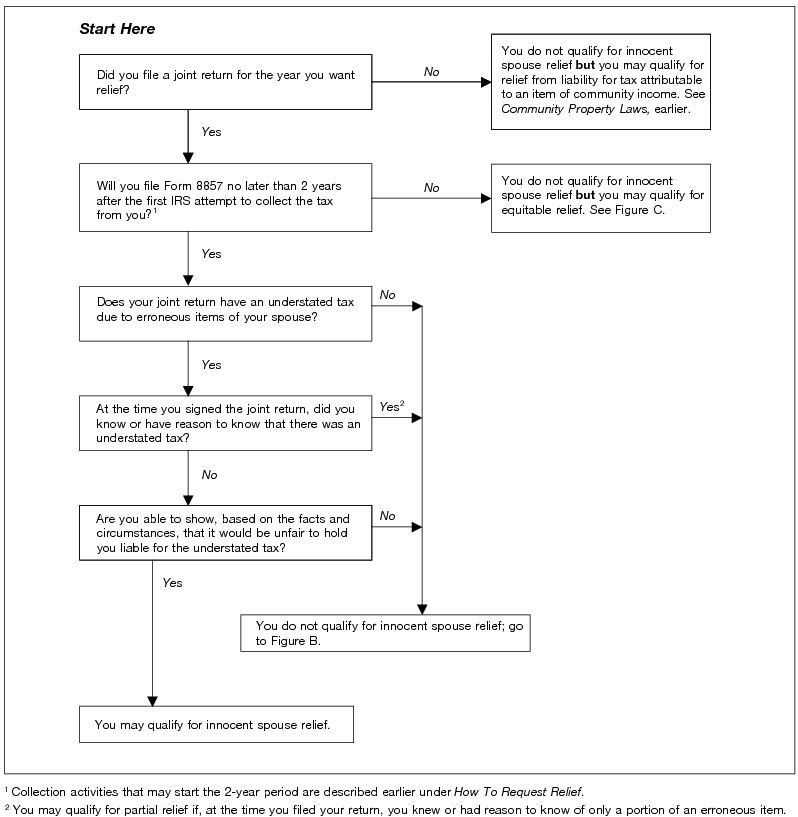
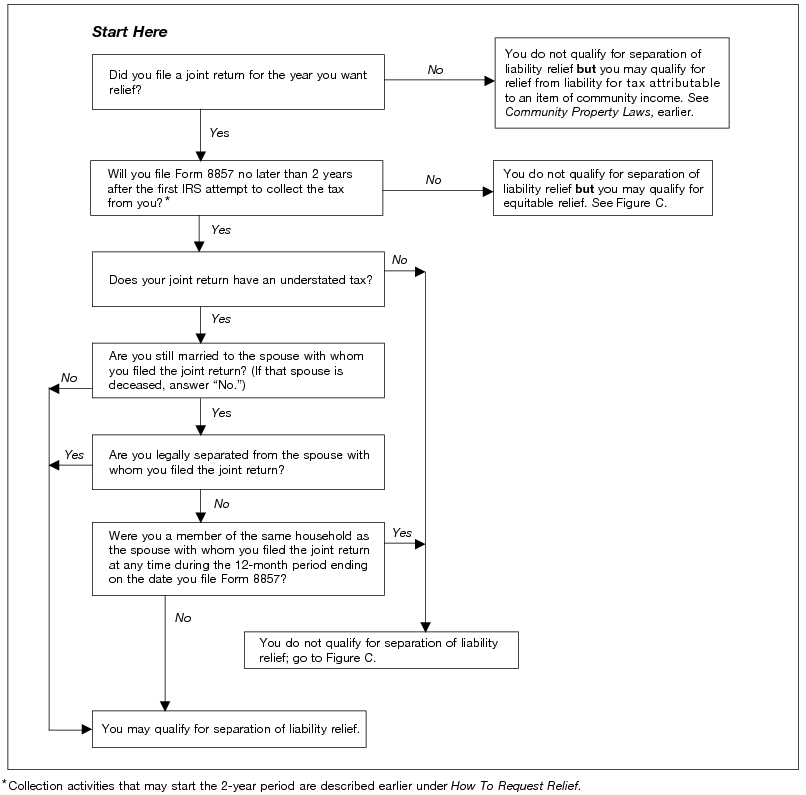
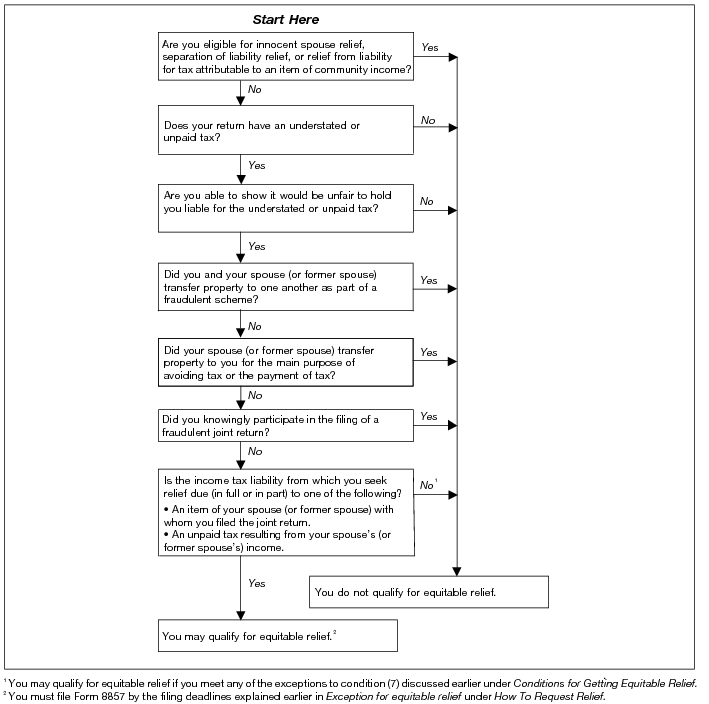
This section answers questions commonly asked by taxpayers about innocent spouse relief.
Questions & Answers
-
- What is joint and several liability?
- How can I get relief from joint and several liability?
- What are the rules for innocent spouse relief?
- What are “erroneous items”?
- What is an “understated tax”?
- Will I qualify for innocent spouse relief in any situation where there is an understated tax?
- What are the rules for separation of liability relief?
- Why would a request for separation of liability relief be denied?
- What are the rules for equitable relief?
- How do state community property laws affect my ability to qualify for relief?
- How do I request relief?
- When should I file Form 8857?
- Where should I file Form 8857?
- I am currently undergoing an examination of my return. How do I request innocent spouse relief?
- What if the IRS has given me notice that it will levy my account for the tax liability and I decide to request relief?
- What is “injured spouse relief”?
This section answers questions commonly asked by taxpayers about innocent spouse relief.
|
|
|
What is joint and several liability? |
|
|
When you file a joint income tax return, the law makes both you and your spouse responsible for the entire tax liability. This is called joint and several liability. Joint and several liability applies not only to the tax liability you show on the return but also to any additional tax liability the IRS determines to be due, even if the additional tax is due to the income, deductions, or credits of your spouse or former spouse. You remain jointly and severally liable for taxes, and the IRS still can collect from you, even if you later divorce and the divorce decree states that your former spouse will be solely responsible for the tax. There are three types of relief for filers of joint returns: “innocent spouse relief,” “separation of liability relief,” and “equitable relief.” Each type has different requirements. They are explained separately below. To qualify for innocent spouse relief, you must meet all of the following conditions.
Erroneous items are any deductions, credits, or bases that are incorrectly stated on the return, and any income that is not properly reported on the return. You have an understated tax if the IRS determined that your total tax should be more than the amount actually shown on your return. For example, you reported total tax on your 2018 return of $2,500. The IRS determined in an audit of your 2018 return that the total tax should be $3,000. You have a $500 understated tax. No. There are many situations in which you may owe tax that is related to your spouse (or former spouse), but not be eligible for innocent spouse relief. For example, you and your spouse file a joint return on which you report $10,000 of income and deductions, but you knew that your spouse was not reporting $5,000 of dividends. You are not eligible for innocent spouse relief because you have knowledge of the understated tax. Under this type of relief, you allocate (separate) the understated tax (plus interest and penalties) on your joint return between you and your spouse (or former spouse). The understated tax allocated to you is generally the amount you are responsible for. To qualify for separation of liability relief, you must have filed a joint return and meet either of the following requirements at the time you file Form 8857.
In addition to the above requirements, you must file a Form 8857 within 2 years after the date on which the IRS first began collection activity against you. Even if you meet the requirements listed earlier, a request for separation of liability relief will not be granted in the following situations.
Equitable relief is only available if you meet all of the following conditions.
Community property states are Arizona, California, Idaho, Louisiana, Nevada, New Mexico, Texas, Washington, and Wisconsin. Generally, community property laws provide that you and your spouse are both entitled to one-half of your total community income and expenses. However, community property laws are not taken into account in determining whether an item belongs to you or to your spouse (or former spouse) if you request relief from joint and several liability. File Form 8857 to ask the IRS for relief. You must file an additional Form 8857 if you are requesting relief for more than 6 years. If you are requesting innocent spouse relief or separation of liability relief, file Form 8857 no later than 2 years after the date on which the IRS first began collection activities against you. If you are requesting equitable relief, see Exception for equitable relief under When To File Form 8857, earlier, for when to file Form 8857. If you are requesting relief from liability for tax attributable to an item of community income, see How and When To Request Relief under Community Property Laws, earlier, for when to file Form 8857. Use one of the addresses or fax number shown in the Instructions for Form 8857. File Form 8857 at one of the addresses or send it to the fax number shown in the Instructions for Form 8857. Do not file it with the employee assigned to examine your return. Generally, the IRS has 10 years to collect an amount you owe. This is the collection statute of limitations. By law, the IRS is not allowed to collect from you after the 10-year period ends. If you request relief for any tax year, the IRS cannot collect from you for that year while your request is pending. But interest and penalties continue to accrue. Your request is generally considered pending from the date the IRS receives your Form 8857 until the date your request is resolved. This includes the time the Tax Court is considering your request. After your case is resolved, the IRS can begin or resume collecting from you any tax for which you are determined to remain responsible. The 10-year period will be increased by the amount of time your request for relief was pending plus 60 days. See Pub. 594 for more information. Injured spouse relief is different from innocent spouse relief. When a joint return is filed and the refund is used to pay one spouse's past-due federal tax, state income tax, state unemployment compensation debts, child support, spousal support, or federal nontax debt, such as a student loan, the other spouse may be considered an injured spouse. The injured spouse can get back his or her share of the joint overpayment using Form 8379, Injured Spouse Allocation. You are considered an injured spouse if:
|
|
|
How can I get relief from joint and several liability? |
|
|
There are three types of relief for filers of joint returns: “innocent spouse relief,” “separation of liability relief,” and “equitable relief.” Each type has different requirements. They are explained separately below. To qualify for innocent spouse relief, you must meet all of the following conditions.
Erroneous items are any deductions, credits, or bases that are incorrectly stated on the return, and any income that is not properly reported on the return. You have an understated tax if the IRS determined that your total tax should be more than the amount actually shown on your return. For example, you reported total tax on your 2018 return of $2,500. The IRS determined in an audit of your 2018 return that the total tax should be $3,000. You have a $500 understated tax. No. There are many situations in which you may owe tax that is related to your spouse (or former spouse), but not be eligible for innocent spouse relief. For example, you and your spouse file a joint return on which you report $10,000 of income and deductions, but you knew that your spouse was not reporting $5,000 of dividends. You are not eligible for innocent spouse relief because you have knowledge of the understated tax. Under this type of relief, you allocate (separate) the understated tax (plus interest and penalties) on your joint return between you and your spouse (or former spouse). The understated tax allocated to you is generally the amount you are responsible for. To qualify for separation of liability relief, you must have filed a joint return and meet either of the following requirements at the time you file Form 8857.
In addition to the above requirements, you must file a Form 8857 within 2 years after the date on which the IRS first began collection activity against you. Even if you meet the requirements listed earlier, a request for separation of liability relief will not be granted in the following situations.
Equitable relief is only available if you meet all of the following conditions.
Community property states are Arizona, California, Idaho, Louisiana, Nevada, New Mexico, Texas, Washington, and Wisconsin. Generally, community property laws provide that you and your spouse are both entitled to one-half of your total community income and expenses. However, community property laws are not taken into account in determining whether an item belongs to you or to your spouse (or former spouse) if you request relief from joint and several liability. File Form 8857 to ask the IRS for relief. You must file an additional Form 8857 if you are requesting relief for more than 6 years. If you are requesting innocent spouse relief or separation of liability relief, file Form 8857 no later than 2 years after the date on which the IRS first began collection activities against you. If you are requesting equitable relief, see Exception for equitable relief under When To File Form 8857, earlier, for when to file Form 8857. If you are requesting relief from liability for tax attributable to an item of community income, see How and When To Request Relief under Community Property Laws, earlier, for when to file Form 8857. Use one of the addresses or fax number shown in the Instructions for Form 8857. File Form 8857 at one of the addresses or send it to the fax number shown in the Instructions for Form 8857. Do not file it with the employee assigned to examine your return. Generally, the IRS has 10 years to collect an amount you owe. This is the collection statute of limitations. By law, the IRS is not allowed to collect from you after the 10-year period ends. If you request relief for any tax year, the IRS cannot collect from you for that year while your request is pending. But interest and penalties continue to accrue. Your request is generally considered pending from the date the IRS receives your Form 8857 until the date your request is resolved. This includes the time the Tax Court is considering your request. After your case is resolved, the IRS can begin or resume collecting from you any tax for which you are determined to remain responsible. The 10-year period will be increased by the amount of time your request for relief was pending plus 60 days. See Pub. 594 for more information. Injured spouse relief is different from innocent spouse relief. When a joint return is filed and the refund is used to pay one spouse's past-due federal tax, state income tax, state unemployment compensation debts, child support, spousal support, or federal nontax debt, such as a student loan, the other spouse may be considered an injured spouse. The injured spouse can get back his or her share of the joint overpayment using Form 8379, Injured Spouse Allocation. You are considered an injured spouse if:
|
|
|
What are the rules for innocent spouse relief? |
|
|
To qualify for innocent spouse relief, you must meet all of the following conditions.
Erroneous items are any deductions, credits, or bases that are incorrectly stated on the return, and any income that is not properly reported on the return. You have an understated tax if the IRS determined that your total tax should be more than the amount actually shown on your return. For example, you reported total tax on your 2018 return of $2,500. The IRS determined in an audit of your 2018 return that the total tax should be $3,000. You have a $500 understated tax. No. There are many situations in which you may owe tax that is related to your spouse (or former spouse), but not be eligible for innocent spouse relief. For example, you and your spouse file a joint return on which you report $10,000 of income and deductions, but you knew that your spouse was not reporting $5,000 of dividends. You are not eligible for innocent spouse relief because you have knowledge of the understated tax. Under this type of relief, you allocate (separate) the understated tax (plus interest and penalties) on your joint return between you and your spouse (or former spouse). The understated tax allocated to you is generally the amount you are responsible for. To qualify for separation of liability relief, you must have filed a joint return and meet either of the following requirements at the time you file Form 8857.
In addition to the above requirements, you must file a Form 8857 within 2 years after the date on which the IRS first began collection activity against you. Even if you meet the requirements listed earlier, a request for separation of liability relief will not be granted in the following situations.
Equitable relief is only available if you meet all of the following conditions.
Community property states are Arizona, California, Idaho, Louisiana, Nevada, New Mexico, Texas, Washington, and Wisconsin. Generally, community property laws provide that you and your spouse are both entitled to one-half of your total community income and expenses. However, community property laws are not taken into account in determining whether an item belongs to you or to your spouse (or former spouse) if you request relief from joint and several liability. File Form 8857 to ask the IRS for relief. You must file an additional Form 8857 if you are requesting relief for more than 6 years. If you are requesting innocent spouse relief or separation of liability relief, file Form 8857 no later than 2 years after the date on which the IRS first began collection activities against you. If you are requesting equitable relief, see Exception for equitable relief under When To File Form 8857, earlier, for when to file Form 8857. If you are requesting relief from liability for tax attributable to an item of community income, see How and When To Request Relief under Community Property Laws, earlier, for when to file Form 8857. Use one of the addresses or fax number shown in the Instructions for Form 8857. File Form 8857 at one of the addresses or send it to the fax number shown in the Instructions for Form 8857. Do not file it with the employee assigned to examine your return. Generally, the IRS has 10 years to collect an amount you owe. This is the collection statute of limitations. By law, the IRS is not allowed to collect from you after the 10-year period ends. If you request relief for any tax year, the IRS cannot collect from you for that year while your request is pending. But interest and penalties continue to accrue. Your request is generally considered pending from the date the IRS receives your Form 8857 until the date your request is resolved. This includes the time the Tax Court is considering your request. After your case is resolved, the IRS can begin or resume collecting from you any tax for which you are determined to remain responsible. The 10-year period will be increased by the amount of time your request for relief was pending plus 60 days. See Pub. 594 for more information. Injured spouse relief is different from innocent spouse relief. When a joint return is filed and the refund is used to pay one spouse's past-due federal tax, state income tax, state unemployment compensation debts, child support, spousal support, or federal nontax debt, such as a student loan, the other spouse may be considered an injured spouse. The injured spouse can get back his or her share of the joint overpayment using Form 8379, Injured Spouse Allocation. You are considered an injured spouse if:
|
|
|
What are “erroneous items”? |
|
|
Erroneous items are any deductions, credits, or bases that are incorrectly stated on the return, and any income that is not properly reported on the return. You have an understated tax if the IRS determined that your total tax should be more than the amount actually shown on your return. For example, you reported total tax on your 2018 return of $2,500. The IRS determined in an audit of your 2018 return that the total tax should be $3,000. You have a $500 understated tax. No. There are many situations in which you may owe tax that is related to your spouse (or former spouse), but not be eligible for innocent spouse relief. For example, you and your spouse file a joint return on which you report $10,000 of income and deductions, but you knew that your spouse was not reporting $5,000 of dividends. You are not eligible for innocent spouse relief because you have knowledge of the understated tax. Under this type of relief, you allocate (separate) the understated tax (plus interest and penalties) on your joint return between you and your spouse (or former spouse). The understated tax allocated to you is generally the amount you are responsible for. To qualify for separation of liability relief, you must have filed a joint return and meet either of the following requirements at the time you file Form 8857.
In addition to the above requirements, you must file a Form 8857 within 2 years after the date on which the IRS first began collection activity against you. Even if you meet the requirements listed earlier, a request for separation of liability relief will not be granted in the following situations.
Equitable relief is only available if you meet all of the following conditions.
Community property states are Arizona, California, Idaho, Louisiana, Nevada, New Mexico, Texas, Washington, and Wisconsin. Generally, community property laws provide that you and your spouse are both entitled to one-half of your total community income and expenses. However, community property laws are not taken into account in determining whether an item belongs to you or to your spouse (or former spouse) if you request relief from joint and several liability. File Form 8857 to ask the IRS for relief. You must file an additional Form 8857 if you are requesting relief for more than 6 years. If you are requesting innocent spouse relief or separation of liability relief, file Form 8857 no later than 2 years after the date on which the IRS first began collection activities against you. If you are requesting equitable relief, see Exception for equitable relief under When To File Form 8857, earlier, for when to file Form 8857. If you are requesting relief from liability for tax attributable to an item of community income, see How and When To Request Relief under Community Property Laws, earlier, for when to file Form 8857. Use one of the addresses or fax number shown in the Instructions for Form 8857. File Form 8857 at one of the addresses or send it to the fax number shown in the Instructions for Form 8857. Do not file it with the employee assigned to examine your return. Generally, the IRS has 10 years to collect an amount you owe. This is the collection statute of limitations. By law, the IRS is not allowed to collect from you after the 10-year period ends. If you request relief for any tax year, the IRS cannot collect from you for that year while your request is pending. But interest and penalties continue to accrue. Your request is generally considered pending from the date the IRS receives your Form 8857 until the date your request is resolved. This includes the time the Tax Court is considering your request. After your case is resolved, the IRS can begin or resume collecting from you any tax for which you are determined to remain responsible. The 10-year period will be increased by the amount of time your request for relief was pending plus 60 days. See Pub. 594 for more information. Injured spouse relief is different from innocent spouse relief. When a joint return is filed and the refund is used to pay one spouse's past-due federal tax, state income tax, state unemployment compensation debts, child support, spousal support, or federal nontax debt, such as a student loan, the other spouse may be considered an injured spouse. The injured spouse can get back his or her share of the joint overpayment using Form 8379, Injured Spouse Allocation. You are considered an injured spouse if:
|
|
|
What is an “understated tax”? |
|
|
You have an understated tax if the IRS determined that your total tax should be more than the amount actually shown on your return. For example, you reported total tax on your 2018 return of $2,500. The IRS determined in an audit of your 2018 return that the total tax should be $3,000. You have a $500 understated tax. No. There are many situations in which you may owe tax that is related to your spouse (or former spouse), but not be eligible for innocent spouse relief. For example, you and your spouse file a joint return on which you report $10,000 of income and deductions, but you knew that your spouse was not reporting $5,000 of dividends. You are not eligible for innocent spouse relief because you have knowledge of the understated tax. Under this type of relief, you allocate (separate) the understated tax (plus interest and penalties) on your joint return between you and your spouse (or former spouse). The understated tax allocated to you is generally the amount you are responsible for. To qualify for separation of liability relief, you must have filed a joint return and meet either of the following requirements at the time you file Form 8857.
In addition to the above requirements, you must file a Form 8857 within 2 years after the date on which the IRS first began collection activity against you. Even if you meet the requirements listed earlier, a request for separation of liability relief will not be granted in the following situations.
Equitable relief is only available if you meet all of the following conditions.
Community property states are Arizona, California, Idaho, Louisiana, Nevada, New Mexico, Texas, Washington, and Wisconsin. Generally, community property laws provide that you and your spouse are both entitled to one-half of your total community income and expenses. However, community property laws are not taken into account in determining whether an item belongs to you or to your spouse (or former spouse) if you request relief from joint and several liability. File Form 8857 to ask the IRS for relief. You must file an additional Form 8857 if you are requesting relief for more than 6 years. If you are requesting innocent spouse relief or separation of liability relief, file Form 8857 no later than 2 years after the date on which the IRS first began collection activities against you. If you are requesting equitable relief, see Exception for equitable relief under When To File Form 8857, earlier, for when to file Form 8857. If you are requesting relief from liability for tax attributable to an item of community income, see How and When To Request Relief under Community Property Laws, earlier, for when to file Form 8857. Use one of the addresses or fax number shown in the Instructions for Form 8857. File Form 8857 at one of the addresses or send it to the fax number shown in the Instructions for Form 8857. Do not file it with the employee assigned to examine your return. Generally, the IRS has 10 years to collect an amount you owe. This is the collection statute of limitations. By law, the IRS is not allowed to collect from you after the 10-year period ends. If you request relief for any tax year, the IRS cannot collect from you for that year while your request is pending. But interest and penalties continue to accrue. Your request is generally considered pending from the date the IRS receives your Form 8857 until the date your request is resolved. This includes the time the Tax Court is considering your request. After your case is resolved, the IRS can begin or resume collecting from you any tax for which you are determined to remain responsible. The 10-year period will be increased by the amount of time your request for relief was pending plus 60 days. See Pub. 594 for more information. Injured spouse relief is different from innocent spouse relief. When a joint return is filed and the refund is used to pay one spouse's past-due federal tax, state income tax, state unemployment compensation debts, child support, spousal support, or federal nontax debt, such as a student loan, the other spouse may be considered an injured spouse. The injured spouse can get back his or her share of the joint overpayment using Form 8379, Injured Spouse Allocation. You are considered an injured spouse if:
|
|
|
Will I qualify for innocent spouse relief in any situation where there is an understated tax? |
|
|
No. There are many situations in which you may owe tax that is related to your spouse (or former spouse), but not be eligible for innocent spouse relief. For example, you and your spouse file a joint return on which you report $10,000 of income and deductions, but you knew that your spouse was not reporting $5,000 of dividends. You are not eligible for innocent spouse relief because you have knowledge of the understated tax. Under this type of relief, you allocate (separate) the understated tax (plus interest and penalties) on your joint return between you and your spouse (or former spouse). The understated tax allocated to you is generally the amount you are responsible for. To qualify for separation of liability relief, you must have filed a joint return and meet either of the following requirements at the time you file Form 8857.
In addition to the above requirements, you must file a Form 8857 within 2 years after the date on which the IRS first began collection activity against you. Even if you meet the requirements listed earlier, a request for separation of liability relief will not be granted in the following situations.
Equitable relief is only available if you meet all of the following conditions.
Community property states are Arizona, California, Idaho, Louisiana, Nevada, New Mexico, Texas, Washington, and Wisconsin. Generally, community property laws provide that you and your spouse are both entitled to one-half of your total community income and expenses. However, community property laws are not taken into account in determining whether an item belongs to you or to your spouse (or former spouse) if you request relief from joint and several liability. File Form 8857 to ask the IRS for relief. You must file an additional Form 8857 if you are requesting relief for more than 6 years. If you are requesting innocent spouse relief or separation of liability relief, file Form 8857 no later than 2 years after the date on which the IRS first began collection activities against you. If you are requesting equitable relief, see Exception for equitable relief under When To File Form 8857, earlier, for when to file Form 8857. If you are requesting relief from liability for tax attributable to an item of community income, see How and When To Request Relief under Community Property Laws, earlier, for when to file Form 8857. Use one of the addresses or fax number shown in the Instructions for Form 8857. File Form 8857 at one of the addresses or send it to the fax number shown in the Instructions for Form 8857. Do not file it with the employee assigned to examine your return. Generally, the IRS has 10 years to collect an amount you owe. This is the collection statute of limitations. By law, the IRS is not allowed to collect from you after the 10-year period ends. If you request relief for any tax year, the IRS cannot collect from you for that year while your request is pending. But interest and penalties continue to accrue. Your request is generally considered pending from the date the IRS receives your Form 8857 until the date your request is resolved. This includes the time the Tax Court is considering your request. After your case is resolved, the IRS can begin or resume collecting from you any tax for which you are determined to remain responsible. The 10-year period will be increased by the amount of time your request for relief was pending plus 60 days. See Pub. 594 for more information. Injured spouse relief is different from innocent spouse relief. When a joint return is filed and the refund is used to pay one spouse's past-due federal tax, state income tax, state unemployment compensation debts, child support, spousal support, or federal nontax debt, such as a student loan, the other spouse may be considered an injured spouse. The injured spouse can get back his or her share of the joint overpayment using Form 8379, Injured Spouse Allocation. You are considered an injured spouse if:
|
|
|
What are the rules for separation of liability relief? |
|
|
Under this type of relief, you allocate (separate) the understated tax (plus interest and penalties) on your joint return between you and your spouse (or former spouse). The understated tax allocated to you is generally the amount you are responsible for. To qualify for separation of liability relief, you must have filed a joint return and meet either of the following requirements at the time you file Form 8857.
In addition to the above requirements, you must file a Form 8857 within 2 years after the date on which the IRS first began collection activity against you. Even if you meet the requirements listed earlier, a request for separation of liability relief will not be granted in the following situations.
Equitable relief is only available if you meet all of the following conditions.
Community property states are Arizona, California, Idaho, Louisiana, Nevada, New Mexico, Texas, Washington, and Wisconsin. Generally, community property laws provide that you and your spouse are both entitled to one-half of your total community income and expenses. However, community property laws are not taken into account in determining whether an item belongs to you or to your spouse (or former spouse) if you request relief from joint and several liability. File Form 8857 to ask the IRS for relief. You must file an additional Form 8857 if you are requesting relief for more than 6 years. If you are requesting innocent spouse relief or separation of liability relief, file Form 8857 no later than 2 years after the date on which the IRS first began collection activities against you. If you are requesting equitable relief, see Exception for equitable relief under When To File Form 8857, earlier, for when to file Form 8857. If you are requesting relief from liability for tax attributable to an item of community income, see How and When To Request Relief under Community Property Laws, earlier, for when to file Form 8857. Use one of the addresses or fax number shown in the Instructions for Form 8857. File Form 8857 at one of the addresses or send it to the fax number shown in the Instructions for Form 8857. Do not file it with the employee assigned to examine your return. Generally, the IRS has 10 years to collect an amount you owe. This is the collection statute of limitations. By law, the IRS is not allowed to collect from you after the 10-year period ends. If you request relief for any tax year, the IRS cannot collect from you for that year while your request is pending. But interest and penalties continue to accrue. Your request is generally considered pending from the date the IRS receives your Form 8857 until the date your request is resolved. This includes the time the Tax Court is considering your request. After your case is resolved, the IRS can begin or resume collecting from you any tax for which you are determined to remain responsible. The 10-year period will be increased by the amount of time your request for relief was pending plus 60 days. See Pub. 594 for more information. Injured spouse relief is different from innocent spouse relief. When a joint return is filed and the refund is used to pay one spouse's past-due federal tax, state income tax, state unemployment compensation debts, child support, spousal support, or federal nontax debt, such as a student loan, the other spouse may be considered an injured spouse. The injured spouse can get back his or her share of the joint overpayment using Form 8379, Injured Spouse Allocation. You are considered an injured spouse if:
|
|
|
Why would a request for separation of liability relief be denied? |
|
|
Even if you meet the requirements listed earlier, a request for separation of liability relief will not be granted in the following situations.
Equitable relief is only available if you meet all of the following conditions.
Community property states are Arizona, California, Idaho, Louisiana, Nevada, New Mexico, Texas, Washington, and Wisconsin. Generally, community property laws provide that you and your spouse are both entitled to one-half of your total community income and expenses. However, community property laws are not taken into account in determining whether an item belongs to you or to your spouse (or former spouse) if you request relief from joint and several liability. File Form 8857 to ask the IRS for relief. You must file an additional Form 8857 if you are requesting relief for more than 6 years. If you are requesting innocent spouse relief or separation of liability relief, file Form 8857 no later than 2 years after the date on which the IRS first began collection activities against you. If you are requesting equitable relief, see Exception for equitable relief under When To File Form 8857, earlier, for when to file Form 8857. If you are requesting relief from liability for tax attributable to an item of community income, see How and When To Request Relief under Community Property Laws, earlier, for when to file Form 8857. Use one of the addresses or fax number shown in the Instructions for Form 8857. File Form 8857 at one of the addresses or send it to the fax number shown in the Instructions for Form 8857. Do not file it with the employee assigned to examine your return. Generally, the IRS has 10 years to collect an amount you owe. This is the collection statute of limitations. By law, the IRS is not allowed to collect from you after the 10-year period ends. If you request relief for any tax year, the IRS cannot collect from you for that year while your request is pending. But interest and penalties continue to accrue. Your request is generally considered pending from the date the IRS receives your Form 8857 until the date your request is resolved. This includes the time the Tax Court is considering your request. After your case is resolved, the IRS can begin or resume collecting from you any tax for which you are determined to remain responsible. The 10-year period will be increased by the amount of time your request for relief was pending plus 60 days. See Pub. 594 for more information. Injured spouse relief is different from innocent spouse relief. When a joint return is filed and the refund is used to pay one spouse's past-due federal tax, state income tax, state unemployment compensation debts, child support, spousal support, or federal nontax debt, such as a student loan, the other spouse may be considered an injured spouse. The injured spouse can get back his or her share of the joint overpayment using Form 8379, Injured Spouse Allocation. You are considered an injured spouse if:
|
|
|
What are the rules for equitable relief? |
|
|
Equitable relief is only available if you meet all of the following conditions.
Community property states are Arizona, California, Idaho, Louisiana, Nevada, New Mexico, Texas, Washington, and Wisconsin. Generally, community property laws provide that you and your spouse are both entitled to one-half of your total community income and expenses. However, community property laws are not taken into account in determining whether an item belongs to you or to your spouse (or former spouse) if you request relief from joint and several liability. File Form 8857 to ask the IRS for relief. You must file an additional Form 8857 if you are requesting relief for more than 6 years. If you are requesting innocent spouse relief or separation of liability relief, file Form 8857 no later than 2 years after the date on which the IRS first began collection activities against you. If you are requesting equitable relief, see Exception for equitable relief under When To File Form 8857, earlier, for when to file Form 8857. If you are requesting relief from liability for tax attributable to an item of community income, see How and When To Request Relief under Community Property Laws, earlier, for when to file Form 8857. Use one of the addresses or fax number shown in the Instructions for Form 8857. File Form 8857 at one of the addresses or send it to the fax number shown in the Instructions for Form 8857. Do not file it with the employee assigned to examine your return. Generally, the IRS has 10 years to collect an amount you owe. This is the collection statute of limitations. By law, the IRS is not allowed to collect from you after the 10-year period ends. If you request relief for any tax year, the IRS cannot collect from you for that year while your request is pending. But interest and penalties continue to accrue. Your request is generally considered pending from the date the IRS receives your Form 8857 until the date your request is resolved. This includes the time the Tax Court is considering your request. After your case is resolved, the IRS can begin or resume collecting from you any tax for which you are determined to remain responsible. The 10-year period will be increased by the amount of time your request for relief was pending plus 60 days. See Pub. 594 for more information. Injured spouse relief is different from innocent spouse relief. When a joint return is filed and the refund is used to pay one spouse's past-due federal tax, state income tax, state unemployment compensation debts, child support, spousal support, or federal nontax debt, such as a student loan, the other spouse may be considered an injured spouse. The injured spouse can get back his or her share of the joint overpayment using Form 8379, Injured Spouse Allocation. You are considered an injured spouse if:
|
|
|
How do state community property laws affect my ability to qualify for relief? |
|
|
Community property states are Arizona, California, Idaho, Louisiana, Nevada, New Mexico, Texas, Washington, and Wisconsin. Generally, community property laws provide that you and your spouse are both entitled to one-half of your total community income and expenses. However, community property laws are not taken into account in determining whether an item belongs to you or to your spouse (or former spouse) if you request relief from joint and several liability. File Form 8857 to ask the IRS for relief. You must file an additional Form 8857 if you are requesting relief for more than 6 years. If you are requesting innocent spouse relief or separation of liability relief, file Form 8857 no later than 2 years after the date on which the IRS first began collection activities against you. If you are requesting equitable relief, see Exception for equitable relief under When To File Form 8857, earlier, for when to file Form 8857. If you are requesting relief from liability for tax attributable to an item of community income, see How and When To Request Relief under Community Property Laws, earlier, for when to file Form 8857. Use one of the addresses or fax number shown in the Instructions for Form 8857. File Form 8857 at one of the addresses or send it to the fax number shown in the Instructions for Form 8857. Do not file it with the employee assigned to examine your return. Generally, the IRS has 10 years to collect an amount you owe. This is the collection statute of limitations. By law, the IRS is not allowed to collect from you after the 10-year period ends. If you request relief for any tax year, the IRS cannot collect from you for that year while your request is pending. But interest and penalties continue to accrue. Your request is generally considered pending from the date the IRS receives your Form 8857 until the date your request is resolved. This includes the time the Tax Court is considering your request. After your case is resolved, the IRS can begin or resume collecting from you any tax for which you are determined to remain responsible. The 10-year period will be increased by the amount of time your request for relief was pending plus 60 days. See Pub. 594 for more information. Injured spouse relief is different from innocent spouse relief. When a joint return is filed and the refund is used to pay one spouse's past-due federal tax, state income tax, state unemployment compensation debts, child support, spousal support, or federal nontax debt, such as a student loan, the other spouse may be considered an injured spouse. The injured spouse can get back his or her share of the joint overpayment using Form 8379, Injured Spouse Allocation. You are considered an injured spouse if:
|
|
|
How do I request relief? |
|
|
File Form 8857 to ask the IRS for relief. You must file an additional Form 8857 if you are requesting relief for more than 6 years. If you are requesting innocent spouse relief or separation of liability relief, file Form 8857 no later than 2 years after the date on which the IRS first began collection activities against you. If you are requesting equitable relief, see Exception for equitable relief under When To File Form 8857, earlier, for when to file Form 8857. If you are requesting relief from liability for tax attributable to an item of community income, see How and When To Request Relief under Community Property Laws, earlier, for when to file Form 8857. Use one of the addresses or fax number shown in the Instructions for Form 8857. File Form 8857 at one of the addresses or send it to the fax number shown in the Instructions for Form 8857. Do not file it with the employee assigned to examine your return. Generally, the IRS has 10 years to collect an amount you owe. This is the collection statute of limitations. By law, the IRS is not allowed to collect from you after the 10-year period ends. If you request relief for any tax year, the IRS cannot collect from you for that year while your request is pending. But interest and penalties continue to accrue. Your request is generally considered pending from the date the IRS receives your Form 8857 until the date your request is resolved. This includes the time the Tax Court is considering your request. After your case is resolved, the IRS can begin or resume collecting from you any tax for which you are determined to remain responsible. The 10-year period will be increased by the amount of time your request for relief was pending plus 60 days. See Pub. 594 for more information. Injured spouse relief is different from innocent spouse relief. When a joint return is filed and the refund is used to pay one spouse's past-due federal tax, state income tax, state unemployment compensation debts, child support, spousal support, or federal nontax debt, such as a student loan, the other spouse may be considered an injured spouse. The injured spouse can get back his or her share of the joint overpayment using Form 8379, Injured Spouse Allocation. You are considered an injured spouse if:
|
|
|
When should I file Form 8857? |
|
|
If you are requesting innocent spouse relief or separation of liability relief, file Form 8857 no later than 2 years after the date on which the IRS first began collection activities against you. If you are requesting equitable relief, see Exception for equitable relief under When To File Form 8857, earlier, for when to file Form 8857. If you are requesting relief from liability for tax attributable to an item of community income, see How and When To Request Relief under Community Property Laws, earlier, for when to file Form 8857. Use one of the addresses or fax number shown in the Instructions for Form 8857. File Form 8857 at one of the addresses or send it to the fax number shown in the Instructions for Form 8857. Do not file it with the employee assigned to examine your return. Generally, the IRS has 10 years to collect an amount you owe. This is the collection statute of limitations. By law, the IRS is not allowed to collect from you after the 10-year period ends. If you request relief for any tax year, the IRS cannot collect from you for that year while your request is pending. But interest and penalties continue to accrue. Your request is generally considered pending from the date the IRS receives your Form 8857 until the date your request is resolved. This includes the time the Tax Court is considering your request. After your case is resolved, the IRS can begin or resume collecting from you any tax for which you are determined to remain responsible. The 10-year period will be increased by the amount of time your request for relief was pending plus 60 days. See Pub. 594 for more information. Injured spouse relief is different from innocent spouse relief. When a joint return is filed and the refund is used to pay one spouse's past-due federal tax, state income tax, state unemployment compensation debts, child support, spousal support, or federal nontax debt, such as a student loan, the other spouse may be considered an injured spouse. The injured spouse can get back his or her share of the joint overpayment using Form 8379, Injured Spouse Allocation. You are considered an injured spouse if:
|
|
|
Where should I file Form 8857? |
|
|
Use one of the addresses or fax number shown in the Instructions for Form 8857. File Form 8857 at one of the addresses or send it to the fax number shown in the Instructions for Form 8857. Do not file it with the employee assigned to examine your return. Generally, the IRS has 10 years to collect an amount you owe. This is the collection statute of limitations. By law, the IRS is not allowed to collect from you after the 10-year period ends. If you request relief for any tax year, the IRS cannot collect from you for that year while your request is pending. But interest and penalties continue to accrue. Your request is generally considered pending from the date the IRS receives your Form 8857 until the date your request is resolved. This includes the time the Tax Court is considering your request. After your case is resolved, the IRS can begin or resume collecting from you any tax for which you are determined to remain responsible. The 10-year period will be increased by the amount of time your request for relief was pending plus 60 days. See Pub. 594 for more information. Injured spouse relief is different from innocent spouse relief. When a joint return is filed and the refund is used to pay one spouse's past-due federal tax, state income tax, state unemployment compensation debts, child support, spousal support, or federal nontax debt, such as a student loan, the other spouse may be considered an injured spouse. The injured spouse can get back his or her share of the joint overpayment using Form 8379, Injured Spouse Allocation. You are considered an injured spouse if:
|
|
|
I am currently undergoing an examination of my return. How do I request innocent spouse relief? |
|
|
File Form 8857 at one of the addresses or send it to the fax number shown in the Instructions for Form 8857. Do not file it with the employee assigned to examine your return. Generally, the IRS has 10 years to collect an amount you owe. This is the collection statute of limitations. By law, the IRS is not allowed to collect from you after the 10-year period ends. If you request relief for any tax year, the IRS cannot collect from you for that year while your request is pending. But interest and penalties continue to accrue. Your request is generally considered pending from the date the IRS receives your Form 8857 until the date your request is resolved. This includes the time the Tax Court is considering your request. After your case is resolved, the IRS can begin or resume collecting from you any tax for which you are determined to remain responsible. The 10-year period will be increased by the amount of time your request for relief was pending plus 60 days. See Pub. 594 for more information. Injured spouse relief is different from innocent spouse relief. When a joint return is filed and the refund is used to pay one spouse's past-due federal tax, state income tax, state unemployment compensation debts, child support, spousal support, or federal nontax debt, such as a student loan, the other spouse may be considered an injured spouse. The injured spouse can get back his or her share of the joint overpayment using Form 8379, Injured Spouse Allocation. You are considered an injured spouse if:
|
|
|
What if the IRS has given me notice that it will levy my account for the tax liability and I decide to request relief? |
|
|
Generally, the IRS has 10 years to collect an amount you owe. This is the collection statute of limitations. By law, the IRS is not allowed to collect from you after the 10-year period ends. If you request relief for any tax year, the IRS cannot collect from you for that year while your request is pending. But interest and penalties continue to accrue. Your request is generally considered pending from the date the IRS receives your Form 8857 until the date your request is resolved. This includes the time the Tax Court is considering your request. After your case is resolved, the IRS can begin or resume collecting from you any tax for which you are determined to remain responsible. The 10-year period will be increased by the amount of time your request for relief was pending plus 60 days. See Pub. 594 for more information. Injured spouse relief is different from innocent spouse relief. When a joint return is filed and the refund is used to pay one spouse's past-due federal tax, state income tax, state unemployment compensation debts, child support, spousal support, or federal nontax debt, such as a student loan, the other spouse may be considered an injured spouse. The injured spouse can get back his or her share of the joint overpayment using Form 8379, Injured Spouse Allocation. You are considered an injured spouse if:
|
|
|
What is “injured spouse relief”? |
|
|
Injured spouse relief is different from innocent spouse relief. When a joint return is filed and the refund is used to pay one spouse's past-due federal tax, state income tax, state unemployment compensation debts, child support, spousal support, or federal nontax debt, such as a student loan, the other spouse may be considered an injured spouse. The injured spouse can get back his or her share of the joint overpayment using Form 8379, Injured Spouse Allocation. You are considered an injured spouse if:
|
|
How To Get Tax Help
If you have questions about a tax issue; need help preparing your tax return; or want to download free publications, forms, or instructions, go to IRS.gov to find resources that can help you right away.
Preparing and filing your tax return.
After receiving all your wage and earnings statements (Forms W-2, W-2G, 1099-R, 1099-MISC, 1099-NEC, etc.); unemployment compensation statements (by mail or in a digital format) or other government payment statements (Form 1099-G); and interest, dividend, and retirement statements from banks and investment firms (Forms 1099), you have several options to choose from to prepare and file your tax return. You can prepare the tax return yourself, see if you qualify for free tax preparation, or hire a tax professional to prepare your return.
.For 2021, if you received an Economic Impact Payment (EIP), refer to your Notice 1444-C, Your 2021 Economic Impact Payment. If you received Advance Child Tax Credit payments, refer to your Letter 6419..
Free options for tax preparation.
Go to IRS.gov to see your options for preparing and filing your return online or in your local community, if you qualify, which include the following.
-
Free File. This program lets you prepare and file your federal individual income tax return for free using brand-name tax-preparation-and-filing software or Free File fillable forms. However, state tax preparation may not be available through Free File. Go to IRS.gov/FreeFile to see if you qualify for free online federal tax preparation, e-filing, and direct deposit or payment options.
-
VITA. The Volunteer Income Tax Assistance (VITA) program offers free tax help to people with low-to-moderate incomes, persons with disabilities, and limited-English-speaking taxpayers who need help preparing their own tax returns. Go to IRS.gov/VITA, download the free IRS2Go app, or call 800-906-9887 for information on free tax return preparation.
-
TCE. The Tax Counseling for the Elderly (TCE) program offers free tax help for all taxpayers, particularly those who are 60 years of age and older. TCE volunteers specialize in answering questions about pensions and retirement-related issues unique to seniors. Go to IRS.gov/TCE, download the free IRS2Go app, or call 888-227-7669 for information on free tax return preparation.
-
MilTax. Members of the U.S. Armed Forces and qualified veterans may use MilTax, a free tax service offered by the Department of Defense through Military OneSource. For more information, go to MilitaryOneSource (MilitaryOneSource.mil/Tax).
Also, the IRS offers Free Fillable Forms, which can be completed online and then filed electronically regardless of income.
Using online tools to help prepare your return.
Go to IRS.gov/Tools for the following.
-
The Earned Income Tax Credit Assistant (IRS.gov/EITCAssistant) determines if you’re eligible for the earned income credit (EIC).
-
The Online EIN Application (IRS.gov/EIN) helps you get an employer identification number (EIN) at no cost.
-
The Tax Withholding Estimator (IRS.gov/W4app) makes it easier for everyone to pay the correct amount of tax during the year. The tool is a convenient, online way to check and tailor your withholding. It’s more user-friendly for taxpayers, including retirees and self-employed individuals. The features include the following.
▶ Easy to understand language.
▶ The ability to switch between screens, correct previous entries, and skip screens that don’t apply.
▶ Tips and links to help you determine if you qualify for tax credits and deductions.
▶ A progress tracker.
▶ A self-employment tax feature.
▶ Automatic calculation of taxable social security benefits.
-
The First-Time Homebuyer Credit Account Look-up (IRS.gov/HomeBuyer) tool provides information on your repayments and account balance.
-
The Sales Tax Deduction Calculator (IRS.gov/SalesTax) figures the amount you can claim if you itemize deductions on Schedule A (Form 1040).
. Getting answers to your tax questions. On IRS.gov, you can get up-to-date information on current events and changes in tax law..
-
IRS.gov/Help: A variety of tools to help you get answers to some of the most common tax questions.
-
IRS.gov/ITA: The Interactive Tax Assistant, a tool that will ask you questions and, based on your input, provide answers on a number of tax law topics.
-
IRS.gov/Forms: Find forms, instructions, and publications. You will find details on 2021 tax changes and hundreds of interactive links to help you find answers to your questions.
-
You may also be able to access tax law information in your electronic filing software.
Need someone to prepare your tax return?
There are various types of tax return preparers, including tax preparers, enrolled agents, certified public accountants (CPAs), attorneys, and many others who don’t have professional credentials. If you choose to have someone prepare your tax return, choose that preparer wisely. A paid tax preparer is:
-
Primarily responsible for the overall substantive accuracy of your return,
-
Required to sign the return, and
-
Required to include their preparer tax identification number (PTIN).
Although the tax preparer always signs the return, you're ultimately responsible for providing all the information required for the preparer to accurately prepare your return. Anyone paid to prepare tax returns for others should have a thorough understanding of tax matters. For more information on how to choose a tax preparer, go to Tips for Choosing a Tax Preparer on IRS.gov.
Advance child tax credit payments.
From July through December 2021, advance payments were sent automatically to taxpayers with qualifying children who met certain criteria. The advance child tax credit payments were early payments of up to 50% of the estimated child tax credit that taxpayers may properly claim on their 2021 returns. Go to IRS.gov/AdvCTC for more information about these payments and how they can affect your taxes.
Coronavirus.
Go to IRS.gov/Coronavirus for links to information on the impact of the coronavirus, as well as tax relief available for individuals and families, small and large businesses, and tax-exempt organizations.
Employers can register to use Business Services Online.
The Social Security Administration (SSA) offers online service at SSA.gov/employer for fast, free, and secure online W-2 filing options to CPAs, accountants, enrolled agents, and individuals who process Form W-2, Wage and Tax Statement, and Form W-2c, Corrected Wage and Tax Statement.
IRS social media.
Go to IRS.gov/SocialMedia to see the various social media tools the IRS uses to share the latest information on tax changes, scam alerts, initiatives, products, and services. At the IRS, privacy and security are our highest priority. We use these tools to share public information with you. Don’t post your social security number (SSN) or other confidential information on social media sites. Always protect your identity when using any social networking site.
The following IRS YouTube channels provide short, informative videos on various tax-related topics in English, Spanish, and ASL.
Watching IRS videos.
The IRS Video portal (IRSVideos.gov) contains video and audio presentations for individuals, small businesses, and tax professionals.
Online tax information in other languages.
You can find information on IRS.gov/MyLanguage if English isn’t your native language.
Free Over-the-Phone Interpreter (OPI) Service.
The IRS is committed to serving our multilingual customers by offering OPI services. The OPI Service is a federally funded program and is available at Taxpayer Assistance Centers (TACs), other IRS offices, and every VITA/TCE return site. The OPI Service is accessible in more than 350 languages.
Accessibility Helpline available for taxpayers with disabilities.
Taxpayers who need information about accessibility services can call 833-690-0598. The Accessibility Helpline can answer questions related to current and future accessibility products and services available in alternative media formats (for example, braille, large print, audio, etc.).
Getting tax forms and publications.
Go to IRS.gov/Forms to view, download, or print all of the forms, instructions, and publications you may need. Or, you can go to IRS.gov/OrderForms to place an order.
Getting tax publications and instructions in eBook format.
You can also download and view popular tax publications and instructions (including the Instructions for Form 1040) on mobile devices as eBooks at IRS.gov/eBooks.
Access your online account (individual taxpayers only).
Go to IRS.gov/Account to securely access information about your federal tax account.
-
View the amount you owe and a breakdown by tax year.
-
See payment plan details or apply for a new payment plan.
-
Make a payment or view 5 years of payment history and any pending or scheduled payments.
-
Access your tax records, including key data from your most recent tax return, your EIP amounts, and transcripts.
-
View digital copies of select notices from the IRS.
-
Approve or reject authorization requests from tax professionals.
-
View your address on file or manage your communication preferences.
Tax Pro Account.
This tool lets your tax professional submit an authorization request to access your individual taxpayer IRS online account. For more information, go to IRS.gov/TaxProAccount.
Using direct deposit.
The fastest way to receive a tax refund is to file electronically and choose direct deposit, which securely and electronically transfers your refund directly into your financial account. Direct deposit also avoids the possibility that your check could be lost, stolen, or returned undeliverable to the IRS. Eight in 10 taxpayers use direct deposit to receive their refunds. If you don’t have a bank account, go to IRS.gov/DirectDeposit for more information on where to find a bank or credit union that can open an account online.
Getting a transcript of your return.
The quickest way to get a copy of your tax transcript is to go to IRS.gov/Transcripts. Click on either “Get Transcript Online” or “Get Transcript by Mail” to order a free copy of your transcript. If you prefer, you can order your transcript by calling 800-908-9946.
Reporting and resolving your tax-related identity theft issues.
-
Tax-related identity theft happens when someone steals your personal information to commit tax fraud. Your taxes can be affected if your SSN is used to file a fraudulent return or to claim a refund or credit.
-
The IRS doesn’t initiate contact with taxpayers by email, text messages, telephone calls, or social media channels to request personal or financial information. This includes requests for personal identification numbers (PINs), passwords, or similar information for credit cards, banks, or other financial accounts.
-
Go to IRS.gov/IdentityTheft, the IRS Identity Theft Central webpage, for information on identity theft and data security protection for taxpayers, tax professionals, and businesses. If your SSN has been lost or stolen or you suspect you’re a victim of tax-related identity theft, you can learn what steps you should take.
-
Get an Identity Protection PIN (IP PIN). IP PINs are six-digit numbers assigned to taxpayers to help prevent the misuse of their SSNs on fraudulent federal income tax returns. When you have an IP PIN, it prevents someone else from filing a tax return with your SSN. To learn more, go to IRS.gov/IPPIN.
Ways to check on the status of your refund.
-
Go to IRS.gov/Refunds.
-
Download the official IRS2Go app to your mobile device to check your refund status.
-
Call the automated refund hotline at 800-829-1954.
Making a tax payment.
Go to IRS.gov/Payments for information on how to make a payment using any of the following options.
-
IRS Direct Pay: Pay your individual tax bill or estimated tax payment directly from your checking or savings account at no cost to you.
-
Debit or Credit Card: Choose an approved payment processor to pay online or by phone.
-
Electronic Funds Withdrawal: Schedule a payment when filing your federal taxes using tax return preparation software or through a tax professional.
-
Electronic Federal Tax Payment System: Best option for businesses. Enrollment is required.
-
Check or Money Order: Mail your payment to the address listed on the notice or instructions.
-
Cash: You may be able to pay your taxes with cash at a participating retail store.
-
Same-Day Wire: You may be able to do same-day wire from your financial institution. Contact your financial institution for availability, cost, and time frames.
What if I can’t pay now?
Go to IRS.gov/Payments for more information about your options.
-
Apply for an online payment agreement (IRS.gov/OPA) to meet your tax obligation in monthly installments if you can’t pay your taxes in full today. Once you complete the online process, you will receive immediate notification of whether your agreement has been approved.
-
Use the Offer in Compromise Pre-Qualifier to see if you can settle your tax debt for less than the full amount you owe. For more information on the Offer in Compromise program, go to IRS.gov/OIC.
Filing an amended return.
You can now file Form 1040-X electronically with tax filing software to amend 2019 or 2020 Forms 1040 and 1040-SR. To do so, you must have e-filed your original 2019 or 2020 return. Amended returns for all prior years must be mailed. Go to IRS.gov/Form1040X for information and updates.
Checking the status of your amended return.
Go to IRS.gov/WMAR to track the status of Form 1040-X amended returns.
Understanding an IRS notice or letter you’ve received.
Go to IRS.gov/Notices to find additional information about responding to an IRS notice or letter.
You can use Schedule LEP, Request for Change in Language Preference, to state a preference to receive notices, letters, or other written communications from the IRS in an alternative language, when these are available. Once your Schedule LEP is processed, the IRS will determine your translation needs and provide you translations when available. If you have a disability requiring notices in an accessible format, see Form 9000.
Contacting your local IRS office.
Keep in mind, many questions can be answered on IRS.gov without visiting an IRS TAC. Go to IRS.gov/LetUsHelp for the topics people ask about most. If you still need help, IRS TACs provide tax help when a tax issue can’t be handled online or by phone. All TACs now provide service by appointment, so you’ll know in advance that you can get the service you need without long wait times. Before you visit, go to IRS.gov/TACLocator to find the nearest TAC and to check hours, available services, and appointment options. Or, on the IRS2Go app, under the Stay Connected tab, choose the Contact Us option and click on “Local Offices.”
The Taxpayer Advocate Service (TAS) Is Here To Help You
TAS is an independent organization within the IRS that helps taxpayers and protects taxpayer rights. Their job is to ensure that every taxpayer is treated fairly and that you know and understand your rights under the Taxpayer Bill of Rights.
The Taxpayer Bill of Rights describes 10 basic rights that all taxpayers have when dealing with the IRS. Go to TaxpayerAdvocate.IRS.gov to help you understand what these rights mean to you and how they apply. These are your rights. Know them. Use them.
TAS can help you resolve problems that you can’t resolve with the IRS. And their service is free. If you qualify for their assistance, you will be assigned to one advocate who will work with you throughout the process and will do everything possible to resolve your issue. TAS can help you if:
-
Your problem is causing financial difficulty for you, your family, or your business;
-
You face (or your business is facing) an immediate threat of adverse action; or
-
You’ve tried repeatedly to contact the IRS but no one has responded, or the IRS hasn’t responded by the date promised.
TAS has offices in every state, the District of Columbia, and Puerto Rico. Your local advocate’s number is in your local directory and at TaxpayerAdvocate.IRS.gov/Contact-Us. You can also call them at 877-777-4778.
TAS works to resolve large-scale problems that affect many taxpayers. If you know of one of these broad issues, report it to them at IRS.gov/SAMS.
Low Income Taxpayer Clinics (LITCs)
LITCs are independent from the IRS. LITCs represent individuals whose income is below a certain level and need to resolve tax problems with the IRS, such as audits, appeals, and tax collection disputes. In addition, LITCs can provide information about taxpayer rights and responsibilities in different languages for individuals who speak English as a second language. Services are offered for free or a small fee for eligible taxpayers. To find an LITC near you, go to TaxpayerAdvocate.IRS.gov/about-us/Low-Income-Taxpayer-Clinics-LITC or see IRS Pub. 4134, Low Income Taxpayer Clinic List.
A
- Actual knowledge
-
- Innocent spouse relief, Actual Knowledge or Reason To Know
- Separation of liability relief, Actual Knowledge
- Assistance (see Tax help)
B
- Burden of proof, separation of liability, Burden of proof.
C
- Community income, relief from liability for tax attributable to an item of, Community Property Laws
- Community property laws, Community Property Laws
D
- Decedent, Form 8857 filed by or on behalf of a decedent.
- Domestic violence (separation of liability), Exception for spousal abuse or domestic violence.
- Duress, Exception for spousal abuse or domestic violence.
E
- Equitable relief
-
- Conditions for getting, Conditions for Getting Equitable Relief
- Factors for determining whether to grant, Factors for Determining Whether To Grant Equitable Relief
- Erroneous items, Erroneous Items
- Executors (see Decedent)
F
- Flowcharts, Flowcharts
- Form 8857
-
- For decedent, Form 8857 filed by or on behalf of a decedent.
- Tax Court review, Tax Court Review of Request
H
- How to request relief, How To Request Relief
I
- Indications of unfairness
-
- Innocent spouse relief, Indications of Unfairness for Innocent Spouse Relief
- Injured spouse relief, Publication 971 - Additional Material
- Innocent spouse relief, Innocent Spouse Relief
J
- Joint and several liability, Publication 971 - Additional Material
L
- Limitations on Relief, Limitations on Relief
N
- No joint return filed, Relief for Married Persons Who Did Not File Joint Returns
P
- Partial relief, innocent spouse relief, Partial relief when a portion of an erroneous item is unknown.
- Publications (see Tax help)
Q
- Questions & Answers, Publication 971 - Additional Material
R
- Reason to know, Actual Knowledge or Reason To Know
- Refunds, Refunds
-
- Limit on amount of refund, Limit on Amount of Refund
- Proof required, Proof Required
S
- Separation of liability relief, Separation of Liability Relief
- Spousal abuse, The IRS Must Contact Your Spouse or Former Spouse, Exception for spousal abuse or domestic violence.
- Spousal notification, The IRS Must Contact Your Spouse or Former Spouse, Publication 971 - Additional Material
T
- Tax Court review, Tax Court Review of Request
- Tax help, How To Get Tax Help
- TEFRA partnership proceedings, Exception for agreements relating to TEFRA partnership proceedings.
- Transferee liability, Transferee liability not affected by innocent spouse relief provisions.
- Transfers of property to avoid tax, Transfers of Property To Avoid Tax
U
- Understated tax, Understated Tax
- United States Tax Court, Tax Court Review of Request
- Unpaid tax, Equitable Relief
W
- When to file Form 8857, When To File Form 8857