


 )
or https:// means you've safely connected to the .gov website. Share sensitive information only on official, secure websites.
)
or https:// means you've safely connected to the .gov website. Share sensitive information only on official, secure websites.


- Instructions for Form 1040-NR - Introductory Material
- Affordable Care Act—What You Need To Know
- What’s New
- Future developments.
- Due date of return.
- Trump accounts and new Form 4547.
- Qualified disability trusts.
- Changes to
- Higher catch-up contribution limit for ages 60 to 63.
- Write-in information.
- Death of a Taxpayer.
- Form 1099-DA.
- Electronic payments and direct deposit.
- New deductions for itemizers and nonitemizers.
- New Schedule 1-A.
- State and local tax deduction limit increased.
- Changes to child tax credit and additional child tax credit.
- Changes to the adoption credit.
- SSN or ITIN needed to claim the credit for other dependents.
- New option for scheduled appointment at Taxpayer Assistance Centers (TACs).
- Updated reporting requirements for Form 1099-K.
- Claim for credit or refund of amounts withheld on certain borrow fees.
- Reminders
- Filing Requirements
- Do You Have To File?
- Exceptions.
- Requirement to reconcile advance payments of the premium tax credit.
- Filing a deceased person’s return.
- Filing for an estate or trust.
- Simplified Procedure for Claiming Certain Refunds
- Additional Information
- Withholding on distributions.
- Items To Note
- Additional Information
- Resident Alien or Nonresident Alien
- When and Where Should You File?
- Private Delivery Services
- Election To Be Taxed as a Resident Alien
- Dual-Status Taxpayers
- How To Report Income on Form 1040-NR
- Do You Have To File?
- Line Instructions for Form 1040-NR
- Name and Address
- Identifying Number
- Filing Status
- Digital Assets
- Dependents
- Rounding Off to Whole Dollars
- Income Effectively Connected With U.S. Trade or Business
- Line 1a
- Line 1b—Household Employee Wages Not Reported on Form(s) W-2
- Line 1c—Tip Income Not Reported on Line 1a
- Line 1d—Medicaid Waiver Payments Not Reported on Form(s) W-2, Box 1
- Line 1e—Taxable Dependent Care Benefits From Form 2441, Line 26
- Line 1f—Employer-Provided Adoption Benefits From Form 8839, Line 31
- Line 1g—Wages From Form 8919, Line 6
- Line 1h—Other Earned Income
- Line 1k—Treaty-Exempt Income
- Line 2a—Tax-Exempt Interest
- Line 2b—Taxable Interest
- Line 3a—Qualified Dividends
- Line 3b—Ordinary Dividends
- Lines 4a, 4b, and 4c
- Lines 4a and 4b—IRA Distributions
- Line 4c
- Line 5a, 5b, and 5c
- Lines 5a and 5b—Pensions and Annuities
- Exception 1.
- Exception 2.
- Exception 3.
- Effectively Connected Pension Distributions
- Fully Taxable Pensions and Annuities
- Exception.
- Partially Taxable Pensions and Annuities
- Exception 1.
- Exception 2.
- Simplified Method
- Simplified Method Worksheet—Lines 5a and 5b
- Exception 1.
- Exception 2.
- Lump-Sum Distributions
- Line 5c
- Line 6—Reserved for Future Use
- Line 7a—Capital Gain or (Loss)
- Line 7b
- Line 12—Itemized Deductions or Standard Deduction
- Lines 13a, 13b, and 13c
- Line 13c—Additional deductions from Schedule 1-A, line 38
- Line 16—Tax
- Foreign Earned Income Tax Worksheet—Line 16
- Line 19—Child Tax Credit and Credit for Other Dependents
- Lines 23a Through 23d—Other Taxes
- Payments
- Refund
- Amount You Owe
- Third Party Designee
- Sign Your Return
- Identity Protection PIN
- Phone Number and Email Address
- Paid Preparer Must Sign Your Return
- Assemble Your Return
- 2025 Tax Table
- General Information
- Income Tax Withholding and Estimated Tax Payments for 2026
- Secure Your Tax Records From Identity Theft
- How Do You Make a Gift To Reduce Debt Held By the Public?
- How Long Should Records Be Kept?
- How Do You Amend Your Tax Return?
- Need a Copy of Your Tax Return Information?
- Death of a Taxpayer
- Past Due Returns
- How To Get Tax Help
- Tax reform.
- Preparing and filing your tax return.
- Free options for tax preparation.
- Using online tools to help prepare your return.
- Need someone to prepare your tax return?
- Employers can register to use Business Services Online.
- Business tax account.
- IRS social media.
- Over-the-Phone Interpreter (OPI) Service.
- Accessibility Helpline available for taxpayers with disabilities.
- Alternative media preference.
- Disasters.
- Getting tax forms and publications.
- Mobile-friendly forms.
- Getting tax publications and instructions in eBook format.
- Access your online account (individual taxpayers only).
- Get a transcript of your return.
- Tax Pro Account.
- Using direct deposit.
- Reporting and resolving your tax-related identity theft issues.
- Ways to check on the status of your refund.
- Making a tax payment.
- What if I can’t pay now?
- Filing an amended return.
- Checking the status of your amended return.
- Understanding an IRS notice or letter you’ve received.
- IRS Document Upload Tool.
- Schedule LEP.
- Contacting your local TAC.
- The Taxpayer Advocate Service (TAS) Is Here To Help You
- Interest and Penalties
- Refund Information
- Instructions for Schedule 1 (Form 1040)—Additional Income and Adjustments to Income
- General Instructions
- Additional Income
- Line 1—Taxable Refunds, Credits, or Offsets of State and Local Income Taxes
- Lines 2a and 2b—Alimony Received
- Line 3—Business Income or (Loss)
- Line 4—Other Gains or (Losses)
- Line 5—Rental Real Estate, Royalties, Partnerships, S Corporations, Trusts, etc.
- Line 6—Farm Income or (Loss)
- Line 7—Unemployment Compensation
- Lines 8a Through 8z—Other Income
- Line 8a—Net Operating Loss
- Line 8b—Gambling
- Line 8c—Cancellation of Debt
- Line 8d—Foreign Earned Income Exclusion From Form 2555
- Line 8e—Income From Form 8853
- Line 8f—Income From Form 8889
- Line 8g—Alaska Permanent Fund Dividends
- Line 8h—Jury Duty Pay
- Line 8i—Prizes and Awards
- Line 8j—Activity Not Engaged in for Profit Income
- Line 8k—Stock Options
- Line 8l—Income From the Rental of Personal Property if You Engaged in the Rental for Profit But Were Not in the Business of Renting Such Property
- Line 8m—Olympic and Paralympic Medals and USOC Prize Money
- Line 8n—Section 951(a) Inclusion
- Line 8o—Section 951A(a) Inclusion
- Line 8p—Section 461(l) Excess Business Loss Adjustment
- Line 8q—Taxable Distributions From an ABLE Account
- Line 8r—Scholarship and Fellowship Grants Not Reported on Form W-2
- Line 8s—Nontaxable Amount of Medicaid Waiver Payments Included on Form 1040, Line 1a or 1d
- Line 8t—Pension or Annuity From a Nonqualified Deferred Compensation Plan or a Nongovernmental Section 457 Plan
- Line 8u—Wages Earned While Incarcerated
- Line 8v—Digital Assets Not Reported Elsewhere
- Line 8z—Other Income
- Adjustments to Income
- Line 11—Educator Expenses
- Line 12—Certain Business Expenses of Reservists, Performing Artists, and Fee-Basis Government Officials
- Line 13—Health Savings Account (HSA) Deduction
- Line 14—Moving Expenses for Members of the Armed Forces
- Line 15—Deductible Part of Self-Employment Tax
- Line 16—Self-Employed SEP, SIMPLE, and Qualified Plans
- Line 17—Self-Employed Health Insurance Deduction
- Line 18—Penalty on Early Withdrawal of Savings
- Lines 19a, 19b, and 19c—Alimony Paid
- Line 20—IRA Deduction
- Line 21—Student Loan Interest Deduction
- Line 22—Reserved for Future Use
- Line 23—Archer MSA Deduction
- Line 24—Other Adjustments
- Line 24a—Jury Duty Pay
- Line 24b—Deductible Expenses From the Rental of Personal Property Engaged in for Profit
- Line 24c—Nontaxable Amount of the Value of Olympic and Paralympic Medals and USOC Prize Money Reported on Line 8m
- Line 24d—Reforestation Amortization and Expenses
- Line 24e—Repayment of Supplemental Unemployment Benefits Under the Trade Act of 1974
- Line 24f—Contributions to Section 501(c)(18)(D) Pension Plans
- Line 24g—Contributions by Certain Chaplains to Section 403(b) Plans
- Line 24h—Attorney Fees and Court Costs for Actions Involving Certain Unlawful Discrimination Claims
- Line 24i—Attorney Fees and Court Costs You Paid in Connection With an Award From the IRS for Information You Provided That Helped the IRS Detect Tax Law Violations
- Line 24j—Housing Deduction From Form 2555
- Line 24k—Excess Deductions of Section 67(e) Expenses From Schedule K-1 (Form 1041)
- Line 24z—Other Adjustments
- Instructions for Schedule 1-A (Form 1040)—Additional Deductions
- Instructions for Schedule 2 (Form 1040)—Additional Taxes
- General Instructions
- Specific Instructions
- Line 1a—Excess Advance Premium Tax Credit Payment
- Exception.
- Line 1b—Repayment of New Clean Vehicle Credit(s) From Schedule A (Form 8936), Part II
- Line 1c—Repayment of Previously Owned Clean Vehicle Credit(s) From Schedule A (Form 8936), Part IV
- Line 1d—Recapture of Net EPE
- Line 1e—Excessive Payments (EPs) on Gross EPE From Form 4255
- Line 1f—20% EP From Form 4255
- Line 1y—Other Additions to Tax
- Line 2—Alternative Minimum Tax (AMT)
- Line 4—Self-Employment Tax
- Line 5—Unreported Social Security and Medicare Tax From Form 4137
- Line 6—Uncollected Social Security and Medicare Tax From Form 8919
- Line 8—Additional Tax on IRAs, Other Qualified Retirement Plans, etc.
- Line 9—Household Employment Taxes
- Line 10—Reserved for Future Use
- Line 11—Additional Medicare Tax
- Line 12—Net Investment Income Tax
- Line 13—Uncollected Social Security and Medicare or RRTA Tax on Tips or Group-Term Life Insurance
- Line 14—Interest on Tax Due on Installment Income From the Sale of Certain Residential Lots and Timeshares
- Line 15—Interest on the Deferred Tax on Gain From Certain Installment Sales With a Sales Price Over $150,000
- Line 16—Recapture of Low-Income Housing Credit
- Lines 17a Through 17z—Other Additional Taxes
- Line 17a—Recapture of Other Credits
- Line 17b—Recapture of Federal Mortgage Subsidy
- Line 17c—Additional Tax on HSA Distributions
- Line 17d—Additional Tax on an HSA
- Line 17e—Additional Tax on Archer MSA Distributions
- Line 17f—Additional Tax on Medicare Advantage MSA Distributions
- Line 17g—Recapture of a Charitable Contribution Deduction Related to a Fractional Interest in Tangible Personal Property
- Line 17h—Income You Received From a Nonqualified Deferred Compensation Plan That Fails to Meet the Requirements of Section 409A
- Line 17i—Compensation You Received From a Nonqualified Deferred Compensation Plan Described in Section 457A
- Line 17j—Section 72(m)(5) Excess Benefits Tax
- Line 17k—Golden Parachute Payments
- Line 17l—Tax on Accumulation Distribution of Trusts
- Line 17m—Excise Tax on Insider Stock Compensation From an Expatriated Corporation
- Line 17n—Look-Back Interest Under Section 167(g) or 460(b) From Form 8697 or 8866
- Line 17o—Tax on Noneffectively Connected Income for Any Part of the Year You Were a Nonresident Alien From Form 1040-NR
- Line 17p—Any Interest From Form 8621, Line 16f, Relating to Distributions From, and Dispositions of, Stock of a Section 1291 Fund
- Line 17q—Any Interest From Form 8621, Line 24
- Line 17z—Any Other Taxes
- Line 19—Recapture of Net EPE From Form 4255
- Line 20—Section 965 Net Tax Liability Installment From Form 965-A
- Instructions for Schedule 3 (Form 1040)—Additional Credits and Payments
- General Instructions
- Specific Instructions
- Line 1—Foreign Tax Credit
- Line 2—Credit for Child and Dependent Care Expenses
- Line 3—Education Credits
- Line 4—Retirement Savings Contributions Credit (Saver’s Credit)
- Line 5—Residential Energy Credits
- Lines 6a Through 6z—Other Nonrefundable Credits
- Line 6a—General Business Credit From Form 3800
- Line 6b—Credit for Prior-Year Minimum Tax From Form 8801
- Line 6c—Adoption Credit From Form 8839
- Line 6d—Credit for the Elderly or Disabled From Schedule R (Form 1040)
- Line 6f—Clean Vehicle Credit From Form 8936
- Line 6g—Mortgage Interest Credit From Form 8396
- Line 6h—District of Columbia First-Time Homebuyer Credit From Form 8859
- Line 6i—Qualified Electric Vehicle Credit From Form 8834
- Line 6j—Alternative Fuel Vehicle Refueling Property Credit From Form 8911
- Line 6k—Credit to Holders of Tax Credit Bonds From Form 8912
- Line 6l—Amount on Form 8978, Line 14
- Line 6m—Credit for Previously Owned Clean Vehicles From Form 8936
- Line 6z—Other Nonrefundable Credits
- Line 9—Net Premium Tax Credit
- Line 10—Amount Paid With Request for Extension To File
- Line 11—Excess Social Security and Tier 1 RRTA Tax Withheld
- Line 12—Credit for Federal Tax on Fuels
- Lines 13a Through 13z—Other Payments or Refundable Credits
- Line 13b—Credit for Repayment of Amounts Included in Income From Earlier Years
- Line 13c—Net Elective Payment Election From Form 3800
- Line 13d—Deferred Amount of Net Section 965 Tax Liability
- Line 13z—Other Refundable Credits
- Exception.
- Instructions for Schedule A (Form 1040-NR)—Itemized Deductions
- Instructions for Schedule NEC (Form 1040-NR)—Tax on Income Not Effectively Connected With a U.S. Trade or Business
- Withholding of tax at the source.
- Categories of Noneffectively Connected Income
- Lines 1a, 1b, and 1c—Dividends
- Dividend equivalent payments.
- Exceptions.
- Lines 2a Through 2c—Interest
- Exceptions.
- Line 6—Real Property Income and Natural Resources Royalties
- Line 8—Social Security Benefits (and Tier 1 Railroad Retirement Benefits Treated as Social Security)
- Line 9—Capital Gain
- Lines 10a Through 10c—Gambling—Residents of Canada
- Line 11—Gambling—Residents of Countries Other Than Canada
- Line 12—Other
- Lines 16 Through 18—Capital Gains and Losses From Sales or Exchanges of Property
- Instructions for Schedule OI (Form 1040-NR) Other Information
- Instructions for Schedule P (Form 1040-NR)—Foreign Partner’s Interests in Certain Partnerships Transferred During Tax Year
- Tax Topics
- Disclosure, Privacy Act, and Paperwork Reduction Act Notice
- Instructions for Form 1040-NR - Notices
- Instructions for Form 1040-NR - Additional Material
| The lines on Form 1040-NR are arranged so that, in most instances, they are for the same tax items as the lines on 2025 Forms 1040, U.S. Individual Income Tax Return, and 1040-SR, U.S. Income Tax Return for Seniors. |
| You may also need the four Form 1040 numbered schedules: Schedule 1 (Form 1040), Additional Income and Adjustments to Income; Schedule 1-A (Form 1040), Additional Deductions; Schedule 2 (Form 1040), Additional Taxes; and Schedule 3 (Form 1040), Additional Credits and Payments. |
| You will need to complete the applicable items on Schedule OI (Form 1040-NR), Other Information, and include that schedule with your Form 1040-NR. CAUTION: There is a Schedule A (Form 1040-NR), Itemized Deductions, and a Schedule A (Form 1040), Itemized Deductions. Use Schedule A (Form 1040-NR) only with Form 1040-NR. Do not use Schedule A (Form 1040-NR) with Forms 1040 or 1040-SR. |
| Though you will need to file Form 1040-NR and Schedule OI (Form 1040-NR), you may not need to file the numbered schedules (Schedules 1 through 3 (Form 1040)), or Schedule A (Form 1040-NR), Schedule NEC (Form 1040-NR), Tax on Income Not Effectively Connected With a U.S. Trade or Business, and Schedule P (Form 1040-NR), Foreign Partner’s Interests in Certain Foreign Partnerships Transferred During the Tax Year. However, if your return is more complicated (for example, you claim certain deductions or credits or owe additional taxes, or you have U.S. source income not effectively connected with a U.S. trade or business), you will need to complete one or more of those schedules. Below is a general guide to which schedule(s) you will need to file based on your circumstances. See the instructions for the schedules, later, for more information. If you e-file your return, the software you use will generally determine which schedules you need. |
You will need the Instructions for Form 1040. Throughout these instructions, you are directed to go to the Instructions for Forms 1040 (also known as the Instructions for Form 1040 (and 1040-SR)) for details on how to complete a line. But, in most instances, you will need to look at whether you must take exceptions into consideration when applying those instructions. The specific exceptions for a line are listed under the instructions for the line. Some of the exceptions noted repeatedly in the line instructions are below.
|
| IF YOU . . . | THEN USE . . . |
| Can claim deductions and losses properly allocated and apportioned to income effectively connected with a U.S. trade or business. Do not include deductions and/or losses that relate to exempt income or to income that is not effectively connected with a U.S. trade or business. | Schedule A (Form 1040-NR) Note: Do not use Schedule A (Form 1040-NR) with Form 1040 or Form 1040-SR. Use Schedule A (Form 1040-NR) only with Form 1040-NR. With Form 1040 or 1040-SR, use Schedule A (Form 1040). |
| Have income not effectively connected with a U.S. trade or business. | Schedule NEC (Form 1040-NR) |
| Had a gain or loss from your transfer of an interest in a partnership that is either directly or indirectly engaged in the conduct of a trade or business within the United States or holds any U.S. real property interests. | Schedule P (Form 1040-NR) |
| Have additional income, such as business or farm income or loss, unemployment compensation, or prize or award money from a U.S. trade or business. | Schedule 1 (Form 1040), Part I |
| Have any adjustments to income to claim, such as student loan interest deduction, self-employment tax deduction, or educator expenses. | Schedule 1 (Form 1040), Part II |
| Can claim a deduction for qualified cash tips, qualified overtime compensation, or enhanced deduction for seniors. | Schedule 1-A (Form 1040) |
| Owe alternative minimum tax (AMT) or need to make an excess advance premium tax credit repayment. | Schedule 2 (Form 1040), Part I |
| Owe other taxes, such as self-employment tax, household employment taxes, and additional tax on individual retirement arrangements (IRAs) or other qualified retirement plans and tax-favored accounts. | Schedule 2 (Form 1040), Part II |
| Can claim a nonrefundable credit (other than the child tax credit or the credit for other dependents), such as the foreign tax credit or general business credit. | Schedule 3 (Form 1040), Part I |
| Can claim a refundable credit (other than the additional child tax credit), such as the net premium tax credit or refundable adoption credit. | Schedule 3 (Form 1040), Part II |
| Have other payments, such as an amount paid with a request for an extension to file or excess social security tax withheld. |
| The Taxpayer Advocate Service Is Here To Help You |
What is the Taxpayer Advocate Service? The Taxpayer Advocate Service (TAS) is an independent organization within the Internal Revenue Service (IRS) that helps taxpayers and protects taxpayer rights. TAS strives to ensure that every taxpayer is treated fairly and that you know and understand your rights under the Taxpayer Bill of Rights. What can TAS do for you? TAS can help you if your tax problem is causing a financial difficulty, you’ve tried and been unable to resolve your issue with the IRS, or you believe an IRS system, process, or procedure just isn’t working as it should. And the service is free. If you qualify for TAS assistance, you will be assigned to one advocate who will work with you throughout the process and will do everything possible to resolve your issue. TAS can help you if:
How can you reach TAS? TAS has offices in every state, the District of Columbia, and Puerto Rico. To find your advocate’s number:
How can you learn about your taxpayer rights? The Taxpayer Bill of Rights describes 10 basic rights that all taxpayers have when dealing with the IRS. The TAS websiteTaxpayerAdvocate.IRS.gov can help you understand what these rights mean to you and how they apply. These are your rights. Know them. Use them. How else does TAS help taxpayers? TAS works to resolve large-scale problems that affect many taxpayers. If you know of one of these broad issues, please report it to TAS at IRS.gov/SAMS. Be sure not to include any personal taxpayer information. |
| Low Income Taxpayer Clinics (LITCs) | |
| Low Income Taxpayer Clinics (LITCs) are independent from the Internal Revenue Service (IRS) and the Taxpayer Advocate Service (TAS). LITCs represent individuals whose income is below a certain level and who need to resolve tax problems with the IRS. LITCs can represent taxpayers in audits, appeals, and tax collection disputes before the IRS and in court. In addition, LITCs can provide information about taxpayer rights and responsibilities in different languages for individuals who speak English as a second language. Services are offered for free or a small fee. For more information or to find an LITC near you, see the LITC page at TaxpayerAdvocate.IRS.gov/LITCMap or IRS Publication 4134, Low Income Taxpayer Clinic List. This publication is available online at IRS.gov/Forms-Pubs or by calling the IRS toll free at 800-TAX-FORM (800-829-3676). | |
| Suggestions for Improving the IRS Taxpayer Advocacy Panel |
|
| Taxpayers have an opportunity to provide direct feedback to the Internal Revenue Service (IRS) through the Taxpayer Advocacy Panel (TAP). The TAP is a Federal Advisory Committee comprised of an independent panel of citizen volunteers who listen to taxpayers, identify taxpayers’ systemic issues, and make suggestions for improving IRS customer service. Contact TAP at ImproveIRS.org. | |
Affordable Care Act—What You Need To Know
See Affordable Care Act—What You Need To Know in the Instructions for Form 1040 for details.
What’s New
Future developments.
For the latest information about developments related to Form 1040-NR and its instructions, such as legislation enacted after they were published, go to IRS.gov/Form1040NR.
Due date of return.
File Form 1040-NR by April 15, 2026, if you were an employee and received wages subject to U.S. income tax withholding.
Trump accounts and new Form 4547.
Recent legislation allows parents, guardians, and other authorized individuals to elect to establish a new type of individual retirement account, called a Trump account, for the exclusive benefit of certain children. If the child was born after 2024 and before 2029, is a U.S. citizen, and meets certain other requirements, the authorized individual may also elect to receive a $1,000 pilot program contribution to the child’s Trump account. Both elections can be made on Form 4547, which can be filed at the same time as the authorized individual’s 2025 income tax return. For more information on Trump accounts, and to learn how to make these elections, see Form 4547 and its instructions.
Qualified disability trusts.
The exemption amount for a qualified disability is $5,100 for 2025.
Changes to Dependents section.
The Dependents section now has numbered rows and asks for more information about you and your dependents. This new information is being asked for to help the IRS determine your eligibility for certain tax credits.
Higher catch-up contribution limit for ages 60 to 63.
If, at the end of 2025, you were at least age 60, but younger than age 64, and you participated in a deferred compensation plan (including most 401(k), 403(b), governmental 457 plans, and/or the governmental Thrift Savings Plan), a higher catch-up contribution limit may apply to you. For 2025, this higher catch-up contribution limit is $11,250. For more information, contact your plan administer.
Write-in information.
Beginning in 2025, most of the words, codes, and/or dollar amounts that are used to explain an item of income or deduction, and that you previously had to enter next to a specific line, now have a dedicated checkbox or entry space.
Death of a Taxpayer.
If you need to file a return for someone who died before filing a 2025 return, check the “Deceased” box at the top of Form 1040-NR and enter the date of death. For more information, see Death of a Taxpayer.
Form 1099-DA.
If, in 2025, you used a broker to effect the sale of a digital asset, your broker should send you a Form 1099-DA that reports information regarding the transaction. In 2025, your broker has the option to report your basis in the digital asset on Form 1099-DA but is not required to do so. You must answer the digital asset question on Form 1040-NR whether or not you received a Form 1099-DA. For more information, see the Instructions for Form 1099-DA.
Electronic payments and direct deposit.
If you have access to U.S. banking services or electronic payment systems, you should use direct deposit for any refunds. The IRS recommends paying electronically whenever possible. Options to pay electronically include using your bank account with Direct Pay, your debit or credit card, your digital wallet, or your online account. Go to IRS.gov/Payments to see all your payment options. Also, see IRS.gov/ModernPayments.
New deductions for itemizers and nonitemizers.
Recent legislation provided for new deductions that take effect beginning in 2025. If you are eligible, you can claim these deductions if you take the standard deduction or if you itemize on Schedule A (Form 1040-NR). For more information on these deductions, see the Instructions for Schedule 1-A. The new deductions include no tax on tips, no tax on overtime, and the enhanced senior deduction
New Schedule 1-A.
A new Schedule to Form 1040, Schedule 1-A, has been created for eligible taxpayers to claim a deduction for the recently enacted deductions that include no tax on tips, no tax on overtime, and the enhanced senior deduction. For more information, see the Instructions for Schedule 1-A.
State and local tax deduction limit increased.
The overall limit on the deduction for state and local income, sales, and property taxes has increased to $40,000 ($20,000 if married filing separately). The overall limit is reduced if your modified adjusted gross income is more than $500,000 ($250,000 if married filing separately) but will not be reduced below $10,000 ($5,000 if married filing separately). For more information, see the Instructions for Schedule A (Form 1040-NR).
Changes to child tax credit and additional child tax credit.
Recent legislation made permanent the increase to the child tax credit (CTC) and additional child tax credit (ACTC) amount. For 2025, the maximum CTC has increased to $2,200 per qualifying child, of which $1,700 can be claimed for the ACTC. In addition, beginning in 2025, to be eligible to claim the CTC or ACTC, you must have a valid SSN issued before the due date of your return (including extensions).
Changes to the adoption credit.
Recent legislation made changes to the adoption credit. Beginning in 2025:
-
Up to $5,000 of adoption credit is refundable. Up to $5,000 of your adoption credit may be refundable. The amount of the refundable portion is determined separately for each eligible child.
-
Parity for Indian tribal governments. Tribal governments now have parity for special needs adoption determinations. This means that state government and Indian tribal government determinations of special needs are both recognized for purposes of the adoption credit.
For more information, see Form 8839 and its instructions.
SSN or ITIN needed to claim the credit for other dependents.
Beginning in 2025, to be eligible to claim the credit for other dependents, you must have a valid SSN or ITIN issued on or before the due date of your return (including extensions).
New option for scheduled appointment at Taxpayer Assistance Centers (TACs).
Beginning in 2025, taxpayers with scheduled appointments at TACs may choose to receive appointment confirmations, reminders and cancellation notices directly via text message on their mobile devices.
Updated reporting requirements for Form 1099-K.
Payment card companies, payment apps, and online market-places will be required to send you a Form 1099-K only if the amount of your business transactions during the year is more than $20,000 and the total number of your transactions is more than 200.
Claim for credit or refund of amounts withheld on certain borrow fees.
The IRS will be issuing proposed regulations providing that certain borrow fees are sourced based on the residence of the recipient. Notice 2025-63 provides that taxpayers can rely on the sourcing rule described in the notice with respect to securities lending transactions and sale-repurchase transactions entered into before the proposed regulations are published. If you are relying on Notice 2025-63 to claim a credit or refund for amounts withheld on borrow fees, you must attach copies of the Form(s) 1042-S to your return, and attach a statement indicating reliance on Notice 2025-63 as the reason for the claim and include the amount of income that was subject to withholding for each payment of a borrow fee associated with securities lending transactions or sale-repurchase transactions. For more information, see Notice 2025-63.
Reminders
Schedule P (Form 1040-NR).
A nonresident alien, foreign trust, or foreign estate will use Schedule P (Form 1040-NR) to report information and calculate gain or loss on the transfer of an interest in a partnership that is either directly or indirectly engaged in the conduct of a trade or business within the United States or holds any U.S. real property interests.
At the top of page 1 of Form 1040-NR, select the filing status Married filing separately if you are married even if you aren’t separated from your spouse. But see Married Filing Separately , later, for an exception.
Form 1040-NR.Refer to Form 1040-NR Helpful Hints, earlier, for a comprehensive discussion of these instructions, including the references to the Instructions for Form 1040 that you see throughout these instructions.
Required e-filing.Paid tax return preparers must generally e-file Forms 1040-NR for tax returns filed for tax years ending on or after December 31, 2020, unless filing for a dual-status taxpayer, a fiscal-year taxpayer, a trust, or an estate. For these and other exceptions, see Notice 2020-70.
Schedule LEP (Form 1040), Request for Change in Language Preference.Schedule LEP allows taxpayers to state a preference to receive written communications from the IRS in a language other than English. For more information, including which languages are available and how to file, see Schedule LEP.
Self-employed health insurance deduction.If you can take the self-employed health insurance deduction on Schedule 1, line 17, and you can’t use the Self-Employed Health Insurance Deduction Worksheet in the Instructions for Form 1040, you will now use the Form 7206, instead of Pub. 535, to figure your deduction.
Qualified charitable distribution one-time election.You can elect to make a one-time distribution up to $54,000 from an individual retirement account to charities through a charitable remainder trust, a charitable remainder annuity trust, or a charitable gift annuity funded only by qualified charitable distributions. See Pub. 590-B for more information.
Do You Have To File?
File Form 1040-NR if any of the conditions in Table A. Who Must File Form 1040-NR, later, apply to you.
 You must still meet (1), (2), or (3) below to be exempt from filing a 2025 Form 1040-NR.
Exceptions.
You don’t need to file Form 1040-NR if you meet (1), (2), or (3) below.
-
You were a nonresident alien student, teacher, or trainee who was temporarily present in the United States under an ‘F’, ‘J’, ‘M’, or ‘Q’ visa, and you have no income that is subject to tax under section 871 (that is, the income items listed on page 1 of Form 1040-NR, lines 1a through 1h, 2b, 3b, 4b, 5b, 7a, and 8, and Schedule NEC (Form 1040-NR), lines 1 through 12).
-
You were a student or business apprentice who was eligible for the benefits of Article 21(2) of the United States–India Income Tax Treaty, you are single or a qualifying surviving spouse, and your gross income for 2025 was less than or equal to $15,750 if single ($31,500 if a qualifying surviving spouse). See chapters 5 and 7 of Pub. 519 for more details on these treaty benefits.
-
You were a partner in a U.S. partnership that was not engaged in a trade or business in the United States during 2025 and your Schedule K-1 (Form 1065) includes only income from U.S. sources reportable on Schedule NEC (Form 1040-NR), lines 1 through 12.
If the partnership withheld taxes on this income in 2025 but the tax withheld and reported in box 10 of Form 1042-S was less or more than the tax due on the income, you will need to file Form 1040-NR for 2025 to pay the underwithheld tax or claim a refund of the overwithheld tax.
 Even if you don’t otherwise have to file a return, you should file one if you can get money back. For example, you should file if one of the following applies.
-
You’re eligible to get a refund of any federal income tax withheld.
-
You’re engaged in a U.S. trade or business and are eligible for any of the following credits.
-
Additional child tax credit.
-
Credit for federal tax on fuels.
-
Premium tax credit.
-
Refundable adoption credit.
-
You should also consider filing a return if you received a Form 1099-B (or substitute statement). See Pub. 501 for more details.
Table A. Who Must File Form 1040-NR
| You must file Form 1040-NR if any of the following conditions apply to you. | ||||||
1. You were a nonresident alien engaged in a trade or business in the United States during 2025. You must file even if:
|
||||||
2. You were a nonresident alien not engaged in a trade or business in the United States during 2025 and:
|
||||||
3. You owe any special taxes, including any of the following.
|
||||||
| 4. You received HSA, Archer Medical Savings Account (MSA), or Medicare Advantage MSA distributions. See the instructions for Schedule 2, line 17c; Schedule 2, line 17e; or Schedule 2, line 17f; later. | ||||||
| 5. You had net earnings from self‐employment of at least $400 and you are a resident of a country with whom the United States has an international social security agreement (often called a totalization agreement). See the instructions for Schedule 2, line 4, later. | ||||||
| 6. Advance payments of the premium tax credit were made for you or a dependent who enrolled in coverage through the Marketplace. You or whoever enrolled you should have received Form(s) 1095‐A showing the amount of the advance payments. | ||||||
| 7. You’re the personal representative for a deceased person who would have had to file Form 1040-NR. A personal representative can be an executor, administrator, or anyone who is in charge of the deceased person’s property. | ||||||
| 8. You represent an estate or trust that has to file Form 1040-NR. Change the form to reflect the provisions of subchapter J, chapter 1, of the Internal Revenue Code. You may find it helpful to refer to Form 1041 and its instructions when completing the Form 1040-NR. Refer to the Instructions for Form 1040 only as necessary. | ||||||
| If you’re filing Form 1040-NR for a foreign trust, you may have to file Form 3520‐A, Annual Information Return of Foreign Trust With a U.S. Owner, on or before the 15th day of the 3rd month after the end of the trust’s tax year. For more information, see the Instructions for Form 3520‐A. |
||||||
| 9. You held a qualified investment in a qualified opportunity fund (QOF) at any time during the year. You must file your return with Form 8997 attached. See Form 8997 for additional reporting requirements. | ||||||
| 10. You’re a dual-resident taxpayer and you would like to be treated as a nonresident of the United States for purposes of figuring your income tax liability. You may need to file your return with a Form 8833 attached. See Form 8833 for additional information. | ||||||
| * Gross income means all income you received in the form of money, goods, property, and services that isn’t exempt from tax. In most cases, it includes only income from U.S. sources. Gross income includes gains, but not losses, from asset transactions. Gross income from a business means, for example, the amount on Schedule C (Form 1040), line 7; or Schedule F (Form 1040), line 9. But, in figuring gross income, don’t reduce your income by any losses, including any loss on Schedule C (Form 1040), line 7; or Schedule F (Form 1040), line 9. | ||||||
Requirement to reconcile advance payments of the premium tax credit.
See Requirement to reconcile advance payments of the premium tax credit under Filing Requirements in the Instructions for Form 1040 for details.
Exception 1.
If you’re filing Form 1040-NR, you can claim the premium tax credit for dependents only if you are a U.S. national; a resident of Canada, Mexico, or South Korea; or a student or business apprentice eligible for the benefits of Article 21(2) of the United States–India Income Tax Treaty. See Pub. 974.
Exception 2.
You can’t use advance payments made for your spouse, as a Form 1040-NR filer can’t file a joint return.
Filing a deceased person’s return.
The personal representative must file the return for a deceased person who was required to file a return for 2025. A personal representative can be an executor, administrator, or anyone who is in charge of the deceased person’s property.
Filing for an estate or trust.
If you’re filing Form 1040-NR for a nonresident alien estate or trust, change the form to reflect the provisions of subchapter J, chapter 1, of the Internal Revenue Code. You may find it helpful to refer to Form 1041 and its instructions for some purposes when completing the Form 1040-NR rather than looking to these instructions for details.
If you’re filing Form 1040-NR for a foreign trust, you may have to file Form 3520-A, Annual Information Return of Foreign Trust With a U.S. Owner, on or before the 15th day of the 3rd month after the end of the trust’s tax year. For more information, see the Instructions for Form 3520-A.
Simplified Procedure for Claiming Certain Refunds
You can use this procedure only if you meet all of the following conditions for the tax year.
-
You were a nonresident alien.
-
You were not engaged in a trade or business in the United States at any time.
-
You had no income that was effectively connected with the conduct of a U.S. trade or business.
-
Your U.S. income tax liability was fully satisfied through withholding of tax at the source.
-
You’re filing Form 1040-NR solely to claim a refund of U.S. tax withheld at the source under chapter 3 or tax withheld under chapter 4 (FATCA).
Gains and losses from the sale or exchange of U.S. real property interests are taxed as if you’re engaged in a trade or business in the United States.
Example.
Alex is a nonresident alien individual. The only U.S. source income Alex received during the year was dividend income from U.S. stocks. The dividend income was reported to Alex on Form(s) 1042-S. On one of the dividend payments, the withholding agent incorrectly withheld at a rate of 30% (instead of 15%). Alex is eligible to use the simplified procedure.
If you meet all of the conditions listed earlier for the Simplified Procedure for the tax year, complete Form 1040-NR and Schedules NEC and OI (Form 1040-NR) as follows.
Page 1 of Form 1040-NR.
Enter your name, identifying number (defined in Identifying Number, later), and all address information requested at the top of page 1. If your income isn’t exempt from tax by treaty, leave the rest of page 1 blank. If your income is exempt from tax by treaty, enter the exempt income on line 1k and leave the rest of page 1 blank.
Schedule NEC (Form 1040-NR).
Complete the lines on this form as indicated below.
Lines 1a through 12 of Schedule NEC (Form 1040-NR).
Enter the amounts of gross income you received from dividends, dividend equivalents, interest, royalties, pensions, annuities, and other income. If any income you received was subject to backup withholding or withholding at source, you must include all gross income of that type that you received. The amount of each type of income should be shown in the column under the appropriate U.S. tax rate, if any, that applies to that type of income in your particular circumstances.
If you’re entitled to a reduced rate of, or exemption from, withholding on the income pursuant to a tax treaty, the appropriate rate of U.S. tax is the same as the treaty rate. Use column (d) if the appropriate tax rate is other than 30%, 15%, or 10%, including 0%.
Example.
Dale is a nonresident alien individual. The only U.S. source income Dale received during the year was as follows.
-
4 dividend payments.
-
12 interest payments.
All payments were reported to Dale on Form(s) 1042-S. On one of the dividend payments, the withholding agent incorrectly withheld at a rate of 30% (instead of 15%). There were no other withholding discrepancies. Dale must report all four dividend payments. Dale isn’t required to report any of the interest payments.
Page 2 of Form 1040-NR—lines 23a through 35e and signature.
Complete these lines as indicated below and in the line instructions for Form 1040-NR, later.
Line 23a.
Enter on line 23a the tax on income not effectively connected with a U.S. trade or business from Schedule NEC, line 15.
Line 25g.
Enter the total amount of U.S. tax withheld on income not effectively connected with a U.S. trade or business from Form(s) 1042-S.
Lines 34 and 35a.
Enter the difference between line 24 and line 33. This is your total refund.
You can have the refund deposited into more than one account. See Lines 35a Through 35e—Amount Refunded to You, later, for more details.
Line 35e.
You may be able to have your refund check mailed to a foreign address that isn’t shown on page 1. See Line 35e, later, for more details.
Signature.
You must sign and date your tax return. See Sign Your Return, later.
Schedule OI (Form 1040-NR).
You must answer all questions. For item L, identify the country, tax treaty article(s) under which you are applying for a refund of tax, the number of months in prior years that you claimed the treaty benefit, and the amount of exempt income in the current year. Also, attach Form 8833 if required.
Note:
If you’re claiming a reduced rate of, or exemption from, tax based on a tax treaty, you must generally be a resident for income tax purposes of the particular treaty country within the meaning of the treaty and you can’t have a permanent establishment or fixed base in the United States. You can download the complete text of most U.S. tax treaties at IRS.gov. Go to IRS.gov, enter ‘tax treaties’ in the search box at the top of the page, and click on United States Income Tax Treaties - A to Z. Technical explanations for many of those treaties are also available at that site.
If you’re claiming an exemption from tax under chapter 4, you must qualify for a reduced rate of, or exemption from, tax for chapter 3 purposes unless the payment isn’t an amount subject to chapter 3 withholding. See Regulations section 1.1441-2(a) for information on amounts subject to chapter 3 withholding.
Documentation.
You must attach acceptable proof of the withholding for which you are claiming a refund. If you’re claiming a refund of backup withholding tax based on your status as a nonresident alien, you must attach a copy of the Form 1099 that shows the income and the amount of backup withholding. If you are claiming a refund of U.S. tax withheld at source under chapter 3 or tax withheld under chapter 4, you must attach a copy of the Form 1042-S that shows the income and the amount of U.S. tax withheld. Attach the forms to the left margin of page 1.
Additional Information
Portfolio interest.
If you’re claiming a refund of U.S. tax withheld from portfolio interest, include a description of the relevant debt obligation, including the name of the issuer, CUSIP number (if any), interest rate, and the date the debt was issued.
Interest payments on foreign bearer obligations issued on or after March 19, 2012, generally aren’t eligible for the portfolio interest exception to withholding. For more information, see Interest Income in chapter 3 of Pub. 519 and Reduced Rates of Withholding on Interest in Pub. 515.
Withholding on distributions.
If you’re claiming an exemption from withholding on a distribution from a U.S. corporation with respect to its stock because the corporation had insufficient earnings and profits to support dividend treatment, you must attach a statement that identifies the distributing corporation and provides the basis for the claim.
If you’re claiming an exemption from withholding on a distribution from a mutual fund or real estate investment trust (REIT) with respect to its stock because the distribution was designated as long-term capital gain or a nondividend distribution, you must attach a statement that identifies the mutual fund or REIT and provides the basis for the claim.
If you’re claiming an exemption from withholding on a distribution from a U.S. corporation with respect to its stock because, in your particular circumstances, the transaction qualifies as a redemption of stock under section 302, you must attach a statement that describes the transaction and presents the facts necessary to establish that the payment was a complete redemption, a substantially disproportionate redemption, or not essentially equivalent to a dividend.
Items To Note
Special rules for former U.S. citizens and former U.S. long-term residents.
If you renounced your U.S. citizenship or terminated your long-term resident status, you may be subject to special rules. See Special Rules for Former U.S. Citizens and Former U.S. Long-Term Residents (Expatriates), later.
Self-employment tax.
You must pay self-employment tax on your self-employment income if an international social security agreement in effect between your country of tax residence and the United States provides that you are covered under the U.S. social security system. Enter the tax on Schedule 2 (Form 1040), line 4. See Line 4 under Instructions for Schedule 2, later, for additional information. Enter the deductible part of your self-employment tax on Schedule 1 (Form 1040), line 15. Attach Schedule SE (Form 1040). See the Instructions for Schedule SE (Form 1040) for additional information.
Social security or Medicare taxes withheld in error.
If you’re a foreign student or exchange visitor on an F-1, J-1, M-1, or Q visa, and social security or Medicare taxes were withheld on your wages in error, you may want to file Form 843, Claim for Refund and Request for Abatement, to request a refund of these taxes. For more information, see Students and Exchange Visitors in chapter 8 of Pub. 519, U.S. Tax Guide for Aliens.
Other reporting requirements.
You may also have to file other forms, including the following.
-
Form 8833, Treaty-Based Return Position Disclosure Under Section 6114 or 7701(b).
-
Form 8840, Closer Connection Exception Statement for Aliens.
-
Form 8843, Statement for Exempt Individuals and Individuals With a Medical Condition.
-
Form 8938, Statement of Specified Foreign Financial Assets.
Dual-resident taxpayer holding specified foreign financial assets.
Special reporting requirements for Form 8938 apply to dual-resident taxpayers holding specified foreign financial assets and taxed for all or a portion of the year as nonresident aliens under Regulations section 301.7701(b)-7. For more information, see the Instructions for Form 8938, in particular, Special rule for dual resident taxpayers under Who Must File.
Additional Information
If you need more information, our free publications may help you. Pub. 519 will be the most beneficial, but the following publications may also help.
| Pub. 501 | Dependents, Standard Deduction, and Filing Information |
| Pub. 525 | Taxable and Nontaxable Income |
| Pub. 529 | Miscellaneous Deductions |
| Pub. 597 | Information on the United States–Canada Income Tax Treaty |
These free publications and the forms and schedules you will need are available from the IRS. You can download them at IRS.gov. Also, see How To Get Tax Help, later, for other ways to get them (as well as information on receiving IRS assistance in completing the forms).
You can download the complete text of most U.S. tax treaties at IRS.gov. Go to IRS.gov, enter “tax treaties” in the search box at the top of the page, and click on United States Income Tax Treaties - A to Z. Technical explanations for many of those treaties are also available at that site.
Resident Alien or Nonresident Alien
If you’re not a citizen of the United States, specific rules apply to determine if you’re a resident alien or a nonresident alien for federal tax purposes. Generally, you’re considered a resident alien if you meet either the green card test or the substantial presence test for 2025. (These tests are explained in Green Card Test and Substantial Presence Test, later.) Even if you don’t meet either of these tests, you may be able to choose to be treated as a U.S. resident for part of 2025. See First-Year Choice in chapter 1 of Pub. 519 for details.
Generally, you’re considered a nonresident alien for the year if you’re not a U.S. resident under either of these tests. However, see Dual-Resident Taxpayer, later, if you’re a resident of the United States under these tests but are eligible to claim benefits as a resident of a foreign country under a U.S. income tax treaty.
For more details on resident and nonresident status, the tests for residence, and the exceptions to them, see chapter 1 of Pub. 519.
Green Card Test
You’re a resident for federal tax purposes if you were a lawful permanent resident (immigrant) of the United States at any time during 2025. (Also, see Dual-Status Taxpayers, later.) In most cases, you are a lawful permanent resident if the USCIS (or its predecessor organization, INS) has issued you a Form I-551, Permanent Resident Card, also known as a green card.
You continue to have resident status under this test unless the status is taken away from you or is administratively or judicially determined to have been abandoned.
An administrative or judicial determination of abandonment of resident status may be initiated by you, the USCIS, or a U.S. consular officer.
Your resident status is considered to have been taken away from you if the U.S. Government issues you a final administrative or judicial order of exclusion or deportation. When your resident alien status is considered to have been administratively or judicially determined to be abandoned depends on who initiates the determination.
If the USCIS or U.S. consular officer initiates this determination, your resident status will be considered to be abandoned when the final administrative order of abandonment is issued. If you initiate the determination, your resident status is considered to be abandoned when you file either of the following documents—along with your
Form I-551 with the USCIS or a U.S. consular officer.
-
USCIS Form I-407 (Record of Abandonment of Lawful Permanent Resident Status).
-
A letter stating your intent to abandon your resident status.
When filing by mail, you must send your filing by certified mail, return receipt requested (or the foreign equivalent), and keep a copy and proof that it was mailed and received.
Until you have proof your letter was received, you remain a resident for federal tax purposes even if the USCIS wouldn’t recognize the validity of your green card because it’s more than 10 years old or because you’ve been absent from the United States for a period of time.
For more details, see Green Card Test in chapter 1 of Pub. 519. Also, see USCIS.gov/i-407.
Substantial Presence Test
You are considered a U.S. resident if you meet the substantial presence test for 2025. You meet this test if you were physically present in the United States for at least:
-
31 days during 2025; and
-
183 testing days during the 3-year period of 2025, 2024, and 2023, as calculated using the following chart.
| (a) | (b) | (c) | (d) |
|---|---|---|---|
| Year | Days of physical presence | Multiplier | Testing days (multiply (b) times (c)) |
| 2025 | 1.000 | ||
| 2024 | 0.333 | ||
| 2023 | 0.167 | ||
| Total testing days (add column (d)) | |||
Generally, you’re treated as present in the United States on any day that you’re physically present in the country at any time during the day. However, there are exceptions to this rule. In general, don’t count the following as days of presence in the United States for the substantial presence test.
-
Days you commute to work in the United States from a residence in Canada or Mexico if you regularly commute from Canada or Mexico.
-
Days you’re in the United States for less than 24 hours when you’re in transit between two places outside the United States.
-
Days you were temporarily in the United States as a regular crew member of a foreign vessel engaged in transportation between the United States and a foreign country or a territory of the United States unless you otherwise engaged in trade or business on such day.
-
Days you intend, but are unable, to leave the United States because of a medical condition that arose while you were in the United States.
-
Days you’re in the United States under a NATO visa as a member of a force or civilian component to NATO. However, this exception doesn’t apply to an immediate family member who is present in the United States under a NATO visa. A dependent family member must count every day of presence for purposes of the substantial presence test.
-
Days you are an exempt individual (defined next).
You may need to file Form 8843 to exclude days of presence in the United States if you meet (4) or (6) above. For more information on the requirements, see Form 8843 in chapter 1 of Pub. 519.
Exempt individual.
For purposes of the substantial presence test, an exempt individual is anyone in one of the following categories.
-
An individual temporarily present in the United States as a foreign government-related individual under an “A” or “G” visa, other than individuals holding “A-3” or “G-5” class visas.
-
A teacher or trainee who is temporarily present under a “J” or “Q” visa, who substantially complies with the requirements of the visa.
-
A student who is temporarily present under an “F”, “A”, “M” or “Q” visa, who substantially complies with the requirements of the visa.
-
A professional athlete who is temporarily in the United States to compete in a charitable sports event.
Note:
Alien individuals with “Q” visas are treated as students, teachers, or trainees and, as such, are exempt individuals for purposes of the substantial presence test if they otherwise qualify. “Q” visas are issued to aliens participating in certain international cultural exchange programs.
See chapter 1 of Pub. 519 for more details regarding exempt individuals and days of presence in the United States for the substantial presence test.
You can’t be an exempt individual indefinitely. Generally, you won’t be an exempt individual as a teacher or trainee in 2025 if you were exempt as a teacher, trainee, or student for any part of 2 of the preceding 6 years. You won’t be an exempt individual as a student in 2025 if you were exempt as a teacher, trainee, or student for any part of more than 5 calendar years. However, there are exceptions to these limits. See Substantial Presence Test in chapter 1 of Pub. 519 for more information.
Even though you would otherwise meet the substantial presence test, you can be treated as a nonresident alien if you:
-
Were present in the United States for fewer than 183 days during 2025,
-
Establish that during 2025 you had a tax home in a foreign country, and
-
Establish that during 2025 you had a closer connection to one foreign country in which you had a tax home than to the United States.
You may have a closer connection to two foreign countries (but not more than two) if you meet certain conditions. See chapter 1 of Pub. 519 for more information.
You aren’t eligible for the closer connection exception if you have an application pending for adjustment of status to that of a lawful permanent resident or if you have applied, or have taken steps to apply, for lawful permanent residence. See chapter 1 of Pub. 519 for more information.
You must file a fully completed Form 8840 with the IRS to claim the closer connection exception. See Form 8840 in chapter 1 of Pub. 519. Each spouse must file a separate Form 8840 to claim the closer connection exception.
You’re a dual-resident taxpayer if you’re a resident of both the United States and a foreign country under each country’s tax laws. If the income tax treaty between the United States and that foreign country contains a provision for resolving conflicting claims of residence (often referred to as “tie-breaker” rules), and you determine that you’re a resident of the foreign country under that provision, you can be treated as a nonresident of the United States for purposes of figuring out your income tax liability if you file a Form 1040-NR and attach a Form 8833, Treaty-Based Return Position Disclosure Under Section 6114 or 7701(b). A dual-resident taxpayer may also be eligible for U.S. competent authority assistance. See Rev. Proc. 2015-40, 2015-35 I.R.B. 236, available at IRS.gov/irb/2015-35_IRB#RP-2015-40 or its successor. You can download the complete text of most U.S. tax treaties at IRS.gov. Go to IRS.gov, enter “tax treaties” in the search box at the top of the page, and click on United States Income Tax Treaties - A to Z. Technical explanations for many of those treaties are also available at that site.
When and Where Should You File?
Individuals.
If you were an employee and received wages subject to U.S. income tax withholding, file Form 1040-NR by the 15th day of the 4th month after your tax year ends. A return for the 2025 calendar year is due by April 15, 2026.
If you file after this date, you may have to pay interest and penalties. See Interest and Penalties, later.
If you didn’t receive wages as an employee subject to U.S. income tax withholding, file Form 1040-NR by the 15th day of the 6th month after your tax year ends. A return for the 2025 calendar year is due by June 15, 2026.
Estates and trusts.
If you file for a nonresident alien estate or trust that has an office in the United States, file the return by the 15th day of the 4th month after the tax year ends. If you file for a nonresident alien estate or trust that does not have an office in the United States, file the return by the 15th day of the 6th month after the tax year ends.
Note:
If the due date for filing falls on a Saturday, Sunday, or legal holiday, file by the next business day.
If you were serving in, or in support of, the U.S. Armed Forces in a designated combat zone or contingency operation, you may be able to file later. See Pub. 3 for details.
Where To File next provides the current address for mailing your return. Use these addresses for Forms 1040-NR filed in 2026. The address for returns filed after 2026 may be different. See IRS.gov/Form1040NR for any updates.
Where To File
E-file.
If you e-file your return, there’s no need to mail it. See You can electronically file (e-file) your Form 1040-NR, earlier, or IRS.gov for more information. However, if you choose to mail it, filing instructions and addresses are below.
Individuals.
If you aren’t enclosing a payment, mail Form 1040-NR to:
Department of the TreasuryInternal Revenue Service
Austin, TX 73301-0215
USA
If enclosing a payment, mail Form 1040-NR to:
Internal Revenue ServiceP.O. Box 1303
Charlotte, NC 28201-1303
USA
Estates and trusts.
If you aren’t enclosing a payment, mail Form 1040-NR to:
Department of the TreasuryInternal Revenue Service
Kansas City, MO 64999
USA
If enclosing a payment, mail Form 1040-NR to:
Internal Revenue ServiceP.O. Box 1303
Charlotte, NC 28201-1303
USA
What if you can’t file on time?
See What if You Can’t File on Time? in the Instructions for Form 1040.
Private Delivery Services
See Private Delivery Services in the Instructions for Form 1040 for details on private delivery services.
Only the U.S. Postal Service can deliver to P.O. boxes. You can’t use a private delivery service to make tax payments required to be sent to a P.O. box.
Election To Be Taxed as a Resident Alien
You can elect to be taxed as a U.S. resident for the whole year if all of the following apply.
-
You were married.
-
Your spouse was a U.S. citizen or resident alien on the last day of the tax year.
-
You file a joint return for the year of the election using Form 1040 or 1040-SR.
To make this one-time election, you must attach the statement described in Nonresident Spouse Treated as a Resident in chapter 1 of Pub. 519 to your return. Don’t use Form 1040-NR.
If you make the election to be treated as a resident alien, your worldwide income for the whole year must be included on a Form 1040 or 1040-SR and will be taxed under U.S. tax laws. You must agree to keep the records, books, and other information needed to figure the tax. You must file a joint return for the year 2025 if 2025 is the year in which you made the election. If you made the election in an earlier year, you can file a joint return or separate return for 2025. You must include your worldwide income for the whole year whether you file a joint or separate return. See Nonresident Spouse Treated as a Resident in chapter 1 of Pub. 519.
You can only make this election once. If your election is later terminated, you aren’t permitted to make this election in any future taxable year. Also, if you make this election, you may forfeit the right to claim benefits otherwise available under a U.S. tax treaty. For more information about the benefits that might otherwise be available, see the specific treaty.
Dual-Status Taxpayers
If you elect to be taxed as a resident alien (discussed in Election To Be Taxed as a Resident Alien, earlier), the special instructions and restrictions discussed here don’t apply.
Dual-Status Year
A dual-status year is one in which you change status between nonresident and resident alien. Different U.S. income tax rules apply to each status.
Most dual-status years are the years of arrival or departure. Before you arrive in the United States, you’re a nonresident alien. After you arrive, you may or may not be a resident, depending on the circumstances.
If you become a U.S. resident, you stay a resident until you leave the United States or are no longer a lawful permanent resident of the United States. You may become a nonresident alien when you leave if you meet both of the following conditions.
-
After leaving (or after your last day of lawful permanent residency if you met the green card test, defined earlier) and for the remainder of the calendar year of your departure, you have a closer connection to a foreign country than to the United States.
-
During the next calendar year, you aren’t a U.S. resident under either the green card test or the substantial presence test, defined earlier.
See chapter 1 of Pub. 519 for more information.
What and Where To File for a Dual-Status Year
If you were a U.S. resident on the last day of the tax year, file Form 1040 or 1040-SR. Enter “Dual-Status Return” across the top and attach a statement showing your income for the part of the year you were a nonresident. You can use Form 1040-NR as the statement; enter “Dual-Status Statement” across the top. Don’t sign the Form 1040-NR. If you aren’t enclosing a payment, mail your return and statement to:
Department of the TreasuryInternal Revenue Service
Austin, TX 73301-0215
USA
If enclosing a payment, mail your return to:
Internal Revenue ServiceP.O. Box 1303
Charlotte, NC 28201-1303
USA
If you were a nonresident on the last day of the tax year, file Form 1040-NR. Enter “Dual-Status Return” across the top and attach a statement showing your income for the part of the year you were a U.S. resident. You can use Form 1040 or 1040-SR as the statement; enter “Dual-Status Statement” across the top. Don’t sign the Form 1040 or 1040-SR. If you aren’t enclosing a payment, mail your return and statement to:
Department of the TreasuryInternal Revenue Service
Austin, TX 73301-0215
USA
If enclosing a payment, mail your return to:
Internal Revenue ServiceP.O. Box 1303
Charlotte, NC 28201-1303
USA
Statements.
Any statement you file with your return must show your name, address, and identifying number (defined in Identifying Number, later).
Former U.S. long-term residents are required to file Form 8854, Initial and Annual Expatriation Statement, with their dual-status return for the last year of U.S. residency. To determine if you’re a former U.S. long-term resident, see Expatriation Tax in chapter 4 of Pub. 519.
Income Subject to Tax for Dual-Status Year
As a dual-status taxpayer not filing a joint return, you’re taxed on income from all sources for the part of the year you were a resident alien. Generally, you’re taxed on income only from U.S. sources for the part of the year you were a nonresident alien. However, all income effectively connected with the conduct of a trade or business in the United States is taxable.
Income you received as a dual-status taxpayer from sources outside the United States while a resident alien is taxable even if you became a nonresident alien after receiving it and before the close of the tax year. Conversely, income you received from sources outside the United States while a nonresident alien isn’t taxable in most cases even if you became a resident alien after receiving it and before the close of the tax year. Income from U.S. sources is generally taxable whether you received it while a nonresident alien or a resident alien (unless specifically exempt under the Internal Revenue Code or a tax treaty provision).
Restrictions for Dual-Status Taxpayers
Standard deduction.
You can’t take the standard deduction even for the part of the year you were a resident alien.
Head of household.
You can’t use the Head of household Tax Table column or Section D of the Tax Computation Worksheet in the Instructions for Form 1040.
Joint return.
You can’t file a joint return unless you elect to be taxed as a resident alien (see Election To Be Taxed as a Resident Alien, earlier) instead of a dual-status taxpayer.
Tax rates.
If you were married and a nonresident of the United States for all or part of the tax year and you don’t make the election, discussed earlier, to be taxed as a resident alien, you must use the Married filing separately column in the Tax Table or Section C of the Tax Computation Worksheet in the Instructions for Form 1040 to figure your tax on income effectively connected with a U.S. trade or business. If you were married, you can’t use the Single Tax Table column or Section A of the Tax Computation Worksheet in the Instructions for Form 1040. But see Married Filing Separately, later, for an exception.
Tax credits.
You can’t take the earned income credit, the credit for the elderly or disabled, or any education credit unless you elect to be taxed as a resident alien (see Election To Be Taxed as a Resident Alien, earlier) instead of a dual-status taxpayer.
See chapter 6 of Pub. 519 for information on other credits.
How To Figure Tax for a Dual-Status Year
When you figure your U.S. tax for a dual-status year, you’re subject to different rules for the part of the year you were a resident and the part of the year you were a nonresident.
All income for the period of residence and all income that is effectively connected with a trade or business in the United States for the period of nonresidence, after allowable deductions, is combined and taxed at the same rates that apply to U.S. citizens and residents. For the period of residence, allowable deductions include all deductions on Schedule A (Form 1040), including medical expenses, real property taxes, and certain interest.
See the Instructions for Schedule A (Form 1040). Those instructions are not the same as the Instructions for Schedule A (Form 1040-NR), which appear later in these instructions.
Income that isn’t effectively connected with a trade or business in the United States for the period of nonresidence is generally subject to the flat 30% rate or lower treaty rate. No deductions are allowed against this income.
If you were a resident alien on the last day of the tax year and you’re filing Form 1040 or 1040-SR, include the tax on the noneffectively connected income on Schedule 2 (Form 1040), line 17o.
If you’re filing Form 1040-NR, enter the tax from the Tax Table, Tax Computation Worksheet, Form 8615, Schedule D Tax Worksheet, Qualified Dividends and Capital Gain Tax Worksheet, or Schedule J (Form 1040) on Form 1040-NR, line 16; and the tax on the noneffectively connected income on Form 1040-NR, line 23a. Include any net investment income tax from Form 8960 for the part of the year you were a U.S. resident on Schedule 2 (Form 1040), line 12. See Form 8960 and its instructions for more details.
Credit for taxes paid.
You’re allowed a credit against your U.S. income tax liability for certain taxes you paid, or are considered to have paid, or that were withheld from your income. These include the following.
-
Tax withheld from wages earned in the United States and taxes withheld at the source from various items of income from U.S. sources other than wages. This includes U.S. tax withheld on dispositions of U.S. real property interests.
-
When filing Form 1040 or 1040-SR, show the total tax withheld on Form 1040 or 1040-SR, line 25d. Enter amounts from the attached statement (Form 1040-NR, lines 25d through 25g) in the space to the right of line 25d on Form 1040 or 1040-SR, and identify and include them in the amount on line 25d on Form 1040 or 1040-SR.
-
When filing Form 1040-NR, show the total tax withheld on Form 1040-NR, lines 25d through 25g. Enter the amount from the attached statement (Form 1040 or 1040-SR, line 25d) in the space to the right of line 25d on Form 1040-NR, and identify and include it in the amount on line 25d on Form 1040-NR.
-
-
Estimated tax paid with Form 1040-ES or Form 1040-ES (NR).
-
Tax paid with Form 1040-C at the time of departure from the United States. When filing Form 1040 or 1040-SR, include the tax paid with Form 1040-C with the total payments on line 33 on Form 1040 or 1040-SR. Identify the payment in the area to the left of the entry.
How To Report Income on Form 1040-NR
Community Income
If either you or your spouse (or both you and your spouse) was a nonresident alien at any time during the tax year and you had community income during the year, treat the community income according to the applicable community property laws except as follows.
-
Earned income of a spouse, other than trade or business income or partnership distributive share income. The spouse whose services produced the income must report it on that spouse’s separate return.
-
Trade or business income, other than partnership distributive share income. Treat this income as received by the spouse carrying on the trade or business and report it on that spouse’s return.
-
Partnership distributive share income (or loss). Treat this income (or loss) as received by the spouse who is the partner and report it on that spouse’s return.
-
Income derived from the separate property of one spouse that isn’t earned income, trade or business income, or partnership distributive share income. The spouse with the separate property must report this income on that spouse’s separate return.
Use Form 8958, Allocation of Tax Amounts Between Certain Individuals in Community Property States, to figure the portion of the income allocated to you. Attach your completed Form 8958 to your tax return. See Pub. 555, Community Property, for more details.
Kinds of Income
You must divide your income for the tax year into the following three categories.
-
Income effectively connected with a U.S. trade or business. This income is taxed at the same rates that apply to U.S. citizens and residents. Report this income on page 1 of Form 1040-NR. Pub. 519 describes this income in greater detail.
-
U.S. income not effectively connected with a U.S. trade or business. This income is taxed at 30% unless a treaty between your country of residence (as defined under the treaty) and the United States has set a lower rate that applies to you. Report this income on Schedule NEC (Form 1040-NR). Pub. 519 describes this income in greater detail.
-
Income exempt from U.S. tax. If the income is exempt from tax by treaty, complete item L of Schedule OI (Form 1040-NR) and line 1k on page 1 of Form 1040-NR.
Digital assets.
See Digital Assets, later.
Income from a sharing (or gig) economy activity.
If you use one of the many online platforms available to provide goods and services, you may be involved in what is known as the sharing (or gig) economy. If you receive income from a sharing (or gig) economy activity, it’s generally taxable even if you don’t receive a Form 1099-NEC, Nonemployee Compensation; Form 1099-MISC, Miscellaneous Information; Form W-2, Wage and Tax Statement; or some other income statement. To learn more about this income, go to IRS.gov/Gig.
Dispositions of U.S. Real Property Interests
Gain or loss on the disposition of a U.S. real property interest (see Pub. 519 for definition) is taxed as if the gain or loss were effectively connected with the conduct of a U.S. trade or business.
Report gains and losses on the disposition of U.S. real property interests on Schedule D (Form 1040) and Form 1040-NR, line 7a. Also, net gains may be subject to the alternative minimum tax. See Line 2 under Instructions for Schedule 2, later. See Real Property Gain or Loss in chapter 4 of Pub. 519 for more information.
Income You Can Elect To Treat as Effectively Connected With a U.S. Trade or Business
You can elect to treat some items of income as effectively connected with a U.S. trade or business. The election applies to all income from real property located in the United States and held for the production of income and to all income from any interest in such property. This includes:
-
Gains from the sale or exchange of such property or an interest in such property, but see the TIP below;
-
Gains on the disposal of timber, coal, or iron ore with a retained economic interest;
-
Rents from real estate; or
-
Rents and royalties from mines, oil or gas wells, or other natural resources.
You don’t need to make an election to treat your gain from the disposition of a U.S. real property interest as effectively connected income. Dispositions of U.S. real property interests are automatically treated as effectively connected income. See Dispositions of U.S. Real Property Interests, earlier.
To make the election, attach a statement to your return for the year of the election. Include the following items in your statement.
-
That you’re making the election.
-
A complete list of all of your real property, or any interest in real property, located in the United States (including location). Give the legal identification of U.S. timber, coal, or iron ore in which you have an interest.
-
The extent of your ownership in the real property.
-
A description of any substantial improvements to the property.
-
Your income from the property.
-
The dates you owned the property.
-
Whether the election is under section 871(d) or a tax treaty.
-
Details of any previous elections and revocations of the real property election.
Foreign Income Taxed by the United States
You may be required to report some income from foreign sources on your U.S. return if the income is effectively connected with a U.S. trade or business. For this foreign income to be treated as effectively connected with a U.S. trade or business, you must have an office or other fixed place of business in the United States to which the income can be attributed. For more information, including a list of the types of foreign source income that must be treated as effectively connected with a U.S. trade or business, see chapter 4 of Pub. 519.
Special Rules for Former U.S. Citizens and Former U.S. Long-Term Residents (Expatriates)
The expatriation tax provisions apply to certain U.S. citizens who have lost their citizenship and long-term residents who have ended their residency. You’re a former U.S. long-term resident if you were a lawful permanent resident of the United States (green card holder) in at least 8 of the last 15 tax years ending with the year your residency ends.
For more information on the expatriation tax provisions, see Expatriation Tax in chapter 4 of Pub. 519; the Instructions for Form 8854; and Notice 2009-85 (for expatriation after June 16, 2008), 2009-45 I.R.B. 598, available at IRS.gov/irb/2009-45_IRB#NOT-2009-85.
For 2025, there are two important features of these line instructions.
-
You need the 2025 Instructions for Form 1040. Throughout these line instructions, you will be referred to those instructions for guidance. Exceptions are listed where applicable.
-
Some of the lines on Schedule 1 (Form 1040), Schedule 2 (Form 1040), and Schedule 3 (Form 1040) may have changed. See those schedules. See also the instructions for those schedules following the line instructions for Form 1040-NR later.
Name and Address
Individuals
Enter your name, street address, city or town, and country on the appropriate lines. Include an apartment number after the street address, if applicable.
Estates and Trusts
Enter the exact name of the estate or trust from the Form SS-4, Application for Employee Identification Number, you used to apply for the EIN. You must include different information for estates and trusts that are engaged in a trade or business in the United States.
Identifying Number
Social Security Number (SSN)
See Social Security Number (SSN) in the Instructions for Form 1040 for information on SSNs.
Exception.
When you bring your Form SS-5 to your local SSA office:
-
If you’re an F-1 or M-1 student, you must also show your Form I-20; or
-
If you’re a J-1 or J-2 exchange visitor, you must also show your Form DS-2019.
IRS Individual Taxpayer Identification Numbers (ITINs)
See IRS Individual Taxpayer Identification Numbers (ITINs) for Aliens in the Instructions for Form 1040 for details on ITINs.
Employer Identification Number (EIN)
If you’re filing Form 1040-NR for an estate or trust, enter the EIN of the estate or trust. If the estate or trust doesn’t have an EIN, you must apply for one. For details on how to get an EIN, see Form SS-4 and its instructions, which are available at IRS.gov. Enter “SS-4” in the search box. For more details, see IRS.gov/Businesses/EIN.
Filing Status
The amount of your tax depends on your filing status. Before you decide which box to check, read the following explanations.
Remember to provide your country of residency, or state that you’re a U.S. national, on Schedule OI (Form 1040-NR), item A or B, as applicable. Certain tax benefits, such as the child tax credit and the credit for other dependents, are only available to residents of Canada and Mexico and to U.S. nationals, and, to a limited extent, to residents of South Korea and India.
U.S. national.
A U.S. national is a citizen of the United States, or a person who, though not a citizen of the United States, owes permanent allegiance to the United States. U.S. nationals include American Samoans and Northern Mariana Islanders who chose to become U.S. nationals instead of U.S. citizens.
Married Filing Separately
Your filing status is Married filing separately if you’re married, even if you aren’t separated.
Exception.
Married persons who live apart: Some married nonresident aliens who have a child and who don’t live with their spouse can file as single. If you meet all five of the following tests and you’re a married resident of Canada or Mexico, you’re a married U.S. national, you’re a married resident of South Korea, or you’re a married student or business apprentice eligible for the benefits of Article 21(2) of the United States–India Income Tax Treaty, check the box for the “Single filing status” at the top of page 1 of Form 1040-NR. On Schedule OI, enter your country of residency (item B) or, if applicable, that you’re a U.S. national (item A).
-
You lived apart from your spouse for the last 6 months of 2025. Temporary absences for special circumstances, such as for business, medical care, school, or military service, count as time lived in the home.
-
You file a separate return from your spouse.
-
You paid over half the cost of keeping up your home for 2025.
-
Your home was the main home of your child, stepchild, or foster child for more than half of 2025. Temporary absences by you or the child for special circumstances, such as school, vacation, business, or medical care, count as time the child lived in the home. If the child was born or died in 2025, you can still file as single as long as the home was that child’s main home for more than half of the part of the year the child was alive in 2025.
-
You could have claimed the child as a dependent or could claim the child except that the child’s other parent claims the child as a dependent under the rules for children of divorced or separated parents. See Form 8332, Release/Revocation of Release of Claim to Exemption for Child by Custodial Parent.
Qualifying Surviving Spouse
See Qualifying Surviving Spouse in the Instructions for Form 1040 for details on the Qualifying surviving spouse filing status.
Exception.
You can’t check the “Qualifying surviving spouse” box for 2025, unless you also satisfy the two criteria below.
-
For 2025, you were a resident of Canada, Mexico, or South Korea, or were a U.S. national; or you were a student or business apprentice from India eligible for the benefits of Article 21(2) of the United States–India Income Tax Treaty.
-
You were a resident alien or U.S. citizen the year your spouse died. This refers to your actual status, not the election that some nonresident aliens can make to be taxed as U.S. residents.
Dependents
See Dependents, Qualifying Child for Child Tax Credit, and Credit for Other Dependents under Who Qualifies as Your Dependent in the Instructions for Form 1040 for details on dependents.
Exception.
Only U.S. nationals and residents of Canada and Mexico can claim a dependent on the same terms as U.S. citizens. Residents of South Korea and students or business apprentices from India who are eligible for the benefits of Article 21(2) of the United States–India Income Tax Treaty may claim dependents on the more limited terms described in chapter 5 of Pub. 519. No other person filing a Form 1040-NR can claim a qualifying dependent.
Income Effectively Connected With U.S. Trade or Business
The instructions for this section assume you’ve decided that the income involved is effectively connected with a U.S. trade or business in which you were engaged. The tax status of income also depends on its source. Under some circumstances, items of income from foreign sources are treated as effectively connected with a U.S. trade or business. Other items are reportable as effectively connected or not effectively connected with a U.S. trade or business, depending on how you elect to treat them. See chapter 4 of Pub. 519.
Line 1a
See Line 1a—Total Amount From Form(s) W-2, Box 1, in the Instructions for Form 1040 for the types of income includible on line 1a of Form 1040-NR.
Exception.
Enter on line 1a of Form 1040-NR only the wages, salaries, tips, and other compensation reported in box 1 of Form(s) W-2 effectively connected with a U.S. trade or business. Only U.S. source income is included on line 1a as effectively connected wages. Don’t include any income on line 1a of Form 1040-NR that isn’t treated as effectively connected to a U.S. trade or business even if it is listed in Line 1a of the Instructions for Form 1040.
If you received scholarship or fellowship grants that weren’t reported to you on Form W-2, you will now report these amounts on Schedule 1, line 8r. See the instructions for Schedule 1, line 8r, later.
Wages, salaries, tips, and other compensation that you claim are exempt from U.S. tax under an income tax treaty should not be reported on line 1a. Instead, include these amounts on line 1k and complete item L of Schedule OI (Form 1040-NR). Generally, if you submitted a properly completed Form 8233, Exemption From Withholding on Compensation for Independent (and Certain Dependent) Personal Services of a Nonresident Alien Individual, to claim an exemption from withholding based on a treaty, your employer wouldn’t have withheld tax on the exempt amount and would’ve reported the exempt amount on a Form 1042-S and not in box 1 of Form W-2. However, if you didn’t submit a Form 8233 to your employer or if you submitted a Form 8233 to your employer but your employer withheld tax on the exempt amount because it couldn’t readily determine your eligibility for the exemption, you can claim the exemption on Form 1040-NR by reducing your line 1a wages by the exempt amount. You will need to complete item L on Schedule OI (Form 1040-NR) and attach a statement to your return containing all information that would have otherwise been required on a Form 8233 to explain your eligibility for the exemption. See the examples next.
Example 1.
Jean is a citizen of France who came to the United States on an F-1 visa in 2024 for the primary purpose of studying at an accredited university. In 2025, Jean completed a paid summer internship with a U.S. company. Jean earned $8,000 from this internship. Under Article 21 (Students and Trainees) of the income tax treaty with France, Jean can exempt up to $5,000 of personal services income from U.S. tax. Jean submitted a valid Form 8233 to Jean’s employer to claim an exemption from withholding for the portion of Jean’s wages that is exempt under the treaty. Jean received a Form 1042-S from Jean’s employer showing the $5,000 exempt amount and a Form W-2 showing $3,000 of wages in box 1. On Jean’s 2025 Form 1040-NR, Jean should report $3,000 on line 1a, include $5,000 on line 1k, and complete item L on Schedule OI (Form 1040-NR). Jean should attach both the Form W-2 and the Form 1042-S to Jean’s return.
Example 2.
The facts are the same as above except that Jean didn’t realize Jean was eligible for a $5,000 exemption when Jean began work and didn’t submit a Form 8233 to Jean’s employer claiming the exemption amount. All of Jean's wages from the internship were withheld upon and reported in box 1 on Jean’s Form W-2. On Jean’s Form 1040-NR, Jean should report $3,000 on line 1a, include $5,000 on line 1k, and complete item L on Schedule OI (Form 1040-NR). Jean should attach the Form W-2 to Jean’s Form 1040-NR. Jean should also attach a statement to Jean’s Form 1040-NR containing all information that would have otherwise been required on a Form 8233 to justify the exemption claimed.
If you performed services as an employee both inside and outside the United States, you must allocate your compensation between U.S. and non-U.S. sources.
Compensation (other than certain fringe benefits) is generally sourced on a time basis. To figure your U.S. source income, divide the number of days you performed labor or personal services within the United States by the total number of days you performed labor or personal services within and outside the United States. Multiply the result by your total compensation (other than certain fringe benefits).
Certain fringe benefits (such as housing and educational expenses) are sourced on a geographic basis. The source of the fringe benefit compensation is generally your principal place of work. The amount of the fringe benefit compensation must be reasonable and you must keep records that are adequate to support the fringe benefit compensation.
You may be able to use an alternative method to determine the source of your compensation and/or fringe benefits if the alternative method more properly determines the source of the compensation.
For 2025, if your total compensation (including fringe benefits) is $250,000 or more and you allocate your compensation using an alternative method, check the “Yes” boxes in item K of Schedule OI (Form 1040-NR). Also, attach to Form 1040-NR a statement that contains the following information.
-
The specific compensation or the specific fringe benefit for which an alternative method is used.
-
For each such item, the alternative method used to allocate the source of the compensation.
-
For each such item, a computation showing how the alternative allocation was computed.
-
A comparison of the dollar amount of the compensation sourced within and outside the United States under both the alternative method and the time or geographical method for determining the source.
Line 1b—Household Employee Wages Not Reported on Form(s) W-2
See Line 1b in the Instructions for Form 1040 for details on household employee wages not reported on Form(s) W-2.
Line 1c—Tip Income Not Reported on Line 1a
See Line 1c in the Instructions for Form 1040 for details on tip income not reported on line 1a.
Line 1d—Medicaid Waiver Payments Not Reported on Form(s) W-2, Box 1
See Line 1d in the Instructions for Form 1040 for details on certain Medicaid waiver payments.
Line 1e—Taxable Dependent Care Benefits From Form 2441, Line 26
See Line 1e, in the Instructions for Form 1040 for details on taxable dependent care benefits from Form 2441, line 26.
Line 1f—Employer-Provided Adoption Benefits From Form 8839, Line 31
See Line 1f, in the Instructions for Form 1040 for details on employer-provided adoption benefits from Form 8839, line 31.
Line 1h—Other Earned Income
See Line 1h in the Instructions for Form 1040 for details on other earned income.
Line 1k—Treaty-Exempt Income
Report on line 1k the total of all your income that is exempt from tax by an income tax treaty, including both effectively connected income and not effectively connected income. Do not include this exempt income on any other line of Form 1040-NR. You must also complete item L of Schedule OI (Form 1040-NR) to report income that is exempt from U.S. tax.
Attach any Form 1042-S you received for treaty-exempt income. If required, attach Form 8833. See Treaty-based return position disclosure, later.
Line 2a—Tax-Exempt Interest
See Line 2a in the Instructions for Form 1040 for details on tax-exempt interest.
Exception 1.
The interest won’t be includible on line 2a of Form 1040-NR unless it’s effectively connected with a trade or business. If the interest wasn’t effectively connected with a U.S. trade or business and was U.S. source, seeSchedule NEC (Form 1040-NR), line 2a, 2b, or 2c, later.
Exception 2.
Do not include interest from a U.S. bank, savings and loan association, credit union, or similar institution (or from certain deposits with U.S. insurance companies) that is exempt from tax under a tax treaty or under section 871(i) because the interest isn’t effectively connected with a U.S. trade or business. See Exception 2 under Line 2b—Taxable Interest, below.
Line 2b—Taxable Interest
See Line 2b in the Instructions for Form 1040.
Exception 1.
Report on line 2b only your taxable interest income from assets effectively connected with a U.S. trade or business.
Exception 2.
If you received interest not effectively connected with a U.S. trade or business, report it on Schedule NEC (Form 1040-NR) unless it’s tax exempt under a treaty and the withholding agent didn’t withhold tax on the payment. If the interest is tax exempt under a treaty, include the tax-exempt amount on line 1k and complete item L of Schedule OI (Form 1040-NR). If the interest is tax exempt under a treaty but the withholding agent withheld tax, report the interest on Schedule NEC (Form 1040-NR), line 2. Use column d and show 0% for the appropriate rate of tax. You can download the complete text of most U.S. tax treaties at IRS.gov. Go to IRS.gov, enter tax treaties in the search box at the top of the page, and click on United States Income Tax Treaties - A to Z.
Technical explanations for many of those treaties are also available at that site.
Exception 3.
Don’t include on line 2b interest from a U.S. bank, savings and loan association, credit union, or similar institution (or from certain deposits with U.S. insurance companies) that is exempt from tax under a tax treaty or under section 871(i) because the interest isn’t effectively connected with a U.S. trade or business.
Line 3a—Qualified Dividends
See Line 3a in the Instructions for Form 1040 for details on qualified dividends.
Exception.
Only report qualified dividends effectively connected with a trade or business on Form 1040-NR, line 3a. If the qualified dividends weren’t effectively connected with a U.S. trade or business and were U.S. source, report them on Schedule NEC (Form 1040-NR), line 1a, 1b, or 1c.
Line 3b—Ordinary Dividends
See Line 3b in the Instructions for Form 1040 for details on ordinary dividends.
Exception.
Only report ordinary dividends effectively connected with a trade or business on Form 1040-NR, line 3b. If the ordinary dividends weren’t effectively connected with a U.S. trade or business and are U.S. source, report them on Schedule NEC (Form 1040-NR), line 1a, 1b, or 1c.
Lines 4a and 4b—IRA Distributions
See Lines 4a and 4b in the Instructions for Form 1040 for details on IRA distributions.
Lines 5a and 5b—Pensions and Annuities
See Lines 5a and 5b in the Instructions for Form 1040 for details on pensions and annuities.
Exception 1.
Only report pensions and annuities effectively connected with a U.S. trade or business on Form 1040-NR, lines 5a and 5b. If the pensions and annuities weren’t effectively connected with a U.S. trade or business and were U.S. source, report them on Schedule NEC (Form 1040-NR), line 7.
Exception 2.
In addition to entering pension and annuity amounts from box 1 of Form 1099-R, you may also enter pension and annuity amounts from box 2 of Form 1042-S.
Exception 3.
Attach Form 1042-S or 1099-R to Form 1040-NR if any federal income tax was withheld.
If you performed services in the United States, your income is generally effectively connected with a U.S. trade or business. (See section 864 for details and exceptions.)
If you worked in the United States after December 31, 1986, the part of each pension distribution that is attributable to the services you performed after 1986 is income that is effectively connected with a U.S. trade or business.
Example.
You worked in the United States from January 1, 1980, through December 31, 1989 (10 years). You now receive monthly pension payments from your former U.S. employer’s pension plan. 70% of each payment is attributable to services you performed during 1980 through 1986 (7 years) and 30% of each payment is attributable to services you performed during 1987 through 1989 (3 years). Include 30% of each pension payment in the total amount that you report on line 5a. Include 70% of each payment in the total amount that you report in the appropriate column on Schedule NEC (Form 1040-NR), line 7.
In most cases, the effectively connected pension distribution will be fully taxable in the United States, so you must include it on line 5b. However, in some situations, you can report a lower amount on line 5b. The most common situations are where:
-
All or a part of your pension payment is exempt from U.S. tax,
-
A part of your pension payment is attributable to after-tax contributions to the pension plan, or
-
The payment is rolled over to another retirement plan.
See chapter 2 of Pub. 519; Pub. 575, Pension and Annuity Income; orPub. 939, General Rule for Pensions and Annuities, for more information.
See Fully Taxable Pensions and Annuities under Lines 5a and 5b in the Instructions for Form 1040 for details.
Exception.
On line 5b, include the total pension or annuity payments from box 2 of Form(s) 1042-S, if any, with the total of payments from box 1 of Form(s) 1099-R.
See Partially Taxable Pensions and Annuities under Lines 5a and 5b in the Instructions for Form 1040 for details.
Exception 1.
On line 5a, include the total pension or annuity payments from box 2 of Form(s) 1042-S, if any, with the total of payments from box 1 of Form(s) 1099-R. If your Form 1042-S or Form 1099-R does not show the taxable amount, you must figure the taxable amount and include that amount on line 5b. If your annuity is paid under a qualified plan and your annuity starting date was after July 1, 1986, see Simplified Method, later.
Exception 2.
If your annuity is paid under a nonqualified plan or paid under a qualified plan and your annuity starting date was before July 2, 1986, you may be required to use the General Rule. If you’re required to use the General Rule, you can ask the IRS to figure the taxable part for a $1,000 fee. For more information about the General Rule, see Pub. 939.
If your Form 1099-R shows a taxable amount, you can include that amount on line 5b. But you may be able to report a lower taxable amount by using the General Rule or the Simplified Method. If you received Form 1042-S, you must figure the taxable part by using the General Rule or the Simplified Method.
See Simplified Method under Lines 5a and 5b in the Instructions for Form 1040 for details on the Simplified Method.
See the Simplified Method Worksheet—Lines 5a and 5b in the Instructions for Form 1040.
Exception 1.
On each line on which a Form 1099-R (or a Form 1099-R, box 1) total is entered, also include the totals from your Forms 1042-S (or Forms 1042-S, box 2).
Exception 2.
Enter the amount on the same line of Form 1040-NR as you are directed to enter it on Form 1040 or 1040-SR.
Line 7a—Capital Gain or (Loss)
See Line 7a in the Instructions for Form 1040 for details on capital gain or loss.
Exception.
Only report effectively connected capital gains or losses connected with a trade or business on Form 1040-NR, line 7a. If the capital gains or losses weren’t effectively connected with a U.S. trade or business and were U.S. source, report them on Schedule NEC (Form 1040-NR), line 16.
Line 12—Itemized Deductions or Standard Deduction
Enter the total itemized deductions, if any, from line 8 of Schedule A (Form 1040-NR). See the instructions for Schedule A, line 8, later, for more details.
Standard deduction for certain residents of India.
Students or business apprentices may be able to take the standard deduction on Form 1040-NR, line 12, instead of their itemized deductions if they are eligible for benefits under Article 21(2) of the United States–India Income Tax Treaty. They will enter, on Form 1040-NR, line 12, the standard deduction amount found for their filing status on Form 1040 or 1040-SR. See chapter 5 of Pub. 519 for details. Also, see Standard Deduction under Line 12e—Standard Deduction or Itemized Deductions in the Instructions for Form 1040. If they must use the Standard Deduction Worksheet for Dependents—Line 12e in the Instructions for Form 1040, they should enter the amount on the same line of Form 1040-NR as they are directed to enter it on Form 1040 or 1040-SR.
Lines 13a, 13b, and 13c
See Line 13a in the Instructions for Form 1040 for details on the qualified business income deduction.
Exception.
You must have income effectively connected with a U.S. trade or business.
A trust or estate can claim an exemption only to the extent of its income that is effectively connected with a U.S. trade or business.
You can’t claim an exemption deduction in 2025 if you’re an individual.
Trusts.
If you’re filing for a trust whose governing instrument requires it to distribute all of its income currently, enter $300 on line 13b.
If you’re filing for a qualified disability trust (defined in section 642(b)(2)(C)(ii)), enter $5,100 on line 13b.
If you’re filing for any other trust, enter $100 on line 13b.
Line 13c—Additional deductions from Schedule 1-A, line 38
If you are eligible to claim a deduction for no tax on tips, no tax on overtime, and/or the enhanced deduction for seniors, enter on line 13c the amount, if any, from Schedule 1-A, line 38. See Schedule 1–A (Form 1040) and the Instructions for Schedule 1-A for more information.
Line 16—Tax
See Line 16 in the Instructions for Form 1040 for details on taxes includible on this line, and for whether you must use the Tax Table or the Tax Computation Worksheet in those instructions to figure your tax.
Exception 1.
If you’re filing for an estate or trust, use Tax Rate Schedule W, later, to figure the tax.
Exception 2.
Do not include on line 16 any of the following that are listed in those instructions. They do not apply to persons filing Form 1040-NR.
-
Tax due to making a section 962 election.
-
Recapture of an education credit from Form 8863.
-
Tax from Form 8621.
-
Any amounts due to section 965.
Exception 3.
Do not use the Foreign Earned Income Tax Worksheet. You aren’t eligible for the foreign earned income exclusion, housing exclusion, or housing deduction on Form 2555.
Exception 4.
The IRS won’t figure the tax for you.
See Form 8615 under Line 16—Tax in the Instructions for Form 1040 for details on Form 8615.
Exception.
The child must have more than $2,700 of unearned income that is effectively connected with a U.S. trade or business.
See Schedule D Tax Worksheet under Line 16—Tax in the Instructions for Form 1040 for details on the worksheet.
See Qualified Dividends and Capital Gain Tax Worksheet under Line 16 in the Instructions for Form 1040 for details on the worksheet.
Exception 1.
When applying the discussion, including the Qualified Dividends and Capital Gain Tax Worksheet, to Form 1040-NR, you will use the same lines of Form 1040-NR that are used for Form 1040 or 1040-SR.
Exception 2.
The Form 2555 and its Foreign Earned Income Tax Worksheet discussions, including those in the Qualified Dividends and Capital Gain Tax Worksheet, don’t apply to you. That form isn’t filed by persons filing Form 1040-NR.
Exception 3.
Estates and trusts, when completing the Qualified Dividends and Capital Gain Tax Worksheet, must use Tax Rate Schedule W, later, instead of the Tax Table or the Tax Computation Worksheet in the Instructions for Form 1040.
Foreign Earned Income Tax Worksheet—Line 16
Don’t use the Foreign Earned Income Tax Worksheet—Line 16 section under Line 16 in the Instructions for Form 1040. That worksheet is for persons filing Form 2555. Form 2555 isn’t filed by persons filing Form 1040-NR.
Line 19—Child Tax Credit and Credit for Other Dependents
See Line 19 in the Instructions for Form 1040 for details on the child tax credit and the credit for other dependents. Also, see the Instructions for Schedule 8812 (Form 1040).
Exception.
To claim the child tax credit or the credit for other dependents on Form 1040-NR in full, you must be a U.S. national or a resident of Canada or Mexico. Residents of South Korea and India can claim the credits on Form 1040-NR to the extent described in chapter 5 of Pub. 519. No other persons filing Form 1040-NR can claim the child tax credit or the credit for other dependents.
Lines 23a Through 23d—Other Taxes
Nonresident alien individuals are subject to a 4% tax on U.S. source gross transportation income that isn’t effectively connected with a U.S. trade or business. However, the term “U.S. source gross transportation income” doesn’t include any such income that is taxable in a territory of the United States under the provisions of the Internal Revenue Code as applied to that territory.
For purposes of this tax, transportation income will be treated as not effectively connected with the conduct of a trade or business in the United States unless:
-
You had a fixed place of business in the United States involved in the earning of transportation income, and
-
At least 90% of your U.S. source gross transportation income was attributable to regularly scheduled transportation. Or, in the case of income from the leasing of a vessel or aircraft, it was attributable to a fixed place of business in the United States. See chapter 4 of Pub. 519 for rules, definitions, and exceptions.
You may be exempt from this tax because of a treaty or an exchange of notes between the United States and the country of which you’re a resident. If the country of which you’re a resident doesn’t impose tax on the shipping or aircraft income of U.S. persons, you may also be exempt from this tax. If you’re exempt from the tax by treaty or exchange of notes, complete Form 8833 and attach it to this return. Also, complete item L of Schedule OI (Form 1040-NR) and include the amount on line 1k of Form 1040-NR. If you’re exempt from the tax for any other reason, you must attach a statement to Form 1040-NR identifying your country of residence and the law and provisions under which you claim exemption from the tax.
If you owe this tax, you must attach a statement to your return that includes the information described in chapter 4 of Pub. 519.
Payments
Line 25—Federal Income Tax Withheld
See Line 25c in the Instructions for Form 1040 for details.
Exception.
Don’t include tax withheld on Form 8805, Form 8288-A, and 1042-S on Form 1040-NR, line 25c. The taxes withheld on those forms are reported on Form 1040-NR, lines 25e, 25f, and 25g, respectively.
Enter on line 25e any tax withheld by a partnership and shown on Form(s) 8805. Attach a copy of all Form(s) 8805 to the back of your return.
Enter on line 25f any tax withheld under section 1445 (related to dispositions of U.S. real property interests) or under section 1446(f)(1) (related to dispositions of interests in partnerships engaged in the conduct of a trade or business in the United States) and shown on Form(s) 8288-A. Attach a copy of all Form(s) 8288-A to the front of your return.
Enter on line 25g the total amount shown as federal income tax withheld under chapter 3 or 4 on your Form(s) 1042-S. The withholding credit should be shown in box 10 of your Form(s) 1042-S. Attach Form(s) 1042-S to the front of your return.
Be sure to attach to the front of your return a copy of all Form(s) W-2, 1042-S, SSA-1042S, RRB-1042S, and 8288-A. Attach to the front of your return Form(s) 1099-R if tax was withheld. Be sure to attach to the back of your return Form(s) 8805. A foreign trust or estate must also attach to the back of Form 1040-NR copies of the Form(s) 8805 it must furnish to its beneficiaries with the Schedule(s) T completed.
Refunds of taxes shown on Forms 8805, 8288-A, or 1042-S may be delayed for up to 6 months. See Refund Information, later.
Line 26—2025 Estimated Tax Payments
See Line 26 in the Instructions for Form 1040 for details on 2025 estimated tax payments.
Exception.
Substitute “ITIN or SSN” every place SSN is mentioned. For the discussion in this section, you can use an ITIN as well as an SSN.
Line 27—Reserved for Future Use
Leave line 27 blank. Don’t follow the instructions in Line 27—Earned Income Credit (EIC) in the Instructions for Form 1040. The earned income credit (EIC) can’t be claimed by persons filing Form 1040-NR.
Line 28—Additional Child Tax Credit
SeeLine 28 in the Instructions for Form 1040 for details on the additional child tax credit.
Exception.
To claim the additional child tax credit in full, you must be a U.S. national or a resident of Canada or Mexico. Residents of South Korea and India can claim the credits to the extent described in Pub. 519. No other persons filing Form 1040-NR can claim the additional child tax credit even if they otherwise meet the criteria for taking those credits.
Refund
Line 34—Amount Overpaid
See Line 34 in the Instructions for Form 1040 for details on the amount overpaid.
Exception.
The Injured Spouse discussion doesn’t apply to you. A person filing Form 1040-NR can’t file a joint return.
Lines 35a Through 35e—Amount Refunded to You
See Lines 35a Through 35d in the Instructions for Form 1040 for details on what to report on lines 35a through 35d.
Exception 1.
If you’re having your refund (or part of it) directly deposited to a traditional IRA or Roth IRA, you must establish the IRA at a U.S. bank or other financial institution in the United States before you request direct deposit.
Exception 2.
If you request a refund of tax withheld on a Form 1042-S, Form 8805, or Form 8288-A, we may need additional time to process the refund. Allow up to 6 months for these refunds to be issued.
If you want your refund mailed outside the United States to an address not listed on page 1 of Form 1040-NR, enter that address on line 35e. See Foreign Address, earlier, for information on entering a foreign address.
Amount You Owe
See Amount You Owe in the Instructions for Form 1040 for details.
Line 37—Amount You Owe
See Line 37 in the Instructions for Form 1040 for details on what to report on Form 1040-NR, line 37, and payment options.
Note:
You will include any applicable estimated tax penalty you figured in the amount on line 37. See Line 38, later.
Exception 1.
If you want to pay electronically but don’t have a U.S. bank account, go to IRS.gov/Individuals/International-Taxpayers/Foreign-Electronic-Payments for more information.
Exception 2.
If you’re paying by check or money order, the check or money order must be drawn on a U.S. financial institution. Write “2025 Form 1040-NR” and your name, address, daytime phone number, and social security number (SSN) on your payment and attach Form 1040-V.
Line 38—Estimated Tax Penalty
See Line 38 in the Instructions for Form 1040 for details on the estimated tax penalty.
Exception.
When computing the tax shown on your return for the current and prior year, use the same lines on Form 1040-NR as are referred to for Form 1040 or 1040-SR, except:
-
Substitute “lines 25d through 25g” for “line 25d” throughout, and
-
Ignore the reference to line 27 on the Form 1040.
Figuring the penalty.
See Figuring the Penalty under Line 38—Estimated Tax Penalty in the Instructions for Form 1040 for details on the estimated tax penalty.
Third Party Designee
See Third Party Designee in the Instructions for Form 1040 for details on the third party designee.
Exception.
The phone number you enter for the designee must be a U.S. phone number.
Sign Your Return
See Sign Your Return in the Instructions for Form 1040 for details on signing your return. Substitute “Form 1040-NR” for “Form 1040 or 1040-SR”in this section, unless Exception 1 or Exception 2 applies.
Exception 1.
You can have an agent in the United States prepare and sign your return if you couldn’t do so for one of the following reasons.
-
You were ill or injured.
-
You weren’t in the United States (including Puerto Rico) at any time during the 60 days before the return was due.
-
Other reasons approved by the IRS, which you explain in writing to:
Department of the Treasury
Internal Revenue Service
Austin, TX 73301-0215
USA
Exception 2.
The discussion of joint returns doesn’t apply to you. A person filing Form 1040-NR can’t file a joint return.
Identity Protection PIN
See Identity Protection PIN in the Instructions for Form 1040 for details on Identity Protection Personal Identification Numbers (IP PINs).
Phone Number and Email Address
See Phone Number and Email Address under Identity Protection PIN in the Instructions for Form 1040 for details on phone numbers and email addresses.
Paid Preparer Must Sign Your Return
See Paid Preparer Must Sign Your Return in the Instructions for Form 1040 for details on paid preparers.
Assemble Your Return
See Assemble Your Return in the Instructions for Form 1040 for details on assembling your return.
Exception.
Attach a copy of Forms W-2, 1042-S, SSA-1042S, RRB-1042S, 2439, and 8288-A to the front of Form 1040-NR. If you received a Form W-2c (a corrected Form W-2), attach a copy of your original Forms W-2 and any Forms W-2c. Also, attach Form(s) 1099-R to the front of Form 1040-NR if tax was withheld. Attach Form 8805 to the back of your return. Enclose, but don’t attach, any payment.
2025 Tax Table
See the 2025 Tax Table in the Instructions for Form 1040 to determine your tax. For an example of how to locate your tax for the Form 1040-NR, see the 2025 Form 1040-NR Sample Table below.
Exception 1.
Because you’re filing Form 1040-NR, you have only three filing statuses: Single, Married filing separately, or Qualifying surviving spouse. Don’t use the amounts in the column for Head of household. Use the amounts in the Married filing jointly column only if you’re a Qualifying surviving spouse.
Exception 2.
If you’re filing for an estate or trust, you must use Tax Rate Schedule W, later, to figure your tax.
Exception 3.
Because you can’t file a joint return, use the 2025 Form 1040-NR Sample Table below instead of the one under the 2025 Tax Table in the Instructions for Form 1040.
| Example. Shannon’s filing status is Married filing separately. Shannon’s taxable income on Form 1040-NR, line 15, is $25,300. First, Shannon finds the $25,300–25,350 taxable income line. Next, Shannon finds the column for Married filing separately and reads down the column. The amount shown where the taxable income line and filing status column meet is $2,801. This is the tax amount Shannon should enter in the entry space on Form 1040-NR, line 16. |
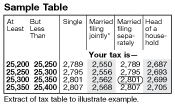
2025 Tax Computation Worksheet—Line 16
See the 2025 Tax Computation Worksheet—Line 16 in the Instructions for Form 1040.
Exception 1.
If you must use the tax computation worksheets based on the line 16 instructions, use the Section A worksheet for Single, the Section B worksheet for Qualifying surviving spouse, or the Section C worksheet for Married filing separately, as applicable, and enter the amount on Form 1040-NR, line 16.
Exception 2.
As noted earlier, if you’re filing for an estate or trust, you must use Tax Rate Schedule W, later, to figure your tax.
General Information
| The IRS Mission |
| Provide America’s taxpayers top-quality service by helping them understand and meet their tax responsibilities and enforce the law with integrity and fairness to all. |
How To Avoid Common Mistakes
See How To Avoid Common Mistakes in the Instructions for Form 1040.
Exception 1.
Be sure to enter your identifying number (SSN or ITIN) on page 1 of Form 1040-NR. Be sure to enter the SSN, ITIN, or ATIN of your dependents under Dependents on page 1 of Form 1040-NR.
Exception 2.
Information about standard deductions only applies to students and business apprentices eligible for the benefits of Article 21(2) of the United States–India Income Tax Treaty.
Exception 3.
You aren’t eligible to claim an earned income credit as a Form 1040-NR filer.
Exception 4.
You can claim the premium tax credit for dependents only if you are a U.S. national; resident of Canada, Mexico, or South Korea; or a student or business apprentice eligible for the benefits of Article 21(2) of the United States–India Income Tax Treaty. If you’re filing Form 1040-NR and considered married for federal tax purposes, you can’t claim the premium tax credit unless you meet the criteria of one of the exceptions under Married taxpayers in the Instructions for Form 8962.
Income Tax Withholding and Estimated Tax Payments for 2026
See Income Tax Withholding and Estimated Tax Payments for 2026 in the Instructions for Form 1040 for more details.
For more information on withholding or estimated tax payments, see chapter 8, Paying Tax Through Withholding or Estimated Tax, in Pub. 519.
Secure Your Tax Records From Identity Theft
See Secure Your Tax Records From Identity Theft in the Instructions for Form 1040 for more details.
How Do You Make a Gift To Reduce Debt Held By the Public?
See How Do You Make a Gift To Reduce Debt Held By the Public? in the Instructions for Form 1040 for more details.
How Long Should Records Be Kept?
See How Long Should Records Be Kept? in the Instructions for Form 1040 for more details.
How Do You Amend Your Tax Return?
See Amended Return in the Instructions for Form 1040 for more details.
Note:
Form 1040-X must be filed within 3 years after the date the original return was filed or within 2 years after the date the tax was paid, whichever is later. See IRS.gov/Filing/AmendedReturn for more information.
Need a Copy of Your Tax Return Information?
See Need a Copy of Your Tax Return Information? in the Instructions for Form 1040 for more details.
Exception.
If you’re calling to get a free transcript and you’re outside the United States, call 267-941-1000. This number isn’t toll free.
How To Get Tax Help
If you have questions about a tax issue; need help preparing your tax return; or want to download free publications, forms, or instructions, go to IRS.gov to find resources that can help you right away.
Tax reform.
Tax reform legislation impacting federal taxes, credits, and deductions was enacted in P.L. 119-21, commonly known as the One Big Beautiful Bill Act on July 4, 2025. Go to IRS.gov/OBBB for more information and updates on how this legislation affects your taxes.
Preparing and filing your tax return.
After receiving all your wage and earnings statements (Forms W-2, W-2G, 1099-R, 1099-MISC, 1099-NEC, etc.); unemployment compensation statements (by mail or in a digital format) or other government payment statements (Form 1099-G); and interest, dividend, and retirement statements from banks and investment firms (Forms 1099), you have several options to choose from to prepare and file your tax return. You can prepare the tax return yourself, see if you qualify for free tax preparation, or hire a tax professional to prepare your return.
Free options for tax preparation.
Your options for preparing and filing your return online or in your local community, if you qualify, include the following.
-
Free File. This program lets you prepare and file your federal individual income tax return for free using software or Free File Fillable Forms. However, state tax preparation may not be available through Free File. Go to IRS.gov/FreeFile to see if you qualify for free online federal tax preparation, e-filing, and direct deposit or payment options.
-
VITA. The Volunteer Income Tax Assistance (VITA) program offers free tax help to people with low-to-moderate incomes, persons with disabilities, and limited-English-speaking taxpayers who need help preparing their own tax returns. Go to IRS.gov/VITA, download the free IRS2Go app, or call 800-906-9887 for information on free tax return preparation.
-
TCE. The Tax Counseling for the Elderly (TCE) program offers free tax help for all taxpayers, particularly those who are 60 years of age and older. TCE volunteers specialize in answering questions about pensions and retirement-related issues unique to seniors. Go to IRS.gov/TCE or download the free IRS2Go app for information on free tax return preparation.
-
MilTax. Members of the U.S. Armed Forces and qualified veterans may use MilTax, a free tax service offered by the Department of Defense through Military OneSource. For more information, go to MilitaryOneSource (MilitaryOneSource.mil/MilTax).
Also, the IRS offers Free Fillable Forms, which can be completed online and then e-filed regardless of income.
Using online tools to help prepare your return.
Go to IRS.gov/Tools for the following.
-
The Earned Income Tax Credit Assistant (IRS.gov/EITCAssistant) determines if you’re eligible for the earned income credit (EIC).
-
The Online EIN Application (IRS.gov/EIN) helps you get an employer identification number (EIN) at no cost.
-
The Tax Withholding Estimator (IRS.gov/W4App) makes it easier for you to estimate the federal income tax you want your employer to withhold from your paycheck. This is tax withholding. See how your withholding affects your refund, take-home pay, or tax due.
-
The Sales Tax Deduction Calculator (IRS.gov/SalesTax) figures the amount you can claim if you itemize deductions on Schedule A (Form 1040).
 Getting answers to your tax questions. On IRS.gov, you can get up-to-date information on current events and changes in tax law.
-
IRS.gov/Help: A variety of tools to help you get answers to some of the most common tax questions.
-
IRS.gov/ITA: The Interactive Tax Assistant, a tool that will ask you questions and, based on your input, provide answers on a number of tax topics.
-
IRS.gov/Forms: Find forms, instructions, and publications. You will find details on the most recent tax changes and interactive links to help you find answers to your questions.
-
You may also be able to access tax information in your e-filing software.
Need someone to prepare your tax return?
There are various types of tax return preparers, including enrolled agents, certified public accountants (CPAs), accountants, and many others who don’t have professional credentials. If you choose to have someone prepare your tax return, choose that preparer wisely. A paid tax preparer is:
-
Primarily responsible for the overall substantive accuracy of your return,
-
Required to sign the return, and
-
Required to include their preparer tax identification number (PTIN).
Although the tax preparer always signs the return, you’re ultimately responsible for providing all the information required for the preparer to accurately prepare your return and for the accuracy of every item reported on the return. Anyone paid to prepare tax returns for others should have a thorough understanding of tax matters. For more information on how to choose a tax preparer, go to Tips for Choosing a Tax Preparer on IRS.gov.
Employers can register to use Business Services Online.
The Social Security Administration (SSA) offers online service at SSA.gov/employer for fast, free, and secure W-2 filing options to CPAs, accountants, enrolled agents, and individuals who process Form W-2, Wage and Tax Statement, and Form W-2c, Corrected Wage and Tax Statement.
Business tax account.
If you are a sole proprietor, a partnership, or an S corporation, you can view your tax information on record with the IRS and do more with a business tax account. Go to IRS.gov/BusinessAccount for more information.
IRS social media.
Go to IRS.gov/SocialMedia to see the various social media tools the IRS uses to share the latest information on tax changes, scam alerts, initiatives, products, and services. At the IRS, privacy and security are our highest priority. We use these tools to share public information with you. Don’t post your social security number (SSN) or other confidential information on social media sites. Always protect your identity when using any social networking site.
The following IRS YouTube channels provide short, informative videos on various tax-related topics in English and ASL.
Over-the-Phone Interpreter (OPI) Service.
The IRS offers the OPI Service to taxpayers needing language interpretation. The OPI Service is available at Taxpayer Assistance Centers (TACs), most IRS offices, and every VITA/TCE tax return site. This service is available in Spanish, Mandarin, Cantonese, Korean, Vietnamese, Russian, and Haitian Creole.
Accessibility Helpline available for taxpayers with disabilities.
Taxpayers who need information about accessibility services can call 833-690-0598. The Accessibility Helpline can answer questions related to current and future accessibility products and services available in alternative media formats (for example, braille-ready, large print, audio, etc.). The Accessibility Helpline does not have access to your IRS account. For help with tax law, refunds, or account-related issues, go to IRS.gov/LetUsHelp.
Alternative media preference.
Form 9000, Alternative Media Preference, or Form 9000 (SP) allows you to elect to receive certain types of written correspondence in the following formats.
-
Standard Print.
-
Large Print.
-
Braille.
-
Audio (MP3).
-
Plain Text File (TXT)
-
Braille Ready File (BRF).
Disasters.
Go to IRS.gov/DisasterRelief to review the available disaster tax relief.
Getting tax forms and publications.
Go to IRS.gov/Forms to view, download, or print all the forms, instructions, and publications you may need. Or, you can go to IRS.gov/OrderForms to place an order.
Mobile-friendly forms.
You’ll need an IRS Online Account (OLA) to complete mobile-friendly forms that require signatures. You’ll have the option to submit your form(s) online or download a copy for mailing. You’ll need scans of your documents to support your submission. Go to IRS.gov/MobileFriendlyForms for more information.
Getting tax publications and instructions in eBook format.
Download and view most tax publications and instructions (including the Instructions for Form 1040) on mobile devices as eBooks at IRS.gov/eBooks.
IRS eBooks have been tested using Apple’s iBooks for iPad. Our eBooks haven’t been tested on other dedicated eBook readers, and eBook functionality may not operate as intended.
Access your online account (individual taxpayers only).
Go to IRS.gov/Account to securely access information about your federal tax account.
-
View the amount you owe and a breakdown by tax year.
-
See payment plan details or apply for a new payment plan.
-
Make a payment or view 5 years of payment history and any pending or scheduled payments.
-
Access your tax records, including key data from your most recent tax return, and transcripts.
-
View digital copies of select notices from the IRS.
-
Approve or reject authorization requests from tax professionals.
Get a transcript of your return.
With an online account, you can access a variety of information to help you during the filing season. You can get a transcript, review your most recently filed tax return, and get your adjusted gross income. Create or access your online account at IRS.gov/Account.
Tax Pro Account.
This tool lets your tax professional submit an authorization request to access your individual taxpayer IRS online account. For more information, go to IRS.gov/TaxProAccount.
Using direct deposit.
The safest and easiest way to receive a tax refund is to e-file and choose direct deposit, which securely and electronically transfers your refund directly into your financial account. Direct deposit also avoids the possibility that your check could be lost, stolen, destroyed, or returned undeliverable to the IRS. Eight in 10 taxpayers use direct deposit to receive their refunds. If you don’t have a bank account, go to IRS.gov/DirectDeposit for more information on where to find a bank or credit union that can open an account online.
Reporting and resolving your tax-related identity theft issues.
-
Tax-related identity theft happens when someone steals your personal information to commit tax fraud. Your taxes can be affected if your SSN is used to file a fraudulent return or to claim a refund or credit.
-
The IRS doesn’t initiate contact with taxpayers by email, text messages (including shortened links), telephone calls, or social media channels to request or verify personal or financial information. This includes requests for personal identification numbers (PINs), passwords, or similar information for credit cards, banks, or other financial accounts.
-
Go to IRS.gov/IdentityTheft, the IRS Identity Theft Central webpage, for information on identity theft and data security protection for taxpayers, tax professionals, and businesses. If your SSN has been lost or stolen or you suspect you’re a victim of tax-related identity theft, you can learn what steps you should take.
-
Get an Identity Protection PIN (IP PIN). IP PINs are six-digit numbers assigned to taxpayers to help prevent the misuse of their SSNs on fraudulent federal income tax returns. When you have an IP PIN, it prevents someone else from filing a tax return with your SSN. To learn more, go to IRS.gov/IPPIN.
Ways to check on the status of your refund.
-
Go to IRS.gov/Refunds.
-
Download the official IRS2Go app to your mobile device to check your refund status.
-
Call the automated refund hotline at 800-829-1954.
The IRS can’t issue refunds before mid-February for returns that claimed the EIC or the additional child tax credit (ACTC). This applies to the entire refund, not just the portion associated with these credits.
Making a tax payment.
The IRS recommends paying electronically whenever possible. Options to pay electronically are included in the list below. Payments of U.S. tax must be remitted to the IRS in U.S. dollars. Digital assets are not accepted. Go to IRS.gov/Payments for information on how to make a payment using any of the following options.
-
IRS Direct Pay: Pay taxes from your bank account. It’s free and secure, and no sign-in is required. You can change or cancel within two days of scheduled payment.
-
Debit Card, Credit Card, or Digital Wallet: Choose an approved payment processor to pay online or by phone.
-
Electronic Funds Withdrawal: Schedule a payment when filing your federal taxes using tax return preparation software or through a tax professional.
-
Electronic Federal Tax Payment System:This is the best option for businesses. Enrollment is required.
-
Check or Money Order: Mail your payment to the address listed on the notice or instructions.
-
Cash: You may be able to pay your taxes with cash at a participating retail store.
-
Same-Day Wire: You may be able to do same-day wire from your financial institution. Contact your financial institution for availability, cost, and time frames.
Note:
The IRS uses the latest encryption technology to ensure that the electronic payments you make online, by phone, or from a mobile device using the IRS2Go app are safe and secure. Paying electronically is quick and easy.
What if I can’t pay now?
Go to IRS.gov/Payments for more information about your options.
-
Apply for an online payment agreement (IRS.gov/OPA) to meet your tax obligation in monthly installments if you can’t pay your taxes in full today. Once you complete the online process, you will receive immediate notification of whether your agreement has been approved.
-
Use the Offer in Compromise Pre-Qualifier to see if you can settle your tax debt for less than the full amount you owe. For more information on the Offer in Compromise program, go to IRS.gov/OIC.
Filing an amended return.
Go to IRS.gov/Form1040X for information and updates.
Checking the status of your amended return.
Go to IRS.gov/WMAR to track the status of Form 1040-X amended returns.
It can take up to 3 weeks from the date you filed your amended return for it to show up in our system, and processing it can take up to 16 weeks.
Understanding an IRS notice or letter you’ve received.
Go to IRS.gov/Notices to find additional information about responding to an IRS notice or letter.
IRS Document Upload Tool.
You may be able to use the Document Upload Tool to respond digitally to eligible IRS notices and letters by securely uploading required documents online through IRS.gov. For more information, go to IRS.gov/DUT.
Schedule LEP.
You can use Schedule LEP (Form 1040), Request for Change in Language Preference, to state a preference to receive notices, letters, or other written communications from the IRS in an alternative language. You may not immediately receive written communications in the requested language. The IRS’s commitment to LEP taxpayers is part of a multi-year timeline that began providing translations in 2023. You will continue to receive communications, including notices and letters, in English until they are translated to your preferred language.
Contacting your local TAC.
Keep in mind, many questions can be answered on IRS.gov without visiting a TAC. Go to IRS.gov/LetUsHelp for the topics people ask about most. If you still need help, TACs provide tax help when a tax issue can’t be handled online or by phone. All TACs now provide service by appointment, so you’ll know in advance that you can get the service you need without long wait times. Before you visit, go to IRS.gov/TAC to find the nearest TAC and to check hours, available services, and appointment options. Or, on the IRS2Go app, under the Stay Connected tab, choose the Contact Us option and click on “Local Offices.”
——————————————
Below is a message to you from the Taxpayer Advocate Service, an independent organization established by Congress.
The Taxpayer Advocate Service (TAS) Is Here To Help You
The Taxpayer Advocate Service (TAS) is an independent organization within the Internal Revenue Service (IRS). TAS helps taxpayers resolve problems with the IRS, makes administrative and legislative recommendations to prevent or correct the problems, and protects taxpayer rights. We work to ensure that every taxpayer is treated fairly and that you know and understand your rights under the Taxpayer Bill of Rights. We are Your Voice at the IRS.
TAS can help you resolve problems that you haven’t been able to resolve with the IRS on your own. Always try to resolve your problem with the IRS first, but if you can’t, then come to TAS. Our services are free.
-
TAS helps all taxpayers (and their representatives), including individuals, businesses, and exempt organizations. You may be eligible for TAS help if your IRS problem is causing financial difficulty, if you’ve tried and been unable to resolve your issue with the IRS, or if you believe an IRS system, process, or procedure just isn’t working as it should.
-
To get help any time with general tax topics, visit www.TaxpayerAdvocate.IRS.gov. The site can help you with common tax issues and situations, such as what to do if you make a mistake on your return or if you get a notice from the IRS.
-
TAS works to resolve large-scale (systemic) problems that affect many taxpayers. You can report systemic issues at www.IRS.gov/SAMS. (Be sure not to include any personal identifiable information.)
TAS has offices in every state, the District of Columbia, and Puerto Rico. To find your local advocate’s number:
-
Check your local directory, or
-
Call TAS toll free at 877-777-4778.
The Taxpayer Bill of Rights describes ten basic rights that all taxpayers have when dealing with the IRS. Go to www.TaxpayerAdvocate.IRS.gov/Taxpayer-Rights for more information about the rights, what they mean to you, and how they apply to specific situations you may encounter with the IRS. TAS strives to protect taxpayer rights and ensure the IRS is administering the tax law in a fair and equitable way.
Interest and Penalties
See Interest and Penalties in the Instructions for Form 1040 for more details.
Refund Information
See Refund Information in the Instructions for Form 1040 for more details.
Exception.
The processing of refund requests of tax withheld and reported on a Form 1042-S, Form 8805, or Form 8288-A may require additional time. Allow up to 6 months for these refunds to be issued.
Instructions for Schedule 1 (Form 1040)—Additional Income and Adjustments to Income
General Instructions
As noted in Form 1040-NR Helpful Hints, earlier, use Schedule 1 (Form 1040) to report income or adjustments to income that can’t be entered directly on Form 1040-NR.
Additional income is entered on Schedule 1, Part I. The amount on line 10 of Schedule 1 is entered on Form 1040-NR, line 8.
Adjustments to income are entered on Schedule 1, Part II. The amount on line 26 is entered on Form 1040-NR, line 10.
When completing a line on Schedule 1 (Form 1040), look to the instructions below for that line, which may direct you to the Schedule 1 instructions found in the Instructions for Form 1040 for guidance.
If, for tax year 2025, you received a Form(s) 1099-K that shows payments that were included in error (for example, money for gifts or reimbursements) or for personal items that sold at a loss (for example, an old refrigerator), enter the amount that was included in error or for personal items sold at a loss in the entry space at the top of Schedule 1. See the Instructions for Schedule 1 in the Instructions for Form 1040.
See the specific line instructions below for any Exceptions. For example, see Line 1 below, which has three exceptions. Also, only use the guidance for the filing status you checked at the top of page 1 of Form 1040-NR. No other guidance under Instructions for Schedule 1 in the Instructions for Form 1040 will apply to you.
Additional Income
See Line 1 under Instructions for Schedule 1 in the Instructions for Form 1040 for details.
Exception 1.
The state or local income tax must be of a U.S. state or local government.
Exception 2.
Ignore the TIP. The only reason none of your refund would be taxable is if in the year you paid the state or local income tax, you didn’t claim these tax payments as an itemized deduction on Schedule A (Form 1040-NR). For example, you were a student or business apprentice eligible for the benefits of the United States–India Income Tax Treaty, Article 21(2), and you elected to use the standard deduction for the tax year the state or local income tax was paid.
Exception 3.
Use Itemized Deduction Recoveries in Pub. 525 instead of the State and Local Income Tax Refund Worksheet in the Instructions for Form 1040.
Leave lines 2a and 2b of Schedule 1 (Form 1040) blank. Don’t follow the instructions in Lines 2a and 2b under Instructions for Schedule 1 in the Instructions for Form 1040. A person filing Form 1040-NR doesn’t report alimony on lines 2a and 2b. You will report certain alimony received on Schedule NEC (Form 1040-NR), line 12.
See Line 3 under Instructions for Schedule 1 in the Instructions for Form 1040 for details on business income or loss.
Exception 1.
Report only your effectively connected income and expenses from Schedule C (Form 1040).
Exception 2.
Include any income you received as a dealer in stocks, securities, and commodities through your U.S. office or dependent agent. If you dealt in these items through an independent agent, such as a U.S. broker, custodian, or commissioned agent, your income may not be considered effectively connected with a U.S. business.
See Line 4 under Instructions for Schedule 1 in the Instructions for Form 1040 for details on other gains or losses.
Exception.
The assets must have been used in a U.S. trade or business.
Form 1040-NR filers can’t be shareholders in S corporations. Even though the text for line 5 on Schedule 1 (Form 1040) mentions S corporations, the reference to S corporations doesn’t apply to Form 1040-NR filers.
Report income or loss from rental real estate, royalties, partnerships, estates, trusts, and residual interests in real estate mortgage investment conduits (REMICs) on Schedule 1 (Form 1040), line 5. Use Schedule E (Form 1040) to figure the amount to enter on Schedule 1 (Form 1040), line 5, and attach Schedule E (Form 1040) to your return. For more information, see the Instructions for Schedule E (Form 1040).
If you’re electing to treat income from real property located in the United States as effectively connected with a U.S. trade or business, report the rental income or loss on Schedule 1 (Form 1040), line 5. See Income You Can Elect To Treat as Effectively Connected With a U.S. Trade or Business, earlier, for more details on how to make the election. If you haven’t made or don’t make the election, report the rental income on Schedule NEC (Form 1040-NR), line 6. See Income From Real Property in chapter 4 of Pub. 519 for more details.
Report farm income and expenses on line 6. Use Schedule F (Form 1040) to figure the amount to enter on line 6 and attach Schedule F (Form 1040) to your return. For more information, see the Instructions for Schedule F (Form 1040). Also, see Pub. 225, Farmer’s Tax Guide, for a list of important dates that apply to farmers.
See Line 7 under Instructions for Schedule 1 in the Instructions for Form 1040 for details on unemployment compensation.
See Lines 8a Through 8z under Instructions for Schedule 1 in the Instructions for Form 1040 for details on other income, but see Line 8a through Line 8z below for exceptions.
See Line 8a under Instructions for Schedule 1 in the Instructions for Form 1040 for details on net operating losses.
See Line 8b under Instructions for Schedule 1 in the Instructions for Form 1040 for details on gambling winnings.
Exception 1.
Gambling winnings entered on line 8b must be from an effectively connected U.S. trade or business. If they aren’t from an effectively connected U.S. trade or business, but are U.S. sourced, enter the income on Schedule NEC (Form 1040-NR).
Exception 2.
For details on gambling losses that are effectively connected to a U.S. trade or business, see the instructions for Schedule A (Form 1040-NR), line 7, later.
See Line 8c under Instructions for Schedule 1 in the Instructions for Form 1040 for details on cancellation of debt.
Exception.
For Form 1040-NR filers, canceled debt in box 2 of Form 1042-S should be included on Schedule 1 (Form 1040), line 8c. For canceled debt that is U.S. source and effectively connected with a U.S. trade or business, see Pub. 4681, Canceled Debts, Foreclosures, Repossessions, and Abandonments (for Individuals).
Leave Schedule 1 (Form 1040), line 8d, blank. The foreign earned income exclusion and housing exclusion from Form 2555 don’t apply to Form 1040-NR filers.
See Line 8e under Instructions for Schedule 1 in the Instructions for Form 1040 for details on Form 8853, Archer MSAs and Long-Term Care Insurance Contracts.
See Line 8f under Instructions for Schedule 1 in the Instructions for Form 1040 for details on Form 8889, Health Savings Accounts (HSAs).
Leave Schedule 1 (Form 1040), line 8g, blank. Alaska Permanent Fund dividends don’t apply to Form 1040-NR filers.
Leave Schedule 1 (Form 1040), line 8h, blank. Jury duty pay doesn’t apply to Form 1040-NR filers.
See Line 8i under Instructions for Schedule 1 in the Instructions for Form 1040 for details on prizes and awards.
Exception.
The prizes and awards must be from your trade or business.
Leave Schedule 1 (Form 1040), line 8j, blank. Form 1040-NR filers don’t include income on this line because this income isn’t from a trade or business. Include this income on Schedule NEC (Form 1040-NR) on the applicable line.
See Line 8k under Instructions for Schedule 1 in the Instructions for Form 1040 for details on stock options.
Leave line 8l blank. Include this income on Schedule NEC (Form 1040-NR), line 6.
See Line 8m under Instructions for Schedule 1 in the Instructions for Form 1040 for details on Olympic and Paralympic medals and USOC prize money.
Exception.
The medals and prize money must be from your U.S. trade or business.
Leave Schedule 1 (Form 1040), line 8n, blank. The section 951(a) inclusion doesn’t apply to Form 1040-NR filers.
Leave Schedule 1 (Form 1040), line 8o, blank. The section 951A(a) inclusion doesn’t apply to Form 1040-NR filers.
See Line 8p under Instructions for Schedule 1 in the Instructions for Form 1040 for details on the section 461(l) excess business loss adjustment.
See Line 8q under Instructions for Schedule 1 in the Instructions for Form 1040 for details on taxable distributions from an ABLE account.
Exception.
See the instructions for Schedule NEC (Form 1040-NR), line 12, later.
Generally, enter the amount of scholarship and fellowship grants from U.S. sources and not reported on Form W-2, reduced by the total amount exempt by treaty. However, if you were a degree candidate at an eligible educational organization, generally include on line 8r only the amounts you used for expenses other than tuition, fees, and required, course-related expenses. For example, amounts used for room, board, and travel must be reported on line 8r.
Note:
Attach any Form(s) 1042-S you receive from the educational organization to page 1 of the Form 1040-NR. Scholarship and fellowship grants are reported in box 2 of Form 1042-S.
Note:
Generally, you can’t exclude from your gross income the part of any scholarship or fellowship grant that represents payment for teaching, research, or other services required as a condition for receiving the scholarship. This applies even if all candidates for a degree must perform the services to receive the degree.
For more information about tax requirements for scholarships and fellowships, see Pub. 519 and chapter 1 of Pub. 970.
Note:
Under some treaties, scholarship or fellowship grant income isn’t exempt from tax if the income is received in exchange for the performance of services, such as teaching, research, or other services. Also, many tax treaties don’t permit an exemption from tax on scholarship or fellowship grant income unless the income is from sources outside the United States. If you’re a resident of a treaty country, you must know the terms of the tax treaty between the United States and the treaty country to claim treaty benefits on Form 1040-NR. See the instructions for item L of Schedule OI, later, for details.
Example 1.
You’re a citizen of a country that doesn’t have an income tax treaty in force with the United States. You’re a candidate for a degree at ABC University (located in the United States) and considered temporarily present in the country. You’re receiving a full scholarship from ABC University, which is an eligible educational institution. You aren’t required to perform any services, such as teaching, research, or other services, to get the scholarship, and you have no other sources of income. The total amounts you received from ABC University during 2025 are as follows.
| Tuition and fees | $25,000 | ||
| Required books, supplies, and equipment | 1,000 | ||
| Room and board | 9,000 | ||
| $35,000 |
Note:
Box 2 shows only $9,000 because withholding agents (such as ABC University) aren’t required to report section 117 qualified expenses (required tuition, fees, books, supplies, and equipment) on Form 1042-S.
You would enter $9,000 on line 8r of Schedule 1 (Form 1040) only.
Example 2.
The facts are the same as in Example 1, except that you’re a citizen of a country that has an income tax treaty with the United States that includes a provision that exempts scholarship income, and you were a resident of that country for income tax purposes immediately before arriving in the United States to attend ABC University.
When completing your tax return, do the following.
-
Provide all the required information in item L of Schedule OI (Form 1040-NR). Enter the $9,000 shown in box 2 of Form 1042-S into
column (d) of the schedule. -
Enter $9,000 from box L1(e) of Schedule OI (Form 1040-NR) on line 1k of Form 1040-NR.
-
Enter $1,260 on line 25g of Form 1040-NR to report the withholding shown in box 10 of Form 1042-S.
See Line 8s under Instructions for Schedule 1 in the Instructions for Form 1040 for details on Medicaid waiver payments.
Exception.
Substitute “Form 1040-NR” for any reference to Forms 1040 or 1040-SR.
See Line 8t under Instructions for Schedule 1 in the Instructions for Form 1040 for a pension or annuity from a nonqualified deferred compensation plan or nongovernmental section 457 plan.
See Line 8u under Instructions for Schedule 1 in the Instructions for Form 1040 for details on wages earned while incarcerated.
See Line 8v under Instructions for Schedule 1 in the Instructions for Form 1040 for details on digital assets.
See Line 8z under Instructions for Schedule 1 in the Instructions for Form 1040 for details on other income.
Exception 1.
If you sold a personal item at a gain, don’t report this amount on line 8z. For more information about reporting this gain, see Pub. 519, and the instructions for Schedule NEC (Form 1040-NR), line 12, later.
Exception 2.
The bullet discussing “reimbursements or other amounts received for items deducted in an earlier year” only applies to items deducted on a Schedule A (Form 1040-NR). The items listed as examples in the bullet in the Instructions for Schedule 1 are only deductible on Schedule A (Form 1040).
Exception 3.
Gifts or bequests you receive from a foreign person aren’t taxable regardless of the amount.
Adjustments to Income
See Line 11 under Instructions for Schedule 1 in the Instructions for Form 1040 for details on educator expenses.
Exception.
The expenses must be related to your effectively connected income.
See Line 12 under Instructions for Schedule 1 in the Instructions for Form 1040 for details on these business expenses.
Exception 1.
The expenses must be related to your effectively connected income.
Exception 2.
Don’t include performing-arts-related expenses as a write-in on line 8z of Schedule 1 (Form 1040).
See Line 13 under Instructions for Schedule 1 in the Instructions for Form 1040 for details on the HSA deduction.
See Line 14 under Instructions for Schedule 1 in the Instructions for Form 1040 for details on these moving expenses.
See Line 15 under Instructions for Schedule 1 in the Instructions for Form 1040 for details on the deductible part of self-employment tax.
See Line 16 under Instructions for Schedule 1 in the Instructions for Form 1040 for details on self-employed SEP, SIMPLE, and qualified plans.
See Line 17 under Instructions for Schedule 1 in the Instructions for Form 1040 for details on the self-employed health insurance deduction.
Exception 1.
The rules for a shareholder in an S corporation don’t apply to you. Nonresident aliens can’t be shareholders in an S corporation.
Exception 2.
The discussion of the Schedule A medical expense deduction on line 3 of the Self-Employed Health Insurance Deduction Worksheet doesn’t apply to you. Your Schedule A (which is called Schedule A (Form 1040-NR)) doesn’t have a line for medical expense deductions.
Exception 3.
Form 2555 discussions don’t apply to you. You aren’t eligible for the foreign earned income and foreign housing benefits on Form 2555.
Exception 4.
You can claim the premium tax credit for dependents only if you’re a U.S. national; a resident of Canada, Mexico, or South Korea; or a student or a business apprentice eligible for the benefits of Article 21(2) of the United States–India Income Tax Treaty. If you’re filing Form 1040-NR and considered married for federal tax purposes, you can’t claim the premium tax credit unless you also meet the criteria of one of the exceptions under Married taxpayers in the Instructions for Form 8962.
See Line 18 under Instructions for Schedule 1 in the Instructions for Form 1040 for details on the penalty on early withdrawal of savings.
Leave lines 19a, 19b, and 19c blank on Schedule 1 (Form 1040). You aren’t eligible for an alimony deduction if you’re filing Form 1040-NR.
See Line 20 under Instructions for Schedule 1 in the Instructions for Form 1040 for details on the IRA deduction.
Exception 1.
When reading that section, including when completing the IRA Deduction Worksheet, follow only the guidance for the filing status you checked at the top of page 1 of Form 1040-NR.
Exception 2.
Don’t use your spouse’s earned income, or your or your spouse’s alimony and separate maintenance payments, when determining whether you can take the IRA deduction.
Exception 3.
Don’t apply Form 2555 discussions to your situation. You can’t file that form.
Exception 4.
You must have taxable compensation effectively connected with a U.S. trade or business.
See Line 21 under Instructions for Schedule 1 in the Instructions for Form 1040 for details on the student loan interest deduction.
Exception 1.
When reading that section, including when completing the Student Loan Interest Deduction Worksheet in that section, follow only the guidance for the filing status you checked at the top of page 1 of Form 1040-NR.
Exception 2.
If you checked the “Married filing separately” box at the top of page 1 of Form 1040-NR, you can’t take the student loan interest deduction.
Leave Schedule 1 (Form 1040), line 24a, blank. Jury duty pay doesn’t apply to Form 1040-NR filers.
Leave Schedule 1 (Form 1040), line 24b, blank unless the expenses arise from a U.S. trade or business. Form 1040-NR filers can’t deduct expenses from the rental of personal property engaged in for profit, but not as part of a U.S. trade or business.
See Line 24c under Instructions for Schedule 1 in the Instructions for Form 1040 for details on the nontaxable amount of the value of Olympic and Paralympic medals and USOC prize money.
See Line 24d under Instructions for Schedule 1 in the Instructions for Form 1040 for details on reforestation amortization and expenses.
See Line 24e under Instructions for Schedule 1 in the Instructions for Form 1040 for details on repayment of supplemental unemployment benefits under the Trade Act of 1974.
See Line 24f under Instructions for Schedule 1 in the Instructions for Form 1040 for details on contributions to section 501(c)(18)(D) pension plans.
See Line 24g under Instructions for Schedule 1 in the Instructions for Form 1040 for details on contributions by certain chaplains to section 403(b) plans.
See Line 24h under Instructions for Schedule 1 in the Instructions for Form 1040 for details on attorney fees and court costs for actions involving certain unlawful discrimination claims.
Exception.
Don’t include on line 24h attorney fees and court costs for actions involving certain unlawful discrimination claims to the extent the gross income from such actions is not effectively connected.
See Line 24i under Instructions for Schedule 1 in the Instructions for Form 1040 for details on attorney fees and court costs you paid in connection with an award from the IRS for information you provided that helped the IRS detect tax law violations.
Leave Schedule 1 (Form 1040), line 24j, blank. The housing deduction from Form 2555 doesn’t apply to Form 1040-NR filers.
See Line 24k under Instructions for Schedule 1 in the Instructions for Form 1040 for details on excess deductions of section 67(e) expenses from Schedule K-1 (Form 1041).
Instructions for Schedule 1-A (Form 1040)—Additional Deductions
General Instructions
As noted in Form 1040-NR Helpful Hints, earlier, use Schedule 1-A (Form 1040) to report additional deductions that can’t be entered directly on Form1040-NR.
These additional deductions include deductions for no tax on tips, no tax on overtime, and the enhanced deduction for seniors. The amount on line 38 of Schedule 1-A is entered on Form 1040-NR, line 13c.
When completing a line on Schedule 1-A (Form 1040), look to the instructions below for that line, which may direct you to the Schedule 1-A instructions found in the Instructions for Form 1040 for guidance.
See the specific line instructions below for Exceptions, if any. Also, only use the guidance for the filing status you checked at the top of page 1 of Form 1040-NR. No other guidance under Instructions for Schedule 1-A in the Instructions for Form 1040 will apply to you.
Specific Instructions
See Part I under Instructions for Schedule 1-A in the Instructions for Form 1040 for details on your MAGI amount.
See Part II under Instructions for Schedule 1-A in the Instructions for Form 1040 for details on no tax on tips.
See Part III under Instructions for Schedule 1-A in the Instructions for Form 1040 for details on no tax on overtime.
Generally, nonresident aliens are not eligible for the deduction for qualified passenger vehicle loan interest. See the Instructions for Schedule C (Form 1040) regarding the deductibility of business interest.
Instructions for Schedule 2 (Form 1040)—Additional Taxes
General Instructions
As noted in Form 1040-NR Helpful Hints, earlier, use Schedule 2 (Form 1040) if you have additional taxes that can’t be entered directly on the Form 1040-NR.
Include the amount on Schedule 2, line 3, in the total on Form 1040-NR, line 17.
Enter the amount on Schedule 2, line 21, on Form 1040-NR, line 23b.
When completing a line on Schedule 2 (Form 1040), look to the instructions below for that line, which may direct you to the Schedule 2 instructions found in the Instructions for Form 1040 for guidance.
See the specific line instructions below for any Exceptions. For example, see Line 2 below, which has four exceptions. Also, only use the guidance for the filing status you checked at the top of page 1 of Form 1040-NR. No other guidance under Instructions for Schedule 2 in the Instructions for Form 1040 will apply to you.
Specific Instructions
See Line 1a under Instructions for Schedule 2 in the instructions for Form 1040 for details on the excess advance premium tax credit payment.
Exception.
You can claim the premium tax credit for dependents only if you’re a U.S. National; a resident of Canada, Mexico, or South Korea; or a student or a business apprentice eligible for the benefits of Article 21(2) of the United States–India Income Tax Treaty. If you’re filing Form 1040-NR and considered married for federal tax purposes, you can’t claim the premium tax credit unless you meet the criteria of one of the exceptions under Married taxpayers in the Instructions for Form 8962.
If applicable, see Line 1b under Instructions for Schedule 2 in the Instructions for Form 1040 for details.
If applicable, see Line 1c under Instructions for Schedule 2 in the Instructions for Form 1040 for details.
If applicable, see Line 1d under Instructions for Schedule 2 in the Instructions for Form 1040 for details.
If applicable, see Line 1e under Instructions for Schedule 2 in the Instructions for Form 1040 for details.
If applicable, see Line 1f under Instructions for Schedule 2 in the Instructions for Form 1040 for details.
If applicable, see Line 1y under Instructions for Schedule 2 in the Instructions for Form 1040 for details.
See Line 2 under Instructions for Schedule 2 in the Instructions for Form 1040 for details on the alternative minimum tax.
Exception 1.
For estates and trusts only. If you’re filing for an estate or trust, do the following.
-
Use Schedule I (Form 1041) and its instructions to find out if you owe the alternative minimum tax. Don’t use the Instructions for Form 1040 to figure whether you owe the alternative minimum tax.
-
If you disposed of a U.S. real property interest at a gain, you must make a special computation to see if you owe this tax. For details, see Nonresident Aliens in the Instructions for Form 6251.
Exception 2.
Only use the guidance for the filing status you checked at the top of page 1 of Form 1040-NR. No other guidance in Line 2, Alternative Minimum Tax, in the Instructions for Schedule 2 found in the Instructions for Form 1040 will apply to you.
Exception 3.
The following in the list under Exception in Line 2 under Instructions for Schedule 2 in the Instructions for Form 1040 don’t apply to you.
-
The reference to income (or loss) from S corporations. Nonresident aliens can’t be shareholders in an S corporation.
-
Investment interest expense reported on Form 4952 can’t apply to you. Nonresident aliens don’t file Form 4952.
-
Net qualified disaster loss unless you’re a student or business apprentice eligible for benefits under Article 21(2) of the United States–India Income Tax Treaty and you reported a standard deduction on Schedule A (Form 1040-NR), line 7.
Exception 4.
See Instructions for Form 6251 to see if you must file the form and then use Form 6251 to figure the amount, if any, of your AMT. Enter the amount from Form 6251, line 11, on line 2.
Enter the amount of any taxes from Schedule SE (Form 1040). See the Instructions for Schedule SE (Form 1040) for more information.
If you’re a self-employed nonresident alien, you must pay self-employment tax only if an international social security agreement (often called a totalization agreement) in effect determines that you’re covered under the U.S. social security system. See the Instructions for Schedule SE (Form 1040) for information about international social security agreements. Information about totalization agreements is available at IRS.gov. Enter “totalization agreement” in the search box there. You can also find information at SSA.gov/international under “International Agreements.”
If you aren’t required to pay self-employment tax but do so anyway, you won’t be eligible to receive social security benefits.
See Line 5 under Instructions for Schedule 2 in the Instructions for Form 1040 for details on social security and Medicare tax on unreported tip income from Form 4137.
See Line 6 under Instructions for Schedule 2 in the Instructions for Form 1040 for details on uncollected social security and Medicare tax on wages from Form 8919.
Exception.
Enter the amount from line 6 of Form 8919 on Form 1040-NR, line 1g, as Form 8919, line 6, indicates.
See Line 8 under Instructions for Schedule 2 in the Instructions for Form 1040 for details on additional tax on IRAs, other qualified retirement plans, etc.
See Line 9 under Instructions for Schedule 2 in the Instructions for Form 1040 for details on household employment taxes.
See Line 11 under Instructions for Schedule 2 in the Instructions for Form 1040 for details on the Additional Medicare Tax from Form 8959.
See Line 12 under Instructions for Schedule 2 in the Instructions for Form 1040 for details on the net investment income tax from Form 8960.
Exception.
You’re only liable for the net investment income tax if you’re a dual-status taxpayer (see Dual-Status Taxpayers, earlier). You may owe this tax for the part of the year you were a U.S. resident (see Form 8960 and its instructions).
See Line 13 under Instructions for Schedule 2 in the Instructions for Form 1040 for details on uncollected social security and Medicare or RRTA tax on tips or group-term life insurance from Form W-2, box 12.
See Line 14 under Instructions for Schedule 2 in the Instructions for Form 1040 for details on interest on tax due on installment income from the sale of certain residential lots and timeshares.
See Line 15 under Instructions for Schedule 2 in the Instructions for Form 1040 for details on interest on the deferred tax on gain from certain installment sales with a sales price over $150,000.
See Line 16 under Instructions for Schedule 2 in the Instructions for Form 1040 for details on recapture of low-income housing credit from Form 8611.
See Line 17a through Line 17z below for details and exceptions.
See Line 17a under Instructions for Schedule 2 in the Instructions for Form 1040 for details on recapture of other credits.
See Line 17b under Instructions for Schedule 2 in the Instructions for Form 1040 for details on recapture of federal mortgage subsidy.
See Line 17c under Instructions for Schedule 2 in the Instructions for Form 1040 for details on additional tax on HSA distributions.
See Line 17d under Instructions for Schedule 2 in the Instructions for Form 1040 for details on additional tax on an HSA because you didn’t remain an eligible individual.
See Line 17e under Instructions for Schedule 2 in the Instructions for Form 1040 for details on additional tax on Archer MSA distributions from Form 8853.
See Line 17f under Instructions for Schedule 2 in the Instructions for Form 1040 for details on additional tax on Medicare Advantage MSA distributions from Form 8853.
See Line 17g under Instructions for Schedule 2 in the Instructions for Form 1040 for details on recapture of a charitable contribution deduction related to a fractional interest in tangible personal property.
See Line 17h under Instructions for Schedule 2 in the Instructions for Form 1040 for details on income you received from a nonqualified deferred compensation plan that fails to meet the requirements of section 409A.
See Line 17i under Instructions for Schedule 2 in the Instructions for Form 1040 for details on compensation you received from a nonqualified deferred compensation plan described in section 457A.
See Line 17j under Instructions for Schedule 2 in the Instructions for Form 1040 for details on the section 72(m)(5) excess benefits tax.
See Line 17k under Instructions for Schedule 2 in the Instructions for Form 1040 for details on golden parachute payments.
See Line 17l under Instructions for Schedule 2 in the Instructions for Form 1040 for details on tax on accumulation distribution of trusts.
See Line 17m under Instructions for Schedule 2 in the Instructions for Form 1040 for details on excise tax on insider stock compensation from an expatriated corporation.
See Line 17n under Instructions for Schedule 2 in the Instructions for Form 1040 for details on look-back interest under section 167(g) or 460(b) from Form 8697 or 8866.
Leave Schedule 2, line 17o, blank, unless you’re a dual-status taxpayer. If you aren’t a dual-status taxpayer, enter the tax on your noneffectively connected income (that is, your income not effectively connected with a U.S. trade or business) on Form 1040-NR, line 23a. See Instructions for Schedule NEC (Form 1040-NR), later.
Leave Schedule 2, line 17p, blank. Persons filing Form 1040-NR don’t file Form 8621.
Leave Schedule 2, line 17q, blank. Persons filing Form 1040-NR don’t file Form 8621.
See Line 17z under Instructions for Schedule 2 in the Instructions for Form 1040 for details on other taxes.
If applicable, see Line 19 under Instructions for Schedule 2 in the Instructions for Form 1040 for details.
Instructions for Schedule 3 (Form 1040)—Additional Credits and Payments
General Instructions
As noted in Form 1040-NR Helpful Hints, earlier, use Schedule 3 (Form 1040) if you have nonrefundable credits, other than the child tax credit or the credit for other dependents, or other payments and refundable credits.
Include the amount on Schedule 3, line 8, in the amount entered on Form 1040-NR, line 20.
Enter the amount on Schedule 3, line 15, on Form 1040-NR, line 31.
When completing a line of Schedule 3 (Form 1040), look to the instructions below for that line, which may direct you to the Schedule 3 instructions found in the Instructions for Form 1040 for guidance.
See the specific line instructions below for any Exceptions. For example, see Line 1 below, which has five exceptions. Also, only use the guidance for the filing status you checked at the top of page 1 of Form 1040-NR. No other guidance under Instructions for Schedule 3 in the Instructions for Form 1040 will apply to you.
Specific Instructions
See Line 1 under Instructions for Schedule 3 in the Instructions for Form 1040 for details on the foreign tax credit.
Exception 1.
The TIP, requiring you to see the instructions for Forms 1040 and 1040-SR, line 16, doesn’t apply to you. You can’t make a section 962 election.
Exception 2.
If you meet all five requirements in Line 1 under Instructions for Schedule 3 in the Instructions for Form 1040 and the income for which you’re taking the foreign tax credit is income taxed by the United States, enter on Schedule 3 (Form 1040), line 1, the smaller of (a) your total foreign taxes, or (b) the total of the amounts on Form 1040-NR, line 16, and Schedule 2 (Form 1040), line 1a. Otherwise, see Form 1116 to see whether you can take the credit. For details on foreign income taxed by the United States, see Foreign Income Taxed by the United States, earlier.
Exception 3.
If an estate or trust is electing the foreign tax credit, the estate or trust must complete Form 1116. Exception 2 above is only for individual taxpayers.
Exception 4.
Only use the guidance for the filing status you checked at the top of page 1 of Form 1040-NR. No other guidance in Line 1 under Instructions for Schedule 3 in the Instructions for Form 1040 will apply to you.
Exception 5.
The discussion of Form 4563 and Puerto Rico sourced income doesn’t apply to you.
See Line 2 under Instructions for Schedule 3 in the Instructions for Form 1040 for details on the credit for child and dependent care expenses.
Leave Schedule 3 (Form 1040), line 3, blank. Persons filing Form 1040-NR cannot claim education credits.
See Line 4 under Instructions for Schedule 3 in the Instructions for Form 1040 for details on the retirement savings contributions credit (saver’s credit).
Exception.
Only use the guidance for the filing status you checked at the top of page 1 of Form 1040-NR. No other guidance in Line 4 under Instructions for Schedule 3 in the Instructions for Form 1040 will apply to you.
See Line 5 under Instructions for Schedule 3 in the Instructions for Form 1040 for details on the residential clean energy credit and the energy efficient home improvement credit.
See Line 6a through Line 6z below for details and exceptions.
See Line 6a under Instructions for Schedule 3 in the Instructions for Form 1040 for details on the general business credit.
See Line 6b under Instructions for Schedule 3 in the Instructions for Form 1040 for details on the credit for prior-year minimum tax from Form 8801.
See Line 6c under Instructions for Schedule 3 in the Instructions for Form 1040 for details on the adoption credit from Form 8839.
Leave Schedule 3 (Form 1040), line 6d, blank. The credit for the elderly or disabled from Schedule R does not apply to Form 1040-NR filers.
See Line 6f under Instructions for Schedule 3 in the Instructions for Form 1040 for details on the clean vehicle credit from Form 8936.
See Line 6g under Instructions for Schedule 3 in the Instructions for Form 1040 for details on the mortgage interest credit from Form 8396.
See Line 6h under Instructions for Schedule 3 in the Instructions for Form 1040 for details on the District of Columbia first-time homebuyer credit from Form 8859.
See Line 6i under Instructions for Schedule 3 in the Instructions for Form 1040 for details on the qualified electric vehicle credit from Form 8834.
See Line 6j under Instructions for Schedule 3 in the Instructions for Form 1040 for details on the alternative fuel vehicle refueling property credit from Form 8911.
See Line 6k under Instructions for Schedule 3 in the Instructions for Form 1040 for details on the credit to holders of tax credit bonds from Form 8912.
See Line 6l under Instructions for Schedule 3 in the Instructions for Form 1040 for details on the amount from Form 8978.
Exception.
If you use the Negative Form 8978 Adjustment Worksheet—Schedule 3 (Line 6l), you will use the same line of Form 1040-NR that is used for Form 1040 or 1040-SR.
See Line 6m under Instructions for Schedule 3 in the Instructions for Form 1040 for details.
See Line 6z under Instructions for Schedule 3 in the Instructions for Form 1040 for details on other nonrefundable credits.
See Line 9 under Instructions for Schedule 3 in the Instructions for Form 1040 for details on the net premium tax credit.
Exception.
You can claim the premium tax credit for dependents only if you’re a U.S. national; a resident of Canada, Mexico, or South Korea; or a student or a business apprentice eligible for the benefits of Article 21(2) of the United States–India Income Tax Treaty.
If you’re filing Form 1040-NR and considered married for federal tax purposes, you can’t claim the net premium tax credit unless you meet the criteria of one of the exceptions under Married taxpayers in the Instructions for Form 8962.
See Line 10 under Instructions for Schedule 3 in the Instructions for Form 1040 for details on the amount paid with a request for extension to file.
Exception.
The discussion of Form 2350 does not apply to you. That form is for U.S citizens and resident aliens abroad.
See Line 11 under Instructions for Schedule 3 in the Instructions for Form 1040 for details on excess social security and tier 1 RRTA tax withheld.
Exception.
Only use the guidance for the filing status you checked at the top of page 1 of Form 1040-NR. No other guidance in Line 11 under Instructions for Schedule 3 in the Instructions for Form 1040 will apply to you. You can’t claim excess social security or tier 1 RRTA tax withheld for your spouse.
See Line 12 under Instructions for Schedule 3 in the Instructions for Form 1040 for details on the credit for federal tax on fuels.
See Line 13b under Instructions for Schedule 3 in the Instructions for Form 1040 for details on the credit for repayment of amounts included in income from earlier years.
See Line 13c under Instructions for Schedule 3 in the Instructions for Form 1040 for details.
Leave Schedule 3 (Form 1040), line 13d, blank. Net section 965 inclusions don’t apply to Form 1040-NR filers.
See Line 13z under Instructions for Schedule 3 in the Instructions for Form 1040 for details on other refundable credits.
Exception.
In Line 13z under Instructions for Schedule 3 in the Instructions for Form 1040, the discussion of section 960 doesn’t apply to you. Persons filing Form 1040-NR can’t claim that credit.
Instructions for Schedule A (Form 1040-NR)—Itemized Deductions
Before you begin:
-
Do not use Schedule A (Form 1040-NR) with Form 1040 or 1040-SR. Use Schedule A (Form 1040-NR) only with Form 1040-NR. Use Schedule A (Form 1040) with Form 1040 or 1040-SR.
-
Use only these instructions when completing Schedule A (Form 1040-NR). Don’t use these instructions for any other Schedule A.
-
Don’t include on Schedule A (Form 1040-NR) items deducted elsewhere, such as on Form 1040-NR or Schedule C, E, or F (Form 1040).
Note:
Except as provided in Exception next, include only deductions and losses properly allocated and apportioned to income effectively connected with a U.S. trade or business. Don’t include deductions and/or losses that relate to exempt income or to income that isn’t effectively connected with a U.S. trade or business. See section 861(b).
Exception.
You can deduct certain charitable contributions and casualty and theft losses even if they do not relate to your effectively connected income. See Gifts to U.S. Charities and Casualty and Theft Losses, later.
State and Local Income Taxes
Line 1a.
You can deduct state and local income taxes you paid or that were withheld from your salary during 2025 on income connected with a U.S. trade or business. If, during 2025, you received any refunds of, or credits for, income tax paid in earlier years, do not subtract them from the amount you deduct here. Also, don’t reduce your deduction by any state or local income tax refund or credit you expect to receive for 2025. Instead, see the instructions for Schedule 1, line 1, earlier, in these instructions.
Safe harbor for certain charitable contributions made in exchange for a state or local income tax credit.
If you made a charitable contribution in exchange for a state or local income tax credit and your charitable contribution deduction must be reduced as a result of receiving or expecting to receive the tax credit, you may qualify for a safe harbor that allows you to treat some or all of the disallowed charitable contribution as a payment of state and local income taxes.
The safe harbor applies if you meet the following conditions.
-
You made a cash contribution to an entity described in section 170(c).
-
In return for the cash contribution, you received a state or local income tax credit.
-
You must reduce your charitable contribution amount by the amount of the state or local income tax credit you receive.
If you meet these conditions, and to the extent you apply the state or local income tax credit to this or a prior year’s state or local income tax liability, you may include this amount on line 1a. To the extent you apply a portion of the credit to offset your state or local income tax liability in a subsequent year (as permitted by law), you may treat this amount as state or local income tax paid in the year the credit is applied.
For more information about this safe harbor and examples, see Treas. Reg. 1.164-3(j).
Line 1b.
The deduction for state and local taxes is generally limited to $40,000 ($20,000 if married filing separately). On Schedule A (Form 1040-NR), line 1b, enter the amount that is the smaller of state and local income taxes from line 1a and $40,000 ($20,000 if married filing separately).
Gifts to U.S. Charities
You can deduct contributions or gifts you gave to U.S. organizations that are religious, charitable, educational, scientific, or literary in purpose. You can also deduct what you gave to U.S. organizations that work to prevent cruelty to children or animals. Certain whaling captains may be able to deduct expenses paid in 2025 for Native Alaskan subsistence bowhead whale hunting activities. See Pub. 526 for details.
To verify an organization’s charitable status, you can do the following.
-
Check with the organization to which you made the donation. The organization should be able to provide you with verification of its charitable status.
-
Use our online search tool at IRS.gov/TEOS to see if an organization is eligible to receive tax-deductible contributions.
Examples of U.S. qualified charitable organizations.
Examples of U.S. qualified charitable organizations include the following.
-
Churches, mosques, synagogues, temples, and other religious organizations.
-
Scouting America, Boys and Girls Clubs of America, CARE, Girl Scouts, Goodwill Industries, Red Cross, Salvation Army, and United Way.
-
Fraternal orders, if the gifts will be used for the purposes listed under Lines 2 Through 4, earlier.
-
Veterans’ groups and certain cultural groups.
-
Nonprofit hospitals and medical research organizations.
-
Most nonprofit educational organizations, such as colleges, but only if your contribution isn’t a substitute for tuition or other enrollment fees.
-
Federal, state, and local governments if the gifts are solely for public purposes.
Amounts you can deduct.
Contributions can be in cash, property, or out-of-pocket expenses you paid to do volunteer work for the kinds of organizations described earlier. If you drove to and from the volunteer work, you can take the actual cost of gas and oil or 14 cents a mile. Add parking and tolls to the amount you claim under either method, but don’t deduct any amounts that were repaid to you.
Gifts from which you benefit.
If you made a gift and received a benefit in return, such as food, entertainment, or merchandise, you can generally deduct only the amount that is more than the value of the benefit. But this rule doesn’t apply to certain membership benefits provided in return for an annual payment of $75 or less or to certain items or benefits of token value. For details, see Pub. 526.
Example.
You paid $70 to a charitable organization to attend a fund-raising dinner and the value of the dinner was $40. You can deduct only $30.
Gifts of $250 or more.
You can deduct a gift of $250 or more only if you have a contemporaneous written acknowledgment from the charitable organization showing the information in (1) and (2) next.
-
The amount of any money contributed and a description (but not value) of any property donated.
-
Whether the organization did or didn’t give you any goods or services in return for your contribution. If you did receive any goods or services, a description and estimate of the value must be included. If you received only intangible religious benefits (such as admission to a religious ceremony), the organization must state this, but it doesn’t have to describe or value the benefit.
In figuring whether a gift is $250 or more, don’t combine separate donations. For example, if you gave your church $25 each week for a total of $1,300, treat each $25 payment as a separate gift. If you made donations through payroll deductions, treat each deduction from each paycheck as a separate gift. See Pub. 526 if you made a separate gift of $250 or more through payroll deduction.
To be contemporaneous, you must get the written acknowledgment from the charitable organization by the date you file your return or the due date (including extensions) for filing your return, whichever is earlier. Don’t attach the contemporaneous written acknowledgment to your return. Instead, keep it for your records.
Limit on the amount you can deduct.
See Pub. 526 to figure the amount of your deduction if any of the following applies.
-
Your cash contributions or contributions of ordinary income property are more than 30% of the amount on Form 1040-NR, line 11b.
-
Your gifts of capital gain property are more than 20% of the amount on Form 1040-NR, line 11b.
-
You gave gifts of property that increased in value or gave gifts of the use of property.
Amounts you can’t deduct.
-
Certain contributions to charitable organizations, to the extent that you receive a state or local income tax credit in return for your contribution. See Pub. 526 for more details and exceptions.
See Safe harbor for certain charitable contributions made in exchange for a state or local income tax credit , earlier, under Line 1a, if your cash contribution is disallowed because you received or expected to receive a credit. -
An amount paid to or for the benefit of a college or university in exchange for the right to purchase tickets to an athletic event in the college’s or university’s stadium.
-
Travel expenses (including meals and lodging) while away from home performing donated services, unless there was no significant element of personal pleasure, recreation, or vacation in the travel.
-
Political contributions.
-
Dues, fees, or bills paid to country clubs, lodges, fraternal orders, or similar groups, unless the contribution or gift is to be used exclusively for religious, charitable, scientific, literary, or educational purposes, or for the prevention of cruelty to children or animals.
-
Cost of raffle, bingo, or lottery tickets. But you may be able to deduct these expenses on line 7. See Line 7, later, for more information on gambling losses.
-
Value of your time or services.
-
Value of blood given to a blood bank.
-
The transfer of a future interest in tangible personal property. Generally, no deduction is allowed until the entire interest has been transferred.
-
Gifts to individuals and groups that are operated for personal profit.
-
Gifts to foreign organizations. But you may be able to deduct gifts to certain U.S. organizations that transfer funds to foreign charities and certain Canadian, Israeli, and Mexican charities. For details and exceptions, see Pub. 526.
-
Gifts to organizations engaged in certain political activities that are of direct financial interest to your trade or business. See section 170(f)(9).
-
Gifts to groups whose purpose is to lobby for changes in the laws.
-
Gifts to civic leagues, social and sports clubs, labor unions, and chambers of commerce.
-
Value of benefits received in connection with a contribution to a charitable organization. See Pub. 526 for exceptions.
-
Cost of tuition.
Enter on line 2 the total value of gifts you made in cash or by check (including out-of-pocket expenses) unless a limit on deducting gifts applies to you. For more information about the limits on deducting gifts, see Limit on the amount you can deduct, earlier. If your deduction is limited, you may have a carryover to next year. See Pub. 526 for more information.
Deduction for gifts by cash or check limited.
If your deduction for the gifts you made in cash or by check is limited, see Pub. 526 to figure the amount you can deduct. Only enter on line 2 the deductible value of gifts you made in cash or by check.
Recordkeeping.
For any contribution made in cash, regardless of the amount, you must maintain as a record of the contribution a bank record (such as a canceled check or credit card statement) or a written record from the charity. The written record must include the name of the charity, date, and amount of the contribution. If you made contributions through payroll deduction, see Pub. 526 for information on the records you must keep. Don’t attach the record to your tax return. Instead, keep it with your other tax records.
For contributions of $250 or more, you must also have a contemporaneous written acknowledgment from the charitable organization. See Gifts of $250 or more, earlier, for more information. You will still need to keep a record of when you made the cash contribution if the contemporaneous written acknowledgment doesn’t include that information.
Enter on line 3 the total value of your contributions of property other than by cash or check unless a limit on deducting gifts applies to you. For more information about the limits on deducting gifts, see Limit on the amount you can deduct, earlier. If your deduction is limited, you may have a carryover to next year. See Pub. 526 for more information.
Deduction for gifts other than by cash or check limited.
If your deduction for the contributions of property other than by cash or check is limited, see Pub. 526 to figure the amount you can deduct. Only enter on line 3 the deductible value of your contributions of property other than by cash or check.
Valuing contributions of used items.
If you gave used items, such as clothing or furniture, deduct their fair market value at the time you gave them. Fair market value is what a willing buyer would pay a willing seller when neither has to buy or sell and both are aware of the conditions of the sale. For more details on determining the value of donated property, see Pub. 561.
Deductions more than $500.
If the amount of your deduction is more than $500, you must complete and attach Form 8283. For this purpose, the “amount of your deduction” means your deduction before applying any income limits that could result in a carryover of contributions.
Contributions of clothing and household items.
A deduction for these contributions will be allowed only if the items are in good used condition or better. However, this rule doesn’t apply to a contribution of any single item for which a deduction of more than $500 is claimed and for which you include a qualified appraisal and Form 8283 with your tax return.
Recordkeeping.
If you gave property, you should keep a receipt or written statement from the organization you gave the property to, or a reliable written record, that shows the organization’s name and address, the date and location of the gift, and a description of the property. For each gift of property, you should also keep reliable written records that include the following.
-
How you figured the property’s value at the time you gave it. If the value was determined by an appraisal, keep a signed copy of the appraisal.
-
The cost or other basis of the property if you must reduce it by any ordinary income or capital gain that would have resulted if the property had been sold at its fair market value.
-
How you figured your deduction if you chose to reduce your deduction for gifts of capital gain property.
-
Any conditions attached to the gift.
If the gift of property is $250 or more, you must also have a contemporaneous written acknowledgment from the charitable organization. See Gifts of $250 or more, earlier, for more information. Form 8283 doesn’t satisfy the contemporaneous written acknowledgment requirement, and a contemporaneous written acknowledgment isn’t a substitute for the other records you may need to keep if you gave property.
If your total deduction for gifts of property is over $500, you gave less than your entire interest in the property, or you made a qualified conservation contribution, your records should contain additional information. See Pub. 526 for details.
You may have contributions that you couldn’t deduct in an earlier year because they exceeded the limits on the amount you could deduct. In most cases, you have 5 years to use contributions that were limited in an earlier year. Generally, the same limits apply this year to your carryover amounts as applied to those amounts in the earlier year. However, carryover amounts from contributions made in 2021 are subject to a 60% limitation if you deduct those amounts in 2025. After applying those limits, enter the amount of your carryover that you’re allowed to deduct this year. See Pub. 526 for details.
Casualty and Theft Losses
Complete and attach Form 4684 to figure the amount of your loss. Only enter the amount from Form 4684, line 18, on line 6.
Don’t enter a net qualified disaster loss from Form 4684, line 15, on line 6. Instead, enter that amount, if any, on line 7. See Line 7, later, for information about reporting a net qualified disaster loss.
You may be able to deduct part or all of each loss caused by theft, vandalism, fire, storm, or similar causes; car, boat, and other accidents; and corrosive drywall. You may also be able to deduct money you had in a financial institution but lost because of the insolvency or bankruptcy of the institution. See Pub. 547 for the limitations.
You can only deduct nonbusiness/personal casualty or theft losses attributable to a federally declared disaster and only to the extent that:
-
The amount of each separate casualty or theft loss is more than $100; and
-
The total amount of all losses during the year (reduced by the $100 limit discussed in (1)) is more than 10% of the amount shown on Form 1040-NR, line 11b.
An exception to the rule limiting the deduction for personal casualty and theft losses to federal casualty losses applies where you have personal casualty gains not attributable to a federally declared disaster. In this case, you may deduct personal casualty losses that aren’t attributable to a federally declared disaster to the extent they don’t exceed your personal casualty gains.
See the Instructions for Form 4684, Casualties and Thefts, and Pub. 547, Casualties, Disasters, and Thefts, for more information.
Other Itemized Deductions
Increased standard deduction reporting for certain students and business apprentices from India.
If you’re a student or business apprentice from India who is eligible for the benefits of Article 21(2) of the United States–India Income Tax Treaty, if you’re electing the standard deduction, and if you have a net qualified disaster loss on Form 4684, line 15, you can claim an increased standard deduction using Schedule A (Form 1040-NR) by doing the following.
-
List the amount from Form 4684, line 15, as “Net Qualified Disaster Loss” on the dotted line next to and below line 7 of your Schedule A (Form 1040-NR), and attach Form 4684 to your Schedule A (Form 1040-NR).
-
List your standard deduction amount as “Standard Deduction Claimed With Qualified Disaster Loss” on the dotted line next to line 7.
-
Combine the two amounts on line 7 of your Schedule A (Form 1040-NR) and enter the sum on Form 1040-NR, line 12.
Don’t enter an amount on any other line of Schedule A (Form 1040-NR).
Net qualified disaster loss reporting.
If you have a net qualified disaster loss on Form 4684, line 15, of property located in the United States, list the amount from Form 4684, line 15, on the dotted lines next to and below line 7 as "Net Qualified Disaster Loss" and include with your other miscellaneous deductions on line 7. Also be sure to attach Form 4684.
Don’t include your net qualified disaster loss on line 6.
Only certain expenses can be deducted on this line. List the type and amount of each such expense on the dotted lines next to line 7 and enter the total of these expenses on line 7. If you’re filing a paper return and you can’t fit all your expenses on the dotted lines next to line 7, attach a statement instead showing the type and amount of each expense. Enter one total on line 7. Examples of these expenses follow.
-
Gambling losses effectively connected with a U.S. trade or business (gambling losses include, but aren’t limited to, the cost of non-winning bingo, lottery, and raffle tickets), but only to the extent of gambling winnings reported on Schedule 1 (Form 1040), line 8b.
-
Casualty and theft losses of income-producing property from Form 4684, lines 32 and 38b, or Form 4797, line 18a.
-
Deduction for repayment of amounts under a claim of right if over $3,000. See Pub. 525 for details.
-
Certain unrecovered investment in a pension.
-
Impairment-related work expenses of a disabled person.
Instructions for Schedule NEC (Form 1040-NR)—Tax on Income Not Effectively Connected With a U.S. Trade or Business
Do not use Schedule NEC (Form 1040-NR) with Form 1040 or Form 1040-SR. Use Schedule NEC (Form 1040-NR) only with Form 1040-NR.
Enter your income in the row that lists the correct category of income and in the column that lists the correct tax rate under a tax treaty or the general U.S. tax rules. Use column (d) if the income is subject to a 0% rate or if the rate isn’t listed in column (a), (b), or (c). Include income only to the extent it’s U.S. source and not effectively connected with the conduct of a trade or business in the United States.
You can download the complete text of most U.S. tax treaties at IRS.gov. Enter “tax treaties” in the search box and click on United States Income Tax Treaties - A to Z.
Withholding of tax at the source.
Tax must be withheld at the source on income not effectively connected with a U.S. trade or business that is paid to nonresident aliens. The withholding is generally at a 30% rate. The tax must be withheld by the person who pays the income. For details, see Pub. 519, Pub. 515, and section 1441 and its regulations.
Certain amounts paid for guarantees of indebtedness issued after September 27, 2010, are U.S. source income. If the payments are not made in connection with a U.S. trade or business, tax must be withheld.
Exceptions.
There are exceptions to the general rule. The withholding tax rate may be lower or the income may be exempt if your country of tax residence and the United States have a treaty setting lower rates. See Treaty Table 1, Tax Rates on Income Other Than Personal Service Income Under Chapter 3, Internal Revenue Code, and Income Tax Treaties, available at IRS.gov/Individuals/International-Taxpayers/Tax-Treaty-Tables.
The 30% tax applies only to amounts included in gross income. For example, the tax applies only to the part of a periodic annuity or pension payment that is subject to tax. It doesn’t apply to the part that is a return of your cost.
Categories of Noneffectively Connected Income
The following list gives only a general idea of the types of income to include on Schedule NEC. The instructions for a specific line include more information and any exceptions to withholding. For more information, see Pub. 519 and Pub. 515.
-
Income that is fixed or periodic, such as interest (see below for original issue discount), dividends, rents, salaries, wages, premiums, annuities, other compensation, or certain U.S. source alimony received (see the Caution below). Other items of income, such as royalties, may also be subject to the 30% tax.
-
Gains, other than capital gains, from the sale or exchange of patents, copyrights, and other intangible property.
U.S source alimony you received pursuant to a divorce or separation agreement entered into on or before December 31, 2018, is income on your 2025 Form 1040-NR unless that agreement was changed after December 31, 2018, to expressly provide that alimony you received isn’t included in your income. Alimony you received isn’t included in your income if you entered into the divorce or separation agreement after December 31, 2018. For more information, see Pub. 504. -
Original issue discount (OID). If you sold or exchanged the obligation, include in income the OID that accrued while you held the obligation minus the amount previously included in income. If you received a payment on an OID obligation, see Pub. 519.
-
Capital gains in excess of capital losses from U.S. sources during 2025. Include these gains only if you were in the United States at least 183 days during 2025.
-
Prizes, awards, and certain gambling winnings. Proceeds from lotteries, raffles, etc., are gambling winnings (see Pub. 519 for exceptions). You must report the full amount of your winnings unless you’re a resident of Canada.
See Lines 10a Through 10c and Line 11, later.
Lines 1a, 1b, and 1c—Dividends
Except as provided next, include all dividends paid by U.S. corporations on line 1a. Include all U.S. source dividends paid by foreign corporations on line 1b. Include all dividend equivalent payments received with respect to section 871(m) transactions on line 1c. A dividend includes a substitute dividend payment made to the transferor of a security in a securities lending transaction or a sale-repurchase transaction that would be treated as a dividend if it were a distribution on the transferred security.
Dividend equivalent payments.
U.S. source dividends also include dividend equivalent payments. Dividend equivalent payments include the following:
-
Substitute dividends paid pursuant to a securities lending transaction, sale-repurchase transaction, or substantially similar transaction;
-
A payment that references a U.S. source dividend made pursuant to a specified notional principal contract (NPC); or
-
A payment that references a U.S. source dividend made pursuant to a specified equity-linked instrument (ELI).
For more information on dividend equivalent payments, see Pub. 519 and Pub. 515. For information on payments with respect to notional principal contracts and equity-linked instruments, see Regulations section 1.871-15.
Exceptions.
The following items of dividend income that you received as a nonresident alien are generally exempt from the 30% tax.
-
Interest-related dividends received from a mutual fund.
-
Short-term capital gain dividends from a mutual fund only if you were present in the United States for less than 183 days during the tax year.
-
If a U.S. corporation in existence beginning before January 1, 2011, received 80% of its gross income from the active conduct of a foreign business, and continues to receive 80% of its gross income from the active conduct of a foreign business, the part of the dividend attributable to the foreign gross income.
-
U.S. source dividends paid by certain foreign corporations.
Exceptions.
The following items of interest income that you received as a nonresident alien are generally exempt from the 30% tax.
-
Interest from a U.S. bank, savings and loan association, or similar institution, and from certain deposits with U.S. insurance companies.
-
Portfolio interest on obligations issued after July 18, 1984.
-
Interest on any tax-exempt original issue discount (OID), such as state or local bonds.
Interest payments on foreign bearer obligations (bonds not issued in registered format and held by non-U.S. holders) issued on or after March 19, 2012, aren’t eligible for the portfolio interest exception to withholding.
For more information, including other exceptions to withholding, see Interest Income in Pub. 519 and Interest in Pub. 515.
Line 6—Real Property Income and Natural Resources Royalties
Enter income from real property on line 6. Don’t include any income that you elected to treat as effectively connected and included on Schedule 1 (Form 1040), line 5. For more information, see the instructions for Schedule 1, line 5, earlier.
Line 8—Social Security Benefits (and Tier 1 Railroad Retirement Benefits Treated as Social Security)
85% of the U.S. social security and equivalent railroad retirement benefits you received are taxable. This amount is treated as U.S. source income not effectively connected with a U.S. trade or business. It is subject to the 30% tax rate, unless exempt or taxed at a reduced rate under a U.S. tax treaty. Social security benefits include any monthly benefit under title II of the Social Security Act or the part of a tier 1 railroad retirement benefit treated as a social security benefit. They don’t include any Supplemental Security Income (SSI) payments.
You should receive a Form SSA-1042S showing the total social security benefits paid to you in 2025 and the amount of any benefits you repaid in 2025. If you received railroad retirement benefits treated as social security, you should receive a Form RRB-1042S.
Enter 85% of the total amount from box 5 of all of your Forms SSA-1042S and Forms RRB-1042S in the appropriate column of line 8 of Schedule NEC. Attach a copy of each Form SSA-1042S and RRB-1042S to the front of Form 1040-NR.
Social security information.
Social security beneficiaries can get a variety of information from the SSA website with a my Social Security account, including getting a replacement Form SSA‐1099 or Form SSA-1042S if needed. For more information and to set up an account, go to SSA.gov/myaccount.
Form RRB-1099 or Form RRB-1042S.
If you need a replacement Form RRB-1099 or Form RRB-1042S, call the Railroad Retirement Board at 877-772-5772 or go to RRB.gov.
Lines 10a Through 10c—Gambling—Residents of Canada
If you’re a resident of Canada who isn’t engaged in the trade or business of gambling, enter all gambling winnings on line 10a. Include proceeds from lotteries and raffles. Do not include winnings from blackjack, baccarat, craps, roulette, or big-6 wheel. You can deduct your U.S. source gambling losses to the extent of your U.S. source gambling winnings. Enter your gambling losses on line 10b. Enter your net gambling income on line 10c, column (c). If line 10b is more than line 10a, enter -0- on line 10c. A net loss from gambling activities is not deductible.
Line 11—Gambling—Residents of Countries Other Than Canada
If you aren’t engaged in the trade or business of gambling and are a resident of a country that has a tax treaty with the United States, you may be exempt by treaty from paying tax on gambling winnings. If your gambling winnings are exempt by treaty, enter all gambling winnings on line 11, column (d), specifying 0%. You must know the terms of the tax treaty between the United States and the country of which you claim to be a resident to properly claim an exemption from withholding. You can download the complete text of most U.S. tax treaties at IRS.gov. Enter “tax treaties” in the search box and click on United States Income Tax Treaties - A to Z.
If you aren’t engaged in the trade or business of gambling and are a resident of a country without a tax treaty with the United States or a resident of a country with a tax treaty that doesn’t provide a reduced rate of, or exemption from, withholding for gambling winnings, enter all gambling winnings on line 11, column (c).
Include proceeds from lotteries and raffles. Do not include winnings from blackjack, baccarat, craps, roulette, or big-6 wheel. You can’t offset losses against winnings and report the difference unless the winnings and losses are from the same session.
If you have winnings from blackjack, baccarat, craps, roulette, or big-6 wheel, and the casino gave you a Form 1042-S showing that tax was withheld, enter these winnings on line 11, column (d), and enter 0% as the tax rate. You can claim a refund of the tax.
Line 12—Other
Include all U.S. source income that hasn’t been reported on another line or isn’t excluded from tax. Examples include the following.
-
Certain alimony payments you received (See the Caution under Categories of Noneffectively Connected Income, earlier).
-
Prizes and awards.
-
Tax withheld pursuant to section 5000C on specified federal procurement payments.
-
Taxable distributions from an ABLE account. For more information, see Pub. 907.
-
Certain gains from the sale or exchange of any personal property.
Note:
Certain gains from the sale or exchange of personal property are taxable regardless if you received a Form 1099-K for the transaction(s). For more information, see Pub. 519. If your gain is taxable, see the instructions for Schedule 1, Line 24z, earlier.
Lines 16 Through 18—Capital Gains and Losses From Sales or Exchanges of Property
If you have capital gains and losses from the sales or exchanges of property, consider the following.
-
Include these gains and losses only if you were in the United States at least 183 days during 2025. They aren’t subject to U.S. tax if you were in the United States less than 183 days during the tax year.
-
In determining your net gain, don’t use the capital loss carryover.
-
Losses from sales or exchanges of capital assets in excess of gains aren’t allowed.
-
If you had a gain or loss on disposing of a U.S. real property interest, see Dispositions of U.S. Real Property Interests, earlier.
-
If you transferred an interest in a partnership that is either directly or indirectly engaged in the conduct of a trade or business within the United States or holds any U.S. real property interests, see the Instructions for Schedule P (Form 1040-NR), later.
Include all applicable gains regardless of whether you received a Form 1099-K from a third party settlement organization or a credit card company.
Instructions for Schedule OI (Form 1040-NR) Other Information
Do not use Schedule OI (Form 1040-NR) with Form 1040 or Form 1040-SR. Use Schedule OI (Form 1040-NR) only with Form 1040-NR.
Answer all questions.
Item B
List the foreign country in which you claimed residence for federal tax purposes during the tax year.
Item C
If you’ve ever completed immigration Form I-485 and submitted the form to the U.S. Citizenship and Immigration Services, or have ever completed a Form DS-230 or Form DS-260 and submitted it to the Department of State, you’ve applied to become a Green Card holder (lawful permanent resident) of the United States. As of September 1, 2013, the electronic DS-260, Online Immigrant Visa Application and Registration, replaced the paper-based DS-230, Application for Immigrant Visa and Alien Registration, for all immigrant visa applications.
Item D
If you checked “Yes” for D1 or D2, you may be a U.S. tax expatriate and special rules may apply to you. See Expatriation Tax in chapter 4 of Pub. 519 for more information.
Item E
If you had a visa on the last day of the tax year, enter your visa type. Examples include the following.
-
B-1 Temporary Business Visitor.
-
F-1 Academic Student.
-
H-1B Person in Specialty Occupation.
-
J-1 Exchange Visitor.
If you don’t have a visa, enter your U.S. immigration status on the last day of the tax year. For example, if you entered under the visa waiver program, enter “VWP” and the name of the Visa Waiver Program Country.
If you were present in the United States on the last day of the tax year, and you have no U.S. immigration status, enter “Present in U.S.—No U.S. immigration status.” If you weren’t present in the United States on the last day of the tax year, and you have no U.S. immigration status, enter “Not present in U.S.—No U.S. immigration status.”
Item F
If you ever changed your visa type or U.S. immigration status, check the “Yes” box. For example, you entered the United States in 2024 on an F-1 visa as an academic student. On August 21, 2025, you changed to an H-1B visa as a teacher. You will check the “Yes” box and enter on the dotted line “Changed status from F-1 student to H-1B teacher on August 21, 2025.”
Item G
Enter the dates you entered and left the United States during 2025 on short business trips or to visit family, go on vacation, or return home briefly. If necessary, attach another page to list the additional dates.
If you’re a resident of Canada or Mexico and commute to work in the United States on more than 75% of the workdays during your working period, you’re a regular commuter and don’t need to enter the dates you entered and left the United States during the year. Commute means to travel to work and return to your residence within a 24-hour period. Check the appropriate box for Canada or Mexico and skip to item H. See Days of Presence in the United States in chapter 1 of Pub. 519.
If you were in the United States on January 1, 2025, enter “01/01/25” as the first date you entered the United States. If you were in the United States on December 31, don’t enter any date departed.
Item H
Review your entry and passport stamps or other records to count the number of days you were actually present in the United States during the years listed. Generally, a day of presence is any day that you’re physically present in the United States at any time during the 24-hour period beginning at 12:01 a.m. For the list of exceptions to the days you must count as actually present in the United States, see Substantial Presence Test and Days of Presence in the United States in chapter 1 of Pub. 519. If you weren’t in the United States on any day of the year, enter -0-.
Item I
If you filed a U.S. income tax return for a prior year, enter the latest year for which you filed a return and the form number you filed.
Item J
If you’re filing this return for a trust, check the first “Yes” box. Check the second “Yes” box if you checked the first “Yes” box and at least one of the following statements applies to the trust.
-
The trust (or any part of the trust) is treated as a grantor trust under the grantor trust rules (sections 671 through 679), whether or not the person who is treated as the owner of the trust is a U.S. person.
-
The trust made a distribution or loan to a U.S. person during the tax year. A distribution (direct or indirect) or loan includes the uncompensated use of trust property (section 643(i)(2)(E)).
-
The trust received a contribution from a U.S. person during the tax year.
See the Instructions for Form 3520.
A U.S. person is a U.S. citizen or resident alien, a domestic partnership, a domestic corporation, any estate other than a foreign estate, a domestic trust, or any other person who isn’t a foreign person. See Pub. 519 for more information.
Item K
If you received total compensation of $250,000 or more for 2025, check the first “Yes” box. If you checked the first “Yes” box, check the second “Yes” box if you’re using an alternative method to determine the source of the compensation. Total compensation includes all compensation from sources within and outside the United States.
If you check the second “Yes” box, you must attach a statement to your return. For details about the statement and the alternative method, see Services Performed Partly Within and Partly Outside the United States, earlier.
Item L
If you’re claiming exemption from income tax under a U.S. income tax treaty with a foreign country on Form 1040-NR, you must provide all the information requested in item L.
Line 1.
If you’re a resident of a treaty country (that is, you qualify as a resident of that country within the meaning of the tax treaty between the United States and that country), you must know the terms of the tax treaty between the United States and that country to properly complete item L. You can download the complete text of most U.S. tax treaties at IRS.gov. Enter “tax treaties” in the search box and click on United States Income Tax Treaties - A to Z. Technical explanations for many of those treaties are also available at that site.
Column (b), Tax treaty article.
Enter the number of the treaty article that exempts the income from U.S. tax.
Column (c), Number of months claimed in prior tax years.
Enter the number of months in prior tax years for which you claimed an exemption from U.S. tax based on the specified treaty article.
Column (d), Amount of exempt income in current tax year.
Enter the amount of income in the current tax year that is exempt from U.S. tax based on the specified treaty article.
Line (e), Total.
Add the amounts in column (d). Enter the total on Schedule OI (Form 1040-NR), item L, line 1e; and on Form 1040-NR, page 1, line 1k. Do not include this amount on any other line of the Form 1040-NR.
Attach any Form 1042-S you received for treaty-exempt income to Form 1040-NR, page 1. If required, also attach Form 8833. See Treaty-based return position disclosure, later.
Example.
Andrea is a citizen of Italy and was a resident there until September 2024, when Andrea moved to the United States to accept a position as a high school teacher at an accredited public school. Andrea came to the United States on a J-1 visa (Exchange Visitor) and signed a contract to teach for 2 years at this U.S. school. Andrea began teaching in September 2024 and plans to continue teaching through May 2026. Andrea’s salary per school year is $40,000. Andrea plans to return to Italy in June 2026 and resume Andrea’s Italian residence. For calendar year 2025, Andrea earned $40,000 from the teaching position, which is exempt from income tax per the tax treaty between the United States and Italy.
For tax year 2025, Andrea completes Schedule OI, item L, by entering “Italy” in column (a); the applicable tax treaty article, “20,” in column (b); the number of months of treaty-exempt income in prior years, “4,” in column (c); and the amount of exempt income in the current tax year, “$40,000,” in column (d). Andrea will report the total amount of exempt income in row (e), “$40,000,” on Form 1040-NR, line 1k.
Line 2.
Check “Yes” if you were subject to tax in a foreign country on any of the income reported in column (d) of line 1.
Line 3.
Check “Yes” if you’re claiming tax treaty benefits pursuant to a Competent Authority determination allowing you to do so. You must attach to your tax return a copy of the Competent Authority determination letter.
If you’re claiming tax treaty benefits and you failed to submit adequate documentation to a withholding agent, you must attach to your tax return all information that would’ve otherwise been required on the withholding tax document (for example, all information required on Form W-8BEN (Individuals), Form W-8BEN-E (Entities), or Form 8233).
Treaty-based return position disclosure.
If you take the position that a treaty of the United States overrides or modifies any provision of the Internal Revenue Code and that position reduces (or potentially reduces) your tax, you must generally report certain information on Form 8833 and attach it to Form 1040-NR.
If you fail to report the required information, you will be charged a penalty of $1,000 for each failure, unless you show that such failure is due to reasonable cause and not willful neglect. For more details, see Form 8833 and its instructions.
Exceptions.
You don’t have to file Form 8833 for any of the following. See Pub. 519 for more items.
-
You claim a treaty that reduces the withholding tax on interest, dividends, rents, royalties, or other fixed or determinable annual or periodic income ordinarily subject to the 30% rate.
-
You claim a treaty that reduces or modifies the taxation of income from dependent personal services, pensions, annuities, social security and other public pensions, or income of artists, athletes, students, trainees, or teachers. This includes taxable scholarship and fellowship grants.
-
You claim an international social security agreement (often called a totalization agreement), or a diplomatic or consular agreement, reduces or modifies the taxation of income.
-
You’re a partner in a partnership or a beneficiary of an estate or trust that reports the required information on its return.
-
The payments or items of income that are otherwise required to be disclosed total no more than $10,000.
Item M
Line 1.
Check the box if 2025 is the first year you’re making an election to treat income from real property located in the United States as effectively connected with a U.S. trade or business under section 871(d). The election applies to all income from real property located in the United States and held for the production of income and to all income from any interest in that property.
The election will remain effective for all future tax years unless you revoke it. See Income From Real Property in chapter 4 of Pub. 519 for more details on how to make and revoke this election.
Line 2.
Check the box if:
-
You’ve made an election in a previous tax year to treat income from real property located in the United States as effectively connected with a U.S. trade or business under section 871(d), and
-
You haven’t revoked that election.
Instructions for Schedule P (Form 1040-NR)—Foreign Partner’s Interests in Certain Partnerships Transferred During Tax Year
Do not use Schedule P (Form 1040-NR) with Form 1040 or Form 1040-SR. Use Schedule P (Form 1040-NR) only with Form 1040-NR.
General Instructions
Schedule P (Form 1040-NR) is used by a nonresident alien, foreign trust, or foreign estate (“transferor”) to report information and calculate gain or loss regarding its transfer of an interest in a partnership that is either directly or indirectly engaged in the conduct of a trade or business within the United States or holds any U.S. real property interests.
Complete Schedule P (Form 1040-NR) only if you transferred a partnership interest subject to section 864(c)(8) or 897(g). For more information, see Pub. 519 and Pub. 541, Partnerships.
Section 864(c)(8) provides that if a foreign transferor owns, directly or indirectly, an interest in a partnership that is engaged in the conduct of a trade or business within the United States, the gain or loss recognized by the foreign transferor on the transfer of all (or any portion) of the interest is treated as an effectively connected gain or loss, limited to the partner’s allocable share of the gain or loss on a deemed sale of the partnership’s U.S. trade or business assets. A transfer means a sale, exchange, or other disposition, and includes a distribution from a partnership to a partner to the extent that gain or loss is recognized on the distribution, as well as a transfer treated as a sale or exchange under section 707(a)(2)(B). This requirement applies to transfers that occurred on or after November 27, 2017.
Similarly, section 897(g) requires that if a transferor disposes of an interest in a partnership that directly or indirectly holds U.S. real property interests, the amount received that is attributable to the partnership’s U.S. real property interests is considered received from the sale or exchange of U.S. real property interests. As a result, that portion of the gain or loss must be included in determining the transferor’s U.S. trade or business income.
-
Don’t file Schedule P (Form 1040-NR) if you haven’t transferred an interest in a partnership that is either directly or indirectly engaged in the conduct of a trade or business within the United States or holds any U.S. real property interests.
-
Don’t complete Schedule P (Form 1040-NR), Part II, if you transferred an interest in a partnership that is either directly or indirectly engaged in trade or business within the United States and, pursuant to an applicable income tax treaty, all of the gain or loss from the transfer of the partnership interest is attributable to assets, other than real property, that don’t form part of a U.S. permanent establishment or fixed place of business, and you file a protective tax return under Regulations section 1.874-1(b)(6). See also the instructions for Form 8833.
-
Use the information from the Schedule K-3 (Form 1065) you received from the partnership. For example, you will use Part XIII of the Schedule K-3 (Form 1065) to complete lines 4, 6, 7, 13, 14, and 18 of Schedule P (Form 1040-NR), Part II.
If you’re required to complete this schedule but didn’t receive a Schedule K-3 (Form 1065), you will need to contact the partnership to obtain a copy. -
If an amount is reported on line 4 or 5 of Schedule K-3 (Form 1065), Part XIII, refer to Schedule K-1 (Form 1065), Part III, box 20, “Other Information”, and:
-
If an amount is reported in box 20 with code AC, Section 1(h)(5) gain (loss), enter the amount on Schedule P (Form 1040-NR), Part II, line 10.
-
If an amount is reported in box 20 with code AD, Deemed section 1250 unrecaptured gain, enter the amount on Schedule P (Form 1040-NR), Part II, line 11.
-
Specific Instructions Part I—Foreign Partner’s Interests in Certain Partnerships Transferred During Tax Year
Report the transfer for up to four partnership interests on the Schedule P (Form 1040-NR). If you’re required to report your transfer of more than four partnership interests on Schedule P (Form 1040-NR), report the required information for those additional transfers on attached separate sheets using the same size and format as shown on the schedule.
Entities treated as partnerships for federal tax purposes include domestic or foreign limited liability partnerships (LLPs), limited liability companies (LLCs), and publicly traded partnerships within the meaning of section 7704(c)(1) that aren’t classified as corporations for federal income tax purposes. Don’t include any interest in any entity classified as a disregarded entity as described under Regulations section 301.7701-2(c)(2).
Part I provides information regarding each partnership interest that was transferred during the tax year. Use a separate line for each partnership interest transferred during the year. If multiple interests in the same partnership were transferred during the year, report each on a separate line. For each entry in Part I, lines A through D, complete an entry in the corresponding column A through D of Part II.
If you’re only required to complete Part I for a transaction (see Filing Exceptions, earlier), leave the corresponding column blank in Part II. For example, you would enter information for a transaction on Part I, line A, but leave Part II, column A, blank, even if you’re required to report a second transaction in Part I, column B.
List the name, address, and employer identification number (EIN) of each directly or indirectly owned partnership interest if (1) the transfer of the interest resulted in gain or loss under section 864(c)(8) or Regulations section 1.864(c)(8)-1, or (2) the transfer of the interest resulted in gain or loss solely under section 897(g).
Enter either the percentage interest in the partnership or the number of units in the partnership that you transferred in column (d)(1) or (d)(2), respectively. If you received a distribution but your ownership interest in the partnership remains unchanged, enter -0- in the relevant column (d)(1) or (d)(2).
The information you report in column (d)(1) or (d)(2) for a specific transaction should match the related Schedule K-3 (Form 1065), Part XIII, item B1 or B2.
Enter the date(s) your partnership interest was acquired. If the partnership interest you transferred was obtained through multiple acquisitions, you must report the transfer of each acquired interest in a separate row with its respective acquisition date in column (e). Each reported transfer may result in a recognized short-term or long-term gain or loss, as appropriate.
Part II—Foreign Partner’s Gain or Loss on Transfer of Interests in Certain Partnerships
-
Complete lines 1 through 9 if your Schedule K-3 (Form 1065), Part XIII, includes information on lines 1 through 6 because the transfer of your partnership interest resulted in a section 864(c)(8) ordinary or capital gain or loss.
-
Also, complete lines 10 through 17 if the transfer of that partnership interest resulted in a long-term capital gain or loss, and a collectibles gain or loss under section 1(h)(5) and/or an unrecaptured section 1250 gain under section 1(h)(6).
-
Complete lines 1 through 3 and line 18 if your Schedule K-3 (Form 1065), Part XIII, includes information on line 7, if upon the transfer of your partnership interest, the partnership is deemed to have sold only U.S. real property interests as defined under section 897(c)(1). For more information, see the line 18 instructions, later.
Use the column in Part II, columns A through D, that corresponds to the line in Part I, lines A through D, on which the transferred partnership interest is listed.
Enter the amount you realized from the transfer of the partnership interest. The amount you realized includes the amount of cash received (or to be received), the fair market value of other property transferred (or to be transferred), the amount of any liabilities assumed by the transferee or to which the partnership interest is subject, and the reduction in your share of partnership liabilities. In the case of a distribution, the amount you realized is the sum of the amount of cash distributed (or to be distributed), the fair market value of property distributed (or to be distributed), and the reduction in your share of partnership liabilities.
Enter your outside basis, as defined under section 705, in the partnership interest as of the date of the transfer. See section 705 for the determination of the adjusted basis of a partnership interest. If you didn’t transfer your entire interest in the partnership, enter your adjusted basis in the portion of the partnership interest that was transferred.
Enter the amount from Schedule K-3 (Form 1065), Part XIII, line 1.
The amount you report on line 4 for a specific transaction will also match the related Schedule K-1 (Form 1065), Part III, box 20, code AB, which you should have also received from the partnership.
Subtract line 4 from line 3. If line 4 is less than zero (that is, a loss), treat the number entered on line 4 as positive and add that number to the amount reported on line 3. Enter the result on line 5.
Enter the smaller of line 4 or 6. When determining which amount is smaller, treat both amounts as positive numbers. However, enter -0- on line 8 if either of the following is true.
-
Line 4 is zero or less and line 6 is greater than zero.
-
Line 4 is greater than zero and line 6 is zero or less.
Report this portion of the gain or loss on Form 4797, Part II, line 10. Enter the information from Part I, columns (a) and (c), on Form 4797, line 10, column (a). Enter the information from Part I, columns (e) and (f), on Form 4797, line 10, columns (b) and (c), respectively. Enter the amount from Part II, line 8, on Form 4797, line 10, column (g).
Enter the smaller of line 5 or 7. When determining which amount is smaller, treat both amounts as positive numbers. However, enter -0- on line 9 if either of the following is true.
-
Line 5 is zero or less and line 7 is greater than zero.
-
Line 5 is greater than zero and line 7 is zero or less.
Report this portion of the gain or loss on the transfer on Form 8949 using: Part I and checking box (C) if it is a short term gain or loss, or Part II and checking box (F) if it is a long term capital gain or loss. Enter:
-
“From Schedule P (Form 1040-NR)” on Form 8949, column (a);
-
The information from Part I, columns (e) and (f), on Form 8949, columns (b) and (c), respectively;
-
The amounts from Part II, lines 1 and 2, on Form 8949, columns (d) and (e), respectively;
-
The amount from Part II, line 9, on Form 8949, column (h);
-
On Form 8949, column (g), as an adjustment of the difference between outside gain or loss (column (d) minus column (e)) and recognized capital gain or loss (column (h)), if applicable; and
-
Code “P” on Form 8949, column (f), if you entered an amount on Form 8949, column (g).
If this is an installment sale, use Form 6252.
If there’s a long-term capital gain or loss on line 5 and you’re required to complete lines 10 through 17, don’t enter this long-term capital gain or loss on Form 8949. You will redetermine this amount on line 17.
Complete lines 10 through 17 only if the capital gain or loss on line 5 is long term and an amount was reported on your Schedule K-3 (Form 1065), Part XIII, line 4 or 5, or in Schedule K-1 (Form 1065), Part III, box 20, for code AC or AD. See the second bullet under Before You Begin, earlier.
Enter the amount of deemed outside collectibles gain under section 1(h)(5) from Schedule K-1 (Form 1065), Part III, box 20, code AC.
Enter the amount of deemed outside unrecaptured section 1250 gain under section 1(h)(6) from Schedule K-1 (Form 1065), Part III, box 20, code AD.
Enter the amount of the aggregate effectively connected collectibles gain that would be recognized on the deemed sale of section 1(h)(5) collectible assets from Schedule K-3 (Form 1065), Part XIII, line 4.
Enter the amount of the aggregate effectively connected unrecaptured section 1250 gain that would be recognized on the deemed sale of section 1(h)(6) gain assets from Schedule K-3 (Form 1065), Part XIII, line 5.
If the amount entered on line 9 is from line 5, then enter the amount from line 12. If the amount entered on line 9 is from line 7, then enter the amount from line 15. If the amount entered on line 16 is from line 12, then include in income any collectibles gain on line 10 and any unrecaptured section 1250 gain on line 11. If the amount entered on line 16 is from line 15, then include in income any collectibles gain on line 13 and any unrecaptured section 1250 gain on line 14. See Forms 4797 and 8949, Schedule D (Form 1040), and their related instructions for reporting any collectibles gain or unrecaptured section 1250 gain.
Subtract line 16 from line 9. Report this portion of the transfer on Form 8949, Part II, and check box (F). Enter:
-
"From Schedule P (Form 1040-NR)" on Form 8949, column (a);
-
The information from Part I, columns (e) and (f), on Form 8949, columns (b) and (c), respectively;
-
The amounts from Part II, lines 1 and 2, on Form 8949, columns (d) and (e), respectively;
-
The amount from Part II, line 17, on Form 8949, column (h);
-
On Form 8949, column (g), as an adjustment of the difference between outside gain or loss (column (d) minus column (e)) and recognized capital gain or loss (column (h)), if applicable; and
-
Code "P" on Form 8949, column (f), if you entered an amount on Form 8949, column (g).
If this is an installment sale, use Form 6252.
Enter the amount from Schedule K-3 (Form 1065), Part XIII, line 7. Complete this line if the partnership is deemed to have sold only U.S. real property interests as defined under section 897(c)(1). Under these circumstances, there should be no entries on lines 1 through 6 and 8 of Schedule K-3 (Form 1065), Part XIII. Enter this amount on Form 8949, Form 4797, and Schedule D, as appropriate. If this is an installment sale, use Form 6252.
You will need to contact the partnership if there are entries on other lines of the Schedule K-3 (Form 1065), Part XIII, in addition to line 7.
Tax Topics
All topics are available in Spanish (and most topics are available in Chinese, Korean, Vietnamese, and Russian).
You can read these Tax Topics at IRS.gov/TaxTopics.
Tax information for aliens.
-
851—Resident and Nonresident Aliens.
-
856—Foreign Tax Credit.
-
857—Individual Taxpayer Identification Number (ITIN)—Form W-7.
-
858—Alien Tax Clearance.
Disclosure, Privacy Act, and Paperwork Reduction Act Notice
The IRS Restructuring and Reform Act of 1998, the Privacy Act of 1974, and the Paperwork Reduction Act of 1980 require that when we ask you for information we must first tell you our legal right to ask for the information, why we are asking for it, and how it will be used. We must also tell you what could happen if we do not receive it and whether your response is voluntary, required to obtain a benefit, or mandatory under the law.
This notice applies to all records and other material (in paper or electronic format) you file with us, including this tax return. It also applies to any questions we need to ask you so we can complete, correct, or process your return; figure your tax; and collect tax, interest, or penalties.
Our legal right to ask for information is Internal Revenue Code sections 6001, 6011, and 6012(a), and their regulations. They say that you must file a return or statement with us for any tax you are liable for. Your response is mandatory under these sections. Code section 6109 requires you to provide your identifying number on the return. This is so we know who you are and can process your return and other papers. You must fill in all parts of the tax form that apply to you. But you do not have to check the boxes for the Presidential Election Campaign Fund or for the third-party designee. You also do not have to provide your daytime phone number or email address.
You are not required to provide the information requested on a form that is subject to the Paperwork Reduction Act unless the form displays a valid OMB control number. Books or records relating to a form or its instructions must be retained as long as their contents may become material in the administration of any Internal Revenue law.
We ask for tax return information to carry out the tax laws of the United States. We need it to figure and collect the right amount of tax.
If you do not file a return, do not provide the information we ask for, or provide fraudulent information, you may be charged penalties and be subject to criminal prosecution. We may also have to disallow the exemptions, exclusions, credits, deductions, or adjustments shown on the tax return. This could make the tax higher or delay any refund. Interest may also be charged.
Generally, tax returns and return information are confidential, as stated in Code section 6103. However, Code section 6103 allows or requires the Internal Revenue Service to disclose or give the information shown on your tax return to others as described in the Code. For example, we may disclose your tax information to the Department of Justice, to enforce the tax laws, both civil and criminal, and to cities, states, the District of Columbia, and U.S. commonwealths or territories to carry out their tax laws. We may disclose your tax information to the Department of Treasury and contractors for tax administration purposes; and to other persons as necessary to obtain information needed to determine the amount of or to collect the tax you owe. We may disclose your tax information to the Comptroller General of the United States to permit the Comptroller General to review the Internal Revenue Service. We may disclose your tax information to committees of Congress; federal, state, and local child support agencies; and to other federal agencies for purposes of determining entitlement for benefits or the eligibility for and the repayment of loans. We may also disclose this information to other countries under a tax treaty, to federal and state agencies to enforce federal nontax criminal laws, or to federal law enforcement and intelligence agencies to combat terrorism.
Please keep this notice with your records. It may help you if we ask you for other information. If you have any questions about the rules for filing and giving information, call or visit any Internal Revenue Service office.
We Welcome Comments on Forms
We try to create forms and instructions that can be easily understood. Often, this is difficult to do because our tax laws are very complex. For some people with income mostly from wages, filling in the forms is easy. For others who have businesses, pensions, stocks, rental income, or other investments, it’s more difficult.
We welcome your comments about these instructions and your suggestions for future editions. You can send us comments through IRS.gov/FormComments. Or you can write to the:
Internal Revenue ServiceTax Forms and Publications
1111 Constitution Ave. NW IR-6526
Washington, DC 20224
USA Don’t send your Form 1040-NR to this address. Instead, see Where To File, earlier.
Although we can’t respond individually to each comment received, we do appreciate your feedback and will consider your comments as we revise our tax forms and instructions.
Estimates of Taxpayer Burden
Reported time and cost burdens are national averages and do not necessarily reflect a “typical” case. Most taxpayers experience lower than average burden, with taxpayer burden varying considerably by taxpayer type. The estimated average time burden for all taxpayers filing a Form 1040-NR is 10 hours, with an average cost of $260 per return. This average includes all related forms and schedules, across all preparation methods and taxpayer activities. Within these estimates, there is significant variation in taxpayer activity
Out-of-pocket costs include any expenses incurred by taxpayers to prepare and submit their tax returns. Examples include tax return preparation and submission fees, postage and photocopying costs, and tax preparation software costs. Tax preparation fees vary widely depending on the tax situation of the taxpayer, the type of professional preparer, and the geographic area.
If you have comments concerning the time and cost estimates below, you can contact us at either one of the addresses shown under We Welcome Comments on Forms, earlier.
| Taxpayer Bill of Rights |
|
| All taxpayers have fundamental rights they should be aware of when dealing with the IRS. The Taxpayer Bill of Rights, which the IRS adopted in June of 2014, takes existing rights in the tax code and groups them into the following 10 broad categories, making them easier to understand. Explore your rights and our obligations to protect them. | |
The right to be informed. Taxpayers have the right to know what they need to do to comply with the tax laws. They are entitled to clear explanations of the laws and IRS procedures in all tax forms, instructions, publications, notices, and correspondence. They have the right to be informed of IRS decisions about their tax accounts and to receive clear explanations of the outcomes. The right to quality service. Taxpayers have the right to receive prompt, courteous, and professional assistance in their dealings with the IRS, to be spoken to in a way they can easily understand, to receive clear and easily understandable communications from the IRS, and to speak to a supervisor about inadequate service. The right to pay no more than the correct amount of tax. Taxpayers have the right to pay only the amount of tax legally due, including interest and penalties, and to have the IRS apply all tax payments properly. The right to challenge the IRS’s position and be heard. Taxpayers have the right to raise objections and provide additional documentation in response to formal IRS actions or proposed actions, to expect that the IRS will consider their timely objections and documentation promptly and fairly, and to receive a response if the IRS does not agree with their position. The right to appeal an IRS decision in an independent forum. Taxpayers are entitled to a fair and impartial administrative appeal of most IRS decisions, including many penalties, and have the right to receive a written response regarding the IRS Independent Office of Appeals’ decision. Taxpayers generally have the right to take their cases to court. The right to finality. Taxpayers have the right to know the maximum amount of time they have to challenge the IRS’s position as well as the maximum amount of time the IRS has to audit a particular tax year or collect a tax debt. Taxpayers have the right to know when the IRS has finished an audit. The right to privacy. Taxpayers have the right to expect that any IRS inquiry, examination, or enforcement action will comply with the law and be no more intrusive than necessary, and will respect all due process rights, including search and seizure protections, and will provide, where applicable, a collection due process hearing. The right to confidentiality. Taxpayers have the right to expect that any information they provide to the IRS will not be disclosed unless authorized by the taxpayer or by law. Taxpayers have the right to expect appropriate action will be taken against employees, return preparers, and others who wrongfully use or disclose taxpayer return information. The right to retain representation. Taxpayers have the right to retain an authorized representative of their choice to represent them in their dealings with the IRS. Taxpayers have the right to seek assistance from a Low Income Taxpayer Clinic if they cannot afford representation. The right to a fair and just tax system. Taxpayers have the right to expect the tax system to consider facts and circumstances that might affect their underlying liabilities, ability to pay, or ability to provide information timely. Taxpayers have the right to receive assistance from the Taxpayer Advocate Service if they are experiencing financial difficulty or if the IRS has not resolved their tax issues properly and timely through its normal channels. Learn more at IRS.gov/TaxpayerRights. |
2025 Tax Rate Schedule for Estates and Trusts
| Use Schedule W below to figure your tax. | ||||
| Schedule W | ||||
| Use this schedule for a nonresident alien estate or trust | ||||
| If line 15 is: | The tax is: | |||
| Over— | But not over— | Of the amount over— | ||
| $0 | $3,150 | - - - - - - | 10% | $0 |
| $3,150 | $11,450 | $315.00 + | 24% | $3,150 |
| $11,450 | $15,650 | $2,307.00 + | 35% | $11,450 |
| $15,650 | - - - - - - | $3,777.00 + | 37% | $15,650 |
A
- Additional Child tax credit, Line 28—Additional Child Tax Credit
- Additional tax on IRAs and other qualified retirement plans, Line 8—Additional Tax on IRAs, Other Qualified Retirement Plans, etc.
- Address change., Address Change
- Address, foreign country, Foreign Address
- Address, P.O. box., P.O. Box
- Alternative minimum tax, Line 2—Alternative Minimum Tax (AMT)
- Amended return, How Do You Amend Your Tax Return?
- Amount paid with request for extension to file, Line 10—Amount Paid With Request for Extension To File
- Amount refunded to you, Lines 35a Through 35e—Amount Refunded to You
- Amount you owe, Amount You Owe
- Annuities, Lines 5a and 5b—Pensions and Annuities
- Assistance, How To Get Tax Help
- Attachments to the return, Assemble Your Return
- Avoid common mistakes, How To Avoid Common Mistakes
B
- Business income or (loss)
-
- Stocks, securities, and commodities income as a dealer in, Line 3—Business Income or (Loss)
C
- Capital gain distributions, Line 7a—Capital Gain or (Loss)
- Capital gain or (loss)
-
- Exceptions, Line 7a—Capital Gain or (Loss)
- Casualty and theft losses, Casualty and Theft Losses
- Charity, gifts to, Gifts to U.S. Charities
-
- Contributions you can deduct, Amounts you can deduct.
- Contributions you can’t deduct, Amounts you can’t deduct.
- Limit on the amount you can deduct, Limit on the amount you can deduct.
- Recordkeeping, Recordkeeping.
- Charity, other than by cash or check, Line 3—Other Than by Cash or Check
-
- Clothing and household items, Contributions of clothing and household items.
- Recordkeeping, Recordkeeping.
- Child and dependent care expenses
- Child tax credit, Line 19—Child Tax Credit and Credit for Other Dependents
- Community income, Community Income
- Competent Authority determination requirement, Line 3.
- Contributions to reduce debt held by the public, How Do You Make a Gift To Reduce Debt Held By the Public?
- Contributions, carryover from prior year, Line 4—Carryover From Prior Year
- Credit for federal tax on fuels, Line 12—Credit for Federal Tax on Fuels
- Credit for other dependents, Line 19—Child Tax Credit and Credit for Other Dependents
- Credits for taxes paid, Credit for taxes paid.
D
- Daycare expenses
- Death of a taxpayer, Death of a Taxpayer
- Decedents, Filing a deceased person’s return.
- Deduction for exemptions for estates and trusts only, Line 13b—Deduction for Exemptions for Estates and Trusts Only
- Dependents, Dependents
- Disclosure, Privacy Act, and Paperwork Reduction Act Notice, Disclosure, Privacy Act, and Paperwork Reduction Act Notice
- Dispositions of United States real property interests, Dispositions of U.S. Real Property Interests
- Dividends
-
- Ordinary, Line 3b—Ordinary Dividends
- Qualified, Line 3a—Qualified Dividends
- Dividends, not effectively connected with a U.S. trade or business, Lines 1a, 1b, and 1c—Dividends
-
- Dividend equivalent payments, Dividend equivalent payments.
- Exceptions, Exceptions.
- Dual-status taxpayers, Dual-Status Taxpayers
-
- Restrictions, Restrictions for Dual-Status Taxpayers
- Dual-status year, Dual-Status Year
-
- How to figure tax for, How To Figure Tax for a Dual-Status Year
- Income subject to tax, Income Subject to Tax for Dual-Status Year
- What and where to file, What and Where To File for a Dual-Status Year
E
- Educator expenses, Line 11—Educator Expenses
- Effectively connected income, Income Effectively Connected With U.S. Trade or Business
- Election to be taxed as a resident alien, Election To Be Taxed as a Resident Alien
- Electronic filing (e-file), E-file.
- Estates, Filing for an estate or trust.
-
- Exemption for, Estates.
- Estimated tax payments for 2023, Line 26—2025 Estimated Tax Payments
- Estimated tax payments for 2024, Income Tax Withholding and Estimated Tax Payments for 2026
- Excess social security and Tier 1 RRTA tax withheld, Line 11—Excess Social Security and Tier 1 RRTA Tax Withheld
- Expatriates, Special Rules for Former U.S. Citizens and Former U.S. Long-Term Residents (Expatriates)
- Extension of time to file
-
- Amount paid with, Line 10—Amount Paid With Request for Extension To File
F
- Farm income or (loss), Line 6—Farm Income or (Loss)
- Filing status, Filing Status
-
- Married, Married Filing Separately
- Single, Single
- Foreign income taxed by the United States, Foreign Income Taxed by the United States
- Foreign tax credit, Line 1—Foreign Tax Credit
- Form 1040-C
-
- Credit for amount paid with, Line 29—Credit for Amount Paid With Form 1040-C
- Form W-2 missing or incorrect, Missing or Incorrect Form W-2?
- Free publications, Additional Information
- Fringe benefits, Fringe Benefits
G
- Gains and (losses), Line 7a—Capital Gain or (Loss)
-
- From U.S. real property interests, Dispositions of U.S. Real Property Interests
- Green card test, Green Card Test
H
- Health insurance premiums, credit for, Line 9—Net Premium Tax Credit
- Health savings account deduction, Line 13—Health Savings Account (HSA) Deduction
- Household employment taxes, Line 9—Household Employment Taxes
- How to report income on Form 1040-NR, How To Report Income on Form 1040-NR
I
- Identity theft, Secure Your Tax Records From Identity Theft
- Income
-
- Fringe benefits, Fringe Benefits
- Not effectively connected with a U.S. trade or business
- Other taxable income, Lines 8a Through 8z—Other Income
- To be reported, Income Effectively Connected With U.S. Trade or Business
- Income tax withholding (federal) for 2024, Income Tax Withholding and Estimated Tax Payments for 2026
- Individual retirement arrangements (IRAs), Line 20—IRA Deduction
-
- Contributions to, Line 20—IRA Deduction
- Distributions from , Lines 4a and 4b—IRA Distributions
- Interest income, Line 2b—Taxable Interest, Lines 2a Through 2c—Interest
-
- Exceptions, Exceptions.
- Itemized deductions, Line 12—Itemized Deductions or Standard Deduction
- Items to Note, Items To Note
-
- Other reporting requirements, Other reporting requirements.
- Self-employment tax, Self-employment tax.
- Social security or Medicare taxes withheld in error, Social security or Medicare taxes withheld in error.
- Special rules for former U.S. citizens and former U.S. long-term residents, Special rules for former U.S. citizens and former U.S. long-term residents.
K
- Kinds of income, Kinds of Income
L
- Lump-sum distributions, Lump-Sum Distributions
M
- Mailing address, Where To File
- Medical insurance premiums, credit for, Line 9—Net Premium Tax Credit
- Miscellaneous deductions
-
- Other, Line 7—Other
- Moving expenses, Line 14—Moving Expenses for Members of the Armed Forces
N
- Name and address, Name and Address
-
- Estates and trusts, Estates and Trusts
-
- Engaged in a trade or business in the United States, Engaged in a trade or business in the United States.
- Not engaged in a trade or business, Not engaged in a trade or business.
- Individuals, Individuals
- Name change, Name Change
- Net investment income tax, How To Figure Tax for a Dual-Status Year
- Noneffectively connected income
-
- Capital gain, Line 9—Capital Gain
- Capital gains and losses from sales or exchanges of property, Lines 16 Through 18—Capital Gains and Losses From Sales or Exchanges of Property
- Categories of, Categories of Noneffectively Connected Income
- Gambling winnings-residents of Canada, Lines 10a Through 10c—Gambling—Residents of Canada
- Gambling winnings-residents of countries other than Canada, Line 11—Gambling—Residents of Countries Other Than Canada
- Other income, Line 12—Other
- Railroad retirement benefits (Tier 1), Line 8—Social Security Benefits (and Tier 1 Railroad Retirement Benefits Treated as Social Security)
- Real property income and natural resources royalties, Line 6—Real Property Income and Natural Resources Royalties
- Social security benefits, Line 8—Social Security Benefits (and Tier 1 Railroad Retirement Benefits Treated as Social Security)
- Nonresident aliens, defined, Resident Alien or Nonresident Alien
-
- Green card test, Green Card Test
- Resident aliens, defined, Resident Alien or Nonresident Alien
- Substantial presence test, Substantial Presence Test
O
- One-half of self-employment tax deduction, Line 15—Deductible Part of Self-Employment Tax
- Other gains or (losses), Line 4—Other Gains or (Losses)
- Other nonrefundable credits, Specific Instructions
- Other payments, Lines 13a Through 13z—Other Payments or Refundable Credits
P
- Past due tax returns filing, Past Due Returns
- Payments
-
- Tax withholding, Payments
- Penalties
-
- Early withdrawal of savings, Line 18—Penalty on Early Withdrawal of Savings
- Pensions, Lines 5a and 5b—Pensions and Annuities
- Premium tax credit, Requirement to reconcile advance payments of the premium tax credit.
-
- Repayment of excess credit, Line 1a—Excess Advance Premium Tax Credit Payment
- Preparer, requirement to sign tax return, Paid Preparer Must Sign Your Return
- Private delivery services, Private Delivery Services
- Protect your tax records from identity theft, Secure Your Tax Records From Identity Theft
- Public debt, gift to reduce the, How Do You Make a Gift To Reduce Debt Held By the Public?
- Publications, How To Get Tax Help
Q
- Qualified business income deduction (Section 199A Deduction), Line 13a—Qualified Business Income Deduction (Section 199A Deduction)
- Qualifying surviving spouse, Qualifying Surviving Spouse
R
- Real property income election, Income You Can Elect To Treat as Effectively Connected With a U.S. Trade or Business
- Records, how long to keep, How Long Should Records Be Kept?
- Refund, Refund
- Refund information, Refund Information
- Refund mailed, Line 35e
- Refunds. Simplified procedure for claiming certain refunds, Simplified Procedure for Claiming Certain Refunds
- Reminders, Reminders
- Rental real estate, royalties, partnerships, trusts, etc., Line 5—Rental Real Estate, Royalties, Partnerships, S Corporations, Trusts, etc.
- Reporting requirements—Other, Other reporting requirements.
- Residential energy credits
-
- Clean energy credit, Line 5—Residential Energy Credits
- Energy efficient home improvement credit, Line 5—Residential Energy Credits
- Retirement distributions (IRAs)
-
- Annuities, Lines 5a and 5b—Pensions and Annuities
- Pensions, Lines 5a and 5b—Pensions and Annuities
- Retirement plan deduction, self-employed, Line 16—Self-Employed SEP, SIMPLE, and Qualified Plans
- Retirement savings contributions credit (saver’s credit), Line 4—Retirement Savings Contributions Credit (Saver’s Credit)
- Rounding off to whole dollars, Rounding Off to Whole Dollars
S
- Salaries and wages, Line 1a
- Sales or exchanges, capital assets, Line 7a—Capital Gain or (Loss)
- Schedule 1 (Form 1040), Instructions for Schedule 1 (Form 1040)—Additional Income and Adjustments to Income
- Schedule 1-A (Form 1040), Instructions for Schedule 1-A (Form 1040)—Additional Deductions
- Schedule 2 (Form 1040), Instructions for Schedule 2 (Form 1040)—Additional Taxes
- Schedule 3 (Form 1040), Instructions for Schedule 3 (Form 1040)—Additional Credits and Payments
- Schedule A, itemized deductions, Instructions for Schedule A (Form 1040-NR)—Itemized Deductions
- Schedule D Tax Worksheet, Schedule D Tax Worksheet
- Schedule NEC, Instructions for Schedule NEC (Form 1040-NR)—Tax on Income Not Effectively Connected With a U.S. Trade or Business
- Schedule OI, other information, Instructions for Schedule OI (Form 1040-NR) Other Information
- Schedule P (Form 1040-NR), Instructions for Schedule P (Form 1040-NR)—Foreign Partner’s Interests in Certain Partnerships Transferred During Tax Year
- Scholarship and fellowship grants
-
- Degree candidate, Line 8r—Scholarship and Fellowship Grants Not Reported on Form W-2
- Nondegree candidate, Line 8r—Scholarship and Fellowship Grants Not Reported on Form W-2
- Self-employed health insurance deduction, Line 17—Self-Employed Health Insurance Deduction
- Self-employed SEP, SIMPLE, and qualified plans, Line 16—Self-Employed SEP, SIMPLE, and Qualified Plans
- Services performed partly in and partly out the U.S., Services Performed Partly Within and Partly Outside the United States
- Sharing economy (gig) income, Income from a sharing (or gig) economy activity.
- Signature, Sign Your Return
- State and local income taxes, deduction for, State and Local Income Taxes
- Student loan interest deduction, Line 21—Student Loan Interest Deduction
- Substantial presence test
-
- Closer connection exception for foreign students, Substantial Presence Test
- Closer connection to a foreign country, Substantial Presence Test
- Exempt individual, Substantial Presence Test
T
- Tax, Line 16—Tax
- Tax and credits
-
- Additional taxes
-
- Alternative minimum tax, Line 2—Alternative Minimum Tax (AMT)
- Tax help, How To Get Tax Help
- Tax return information, Need a Copy of Your Tax Return Information?
- Tax, qualified dividends and capital gain tax worksheet, Qualified Dividends and Capital Gain Tax Worksheet
- Tax-exempt interest, Line 2a—Tax-Exempt Interest
- Taxable refunds, credits, or offsets of state and local income taxes, Line 1—Taxable Refunds, Credits, or Offsets of State and Local Income Taxes
- Third party designee, Third Party Designee
- Tier 1 RRTA tax withheld, Line 11—Excess Social Security and Tier 1 RRTA Tax Withheld
- Tip income, Line 1a, Line 1c—Tip Income Not Reported on Line 1a
- Transportation tax, Line 23c—Transportation Tax
- Treaty-exempt income, Line 1k—Treaty-Exempt Income
- Treaty-exempt income, report, Item L
- Trusts, Filing for an estate or trust.
- Trusts, exemption deduction for, Trusts.
U
- U.S. national, U.S. national.
- Unemployment compensation, Line 7—Unemployment Compensation
- Unreported social security and Medicare tax
-
- Tip income Form 4137, Line 5—Unreported Social Security and Medicare Tax From Form 4137
- Wages from an employer who did not withhold social security and Medicare tax Form 8919, Line 5—Unreported Social Security and Medicare Tax From Form 4137
W
- We welcome comments on forms, We Welcome Comments on Forms
- What’s new, What’s New
- When to file
-
- Estates and trusts, When and Where Should You File?
- Individuals, When and Where Should You File?
- Where to file
-
- Estates and trusts, Where To File
- Individuals, Where To File
- Withholding of tax at the source
-
- Exceptions, Withholding of tax at the source.
- Write-in adjustments related to your effectively connected income, Line 24z—Other Adjustments