


 )
or https:// means you've safely connected to the .gov website. Share sensitive information only on official, secure websites.
)
or https:// means you've safely connected to the .gov website. Share sensitive information only on official, secure websites.


- Publication 505 - Introductory Material
-
Tax Withholding for 2026
- Introduction
- Useful Items - You may want to see:
- Salaries and Wages
- Military retirees.
- Household workers.
- Farmworkers.
- Differential wage payments.
- Determining Amount of Tax Withheld Using Form W-4
- Step 1.
- Step 2.
- Step 3.
- Step 4.
- New Job
- Changing Your Withholding
- Change of status resulting in withholding less than your tax liability.
- Change of status resulting in withholding that will cover your tax liability.
- Checking Your Withholding
- When Should You Check Your Withholding?
- How Do You Check Your Withholding?
- How Do You Increase Your Withholding?
- Requesting an additional amount be withheld.
- What if I have more than one job or my spouse also has a job?
- How Do You Decrease Your Withholding?
- Tax Credits
- When Will Your New Form W-4 Go Into Effect?
- Form W-4P
- Getting the Right Amount of Tax Withheld
- Rules Your Employer Must Follow
- Exemption From Withholding
- Students.
- Itemizing deductions or claiming credits.
- Claiming exemption from withholding.
- An exemption is good for only 1 year.
- Supplemental Wages
- Penalties
- Tips
- Reporting tips to your employer.
- How employer figures amount to withhold.
- Not enough pay to cover taxes.
- Tips not reported to your employer.
- Allocated tips.
- How your tips are reported.
- More information.
- Taxable Fringe Benefits
- When benefits are considered paid.
- Special rule.
- Exceptions.
- How withholding is figured.
- How your employer reports your benefits.
- More information.
- Sick Pay
- Pensions and Annuities
- Nontaxable part.
- Periodic Payments
- Nonperiodic Payments
- Eligible Rollover Distributions
- Choosing Not To Have Income Tax Withheld
- Gambling Winnings
- Exception.
- Form W-2G.
- Information to give payer.
- Identical wagers.
- Backup withholding on gambling winnings.
- Unemployment Compensation
- Federal Payments
- Backup Withholding
-
Estimated Tax for 2026
- Introduction
- Topics - This chapter discusses:
- Useful Items - You may want to see:
- Worksheets.
- Who Does Not Have To Pay Estimated Tax
- Who Must Pay Estimated Tax
- General Rule
- Married Taxpayers
- Special Rules
- Aliens
- Estates and Trusts
- How To Figure Estimated Tax
- 2026 Estimated Tax Worksheet
- Expected AGI—Line 1
- Expected Taxable Income— Line 2
- Itemized deductions—line 2a.
- Standard deduction—line 2a.
- Charitable contribution deduction for non-itemizers.
- No standard deduction.
- Expected Taxes and Credits— Lines 4–11c
- Step 1.
- Tax on child’s investment income.
- Tax on net capital gain.
- Step 2.
- Step 3.
- Step 4.
- Step 5.
- Step 6.
- Required Annual Payment— Line 12c
- General rule.
- Special rules.
- Higher income taxpayers.
- Example.
- Farming and fishing.
- Valid section 1062 election.
- Total tax for 2025—line 12b.
- Total Estimated Tax Payments Needed—Line 14a
- When To Pay Estimated Tax
- Saturday, Sunday, holiday rule.
- January payment.
- Fiscal-year taxpayers.
- When To Start
- Farming and Fishing
- How To Figure Each Payment
- Regular Installment Method
- Annualized Income Installment Method
- Estimated Tax Payments Not Required
- How To Pay Estimated Tax
- Credit an Overpayment
- Pay Online
- Electronic Federal Tax Payment System (EFTPS)
- Pay by Phone
- Pay by Mobile Device
- Pay by Cash
- Pay by Check or Money Order Using the Estimated Tax Payment Voucher
- Notice to taxpayers presenting checks.
- No checks of $100 million or more accepted.
- Joint estimated tax payments.
- Change of address.
- Worksheets for Chapter 2
- 2026 Tax Rate Schedules
- Worksheet 2-2.2026 Estimated Tax Worksheet—Line 1 Estimated Taxable Social Security and Railroad Retirement Benefits
- Worksheet 2-3.2026 Estimated Tax Worksheet—Lines 1 and 9 Estimated Self-Employment Tax and Deduction Worksheet
- Worksheet 2-4.2026 Estimated Tax Worksheet—Line 2a Standard Deduction Worksheet
- Worksheet 2-5.2026 Estimated Tax Worksheet—Line 2a Expected Charitable Contribution Deduction
- Worksheet 2-6.2026 Estimated Tax Worksheet—Line 2a Overall Limitation on Itemized Deductions
- Worksheet 2-7.2026 Estimated Tax Worksheet—Line 4 Qualified Dividends and Capital Gain Tax Worksheet
- Worksheet 2-7. 2026 Estimated Tax Worksheet—Line 4 Qualified Dividends and Capital Gain Tax Worksheet
- Worksheet 2-8.2026 Estimated Tax Worksheet—Line 4 Foreign Earned Income Tax Worksheet
- Worksheet 2-9. 2026 Annualized Estimated Tax Worksheet
- Worksheet 2-9. 2026 Annualized Estimated Tax Worksheet
- Worksheet 2-10. 2026 Annualized Estimated Tax Worksheet—Line 12 Qualified Dividends and Capital Gain Tax Worksheet
- Worksheet 2-10. 2026 Annualized Estimated Tax Worksheet—Line 12 Qualified Dividends and Capital Gain Tax Worksheet
- Worksheet 2-11.2026 Annualized Estimated Tax Worksheet—Line 12 Foreign Earned Income Tax Worksheet
- How To Get Tax Help
- Tax reform.
- Preparing and filing your tax return.
- Free options for tax preparation.
- Using online tools to help prepare your return.
- Need someone to prepare your tax return?
- Employers can register to use Business Services Online.
- Business tax account.
- IRS social media.
- Online tax information in other languages.
- Over-the-Phone Interpreter (OPI) Service.
- Accessibility Helpline available for taxpayers with disabilities.
- Alternative media preference.
- Disasters.
- Getting tax forms and publications.
- Mobile-friendly forms.
- Getting tax publications and instructions in eBook format.
- Access your online account (individual taxpayers only).
- Get a transcript of your return.
- Tax Pro Account.
- Using direct deposit.
- Reporting and resolving your tax-related identity theft issues.
- Ways to check on the status of your refund.
- Making a tax payment.
- What if I can’t pay now?
- Filing an amended return.
- Checking the status of your amended return.
- Understanding an IRS notice or letter you’ve received.
- IRS Document Upload Tool.
- Schedule LEP.
- Contacting your local TAC.
- The Taxpayer Advocate Service (TAS) Is Here To Help You
- Publication 505 - Additional Material
Introduction
The federal income tax is a pay-as-you-go tax. You must pay the tax as you earn or receive income during the year. There are two ways to pay as you go.
Withholding. If you are an employee, your employer probably withholds income tax from your pay. In addition, tax may be withheld from certain other income, such as pensions, bonuses, commissions, and gambling winnings. The amount withheld is paid to the IRS in your name.
Estimated tax. If you don’t pay your tax through withholding or don’t pay enough tax that way, you might have to pay estimated tax. People who are in business for themselves will generally have to pay their tax this way. You may have to pay estimated tax if you receive income such as dividends, interest, capital gains, rents, and royalties. Estimated tax is used to pay not only income tax but other taxes such as self-employment tax and alternative minimum tax.
If you didn’t pay enough tax during the year, either through withholding or by making estimated tax payments, you may have to pay a penalty. Generally, the IRS can figure this penalty for you.
Nonresident aliens.
Before completing Form W-4, nonresident alien employees should see Notice 1392, Supplemental Form W-4 Instructions for Nonresident Aliens (Rev. January 2020), which provides nonresident aliens who are not exempt from withholding instructions for completing Form W-4, and the Instructions for Form 8233, Exemption From Withholding on Compensation for Independent (and Certain Dependent) Personal Services of a Nonresident Alien Individual. Also, see chapter 8 of Pub. 519.
Final regulations on income tax withholding.
Final regulations on income tax withholding were published in the Federal Register on October 6, 2020 (at 85 FR 63019). The regulations implement changes made by the Tax Cuts and Jobs Act and reflect the redesigned withholding certificate (Form W-4). See the regulations for detailed information on income tax withholding.
Comments and suggestions.
We welcome your comments about this publication and suggestions for future editions.
You can send us comments through IRS.gov/FormComments. Or, you can write to the Internal Revenue Service, Tax Forms and Publications, 1111 Constitution Ave. NW, IR-6526, Washington, DC 20224.
Although we can’t respond individually to each comment received, we do appreciate your feedback and will consider your comments and suggestions as we revise our tax forms, instructions, and publications. Don’t send tax questions, tax returns, or payments to the above address.
Getting answers to your tax questions.
If you have a tax question not answered by this publication or the How To Get Tax Help section at the end of this publication, go to the IRS Interactive Tax Assistant page at IRS.gov/Help/ITA where you can find topics by using the search feature or viewing the categories listed.
Getting tax forms, instructions, and publications.
Go to IRS.gov/Forms to download current and prior-year forms, instructions, and publications.
Ordering tax forms, instructions, and publications.
Go to IRS.gov/OrderForms to order current forms, instructions, and publications; call 800-829-3676 to order prior-year forms and instructions. The IRS will process your order for forms and publications as soon as possible. Don’t resubmit requests you’ve already sent us. You can get forms and publications faster online.
Use your 2025 tax return as a guide in figuring your 2026 estimated tax, but be sure to consider the following.
Standard deduction amount increased. For 2026, the standard deduction amount has been increased for all filers, and the amounts are as follows.
Single or Married filing separately—$16,100.
Married filing jointly or Qualifying surviving spouse—$32,200.
Head of household—$24,150.
Retirement savings contribution credit income limits increased. In order to claim this credit for 2026, your MAGI must not be more than $40,250 ($80,500 if Married filing jointly; $60,375 if Head of household).
Adoption credit or exclusion. The maximum adoption credit or exclusion for employer-provided adoption benefits has increased to $17,670. In order to claim either the credit or exclusion, your MAGI must be less than $305,080. For 2026, up to $5,120 of the adoption credit is now refundable. The refundable portion is determined per child.
Changes to QBID. Recent legislation made the qualified business income deduction (QBID) permanent. In addition, beginning in 2026, if you have a minimum of $1,000 in total qualified business income from an active trade or business, you may be able to claim a minimum QBID of $400. Also, the phase-in range for taxpayers who are married filing jointly will increase to $150,000 and to $75,000 for all other filing statuses.
Casualty loss deduction made permanent and expanded. The deduction for certain personal casualty losses has been made permanent. In addition, beginning in 2026, a personal casualty loss deduction can also include losses associated with a state-declared disaster. For more information, see the Instructions for Form 4684 and Pub. 547.
Deduction for educator expenses. Beginning in 2026, if you are an eligible educator with qualifying expenses, you may be able to claim a deduction for those expenses on Form 1040, Schedule 1, as well as an itemized deduction on Schedule A (Form 1040). You will take the deduction on Schedule 1 (Form 1040) and then determine the amount of any itemized deduction you can take on Schedule A. The type of expenses that qualify for each deduction is slightly different.
Mortgage insurance premiums. Beginning in 2026, the election to deduct qualified mortgage insurance premiums paid under a mortgage insurance contract issued after December 31, 2006, in connection with a home acquisition debt that was secured by a first or second home has been made permanent.
Limit on itemized deductions. For 2026, your overall itemized deductions may be reduced. If your taxable income is more than the following amounts, your itemized deductions will be reduced by 5.4% of the lesser of (1) your total itemized deductions or (2) the amount your taxable income is more than the following amounts.
$768,700 if Married filing jointly or Qualifying surviving spouse,
$640,600 if Head of household or Single, or
$384,350 if Married filing separately.
The limitation will be applied after any other applicable limitations on your itemized deductions and will not apply when figuring any QBID.
Moving expense deduction for members of the intelligence community. Beginning in 2026, in addition to members of the Armed Forces, members of the intelligence community may be able to deduct their moving expenses on Schedule 1 (Form 1040). For more information, see the instructions for Schedule 1 (Form 1040).
Limitation on deductible gambling losses. Beginning in 2026, your gambling loss deduction on Schedule A (Form 1040) will be limited to lesser of (1) 90% of your gambling losses or (2) your gambling winnings.
Changes to the child and dependent care credit. For 2026, recent legislation has enhanced the credit for qualifying child and dependent care expenses paid for the care of an eligible child. The credit amount remains $3,000 ($6,000 for two or more qualifying children) but the maximum credit rate has increased from 35% to 50% of your qualifying expenses.
Charitable contribution deduction for non-itemizers. Beginning in 2026, you can claim a deduction for cash contributions made to eligible tax-exempt organizations. You don’t have to itemize to take the deduction. The maximum deduction is $1,000 ($2,000 for married filing jointly) with certain other limitations.
Charitable contribution deduction floor for itemized deductions. Beginning in 2026, if you itemize, you can only deduct charitable contributions that are more than 0.5% of your adjusted gross income. Any amount that falls under the 0.5% floor can’t be deducted in 2026. This limitation is in addition to the overall limit on itemized deductions.
Expiration of credits. The following credits have expired and you can no longer claim them on your return in 2026.
Credit for energy efficient home improvements.
Credit for residential clean energy systems.
The credit for alternative refueling property expires in 2026 for property acquired and placed in service after June 30, 2026.
SSN required for education credits. Beginning in 2026, a valid social security number issued before the due date of the return (including extensions) is required in order to be eligible to claim the American Opportunity Credit and Lifetime Learning Credit. If you are claiming the American Opportunity Credit, you must include the EIN of the institution to which you paid qualified tuition and related expenses on Form 8863.
Changes to the premium tax credit. Beginning in 2026, the following changes apply to the premium tax credit.
If your household income is more than 400% of the federal poverty line, you are no longer eligible for the premium tax credit.
There is no longer a limit on the amount you will have to pay back if you received too much in advanced credit; this is true even if your household income is less than 400% of the federal poverty line.
Changes to information returns for qualified tips. If you received qualified tips in 2026, these tips should be reported to you as follows.
Form W-2, box 12, code “TP.”
Form 1099-MISC, box 13a.
Form 1099-NEC, box 1b.
Form 1099-K, box 1c.
The Treasury Tipped Occupation Code(s) for the occupation in which you earned the qualified tips should be reported to you as follows.
Form W-2, box 14b.
Form 1099-MISC, box 13b.
Form 1099-NEC, box 1c.
Form 1099-K, box 1d.
You can use this information when figuring your 2026 deduction for qualified tips on Schedule 1-A (Form 1040). Also, see IRS.gov/TippedOccupations.
Changes to information returns for qualified overtime. If you received qualified overtime in 2026, the amount should be reported to you as follows.
Form W-2, box 12, code “TT.”
Form 1099-MISC, box 14.
Form 1099-NEC, box 1d.
You can use this information when figuring your 2026 deduction for qualified overtime on Schedule 1-A (Form 1040).
Increase in threshold for backup withholding. Beginning in 2026, the amount of winnings subject to backup withholding and information reporting has increased. If you have winnings of at least $2,000 from bingo or slot machines, keno, and certain other gambling winnings, the payer will withhold a flat 24%.
Future developments. The IRS has created a page on IRS.gov for information about Pub. 505 at IRS.gov/Pub505. Information about any future developments affecting Pub. 505 (such as legislation enacted after we release it) will be posted on that page.
Social security tax. Generally, each employer for whom you work during the tax year must withhold social security tax up to the annual limit. The annual limit is $184,500 in 2026.
Form 1040-SS filers. The Estimated Tax Worksheet for filers of Form 1040-SS is included on the Form 1040-ES. See Form 1040-ES and its instructions for more information.
Trump account and new Form 4547. Recent legislation allows parents, guardians, and other authorized individuals to elect to establish a new type of individual retirement account, called a Trump account, for the exclusive benefit of certain children. If the child was born after 2024 and before 2029, is a U.S. citizen, and meets certain other requirements, the authorized individual may also elect to receive a $1,000 pilot program contribution to the child’s Trump account. Both elections can be made on Form 4547, which can be filed at the same time as the authorized individual’s 2026 income tax return. For more information on Trump accounts, and to learn how to make these elections, see Form 4547 and its instructions.
Expired individual taxpayer identification number (ITIN) and renewal. If you have an ITIN that you haven’t included on a tax return in the last 3 consecutive years, it may be expired and you may need to renew it. If your ITIN has expired and you don’t have an SSN, you can make estimated tax payments before you renew your ITIN. To renew your ITIN, and for more information, see the Instructions for Form W-7.
Advance payments of the premium tax credit. If you buy health insurance through the Health Insurance Marketplace, you may be eligible to have advance payments of the premium tax credit paid on your behalf to the insurance company. Receiving too little or too much in advance will affect your refund or balance due. Promptly report changes in your income or family size to your Marketplace. See Form 8962 and its instructions for more information.
No tax on tips. You may be eligible to take a deduction for qualified tips paid to you in 2026. You can’t deduct more than $25,000 of those tips. Your deduction will be limited if your modified adjusted gross income is more than $150,000 ($300,000 if married filing jointly). To be eligible, you and/or your spouse who received the tips must have a valid SSN. If you are married, you must file a joint return.
No tax on overtime. If you earned qualified overtime, you may be eligible to deduct up to $12,500 ($25,000 if married filing jointly) of your qualified overtime compensation. Your deduction will be limited if your modified adjusted gross income is more than $150,000 ($300,000 if married filing jointly). To be eligible, you and/or your spouse who received the overtime must have a valid SSN. If you are married, you must file a joint return.
No tax on car loan interest. If you paid or accrued qualified passenger vehicle loan interest in 2026 on a vehicle you purchased after 2024 for personal use, you may be eligible to deduct up to $10,000 of that interest. Your deduction will be limited if your modified adjusted gross income is more than $100,000 ($200,000 if married filing jointly).
Enhanced deduction for seniors. If you were born before January 2, 1962, you may be eligible for an enhanced deduction for seniors. Your deduction will be limited if your modified adjusted gross income is more than $75,000 ($150,000 if married filing jointly). To be eligible, you and/or your spouse must have a valid SSN. If you are married, you must file a joint return. The maximum amount of the deduction is $6,000 ($12,000 if both spouses are eligible).
State and local tax deduction increased. The overall limit on the deduction for state and local income, sales, and property taxes has increased. For 2026, the limit is $40,400 ($20,200 if married filing separately) and the overall limit is reduced if your modified adjusted gross income is more than $505,000 ($252,500 if married filing separately) but will not be reduced below $10,000 ($5,000 if married filing separately). For more information, see the Instructions for Schedule A (Form 1040).
Changes to the child tax credit and additional child tax credit. To be eligible to claim the child tax credit (CTC) or additional child tax credit (ACTC), you must have a valid SSN, which means it must be valid for employment and issued before the due date of your return (including extensions). If you are filing a joint return, only one spouse is required to have a valid SSN in order to be eligible for the CTC and ACTC. The other spouse must have either an SSN or ITIN, and it must have been issued on or before the due date of the return (including extensions).
Changes to the adoption credit. In addition to a portion of the adoption credit being refundable, Indian tribal governments now have parity with state governments in determinations of special needs adoptions.
Election to pay tax on farmland sale or exchange in installments. If you sold or exchanged qualified farmland to a qualified farmer, you can elect to pay the net income tax liability on the sale or exchange in four equal installments. For more information, see Form 1062 and its instructions.
Relief from additions to tax for underpayments applicable to an election made under section 1062. The IRS will waive the portion of the estimated tax penalty attributable to a qualified sale or exchange of qualified farmland to qualified farmers for which an election under section 1062(a) is properly made. Taxpayers that make an election under section 1062 to defer payment of tax may figure their required estimated tax payments using the guidance in Notice 2026-3. See Notice 2026-3, 2026-02 I.R.B. 307, available at IRS.gov/irb/2026-02_IRB#NOT-2026-3.
Additional Medicare Tax. Generally, a 0.9% Additional Medicare Tax applies to Medicare wages, Railroad Retirement Tax Act compensation, and self-employment income over $200,000 if you are filing as Single, Head of household, or Qualifying surviving spouse; over $250,000 if you are Married filing jointly; and over $125,000 if you are Married filing separately. You may need to include this amount when figuring your estimated tax. You may also request that your employer deduct and withhold an additional amount of income tax withholding from your wages on Form W-4.
Net Investment Income Tax (NIIT). You may be subject to NIIT. NIIT is a 3.8% tax on the lesser of net investment income or the excess of your MAGI over $200,000 ($250,000 if Married filing jointly or Qualifying surviving spouse; $125,000 if Married filing separately). NIIT may need to be included when figuring estimated tax. You may also request that your employer deduct and withhold an additional amount of income tax withholding from your wages on Form W-4.
Access your online account. Go to IRS.gov/Account to securely access information about your federal tax account.
View the amount you owe and a breakdown by tax year.
See payment plan details or apply for a new payment plan.
Make a payment and view 5 years of payment history and any pending or scheduled payments.
Access your tax records, including key data from your most recent tax return, your economic impact payment amounts, and transcripts.
View digital copies of select notices from the IRS.
Approve or reject authorization requests from tax professionals.
Update your address or manage your communication preferences.
Photographs of missing children. The IRS is a proud partner with the National Center for Missing & Exploited Children® (NCMEC). Photographs of missing children selected by the Center may appear in this publication on pages that would otherwise be blank. You can help bring these children home by looking at the photographs and calling 800-THE-LOST (800-843-5678) if you recognize a child.
Introduction
This chapter discusses income tax withholding on:
Salaries and wages,
Tips,
Taxable fringe benefits,
Sick pay,
Pensions and annuities,
Gambling winnings,
Unemployment compensation, and
Certain federal payments.
This chapter also covers backup withholding on interest, dividends, and other payments.
Useful Items
You may want to see:Form (and Instructions)
W-4 Employee’s Withholding Certificate
W-4P Withholding Certificate for Periodic Pension or Annuity Payments
W-4R Withholding Certificate for Nonperiodic Payments and Eligible Rollover Distributions
W-4S Request for Federal Income Tax Withholding From Sick Pay
W-4V Voluntary Withholding Request
See How To Get Tax Help at the end of this publication for information about getting these publications and forms.
Salaries and Wages
Income tax is withheld from the pay of most employees. Your pay includes your regular pay, bonuses, commissions, and vacation allowances. It also includes reimbursements and other expense allowances paid under a nonaccountable plan. See Supplemental Wages, later, for definitions of accountable and nonaccountable plans.
If your income is low enough that you won’t have to pay income tax for the year, you may be exempt from withholding. This is explained under Exemption From Withholding, later.
You can ask your employer to withhold income tax from noncash wages and other wages not subject to withholding. If your employer does not agree to withhold tax, or if not enough is withheld, you may have to pay estimated tax, as discussed in chapter 2.
Military retirees.
Military retirement pay is treated in the same manner as regular pay for income tax withholding purposes, even though it is treated as a pension or annuity for other tax purposes.
Household workers.
If you are a household worker, you can ask your employer to withhold income tax from your pay. A household worker is an employee who performs household work in a private home, local college club, or local fraternity or sorority chapter.
Tax is withheld only if you want it withheld and your employer agrees to withhold it. If you don’t have enough income tax withheld, you may have to pay estimated tax, as discussed in chapter 2.
Farmworkers.
Generally, income tax is withheld from your cash wages for work on a farm unless your employer both:
Pays you cash wages of less than $150 during the year, and
Has expenditures for agricultural labor totaling less than $2,500 during the year.
Differential wage payments.
When employees are on leave from employment for military duty, some employers make up the difference between the military pay and civilian pay. Payments to an employee who is on active duty for a period of more than 30 days will be subject to income tax withholding but not subject to social security or Medicare taxes. The wages and withholding will be reported on Form W-2, Wage and Tax Statement.
Determining Amount of Tax Withheld Using Form W-4
The amount of income tax your employer withholds from your regular pay depends on three things.
The amount you earn in each payroll period.
Your payroll period.
The information you give your employer on Form W-4.
Form W-4 includes four steps that will give information to your employer to figure your withholding. Complete Steps 2 through 4 only if they apply to you.
Step 1.
Enter your personal information, including your anticipated filing status. Your anticipated filing status will determine the standard deduction and tax rates used to figure your withholding.
Step 2.
Complete this step if you (1) hold more than one job at a time or (2) are married and plan to file a joint return and your spouse also works.
. If you or your spouse has another job, complete Steps 3 through 4(b) on only one Form W-4. Your withholding will be most accurate if you do this on the Form W-4 for the highest paying job..
Step 3.
Complete this step if you have dependents and think you may be eligible to claim the child tax credit or credit for other dependents on your tax return. Also, complete this step if you want to include an estimate of your other tax credits (for example, an education credit or the foreign tax credit).
Step 4.
Complete this optional step to make other adjustments.
Other income (not from jobs).
Deductions (other than the basic standard deduction). Enter amounts on this step if you want to reduce your withholding to account for the additional standard deduction for those age 65 and over, your itemized deductions, as well as (for example) the deductions for qualified tips, qualified overtime compensation, qualified passenger vehicle loan interest, and/or the enhanced deduction for seniors.
Any additional amounts you want to withhold from each check.
When you start a new job, you must fill out a Form W-4 and give it to your employer. Your employer should have copies of the form. If you need to change the information later, you must fill out a new form.
If you work only part of the year (for example, you start working after the beginning of the year), too much tax may be withheld. You may be able to avoid overwithholding if your employer agrees to use the part-year method. See Part-Year Method, later, for more information.
During the year, changes may occur to your marital status, adjustments, deductions, or credits you expect to claim on your tax return. When this happens, you may need to give your employer a new Form W-4 to change your withholding.
If a change in personal circumstances reduces the amount of withholding you are entitled to claim, you are required to give your employer a new Form W-4 within 10 days after the change occurs.
The following rules apply in determining whether you are required to furnish a new Form W-4 to your employer.
Change of status resulting in withholding less than your tax liability.
If you have one of the changes in the following bullet list and you won’t have enough tax withheld for the remainder of 2026 to cover your income tax liability for 2026, you are required to furnish a new Form W-4 to your employer within 10 days after the date of the change.
Your filing status changes from Married filing jointly (or Qualifying surviving spouse) to Head of household or Single (or Married filing separately) or from Head of household to Single (or Married filing separately).
You or your spouse start another job, and you chose to use the Multiple Jobs Worksheet or the Tax Withholding Estimator to account for your other job in determining your withholding.
You or your spouse start another job, and as a result file a new 2026 Form W-4, and you or your spouse select the checkbox in Step 2(c) (in this case, you must furnish a new Form W-4 for your first job and select the checkbox in Step 2(c)).
You or your spouse expect a raise of more than $10,000 in regular wages (not a bonus) at a second or third job, and the Form W-4, Step 2(c), checkbox is not selected on your Forms W-4.
You no longer expect to be able to claim a Child Tax Credit you took into account on a previously furnished Form W-4.
Your other credits you took into account on a previously furnished Form W-4 decrease by more than $500.
Your deductions decrease by more than $2,300 from the amount you took into account on a previously furnished Form W-4.
You no longer reasonably expect to claim exemption from withholding.
Change of status resulting in withholding that will cover your tax liability.
If you have a change of status listed in the previous section, you don’t have to furnish a new Form W-4 for 2026 if after the change you will have enough tax withheld for the remainder of 2026 to cover your income tax liability. However, if you will have enough tax withheld for 2026 to cover your income tax liability after a change or changes in status, but your filing status changes from Married filing jointly (or Qualifying surviving spouse) to Head of household or to Single (or Married filing separately) or from Head of household to Single (or Married filing separately) during 2026, you are required to furnish your employer a new Form W-4 for 2027 by December 1, 2026, or, if later, 10 days after the date of the change in filing status, to take effect in 2027.
Otherwise, if you want to change your withholding for any other reason, you can generally do that whenever you wish. See Table 1-1 for examples of personal and financial changes you should consider.
Table 1-1. Personal and Financial Changes
| Factor | Examples |
|---|---|
| Lifestyle change | Marriage Divorce Birth or adoption of child Purchase of a new home Retirement Filing chapter 11 bankruptcy |
| Wage income | You or your spouse start or stop working or start or stop a second job |
| Change in the amount of taxable income not subject to withholding | Interest income Dividends Capital gains Self-employment income IRA (including certain Roth IRA) distributions |
| Change in the amount of adjustments to income | IRA deduction Student loan interest deduction Alimony expense |
| Change in the amount of itemized deductions or tax credits | Medical expenses Taxes Interest expense Gifts to charity Dependent care expenses Education credit Child tax credit Earned income credit |
If you change the amount of your withholding, you can request that your employer withhold using the Cumulative Wage Method, later.
After you have given your employer a Form W-4, you can check to see whether the amount of tax withheld from your pay is too much or too little. If too much or too little tax is being withheld, you should give your employer a new Form W-4 to change your withholding. You can get a blank Form W-4 from your employer or print the form from IRS.gov.
. You can use the Tax Withholding Estimator at IRS.gov/W4App instead of the worksheets in this publication or included with Form W-4 to determine whether you need to have your withholding increased or decreased. .
You should try to have your withholding match your actual tax liability. If not enough tax is withheld, you will owe tax at the end of the year and may have to pay interest and a penalty. If too much tax is withheld, you will lose the use of that money until you get your refund. Always check your withholding if there are personal or financial changes in your life or changes in the law that might change your tax liability. See Table 1-1 for examples.
The earlier in the year you check your withholding, the easier it is to get the right amount of tax withheld.
You should check your withholding when any of the following situations occur.
You receive a paycheck stub (statement) covering a full pay period in 2026 showing tax withheld based on 2026 tax rates.
-
You prepare your 2025 tax return and get a:
Big refund, or
-
Balance due that is:
More than you can comfortably pay, or
Subject to a penalty.
There are changes in your life or financial situation that affect your tax liability. See Table 1-1.
There are changes in the tax law that affect your tax liability.
You can use the worksheets and tables in this publication to see if you are having the right amount of tax withheld. You can also use the Tax Withholding Estimator at IRS.gov/W4App. If you use the worksheets and tables in this publication, follow these steps.
Fill out Worksheet 1-3 to project your total federal income tax liability for 2026.
Fill out Worksheet 1-5 to project your total federal withholding for 2026 and compare that with your projected tax liability from Worksheet 1-3.
If you are not having the correct amount of tax withheld, line 6 of Worksheet 1-5 will show you how to adjust the amount withheld each payday. For ways to increase the amount of tax withheld, see How Do You Increase Your Withholding, later.
If line 5 of Worksheet 1-5 shows that you are having more tax withheld than necessary, see How Do You Decrease Your Withholding, later, for ways to decrease the amount of tax you have withheld each payday.
Detailed instructions for completing a new Form W-4 to adjust your withholding follow Worksheet 1-5.
You can increase your withholding by entering an additional amount that you want withheld from each paycheck on Form W-4.
Requesting an additional amount be withheld.
You can request that an additional amount be withheld from each paycheck by entering the additional amount in Step 4(c) of Form W-4. To see if you should request an additional amount be withheld, complete Worksheets 1-3 and 1-5. Complete a new Form W-4 if the amount on Worksheet 1-5, line 5:
Is more than you want to pay with your tax return or in estimated tax payments throughout the year, or
Would cause you to pay a penalty when you file your tax return for 2026.
What if I have more than one job or my spouse also has a job?
You are more likely to need to increase your withholding if you have more than one job or if you are married filing jointly and your spouse also works. If this is the case, you can increase your withholding for one or more of the jobs.
You can apply the amount on Worksheet 1-5, line 5, to only one job or divide it between the jobs any way you wish. For each job, determine the extra amount that you want to apply to that job and divide that amount by the number of paydays remaining in 2026 for that job. This will give you the additional amount to enter on the Form W-4 you will file for that job. You need to give your employer a new Form W-4 for each job for which you are changing your withholding.
Example.
You work in a store and earn $46,000 a year. Your spouse works in a factory, earns $68,000 a year, and has 49 pay periods left. In 2026, you will also have $184 in taxable interest and $1,000 of other taxable income. You expect to file a joint income tax return. You and your spouse complete Worksheets 1-3, 1-4, and 1-5. Line 5 of Worksheet 1-5 shows that you will owe an additional $4,459 after subtracting your withholding for the year. You can divide the $4,459 any way you want. You can enter an additional amount on either of your Forms W-4 or divide it between the two of you. You decide to have the additional amount withheld from your spouse’s wages, so your spouse enters $91 ($4,459 ÷ 49 remaining paydays) on their Form W-4 in Step 4(c).
If your completed Worksheets 1-3 and 1-5 show that you may have more tax withheld than your projected tax liability for 2026, you may be able to decrease your withholding by following the instructions in Worksheet 1-5.
Table 1-2 shows many of the tax credits you may be able to use to decrease your withholding. For a complete list of credits you may be able to claim, see the 2025 Instructions for Form 1040.
Step 3 of Form W-4 provides instructions for determining the amount of the child tax credit and the credit for other dependents. You can also include other tax credits in Step 3 of Form W-4. To do so, complete Worksheet 1-6 and add the amount from line 11 of that worksheet to the amount you are entering for other dependents in Step 3 of Form W-4. Including these credits will increase your paycheck and reduce the amount of any refund you may receive when you file your tax return.
If the change is for the current year, your employer must put your new Form W-4 into effect no later than the start of the first payroll period ending on or after the 30th day after the day on which you give your employer your revised Form W-4.
If the change is for next year, your new Form W-4 won’t take effect until next year.
When you first began receiving your pension, you told the payer how much tax to withhold, if any, by completing Form W-4P, Withholding Certificate for Pension or Annuity Payments (or similar form). However, if your retirement pay is from the military or certain deferred compensation plans, you completed Form W-4 instead of Form W-4P. You completed either form based on your projected income at that time. If you are returning to the workforce, your new Form W-4 (given to your employer) and your Form W-4 or W-4P (on file with your pension plan) must work together to determine the correct amount of withholding for your new amount of income.
Form W-4P includes four steps that will give information to the payer of your pension or annuity for how to figure your withholding. Complete Steps 2 through 4 only if they apply to you.
Step 1.
Enter your personal information, including your anticipated filing status. Your anticipated filing status will determine the standard deduction and tax rates used to figure your withholding.
Step 2.
Complete this step if you (1) have income from a job or more than one pension/annuity and/or (2) are married filing jointly and your spouse receives income from a job or a pension/annuity.
.If you (or if married filing jointly, you and/or your spouse) have a job(s), don’t complete Steps 3 through 4b on Form W-4P. Instead, complete Steps 3 through 4b on the Form W-4 for the job. If you (or if married filing jointly, you and your spouse) don’t have a job, complete Steps 3 through 4b on Form W-4P for only the pension or annuity that pays the most annually. Leave those steps blank for the other pensions or annuities..
Step 3.
Complete this step if you have dependents and think you may be eligible to claim the child tax credit or credit for other dependents on your tax return. Also, complete this step if you want to include an estimate of your other tax credits (for example, an education credit or the foreign tax credit).
Step 4.
Complete this step to make other adjustments.
Other estimated income (Step 4a).
Deductions (other than the basic standard deduction) you expect to claim. Enter amounts on this step if you want to reduce your withholding to account for the additional standard deduction for those age 65 and over, your itemized deductions, as well as (for example) the deductions for qualified tips, qualified overtime compensation, qualified passenger vehicle loan interest, the enhanced deduction for seniors. Use the Step 4(b)—Deductions Worksheet in the instructions for Form W-4P to help you determine the amount to enter on line 4b.
Any additional amounts you want to withhold from each payment (Step 4c).
Note:
If you don’t give Form W-4P to your payer, you don’t provide an SSN, or the IRS notifies the payer that you gave an incorrect SSN, then the payer will withhold tax from your payments as if your filing status is Single with no adjustments in Steps 2 through 4. For payments that began before 2026, your current withholding election (or your default rate) remains in effect unless you submit a new Form W-4P.
And remember, this isn’t a final decision. If you don’t get the correct amount of withholding with the first Forms W-4 and W-4P you submit, you should refigure your withholding using the information and worksheets in this publication or the resources mentioned above.
You should go through this same process each time your life situation changes, whether it be for personal or financial reasons. You may need more tax withheld, or you may need less.
Table 1-2. Tax Credits for 2026
| For more information about the... | See... |
| Adoption credit, including the refundable portion | Instructions for Form 8839 |
| Credit for child and dependent care expenses | Pub. 503, Child and Dependent Care Expenses |
| Child tax credit (including the additional child tax credit) | 2025 Instructions for Schedule 8812 (Form 1040) |
| Credit for other dependents | 2025 Instructions for Schedule 8812 (Form 1040) |
| Earned income credit | Pub. 596, Earned Income Credit (EIC) |
| Education credits | Pub. 970, Tax Benefits for Education |
| Credit for the elderly or the disabled | Pub. 524, Credit for the Elderly or the Disabled |
| Foreign tax credit (except any credit that applies to wages not subject to U.S. income tax withholding because they are subject to income tax withholding by a foreign country) | Pub. 514, Foreign Tax Credit for Individuals |
| General business credit | Form 3800, General Business Credit |
| Mortgage interest credit | Pub. 530, Tax Information for Homeowners |
| Qualified electric vehicle credit | Form 8834 |
| Credit for prior year minimum tax (if you paid alternative minimum tax in an earlier year) | Instructions for Form 8801 |
| Retirement savings contributions credit (saver’s credit) | Pub. 590-A, Contributions to Individual Retirement Arrangements (IRAs) |
| Credit to holders of tax credit bonds | Instructions for Form 8912 |
| Premium tax credit | Pub. 974, Premium Tax Credit (PTC) |
Getting the Right Amount of Tax Withheld
In most situations, the tax withheld from your pay will be close to the tax you figure on your return if you follow these two rules.
You accurately complete all the Form W-4 worksheets that apply to you.
You give your employer a new Form W-4 when changes occur.
But because the worksheets and withholding methods don’t account for all possible situations, you may not be getting the right amount withheld. This is most likely to happen in the following situations.
You are married and both you and your spouse work.
You have more than one job at a time.
You have nonwage income, such as interest, dividends, alimony, or unemployment compensation.
You will owe additional amounts with your return.
Your withholding is based on obsolete Form W-4 information for a substantial part of the year.
You work only part of the year.
You change the amount of your withholding during the year.
You are subject to Additional Medicare Tax or NIIT. If you anticipate liability for Additional Medicare Tax or NIIT, you may request that your employer withhold an additional amount of income tax withholding on Form W-4.
If any of these situations apply to you, you can use the Tax Withholding Estimator at IRS.gov/W4App to see if you need to change your withholding.
If you have self-employment income or owe self-employment tax, you should use the worksheets in this publication to determine if you should pay estimated tax.
If you work only part of the year and your employer agrees to use the part-year withholding method, less tax will be withheld from each wage payment than would be withheld if you worked all year. To be eligible for the part-year method, you must meet both of the following requirements.
You must use the calendar year (the 12 months from January 1 through December 31) as your tax year. You can’t use a fiscal year.
You must not expect to be employed for more than 245 days during the year. To figure this limit, count all calendar days that you are employed (including weekends, vacations, and sick days) beginning with the first day you are on the job for pay and ending with your last day of work. If you are temporarily laid off for 30 days or less, count those days too. If you are laid off for more than 30 days, don’t count those days. You won’t meet this requirement if you begin working before May 1 and expect to work for the rest of the year.
How to apply for the part-year method.
You must ask your employer in writing to use this method. The request must state all three of the following.
The date of your last day of work for any prior employer during the current calendar year.
That you don’t expect to be employed more than 245 days during the current calendar year.
That you use the calendar year as your tax year.
If you change your withholding during the year, too much or too little tax may have been withheld for the period before you made the change. You may be able to compensate for this if your employer agrees to use the cumulative wage withholding method for the rest of the year. You must ask your employer in writing to use this method.
To be eligible, your payroll periods (weekly, biweekly, etc.) must have been the same since the beginning of the year.
Tax Withholding Estimator.
If you are concerned that you may be having too much or too little income tax withheld from your pay, the IRS provides a withholding estimator on its website. Go to IRS.gov/W4App. It can help you determine the correct amount to be withheld any time during the year.
Rules Your Employer Must Follow
It may be helpful for you to know some of the withholding rules your employer must follow. These rules can affect how to fill out your Form W-4 and how to handle problems that may arise.
New Form W-4.
When you start a new job, your employer should give you a Form W-4 to fill out. Beginning with your first payday, your employer will use the information you give on the form to figure your withholding.
If you later fill out a new Form W-4, your employer can put it into effect as soon as possible. The deadline for putting it into effect is the start of the first payroll period ending 30 or more days after you turn it in.
No Form W-4.
If you don’t give your employer a Form W-4, your employer should treat you as though you checked the box for “Single” or “Married filing separately” in Step 1(c) and made no entries in Step 2, Step 3, or Step 4 of the 2026 Form W-4.
Repaying withheld tax.
If you find you are having too much tax withheld because you didn’t account for all your dependents or deductions you are entitled to, you should give your employer a new Form W-4. Your employer can’t repay any of the tax previously withheld. Instead, claim the full amount withheld when you file your tax return.
However, if your employer has withheld more than the correct amount of tax for the Form W-4 you have in effect, you don’t have to fill out a new Form W-4 to have your withholding lowered to the correct amount. Your employer can repay the amount that was withheld incorrectly. If you are not repaid, your Form W-2 will reflect the full amount actually withheld, which you would claim when you file your tax return.
IRS review of your withholding.
Your withholding or any claim for a complete exemption from withholding is subject to review by the IRS. Your employer may be required to send a copy of the Form W-4 to the IRS. There is a penalty for supplying false information on Form W-4. See Penalties, later.
If the IRS determines that you have overstated your withholding or can’t claim a complete exemption from withholding, the IRS will issue a notice that specifies the withholding arrangement permitted for the employee (commonly referred to as a “lock-in letter”) to both you and your employer.
The IRS will provide a period of time during which you can dispute the determination before your employer adjusts your withholding. If you believe that you are entitled to claim complete exemption from withholding or that the IRS determination was otherwise incorrect, you must submit a new Form W-4 and a written statement to support your claims made on Form W-4 that would decrease federal income tax withholding to the IRS. Contact information (a toll-free number and an IRS office address) will be provided in the lock-in letter. At the end of this period, if you haven’t responded or if your response isn’t adequate, your employer will be required to withhold based on the original lock-in letter.
After the lock-in letter takes effect, your employer must withhold tax on the basis of the withholding rate (marital status) and maximum withholding specified in that letter.
If you later believe that you are entitled to claim exemption from withholding or otherwise adjust your withholding, you can complete a new Form W-4 and a written statement to support the claims made on the Form W-4 and send them directly to the IRS address shown on the lock-in letter. Your employer must continue to figure your withholding on the basis previously determined by the IRS until the IRS advises your employer otherwise.
At any time, either before or after the lock-in letter becomes effective, you may give your employer a new Form W-4 that does not claim complete exemption from withholding and results in more income tax withheld than specified in the lock-in letter. Your employer must then withhold tax based on this new Form W-4.
Additional information is available at IRS.gov. Enter ‘withholding compliance questions’ in the search box.
Exemption From Withholding
If you claim exemption from withholding, your employer won’t withhold federal income tax from your wages. The exemption applies only to income tax, not to social security or Medicare tax.
You can claim exemption from withholding for 2026 only if both of the following situations apply.
For 2025, you had a right to a refund of all federal income tax withheld because you had no tax liability.
For 2026, you expect a refund of all federal income tax withheld because you expect to have no tax liability.
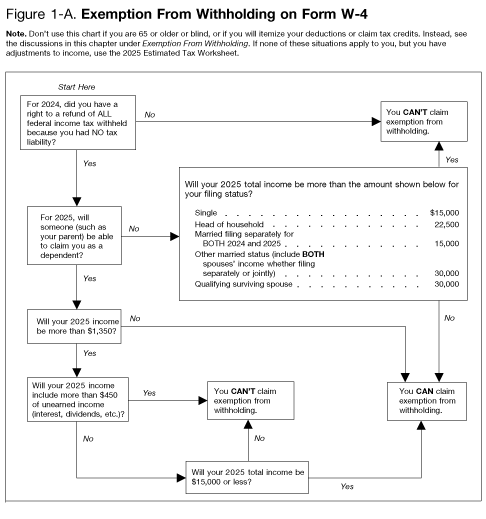
Use Figure 1-A to help you decide whether you can claim exemption from withholding. Don’t use Figure 1-A if you:
Are 65 or older,
Are blind,
Will itemize deductions on your 2026 return, or
Will claim any tax credits on your 2026 return.
Students.
If you are a student, you are not automatically exempt. If you work only part time or during the summer, you may qualify for exemption from withholding.
Example 1.
You are a high school student and expect to earn $2,500 from a summer job. You don’t expect to have any other income during the year, and your parents will be able to claim you as a dependent on their tax return. You worked last summer and had $375 federal income tax withheld from your pay. The entire $375 was refunded when you filed your 2025 return. Using Figure 1-A, you find that you can claim exemption from withholding.
Example 2.
The facts are the same as in Example 1, except that you also have a savings account and expect to have $475 interest income during the year. Using Figure 1-A, you find that you can’t claim exemption from withholding because your unearned income will be more than $450 and your total income will be more than $1,350.
.You may have to file a tax return, even if you are exempt from withholding. See Pub. 501 to see whether you must file a return..
. Age 65 or older or blind. If you are 65 or older or blind, use Worksheet 1-1 or Worksheet 1-2 to help you decide whether you can claim exemption from withholding. Don’t use either worksheet if you will itemize deductions or claim tax credits on your 2026 return. Instead, see Itemizing deductions or claiming credits next..
Itemizing deductions or claiming credits.
If you had no tax liability for 2025, and you will:
Itemize deductions, or
Claim a tax credit,
Claiming exemption from withholding.
To claim exemption, you must give your employer a Form W-4. Check the box on the form in the space marked “Exempt from withholding” below Step 4(c) and complete Steps 1(a), 1(b), and 5. Don’t complete any other steps.
If you claim exemption but later your situation changes so that you will have to pay income tax after all, you must file a new Form W-4 within 10 days after the change. If you claim exemption in 2026 but you expect to owe income tax for 2027, you must file a new Form W-4 by December 1, 2026.
Your claim of exempt status may be reviewed by the IRS. See IRS review of your withholding, earlier.
Supplemental Wages
Supplemental wages include bonuses, commissions, overtime pay, vacation allowances, certain sick pay, and expense allowances under certain plans. The payer can figure withholding on supplemental wages using the same method used for your regular wages. However, if these payments are identified separately from regular wages, your employer or other payer of supplemental wages can withhold income tax from these wages at a 22% flat rate under certain circumstances, as explained in the section on supplemental wages in Pub. 15.
Expense allowances.
Reimbursements or other expense allowances paid by your employer under a nonaccountable plan are treated as supplemental wages. A nonaccountable plan is a reimbursement arrangement that does not require you to account for or prove your business expenses to your employer or does not require you to return your employer’s payments that are more than your proven expenses.
Reimbursements or other expense allowances paid under an accountable plan that are more than your proven expenses are treated as paid under a nonaccountable plan if you don’t return the excess payments within a reasonable period of time.
Accountable plan.
To be an accountable plan, your employer’s reimbursement or allowance arrangement must include all three of the following rules.
Your expenses must have a business connection. That is, you must have paid or incurred deductible expenses while performing services as an employee of your employer.
You must adequately account to your employer for these expenses within a reasonable period of time.
You must return any excess reimbursement or allowance within a reasonable period of time.
An excess reimbursement or allowance is any amount you are paid that is more than the business-related expenses that you adequately accounted for to your employer.
The definition of reasonable period of time depends on the facts and circumstances of your situation. However, regardless of those facts and circumstances, actions that take place within the times specified in the following list will be treated as taking place within a reasonable period of time.
You receive an advance within 30 days of the time you have an expense.
You adequately account for your expenses within 60 days after they were paid or incurred.
You return any excess reimbursement within 120 days after the expense was paid or incurred.
You are given a periodic statement (at least quarterly) that asks you to either return or adequately account for outstanding advances and you comply within 120 days of the statement.
Nonaccountable plan.
Any plan that does not meet the definition of an accountable plan is considered a nonaccountable plan.
For more information about accountable and nonaccountable plans, see chapter 6 of Pub. 463.
Penalties
You may have to pay a penalty of $500 if both of the following apply.
You make statements on your Form W-4 that reduce the amount of tax withheld.
You have no reasonable basis for those statements at the time you prepare your Form W-4.
There is also a criminal penalty for willfully supplying false or fraudulent information on your Form W-4 or for willfully failing to supply information that would increase the amount withheld. The penalty upon conviction can be either a fine of up to $1,000 or imprisonment for up to 1 year or both.
These penalties will apply if you deliberately and knowingly falsify your Form W-4 in an attempt to reduce or eliminate the proper withholding of taxes. A simple error or an honest mistake won’t result in one of these penalties.
Tips
The tips you receive while working on your job are considered part of your pay. You must include your tips on your tax return on the same line as your regular pay. However, tax isn’t withheld directly from tip income, as it is from your regular pay. Nevertheless, your employer will take into account the tips you report when figuring how much to withhold from your regular pay.
.Beginning January 1, 2026, an employer will use an employee’s updated 2026 Form W-4, if one is submitted by the employee, and the federal income tax withholding procedures in Pub. 15-T to allow employees to account for their expected deduction and receive more money in each paycheck instead of waiting until filing their Form 1040 or 1040-SR to receive the benefit of this deduction..
Reporting tips to your employer.
If you receive tips of $20 or more in a month while working for any one employer, you must report to your employer the total amount of tips you receive on the job during the month. The report is due by the 10th day of the following month.
If you have more than one job, make a separate report to each employer. Report only the tips you received while working for that employer and only if they total $20 or more for the month.
How employer figures amount to withhold.
The tips you report to your employer are counted as part of your income for the month you report them. Your employer can figure your withholding in either of two ways.
By withholding at the regular rate on the sum of your pay plus your reported tips.
By withholding at the regular rate on your pay plus a percentage of your reported tips.
Not enough pay to cover taxes.
If your regular pay isn’t enough for your employer to withhold all the tax (including income tax and social security and Medicare taxes (or the equivalent railroad retirement tax)) due on your pay plus your tips, you can give your employer money to cover the shortage.
If you don’t give your employer money to cover the shortage, your employer first withholds as much Medicare tax and social security or railroad retirement tax as possible, up to the proper amount, and then withholds income tax up to the full amount of your pay. If not enough tax is withheld, you may have to pay estimated tax. When you file your return, you may also have to pay any Medicare and social security tax or railroad retirement tax your employer could not withhold.
Tips not reported to your employer.
On your tax return, you must report all the tips you receive during the year, even tips you don’t report to your employer (this includes the value of any noncash tips you received, such as tickets, passes, or other items of value). Make sure you are having enough tax withheld or are paying enough estimated tax (see chapter 2), to cover all your tip income.
Allocated tips.
If you work in a large food or beverage establishment, your employer may have to report an allocated amount of tips on your Form W-2.
Your employer should not withhold income tax, Medicare tax, and social security or railroad retirement tax on the allocated amount. Withholding is based only on your pay plus your reported tips. Your employer should refund to you any incorrectly withheld tax.
How your tips are reported.
Beginning in 2026, your Form(s) W-2 should have your qualified tip income separately reported in box 12, code TP. In addition, your Form(s) W-2, box 14b should include the relevant Treasury Tipped Occupation Code for the occupation in which you earned the tips. If you receive a Form 1099-MISC, tips should be reported in box 13a, Form 1099-NEC, box 1b, and Form 1099-K, box 1c.
Taxable Fringe Benefits
The value of certain noncash fringe benefits you receive from your employer is considered part of your pay. Your employer must generally withhold income tax on these benefits from your regular pay.
Although the value of your personal use of an employer-provided car, truck, or other highway motor vehicle is taxable, your employer can choose not to withhold income tax on that amount. Your employer must notify you if this choice is made.
When benefits are considered paid.
Your employer can choose to treat a fringe benefit as paid by the pay period, by the quarter, or on some other basis as long as the benefit is considered paid at least once a year. Your employer can treat the benefit as being paid on one or more dates during the year, even if you get the entire benefit at one time.
Special rule.
Your employer can choose to treat a benefit provided during November or December as paid in the next year. Your employer must notify you if this rule is used.
Example.
Your employer considers the value of benefits paid from November 1, 2024, through October 31, 2025, as paid to you in 2025. To determine the total value of benefits paid to you in 2026, your employer will add the value of any benefits paid in November and December of 2025 to the value of any benefits paid in January through October of 2026.
Exceptions.
Your employer can’t choose when to withhold tax on the transfer of either real property or personal property of a kind normally held for investment (such as stock). Your employer must withhold tax on these benefits at the time of the transfer.
How withholding is figured.
Your employer can either add the value of a fringe benefit to your regular pay and figure income tax withholding on the total or withhold a flat 22% of the benefit’s value.
If the benefit’s actual value can’t be determined when it is paid or treated as paid, your employer can use a reasonable estimate. Your employer must determine the actual value of the benefit by January 31 of the next year. If the actual value is more than the estimate, your employer must pay the IRS any additional withholding tax required. Your employer has until April 1 of that next year to recover from you the additional income tax paid to the IRS for you.
How your employer reports your benefits.
Your employer must report on Form W-2 the total of the taxable fringe benefits paid or treated as paid to you during the year and the tax withheld for the benefits. These amounts can be shown either on the Form W-2 for your regular pay or on a separate Form W-2. If your employer provided you with a car, truck, or other motor vehicle and chose to treat all of your use of it as personal, its value must be either separately shown on Form W-2 or reported to you on a separate statement.
Sick Pay
Sick pay is a payment to you to replace your regular wages while you are temporarily absent from work due to sickness or personal injury. To qualify as sick pay, it must be paid under a plan to which your employer is a party.
If you receive sick pay from your employer or an agent of your employer, income tax must be withheld. An agent who does not pay regular wages to you may choose to withhold income tax at a flat rate.
However, if you receive sick pay from a third party who isn’t acting as an agent of your employer, income tax will be withheld only if you choose to have it withheld. See Form W-4S, later.
If you receive payments under a plan in which your employer does not participate (such as an accident or health plan where you paid all the premiums), the payments are not sick pay and are usually not taxable.
Union agreements.
If you receive sick pay under a collective bargaining agreement between your union and your employer, the agreement may determine the amount of income tax withholding. See your union representative or your employer for more information.
Form W-4S.
If you choose to have income tax withheld from sick pay paid by a third party, such as an insurance company, you must fill out Form W-4S. Its instructions contain a worksheet you can use to figure the amount you want withheld. They also explain restrictions that may apply.
Give the completed form to the payer of your sick pay. The payer must withhold according to your directions on the form.
Form W-4S remains in effect until you change or cancel it, or stop receiving payments. You can change your withholding by giving a new Form W-4S or a written notice to the payer of your sick pay.
Estimated tax.
If you don’t request withholding on Form W-4S or if you don’t have enough tax withheld, you may have to pay estimated tax. If you don’t pay enough tax, either through estimated tax or withholding, or a combination of both, you may have to pay a penalty. See chapter 2.
Pensions and Annuities
Income tax will usually be withheld from your pension or annuity distributions unless you choose not to have it withheld. This rule applies to distributions from:
An IRA;
A life insurance company under an endowment, annuity, or life insurance contract;
A pension, annuity, or profit-sharing plan;
A stock bonus plan; and
Any other plan that defers the time you receive compensation.
The amount withheld depends on whether you receive payments spread out over more than 1 year (periodic payments), within 1 year (nonperiodic payments), or as an eligible rollover distribution (ERD). Income tax withholding from an ERD is mandatory. ERDs are discussed under Eligible Rollover Distributions, later.
Nontaxable part.
The part of your pension or annuity that is a return of your investment in your retirement plan (the amount you paid into the plan or its cost to you) isn’t taxable. Income tax won’t be withheld from the part of your pension or annuity that isn’t taxable. The tax withheld will be figured on, and can’t be more than, the taxable part.
For information about figuring the part of your pension or annuity that isn’t taxable, see Pub. 575.
Periodic Payments
Withholding from periodic payments of a pension or annuity is figured similarly to withholding from certain salaries and wages. To tell the payer of your pension or annuity how much you want withheld, fill out Form W-4P or a similar form provided by the payer. Follow instructions for Form W-4P and the rules discussed under Form W-4P, earlier, to fill out your 2026 Form W-4P.
Withholding rules.
The withholding rules for pensions and annuities differ from those for salaries and wages in the following ways.
If a 2026 Form W-4P is used for withholding for payments beginning in 2026, and you don’t fill out a withholding certificate, tax will be withheld as if your filing status is Single with no adjustments made in Steps 2 through 4.
You can choose not to have tax withheld, regardless of how much tax you owed last year or expect to owe this year. You don’t have to qualify for exemption. See Choosing Not To Have Income Tax Withheld, later.
If a 2026 Form W-4P is used for withholding for payments beginning in 2026, and you don’t give the payer your SSN in the required manner or the IRS notifies the payer before any payment or distribution is made that you gave an incorrect SSN, tax will be withheld as if your filing status is Single with no adjustments in Steps 2 through 4. For payments that began before 2026, your current withholding election (or your default rate) remains in effect unless you submit a new Form W-4P.
Effective date of withholding certificate.
If you give your withholding certificate (Form W-4P or a similar form) to the payer on or before the date your payments start, it will be put into effect by the first payment made more than 30 days after you submit the certificate.
If you give the payer your certificate after your payments start, it will be put into effect with the first payment, which is at least 30 days after you submit it. However, the payer can elect to put it into effect earlier.
Nonperiodic Payments
Tax will be withheld at a flat 10% rate on any nonperiodic payments you receive, unless you choose a different withholding rate.
Use Form W-4R, line 2, to choose a withholding rate other than the default 10% rate. You can choose a rate between 0% and 100%. You can choose to have no federal income tax withheld by entering “-0-” on line 2. Generally, you can’t choose less than 10% for payments to be delivered outside of the United States and its territories. If you want to revoke a choice not to have tax withheld, see Choosing Not To Have Income Tax Withheld, later.
.You may need to use Form W-4R to ask for additional withholding. If you don’t have enough tax withheld, you may need to pay estimated tax, as explained in chapter 2. .
Eligible Rollover Distributions
Distributions you receive from qualified retirement plans (for example, 401(k) plans and section 457(b) plans maintained by a governmental employer) or tax-sheltered annuities that are eligible to be rolled over to an IRA or qualified plan are subject to a 20% default rate of withholding on the taxable amount of the distribution. You can’t choose withholding at a rate of less than 20% (including “-0-”). Note that the default rate of withholding may be too low for your tax situation. You may choose to enter a rate higher than 20% on Form W-4R, line 2. Don’t give Form W-4R to your payer unless you want more than 20% withheld.
Note that the following payments are not eligible rollover distributions for purposes of these withholding rules:
Qualifying “hardship” distributions;
Distributions required by federal law, such as required minimum distributions;
Generally, distributions from a pension-linked emergency savings account;
Eligible distributions to a domestic abuse victim;
Qualified disaster recovery distributions;
Qualified birth or adoption distributions; and
Emergency personal expense distributions.
Choosing Not To Have Income Tax Withheld
For payments other than eligible rollover distributions, you can choose not to have income tax withheld. The payer will tell you how to make this choice. If you use Form W-4R, enter “-0-” on line 2 to choose not to have withholding. This choice will remain in effect until you decide you want withholding and inform the payer. See Revoking a choice not to have tax withheld, later.
The payer must withhold if either of the following applies.
You don’t give the payer your SSN in the required manner.
The IRS notifies the payer, before any payment or distribution is made, that you gave it an incorrect SSN.
If you don’t have any income tax withheld from your pension or annuity, or if you don’t have enough withheld, you may have to pay estimated tax. See chapter 2.
If you don’t pay enough tax, either through estimated tax or withholding, or a combination of both, you may have to pay a penalty.
Payments delivered outside the United States.
You must generally have tax withheld from pension or annuity benefits delivered outside the United States. However, if you are a U.S. citizen or resident alien, you can choose not to have tax withheld if you give the payer of the benefits a home address in the United States or in a U.S. territory. The payer must withhold tax if you provide a U.S. address for a nominee, trustee, or agent to whom the benefits are to be delivered, but don’t provide your own home address in the United States or in a U.S. territory.
Notice required of payer.
The payer of your pension or annuity must send you a notice telling you about your right to choose not to have tax withheld.
Generally, the payer won’t send a notice to you if it is reasonable to believe that the entire amount you will be paid isn’t taxable.
Revoking a choice not to have tax withheld.
The payer of your pension or annuity will tell you how to revoke your choice not to have income tax withheld from periodic or nonperiodic payments. You can tell the payer exactly how much to withhold by completing a new Form W-4P for periodic payments or Form W-4R for nonperiodic payments.
Gambling Winnings
Income tax is withheld at a flat 24% rate from certain kinds of gambling winnings.
Gambling winnings of more than $5,000 from the following sources are subject to income tax withholding.
Any sweepstakes; wagering pool, including payments made to winners of poker tournaments; or lottery.
Any other wager if the proceeds are at least 300 times the amount of the bet.
Exception.
Gambling winnings from bingo, keno, and slot machines are generally not subject to income tax withholding. However, you may need to provide the payer with an SSN to avoid withholding. See Backup withholding on gambling winnings, later. If you receive gambling winnings not subject to withholding, you may need to pay estimated tax. See chapter 2.
If you don’t pay enough tax, either through withholding or estimated tax, or a combination of both, you may have to pay a penalty.
Form W-2G.
If a payer withholds income tax from your gambling winnings, you should receive a Form W-2G, Certain Gambling Winnings, showing the amount you won and the amount withheld.
Report the tax withheld on your 2026 Form 1040 or 1040-SR, along with all other federal income tax withheld, as shown on Forms W-2 and 1099.
Information to give payer.
If the payer asks, you must give the payer all the following information.
Your name, address, and SSN.
Whether you made identical wagers (explained below).
Whether someone else is entitled to any part of the winnings subject to withholding. If so, you must complete Form 5754, Statement by Person(s) Receiving Gambling Winnings, and return it to the payer. The payer will use it to prepare a Form W-2G for each of the winners.
Identical wagers.
You may have to give the payer a statement of the amount of your winnings, if any, from identical wagers. If this statement is required, the payer will ask you for it. You provide this statement by signing Form W-2G or, if required, Form 5754.
Identical wagers include two bets placed in a pari-mutuel pool on one horse to win a particular race. However, the bets are not identical if one bet is “to win” and one bet is “to place.” In addition, they are not identical if the bets were placed in different pari-mutuel pools. For example, a bet in a pool conducted by the racetrack and a bet in a separate pool conducted by an offtrack betting establishment in which the bets are not pooled with those placed at the track are not identical wagers.
Backup withholding on gambling winnings.
If you have any kind of gambling winnings and don’t give the payer your SSN, the payer may have to withhold income tax at a flat 24% rate. This rule also applies to winnings of at least $2,000 from bingo, slot machines, keno, and certain other gambling winnings.
Unemployment Compensation
You can choose to have income tax withheld from unemployment compensation. To make this choice, fill out Form W-4V (or a similar form provided by the payer) and give it to the payer.
All unemployment compensation is taxable. So, if you don’t have income tax withheld, you may have to pay estimated tax. See chapter 2.
If you don’t pay enough tax, either through withholding or estimated tax or a combination of both, you may have to pay a penalty.
Federal Payments
You can choose to have income tax withheld from certain federal payments you receive. These payments are the following.
Social security benefits.
Tier 1 railroad retirement benefits.
Commodity credit corporation loans you choose to include in your gross income.
-
Payments under the Agricultural Act of 1949 (7 U.S.C. 1421 et seq.), as amended, or title II of the Disaster Assistance Act of 1988 that are treated as insurance proceeds and that you received because:
Your crops were destroyed or damaged by drought, flood, or any other natural disaster; or
You were unable to plant crops because of a natural disaster described
in (a).
Dividends and other distributions from Alaska Native Corporations to their shareholders.
Any other payment under federal law as determined by the Secretary.
To make this choice, fill out Form W-4V (or a similar form provided by the payer) and give it to the payer.
If you don’t choose to have income tax withheld, you may have to pay estimated tax. See chapter 2.
If you don’t pay enough tax, either through withholding or estimated tax or a combination of both, you may have to pay a penalty.
More information.
For more information about the tax treatment of social security and railroad retirement benefits, see Pub. 915. Get Pub. 225 for information about the tax treatment of commodity credit corporation loans or crop disaster payments.
Payment to shareholders of Alaska Native Corporations (ANCs).
If you are a shareholder of an ANC, you can request to have income tax withheld from dividends and other distributions you receive from the ANC. To make this request, fill out Form W-4V (or a similar form provided by the payer) and give it to the payer. A request for withholding isn’t effective until the ANC indicates in writing that it accepts the request or begins withholding. Contact the payer if it isn’t clear that the payer has accepted your Form W-4V.
If you don’t choose to have income tax withheld or the ANC doesn’t accept your request, you may have to pay estimated tax. See chapter 2.
If you don’t pay enough tax, either through withholding or estimated tax, or a combination of both, you may have to pay a penalty.
Backup Withholding
Banks or other businesses that pay you certain kinds of income must file an information return (Form 1099) with the IRS. The information return shows how much you were paid during the year. It also includes your name and taxpayer identification number (TIN). TINs are explained later in this discussion.
These payments are generally not subject to withholding. However, “backup” withholding is required in certain situations.
Payments subject to backup withholding.
Backup withholding can apply to most kinds of payments that are reported on Form 1099. These include:
Interest payments (Form 1099-INT);
Government payments (Form 1099-G);
Dividends (Form 1099-DIV);
Patronage dividends, but only if at least half the payment is in money (Form 1099-PATR);
Rents, profits, or other gains (Form 1099-MISC);
Commissions, fees, or other payments for work you do as an independent contractor (Form 1099-NEC);
Payments by brokers (Form 1099-B);
Payments by fishing boat operators, but only the part that is in money and that represents a share of the proceeds of the catch (Form 1099-MISC); and
Royalty payments (Form 1099-MISC).
Payments not subject to backup withholding.
Backup withholding does not apply to payments reported on Form 1099-MISC (other than payments by fishing boat operators and royalty payments) unless at least one of the following three situations applies.
The amount you receive from any one payer is $2,000 or more.
The payer had to give you a Form 1099 last year.
The payer made payments to you last year that were subject to backup withholding.
Form 1099 and backup withholding are generally not required for a payment of less than $10.
Withholding rules.
When you open a new account, make an investment, or begin to receive payments reported on Form 1099, the bank or other business will give you Form W-9, Request for Taxpayer Identification Number and Certification, or a similar form. You must enter your TIN on the form and, if your account or investment will earn interest or dividends, you must also certify (under penalties of perjury) that your TIN is correct and that you are not subject to backup withholding.
The payer must withhold at a flat 24% rate in the following situations.
You don’t give the payer your TIN in the required manner.
The IRS notifies the payer that the TIN you gave is incorrect.
You are required but fail to certify that you are not subject to backup withholding.
The IRS notifies the payer to start withholding on interest or dividends because you have underreported interest or dividends on your income tax return. The IRS will do this only after it has mailed you four notices over at least a 210-day period.
Taxpayer identification number (TIN).
Your TIN is one of the following three numbers.
An ITIN is for federal tax use only. It does not entitle you to social security benefits or change your employment or immigration status under U.S. law. For more information on ITINs, see Pub. 1915.
.If you have an ITIN that you haven’t included on a tax return in the last 3 consecutive years, it may be expired and you may need to renew it. If your ITIN has expired and you don’t have an SSN, you can make estimated tax payments before you renew your ITIN. To renew your ITIN, and for more information, see the Instructions for Form W-7..
How to prevent or stop backup withholding.
If you have been notified by a payer that the TIN you gave is incorrect, you can usually prevent backup withholding from starting or stop backup withholding once it has begun by giving the payer your correct name and TIN. You must certify that the TIN you give is correct.
However, the payer will provide additional instructions if the TIN you gave needs to be validated by the Social Security Administration or by the IRS. This may happen if both the following conditions exist.
The IRS notifies the payer twice within 3 calendar years that a TIN you gave for the same account is incorrect.
The incorrect TIN is still being used on the account when the payer receives the second notice.
Underreported interest or dividends.
If you have been notified that you underreported interest or dividends, you must request and receive a determination from the IRS to prevent backup withholding from starting or to stop backup withholding once it has begun. Your request must show that at least one of the following situations applies.
No underreporting occurred.
You have a bona fide dispute with the IRS about whether an underreporting occurred.
Backup withholding will cause or is causing an undue hardship and it is unlikely that you will underreport interest and dividends in the future.
You have corrected the underreporting by filing an original return if you didn’t previously file one or by filing an amended return and by paying all taxes, penalties, and interest due for any underreported interest or dividend payments.
If the IRS determines that backup withholding should stop, it will provide you with certification and will notify the payers who were sent notices earlier.
Penalties.
There are civil and criminal penalties for giving false information to avoid backup withholding. The civil penalty is $500. The criminal penalty, upon conviction, is a fine of up to $1,000 or imprisonment of up to 1 year, or both.
Worksheets for Chapter 1
|
Use the following worksheets to figure your correct withholding and adjustments. |
| Use... | To... |
| Worksheet 1-1 and Worksheet 1-2 Exemption From Withholding for Persons/Dependents Age 65 or Older or Blind | Figure your total expected income for 2026 to determine if you are exempt from withholding. Use Worksheet 1-1 if, in 2025, you had a right to a refund of all federal income tax withheld because of no tax liability. Use Worksheet 1-2 if you are a dependent for 2026 and, for 2025, you had a refund of all federal income tax withheld because of no tax liability. |
| Worksheet 1-3 Projected Tax for 2026 | Project the taxable income you will have for 2026 and figure the amount of tax you will have to pay on that income. |
| Worksheet 1-4 Tax Computation Worksheets for 2026 | Figure the amount of tax on your projected taxable income. |
| Worksheet 1-5 Projected Withholding for 2026 | Project the amount of federal income tax that you will have withheld in 2026, compare your projected withholding with your projected tax, and determine whether the amount withheld each payday should be adjusted. |
| Worksheet 1-6 Tax Credits for 2026 Form W-4 or Form W-4P | Figure any extra amount to include in Step 3 of Form W-4 or Form W-4P to account for your projected tax credits that are not otherwise taken into consideration. |
|
Use this worksheet only if, for 2025, you had a right to a refund of all federal income tax withheld because you had no tax liability. |
| 1. | Check the boxes below that apply to you. | ||||
| 65 or older □ | Blind □ | ||||
| 2. | Check the boxes below that apply to your spouse’s standard deduction.* | ||||
| 65 or older □ | Blind □ | ||||
| 3. | Add the number of boxes you checked in 1 and 2 above. Enter the result | _____ | |||
| You can claim exemption from withholding if: | |||||
| Your filing status is: | and the number on line 3 above is: | and your 2026 total income will be no more than: | |||
| Single | 1 | $18,150 | |||
| 2 | 20,200 | ||||
| Head of | 1 | $26,200 | |||
| household | 2 | 28,250 | |||
| Married filing | 1 | $17,750 | |||
| separately for | 2 | 19,400 | |||
| both 2025 and | 3 | 21,050 | |||
| 2026 | 4 | 22,700 | |||
| Other married | 1 | $33,850** | |||
| status | 2 | 35,500** | |||
| 3 | 37,150** | ||||
| 4 | 38,800** | ||||
| ** Include both spouses’ income whether you will file separately or jointly. | |||||
| Qualifying | 1 | $33,850 | |||
| surviving spouse | 2 | 35,300 | |||
| You can’t claim exemption from withholding if your total income will be more than the amount shown for your filing status. | |||||
| * You can check the appropriate boxes for your spouse if your filing status is Married filing jointly. You can check the appropriate boxes for your spouse if your filing status is Married filing separately and your spouse had no income, isn’t filing a return, and can’t be claimed as a dependent on another person’s return. | |||||
|
Use this worksheet only if, for 2026, you are a dependent and if, for 2025, you had a right to a refund of all federal income tax withheld because you had no tax liability. |
| 1. | Enter your expected earned income plus $450 | 1. | _____ | ||
| 2. | Minimum amount | 2. | $ 1,350 | ||
| 3. | Compare lines 1 and 2. Enter the larger amount | 3. | _____ | ||
| 4. | Limit | 4. | 16,100 | ||
| 5. | Compare lines 3 and 4. Enter the smaller amount | 5. | _____ | ||
| 6. | Enter the appropriate amount from the following table | 6. | _____ | ||
| Single | |||||
| Either 65 or older or blind | $2,050 | ||||
| Both 65 or older and blind | 4,100 | ||||
| Married filing separately | |||||
| Either 65 or older or blind | 1,650 | ||||
| Both 65 or older and blind | 3,300 | ||||
| 7. | Add lines 5 and 6. Enter the result | 7. | _____ | ||
| 8. | Enter your total expected income | 8. | _____ | ||
| You can claim exemption from withholding if line 7 is equal to or more than line 8. You can’t claim exemption from withholding if line 8 is more than line 7. | |||||
Worksheet 1-3. Projected Tax for 2026
| Use this worksheet to figure your projected tax for 2026. Note: Enter combined amounts if Married filing jointly. | ||||||
| 1. | Enter amount of adjusted gross income (AGI) you expect in 2026. (To determine this, you may want to start with the AGI on your last year’s return, and add or subtract your expected changes. Also, take into account items listed under What’s New for 2026 and the Reminders section, earlier.) | |||||
| Note: If self-employed, first complete Worksheet 2-3 to figure your expected deduction for self-employment tax. Subtract the amount from Worksheet 2-3, line 11, to figure the line 1 entry | 1. | |||||
| 2. | If you: | |||||
| • | Don’t plan to itemize deductions on Schedule A (Form 1040), use Worksheet 2-4 to figure your expected standard deduction plus up to $1,000 ($2,000 for married filing jointly) for charitable contributions made by cash or check. | |||||
| • | Plan to itemize deductions, enter the amount of your estimated itemized deductions. Caution: If you plan to itemize your deductions and claim a charitable contribution deduction, see Worksheet 2–5 to figure the amount of your deduction. Caution: If your expected taxable income will be more than $768,700 if married filing jointly or qualifying widower; $640,600 if head of household or single; $384,350 if married filing separately, your itemized deductions may be reduced. See Worksheet 2-6 to figure the amount of your deduction. | |||||
| • | Qualify for the deduction for qualified business income, enter the estimated amount of the deduction you are allowed on your qualified business income from a qualified trade or business. | |||||
| • | Can take an additional deduction on Schedule 1-A, (Form 1040) enter the estimated amount you expect to enter on Schedule 1-A (Form 1040), line 38. Add this amount to your expected standard deduction or estimated itemized deductions and any expected deduction for qualified business income and enter the total here. | 2. | ||||
| 3. | Expected taxable income. Subtract line 2 from line 1. (If zero or less, enter -0- here and on line 4, then go to line 5.) | 3. | ||||
| 4. | If the amount on line 1: | |||||
| • | Doesn’t include a net capital gain or qualified dividends and you didn’t exclude foreign earned income or exclude or deduct foreign housing in arriving at the amount on line 1, use Worksheet 1-4 to figure the tax to enter here. | |||||
| • | Includes a net capital gain or qualified dividends, use Worksheet 2-7 to figure the tax to enter here. | |||||
| • | Was figured by excluding foreign earned income or excluding or deducting foreign housing, use Worksheet 2-8 to figure the tax to enter here | 4. | ||||
| 5. | Enter any expected additional taxes from an election to report your child’s interest and dividends, lump-sum distributions (Form 4972), and alternative minimum tax | 5. | ||||
| 6. | Add lines 4 and 5 | 6. | ||||
| 7. | Enter the amount of any expected tax credits. See Table 1-2 | 7. | ||||
| 8. | Subtract line 7 from line 6 (if zero or less, enter -0-) | 8. | ||||
| 9. | Self-employment tax. Enter the amount from Worksheet 2-3, line 10. (If you expect to file jointly and both of you are self-employed, figure the self-employment tax for each of you separately and enter the total on line 9.) | 9. | ||||
| 10. | Enter the total of any other expected taxes* | 10. | ||||
| 11. | Projected tax for 2026. Add lines 8 through 10. Enter the total here and on Worksheet 1-5, line 1 | 11. | ||||
| * Use the 2025 Instructions for Form 1040 to determine if you expect to owe, for 2026, any of the taxes that would have been entered on your 2025 Schedule 2 (Form 1040), lines 7 through 17z and 19. |
Worksheet 1-4. Tax Computation Worksheets for 2026
|
Note: If you are figuring the tax on an amount from Worksheet 2-7 (line 1 or 14), or Worksheet 2-8 (line 2 or 3), enter the amount from that worksheet in column (a) of the row that applies to that amount of income. Enter the result on the appropriate line of the worksheet you are completing. |
| a. Single. Use this worksheet to figure the amount to enter on Worksheet 1-3, line 4, if you expect your filing status for 2026 to be Single. | ||||||
| Expected Taxable Income | (a) Enter amount from Worksheet 1-3, line 3* | (b) Multiplication amount | (c) Multiply (a) by (b) | (d) Subtraction amount | (e) Subtract (d) from (c). Enter the result here and on Worksheet 1-3, line 4* | |
| If Worksheet 1-3, line 3* is — | ||||||
| Over | But not over | |||||
| $0 | $12,400 | × 10% (0.10) | $0 | |||
| 12,400 | 50,400 | × 12% (0.12) | 248.00 | |||
| 50,400 | 105,700 | × 22% (0.22) | 5,288.00 | |||
| 105,700 | 201,775 | × 24% (0.24) | 7,402.00 | |||
| 201,775 | 256,225 | × 32% (0.32) | 23,544.00 | |||
| 256,225 | 640,600 | × 35% (0.35) | 31,230.75 | |||
| 640,600 | - - - - - | × 37% (0.37) | 44,042.75 | |||
| * If you are using Worksheet 2-7, for column (a) above, use the amount from line 1 or line 14 and enter the result (from column (e)) on line 37 or line 39, as appropriate. If you are using Worksheet 2-8, for column (a) above, use the amount from line 2 or line 3 and enter the result (from column (e)) on line 4 or line 5, as appropriate. | ||||||
| b. Head of household. Use this worksheet to figure the amount to enter on Worksheet 1-3, line 4, if you expect your filing status for 2026 to be Head of household. | ||||||
| Expected Taxable Income | (a) Enter amount from Worksheet 1-3, line 3* | (b) Multiplication amount | (c) Multiply (a) by (b) | (d) Subtraction amount | (e) Subtract (d) from (c). Enter the result here and on Worksheet 1-3, line 4* | |
| If Worksheet 1-3, line 3* is — | ||||||
| Over | But not over | |||||
| $0 | $17,700 | × 10% (0.10) | $0 | |||
| 17,700 | 67,450 | × 12% (0.12) | 354.00 | |||
| 67,450 | 105,700 | × 22% (0.22) | 7,099.00 | |||
| 105,700 | 201,750 | × 24% (0.24) | 9,213.00 | |||
| 201,750 | 256,200 | × 32% (0.32) | 25,353.00 | |||
| 256,200 | 640,600 | × 35% (0.35) | 33,039.00 | |||
| 640,600 | - - - - - | × 37% (0.37) | 45,851.00 | |||
| * If you are using Worksheet 2-7, for column (a) above, use the amount from line 1 or line 14 and enter the result (from column (e)) on line 37 or line 39, as appropriate. If you are using Worksheet 2-8, for column (a) above, use the amount from line 2 or line 3 and enter the result (from column (e)) on line 4 or line 5, as appropriate. | ||||||
Tax Computation Worksheet for 2026 (Continued)
| c. Married filing jointly or Qualifying surviving spouse. Use this worksheet to figure the amount to enter on Worksheet 1-3, line 4, if you expect your filing status for 2026 to be Married filing jointly or Qualifying surviving spouse. | ||||||
| Expected Taxable Income | (a) Enter amount from Worksheet 1-3, line 3* | (b) Multiplication amount | (c) Multiply (a) by (b) | (d) Subtraction amount | (e) Subtract (d) from (c). Enter the result here and on Worksheet 1-3, line 4* | |
| If Worksheet 1-3, line 3* is — | ||||||
| Over | But not over | |||||
| $0 | $24,800 | × 10% (0.10) | $0 | |||
| 24,800 | 100,800 | × 12% (0.12) | 496.00 | |||
| 100,800 | 211,400 | × 22% (0.22) | 10,576.00 | |||
| 211,400 | 403,550 | × 24% (0.24) | 14,804.00 | |||
| 403,550 | 512,450 | × 32% (0.32) | 47,088.00 | |||
| 512,450 | 768,700 | × 35% (0.35) | 62,461.50 | |||
| 768,700 | - - - - - | × 37% (0.37) | 77,835.50 | |||
| * If you are using Worksheet 2-7, for column (a) above, use the amount from line 1 or line 14 and enter the result (from column (e)) on line 37 or line 39, as appropriate. If you are using Worksheet 2-8, for column (a) above, use the amount from line 2 or line 3 and enter the result (from column (e)) on line 4 or line 5, as appropriate. | ||||||
| d. Married filing separately. Use this worksheet to figure the amount to enter on Worksheet 1-3, line 4, if you expect your filing status for 2026 to be Married filing separately. | ||||||
| Expected Taxable Income | (a) Enter amount from Worksheet 1-3, line 3* | (b) Multiplication amount | (c) Multiply (a) by (b) | (d) Subtraction amount | (e) Subtract (d) from (c). Enter the result here and on Worksheet 1-3, line 4* | |
| If Worksheet 1-3, line 3* is — | ||||||
| Over | But not over | |||||
| $0 | $12,400 | × 10% (0.10) | $0 | |||
| 12,400 | 50,400 | × 12% (0.12) | 248.00 | |||
| 50,400 | 105,700 | × 22% (0.22) | 5,288.00 | |||
| 105,700 | 201,775 | × 24% (0.24) | 7,402.00 | |||
| 201,775 | 256,225 | × 32% (0.32) | 23,544.00 | |||
| 256,225 | 384,350 | × 35% (0.35) | 31,230.75 | |||
| 384,350 | - - - - - | × 37% (0.37) | 38,917.75 | |||
| * If you are using Worksheet 2-7, for column (a) above, use the amount from line 1 or line 14 and enter the result (from column (e)) on line 37 or line 39, as appropriate. If you are using Worksheet 2-8, for column (a) above, use the amount from line 2 or line 3 and enter the result (from column (e)) on line 4 or line 5, as appropriate. | ||||||
Worksheet 1-5. Projected Withholding for 2026
| Use this worksheet to figure the amount of your projected withholding for 2026, compare it to your projected tax for 2026, and, if necessary, figure any adjustment to the amount you have withheld each payday. Note: If Married filing jointly, enter combined amounts. | ||||
| 1. | Enter your projected tax for 2026 from Worksheet 1-3, line 11 | 1. | _____ | |
| 2. | Enter your total federal income tax withheld to date in 2026 from all sources of income. (For wages, you should be able to find the withholding-to-date on your last pay slip or statement.) | 2. | _____ | |
| 3. | Enter the federal tax withholding you expect for the rest of 2026. | |||
| a. | For each source of wages, multiply the amount of federal income tax now being withheld each payday by the number of paydays remaining in the year and enter the combined amount for all jobs | 3a. | _____ | |
| b. | For all other sources of recurring taxable income, multiply the withholding amount by the remaining number of times the income is expected. For example, if you have federal income tax withheld from your monthly pension and you will receive nine more payments this year, multiply your monthly withholding amount by 9 | 3b. | _____ | |
| 4. | Add lines 2, 3a, and 3b. This is your projected withholding for 2026 | 4. | _____ | |
| 5. | Compare the amounts on lines 1 and 4. | |||
| • If line 1 is more than line 4, subtract line 4 from line 1. You need to increase your withholding. Enter the result here and go to line 6. | ||||
| • If line 4 is more than line 1, subtract line 1 from line 4. You may want to decrease your withholding. Enter the result here and go to line 6. | 5. | _____ | ||
| 6. | Divide line 5 by the number of paydays (or other withholding events) remaining in 2026 and enter the result. This is the additional amount you should use to either increase or decrease the amount you have withheld from each remaining payday (or other withholding event). Follow the instructions for line 6 for your situation for completing a 2026 Form W-4. The instructions are different if your withholding so far this year was based on a 2019 (or earlier) Form W-4 or a 2026 Form W-4 | 6. | _____ | |
Instructions for line 6—If your withholding to date was figured based on a 2019 (or earlier) Form W-4.
|
Use the following instructions to increase your withholding. |
| How do you increase your withholding? Follow these steps to increase your withholding by completing a 2026 Form W-4. | |
| Step 1: |
Note: Head of household filing status was not a choice on the 2019 (or earlier) Form(s) W-4. |
| Step 4(a): |
|
| Step 4(b): |
|
| Step 4(c): |
|
Instructions for line 6—If your withholding to date was figured based on a 2019 (or earlier) Form W-4.
|
Use the following instructions to decrease your withholding. |
| How do you decrease your withholding? Follow these steps to decrease your withholding by completing a 2026 Form W-4. | |
| Step 1: |
Note: Head of household filing status was not a choice on the 2019 (or earlier) Form(s) W-4. |
| Step 3: | Multiply the amount on line 6 of Worksheet 1-5 by the number of paydays in 2026 and enter this amount on Step 3. |
| Step 4(a): |
|
| Step 4(b): |
|
| Step 4(c): |
|
Instructions for line 6—If your withholding to date was figured based on a 2026 Form W-4.
|
Use the following instructions to either increase or decrease your withholding. |
| How do you increase your withholding? Follow these steps to increase your withholding by completing a 2026 Form W-4. | |
| |
| How do you decrease your withholding? | |
| |
.If you make a mid-year change to your withholding, you should complete and give to your employer a new Form W-4 in January. The later in the year you change your Form W-4, the more important it is that you submit a new form the following January..
Worksheet 1-6. Tax Credits for 2026 Form W-4 or Form W-4P
| Use this worksheet to figure any extra amount to enter in Step 3 of Form W-4 or Form W-4P. For more information on these credits, see Tax Credits, earlier. Caution: The child tax credit and the credit for other dependents are already figured in Step 3 of Form W-4 or Form W-4P. | ||||||||||||
| Enter the projected amount for each credit you expect to take (other than the child tax credit or credit for other dependents). | ||||||||||||
| 1. | Credit for the elderly or the disabled | 1. | ||||||||||
| 2. | Credit for child and dependent care expenses | 2. | ||||||||||
| 3. | Education credits | 3. | ||||||||||
| 4. | Adoption credit (including the refundable portion) | 4. | ||||||||||
| 5. | Foreign tax credit | 5. | ||||||||||
| 6. | Retirement savings contributions credit | 6. | ||||||||||
| 7. | Earned income credit | 7. | ||||||||||
| 8. | Premium tax credit | 8. | ||||||||||
| 9. | Other credits (see Table 1-2) | 9. | ||||||||||
| 10. | Add lines 1 through 9. This is your total estimated tax credits. Include this amount in the total entered on Form W-4, Step 3 | 10. | ||||||||||
Introduction
Estimated tax is the method used to pay tax on income that isn’t subject to withholding. This includes income from self-employment, interest, dividends, rent, gains from the sale of assets, prizes, and awards. You may also have to pay estimated tax if the amount of income tax being withheld from your salary, pension, or other income isn’t enough.
Estimated tax is used to pay both income tax and self-employment tax, as well as other taxes and amounts reported on your tax return. If you don’t pay enough tax, either through withholding or estimated tax, or a combination of both, you may have to pay a penalty. If you don’t pay enough by the due date of each payment period (see When To Pay Estimated Tax, later), you may be charged a penalty even if you are due a refund when you file your tax return. For information on when the penalty applies, see the Instructions for Form 2210.
.It would be helpful for you to have a copy of your 2025 tax return and an estimate of your 2026 income nearby while reading this chapter. Also, keep in mind the items under What’s New for 2026 and the Reminders section, earlier..
Topics
This chapter discusses:Who must pay estimated tax,
How to figure estimated tax (including illustrated examples),
When to pay estimated tax,
How to figure each payment, and
How to pay estimated tax.
Useful Items
You may want to see:Form (and Instructions)
1040-ES Estimated Tax for Individuals
See How To Get Tax Help at the end of this publication for information about how to get this publication and form.
Worksheets.
You may need to use several of the blank worksheets included in this chapter. See Worksheets for Chapter 2 to locate what you need.
Who Does Not Have To Pay Estimated Tax
If you receive salaries and wages, you may be able to avoid paying estimated tax by asking your employer to take more tax out of your earnings. To do this, file a new Form W-4 with your employer. See chapter 1.
Estimated tax not required.
You don’t have to pay estimated tax for 2026 if you meet all three of the following conditions.
You had no tax liability for 2025.
You were a U.S. citizen or resident alien for the whole year.
Your 2025 tax year covered a 12-month period.
You had no tax liability for 2025 if your total tax (defined later under Total tax for 2025—line 12b) was zero or you didn’t have to file an income tax return.
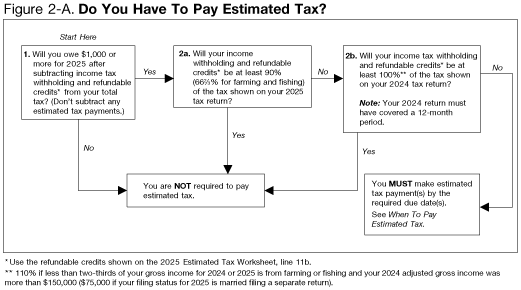
Who Must Pay Estimated Tax
If you owed additional tax for 2025, you may have to pay estimated tax for 2026.
You can use the following general rule as a guide during the year to see if you will have enough withholding or should increase your withholding or make estimated tax payments.
General Rule
In most cases, you must pay estimated tax for 2026 if both of the following apply.
You expect to owe at least $1,000 in tax for 2026 after subtracting your withholding and tax credits.
-
You expect your withholding and tax credits to be less than the smaller of:
90% of the tax to be shown on your 2026 tax return, or
100% of the tax shown on your 2025 tax return. Your 2025 tax return must cover all 12 months.
.If the result from using the general rule above suggests that you won’t have enough withholding, complete the 2026 Estimated Tax Worksheet for a more accurate calculation..
Figure 2-A takes you through the general rule. You may find this helpful in determining if you must pay estimated tax.
.If all your income will be subject to income tax withholding, you probably don’t need to pay estimated tax..
Married Taxpayers
If you qualify to make joint estimated tax payments, apply the rules discussed here to your joint estimated income.
You and your spouse can make joint estimated tax payments even if you are not living together.
However, you and your spouse can’t make joint estimated tax payments if:
You are legally separated under a decree of divorce or separate maintenance,
You and your spouse have different tax years, or
Either spouse is a nonresident alien (unless that spouse elected to be treated as a resident alien for tax purposes). See Choosing Resident Alien Status in Pub. 519.
Note:
Individuals who are in registered domestic partnerships, civil unions, or other similar formal relationships that are not marriages under state law can’t make joint estimated tax payments. These individuals can take credit only for the estimated tax payments that he or she made.
If you and your spouse can’t make joint estimated tax payments, apply these rules to your separate estimated income.
Making joint or separate estimated tax payments won’t affect your choice of filing a joint tax return or separate returns for 2026.
2025 separate returns and 2026 joint return.
If you plan to file a joint return with your spouse for 2026, but you filed separate returns for 2025, your 2025 tax is the total of the tax shown on your separate returns. You filed a separate return if you filed as Single, Head of household, or Married filing separately.
2025 joint return and 2026 separate returns.
If you plan to file a separate return for 2026 but you filed a joint return for 2025, your 2025 tax is your share of the tax on the joint return. You file a separate return if you file as Single, Head of household, or Married filing separately.
To figure your share of the tax on a joint return, first figure the tax both you and your spouse would have paid had you filed separate returns for 2025 using the same filing status for 2026. Then, multiply the tax on the joint return by the following fraction.
| The tax you would have paid had you filed a separate return | ||
| The total tax you and your spouse would have paid had you filed separate returns |
Special Rules
There are special rules for those who have income from farming and fishing, for certain household employers, and for certain higher income taxpayers.
If at least two-thirds of your gross income for 2025 or 2026 is from farming or fishing, substitute 662/3% for 90% in (2a) under General Rule, earlier.
Gross income.
Your gross income is all income you receive in the form of money, goods, property, and services that isn’t exempt from tax. To determine whether two-thirds of your gross income for 2025 was from farming or fishing, use as your gross income the total of the income (not loss) amounts.
Joint returns.
On a joint return, you must add your spouse’s gross income to your gross income to determine if at least two-thirds of your total gross income is from farming or fishing.
Gross income from farming.
This is income from cultivating the soil or raising agricultural commodities. It includes the following amounts.
Income from operating a stock, dairy, poultry, bee, fruit, or truck farm.
Income from a plantation, ranch, nursery, range, orchard, or oyster bed.
Crop shares for the use of your land.
Gains from sales of draft, breeding, dairy, or sporting livestock.
For 2025, gross income from farming is the total of the following amounts.
Schedule F (Form 1040), Profit or Loss From Farming, line 9.
Form 4835, Farm Rental Income and Expenses, line 7.
Your share of the gross farming income from a partnership, S corporation, estate or trust from Schedule K-1 (Form 1065), Schedule K-1 (Form 1120-S), or Schedule K-1 (Form 1041).
Your gains from sales of draft, breeding, dairy, or sporting livestock shown on Form 4797, Sales of Business Property.
Wages you receive as a farm employee and wages you receive from a farm corporation are not gross income from farming.
Gross income from fishing.
This is income from catching, taking, harvesting, cultivating, or farming any kind of fish, shellfish (for example, clams and mussels), crustaceans (for example, lobsters, crabs, and shrimp), sponges, seaweeds, or other aquatic forms of animal and vegetable life.
Gross income from fishing includes the following amounts.
Schedule C (Form 1040), Profit or Loss From Business, line 7.
Income for services as an officer or crew member of a vessel while the vessel is engaged in fishing.
Your share of the gross fishing income from a partnership, S corporation, estate or trust from Schedule K-1 (Form 1065), Schedule K-1 (Form 1120S), or Schedule K-1 (Form 1041).
Certain taxable interest and punitive damage awards received in connection with the Exxon Valdez litigation.
Income for services normally performed in connection with fishing.
Shore service as an officer or crew member of a vessel engaged in fishing; and
Services that are necessary for the immediate preservation of the catch, such as cleaning, icing, and packing the catch.
When estimating the tax on your 2026 tax return, include your household employment taxes if either of the following applies.
You will have federal income tax withheld from wages, pensions, annuities, gambling winnings, or other income.
You would be required to make estimated tax payments to avoid a penalty even if you didn’t include household employment taxes when figuring your estimated tax.
If your AGI for 2025 was more than $150,000 ($75,000 if your filing status for 2026 is Married filing a separate return), substitute 110% for 100% in (2b) under General Rule, earlier.
For 2025, AGI is the amount shown on Form 1040 or 1040-SR, line 11b.
Aliens
Resident and nonresident aliens may also have to pay estimated tax. Resident aliens should follow the rules in this publication, unless noted otherwise. Nonresident aliens should get Form 1040-ES (NR), U.S. Estimated Tax for Nonresident Alien Individuals.
You are an alien if you are not a citizen or national of the United States. You are a resident alien if you either have a green card or meet the substantial presence test.
For more information about withholding, the substantial presence test, and Form 1040-ES (NR), see Pub. 519.
Estates and Trusts
Estates and trusts must also pay estimated tax. However, estates (and certain grantor trusts that receive the residue of the decedent’s estate under the decedent’s will) are exempt from paying estimated tax for the first 2 years after the decedent’s death.
Estates and trusts must use Form 1041-ES, Estimated Income Tax for Estates and Trusts, to figure and pay estimated tax.
How To Figure Estimated Tax
To figure your estimated tax, you must figure your expected AGI, taxable income, taxes, deductions, and credits for the year.
When figuring your 2026 estimated tax, it may be helpful to use your income, deductions, and credits for 2025 as a starting point. Use your 2025 federal tax return as a guide. You can use Form 1040-ES to figure your estimated tax. Nonresident aliens use Form 1040-ES (NR) to figure estimated tax.
You must make adjustments both for changes in your own situation and for recent changes in the tax law. Some of these changes are discussed earlier under What’s New for 2026 and the Reminders section. For information about these and other changes in the law, visit the IRS website at IRS.gov.
The instructions for Form 1040-ES include a worksheet to help you figure your estimated tax. Keep the worksheet for your records.
2026 Estimated Tax Worksheet
.If you file Form 1040-SS use the Estimated Tax Worksheet for Filers of Form 1040-SS, in Form 1040-ES to figure your estimated tax..
Use Worksheet 2-1 to help guide you through the information about completing the 2026 Estimated Tax Worksheet. You can also find a copy of the worksheet in the instructions for Form 1040-ES.
Your expected AGI for 2026 (line 1) is your expected total income minus your expected adjustments to income.
Total income.
Include in your total income all the income you expect to receive during the year, even income that is subject to withholding. However, don’t include income that is tax exempt.
Total income includes all income and loss for 2026 that, if you had received it in 2025, would have been included on your 2025 tax return in the total on line 9 of Form 1040 or 1040-SR.
. Social security and railroad retirement benefits. If you expect to receive social security or tier 1 railroad retirement benefits during 2026, use Worksheet 2-2 to figure the amount of expected taxable benefits you should include on line 1. .
Adjustments to income.
Be sure to subtract from your expected total income all of the adjustments you expect to take on your 2026 tax return.
. Self-employed. If you expect to have income from self-employment, use Worksheet 2-3 to figure your expected self-employment tax and your allowable deduction for self-employment tax. Include the amount from Worksheet 2-3 in your expected adjustments to income. If you file a joint return and both you and your spouse have net earnings from self-employment, each of you must complete a separate worksheet..
Reduce your expected AGI for 2026 (line 1) by either your expected itemized deductions or your standard deduction.
Itemized deductions—line 2a.
If you expect to claim itemized deductions on your 2026 tax return, enter the estimated amount on line 2a.
Itemized deductions are the deductions that can be claimed on Schedule A (Form 1040).
.For 2026, if you plan to take an itemized deduction for a charitable contribution, you can only deduct charitable contributions that are more than 0.5% of your AGI.
Use Worksheet 2-5 to figure your expected charitable contribution deduction. Also, see Worksheet 2-6..
.For 2026, your total itemized deductions may be reduced if your taxable income is more than the amount shown next for your filing status..
| Married filing jointly or Qualifying surviving spouse | $768,700 |
| Head of household or Single | $640,600 |
| Married filing separately | $384,350 |
If you expect your taxable income to be more than this amount, use Worksheet 2-6. Also, see Worksheet 2-5 if you plan to take an itemized deduction for a charitable contribution..
Standard deduction—line 2a.
If you expect to claim the standard deduction on your 2026 tax return, enter the amount on line 2a. Use Worksheet 2-4 to figure your standard deduction.
Charitable contribution deduction for non-itemizers.
If you expect to take the standard deduction on your 2026 tax return, you (or you and your spouse if filing jointly) may be able to take a charitable contribution deduction of up to $1,000 ($2,000 if married filing jointly) for contributions made by cash or check. Add this amount to the standard deduction amount entered on line 2a.
Generally, this includes contributions made to organizations that are religious, charitable, educational, scientific, or literary in purpose. See Pub. 526 for more information on the types of organizations that qualify.
No standard deduction.
The standard deduction for some individuals is zero. Your standard deduction will be zero if you:
File a separate return and your spouse itemizes deductions,
Are a dual-status alien, or
File a return for a period of less than 12 months because you change your accounting period.
After you have figured your expected taxable income (line 3), follow the steps next to figure your expected taxes, credits, and total tax for 2026. Most people will have entries for only a few of these steps. However, you should check every step to be sure you don’t overlook anything.
Step 1.
Figure your expected income tax (line 4). Generally, you will use the 2026 Tax Rate Schedules to figure your expected income tax.
However, see below for situations where you must use a different method to figure your estimated tax.
Tax on child’s investment income.
You must use a special method to figure tax on the income of the following children who have more than $2,700 of investment income.
Children under age 18 at the end of 2026.
-
The following children if their earned income isn’t more than half their support.
Children age 18 at the end of 2026.
Children who are full-time students at least age 19 but under age 24 at the end of 2026.
Tax on net capital gain.
The regular income tax rates for individuals don’t apply to a net capital gain. Instead, your net capital gain is taxed at a lower maximum rate.
The term “net capital gain” means the amount by which your net long-term capital gain for the year is more than your net short-term capital loss.
. Tax on capital gain and qualified dividends. If the amount on line 1 includes a net capital gain or qualified dividends, use Worksheet 2-7 to figure your tax. .
. Tax if excluding foreign earned income or excluding or deducting foreign housing. If you expect to claim the foreign earned income exclusion or the housing exclusion or deduction on Form 2555, use Worksheet 2-8 to figure your estimated tax..
Step 2.
Total your expected taxes (line 6). Include on line 6 the sum of the following.
Your tax on line 6.
Your expected alternative minimum tax (AMT) from Form 6251.
Your expected additional taxes from Form 8814, Parents’ Election To Report Child’s Interest and Dividends, and Form 4972, Tax on Lump-Sum Distributions.
Any recapture of education credits.
Step 3.
Subtract your expected credits (line 7). If you are using your 2025 return as a guide and filed Form 1040 or 1040-SR, your total credits for 2025 were shown on line 21.
If your credits on line 7 are more than your taxes on line 6, enter -0- on line 8 and go to Step 4.
.When figuring your credits, keep in mind the following credits can’t be claimed in 2026. .
Credit for new clean vehicles.
Credit for previously owned clean vehicles.
Credit for commercial clean vehicles.
Credit for energy efficient home improvements.
Credit for residential clean energy systems.
The credit for alternative refueling property expires in 2026 for property acquired and placed in service after June 30, 2026.
Step 4.
Add your expected self-employment tax (line 9). You should already have figured your self-employment tax (see Self-employed under Expected AGI—Line 1, earlier).
Step 5.
Add your expected other taxes (line 10).
Other taxes include the following. The total of these taxes are entered on line 10.
-
Additional tax on early distributions from:
An IRA or other qualified retirement plan,
A tax-sheltered annuity, or
A modified endowment contract entered into after June 20, 1988.
-
Household employment taxes if:
You will have federal income tax withheld from wages, pensions, annuities, gambling winnings, or other income; or
You would be required to make estimated tax payments even if you didn’t include household employment taxes when figuring your estimated tax.
-
Amounts entered on Schedule 2 (Form 1040), lines 14 through 17z and 19. But don’t include the following.
Line 17b, recapture of a federal mortgage subsidy;
Line 17k, tax on excess golden parachute payments;
Line 17m, excise tax on insider stock compensation from an expatriated corporation; or
Line 17n, look-back interest due under section 167(g) or 460(b) of the Internal Revenue Code.
-
Additional Medicare Tax. A 0.9% Additional Medicare Tax applies to your combined Medicare wages and self-employment income and/or your RRTA compensation that exceeds the amount listed in the following chart, based on your filing status.
Filing Status Threshold Amount Married filing jointly $250,000 Married filing separately $125,000 Single $200,000 Head of household $200,000 Qualifying surviving spouse $200,000 Medicare wages and self-employment income are combined to determine if your income exceeds the threshold. A self-employment loss should not be considered for purposes of this tax. RRTA compensation should be separately compared to the threshold. Your employer is responsible for withholding the 0.9% Additional Medicare Tax on Medicare wages or RRTA compensation it pays to you in excess of $200,000 in 2026. You should consider this withholding, if applicable, in determining whether you need to make an estimated payment.
-
Net Investment Income Tax (NIIT). The NIIT is 3.8% of the lesser of your net investment income or the excess of your MAGI over the amount listed in the following chart, based on your filing status.
Filing Status Threshold Amount Married filing jointly $250,000 Married filing separately $125,000 Single $200,000 Head of household $200,000 Qualifying surviving spouse $250,000
Step 6.
Subtract your refundable credits (line 11c). These include the earned income credit, additional child tax credit, fuel tax credit, net premium tax credit, refundable American opportunity credit, refundable adoption credit, and section 1341 credit.
To figure your expected fuel tax credit, don’t include fuel tax for the first 3 quarters of the year that you expect to have refunded to you.
The result of Steps 1 through 6 is your total estimated tax for 2026 (line 11c).
On lines 12a through 12c, figure the total amount you must pay for 2026, through withholding and estimated tax payments, to avoid paying a penalty.
General rule.
The total amount you must pay is the smaller of:
90% of your total expected tax for 2026, or
100% of the total tax shown on your 2025 return. Your 2025 tax return must cover all 12 months.
Special rules.
There are special rules for those who have income from farming and fishing, for certain higher income taxpayers, and for those who make a valid section 1062 election..
Higher income taxpayers.
If your AGI for 2025 was more than $150,000 ($75,000 if your filing status for 2026 is Married filing separately), substitute 110% for 100% in (2) above. If at least two-thirds of your gross income for 2025 or 2026 is from farming or fishing, this rule doesn’t apply.
For 2025, AGI is the amount shown on Form 1040 or 1040-SR, line 11b.
Example.
Your total tax on the 2025 return was $42,581, and the expected tax for 2026 is $71,253. Your 2025 AGI was $180,000. Because you had more than $150,000 of AGI in 2025, you figure the required annual payment as follows. You determine that 90% of the expected tax for 2026 is $64,128 (90% (0.90) × $71,253). Next, you determine that 110% of the tax shown on the 2025 return is $46,839 (110% (1.10) x $42,581). Finally, you determine that the required annual payment is $46,839, the smaller of the two.
Farming and fishing.
If at least two-thirds of your gross income for 2025 or 2026 is from farming or fishing, your required annual payment is the smaller of:
662/3% (0.6667) of your total tax for 2026, or
100% of the total tax shown on your 2025 return. (Your 2025 tax return must cover all 12 months.)
For definitions of “gross income from farming” and “gross income from fishing,” see Farming and Fishing, earlier, under Special Rules.
Valid section 1062 election.
If you sold or exchanged qualified farmland to a qualified farmer, and you properly made the election under section 1062 to pay the net income tax liability on the sale or exchange in four equal installments, a limited waiver of the underpayment penalty will apply to the deferred amount of the applicable net income tax liability.
For the year of the sale, you may exclude 75% of the net applicable income tax liability when you are figuring your required annual payment for the year. When figuring your required annual payment, you must include the portion of the applicable net income tax liability (25%) that will be paid when you file your Form 1040 or 1040-SR for the year. For more information, see Notice 2026-3.
Total tax for 2025—line 12b.
Your 2025 total tax is the amount on Form 1040 or 1040–SR, line 24 reduced by the following.
Unreported social security and Medicare tax or RRTA tax from Forms 4137 or 8919 included on Schedule 2 (Form 1040), lines 5 and 6.
Amounts from Form 5329, Parts III through IX only.
-
The following amounts from Schedule 2 (Form 1040).
Excise tax on excess golden parachute payments (Schedule 2, line 17k).
Excise tax on insider stock compensation from an expatriated corporation (Schedule 2, line 17m).
Look-back interest due under section 167(g) (Schedule 2, line 17n).
Look-back interest due under section 460(b) (Schedule 2, line 17n).
Recapture of federal mortgage subsidy (Schedule 2, line 17b).
Uncollected social security and Medicare tax or RRTA tax on tips or group-term life insurance (Schedule 2, line 13).
Any refundable credit amounts on Form 1040 or 1040-SR, lines 27a, 28, 29, and 30; and Schedule 3 (Form 1040), lines 9 and 12.
Use lines 13 and 14a to figure the total estimated tax you may be required to pay for 2026. Subtract your expected withholding from your required annual payment (line 12c). You must usually pay this difference in four equal installments. See When To Pay Estimated Tax and How To Figure Each Payment , later.
You don’t have to pay estimated tax if:
Line 12c minus line 13 is zero or less, or
Line 11c minus line 13 is less than $1,000.
Withholding—line 13.
Your expected withholding for 2026 (line 13) includes the income tax you expect to be withheld from all sources (wages, pensions and annuities, etc.). It includes excess social security and tier 1 railroad retirement tax you expect to be withheld from your wages and compensation. For this purpose, you will have excess social security or tier 1 railroad retirement tax withholding for 2026 only if your wages and compensation from two or more employers are more than $184,500.
It also includes Additional Medicare Tax you expect to be withheld from your wages or compensation. Your employer is responsible for withholding the 0.9% Additional Medicare Tax on Medicare wages or RRTA compensation it pays to you in excess of $200,000.
When To Pay Estimated Tax
For estimated tax purposes, the year is divided into four payment periods. Each period has a specific payment due date. If you don’t pay enough tax by the due date of each of the payment periods, you may be charged a penalty even if you are due a refund when you file your income tax return.
If a payment is mailed, the date of the U.S. postmark is considered the date of payment. The general payment periods and due dates for estimated tax payments are shown next. For exceptions to the dates listed, see Saturday, Sunday, holiday rule.
.Recent clarification to the U.S. Postal Service (USPS) postmark rules makes clear that for purposes of the “timely mailing treated as timely filing/paying” rule for tax returns and payments, the postmarked date of a return/payment is the date the return is processed at a facility. This date may or may not be the date you drop your payment off in the mailbox or at a USPS location..
| For the period: | General due date: | Tax year 2026 due date: | |
| Jan. 11 – March 31 | April 15 | April 15, 2026 | |
| April 1 – May 31 | June 15 | June 15, 2026 | |
| June 1 – Aug. 31 | Sept. 15 | Sept. 15, 2026 | |
| Sept. 1 – Dec. 31 | Jan. 15, next year2 | Jan. 15, 2027 | |
| 1 If your tax year does not begin on January 1, see Fiscal-year taxpayers, later. | |||
| 2 See January payment, later. | |||
Saturday, Sunday, holiday rule.
If the due date for an estimated tax payment falls on a Saturday, Sunday, or legal holiday, the payment will be on time if you make it on the next day that isn’t a Saturday, Sunday, or a holiday. See Pub. 509 for a list of all legal holidays.
January payment.
If you file your 2026 Form 1040 or 1040-SR by January 31, 2027, and pay the rest of the tax you owe, you don’t need to make the payment due on January 15, 2027.
Example.
You do not pay any estimated tax for 2026. You file the 2026 income tax return and pay the balance due shown on the return on January 26, 2027.
Your estimated tax for the fourth payment period is considered to have been paid on time. However, you may owe a penalty for not making the first three estimated tax payments, if required. Any penalty for not making those payments will be figured up to January 26, 2027.
Fiscal-year taxpayers.
If your tax year does not start on January 1, your payment due dates are:
The 15th day of the 4th month of your fiscal year,
The 15th day of the 6th month of your fiscal year,
The 15th day of the 9th month of your fiscal year, and
The 15th day of the 1st month after the end of your fiscal year.
You don’t have to make the last payment listed above if you file your income tax return by the last day of the first month after the end of your fiscal year and pay all the tax you owe with your return.
When To Start
You don’t have to make estimated tax payments until you have income on which you will owe income tax. If you have income subject to estimated tax during the first payment period, you must make your first payment by the due date for the first payment period.
You have several options when paying estimated taxes. You can:
Apply an overpayment from the previous tax year,
Pay all your estimated tax by the due date of your first payment, or
Pay it in installments.
If you choose to pay in installments, make your first payment by the due date for the first payment period. Make your remaining installment payments by the due dates for the later periods.
To avoid any estimated tax penalties, all installments must be paid by their due date and for the required amount.
No income subject to estimated tax during first period.
If you don’t have income subject to estimated tax until a later payment period, you must make your first payment by the due date for that period. You can pay your entire estimated tax by the due date for that period or you can pay it in installments by the due date for that period and the due dates for the remaining periods. Table 2-1 shows the general due dates for making installment payments when the due date does not fall on a Saturday, Sunday, or holiday.
Table 2-1. General Due Dates for Estimated Tax Installment Payments
| If you first have income on which you must pay estimated tax: | Make a payment by:* | Make later installments by:* |
| Before April 1 | April 15 | June 15 |
| Sept. 15 | ||
| Jan. 15 next year | ||
| April 1–May 31 | June 15 | Sept. 15 |
| Jan. 15 next year | ||
| June 1–Aug. 31 | Sept. 15 | Jan. 15 next year |
| After Aug. 31 | Jan. 15 next year | (None) |
| * See January payment and Saturday, Sunday, holiday rule, earlier. |
How much to pay to avoid penalty.
To determine how much you should pay by each payment due date, see How To Figure Each Payment, later.
Farming and Fishing
If at least two-thirds of your gross income for 2025 or 2026 is from farming or fishing, you have only one payment due date for your 2026 estimated tax: January 15, 2027. The due dates for the first three payment periods, discussed under When To Pay Estimated Tax, earlier, don’t apply to you.
If you file your 2026 Form 1040 or 1040-SR by March 1, 2027, and pay all the tax you owe at that time, you don’t need to make an estimated tax payment.
Fiscal year.
If at least two-thirds of your gross income for 2025 or 2026 is from farming or fishing but your tax year does not start on January 1, you can either:
Pay all your estimated tax by the 15th day after the end of your tax year, or
File your return and pay all the tax you owe by the 1st day of the 3rd month after the end of your tax year.
How To Figure Each Payment
After you have figured your total estimated tax, figure how much you must pay by the due date of each payment period. You should pay enough by each due date to avoid a penalty for that period. If you don’t pay enough during any payment period, you may be charged a penalty even if you are due a refund when you file your tax return. The penalty is discussed in the Instructions for Form 2210.
Regular Installment Method
If your first estimated tax payment is due April 15, 2026, you can figure your required payment for each period by dividing your annual estimated tax due (line 14a of the 2026 Estimated Tax Worksheet (Worksheet 2-1)) by 4. Enter this amount on line 15. However, use this method only if your income is basically the same throughout the year.
Change in estimated tax.
After you make an estimated tax payment, changes in your income, adjustments, deductions, or credits may make it necessary for you to refigure your estimated tax. Pay the unpaid balance of your amended estimated tax by the next payment due date after the change or in installments by that date and the due dates for the remaining payment periods.
If you don’t receive your income evenly throughout the year, your required estimated tax payments may not be the same for each period. See Annualized Income Installment Method, later.
. Amended estimated tax. If you refigure your estimated tax during the year or if your first estimated tax payment is due after April 15, 2026, figure your required payment for each remaining payment period using Worksheet 2-12. .
Example.
Early in 2026, you figure estimated tax due of $1,800. You make estimated tax payments on April 15 and June 15 of $450 each ($1,800 ÷ 4).
On July 10, you sell investment property at a gain. Your refigured estimated tax is $4,100. The required estimated tax payment for the third payment period is $2,175.
If your estimated tax does not change again, the required estimated tax payment for the fourth payment period will be $1,025.
Underpayment penalty.
The penalty is figured separately for each payment period. If you figure your payments using the regular installment method and later refigure your payments because of an increase in income, you may be charged a penalty for underpayment of estimated tax for the period(s) before you changed your payments. To see how you may be able to avoid or reduce this penalty, see Schedule AI—Annualized Income Installment Method in the Instructions for Form 2210.
Worksheet 2-12. Amended Estimated Tax Worksheet
| 1. | Amended total estimated tax due | 1. | ||||
| 2. | Multiply line 1 by: | |||||
| 50% (0.50) if next payment is due June 15, 2026 | ||||||
| 75% (0.75) if next payment is due September 15, 2026 | ||||||
| 100% (1.00) if next payment is due January 15, 2027 | 2. | |||||
| 3. | Estimated tax payments for all previous periods | 3. | ||||
| 4. | Next required payment: Subtract line 3 from line 2 and enter the result (but not less than zero) here and on your payment voucher for your next required payment | 4. | ||||
| Note: If the payment on line 4 is due January 15, 2027, stop here. Otherwise, go to line 5. | ||||||
| 5. | Add lines 3 and 4 | 5. | ||||
| 6. | Subtract line 5 from line 1 and enter the result (but not less than zero) | 6. | ||||
| 7. | Each following required payment: If the payment on line 4 is due June 15, 2026, enter one-half of the amount on line 6 here and on the payment vouchers for your payments due September 15, 2026, and January 15, 2027. If the amount on line 4 is due September 15, 2026, enter the amount from line 6 here and on the payment voucher for your payment due January 15, 2027 | 7. | ||||
Annualized Income Installment Method
If you don’t receive your income evenly throughout the year (for example, your income from a repair shop you operate is much larger in the summer than it is during the rest of the year), your required estimated tax payment for one or more periods may be less than the amount figured using the regular installment method.
The annualized income installment method annualizes your tax at the end of each period based on a reasonable estimate of your income, deductions, and other items relating to events that occurred from the beginning of the tax year through the end of the period. To see whether you can pay less for any period, complete the 2026 Annualized Estimated Tax Worksheet (Worksheet 2-9).
.You first must complete the 2026 Estimated Tax Worksheet (Worksheet 2-1) through line 14b..
Use the result you figure on line 32 of Worksheet 2-9 to make your estimated tax payments and complete your payment vouchers.
Note:
If you use the annualized income installment method to figure your estimated tax payments, you must file Form 2210 with your 2026 tax return. See Schedule AI—Annualized Income Installment Method in the Instructions for Form 2210 for more information.
.Use Worksheet 2-9 to help you follow these instructions..
The purpose of this worksheet is to determine your estimated tax liability as your income accumulates throughout the year, rather than dividing your entire year’s estimated tax liability by 4 as if your income was earned equally throughout the year. The top of the worksheet shows the dates for each payment period. The periods build; that is, each period includes all previous periods. After the end of each payment period, complete the corresponding worksheet column to figure the payment due for that period.
Line 1.
Enter your AGI for the period. This is your gross income for the period, including your share of partnership or S corporation income or loss, minus your adjustments to income for that period. See Expected AGI—Line 1, earlier.
Self-employment income.
If you had self-employment income, first complete Section B of this worksheet. Use the amounts on line 41 when figuring your expected AGI to enter in each column of Section A, line 1.
Line 4.
Be sure to consider deduction limits figured on Schedule A (Form 1040), such as the $40,400 ($20,200 for married individuals filing separately) limit on state and local taxes. Figure your deduction limits using your expected AGI in the corresponding column of line 1 (2026 Annualized Estimated Tax Worksheet (Worksheet 2-9)).
.For 2026, if you plan to take an itemized deduction for a charitable contribution, you can only deduct charitable contributions that are more than 0.5% of your AGI. Use Worksheet 2-5 to figure your expected charitable contribution deduction. Also, see Worksheet 2-6..
.For 2026, your total itemized deductions may be reduced if your taxable income is more than the amount shown next for your filing status. .
| Married filing jointly or Qualifying surviving spouse | $768,700 |
| Head of household or Single | $640,600 |
| Married filing separately | $384,350 |
If you expect your taxable income to be than this amount, use Worksheet 2-6. Also, see Worksheet 2-5 if you plan to take an itemized deduction for a charitable contribution..
Line 7.
If you won’t itemize your deductions, use Worksheet 2-4 to figure your standard deduction.
Line 12.
Generally, you will use the Tax Rate Schedules to figure the tax on your annualized income. However, see below for situations where you must use a different method to figure your estimated tax.
Tax on child’s investment income.
You must use a special method to figure tax on the income of the following children who have more than $2,700 of investment income.
Children under age 18 at the end of 2026.
-
The following children if their earned income isn’t more than half their support.
Children age 18 at the end of 2026.
Children who are full-time students at least age 19 but under age 24 at the end of 2026.
Tax on net capital gain.
The regular income tax rates for individuals don’t apply to a net capital gain. Instead, your net capital gain is taxed at a lower maximum rate.
The term “net capital gain” means the amount by which your net long-term capital gain for the year is more than your net short-term capital loss.
Tax on qualified dividends and capital gains.
For 2026, your capital gain and dividends rate will depend on your income.
. Tax on capital gain or qualified dividends. If the amount on line 1 includes a net capital gain or qualified dividends, use Worksheet 2-10 to figure the amount to enter on line 12..
. Tax if excluding foreign earned income or excluding or deducting foreign housing. If you expect to claim the foreign earned income exclusion or the housing exclusion or deduction on Form 2555, use Worksheet 2-11 to figure the amount to enter on line 12..
Line 13.
Add the tax from Forms 8814, 4972, and 6251 for the period. Also, include any recapture of an education credit for each period. You may owe this tax if you claimed an education credit in an earlier year and you received either tax-free educational assistance or a refund of qualifying expenses for the same student after filing your 2025 return.
Use the 2025 forms or worksheets to see if you will owe any of the taxes just discussed. Figure the tax based on your income and deductions during the period shown in the column headings. Multiply this amount by the annualization amounts shown for each column on line 2 of the 2026 Annualized Estimated Tax Worksheet (Worksheet 2-9). Enter the result on line 13 of this worksheet.
Line 15.
Include all the nonrefundable credits you expect to claim because of events that will occur during the period.
Note:
When figuring your credits for each period, annualize any item of income or deduction to figure each credit. For example, if you need to use your AGI to figure a credit, use line 3 of Worksheet 2-9 to figure the credit for each column.
Line 18.
Add your expected other taxes.
Other taxes include the following.
-
Additional tax on early distributions from:
An IRA or other qualified retirement plan,
A tax-sheltered annuity, or
A modified endowment contract entered into after June 20, 1988.
-
Household employment taxes if:
You will have federal income tax withheld from wages, pensions, annuities, gambling winnings, or other income; or
You would be required to make estimated tax payments even if you didn’t include household employment taxes when figuring your estimated tax.
Amounts on Schedule 2 (Form 1040), lines 14 through 16, and 17a, 17c through 17j, 17l, and 17o through 17z and 19.
-
Additional Medicare Tax. A 0.9% Additional Medicare Tax applies to your combined Medicare wages and self-employment income and/or your RRTA compensation that exceeds the amount listed in the following chart, based on your filing status.
Filing Status Threshold Amount Married filing jointly $250,000 Married filing separately $125,000 Single $200,000 Head of household $200,000 Qualifying surviving spouse $200,000 Medicare wages and self-employment income are combined to determine if your income exceeds the threshold. A self-employment loss should not be considered for purposes of this tax. RRTA compensation should be separately compared to the threshold.
Your employer is responsible for withholding the 0.9% Additional Medicare Tax on Medicare wages or RRTA compensation it pays you in excess of $200,000 in 2026. You should consider this withholding, if applicable, in determining whether you need to make an estimated payment.
-
Net Investment Income Tax (NIIT). The NIIT is 3.8% of the lesser of your net investment income or the excess of your MAGI over a specified threshold amount. Threshold amounts:
Filing Status Threshold Amount Married filing jointly $250,000 Married filing separately $125,000 Single $200,000 Head of household $200,000 Qualifying surviving spouse $250,000
Line 20.
Include all the refundable credits (other than withholding credits) you can claim because of events that occurred during the period. These include the earned income credit, additional child tax credit, fuel tax credit, net premium tax credit, refundable adoption credit, and refundable American opportunity credit.
Line 29.
If line 28 is smaller than line 25 and you are not certain of the estimate of your 2026 tax, you can avoid a penalty by entering the amount from line 25 on line 29.
Line 31.
For each period, include estimated tax payments made and any excess social security and railroad retirement tax.
Also, include estimated federal income tax withholding. One-fourth of your estimated withholding is considered withheld on the due date of each payment period. To figure the amount to include on line 31 for each period, multiply your total expected withholding for 2026 by:
25% (0.25) for the first period,
50% (0.50) for the second period,
75% (0.75) for the third period, and
100% (1.00) for the fourth period.
However, you may choose to include your withholding according to the actual dates on which the amounts will be withheld. For each period, include withholding made from the beginning of the period up to and including the payment due date. You can make this choice separately for the taxes withheld from your wages and all other withholding. For an explanation of what to include in withholding, see Total Estimated Tax Payments Needed—Line 14a, earlier.
Nonresident aliens.
If you will file Form 1040-NR and you don’t receive wages as an employee subject to U.S. income tax withholding, the instructions for the worksheet are modified as follows.
Skip column (a).
On line 1, enter your income for the period that is effectively connected with a U.S. trade or business.
-
On line 21, increase your entry by the amount determined by multiplying your income for the period that isn’t effectively connected with a U.S. trade or business by the following.
72% (0.72) for column (b).
45% (0.45) for column (c).
30% (0.30) for column (d).
However, if you can use a treaty rate lower than 30%, use the percentages determined by multiplying your treaty rate by 2.4, 1.5, and 1, respectively.
On line 26, enter one-half of the amount from line 14c of the Form 1040-ES (NR) 2025 Estimated Tax Worksheet in column (b) and one-fourth in columns (c) and (d) of Worksheet 2-9.
On lines 24 and 27, skip column (b).
On line 31, if you don’t use the actual withholding method, include one-half of your total expected withholding in column (b) and one-fourth in columns (c) and (d).
Estimated Tax Payments Not Required
You don’t have to pay estimated tax if your withholding in each payment period is at least as much as:
One-fourth of your required annual payment, or
Your required annualized income installment for that period.
You also don’t have to pay estimated tax if you will pay enough through withholding to keep the amount you will owe with your return under $1,000.
How To Pay Estimated Tax
There are several ways to pay estimated tax.
Credit an overpayment on your 2025 return to your 2026 estimated tax.
Pay by direct transfer from your bank account, or pay by debit or credit card using a pay-by-phone system or the Internet.
Send in your payment (check or money order) with a payment voucher from Form 1040-ES.
Credit an Overpayment
If you show an overpayment of tax after completing your Form 1040 or 1040-SR for 2025, you can apply part or all of it to your estimated tax for 2026. On Form 1040 or 1040-SR, enter the amount you want credited to your estimated tax rather than refunded. Take the amount you have credited into account when figuring your estimated tax payments. If you timely file your 2025 return, treat the credit as a payment made on April 15, 2026.
If you are a beneficiary of an estate or trust and the trustee elects to credit 2026 trust payments of estimated tax to you, you can treat the amount credited as paid by you on January 15, 2027.
If you choose to have an overpayment of tax credited to your estimated tax, you can’t have any of that amount refunded to you until you file your tax return for the following year. You also can’t use that overpayment in any other way.
Example.
When you finished filling out the 2025 tax return, the result was an overpayment of $750. You knew additional tax would be owed in 2026. You credited $600 of the overpayment to the 2026 estimated tax and had the remaining $150 issued as a refund.
In September, you amended the 2025 return by filing Form 1040-X, Amended U.S. Individual Income Tax Return. It turned out that you owed $250 more in tax than was originally thought. This reduced the 2025 overpayment from $750 to $500. Because the $750 had already been applied to the 2026 estimated tax or refunded, the IRS billed you for the additional $250 owed, plus penalties and interest. You could not use any of the $600 that had been credited to the 2026 estimated tax to pay this bill.
Pay Online
Paying online is convenient and secure and helps make sure we get your payments on time. To pay your taxes online or for more information, go to IRS.gov/ModernPayments. Payments of U.S. tax must be remitted to the IRS in U.S. dollars. Digital assets are not accepted. You can pay using any of the following methods.
Your Online Account. You can make tax payments through your online account, including balance payments, estimated tax payments, or other types. You can also see your payment history and other tax records there. Go to IRS.gov/Account.
IRS Direct Pay. For online transfers directly from your checking or savings account at no cost to you, go to IRS.gov/Payments.
Debit Card, Credit Card, or Digital Wallet. To pay by debit or credit card or digital wallet, go to IRS.gov/Payments. There is a fee charged by these service providers. You can also pay by phone with a debit or credit card. See Debit or credit card under Pay by Phone, later.
Electronic Funds Withdrawal (EFW) is an integrated e-file/e-pay option offered when filing your federal taxes electronically using tax preparation software, through a tax professional, or the IRS at IRS.gov/Payments.
Online Payment Agreement. If you can’t pay in full by the due date of your tax return, you can apply for an online monthly installment agreement at IRS.gov/OPA. Once you complete the online process, you will receive immediate notification of whether your agreement has been approved. A user fee is charged.
Electronic Federal Tax Payment System (EFTPS)
Allows you to pay your taxes online or by phone directly from your checking or saving account. There is no fee for this service but you must be enrolled. See EFTPS under Pay by Phone, later.
Pay by Phone
Paying by phone is another safe and secure method of paying electronically. Use one of the following methods: (1) call one of the debit or credit card service providers or (2) use the Electronic Federal Tax Payment System (EFTPS) to pay directly from your checking or savings account.
Debit or credit card.
Call one of our service providers. Each charges a fee that varies by provider, card type, and payment amount.
ACI Payments, Inc.888-UPAY-TAXTM (888-872-9829)
fed.acipayonline.com Link2GOV Corporation
888-PAY-1040TM (888-729-1040)
www.PAY1040.com
EFTPS.
To get more information about EFTPS, visit EFTPS.gov or call 800-555-4477. To contact EFTPS using Telecommunications Relay Services (TRS) for people who are deaf, hard of hearing, or have a speech disability, dial 711 and then provide the TRS assistant the 800-555-4477 number above or 800-733-4829. Additional information about EFTPS is also available in Pub. 966.
Pay by Cash
You can pay your taxes in cash. To find out about the different cash payment methods, go to IRS.gov/PayCash. Don’t send cash payments through the mail.
Pay by Check or Money Order Using the Estimated Tax Payment Voucher
Before submitting a payment through the mail, please consider alternative methods. One of our safe, quick, and easy electronic payment options might be right for you. Each payment of estimated tax by check or money order must be accompanied by a payment voucher from Form 1040-ES. If you use your own envelopes (and not the window envelope that comes with the 1040-ES package), make sure you mail your payment vouchers to the address shown in the Form 1040-ES instructions for the place where you live.
.Don’t use the address shown in the Instructions for Form 1040..
If you didn’t pay estimated tax last year, get a copy of Form 1040-ES from the IRS (see How To Get Tax Help, later). Follow the instructions to make sure you use the vouchers correctly.
Notice to taxpayers presenting checks.
When you provide a check as payment, you authorize us either to use information from your check to make a one-time electronic fund transfer from your account or to process the payment as a check transaction. When we use information from your check to make an electronic fund transfer, funds may be withdrawn from your account as soon as the same day we receive your payment, and you will not receive your check back from your financial institution.
No checks of $100 million or more accepted.
The IRS can’t accept a single check (including a cashier’s check) for amounts of $100,000,000 ($100 million) or more. If you are sending $100 million or more by check, you’ll need to spread the payment over two or more checks with each check made out for an amount less than $100 million. This limit doesn’t apply to other methods of payment (such as electronic payments). Please consider a method of payment other than check if the amount of the payment is over $100 million.
Joint estimated tax payments.
If you file a joint return and are making joint estimated tax payments, enter the names and social security numbers on the payment voucher in the same order as they will appear on the joint return.
Change of address.
You must notify the IRS if you are making estimated tax payments and you changed your address during the year. Complete Form 8822 and mail it to the address shown in the instructions for that form.
|
Use the following worksheets and tables to figure your correct estimated tax. |
| IF you need... | THEN use... |
| 2026 Tax Rate Schedules | 2026 Tax Rate Schedules |
| the 2026 Estimated Tax Worksheet | Worksheet 2-1 |
| to estimate your taxable social security and railroad retirement benefits—line 1 of ES Worksheet (or Annualized ES Worksheet (Worksheet 2-9)) | Worksheet 2-2 |
| to estimate your self-employment (SE) tax and your deduction for SE tax—lines 1 and 11 of ES Worksheet (lines 1 and 17 of Annualized ES Worksheet (Worksheet 2-9)) | Worksheet 2-3 |
| to estimate your standard deduction—line 2 of ES Worksheet (line 7 of Annualized ES Worksheet (Worksheet 2-9)) | Worksheet 2-4 |
| to estimate your charitable contribution deduction based on 0.5% of your estimated AGI | Worksheet 2-5 |
| to reduce your itemized deductions because your estimated annualized taxable income is expected to be more than $768,700 if married filing jointly or qualifying widower; $640,600 if head of household or single; $384,350 if married filing separately | Worksheet 2-6 |
| to estimate your income tax if line 1 of your ES Worksheet includes a net capital gain or qualified dividends—line 4 of ES Worksheet | Worksheet 2-7 |
| to estimate your income tax if you expect to claim a foreign earned income exclusion or foreign housing exclusion or deduction on Form 2555—line 4 of ES Worksheet | Worksheet 2-8 |
| the 2026 Annualized Estimated Tax Worksheet (Annualized ES Worksheet) | Worksheet 2-9 |
| to estimate your income tax if line 1 of your Annualized ES Worksheet includes a net capital gain or qualified dividends—line 12 of Annualized ES Worksheet | Worksheet 2-10 |
| to estimate your income tax if you expect to claim a foreign earned income exclusion or foreign housing exclusion or deduction on Form 2555—line 12 of Annualized ES Worksheet | Worksheet 2-11 |
| to refigure (amend) your estimated tax during the year | Worksheet 2-12 |
2026 Tax Rate Schedules
|
. |
| Schedule X—Use if your 2026 filing status is Single | Schedule Z— Use if your 2026 filing status is Head of household | ||||||||||||
| If line 3 is: | The tax is: | If line 3 is: | The tax is: | ||||||||||
| Over— | But not over— | of the amount over— | Over— | But not over— | of the amount over— | ||||||||
| $0 | $12,400 | 10% | $0 | $0 | $17,700 | 10% | $0 | ||||||
| 12,400 | 50,400 | $1,240.00 | + | 12% | 12,400 | 17,700 | 67,450 | $1,770.00 | + | 12% | 17,700 | ||
| 50,400 | 105,700 | 5,800.00 | + | 22% | 50,400 | 67,450 | 105,700 | 7,740.00 | + | 22% | 67,450 | ||
| 105,700 | 201,775 | 17,966.00 | + | 24% | 105,700 | 105,700 | 201,750 | 16,155.00 | + | 24% | 105,700 | ||
| 201,775 | 256,225 | 41,024.00 | + | 32% | 201,775 | 201,750 | 256,200 | 39,207.00 | + | 32% | 201,750 | ||
| 256,225 | 640,600 | 58,448.00 | + | 35% | 256,225 | 256,200 | 640,600 | 56,631.00 | + | 35% | 256,200 | ||
| 640,600 | - - - - - - | 192,979.25 | + | 37% | 640,600 | 640,600 | - - - - - - | 191,171.00 | + | 37% | 640,600 | ||
| Schedule Y-1— Use if your 2026 filing status is Married filing jointly or Qualifying surviving spouse | Schedule Y-2— Use if your 2026 filing status is Married filing separately | ||||||||||||
| If line 3 is: | The tax is: | If line 3 is: | The tax is: | ||||||||||
| Over— | But not over— | of the amount over— | Over— | But not over— | of the amount over— | ||||||||
| $0 | $24,800 | 10% | $0 | $0 | $12,400 | 10% | $0 | ||||||
| 24,800 | 100,800 | $2,480.00 | + | 12% | 24,800 | 12,400 | 50,400 | $1,240.00 | + | 12% | 12,400 | ||
| 100,800 | 211,400 | 11,600.00 | + | 22% | 100,800 | 50,400 | 105,700 | 5,800.00 | + | 22% | 50,400 | ||
| 211,400 | 403,550 | 35,932.00 | + | 24% | 211,400 | 105,700 | 201,775 | 17,966.00 | + | 24% | 105,700 | ||
| 403,550 | 512,450 | 82,048.00 | + | 32% | 403,550 | 201,775 | 256,225 | 41,024.00 | + | 32% | 201,775 | ||
| 512,450 | 768,700 | 116,896.00 | + | 35% | 512,450 | 256,225 | 384,350 | 58,448.00 | + | 35% | 256,225 | ||
| 768,700 | - - - - - - | 206,583.50 | + | 37% | 768,700 | 384,350 | - - - - - - | 103,291.75 | + | 37% | 384,350 | ||
Worksheet 2-1.2026 Estimated Tax Worksheet
|
. |
| 1. | Adjusted gross income you expect in 2026 (see instructions) | 1. | ||||
| 2a. | Deductions
Caution: If you plan to itemize your deductions and claim a charitable contribution deduction, see Worksheet 2-5 to figure the amount of your deduction. Caution: If your expected taxable income will be more than $768,700 if married filing jointly or qualifying widower; $640,600 if head of household or single; $384,350 if married filing separately, your itemized deductions may be reduced. See Worksheet 2-6 to figure the amount of your deduction.
| 2a. | ||||
| b. | If you can take the qualified business income deduction, enter the estimated amount of the deduction | 2b. | ||||
| c. | If you can take an additional deduction on Schedule 1-A (Form 1040), enter the estimated amount you expect to enter on Schedule 1-A (Form 1040), line 38. | 2c. | ||||
| d. | Add lines 2a, 2b, and 2c | 2d. | ||||
| 3. | Subtract line 2d from line 1 | 3. | ||||
| 4. | Tax. Figure your tax on the amount on line 3 by using the 2026 Tax Rate Schedules. Caution: If you will have qualified dividends or a net capital gain or expect to exclude or deduct foreign earned income or housing, see Worksheets 2-7 and 2-8 to figure the tax. | 4. | ||||
| 5. | Alternative minimum tax from Form 6251 | 5. | ||||
| 6. | Add lines 4 and 5. Add to this amount any other taxes you expect to include in the total on Form 1040 or 1040-SR, line 16 | 6. | ||||
| 7. | Credits (see instructions). Don’t include any income tax withholding on this line | 7. | ||||
| 8. | Subtract line 7 from line 6. If zero or less, enter -0- | 8. | ||||
| 9. | Self-employment tax (see instructions) | 9. | ||||
| 10. | Other taxes including, if applicable, Additional Medicare Tax and/or NIIT (see instructions) | 10. | ||||
| 11a. | Add lines 8 through 10 | 11a. | ||||
| b. | Earned income credit, additional child tax credit, fuel tax credit, net premium tax credit, refundable American opportunity credit, refundable adoption credit, and section 1341 credit. | 11b. | ||||
| c. | Total 2026 estimated tax. Subtract line 11b from line 11a. If zero or less, enter -0- | ▶ | 11c. | |||
| 12a. | Multiply line 11c by 90% (0.90) (662/3% (0.6667) for farming and fishing) | 12a. | ||||
| b. | Required annual payment based on prior year’s tax (see instructions) | 12b. | ||||
| c. | Required annual payment to avoid a penalty. Enter the smaller of line 12a or 12b | ▶ | 12c. | |||
| Caution: Generally, if you don’t prepay (through income tax withholding and estimated tax payments) at least the amount on line 12c, you may owe a penalty for not paying enough estimated tax. To avoid a penalty, make sure your estimate on line 11c is as accurate as possible. Even if you pay the required annual payment, you may still owe tax when you file your return. If you prefer, you can pay the amount shown on line 11c. | ||||||
| 13. | Income tax withheld and estimated to be withheld during 2026 (including income tax withholding on pensions, annuities, certain deferred income and Additional Medicare Tax withholding.) | 13. | ||||
| 14a. | Subtract line 13 from line 12c | 14a. | ||||
| Is the result zero or less? □ Yes. Stop here. You are not required to make estimated tax payments. □ No. Go to line 14b. | ||||||
| b. | Subtract line 13 from line 11c | 14b. | ||||
| Is the result less than $1,000? □ Yes. Stop here. You are not required to make estimated tax payments. □ No. Go to line 15 to figure your required payment. | ||||||
| 15. | If the first payment you are required to make is due April 15, 2026, enter ¼ of line 14a (minus any 2025 overpayment that you are applying to this installment) here and on your estimated tax payment voucher(s) if you are paying by check or money order | 15. | ||||
Worksheet 2-2.2026 Estimated Tax Worksheet—Line 1 Estimated Taxable Social Security and Railroad Retirement Benefits
| Note: If you are using this worksheet to estimate your taxable social security or railroad retirement benefits for Worksheet 2-9, 2026 Annualized Estimated Tax Worksheet, multiply the expected amount of benefits for each period by the annualization amount shown on Worksheet 2-9, line 2, for the same period before entering it on line 1 below. | |||
| 1. | Enter your expected social security and railroad retirement benefits | 1. | _____ |
| 2. | Enter one-half of line 1 | 2. | _____ |
| 3. | Enter your expected total income. Don’t include any social security and railroad retirement benefits, nontaxable interest income, nontaxable IRA distributions, or nontaxable pension distributions | 3. | _____ |
| 4. | Enter your expected nontaxable interest income | 4. | _____ |
| 5. | Enter (as a positive amount) the total of any expected exclusions or deductions for:
| 5. | _____ |
| 6. | Add lines 2, 3, 4, and 5 | 6. | _____ |
| 7. | Enter your expected adjustments to income. Don’t include any student loan interest deduction | 7. | _____ |
| 8. | Subtract line 7 from line 6. If zero or less, stop here. Note: Don’t include any social security or railroad retirement benefits in the amount on line 1 of your 2026 Estimated Tax Worksheet (Worksheet 2-1) (or Annualized Estimated Tax Worksheet (Worksheet 2-9)) | 8. | _____ |
| 9. | Enter $25,000 ($32,000 if you expect to file Married filing jointly; $0 if you expect to file Married filing separately and expect to live with your spouse at any time during the year) | 9. | _____ |
| 10. | Subtract line 9 from line 8. If zero or less, stop here. Note: Don’t include any social security or railroad retirement benefits in the amount on line 1 of your Worksheet 2-1 (or Annualized Estimated Tax Worksheet (Worksheet 2-9)) | 10. | _____ |
| 11. | Enter $9,000 ($12,000 if you expect to file Married filing jointly; $0 if you expect to file Married filing separately and expect to live with your spouse at any time during the year) | 11. | _____ |
| 12. | Subtract line 11 from line 10. If zero or less, enter -0- | 12. | _____ |
| 13. | Enter the smaller of line 10 or line 11 | 13. | _____ |
| 14. | Enter one-half of line 13 | 14. | _____ |
| 15. | Enter the smaller of line 2 or line 14 | 15. | _____ |
| 16. | Multiply line 12 by 85% (0.85). If line 12 is zero, enter -0- | 16. | _____ |
| 17. | Add lines 15 and 16 | 17. | _____ |
| 18. | Multiply line 1 by 85% (0.85) | 18. | _____ |
| 19. | Enter the smaller of line 17 or line 18 | 19. | _____ |
| 20. | Expected taxable social security and railroad retirement benefits for the period. Divide line 19 by the annualization amount shown on Worksheet 2-9, line 2, for the same period and enter here. Include this amount in the total on line 1 of your 2026 Estimated Tax Worksheet (Worksheet 2-1) (or Annualized Estimated Tax Worksheet (Worksheet 2-9)) | 20. | |
Worksheet 2-3.2026 Estimated Tax Worksheet—Lines 1 and 9 Estimated Self-Employment Tax and Deduction Worksheet
| 1 | a. | Enter your expected income and profits subject to self-employment tax* | 1a. | _____ | . | |
| b. | If you will have farm income and also receive social security retirement or disability benefits, enter your expected Conservation Reserve Program payments that will be included on Schedule F (Form 1040) or listed on Schedule K-1 (Form 1065) | 1b. | _____ | |||
| 2. | Subtract line 1b from line 1a | 2. | _____ | |||
| 3. | Multiply line 2 by 92.35% (0.9235). If less than $400, don’t complete this worksheet; you won’t owe self-employment tax on your expected net earnings from self-employment | 3. | _____ | |||
| 4. | Multiply line 3 by 2.9% (0.029) | 4. | _____ | |||
| 5. | Maximum income subject to social security tax | 5. | $184,500 | |||
| 6. | Enter your expected wages (if subject to social security tax or the 6.2% portion of tier 1 railroad retirement tax) | 6. | _____ | |||
| 7. | Subtract line 6 from line 5 | 7. | _____ | |||
| Note: If line 7 is zero or less, enter -0- on line 9 and skip to line 10. | ||||||
| 8. | Enter the smaller of line 3 or line 7 | 8. | _____ | |||
| 9. | Multiply line 8 by 12.4% (0.124) | 9. | _____ | |||
| 10. | Add line 4 and line 9. Enter the result here and on line 9 of your 2026 Estimated Tax Worksheet (Worksheet 2-1) (or line 15 of the Annualized Estimated Tax Worksheet (Worksheet 2-9)) | 10. | _____ | |||
| 11. | Multiply line 10 by 50% (0.50). This is your expected deduction for self-employment tax on Schedule 1 (Form 1040), line 15. Subtract this amount when figuring your AGI on line 1 of your 2026 Estimated Tax Worksheet (Worksheet 2-1) (or Annualized Estimated Tax Worksheet (Worksheet 2-9)) | 11. | ||||
| * Net profit from self-employment is found on Schedule C, Schedule F, and Schedule K-1 (Form 1065). |
Worksheet 2-4.2026 Estimated Tax Worksheet—Line 2a Standard Deduction Worksheet
| Caution: Don’t complete this worksheet if you expect your spouse to itemize on a separate return or you expect to be a dual-status alien. In either case, your standard deduction will be zero. | |||||||||
| 1. | Enter the amount shown below for your filing status. | ||||||||
| • Single or Married filing separately—$16,100 | |||||||||
| • Married filing jointly or Qualifying surviving spouse—$32,200 | |||||||||
| • Head of household—$24,150 | 1. | _____ | |||||||
| 2. | Can you (or your spouse if filing jointly) be claimed as a dependent on someone else’s return? | ||||||||
 | No. | Skip line 3; enter the amount from line 1 on line 4. | |||||||
| | Yes. | Go to line 3. | |||||||
| 3. | Is your earned income* more than $900? | ||||||||
| | Yes. | Add $450 to your earned income. Enter the total. | |||||||
| | No. | Enter $1,350 | 3. | _____ | |||||
| 4. | Enter the smaller of line 1 or line 3 | 4. | _____ | ||||||
| 5. | Were you (or your spouse if filing jointly) born before January 2, 1962, or blind? | ||||||||
| | No. | Go to line 6. | |||||||
| | Yes. | Check if: | |||||||
| a. You were Born before January 2, 1962 Blind | |||||||||
| b. Your spouse was Born before January 2, 1962 Blind | |||||||||
| c. Total boxes checked in 5a and 5b | |||||||||
| ▶ | Multiply $1,650 ($2,050 if Single or Head of household) by the number in the box on line 5c | 5. | _____ | ||||||
| 6. | Standard deduction. Add lines 4 and 5. Enter the result here and on line 2 of your 2026 Estimated Tax Worksheet (Worksheet 2-1) (or line 7 of your 2026 Annualized Estimated Tax Worksheet (Worksheet 2-9)) | 6. | |||||||
| * Earned income includes wages, salaries, tips, professional fees, and other compensation received for personal services you performed. It also includes taxable scholarships and fellowship grants. Reduce your earned income by your allowed deduction for self-employment tax (Worksheet 2-3, line 11). |
Worksheet 2-5.2026 Estimated Tax Worksheet—Line 2a Expected Charitable Contribution Deduction
| Caution: For 2026, if you plan to take an itemized deduction for a charitable contribution, you can only deduct charitable contributions that are more than 0.5% of your AGI. | |||||||||
| 1. | Enter the amount of your estimated charitable contributions by cash or check | 1. | _____ | ||||||
| 2. | Enter the amount of your estimated charitable contributions other than by cash or check | 2. | _____ | ||||||
| 3. | Add lines 1 and 2 | 3. | _____ | ||||||
| 4. | Enter the amount from line 1 of the 2026 Estimated Tax Worksheet (Worksheet 2-1) | 4. | _____ | ||||||
| 5. | Multiply line 4 by 0.5% (0.005) | 5. | _____ | ||||||
| 6. | Subtract line 5 from line 3 | 6. | _____ | ||||||
| 7. | Enter the amount from line 6 here and on line 1 of your 2026 Overall Limitation on Itemized Deductions Worksheet (Worksheet 2-6) | 7. | |||||||
Worksheet 2-6.2026 Estimated Tax Worksheet—Line 2a Overall Limitation on Itemized Deductions
| Caution: For 2026, your total itemized deductions may be reduced if your taxable income is more than the amount shown on line 10 for your filing status. | |||||||||
| 1. | Enter the amount from line 7 of your 2026 Estimated Charitable Contribution Deduction Worksheet (Worksheet 2-5) | 1. | _____ | ||||||
| 2. | Enter the amount of total estimated itemized deductions not included on line 1 | 2. | _____ | ||||||
| 3. | Add lines 1 and 2 | 3. | _____ | ||||||
| 4. | Enter the amount from line 1 of your 2026 Estimated Tax Worksheet (Worksheet 2-1) | 4. | _____ | ||||||
| 5. | Enter the amount from line 2b of your 2026 Estimated Tax Worksheet (Worksheet 2-1) | 5. | _____ | ||||||
| 6. | Enter the amount from line 2c of your 2026 Estimated Tax Worksheet (Worksheet 2-1) | 6. | _____ | ||||||
| 7. | Add lines 5 and 6 | 7. | _____ | ||||||
| 8. | Subtract line 7 from line 4 | 8. | _____ | ||||||
| 9. | Enter $768,700 if married filing jointly or qualifying surviving spouse; $640,600 if head of household or single; or $384,350 if married filing separately | 9. | _____ | ||||||
| 10. | Is the amount on line 8 more than the amount on line 9? | ||||||||
| | No. | Your deduction isn’t limited. Enter the amount from line 3 on line 2a of your 2026 Estimated Tax Worksheet (Worksheet 2-1). Don’t complete the rest of this worksheet. | |||||||
| | Yes. | Subtract line 9 from line 8 | 10. | _____ | |||||
| 11. | Enter the smaller of line 3 or line 10 | 11. | _____ | ||||||
| 12. | Multiply line 11 by 5.4% (0.054) | 12. | _____ | ||||||
| 13. | Total itemized deductions. Subtract line 12 from line 3. Enter the result here and on line 2a of your 2026 Estimated Tax Worksheet (Worksheet 2-1) | 13. | |||||||
Worksheet 2-7.2026 Estimated Tax Worksheet—Line 4 Qualified Dividends and Capital Gain Tax Worksheet
| 1. | Enter the amount from the appropriate worksheet.
| 1. | _____ | ||||||
| 2. | Enter your qualified dividends expected for 2026 1 | 2. | _____ | ||||||
| 3. | Enter your net capital gain expected for 2026 1 | 3. | _____ | ||||||
| 4. | Add lines 2 and 3 | 4. | _____ | ||||||
| 5. | Enter your 28% rate gain or loss expected for 2026 2 | 5. | _____ | ||||||
| 6. | Enter your unrecaptured section 1250 gain expected for 2026 | 6. | _____ | ||||||
| 7. | Add lines 5 and 6 | 7. | _____ | ||||||
| 8. | Enter the smaller of line 3 or line 7 | 8. | _____ | ||||||
| 9. | Subtract line 8 from line 4 | 9. | _____ | ||||||
| 10. | Subtract line 9 from line 1. If zero or less, enter -0- | 10. | _____ | ||||||
| 11. | Enter the smaller of line 1 or $98,900 ($49,450 if Single or Married filing separately or $66,200 if Head of household) | 11. | _____ | ||||||
| 12. | Enter the smaller of line 10 or line 11 | 12. | _____ | ||||||
| 13 | a. Subtract line 4 from line 1. If zero or less, enter -0- | 13a. | _____ | ||||||
b. Enter the smaller of line 1 or:
| b. | _____ | |||||||
| c. Enter the smaller of line 10 or line 13b | c. | _____ | |||||||
| 14. | Enter the larger of line 13a or 13c | 14. | _____ | ||||||
| Note: If line 11 and line 12 are the same, skip line 15 and go to line 16. | |||||||||
| 15. | Subtract line 12 from line 11. This is the amount taxed at 0% | 15. | _____ | ||||||
| Note: If lines 1 and 11 are the same, skip lines 16 through 36 and go to line 37. | |||||||||
| 16. | Enter the smaller of line 1 or line 9 | 16. | _____ | ||||||
| 17. | Enter the amount from line 15. If line 15 is blank, enter -0- | 17. | _____ | ||||||
| 18. | Subtract line 17 from line 16. If zero or less, enter -0- | 18. | _____ | ||||||
| 19. | Enter:
| 19. | _____ | ||||||
| 20. | Enter the smaller of line 1 or line 19 | 20. | _____ | ||||||
| 21. | Add lines 14 and 15 | 21. | _____ | ||||||
| 22. | Subtract line 21 from line 20. If zero or less, enter -0- | 22. | _____ | ||||||
| 23. | Enter the smaller of line 18 or line 22 | 23. | _____ | ||||||
| 24. | Multiply line 23 by 15% (0.15) | 24. | _____ | ||||||
| 25. | Add lines 17 and 23. If line 1 equals the sum of lines 21 and 23, skip lines 26 through 36 and go to line 37 | 25. | _____ | ||||||
| 26. | Subtract line 25 from line 16 | 26. | _____ | ||||||
| 27. | Multiply line 26 by 20% (0.20) | 27. | _____ | ||||||
| 28. | Enter the smaller of line 3 or line 6 | 28. | _____ | ||||||
| 29. | Add lines 4 and 14 | 29. | _____ | ||||||
| 30. | Enter the amount from line 1 above | 30. | _____ | ||||||
| 31. | Subtract line 30 from line 29. If zero or less, enter -0- | 31. | _____ | ||||||
| 32. | Subtract line 31 from line 28. If zero or less, enter -0- | 32. | _____ | ||||||
| 33. | Multiply line 32 by 25% (0.25) | 33. | _____ | ||||||
| Note: If line 5 is zero or blank, skip lines 34 through 36 and go to line 37. | |||||||||
| 34. | Add lines 14, 15, 23, 26, and 32 | 34. | _____ | ||||||
| 35. | Subtract line 34 from line 1 | 35. | _____ | ||||||
Worksheet 2-7. 2026 Estimated Tax Worksheet—Line 4 Qualified Dividends and Capital Gain Tax Worksheet (Continued)
| 36. | Multiply line 35 by 28% (0.28) | 36. | _____ | |
| 37. | Figure the tax on the amount on line 14 from the 2026 Tax Rate Schedules | 37. | _____ | |
| 38. | Add lines 24, 27, 33, 36, and 37 | 38. | ||
| 39. | Figure the tax on the amount on line 1 from the 2026 Tax Rate Schedules | 39. | _____ | |
| 40. | Tax on all taxable income (including capital gains and qualified dividends). Enter the smaller of line 38 or line 39 here and on line 4 of the 2026 Estimated Tax Worksheet (Worksheet 2-1) (or line 4 of Worksheet 2-8) | 40. | ||
| 1 If you expect to deduct investment interest expense, don’t include on this line any qualified dividends or net capital gain that you will elect to treat as investment income. 2 This includes a section 1202 exclusion from eligible gain on qualified small business stock and gain or loss from the sale or exchange of collectibles. See the Instructions for Schedule D (Form 1040) for more information. | ||||
Worksheet 2-8.2026 Estimated Tax Worksheet—Line 4 Foreign Earned Income Tax Worksheet
| Before you begin: If line 3 of your 2026 Estimated Tax Worksheet (Worksheet 2-1) is zero, don’t complete this worksheet. | ||||||||
| 1. | Enter the amount from line 3 of your 2026 Estimated Tax Worksheet (Worksheet 2-1) | 1. | _____ | |||||
| 2. | Enter the total foreign earned income and housing amount you (and your spouse if filing jointly) expect to exclude or deduct in 2026 on Form 2555 | 2. | _____ | |||||
| 3. | Add lines 1 and 2 | 3. | _____ | |||||
| 4. | Tax on the amount on line 3. Use the 2026 Tax Rate Schedules or Worksheet 2-7,* as appropriate | 4. | _____ | |||||
| 5. | Tax on the amount on line 2. Use the 2026 Tax Rate Schedules | 5. | _____ | |||||
| 6. | Subtract line 5 from line 4. Enter the result here and on line 4 of your 2026 Estimated Tax Worksheet (Worksheet 2-1). If zero or less, enter -0- | 6. | ||||||
| * If using Worksheet 2-7 (Qualified Dividends and Capital Gain Tax Worksheet), enter the amount from line 3 above on line 1 of Worksheet 2-7. Complete Worksheet 2-7 through line 9. Next, determine if you have a capital gain excess. | ||||||||
| Figuring capital gain excess. To find out if you have a capital gain excess, subtract line 3 of your 2026 Estimated Tax Worksheet (Worksheet 2-1) from line 9 of Worksheet 2-7. If the result is more than zero, that amount is your capital gain excess. | ||||||||
| Make these modifications only for purposes of filling out Worksheet 2-8. | ||||||||
| a. Reduce (but not below zero) the amount you otherwise would enter on line 3 of Worksheet 2-7 by your capital gain excess. | ||||||||
| b. Reduce (but not below zero) the amount you otherwise would enter on line 2 of Worksheet 2-7 by any of your capital gain excess not used in (a) above. | ||||||||
| c. Reduce (but not below zero) the amount you otherwise would enter on line 5 of Worksheet 2-7 by your capital gain excess. | ||||||||
| d. Reduce (but not below zero) the amount you otherwise would enter on line 6 of Worksheet 2-7 by your capital gain excess. | ||||||||
Worksheet 2-9. 2026 Annualized Estimated Tax Worksheet
|
Note: For instructions, see Annualized Income Installment Method, earlier. |
| Before you begin: Complete the 2026 Estimated Tax Worksheet—Worksheet 2-1. Section A (For Figuring Your Annualized Estimated Tax Payments)—Complete each column after end of period shown. | |||||||
| Estates and trusts: See Form 1041-ES and Form 2210 for more information. | (a) 1/1/26–3/31/26 | (b) 1/1/26–5/31/26 | (c) 1/1/26–8/31/26 | (d) 1/1/26–12/31/26 | |||
| 1. | Adjusted gross income (AGI) for each period (see instructions). Complete Section B first | 1. | |||||
| 2. | Annualization amounts | 2. | 4 | 2.4 | 1.5 | 1 | |
| 3. | Annualized income. Multiply line 1 by line 2 | 3. | |||||
| 4. | If you itemize, enter itemized deductions for period shown in the column headings (see instructions). All others, enter -0- and skip to line 7 | 4. | |||||
| 5. | Annualization amounts | 5. | 4 | 2.4 | 1.5 | 1 | |
| 6. | Multiply line 4 by line 5 | 6. | |||||
| 7. | Standard deduction from Worksheet 2-4 plus up to $1,000 ($2,000 if married filing jointly) for charitable contributions made by cash or check (see instructions) (see instructions) | 7. | |||||
| 8. | Enter the larger of line 6 or line 7 | 8. | |||||
| 9a. | Deduction for qualified business income | 9a. | |||||
| 9b | Additional deductions from Schedule 1-A (Form 1040), line 38 | 9b. | |||||
| 10. | Add lines 8, 9a, and 9b | 10. | |||||
| 11. | Subtract line 10 from line 3. If zero or less, enter -0- | 11. | |||||
| 12. | Figure your tax on the amount on line 11 (see instructions) | 12. | |||||
| 13. | For each period, enter any tax from Forms 8814, 4972, and 6251. Also, include any recapture of education credits (see instructions) | 13. | |||||
| 14. | Add lines 12 and 13 | 14. | |||||
| 15. | Enter nonrefundable credits for each period (see instructions) | 15. | |||||
| 16. | Subtract line 15 from line 14 | 16. | |||||
| 17. | Self-employment tax from line 41 of Section B | 17. | |||||
| 18. | Enter other taxes for each period, including, if applicable, Additional Medicare Tax and/or NIIT (see instructions) | 18. | |||||
| 19. | Total tax. Add lines 16, 17, and 18 | 19. | |||||
| 20. | Enter refundable credits for each period (see instructions for type of credits allowed). Don’t include any income tax withholding on this line | 20. | |||||
| 21. | Subtract line 20 from line 19. If zero or less, enter -0- | 21. | |||||
| 22. | Applicable percentage | 22. | 22.5% | 45% | 67.5% | 90% | |
| 23. | Multiply line 21 by line 22 | 23. | |||||
| Complete lines 24 through 29 of one column before going to line 24 of the next column. | |||||||
| 24. | Enter the total of the amounts in all previous columns of line 29 | 24. | |||||
| 25. | Annualized income installment. Subtract line 24 from line 23. If zero or less, enter -0- | 25. | |||||
| 26. | Enter 25% (0.25) of line 12c of your 2026 Estimated Tax Worksheet (Worksheet 2-1) in each column | 26. | |||||
| 27. | Subtract line 29 of the previous column from line 28 of that column | 27. | |||||
| 28. | Add lines 26 and 27 | 28. | |||||
| 29. | Enter the smaller of line 25 or line 28 (see instructions) | 29. | |||||
| 30. | Total required payments for the period. Add lines 24 and 29 | 30. | |||||
| 31. | Estimated tax payments made (line 32 of all previous columns) plus tax withholding through the due date for the period (see instructions) | 31. | |||||
| 32. | Estimated tax payment required by the next due date. Subtract line 31 from line 30 and enter the result (but not less than zero) here and on your payment voucher | 32. | |||||
Worksheet 2-9. 2026 Annualized Estimated Tax Worksheet (Continued)
| Section B (For Figuring Your Annualized Estimated Self-Employment Tax)—Complete each column after end of period shown. | ||||||
| (Form 1040 or 1040-SR filers only) | (a) 1/1/26–3/31/26 | (b) 1/1/26–5/31/26 | (c) 1/1/26–8/31/26 | (d) 1/1/26–12/31/26 | ||
| 33. | Net earnings from self-employment for the period | 33. | ||||
| 34. | Prorated social security tax limit | 34. | $46,125 | $76,875 | $123,000 | $184,500 |
| 35. | Enter actual wages for the period subject to social security tax or the 6.2% portion of the tier 1 railroad retirement tax. Exception: If you file Form 4137 or Form 8919, see instructions | 35. | ||||
| 36. | Subtract line 35 from line 34. If zero or less, enter -0- | 36. | ||||
| 37. | Annualization amounts | 37. | 0.496 | 0.2976 | 0.186 | 0.124 |
| 38. | Multiply line 37 by the smaller of line 33 or line 36 | 38. | ||||
| 39. | Annualization amounts | 39. | 0.116 | 0.0696 | 0.0435 | 0.029 |
| 40. | Multiply line 33 by line 39 | 40. | ||||
| 41. | Add lines 38 and 40. Enter the result here and on line 17 of Section A | 41. | ||||
| 42. | Annualization amounts | 42. | 8 | 4.8 | 3 | 2 |
| 43. | Deduction for self-employment tax. Divide line 41 by line 42. Enter the result here. Use this result to figure your AGI on line 1 | 43. | ||||
Worksheet 2-10. 2026 Annualized Estimated Tax Worksheet—Line 12 Qualified Dividends and Capital Gain Tax Worksheet
| Note: To figure the annualized entries for lines 2, 3, 5, and 6 below, multiply the expected amount for the period by the annualization amount on line 2 of Worksheet 2-9 for the same period. | |||||||||
| 1. | Enter the amount from the appropriate worksheet.
| 1. | _____ | ||||||
| 2. | Enter your annualized qualified dividends expected for 2026 1 | 2. | _____ | ||||||
| 3. | Enter your annualized net capital gain expected for 2026 1 | 3. | _____ | ||||||
| 4. | Add lines 2 and 3 | 4. | _____ | ||||||
| 5. | Enter your annualized 28% rate gain or loss expected for 2026 2 | 5. | _____ | ||||||
| 6. | Enter your annualized unrecaptured section 1250 gain expected for 2026 | 6. | _____ | ||||||
| 7. | Add lines 5 and 6 | 7. | _____ | ||||||
| 8. | Enter the smaller of line 3 or line 7 | 8. | _____ | ||||||
| 9. | Subtract line 8 from line 4 | 9. | _____ | ||||||
| 10. | Subtract line 9 from line 1. If zero or less, enter -0- | 10. | _____ | ||||||
| 11. | Enter the smaller of line 1 or $98,900 ($49,450 if Single or Married filing separately or $66,200 if Head of household) | 11. | _____ | ||||||
| 12. | Enter the smaller of line 10 or line 11 | 12. | _____ | ||||||
| 13. | a. Subtract line 4 from line 1. If zero or less, enter -0- | 13a. | _____ | ||||||
b. Enter the smaller of line 1 or:
| b. | _____ | |||||||
| c. Enter the smaller of line 10 or line 13b | c. | _____ | |||||||
| 14. | Enter the larger of line 13a or 13c | 14. | _____ | ||||||
| Note: If line 11 and line 12 are the same, skip line 15 and go to line 16 . | |||||||||
| 15. | Subtract line 12 from line 11. This is the amount taxed at 0% | 15. | _____ | ||||||
| Note: If lines 1 and 11 are the same, skip lines 16 through 36 and go to line 37. | |||||||||
| 16. | Enter the smaller of line 1 or line 9 | 16. | _____ | ||||||
| 17. | Enter the amount from line 15. If line 15 is blank, enter -0- | 17. | _____ | ||||||
| 18. | Subtract line 17 from line 16. If zero or less, enter -0- | 18. | _____ | ||||||
| 19. | Enter:
| 19. | _____ | ||||||
| 20. | Enter the smaller of line 1 or line 19 | 20. | _____ | ||||||
| 21. | Add lines 14 and 15 | 21. | _____ | ||||||
| 22. | Subtract line 21 from line 20. If zero or less, enter -0- | 22. | _____ | ||||||
| 23. | Enter the smaller of line 18 or line 22 | 23. | _____ | ||||||
| 24. | Multiply line 23 by 15% (0.15) | 24. | _____ | ||||||
| 25. | Add lines 17 and 23. If line 1 equals the sum of lines 21 and 23, skip lines 26 through 36 and go to line 37 | 25. | _____ | ||||||
| 26. | Subtract line 25 from line 16 | 26. | _____ | ||||||
| 27. | Multiply line 26 by 20% (0.20) | 27. | _____ | ||||||
| 28. | Enter the smaller of line 3 or line 6 | 28. | _____ | ||||||
| 29. | Add lines 4 and 14 | 29. | _____ | ||||||
| 30. | Enter the amount from line 1 above | 30. | _____ | ||||||
| 31. | Subtract line 30 from line 29. If zero or less, enter -0- | 31. | _____ | ||||||
| 32. | Subtract line 31 from line 28. If zero or less, enter -0- | 32. | _____ | ||||||
| 33. | Multiply line 32 by 25% (0.25) | 33. | _____ | ||||||
| Note: If line 5 is zero or blank, skip lines 34 through 36 and go to line 37. | |||||||||
| 34. | Add lines 14, 15, 23, 26, and 32 | 34. | _____ | ||||||
| 35. | Subtract line 34 from line 1 | 35. | _____ | ||||||
Worksheet 2-10. 2026 Annualized Estimated Tax Worksheet—Line 12 Qualified Dividends and Capital Gain Tax Worksheet (Continued)
| 36. | Multiply line 35 by 28% (0.28) | 36. | _____ | |
| 37. | Figure the tax on the amount on line 14 from the 2026 Tax Rate Schedules | 37. | _____ | |
| 38. | Add lines 24, 27, 33, 36, and 37 | 38. | ||
| 39. | Figure the tax on the amount on line 1 from the 2026 Tax Rate Schedules | 39. | _____ | |
| 40. | Tax on all taxable income (including capital gains and qualified dividends). Enter the smaller of line 38 or line 39 here and on line 12 of the appropriate column of the 2026 Annualized Estimated Tax Worksheet (or line 4 of Worksheet 2-11) | 40. | ||
| 1 If you expect to deduct investment interest expense, don’t include on this line any qualified dividends or net capital gain that you will elect to treat as investment income. 2 This includes a section 1202 exclusion from eligible gain on qualified small business stock and gain or loss from the sale or exchange of collectibles. See the Instructions for Schedule D (Form 1040) for more information. | ||||
Worksheet 2-11.2026 Annualized Estimated Tax Worksheet—Line 12 Foreign Earned Income Tax Worksheet
| Before you begin: | If line 11 of Worksheet 2-9 (2026 Annualized Estimated Tax Worksheet) is zero for the period, don’t complete this worksheet. | |||||||
| 1. | Enter the amount from line 11 of your 2026 Annualized Estimated Tax Worksheet for the period | 1. | _____ | |||||
| 2. | Enter the annualized amount* of foreign earned income and housing amount you (and your spouse if filing jointly) expect to exclude or deduct for the period on Form 2555 | 2. | _____ | |||||
| 3. | Add lines 1 and 2 | 3. | _____ | |||||
| 4. | Tax on the amount on line 3. Use the 2026 Tax Rate Schedules or Worksheet 2-10,** as appropriate | 4. | _____ | |||||
| 5. | Tax on the amount on line 2. Use the 2026 Tax Rate Schedules | 5. | _____ | |||||
| 6. | Subtract line 5 from line 4. Enter the result here and on line 12 of your 2026 Annualized Estimated Tax Worksheet (Worksheet 2-9). If zero or less, enter -0- | 6. | ||||||
| * To figure the annualized amount for line 2, multiply the expected exclusion for the period by the annualization amount on line 2 of Worksheet 2-9 for the same period. | ||||||||
| ** If using Worksheet 2-10 (Qualified Dividends and Capital Gain Tax Worksheet), enter the amount from line 3 above on line 1 of Worksheet 2-10. Complete Worksheet 2-10 through line 9. Next, determine if you have a capital gain excess. | ||||||||
| Figuring capital gain excess. To find out if you have a capital gain excess for the appropriate period, subtract line 11 of Worksheet 2-9 from line 9 of Worksheet 2-10. If the result is more than zero, that amount is your capital gain excess. | ||||||||
| No capital gain excess. If you don’t have a capital gain excess, complete the rest of Worksheet 2-10 according to its instructions. Then, complete lines 5 and 6 above. | ||||||||
| Capital gain excess. If you have a capital gain excess, complete a second Worksheet 2-10 as instructed above but in its entirety and with the following additional modifications. Then, complete lines 5 and 6 above. | ||||||||
| Make these modifications only for purposes of filling out Worksheet 2-11. | ||||||||
| a. Reduce (but not below zero) the amount you otherwise would enter on line 3 of Worksheet 2-10 by your capital gain excess. | ||||||||
| b. Reduce (but not below zero) the amount you otherwise would enter on line 2 of Worksheet 2-10 by any of your capital gain excess not used in (a) above. | ||||||||
| c. Reduce (but not below zero) the amount you otherwise would enter on line 5 of Worksheet 2-10 by your capital gain excess. | ||||||||
| d. Reduce (but not below zero) the amount you otherwise would enter on line 6 of Worksheet 2-10 by your capital gain excess. | ||||||||
How To Get Tax Help
If you have questions about a tax issue; need help preparing your tax return; or want to download free publications, forms, or instructions, go to IRS.gov to find resources that can help you right away.
Tax reform.
Tax reform legislation impacting federal taxes, credits, and deductions was enacted in P.L. 119-21, commonly known as the One Big Beautiful Bill Act, on July 4, 2025. Go to IRS.gov/OBBB for more information and updates on how this legislation affects your taxes.
Preparing and filing your tax return.
After receiving all your wage and earnings statements (Forms W-2, W-2G, 1099-R, 1099-MISC, 1099-NEC, etc.); unemployment compensation statements (by mail or in a digital format) or other government payment statements (Form 1099-G); and interest, dividend, and retirement statements from banks and investment firms (Forms 1099), you have several options to choose from to prepare and file your tax return. You can prepare the tax return yourself, see if you qualify for free tax preparation, or hire a tax professional to prepare your return.
Free options for tax preparation.
Your options for preparing and filing your return online or in your local community, if you qualify, include the following.
Free File. This program lets you prepare and file your federal individual income tax return for free using software or Free File Fillable Forms. However, state tax preparation may not be available through Free File. Go to IRS.gov/FreeFile to see if you qualify for free online federal tax preparation, e-filing, and direct deposit or payment options.
VITA. The Volunteer Income Tax Assistance (VITA) program offers free tax help to people with low-to-moderate incomes, persons with disabilities, and limited-English-speaking taxpayers who need help preparing their own tax returns. Go to IRS.gov/VITA, download the free IRS2Go app, or call 800-906-9887 for information on free tax return preparation.
TCE. The Tax Counseling for the Elderly (TCE) program offers free tax help for all taxpayers, particularly those who are 60 years of age and older. TCE volunteers specialize in answering questions about pensions and retirement-related issues unique to seniors. Go to IRS.gov/TCE or download the free IRS2Go app for information on free tax return preparation.
-
MilTax. Members of the U.S. Armed Forces and qualified veterans may use MilTax, a free tax service offered by the Department of Defense through Military OneSource. For more information, go to MilitaryOneSource (MilitaryOneSource.mil/MilTax).
Also, the IRS offers Free Fillable Forms, which can be completed online and then e-filed regardless of income.
Using online tools to help prepare your return.
Go to IRS.gov/Tools for the following.
The Earned Income Tax Credit Assistant (IRS.gov/EITCAssistant) determines if you’re eligible for the earned income credit (EITC).
The Online EIN Application (IRS.gov/EIN) helps you get an employer identification number (EIN) at no cost.
The Tax Withholding Estimator (IRS.gov/W4App) makes it easier for you to estimate the federal income tax you want your employer to withhold from your paycheck. This is tax withholding. See how your withholding affects your refund, take-home pay, or tax due.
The Sales Tax Deduction Calculator (IRS.gov/SalesTax) figures the amount you can claim if you itemize deductions on Schedule A (Form 1040).
. Getting answers to your tax questions. On IRS.gov, you can get up-to-date information on current events and changes in tax law..
IRS.gov/Help: A variety of tools to help you get answers to some of the most common tax questions.
IRS.gov/ITA: The Interactive Tax Assistant, a tool that will ask you questions and, based on your input, provide answers on a number of tax topics.
IRS.gov/Forms: Find forms, instructions, and publications. You will find details on the most recent tax changes and interactive links to help you find answers to your questions.
You may also be able to access tax information in your e-filing software.
Need someone to prepare your tax return?
There are various types of tax return preparers, including enrolled agents, certified public accountants (CPAs), accountants, and many others who don’t have professional credentials. If you choose to have someone prepare your tax return, choose that preparer wisely. A paid tax preparer is:
Primarily responsible for the overall substantive accuracy of your return,
Required to sign the return, and
Required to include their preparer tax identification number (PTIN).
.Although the tax preparer always signs the return, you’re ultimately responsible for providing all the information required for the preparer to accurately prepare your return and for the accuracy of every item reported on the return. Anyone paid to prepare tax returns for others should have a thorough understanding of tax matters. For more information on how to choose a tax preparer, go to Tips for Choosing a Tax Preparer on IRS.gov..
Employers can register to use Business Services Online.
The Social Security Administration (SSA) offers online service at SSA.gov/employer for fast, free, and secure W-2 filing options to CPAs, accountants, enrolled agents, and individuals who process Form W-2, Wage and Tax Statement; and Form W-2c, Corrected Wage and Tax Statement.
Business tax account.
If you are a sole proprietor, a partnership, an S corporation, a C corporation, or a single-member limited liability company (LLC), you can view your tax information on record with the IRS and do more with a business tax account. Go to IRS.gov/BusinessAccount for more information.
IRS social media.
Go to IRS.gov/SocialMedia to see the various social media tools the IRS uses to share the latest information on tax changes, scam alerts, initiatives, products, and services. At the IRS, privacy and security are our highest priority. We use these tools to share public information with you. Don’t post your social security number (SSN) or other confidential information on social media sites. Always protect your identity when using any social networking site.
The following IRS YouTube channels provide short, informative videos on various tax-related topics in English and ASL.
Online tax information in other languages.
You can find information on IRS.gov/MyLanguage if English isn’t your native language.
Over-the-Phone Interpreter (OPI) Service.
The IRS offers the OPI Service to taxpayers needing language interpretation. The OPI Service is available at Taxpayer Assistance Centers (TACs), most IRS offices, and every VITA/TCE tax return site. This service is available in Spanish, Mandarin, Cantonese, Korean, Vietnamese, Russian, and Haitian Creole.
Accessibility Helpline available for taxpayers with disabilities.
Taxpayers who need information about accessibility services can call 833-690-0598. The Accessibility Helpline can answer questions related to current and future accessibility products and services available in alternative media formats (for example, braille-ready, large print, audio, etc.). The Accessibility Helpline does not have access to your IRS account. For help with tax law, refunds, or account-related issues, go to IRS.gov/LetUsHelp.
Alternative media preference.
Form 9000, Alternative Media Preference, or Form 9000(SP) allows you to elect to receive certain types of written correspondence in the following formats.
Standard Print.
Large Print.
Braille.
Audio (MP3).
Plain Text File (TXT).
Braille-Ready File (BRF).
Disasters.
Go to IRS.gov/DisasterRelief to review the available disaster tax relief.
Getting tax forms and publications.
Go to IRS.gov/Forms to view, download, or print all the forms, instructions, and publications you may need. Or you can go to IRS.gov/OrderForms to place an order.
Mobile-friendly forms.
You’ll need an IRS Online Account (OLA) to complete mobile-friendly forms that require signatures. You’ll have the option to submit your form(s) online or download a copy for mailing. You’ll need scans of your documents to support your submission. Go to IRS.gov/MobileFriendlyForms for more information.
Getting tax publications and instructions in eBook format.
Download and view most tax publications and instructions (including the Instructions for Form 1040) on mobile devices as eBooks at IRS.gov/eBooks.
IRS eBooks have been tested using Apple’s iBooks for iPad. Our eBooks haven’t been tested on other dedicated eBook readers, and eBook functionality may not operate as intended.
Access your online account (individual taxpayers only).
Go to IRS.gov/Account to securely access information about your federal tax account.
View the amount you owe and a breakdown by tax year.
See payment plan details or apply for a new payment plan.
Make a payment or view 5 years of payment history and any pending or scheduled payments.
Access your tax records, including key data from your most recent tax return, and transcripts.
View digital copies of select notices from the IRS.
Approve or reject authorization requests from tax professionals.
Get a transcript of your return.
With an online account, you can access a variety of information to help you during the filing season. You can get a transcript, review your most recently filed tax return, and get your adjusted gross income. Create or access your online account at IRS.gov/Account.
Tax Pro Account.
This tool lets your tax professional submit an authorization request to access your individual taxpayer IRS OLA. For more information, go to IRS.gov/TaxProAccount.
Using direct deposit.
The safest and easiest way to receive a tax refund is to e-file and choose direct deposit, which securely and electronically transfers your refund directly into your financial account. Direct deposit also avoids the possibility that your check could be lost, stolen, destroyed, or returned undeliverable to the IRS. Eight in 10 taxpayers use direct deposit to receive their refunds. If you don’t have a bank account, go to IRS.gov/DirectDeposit for more information on where to find a bank or credit union that can open an account online.
Reporting and resolving your tax-related identity theft issues.
Tax-related identity theft happens when someone steals your personal information to commit tax fraud. Your taxes can be affected if your SSN is used to file a fraudulent return or to claim a refund or credit.
The IRS doesn’t initiate contact with taxpayers by email, text messages (including shortened links), telephone calls, or social media channels to request or verify personal or financial information. This includes requests for personal identification numbers (PINs), passwords, or similar information for credit cards, banks, or other financial accounts.
Go to IRS.gov/IdentityTheft, the IRS Identity Theft Central webpage, for information on identity theft and data security protection for taxpayers, tax professionals, and businesses. If your SSN has been lost or stolen or you suspect you’re a victim of tax-related identity theft, you can learn what steps you should take.
Get an Identity Protection PIN (IP PIN). IP PINs are six-digit numbers assigned to taxpayers to help prevent the misuse of their SSNs on fraudulent federal income tax returns. When you have an IP PIN, it prevents someone else from filing a tax return with your SSN. To learn more, go to IRS.gov/IPPIN.
Ways to check on the status of your refund.
Go to IRS.gov/Refunds.
Download the official IRS2Go app to your mobile device to check your refund status.
Call the automated refund hotline at 800-829-1954.
.The IRS can’t issue refunds before mid-February for returns that claimed the EITC or the additional child tax credit (ACTC). This applies to the entire refund, not just the portion associated with these credits..
Making a tax payment.
The IRS recommends paying electronically whenever possible. Options to pay electronically are included in the list below. Payments of U.S. tax must be remitted to the IRS in U.S. dollars. Digital assets are not accepted. Go to IRS.gov/Payments for information on how to make a payment using any of the following options.
IRS Direct Pay: Pay taxes from your bank account. It’s free and secure, and no sign-in is required. You can change or cancel within 2 days of scheduled payment.
Debit Card, Credit Card, or Digital Wallet: Choose an approved payment processor to pay online or by phone.
Electronic Funds Withdrawal: Schedule a payment when filing your federal taxes using tax return preparation software or through a tax professional.
Electronic Federal Tax Payment System: This is the best option for businesses. Enrollment is required.
Check or Money Order: Mail your payment to the address listed on the notice or instructions.
Cash: You may be able to pay your taxes with cash at a participating retail store.
Same-Day Wire: You may be able to do same-day wire from your financial institution. Contact your financial institution for availability, cost, and time frames.
What if I can’t pay now?
Go to IRS.gov/Payments for more information about your options.
Apply for an online payment agreement (IRS.gov/OPA) to meet your tax obligation in monthly installments if you can’t pay your taxes in full today. Once you complete the online process, you will receive immediate notification of whether your agreement has been approved.
Use the Offer in Compromise Pre-Qualifier to see if you can settle your tax debt for less than the full amount you owe. For more information on the Offer in Compromise program, go to IRS.gov/OIC.
Filing an amended return.
Go to IRS.gov/1040X for information and updates.
Checking the status of your amended return.
Go to IRS.gov/WMAR to track the status of Form 1040-X amended returns.
.It can take up to 3 weeks from the date you filed your amended return for it to show up in our system, and processing it can take up to 16 weeks..
Understanding an IRS notice or letter you’ve received.
Go to IRS.gov/Notices to find additional information about responding to an IRS notice or letter.
IRS Document Upload Tool.
You may be able to use the Document Upload Tool to respond digitally to eligible IRS notices and letters by securely uploading required documents online through IRS.gov. For more information, go to IRS.gov/DUT.
Schedule LEP.
You can use Schedule LEP (Form 1040), Request for Change in Language Preference, to state a preference to receive notices, letters, or other written communications from the IRS in an alternative language. You may not immediately receive written communications in the requested language. The IRS’s commitment to LEP taxpayers is part of a multi-year timeline that began providing translations in 2023. You will continue to receive communications, including notices and letters, in English until they are translated to your preferred language.
Contacting your local TAC.
Keep in mind, many questions can be answered on IRS.gov without visiting a TAC. Go to IRS.gov/LetUsHelp for the topics people ask about most. If you still need help, TACs provide tax help when a tax issue can’t be handled online or by phone. All TACs now provide service by appointment, so you’ll know in advance that you can get the service you need without long wait times. Before you visit, go to IRS.gov/TAC to find the nearest TAC and to check hours, available services, and appointment options. Or, on the IRS2Go app, under the Stay Connected tab, choose the Contact Us option and click on “Local Offices.”
———————————————————
Below is a message to you from the Taxpayer Advocate Service, an independent organization established by Congress.
The Taxpayer Advocate Service (TAS) Is Here To Help You
The Taxpayer Advocate Service (TAS) is an independent organization within the Internal Revenue Service (IRS). TAS helps taxpayers resolve problems with the IRS, makes administrative and legislative recommendations to prevent or correct the problems, and protects taxpayer rights. We work to ensure that every taxpayer is treated fairly and that you know and understand your rights under the Taxpayer Bill of Rights. We are Your Voice at the IRS.
TAS can help you resolve problems that you haven’t been able to resolve with the IRS on your own. Always try to resolve your problem with the IRS first, but if you can’t, then come to TAS. Our services are free.
TAS helps all taxpayers (and their representatives), including individuals, businesses, and exempt organizations. You may be eligible for TAS help if your IRS problem is causing financial difficulty, if you’ve tried and been unable to resolve your issue with the IRS, or if you believe an IRS system, process, or procedure just isn’t working as it should.
To get help any time with general tax topics, visit www.TaxpayerAdvocate.IRS.gov. The site can help you with common tax issues and situations, such as what to do if you make a mistake on your return or if you get a notice from the IRS.
TAS works to resolve large-scale (systemic) problems that affect many taxpayers. You can report systemic issues at www.IRS.gov/SAMS. (Be sure not to include any personal identifiable information.)
TAS has offices in every state, the District of Columbia, and Puerto Rico. To find your local advocate’s number:
Check your local directory, or
Call TAS toll free at 877-777-4778.
The Taxpayer Bill of Rights describes ten basic rights that all taxpayers have when dealing with the IRS. Go to www.TaxpayerAdvocate.IRS.gov/Taxpayer-Rights for more information about the rights, what they mean to you, and how they apply to specific situations you may encounter with the IRS. TAS strives to protect taxpayer rights and ensure the IRS is administering the tax law in a fair and equitable way.
A
- Additional Medicare Tax, Step 5., Line 18.
- Address change, Change of address.
- Adjustments to income
- Estimated tax, Adjustments to income.
- AGI
- Expected AGI, Expected AGI—Line 1
- Alaska Native Corporations, Payment to shareholders of Alaska Native Corporations (ANCs).
- Aliens
- Nonresident aliens, Aliens
- Annualized estimated tax worksheets, Worksheet 2-9. 2026 Annualized Estimated Tax Worksheet, Worksheet 2-9. 2026 Annualized Estimated Tax Worksheet (Continued)
- Annualized - Capital gains, Worksheet 2-10. 2026 Annualized Estimated Tax Worksheet—Line 12 Qualified Dividends and Capital Gain Tax Worksheet
- Annualized - Foreign Earned Income, Worksheet 2-11.2026 Annualized Estimated Tax Worksheet—Line 12 Foreign Earned Income Tax Worksheet
- Annualized - Qualified dividends, Worksheet 2-10. 2026 Annualized Estimated Tax Worksheet—Line 12 Qualified Dividends and Capital Gain Tax Worksheet
- Annualized income installment method, Annualized Income Installment Method
- Annuities, Pensions and Annuities
- Assistance (see Tax help)
B
- Backup withholding, Backup Withholding, Penalties.
C
- Capital gains and losses
- Annualized estimated tax, Tax on net capital gain.
- Estimated tax on net capital gain, Tax on net capital gain.
- Qualified dividends, Tax on qualified dividends and capital gains.
- Change of address, Change of address.
- Commodity credit corporation loans, Federal Payments
- Compensation, Salaries and Wages
- Independent contractors, backup withholding, Backup Withholding
- Supplemental wages, Supplemental Wages
- Tips, Tips
- Wages and salaries, Salaries and Wages
- Crediting of overpayment, Credit an Overpayment
- Credits
- Expected taxes and credits, Expected Taxes and Credits— Lines 4–11c
- Criminal penalties
- Willfully false or fraudulent Form W-4, Penalties
- Crop insurance payments, Federal Payments
- Cumulative wage method of withholding, Cumulative Wage Method
D
- Dividends
- Backup withholding, Backup Withholding
- Underreported, Underreported interest or dividends.
- Domestic help, Household workers.
- Definition, Household workers.
- Withholding, Household workers.
E
- Eligible rollover distributions, Eligible Rollover Distributions
- Employee business expenses
- Accountable plans, Accountable plan.
- Nonaccountable plans, Nonaccountable plan.
- Reimbursements, Expense allowances.
- Employer Identification Numbers (EINs), Taxpayer identification number (TIN).
- Employers
- Repaying withheld tax, Repaying withheld tax.
- Tips, Tips
- Withholding rules, Rules Your Employer Must Follow
- Estates
- Estimated tax, Estates and Trusts
- Estimated tax
- Adjustments to income, Adjustments to income.
- Aliens, Aliens, Nonresident aliens.
- Amended tax, Regular Installment Method
- Annualized income installment method, Annualized Income Installment Method
- Change in amount, Change in estimated tax.
- Change of address, Change of address.
- Crediting of overpayment, Credit an Overpayment
- Estates and trusts, Estates and Trusts
- Expected AGI, Expected AGI—Line 1
- Expected taxable income, Expected Taxable Income— Line 2
- Expected taxes and credits, Expected Taxes and Credits— Lines 4–11c
- Farming and fishing, Farming and Fishing, Farming and fishing., Farming and Fishing
- Fiscal year taxpayers, Fiscal-year taxpayers.
- Higher income individuals, Higher income taxpayers.
- How to figure, How To Figure Estimated Tax, How To Figure Each Payment
- How to pay, How To Pay Estimated Tax
- Instructions for Worksheet 2-9, annualized estimated tax, Instructions for the 2026 Annualized Estimated Tax Worksheet (Worksheet 2-9)
- Itemized deductions, Itemized deductions—line 2a.
- Married taxpayers, Married Taxpayers
- Net capital gain, Tax on net capital gain., Tax on net capital gain.
- No standard deduction, No standard deduction.
- Nonresident aliens, Nonresident aliens.
- Overpayment, Credit an Overpayment
- Payment vouchers, Pay by Check or Money Order Using the Estimated Tax Payment Voucher
- Payments not required, Estimated Tax Payments Not Required
- Regular installment method, Regular Installment Method
- Required annual payment, Required Annual Payment— Line 12c
- Self-employment income, Self-employment income.
- Sick pay, Estimated tax.
- Standard deduction, Standard deduction—line 2a., Line 7.
- Total estimated tax payments, Total Estimated Tax Payments Needed—Line 14a
- Types of taxes included,
- Underpayment penalty, Underpayment penalty.
- When to pay, When To Pay Estimated Tax
- When to start payments, When To Start
- Who does not have to pay, Who Does Not Have To Pay Estimated Tax
- Who must pay, Who Must Pay Estimated Tax
- Estimated tax worksheets, Worksheets for Chapter 2, Worksheet 2-1.2026 Estimated Tax Worksheet, Worksheet 2-2.2026 Estimated Tax Worksheet—Line 1 Estimated Taxable Social Security and Railroad Retirement Benefits
- 2019 annualized estimated tax worksheet, Worksheet 2-9. 2026 Annualized Estimated Tax Worksheet
- Capital gains, tax on, Tax on net capital gain.
- Foreign earned income, Worksheet 2-8.2026 Estimated Tax Worksheet—Line 4 Foreign Earned Income Tax Worksheet
- Form 1040-ES, Worksheet 2-1.2026 Estimated Tax Worksheet
- Itemized deductions, Worksheet 2-5.2026 Estimated Tax Worksheet—Line 2a Expected Charitable Contribution Deduction
- Overall limitation on itemized deductions, Worksheet 2-6.2026 Estimated Tax Worksheet—Line 2a Overall Limitation on Itemized Deductions
- Railroad retirement benefits, Worksheet 2-2.2026 Estimated Tax Worksheet—Line 1 Estimated Taxable Social Security and Railroad Retirement Benefits
- Self-employment tax, Worksheet 2-3.2026 Estimated Tax Worksheet—Lines 1 and 9 Estimated Self-Employment Tax and Deduction Worksheet
- Social security benefits, Worksheet 2-2.2026 Estimated Tax Worksheet—Line 1 Estimated Taxable Social Security and Railroad Retirement Benefits
- Standard deduction, Worksheet 2-4.2026 Estimated Tax Worksheet—Line 2a Standard Deduction Worksheet
- Exemption from withholding, Exemption From Withholding
- Claiming, Claiming exemption from withholding.
- Good for only one year, An exemption is good for only 1 year.
- Itemized deductions, Itemizing deductions or claiming credits.
- Students, Students.
- Expenses
- Allowances, Expense allowances.
F
- Farmers
- Estimated tax, Farming and fishing.
- Gross income, Gross income from farming.
- Joint returns, Joint returns.
- Withholding for farmworkers, Farmworkers.
- Farming
- Estimated tax, Special Rules, Farming and Fishing
- Fiscal years, Fiscal year.
- Required annual payment, Farming and fishing.
- Figures
- Tables and figures (see Tables and figures)
- Fiscal years
- Estimated tax, Fiscal-year taxpayers.
- Farming and fishing, Fiscal year.
- Fishers
- Gross income, Gross income from fishing.
- Joint returns, Joint returns.
- Required annual payment, Farming and fishing.
- Fishing
- Estimated tax, Special Rules, Farming and fishing., Farming and Fishing
- Fiscal years, Fiscal year.
- Form 1040-ES, , How To Pay Estimated Tax
- Form 1040-ES (NR), Aliens
- Form 1041-ES, Estates and Trusts
- Form 1099 series, Backup Withholding
- Form W-2G, Form W-2G.
- Form W-4 worksheets
- Tax withholding estimator, Tax Withholding Estimator.
- Form W-4, Employee’s Allowance Withholding Certificate, Determining Amount of Tax Withheld Using Form W-4
- Form W-4P, Periodic Payments
- Form W-4S, Form W-4S.
- Form W-4V, Unemployment Compensation
- Form W-7, Taxpayer identification number (TIN).
- Form W-9, Withholding rules.
- Fraud
- Form W-4 statements, Penalties
- Fringe benefits, Taxable Fringe Benefits, More information.
G
- Gross income, Gross income.
- Farming, Gross income from farming.
- Fishing, Gross income from fishing.
H
- Higher income individuals
- Required annual payment, Higher income taxpayers.
- Household workers, Household workers.
I
- Individual retirement arrangements (IRAs), Pensions and Annuities
- (see also Pensions)
- (see also Retirement plans)
- Interest income
- Backup withholding, Backup Withholding
- Underreported, Underreported interest or dividends.
- Itemized deductions
- Estimated tax, expected taxable income, Itemized deductions—line 2a.
- Exemption from withholding, Itemizing deductions or claiming credits.
J
- Joint returns
- Farmers and fishers, Joint returns.
M
- Married taxpayers
- Estimated tax, Married Taxpayers
- Military retirement pay, Military retirees., Periodic Payments
- Missing children, photographs of, Reminders
N
- Net investment income tax, Step 5., Line 18.
- NIIT, Step 5., Line 18.
- Noncitizens
- Estimated tax, Aliens
- Nonqualified deferred compensation, Periodic Payments
- Nonresident aliens
- Estimated tax, Aliens, Nonresident aliens.
- Individual taxpayer identification numbers (ITINs), Taxpayer identification number (TIN).
O
- Overpayment
- Crediting to estimated tax, Credit an Overpayment
P
- Part-year method of withholding, Part-Year Method
- Patronage dividends
- Backup withholding, Backup Withholding
- Payment vouchers, Pay by Check or Money Order Using the Estimated Tax Payment Voucher
- Penalties
- Backup withholding, Penalties.
- Willfully false or fraudulent Form W-4, Penalties
- Withholding allowances, Penalties
- Pensions, Pensions and Annuities
- New job, Employee also receiving pension income.
- Rollovers, Eligible Rollover Distributions
- Wages and salaries withholding rules compared, Withholding rules.
- Publications (see Tax help)
R
- Railroad retirement benefits
- Choosing to withhold, Federal Payments
- Regular installment method, estimated tax, Regular Installment Method
- Reimbursements, Expense allowances.
- Excess, Accountable plan.
- Reporting
- Fringe benefits, How your employer reports your benefits.
- Gambling winnings, Information to give payer.
- Tips to employer, Reporting tips to your employer.
- Required annual payment, Required Annual Payment— Line 12c, Example.
- Retirement plans
- Pension plans, Pensions and Annuities
- Pensions, Pensions and Annuities
- Rollovers, Eligible Rollover Distributions
- Rollovers, Eligible Rollover Distributions
- Royalties
- Backup withholding, Backup Withholding
S
- Salaries, Salaries and Wages
- Saturday, Sunday, holiday rule, Saturday, Sunday, holiday rule.
- Self-employment tax, Self-employment income.
- Sick pay, Sick Pay, Estimated tax.
- Social security benefits
- Choosing to withhold, Federal Payments
- Social security taxes
- Taxpayer identification numbers (TINs), Taxpayer identification number (TIN).
- Withholding obligation, Reminders
- Standard deduction, Standard deduction—line 2a., Line 7.
- Students, Students.
- Supplemental wages, Supplemental Wages
T
- Tables and figures
- Do you have to pay estimated tax? (Figure 2-A), Figure 2-A: Do You Have To Pay Estimated Tax?
- Exemption from withholding on Form W-4 (Figure 1-A),
- Worksheets, where to find, Worksheets for Chapter 2
- Tax help, How To Get Tax Help
- Tax Rate Schedules, 2026 Tax Rate Schedules
- Tax withholding estimator, Tax Withholding Estimator.
- Taxpayer identification numbers (TINs), Taxpayer identification number (TIN).
- Tips, Tips, More information.
- Total income, Total income.
U
- Underpayment penalty
- Amended estimated tax, Underpayment penalty.
- Unemployment compensation, Unemployment Compensation, Form 1099-G.
W
- Wages and salaries, Salaries and Wages
- Withholding
- Amount of tax withheld, Form W-4, Determining Amount of Tax Withheld Using Form W-4
- Annuities, Pensions and Annuities
- Backup withholding, Backup Withholding
- Changing, Changing Your Withholding
- Checking amount of, Checking Your Withholding
- Choosing not to withhold, Choosing Not To Have Income Tax Withheld
- Cumulative wage method, Cumulative Wage Method
- Domestic help, Household workers.
- Employers’ rules, Rules Your Employer Must Follow
- Estimated tax, Withholding—line 13.
- Exemption from, Exemption From Withholding
- Farmworkers, Farmworkers.
- Form W-2G, Form W-2G.
- Form W-4, Determining Amount of Tax Withheld Using Form W-4
- Fringe benefits, Taxable Fringe Benefits
- Gambling winnings, Gambling Winnings, Backup withholding on gambling winnings.
- Getting right amount of tax withheld, Getting the Right Amount of Tax Withheld, Tax Withholding Estimator.
- Household workers, Household workers.
- Nonperiodic payments, Nonperiodic Payments
- Part-year method, Part-Year Method
- Penalties, Penalties
- Pensions, Pensions and Annuities
- Periodic payments, Periodic Payments
- Railroad retirement benefits, Federal Payments
- Repaying withheld tax, Repaying withheld tax.
- Rollovers, Eligible Rollover Distributions
- Salaries and wages, Salaries and Wages
- Sick pay, Sick Pay
- Social security (FICA) tax, Reminders, Federal Payments
- Tips, Tips
- Types of income, , Salaries and Wages
- Unemployment compensation, Unemployment Compensation
- Worksheets (blank)
- Annualized - Capital gains (Worksheet 2-10), Worksheet 2-10. 2026 Annualized Estimated Tax Worksheet—Line 12 Qualified Dividends and Capital Gain Tax Worksheet
- Annualized - Foreign Earned Income (Worksheet 2-11), Worksheet 2-11.2026 Annualized Estimated Tax Worksheet—Line 12 Foreign Earned Income Tax Worksheet
- Annualized - Qualified dividends (Worksheet 2-10), Worksheet 2-10. 2026 Annualized Estimated Tax Worksheet—Line 12 Qualified Dividends and Capital Gain Tax Worksheet
- Annualized estimated tax (Worksheet 2-9), Worksheet 2-9. 2026 Annualized Estimated Tax Worksheet, Worksheet 2-9. 2026 Annualized Estimated Tax Worksheet (Continued)
- Charitable contributions, Worksheet 2-5.2026 Estimated Tax Worksheet—Line 2a Expected Charitable Contribution Deduction
- Dependents (age 65 or older or blind) exemption from withholding (Worksheet 1-2), Worksheet 1-2. Exemption From Withholding for Dependents Age 65 or Older or Blind
- Estimated tax worksheets (Worksheet 2-1), Worksheet 2-1.2026 Estimated Tax Worksheet
- Foreign earned income (Worksheet 2-8), Worksheet 2-8.2026 Estimated Tax Worksheet—Line 4 Foreign Earned Income Tax Worksheet
- Railroad retirement benefits (Worksheet 2-2), Worksheet 2-2.2026 Estimated Tax Worksheet—Line 1 Estimated Taxable Social Security and Railroad Retirement Benefits
- Self-employment tax and deduction (Worksheet 2-3), Worksheet 2-3.2026 Estimated Tax Worksheet—Lines 1 and 9 Estimated Self-Employment Tax and Deduction Worksheet
- Social security benefits (Worksheet 2-2), Worksheet 2-2.2026 Estimated Tax Worksheet—Line 1 Estimated Taxable Social Security and Railroad Retirement Benefits
- Standard deduction (Worksheet 2-4), Worksheet 2-4.2026 Estimated Tax Worksheet—Line 2a Standard Deduction Worksheet, Worksheet 2-6.2026 Estimated Tax Worksheet—Line 2a Overall Limitation on Itemized Deductions