


 )
or https:// means you've safely connected to the .gov website. Share sensitive information only on official, secure websites.
)
or https:// means you've safely connected to the .gov website. Share sensitive information only on official, secure websites.


- Publication 583 - Introductory Material
- Publication 583 - Main Contents
- What New Business Owners Need To Know
- Determining Which Type of Business to Use
- Getting a Taxpayer Identification Number (TIN)
- Designating a Tax Year
- Choosing an Accounting Method
- Business Taxes
- Information Returns
- Penalties
- Deducting Business Expenses
- Recordkeeping
- How To Get Tax Help
- Preparing and filing your tax return.
- Free options for tax preparation.
- Using online tools to help prepare your return.
- Need someone to prepare your tax return?
- Employers can register to use Business Services Online.
- Business tax account.
- IRS social media.
- Online tax information in other languages.
- Free Over-the-Phone Interpreter (OPI) Service.
- Accessibility Helpline available for taxpayers with disabilities.
- Alternative media preference.
- Disasters.
- Getting tax forms and publications.
- Mobile-friendly forms.
- Getting tax publications and instructions in eBook format.
- Access your online account (individual taxpayers only).
- Get a transcript of your return.
- Tax Pro Account.
- Using direct deposit.
- Reporting and resolving your tax-related identity theft issues.
- Ways to check on the status of your refund.
- Making a tax payment.
- What if I can’t pay now?
- Filing an amended return.
- Checking the status of your amended return.
- Understanding an IRS notice or letter you’ve received.
- IRS Document Upload Tool.
- Schedule LEP.
- Contacting your local TAC.
- The Taxpayer Advocate Service (TAS) Is Here To Help You
- Publication 583 - Additional Material
For the latest information about developments related to Pub. 583, such as legislation enacted after it was published, go to IRS.gov/Pub583.
Introduction
This publication provides basic federal tax information for people who are starting a business. It also provides information on keeping records and illustrates a recordkeeping system.
Throughout this publication we refer to other IRS publications and forms where you will find more information. In addition, you may want to contact other government agencies, such as the Small Business Administration (SBA) at SBA.gov.
Comments and suggestions.
We welcome your comments about this publication and suggestions for future editions.
You can send us comments through IRS.gov/FormComments. Or, you can write to the Internal Revenue Service, Tax Forms and Publications, 1111 Constitution Ave. NW, IR-6526, Washington, DC 20224.
Although we can’t respond individually to each comment received, we do appreciate your feedback and will consider your comments and suggestions as we revise our tax forms, instructions, and publications. Do not send tax questions, tax returns, or payments to the above address.
Getting answers to your tax questions.
If you have a tax question not answered by this publication or the How To Get Tax Help section at the end of this publication, go to the IRS Interactive Tax Assistant page at IRS.gov/Help/ITA where you can find topics by using the search feature or viewing the categories listed.
Getting tax forms, instructions, and publications.
Visit IRS.gov/Forms to download current and prior-year forms, instructions, and publications.
Ordering tax forms, instructions, and publications.
Go to IRS.gov/OrderForms to order current forms, instructions, and publications; call 800-829-3676 to order prior-year forms and instructions. The IRS will process your order for forms and publications as soon as possible. Do not resubmit requests you’ve already sent us. You can get forms and publications faster online.
What New Business Owners Need To Know
As a new business owner, you need to know your federal tax responsibilities. Table 1 can help you learn what those responsibilities are. Ask yourself each question listed in the table, then see the related discussion to find the answer.
In addition to knowing about federal taxes, you need to make some basic business decisions. Ask yourself:
-
What are my financial resources?
-
What products and services will I sell?
-
How will I market my products and services?
-
How will I develop a strategic business plan?
-
How will I manage my business on a day-to-day basis?
-
How will I recruit employees?
| (Note: This table is intended to help you, as a new business owner, learn what you need to know about your federal tax responsibilities. To use it, ask yourself each question in the left column, then see the related discussion in the right column.) |
| What must I know? | Where to find the answer... |
|---|---|
| Which form of business will I use? | See Determining Which Type of Business to Use. |
| Will I need an employer identification number (EIN)? | See Getting a Taxpayer Identification Number. |
| Do I have to start my tax year in January, or may I start it in any other month? | See Designating a Tax Year. |
| What method can I use to account for my income and expenses? | See Choosing an Accounting Method. |
| What kinds of federal taxes will I have to pay? How should I pay my taxes? | See Business Taxes. |
| What must I do if I have employees? | See Employment Taxes. |
| Which forms must I file? | See Table 2 and Information Returns. |
| Are there penalties if I do not pay my taxes or file my returns? | See Penalties. |
| What business expenses can I deduct on my federal income tax return? | See Deducting Business Expenses. |
| What records must I keep? How long must I keep them? | See Recordkeeping. |
Determining Which Type of Business to Use
The most common forms of business are the sole proprietorship, partnership, and corporation. When beginning a business, you must decide which form of business to use. Legal and tax considerations enter into this decision. Only tax considerations are discussed in this Pub.
. Your form of business determines which income tax return form you have to file. See Table 2 to find out which form you have to file..
Sole proprietorships.
A sole proprietorship is an unincorporated business that is owned by one individual. It is the simplest form of business organization to start and maintain. The business has no existence apart from you, the owner. Its liabilities are your personal liabilities. You undertake the risks of the business for all assets owned, whether or not used in the business. You include the income and expenses of the business on your personal tax return.
More information.
For more information on sole proprietorships, see Pub. 334. If you are a farmer, see Pub. 225.
Partnerships.
A partnership is the relationship existing between two or more persons who join to carry on a trade or business. Each person contributes money, property, labor, or skill, and expects to share in the profits and losses of the business.
A partnership must file an annual information return to report the income, deductions, gains, losses, etc., from its operations, but it does not pay income tax. Instead, it “passes through” any profits or losses to its partners. Each partner includes his or her share of the partnership's items on his or her tax return.
More information.
For more information on partnerships, see Pub. 541.
Business owned and operated by spouses.
If you and your spouse jointly own and operate an unincorporated business and share in the profits and losses, you are partners in a partnership, whether or not you have a formal partnership agreement. Do not use Schedule C (Form 1040). Instead, file Form 1065, U.S. Return of Partnership Income. For more information, see Pub. 541.
Exception—Community Income.
If you and your spouse wholly own an unincorporated business as community property under the community property laws of a state, foreign country, or U.S. possession, you can treat the business either as a sole proprietorship or a partnership. States with community property laws include Arizona, California, Idaho, Louisiana, Nevada, New Mexico, Texas, Washington, and Wisconsin. See Pub. 555 for more information about community property laws.
Exception—Qualified joint venture.
If you and your spouse each materially participate as the only members of an unincorporated, jointly owned and operated business, and you file a joint return for the tax year, you can make a joint election to be treated as a qualified joint venture instead of a partnership for the tax year. Making this election will allow you to avoid the complexity of Form 1065 but still give each spouse credit for social security earnings on which retirement benefits are based. For an explanation of "material participation," see the instructions for Schedule C (Form 1040), line G.
To make this election, you must divide all items of income, gain, loss, deduction, and credit attributable to the business between you and your spouse in accordance with your respective interests in the venture. Each of you must file a separate Schedule C (Form 1040) and a separate Schedule SE (Form 1040). For more information, see Qualified Joint Venture in the Instructions for Schedule SE (Form 1040).
Corporations.
In forming a corporation, prospective shareholders exchange money, property, or both, for the corporation's capital stock. A corporation generally takes the same deductions as a sole proprietorship to figure its taxable income. A corporation can also take special deductions.
C corporations.
The profit of a C corporation is taxed to the corporation when earned, and then is taxed to the shareholders when distributed as dividends. However, shareholders cannot deduct any loss of the corporation. For more information on corporations, see Pub. 542.
S corporations.
An eligible domestic corporation (or a domestic entity eligible to elect to be treated as a corporation) can avoid double taxation (once to the corporation and again to the shareholders) as long as it meets certain tests and elects to be treated as an S corporation. Generally, an S corporation is exempt from federal income tax other than tax on certain capital gains and passive income. On their tax returns, the S corporation's shareholders include their share of the corporation's separately stated items of income, deduction, loss, and credit, and their share of nonseparately stated income or loss. For more information on S corporations and the tests that need to be met to be eligible to elect to be an S corporation, see the instructions for Form 2553, Election by a Small Business Corporation, and Form 1120-S, U.S. Income Tax Return for an S Corporation.
Limited liability company.
A limited liability company (LLC) is an entity formed under state law by filing articles of organization as an LLC. The members of an LLC are not personally liable for its debts. An LLC may be classified for federal income tax purposes as either a partnership, a corporation, or an entity disregarded as separate from its owner by applying the rules in Regulations section 301.7701-3.
More information.
For more information on LLCs, see the Instructions for Form 8832, Entity Classification Election.
Getting a Taxpayer Identification Number (TIN)
You must have a TIN so the IRS can process your returns. Two of the most common kinds of TINs are the social security number (SSN) and the employer identification number (EIN).
-
An SSN is issued to individuals by the Social Security Administration (SSA) and is in the following format: 000–00–0000.
-
An EIN is issued to individuals (sole proprietors), partnerships, corporations, and other entities by the IRS and is in the following format: 00–0000000.
Providing your TIN to others.
You must include your TIN (SSN or EIN) on all returns and other documents you send to the IRS. You must also provide your TIN to other persons who use your TIN on any returns or documents they send to the IRS. This includes returns or documents filed to report the following information.
-
Interest, dividends, royalties, etc., paid to you.
-
Any amount paid to you as a dependent care provider.
-
Certain other amounts paid to you that total $600 or more for the year.
If you do not furnish your TIN as required, you may be subject to penalties. See Penalties, later.
Employer Identification Number (EIN)
EINs are assigned to sole proprietors, LLCs, corporations, and partnerships for tax filing and reporting purposes. See Form SS-4 and its instructions for more information and to see which businesses must get an EIN.
Applying for an EIN.
You may apply for an EIN:
-
Online—Click on the Employer ID Numbers (EINs) link at IRS.gov/businesses/small. The EIN is issued immediately once the application information is validated.
-
By mailing or faxing Form SS-4, Application for Employer Identification Number.
-
International applicants may call 267-941-1099 (not a toll-free number).
When to apply.
You should apply for an EIN early enough to receive the number by the time you must file a return or statement or make a tax deposit. If you apply by mail, file Form SS-4 at least 4 weeks before you need an EIN. If you apply by telephone or through the IRS website, you can get an EIN immediately. If you apply by fax, you can get an EIN within 4 business days.
If you do not receive your EIN by the time a return is due, file your return anyway. Write “Applied for” and the date you applied for the number in the space for the EIN. Do not use your social security number as a substitute for an EIN on your tax returns.
More than one EIN.
You should have only one EIN for a business entity. If you have more than one EIN and are not sure which to use, contact the Internal Revenue Service Center where you file your return. Give the numbers you have, the name and address to which each was assigned, and the address of your main place of business. The IRS will tell you which number to use.
More information.
For more information about EINs, see Pub. 1635.
Payee's Identification Number
In the operation of a business, you will probably make certain payments you must report on information returns (discussed later under Information Returns). The forms used to report these payments must include the payee's identification number.
Employee.
If you have employees, you must get an SSN from each of them. Record the name and SSN of each employee exactly as they are shown on the employee's social security card. If the employee's name is not correct as shown on the card, the employee should request a new card from the SSA. This may occur, for example, if the employee's name has changed due to marriage or divorce.
If your employee does not have an SSN, he or she should file Form SS-5, Application for a Social Security Card, with the SSA. This form is available at SSA offices or by calling 800-772-1213. It is also available from the SSA website at SSA.gov.
Other payee.
If you make payments to someone who is not your employee and you must report the payments on an information return, get that person's SSN. If you make reportable payments to an organization, such as a corporation or partnership, you must get its EIN.
To get the payee's SSN or EIN, use Form W-9, Request for Taxpayer Identification Number and Certification. For more information, see IRS.gov/FormW9.
. If the payee does not provide you with an identification number, you may have to withhold part of the payments as backup withholding. For information on backup withholding, see the Instructions for the Requester of Form W-9 and the General Instructions for Certain Information Returns..
Designating a Tax Year
You must figure your taxable income and file an income tax return based on an annual accounting period called a tax year. A tax year is usually 12 consecutive months. There are two kinds of tax years.
-
Calendar tax year. A calendar tax year is 12 consecutive months beginning January 1 and ending December 31.
-
Fiscal tax year. A fiscal tax year is 12 consecutive months ending on the last day of any month except December. A 52-53-week tax year is a fiscal tax year that varies from 52 to 53 weeks but does not have to end on the last day of a month.
If you file your first tax return using the calendar tax year and you later begin business as a sole proprietor, become a partner in a partnership, or become a shareholder in an S corporation, you must continue to use the calendar year unless you get IRS approval to change it or are otherwise allowed to change it without IRS approval.
You must use a calendar tax year if:
-
You keep no books or records.
-
You have no annual accounting period.
-
Your present tax year does not qualify as a fiscal year.
-
You are required to use a calendar year by a provision of the Internal Revenue Code or the Income Tax Regulations.
For more information, see Pub. 538.
First-time filer.
If you have never filed an income tax return for your business, you can adopt either a calendar tax year or a fiscal tax year. Although, some partnerships and S corporations must use a particular tax year. See Pub. 538 for more information.
You adopt a tax year by filing your first income tax return using that tax year. You have not adopted a tax year if all you did was one or more of the following.
-
Filed an application for an extension of time to file an income tax return.
-
Filed an application for an EIN.
-
Paid estimated taxes for that tax year.
Choosing an Accounting Method
An accounting method is a set of rules used to determine when and how income and expenses are reported. You choose an accounting method for your business when you file your first income tax return. There are two basic accounting methods.
-
Cash method. Under the cash method, you report income in the tax year you receive it. You usually deduct or capitalize expenses in the tax year you pay them.
-
Accrual method. Under an accrual method, you generally report income in the tax year you earn it, even though you may receive payment in a later year. You deduct or capitalize expenses in the tax year you incur them, whether or not you pay them that year.
If an inventory is necessary to account for your income, you must generally use an accrual method of accounting for purchases and sales. Inventories include goods held for sale in the normal course of business. They also include raw materials and supplies that will physically become a part of merchandise intended for sale. Inventories are explained in Pub. 538.
.Certain small business taxpayers can use the cash method of accounting and can also account for inventoriable items as materials and supplies that are not incidental. For more information, see Pub. 538..
You must use the same accounting method to figure your taxable income and to keep your books. Also, you must use an accounting method that clearly shows your income. In general, any accounting method that consistently uses accounting principles suitable for your trade or business clearly shows income. An accounting method clearly shows income only if it treats all items of gross income and expense the same from year to year.
More than one business.
When you own more than one business, you can use a different accounting method for each business if the method you use for each clearly shows your income. You must keep a complete and separate set of books and records for each business.
Changing your method of accounting.
Once you have set up your accounting method, you must generally get IRS approval before you can change to another method. A change in accounting method not only includes a change in your overall system of accounting, but also a change in the treatment of any material item. For examples of changes that require approval and information on how to get approval for the change, see Pub. 538.
Business Taxes
The form of business you operate determines what taxes you must pay and how you pay them. The following are the four general kinds of business taxes.
-
Income tax.
-
Self-employment tax.
-
Employment taxes.
-
Excise taxes.
See Table 2 for the forms you file to report these taxes.
.You may want to get Pub. 509. It has tax calendars that tell you when to file returns and make tax payments..
Income Tax
All businesses except partnerships must file an annual income tax return. Partnerships file an information return. Which form you use depends on how your business is organized. See Table 2 to find out which return you have to file.
The federal income tax is a pay-as-you-go tax. You must pay the tax as you earn or receive income during the year. An employee usually has income tax withheld from his or her pay. If you do not pay your tax through withholding, or do not pay enough tax that way, you might have to pay estimated tax. If you are not required to make estimated tax payments, you may pay any tax due when you file your return.
| IF you are a... | THEN you may have to pay... | FILE form... | ||
| Sole proprietor | Income tax | 1040 or 1040-SR, and Schedule C 1 (Schedule F 1 for farm business) | ||
| Self-employment tax | 1040 or 1040-SR, and Schedule SE | |||
| Estimated tax | 1040-ES | |||
| Employment taxes: | ||||
| • Social security and Medicare taxes and income tax withholding |
941 or 944 (943 for farm employees) | |||
| • Federal unemployment (FUTA) tax |
940 | |||
| Excise taxes | See Excise Taxes | |||
| Partnership | Annual return of income | 1065 | ||
| Employment taxes | Same as sole proprietor | |||
| Excise taxes | See Excise Taxes | |||
| Partner in a partnership (individual) | Income tax | 1040 or 1040-SR, and Schedule E 2 | ||
| Self-employment tax | 1040 or 1040-SR, and Schedule SE | |||
| Estimated tax | 1040-ES | |||
| C corporation or S corporation | Income tax | 1120 (C corporation) 2 1120-S (S corporation) 2 |
||
| Estimated tax | 1120-W (corporation only) | |||
| Employment taxes | Same as sole proprietor | |||
| Excise taxes | See Excise Taxes | |||
| S corporation shareholder | Income tax | 1040 or 1040-SR, and Schedule E 2 | ||
| Estimated tax | 1040-ES |
| 1 File a separate schedule for each business. |
| 2 Various other schedules may be needed. |
Reminder.
If your business is an LLC, how you elected to have the LLC treated for tax purposes (either as a corporation, partnership, or as part of the LLC owner's tax return) will determine what taxes you must pay and what forms you should use to pay your taxes.
Estimated tax.
Generally, you must pay taxes on income, including self-employment tax (discussed next), by making regular payments of estimated tax during the year.
Sole proprietors, partners, and S corporation shareholders.
You generally have to make estimated tax payments if you expect to owe tax of $1,000 or more when you file your return. Use Form 1040-ES, Estimated Tax for Individuals, to figure and pay your estimated tax. For more information, see Pub. 505.
Corporations.
You generally have to make estimated tax payments for your corporation if you expect it to owe tax of $500 or more when you file its return. You must deposit the payments as explained later under Depositing Taxes. For more information, see Pub. 542.
Self-Employment Tax
Self-employment tax (SE tax) is a social security and Medicare tax primarily for individuals who work for themselves. Your payments of SE tax contribute to your coverage under the social security system. Social security coverage provides you with retirement benefits, disability benefits, survivor benefits, and hospital insurance (Medicare) benefits.
You must pay SE tax and file Schedule SE (Form 1040) if either of the following applies.
-
Your net earnings from self-employment were $400 or more.
-
You had church employee income of $108.28 or more.
.You can deduct a portion of your SE tax as an adjustment to income on your Form 1040 or 1040-SR. .
The Social Security Administration (SSA) time limit for posting self-employment income.
Generally, the SSA will give you credit only for self-employment income reported on a tax return filed within 3 years, 3 months, and 15 days after the tax year you earned the income. If you file your tax return or report a change in your self-employment income after this time limit, the SSA may change its records, but only to remove or reduce the amount. The SSA will not change its records to increase your self-employment income.
Employment Taxes
This section briefly discusses the employment taxes you must pay, the forms you must file to report them, and other forms that must be filed when you have employees.
Employment taxes include the following.
-
Social security and Medicare taxes.
-
Federal income tax withholding.
-
Federal unemployment (FUTA) tax.
If you have employees, you will need to get Pub. 15 (Circular E), Employer's Tax Guide. If you have agricultural employees, get Pub. 51 (Circular A), Agricultural Employer's Tax Guide. These publications explain your tax responsibilities as an employer.
If you are not sure whether the people working for you are your employees, see Pub. 15-A. That publication has information to help you determine whether an individual is an employee or an independent contractor. Also, people who provide a service generally associated with the sharing (or on-demand, gig, or access) economy are, under certain circumstances, independent contractors. An independent contractor is someone who is self-employed. Generally, you do not have to withhold or pay any taxes on payments to an independent contractor. If you wrongly classify an employee as an independent contractor, you can be held liable for employment taxes for that worker plus a penalty.
You generally must withhold federal income tax from your employee's wages. To figure how much federal income tax to withhold from each wage payment, use the employee's Form W-4 (discussed later under Hiring Employees) and the methods described in Pub. 15-T. Pub. 15-T provides instructions about how to apply Form W-4 to calculate withholding on the employee.
Social security and Medicare taxes pay for benefits that workers and their families receive under the Federal Insurance Contributions Act (FICA). Social security tax pays for benefits under the old-age, survivors, and disability insurance part of FICA. Medicare tax pays for benefits under the hospital insurance part of FICA. You withhold part of these taxes from your employee's wages and you pay a part yourself. To find out how much social security and Medicare tax to withhold and to pay, see Pub. 15.
Which form do I file?
Report these taxes on Form 941, Employer's QUARTERLY Federal Tax Return, or Form 944, Employer's ANNUAL Federal Tax Return. (Farm employers use Form 943, Employer's Annual Federal Tax Return for Agricultural Employees.)
The federal unemployment tax is part of the federal and state program under the Federal Unemployment Tax Act (FUTA) that pays unemployment compensation to workers who lose their jobs. You report and pay FUTA tax separately from social security and Medicare taxes and withheld income tax. You pay FUTA tax only from your own funds. Employees do not pay this tax or have it withheld from their pay.
Which form do I file?
Report federal unemployment tax on Form 940, Employer's Annual Federal Unemployment (FUTA) Tax Return. See Pub. 15 to find out if you can use this form.
Have the employees you hire fill out Form I-9 and Form W-4.
Form I-9.
You must verify that each new employee is legally eligible to work in the United States. Both you and the employee must complete the U.S. Citizenship and Immigration Services (USCIS) Form I-9, Employment Eligibility Verification. You can get the form from USCIS offices or from the USCIS website at USCIS.gov. Call the USCIS at 800-375-5283 for more information about your responsibilities.
After the calendar year is over, you must furnish copies of Form W-2, Wage and Tax Statement, to each employee to whom you paid wages during the year. You must also send copies to the Social Security Administration. See Information Returns, later, for more information on Form W-2.
Excise Taxes
This section describes the excise taxes you may have to pay and the forms you have to file if you do any of the following.
-
Manufacture or sell certain products.
-
Operate certain kinds of businesses.
-
Use various kinds of equipment, facilities, or products.
-
Receive payment for certain services.
Form 720.
The federal excise taxes reported on Form 720, Quarterly Federal Excise Tax Return, consist of several broad categories of taxes, including the following.
-
Environmental taxes.
-
Communications and air transportation taxes.
-
Fuel taxes.
-
Tax on the first retail sale of heavy trucks, trailers, and tractors.
-
Manufacturers taxes on the sale or use of a variety of different articles.
Form 2290.
There is a federal excise tax on certain trucks, truck tractors, and buses used on public highways. The tax applies to vehicles having a taxable gross weight of 55,000 pounds or more. Report the tax on Form 2290, Heavy Highway Vehicle Use Tax Return. For more information, see the Instructions for Form 2290.
Depositing Taxes
You generally have to deposit federal employment taxes, certain excise taxes, corporate income tax, and S corporation taxes before you file your return.
You must use an electronic funds transfer (EFT) to make all federal tax deposits. Generally, an EFT is made using the Electronic Federal Tax Payment System (EFTPS). If you don't want to use EFTPS, you can arrange for your tax professional, financial institution, payroll service, or other trusted third party to make electronic deposits on your behalf.
Any business that has a federal tax obligation and requests a new EIN will automatically be enrolled in EFTPS. Through the mail, the business will receive an EFTPS PIN package that contains instructions for activating its EFTPS enrollment.
Information Returns
If you make or receive payments in your business, you may have to report them to the IRS on information returns. The IRS compares the payments shown on the information returns with each person's income tax return to see if the payments were included in income. You must give a copy of each information return you are required to file to the recipient or payer. In addition to the forms described below, you may have to use other returns to report certain kinds of payments or transactions. For more details on information returns and when you have to file them, see the General Instructions for Certain Information Returns.
Form 1099-MISC.
Use Form 1099-MISC, Miscellaneous Information, to report certain payments you make in your trade or business. These payments include the following items.
-
Royalty payments of $10 or more.
-
Rent payments of $600 or more, other than rents paid to real estate agents.
-
Prizes and awards of $600 or more that are not for services, such as winnings on TV or radio shows.
-
Payments to certain crew members by operators of fishing boats.
-
Cash payments of $600 or more for fish (or other aquatic life) you purchase from anyone engaged in the trade or business of catching fish.
Form 1099-NEC.
Use Form 1099-NEC, Nonemployee Compensation, to report certain payments you make in your trade or business. These payments include the following items.
-
Payments of $600 or more for services performed by someone who is not your employee.
-
If you withheld certain federal income tax under the backup withholding rules regardless of the amount of the payment.
Form W-2.
You must file Form W-2, Wage and Tax Statement, to report payments to your employees, such as wages, tips, and other compensation, withheld income, social security, and Medicare taxes. For more information on what to report on Form W-2, see the Instructions for Forms W-2 and W-3.
Form 8300.
You must file Form 8300, Report of Cash Payments Over $10,000 Received in a Trade or Business, if you receive more than $10,000 in cash in one transaction or two or more related business transactions. Cash includes U.S. and foreign coin and currency. It also includes certain monetary instruments such as cashier's and traveler's checks and money orders. For more information, see Pub. 1544.
Penalties
The law provides penalties for not filing returns or paying taxes as required. Criminal penalties may be imposed for willful failure to file, tax evasion, or making a false statement.
Failure to file tax returns.
If you do not file your tax return by the due date, you may have to pay a penalty. The penalty is based on the tax not paid by the due date. See your tax return instructions for more information about this penalty.
Failure to pay tax.
If you do not pay your taxes by the due date, you will have to pay a penalty for each month, or part of a month, that your taxes are not paid. For more information, see your tax return instructions.
Failure to withhold, deposit, or pay taxes.
If you do not withhold income, social security, or Medicare taxes from employees, or if you withhold taxes but do not deposit them or pay them to the IRS, you may be subject to a penalty of the unpaid tax, plus interest. You may also be subject to penalties if you deposit the taxes late. For more information, see Pub. 15.
Failure to follow information reporting requirements.
The following penalties apply if you are required to file information returns. For more information, see the General Instructions for Certain Information Returns.
-
Failure to file information returns. A penalty applies if you do not file information returns by the due date, if you do not include all required information, or if you report incorrect information.
-
Failure to furnish correct payee statements. A penalty applies if you do not furnish a required statement to a payee by the due date, if you do not include all required information, or if you report incorrect information.
Waiver of penalty.
These penalties will not apply if you can show that the failures were due to reasonable cause and not willful neglect.
In addition, there is no penalty for failure to include all the required information, or for including incorrect information, on a de minimis number of information returns if you correct the errors by August 1 of the year the returns are due. (To be considered de minimis, the number of returns cannot exceed the greater of 10 or ½ of 1% of the total number of returns you are required to file for the year.) There is also no penalty, and no need for a corrected return to be filed, for incorrect dollar amounts where no single amount differs from the correct amount by more than $100 ($25 for tax withheld).
Failure to supply TIN.
If you do not include your TIN (SSN or EIN) or the TIN of another person where required on a return, statement, or other document, you may be subject to a penalty of $50 for each failure. You may also be subject to the $50 penalty if you do not provide your TIN to another person when it is required on a return, statement, or other document.
Deducting Business Expenses
You can deduct business expenses on your business or personal income tax return, depending on the form of your business. These are the current operating costs of running your business. To be deductible, a business expense must be both ordinary and necessary. An ordinary expense is one that is common and accepted in your field of business, trade, or profession. A necessary expense is one that is helpful and appropriate for your business, trade, or profession. An expense does not have to be indispensable to be considered necessary.
The following are brief explanations of some expenses that are of interest to people starting a business. There are many other expenses that you may be able to deduct. See your form instructions and chapter 8, Business Expenses in Pub. 334.
Business Start-Up Costs
Business start-up costs are the expenses you incur before you actually begin business operations. Your business start-up costs will depend on the type of business you are starting. They may include costs for advertising, travel, surveys, and training. These costs are generally capital expenses.
You usually recover costs for a particular asset (such as machinery or office equipment) through depreciation (discussed next). You can elect to deduct up to $5,000 of business start-up costs and up to $5,000 of organizational costs. The $5,000 deduction for start-up costs and the $5,000 deduction for organizational costs is reduced by the amount your start-up or organizational costs exceed $50,000. Any remaining costs must be amortized.
For more information about amortizing start-up and organizational costs, see Instructions for Form 4562.
Depreciation
If property you acquire to use in your business has a useful life that extends substantially beyond the year it is placed in service, you generally cannot deduct the entire cost as a business expense in the year you acquire it. You must spread the cost over more than one tax year and deduct part of it each year. This method of deducting the cost of business property is called depreciation.
Business property you must depreciate includes the following items.
-
Office furniture.
-
Buildings.
-
Machinery and equipment.
You can choose to deduct a limited amount of the cost of certain depreciable property in the year you place the property in service. This deduction is known as the “section 179 deduction.” For more information about depreciation and the section 179 deduction, see Pub. 946.
.Depreciation must be taken in the year it is allowable. Allowable depreciation not taken in a prior year cannot be taken in the current year. If you do not deduct the correct depreciation, you may be able to make a correction by filing Form 1040-X, Amended U.S. Individual Income Tax Return, or by changing your accounting method. For more information on how to correct depreciation deductions, see chapter 1, How Do You Correct Depreciation Deductions?, in Pub. 946..
Business Use of Your Home
To deduct expenses related to the business use of your home, you must meet specific requirements. However, even if you meet the requirements your deduction may still be limited.
To qualify to claim expenses for business use of your home, you must meet both the following tests.
-
Your use of the business part of your home must be:
-
Exclusive (however, see Exceptions to exclusive use, later),
-
Regular,
-
For your trade or business, AND
-
-
The business part of your home must be one of the following:
-
Your principal place of business (defined later),
-
A place where you meet or deal with patients, clients, or customers in the normal course of your trade or business, or
-
A separate structure (not attached to your home) you use in connection with your trade or business.
-
Exclusive use.
To qualify under the exclusive use test, you must use a specific area of your home only for your trade or business. The area used for business can be a room or other separately identifiable space. The space does not need to be marked off by a permanent partition.
You do not meet the requirements of the exclusive use test if you use the area in question both for business and for personal purposes.
Exceptions to exclusive use.
You do not have to meet the exclusive use test if either of the following applies.
-
You use part of your home for the storage of inventory or product samples.
-
You use part of your home as a daycare facility.
Principal place of business.
Your home office will qualify as your principal place of business for deducting expenses for its use if you meet the following requirements.
-
You use it exclusively and regularly for administrative or management activities of your trade or business.
-
You have no other fixed location where you conduct substantial administrative or management activities of your trade or business.
Alternatively, if you use your home exclusively and regularly for your business, but your home office does not qualify as your principal place of business based on the previous rules, you determine your principal place of business based on the following factors.
-
The relative importance of the activities performed at each location.
-
If the relative importance factor does not determine your principal place of business, the time spent at each location.
If, after considering your business locations, your home cannot be identified as your principal place of business, you cannot deduct home office expenses. However, for other ways to qualify to deduct home office expenses, see Pub. 587.
Simplified method.
The simplified method is an alternative to the calculation, allocation, and substantiation of actual expenses normally required to determine your home office expense deduction. With this method, you will generally figure your deduction by multiplying $5, the prescribed rate, by the area of your home (measured in square feet) used for a qualified business. The area you use to figure your deduction is limited to 300 square feet. For more information about the simplified method, see Revenue Procedure 2013-13, 2013-06 I.R.B. 478, available at IRS.gov/irb/2013-06_IRB#RP-2013-13.
Which form do I file?
If you file Schedule C (Form 1040), use Form 8829, Expenses for Business Use of Your Home. However, if you elect to use the simplified method, use the Simplified Method Worksheet in the Instructions for Schedule C (Form 1040) or Pub. 587.
If you file Schedule F (Form 1040) or are a partner, you should use the Worksheet To Figure the Deduction for Business Use of Your Home in Pub. 587. However, if you elect to use the simplified method, use the Simplified Method Worksheet in Pub. 587.
More information.
For more information about business use of your home, see Pub. 587.
Car and Truck Expenses
If you use your car or truck in your business, you can deduct the costs of operating and maintaining it. You generally can deduct either your actual expenses or the standard mileage rate.
Actual expenses.
If you deduct actual expenses, you can deduct the cost of the following items:
| Depreciation | Lease payments | Registration |
| Garage rent | Licenses | Repairs |
| Gas | Oil | Tires |
| Insurance | Parking fees | Tolls |
If you use your vehicle for both business and personal purposes, you must divide your expenses between business and personal use. You can divide your expenses based on the miles driven for each purpose.
Example.
You are the sole proprietor of a flower shop. You drove your van 20,000 miles during the year. 16,000 miles were for delivering flowers to customers and 4,000 miles were for personal use. You can claim only 80% (16,000 ÷ 20,000) of the cost of operating your van as a business expense.
Standard mileage rate.
Instead of figuring actual expenses, you may be able to use the standard mileage rate to figure the deductible costs of operating your car, van, pickup, or panel truck for business purposes. You can use the standard mileage rate for a vehicle you own or lease. The standard mileage rate is a specified amount of money you can deduct for each business mile you drive. It is announced annually by the IRS. To figure your deduction, multiply your business miles by the standard mileage rate for the year.
.Generally, if you use the standard mileage rate, you cannot deduct your actual expenses. However, you may be able to deduct business-related parking fees, tolls, interest on your car loan, and certain state and local taxes..
Choosing the standard mileage rate.
If you want to use the standard mileage rate for a car you own, you must choose to use it in the first year the car is available for use in your business. In later years, you can choose to use either the standard mileage rate or actual expenses.
If you use the standard mileage rate for a car you lease, you must choose to use it for the entire lease period (including renewals).
Additional information.
For more information about the rules for claiming car and truck expenses, see Pub. 463.
Recordkeeping
This part explains why you must keep records, what kinds of records you must keep, and how to keep them. It also explains how long you must keep your records for federal tax purposes. A sample recordkeeping system is illustrated at the end of this part.
Why Keep Records?
Everyone in business must keep records. Good records will help you do the following.
Monitor the progress of your business.
You need good records to monitor the progress of your business. Records can show whether your business is improving, which items are selling, or what changes you need to make. Good records can increase the likelihood of business success.
Prepare your financial statements.
You need good records to prepare accurate financial statements. These include income (profit and loss) statements and balance sheets. These statements can help you in dealing with your bank or creditors and help you manage your business.
-
An income statement shows the income and expenses of the business for a given period of time.
-
A balance sheet shows the assets, liabilities, and your equity in the business on a given date.
Identify source of receipts.
You will receive money or property from many sources. Your records can identify the source of your receipts. You need this information to separate business from nonbusiness receipts and taxable from nontaxable income.
Keep track of deductible expenses.
You may forget expenses when you prepare your tax return unless you record them when they occur.
Prepare your tax returns.
You need good records to prepare your tax returns. These records must support the income, expenses, and credits you report. Generally, these are the same records you use to monitor your business and prepare your financial statements.
Support items reported on tax returns.
You must keep your business records available at all times for inspection by the IRS. If the IRS examines any of your tax returns, you may be asked to explain the items reported. A complete set of records will speed up the examination.
Kinds of Records To Keep
Except in a few cases, the law does not require any specific kind of records. You can choose any recordkeeping system suited to your business that clearly shows your income and expenses.
The business you are in affects the type of records you need to keep for federal tax purposes. You should set up your recordkeeping system using an accounting method that clearly shows your income for your tax year. See Choosing an Accounting Method, earlier. If you are in more than one business, you should keep a complete and separate set of records for each business. A corporation should keep minutes of board of directors' meetings.
Your recordkeeping system should include a summary of your business transactions. This summary is ordinarily made in your books (for example, accounting journals and ledgers). Your books must show your gross income, as well as your deductions and credits. For most small businesses, the business checkbook (discussed later) is the main source for entries in the business books. In addition, you must keep supporting documents, explained later.
Electronic records.
All requirements that apply to hard copy books and records also apply to electronic storage systems that maintain tax books and records. When you replace hard copy books and records, you must maintain the electronic storage systems for as long as they are material to the administration of tax law. An electronic storage system is any system for preparing or keeping your records either by electronic imaging or by transfer to an electronic storage media. The electronic storage system must index, store, preserve, retrieve, and reproduce the electronically stored books and records in legible format. All electronic storage systems must provide a complete and accurate record of your data that is accessible to the IRS. Electronic storage systems are also subject to the same controls and retention guidelines as those imposed on your original hard copy books and records.
The original hard copy books and records may be destroyed provided that the electronic storage system has been tested to establish that the hard copy books and records are being reproduced in compliance with IRS requirements for an electronic storage system and procedures are established to ensure continued compliance with all applicable rules and regulations. You still have the responsibility of retaining any other books and records that are required to be retained.
The IRS may test your electronic storage system, including the equipment used, indexing methodology, software and retrieval capabilities. This test is not considered an examination and the results must be shared with you. If your electronic storage system meets the requirements mentioned earlier, you will be in compliance. If not, you may be subject to penalties for non-compliance, unless you continue to maintain your original hard copy books and records in a manner that allows you and the IRS to determine your correct tax.
For details on electronic storage system requirements, see Revenue Procedure 97-22, available at IRS.gov/Tax-Exempt-Bonds/Revenue-Procedures.
Purchases, sales, payroll, and other transactions you have in your business generate supporting documents. Supporting documents include sales slips, paid bills, invoices, receipts, deposit slips, and canceled checks. These documents contain information you need to record in your books.
It is important to keep these documents because they support the entries in your books and on your tax return. Keep them in an orderly fashion and in a safe place. For instance, organize them by year and type of income or expense.
Gross receipts.
Gross receipts are the income you receive from your business. You should keep supporting documents that show the amounts and sources of your gross receipts. Documents that show gross receipts include the following.
-
Cash register tapes.
-
Bank deposit slips.
-
Receipt books.
-
Invoices.
-
Credit card charge slips.
-
Forms 1099-MISC.
-
Forms 1099-NEC.
Inventory.
Inventory is any item you buy and resell to customers. If you are a manufacturer or producer, this includes the cost of all raw materials or parts purchased for manufacture into finished products. Your supporting documents should show the amount paid and that the amount was for inventory. Documents reporting the cost of inventory include the following.
-
Canceled checks.
-
Cash register tape receipts.
-
Credit card sales slips.
-
Invoices.
Expenses.
Expenses are the costs you incur (other than the cost of inventory) to carry on your business. Your supporting documents should show the amount paid and that the amount was for a business expense. Documents for expenses include the following.
-
Canceled checks.
-
Cash register tapes.
-
Account statements.
-
Credit card sales slips.
-
Invoices.
-
Petty cash slips for small cash payments.
.A petty cash fund allows you to make small payments without having to write checks for small amounts. Each time you make a payment from this fund, you should make out a petty cash slip and attach it to your receipt as proof of payment..
Travel, transportation, and gift expenses.
Specific recordkeeping rules apply to these expenses. For more information, see Pub. 463.
Assets.
Assets are the property, such as machinery and furniture you own and use in your business. You must keep records to verify certain information about your business assets. You need records to figure the annual depreciation and the gain or loss when you sell the assets. Your records should show the following information.
-
When and how you acquired the asset.
-
Purchase price.
-
Cost of any improvements.
-
Section 179 deduction taken.
-
Deductions taken for depreciation.
-
Deductions taken for casualty losses, such as losses resulting from fires or storms.
-
How you used the asset.
-
When and how you disposed of the asset.
-
Selling price.
-
Expenses of sale.
The following documents may show this information.
-
Purchase and sales invoices.
-
Real estate closing statements.
-
Canceled checks.
What if I don't have a canceled check?
If you do not have a canceled check, you may be able to prove payment with certain financial account statements prepared by financial institutions. These include account statements prepared for the financial institution by a third party. These account statements must be highly legible. The following table lists acceptable account statements.
| IF payment is by... | THEN the statement must show the... |
| Check |
|
| Electronic funds transfer |
|
| Credit card |
|
.Proof of payment of an amount, by itself, does not establish you are entitled to a tax deduction. You should also keep other documents, such as credit card sales slips and invoices, to show that you also incurred the cost..
A good recordkeeping system includes a summary of your business transactions. (Your business transactions are shown on the supporting documents just discussed.) Business transactions are ordinarily summarized in books called journals and ledgers. You can buy them over the Internet and at your local stationery or office supply store.
A journal is a book where you record each business transaction shown on your supporting documents. You may have to keep separate journals for transactions that occur frequently.
A ledger is a book that contains the totals from all of your journals. It is organized into different accounts.
Whether you keep journals and ledgers and how you keep them depends on the type of business you are in. For example, a recordkeeping system for a small business might include the following items.
-
Business checkbook.
-
Daily summary of cash receipts.
-
Monthly summary of cash receipts.
-
Check disbursements journal.
-
Depreciation worksheet.
-
Employee compensation record.
.The system you use to record business transactions will be more effective if you follow good recordkeeping practices. For example, record expenses when they occur, and identify the source of recorded receipts. Generally, it is best to record transactions on a daily basis..
Business checkbook.
One of the first things you should do when you start a business is open a business checking account. You should keep your business account separate from your personal checking account.
The business checkbook is your basic source of information for recording your business expenses. You should deposit all daily receipts in your business checking account. You should check your account for errors by reconciling it. See Reconciling the checking account, later.
Consider using a checkbook that allows enough space to identify the source of deposits as business income, personal funds, or loans. You should also note on the deposit slip the source of the deposit and keep copies of all slips.
You should make all payments by check to document business expenses. Write checks payable to yourself only when making withdrawals from your business for personal use. Avoid writing checks payable to cash. If you must write a check for cash to pay a business expense, include the receipt for the cash payment in your records. If you cannot get a receipt for a cash payment, you should make an adequate explanation in your records at the time of payment.
.Use the business account for business purposes only. Indicate the source of deposits and the type of expense in the checkbook..
Reconciling the checking account.
When you receive your bank statement, make sure the statement, your checkbook, and your books agree. The statement balance may not agree with the balance in your checkbook and books if the statement:
-
Includes bank charges you did not enter in your books and subtract from your checkbook balance, or
-
Does not include deposits made after the statement date or checks that did not clear your account before the statement date.
By reconciling your checking account, you will:
-
Verify how much money you have in the account,
-
Make sure that your checkbook and books reflect all bank charges and the correct balance in the checking account, and
-
Correct any errors in your bank statement, checkbook, and books.
.You should reconcile your checking account each month.
.
Before you reconcile your monthly bank statement, check your own figures. Begin with the balance shown in your checkbook at the end of the previous month. To this balance, add the total cash deposited during the month and subtract the total cash disbursements.
After checking your figures, the result should agree with your checkbook balance at the end of the month. If the result does not agree, you may have made an error in recording a check or deposit. You can find the error by doing the following.
-
Adding the amounts on your check stubs and comparing that total with the total in the “amount of check” column in your check disbursements journal. If the totals do not agree, check the individual amounts to see if an error was made in your check stub record or in the related entry in your check disbursements journal.
-
Adding the deposit amounts in your checkbook. Compare that total with the monthly total in your cash receipt book, if you have one. If the totals do not agree, check the individual amounts to find any errors.
If your checkbook and journal entries still disagree, then refigure the running balance in your checkbook to make sure additions and subtractions are correct.
When your checkbook balance agrees with the balance figured from the journal entries, you may begin reconciling your checkbook with the bank statement. Many banks print a reconciliation worksheet on the back of the statement.
To reconcile your account, follow these steps.
-
Compare the deposits listed on the bank statement with the deposits shown in your checkbook. Note all differences in the dollar amounts.
-
Compare each canceled check, including both check number and dollar amount, with the entry in your checkbook. Note all differences in the dollar amounts. Mark the check number in the checkbook as having cleared the bank. After accounting for all checks returned by the bank, those not marked in your checkbook are your outstanding checks.
-
Prepare a bank reconciliation. One is illustrated later under Recordkeeping System Example.
-
Update your checkbook and journals for items shown on the reconciliation as not recorded (such as service charges) or recorded incorrectly.
| IF you... | THEN the period is... | |
| 1. Owe additional tax and situations (2), (3), and (4), below, do not apply to you | 3 years | |
| 2. Do not report income that you should report and it is more than 25% of the gross income shown on the return | 6 years | |
| 3. File a fraudulent return | Not limited | |
| 4. Do not file a return | Not limited | |
| 5. File a claim for credit or refund after you filed your return | Later of: 3 years or 2 years after tax was paid |
|
| 6. File a claim for a loss from worthless securities or a bad debt deduction | 7 years |
You must decide whether to use a single-entry or a double-entry bookkeeping system. The single-entry system of bookkeeping is the simplest to maintain, but it may not be suitable for everyone. You may find the double-entry system better because it has built-in checks and balances to assure accuracy and control.
Single-entry.
A single-entry system is based on the income statement (profit or loss statement). It can be a simple and practical system if you are starting a small business. The system records the flow of income and expenses through the use of:
-
A daily summary of cash receipts, and
-
Monthly summaries of cash receipts and disbursements.
Double-entry.
A double-entry bookkeeping system uses journals and ledgers. Transactions are first entered in a journal and then posted to ledger accounts. These accounts show income, expenses, assets (property a business owns), liabilities (debts of a business), and net worth (excess of assets over liabilities). You close income and expense accounts at the end of each tax year. You keep asset, liability, and net worth accounts open on a permanent basis.
In the double-entry system, each account has a left side for debits and a right side for credits. It is self-balancing because you record every transaction as a debit entry in one account and as a credit entry in another.
Under this system, the total debits must equal the total credits after you post the journal entries to the ledger accounts. If the amounts do not balance, you have made an error and you must find and correct it.
An example of a journal entry exhibiting a payment of rent in October is shown next.
There are computer software packages you can use for recordkeeping. They can be purchased over the Internet and in many retail stores. These packages are very helpful and relatively easy to use; they require very little knowledge of bookkeeping and accounting.
If you use a computerized system, you must be able to produce sufficient legible records to support and verify entries made on your return and determine your correct tax liability. To meet this qualification, the machine-sensible records must reconcile with your books and return. These records must provide enough detail to identify the underlying source documents.
You must also keep all machine-sensible records and a complete description of the computerized portion of your recordkeeping system. This documentation must be sufficiently detailed to show all of the following items.
-
Functions being performed as the data flows through the system.
-
Controls used to ensure accurate and reliable processing.
-
Controls used to prevent the unauthorized addition, alteration, or deletion of retained records.
-
Charts of accounts and detailed account descriptions.
How Long To Keep Records
You must keep your records as long as they may be needed for the administration of any provision of the Internal Revenue Code. Generally, this means you must keep records that support an item of income or deduction on a return until the period of limitations for that return runs out.
The period of limitations is the period of time in which you can amend your return to claim a credit or refund, or the IRS can assess additional tax. Table 3 contains the periods of limitations that apply to income tax returns. Unless otherwise stated, the years refer to the period after the return was filed. Returns filed before the due date are treated as filed on the due date.
.Keep copies of your filed tax returns. They help in preparing future tax returns and making computations if you file an amended return..
Employment taxes.
If you have employees, you must keep all employment tax records for at least 4 years after the date the tax becomes due or is paid, whichever is later. For more information about recordkeeping for employment taxes, see Pub. 15.
Assets.
Keep records relating to property until the period of limitations expires for the year in which you dispose of the property in a taxable disposition. You must keep these records to figure any depreciation, amortization, or depletion deduction, and to figure your basis for computing gain or loss when you sell or otherwise dispose of the property.
Generally, if you received property in a nontaxable exchange, your basis in that property is the same as the basis of the property you gave up, increased by any money you paid. You must keep the records on the old property, as well as on the new property, until the period of limitations expires for the year in which you dispose of the new property in a taxable disposition.
Records for nontax purposes.
When your records are no longer needed for tax purposes, do not discard them until you check to see if you have to keep them longer for other purposes. For example, your insurance company or creditors may require you to keep them longer than the IRS does.
Recordkeeping System Example
This example illustrates a single-entry system used by Henry Brown, who is the sole proprietor of a small automobile body shop. Henry uses part-time help, has no inventory of items held for sale, and uses the cash method of accounting.
These sample records should not be viewed as a recommendation of how to keep your records. They are intended only to show how one business keeps its records.
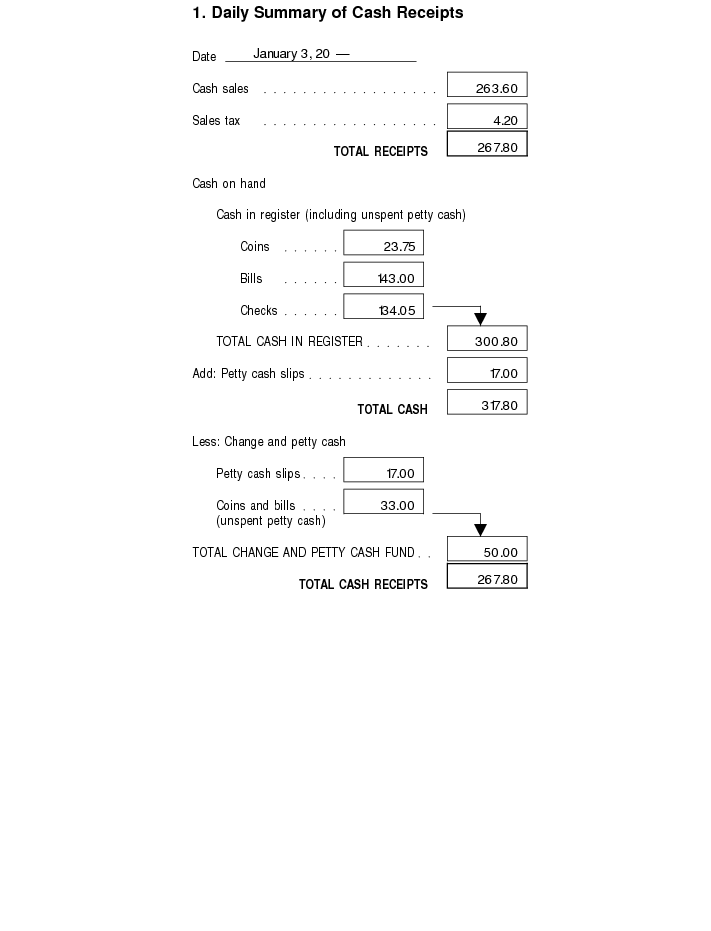
This summary is a record of cash sales for the day. It accounts for cash at the end of the day over the amount in the Change and Petty Cash Fund at the beginning of the day.
Henry takes the cash sales entry from his cash register tape. If he had no cash register, he would simply total his cash sale slips and any other cash received that day.
He carries the total receipts shown in this summary for January 3 ($267.80), including cash sales ($263.60) and sales tax ($4.20), to the Monthly Summary of Cash Receipts.
Petty cash fund.
Henry uses a petty cash fund to make small payments without having to write checks for small amounts. Each time he makes a payment from this fund, he makes out a petty cash slip and attaches it to his receipt as proof of payment. He sets up a fixed amount ($50) in his petty cash fund. The total of the unspent petty cash and the amounts on the petty cash slips should equal the fixed amount of the fund. When the totals on the petty cash slips approach the fixed amount, he brings the cash in the fund back to the fixed amount by writing a check to “Petty Cash” for the total of the outstanding slips. (See the Check Disbursements Journal entry for check number 92.) This restores the fund to its fixed amount of $50. He then summarizes the slips and enters them in the proper columns in the monthly check disbursements journal.
This shows the income activity for the month. Henry carries the total monthly net sales shown in this summary for January ($4,865.05) to his Annual Summary.
To figure total monthly net sales, Henry reduces the total monthly receipts by the sales tax imposed on his customers and turned over to the state. He cannot take a deduction for sales tax turned over to the state because he only collected the tax. He does not include the tax in his income.
Henry enters checks drawn on the business checking account in the Check Disbursements Journal each day. All checks are prenumbered and each check number is listed and accounted for in the column provided in the journal.
Frequent expenses have their own headings across the sheet. He enters in a separate column expenses that require comparatively numerous or large payments each month, such as materials, gross payroll, and rent. Under the General Accounts column, he enters small expenses that normally have only one or two monthly payments, such as licenses and postage.
Henry does not pay personal or nonbusiness expenses by checks drawn on the business account. If he did, he would record them in the journal, even though he could not deduct them as business expenses.
Henry carries the January total of expenses for materials ($1,083.50) to the Annual Summary. Similarly, he enters the monthly total of expenses for telephone, truck/auto, etc., in the appropriate columns of that summary.
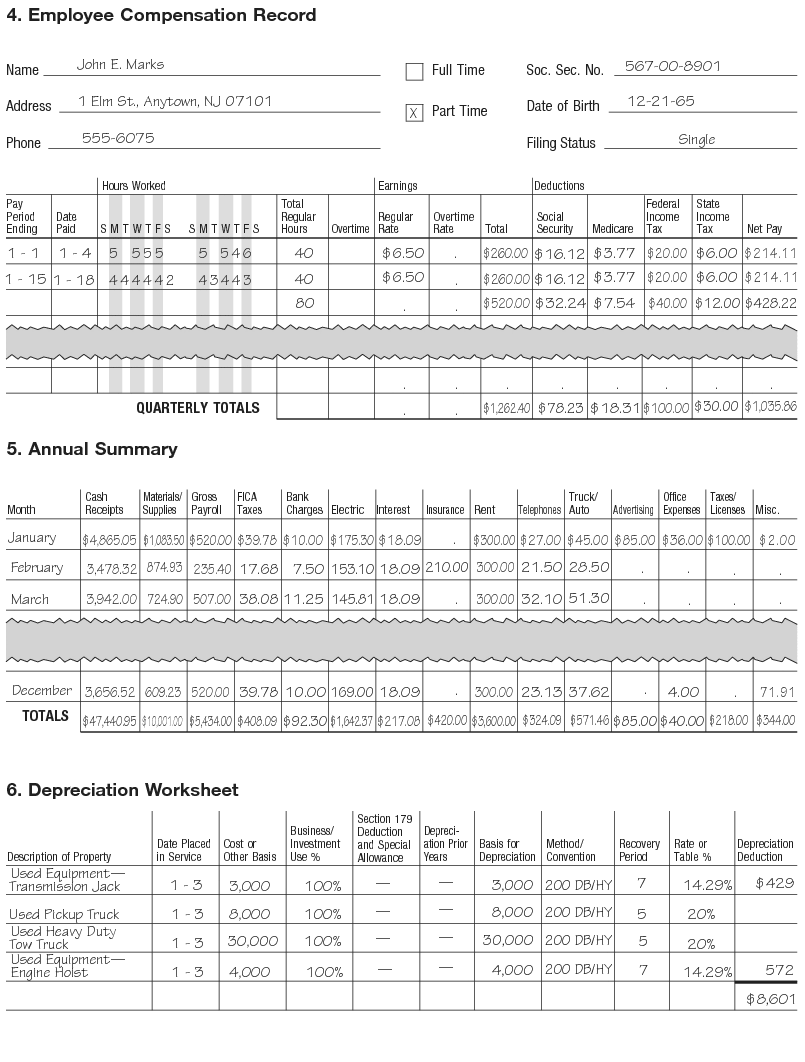
This record shows the following information.
-
The number of hours Henry's employee worked in a pay period.
-
The employee's total pay for the period.
-
The deductions Henry withheld in figuring the employee's net pay.
-
The monthly gross payroll.
This annual summary of monthly cash receipts and expense totals provides the final amounts to enter on Henry's tax return. He figures the cash receipts total from the total of monthly cash receipts shown in the Monthly Summary of Cash Receipts. He figures the expense totals from the totals of monthly expense items shown in the Check Disbursements Journal. As in the journal, he keeps each major expense in a separate column.
Henry carries the cash receipts total shown in the annual summary ($47,440.95) to Part I of Schedule C (Form 1040) (not illustrated). He carries the total for materials ($10,001.00) to Part II of Schedule C (Form 1040).
.A business that keeps materials and supplies on hand generally must complete the inventory lines in Part III of Schedule C (Form 1040). However, there are no inventories of materials and supplies in this example. Henry buys parts and supplies on a per-job basis; he does not keep them on hand..
Henry enters annual totals for interest, rent, taxes, and wages on the appropriate lines in Part II of Schedule C (Form 1040). The total for taxes and licenses includes the employer's share of social security and Medicare taxes, and the business license fee. He enters the total of other annual business expenses on the “Other expenses” line of Schedule C (Form 1040).
This worksheet shows the information used in figuring the depreciation allowed on assets used in Henry's business. Henry figures the depreciation using the modified accelerated cost recovery system (MACRS). He purchased and placed in service several used assets that do not qualify for the section 179 deduction. Depreciation and the section 179 deduction are discussed in Pub. 946. Henry uses the information in the worksheet to complete Form 4562, Depreciation and Amortization (not illustrated).
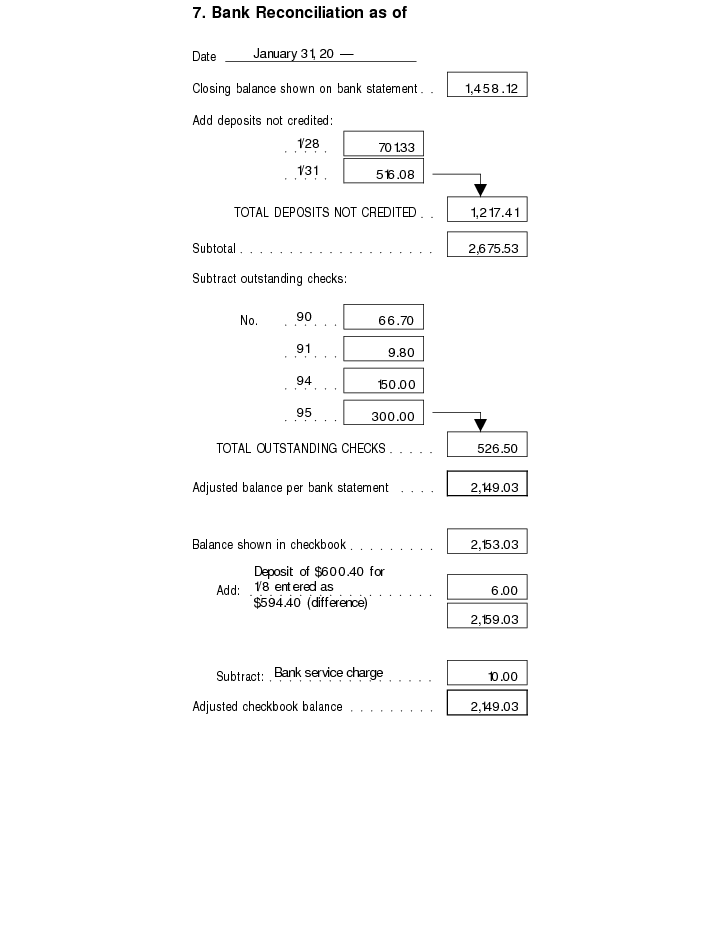
Henry reconciles his checkbook with his bank statement and prepares a bank reconciliation for January as follows.
-
Henry begins by entering his bank statement balance.
-
Henry compares the deposits listed on the bank statement with deposits shown in his checkbook. Two deposits shown in his checkbook— $701.33 and $516.08—were not on his bank statement. He enters these two amounts on the bank reconciliation. He adds them to the bank statement balance of $1,458.12 to arrive at a subtotal of $2,675.53.
-
After comparing each canceled check with his checkbook, Henry found four outstanding checks totaling $526.50. He subtracts this amount from the subtotal in (2). The result of $2,149.03 is the adjusted bank statement balance.
-
Henry enters his checkbook balance on the bank reconciliation.
-
Henry discovered that he mistakenly entered a deposit of $600.40 in his checkbook as $594.40. He adds the difference ($6.00) to the checkbook balance of $2,153.03. There was a $10.00 bank service charge on his bank statement that he subtracts from the checkbook balance. The result is the adjusted checkbook balance of $2,149.03. This equals his adjusted bank statement balance computed in (3).
The only book adjustment Henry needs to make is to the Check Disbursements Journal for the $10 bank service charge. He does not need to adjust the Monthly Summary of Cash Receipts because he correctly entered the January 8 deposit of $600.40 in that record.
| Year 20— Month January |
||||||||||
| Day | Net Sales | Sales Tax | Daily Receipts | Deposit | ||||||
| 3 | 263.60 | 4.20 | 267.80 | |||||||
| 4 | 212.00 | 3.39 | 215.39 | |||||||
| 5 | 194.40 | 3.10 | 197.50 | 680.69 | ||||||
| 6 | 222.40 | 3.54 | 225.94 | |||||||
| 7 | 231.15 | 3.68 | 234.83 | |||||||
| 8 | 137.50 | 2.13 | 139.63 | 600.40 | ||||||
| 10 | 187.90 | 2.99 | 190.89 | |||||||
| 11 | 207.56 | 3.31 | 210.87 | 401.76 | ||||||
| 12 | 128.95 | 2.05 | 131.00 | |||||||
| 13 | 231.40 | 3.77 | 235.17 | |||||||
| 14 | 201.28 | 3.21 | 204.49 | |||||||
| 15 | 88.01 | 1.40 | 89.41 | 660.07 | ||||||
| 17 | 210.95 | 3.36 | 214.31 | |||||||
| 18 | 221.80 | 3.53 | 225.33 | 439.64 | ||||||
| 19 | 225.15 | 3.59 | 228.74 | |||||||
| 20 | 221.93 | 3.52 | 225.45 | |||||||
| 21 | 133.53 | 2.13 | 135.66 | 589.85 | ||||||
| 22 | 130.84 | 2.08 | 132.92 | |||||||
| 24 | 216.37 | 3.45 | 219.82 | 352.74 | ||||||
| 25 | 220.05 | 3.50 | 223.55 | |||||||
| 26 | 197.80 | 3.15 | 200.95 | |||||||
| 27 | 272.49 | 4.34 | 276.83 | 701.33 | ||||||
| 28 | 150.64 | 2.40 | 153.04 | |||||||
| 29 | 224.05 | 3.56 | 227.61 | |||||||
| 31 | 133.30 | 2.13 | 135.43 | 516.08 | ||||||
| TOTALS | 4,865.05 | 77.51 | 4,942.56 | 4,942.56 | ||||||
| Year 20— Month January | ||||||||||||||
|---|---|---|---|---|---|---|---|---|---|---|---|---|---|---|
| Day | Paid To | Check # | Amount of Check | Materials | Gross Payroll | Federal Withheld Income Tax | FICA Social Security Reserve | FICA Medicare Reserve | ||||||
| 3 | Dale Advertising | 74 | 85.00 | |||||||||||
| 4 | City Treasurer | 75 | 35.00 | |||||||||||
| 4 | Auto Parts, Inc. | 76 | 203.00 | 203.00 | ||||||||||
| 4 | John E. Marks | 77 | 214.11 | 260.00 | (20.00) | (16.12) | (3.77) | |||||||
| 6 | Henry Brown | 78 | 250.00 | |||||||||||
| 6 | Mike's Deli | 79 | 36.00 | |||||||||||
| 6 | Joe's Service Station | 80 | 74.50 | 29.50 | ||||||||||
| 6 | ABC Auto Paint | 81 | 137.50 | 137.50 | ||||||||||
| 7 | Henry Brown | 82 | 225.00 | |||||||||||
| 14 | Telephone Co. | 83 | 27.00 | |||||||||||
| 15 | National Bank (Tax Deposit) | 84 | 119.56 | 40.00 | 32.24 | 7.54 | ||||||||
| 18 | National Bank | 85 | 90.09 | |||||||||||
| 18 | Auto Parts, Inc. | 86 | 472.00 | 472.00 | ||||||||||
| 18 | Henry Brown | 87 | 275.00 | |||||||||||
| 18 | John E. Marks | 88 | 214.11 | 260.00 | (20.00) | (16.12) | (3.77) | |||||||
| 21 | Electric Co. | 89 | 175.30 | |||||||||||
| 21 | M.B. Ignition | 90 | 66.70 | 66.70 | ||||||||||
| 21 | Baker's Fender Co. | 91 | 9.80 | 9.80 | ||||||||||
| 21 | Petty Cash | 92 | 17.00 | 15.00 | ||||||||||
| 21 | Henry Brown | 93 | 225.00 | |||||||||||
| 25 | Baker's Fender Co. | 94 | 150.00 | 150.00 | ||||||||||
| 25 | Enterprise Properties | 95 | 300.00 | |||||||||||
| 25 | State Treasurer | 96 | 12.00 | |||||||||||
| 25 | State Treasurer | 97 | 65.00 | |||||||||||
| 3,478.67 | 1,083.50 | 520.00 | -0- | -0- | -0- | |||||||||
| Bank service charge | 10.00 | |||||||||||||
| TOTALS | 3,488.67 | 1,083.50 | 520.00 | -0- | -0- | -0- | ||||||||
| State Withheld Income Tax | Employer's FICA Tax |
Electric | Interest | Rent | Telephone | Truck/Auto | Drawing | General Accounts | ||||||||||
| Advertising | 85.00 | |||||||||||||||||
| License | 35.00 | |||||||||||||||||
| (6.00) | ||||||||||||||||||
| 250.00 | ||||||||||||||||||
| Holiday Party | 36.00 | |||||||||||||||||
| 45.00 | ||||||||||||||||||
| 225.00 | ||||||||||||||||||
| 27.00 | ||||||||||||||||||
39.78 |
||||||||||||||||||
| 18.09 | Loan | 72.00 | ||||||||||||||||
| 275.00 | ||||||||||||||||||
| (6.00) | ||||||||||||||||||
| 175.30 | ||||||||||||||||||
| Postage | 2.00 | |||||||||||||||||
| 225.00 | ||||||||||||||||||
| 300.00 | ||||||||||||||||||
| 12.00 | ||||||||||||||||||
| Sales Tax | 65.00 | |||||||||||||||||
| -0- | 39.78 | 175.30 | 18.09 | 300.00 | 27.00 | 45.00 | 975.00 | 295.00 | ||||||||||
| 10.00 | ||||||||||||||||||
| -0- | 39.78 | 175.30 | 18.09 | 300.00 | 27.00 | 45.00 | 975.00 | 305.00 | ||||||||||
How To Get Tax Help
If you have questions about a tax issue; need help preparing your tax return; or want to download free publications, forms, or instructions, go to IRS.gov to find resources that can help you right away.
Preparing and filing your tax return.
After receiving all your wage and earnings statements (Forms W-2, W-2G, 1099-R, 1099-MISC, 1099-NEC, etc.); unemployment compensation statements (by mail or in a digital format) or other government payment statements (Form 1099-G); and interest, dividend, and retirement statements from banks and investment firms (Forms 1099), you have several options to choose from to prepare and file your tax return. You can prepare the tax return yourself, see if you qualify for free tax preparation, or hire a tax professional to prepare your return.
Free options for tax preparation.
Your options for preparing and filing your return online or in your local community, if you qualify, include the following.
-
Direct File. Direct File is a permanent option to file individual federal tax returns online—for free—directly and securely with the IRS. Direct File is an option for taxpayers in participating states who have relatively simple tax returns reporting certain types of income and claiming certain credits and deductions. While Direct File doesn't prepare state returns, if you live in a participating state, Direct File guides you to a state-supported tool you can use to prepare and file your state tax return for free. Go to IRS.gov/DirectFile for more information, program updates, and frequently asked questions.
-
Free File. This program lets you prepare and file your federal individual income tax return for free using software or Free File Fillable Forms. However, state tax preparation may not be available through Free File. Go to IRS.gov/FreeFile to see if you qualify for free online federal tax preparation, e-filing, and direct deposit or payment options.
-
VITA. The Volunteer Income Tax Assistance (VITA) program offers free tax help to people with low-to-moderate incomes, persons with disabilities, and limited-English-speaking taxpayers who need help preparing their own tax returns. Go to IRS.gov/VITA, download the free IRS2Go app, or call 800-906-9887 for information on free tax return preparation.
-
TCE. The Tax Counseling for the Elderly (TCE) program offers free tax help for all taxpayers, particularly those who are 60 years of age and older. TCE volunteers specialize in answering questions about pensions and retirement-related issues unique to seniors. Go to IRS.gov/TCE or download the free IRS2Go app for information on free tax return preparation.
-
MilTax. Members of the U.S. Armed Forces and qualified veterans may use MilTax, a free tax service offered by the Department of Defense through Military OneSource. For more information, go to MilitaryOneSource (MilitaryOneSource.mil/MilTax).
Also, the IRS offers Free Fillable Forms, which can be completed online and then e-filed regardless of income.
Using online tools to help prepare your return.
Go to IRS.gov/Tools for the following.
-
IRS.gov/DirectFile offers an Eligibility Checker to help you determine if Direct File is the right choice for your tax filing needs.
-
The Earned Income Tax Credit Assistant (IRS.gov/EITCAssistant) determines if you’re eligible for the earned income credit (EIC).
-
The Online EIN Application (IRS.gov/EIN) helps you get an employer identification number (EIN) at no cost.
-
The Tax Withholding Estimator (IRS.gov/W4App) makes it easier for you to estimate the federal income tax you want your employer to withhold from your paycheck. This is tax withholding. See how your withholding affects your refund, take-home pay, or tax due.
-
The First-Time Homebuyer Credit Account Look-up (IRS.gov/HomeBuyer) tool provides information on your repayments and account balance.
-
The Sales Tax Deduction Calculator (IRS.gov/SalesTax) figures the amount you can claim if you itemize deductions on Schedule A (Form 1040).
. Getting answers to your tax questions. On IRS.gov, you can get up-to-date information on current events and changes in tax law..
-
IRS.gov/Help: A variety of tools to help you get answers to some of the most common tax questions.
-
IRS.gov/ITA: The Interactive Tax Assistant, a tool that will ask you questions and, based on your input, provide answers on a number of tax topics.
-
IRS.gov/Forms: Find forms, instructions, and publications. You will find details on the most recent tax changes and interactive links to help you find answers to your questions.
-
You may also be able to access tax information in your e-filing software.
Need someone to prepare your tax return?
There are various types of tax return preparers, including enrolled agents, certified public accountants (CPAs), accountants, and many others who don’t have professional credentials. If you choose to have someone prepare your tax return, choose that preparer wisely. A paid tax preparer is:
-
Primarily responsible for the overall substantive accuracy of your return,
-
Required to sign the return, and
-
Required to include their preparer tax identification number (PTIN).
.Although the tax preparer always signs the return, you're ultimately responsible for providing all the information required for the preparer to accurately prepare your return and for the accuracy of every item reported on the return. Anyone paid to prepare tax returns for others should have a thorough understanding of tax matters. For more information on how to choose a tax preparer, go to Tips for Choosing a Tax Preparer on IRS.gov..
Employers can register to use Business Services Online.
The Social Security Administration (SSA) offers online service at SSA.gov/employer for fast, free, and secure W-2 filing options to CPAs, accountants, enrolled agents, and individuals who process Form W-2, Wage and Tax Statement; and Form W-2c, Corrected Wage and Tax Statement.
Business tax account.
If you are a sole proprietor, a partnership, or an S corporation, you can view your tax information on record with the IRS and do more with a business tax account. Go to IRS.gov/businessaccount for more information.
IRS social media.
Go to IRS.gov/SocialMedia to see the various social media tools the IRS uses to share the latest information on tax changes, scam alerts, initiatives, products, and services. At the IRS, privacy and security are our highest priority. We use these tools to share public information with you. Don’t post your social security number (SSN) or other confidential information on social media sites. Always protect your identity when using any social networking site.
The following IRS YouTube channels provide short, informative videos on various tax-related topics in English, Spanish, and ASL.
Online tax information in other languages.
You can find information on IRS.gov/MyLanguage if English isn’t your native language.
Free Over-the-Phone Interpreter (OPI) Service.
The IRS is committed to serving taxpayers with limited-English proficiency (LEP) by offering OPI services. The OPI Service is a federally funded program and is available at Taxpayer Assistance Centers (TACs), most IRS offices, and every VITA/TCE tax return site. The OPI Service is accessible in more than 350 languages.
Accessibility Helpline available for taxpayers with disabilities.
Taxpayers who need information about accessibility services can call 833-690-0598. The Accessibility Helpline can answer questions related to current and future accessibility products and services available in alternative media formats (for example, braille, large print, audio, etc.). The Accessibility Helpline does not have access to your IRS account. For help with tax law, refunds, or account-related issues, go to IRS.gov/LetUsHelp.
Alternative media preference.
Form 9000, Alternative Media Preference, or Form 9000(SP) allows you to elect to receive certain types of written correspondence in the following formats.
-
Standard Print.
-
Large Print.
-
Braille.
-
Audio (MP3).
-
Plain Text File (TXT).
-
Braille Ready File (BRF).
Disasters.
Go to IRS.gov/DisasterRelief to review the available disaster tax relief.
Getting tax forms and publications.
Go to IRS.gov/Forms to view, download, or print all the forms, instructions, and publications you may need. Or, you can go to IRS.gov/OrderForms to place an order.
Mobile-friendly forms.
You'll need an IRS Online Account (OLA) to complete mobile-friendly forms that require signatures. You'll have the option to submit your form(s) online or download a copy for mailing. You'll need scans of your documents to support your submission. Go to IRS.gov/MobileFriendlyForms for more information.
Getting tax publications and instructions in eBook format.
Download and view most tax publications and instructions (including the Instructions for Form 1040) on mobile devices as eBooks at IRS.gov/eBooks.
IRS eBooks have been tested using Apple's iBooks for iPad. Our eBooks haven’t been tested on other dedicated eBook readers, and eBook functionality may not operate as intended.
Access your online account (individual taxpayers only).
Go to IRS.gov/Account to securely access information about your federal tax account.
-
View the amount you owe and a breakdown by tax year.
-
See payment plan details or apply for a new payment plan.
-
Make a payment or view 5 years of payment history and any pending or scheduled payments.
-
Access your tax records, including key data from your most recent tax return, and transcripts.
-
View digital copies of select notices from the IRS.
-
Approve or reject authorization requests from tax professionals.
-
View your address on file or manage your communication preferences.
Get a transcript of your return.
With an online account, you can access a variety of information to help you during the filing season. You can get a transcript, review your most recently filed tax return, and get your adjusted gross income. Create or access your online account at IRS.gov/Account.
Tax Pro Account.
This tool lets your tax professional submit an authorization request to access your individual taxpayer IRS OLA. For more information, go to IRS.gov/TaxProAccount.
Using direct deposit.
The safest and easiest way to receive a tax refund is to e-file and choose direct deposit, which securely and electronically transfers your refund directly into your financial account. Direct deposit also avoids the possibility that your check could be lost, stolen, destroyed, or returned undeliverable to the IRS. Eight in 10 taxpayers use direct deposit to receive their refunds. If you don’t have a bank account, go to IRS.gov/DirectDeposit for more information on where to find a bank or credit union that can open an account online.
Reporting and resolving your tax-related identity theft issues.
-
Tax-related identity theft happens when someone steals your personal information to commit tax fraud. Your taxes can be affected if your SSN is used to file a fraudulent return or to claim a refund or credit.
-
The IRS doesn’t initiate contact with taxpayers by email, text messages (including shortened links), telephone calls, or social media channels to request or verify personal or financial information. This includes requests for personal identification numbers (PINs), passwords, or similar information for credit cards, banks, or other financial accounts.
-
Go to IRS.gov/IdentityTheft, the IRS Identity Theft Central webpage, for information on identity theft and data security protection for taxpayers, tax professionals, and businesses. If your SSN has been lost or stolen or you suspect you’re a victim of tax-related identity theft, you can learn what steps you should take.
-
Get an Identity Protection PIN (IP PIN). IP PINs are six-digit numbers assigned to taxpayers to help prevent the misuse of their SSNs on fraudulent federal income tax returns. When you have an IP PIN, it prevents someone else from filing a tax return with your SSN. To learn more, go to IRS.gov/IPPIN.
Ways to check on the status of your refund.
-
Go to IRS.gov/Refunds.
-
Download the official IRS2Go app to your mobile device to check your refund status.
-
Call the automated refund hotline at 800-829-1954.
.The IRS can’t issue refunds before mid-February for returns that claimed the EIC or the additional child tax credit (ACTC). This applies to the entire refund, not just the portion associated with these credits..
Making a tax payment.
Payments of U.S. tax must be remitted to the IRS in U.S. dollars. Digital assets are not accepted. Go to IRS.gov/Payments for information on how to make a payment using any of the following options.
-
IRS Direct Pay: Pay your individual tax bill or estimated tax payment directly from your checking or savings account at no cost to you.
-
Debit Card, Credit Card, or Digital Wallet: Choose an approved payment processor to pay online or by phone.
-
Electronic Funds Withdrawal: Schedule a payment when filing your federal taxes using tax return preparation software or through a tax professional.
-
Electronic Federal Tax Payment System: This is the best option for businesses. Enrollment is required.
-
Check or Money Order: Mail your payment to the address listed on the notice or instructions.
-
Cash: You may be able to pay your taxes with cash at a participating retail store.
-
Same-Day Wire: You may be able to do same-day wire from your financial institution. Contact your financial institution for availability, cost, and time frames.
What if I can’t pay now?
Go to IRS.gov/Payments for more information about your options.
-
Apply for an online payment agreement (IRS.gov/OPA) to meet your tax obligation in monthly installments if you can’t pay your taxes in full today. Once you complete the online process, you will receive immediate notification of whether your agreement has been approved.
-
Use the Offer in Compromise Pre-Qualifier to see if you can settle your tax debt for less than the full amount you owe. For more information on the Offer in Compromise program, go to IRS.gov/OIC.
Filing an amended return.
Go to IRS.gov/Form1040X for information and updates.
Checking the status of your amended return.
Go to IRS.gov/WMAR to track the status of Form 1040-X amended returns.
.It can take up to 3 weeks from the date you filed your amended return for it to show up in our system, and processing it can take up to 16 weeks..
Understanding an IRS notice or letter you’ve received.
Go to IRS.gov/Notices to find additional information about responding to an IRS notice or letter.
IRS Document Upload Tool.
You may be able use the Document Upload Tool to respond digitally to eligible IRS notices and letters by securely uploading required documents online through IRS.gov. For more information, go to IRS.gov/DUT.
Schedule LEP.
You can use Schedule LEP (Form 1040), Request for Change in Language Preference, to state a preference to receive notices, letters, or other written communications from the IRS in an alternative language. You may not immediately receive written communications in the requested language. The IRS’s commitment to LEP taxpayers is part of a multi-year timeline that began providing translations in 2023. You will continue to receive communications, including notices and letters, in English until they are translated to your preferred language.
Contacting your local TAC.
Keep in mind, many questions can be answered on IRS.gov without visiting a TAC. Go to IRS.gov/LetUsHelp for the topics people ask about most. If you still need help, TACs provide tax help when a tax issue can’t be handled online or by phone. All TACs now provide service by appointment, so you’ll know in advance that you can get the service you need without long wait times. Before you visit, go to IRS.gov/TACLocator to find the nearest TAC and to check hours, available services, and appointment options. Or, on the IRS2Go app, under the Stay Connected tab, choose the Contact Us option and click on “Local Offices.”
————————————————————————
Below is a message to you from the Taxpayer Advocate Service, an independent organization established by Congress.
The Taxpayer Advocate Service (TAS) Is Here To Help You
The Taxpayer Advocate Service (TAS) is an independent organization within the Internal Revenue Service (IRS). TAS helps taxpayers resolve problems with the IRS, makes administrative and legislative recommendations to prevent or correct the problems, and protects taxpayer rights. We work to ensure that every taxpayer is treated fairly and that you know and understand your rights under the Taxpayer Bill of Rights. We are Your Voice at the IRS.
TAS can help you resolve problems that you haven’t been able to resolve with the IRS on your own. Always try to resolve your problem with the IRS first, but if you can’t, then come to TAS. Our services are free.
-
TAS helps all taxpayers (and their representatives), including individuals, businesses, and exempt organizations. You may be eligible for TAS help if your IRS problem is causing financial difficulty, if you’ve tried and been unable to resolve your issue with the IRS, or if you believe an IRS system, process, or procedure just isn't working as it should.
-
To get help any time with general tax topics, visit www.TaxpayerAdvocate.IRS.gov. The site can help you with common tax issues and situations, such as what to do if you make a mistake on your return or if you get a notice from the IRS.
-
TAS works to resolve large-scale (systemic) problems that affect many taxpayers. You can report systemic issues at www.IRS.gov/SAMS. (Be sure not to include any personal identifiable information.)
TAS has offices in every state, the District of Columbia, and Puerto Rico. To find your local advocate’s number:
-
Check your local directory, or
-
Call TAS toll free at 877-777-4778.
The Taxpayer Bill of Rights describes ten basic rights that all taxpayers have when dealing with the IRS. Go to www.TaxpayerAdvocate.IRS.gov/Taxpayer-Rights for more information about the rights, what they mean to you, and how they apply to specific situations you may encounter with the IRS. TAS strives to protect taxpayer rights and ensure the IRS is administering the tax law in a fair and equitable way.
A
- Accounting method
-
- Accrual method, Choosing an Accounting Method
- Cash method, Choosing an Accounting Method
- Assistance (see Tax help)
B
- Business
-
- Expenses, Deducting Business Expenses
- Start-up costs, Business Start-Up Costs
- Taxes, Business Taxes
- Use of car, Car and Truck Expenses
- Use of home, Business Use of Your Home
C
- C corporation, C corporations.
- Car and truck expenses, Car and Truck Expenses
- Corporation, Corporations.
D
- Depositing taxes, Depositing Taxes
- Depreciation, Depreciation
E
- Employer identification number (EIN), Getting a Taxpayer Identification Number (TIN), Employer Identification Number (EIN)
- Employment taxes
-
- Defined, Employment Taxes
- Records to keep, Employment taxes.
- Estimated tax, Estimated tax.
- Excise taxes, Excise Taxes
F
- Form
-
- 1099-MISC, Form 1099-MISC.
- 1099–NEC, Form 1099-NEC.
- 11-C, Form 11-C.
- 1128, Changing your tax year.
- 2290, Form 2290.
- 720, Form 720.
- 730, Form 730.
- 8300, Form 8300.
- 8829, Which form do I file?
- I-9, Form I-9.
- SS-4, Applying for an EIN.
- W-2, Form W-2 Wage Reporting, Form W-2.
- W-4, Form W-4.
- W-9, Other payee.
- Forms of business, Determining Which Type of Business to Use
- FUTA tax, Federal Unemployment (FUTA) Tax
G
- Getting a taxpayer identification number, Getting a Taxpayer Identification Number (TIN)
I
- Income tax, Income Tax, Federal Income, Social Security, and Medicare Taxes
- Information returns, Information Returns
- Inventories, Choosing an Accounting Method
L
- Limited liability company, Limited liability company.
M
- Medicare tax, Federal Income, Social Security, and Medicare Taxes
O
- Office in home, Business Use of Your Home
P
- Partnership, Partnerships.
- Penalties, Penalties
- Publications (see Tax help)
R
- Recordkeeping, Recordkeeping
- Records, how long to keep, How Long To Keep Records
S
- S corporation, S corporations.
- Self-employment tax, Self-Employment Tax
- Social security tax, Federal Income, Social Security, and Medicare Taxes
- Sole proprietorship, Sole proprietorships.
- Start-up costs, Business Start-Up Costs
T
- Tax help, How To Get Tax Help
- Tax year, Designating a Tax Year
- Taxes
-
- Employment, Employment Taxes
- Estimated, Estimated tax.
- Excise, Excise Taxes
- How to deposit, Depositing Taxes
- Income, Income Tax
- Self-employment, Self-Employment Tax
- Unemployment (FUTA), Federal Unemployment (FUTA) Tax
U
- Unemployment (FUTA) tax, Federal Unemployment (FUTA) Tax