


 )
or https:// means you've safely connected to the .gov website. Share sensitive information only on official, secure websites.
)
or https:// means you've safely connected to the .gov website. Share sensitive information only on official, secure websites.


- Publication 929 - Introductory Material
- Publication 929 - Main Contents
- Part 1. Rules for All Dependents
- Filing Requirements
- Should a Return Be Filed Even if Not Required?
- Responsibility for Child's Return
- Standard Deduction
- Dependent's Own Exemption
- Withholding From Wages
- Part 2. Tax on Unearned Income of Certain Children
- Parents' Election To Report Child's Interest and Dividends (Form 8814)
- Tax for Certain Children Who Have Unearned Income (Form 8615)
- When Form 8615 must be filed.
- Certain January 1 birthdays.
- Providing Parental Information (Form 8615, Lines A–C)
- Step 1. Figuring Your Child's Net Unearned Income (Form 8615, Part I)
- Step 2. Figuring a Tentative Tax at the Parent’s Tax Rate (Form 8615, Part II)
- Line 6 (Parent's Taxable Income)
- Line 7 (Net Unearned Income of Other Children)
- Line 8 (Parent's Taxable Income Plus Children’s Net Unearned Income)
- Line 9 (Tax on Parent's Taxable Income Plus Children's Net Unearned Income)
- Line 10 (Parent's Tax)
- Line 11 (Tentative Tax)
- Lines 12a and 12b (Dividing the Tentative Tax)
- Line 13 (Child's Share of Tentative Tax)
- Step 3. Figuring the Child's Tax (Form 8615, Part III)
- Alternative Minimum Tax (AMT)
- Publication 929 - Additional Material
- Glossary
- How To Get Tax Help
- Preparing and filing your tax return.
- Free options for tax preparation.
- Using online tools to help prepare your return.
- Need someone to prepare your tax return?
- Advance child tax credit payments.
- Coronavirus.
- Employers can register to use Business Services Online.
- IRS social media.
- Watching IRS videos.
- Online tax information in other languages.
- Free Over-the-Phone Interpreter (OPI) Service.
- Accessibility Helpline available for taxpayers with disabilities.
- Getting tax forms and publications.
- Getting tax publications and instructions in eBook format.
- Access your online account (individual taxpayers only).
- Tax Pro Account.
- Using direct deposit.
- Getting a transcript of your return.
- Reporting and resolving your tax-related identity theft issues.
- Ways to check on the status of your refund.
- Making a tax payment.
- What if I can’t pay now?
- Filing an amended return.
- Checking the status of your amended return.
- Understanding an IRS notice or letter you’ve received.
- Contacting your local IRS office.
- The Taxpayer Advocate Service (TAS) Is Here To Help You
- Low Income Taxpayer Clinics (LITCs)
Charitable contribution deduction. If you don’t itemize your deductions in 2021, you may qualify to take a charitable deduction for cash contributions of up to $300 ($600 in the case of a joint return). For more information see Pub. 526, Charitable Contributions.
Standard deduction amounts increased. For 2021, the standard deduction amount has been increased for all filers. The amounts are:
-
Single or Married filing separately—$12,550,
-
Married filing jointly or Qualifying widow(er)—$25,100, and
-
Head of household—$18,800.
For married taxpayers who are age 65 or over or blind, the standard deduction is increased an additional amount of $1,350 ($1,700 if head of household or single).For individuals who can be claimed as a dependent, the standard deduction cannot exceed the greater of $1,100 or the sum of $350 and the individual's earned income but the total cannot exceed the applicable standard deduction for the dependent's filing status (including any additional amount for being age 65 or older and/or blind, if applicable).Due to the increase in the standard deduction and reduced usage of itemized deductions, if you are employed, you may want to consider completing a new Form W-4, Employee's Withholding Certificate, and giving it to your employer.
For the latest information about developments related to Pub. 929, such as legislation enacted after it was published, go to IRS.gov/Pub929.
Election to tax the unearned income of certain children at the parent’s tax rate. For tax years 2018 and 2019, you can elect to calculate the tax on the unearned income of certain children using either the brackets and rates for estates and trusts or the parent’s tax rate. If you make this election for 2019, include a statement with your return specifying “election to modify tax on unearned income.” The statement can be made on the return (for example, on line 7 or at the top of Form 8615) or on an attachment filed with the return.If you want to make this election for tax year 2018 or 2019, you will need to file an amended return, Form 1040-X. See IRS.gov/Form1040X for more information about amending a tax return. If you make this election, include a statement or an attachment with your amended return specifying “election to modify tax of unearned income.”For more information, see Tax for Certain Children Who Have Unearned Income (Form 8615), later.
The alternative minimum tax (AMT) exemption amount no longer limited. For tax years beginning after 2017, the AMT exemption amount for certain children with unearned income is no longer limited to their earned income plus the additional AMT exemption amount.
Taxpayer identification number (TIN). Dependents who are required to file a tax return must have a TIN. A TIN may be a social security number (SSN), an individual taxpayer identification number (ITIN), or an adoption taxpayer identification number (ATIN).
Social security number (SSN). The Social Security Administration (SSA) issues SSNs to citizens and nationals of the United States and to certain eligible aliens. To apply for an SSN, file Form SS-5, Application for a Social Security Card, with the SSA. You can go to SSA.gov for more information.
Individual taxpayer identification number (ITIN). The IRS will issue an ITIN to a nonresident or resident alien who doesn’t have and isn’t eligible to get an SSN. To apply for an ITIN, file Form W-7, Application for IRS Individual Taxpayer Identification Number, with the IRS. It takes 6–10 weeks to get an ITIN. The ITIN is entered wherever an SSN is requested on a tax return. If you are a nonresident alien applying for an ITIN to file a tax return, you must generally attach your original, completed return to Form W-7 to get an ITIN. See the Form W-7 instructions for more information.An ITIN is for tax use only. It doesn’t entitle you to social security benefits or change your employment or immigration status under U.S. law. If you were assigned an ITIN before January 1, 2013, or if you have an ITIN that you haven't included on a tax return in the last 3 consecutive years, you may need to renew it. For more information, see the Instructions for Form W-7.
Net investment income tax (NIIT). A child whose tax is figured on Form 8615 may be subject to the NIIT. See the Instructions for Form 8960, Net Investment Income Tax—Individuals, Estates, and Trusts, for more information.
Photographs of missing children. The IRS is a proud partner with the National Center for Missing & Exploited Children® (NCMEC). Photographs of missing children selected by the Center may appear in this publication on pages that would otherwise be blank. You can help bring these children home by looking at the photographs and calling 1-800-THE-LOST (1-800-843-5678) if you recognize a child.
Introduction
Part 1 of this publication explains the filing requirements and other tax information for individuals who can be claimed as a dependent on another person's tax return.
Part 2 explains how to report and figure the tax on unearned income of certain children (whether or not they can be claimed as dependents).
Definitions.
Many of the terms used in this publication, such as “dependent,” “earned income,” and “unearned income,” are defined in the Glossary at the back of this publication.
Comments and suggestions.
We welcome your comments about this publication and suggestions for future editions.
You can send us comments through IRS.gov/FormComments. Or, you can write to the Internal Revenue Service, Tax Forms and Publications, 1111 Constitution Ave. NW, IR-6526, Washington, DC 20224.
Although we can’t respond individually to each comment received, we do appreciate your feedback and will consider your comments and suggestions as we revise our tax forms, instructions, and publications. Don’t send tax questions, tax returns, or payments to the above address.
Getting answers to your tax questions.
If you have a tax question not answered by this publication or the How To Get Tax Help section at the end of this publication, go to the IRS Interactive Tax Assistant page at IRS.gov/Help/ITA where you can find topics by using the search feature or viewing the categories listed.
Getting tax forms, instructions, and publications.
Go to IRS.gov/Forms to download current and prior-year forms, instructions, and publications.
Ordering tax forms, instructions, and publications.
Go to IRS.gov/OrderForms to order current forms, instructions, and publications; call 800-829-3676 to order prior-year forms and instructions. The IRS will process your order for forms and publications as soon as possible. Don’t resubmit requests you’ve already sent us. You can get forms and publications faster online.
Useful Items
You may want to see:Publication
-
501 Dependents, Standard Deduction, and Filing Information
-
505 Tax Withholding and Estimated Tax
-
526 Charitable Contributions
-
550 Investment Income and Expenses
Form (and Instructions)
-
W-4 Employee's Withholding Certificate
-
8615 Tax for Certain Children Who Have Unearned Income
-
8814 Parents' Election To Report Child's Interest and Dividends
See How To Get Tax Help near the end of this publication for information about getting these publications and forms.
Part 1. Rules for All Dependents
This part of the publication discusses the filing requirements for dependents, who is responsible for a child's return, how to figure a dependent's standard deduction, and whether a dependent can claim exemption from federal income tax withholding.
Filing Requirements
Whether a dependent has to file a return generally depends on the amount of the dependent's earned and unearned income and whether the dependent is married, is age 65 or older, or is blind.
. A dependent may have to file a return even if his or her income is less than the amount that would normally require a return. See Other Filing Requirements, later..
The following sections apply to dependents with:
-
Earned income only,
-
Unearned income only, and
-
Both earned and unearned income.
To find out whether a dependent must file, read the section that applies, or use Table 1.
Earned Income Only
A dependent whose gross income is only earned income must file a return if the gross income is more than the amount listed in the following table.
| Marital Status | Amount | |
| Single | ||
| Under 65 and not blind | $12,550 | |
| Either 65 or older or blind | $14,250 | |
| 65 or older and blind | $15,950 | |
| Married* | ||
| Under 65 and not blind | $12,550 | |
| Either 65 or older or blind | $13,900 | |
| 65 or older and blind | $15,250 | |
| * If a dependent's spouse itemizes deductions on a separate return, the dependent must file a return if the dependent has $5 or more of gross income (earned and/or unearned). | ||
Example.
William is 16. His mother claims him as a dependent on her income tax return. He worked part time on weekends during the school year and full time during the summer. He earned $12,700 in wages. He didn't have any unearned income.
He must file a tax return because he has earned income only and his gross income is more than $12,550. If he is blind, he doesn't have to file a return because his gross income isn't more than $14,250.
Unearned Income Only
A dependent whose gross income is only unearned income must file a return if the gross income is more than the amount listed in the following table.
| Marital Status | Amount | |
| Single | ||
| Under 65 and not blind | $1,100 | |
| Either 65 or older or blind | $2,800 | |
| 65 or older and blind | $4,500 | |
| Married* | ||
| Under 65 and not blind | $1,100 | |
| Either 65 or older or blind | $2,450 | |
| 65 or older and blind | $3,800 | |
| * If a dependent's spouse itemizes deductions on a separate return, the dependent must file a return if the dependent has $5 or more of gross income (earned and/or unearned). | ||
Example.
Sarah is 18 and single. Her parents can claim her as a dependent on their income tax return. She received $1,970 of taxable interest and dividend income. She didn't work during the year.
She must file a tax return because she has unearned income only and her gross income is more than $1,100. If she is blind, she doesn't have to file a return because she has unearned income only and her gross income isn't more than $2,800.
Election to report child's unearned income on parent's return.
A parent of a child under age 19 (or under age 24 if a full-time student) may be able to elect to include the child's interest and dividend income on the parent's return. See Parents' Election To Report Child's Interest and Dividends in Part 2. If the parent makes this election, the child doesn’t have to file a return.
Both Earned and Unearned Income
. A dependent who has both earned and unearned income must generally file a return if the dependent's gross income is more than line 5 of the following worksheet. .
| Filing Requirement Worksheet | |||||
| for Most Dependents | |||||
| 1. | Enter dependent's earned income plus $350 | _____ | |||
| 2. | Minimum amount | $1,100 | |||
| 3. | Compare lines 1 and 2. Enter the larger amount | _____ | |||
| 4. | Maximum amount | 12,550 | |||
| 5. | Compare lines 3 and 4. Enter the smaller amount | _____ | |||
| 6. | Enter the dependent's gross income. If line 6 is more than line 5, the dependent must file an income tax return. If the dependent is married and his or her spouse itemizes deductions on a separate return, the dependent must file an income tax return if line 6 is $5 or more. | _____ | |||
Example 1.
Joe is 20, single, not blind, and a full-time college student. He doesn’t provide more than half of his own support, and his parents claim him as a dependent on their income tax return. He received $200 taxable interest income and earned $2,750 from a part-time job.
He doesn't have to file a tax return because his gross income of $2,950 ($200 interest plus $2,750 in wages) isn't more than $3,100, the amount on line 5 of his Filled-in Example 1, Filing Requirement Worksheet for Most Dependents.
| Filled-in Example 1 Filing Requirement Worksheet for Most Dependents |
|||||
| 1. | Enter dependent's earned income plus $350 | $3,100 | |||
| 2. | Minimum amount | 1,100 | |||
| 3. | Compare lines 1 and 2. Enter the larger amount | 3,100 | |||
| 4. | Maximum amount | 12,550 | |||
| 5. | Compare lines 3 and 4. Enter the smaller amount | 3,100 | |||
| 6. | Enter the dependent's gross income. If line 6 is more than line 5, the dependent must file an income tax return. If the dependent is married and his or her spouse itemizes deductions on a separate return, the dependent must file an income tax return if line 6 is $5 or more. | $ 2,950 | |||
Example 2.
The facts are the same as in Example 1, except that Joe had $600 taxable interest income.
He must file a tax return because his gross income of $3,350 ($600 interest plus $2,750 wages) is more than $3,100, the amount on line 5 of his Filled-in Example 2 worksheet.
| Filled-in Example 2 Filing Requirement Worksheet |
|||||
| for Most Dependents | |||||
| 1. | Enter dependent's earned income plus $350 | $3,100 | |||
| 2. | Minimum amount | 1,100 | |||
| 3. | Compare lines 1 and 2. Enter the larger amount | 3,100 | |||
| 4. | Maximum amount | 12,550 | |||
| 5. | Compare lines 3 and 4. Enter the smaller amount | 3,100 | |||
| 6. | Enter the dependent's gross income. If line 6 is more than line 5, the dependent must file an income tax return. If the dependent is married and his or her spouse itemizes deductions on a separate return, the dependent must file an income tax return if line 6 is $5 or more. | $ 3,350 | |||
. Age 65 or older or blind. A dependent who is age 65 or older or blind must file a return if his or her gross income is more than line 7 of the following worksheet. .
| Filing Requirement Worksheet for Dependents Who Are Age 65 or Older or Blind |
||||||||
| 1. | Enter dependent's earned income plus $350 | _____ | ||||||
| 2. | Minimum amount | $1,100 | ||||||
| 3. | Compare lines 1 and 2. Enter the larger amount | _____ | ||||||
| 4. | Maximum amount | 12,550 | ||||||
| 5. | Compare lines 3 and 4. Enter the smaller amount | _____ | ||||||
| 6. | Enter the amount from the following table that applies to the dependent | _____ | ||||||
| Marital Status | Amount | |||||||
| Single | ||||||||
| Either 65 or older or blind | $1,700 | |||||||
| 65 or older and blind | $3,400 | |||||||
| Married | ||||||||
| Either 65 or older or blind | $1,350 | |||||||
| 65 or older and blind | $2,700 | |||||||
| 7. | Add lines 5 and 6. Enter the total | _____ | ||||||
| 8. | Enter the dependent's gross income. If line 8 is more than line 7, the dependent must file an income tax return. If the dependent is married and his or her spouse itemizes deductions on a separate return, the dependent must file an income tax return if line 8 is $5 or more | _____ | ||||||
Example 3.
The facts are the same as in Example 2, except that Joe is also blind. He doesn't have to file a return because his gross income of $3,350 isn’t more than $4,800, the amount on line 7 of his Filled-in Example 3 Filing Requirement Worksheet for Dependents Who Are Age 65 or Older or Blind (shown next).
| Filled-in Example 3 Filing Requirement Worksheet for Dependents Who Are Age 65 or Older or Blind |
||||||||
| 1. | Enter dependent's earned income plus $350 | $3,100 | ||||||
| 2. | Minimum amount | 1,100 | ||||||
| 3. | Compare lines 1 and 2. Enter the larger amount | 3,100 | ||||||
| 4. | Maximum amount | 12,550 | ||||||
| 5. | Compare lines 3 and 4. Enter the smaller amount | 3,100 | ||||||
| 6. | Enter the amount from the following table that applies to the dependent | 1,700 | ||||||
| Marital Status | Amount | |||||||
| Single | ||||||||
| Either 65 or older or blind | $1,700 | |||||||
| 65 or older and blind | $3,400 | |||||||
| Married | ||||||||
| Either 65 or older or blind | $1,350 | |||||||
| 65 or older and blind | $2,700 | |||||||
| 7. | Add lines 5 and 6. Enter the total | 4,800 | ||||||
| 8. | Enter the dependent's gross income. If line 8 is more than line 7, the dependent must file an income tax return. If the dependent is married and his or her spouse itemizes deductions on a separate return, the dependent must file an income tax return if line 8 is $5 or more | $3,350 | ||||||
Other Filing Requirements
Some dependents may have to file a tax return even if their income is less than the amount that would normally require them to file a return.
A dependent must file a tax return if he or she owes any other taxes, such as:
-
Social security and Medicare taxes on tips not reported to his or her employer or on wages received from an employer who didn’t withhold these taxes;
-
Uncollected social security and Medicare or railroad retirement taxes on tips reported to his or her employer or on group-term life insurance;
-
Alternative minimum tax;
-
Additional tax on a health savings account from Form 8889, Part III;
-
Recapture taxes, such as the tax from recapture of an education credit; or
-
Additional tax on a qualified plan, including an individual retirement arrangement (IRA), or other tax-favored account. But if the dependent is filing a return only because of this tax, the dependent can file Form 5329 by itself.
A dependent must also file a tax return if he or she:
Spouse itemizes.
A dependent must file a return if the dependent's spouse itemizes deductions on a separate return and the dependent has $5 or more of gross income (earned and/or unearned).
| If your parent (or someone else) can claim you as a dependent, use this table to see if you must file a return. | ||||||
| See the definitions of “dependent,” “earned income,” “unearned income,” and “gross income” in the Glossary. | ||||||
| Single dependents—Were you either age 65 or older or blind? | ||||||

|
No. You must file a return if any of the following apply. | |||||
|
||||||
|
||||||
|
|
Yes. You must file a return if any of the following apply. | |||||
|
||||||
|
||||||
| Married dependents—Were you either age 65 or older or blind? | ||||||
|
|
No. You must file a return if any of the following apply. | |||||
|
||||||
|
||||||
|
|
Yes. You must file a return if any of the following apply. | |||||
|
||||||
|
||||||
Worksheet 1. Standard Deduction Worksheet for Dependents
| Use this worksheet only if someone else can claim you (or your spouse, if filing jointly) as a dependent. | |||||
| If you were 65 or older and/or blind, check the correct number of boxes below. Put the total number of boxes checked in box c and go to line 1. | |||||
| a. | You | 65 or older
|
Blind
|
||
| b. | Your spouse, if claiming spouse's exemption |
65 or older
|
Blind
|
||
| c. | Total boxes checked
|
||||
| 1. | Enter your earned income* plus $350. If none, enter -0-. | 1. | _____ | ||
| 2. | Minimum amount. | 2. | $1,100 | ||
| 3. | Compare lines 1 and 2. Enter the larger of the two amounts here. | 3. | _____ | ||
| 4. | Enter on line 4 the amount shown below for your filing status. | ||||
|
4. | _____ | |||
| 5. | Standard deduction. | ||||
| a. | Compare lines 3 and 4. Enter the smaller amount here. If under 65 and not blind, stop here. This is your standard deduction. Otherwise, go on to line 5b. | 5a. | _____ | ||
| b. | If 65 or older or blind, multiply $1,700 ($1,350 if married) by the number in box c above. Enter the result here. | 5b. | _____ | ||
| c. | Add lines 5a and 5b. This is your standard deduction for 2021. | 5c. | _____ | ||
| * Earned income includes wages, salaries, tips, professional fees, and other compensation received for personal services you performed. It also includes any amount received as a scholarship that you must include in income. | |||||
Should a Return Be Filed Even if Not Required?
Even if a dependent doesn’t meet any of the filing requirements discussed earlier, he or she should file a tax return if either of the following applies.
-
Income tax was withheld from his or her income.
-
He or she qualifies for the earned income credit. See the tax return instructions to find out who qualifies for this credit.
By filing a return, the dependent can get a refund.
Responsibility for Child's Return
Generally, a child is responsible for filing his or her own tax return and for paying any tax, penalties, or interest on that return. If a child can’t file his or her own return for any reason, such as age, the child's parent, guardian, or other legally responsible person must file it for the child.
Signing the child's return.
If the child can’t sign his or her return, a parent or guardian must sign the child's name followed by the words “By (signature), parent (or guardian) for minor child.”
Authority of parent or guardian.
A parent or guardian who signs a return on a child's behalf can deal with the IRS on all matters connected with the return.
In general, a parent or guardian who doesn’t sign the child's return can only provide information concerning the child's return and pay the child's tax. That parent or guardian isn’t entitled to receive information from the IRS or legally bind the child to a tax liability arising from the return.
Third party designee.
A child's parent or guardian who doesn’t sign the child's return may be authorized, as a third party designee, to discuss the processing of the return with the IRS as well as provide information concerning the return. The child or the person signing the return on the child's behalf must check the “Yes” box in the Third Party Designee area of the return and name the parent or guardian as the designee.
If designated, a parent or guardian can respond to certain IRS notices and receive information about the processing of the return and the status of a refund or payment. This designation doesn’t authorize the parent or guardian to receive any refund check, bind the child to any tax liability, or otherwise represent the child before the IRS. See the return instructions for more information.
Designated as representative.
A parent or guardian who doesn’t sign the child's return may be designated as the child's representative by the child or the person signing the return on the child's behalf. Form 2848, Power of Attorney and Declaration of Representative, is used to designate a child's representative. See Pub. 947, Practice Before the IRS and Power of Attorney, for more information.
If designated, a parent or guardian can receive information about the child's return but can’t legally bind the child to a tax liability unless authorized to do so by the law of the state in which the child lives.
IRS notice.
If you or the child receives a notice from the IRS concerning the child's return or tax liability, you should immediately inform the IRS that the notice concerns a child. The notice will show who to contact. The IRS will try to resolve the matter with the parent(s) or guardian(s) of the child consistent with their authority.
Child's earnings.
For federal income tax purposes, amounts a child earns by performing services are included in the gross income of the child and not the gross income of the parent. This is true even if, under state law, the parent has the right to the earnings and may actually have received them.
If the child doesn’t pay the tax due on this income, the parent may be liable for the tax.
Standard Deduction
The standard deduction for an individual who can be claimed as a dependent on another person's tax return is generally limited to the larger of:
-
$1,100; or
-
The individual's earned income plus $350, but not more than the regular standard deduction (generally $12,550).
-
Is 65 or older, or
-
Is blind.
Certain dependents can’t claim any standard deduction. See Standard Deduction of Zero, later.
Worksheet 1.
Use Worksheet 1 to figure the dependent's standard deduction.
. If you don’t itemize your deductions in 2021, you may qualify to take a charitable deduction of cash contributions of up to $300 ($600 in the case of a joint return). For more information see Pub. 526, Charitable Contributions..
Example 1.
Michael is single, age 15, and not blind. His parents can claim him as a dependent on their tax return. He has taxable interest income of $800 and wages of $150. He enters $500 (his earned income plus $350) on line 1 of Worksheet 1. On line 3, he enters $1,100, the larger of $500 or $1,100. Michael enters $12,550 on line 4. On line 5a, he enters $1,100, the smaller of $1,100 or $12,550. His standard deduction is $1,100.
Example 2.
Judy, a full-time student, is single, age 22, and not blind. Her parents can claim her as a dependent on their tax return. She has dividend income of $275 and wages of $2,500. She enters $2,850 (her earned income plus $350) on line 1 of Worksheet 1. On line 3, she enters $2,850, the larger of $2,850 or $1,100. She enters $12,550 on line 4. On line 5a, she enters $2,850 (the smaller of $2,850 or $12,550) as her standard deduction.
Example 3.
Amy, who is single, is claimed as a dependent on her parent’s tax return. She is 18 years old and blind. She has taxable interest income of $1,100 and wages of $2,000. She enters $2,350 (her earned income plus $350) on line 1 of Worksheet 1. She enters $2,350 (the larger of $2,350 or $1,100) on line 3, $12,550 on line 4, and $2,350 (the smaller of $2,350 or $12,550) on line 5a. Because Amy is blind, she checks the box for blindness and enters “1” in box c at the top of Worksheet 1. She enters $1,700 (the number in box c times $1,700) on line 5b. Her standard deduction on line 5c is $4,050 ($2,350 + $1,700).
Standard Deduction of Zero
The standard deduction for the following dependents is zero.
-
A married dependent filing a separate return whose spouse itemizes deductions.
-
A dependent who files a return for a period of less than 12 months due to a change in his or her annual accounting period.
-
A nonresident or dual-status alien dependent, unless the dependent is married to a U.S. citizen or resident alien at the end of the year and chooses to be treated as a U.S. resident for the year. See Pub. 519, U.S. Tax Guide for Aliens, for information on making this choice.
Example.
Jennifer, who is a dependent of her parents, is entitled to file a joint return with her husband. However, her husband elects to file a separate return and itemize his deductions. Because he itemizes, Jennifer's standard deduction on her return is zero. She can, however, itemize any of her allowable deductions.
Dependent's Own Exemption
A person who can be claimed as a dependent on another taxpayer's return generally can’t claim his or her own exemption. This is true even if the other taxpayer doesn’t actually claim the exemption. However, for tax years 2018 through 2025, the deduction for personal exemptions is suspended for a taxpayer, their spouse, and their dependents.
Withholding From Wages
Employers generally withhold federal income tax, social security tax, and Medicare tax from an employee's wages. If the employee claims exemption from withholding on Form W-4, the employer won't withhold federal income tax. The exemption from withholding doesn’t apply to social security and Medicare taxes.
Conditions for exemption from withholding.
An employee can claim exemption from withholding for 2022 only if he or she meets both of the following conditions.
-
For 2021, the employee had a right to a refund of all federal income tax withheld because he or she had no tax liability.
-
For 2022, the employee expects a refund of all federal income tax withheld because he or she expects to have no tax liability.
Dependents.
An employee who is a dependent ordinarily can’t claim exemption from withholding if both of the following are true.
-
The employee's gross income will be more than $1,150, the minimum standard deduction for 2022.
-
The employee's unearned income will be more than $400.
Exceptions.
An employee may be able to claim exemption from withholding even if the employee is a dependent, if the employee:
-
Is age 65 or older;
-
Is blind; or
-
Will claim on his or her 2022 tax return:
-
Adjustments to income,
-
Tax credits, or
-
Itemized deductions.
-
Example.
Guy is 17 and a student. During the summer, he works part time at a grocery store. He expects to earn about $1,200 this year. He also worked at the store last summer and received a refund of all his withheld income tax because he didn't have a tax liability. The only other income he expects during the year is $375 interest on a savings account. He expects that his parents will be able to claim him as a dependent on their tax return. He isn't blind and won’t claim adjustments to income, itemized deductions, a higher standard deduction, or tax credits on his return.
Guy can’t claim exemption from withholding when he fills out Form W-4 because his parents will be able to claim him as a dependent, his gross income will be more than $1,150 (the 2022 minimum standard deduction amount), and his unearned income will be more than $400.
Claiming exemption from withholding.
Beginning in 2022, an employee may claim exemption from withholding if he or she owed no federal tax in 2021 and expects to owe no federal tax in 2022. To claim exemption from withholding, the employee must certify that he or she meets both conditions by writing "Exempt" on Form W-4 in the space below Step 4(c) and complete Steps 1 and 5. The employee must not complete any other steps on Form W-4. The Form W-4 must then be returned to the employee's employer.
Part 2. Tax on Unearned Income of Certain Children
The two rules that follow may affect the tax on the unearned income of certain children.
-
If the child's interest and dividend income (including capital gain distributions) total less than $11,000, the child's parent may be able to choose to include that income on the parent's return rather than file a return for the child. (See Parents' Election To Report Child's Interest and Dividends, later.)
-
If the child’s interest, dividends, and other unearned income total more than $2,200, the child’s income is taxed at special tax rates. (See Tax for Certain Children Who Have Unearned Income, later.)
For these rules, the term “child” includes a legally adopted child and a stepchild. These rules apply whether or not the child is a dependent.
These rules don’t apply if neither of the child's parents was living at the end of the year.
Parents' Election To Report Child's Interest and Dividends (Form 8814)
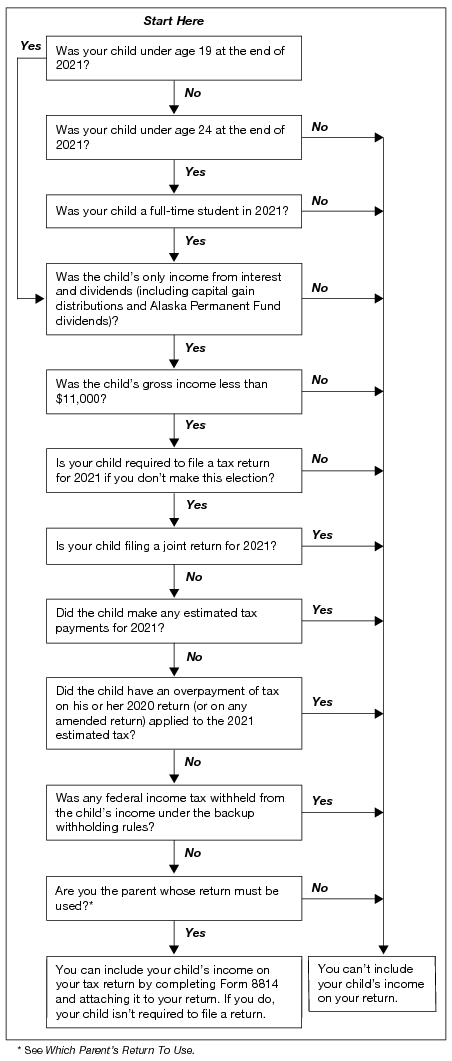
You may be able to elect to include your child's interest and dividend income (including capital gain distributions) on your tax return. If you do, your child won't have to file a return.
You can make this election only if all the following conditions are met.
-
Your child was under age 19 (or under age 24 if a full-time student) at the end of the year.
-
Your child had income only from interest and dividends (including capital gain distributions and Alaska Permanent Fund dividends).
-
The child's gross income was less than $11,000.
-
The child is required to file a return unless you make this election.
-
The child doesn’t file a joint return for the year.
-
No estimated tax payment was made for the year, and no overpayment from the previous year (or from any amended return) was applied to this year under your child's name and SSN.
-
No federal income tax was withheld from your child's income under the backup withholding rules.
-
You are the parent whose return must be used when applying the special tax rules for children. (See Which Parent's Return To Use, later.)
Certain January 1 birthdays.
A child born on January 1, 2003, is considered to be age 19 at the end of 2021. You can’t make this election for such a child unless the child was a full-time student.
A child born on January 1, 1998, is considered to be age 24 at the end of 2021. You can’t make this election for such a child.
How to make the election.
Make the election by attaching Form 8814 to your Form 1040, 1040-SR, or 1040-NR. Attach a separate Form 8814 for each child for whom you make the election. You can make the election for one or more children and not for others.
Which Parent's Return To Use
If a child’s parents are married to each other and file a joint return, use the joint return when electing to report the child’s interest and dividend income on their return. For other situations when the parents do not file a joint return, see Parents Who Don't File a Joint Return next.
For parents who don’t file a joint return and are electing to report the child’s interest and dividend income on their return, the following discussions explain which parent's tax return must be used to figure the tax.
Only the parent whose tax return is used can make the election described earlier under Parents' Election To Report Child's Interest and Dividends.
Parents are married.
If the child's parents file separate returns, use the return of the parent with the greater taxable income.
Parents not living together.
If the child's parents are married to each other but not living together, and the parent with whom the child lives (the custodial parent) is considered unmarried, use the return of the custodial parent. If the custodial parent isn’t considered unmarried, use the return of the parent with the greater taxable income.
For an explanation of when a married person living apart from his or her spouse is considered unmarried, see Head of Household in Pub. 501.
Parents are divorced.
If the child's parents are divorced or legally separated, and the parent who had custody of the child for the greater part of the year (the custodial parent) hasn’t remarried, use the return of the custodial parent.
Custodial parent remarried.
If the custodial parent has remarried, the stepparent (rather than the noncustodial parent) is treated as the child's other parent. Therefore, if the custodial parent and the stepparent file a joint return, use that joint return. Don’t use the return of the noncustodial parent.
If the custodial parent and the stepparent are married, but file separate returns, use the return of the one with the greater taxable income. If the custodial parent and the stepparent are married but not living together, the earlier discussion under Parents not living together applies.
Parents never married.
If a child's parents have never been married to each other, but lived together all year, use the return of the parent with the greater taxable income. If the parents didn’t live together all year, the rules explained earlier under Parents are divorced apply.
Widowed parent remarried.
If a widow or widower remarries, the new spouse is treated as the child's other parent. The rules explained earlier under Custodial parent remarried apply.
Effect of Making the Election
The federal income tax on your child's income may be more if you make the Form 8814 election.
Rate may be higher.
If your child received qualified dividends or capital gain distributions, you may pay up to $110 more tax if you make this election instead of filing a separate tax return for the child. This is because the tax rate on the child's income between $1,100 and $2,200 is 10% if you make this election. However, if you file a separate return for the child, the tax rate may be as low as 0% because of the preferential tax rates for qualified dividends and capital gain distributions.
Deductions you can’t take.
By making the Form 8814 election, you can’t take any of the following deductions that the child would be entitled to on his or her return.
-
The additional standard deduction if the child is blind.
-
The deduction for a penalty on an early withdrawal of your child's savings.
-
Itemized deductions (such as your child's investment interest expenses or charitable contributions).
Deductible investment interest.
If you use Form 8814, your child's unearned income is considered your unearned income. To figure the limit on your deductible investment interest, add the child's unearned income to yours. However, if your child received qualified dividends, capital gain distributions, or Alaska Permanent Fund dividends, see chapter 3 of Pub. 550 for information about how to figure the limit.
AMT.
If your child received tax-exempt interest (or exempt-interest dividends paid by a regulated investment company) from certain private activity bonds, you must determine if that interest is a tax preference item for AMT purposes. If it is, you must include it with your own tax preference items when figuring your AMT. See Form 6251, Alternative Minimum Tax—Individuals, and its instructions for details.
NIIT.
When figuring any NIIT liability on Form 8960, Net Investment Income Tax—Individuals, Estates, and Trusts, the amount on line 12 of Form 8814 (other than Alaska Permanent Fund dividends) will increase the amount of your net investment income reported on Form 8960. See the Form 8960 instructions for more information.
Reduced deductions or credits.
If you use Form 8814, your increased adjusted gross income may reduce certain deductions or credits on your return, including the following.
-
Deduction for contributions to a traditional IRA.
-
Deduction for student loan interest.
-
Itemized deductions for medical expenses and casualty and theft losses.
-
Credit for child and dependent care expenses.
-
Child tax credit.
-
Education tax credits.
-
Earned income credit.
Penalty for underpayment of estimated tax.
If you make this election for 2021 and didn’t have enough tax withheld or pay enough estimated tax to cover the tax you owe, you may be subject to a penalty. If you plan to make this election for 2022, you may need to increase your federal income tax withholding or your estimated tax payments to avoid the penalty. See Pub. 505 for more information.
Figuring Child's Income
Use Form 8814, Part I, to figure your child's interest and dividend income to report on your return. Only the amount over $2,200 is added to your income. The amount over $2,200 is shown on Form 8814, line 6. Unless the child's income includes qualified dividends or capital gain distributions (discussed next), the same amount is shown on Form 8814, line 12. Include the amount from Form 8814, line 12, on Schedule 1 (Form 1040), line 8z. If you file more than one Form 8814, include the total amounts from line 12 of all your Forms 8814 on Schedule 1 (Form 1040), line 8z. On the dotted line next to Schedule 1 (Form 1040), line 8z, enter “Form 8814” and the total of the Form 8814, line 12, amounts.
Note.
The tax on the first $2,200 is figured on Form 8814, Part II. See Figuring Additional Tax, later.
Qualified dividends.
Enter on Form 8814, line 2a, any ordinary dividends your child received. This amount may include qualified dividends. Qualified dividends are those dividends reported on Form 1040, 1040-SR, or 1040-NR, line 3a, and are eligible for lower tax rates that apply to a net capital gain. For detailed information about qualified dividends, see Pub. 550.
If your child received qualified dividends, the amount of these dividends that is added to your income must be reported on Form 1040, 1040-SR, or 1040-NR, line 3a. You don’t include these dividends on Form 8814, line 12; or Schedule 1 (Form 1040), line 8z.
Enter the child's qualified dividends on Form 8814, line 2b. But don’t include this amount on Form 1040, 1040-SR, or 1040-NR, line 3a. Instead, include the amount from Form 8814, line 9, on Form 1040, 1040-SR, or 1040-NR, line 3a. (The amount on Form 8814, line 9, may be less than the amount on Form 8814, line 2b, because lines 7 through 12 of the form divide the $2,200 base amount on Form 8814, line 5, between the child's qualified dividends, capital gain distributions, and other interest and dividend income, reducing each of those amounts.)
Capital gain distributions.
Enter on Form 8814, line 3, any capital gain distributions your child received. The amount of these distributions that is added to your income must be reported on Schedule D (Form 1040), Capital Gains and Losses, line 13, or, if you aren’t required to file Schedule D, on Form 1040, 1040-SR, or 1040-NR, line 7. You don’t include it on Form 8814, line 12; or Schedule 1 (Form 1040), line 8z.
Include the amount from Form 8814, line 10, on Schedule D, line 13; and Form 1040, 1040-SR, or 1040-NR, line 7, whichever applies. (The amount on Form 8814, line 10, may be less than the amount on Form 8814, line 3, because lines 7 through 12 of the form divide the $2,200 base amount on Form 8814, line 5, between the child's qualified dividends, capital gain distributions, and other interest and dividend income, reducing each of those amounts.)
Collectibles (28% rate) gain.
If any of the child's capital gain distributions are reported on Form 1099-DIV as collectibles (28% rate) gain, you must determine how much to also include on line 4 of the 28% Rate Gain Worksheet in the instructions for Schedule D, line 18. Multiply the child's capital gain distribution included on Schedule D, line 13, by a fraction. The numerator is the part of the child's total capital gain distribution that is collectibles (28% rate) gain. The denominator is the child's total capital gain distribution. Enter the result on line 4 of the 28% Rate Gain Worksheet.
Unrecaptured section 1250 gain.
If any of the child's capital gain distributions are reported on Form 1099-DIV as unrecaptured section 1250 gain, you must determine how much to include on line 11 of the Unrecaptured Section 1250 Gain Worksheet in the instructions for Schedule D, line 19. Multiply the child's capital gain distribution included on Schedule D, line 13, by a fraction. The numerator is the part of the child's total capital gain distribution that is unrecaptured section 1250 gain. The denominator is the child's total capital gain distribution. Enter the result on the Unrecaptured Section 1250 Gain Worksheet, line 11.
Section 1202 gain.
If any of the child's capital gain distributions are reported as section 1202 gain (gain on qualified small business stock) on Form 1099-DIV, part or all of that gain may be eligible for the section 1202 exclusion. (For information about the exclusion, see chapter 4 of Pub. 550.) To figure that part, multiply the child's capital gain distribution included on Schedule D, line 13, by a fraction. The numerator is the part of the child's total capital gain distribution that is section 1202 gain. The denominator is the child's total capital gain distribution. Your section 1202 exclusion is generally 50% of the result, but may be subject to a limit. In some cases, the exclusion is more than 50%. See the Instructions for Schedule D for details and information on how to report the exclusion amount.
Example.
Fred is 6 years old. In 2021, he received dividend income of $2,300, which included $1,725 of ordinary dividends and a $575 capital gain distribution from a mutual fund. (None of the distributions were reported on Form 1099-DIV as unrecaptured section 1250 gain, section 1202 gain, or collectibles (28% rate) gain.) All of the ordinary dividends are qualified dividends. He has no other income and isn’t subject to backup withholding. No estimated tax payments were made under his name and SSN.
Fred's parents elect to include Fred's income on their tax return instead of filing a return for him.
They figure the amount to report on Form 1040, lines 3a and 3b, the amount to report on their Schedule D, line 13, and the amount to report on Schedule 1 (Form 1040), line 8z, as follows.
They leave lines 1a and 1b of Form 8814 blank because Fred doesn’t have any interest income. They enter his ordinary dividends of $1,725 on lines 2a and 2b because all of Fred's ordinary dividends are qualified dividends. They enter the amount of Fred's capital gain distributions, $575, on line 3. Next, they add the amounts on lines 1a, 2a, and 3 and enter the result, $2,300, on line 4.
They subtract the base amount on line 5, $2,200, from the amount on line 4, $2,300, and enter the result, $100, on line 6. This is the total amount from Form 8814 to be reported on their return. Next, they figure how much of this amount is qualified dividends and how much is capital gain distributions.
-
They divide the amount on line 2b, $1,725, by the amount on line 4, $2,300. They enter the result, 0.75, on line 7.
-
They divide the amount on line 3, $575, by the amount on line 4, $2,300. They enter the result, 0.25, on line 8.
-
They multiply the amount on line 6, $100, by the decimal on line 7, 0.75, and enter the result, $75, on line 9.
-
They multiply the amount on line 6, $100, by the decimal on line 8, 0.25, and enter the result, $25, on line 10.
-
They include the amount from line 9, $75, on lines 3a and 3b of their Form 1040 and enter “Form 8814 – $75” on the dotted lines next to lines 3a and 3b. They include the amount from line 10, $25, on line 13 of their Schedule D (Form 1040) and enter “Form 8814 – $25” on the dotted line next to Schedule D, line 13.
They enter $100 ($75 + $25) on line 11 and -0- ($100 – $100) on line 12. Because the amount on line 12 is -0-, they don’t include any amount from Form 8814 on their Schedule 1 (Form 1040), line 8z.
Figuring Additional Tax
Use Form 8814, Part II, to figure the tax on the $2,200 of your child's interest and dividends that you don’t include in your income. This tax is added to the tax figured on your income.
This additional tax is the smaller of:
-
10% (0.10) x (your child's gross income − $1,100), or
-
$110.
. Include the amount from line 15 of all your Forms 8814 in the total on Form 1040, 1040-SR, or 1040-NR, line 16. Check box 1 on Form 1040, 1040-SR, or 1040-NR, line 16. .
Tax for Certain Children Who Have Unearned Income (Form 8615)
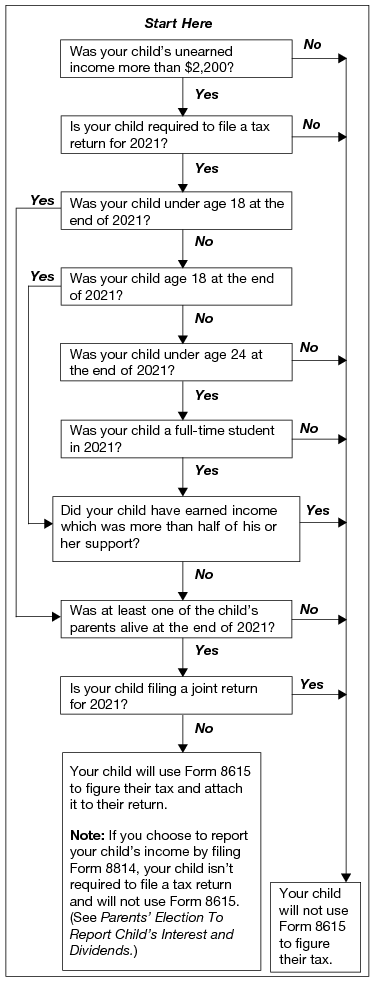
If your child's interest, dividends, and other unearned income total more than $2,200, and you don't or can't use Form 8814 to include your child's income on your return, your child will use Form 8615 to figure their tax. Attach the completed Form 8615 to your child's Form 1040 or 1040-NR.
When Form 8615 must be filed.
Your child must file Form 8615 if all of the following are true.
-
Their unearned income was more than $2,200.
-
They are required to file a return for 2021.
-
They were either:
-
Under age 18 at the end of the year,
-
Age 18 at the end of the year and didn’t have earned income that was more than half of his or her support, or
-
A full-time student at least age 19 and under age 24 at the end of 2021 and didn’t have earned income that was more than half of his or her support.
-
-
At least one of their parents was alive at the end of 2021.
-
They don’t file a joint return for 2021.
Certain January 1 birthdays.
Use the following chart to determine whether certain children with January 1 birthdays meet condition 3 under When Form 8615 must be filed, earlier.
| IF your child was born on... | THEN, at the end of 2021, your child is considered to be... |
|---|---|
| January 1, 2004 | 18* |
| January 1, 2003 | 19** |
| January 1, 1998 | 24*** |
| * Your child isn’t under age 18. Your child meets condition 3 only if your child didn’t have earned income that was more than half of his or her support. ** Your child meets condition 3 only if your child was a full-time student who didn’t have earned income that was more than half of his or her support. *** Don’t use Form 8615 for your child. |
|
Providing Parental Information (Form 8615, Lines A–C)
On Form 8615, lines A and B, enter the parent's name and SSN. (If the parents filed a joint return, enter the name and SSN listed first on the joint return.) On line C, check the box for the parent's filing status.
See Which Parent's Return To Use, earlier, for information on which parent's return information must be used on Form 8615.
Parent with different tax year.
If the parent and the child don’t have the same tax year, complete Form 8615 using the information on the parent's return for the tax year that ends in the child's tax year.
Example.
Kimberly must use her mother's tax and taxable income to complete her Form 8615 for calendar year 2021 (January 1–December 31). Kimberly's mother files her tax return on a fiscal year basis (July 1–June 30). Kimberly must use the information on her mother's return for the tax year ending June 30, 2021, to complete her 2021 Form 8615.
Parent's return information not known timely.
If the information needed from the parent's return isn’t known by the time the child's return is due (usually April 15), you can file the return using estimates.
You can use any reasonable estimate. This includes using information from last year's return. If you use an estimated amount on Form 8615, enter “Estimated” on the line next to the amount.
When you get the correct information, file an amended return on Form 1040-X, Amended U.S. Individual Income Tax Return.
Extension of time to file.
Instead of using estimates, you can get an automatic 6-month extension of time to file if, by the date your return is due, you file Form 4868, Application for Automatic Extension of Time To File U.S. Individual Income Tax Return. See the instructions for Form 4868 for details.
.An extension of time to file isn’t an extension of time to pay. You must make an accurate estimate of the tax for 2021. If you don't pay the full amount due by the regular due date, the child will owe interest and may also be charged penalties. See Form 4868 and its instructions. .
Parent's return information not available.
If a child can’t get the required information about his or her parent's tax return, the child (or the child's legal representative) can request the necessary information from the IRS.
How to request.
After the end of the tax year, send a signed, written request for the information to the Internal Revenue Service Center where the parent's return will be filed. (The IRS can’t process a request received before the end of the tax year.)
.You should also consider getting an extension of time to file the child's return, because there may be a delay in getting the requested information..
The request must contain all of the following.
-
A statement that you are making the request to comply with section 1(g) of the Internal Revenue Code and that you have tried to get the information from the parent.
-
Proof of the child's age (for example, a copy of the child's birth certificate).
-
Evidence the child has more than $2,200 of unearned income (for example, a copy of the child's prior year tax return or copies of Forms 1099 for the current year).
-
The name, address, SSN (if known), and filing status (if known) of the parent whose information is to be shown on Form 8615.
A child's legal representative making the request should include a copy of his or her Power of Attorney, such as Form 2848, or proof of legal guardianship.
Step 1. Figuring Your Child's Net Unearned Income (Form 8615, Part I)
The first step in figuring your child’s tax using Form 8615 is to figure your child’s net unearned income. To do that, use Form 8615, Part I.
If your child had no earned income, enter on this line the adjusted gross income shown on your child’s return. Adjusted gross income is shown on Form 1040 or 1040-NR, line 11.
If your child had earned income, figure the amount to enter on Form 8615, line 1, by using the worksheet in the instructions for the form.
.However, use the following worksheet if your child: .
-
Has excluded any foreign earned income,
-
Deducted a loss from self-employment, or
-
Has a net operating loss from another year.
| Alternate Worksheet | ||
| for Form 8615, Line 1 | ||
| A. | Enter the amount from your child’s Form 1040 or 1040-NR, line 9 | _____ |
| B. | Enter the total of any net loss from self-employment, any net operating loss deduction, any foreign earned income exclusion, and any foreign housing exclusion from your child’s Form 1040 or 1040-NR. Enter this total as a positive number (greater than zero) |
_____ |
| C. | Add line A and line B and enter the total |
_____ |
| D. | Enter your child’s earned income plus any amount from your child’s Schedule 1 (Form 1040), line 18 | _____ |
| Generally, your child’s earned income is the total of the amounts reported on Form 1040 or 1040-NR, line 1; and Schedule 1 (Form 1040), lines 3 and 6 (if Schedule 1 (Form 1040), line 3 or 6 is a loss, use zero) | ||
| E. | Subtract line D from line C. Enter the result here and on Form 8615, line 1 | _____ |
Unearned income defined.
Unearned income is generally all income other than salaries, wages, and other amounts received as pay for work actually performed. It includes taxable interest, dividends, capital gains (including capital gain distributions), the taxable part of social security and pension payments, certain distributions from trusts, and unemployment compensation. Unearned income includes amounts produced by assets your child obtained with earned income (such as interest on a savings account into which you deposited wages).
Nontaxable income.
For this purpose, unearned income includes only amounts your child must include in gross income. Nontaxable unearned income, such as tax-exempt interest and the nontaxable part of social security and pension payments, isn’t included in gross income.
Capital loss.
Your child’s capital losses are taken into account in figuring their unearned income. Capital losses are first applied against capital gains. If the capital losses are more than the capital gains, the difference (up to $3,000) is subtracted from your child’s interest, dividends, and other unearned income. Any difference over $3,000 is carried to the next year.
Income from property received as a gift.
Your child’s unearned income includes all income produced by property belonging to your child. This is true even if the property was transferred to your child, regardless of when the property was transferred or purchased or who transferred it.
Your child’s unearned income includes income produced by property given as a gift to your child. This includes gifts to your child from grandparents or any other person and gifts made under the Uniform Gift to Minors Act.
Example.
Amanda Black, age 13, received the following income.
-
Dividends—$1,000.
-
Wages—$2,100.
-
Taxable interest—$1,200.
-
Tax-exempt interest—$100.
-
Capital gains—$300.
-
Capital losses—($200).
Amanda's unearned income is $2,300. This is the total of the dividends ($1,000), taxable interest ($1,200), and capital gains reduced by capital losses ($300 − $200 = $100). Her wages are earned (not unearned) income because they are received for work actually performed. Her tax-exempt interest isn’t included because it is nontaxable.
Trust income.
If your child is the beneficiary of a trust, distributions of taxable interest, dividends, capital gains, and other unearned income from the trust are unearned income to your child.
However, taxable distributions from a qualified disability trust are considered earned income for the purposes of completing Form 8615. See the Form 8615 instructions for details.
If the child doesn't itemize deductions on Schedule A (Form 1040), enter $2,200 on line 2.
If the child itemizes deductions, enter on line 2 the larger of:
-
$1,100 plus the portion of the amount on Schedule A (Form 1040), line 17 (or Schedule A (Form 1040-NR), line 8), that is directly connected with the production of the unearned income on Form 8615, line 1; or
-
$2,200.
Directly connected.
Itemized deductions are directly connected with the production of unearned income if they are for expenses to produce or collect taxable income or to manage, conserve, or maintain property held for producing income. These expenses include custodian fees and service charges, service fees to collect taxable interest and dividends, and certain investment counsel fees.
However, only certain directly connected expenses, such as interest and deductible amortizable bond premiums, are deductible in tax years 2018 through 2025.
Example 1.
Roger, age 12, has unearned income of $8,000, no other income, no adjustments to income, and itemized deductions of $300 that are directly connected with his unearned income. His adjusted gross income is $8,000, which is entered on Form 1040, line 11, and on Form 8615, line 1. Roger enters $2,200 on line 2 because that is more than the total of $1,100 plus his directly connected itemized deductions of $300.
Example 2.
Eleanor, age 8, has unearned income of $16,000 and an early withdrawal penalty of $100. She has no other income. She has itemized deductions of $1,200 that are directly connected with the production of her unearned income. Her adjusted gross income, entered on line 1, is $15,900 ($16,000 − $100). The amount on line 2 is $2,300. This is the larger of:
-
$1,100 plus the $1,200 of directly connected itemized deductions; or
-
$2,200.
Subtract line 2 from line 1 and enter the result on this line. If zero or less, don’t complete the rest of the form. However, you must still attach Form 8615 to your child’s tax return. Figure the tax on your child’s taxable income in the normal manner.
Enter on line 4 your child’s taxable income from Form 1040 or 1040-NR, line 15.
Child files Form 2555.
If your child files Form 2555 (relating to foreign earned income), your child will use the Foreign Earned Income Tax Worksheet (in the Instructions for Form 1040) to figure their tax. Enter the amount from line 3 of the Foreign Earned Income Tax Worksheet as their taxable income on Form 8615, line 4.
A child’s net unearned income can’t be more than his or her taxable income. Enter on Form 8615, line 5, the smaller of line 3 or line 4. This is the child’s unearned income.
If zero or less, don’t complete the rest of the form. However, you must still attach Form 8615 to your child’s tax return. Figure the tax on your child’s taxable income in the normal manner.
Step 2. Figuring a Tentative Tax at the Parent’s Tax Rate (Form 8615, Part II)
The next step in completing Form 8615 is to figure a tentative tax on the child's net unearned income at the parent's tax rate. The tentative tax at the parent's tax rate is the difference between the tax on the parent's taxable income figured with the child's net unearned income (plus the net unearned income of any other child whose Form 8615 includes the tax return information of that parent) and the tax figured without it.
When figuring the tentative tax at the parent's tax rate on Form 8615, don’t refigure any of the exclusions, deductions, or credits on the parent's return because of the child's net unearned income. For example, don’t refigure the medical expense deduction.
Figure the tentative tax on Form 8615, lines 6 through 13.
Enter on line 6 the amount from the parent's Form 1040, 1040-SR, or 1040-NR, line 15, even if your spouse isn't the child's parent. If the parent's taxable income is zero or less, enter zero on line 6.
Parent files Form 2555.
If the parent files Form 2555 to claim the foreign earned income exclusion, housing exclusion, or housing deduction, the Foreign Earned Income Tax Worksheet in the Instructions for Form 1040 is used to figure the parent's tax. Enter the amount from line 3 of the Foreign Earned Income Tax Worksheet as the parent's taxable income, on line 6 of Form 8615.
If the tax return information of the parent is also used on any other child's Form 8615, enter on line 7 the total of the amounts from line 5 of all the other children's Forms 8615 being completed. (The term "other child" means any other child whose Form 8615 uses the tax information of the parent identified on lines A and B of Form 8615.)
Example.
Paul and Jane Persimmon have three children, Sharon, Jerry, and Mike, who must attach Form 8615 to their tax returns. The children's net unearned income amounts on line 5 of their Forms 8615 are:
-
Sharon—$800,
-
Jerry—$600, and
-
Mike—$1,000.
Line 7 of Sharon's Form 8615 will show $1,600, the total of the amounts on line 5 of Jerry's and Mike's Forms 8615.
Line 7 of Jerry's Form 8615 will show $1,800 ($800 + $1,000).
Line 7 of Mike's Form 8615 will show $1,400 ($800 + $600).
Other children's information not available.
If the net unearned income of the other children isn't available when the return is due, either file the return using estimates or get an extension of time to file. Estimates and extensions are discussed earlier under Providing Parental Information (Form 8615, Lines A–C).
Enter on this line the total of lines 5, 6, and 7. You must determine the amount of net capital gain and qualified dividends included on this line before completing Form 8615, line 9.
Net capital gain.
Net capital gain is the smaller of the gain, if any, on Schedule D (Form 1040), line 15, or the gain, if any, on Schedule D, line 16. If Schedule D isn’t required, it is the amount on Form 1040 or 1040-NR, line 7.
Qualified dividends.
Qualified dividends are those dividends reported on Form 1040 or 1040-NR, line 3a.
Net capital gain and qualified dividends on line 8.
If neither the child, nor the parent, nor any other child has net capital gain, the net capital gain on line 8 is zero.
If neither the child, nor the parent, nor any other child has qualified dividends, the amount of qualified dividends on line 8 is zero.
If the child, the parent, or any other child has net capital gain, figure the amount of net capital gain included on line 8 by adding together the net capital gain amounts included on lines 5, 6, and 7 of Form 8615.
If the child, the parent, or any other child has qualified dividends, figure the amount of qualified dividends included on line 8 by adding together the qualified dividend amounts included on lines 5, 6, and 7 of Form 8615.
Use the instructions for Form 8615, line 8, including the appropriate Line 5 Worksheet, to find these amounts. See the Instructions for Form 8615 for more details.
Figure the tax on the amount on line 8 using the Tax Table, the Tax Computation Worksheet, the Qualified Dividends and Capital Gain Tax Worksheet (in the Instructions for Form 1040, or the Instructions for Form 1040-NR), the Schedule D Tax Worksheet (in the Schedule D instructions), or Schedule J (Form 1040), as follows.
-
If line 8 doesn’t include any net capital gain or qualified dividends, use the Tax Table or Tax Computation Worksheet to figure this tax. But if Schedule J is used to figure the tax on the parent's return, use it to figure this tax.
-
If line 8 includes any net capital gain or qualified dividends, use the Qualified Dividends and Capital Gain Tax Worksheet to figure this tax. For details, see the instructions for Form 8615, line 9. However, if the child, the parent, or any other child has 28% rate gain or unrecaptured section 1250 gain, use the Schedule D Tax Worksheet. But if Schedule J is used to figure the tax on the parent's return, use it to figure this tax.
Child files Form 2555.
If line 8 includes any net capital gain or qualified dividends and the child, or any other child filing Form 8615, also files Form 2555, see Using the Schedule D Tax Worksheet for line 9 tax next to figure the line 9 tax.
Using the Schedule D Tax Worksheet for line 9 tax.
Use the Schedule D Tax Worksheet (in the Schedule D instructions) to figure the tax on line 9, if the child, the parent, or any other child has unrecaptured section 1250 gain or 28% rate gain. If you must use the Schedule D Tax Worksheet, first complete any Schedule D and any actual Schedule D Tax Worksheet required for the child, the parent, or any other child. Then, figure the line 9 tax using another Schedule D Tax Worksheet. (Don’t attach this Schedule D Tax Worksheet to the child’s return.)
Complete this Schedule D Tax Worksheet as follows.
-
On line 1, enter the amount from Form 8615, line 8.
-
On line 2, enter the qualified dividends included on Form 8615, line 8. (See the earlier discussion for Form 8615, line 8.)
-
On line 3, enter the total of the amounts, if any, on line 4g of all Forms 4952 filed by the child, the parent, or any other child.
-
On line 4, enter the total of the amounts, if any, on line 4e of all Forms 4952 filed by the child, the parent, or any other child. If applicable, include instead the smaller amount entered on the dotted line next to line 4e.
-
On lines 5 and 6, follow the worksheet instructions.
-
On line 7, enter the net capital gain included on Form 8615, line 8. (See the earlier discussion for line 8.)
-
On lines 8 through 10, follow the worksheet instructions.
-
On line 11, enter zero if neither the child, nor the parent, nor any other child has unrecaptured section 1250 gain (Schedule D, line 19) or 28% rate gain (Schedule D, line 18). Otherwise, enter the amount of unrecaptured section 1250 gain and 28% rate gain included in the net capital gain on Form 8615, line 8. Figure these amounts as explained later under Figuring unrecaptured section 1250 gain (line 11) and Figuring 28% rate gain (line 11).
-
If the Foreign Earned Income Tax Worksheet was used to figure the parent's tax or the tax of any child, go to step 10 below. Otherwise, skip steps 10, 11, and 12 below, and go to step 13.
-
Determine whether there is a line 8 capital gain excess as follows.
-
Add the amounts on line 2c of all Foreign Earned Income Tax Worksheets completed by the parent or any child for whom Form 8615 is filed. (But, for each child, don’t add more than the excess, if any, of the amount on line 5 of the child's Form 8615 over the child’s taxable income on Form 1040 or 1040-NR, line 15.)
-
Subtract (a) from the amount on line 1 of this Schedule D Tax Worksheet.
-
Subtract (b) from the amount on line 10 of this Schedule D Tax Worksheet. If the result is more than zero, that amount is the line 8 capital gain excess. If the result is zero or less, there is no line 8 capital gain excess.
-
-
If there is no line 8 capital gain excess, skip step 12 below and go to step 13.
-
If there is a line 8 capital gain excess, complete a second Schedule D Tax Worksheet as instructed above and in step 13 but in its entirety and with the following additional modifications. (These modifications are to be made only for purposes of filling out this additional Schedule D Tax Worksheet.)
-
Reduce the amount you would otherwise enter on line 9 (but not below zero) by the line 8 capital gain excess.
-
Reduce the amount you would otherwise enter on line 6 (but not below zero) by any of the line 8 capital gain excess not used in (a) above.
-
If the child, the parent, or any other child has 28% rate gain, reduce the amount you would otherwise enter on line 8 of Worksheet 1 for Line 11 of the Schedule D Tax Worksheet—28% Rate Gain (Line 9 Tax), shown later, (but not below zero) by the line 8 capital gain excess, and refigure the amount on line 11 of this Schedule D Tax Worksheet.
-
If the child, the parent, or any other child has unrecaptured section 1250 gain, reduce the amount you would otherwise enter on line 8 of Worksheet 2 for Line 11 of the Schedule D Tax Worksheet—Unrecaptured Section 1250 Gain (Line 9 Tax) (but not below zero) by the line 8 capital gain excess not used in step 12c above, and refigure the amount on line 11 of this Schedule D Tax Worksheet.
-
-
Complete lines 12 through 47 following the worksheet instructions. On line 35, enter the smaller of (a) line 9 of this worksheet; or (b) the total of the amounts, if any, on line 19 of all Schedules D (Form 1040) filed by the child, the parent, or any other child. Use the parent's filing status to complete lines 15, 44, and 46.
Figuring 28% rate gain (line 11).
If the child, the parent, or any other child has 28% rate gain, figure the amount of 28% rate gain included in the net capital gain on Form 8615, line 8, using the following worksheet.
| Worksheet 1 for Line 11 of the Schedule D Tax Worksheet—28% Rate Gain (Line 9 Tax) |
||
| 1. | Enter the amount, if any, from your child’s Schedule D (Form 1040), line 18 | _____ |
| If line 1 is zero or blank, skip lines 2 through 4, enter -0- on line 5, and go to line 6. | ||
| 2. | Enter the amount, if any, from the last line of your child’s completed Line 5 Worksheet in the instructions for Form 8615, line 8. (See the line 8 instructions for which Line 5 Worksheet to use.) | _____ |
| 3. | Enter the amount from line 2 of your child’s completed Line 5 Worksheet | _____ |
| 4. | Divide line 2 by line 3. Enter the result as a decimal | _____ |
| 5. | Multiply line 1 by line 4 | _____ |
| 6. | If no other child has 28% rate gain, enter -0-. Otherwise, repeat lines 1 through 5 above for each other child who has 28% rate gain and enter the total of the line 5 amounts for those other children | _____ |
| 7. | Enter the amount, if any, from line 18 of the parent's Schedule D (Form 1040) | _____ |
| 8. | Add lines 5, 6, and 7. Also include this amount on the Schedule D Tax Worksheet, line 11 | _____ |
Figuring unrecaptured section 1250 gain (line 11).
If the child, the parent, or any other child has unrecaptured section 1250 gain, figure the amount of unrecaptured section 1250 gain included in the net capital gain on Form 8615, line 8, using the following worksheet.
| Worksheet 2 for Line 11 of the Schedule D Tax Worksheet—Unrecaptured Section 1250 Gain (Line 9 Tax) |
||
| 1. | Enter the amount, if any, from your child’s Schedule D, line 19 | _____ |
| If line 1 is zero or blank, skip lines 2 through 4, enter -0- on line 5, and go to line 6. | ||
| 2. | Enter the amount, if any, from the last line of your child’s completed Line 5 Worksheet in the instructions for Form 8615, line 8. (See the line 8 instructions for which Line 5 Worksheet to use.) | _____ |
| 3. | Enter the amount from line 2 of your child’s completed Line 5 Worksheet | _____ |
| 4. | Divide line 2 by line 3. Enter the result as a decimal | _____ |
| 5. | Multiply line 1 by line 4 | _____ |
| 6. | If no other child has unrecaptured section 1250 gain, enter -0-. Otherwise, repeat lines 1 through 5 for each other child who has unrecaptured section 1250 gain and enter the total of the line 5 amounts for those children | _____ |
| 7. | Enter the amount, if any, from line 19 of the parent's Schedule D (Form 1040) | _____ |
| 8. | Add lines 5, 6, and 7. Also include this amount on the Schedule D Tax Worksheet, line 11 | _____ |
Using Schedule J (Form 1040) for line 9 tax.
Use Schedule J to figure the line 9 tax on Form 8615 if Schedule J is used to figure the tax on the parent's return. First complete the actual Schedule J for the parent, then use another Schedule J as a worksheet to figure the tax to enter on line 9 of Form 8615. (Don’t attach this worksheet to the child's return.)
Complete this worksheet Schedule J as follows.
-
On line 1, enter the amount from Form 8615, line 8.
-
On lines 2a, 2b, and 2c, enter the amounts from the parent's Schedule J, lines 2a, 2b, and 2c.
-
Complete line 3 following the Schedule J instructions.
-
Complete line 4. If Form 8615, line 8, includes any net capital gain, use the Qualified Dividends and Capital Gain Tax Worksheet to figure the tax amount on this line.
For details on how to use the worksheet, see the instructions for Form 8615, line 9, in the Instructions for Form 8615, but use the amount from line 3 of this worksheet Schedule J (instead of the amount on Form 8615, line 8).
However, if the child, the parent, or any other child has 28% rate gain or unrecaptured section 1250 gain, use the Schedule D Tax Worksheet. Follow the earlier instructions under Using the Schedule D Tax Worksheet for line 9 tax, except use the amount on line 3 of this worksheet Schedule J (instead of the amount on Form 8615, line 8) in step 1. -
On lines 5 through 16, enter the amounts from the parent's Schedule J, lines 5 through 16.
-
Complete lines 17 and 18 following the Schedule J (Form 1040) instructions.
-
On lines 19 through 22, enter the amounts from the parent's Schedule J, lines 19 through 22.
-
Complete line 23 following the Schedule J instructions.
Enter on line 10 the amount from Form 1040, 1040-SR, or 1040-NR, line 16. Don’t include the tax, if any, from Form 4972 or Form 8814 or any tax from recapture of an education credit.
If you file Form 2555, enter the amount from line 4 of your Foreign Earned Income Tax Worksheet (in the Instructions for Form 1040), instead of your tax from Form 1040, 1040-SR, or 1040-NR, line 16.
Subtract line 10 from line 9 and enter the result on this line. This is the tentative tax.
If line 7 is blank, skip lines 12a and 12b and enter the amount from line 11 on line 13. Also skip the discussion for lines 12a and 12b that follows.
If an amount is entered on line 7, divide the tentative tax shown on line 11 among the children according to each child's share of the total net unearned income. This is done on lines 12a, 12b, and 13. Add the amount on line 7 to the amount on line 5 and enter the total on line 12a. Divide the amount on line 5 by the amount on line 12a and enter the result, as a decimal, on line 12b.
Example.
In the earlier example under Line 7 (Net Unearned Income of Other Children), Sharon's Form 8615 shows $1,600 on line 7. The amount entered on line 12a is $2,400, the total of the amounts on lines 5 and 7 ($800 + $1,600). The decimal on line 12b is 0.333, figured as follows and rounded to three places.
| $800 | = | 0.333 | |
| $2,400 |
Step 3. Figuring the Child's Tax (Form 8615, Part III)
The final step in figuring the child’s tax is to determine the larger of:
-
The total of:
-
The child’s share of the tentative tax based on the parent's tax rate, plus
-
The tax on the child’s taxable income in excess of net unearned income, figured at the child’s tax rate; or
-
-
The tax on the child’s taxable income, figured at the child’s tax rate.
If lines 4 and 5 of Form 8615 are the same, the child’s taxable income isn’t more than the child’s net unearned income. Enter zero on lines 14 and 15, and go to line 16. Also skip the rest of this discussion and the discussion for line 15 that follows.
If lines 4 and 5 aren't the same, subtract line 5 from line 4 and enter the result on line 14. Then, before completing line 15, you must determine the amount of net capital gain and qualified dividends, if any, included on line 14.
Net capital gain and qualified dividends on line 14.
If the child doesn’t have any net capital gain or qualified dividends, the amount of the net capital gain and qualified dividends included on line 14 is zero.
If the child has net capital gain, the amount of net capital gain included on line 14 is the amount from line 2 of the child’s completed Line 5 Worksheet minus the amount from the last line of that worksheet. (See the earlier discussion of line 8 of Form 8615.)
If the child has qualified dividends, the amount of qualified dividends included on line 14 is the amount from line 1 of the child’s completed Line 5 Worksheet minus the amount from the next to the last line of that worksheet. (See the earlier discussion of line 8 of Form 8615.)
Figure the tax on the amount on line 14 using the Tax Table, the Tax Computation Worksheet, the Qualified Dividends and Capital Gain Tax Worksheet, the Schedule D Tax Worksheet, or Schedule J (Form 1040), as follows.
-
If line 14 doesn’t include any net capital gain or qualified dividends, use the Tax Table or Tax Computation Worksheet (or Schedule J, if applicable) to figure this tax.
-
If line 14 includes any net capital gain or qualified dividends, use the Qualified Dividends and Capital Gain Tax Worksheet to figure this tax. For details, see the instructions for Form 8615, line 15. However, if the child has 28% rate gain or unrecaptured section 1250 gain, use the Schedule D Tax Worksheet. (But use Schedule J instead, if it applies.)
Child files Form 2555.
If line 14 includes any net capital gain or qualified dividends and the child files Form 2555, go to Using the Schedule D Tax Worksheet for line 15 tax next to figure the line 15 tax.
Using the Schedule D Tax Worksheet for line 15 tax.
Use the Schedule D Tax Worksheet (in the Schedule D instructions) to figure the line 15 tax if the child has unrecaptured section 1250 gain or 28% rate gain. Don’t attach this Schedule D Tax Worksheet to the child’s return.
Complete this Schedule D Tax Worksheet as follows.
-
On line 1, enter the amount from Form 8615, line 14.
-
On line 2, enter the qualified dividends included on Form 8615, line 14. (See the earlier discussion of line 14.)
-
Leave lines 3 through 5 blank.
-
Enter the amount from line 2 on line 6.
-
On line 7, enter the net capital gain included on Form 8615, line 14. (See the earlier discussion of line 14.)
-
Skip line 8.
-
Enter the amount from line 7 on line 9.
-
Complete line 10, following the worksheet instructions.
-
On line 11, enter zero if the child has no 28% rate gain (Schedule D, line 18) or unrecaptured section 1250 gain (Schedule D, line 19). Otherwise, see Worksheet 1 for Line 11 of the Schedule D Tax Worksheet—28% Rate Gain (Line 9 Tax) and Worksheet 2 for Line 11 of the Schedule D Tax Worksheet—Unrecaptured Section 1250 Gain (Line 9 Tax) under Using the Schedule D Tax Worksheet for line 9 tax, earlier. For each worksheet you complete, subtract line 5 of that worksheet from line 1 of that worksheet, and include the result on line 11 of this worksheet.
-
If the child isn’t filing Form 2555, skip steps 11, 12, and 13 below, and go to step 14. If the child is filing Form 2555, go to step 11.
-
Determine whether there is a line 14 capital gain excess as follows.
-
Subtract from line 2c of your Foreign Earned Income Tax Worksheet the excess, if any, of the amount on line 5 of the child's Form 8615 over the child's taxable income on Form 1040 or 1040-NR, line 15.
-
Subtract (a) from the amount on line 14 of Form 8615.
-
Subtract (b) from the amount on line 10 of this Schedule D Tax Worksheet. If the result is more than zero, that amount is the line 14 capital gain excess. If the result is zero or less, there is no line 14 capital gain excess.
-
-
If there is no line 14 capital gain excess, skip step 13 below and go to step 14.
-
If there is a line 14 capital gain excess, complete a second Schedule D Tax Worksheet as instructed above and in step 14 below but in its entirety and with the following additional modifications. (These modifications are to be made only for purposes of filling out this Schedule D Tax Worksheet.)
-
Reduce the amount you would otherwise enter on line 9 (but not below zero) by the line 14 capital gain excess.
-
Reduce the amount you would otherwise enter on line 6 (but not below zero) by any of the line 14 capital gain excess not used in (a) above.
-
If the child has 28% rate gain, reduce the amount you would otherwise enter on line 11, as figured in step 9, (but not below zero) by the line 14 capital gain excess.
-
If the child has unrecaptured section 1250 gain, reduce the amount you would otherwise enter on line 11, as figured in step 9, (but not below zero) by the line 14 capital gain excess not used in (c) above.
-
-
Complete lines 12 through 47 following the worksheet instructions. Use the child's filing status to complete lines 15, 44, and 46.
Using Schedule J (Form 1040) for line 15 tax.
If Schedule J applies, use it as a worksheet to figure the tax to enter on Form 8615, line 15. On line 1 of this worksheet, enter the amount from Form 8615, line 14. Complete lines 2a through 23 following the Schedule J instructions. Use the child’s filing status to complete lines 4, 8, 12, and 16.
Enter the amount from line 23 of this worksheet Schedule J on Form 8615, line 15, and check the box on that line. Don’t attach this worksheet to the child’s return.
Add lines 13 and 15 and enter the total on line 16. This is your child’s tax figured at the parent's rate on net unearned income and the child’s tax rate on other income.
Figure the tax on the amount on line 4. Use the Tax Table, the Tax Computation Worksheet, the Qualified Dividends and Capital Gain Tax Worksheet, the Schedule D Tax Worksheet, or the child’s actual Schedule J (Form 1040), whichever applies. Enter the tax amount on line 17. If the amount was figured using the Qualified Dividends and Capital Gain Tax Worksheet, the Schedule D Tax Worksheet, or Schedule J, check the box on that line.
Child files Form 2555.
If your child files Form 2555 and has a net capital gain or qualified dividends, figure the tax using the Qualified Dividends and Capital Gain Tax Worksheet or the Schedule D Tax Worksheet, whichever applies. To fill out that worksheet, follow the instructions in the footnote to the Foreign Earned Income Tax Worksheet (in the Instructions for Form 1040).
Enter on line 18 the larger of line 16 or line 17. Also enter this amount on the child’s Form 1040 or 1040-NR, line 16. This is the child’s tax.
Child files Form 2555.
If your child files Form 2555, don't enter the amount from Form 8615, line 18, on the child's Form 1040 or 1040-NR, line 16. Instead, enter the amount from Form 8615, line 18, on line 4 of the child's Foreign Earned Income Tax Worksheet. Then complete the rest of the Foreign Earned Income Tax Worksheet (in the Instructions for Form 1040) to figure the child’s tax.
Alternative Minimum Tax (AMT)
A child may be subject to AMT if he or she has certain items given preferential treatment under the tax law. These items include accelerated depreciation and certain tax-exempt interest income. The AMT may also apply if you have passive activity losses or certain distributions from estates or trusts.
For more information on who is liable for AMT and how to figure it, see Form 6251.
- Adjusted gross income.
-
Gross income (defined later) minus adjustments to income (defined next).
- Adjustments to income.
-
Deductions that are subtracted from gross income in figuring adjusted gross income. They include deductions for moving expenses, a penalty on early withdrawal of savings, and contributions to an individual retirement arrangement (IRA). Adjustments to income can be taken even if itemized deductions (defined later) aren’t claimed.
- Alternative minimum tax (AMT).
-
A tax designed to collect at least a minimum amount of tax from taxpayers who benefit from the tax laws that give special treatment to certain kinds of income and allow deductions and credits for certain kinds of expenses.
- Capital gain distribution.
-
An allocated amount paid to, or treated as paid to, a shareholder by a mutual fund, regulated investment company, or real estate investment trust from its net realized long-term capital gains. This amount is in addition to any ordinary dividend paid to the shareholder. You will receive a statement from the payer if this applies to you.
- Dependent.
-
A person, other than the taxpayer or the taxpayer's spouse, you can claim on your return. To be your dependent, a person must be your qualifying child or qualifying relative (both defined later). For more information, see Dependents in Pub. 501.
- Earned income.
-
Salaries, wages, tips, professional fees, and other amounts received as pay for work actually performed.
-
For purposes of determining a dependent's standard deduction, earned income also includes any part of a scholarship or fellowship grant that the dependent must include in his or her gross income.
-
For purposes of completing Form 8615, earned income also includes a taxable distribution from a qualified disability trust. It doesn’t include unearned income as defined earlier under Line 1 (Unearned Income).
- Exemption.
-
The deduction for personal exemptions is suspended (equal to $0) for tax years 2018 through 2025. Although you can't claim a deduction for exemptions, your eligibility to claim an exemption for a child or qualifying relative remains important to determine your eligibility to claim the child tax credit, the additional child tax credit, and the credit for other dependents, as well as other tax benefits.
- Full-time student.
-
A full-time student is a child who during some part of each of any 5 calendar months of the year was enrolled as a full-time student at a school, or took a full-time on-farm training course given by a school or a state, county, or local government agency. A school includes a technical, trade, or mechanical school. It doesn’t include an on-the-job training course, correspondence school, or school offering courses only through the Internet.
- Gross income.
-
All income from all sources that isn’t exempt from tax and must be included on your tax return. Gross income is the total of your earned and unearned income.
-
For purposes of determining whether you must file a return, gross income includes gain from the sale of your main home (even if you can exclude part or all of it) and includes income earned outside the United States (even if you can exclude part or all of it).
- Itemized deductions.
-
Deductions allowed on Schedule A (Form 1040) for medical and dental expenses, taxes, home mortgage interest and investment interest, charitable contributions, and casualty and theft losses. They are subtracted from adjusted gross income in figuring taxable income. Itemized deductions can’t be claimed if the standard deduction is chosen.
- Net capital gain.
-
The excess of net long-term capital gain over any net short-term capital loss. For 2021, this is the smaller of the gain on line 15 or the gain on line 16 of Schedule D (Form 1040). If Schedule D (Form 1040) isn’t required, net capital gain is the amount of capital gain distributions on Form 1040, 1040-SR, or 1040-NR, line 7.
- Net unearned income.
-
The total of all unearned income (other than tax-exempt income) reduced by the sum of:
-
Any adjustments to income (defined earlier) that are related to the unearned income, plus
-
$2,200.
-
- Qualified dividends.
-
Dividends eligible for the lower tax rates that apply to a net capital gain. They are reported to you in box 1b of Form 1099-DIV. You report them on Form 1040, 1040-SR, or 1040-NR, line 3a. For more information, see Pub. 550.
- Qualifying child.
-
To be your dependent (defined earlier), a person must be either your qualifying child or your qualifying relative (defined next). Generally, a person is your qualifying child if that person:
-
Is your child, stepchild, foster child, brother, sister, stepbrother, stepsister, or a descendant of any of them;
-
Lived with you for more than half of the year;
-
Didn’t provide more than half of his or her own support for the year;
-
Was under age 19 at the end of the year and younger than you (or your spouse if filing jointly) (or was under age 24 at the end of the year, a student, and younger than you (or your spouse if filing jointly), or was any age and permanently and totally disabled); and
-
Didn’t file a joint return with his or her spouse.
-
-
For details, see Dependents in Pub. 501.
- Qualifying relative.
-
To be your dependent (defined earlier), a person must be either your qualifying child (defined earlier) or your qualifying relative. Generally, a person is your qualifying relative if that person:
-
Lives with or is related to you,
-
Has less than $4,300 of gross (total) income,
-
Is supported (generally more than 50%) by you, and
-
Is neither your qualifying child nor the qualifying child of anyone else.
-
-
For details, see Dependents in Pub. 501.
- Standard deduction.
-
An amount that can be subtracted from adjusted gross income in figuring taxable income. The standard deduction isn’t used if itemized deductions are claimed.
- Support.
-
All amounts spent to provide the child with food, lodging, clothing, education, medical and dental care, recreation, transportation, and similar necessities. To figure your child's support, count support provided by you, your child, and others. However, a scholarship received by your child isn’t considered support if your child is a full-time student. See Pub. 501 for details.
- Tax year.
-
The time period covered by a tax return. Usually, this is January 1 through December 31, a calendar year, but taxpayers can elect a fiscal tax year with different beginning and ending dates.
- Taxable income.
-
Gross income minus any adjustments to income and either itemized deductions or the standard deduction.
- Unearned income.
-
Income other than earned income. This is investment-type income and includes interest, dividends, and capital gains (including capital gain distributions), rents, royalties, etc. Distributions of interest, dividends, capital gains, and other unearned income from a trust are also unearned income to a beneficiary of the trust. However, for purposes of completing Form 8615, a taxable distribution from a qualified disability trust is considered earned income.
- Unrecaptured section 1250 gain.
-
Generally, any part of your net capital gain from selling section 1250 property (real property) that is due to depreciation. For details, see Pub. 550.
- 28% rate gain.
-
Gain from the sale of collectibles and, generally, the taxable part of your gain from the sale of qualified small business stock held more than 5 years. For details, see the Instructions for Schedule D (Form 1040).
How To Get Tax Help
If you have questions about a tax issue; need help preparing your tax return; or want to download free publications, forms, or instructions, go to IRS.gov to find resources that can help you right away.
Preparing and filing your tax return.
After receiving all your wage and earnings statements (Forms W-2, W-2G, 1099-R, 1099-MISC, 1099-NEC, etc.); unemployment compensation statements (by mail or in a digital format) or other government payment statements (Form 1099-G); and interest, dividend, and retirement statements from banks and investment firms (Forms 1099), you have several options to choose from to prepare and file your tax return. You can prepare the tax return yourself, see if you qualify for free tax preparation, or hire a tax professional to prepare your return.
.For 2021, if you received an Economic Impact Payment (EIP), refer to your Notice 1444-C, Your 2021 Economic Impact Payment. If you received Advance Child Tax Credit payments, refer to your Letter 6419..
Free options for tax preparation.
Go to IRS.gov to see your options for preparing and filing your return online or in your local community, if you qualify, which include the following.
-
Free File. This program lets you prepare and file your federal individual income tax return for free using brand-name tax-preparation-and-filing software or Free File fillable forms. However, state tax preparation may not be available through Free File. Go to IRS.gov/FreeFile to see if you qualify for free online federal tax preparation, e-filing, and direct deposit or payment options.
-
VITA. The Volunteer Income Tax Assistance (VITA) program offers free tax help to people with low-to-moderate incomes, persons with disabilities, and limited-English-speaking taxpayers who need help preparing their own tax returns. Go to IRS.gov/VITA, download the free IRS2Go app, or call 800-906-9887 for information on free tax return preparation.
-
TCE. The Tax Counseling for the Elderly (TCE) program offers free tax help for all taxpayers, particularly those who are 60 years of age and older. TCE volunteers specialize in answering questions about pensions and retirement-related issues unique to seniors. Go to IRS.gov/TCE, download the free IRS2Go app, or call 888-227-7669 for information on free tax return preparation.
-
MilTax. Members of the U.S. Armed Forces and qualified veterans may use MilTax, a free tax service offered by the Department of Defense through Military OneSource. For more information, go to MilitaryOneSource (MilitaryOneSource.mil/Tax).
Also, the IRS offers Free Fillable Forms, which can be completed online and then filed electronically regardless of income.
Using online tools to help prepare your return.
Go to IRS.gov/Tools for the following.
-
The Earned Income Tax Credit Assistant (IRS.gov/EITCAssistant) determines if you’re eligible for the earned income credit (EIC).
-
The Online EIN Application (IRS.gov/EIN) helps you get an employer identification number (EIN) at no cost.
-
The Tax Withholding Estimator (IRS.gov/W4app) makes it easier for everyone to pay the correct amount of tax during the year. The tool is a convenient, online way to check and tailor your withholding. It’s more user-friendly for taxpayers, including retirees and self-employed individuals. The features include the following.
▶ Easy to understand language.
▶ The ability to switch between screens, correct previous entries, and skip screens that don’t apply.
▶ Tips and links to help you determine if you qualify for tax credits and deductions.
▶ A progress tracker.
▶ A self-employment tax feature.
▶ Automatic calculation of taxable social security benefits.
-
The First-Time Homebuyer Credit Account Look-up (IRS.gov/HomeBuyer) tool provides information on your repayments and account balance.
-
The Sales Tax Deduction Calculator (IRS.gov/SalesTax) figures the amount you can claim if you itemize deductions on Schedule A (Form 1040).
. Getting answers to your tax questions. On IRS.gov, you can get up-to-date information on current events and changes in tax law..
-
IRS.gov/Help: A variety of tools to help you get answers to some of the most common tax questions.
-
IRS.gov/ITA: The Interactive Tax Assistant, a tool that will ask you questions and, based on your input, provide answers on a number of tax law topics.
-
IRS.gov/Forms: Find forms, instructions, and publications. You will find details on 2021 tax changes and hundreds of interactive links to help you find answers to your questions.
-
You may also be able to access tax law information in your electronic filing software.
Need someone to prepare your tax return?
There are various types of tax return preparers, including tax preparers, enrolled agents, certified public accountants (CPAs), attorneys, and many others who don’t have professional credentials. If you choose to have someone prepare your tax return, choose that preparer wisely. A paid tax preparer is:
-
Primarily responsible for the overall substantive accuracy of your return,
-
Required to sign the return, and
-
Required to include their preparer tax identification number (PTIN).
Although the tax preparer always signs the return, you're ultimately responsible for providing all the information required for the preparer to accurately prepare your return. Anyone paid to prepare tax returns for others should have a thorough understanding of tax matters. For more information on how to choose a tax preparer, go to Tips for Choosing a Tax Preparer on IRS.gov.
Advance child tax credit payments.
From July through December 2021, advance payments were sent automatically to taxpayers with qualifying children who met certain criteria. The advance child tax credit payments were early payments of up to 50% of the estimated child tax credit that taxpayers may properly claim on their 2021 returns. Go to IRS.gov/AdvCTC for more information about these payments and how they can affect your taxes.
Coronavirus.
Go to IRS.gov/Coronavirus for links to information on the impact of the coronavirus, as well as tax relief available for individuals and families, small and large businesses, and tax-exempt organizations.
Employers can register to use Business Services Online.
The Social Security Administration (SSA) offers online service at SSA.gov/employer for fast, free, and secure online W-2 filing options to CPAs, accountants, enrolled agents, and individuals who process Form W-2, Wage and Tax Statement, and Form W-2c, Corrected Wage and Tax Statement.
IRS social media.
Go to IRS.gov/SocialMedia to see the various social media tools the IRS uses to share the latest information on tax changes, scam alerts, initiatives, products, and services. At the IRS, privacy and security are our highest priority. We use these tools to share public information with you. Don’t post your social security number (SSN) or other confidential information on social media sites. Always protect your identity when using any social networking site.
The following IRS YouTube channels provide short, informative videos on various tax-related topics in English, Spanish, and ASL.
Watching IRS videos.
The IRS Video portal (IRSVideos.gov) contains video and audio presentations for individuals, small businesses, and tax professionals.
Online tax information in other languages.
You can find information on IRS.gov/MyLanguage if English isn’t your native language.
Free Over-the-Phone Interpreter (OPI) Service.
The IRS is committed to serving our multilingual customers by offering OPI services. The OPI Service is a federally funded program and is available at Taxpayer Assistance Centers (TACs), other IRS offices, and every VITA/TCE return site. The OPI Service is accessible in more than 350 languages.
Accessibility Helpline available for taxpayers with disabilities.
Taxpayers who need information about accessibility services can call 833-690-0598. The Accessibility Helpline can answer questions related to current and future accessibility products and services available in alternative media formats (for example, braille, large print, audio, etc.).
Getting tax forms and publications.
Go to IRS.gov/Forms to view, download, or print all of the forms, instructions, and publications you may need. Or, you can go to IRS.gov/OrderForms to place an order.
Getting tax publications and instructions in eBook format.
You can also download and view popular tax publications and instructions (including the Instructions for Form 1040) on mobile devices as eBooks at IRS.gov/eBooks.
Access your online account (individual taxpayers only).
Go to IRS.gov/Account to securely access information about your federal tax account.
-
View the amount you owe and a breakdown by tax year.
-
See payment plan details or apply for a new payment plan.
-
Make a payment or view 5 years of payment history and any pending or scheduled payments.
-
Access your tax records, including key data from your most recent tax return, your EIP amounts, and transcripts.
-
View digital copies of select notices from the IRS.
-
Approve or reject authorization requests from tax professionals.
-
View your address on file or manage your communication preferences.
Tax Pro Account.
This tool lets your tax professional submit an authorization request to access your individual taxpayer IRS online account. For more information, go to IRS.gov/TaxProAccount.
Using direct deposit.
The fastest way to receive a tax refund is to file electronically and choose direct deposit, which securely and electronically transfers your refund directly into your financial account. Direct deposit also avoids the possibility that your check could be lost, stolen, or returned undeliverable to the IRS. Eight in 10 taxpayers use direct deposit to receive their refunds. If you don’t have a bank account, go to IRS.gov/DirectDeposit for more information on where to find a bank or credit union that can open an account online.
Getting a transcript of your return.
The quickest way to get a copy of your tax transcript is to go to IRS.gov/Transcripts. Click on either “Get Transcript Online” or “Get Transcript by Mail” to order a free copy of your transcript. If you prefer, you can order your transcript by calling 800-908-9946.
Reporting and resolving your tax-related identity theft issues.
-
Tax-related identity theft happens when someone steals your personal information to commit tax fraud. Your taxes can be affected if your SSN is used to file a fraudulent return or to claim a refund or credit.
-
The IRS doesn’t initiate contact with taxpayers by email, text messages, telephone calls, or social media channels to request personal or financial information. This includes requests for personal identification numbers (PINs), passwords, or similar information for credit cards, banks, or other financial accounts.
-
Go to IRS.gov/IdentityTheft, the IRS Identity Theft Central webpage, for information on identity theft and data security protection for taxpayers, tax professionals, and businesses. If your SSN has been lost or stolen or you suspect you’re a victim of tax-related identity theft, you can learn what steps you should take.
-
Get an Identity Protection PIN (IP PIN). IP PINs are six-digit numbers assigned to taxpayers to help prevent the misuse of their SSNs on fraudulent federal income tax returns. When you have an IP PIN, it prevents someone else from filing a tax return with your SSN. To learn more, go to IRS.gov/IPPIN.
Ways to check on the status of your refund.
-
Go to IRS.gov/Refunds.
-
Download the official IRS2Go app to your mobile device to check your refund status.
-
Call the automated refund hotline at 800-829-1954.
Making a tax payment.
Go to IRS.gov/Payments for information on how to make a payment using any of the following options.
-
IRS Direct Pay: Pay your individual tax bill or estimated tax payment directly from your checking or savings account at no cost to you.
-
Debit or Credit Card: Choose an approved payment processor to pay online or by phone.
-
Electronic Funds Withdrawal: Schedule a payment when filing your federal taxes using tax return preparation software or through a tax professional.
-
Electronic Federal Tax Payment System: Best option for businesses. Enrollment is required.
-
Check or Money Order: Mail your payment to the address listed on the notice or instructions.
-
Cash: You may be able to pay your taxes with cash at a participating retail store.
-
Same-Day Wire: You may be able to do same-day wire from your financial institution. Contact your financial institution for availability, cost, and time frames.
What if I can’t pay now?
Go to IRS.gov/Payments for more information about your options.
-
Apply for an online payment agreement (IRS.gov/OPA) to meet your tax obligation in monthly installments if you can’t pay your taxes in full today. Once you complete the online process, you will receive immediate notification of whether your agreement has been approved.
-
Use the Offer in Compromise Pre-Qualifier to see if you can settle your tax debt for less than the full amount you owe. For more information on the Offer in Compromise program, go to IRS.gov/OIC.
Filing an amended return.
You can now file Form 1040-X electronically with tax filing software to amend 2019 or 2020 Forms 1040 and 1040-SR. To do so, you must have e-filed your original 2019 or 2020 return. Amended returns for all prior years must be mailed. Go to IRS.gov/Form1040X for information and updates.
Checking the status of your amended return.
Go to IRS.gov/WMAR to track the status of Form 1040-X amended returns.
Understanding an IRS notice or letter you’ve received.
Go to IRS.gov/Notices to find additional information about responding to an IRS notice or letter.
You can use Schedule LEP, Request for Change in Language Preference, to state a preference to receive notices, letters, or other written communications from the IRS in an alternative language, when these are available. Once your Schedule LEP is processed, the IRS will determine your translation needs and provide you translations when available. If you have a disability requiring notices in an accessible format, see Form 9000.
Contacting your local IRS office.
Keep in mind, many questions can be answered on IRS.gov without visiting an IRS TAC. Go to IRS.gov/LetUsHelp for the topics people ask about most. If you still need help, IRS TACs provide tax help when a tax issue can’t be handled online or by phone. All TACs now provide service by appointment, so you’ll know in advance that you can get the service you need without long wait times. Before you visit, go to IRS.gov/TACLocator to find the nearest TAC and to check hours, available services, and appointment options. Or, on the IRS2Go app, under the Stay Connected tab, choose the Contact Us option and click on “Local Offices.”
The Taxpayer Advocate Service (TAS) Is Here To Help You
TAS is an independent organization within the IRS that helps taxpayers and protects taxpayer rights. Their job is to ensure that every taxpayer is treated fairly and that you know and understand your rights under the Taxpayer Bill of Rights.
The Taxpayer Bill of Rights describes 10 basic rights that all taxpayers have when dealing with the IRS. Go to TaxpayerAdvocate.IRS.gov to help you understand what these rights mean to you and how they apply. These are your rights. Know them. Use them.
TAS can help you resolve problems that you can’t resolve with the IRS. And their service is free. If you qualify for their assistance, you will be assigned to one advocate who will work with you throughout the process and will do everything possible to resolve your issue. TAS can help you if:
-
Your problem is causing financial difficulty for you, your family, or your business;
-
You face (or your business is facing) an immediate threat of adverse action; or
-
You’ve tried repeatedly to contact the IRS but no one has responded, or the IRS hasn’t responded by the date promised.
TAS has offices in every state, the District of Columbia, and Puerto Rico. Your local advocate’s number is in your local directory and at TaxpayerAdvocate.IRS.gov/Contact-Us. You can also call them at 877-777-4778.
TAS works to resolve large-scale problems that affect many taxpayers. If you know of one of these broad issues, report it to them at IRS.gov/SAMS.
Low Income Taxpayer Clinics (LITCs)
LITCs are independent from the IRS. LITCs represent individuals whose income is below a certain level and need to resolve tax problems with the IRS, such as audits, appeals, and tax collection disputes. In addition, LITCs can provide information about taxpayer rights and responsibilities in different languages for individuals who speak English as a second language. Services are offered for free or a small fee for eligible taxpayers. To find an LITC near you, go to TaxpayerAdvocate.IRS.gov/about-us/Low-Income-Taxpayer-Clinics-LITC or see IRS Pub. 4134, Low Income Taxpayer Clinic List.
Symbols
- 28% rate gain, Collectibles (28% rate) gain., Figuring 28% rate gain (line 11).
-
- Defined, Glossary
A
- Adjusted gross income (AGI), defined, Glossary
- Adjustments to income, defined, Adjustment to income., Glossary
- Age 65 or older dependents, Both Earned and Unearned Income
- Aliens
-
- Individual taxpayer identification number (ITIN), Reminders
- Standard deduction, Standard Deduction of Zero
- Alternative minimum tax (AMT), Other Filing Requirements, AMT.
-
- Defined, Glossary
- Assistance (see Tax help)
B
- Blind dependents, filing requirements, Both Earned and Unearned Income
C
- Capital gain distributions, Capital gain distributions.
-
- Defined, Glossary
- Capital losses, Capital loss.
- Child's earnings, Child's earnings.
- Child's expenses, Child's expenses.
- Child's return
-
- Responsibility for, Should a Return Be Filed Even if Not Required?, Child's expenses.
- Child's unearned income
- Child, qualifying, Glossary
- Church, wages from, Other Filing Requirements
- Credits, reduced, Reduced deductions or credits.
D
- Deductible investment interest, Deductible investment interest.
- Deductions, Deductions you can’t take.
- Deductions, reduced, Reduced deductions or credits.
- Dependents
-
- Defined, Glossary
- Exemption for, Standard Deduction of Zero
- Own exemption, Standard Deduction of Zero
- Social security numbers (SSNs) of, Reminders
- Divorced parents, reporting child's unearned income, Parents are divorced.
E
- Earned income, Earned Income Only, Both Earned and Unearned Income
-
- Defined, Glossary
- Education credit, recaptured, Other Filing Requirements
- Election to include child's income on parent's return, Parents' Election To Report Child's Interest and Dividends (Form 8814), How to make the election.,
- Estimated tax, penalty, Penalty for underpayment of estimated tax.
- Exemption
-
- Defined, Glossary
- Own exemption — dependent, Dependent's Own Exemption
- Exemption from withholding, Claiming exemption from withholding.
- Extension of time to file, Extension of time to file.
F
- Figures (see Tables and figures)
- Figuring child's income, Penalty for underpayment of estimated tax.
- Filing requirements, Part 1. Rules for All Dependents, Should a Return Be Filed Even if Not Required?
- Form 1040
- Form 1099-DIV, Collectibles (28% rate) gain.
- Form 2555, Child files Form 2555., Child files Form 2555., Child files Form 2555., Child files Form 2555., Child files Form 2555.
- Form 2848, Designated as representative., How to request.
- Form 6251, AMT.
- Form 8615, Providing Parental Information (Form 8615, Lines A–C), Line 18 (Tax)
- Form 8814, How to make the election., Figuring Child's Income, Figuring Additional Tax
- Form W-4, Claiming exemption from withholding.
- Full-time student, defined, Glossary
G
- Gift, income from property received as, Income from property received as a gift.
- Gross income, defined, Glossary
I
- Individual taxpayer identification numbers (ITINs), Reminders
- Investment interest, Deductible investment interest.
- IRS notice sent to child, IRS notice.
- Itemized deductions
-
- Defined, Glossary
J
- Joint return of parents, Which Parent's Return To Use
L
- Life insurance, Other Filing Requirements
M
- Married parents filing separately, Parents are married.
- Medicare tax, Other Filing Requirements
- Missing children, photographs of, Reminders
N
- Net capital gain
-
- Defined, Glossary
- Net unearned income, Line 5 (Net Unearned Income)
-
- Defined, Glossary
P
- Parents
-
- Election (see Election to include child's income on parent's return)
- Which parent's return to use, Which Parent's Return To Use
- Penalty, estimated tax, Penalty for underpayment of estimated tax.
- Publications (see Tax help)
Q
- Qualified dividends, Qualified dividends.
-
- Defined, Glossary
- Qualifying child, Glossary
- Qualifying relative, Glossary
R
- Recapture taxes, Other Filing Requirements
- Relative, qualifying, Glossary
- Remarried custodial parent, reporting child's unearned income, Custodial parent remarried.
- Remarried widowed parent, reporting child's unearned income, Widowed parent remarried.
- Returns
-
- Filing even if not required, Should a Return Be Filed Even if Not Required?
- Parent's election to include child's income (see Election to include child's income on parent's return)
- Responsibility for child's return, Responsibility for Child's Return, Child's expenses.
- Signing child's return, Signing the child's return.
- Who must file, Filing Requirements, Should a Return Be Filed Even if Not Required?
S
- Schedule D Tax Worksheet, Using the Schedule D Tax Worksheet for line 9 tax., Figuring 28% rate gain (line 11)., Using the Schedule D Tax Worksheet for line 15 tax.
- Section 1202 gain, Section 1202 gain.
- Self-employed, filing requirements, Other Filing Requirements
- Separated parents, reporting child's unearned income, Parents not living together.
- Signing child's return, Signing the child's return.
- Social security numbers (SSNs) of dependents, Reminders
- Social security tax, Other Filing Requirements
- Standard deduction, Standard Deduction, Standard Deduction of Zero
-
- Defined, Glossary
- Worksheet for dependents (Worksheet 1), Worksheet 1.
- Zero, Standard Deduction of Zero
- Support, defined, Glossary
T
- Tables and figures
-
- Determining whether Form 8615 is required (Figure 2),
- Election to include child's income on parent's return (Figure 1),
- Filing requirements for dependents (Table 1), Table 1. 2021 Filing Requirements for Dependents
- Tax help, How to request., How To Get Tax Help
- Tax on child's unearned income, Renewing an exemption from withholding., Glossary
-
- Age requirement, Certain January 1 birthdays.
- Figured on Form 8615, Tax for Certain Children Who Have Unearned Income (Form 8615)
- Tax year, defined, Glossary
- Taxable income, defined, Glossary
- Third party designee, Third party designee.
- Tips not reported to employer, Other Filing Requirements
- Trust income, Trust income.
U
- Unearned income, Unearned Income Only, Both Earned and Unearned Income
-
- Defined, Unearned income defined., Glossary
- Election to include child's income on parent's return (see Election to include child's income on parent's return)
- Tax on, Part 2. Tax on Unearned Income of Certain Children
- Unrecaptured section 1250 gain, Unrecaptured section 1250 gain., Figuring unrecaptured section 1250 gain (line 11).
-
- Defined, Glossary
W
- Withholding, Withholding From Wages
- Worksheets
-
- Dependent's filing requirement, Both Earned and Unearned Income
- Form 8615 alternate worksheet, Line 1 (Unearned Income)
- Qualified dividends and capital gain tax, Line 9 (Tax on Parent's Taxable Income Plus Children's Net Unearned Income)
- Schedule D Tax, Figuring 28% rate gain (line 11).
- Standard deduction worksheet for dependents (Worksheet 1), Worksheet 1.
- Unrecaptured section 1250 gain, Figuring unrecaptured section 1250 gain (line 11).