


 )
or https:// means you've safely connected to the .gov website. Share sensitive information only on official, secure websites.
)
or https:// means you've safely connected to the .gov website. Share sensitive information only on official, secure websites.


- Publication 463 - Introductory Material
- Travel
- Travel expenses defined.
- Traveling Away From Home
- Temporary Assignment or Job
- What Travel Expenses Are Deductible?
- Separating costs.
- Travel expenses for another individual.
- Employee.
- Business associate.
- Bona fide business purpose.
- Meals
- Lavish or extravagant.
- 50% limit on meals.
- Actual Cost
- Standard Meal Allowance
- Incidental expenses.
- Incidental-expenses-only method.
- 50% limit may apply.
- Who can use the standard meal allowance.
- Use of the standard meal allowance for other travel.
- Amount of standard meal allowance.
- Federal government’s fiscal year.
- Standard meal allowance for areas outside the continental United States.
- Special rate for transportation workers.
- Travel for days you depart and return.
- Travel in the United States
- Travel Outside the United States
- Luxury Water Travel
- Conventions
- Meals and Entertainment
- Gifts
- Transportation
- Illustration of transportation expenses.
- Temporary work location.
- No regular place of work.
- Two places of work.
- Armed Forces reservists.
- Commuting expenses.
- Parking fees.
- Advertising display on car.
- Car pools.
- Hauling tools or instruments.
- Union members’ trips from a union hall.
- Office in the home.
- Examples of deductible transportation.
- Car Expenses
- Standard Mileage Rate
- Actual Car Expenses
- Business and personal use.
- Employer-provided vehicle.
- Interest on car loans.
- Taxes paid on your car.
- Sales taxes.
- Fines and collateral.
- Casualty and theft losses.
- Depreciation and section 179 deductions.
- Car defined.
- Qualified nonpersonal use vehicles.
- More information.
- Section 179 Deduction
- More than 50% business use requirement.
- Limits.
- Limit on the amount of the section 179 deduction.
- Limit for sport utility and certain other vehicles.
- Limit on total section 179 deduction, special depreciation allowance, and depreciation deduction.
- Cost of car.
- Basis of car for depreciation.
- When to elect.
- How to elect.
- Revoking an election.
- Recapture of section 179 deduction.
- Dispositions.
- Special Depreciation Allowance
- Depreciation Deduction
- Basis.
- Placed in service.
- Car placed in service and disposed of in the same year.
- Methods of depreciation.
- Exception.
- More-than-50%-use test.
- Qualified business use.
- Use of your car by another person.
- Business use changes.
- Use for more than one purpose.
- Change from personal to business use.
- Limits.
- Unadjusted basis.
- Improvements.
- Car trade-in.
- Effect of trade-in on basis.
- Traded car used only for business.
- Traded car used partly in business.
- Modified Accelerated Cost Recovery System (MACRS).
- Recovery period.
- Depreciation methods.
- MACRS depreciation chart.
- Depreciation in future years.
- Disposition of car during recovery period.
- How to use the 2025 chart.
- Depreciation Limits
- Car Used 50% or Less for Business
- Leasing a Car
- Disposition of a Car
- Recordkeeping
- How To Report
- Where To Report
- Reimbursements
- No reimbursement.
- Reimbursement, allowance, or advance.
- Employers.
- Accountable Plans
- Reasonable period of time.
- Employee meets accountable plan rules.
- Accountable plan rules not met.
- Failure to return excess reimbursements.
- Reimbursement of nondeductible expenses.
- Adequate Accounting
- Per Diem and Car Allowances
- Related to employer.
- The federal rate.
- Regular federal per diem rate.
- The standard meal allowance.
- High-low rate.
- Prorating the standard meal allowance on partial days of travel.
- The standard mileage rate.
- Fixed and variable rate (FAVR).
- Reporting your expenses with a per diem or car allowance.
- Allowance less than or equal to the federal rate.
- Allowance more than the federal rate.
- Returning Excess Reimbursements
- Nonaccountable Plans
- Rules for Independent Contractors and Clients
- How To Use Per Diem Rate Tables
- Completing Form 2106
- Car expenses.
- Information on use of cars.
- Standard mileage rate.
- Actual expenses.
- Car rentals.
- Transportation expenses.
- Employee business expenses other than nonentertainment meals.
- Non-entertainment-related meal expenses.
- “Hours of service” limits.
- Reimbursements.
- Allocating your reimbursement.
- After you complete the form.
- Limits on employee business expenses.
- 1. Limit on meals and entertainment.
- 2. Limit on total itemized deductions.
- Special Rules
- How To Get Tax Help
- Tax reform.
- Preparing and filing your tax return.
- Free options for tax preparation.
- Using online tools to help prepare your return.
- Need someone to prepare your tax return?
- Employers can register to use Business Services Online.
- Business tax account.
- IRS social media.
- Online tax information in other languages.
- Over-the-Phone Interpreter (OPI) Service.
- Accessibility Helpline available for taxpayers with disabilities.
- Alternative media preference.
- Disasters.
- Getting tax forms and publications.
- Mobile-friendly forms.
- Getting tax publications and instructions in eBook format.
- Access your online account (individual taxpayers only).
- Get a transcript of your return.
- Tax Pro Account.
- Using direct deposit.
- Reporting and resolving your tax-related identity theft issues.
- Ways to check on the status of your refund.
- Making a tax payment.
- What if I can’t pay now?
- Filing an amended return.
- Checking the status of your amended return.
- Understanding an IRS notice or letter you’ve received.
- IRS Document Upload Tool.
- Schedule LEP.
- Contacting your local TAC.
- The Taxpayer Advocate Service (TAS) Is Here To Help You
- Appendices
- Appendix A-1. Inclusion Amounts for Passenger Automobiles First Leased in 2018
- Appendix A-2. Inclusion Amounts for Passenger Automobiles First Leased in 2019
- Appendix A-3. Inclusion Amounts for Passenger Automobiles First Leased in 2020
- Appendix A-4. Inclusion Amounts for Passenger Automobiles First Leased in 2021
- Appendix A-5. Inclusion Amounts for Passenger Automobiles First Leased in 2022
- Appendix A-6. Inclusion Amounts for Passenger Automobiles First Leased in 2023
- Appendix A-7. Inclusion Amounts for Passenger Automobiles First Leased in 2024
- Appendix A-8. Inclusion Amounts for Passenger Automobiles First Leased in 2025
- Publication 463 - Additional Material
For the latest information about developments related to Pub. 463, such as legislation enacted after it was published, go to IRS.gov/Pub463.
Special depreciation allowance. P.L.119-21 (July 4, 2025), commonly known as the One Big Beautiful Bill Act (OBBBA), made several amendments to Code section 168(k) to provide taxpayers with a permanent 100% additional first-year depreciation deduction for qualified property acquired and placed in service, and specified plants planted or grafted, after January 19, 2025. Specifically, OBBBA replaced the annual phasedown of the applicable percentage for the Code section 168(k) additional first-year depreciation deduction with a permanent 100% additional first-year depreciation deduction for qualified property acquired, or specified plants planted or grafted, after January 19, 2025. Additionally, OBBBA amended Code section 168(k) to allow taxpayers to elect to deduct 40% (60% for certain property having longer production periods or certain aircraft), instead of 100%, additional first-year depreciation for qualified property placed in service, or specified plants planted or grafted, during the first-tax year ending after January 19, 2025. The amendments generally apply to property acquired, or specified plants planted or grafted, after January 19, 2025. See Notice 2026-11.For 2025, the first-year special (“bonus”) depreciation allowance on qualified property (including cars, trucks, and vans) is 100% for qualified property acquired and placed in service after January 19, 2025. However, the special depreciation allowance remains 40% for qualified property placed in service during 2025 that is acquired after September 27, 2017, and before January 20, 2025. Special depreciation allowance is explained in chapter 4.
Standard mileage rate. For 2025, the standard mileage rate for the cost of operating your car for business use is 70 cents ($0.70) per mile. Car expenses and use of the standard mileage rate are explained in chapter 4.
Depreciation limits on cars, trucks, and vans. The depreciation limitations for passenger automobiles acquired after September 27, 2017, and placed in service during calendar year 2025, for which the Code section 168(k) additional first-year depreciation deduction applies are first tax year, $20,200; second tax year, $19,600; third tax year, $11,800; and each succeeding year, $7,060. See Revenue Procedure 2025-16, Table 1. Depreciation limits are explained in chapter 4.The depreciation limitations for passenger automobiles placed in service during calendar year 2025 for which no Code section 168(k) additional first-year depreciation deduction applies are first tax year, $12,200; second tax year, $19,600; third tax year, $11,800; and each succeeding year, $7,060. See Revenue Procedure 2025-16, Table 2.
Section 179 deduction. For tax years beginning in 2025, the aggregate cost of any Code section 179 property that a taxpayer elects to treat as an expense cannot exceed $2,500,000 and the cost of any sport utility vehicle that may be taken into account under Code section 179 cannot exceed $31,300. The $2,500,000 limitation is reduced (but not below zero) by the amount by which the cost of Code section 179 property placed in service during the 2025 tax year exceeds $4,000,000. (See Revenue Procedure 2025-32.)
Per diem rates. Current and prior per diem rates may be found on the U.S. General Services Administration (GSA) website at GSA.gov/travel/plan-book/per-diem-rates.
Photographs of missing children. The IRS is a proud partner with the National Center for Missing & Exploited Children® (NCMEC). Photographs of missing children selected by the Center may appear in this publication on pages that would otherwise be blank. You can help bring these children home by looking at the photographs and calling 1-800-THE-LOST (1-800-843-5678) if you recognize a child.
Introduction
You may be able to deduct the ordinary and necessary business-related expenses you have for:
-
Travel,
-
Non-entertainment-related meals,
-
Gifts, or
-
Transportation.
This publication explains:
-
What expenses are deductible,
-
How to report them on your return,
-
What records you need to prove your expenses, and
-
How to treat any expense reimbursements you may receive.
Who should use this publication.
You should read this publication if you are an employee or a sole proprietor who has business-related travel, non-entertainment-related meals, gift, or transportation expenses.
Users of employer-provided vehicles.
If an employer-provided vehicle was available for your use, you received a fringe benefit. Generally, your employer must include the value of the use or availability of the vehicle in your income. However, there are exceptions if the use of the vehicle qualifies as a working condition fringe benefit (such as the use of a qualified nonpersonal use vehicle).
A working condition fringe benefit is any property or service provided to you by your employer, the cost of which would be allowable as an employee business expense deduction if you had paid for it.
A qualified nonpersonal use vehicle is one that isn’t likely to be used more than minimally for personal purposes because of its design. See Qualified nonpersonal use vehicles under Actual Car Expenses in chapter 4.
For information on how to report your car expenses that your employer didn’t provide or reimburse you for (such as when you pay for gas and maintenance for a car your employer provides), see Vehicle Provided by Your Employer in chapter 6.
Who doesn’t need to use this publication.
Partnerships, corporations, trusts, and employers who reimburse their employees for business expenses should refer to the instructions for their required tax forms for information on deducting travel, meals, and entertainment expenses.
If you are an employee, you won’t need to read this publication if all of the following are true.
-
You fully accounted to your employer for your work-related expenses.
-
You received full reimbursement for your expenses.
-
Your employer required you to return any excess reimbursement and you did so.
-
There is no amount shown with a code L in box 12 of your Form W-2, Wage and Tax Statement.
Volunteers.
If you perform services as a volunteer worker for a qualified charity, you may be able to deduct some of your costs as a charitable contribution. See Out-of-Pocket Expenses in Giving Services in Pub. 526, Charitable Contributions, for information on the expenses you can deduct.
Comments and suggestions.
We welcome your comments about this publication and suggestions for future editions.
You can send us comments through IRS.gov/FormComments. Or, you can write to the Internal Revenue Service, Tax Forms and Publications, 1111 Constitution Ave. NW, IR-6526, Washington, DC 20224.
Although we can’t respond individually to each comment received, we do appreciate your feedback and will consider your comments and suggestions as we revise our tax forms, instructions, and publications. Don’t send tax questions, tax returns, or payments to the above address.
Getting answers to your tax questions.
If you have a tax question not answered by this publication or the How To Get Tax Help section at the end of this publication, go to the IRS Interactive Tax Assistant page at IRS.gov/Help/ITA where you can find topics by using the search feature or viewing the categories listed.
Getting tax forms, instructions, and publications.
Go to IRS.gov/Forms to download current and prior-year forms, instructions, and publications.
Ordering tax forms, instructions, and publications.
Go to IRS.gov/OrderForms to order current forms, instructions, and publications; call 800-829-3676 to order prior-year forms and instructions. The IRS will process your order for forms and publications as soon as possible. Don’t resubmit requests you’ve already sent us. You can get forms and publications faster online.
Useful Items
You may want to see:Publication
-
946 How To Depreciate Property
Form (and Instructions)
-
Schedule A (Form 1040) Itemized Deductions
-
Schedule C (Form 1040) Profit or Loss From Business (Sole Proprietorship)
-
Schedule F (Form 1040) Profit or Loss From Farming
-
2106 Employee Business Expenses
-
4562 Depreciation and Amortization (Including Information on Listed Property)
See How To Get Tax Help for information about getting these publications and forms.
If you temporarily travel away from your tax home, you can use this chapter to determine if you have deductible travel expenses.
This chapter discusses:
-
Traveling away from home,
-
Temporary assignment or job, and
-
What travel expenses are deductible.
Travel expenses defined.
For tax purposes, travel expenses are the ordinary and necessary expenses of traveling away from home for your business, profession, or job.
An ordinary expense is one that is common and accepted in your trade or business. A necessary expense is one that is helpful and appropriate for your business. An expense doesn’t have to be required to be considered necessary.
You will find examples of deductible travel expenses in Table 1-1 .
Traveling Away From Home
You are traveling away from home if:
-
Your duties require you to be away from the general area of your tax home (defined later) substantially longer than an ordinary day’s work, and
-
You need to sleep or rest to meet the demands of your work while away from home.
Example 1.
You are a railroad conductor. You leave your home terminal on a regularly scheduled round-trip run between two cities and return home 16 hours later. During the run, you have 6 hours off at your turnaround point where you eat two meals and rent a hotel room to get necessary sleep before starting the return trip. You are considered to be away from home.
Example 2.
You are a truck driver. You leave your terminal and return to it later the same day. You get an hour off at your turnaround point to eat. Because you aren’t off to get necessary sleep and the brief time off isn’t an adequate rest period, you aren’t traveling away from home.
Members of the Armed Forces.
If you are a member of the U.S. Armed Forces on a permanent duty assignment overseas, you aren’t traveling away from home. You can’t deduct your expenses for meals and lodging. You can’t deduct these expenses even if you have to maintain a home in the United States for your family members who aren’t allowed to accompany you overseas. If you are transferred from one permanent duty station to another, you may have deductible moving expenses, which are explained in Pub. 3, Armed Forces’ Tax Guide.
A naval officer assigned to permanent duty aboard a ship that has regular eating and living facilities has a tax home (explained next) aboard the ship for travel expense purposes.
Tax Home
To determine whether you are traveling away from home, you must first determine the location of your tax home.
Generally, your tax home is your regular place of business or post of duty, regardless of where you maintain your family home. It includes the entire city or general area in which your business or work is located.
If you have more than one regular place of business, your tax home is your main place of business. See Main place of business or work, later.
If you don’t have a regular or a main place of business because of the nature of your work, then your tax home may be the place where you regularly live. See No main place of business or work, later.
If you don’t have a regular or main place of business or post of duty and there is no place where you regularly live, you are considered an itinerant (a transient) and your tax home is wherever you work. As an itinerant, you can’t claim a travel expense deduction because you are never considered to be traveling away from home.
Main place of business or work.
If you have more than one place of work, consider the following when determining which one is your main place of business or work.
-
The total time you ordinarily spend in each place.
-
The level of your business activity in each place.
-
Whether your income from each place is significant or insignificant.
Example.
You live in Cincinnati where you have a seasonal job for 8 months each year and earn $40,000. You work the other 4 months in Miami, also at a seasonal job, and earn $15,000. Cincinnati is your main place of work because you spend most of your time there and earn most of your income there.
No main place of business or work.
You may have a tax home even if you don’t have a regular or main place of work. Your tax home may be the home where you regularly live.
Factors used to determine tax home.
If you don’t have a regular or main place of business or work, use the following three factors to determine where your tax home is.
-
You perform part of your business in the area of your main home and use that home for lodging while doing business in the area.
-
You have living expenses at your main home that you duplicate because your business requires you to be away from that home.
-
You haven’t abandoned the area in which both your historical place of lodging and your claimed main home are located, you have a member or members of your family living at your main home, or you often use that home for lodging.
If you satisfy all three factors, your tax home is the home where you regularly live. If you satisfy only two factors, you may have a tax home depending on all the facts and circumstances. If you satisfy only one factor, you are an itinerant; your tax home is wherever you work and you can’t deduct travel expenses.
Example 1.
You are single and live in Boston in an apartment you rent. You have worked for your employer in Boston for a number of years. Your employer enrolls you in a 12-month executive training program. You don’t expect to return to work in Boston after you complete your training.
During your training, you don’t do any work in Boston. Instead, you receive classroom and on-the-job training throughout the United States. You keep your apartment in Boston and return to it frequently. You use your apartment to conduct your personal business. You also keep up your community contacts in Boston. When you complete your training, you are transferred to Los Angeles.
You don’t satisfy factor (1) because you didn’t work in Boston. You satisfy factor (2) because you had duplicate living expenses. You also satisfy factor (3) because you didn’t abandon your apartment in Boston as your main home, you kept your community contacts, and you frequently returned to live in your apartment. Therefore, you have a tax home in Boston.
Example 2.
You are an outside salesperson with a sales territory covering several states. Your employer’s main office is in Newark, but you don’t conduct any business there. Your work assignments are temporary, and you have no way of knowing where your future assignments will be located. You have a room in your married sister’s house in Dayton. You stay there for one or two weekends a year, but you do no work in the area. You don’t pay your sister for the use of the room.
You don’t satisfy any of the three factors listed earlier. You are an itinerant and have no tax home.
Tax Home Different From Family Home
If you (and your family) don’t live at your tax home (defined earlier), you can’t deduct the cost of traveling between your tax home and your family home. You also can’t deduct the cost of meals and lodging while at your tax home. See Example 1, later.
If you are working temporarily in the same city where you and your family live, you may be considered as traveling away from home. See Example 2, later.
Example 1.
You are a truck driver and you and your family live in Tucson. You are employed by a trucking firm that has its terminal in Phoenix. At the end of your long runs, you return to your home terminal in Phoenix and spend one night there before returning home. You can’t deduct any expenses you have for meals and lodging in Phoenix or the cost of traveling from Phoenix to Tucson. This is because Phoenix is your tax home.
Example 2.
Your family home is in Pittsburgh, where you work 12 weeks a year. The rest of the year you work for the same employer in Baltimore. In Baltimore, you eat in restaurants and sleep in a rooming house. Your salary is the same whether you are in Pittsburgh or Baltimore.
Because you spend most of your working time and earn most of your salary in Baltimore, that city is your tax home. You can’t deduct any expenses you have for meals and lodging there. However, when you return to work in Pittsburgh, you are away from your tax home even though you stay at your family home. You can deduct the cost of your round trip between Baltimore and Pittsburgh. You can also deduct your part of your family’s living expenses for non-entertainment-related meals and lodging while you are living and working in Pittsburgh.
Temporary Assignment or Job
You may regularly work at your tax home and also work at another location. It may not be practical to return to your tax home from this other location at the end of each workday.
Temporary assignment vs. indefinite assignment.
If your assignment or job away from your main place of work is temporary, your tax home doesn’t change. You are considered to be away from home for the whole period you are away from your main place of work. You can deduct your travel expenses if they otherwise qualify for deduction. Generally, a temporary assignment in a single location is one that is realistically expected to last (and does in fact last) for 1 year or less.
However, if your assignment or job is indefinite, the location of the assignment or job becomes your new tax home and you can’t deduct your travel expenses while there. An assignment or job in a single location is considered indefinite if it is realistically expected to last for more than 1 year, whether or not it actually lasts for more than 1 year.
If your assignment is indefinite, you must include in your income any amounts you receive from your employer for living expenses, even if they are called “travel allowances” and you account to your employer for them.
The cost of relocating is no longer deductible as a moving expense except for active members of the military moving due to a permanent change of duty station. See Pub. 3 for more information.
Exception for federal crime investigations or prosecutions.
If you are a federal employee participating in a federal crime investigation or prosecution, you aren’t subject to the 1-year rule. This means you may be able to deduct travel expenses even if you are away from your tax home for more than 1 year provided you meet the other requirements for deductibility.
For you to qualify, the Attorney General (or their designee) must certify that you are traveling:
-
For the federal government;
-
In a temporary duty status; and
-
To investigate, prosecute, or provide support services for the investigation or prosecution of a federal crime.
Determining temporary or indefinite.
You must determine whether your assignment is temporary or indefinite when you start work. If you expect an assignment or job to last for 1 year or less, it is temporary unless there are facts and circumstances that indicate otherwise. An assignment or job that is initially temporary may become indefinite due to changed circumstances. A series of assignments to the same location, all for short periods but that together cover a long period, may be considered an indefinite assignment.
The following examples illustrate whether an assignment or job is temporary or indefinite.
Example 1.
You are a construction worker. You live and regularly work in Los Angeles. You are a member of a trade union in Los Angeles that helps you get work in the Los Angeles area. Your tax home is Los Angeles. Because of a shortage of work, you took a job on a construction project in Fresno. Your job was scheduled to end in 8 months. The job actually lasted 10 months.
You realistically expected the job in Fresno to last 8 months. The job actually did last less than 1 year. The job is temporary and your tax home is still in Los Angeles.
Example 2.
The facts are the same as in Example 1, except that you realistically expected the work in Fresno to last 18 months. The job was actually completed in 10 months.
Your job in Fresno is indefinite because you realistically expected the work to last longer than 1 year, even though it actually lasted less than 1 year. You can’t deduct any travel expenses you had in Fresno because Fresno became your tax home.
Example 3.
The facts are the same as in Example 1, except that you realistically expected the work in Fresno to last 9 months. After 8 months, however, you were asked to remain for 7 more months (for a total actual stay of 15 months).
Initially, you realistically expected the job in Fresno to last for only 9 months. However, due to changed circumstances occurring after 8 months, it was no longer realistic for you to expect that the job in Fresno would last for 1 year or less. You can deduct only your travel expenses for the first 8 months. You can’t deduct any travel expenses you had after that time because Fresno became your tax home when the job became indefinite.
Going home on days off.
If you go back to your tax home from a temporary assignment on your days off, you aren’t considered away from home while you are in your hometown. You can’t deduct the cost of your meals and lodging there. However, you can deduct your travel expenses, including meals and lodging, while traveling between your temporary place of work and your tax home. You can claim these expenses up to the amount it would have cost you to stay at your temporary place of work.
If you keep your hotel room during your visit home, you can deduct the cost of your hotel room. In addition, you can deduct your expenses of returning home up to the amount you would have spent for meals had you stayed at your temporary place of work.
What Travel Expenses Are Deductible?
Once you have determined that you are traveling away from your tax home, you can determine what travel expenses are deductible.
You can deduct ordinary and necessary expenses you have when you travel away from home on business. The type of expense you can deduct depends on the facts and your circumstances.
Table 1-1 summarizes travel expenses you may be able to deduct. You may have other deductible travel expenses that aren’t covered there, depending on the facts and your circumstances.
When you travel away from home on business, you must keep records of all the expenses you have and any advances you receive from your employer. You can use a log, diary, notebook, or any other written record to keep track of your expenses. The types of expenses you need to record, along with supporting documentation, are described in Table 5-1 (see chapter 5).
Separating costs.
If you have one expense that includes the costs of non-entertainment-related meals, entertainment, and other services (such as lodging or transportation), you must allocate that expense between the cost of non-entertainment-related meals, and entertainment and the cost of other services. You must have a reasonable basis for making this allocation. For example, you must allocate your expenses if a hotel includes one or more meals in its room charge.
Travel expenses for another individual.
If a spouse, dependent, or other individual goes with you (or your employee) on a business trip or to a business convention, you generally can’t deduct their travel expenses.
Employee.
You can deduct the travel expenses of someone who goes with you if that person:
-
Is your employee,
-
Has a bona fide business purpose for the travel, and
-
Would otherwise be allowed to deduct the travel expenses.
Business associate.
If a business associate travels with you and meets the conditions in (2) and (3) above, you can deduct the travel expenses you have for that person. A business associate is someone with whom you could reasonably expect to actively conduct business. A business associate can be a current or prospective (likely to become) customer, client, supplier, employee, agent, partner, or professional advisor.
Table 1-1. Travel Expenses You Can Deduct
This chart summarizes expenses you can deduct when you travel away from home for business purposes. |
| IF you have expenses for... | THEN you can deduct the cost of... |
|---|---|
| transportation | travel by airplane, train, bus, or car between your home and your business destination. If you were provided with a free ticket or you are riding free as a result of a frequent traveler or similar program, your cost is zero. If you travel by ship, see Luxury Water Travel and Cruise Ships under Conventions, later, for additional rules and limits. |
| taxi, commuter bus, and airport limousine | fares for these and other types of transportation that take you between:
|
| baggage and shipping | sending baggage and sample or display material between your regular and temporary work locations. |
| car | operating and maintaining your car when traveling away from home on business. You can deduct actual expenses or the standard mileage rate, as well as business-related tolls and parking. If you rent a car while away from home on business, you can deduct only the business-use portion of the expenses. |
| lodging and meals | your lodging and non-entertainment-related meals if your business trip is overnight or long enough that you need to stop for sleep or rest to properly perform your duties. Meals include amounts spent for food, beverages, taxes, and related tips. See Meals, later, for additional rules and limits. |
| cleaning | dry cleaning and laundry. |
| telephone | business calls while on your business trip. This includes business communication by fax machine or other communication devices. |
| tips | tips you pay for any expenses in this chart. |
| other | other similar ordinary and necessary expenses related to your business travel. These expenses might include transportation to or from a business meal, public stenographer’s fees, computer rental fees, and operating and maintaining a house trailer. |
Bona fide business purpose.
A bona fide business purpose exists if you can prove a real business purpose for the individual’s presence. Incidental services, such as typing notes or assisting in entertaining customers, aren’t enough to make the expenses deductible.
Example.
You drive to Chicago on business and take your spouse with you. Your spouse isn’t your employee. Your spouse occasionally types notes, performs similar services, and accompanies you to luncheons and dinners. The performance of these services doesn’t establish that your spouse’s presence on the trip is necessary to the conduct of your business. Your spouse’s expenses aren’t deductible.
You pay $199 a day for a double room. A single room costs $149 a day. You can deduct the total cost of driving your car to and from Chicago, but only $149 a day for your hotel room. If both you and your spouse use public transportation, you can only deduct your fare.
Meals
You can deduct a portion of the cost of meals if it is necessary for you to stop for substantial sleep or rest to properly perform your duties while traveling away from home on business. Meal and entertainment expenses are discussed in chapter 2.
Lavish or extravagant.
You can’t deduct expenses for meals that are lavish or extravagant. An expense isn’t considered lavish or extravagant if it is reasonable based on the facts and circumstances. Meal expenses won’t be disallowed merely because they are more than a fixed dollar amount or because the meals take place at deluxe restaurants, hotels, or resorts.
50% limit on meals.
You can figure your meal expenses using either of the following methods.
-
Actual cost.
-
The standard meal allowance.
If you are reimbursed for the cost of your meals, how you apply the 50% limit depends on whether your employer’s reimbursement plan was accountable or nonaccountable. If you aren’t reimbursed, the 50% limit applies even if the unreimbursed meal expense is for business travel. Chapter 2 discusses the 50% limit in more detail, and chapter 6 discusses accountable and nonaccountable plans.
You can use the actual cost of your meals to figure the amount of your expense before reimbursement and application of the 50% deduction limit. If you use this method, you must keep records of your actual cost.
Generally, you can use the “standard meal allowance” method as an alternative to the actual cost method. It allows you to use a set amount for your daily meals and incidental expenses (M&IE), instead of keeping records of your actual costs. The set amount varies depending on where and when you travel. In this publication, “standard meal allowance” refers to the federal rate for M&IE, discussed later under Amount of standard meal allowance. If you use the standard meal allowance, you must still keep records to prove the time, place, and business purpose of your travel. See the recordkeeping rules for travel in chapter 5.
Incidental expenses.
The term “incidental expenses” means fees and tips given to porters, baggage carriers, hotel staff, and staff on ships.
Incidental expenses don’t include expenses for laundry, cleaning and pressing of clothing, lodging taxes, costs of telegrams or telephone calls, transportation between places of lodging or business and places where meals are taken, or the mailing cost of filing travel vouchers and paying employer-sponsored charge card billings.
Incidental-expenses-only method.
You can use an optional method (instead of actual cost) for deducting incidental expenses only. The amount of the deduction is $5 a day. You can use this method only if you didn’t pay or incur any meal expenses. You can’t use this method on any day that you use the standard meal allowance. This method is subject to the proration rules for partial days. See Travel for days you depart and return, later in this chapter.
Caution:
Federal employees should refer to the Federal Travel Regulations (FTR) at eCFR.gov for changes affecting claims for reimbursement.
50% limit may apply.
If you use the standard meal allowance method for non-entertainment-related meal expenses and you aren’t reimbursed or you are reimbursed under a nonaccountable plan, you can generally deduct only 50% of the standard meal allowance. If you are reimbursed under an accountable plan and you are deducting amounts that are more than your reimbursements, you can deduct only 50% of the excess amount. The 50% limit is discussed in more detail in chapter 2, and accountable and nonaccountable plans are discussed in chapter 6.
Caution:
There is no optional standard lodging amount similar to the standard meal allowance. Your allowable lodging expense deduction is your actual cost.
Who can use the standard meal allowance.
You can use the standard meal allowance whether you are an employee or self-employed, and whether or not you are reimbursed for your traveling expenses.
Use of the standard meal allowance for other travel.
You can use the standard meal allowance to figure your meal expenses when you travel in connection with investment and other income-producing property. You can also use it to figure your meal expenses when you travel for qualifying educational purposes.
Amount of standard meal allowance.
The standard meal allowance is the federal M&IE rate.
Most major cities and many other localities in the United States are designated as high-cost areas, qualifying for higher standard meal allowances.
You can find this information (organized by state) at GSA.gov/travel/plan-book/per-diem-rates. Enter a ZIP code or select a city and state for the per diem rates for the current fiscal year. Per diem rates for prior fiscal years are available by using the drop-down menu.
If you travel to more than one location in one day, use the rate in effect for the area where you stop for sleep or rest. If you work in the transportation industry, however, see Special rate for transportation workers, later.
Federal government’s fiscal year.
Per diem rates are listed by the federal government’s fiscal year, which runs from October 1 to September 30. You can choose to use the rates from the 2024 fiscal year per diem tables or the rates from the 2025 fiscal year tables, but you must consistently use the same tables for all travel you are reporting on your income tax return for the year. See Transition Rules, later.
Standard meal allowance for areas outside the continental United States.
The standard meal allowance rates above don’t apply to travel in Alaska, Hawaii, or any other location outside the continental United States. The Department of Defense establishes per diem rates for Alaska, Hawaii, Puerto Rico, American Samoa, Guam, Midway, the Northern Mariana Islands, the U.S. Virgin Islands, Wake Island, and other non-foreign areas outside the continental United States. The Department of State establishes per diem rates for all other foreign areas.
You can access per diem rates for non-foreign areas outside the continental United States at Travel.dod.mil/Travel-Transportation-Rates/Per-Diem/Per-Diem-Rate-Lookup/. You can access all other foreign per diem rates at aoprals.state.gov/web920/per_diem.asp.
Special rate for transportation workers.
You can use a special standard meal allowance if you work in the transportation industry. You are in the transportation industry if your work:
-
Directly involves moving people or goods by airplane, barge, bus, ship, train, or truck; and
-
Regularly requires you to travel away from home and, during any single trip, usually involves travel to areas eligible for different standard meal allowance rates.
Using the special rate for transportation workers eliminates the need for you to determine the standard meal allowance for every area where you stop for sleep or rest. If you choose to use the special rate for any trip, you must use the special rate (and not use the regular standard meal allowance rates) for all trips you take that year.
Travel for days you depart and return.
For both the day you depart for and the day you return from a business trip, you must prorate the standard meal allowance (figure a reduced amount for each day). You can do so by one of two methods.
-
Method 1: You can claim 3/4 of the standard meal allowance.
-
Method 2: You can prorate using any method that you consistently apply and that is in accordance with reasonable business practice.
Example.
You are employed in New Orleans as a convention planner. In March, your employer sent you on a 3-day trip to Washington, DC, to attend a planning seminar. You left your home in New Orleans at 10 a.m. on Wednesday and arrived in Washington, DC, at 5:30 p.m. After spending 2 nights there, you flew back to New Orleans on Friday and arrived back home at 8 p.m. Your employer gave you a flat amount to cover your expenses and included it with your wages.
Under Method 1, you can claim 2½ days of the standard meal allowance for Washington, DC: 3/4 of the daily rate for Wednesday and Friday (the days you departed and returned), and the full daily rate for Thursday.
Under Method 2, you could also use any method that you apply consistently and that is in accordance with reasonable business practice. For example, you could claim 3 days of the standard meal allowance even though a federal employee would have to use Method 1 and be limited to only 2½ days.
Travel in the United States
The following discussion applies to travel in the United States. For this purpose, the United States includes the 50 states and the District of Columbia. The treatment of your travel expenses depends on how much of your trip was business related and on how much of your trip occurred within the United States. See Part of Trip Outside the United States, later.
You can deduct all of your travel expenses if your trip was entirely business related. If your trip was primarily for business and, while at your business destination, you extended your stay for a vacation, made a personal side trip, or had other personal activities, you can deduct only your business-related travel expenses. These expenses include the travel costs of getting to and from your business destination and any business-related expenses at your business destination.
Example.
You work in Atlanta and take a business trip to New Orleans in May. Your business travel totals 900 miles round trip. On your way home, you stop in Mobile to visit your parents. You spend $2,165 for the 9 days you are away from home for travel, non-entertainment-related meals, lodging, and other travel expenses. If you hadn’t stopped in Mobile, you would have been gone only 6 days, and your total cost would have been $1,633.50. You can deduct $1,633.50 for your trip, including the cost of round-trip transportation to and from New Orleans. The deduction for your non-entertainment-related meals is subject to the 50% limit on meals mentioned earlier.
If your trip was primarily for personal reasons, such as a vacation, the entire cost of the trip is a nondeductible personal expense. However, you can deduct any expenses you have while at your destination that are directly related to your business.
A trip to a resort or on a cruise ship may be a vacation even if the promoter advertises that it is primarily for business. The scheduling of incidental business activities during a trip, such as viewing videotapes or attending lectures dealing with general subjects, won’t change what is really a vacation into a business trip.
If part of your trip is outside the United States, use the rules described later in this chapter under Travel Outside the United States for that part of the trip. For the part of your trip that is inside the United States, use the rules for travel in the United States. Travel outside the United States doesn’t include travel from one point in the United States to another point in the United States. The following discussion can help you determine whether your trip was entirely within the United States.
Public transportation.
If you travel by public transportation, any place in the United States where that vehicle makes a scheduled stop is a point in the United States. Once the vehicle leaves the last scheduled stop in the United States on its way to a point outside the United States, you apply the rules under Travel Outside the United States, later.
Example.
You fly from New York to Puerto Rico with a scheduled stop in Miami. Puerto Rico isn’t considered part of the United States for purposes of travel. You return to New York nonstop. The flight from New York to Miami is in the United States, so only the flight from Miami to Puerto Rico is outside the United States. Because there are no scheduled stops between Puerto Rico and New York, all of the return trip is outside the United States.
Private car.
Travel by private car in the United States is travel between points in the United States, even though you are on your way to a destination outside the United States.
Example.
You travel by car from Denver to Mexico City and return. Your travel from Denver to the border and from the border back to Denver is travel in the United States, and the rules in this section apply. The rules below under Travel Outside the United States apply to your trip from the border to Mexico City and back to the border.
Travel Outside the United States
If any part of your business travel is outside the United States, some of your deductions for the cost of getting to and from your destination may be limited. For this purpose, the United States includes the 50 states and the District of Columbia.
How much of your travel expenses you can deduct depends in part upon how much of your trip outside the United States was business related.
You can deduct all your travel expenses of getting to and from your business destination if your trip is entirely for business or considered entirely for business.
Travel entirely for business.
If you travel outside the United States and you spend the entire time on business activities, you can deduct all of your travel expenses.
Travel considered entirely for business.
Even if you didn’t spend your entire time on business activities, your trip is considered entirely for business if you meet at least one of the following four exceptions.
Exception 1—no substantial control.
Your trip is considered entirely for business if you didn’t have substantial control over arranging the trip. The fact that you control the timing of your trip doesn’t, by itself, mean that you have substantial control over arranging your trip.
You don’t have substantial control over your trip if you:
-
Are an employee who was reimbursed or paid a travel expense allowance, and
-
Aren’t related to your employer, or
-
Aren’t a managing executive.
“Related to your employer” is defined later in chapter 6 under Per Diem and Car Allowances.
A “managing executive” is an employee who has the authority and responsibility, without being subject to the veto of another, to decide on the need for the business travel.
A self-employed person generally has substantial control over arranging business trips.
Exception 2—outside United States no more than a week.
Your trip is considered entirely for business if you were outside the United States for a week or less, combining business and nonbusiness activities. One week means 7 consecutive days. In counting the days, don’t count the day you leave the United States, but do count the day you return to the United States.
Example.
You traveled to Brussels primarily for business. You left Denver on Tuesday and flew to New York. On Wednesday, you flew from New York to Brussels, arriving the next morning. On Thursday and Friday, you had business discussions, and from Saturday until Tuesday, you were sightseeing. You flew back to New York, arriving Wednesday afternoon. On Thursday, you flew back to Denver.
Although you were away from your home in Denver for more than a week, you weren’t outside the United States for more than a week. This is because the day you depart doesn’t count as a day outside the United States.
You can deduct your cost of the round-trip flight between Denver and Brussels. You can also deduct the cost of your stay in Brussels for Thursday and Friday while you conducted business. However, you can’t deduct the cost of your stay in Brussels from Saturday through Tuesday because those days were spent on nonbusiness activities.
Exception 3—less than 25% of time on personal activities.
Your trip is considered entirely for business if:
-
You were outside the United States for more than a week, and
-
You spent less than 25% of the total time you were outside the United States on nonbusiness activities.
Example.
You flew from Seattle to Tokyo, where you spent 14 days on business and 5 days on personal matters. You then flew back to Seattle. You spent 1 day flying in each direction.
Because only 5/21 (less than 25%) of your total time abroad was for nonbusiness activities, you can deduct as travel expenses what it would have cost you to make the trip if you hadn’t engaged in any nonbusiness activity. The amount you can deduct is the cost of the round-trip plane fare and 16 days of non-entertainment-related meals (subject to the 50% limit), lodging, and other related expenses.
Exception 4—vacation not a major consideration.
Your trip is considered entirely for business if you can establish that a personal vacation wasn’t a major consideration, even if you have substantial control over arranging the trip.
If you travel outside the United States primarily for business but spend some of your time on other activities, you generally can’t deduct all of your travel expenses. You can only deduct the business portion of your cost of getting to and from your destination. You must allocate the costs between your business and other activities to determine your deductible amount. See Travel allocation rules, later.
Tip:
You don’t have to allocate your travel expenses if you meet one of the four exceptions listed earlier under Travel considered entirely for business. In those cases, you can deduct the total cost of getting to and from your destination.
Travel allocation rules.
If your trip outside the United States was primarily for business, you must allocate your travel time on a day-to-day basis between business days and nonbusiness days. The days you depart from and return to the United States are both counted as days outside the United States.
To figure the deductible amount of your round-trip travel expenses, use the following fraction. The numerator (top number) is the total number of business days outside the United States. The denominator (bottom number) is the total number of business and nonbusiness days of travel.
Counting business days.
Your business days include transportation days, days your presence was required, days you spent on business, and certain weekends and holidays.
Transportation day.
Count as a business day any day you spend traveling to or from a business destination. However, if because of a nonbusiness activity you don’t travel by a direct route, your business days are the days it would take you to travel a reasonably direct route to your business destination. Extra days for side trips or nonbusiness activities can’t be counted as business days.
Presence required.
Count as a business day any day your presence is required at a particular place for a specific business purpose. Count it as a business day even if you spend most of the day on nonbusiness activities.
Day spent on business.
If your principal activity during working hours is the pursuit of your trade or business, count the day as a business day. Also, count as a business day any day you are prevented from working because of circumstances beyond your control.
Certain weekends and holidays.
Count weekends, holidays, and other necessary standby days as business days if they fall between business days. But if they follow your business meetings or activity and you remain at your business destination for nonbusiness or personal reasons, don’t count them as business days.
Example 1.
Your tax home is New York City. You travel to Quebec, where you have a business meeting on Friday. You have another meeting on the following Monday. Because your presence was required on both Friday and Monday, they are business days. Because the weekend is between business days, Saturday and Sunday are counted as business days. This is true even though you use the weekend for sightseeing, visiting friends, or other nonbusiness activity.
Example 2.
If, in Example 1, you had no business in Quebec after Friday, but stayed until Monday before starting home, Saturday and Sunday would be nonbusiness days.
Nonbusiness activity on the way to or from your business destination.
If you stopped for a vacation or other nonbusiness activity either on the way from the United States to your business destination, or on the way back to the United States from your business destination, you must allocate part of your travel expenses to the nonbusiness activity.
The part you must allocate is the amount it would have cost you to travel between the point where travel outside the United States begins and your nonbusiness destination and a return to the point where travel outside the United States ends.
You determine the nonbusiness portion of that expense by multiplying it by a fraction. The numerator (top number) of the fraction is the number of nonbusiness days during your travel outside the United States, and the denominator (bottom number) is the total number of days you spend outside the United States.
Example.
You live in New York. On May 4, you flew to Paris to attend a business conference that began on May 5. The conference ended at noon on May 14. That evening, you flew to Dublin where you visited with friends until the afternoon of May 21, when you flew directly home to New York. The primary purpose for the trip was to attend the conference.
If you hadn’t stopped in Dublin, you would have arrived home the evening of May 14. You don’t meet any of the exceptions that would allow you to consider your travel entirely for business. May 4 through May 14 (11 days) are business days and May 15 through May 21 (7 days) are nonbusiness days.
You can deduct the cost of your non-entertainment-related meals (subject to the 50% limit), lodging, and other business-related travel expenses while in Paris.
You can’t deduct your expenses while in Dublin. You also can’t deduct 7/18 of what it would have cost you to travel round trip between New York and Dublin.
You paid $750 to fly from New York to Paris, $400 to fly from Paris to Dublin, and $700 to fly from Dublin back to New York. Round-trip airfare from New York to Dublin would have been $1,250.
You figure the deductible part of your air travel expenses by subtracting 7/18 of the round-trip airfare and other expenses you would have had in traveling directly between New York and Dublin ($1,250 × 7/18 = $486) from your total expenses in traveling from New York to Paris to Dublin and back to New York ($750 + $400 + $700 = $1,850).
Your deductible air travel expense is $1,364 ($1,850 − $486).
Nonbusiness activity at, near, or beyond business destination.
If you had a vacation or other nonbusiness activity at, near, or beyond your business destination, you must allocate part of your travel expenses to the nonbusiness activity.
The part you must allocate is the amount it would have cost you to travel between the point where travel outside the United States begins and your business destination and a return to the point where travel outside the United States ends.
You determine the nonbusiness portion of that expense by multiplying it by a fraction. The numerator (top number) of the fraction is the number of nonbusiness days during your travel outside the United States, and the denominator (bottom number) is the total number of days you spend outside the United States.
None of your travel expenses for nonbusiness activities at, near, or beyond your business destination are deductible.
Example.
Assume that the dates are the same as in the previous example but that instead of going to Dublin for your vacation, you fly to Venice, Italy, for a vacation.
You can’t deduct any part of the cost of your trip from Paris to Venice and return to Paris. In addition, you can’t deduct 7/18 of the airfare and other expenses from New York to Paris and back to New York.
You can deduct 11/18 of the round-trip plane fare and other travel expenses from New York to Paris, plus your non-entertainment-related meals (subject to the 50% limit), lodging, and any other business expenses you had in Paris. (Assume these expenses total $4,939.) If the round-trip plane fare and other travel-related expenses (such as food during the trip) are $1,750, you can deduct travel costs of $1,069 (11/18 × $1,750), plus the full $4,939 for the expenses you had in Paris.
Other methods.
You can use another method of counting business days if you establish that it more clearly reflects the time spent on other than business activities outside the United States.
If you travel outside the United States primarily for vacation or for investment purposes, the entire cost of the trip is a nondeductible personal expense. However, if you spend some time attending brief professional seminars or a continuing education program, you can deduct your registration fees and other expenses you have that are directly related to your business.
Example.
The university from which you graduated has a continuing education program for members of its alumni association. This program consists of trips to various foreign countries where academic exercises and conferences are set up to acquaint individuals in most occupations with selected facilities in several regions of the world. However, none of the conferences are directed toward specific occupations or professions. It is up to each participant to seek out specialists and organizational settings appropriate to their occupational interests.
Three-hour sessions are held each day over a 5-day period at each of the selected overseas facilities where participants can meet with individual practitioners. These sessions are composed of a variety of activities including workshops, mini-lectures, roleplaying, skill development, and exercises. Professional conference directors schedule and conduct the sessions. Participants can choose those sessions they wish to attend.
You can participate in this program because you are a member of the alumni association. You and your family take one of the trips. You spend about 2 hours at each of the planned sessions. The rest of the time you go touring and sightseeing with your family. The trip lasts less than 1 week.
Your travel expenses for the trip aren’t deductible since the trip was primarily a vacation. However, registration fees and any other incidental expenses you have for the five planned sessions you attended that are directly related and beneficial to your business are deductible business expenses. These expenses should be specifically stated in your records to ensure proper allocation of your deductible business expenses.
Luxury Water Travel
If you travel by ocean liner, cruise ship, or other form of luxury water transportation for business purposes, there is a daily limit on the amount you can deduct. The limit is twice the highest federal per diem rate allowable at the time of your travel. (Generally, the federal per diem is the amount paid to federal government employees for daily living expenses when they travel away from home within the United States for business purposes.)
Meals and entertainment.
If your expenses for luxury water travel include separately stated amounts for meals or entertainment, those amounts are subject to the 50% limit on non-entertainment-related meals and entertainment before you apply the daily limit. For a discussion of the 50% limit, see chapter 2.
Not separately stated.
If your meal or entertainment charges aren’t separately stated or aren’t clearly identifiable, you don’t have to allocate any portion of the total charge to meals or entertainment.
The daily limit on luxury water travel doesn’t apply to expenses you have to attend a convention, seminar, or meeting on board a cruise ship. See Cruise Ships, later, under Conventions.
Conventions
You can deduct your travel expenses when you attend a convention if you can show that your attendance benefits your trade or business. You can’t deduct the travel expenses for your family.
If the convention is for investment, political, social, or other purposes unrelated to your trade or business, you can’t deduct the expenses.
Caution:
Your appointment or election as a delegate doesn’t, in itself, determine whether you can deduct travel expenses. You can deduct your travel expenses only if your attendance is connected to your own trade or business.
Convention agenda.
The convention agenda or program generally shows the purpose of the convention. You can show your attendance at the convention benefits your trade or business by comparing the agenda with the official duties and responsibilities of your position. The agenda doesn’t have to deal specifically with your official duties and responsibilities; it will be enough if the agenda is so related to your position that it shows your attendance was for business purposes.
You can’t deduct expenses for attending a convention, seminar, or similar meeting held outside the North American area unless:
-
The meeting is directly related to the active conduct of your trade or business, and
-
It is as reasonable to hold the meeting outside the North American area as within the North American area. See Reasonableness test, later.
North American area.
The North American area includes the following locations.
| American Samoa | Jarvis Island |
| Antigua and Barbuda | Johnston Island |
| Aruba | Kingman Reef |
| Bahamas | Marshall Islands |
| Baker Island | Mexico |
| Barbados | Micronesia |
| Bermuda | Midway Islands |
| Canada | Northern Mariana |
| Costa Rica | Islands |
| Curaçao | Palau |
| Dominica | Palmyra Atoll |
| Dominican Republic | Panama |
| Grenada | Puerto Rico |
| Guam | Saint Lucia |
| Guyana | Trinidad and Tobago |
| Honduras | USA |
| Howland Island | U.S. Virgin Islands |
| Jamaica | Wake Island |
Reasonableness test.
The following factors are taken into account to determine if it was as reasonable to hold the meeting outside the North American area as within the North American area.
-
The purpose of the meeting and the activities taking place at the meeting.
-
The purposes and activities of the sponsoring organizations or groups.
-
The homes of the active members of the sponsoring organizations and the places at which other meetings of the sponsoring organizations or groups have been or will be held.
-
Other relevant factors you may present.
You can deduct up to $2,000 per year of your expenses of attending conventions, seminars, or similar meetings held on cruise ships. All ships that sail are considered cruise ships.
You can deduct these expenses only if all of the following requirements are met.
-
The convention, seminar, or meeting is directly related to the active conduct of your trade or business.
-
The cruise ship is a vessel registered in the United States.
-
All of the cruise ship’s ports of call are in the United States or in territories of the United States.
-
You attach to your return a written statement signed by you that includes information about:
-
The total days of the trip (not including the days of transportation to and from the cruise ship port),
-
The number of hours each day that you devoted to scheduled business activities, and
-
A program of the scheduled business activities of the meeting.
-
-
You attach to your return a written statement signed by an officer of the organization or group sponsoring the meeting that includes:
You can no longer take a deduction for any expense related to activities generally considered entertainment, amusement, or recreation. You can continue to deduct 50% of the cost of business meals if you (or your employee) are present and the food or beverages aren’t considered lavish or extravagant.
Tip:
If food or beverages are provided during or at an entertainment event, and the food and beverages were purchased separately from the entertainment or the cost of the food and beverages was stated separately from the cost of the entertainment on one or more bills, invoices, or receipts, you may be able to deduct the separately stated costs as a meal expense. For more information, see Regulations section 1.274-11(d)(2), Example 2.
Entertainment
Entertainment—Defined
Entertainment includes any activity generally considered to provide entertainment, amusement, or recreation. Examples include entertaining guests at nightclubs; at social, athletic, and sporting clubs; at theaters; at sporting events; on yachts; or on hunting, fishing, vacation, and similar trips. Entertainment may also include meeting personal, living, or family needs of individuals, such as providing meals, a hotel suite, or a car to customers or their families.
Deduction may depend on your type of business.
Your kind of business may determine if a particular activity is considered entertainment. For example, if you are a dress designer and have a fashion show to introduce your new designs to store buyers, the show generally isn’t considered entertainment. This is because fashion shows are typical in your business. But, if you are an appliance distributor and hold a fashion show for the spouses of your retailers, the show is generally considered entertainment.
Separating costs.
If you have one expense that includes the costs of entertainment and other services (such as lodging or transportation), you must allocate that expense between the cost of entertainment and the cost of other services. You must have a reasonable basis for making this allocation. For example, you must allocate your expenses if a hotel includes entertainment in its lounge on the same bill with your room charge.
In general, entertainment expenses are nondeductible. However, there are a few exceptions to the general rule, including:
-
Entertainment treated as compensation on your originally filed tax returns (and treated as wages to your employees);
-
Recreational expenses for employees such as a holiday party or a summer picnic;
-
Expenses related to attending business meetings or conventions of certain exempt organizations such as business leagues, chambers of commerce, professional associations, etc.; and
-
Entertainment sold to customers. For example, if you run a nightclub, your expenses for the entertainment you furnish to your customers, such as a floor show, aren’t subject to the nondeductible rules.
Entertainment events.
Generally, you can’t deduct any expense for an entertainment event. This includes expenses for entertaining guests at nightclubs; at social, athletic, and sporting clubs; at theaters; at sporting events; on yachts; or on hunting, fishing, vacation, and similar trips.
Entertainment facilities.
Generally, you can’t deduct any expense for the use of an entertainment facility. This includes expenses for depreciation and operating costs such as rent, utilities, maintenance, and protection.
An entertainment facility is any property you own, rent, or use for entertainment. Examples include a yacht, hunting lodge, fishing camp, swimming pool, tennis court, bowling alley, car, airplane, apartment, hotel suite, or home in a vacation resort.
Club dues and membership fees.
You can’t deduct dues (including initiation fees) for membership in any club organized for business, pleasure, recreation, or other social purposes.
This rule applies to any membership organization if one of its principal purposes is either:
-
To conduct entertainment activities for members or their guests; or
-
To provide members or their guests with access to entertainment facilities, discussed later.
The purposes and activities of a club, not its name, will determine whether or not you can deduct the dues. You can’t deduct dues paid to:
Meals
As discussed above, entertainment expenses are generally nondeductible. However, you may continue to deduct 50% of the cost of business meals if you (or an employee) is present and the food or beverages aren’t considered lavish or extravagant. The meals may be provided to a current or potential business customer, client, consultant, or similar business contact.
Food and beverages that are provided during entertainment events aren’t considered entertainment if purchased separately from the entertainment, or if the cost of the food and beverages is stated separately from the cost of the entertainment on one or more bills, invoices, or receipts. However, the entertainment disallowance rule may not be circumvented through inflating the amount charged for food and beverages.
Other rules for meals and entertainment expenses.
Any allowed expense must be ordinary and necessary. An ordinary expense is one that is common and accepted in your trade or business. A necessary expense is one that is helpful and appropriate for your business. An expense doesn’t have to be required to be considered necessary. Expenses must not be lavish or extravagant. An expense isn’t considered lavish or extravagant if it is reasonable based on the facts and circumstances.
Examples.
For each example, assume that the food and beverage expenses are ordinary and necessary expenses under section 162(a) paid or incurred during the tax year in carrying on a trade or business and aren’t lavish or extravagant under the circumstances. Also, assume that the taxpayer and the business contact aren’t engaged in a trade or business that has any relation to the entertainment activity.
Example 1.
Taxpayer A invites B, a business contact, to a baseball game. A purchases tickets for A and B to attend the game. While at the game, A buys hot dogs and drinks for A and B. The baseball game is entertainment as defined in Regulations section 1.274-11(b)(1)(i) and, thus, the cost of the game tickets is an entertainment expense and isn’t deductible by A. The cost of the hot dogs and drinks, which are purchased separately from the game tickets, isn’t an entertainment expense and isn’t subject to the section 274(a)(1) disallowance. Therefore, A may deduct 50% of the expenses associated with the hot dogs and drinks purchased at the game.
Example 2.
Taxpayer C invites D, a business contact, to a basketball game. C purchases tickets for C and D to attend the game in a suite, where they have access to food and beverages. The cost of the basketball game tickets, as stated on the invoice, includes the food and beverages. The basketball game is entertainment as defined in Regulations section 1.274-11(b)(1)(i) and, thus, the cost of the game tickets is an entertainment expense and isn’t deductible by C. The cost of the food and beverages, which aren’t purchased separately from the game tickets, isn’t stated separately on the invoice. Thus, the cost of the food and beverages is also an entertainment expense that is subject to the section 274(a)(1) disallowance. Therefore, C may not deduct any of the expenses associated with the basketball game.
Example 3.
Assume the same facts as in Example 2, except that the invoice for the basketball game tickets separately states the cost of the food and beverages. As in Example 2, the basketball game is entertainment as defined in Regulations section 1.274-2(b)(1)(i) and, thus, the cost of the game tickets, other than the cost of the food and beverages, is an entertainment expense and isn’t deductible by C. However, the cost of the food and beverages, which is stated separately on the invoice for the game tickets, isn’t an entertainment expense and isn’t subject to the section 274(a)(1) disallowance. Therefore, C may deduct 50% of the expenses associated with the food and beverages provided at the game.
50% Limit
In general, you can deduct only 50% of your business-related meal expenses, unless an exception applies. (If you are subject to the Department of Transportation’s “hours of service” limits, you can deduct 80% of your business-related meal expenses. See Individuals subject to hours of service limits, later.)
The 50% limit applies to employees or their employers, and to self-employed persons (including independent contractors) or their clients, depending on whether the expenses are reimbursed.
Examples of meals might include:
-
Meals while traveling away from home (whether eating alone or with others) on business, or
-
Meal at a business convention or business league meeting.
There are exceptions to these rules. See Exceptions to the 50% Limit for Meals, later.
Costs to include or exclude.
Taxes and tips relating to a business meal are included as a cost of the meal and are subject to the 50% limit. However, the cost of transportation to and from the meal isn’t treated as part of the cost and wouldn’t be subject to the limit.
Application of 50% limit.
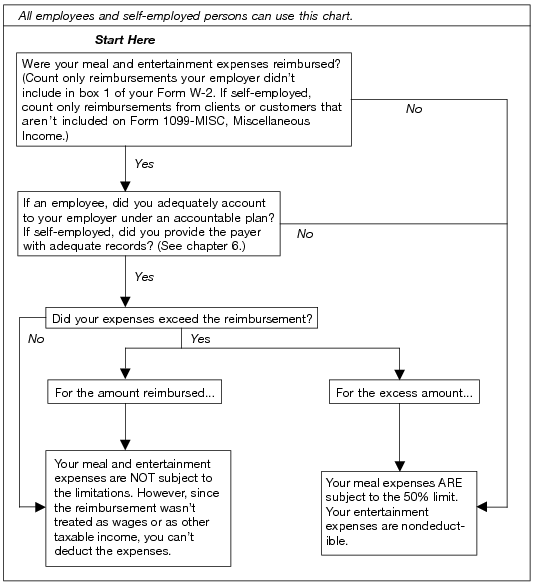
The 50% limit on meal expenses applies if the expense is otherwise deductible and isn’t covered by one of the exceptions discussed later. Figure A can help you determine if the 50% limit applies to you.
The 50% limit also applies to certain meal expenses that aren’t business related. It applies to meal expenses you have for the production of income, including rental or royalty income. It also applies to the cost of meals included in deductible educational expenses.
When to apply the 50% limit.
The 50% limit will apply after determining the amount that would otherwise qualify for a deduction. You first have to determine the amount of meal expenses that would be deductible under the other rules discussed in this publication.
Taking turns paying for meals.
If a group of business acquaintances takes turns picking up each others’ meal checks primarily for personal reasons, without regard to whether any business purposes are served, no member of the group can deduct any part of the expense.
Example 1.
You spend $200 (including tax and tip) for a business meal. If $110 of that amount isn’t allowable because it is lavish and extravagant, the remaining $90 is subject to the 50% limit. Your deduction can’t be more than $45 (50% (0.50) × $90).
Example 2.
You purchase two tickets to a concert for $200 for you and your client. Your deduction is zero because no deduction is allowed for entertainment expenses.
Exception to the 50% Limit for Meals
Your meal expense isn’t subject to the 50% limit if the expense meets one of the following exceptions.
Exception 1—expenses treated as compensation.
In general, expenses for goods, services, and facilities, to the extent the expenses are treated by the taxpayer, with respect to entertainment, amusement, or recreation, as compensation to an employee and as wages to the employee for tax purposes.
Exception 2—employee’s reimbursed expenses.
If you are an employee, you aren’t subject to the 50% limit on expenses for which your employer reimburses you under an accountable plan. Accountable plans are discussed in chapter 6.
Exception 3—self-employed reimbursed expenses.
If you are self-employed, your deductible meal expenses aren’t subject to the 50% limit if all of the following requirements are met.
-
You have these expenses as an independent contractor.
-
Your customer or client reimburses you or gives you an allowance for these expenses in connection with services you perform.
-
You provide adequate records of these expenses to your customer or client. (See chapter 5.)
In this case, your client or customer is subject to the 50% limit on the expenses.
Example.
You are a self-employed attorney who adequately accounts for meal expenses to a client who reimburses you for these expenses. You aren’t subject to the limitation on meal expenses. If the client can deduct the expenses, the client is subject to the 50% limit.
If you (as an independent contractor) have expenses for meals related to providing services for a client but don’t adequately account for and seek reimbursement from the client for those expenses, you are subject to the 50% limit on non-entertainment-related meals and the entertainment-related meal expenses are nondeductible to you.
Exception 4—recreational expenses for employees.
You aren’t subject to the 50% limit for expenses for recreational, social, or similar activities (including facilities) such as a holiday party or a summer picnic.
Exception 5—advertising expenses.
You aren’t subject to the 50% limit if you provide meals to the general public as a means of advertising or promoting goodwill in the community. For example, neither the expense of sponsoring a television or radio show nor the expense of distributing free food and beverages to the general public is subject to the 50% limit.
Exception 6—sale of meals.
You aren’t subject to the 50% limit if you actually sell meals to the public. For example, if you run a restaurant, your expense for the food you furnish to your customers isn’t subject to the 50% limit.
Individuals subject to “hours of service” limits.
You can deduct a higher percentage of your meal expenses while traveling away from your tax home if the meals take place during or incident to any period subject to the Department of Transportation’s “hours of service” limits. The percentage is 80%.
Individuals subject to the Department of Transportation’s “hours of service” limits include the following persons.
-
Certain air transportation workers (such as pilots, crew, dispatchers, mechanics, and control tower operators) who are under Federal Aviation Administration regulations.
-
Interstate truck operators and bus drivers who are under Department of Transportation regulations.
-
Certain railroad employees (such as engineers, conductors, train crews, dispatchers, and control operations personnel) who are under Federal Railroad Administration regulations.
-
Certain merchant mariners who are under Coast Guard regulations.
If you give gifts in the course of your trade or business, you may be able to deduct all or part of the cost. This chapter explains the limits and rules for deducting the costs of gifts.
$25 limit.
You can deduct no more than $25 for business gifts you give directly or indirectly to each person during your tax year. A gift to a company that is intended for the eventual personal use or benefit of a particular person or a limited class of people will be considered an indirect gift to that particular person or to the individuals within that class of people who receive the gift.
If you give a gift to a member of a customer’s family, the gift is generally considered to be an indirect gift to the customer. This rule doesn’t apply if you have a bona fide, independent business connection with that family member and the gift isn’t intended for the customer’s eventual use.
If you and your spouse both give gifts, both of you are treated as one taxpayer. It doesn’t matter whether you have separate businesses, are separately employed, or whether each of you has an independent connection with the recipient. If a partnership gives gifts, the partnership and the partners are treated as one taxpayer.
Example.
You sell products to a local company. You and your spouse gave the local company three gourmet gift baskets to thank them for their business. You and your spouse paid $80 for each gift basket, or $240 total. Three of the local company’s executives took the gift baskets home for their families’ use. You and your spouse have no independent business relationship with any of the executives’ other family members. You and your spouse can deduct a total of $75 ($25 limit × 3) for the gift baskets.
Incidental costs.
Incidental costs, such as engraving on jewelry, or packaging, insuring, and mailing, are generally not included in determining the cost of a gift for purposes of the $25 limit.
A cost is incidental only if it doesn’t add substantial value to the gift. For example, the cost of gift wrapping is an incidental cost. However, the purchase of an ornamental basket for packaging fruit isn’t an incidental cost if the value of the basket is substantial compared to the value of the fruit.
Exceptions.
The following items aren’t considered gifts for purposes of the $25 limit.
-
An item that costs $4 or less and:
-
Has your name clearly and permanently imprinted on the gift, and
-
Is one of a number of identical items you widely distribute. Examples include pens, desk sets, and plastic bags and cases.
-
-
Signs, display racks, or other promotional material to be used on the business premises of the recipient.
Most employees and self-employed persons can use this chart. (Don’t use this chart if your home is your principal place of business. See Office in the home, later.)
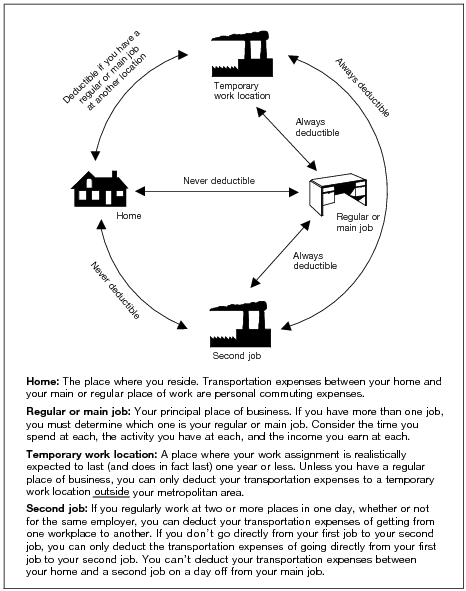
Figure B. When Are Local Transportation Expenses Deductible?TAs for Figure B are: Reg 1.162-1(a); RR 55–109; RR 94–47
Please click here for the text description of the image.
Gift or entertainment.
Any item that might be considered either a gift or entertainment will generally be considered entertainment. However, if you give a customer packaged food or beverages you intend the customer to use at a later date, treat it as a gift.
Caution:
If you are entitled to a reimbursement from your employer but you don’t claim it, you can’t claim a deduction for the expenses to which that unclaimed reimbursement applies. This type of deduction is considered a miscellaneous deduction that is no longer allowable due to the suspension of miscellaneous itemized deductions subject to the 2% floor under section 67(a).
This chapter discusses expenses you can deduct for business transportation when you aren’t traveling away from home, as defined in chapter 1. These expenses include the cost of transportation by air, rail, bus, taxi, etc., and the cost of driving and maintaining your car.
Transportation expenses include the ordinary and necessary costs of all of the following.
-
Getting from one workplace to another in the course of your business or profession when you are traveling within the city or general area that is your tax home. Tax home is defined in chapter 1.
-
Visiting clients or customers.
-
Going to a business meeting away from your regular workplace.
-
Getting from your home to a temporary workplace when you have one or more regular places of work. These temporary workplaces can be either within the area of your tax home or outside that area.
Daily transportation expenses you incur while traveling from home to one or more regular places of business are generally nondeductible commuting expenses. However, there may be exceptions to this general rule. You can deduct daily transportation expenses incurred going between your residence and a temporary work station outside the metropolitan area where you live. Also, daily transportation expenses can be deducted if (1) you have one or more regular work locations away from your residence; or (2) your residence is your principal place of business and you incur expenses going between the residence and another work location in the same trade or business, regardless of whether the work is temporary or permanent and regardless of the distance.
Caution:
If you are entitled to a reimbursement from your employer but you don’t claim it, you can’t claim a deduction for the expenses to which that unclaimed reimbursement applies. This type of deduction is considered a miscellaneous deduction that is no longer allowable due to the suspension of miscellaneous itemized deductions subject to the 2% floor under section 67(a).
Illustration of transportation expenses.
Figure B illustrates the rules that apply for deducting transportation expenses when you have a regular or main job away from your home. You may want to refer to it when deciding whether you can deduct your transportation expenses.
Temporary work location.
If you have one or more regular work locations away from your home and you commute to a temporary work location in the same trade or business, you can deduct the expenses of the daily round-trip transportation between your home and the temporary location, regardless of distance.
If your employment at a work location is realistically expected to last (and does in fact last) for 1 year or less, the employment is temporary unless there are facts and circumstances that would indicate otherwise.
If your employment at a work location is realistically expected to last for more than 1 year or if there is no realistic expectation that the employment will last for 1 year or less, the employment isn’t temporary, regardless of whether it actually lasts for more than 1 year.
If employment at a work location initially is realistically expected to last for 1 year or less, but at some later date the employment is realistically expected to last more than 1 year, that employment will be treated as temporary (unless there are facts and circumstances that would indicate otherwise) until your expectation changes. It won’t be treated as temporary after the date you determine it will last more than 1 year.
If the temporary work location is beyond the general area of your regular place of work and you stay overnight, you are traveling away from home. You may have deductible travel expenses, as discussed in chapter 1.
No regular place of work.
If you have no regular place of work but ordinarily work in the metropolitan area where you live, you can deduct daily transportation costs between home and a temporary work site outside that metropolitan area.
Generally, a metropolitan area includes the area within the city limits and the suburbs that are considered part of that metropolitan area.
You can’t deduct daily transportation costs between your home and temporary work sites within your metropolitan area. These are nondeductible commuting expenses.
Two places of work.
If you work at two places in 1 day, whether or not for the same employer, you can deduct the expense of getting from one workplace to the other. However, if for some personal reason you don’t go directly from one location to the other, you can’t deduct more than the amount it would have cost you to go directly from the first location to the second.
Transportation expenses you have in going between home and a part-time job on a day off from your main job are commuting expenses. You can’t deduct them.
Armed Forces reservists.
A meeting of an Armed Forces reserve unit is a second place of business if the meeting is held on a day on which you work at your regular job. You can deduct the expense of getting from one workplace to the other as just discussed under Two places of work.
You usually can’t deduct the expense if the reserve meeting is held on a day on which you don’t work at your regular job. In this case, your transportation is generally a nondeductible commuting expense. However, you can deduct your transportation expenses if the location of the meeting is temporary and you have one or more regular places of work.
If you ordinarily work in a particular metropolitan area but not at any specific location and the reserve meeting is held at a temporary location outside that metropolitan area, you can deduct your transportation expenses.
If you travel away from home overnight to attend a guard or reserve meeting, you can deduct your travel expenses. These expenses are discussed in chapter 1.
If you travel more than 100 miles away from home in connection with your performance of services as a member of the reserves, you may be able to deduct some of your reserve-related travel costs as an adjustment to gross income rather than as an itemized deduction. For more information, see Armed Forces Reservists Traveling More Than 100 Miles From Home under Special Rules in chapter 6.
Commuting expenses.
You can’t deduct the costs of taking a bus, trolley, subway, or taxi, or of driving a car between your home and your main or regular place of work. These costs are personal commuting expenses. You can’t deduct commuting expenses no matter how far your home is from your regular place of work. You can’t deduct commuting expenses even if you work during the commuting trip.
Example.
You sometimes use your cell phone to make business calls while commuting to and from work. Sometimes business associates ride with you to and from work, and you have a business discussion in the car. These activities don’t change the trip from personal to business. You can’t deduct your commuting expenses.
Parking fees.
Fees you pay to park your car at your place of business are nondeductible commuting expenses. You can, however, deduct business-related parking fees when visiting a customer or client.
Advertising display on car.
Putting display material that advertises your business on your car doesn’t change the use of your car from personal use to business use. If you use this car for commuting or other personal uses, you still can’t deduct your expenses for those uses.
Car pools.
You can’t deduct the cost of using your car in a nonprofit car pool. Don’t include payments you receive from the passengers in your income. These payments are considered reimbursements of your expenses. However, if you operate a car pool for a profit, you must include payments from passengers in your income. You can then deduct your car expenses (using the rules in this publication).
Hauling tools or instruments.
Hauling tools or instruments in your car while commuting to and from work doesn’t make your car expenses deductible. However, you can deduct any additional costs you have for hauling tools or instruments (such as for renting a trailer you tow with your car).
Union members’ trips from a union hall.
If you get your work assignments at a union hall and then go to your place of work, the costs of getting from the union hall to your place of work are nondeductible commuting expenses. Although you need the union to get your work assignments, you are employed where you work, not where the union hall is located.
Office in the home.
If you have an office in your home that qualifies as a principal place of business, you can deduct your daily transportation costs between your home and another work location in the same trade or business. (See Pub. 587, Business Use of Your Home, for information on determining if your home office qualifies as a principal place of business.)
Examples of deductible transportation.
The following examples show when you can deduct transportation expenses based on the location of your work and your home.
Example 1.
You regularly work in an office in the city where you live. Your employer sends you to a 1-week training session at a different office in the same city. You travel directly from your home to the training location and return each day. You can deduct the cost of your daily round-trip transportation between your home and the training location.
Example 2.
Your principal place of business is in your home. You can deduct the cost of round-trip transportation between your qualifying home office and your client’s or customer’s place of business.
Example 3.
You have no regular office and you don’t have an office in your home. In this case, the location of your first business contact inside the metropolitan area is considered your office. Transportation expenses between your home and this first contact are nondeductible commuting expenses. Transportation expenses between your last business contact and your home are also nondeductible commuting expenses. While you can’t deduct the costs of these trips, you can deduct the costs of going from one client or customer to another.
Car Expenses
If you use your car for business purposes, you may be able to deduct car expenses. You can generally use one of the two following methods to figure your deductible expenses.
-
Standard mileage rate.
-
Actual car expenses.
Tip:
If you qualify to use both methods, you may want to figure your deduction both ways to see which gives you a larger deduction.
The cost of using your car as an employee, whether measured using actual expenses or the standard mileage rate, will no longer be allowed to be claimed as an unreimbursed employee travel expense as a miscellaneous itemized deduction due to the suspension of miscellaneous itemized deductions that are subject to the 2% floor under section 67(a). The suspension applies to tax years beginning after 2017. Deductions for expenses that are deductible in determining adjusted gross income aren’t suspended. For example, Armed Forces reservists, qualified performing artists, and fee-basis state or local government officials are allowed to deduct unreimbursed employee travel expenses as an adjustment to total income on Schedule 1 (Form 1040), line 12.
If you use actual expenses to figure your deduction for a car you lease, there are rules that affect the amount of your lease payments you can deduct. See Leasing a Car, later.
In this publication, “car” includes a van, pickup, or panel truck. For the definition of “car” for depreciation purposes, see Car defined under Actual Car Expenses, later.
Standard Mileage Rate
For 2025, the standard mileage rate for the cost of operating your car for business use is 70 cents ($0.70) per mile.
Caution:
If you use the standard mileage rate for a year, you can’t deduct your actual car expenses for that year. You can’t deduct depreciation, lease payments, maintenance and repairs, gasoline (including gasoline taxes), oil, insurance, or vehicle registration fees. See Choosing the standard mileage rate and Standard mileage rate not allowed, later.
You can generally use the standard mileage rate whether or not you are reimbursed and whether or not any reimbursement is more or less than the amount figured using the standard mileage rate. See chapter 6 for more information on reimbursements.
Choosing the standard mileage rate.
If you want to use the standard mileage rate for a car you own, you must choose to use it in the first year the car is available for use in your business. Then, in later years, you can choose to use either the standard mileage rate or actual expenses.
If you want to use the standard mileage rate for a car you lease, you must use it for the entire lease period. For leases that began on or before December 31, 1997, the standard mileage rate must be used for the entire portion of the lease period (including renewals) that is after 1997.
You must make the choice to use the standard mileage rate by the due date (including extensions) of your return. You can’t revoke the choice. However, in later years, you can switch from the standard mileage rate to the actual expenses method. If you change to the actual expenses method in a later year, but before your car is fully depreciated, you have to estimate the remaining useful life of the car and use straight line depreciation for the car’s remaining estimated useful life, subject to depreciation limits (discussed later).
For more information about depreciation included in the standard mileage rate, see Exception under Methods of depreciation, later.
Standard mileage rate not allowed.
You can’t use the standard mileage rate if you:
-
Use five or more cars at the same time (such as in fleet operations);
-
Claimed a depreciation deduction for the car using any method other than straight line for the car’s estimated useful life;
-
Used the Modified Accelerated Cost Recovery System (MACRS) (as discussed later under Depreciation Deduction);
-
Claimed a section 179 deduction (discussed later) on the car;
-
Claimed the special depreciation allowance on the car; or
-
Claimed actual car expenses after 1997 for a car you leased.
Five or more cars.
If you own or lease five or more cars that are used for business at the same time, you can’t use the standard mileage rate for the business use of any car. However, you may be able to deduct your actual expenses for operating each of the cars in your business. See Actual Car Expenses, later, for information on how to figure your deduction.
You aren’t using five or more cars for business at the same time if you alternate using (use at different times) the cars for business.
The following examples illustrate the rules for when you can and can’t use the standard mileage rate for five or more cars.
Example 1.
A salesperson owns three cars and two vans that they alternate using for calling on their customers. The salesperson can use the standard mileage rate for the business mileage of the three cars and the two vans because they don’t use them at the same time.
Example 2.
You and your employees use your four pickup trucks in your landscaping business. During the year, you traded in two of your old trucks for two newer ones. You can use the standard mileage rate for the business mileage of all six of the trucks you owned during the year.
Example 3.
You own a repair shop and an insurance business. You and your employees use your two pickup trucks and van for the repair shop. You alternate using your two cars for the insurance business. No one else uses the cars for business purposes. You can use the standard mileage rate for the business use of the pickup trucks, the van, and the cars because you never have more than four vehicles used for business at the same time.
Example 4.
You own a car and four vans that are used in your housecleaning business. Your employees use the vans, and you use the car to travel to various customers. You can’t use the standard mileage rate for the car or the vans. This is because all five vehicles are used in your business at the same time. You must use actual expenses for all vehicles.
Interest.
You may be able to take a deduction for interest paid on a car loan even if you use the standard mileage rate.
You may be able to deduct qualified passenger vehicle loan interest you paid or accrued during the year. See Schedule 1-A (Form 1040) to see whether you can deduct this interest.
Additionally, if you are self-employed and use your car in your business, you can deduct that part of the interest expense that represents your business use of the car. For example, if you use your car 60% for business, you can deduct 60% of the interest on Schedule C (Form 1040). If you are self-employed and eligible to deduct interest as either qualified passenger vehicle loan interest or as business interest, you can choose to report the deduction on either Schedule 1-A (Form 1040) or Schedule C (Form 1040), but you cannot deduct the same amount more than once. See the Instructions for Schedule 1-A (Form 1040) for more information.
Personal property taxes.
If you itemize your deductions on Schedule A (Form 1040), you can deduct on line 5c state and local personal property taxes on motor vehicles. You can take this deduction even if you use the standard mileage rate or if you don’t use the car for business.
If you are self-employed and use your car in your business, you can deduct the business part of state and local personal property taxes on motor vehicles on Schedule C (Form 1040) or Schedule F (Form 1040). If you itemize your deductions, you can include the remainder of your state and local personal property taxes on the car on Schedule A (Form 1040).
Parking fees and tolls.
In addition to using the standard mileage rate, you can deduct any business-related parking fees and tolls. (Parking fees you pay to park your car at your place of work are nondeductible commuting expenses.)
Sale, trade-in, or other disposition.
If you sell, trade in, or otherwise dispose of your car, you may have a gain or loss on the transaction or an adjustment to the basis of your new car. See Disposition of a Car, later.
Actual Car Expenses
If you don’t use the standard mileage rate, you may be able to deduct your actual car expenses.
Actual car expenses include:
| Depreciation | Lease payments | Registration fees |
| Licenses | Insurance | Repairs |
| Gas | Garage rent | Tires |
| Oil | Tolls | Parking fees |
If you have fully depreciated a car that you still use in your business, you can continue to claim your other actual car expenses. Continue to keep records, as explained later in chapter 5.
Business and personal use.
If you use your car for both business and personal purposes, you must divide your expenses between business and personal use. You can divide your expense based on the miles driven for each purpose.
Example.
You are a contractor and drive your car 20,000 miles during the year: 12,000 miles for business use and 8,000 miles for personal use. You can claim only 60% (12,000 ÷ 20,000) of the cost of operating your car as a business expense.
Employer-provided vehicle.
If you use a vehicle provided by your employer for business purposes, you can deduct your actual unreimbursed car expenses. You can’t use the standard mileage rate. See Vehicle Provided by Your Employer in chapter 6.
Interest on car loans.
You may be able to deduct qualified passenger vehicle loan interest you paid or accrued during the year. See Schedule 1-A (Form 1040) to see whether you can deduct this interest. If you are self-employed and use your car in that business, see Interest, earlier, under Standard Mileage Rate.
Taxes paid on your car.
If you are an employee, you can deduct personal property taxes paid on your car if you itemize deductions. Enter the amount paid on Schedule A (Form 1040), line 5c.
Sales taxes.
Generally, sales taxes on your car are part of your car’s basis and are recovered through depreciation, discussed later.
Fines and collateral.
You can’t deduct fines you pay or collateral you forfeit for traffic violations.
Casualty and theft losses.
If your car is damaged, destroyed, or stolen, you may be able to deduct part of the loss not covered by insurance. See Pub. 547, Casualties, Disasters, and Thefts, for information on deducting a loss on your car.
Depreciation and section 179 deductions.
Generally, the cost of a car, plus sales tax and improvements, is a capital expense. Because the benefits last longer than 1 year, you generally can’t deduct a capital expense. However, you can recover this cost through the section 179 deduction (the deduction allowed by section 179 of the Internal Revenue Code), special depreciation allowance, and depreciation deductions. Depreciation allows you to recover the cost over more than 1 year by deducting part of it each year. The section 179 deduction, special depreciation allowance, and depreciation deductions are discussed later.
Generally, there are limits on these deductions. Special rules apply if you use your car 50% or less in your work or business.
You can claim a section 179 deduction and use a depreciation method other than straight line only if you don’t use the standard mileage rate to figure your business-related car expenses in the year you first place a car in service.
If, in the year you first place a car in service, you claim either a section 179 deduction or use a depreciation method other than straight line for its estimated useful life, you can’t use the standard mileage rate on that car in any future year.
Car defined.
For depreciation purposes, a car is any four-wheeled vehicle (including a truck or van) made primarily for use on public streets, roads, and highways. Its unloaded gross vehicle weight (for trucks and vans, gross vehicle weight) must not be more than 6,000 pounds. A car includes any part, component, or other item physically attached to it or usually included in the purchase price.
A car doesn’t include:
-
An ambulance, hearse, or combination ambulance-hearse used directly in a business;
-
A vehicle used directly in the business of transporting persons or property for pay or hire; or
-
A truck or van that is a qualified nonpersonal use vehicle.
Qualified nonpersonal use vehicles.
These are vehicles that by their nature aren’t likely to be used more than a minimal amount for personal purposes. They include trucks and vans that have been specially modified so that they aren’t likely to be used more than a minimal amount for personal purposes, such as by installation of permanent shelving and painting the vehicle to display advertising or the company’s name. Delivery trucks with seating only for the driver, or only for the driver plus a folding jump seat, are qualified nonpersonal use vehicles.
More information.
See Depreciation Deduction, later, for more information on how to depreciate your vehicle.
You can elect to recover all or part of the cost of a car that is qualifying section 179 property, up to a limit, by deducting it in the year you place the property in service. This is the section 179 deduction. If you elect the section 179 deduction, you must reduce your depreciable basis in the car by the amount of the section 179 deduction.
Tip:
There is a limit on the total section 179 deduction, special depreciation allowance, and depreciation deduction for cars, trucks, and vans that may reduce or eliminate any benefit from claiming the section 179 deduction. See Depreciation Limits, later.
You can claim the section 179 deduction only in the year you place the car in service. For this purpose, a car is placed in service when it is ready and available for a specifically assigned use in a trade or business. Even if you aren’t using the property, it is in service when it is ready and available for its specifically assigned use.
A car first used for personal purposes can’t qualify for the deduction in a later year when its use changes to business.
Example.
In 2024, you bought a new car and used it for personal purposes. In 2025, you began to use it for business. Changing its use to business use doesn’t qualify the cost of your car for a section 179 deduction in 2025. However, you can claim a depreciation deduction for the business use of the car starting in 2025. See Depreciation Deduction, later.
More than 50% business use requirement.
You must use the property more than 50% for business to claim any section 179 deduction. If you used the property more than 50% for business, multiply the cost of the property by the percentage of business use. The result is the cost of the property that can qualify for the section 179 deduction.
Example.
You purchased a new car in April 2025 for $24,500 and used it 60% for business. Based on your business usage, the total cost of your car that qualifies for the section 179 deduction is $14,700 ($24,500 cost × 60% (0.60) business use). But see Limit on total section 179, special depreciation allowance, and depreciation deduction, discussed later.
Limits.
There are limits on:
-
The amount of the section 179 deduction;
-
The section 179 deduction for sport utility and certain other vehicles; and
-
The total amount of the section 179 deduction, special depreciation allowance, and depreciation deduction (discussed later) you can claim for a qualified property.
Limit on the amount of the section 179 deduction.
For tax years beginning in 2025, the total amount you can elect to deduct under section 179 can’t be more than $2,500,000.
If the cost of your section 179 property placed in service in tax years beginning in 2025 is over $4,000,000, you must reduce the $2,500,000 dollar limit (but not below zero) by the amount of cost over $4,000,000. If the cost of your section 179 property placed in service during tax years beginning in 2025 is $6,500,000 or more, you can’t take a section 179 deduction.
The total amount you can deduct under section 179 each year after you apply the limits listed above cannot be more than the taxable income from the active conduct of any trade or business during the year.
If you are married and file a joint return, you and your spouse are treated as one taxpayer in determining any reduction to the dollar limit, regardless of which of you purchased the property or placed it in service.
If you and your spouse file separate returns, you are treated as one taxpayer for the dollar limit. You must allocate the dollar limit (after any reduction) between you.
For more information on the above section 179 deduction limits, see Pub. 946, How To Depreciate Property.
Limit for sport utility and certain other vehicles.
You cannot elect to deduct more than $31,300 of the cost of any heavy sport utility vehicle (SUV) and certain other vehicles placed in service during the tax years beginning in 2025. This rule applies to any four-wheeled vehicle primarily designed or used to carry passengers over public streets, roads, or highways that isn’t subject to any of the passenger automobile limits explained under Depreciation Limits, later, and that is rated at more than 6,000 pounds gross vehicle weight and not more than 14,000 pounds gross vehicle weight. However, the $31,300 limit doesn’t apply to any vehicle:
-
Designed to have a seating capacity of more than nine persons behind the driver’s seat;
-
Equipped with a cargo area of at least 6 feet in interior length that is an open area or is designed for use as an open area but is enclosed by a cap and isn’t readily accessible directly from the passenger compartment; or
-
That has an integral enclosure, fully enclosing the driver compartment and load carrying device, doesn’t have seating rearward of the driver’s seat, and has no body section protruding more than 30 inches ahead of the leading edge of the windshield.
Limit on total section 179 deduction, special depreciation allowance, and depreciation deduction.
The depreciation limitations for passenger automobiles acquired after September 27, 2017, and placed in service during calendar year 2025, for which the Code section 168(k) additional first-year depreciation deduction applies are first tax year, $20,200; second tax year, $19,600; third tax year, $11,800; and each succeeding year, $7,060. See Revenue Procedure 2025-16, Table 1.
The depreciation limitations for passenger automobiles placed in service during calendar year 2025 for which no Code section 168(k) additional first-year depreciation deduction applies are first-tax year, $12,200; second tax year, $19,600; third tax year, $11,800; and each succeeding year, $7,060. See Revenue Procedure 2025-16, Table 2.
The limit is reduced if your business use of the vehicle is less than 100%. See Depreciation Limits, later, for more information.
Cost of car.
For purposes of the section 179 deduction, the cost of the car doesn’t include any amount figured by reference to any other property held by you at any time. For example, if you buy a car as a replacement for a car that was stolen or that was destroyed in a casualty loss, and you use section 1033 to determine the basis in your replacement vehicle, your cost for purposes of the section 179 deduction doesn’t include your adjusted basis in the relinquished car. In that case, your cost includes only the cash you paid.
Basis of car for depreciation.
The amount of the section 179 deduction reduces your basis in your car. If you choose the section 179 deduction, you must subtract the amount of the deduction from the cost of your car. The resulting amount is the basis in your car you use to figure your depreciation deduction.
When to elect.
If you want to take the section 179 deduction, you must make the election in the tax year you place the car in service for business or work.
How to elect.
Employees use Form 2106, Employee Business Expenses, to make the election and report the section 179 deduction. All others use Form 4562, Depreciation and Amortization, to make an election.
Caution:
Form 2106 is only used by Armed Forces reservists, qualified performing artists, fee-basis state or local government officials, and employees with impairment-related work expenses. Due to the suspension of miscellaneous itemized deductions subject to the 2% floor under section 67(a), employees who don’t fit into one of the listed categories may not use Form 2106.
File the appropriate form with either of the following.
-
Your original tax return filed for the year the property was placed in service (whether or not you file it timely).
-
An amended return filed within the time prescribed by law. An election made on an amended return must specify the item of section 179 property to which the election applies and the part of the cost of each such item to be taken into account. The amended return must also include any resulting adjustments to taxable income.
Revoking an election.
An election (or any specification made in the election) to take a section 179 deduction for 2025 can only be revoked with the Commissioner’s approval.
Recapture of section 179 deduction.
To be eligible to claim the section 179 deduction, you must use your car more than 50% for business or work in the year you acquired it. If your business use of the car is 50% or less in a later tax year during the recovery period, you have to recapture (include in income) in that later year any excess depreciation. Any section 179 deduction claimed on the car is included in figuring the excess depreciation. For information on this calculation, see Excess depreciation, later in this chapter under Car Used 50% or Less for Business. For more information on recapture of a section 179 deduction, see Pub. 946.
Dispositions.
If you dispose of a car on which you had claimed the section 179 deduction, the amount of that deduction is treated as a depreciation deduction for recapture purposes. You treat any gain on the disposition of the property as ordinary income up to the amount of the section 179 deduction and any allowable depreciation (unless you establish the amount actually allowed). For information on the disposition of a car, see Disposition of a Car, later. For more information on recapture of a section 179 deduction, see Pub. 946.
You may be able to claim the special depreciation allowance for your car, truck, or van if it is qualified property and was placed in service in 2025. P.L. 119-21 (July 4, 2025), commonly known as the One Big Beautiful Bill Act (OBBBA), made several amendments to Code section 168(k) to provide taxpayers with a permanent 100% additional first-year depreciation deduction for qualified property acquired and placed in service, and specified plants planted or grafted, after January 19, 2025. Specifically, OBBBA replaced the annual phasedown of the applicable percentage for the Code section 168(k) additional first-year depreciation deduction with a permanent 100% additional first-year depreciation deduction for qualified property acquired, or specified plants planted or grafted, after January 19, 2025. Additionally, OBBBA amended Code section 168(k) to allow taxpayers to elect to deduct 40% (60% for certain property having longer production periods or certain aircraft), instead of 100%, additional first-year depreciation for qualified property placed in service, or specified plants planted or grafted, during the first tax year ending after January 19, 2025. The amendments generally apply to property acquired, or specified plants planted or grafted, after January 19, 2025. See Notice 2026-11.
Combined depreciation.
The depreciation limitations for passenger automobiles acquired after September 27, 2017, and placed in service during calendar year 2025, for which the Code section 168(k) additional first-year depreciation deduction applies are first tax year, $20,200; second tax year, $19,600; third tax year, $11,800; and each succeeding year, $7,060. See Revenue Procedure 2025-16, Table 1.
The depreciation limitations for passenger automobiles placed in service during calendar year 2025 for which no Code section 168(k) additional first-year depreciation deduction applies are first tax year, $12,200; second tax year, $19,600; third tax year, $11,800; and each succeeding year, $7,060. See Revenue Procedure 2025-16, Table 2.
Qualified car.
To be qualified property eligible for the 100% additional first-year depreciation deduction, a car (including a truck or van) acquired after January 19, 2025, must meet all of the following tests.
-
No written binding contract to acquire the car existed before January 20, 2025.
-
You acquired the car new or used.
-
You placed the car in service in your trade or business.
-
You used the car more than 50% in a qualified business use during the tax year.
For a car acquired before January 20, 2025, to be qualified property eligible for the 40% additional first-year depreciation deduction, the car must meet the tests listed above, except that the car must be acquired after September 27, 2017, and no written binding contract to acquire the car existed before September 28, 2017. Additionally, the car must be placed in service in your trade or business during 2025.
Election not to claim the special depreciation allowance.
You can elect not to claim the special depreciation allowance for your car, truck, or van that is qualified property. If you make this election, it applies to all 5-year property placed in service during the year.
To make this election, attach a statement to your timely filed return (including extensions) indicating the class of property (5-year for cars) for which you are making the election and that you are electing not to claim the special depreciation allowance for qualified property in that class of property.
If you use actual car expenses to figure your deduction for a car you own and use in your business, you can claim a depreciation deduction. This means you can deduct a certain amount each year as a recovery of your cost or other basis in your car.
You generally need to know the following things about the car you intend to depreciate.
-
Your basis in the car.
-
The date you place the car in service.
-
The method of depreciation and recovery period you will use.
Basis.
Your basis in a car for figuring depreciation is generally its cost. This includes any amount you borrow or pay in cash, other property, or services.
Generally, you figure depreciation on your car, truck, or van using your unadjusted basis (see Unadjusted basis, later). However, in some situations, you will use your adjusted basis (your basis reduced by depreciation allowed or allowable in earlier years). For one of these situations, see Exception under Methods of depreciation, later.
If you change the use of a car from personal to business, your basis for depreciation is the lesser of the fair market value (FMV) or your adjusted basis in the car on the date of conversion. Additional rules concerning basis are discussed later in this chapter under Unadjusted basis.
Placed in service.
You generally place a car in service when it is available for use in your work or business, in an income-producing activity, or in a personal activity. Depreciation begins when the car is placed in service for use in your work or business or for the production of income.
For purposes of figuring depreciation, if you first start using the car only for personal use and later convert it to business use, you place the car in service on the date of conversion.
Car placed in service and disposed of in the same year.
If you place a car in service and dispose of it in the same tax year, you can’t claim any depreciation deduction for that car.
Methods of depreciation.
Generally, you figure depreciation on cars using MACRS discussed later in this chapter.
Exception.
If you used the standard mileage rate in the first year of business use and change to the actual expenses method in a later year, you can’t depreciate your car under the MACRS rules. You must use straight line depreciation over the estimated remaining useful life of the car. The amount you depreciate can’t be more than the depreciation limit that applies for that year. See Depreciation Limits, later.
To figure depreciation under the straight line method, you must reduce your basis in the car (but not below zero) by a set rate per mile for all miles for which you used the standard mileage rate. The rate per mile varies depending on the year(s) you used the standard mileage rate. For the rate(s) to use, see Depreciation adjustment when you used the standard mileage rate under Disposition of a Car, later.
This reduction of basis is in addition to those basis adjustments described later under Unadjusted basis. You must use your adjusted basis in your car to figure your depreciation deduction. For additional information on the straight line method of depreciation, see Pub. 946.
More-than-50%-use test.
Generally, you must use your car more than 50% for qualified business use (defined next) during the year to use MACRS. You must meet this more-than-50%-use test each year of the recovery period (6 years under MACRS) for your car.
If your business use is 50% or less, you must use the straight line method to depreciate your car. This is explained later under Car Used 50% or Less for Business.
Qualified business use.
A qualified business use is any use in your trade or business. It doesn’t include use for the production of income (investment use) or use provided under lease to, or as compensation to, a 5% owner or related person. However, you do combine your business and investment use to figure your depreciation deduction for the tax year.
Use of your car by another person.
Don’t treat any use of your car by another person as use in your trade or business unless that use meets one of the following conditions.
-
It is directly connected with your business.
-
It is properly reported by you as income to the other person (and, if you have to, you withhold tax on the income).
-
It results in a payment of fair market rent. This includes any payment to you for the use of your car.
Business use changes.
If you used your car more than 50% in qualified business use in the year you placed it in service, but 50% or less in a later year (including the year of disposition), you have to change to the straight line method of depreciation. See Qualified business use 50% or less in a later year under Car Used 50% or Less for Business, later.
Use for more than one purpose.
If you use your car for more than one purpose during the tax year, you must allocate the use to the various purposes. You do this on the basis of mileage. Figure the percentage of qualified business use by dividing the number of miles you drive your car for business purposes during the year by the total number of miles you drive the car during the year for any purpose.
Change from personal to business use.
If you change the use of a car from 100% personal use to business use during the tax year, you may not have mileage records for the time before the change to business use. In this case, you figure the percentage of business use for the year as follows.
-
Determine the percentage of business use for the period following the change. Do this by dividing business miles by total miles driven during that period.
-
Multiply the percentage in (1) by a fraction. The numerator (top number) is the number of months the car is used for business, and the denominator (bottom number) is 12.
Example.
You use a car only for personal purposes during the first 6 months of the year. During the last 6 months of the year, you drive the car a total of 15,000 miles of which 12,000 miles are for business. This gives you a business-use percentage of 80% (12,000 ÷ 15,000) for that period. Your business use for the year is 40% (80% (0.80) × 6/12).
Limits.
The amount you can claim for section 179, special depreciation allowance, and depreciation deductions may be limited. The maximum amount you can claim depends on the year in which you placed your car in service. You have to reduce the maximum amount if you didn’t use the car exclusively for business. See Depreciation Limits, later.
Unadjusted basis.
You use your unadjusted basis (often referred to as your basis or your basis for depreciation) to figure your depreciation using the MACRS depreciation chart, explained later under Modified Accelerated Cost Recovery System (MACRS). Your unadjusted basis for figuring depreciation is your original basis increased or decreased by certain amounts.
To figure your unadjusted basis, begin with your car’s original basis, which is generally its cost. Cost includes sales taxes (see Sales taxes, earlier), destination charges, and dealer preparation. Increase your basis by any substantial improvements you make to your car, such as adding air conditioning or a new engine. Decrease your basis by any section 179 deduction, special depreciation allowance, gas guzzler tax, and vehicle credits claimed. See Pub. 551, Basis of Assets, for further details.
Caution:
If your business use later falls to 50% or less, you may have to recapture (include in your income) any excess depreciation. See Car Used 50% or Less for Business, later, for more information.
If you acquired the car by gift or inheritance, see Pub. 551, Basis of Assets, for information on your basis in the car.
Improvements.
A major improvement to a car is treated as a new item of 5-year recovery property. It is treated as placed in service in the year the improvement is made. It doesn’t matter how old the car is when the improvement is added. Follow the same steps for depreciating the improvement as you would for depreciating the original cost of the car. However, you must treat the improvement and the car as a whole when applying the limits on the depreciation deductions. Your car’s depreciation deduction for the year (plus any section 179 deduction, special depreciation allowance, and depreciation on any improvements) can’t be more than the depreciation limit that applies for that year. See Depreciation Limits, later.
Car trade-in.
If you traded one car (the “old car”) for another car (the “new car”) in 2025, you must treat the transaction as a disposition of the old car and the purchase of the new car. You must treat the old car as disposed of at the time of the trade-in. The depreciable basis of the new car is the adjusted basis of the old car (figured as if 100% of the car’s use had been for business purposes) plus any additional amount you paid for the new car. You then figure your depreciation deduction for the new car beginning with the date you placed it in service. You must also complete Form 2106, Part II, Section D. This method is explained later, beginning at Effect of trade-in on basis.
Caution:
Form 2106 is only used by Armed Forces reservists, qualified performing artists, fee-basis state or local government officials, and employees with impairment-related work expenses. Due to the suspension of miscellaneous itemized deductions subject to the 2% floor under section 67(a), employees who don’t fit into one of the listed categories may not use Form 2106.
Effect of trade-in on basis.
The discussion that follows applies to trade-ins of cars in 2025, where the election was made to treat the transaction as a disposition of the old car and the purchase of the new car. For information on how to figure depreciation for cars involved in a like-kind exchange (trade-in) in 2025, for which the election wasn’t made, see Pub. 946 and Regulations section 1.168(i)-6(d)(3).
Traded car used only for business.
If you trade in a car you used only in your business for another car that will be used only in your business, your original basis in the new car is your adjusted basis in the old car, plus any additional amount you pay for the new car.
Example.
You trade in a car that has an adjusted basis of $5,000 for a new car. In addition, you pay cash of $20,000 for the new car. Your original basis of the new car is $25,000 (your $5,000 adjusted basis in the old car plus the $20,000 cash paid). Your unadjusted basis is $25,000 unless you claim the section 179 deduction, special depreciation allowance, or have other increases or decreases to your original basis, discussed under Unadjusted basis, earlier.
Traded car used partly in business.
If you trade in a car you used partly in your business for a new car you will use in your business, you must make a “trade-in” adjustment for the personal use of the old car. This adjustment has the effect of reducing your basis in your old car, but not below zero, for purposes of figuring your depreciation deduction for the new car. (This adjustment isn’t used, however, when you determine the gain or loss on the later disposition of the new car. See Pub. 544, Sales and Other Dispositions of Assets, for information on how to report the disposition of your car.)
To figure the unadjusted basis of your new car for depreciation, first add to your adjusted basis in the old car any additional amount you pay for the new car. Then subtract from that total the excess, if any, of:
-
The total of the amounts that would have been allowable as depreciation during the tax years before the trade if 100% of the use of the car had been business and investment use, over
-
The total of the amounts actually allowed as depreciation during those years.
Modified Accelerated Cost Recovery System (MACRS).
MACRS is the name given to the tax rules for getting back (recovering) through depreciation deductions the cost of property used in a trade or business or to produce income.
The maximum amount you can deduct is limited, depending on the year you placed your car in service. See Depreciation Limits, later.
Recovery period.
Under MACRS, cars are classified as 5-year property. You actually depreciate the cost of a car, truck, or van over a period of 6 calendar years. This is because your car is generally treated as placed in service in the middle of the year, and you claim depreciation for one-half of both the first year and the sixth year.
For more information on the qualifications for this shorter recovery period and the percentages to use in figuring the depreciation deduction, see chapter 4 of Pub. 946.
Depreciation methods.
You can use one of the following methods to depreciate your car.
-
The 200% declining balance method (200% DB) over a 5-year recovery period that switches to the straight line method when that method provides an equal or greater deduction.
-
The 150% declining balance method (150% DB) over a 5-year recovery period that switches to the straight line method when that method provides an equal or greater deduction.
-
The straight line method (SL) over a 5-year recovery period.
Tip:
If you use Table 4-1 (discussed later) to determine your depreciation rate for 2025, you don’t need to determine in what year using the straight line method provides an equal or greater deduction. This is because the chart has the switch to the straight line method built into its rates.
Before choosing a method, you may wish to consider the following facts.
-
Using the straight line method provides equal yearly deductions throughout the recovery period.
-
Using the declining balance methods provides greater deductions during the earlier recovery years with the deductions generally getting smaller each year.
MACRS depreciation chart.
A 2025 MACRS Depreciation Chart and instructions are included in this chapter as Table 4-1. Using this table will make it easy for you to figure the 2025 depreciation deduction for your car. A similar chart appears in the Instructions for Form 2106.
You must use the Depreciation Tables in Pub. 946 rather than the 2025 MACRS Depreciation Chart in this publication if any one of the following three conditions applies to you.
-
You file your return on a fiscal-year basis.
-
You file your return for a short tax year (less than 12 months).
-
During the year, all of the following conditions apply.
-
You placed some property in service from January through September.
-
You placed some property in service from October through December.
-
Your basis in the property you placed in service from October through December (excluding nonresidential real property, residential rental property, and property placed in service and disposed of in the same year) was more than 40% of your total bases in all property you placed in service during the year.
-
Depreciation in future years.
If you use the percentages from the chart, you generally must continue to use them for the entire recovery period of your car. However, you can’t continue to use the chart if your basis in your car is adjusted because of a casualty. In that case, for the year of the adjustment and the remaining recovery period, figure the depreciation without the chart using your adjusted basis in the car at the end of the year of the adjustment and over the remaining recovery period. See Figuring the Deduction Without Using the Tables in chapter 4 of Pub. 946.
Disposition of car during recovery period.
If you dispose of the car before the last year of the recovery period, you are generally allowed a half-year of depreciation in the year of disposition. This rule applies unless the mid-quarter convention applies to the vehicle being disposed of. See Depreciation deduction for the year of disposition under Disposition of a Car, later, for information on how to figure the depreciation allowed in the year of disposition.
How to use the 2025 chart.
To figure your depreciation deduction for 2025, find the percentage in the column of Table 4-1 based on the date that you first placed the car in service and the depreciation method that you are using. Multiply the unadjusted basis of your car (defined earlier) by that percentage to determine the amount of your depreciation deduction. If you prefer to figure your depreciation deduction without the help of the chart, see Pub. 946.
Caution:
Your deduction can’t be more than the maximum depreciation limit for cars. See Depreciation Limits, later.
Example.
You bought a used truck in February 2024 to use exclusively in your landscape business. You paid $9,200 for the truck with no trade-in. You didn’t claim any section 179 deduction, the truck didn’t qualify for the special depreciation allowance, and you chose to use the 200% DB method to get the largest depreciation deduction in the early years.
You used the MACRS Depreciation Chart in 2024 to find your percentage. The unadjusted basis of the truck equals its cost because you used it exclusively for business. You multiplied the unadjusted basis of the truck, $9,200, by the percentage that applied, 20%, to figure your 2024 depreciation deduction of $1,840.
In 2025, you used the truck for personal purposes when you repaired your parent’s cabin. Your records show that the business use of the truck was 90% in 2025. You used Table 4-1 to find your percentage. Reading down the first column for the date placed in service and across to the 200% DB column, you locate your percentage, 32%. You multiply the unadjusted basis of the truck, $8,280 ($9,200 cost × 90% (0.90) business use), by 32% (0.32) to figure your 2025 depreciation deduction of $2,650.
There are limits on the amount you can deduct for depreciation of your car, truck, or van. The section 179 deduction and special depreciation allowance are treated as depreciation for purposes of the limits. The maximum amount you can deduct each year depends on the date you acquired the passenger automobile and the year you place the passenger automobile in service. These limits are shown in the following tables for 2025.
| Date | 4th & | |||
| placed in | 1st | 2nd | 3rd | later |
| service | year | year | year | years |
| 2025 | $12,200 | $19,600 | $11,800 | $7,060 |
| 2024 | 12,400 | 19,800 | 11,900 | 7,160 |
| 2023 | 12,200 | 19,500 | 11,700 | 6,960 |
| 2022 | 11,200 | 18,000 | 10,800 | 6,460 |
| 2021 | 10,200 | 16,400 | 9,800 | 5,860 |
| 2020 | 10,100 | 16,100 | 9,700 | 5,760 |
| 2019 | 14,9001 | 16,100 | 9,700 | 5,760 |
| 2018 | 16,4002 | 16,000 | 9,600 | 5,760 |
| 1 $10,100 if the passenger automobile isn’t qualified property or if you elect not to claim the special depreciation allowance. | ||||
| 2 $10,000 if the passenger automobile isn’t qualified property or if you elect not to claim the special depreciation allowance. | ||||
| Date | 4th & | |||
| placed in | 1st | 2nd | 3rd | later |
| service | year | year | year | years |
| 2025 | $20,2001 | $19,600 | $11,800 | $7,060 |
| 2024 | 20,4002 | 19,800 | 11,900 | 7,160 |
| 2023 | 20,2003 | 19,500 | 11,700 | 6,960 |
| 2022 | 19,2004 | 18,000 | 10,800 | 6,460 |
| 2021 | 18,2005 | 16,400 | 9,800 | 5,860 |
| 2019–2020 | 18,1006 | 16,100 | 9,700 | 5,760 |
| 2018 | 18,0007 | 16,000 | 9,600 | 5,760 |
| 1$12,200 if the passenger automobile isn’t qualified property or if you elect not to claim the special depreciation allowance. | ||||
| 2$12,400 if the passenger automobile isn’t qualified property or if you elect not to claim the special depreciation allowance. | ||||
| 3 $12,200 if the passenger automobile isn’t qualified property or if you elect not to claim the special depreciation allowance. | ||||
| 4 $11,200 if the passenger automobile isn’t qualified property or if you elect not to claim the special depreciation allowance. | ||||
| 5 $10,200 if the passenger automobile isn’t qualified property or if you elect not to claim the special depreciation allowance. | ||||
| 6 $10,100 if the passenger automobile isn’t qualified property or if you elect not to claim the special depreciation allowance. | ||||
| 7 $10,000 if the passenger automobile isn’t qualified property or if you elect not to claim the special depreciation allowance. | ||||
The maximum amount you can deduct each year depends on the year you place the car in service. These limits are shown in the following tables for prior years.
| Date | 4th & | |||
| placed | 1st | 2nd | 3rd | later |
| in service | year | year | year | years |
| 2012–2017 | $11,1601 | $5,100 | $3,050 | $1,875 |
| 2010–2011 | 11,0602 | 4,900 | 2,950 | 1,775 |
| 2008–2009 | 10,9603 | 4,800 | 2,850 | 1,775 |
| 2007 | 3,060 | 4,900 | 2,850 | 1,775 |
| 2006 | 2,960 | 4,800 | 2,850 | 1,775 |
| 2005 | 2,960 | 4,700 | 2,850 | 1,675 |
| 2004 | 10,6103 | 4,800 | 2,850 | 1,675 |
| 5/06/2003–12/31/2003 | 10,7104 | 4,900 | 2,950 | 1,775 |
| 1/01/2003–5/05/2003 | 7,6605 | 4,900 | 2,950 | 1,775 |
| 1 $3,160 if the car isn’t qualified property or if you elect not to claim the special depreciation allowance. | ||||
| 2 $3,060 if the car isn’t qualified property or if you elect not to claim the special depreciation allowance. | ||||
| 3 $2,960 if the car isn’t qualified property or if you elect not to claim the special depreciation allowance. | ||||
| 4 $7,660 if you acquired the car before 5/06/2003; $3,060 if the car isn’t qualified property or if you elect not to claim any special depreciation allowance. | ||||
| 5 $3,060 if you acquired the car before 9/11/2001, the car isn’t qualified property, or you elect not to claim the special depreciation allowance. | ||||
Trucks and vans.
For tax years prior to 2018, the maximum depreciation deductions for trucks and vans are generally higher than those for cars. A truck or van is a passenger automobile that is classified by the manufacturer as a truck or van and rated at 6,000 pounds gross vehicle weight or less.
| Date | 4th & | |||
| placed | 1st | 2nd | 3rd | later |
| in service | year | year | year | years |
| 2017 | $11,5601 | $5,700 | $3,450 | $2,075 |
| 2016 | 11,5601 | 5,700 | 3,350 | 2,075 |
| 2015 | 11,4601 | 5,600 | 3,350 | 1,975 |
| 2014 | 11,4601 | 5,500 | 3,350 | 1,975 |
| 2013 | 11,3601 | 5,400 | 3,250 | 1,975 |
| 2012 | 11,3601 | 5,300 | 3,150 | 1,875 |
| 2011 | 11,2601 | 5,200 | 3,150 | 1,875 |
| 2010 | 11,1601 | 5,100 | 3,050 | 1,875 |
| 2009 | 11,0601 | 4,900 | 2,950 | 1,775 |
| 2008 | 11,1601 | 5,100 | 3,050 | 1,875 |
| 2007 | 3,260 | 5,200 | 3,050 | 1,875 |
| 2005–2006 | 3,260 | 5,200 | 3,150 | 1,875 |
| 2004 | 10,9101 | 5,300 | 3,150 | 1,875 |
| 2003 | 11,0101, 2 | 5,400 | 3,250 | 1,975 |
| 1 If the special depreciation allowance doesn’t apply or you make the election not to claim the special depreciation allowance, the first-year limit is $3,560 for 2017 and 2016, $3,460 for 2015 and 2014, $3,360 for 2013 and 2012, $3,260 for 2011, $3,160 for 2010, $3,060 for 2009, $3,160 for 2008, $3,260 for 2004, and $3,360 for 2003. | ||||
| 2 If the truck or van was acquired before 5/06/2003, the truck or van is qualified property, and you claim the special depreciation allowance for the truck or van, the maximum deduction is $7,960. | ||||
Car used less than full year.
The depreciation limits aren’t reduced if you use a car for less than a full year. This means that you don’t reduce the limit when you either place a car in service or dispose of a car during the year. However, the depreciation limits are reduced if you don’t use the car exclusively for business and investment purposes. See Reduction for personal use next.
Reduction for personal use.
The depreciation limits are reduced based on your percentage of personal use. If you use a car less than 100% in your business or work, you must determine the depreciation deduction limit by multiplying the limit amount by the percentage of business and investment use during the tax year.
Section 179 deduction.
The section 179 deduction is treated as a depreciation deduction. If you acquired a passenger automobile (including trucks and vans) after September 27, 2017, and placed it in service in 2025, use it only for business, and choose the section 179 deduction, the special depreciation allowance and depreciation deduction for that vehicle for 2025 is limited to $20,200.
Example.
On September 4, 2025, you bought and placed in service a used car for $15,000. You used it 60% for your business, and you choose to take a section 179 deduction for the car. The car isn’t qualified property for purposes of the special depreciation allowance.
Before applying the limit, you figure your maximum section 179 deduction to be $9,000. This is the cost of your qualifying property (up to the maximum $2,500,000 amount) multiplied by your business use ($15,000 × 60% (0.60)).
You then figure that your section 179 deduction for 2025 is limited to $7,320 (60% of $12,200). You then figure your unadjusted basis of $1,680 (($15,000 × 60% (0.60)) − $7,320) for determining your depreciation deduction. You have reached your maximum depreciation deduction for 2025. For 2026, you will use your unadjusted basis of $1,680 to figure your depreciation deduction.
Deductions in years after the recovery period.
If the depreciation deductions for your car are reduced under the passenger automobile limits (discussed earlier), you will have unrecovered basis in your car at the end of the recovery period. If you continue to use your car for business, you can deduct that unrecovered basis (subject to depreciation limits) after the recovery period ends.
Unrecovered basis.
This is your cost or other basis in the car reduced by any clean-fuel vehicle deduction, alternative motor vehicle credit, electric vehicle credit, gas guzzler tax, and depreciation (including any special depreciation allowance, discussed earlier, unless you elect not to claim it) and section 179 deductions that would have been allowable if you had used the car 100% for business and investment use.
The recovery period.
For 5-year property, your recovery period is 6 calendar years. A part year’s depreciation is allowed in the first calendar year, a full year’s depreciation is allowed in each of the next 4 calendar years, and a part year’s depreciation is allowed in the 6th calendar year.
Under MACRS, your recovery period is the same whether you use declining balance or straight line depreciation. You determine your unrecovered basis in the 7th year after you placed the car in service.
How to treat unrecovered basis.
If you continue to use your car for business after the recovery period, you can claim a depreciation deduction in each succeeding tax year until you recover your basis in the car. The maximum amount you can deduct each year is determined by the date you placed the car in service and your business-use percentage. For example, no deduction is allowed for a year you use your car 100% for personal purposes.
Example.
In April 2019, you bought and placed in service a car you used exclusively in your business. The car cost $61,500. You didn’t claim a section 179 deduction or the special depreciation allowance for the car. You continued to use the car 100% in your business throughout the recovery period (2019 through 2024). For those years, you used the MACRS Depreciation Chart (200% DB method), Maximum Depreciation Deduction for Passenger Automobiles (Including Trucks and Vans) Acquired After September 27, 2017, and Placed in Service During 2018 or Later table, earlier, for the applicable tax year to figure your depreciation deductions during the recovery period. Your depreciation deductions were subject to the depreciation limits, so you will have unrecovered basis at the end of the recovery period as shown in the following table.
| MACRS | Deprec. | |||
| Year | % | Amount | Limit | allowed |
| 2019 | 20.00 | $12,300 | $10,100 | $10,100 |
| 2020 | 32.00 | 19,680 | 16,100 | 16,100 |
| 2021 | 19.20 | 11,808 | 9,700 | 9,700 |
| 2022 | 11.52 | 7,085 | 5,760 | 5,760 |
| 2023 | 11.52 | 7,085 | 5,760 | 5,760 |
| 2024 | 5.76 | 3,542 | 5,760 | 3,542 |
| Total | $61,500 | $50,962 |
At the end of 2024 you had an unrecovered basis in the car of $10,538 ($61,500 – $50,962). If you continued to use the car 100% for business in 2025 and later years, you can claim a depreciation deduction equal to the lesser of $5,760 or your remaining unrecovered basis.
If your business use of the car was less than 100% during any year, your depreciation deduction would be less than the maximum amount allowable for that year. However, in determining your unrecovered basis in the car, you would still reduce your original basis by the maximum amount allowable as if the business use had been 100%. For example, if you had used your car 60% for business instead of 100%, your allowable depreciation deductions would have been $30,577 ($50,962 × 60% (0.60)), but you still would have to reduce your basis by $50,962 to determine your unrecovered basis.
| If you claim actual expenses for your car, use the chart below to find the depreciation method and percentage to use for your 2025 return for cars placed in service in 2025. | For cars placed in service before 2025, you must use the same method you used on last year’s return unless a decline in your business use requires you to change to the straight line method. Refer back to the MACRS Depreciation Chart for the year you placed the car in service. (See Car Used 50% or Less for Business, earlier.) | |||||
| First, using the left column, find the date you first placed the car in service in 2025. Then select the depreciation method and percentage from column (a), (b), or (c) following the rules explained in this chapter. | Multiply the unadjusted basis of your car by your business-use percentage. Multiply the result by the percentage you found in the chart to find the amount of your depreciation deduction for 2025. (Also, see Depreciation Limits, earlier.) | |||||
| Caution: | If you placed your car in service after September of any year and you placed other business property in service during the same year, you may have to use the Jan. 1–Sept. 30 percentage instead of the Oct. 1–Dec. 31 percentage for your car. To find out if this applies to you, determine (1) the basis of all business property (including other cars) you placed in service after September of that year, and (2) the basis of all business property you placed in service during that entire year. If the basis of the property placed in service after September isn’t more than 40% of the basis of all property (certain property is excluded) placed in service for the entire year, use the percentage for Jan. 1–Sept. 30 for figuring depreciation for your car. See Which Convention Applies? in chapter 4 of Pub. 946 for more details. | |||||
| Example. You buy machinery (basis of $32,000) in May 2025 and a new van (basis of $20,000) in October 2025, both used 100% in your business. You use the percentage for Jan. 1–Sept. 30, 2025, to figure the depreciation for your van. This is because the $20,000 basis of the property (van) placed in service after September isn’t more than 40% of the basis of all property placed in service during the year (40% (0.40) × ($32,000 + 20,000) = $20,800). | ||||||
| (a) | (b) | (c) | ||||
| 200% declining balance | 150% declining balance | |||||
| Date placed in service | (200% DB)1 | (150% DB)1 | Straight line (SL) | |||
| Oct. 1–Dec. 31, 2025 | 200 DB 5.0% | 150 DB 3.75% | SL 2.5% | |||
| Jan. 1–Sept. 30, 2025 | 200 DB 20.0 | 150 DB 15.0 | SL 10.0 | |||
| Oct. 1–Dec. 31, 2024 | 200 DB 38.0 | 150 DB 28.88 | SL 20.0 | |||
| Jan. 1–Sept. 30, 2024 | 200 DB 32.0 | 150 DB 25.5 | SL 20.0 | |||
| Oct. 1–Dec. 31, 2023 | 200 DB 22.8 | 150 DB 20.21 | SL 20.0 | |||
| Jan. 1–Sept. 30, 2023 | 200 DB 19.2 | 150 DB 17.85 | SL 20.0 | |||
| Oct. 1–Dec. 31, 2022 | 200 DB 13.68 | 150 DB 16.4 | SL 20.0 | |||
| Jan. 1–Sept. 30, 2022 | 200 DB 11.52 | 150 DB 16.66 | SL 20.0 | |||
| Oct. 1–Dec. 31, 2021 | 200 DB 10.94 | 150 DB 16.41 | SL 20.0 | |||
| Jan. 1–Sept. 30, 2021 | 200 DB 11.52 | 150 DB 16.66 | SL 20.0 | |||
| Oct. 1–Dec. 31, 2020 | 200 DB 9.58 | 150 DB 14.35 | SL 17.5 | |||
| Jan. 1–Sept. 30, 2020 | 200 DB 5.76 | 150 DB 8.33 | SL 10.0 | |||
| Prior to 20202 | ||||||
| 1 You can use this column only if the business use of your car is more than 50%. | ||||||
| 2 If your car was subject to the maximum limits for depreciation and you have unrecovered basis in the car, you can continue to claim depreciation. See Deductions in years after the recovery period under Depreciation Limits, earlier. | ||||||
If you use your car 50% or less for qualified business use (defined earlier under Depreciation Deduction) either in the year the car is placed in service or in a later year, special rules apply. The rules that apply in these two situations are explained in the following paragraphs. (For this purpose, “car” was defined earlier under Actual Car Expenses and includes certain trucks and vans.)
Qualified business use 50% or less in year placed in service.
If you use your car 50% or less for qualified business use, the following rules apply.
-
You can’t take the section 179 deduction.
-
You can’t take the special depreciation allowance.
-
You must figure depreciation using the straight line method over a 5-year recovery period. You must continue to use the straight line method even if your percentage of business use increases to more than 50% in a later year.
Instead of making the computation yourself, you can use column (c) of Table 4-1 to find the percentage to use.
Example.
In May 2025, you bought and placed in service a car for $17,500. You used it 40% for your consulting business. Because you didn’t use the car more than 50% for business, you can’t take any section 179 deduction or special depreciation allowance, and you must use the straight line method over a 5-year recovery period to recover the cost of your car.
You deduct $700 in 2025. This is the lesser of:
-
$700 (($17,500 cost × 40% (0.40) business use) × 10% (0.10) recovery percentage (from column (c) of Table 4-1)), or
-
$4,880 ($12,200 maximum limit × 40% (0.40) business use).
Qualified business use 50% or less in a later year.
If you use your car more than 50% in qualified business use in the tax year it is placed in service but the business use drops to 50% or less in a later year, you can no longer use an accelerated depreciation method for that car.
For the year the business use drops to 50% or less and all later years in the recovery period, you must use the straight line depreciation method over a 5-year recovery period. In addition, for the year your business use drops to 50% or less, you must recapture (include in your gross income) any excess depreciation (discussed later). You also increase the adjusted basis of your car by the same amount.
Example.
In June 2022, you purchased a car for exclusive use in your business. You met the more-than-50%-use test for the first 3 years of the recovery period (2022 through 2024) but failed to meet it in the fourth year (2025). You determine your depreciation for 2025 using 20% (from column (c) of Table 4-1). You will also have to determine and include in your gross income any excess depreciation, discussed next.
Excess depreciation.
You must include any excess depreciation in your gross income and add it to your car’s adjusted basis for the first tax year in which you don’t use the car more than 50% in qualified business use. Use Form 4797, Sales of Business Property, to figure and report the excess depreciation in your gross income.
-
The amount of the depreciation deductions allowable for the car (including any section 179 deduction claimed and any special depreciation allowance claimed) for tax years in which you used the car more than 50% in qualified business use, minus
-
The amount of the depreciation deductions that would have been allowable for those years if you hadn’t used the car more than 50% in qualified business use for the year you placed it in service. This means the amount of depreciation figured using the straight line method.
Example.
In September 2021, you bought a car for $61,500 and placed it in service. You didn’t claim the section 179 deduction or the special depreciation allowance. You used the car exclusively in qualified business use for 2021, 2022, 2023, and 2024. For those years, you used the appropriate MACRS Depreciation Chart to figure depreciation deductions totaling $41,660 ($10,100 for 2021, $16,100 for 2022, $9,700 for 2023, and $5,760 for 2024) under the 200% DB method.
During 2025, you used the car 30% for business and 70% for personal purposes. Since you didn’t meet the more-than-50%-use test, you must switch from the 200% DB depreciation method to the straight line depreciation method for 2025, and include in gross income for 2025 your excess depreciation determined as follows.
| Total depreciation claimed: (MACRS 200% DB method) |
$42,260 | |
| Minus total depreciation allowable: (Straight line method) |
||
| 2021—10% of $61,500 | $6,150 | |
| (Limit: $10,200) | ||
| 2022—20% of $61,500 | 12,300 | |
| (Limit: $16,400) | ||
| 2023—20% of $61,500 | 9,800 | |
| (Limit: $9,800) | ||
| 2024—20% of $61,500 | 5,860 | –34,110 |
| (Limit: $5,860) | ||
| Excess depreciation | $8,150 | |
In 2025, using Form 4797, you figure and report the $8,150 excess depreciation you must include in your gross income. Your adjusted basis in the car is also increased by $8,150. Your 2025 depreciation is $3,690 ($61,500 (unadjusted basis) × 30% (0.30) (business-use percentage) × 20% (0.20) (from column (c) of Table 4-1 on the line for Jan. 1–Sept. 30, 2021)). However, your depreciation deduction is limited to $1,758 ($5,860 x 30% (0.30) business use).
Leasing a Car
If you lease a car, truck, or van that you use in your business, you can use the standard mileage rate or actual expenses to figure your deductible expense. This section explains how to figure actual expenses for a leased car, truck, or van.
Deductible payments.
If you choose to use actual expenses, you can deduct the part of each lease payment that is for the use of the vehicle in your business. You can’t deduct any part of a lease payment that is for personal use of the vehicle, such as commuting.
You must spread any advance payments over the entire lease period. You can’t deduct any payments you make to buy a car, truck, or van even if the payments are called “lease payments.”
If you lease a car, truck, or van for 30 days or more, you may have to reduce your lease payment deduction by an “inclusion amount,” explained next.
If you lease a car, truck, or van that you use in your business for a lease term of 30 days or more, you may have to include an inclusion amount in your income for each tax year you lease the vehicle. To do this, you don’t add an amount to income. Instead, you reduce your deduction for your lease payment. (This reduction has an effect similar to the limit on the depreciation deduction you would have on the vehicle if you owned it.)
The inclusion amount is a percentage of part of the FMV of the leased vehicle multiplied by the percentage of business and investment use of the vehicle for the tax year. It is prorated for the number of days of the lease term in the tax year.
The inclusion amount applies to each tax year that you lease the vehicle if the fair market value (FMV) (defined next) when the lease began was more than the amounts shown in the following tables.
All vehicles are subject to a single inclusion amount threshold for passenger automobiles leased and put into service in 2025. You may have an inclusion amount for a passenger automobile if:
Passenger Automobiles (Including Trucks and Vans)
| Year lease began | Fair market value (FMV) | ||
|---|---|---|---|
| 2024–2025 | $62,000 | ||
| 2023 | 60,000 | ||
| 2022 | 56,000 | ||
| 2021 | 51,000 | ||
| 2018*–2020 | 50,000 | ||
| *If the lease term began before 2018, see tables below to find out if you have an inclusion amount. | |||
For years prior to 2018, see the inclusion tables below. You may have an inclusion amount for a passenger automobile if:
Cars (Except for Trucks and Vans)
| Year lease began | Fair market value (FMV) | ||
|---|---|---|---|
| 2013–2017 | $19,000 | ||
| 2010–2012 | 18,500 |
Fair market value (FMV).
FMV is the price at which the property would change hands between a willing buyer and seller, neither having to buy or sell, and both having reasonable knowledge of all the necessary facts. Sales of similar property around the same date may be helpful in figuring the FMV of the property.
Figure the FMV on the first day of the lease term. If the capitalized cost of a car is specified in the lease agreement, use that amount as the FMV.
Figuring the inclusion amount.
Inclusion amounts for tax years 2018–2025 are listed in Appendices A-1 through A-8 for passenger vehicles (including trucks and vans). If the FMV of the vehicle is $100,000 or less, use the appropriate appendix (depending on the year you first placed the vehicle in service) to determine the inclusion amount. If the FMV is more than $100,000, see the revenue procedure(s) identified in the footnote of that year’s appendix for the inclusion amount.
For each tax year during which you lease the car for business, determine your inclusion amount by following these three steps.
-
Locate the appendix that applies to you. To find the inclusion amount, do the following.
-
Find the line that includes the FMV of the car on the first day of the lease term.
-
Go across the line to the column for the tax year in which the car is used under the lease to find the dollar amount. For the last tax year of the lease, use the dollar amount for the preceding year.
-
-
Prorate the dollar amount from (1b) for the number of days of the lease term included in the tax year.
-
Multiply the prorated amount from (2) by the percentage of business and investment use for the tax year. This is your inclusion amount.
Example.
On January 17, 2025, you leased a car for 3 years and placed it in service for use in your business. The car had an FMV of $62,500 on the first day of the lease term. You use the car 75% for business and 25% for personal purposes during each year of the lease. Assuming you continue to use the car 75% for business, you use Appendix A-8 to arrive at the following inclusion amounts for each year of the lease. For the last tax year of the lease, 2028, you use the amount for the preceding year.
| Tax year | Dollar amount | Proration | Business use | Inclusion amount |
| 2025 | $13 | 348/365 | 75% | $9 |
| 2026 | 26 | 365/365 | 75 | 20 |
| 2027 | 36 | 365/365 | 75 | 27 |
| 2028 | 43 | 16/366 | 75 | 1 |
For each year of the lease that you deduct lease payments, you must reduce your deduction by the inclusion amount figured for that year.
Leased car changed from business to personal use.
If you lease a car for business use and, in a later year, change it to personal use, follow the rules explained earlier under Figuring the inclusion amount. For the tax year in which you stop using the car for business, use the dollar amount for the previous tax year. Prorate the dollar amount for the number of days in the lease term that fall within the tax year.
Example.
On August 16, 2024, you leased a car with an FMV of $64,500 for 3 years. You used the car exclusively in your data processing business. On November 6, 2025, you closed your business and went to work for a company where you aren’t required to use a car for business. Using Appendix A-7, you figured your inclusion amount for 2024 and 2025 as shown in the following table, and reduced your deductions for lease payments by those amounts.
| Tax year | Dollar amount | Proration | Business use | Inclusion amount |
| 2024 | $21 | 137/366 | 100% | $8 |
| 2025 | 21 | 310/365 | 100 | 18 |
Leased car changed from personal to business use.
If you lease a car for personal use and, in a later year, change it to business use, you must determine the car’s FMV on the date of conversion. Then figure the inclusion amount using the rules explained earlier under Figuring the inclusion amount. Use the FMV on the date of conversion.
Example.
In March 2023, you leased a truck for 4 years for personal use. On June 1, 2025, you started working as a self-employed advertising consultant and started using the leased truck for business purposes. Your records show that your business use for June 1 through December 31 was 60%. To figure your inclusion amount for 2025, you obtained an appraisal from an independent car leasing company that showed the FMV of your 2023 truck on June 1, 2025, was $62,650. Using Appendix A-8, you figured your inclusion amount for 2025 as shown in the following table.
| Tax year | Dollar amount | Proration | Business use | Inclusion amount |
| 2025 | $13 | 214/365 | 60% | $5 |
Reporting inclusion amounts.
For information on reporting inclusion amounts, employees should see Car rentals under Completing Forms 2106 in chapter 6. Sole proprietors should see the Instructions for Schedule C (Form 1040), and farmers should see the Instructions for Schedule F (Form 1040).
Disposition of a Car
If you dispose of your car, you may have a taxable gain or a deductible loss. The portion of any gain that is due to depreciation (including any section 179 deduction, clean-fuel vehicle deduction (for vehicles placed in service before January 1, 2006), and special depreciation allowance) that you claimed on the car will be treated as ordinary income. However, you may not have to recognize a gain or loss if you dispose of the car because of a casualty or theft.
This section gives some general information about dispositions of cars. For information on how to report the disposition of your car, see Pub. 544.
Note:
Like‐kind exchanges completed after December 31, 2017, are generally limited to exchanges of real property not held primarily for sale.
Casualty or theft.
For a casualty or theft, a gain results when you receive insurance or other reimbursement that is more than your adjusted basis in your car. If you then spend all of the proceeds to acquire replacement property (a new car or repairs to the old car) within a specified period of time, you don’t recognize any gain. Your basis in the replacement property is its cost minus any gain that isn’t recognized. See Pub. 547 for more information.
Trade-in.
When you trade in an old car for a new one, the transaction is considered a like-kind exchange. Generally, no gain or loss is recognized. (For exceptions, see chapter 1 of Pub. 544.) In a trade-in situation, your basis in the new property is generally your adjusted basis in the old property plus any additional amount you pay. (See Unadjusted basis, earlier.)
Depreciation adjustment when you used the standard mileage rate.
If you used the standard mileage rate for the business use of your car, depreciation was included in that rate. The rate of depreciation that was allowed in the standard mileage rate is shown in the Rate of Depreciation Allowed in Standard Mileage Rate table, later. You must reduce your basis in your car (but not below zero) by the amount of this depreciation.
If your basis is reduced to zero (but not below zero) through the use of the standard mileage rate, and you continue to use your car for business, no adjustment (reduction) to the standard mileage rate is necessary. Use the full standard mileage rate (70 cents ($0.70) per mile from January 1–December 31 for 2025) for business miles driven.
Rate of Depreciation Allowed in Standard Mileage Rate
| Year(s) | Depreciation Rate per Mile | ||
|---|---|---|---|
| 2025 | 0.33 | ||
| 2024 | 0.30 | ||
| 2023 | 0.28 | ||
| 2021–2022 | 0.26 | ||
| 2020 | 0.27 | ||
| 2019 | 0.26 | ||
| 2017–2018 | 0.25 | ||
| 2015–2016 | 0.24 | ||
| 2014 | 0.22 | ||
| 2012–2013 | 0.23 | ||
| 2011 | 0.22 | ||
| 2010 | 0.23 | ||
| 2008–2009 | 0.21 | ||
| 2007 | 0.19 | ||
| 2005–2006 | 0.17 | ||
| 2003–2004 | 0.16 | ||
| 2001–2002 | 0.15 | ||
| 2000 | 0.14 |
Example.
In 2020, you bought and placed in service a car for exclusive use in your business. The car cost $30,500. From 2020 through 2025, you used the standard mileage rate to figure your car expense deduction. You drove your car 14,100 miles in 2020, 16,300 miles in 2021, 15,600 miles in 2022, 16,700 miles in 2023, 15,100 miles in 2024, and 14,900 miles in 2025. The depreciation portion of your car expense deduction is figured as follows.
| Year | Miles x Rate | Depreciation | |
| 2020 | 14,100 × $0.27 | $3,807 | |
| 2021 | 16,300 × 0.26 | 4,238 | |
| 2022 | 15,600 × 0.26 | 4,056 | |
| 2023 | 16,700 × 0.28 | 4,676 | |
| 2024 | 15,100 × 0.30 | 4,530 | |
| 2025 | 14,900 × 0.33 | 4,917 | |
| Total depreciation | $26,224 | ||
Depreciation deduction for the year of disposition.
If you deduct actual car expenses and you dispose of your car before the end of the recovery period (years 2 through 5), you are allowed a reduced depreciation deduction in the year of disposition.
Use the depreciation tables in Pub. 946 to figure the reduced depreciation deduction for a car disposed of in 2025.
The depreciation amounts computed using the depreciation tables in Pub. 946 for years 2 through 5 that you own your car are for a full year’s depreciation. Years 1 and 6 apply the half-year or mid-quarter convention to the computation for you. If you dispose of the vehicle in years 2 through 5 and the half-year convention applies, then the full year’s depreciation amount must be divided by 2. If the mid-quarter convention applies, multiply the full year’s depreciation by the percentage from the following table for the quarter that you disposed of the car.
| Quarter | Percentage |
| First | 12.5% |
| Second | 37.5 |
| Third | 62.5 |
| Fourth | 87.5 |
If the car is subject to the Depreciation Limits, discussed earlier, reduce (but don’t increase) the computed depreciation to this amount. See Sale or Other Disposition Before the Recovery Period Ends in chapter 4 of Pub. 946 for more information.
If you deduct travel, gift, or transportation expenses, you must be able to prove (substantiate) certain elements of expense. This chapter discusses the records you need to keep to prove these expenses.
If you keep timely and accurate records, you will have support to show the IRS if your tax return is ever examined. You will also have proof of expenses that your employer may require if you are reimbursed under an accountable plan. These plans are discussed in chapter 6 under Reimbursements.
How To Prove Expenses
Table 5-1 is a summary of records you need to prove each expense discussed in this publication. You must be able to prove the elements listed across the top portion of the chart. You prove them by having the information and receipts (where needed) for the expenses listed in the first column.
You should keep adequate records to prove your expenses or have sufficient evidence that will support your own statement. You must generally prepare a written record for it to be considered adequate. This is because written evidence is more reliable than oral evidence alone. However, if you prepare a record on a computer, it is considered an adequate record.
What Are Adequate Records?
You should keep the proof you need in an account book, diary, log, statement of expense, trip sheets, or similar record. You should also keep documentary evidence that, together with your record, will support each element of an expense.
Documentary evidence.
You must generally have documentary evidence such as receipts, canceled checks, or bills, to support your expenses.
Exception.
Documentary evidence isn’t needed if any of the following conditions apply.
-
You have meals or lodging expenses while traveling away from home for which you account to your employer under an accountable plan, and you use a per diem allowance method that includes meals and/or lodging. (Accountable plans and per diem allowances are discussed in chapter 6.)
-
Your expense, other than lodging, is less than $75.
-
You have a transportation expense for which a receipt isn’t readily available.
Adequate evidence.
Documentary evidence will ordinarily be considered adequate if it shows the amount, date, place, and essential character of the expense.
For example, a hotel receipt is enough to support expenses for business travel if it has all of the following information.
-
The name and location of the hotel.
-
The dates you stayed there.
-
Separate amounts for charges such as lodging, meals, and telephone calls.
A restaurant receipt is enough to prove an expense for a business meal if it has all of the following information.
-
The name and location of the restaurant.
-
The number of people served.
-
The date and amount of the expense.
Canceled check.
A canceled check, together with a bill from the payee, ordinarily establishes the cost. However, a canceled check by itself doesn’t prove a business expense without other evidence to show that it was for a business purpose.
Duplicate information.
You don’t have to record information in your account book or other record that duplicates information shown on a receipt as long as your records and receipts complement each other in an orderly manner.
You don’t have to record amounts your employer pays directly for any ticket or other travel item. However, if you charge these items to your employer, through a credit card or otherwise, you must keep a record of the amounts you spend.
Timely kept records.
You should record the elements of an expense or of a business use at or near the time of the expense or use and support it with sufficient documentary evidence. A timely kept record has more value than a statement prepared later when there is generally a lack of accurate recall.
You don’t need to write down the elements of every expense on the day of the expense. If you maintain a log on a weekly basis that accounts for use during the week, the log is considered a timely kept record.
If you give your employer, client, or customer an expense account statement, it can also be considered a timely kept record. This is true if you copy it from your account book, diary, log, statement of expense, trip sheets, or similar record.
Proving business purpose.
You must generally provide a written statement of the business purpose of an expense. However, the degree of proof varies according to the circumstances in each case. If the business purpose of an expense is clear from the surrounding circumstances, then you don’t need to give a written explanation.
Example.
If you are a sales representative who calls on customers on an established sales route, you don’t have to give a written explanation of the business purpose for traveling that route. You can satisfy the requirements by recording the length of the delivery route once, the date of each trip at or near the time of the trips, and the total miles you drove the car during the tax year. You could also establish the date of each trip with a receipt, record of delivery, or other documentary evidence.
Confidential information.
You don’t need to put confidential information relating to an element of a deductible expense (such as the place, business purpose, or business relationship) in your account book, diary, or other record. However, you do have to record the information elsewhere at or near the time of the expense and have it available to fully prove that element of the expense.
What if I Have Incomplete Records?
If you don’t have complete records to prove an element of an expense, then you must prove the element with:
-
Your own written or oral statement containing specific information about the element, and
-
Other supporting evidence that is sufficient to establish the element.
If the element is the description of a gift, or the cost, time, place, or date of an expense, the supporting evidence must be either direct evidence or documentary evidence. Direct evidence can be written statements or the oral testimony of your guests or other witnesses setting forth detailed information about the element. Documentary evidence can be receipts, paid bills, or similar evidence.
If the element is either the business relationship of your guests or the business purpose of the amount spent, the supporting evidence can be circumstantial rather than direct. For example, the nature of your work, such as making deliveries, provides circumstantial evidence of the use of your car for business purposes. Invoices of deliveries establish when you used the car for business.
| IF you have expenses for . . . | THEN you must keep records that show details of the following elements . . . | |||
|---|---|---|---|---|
| Amount | Time | Place or Description | Business Purpose Business Relationship |
|
| Travel | Cost of each separate expense for travel, lodging, and meals. Incidental expenses may be totaled in reasonable categories such as taxis, fees and tips, etc. | Dates you left and returned for each trip and number of days spent on business. | Destination or area of your travel (name of city, town, or other designation). | Purpose: Business purpose for the expense or the business benefit gained or expected to be gained. Relationship: N/A |
| Gifts | Cost of the gift. | Date of the gift. | Description of the gift. | |
| Transportation | Cost of each separate expense. For car expenses, the cost of the car and any improvements, the date you started using it for business, the mileage for each business use, and the total miles for the year. | Date of the expense. For car expenses, the date of the use of the car. | Your business destination. | Purpose: Business purpose for the expense. Relationship: N/A |
Sampling.
You can keep an adequate record for parts of a tax year and use that record to prove the amount of business or investment use for the entire year. You must demonstrate by other evidence that the periods for which an adequate record is kept are representative of the use throughout the tax year.
Example.
You use your car to visit the offices of clients, meet with suppliers and other subcontractors, and pick up and deliver items to clients. There is no other business use of the car, but you and your family use the car for personal purposes. You keep adequate records during the first week of each month that show that 75% of the use of the car is for business. Invoices and bills show that your business use continues at the same rate during the later weeks of each month. Your weekly records are representative of the use of the car each month and are sufficient evidence to support the percentage of business use for the year.
Exceptional circumstances.
You can satisfy the substantiation requirements with other evidence if, because of the nature of the situation in which an expense is made, you can’t get a receipt. This applies if all the following are true.
-
You were unable to obtain evidence for an element of the expense or use that completely satisfies the requirements explained earlier under What Are Adequate Records.
-
You are unable to obtain evidence for an element that completely satisfies the two rules listed earlier under What if I Have Incomplete Records.
-
You have presented other evidence for the element that is the best proof possible under the circumstances.
Separating and Combining Expenses
This section explains when expenses must be kept separate and when expenses can be combined.
Separating expenses.
Each separate payment is generally considered a separate expense. For example, if you entertain a customer or client at dinner and then go to the theater, the dinner expense and the cost of the theater tickets are two separate expenses. You must record them separately in your records.
Combining items.
You can make one daily entry in your record for reasonable categories of expenses. Examples are taxi fares, telephone calls, or other incidental travel costs. Nonentertainment meals should be in a separate category. You can include tips for meal-related services with the costs of the meals.
Expenses of a similar nature occurring during the course of a single event are considered a single expense.
Car expenses.
You can account for several uses of your car that can be considered part of a single use, such as a round trip or uninterrupted business use, with a single record. Minimal personal use, such as a stop for lunch on the way between two business stops, isn’t an interruption of business use.
Example.
You make deliveries at several different locations on a route that begins and ends at your employer’s business premises and that includes a stop at the business premises between two deliveries. You can account for these using a single record of miles driven.
Gift expenses.
You don’t always have to record the name of each recipient of a gift. A general listing will be enough if it is evident that you aren’t trying to avoid the $25 annual limit on the amount you can deduct for gifts to any one person. For example, if you buy a large number of tickets to local high school basketball games and give one or two tickets to each of many customers, it is usually enough to record a general description of the recipients.
Allocating total cost.
If you can prove the total cost of travel or entertainment but you can’t prove how much it costs for each person who participated in the event, you may have to allocate the total cost among you and your guests on a pro rata basis. To do so, you must establish the number of persons who participated in the event.
If your return is examined.
If your return is examined, you may have to provide additional information to the IRS. This information could be needed to clarify or to establish the accuracy or reliability of information contained in your records, statements, testimony, or documentary evidence before a deduction is allowed.
How Long To Keep Records and Receipts
You must keep records as long as they may be needed for the administration of any provision of the Internal Revenue Code. Generally, this means you must keep records that support your deduction (or an item of income) for 3 years from the date you file the income tax return on which the deduction is claimed. A return filed early is considered filed on the due date. For a more complete explanation of how long to keep records, see Pub. 583, Starting a Business and Keeping Records.
You must keep records of the business use of your car for each year of the recovery period. See More-than-50%-use test in chapter 4 under Depreciation Deduction.
Reimbursed for expenses.
Employees who give their records and documentation to their employers and are reimbursed for their expenses generally don’t have to keep copies of this information. However, you may have to prove your expenses if any of the following conditions apply.
-
You claim deductions for expenses that are more than reimbursements.
-
Your expenses are reimbursed under a nonaccountable plan.
-
Your employer doesn’t use adequate accounting procedures to verify expense accounts.
-
You are related to your employer as defined under Per Diem and Car Allowances in chapter 6.
Examples of Records
Table 5-2 and Table 5-3 are examples of worksheets that can be used for tracking business expenses.
Table 5-2. Daily Business Mileage and Expense Log
Name: |
| Odometer readings | Expenses | ||||||
| Date | Destination | Business purpose | Start | Stop | Miles this trip | Type | Amount |
| (city, town, or area) | (gas, oil, tolls, etc.) | ||||||
| Weekly total | |||||||
| Total year-to-date | |||||||
Table 5-3. Weekly Traveling Expense Record
From: To: Name: |
| Expenses | Sunday | Monday | Tuesday | Wednesday | Thursday | Friday | Saturday | Total | |||||||||
|---|---|---|---|---|---|---|---|---|---|---|---|---|---|---|---|---|---|
| 1. Travel expenses: | |||||||||||||||||
| Airlines | |||||||||||||||||
| Excess baggage | |||||||||||||||||
| Bus and train | |||||||||||||||||
| Cab and limousine | |||||||||||||||||
| Tips | |||||||||||||||||
| Porter | |||||||||||||||||
| 2. Non-entertainment-related meals and lodging: | |||||||||||||||||
| Breakfast | |||||||||||||||||
| Lunch | |||||||||||||||||
| Dinner | |||||||||||||||||
| Hotel and motel | |||||||||||||||||
| (detail in Schedule B) | |||||||||||||||||
| 3. Other expenses: | |||||||||||||||||
| Postage | |||||||||||||||||
| Telephone and telegraph | |||||||||||||||||
| Stationery and printing | |||||||||||||||||
| Stenographer | |||||||||||||||||
| Sample room | |||||||||||||||||
| Advertising | |||||||||||||||||
| Assistant(s) | |||||||||||||||||
| Trade shows | |||||||||||||||||
| 4. Car expenses: (List all car expenses—The division between business and personal expenses may be made at the end of the year.) (Detail mileage in Schedule A (if applicable).) |
|||||||||||||||||
| Gas, oil, lube, wash | |||||||||||||||||
| Repairs, parts | |||||||||||||||||
| Tires, supplies | |||||||||||||||||
| Parking fees, tolls | |||||||||||||||||
| 5. Other (identify) | |||||||||||||||||
| Total | |||||||||||||||||
| Note: Attach receipted bills for (1) ALL lodging, and (2) any other expenses of $75.00 or more. | |||||||||||||||||
| Schedule A—Car | |||||||||||||||||
| Mileage: End | |||||||||||||||||
| Start | |||||||||||||||||
| Total | |||||||||||||||||
| Business mileage | |||||||||||||||||
| Schedule B—Lodging | |||||||||||||||||
| Hotel or motel | Name | ||||||||||||||||
| City | |||||||||||||||||
| WEEKLY REIMBURSEMENTS: | |||||||||||||||||
| Travel and transportation expenses | _____ | ||||||||||||||||
| Other reimbursements | _____ | ||||||||||||||||
| TOTAL | _____ | ||||||||||||||||
This chapter explains where and how to report the expenses discussed in this publication. It discusses reimbursements and how to treat them under accountable and nonaccountable plans. It also explains rules for independent contractors and clients, fee-basis officials, certain performing artists, Armed Forces reservists, and certain disabled employees. The chapter ends with illustrations of how to report travel, gift, and car expenses on Forms 2106.
Where To Report
This section provides general information on where to report the expenses discussed in this publication.
Self-employed.
You must report your income and expenses on Schedule C (Form 1040) if you are a sole proprietor or on Schedule F (Form 1040) if you are a farmer. You don’t use Form 2106.
If you claim car or truck expenses, you must provide certain information on the use of your vehicle. You provide this information on Schedule C (Form 1040) or Form 4562.
If you file Schedule C (Form 1040):
-
Report your travel expenses, except meals, on line 24a;
-
Report your deductible non-entertainment-related meals (actual cost or standard meal allowance) on line 24b;
-
Report your gift expenses and transportation expenses, other than car expenses, on line 27b; and
-
Report your car expenses on line 9. Complete Part IV of the form unless you have to file Form 4562 for depreciation or amortization.
If you file Schedule F (Form 1040), do the following.
Both self-employed and an employee.
If you are both self-employed and an employee, you must keep separate records for each business activity. Report your business expenses for self-employment on Schedule C (Form 1040) or Schedule F (Form 1040), as discussed earlier. Report your business expenses for your work as an employee on Form 2106, as discussed next.
Caution:
Form 2106 is only used by Armed Forces reservists, qualified performing artists, fee-basis state or local government officials, and employees with impairment-related work expenses. Due to the suspension of miscellaneous itemized deductions subject to the 2% floor under section 67(a), employees who don’t fit into one of the listed categories may not use Form 2106.
Employees.
If you are an employee, you must generally complete Form 2106 to deduct your travel and transportation expenses.
-
You are an employee deducting expenses attributable to your job.
-
You weren’t reimbursed by your employer for your expenses (amounts included in box 1 of your Form W-2 aren’t considered reimbursements).
-
If you claim car expenses, you use the standard mileage rate.
For more information on how to report your expenses on Form 2106, see Completing Form 2106, later.
Gifts.
If you didn’t receive any reimbursements (or the reimbursements were all included in box 1 of your Form W-2), the only business expense you are claiming is for gifts, and the special rules discussed later don’t apply to you, don’t complete Form 2106.
Statutory employees.
If you received a Form W-2 and the “Statutory employee” box in box 13 was checked, report your income and expenses related to that income on Schedule C (Form 1040). Don’t complete Form 2106.
Statutory employees include full-time life insurance salespersons, certain agent or commission drivers, traveling salespersons, and certain homeworkers.
Caution:
If you are entitled to a reimbursement from your employer but you don’t claim it, you can’t claim a deduction for the expenses to which that unclaimed reimbursement applies.
Reimbursement for personal expenses.
If your employer reimburses you for nondeductible personal expenses, such as for vacation trips, your employer must report the reimbursement as wage income in box 1 of your Form W-2. You can’t deduct personal expenses.
Income-producing property.
If you have travel or transportation expenses related to income-producing property, report your deductible expenses on the form appropriate for that activity.
For example, if you have rental real estate income and expenses, report your expenses on Schedule E (Form 1040), Supplemental Income and Loss. See Pub. 527, Residential Rental Property, for more information on the rental of real estate.
Vehicle Provided by Your Employer
If your employer provides you with a car, you may be able to deduct the actual expenses of operating that car for business purposes. The amount you can deduct depends on the amount that your employer included in your income and the business and personal miles you drove during the year. You can’t use the standard mileage rate.
Caution:
Form 2106 is only used by Armed Forces reservists, qualified performing artists, fee-basis state or local government officials, and employees with impairment-related work expenses. Due to the suspension of miscellaneous itemized deductions subject to the 2% floor under section 67(a), employees who don’t fit into one of the listed categories may not use Form 2106.
Value reported on Form W-2.
Your employer can figure and report either the actual value of your personal use of the car or the value of the car as if you used it only for personal purposes (100% income inclusion). Your employer must separately state the amount if 100% of the annual lease value was included in your income. If you are unsure of the amount included on your Form W-2, ask your employer.
Full value included in your income.
You may be able to deduct the value of the business use of an employer-provided car if your employer reported 100% of the value of the car in your income. On your 2025 Form W-2, the amount of the value will be included in box 1, Wages, tips, other compensation; and box 14, Other.
To claim your expenses, complete Form 2106, Part II, Sections A and C. Enter your actual expenses on line 23 of Section C and include the entire value of the employer-provided car on line 25. Complete the rest of the form.
Less than full value included in your income.
If less than the full annual lease value of the car was included on your Form W-2, this means that your Form W-2 only includes the value of your personal use of the car. Don’t enter this value on your Form 2106 because it isn’t deductible.
If you paid any actual costs (that your employer didn’t provide or reimburse you for) to operate the car, you can deduct the business portion of those costs. Examples of costs that you may have are gas, oil, and repairs. Complete Form 2106, Part II, Sections A and C. Enter your actual costs on line 23 of Section C and leave line 25 blank. Complete the rest of the form.
Reimbursements
This section explains what to do when you receive an advance or are reimbursed for any of the employee business expenses discussed in this publication.
If you received an advance, allowance, or reimbursement for your expenses, how you report this amount and your expenses depends on whether your employer reimbursed you under an accountable plan or a nonaccountable plan.
This section explains the two types of plans, how per diem and car allowances simplify proving the amount of your expenses, and the tax treatment of your reimbursements and expenses. It also covers rules for independent contractors.
No reimbursement.
You aren’t reimbursed or given an allowance for your expenses if you are paid a salary or commission with the understanding that you will pay your own expenses. In this situation, you have no reimbursement or allowance arrangement, and you don’t have to read this section on reimbursements. Instead, see Completing Form 2106, later, for information on completing your tax return.
Caution:
Form 2106 is only used by Armed Forces reservists, qualified performing artists, fee-basis state or local government officials, and employees with impairment-related work expenses. Due to the suspension of miscellaneous itemized deductions subject to the 2% floor under section 67(a), employees who don’t fit into one of the listed categories may not use Form 2106.
Reimbursement, allowance, or advance.
A reimbursement or other expense allowance arrangement is a system or plan that an employer uses to pay, substantiate, and recover the expenses, advances, reimbursements, and amounts charged to the employer for employee business expenses. Arrangements include per diem and car allowances.
A per diem allowance is a fixed amount of daily reimbursement your employer gives you for your lodging and M&IE when you are away from home on business. (The term “incidental expenses” is defined in chapter 1 under Standard Meal Allowance.) A car allowance is an amount your employer gives you for the business use of your car.
Your employer should tell you what method of reimbursement is used and what records you must provide.
Employers.
If you are an employer and you reimburse employee business expenses, how you treat this reimbursement on your employee’s Form W-2 depends in part on whether you have an accountable plan. Reimbursements treated as paid under an accountable plan, as explained next, aren’t reported as pay. Reimbursements treated as paid under nonaccountable plans, as explained later, are reported as pay. See Pub. 15 (Circular E), Employer’s Tax Guide, for information on employee pay.
Accountable Plans
To be an accountable plan, your employer’s reimbursement or allowance arrangement must include all of the following rules.
-
Your expenses must have a business connection—that is, you must have paid or incurred deductible expenses while performing services as an employee of your employer.
-
You must adequately account to your employer for these expenses within a reasonable period of time.
-
You must return any excess reimbursement or allowance within a reasonable period of time.
Adequate accounting and returning excess reimbursements are discussed later.
An excess reimbursement or allowance is any amount you are paid that is more than the business-related expenses that you adequately accounted for to your employer.
Reasonable period of time.
The definition of reasonable period of time depends on the facts and circumstances of your situation. However, regardless of the facts and circumstances of your situation, actions that take place within the times specified in the following list will be treated as taking place within a reasonable period of time.
-
You receive an advance within 30 days of the time you have an expense.
-
You adequately account for your expenses within 60 days after they were paid or incurred.
-
You return any excess reimbursement within 120 days after the expense was paid or incurred.
-
You are given a periodic statement (at least quarterly) that asks you to either return or adequately account for outstanding advances and you comply within 120 days of the statement.
Employee meets accountable plan rules.
If you meet the three rules for accountable plans, your employer shouldn’t include any reimbursements in your income in box 1 of your Form W-2. If your expenses equal your reimbursements, you don’t complete Form 2106. You have no deduction since your expenses and reimbursements are equal.
Accountable plan rules not met.
Even though you are reimbursed under an accountable plan, some of your expenses may not meet all three rules. All reimbursements that fail to meet all three rules for accountable plans are generally treated as having been reimbursed under a nonaccountable plan (discussed later).
Failure to return excess reimbursements.
If you are reimbursed under an accountable plan, but you fail to return, within a reasonable time, any amounts in excess of the substantiated amounts, the amounts paid in excess of the substantiated expenses are treated as paid under a nonaccountable plan. See Reasonable period of time, earlier, and Returning Excess Reimbursements, later.
Reimbursement of nondeductible expenses.
You may be reimbursed under your employer’s accountable plan for expenses related to that employer’s business, some of which would be allowable as employee business expense deductions and some of which wouldn’t. The reimbursements you receive for the nondeductible expenses don’t meet rule (1) for accountable plans, and they are treated as paid under a nonaccountable plan.
Example.
Your employer’s plan reimburses you for travel expenses while away from home on business and also for meals when you work late at the office, even though you aren’t away from home. The part of the arrangement that reimburses you for the nondeductible meals when you work late at the office is treated as paid under a nonaccountable plan.
Tip:
The employer makes the decision whether to reimburse employees under an accountable plan or a nonaccountable plan. If you are an employee who receives payments under a nonaccountable plan, you can’t convert these amounts to payments under an accountable plan by voluntarily accounting to your employer for the expenses and voluntarily returning excess reimbursements to the employer.
One of the rules for an accountable plan is that you must adequately account to your employer for your expenses. You adequately account by giving your employer a statement of expense, an account book, a diary, or a similar record in which you entered each expense at or near the time you had it, along with documentary evidence (such as receipts) of your travel, mileage, and other employee business expenses. (See Table 5-1 in chapter 5 for details you need to enter in your record and documents you need to prove certain expenses.) A per diem or car allowance satisfies the adequate accounting requirement under certain conditions. See Per Diem and Car Allowances, later.
You must account for all amounts you received from your employer during the year as advances, reimbursements, or allowances. This includes amounts you charged to your employer by credit card or other method. You must give your employer the same type of records and supporting information that you would have to give to the IRS if the IRS questioned a deduction on your return. You must pay back the amount of any reimbursement or other expense allowance for which you don’t adequately account or that is more than the amount for which you accounted.
If your employer reimburses you for your expenses using a per diem or a car allowance, you can generally use the allowance as proof for the amount of your expenses. A per diem or car allowance satisfies the adequate accounting requirements for the amount of your expenses only if all the following conditions apply.
-
Your employer reasonably limits payments of your expenses to those that are ordinary and necessary in the conduct of the trade or business.
-
The allowance is similar in form to and not more than the federal rate (defined later).
-
You prove the time (dates), place, and business purpose of your expenses to your employer (as explained in Table 5-1) within a reasonable period of time.
-
You aren’t related to your employer (as defined next). If you are related to your employer, you must be able to prove your expenses to the IRS even if you have already adequately accounted to your employer and returned any excess reimbursement.
Related to employer.
You are related to your employer if:
-
Your employer is your brother or sister, half brother or half sister, spouse, ancestor, or lineal descendant;
-
Your employer is a corporation in which you own, directly or indirectly, more than 10% in value of the outstanding stock; or
-
Certain relationships (such as grantor, fiduciary, or beneficiary) exist between you, a trust, and your employer.
The federal rate.
The federal rate can be figured using any one of the following methods.
-
For per diem amounts:
-
The regular federal per diem rate.
-
The standard meal allowance.
-
The high-low rate.
-
-
For car expenses:
-
The standard mileage rate.
-
A fixed and variable rate (FAVR).
-
Regular federal per diem rate.
The regular federal per diem rate is the highest amount that the federal government will pay to its employees for lodging and M&IE (or M&IE only) while they are traveling away from home in a particular area. The rates are different for different localities. Your employer should have these rates available. You can also find federal per diem rates at GSA.gov/travel/plan-book/per-diem-rates.
The standard meal allowance.
The standard meal allowance is the federal M&IE rate. For travel in 2025, the rate for most small localities in the United States is $68 per day. Most major cities and many other localities qualify for higher rates. You can find this information at GSA.gov/travel/plan-book/per-diem-rates.
You receive an allowance only for M&IE when your employer does one of the following.
-
Provides you with lodging (furnishes it in kind).
-
Reimburses you, based on your receipts, for the actual cost of your lodging.
-
Pays the hotel, motel, etc., directly for your lodging.
-
Doesn’t have a reasonable belief that you had (or will have) lodging expenses, such as when you stay with friends or relatives or sleep in the cab of your truck.
-
Figures the allowance on a basis similar to that used in figuring your compensation, such as number of hours worked or miles traveled.
High-low rate.
This is a simplified method of figuring the federal per diem rate for travel within the continental United States. It eliminates the need to keep a current list of the per diem rates for each city.
Under the high-low method, the per diem amount for travel during January through September of 2025 is $319 (which includes $86 for M&IE) for certain high-cost locations. All other areas have a per diem amount of $225 (which includes $74 for M&IE). For more information, see Notice 2024-68, which can be found at IRS.gov/irb/2024-41_IRB#NOT-2024-68.
Effective October 1, 2025, the per diem rate for certain high-cost locations remained $319 (which includes $86 for M&IE). The rate for all other locations remained $225 (which includes $74 for M&IE). For more information, see Notice 2025-54, which can be found at IRS.gov/irb/2025-41_IRB#NOT-2025-54, and Revenue Procedure 2019-48 at IRS.gov/irb/2019-51_IRB#REV-PROC-2019-48.
Prorating the standard meal allowance on partial days of travel.
The standard meal allowance is for a full 24-hour day of travel. If you travel for part of a day, such as on the days you depart and return, you must prorate the full-day M&IE rate. This rule also applies if your employer uses the regular federal per diem rate or the high-low rate.
You can use either of the following methods to figure the federal M&IE for that day.
-
Method 1:
-
For the day you depart, add 3/4 of the standard meal allowance amount for that day.
-
For the day you return, add 3/4 of the standard meal allowance amount for the preceding day.
-
-
Method 2: Prorate the standard meal allowance using any method you consistently apply in accordance with reasonable business practice. For example, an employer can treat 2 full days of per diem (that includes M&IE) paid for travel away from home from 9 a.m. of one day to 5 p.m. of the next day as being no more than the federal rate. This is true even though a federal employee would be limited to a reimbursement of M&IE for only 1½ days of the federal M&IE rate.
The standard mileage rate.
This is a set rate per mile that you can use to figure your deductible car expenses. For 2025, the standard mileage rate for the cost of operating your car for business use is 70 cents ($0.70) per mile.
Fixed and variable rate (FAVR).
This is an allowance your employer may use to reimburse your car expenses. Under this method, your employer pays an allowance that includes a combination of payments covering fixed and variable costs, such as a cents-per-mile rate to cover your variable operating costs (such as gas, oil, etc.) plus a flat amount to cover your fixed costs (such as depreciation (or lease payments), insurance, etc.). If your employer chooses to use this method, your employer will request the necessary records from you.
Reporting your expenses with a per diem or car allowance.
If your reimbursement is in the form of an allowance received under an accountable plan, the following facts affect your reporting.
-
The federal rate.
-
Whether the allowance or your actual expenses were more than the federal rate.
Allowance less than or equal to the federal rate.
If your allowance is less than or equal to the federal rate, the allowance won’t be included in box 1 of your Form W-2. You don’t need to report the related expenses or the allowance on your return if your expenses are equal to or less than the allowance.
However, if your actual expenses are more than your allowance, you can complete Form 2106. If you are using actual expenses, you must be able to prove to the IRS the total amount of your expenses and reimbursements for the entire year. If you are using the standard meal allowance or the standard mileage rate, you don’t have to prove that amount.
Caution:
Form 2106 is only used by Armed Forces reservists, qualified performing artists, fee-basis state or local government officials, and employees with impairment-related work expenses. Due to the suspension of miscellaneous itemized deductions subject to the 2% floor under section 67(a), employees who don’t fit into one of the listed categories may not use Form 2106.
Example 1.
In April, a member of a reserve component of the Armed Forces takes a 2-day business trip to Denver. The federal rate for Denver is $307 ($215 lodging + $92 M&IE) per day. As required by their employer’s accountable plan, they account for the time (dates), place, and business purpose of the trip. Their employer reimburses them $307 a day ($614 total) for living expenses. Their living expenses in Denver aren’t more than $307 a day.
Their employer doesn’t include any of the reimbursement on their Form W-2 and they don’t deduct the expenses on their return.
Example 2.
In June, a fee-basis local government official takes a 2-day business trip to Boston. Their employer uses the high-low method to reimburse employees. Because Boston is a high-cost area, they are given an advance of $319 (which includes $86 for M&IE) a day ($638 total) for their lodging and M&IE. Their actual expenses totaled $700.
Since their $700 of expenses are more than their $638 advance, they include the excess expenses when they itemize their deductions. They complete Form 2106 (showing all of their expenses and reimbursements). They must also allocate their reimbursement between their meals and other expenses as discussed later under Completing Form 2106.
Example 3.
A fee-basis state government official drives 10,000 miles during 2025 for business. Under their employer’s accountable plan, they account for the time (dates), place, and business purpose of each trip. Their employer pays them a mileage allowance of 40 cents ($0.40) a mile.
Because their $7,000 expense figured under the standard mileage rate (10,000 miles x 70 cents ($0.70) per mile) is more than their $4,000 reimbursement (10,000 miles × 40 cents ($0.40)), they itemize their deductions to claim the excess expense. They complete Form 2106 (showing all their expenses and reimbursements) and enter $3,000 ($7,000 − $4,000) as an itemized deduction.
Allowance more than the federal rate.
If your allowance is more than the federal rate, your employer must include the allowance amount up to the federal rate under code L in box 12 of your Form W-2. This amount isn’t taxable. However, the excess allowance will be included in box 1 of your Form W-2. You must report this part of your allowance as if it were wage income.
If your actual expenses are less than or equal to the federal rate, you don’t complete Form 2106 or claim any of your expenses on your return.
However, if your actual expenses are more than the federal rate, you can complete Form 2106 and deduct those excess expenses. You must report on Form 2106 your reimbursements up to the federal rate (as shown under code L in box 12 of your Form W-2) and all your expenses. You should be able to prove these amounts to the IRS.
Caution:
Form 2106 is only used by Armed Forces reservists, qualified performing artists, fee-basis state or local government officials, and employees with impairment-related work expenses. Due to the suspension of miscellaneous itemized deductions subject to the 2% floor under section 67(a), employees who don’t fit into one of the listed categories may not use Form 2106.
Example 1.
Sasha, a performing artist, lives and works in Austin. In July, the employer sent Sasha to Albuquerque for 4 days on business. The employer paid the hotel directly for Sasha’s lodging and reimbursed $90 a day ($360 total) for M&IE. Sasha’s actual meal expenses weren’t more than the federal rate for Albuquerque, which is $80 per day.
The employer included the $40 that was more than the federal rate (($90 − $80) × 4) in box 1 of Sasha’s Form W-2. The employer shows $320 ($80 a day × 4) under code L in box 12 of Form W-2. This amount isn’t included in income. Sasha doesn’t have to complete Form 2106; however, Sasha must include the $40 in gross income as wages (by reporting the total amount shown in box 1 of their Form W-2).
Example 2.
Another performing artist, Ari, also lives in Austin and works for the same employer as in Example 1. In May, the employer sent Ari to San Diego for 4 days and paid the hotel directly for the hotel bill. The employer reimbursed Ari $85 a day for M&IE. The federal rate for San Diego is $80 a day.
Ari can prove that actual non-entertainment-related meal expenses totaled $380. The employer’s accountable plan won’t pay more than $75 a day for travel to San Diego, so Ari doesn’t give the employer the records that prove that the amount actually spent was $380. However, Ari does account for the time (dates), place, and business purpose of the trip. This is Ari’s only business trip this year.
Ari was reimbursed $340 ($85 × 4 days), which is $20 more than the federal rate of $320 ($80 × 4 days). The employer includes the $20 as income on the employee’s Form W-2 in box 1. The employer also enters $320 under code L in box 12 of the employee’s Form W-2.
Ari completes Form 2106 to figure deductible expenses and enters the total of actual expenses for the year ($380) on Form 2106. Ari also enters the reimbursements that weren’t included in income ($320). Ari’s total deductible meals and beverages expense, before the 50% limit, is $96. Ari will include $48 as an itemized deduction.
Example 3.
Palmer, a fee-basis state government official, drives 10,000 miles during 2025 for business. Under the employer’s accountable plan, Palmer gets reimbursed 75 cents ($0.75) a mile, which is more than the standard mileage rate. The total reimbursement is $7,500.
The employer must include the reimbursement amount up to the standard mileage rate, $7,000 (10,000 miles x 70 cents ($0.70) per mile), under code L in box 12 of the employee’s Form W-2. That amount isn’t taxable. The employer must also include $500 ($7,500 − $7,000) in box 1 of the employee’s Form W-2. This is the reimbursement that is more than the standard mileage rate.
If the expenses are equal to or less than the standard mileage rate, Palmer wouldn’t complete Form 2106. If the expenses are more than the standard mileage rate, Palmer would complete Form 2106 and report total expenses and reimbursement (shown under code L in box 12 of their Form W-2). Palmer would then claim the excess expenses as an itemized deduction.
Under an accountable plan, you are required to return any excess reimbursement or other expense allowances for your business expenses to the person paying the reimbursement or allowance. Excess reimbursement means any amount for which you didn’t adequately account within a reasonable period of time. For example, if you received a travel advance and you didn’t spend all the money on business-related expenses or you don’t have proof of all your expenses, you have an excess reimbursement.
Adequate accounting and reasonable period of time were discussed earlier in this chapter.
Travel advance.
You receive a travel advance if your employer provides you with an expense allowance before you actually have the expense, and the allowance is reasonably expected to be no more than your expense. Under an accountable plan, you are required to adequately account to your employer for this advance and to return any excess within a reasonable period of time.
If you don’t adequately account for or don’t return any excess advance within a reasonable period of time, the amount you don’t account for or return will be treated as having been paid under a nonaccountable plan (discussed later).
Unproven amounts.
If you don’t prove that you actually traveled on each day for which you received a per diem or car allowance (proving the elements described in Table 5-1), you must return this unproven amount of the travel advance within a reasonable period of time. If you don’t do this, the unproven amount will be considered paid under a nonaccountable plan (discussed later).
Per diem allowance more than federal rate.
If your employer’s accountable plan pays you an allowance that is higher than the federal rate, you don’t have to return the difference between the two rates for the period you can prove business-related travel expenses. However, the difference will be reported as wages on your Form W-2. This excess amount is considered paid under a nonaccountable plan (discussed later).
Example.
Your employer sends you on a 5-day business trip to Phoenix in March 2025 and gives you a $450 ($90 × 5 days) advance to cover your M&IE. The federal per diem for M&IE for Phoenix is $86. Your trip lasts only 3 days. Under your employer’s accountable plan, you must return the $180 ($90 × 2 days) advance for the 2 days you didn’t travel. For the 3 days you did travel, you don’t have to return the $12 difference between the allowance you received and the federal rate for Phoenix (($90 − $86) × 3 days). However, the $12 will be reported on your Form W-2 as wages.
Nonaccountable Plans
A nonaccountable plan is a reimbursement or expense allowance arrangement that doesn’t meet one or more of the three rules listed earlier under Accountable Plans.
In addition, even if your employer has an accountable plan, the following payments will be treated as being paid under a nonaccountable plan.
-
Excess reimbursements you fail to return to your employer.
-
Reimbursement of nondeductible expenses related to your employer’s business. See Reimbursement of nondeductible expenses, earlier, under Accountable Plans.
If you aren’t sure if the reimbursement or expense allowance arrangement is an accountable or nonaccountable plan, ask your employer.
Reporting your expenses under a nonaccountable plan.
Your employer will combine the amount of any reimbursement or other expense allowance paid to you under a nonaccountable plan with your wages, salary, or other pay. Your employer will report the total in box 1 of your Form W-2.
You must complete Form 2106 and itemize your deductions to deduct your expenses for travel, transportation, or non-entertainment-related meals. Your meal and entertainment expenses will be subject to the 50% Limit discussed in chapter 2.
Caution:
Form 2106 is only used by Armed Forces reservists, qualified performing artists, fee-basis state or local government officials, and employees with impairment-related work expenses. Due to the suspension of miscellaneous itemized deductions subject to the 2% floor under section 67(a), employees who don’t fit into one of the listed categories may not use Form 2106.
Example 1.
Your employer gives you $1,000 a month ($12,000 total for the year) for your business expenses. You don’t have to provide any proof of your expenses to your employer, and you can keep any funds that you don’t spend.
You are a performing artist and are being reimbursed under a nonaccountable plan. Your employer will include the $12,000 on your Form W-2 as if it were wages. If you want to deduct your business expenses, you must complete Form 2106 and itemize your deductions.
Example 2.
You are paid $2,000 a month by your employer. On days that you travel away from home on business, your employer designates $50 a day of your salary as paid to reimburse your travel expenses. Because your employer would pay your monthly salary whether or not you were traveling away from home, the arrangement is a nonaccountable plan. No part of the $50 a day designated by your employer is treated as paid under an accountable plan.
Rules for Independent Contractors and Clients
This section provides rules for independent contractors who incur expenses on behalf of a client or customer. The rules cover the reporting and substantiation of certain expenses discussed in this publication, and they affect both independent contractors and their clients or customers.
You are considered an independent contractor if you are self-employed and you perform services for a customer or client.
If you received a reimbursement or an allowance for travel, or gift expenses that you incurred on behalf of a client, you should provide an adequate accounting of these expenses to your client. If you don’t account to your client for these expenses, you must include any reimbursements or allowances in income. You must keep adequate records of these expenses whether or not you account to your client for these expenses.
If you don’t separately account for and seek reimbursement for meal and entertainment expenses in connection with providing services for a client, you are subject to the 50% limit on those expenses. See 50% Limit in chapter 2.
Adequate accounting.
As a self-employed person, you adequately account by reporting your actual expenses. You should follow the recordkeeping rules in chapter 5.
How to report.
For information on how to report expenses on your tax return, see Self-employed at the beginning of this chapter.
If you are a client or customer, you generally don’t have to keep records to prove the reimbursements or allowances you give, in the course of your business, to an independent contractor for travel or gift expenses incurred on your behalf. However, you must keep records if:
-
You reimburse the contractor for entertainment expenses incurred on your behalf, and
-
The contractor adequately accounts to you for these expenses.
Contractor adequately accounts.
If the contractor adequately accounts to you for non-entertainment-related meal expenses, you (the client or customer) must keep records documenting each element of the expense, as explained in chapter 5. Use your records as proof for a deduction on your tax return. If non-entertainment-related meal expenses are accounted for separately, you are subject to the 50% limit on meals. If the contractor adequately accounts to you for reimbursed amounts, you don’t have to report the amounts on an information return.
Contractor doesn’t adequately account.
If the contractor doesn’t adequately account to you for allowances or reimbursements of non-entertainment-related meal expenses, you don’t have to keep records of these items. You aren’t subject to the 50% limit on meals in this case. You can deduct the reimbursements or allowances as payment for services if they are ordinary and necessary business expenses. However, you must file Form 1099-MISC to report amounts paid to the independent contractor if the total of the reimbursements and any other fees is $600 or more during the calendar year.
How To Use Per Diem Rate Tables
This section contains information about the per diem rate substantiation methods available and the choice of rates you must make for the last 3 months of the year.
The Two Substantiation Methods
High-low method.
IRS Notices list the localities that are treated under the high-low substantiation method as high-cost localities for all or part of the year. Notice 2024-68, available at IRS.gov/irb/2024-41_IRB#NOT-2024-68, lists the high-cost localities that are eligible for $319 (which includes $86 for meals and incidental expenses (M&IE)) per diem, effective October 1, 2024. For travel on or after October 1, 2024, all other localities within the continental United States (CONUS) are eligible for $225 (which includes $74 for M&IE) per diem under the high-low method.
Notice 2025-54, available at IRS.gov/irb/2025-41_IRB#NOT-2025-54, lists the high-cost localities that are eligible for $319 (which includes $86 for M&IE) per diem, effective October 1, 2025. For travel on or after October 1, 2025, the per diem for all other localities remained $225 (which includes $74 for M&IE).
Regular federal per diem rate method.
Regular federal per diem rates are published by the General Services Administration (GSA). Both tables include the separate rate for M&IE for each locality. The rates listed for FY2025 at GSA.gov/travel/plan-book/per-diem-rates are effective October 1, 2024, and those listed for FY2026 are effective October 1, 2025. The standard rate for all locations within CONUS not specifically listed for FY2025 is $178 ($110 for lodging and $68 for M&IE). For FY2026, this rate remains $178 ($110 for lodging and $68 for M&IE).
Transition Rules
The transition period covers the last 3 months of the calendar year, from the time that new rates are effective (generally, October 1) through December 31. During this period, you may generally change to the new rates or finish out the year with the rates you had been using.
High-low method.
If you use the high-low substantiation method, when new rates become effective (generally, October 1), you can either continue with the rates you used for the first part of the year or change to the new rates. However, you must continue using the high-low method for the rest of the calendar year (through December 31). If you are an employer, you must use the same rates for all employees reimbursed under the high-low method during that calendar year.
The new rates and localities for the high-low method are included each year in a notice that is generally published in mid-to-late September. You can find the notice in the weekly Internal Revenue Bulletin (IRB) at IRS.gov/IRB, or visit IRS.gov and enter “Special Per Diem Rates” in the search box.
Federal per diem rate method.
New CONUS per diem rates become effective on October 1 of each year and remain in effect through September 30 of the following year. Employees being reimbursed under the per diem rate method during the first 9 months of a year (January 1–September 30) must continue under the same method through the end of that calendar year (December 31). However, for travel by these employees from October 1 through December 31, you can choose to continue using the same per diem rates or use the new rates.
The new federal CONUS per diem rates are published each year, generally early in September. Go to GSA.gov/travel/plan-book/per-diem-rates.
Caution:
Per diem rates for localities listed for FY2026 may change at any time. To be sure you have the most current rate, check GSA.gov/travel/plan-book/per-diem-rates.
Completing Form 2106
For tax years beginning after 2017, the Form 2106 will be used by Armed Forces reservists, qualified performing artists, fee-basis state or local government officials, and employees with impairment-related work expenses. Due to the suspension of miscellaneous itemized deductions subject to the 2% floor under section 67(a), employees who don’t fit into one of the listed categories may not use Form 2106.
This section briefly describes how employees complete Forms 2106. Table 6-1 explains what the employer reports on Form W-2 and what the employee reports on Form 2106. The instructions for the forms have more information on completing them.
Caution:
If you are self-employed, don’t file Form 2106. Report your expenses on Schedule C (Form 1040) or Schedule F (Form 1040). See the instructions for the form that you must file.
Table 6-1. Reporting Travel, Nonentertainment Meal, Gift, and Car Expenses and Reimbursements
| IF the type of reimbursement (or other expense allowance) arrangement is under: |
THEN the employer reports on Form W-2: | AND the employee reports on Form 2106: |
|---|---|---|
| An accountable plan with: | ||
| Actual expense reimbursement: adequate accounting made and excess returned. | No amount. | No amount. |
| Actual expense reimbursement: adequate accounting and return of excess both required but excess not returned. | The excess amount as wages in box 1. | No amount. |
| Per diem or mileage allowance up to the federal rate: adequate accounting made and excess returned. | No amount. | All expenses and reimbursements only if excess expenses are claimed. Otherwise, form isn’t filed. |
| Per diem or mileage allowance up to the federal rate: adequate accounting and return of excess both required but excess not returned. | The excess amount as wages in box 1. The amount up to the federal rate is reported only under code L in box 12 of Form W-2—it isn’t reported in box 1. | No amount. |
| Per diem or mileage allowance exceeds the federal rate: adequate accounting up to the federal rate only and excess not returned. | The excess amount as wages in box 1. The amount up to the federal rate is reported only under code L in box 12 of Form W-2—it isn’t reported in box 1. | All expenses (and reimbursements reported under code L in box 12 of Form W-2) only if expenses in excess of the federal rate are claimed. Otherwise, form isn’t filed. |
| A nonaccountable plan with: | ||
| Either adequate accounting or return of excess, or both, not required by plan. | The entire amount as wages in box 1. | All expenses. |
| No reimbursement plan: | ||
| The entire amount as wages in box 1. | All expenses. | |
Car expenses.
If you used a car to perform your job as an employee, you may be able to deduct certain car expenses. These are generally figured on Form 2106, Part II, and then claimed on Form 2106, Part I, line 1, column A.
Information on use of cars.
If you claim any deduction for the business use of a car, you must answer certain questions and provide information about the use of the car. The information relates to the following items.
-
Date placed in service.
-
Mileage (total, business, commuting, and other personal mileage).
-
Percentage of business use.
-
After-work use.
-
Use of other vehicles.
-
Whether you have evidence to support the deduction.
-
Whether or not the evidence is written.
Standard mileage rate.
If you claim a deduction based on the standard mileage rate instead of your actual expenses, you must complete Form 2106, Part II, Section B. The amount on line 22 (Section B) is carried to Form 2106, Part I, line 1. In addition, on Part I, line 2, you can deduct parking fees and tolls that apply to the business use of the car. See Standard Mileage Rate in chapter 4 for information on using this rate.
Actual expenses.
If you claim a deduction based on actual car expenses, you must complete Form 2106, Part II, Section C. In addition, unless you lease your car, you must complete Section D to show your depreciation deduction and any section 179 deduction you claim.
If you are still using a car that is fully depreciated, continue to complete Section C. Since you have no depreciation deduction, enter zero on line 28. In this case, don’t complete Section D.
Car rentals.
If you claim car rental expenses on Form 2106, line 24a, you may have to reduce that expense by an inclusion amount, as described in chapter 4. If so, you can show your car expenses and any inclusion amount as follows.
-
Figure the inclusion amount without taking into account your business-use percentage for the tax year.
-
Report the inclusion amount from (1) on Form 2106, Part II, line 24b.
-
Report on line 24c the net amount of car rental expenses (total car rental expenses minus the inclusion amount figured in (1)).
Transportation expenses.
Show your transportation expenses that didn’t involve overnight travel on Form 2106, line 2, column A. Also, include on this line business expenses you have for parking fees and tolls. Don’t include expenses of operating your car or expenses of commuting between your home and work.
Employee business expenses other than nonentertainment meals.
Show your other employee business expenses on Form 2106, lines 3 and 4, column A. Don’t include expenses for nonentertainment meals on those lines. Line 4 is for expenses such as gifts, educational expenses (tuition and books), office-in-the-home expenses, and trade and professional publications.
Tip:
If line 4 expenses are the only ones you are claiming, you received no reimbursements (or the reimbursements were all included in box 1 of your Form W-2), and the special rules discussed later don’t apply to you, don’t complete Form 2106.
Non-entertainment-related meal expenses.
Show the full amount of your expenses for nonentertainment business-related meals on Form 2106, line 5, column B. Include meals while away from your tax home overnight and other business meals. Enter 50% of the line 8, column B, meal expenses on line 9, column B.
“Hours of service” limits.
If you are subject to the Department of Transportation’s “hours of service” limits (as explained earlier under Individuals subject to hours of service limits in chapter 2), use 80% instead of 50% for meals while away from your tax home.
Reimbursements.
Enter on Form 2106, line 7, the amounts your employer (or third party) reimbursed you that weren’t reported to you in box 1 of your Form W-2. This includes any amount reported under code L in box 12 of Form W-2.
Allocating your reimbursement.
If you were reimbursed under an accountable plan and want to deduct excess expenses that weren’t reimbursed, you may have to allocate your reimbursement. This is necessary when your employer pays your reimbursement in the following manner.
-
Pays you a single amount that covers non-entertainment-related meals and/or entertainment, as well as other business expenses.
-
Doesn’t clearly identify how much is for deductible non-entertainment-related meals.
Example.
Your employer paid you an expense allowance of $12,000 this year under an accountable plan. The $12,000 payment consisted of $5,000 for airfare and $7,000 for non-entertainment-related meals, and car expenses. Your employer didn’t clearly show how much of the $7,000 was for the cost of deductible non-entertainment-related meals. You actually spent $14,000 during the year ($5,500 for airfare, $4,500 for non-entertainment-related meals, and $4,000 for car expenses).
Since the airfare allowance was clearly identified, you know that $5,000 of the payment goes in column A, line 7, of Form 2106. To allocate the remaining $7,000, you use the worksheet from the Instructions for Form 2106. Your completed worksheet follows.
Reimbursement Allocation Worksheet (Keep for your records.)
| 1. | Enter the total amount of reimbursements your employer gave you that weren’t reported to you in box 1 of Form W-2 | $7,000 | |
| 2. | Enter the total amount of your expenses for the periods covered by this reimbursement | 8,500 | |
| 3. | Enter the part of the amount on line 2 that was your total expense for non-entertainment-related meals | 4,500 | |
| 4. | Divide line 3 by line 2. Enter the result as a decimal (rounded to at least three places) | 0.529 | |
| 5. | Multiply line 1 by line 4. Enter the result here and in column B, line 7 | 3,703 | |
| 6. | Subtract line 5 from line 1. Enter the result here and in column A, line 7 | $3,297 |
On line 7 of Form 2106, you enter $8,297 ($5,000 airfare and $3,297 of the $7,000) in column A and $3,703 (of the $7,000) in column B.
After you complete the form.
If you are an Armed Forces reservist, a government official who is paid on a fee basis, a performing artist, or a disabled employee with impairment-related work expenses, see Special Rules, later.
Limits on employee business expenses.
Your employee business expenses may be subject to either of the limits described next. They are figured in the following order on the specified form.
1. Limit on meals and entertainment.
Certain non-entertainment-related meal expenses are subject to a 50% limit. Generally, entertainment expenses are nondeductible if paid or incurred after December 2017. If you are an employee, you figure this limit on line 9 of Form 2106. (See 50% Limit in chapter 2.)
2. Limit on total itemized deductions.
Limitations on itemized deductions are suspended for tax years beginning after 2017, per section 68(g).
Special Rules
This section discusses special rules that apply only to Armed Forces reservists, government officials who are paid on a fee basis, performing artists, and disabled employees with impairment-related work expenses. For tax years beginning after 2017, they are the only taxpayers who can use Form 2106.
If you are a member of a reserve component of the Armed Forces of the United States and you travel more than 100 miles away from home in connection with your performance of services as a member of the reserves, you can deduct your travel expenses as an adjustment to gross income rather than as a miscellaneous itemized deduction. The amount of expenses you can deduct as an adjustment to gross income is limited to the regular federal per diem rate (for lodging and M&IE) and the standard mileage rate (for car expenses) plus any parking fees, ferry fees, and tolls. See Per Diem and Car Allowances, earlier, for more information.
Member of a reserve component.
You are a member of a reserve component of the Armed Forces of the United States if you are in the Army, Navy, Marine Corps, Air Force, or Coast Guard Reserve; the Army National Guard of the United States; the Air National Guard of the United States; or the Reserve Corps of the Public Health Service.
How to report.
If you have reserve-related travel that takes you more than 100 miles from home, you should first complete Form 2106. Then include your expenses for reserve travel over 100 miles from home, up to the federal rate, from Form 2106, line 10, in the total on Schedule 1 (Form 1040), line 12.
You can’t deduct expenses of travel that doesn’t take you more than 100 miles from home as an adjustment to gross income.
Certain fee-basis officials can claim their employee business expenses on Form 2106.
Fee-basis officials are persons who are employed by a state or local government and who are paid in whole or in part on a fee basis. They can deduct their business expenses in performing services in that job as an adjustment to gross income rather than as a miscellaneous itemized deduction.
If you are a fee-basis official, include your employee business expenses from Form 2106, line 10, in the total on Schedule 1 (Form 1040), line 12.
If you are a performing artist, you may qualify to deduct your employee business expenses as an adjustment to gross income. To qualify, you must meet all of the following requirements.
-
During the tax year, you perform services in the performing arts as an employee for at least two employers.
-
You receive at least $200 each from any two of these employers.
-
Your related performing-arts business expenses are more than 10% of your gross income from the performance of those services.
-
Your adjusted gross income isn’t more than $16,000 before deducting these business expenses.
Special rules for married persons.
If you are married, you must file a joint return unless you lived apart from your spouse at all times during the tax year. If you file a joint return, you must figure requirements (1), (2), and (3) separately for both you and your spouse. However, requirement (4) applies to your and your spouse’s combined adjusted gross income.
Where to report.
If you meet all of the above requirements, you should first complete Form 2106. Then you include your performing-arts-related expenses from Form 2106, line 10, in the total on Schedule 1 (Form 1040), line 12.
If you don’t meet all of the above requirements, you don’t qualify to deduct your expenses as an adjustment to gross income.
If you are an employee with a physical or mental disability, your impairment-related work expenses aren’t subject to the 2%-of-adjusted-gross-income limit that applies to most other employee business expenses. After you complete Form 2106, enter your impairment-related work expenses from Form 2106, line 10, on Schedule A (Form 1040), line 16, and identify the type and amount of this expense on the line next to line 16.
Impairment-related work expenses are your allowable expenses for attendant care at your workplace and other expenses in connection with your workplace that are necessary for you to be able to work.
You are disabled if you have:
-
A physical or mental disability (for example, blindness or deafness) that functionally limits your being employed; or
-
A physical or mental impairment (for example, a sight or hearing impairment) that substantially limits one or more of your major life activities, such as performing manual tasks, walking, speaking, breathing, learning, or working.
You can deduct impairment-related expenses as business expenses if they are:
-
Necessary for you to do your work satisfactorily;
-
For goods and services not required or used, other than incidentally, in your personal activities; and
-
Not specifically covered under other income tax laws.
Example 1.
You are blind. You must use a reader to do your work. You use the reader both during your regular working hours at your place of work and outside your regular working hours away from your place of work. The reader’s services are only for your work. You can deduct your expenses for the reader as business expenses.
Example 2.
You are deaf. You must use a sign language interpreter during meetings while you are at work. The interpreter’s services are used only for your work. You can deduct your expenses for the interpreter as business expenses.
How To Get Tax Help
If you have questions about a tax issue; need help preparing your tax return; or want to download free publications, forms, or instructions, go to IRS.gov to find resources that can help you right away.
Tax reform.
Tax reform legislation impacting federal taxes, credits, and deductions was enacted in P.L. 119-21, commonly known as the One Big Beautiful Bill Act, on July 4, 2025. Go to IRS.gov/OBBB for more information and updates on how this legislation affects your taxes.
Preparing and filing your tax return.
After receiving all your wage and earnings statements (Forms W-2, W-2G, 1099-R, 1099-MISC, 1099-NEC, etc.); unemployment compensation statements (by mail or in a digital format) or other government payment statements (Form 1099-G); and interest, dividend, and retirement statements from banks and investment firms (Forms 1099), you have several options to choose from to prepare and file your tax return. You can prepare the tax return yourself, see if you qualify for free tax preparation, or hire a tax professional to prepare your return.
Free options for tax preparation.
Your options for preparing and filing your return online or in your local community, if you qualify, include the following.
-
Free File. This program lets you prepare and file your federal individual income tax return for free using software or Free File Fillable Forms. However, state tax preparation may not be available through Free File. Go to IRS.gov/FreeFile to see if you qualify for free online federal tax preparation, e-filing, and direct deposit or payment options.
-
VITA. The Volunteer Income Tax Assistance (VITA) program offers free tax help to people with low-to-moderate incomes, persons with disabilities, and limited-English-speaking taxpayers who need help preparing their own tax returns. Go to IRS.gov/VITA, download the free IRS2Go app, or call 800-906-9887 for information on free tax return preparation.
-
TCE. The Tax Counseling for the Elderly (TCE) program offers free tax help for all taxpayers, particularly those who are 60 years of age and older. TCE volunteers specialize in answering questions about pensions and retirement-related issues unique to seniors. Go to IRS.gov/TCE or download the free IRS2Go app for information on free tax return preparation.
-
MilTax. Members of the U.S. Armed Forces and qualified veterans may use MilTax, a free tax service offered by the Department of Defense through Military OneSource. For more information, go to MilitaryOneSource (MilitaryOneSource.mil/MilTax).
Also, the IRS offers Free Fillable Forms, which can be completed online and then e-filed regardless of income.
Using online tools to help prepare your return.
Go to IRS.gov/Tools for the following.
-
The Earned Income Tax Credit Assistant (IRS.gov/EITCAssistant) determines if you’re eligible for the earned income credit (EITC).
-
The Online EIN Application (IRS.gov/EIN) helps you get an employer identification number (EIN) at no cost.
-
The Tax Withholding Estimator (IRS.gov/W4App) makes it easier for you to estimate the federal income tax you want your employer to withhold from your paycheck. This is tax withholding. See how your withholding affects your refund, take-home pay, or tax due.
-
The Sales Tax Deduction Calculator (IRS.gov/SalesTax) figures the amount you can claim if you itemize deductions on Schedule A (Form 1040).
. Getting answers to your tax questions. On IRS.gov, you can get up-to-date information on current events and changes in tax law..
-
IRS.gov/Help: A variety of tools to help you get answers to some of the most common tax questions.
-
IRS.gov/ITA: The Interactive Tax Assistant, a tool that will ask you questions and, based on your input, provide answers on a number of tax topics.
-
IRS.gov/Forms: Find forms, instructions, and publications. You will find details on the most recent tax changes and interactive links to help you find answers to your questions.
-
You may also be able to access tax information in your e-filing software.
Need someone to prepare your tax return?
There are various types of tax return preparers, including enrolled agents, certified public accountants (CPAs), accountants, and many others who don’t have professional credentials. If you choose to have someone prepare your tax return, choose that preparer wisely. A paid tax preparer is:
-
Primarily responsible for the overall substantive accuracy of your return,
-
Required to sign the return, and
-
Required to include their preparer tax identification number (PTIN).
. Although the tax preparer always signs the return, you’re ultimately responsible for providing all the information required for the preparer to accurately prepare your return and for the accuracy of every item reported on the return. Anyone paid to prepare tax returns for others should have a thorough understanding of tax matters. For more information on how to choose a tax preparer, go to Tips for Choosing a Tax Preparer on IRS.gov..
Employers can register to use Business Services Online.
The Social Security Administration (SSA) offers online service at SSA.gov/employer for fast, free, and secure W-2 filing options to CPAs, accountants, enrolled agents, and individuals who process Form W-2, Wage and Tax Statement; and Form W-2c, Corrected Wage and Tax Statement.
Business tax account.
If you are a sole proprietor, a partnership, an S corporation, a C corporation, or a single-member limited liability company (LLC), you can view your tax information on record with the IRS and do more with a business tax account. Go to IRS.gov/BusinessAccount for more information.
IRS social media.
Go to IRS.gov/SocialMedia to see the various social media tools the IRS uses to share the latest information on tax changes, scam alerts, initiatives, products, and services. At the IRS, privacy and security are our highest priority. We use these tools to share public information with you. Don’t post your social security number (SSN) or other confidential information on social media sites. Always protect your identity when using any social networking site.
The following IRS YouTube channels provide short, informative videos on various tax-related topics in English and ASL.
Online tax information in other languages.
You can find information on IRS.gov/MyLanguage if English isn’t your native language.
Over-the-Phone Interpreter (OPI) Service.
The IRS offers the OPI Service to taxpayers needing language interpretation. The OPI Service is available at Taxpayer Assistance Centers (TACs), most IRS offices, and every VITA/TCE tax return site. This service is available in Spanish, Mandarin, Cantonese, Korean, Vietnamese, Russian, and Haitian Creole.
Accessibility Helpline available for taxpayers with disabilities.
Taxpayers who need information about accessibility services can call 833-690-0598. The Accessibility Helpline can answer questions related to current and future accessibility products and services available in alternative media formats (for example, braille-ready, large print, audio, etc.). The Accessibility Helpline does not have access to your IRS account. For help with tax law, refunds, or account-related issues, go to IRS.gov/LetUsHelp.
Alternative media preference.
Form 9000, Alternative Media Preference, or Form 9000(SP) allows you to elect to receive certain types of written correspondence in the following formats.
-
Standard Print.
-
Large Print.
-
Braille.
-
Audio (MP3).
-
Plain Text File (TXT).
-
Braille-Ready File (BRF).
Disasters.
Go to IRS.gov/DisasterRelief to review the available disaster tax relief.
Getting tax forms and publications.
Go to IRS.gov/Forms to view, download, or print all the forms, instructions, and publications you may need. Or you can go to IRS.gov/OrderForms to place an order.
Mobile-friendly forms.
You’ll need an IRS Online Account (OLA) to complete mobile-friendly forms that require signatures. You’ll have the option to submit your form(s) online or download a copy for mailing. You’ll need scans of your documents to support your submission. Go to IRS.gov/MobileFriendlyForms for more information.
Getting tax publications and instructions in eBook format.
Download and view most tax publications and instructions (including the Instructions for Form 1040) on mobile devices as eBooks at IRS.gov/eBooks.
IRS eBooks have been tested using Apple’s iBooks for iPad. Our eBooks haven’t been tested on other dedicated eBook readers, and eBook functionality may not operate as intended.
Access your online account (individual taxpayers only).
Go to IRS.gov/Account to securely access information about your federal tax account.
-
View the amount you owe and a breakdown by tax year.
-
See payment plan details or apply for a new payment plan.
-
Make a payment or view 5 years of payment history and any pending or scheduled payments.
-
Access your tax records, including key data from your most recent tax return, and transcripts.
-
View digital copies of select notices from the IRS.
-
Approve or reject authorization requests from tax professionals.
Get a transcript of your return.
With an online account, you can access a variety of information to help you during the filing season. You can get a transcript, review your most recently filed tax return, and get your adjusted gross income. Create or access your online account at IRS.gov/Account.
Tax Pro Account.
This tool lets your tax professional submit an authorization request to access your individual taxpayer IRS OLA. For more information, go to IRS.gov/TaxProAccount.
Using direct deposit.
The safest and easiest way to receive a tax refund is to e-file and choose direct deposit, which securely and electronically transfers your refund directly into your financial account. Direct deposit also avoids the possibility that your check could be lost, stolen, destroyed, or returned undeliverable to the IRS. Eight in 10 taxpayers use direct deposit to receive their refunds. If you don’t have a bank account, go to IRS.gov/DirectDeposit for more information on where to find a bank or credit union that can open an account online.
Reporting and resolving your tax-related identity theft issues.
-
Tax-related identity theft happens when someone steals your personal information to commit tax fraud. Your taxes can be affected if your SSN is used to file a fraudulent return or to claim a refund or credit.
-
The IRS doesn’t initiate contact with taxpayers by email, text messages (including shortened links), telephone calls, or social media channels to request or verify personal or financial information. This includes requests for personal identification numbers (PINs), passwords, or similar information for credit cards, banks, or other financial accounts.
-
Go to IRS.gov/IdentityTheft, the IRS Identity Theft Central webpage, for information on identity theft and data security protection for taxpayers, tax professionals, and businesses. If your SSN has been lost or stolen or you suspect you’re a victim of tax-related identity theft, you can learn what steps you should take.
-
Get an Identity Protection PIN (IP PIN). IP PINs are six-digit numbers assigned to taxpayers to help prevent the misuse of their SSNs on fraudulent federal income tax returns. When you have an IP PIN, it prevents someone else from filing a tax return with your SSN. To learn more, go to IRS.gov/IPPIN.
Ways to check on the status of your refund.
-
Go to IRS.gov/Refunds.
-
Download the official IRS2Go app to your mobile device to check your refund status.
-
Call the automated refund hotline at 800-829-1954.
.The IRS can’t issue refunds before mid-February for returns that claimed the EITC or the additional child tax credit (ACTC). This applies to the entire refund, not just the portion associated with these credits..
Making a tax payment.
The IRS recommends paying electronically whenever possible. Options to pay electronically are included in the list below. Payments of U.S. tax must be remitted to the IRS in U.S. dollars. Digital assets are not accepted. Go to IRS.gov/Payments for information on how to make a payment using any of the following options.
-
IRS Direct Pay: Pay taxes from your bank account. It’s free and secure, and no sign-in is required. You can change or cancel within 2 days of scheduled payment.
-
Debit Card, Credit Card, or Digital Wallet: Choose an approved payment processor to pay online or by phone.
-
Electronic Funds Withdrawal: Schedule a payment when filing your federal taxes using tax return preparation software or through a tax professional.
-
Electronic Federal Tax Payment System: This is the best option for businesses. Enrollment is required.
-
Check or Money Order: Mail your payment to the address listed on the notice or instructions.
-
Cash: You may be able to pay your taxes with cash at a participating retail store.
-
Same-Day Wire: You may be able to do same-day wire from your financial institution. Contact your financial institution for availability, cost, and time frames.
What if I can’t pay now?
Go to IRS.gov/Payments for more information about your options.
-
Apply for an online payment agreement (IRS.gov/OPA) to meet your tax obligation in monthly installments if you can’t pay your taxes in full today. Once you complete the online process, you will receive immediate notification of whether your agreement has been approved.
-
Use the Offer in Compromise Pre-Qualifier to see if you can settle your tax debt for less than the full amount you owe. For more information on the Offer in Compromise program, go to IRS.gov/OIC.
Filing an amended return.
Go to IRS.gov/1040X for information and updates.
Checking the status of your amended return.
Go to IRS.gov/WMAR to track the status of Form 1040-X amended returns.
.It can take up to 3 weeks from the date you filed your amended return for it to show up in our system, and processing it can take up to 16 weeks..
Understanding an IRS notice or letter you’ve received.
Go to IRS.gov/Notices to find additional information about responding to an IRS notice or letter.
IRS Document Upload Tool.
You may be able to use the Document Upload Tool to respond digitally to eligible IRS notices and letters by securely uploading required documents online through IRS.gov. For more information, go to IRS.gov/DUT.
Schedule LEP.
You can use Schedule LEP (Form 1040), Request for Change in Language Preference, to state a preference to receive notices, letters, or other written communications from the IRS in an alternative language. You may not immediately receive written communications in the requested language. The IRS’s commitment to LEP taxpayers is part of a multi-year timeline that began providing translations in 2023. You will continue to receive communications, including notices and letters, in English until they are translated to your preferred language.
Contacting your local TAC.
Keep in mind, many questions can be answered on IRS.gov without visiting a TAC. Go to IRS.gov/LetUsHelp for the topics people ask about most. If you still need help, TACs provide tax help when a tax issue can’t be handled online or by phone. All TACs now provide service by appointment, so you’ll know in advance that you can get the service you need without long wait times. Before you visit, go to IRS.gov/TAC to find the nearest TAC and to check hours, available services, and appointment options. Or, on the IRS2Go app, under the Stay Connected tab, choose the Contact Us option and click on “Local Offices.”
————————————————————————
Below is a message to you from the Taxpayer Advocate Service, an independent organization established by Congress.
The Taxpayer Advocate Service (TAS) Is Here To Help You
The Taxpayer Advocate Service (TAS) is an independent organization within the Internal Revenue Service (IRS). TAS helps taxpayers resolve problems with the IRS, makes administrative and legislative recommendations to prevent or correct the problems, and protects taxpayer rights. We work to ensure that every taxpayer is treated fairly and that you know and understand your rights under the Taxpayer Bill of Rights. We are Your Voice at the IRS.
TAS can help you resolve problems that you haven’t been able to resolve with the IRS on your own. Always try to resolve your problem with the IRS first, but if you can’t, then come to TAS. Our services are free.
-
TAS helps all taxpayers (and their representatives), including individuals, businesses, and exempt organizations. You may be eligible for TAS help if your IRS problem is causing financial difficulty, if you’ve tried and been unable to resolve your issue with the IRS, or if you believe an IRS system, process, or procedure just isn’t working as it should.
-
To get help any time with general tax topics, visit www.TaxpayerAdvocate.IRS.gov. The site can help you with common tax issues and situations, such as what to do if you make a mistake on your return or if you get a notice from the IRS.
-
TAS works to resolve large-scale (systemic) problems that affect many taxpayers. You can report systemic issues at www.IRS.gov/SAMS. (Be sure not to include any personal identifiable information.)
TAS has offices in every state, the District of Columbia, and Puerto Rico. To find your local advocate’s number:
-
Check your local directory, or
-
Call TAS toll free at 877-777-4778.
The Taxpayer Bill of Rights describes ten basic rights that all taxpayers have when dealing with the IRS. Go to www.TaxpayerAdvocate.IRS.gov/Taxpayer-Rights for more information about the rights, what they mean to you, and how they apply to specific situations you may encounter with the IRS. TAS strives to protect taxpayer rights and ensure the IRS is administering the tax law in a fair and equitable way.
Appendices
Appendices A-1 through A-7 show the lease inclusion amounts that you may need to report if you first leased a passenger automobile (including a truck and van) in 2018 through 2025 for 30 days or more.
If any of these apply to you, use the appendix for the year you first leased the car. (See Leasing a Car in chapter 4.)
| Fair market value (FMV) | Tax year of lease1 | |||||
|---|---|---|---|---|---|---|
| Over | Not over | 1st | 2nd | 3rd | 4th | 5th and later |
| $50,000 | $51,000 | $1 | $3 | $5 | $5 | $6 |
| 51,000 | 52,000 | 4 | 9 | 13 | 16 | 19 |
| 52,000 | 53,000 | 7 | 15 | 22 | 27 | 31 |
| 53,000 | 54,000 | 10 | 21 | 31 | 37 | 44 |
| 54,000 | 55,000 | 12 | 27 | 40 | 48 | 56 |
| 55,000 | 56,000 | 15 | 33 | 49 | 59 | 68 |
| 56,000 | 57,000 | 18 | 39 | 58 | 69 | 81 |
| 57,000 | 58,000 | 20 | 45 | 67 | 80 | 93 |
| 58,000 | 59,000 | 23 | 51 | 76 | 91 | 105 |
| 59,000 | 60,000 | 26 | 57 | 85 | 101 | 117 |
| 60,000 | 62,000 | 30 | 66 | 98 | 118 | 135 |
| 62,000 | 64,000 | 36 | 78 | 116 | 139 | 160 |
| 64,000 | 66,000 | 41 | 90 | 134 | 160 | 185 |
| 66,000 | 68,000 | 46 | 102 | 152 | 181 | 210 |
| 68,000 | 70,000 | 52 | 114 | 169 | 203 | 235 |
| 70,000 | 72,000 | 57 | 126 | 187 | 225 | 259 |
| 72,000 | 74,000 | 63 | 138 | 205 | 246 | 284 |
| 74,000 | 76,000 | 68 | 150 | 223 | 267 | 309 |
| 76,000 | 78,000 | 74 | 162 | 241 | 288 | 333 |
| 78,000 | 80,000 | 79 | 174 | 259 | 310 | 357 |
| 80,000 | 85,000 | 89 | 195 | 290 | 347 | 401 |
| 85,000 | 90,000 | 102 | 225 | 335 | 400 | 463 |
| 90,000 | 95,000 | 116 | 255 | 379 | 454 | 525 |
| 95,000 | 100,0002 | 130 | 285 | 423 | 508 | 586 |
| 1 For the last tax year of the lease, use the dollar amount for the preceding year. | ||||||
| 2 If the FMV of the vehicle is more than $100,000, see Revenue Procedure 2018-25 (2018-18 I.R.B. 543), available at IRS.gov/pub/irs-drop/rp-18-25.pdf. | ||||||
| Fair market value (FMV) | Tax year of lease1 | |||||
|---|---|---|---|---|---|---|
| Over | Not over | 1st | 2nd | 3rd | 4th | 5th and later |
| $50,000 | $51,000 | $0 | $1 | $1 | $3 | $3 |
| 51,000 | 52,000 | 4 | 11 | 15 | 20 | 23 |
| 52,000 | 53,000 | 9 | 20 | 30 | 36 | 43 |
| 53,000 | 54,000 | 13 | 30 | 44 | 53 | 63 |
| 54,000 | 55,000 | 17 | 40 | 58 | 70 | 83 |
| 55,000 | 56,000 | 22 | 49 | 72 | 88 | 102 |
| 56,000 | 57,000 | 26 | 59 | 86 | 105 | 122 |
| 57,000 | 58,000 | 31 | 68 | 101 | 122 | 142 |
| 58,000 | 59,000 | 35 | 78 | 115 | 139 | 161 |
| 59,000 | 60,000 | 39 | 88 | 129 | 156 | 181 |
| 60,000 | 62,000 | 46 | 102 | 151 | 181 | 211 |
| 62,000 | 64,000 | 55 | 121 | 179 | 216 | 250 |
| 64,000 | 66,000 | 63 | 140 | 208 | 251 | 289 |
| 66,000 | 68,000 | 72 | 160 | 236 | 284 | 329 |
| 68,000 | 70,000 | 81 | 179 | 265 | 318 | 369 |
| 70,000 | 72,000 | 90 | 198 | 293 | 353 | 408 |
| 72,000 | 74,000 | 98 | 217 | 322 | 387 | 448 |
| 74,000 | 76,000 | 107 | 236 | 351 | 421 | 487 |
| 76,000 | 78,000 | 116 | 255 | 379 | 456 | 526 |
| 78,000 | 80,000 | 125 | 275 | 407 | 489 | 567 |
| 80,000 | 85,000 | 140 | 308 | 458 | 549 | 635 |
| 85,000 | 90,000 | 162 | 356 | 529 | 635 | 734 |
| 90,000 | 95,000 | 184 | 404 | 600 | 720 | 833 |
| 95,000 | 100,0002 | 206 | 452 | 671 | 806 | 931 |
| 1 For the last tax year of the lease, use the dollar amount for the preceding year. | ||||||
| 2 If the FMV of the vehicle is more than $100,000, see Revenue Procedure 2019-26 (2019-24 I.R.B. 1323), available at IRS.gov/pub/irs-drop/rp-19-26.pdf. | ||||||
| Fair market value (FMV) | Tax year of lease1 | |||||
|---|---|---|---|---|---|---|
| Over | Not over | 1st | 2nd | 3rd | 4th | 5th and later |
| $50,000 | $51,000 | $0 | $1 | $0 | $2 | $2 |
| 51,000 | 52,000 | 2 | 6 | 9 | 10 | 13 |
| 52,000 | 53,000 | 5 | 11 | 17 | 20 | 24 |
| 53,000 | 54,000 | 7 | 17 | 24 | 30 | 35 |
| 54,000 | 55,000 | 10 | 22 | 32 | 39 | 46 |
| 55,000 | 56,000 | 12 | 27 | 41 | 48 | 57 |
| 56,000 | 57,000 | 15 | 32 | 49 | 58 | 68 |
| 57,000 | 58,000 | 17 | 38 | 56 | 68 | 79 |
| 58,000 | 59,000 | 19 | 44 | 64 | 77 | 90 |
| 59,000 | 60,000 | 22 | 49 | 72 | 87 | 100 |
| 60,000 | 62,000 | 26 | 56 | 84 | 102 | 117 |
| 62,000 | 64,000 | 30 | 68 | 99 | 121 | 139 |
| 64,000 | 66,000 | 35 | 78 | 116 | 139 | 161 |
| 66,000 | 68,000 | 40 | 89 | 131 | 159 | 183 |
| 68,000 | 70,000 | 45 | 99 | 148 | 177 | 205 |
| 70,000 | 72,000 | 50 | 110 | 163 | 197 | 227 |
| 72,000 | 74,000 | 55 | 121 | 179 | 215 | 249 |
| 74,000 | 76,000 | 60 | 131 | 195 | 235 | 271 |
| 76,000 | 78,000 | 64 | 142 | 211 | 254 | 293 |
| 78,000 | 80,000 | 69 | 153 | 227 | 272 | 315 |
| 80,000 | 85,000 | 78 | 172 | 254 | 306 | 353 |
| 85,000 | 90,000 | 90 | 198 | 295 | 353 | 408 |
| 90,000 | 95,000 | 102 | 225 | 334 | 401 | 463 |
| 95,000 | 100,0002 | 114 | 252 | 373 | 449 | 518 |
| 1 For the last tax year of the lease, use the dollar amount for the preceding year. | ||||||
| 2 If the FMV of the vehicle is more than $100,000, see Revenue Procedure 2020-37 (2020-33 I.R.B. 381), available at IRS.gov/pub/irs-drop/rp-20-37.pdf. | ||||||
| Fair market value (FMV) | Tax year of lease1 | |||||
|---|---|---|---|---|---|---|
| Over | Not over | 1st | 2nd | 3rd | 4th | 5th and later |
| $51,000 | $52,000 | $0 | $0 | $1 | $0 | $1 |
| 52,000 | 53,000 | 1 | 1 | 1 | 2 | 2 |
| 53,000 | 54,000 | 1 | 2 | 2 | 3 | 4 |
| 54,000 | 55,000 | 1 | 3 | 3 | 5 | 5 |
| 55,000 | 56,000 | 2 | 3 | 5 | 6 | 6 |
| 56,000 | 57,000 | 2 | 4 | 6 | 7 | 8 |
| 57,000 | 58,000 | 2 | 5 | 7 | 8 | 10 |
| 58,000 | 59,000 | 3 | 5 | 8 | 10 | 11 |
| 59,000 | 60,000 | 3 | 6 | 9 | 11 | 13 |
| 60,000 | 62,000 | 3 | 7 | 11 | 13 | 15 |
| 62,000 | 64,000 | 4 | 9 | 13 | 15 | 18 |
| 64,000 | 66,000 | 5 | 10 | 15 | 18 | 21 |
| 66,000 | 68,000 | 5 | 12 | 17 | 21 | 24 |
| 68,000 | 70,000 | 6 | 13 | 20 | 23 | 27 |
| 70,000 | 72,000 | 7 | 14 | 22 | 26 | 30 |
| 72,000 | 74,000 | 7 | 16 | 24 | 29 | 33 |
| 74,000 | 76,000 | 8 | 18 | 26 | 31 | 36 |
| 76,000 | 78,000 | 9 | 19 | 28 | 34 | 39 |
| 78,000 | 80,000 | 9 | 21 | 30 | 37 | 42 |
| 80,000 | 85,000 | 11 | 23 | 34 | 41 | 48 |
| 85,000 | 90,000 | 12 | 27 | 40 | 47 | 55 |
| 90,000 | 95,000 | 14 | 30 | 45 | 55 | 62 |
| 95,000 | 100,0002 | 16 | 34 | 50 | 61 | 70 |
| 1 For the last tax year of the lease, use the dollar amount for the preceding year. | ||||||
| 2 If the FMV of the vehicle is more than $100,000, see Revenue Procedure 2021-31 (2021-34 I.R.B. 324), available at IRS.gov/pub/irs-drop/rp-21-31.pdf. | ||||||
| Fair market value (FMV) | Tax year of lease1 | |||||
|---|---|---|---|---|---|---|
| Over | Not over | 1st | 2nd | 3rd | 4th | 5th and later |
| $56,000 | $57,000 | $1 | $1 | $1 | $2 | $2 |
| 57,000 | 58,000 | 2 | 4 | 5 | 7 | 7 |
| 58,000 | 59,000 | 3 | 7 | 9 | 11 | 13 |
| 59,000 | 60,000 | 4 | 9 | 14 | 16 | 19 |
| 60,000 | 62,000 | 6 | 13 | 20 | 23 | 28 |
| 62,000 | 64,000 | 9 | 19 | 27 | 34 | 38 |
| 64,000 | 66,000 | 11 | 24 | 36 | 43 | 50 |
| 66,000 | 68,000 | 14 | 30 | 43 | 53 | 61 |
| 68,000 | 70,000 | 16 | 35 | 52 | 63 | 72 |
| 70,000 | 72,000 | 19 | 40 | 61 | 72 | 83 |
| 72,000 | 74,000 | 21 | 46 | 68 | 82 | 95 |
| 74,000 | 76,000 | 24 | 51 | 77 | 91 | 106 |
| 76,000 | 78,000 | 26 | 57 | 85 | 101 | 117 |
| 78,000 | 80,000 | 29 | 62 | 93 | 111 | 128 |
| 80,000 | 85,000 | 33 | 72 | 107 | 128 | 148 |
| 85,000 | 90,000 | 39 | 86 | 127 | 152 | 176 |
| 90,000 | 95,000 | 45 | 100 | 147 | 177 | 204 |
| 95,000 | 100,0002 | 52 | 113 | 167 | 201 | 233 |
| 1 For the last tax year of the lease, use the dollar amount for the preceding year. | ||||||
| 2 If the FMV of the vehicle is more than $100,000, see Revenue Procedure 2022-17 (2022-13 I.R.B. 930), available at IRS.gov/pub/irs-drop/rp-22-17.pdf. | ||||||
| Fair market value (FMV) | Tax year of lease1 | |||||
|---|---|---|---|---|---|---|
| Over | Not over | 1st | 2nd | 3rd | 4th | 5th and later |
| $60,000 | $62,000 | $0 | $0 | $1 | $3 | $5 |
| 62,000 | 64,000 | 13 | 29 | 43 | 54 | 63 |
| 64,000 | 66,000 | 26 | 57 | 86 | 104 | 122 |
| 66,000 | 68,000 | 39 | 86 | 128 | 154 | 181 |
| 68,000 | 70,000 | 52 | 114 | 170 | 206 | 239 |
| 70,000 | 72,000 | 65 | 143 | 212 | 256 | 297 |
| 72,000 | 74,000 | 78 | 171 | 255 | 306 | 356 |
| 74,000 | 76,000 | 91 | 200 | 296 | 358 | 414 |
| 76,000 | 78,000 | 104 | 228 | 339 | 408 | 473 |
| 78,000 | 80,000 | 117 | 257 | 381 | 459 | 531 |
| 80,000 | 85,000 | 140 | 306 | 455 | 548 | 634 |
| 85,000 | 90,000 | 172 | 378 | 560 | 674 | 780 |
| 90,000 | 95,000 | 204 | 449 | 666 | 801 | 926 |
| 95,000 | 100,0002 | 237 | 520 | 772 | 927 | 1,073 |
| 1 For the last tax year of the lease, use the dollar amount for the preceding year. | ||||||
| 2 If the FMV of the vehicle is more than $100,000, see Revenue Procedure 2023-14 (2023-6 I.R.B. 466), available at IRS.gov/pub/irs-drop/rp-23-14.pdf. | ||||||
| Fair market value (FMV) | Tax year of lease1 | |||||
|---|---|---|---|---|---|---|
| Over | Not over | 1st | 2nd | 3rd | 4th | 5th and later |
| $62,000 | $64,000 | $7 | $16 | $24 | $28 | $32 |
| 64,000 | 66,000 | 21 | 47 | 69 | 82 | 94 |
| 66,000 | 68,000 | 35 | 77 | 114 | 136 | 157 |
| 68,000 | 70,000 | 49 | 107 | 159 | 191 | 219 |
| 70,000 | 72,000 | 62 | 138 | 204 | 245 | 281 |
| 72,000 | 74,000 | 76 | 168 | 250 | 298 | 344 |
| 74,000 | 76,000 | 90 | 199 | 294 | 353 | 406 |
| 76,000 | 78,000 | 104 | 229 | 340 | 406 | 469 |
| 78,000 | 80,000 | 118 | 259 | 385 | 461 | 531 |
| 80,000 | 85,000 | 142 | 313 | 463 | 556 | 640 |
| 85,000 | 90,000 | 177 | 388 | 577 | 690 | 797 |
| 90,000 | 95,000 | 211 | 465 | 689 | 826 | 952 |
| 95,000 | 100,0002 | 246 | 541 | 802 | 961 | 1,108 |
| 1 For the last tax year of the lease, use the dollar amount for the preceding year. | ||||||
| 2 If the FMV of the vehicle is more than $100,000, see Revenue Procedure 2024-13 (2024-09 I.R.B. 678), available at IRS.gov/pub/irs-drop/rp-24-13.pdf. | ||||||
| Fair market value (FMV) | Tax year of lease1 | |||||
|---|---|---|---|---|---|---|
| Over | Not over | 1st | 2nd | 3rd | 4th | 5th and later |
| $62,000 | $64,000 | $13 | $26 | $36 | $43 | $50 |
| 64,000 | 66,000 | 25 | 53 | 78 | 92 | 107 |
| 66,000 | 68,000 | 38 | 81 | 118 | 142 | 163 |
| 68,000 | 70,000 | 50 | 109 | 159 | 191 | 220 |
| 70,000 | 72,000 | 63 | 136 | 201 | 240 | 277 |
| 72,000 | 74,000 | 76 | 164 | 241 | 289 | 334 |
| 74,000 | 76,000 | 88 | 192 | 282 | 338 | 391 |
| 76,000 | 78,000 | 101 | 219 | 324 | 387 | 447 |
| 78,000 | 80,000 | 113 | 247 | 364 | 437 | 504 |
| 80,000 | 85,000 | 135 | 295 | 437 | 522 | 604 |
| 85,000 | 90,000 | 167 | 364 | 539 | 646 | 745 |
| 90,000 | 95,000 | 198 | 434 | 641 | 768 | 888 |
| 95,000 | 100,0002 | 230 | 502 | 744 | 892 | 1,029 |
| 1 For the last tax year of the lease, use the dollar amount for the preceding year. | ||||||
| 2 If the FMV of the vehicle is more than $100,000, see Revenue Procedure 2025-16 (2025-11 I.R.B. 1100), available at IRS.gov/pub/irs-drop/rp-25-16.pdf. | ||||||
Symbols
- "Hours of service" limits, Individuals subject to “hours of service” limits.
-
- Form 2106, “Hours of service” limits.
- 50% limit on meals, 50% limit on meals.
A
- Accountable plans, Accountable Plans, Per diem allowance more than federal rate.
- Accounting to employer, Accountable Plans
- Adequate accounting, Adequate Accounting
-
- Independent contractors, Adequate accounting.
- Adequate records, What Are Adequate Records?
- Advertising
-
- Car display, Advertising display on car.
- Expenses, Exception 5—advertising expenses.
- Signs, display racks, or other promotional material to be used on recipient’s business premises, Exceptions.
- Airline clubs, Club dues and membership fees.
- Allocating costs, Separating costs., Allocating total cost.
- Allowance (see Reimbursements)
- Armed forces
-
- Assigned overseas, Members of the Armed Forces.
- Assistance (see Tax help)
- Athletic clubs, Club dues and membership fees.
B
- Basis of car, Basis.
-
- (see also Depreciation of car)
- Bona fide business purpose, Bona fide business purpose.
- Business travel, Trip Primarily for Business
- Business use of car, Business and personal use.
-
- More-than-50%-use test., More-than-50%-use test.
- Qualified business use, Qualified business use.
C
- Canceled checks
-
- As evidence of business expenses, Canceled check.
- Car expenses, Car Expenses, Reporting inclusion amounts.
-
- Actual expenses, Actual Car Expenses
- Allowances for, Per Diem and Car Allowances, Allowance more than the federal rate.
- Business and personal use, Business and personal use.
- Combining expenses, Car expenses.
- Disposition of car, Disposition of a Car
- Fixed and variable rate (FAVR) allowance, Fixed and variable rate (FAVR).
- Form 2106, Car expenses.
- Leasing a car, truck, or van, Leasing a Car, Reporting inclusion amounts.
- Mileage rate (see Standard mileage rate)
- Taxes paid on car, Taxes paid on your car.
- Traffic tickets, Fines and collateral.
- Car pools, Car pools.
- Car rentals, Reporting inclusion amounts.
-
- Form 2106, Car rentals.
- Car, defined, Car defined.
- Car, truck, or van rentals, Leasing a Car, Reporting inclusion amounts.
- Casualty and theft losses
-
- Cars, Casualty and theft losses.
-
- Depreciation, Casualty or theft.
- Club dues, Club dues and membership fees.
- Commuting expenses, Commuting expenses.
- Conventions, Conventions
- Country clubs, Club dues and membership fees.
- Cruise ships, Cruise Ships
D
- Depreciation of car, Depreciation and section 179 deductions.
-
- (see also Section 179 deductions)
- Adjustment for using standard mileage rate, Depreciation adjustment when you used the standard mileage rate.
- Basis, Basis.
-
- Sales taxes, Sales taxes.
- Unrecovered basis, How to treat unrecovered basis.
- Casualty or theft, effect, Casualty or theft.
- Deduction, Depreciation and section 179 deductions., Depreciation deduction for the year of disposition.
- Excess depreciation, Excess depreciation.
- Modified Accelerated Cost Recovery System (MACRS), Modified Accelerated Cost Recovery System (MACRS).
- Trade-in, effect, Car trade-in., Trade-in.
- Trucks and vans, Trucks and vans.
- Depreciation of Car
-
- Section 179 deduction, Section 179 deduction.
- Disabled employees
-
- Impairment-related work expenses, Impairment-Related Work Expenses of Disabled Employees
- Documentary evidence, Documentary evidence.
E
- Employer-provided, Employer-provided vehicle.
- Employer-provided vehicles
-
- Reporting requirements, Vehicle Provided by Your Employer
- Entertainment expenses, Gift or entertainment.
-
- 50% limit
-
- Determination of applicability (Figure A), 50% Limit
- Entertainment, defined, Entertainment—Defined
- Form 2106, Non-entertainment-related meal expenses.
- Estimates of expenses, How To Prove Expenses
- Exceptions to the 50% Limit, Exception to the 50% Limit for Meals
- Excess reimbursements (see Reimbursements)
F
- Fair market value of car, Fair market value (FMV).
- Farmers
-
- Form 1040, Schedule F, Self-employed.
- Federal crime investigations or prosecutions
-
- Federal employees engaged in, Exception for federal crime investigations or prosecutions.
- Federal rate for per diem, Standard Meal Allowance, The federal rate.
- Fee-basis officials, Officials Paid on a Fee Basis
- Fees you pay, Parking fees.
- Fixed and variable rate (FAVR) allowance, Fixed and variable rate (FAVR).
- Form 1040, Schedule C, Self-employed.
- Form 1040, Schedule F, Self-employed.
- Form 2106, How to elect., Employees., Full value included in your income., Reporting your expenses under a nonaccountable plan., Completing Form 2106
- Form 4562, Self-employed.
- Form 4797, Excess depreciation.
- Form W-2
-
- Employer-provided vehicles, Value reported on Form W-2.
- Reimbursement of personal expenses, Reimbursement for personal expenses.
- Statutory employees, Statutory employees.
G
- Gifts, Gift or entertainment., Gifts
-
- $25 limit, $25 limit.
- Combining for recordkeeping purposes, Gift expenses.
- Reporting requirements, Gifts.
- Golf clubs, Club dues and membership fees.
H
- Hauling tools, Hauling tools or instruments.
- High-low method
-
- Introduction, High-low method.
- Transition rules, High-low method.
- High-low rate method, High-low rate.
- Home office, Office in the home.
- Hotel clubs, Club dues and membership fees.
I
- Impairment-related work expenses, Impairment-Related Work Expenses of Disabled Employees
- Incidental expenses
-
- Defined, Incidental expenses.
- Gifts, Incidental costs.
- No meals, incidentals only, Incidental-expenses-only method.
- Income-producing property, Income-producing property.
- Incomplete records, What if I Have Incomplete Records?
- Indefinite job assignment, Temporary assignment vs. indefinite assignment.
- Independent contractors, Rules for Independent Contractors and Clients
- Interest on car loans, Interest on car loans.
- Itinerants, Tax Home
L
- Leasing a car, truck, or van, Leasing a Car, Reporting inclusion amounts.
- Luxury water travel, Luxury Water Travel
M
- MACRS (Modified Accelerated Cost Recovery System), Modified Accelerated Cost Recovery System (MACRS).
-
- 2023 chart (Table 4-1), Table 4-1. 2025 MACRS Depreciation Chart (Use To Figure Depreciation for 2025)
- Main place of business or work, Main place of business or work.
- Married taxpayers
-
- Performing artists, Special rules for married persons.
- Meal expenses, Meals
-
- 50% limit, 50% Limit
-
- Determination of applicability (Figure A), 50% Limit
- Exceptions, Exception to the 50% Limit for Meals
- Actual cost method, Actual Cost
- Form 2106, Non-entertainment-related meal expenses.
- Major cities with higher allowances, Amount of standard meal allowance.
- Standard meal allowance, Standard Meal Allowance, Who can use the standard meal allowance., The standard meal allowance.
- Meals and Entertainment expenses, Meals and Entertainment
- Mileage rate (see Standard mileage rate)
- Military (see Armed forces)
- Missing children, photographs of, Reminders
- Modified Accelerated Cost Recovery System (MACRS), Modified Accelerated Cost Recovery System (MACRS).
-
- 2023 chart (Table 4-1), Table 4-1. 2025 MACRS Depreciation Chart (Use To Figure Depreciation for 2025)
N
- Nonaccountable plans, Nonaccountable Plans
O
- Office in the home, Office in the home.
- Officials paid on fee basis, Officials Paid on a Fee Basis
- Overseas travel
-
- Conventions, Conventions Held Outside the North American Area
- Meal allowance, Standard meal allowance for areas outside the continental United States.
- Part of trip outside U.S., Part of Trip Outside the United States
P
- Parking fees, Parking fees., Parking fees and tolls.
- Per diem allowances, Per Diem and Car Allowances, Allowance more than the federal rate.
-
- Defined, Reimbursement, allowance, or advance.
- Federal rate for, The federal rate.
- Per diem rates
-
- High-cost localities, High-low method.
- High-low method, High-low method.
- Regular federal method, Regular federal per diem rate method.
- Standard rate for unlisted localities, High-low method., Regular federal per diem rate method.
- Transition rules, High-low method., Federal per diem rate method.
- Performing artists, Expenses of Certain Performing Artists
- Personal property taxes, Personal property taxes., Taxes paid on your car.
- Personal trips, Trip Primarily for Personal Reasons
-
- Outside U.S., Travel Primarily for Personal Reasons
- Placed in service, cars, Placed in service.
- Probationary work period, Probationary work period.
- Proving business purpose, Proving business purpose.
- Public transportation
-
- Outside of U.S. travel, Public transportation.
- Publications (see Tax help)
R
- Recordkeeping requirements, Recordkeeping, Examples of Records
-
- Adequate records, What Are Adequate Records?
- Destroyed records, Destroyed records.
- How to prove expenses (Table 5-1), Table 5-1. How To Prove Certain Business Expenses
- Incomplete records, What if I Have Incomplete Records?
- Reimbursed expenses, Reimbursed for expenses.
- Sampling to prove expenses, Sampling.
- Separating and combining expenses, Separating and Combining Expenses, If your return is examined.
- Three-year period of retention, How Long To Keep Records and Receipts
- Regular federal method
-
- Introduction, Regular federal per diem rate method.
- Transition rules, Federal per diem rate method.
- Reimbursements, Less than full value included in your income., Contractor doesn’t adequately account.
-
- Accountable plans, Accountable Plans
- Excess, Returning Excess Reimbursements, Nonaccountable Plans
- Form 2106, Reimbursements.
- Nonaccountable plans, Nonaccountable Plans
- Nondeductible expenses, Reimbursement of nondeductible expenses.
- Personal expenses, Reimbursement for personal expenses.
- Recordkeeping, Reimbursed for expenses.
- Unclaimed, Where To Report
- Reporting requirements, How To Report
-
- Per diem or car allowance, Reporting your expenses with a per diem or car allowance.
- Reimbursements, Reimbursements, Contractor doesn’t adequately account.
- Reservists
-
- Transportation expenses, Armed Forces reservists.
- Traveling more than 100 miles from home, Armed Forces Reservists Traveling More Than 100 Miles From Home
- Returning excess reimbursements, Returning Excess Reimbursements
S
- Section 179 deduction
-
- Amended return, How to elect.
- Deduction, Section 179 Deduction
- Limits, Limits.
- Self-employed persons, Exception 3—self-employed reimbursed expenses.
-
- Reporting requirements, Self-employed.
- Spouse, expenses for, Travel expenses for another individual.
- Standard meal allowance, Standard Meal Allowance, Who can use the standard meal allowance., The standard meal allowance.
- Standard mileage rate, What’s New, Standard Mileage Rate, The standard mileage rate.
-
- Depreciation adjustment for using, Depreciation adjustment when you used the standard mileage rate.
- Form 2106, Standard mileage rate.
- Statutory employees, Statutory employees.
T
- Tables and figures
-
- 50% limit determination (Figure A), 50% Limit
- Maximum depreciation deduction for cars placed in service prior to 2018 table, Maximum Depreciation Deduction for Cars Placed in Service Prior to 2018
- Maximum depreciation deduction for Passenger Automobiles (Including Trucks and Vans) acquired after September 27, 2017, and placed in service during 2018 or later, Maximum Depreciation Deduction for Passenger Automobiles (Including Trucks and Vans) Acquired After September 27, 2017, and Placed in Service During 2018 or Later
- Maximum depreciation deduction for Passenger Automobiles (Including Trucks and Vans) acquired before September 28, 2017, and placed in service during 2018–2023, Maximum Depreciation Deduction for Passenger Automobiles (Including Trucks and Vans) Acquired Before September 28, 2017, and Placed in Service During 2018–2025
- Modified Accelerated Cost Recovery System (MACRS) 2023 chart (Table 4-1), Table 4-1. 2025 MACRS Depreciation Chart (Use To Figure Depreciation for 2025)
- Proving expenses (Table 5-1), Table 5-1. How To Prove Certain Business Expenses
- Transportation expenses, determination of deductibility (Figure B), Exceptions., Illustration of transportation expenses.
- Tax help, How To Get Tax Help
- Tax home, determination of, Tax Home
- Temporary job assignments, Temporary Assignment or Job
- Temporary work location, Temporary work location.
- Tickets
-
- Traffic violations, Fines and collateral.
- Tools
-
- Hauling tools, Hauling tools or instruments.
- Trade-in of car, Car trade-in., Trade-in.
- Traffic tickets, Fines and collateral.
- Transients, Tax Home
- Transition rules, Transition Rules
-
- Example
-
- High-low method, High-low method.
- High-low method, High-low method.
- Regular federal method, Federal per diem rate method.
- Transportation expenses, Transportation
-
- Car expenses, Car Expenses, Reporting inclusion amounts.
- Deductible (Figure B), Exceptions., Illustration of transportation expenses.
- five or more cars, Five or more cars.
- Form 2106, Transportation expenses.
- Transportation workers, Special rate for transportation workers., Individuals subject to “hours of service” limits.
- Travel advance, Reimbursement, allowance, or advance., Travel advance.
-
- (see also Reimbursements)
- Travel expenses, Travel, Cruise Ships
-
- Another individual accompanying taxpayer, Travel expenses for another individual.
- Away from home, Traveling Away From Home, Tax Home
- Deductible, What Travel Expenses Are Deductible?, Cruise Ships
- Defined, Travel expenses defined.
- Going home on days off, Going home on days off.
- In U.S., Travel in the United States
- Lodging, Standard Meal Allowance
- Luxury water travel, Luxury Water Travel
- Outside U.S., Travel Outside the United States
- Travel to family home, Tax Home Different From Family Home
- Trucks and vans
-
- Depreciation, Trucks and vans.
- Transportation workers, Individuals subject to “hours of service” limits.
- Transportation workers’ expenses, Special rate for transportation workers.
- Two places of work, Two places of work.
U
- Unclaimed reimbursements, Where To Report
- Unions
-
- Trips from union hall to place of work, Union members’ trips from a union hall.
- Unrecovered basis of car, How to treat unrecovered basis.
V
- Volunteers, Volunteers.