


 )
or https:// means you've safely connected to the .gov website. Share sensitive information only on official, secure websites.
)
or https:// means you've safely connected to the .gov website. Share sensitive information only on official, secure websites.


- Publication 560 - Introductory Material
- Definitions You Need To Know
- Annual additions.
- Annual benefits.
- Business.
- Common-law employee.
- Compensation.
- Other options.
- SIMPLE plans.
- Contribution.
- Deduction.
- Earned income.
- Elective deferral.
- Employer.
- Highly compensated employee.
- Leased employee.
- Exception.
- Net earnings from self-employment.
- Qualified plan.
- Participant.
- Partner.
- Self-employed individual.
- Sole proprietor.
- Simplified Employee Pensions (SEPs)
- Topics - This chapter discusses:
- Useful Items - You may want to see:
- Eligible employee.
- Tip:
- Excludable employees.
- Setting up a SEP
- How Much Can I Contribute?
- Deducting Contributions
- Salary Reduction Simplified Employee Pensions (SARSEPs)
- Distributions (Withdrawals)
- Additional Taxes
- Reporting and Disclosure Requirements
- SIMPLE Plans
- Topics - This chapter discusses:
- Useful Items - You may want to see:
- Tip:
- SIMPLE IRA Plan
- Who Can Set up a SIMPLE IRA Plan?
- Who Can Participate in a SIMPLE IRA Plan?
- How To Set up a SIMPLE IRA Plan
- Notification Requirement
- Contribution Limits
- When To Deduct Contributions
- Where To Deduct Contributions
- Tax Treatment of Contributions
- Distributions (Withdrawals)
- More Information on SIMPLE IRA Plans
- SIMPLE 401(k) Plan
- Qualified Plans
- Topics - This chapter discusses:
- Useful Items - You may want to see:
- Kinds of Plans
- Qualification Rules
- Tip:
- Plan assets must not be diverted.
- Minimum coverage requirement must be met.
- Contributions or benefits must not discriminate.
- Contributions and benefits must not be more than certain limits.
- Minimum vesting standard must be met.
- Participation.
- Caution:
- Leased employee.
- Benefit payment must begin when required.
- Early retirement.
- Required minimum distributions (RMDs).
- Survivor benefits.
- Loan secured by benefits.
- Waiver of survivor benefits.
- Involuntary cash-out of benefits not more than dollar limit.
- Consolidation, merger, or transfer of assets or liabilities.
- Benefits must not be assigned or alienated.
- Exception for certain loans.
- Exception for a qualified domestic relations order (QDRO).
- No benefit reduction for social security increases.
- Elective deferrals must be limited.
- Top-heavy plan requirements.
- SIMPLE and safe harbor 401(k) plan exception.
- Setting up a Qualified Plan
- Minimum Funding Requirement
- Contributions
- Employer Deduction
- Elective Deferrals (401(k) Plans)
- Qualified Roth Contribution Program
- Distributions
- Required Distributions
- Distributions From 401(k) Plans
- Tax Treatment of Distributions
- Tax on Early Distributions
- Exceptions.
- Disabled.
- Distributions to terminally ill individuals.
- Terminally ill individual.
- Separation from service.
- Qualified public safety employees.
- Certain distributions to qualified public safety employees.
- Qualified reservist distributions.
- Tip:
- Qualified birth or adoption distributions.
- Repayment of qualified birth or adoption distributions limited to 3 years.
- Distributions to victims of domestic abuse.
- Distributions for emergency personal expenses.
- Substantially equal periodic payments.
- Tip:
- Tip:
- Recapture tax for changes in distribution method under equal payment exception.
- Higher education expenses.
- Qualified higher education expenses.
- Eligible educational institution.
- First home.
- Tip:
- Qualified acquisition costs.
- First-time homebuyer.
- Date of acquisition.
- Tip:
- Reporting the tax.
- Tax on Excess Benefits
- Excise Tax on Reversion of Plan Assets
- Notification of Significant Benefit Accrual Reduction
- Prohibited Transactions
- Reporting Requirements
- Table and Worksheets for the Self-Employed
- How To Get Tax Help
- Tax reform.
- Preparing and filing your tax return.
- Free options for tax preparation.
- Using online tools to help prepare your return.
- Getting answers to your tax questions.
- Need someone to prepare your tax return?
- Caution:
- Employers can register to use Business Services Online.
- Business tax account.
- IRS social media.
- Over-the-Phone Interpreter (OPI) Service.
- Accessibility Helpline available for taxpayers with disabilities.
- Alternative media preference.
- Disasters.
- Getting tax forms and publications.
- Mobile-friendly forms.
- Getting tax publications and instructions in eBook format.
- Access your online account (individual taxpayers only).
- Get a transcript of your return.
- Tax Pro Account.
- Using direct deposit.
- Reporting and resolving your tax-related identity theft issues.
- Ways to check on the status of your refund.
- Caution:
- Making a tax payment.
- What if I can’t pay now?
- Filing an amended return.
- Checking the status of your amended return.
- Caution:
- Understanding an IRS notice or letter you’ve received.
- IRS Document Upload Tool.
- Schedule LEP.
- Contacting your local TAC office.
- The Taxpayer Advocate Service (TAS) Is Here To Help You
- Publication 560 - Additional Material
Publication 560 (2025), Retirement Plans for Small Business
(SEP, SIMPLE, and Qualified Plans)
For use in preparing 2025 Returns
For the latest information about developments related to Pub. 560, such as legislation enacted after it was published, go to IRS.gov/Pub560.
Automatic enrollment. Section 101 of the SECURE 2.0 Act of 2022 provides that, subject to certain exceptions, employers with 401(k) plans and 403(b) plans established on or after December 29, 2022, must automatically enroll employees who are eligible to participate in such plans, effective for plan years beginning after 2024.
Compensation limits for 2025 and 2026. For 2025, the maximum compensation used for figuring contributions and benefits is $350,000. This limit increases to $360,000 for 2026.
Elective deferral limits for 2025 and 2026. The limit on elective deferrals, other than catch-up contributions, is $23,500 for 2025 and $24,500 for 2026. These limits apply for participants in SARSEPs, 401(k) plans (excluding SIMPLE plans), section 403(b) plans, and section 457(b) plans.
Defined contribution limits for 2025 and 2026. The limit on contributions, other than catch-up contributions, for a participant in a defined contribution plan is $70,000 for 2025 and increases to $72,000 for 2026.
Defined benefit limits for 2025 and 2026. The limit on annual benefits for a participant in a defined benefit plan is $280,000 for 2025 and increases to $290,000 for 2026.
SIMPLE plan salary reduction contribution limits for 2025 and 2026. The limit on salary reduction contributions, other than catch-up contributions, is $16,500 for 2025 and increases to $17,000 for 2026. Pursuant to section 117 of the SECURE 2.0 Act of 2022, a higher limit ($18,100 for 2025) may apply to participants in certain SIMPLE plans, effective for tax years beginning after 2023.
Catch-up contribution limits for 2025 and 2026. A plan can permit participants who are age 50 or over at the end of the calendar year to make catch-up contributions in addition to elective deferrals and SIMPLE plan salary reduction contributions. The catch-up contribution limit for defined contribution plans other than SIMPLE plans is $7,500 for 2025 and $8,000 for 2026. The catch-up contribution limit for SIMPLE plans is generally $3,500 for 2025 and $4,000 for 2026. Pursuant to section 117(b) of the SECURE 2.0 Act, a higher catch-up limit ($3,850 for 2025 and 2026) may apply to participants in certain SIMPLE plans, effective for tax years beginning after 2023.A participant's catch-up contributions for a year can't exceed the lesser of the following amounts.
-
The catch-up contribution limit.
-
The excess of the participant's compensation over the elective deferrals that aren’t catch-up contributions.
See Catch-up contributions under Contribution Limits and Limit on Elective Deferrals in chapters 3 and 4, respectively, for more information.
Higher catch-up contribution limit for ages 60 to 63. Beginning in 2025, section 109 of the SECURE 2.0 Act of 2022 permits a deferred compensation plan (including most 401(k) and 403(b) plans) to allow participants to make a higher amount of catch-up contributions in a tax year in which they attain age 60, 61, 62, or 63. For 2025 and 2026, the higher limit on catch-up contributions for such participants is $11,250 ($5,250 for SIMPLE plans).
Distributions from Roth accounts. Life-time required minimum distributions to a participant are no longer required from a designated Roth account in a qualified plan. Required minimum distributions are required from a designated Roth account in a qualified plan following a participant’s death. For this purpose, a qualified plan includes qualified retirement plans, tax-sheltered annuities and custodial accounts, retirement income accounts, and eligible deferred compensation plans under section 457(b).
Small employer automatic enrollment credit. The Further Consolidated Appropriations Act, 2020, P.L. 116-94, added section 45T. An eligible employer may claim a tax credit if it includes an eligible automatic contribution arrangement under a qualified employer plan. The credit equals $500 per year over a 3-year period beginning with the first tax year in which it includes the automatic contribution arrangement.
Increase in credit limitation for small employer plan startup costs. The Further Consolidated Appropriations Act, 2020, P.L. 116-94, amended section 45E. For tax years beginning after 2019, eligible employers can claim a tax credit for the first credit year and each of the 2 tax years immediately following. The credit equals 50% of qualified startup costs, up to the greater of the limit of (a) $500; or (b) the lesser of (i) $250 for each employee who is not a “highly compensated employee” eligible to participate in the employer plan, or (ii) $5,000.
Note:
The SECURE 2.0 Act further amended section 45E to increase the credit for tax years beginning after 2022. See What’s New, earlier.
See the instructions for Form 3800 and Form 8881 for more information on the small employer automatic enrollment credit and the small employer startup cost credit.
Restriction on conditions of participation. Effective for plan years beginning after 2020, a 401(k) plan can’t require, as a condition of participation, that an employee complete a period of service that extends beyond the close of the earlier of (a) 1 year of service, or (b) the first period of 3 consecutive 12‑month periods (excluding 12-month periods beginning before 2021) during each of which the employee has completed at least 500 hours of service. Effective for plan years beginning after 2024, 3 consecutive 12-month periods are reduced to 2 consecutive 12‑month periods.
Retirement savings contributions credit. Retirement plan participants (including self-employed individuals) who make contributions to their plans may qualify for the retirement savings contributions credit. The maximum contribution eligible for the credit is $2,000. To take the credit, use Form 8880, Credit for Qualified Retirement Savings Contributions. For more information on who is eligible for the credit, retirement plan contributions eligible for the credit, and how to figure the credit, see Form 8880 and its instructions or go to IRS.gov/Retirement-Plans/Plan-Participant-Employee/Retirement-Savings-Contributions-Savers-Credit.
Photographs of missing children. The IRS is a proud partner with the National Center for Missing & Exploited Children® (NCMEC). Photographs of missing children selected by the Center may appear in this publication on pages that would otherwise be blank. You can help bring these children home by looking at the photographs and calling 1-800-THE-LOST (1-800-843-5678) if you recognize a child.
Plans established after the end of tax year. For 2023 and later years, a sole proprietor with no employees can adopt a section 401(k) plan after the end of the tax year, provided the plan is adopted by the tax filing deadline (without regard to extensions).
Increased small employer pension plan startup cost credit. The SECURE 2.0 Act of Division T of the Consolidated Appropriations Act, 2023, P.L. 117-328 (SECURE 2.0 Act), provides that eligible employers with 1–50 employees are eligible for an increased small employer pension plan startup cost credit under section 45E of 100% of qualified startup costs, subject to the limit described in the next paragraph. The credit for eligible employers with 51–100 employees remains at 50% of qualified startup costs, subject to the same limit. See the instructions for Form 3800 and Form 8881 for more information on the startup cost credit.
Increase in credit limitation for small employer plan startup costs. The Further Consolidated Appropriations Act, 2020, P.L. 116-94, amended section 45E. For tax years beginning 2019, eligible employers can claim a tax credit for the first credit year and each of the 2 tax years immediately following. The credit equals 50% of qualified startup costs, up to the greater of the limit of (a) $500; or (b) the lesser of (i) $250 for each employee who is not a “highly compensated employee” eligible to participate in the employer plan, or (ii) $5,000.
Employer contributions credit. The SECURE 2.0 Act added an additional startup cost credit under section 45E available to certain eligible employers, in an amount equal to an applicable percentage of the employer’s contributions (not including an elective deferral, as defined in section 402(g)(3)) to an eligible employer plan (other than a defined benefit plan (as described in section 414(j)), subject to limitation. See the instructions for Form 3800 and Form 8881 for more information on the employer contributions credit.
Small employer military spouse participation credit. The SECURE 2.0 Act added a new military spouse participation credit under section 45AA available to eligible small employers who maintain defined contribution plans with specific features that benefit military spouses. See the instructions for Form 3800 and Form 8881 for more information on the military spouse participation credit.
Designated Roth nonelective contributions and designated Roth matching contributions. The SECURE 2.0 Act of 2022 permits certain nonelective contributions and matching contributions that are made after 2022, to be designated as Roth contributions.
Matching contributions on account of qualified student loan payments. Section 110 of the SECURE 2.0 Act of 2022 allows employers to include an optional feature that would enable them to make matching contributions on account of employees' qualified student loan payments under certain defined contribution retirement plans, including a SIMPLE IRA plan and a SIMPLE 401(k) plan. Section 110 of the SECURE 2.0 Act of 2022 applies to contributions made for plan years beginning after 2023.
Starter 401(k) deferral-only arrangement. Section 121(a) of the SECURE 2.0 Act of 2022 permits certain eligible employers to have a starter 401(k) deferral-only arrangement for plan years beginning after 2023.
Additional nonelective contributions under a SIMPLE IRA plan. Section 116 of the SECURE 2.0 Act of 2022 allows employers to make additional nonelective contributions under a SIMPLE IRA plan, effective for tax years beginning after 2023.
Midyear replacement of SIMPLE IRA plan with safe harbor 401(k) plan. Section 332 of the SECURE 2.0 Act of 2022 allows an employer to replace its SIMPLE IRA plan with a safe harbor 401(k) plan during a year, effective for plan years beginning after 2023.
Roth IRAs under a SEP arrangement and Roth SIMPLE IRAs under a SIMPLE IRA plan. Section 601 of the SECURE 2.0 Act of 2022 permits contributions under a SEP arrangement or a SIMPLE IRA plan to be made to a Roth IRA, effective for tax years beginning after 2022.
Pension-Linked Emergency Savings Accounts (PLESAs). Section 127 of the SECURE 2.0 Act of 2022 allows employers to add an optional feature to provide short-term savings accounts established and maintained in connection with a defined contribution retirement plan, and those savings accounts are treated as a type of designated Roth account. Section 127 of the SECURE 2.0 Act of 2022 provides for the creation of PLESAs effective for plan years beginning after 2023.
Introduction
This publication discusses retirement plans you can set up and maintain for yourself and your employees. In this publication, “you” refers to the employer. See chapter 1 for the definition of the term “employer” and the definitions of other terms used in this publication. This publication covers the following types of retirement plans.
-
SEP (simplified employee pension) plans.
-
SIMPLE (savings incentive match plan for employees) plans.
-
Qualified plans (also called H.R. 10 plans or Keogh plans when covering self-employed individuals), including 401(k) plans.
SEP, SIMPLE, and qualified plans offer you and your employees a tax-favored way to save for retirement. You can deduct contributions you make to the plan for your employees. If you are a sole proprietor, you can deduct contributions you make to the plan for yourself. You can also deduct trustees' fees if contributions to the plan don't cover them. Earnings on the contributions are generally tax free until you or your employees receive distributions from the plan.
Under a 401(k) plan, employees can have you contribute limited amounts of their before-tax (after-tax, in the case of a qualified Roth contribution program) pay to the plan. These amounts (and the earnings on them) are generally tax free until your employees receive distributions from the plan or, in the case of a qualified distribution from a designated Roth account, completely tax free.
What this publication covers.
This publication contains the information you need to understand the following topics.
-
What type of plan to set up.
-
How to set up a plan.
-
How much you can contribute to a plan.
-
How much of your contribution is deductible.
-
How to treat certain distributions.
-
How to report information about the plan to the IRS and your employees.
-
Basic features of SEP, SIMPLE, and qualified plans. The key rules for SEP, SIMPLE, and qualified plans are outlined in Table 1.
SEP plans.
SEP plans provide a simplified method for you to make contributions to a retirement plan for yourself and your employees. Instead of setting up a profit-sharing or money purchase pension plan with a trust, you can adopt a SEP agreement and make contributions directly to a traditional SEP IRA. For tax years beginning after 2022, section 601 of the SECURE 2.0 Act of 2022 provides that an employer's SEP plan may allow an employee to designate a Roth IRA as the IRA to which contributions under the SEP plan are made (a Roth SEP IRA).
SIMPLE plans.
Generally, if you had 100 or fewer employees who received at least $5,000 in compensation last year, you can set up a SIMPLE IRA plan. Under a SIMPLE plan, employees can choose to make salary reduction contributions rather than receiving these amounts as part of their regular pay. In addition, you will contribute matching or nonelective contributions. You may also make additional nonelective contributions. Contributions under an employer's SIMPLE IRA plan are made to an employee's traditional SIMPLE IRA. For tax years beginning after 2022, section 601 of the SECURE 2.0 Act of 2022 provides that an employer's SIMPLE IRA plan may allow an employee to designate that contributions be made to the employee's Roth SIMPLE IRA. Traditional SIMPLE IRAs are generally subject to the rules for traditional IRAs and Roth SIMPLE IRAs are generally subject to the rules for Roth IRAs; however, both types of SIMPLE IRAs are subject to a number of additional restrictions that do not apply to traditional IRAs or Roth IRAs. The two types of SIMPLE plans are the SIMPLE IRA plan and the SIMPLE 401(k) plan.
Note:
See Q&A K-1 through K-8 of Notice 2024-2, 2024-2 I.R.B. 316, at IRS.gov/irb/2024-02, for additional guidance on Roth SEP IRAs and Roth SIMPLE IRAs.
Qualified plans.
The qualified plan rules are more complex than the SEP plan and SIMPLE plan rules. However, there are advantages to qualified plans, such as increased flexibility in designing plans and increased contribution and deduction limits in some cases.
Table 1. Key Retirement Plan Rules for 2025
| Type of plan |
Last date for contribution | Maximum contribution | Maximum deduction | When to set up plan |
| SEP | Due date of employer's return (including extensions). | Smaller of $70,000 or 25%1 of participant's compensation.2 | 25%1 of all participants' compensation.2 | Any time up to the due date of employer's return (including extensions). |
| SIMPLE IRA and SIMPLE 401(k) |
Salary reduction contributions: 30 days after the end of the month for which the contributions are to be made.4 Matching or nonelective contributions: Due date of employer's return (including extensions). |
Employee contribution: Salary reduction contribution up to $16,500; $20,000 if age 50 or over (but not attaining age 60, 61, 62, or 63). Special salary reduction contribution limits apply for certain employers and are subject to a cost-of-living adjustment. Employer contribution: Either dollar-for-dollar matching contributions, up to 3% of employee's compensation,3 or fixed nonelective contributions of 2% of compensation.2 Higher matching and fixed nonelective contributions apply for certain employers who elect to allow higher salary reduction contributions. Additional nonelective contributions of a uniform percentage (up to 10% but not exceeding $5,100 for 2025) may also be made. |
Same as maximum contribution. | Any time between January 1 and October 1 of the calendar year. For a new employer coming into existence after October 1, as soon as administratively feasible. |
| Qualified Plan: Defined Contribution Plan | Elective deferral: Due date of employer's return (including extensions).4 Employer contribution: Profit-sharing plan: Due date of employer's return (including extensions). Money purchase pension plan: 8½ months after the end of the plan year. |
Employee contribution: Elective deferral up to $23,500; $31,000 if age 50 or over (but not attaining age 60, 61, 62, or 63). Employer contribution: Money purchase pension plan: Smaller of $70,000 or 100%1 of participant's compensation.2 Profit-sharing plan: Smaller of $70,000 or 100%1 of participant's compensation.2 |
25%1 of all participants' compensation,2 plus amount of elective deferrals made. |
By the employer’s tax-filing due date, including extensions, for the tax year. |
| Qualified Plan: Defined Benefit Plan | Contributions must generally be paid in quarterly installments, due 15 days after the end of each quarter, with a final contribution due 8½ months after the end of the plan year. See Minimum Funding Requirement in chapter 4. | Amount needed to provide an annual benefit no larger than the smaller of $280,000 or 100% of the participant's average compensation for the highest 3 consecutive calendar years. | Based on actuarial assumptions and computations. | By the employer’s tax filing due date (although it’s not best to set up after the minimum funding due date). |
| 1 Net earnings from self-employment must take the contribution into account. See Deduction Limit for Self-Employed Individuals in chapters 2 and 4. 2 Compensation is generally limited to $350,000 in 2025. 3 Under a SIMPLE 401(k) plan, compensation is generally limited to $350,000 in 2025. 4 Certain plans subject to Department of Labor (DOL) rules may have an earlier due date for salary reduction contributions and elective deferrals, such as 401(k) plans. See the “elective deferral” definition under Definitions You Need To Know, later. Solo/self-employed 401(k) plans are non-ERISA plans and don’t fall under DOL rules. |
||||
What this publication doesn’t cover.
Although the purpose of this publication is to provide general information about retirement plans you can set up for your employees, it doesn't contain all the rules and exceptions that apply to these plans. You may need professional help and guidance.
Also, this publication doesn't cover all the rules that may be of interest to employees. For example, it doesn't cover the following topics.
-
The comprehensive IRA rules an employee needs to know. These rules are covered in Pub. 590-A, Contributions to Individual Retirement Arrangements (IRAs); and Pub. 590-B, Distributions from Individual Retirement Arrangements (IRAs).
-
The comprehensive rules that apply to distributions from retirement plans. These rules are covered in Pub. 575, Pension and Annuity Income.
-
The comprehensive rules that apply to section 403(b) plans. These rules are covered in Pub. 571, Tax-Sheltered Annuity Plans (403(b) Plans) For Employees of Public Schools and Certain Tax-Exempt Organizations.
Comments and suggestions.
We welcome your comments about this publication and your suggestions for future editions.
You can send us comments through IRS.gov/FormComments. Or you can write to the Internal Revenue Service, Tax Forms and Publications, 1111 Constitution Ave. NW, IR-6526, Washington, DC 20224.
Although we can’t respond individually to each comment received, we do appreciate your feedback and will consider your comments and suggestions as we revise our tax forms, instructions, and publications. Don’t send tax questions, tax returns, or payments to the above address.
Getting answers to your tax questions.
If you have a tax question not answered by this publication or the How To Get Tax Help section at the end of this publication, go to the IRS Interactive Tax Assistant page at IRS.gov/Help/ITA where you can find topics by using the search feature or viewing the categories listed.
Getting tax forms, instructions, and publications.
Go to IRS.gov/Forms to download current and prior-year forms, instructions, and publications.
Ordering forms and publications.
Go to IRS.gov/OrderForms to order current forms, instructions, and publications; call 800-829-3676 to order prior-year forms and instructions. The IRS will process your order for forms and publications as soon as possible. Don’t resubmit requests you’ve already sent us. You can get forms and publications faster online.
Tax questions.
If you have a tax question not answered by this publication, check IRS.gov and How To Get Tax Help at the end of this publication.
Certain terms used in this publication are defined below. The same term used in another publication may have a slightly different meaning.
Annual additions.
Annual additions are the total of all your contributions in a year, employee contributions (not including rollovers), and forfeitures allocated to a participant's account.
Annual benefits.
Annual benefits are the benefits to be paid yearly in the form of a straight life annuity (with no extra benefits) under a plan to which employees don't contribute and under which no rollover contributions are made.
Business.
A business is an activity in which a profit motive is present and economic activity is involved. Service as a newspaper carrier under age 18 or as a public official isn’t a business.
Common-law employee.
A common-law employee is any individual who, under common law, would have the status of an employee. A leased employee can also be a common-law employee.
A common-law employee is a person who performs services for an employer who has the right to control and direct the results of the work and the way in which it is done. For example, the employer:
-
Provides the employee's tools, materials, and workplace; and
-
Can fire the employee.
Common-law employees aren't self-employed and can't set up retirement plans for income from their work, even if that income is self-employment income for social security tax purposes. For example, common-law employees who are ministers, members of religious orders, full-time insurance salespeople, and U.S. citizens employed in the United States by foreign governments can't set up retirement plans for their earnings from those employments, even though their earnings are treated as self-employment income.
However, an individual may be a common-law employee and a self-employed person as well. For example, an attorney can be a corporate common-law employee during regular working hours and also practice law in the evening as a self-employed person. In another example, a minister employed by a congregation for a salary is a common-law employee even though the salary is treated as self-employment income for social security tax purposes. However, fees reported on Schedule C (Form 1040), Profit or Loss From Business, for performing marriages, baptisms, and other personal services are self-employment earnings for qualified plan purposes.
Compensation.
Compensation for plan allocations is the pay a participant received from you for personal services for a year. You can generally define compensation as including all the following payments.
-
Wages and salaries.
-
Fees for professional services.
-
Other amounts received (cash or noncash) for personal services actually rendered by an employee, including, but not limited to, the following items.
-
Commissions and tips.
-
Fringe benefits.
-
Bonuses.
-
For a self-employed individual, “compensation” means the earned income, discussed later, of that individual.
Compensation generally includes amounts deferred at the employee's election in the following employee benefit plans.
-
Section 401(k) plans.
-
Section 403(b) plans.
-
SIMPLE IRA plans.
-
SARSEPs.
-
Section 457 deferred compensation plans.
-
Section 125 cafeteria plans.
However, an employer can choose to exclude elective deferrals under the above plans from the definition of compensation. The limit on elective deferrals is discussed in chapter 2 under Salary Reduction Simplified Employee Pension (SARSEP) and in chapter 4.
Other options.
In figuring the compensation of a participant, you can treat any of the following amounts as the employee's compensation.
-
The employee's wages as defined for income tax withholding purposes.
-
The employee's wages you report in box 1 of Form W-2, Wage and Tax Statement.
-
The employee's social security wages (including elective deferrals).
Compensation generally can't include either of the following items.
-
Nontaxable reimbursements or other expense allowances.
-
Deferred compensation (other than elective deferrals).
Contribution.
A contribution is an amount you pay into a plan for all those participating in the plan, including self-employed individuals. Limits apply to how much, under the contribution formula of the plan, can be contributed each year for a participant.
Deduction.
A deduction is the plan contribution you can subtract from gross income on your federal income tax return. Limits apply to the amount deductible.
Earned income.
Earned income is net earnings from self-employment, discussed later, from a business in which your services materially helped to produce the income.
You can also have earned income from property your personal efforts helped create, such as royalties from your books or inventions. Earned income includes net earnings from selling or otherwise disposing of the property, but it doesn't include capital gains. It includes income from licensing the use of property other than goodwill.
Earned income includes amounts received for services by self-employed members of recognized religious sects opposed to social security benefits who are exempt from self-employment tax.
If you have more than one business, but only one has a retirement plan, only the earned income from that business is considered for that plan.
Elective deferral.
An elective deferral is the contribution made by employees to a qualified retirement plan.
-
Non-owner employees: The employee salary reduction/elective deferral contributions must be elected/made by the end of the tax year and deposited into the employee’s plan account within 7 business days (safe harbor) and no later than 15 days.
-
Owner/employees: The employee deferrals must be elected by the end of the tax year and can then be made by the tax return filing deadline, including extensions.
Employer.
An employer is generally any person for whom an individual performs or did perform any service, of whatever nature, as an employee. A sole proprietor is treated as its own employer for retirement plan purposes. However, a partner isn't an employer for retirement plan purposes. Instead, the partnership is treated as the employer of each partner.
Highly compensated employee.
A highly compensated employee is an individual who:
-
Owned more than 5% of the interest in your business at any time during the year or the preceding year, regardless of how much compensation that person earned or received; or
-
For the preceding year, received compensation from you of more than $155,000 (if the preceding year is 2024, and increased to $160,000 for 2025 and 2026), and, if you so choose, was in the top 20% of employees when ranked by compensation.
Leased employee.
A leased employee who isn't your common-law employee must generally be treated as your employee for retirement plan purposes if they do all the following.
-
Provides services to you under an agreement between you and a leasing organization.
-
Has performed services for you (or for you and related persons) substantially full time for at least 1 year.
-
Performs services under your primary direction or control.
Exception.
A leased employee isn't treated as your employee if all the following conditions are met.
-
Leased employees aren't more than 20% of your non-highly compensated workforce.
-
The employee is covered under the leasing organization's qualified pension plan.
-
The leasing organization's plan is a money purchase pension plan that has all the following provisions.
-
Immediate participation. (This requirement doesn't apply to any individual whose compensation from the leasing organization in each plan year during the 4-year period ending with the plan year is less than $1,000.)
-
Full and immediate vesting.
-
A nonintegrated employer contribution rate of at least 10% of compensation for each participant.
-
Net earnings from self-employment.
For SEP and qualified plans, net earnings from self-employment are your gross income from your trade or business (provided your personal services are a material income-producing factor) minus allowable business deductions. Allowable deductions include contributions to SEP and qualified plans for common-law employees and the deduction allowed for the deductible part of your self-employment tax.
Net earnings from self-employment don’t include items excluded from gross income (or their related deductions) other than foreign earned income and foreign housing cost amounts.
For the deduction limits, earned income is net earnings for personal services actually rendered to the business. You take into account the income tax deduction for the deductible part of self-employment tax and the deduction for contributions to the plan made on your behalf when figuring net earnings.
Net earnings include a partner's distributive share of partnership income or loss (other than separately stated items, such as capital gains and losses). They don’t include income passed through to shareholders of S corporations. Guaranteed payments to limited partners are net earnings from self-employment if they are paid for services to or for the partnership. Distributions of other income or loss to limited partners aren't net earnings from self-employment.
For SIMPLE plans, net earnings from self-employment are the amount on line 4 of Schedule SE (Form 1040), Self-Employment Tax, before subtracting any contributions made to the SIMPLE plan for yourself.
Qualified plan.
A qualified plan is a retirement plan that offers a tax-favored way to save for retirement. You can deduct contributions made to the plan for your employees. Earnings on these contributions are generally tax free until distributed at retirement. Profit-sharing, money purchase pension, and defined benefit plans are qualified plans. A 401(k) plan is also a qualified plan.
Participant.
A participant is an eligible employee who is covered by your retirement plan. See the discussions, later, of the different types of plans for the definition of an employee eligible to participate in each type of plan.
Partner.
A partner is an individual who shares ownership of an unincorporated trade or business with one or more persons. For retirement plans, a partner is treated as an employee of the partnership.
Self-employed individual.
An individual in business for himself or herself, and whose business isn't incorporated, is self-employed. Sole proprietors and partners are self-employed. Self-employment can include part-time work.
Not everyone who has net earnings from self-employment for social security tax purposes is self-employed for qualified plan purposes. See Common-law employee and Net earnings from self-employment, earlier.
In addition, certain fishermen may be considered self-employed for setting up a qualified plan. See Pub. 595, Capital Construction Fund for Commercial Fishermen, for the special rules used to determine whether fishermen are self-employed.
Topics
This chapter discusses:-
Setting up a SEP
-
How much can I contribute
-
Deducting contributions
-
Salary reduction simplified employee pensions (SARSEPs)
-
Distributions (withdrawals)
-
Additional taxes
-
Reporting and disclosure requirements
Useful Items
You may want to see:Publications
-
590-A Contributions to Individual Retirement Arrangements (IRAs)
-
590-B Distributions from Individual Retirement Arrangements (IRAs)
-
3998 Choosing a Retirement Solution for Your Small Business
-
4285 SEP Checklist
-
4286 SARSEP Checklist
-
4333 SEP Retirement Plans for Small Businesses
-
4336 SARSEP for Small Businesses
-
4407 SARSEP—Key Issues and Assistance
Forms (and Instructions)
-
W-2 Wage and Tax Statement
-
1040 U.S. Individual Income Tax Return
-
1040-SR U.S. Tax Return for Seniors
-
5305-SEP Simplified Employee Pension—Individual Retirement Accounts Contribution Agreement
-
5305A-SEP Salary Reduction Simplified Employee Pension—Individual Retirement Accounts Contribution Agreement
-
8880 Credit for Qualified Retirement Savings Contributions
-
8881 Credit for Small Employer Pension Plan Startup Costs
A SEP is a written plan that allows you to make contributions toward your own retirement and your employees' retirement without getting involved in a more complex qualified plan.
Under a SEP, you make contributions to an individual retirement arrangement (called a SEP IRA) set up by or for each eligible employee. A SEP IRA may either be a traditional IRA (a traditional SEP IRA) or a Roth IRA (a Roth SEP IRA). A SEP IRA is owned and controlled by the employee, and you make contributions to the financial institution where the SEP IRA is maintained.
SEP IRAs are set up for, at a minimum, each eligible employee (defined below). A SEP IRA may have to be set up for a leased employee (defined in chapter 1), but doesn't need to be set up for excludable employees (defined later).
Eligible employee.
An eligible employee is an individual who meets all the following requirements.
-
Has reached age 21.
-
Has worked for you in at least 3 of the last 5 years.
-
Has received at least $750 in compensation from you in 2025. The amount is $800 for 2026.
Tip:
You can use less restrictive participation requirements than those listed, but not more restrictive ones.
Excludable employees.
The following employees can be excluded from coverage under a SEP.
-
Employees covered by a union agreement and whose retirement benefits were bargained for in good faith by the employees' union and you.
-
Nonresident alien employees who have received no U.S. source wages, salaries, or other personal services compensation from you. For more information about nonresident aliens, see Pub. 519, U.S. Tax Guide for Aliens.
Setting up a SEP
There are three basic steps in setting up a SEP.
-
You must execute a formal written agreement to provide benefits to all eligible employees.
-
You must give each eligible employee certain information about the SEP.
-
A SEP IRA must be set up by or for each eligible employee.
Tip:
Many financial institutions will help you set up a SEP.
Formal written agreement.
You must execute a formal written agreement to provide benefits to all eligible employees under a SEP. You can satisfy the written agreement requirement by adopting an IRS model SEP using Form 5305-SEP. However, see When not to use Form 5305-SEP, later.
If you adopt an IRS model SEP using Form 5305-SEP, no prior IRS approval or determination letter is required. Keep the original form. Don't file it with the IRS. Also, using Form 5305-SEP will usually relieve you from filing annual retirement plan information returns with the IRS and the DOL. See the Form 5305-SEP instructions for details. If you choose not to use Form 5305-SEP, you should seek professional advice in adopting a SEP.
When not to use Form 5305-SEP.
You can't use Form 5305-SEP if any of the following apply.
-
You currently maintain any other qualified retirement plan other than another SEP.
-
You have any eligible employees for whom IRAs haven’t been set up.
-
You use the services of leased employees, who aren't your common-law employees (as described in chapter 1).
-
You are a member of any of the following unless all eligible employees of all the members of these groups, trades, or businesses participate under the SEP.
-
An affiliated service group described in section 414(m).
-
A controlled group of corporations described in section 414(b).
-
Trades or businesses under common control described in section 414(c).
-
-
You don't pay the cost of the SEP contributions.
Information you must give to employees.
You must give each eligible employee a copy of Form 5305-SEP, its instructions, and the other information listed in the Form 5305-SEP instructions. An IRS model SEP isn't considered adopted until you give each employee this information.
Setting up the employee's SEP IRA.
A SEP IRA must be set up by or for each eligible employee (the SEP IRA may either be a traditional SEP IRA or a Roth SEP IRA). SEP IRAs can be set up with banks, insurance companies, or other qualified financial institutions. You send SEP contributions to the financial institution where the SEP IRA is maintained.
Deadline for setting up a SEP.
You can set up a SEP for any year as late as the due date (including extensions) of your income tax return for that year.
How Much Can I Contribute?
The SEP rules permit you to contribute a limited amount of money each year to each employee's SEP IRA. If you are self-employed, you can contribute to your own SEP IRA. Contributions must be in the form of money (cash, check, or money order). You can't contribute property. However, participants may be able to transfer or roll over certain property from one retirement plan to another. See Pubs. 590-A and 590-B for more information about rollovers.
You don't have to make contributions every year. But if you make contributions, they must be based on a written allocation formula and must not discriminate in favor of highly compensated employees (defined in chapter 1). When you contribute, you must contribute to the SEP IRAs of all participants who actually performed personal services during the year for which the contributions are made, including employees who die or terminate employment before the contributions are made.
Contributions are deductible within limits, as discussed later, and generally aren't taxable to the plan participants.
Employer contributions to a SEP IRA won’t affect the amount an individual can contribute to a Roth or traditional IRA.
Unlike regular contributions to a traditional IRA before 2020, contributions under a SEP can be made to participants over age 70½. If you are self-employed, you can also make contributions under the SEP for yourself even if you are over age 70½. Participants age 73 or over must take required minimum distributions (RMDs).
Time limit for making contributions.
To deduct contributions for a year, you must make the contributions by the due date (including extensions) of your tax return for the year.
Contribution Limits
Contributions you make for 2025 to a common-law employee's SEP IRA can't exceed the lesser of 25% of the employee's compensation or $70,000. Compensation generally doesn't include your contributions to the SEP. The SEP plan document will specify how the employer contribution is determined and how it will be allocated to participants.
Example.
Your employee has earned $21,000 for 2025. The maximum contribution you can make to your employee’s SEP IRA is $5,250 (25% (0.25) x $21,000).
Contributions for yourself.
The annual limits on your contributions to a common-law employee's SEP IRA also apply to contributions you make to your own SEP IRA. However, special rules apply when figuring your maximum deductible contribution. See Deduction Limit for Self-Employed Individuals, later.
Annual compensation limit.
You can't consider the part of an employee's compensation over $350,000 when figuring your contribution limit for that employee. However, $70,000 is the maximum contribution for an eligible employee. These limits increase to $360,000 and $72,000, respectively, in 2026.
Example.
Your employee has earned $260,000 for 2025. Because of the maximum contribution limit for 2025, you can only contribute $70,000 to your employee’s SEP IRA.
More than one plan.
If you contribute to a defined contribution plan (defined in chapter 4), annual additions to an account are limited to the lesser of $70,000 or 100% of the participant's compensation. When you figure this limit, you must add your contributions to all defined contribution plans maintained by you. Because a SEP is considered a defined contribution plan for this limit, your contributions to a SEP must be added to your contributions to other defined contribution plans you maintain.
Tax treatment of excess contributions.
Excess contributions are your contributions to an employee's SEP IRA (or to your own SEP IRA) for 2025 that exceed the lesser of the following amounts.
-
25% of the employee's compensation (or, for you, 20% of your net earnings from self-employment).
-
$70,000.
Reporting.
For contributions to a traditional SEP IRA, don’t include SEP contributions on your employee's Form W-2 unless contributions were made under a salary reduction arrangement (discussed later).
For contributions to a Roth SEP IRA, contributions made under a salary reduction arrangement should be reported on Form W-2 (discussed later), while employer matching and nonelective contributions should be reported in boxes 1 and 2a of Form 1099-R using code 2 or 7 in box 7 and check the IRA/SEP/SIMPLE checkbox.
Deducting Contributions
Generally, you can deduct the contributions you make each year to each employee's SEP IRA. If you are self-employed, you can deduct the contributions you make each year to your own SEP IRA.
Deduction Limit for Contributions for Participants
The most you can deduct for your contributions to your or your employee's SEP IRA is the lesser of the following amounts.
-
Your contributions (including any excess contributions carryover).
-
25% of the compensation (limited to $350,000 per participant) paid to the participants during 2025, from the business that has the plan, not to exceed $70,000 per participant.
Deduction Limit for Self-Employed Individuals
If you contribute to your own SEP IRA, you must make a special computation to figure your maximum deduction for these contributions. When figuring the deduction for contributions made to your own SEP IRA, compensation is your net earnings from self-employment (defined in chapter 1), which takes into account both the following deductions.
-
The deduction for the deductible part of your self-employment tax.
-
The deduction for contributions to your own SEP IRA.
The deduction for contributions to your own SEP IRA and your net earnings depend on each other. For this reason, you determine the deduction for contributions to your own SEP IRA indirectly by reducing the contribution rate called for in your plan. To do this, use the Rate Table for Self-Employed or the Rate Worksheet for Self-Employed, whichever is appropriate for your plan's contribution rate, in chapter 5. Then, figure your maximum deduction by using the Deduction Worksheet for Self-Employed in chapter 5.
Carryover of Excess SEP Contributions
If you made SEP contributions that are more than the deduction limit (nondeductible contributions), you can carry over and deduct the difference in later years. However, the carryover, when combined with the contribution for the later year, is subject to the deduction limit for that year. If you also contributed to a defined benefit plan or defined contribution plan, see Carryover of Excess Contributions under Employer Deduction in chapter 4 for the carryover limit.
Excise tax.
If you made nondeductible (excess) contributions to a SEP, you may be subject to a 10% excise tax. For information about the excise tax, see Excise Tax for Nondeductible (Excess) Contributions under Employer Deduction in chapter 4.
When To Deduct Contributions
When you can deduct contributions made for a year depends on the tax year for which the SEP is maintained.
-
If the SEP is maintained on a calendar-year basis, you deduct the yearly contributions on your tax return for the year within which the calendar year ends.
-
If you file your tax return and maintain the SEP using a fiscal year or short tax year, you deduct contributions made for a year on your tax return for that year.
Example.
You are a fiscal-year taxpayer whose tax year ends June 30. You maintain a SEP on a calendar-year basis. You deduct SEP contributions made for calendar year 2025 on your tax return for your tax year ending June 30, 2026.
Where To Deduct Contributions
Deduct the contributions you make for your common-law employees on your tax return. For example, sole proprietors deduct them on Schedule C (Form 1040) or Schedule F (Form 1040), Profit or Loss From Farming; partnerships deduct them on Form 1065, U.S. Return of Partnership Income; and corporations deduct them on Form 1120, U.S. Corporation Income Tax Return, or Form 1120-S, U.S. Income Tax Return for an S Corporation.
Sole proprietors and partners deduct contributions for themselves on line 16 of Schedule 1 (Form 1040). (If you are a partner, contributions for yourself are shown on the Schedule K-1 (Form 1065), Partner's Share of Income, Deductions, Credits, etc., you receive from the partnership.)
Caution:
Remember that sole proprietors and partners can't deduct as a business expense contributions made to a SEP for themselves, only those made for their common-law employees.
Salary Reduction Simplified Employee Pensions (SARSEPs)
A SARSEP is a SEP set up before 1997 that includes a salary reduction arrangement. (See the Caution next.) Under a SARSEP, your employees can choose to have you contribute part of their pay to their SEP IRAs rather than receive it in cash. This contribution is called an elective deferral because employees choose (elect) to set aside the money, and they defer the tax on the money until it is distributed to them.
Caution:
You aren't allowed to set up a SARSEP after 1996. However, participants (including employees hired after 1996) in a SARSEP set up before 1997 can continue to have you contribute part of their pay to the plan. If you are interested in setting up a retirement plan that includes a salary reduction arrangement, see chapter 3.
Who can have a SARSEP?
A SARSEP set up before 1997 is available to you and your eligible employees only if all the following requirements are met.
-
At least 50% of your employees eligible to participate choose to make elective deferrals.
-
You have 25 or fewer employees who were eligible to participate in the SEP at any time during the preceding year.
-
The elective deferrals of your highly compensated employees meet the SARSEP average deferral percentage (ADP) test.
SARSEP ADP test.
Under the SARSEP ADP test, the amount deferred each year by each eligible highly compensated employee as a percentage of pay (the deferral percentage) can't be more than 125% of the ADP of all non-highly compensated employees eligible to participate. A highly compensated employee is defined in chapter 1.
Deferral percentage.
The deferral percentage for an employee for a year is figured as follows.
| Beginning in 2005, section 1.09 The elective employer contributions (excluding certain catch-up contributions) paid to the SEP for the employee for the year |
||
| The employee's compensation (limited to $350,000 in 2025) |
Tip:
The instructions for Form 5305A-SEP have a worksheet you can use to determine whether the elective deferrals of your highly compensated employees meet the SARSEP ADP test.
Employee compensation.
For figuring the deferral percentage, compensation is generally the amount you pay to the employee for the year. Compensation includes the elective deferral and other amounts deferred in certain employee benefit plans. See Compensation in chapter 1. Elective deferrals under the SARSEP are included in figuring your employees' deferral percentage even though they aren't included in the income of your employees for income tax purposes.
Compensation of self-employed individuals.
If you are self-employed, compensation is your net earnings from self-employment as defined in chapter 1.
Compensation doesn't include tax-free items (or deductions related to them) other than foreign earned income and housing cost amounts.
Choice not to treat deferrals as compensation.
You can choose not to treat elective deferrals (and other amounts deferred in certain employee benefit plans) for a year as compensation under your SARSEP.
Limit on Elective Deferrals
The most a participant can choose to defer for calendar year 2025 is the lesser of the following amounts.
-
25% of the participant's compensation (limited to $350,000 of the participant's compensation).
-
$23,500.
The $23,500 limit applies to the total elective deferrals the employee makes for the year to a SEP and any of the following.
-
Cash or deferred arrangement (section 401(k) plan).
-
Salary reduction arrangement under a tax-sheltered annuity plan (section 403(b) plan).
-
SIMPLE IRA plan.
In 2026, the $350,000 limit increases to $360,000, and the $23,500 limit increases to $24,500.
Catch-up contributions.
A SARSEP can permit participants who are age 50 or over at the end of the calendar year to also make catch-up contributions. The catch-up contribution limit is $7,500 for 2025 and $8,000 for 2026. Elective deferrals aren't treated as catch-up contributions for 2025 until they exceed the elective deferral limit (the lesser of 25% of compensation, or $23,500), the SARSEP ADP test limit discussed earlier, or the plan limit (if any). However, the catch-up contribution a participant can make for a year can't exceed the lesser of the following amounts.
-
The catch-up contribution limit.
-
The excess of the participant's compensation over the elective deferrals that aren't catch-up contributions.
Catch-up contributions aren't subject to the elective deferral limit (the lesser of 25% of compensation, or $23,500 in 2025 and $24,500 in 2026).
Beginning in 2025, section 109 of the SECURE 2.0 Act of 2022 permits a SARSEP to allow participants to make a higher amount of catch-up contributions in a tax year in which they attain age 60, 61, 62, or 63. For 2025 and 2026, the higher limit on catch-up contributions to a SARSEP for such participants is $11,250.
Overall limit on SEP contributions.
If you also make nonelective contributions to a SEP IRA, the total of the nonelective and elective contributions to that SEP IRA can't exceed the lesser of 25% of the employee's compensation, or $70,000 for 2025 ($72,000 for 2026). The same rule applies to contributions you make to your own SEP IRA. See Contribution Limits, earlier.
Figuring the elective deferral.
For figuring the 25% limit on elective deferrals, compensation doesn't include SEP contributions, including elective deferrals or other amounts deferred in certain employee benefit plans.
Tax Treatment of Deferrals
Elective deferrals to a traditional SEP IRA that aren't more than the limits discussed earlier under Limit on Elective Deferrals are excluded from your employees' wages subject to federal income tax in the year of deferral. However, these deferrals are included in wages for social security, Medicare, and federal unemployment (FUTA) taxes. Elective deferrals to a Roth SEP IRA are subject to federal income tax withholding, social security, Medicare, railroad retirement, and FUTA taxes.
Excess deferrals.
For 2025, excess deferrals are the elective deferrals for the year that are more than the $23,500 limit discussed earlier. For a participant who is eligible to make catch-up contributions (but is not eligible for the higher catch-up contribution limit under section 109 of the SECURE 2.0 Act for individuals attaining age 60, 61, 62, or 63), excess deferrals are the elective deferrals that are more than $31,000. The treatment of excess deferrals made under a SARSEP is similar to the treatment of excess deferrals made under a qualified plan. See Treatment of Excess Deferrals under Elective Deferrals (401(k) Plans) in chapter 4.
Excess SEP contributions.
Excess SEP contributions are elective deferrals of highly compensated employees that are more than the amount permitted under the SARSEP ADP test. You must notify your highly compensated employees within 2½ months after the end of the plan year of their excess SEP contributions. If you don't notify them within this time period, you must pay a 10% tax on the excess. For an explanation of the notification requirements, see Revenue Procedure 91-44, 1991-2 C.B. 733. If you adopted a SARSEP using Form 5305A-SEP, the notification requirements are explained in the instructions for that form.
Reporting on Form W-2.
Don’t include elective deferrals to a traditional SEP IRA in the “Wages, tips, other compensation” box of Form W-2. You must, however, include them in the “Social security wages” and “Medicare wages and tips” boxes. You must also include them in box 12. Check the “Retirement plan” checkbox in box 13. Include elective deferrals to a Roth SEP IRA in the boxes 1, 3, and 5 (or box 14 for railroad retirement taxes) and report them in box 12 using code F. For more information, see the Form W-2 instructions.
Distributions (Withdrawals)
As an employer, you can't prohibit distributions from a SEP IRA. Also, you can't make your contributions on the condition that any part of them must be kept in the account after you have made your contributions to the employee's accounts.
Distributions are subject to IRA rules. Generally, you or your employee must begin to receive distributions from a traditional SEP IRA by April 1 of the first year after the calendar year in which you or your employee reaches age 73. For more information about IRA rules, including the tax treatment of distributions, rollovers, required distributions, and income tax withholding, see Pubs. 590-A and 590-B.
Additional Taxes
The tax advantages of using SEP IRAs for retirement savings can be offset by additional taxes that may be imposed for all the following actions.
-
Making excess contributions.
-
Making early withdrawals.
-
Not making required withdrawals.
For information about these taxes, see Pubs. 590-A and 590-B. Also, a SEP IRA may be disqualified, or an excise tax may apply, if the account is involved in a prohibited transaction, discussed next.
Prohibited transaction.
If an employee improperly uses their SEP IRA, such as by borrowing money from it, the employee has engaged in a prohibited transaction. In that case, the SEP IRA will no longer qualify as an IRA. For a list of prohibited transactions, see Prohibited Transactions in chapter 4.
Effects on employee.
If a SEP IRA is disqualified because of a prohibited transaction, the assets in the account will be treated as having been distributed to the employee on the first day of the year in which the transaction occurred. The employee must include in income the fair market value of the assets (on the first day of the year) that is more than any cost basis in the account. Also, the employee may have to pay the additional tax for making early withdrawals.
Reporting and Disclosure Requirements
If you set up a SEP using Form 5305-SEP, you must give your eligible employees certain information about the SEP when you set it up. See Setting Up a SEP, earlier. Also, you must give your eligible employees a statement each year showing any contributions to their SEP IRAs. You must also give them notice of any excess contributions. For details about other information you must give them, see the instructions for Form 5305-SEP or Form 5305A-SEP (for a salary SARSEP).
Even if you didn't use Form 5305-SEP or Form 5305A-SEP to set up your SEP, you must give your employees information similar to that described above. For more information, see the instructions for either Form 5305-SEP or Form 5305A-SEP.
Topics
This chapter discusses:-
SIMPLE IRA plans
-
SIMPLE 401(k) plans
Useful Items
You may want to see:Publications
-
590-A Contributions to Individual Retirement Arrangements (IRAs)
-
590-B Distributions from Individual Retirement Arrangements (IRAs)
-
3998 Choosing a Retirement Solution for Your Small Business
-
4284 SIMPLE IRA Plan Checklist
-
4334 SIMPLE IRA Plans for Small Businesses
Forms (and Instructions)
-
W-2 Wage and Tax Statement
-
5304-SIMPLE Savings Incentive Match Plan for Employees of Small Employers (SIMPLE)—Not for Use With a Designated Financial Institution
-
5305-SIMPLE Savings Incentive Match Plan for Employees of Small Employers (SIMPLE)—for Use With a Designated Financial Institution
-
8880 Credit for Qualified Retirement Savings Contributions
-
8881 Credit for Small Employer Pension Plan Startup Costs and Auto Enrollment
A SIMPLE plan is a written arrangement that provides you and your employees with a simplified way to make contributions to provide retirement income. Under a SIMPLE plan, employees can choose to make salary reduction contributions to the plan rather than receiving these amounts as part of their regular pay. In addition, you will contribute matching or nonelective contributions.
SIMPLE plans can only be maintained on a calendar-year basis.
A SIMPLE plan can be set up in either of the following ways.
-
Using SIMPLE IRAs (SIMPLE IRA plan).
-
As part of a 401(k) plan (SIMPLE 401(k) plan).
Tip:
Many financial institutions will help you set up a SIMPLE plan.
SIMPLE IRA Plan
A SIMPLE IRA plan is a retirement plan that uses a SIMPLE IRA for each eligible employee. Under a SIMPLE IRA plan, a SIMPLE IRA must be set up for each eligible employee (the SIMPLE IRA may either be a traditional SIMPLE IRA or a Roth SIMPLE IRA). For the definition of an eligible employee, see Who Can Participate in a SIMPLE IRA Plan, later.
Who Can Set up a SIMPLE IRA Plan?
You can set up a SIMPLE IRA plan if you meet both the following requirements.
-
You meet the employee limit.
-
You don't maintain another qualified plan unless the other plan is for collective bargaining employees.
Employee limit.
You can set up a SIMPLE IRA plan only if you had 100 or fewer employees who received $5,000 or more in compensation from you for the preceding year. Under this rule, you must take into account all employees employed at any time during the calendar year regardless of whether they are eligible to participate. Employees include self-employed individuals who received earned income and leased employees (defined in chapter 1).
Once you set up a SIMPLE IRA plan, you must continue to meet the 100-employee limit each year you maintain the plan.
Grace period for employers who cease to meet the 100-employee limit.
If you maintain the SIMPLE IRA plan for at least 1 year and you cease to meet the 100-employee limit in a later year, you will be treated as meeting it for the 2 calendar years immediately following the calendar year for which you last met it.
A different rule applies if you don't meet the 100-employee limit because of an acquisition, disposition, or similar transaction. Under this rule, the SIMPLE IRA plan will be treated as meeting the 100-employee limit for the year of the transaction and the 2 following years if both the following conditions are satisfied.
-
Coverage under the plan hasn’t significantly changed during the grace period.
-
The SIMPLE IRA plan would have continued to qualify after the transaction if you had remained a separate employer.
Caution:
The grace period for acquisitions, dispositions, and similar transactions also applies if, because of these types of transactions, you don't meet the rules explained under Other qualified plan or Who Can Participate in a SIMPLE IRA Plan, later.
Other qualified plan.
The SIMPLE IRA plan must generally be the only retirement plan to which you make contributions, or to which benefits accrue, for service in any year beginning with the year the SIMPLE IRA plan becomes effective.
Exception.
If you maintain a qualified plan for collective bargaining employees, you are permitted to maintain a SIMPLE IRA plan for other employees.
Who Can Participate in a SIMPLE IRA Plan?
Eligible employee.
Any employee who received at least $5,000 in compensation during any 2 years preceding the current calendar year and is reasonably expected to receive at least $5,000 during the current calendar year is eligible to participate. The term “employee” includes a self-employed individual who received earned income.
You can use less restrictive eligibility requirements (but not more restrictive ones) by eliminating or reducing the prior-year compensation requirements, the current-year compensation requirements, or both. For example, you can allow participation for employees who received at least $3,000 in compensation during any preceding calendar year. However, you can't impose any other conditions for participating in a SIMPLE IRA plan.
Excludable employees.
The following employees don't need to be covered under a SIMPLE IRA plan.
-
Employees who are covered by a union agreement and whose retirement benefits were bargained for in good faith by the employees' union and you.
-
Nonresident alien employees who have received no U.S. source wages, salaries, or other personal services compensation from you.
Compensation.
Compensation for employees is the total wages, tips, and other compensation from the employer subject to federal income tax withholding and the amounts paid for domestic service in a private home, local college club, or local chapter of a college fraternity or sorority. Compensation also includes the employee's salary reduction contributions made under this plan and, if applicable, elective deferrals under a section 401(k) plan, a SARSEP, or a section 403(b) annuity contract and compensation deferred under a section 457 plan required to be reported by the employer on Form W-2. If you are self-employed, compensation is your net earnings from self-employment (line 4 of Schedule SE (Form 1040)) before subtracting any contributions made to the SIMPLE IRA plan for yourself.
How To Set up a SIMPLE IRA Plan
You can use Form 5304-SIMPLE or Form 5305-SIMPLE to set up a SIMPLE IRA plan. Each form is a model SIMPLE plan document. Which form you use depends on whether you select a financial institution or your employees select the institution that will receive the contributions.
Use Form 5304-SIMPLE if you allow each plan participant to select the financial institution for receiving their SIMPLE IRA plan contributions. Use Form 5305-SIMPLE if you require that all contributions under the SIMPLE IRA plan be deposited initially at a designated financial institution.
The SIMPLE IRA plan is adopted when you have completed all appropriate boxes and blanks on the form and you (and the designated financial institution, if any) have signed it. Keep the original form. Don’t file it with the IRS.
Other uses of the forms.
If you set up a SIMPLE IRA plan using Form 5304-SIMPLE or Form 5305-SIMPLE, you can use the form to satisfy other requirements, including the following.
-
Meeting employer notification requirements for the SIMPLE IRA plan. Form 5304-SIMPLE and Form 5305-SIMPLE contain a Model Notification to Eligible Employees that provides the necessary information to the employee.
-
Maintaining the SIMPLE IRA plan records and proving you set up a SIMPLE IRA plan for employees.
Deadline for setting up a SIMPLE IRA plan.
You can set up a SIMPLE IRA plan effective on any date from January 1 through October 1 of a year, provided you didn't previously maintain a SIMPLE IRA plan. This requirement doesn't apply if you are a new employer that comes into existence after October 1 of the year the SIMPLE IRA plan is set up and you set up a SIMPLE IRA plan as soon as administratively feasible after your business comes into existence. If you previously maintained a SIMPLE IRA plan, you can set up a SIMPLE IRA plan effective only on January 1 of a year. A SIMPLE IRA plan can't have an effective date that is before the date you actually adopt the plan.
Setting up a SIMPLE IRA.
SIMPLE IRAs are the individual retirement accounts or annuities into which the contributions are deposited. A SIMPLE IRA must be set up for each eligible employee. Pursuant to section 601 of the SECURE 2.0 Act of 2022, a SIMPLE IRA may either be a traditional IRA (traditional SIMPLE IRA) or a Roth IRA (Roth SIMPLE IRA). Forms 5305-S, SIMPLE Individual Retirement Trust Account, and 5305-SA, SIMPLE Individual Retirement Custodial Account, are model trust and custodial account documents the participant and the trustee (or custodian) can use for this purpose for a traditional SIMPLE IRA (there are not currently model documents for a Roth SIMPLE IRA).
Contributions to a SIMPLE IRA won't affect the amount an individual can contribute to a Roth or traditional IRA.
Deadline for setting up a SIMPLE IRA.
A SIMPLE IRA must be set up for an employee before the first date by which a contribution is required to be deposited into the employee's IRA. See Time limits for contributing funds, later, under Contribution Limits.
Notification Requirement
If you adopt a SIMPLE IRA plan, you must notify each employee of the following information before the beginning of the election period.
-
The employee's opportunity to make or change a salary reduction choice under a SIMPLE IRA plan.
-
Your decision to make either matching contributions or nonelective contributions (discussed later).
-
A summary description provided by the financial institution.
-
Written notice that their balance can be transferred without cost or penalty if they use a designated financial institution.
Election period.
The election period is generally the 60-day period immediately preceding January 1 of a calendar year (November 2 to December 31 of the preceding calendar year). However, the dates of this period are modified if you set up a SIMPLE IRA plan mid-year (for example, on July 1) or if the 60-day period falls before the first day an employee becomes eligible to participate in the SIMPLE IRA plan.
A SIMPLE IRA plan can provide longer periods for permitting employees to enter into salary reduction agreements or to modify prior agreements. For example, a SIMPLE IRA plan can provide a 90-day election period instead of the 60-day period. Similarly, in addition to the 60-day period, a SIMPLE IRA plan can provide quarterly election periods during the 30 days before each calendar quarter, other than the first quarter of each year.
Contribution Limits
Contributions are made up of salary reduction contributions and employer contributions. You, as the employer, must make either matching contributions or nonelective contributions, defined later. No other contributions can be made to the SIMPLE IRA plan. These contributions, which you can deduct, must be made timely. See Time limits for contributing funds, later.
Salary reduction contributions.
The amount the employee chooses to have you contribute to a SIMPLE IRA on their behalf generally can't be more than $16,500 for 2025 and increases to $17,000 for 2026. Pursuant to section 117 of the SECURE 2.0 Act of 2022, a higher limit of $17,600 may apply to participants in SIMPLE IRA plans for certain employers for 2025. These contributions must be expressed as a percentage of the employee's compensation unless you permit the employee to express them as a specific dollar amount. You can't place restrictions on the contribution amount (such as limiting the contribution percentage), except to comply with the $16,500 limit for 2025 ($17,000 for 2026).
If you or an employee participates in any other qualified plan during the year and you or your employee has salary reduction contributions (elective deferrals) under those plans, the salary reduction contributions under a SIMPLE IRA plan also count toward the overall annual limit ($23,500 for 2025; $24,500 for 2026) on exclusion of salary reduction contributions and other elective deferrals.
Catch-up contributions.
A SIMPLE IRA plan can permit participants who are age 50 or over at the end of the calendar year to also make catch-up contributions. The catch-up contribution limit for SIMPLE IRA plans is generally $3,500 for 2025 and $4,000 for 2026. Pursuant to section 117(b) of the SECURE 2.0 Act of 2022, a higher catch-up limit of $3,850 may apply to participants in SIMPLE IRA plans of certain employers for 2025. Salary reduction contributions aren't treated as catch-up contributions until they exceed $16,500 for 2025 ($17,000 for 2026). However, the catch-up contribution a participant can make for a year can't exceed the lesser of the following amounts.
-
The catch-up contribution limit.
-
The excess of the participant's compensation over the salary reduction contributions that aren't catch-up contributions.
Beginning in 2025, section 109 of the SECURE 2.0 Act of 2022 permits SIMPLE plans (including SIMPLE 401(k) and SIMPLE IRA plans) to allow participants to make a higher amount of catch-up contributions in a tax year in which they attain age 60, 61, 62, or 63. For 2025 and 2026, the higher limit on catch-up contributions to SIMPLE plans for such participants is $5,250.
Employer matching contributions.
You are generally required to match each employee's salary reduction contribution(s) on a dollar-for-dollar basis up to 3% of the employee's compensation, where only employees who have elected to make contributions will receive an employer matching contribution. Pursuant to section 117 of the SECURE 2.0 Act of 2022, higher matching contributions apply for certain employers who elect to allow higher salary reduction contributions. This requirement doesn't apply if you make nonelective contributions, as discussed later.
Example.
In 2025, your employee earned $25,000 and chose to defer 5% of their salary. The net earnings from self-employment are $40,000, and you choose to contribute 10% of your earnings to your SIMPLE IRA. You make 3% matching contributions. The total contribution made for the employee is $2,000, figured as follows.
| Salary reduction contributions ($25,000 × 5% (0.05)) |
$1,250 |
| Employer matching contribution ($25,000 × 3% (0.03)) |
750 |
| Total contributions | $2,000 |
The total contribution you make for yourself is $5,200, figured as follows.
| Salary reduction contributions ($40,000 × 10% (0.10)) |
$4,000 |
| Employer matching contribution ($40,000 × 3% (0.03)) |
1,200 |
| Total contributions | $5,200 |
Lower percentage.
If you choose a matching contribution less than 3%, the percentage must be at least 1%. You must notify the employees of the lower match within a reasonable period of time before the 60-day election period (discussed earlier) for the calendar year. You can't choose a percentage less than 3% for more than 2 years during the 5-year period that ends with (and includes) the year for which the choice is effective.
Nonelective contributions.
Instead of matching contributions, you can choose to make nonelective contributions of 2% of compensation on behalf of each eligible employee who has at least $5,000 (or some lower amount you select) of compensation from you for the year. Pursuant to section 117 of the SECURE 2.0 Act of 2022, higher nonelective contributions apply for certain employers who elect to allow higher salary reduction contributions. If you make this choice, you must make nonelective contributions whether or not the employee chooses to make salary reduction contributions. Only $350,000 of the employee's compensation can be taken into account to figure the contribution limit in 2025 ($360,000 in 2026).
If you choose this 2% contribution formula, you must notify the employees within a reasonable period of time before the 60-day election period (discussed earlier) for the calendar year.
Example 1.
In 2025, your employee, Jane Wood, earned $36,000 and chose to have you contribute 10% of her salary. Your net earnings from self-employment are $50,000, and you choose to contribute 10% of your earnings to your SIMPLE IRA. You make a 2% nonelective contribution. Both of you are under age 50. The total contribution you make for Jane is $4,320, figured as follows.
| Salary reduction contributions ($36,000 × 10% (0.10)) |
$3,600 |
| 2% nonelective contributions ($36,000 × 2% (0.02)) |
720 |
| Total contributions | $4,320 |
The total contribution you make for yourself is $6,000, figured as follows.
| Salary reduction contributions ($50,000 × 10% (0.10)) |
$5,000 |
| 2% nonelective contributions ($50,000 × 2% (0.02)) |
1,000 |
| Total contributions | $6,000 |
Example 2.
Using the same facts as in Example 1 above, the maximum contribution you make for Jane or for yourself if you each earned $75,000 is $14,000, figured as follows.
| Salary reduction contributions (maximum amount allowed) |
$12,500 |
| 2% nonelective contributions ($75,000 × 2% (0.02)) |
1,500 |
| Total contributions | $14,000 |
Time limits for contributing funds.
You must make the salary reduction contributions to the SIMPLE IRA within 30 days after the end of the month in which the amounts would otherwise have been payable to the employee in cash. You must make matching contributions or nonelective contributions by the due date (including extensions) for filing your federal income tax return for the year. Certain plans subject to DOL rules may have an earlier due date for salary reduction contributions.
When To Deduct Contributions
You can deduct SIMPLE IRA contributions in the tax year within which the calendar year for which contributions were made ends. You can deduct contributions for a particular tax year if they are made for that tax year and are made by the due date (including extensions) of your federal income tax return for that year.
The due date for making contributions for 2025 for most plans is Monday, April 15, 2026.
Example 1.
Your tax year is the fiscal year ending June 30. Contributions under a SIMPLE IRA plan for calendar year 2024 (including contributions made by the due date for the return for the tax year that ends on June 30, 2026) are deductible in the tax year ending June 30, 2026.
Example 2.
You are a sole proprietor whose tax year is the calendar year. Contributions under a SIMPLE IRA plan for calendar year 2025 (including contributions made by the due date for the return for the 2025 tax year) are deductible in the 2025 tax year.
Where To Deduct Contributions
Deduct the contributions you make for your common-law employees on your tax return. For example, sole proprietors deduct them on Schedule C (Form 1040) or Schedule F (Form 1040), partnerships deduct them on Form 1065, and corporations deduct them on Form 1120 or 1120-S.
Sole proprietors and partners deduct contributions for themselves on line 16 of Schedule 1 (Form 1040). (If you are a partner, contributions for yourself are shown on the Schedule K-1 (Form 1065) you receive from the partnership.)
Tax Treatment of Contributions
You can deduct your contributions as an employer. Your employees can exclude contributions to a traditional SIMPLE IRA from their gross income. SIMPLE IRA plan contributions to a traditional SIMPLE IRA aren't subject to federal income tax withholding. However, salary reduction contributions to a traditional SIMPLE IRA are subject to social security, Medicare, and FUTA taxes. Matching and nonelective contributions to a traditional SIMPLE IRA aren't subject to these taxes. Salary reduction contributions to a Roth SIMPLE IRA are includible in gross income and subject to federal income tax withholding, social security, Medicare, railroad retirement, and FUTA taxes. Employer matching and nonelective contributions to a Roth SIMPLE IRA aren't subject to these taxes.
Reporting.
For contributions made to a traditional SIMPLE IRA, don’t include contributions made under a salary reduction arrangement in the “Wages, tips, other compensation” box of Form W-2. You must, however, include them in the “Social security wages” and “Medicare wages and tips” boxes. You must also include them in box 12. Check the “Retirement plan” checkbox in box 13.
For contributions to a Roth SIMPLE IRA, contributions made under a salary reduction arrangement should be reported on Form W-2 in boxes 1, 3, and 5 (or box 14 for railroad retirement taxes) and in box 12 using code S. Employer matching and nonelective contributions to a Roth SIMPLE IRA should be reported in boxes 1 and 2a of Form 1099-R using code 2 or 7 in box 7 and check the IRA/SEP/SIMPLE checkbox.
For more information, see the Form W-2 instructions.
Distributions (Withdrawals)
Distributions from a SIMPLE IRA are subject to IRA rules and are generally includible in income for the year received. Tax-free rollovers can be made from one SIMPLE IRA into another SIMPLE IRA. However, a rollover from a SIMPLE IRA to a non-SIMPLE IRA can be made tax free only after a 2-year participation in the SIMPLE IRA plan.
Generally, you or your employee must begin to receive distributions from a traditional SIMPLE IRA by April 1 of the first year after the calendar year in which you or your employee reaches age 73.
Early withdrawals are generally subject to a 10% additional tax. However, the additional tax is increased to 25% if funds are withdrawn within 2 years of beginning participation.
More information.
See Pubs. 590-A and 590-B for information about IRA rules, including those on the tax treatment of distributions, rollovers, required distributions, and income tax withholding.
More Information on SIMPLE IRA Plans
If you need help to set up or maintain a SIMPLE IRA plan, go to IRS.gov/SIMPLE.
SIMPLE 401(k) Plan
You can adopt a SIMPLE plan as part of a 401(k) plan if you meet the 100-employee limit, as discussed earlier under SIMPLE IRA Plan. A SIMPLE 401(k) plan is a qualified retirement plan and must generally satisfy the rules discussed under Qualification Rules in chapter 4, including the required distribution rules. However, a SIMPLE 401(k) plan isn't subject to the nondiscrimination and top-heavy rules discussed in chapter 4 if the plan meets the conditions listed below.
-
Under the plan, an employee can choose to have you make salary reduction contributions for the year to a trust in an amount expressed as a percentage of the employee's compensation, but not more than $16,500 for 2025 ($17,000 for 2026). If permitted under the plan, an employee who is age 50 or over can also make a catch-up contribution of up to $3,500 for 2025 and $4,000 for 2026 (or a higher amount in a tax year in which the employee attains age 60, 61, 62, or 63) . See Catch-up contributions, earlier, under Contribution Limits. Pursuant to section 117 of the SECURE 2.0 Act of 2022, special salary reduction and catch-up contribution limits apply for certain employers.
-
You must make either:
-
Matching contributions up to 3% of compensation for the year, or
-
Nonelective contributions of 2% of compensation on behalf of each eligible employee who has at least $5,000 of compensation from you for the year.
Pursuant to section 117 of the SECURE 2.0 Act of 2022, higher matching and nonelective contributions apply for certain employers who elect to allow higher salary reduction contributions.
-
-
No other contributions can be made to the trust.
-
No contributions are made, and no benefits accrue, for services during the year under any other qualified retirement plan sponsored by you on behalf of any employee eligible to participate in the SIMPLE 401(k) plan.
-
The employee's rights to any contributions are nonforfeitable.
No more than $350,000 of the employee's compensation can be taken into account in figuring matching contributions and nonelective contributions in 2025 ($360,000 in 2026). Compensation is defined earlier in this chapter.
Employee notification.
The notification requirement that applies to SIMPLE IRA plans also applies to SIMPLE 401(k) plans. See Notification Requirement, earlier in this chapter.
Note on forms.
Please note that Forms 5304-SIMPLE and 5305-SIMPLE can’t be used to establish a SIMPLE 401(k) plan. To set up a SIMPLE 401(k) plan, see Adopting a Written Plan in chapter 4.
Topics
This chapter discusses:-
Kinds of plans
-
Qualification rules
-
Setting up a qualified plan
-
Minimum funding requirement
-
Contributions
-
Employer deduction
-
Elective deferrals (401(k) plans)
-
Qualified Roth contribution program
-
Distributions
-
Prohibited transactions
-
Reporting requirements
Useful Items
You may want to see:Publications
-
575 Pension and Annuity Income
-
590-A Contributions to Individual Retirement Arrangements (IRAs)
-
590-B Distributions from Individual Retirement Arrangements (IRAs)
-
3066 Have you had your check-up this year? for Retirement Plans
-
3998 Choosing a Retirement Solution for Your Small Business
-
4222 401(k) Plans for Small Businesses
-
4530 Designated Roth Accounts under a 401(k), 403(b) or governmental 457(b) plan
-
4531 401(k) Plan Checklist
-
4674 Automatic Enrollment 401(k) Plans for Small Businesses
-
4806 Profit Sharing Plans for Small Businesses
Forms (and Instructions)
-
W-2 Wage and Tax Statement
-
Schedule K-1 (Form 1065) Partner's Share of Income, Deductions, Credits, etc.
-
1099-R Distributions From Pensions, Annuities, Retirement or Profit-Sharing Plans, IRAs, Insurance Contracts, etc.
-
1040 U.S. Individual Income Tax Return
-
1040-SR U.S. Tax Return for Seniors
-
Schedule C (Form 1040) Profit or Loss From Business
-
Schedule F (Form 1040) Profit or Loss From Farming
-
5300 Application for Determination for Employee Benefit Plan
-
5310 Application for Determination for Terminating Plan
-
5329 Additional Taxes on Qualified Plans (Including IRAs) and Other Tax-Favored Accounts
-
5330 Return of Excise Taxes Related to Employee Benefit Plans
-
5500 Annual Return/Report of Employee Benefit Plan
-
5500-EZ Annual Return of A One-Participant (Owners/Partners and Their Spouses) Retirement Plan or A Foreign Plan
-
5500-SF Short Form Annual Return/Report of Small Employee Benefit Plan
-
8717 User Fee for Employee Plan Determination Letter Request
-
8880 Credit for Qualified Retirement Savings Contributions
-
8881 Credit for Small Employer Pension Plan Startup Costs
-
8955-SSA Annual Registration Statement Identifying Separated Participants With Deferred Vested Benefits
These qualified retirement plans set up by self-employed individuals are sometimes called Keogh or H.R. 10 plans. A sole proprietor or a partnership can set up one of these plans. A common-law employee or a partner can't set up one of these plans. The plans described here can also be set up and maintained by employers that are corporations. All of the rules discussed here apply to corporations except where specifically limited to the self-employed.
The plan must be for the exclusive benefit of employees or their beneficiaries. These qualified plans can include coverage for a self-employed individual.
As an employer, you can usually deduct, subject to limits, contributions you make to a qualified plan, including those made for your own retirement. The contributions (and earnings and gains on them) are generally tax free until distributed by the plan.
Kinds of Plans
There are two basic kinds of qualified plans—defined contribution plans and defined benefit plans—and different rules apply to each. You can have more than one qualified plan, but your contributions to all the plans must not total more than the overall limits discussed under Contributions and Employer Deduction, later.
Defined Contribution Plan
A defined contribution plan provides an individual account for each participant in the plan. It provides benefits to a participant largely based on the amount contributed to that participant's account. Benefits are also affected by any income, expenses, gains, losses, and forfeitures of other accounts that may be allocated to an account. A defined contribution plan can be either a profit-sharing plan or a money purchase pension plan.
Profit-sharing plan.
Although it is called a profit-sharing plan, you don’t actually have to make a business profit for the year in order to make a contribution (except for yourself if you are self-employed, as discussed under Self-employed individual, later). A profit-sharing plan can be set up to allow for discretionary employer contributions, meaning the amount contributed each year to the plan isn't fixed. An employer may even make no contribution to the plan for a given year.
The plan must provide a definite formula for allocating the contribution among the participants and for distributing the accumulated funds to the employees after they reach a certain age, after a fixed number of years, or upon certain other occurrences.
In general, you can be more flexible in making contributions to a profit-sharing plan than to a money purchase pension plan (discussed next) or a defined benefit plan (discussed later).
Money purchase pension plan.
Contributions to a money purchase pension plan are fixed and aren't based on your business profits. For example, a money purchase pension plan may require that contributions be 10% of the participants' compensation without regard to whether you have profits (or the self-employed person has earned income).
Defined Benefit Plan
A defined benefit plan is any plan that isn't a defined contribution plan. Contributions to a defined benefit plan are based on what is needed to provide definitely determinable benefits to plan participants. Actuarial assumptions and computations are required to figure these contributions. Generally, you will need continuing professional help to have a defined benefit plan.
Qualification Rules
To qualify for the tax benefits available to qualified plans, a plan must meet certain requirements (qualification rules) of the tax law. Generally, unless you write your own plan, the financial institution that provided your plan will take the continuing responsibility for meeting qualification rules that are later changed. The following is a brief overview of important qualification rules that generally haven't yet been discussed. It isn't intended to be all-inclusive. See Setting Up a Qualified Plan, later.
Tip:
Generally, the following qualification rules also apply to a SIMPLE 401(k) retirement plan. A SIMPLE 401(k) plan is, however, not subject to the top-heavy plan rules and nondiscrimination rules if the plan satisfies the provisions discussed in chapter 3 under SIMPLE 401(k) Plan.
Plan assets must not be diverted.
Your plan must make it impossible for its assets to be used for, or diverted to, purposes other than the exclusive benefit of employees and their beneficiaries. As a general rule, the assets can't be diverted to the employer.
Minimum coverage requirement must be met.
To be a qualified plan, a defined benefit plan must benefit at least the lesser of the following.
-
50 employees.
-
The greater of:
-
40% of all employees, or
-
Two employees.
-
Contributions or benefits must not discriminate.
Under the plan, contributions or benefits to be provided must not discriminate in favor of highly compensated employees.
Contributions and benefits must not be more than certain limits.
Your plan must not provide for contributions or benefits that are more than certain limits. The limits apply to the annual contributions and other additions to the account of a participant in a defined contribution plan and to the annual benefit payable to a participant in a defined benefit plan. These limits are discussed later in this chapter under Contributions.
Minimum vesting standard must be met.
Your plan must satisfy certain requirements regarding when benefits vest. A benefit is vested (you have a fixed right to it) when it becomes nonforfeitable. A benefit is nonforfeitable if it can't be lost upon the happening, or failure to happen, of any event. Special rules apply to forfeited benefit amounts. In defined contribution plans, forfeitures can be allocated to the accounts of remaining participants in a nondiscriminatory way, or they can be used to reduce your contributions.
Forfeitures under a defined benefit plan can't be used to increase the benefits any employee would otherwise receive under the plan. Forfeitures must be used instead to reduce employer contributions.
Participation.
In general, an employee must be allowed to participate in your plan if they meet both the following requirements.
-
Has reached age 21.
-
Has at least 1 year of service (2 years if the plan isn't a 401(k) plan and provides that after not more than 2 years of service the employee has a nonforfeitable right to all their accrued benefit).
See Elective Deferrals (401(k) Plans), later, for additional information regarding conditions of participation in a 401(k) plan.
Caution:
A plan can't exclude an employee because the employee has reached a specified age.
Leased employee.
A leased employee, defined in chapter 1, who performs services for you (recipient of the services) is treated as your employee for certain plan qualification rules. These rules include those in all the following areas.
-
Nondiscrimination in coverage, contributions, and benefits.
-
Minimum age and service requirements.
-
Vesting.
-
Limits on contributions and benefits.
-
Top-heavy plan requirements.
Benefit payment must begin when required.
Your plan must provide that, unless the participant chooses otherwise, the payment of benefits to the participant must begin within 60 days after the close of the latest of the following periods.
-
The plan year in which the participant reaches the earlier of age 65 or the normal retirement age specified in the plan.
-
The plan year in which the 10th anniversary of the year in which the participant began participating in the plan occurs.
-
The plan year in which the participant separates from service.
Early retirement.
Your plan can provide for payment of retirement benefits before the normal retirement age. If your plan offers an early retirement benefit, a participant who separates from service before satisfying the early retirement age requirement is entitled to that benefit if the participant meets both the following requirements.
-
Satisfies the service requirement for the early retirement benefit.
-
Separates from service with a nonforfeitable right to an accrued benefit. The benefit, which may be actuarially reduced, is payable when the early retirement age requirement is met.
Required minimum distributions (RMDs).
Special rules require minimum annual distributions from qualified plans, generally beginning after age 73. See Required Distributions under Distributions, later.
Survivor benefits.
Defined benefit and money purchase pension plans must provide automatic survivor benefits in both the following forms.
-
A qualified joint and survivor annuity for a vested participant who doesn't die before the annuity starting date.
-
A qualified pre-retirement survivor annuity for a vested participant who dies before the annuity starting date and who has a surviving spouse.
The automatic survivor benefit also applies to any participant under a profit-sharing plan unless all the following conditions are met.
-
The participant doesn't choose benefits in the form of a life annuity.
-
The plan pays the full vested account balance to the participant's surviving spouse (or other beneficiary if the surviving spouse consents or if there is no surviving spouse) if the participant dies.
-
The plan isn't a direct or indirect transferee of a plan that must provide automatic survivor benefits.
Loan secured by benefits.
If automatic survivor benefits are required for a spouse under a plan, they must consent to a loan that uses as security the accrued benefits in the plan.
Waiver of survivor benefits.
Each plan participant may be permitted to waive the joint and survivor annuity or the pre-retirement survivor annuity (or both), but only if the participant has the written consent of the spouse. The plan must also allow the participant to withdraw the waiver. The spouse's consent must be witnessed by a plan representative or notary public.
Involuntary cash-out of benefits not more than dollar limit.
A plan may provide for the immediate distribution of the participant's benefit under the plan if the present value of the benefit isn't greater than $7,000.
However, the distribution can't be made after the annuity starting date unless the participant and the spouse or surviving spouse of a participant who died (if automatic survivor benefits are required for a spouse under the plan) consent in writing to the distribution. If the present value is greater than $7,000, the plan must have the written consent of the participant and the spouse or surviving spouse (if automatic survivor benefits are required for a spouse under the plan) for any immediate distribution of the benefit.
Benefits attributable to rollover contributions and earnings on them can be ignored in determining the present value of these benefits.
A plan must provide for the automatic rollover of any cash-out distribution of more than $1,000 to an individual retirement account or annuity, unless the participant chooses otherwise. A section 402(f) notice must be sent prior to an involuntary cash-out of an eligible rollover distribution. See Section 402(f) notice under Distributions, later, for more details.
Consolidation, merger, or transfer of assets or liabilities.
Your plan must provide that, in the case of any merger or consolidation with, or transfer of assets or liabilities to, any other plan, each participant would (if the plan then terminated) receive a benefit equal to or more than the benefit they would have been entitled to just before the merger, etc. (if the plan had then terminated).
Benefits must not be assigned or alienated.
Your plan must provide that a participant's or beneficiary's benefits under the plan can't be taken away by any legal or equitable proceeding except as provided below or pursuant to certain judgments or settlements against the participant for violations of plan rules.
Exception for certain loans.
A loan from the plan (not from a third party) to a participant or beneficiary isn't treated as an assignment or alienation if the loan is secured by the participant's accrued nonforfeitable benefit and is exempt from the tax on prohibited transactions under section 4975(d)(1) or would be exempt if the participant were a disqualified person. A disqualified person is defined later in this chapter under Prohibited Transactions.
Exception for a qualified domestic relations order (QDRO).
Compliance with a QDRO doesn't result in a prohibited assignment or alienation of benefits.
Payments to an alternate payee under a QDRO before the participant reaches age 59½ aren't subject to the 10% additional tax that would otherwise apply under certain circumstances. Benefits distributed to an alternate payee under a QDRO can be rolled over tax free to an individual retirement account or to an individual retirement annuity.
No benefit reduction for social security increases.
Your plan must not permit a benefit reduction for a post-separation increase in the social security benefit level or wage base for any participant or beneficiary who is receiving benefits under your plan, or who is separated from service and has nonforfeitable rights to benefits. This rule also applies to plans supplementing the benefits provided by other federal or state laws.
Elective deferrals must be limited.
If your plan provides for elective deferrals, it must limit those deferrals to the amount in effect for that particular year. See Limit on Elective Deferrals, later in this chapter.
Top-heavy plan requirements.
A top-heavy plan is one that mainly favors partners, sole proprietors, and other key employees.
A plan is top-heavy for a plan year if, for the preceding plan year, the total value of accrued benefits or account balances of key employees is more than 60% of the total value of accrued benefits or account balances of all employees. Additional requirements apply to a top-heavy plan primarily to provide minimum benefits or contributions for non-key employees covered by the plan.
Most qualified plans, whether or not top-heavy, must contain provisions that meet the top-heavy requirements and will take effect in plan years in which the plans are top-heavy. These qualification requirements for top-heavy plans are explained in section 416 and its regulations.
SIMPLE and safe harbor 401(k) plan exception.
The top-heavy plan requirements don't apply to SIMPLE 401(k) plans, discussed earlier in chapter 3, or to safe harbor 401(k) plans that consist solely of safe harbor contributions, discussed later in this chapter. Qualified automatic contribution arrangements (QACAs) (discussed later) also aren't subject to top-heavy requirements.
Setting up a Qualified Plan
There are two basic steps in setting up a qualified plan. First, you adopt a written plan. Then, you invest the plan assets.
You, the employer, are responsible for setting up and maintaining the plan.
Tip:
If you are self-employed, it isn't necessary to have employees besides yourself to sponsor and set up a qualified plan. If you have employees, see Participation under Qualification Rules, earlier.
Set-up deadline.
To take a deduction for contributions for a tax year, your plan must be set up (adopted) by the last day of that year. If you are a sole proprietor with a new section 401(k) plan that you adopted after the end of the tax year that ends after or with the first plan year, and you are the only participant, your elective deferrals must be paid to the plan before the time for filing your return for that tax year (determined without regard to any extensions) in order for the elective deferrals to be treated as having been made by the end of the first plan year.
Adopting a Written Plan
You must adopt a written plan. The plan can be an IRS pre-approved plan offered by a sponsoring organization. Or it can be an individually designed plan.
Written plan requirement.
To qualify, the plan you set up must be in writing and must be communicated to your employees. The plan's provisions must be stated in the plan. It isn't sufficient for the plan to merely refer to a requirement of the Internal Revenue Code.
IRS pre-approved plans.
Most qualified plans follow a standard form of plan approved by the IRS. An IRS pre-approved plan is a plan, including a plan covering self-employed individuals, that is made available by a provider for adoption by employers. Under the prior IRS pre-approved plan program, a plan could be a master plan, a prototype plan, or a volume submitter plan. Under the restructured program, the three plan types were combined into one type called a pre-approved plan. IRS pre-approved plans include both standardized plans and nonstandardized plans. An IRS pre-approved plan may use a single funding medium, for example, a trust or custodial account document, for the joint use of all adopting employers or separate funding mediums established for each adopting employer. An IRS pre-approved plan may consist of an adoption agreement plan or a single document plan. For more information about IRS pre-approved plans, see Revenue Procedure 2017-41, 2017-29 I.R.B. 92, available at IRS.gov/irb/2017-29_IRB#RP-2017-41.
Plan providers.
The following organizations can generally provide IRS pre-approved plans.
-
Banks (including some savings and loan associations and federally insured credit unions).
-
Trade or professional organizations.
-
Insurance companies.
-
Mutual funds.
-
Law firms.
-
Third-party administrators.
Individually designed plan.
If you prefer, you can set up an individually designed plan to meet specific needs. Although advance IRS approval is not required, you can apply for approval by paying a fee and requesting a determination letter. You may need professional help for this. See Revenue Procedure 2024-4, 2024-1 I.R.B. 160, available at IRS.gov/irb/2024-4_IRB, as annually updated, that may help you decide whether to apply for approval.
User fee.
The fee mentioned earlier for requesting a determination letter doesn't apply to employers who have 100 or fewer employees who received at least $5,000 of compensation from the employer for the preceding year. At least one of them must be a non-highly compensated employee participating in the plan. The fee doesn't apply to requests made by the later of the following dates.
-
The end of the fifth plan year the plan is in effect.
-
The end of any remedial amendment period for the plan that begins within the first 5 plan years.
For more information about whether the user fee applies, see Revenue Procedure 2020-4, 2020-1 I.R.B. 148, available at IRS.gov/irb/2020-01_IRB, as may be annually updated; Notice 2017-1, 2017-2 I.R.B. 367, available at IRS.gov/irb/2017-02_IRB; and Form 8717.
Investing Plan Assets
In setting up a qualified plan, you arrange how the plan's funds will be used to build its assets.
-
You can establish a trust or custodial account to invest the funds.
-
You, the trust, or the custodial account can buy an annuity contract from an insurance company. Life insurance can be included only if it is incidental to the retirement benefits.
You set up a trust by a legal instrument (written document). You may need professional help to do this.
You can set up a custodial account with a bank, savings and loan association, credit union, or other person who can act as the plan trustee.
You don't need a trust or custodial account, although you can have one, to invest the plan's funds in annuity contracts or face-amount certificates. If anyone other than a trustee holds them, however, the contracts or certificates must state they aren't transferable.
Other plan requirements.
For information on other important plan requirements, see Qualification Rules, earlier in this chapter.
Minimum Funding Requirement
In general, if your plan is a money purchase pension plan or a defined benefit plan, you must actually pay enough into the plan to satisfy the minimum funding standard for each year. Determining the amount needed to satisfy the minimum funding standard for a defined benefit plan is complicated, and you should seek professional help in order to meet these contribution requirements. For information on this funding requirement, see section 430 and its regulations.
Quarterly installments of required contributions.
If your plan is a defined benefit plan subject to the minimum funding requirements, you must generally make quarterly installment payments of the required contributions. If you don't pay the full installments timely, you may have to pay interest on any underpayment for the period of the underpayment.
Due dates.
The due dates for the installments are 15 days after the end of each quarter. For a calendar-year plan, the installments are due April 15, July 15, October 15, and January 15 (of the following year).
Installment percentage.
Each quarterly installment must be 25% of the required annual payment.
Extended period for making contributions.
Additional contributions required to satisfy the minimum funding requirement for a plan year will be considered timely if made by 8½ months after the end of that year.
Contributions
A qualified plan is generally funded by your contributions. However, employees participating in the plan may be permitted to make contributions, and you may be permitted to make contributions on your own behalf. See Employee Contributions and Elective Deferrals, later.
Contributions deadline.
You can make deductible contributions for a tax year up to the due date of your return (plus extensions) for that year.
Self-employed individual.
You can make contributions on behalf of yourself only if you have net earnings (compensation) from self-employment in the trade or business for which the plan was set up. Your net earnings must be from your personal services, not from your investments. If you have a net loss from self-employment, you can't make contributions for yourself for the year, even if you can contribute for common-law employees based on their compensation.
Employer Contributions
There are certain limits on the contributions and other annual additions you can make each year for plan participants. There are also limits on the amount you can deduct. See Deduction Limits, later.
Your plan must provide that contributions or benefits can't exceed certain limits. The limits differ depending on whether your plan is a defined benefit plan or a defined contribution plan.
Defined benefit plan.
For 2025, the annual benefit for a participant under a defined benefit plan can't exceed the lesser of the following amounts.
-
100% of the participant's average compensation for their highest 3 consecutive calendar years.
-
$280,000 for 2025 ($290,000 for 2026).
Defined contribution plan.
For 2025, a defined contribution plan's annual contributions and other additions (excluding earnings) to the account of a participant can't exceed the lesser of the following amounts.
-
100% of the participant's compensation.
-
$70,000 for 2025 ($72,000 for 2026).
Catch-up contributions (discussed later under Limit on Elective Deferrals) aren't subject to the above limit.
Employee Contributions
Participants may be permitted to make nondeductible contributions to a plan in addition to your contributions. Even though these employee contributions aren't deductible, the earnings on them are tax free until distributed in later years. Also, these contributions must satisfy the actual contribution percentage (ACP) test of section 401(m)(2), a nondiscrimination test that applies to employee contributions and matching contributions. See Regulations sections 1.401(k)-2 and 1.401(m)-2 for further guidance relating to the nondiscrimination rules under sections 401(k) and 401(m) respectively.
When Contributions Are Considered Made
You generally apply your plan contributions to the year in which you make them. But you can apply them to the previous year if all the following requirements are met.
-
You make them by the due date of your tax return for the previous year (plus extensions).
-
The plan was established by the end of the previous year.
-
The plan treats the contributions as though it had received them on the last day of the previous year.
-
You do either of the following.
-
You specify in writing to the plan administrator or trustee that the contributions apply to the previous year.
-
You deduct the contributions on your tax return for the previous year. A partnership shows contributions for partners on Form 1065.
-
Employer's promissory note.
Your promissory note made out to the plan isn't a payment that qualifies for the deduction. Also, issuing this note is a prohibited transaction subject to tax. See Prohibited Transactions, later.
Employer Deduction
You can usually deduct, subject to limits, contributions you make to a qualified plan, including those made for your own retirement. The contributions (and earnings and gains on them) are generally tax free until distributed by the plan.
Deduction Limits
The deduction limit for your contributions to a qualified plan depends on the kind of plan you have.
Defined contribution plans.
The deduction for contributions to a defined contribution plan (profit-sharing plan or money purchase pension plan) can't be more than 25% of the compensation paid (or accrued) during the year to your eligible employees participating in the plan. If you are self-employed, you must reduce this limit in figuring the deduction for contributions you make for your own account. See Deduction Limit for Self-Employed Individuals, later.
When figuring the deduction limit, the following rules apply.
-
Elective deferrals (discussed later) aren't subject to the limit.
-
Compensation includes elective deferrals.
-
The maximum compensation that can be taken into account for each employee in 2025 is $350,000 ($360,000 in 2026).
Defined benefit plans.
The deduction for contributions to a defined benefit plan is based on actuarial assumptions and computations. Consequently, an actuary must figure your deduction limit.
Caution:
In figuring the deduction for contributions, you can't take into account any contributions or benefits that are more than the limits discussed earlier under Limits on Contributions and Benefits.
| Year | Participants' compensation | Employer contribution | Deductible limit for current year (25% of compensation) |
Excess contribution carryover used1 |
Total deduction including carryovers |
Excess contribution carryover available at end of year |
|---|---|---|---|---|---|---|
| 2022 | $1,000 | $100 | $250 | $ 0 | $100 | $ 0 |
| 2023 | 400 | 165 | 100 | 0 | 100 | 65 |
| 2024 | 500 | 100 | 125 | 25 | 125 | 40 |
| 2025 | 600 | 100 | 150 | 40 | 140 | 0 |
1 There were no carryovers from years before 2022. |
||||||
Deduction Limit for Self-Employed Individuals
If you make contributions for yourself, you need to make a special computation to figure your maximum deduction for these contributions. Compensation is your net earnings from self-employment, defined in chapter 1. This definition takes into account both the following items.
-
The deduction for the deductible part of your self-employment tax.
-
The deduction for contributions on your behalf to the plan.
The deductions for your own contributions and your net earnings depend on each other. For this reason, you determine the deduction for your own contributions indirectly by reducing the contribution rate called for in your plan. To do this, use either the Rate Table for Self-Employed or the Rate Worksheet for Self-Employed in chapter 5. Then, figure your maximum deduction by using the Deduction Worksheet for Self-Employed in chapter 5.
Where To Deduct Contributions
Deduct the contributions you make for your common-law employees on your tax return. For example, sole proprietors deduct them on Schedule C (Form 1040) or Schedule F (Form 1040), partnerships deduct them on Form 1065, and corporations deduct them on Form 1120 or 1120-S.
Sole proprietors and partners deduct contributions for themselves on line 16 of Schedule 1 (Form 1040). (If you are a partner, contributions for yourself are shown on the Schedule K-1 (Form 1065) you get from the partnership.)
Carryover of Excess Contributions
If you contribute more to a plan than you can deduct for the year, you can carry over and deduct the difference in later years, combined with your contributions for those years. Your combined deduction in a later year is limited to 25% of the participating employees' compensation for that year. For purposes of this limit, a SEP is treated as a profit-sharing (defined contribution) plan. However, this percentage limit must be reduced to figure your maximum deduction for contributions you make for yourself. See Deduction Limit for Self-Employed Individuals, earlier. The amount you carry over and deduct may be subject to the excise tax discussed next.
Table 4-1. Carryover of Excess Contributions Illustrated Profit-Sharing Plan illustrates the carryover of excess contributions to a profit-sharing plan.
Excise Tax for Nondeductible (Excess) Contributions
If you contribute more than your deduction limit to a retirement plan, you have made nondeductible contributions and you may be liable for an excise tax. In general, a 10% excise tax applies to nondeductible contributions made to qualified pension and profit-sharing plans and to SEPs.
Special rule for self-employed individuals.
The 10% excise tax doesn't apply to any contribution made to meet the minimum funding requirements in a money purchase pension plan or a defined benefit plan. Even if that contribution is more than your earned income from the trade or business for which the plan is set up, the difference isn't subject to this excise tax. See Minimum Funding Requirement, earlier.
Elective Deferrals (401(k) Plans)
Your qualified plan can include a cash or deferred arrangement under which participants can choose to have you contribute part of their before-tax compensation to the plan rather than receive the compensation in cash. A plan with this type of arrangement is popularly known as a 401(k) plan. (As a self-employed individual participating in the plan, you can contribute part of your before-tax net earnings from the business.) This contribution is called an elective deferral because participants choose (elect) to defer receipt of the money.
In general, a qualified plan can include a cash or deferred arrangement only if the qualified plan is one of the following plans.
-
A profit-sharing plan.
-
A money purchase pension plan in existence on June 27, 1974, that included a salary reduction arrangement on that date.
Partnership.
A partnership can have a 401(k) plan.
Restriction on conditions of participation.
Effective for plan years beginning after 2020, a 401(k) plan can’t require, as a condition of participation, that an employee complete a period of service that extends beyond the close of the earlier of (a) 1 year of service, or (b) the first period of 3 consecutive 12‑month periods (excluding 12-month periods beginning before 2021) during each of which the employee has completed at least 500 hours of service. Effective for plan years beginning after 2024, 3 consecutive 12-month periods are reduced to 2 consecutive 12‑month periods.
Matching contributions.
If your plan permits, you can make matching contributions for an employee who makes an elective deferral to your 401(k) plan. For example, the plan might provide that you will contribute 50 cents for each dollar your participating employees choose to defer under your 401(k) plan. Matching contributions are generally subject to the ACP test discussed earlier under Employee Contributions.
Nonelective contributions.
You can also make contributions (other than matching contributions) for your participating employees without giving them the choice to take cash instead. These are called nonelective contributions.
Employee compensation limit.
No more than $350,000 of the employee's compensation can be taken into account when figuring contributions other than elective deferrals in 2025. This limit is $360,000 for 2026.
SIMPLE 401(k) plan.
If you had 100 or fewer employees who earned $5,000 or more in compensation during the preceding year, you may be able to set up a SIMPLE 401(k) plan. A SIMPLE 401(k) plan isn't subject to the nondiscrimination and top-heavy plan requirements discussed earlier under Qualification Rules. For details about SIMPLE 401(k) plans, see SIMPLE 401(k) Plan in chapter 3.
Distributions.
Certain rules apply to distributions from 401(k) plans. See Distributions From 401(k) Plans, later.
Limit on Elective Deferrals
There is a limit on the amount an employee can defer each year under these plans. This limit applies without regard to community property laws. Your plan must provide that your employees can't defer more than the limit that applies for a particular year. The basic limit on elective deferrals is $23,500 for 2025 and increases to $24,500 for 2026. This limit applies to all salary reduction contributions and elective deferrals. If, in conjunction with other plans, the deferral limit is exceeded, the difference is included in the employee's gross income.
Catch-up contributions.
A 401(k) plan can permit participants who are age 50 or over at the end of the calendar year to also make catch-up contributions. The catch-up contribution limit is $7,500 for 2025 and $8,000 for 2026. Elective deferrals aren't treated as catch-up contributions for 2025 until they exceed the $23,500 limit ($24,500 limit for 2026), the ADP test limit of section 401(k)(3), or the plan limit (if any). However, the catch-up contributions a participant can make for a year can't exceed the lesser of the following amounts.
-
The catch-up contribution limit.
-
The excess of the participant's compensation over the elective deferrals that aren't catch-up contributions.
Beginning in 2025, section 109 of the SECURE 2.0 Act of 2022 permits 401(k) plans to allow participants to make a higher amount of catch-up contributions in a tax year in which they attain age 60, 61, 62, or 63. For 2025 and 2026, the higher limit on catch-up contributions to 401(k) plans (excluding SIMPLE plans) for such participants is $11,250.
Treatment of contributions.
Your contributions to your own 401(k) plan are generally deductible by you for the year they are contributed to the plan. Matching or nonelective contributions made to the plan are also deductible by you in the year of contribution.
Your employees' elective deferrals other than designated Roth contributions are tax free until distributed from the plan. Elective deferrals are included in wages for social security, Medicare, and FUTA taxes.
Forfeiture.
Employees have a nonforfeitable right at all times to their accrued benefit attributable to elective deferrals.
Reporting on Form W-2.
Don't include elective deferrals in the “Wages, tips, other compensation” box of Form W-2. You must, however, include them in the “Social security wages” and “Medicare wages and tips” boxes. You must also include them in box 12. Check the “Retirement plan” checkbox in box 13. For more information, see the Form W-2 instructions.
Automatic Enrollment
Your 401(k) plan can have an automatic enrollment feature. Under this feature, you can automatically reduce an employee's pay by a fixed percentage and contribute that amount to the 401(k) plan on their behalf unless the employee affirmatively chooses not to have their pay reduced or chooses to have it reduced by a different percentage. These contributions are elective deferrals. An automatic enrollment feature will encourage employees' saving for retirement and will help your plan pass nondiscrimination testing (if applicable). For more information, see Pub. 4674.
Caution:
If your 401(k) plan is established on or after December 29, 2022, your plan must have an automatic enrollment feature unless an exception applies. See section II.A of Notice 2024-2, 2024-2 I.R.B. 316, at IRS.gov/irb/2024–02, for additional information.
Eligible automatic contribution arrangement (EACA).
Under an EACA, a participant is treated as having elected to have the employer make contributions in an amount equal to a uniform percentage of compensation. This automatic election will remain in place until the participant specifically elects not to have such deferral percentage made (or elects a different percentage). There is no required deferral percentage.
Withdrawals.
Under an EACA, you may allow participants to withdraw their automatic contributions to the plan if certain conditions are met.
-
The participant must elect the withdrawal no later than 90 days after the date of the first elective contributions under the EACA.
-
The participant must withdraw the entire amount of EACA default contributions, including any earnings thereon.
If the plan allows withdrawals under the EACA, the amount of the withdrawal other than the amount of any designated Roth contributions must be included in the employee's gross income for the tax year in which the distribution is made. The additional 10% tax on early distributions won't apply to the distribution.
Notice requirement.
Under an EACA, employees must be given written notice of the terms of the EACA within a reasonable period of time before each plan year. The notice must be written in a manner calculated to be understood by the average employee and be sufficiently accurate and comprehensive in order to apprise the employee of their rights and obligations under the EACA. The notice must include an explanation of the employee's right to elect not to have elective contributions made on their behalf, or to elect a different percentage, and the employee must be given a reasonable period of time after receipt of the notice before the first elective contribution is made. The notice must also explain how contributions will be invested in the absence of an investment election by the employee.
Qualified automatic contribution arrangement (QACA).
A QACA is a type of safe harbor plan. It contains an automatic enrollment feature, and mandatory employer contributions are required. If your plan includes a QACA, it won't be subject to the ADP test (discussed later) or the top-heavy requirements (discussed earlier). Additionally, your plan won't be subject to the ACP test if certain additional requirements are met. Under a QACA, each employee who is eligible to participate in the plan will be treated as having elected to make elective deferral contributions equal to a certain default percentage of compensation. In order to not have default elective deferrals made, an employee must make an affirmative election specifying a deferral percentage (including zero, if desired). If an employee doesn't make an affirmative election, the default deferral percentage must meet the following conditions.
-
It must be applied uniformly.
-
It must not exceed 10%. (After 2019, the maximum default deferral percentage increases to 15%.)
-
It must be at least 3% in the first plan year it applies to an employee and through the end of the following year.
-
It must increase to at least 4% in the following plan year.
-
It must increase to at least 5% in the following plan year.
-
It must increase to at least 6% in subsequent plan years.
Matching or nonelective contributions.
Under the terms of the QACA, you must make either matching or nonelective contributions according to the following terms.
-
Matching contributions. You must make matching contributions on behalf of each non-highly compensated employee in the following amounts.
-
An amount equal to 100% of elective deferrals, up to 1% of compensation.
-
An amount equal to 50% of elective deferrals, from 1% up to 6% of compensation.
Other formulas may be used as long as they are at least as favorable to non-highly compensated employees. The rate of matching contributions for highly compensated employees, including yourself, must not exceed the rates for non-highly compensated employees.
-
-
Nonelective contributions. You must make nonelective contributions on behalf of every non-highly compensated employee eligible to participate in the plan, regardless of whether they elected to participate, in an amount equal to at least 3% of their compensation.
Vesting requirements.
All accrued benefits attributed to matching or nonelective contributions under the QACA must be 100% vested for all employees who complete 2 years of service. These contributions are subject to special withdrawal restrictions, discussed later.
Notice requirements.
Each employee eligible to participate in the QACA must receive written notice of their rights and obligations under the QACA within a reasonable period before each plan year. The notice must be written in a manner calculated to be understood by the average employee, and it must be accurate and comprehensive. The notice must explain their right to elect not to have elective contributions made on their behalf, or to have contributions made at a different percentage than the default percentage. Additionally, the notice must explain how contributions will be invested in the absence of any investment election by the employee. The employee must have a reasonable period of time after receiving the notice to make such contribution and investment elections prior to the first contributions under the QACA.
If you make nonelective contributions under the QACA and you either don't make any matching contributions or you make matching contributions that are intended to satisfy the ACP test, then this QACA notice requirement doesn’t apply. However, this exception doesn’t apply to the EACA notice requirement, discussed earlier.
Treatment of Excess Deferrals
If the total of an employee's deferrals is more than the limit for 2025, the employee can have the difference (called an excess deferral) paid out of any of the plans that permit these distributions. The employee must notify the plan by April 15, 2026 (or an earlier date specified in the plan), of the amount to be paid from each plan. The plan must then pay the employee that amount, plus earnings on the amount through the end of 2025, by April 15, 2026.
Excess withdrawn by April 15.
If the employee takes out the excess deferral by April 15, 2026, it isn't reported again by including it in the employee's gross income for 2026. However, any income earned in 2025 on the excess deferral taken out is taxable in the tax year in which it is taken out. The distribution isn't subject to the additional 10% tax on early distributions.
If the employee takes out part of the excess deferral and the income on it, the distribution is treated as made proportionately from the excess deferral and the income.
Even if the employee takes out the excess deferral by April 15, the amount will be considered for purposes of nondiscrimination testing requirements of the plan, unless the distributed amount is for a non-highly compensated employee who participates in only one employer's 401(k) plan or plans.
Excess not withdrawn by April 15.
If the employee doesn't take out the excess deferral by April 15, 2026, the excess, though taxable in 2025, isn't included in the employee's cost basis in figuring the taxable amount of any eventual distributions under the plan. In effect, an excess deferral left in the plan is taxed twice, once when contributed and again when distributed. Also, if the employee's excess deferral is allowed to stay in the plan and the employee participates in no other employer's plan, the plan can be disqualified.
Reporting corrective distributions on Form 1099-R.
Report corrective distributions of excess deferrals (including any earnings) on Form 1099-R. For specific information about reporting corrective distributions, see the Instructions for Forms 1099-R and 5498.
Tax on excess contributions of highly compensated employees.
The law provides tests to detect discrimination in a plan. If tests, such as the ADP test (see section 401(k)(3)) and the ACP test (see section 401(m)(2)), show that contributions for highly compensated employees are more than the test limits for these contributions, the employer may have to pay a 10% excise tax. Report the tax on Form 5330. The ADP test doesn't apply to a safe harbor 401(k) plan (discussed next) or to a QACA. Also, the ACP test doesn't apply to these plans if certain additional requirements are met.
The tax for the year is 10% of the excess contributions for the plan year ending in your tax year. Excess contributions are elective deferrals, employee contributions, or employer matching or nonelective contributions that are more than the amount permitted under the ADP test or the ACP test.
See Regulations sections 1.401(k)-2 and 1.401(m)-2 for further guidance relating to the nondiscrimination rules under sections 401(k) and 401(m) respectively.
Caution:
If the plan fails the ADP or ACP testing, and the failure isn't corrected by the end of the next plan year, the plan can be disqualified.
If you meet the requirements for a safe harbor 401(k) plan, you don't have to satisfy the ADP test or the ACP test if certain additional requirements are met. For your plan to be a safe harbor plan, you must meet the following conditions.
-
Matching or nonelective contributions. You must make matching or nonelective contributions according to one of the following formulas.
-
Matching contributions. You must make matching contributions according to the following rules.
-
You must contribute an amount equal to 100% of each non-highly compensated employee's elective deferrals, up to 3% of compensation.
-
You must contribute an amount equal to 50% of each non-highly compensated employee's elective deferrals, from 3% up to 5% of compensation.
-
The rate of matching contributions for highly compensated employees, including yourself, must not exceed the rates for non-highly compensated employees.
-
-
Nonelective contributions. You must make nonelective contributions, without regard to whether the employee made elective deferrals, on behalf of all non-highly compensated employees eligible to participate in the plan, equal to at least 3% of the employee's compensation.
These mandatory matching and nonelective contributions must be immediately 100% vested and are subject to special withdrawal restrictions.
-
-
Notice requirement. You must give eligible employees written notice of their rights and obligations with regard to contributions under the plan within a reasonable period before the plan year.
If you make nonelective contributions and you either don't make any matching contributions or you make matching contributions that are intended to satisfy the ACP test, then this notice requirement doesn’t apply. However, this exception doesn’t apply to the EACA notice requirement, discussed earlier.
The other requirements for a 401(k) plan, including withdrawal and vesting rules, must also be met for your plan to qualify as a safe harbor 401(k) plan.
Qualified Roth Contribution Program
Under this program, an eligible employee can designate all or a portion of their elective deferrals as after-tax Roth contributions. These contributions, which are made in lieu of elective deferrals, are designated Roth contributions. Unlike other elective deferrals, designated Roth contributions aren't excluded from an employee's gross income.
In addition, an eligible employee may be permitted to designate certain nonelective contributions or matching contributions as Roth contributions. These contributions are also includible in an employee's gross income.
Designated Roth contributions, designated Roth nonelective contributions, and designated Roth matching contributions must be maintained in a separate Roth account. However, qualified distributions from a Roth account are excluded from an employee's gross income.
Elective Deferrals
Under a qualified Roth contribution program, the amount of elective deferrals that an employee may designate as a Roth contribution is limited to the maximum amount of elective deferrals excludable from gross income for the year (for 2025, $23,500 if under age 50 and $31,000 if age 50 or over (but not attaining age 60, 61, 62, or 63); amounts increase in 2026 to $24,500 and $32,500, respectively) less the total amount of the employee's elective deferrals not designated as Roth contributions.
Designated Roth contributions are treated the same as pre-tax elective deferrals for most purposes, including:
-
The annual individual elective deferral limit (total of all designated Roth contributions and traditional, pre-tax elective deferrals) of $23,500 for 2025 ($24,500 for 2026), with an additional $7,500 if age 50 or over (but not attaining age 60, 61, 62, or 63) ($8,000 for 2026).
-
Determining the maximum employee and employer annual contributions of the lesser of 100% of compensation or $70,000 for 2025 ($72,000 for 2026);
-
Nondiscrimination testing;
-
Required distributions; and
-
Elective deferrals not taken into account for purposes of deduction limits.
Qualified Distributions
A qualified distribution is a distribution that is made after the employee's nonexclusion period and:
-
On or after the employee reaches age 59½,
-
On account of the employee's being disabled, or
-
On or after the employee's death.
An employee's nonexclusion period for a plan is the 5-tax-year period beginning with the earlier of the following tax years.
-
The first tax year in which a contribution was made to their Roth account in the plan.
-
If a rollover contribution was made to the employee's designated Roth account from a designated Roth account previously established for the employee under another plan, then the first tax year in which a contribution was made to the previously established designated Roth account.
Rollover.
A rollover from another account can be made to a designated Roth account in the same plan. For additional information on these in-plan Roth rollovers, see Notice 2010-84, 2010-51 I.R.B. 872, available at IRS.gov/irb/2010-51_IRB/ar11.html; and Notice 2013-74, 2013-52 I.R.B. 819, available at IRS.gov/pub/irs-irbs/irb13-52_IRB. A distribution from a designated Roth account can only be rolled over to another designated Roth account or a Roth IRA. Rollover amounts don't apply toward the annual deferral limit.
Reporting Requirements
You must report a designated Roth contribution on Form W-2. See the Form W-2 instructions for detailed information.
You must report a designated Roth nonelective contribution or a designated Roth matching contribution on Form 1099-R for the year in which the contribution is allocated. You must also report a distribution from a Roth account on Form 1099-R. See the Form 1099-R instructions for detailed information.
Distributions
Amounts paid to plan participants from a qualified plan are called distributions. Distributions may be nonperiodic, such as lump-sum distributions, or periodic, such as annuity payments. Also, certain loans may be treated as distributions. See Loans Treated as Distributions in Pub. 575.
Required Distributions
A qualified plan must provide that each participant will either:
-
Receive their entire interest (benefits) in the plan by the required beginning date (defined later), or
-
Begin receiving regular periodic distributions by the required beginning date in annual amounts figured to distribute the participant's entire interest (benefits) over their life expectancy or over the joint life expectancies of the participant and the designated beneficiary (or over a shorter period).
These distribution rules apply individually to each qualified plan. You can't satisfy the requirement for one plan by taking a distribution from another. The plan must provide that these rules override any inconsistent distribution options previously offered.
Minimum distribution.
If the account balance of a qualified plan participant is to be distributed (other than as an annuity), the plan administrator must figure the minimum amount required to be distributed each distribution calendar year. This minimum is figured by dividing the account balance by the applicable life expectancy. The plan administrator can use the life expectancy tables in Pub. 590-B for this purpose. For more information on figuring the minimum distribution, see Tax on Excess Accumulation in Pub. 575.
Required beginning date.
Generally, each participant must receive their entire benefits in the plan or begin to receive periodic distributions of benefits from the plan by the required beginning date.
A participant must begin to receive distributions from their qualified retirement plan by April 1 of the first year after the later of the following years.
-
The calendar year in which the participant reaches age 73.
-
The calendar year in which he or she retires from employment with the employer maintaining the plan.
If the participant is a 5% owner of the employer maintaining the plan, the participant must begin receiving distributions by April 1 of the first year after the calendar year in which the participant reaches age 73. For more information, see Tax on Excess Accumulation in Pub. 575 about distributions prior to 2020.
Distributions after the starting year.
The distribution required to be made by April 1 is treated as a distribution for the starting year. (The starting year is the year in which the participant meets (1) or (2) under Required beginning date, earlier, whichever applies.) After the starting year, the participant must receive the required distribution for each year by December 31 of that year. If no distribution is made in the starting year, required distributions for 2 years must be made in the next year (one by April 1 and one by December 31).
Distributions after participant's death.
See Pub. 575 for the special rules covering distributions made after the death of a participant.
Designated Roth account exception.
The lifetime required distribution rules described in this section do not apply to amounts in a designated Roth account in a qualified plan. Required distributions from a designated Roth account are only required following a participant’s death. For this purpose, a qualified plan includes qualified retirement plans, tax-sheltered annuities and custodial accounts, retirement income accounts, and eligible deferred compensation plans under section 457(b). Therefore, the reference to a participant’s “entire interest” or “entire benefits” in this section do not include amounts in a designated Roth account.
Distributions From 401(k) Plans
Generally, distributions can't be made until one of the following occurs.
-
The employee retires, dies, becomes disabled, or otherwise severs employment.
-
The plan ends and no other defined contribution plan is established or continued.
-
In the case of a 401(k) plan that is part of a profit-sharing plan, the employee reaches age 59½ or suffers financial hardship. For the rules on hardship distributions, including the limits on them, see Regulations section 1.401(k)-1(d).
-
The employee becomes eligible for a qualified reservist distribution (defined next).
Caution:
Certain distributions listed above may be subject to the tax on early distributions discussed later.
Qualified reservist distributions.
A qualified reservist distribution is a distribution from an IRA or an elective deferral account made after September 11, 2001, to a military reservist or a member of the National Guard who has been called to active duty for at least 180 days or for an indefinite period. All or part of a qualified reservist distribution can be repaid to an IRA. The additional 10% tax on early distributions doesn't apply to a qualified reservist distribution.
Tax Treatment of Distributions
Distributions from a qualified plan minus a prorated part of any cost basis are subject to income tax in the year they are distributed. Because most recipients have no cost basis, a distribution is generally fully taxable. An exception is a distribution that is properly rolled over as discussed under Rollover next.
The tax treatment of distributions depends on whether they are made periodically over several years or life (periodic distributions) or are nonperiodic distributions. See Taxation of Periodic Payments and Taxation of Nonperiodic Payments in Pub. 575 for a detailed description of how distributions are taxed, including the 10-year tax option or capital gain treatment of a lump-sum distribution.
Note:
A recipient of a distribution from a designated Roth account will have a cost basis because designated Roth contributions are made on an after-tax basis. Also, a distribution from a designated Roth account is entirely tax free if certain conditions are met. See Qualified distributions under Qualified Roth Contribution Program, earlier.
Rollover.
The recipient of an eligible rollover distribution from a qualified plan can defer the tax on it by rolling it over into a traditional IRA or another eligible retirement plan. However, it may be subject to withholding, as discussed under Withholding requirement, later. A rollover can also be made to a Roth IRA, in which case any previously untaxed amounts are includible in gross income unless the rollover is from a designated Roth account.
Eligible rollover distribution.
This is a distribution of all or any part of an employee's balance in a qualified retirement plan that isn't any of the following.
-
An RMD. See Required Distributions, earlier.
-
Any of a series of substantially equal payments made at least once a year over any of the following periods.
-
The employee's life or life expectancy.
-
The joint lives or life expectancies of the employee and beneficiary.
-
A period of 10 years or longer.
-
-
A hardship distribution.
-
Loans treated as distributions.
-
Dividends on employer securities.
-
The cost of any life insurance coverage provided under a qualified retirement plan.
-
Similar items designated by the IRS in published guidance. See, for example, the Instructions for Forms 1099-R and 5498.
Rollover of nontaxable amounts.
You may be able to roll over the nontaxable part of a distribution to another qualified retirement plan or a section 403(b) plan, or to an IRA. If the rollover is to a qualified retirement plan or a section 403(b) plan that separately accounts for the taxable and nontaxable parts of the rollover, the transfer must be made through a direct (trustee-to-trustee) rollover. If the rollover is to an IRA, the transfer can be made by any rollover method.
Note:
A distribution from a designated Roth account can be rolled over to another designated Roth account or to a Roth IRA. If the rollover is to a Roth IRA, it can be rolled over by any rollover method, but if the rollover is to another designated Roth account, it must be rolled over directly (trustee-to-trustee).
More information.
For more information about rollovers, see Rollovers in Pubs. 575 and 590-A. For rules on rolling over distributions that contain nontaxable amounts, see Notice 2014-54, 2014-41 I.R.B. 670, available at IRS.gov/irb/2014-41_IRB/ar11.html. For guidance on rolling money into a qualified plan, see Revenue Ruling 2014-9, 2014-17 I.R.B. 975, available at IRS.gov/irb/2014-17_IRB/ar05.html.
Withholding requirement.
If, during a year, a qualified plan pays to a participant one or more eligible rollover distributions (defined earlier) that are reasonably expected to total $200 or more, the payor must withhold 20% of the taxable portion of each distribution for federal income tax.
Exceptions.
If, instead of having the distribution paid to them, the participant chooses to have the plan pay it directly to an IRA or another eligible retirement plan (a direct rollover), no withholding is required.
If the distribution isn't an eligible rollover distribution, defined earlier, the 20% withholding requirement doesn't apply. Other withholding rules apply to distributions that aren't eligible rollover distributions, such as long-term periodic distributions and required distributions (periodic or nonperiodic). However, the participant can choose not to have tax withheld from these distributions. If the participant doesn't make this choice, the following withholding rules apply.
-
For periodic distributions, withholding is based on their treatment as wages.
-
For nonperiodic distributions, 10% of the taxable part is withheld.
Estimated tax payments.
If no income tax is withheld or not enough tax is withheld, the recipient of a distribution may have to make estimated tax payments. For more information, see Withholding Tax and Estimated Tax in Pub. 575.
Section 402(f) notice.
If a distribution is an eligible rollover distribution, as defined earlier, you must provide a written notice to the recipient that explains the following rules regarding such distributions.
-
That the distribution may be directly transferred to an eligible retirement plan and information about which distributions are eligible for this direct transfer.
-
That tax will be withheld from the distribution if it isn't directly transferred to an eligible retirement plan.
-
That the distribution won't be subject to tax if transferred to an eligible retirement plan within 60 days after the date the recipient receives the distribution.
-
Certain other rules that may be applicable.
Notice 2026-13, 2026-06 I.R.B. 499, available at IRS.gov/irb/2026-06_IRB, contains two updated safe harbor section 402(f) notices that plan administrators may provide recipients of eligible rollover distributions.
Timing of notice.
The notice must generally be provided no less than 30 days and no more than 180 days before the date of a distribution.
Method of notice.
The written notice must be provided individually to each distributee of an eligible rollover distribution. Posting of the notice isn't sufficient. However, the written requirement may be satisfied through the use of electronic media if certain additional conditions are met. See Regulations section 1.401(a)-21.
Tax on failure to give notice.
Failure to give a section 402(f) notice will result in a tax of $100 for each failure, with a total not exceeding $50,000 per calendar year. The tax won't be imposed if it is shown that such failure is due to reasonable cause and not to willful neglect.
Tax on Early Distributions
If a distribution is made to an employee under the plan before they reach age 59½ (early distributions), the employee may have to pay a 10% additional tax on the distribution. This tax applies to the amount received that the employee must include in gross income.
Exceptions.
The 10% additional tax won't apply to the following early distributions:
-
Made to a beneficiary (or to the estate of the employee) on or after the death of the employee.
-
Made to an employee having a disability within the meaning of section 72(m)(7).
-
Made as part of a series of substantially equal periodic payments beginning after separation from service and made at least annually for the life or life expectancy of the employee or the joint lives or life expectancies of the employee and their designated beneficiary. (The payments under this exception, except in the case of death or disability, must continue for at least 5 years or until the employee reaches age 59½, whichever is the longer period.)
-
Made from a qualified retirement plan other than an IRA to an employee after separation from service if the separation occurred during or after the calendar year in which the employee reached age 55.
-
Made from a governmental plan after a qualified public safety employee separates from service and has reached the earlier of age 50 or attainment of 25 years of service under the plan.
-
Made from a private sector plan made after a firefighter separates from service and has reached the earlier of age 50 or attainment of 25 years of service under the plan.
-
Made from a qualified retirement plan other than an IRA to an alternate payee under a QDRO.
-
Made from an IRA to an employee for medical care up to the amount allowable as a medical expense deduction (determined without regard to whether the employee itemizes deductions).
-
Timely made to reduce excess contributions under a 401(k) plan.
-
Timely made to reduce excess employee or matching employer contributions (excess aggregate contributions).
-
Timely made to reduce excess elective deferrals.
-
Made because of an IRS levy on the plan.
-
Made as a qualified reservist distribution.
-
Made as a permissible withdrawal from an EACA.
-
Made as a qualified birth or adoption distribution.
-
Made as a qualified disaster distribution.
-
Made to an individual who has been certified by a physician as having a terminal illness.
-
Made as a distribution for a victim of domestic violence
-
Made as a distribution for certain emergency personal expenses.
-
Made from an IRA as a distribution to buy, build, or rebuild a first home.
-
Made from an IRA as a distribution for your qualified higher education expenses.
-
Timely made to reduce excess IRA contributions pursuant to section 408(d)(4).
Most of these exceptions are explained below.
Disabled.
You are considered disabled if you can furnish proof that you can't do any substantial gainful activity because of your physical or mental condition. A physician must determine that your condition can be expected to result in death or be of a long, continued, or indefinite duration.
Distributions to terminally ill individuals.
You may be able to take a distribution from a retirement plan before reaching age 59½ and not have to pay the 10% additional tax on early distributions if you receive the distribution on or after the date you have received a certification by a physician that you are terminally ill.
Terminally ill individual.
You are considered terminally ill if you are certified by a physician as having an illness or physical condition which can reasonably be expected to result in death in 84 months or less after the date of the certification. See Notice 2024-02, 2024-02 I.R.B. 316, available at IRS.gov/irb/2024-02, for more information.
Separation from service.
Requirements apply for exceptions to the 10% additional tax for qualified public safety employees and private sector firefighters. You must have separated from service in or after the year in which you reach age 55 (or the earlier of age 50 or with 25 years of service under the plan, whichever is earlier). In these cases wait until you reach the applicable age or years of service, separate from service, and then take a distribution.
Example.
George separated from service from his employer at age 49. In the year he reached age 55, he took a distribution from his retirement plan. Because he separated from service before he reached age 55, he didn’t meet the requirements for the exception for a distribution made from a qualified retirement plan (other than an IRA) after separating from service in or after reaching age 55.
Qualified public safety employees.
If you are a qualified public safety employee, distributions that are made from a governmental retirement plan may not be subject to the 10% additional tax on early distributions.
You are a qualified public safety employee if you provided police protection, firefighting services, or emergency medical services for a state or municipality.
For tax years beginning after 2015, the definition of “qualified public safety employees”is expanded to include:
-
Federal law enforcement officers,
-
Federal customs and border protection officers,
-
Federal firefighters,
-
Air traffic controllers,
-
Nuclear materials couriers,
-
Members of the United States Capitol Police,
-
Members of the Supreme Court Police, and
-
Diplomatic security special agents of the United States Department of State.
Certain distributions to qualified public safety employees.
The exception to the 10% additional tax for early distributions applies to distributions made to qualified public safety employees and firefighters covered by private sector retirement plans after separation from service on or after they reach age 50 or with 25 years of service under the plan, whichever is earlier. The exception also includes distributions from an IRA, and to those employees who meet the age or years of service requirement, as described earlier, who provide services as a corrections officer or as a forensic security employee providing for the care, custody, and control of forensic patients.
Qualified reservist distributions.
A qualified reservist distribution isn’t subject to the 10% additional tax on early distributions. A qualified reservist distribution is a distribution (a) from an IRA or from elective deferrals under a section 401(k) or 403(b) plan, or a similar arrangement; (b) to an individual ordered or called to active duty (because they are a member of a reserve component) for a period of more than 179 days or for an indefinite period; and (c) made during the period beginning on the date of the order or call and ending at the close of the active duty period. You must be ordered or called to active duty after September 11, 2001.
Tip:
You can choose to recontribute part or all of the distributions to an IRA. These additional contributions must be made within 2 years after your active duty period ends. Any amount recontributed must be reported on Form 8606 as a nondeductible contribution. You can’t take a deduction for these contributions. However, the normal dollar limitations for contributions to IRAs don't apply to these special contributions, and you can make regular contributions to your IRA, up to the amount otherwise allowable.
Qualified birth or adoption distributions.
A qualified birth or adoption distribution isn't subject to the 10% additional tax on early distributions. An individual can receive up to $5,000 from an applicable eligible retirement plan for a distribution made during the 1-year period beginning on the date on which a child of the individual is born or the date on which the legal adoption by the individual of an eligible adoptee is finalized. For more information on qualified birth or adoption distributions, see Notice 2020-68, which is on page 567 of Internal Revenue Bulletin 2020-38 at IRS.gov/pub/irs-irb20-38.pdf.
Repayment of qualified birth or adoption distributions limited to 3 years.
If you received a qualified birth or adoption distribution after December 29, 2022, you may repay the distribution by making one or more contributions to a qualified plan during the 3-year period beginning on the day after the date on which the distribution was received.
For distributions received on or before December 29, 2022, you may repay the distribution during the period that begins after the distribution was received and ending on the date before 2026. Any contribution made to the eligible retirement plan as a repayment of a qualified birth or adoption distribution may be eligible for tax-free rollover treatment.
Distributions to victims of domestic abuse.
If you are a victim of domestic abuse, a distribution you receive while under age 59½ is not subject to the 10% additional tax if it meets certain requirements. This must be a distribution from an eligible retirement plan during the 1-year period beginning on any date on which the individual is a victim of domestic abuse by a spouse or domestic partner. See Notice 2024-55, available at IRS.gov/irb/2024-28_IRB#NOT-2024-55, for more information.
An eligible distribution to a domestic abuse victim must not exceed the lesser of $10,000 or 50% of the present value of the nonforfeitable accrued benefit of the employee under the plan.
Distributions for emergency personal expenses.
An emergency personal expense distribution is a distribution from an applicable eligible retirement plan for the purposes of meeting the unforeseeable or immediate financial needs relating to necessary personal or family emergency expenses. See Notice 2024-55 for more information.
Substantially equal periodic payments.
The IRS has provided three general methods of computing the annual distribution amounts for meeting the requirements for a series of substantially equal periodic payments.
The three methods are generally referred to as the “required minimum distribution method (RMD method)”, the “fixed amortization method”, and the “fixed annuitization method”.
General descriptions of these methods are as follows.
-
RMD method. Under this method, the resulting annual payment is redetermined for each year.
-
Fixed amortization method. Under this method, the resulting annual payment is determined once for the first distribution year and remains the same amount for each succeeding year.
-
Fixed annuitization method. Under this method, the resulting annual payment is determined once for the first distribution year and remains the same amount for each succeeding year.
The latter two methods may require professional assistance. For information on these methods, see Notice 2022-6 at IRS.gov/irb/2022-05_IRB#NOT-2022-06.
Note:
For a series of substantially equal periodic payments starting in 2022, you may apply the guidance either in Notice 2022-6, or in Revenue Ruling 2002-62 which is on page 710 of Internal Revenue Bulletin 2002-42 at IRS.gov/pub/irs-irbs/irb02-42.pdf.
Tip:
A change from method (2) or (3) to method (1) isn’t treated as a modification to which the recapture tax (discussed next) applies.
Tip:
Distributions received as periodic payments on or after December 29, 2022, will not fail to be treated as substantially equal merely because they are received as an annuity.
Recapture tax for changes in distribution method under equal payment exception.
An early distribution recapture tax may apply if, before you reach age 59½, the distribution method under the equal periodic payment exception changes (for reasons other than your death or disability). The tax applies if the method changes from the method requiring equal payments to a method that wouldn’t have qualified for the exception to the tax. The recapture tax applies to the first tax year to which the change applies. The amount of tax is the amount that would have been imposed had the exception not applied, plus interest for the deferral period.
The recapture tax also applies after you reach age 59½ if your payments under a distribution method that qualifies for the exception are modified within 5 years of the date of the first payment. In that case, the tax applies only to payments distributed before you reach age 59½.
Report the recapture tax and interest on line 4 of Form 5329. Attach an explanation to the form. Don’t enter the explanation next to the line or enter any amount for the recapture on line 1 or 3 of the form.
Higher education expenses.
Even if you are under age 59½, if you received a distribution from an IRA and you paid expenses for higher education during the year, part (or all) of any distribution may not be subject to the 10% additional tax (this only applies to a distribution from an IRA). The part not subject to the tax is generally the amount that isn't more than the qualified higher education expenses (defined next) for the year for education furnished at an eligible educational institution (defined below). The education must be for you, your spouse, or the children or grandchildren of you or your spouse.
When determining the amount of the distribution that isn't subject to the 10% additional tax, include qualified higher education expenses paid with any of the following funds.
-
Payment for services, such as wages.
-
A loan.
-
An inheritance given to either the student or the individual making the withdrawal.
-
A withdrawal from personal savings (including savings from a qualified tuition program).
Don't include expenses paid with any of the following funds.
-
Tax-free distributions from a Coverdell education savings account.
-
Tax-free part of scholarships and fellowships.
-
Pell grants.
-
Employer-provided educational assistance.
-
Veterans' educational assistance.
-
Any other tax-free payment (other than a gift or inheritance) received as educational assistance.
Qualified higher education expenses.
Qualified higher education expenses are tuition, fees, books, supplies, and equipment required for the enrollment or attendance of a student at an eligible educational institution. They also include expenses for special needs services incurred by or for special needs students in connection with their enrollment or attendance. In addition, if the individual is at least a half-time student, room and board are qualified higher education expenses.
Eligible educational institution.
This is any college, university, vocational school, or other postsecondary educational institution eligible to participate in the student aid programs administered by the U.S. Department of Education. It includes virtually all accredited, public, nonprofit, and proprietary (privately owned profit-making) post-secondary institutions. The educational institution should be able to tell you if it is an eligible educational institution.
First home.
Even if you are under age 59½, you don't have to pay the 10% additional tax on up to $10,000 of distributions you receive from an IRA to buy, build, or rebuild a first home (this exception only applies to distributions from an IRA). To qualify for treatment as a first-time homebuyer distribution, the distribution must meet all the following requirements.
-
It must be used to pay qualified acquisition costs before the close of the 120th day after the day you received it.
-
It must be used to pay qualified acquisition costs for the main home of a first-time homebuyer who is any of the following.
-
Yourself.
-
Your spouse.
-
Your or your spouse's child.
-
Your or your spouse's grandchild.
-
Your or your spouse's parent or other ancestor.
-
-
When added to all your prior qualified first-time homebuyer distributions, if any, total qualifying distributions can't be more than $10,000.
Tip:
If both you and your spouse are first-time homebuyers (defined later), each of you can receive distributions up to $10,000 for a first home without having to pay the 10% additional tax.
Qualified acquisition costs.
Qualified acquisition costs include the following items.
-
Costs of buying, building, or rebuilding a home.
-
Any usual or reasonable settlement, financing, or other closing costs.
First-time homebuyer.
Generally, you are a first-time homebuyer if you had no present interest in a main home during the 2-year period ending on the date of acquisition of the home which the distribution is being used to buy, build, or rebuild. If you are married, your spouse must also meet this no-ownership requirement.
Date of acquisition.
The date of acquisition is the date that:
-
You enter into a binding contract to buy the main home for which the distribution is being used, or
-
The building or rebuilding of the main home for which the distribution is being used begins.
Tip:
If you received a distribution to buy, build, or rebuild a first home and the purchase or construction was canceled or delayed, you could generally contribute the amount of the distribution to an IRA within 120 days of the distribution and not pay income tax or the 10% additional tax on early distributions. This contribution is treated as a rollover contribution to the IRA.
Tax on Excess Benefits
If you are or have been a 5% owner of the business maintaining the plan, amounts you receive at any age that are more than the benefits provided for you under the plan formula are subject to an additional tax. This tax also applies to amounts received by your successor. The tax is 10% of the excess benefit includible in income.
To determine whether or not you are a 5% owner, see section 416.
Reporting the tax.
Include on Schedule 2 (Form 1040), Part II, line 17j, any tax you owe for an excess benefit.
Lump-sum distribution.
The amount subject to the additional tax isn't eligible for the optional methods of figuring income tax on a lump-sum distribution. The optional methods are discussed under Lump-Sum Distributions in Pub. 575.
Excise Tax on Reversion of Plan Assets
A 20% or 50% excise tax is generally imposed on the cash and fair market value of other property an employer receives directly or indirectly from a qualified plan. If you owe this tax, report it in Schedule I of Form 5330. See the form instructions for more information.
Notification of Significant Benefit Accrual Reduction
An employer or the plan will have to pay an excise tax if both of the following occur.
-
A defined benefit plan or money purchase pension plan is amended to provide for a significant reduction in the rate of future benefit accrual.
-
The plan administrator fails to notify the affected individuals and the employee organizations representing them of the reduction in writing.
A plan amendment that eliminates or reduces any early retirement benefit or retirement-type subsidy reduces the rate of future benefit accrual.
The notice must be written in a manner calculated to be understood by the average plan participant and must provide enough information to allow each individual to understand the effect of the plan amendment. It must be provided within a reasonable time before the amendment takes effect.
The tax is $100 per participant or alternate payee for each day the notice is late. The total tax can't be more than $500,000 during the tax year. It is imposed on the employer or, in the case of a multiemployer plan, on the plan.
Prohibited Transactions
Prohibited transactions are transactions between the plan and a disqualified person that are prohibited by law. (However, see Exemption, later.) If you are a disqualified person who takes part in a prohibited transaction, you must pay a tax (discussed later).
Prohibited transactions generally include the following transactions.
-
A transfer of plan income or assets to, or use of them by or for the benefit of, a disqualified person.
-
Any act of a fiduciary by which they deal with plan income or assets in the fiduciary’s own interest.
-
The receipt of consideration by a fiduciary for their own account from any party dealing with the plan in a transaction that involves plan income or assets.
-
Any of the following acts between the plan and a disqualified person.
-
Selling, exchanging, or leasing property.
-
Lending money or extending credit.
-
Furnishing goods, services, or facilities.
-
Exemption.
Certain transactions are exempt from being treated as prohibited transactions. For example, a prohibited transaction doesn't take place if you are a disqualified person and receive any benefit to which you are entitled as a plan participant or beneficiary. However, the benefit must be figured and paid under the same terms as for all other participants and beneficiaries. For other transactions that are exempt, see section 4975 and the related regulations.
Disqualified person.
You are a disqualified person if you are any of the following.
-
A fiduciary of the plan.
-
A person providing services to the plan.
-
An employer, any of whose employees are covered by the plan.
-
An employee organization, any of whose members are covered by the plan.
-
Any direct or indirect owner of 50% or more of any of the following.
-
The combined voting power of all classes of stock entitled to vote, or the total value of shares of all classes of stock of a corporation that is an employer or employee organization described in (3) or (4).
-
The capital interest or profits interest of a partnership that is an employer or employee organization described in (3) or (4).
-
The beneficial interest of a trust or unincorporated enterprise that is an employer or an employee organization described in (3) or (4).
-
-
A member of the family of any individual described in (1), (2), (3), or (5). (A member of a family is the spouse, ancestor, or lineal descendant, or any spouse of a lineal descendant.)
-
A corporation, partnership, trust, or estate of which (or in which) any direct or indirect owner described in (1) through (5) holds 50% or more of any of the following.
-
The combined voting power of all classes of stock entitled to vote or the total value of shares of all classes of stock of a corporation.
-
The capital interest or profits interest of a partnership.
-
The beneficial interest of a trust or estate.
-
-
An officer, a director (or an individual having powers or responsibilities similar to those of officers or directors), a 10%-or-more shareholder, or a highly compensated employee (earning 10% or more of the yearly wages of an employer) of a person described in (3), (4), (5), or (7).
-
A 10%-or-more (in capital or profits) partner or joint venturer of a person described in (3), (4), (5), or (7).
-
Any disqualified person, as described in (1) through (9) above, who is a disqualified person with respect to any plan to which a section 501(c)(22) trust is permitted to make payments under section 4223 of ERISA.
Tax on Prohibited Transactions
The initial tax on a prohibited transaction is 15% of the amount involved for each year (or part of a year) in the tax period. If the transaction isn't corrected within the tax period, an additional tax of 100% of the amount involved is imposed. For information on correcting the transaction, see Correcting a prohibited transaction, later.
Both taxes are payable by any disqualified person who participated in the transaction (other than a fiduciary acting only as such). If more than one person takes part in the transaction, each person can be jointly and severally liable for the entire tax.
Amount involved.
The amount involved in a prohibited transaction is the greater of the following amounts.
-
The money and fair market value of any property given.
-
The money and fair market value of any property received.
If services are performed, the amount involved is any excess compensation given or received.
Tax period.
The tax period starts on the transaction date and ends on the earliest of the following days.
-
The day the IRS mails a notice of deficiency for the tax.
-
The day the IRS assesses the tax.
-
The day the correction of the transaction is completed.
Correcting a prohibited transaction.
If you are a disqualified person who participated in a prohibited transaction, you can avoid the 100% tax by correcting the transaction as soon as possible. Correcting the transaction means undoing it as much as you can without putting the plan in a worse financial position than if you had acted under the highest fiduciary standards.
Correction period.
If the prohibited transaction isn't corrected during the tax period, you usually have an additional 90 days after the day the IRS mails a notice of deficiency for the 100% tax to correct the transaction. This correction period (the tax period plus the 90 days) can be extended if either of the following occurs.
-
The IRS grants reasonable time needed to correct the transaction.
-
You petition the Tax Court.
Reporting Requirements
You may have to file an annual return/report by the last day of the seventh month after the plan year ends. See the following list of forms to choose the right form for your plan.
Form 5500-SF.
Form 5500-SF is a simplified annual reporting form. You can use Form 5500-SF if the plan meets all the following conditions.
-
The plan is a small plan (generally, fewer than 100 participants at the beginning of the plan year).
-
The plan meets the conditions for being exempt from the requirements that the plan's books and records be audited by an independent qualified public accountant.
-
The plan has 100% of its assets invested in certain secure investments with a readily determinable fair value.
-
The plan holds no employer securities.
-
The plan isn't a multiemployer plan.
If your plan is required to file an annual return/report but isn't eligible to file Form 5500-SF, the plan must file Form 5500 or 5500-EZ, as appropriate. For more details, see the Instructions for Form 5500-SF.
Form 5500-EZ.
You may be able to use Form 5500-EZ if the plan is a one-participant plan, as defined below.
One-participant plan.
Your plan is a one-participant plan if either of the following is true.
-
The plan covers only you (or you and your spouse) and you (or you and your spouse) own the entire business (whether incorporated or unincorporated).
-
The plan covers only one or more partners (or partner(s) and spouse(s)) in a business partnership.
Caution:
A one-participant plan may not file an annual return on Form 5500. Every one-participant plan required to file an annual return must file either Form 5500-EZ or 5500-SF. See the Instructions for Form 5500-EZ.
Form 5500-EZ not required.
If your one-participant plan (or plans) had total assets of $250,000 or less at the end of the plan year, then you don't have to file Form 5500-EZ for that plan year. All plans should file a Form 5500-EZ for the final plan year to show that all plan assets have been distributed.
Example.
You are a sole proprietor and your plan meets all the conditions for filing Form 5500-EZ. The total plan assets are more than $250,000. You must file Form 5500-EZ or 5500-SF.
Caution:
All one-participant plans should file Form 5500-EZ for their final plan year. The final plan year is the year in which distribution of all plan assets is completed.
Form 5500.
If you don't meet the requirements for filing Form 5500-EZ or 5500-SF and a return/report is required, you must file Form 5500.
Electronic filing of Forms 5500 and 5500-SF.
All Forms 5500 and 5500-SF are required to be filed electronically with the Department of Labor through EFAST2. One-participant plans have the option of filing Form 5500-SF electronically rather than filing a Form 5500-EZ on paper with the IRS. For more information, see the instructions for Forms 5500 and 5500-SF, available at EFAST.dol.gov.
Form 5310.
If you terminate your plan and are the plan sponsor or plan administrator, you can file Form 5310. Your application must be accompanied by the appropriate user fee and Form 8717.
Form 8955-SSA.
Form 8955-SSA is used to report participants who are no longer covered by the plan but have a deferred vested benefit under the plan.
Form 8955-SSA is filed with the IRS and can be filed electronically through the FIRE (Filing Information Returns Electronically) system.
More information.
For more information about reporting requirements, see the forms and their instructions.
As discussed in chapters 2 and 4, if you are self-employed, you must use the rate table or rate worksheet and deduction worksheet to figure your deduction for contributions you made for yourself to a SEP IRA or qualified plan.
First, use either the rate table or rate worksheet to find your reduced contribution rate. Then, complete the deduction worksheet to figure your deduction for contributions.
Caution:
The table and the worksheets in chapter 5 apply only to self-employed individuals who have only one defined contribution plan, such as a profit-sharing plan. A SEP plan is treated as a profit-sharing plan. However, don't use this worksheet for SARSEPs.
Rate Table for Self-Employed.
If your plan's contribution rate is a whole percentage (for example, 12% rather than 12½%), you can use the Rate Table for Self-Employed on the next page to find your reduced contribution rate. Otherwise, use the Rate Worksheet for Self-Employed provided below.
First, find your plan contribution rate (the contribution rate stated in your plan) in Column A of the table. Then, read across to the rate under Column A. Enter the rate from step 4 of the Deduction Worksheet for Self-Employed on this page.
Example.
You are a sole proprietor with no employees. If your plan's contribution rate is 10% of a participant's compensation, your rate is 0.090909. Enter this rate on step 4 of the Deduction Worksheet for Self-Employed.
| Step 1 | |||||
| Enter your net profit from Schedule C (Form 1040), line 31; Schedule F (Form 1040), line 34;* or Schedule K-1 (Form 1065),* box 14, code A.** For information on other income included in net profit from self-employment, see the Instructions for Schedule SE (Form 1040) | _____ | ||||
| * Reduce this amount by any amount reported on Schedule SE (Form 1040), line 1b. | |||||
| ** General partners should reduce this amount by the same additional expenses subtracted from box 14, code A, to determine the amount on line 1a or line 2 of Schedule SE (Form 1040). |
|||||
| Step 2 | |||||
| Enter your deduction for self-employment tax from Schedule 1 (Form 1040), line 15 | _____ | ||||
| Step 3 | |||||
| Net earnings from self-employment. Subtract step 2 from step 1 | _____ | ||||
| Step 4 | |||||
| Enter your rate from the Rate Table for Self-Employed or Rate Worksheet for Self-Employed | _____ | ||||
| Step 5 | |||||
| Multiply step 3 by step 4 | _____ | ||||
| Step 6 | |||||
| Multiply $350,000 by your plan contribution rate (not the reduced rate) | _____ | ||||
| Step 7 | |||||
| Enter the smaller of step 5 or step 6 | _____ | ||||
| Step 8 | |||||
| Contribution dollar limit | $70,000 | ||||
| • | If you made any elective deferrals to your self-employed plan, go to step 9. | ||||
| • | Otherwise, skip steps 9 through 20 and enter the smaller of step 7 or step 8 on step 21. | ||||
| Step 9 | |||||
| Enter your allowable elective deferrals (including designated Roth contributions) made to your self-employed plan for the 2025 plan year. Don't enter more than $23,500 | _____ | ||||
| Step 10 | |||||
| Subtract step 9 from step 8 | _____ | ||||
| Step 11 | |||||
| Subtract step 9 from step 3 | _____ | ||||
| Step 12 | |||||
| Enter one-half of step 11 | _____ | ||||
| Step 13 | |||||
| Enter the smallest of step 7, step 10, or step 12 | _____ | ||||
| Step 14 | |||||
| Subtract step 13 from step 3 | _____ | ||||
| Step 15 | |||||
| Enter the smaller of step 9 or step 14 | _____ | ||||
| • | If you made catch-up contributions, go to step 16. | ||||
| • | Otherwise, skip steps 16 through 18 and go to step 19. | ||||
| Step 16 | |||||
| Subtract step 15 from step 14 | _____ | ||||
| Step 17 | |||||
| Enter your catch-up contributions (including designated Roth contributions), if any. | _____ | ||||
| Step 18 | |||||
| Enter the smaller of step 16 or step 17 | _____ | ||||
| Step 19 | |||||
| Add steps 13, 15, and 18 | _____ | ||||
| Step 20 | |||||
| Enter the amount of designated Roth contributions included on steps 9 and 17 | _____ | ||||
| Step 21 | |||||
| Subtract step 20 from step 19. This is your maximum deductible contribution | _____ | ||||
| Next: Enter your actual contribution, not to exceed your maximum deductible contribution, on Schedule 1 (Form 1040), line 16. | |||||
Rate Worksheet for Self-Employed.
If your plan's contribution rate isn't a whole percentage (for example, 10½%), you can't use the Rate Table for Self-Employed. Use the following worksheet instead.
Figuring your deduction.
Now that you have your self-employed rate from either the rate table or rate worksheet, you can figure your maximum deduction for contributions for yourself by completing the Deduction Worksheet for Self-Employed.
Community property laws.
If you reside in a community property state and you are married and filing a separate return, disregard community property laws for step 1 of the Deduction Worksheet for Self-Employed. Enter on step 1 the total net profit you actually earned.
Rate Table for Self-Employed
| Column A If the plan contri- bution rate is: (shown as %) |
Column B Your rate is: (shown as decimal) |
| 1 | 0.009901 |
| 2 | 0.019608 |
| 3 | 0.029126 |
| 4 | 0.038462 |
| 5 | 0.047619 |
| 6 | 0.056604 |
| 7 | 0.065421 |
| 8 | 0.074074 |
| 9 | 0.082569 |
| 10 | 0.090909 |
| 11 | 0.099099 |
| 12 | 0.107143 |
| 13 | 0.115044 |
| 14 | 0.122807 |
| 15 | 0.130435 |
| 16 | 0.137931 |
| 17 | 0.145299 |
| 18 | 0.152542 |
| 19 | 0.159664 |
| 20 | 0.166667 |
| 21 | 0.173554 |
| 22 | 0.180328 |
| 23 | 0.186992 |
| 24 | 0.193548 |
| 25* | 0.200000* |
| * The deduction for annual employer contributions (other than elective deferrals) to a SEP plan, a profit-sharing plan, or a money purchase pension plan can't be more than 20% of your net earnings (figured without deducting contributions for yourself) from the business that has the plan. | |
Example.
You are a sole proprietor with no employees. The terms of your plan provide that you contribute 8½% (0.085) of your compensation to your plan. Your net profit from Schedule C (Form 1040), line 31, is $200,000. You have no elective deferrals or catch-up contributions. Your self-employment tax deduction on line 15 of Schedule 1 (Form 1040) is $13,596. See the filled-in portions of both Schedule SE (Form 1040) and Schedule 1 (Form 1040), later.
You figure your self-employed rate and maximum deduction for employer contributions you made for yourself as follows.
| Step 1 | |||||
| Enter your net profit from Schedule C (Form 1040), line 31; Schedule F (Form 1040), line 34;* or Schedule K-1 (Form 1065),* box 14, code A.** For information on other income included in net profit from self-employment, see the Instructions for Schedule SE (Form 1040) | $200,000 | ||||
| * Reduce this amount by any amount reported on Schedule SE (Form 1040), line 1b. | |||||
| ** General partners should reduce this amount by the same additional expenses subtracted from box 14, code A, to determine the amount on line 1a or line 2 of Schedule SE (Form 1040). |
|||||
| Step 2 | |||||
| Enter your deduction for self-employment tax from Schedule 1 (Form 1040), line 15 | 13,596 | ||||
| Step 3 | |||||
| Net earnings from self-employment. Subtract step 2 from step 1 | 186,404 | ||||
| Step 4 | |||||
| Enter your rate from the Rate Table for Self-Employed or Rate Worksheet for Self-Employed | 0.078 | ||||
| Step 5 | |||||
| Multiply step 3 by step 4 | 14,540 | ||||
| Step 6 | |||||
| Multiply $350,000 by your plan contribution rate (not the reduced rate) | 29,750 | ||||
| Step 7 | |||||
| Enter the smaller of step 5 or step 6 | 14,540 | ||||
| Step 8 | |||||
| Contribution dollar limit | $70,000 | ||||
| • | If you made any elective deferrals to your self-employed plan, go to step 9. | ||||
| • | Otherwise, skip steps 9 through 20 and enter the smaller of step 7 or step 8 on step 21. | ||||
| Step 9 | |||||
| Enter your allowable elective deferrals (including designated Roth contributions) made to your self-employed plan for the 2025 plan year. Don't enter more than $23,500 | N/A | ||||
| Step 10 | |||||
| Subtract step 9 from step 8 | _____ | ||||
| Step 11 | |||||
| Subtract step 9 from step 3 | _____ | ||||
| Step 12 | |||||
| Enter one-half of step 11 | _____ | ||||
| Step 13 | |||||
| Enter the smallest of step 7, step 10, or step 12 | _____ | ||||
| Step 14 | |||||
| Subtract step 13 from step 3 | _____ | ||||
| Step 15 | |||||
| Enter the smaller of step 9 or step 14 | _____ | ||||
| • | If you made catch-up contributions, go to step 16. | ||||
| • | Otherwise, skip steps 16 through 18 and go to step 19. | ||||
| Step 16 | |||||
| Subtract step 15 from step 14 | _____ | ||||
| Step 17 | |||||
| Enter your catch-up contributions (including designated Roth contributions), if any. | _____ | ||||
| Step 18 | |||||
| Enter the smaller of step 16 or step 17 | _____ | ||||
| Step 19 | |||||
| Add steps 13, 15, and 18 | _____ | ||||
| Step 20 | |||||
| Enter the amount of designated Roth contributions included on steps 9 and 17 | _____ | ||||
| Step 21 | |||||
| Subtract step 20 from step 19. This is your maximum deductible contribution | $14,540 | ||||
| Next: Enter your actual contribution, not to exceed your maximum deductible contribution, on Schedule 1 (Form 1040), line 16. | |||||
See the filled-in Deduction Worksheet for Self-Employed, later.
Rate Worksheet for Self-Employed
| 1) | Plan contribution rate as a decimal (for example, 10½% = 0.105) | 0.085 |
| 2) | Rate in line 1 plus 1 (for example, 0.105 + 1 = 1.105) | 1.085 |
| 3) | Self-employed rate as a decimal rounded to at least 3 decimal places (line 1 ÷ line 2) (for example, 0.105 ÷ 1.105 = 0.095) | 0.078 |
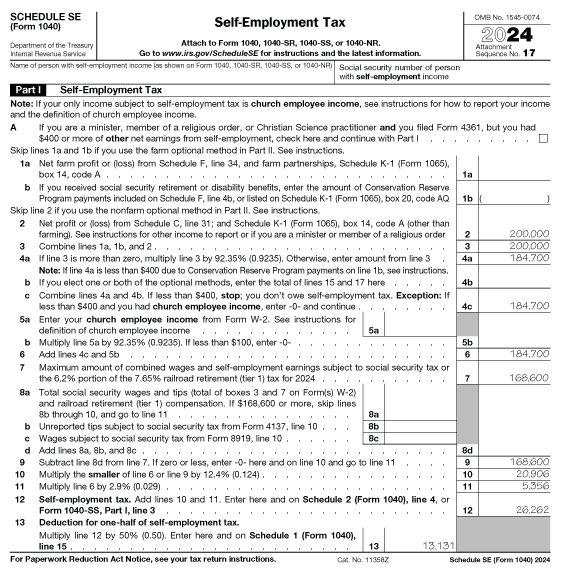
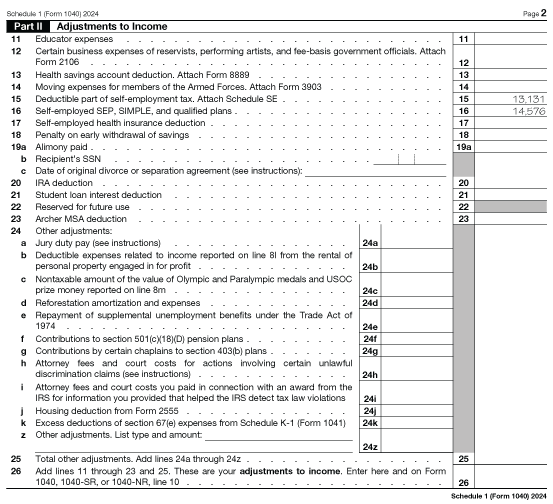
If you have questions about a tax issue, need help preparing your tax return, or want to download free publications, forms, or instructions, go to IRS.gov to find resources that can help you right away.
Tax reform.
Tax reform legislation impacting federal taxes, credits, and deductions was enacted in P.L. 119-21, commonly known as the One Big Beautiful Bill Act, on July 4, 2025. Go to IRS.gov/OBBB for more information and updates on how this legislation affects your taxes.
Preparing and filing your tax return.
After receiving all your wage and earnings statements (Forms W-2, W-2G, 1099-R, 1099-MISC, 1099-NEC, etc.); unemployment compensation statements (by mail or in a digital format) or other government payment statements (Form 1099-G); and interest, dividend, and retirement statements from banks and investment firms (Forms 1099), you have several options to choose from to prepare and file your tax return. You can prepare the tax return yourself, see if you qualify for free tax preparation, or hire a tax professional to prepare your return.
Free options for tax preparation.
Your options for preparing and filing your return online or in your local community, if you qualify, include the following.
-
Free File. This program lets you prepare and file your federal individual income tax return for free using software or Free File Fillable Forms. However, state tax preparation may not be available through Free File. Go to IRS.gov/FreeFile to see if you qualify for free online federal tax preparation, e-filing, and direct deposit or payment options.
-
VITA. The Volunteer Income Tax Assistance (VITA) program offers free tax help to people with low-to-moderate incomes, persons with disabilities, and limited-English-speaking taxpayers who need help preparing their own tax returns. Go to IRS.gov/VITA, download the free IRS2Go app, or call 800-906-9887 for information on free tax return preparation.
-
TCE. The Tax Counseling for the Elderly (TCE) program offers free tax help for all taxpayers, particularly those who are 60 years of age and older. TCE volunteers specialize in answering questions about pensions and retirement-related issues unique to seniors. Go to IRS.gov/TCE, download the free IRS2Go app, or call 888-227-7669 for information on free tax return preparation.
-
MilTax. Members of the U.S. Armed Forces and qualified veterans may use MilTax, a free tax service offered by the Department of Defense through Military OneSource. For more information, go to MilitaryOneSource (MilitaryOneSource.mil/MilTax).
Also, the IRS offers Free Fillable Forms, which can be completed online and then e-filed regardless of income.
Using online tools to help prepare your return.
Go to IRS.gov/Tools for the following.
-
The Earned Income Tax Credit Assistant (IRS.gov/EITCAssistant) determines if you’re eligible for the earned income credit (EITC).
-
The Online EIN Application (IRS.gov/EIN) helps you get an employer identification number (EIN) at no cost.
-
The Tax Withholding Estimator (IRS.gov/W4App) makes it easier for you to estimate the federal income tax you want your employer to withhold from your paycheck. This is tax withholding. See how your withholding affects your refund, take-home pay, or tax due.
-
The Sales Tax Deduction Calculator (IRS.gov/SalesTax) figures the amount you can claim if you itemize deductions on Schedule A (Form 1040).
Getting answers to your tax questions.
On IRS.gov, you can get up-to-date information on current events and changes in tax law.
-
IRS.gov/Help: A variety of tools to help you get answers to some of the most common tax questions.
-
IRS.gov/ITA: The Interactive Tax Assistant, a tool that will ask you questions and, based on your input, provide answers on a number of tax law topics.
-
IRS.gov/Forms: Find forms, instructions, and publications. You will find details on the most recent tax changes and interactive links to help you find answers to your questions.
-
You may also be able to access tax information in your e-filing software.
Need someone to prepare your tax return?
There are various types of tax return preparers, including enrolled agents, certified public accountants (CPAs), accountants, and many others who don’t have professional credentials. If you choose to have someone prepare your tax return, choose that preparer wisely. A paid tax preparer is:
-
Primarily responsible for the overall substantive accuracy of your return,
-
Required to sign the return, and
-
Required to include their preparer tax identification number (PTIN).
Caution:
Although the tax preparer always signs the return, you're ultimately responsible for providing all the information required for the preparer to accurately prepare your return and for the accuracy of every item reported on the return. Anyone paid to prepare tax returns for others should have a thorough understanding of tax matters. For more information on how to choose a tax preparer, go to Tips for Choosing a Tax Preparer on IRS.gov.
Employers can register to use Business Services Online.
The Social Security Administration (SSA) offers online service at SSA.gov/employer for fast, free, and secure W-2 filing options to CPAs, accountants, enrolled agents, and individuals who process Form W-2, Wage and Tax Statement; and Form W-2c, Corrected Wage and Tax Statement.
Business tax account.
If you are a sole proprietor, a partnership, an S corporation, a C corporation, or a single-member limited liability company (LLC), you can view your tax information on record with the IRS and do more with a business tax account. Go to IRS.gov/BusinessAccount for more information.
IRS social media.
Go to IRS.gov/SocialMedia to see the various social media tools the IRS uses to share the latest information on tax changes, scam alerts, initiatives, products, and services. At the IRS, privacy and security are our highest priority. We use these tools to share public information with you. Don’t post your social security number (SSN) or other confidential information on social media sites. Always protect your identity when using any social networking site.
The following IRS YouTube channels provide short, informative videos on various tax-related topics in English and ASL.
Over-the-Phone Interpreter (OPI) Service.
The IRS serves taxpayers with limited-English proficiency (LEP) by offering OPI service. The OPI Service is available at Taxpayer Assistance Centers (TACs), most IRS offices, and every VITA/TCE tax return site. The OPI Service is accessible in more than 300 languages.
Accessibility Helpline available for taxpayers with disabilities.
Taxpayers who need information about accessibility services can call 833-690-0598. The Accessibility Helpline can answer questions related to current and future accessibility products and services available in alternative media formats (for example, braille-ready, large print, audio, etc.). The Accessibility Helpline does not have access to your IRS account. For help with tax law, refunds, or account-related issues, go to IRS.gov/LetUsHelp.
Alternative media preference.
Form 9000, Alternative Media Preference, or Form 9000(SP) allows you to elect to receive certain types of written correspondence in the following formats.
-
Standard Print.
-
Large Print.
-
Braille.
-
Audio (MP3).
-
Plain Text File (TXT).
-
Braille-Ready File (BRF).
Disasters.
Go to IRS.gov/DisasterRelief to review the available disaster tax relief.
Getting tax forms and publications.
Go to IRS.gov/Forms to view, download, or print all of the forms, instructions, and publications you may need. Or you can go to IRS.gov/OrderForms to place an order.
Mobile-friendly forms.
You'll need an IRS Online Account (OLA) to complete mobile-friendly forms that require signatures. You'll have the option to submit your form(s) online or download a copy for mailing. You'll need scans of your documents to support your submission. Go to IRS.gov/MobileFriendlyForms for more information.
Getting tax publications and instructions in eBook format.
Download and view most tax publications and instructions (including the Instructions for Form 1040) on mobile devices as eBooks at IRS.gov/eBooks.
IRS eBooks have been tested using Apple's iBooks for iPad. Our eBooks haven’t been tested on other dedicated eBook readers, and eBook functionality may not operate as intended.
Access your online account (individual taxpayers only).
Go to IRS.gov/Account to securely access information about your federal tax account.
-
View the amount you owe and a breakdown by tax year.
-
See payment plan details or apply for a new payment plan.
-
Make a payment or view 5 years of payment history and any pending or scheduled payments.
-
Access your tax records, including key data from your most recent tax return, and transcripts.
-
View digital copies of select notices from the IRS.
-
Approve or reject authorization requests from tax professionals.
Get a transcript of your return.
With an online account, you can access a variety of information to help you during the filing season. You can get a transcript, review your most recently filed tax return, and get your adjusted gross income. Create or access your online account at IRS.gov/Account.
Tax Pro Account.
This tool lets your tax professional submit an authorization request to access your individual taxpayer IRS OLA. For more information, go to IRS.gov/TaxProAccount.
Using direct deposit.
The safest and easiest way to receive a tax refund is to e-file and choose direct deposit, which securely and electronically transfers your refund directly into your financial account. Direct deposit also avoids the possibility that your check could be lost, stolen, destroyed, or returned undeliverable to the IRS. Eight in 10 taxpayers use direct deposit to receive their refunds. If you don’t have a bank account, go to IRS.gov/DirectDeposit for more information on where to find a bank or credit union that can open an account online.
Reporting and resolving your tax-related identity theft issues.
-
Tax-related identity theft happens when someone steals your personal information to commit tax fraud. Your taxes can be affected if your SSN is used to file a fraudulent return or to claim a refund or credit.
-
The IRS doesn’t initiate contact with taxpayers by email, text messages (including shortened links), telephone calls, or social media channels to request or verify personal or financial information. This includes requests for personal identification numbers (PINs), passwords, or similar information for credit cards, banks, or other financial accounts.
-
Go to IRS.gov/IdentityTheft, the IRS Identity Theft Central webpage, for information on identity theft and data security protection for taxpayers, tax professionals, and businesses. If your SSN has been lost or stolen or you suspect you’re a victim of tax-related identity theft, you can learn what steps you should take.
-
Get an Identity Protection PIN (IP PIN). IP PINs are six-digit numbers assigned to eligible taxpayers to help prevent the misuse of their SSNs on fraudulent federal income tax returns. When you have an IP PIN, it prevents someone else from filing a tax return with your SSN. To learn more, go to IRS.gov/IPPIN.
Ways to check on the status of your refund.
-
Go to IRS.gov/Refunds.
-
Download the official IRS2Go app to your mobile device to check your refund status.
-
Call the automated refund hotline at 800-829-1954.
Caution:
The IRS can’t issue refunds before mid-February for returns that claimed the EITC or the additional child tax credit (ACTC). This applies to the entire refund, not just the portion associated with these credits.
Making a tax payment.
The IRS recommends paying electronically whenever possible. Options to pay electronically are included in the list below. Payments of U.S. tax must be remitted to the IRS in U.S. dollars. Digital assets are not accepted. Go to IRS.gov/Payments for information on how to make a payment using any of the following options.
-
IRS Direct Pay: Pay taxes from your bank account. It’s free and secure, and no sign-in is required. You can change or cancel within 2 days of scheduled payment.
-
Debit Card, Credit Card, or Digital Wallet: Choose an approved payment processor to pay online or by phone.
-
Electronic Funds Withdrawal: Schedule a payment when filing your federal taxes using tax return preparation software or through a tax professional.
-
Electronic Federal Tax Payment System: Best option for businesses. Enrollment is required.
-
Check or Money Order: Mail your payment to the address listed on the notice or instructions.
-
Cash: You may be able to pay your taxes with cash at a participating retail store.
-
Same-Day Wire: You may be able to do same-day wire from your financial institution. Contact your financial institution for availability, cost, and time frames.
What if I can’t pay now?
Go to IRS.gov/Payments for more information about your options.
-
Apply for an online payment agreement (IRS.gov/OPA) to meet your tax obligation in monthly installments if you can’t pay your taxes in full today. Once you complete the online process, you will receive immediate notification of whether your agreement has been approved.
-
Use the Offer in Compromise Pre-Qualifier to see if you can settle your tax debt for less than the full amount you owe. For more information on the Offer in Compromise program, go to IRS.gov/OIC.
Filing an amended return.
Go to IRS.gov/1040X for information and updates.
Checking the status of your amended return.
Go to IRS.gov/WMAR to track the status of Form 1040-X amended returns.
Caution:
It can take up to 3 weeks from the date you filed your amended return for it to show up in our system, and processing it can take up to 16 weeks.
Understanding an IRS notice or letter you’ve received.
Go to IRS.gov/Notices to find additional information about responding to an IRS notice or letter.
IRS Document Upload Tool.
You may be able to use the Document Upload Tool to respond digitally to eligible IRS notices and letters by securely uploading required documents online through IRS.gov. For more information, go to IRS.gov/DUT.
Schedule LEP.
You can use Schedule LEP (Form 1040), Request for Change in Language Preference, to state a preference to receive notices, letters, or other written communications from the IRS in an alternative language. You may not immediately receive written communications in the requested language. The IRS’s commitment to LEP taxpayers is part of a multi-year timeline that began providing translations in 2023. You will continue to receive communications, including notices and letters, in English until they are translated to your preferred language.
Contacting your local TAC office.
Keep in mind, many questions can be answered on IRS.gov without visiting an IRS TAC. Go to IRS.gov/LetUsHelp for the topics people ask about most. If you still need help, IRS TACs provide tax help when a tax issue can’t be handled online or by phone. All TACs now provide service by appointment, so you’ll know in advance that you can get the service you need without long wait times. Before you visit, go to IRS.gov/TAC to find the nearest TAC and to check hours, available services, and appointment options. Or, on the IRS2Go app, under the Stay Connected tab, choose the Contact Us option and click on “Local Offices.”
————————————————————————
Below is a message to you from the Taxpayer Advocate Service, an independent organization established by Congress.
The Taxpayer Advocate Service (TAS) Is Here To Help You
What is the Taxpayer Advocate Service?
The Taxpayer Advocate Service (TAS) is an independent organization within the Internal Revenue Service (IRS). TAS helps taxpayers resolve problems with the IRS, makes administrative and legislative recommendations to prevent or correct the problems, and protects taxpayer rights. We work to ensure that every taxpayer is treated fairly and that you know and understand your rights under the Taxpayer Bill of Rights. We are Your Voice at the IRS.
How can TAS help me?
TAS can help you resolve problems that you haven’t been able to resolve with the IRS on your own. Always try to resolve your problem with the IRS first, but if you can’t, then come to TAS. Our services are free.
-
TAS helps all taxpayers (and their representatives), including individuals, businesses, and exempt organizations. You may be eligible for TAS help if your IRS problem is causing financial difficulty, if you’ve tried and been unable to resolve your issue with the IRS, or if you believe an IRS system, process, or procedure just isn't working as it should.
-
To get help any time with general tax topics, visit www.TaxpayerAdvocate.IRS.gov. The site can help you with common tax issues and situations, such as what to do if you make a mistake on your return or if you get a notice from the IRS.
-
TAS works to resolve large-scale (systemic) problems that affect many taxpayers. You can report systemic issues at www.IRS.gov/SAMS. (Be sure not to include any personal identifiable information.)
How do I contact TAS?
TAS has offices in every state, the District of Columbia, and Puerto Rico. To find your local advocate’s number:
-
Check your local directory, or
-
Call TAS toll free at 877-777-4778.
What are my Rights as a taxpayer?
The Taxpayer Bill of Rights describes ten basic rights that all taxpayers have when dealing with the IRS. Go to www.TaxpayerAdvocate.IRS.gov/Taxpayer-Rights for more information about the rights, what they mean to you, and how they apply to specific situations you may encounter with the IRS. TAS strives to protect taxpayer rights and ensure the IRS is administering the tax law in a fair and equitable way.
Symbols
- 401(k) Plan
-
- Elective Deferrals, Elective Deferrals (401(k) Plans)
- Safe harbor, Safe Harbor 401(k) Plan
A
- Annual additions, Annual additions.
- Annual benefits, Annual benefits.
- Assistance (see Tax help)
- Automatic Enrollment, Automatic Enrollment
B
- Business, definition, Business.
C
- Common-law employee, Common-law employee.
- Compensation, Compensation.
- Contribution
-
- Defined, Contribution.
- Limits
-
- Qualified plans, Limits on Contributions and Benefits
- SEP IRAs, Contribution Limits
- SIMPLE IRA plan, Contribution Limits
D
- Deduction
-
- Defined, SIMPLE plans., Deduction.
- Deduction Worksheet for Self-Employed, Figuring your deduction.
- Defined benefit plan
-
- Deduction limits, Defined benefit plans.
- Limits on contributions, Defined benefit plan.
- Defined contribution plan
-
- Automatic Enrollment, Automatic Enrollment
- Deduction limits, Defined contribution plans.
- Eligible automatic contribution arrangement, Eligible automatic contribution arrangement (EACA).
- Forfeitures, Forfeiture.
- Limits on contributions, Defined contribution plan.
- Money purchase pension plan, Money purchase pension plan.
- Profit-sharing plan, Profit-sharing plan.
- Qualified automatic contribution arrangement, Qualified automatic contribution arrangement (QACA).
- Definitions you need to know, Definitions You Need To Know
- Disqualified person, Prohibited Transactions
- Distributions (withdrawals), Distributions (Withdrawals)
E
- EACA, Eligible automatic contribution arrangement (EACA).
- Earned income, Earned income.
- Eligible automatic contribution arrangement, Eligible automatic contribution arrangement (EACA).
- Employees
-
- Eligible, Eligible employee.
- Excludable, Excludable employees.
- Highly compensated, Highly compensated employee.
- Leased, Leased employee.
- Employer
-
- Defined, Employer.
- Excess Deferrals, Treatment of Excess Deferrals
- Excise tax, Excise Tax on Reversion of Plan Assets
-
- Nondeductible (excess) contributions, Excise Tax for Nondeductible (Excess) Contributions
- Reduced benefit accrual, Notification of Significant Benefit Accrual Reduction
- SEP excess contributions, Excise tax.
- Excludable employees, Excludable employees.
F
- Form
-
- 1040, Where To Deduct Contributions, Reporting the tax.
- 1099-R, Reporting corrective distributions on Form 1099-R.
- 5304–SIMPLE, How To Set up a SIMPLE IRA Plan
- 5305–S, Setting up a SIMPLE IRA.
- 5305–SA, Setting up a SIMPLE IRA.
- 5305–SEP, Formal written agreement.
- 5305–SIMPLE, How To Set up a SIMPLE IRA Plan
- 5310, Form 5310.
- 5329, Reporting the tax.
- 5330, Reporting the tax., Tax on excess contributions of highly compensated employees., Excise Tax on Reversion of Plan Assets, Payment of the 15% tax.
- 5500, Form 5500., Electronic filing of Forms 5500 and 5500-SF.
- 5500-EZ, Form 5500-EZ.
- Form W-2, Reporting.
- Schedule K (Form 1065), Where To Deduct Contributions
H
- Highly compensated employee, Highly compensated employee.
K
- Keogh plans (see Qualified plans)
L
- Leased employee, Leased employee.
N
- Net earnings from self-employment, Net earnings from self-employment.
- Notification requirements, Notification Requirement
P
- Participant, definition, Participant.
- Participation, Participation.
- Partner, definition, Partner.
- Publications (see Tax help)
Q
- QACA, Qualified automatic contribution arrangement (QACA).
- Qualified automatic contribution arrangement, Qualified automatic contribution arrangement (QACA).
- Qualified Plan, definition, Qualified plan.
- Qualified plans, Qualified Plans
-
- Assignment of benefits, Benefits must not be assigned or alienated.
- Benefits starting date, Benefit payment must begin when required.
- Contributions, Contributions, Employer Contributions, Limits on Contributions and Benefits, When Contributions Are Considered Made, Where To Deduct Contributions
- Deduction limits, Deduction Limits, Defined contribution plans., Defined benefit plans., Deduction Limit for Self-Employed Individuals, Carryover of Excess Contributions, Excise Tax for Nondeductible (Excess) Contributions
- Deduction Worksheet for Self-Employed, Table and Worksheets for the Self-Employed
- Deductions, Employer Deduction
- Deferrals, Treatment of contributions., Reporting on Form W-2.
- Defined benefit plan, Defined Benefit Plan
- Defined contribution plan, Defined Contribution Plan
- Distributions, Distributions
-
- Minimum, Required Distributions
- Required beginning date, Required beginning date.
- Rollover, Rollover.
- Tax on excess benefits, Tax on Excess Benefits
- Tax on premature, Tax on Early Distributions
- Tax treatment, Tax Treatment of Distributions
- Elective Deferrals, Elective Deferrals (401(k) Plans)
-
- Limits, Limit on Elective Deferrals
- Employee nondeductible contributions, Employee Contributions
- Excess Deferrals, Treatment of Excess Deferrals
- Investing plan assets, Investing Plan Assets
- Kinds of plans, Kinds of Plans
- Leased employees, Leased employee.
- Minimum requirements
-
- Coverage, Minimum coverage requirement must be met.
- Funding, Minimum Funding Requirement
- Vesting, Minimum vesting standard must be met.
- Prohibited transactions, Prohibited Transactions
- Qualification rules, Qualification Rules
- Rate Table for Self-Employed, Table and Worksheets for the Self-Employed
- Rate Worksheet for Self-Employed, Table and Worksheets for the Self-Employed
- Reporting requirements, Reporting Requirements
- Setting up, Setting up a Qualified Plan
- Qualified Plans
-
- Survivor benefits, Survivor benefits.
- Qualified Roth Contribution Program, Qualified Roth Contribution Program
R
- Rate Table for Self-Employed, Rate Table for Self-Employed.
- Rate Worksheet for Self-Employed, Rate Worksheet for Self-Employed.
- Required distributions, Required Distributions
- Rollovers, Rollover.
S
- Safe harbor 401(k) plan, Safe Harbor 401(k) Plan
- Salary reduction arrangement, Deferral percentage., Limit on Elective Deferrals
- Salary Reduction Simplified Employee Pension(SARSEP), Salary Reduction Simplified Employee Pensions (SARSEPs)
- SARSEP
-
- ADP test, SARSEP ADP test.
- Section 402(f) notice, Section 402(f) notice.
- Self-employed individual, Self-employed individual.
- SEP IRAs
-
- Contributions, Contributions for yourself.
- Deductible contributions, Deducting Contributions, Excise tax.
-
- Carryover of excess contributions, Carryover of Excess SEP Contributions
- Deduction limits, Deduction Limit for Contributions for Participants
- Limits for self-employed, Deduction Limit for Self-Employed Individuals
- When to deduct, When To Deduct Contributions
- Where to deduct, Where To Deduct Contributions
- Distributions (withdrawals), Distributions (Withdrawals)
- Eligible employee, Eligible employee.
- Excludable employees, Excludable employees.
- SEP plans
-
- Deduction Worksheet for Self-Employed, Table and Worksheets for the Self-Employed
- Rate Table for Self-Employed, Table and Worksheets for the Self-Employed
- Rate Worksheet for Self-Employed, Table and Worksheets for the Self-Employed
- Reporting and Disclosure, Reporting and Disclosure Requirements
- SIMPLE IRA plan
-
- Compensation, Compensation.
- Contributions, Contribution Limits
- Deductions, Nonelective contributions.
- Distributions(withdrawals), Distributions (Withdrawals)
- Employee election period, Election period.
- Employer matching contributions, Employer matching contributions.
- Excludable employees, Excludable employees.
- Notification requirements, Notification Requirement
- When to deduct contributions, When To Deduct Contributions
- SIMPLE plans, Who Can Set up a SIMPLE IRA Plan?, Reporting.
-
- SIMPLE 401(k), SIMPLE 401(k) Plan
- SIMPLE IRA plan, SIMPLE IRA Plan
- Simplified employee pension (SEP), Salary Reduction Simplified Employee Pensions (SARSEPs)
-
- Salary reduction arrangement
-
- Compensation of self-employed individuals, Compensation of self-employed individuals.
- Employee compensation, Employee compensation.
- Who can have a SARSEP, Who can have a SARSEP?
- SEP IRA contributions, How Much Can I Contribute?
- Setting up a SEP, Setting up a SEP
- Sixty-day employee election period, Election period.
- Sole proprietor, definition, Sole proprietor.
T
- Tax help, How To Get Tax Help
U
- User fee, User fee.
W
- Worksheets
-
- Deduction Worksheet for Self-Employed, Table and Worksheets for the Self-Employed
- Rate Worksheet for Self-Employed, Table and Worksheets for the Self-Employed