


 )
또는 https:// 는 안전하게 .gov 웹사이트에 접속했다는 뜻입니다. 오직 공식, 보안 웹사이트 상에서만 민감한 정보를 공유하십시오.
)
또는 https:// 는 안전하게 .gov 웹사이트에 접속했다는 뜻입니다. 오직 공식, 보안 웹사이트 상에서만 민감한 정보를 공유하십시오.


This section of the IRS Data Book highlights the IRS’s compliance efforts. Examinations (audits) of most types of tax returns, information reporting and verification, math error notices, and criminal investigations are critical tools to determine if income, expenses, and credits are being accurately reported and to identify and resolve taxpayer errors and to identify fraud. These tools ensure that the IRS has a presence across taxpayers of all income and asset levels.
For the past decade, the IRS has seen an increase in the number of returns filed paired with a decrease in resources available for examinations. The Service is constantly adapting and improving its processes to identify errors, detect fraudulent activity, and ensure resources are allocated as efficiently and effectively as possible. While the IRS accepts most returns as filed, some are selected for examination using various methods, including random sampling and computerized screening. Most IRS examinations are conducted through the mail (correspondence) or face-to-face (field).
The IRS also offers programs that encourage a more proactive approach to ensuring tax compliance for large and international businesses. Tax certainty programs, including the Advance Pricing Agreement (APA) Program and the Compliance Assurance Process (CAP) Program, help taxpayers improve their federal tax compliance via cooperation with the IRS prior to the filing of tax returns.
The IRS gathers independent information about income received and taxes withheld from information returns, such as Forms W–2 and 1099 filed by employers and other third parties. The IRS uses this information to verify self-reported income and tax on returns filed by taxpayers. With its Automated Underreporter Program, the IRS matches these information returns to tax returns and contacts taxpayers to resolve discrepancies. In the Automated Substitute for Return Program, the IRS uses information returns from third parties to identify nonfilers; construct tax returns for certain nonfilers based on that third-party information; and assess tax, interest, and penalties based on the substitute returns. To further verify the accuracy of reported information, the IRS also checks for mathematical and clerical errors before refunds are paid.
IRS’s Criminal Investigation function conducts investigations of alleged criminal violations of the tax code and related financial statutes, which may in turn lead to prosecution, fines, and imprisonment.
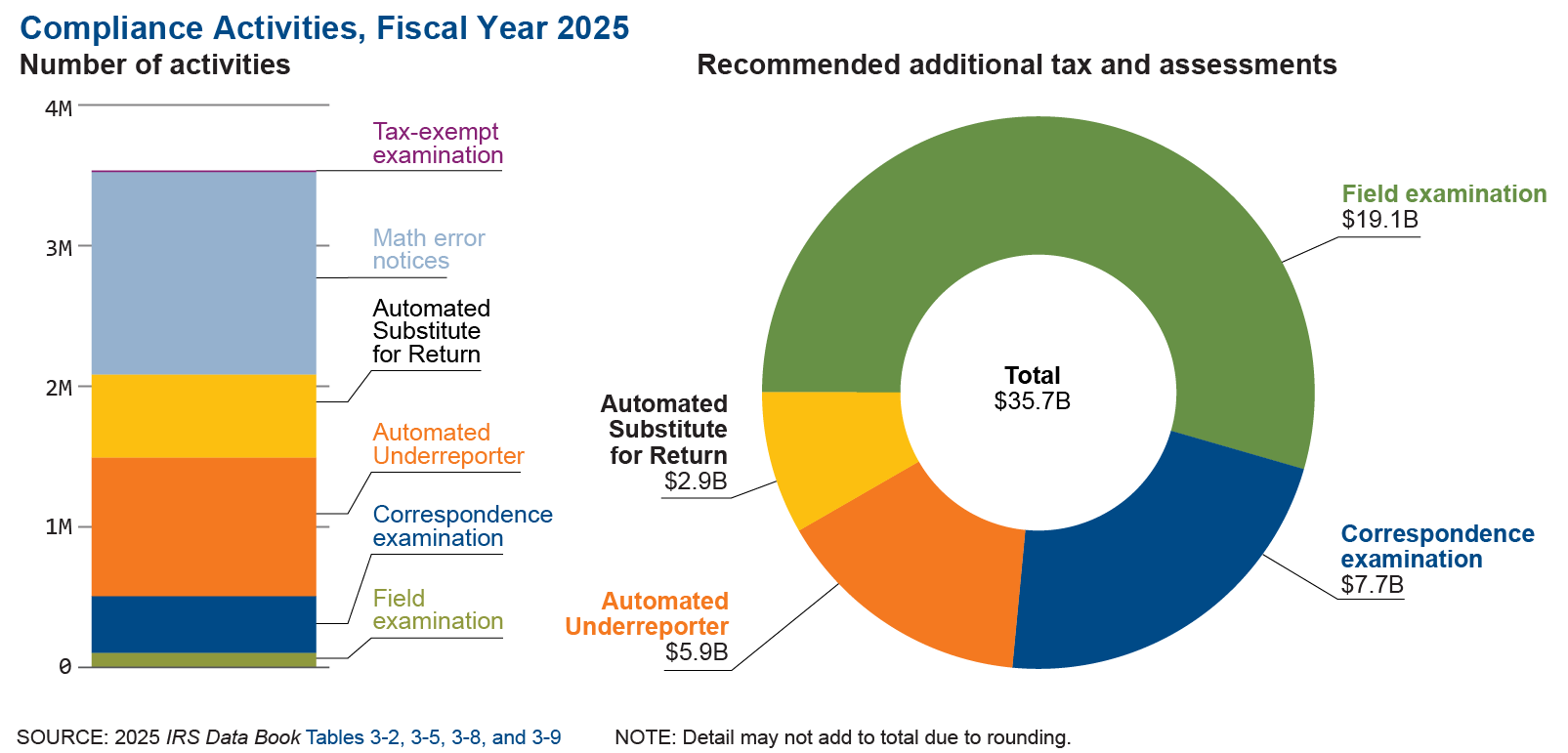
View chart details XLSX. For additional graphs from this section, download the PDF of this year’s Data Book PDF.
Highlights of the data
- The exam coverage rate for TY 2021 (the most recent year outside the statute of limitations period) of individual taxpayers reporting total positive income (TPI) of $10 million or more was 6.6%. The rate for taxpayers with TPI of $5 million–$10 million was 3.9%, and 0.9% for those with TPI of $1 million–$5 million (Table 3-1 XLSX ).
- In FY 2025, the IRS closed 497,621 tax return audits, resulting in $26.8 billion in recommended additional tax (Table 3-2 XLSX ).
- The IRS closed 987,460 cases under the Automated Underreporter Program in FY 2025, resulting in $5.9 billion in additional assessments. In addition, the IRS closed 592,773 cases under its Automated Substitute for Return Program, resulting in nearly $2.9 billion in additional assessments (Table 3-8 XLSX ).
- In FY 2025, the IRS completed 2,850 criminal investigations in three areas—1,085 legal-source tax crime cases, which involve activities, industries, and occupations that generate legitimate income or threats to the tax system; 1,195 illegal-source financial crime cases, which relate to proceeds derived from unlawful sources such as money laundering; and 570 narcotics-related financial crime cases, which involve investigating narcotics-related tax and money-laundering crimes. These cases are often investigated in cooperation with the Justice Department and other law enforcement agencies (Table 3-10 XLSX ).
Compliance presence: Tables 3-1 – 3-10
Table 3-1: Examination coverage and recommended additional tax after examination, by type and size of return, tax years 2015-2023 XLSX
Table 3-2: Examination coverage: Recommended additional tax, and returns with unagreed additional tax, after examination, by type and size of return, fiscal year 2025 XLSX
Table 3-3: Examination coverage: Returns examined involving protection of revenue base, by type and size of return, fiscal year 2025 XLSX
Table 3-4: Examination coverage: Returns examined resulting in refunds, by type and size of return, fiscal year 2025 XLSX
Table 3-5: Examinations of tax-exempt organizations, employee retirement plans, government entities, and tax-exempt bonds, by type of return, fiscal year 2025 XLSX
Table 3-6: Table 22. Tax certainty: Advance pricing agreement program, by type of agreement, fiscal year 2025 XLSX
Table 3-7: Table 23. Tax certainty: Compliance assurance process program, by program phase, fiscal year 2025 XLSX
Table 3-8: Information reporting program, fiscal year 2025 XLSX
Table 3-9: Math errors on individual income tax returns, by type of error, fiscal year 2025 XLSX
Table 3-10: Criminal investigation program, by status or disposition, fiscal year 2025 XLSX
Data for all years
Other Data Book sections
- Returns filed, taxes collected and refunds issued
- Service to taxpayers
- Compliance presence
- Collections, activities, penalties and appeals
- Chief Counsel
- IRS budget & workforce
Additional applications may be needed to access linked content on this page. Get free Adobe Acrobat® reader or Excel® viewer.
Return to the IRS Data Book home page