


 )
or https:// means you've safely connected to the .gov website. Share sensitive information only on official, secure websites.


- Instructions for Form 9465 - Introductory Material
- General Instructions
-
Specific Instructions
- Part I—Line Instructions
- Line 1a
- Line 1b
- Line 2
- Line 5
- Line 6
- Line 7
- Line 8
- Line 9
- Tip:
- Line 10
- Line 11
- Lines 12a, 12b, and 12c
- Part II—How the Payment Plan (Installment Agreement) Works
- Types of payment plans (installment agreements) you may qualify for.
- Guaranteed payment plan (installment agreement).
- Partial payment plan (installment agreement).
- More types of payment plans and payment options.
- Requesting a payment plan.
- Payment methods.
- Impact on time we can collect.
- After approving your request.
- Payment plan user fees.
- Low-income taxpayer reduced payment plan user fee.
- Low-income taxpayer user fee waivers and reimbursements.
- Caution:
- Other costs.
- What happens if I owe a shared responsibility payment (SRP)?
- Requests to modify or terminate a payment plan (installment agreement).
- What happens if I don’t comply with the terms of the payment plan (installment agreement)?
- Caution:
- Caution:
- IRS collection process and taxpayer rights.
- Taxpayer Advocate Service (TAS).
- Part III—Where To File
- Instructions for Form 9465 - Notices
Instructions for Form 9465 (12/2026)
Payment Plan Request (For Use With Form 9465 (Rev. December 2026))
Revised: 12/2026
For the latest developments related to Form 9465 and its instructions, such as legislation enacted after they were published, go to IRS.gov/Form9465.
Purpose of Form
Use Form 9465 to request a monthly payment plan (installment agreement) if you can’t pay the full amount you owe shown on your tax return (or on a notice we sent you). Most requests will meet simple payment plan criteria. See Types of payment plans (installment agreements) you may qualify for , later, for more information. In certain circumstances, you can have longer to pay or you can establish an agreement for an amount that is less than the amount of tax you owe.
However, before requesting a payment plan, you should consider other alternatives, such as getting a bank loan or using available credit, which may be less costly. If you have any questions about this request, call 800-829-1040.
Who should use this form?
Use Form 9465 if you’re an individual:
Who owes income tax on Form 1040 or 1040-SR;
Who is or may be responsible for a civil penalty including but not limited to the trust fund recovery penalty;
Who owes employment taxes (for example, as reported on Form 941, 943, or 940) related to a sole proprietor business that is no longer in operation; or
Who owes an individual shared responsibility payment under the Affordable Care Act (this payment isn’t assessed for months in tax years beginning after 2018). See What happens if I owe a shared responsibility payment (SRP) , later, for more information.
Who should not use this form?
Don’t use Form 9465 if:
You can pay the full amount you owe within 180 days (see Can you pay in full within 180 days? next);
You want to request a payment plan online (see Applying online for a payment plan , later);
Your business is still operating and owes employment or unemployment taxes. Instead, call the telephone number on your most recent notice to request a payment plan;
You’re in bankruptcy or the IRS is reviewing or accepted your offer in compromise (see Bankruptcy or offer in compromise , later); or
You want to request a payment plan by payroll deduction. Submit Form 2159, Payroll Deduction Agreement. Ask your employer to complete and sign the employer’s portion of your Form 2159.
Can you pay in full within 180 days?
If you can pay the full amount you owe within 180 days, you can avoid paying the fee to set up a payment plan by calling the IRS at 800-829-1040. If you owe $100,000 or less in combined tax, penalties, and interest, you can apply for a short-term payment plan by using the Online Payment Agreement (OPA) application at IRS.gov/OPA.
Applying online for a payment plan.
If your balance due is $50,000 or less in combined tax, penalties, and interest, you can apply online for a payment plan instead of filing Form 9465. To apply online, go to IRS.gov/OPA. If you establish your payment plan using the OPA application, the user fee that you pay will be lower than it would be otherwise.
Bankruptcy or offer in compromise.
If you’re in bankruptcy or the IRS is reviewing or accepted your offer in compromise, don’t file this form. Instead, call 800-829-1040 to get the number of your local IRS Insolvency function for bankruptcy or to get the number of the office to contact regarding your offer in compromise.
Part I—Line Instructions
Line 1a
If you’re making this request for a joint tax return, show the names and social security numbers (SSNs) in the same order as they appear on your tax return.
If you have a foreign address, enter the city name on the appropriate line. Don’t enter any other information on that line, but also complete the spaces below that line. Don’t abbreviate the country name. Follow the country’s practice for entering the postal code and the name of the province, county, or state.
Line 1b
If the address you provided on line 1a is new since you filed your last tax return, check the box on line 1b.
Line 2
Show the name and employer identification number (EIN) of your sole proprietor business (which must no longer be operating).
Line 5
Enter the total amount you owe as shown on your tax return(s) or notice(s). The amount you owe could include amounts from more than 1 tax year.
Line 6
If you have additional balances due that are not reflected on line 5, list the total here (even if they are included in an existing payment plan). Any adjustments or other charges that are not reported on a tax return or notice should be listed on this line.
Line 8
Even if you can’t pay the full amount you owe now, you should pay as much as possible to limit the penalty and interest charges. If you’re filing this form with your tax return, make the payment with your return. For details on how to pay, see your tax return instructions.
If you’re filing this form by itself, such as in response to a notice, attach a check or money order made payable to “United States Treasury.” Don’t send cash. Be sure to include the following.
Your name, address, SSN/EIN, and daytime phone number.
The tax year and tax return (for example, “2024 Form 1040”) for which you’re making this request.
Tip:
If the total amount you owe is $50,000 or less in combined tax, penalties, and interest (including any amounts you owe from prior years), you don’t need to file Form 9465; you can request a payment plan online. For more information, see Applying online for a payment plan , earlier.
Line 10
Enter on line 10 the amount you can pay each month. Make your payments as large as possible to limit interest and penalty charges. The charges will continue to accrue until you pay them in full. If you have an existing payment plan, this amount should represent your total proposed monthly payment amount for all your liabilities. If no payment amount is listed on line 10, a payment will be determined for you by dividing the balance due on line 9 by 72 months. If your proposed payment amount does not pay in full the amount of tax owed by the Collection Statute Expiration Date (CSED), your request may be considered for a partial payment plan. See Partial payment plan , later, for more information.
After we review your completed form, we may contact you for additional information. For example, we may request a Form 433-F to be completed.
Line 11
You can choose the day of each month your payment is due. This can be on or after the 1st of the month, but no later than the 28th of the month. For example, if your rent or mortgage payment is due on the 1st of the month, you may want to make your installment payments on the 15th. When we approve your request, we will tell you the month and day that your first payment is due.
If we haven’t replied by the date you chose for your first payment, you can submit the first payment electronically. Or you can send the first payment to the Internal Revenue Service Center at the address shown later that applies to you. See Line 8, earlier, for details on what to write on your payment. Go to IRS.gov/Payments for payment options.
Lines 12a, 12b, and 12c
To pay by direct debit from your checking account at a bank or other financial institution (such as a mutual fund, brokerage firm, or credit union), fill in lines 12a and 12b. Check with your financial institution to make sure that a direct debit is allowed and to get the correct routing and account numbers.
Tip:
Making your payments by direct debit will help ensure that your payments are made timely and you don’t default on this payment plan.
Low-income taxpayers who complete lines 12a and 12b will receive a waiver of their payment plan user fees. See Low-income taxpayer user fee waivers and reimbursements, later, for more information.
Line 12a.
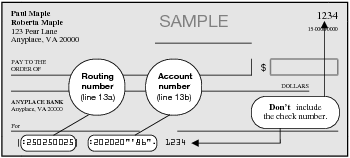
The routing number must be nine digits. The first two digits of the routing number must be 01 through 12 or 21 through 32. Use a check to verify the routing number. On the Sample Check, later, the routing number is 250250025. But, if your check is payable through a financial institution different from the one at which you have your checking account, don’t use the routing number on that check. Instead, contact your financial institution for the correct routing number.
Line 12b.
The account number can be up to 17 characters (both numbers and letters). Include hyphens but omit spaces and special symbols. Enter the number from left to right and leave any unused boxes blank. On the Sample Check, later, the account number is 20202086. Don’t include the check number.
Caution:
The direct debit from your checking account won’t be approved unless you (and your spouse if filing a joint return) sign Form 9465.
Tip:
The routing and account numbers may be in different places on your check.
Line 12c.
Low-income taxpayers who are unable to make electronic payments by direct debit by providing their information on lines 12a and 12b are eligible to receive reimbursement of their payment plan user fees. If you’re a low-income taxpayer and you checked the box on line 12c, your payment plan user fee will be reimbursed upon completion of your installment agreement. See Low-income taxpayer user fee waivers and reimbursements, later, for more information.
If you don’t check the box on line 12c (and don’t provide the information on lines 12a and 12b), you’re indicating that you’re able but choosing not to make electronic payments by direct debit. As such, your user fee is not eligible for reimbursement upon completion of your payment plan.
Part II—How the Payment Plan (Installment Agreement) Works
Types of payment plans (installment agreements) you may qualify for.
Most individual taxpayers qualify for a simple payment plan. Generally, you’re eligible if your assessed total balance of tax, penalties, and interest owed is $50,000 or less. Your proposed payment amount must pay the tax liability in full by the CSED. Generally, this is 10 years from the date your tax was assessed.
Generally, a simple payment plan does not require a financial statement or a Notice of Federal Tax Lien (NFTL) to be filed.
Guaranteed payment plan (installment agreement).
You’re eligible, if you are an individual with tax owed of $10,000 or less, excluding interest and penalties, and:
During the past 5 years, you (and your spouse if filing a joint return) have timely filed all income tax returns and paid any income tax due;
During the past 5 years, you (and your spouse if filing a joint return) haven’t entered into a payment plan for the payment of income tax;
You agree to pay the full amount you owe within 3 years and to comply with the tax laws while the agreement is in effect; and
You’re financially unable to pay the liability in full when due.
Partial payment plan (installment agreement).
A payment plan that will not pay in full the entire balance before the CSED is called a partial payment plan. See Impact on time we can collect , later, for more information. You will be required to complete a financial statement and provide supporting financial information. If a partial payment plan is approved, your agreement is subject to future reviews to confirm if your financial situation has changed. You may be required to provide a new financial statement and supporting financial information during this review. The financial information you provide may result in a reduction, an increase, or no change to your monthly payment plan amount.
More types of payment plans and payment options.
For more information about types of payment plans and payment options, see Tax Topic No. 202, Tax Payment Options, at IRS.gov/TaxTopics/TC202.
Requesting a payment plan.
We will usually let you know within 30 days after we receive your request whether it is approved or denied. However, if this request is for tax due on a return you filed after March 31, it may take us longer than 30 days to reply. If we approve your request, we will send you a notice detailing the terms of your agreement and requesting a user fee.
Payment methods.
Generally, payments to the IRS must be electronic with few exceptions. You can make your payments by direct debit, check or money order, credit card, debit card, or one of the other accepted payment methods. To be charged a lower fee, you may want to set up a payment plan using the OPA application at IRS.gov/OPA and/or agree to make your payments by direct debit. For more information on the accepted payment methods, go to IRS.gov/Payments, see your tax return instructions, or call 800-829-1040.
Impact on time we can collect.
The CSED is the time frame in which we can collect your tax owed. The CSED is normally 10 years from the date the tax was assessed. Generally, when you request a payment plan, we can’t levy, and we add time to the CSED while we consider your request. For more information on the CSED, go to Time IRS Can Collect Tax and Tax Topic No. 202, Tax Payment Options, both on IRS.gov.
After approving your request.
Each month, we will send you a notice showing the remaining amount you owe, and the due date and amount of your next payment. But, if you choose to have your payments automatically withdrawn from your checking account (also known as a direct debit), you won’t receive a notice. Your checking account statement is your record of payment. We will send you an annual statement showing the amount you owed at the beginning of the year, all payments made during the year, and the amount you owe at the end of the year.
By approving your request, we agree to let you pay the tax you owe in monthly installments instead of immediately paying the amount in full. In return, you agree to make your monthly payments on time.You also agree to meet all your future tax obligations. This means that you must have enough withholding or estimated tax payments so that your tax obligation for future years is paid in full when you timely file your return. For more information, refer to Publication 505. Your request for a payment plan will be denied if any required tax returns haven’t been filed. Any refund to which you are entitled over the life of the agreement will be applied against the amount you owe even if you have a payment plan. If your refund is applied to your balance, you’re still required to make your regular monthly payment.
Payment plan user fees.
We charge a user fee to set up a payment plan. The amount of the user fee can vary depending on whether you use the OPA application and how you propose to make your monthly payments. For details, see the table below with the fees in effect as of July 5, 2026.
| Payment method | Applicable fee | |
| Using the OPA application | Not using the OPA application | |
| Direct debit | $29* | $107* |
| Check, money order, credit card, or debit card | $69* | $178* |
| * Low-income taxpayers should see Low-income taxpayer reduced payment plan user fee and Low-income taxpayer user fee waivers and reimbursements , later. | ||
Note:
If you request a payroll deduction agreement using Form 2159 your user fee will be $178. If you’re a low-income taxpayer, see Low-income taxpayer reduced payment plan user fee next for more details.
Low-income taxpayer reduced payment plan user fee.
If you establish a payment plan that is not paid by direct debit, you may qualify to pay a reduced fee of $43 or for a reimbursement of your fee if you are a low-income taxpayer, as defined below. See Low-income taxpayer user fee waivers and reimbursements next. The IRS will let you know whether you qualify for the reduced fee. If the IRS doesn’t say you qualify for the reduced fee, you can request that the IRS consider you for “low-income” status using Form 13844, Application For Reduced User Fee for Installment Agreements.
Low-income taxpayer user fee waivers and reimbursements.
For payment plans entered into on or after April 10, 2018, by low-income taxpayers, defined next, the IRS will waive or reimburse the user fees if certain conditions are met. If you’re a low-income taxpayer and you agree to make electronic payments through a debit instrument by entering into a direct debit payment plan, the IRS will waive the user fees for the agreement. See Lines 12a, 12b, and 12c , earlier, for further details. If you’re a low-income taxpayer and you’re unable to make electronic payments through a debit instrument by entering into a direct debit payment plan, the IRS will reimburse the reduced $43 user fee that you paid for the payment plan upon completion of the payment plan. See Line 12c , earlier, for more details.
Definition of low-income taxpayer.
A low-income taxpayer is a taxpayer with adjusted gross income, for the most recent tax year available, at or below 250% of the federal poverty guidelines. For more information on how to determine if your adjusted gross income is at or below 250% of the federal poverty guidelines, see the instructions for Form 13844.
Caution:
The only payment option that will qualify the low-income taxpayer for a waiver of the payment plan user fee is their agreement to make electronic payments by direct debit. See Lines 12a, 12b, and 12c , earlier, for more details.
Other costs.
You will be charged interest and a late payment penalty on any tax not paid by its due date, even if your request to pay in installments is granted. Interest and any applicable penalties will be charged until the balance is paid in full. But see Topic 653, IRS notices and bills, penalties and interest charges, at IRS.gov/TaxTopics/TC653 for additional information. To limit interest and penalty charges, file your return on time and pay as much of the tax as possible with your return or notice. All payments received under the payment plan will be applied to your account in the best interests of the United States.
What happens if I owe a shared responsibility payment (SRP)?
The SRP amount that you owe is the assessed payment for not having minimum essential health coverage for you and, if applicable, your dependents per section 5000A. The SRP isn’t assessed for months beginning after 2018. However, even after that date, you may continue to owe the SRP assessed for months that began before 2018. The SRP amount that you owe isn’t subject to penalties or to NFTL or levy enforcement actions. However, interest will continue to accrue until you pay the total SRP balance due. We may apply your federal tax refunds to the SRP amount that you owe until it’s paid in full.
Requests to modify or terminate a payment plan (installment agreement).
After a payment plan is approved, you may submit a request to modify or terminate your payment plan. You may be able to modify your payment amount or due date by going to IRS.gov/OPA. You may also call 800-829-1040 to modify or terminate your agreement.
Generally, the fee is $89 to reinstate or restructure your payment plan ($43 if you are a low-income taxpayer). However, the user fee is only $6 if you reinstate or restructure your payment plan through an OPA.
The IRS will waive or reimburse the fee for low-income taxpayers if certain conditions are met. See Low-income taxpayer user fee waivers and reimbursements, earlier.
By approving your request, we agree to let you pay the tax you owe in monthly payments instead of immediately paying the amount in full. In return, you agree to make your monthly payments on time. You agree to provide updated financial information when requested.
You also agree to meet all your future tax obligations. This means that you must have enough withholding or estimated tax payments so that your tax obligation for future years is paid in full when payment is due. And you agree to timely file your return.
What happens if I don’t comply with the terms of the payment plan (installment agreement)?
If you don’t make your payments on time or don’t timely pay a balance due on a return you file later, you will be in default on your payment plan and we may terminate the payment plan. Before we terminate the payment plan, you may be entitled to file an appeal under the Collection Appeals Program (CAP). If your payment plan is terminated, the IRS is generally prohibited from levying for 30 days and for the time that your case is in the Independent Office of Appeals; the IRS’s time to collect is suspended for the above periods. We may take enforcement actions, such as filing an NFTL or issuing an IRS levy, to collect the entire amount you owe. To ensure that your payments are made timely, you should consider making them by direct debit. See Lines 12a, 12b, and 12c , earlier.
Caution:
A payment plan may be terminated if you provide materially incomplete or inaccurate information in response to an IRS request for a financial update or if you provide such information to obtain the payment plan. For more information about what you need to do if your payment plan is terminated, go to IRS.gov/CP523.
Note:
We may have filed an NFTL against your property. If so, you may be able to get the notice of lien withdrawn. To learn more about lien withdrawals and to see if you qualify, go to IRS.gov/Businesses/Small-Businesses-Self-Employed/Understanding-a-Federal-Tax-Lien.
Caution:
An NFTL may be filed to protect the government’s interests until you pay in full. However, an NFTL generally isn’t filed with a simple payment plan or guaranteed payment plan, but can be in certain situations. We won’t file an NFTL for the individual SRP under the Affordable Care Act.
You may be entitled to file an appeal through the CAP before and after the NFTL is filed. You are entitled to file an appeal regarding an NFTL filing through Collection Due Process (CDP) only for the first filing of an NFTL for the unpaid tax liabilities shown on that NFTL.
IRS collection process and taxpayer rights.
For additional information on the IRS collection process and what to do if you cannot pay your taxes in full, see Pub. 594, The IRS Collection Process. You can find more information about the collection process, taxpayer rights, and appealing a collection decision at IRS.gov/Businesses/Small-Businesses-Self-Employed/Collection-Procedures-For-Taxpayers-Filing-and-or-Paying-Late.
Taxpayer Advocate Service (TAS).
TAS is an independent organization within the IRS that helps taxpayers and protects taxpayer rights. TAS strives to ensure that every taxpayer is treated fairly and that you know and understand your rights under the Taxpayer Bill of Rights. TAS can help you if your tax problem is causing a financial difficulty; you’ve tried and been unable to resolve your issue with the IRS; or you believe an IRS system, process, or procedure isn’t working as it should. The service is free. Your local advocate’s number is at TaxpayerAdvocate.IRS.gov/Contact-Us and in your local directory. You can also call TAS toll free at 877-777-4778. For more information about TAS and your rights under the Taxpayer Bill of Rights, go to TaxpayerAdvocate.IRS.gov.
Part III—Where To File
Attach Form 9465 to the front of your return and send it to the address shown in your tax return booklet. If you have already filed your return or you’re filing this form in response to a notice, file Form 9465 by itself with the Internal Revenue Service Center using the address that applies to you in the following table.
| This table is for all taxpayers except those filing Form 1040 or 1040-SR with Schedule(s) C, E, or F for any tax year for which this payment plan is being requested. | ||
| IF you live in ... | THEN use this address ... | |
| Alaska, Arizona, Colorado, Connecticut, Delaware, District of Columbia, Hawaii, Idaho, Illinois, Maine, Maryland, Massachusetts, Montana, Nevada, New Hampshire, New Jersey, New Mexico, North Dakota, Oregon, Rhode Island, South Dakota, Tennessee, Utah, Vermont, Washington, Wisconsin, Wyoming | Department of the Treasury Internal Revenue Service 310 Lowell St. Stop 830 Andover, MA 01810 | |
| Alabama, Florida, Georgia, Kentucky, Louisiana, Mississippi, North Carolina, South Carolina, Texas, Virginia | Department of the Treasury Internal Revenue Service P.O. Box 47421 Stop 74 Doraville, GA 30362 | |
| Arkansas, California, Indiana, Iowa, Kansas, Michigan, Minnesota, Missouri, Nebraska, New York, Ohio, Oklahoma, Pennsylvania, West Virginia | Department of the Treasury Internal Revenue Service Stop P-4 5000 Kansas City, MO 64999-0250 | |
| This table is for taxpayers filing Form 1040 or 1040-SR with Schedule(s) C, E, or F for any tax year for which this payment plan is being requested. | ||
| IF you live in ... | THEN use this address ... | |
| Connecticut, Maine, Massachusetts, New Hampshire, New York, Rhode Island, Vermont | Department of the Treasury Internal Revenue Service P.O. Box 480 Stop 660 Holtsville, NY 11742-0480 | |
| Alabama, Arkansas, Georgia, Illinois, Indiana, Iowa, Kansas, Kentucky, Louisiana, Michigan, Minnesota, Mississippi, Missouri, Nebraska, New Jersey, North Dakota, Ohio, Oklahoma, Pennsylvania, South Dakota, Tennessee, Texas, West Virginia, Wisconsin | Department of the Treasury Internal Revenue Service P.O. Box 69 Stop 811 Memphis, TN 38101-0069 | |
| Alaska, Arizona, California, Colorado, Hawaii, Idaho, Montana, Nevada, New Mexico, Oregon, Utah, Washington, Wyoming | Department of the Treasury Internal Revenue Service P.O. Box 9941 Stop 5500 Ogden, UT 84409 | |
| District of Columbia, Delaware, Florida, Maryland, North Carolina, South Carolina, Virginia | Department of the Treasury Internal Revenue Service Stop 4-N31.142 Philadelphia, PA 19255-0030 | |
| This table is for all taxpayers living outside the 50 states, for any tax year for which the payment plan is being requested. | ||
| IF you live in ... | THEN use this address ... | |
| A foreign country, U.S. territory,* or use an APO or FPO address, or file Form 2555 or 4563, or are a dual-status alien | Department of the Treasury Internal Revenue Service 3651 South I-H 35 5501AUSC Austin, TX 78741 | |
| * For all taxpayers who are bona fide residents of American Samoa, Puerto Rico, Guam, the U.S. Virgin Islands, or the Commonwealth of the Northern Mariana Islands, see Pub. 570, Tax Guide for Individuals With Income From U.S. Territories. | ||
Our legal right to ask for the information on this form is sections 6001, 6011, 6012(a), 6109, and 6159 and their regulations. We will use the information to process your request for a payment plan. The reason we need your name and social security number is to secure proper identification. We require this information to gain access to the tax information in our files and properly respond to your request. You aren’t required to request a payment plan. If you do request a payment plan, you’re required to provide the information requested on this form. Failure to provide this information may prevent processing your request; providing false information may subject you to fines and/or penalties.
You aren’t required to provide the information requested on a form that is subject to the Paperwork Reduction Act unless the form displays a valid OMB control number. Books or records relating to a form or its instructions must be retained as long as their contents may become material in the administration of any Internal Revenue law. Generally, tax returns and return information are confidential, as required by section 6103. However, we may give this information to the Department of Justice for civil and criminal litigation, and to cities, states, the District of Columbia, and U.S. commonwealths and territories to carry out their tax laws. We may also disclose this information to other countries under a tax treaty, to federal and state agencies to enforce federal nontax criminal laws, or to federal law enforcement and intelligence agencies to combat terrorism.
The average time and expenses required to complete and file this form will vary depending on individual circumstances. For the estimated averages, see the instructions for your income tax return.
If you have suggestions for making this form simpler, we would be happy to hear from you. See the instructions for your income tax return.