


 )
or https:// means you've safely connected to the .gov website. Share sensitive information only on official, secure websites.
)
or https:// means you've safely connected to the .gov website. Share sensitive information only on official, secure websites.


Internal Revenue Bulletin: 2026-32
August 3, 2026
These synopses are intended only as aids to the reader in identifying the subject matter covered. They may not be relied upon as authoritative interpretations.
The Office of Professional Responsibility (OPR) announces recent disciplinary sanctions imposed on attorneys, certified public accountants, enrolled agents, enrolled actuaries, enrolled retirement plan agents, and appraisers. The OPR also announces when certain unenrolled, unlicensed tax return preparers (individuals who are not enrolled to practice before the Internal Revenue Service (IRS)) and are not licensed as attorneys or certified public accountants) have been disciplined. Licensed or enrolled practitioners are subject to the regulations governing practice before the IRS, which are set out in Title 31, Code of Federal Regulations (C.F.R.), Subtitle A, Part 10, and which are released as Treasury Department Circular No. 230. The regulations prescribe the duties and restrictions relating to such practice and prescribe the disciplinary sanctions for violating the regulations. Unenrolled/unlicensed return preparers who choose to participate in the IRS’s voluntary Annual Filing Season Program (AFSP) are subject to the guidance in Revenue Procedure 2014-42, which governs a preparer’s eligibility to represent taxpayers before the IRS in examinations of tax returns the preparer both prepared for the taxpayer and signed as the preparer. Additionally, unenrolled/unlicensed return preparers who participate in the AFSP agree to be subject to the duties and restrictions in Circular 230, including the restrictions on incompetence or disreputable conduct.
This revenue procedure provides specifications for the private printing of red-ink substitutes for the 2026 Forms W-2 and W-3. This revenue procedure will be produced as the next revision of Publication 1141. Rev. Proc. 2025-24 is superseded.
NOTE. This revenue procedure will be reproduced as the next revision of IRS Publication 1141, General Rules and Specifications for Substitute Forms W-2 and W-3.
26 CFR 601.602: Tax forms and instructions. (Also Part I, Sections 6041, 6051, 6071, 6081, 6091; 1.6041-1, 1.6041-2, 31.6051-1, 31.6051-2, 31.6071(a)-1, 31.6081(a)-1, 31.6091-1.)
This notice sets forth updates on the corporate bond monthly yield curve, the corresponding spot segment rates for June 2026 used under § 417(e)(3)(D), the 24-month average segment rates applicable for July 2026, and the 30-year Treasury rates, as reflected by the application of § 430(h)(2)(C)(iv).
This document contains final regulations that amend the Federal estate tax regulations applicable to estates of decedents passing property to or for the benefit of a noncitizen spouse in a domestic trust that satisfies all of the requirements under applicable Federal tax law and regulations to be a qualified domestic trust and for which the executor of the decedent’s estate has made a qualified domestic trust election. These final regulations modify the existing regulations to update outdated references, information, and procedures. These final regulations primarily affect the estates of decedents passing property to or for the benefit of a noncitizen spouse in a qualified domestic trust pursuant to applicable Federal tax law.
26 CFR 20.2056A-0, 26 CFR 20.2056A-2, 26 CFR 20.2056A-4, 26 CFR 20.2056A-11, 26 CFR 2056A-13
Federal rates; adjusted federal rates; adjusted federal long-term rate, and the long-term tax exempt rate. For purposes of sections 382, 1274, 1288, 7872 and other sections of the Code, tables set forth the rates for August 2026.
(Also, Sections 42, 280G, 382, 467, 468, 482, 483, 1288, 7520, 7702, 7872.)
Provide America’s taxpayers top-quality service by helping them understand and meet their tax responsibilities and enforce the law with integrity and fairness to all.
The Internal Revenue Bulletin is the authoritative instrument of the Commissioner of Internal Revenue for announcing official rulings and procedures of the Internal Revenue Service and for publishing Treasury Decisions, Executive Orders, Tax Conventions, legislation, court decisions, and other items of general interest. It is published weekly.
It is the policy of the Service to publish in the Bulletin all substantive rulings necessary to promote a uniform application of the tax laws, including all rulings that supersede, revoke, modify, or amend any of those previously published in the Bulletin. All published rulings apply retroactively unless otherwise indicated. Procedures relating solely to matters of internal management are not published; however, statements of internal practices and procedures that affect the rights and duties of taxpayers are published.
Revenue rulings represent the conclusions of the Service on the application of the law to the pivotal facts stated in the revenue ruling. In those based on positions taken in rulings to taxpayers or technical advice to Service field offices, identifying details and information of a confidential nature are deleted to prevent unwarranted invasions of privacy and to comply with statutory requirements.
Rulings and procedures reported in the Bulletin do not have the force and effect of Treasury Department Regulations, but they may be used as precedents. Unpublished rulings will not be relied on, used, or cited as precedents by Service personnel in the disposition of other cases. In applying published rulings and procedures, the effect of subsequent legislation, regulations, court decisions, rulings, and procedures must be considered, and Service personnel and others concerned are cautioned against reaching the same conclusions in other cases unless the facts and circumstances are substantially the same.
The Bulletin is divided into four parts as follows:
Part I.—1986 Code. This part includes rulings and decisions based on provisions of the Internal Revenue Code of 1986.
Part II.—Treaties and Tax Legislation. This part is divided into two subparts as follows: Subpart A, Tax Conventions and Other Related Items, and Subpart B, Legislation and Related Committee Reports.
Part III.—Administrative, Procedural, and Miscellaneous. To the extent practicable, pertinent cross references to these subjects are contained in the other Parts and Subparts. Also included in this part are Bank Secrecy Act Administrative Rulings. Bank Secrecy Act Administrative Rulings are issued by the Department of the Treasury’s Office of the Assistant Secretary (Enforcement).
Part IV.—Items of General Interest. This part includes notices of proposed rulemakings, disbarment and suspension lists, and announcements.
The last Bulletin for each month includes a cumulative index for the matters published during the preceding months. These monthly indexes are cumulated on a semiannual basis, and are published in the last Bulletin of each semiannual period.
This revenue ruling provides various prescribed rates for federal income tax purposes for August 2026 (the current month). Table 1 contains the short-term, mid-term, and long-term applicable federal rates (AFR) for the current month for purposes of section 1274(d) of the Internal Revenue Code. Table 2 contains the short-term, mid-term, and long-term adjusted applicable federal rates (adjusted AFR) for the current month for purposes of section 1288(b). Table 3 sets forth the adjusted federal long-term rate and the long-term tax-exempt rate described in section 382(f). Table 4 contains the appropriate percentages for determining the low-income housing credit described in section 42(b)(1) for buildings placed in service during the current month. However, under section 42(b)(2), the applicable percentage for non-federally subsidized new buildings placed in service after July 30, 2008, shall not be less than 9%. Finally, Table 5 contains the federal rate for determining the present value of an annuity, an interest for life or for a term of years, or a remainder or a reversionary interest for purposes of section 7520.
REV. RUL. 2026-13 TABLE 1 Applicable Federal Rates (AFR) for August 2026 Period for Compounding
| Annual | Semiannual | Quarterly | Monthly | |
|---|---|---|---|---|
| Short-term | ||||
| AFR | 4.10% | 4.06% | 4.04% | 4.03% |
| 110% AFR | 4.52% | 4.47% | 4.45% | 4.43% |
| 120% AFR | 4.93% | 4.87% | 4.84% | 4.82% |
| 130% AFR | 5.35% | 5.28% | 5.25% | 5.22% |
| Mid-term | ||||
| AFR | 4.35% | 4.30% | 4.28% | 4.26% |
| 110% AFR | 4.79% | 4.73% | 4.70% | 4.68% |
| 120% AFR | 5.23% | 5.16% | 5.13% | 5.11% |
| 130% AFR | 5.67% | 5.59% | 5.55% | 5.53% |
| 150% AFR | 6.55% | 6.45% | 6.40% | 6.36% |
| 175% AFR | 7.67% | 7.53% | 7.46% | 7.41% |
| Long-term | ||||
| AFR | 4.92% | 4.86% | 4.83% | 4.81% |
| 110% AFR | 5.42% | 5.35% | 5.31% | 5.29% |
| 120% AFR | 5.91% | 5.83% | 5.79% | 5.76% |
| 130% AFR | 6.42% | 6.32% | 6.27% | 6.24% |
REV. RUL. 2026-13 TABLE 2 Adjusted AFR for August 2026 Period for Compounding
| Annual | Semiannual | Quarterly | Monthly | |
|---|---|---|---|---|
| Short-term adjusted AFR | 3.10% | 3.08% | 3.07% | 3.06% |
| Mid-term adjusted AFR | 3.29% | 3.26% | 3.25% | 3.24% |
| Long-term adjusted AFR | 3.72% | 3.69% | 3.67% | 3.66% |
REV. RUL. 2026-13 TABLE 3 Rates Under Section 382 for August 2026
| Adjusted federal long-term rate for the current month | 3.72% |
| Long-term tax-exempt rate for ownership changes during the current month (the highest of the adjusted federal long-term rates for the current month and the prior two months.) | 3.77% |
REV. RUL. 2026-13 TABLE 4 Appropriate Percentages Under Section 42(b)(1) for August 2026
| Note: Under section 42(b)(2), the applicable percentage for non-federally subsidized new buildings placed in service after July 30, 2008, shall not be less than 9%. | |
| Appropriate percentage for the 70% present value low-income housing credit | 8.08% |
| Appropriate percentage for the 30% present value low-income housing credit | 3.46% |
REV. RUL. 2026-13 TABLE 5 Rate Under Section 7520 for August 2026
| Applicable federal rate for determining the present value of an annuity, an interest for life or a term of years, or a remainder or reversionary interest | 5.20% |
The applicable federal short-term, mid-term, and long-term rates are set forth for the month of August 2026. See Rev. Rul. 2026-13, page 132.
The applicable federal short-term, mid-term, and long-term rates are set forth for the month of August 2026. See Rev. Rul. 2026-13, page 132.
The adjusted applicable federal long-term rate is set forth for the month of August 2026. See Rev. Rul. 2026-13, page 132.
The applicable federal short-term, mid-term, and long-term rates are set forth for the month of August 2026. See Rev. Rul. 2026-13, page 132.
The applicable federal short-term rates are set forth for the month of August 2026. See Rev. Rul. 2026-13, page 132.
The applicable federal short-term, mid-term, and long-term rates are set forth for the month of August 2026. See Rev. Rul. 2026-13, page 132.
The applicable federal short-term, mid-term, and long-term rates are set forth for the month of August 2026. See Rev. Rul. 2026-13, page 132.
The adjusted applicable federal short-term, mid-term, and long-term rates are set forth for the month of August 2026. See Rev. Rul. 2026-13, page 132.
The applicable federal mid-term rates are set forth for the month of August 2026. See Rev. Rul. 2026-13, page 132.
DEPARTMENT OF THE TREASURY Internal Revenue Service 26 CFR Part 20
Revising Qualified Domestic Trust Regulations under Section 2056A to Update Outdated References and Procedures
AGENCY: Internal Revenue Service (IRS), Treasury.
ACTION: Final regulations.
SUMMARY: This document contains final regulations that amend the Federal estate tax regulations applicable to estates of decedents passing property to or for the benefit of a noncitizen spouse in a domestic trust that satisfies all of the requirements under applicable Federal tax law and regulations to be a qualified domestic trust and for which the executor of the decedent’s estate has made a qualified domestic trust election. These final regulations modify the existing regulations to update outdated references, information, and procedures. These final regulations primarily affect the estates of decedents passing property to or for the benefit of a noncitizen spouse in a qualified domestic trust pursuant to applicable Federal tax law.
DATES: Effective date: These regulations are effective on July 10, 2026.
Applicability dates: For dates of applicability, see §§20.2056A-2(e), 20.2056A-4(e), 20.2056A-11(e), and 20.2056A-13.
FOR FURTHER INFORMATION CONTACT: Donna Douglas at 202-317-6859 (not a toll-free number).
SUPPLEMENTARY INFORMATION:
This document contains amendments to the Estate Tax Regulations (26 CFR part 20) under section 2056A of the Internal Revenue Code (Code) related to qualified domestic trusts. These final regulations are issued under express delegations of authority provided under sections 2056A(a)(2), 2056A(e), and 7805(a) of the Code. Section 2056A(a)(2) authorizes the Secretary of the Treasury or the Secretary’s delegate (Secretary) to promulgate regulations that will ensure the collection of the estate tax imposed under section 2056A(b). Section 2056A(e) authorizes the Secretary to prescribe such regulations as may be necessary or appropriate to carry out the purposes of section 2056A. Section 7805(a) directs the Secretary to prescribe all needful rules and regulations for the enforcement of the Code, including all rules and regulations as may be necessary by reason of any alteration of law in relation to internal revenue.
Section 2056(d)(1) of the Code generally disallows a marital deduction for the value of property passing to a noncitizen spouse of a decedent or donor. However, section 2056(d)(2)(A) allows a marital deduction for such property passing to the decedent’s surviving spouse in a qualified domestic trust (QDOT), as defined in section 2056A. Section 2056A of the Code was added by the Technical and Miscellaneous Revenue Act of 1988 (Pub. L. 100-647) and further amended by the Revenue Reconciliation Act of 1989 (Pub. L. 101-239), the Revenue Reconciliation Act of 1990 (Pub. L. 101-508), the Taxpayer Relief Act of 1997 (Pub. L. 105-34), and the Economic Growth and Tax Relief Reconciliation Act of 2001 (Pub. L. 107-16).
Generally, for purposes of sections 2056 and 2056A, section 2056A(a) defines the term “qualified domestic trust,” with respect to any decedent, as any trust if (1) its trust instrument meets certain requirements regarding the identity and powers of the trustee, (2) such trust meets such requirements as the Secretary may by regulations prescribe to ensure the collection of any tax imposed by section 2056A(b), and (3) an election under section 2056A by the executor of the decedent applies to such trust. Section 2056A(b) generally prescribes rules relating to a deferred estate tax on distributions of corpus from the QDOT during the spouse’s lifetime and on the balance of the corpus held in the QDOT at the spouse’s death (section 2056A estate tax). Section 2056A(c) provides definitions of certain relevant terms, and section 2056A(d) provides rules regarding the section 2056A election. Finally, section 2056A(e) directs the Secretary to prescribe regulations as may be necessary or appropriate to carry out the purposes of section 2056A.
Proposed regulations addressing the application of sections 2056(d) and 2056A were published in the Federal Register (58 FR 305) on January 5, 1993 (1993 proposed regulations). The 1993 proposed regulations included proposed rules under §§20.2056A-1 through 20.2056A-13. Relevant to these final regulations, §20.2056A-2 of the 1993 proposed regulations set forth the proposed qualification requirements for a QDOT; §20.2056A-4 of the 1993 proposed regulations set forth the proposed procedures for conforming marital trusts and nontrust marital transfers to the requirements of a QDOT; and §20.2056A-11 of the 1993 proposed regulations set forth the proposed rules relating to filing requirements and payment of the section 2056A estate tax.
On August 22, 1995, after consideration of all written comments and public hearing testimony, the 1993 proposed regulations were adopted as final regulations by the publication of TD 8612 in the Federal Register (60 FR 43531), with one exception: §20.2056A-2(d) of the 1993 proposed regulations, which set forth proposed additional requirements to ensure collection of the section 2056A estate tax, was not finalized. On the same date, the Department of the Treasury (Treasury Department) and the IRS published TD 8613 in the Federal Register (60 FR 43554), which contained temporary regulations under §20.2056A-2T(d) (1995 temporary regulations). The text of the 1995 temporary regulations also served, by cross-reference, as the text of reissued proposed regulations published on the same date in the Federal Register (60 FR 43574) to address and solicit further commentary on the additional requirements necessary to ensure collection of the section 2056A estate tax (1995 proposed regulations). On November 29, 1996, the Treasury Department and the IRS published TD 8686 in the Federal Register (61 FR 60551) to adopt §20.2056A-2(d) of the 1995 proposed regulations, with modifications in response to comments, as final regulations (1996 final regulations). In an apparent oversight, the 1996 final regulations did not update the references to §20.2056A-2T(d) found in §§20.2056A-2, 20.2056A-4, and 20.2056A-11.
On August 21, 2024, the Treasury Department and the IRS published in the Federal Register (89 FR 67580) a notice of proposed rulemaking (REG-119683-22). The proposed regulations would amend existing §§20.2056A-2, 20.2056A-4, 20.2056A-11, and 20.2056A-13 to update outdated references, information, and procedures.
First, the proposed regulations would update §§20.2056A-2, 20.2056A-4, and 20.2056A-11 of the Estate Tax Regulations to remove outdated references to §20.2056A-2T(d). Second, the proposed regulations would update §20.2056A-2 to correct outdated references to a publication, to IRS officials and offices, and to procedures and addresses to be used by certain trustees to provide a security instrument to satisfy the requirements of a QDOT. Third, the proposed regulations would update §20.2056A-2(d)(1)(iii) to amend the definition of “finally determined” because the definition of that term in existing regulations includes an outdated reference to the issuance of an estate tax closing letter. Fourth, the proposed regulations would update §§20.2056A-4 and 20.2056A-11 to properly identify the titles of IRS officials authorized to enter into agreements with respect to the section 2056A estate tax and to grant extensions of time to file a Form 706-QDT, U.S. Estate Tax Return for Qualified Domestic Trusts, or to pay any section 2056A estate tax. Finally, the proposed regulations would update §20.2056A-13 to reflect new applicability dates related to amendments that would be made by the proposed regulations.
Because no public hearing was requested, the Treasury Department and the IRS did not hold a public hearing on the proposed regulations. The Treasury Department and the IRS received two written comments on the proposed regulations. The written comments are available for public inspection at https://www.regulations.gov or upon request.
After consideration of the comments and additional consideration of certain aspects of the proposed regulations, the Treasury Department and the IRS are adopting the proposed regulations with two revisions.
One commenter opined that, by leaving the substance of the regulations unaltered, the Treasury Department and the IRS are allowing for a more effective tax code by focusing solely on the outdated terminology and leaving the function of the Code unchanged. More specifically, the commenter praised the existing regulations for establishing procedures by which a non-citizen spouse may qualify for the marital deduction (1) by establishing a QDOT and transferring to it property that otherwise would have passed directly to the spouse, and (2) in the case of a plan, annuity, or other arrangement which is not assignable or transferable, by allowing the property to be treated as passing in the form of a QDOT, notwithstanding that the spouse does not irrevocably transfer or assign the annuity or other payment to the QDOT. Finally, the commenter suggested increasing the basic exclusion amount to relieve taxpayers with estates of less value than that amount from the expense of estate planning and from incurring “excessive” Federal estate and gift taxes. The basic exclusion amount applicable to the Federal estate and gift taxes is determined by statute and therefore cannot be changed by regulations. Accordingly, this suggestion has not been adopted.
Another commenter noted that the proposed regulations would clarify the guidance for complying with the existing section 2056A regulations, and that this would save taxpayers time and money, as well as raise taxpayer confidence in the tax system by supporting equity and taxpayer’s rights. The commenter continued, however, that the IRS has a mission that includes collecting the proper amount of tax revenue, at the least cost to the public, by efficiently applying the tax law with integrity and fairness. The commenter suggested that, to further this end, before issuing the final regulations, the Treasury Department and the IRS research the cost of QDOT compliance versus the amount of section 2056A estate tax revenue and consider overhauling the entire QDOT system and the ways QDOTs now can be structured to avoid or delay the imposition of the section 2056A estate tax. Modification of the entire QDOT system would first require a change in the terms of section 2056A itself, a change that can only be achieved by legislation. Accordingly, this suggestion has not been adopted.
After additional consideration of certain aspects of the proposed regulations that would improve tax administration, the Treasury Department and the IRS adopt two non-substantive changes to these regulations. First, identification of the office known as the “Estate Tax Advisory Group” throughout these regulations is clarified to include any successor office as provided in IRS publications, forms or instructions, or on https://www.irs.gov. In the event of a restructuring of the IRS, this will allow the IRS to efficiently and quickly publicize the identity of the successor office, improving clarity for taxpayers. Second, the applicability date is changed so that these regulations will apply on and after the regulations are published as final in the Federal Register, instead of applying only to estates of decedents dying on or after the regulations are published as final in the Federal Register. Because these regulations correct outdated references and procedures, this change will reduce confusion and ensure all taxpayers are able to utilize the updated references and procedures from the time of publication of these regulations in the Federal Register.
These final regulations are not subject to review under section 6(b) of Executive Order 12866 pursuant to the Memorandum of Agreement (July 4, 2025) between the Treasury Department and the Office of Management and Budget regarding review of tax regulations.
The Paperwork Reduction Act of 1995 (44 U.S.C. 3501-3520) (PRA) requires that a Federal agency obtain the approval of the Office of Management and Budget (OMB) before collecting information from the public, whether such collection of information is mandatory, voluntary, or required to obtain or retain a benefit. A Federal agency may not conduct or sponsor, and a person is not required to respond to, a collection of information unless the collection of information displays a valid control number.
The final regulations update the existing regulations under section 2056A by modifying and replacing outdated references, information, and procedures, such as references to IRS officials, offices, and addresses that no longer exist and references to temporary regulations. The collections of information within these final regulations include reporting and third-party disclosure requirements imposed by the IRS to ensure that the IRS has been provided with adequate security for the collection of the section 2056A estate tax, to allow marital trusts and nontrust marital transfers to be conformed to the requirements of a QDOT, and to provide extensions of time for the payment of section 2056A estate tax.
The final regulations include third-party disclosure and reporting requirements under §20.2056A-2(d)(1)(i) for surety and banks to notify trustees and the IRS of the failure to renew a bond or letter of credit. These collection requirements are already approved by OMB under 1545-1443 for all filers. The final regulations do not change the already approved collection requirements, and only modify the location of where to file. An update to the filing location does not change the already approved burden.
The final regulations include reporting requirements related to a security instrument used to meet the qualifications of a QDOT and filed at the time the executor of an estate files a Form 706 or 706-NA. The final regulations also include reporting requirements related to Form 706-QDT used to calculate and report the section 2056A estate tax due or to notify the IRS that the trust is exempt from future filing because a noncitizen spouse has become a citizen. These reporting requirements are already approved by OMB under 1545-1443 for all filers. The final regulations do not substantively change the collection requirements, and only modify the location of where to file the security instruments and arrangements. An update to the filing location does not change the already approved burden.
The final regulations include reporting requirements related to requesting extensions using Form 4768 to file Form 706-QDT, Form 706, and Form 706-NA. These reporting requirements are already approved by OMB under 1545-0181 for all filers. The final regulations do not substantively change the collection requirements, and only modify the location of where to file the extension. An update to the filing location does not change the already approved burden.
Books and records relating to a collection of information must be retained as long as their contents might become material in the administration of any internal revenue law. Generally, tax returns and tax return information are confidential, as required by section 6103 of the Code.
Pursuant to the Regulatory Flexibility Act (5 U.S.C. chapter 6), it is hereby certified that the final regulations will not have a significant economic impact on a substantial number of small entities. This rule primarily affects individuals (or their estates) and trusts, which are not small entities for purposes of the Regulatory Flexibility Act. Although it is anticipated that there may be an incremental economic impact on executors that are small entities, including entities that provide tax and legal services that assist individuals in preparing tax returns, any impact will not be significant and will not affect a substantial number of small entities. Therefore, a Regulatory Flexibility Analysis under the Regulatory Flexibility Act (5 U.S.C. chapter 6) is not required.
Pursuant to section 7805(f) of the Code, this regulation has been submitted to the Chief Counsel for the Office of Advocacy of the Small Business Administration for comment on its impact on small business.
Section 202 of the Unfunded Mandates Reform Act of 1995 (UMRA) requires that agencies assess anticipated costs and benefits and take certain other actions before issuing a final rule that includes any Federal mandate that may result in expenditures in any one year by a State, local, or Tribal government, in the aggregate, or by the private sector, of $100 million in 1995 dollars, updated annually for inflation. This rule does not include any Federal mandate that may result in expenditures by State, local, or Tribal governments, or by the private sector in excess of that threshold.
Executive Order 13132 (Federalism) prohibits an agency from publishing any rule that has federalism implications if the rule either imposes substantial, direct compliance costs on State and local governments and is not required by statute, or preempts State law unless the agency meets the consultation and funding requirements of section 6 of the executive order. These final regulations do not have federalism implications and do not impose substantial direct compliance costs on State and local governments or preempt State law within the meaning of the executive order.
The principal author of these final regulations is Donna Douglas of the Office of Associate Chief Counsel (Passthroughs, Trusts, and Estates). However, other personnel from the Treasury Department and the IRS participated in their development.
Accordingly, the Treasury Department and the IRS are amending 26 CFR part 20 as follows:
Paragraph 1. The authority citation for part 20 continues to read in part as follows:
Authority: 26 U.S.C. 7805.
* * * * *
Par. 2. Section 20.2056A-0 is amended by:
1. Revising the entry for paragraph (d)(6) of §20.2056A-2;
2. Adding an entry for paragraph (e) of §20.2056A-2;
3. Adding an entry for paragraph (e) of §20.2056A-4; and
4. Adding an entry for paragraph (e) of §20.2056A-11.
The revision and additions read as follows:
* * * * *
§20.2056A-2 Requirements for qualified domestic trust.
* * * * *
(d) * * *
(6) Special rules.
(e) Applicability date.
* * * * *
§20.2056A-4 Procedures for conforming marital trusts and nontrust marital transfers to the requirements of a qualified domestic trust.
* * * * *
(e) Applicability date.
* * * * *
§20.2056A-11 Filing requirements and payment of the section 2056A estate tax.
* * * * *
(e) Applicability date.
* * * * *
Par. 3. Section 20.2056A-2 is amended by:
1. Revising the first sentence of paragraph (a);
2. Revising paragraph (b)(2);
3. Revising the first sentence of paragraph (b)(3);
4. Removing the fourth sentence of paragraph (d)(1)(i)(B)(1) and adding in its place two new sentences;
5. Revising and republishing paragraph (d)(1)(i)(B)(2);
6. Revising the first sentence of paragraph (d)(1)(i)(B)(4), and adding a new sentence at the end of the paragraph;
7. Removing the fourth sentence of paragraph (d)(1)(i)(C)(1) and adding in its place two new sentences;
8. Revising and republishing paragraph (d)(1)(i)(C)(2);
9. Revising and republishing paragraph (d)(1)(i)(C)(3);
10. Revising the first sentence of paragraph (d)(1)(i)(C)(5), and adding a new sentence at the end of the paragraph;
11. Revising paragraph (d)(1)(iii);
12. Revising the paragraph heading of paragraph (d)(6);
13. Removing paragraph (d)(6)(i);
14. Redesignating paragraphs (d)(6)(ii) and (iii) as paragraphs (d)(6)(i) and (ii) respectively; and
15. Adding paragraph (e).
The revisions and additions read as follows:
(a) * * * To qualify as a qualified domestic trust (QDOT), the requirements of paragraphs (b) through (d) of this section must be satisfied. * * *
(b) * * *
(2) Property passing outright to spouse. If property does not pass from a decedent to a QDOT, but passes to a noncitizen surviving spouse in a form that meets the requirements for a marital deduction without regard to section 2056(d)(1)(A), and that is not described in paragraph (b)(1) of this section, the surviving spouse must either actually transfer the property, or irrevocably assign the property, to a trust (whether created by the decedent, by the decedent’s executor, or by the surviving spouse) that meets the requirements of paragraphs (c) and (d) of this section (pertaining, respectively, to statutory requirements and regulatory requirements imposed to ensure collection of tax) prior to the filing of the estate tax return for the decedent’s estate and on or before the last date prescribed by law that the QDOT election may be made (see §20.2056A-3(a)).
(3) * * * If property does not pass from a decedent to a QDOT, but passes under a plan or other arrangement that meets the requirements for a marital deduction without regard to section 2056(d)(1)(A) and whose payments are not assignable or transferable (see §20.2056A-4(c)), the property is treated as meeting the requirements of this section, and the requirements of §20.2056A-2(d), if the requirements of §20.2056A-4(c) are satisfied. * * *
* * * * *
(d) * * *
(1) * * *
(i) * * *
(B) * * *
(1) * * * Any notice of failure to renew is required to be sent to the Estate Tax Advisory Group of the Internal Revenue Service or successor office as provided in IRS publications, forms or instructions, or on https://www.irs.gov. To determine the correct address to use when submitting the required documentation, see IRS Publication 4235, Collection Advisory Offices Contact Information, or as otherwise provided in IRS forms or instructions or on https://www.irs.gov. * * *
(2) Form of bond.—The bond must be in the following form (or in a form that is the same as the following form in all material respects), or in such alternative form as the Commissioner may prescribe by guidance published in the Internal Revenue Bulletin (see §601.601(d)(2) of this chapter):
Bond in Favor of the Internal Revenue Service To Secure Payment of Section 2056A Estate Tax Imposed Under Section 2056A(b) of the Internal Revenue Code.
KNOW ALL PERSONS BY THESE PRESENTS, That the undersigned, _____, the SURETY, and ______, the PRINCIPAL, are irrevocably held and firmly bound to pay the Internal Revenue Service upon written demand that amount of any tax up to $ [amount determined under paragraph (d)(1)(i)(B) of this section], imposed under section 2056A(b)(1) of the Internal Revenue Code (including penalties and interest on said tax) determined by the Internal Revenue Service to be payable with respect to the principal as trustee for: [Identify trust and governing instrument, name and address of trustee], a qualified domestic trust as defined in section 2056A(a) of the Internal Revenue Code, for the payment of which the said Principal and said Surety, bind themselves, their heirs, executors, administrators, successors and assigns, jointly and severally, firmly by these presents.
WHEREAS, The Internal Revenue Service may demand payment under this bond at any time if the Internal Revenue Service in its sole discretion determines that a taxable event with respect to the trust has occurred; the trust no longer qualifies as a qualified domestic trust as described in section 2056A(a) of the Internal Revenue Code and the regulations promulgated thereunder, or a distribution subject to the tax imposed under section 2056A(b)(1) has been made. Demand by the Internal Revenue Service for payment may be made whether or not the tax and tax return (Form 706-QDT) with respect to the taxable event is due at the time of such demand, or an assessment has been made by the Internal Revenue Service with respect to the tax.
NOW THEREFORE, The condition of this obligation is such that it must not be cancelled and, if payment of all tax liability finally determined to be imposed under section 2056A(b) is made, then this obligation is null and void; otherwise, this obligation is to remain in full force and effect for one year from its effective date and is to be automatically renewable on an annual basis unless, at least 60 days prior to the expiration date, including periods of automatic renewals, the surety mails to the U.S. Trustee and the Internal Revenue Service by Registered or Certified Mail, return receipt requested, notice of the failure to renew. Receipt of this notice of failure to renew by the Internal Revenue Service may be considered a taxable event. The Internal Revenue Service will not draw upon the bond if, within 30 days of receipt of the notice of failure to renew, the trustee notifies the Internal Revenue Service that an alternate security arrangement has been secured and that the arrangement will take effect immediately prior to or upon expiration of the bond. The surety remains liable for all taxable events occurring prior to the date of expiration. All notices required to be sent to the Internal Revenue Service under this instrument should be sent to the Estate Tax Advisory Group of the Internal Revenue Service or successor office as provided in IRS publications, forms or instructions, or on https://www.irs.gov. To determine the correct address to use when submitting the required documentation, see IRS Publication 4235, Collection Advisory Offices Contact Information, or as otherwise provided in IRS forms or instructions or on https://www.irs.gov.
This bond shall be effective as of ____
Principal _______________________
Date ___________________________
Surety _________________________
Date ___________________________
* * * * *
(4) * * * The bond is to be filed (separately from the decedent’s Federal estate tax return) by submitting it directly to the Estate Tax Advisory Group of the Internal Revenue Service or successor office as provided in IRS publications, forms or instructions, or on https://www.irs.gov on or before the later of the filing date or due date of the decedent’s Federal estate tax return (Form 706 or 706-NA) unless an extension for filing the bond is granted under §301.9100 of this chapter. * * * To determine the correct address to use when submitting the required documentation, see IRS Publication 4235, Collection Advisory Offices Contact Information, or as otherwise provided in IRS forms or instructions or on https://www.irs.gov.
(C) * * *
(1) * * * Any notice of failure to renew or closure of a U.S. branch of a foreign bank required to be sent to the Internal Revenue Service must be sent to the Estate Tax Advisory Group of the Internal Revenue Service or successor office as provided in IRS publications, forms or instructions, or on https://www.irs.gov. To determine the correct address to use when submitting the required documentation, see IRS Publication 4235, Collection Advisory Offices Contact Information, or as otherwise provided in IRS forms or instructions or on https://www.irs.gov. * * *
(2) Form of letter of credit.--The letter of credit must be made in the following form (or in a form that is the same as the following form in all material respects), or an alternative form that the Commissioner prescribes by guidance published in the Internal Revenue Bulletin (see §601.601(d)(2) of this chapter):
[Issue Date]
To: Internal Revenue Service
Attention: Estate Tax Advisory Group (or successor office as provided in IRS publications, forms or instructions, or on https://www.irs.gov). (See IRS Publication 4235, Collection Advisory Offices Contact Information, or as otherwise provided in IRS forms or instructions or on https://www.irs.gov, to determine the correct address to use when submitting the required documentation).
[Or in the case of nonresident noncitizen decedents and United States citizens who die domiciled outside the United States,
To: Estate Tax Group,
Assistant Commissioner (International)
950 L’Enfant Plaza
CP:IN:D:C:EX:HQ:1114
Washington, DC 20024]
Dear Sirs:
We hereby establish our irrevocable Letter of Credit No.--in your favor for drawings up to U.S. $ [Applicant should provide bank with amount which Applicant determined under paragraph (d)(1)(i)(C)] effective immediately. This Letter of Credit is issued, presentable and payable at our office at _______________ and expires at 3:00 p.m. [EDT, EST, CDT, CST, MDT, MST, PDT, PST] on ________ at said office.
For information and reference only, we are informed that this Letter of Credit relates to [Applicant should provide bank with the identity of qualified domestic trust and governing instrument], and the name, address, and identifying number of the trustee is [Applicant should provide bank with the trustee name, address and the QDOT’s TIN number, if any].
Drawings on this Letter of Credit are available upon presentation of the following documents:
1. Your draft drawn at sight on us bearing our Letter of Credit No. ______; and
2. Your signed statement as follows:
The amount of the accompanying draft is payable under [identify bank] irrevocable Letter of Credit No. _____ pursuant to section 2056A of the Internal Revenue Code and the regulations promulgated thereunder, because the Internal Revenue Service in its sole discretion has determined that a “taxable event” with respect to the trust has occurred; e.g., the trust no longer qualifies as a qualified domestic trust as described in section 2056A of the Internal Revenue Code and regulations promulgated thereunder, or a distribution subject to the tax imposed under section 2056A(b)(1) of the Internal Revenue Code has been made.
Except as expressly stated herein, this undertaking is not subject to any agreement, requirement or qualification. The obligation of [Name of Issuing Bank] under this Letter of Credit is the individual obligation of [Name of Issuing Bank] and is in no way contingent upon reimbursement with respect thereto.
It is a condition of this Letter of Credit that it is deemed to be automatically extended without amendment for a period of one year from the expiration date hereof, or any future expiration date, unless at least 60 days prior to any expiration date, we mail to you and to the U.S. Trustee notice by Registered Mail or Certified Mail, return receipt requested, or by courier to your and the trustee’s address indicated above, that we elect not to consider this Letter of Credit renewed for any such additional period. Upon receipt of this notice, you may draw hereunder on or before the then current expiration date, by presentation of your draft and statement as stipulated above.
[In the case of a letter of credit issued by a U.S. branch of a foreign bank the following language must be added]. It is a further condition of this Letter of Credit that if the U.S. branch of [name of foreign bank] is to be closed, that at least sixty days prior to closing, we mail to you and the U.S. Trustee notice by Registered Mail or Certified Mail, return receipt requested, or by courier to your and the U.S. Trustee’s address indicated above, that this branch will be closing. This notice will specify the actual date of closing. Upon receipt of the notice, you may draw hereunder on or before the date of closure, by presentation of your draft and statement as stipulated above.
Except where otherwise stated herein, this Letter of Credit is subject to the most recent revision of the Uniform Customs and Practice for Documentary Credits published by the International Chamber of Commerce (ICC), which can be found on https://www.iccwbo.org. If we notify you of our election not to consider this Letter of Credit renewed and the expiration date occurs during an interruption of business described in the most recent revision of that publication, unless you had consented to cancellation prior to the expiration date, the bank hereby specifically agrees to effect payment if this Letter of Credit is drawn against within 30 days after the resumption of business.
Except as stated herein, this Letter of Credit cannot be modified or revoked without your consent.
Authorized Signature _____________
Date ___________________________
(3) Form of confirmation.-- If the requirements of this paragraph (d)(1)(i)(C) are satisfied by the issuance of a letter of credit by a foreign bank with confirmation by a bank as defined in section 581, the confirmation must be made in the following form (or in a form that is the same as the following form in all material respects), or an alternative form that the Commissioner prescribes by guidance published in the Internal Revenue Bulletin (see §601.601(d)(2) of this chapter):
[Issue Date]
To: Internal Revenue Service
Attention: Estate Tax Advisory Group (or successor office as provided in IRS publications, forms or instructions, or on https://www.irs.gov). (See IRS Publication 4235, Collection Advisory Offices Contact Information, or as otherwise provided in IRS forms or instructions or on https://www.irs.gov, to determine the correct address to use when submitting the required documentation).
[or in the case of nonresident noncitizens decedents and United States citizens who die domiciled outside the United States,
To: Estate Tax Group,
Assistant Commissioner (International)
950 L’Enfant Plaza
CP:IN:D:C:EX:HQ:1114
Washington, DC 20024]
Dear Sirs:
We hereby confirm the enclosed irrevocable Letter of Credit No. _______, and amendments thereto, if any, in your favor by _______ [Issuing Bank] for drawings up to U.S. $ [same amount as in initial Letter of Credit] effective immediately. This confirmation is issued, presentable and payable at our office at _________ and expires at 3:00 p.m. [EDT, EST, CDT, CST, MDT, MST, PDT, PST] on _____ at said office.
For information and reference only, we are informed that this Confirmation relates to [Applicant should provide bank with the identity of qualified domestic trust and governing instrument], and the name, address, and identifying number of the trustee is [Applicant should provide bank with the trustee name, address and the QDOT’s TIN number, if any].
We hereby undertake to honor your sight draft(s) drawn as specified in the Letter of Credit.
Except as expressly stated herein, this undertaking is not subject to any agreement, condition, or qualification. The obligation of [Name of Confirming Bank] under this Confirmation is the individual obligation of [Name of Confirming Bank] and is in no way contingent upon reimbursement with respect thereto.
It is a condition of this Confirmation that it is deemed to be automatically extended without amendment for a period of one year from the expiration date hereof, or any future expiry date, unless at least sixty days prior to any expiration date, we send to you and to the U.S. Trustee notice by Registered Mail or Certified Mail, return receipt requested, or by courier to your and the trustee’s addresses, respectively, indicated above, that we elect not to consider this Confirmation renewed for any additional period. Upon receipt of this notice by you, you may draw hereunder on or before the then current expiration date, by presentation of your draft and statement as stipulated above.
Except where otherwise stated herein, this Confirmation is subject to the most recent version of the Uniform Customs and Practice for Documentary Credits published by the International Chamber of Commerce (ICC), which can be found on https://www.iccwbo.org. If we notify you of our election not to consider this Confirmation renewed and the expiration date occurs during an interruption of business described in the most recent version of that publication, unless you had consented to cancellation prior to the expiration date, the bank hereby specifically agrees to effect payment if this Confirmation is drawn against within 30 days after the resumption of business.
Except as stated herein, this Confirmation cannot be modified or revoked without your consent.
Authorized Signature _____________
Date ___________________________
* * * * *
(5) * * * The letter of credit (and confirmation, if applicable) is to be filed separately from the decedent’s Federal estate tax return (Form 706 or Form 706-NA) by submitting it directly to the Estate Tax Advisory Group of the Internal Revenue Service or successor office as provided in IRS publications, forms or instructions, or on https://www.irs.gov, on or before the later of the filing date or the due date of the decedent’s Federal estate tax return (unless an extension for filing the letter of credit is granted under §301.9100 of this chapter). * * * To determine the correct address to use when submitting the required documentation, see IRS Publication 4235, Collection Advisory Offices Contact Information, or as otherwise provided in IRS forms or instructions or on https://www.irs.gov.
* * * * *
(iii) Definition of finally determined (A) In general. For purposes of §20.2056A-2(d)(1)(i) and (ii), the fair market value of assets is the fair market value of those assets as finally determined for Federal estate tax purposes. That value is--
(1) The value reported on an estate tax return filed with the Internal Revenue Service, once the period of limitations on assessment (see section 6501) of estate tax has expired without that value having been timely adjusted by the Internal Revenue Service;
(2) The value determined or specified by the Internal Revenue Service for unreported property, or for reported property where the value determined or specified by the Internal Revenue Service differs from the value reported on an estate tax return filed with the Internal Revenue Service, once the period of limitations on assessment applicable to the estate tax has expired without that value having been timely contested by the executor;
(3) The value determined in a written agreement with the Internal Revenue Service (whether entered into during the course of the administrative proceedings between the estate and the Internal Revenue Service or after the commencement of litigation) once that written agreement has been executed by both the executor and the Internal Revenue Service and is binding on all parties (including, but not limited to, the executor, the Internal Revenue Service, and the beneficiaries); or
(4) The value determined by a court for the purpose of determining the estate tax liability of the estate, once the court’s determination no longer can be appealed to any court.
(B) Contested and Executor defined. For purposes of this paragraph (d)(1)(iii), the term contested means to put at issue the value of property in a written communication to the Internal Revenue Service that identifies the specific property, states that the executor does not accept as correct the value of that property as determined or specified by the Internal Revenue Service, and provides the executor’s claimed value for that property as determined in accordance with the requirements of section 2031, the corresponding regulations, and other applicable guidance. An issue cannot be contested by a general protective statement or written communication that does not include each of these specified elements. For purposes of this paragraph (d)(1)(iii), the term executor includes any person described in section 2203, as expanded to include all persons required under section 6018(b) to file an estate tax return.
* * * * *
(6) Special rules.
* * * * *
(e) Applicability date. This section applies on and after July 10, 2026.
Par. 4. Section 20.2056A-4 is amended by:
1. Revising the second sentence of paragraph (a)(1);
2. Revising the fifth and sixth sentences of paragraph (a)(2);
3. Revising the sixth sentence of paragraph (c)(1);
4. Revising and republishing paragraph (c)(6)(ii);
5. Revising and republishing paragraph (c)(7)(ii); and
6. Revising paragraph (e).
The revisions read as follows:
(a) * * *
(1) * * * For this purpose, the requirements of a QDOT include all of the applicable requirements set forth in §20.2056A-2. * * *
(2) * * * Thus, the trustee of the trust is responsible for filing the Form 706-QDT, paying any section 2056A estate tax that becomes due, and filing the annual statement required under §20.2056A-2(d)(3), if applicable. Failure to comply with these requirements may cause the trust to be subject to the anti-abuse rule under §20.2056A-2(d)(1)(v). * * *
* * * * *
(c) * * *
(1) * * * In the case of a plan, annuity, or other arrangement which is not assignable or transferable (or is treated as such), the property passing under the plan from the decedent is treated as meeting the requirements of §20.2056A-2 (pertaining to the general requirements, qualified marital interest requirements, statutory requirements, and requirements to ensure collection of the tax) if the requirements of either paragraph (c)(2) or (3) of this section are satisfied. * * *
* * * * *
(6) * * *
(ii) Agreement.–-In order for a nonassignable annuity or other payment described in this paragraph (c) to qualify under paragraph (c)(2) of this section, the executor of the decedent’s estate must file with the estate tax return the following Agreement To Pay Section 2056A Estate Tax, which must be signed by the surviving spouse of the decedent (or by the surviving spouse’s legal representative if the surviving spouse is legally incompetent to sign the agreement):
I [name] hereby agree that I will report all annuity payments received under the [name of plan or arrangement] on Form 706-QDT for the calendar year and remit, on an annual basis, to the Internal Revenue Service the estate tax that is imposed under section 2056A(b)(1) of the Internal Revenue Code on the corpus portion of each annuity payment (as defined in §20.2056A-4(c)(4) of the Estate Tax Regulations) received under the plan during the calendar year. I also agree that Form 706-QDT is to be filed no later than April 15th of the year following the calendar year in which any annuity payments are received except that: in the case of annuity payments received in the year of my spouse’s death, Form 706-QDT and the payment shall not be due prior to the due date, including extensions, for filing my spouse’s estate tax return or, if no return is filed, no later than 9 months from the date of my spouse’s death (except if I am granted an extension of time to file Form 706-QDT under the provisions of §20.2056A-11); and in the year of my death, the Form 706-QDT must be filed and the payment made no later than the date my estate tax return is filed (or if no return is filed, no later than 9 months from the date of my death). I further agree that if I fail to timely file Form 706-QDT or to timely pay the tax imposed on the corpus portion of any annuity payment (determined after any extensions of time to pay granted to me under the provisions of §20.2056A-11), I may become immediately liable to pay the amount of the tax determined by application of section 2056A(b)(1) on the entire remaining present value of the annuity, calculated as of the beginning of the year in which the payment was received with respect to which I failed to timely pay the tax or failed to timely file the return. However, I may make an application for relief under §301.9100-1 of the Procedure and Administration Regulations, from the consequences of failing to timely file the Form 706-QDT or failing to timely pay the tax on the corpus portion. [The following sentence is applicable only in cases where the plan or arrangement is established and administered by a person or an entity that is located outside of the United States.] I agree, at the request of the Chief Tax Compliance Officer, IRS (or their delegate or designee or as otherwise provided in IRS publications, forms or instructions, or on https://www.irs.gov), to enter into a security agreement to secure my undertakings under this agreement.
(7) * * *
(ii) Agreement.–-In order for a nonassignable annuity or other payment described in this paragraph (c) to qualify under paragraph (c)(3) of this section, the executor of the decedent’s estate must file with the estate tax return the following Agreement To Roll Over Annuity Payments, which must be signed by the surviving spouse of the decedent (or by the legal representative of the surviving spouse if the surviving spouse is legally incompetent to sign the agreement):
I [name] hereby agree that within 60 days of receipt of each annuity payment paid under [name of plan or arrangement], I will transfer an amount equal to percent (the corpus portion determined under §20.2056A-4(c)(4) of the Estate Tax Regulations) of each annuity payment to [identify the QDOT]. Further, I will report all annuity payments received during the calendar year under the [name of plan or arrangement] on Form 706-QDT including a schedule of transfers to the [identify the QDOT]. I also agree that Form 706-QDT is to be filed no later than April 15th of the year following the year in which any annuity payments are received except that: in the case of annuity payments received in the year of my spouse’s death, Form 706-QDT shall not be due prior to the due date, including extensions, for filing my spouse’s estate tax return, or, if no return is filed, no later than 9 months from the date of my spouse’s death (except if I am granted an extension of time to file Form 706-QDT under the provisions of §20.2056A-11); and in the year of my death, the Form 706-QDT must be filed no later than the date my estate tax return is filed (or if no return is filed, no later than 9 months from the date of my death), and except if I am granted an extension of time to file Form 706-QDT under the provisions of §20.2056A-11. I further agree that if I fail to timely transfer any required amount with respect to any annuity payment, or fail to timely file Form 706-QDT reporting the transfers for any year, I may become immediately liable to pay the amount of the tax determined by application of section 2056A(b)(1) on the entire remaining present value of the annuity, calculated as of the beginning of the year in which the payment was received with respect to which I failed to make the timely transfer or timely file a return. However, I may make an application for relief under §301.9100-1 of the Procedure and Administration Regulations, from the consequences of failing to timely file Form 706-QDT or failing to timely transfer the corpus portion of any annuity payment to the QDOT. [The following sentence is applicable only in cases where the plan or arrangement is established and administered by a person or an entity that is located outside of the United States.] I agree, at the request of the Chief Tax Compliance Officer, IRS (or their delegate or designee or as otherwise provided in IRS publications, forms or instructions, or on https://www.irs.gov), to enter into a security agreement to secure my undertakings under this agreement.
* * * * *
(e) Applicability date. This section applies on and after July 10, 2026.
Par. 5. Section 20.2056A-11 is amended by:
1. Revising the last sentence of paragraph (a);
2. Revising the last sentence of paragraph (c)(1);
3. Revising paragraph (c)(2); and
4. Adding paragraph (e).
The revisions and addition read as follows:
(a) * * * See also §20.2056A-5(c)(1) regarding the requirements for filing a Form 706-QDT in the case of a distribution to the surviving spouse on account of hardship, and §20.2056A-2(d)(3) regarding the requirements for filing Form 706-QDT in the case of the required annual statement.
* * * * *
(c) * * *
(1) * * * Such extension may be granted by the Advisory Group Managers (or their delegate or designee or as otherwise provided in IRS publications, forms or instructions, or on https://www.irs.gov).
(2) Extension of time for paying tax under section 6161(a)(1). An extension of time beyond the due date to pay any part of the estate tax imposed on lifetime distributions under section 2056A(b)(1)(A), or imposed at the death of the surviving spouse under section 2056A(b)(1)(B), or imposed at the termination of the QDOT (such as on the death or resignation of the U.S. trustee), may be granted for a reasonable period of time, not to exceed 6 months (12 months in the case of the estate tax imposed under section 2056A(b)(1)(B) at the surviving spouse’s death), by the Advisory Group Managers (or their delegate or designee or as otherwise provided in IRS publications, forms or instructions, or on https://www.irs.gov).
* * * * *
(e) Applicability date. This section applies on and after July 10, 2026.
Par. 6. Section 20.2056A-13 is amended by revising the section heading and the first sentence to read as follows:
Except as provided in this section and in §§20.2056A-2(e), 20.2056A-4(e), and 20.2056A-11(e), the provisions of §§20.2056A-1 through 20.2056A-12 are applicable with respect to estates of decedents dying on or after August 22, 1995. * * *
Frank J. Bisignano, Chief Executive Officer (IRS).
Approved: April 10, 2026.
Kenneth J. Kies, Assistant Secretary of the Treasury (Tax Policy).
(Filed by the Office of the Federal Register July 9, 2026, 8:45 a.m., and published in the issue of the Federal Register for July 10, 2026, 91 FR 42659)
This notice provides guidance on the corporate bond monthly yield curve, the corresponding spot segment rates used under § 417(e)(3), and the 24-month average segment rates under § 430(h)(2) of the Internal Revenue Code. In addition, this notice provides guidance as to the interest rate on 30-year Treasury securities under § 417(e)(3)(A)(ii)(II) as in effect for plan years beginning before 2008 and the 30-year Treasury weighted average rate under § 431(c)(6)(E)(ii)(I).
Section 430 specifies the minimum funding requirements that apply to single-employer plans (except for CSEC plans under § 414(y)) pursuant to § 412. Section 430(h)(2) specifies the interest rates that must be used to determine a plan’s target normal cost and funding target. Under this provision, present value is generally determined using three 24-month average interest rates (“segment rates”), each of which applies to cash flows during specified periods. To the extent provided under § 430(h)(2)(C)(iv), these segment rates are adjusted by the applicable percentage of the 25-year average segment rates for the period ending September 30 of the year preceding the calendar year in which the plan year begins.1 However, an election may be made under § 430(h)(2)(D)(ii) to use the monthly yield curve in place of the segment rates.
Section 1.430(h)(2)-1(d) provides rules for determining the monthly corporate bond yield curve, and § 1.430(h)(2)-1(c) provides rules for determining the 24-month average corporate bond segment rates used to compute the target normal cost and the funding target. Consistent with the methodology specified in § 1.430(h)(2)-1(d), the monthly corporate bond yield curve derived from June 2026 data is in Table 2026-6 at the end of this notice. The spot first, second, and third segment rates for the month of June 2026 are, respectively, 4.49, 5.43, and 6.18.
The 24-month average segment rates determined under § 430(h)(2)(C)(i) through (iii) must be adjusted pursuant to § 430(h)(2)(C)(iv) to be within the applicable minimum and maximum percentages of the corresponding 25-year average segment rates. Those percentages are 95% and 105% for plan years beginning in 2025 and 2026. For this purpose, any 25-year average segment rate that is less than 5% is deemed to be 5%. The 25-year average segment rates for plan years beginning in 2025 and 2/0able6 were published in Notice 2024-67, 2024-41 I.R.B. 726 and Notice 2025-47, 2025-40 I.R.B. 441, respectively.
The three 24-month average corporate bond segment rates applicable for July 2026 without adjustment for the 25-year average segment rate limits are as follows:
24-Month Average Segment Rates Without 25-Year Average Adjustment
| Applicable Month | First Segment | Second Segment | Third Segment |
|---|---|---|---|
| July 2026 | 4.37 | 5.27 | 5.93 |
The adjusted 24-month average segment rates set forth in the chart below reflect § 430(h)(2)(C)(iv) of the Code. The 24-month averages applicable for July 2026, adjusted to be within the applicable minimum and maximum percentages of the corresponding 25-year average segment rates in accordance with § 430(h)(2)(C)(iv), are as follows:
Adjusted 24-Month Average Segment Rates
| For Plan Years Beginning In | Applicable Month | First Segment | Second Segment | Third Segment |
|---|---|---|---|---|
| 2025 | July 2026 | 4.75 | 5.27 | 5.93 |
| 2026 | July 2026 | 4.75 | 5.25 | 5.93 |
Section 431 specifies the minimum funding requirements that apply to multiemployer plans pursuant to § 412. Section 431(c)(6)(B) specifies a minimum amount for the full-funding limitation described in § 431(c)(6)(A), based on the plan’s current liability. Section 431(c)(6)(E)(ii)(I) provides that the interest rate used to calculate current liability for this purpose must be no more than 5 percent above and no more than 10 percent below the weighted average of the rates of interest on 30-year Treasury securities during the four-year period ending on the last day before the beginning of the plan year. Notice 88-73, 1988-2 C.B. 383, provides guidelines for determining the weighted average interest rate. The rate of interest on 30-year Treasury securities for June 2026 is 4.95 percent. The Service determined this rate as the average of the daily determinations of yield on the 30-year Treasury bond maturing in May 2056. For plan years beginning in July 2026, the weighted average of the rates of interest on 30-year Treasury securities and the permissible range of rates used to calculate current liability are as follows:
Treasury Weighted Average Rates
| For Plan Years Beginning In | 30-Year Treasury Weighted Average | Permissible Range 90% to 105% |
|---|---|---|
| July 2026 | 4.56 | 4.10 to 4.78 |
In general, the applicable interest rates under § 417(e)(3)(D) are segment rates computed without regard to a 24-month average. Section 1.417(e)-1(d)(3) provides guidelines for determining the minimum present value segment rates. Pursuant to that section, the minimum present value segment rates determined for June 2026 are as follows:
Minimum Present Value Segment Rates
| Month | First Segment | Second Segment | Third Segment |
|---|---|---|---|
| June 2026 | 4.49 | 5.43 | 6.18 |
The principal author of this notice is Tom Morgan of the Office of Associate Chief Counsel (Employee Benefits, Exempt Organizations, and Employment Taxes). However, other personnel from the IRS participated in the development of this guidance. For further information regarding this notice, contact Mr. Morgan at 202-317-6700 or Tony Montanaro at 626-927-1475 (not toll-free calls).
Table 2026-6 Monthly Yield Curve for June 2026 Derived from June 2026 Data
| Maturity | Yield | Maturity | Yield | Maturity | Yield | Maturity | Yield | Maturity | Yield |
|---|---|---|---|---|---|---|---|---|---|
| 0.5 | 4.05 | 20.5 | 5.86 | 40.5 | 6.22 | 60.5 | 6.32 | 80.5 | 6.37 |
| 1.0 | 4.22 | 21.0 | 5.88 | 41.0 | 6.22 | 61.0 | 6.32 | 81.0 | 6.38 |
| 1.5 | 4.36 | 21.5 | 5.90 | 41.5 | 6.23 | 61.5 | 6.33 | 81.5 | 6.38 |
| 2.0 | 4.47 | 22.0 | 5.91 | 42.0 | 6.23 | 62.0 | 6.33 | 82.0 | 6.38 |
| 2.5 | 4.54 | 22.5 | 5.93 | 42.5 | 6.24 | 62.5 | 6.33 | 82.5 | 6.38 |
| 3.0 | 4.58 | 23.0 | 5.94 | 43.0 | 6.24 | 63.0 | 6.33 | 83.0 | 6.38 |
| 3.5 | 4.62 | 23.5 | 5.96 | 43.5 | 6.24 | 63.5 | 6.33 | 83.5 | 6.38 |
| 4.0 | 4.65 | 24.0 | 5.97 | 44.0 | 6.25 | 64.0 | 6.33 | 84.0 | 6.38 |
| 4.5 | 4.68 | 24.5 | 5.99 | 44.5 | 6.25 | 64.5 | 6.34 | 84.5 | 6.38 |
| 5.0 | 4.72 | 25.0 | 6.00 | 45.0 | 6.25 | 65.0 | 6.34 | 85.0 | 6.38 |
| 5.5 | 4.76 | 25.5 | 6.02 | 45.5 | 6.25 | 65.5 | 6.34 | 85.5 | 6.38 |
| 6.0 | 4.81 | 26.0 | 6.03 | 46.0 | 6.26 | 66.0 | 6.34 | 86.0 | 6.38 |
| 6.5 | 4.87 | 26.5 | 6.04 | 46.5 | 6.26 | 66.5 | 6.34 | 86.5 | 6.39 |
| 7.0 | 4.93 | 27.0 | 6.05 | 47.0 | 6.26 | 67.0 | 6.34 | 87.0 | 6.39 |
| 7.5 | 4.98 | 27.5 | 6.07 | 47.5 | 6.27 | 67.5 | 6.34 | 87.5 | 6.39 |
| 8.0 | 5.04 | 28.0 | 6.08 | 48.0 | 6.27 | 68.0 | 6.35 | 88.0 | 6.39 |
| 8.5 | 5.10 | 28.5 | 6.09 | 48.5 | 6.27 | 68.5 | 6.35 | 88.5 | 6.39 |
| 9.0 | 5.16 | 29.0 | 6.10 | 49.0 | 6.27 | 69.0 | 6.35 | 89.0 | 6.39 |
| 9.5 | 5.21 | 29.5 | 6.10 | 49.5 | 6.28 | 69.5 | 6.35 | 89.5 | 6.39 |
| 10.0 | 5.27 | 30.0 | 6.11 | 50.0 | 6.28 | 70.0 | 6.35 | 90.0 | 6.39 |
| 10.5 | 5.32 | 30.5 | 6.12 | 50.5 | 6.28 | 70.5 | 6.35 | 90.5 | 6.39 |
| 11.0 | 5.37 | 31.0 | 6.13 | 51.0 | 6.28 | 71.0 | 6.35 | 91.0 | 6.39 |
| 11.5 | 5.41 | 31.5 | 6.13 | 51.5 | 6.29 | 71.5 | 6.36 | 91.5 | 6.39 |
| 12.0 | 5.45 | 32.0 | 6.14 | 52.0 | 6.29 | 72.0 | 6.36 | 92.0 | 6.39 |
| 12.5 | 5.49 | 32.5 | 6.14 | 52.5 | 6.29 | 72.5 | 6.36 | 92.5 | 6.40 |
| 13.0 | 5.53 | 33.0 | 6.15 | 53.0 | 6.29 | 73.0 | 6.36 | 93.0 | 6.40 |
| 13.5 | 5.56 | 33.5 | 6.16 | 53.5 | 6.30 | 73.5 | 6.36 | 93.5 | 6.40 |
| 14.0 | 5.59 | 34.0 | 6.16 | 54.0 | 6.30 | 74.0 | 6.36 | 94.0 | 6.40 |
| 14.5 | 5.62 | 34.5 | 6.17 | 54.5 | 6.30 | 74.5 | 6.36 | 94.5 | 6.40 |
| 15.0 | 5.65 | 35.0 | 6.17 | 55.0 | 6.30 | 75.0 | 6.36 | 95.0 | 6.40 |
| 15.5 | 5.67 | 35.5 | 6.18 | 55.5 | 6.30 | 75.5 | 6.36 | 95.5 | 6.40 |
| 16.0 | 5.70 | 36.0 | 6.18 | 56.0 | 6.31 | 76.0 | 6.37 | 96.0 | 6.40 |
| 16.5 | 5.72 | 36.5 | 6.19 | 56.5 | 6.31 | 76.5 | 6.37 | 96.5 | 6.40 |
| 17.0 | 5.74 | 37.0 | 6.19 | 57.0 | 6.31 | 77.0 | 6.37 | 97.0 | 6.40 |
| 17.5 | 5.76 | 37.5 | 6.20 | 57.5 | 6.31 | 77.5 | 6.37 | 97.5 | 6.40 |
| 18.0 | 5.78 | 38.0 | 6.20 | 58.0 | 6.31 | 78.0 | 6.37 | 98.0 | 6.40 |
| 18.5 | 5.80 | 38.5 | 6.20 | 58.5 | 6.32 | 78.5 | 6.37 | 98.5 | 6.40 |
| 19.0 | 5.81 | 39.0 | 6.21 | 59.0 | 6.32 | 79.0 | 6.37 | 99.0 | 6.40 |
| 19.5 | 5.83 | 39.5 | 6.21 | 59.5 | 6.32 | 79.5 | 6.37 | 99.5 | 6.40 |
| 20.0 | 5.85 | 40.0 | 6.22 | 60.0 | 6.32 | 80.0 | 6.37 | 100.0 | 6.41 |
| Part 1 – GENERAL | |
|---|---|
| Section 1.1 – Purpose | 147 |
| Section 1.2 – What’s New | 149 |
| Section 1.3 – Reminders | 150 |
| Section 1.4 – General Rules for Paper Forms W-2 and W-3 | 150 |
| Section 1.5 – General Rules for Filing Forms W-2 (Copy A) Electronically | 152 |
| PART 2 – SPECIFICATIONS FOR SUBSTITUTE FORMS W-2 AND W-3 | |
| Section 2.1 – Specifications for Red-Ink Substitute Form W-2 (Copy A) and Form W-3 Filed With the SSA | 153 |
| Section 2.2 – Specifications for Substitute Black-and-White Form W-2 (Copy A) and Form W-3 Filed With the SSA | 156 |
| Section 2.3 – Requirements for Substitute Forms Furnished to Employees (Copies B, C, and 2 of Form W-2) | 158 |
| Section 2.4 – Electronic Delivery of Forms W-2 and W-2c Recipient Statements | 162 |
| PART 3 – ADDITIONAL INSTRUCTIONS | |
| Section 3.1 – Additional Instructions for Form Printers | 163 |
| Section 3.2 – Instructions for Employers | 164 |
| Section 3.3 – OMB Requirements for Both Red-Ink and Black-and-White Substitute Forms W-2 and W-3 | 165 |
| Section 3.4 – Order Forms and Instructions | 166 |
| Section 3.5 – Effect on Other Documents | 166 |
| Section 3.6 – Exhibits | 166 |
.01 The purpose of this revenue procedure is to state the requirements of the Internal Revenue Service (IRS) and the Social Security Administration (SSA) regarding the preparation and use of substitute forms for Form W-2, Wage and Tax Statement, and Form W-3, Transmittal of Wage and Tax Statements, for wages paid during the 2026 calendar year.
.02 For purposes of this revenue procedure, substitute Form W-2 (Copy A) and substitute Form W-3 are forms that are not printed by the IRS. Copy A or any other copies of a substitute Form W-2 or a substitute Form W-3 must conform to the specifications in this revenue procedure to be acceptable to the IRS and the SSA. No IRS office is authorized to allow deviations from this revenue procedure. Preparers should also refer to the 2026 General Instructions for Forms W-2 and W-3 for details on how to complete these forms. See Section 3.4, later, for information on obtaining the official IRS forms and instructions. See Sections 2.3 and 2.4, later, for requirements for the copies of substitute forms furnished to employees and for electronic delivery of employee copies.
.03 For purposes of this revenue procedure, the official IRS-printed red dropout ink Forms W-2 (Copy A) and Form W-3, and their exact substitutes, are referred to as “red-ink.” The SSA-approved black-and-white Forms W-2 (Copy A) and Form W-3 are referred to as “substitute black-and-white Forms W-2 (Copy A)” and “substitute black-and-white Form W-3,” respectively.
Any questions about the red-ink Form W-2 (Copy A) and Form W-3 and the substitute employee statements should be emailed to substituteforms@irs.gov. Enter “Substitute Forms” on the subject line. Or send your questions to:
Internal Revenue Service
Attn: Substitute Forms Program
C:DC:TS:CAR:MP:P:TP:TP
ATSC
4800 Buford Highway
Mail Stop 061-N
Chamblee, GA 30341
Note: Do not send completed forms to the Substitute Forms Program via email or mail as they are unable to process those forms. Any examples/samples of substitute forms sent to the Substitute Forms Program should not contain taxpayer information.
Any questions about the black-and-white Form W-2 (Copy A) and Form W-3 should be emailed to copy.a.forms@ssa.gov or sent to:
Social Security Administration
Direct Operations Center
Attn: Substitute Black-and-White Copy A Forms, Room 341
1150 E. Mountain Drive
Wilkes-Barre, PA 18702-7997
Note: You should receive a response from either the IRS or the SSA within 30 days.
.04 Forms W-2 that include logos, slogans, and advertisements (including advertisements for tax preparation software) may be considered as suspicious or altered Forms W-2 (also known as questionable Forms W-2). Employees may not recognize the importance or legitimacy of the employee copy for tax reporting purposes due to the use of logos, slogans, and advertisements. Thus, the IRS has determined that logos, slogans, and advertising will not be allowed on Copy A of Forms W-2, Forms W-3, or any employee copies reporting wages, with the following exceptions for the employee copies.
Forms and envelopes may include the exact name of the employer or agent, primary trade name, trademark, service mark, or symbol of the employer or agent.
Forms and envelopes may include an embossment or watermark on the information return (and copies) that is a representation of the name, a primary trade name, trademark, service mark, or symbol of the employer or agent.
Presentation may be in any typeface, font, stylized fashion, or print color normally used by the employer or agent, and used in a nonintrusive manner.
These items must not materially interfere with the ability of the recipient to recognize, understand, and use the tax information on the employee copies.
The IRS e-file logo on the IRS official employee copies may be included, but it is not required, on any of the substitute form copies.
The information return and employee copies must clearly identify the employer’s name associated with its employer identification number (EIN).
Logos and slogans may be used on permissible enclosures, such as a check or account statement, but not on information returns and employee copies.
Forms W-2 and W-3 are subject to annual review and possible change. This revenue procedure may be revised to state other requirements of the IRS and the SSA regarding the preparation and use of substitute forms for Form W-2 and Form W-3 for wages paid during the 2026 calendar year at a future date. If you have comments about the restrictions on including logos, slogans, and advertising on information returns and employee copies, send or email your comments to Internal Revenue Service, Attn: Substitute Forms Program, C:DC:TS:CAR:MP:P:TP:TP, ATSC, 4800 Buford Highway, Mail Stop 061-N, Chamblee, GA 30341, or substituteforms@irs.gov.
.05 The Internal Revenue Service/Technical Service Operation (IRS/TSO) maintains a centralized customer service call site to answer questions related to information returns (Forms W-2, W-3, W-2c, W-3c, 1099 series, 1096, etc.). Contact the TSO at 866-455-7438 (toll free) or 304-263-8700 (not a toll-free number). Deaf or hard-of-hearing customers may call any of our toll-free numbers using their choice of relay service. Questions regarding the filing of information returns can be emailed to irs.e-helpmail@irs.gov. When you send emails concerning specific file information, include the company name and the electronic file name or Transmitter Control Code (TCC). Do not include taxpayer identification numbers (TINs) or attachments in emails because email is not secure.
File paper or electronic Forms W-2 (Copy A) with the SSA. The IRS/TSO does not process Forms W-2 (Copy A). However, the IRS/TSO does process Form 8508, Application for a Waiver from Electronic Filing of Information Returns, and Form 8809, Application for Extension of Time To File Information Returns, for Forms W-2 (Copy A) and Form 15397, Application for Extension of Time to Furnish Recipient Statements. See Publication 1220, Specifications for Electronic Filing of Forms 1097, 1098, 1099, 3921, 3922, 5498, and W-2G, for information on waivers and extensions of time. See Regulations section 301.6011-2 for information on when you are required to file electronically and the exclusions from the electronic filing requirements.
.06 The following form instructions and publications provide more detailed filing procedures for certain information returns.
General Instructions for Forms W-2 and W-3 (Including Forms W-2AS, W-2CM, W-2GU, W-2VI, W-3SS, W-2c, and W-3c) available online at https://www.irs.gov/FormW2.
Publication 1223, General Rules and Specifications for Substitute Forms W-2c and W-3c, available online at https://www.irs.gov/Pub1223.
.01 Wage reporting threshold increased. For wages paid after calendar year 2025, P.L. 119-21 increases the wage reporting threshold from $600 to $2,000 if no federal income, social security, or Medicare tax was withheld. This threshold will be adjusted for inflation each calendar year after 2026.
.02 Box 14 on the 2026 Forms W-2, W-2AS, W-2GU, W-2VI, and W-2c has been revised. Box 14 has been split into box 14a and box 14b. Information that was reported in box 14—Other will now be reported in box 14a—Other. Box 14b was created to report the Treasury Tipped Occupation Code(s).
The Form W-2c was released in January 2026 and has a revision date (Rev. 1-2026) to the right of the bold W-2c.
.03 Changes to boxes 9 and 14a on the 2026 Forms W-2, W-2AS, W-2GU, W-2VI, and W-2c. Box 9 was reduced in size so an additional entry can be entered in box 14a. See Exhibits A and D for the new measurements.
.04 New Form W-2, box 12 codes added per P.L. 119-21. See P.L. 119-21 and the 2026 General Instructions for Forms W-2 and W-3 for more information.
Code TA – Used to report employer contributions to Trump accounts of an employee or dependent of an employee that are paid pursuant to a section 128 Trump account contribution program.
Code TP – Used to report the total amount of cash tips reported to the employer.
Code TT – Used to report the total amount of qualified overtime compensation.
.05 Exhibits. All of the exhibits in this publication were updated per the 2026 revisions of those forms.
.06 Editorial changes. Editorial changes were made throughout, including updated references. Redundancies were eliminated as much as possible.
.01 Electronic filing of returns. If you file 10 or more information returns, you must file them electronically. See Regulations section 301.6011-2 for more information, including exclusions from the electronic filing requirements.
.02 Forms W-2, W-2AS, W-2GU, W-2VI, W-3, W-3SS, W-2c, and W-3c have been updated for a new OMB number. Starting with the 2025 revisions, the Forms W-2, W-2AS, W-2GU, W-2VI, W-3, and W-3SS have been updated to show the new OMB number 1545-0029.
Starting with the June 2024 revisions, the Forms W-2c and W-3c have been updated to show the new OMB number 1545-0029.
.03 IRS address change. Inquiries about the red-ink Form W-2 (Copy A) and Form W-3 should be sent to the IRS at Internal Revenue Service, Attn: Substitute Forms Program, C:DC:TS:CAR:MP:P:TP:TP, ATSC, 4800 Buford Highway, Mail Stop 061-N, Chamblee, GA 30341.
.04 New procedure to request an extension of time to furnish recipient copies of Form W-2. Complete Form 15397, Application for Extension of Time to Furnish Recipient Statements, to request an extension of time for furnishing Copies 2, B, and C to employees. See Form 15397 for more information.
.01 Employers not filing electronically must file paper Forms W-2 (Copy A) along with Form W-3 with the SSA by using either the official IRS form or a substitute form that exactly meets the specifications shown in Parts 2 and 3 of this revenue procedure.
Note: Substitute territorial forms (W-2AS, W-2GU, W-2VI, W-3SS) must also conform to the specifications as outlined in this revenue procedure. These forms require the form designation (“W-2AS,” “W-2GU,” “W-2VI”) on Form W-2 (Copy A) to be in black ink. If you are an employer in the Commonwealth of the Northern Mariana Islands, you must contact Department of Finance, Division of Revenue and Taxation, Commonwealth of the Northern Mariana Islands, P.O. Box 5234 CHRB, Saipan, MP 96950 or www.finance.gov.mp/forms.php to get Form W-2CM and instructions for completing and filing the form. For information on Forms 499R-2/W-2PR, go to www.hacienda.pr.gov.
Employers may design their own statements to furnish to employees. Employee statements designed by employers must comply with the requirements shown in Parts 2 and 3.
.02 Red-ink substitute forms that completely conform to the specifications contained in this revenue procedure may be privately printed without prior approval from the IRS or the SSA. Only the substitute black-and-white Forms W-2 (Copy A) and Form W-3 need to be submitted to the SSA for approval prior to their use (see Section 2.2).
.03 SSA-approved black-and-white Forms W-2 (Copy A) and Form W-3 may be generated using a printer by following all guidelines and specifications (also see Section 2.2). In general, regardless of the method of entering data, use black ink on Forms W-2 (Copy A) and Form W-3, because black ink is easier for scanning equipment to read. Colors other than black are not easily read by the scanner and may result in delays or errors in the processing of Forms W-2 (Copy A) and Form W-3. The printing of the data should be centered within the boxes. The size of the variable data must be printed in a font no smaller than 10 points.
Note: With the exception of the identifying number, the year, the form number for Form W-3, and the corner register marks, the preprinted form layout for the red-ink Forms W-2 (Copy A) and Form W-3 must be in Flint J-6983 red OCR dropout ink or an exact match.
.04 Substitute forms filed with the SSA and substitute copies furnished to employees that do not conform to these specifications are unacceptable. Penalties may be assessed for not complying with the form specifications. Forms W-2 (Copy A) and Form W-3 filed with the SSA that do not conform may be returned.
.05 Substitute red-ink forms should not be submitted to either the IRS or the SSA for specific approval. If you have questions about any specification and want clarification, do the following.
Submit a letter or email to the appropriate address in Section 1.4.06 (listed next) citing the specification.
State your understanding of the specification.
Include an example, if appropriate, of how the form would appear if produced using your understanding. Do not use actual employee information in the example.
Be sure to include your name, complete address, and phone number with your correspondence. If you want the IRS to contact you via email, also provide your email address.
.06 Any questions about the specifications, especially those for the red-ink Form W-2 (Copy A) and Form W-3, should be emailed to substituteforms@irs.gov. Enter “Substitute Forms” on the subject line. Or send your questions to:
Internal Revenue Service
Attn: Substitute Forms Program
C:DC:TS:CAR:MP:P:TP:TP
ATSC
4800 Buford Highway
Mail Stop 061-N
Chamblee, GA 30341
Note: Do not send completed forms to the Substitute Forms Program via email or mail as they cannot process completed forms. Any examples/samples of substitute forms sent to the Substitute Forms Program should not contain taxpayer information.
Any questions about the substitute black-and-white Form W-2 (Copy A) and Form W-3 should be emailed to copy.a.forms@ssa.gov or sent to:
Social Security Administration
Direct Operations Center
Attn: Substitute Black-and-White Copy A Forms, Room 341
1150 E. Mountain Drive
Wilkes-Barre, PA 18702-7997
Note: You should receive a response within 30 days from either the IRS or the SSA.
.07 Forms W-2 and W-3 are subject to annual review and possible change. Therefore, employers are cautioned against overstocking supplies of privately printed substitutes.
.08 Separate instructions for Forms W-2 and W-3 are provided in the 2026 General Instructions for Forms W-2 and W-3. Form W-3 should be used only to transmit paper Forms W-2 (Copy A). Form W-3 is a single sheet including only essential filing information. Be sure to make a copy of your completed Form W-3 for your records. You can order current year official IRS Forms W-2, W-2AS, W-2GU, W-2VI, W-3, and W-3SS, and the 2026 General Instructions for Forms W-2 and W-3, online at https://www.irs.gov/OrderForms. The IRS provides only cut sheet sets of Forms W-2 and cut sheets of Form W-3.
.09 Because substitute Forms W-2 (Copy A) and Form W-3 are machine imaged and scanned by the SSA, the forms must meet the same specifications as the official IRS Forms W-2 and Form W-3 (as shown in the exhibits).
.01 Employers must file Forms W-2 (Copy A) with the SSA electronically if they are required to file 10 or more information returns unless the IRS grants a waiver or the employer claims an exemption from the electronic filing requirement. See Regulations section 301.6011-2 for more information. The SSA publication EFW2, Specifications for Filing Forms W-2 Electronically, contains specifications and procedures for electronic filing of Form W-2 information with the SSA. Use the most recent revision of EFW2 (and supplements) to ensure any changes to specifications and procedures are incorporated.
.02 You may obtain a copy of the EFW2 by accessing the SSA website at www.ssa.gov/employer/EFW2&EFW2C.htm.
.03 Electronic filers do not file a paper Form W-3. See the SSA publication EFW2 for guidance on transmitting Form W-2 (Copy A) information to the SSA electronically.
.04 Employers are encouraged to electronically file Forms W-2 (Copy A) with the SSA even if not required. Doing so will enhance the timeliness and accuracy of forms processing. You may visit the SSA’s employer website at http://www.ssa.gov/employer. This helpful site has links to Business Services Online (BSO) and tutorials on creating an account and using BSO to file your Forms W-2.
.05 Employers who do not comply with the electronic filing requirements for Form W-2 (Copy A) and who are not granted a waiver by or claim an exemption from the IRS may be subject to penalties. Employers who file Form W-2 information with the SSA electronically must not send the same data to the SSA on paper Forms W-2 (Copy A). Duplicate reporting may result in unnecessary contacts by the SSA or the IRS.
.01 The official IRS-printed red dropout ink Form W-2 (Copy A) and Form W-3 and their exact substitutes are referred to as “red-ink” in this revenue procedure. Employers may file substitute Forms W-2 (Copy A) and Form W-3 with the SSA. The substitute forms must be exact replicas of the official IRS forms with respect to layout and content because SSA scanners read the forms electronically.
Note: Even the slightest deviation can result in incorrect scanning and may affect money amounts reported for employees.
.02 Paper used for cut sheets and continuous-pinfed forms for substitute Forms W-2 (Copy A) and Form W-3 that are to be filed with the SSA must be white 100% bleached chemical wood, 18–20 pound paper only, optical character recognition (OCR) bond produced in accordance with the following specifications.
| • Acidity: Ph value, average, not less than . . . . . . . . . . . . . . . . | 4.5 |
| • Basis weight: 17 x 22 inch 500 cut sheets, pound . . . . . . . . . . . . | 18–20 |
| • Metric equivalent—gm./sq. meter (a tolerance of +5 pct. is allowed) . . . . . . . . . . . | 68–75 |
| • Stiffness: Average, each direction, not less than—milligrams Cross direction . . . . . . . . . . . . . . . | 50 |
| Machine direction . . . . . . . . . . . . . . . . . . . . . . | 80 |
| • Tearing strength: Average, each direction, not less than—grams . . . . . . . . . . . . . . . . . . | 40 |
| • Opacity: Average, not less than—percent . . . . . . . . . . . . . . . . . | 82 |
| • Reflectivity: Average, not less than—percent . . . . . . . . . . . . . . . | 68 |
| • Thickness: Average—inch . . . . . . . . . . . . . . . . . . . . . . . . | 0.0038 |
| Metric equivalent—mm . . . . . . . . . . . . . . . . . . . . . . . . . | 0.097 |
| (a tolerance of +0.0005 inch (0.0127 mm) is allowed). Paper cannot vary more than 0.0004 inch (0.0102 mm) from one edge to the other. | |
| • Porosity: Average, not less than—seconds . . . . . . . . . . . . . . . . | 10 |
| • Finish (smoothness): Average, each side—seconds . . . . . . . . . . . . | 20–55 |
| (for information only) the Sheffield equivalent—units . . . . . . . . . | 170-d200 |
| • Dirt: Average, each side, not to exceed—parts per million . . . . . . | 8 |
Note: Reclaimed fiber in any percentage is permitted, provided the requirements of this standard are met.
.03 All printing of red-ink substitute Forms W-2 (Copy A) and Form W-3 must be in Flint red OCR dropout ink except as specified below. Print the following items in nonreflective black ink:
Identifying number “22222” for Forms W-2 (Copy A) and “33333” for Form W-3 at the top of the forms,
Tax year at the bottom of the forms,
The four (4) corner register marks on the forms,
The form identification number (“W-3”) at the bottom of Form W-3, and
All the instructions below Form W-3 beginning with “Send this entire page...” line to the bottom of Form W-3.
.04 All boxes that display information or data for federal income tax reporting purposes must meet the specified vertical and horizontal spacing requirements. On Form W-3 and Form W-2 (Copy A), all the perimeter rules must be 1 point (0.014 inch), while all other rules must be one-half point (0.007 inch). Vertical rules must be parallel to the left edge of the form; horizontal rules parallel to the top edge.
.05 The official red-ink Form W-3 and Form W-2 (Copy A) are 7.50 inches wide. If you file paper Forms W-2 (Copy A) with the SSA, you must also file Form W-3. Form W-3 must be the same width (7.50 inches) as the Form W-2. One Form W-3 is printed on a standard size 8.5 x 11-inch page. Two official Forms W-2 (Copy A) are contained on a single 8.5 x 11-inch page (exclusive of any snap-stubs).
.06 The top, left, and right margins for the Form W-2 (Copy A) and Form W-3 are 0.50 inches (1/2 inch). Do not print in the margins except for the words “DO NOT STAPLE” on red-ink Form W-3. The space between the two Forms W-2 (Copy A) is 1.33 inches.
.07 The identifying numbers are “22222” for Form W-2 (Copy A (and 1)) and “33333” for Form W-3. No printing should appear anywhere near the identifying numbers.
Note: The identifying number must be printed in nonreflective black ink in OCR-A font of 10 characters per inch.
.08 The depth of the individual scannable image on a page must be the same as that on the official IRS forms. The depth from the top line to the bottom line of an individual Form W-2 (Copy A) must be 4.17 inches and the depth from the top line to the bottom line of Form W-3 must be 4.67 inches.
.09 Continuous-pinfed Forms W-2 (Copy A) must be separated into 11-inch-deep pages. The pinfed strips must be removed when Forms W-2 (Copy A) are filed with the SSA. The two Forms W-2 (Copy A) on the 11-inch page must not be separated (only the pages are to be separated (burst)). The words “Do Not Cut, Fold, or Staple Forms on This Page” must be printed twice between the two Forms W-2 (Copy A) in Flint red OCR dropout ink. All other copies (Copies 1, B, C, 2, and D) must be able to be distinguished and separated into individual forms.
.10 Box 12 of Form W-2 (Copy A) contains four entry boxes—12a, 12b, 12c, and 12d. Do not make more than one entry per box. Enter your first code in box 12a (for example, enter code D in box 12a, not 12d, if it is your first entry).
If more than four items need to be reported in box 12, use a second Form W-2 to report the additional items (see Multiple forms in the 2026 General Instructions for Forms W-2 and W-3). Do not report the same federal tax information to the SSA on more than one Form W-2 (Copy A). However, repeat the identifying information (employee’s name, address, and social security number (SSN); employer’s name, address, and EIN) on each additional form.
.11 The checkboxes in box 13 of Form W-2 (Copy A) and in box b of Form W-3 must be 0.14 inches each. The space before the first checkbox is 0.24 inches; the spaces between the first and second checkboxes and between the second and third checkboxes must be 0.36 inches; the space between the third checkbox to the right border of box 13 should be 0.32 inches (see Exhibit A).
Note: Cover more than 50% of the applicable checkbox with an “X.”
.12 Box 9 must have a height of 0.17 inch to allow for additional entries in box 14a. Box 14b of Form W-2 (Copy A) contains two entry spaces. Do not make more than one entry per entry space. Each entry space must be 0.85 inches (see Exhibit A).
.13 All substitute Forms W-2 (Copy A) and Form W-3 in the red-ink format must have the tax year, form number, and form title printed on the bottom face of each form using type identical to that of the official IRS form. The red-ink substitute Form W-2 (Copy A) and Form W-3 must have the form producer’s EIN entered directly to the left of “Department of the Treasury,” in red.
.14 The words “For Privacy Act and Paperwork Reduction Act Notice, see the separate instructions.” must be printed in Flint red OCR dropout ink in the same location as on the official Form W-2 (Copy A). The words “For Privacy Act and Paperwork Reduction Act Notice, see the separate instructions.” must be printed at the bottom of the page of Form W-3 in black ink.
.15 The Office of Management and Budget (OMB) Number must be printed on substitute Forms W-3 and W-2 (on each ply) in the same location as on the official IRS forms.
.16 All substitute Forms W-3 must include the instructions that are printed on the same sheet below the official IRS form.
.17 The back of substitute Form W-2 (Copy A) and Form W-3 must be free of all printing.
.18 All copies must be clearly legible. Fading must be minimized to assure legibility.
.19 Chemical transfer paper is permitted for Form W-2 (Copy A) only if the following standards are met.
Only chemically backed paper is acceptable for Form W-2 (Copy A). Front and back chemically treated paper cannot be processed properly by scanning equipment.
Chemically transferred images must be black.
Carbon-coated forms are not permitted.
.20 The Government Printing Office (GPO) symbol, the Catalog Number (Cat. No.), and the created date (located next to the revision date on the IRS-printed forms) must be deleted from substitute Form W-2 (Copy A) and Form W-3.
.01 Specifications for the SSA-approved substitute black-and-white Forms W-2 (Copy A) and Form W-3 are similar to the red-ink forms (Section 2.1) except for the items that follow (see Exhibits D and E). Exhibits are samples only and may not show the required typeface and/or font. Do not submit these exhibits to meet your tax filing requirements.
Note: Even the slightest deviation can result in incorrect scanning and may affect money amounts reported for employees.
Forms must be printed on 8.5 x 11-inch single-sheet paper only. There must be two Forms W-2 (Copy A) printed on a page. There must be no horizontal perforations between the two Forms W-2 (Copy A) on each page.
All forms and data must be printed in nonreflective black ink only.
Program the forms and data to print simultaneously. Forms cannot be produced separately from wage data entries.
The forms must not contain corner register marks.
The forms must not contain any shaded areas, including those boxes that are entirely shaded on the red-ink forms.
The forms must not contain any bolded boxes, including the employee’s social security number (box a) that is on the red-ink forms. The thickness of all lines should be consistent.
Identifying numbers on both Form W-2 (Copy A) (“22222”) and Form W-3 (“33333”) must be preprinted in 14-point Arial bold font or a close approximation.
The form numbers (“W-2” and “W-3”) must be in 18-point Arial font or a close approximation. The tax year (for example, “2026”) on Forms W-2 (Copy A) and Form W-3 must be in 20-point Arial bold font or a close approximation.
No part of the box titles or the data printed on the forms may touch any of the vertical or horizontal lines, and the printed data must not overlap with the box titles. The data should be centered in the boxes.
Do not print any information in the margins of the substitute black-and-white Forms W-2 (Copy A) and Form W-3 (for example, do not print “DO NOT STAPLE” in the top margin of Form W-3).
The word “Code” must not appear in box 12 on Form W-2 (Copy A).
A 4-digit vendor code preceded by four zeros and a slash (for example, 0000/9876) must appear in 12-point Arial font, or a close approximation, under the tax year in place of the Cat. No. on Form W-2 (Copy A) and in the bottom right corner of the “For Official Use Only” box at the bottom of Form W-3. Do not display the form producer’s EIN to the left of “Department of the Treasury.” The vendor code will be used to identify the form producer.
Do not print Catalog Numbers (Cat. No.) and the created date (located next to the revision date on the IRS-printed form on either Form W-2 (Copy A) or Form W-3.
Do not print the checkboxes in box 13 of Form W-2 (Copy A). The “X” should be programmed to be printed and centered directly below the applicable box title.
Do not print dollar signs. If there are no money amounts being reported, the entire field should be left blank.
The space between the two Forms W-2 (Copy A) is 1.33 inches.
.02 You must submit samples of your substitute black-and-white Forms W-2 (Copy A) and Form W-3 to the SSA. Only black-and-white substitute Forms W-2 (Copy A) and Form W-3 for tax year 2026 will be accepted for approval by the SSA. Questions regarding other red-ink forms (that is, red-ink Forms W-2c, W-3c, 1099 series, 1096, etc.) must be directed to the IRS only.
.03 The following guidelines outline the requirements for preparing and submitting both blank and dummy-data substitute black-and-white Forms W-2 (Copy A) and Forms W-3:
Send one set of blank and one set of dummy-data substitute black-and-white Forms W-2 (Copy A) and Forms W-3 for approval.
-
Data entries on the dummy-data forms must:
1. Fill the length of each box.
2. Preferably use numeric data or alpha data, depending on the requirements.
The “VOID” checkbox must be electronically checked on the dummy-data substitute black-and-white Form W-2 (Copy A).
All “Xs” must be centered in box 13 under the applicable checkbox titles on the dummy-data substitute black-and-white Form W-2 (Copy A).
All checkboxes on the dummy-data substitute black-and-white Form W-3 must be electronically checked in box b (Kind of Payer, Kind of Employer, and Third-party sick pay).
-
Include the following contact information in your submission:
1. Name
2. Telephone number
3. Fax number
4. Email address
Note: The contact person should be able to answer questions regarding your sample forms.
.04 To receive approval, you may first contact the SSA via email at copy.a.forms@ssa.gov to obtain a template and further instructions. You may submit your 2026 sample substitute black-and-white Forms W-2 (Copy A) and Forms W-3 in a PDF version electronically for approval to the copy.a.forms@ssa.gov mailbox or send your paper 2026 sample substitute black-and-white Forms W-2 (Copy A) and Forms W-3 to:
Social Security Administration
Direct Operations Center
Attn: Substitute Black-and-White Copy A Forms, Room 341
1150 E. Mountain Drive
Wilkes-Barre, PA 18702-7997
Send your sample forms by certified mail or a private delivery service so you can verify delivery. You can expect approval (or disapproval) by the SSA within 30 days of receipt of your sample forms.
.05 Vendor codes from the National Association of Computerized Tax Processors (NACTP) are required by companies that produce W-2 forms as part of a product for resale to be used by multiple employers and payroll professionals. Employers developing Form W-2 or W-3 to be used only for their individual company require a vendor code issued by the SSA.
.06 The 4-digit vendor code preceded by four zeros and a slash (0000/9876) must be preprinted on the sample substitute black-and-white Forms W-2 (Copy A) and Forms W-3. Forms not containing a vendor code will be rejected and will not be submitted for testing or approval. If you have a valid vendor code provided to you through the NACTP, you should use that code. If you do not have a valid vendor code, contact the SSA via email at copy.a.forms@ssa.gov to obtain an SSA-issued code. (Additional information on vendor codes may be obtained from the SSA or the NACTP via email at president@nactp.org.)
.07 If you use forms produced by a vendor and have questions concerning approval, do not send the forms to the SSA for approval. Instead, you may contact the software vendor to obtain a copy of the SSA’s dated approval notice supplied to that vendor.
.08 Based on user feedback, the SSA (and the IRS) have added a 2-D barcoded version for the substitute Form W-2 and Form W-3 to the list of acceptable submission formats. This version is an optional alternative to the nonbarcoded substitute Forms W-2 and W-3. Both versions are fully supported by the SSA. The IRS and SSA do not currently require the use of 2-D barcoded substitute forms.
Note: The data contained in the barcode must not differ from the data displayed on the form. If they differ, the data in the barcode will be ignored and the data displayed on the form will be considered the submission. This also occurs when the barcode is not read correctly. The information on the form must be entered manually into the database.
To get barcode information:
Go to the SSA Business Services Online (BSO) website at www.ssa.gov/bso,
Request the PDF version of the specifications by emailing copy.a.forms@ssa.gov, and
Download the Substitute Forms W3/W2 2-D Barcoding Standards from www.ssa.gov/employer/subBarCodeStd.pdf.
If you are using a form produced by another vendor that contains a 2-D barcode, you must submit the form for approval using your own NACTP code. Before sending your first submission for approval, contact the SSA via email at copy.a.forms@ssa.gov to register your NACTP code and explain what forms you want to submit.
Note: Rules in Section 2.3 apply only to employee copies of Form W-2 (Copies B, C, and 2). Printers are cautioned that the paper filers who send Forms W-2 (Copy A) to the SSA must follow the requirements in Sections 2.1 and/or 2.2 above.
.01 All employers (including those who file electronically) must furnish employees with at least two copies of Form W-2 (three or more for employees required to file a state, city, or local income tax return). Use the following guidelines for preparing employee copies.
The dimensions of these copies (Copies B, C, and 2), but not Copy A, may differ from the dimensions of the official IRS form to provide room for additional information, including additional entries such as withholding for health insurance, union dues, bonds, or charity in box 14a. The limitation of a maximum of four items in box 12 of Form W-2 applies only to Copy A, which is filed with the SSA.
Note: Employee copies (Copies B, C, and 2 of Form W-2) may be furnished electronically if employees consent (as described in Regulations section 31.6051-1(j)). See also Publication 15-A, Employer’s Supplemental Tax Guide.
.02 The minimum dimensions for employee copies only (not Copy A) of Form W-2 should be 2.67 inches deep by 4.25 inches wide. The maximum dimensions are 6.50 inches deep by no more than 8.50 inches wide.
Note: The maximum and minimum size specifications in this document are for tax year 2026 only and may change in future years.
.03 Either horizontal or vertical format is permitted (see Exhibit F).
.04 The paper for all copies must be white and printed in black ink. The substitute Copy B, which employees are instructed to attach to their federal income tax returns, should be at least 9-pound paper (basis 17 x 22-500). Other copies furnished to employees should also be at least 9-pound paper (basis 17 x 22-500) unless a state, city, or local government provides other specifications.
.05 Employee copies of Form W-2 (Copies B, C, and 2), including those that are printed on a single sheet of paper, must be easily separated. The best method of separation is to provide perforations between the individual copies. Regardless of the separation method, each copy should be easily distinguished.
Note: Perforation does not apply to printouts of copies of Forms W-2 that are furnished electronically to employees (as described in Regulations section 31.6051-1(j)). However, these employees should be cautioned to carefully separate the copies of Form W-2. See Publication 15-A for information on electronically furnishing Forms W-2 to employees.
.06 Interleaved carbon and chemical transfer paper employee copies must be clearly legible. Fading must be minimized to assure legibility.
.07 The electronic tax logo on the IRS official employee copies is not required on any of the substitute form copies. To avoid confusion and questions by employees, employers are encouraged to delete the identifying number (“22222”) from the employee copies of Form W-2.
.08 All substitute employee copies must contain boxes, box numbers, and box titles that match the official IRS Form W-2. Boxes that do not apply can be deleted. However, certain core boxes must be included. The placement, numbering, and size of this information is specified as follows.
-
The core boxes must be printed in the exact order shown on the official IRS form. The items and box numbers that constitute the core data are:
Box 1 — Wages, tips, other compensation
Box 2 — Federal income tax withheld
Box 3 — Social security wages
Box 4 — Social security tax withheld
Box 5 — Medicare wages and tips
Box 6 — Medicare tax withheld
The core data boxes (1 through 6) must be placed in the upper right of the form. Substitute vertical-format copies may have the core data across the top of the form. Boxes or other information will definitely not be permitted to the right of the core data.
The form title, number, or copy designation (B, C, or 2) may be at the top of the form. Also, a reversed or blocked-out area to accommodate a postal permit number or other postal considerations is allowed in the upper right.
Boxes 1 through 6 must each be a minimum of 1 and 1/8 inches wide x 1/4 inch deep.
-
Other required boxes are:
Box a — Employee’s social security number
Box b — Employer identification number (EIN)
Box c — Employer’s name, address, and ZIP code
Box e — Employee’s name
Box f — Employee’s address and ZIP code
Note: Employers may truncate the employee’s SSN on employee copies of Forms W-2. See the 2026 General Instructions for Forms W-2 and W-3 for more information.
Identifying items must be present on the form and be in boxes similar to those on the official IRS form. However, they may be placed in any location other than the top or upper right. You do not need to use the lettering system (a–c, e–f) used on the official IRS form. The employer identification number (EIN) may be included with the employer’s name and address and not in a separate box.
Note: Box d (“Control number”) is not required.
.09 All copies of Form W-2 furnished to employees must clearly show the form number, the form title, and the tax year prominently displayed together in one area of the form. The title of Form W-2 is “Wage and Tax Statement.” It is recommended (but not required) that this be located on the bottom left of substitute Forms W-2. The reference to the “Department of the Treasury — Internal Revenue Service” must be on all copies of substitute Forms W-2 furnished to employees. It is recommended (but not required) that this be located on the bottom right of Form W-2.
.10 If the substitute employee copies are labeled, the forms must contain the applicable description.
“Copy B, To Be Filed With Employee’s FEDERAL Tax Return.”
“Copy C, For EMPLOYEE’S RECORDS.”
“Copy 2, To Be Filed With Employee’s State, City, or Local Income Tax Return.”
It is recommended (but not required) that these be located on the lower left of Form W-2. If the substitute employee copies are not labeled as to the disposition of the copies, then written notification using similar wording must be provided to each employee.
.11 The tax year (for example, “2026”) must be clearly printed on all copies of substitute Form W-2. It is recommended (but not required) that this information be in the middle at the bottom of the Form W-2. The use of 24-point OCR-A font is recommended (but not required).
.12 Boxes 1 and 2 (if applicable) on Copy B must be outlined in bold 2-point rule or highlighted in some manner to distinguish them. If “Allocated tips” are being reported, it is recommended (but not required) that box 8 also be outlined. If reported, “Social security tips” (box 7) must be shown separately from “Social security wages” (box 3).
Note: Box 8 may be omitted if not applicable.
.13 If employers are required to withhold and report state or local income tax, the applicable boxes are also considered core information and must be placed at the bottom of the form. State information is included in:
Box 15 (State, Employer’s state ID number),
Box 16 (State wages, tips, etc.), and
Box 17 (State income tax).
Local information is included in:
Box 18 (Local wages, tips, etc.),
Box 19 (Local income tax), and
Box 20 (Locality name).
.14 Boxes 7 through 14b may be omitted from substitute employee copies unless the employer must report any of that information to the employee. For example, if an employee did not have “Social security tips” (box 7), the form could be printed without that box. But, if an employer provided dependent care benefits, the amount must be reported separately, shown in box 10, and labeled “Dependent care benefits.”
.15 Employers may enter more than four codes in box 12 of substitute Copies B, C, and 2 (and 1 and D) of Form W-2, but each entry must use codes A–II, TA, TP, or TT (see the 2026 General Instructions for Forms W-2 and W-3).
.16 If an employer has employees in any of the three categories in box 13, all checkbox headings must be shown and the proper checkmark made, when applicable.
.17 Employers may use box 14a for any other information that they wish to give to their employees. Each item must be labeled. (See the instructions for box 14a in the 2026 General Instructions for Forms W-2 and W-3.)
.18 The front of Copy C of a substitute Form W-2 must contain the note “This information is being furnished to the Internal Revenue Service. If you are required to file a tax return, a negligence penalty or other sanction may be imposed on you if this income is taxable and you fail to report it.”
.19 Instructions similar to those contained on the back of Copies B, C, and 2 of the official IRS Form W-2 must be provided to each employee. An employer may modify or delete instructions that do not apply to its employees. (For example, remove Railroad Retirement Tier 1 and Tier 2 compensation information for nonrailroad employees or information about dependent care benefits that the employer does not provide.)
.20 Employers must notify their employees who have no income tax withheld that they may be able to claim a tax refund because of the earned income tax credit (EITC). They will meet this notification requirement if they furnish a substitute Form W-2 with the EITC notice on the back of Copy B; IRS Notice 797, Possible Federal Tax Refund Due to the Earned Income Credit (EIC); or on their own statement containing the same wording. They may also change the font on Copies B, C, and 2 so that the EITC notification and Form W-2 instructions fit differently. For more information about the EITC notification requirements, see section 10 in Publication 15 (Circular E), Employer’s Tax Guide.
Note: An employer does not have to notify any employee who claimed exemption from withholding on Form W-4, Employee’s Withholding Certificate, for the calendar year.
.01 If you are required to furnish a Form W-2 or W-2c written statement (Copy B or an acceptable substitute) to a recipient, you may furnish the statement electronically instead of on paper.
If you meet the requirements listed below, you are treated as furnishing the statement timely.
.02 The recipient must affirmatively consent and not have withdrawn the consent before the statement is furnished. The consent by the recipient must be made electronically in a way that demonstrates they can access the statement in the electronic format in which it will be furnished.
You must notify the recipient of any hardware or software changes prior to furnishing the statement. A new consent to receive the statement electronically is required after any new hardware or software is put into service.
To furnish Forms W-2 electronically, you must meet the following disclosure requirements, as described in Regulations section 31.6051-1(j) and Publication 15-A and provide a clear and conspicuous statement of each requirement to your employees before or at the time consent is provided.
The employee must be informed that they will receive a paper Form W-2 if the employee does not consent to receive it electronically.
The employee must be informed of the scope and duration of the consent.
The employee must be informed of any procedure for obtaining a paper copy of their Form W-2 and whether or not the request for a paper statement is treated as a withdrawal of the employee’s consent to receiving their Form W-2 electronically.
The employee must be notified of the right to withdraw a consent, in writing (electronically or on paper), and the employer must confirm the withdrawal in writing (electronically or on paper), as well as the date the withdrawal takes effect.
The employee must also be notified that the withdrawn consent doesn’t apply to the previously issued Forms W-2.
The employee must be informed about any conditions under which electronic Forms W-2 will no longer be furnished (for example, termination of employment).
The employee must be informed of any procedures for updating their contact information that enables the employer to provide electronic Forms W-2.
The employer must notify the employee of any changes to the employer’s contact information.
The employee must be provided with a description of the hardware and software used to access the Form W-2 and the date when the Form W-2 will no longer be available on the website.
The employee must be informed that they may be required to print the Form W-2 and attach it to a federal, state, or local income tax return.
.03 Additionally, you must do the following.
Ensure the electronic format complies with the guidelines in this document and contains all the required information described in the 2026 General Instructions for Forms W-2 and W-3.
If posting the statement on a website, post it for the recipient to access on or before the January 31 due date through October 15 of that year.
Inform the recipient in person, electronically, or by mail of the posting and how to access and print the statement.
.01 If paper copies are used for filing with the SSA, assemble the substitute copies of Forms W-2 (either red-ink or substitute black-and-white forms) in the same order as the official IRS Forms W-2. Copy A must be first, followed sequentially by perforated sets (Copies 1, B, C, 2, and D).
.02 The substitute form to be filed by the employer with the SSA must carry the designation “Copy A.”
Note: Electronic filers do not submit either red-ink or substitute black-and-white paper Form W-2 (Copy A) or Form W-3 to the SSA.
.03 Employers must retain a copy of Forms W-2 and W-3 (or be able to recreate the information) for at least 4 years. Employers must also be able to generate Forms W-2 (Copy A) that meet the requirements of this revenue procedure in case of loss.
.04 Except for copies in the official assembly, described in Section 3.1.01 above, no additional copies that may be prepared by employers should be placed ahead of Form W-2 (Copy C) “For EMPLOYEE’S RECORDS.”
.05 You must provide instructions similar to those contained on the back of Copies B, C, and 2 of the official IRS Form W-2 to each employee. You may print them on the back of the substitute Copies B, C, and 2 or provide them to employees on a separate statement. You do not have to use the back of Copy 2. If you do not use Copy 2, you may include all the information that appears on the back of the official Copies B, C, and 2 on the back of your substitute Copies B and C only. As an example, you may use the “Note” on the back of the official Copy C as the dividing point between the text for your substitute Copies B and C. Do not print these instructions on the back of Copy 1. Any Forms W-2 (Copy A) and Form W-3 that are filed with the SSA must have no printing on the reverse side.
.01 Only originals of Form W-2 (Copy A) and Form W-3 may be filed with the SSA. Carbon copies and photocopies are unacceptable.
.02 Employers should type or machine-print data entries on plain paper forms whenever possible. Ensure good quality by using a high-quality typeface, inserting data in the middle of blocks that are well separated from other printing and guidelines, and taking any other measures that will guarantee clear, sharp images. Black ink must be used with no script type, inverted font, italics, or dual-case alpha characters.
Note: 12-point Courier font is preferred by the SSA.
.03 Form W-2 (Copy A) requires decimal entries for wage data. Do not print dollar signs with money amounts on Forms W-2 (Copy A) and Form W-3.
.04 The employer must provide a machine-scannable Form W-2 (Copy A). The employer must also provide employee copies (Copies B, C, and 2) that are legible and can be photocopied (by the employee). Do not print any data in the top margin of the payee copies of the forms.
Note: Do not print Forms W-2 (Copy A) on double-sided paper.
.05 Any printing in box d (Control number) on Form W-2 or box a (Control number) on Form W-3 may not touch any vertical or horizontal lines and should be centered in the box.
.06 The filer’s employer identification number (EIN) must be entered in box b of Form W-2 and box e of Form W-3. The EIN entered on Form(s) W-2 (box b) and Form W-3 (box e) must be the same as on Forms 941, 943, 944, and CT-1; Schedule H (Form 1040); or any other corresponding forms filed with the IRS. Be sure to use EIN format (00-0000000) rather than SSN format (000-00-0000). Do not truncate any EINs on Forms W-2 or W-3.
.07 The employer’s name, address, and EIN may be preprinted.
.08 Employers must not truncate the employee’s SSN on Copy A of Forms W-2 filed with SSA. See the 2026 General Instructions for Forms W-2 and W-3 for more information.
.09 Do not cut, fold, or staple Copy A of Forms W-2 mailed to SSA.
.10 Do not make entries that are too small or too large. Use 12-point Courier font, if possible.
.11 Review your printed report before mailing to ensure that it is clear and that the data is entered in the appropriate fields.
.01 The Paperwork Reduction Act (the Act) of 1995 (Public Law 104-13) requires that:
The Office of Management and Budget (OMB) approves all IRS tax forms that are subject to the Paperwork Reduction Act;
Each IRS form contains (in or near the upper right corner) the OMB approval number, if assigned — the official OMB numbers may be found on the official IRS printed forms and are also shown on the forms in the Exhibits in Section 3.6; and
-
Each IRS form (or its instructions) states:
1. Why the IRS needs the information,
2. How it will be used, and
3. Whether or not the information is required to be furnished to the IRS.
.02 This information must be provided to any users of official or substitute IRS forms or instructions.
.03 The OMB requirements for substitute IRS Form W-2 and Form W-3 are the following.
Any substitute form or substitute statement to a recipient must show the OMB number as it appears on the official IRS form.
The OMB number for both Form W-2 (Copy A) and Form W-3 is 1545-0029 and must appear exactly as shown on the official IRS form.
-
For any copy of Form W-2 other than Copy A, the OMB number must use one of the following formats.
1. OMB No. 1545-0029 (preferred).
2. OMB # 1545-0029 (acceptable).
.04 Any substitute Form W-2 (Copy A only) and Form W-3 must state “For Privacy Act and Paperwork Reduction Act Notice, see the separate instructions.” If no instructions are provided to users of your forms, you must furnish them with the exact text of the Privacy Act and Paperwork Reduction Act Notice in the 2026 General Instructions for Forms W-2 and W-3.
.01 You can order IRS Forms W-2, Forms W-3, the General Instructions for Forms W-2 and W-3, and other tax material online at https://www.irs.gov/OrderForms.
.02 Copies of Form W-2 (Copy A) and Form W-3 downloaded from IRS.gov cannot be used for filing with the SSA. These copies of Forms W-2 and W-3 are for information purposes only.
.01 Revenue Procedure 2025–24, I.R.B. 2025-31, dated July 28, 2025 (reprinted as Publication 1141, Revised 07-2025), is superseded.
Exhibits A through F provide the general measurements for Forms W-2 and W-3, as discussed in this revenue procedure. Exhibits are samples only and may not show the required typeface and/or font. Exhibits must not be downloaded to meet tax obligations. Certain exhibits show a 0000/ in the location designated for your vendor code. See Section 2.2.01, item 12, and Section 2.2.05 for more information.
Exhibit A — Form W-2 (Copy A) (Red-Ink) 2026
Exhibit B — Form W-2 (Copy B) 2026
Exhibit C — Form W-3 (Red-Ink) 2026
Exhibit D — Form W-2 (Copy A) (Substitute Black-and-White) 2026
Exhibit E — Form W-3 (Substitute Black-and-White) 2026
Exhibit F — Form W-2 Alternative Employee Copies (Illustrating Horizontal and Vertical Formats) 2026
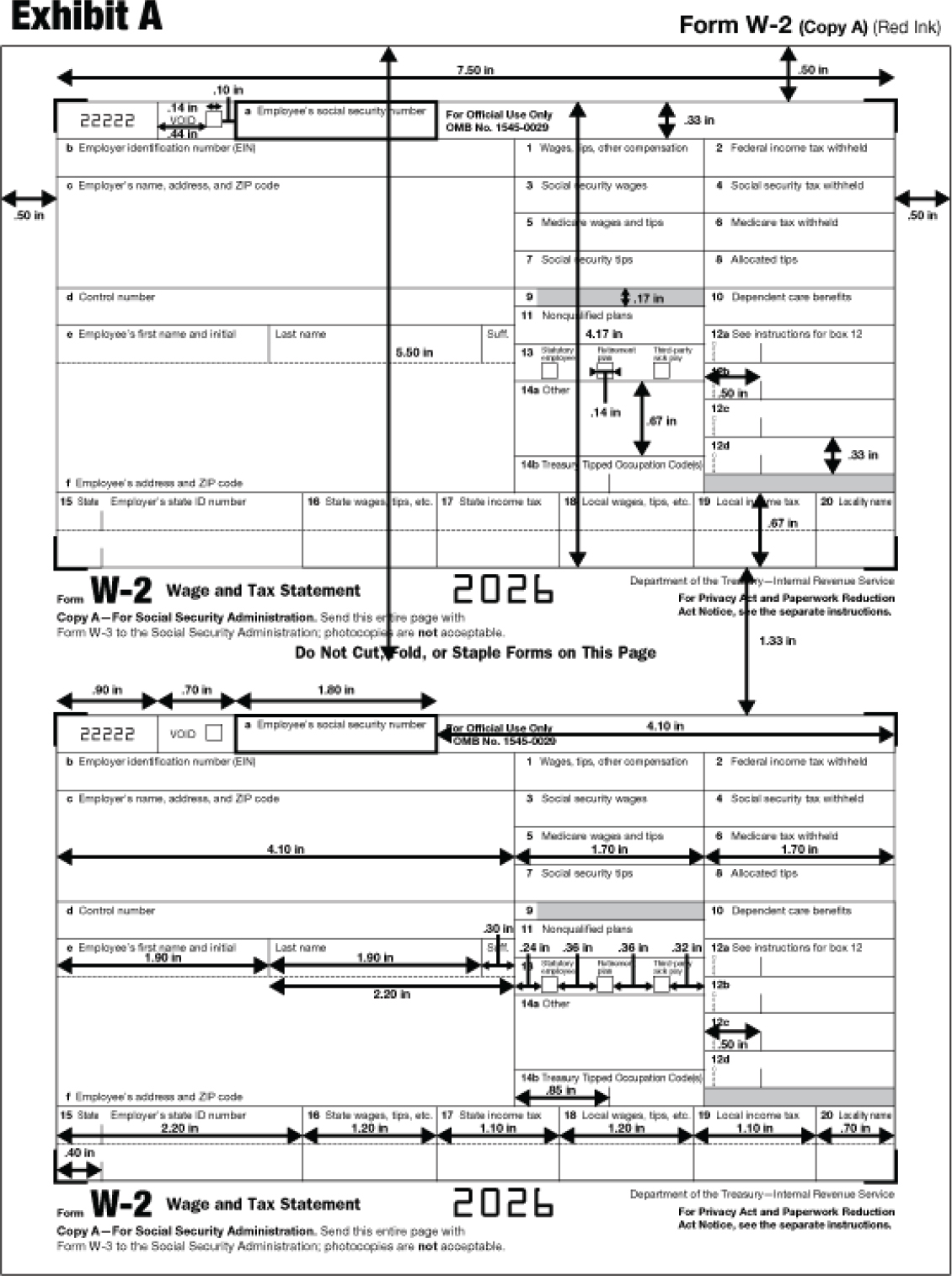
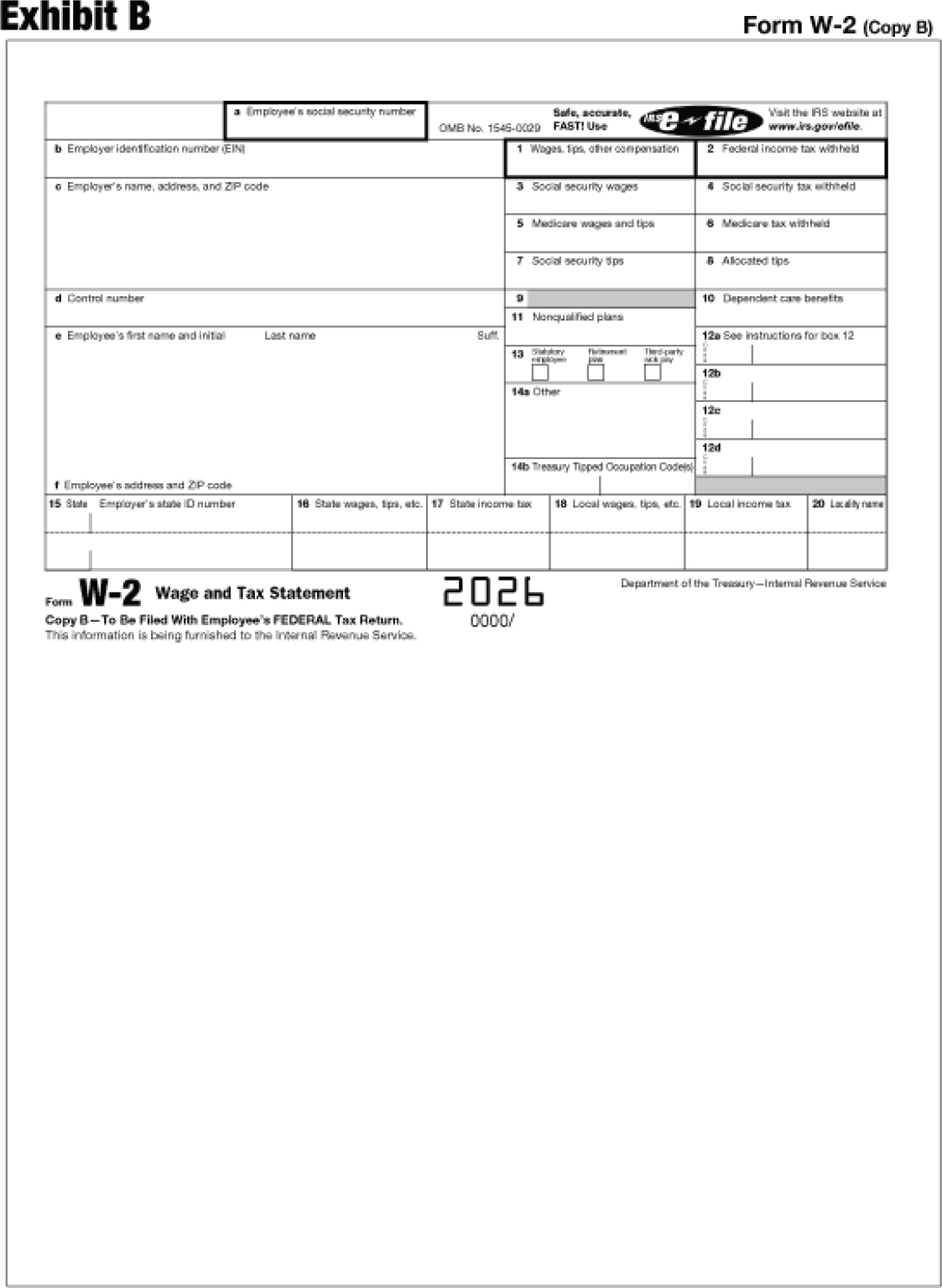
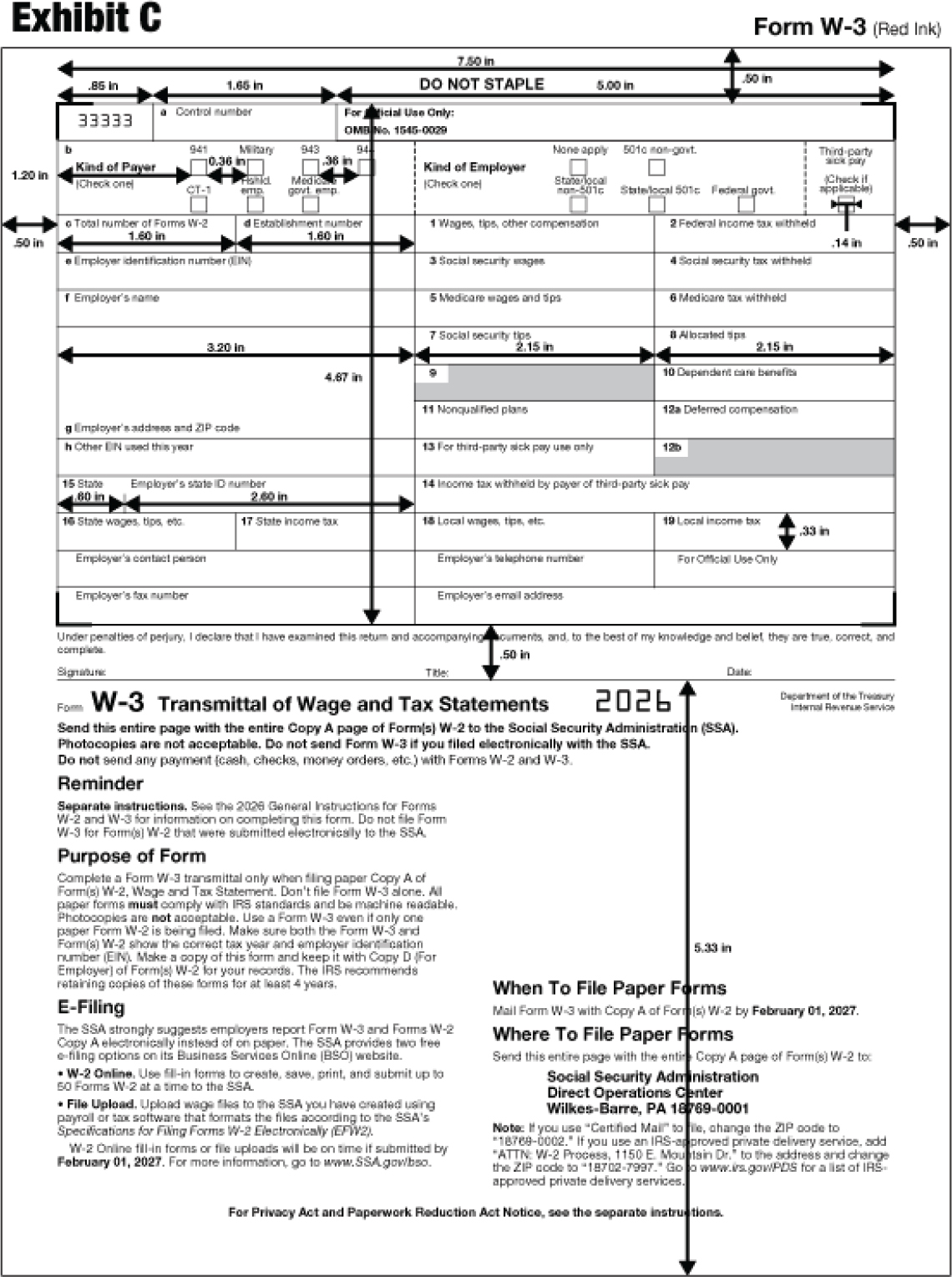
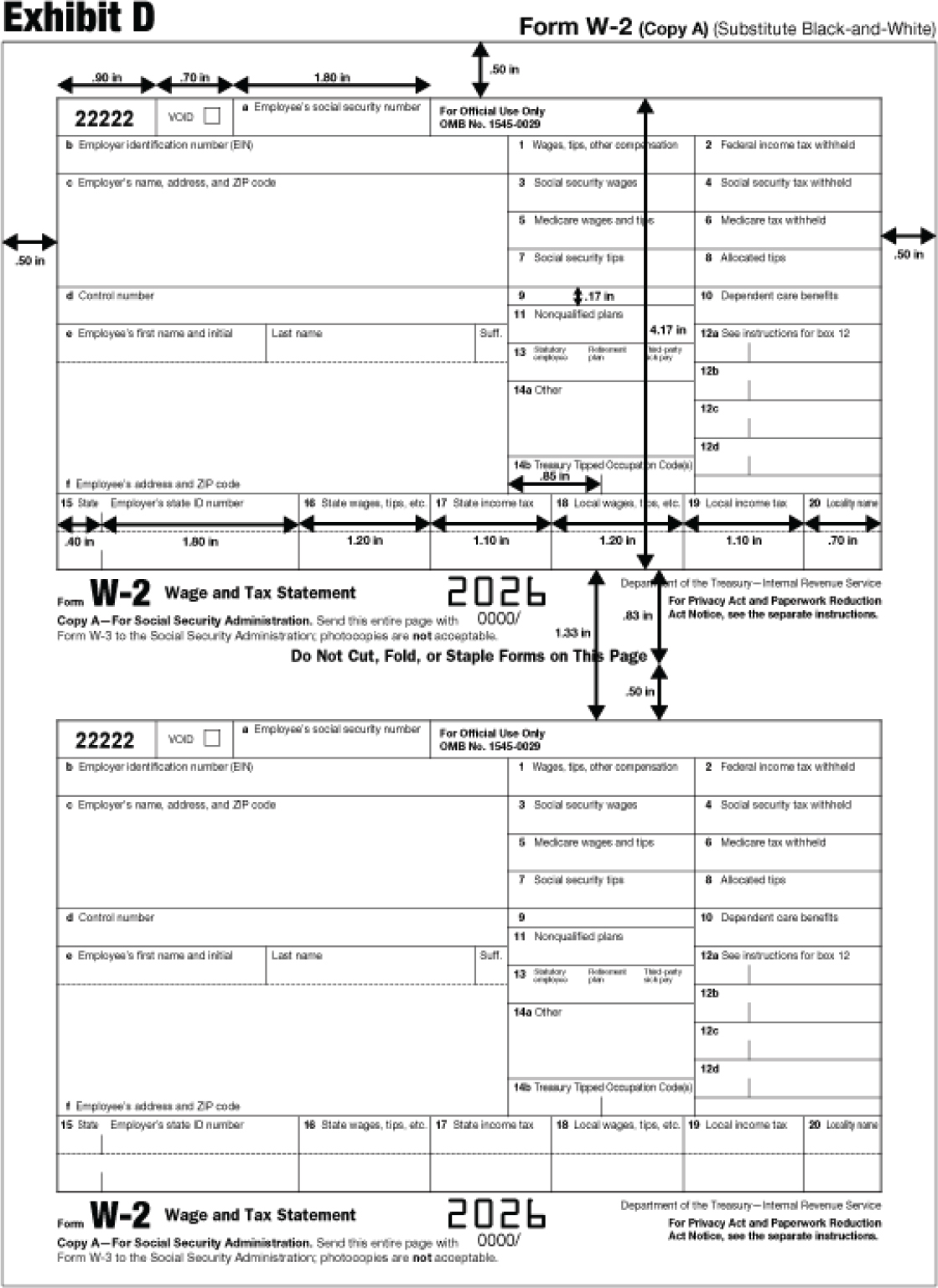
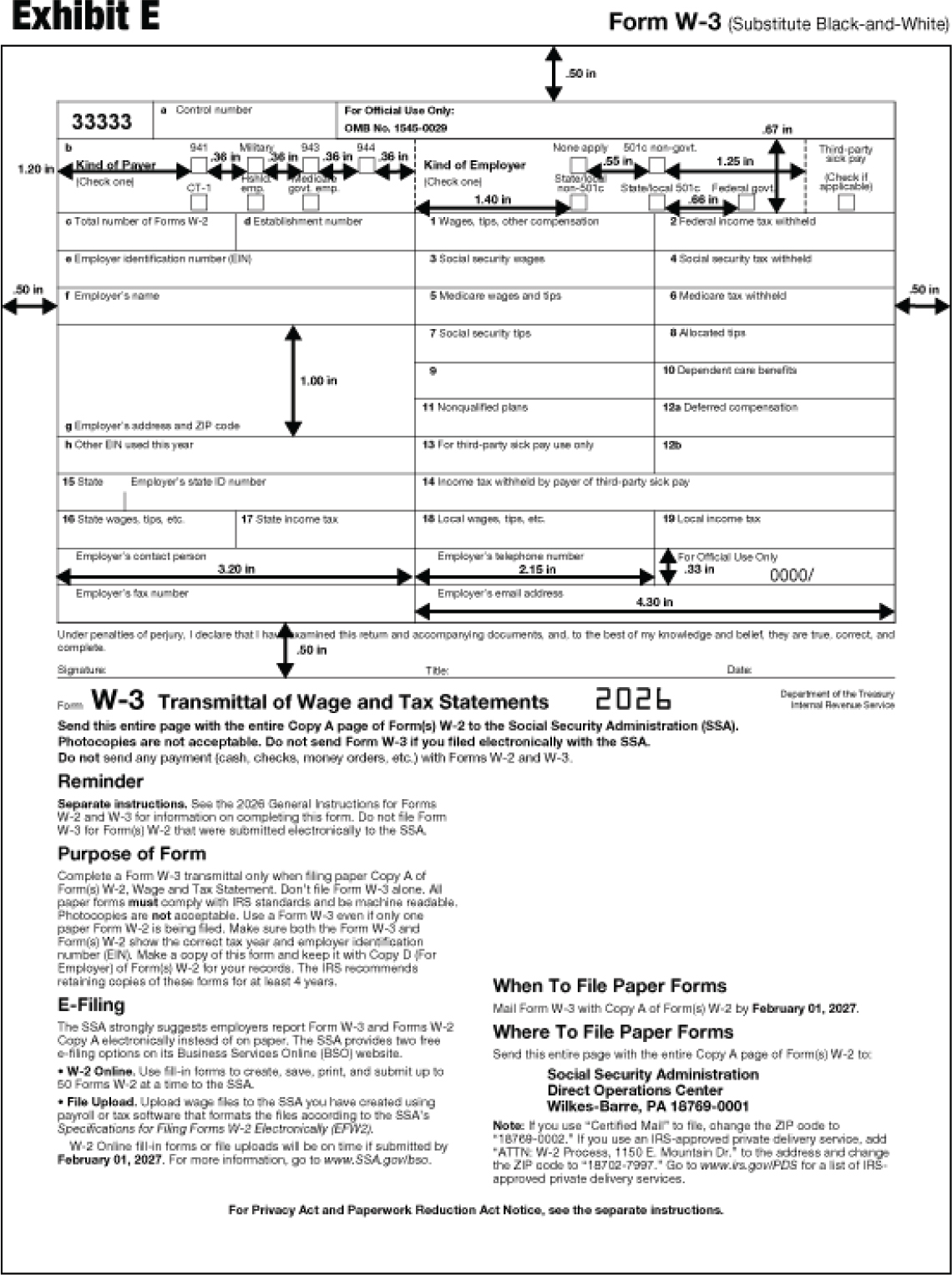
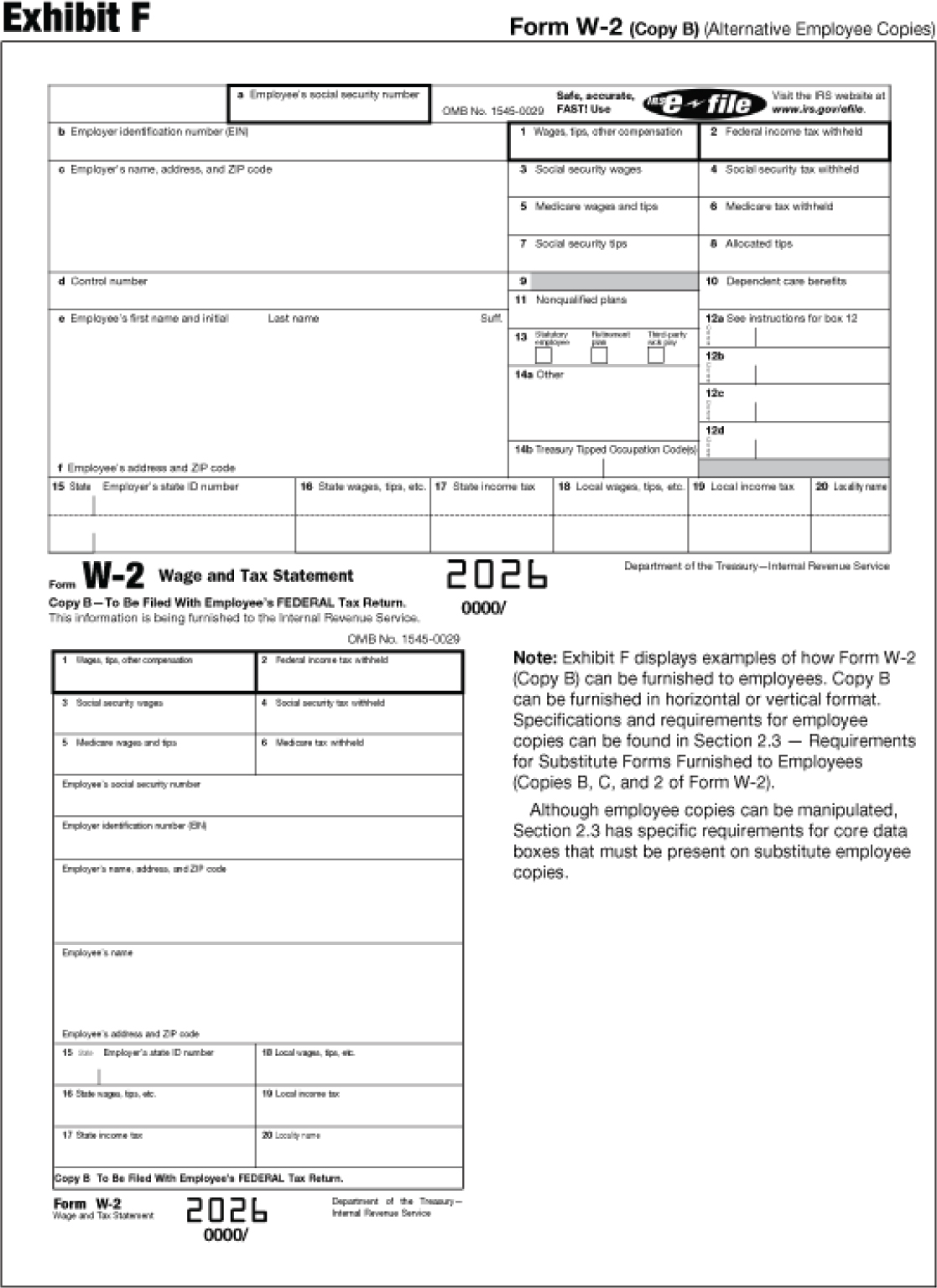
1 Pursuant to § 433(h)(3)(A), the third segment rate determined under § 430(h)(2)(C) is used to determine the current liability of a CSEC plan (which is used to calculate the minimum amount of the full funding limitation under § 433(c)(7)(C)).
The Office of Professional Responsibility (OPR) announces recent disciplinary sanctions imposed on attorneys, certified public accountants, enrolled agents, enrolled actuaries, enrolled retirement plan agents, and appraisers. The OPR also announces when certain unenrolled, unlicensed tax return preparers (individuals who are not enrolled to practice before the Internal Revenue Service (IRS)) and are not licensed as attorneys or certified public accountants) have been disciplined. Licensed or enrolled practitioners are subject to the regulations governing practice before the IRS, which are set out in Title 31, Code of Federal Regulations (C.F.R.), Subtitle A, Part 10, and which are released as Treasury Department Circular No. 230. The regulations prescribe the duties and restrictions relating to such practice and prescribe the disciplinary sanctions for violating the regulations. Unenrolled/unlicensed return preparers who choose to participate in the IRS’s voluntary Annual Filing Season Program (AFSP) are subject to the guidance in Revenue Procedure 2014-42, which governs a preparer’s eligibility to represent taxpayers before the IRS in examinations of tax returns the preparer both prepared for the taxpayer and signed as the preparer. Additionally, unenrolled/unlicensed return preparers who participate in the AFSP agree to be subject to the duties and restrictions in Circular 230, including the restrictions on incompetence or disreputable conduct.
The disciplinary sanctions imposed for violation of the applicable standards are:
Disbarred from practice before the IRS—An individual who is disbarred is not eligible to practice before the IRS as defined at 31 C.F.R. (Circular 230) § 10.2(a)(4) for a minimum period of five (5) years and until reinstated to practice.
Suspended from practice before the IRS—An individual who is suspended is not eligible to practice before the IRS as defined at 31 C.F.R. (Circular 230) § 10.2(a)(4) during the term of the suspension and until reinstated to practice.
Censured—Censure is a public reprimand. Unlike disbarment or suspension, censure does not affect an individual’s eligibility to practice before the IRS, but the OPR may subject the individual’s future practice rights to conditions designed to promote high standards of conduct.
Payment of monetary penalty—A monetary penalty may be imposed on an individual who engages in conduct subject to sanction, or on an employer, firm, or other entity if the individual was acting on its behalf and it knew, or reasonably should have known, of the individual’s conduct.
Disqualification of appraiser—An appraiser who is disqualified is barred from presenting evidence or testimony in any administrative proceeding before the Department of the Treasury or the IRS. Additionally, any appraisal made by the disqualified appraiser after the effective date of disqualification will not have any probative effect in any administrative proceeding before the Treasury Department or the IRS.
Ineligible for limited practice—An unenrolled/unlicensed tax return preparer who participates in the AFSP and who fails to comply with Circular 230 as required by Revenue Procedure 2014-42 may have their AFSP credential revoked and may be determined ineligible to engage in future limited practice under the program as a representative of a taxpayer.
Under the regulations, individuals subject to Circular 230 may not assist, or accept assistance from, suspended or disbarred individuals with respect to matters constituting practice (i.e., representation) before the IRS, and they may not aid or abet suspended or disbarred individuals to practice before the IRS.
Disciplinary sanctions announced below are described in these terms:
Disbarred by decision, Suspended by decision, Censured by decision, Monetary penalty imposed by decision, and Disqualified by decision (including after a hearing)—An administrative law judge (ALJ), upon the OPR’s complaint alleging violation of the regulations, issued a decision imposing one of these sanctions after the ALJ either (1) granted the OPR’s motion for summary adjudication or (2) after conducting an evidentiary hearing. After 30 days from the issuance of the decision, in the absence of an appeal, the ALJ’s decision becomes the final agency decision.
Disbarred by default decision, Suspended by default decision, Censured by default decision, Monetary penalty imposed by default decision, and Disqualified by default decision—An ALJ, after finding that no answer to the OPR’s complaint was filed or timely filed, granted the OPR’s motion for a default judgment and issued a decision imposing one of these sanctions.
Disbarred by decision on appeal, Suspended by decision on appeal, Censured by decision on appeal, Monetary penalty imposed by decision on appeal, and Disqualified by decision on appeal—The decision of the ALJ was appealed to the agency’s appellate authority, acting as the delegate of the Secretary of the Treasury, and the appellate authority issued a decision imposing one of these sanctions.
Disbarred by consent, Suspended by consent, Censured by consent, Monetary penalty imposed by consent, and Disqualified by consent—In lieu of a disciplinary proceeding being instituted or continued, an individual offered their consent to one of these sanctions (or a firm or other entity offered to consent to a monetary penalty) and the OPR accepted the offer and the parties entered into a consent agreement. Typically, an offer of consent will provide for: suspension for an indefinite term; conditions that the individual must observe during the suspension; and the individual’s opportunity, after a stated number of months, to file with the OPR a petition for reinstatement affirming compliance with the terms of the consent agreement and affirming current fitness and eligibility to practice (i.e., an active professional license or active enrollment status, with no intervening violations of the regulations).
Suspended indefinitely by decision in expedited proceeding, Suspended indefinitely by default decision in expedited proceeding—The OPR instituted an expedited proceeding for suspension (based on certain limited grounds, including loss of a professional license for cause, and criminal convictions) that resulted in suspension.
Determined ineligible for limited practice—There has been a final determination under Revenue Procedure 2014-42 that an unenrolled/unlicensed tax return preparer is not eligible for continued limited representation of taxpayers because the preparer violated standards of conduct prescribed in Circular 230 or failed to comply with any of the requirements described in the revenue procedure.
A practitioner who has been disbarred or suspended under 31 C.F.R. Part 10’s (Circular 230’s) § 10.60, (“Initiation of proceeding” (before an ALJ)) or suspended under § 10.82 (“Expedited suspension”), or a disqualified appraiser may petition for reinstatement before the IRS after the expiration of 5 years following such disbarment, suspension, or disqualification (or immediately following the expiration of the suspension or disqualification period if shorter than 5 years). Reinstatement will not be granted unless the IRS is satisfied that the petitioner is not likely to engage thereafter in conduct contrary to Circular 230, and that granting such reinstatement would not be contrary to the public interest.
Reinstatement decisions are published at the individual’s request, and described in these terms:
Reinstated to practice before the IRS—The OPR granted the individual’s petition for reinstatement. The individual is eligible to practice before the IRS, or in the case of an appraiser, the individual is no longer disqualified.
Reinstated to engage in limited practice before the IRS—The OPR granted the individual’s petition for reinstatement. The individual is eligible to engage in limited practice before the IRS as an unenrolled/unlicensed return preparer through participation in the AFSP.
The OPR has authority to disclose the grounds for disciplinary sanctions in these situations: (1) an ALJ or the Secretary’s delegate on appeal has issued a final decision imposing a sanction; (2) the individual has settled a disciplinary case by signing the OPR’s consent-to-sanction agreement admitting to one or more violations of the regulations and consenting to the disclosure of the admitted violations (for example, willful failure to file Federal income tax returns, lack of due diligence, conflict of interest, etc.); (3) the OPR has issued a decision in an expedited proceeding for indefinite suspension; or (4) upon a final determination (including any decision on appeal) that an unenrolled/unlicensed return preparer is no longer eligible to represent taxpayers before the IRS as an AFSP participant under Revenue Procedure .
Announcements of disciplinary sanctions appear in the Internal Revenue Bulletin at the earliest practicable date. The sanctions announced below are alphabetized first by state and second by the last names of the sanctioned individuals (or firms).
| City & State | Name | Professional Designation | Disciplinary Sanction | Effective Date(s) |
|---|---|---|---|---|
| Indiana | ||||
| Fishers | Crace, Jason L. | CPA | Suspended by decision in expedited proceeding under 31 C.F.R. § 10.82(b) | Indefinite from May 15, 2026 |
Revenue rulings and revenue procedures (hereinafter referred to as “rulings”) that have an effect on previous rulings use the following defined terms to describe the effect:
Amplified describes a situation where no change is being made in a prior published position, but the prior position is being extended to apply to a variation of the fact situation set forth therein. Thus, if an earlier ruling held that a principle applied to A, and the new ruling holds that the same principle also applies to B, the earlier ruling is amplified. (Compare with modified, below).
Clarified is used in those instances where the language in a prior ruling is being made clear because the language has caused, or may cause, some confusion. It is not used where a position in a prior ruling is being changed.
Distinguished describes a situation where a ruling mentions a previously published ruling and points out an essential difference between them.
Modified is used where the substance of a previously published position is being changed. Thus, if a prior ruling held that a principle applied to A but not to B, and the new ruling holds that it applies to both A and B, the prior ruling is modified because it corrects a published position. (Compare with amplified and clarified, above).
Obsoleted describes a previously published ruling that is not considered determinative with respect to future transactions. This term is most commonly used in a ruling that lists previously published rulings that are obsoleted because of changes in laws or regulations. A ruling may also be obsoleted because the substance has been included in regulations subsequently adopted.
Revoked describes situations where the position in the previously published ruling is not correct and the correct position is being stated in a new ruling.
Superseded describes a situation where the new ruling does nothing more than restate the substance and situation of a previously published ruling (or rulings). Thus, the term is used to republish under the 1986 Code and regulations the same position published under the 1939 Code and regulations. The term is also used when it is desired to republish in a single ruling a series of situations, names, etc., that were previously published over a period of time in separate rulings. If the new ruling does more than restate the substance of a prior ruling, a combination of terms is used. For example, modified and superseded describes a situation where the substance of a previously published ruling is being changed in part and is continued without change in part and it is desired to restate the valid portion of the previously published ruling in a new ruling that is self contained. In this case, the previously published ruling is first modified and then, as modified, is superseded.
Supplemented is used in situations in which a list, such as a list of the names of countries, is published in a ruling and that list is expanded by adding further names in subsequent rulings. After the original ruling has been supplemented several times, a new ruling may be published that includes the list in the original ruling and the additions, and supersedes all prior rulings in the series.
Suspended is used in rare situations to show that the previous published rulings will not be applied pending some future action such as the issuance of new or amended regulations, the outcome of cases in litigation, or the outcome of a Service study.
The following abbreviations in current use and formerly used will appear in material published in the Bulletin.
A—Individual.
Acq.—Acquiescence.
B—Individual.
BE—Beneficiary.
BK—Bank.
B.T.A.—Board of Tax Appeals.
C—Individual.
C.B.—Cumulative Bulletin.
CFR—Code of Federal Regulations.
CI—City.
COOP—Cooperative.
Ct.D.—Court Decision.
CY—County.
D—Decedent.
DC—Dummy Corporation.
DE—Donee.
Del. Order—Delegation Order.
DISC—Domestic International Sales Corporation.
DR—Donor.
E—Estate.
EE—Employee.
E.O.—Executive Order.
ER—Employer.
ERISA—Employee Retirement Income Security Act.
EX—Executor.
F—Fiduciary.
FC—Foreign Country.
FICA—Federal Insurance Contributions Act.
FISC—Foreign International Sales Company.
FPH—Foreign Personal Holding Company.
F.R.—Federal Register.
FUTA—Federal Unemployment Tax Act.
FX—Foreign corporation.
G.C.M.—Chief Counsel’s Memorandum.
GE—Grantee.
GP—General Partner.
GR—Grantor.
IC—Insurance Company.
I.R.B.—Internal Revenue Bulletin.
LE—Lessee.
LP—Limited Partner.
LR—Lessor.
M—Minor.
Nonacq.—Nonacquiescence.
O—Organization.
P—Parent Corporation.
PHC—Personal Holding Company.
PO—Possession of the U.S.
PR—Partner.
PRS—Partnership.
PTE—Prohibited Transaction Exemption.
Pub. L.—Public Law.
REIT—Real Estate Investment Trust.
Rev. Proc.—Revenue Procedure.
Rev. Rul.—Revenue Ruling.
S—Subsidiary.
S.P.R.—Statement of Procedural Rules.
Stat.—Statutes at Large.
T—Target Corporation.
T.C.—Tax Court.
T.D.—Treasury Decision.
TFE—Transferee.
TFR—Transferor.
T.I.R.—Technical Information Release.
TP—Taxpayer.
TR—Trust.
TT—Trustee.
U.S.C.—United States Code.
X—Corporation.
Y—Corporation.
Z—Corporation.
Bulletin 2026–32
1 A cumulative list of all revenue rulings, revenue procedures, Treasury decisions, etc., published in Internal Revenue Bulletins 2026–27 through 2026–52 is in Internal Revenue Bulletin 2025–52, dated December 21, 2025.
The Introduction at the beginning of this issue describes the purpose and content of this publication. The weekly Internal Revenue Bulletins are available at www.irs.gov/irb/.
If you have comments concerning the format or production of the Internal Revenue Bulletin or suggestions for improving it, we would be pleased to hear from you. You can email us your suggestions or comments through the IRS Internet Home Page www.irs.gov) or write to the
Internal Revenue Service, Publishing Division, IRB Publishing Program Desk, 1111 Constitution Ave. NW, IR-6230 Washington, DC 20224.