


 )
or https:// means you've safely connected to the .gov website. Share sensitive information only on official, secure websites.
)
or https:// means you've safely connected to the .gov website. Share sensitive information only on official, secure websites.


Internal Revenue Bulletin: 2026-41
October 5, 2026
These synopses are intended only as aids to the reader in identifying the subject matter covered. They may not be relied upon as authoritative interpretations.
This revenue procedure provides specifications for the private printing of red-ink and black-and-white substitutes for the January 2026 revision of Form W-2c and the June 2024 revision of Form W-3c. This revenue procedure will be produced as the next revision of Publication 1223. Rev. Proc. 2024-36, 2024-41 I.R.B. 737, dated October 7, 2024 (reprinted as Publication 1223, revised 10-2024), is superseded.
NOTE. This revenue procedure will be reproduced as the next revision of IRS Publication 1223, General Rules and Specifications for Substitute Forms W-2c and W-3c.
26 CFR 601.602: Tax forms and instructions. (Also Part I, Sections 6041, 6051, 6071, 6081, 6091; 1.6041-1, 1.6041-2, 31.6051-1, 31.6051-2, 31.6071(a)-1, 31.6081(a)-1, 31.6091-1.)
This notice republishes the inflation adjustment factor and applicable amounts for calendar year 2026 for the clean electricity production credit allowable under section 45Y of the Internal Revenue Code, which were published in the Federal Register at 91 FR 56942 on September 4, 2026. The 2026 inflation adjustment factor and applicable amounts are used to determine the amount of the section 45Y credit and apply to calendar year 2026 sales, consumption, or storage of electricity produced in the United States or a possession thereof at a qualified facility.
This notice provides guidance on the establishment of emissions rates under § 45Z(b)(1)(B) of the Internal Revenue Code (Code) for the clean fuel production credit determined under § 45Z (§ 45Z credit) and clarifies the application of certain amendments to § 45Z made by § 70521 of Public Law 119-21, 139 Stat. 72, 276 (July 4, 2025), commonly known as the One, Big, Beautiful Bill Act (OBBBA). Specifically, this notice addresses the establishment of emissions rates for transportation fuel derived from animal manure. This notice also describes how certain regenerative agricultural feedstock practices may be taken into account for purposes of § 45Z. The Appendix to this notice provides the annual emissions rate table for calendar year 2026 for purposes of § 45Z.
Provide America’s taxpayers top-quality service by helping them understand and meet their tax responsibilities and enforce the law with integrity and fairness to all.
The Internal Revenue Bulletin is the authoritative instrument of the Commissioner of Internal Revenue for announcing official rulings and procedures of the Internal Revenue Service and for publishing Treasury Decisions, Executive Orders, Tax Conventions, legislation, court decisions, and other items of general interest. It is published weekly.
It is the policy of the Service to publish in the Bulletin all substantive rulings necessary to promote a uniform application of the tax laws, including all rulings that supersede, revoke, modify, or amend any of those previously published in the Bulletin. All published rulings apply retroactively unless otherwise indicated. Procedures relating solely to matters of internal management are not published; however, statements of internal practices and procedures that affect the rights and duties of taxpayers are published.
Revenue rulings represent the conclusions of the Service on the application of the law to the pivotal facts stated in the revenue ruling. In those based on positions taken in rulings to taxpayers or technical advice to Service field offices, identifying details and information of a confidential nature are deleted to prevent unwarranted invasions of privacy and to comply with statutory requirements.
Rulings and procedures reported in the Bulletin do not have the force and effect of Treasury Department Regulations, but they may be used as precedents. Unpublished rulings will not be relied on, used, or cited as precedents by Service personnel in the disposition of other cases. In applying published rulings and procedures, the effect of subsequent legislation, regulations, court decisions, rulings, and procedures must be considered, and Service personnel and others concerned are cautioned against reaching the same conclusions in other cases unless the facts and circumstances are substantially the same.
The Bulletin is divided into four parts as follows:
Part I.—1986 Code. This part includes rulings and decisions based on provisions of the Internal Revenue Code of 1986.
Part II.—Treaties and Tax Legislation. This part is divided into two subparts as follows: Subpart A, Tax Conventions and Other Related Items, and Subpart B, Legislation and Related Committee Reports.
Part III.—Administrative, Procedural, and Miscellaneous. To the extent practicable, pertinent cross references to these subjects are contained in the other Parts and Subparts. Also included in this part are Bank Secrecy Act Administrative Rulings. Bank Secrecy Act Administrative Rulings are issued by the Department of the Treasury’s Office of the Assistant Secretary (Enforcement).
Part IV.—Items of General Interest. This part includes notices of proposed rulemakings, disbarment and suspension lists, and announcements.
The last Bulletin for each month includes a cumulative index for the matters published during the preceding months. These monthly indexes are cumulated on a semiannual basis, and are published in the last Bulletin of each semiannual period.
This notice republishes the inflation adjustment factor and applicable amounts for calendar year 2026 for the clean electricity production credit allowable under section 45Y (section 45Y credit) of the Internal Revenue Code (Code), which are required by section 45Y(c)(2) to be published in the Federal Register. The 2026 inflation adjustment factor and applicable amounts are used to determine the amount of the section 45Y credit and apply to calendar year 2026 sales, consumption, or storage of electricity produced in the United States or a possession thereof at a qualified facility.
Section 45Y was added to the Code by section 13701(a) of Public Law 117-169, 136 Stat. 1818, 1982 (August 16, 2022), commonly known as the Inflation Reduction Act of 2022, to provide an income tax credit for producing electricity at a qualified facility.
Section 45Y(a)(1) provides that, for purposes of section 38 of the Code, the section 45Y credit for any taxable year is an amount equal to the product of (1) the kilowatt hours of electricity produced by the taxpayer during such taxable year at a qualified facility (described in section 45Y(b)), and either (i) sold by the taxpayer to an unrelated person during the taxable year, or (ii) in the case of a qualified facility which is equipped with a metering device which is owned and operated by an unrelated person, sold, consumed, or stored by the taxpayer during the taxable year, multiplied by (2) the applicable amount with respect to such qualified facility.
For purposes of the applicable amount used in calculating the section 45Y credit, section 45Y(a)(2) provides a base amount and a higher alternative amount. Section 45Y(a)(2)(A) provides that, subject to section 45Y(g)(7) (providing an increase in credit for qualified facilities located in an energy community), the applicable amount will be the base amount of 0.3 cents in the case of a qualified facility that does not satisfy the requirements for the alternative amount. Section 45Y(a)(2)(B) provides that, subject to section 45Y(g)(7), the applicable amount will be the alternative amount of 1.5 cents in the case of any qualified facility (1) with a maximum net output of less than 1 megawatt (as measured in alternating current), (2) the construction of which begins prior to the date that is 60 days after the Secretary of the Treasury or the Secretary’s delegate (Secretary) publishes guidance on the requirements of section 45Y(g)(9) (wage requirements) and section 45Y(g)(10) (apprenticeship requirements),1 or (3) that satisfies section 45Y(g)(9) and, with respect to the construction of such facility, satisfies section 45Y(g)(10).
Section 45Y(c)(1) provides for an inflation adjustment for both the base and alternative amounts. Section 45Y(c)(1) provides that, in the case of a calendar year beginning after 2024, the 0.3 cent amount in section 45Y(a)(2)(A) and the 1.5 cent amount in section 45Y(a)(2)(B) will each be adjusted by multiplying such amount by the inflation adjustment factor for the calendar year in which the sale, consumption, or storage of the electricity occurs. If the 0.3 cent amount as adjusted for inflation is not a multiple of 0.05 cent, such amount is rounded to the nearest multiple of 0.05 cent. If the 1.5 cent amount as adjusted for inflation is not a multiple of 0.1 cent, such amount is rounded to the nearest multiple of 0.1 cent.
Section 45Y(c)(2) requires the Secretary to determine and publish in the Federal Register each calendar year the inflation adjustment factor for such calendar year. The inflation adjustment factor for the 2026 calendar year was published in the Federal Register at 91 FR 56942 on September 4, 2026.
Section 45Y(c)(3) defines the term inflation adjustment factor as, with respect to a calendar year, a fraction, the numerator of which is the GDP implicit price deflator for the preceding calendar year and the denominator of which is the GDP implicit price deflator for the calendar year 1992. The term GDP implicit price deflator means the most recent revision of the implicit price deflator for the gross domestic product as computed and published by the Department of Commerce before March 15 of the calendar year.
For purposes of section 45Y(c)(1), for sales, consumption, or storage of electricity occurring in calendar year 2026, the inflation adjustment factor is a fraction, the numerator of which is the GDP implicit price deflator for 2025 (128.986) and the denominator of which is the GDP implicit price deflator for 1992 (62.707), which yields an inflation adjustment factor of 2.0570.
For sales, consumption, or storage of electricity occurring in calendar year 2026, the applicable amount provided in section 45Y(a)(2)(A) is 0.6 cents (or $0.006), which is 0.3 cents (or $0.003) multiplied by 2.0570 and rounded to the nearest multiple of 0.05 cent. For sales, consumption, or storage of electricity occurring in calendar year 2026, the applicable amount provided in section 45Y(a)(2)(B) is 3.1 cents (or $0.031), which is 1.5 cents (or $0.015) multiplied by 2.0570 and rounded to the nearest multiple of 0.1 cent.
The principal author of this notice is Kevin I. Babitz of the Office of Associate Chief Counsel (Energy, Credits, and Excise Tax). For further information regarding this notice contact Kevin I. Babitz at 202-317-5046 (not a toll-free call).
1 To meet this requirement, the construction of the qualified facility must begin prior to January 29, 2023. On November 30, 2022, the Department of the Treasury and the Internal Revenue Service published Notice 2022-61 in the Federal Register (87 FR 73580, corrected in 87 FR 75141 (Dec. 7, 2022)), providing initial guidance with respect to the prevailing wage and apprenticeship requirements and starting the 60-day period described in section 45Y(a)(2)(B).
This notice provides guidance on the establishment of emissions rates under § 45Z(b)(1)(B) of the Internal Revenue Code (Code)1 for the clean fuel production credit determined under § 45Z (§ 45Z credit) and clarifies the application of certain amendments to § 45Z made by § 70521 of Public Law 119-21, 139 Stat. 72, 276 (July 4, 2025), commonly known as the One, Big, Beautiful Bill Act (OBBBA). Specifically, this notice addresses the establishment of emissions rates for transportation fuel derived from animal manure. This notice also describes how certain regenerative agricultural feedstock practices may be taken into account for purposes of § 45Z. The Appendix to this notice provides the annual emissions rate table for calendar year 2026 for purposes of § 45Z.
The Department of the Treasury (Treasury Department) and the Internal Revenue Service (IRS) developed this notice in consultation with the Department of Energy (DOE), the United States Department of Agriculture (USDA), the Federal Aviation Administration (FAA), and other federal agencies.
.01 In general.
Section 45Z, as amended by § 70521 of the OBBBA, provides an income tax credit for clean transportation fuel produced domestically after December 31, 2024, and sold by December 31, 2029. Among other requirements to qualify for the § 45Z credit, a taxpayer must produce a “transportation fuel” that meets certain suitability, emissions rate, anti-coprocessing, and anti-double-crediting requirements. See § 45Z(a)(1) and (d)(5)(A). Under § 45Z(d)(5)(A)(ii), the emissions rate requirement is met if a transportation fuel has an emissions rate2 that is not greater than a statutory baseline of 50 kilograms (kg) of carbon dioxide equivalent based on relative global warming potential (CO2e) per million British thermal units (mmBTU).
A taxpayer calculates the amount of the § 45Z credit by multiplying the applicable amount per gallon or gallon equivalent with respect to a transportation fuel produced by the taxpayer and sold in a qualified sale by the emissions factor for such fuel. See § 45Z(a)(1). Per § 45Z(a)(5), the credit amount is rounded to the nearest cent. A taxpayer’s total § 45Z credit for a taxable year is the sum of the § 45Z credit for each transportation fuel sold during the taxable year.
.02 Establishment of emissions rates.
Under § 45Z(b)(1)(A), a transportation fuel’s emissions factor measures the reduction in the fuel’s emissions rate relative to the statutory baseline emissions rate of 50 kg of CO2e per mmBTU, expressed as a fraction of the statutory baseline. Under § 45Z(b)(2), any emissions factor must be rounded to the nearest multiple of 0.1.
Generally, a taxpayer must determine a transportation fuel’s emissions rate by using the annual emissions rate table published by the Secretary of the Treasury or the Secretary’s delegate (Secretary). See § 45Z(b)(1)(B). However, a taxpayer producing a transportation fuel for which an emissions rate has not been established in the annual emissions rate table may file a petition with the Secretary for determination of a provisional emissions rate (PER) with respect to such fuel. See § 45Z(b)(1)(D).
Section 45Z(b)(1)(B)(i) directs the Secretary, subject to § 45Z(b)(1)(B)(ii) through (v), to annually publish a table setting forth the emissions rates for similar types and categories of transportation fuels. Section 2.03 of this notice describes § 45Z(b)(1)(B)(iv) and (v), added by the OBBBA. The Appendix to this notice provides the calendar year 2026 emissions rate table.
Section 45Z(b)(1)(B)(ii) provides that for transportation fuel other than sustainable aviation fuel (non-SAF transportation fuel), the lifecycle GHG emissions of such fuel must be based on the most recent determinations under the Greenhouse gases, Regulated Emissions, and Energy use in Transportation (GREET) model developed by Argonne National Laboratory, or a successor model as determined by the Secretary. See section 2.04(3) of this notice.
Section 45Z(b)(1)(B)(iii) provides that for transportation fuel that is sustainable aviation fuel (SAF transportation fuel), the lifecycle GHG emissions of such fuel must be determined in accordance with: (i) the most recent Carbon Offsetting and Reduction Scheme for International Aviation (CORSIA) methodologies that have been adopted by the International Civil Aviation Organization with the agreement of the United States; or (ii) any methodology similar to the most recent CORSIA methodologies that satisfies the criteria under § 211(o)(1)(H) of the Clean Air Act, as in effect on August 16, 2022.
Section 2.04(3) of this notice discusses the use of the 45ZCF-GREET model pursuant to § 45Z(b)(1)(B)(ii) and (iii). All publicly available versions of the 45ZCF-GREET model, the accompanying user manual, additional information including FAQs, and the log of changes to the model are available at https://www.energy.gov/cmei/greet.
.03 OBBBA amendments.
Section 70521 of the OBBBA made several amendments to § 45Z affecting the establishment of emissions rates and credit eligibility that apply only to transportation fuel produced after December 31, 2025. Transportation fuel produced before January 1, 2026, even if sold after December 31, 2025, is not subject to these amendments. These statutory amendments include:
(1) The requirement in § 45Z(b)(1)(B)(iv) that the emissions rate of transportation fuel produced after December 31, 2025, must be adjusted, based on regulations or methodologies determined by the Secretary, to exclude any emissions attributed to indirect land use change (ILUC).
(2) The requirement in § 45Z(b)(1)(B)(v)(I) for the Secretary to provide a distinct emissions rate with respect to any transportation fuel derived from animal manure and produced after December 31, 2025, that is based on the specific animal manure feedstock. Such feedstocks may include dairy manure, swine manure, poultry manure, or any other sources as are determined appropriate by the Secretary. See § 45Z(b)(1)(B)(v)(I).
(3) The requirement in § 45Z(b)(1)(B)(v)(II) and (b)(1)(E) that the emissions rate cannot be less than zero for any transportation fuel produced after December 31, 2025, except for any transportation fuel derived from animal manure.
(4) The requirement in § 45Z(f)(1)(A)(iii) that transportation fuel produced after December 31, 2025, must be exclusively derived from a feedstock that was produced or grown in the United States, Mexico, or Canada.
Section 4 of this notice clarifies how a taxpayer using an allowed methodology that does not reflect these amendments should apply those amendments to determine the emissions rate of transportation fuel produced after December 31, 2025. See generally section 2.04 of this notice.
.04 Current guidance on emissions rates.
(1) In general.
On February 4, 2026, the Treasury Department and the IRS published proposed regulations under § 45Z (REG-121244-23) in the Federal Register at 91 F.R. 5160 (§ 45Z NPRM), which provide guidance for determining the § 45Z credit, including the establishment of emissions rates for transportation fuels under proposed § 1.45Z-2(d).3
Proposed § 1.45Z-2(d)(1) would implement the general rules for determining the emissions rate of a transportation fuel in § 45Z(b)(1)(B) and (D): a taxpayer would either use the applicable emissions rate table published by the Secretary or, if the applicable emissions rate table does not establish an emissions rate for the taxpayer’s fuel, a PER determined by the Secretary.
Proposed § 1.45Z-2(e) would incorporate the rules in § 45Z(b)(1)(B) regarding the annual publication of a table of emissions rates for similar types and categories of transportation fuels, including the requirement in § 45Z(b)(1)(B)(i) that the emissions rate table be published “[s]ubject to” the requirements in § 45Z(b)(1)(B)(ii) through (v).
Proposed § 1.45Z-2(g) would provide that when an emissions rate is first established for a type and category of fuel, whether in an applicable emissions rate table or by a PER determination, that emissions rate will relate back to January 1, 2025.
(2) Applicable emissions rate table.
Proposed § 1.45Z-2(e)(2) would provide rules for identifying the “applicable emissions rate table” that a taxpayer must use in a given taxable year. Proposed § 1.45Z-2(e)(2)(i) would clarify that the applicable emissions rate table for a taxpayer is the emissions rate table that is in effect on the first day of the taxpayer’s taxable year of production.
Proposed § 1.45Z-2(e)(2)(ii) would clarify that if a taxpayer produces a fuel for which the applicable emissions rate table establishes an emissions rate, the taxpayer must use the corresponding allowed methodologies, as specified in proposed § 1.45Z-2(e)(3), as provided in such table to determine the emissions rate for all such fuel produced during the taxpayer’s taxable year.
Proposed § 1.45Z-2(e)(2)(iii)(A) would clarify that the applicable emissions rate table establishes the emissions rate for a fuel if the emissions rate table includes both the “type of transportation fuel” and “category of transportation fuel” (that is, the fuel’s unique primary feedstock and pathway used to produce a type of transportation fuel), as defined in proposed § 1.45Z-1(b)(35). Proposed § 1.45Z-2(e)(2)(iii)(B) would clarify that if an emissions rate table does not initially include a type or category of fuel, but an allowed methodology is updated to add such type or category of fuel during the calendar year, then that type or category of fuel is considered included in such emissions rate table.
(3) Allowed methodologies.
Proposed § 1.45Z-2(e)(3)(i) would provide that a taxpayer producing a fuel for which an emissions rate is established by the applicable emissions rate table must determine the fuel’s emissions rate using the allowed methodologies described in proposed § 1.45Z-2(e)(3)(iv) and (v), as directed by the applicable emissions rate table.
Proposed § 1.45Z-2(e)(3)(ii) would require a taxpayer to use the first version of an allowed methodology that is publicly available in the taxable year of production and that includes the type and category of the taxpayer’s fuel. However, if an updated version of an allowed methodology becomes publicly available after the first day of the taxable year of production (but still within such taxable year), then the taxpayer could choose to treat such updated version as the most recent version of such methodology.
The preamble to the § 45Z NPRM discusses how the phrase “most recent determinations under the Greenhouse gases, Regulated Emissions, and Energy use in Transportation model” in § 45Z(b)(1)(B)(ii) is best understood as referring to the most recent determinations under the 45ZCF-GREET model. To address any potential uncertainty given the continued existence of other GREET models, proposed § 1.45Z-2(e)(3)(iii) would designate the 45ZCF-GREET model as a successor model under § 45Z(b)(1)(B)(ii). Proposed § 1.45Z-2(e)(3)(v) would clarify that the SAF portion of the 45ZCF-GREET model is a “similar methodology” to CORSIA under § 45Z(b)(1)(B)(iii)(II).
Proposed § 1.45Z-2(e)(3)(iv) and (v) would identify the allowed methodologies for determining emissions rates for purposes of the emissions rate table described in § 45Z(b)(1)(B)(i). If the applicable emissions rate table establishes the emissions rate for a non-SAF transportation fuel, a taxpayer producing such fuel would determine the fuel’s emissions rate using the 45ZCF-GREET model, as directed by the applicable emissions rate table. If the applicable emissions rate table establishes the emissions rate for a SAF transportation fuel, a taxpayer producing such fuel would determine the fuel’s emissions rate using the most recent version of the CORSIA Default Life Cycle Emissions Values for CORSIA Eligible Fuels lifecycle approach (CORSIA Default) or the CORSIA Methodology for Calculating Actual Life Cycle Emissions Values lifecycle approach (CORSIA Actual), with the agreement of the United States, or the 45ZCF-GREET model, as directed by the applicable emissions rate table. The proposed regulations would also clarify that, for a given type and category of SAF transportation fuel, a taxpayer must use the same methodology to calculate lifecycle GHG emissions associated with all stages of SAF transportation fuel production, from fuel feedstock production through distribution.
Proposed § 1.45Z-2(e)(3)(iii)(B) would provide that in the 45ZCF-GREET model, for purposes of accounting for emissions associated with natural gas alternatives (as a production input or as the transportation fuel produced), rules similar to the rules under § 45V apply, unless otherwise specified by the 45ZCF-GREET model with respect to technical modeling issues that are subsequently identified by the DOE or technical differences arising from the application of the § 45V rules to the 45ZCF-GREET model.
Section 1.45V-4(f)(3)(v) provides generally that for purposes of determining the lifecycle GHG emissions rate of a process that uses methane derived from biogas sourced from animal waste, the associated emissions must use an alternative fate derived from the national average of all animal waste management practices.4 That approach is incompatible with § 70521(c) of the OBBBA, requiring distinct emissions rates, based on the specific animal manure feedstock, for transportation fuels derived from animal manure. Section 3.02 of this notice provides guidance on the emissions associated with natural gas alternatives derived from animal manure for § 45Z purposes, implementing this OBBBA amendment.
.01 Regenerative agriculture practices; safe harbor.
The USDA published a beta version of the USDA Feedstock Carbon Intensity Calculator (USDA FD-CIC) in January 2025. The preamble to the § 45Z NPRM explains that, following publication of the final version of USDA FD-CIC, the Treasury Department and the IRS anticipate that a § 45Z-specific version of the Feedstock Carbon Intensity Calculator (FD-CIC) module would be included as an input to the DOE’s 45ZCF-GREET model (45ZCF FD-CIC) used for calculating carbon intensity adjustments under § 45Z for feedstocks that are produced using certain low-carbon agricultural practices. The preamble also notes that the Treasury Department and the IRS anticipate that 45ZCF FD-CIC may be used for fuel produced and sold in 2025 even though 45ZCF FD-CIC likely would be published in 2026.
In June 2026, the USDA published an updated version of USDA FD-CIC, available at https://www.usda.gov/usda-fdcic, alongside related final Technical Guidelines for the Production of Regenerative Agricultural Biofuel Feedstocks (91 F.R. 39334, June 29, 2026) (USDA technical guidelines). A 2026 version of 45ZCF FD-CIC is forthcoming as part of the 45ZCF-GREET model.
For fuel produced in 2025, a taxpayer may use the 2026 version of 45ZCF FD-CIC to determine the emissions associated with feedstocks produced using low-carbon agricultural practices, provided the taxpayer satisfies all requirements for such practices under the USDA technical guidelines in 7 CFR part 2100, including the chain of custody standards in 7 CFR 2100.030 through 2100.035 and the audit and verification standards in 7 CFR 2100.040 and 2100.041. The Treasury Department and the IRS are aware that for fuel produced in 2025 and 2026, the primary feedstock produced using low-carbon agricultural practices was likely planted before the publication of the final USDA technical guidelines. As such, for fuel produced in 2025 and 2026, the requirements under 7 CFR 2100.060, regarding the pre-application development of a nutrient budget, are deemed satisfied for purposes of § 45Z. However, a taxpayer must be able to substantiate the application of any nutrients (such as nitrogen, phosphorus, and potassium) and measurable nutrient sources and removals that the taxpayer inputs into 45ZCF FD-CIC. A taxpayer must also keep records sufficient to substantiate its claim for the § 45Z credit. See proposed § 1.45Z-4(g)(1)–(2).
.02 Distinct emissions rates for specific animal manure feedstocks.
As discussed in sections 2.03 and 2.04(3) of this notice, § 45Z(b)(1)(B)(v)(I) directs the Secretary to provide, for transportation fuels derived from animal manure, distinct emissions rates based on the specific animal manure feedstock.
(1) Specific animal manure feedstocks.
Section 45Z(b)(1)(B)(v)(I) provides that specific animal manure feedstocks may include dairy manure, swine manure, and poultry manure (listed manures). Section 45Z(b)(1)(B)(v)(I) contemplates specific animal manure feedstocks other than the listed manures (unlisted manures), as are determined appropriate by the Secretary. The Treasury Department and the IRS may provide future guidance for determining the emissions rate of fuels derived from unlisted manures, including specific alternative fates. However, the Treasury Department and the IRS anticipate that some unlisted manures will lack technical data to determine an alternative fate for a specific animal manure feedstock.
The Treasury Department and the IRS anticipate that an update to the 45ZCF-GREET model including dairy manure and swine manure as distinct primary feedstocks is forthcoming. As such, dairy manure and swine manure are included as primary feedstocks in the 2026 emissions rate table in the Appendix to this notice.
A taxpayer producing a transportation fuel derived from an animal manure not included in the 2026 emissions rate table may submit a PER petition with the Secretary as provided by § 45Z(b)(1)(D) and in accordance with proposed § 1.45Z-2(f). However, the Treasury Department and the IRS anticipate that the 45ZCF-GREET model will be further updated in 2026 to include poultry manure and beef manure as primary feedstocks. Accordingly, producers of fuels derived from poultry manure and beef manure are encouraged to await this subsequent 45ZCF-GREET model update and to postpone potential submission of any PER petition for such fuels.
(2) Alternative fate.
The Treasury Department and the IRS, in consultation with the DOE and the USDA, have determined that in certain instances a distinct emissions rate for a transportation fuel derived from animal manure may be determined within the 45ZCF-GREET model on the basis of the farm-specific prior manure management practices applied to each specific animal manure feedstock, as described below.
A taxpayer producing a transportation fuel derived from animal manure may use an alternative fate reflecting farm-specific prior manure management practices for the animal manure from which the taxpayer derived its transportation fuel. For purposes of determining such alternative fate, a “farm” is any animal feeding operation, with or without a nutrient management plan, or other animal operation with a nutrient management plan. Farm-specific prior manure management practices depend on the animal manure, and may include manure storage in uncovered lagoons, deep pits, liquid/slurry, pasture/range/paddock, dry lot, and solid storage.
A taxpayer producing a fuel derived from an animal manure determines a distinct emissions rate by inputting into the 45ZCF-GREET model the number of animals by type and share of manure managed using each prior practice in place immediately preceding the earlier of: (i) the commencement date of any anaerobic digester operation5 or (ii) September 8, 2026. If a farm diverted manure to an off-farm anaerobic digester, the commencement date is the date the farm first began diverting manure to any off-site anaerobic digester. A taxpayer will provide the number of animals by type and the share of manure managed using each practice, including the quantity routed to an anaerobic digester, in the taxable year of production. This information is collectively used to calculate the avoided emissions in the 45ZCF-GREET model for prior manure management practices based on the specific animal manure feedstock.
A taxpayer must be able to substantiate such farm-specific prior manure management practices for all collected manure if such data are used to establish an alternative fate. A taxpayer that cannot substantiate the farm-specific prior manure management practices of a given farm will not have avoided emissions included in the 45ZCF-GREET model for such farm’s portion of the taxpayer’s manure inputs. For more information regarding substantiation of emissions rates and the related safe harbor, see proposed § 1.45Z-4(g)(1)–(2).
The 45ZCF-GREET model will not provide a farm-specific alternative fate with respect to animal manure sourced from a new farm (a farm that begins operations after September 8, 2026) until the Treasury Department and the IRS issue further guidance on this issue. As previously explained, the farm-specific alternative fate for a specific animal manure feedstock reflects the avoided emissions from utilizing an anaerobic digester as compared to the prior manure management practices for a given animal manure on the farm. Given how the farm-specific alternative fate is calculated, a new farm, which necessarily has no existing manure management practices, could be incentivized to select the highest emitting practices on startup. Such intentional inflation of avoided emissions, and in turn the § 45Z credit amount, is contrary to the language of § 45Z and its incentivization of cleaner fuel production. The Treasury Department and the IRS are studying how a distinct emissions rate for transportation fuel derived from animal manures sourced from a new farm may be determined in a manner that mitigates these concerns.
.01 In general.
The Treasury Department and the IRS are aware of the need for guidance on how to apply the OBBBA amendments discussed in section 2.03 of this notice by taxpayers using a version of an allowed methodology that does not reflect these OBBBA amendments. This section 4 provides transition guidance on how to apply these OBBBA amendments in such cases.
The first version of the 45ZCF-GREET model to incorporate some of these OBBBA amendments was released on June 12, 2026 (June 2026 version of the 45ZCF-GREET model). Generally, a taxpayer using a pre-June 2026 version of the 45ZCF-GREET model must generate one result for transportation fuel produced on or before December 31, 2025, and another result, modified as specified in section 4.02 of this notice, for transportation fuel produced after December 31, 2025. Utilizing separate results implements the OBBBA’s amendments and effective dates.
.02 Application of OBBBA amendments in prior model versions.
(1) ILUC exclusion.
Pursuant to § 45Z(b)(1)(B)(iv), a taxpayer producing a transportation fuel after December 31, 2025, must determine an emissions rate that does not include ILUC emissions. For taxpayers using a version of the 45ZCF-GREET model that includes ILUC emissions to determine the emissions rate for a transportation fuel produced after December 31, 2025, the ILUC value published in the 45ZCF-GREET model must be subtracted from the Total Life Cycle Analysis Results (Total LCA Results). To make this adjustment, a taxpayer must subtract the ILUC value in the calculated results table from the Total LCA Results, expressed in grams of CO2e per megajoule. The adjusted Total LCA Results must then be multiplied by a factor of 1.055 to convert the Total LCA Results into kg of CO2e per mmBTU.
Taxpayers that use CORSIA Default to determine the emissions rate for a SAF transportation fuel produced after December 31, 2025, must exclude the relevant Default ILUC value listed in CORSIA Default.
Taxpayers that use CORSIA Actual to determine the emissions rate for a SAF transportation fuel produced after December 31, 2025, must exclude any ILUC value included as part of the CORSIA Actual verification process. See section 2.04(3) of this notice for more information on identifying which version of CORSIA Default or CORSIA Actual a taxpayer must use.
(2) Foreign feedstock limitation.
Versions of the 45ZCF-GREET model have included pathways for transportation fuel derived from primary feedstocks produced or grown outside the United States, Mexico, or Canada. However, pursuant to § 45Z(f)(1)(A)(iii), a taxpayer may not claim a § 45Z credit for any such fuel produced after December 31, 2025. See section 2.03 of this notice. The § 45Z NPRM also discusses how, after the OBBBA, prohibited foreign feedstocks would be those that originate from a source and/or are purchased from an aggregator located outside the United States, Canada, or Mexico (imported non-Canadian/Mexican).
As discussed in the preamble to the § 45Z NPRM, the Treasury Department and the IRS remain concerned about the ability to reliably distinguish between imported used cooking oil (UCO) and palm oil, and the resulting risk of crediting ineligible fuels. The preamble to the § 45Z NPRM also states that, as a result, pathways that use imported non-Canadian/Mexican UCO will not be available in the 45ZCF-GREET model until the Treasury Department and the IRS publish further guidance. This section 4.02(2) contains that guidance.
Pre-June 2026 versions of the 45ZCF-GREET model included United States UCO as a primary feedstock for certain pathways. The OBBBA’s restriction on imported non-Canadian/Mexican feedstocks permits a § 45Z credit for transportation fuel produced from Canadian and Mexican UCO. Accordingly, the June 2026 version of the 45ZCF-GREET model added Canadian and Mexican UCO as another primary feedstock for pathways that include United States UCO as a primary feedstock. The calendar year 2026 emissions rate table in the Appendix to this notice also does so. A taxpayer producing a transportation fuel from Mexican or Canadian UCO must use a version of the 45ZCF-GREET model that includes such primary feedstocks to determine the emissions rate of such fuel. The first emissions rate for such fuel, established in the June 2026 version of the 45ZCF-GREET model, relates back for such fuel produced since January 1, 2025. See section 2.04(1) of this notice.
Transportation fuel produced after December 31, 2025, from imported non-Canadian/Mexican UCO, is not eligible for the § 45Z credit. However, for fuel produced in 2025 only, a taxpayer producing a transportation fuel from imported non-Canadian/Mexican UCO must use the applicable pathway in a forthcoming version of the 45ZCF-GREET model for imported non-Canadian/Mexican UCO. Although concerns about the reliability and substantiation of imported non-Canadian/Mexican UCO persist, they are limited in scope, and partly mitigated, by the OBBBA’s prohibition on imported non-Canadian/Mexican UCO as a feedstock for transportation fuel produced after December 31, 2025. Further, because any producer using such imported non-Canadian/Mexican UCO would have already produced the fuel before these pathways were available, and would likely have access to contemporaneous records for 2025 production, the potential for fraud or falsified records is lower.
The § 45Z NPRM requested comments on appropriate substantiation and recordkeeping requirements for feedstocks imported from Canada and Mexico, including UCO, to ensure such feedstocks meet the statutory sourcing requirement. A taxpayer producing a transportation fuel from UCO must keep records sufficient to substantiate its claim for the § 45Z credit, including any specific requirements for UCO in the final § 45Z regulations. See proposed § 1.45Z-4(g)(1)–(2).
(3) Animal manure.
Distinct emissions rates based on the specific animal manure feedstock are applicable for all transportation fuel derived from animal manure produced after December 31, 2025, as provided by § 45Z(b)(1)(B)(v) and sections 2.03 and 3.02 of this notice. As discussed in section 3.02(1) of this notice, versions of the 45ZCF-GREET model providing such distinct emissions rates are anticipated. A taxpayer producing a transportation fuel derived from animal manure after December 31, 2025, must use such a version of the 45ZCF-GREET model to determine the emissions rate of such fuel produced after December 31, 2025. See section 2.04 of this notice. A taxpayer must use a version of the 45ZCF-GREET model reflecting an alternative fate derived from the national average of all animal waste management practices to determine the emissions rate of a transportation fuel derived from animal manure produced on or before December 31, 2025. See section 2.04 of this notice.
(4) Negative emissions rates.
Negative emissions rates are prohibited for transportation fuel produced after December 31, 2025, unless derived from animal manure. Section 4.02(3) of this notice discusses transportation fuel derived from animal manure produced in 2026. A taxpayer using a pre-June 2026 version of the 45ZCF-GREET model to determine the emissions rate of any other transportation fuel produced in 2026 must adjust any negative result up to zero.
This notice is effective on and after September 8, 2026. For additional guidance regarding the application of the calendar year 2026 emissions rate table, see proposed § 1.45Z-2(e)(2) and sections 2.04 and 4 of this notice.
The principal author of this notice is Andrew Clark of the Office of Associate Chief Counsel (Energy, Credits, and Excise Tax). For further information regarding this notice contact Mr. Clark at (202) 317-6855 (not a toll-free number).
Appendix Section 45Z Emissions Rate Table for Calendar Year 2026
| Type of Fuel | Category of Fuel | Allowed Methodology for Determination of Emissions Rate* | |
|---|---|---|---|
| Pathway | Primary Feedstock | ||
| Ethanol | Fermentation | U.S. corn starch | Most recent version of the 45ZCF-GREET model |
| U.S. sorghum grain | |||
| Brazilian sugarcane (for use as a feedstock for SAF Alcohol-to-Jet (ATJ) pathway only)1 | |||
| U.S. corn stover | |||
| Biodiesel | Transesterification | U.S. soybean oil | Most recent version of the 45ZCF-GREET model |
| U.S./Canadian canola oil/rapeseed oil | |||
| U.S./Canadian/Mexican used cooking oil (UCO) | |||
| Other imported UCO (non-Canadian/Mexican)1 | |||
| U.S./Canadian/Mexican tallow | |||
| Other imported tallow (non-Canadian/Mexican)1 | |||
| U.S. distillers corn oil (DCO) | |||
| U.S. distillers sorghum oil (DSO) | |||
| U.S. carinata oil (intermediate crop) | |||
| U.S. camelina oil (intermediate crop) | |||
| U.S. pennycress oil (intermediate crop) | |||
| Renewable Diesel | Hydroprocessed esters and fatty acids (HEFA) | U.S. soybean oil | Most recent version of the 45ZCF-GREET model |
| U.S./Canadian canola oil/rapeseed oil | |||
| U.S./Canadian/Mexican UCO | |||
| Other imported UCO (non-Canadian/Mexican)1 | |||
| U.S./Canadian/Mexican tallow | |||
| Other imported tallow (non-Canadian/Mexican)1 | |||
| U.S. DCO | |||
| U.S. DSO | |||
| U.S. carinata oil (intermediate crop) | |||
| U.S. camelina oil (intermediate crop) | |||
| U.S. pennycress oil (intermediate crop) | |||
| ATJ | Ethanol (from fermentation pathways listed above)3 | ||
| Gasification & Fischer-Tropsch | U.S. corn stover | ||
| Renewable Natural Gas | Anaerobic Digestion and Biogas Upgrading | U.S. wastewater sludge | Most recent version of the 45ZCF-GREET model |
| U.S. animal manures (generic alternative fate)1 | |||
| U.S. dairy manure2 | |||
| U.S. swine manure2 | |||
| U.S. landfill gas | |||
| U.S. food scraps | |||
| U.S. corn stover | |||
| U.S. grain stillage | |||
| U.S. fats, oils, and greases (FOG) and septage | |||
| U.S. DCO | |||
| U.S. DSO | |||
| U.S. mixed high-moisture organic wastes | |||
| Alternative Natural Gas | Coal Mine Methane Capture and Upgrading | U.S. coal mine methane | Most recent version of the 45ZCF-GREET model |
| Propane | HEFA | U.S. soybean oil | Most recent version of the 45ZCF-GREET model |
| U.S./Canadian canola oil/rapeseed oil | |||
| U.S./Canadian/Mexican UCO | |||
| Other imported UCO (non-Canadian/Mexican)1 | |||
| U.S./Canadian/Mexican tallow | |||
| Other imported tallow (non-Canadian/Mexican)1 | |||
| U.S. DCO | |||
| U.S. DSO | |||
| U.S. carinata oil (intermediate crop) | |||
| U.S. camelina oil (intermediate crop) | |||
| U.S. pennycress oil (intermediate crop) | |||
| Naphtha | HEFA | U.S. soybean oil | Most recent version of the 45ZCF-GREET model |
| U.S./Canadian canola oil/rapeseed oil | |||
| U.S./Canadian/Mexican UCO | |||
| Other imported UCO (non-Canadian/Mexican)1 | |||
| U.S./Canadian/Mexican tallow | |||
| Other imported tallow (non-Canadian/Mexican)1 | |||
| U.S. DCO | |||
| U.S. DSO | |||
| U.S. carinata oil (intermediate crop) | |||
| U.S. camelina oil (intermediate crop) | |||
| U.S. pennycress oil (intermediate crop) | |||
| Hydrogen | Various, as defined in the user manual for the most recent 45VH2-GREET model** | Various, as defined in the user manual for the most recent 45VH2-GREET model3 | Calculate well-to-gate emissions using the 45VH2-GREET model; then calculate the full well-to-wheel emissions using the most recent version of the 45ZCF-GREET model. See the 45ZCF-GREET User Manual for additional instructions. |
| Sustainable Aviation Fuel (SAF) | HEFA | U.S. soybean oil | Most recent version of one of the following: 1) the 45ZCF-GREET model or 2) CORSIA Default or CORSIA Actual |
| U.S./Canadian canola oil/rapeseed oil | |||
| U.S./Canadian/Mexican UCO | |||
| Other imported UCO (non-Canadian/Mexican)1 | |||
| U.S./Canadian/Mexican tallow | |||
| Other imported tallow (non-Canadian/Mexican)1 | |||
| U.S. DCO | |||
| U.S. DSO | |||
| U.S. carinata oil (intermediate crop) | |||
| U.S. camelina oil (intermediate crop) | |||
| U.S. pennycress oil (intermediate crop) | |||
| ATJ | Ethanol (from fermentation pathways listed above)3 | ||
| Gasification & Fischer-Tropsch | U.S. corn stover | ||
| Any SAF pathway that is not represented above and is established in CORSIA Default or CORSIA Actual | Any feedstock for such a pathway3 | Most recent version of CORSIA Default or CORSIA Actual | |
1 For fuels produced before January 1, 2026, only
2 For fuels produced after December 31, 2025, only
3 Subject to the limitation in § 45Z(d)(5)(A)(iv)
* See section 2.04(3) of this notice
** The 45VH2-GREET model and the 45VH2-GREET User Manual are available at https://www.energy.gov/cmei/greet
| Part 1 – SUBSTITUTE FORMS W-2C AND W-3C | |
|---|---|
| Section 1.1 – Purpose | 471 |
| Section 1.2 – What’s New | 473 |
| Section 1.3 – Filing Forms W-2c and W-3c Electronically | 474 |
| Section 1.4 – Specifications for Red-Ink Substitute Forms W-2c (Copy A) and W-3c Filed With the SSA | 474 |
| Section 1.5 – Specifications for Substitute Black-and-White Forms W-2c (Copy A) and W-3c Filed With the SSA | 477 |
| Section 1.6 – Requirements for Substitute Privately Printed Forms W-2c (Copies B, C, and 2) Furnished to Employees | 479 |
| Section 1.7 – Instructions for Employers | 481 |
| Section 1.8 – OMB Requirements for Both Red-Ink and Black-and-White Substitute Forms W-2c and W-3c | 482 |
| Section 1.9 – Order Forms and Instructions | 483 |
| Section 1.10 – Effect on Other Documents | 483 |
| Section 1.11 – Exhibits | 483 |
.01 The purpose of this revenue procedure is to state the requirements of the Internal Revenue Service (IRS) and the Social Security Administration (SSA) regarding the preparation and use of substitute forms for Form W-2c, Corrected Wage and Tax Statement, and Form W-3c, Transmittal of Corrected Wage and Tax Statements.
.02 The official IRS Form W-2c is a six-part form and the official IRS Form W-3c is a one-part form. Red-ink substitute forms that completely conform to the specifications contained in this document may be privately printed without the prior approval of the IRS or the SSA. Only the substitute black-and-white Form W-2c (Copy A) and substitute black-and-white Form W-3c need to be submitted to the SSA for approval.
Note: Both paper substitute forms filed with the SSA, and those furnished to employees, that do not totally conform to these specifications are not acceptable. Forms W-2c (Copy A) and Forms W-3c that do not conform may be returned. In addition, penalties may be assessed by the IRS.
.03 Substitute red-ink forms should not be submitted to either the IRS or the SSA for specific approval. If you are uncertain of any specification and want clarification, do the following.
Submit a letter to the appropriate address below citing the specification.
State your understanding of the specification; enclose an example.
Be sure to include your name, complete address, phone number, and, if applicable, your email address with your correspondence.
.04 Any questions about the red-ink Form W-2c (Copy A) and Form W-3c should be emailed to substituteforms@irs.gov. Enter “Substitute Forms” on the subject line. Or send your questions to:
Internal Revenue Service
Attn: Substitute Forms Program
C:DC:TS:CAR:MP:P:TP:TP
ATSC
4800 Buford Highway
Mail Stop 061-N
Chamblee, GA 30341
Note: Do not send completed forms to the Substitute Forms Program via email or mail as they are unable to process those forms. Any examples/samples of substitute forms sent to the Substitute Forms Program should not contain taxpayer information.
Any questions about the substitute black-and-white Form W-2c (Copy A) and W-3c should be emailed to copy.a.forms@ssa.gov or sent to:
Social Security Administration Direct Operations Center Attn: Substitute Black-and-White Copy A Forms, Room 341 1150 E. Mountain Drive Wilkes-Barre, PA 18702-7997
Do not email or mail completed Forms W-2c (Copy A) to the SSA Substitute Black-and-White Copy A Forms address as they are unable to process those forms. Submitters should use the address shown on the Form W-3c.
Note: You should receive a response from either the IRS or the SSA within 30 days.
.05 Forms W-2c that include logos, slogans, and advertisements (including advertisements for tax preparation software) may be considered as suspicious or altered Forms W-2c (also known as questionable Forms W-2c). Employees may not recognize the importance or legitimacy of the employee copy for tax reporting purposes due to the use of logos, slogans, and advertisements. Thus, the IRS has determined that logos, slogans, and advertising will not be allowed on Copy A of Forms W-2c, Forms W-3c, or any employee copies reporting wages with the following exceptions for the employee copies.
Forms and envelopes may include the exact name of the employer or agent, primary trade name, trademark, service mark, or symbol of the employer or agent.
Forms and envelopes may include an embossment or watermark on the information return (and copies) that is a representation of the name, a primary trade name, trademark, service mark, or symbol of the employer or agent.
Presentation may be in any typeface, font, stylized fashion, or print color normally used by the employer or agent, and used in a nonintrusive manner.
These items must not materially interfere with the ability of the recipient to recognize, understand, and use the tax information on the employee copies.
The IRS e-file logo on the IRS official employee copies may be included, but it is not required, on any of the substitute form copies.
The information return and employee copies must clearly identify the employer’s name associated with its employer identification number (EIN).
Forms W-2c and W-3c are subject to annual review and possible change. This revenue procedure may be revised to state other requirements of the IRS and the SSA regarding the preparation and use of substitute forms for Form W-2c and Form W-3c for corrections to be made at a future date. If you have comments about the restrictions on including slogans, advertising, and logos on information returns and employee copies, email or send your comments to substituteforms@irs.gov or Internal Revenue Service, Attn: Substitute Forms Program, C:DC:TS:CAR:MP:P:TP:TP, ATSC, 4800 Buford Highway, Mail Stop 061-N, Chamblee, GA 30341.
.06 The Internal Revenue Service/Technical Service Operation (IRS/TSO) maintains a centralized customer service call site to answer questions related to information returns (Forms W-2, W-3, W-2c, W-3c, 1099 series, 1096, etc.). Contact the TSO at 866-455-7438 (toll free) or 304-263-8700 (not a toll-free number). Deaf or hard-of-hearing customers may call any of our toll-free numbers using their choice of relay service. Questions regarding the filing of information returns can be emailed to irs.e-helpmail@irs.gov. When you send emails concerning specific file information, include the company name and the electronic file name or Transmitter Control Code (TCC). Do not include taxpayer identification numbers (TINs) or attachments in emails because email is not secure.
File paper or electronic Forms W-2c (Copy A) with the SSA. The IRS/TSO does not process Forms W-2c (Copy A).
.07 The following form instructions and publications provide more detailed filing procedures for certain information returns.
General Instructions for Forms W-2 and W-3 (Including Forms W-2AS, W-2CM, W-2GU, W-2VI, W-3SS, W-2c, and W-3c) available online at IRS.gov/FormW2.
Publication 1141, General Rules and Specifications for Substitute Forms W-2 and W-3, available online at IRS.gov/Pub1141.
.01 Box 14 on the 2026 Forms W-2 (including Forms W-2AS, W-2GU, and W-2VI), and W-2c has been revised. Box 14 has been split into box 14a and box 14b. Information that was reported in box 14–Other will now be reported in box 14a–Other. Box 14b was created to report the Treasury Tipped Occupation Code(s).
The Form W-2c was released in January 2026 and has a revision date (Rev. 1-2026) to the right of the bold W-2c.
.02 Changes to boxes 9 and 14a on the 2026 Forms W-2 (including Forms W-2AS, W-2GU, and W-2VI), and W-2c. Box 9 was reduced in size so that an additional entry can be input into box 14a. See Exhibit A for the new measurements.
.03 Identifying number “44444” and “For Official Use Only.” We removed the identifying number “44444” and “For Official Use Only” text on the IRS-printed Form W-2c employee copies (Copies B, C, and 2). Section 1.6.05 has been updated to account for this change.
.04 Changes to the 4-digit vendor code on Forms W-2c and W-3c. The 4-digit vendor code preceded by four zeros and a slash has been moved under the form name “Corrected Wage and Tax Statement” on the bottom of Form W-2c (Copy A) and in the bottom right corner of the “For Official Use” box of Form W-3c. Section 1.5.01, item 11, and Exhibits C and D have been updated to account for this change.
.05 Exhibits. Exhibits A and C in this publication were updated per the January 2026 revision of Form W-2c.
.06 Editorial changes. We made editorial changes throughout, including to update references. Redundancies were eliminated as much as possible.
.01 If an employer was required to electronically file the original Form W-2, they must electronically file any Form W-2c correcting that form. If the original Form W-2 was permitted to be filed on paper and was filed on paper, then the employer must file any Form W-2c correcting that form on paper. See Regulations section 301.6011-2(c)(4)(ii) for more information. SSA publication EFW2C, Specifications for Filing Forms W-2c Electronically, contains specifications and procedures for filing Forms W-2c. Use the most recent revision of EFW2C (and supplements) to ensure any changes to specifications and procedures have been incorporated. Instead of the EFW2C upload format, the employer can use SSA’s online fill-in forms to create, save, print, and submit up to 25 Forms W-2c at a time to the SSA. For more information, go to SSA.gov/employer/.
.02 You may obtain a copy of the EFW2C by accessing the SSA website at SSA.gov/employer/EFW2&EFW2C.
.03 Electronic filers do not file a paper Form W-3c. See the SSA publication EFW2C for guidance on transmitting Form W-2c (Copy A) information to the SSA electronically.
.04 Employers who do not comply with the electronic filing requirements for Form W-2c (Copy A) and who are not granted a waiver by the IRS may be subject to penalties. Employers who file Form W-2c information with the SSA electronically must not send the same data to the SSA on paper Forms W-2c (Copy A). Any duplicate reporting may subject filers to unnecessary contacts by the SSA or the IRS.
.01 The official IRS-printed red dropout ink Form W-2c (Copy A) and W-3c and their exact substitutes are referred to as red-ink in this revenue procedure. Employers may file substitute Forms W-2c (Copy A) and W-3c with the SSA. The substitute forms must be exact replicas of the official IRS forms with respect to layout and content because they will be read by scanner equipment. Even the slightest deviation can result in incorrect scanning, and may affect money amounts reported for employees.
.02 Color and paper quality for Form W-2c (Copy A) (cut sheets and continuous pin-fed forms) and Form W-3c must be white 100% bleached chemical wood, optical character recognition (OCR) bond. The contractor must initiate or have a quality control program to assure OCR ink density.
| • Acidity: Ph value, average, not less than | 4.5 |
| • Basis weight: 17 x 22 inch 500 cut sheets, pound | 18–20 |
| • Metric equivalent—gm./sq. meter (a tolerance of +5 pct. is allowed) | 68–75 |
| • Stiffness: Average, each direction, not less than—milligrams Cross direction | 50 |
| Machine direction | 80 |
| • Tearing strength: Average, each direction, not less than—grams | 40 |
| • Opacity: Average, not less than—percent | 82 |
| • Reflectivity: Average, not less than—percent | 68 |
| • Thickness: Average—inch | 0.0038 |
| Metric equivalent—mm | 0.097 |
| (a tolerance of +0.0005 inch (0.0127 mm) is allowed). Paper cannot vary more than 0.0004 inch (0.0102 mm) from one edge to the other. | |
| • Porosity: Average, not less than—seconds | 10 |
| • Finish (smoothness): Average, each side—seconds | 20–55 |
| (for information only) the Sheffield equivalent—units | 170-d200 |
| • Dirt: Average, each side, not to exceed—parts per million | 8 |
Note: Reclaimed fiber in any percentage is permitted, provided the requirements of this standard are met.
.03 All printing of substitute Forms W-2c (Copy A) and W-3c must be in Flint J-6983 red OCR dropout ink except as specified below. The following must be printed in nonreflective black ink:
Identifying number “44444” for Forms W-2c (Copy A) or “55555” for Form W-3c at the top of the forms.
The four (4) corner register marks on the forms.
The form identification number (“W-3c”) at the bottom of Form W-3c.
All the instructions below Form W-3c beginning with “Purpose of Form” to the end of Form W-3c.
.04 All boxes that display information or data for federal income tax reporting purposes must meet the specified vertical and horizontal spacing requirements. See Exhibits in Section 1.11 for the measurements.
On Form W-3c and Form W-2c (Copy A), all the perimeter rules must be 1-point (0.014-inch), while all other rules must be one-half point (0.007-inch). Vertical rules must be parallel to the left edge of the form; horizontal rules parallel to the top edge.
The top, left, and right margins on Form W-2c (Copy A) and Form W-3c must be 0.50 inches. The width of a substitute Form W-2c (Copy A) or W-3c must be 7.50 inches.
The first three columns on Form W-2c (Copy A) and Form W-3c must measure 1.90 inches in width.
The last column on Form W-2c (Copy A) and Form W-3c must measure 1.80 inches in width.
.05 The official red-ink Form W-3c and Form W-2c (Copy A) are 7.50 inches wide. Employers filing Forms W-2c (Copy A) with the SSA on paper must also file a Form W-3c. One Form W-2c (Copy A) or Form W-3c is contained on a standard-size, 8.5 x 11-inch page.
.06 The top, left, and right margins for the Form W-2c (Copy A) and Form W-3c are 0.50 inches (1/2 inch). Do not print in the margins except for the words “DO NOT CUT, FOLD, OR STAPLE THIS FORM” on red-ink Form W-2c (Copy A) and “DO NOT CUT, FOLD, OR STAPLE” on red-ink Form W-3c.
.07 The identifying numbers are “44444” for Form W-2c and “55555” for Form W-3c. No printing should appear anywhere near the identifying numbers.
Note: The identifying number must be printed in nonreflective black ink in OCR-A font of 10 characters per inch.
.08 Continuous pin-fed Forms W-2c (Copy A) must be separated into 11-inch deep pages. The pin-fed strips must be removed when Forms W-2c (Copy A) are filed with the SSA.
.09 Box 12 of Form W-2c (Copy A) contains four entry boxes – 12a, 12b, 12c, and 12d. Do not make more than one entry per box. Enter your first code in box 12a (for example, enter Code D in box 12a, not 12d, if it is your first entry). If more than four items need to be reported in box 12, use a second Form W-2c to report the additional items (see Multiple forms in the most recent General Instructions for Forms W-2 and W-3). Do not report the same federal tax information to the SSA on more than one Form W-2c (Copy A). However, repeat the identifying information (employee’s name, address, and SSN; employer’s name, address, and EIN) on each additional form.
.10 The checkboxes in box 13 of Form W-2c (Copy A) must be 0.14 inches each. Each space before the first checkbox is 0.20 inches; each space between the first checkbox and second checkbox should be 0.36 inches; each space between the second and third checkboxes should be 0.44 inches; and each space between the third checkbox to the margin of box 13 should be 0.48 inches. The checkboxes in box c of Form W-3c must also be 0.14 inches.
Note: Cover more than 50% of the applicable checkbox with an “X.”
.11 Box 9 must have a height of 0.17 inches to allow for additional entries in box 14a. Box 14b of Form W-2c (Copy A) contains two entry spaces. Do not make more than one entry per space. Each entry space must be 0.95 inches in width.
.12 All substitute Forms W-2c (Copy A) and W-3c in the red-ink format must have the form number and form title printed on the bottom face of each form using type identical or a close approximation to that of the official IRS form. The red-ink substitute must have the form producer’s (not the form filer’s) EIN entered in red in place of the Cat. No. (directly to the left of “Department of the Treasury” on Form W-2c (Copy A) and at the bottom on Form W-3c).
.13 The words “For Privacy Act and Paperwork Reduction Act Notice, see the separate instructions.” must be printed on all Forms W-2c (Copy A) and Forms W-3c.
.14 The Office of Management and Budget (OMB) Number must be printed on substitute Forms W-3c and W-2c (Copy A) (on each ply) in the same location as on the official IRS forms.
.15 All substitute Forms W-3c must include the instructions that are printed on the same sheet below the official IRS form.
.16 The appropriate SSA filing address information must be printed on the front of Form W-3c below the body of the form as shown below.
If you use the U.S. Postal Service, send this entire page with Copy A of Form W-2c to:
Social Security Administration Direct Operations Center P.O. Box 3333 Wilkes-Barre, PA 18767-3333
Note: If you use an IRS-approved private delivery service to file, replace “P.O. Box 3333” with “Attn: W-2c Process, 1150 E. Mountain Dr.” in the address and change the ZIP code to “18702-7997.” Go to www.IRS.gov/PDS for a list of IRS-approved private delivery services.
.17 The back of substitute Form W-2c (Copy A) and Form W-3c must be free of all printing.
.18 All copies must be clearly legible. Fading must be minimized to assure legibility.
.19 Chemical transfer paper is permitted for Form W-2c (Copy A) only if the following standards are met:
Only chemically backed paper is acceptable for Form W-2c (Copy A). Front and back chemically treated paper cannot be processed properly by scanning equipment.
Chemically transferred images must be black.
Carbon-coated forms are not permitted.
.20 The Government Printing Office (GPO) symbol, the Catalog Number (Cat. No.), and the created date (located next to the revision date on the IRS-printed forms) must be deleted from substitute Form W-2c (Copy A) and Form W-3c.
.21 The sequence for assembling the copies of Form W-2c is as follows.
Copy A—For Social Security Administration
Copy 1—For State, City, or Local Tax Department
Copy B—To Be Filed With Employee’s FEDERAL Tax Return
Copy C—For EMPLOYEE’S RECORDS
Copy 2—To Be Filed With Employee’s State, City, or Local Income Tax Return
Copy D—For Employer
.01 The SSA-approved substitute black-and-white Forms W-2c (Copy A) and W-3c are referred to as substitute black-and-white Form W-2c (Copy A) and W-3c. Specifications for the substitute black-and-white Form W-2c (Copy A) and W-3c are similar to the red-ink forms (Section 1.4) except for the items that follow (see Exhibits C and D). Exhibits are samples only and may not show the required typeface and/or font. Exhibits must not be downloaded to meet tax obligations.
Note: Even the slightest deviation can result in incorrect scanning and may affect money amounts reported for employees.
Forms must be printed on 8.5 x 11-inch single-sheet paper only, not on continuous pin-fed paper. There must be one Form W-2c (Copy A) or W-3c printed on a page.
All forms and data must be printed in nonreflective black ink only.
Program the forms and data to print simultaneously. Forms cannot be produced separately from wage data entries.
The forms must not contain corner register marks.
The forms must not contain any shaded areas including those boxes that are entirely shaded on the red-ink forms.
Identifying numbers on both Form W-2c (“44444”) and Form W-3c (“55555”) must be preprinted in 14-point Arial bold font or a close approximation.
The form numbers (“W-2c” and “W-3c”) must be in 18-point Arial font or a close approximation.
No part of the box titles or the data printed on the forms may touch any of the vertical or horizontal lines, and the printed data must not overlap with the box titles. The data should be centered in the boxes.
The left and right margins for Form W-2c (Copy A) and Form W-3c are 0.50 inches (1/2 inch). The top margins of Form W-2c (Copy A) and Form W-3c are .66 inches (2/3 inch). Do not print any information in the margins of the black-and-white forms (for example, do not print “DO NOT CUT, FOLD, OR STAPLE” in the top margin of Form W-3c).
The word “Code” must not appear in box 12 on Form W-2c (Copy A).
-
A 4-digit vendor code (not filer code) preceded by four zeros and a slash (for example, 0000/9876) must appear in 12-point Arial font, or a close approximation, under the form name “Corrected Wage and Tax Statement” on the bottom of Form W-2c (Copy A) and in the bottom right corner of the “For Official Use” box of Form W-3c.
Note: Do not display the form producer’s EIN. The vendor code will be used to identify the form producer.
Do not print Catalog Numbers (Cat. No.) and the created date (located next to the revision date on the IRS-printed form) on either Form W-2c (Copy A) or Form W-3c.
Do not print dollar signs. If there are no money amounts being reported, the entire field should be left blank.
Note: Although substitute Copy 1 of Form W-2c can be printed in black instead of the red dropout ink, it should conform as closely as possible to Copy A of the official IRS form in content, format, and layout in order to satisfy state and local reporting requirements.
.02 You must submit samples of your black-and-white substitute Forms W-2c (Copy A) and W-3c to the SSA. Only black-and-white substitute Forms W-2c (Copy A) and W-3c will be accepted for approval by the SSA. All checkboxes on the dummy-data substitute black-and-white Form W-3c must be electronically checked in box c (Kind of Payer, Kind of Employer, and Third-party sick pay). Questions regarding other forms (that is, red-ink Forms W-2, W-2c, W-3, W-3c, 1099 series, 1096, etc.) must be directed to the IRS.
Also see IRS Publications 1141, available online at IRS.gov/Pub1141, and 1179, available online at IRS.gov/Pub1179.
.03 You will be required to send one set of blank and one set of dummy-data substitute black-and-white Form W-2c (Copy A) and W-3c for approval. Sample data entries should be filled in to the maximum length for each box entry, preferably using numeric data or alpha data, depending upon the type required to be entered. Include in your submission the name, telephone number, fax number, and email address of a contact person who can answer questions regarding your sample forms.
.04 To receive approval, you may first contact the SSA at copy.a.forms@ssa.gov to obtain a template and further instructions. You may either submit your sample substitute black-and-white Forms W-2c (Copy A) and Forms W-3c in a PDF version electronically for approval to the copy.a.forms@ssa.gov mailbox or send your paper sample substitute black-and-white Forms W-2c (Copy A) and Forms W-3c to:
Social Security Administration
Direct Operations Center
Attn: Substitute Black-and-White Copy A Forms, Room 341
1150 E. Mountain Drive
Wilkes-Barre, PA 18702-7997
Send your sample forms by certified mail or a private delivery service so you can verify delivery. You can expect approval (or disapproval) by the SSA within 30 days of receipt of your sample forms.
Do not mail completed Forms W-2c (Copy A) and W-3c to the Substitute Black-and-White Forms (Copy A) address. Submitters should use the address shown on the Form W-3c.
.05 Vendor codes from the National Association of Computerized Tax Processors (NACTP) are required by companies that produce W-2 forms as part of a product for resale to be used by multiple employers and payroll professionals. Employers developing Forms W-2c or W-3c to be used only for their individual company require a vendor code issued by the SSA.
.06 The 4-digit vendor code preceded by four zeros and a slash (0000/9876) must be preprinted on the sample black-and-white substitute Forms W-2c and W-3c. Forms not containing a vendor code will be rejected and will not be submitted for testing or approval. If you have a valid vendor code provided to you through the NACTP, you should use that code. If you do not have a valid vendor code, contact the SSA at copy.a.forms@ssa.gov to obtain an SSA-issued code. (Additional information on vendor codes may be obtained from the SSA or the NACTP via email at president@nactp.org.)
.07 If you use forms produced by a vendor and have questions concerning approval, do not send the forms to the SSA for approval. Instead, you may contact the software vendor to obtain a copy of SSA’s dated approval notice supplied to that vendor.
Note: Rules in Section 1.6 apply only to employee copies of Form W-2c (Copies B, C, and 2). Paper filers who send Forms W-2c (Copy A) to the SSA must follow the requirements in Sections 1.4 and/or 1.5 above.
.01 All employers (including those who file electronically) must furnish employees with at least two copies of Form W-2c (three or more for employees required to file a state, city, or local income tax return). Employee copies do not require approval as long as these requirements are followed.
.02 Chemical transfer paper used for employee copies must be clearly legible and capable of being photocopied. Fading must be minimized to assure legibility and the ability to photocopy.
.03 The paper for all copies must be white and printed in black ink. The substitute Copy B (or its equal), which employees are instructed to attach to their federal income tax returns, as well as all other copies furnished to employees, should be at least 9-pound paper (basis 17 x 22-500). See Section 1.4.02.
.04 Type must be substantially identical in size and shape to that on the official form.
.05 Substitute forms for employees need to contain only the payment boxes and captions that are applicable. These boxes, box numbers, and box titles must, when applicable, match the IRS-printed form. In all cases, the employee name, address, and SSN, as well as the employer name, address, and EIN, must be included. To avoid confusion and questions by employees, employers are encouraged to delete the identifying number (“44444”) from the employee copies of Form W-2c.
.06 The dimensions of the boxes on these copies (Copies B, C, and 2), but not Copy A, may be adjusted to allow space for providing additional information. This may permit the employer to eliminate other statements or notices that would otherwise be furnished to employees.
.07 The maximum allowable dimensions for employee copies of Form W-2c are no more than 11.00 inches deep by 8.50 inches wide. The minimum allowable dimensions for employee copies of Form W-2c are 2.67 inches deep by 4.25 inches wide.
Note: These maximum and minimum size specifications are subject to future change.
.08 Either horizontal or vertical format is permitted for substitute employee copies of Forms W-2c. That is, the width of the form may be either greater or less than the depth of the form.
.09 All copies of Form W-2c must clearly and prominently display the form number and the form title together in one area of the form. It is recommended (but not required) that this be located on the bottom left of Form W-2c. The reference to the “Department of the Treasury – Internal Revenue Service” must be on all copies of Form W-2c. It is recommended (but not required) that this be located on the bottom right of Form W-2c.
.10 If the substitute Forms W-2c are not labeled as to the disposition of the copies, then written notification must be provided to each employee as specified below.
The first copy of Form W-2c (Copy B) is filed with the employee’s federal tax return.
The second copy of Form W-2c (Copy C) is for the employee’s records.
If applicable, the third copy (Copy 2) of Form W-2c is filed with the employee’s state, city, or local income tax return.
If the substitute Forms W-2c are labeled, the forms must contain the applicable description as stated on the official form.
.11 Instructions similar to those on the back of Form W-2c (Copy C) of the official form must be provided to each employee.
.01 Privately printed substitute Forms W-2c are not required to contain a copy to be retained by employers (Copy D). However, employers must retain copies of the Forms W-2c (Copy A) filed with the SSA or have the ability to reconstruct the data for at least 4 years. Employers must be able to generate a Form W-2c (Copy A) that meets the requirements of this revenue procedure in case of loss.
.02 If Copy D is provided for the employer, instructions contained on the back of Copy D of the official form must appear on the back of the substitute form. If Copy D is not provided, these instructions must be furnished to the employer on a separate statement.
.03 Only originals of Forms W-2c (Copy A) and Forms W-3c may be filed with the SSA. Carbon copies and photocopies are unacceptable.
.04 Employers should type or machine-print entries on plain paper forms whenever possible and provide good quality data entries by using a high quality type face, inserting data in the middle of blocks that are well separated from other printing and guidelines, and taking any other measures that will guarantee clear, sharp images.
.05 Because employers must file a machine-scannable Form W-2c, they should meet the following requirements.
Use 12-point Courier font or a close approximation for data entries.
Proportional-spaced fonts are unacceptable.
Do not print any data in the top margin of the forms.
.06 The employer must also provide employee copies of Forms W-2c (Copies B, C, and 2) that are legible and able to be photocopied (by the employee).
.07 When Forms W-2c or W-3c are typed, black ink must be used with no script type, inverted font, italics, or dual-case alpha characters.
.08 Forms W-2c (Copy A) require decimal entries for wage data. Do not print dollar signs with money amounts on Forms W-2c (Copy A) and Form W-3c.
.09 The filer’s employer identification number (EIN) must be entered in box (b) of Form W-2c and box (e) of Form W-3c.
.10 The employer’s name, address, EIN, and state ID number may be preprinted.
.11 Employers must not truncate the employee’s SSN on Copy A of Forms W-2c filed with SSA. See the General Instructions for Forms W-2 and W-3 for more information.
.12 The filing method for corrections must match the original filing method. If the original Forms W-2 and W-3 were filed on paper, then any Forms W-2c and W-3c correcting those forms must also be filed on paper.
.13 Box h - Always enter the employee’s correct name in box h.
.14 Boxes 1 through 12 - For the items you are changing, enter the previously reported amount and the correct amount in the appropriate boxes. Do not make an entry in any of these boxes on Copy A unless you are making a change. If any item shows a change in the dollar amount and one of the amounts is zero, enter “-0-.” Do not leave the box blank.
.15 Complete box 12. Employers must enter the code(s) and the dollar amount(s) in the Previously reported and Correct information columns.
.16 Don’t send Copy A W-2c to SSA when:
You need to correct an employee’s name and SSN, and the SSN was reported as blanks or zeros and the employee’s name was reported as blanks, do not use Form W-2c to report the corrections. You must contact the SSA at 800-772-6270 for instructions.
The only changes to Forms W-2c and W-3c are to the state and local data in boxes 16 through 19. Instead, send Form W-2c to the appropriate state or local agency and furnish copies to your employees.
.01 The Paperwork Reduction Act (the Act) of 1995 (Public Law 104-13) requires the following.
The Office of Management and Budget (OMB) approves all IRS tax forms that are subject to the Paperwork Reduction Act.
Each IRS form contains (in or near the upper right corner) the OMB approval number, if assigned—the official OMB numbers may be found on the official IRS printed forms and are also shown on the forms in the Exhibits in Section 1.11.
-
Each IRS form (or its instructions) states:
1. Why the IRS needs the information,
2. How it will be used, and
3. Whether or not the information is required to be furnished to the IRS.
.02 This information must be provided to any users of official or substitute IRS forms or instructions.
.03 The OMB requirements for substitute IRS Form W-2c and Form W-3c are the following.
Any substitute form or substitute statement to a recipient must show the OMB number as it appears on the official IRS form.
The OMB number for both Form W-2c (Copy A) and Form W-3c is 1545-0029 and must appear exactly as shown on the official IRS form.
-
For any copy of Form W-2c, other than Copy A, the OMB number must use one of the following formats.
1. OMB No. 1545-0029 (preferred) or
2. OMB # 1545-0029 (acceptable).
.04 Any substitute Form W-3c and Form W-2c (Copy A only) must state “For Privacy Act and Paperwork Reduction Act Notice, see the separate instructions.” If no instructions are provided to users of your forms, you must furnish them with the exact text of the Privacy Act and Paperwork Reduction Act Notice in the General Instructions for Forms W-2 and W-3.
.01 You can order official IRS Forms W-2c, Forms W-3c, and the General Instructions for Forms W-2 and W-3 (Including Forms W-2AS, W-2CM, W-2GU, W-2VI, W-3SS, W-2c, and W-3c) online at IRS.gov/OrderForms.
Only contact the IRS, not the SSA, for forms.
.02 Copies of Form W-2c (Copy A) and Form W-3c downloaded from IRS.gov cannot be used for filing with the SSA. These copies of Forms W-2c and W-3c are for information purposes only.
.01 Revenue Procedure 2024-36, 2024-41 I.R.B. dated October 7, 2024 (reprinted as Publication 1223, Revised 10-2024), is superseded.
Exhibits A through D provide the general measurements for Forms W-2c and W-3c as discussed in this revenue procedure. Exhibits are samples only and may not show the required typeface and/or font. Exhibits must not be downloaded to meet tax obligations. Certain exhibits show a 0000/ in the location designated for your vendor code. See Section 1.5.01, item 11, and Section 1.5.05 for more information.
Exhibit A — Form W-2c (Copy A) (Red-Ink) 01-2026
Exhibit B — Form W-3c (Red-Ink) 06-2024
Exhibit C — Form W-2c (Copy A) (Substitute Laser/ Black-and-White) 01-2026
Exhibit D — Form W-3c (Substitute Laser/Black-and-White) 06-2024
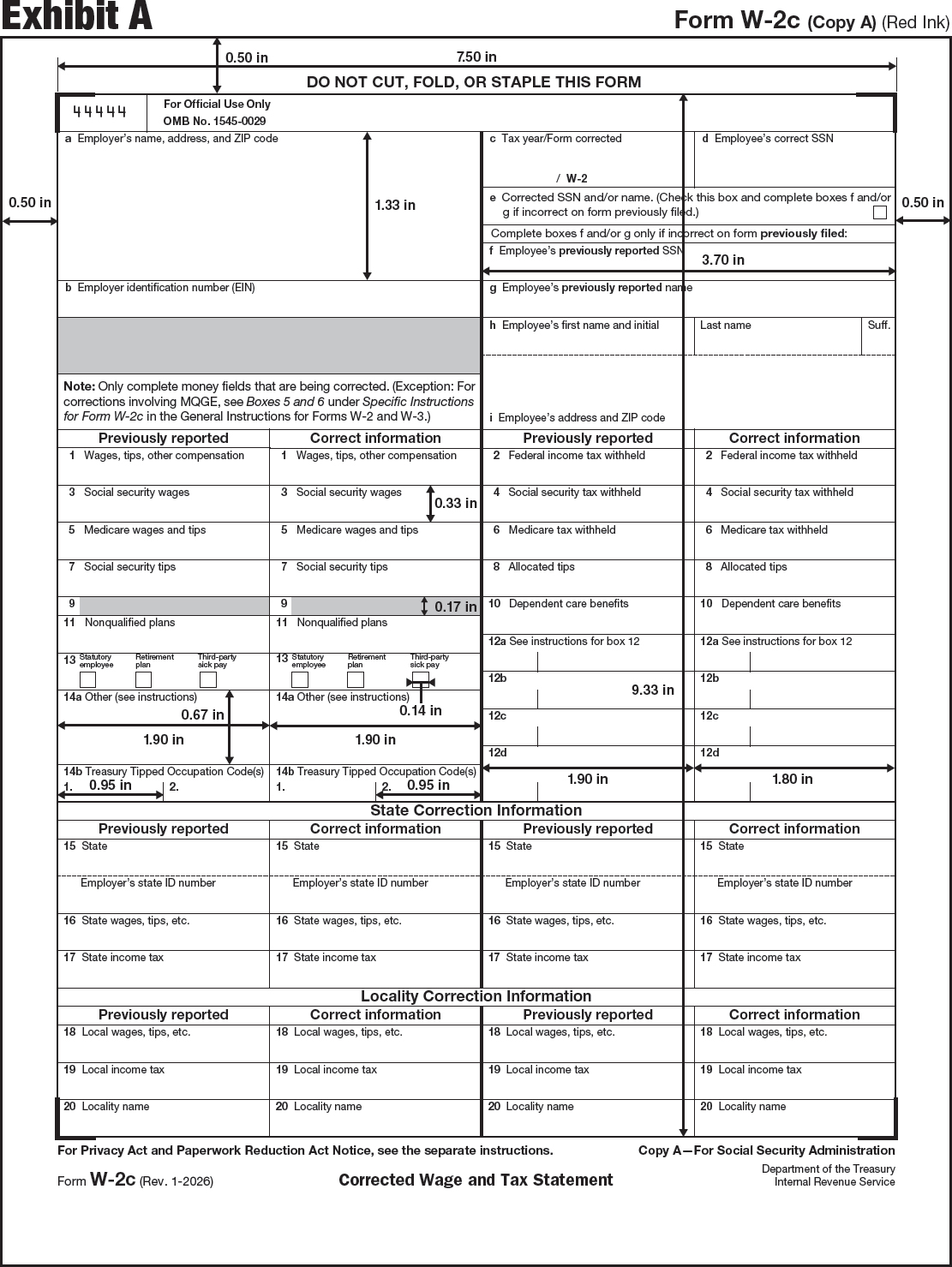
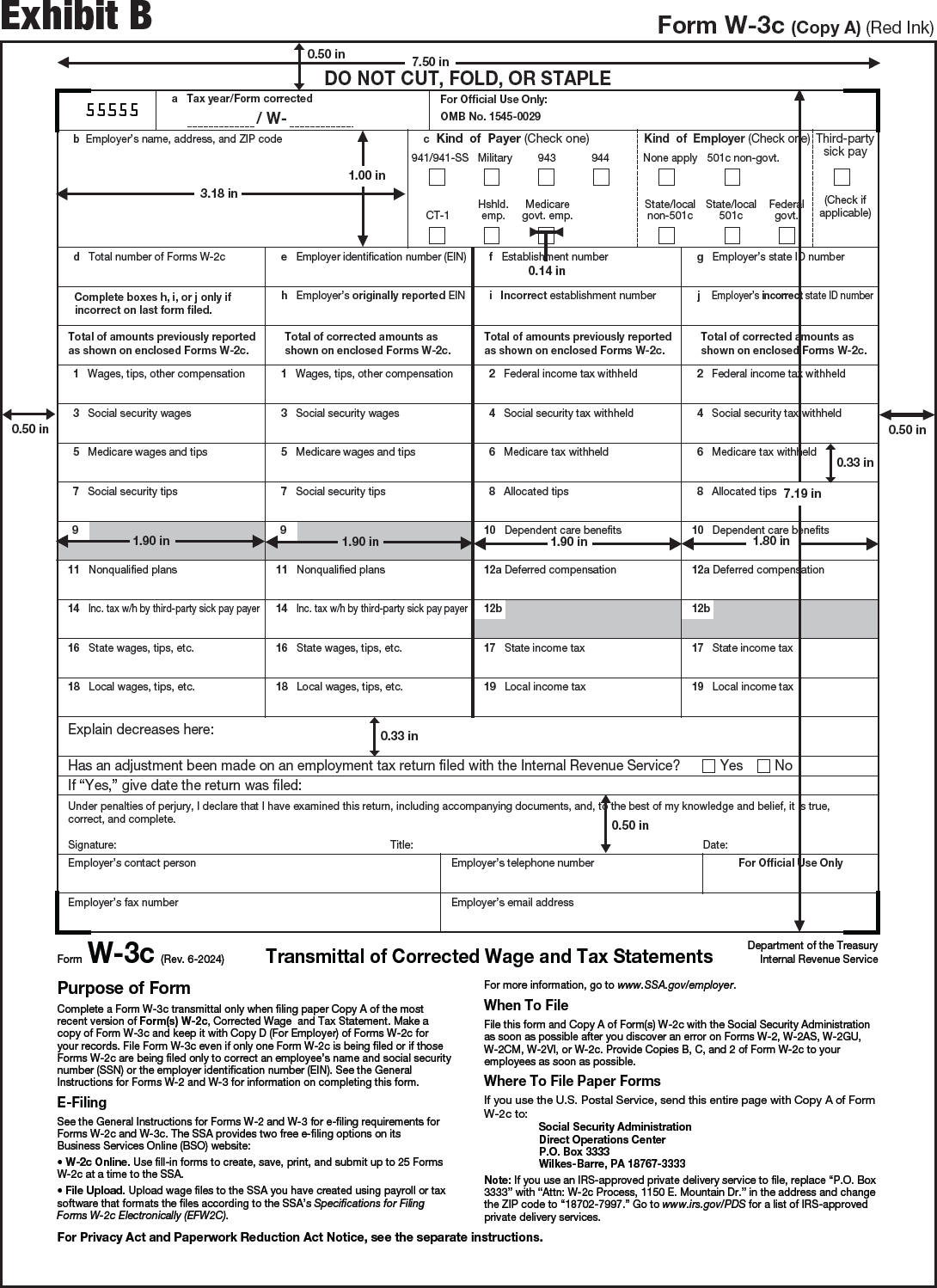
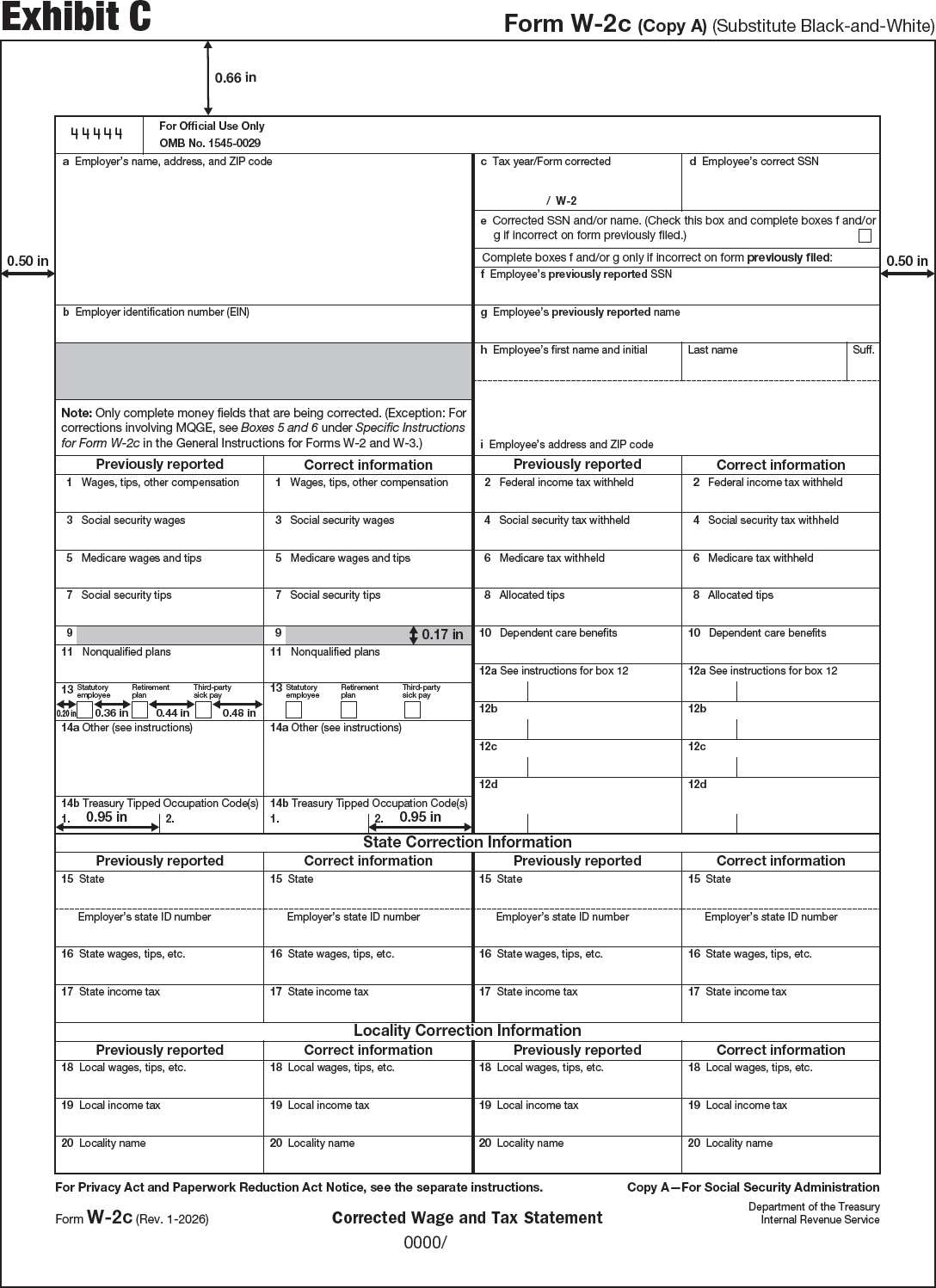
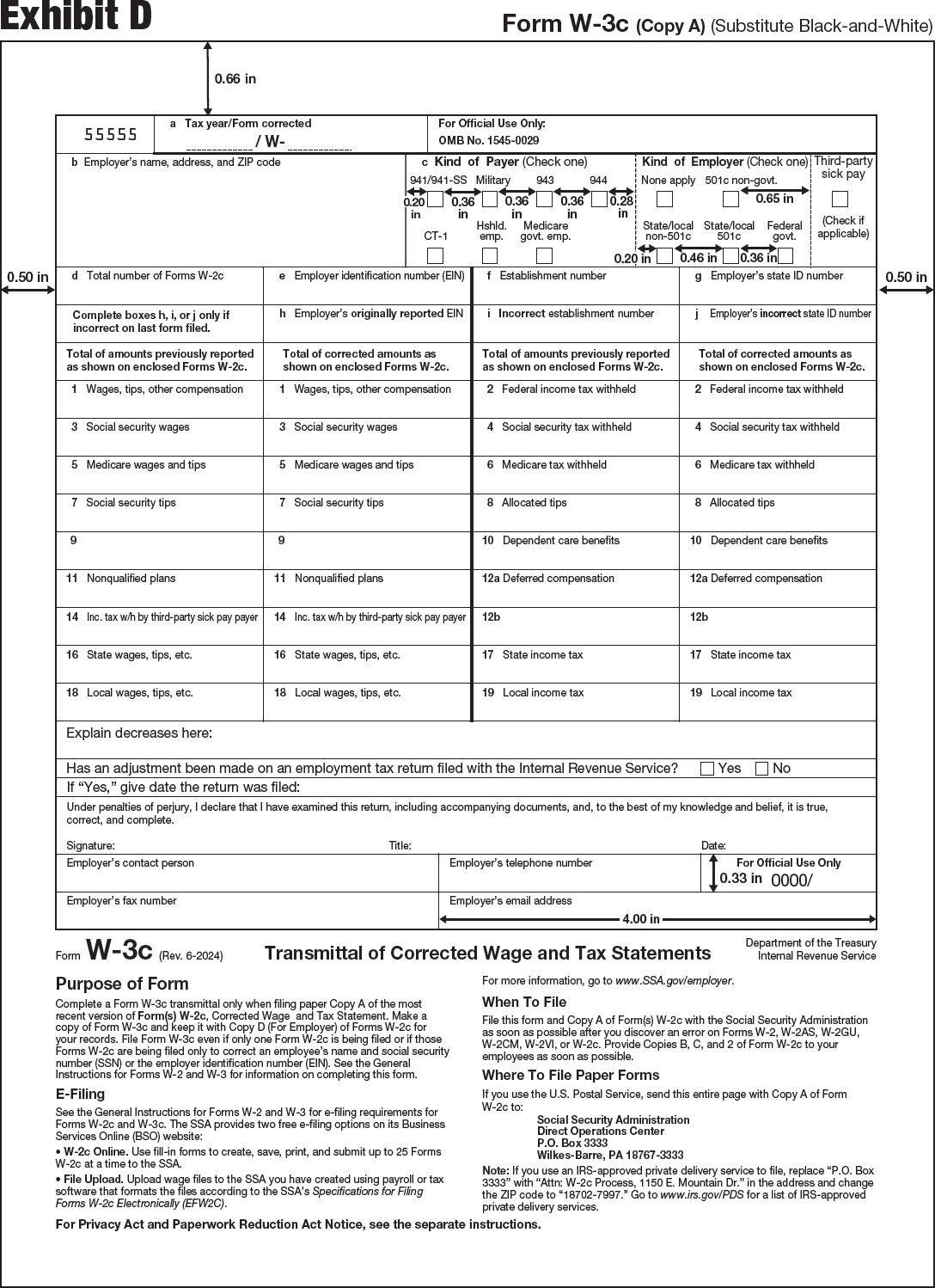
1 Unless otherwise specified, all references to “section” or “§” are references to sections of the Code or the Income Tax Regulations (26 CFR part 1).
2 Section 45Z(b)(1)(B)(i) provides that a transportation fuel’s emissions rate is based on the amount of lifecycle greenhouse gas (GHG) emissions (as described in § 211(o)(1)(H) of the Clean Air Act (42 U.S.C. 7545(o)(1)(H)), as in effect on August 16, 2022) for such fuel, expressed as kg of CO2e per mmBTU. See also § 45Z(d)(1)–(3).
3 Terms used in this notice have the same meaning as provided in § 45Z and the § 45Z NPRM.
4 The term “alternative fate” has the same meaning as in § 1.45V-4(f)(2)(i).
5 For purposes of this determination, an anaerobic digester is considered operational on the date at which the system begins capturing, productively using, and/or destroying biogas after an initial start-up period. The initial start-up period must not exceed nine months.
Revenue rulings and revenue procedures (hereinafter referred to as “rulings”) that have an effect on previous rulings use the following defined terms to describe the effect:
Amplified describes a situation where no change is being made in a prior published position, but the prior position is being extended to apply to a variation of the fact situation set forth therein. Thus, if an earlier ruling held that a principle applied to A, and the new ruling holds that the same principle also applies to B, the earlier ruling is amplified. (Compare with modified, below).
Clarified is used in those instances where the language in a prior ruling is being made clear because the language has caused, or may cause, some confusion. It is not used where a position in a prior ruling is being changed.
Distinguished describes a situation where a ruling mentions a previously published ruling and points out an essential difference between them.
Modified is used where the substance of a previously published position is being changed. Thus, if a prior ruling held that a principle applied to A but not to B, and the new ruling holds that it applies to both A and B, the prior ruling is modified because it corrects a published position. (Compare with amplified and clarified, above).
Obsoleted describes a previously published ruling that is not considered determinative with respect to future transactions. This term is most commonly used in a ruling that lists previously published rulings that are obsoleted because of changes in laws or regulations. A ruling may also be obsoleted because the substance has been included in regulations subsequently adopted.
Revoked describes situations where the position in the previously published ruling is not correct and the correct position is being stated in a new ruling.
Superseded describes a situation where the new ruling does nothing more than restate the substance and situation of a previously published ruling (or rulings). Thus, the term is used to republish under the 1986 Code and regulations the same position published under the 1939 Code and regulations. The term is also used when it is desired to republish in a single ruling a series of situations, names, etc., that were previously published over a period of time in separate rulings. If the new ruling does more than restate the substance of a prior ruling, a combination of terms is used. For example, modified and superseded describes a situation where the substance of a previously published ruling is being changed in part and is continued without change in part and it is desired to restate the valid portion of the previously published ruling in a new ruling that is self contained. In this case, the previously published ruling is first modified and then, as modified, is superseded.
Supplemented is used in situations in which a list, such as a list of the names of countries, is published in a ruling and that list is expanded by adding further names in subsequent rulings. After the original ruling has been supplemented several times, a new ruling may be published that includes the list in the original ruling and the additions, and supersedes all prior rulings in the series.
Suspended is used in rare situations to show that the previous published rulings will not be applied pending some future action such as the issuance of new or amended regulations, the outcome of cases in litigation, or the outcome of a Service study.
The following abbreviations in current use and formerly used will appear in material published in the Bulletin.
A—Individual.
Acq.—Acquiescence.
B—Individual.
BE—Beneficiary.
BK—Bank.
B.T.A.—Board of Tax Appeals.
C—Individual.
C.B.—Cumulative Bulletin.
CFR—Code of Federal Regulations.
CI—City.
COOP—Cooperative.
Ct.D.—Court Decision.
CY—County.
D—Decedent.
DC—Dummy Corporation.
DE—Donee.
Del. Order—Delegation Order.
DISC—Domestic International Sales Corporation.
DR—Donor.
E—Estate.
EE—Employee.
E.O.—Executive Order.
ER—Employer.
ERISA—Employee Retirement Income Security Act.
EX—Executor.
F—Fiduciary.
FC—Foreign Country.
FICA—Federal Insurance Contributions Act.
FISC—Foreign International Sales Company.
FPH—Foreign Personal Holding Company.
F.R.—Federal Register.
FUTA—Federal Unemployment Tax Act.
FX—Foreign corporation.
G.C.M.—Chief Counsel’s Memorandum.
GE—Grantee.
GP—General Partner.
GR—Grantor.
IC—Insurance Company.
I.R.B.—Internal Revenue Bulletin.
LE—Lessee.
LP—Limited Partner.
LR—Lessor.
M—Minor.
Nonacq.—Nonacquiescence.
O—Organization.
P—Parent Corporation.
PHC—Personal Holding Company.
PO—Possession of the U.S.
PR—Partner.
PRS—Partnership.
PTE—Prohibited Transaction Exemption.
Pub. L.—Public Law.
REIT—Real Estate Investment Trust.
Rev. Proc.—Revenue Procedure.
Rev. Rul.—Revenue Ruling.
S—Subsidiary.
S.P.R.—Statement of Procedural Rules.
Stat.—Statutes at Large.
T—Target Corporation.
T.C.—Tax Court.
T.D.—Treasury Decision.
TFE—Transferee.
TFR—Transferor.
T.I.R.—Technical Information Release.
TP—Taxpayer.
TR—Trust.
TT—Trustee.
U.S.C.—United States Code.
X—Corporation.
Y—Corporation.
Z—Corporation.
Bulletin 2026–41
Notices:
| Article | Issue | Link | Page |
|---|---|---|---|
| 2026-39 | 2026-27 I.R.B. | 2026-27 | 1 |
| 2026-38 | 2026-28 I.R.B. | 2026-28 | 30 |
| 2026-40 | 2026-28 I.R.B. | 2026-28 | 33 |
| 2026-41 | 2026-29 I.R.B. | 2026-29 | 39 |
| 2026-42 | 2026-29 I.R.B. | 2026-29 | 41 |
| 2026-43 | 2026-29 I.R.B. | 2026-29 | 42 |
| 2026-21 | 2026-30 I.R.B. | 2026-30 | 51 |
| 2026-44 | 2026-32 I.R.B. | 2026-32 | 143 |
| 2026-28 | 2026-34 I.R.B. | 2026-34 | 177 |
| 2026-46 | 2026-35 I.R.B. | 2026-35 | 182 |
| 2026-48 | 2026-35 I.R.B. | 2026-35 | 185 |
| 2026-49 | 2026-35 I.R.B. | 2026-35 | 198 |
| 2026-50 | 2026-36 I.R.B. | 2026-36 | 242 |
| 2026-51 | 2026-38 I.R.B. | 2026-38 | 314 |
| 2026-47 | 2026-41 I.R.B. | 2026-41 | 461 |
| 2026-53 | 2026-41 I.R.B. | 2026-41 | 462 |
Proposed Regulations:
| Article | Issue | Link | Page |
|---|---|---|---|
| REG-101355-26 | 2026-37 I.R.B. | 2026-37 | 249 |
| REG-103844-26 | 2026-37 I.R.B. | 2026-37 | 275 |
| REG-115145-25 | 2026-37 I.R.B. | 2026-37 | 298 |
| CC-00349938-26 | 2026-38 I.R.B. | 2026-38 | 317 |
| REG-107855-25 | 2026-38 I.R.B. | 2026-38 | 333 |
| REG-117130-25 | 2026-38 I.R.B. | 2026-38 | 343 |
| REG-119882-25 | 2026-38 I.R.B. | 2026-38 | 355 |
| REG-115646-25 | 2026-39 I.R.B. | 2026-39 | 414 |
| REG-119986-25 | 2026-39 I.R.B. | 2026-39 | 440 |
| REG-117273-25 | 2026-40 I.R.B. | 2026-40 | 450 |
Revenue Procedures:
| Article | Issue | Link | Page |
|---|---|---|---|
| 2026-25 | 2026-29 I.R.B. | 2026-29 | 45 |
| 2026-18 | 2026-30 I.R.B. | 2026-30 | 53 |
| 2026-26 | 2026-31 I.R.B. | 2026-31 | 131 |
| 2026-32 | 2026-32 I.R.B. | 2026-32 | 146 |
| 2026-28 | 2026-33 I.R.B. | 2026-33 | 175 |
| 2026-30 | 2026-35 I.R.B. | 2026-35 | 212 |
| 2026-32 | 2026-39 I.R.B. | 2026-39 | 406 |
| 2026-29 | 2026-41 I.R.B. | 2026-41 | 470 |
1 A cumulative list of all revenue rulings, revenue procedures, Treasury decisions, etc., published in Internal Revenue Bulletins 2026–27 through 2026–52 is in Internal Revenue Bulletin 2025–52, dated December 21, 2025.
The Introduction at the beginning of this issue describes the purpose and content of this publication. The weekly Internal Revenue Bulletins are available at www.irs.gov/irb/.
If you have comments concerning the format or production of the Internal Revenue Bulletin or suggestions for improving it, we would be pleased to hear from you. You can email us your suggestions or comments through the IRS Internet Home Page www.irs.gov) or write to the
Internal Revenue Service, Publishing Division, IRB Publishing Program Desk, 1111 Constitution Ave. NW, IR-6230 Washington, DC 20224.