


 )
or https:// means you've safely connected to the .gov website. Share sensitive information only on official, secure websites.
)
or https:// means you've safely connected to the .gov website. Share sensitive information only on official, secure websites.


- 3.17.21 Credit and Account Transfers
- 3.17.21.1 Program Scope and Objectives
- 3.17.21.1.1 Background
- 3.17.21.1.2 Authority
- 3.17.21.1.3 Roles and Responsibilities
- 3.17.21.1.4 Program Management and Review
- 3.17.21.1.4.1 Corrective Action Plan
- 3.17.21.1.4.2 Program Effectiveness
- 3.17.21.1.4.3 Annual IRM Clearance
- 3.17.21.1.4.4 Vulnerability Assessments
- 3.17.21.1.5 Program Controls
- 3.17.21.1.6 Terms and Acronyms
- 3.17.21.1.7 Related Resources
- 3.17.21.2 Credit and Account Transfers - Introduction
- 3.17.21.2.1 Transferring Master File Accounts (CP 96 and CP 296)
- 3.17.21.2.2 Transfer Between Master File and General Ledger Accounts
- 3.17.21.2.3 Master File Research
- 3.17.21.2.4 Record Retention
- 3.17.21.2.5 Pulling Error Register/Reject Register Reports from Control-D
- 3.17.21.3 Credit Transfers Between Campuses (Form 2158)
- 3.17.21.3.1 Credit Transfers - Posted Master File Credits
- 3.17.21.3.2 Preparing Form 2158
- 3.17.21.3.3 Credit Transfers - Losing Campus, other than Non-Master File (NMF)
- 3.17.21.3.4 Credit Transfers - Losing Campus, Non-Master File (NMF)
- 3.17.21.3.5 Credit Transfers - Receiving Campus, Non-Master File (NMF)
- 3.17.21.3.5.1 Subsequent Non-Master File (NMF) Payments
- 3.17.21.3.5.2 Prepaid Penalty Assessment (Kansas City Only)
- 3.17.21.4 Credit Transfers (Form 2424 and Form 3809)
- 3.17.21.4.1 Credit Transfers - General Information
- 3.17.21.4.2 Selecting Credit Transfer Documents
- 3.17.21.4.3 Preparing Form 2424 (DRT24)
- 3.17.21.4.4 Preparing Form 3809 (DRT48)
- 3.17.21.4.5 DLN Assignment and Control (Form 2424 and Form 3809)
- 3.17.21.4.5.1 Preparing Form 813
- 3.17.21.4.5.2 Numbering Form 2424 and Form 3809
- 3.17.21.5 Requests for Transfers to Other Campuses
- 3.17.21.5.1 Preparing Form 514-B
- 3.17.21.6 Account Transfers (Form 12810)
- 3.17.21.6.1 Account Transfers - General Information
- 3.17.21.6.2 Processing Account Transfers to the Master File (IMF/BMF)
- 3.17.21.6.3 Processing Account Transfers to the Individual Master File MFT 31
- 3.17.21.6.4 Transfers to Non-Master File (NMF)
- 3.17.21.6.5 Master File Overflow Accounts
- 3.17.21.6.6 Account Transfers-In
- 3.17.21.6.7 Account Re-Transfers
- 3.17.21.6.8 Closing Control
- 3.17.21.6.9 Requests to Reopen Accounts for Freeze Resolution (Kansas City Only)
- 3.17.21.7 Reestablishing Retention Register Accounts
- 3.17.21.7.1 Account Reactivation Requests
- 3.17.21.7.2 Reviewing Form 5248 Transfer Requests
- 3.17.21.7.3 Retention Register Microfilm (Form 3413 Input)
- 3.17.21.8 Preparing Form 3413
- 3.17.21.8.1 Form 3413, Section 01
- 3.17.21.8.2 Form 3413, Sections 02-19
- 3.17.21.8.2.1 Form 3413, Sections 02-19, Over 54 Transactions
- 3.17.21.8.3 Form 3413, Sections 20-23
- 3.17.21.8.4 Form 3413, Sections 30-33
- 3.17.21.8.5 Form 3413, Sections 36-39
- 3.17.21.8.6 Form 3413, Section 40
- 3.17.21.8.7 Form 3413 DLN Assignment and Control
- 3.17.21.9 Account Adjustment Requests
- 3.17.21.9.1 Parent-Subsidiary Cases
- 3.17.21.9.1.1 Transferring Credits
- 3.17.21.9.1.2 Credit Verification
- 3.17.21.9.2 Short Period Form 1120
- 3.17.21.9.3 Form 1120 and Form 1041 Manual Refunds
- 3.17.21.9.1 Parent-Subsidiary Cases
- 3.17.21.10 Correcting Erroneous IRC Section 6603 Deposits
- 3.17.21.11 IRC Section 847 Special Estimated Tax Payment
- 3.17.21.12 Nullified Unpostables
- 3.17.21.13 Assigning a Document Locator Number (DLN)
- 3.17.21.13.1 Numbering Form 3413
- 3.17.21.13.2 Numbering Form 2158
- 3.17.21.13.3 Numbering Form 3177
- 3.17.21.13.4 Numbering Form 514-B
- 3.17.21.13.5 Numbering Form 2424
- 3.17.21.13.6 Numbering Form 3809
- 3.17.21.14 Service Center Control File (SCCF)
- 3.17.21.15 Taxpayer Advocate Service Procedures, National Service Level Agreement (SLA)
- Exhibit 3.17.21-1 Abstract Numbers Table
- Exhibit 3.17.21-2 Blocking Series Tables
- Exhibit 3.17.21-3 Reversal Transaction Codes
- Exhibit 3.17.21-4 Non-Master File (NMF) Status Determination Table
- Exhibit 3.17.21-5 Valid BMF Transaction Codes
- Exhibit 3.17.21-6 Valid IMF Transaction Codes
- Exhibit 3.17.21-7 Transaction Code Conversion Table (MF to NMF)
- Exhibit 3.17.21-8 Tax Return Information Table
- Exhibit 3.17.21-9 Campus Codes
- 3.17.21.1 Program Scope and Objectives
Part 3. Submission Processing
Chapter 17. Accounting and Data Control
Section 21. Credit and Account Transfers
3.17.21 Credit and Account Transfers
Manual Transmittal
September 01, 2026
Purpose
(1) This transmits revised IRM 3.17.21, Accounting and Data Control, Credit and Account Transfers.
Material Changes
(1) IRM 3.17.21.1.1, Background - Removed account transfer ASED instructions that don’t belong in this subsection. Moved to IRM 3.17.21.6, Master File Account Transfers-Out.
(2) IRM 3.17.21.1.2, Authority - Added new subsection listing the Internal Revenue Codes (IRC) and legislative acts referenced throughout the section. Renumbered subsequent IRM 3.17.21.1 subsections.
(3) IRM 3.17.21.1.3, Roles and Responsibilities - Added paragraph for Austin credit and account transfers.
(4) IRM 3.17.21.1.5, Program Controls - New subsection for compliance with updates to IRM 1.11.2, Internal Management Documents System, Internal Revenue Manual Process. This subsection is a modified copy of similar subsections found in other Accounting and Data Control IRMs and applicable paragraphs moved from other subsections in this IRM.
(5) IRM 3.17.21.1.6, Terms and Acronyms - Updated list and clarified some definitions.
(6) IRM 3.17.21.1.7, Related Resources - Added more IRM references and a link to Document 6209.
(7) IRM 3.17.21.2 (2), Credit and Account Transfers - Introduction - Updated the six workday processing timeframe to clarify the appropriate start and end times for credit and account transfer forms. Also made updates throughout the section to every other reference to the six workday timeframes for consistency.
(8) IRM 3.17.21.2.1, Transferring Master File Accounts (CP 96 and CP 296):
- Paragraph (1) - Expanded the instructions to include specific REQ77 inputs.
- Paragraph (2)c - Updated routing instructions from Batching to RACS.
- Paragraph (3) - Rewrote paragraph as informational rather than instructional, since it describes RACS actions. Added reference to RACS IRM.
(9) IRM 3.17.21.2.2 (2), Transfer Between Master File and General Ledger Accounts - Rewrote paragraph as informational rather than instructional, since it describes RACS actions. Added reference to RACS IRM.
(10) IRM 3.17.21.2.3 (2)(3), Master File Research - Deleted and moved paragraphs to IRM 3.17.21.1.5, Program Controls, as paragraphs (5) and (6).
(11) IRM 3.17.21.2.4, Notice Issuance Criteria in Integrated Data Retrieval System (IDRS) - Deleted entire subsection and moved the information to the new Program Controls subsection as paragraph (9) for consistency with other IRM sections.
(12) IRM 3.17.21.2.5, Pulling Error Register/Reject Register Reports from Control-D - IPU 26U0079 issued 01-14-2026 - New subsection providing Accounting with instructions to pull error/reject register reports from Control-D for research.
(13) IRM 3.17.21.3.1 (3), Credit Transfers - Posted Master File Credits - Removed reference to shipping with Form 3210 in favor of sending Form 2424 through email.
(14) IRM 3.17.21.3.3 Credit Transfers - Losing Campus, Other than Non-Master File (NMF) - IPU 26U0304 issued 03-11-2026:
- Paragraph (2) - Added instructions to use Form 9814 for consistency with other IRM 3.17.21.3 subsections.
- Paragraph (5) - Replaced Alert me instructions with steps to use the new Automate option.
(15) IRM 3.17.21.3.4, Credit Transfers - Losing Campus, Non-Master File (NMF):
- Paragraph (3) - Clarified Form 2158 package required documentation.
- Paragraph (5) - Added instructions to email KCSPC to confirm shipment tracking for Form 2158.
- Paragraph (9) - IPU 26U0079 issued 01-14-2026 - Corrected the name of the mailbox to reflect KCSPC instead of OSPC; the hyperlink still directed to the KCSPC mailbox as intended.
(16) IRM 3.17.21.3.5 (1), Credit Transfers - Receiving Campus, Non-Master File (NMF) - Clarified Form 2158 package required documentation.
(17) IRM 3.17.21.3.5.1, Subsequent Non-Master File (NMF) Payments:
- Paragraph (4) - Updated acceptable supporting documents to include the original NMF return if the NMF transcript is unavailable. Also added a caution note about NMF screen prints. The screen prints must show the correct MFT and tax period of the payment.
- Paragraph (8) - IPU 26U0304 issued 03-11-2026 - Replaced "Alert me" instructions with steps to use the new "Automate" option.
(18) IRM 3.17.21.4.4 (2), Preparing Form 3809 (DRT48) - Replaced the subsection cited in this paragraph with a more applicable one.
(19) IRM 3.17.21.5, Requests for Transfers to Other Campuses:
- Paragraph (1) - Clarified when to use Form 514-B to supplement other subsection instructions that specifically say to use another form in lieu of Form 514-B for faster processing.
- Paragraph (2) - Added rejection instructions for Examination requests without a front-page copy of the return. Also removed obsolete reference to the Index File and NMF accounts falling off.
- Removed references to obsolete Form 2650.
(20) IRM 3.17.21.5.1 (5), Preparing Form 514-B - Clarified TC 131 instructions and added an IRM reference for more information.
(21) IRM 3.17.21.6, Master File Account Transfers-Out:
- Paragraph (4) - Added manager/lead signature requirement, previously not said until the following subsection. Also updated the instructions to require a digital signature.
- Paragraph (5) - Added instructions for working suspended CSED cases.
- Paragraph (6) - Added the ASED instructions for MF to MF and MF to NMF account transfers removed from IRM 3.17.21.1.1, Background, and updated to require the requestor to refer to HQ if exception criteria applies instead of to the team. Also added clarification for processing with a blank ASED.
- Paragraph (7) - Removed redundant list of freeze codes that may remain on the account and formatted the list of codes originators must resolve.
- Paragraph (7) Note - Deleted, included more concisely in paragraph (7) verbiage to reject all requests with the following freeze codes.
- Paragraph (7) Exceptions - Updated to specify MF to MF transfers requesting TC 402, to avoid returns transferring to NMF with unresolved -W freezes.
- Paragraph (9) - Added instructions to clarify procedures for requests to transfer zero-dollar amount TCs.
- Paragraph (10) - Added more reject criteria from other subsections to provide more comprehensive general information.
- Paragraph (18) - Consolidated IA and IDT expediting procedures and replaced instruction to "expedite" with instruction to treat these requests as higher priority for immediate processing upon discovery.
- Paragraph (18a) - Removed reference to Form 3210 since it isn’t IDT cases aren’t currently received with it.
- Clarified several paragraphs for which instructions did not specify procedures between "From" and "To" sides.
(22) IRM 3.17.21.6.1, Account Transfers-Out - General Information - Added new informational subsection to provide more clarification for complete and partial account transfers. Renumbered subsections 3.17.21.6.1 through 3.17.21.6.8.
(23) IRM 3.17.21.6.2, Processing Account Transfers to the Master File (IMF/BMF):
- Removed note about Form 514-B because the subsection doesn’t provide any Form 514-B instructions to begin with.
- Paragraph (1) - Added AM and IDTVA as areas requests are received from.
- Paragraph (2) - Removed eFax as a rejection method. These requests should always be rejected through email.
- Paragraph (2)e - Added TC 849 and TC 898 to the caution note. Also updated other references to the list of codes to match throughout the section.
- Paragraph (3) - Added instructions to restore the MFR to 08 after completing a transfer that requires changing it to 05.
- Paragraph (4) and (5) - Added clarifying information about “merged/resequenced” IDRS literals and instructions for these requests.
- Paragraph (8) Step 1 - Added more specific detail for history sheet requirements and specified the case file should be created and updated from receipt throughout the process.
- Paragraph (8) Step 2- Removed incorrect ACTON exception. Employees can open the control base.
- Paragraph (8) Step 3- Added information for research and instructions for the "TXMOD WORKUP" and "TAPE" documents.
- Paragraph (8) Step 12 - Specified employees should create the package for the lead or a designated employee to send all account transfers for the same cycle together.
- Paragraph (8) Step 13 - Removed suspense instructions. Cases are monitored, not suspended.
(24) IRM 3.17.21.6.3 (2), Processing Account Transfers to the Individual Master File MFT 31 - Removed reference to Form 514-B because it’s only used for transfers to NMF, not to MFT 31.
(25) IRM 3.17.21.6.4, Transfers to Non-Master File (NMF):
- Paragraph (1) - Added AM and IDTVA as areas requests are received from.
- Paragraph (1)c - Added a caution note clarifying when HQ approval is needed for partial account transfers and account transfers to NMF MFT 20.
- Paragraph (2) - Copied list items from IRM 3.17.21.6.2 (2) to this section to form a more complete list of criteria.
- Paragraph (3)b - Corrected this reference to include the G- freeze for consistency with IRM 3.17.21.6.2.
- Paragraph (5) - New paragraph adding a reminder to not post TC 402 and reversals to MF when processing a complete account transfer from MF to NMF.
- Paragraph (14) - Removed suspense instructions. Cases are monitored, not suspended.
(26) IRM 3.17.21.6.5, Master File Overflow Accounts - Deleted the paragraph above paragraph (13) (formerly paragraphs 15 and 16), because it restated the same information from paragraph (9).
- Paragraph (5) - Added instructions to combine assessments with the same 23C date onto one CP notice.
(27) IRM 3.17.21.6.6, Account Transfers-In:
- Deleted old paragraph (2), which was redundant because form references already hyperlink to their source. Incorporated list items into paragraph (1).
- Paragraph (1)a - Added instructions to complete the name, date, and telephone number fields when preparing Form 3413.
(28) IRM 3.17.21.6.7 (2)c, Account Re-Transfers - Added an IRM reference for identifying AM06W transcripts.
(29) IRM 3.17.21.6.8, Closing Control - Replaced obsolete paper procedures with instructions for electronic processing because case closure and the case file are largely electronic in the current process.
(30) IRM 3.17.21.6.9, Requests to Reopen Accounts for Freeze Resolution (Kansas City Only) - IPU 26U0304 issued 03-11-2026 - New subsection for reopening modules after an account transfer to resolve open freeze issues. This is updated since the IPU to add instructions for applying these procedures to Erroneous Refund -U freeze issues.
(31) IRM 3.17.21.7.1, Account Reactivation Requests - Deleted paragraph for rejection instructions because the information is duplicated in the next subsection and more applicable there. Also deleted instructions not applicable to Special Services.
(32) IRM 3.17.21.7.2, Reviewing Form 5248 Transfer Requests - Clarified rejection criteria and removed instructions to establish the entity as that is the originator’s responsibility.
(33) IRM 3.17.21.7.3 Retention Register Microfilm (Form 3413 Input):
- Paragraph (3) - Updated the requirement for the projected posting cycle to provide a more accurate timeframe.
- Paragraph (6) - Added subsection reference to assign the DLN. Removed instructions not applicable to Special Services.
(34) IRM 3.17.21.8.1, Form 3413, Section 01:
- Paragraph (1) - Added instructions for name, date, and telephone number fields. Replaced bracketing instructions with instructions to use a minus symbol for negatives. Added instructions for MFT 17 TIN input and TIN type with a supporting IRM citation. Clarified that box I, transfer-in amount, auto-populates and should add up to the TC 400 amount.
- Paragraph (2) - Updated TC 150 input instructions to use the TC 290/TC 300 date instead of the current date.
(35) IRM 3.17.21.8.2, Form 3413, Section 02-19:
- Paragraph (1)a - Clarified valid input fields on Form 3413 and linked to a related exhibit.
- Paragraph (1)f - Added instructions to always list reversal TCs after the TC they reversed.
- Paragraph (1)f Note - Added clarification to check for other invalid TCs.
- Paragraph (4) - Replaced outdated table for determining TC dates with instruction to take the date from CC TXMOD. Also replaced bracketing instructions with instructions to use a minus symbol for negatives.
- Paragraph (4)c - Added instructions for using TC 170 .00 on the "From" side to prevent systemic postings after a transfer.
(36) IRM 3.17.21.8.3 (4), Form 3413, Sections 20-23 - Replaced bracketing instructions with instructions to use a minus symbol for negatives.
(37) IRM 3.17.21.8.4, Form 3413, Sections 30-33:
- Paragraph (1) - Added clarification for the need to include the statute extension date for TC 460 with Doc Code 51. Also updated the list of transactions requiring a date for consistency with current programming.
- Paragraph (1) - Added a caution for requests to input the CSED from TC 520.
(38) IRM 3.17.21.8.5 (6), Form 3413, Sections 36-39 - Replaced the list of abstract numbers with a link to the exhibit with the same information.
(39) IRM 3.17.21.8.6 (2), Section 40 - Added more information for Section 40 fields and changed the list to a table.
(40) IRM 3.17.21.9.1, Parent-Subsidiary Cases - IPU 26U0079 issued 01-14-2026 - Updated outdated line number references to current line numbers and removed outdated references to Form 2439. Includes other editorial updates.
(41) IRM 3.17.21.9.1.1 (6), Transferring Credits - Replaced "hand carry" procedure with email process for electronic referral.
(42) IRM 3.17.21.11 (4), IRC Section 847 Special Estimated Tax Payment - Replaced naked mailbox link with a hyperlink.
(43) IRM 3.17.21.12, Nullified Unpostables - Added a paragraph defining the term and explaining how to identify them.
(44) IRM 3.17.21.13.4 (2), Numbering Form 514-B - Corrected outdated Cincinnati file location codes (FLC) to Kansas City.
(45) 3.17.21.13.5, Numbering Form 2424:
- Paragraph (2) - Corrected outdated Cincinnati FLC to Kansas City.
- Paragraph (3) - Replaced list of valid TC codes with a link to a chart with the same codes in a better format.
(46) IRM 3.17.21.13.6 (3), Numbering Form 3809 - Updated table MFT and tax class info to match current programming.
(47) IRM 3.17.21.14 (2), Service Center Control File (SCCF) - IPU 26U0304 issued 03-11-2026 - Replaced the specific IRM reference with a more general one because the information has since moved to other areas of the referenced section.
(48) Exhibit 3.17.21-1, Abstract Numbers Table - Updated table data to match current programming.
(49) Exhibit 3.17.21-5, Valid BMF Transaction Codes - Updated table data to match current programming.
(50) Exhibit 3.17.21-6, Valid IMF Transaction Codes - Reformatted the table to order by Form 3413 section number for consistency with Exhibit 3.17.21-5, Valid BMF Transaction Codes. Also updated table data to match current programming. Added a paragraph clarifying valid TCs for PRN 786 through PRN 792.
(51) Exhibit 3.17.21-8, Tax Return Information Table - Updated valid tax periods to match current programming.
(52) Section-wide rewrites for plain writing, Section 508 compliance, consistency with the IRM and IRS style guides, and recent updates to IRM 1.11.2, Internal Management Documents System, Internal Revenue Manual Process. This makes many changes to how the section presents information, but instructions are the same except as noted in the preceding material changes. Editorial changes include:
- Converting entire section to present tense and active voice, with limited exceptions.
- Simplifying word choice.
- Moving and reformatting information for readability (such as adding and restructuring tables, separating or consolidating paragraphs, and rearranging content within the subsection).
- Correcting grammar and typographical errors.
- Adjusting redundant verbiage for consistency (such as replacing uses of "requestor" and "originator" with the same meaning to just "originator" ).
- Replacing paper verbiage with electronic verbiage where applicable (such as changing "write" and "stamp" to "annotate" ).
- Filling blank cells in all tables to improve readability for users relying on assistive technologies like screen readers.
Effect on Other Documents
IRM 3.17.21, Accounting and Data Control, Credit and Account Transfers, dated March 11, 2026 (effective October 01, 2025) is superseded. This IRM incorporates IRM Procedural Update (IPU) 26U0079 issued January 14, 2026 and IPU 26U0304, issued March 11, 2026.
Audience
All Taxpayer Services Submission Processing Campuses
Effective Date
(10-01-2026)
Scott Wallace
Director, Submission Processing
Taxpayer Services
- Purpose: This IRM provides instructions for Submission Processing, Accounting Function employees who process adjustments and manually transfer accounts and credits.
- Audience: Submission Processing, Accounting Operations.
- Policy Owner: The Director, Submission Processing.
- Program Owner: Submission Processing Accounting and Deposit Section.
- Primary Stakeholders: The primary stakeholders are Accounts Management (AM) and Return Integrity and Compliance Services (RICS).
- The credit and account transfer procedures within the IRM are a process to manually transfer erroneously posted credits or accounts posted to Master File (MF).
The following sources provide authority for procedures in this IRM as described in the relevant subsections:
- Taxpayer Services (TS) Commissioner: Has overall responsibility for policy related to this IRM as annually published.
- Team managers: Ensure employees receive proper training to effectively process all requests.
- Employees: Process all requests using IRM guidelines and review requests for accuracy and completeness.
- Credit and Account Transfers team (transfer team) employees receive requests for account adjustments, parent/subsidiary credit applications, retention register account reactivations, and other transfers. Other campus functions often adjust accounts directly on IDRS.
Kansas City Submission Processing Campus (KCSPC) processes all credit and account transfers for:
- Kansas City
- Andover
- Atlanta
- Fresno
- Non-Master File (NMF)
Ogden Submission Processing Campus (OSPC) processes all credit and account transfers for:
- Ogden
- Philadelphia
- Cincinnati
- Brookhaven
- Memphis
- Form 8288
- Austin Submission Processing Campus (AUSPC) processes credit and account transfer requests only for Austin.
- Program Reviews are mission critical to Accounting and Deposit programs. They ensure general ledger (GL) account integrity and correct financial statements.
- Each function must conduct operations with emphasis on mitigating risks, identifying best practices, and following IRM requirements.
- Objectively assessing program compliance, including all applicable procedures and guidelines, ensures adequate internal controls.
- A program review ensures actions follow IRM procedures. Submission Processing (SP), Headquarters (HQ), Accounting and Deposit Section conducts program reviews to verify compliance with IRM requirements, address Treasury Inspector General for Tax Administration (TIGTA)/Government Accountability Office (GAO) findings, identify risks to internal controls, address error trends, and evaluate training needs, as needed.
Reviews ensure IRM procedures are applicable, adequate, and follow Department of the Treasury and/or IRS guidelines.
- HQ plans and conducts program reviews based on business needs and priorities.
- The reviewer notifies SP campus leadership in advance.
- Reviews evaluate program delivery and compliance with administrative and/or IRM requirements.
- The program review summary report outlines observations and recommendations for program guidance, corrective actions, and/or mitigation strategies.
- The reviewer prepares a high-level overview memorandum. The section senior approves and forwards it to the SP Director and Field Director for signature.
- Functional areas retain a copy of the report and all applicable supporting documentation in a centralized location.
- Corrective Action Plans resolve noncompliance with IRM requirements with a plan to correct the responsible condition(s).
- Effective Corrective Action Plans identify the root cause of problems to limit or stop their recurrence.
- Corrective actions promote program improvement when properly developed, implemented, managed, and monitored.
- The program review process requires functional areas to provide a written Corrective Action Plan responding to recommendations within 30 days of receiving the program review summary report.
The Corrective Action Plan must include:
- Date of review
- Program reviewed
- Recommendation/risk identified
- Corrective action
- Completion date
- The reviewer and functional areas retain copies of the Corrective Action Plan to document the noncompliance and its resolution.
- Submission Processing Headquarters, Accounting and Deposit Section, follows up to provide support and ensure functional areas take the corrective actions.
- Program effectiveness includes conducting reviews and analysis to identify material or significant deficiencies that may adversely harm IRS audits and/or financial statements.
- These reviews ensure Submission Processing conducts business per governing IRMs. They find potential internal control deficiencies that may harm GL account integrity and/or financial reporting.
- This IRM updates and publishes annually after affected stakeholders review and concur per IRM 1.11.9, Internal Management Documents, Clearing and Approving Internal Management Documents (IMDs).
- Functional areas review this IRM annually to ensure accuracy and consistency, and to promote effective program administration.
- A vulnerability assessment identifies, quantifies, and prioritizes the vulnerabilities of government programs and assets including systems/technology, property, funds, and employees.
Vulnerability assessments apply to any business process to assess the risks of business failure and/or weakness from internal or external factors.
Note:
Local leadership should perform operational reviews to evaluate program delivery and encourage conformance with the IRM.
Federal Government Accounting Requirements, 31 United States Code (USC) 3512, places the responsibility for establishing and maintaining adequate systems of accounting and internal control upon the head of each executive agency and states that the head of each executive agency will establish and maintain systems of accounting and internal control that provide:
- Full disclosure of the financial results of the agency’s activities.
- Adequate financial information needed for the agency's management purposes.
- Effective control over accountability for all funds, property and other assets for which the agency is responsible, including appropriate internal audit.
- Reliable accounting results serving as the basis for preparation and support of budget requests, controlling the execution of its budget and providing financial information required by the President or other designated authority.
- Suitable integration of the agency’s accounting with Treasury’s accounting in connection with the central accounting and reporting responsibilities imposed by the Secretary of the Treasury.
- These systems must conform to the accounting principles, standards, and related requirements, as prescribed by the Comptroller General of the United States (U.S.). These are reflected in the Government Accountability Office Policy and Procedures Manual for Guidance of Federal Agencies.
- The accounting system of an executive agency or any of its parts is subject to review and approval by the Comptroller General. The continuing efforts to improve, modernize and simplify accounting systems in the federal government are exercised under a joint program sponsored by the Comptroller General, the Secretary of the Treasury and the Director of Office of Management and Budget (OMB). This program contemplates the full development of sound accounting within each executive agency as a working arm of management and in terms of financial information and control. It envisions an integrated pattern of accounting and financial reporting for the government that is responsive to executive and legislative needs.
- The established accounting and reporting principles, standards and basic procedures take into consideration the various areas of responsibility involved, the elimination of overlapping operations and paperwork and the broader application of efficient methods and techniques in accounting operations throughout the government.
- Campus officials and managers must communicate security standards to subordinate employees and establish enforcement methods. Employees must take required precautions in providing security for the documentation, information, and property they handle in performing official duties.
- Employees must access only tax modules on IDRS required for official duties. IDRS records all accesses for immediate review and to determine the accuracy of an adjustment. Employees are subject to disciplinary actions and/or dismissal from the IRS for any unauthorized access or browsing of tax modules for personal curiosity or fraud.
- Sensitive But Unclassified (SBU) data including Personally Identifiable Information (PII) and tax information, must be protected with encryption and/or access controls, limiting access only to approved personnel with a need to know. See IRM 10.5.1, Privacy and Information Protection, Privacy Policy, for guidance on protecting and safeguarding the privacy of SBU data regardless of its format and when transmitting through email or Enterprise Electronic Fax (EEFax) system. Any loss of PII could result in compromised information and identity theft. Employees who suspect or know of potential information loss must report it to their manager and to TIGTA at 1-800-366-4484.
- The Disclosure and Privacy Knowledge Base SharePoint site and IRM 3.0.167.4.1, Losses and Shortages, Remittance Security Coordinator, provide information about Privacy, Governmental Liaison and Disclosure (PGLD) programs and how to report losses, thefts, or disclosures of sensitive data.
- All employees must know IDRS notice issuance criteria. Inputting IDRS CC STAUP with an appropriate delay, and subsequent extensions if needed, interrupts routine notice issuance if transfer action can’t complete before next notice issuance.
The following table lists the most common terms and acronyms in this IRM:
Acronym/Term Definition ANMF Automated Non-Master File BMF Business Master File CP Notice Computer Paragraph Notice CSED Collection Statute Expiration Date DLN Document Locator Number - 11 or 14-digit number assigned to all documents in pipeline processing. IDRS Integrated Data Retrieval System IMF Individual Master File IRC Internal Revenue Code Julian Date Three-digit number matching the day of the year. Digits 6-8 of the DLN. MCC Martinsburg Computing Center MF Master File MFT Code Master File Tax Code Name Control IMF: The first four characters of the taxpayer’s surname.
BMF: The first four characters of the business name (except The if the business name exceeds two words).NMF Non-Master File RACS Revenue Accounting Control System RRACS Redesigned Revenue Accounting Control System RS Reconciliation Sheet SCCF Service Center Control File TIN Taxpayer Identification Number: Nine-digit number assigned to a taxpayer. Required on all forms, returns, and documents received for processing. Transaction Date The received date: Required on revenue receipt documents (such as Form 2424) XSF Excess Collection File
- This subsection references other IRMs with instructions to properly perform this IRM’s procedures. Management must keep a copy of each IRM referenced. Management may also provide copies to each employee at their discretion.
Use the following IRMs in conjunction with this IRM and refer to them when clarification is necessary:
- IRM 2.4.17, IDRS Terminal Input
- IRM 3.10.72, Receiving, Extracting, and Sorting
- IRM 3.11.10, Revenue Receipts
- IRM 3.12.21, Error Resolution - Credit and Account Transfers
- IRM 3.13.122, Individual Master File (IMF) Entity Control Unpostables
- IRM 3.13.222, BMF Entity Unpostable Correction Procedures
- IRM 3.17.10, Dishonored Check File (DCF) and Unidentified Remittance File (URF)
- IRM 3.17.46, Automated Non-Master File Accounting
- IRM 3.17.220, Excess Collections File (XSF)
- IRM 3.30.123, Processing Timeliness: Cycles, Criteria, and Critical Dates
- IRM 4.4.3, Credit Transfers and Reprocessing Returns Adjustments
- IRM 5.9.17, Bankruptcy and Other Insolvencies - Closing a Bankruptcy Case (MFT 31 transfers)
- IRM 21.6.2, Adjusting TIN-Related Problems
- Document 6209, IRS Processing Codes and Information
- The following subsections describe the types of transfers this IRM covers.
Process all credit and account transfer requests within six workdays from receipt as follows:
- Credit transfers: The six workday timeframe for credit transfers is six business days starting the day Accounting receives the credit transfer request and ending when Accounting either rejects the request if appropriate or sends it to RACS for journaling.
- Account transfers: The six workday timeframe for account transfers is six business days starting the day Accounting receives the account transfer request and ending when Accounting either rejects the request if appropriate or inputs the TC 400 with REQ77.
- See IRM 3.30.123, Work Planning and Control - Processing Timeliness: Cycles, Criteria and Critical Dates, for more information.
- Submit IRM deviations in writing following instructions from IRM 1.11.2.2, Internal Management Documents System - Internal Revenue Manual (IRM) Process, IRM Standards, and elevate through proper channels for executive approval.
- Forward the case to a manager if the Integrated Data Retrieval System (IDRS) shows, "Unauthorized Access to This Account." The manager notifies the local Planning & Analysis (P&A) Staff. P&A scans the case and sends it encrypted to the ≡ ≡ ≡ ≡ ≡ ≡ mailbox to request account access. The manager keeps the original case in a file awaiting access (up to five business days). Work the case following applicable procedures once granted access.
Complete all initial research before transferring a Master File (MF) account on IDRS. Then, transfer using CC REQ77 with the following inputs for each field:
- TC: 971
- FLC: The appropriate file location code (FLC) for the campus. See IRM 3.17.21.6 (13), Account Transfers (Form 12810)
- TRANS-DT: The current date
- TC971-CD: 045 (Individual Master File (IMF)) or 745 (Business Master File (BMF))
- Remarks (row 14): "NSD TC 400 TO POST"
The TC 400 generates Computer Paragraph (CP) Notice CP 96 or CP 296, Account Transfer Out Transcript Notice, with the account balance. Input into the Non-Master File (NMF) suspense account from the generated campus recap, and the NMF Service Center Control File (SCCF) with a dummy Form 813, Document Register.
- Prepare Form 3413, Transcription List, to transfer the account back to the MF.
- Receive CP 96 (IMF) or CP 296 (BMF) with Form 3413 and Form 813.
- Forward Form 3413 and original Form 813 to RACS to journal.
- RACS inputs from individual Form 813, one at a time, or from Form 8166, Revenue Accounting Control System (RACS) Input Reconciliation Sheet, and annotates the journal number on documents as needed. If using individual Form 813, RACS inputs the Document Locator Number (DLN) for audit trail. If using Form 8166, RACS uses the Reconciliation Sheet (RS) number. See IRM 3.17.64, Accounting Control General Ledger Policies and Procedures, for more detailed information.
- Credit transfers also include transfer from an MF account to a general ledger (GL) account, or the other way around. If using Form 3809, Miscellaneous Adjustment Voucher, don’t number the debit or credit going to the GL account with a separate DLN.
- RACS inputs from individual Form 813 and documents for GL accounts, or from Form 8166, Revenue Accounting Control System (RACS) Input Reconciliation Sheet, and annotates the journal number on documents as needed. If using individual Form 813, RACS inputs the Document Locator Number (DLN) in Source DOC ID for audit trail. If using Form 8166, RACS uses the Reconciliation Sheet (RS) number. See IRM 3.17.64, Accounting Control General Ledger Policies and Procedures, for more detailed information.
- Research tax module information using IDRS and Corporate Files On-Line (CFOL) Command Codes (CC). These include CC TXMOD, CC MFTRA, CC ACTRA, CC INOLE, CC IMFOL, CC BMFOL, CC PMFOL, CC RTVUE, and CC BRTVU. See IRM 21.2, Systems and Research Programs.
- Keep Credit and Account Transfers documents with supporting documentation in the campus for five years after the processing year. Make local arrangements between Credit and Account Transfers and Files.
- Manage records per National Archives and Records Administration (NARA) authority. See Document 12990, Records and Information Management Records Control Schedules, Schedule 29 – Tax Administration - Taxpayer Services, Item 162, (Job No. NC1-58-82-9).
- Comply with the records management lifecycle to avoid inadvertent and/or unlawful destruction of records. See IRM 1.15.1, Records and Information Management.
- ERS/Rejects generates Error Register (or “Reject Register”) reports with specific and detailed information for errors on an account. Control-D stores these reports in ICO.
Submit an IRWorks ticket to add Folder 36000 to Control-D. This folder isn’t in the default ACO profile because it’s an ICO folder.
Exception:
First verify with manager if a bulk ticket is needed before requesting. The manager must request the folder in bulk on one ticket when multiple employees need access, to minimize the number of tickets to IT.
Pull the report from Control-D when necessary to complete account research and determine proper actions. Conditions prompting Error Register research may include:
- Accounts fallen out to SCCF
- Errors in the GL
- Unpostables with unclear cause and/or resolution
- Other case-by-case issues as identified
- Filter Control-D to the desired report(s) using the tables in (5) and (6). The GMF1106 report is often sufficient for research. Reference the other reports as needed.
This table lists the Control-D error registers by report name and job name.
Report Description Report Name Job Name IMF ERS Registers IMF Error Register GMF1001* BMF ERS Registers BMF/IRP ERROR REG GMF1002* IMF/BMF Rejects Registers REJECT REG SUMMARY GMF1106* SCCF Historical DLNs SCCF Historic Transcripts SCF0745 Employee Assigned Aged List EMP ASSG AGED List GUF55PP* This table lists the definer codes and login host for each campus. Replace the asterisk (*) in the job name with the correct definer.
Campus Definer Host Andover A SYSL Atlanta B SYSL Austin C SYSM Brookhaven D SYSL Cincinnati E SYSL Fresno F SYSL Kansas City G SYSL Memphis H SYSL Ogden I SYSM Philadelphia J SYSM - Refer inaccuracies on Error Register reports, when found, to the Rejects team for correction and request a copy of the updated report for replacement.
Use the following subsections to transfer MF credits or abatements for centrally processed NMF returns with a prior transfer for Taxpayer Delinquent Account (TDA) issuance. Also use this subsection to transfer NMF federal tax deposits (FTD) for Form 1042, Annual Withholding Tax Return for U.S. Source Income of Foreign Persons.
Note:
NMF is centralized at Kansas City Submission Processing Campus (KCSPC) as of October 1, 2018. Send all NMF credit transfers to KCSPC with a current NMF transcript (no older than two weeks).
- Use Form 2158, Credit Transfer Voucher, to transfer credits from a campus that can’t process a transfer to a campus that can. These credits include accounts with NMF involvement and payments received on Form 8288, U.S. Withholding Tax Return for Disposition by Foreign Persons of U.S. Property Interests.
Prepare Form 2158 for each credit or debit transfer between campuses when the credit or debit isn’t posted on the MF. Attach a current transcript if transferring multiple debits or credits on an account and prepare one Form 2158 for each debit or credit. The manager must sign Form 2158 in both the sending and receiving campuses.
Note:
Prepare only one Form 3245, Posting Voucher - Refund Cancellation or Repayment, and Form 2158 for TC 841, TC 740, and TC 772. Do not separate.
- Always follow the Area Office (AO) concept to transfer on Exempt Organization (EO) accounts. AOs process EO returns. The campus jurisdiction differs from other MFs. IMF and BMF transactions use the campus FLC. NMF uses the Area Office Code (AOC) of the AO. See Document 6209, IRS Processing Codes and Information, for the list of AOs.
EO returns are primarily:
- Form 990-series
- Form 1041-A, U.S. Information Return Trust Accumulation of Charitable Amounts
- Form 4720, Return of Certain Excise Taxes on Charities and Other Persons Under Chapters 41 and 42 of the Internal Revenue Code (IRC)
- Form 5227, Split-Interest Trust Information Return
- Ogden Submission Processing Campus (OSPC) processes all Form 5330, Return of Excise Taxes Related to Employee Benefit Plans, to BMF. Input all Employee Plans Master File (EPMF) payments at other campuses to BMF and transship the returns to Ogden.
- Process Form 2158 at the sending and receiving campuses as soon as possible to ensure the in-transit journal accounts balance to the proper year at the end of the fiscal year.
- Send Form 2158 with attachments through September 15. After September 15, hold Form 2158 at the sending campus until the beginning of October. This eases balancing between campuses by preventing Form 2158 in transit during year end balancing.
- Also process Form 514-B, Tax Transfer Schedule, following (7) above during the same period.
- Don’t prepare Form 2158 when identifying a credit incorrectly posted on MF instead of to NMF, Foreign Bank Account Records (FBAR), or the EO User Fee account.
- The identifying campus prepares Form 2424, Account Adjustment Voucher, to debit the MF and credit either NMF, FBAR account, or the User Fee account. Attach a current NMF transcript to Form 2424 if transferring the account to NMF.
Send Form 2424 and all supporting documentation by email to the receiving campus:
- NMF transfers to KCSPC NMF team - *TS KCSPC Non-Master File Team
- FBAR and EO User Fees to OSPC Transfer team - *TS OSPC ACO Transfer Team
The receiving team takes the following actions upon receipt:
- Review Form 2424 for accuracy and verify the NMF transcript is current.
- Reject Form 2424 if incomplete, including a missing transmittal or other necessary support.
- Sign and return the transmittal to the originating site to acknowledge receipt.
Send the credit and debit sides as separate documents to RACS for journal action. Follow local procedures for processing MF and NMF posting documents.
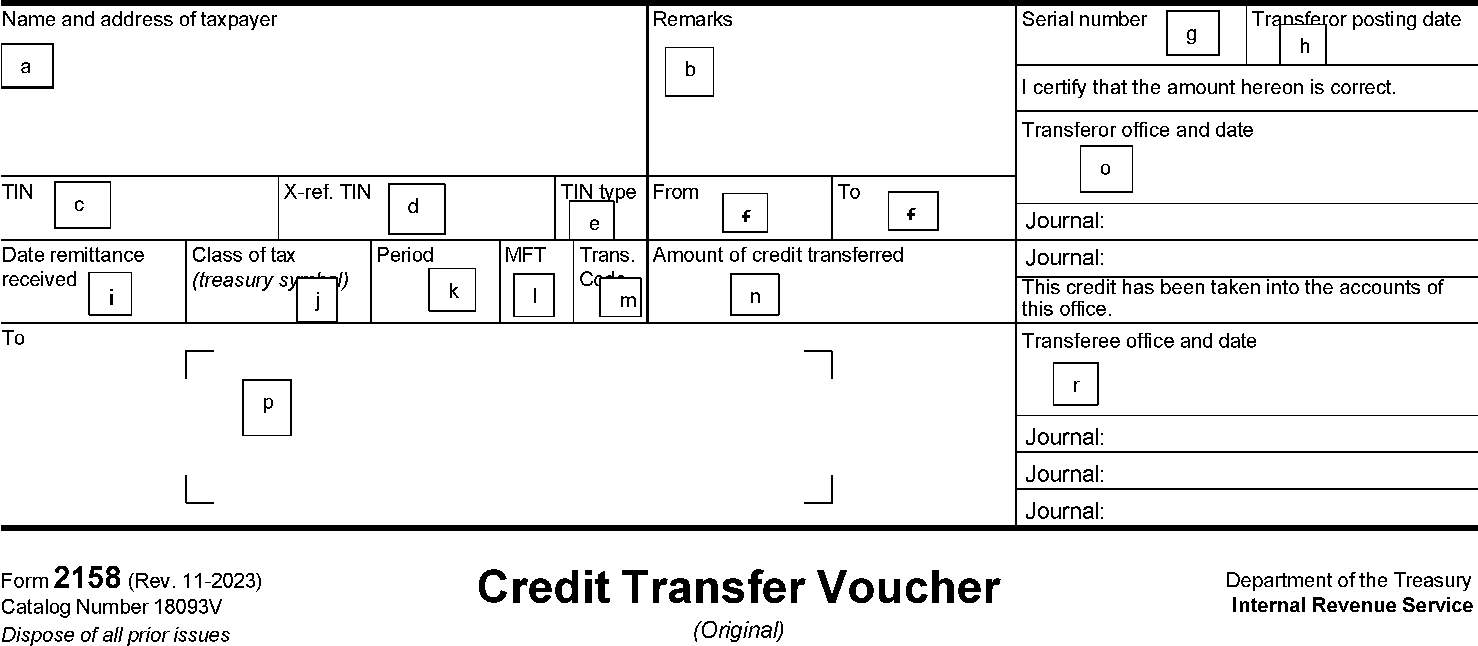
Prepare Form 2158, Credit Transfer Voucher, using the following table and see Figure 3.17.21-1 below.
Form 2158 Field(s) Instructions (a) Name and address of Taxpayer Input taxpayer’s name and current address. (b) Remarks Input the reason for the transfer, the DLN of any processed document attached, and the Trace ID number. (c) TIN Input the taxpayer identification number (TIN). (d) X-ref. TIN Input the cross-reference TIN. (e) TIN type Input the TIN-type. Master File Tax (MFT) 58 or 78 only. (f) From and To Input the campus codes for the sending ("From" ) and receiving ("To" ) campuses. See Exhibit 3.17.21-9, Campus Codes. (g) Serial number Input the serial number from the credit transfer logbook. See (2) below. (h) Transferor posting date Input the journal date (sender’s posting date). (i) Date remittance received Input the campus’ payment received date. (j) Class of tax (treasury symbol) Input "RR" for Revenue Receipts. Input "DF" for Deposit Fund Transfers. Also use DF for Offers-in-Compromise and Seizure of Property. (k) Period Input the tax period (MM/DD/YY). (l) MFT Input the MFT code. (m) Trans. Code Input the TC. (n) Amount of credit transferred Input the credit transfer amount. Annotate "Debit" above the money amount if transferring a debit. Annotate "ABA" if transferring an abatement. (o) Transferor office and date The manager must electronically sign the voucher, including the date. (p) To (large box) Express mail NMF-only Form 2158 with the documentation to KCSPC. (r) Transferee office and date The receiving campus electronically signs and completes this block after sending per (3) below. The serial number format is "XXXX-XX-XX-XX."
- Digits 1-4: Sequence number
- Digits 5-6: "To" campus FLC
- Digits 7-8: Year
- Digits 9-10: "From" campus FLC
- Upload Form 2158 with the combined Portable Document Format (PDF) file to the Credit and Account Transfers SharePoint, "2158_New" receiving site folder.
- Prepare a duplicate Form 813. Omit Form 813 if RACS doesn’t need it per local procedure.
Route Form 2158 to RACS. See IRM 3.17.64.10, Credit Transfers, for journal instructions.
Reminder:
Process Form 2158 within six workdays from receipt. The six workday timeframe for credit transfers is six business days starting the day Accounting receives the credit transfer request and ending when Accounting either rejects the request if appropriate or sends it to RACS for journaling. See IRM 3.30.123, Processing Timeliness, Cycles, Criteria and Critical Dates, for more information.
- This subsection applies only to transfers without NMF involvement. For NMF transfers, see IRM 3.17.21.3.4, Credit Transfers - Losing Campus, Non-Master File (NMF).
Prepare only one Form 2158 and combine it with the supporting documentation into one PDF file. Always obtain the manager’s signature on Form 2158 whether sending electronically or by mail. Send the file to the receiving campus as follows:
- An original return is not attached: Upload the file to the receiving site’s “2158_New” folder on the Credit and Account Transfers SharePoint per (3) and (4) below.
- An original return is attached: Express mail Form 2158 and supporting documentation to the receiving campus using Form 9814, Request for Mail/Shipping Service.
Name the file exactly as shown. The naming convention is three parts separated by underscores (_).
- Serial Number: Full hyphenated (-) serial number from Form 2158.
- Money amount: Separate dollars and cents with a hyphen (-).
Side: "Credit" or "Debit."
To upload the file:
- Click + Create or upload in the 2158_New folder.
- Click "Files upload" in the drop-down menu.
- Locate and click the file.
- Click "Open" to upload the file.
To set up email alerts for a SharePoint folder:
- Click the ellipses next to a document name or on the folder/library tool bar.
- Hover the mouse over "Automate," then "Rules," and click "Create a rule."
Follow the prompts to create the alert.
Note:
The Automate function creates the rule for the entire folder. It cannot create an alert for an individual file at this time. If there are too many rules to create a new one, the manager should elevate the issue to the HQ site owner for resolution.
- The receiving campus sends Form 2158 back to the losing campus to confirm receipt, either by mail or by uploading to the losing campus’ 2158_Confirmations folder based on how they receive Form 2158.
- Prepare Form 2158 for express mail to KCSPC per the instructions below and IRM 3.17.21.3.2, Preparing Form 2158, for addition on their local Automated Non-Master File (ANMF) system.
The NMF credit transfer-out request may include the following documentation:
- Form 813 marked "Out of Region"
- The original taxpayer-submitted return
- Form 3244, Payment Posting Voucher, for NMF subsequent payments
- Attach either Form 3244, Payment Posting Voucher, with the current NMF transcripts (no older than two weeks) or the original tax return showing the NMF DLN. Don’t transfer the credit to KCSPC if unable to find an account on ANMF.
- Forward the Form 2158 package to RACS. RACS journals to the "in-transit" account and returns the package.
- Attach Form 2158 from RACS to Form 3244 (or the return) and the transcript. Express mail copies of Form 2158 with manager signature and backup documentation to KCSPC using Form 9814, Request for Mail/Shipping Service. Send an email to *TS KCSPC ACO Transfer Team to confirm shipment tracking.
- Keep a copy in the file until KCSPC returns the acknowledgment copy. See (10) below if KCSPC does not return the acknowledgment within 14 days.
- Send the acknowledgment from KCSPC to RACS for removal from the "in-transit" account. RACS then returns the journaled copy.
- Associate the journaled copy from RACS with the file. Destroy the unjournaled copy.
- Send the Form 2158 package to KCSPC. Always use express mail because the package has personally identifiable information (PII). KCSPC must also express mail the acknowledgment copy to meet the 14-day acknowledgment deadline. A campus mailing any documentation (such as the Form 2158 package or acknowledgment) must send an email to the other campus’ mailbox to confirm shipment.
See the following table to resolve issues obtaining timely acknowledgment:
Step If Then 1 KCSPC does not acknowledge the package within 14 days. Request acknowledgment by email to *TS KCSPC ACO Transfer Team. 2 KCSPC does not respond to the email within five days. Contact the transfer team manager by telephone. 3 Unable to resolve with the manager. Notify headquarters (HQ) for support.
The receiving campus receives the Form 2158 package from other Credit and Account Transfers campuses. Form 2158 shows the package as a NMF credit transfer, a debit, or an abatement.
Note:
Supporting documents must include either Form 3244, Payment Posting Voucher, or the original tax return showing the NMF DLN.
- Separate and copy the original return if attached. Copy only the first page if it shows the total tax and amount paid. Send the original return to Batching for processing.
- The original Receipt and Control operation deposits the credit from the return. The credit posts to ANMF using Form 2158.
Research using Form 2158 to find the correct NMF account. If unable to find the account on NMF or there is an unprocessable discrepancy, confirm and re-transfer on Form 2158.
Note:
Coordinate with NMF If the accuracy of a credit transfer for accruals is unclear. NMF zeros out the accruals if needed and rejects back or processes Form 2158.
If the correct account is processable:
- Sort Form 2158 by AO or campus.
- Block and number each group of triplicate forms.
- Prepare Form 813 (two parts) for each block.
- Route Form 813 parts one and two with a copy of Form 2158 to RACS for journaling.
- RACS journals Form 2158 within three business days to ensure balancing timeliness. RACS keeps Form 813 part one for backup and sends a copy of Form 2158 to the Credit and Account Transfers team. RACS also sends Form 813 part two and a copy of Form 2158 to NMF for posting.
The Credit and Account Transfers team manager verifies the journal and signs Form 2158. The employee then:
- Annotates the journal number in the logbook.
- Files a copy of Form 2158 as backup.
- Express mails a copy of Form 2158 to the losing campus to confirm receipt using Form 9814, Request for Mail/Shipping Service.
Note:
Form 2158 has a two day expedite cycle from receipt in Credit and Account Transfers until the transaction posts to NMF. See IRM 3.30.123.11, Processing Timeliness Criteria for Non-Master File.
- Form 3244, Payment Posting Voucher, attached with a TC 670, is a subsequent payment for an NMF document. Form 3244 is supporting documentation for Form 2158. The payment posts on ANMF using the Form 2158 DLN.
- Prepare Form 813 and number the same as Form 2158.
- Annotate the Form 3244 DLN on the bottom line of the Form 2158"To" box.
NMF requires proper support for all forms and documents. NMF accepts:
- Current NMF Transcript, or the original NMF return if attached and the transcript is unavailable.
- NMF Notice (Form 6335, Form 4840, Form 9774, and so on)
- CP 213 (5500 payments)
Current ANMF screen print of an open account with a balance due (not CC INOLE)
Caution:
The screen print must show the correct MFT and tax period of the payment to consider as acceptable support.
- Taxpayer correspondence showing an "N" after the TIN or relating to a 5500 account
Prepare only one Form 2158 and combine it with the supporting documentation into one PDF file. Always obtain the manager’s signature on Form 2158 whether sending electronically or by mail. Send the file to the receiving campus as follows:
- An original return is not attached: Upload the file to the receiving site’s “2158_New” folder on the Credit and Account Transfers SharePoint per (6) and (7) below.
- An original return is attached: Express mail Form 2158 and supporting documentation to the receiving campus using Form 9814, Request for Mail/Shipping Service. See IRM 3.17.21.3.4, Credit Transfers - Losing Campus, Non-Master File (NMF).
Name the file exactly as shown. Divide the naming convention into three parts separated by underscores (_):
- Serial Number: Full hyphenated (-) serial number from Form 2158.
- Money amount: Separate dollars and cents with a hyphen (-).
Side: "Credit" or "Debit."
To upload the file:
- Click "+ Create or upload" in the 2158_New folder.
- Click "Files upload" in the drop-down menu.
- Locate and click the file.
- Click "Open" to upload the file.
To set up email alerts for a SharePoint folder:
- Click the ellipses next to a document name or on the folder/library tool bar.
- Hover the mouse over "Automate," then "Rules," and click "Create a rule."
Follow the prompts to create the alert.
Note:
The Automate function creates the rule for the entire folder. It cannot create an alert for an individual file at this time. If there are too many rules to create a new one, the manager should elevate the issue to the HQ site owner for resolution.
- The receiving campus sends Form 2158 back to the losing campus to confirm receipt, either by mail or by uploading to the losing campus’ 2158_Confirmations folder based on how they receive Form 2158.
Form 2158 is a prepaid penalty assessment when it includes Form 3244 and a Form 5500-series non-remit return as attachments.
- Use the local AOC.
- Use Tax Class 6.
- Use Document Code (Doc Code) 35.
- Enter the DLN from the Form 3244 attached to the Form 5500-series return.
- Forward the return to Code and Edit for Employee Plans (EP) processing.
- Send Form 3244 to ANMF for processing.
The following subsections provide instructions to process credit transfer requests on Form 2424, Account Adjustment Voucher, and Form 3809, Miscellaneous Adjustment Voucher.
Reminder:
Process all Form 2424 and Form 3809 requests within six workdays from receipt. The six workday timeframe for credit transfers is six business days starting the day Accounting receives the credit transfer request and ending when Accounting either rejects the request if appropriate or sends it to RACS for journaling. See IRM 3.30.123, Work Planning and Control - Processing Timeliness: Cycles, Criteria and Critical Dates, for more information.
- Use IDRS whenever possible. IDRS transfers retain cross-reference TIN, MFT, and tax period for microfilm research. See below to process when the taxpayer's module isn’t available on IDRS. Also see IRM 2.4.17, Command Codes ADD24/34/48, ADC24/34/48, FRM34 and DRT24/48, for terminal input.
Take the proper freeze action below. Freeze the account when the credit part directs to a tax module in MF Status 06 (BMF only), 10 or 12 (IMF or BMF), and a secondary code is valid.
- Bypass freeze: Use the bypass indicator (BI) when not freezing the account. The BI prevents unpostable codes (UPC) 305 (BMF) and 198 (IMF).
- Input freeze: Input TC 570 as a secondary TC to TC 650, TC 660, TC 670, and/or TC 760. TC 570 sets the -R freeze.
- Release freeze: Input TC 571 or TC 572 to release the -R freeze. This reverses the posted TC 570, allowing the module credit to refund.
TC 762 reverses TC 760 (substantiated credit). Never input TC 762 on IMF to:
- Adjust a TC 766 with Doc Code 08 (rebate amount for tax years beginning 1974).
- Adjust a TC 760 manually input for the rebate program unless it was originally in error or follows a prior liability adjustment.
- All TC 760 manually input for the rebate program have Doc Code 51 (account transfer), but not all TC 760 with Doc Code 51 relate to the rebate program. Decide by researching the transfer-in document file if needed.
- Identify backup withholding credits by Tax Class 5, Doc Code 97. Transfer backup withholding credits to the entity filing Form 1096, Annual Summary and Transmittal of US Information Returns, and the 1099-series information returns.
- Send Form 2424 for processing only after proper approval. The manager or designee reviews all Form 2424 Accounting employees prepare, including the history sheet, and initials both to approve. The manager delegates review and approval, if necessary, no lower than the lead accounting technician or lead tax examiner.
This subsection covers many debit-credit adjustments. Sort as follows:
- NMF to BMF
- NMF to IMF
- NMF to NMF Intra-SC
- BMF to BMF
- BMF to IMF
- BMF to NMF
- IMF to BMF
- IMF to IMF
- IMF to NMF
Form 2424, Account Adjustment Voucher, transfers credits between accounts. This includes transfers between MF and NMF. Prepare in two parts (credit and debit) for any of the above situations.
Reminder:
Send Form 2424 for processing only after the manager or designee initials the form and lead sheet with approval.
Form 3809, Miscellaneous Adjustment Voucher, is for non-revenue receipt adjustments such as:
- "One-sided" transfer: Substantiates a TC 760 credit not found in campus processing
- Substantiated credit reversal: Reverses a prior substantiated credit. Copy Form 3809. File the copy with the original Form 3809 for the substantiated credit. Explain why the prior credit cannot be found.
Form 8758, Excess Collections File Addition, transfers credits only into the 6800 account. The Excess Collections unit processes Form 8758. Only they can apply money from the file and must complete all requested entries. Excess Collection money is non-revenue receipts older than one year.
Exception:
For true statute credits which net credit in Revenue Receipts, see IRM 3.17.10.3.2.2.1, Receiving Statute Credits.
The Excess Collections unit accepts only complete credit transfer requests with each of the following:
- Form 8758 complete with all known entries
- Supporting documentation proving the credit exists
- An explanation of all prior research
- See IRM 3.17.220, Excess Collections, for more information about this file.
Form 2424, Account Adjustment Voucher, transfers money between accounts using separate copies for credit and debit. The credit and debit copies also have their own credit and debit sides.
- Part 1 - Credit Copy: Input all data for the credit side to the lower, unshaded boxes. Input all data for the debit side to the upper, shaded boxes.
- Part 2 - Debit Copy: Input all data for the debit side to the upper, unshaded boxes. Input all data for the credit side to the lower, shaded boxes.
If both boxes apply to the same Taxpayer, insert the name control only in the lower box. For NMF, the address is also required.
Give priority processing to the following two case types to avoid undue burden and/or hardship to the taxpayer:
- Offer-in-Compromise (OIC): OIC must release Federal Tax Liens from the taxpayer accounts when the taxpayer pays the offer amount in full.
- Taxpayer Advocate Service (TAS): Accounting accepts TAS cases by fax to avoid hardship.
- Originators send Form 2424 by SharePoint, Fax, and eFax. Reject incomplete Form 2424 back to the originator.
Prepare Form 2424 using the following tables. The first table is the credit side. The second table is the debit side. Follow both tables with "Part 1 - Credit Copy" of Form 2424.
Credit Side Field(s) Instructions Name and address MF, input the first name line only. NMF, also input the address. Underline the name control in brown. If both sides are the same taxpayer, input the name control instead of the full name line. Spouse indicator Input with TC 892 when two names are present on the IMF account. TIN Input the credit side TIN. Tax period Input the credit side tax period. Transaction date Input the transaction date (MMDDYYYY). This is the date of the original transaction to now reverse, transfer, adjust, or correct. See (5) below. MFT code Input the MFT code. Desg. Pymt code Input the Designated Payment Code (DPC). 1st T.C. and Credit amount (two fields) Input the primary TC valid for Doc Code 24, and the same money amount as the debit side 1st T.C. Form 813 (two part) amount must equal the total of the primary and tertiary amounts. 3rd T.C. and Credit amount (two fields) Input the same TC and amount as debit side. Form 813 (two part) amount must equal the total of the primary and tertiary amounts. Explanation Input the Trace-ID. Input the NMF assessment DLN, if applicable. Include detailed remarks for later review, such as for Electronic Federal Tax Payment System (EFTPS) payments and PCs. Bypass indicator Mark only to bypass UPC 198 and/or 305. Date prepared Input the preparation date. Prepared by Input the preparer’s name or ten-digit IDRS number. Approving Official signature (if needed) The manager or their designee signs to approve the form. See (7) below. Reviewed by (initials) (if needed) The manager or their designee inputs their initials to verify approval. See (7) below. Debit Side Field(s) Instructions Document locator number Input the AOC only. Complete the DLN when separating and blocking the forms for input. See IRM 3.17.21.8, Preparing Form 3413, to assign and control the DLN. Name and address MF, input the first name line only. NMF, also input the address. X-ref. TIN Input the debit side TIN. For MFT 58 or 78 SSN only, use Account Number Prefix (ANP) "0." Add a hyphen (-) after the SSN. When the adjustment is on an NMF account on IDRS, input an "N" after the TIN and the NMF assessment DLN in the "Explanation" box. X-ref, MFT Input the MFT code. Do not enter NMF cross-reference MFT. X-ref. tax period Input the debit side tax period (YYYYMM).
Use the tax period beginning date for:- Form 11-C, Occupational Tax and Registration Return for Wagering
- Form 2290, Heavy Highway Vehicle Use Tax Return
Use "000000" as the tax period for:- Form 706, U.S. Estate Tax Return
- Form 706-NA, U.S. Estate (and Generation-Skipping Transfer) Tax Return
Use the tax period ending date for all other returns.Transaction date Input the same date as the credit side. See paragraph (5) for exceptions. 1st T.C. and Debit amount (two fields) Input the primary TC valid for Doc Code 24, and the money amount to transfer. This is a pre-journalized amount. 2nd T.C. and Amount (two fields) Input TC 360 to assess collection costs, or TC 570 to freeze credits. The secondary amount is a non-prejournalized amount relating to the second TC. If the second TC is TC 570, input "Blank" in the secondary amount field. See (6) below. 3rd T.C. and Debit amount (two fields) Input the tertiary (third) TC in both debit and credit side fields. The tertiary amount is a pre-journalized amount related to the Tertiary code. Both debit and credit amounts must be equal. The transaction date is usually the start of the tax period or later, up to the date input. The credit and debit transaction dates are also usually the same. The following exceptions may apply to ensure correct interest computation:
- For transferring prepaid credit, where the original return due date is the transaction date, move (debit) all payments (credits) with their respective 23C (posting) dates (availability dates).
- For TC 650, TC 651, TC 660, or TC 661 on Doc Code 24, the date may be earlier than the start of the tax period.
- For a liability offset, use the credit availability date on the debit side and the liability date on the credit side.
- Input TC 570 (-R freeze) to freeze the refund or prevent an offset to a module with an outstanding balance. The account stays frozen until input of TC 571 reducing the module balance to zero.
Send Form 2424 for processing only after proper approval. The manager or designee reviews all Form 2424 Accounting employees prepare, including the history sheet, and initials both to approve. The manager delegates review and approval, if necessary, no lower than the lead accounting technician or lead tax examiner.
Exception:
Due to high volume, bypass managerial review and approval for Form 2424 originating within the KCSC Department of Justice (DOJ) group for Criminal Restitution and Civil Litigation/IPAC payments.
- Review the entire document for accuracy. Circle all unshaded NMF cross-reference (x-ref) boxes in brown so Integrated Submission and Remittance Processing (ISRP) doesn’t transcribe them.
- Route Form 2424 to RACS for input.
- Send the NMF documents to the NMF team for posting. Route Form 813 to remove the document from SCCF.
- Send the MF documents to Batching.
Input CC ADD24 on IDRS to display CC DRT24.
- Use this format for two-sided credit transfer adjustments. Initial data populates from CC TXMOD.
- CC ADD24 includes On-Line Entity (OLE) and validation against the National Account Profile (NAP). The credit transfer fails if the entry is incorrect. Research to find the correct TIN and name/name control, including CC INOLE and CC IMFOL/CC BMFOL.
Form 3809, Miscellaneous Adjustment Voucher, transfers non-revenue receipt credits using separate copies for credit and debit. The credit and debit copies also have their own credit and debit sides.
- Part 1 - Credit Copy: Input all data for the credit side in the lower, unshaded boxes. Input all data for the debit side in the upper, shaded boxes.
Part 2 - Debit Copy: Input all data for the debit side in the upper, unshaded boxes. Input all data for the credit side in the lower, shaded boxes.
- Most Form 3809, Miscellaneous Adjustment Voucher, credit transfers are one-sided. This means only one part of the transfer (debit or credit) posts to an individual taxpayer's account (MF or NMF). The other side posts directly to a GL account as a back-up.
- Form 3809 carries Doc Code 48 or 58. See Exhibit 3.17.21-2, Blocking Series Tables, for the proper Doc Codes.
Reminder:
Process all Form 3809 requests within six workdays from receipt. The six workday timeframe for credit transfers is six business days starting the day Accounting receives the credit transfer request and ending when Accounting either rejects the request if appropriate or sends it to RACS for journaling. See IRM 3.30.123, Work Planning and Control - Processing Timeliness: Cycles, Criteria and Critical Dates, for more information.
- Form 3809 usually requires the same data elements as Form 2424. See IRM 3.17.21.4.3, Preparing Form 2424 (DRT24).
Input CC ADD48 on IDRS to display CC DRT48.
- Use this format for two-sided credit transfer adjustments. Initial data populates from CC TXMOD.
- CC ADD48 includes On-Line Entity (OLE) and validation against the National Account Profile (NAP). The credit transfer fails if the entity is incorrect. Research the correct TIN and name/name control, including CC INOLE and CC IMFOL/CC BMFOL.
ISRP transcribes Form 2424 and Form 3809 in separate blocks. Sub-sort all vouchers as follows:
- Sort Form 2424 and Form 3809 debit parts from credit parts.
- Sort documents by IMF, BMF, and NMF accounts.
- Sort NMF documents by AO. The originator may input the AOC in the top-left corner of the document; if not, determine the AO using the taxpayer's address.
- Sort the documents by tax class.
- Do not assemble vouchers with the same EIN, tax class, and tax period on consecutive sorts. Intersperse these with documents of different entities to prevent an ISRP Block Out of Balance (BOB).
- Prepare Form 813, Document Register, for each block of 100 or fewer documents in each sub-sorted group.
Input the MFT, from the following table, in the right corner of the Date field.
Form MFT Code Form 1041 05 Form 1065 06 Form 5329 29 Form 8752 15 List the amounts from the detail documents on Form 813. List one or two amounts on each pre-numbered Form 813 line. The following table is an example:
Primary Secondary Serial Number 100.00 (5.00) 03 42.25 (5.00) 04 1870.00 (18.00) 05 - Show both amounts (primary first) if a document has a primary and secondary amount but no tertiary amount. Bracket the secondary amount.
- Include the tertiary amount in the first amount listed for the document if present. In the example above, the $100 shown for serial number 03 may have shown on the document as a $98 primary amount and a $2 tertiary amount.
- Enter the totals of the listed amounts. Bracket the total of the secondary amounts. Show any debit amount totals by inputting "Dr" to the left of the total.
- If the block lists fewer than 100 documents, circle the pre-printed serial number on the line following the last amount listed to show the document count.
Annotate Form 813 per the if/then table below:
If the form is ... Then ... - Form 1041, U.S. Income Tax Return for Estates and Trusts, or
- Form 1065, U.S. Return of Partnership Income, or
- Form 8752, Required Payment or Refund Under Section 7519 accounts
Annotate "BMF" at the top of Form 813. Form 5329, Additional Taxes on Qualified Plans (including IRAs) and Other Tax-Favored Accounts Annotate "IRA" at the top of Form 813.
Include a DLN on each input Form 2424 and Form 3809 as follows:
DLN Digit(s) Instructions 1-2 FLC: Input MF campus or NMF AO. 3 Tax Class: Input Tax Class for MF type. NMF is Tax Class 6. 4-5 Doc Code:
- Doc Code 24 for Form 2424
- Doc Code 48 for Form 3809
6-8 Julian date: For a prior year credit transfer, use a Julian date before the current fiscal year October 1 Julian date. This excludes the transfer from the current year revenue receipts. 9-11 Blocking Series:
- Form 2424 and Form 3809 (BMF and IMF): Use the numbers shown in Exhibit 3.17.21-2, Blocking Series Tables.
- Form 2424 (NMF): The first digit is the true Tax Class for later abstracting and reporting. Block as shown in Exhibit 3.17.21-1, Abstract Numbers Table.
- Form 3809 (NMF): the first digit is the true Tax Class for Doc Codes 48 and 58. The second and third digits for Doc Code 58 must be from 00 through 49.
Form 514-B, Tax Transfer Schedule, primarily transfers NMF overflows. Form 514-B is slower than other applicable forms for the same processes. Use when given specific instructions to use Form 514-B or when it’s the only applicable form.
Reminder:
Process all Form 514-B requests within six workdays from receipt. The six workday timeframe for credit transfers is six business days starting the day Accounting receives the credit transfer request and ending when Accounting either rejects the request if appropriate or sends it to RACS for journaling. See IRM 3.30.123, Work Planning and Control - Processing Timeliness: Cycles, Criteria and Critical Dates, for more information.
- Examination usually requests the transfer to BMF or IMF for a redefined period. Reject if the request does not include a front page copy of the return for identification.
- Attach Form 514-B as a transmittal sheet to the NMF Transcript when transferring to the receiving campus. Number both documents as an NMF transfer between campuses.
Transfer the account before placing in TDA status if an NMF account belongs to another campus while in Notice Status.
- Note on Form 514-B for NMF TDAs to issue the TDA immediately upon receipt of transfer.
- Attach a copy of the account transcript, tax return, and/or revenue agent's report, if applicable, as support for Form 514-B.
- The originating Compliance Service Collection Operations (CSCO) coordinates with responsible persons in other campuses. This avoids issues such as excess collections when the request involves multiple campuses.
Attach Form 2209, Courtesy Investigation, if the statutory period for collection will expire less than eight months from the date of a balance due account transfer. Include in the case file:
- Proof of the receiving office’s willingness to receive the account
- Form 900, Tax Collection Waiver, or TC 500 print, if the statutory period expires within six months of the date of transfer
- First and fourth notices, if there isn’t time to send all notices due to the Collection Statute Expiration Date (CSED)
Prepare Form 514-B, Tax Transfer Schedule, as a transmittal sheet for the NMF transcript. Number Form 514-B and transcript with the same DLN. Include special instructions for the receiving campus on Form 514-B if applicable.
Form 514-B Field Instructions NAME AND ADDRESS Input the primary name line. ORIG DLN Input the original DLN(s). 23c DATED Input the 23C date. TIN Input the TIN. TAX PERIOD Input the tax period. MFT Input the MFT. TRANSFER DATE Input the date of transfer. TRANSFERRED FROM Input the "From" campus. TRANSFERRED TO Input the "To" campus. TRANS. SCHEDULE NO. Input the schedule number. BALANCE Input the transfer balance. - Send Form 514-B and transcript to RACS. RACS returns them after journaling.
- Sort Form 514-B by campus.
Mail Form 514-B parts one through four, two copies of the transcript, and any other attachments to the receiving campus:
- Part one: The receiving campus uses this and the transcript for NMF input.
- Part two: The receiving campus returns this as the confirmation copy to one of the following:
Austin: *TS AUSPC ACO Transfer Team
Kansas City: *TS KCSPC ACO Transfer Team
Ogden: *TS OSPC ACO Transfer Team - Part three: The receiving campus keeps this in its team files.
- Part four: The posting document at the receiving campus.
- Prepare Form 3177, Notice of Action for entry on Master File, with TC 131 to reverse TC 130 on all applicable cases. Route to CSCO behind Form 3210. See IRM 3.17.46.7.12, Automated Non-Master File Accounting, Master File Entity Freeze Transaction Code (TC) 130, for more information.
- The receiving office returns Form 514-B part two. Pull part six from the file and compare with the part two copy to ensure it’s the correct transfer.
- Prepare a follow-up letter for transfers the transferee office doesn’t acknowledge in 30 days.
- Send the Form 514-B part two confirmed copy to RACS. RACS returns them after journaling.
The following subsections provide instructions to process account transfer requests on Form 12810, Account Transfers Request Checklist. These include transfers-in and transfers-out involving IMF, BMF, and NMF.
Reminder:
Process all Form 12810 requests within six workdays from receipt. The six workday timeframe for account transfers is six business days starting the day Accounting receives the account transfer request and ending when Accounting either rejects the request if appropriate or inputs the TC 400 with REQ77. See IRM 3.30.123, Work Planning and Control - Processing Timeliness: Cycles, Criteria and Critical Dates, for more information.
Originators submit Form 12810 to Accounting through the applicable campus mailbox below. Ask the originator for a current Form 12810 if the submission is a prior revision.
Common requests include:
- Assessment moving from one period or TIN to another.
- Assessments for Shared Responsibility Payments (SRP) moving from MFT 30 to MFT 35 when completed on MFT 30 in error.
- Reversal of Erroneous Abatements.
- Duplicate assessments on MF for MFT 55.
- NMF to MF.
- Transfers to NMF.
- Account re-transfers.
- Program problems.
Reject all Form 12810 with an invalid signature. The originator’s manager or lead must digitally sign Form 12810. A digital signature is valid if:
- Form 12810 is a PDF file.
- The signature is Homeland Security Presidential Directive 12 (HSPD-12)-compliant with a US Government or Department of the Treasury-issued certificate.
CSED procedures:
Reject all balance due Form 12810 for which the "From" side shows less than 10 months on the CSED. Advise the originator of the imminent statute. See IRM 25.6.1.12, Collection Statute Expiration Date (CSED).
Exception:
Process all Form 12810 regardless of CSED status if the remarks include, "Exception IDT1 - Identity Theft Account" or "Exception IDT3 - Identity Theft Account." Identity Theft (IDT) cases bypass normal Statute processing.
Process requests with a suspended CSED as if the CSED is open and not imminent. Address concerns about the suspended CSED with the originator. The originator must ensure there are no CSED issues.
Note:
A blank CSED field on IDRS identifies the CSED as suspended in most cases. TC 971 AC 043 (pending installment agreement) suspends the CSED without making it blank.
Reject all MF to MF and MF to NMF account transfer requests if the assessment statute expiration date (ASED) on the "From" account is not imminent or expired. An imminent ASED is no more than ten months from the request date.
Exception:
Programming issues may require a transfer when the ASED is not imminent. Originators must refer these exception requests to HQ for review. Reject if the originator requests processing based on this exception without HQ approval.
Note:
The ASED is normally the date the return is filed or the return due date (whichever is later) plus three years. A blank ASED usually means it hasn’t set because the taxpayer hasn’t filed their return, except MFT 13 and MFT 55 because they don’t have an ASED. Research all other MFTs on IDRS for a pending or posted TC 560, which sets or extends the ASED. Use the set or extended date on the TC 560 as the ASED; or, if there is no TC 560, determine the ASED normally per the first sentence of this note.
Reject all requests with the following freeze codes on either the From or To account. The originator must resolve these freeze codes before requesting an account transfer (TC 400):
- -L
- -V
- -W
- -Y
- -Z
Exception:
Process Appeals Operation IDT cases ignoring the -W freeze if it’s a MF to MF transfer requesting a TC 402.
Exception:
Process MFT 55 transfers with a -V freeze if the account has a TC 240 and reversed TC 520, and it’s a MF to MF transfer requesting TC 402.
Print the current CC TXMOD for the case file if it’s the only missing or incomplete documentation. All transfers require a complete CC TXMOD print as follows:
Not a dummy module on the "From" side
- No older than two weeks
- Includes the status history section
- Reject all requests to transfer only zero-dollar amount TCs. Accounting moves only TCs with an amount other than zero. The originator should instead follow reprocessing procedures in IRM 3.10.73.7.1, Re-Input and Reprocessable Documents, Form 3893, Re-Entry Document Control or Form 13596, Reprocessing Returns.
Research for open controls and pending TC on both modules. Reject Form 12810 if any of the following criteria apply:
- Either module exists as both a valid and invalid account.
- Either module shows "Merged/Resequenced." See IRM 3.17.21.6.2, Processing Account Transfers to the Master File (IMF/BMF), for more detailed information.
- The "From" side module has a credit balance.
- The "From" side module has pending TC. TC 400 input causes these to unpost, so it’s necessary to wait for them to post first.
Don’t include TCs reversed entirely off the account before the transfer. Line through these TCs on the CC TXMOD print.
Exception:
Complete transfers - Include the entirely reversed "From" side TCs, and their reversal TCs, on the "To" side when a complete account transfer includes any of TC 766, TC 820, TC 826, TC 830, TC 836, TC 840, and TC 846. Do not line through the TCs if including them per this exception. These TCs move money out of the account, so their inclusion provides a necessary audit trail.
Exception:
Partial transfers - Post a TC and its reversal only if the originator requests both. Reject the request if the originator requests either without the other.
- Ensure TCs on the request are still available and unreversed before processing a partial transfer. Never transfer any reversal TC on a partial transfer without also transferring the TC it’s reversing; and, never transfer any reversed TC without transferring its reversal.
The following table lists the campus-specific DLNs used for MF account transfers:
Campus DLN First Five Digits Austin 18X51 Ogden 29X51 Kansas City 36X51 Note:
"X" is the tax class for the MFT. See Exhibit 3.17.21-8, Tax Return Information Table, for a list of tax classes and their MFTs.
- TCs posted after a transfer, either manual or systemic, may carry the same campus DLN unrelated to the earlier transfer.
The following TCs require corresponding reversal codes in amounts equal to the TC before inputting TC 400. Line through these TCs on the CC TXMOD print and don’t include on Form 3413 :
- TC 576 (reversal TC 577)
- TC 608 (reversal TC 609)
- TC 896 (reversal TC 897)
- Contact P&A for help if the "To" side DLN posts after making an erroneous account transfer. Do not try to back it out. An erroneous account transfer may require action from Unpostables and various specific actions from Accounting to properly resolve all resultant issues.
Follow the if/then table below when Small Business/Self-Employed (SB/SE) sends Form 12810:
If And Then The SB/SE Form 12810 requests an account transfer to NMF. SB/SE annotates Form 12810 at the top with, "RPP-RBA" (Return-Preparer Restitution-Based Assessment). Process as normal. Then, prepare Form 3177 to post TC 971 AC 102 after the account is established on NMF. Any other SB/SE account transfer. N/A Process as normal. Always process the following requests immediately upon identifying. These requests take priority over all others:
- Identity Theft: Identify IDT cases by Form 12810 with the remarks, "ID Theft, please expedite."
- Installment Agreements: Identify installment agreement cases by the notation at the top of the request.
- A TC 400 posts only to a zero or debit balance module. MF generates a module balance for the TC 400 amount after posting. TC 400 sets an M- freeze to move the account out of MF and prevent other transactions from posting.
- The campus recap lists the number of TC 400 posted during the cycle and the total dollar amount for post-journalization balancing.
- The following is general information about partial and complete account transfers. This subsection explains how transfers should look on the "From" and "To" accounts after input. It also includes general input instructions that don’t fit into other relevant subsections. Use in combination with IRM 3.17.21.6.
- Accounting sets the M- freeze with TC 400 after a complete account transfer or during the partial transfer process. This freeze forces all later transactions to unpost except the M- freeze release (TC 370 with secondary TC 402).
Complete Account Transfers
- "From" : Shows either a posted TC 400 with a campus-specific DLN and no TC 402 (reversal); or, posted TC 400 with a TC 402 and reversal TCs on the same DLN for all applicable TCs transferred. Input TC 402 on a complete transfer only if the originator requests it.
- "To" : Shows all applicable TCs transferred from the "From" side. Transfer and post all TCs to the "To" side by converting each to their manual equivalent per Exhibit 3.17.21-5, Valid BMF Transaction Codes, and Exhibit 3.17.21-6, Valid IMF Transaction Codes.
Partial Account Transfers
"From" : Shows posted TC 400 and TC 402 with a campus-specific DLN and includes reversal TCs on the same DLN for each applicable TC transferred. It’s a partial transfer if the transfer includes only some, not all, possible TCs. Always input TC 402 after a partial transfer. Reject the partial transfer request unless the originator requests the TC 402.
Caution:
A TC 400 without a posted TC 402 is not always a complete transfer. Pending, unpostable, or rejected TC 370 may show a partial transfer or unfinished complete transfer in progress. Research both accounts if needed to determine.
- "To" : Shows each applicable TC transferred from the "From" side. Transfer and post the TCs by converting each to their manual equivalent per Exhibit 3.17.21-5, Valid BMF Transaction Codes, and Exhibit 3.17.21-6, Valid IMF Transaction Codes.
- The Adjustment, Collection, Statute, Accounts Management (AM), and Identity Theft Victim Assistance (IDTVA) teams send Form 12810, Account Transfer Request Checklist, to Accounting. Edit Form 12810 with the Accounting received date immediately upon receipt.
Reject incomplete and/or incorrect Form 12810 to the originator through email. Accept Form 12810 as complete only if it meets all criteria below:
- All general criteria in IRM 3.17.21.6 not already in this list.
- Form 12810 is the most currently available revision.
- Originator marks "Complete Account Transfer" or "Partial Account Transfer."
The signature is the originator’s manager or lead (the originator can’t sign).
Exception:
Do not reject Form 12810 with a blank signature field. Ask the originator for a new completed form.
Form 12810 or highlighted IDRS prints (CC TXMOD, CC IMFOL, and/or CC BMFOL) list all TCs that need transfer (partial transfers only).
Caution:
Do not transfer TC 386, TC 606, TC 849, TC 898, or their related debits. Tell the originator these TCs are invalid for account transfers.
- The "From" side module is in debit or zero balance.
The "To" side TIN and earliest name line year is on MF. Tell the originator to input TC 000 (Entity) or TC 013 (Year), if not.
- The name control shown on IDRS is the same for both accounts, for transfers between tax periods on the same taxpayer only. This prevents an unpostable condition.
- Penalty and interest accruals are up to date (BMF only). See (6) below.
- Change the Mail Filing Requirement (MFR) on the To side from 08 to 05 with CC ENREQ if present. This prevents an unpostable condition. Always change the MFR back to 08 by posting TC 540 with REQ77 after completing the account transfer.
- The IDRS literal "ACCOUNT MERGED/RESEQUENCED TO" followed by a TIN means this account doesn't exist on MF because it merged with the TIN following the literal. Reject any request to transfer from or to these accounts. Attempting to transfer to this prior TIN creates UPC 151-0, "No Account Present on Master File."
The literal "ACCOUNT MERGED/RESEQUENCED FROM" displays on the account another TIN merged with. The prior TIN follows the literal. If the originator requests to transfer to this account instead of the invalid prior TIN:
- Research CC IMFOL/ CC BMFOL to verify the new account is on MF.
- Research CC TXMOD or CC IMFOL/CC BMFOL to check if the assessment is already on the valid TIN. If it is, transferring could double-assess the taxpayer. Elevate to P&A for review. Otherwise, make the transfer if there are no other issues.
Reject per paragraph (2) if penalty and interest accruals are not up to date (BMF only). The originator must take either input action below on all BMF accounts and wait for the TC(s) to post before requesting the transfer:
- Unrestricted accounts: TC 290 .00 PC 5
- Restricted accounts (G- or -I freeze): TC 270 and TC 340 for the accrued amount
TC 290 PC 5 is not needed when any of the following conditions are present:
- The return is timely filed and full paid.
- There is a TC 150 .00.
- All adjustments on the module are for refunds.
- Any tax, penalties, and interest previously due are full paid and all prior accruals posted.
Process workable account transfers as follows:
Step Action(s) 1 Combine all available documentation to create the electronic case file. Continually update the case file between each step to ensure it’s always current. Describe each action on the history sheet in detail immediately when taken. The electronic case file must include:
- Form 12810
- CP 96 (IMF) or CP 296 (BMF)
- History sheet continually updated throughout processing with detailed explanations of all actions
- Original "To" and "From" side CC TXMOD
- "From" side TC 971 AC 045 (IMF) or AC 745 (BMF)
- "To" side CC ENMOD
- "To" and "From" side Form 3413
- "To" and "From" side current CC TXMOD showing posted transactions
- Any other applicable documentation
2 Open a control on both modules with CC ACTON. Use category "IRRQ." Continually update this control between actions. 3 Research both account modules on IDRS to verify the request is workable. Create the "TXMOD WORKUP" and "TAPE" documents to verify all TC are available and the transfer does not result in a credit transfer.
The "TXMOD WORKUP" is a complete CC TXMOD print annotated with the reversal TC next to each TC the transfer includes, and lines through TC entirely reversed off the account. See Exhibit 3.17.21-3, Reversal Transaction Codes, and IRM 3.17.21.6 (10)(15), Account Transfers (Form 12810).
The "TAPE" is an Excel spreadsheet listing the TCs and their amounts with totals for ending balance.4 Generate TC 400 and the CP notice as follows:
- IMF: Input TC 971 AC 045 using CC REQ77. CP 96 generates after TC 400.
- BMF: Input TC 971 AC 745 using CC REQ77. CP 296 generates after TC 400.
5 Monitor for the CP notice and add the date upon receipt. 6 Annotate "RPP-RBA" at the top of the CP notice, if an RPP-RBA case. 7 Prepare Form 3413, Transcription List, with the transactions from the CP notice requested on Form 12810. Convert to valid TCs using Exhibit 3.17.21-5, Valid BMF Transaction Codes, and Exhibit 3.17.21-6, Valid IMF Transaction Codes.
8 Prepare and send Form 3413 for TC 402, if the originator requests it, at the same time as the "To" side Form 3413. 9 Number Form 3413 per local procedures. 10 Prepare Form 813, Document Register, per local procedures. 11 Prepare Form 4028, Service Center Control File Adjustment Record, if it’s necessary to delete the controlling DLN from NMF SCCF. 12 Forward Form 813, Form 3413, and Form 4028 to the designated lead or employee. They must submit all packages for the same cycle together for RACS journaling and ISRP processing. 13 Monitor the transactions for posting. 14 Update and close control bases after all TCs post. Verify the closed electronic case file includes all required documentation listed in step 1.
- Don’t process MFT 31 mirror assessments. These are automated to IMF. Contact the proper area Subject Matter Expert (Bankruptcy, Offer in Compromise (OIC), Exam, Appeals, and so on) for more information.
- Complete only true account transfer requests for MFT 31.
- Use blocking series 940-949 to bypass the unpostable check if posting TC 767 or TC 765 to an MFT 31 module.
- Determine if TCs are valid for MFT 31 per Exhibit 3.17.21-5, Valid BMF Transaction Codes, and Exhibit 3.17.21-6, Valid IMF Transaction Codes. For reference number validity, see the table in IRM 3.12.21.4.2.19 (4), Error Resolution - Credit and Account Transfers.
The Adjustment, Collection, Statute, Accounts Management (AM), and Identity Theft Victim Assistance (IDTVA) teams send Form 12810, Account Transfer Request Checklist, to Accounting. Edit Form 12810 with the Accounting received date immediately upon receipt.
Note:
KCSPC processes all NMF requests. Originators must send all NMF requests to *TS KCSPC ACO Transfer Team.
Reject incomplete and/or incorrect Form 12810 to the originator through email. Accept as complete only if Form 12810 meets all criteria below:
- All general criteria in IRM 3.17.21.6 not already on this list.
- Form 12810 is the most currently available revision.
The originator marks "Complete Account Transfer" or "Partial Account Transfer."
Caution:
Partial account transfers to NMF and any transfer from MF to NMF MFT 20 are typically not allowed. Whenever possible, process these only to MFT 31. If unable to use MFT 31 and the request must be a partial account transfer to NMF or any transfer to NMF MFT 20, refer the request to HQ for approval. See IRM 3.17.21.6.3, Processing Account Transfers to the Individual Master File MFT 31, and IRM 3.17.46.6.7, Automated Non-Master File Accounting, Master File Tax Code MFT 31 - Split Assessments.
The signature is the originator’s manager or lead (the originator can’t sign).
Exception:
Do not reject Form 12810 with a blank signature field. Ask the originator for a new complete form.
Form 12810 lists all TCs that need transfer (approved partial transfers only).
Caution:
Do not transfer TC 386, TC 606, TC 849, TC 898, or their related debits. Tell the originator these TCs are invalid for account transfers.
- The "From" side module is in debit or zero balance.
- The name control is the same for both accounts, for transfers between tax periods on the same taxpayer only. This prevents an unpostable condition.
- Penalty and interest accruals are up to date. See (3) below.
Reject per (2) above if a complete account transfer request and penalty and interest accruals are not posted to the module prior to the transfer. If more than one assessment still owes (TC 150, TC 290, TC 300), the originator must split the accruals between each account balance. The originator:
- Unrestricted accounts: Inputs TC 290 .00, PC 5, hold code (HC) 4. This causes MF to force accruals to post.
Restricted accounts (G- or -I Freeze): The originator manually computes and inputs penalty and interest, if applicable.
Note:
Don’t transfer an MF account to NMF if the CSED is imminent or expired. Verify the CSED on IDRS. Prepare Form 3177 and forward to NMF if necessary.
Identify the correct 23C date and establish the NMF account as follows. ANMF allows only one 23C date per account:
- Use the most current 23C date unless other criteria apply.
- Use the 23C date of the remaining balance due assessment if the account has multiple assessments and all but one has been satisfied (by at least nine months). If this is the case, the MF account doesn’t require separate NMF assessments.
- Annotate that other related and satisfied assessments for this account remain on MF when transferring a balance due assessment (partial) to another campus.
- See IRM 3.17.21.6.5 (6), Master File Overflow Accounts, for a list of assessment TCs with a CSED. TC 340 carries its own CSED only when the TC 290/TC 300 is zero because the carryback and general adjustment zero each other out.
- If the account has multiple assessments remaining as balance due, prepare a separate CP notice for each. Establish separate NMF accounts for each balance due assessment with the correct 23C date for each.
Include Abstract Numbers for all TCs transferring to NMF per ANMF system requirements. See IRM 3.17.46, Automated Non-Master File Accounting, Exhibit 3.17.46-5.
- Do not post TC 402 and reversals to MF when processing a complete account transfer from MF to NMF.
Bankruptcy Transfers to NMF: Verify the request includes the CSED. If the account has multiple assessments, include a CSED for each 23C date. Send the account to MFT 31 instead of ANMF if possible.
Reminder:
Reject all balance due Form 12810 for which the From side shows less than 10 months on the CSED. Advise the originator of the imminent statute.
ANMF can’t always correctly compute penalty and interest. See IRM 3.17.46, Automated Non-Master File Accounting. Annotate Form 514-B with, M,Exception Code, if Form 12810 shows any of the items below:
- Armed Forces Combat Zone (IRC 7508)
- 120% Tax Motivated Transaction
- Reversal of Erroneous Abatement (TC 860)
Unmatched reversal TCs with money
Reminder:
Ensure TCs on the request are still available and unreversed before processing a partial transfer. Never transfer any reversal TC on a partial transfer without also transferring the TC it’s reversing; and, never transfer any reversed TC without transferring its reversal.
Use the following table to generate TC 400 and the CP notice:
IMF BMF Input TC 971 AC 045 using CC REQ77. CP 96 generates after TC 400. Input TC 971 AC 745 using CC REQ77. CP 296 generates after TC 400.
- Open a control on MF with CC ACTON. Use category IRRQ. Continually update this control between actions.
Edit CP 96 or CP 296 from the Account Transfer-Out Transcript notice and Form 12810. See:
- Exhibit 3.17.21-4, Non-Master File (NMF) Status Determination Table. Also see (10) below
- Exhibit 3.17.21-5, Valid BMF Transaction Codes
- Exhibit 3.17.21-6, Valid IMF Transaction Codes. CP 96 for MFT 55 with TC 240, REF-NUM 618, on MF is Trust Fund Recovery. Input to ANMF using MFT 17 and Abstract 001
- Exhibit 3.17.21-7, Transaction Code Conversion Table (MF to NMF). Manually add the date for any TC 806 converted to TC 800. Use the return due date as the TC 800 transaction date.
Use the if/then table below to find the correct prior status if the account is in status 29:
If Then The status before 29 is 60 or 12. Use the status before 60 or 12. The status before 29 is not 60 or 12. Use the status before 29. - Number the CP notice. Prepare Form 813, Document Register.
- Forward the CP notice and Form 813 to RACS for journaling and processing.
- Monitor for posting to ANMF.
- Request an NMF transcript after all actions post. Update and close the control base on MF.
- An MF account overflows when the module has too many lines. TC 400 systemically posts to transfer the account module to ANMF. CP 96, (IMF) or CP 296 (BMF) generates automatically without TC 971 AC 045/AC 745 after TC 400 posts. This transcript uses blocking series "999" and the word "Overflow" under the transcript title.
Overflow TC 400 systemically generates for:
- BMF accounts in zero, debit, or credit balance.
- IMF accounts in zero or debit balance.
- Originating/Losing campus: Submit Form 3809 to *TS KCSPC ACO Transfer Team to zero an IMF credit balance with TC 820, if at the line limit.
KCSPC: See Figure 3.17.21-2 and process the request as follows:
- Verify the Form 3809 credit amount matches the total credit module balance on CC IMFOL.
- Reject Form 3809 if the account does not have an assessment TC per (6) or (7) below.
- Send Form 3809 to the NMF team for review and processing to the 4430 account.
- Monitor the account for TC 400 posting.
- Contact local P&A if TC 400 does not post.
- Print all CC TXMOD pages for the account on the CP notice.
Originating/Losing campus: Complete the following steps:
Note:
Always send zero balance overflows to KCSPC within three days from CP notice receipt. Don’t hold the CP notices until the TC 400 date.
- Determine the correct 23C date to establish the NMF account. Use the most current 23C date unless other criteria apply. ANMF allows only one 23C date per account. See (6) or (7) below.
- Split the account to establish separate NMF accounts if the account has multiple assessments and an unreversed TC 534.
Prepare a separate CP notice for each unsatisfied assessment with the correct 23C date for each. Combine assessments with the same 23C date onto one CP notice.
Note:
CP 96 or CP 296 is always the transfer and journal document for account transfers to NMF. Don’t use Form 514-B.
- Annotate the return due date next to the TC 800 as its transaction date. The TC 806, which converts to TC 800, does not have a related date on the CP notice.
IMF assessment TCs with a CSED:
TC 150 TC 160 TC 166 TC 170 TC 176 TC 240 TC 290 TC 294 TC 298 TC 300 TC 304 TC 308 TC 320 TC 340* (see exception) TC 350 BMF assessment TCs with a CSED:
TC 150 TC 160 TC 166 TC 180 TC 186 TC 234 TC 238 TC 240 TC 246 TC 290 TC 294 TC 298 TC 300 TC 304 TC 308 TC 320 TC 340* (see exception) Exception:
TC 340, IMF and BMF, has a CSED only when TC 290/TC 300 is zero after the carryback and general adjustment zero each other out.
- KCSPC: Follow the paragraphs below after receiving the overflows.
If the overflow account has a civil Penalty Reference Number (PRN) 631:
- Change the PRN to 630.
- Code the CP notice with MFT 28.
- Annotate the CP notice to reflect abstract number 189.
Highlight the name, address, form number, and TIN on the CP notice. Place three lines in the right margin, using the highlighter, for later use.
- Annotate in the right margin if the account is for MFT 31.
- Annotate the top of the CP notice, "RBA Overflow Account." This alerts ANMF to properly load the account.
- Prepare Form 3177 for TC 971 AC 102 input to NMF after the account establishes.
Review the CP notice to identify all zero amount TCs. Line through the transactions, except:
- TC 150
- Unreversed TC 470
- TC 480, TC 481, and TC 482
- TC 520, TC 521, and TC 522
- TC 530 and TC 531
Convert the remaining TCs on the CP notice using the chart in IRM 3.17.46.6.16.1 (4), Master File Overflow Transfer-In, or see below. Some MF TCs can’t post to ANMF.
TC ACTION TC 186 Change to TC 180 TC 187 Change to TC 181 TC 190, TC 196, or TC 336 Change to TC 340 TC 191, TC 197, or TC 337 Change to TC 341 TC 238 Change to TC 234 TC 239 Change to TC 235 TC 246 Change to TC 240 TC 276 Change to TC 270 TC 277 Change to TC 271 TC 286 Change to TC 280 TC 294 or TC 298 Change to TC 290 TC 295 or TC 299 Change to TC 291 TC 304 or TC 308 Change to TC 300 TC 305 or TC 309 Change to TC 301 TC 370 Don’t add TC 380 or TC 386 Change to TC 607 TC 388 Don’t add TC 389 Don’t add TC 400 Don’t add TC 402 Don’t add TC 420 Don’t add TC 421 Don’t add TC 424 Don’t add TC 534 Don’t add if zero amount.
If money is present, change to TC 604.TC 535 Don’t add if zero amount.
If money is present, change to TC 605.TC 537 Change to TC 531 TC 570 Don’t add TC 600 Change to TC 606 TC 620 Change to TC 670 TC 621 Change to TC 671 TC 622 Change to TC 672 TC 630 or TC 636 Change to TC 800 TC 632 or TC 637 Change to TC 802 TC 660 Change to TC 430 TC 666 Change to TC 700 TC 667 Change to TC 820 TC 678 Change to TC 670 TC 679 Change to TC 672 TC 701 Change to TC 702 TC 706 Change to TC 700 TC 720 Change to TC 841 TC 721 or TC 722 Change to TC 840 TC 736 Change to TC 730 TC 756 Change to TC 700 TC 768 Change to TC 764 TC 776 Change to TC 770 TC 790 or TC 796 Change to TC 700 TC 792 Change to TC 820 TC 806 Change to TC 800 TC 807 Change to TC 802 TC 821 Change to TC 822 TC 824 or TC 826 Change to TC 820 TC 836 Change to TC 830 TC 843, TC 846, or TC 849 Change to TC 840 TC 848 Change to TC 841 TC 856 or TC 876 Change to TC 850 TC 890 or TC 896 Change to TC 820 TC 892 or TC 897 Change to TC 822 Note:
Subtract the TC 608 amount from the assessment amount when the CP notice has an unreversed TC 608 for less than the assessment amount (TC 150, TC 290, or TC 300). Do nothing if the TC 608 amount is greater than the assessment amount.
Edit the entity data as follows:
- Underline the name control.
- Annotate MFT 20 above the form number.
- Place an "N" after the TIN.
Annotate the following in the right margin, at the three highlighter lines:
- "Overflow from XXX" (replace XXX with the correct campus symbols)
- XREF SSN (Annotate the cross-reference TIN from INOLE with definer S if one exists)
- 23C DLN (from TC 150, TC 290, or TC 300)
Load, to ANMF, the dates of all notices issued to the taxpayer. Annotate the status and date on the CP notice under the 23C DLN. See Exhibit 3.17.21-4, Non-Master File (NMF) Status Determination Table.
- An account in status 58 at any time after the 23C date indicates the fourth notice issuance. Annotate this notice date on the CP notice as, "Status 58 - xx/xx/xxxx." Notice dates can’t be prior to the 23C date assigned on ANMF.
- An account in status 22 or 26 at any time after the 23C date means TDA. Annotate this notice date on the CP notice as, "Status 22/26 (as applicable) - xx/xx/xxxx." TDA dates can’t be prior to the 23C date assigned on ANMF.
- Assign an NMF DLN to Form 514-B and the CP notice.
- Verify the CSED isn’t expired. Research IDRS to verify the CSED. Prepare Form 3177, If needed, to post the correct CSED to ANMF.
- Prepare Form 813. Forward part one to RACS.
- Route the CP notice to RACS, then NMF.
- Don’t process Form 3177 if the account has payments with DPC 05. Use the prior status from the account. These are not installment agreements. They’re Continuous Wage Levies (CWL) monitored in status 60. This CWL status does not carry to NMF.
An overflow TC 400 BMF account can post with a zero, debit, or credit balance. If the BMF tax module on an overflow transfer account has a credit balance, it will post. SCCF does not accept Doc Code 51 with a credit balance. Use the following special procedures instead:
- Prepare Form 514-B from the CP 296 the same as for a debit module transfer.
- Number Form 514-B with Doc Code 51 for ANMF benefit.
- Do not prepare Form 813 for Form 514-B with Doc Code 51.
Prepare Form 3809, credit side only, with TC 400 and the credit transfer amount. Form 3809 is for audit trail and control only.
- Number Form 3809 using Doc Code 58.
- Prepare Form 813 for Form 3809 with Doc Code 58 and the credit transfer amount. Annotate Form 813 with the cross-reference Doc Code 51 DLN.
- Send the second copy of Form 813 to ISRP to establish the Doc Code 58 DLN and credit amount on NMF SCCF.
- Prepare documentation for processing to ANMF.
- List the cross-reference Doc Code 51 DLN on Form 514-B.
- List the cross-reference Doc Code 58 DLN on Form 3809.
- Attach Form 3809 on top of Form 514-B.
- The original Form 813 (with Doc Code 58) is the cover control document for ANMF processing with Doc Code 51.
- Annotate on a folder, "Overflow Credit Balance Special." Forward to NMF.
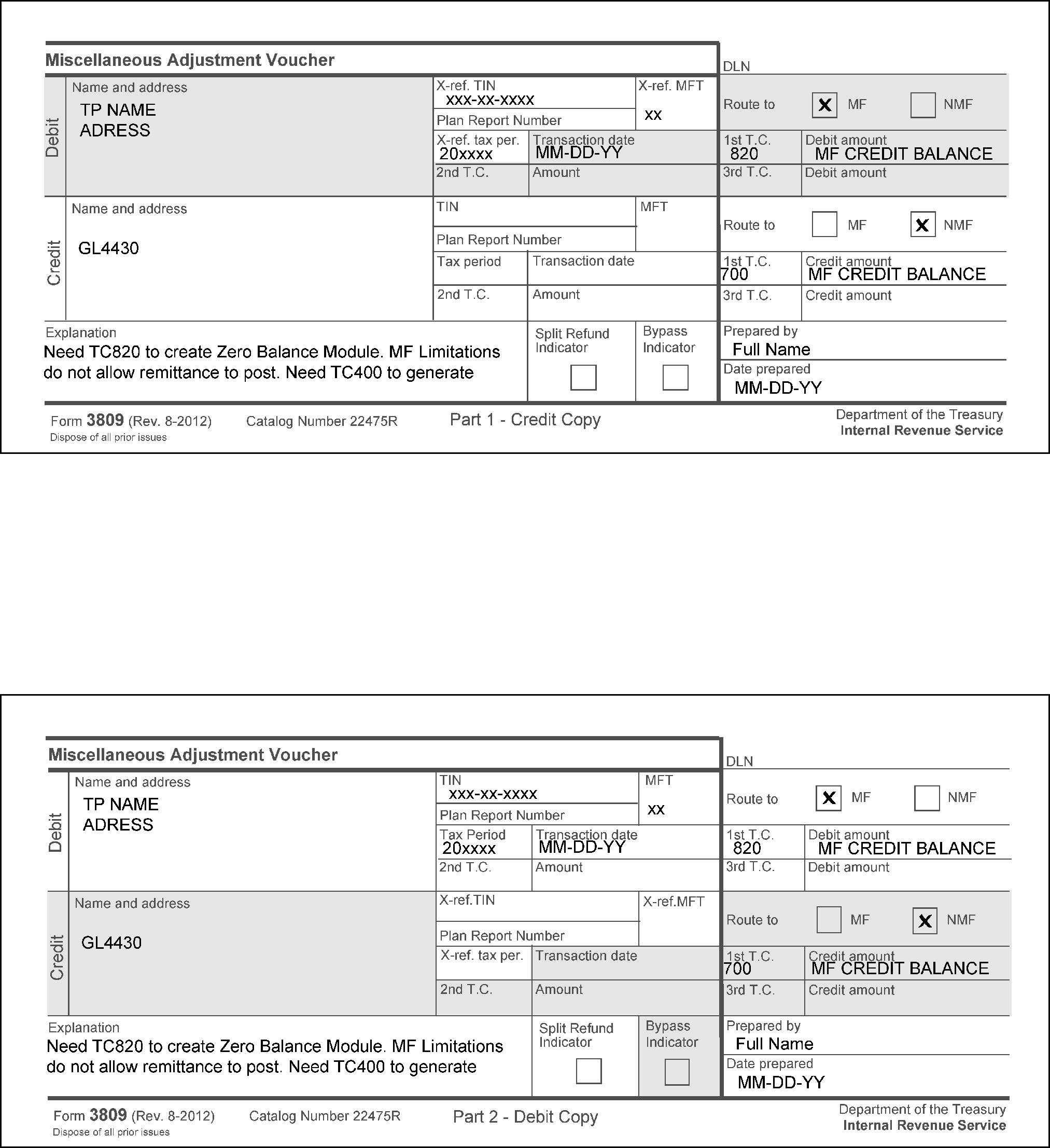
The account transfer-in program transfers all TCs, dates, and amounts into MF on a single record using Form 3413, Transcription List (Account Transfer-in):
- Prepare Form 3413 for previous assessments. Always complete the Name and Date prepared (mmddyyyy) and Telephone number fields.
- See IRM 3.17.21.7, Reestablishing Retention Register Accounts, to reactivate from the Retention Register when necessary. Number with Doc Code 52.
- Form 3413 account transfers include BMF, IMF, re-transfers, and manual assessments. Number with Doc Code 51.
- Each account transfer-in posts to the MF with a primary TC 370, debit or credit TCs, and other wage amounts and appropriation, status, and abstract codes.
- The TC 370 generates with the transfer-in amount. It does not appear on the transfer document. Input TC on Form 813.
Process only account transfer-in requests in debit or zero balance. Contact the originator if the account is in credit balance. Verify the credit balance is valid with the originator. Follow the if/then table:
If Then The credit balance is not valid. Reject the request. The credit balance is valid. Ensure the originator transfers the excess credit on Form 2424 (DRT24) or Form 3809 (DRT48) to the new module. Transfer the account after the balance reduces to zero. Don’t enter any individual TC greater than $999,999,999.99. MF limits each amount field to 11 positions (IMF only).
- Split any amount other than the transfer-in amount into multiple TCs with valid amounts.
- Split the original assessment transaction amount, if too large. Enter the balance in the first available Sections 02-19 field(s). Use TC 290 in place of TC 150.
Split a large transfer-in amount only with a second Form 3413.
Note:
If the sum of all the transactions exceeds $99,999,999,999.99, process through NMF at KCSPC. MF takes module balances only up to 13 numerical positions.
The following case types require re-transfer action:
- MF account posting to an incorrect TIN or tax period, creating a no-merge Martinsburg Computing Center (MCC) transcript on a statute account unable to abate and reprocess or reassess.
- Form 3552 assessment transfers.
- NMF account previously on MF transferring back to IMF or BMF.
- Assessment transfer to maintain a 23C date. Transfer only to the same Taxpayer and account, as legally required.
- Requests to transfer only specific TCs from one module to another, without closing the transfer-out module with TC 400.
- Merging an invalid TIN to a valid TIN, which may require a temporary TIN.
- Transfers from one MF TIN to another MF TIN, which may require reversing TC 400 and all related TCs.
Do not re-transfer an account in any of the following conditions:
- If the 23C date does not need maintaining because it’s within the statute assessment date. Reject to the originator for processing as a normal adjustment.
- Freeze codes need resolution. See IRM 3.17.21.6 (7), Master File Account Transfers-Out.
- There is an AM06W transcript. Reverse the prior TC 400. See IRM 5.19.10.5.3, Accounts Maintenance Claim Pending (AM06W) Transcripts, for more information.
- The intent is to circumvent valid statutory restrictions by establishing an assessment on a previously unassessed account.
- The account is in credit balance.
- The entire account transferred to NMF. Do not re-open MF with a TC 402 and reverse transactions.
- TC 400 generates CP 96 (IMF) or CP 296 (BMF), Account Transfer-Out Transcript Notice.
Prepare Form 3413 using the CP notice to transfer the account back onto MF:
- Input correct transactions, dates, and amounts on Form 3413 from the CP notice and Form 12810. Use TCs valid for Doc Code 51.
- Show TC 150 .00 as the last TC if both TC 150 and a TC 300 with an agreement date are present. This prevents an unpostable.
- Attach copies of the CP notice and Form 12810.
- Always process Form 3413 as soon as possible to post to the proper account without delay.
- See IRM 3.17.21.8, Preparing Form 3413, to properly prepare and control Form 3413.
Re-transfer the following on Form 3413. Use TC 402 with the same amount as the TC 400:
- NMF account previously on MF, if transferring to IMF or BMF with any transaction posted while on NMF.
- MF account with a prior TC 402 transfer to another period or TIN with a TC 400, including good return or assessment, to reverse or abate posted transactions. See Exhibit 3.17.21-3, Reversal Transaction Codes, to open the module for future posting.
- Input TC 402 as the first TC (Section 01) for NMF account re-transfers to the same tax module. Use the same date and amount as TC 400. Add TCs posted to NMF after the TC 400 as secondary TCs. Don’t include TCs posted to MF before the TC 400.
- Assign re-transfers to block numbers 850-899.
- Close the IDRS case control with CC ACTON after completing and correctly posting all actions.
- Verify all required documentation is present in the electronic case file. Ensure the case file is always up-to-date by continually updating it throughout processing, including promptly notating all actions on the history sheet and attaching all current documentation, so that it’s always complete by closing.
- Tell the originator action is complete for account(s) transferred to NMF only.
- Attach all supporting documentation behind the CP notice. Use the TC 400 DLN as the controlling DLN on the MF.
- Retain an electronic copy of each case file. Send cases files in folders weekly to Files, Cycle Control Unit.
- Refer requests for originating documents to Files. Tell originators the TC 400 DLN is the controlling DLN. Files re-files the returns behind this DLN after the originator returns them.
To reverse certain freeze codes, other functions may request the transfer team to input TC 402 to temporarily reopen modules previously transferred out with TC 400. TC 400 sets the M- freeze, which unposts all subsequent transactions except TC 370 with secondary TC 402 input by Accounting. TC 402 reopens the module to MF and releases the M- freeze, allowing the originator to act on the other freezes. The transfer team promptly reinputs the TC 400 once the originator completes all resolving actions. Requests originate from:
- SB/SE, to release the -V or -W freeze set by TC 520. These are typically overflow accounts.
- Accounting Erroneous Refund (ERRF) team, to release the -U freeze set by TC 844 on certain ERRF cases. The -U freeze may remain on the account during an account transfer because Accounting can’t remove it until the taxpayer fully repays the ERRF; however, the ERRF team must request to reopen the account to release the freeze after the ERRF resolves. See IRM 3.17.80.2.3, Account 1535 Court Case Erroneous Refund (Kansas City Only).
Note:
For now, the remarks on Form 12810 identify these cases as requests to reopen the account for freeze resolution, rather than true account transfer requests. As a result, some Form 12810 handling differs for these cases. A dedicated form will simplify this later.
Accounting must close each case within 30 days of reopening. Originators must promptly take all necessary actions once the account is open. Data Control requires originators from functions other than Accounting to email the Data Control manager every 30 days the account is still open. The monthly email must include a statement explaining:
- The reason(s) the case is still open.
- All actions taken to resolve the case.
An estimated date for case resolution.
Note:
The Form 3997, Reconciliation of General Ledger Accounts, balancing sheet must carry the out-of-balance (OOB) as an open reconciled item for the account to balance if carrying the OOB across an accounting period (the end of a month). There is no Form 3997 reporting impact if creating and closing the temporary OOB in the same period. Originator follow-ups with Data Control for the open case by the end of each period also prevent reporting impact for that period.
Caution:
Requests from another Accounting function (such as ERRF) must always resolve within the 30 day timeframe to avoid reporting impact. The process to follow-up with Data Control applies only when a non-Accounting function is responsible for the request.
This table provides instructions to the transfer team and the originating function so both teams can easily follow the entire process. The transfer team and the originator must coordinate to complete all actions quickly.
Caution:
Delays after the module reopens increase the risk of an offset posting. All offsets posted after reopening the module require resolution before TC 400 is reinput because the reinput TC 400 amount must match the prior TC 400.
The following table lists the contacts for IT and HQ:
≡ ≡ ≡ ≡ ≡ ≡ ≡ ≡ ≡ ≡ ≡ ≡ ≡ ≡ ≡ ≡ ≡ ≡ ≡ ≡ ≡ ≡ ≡ ≡ ≡ ≡ ≡ ≡ ≡ ≡ ≡ ≡ ≡ ≡ ≡ ≡ ≡ ≡ ≡ ≡ ≡ ≡ ≡ ≡ ≡ ≡ ≡ ≡ ≡ ≡ ≡ ≡ ≡ ≡ ≡ ≡ ≡ ≡ ≡ ≡ ≡ ≡ ≡ ≡ ≡ ≡ ≡ ≡ ≡ ≡ ≡ ≡ ≡ ≡ ≡ ≡ ≡ ≡ ≡ ≡ ≡ ≡ ≡ ≡ ≡ ≡ ≡ ≡ ≡ ≡ ≡ ≡ ≡ ≡ ≡ ≡ ≡ ≡ ≡ ≡ ≡ ≡ ≡ ≡ ≡ ≡ ≡ ≡ ≡ ≡ ≡ ≡ ≡ ≡ ≡ ≡ ≡ ≡ ≡ ≡ ≡ ≡ ≡ ≡ ≡ ≡ ≡ ≡ ≡ ≡ ≡ ≡ ≡ ≡ ≡ ≡ ≡ ≡ ≡ ≡ ≡ ≡ ≡ ≡ ≡ ≡ ≡ ≡ ≡ ≡ ≡ ≡ ≡ ≡ ≡ ≡ ≡ ≡ ≡ ≡ ≡ ≡ ≡ ≡ ≡ ≡ ≡ ≡ ≡ ≡ ≡ ≡ ≡ ≡ ≡ ≡ ≡ ≡ ≡ ≡ ≡ ≡ ≡ ≡ ≡ ≡ ≡ ≡ ≡ ≡ ≡ ≡ ≡ ≡ ≡ ≡ ≡ ≡ ≡ ≡ ≡ ≡ ≡ ≡ ≡ ≡ ≡ ≡ ≡ ≡ ≡ ≡ ≡ ≡ ≡ ≡ ≡ ≡ ≡ ≡ ≡ ≡ ≡ ≡ ≡ ≡ ≡ ≡ ≡ ≡ ≡ ≡ ≡ ≡ ≡ ≡ ≡ ≡ ≡ ≡ ≡ ≡ ≡ ≡ ≡ ≡ ≡ ≡ ≡ ≡ ≡ ≡ ≡ ≡ ≡ ≡ ≡ ≡ ≡ ≡ ≡ ≡ ≡ ≡ ≡ ≡ ≡ ≡ ≡ ≡ ≡ ≡ ≡ ≡ ≡ ≡ ≡ ≡ ≡ ≡ ≡ ≡ ≡ ≡ ≡ ≡ ≡ ≡ ≡ ≡ ≡ ≡ ≡ ≡ ≡ ≡ ≡ ≡ ≡ ≡ ≡ ≡ ≡ ≡ ≡ ≡ ≡ ≡ ≡ ≡ ≡ ≡ ≡ ≡ ≡ ≡ ≡ ≡ ≡ ≡ ≡ ≡ ≡ ≡ ≡ ≡ ≡ ≡ ≡ ≡ ≡ ≡ ≡ ≡ ≡ ≡ ≡ ≡ ≡ ≡ ≡ ≡ ≡ ≡ ≡ ≡ ≡ ≡ ≡ ≡ ≡ ≡ ≡ ≡ ≡ ≡ ≡ ≡ ≡ ≡ ≡ ≡ ≡ ≡ ≡ ≡ ≡ ≡ ≡ ≡ ≡ ≡ - These procedures are inverse to those of Form 12810 account transfers because the starting point is an account with a prior TC 400 already posted. The transfer team first creates the Form 3413/Form 813 package for the TC 402 without CP 96 or CP 296 (step 7 above), whereas for account transfers the TC 400 is input first and includes the CP 96 or CP 296. Since the package does not include the CP 96 or CP 296 RACS expects, the total account transfer-out amount for the cycle does not match. This creates a temporary OOB that resolves when the transfer team reinputs the TC 400 on a later cycle (step 12 above) to generate the CP 96 or CP 296, which totals into the SC Recap Cycle total. There is not a Form 813 for this cycle because the TC 402 posts with a prior DLN in an earlier cycle matching the CP 96 or CP 296; so, RACS must verify the cycle balance per paragraphs (6) and (7).
- When the transfer team notifies RACS a cycle is OOB due to the freeze TC 402s, RACS separates the freeze cases to verify the remaining Form 813 match the Control-D total. If the remaining Form 813 verify, the casework is correct. RACS records the freeze case TC 402s separately for later verification against the future TC 400 cycle that resolves the OOB.
- When the transfer team notifies RACS a cycle is OOB after TC 400 posts in a future cycle, RACS subtracts the total of the TC 400 cases from the Control-D total. If balanced, the remaining Form 813 should match this adjusted Control-D total. To reconcile the CP 96 or CP 296 for TC 400s subtracted from the total, RACS verifies the amounts against the earlier recorded and separated TC 402s. Each TC 400 should match against a corresponding TC 402 from a prior cycle, resolving the OOB.
- Effective January 1, 1997: Process IMF Retention Register account reactivations for 1994 through the current year with IDRS input. Revenue Accounting Operations does not process these.
- Effective January 1, 1998: Process BMF Retention Register account reactivations for 1994 through the current year with IDRS input.
OSPC processes all Retention Register accounts for:
- Ogden
- Philadelphia
KCSPC processes all Retention Register accounts for:
- Kansas City
- Andover
- Atlanta
- Cincinnati
- Brookhaven
- Fresno
- Memphis
- Many IRS offices submit Form 5248, Transfer Request, to request items on microfilm. Some offices stamp the request information on the Retention Register transcript per local procedures.
- Process all Form 5248 requests within 12 workdays.
- Transfer modules on microfilm Retention Register using Form 3413.
- Review Form 5248, Transfer Request, and the Retention Register transcript to determine the necessary entity transactions.
Reject Form 5248 if any of the following criteria apply:
- The originator doesn’t attach Retention Register account records showing the account to transfer.
- The entity isn’t established on IDRS. The originator must establish the entity on IDRS before preparing Form 5248.
- The requested module(s) are already present on MF. The originator can reactivate the module(s) with CC IMFOL with definer B (IMF) or CC BMFOL with definer B (BMF).
- IMF only: CC IMFOL with definer I shows a 2009 removal date ("09" in the first two positions of the "YR-REMOVED" field) and there is no CC IMFOR with definer T transcript attached. CC IMFOL with definer I shows the removal date in YYMM format.
Use IDRS to determine entity status for accounts removed after 1972. The entity stays on MF for 51 months after all modules move to Retention Register. The originator may need to use Form 5248 instead of CC IMFOL with definer B or CC BMFOL with definer B if after removal:
- The first name line changes.
- The TIN resequences.
Follow the if/then table below when a requested account isn’t on the computer tape at MCC:
If Then - RS number 904 is showing on IDRS, and
- Form 3774, Request for Research, is not annotated, "no record," "lost record," or "damaged record," or
- The transcript is unreadable.
Post TC 430 (IMF) or TC 590 (BMF) for .00 and the current date to establish the account on IDRS. The request has neither Form 3774 nor an unreadable transcript. Reject as incomplete. - The CSED is usually 10 years from the assessment date. TC 608 (Statute Expiration Clearance) generates if the statute is expired. See IRM 25.6.1.12.2.1, Conditions Postponing Collection or Suspending the 10 Year Collection Period, for exceptions.
This subsection covers only Form 3413 elements specific to the Retention Register microfilm. See IRM 3.17.21.8, Preparing Form 3413, for complete Form 3413 instructions.
Prepare Form 3413 as follows:
- Input all transaction dates, codes, and amounts.
- Input zero in Element I, Transfer-In Amount, for all Retention Register reactivations.
- Do not input Sections 36-39 nor the Section 40 Elements A, B, C, and G.
Input Form 3413 using the IMFORT transcript for IMF accounts removed in 2009.
Caution:
IMF accounts moved to retention in 2009 systemically eliminated one position from all money amounts. IMFORT shows the original correct amounts.
Assign a projected posting cycle of three to six weeks from the input date (see example). Annotate it on Form 5248, part one. Return part one to the originator. Attach Form 5248, part two, behind Form 3413 and retain.
Example:
If input on cycle 202601, the projected posting cycle is "202604 - 202607" , or the exact cycle if known.
- Assign the DLN on the transfer documents. See IRM 3.17.21.8.7, Form 3413 DLN Assignment and Control, for instructions.
- Research the MFR with CC ENMOD. Change MFR 08 (deceased taxpayer) to MFR 05 if present using CC ENREQ. Form 3413 can’t post with MFR 08.
Prepare Form 813:
Form 813 Field Instructions Master File Mark either IMF or BMF. Block DLN Input the block DLN. YR Input the current year. Trans. Code Input TC 370. Date Input the Date of Transfer. Doc Count Input the number of transfer documents in the block. Debit Amount Input debit and zero amount. Remarks Include:
- "Retention Register"
- MFT code
- Route documents to Quality Review if applicable.
- All Individual Retirement Account File (IRAF) files moved to IMF in 2006. This replaced the purge file created in 1979 for inactive and erroneous IRAF accounts. IRAF has no regular retirement criteria, unlike the Retention Register.
- The Account Transfer-In program uses Form 3413, Transcription List (Account Transfer-in), to list and transfer all TCs, dates, and amounts on a single record. Complete Form 3413 with the following subsections.
Complete Form 3413, Section 01, per the following table:
Input the first applicable code from the following table as the original assessment TC:
TC Explanation TC 402 Input to re-transfer to the same tax module as a posted TC 400. TC 400 allows only TC 402 to post on a Doc Code 51 account transfer-in. All other TCs unpost. TC 402 reverses the transfers-out freeze, allowing subsequent TCs to post from the same document. TC 150 Input if TC 150 is on the source document but not on the tax module. Input TC 150 .00 as the last TC on Section 2, To side, if moving any TC 290 or TC 300 and no TC 150 is on the To side. Use the Section 1 TC 290 or TC 300 date as the TC 150 date. TC 234 N/A TC 240 Use with TC 290 for IMF 13 and BMF 55. These don’t have tax returns, so they have no TC 150. TC 290 Convert TC 150 to 290 if a TC 150 is already present on the tax module. Use TC 240 and TC 290 for IMF 13 and BMF 55. TC 294 N/A TC 295 Input TC 295, if moving TC 295, on Form 3413 after TC 150, TC 300 and TC 308. TC 299 If moving a TC 299 input it on Form 3413after TC 150, TC 300, and TC 308. TC 300 Input the agreement date in Box J if inputting original TC 300 in Box G. The agreement date is below and right of TC 300 on IDRS. IMF 13 and BMF 55 don’t have tax returns, so they have no TC 300. TC 304 N/A TC 308 Input TC 308, Doc Code 47, if no TC 150, TC 290, or TC 300. TC 308 inputs an Examination Deficiency of tax to modules with TC 150. Include the generated interest assessment, from the interest computation date, in the transaction. Input on Examination Deficiency on Employment tax module for which interest is restricted due to IRC 6205 :
- BMF: Input with penalty and interest transactions or another tax adjustment code, except TC 304, 305 or 309. Otherwise, input in the same way as TC 300.
- IMF: Input only with interest and penalty codes. Do not input with other tax adjustment codes.
TC 160 N/A TC 170 N/A TC 180 N/A TC 270 N/A TC 280 N/A TC 320 N/A TC 350 N/A TC 360 N/A TC 388 N/A TC 430 Input TC 430 .00 on IMF Retention Registers if no code on this list is present. See IRM 3.17.21.7.2, Reviewing Form 5248 Transfer Requests. TC 450 N/A TC 590 Input TC 590 .00 on BMF Retention Registers if no code on this list is present. Also input TC 590 if another TC 59X is present. See IRM 3.17.21.7.2, Reviewing Form 5248 Transfer Requests.
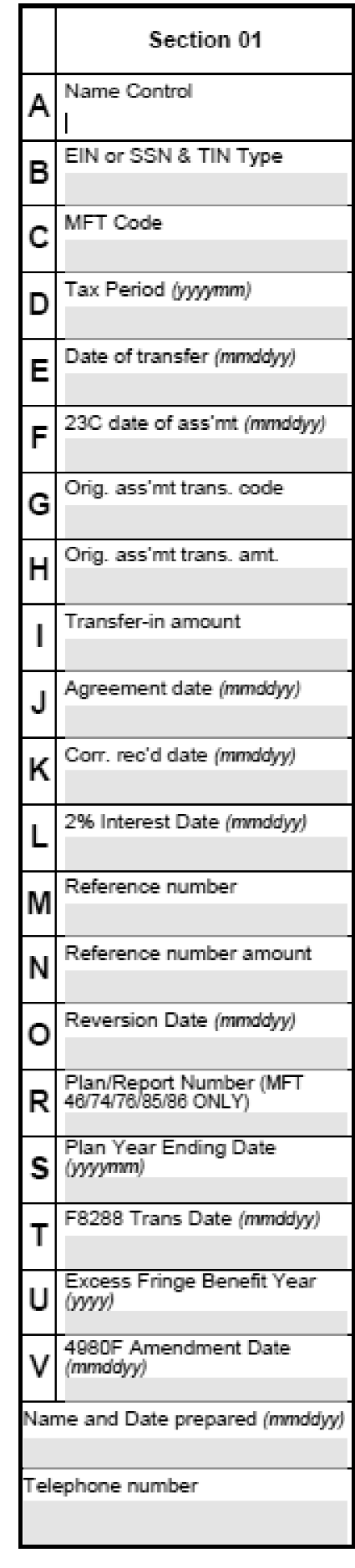
Consecutively list the transaction date, TC, and transaction amount for all TCs following the original assessment from Section 01. See IRM 3.17.21.8.2.1, Form 3413, Sections 02-19 Over 54 Transactions, if the list is more than 54 TCs.
- Input TCs only to valid Sections 02-19 fields. The last six rows on page one are not valid. See IRM 3.12.21-2, Form 3413 Section and Field Indicators.
- Input Sections 02-19 and 30-33 with the same number of TC 340/TC 341.
- Input TC 402 with only those TCs after the account transfer-out (NMF) or original account reversals.
- Input transactions from a Retention Register transcript exactly in the order shown.
- Input TC 630, TC 632, TC 636, and TC 637 in Sections 20-23 only.
Input reversal TCs onto Form 3413after the TC they reverse. This ensures TCs post in the correct order with the original TC followed by the reversal.
Caution:
IDRS sometimes lists a reversal TC before the TC it reversed (for example, TC 672 posting above TC 670). Verify using the reversal TC’s posting cycle date, which is always later than the date of the TC it reversed regardless of the order CC TXMOD lists the TCs. In this case, the reversal TC must still appear on Form 3413after the TC it reverses.
Note:
Do not transfer TC 386, TC 606, TC 849, TC 898, or their related debits. Also, don’t transfer any TCs without a valid conversion per paragraph (2).
- Convert TCs invalid for the Doc Code to the equivalent valid code. See Exhibit 3.17.21-5, Valid BMF Transaction Codes, and Exhibit 3.17.21-6, Valid IMF Transaction Codes, for Sections 02-19 valid TCs.
TCs on Form 3413 invalid for the Doc Code or MFT may include:
- A TC once valid, but now obsolete.
- A TC normally generated on MF, most of which are invalid for Doc Code 51.
- A TC the originator erroneously inputs, believing it’s valid.
Input the dates, TCs, and amounts in Section 02:
- Insert a minus (-) symbol before each credit TC amount, including .00.
- Always use the TC date as it appears on CC TXMOD.
- Input TC 170 .00 with the current date as the transaction date at the end of the reversal TCs on the "From" side. This prevents systemic postings such as TC 176 following the transfer.
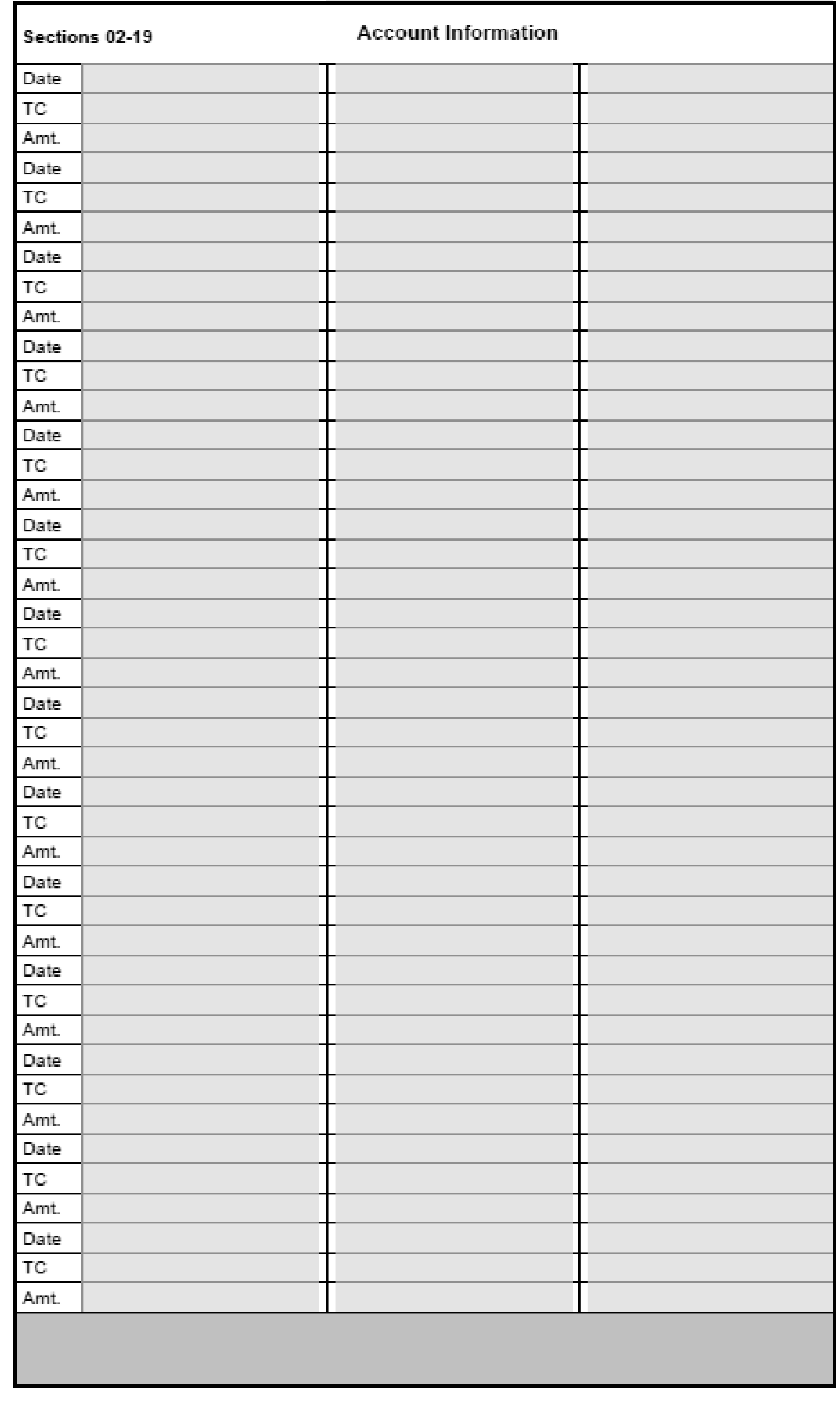
- Sections 02-19 allow up to 54 TCs. Prepare and separately process two or more Form 3413 if the account has more than 54 TCs. Apply this procedure to both the TC 370 and TC 402 documents.
- Eliminate reversal or offset TCs posted to the account to minimize the number of TCs for transfer.
- First document (Doc Code 51): Transfer the entire TC 150 amount and all credits and debits. This results in a TC 370 amount equal to the account balance.
- "From" account only: Input TC 170 .00 (if applicable), TC 270 for .00, and TC 340 for .00 when preparing multiple Form 3413. This prevents erroneous penalty and interest reversals, offsets, and refunds.
- Second document: Process one cycle after the first document. Input TC 290, as the remaining assessment, with the same 23C date as TC 150. Input the remaining credits in Sections 02-19. This results in a zero amount TC 370.
- Reopen the account on the first document, if applicable, using TC 402 with the TC 400 amount. The transfer-in amount, either a zero or debit, must equal the amount remaining on the From account.
Sections 02-19 must either:
- Equal the TC 400 amount if the transfer-in amount is zero.
- Equal the difference between the TC 400 and the debit amount remaining on the "From" account.
- Second and subsequent documents must have a zero transfer-in amount.
Doc Code 52: Form 3413 must reflect a zero balance.
- Process the second document with Doc Code 51, one week after the Doc Code 52 record.
- Remove valid Doc Code 51 TCs to reduce the first document to 54 or fewer TCs.
- Remove only zero or offsetting TCs to keep the balance for both documents at zero.
- Use Form 3413, Sections 20-23, for special appropriation credits with Congressional funding. This currently covers only solar and wind energy credits.
The following table lists the valid TCs for each MF and Doc Code:
TC Debit/Credit BMF 51 BMF 52 IMF 51 IMF 52 TC 630 CR Y Y Y Y TC 632 DR Y Y Y Y TC 636 CR N Y N Y TC 637 DR N Y N Y Convert invalid TCs (Doc Code 51 only) as follows:
- Convert TC 636 to TC 630.
- Convert TC 637 to TC 632.
Complete Sections 20-23 per the following table:
Form 3413, Section 20-23 Field Instructions TC Input the TC. Code Input the two-digit appropriation code. Valid codes are:
- Credit: 02 for TC 630 and TC 636
- Debit: 03 for TC 632 and TC 637
Indicator Input Appropriation Indicator "1" for a memo transaction (or reversal) for which the proposed credit lacks funding. Do not include this memo transaction/reversal amount in the total transfer-in balance. Transaction Amount Input the amount for each transaction. Insert a minus (-) symbol before the credit amounts. Include in the transfer-in balance unless Appropriation Indicator "1" applies.
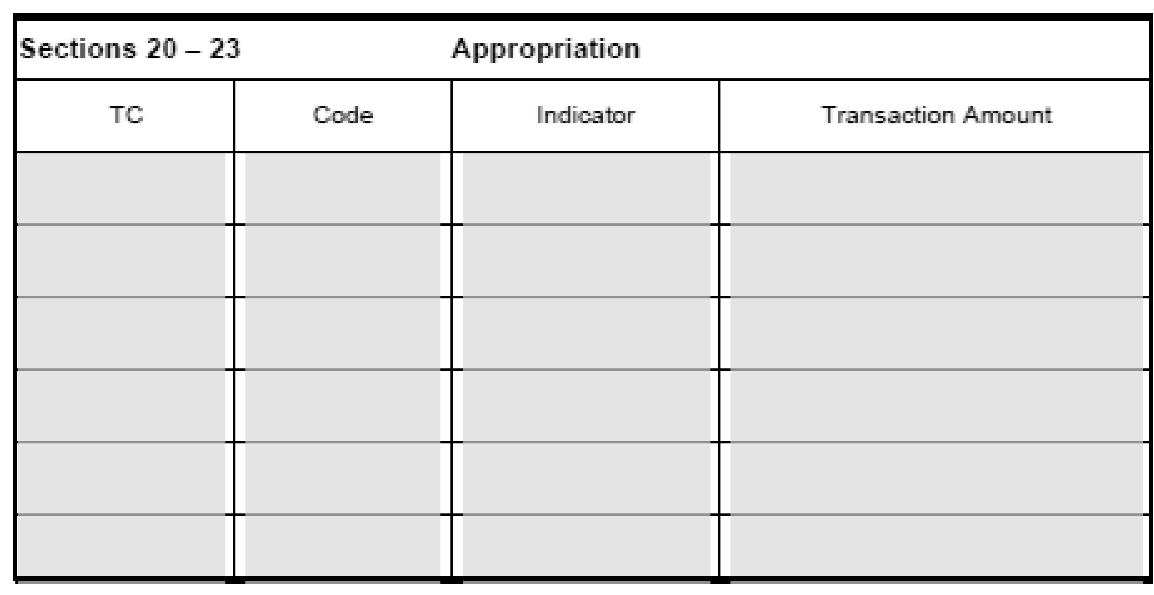
Use Form 3413, Sections 30-33, for non-remittance "status" TCs and Interest to Date. The program accepts up to 12 TCs. Complete Sections 30-33 per the following table:
Don’t reject the request for an invalid code. Drop it from the request. Explain the omission on the documentation for the originator. Most of the codes can be input on IDRS after Form 3413 posts, if needed.
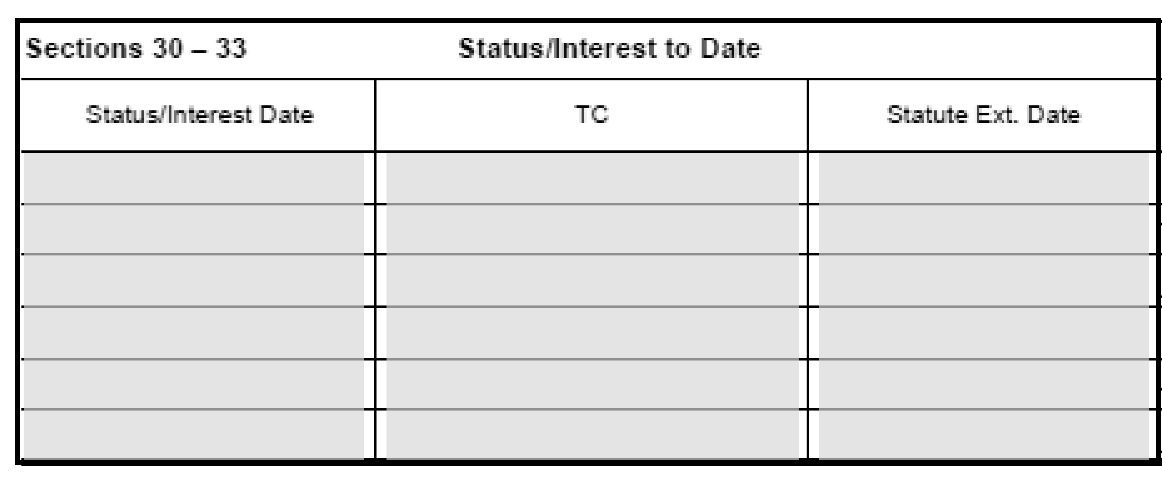
- Use Form 3413, Sections 36-39, to report IRS abstract information. Input for Doc Code 51 only, when TC 15X, TC 29X, or TC 30X are present.
The following forms always require valid abstract information:
Form MFT Master File Form 720 03 BMF Form 4720 50 BMF Input abstract numbers in the No. (number) columns. Input amounts in the “Amount” columns.
The two abstract numbers for Tax Motivated Transactions are 221 (Tax) and 222 (Interest):
- Always use both numbers if using either.
- Always use with TC 340 or TC 341 only.
- 221, 222, and 233 are valid for all MFT codes except 15, 46, 77, and 78.
- Determine the net tax assessment by adding the amounts related to TC 15X, TC 29X, and TC 30X. The sum of the abstract amounts, excluding 221 and 222, equals the net tax assessment.
See Exhibit 3.17.21-1, Abstract Numbers Table, for the full list of valid abstract numbers by MFT.
- Examine the source document to resolve most amount and abstract number errors. See IRM 3.17.41-3, Excise Reporting, Guide to Abstract Numbers, to define each abstract number. Reject frequent errors or contact the originator for correction.

Elements A, B, and C show wage information for withholding and Federal Insurance Contribution Act (FICA) tax returns:
- Form 941, Employer’s Quarterly Federal Tax Return (MFT 01)
- Form 943, Employer’s Annual Tax Return for Agricultural Employees (MFT 11)
- Form 944, Employer’s Annual Federal Tax Return (MFT 14)
- Form 945, Annual Return of Withheld Federal Income Tax (MFT 16)
Form 3413, Section 40 fields are valid only for Doc Code 51, tax class 1 records. The following table lists the fields and additional information:
Caution:
Verify line references for subsequent revisions. Line references are current for each form at the time of this subsection’s last revision unless noted otherwise.
Form 3413, Section 40 Field Information A – Adj. total of inc. tax withheld (F943, 945, & 941-MFT 01 – posted prior to 12/31/2004) Adjusted total income tax withheld before December 31, 2004. Present when first establishing withholding tax liability on MF:
- Form 941, line 3
- Form 943, line 6
- Form 945, line 1
B – Taxable Social Security Wages (Form 941, 943, 944, and 945 Taxable Social Security wages:
- Form 941, line 5a
- Form 943, line 2
- Form 944, line 4a
C – Taxable Social Security Wages for qualified sick leave (Form 941, 943, 944) Taxable Social Security wages for Qualified sick leave (TY 2020-2023):
- Form 941, line 5a(i) (rev. 04-2020 and 2021 through 03-2023)
- Form 943, line 3a (rev. 2020 through 2023)
- Form 944, line 4a(i) (rev. 2020 through 2023)
D – Taxable Social Security Wages for qualified family leave (Form 941, 943, 944) Taxable Social Security wages for Qualified family leave (TY 2020-2023):
- Form 941, line 5a(ii) (rev. 04-2020 and 2021 through 03-2023)
- Form 943, line 3b (rev. 2020 through 2023)
- Form 944, line 4a(ii) (rev. 2020 through 2023)
E – Taxable Social Security tips (Form 941 and 944) Taxable Social Security tips:
- Form 941, line 5b
- Form 944, line 4b
F – Taxable Medicare wages and tips (Form 941 and 944) Taxable Medicare wages and tips. BMF on MFT 01, 04, 11, or 14 only:
- Form 941, line 5c
- Form 944, line 4c
G – Additional Taxable Medicare Wages and Tips (Form 941, 943, 944 & 1041) Additional taxpayer Medicare wages and tips:
- Form 941, line 5d
- Form 943, line 6
- Form 944, line 4d
H – Exempt Wages/Tips Paid to Qualified Employees (F941, F943, & F944). Exempt wages and tips paid to qualified employees:
- Form 941, lines 6c and 12d (rev. 4-2010 through 10-2010)
- Form 943, lines 7b and 13d (rev. 2010)
- Form 944, line 5b (rev. 2010)
I – SECT 3121Q Tax Amt. Tax amount from Form 941, line 5f per IRC 3121(q) (Notice and Demand - Tax Due on Unreported Tips). J – Fractions of Cents (Form 941) Fractions of cents adjustment from Form 941, line 7. K – Current quarter’s sick pay (F 941) F944 Current yrs. Adj. Current quarter’s sick pay:
- Form 941, line 8
- Form 944, Line 6 (Current year’s adjustments)
L – Current quarter’s tips and group-term insurance Adj. Current quarter’s tips and group-term insurance adjustment from Form 941, line 9. M – Qualified Small Business Credit - Form 8974 (Form 941) Qualified Small Business Credit:
- Form 941, line 11
- Form 943, line 12
- Form 944, line 8
N – Nonrefundable portion of credit for qualified sick and family leave wages (Form 941, 943, 944, CT-1) Nonrefundable portion of credit for qualified sick and family leave wages before April 1, 2021:
- Form 941, line 11b (rev. 2020 through 2023)
- Form 943, line 12b (rev. 2020 through 2023)
- Form 944, line 8b (rev. 2020 through 2023)
- Form CT-1, line 16 (rev. 2020 through 2023)
O – Nonrefundable portion of employee retention credit due to the COVID-19 crisis (Form 941, 943, 944, CT-1) Nonrefundable portion of employee retention credit:
- Form 941, 11c (rev. 04-2020, 07-2020, 03-2021, and 06-2021)
- Form 943, line 12c (rev. 2020 and 2021)
- Form 944, line 8c (rev. 2020 and 2021)
- Form CT-1, line 17 (rev. 2020) and 17a (rev. 2021)
P – Nonrefundable portion of credit for qualified sick and family leave wages for leave taken after March 31, 2021 (Form 941,943,944,CT-1) Nonrefundable portion of credit for qualified sick and family leave wages after March 31, 2021:
- Form 941, line 11d (rev. 2021 through 2023)
- Form 943, line 12d (rev. 2021 through 2023)
- Form 944, line 8d (rev. 2021 through 2023)
- Form CT-1, line 17b (rev. 2021 through 2023)
Q – Nonrefundable portion of COBRA premium assistance credit (Form 941, 943, 944, CT-1) Nonrefundable portion of COBRA premium tax assistance credit:
- Form 941, line 11e (rev. 6-2021 and 3-2022)
- Form 943, line 12e (rev. 2021 and 2022)
- Form 944, line 8e (rev. 2021 and 2022)
- Form CT-1, line 17c (rev. 2021 and 2022)
R – Income Tax Withheld Adj. (F941 Current), (F944 Prior Year) Income tax withheld adjustment (current Form 941 and prior year Form 944). S – SS and Med. Tax – Adj. (Forms 941, 943, 944, & 945) Social Security and Medicare tax adjustment. Valid only when the original assessment TC (Section 01, Element G) is TC 150, TC 290, TC 294, TC 298, TC 300, TC 304, or TC 308. This amount plus income tax withheld and backup withholding equals the sum of all TC 29X and TC 30X amounts on the transfer-in record. T – Special Addition to Federal Income Tax (F941 and F944) Special addition to federal income tax:
- Form 941, line 7f (rev. 2005 through 2008)
- Form 944, line 6d (rev. 2006 through 2008)
U – Special Additions to Soc. Sec. and Med. Tax (F941 & 944) Special additions to Social Security and Medicare tax:
- Form 941, line 7g (rev. 2005 through 2008)
- Form 944, line 6e (rev. 2006 through 2008)
V – Total Income Tax Withheld from wages (F941 and F944) posted after 12/31/2004 Total federal income tax withheld from wages after December 31, 2004:
- Form 941, line 3
- Form 944, line 2
W – Tips Deemed Wages (Sec. 3121g) Tips deemed wages from IRC 3121(g). X – Total Backup Withhold Adj. (Form 945) Backup withholding from Form 945, line 2. BMF on MFT 01 and 16 only. Y – Gross Income Paid (From 1042) Gross income paid from Form 1042. Z – RR Retirement Tax Adj. (Form CT-1) Railroad Retirement Tax Adjustment from Form CT-1, line 14.
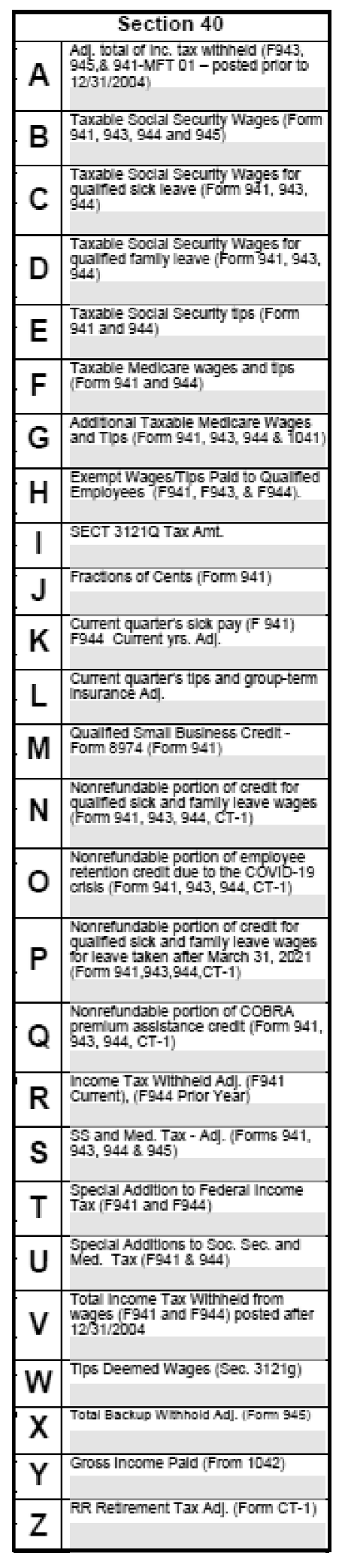
- Sort Form 3413 by Tax Class and type of transfer. See Exhibit 3.17.21-8, Tax Return Information Table, for tax classes by return.
Sort the following by MFT Code:
- Form 730, Monthly Tax Return for Wagers
- Form 1041, U.S. Income Tax Return for Estates and Trusts
- Form 1065, U.S. Return of Partnership Income
- Form 2290, Heavy Highway Vehicle Use Tax Return
- Form 8752, Required Payments or Refund Under Section 7519
Assign the 14-digit DLN:
DLN Position Instructions 1 and 2 AOC for Doc Code 51 and 52. 3 Tax class. See Exhibit 3.17.21-8. 4 and 5 Doc Code:
- 52 for Retention Register reactivations
- 51 for all others
6, 7, and 8 Input the Julian date. 9, 10, and 11 Assign the block number:
- Re-transfers: Begin with Block 850.
- Other Transfers-in: Begin with Block 200.
- Retention Register reactivations: Use the BBTS DLN tool to determine by vestigial (record is on entity module) or non-vestigial (no entity record).
12 and 13 Input a consecutive serial number, beginning 00. 14 Input the last digit of the year (for example, 6 for 2026). - Prepare Form 813 for each block. Input the MFT code to the right of the date block for Form 1041, Form 1065, and Form 8752. Annotate BMF to the left of Document Register.
- Route pre-journalized blocks to RACS for input.
- Route Form 813, copy two, to the Data Conversion Operation (DCO) for establishment on SCCF.
- Route the blocked Form 3413 with Form 813 (original) to Batching for input to ISRP.
The following table lists adjustment requests by originator and form:
Originator Form(s) Reject Correction unit - Form 1120, U.S. Corporation Income Tax Return
- Form 1041, U.S. Fiduciary Income Tax Return (For Estates and Trusts)
- Form 1041-ES, Estimated Income Tax for Fiduciaries
- Form 4227, Intra-SC Reject or Routing Slip (attachment to the front of each Form 1120)
District and Field Offices - Optional Form 27, 2-Way Memo (See (2) below)
Various IRS functions - Form 3465, Adjustment Request
Do the following after receiving Optional Form 27:
- Annotate all actions on both the original and a copy of the form.
- Route the copy to the originator.
Route the request and attachments to CSCO if there is a -W freeze, per local routing procedures.
Note:
TC 520 generates the -W freeze. Route posted TC 520 without a corresponding TC 521 or TC 522 reversal.
The control clerk:
- Controls the cases.
- Counts and maintains the record of receipts and releases on the report.
- Orders CC MFTRA on IDRS only on jeopardy refunds. The Parent-Subsidiary technicians check all other Form 1120.
The originator should prepare Form 3177, Notice of Action for Entry on Master File, before routing Form 1120 to Accounting. They annotate Form 3177 on all Form 1120 except short period returns. If there is no such notation:
- Input TC 590 closing code (cc) 14 using CC FRM49, for each subsidiary, if transferring credits to the parent corporation.
- Annotate "Form 3177" on the return.
- Refer frequently occurring missing notations to the Accounting manager. The manager alerts the originating function to the deficiency.
- The campus receiving the consolidated Form 1120, U.S. Corporation Income Tax Return, transfers subsidiary corporation prepayments to a parent corporation. Control and initiate the transfer only afterForm 1120 filing.
- Locate and verify credits claimed on Form 1120, Schedule J, line 18, per (3) through (5) below.
Credits on IDRS:
- Use CC SUMRY on the parent.
- Use CC TXMOD with definer A on the account with the credit, if found on CC SUMRY.
- Research TXMOD with definer A for TC 590 or TC 599.
- Use CC BMFOL, CC BRTVU, or another CFOL research CC to verify the credits if the account isn’t on IDRS.
- Annotate the log or local worksheet document.
- Examine the account transcript to find the parent corporation’s credit.
Credits from subsidiary taxpayers:
- Locate credits from subsidiary Taxpayers using Form 851, Affiliations Schedule, and Form 1120, Schedule K.
- Compare Form 851 claim amounts with the credits available per the transcripts.
Backup withholding:
- Backup withholding on Form 1120, Schedule J, line 18 does not require substantiation (Form 1099-series).
- Transfer a credit to the correct module if necessary. Always use IDRS if possible. IDRS provides a cross-reference audit trail for Doc Codes 24 and 48.
Credit transfer formats:
- CC DRT24: Use to transfer credits requiring a secondary TC (transferring to a module without a posted return).
- CC DRT48: Use to transfer carryovers or other non-revenue receipt items.
- CC FRM34: Use to transfer credits within an MF if a secondary TC is unnecessary (the parent return is posted). See (3) below for input instructions.
Input CC FRM34 as follows:
- Use Subsidiary Code 1 if moving estimated credits from the subsidiary account to the parent corporation account. This generates a para/sub credit transcript if there is a credit on the module unless a TC 599 is present. This transcript reminds the para/sub clerk a credit is still on the account.
- Input "1" in the CR-FRZ-CD ("Credit Freeze Code" ) field, if necessary, to generate TC 570 and set the -R freeze.
- Resolve the credit when the subsidiary corporation isn’t liable by either: transferring the credit to a liable period; or refunding to the parent corporation. Take no action if the subsidiary corporation is liable for the period in question.
- Use subsidiary code "0" for other Form 1120 estimated payment transfers.
- Leave the subsidiary code blank in all other cases.
- Check for any debit balances on the subsidiary accounts before transferring to the parent corporation account.
- Notify Rejects the credit is needed on the module if IDRS shows a rejected TC 620 for the credit amount. Annotate the Form 1120 worksheet and close the case.
- Elevate cases with UPC 305 or 307 to P&A through email. P&A refers the request to Unpostables for correction.
Prepare CC FRM49:
- Input TC 590 cc 14 using CC FRM49 if "Form 3177" isn’t annotated in the margin of a consolidated return, or if TC 590 or TC 599 isn’t on CC TXMOD.
- Take the adjustment actions below when there is a posted subsidiary return (TC 150), but the parent corporation assumes liability for the period and claims credit.
- Input TC 470 on the subsidiary module.
- Transfer the credit to the parent corporation account.
- Prepare Form 3465, Adjustment Request, to abate the tax liability on the subsidiary amount.
Research all available information thoroughly per IRM 3.17.21.9.1, Parent-Subsidiary Cases. The credit may be missing because:
- The credit refunds to the taxpayer.
- A debit creates a misapplied payment.
- The credit is used elsewhere.
Contact the originator for an explanation if the credits found don’t agree with the credits claimed on the return:
- Ask for a copy of the front and back of the check.
- Hold the case open until received and traced.
- Input, on IDRS, the correct status code to the tax period.
Short period returns occur for several reasons:
- A business consolidates to form a new corporation.
- A taxpayer goes out of business.
- A taxpayer has approval to change fiscal year accounting period.
Rejects submits these returns. Control the same as the consolidated corporation returns.
- Correct the fiscal year month and filing requirement, if necessary, before moving credits.
- Input secondary TC 570 to freeze the module from offsetting or refunding the credit. Input TC 571 if a credit balance remains after the return posts.
- Assign short periods on IDRS with category "IRRQ" using CC ACTON.
- Change the fiscal year month to set up the period if condition codes Y and F are not present. Use CC ENMOD followed by CC ENREQ to generate CC BNCHG for input.
- Transfer the credit and return Form 1120 to Rejects. Rejects must correct the transaction immediately if it unposts.
- Transfer only the amount claimed on the return. Ignore excess credits on IDRS.
- Don’t change line amounts on the return for refunds transferring to debit balance.
- Follow the consolidated return procedures for researching, transferring credits, and releasing refunds.
- Accounting receives Form 1120 and Form 1041 manual refunds when the 45-day interest free period is in jeopardy. Request a transcript to verify the estimated tax (ES) credits claimed on the return. Follow Manual Refund procedures, if the credits match, per IRM 3.17.79, Accounting Refund Transactions, and IRM 21.4.4, Manual Refunds.
- Monitor all SP, Accounting manual refunds after preparing and processing until TC 840 posts to avoid issuing an erroneous refund.
- HQ performs all manual refund monitoring as of June 20, 2023. See IRM 21.4.4.6.1, Monitoring Manual Refunds.
- Follow these procedures upon identifying a deposit posted to MF as a payment. Correct the erroneous posting with the Integrated Automation Technologies (IAT) Credit Transfer Tool.
- Establish an IDRS control base. Input both sides of the transfer on the same module so the CC DRT24 screen matches the fields below. Add freeze codes or HCs, if necessary, to prevent notices or an erroneous refund.
- Use the debit side to reverse the erroneous posted transaction. Use the credit side to input corrected TC 640 with DPC 12. Use the transaction date and money amount from the original posting. The IAT Credit Transfer Tool inputs the TC 640 with Blocking Series 990-999, Doc Code 24, and an inflated Julian date.
Debit side (upper part):
- TRNS-DT>Erroneous transaction posted date
- TC>Erroneous transaction reversal code
- AMT>Erroneous transaction amount
Credit side (lower part):
- TRNS-DT>Erroneous transaction posted date
- TC>640
- AMT>Erroneous transaction amount
- DPC>12
- CASE-STS-CD>C
- IRS-RCVD-DT>*
- CTRL-CAT>OTHE
- ACTIVITY>CRED-TRANS
- REMARKS>NSD IRC 6603 Deposit
Caution:
The remark properly identifies the remittance as a deposit rather than a payment. This information is critical if a court (or other) challenges the nature of the remittance.
- Monitor the account for correct posting.
The following IRM procedures apply to taxable years beginning before January 1, 2018
Note:
Section 13516 of the Tax Cuts and Jobs Act (Pub. L. No. 115-97) repeals Section 847 for taxable years beginning after December 31, 2017. This ends the election to apply Section 847 rules of the prior law for the additional deduction, special loss discount account, Special Estimated Tax Payments (SETPs), and refundable amounts.
- Effective for tax periods beginning after December 31, 1987, IRC 847(2) requires certain insurance companies to make SETPs in the amount equal to the tax benefit derived from the additional deduction allowed under the statute. Returns with SETPs require special handling.
Large Business & International (LB&I) Exam reviews the Section 847 return, then:
- Emails the Form 3809 (debit and credit copies) and a copy of the front page of the return to Ogden Revenue Accounting for module input and addition to the taxpayer’s 4615 file.
- Annotates reason(s) if not moving funds due to specific criteria in the Form 3809 explanation section.
- Inputs ".00" in the first TC on both the debit and credit copy (if not moving funds).
- Revenue Accounting forwards return photocopies from SP functions to LB&I Exam through eFax at ≡ ≡ ≡ ≡ ≡ ≡ ≡ ≡ with the sender's contact information (name, phone number, and email). Contact LB&I directly by phone or email if the eFax doesn’t work, at ≡ ≡ ≡ ≡ ≡ ≡ ≡ ≡ ≡ or ≡ ≡ ≡ ≡ ≡ ≡ ≡ ≡ ≡ ≡ ≡ ≡ ≡ ≡ ≡.
- Nullified unpostables are unpostables that normal procedures can’t correct. They are removed from the unpostable file and established on SCCF. Nullified unpostables show on IDRS as a pending TC with pending code NU (nullified unpostable) or DC (corrected nullified unpostable) and control category NLUN.
- Return unworkable nullified unpostables to the originator as soon as possible upon receipt. See IRM 3.12.179, Individual Master File (IMF), Payer Master File (PMF) Unpostable Resolution, to define and process workable cases.
- Process nullified unpostables to correct for reinput under the normal Organization Function Program (OFP) code. Don’t charge the time to Unpostables.
- A DLN is a controlled number assigned to every return or document.
- Accounting receives documents for numbering either directly from other operational areas within a campus or by transfer-in.
- Obtain the DLN from BBTS to number each document.
- Form 2158, Credit Transfer Voucher, primarily transfers credits between campuses.
Numbering:
- Tax class: "6"
- Doc Code: "58" .
- Julian date: Current date
- Blocking Series: Depends on form number/MFT. See Exhibit 3.17.21-2, Blocking Series Tables
- Form 3177, Notice of Action for Entry on Master File, requests miscellaneous transaction codes for input on Master File.
Numbering:
- Tax class: "6" .
- Doc Code: "77" .
- Julian date: Current date
- Blocking Series: 100-999. See Exhibit 3.17.21-2, Blocking Series Tables
- Form 514-B, Tax Transfer Schedule, transfers the collection of a taxpayer’s account from MF to NMF.
Numbering:
- FLC: 36
- Tax class NMF: "6"
- Tax class MF: Depends on form number/MFT
- Doc Code: "51" (NMF)
Julian date: Monday or Friday (NMF)
Blocking Series NMF: Depends on form number/MFT.
- Form 2424, Account Adjustment Voucher, transfers a credit or debit between MF and NMF or between two MF accounts. It consists of a credit copy (as the original) and debit copy (as a duplicate).
Numbering:
- FLC: 36
- Tax class NMF: "6"
- Tax class MF: Depends on form number/MFT
- Doc Code: "24"
Julian date
Blocking Series NMF: Depends on form number/MFT.
- Blocking Series MF: "000-999"
- See Exhibit 3.17.46-7, Automated Non-Master File Accounting, Validity Table, for the full list of valid TC by Doc Code and Blocking Series.
- Form 3809, Miscellaneous Adjustment Voucher, transfers non-revenue receipt credits using separate copies for credit and debit.
- Numbering: Number per paragraphs (3) through (8).
Doc Code: Determine using the following table:
If TC is: Use Doc Code: TC 270, TC 340, TC 360, TC 710, TC 712, TC 716, TC 742, TC 760, TC 762, TC 770, TC 771, TC 772, TC 800, TC 802, TC 830, TC 832, TC 841, or TC 842 48 TC 161, TC 171, TC 181, TC 201, TC 235, TC 241, TC 270, TC 271, TC 281, TC 291, TC 301, TC 311, TC 321, TC 340, TC 341, TC 351, TC 360, TC 361, TC 430, TC 610, TC 611, TC 640, TC 641, TC 650, TC 661, TC 662, TC 670, TC 671, TC 681, TC 682, TC 690, TC 691, TC 694, TC 700, TC 702, TC 710, TC 716, TC 730, TC 732, TC 764, TC 765, TC 766, TC 767, TC 820, TC 822, TC 850, or TC 852 58 - Julian date: Current date.
Tax class MF: Determine using the following table:
If MFT is: Tax Class is: 29 0 01, 04, 08, 11, 12, 14, 16, or 17 1 IMF: 30, 31, 55, 65, or 82 2 BMF: 05, 06, or 15 2 02, 07, 13, 33, 34, 46, 83, 85, or 86 3 03, 36, 37, 40, 43, 44, 47, 49, 50, 58, 60, 61, 62, 63, 64, 67, 74, 75, 76, or 79 4 51, or 52, 77, or 78 5 09 7 10 8 - Tax Class NMF: "6."
Blocking Series NMF: Depends on the form number/MFT.
- Blocking Series MF: "000-999."
Each document receives an assigned DLN.
- The DLN establishes on SCCF when the document is in processing and remains on SCCF until either deletion or accountability transfers to Enterprise Computing Center (ECC).
- RACS sends Form 813 to DCO to establish the DLN on SCCF.
- Form 813 then goes to Data Control after posting for balancing to SCCF on the SCF 11-42 CRL (Control Record Listing).
- See IRM 3.17.30, Accounting and Data Control, SC Data Controls, for more procedures.
- The National Taxpayer Advocate has Service Level Agreements (SLA) with the Commissioners of Taxpayer Services (TS), SB/SE, Tax Exempt/Government Entities (TE/GE), Criminal Investigation (CI), Appeals, and LB&I. These agreements outline the procedures and responsibilities for processing TAS casework when either the statutory or delegated authority to complete case transactions rest outside TAS.
- The Service Level Agreements page on the TAS SharePoint has the SLAs for all operating divisions/functions.
- Per the Taxpayer Bill of Rights, taxpayers have the right to expect a fair and just tax system that provides taxpayers with the opportunity to have their facts and circumstances considered when it might affect their underlying liabilities, ability to pay, or ability to provide information timely.
- Taxpayers have the right to receive help from TAS if they’re experiencing financial difficulty or if the IRS has not resolved their tax issues properly and timely through normal channels. Visit Taxpayer Rights - TAS for more information on the Taxpayer Bill of Rights.
The following table lists MFT codes followed by the Abstract Numbers valid for each:
| MFT Code | Valid Abstract Numbers |
|---|---|
| All MFTs except 15, 46, 77, and 78 | 221 and 222 |
| 02 | 330 through 333 |
| 03 | 009 through 024 026 through 098 101 through 125 133 and 136 140 291 303 through 310 322 through 324 326 through 329 340 through 390 392 through 398 411 through 437 |
| 12 | 330 and 333 |
| 29 | 160 and 162 194 and 195 233 and 235 through 237 |
| 34 | 330 through 333 |
| 44 | 330 through 333 |
| 49 | 163 and 164 |
| 50 | 151 through 154 182 and 183 213 through 216 234, 237, and 238 240 |
| 61 | 001 through 009 013 through 035 040 |
| 74 | 165, 167, and 169 |
| 75 | 165 |
| 76 | 159 161, 163, 164, 165, 167, and 169 200 and 201 203 through 206 209 224 through 228 237 450 through 452 |
| 77 | 218 |
| 78 | 217 |
The following tables list Blocking Series, Doc Codes, and necessary actions for IMF, BMF, and NMF forms:
| If Form 2424 Blocking Series | Then Doc Code 24 IMF and BMF |
|---|---|
| 200-399 | Service Center Deposits and Estimated Payments |
| 400-899 | All Others |
| If Form 3809 Blocking Series - BMF and IMF | And Doc Code 48 and 58 | Then Transfer to |
|---|---|---|
| 000-299 | Doc Code 58 | NMF |
| 300-399 | Doc Code 58 | Account 4620 |
| 400-499 | Doc Code 58 | Account 6800 |
| 500-699 | Doc Code 48 | NMF |
| 700-799 | Doc Code 48 | Account 4620 |
| 800-898 | Doc Code 48 | Account 6800 |
| 899 | Doc Code 48 | Reclamation Period Date Expiration |
| 900-999 | Doc Code 48 | Erroneous Refunds |
| 900-999 | Doc Code 58 | Child Support Offsets |
| If Blocking Series | And Doc Codes 24 and 38 | Then NMF Only |
|---|---|---|
| 100-199 | True Tax Class 1 | Withholding and FICA |
| 200-299 | True Tax Class 2 | Individual Income |
| 300-399 | True Tax Class 3 | Corporation |
| 400-499 | True Tax Class 4 | Excise |
| 500-549 | True Tax Class 5 | Estate |
| 550-599 | True Tax Class 6 | Gift |
| 700-799 | True Tax Class 7 | Railroad Retirement |
| 800-899 | True Tax Class 8 | Federal Unemployment Tax Act (FUTA) |
The following table lists the most frequently used TCs and their related reversal code:
| Transaction Code | Reversal Code |
|---|---|
| TC 150 | TC 291 |
| TC 160 or TC 166 | TC 161 |
| TC 170 or TC 176 | TC 171 |
| TC 180 or TC 186 | TC 181 |
| TC 190 or TC 196 | TC 191 |
| TC 200 | TC 201 |
| TC 240 | TC 241 |
| TC 270 or TC 276 | TC 271 |
| TC 280 or TC 286 | TC 281 |
| TC 290 | TC 291 |
| TC 294 | TC 295 |
| TC 300 | TC 291 |
| TC 310 | TC 311 |
| TC 320 | TC 321 |
| TC 340 | TC 341 |
| TC 350 | TC 351 |
| TC 360 | TC 361 |
| TC 430 | TC 662 |
| TC 610 | TC 612 |
| TC 640 | TC 642 |
| TC 650 | TC 652 |
| TC 660 | TC 662 |
| TC 670 | TC 672 |
| TC 678 | TC 679 |
| TC 680 | TC 682 |
| TC 690 | TC 692 |
| TC 694 | TC 695 |
| TC 700 | TC 702 |
| TC 706 | TC 701 |
| TC 710 | TC 712 |
| TC 716 | TC 712 |
| TC 740 | TC 742 |
| TC 760 | TC 762 |
| TC 768 | TC 765 |
| TC 770 or TC 776 | TC 772 |
| TC 820 | TC 822 |
| TC 826 | TC 821 |
| TC 836 | TC 832 |
| TC 840 or TC 846 | TC 841 |
The following table lists the criteria for finding the correct NMF account status based on current or prior MF account status:
| If the account shows | And | Then |
|---|---|---|
| Open TC 470 | N/A | Load the account in Status 89. |
| Open TC 520 | N/A | Load the account in Status 89. |
| Open TC 530 | N/A | Load the account in Status 53, plus any TDA and fourth notice dates. |
| Status 12 | There is no prior status | Load the account in Status 21. |
| Status 12 | There is a prior status | Load the account in the previous status, plus any TDA and fourth notice dates. |
| Status 21 | N/A | Load the account in Status 21. |
| Status 22 | N/A | Load the account in Status 22, plus any TDA and fourth notice dates. |
| Status 23 | N/A | Load the account in the previous status, plus any TDA and fourth notice dates. |
| Status 24 or 26 | N/A | Load the account in Status 22, plus any TDA and fourth notice dates. |
| Status 29 | N/A | Load the account in the previous status. |
| Status 60 | Payments are not DPC 05 (CWL). DPC 05 payments are not installment agreement cases. | Prepare Form 3177 to input the TC 971 AC 063, using the date of the Status 60 on CC TXMOD. Also see below. |
| Status 60 | Previous status of 22, 24, 26, or 58 | Load the account with the date(s) of the Status 22, 24, 26, or 58 on the notice screen. |
The following table lists the valid credit and debit TCs for BMF by Form 3413 section:
| Section | Debit (+) TC | Credit (-) TC | Doc Code | MFT Code |
|---|---|---|---|---|
| Section 01 | TC 150 | N/A | 51 | All except 13, 43, 61, 74, 75, 79, and 83 |
| 01 | TC 150 | N/A | 52 | All except 13, 17, 43, 61, 74, 75, 79, and 83 |
| 01 | TC 160 | N/A | 51 and 52 | All except 12, 13, 40, 43, 46, 47, 49, 74, 75, 79, 83, 85, and 86 |
| 01 | TC 170 | N/A | 51 | 02, 05, 06, 08, 17, 33, 34, 43, and 44 |
| 01 | TC 170 | N/A | 52 | 02, 05, 06, 08, 33, 34, 43, and 44 |
| 01 | TC 180 | N/A | 51 and 52 | 01, 03, 09, 10, 11, 14, 16, and 43 |
| 01 | TC 234 | N/A | 51 and 52 | 36, 44, and 67 |
| 01 | TC 240 | N/A | 51 | 13, 17, 40, 46, 74, 75, 76, 85, and 86 |
| 01 | TC 240 | N/A | 52 | 13, 40, 46, 74, 75, 76, 85, and 86 |
| 01 | N/A | TC 241 | 51 | 17, 46, 74, 75, and 76 |
| 01 | N/A | TC 241 | 52 | 13, 17, 40, 46, 74, 75, and 76 |
| 01 | TC 270 | N/A | 51 and 52 | All except 12, 13, 43, 47, 49, 79, 85, and 86 |
| 01 | TC 280 | N/A | 51 and 52 | All except 12, 13, 43, 47, 49, 79, 85, and 86 |
| 01 | TC 290 | N/A | 51 and 52 | All except 43 and 75 |
| 01 | TC 294 | N/A | 51 and 52 | All except 12, 13, 43, 47, 49, 75, 77, 78, 79, and 83 |
| 01 | N/A | TC 295 | 51 | 10, 15, 17, 40, 74, and 76 |
| 01 | N/A | TC 295 | 52 | 15, 17, 40, 74, and 76 |
| 01 | TC 298 | N/A | 51 and 52 | All except 12, 13, 43, 47, 49, and 75 |
| 01 | N/A | TC 299 | 51 | 10, 15, 17, 40, 74, and 76 |
| 01 | N/A | TC 299 | 52 | 15, 17, 40, 74, and 76 |
| 01 | TC 300 | N/A | 51 and 52 | All except 13, 43, 75, 79, and 83 |
| 01 | N/A | TC 301 | 51 | 10, 15, 17, 40, 46, 74, 76, 85, and 86 |
| 01 | N/A | TC 301 | 52 | 15, 17, 40, 46, 74, 76, 85, and 86 |
| 01 | TC 304 | N/A | 51 and 52 | All except 12, 13, 43, 47, 49, 75, 77, 78, 79, and 83 |
| 01 | N/A | TC 305 | 51 | 10, 15, 17, 40, 74, and 76 |
| 01 | N/A | TC 305 | 52 | 15, 17, 40, 74, and 76 |
| 01 | TC 308 | N/A | 51 and 52 | All except 12, 13, 43, 47, 49, 75, 79, and 83 |
| 01 | N/A | TC 309 | 51 | 10, 15, 17, 40, 74, and 76 |
| 01 | N/A | TC 309 | 52 | 15, 17, 40, 74, and 76 |
| 01 | TC 320 | N/A | 51 and 52 | All except 12, 13, 43, 47, 49, 75, 79, and 83 |
| 01 | TC 350 | N/A | 51 and 52 | All except 12, 13, 43, 46, 47, 49, 75, 79, 83, 85, and 86 |
| 01 | N/A | TC 351 | 51 and 52 | 15, 17, 40, 46, 74, 76, 85, and 86 |
| 01 | TC 360 | N/A | 51 and 52 | All except 12, 13, 43, 46, 47, 49, 79, 85, and 86 |
| 01 | TC 388 | N/A | 52 | All except 12, 13, 17, 43, 46, 47, 49, 75, 79, 83, 85, and 86 |
| 01 | TC 402 | N/A | 51 | All except 43. 47, 49, 79, 85, and 86 |
| 01 | TC 450 | N/A | 51 and 52 | All except 12, 13, 43, 46, 47, 49, 75, 79, 83, 85, and 86 |
| 01 | N/A | TC 451 | 51 and 52 | 15, 17, 40, 74, and 76 |
| 01 | TC 590 | N/A | 51 | 47, 49, 74, and 76 |
| 01 | TC 590 | N/A | 52 | All except 12, 17, 40, 43, 46, 75, 77, 78, 79, 83, 85, and 86 |
| Section 02-19 | TC 150 | N/A | 51 and 52 | All except 43, 61, 74, 75, 79, and 83 |
| 02-19 | TC 160 | N/A | 51 and 52 | All except 40, 43, 46, 47, 49, 74, 75, 79, 83, 85, and 86 |
| 02-19 | N/A | TC 161 | 51 | All except 40, 43, 46, 47, 49, 74, 75, 79, 83, 85, and 86 |
| 02-19 | N/A | TC 161 | 52 | All except 40, 43, 46, 47, 49, 74, 75, 77, 78, 79, 83, 85, and 86 |
| 02-19 | TC 166 | TC 167 | 52 | All except 17, 40, 43, 46, 47, 49, 74-76, 79, 83, 85, and 86 |
| 02-19 | TC 170 | N/A | 51 | 02, 05, 06, 08, 17, 33, 34, 43, and 44 |
| 02-19 | TC 170 | N/A | 52 | 02, 05, 06, 08, 33, 34, 43, and 46 |
| 02-19 | N/A | TC 171 | 51 | All except 07, 17, 40, 46, 47, 49, 74-79, 83, 85, and 86 |
| 02-19 | N/A | TC 171 | 52 | All except 05, 07, 17, 40, 46, 47, 49, 74-79, 83, 85, and 86 |
| 02-19 | TC 176 | TC 177 | 52 | All except 07, 17, 40, 43, 46, 47, 49, 74-79, 83, 85, and 86 |
| 02-19 | TC 180 | TC 181 | 51 and 52 | All except 07, 17, 40, 43, 46, 47, 49, 74-79, 83, 85, and 86 |
| 02-19 | TC 186 | TC 187 | 52 | All except 07, 17, 40, 43, 46, 47, 49, 74-79, 83. 85, and 86 |
| 02-19 | TC 190 | TC 191 | 51 and 52 | All except 79 |
| 02-19 | TC 196 | TC 197 | 52 | All except 16 |
| 02-19 | TC 234 | TC 235 | 51 and 52 | 01-15, 17, 33, 34, 43, 47, 49, 61 |
| 02-19 | TC 238 | TC 239 | 52 | All except 17, 40, 43, 46, 47, 49, 74-79, 83, 85, and 86 |
| 02-19 | TC 240 | TC 241 | 51 and 52 | All except 47, 49, 79, and 83 |
| 02-19 | TC 246 | N/A | 51 | 74 |
| 02-19 | TC 246 | N/A | 52 | 05, 06, 07, and 74 |
| 02-19 | N/A | TC 247 | 51 | 74 |
| 02-19 | N/A | TC 247 | 52 | 06, 07, 08, 40, and 74 |
| 02-19 | TC 270 | N/A | 51 and 52 | All except 43, 46, 47, 49, 79, 85, and 86 |
| 02-19 | N/A | TC 271 | 51 | All except 43, 47, 49, 75, 78, 79, 85, and 86 |
| 02-19 | N/A | TC 271 | 52 | All except 43, 47, 49, 75, 79, 85, and 86 |
| 02-19 | TC 276 | N/A | 52 | All except 17, 40, 43, 47, 49, 75, 79, 83, 85, and 86 |
| 02-19 | N/A | TC 277 | 52 | All except 17, 43, 47, 49, 75, 79, 83, 85, and 86 |
| 02-19 | TC 280 | N/A | 51 and 52 | All except 46, 47, 49, 79, 85, and 86 |
| 02-19 | N/A | TC 281 | 51 and 52 | All except 47, 49, 75, 79, 85, and 86 |
| 02-19 | TC 286 | N/A | 52 | All except 17, 43, 47, 49, 75, 79, 83, 85, and 86 |
| 02-19 | TC 290 | N/A | 51 and 52 | All except 75 |
| 02-19 | N/A | TC 291 | 51 and 52 | All except 47, 49, 75, and 79 |
| 02-19 | TC 294 | N/A | 51 and 52 | All except 43, 46, 47, 49, 74-79, 83, 85, and 86 |
| 02-19 | N/A | TC 295 | 51 and 52 | All except 43, 47, 49, 74-79, 83, 85, and 86 |
| 02-19 | TC 298 | N/A | 51 and 52 | All except 43, 46, 47, 49, 75, 85, and 86 |
| 02-19 | N/A | TC 299 | 51 and 52 | All except 43, 47, 49, 75, 79 |
| 02-19 | TC 300 | N/A | 51 and 52 | All except 75, 79, and 83 |
| 02-19 | N/A | TC 301 | 51 and 52 | All except 47, 49, 75, 79, and 83 |
| 02-19 | TC 304 | TC 305 | 51 and 52 | All except 43, 46, 47, 49, 75, 77, 78, 79, 83, 85, and 86 |
| 02-19 | TC 308 | N/A | 51 and 52 | All except 43, 46, 47, 49, 75, 79, 83, 85, and 86 |
| 02-19 | N/A | TC 309 | 51 and 52 | All except 43, 47, 49, 75, 79, and 83 |
| 02-19 | TC 320 | TC 321 | 51 and 52 | All except 43, 47, 49, 75, 79, and 83 |
| 02-19 | TC 336 | TC 337 | 52 | All except 17, 47, 49, 75, 79, 83, 85, and 86 |
| 02-19 | TC 340 | N/A | 51 | All except 47, 49, and 79 |
| 02-19 | TC 340 | N/A | 52 | All except 17, 47, 49, and 79 |
| 02-19 | N/A | TC 341 | 51 and 52 | All except 47, 49, and 79 |
| 02-19 | TC 350 | N/A | 51 and 52 | All except 43, 46, 47, 49, 75, 79, 83, 85, and 86 |
| 02-19 | N/A | TC 351 | 51 and 52 | All except 43, 47, 49, 75, 79, and 83 |
| 02-19 | TC 360 | N/A | 51 and 52 | All except 46, 47, 49, 79, 85, and 86 |
| 02-19 | N/A | TC 361 | 51 and 52 | All except 43, 46, 47, 49, 75, 79, 85, and 86 |
| 02-19 | TC 380 | N/A | 51 | All except 43, 47, 49, 75, 79, and 83 |
| 02-19 | TC 380 | N/A | 52 | All except 17, 43, 47, 49, 75, 79, and 83 |
| 02-19 | TC 386 | N/A | 52 | All except 17, 43, 46, 47, 49, 75, 79, 83, 85, and 86 |
| 02-19 | TC 388 | TC 389 | 52 | All except 17, 43, 46, 47, 49, 75, 79, 83, 85, and 86 |
| 02-19 | TC 402 | TC 400 | 51 | 08, 17, 40, 43, 46, 74, 75, 76, 83, 85, and 86 |
| 02-19 | TC 402 | TC 400 | 52 | All except 17, 47, 49, and 79 |
| 02-19 | TC 450 | TC 451 | 51 and 52 | All except 43, 46, 47, 49, 75, 79, 83, 85, and 86 |
| 02-19 | TC 535 | TC 534 | 51 and 52 | All except 17, 43, 46, 47, 49, 75, 79, 83, 85, and 86 |
| 02-19 | N/A | TC 600 | 51 and 52 | All except 17, 43, 46, 47, 49, 75, 79, 83, 85, and 86 |
| 02-19 | TC 607 | TC 606 | 52 | All except 17, 43, 46, 47, 49, 75, 79, 83, 85, and 86 |
| 02-19 | TC 609 | TC 608 | 52 | All except 17, 43, 46, 47, 49, 75, 79, 83, 85, and 86 |
| 02-19 | N/A | TC 610 | 51 | All except 40, 43, 47, 49, 74, 79, and 83 |
| 02-19 | N/A | TC 610 | 52 | All except 17, 40, 43, 47, 49, 74, 79, and 83 |
| 02-19 | TC 611 | N/A | 51 and 52 | All except 17, 40, 43, 46, 47, 49, 74, 75, 79, 83, 85, and 86 |
| 02-19 | TC 612 | N/A | 51 | All except 43, 44, 47, 49, 61, 75, 76, 83, 85, and 86 |
| 02-19 | TC 612 | N/A | 52 | All except 17, 43, 44, 47, 49, 61, 75, 76, 83, 85, and 86 |
| 02-19 | TC 621 | TC 620 | 51 and 52 | All except 17, 43, 47, 49, 61, 76, 78, 79, 83, 85, and 86 |
| 02-19 | TC 622 | N/A | 51 and 52 | All except 17, 40, 46, 47, 49, 77, 78, 85, and 86 |
| 02-19 | N/A | TC 640 | 51 and 52 | All except 46, 47, 49, 75, 85, and 86 |
| 02-19 | TC 641 | N/A | 51 and 52 | All except 17, 46, 47, 49, 75, 85, and 86 |
| 02-19 | TC 642 | N/A | 51 and 52 | All except 46, 47, 49, 75, 85, and 86 |
| 02-19 | N/A | TC 650 | 51 and 52 | All except 17, 33, 40, 46, 47, 49, 74-78, 85, and 86 |
| 02-19 | TC 651 | N/A | 51 and 52 | All except 17, 40, 46, 47, 49, 74-78, 85, and 86 |
| 02-19 | TC 652 | N/A | 51 and 52 | All except 17, 40, 46, 47, 49, 74-78, 85, and 86 |
| 02-19 | TC 661 | TC 660 | 51 and 52 | All except 17, 40, 46, 47, 49, 74, 76-78, 85, and 86 |
| 02-19 | TC 662 | N/A | 51 and 52 | All except 17, 40, 46, 47, 49, 74, 76-78, 85, and 86 |
| 02-19 | TC 666 | TC 667 | 52 | 06 and 08 |
| 02-19 | N/A | TC 670 | 51 and 52 | All except 46, 75, 85, and 86 |
| 02-19 | TC 671 | N/A | 51 and 52 | All except 17, 46, 47, 49, 75, 85, and 86 |
| 02-19 | TC 672 | N/A | 51 and 52 | All except 46, 47, 49, 75, 85, and 86 |
| 02-19 | TC 679 | TC 678 | 51 and 52 | All except 17, 43, 46, 47, 49, 74-78, 85, and 86 |
| 02-19 | TC 681 | TC 680 | 51 and 52 | All except 46, 47, 49, 85, and 86 |
| 02-19 | TC 682 | N/A | 51 and 52 | All except 46, 47, 49, 75, 85, and 86 |
| 02-19 | TC 691 | TC 690 | 51 and 52 | All except 17, 46, 47, 49, 85, and 86 |
| 02-19 | TC 692 | N/A | 51 and 52 | All except 17, 46, 47, 49, 85, and 86 |
| 02-19 | TC 695 | TC 694 | 51 and 52 | All except 47 and 49 |
| 02-19 | TC 701 | TC 700 | 51 and 52 | All except 46, 47,49, 85, and 86 |
| 02-19 | TC 702 | N/A | 51 and 52 | All except 46, 47, 49, 85, and 86 |
| 02-19 | N/A | TC 706 | 52 | All except 17, 43, 46, 47, 49, 85, and 86 |
| 02-19 | TC 712 | TC 710 | 51 and 52 | All except 46, 47, 49, 77, 78, 85, and 86 |
| 02-19 | N/A | TC 716 | 52 | All except 17, 43, 46, 47, 49, 75, 77, 78, 85, and 86 |
| 02-19 | TC 721 | TC 720 | 51 | All except 17, 46, 47, 49, 75, 85, and 86 |
| 02-19 | TC 721 | TC 720 | 52 | All except 17, 46, 47, 49, 75, 77, 78, 85, and 86 |
| 02-19 | TC 722 | N/A | 51 | All except 17, 46, 47, 49, 75, 85, and 86 |
| 02-19 | TC 722 | N/A | 52 | All except 17, 46, 47, 49, 75, 77, 78, 85, and 86 |
| 02-19 | TC 731 | TC 730 | 51 | All except 17, 46, 47, 49, 85, and 86 |
| 02-19 | TC 731 | TC 730 | 52 | All except 17, 46, 47, 49, 77, 78, 85, and 86 |
| 02-19 | TC 732 | N/A | 51 | All except 17, 46, 47, 49, 85, and 86 |
| 02-19 | TC 732 | N/A | 52 | All except 17, 46, 47, 49, 77, 78, 85, and 86 |
| 02-19 | N/A | TC 736 | 52 | All except 17, 43, 46, 47, 49, 77, 78, 85, and 86 |
| 02-19 | N/A | TC 740 | 51 | All except 43, 46, 47, 49, 75, 85, and 86 |
| 02-19 | N/A | TC 740 | 52 | All except 43, 46, 47, 49, 75, 77, 78, 85, and 86 |
| 02-19 | TC 742 | N/A | 51 | All except 43, 46, 47, 49, 75, 85, and 86 |
| 02-19 | TC 742 | N/A | 52 | All except 43, 46, 47, 49, 75, 77, 78, 85, and 86 |
| 02-19 | N/A | TC 756 | 52 | All except 17, 43, 46, 47, 49, 75, 77, 78, 85, and 86 |
| 02-19 | N/A | TC 760 | 51 | All except 43, 46, 47, 49, 78, 85, and 86 |
| 02-19 | N/A | TC 760 | 52 | All except 17, 43, 46, 47, 49, 77, 78, 85, and 86 |
| 02-19 | TC 762 | N/A | 51 | All except 43, 46, 47, 49, 78, 85, and 86 |
| 02-19 | TC 762 | N/A | 52 | All except 17, 43, 46, 47, 49, 77, 78, 85, and 86 |
| 02-19 | TC 767* | TC 766 | 51 and 52 | All except 17, 43, 47, 49, 75, 77, 78, 85, and 86 |
| 02-19 | N/A | TC 770 | 51 | All except 43, 47, 49, 75, 83, 85, and 86 |
| 02-19 | N/A | TC 770 | 52 | All except 17, 43, 47, 49, 75, 77, 78, 83, 85, and 86 |
| 02-19 | TC 771 | N/A | 51 | All except 17, 43, 46, 47, 49, 75, 83, 85, and 86 |
| 02-19 | TC 771 | N/A | 52 | All except 17, 43, 46, 47, 49, 75, 77, 78, 83, 85, and 86 |
| 02-19 | TC 772 | N/A | 51 | All except 43, 47, 49, and 75 |
| 02-19 | TC 772 | N/A | 52 | All except 17, 43, 47, 49, 75, 77, and 78 |
| 02-19 | TC 777 | TC 776 | 52 | All except 17, 43, 47, 49, 75, 83, 85, and 86 |
| 02-19 | TC 792 | TC 790 | 51 and 52 | All except 43, 46, 47, 83, 85, and 86 |
| 02-19 | N/A | TC 796 | 52 | All except 17, 43, 46, 47, 49, 75, 83, 85, and 86 |
| 02-19 | TC 802 | TC 800 | 51 | 05, 08, 17, and 75 |
| 02-19 | TC 802 | TC 800 | 52 | 05 and 75 |
| 02-19 | N/A | TC 806 | 52 | 05 |
| 02-19 | TC 807 | N/A | 51 | 05, 08, and 17 |
| 02-19 | TC 807 | N/A | 52 | 05 |
| 02-19 | TC 820 | TC 821 | 51 and 52 | All except 43, 46, 47, 49, 85, and 86 |
| 02-19 | N/A | TC 822 | 51 and 52 | All except 43, 46, 47, 49, 85, and 86 |
| 02-19 | TC 824 | N/A | 51 and 52 | All except 17, 43, 46, 47, 49, 85, and 86 |
| 02-19 | TC 826 | N/A | 52 | All except 17, 43, 46, 47, 49, 75, 77, 78, 85, and 86 |
| 02-19 | TC 830 | TC 832 | 51 and 52 | All except 17, 43, 46, 47, 49, 77, 78, 85, and 86 |
| 02-19 | TC 836 | N/A | 52 | All except 17, 43, 46, 47, 49, 75, 77, 78, 85, and 86 |
| 02-19 | TC 840 | TC 841 | 51 | All except 17, 43, 46, 47, 49, 78, 85, and 86 |
| 02-19 | TC 840 | TC 841 | 52 | 17, 43, 46, 47, 49, 77, 78, 85, and 86 |
| 02-19 | N/A | TC 842 | 51 | All except 17, 43, 46, 47, 49, 78, 85, and 86 |
| 02-19 | N/A | TC 842 | 52 | All except 17, 43, 46, 47, 49, 77, 78, 85, and 86 |
| 02-19 | TC 843 | N/A | 51 | All except 17, 43, 46, 47, 49, 85, and 86 |
| 02-19 | TC 843 | N/A | 52 | All except 17, 43, 46, 47, 49, 77, 78, 85, and 86 |
| 02-19 | TC 846 | N/A | 52 | All except 17, 43, 46, 47, 49, 75, 85, and 86 |
| 02-19 | TC 850 | TC 851 | 51 and 52 | All except 17, 43, 46, 47, 49, 85, and 86 |
| 02-19 | N/A | TC 852 | 51 | All except 17, 43, 46, 47, 49, 77, 78, 85, and 86 |
| 02-19 | N/A | TC 852 | 52 | 17, 43, 46, 47, 49, 85, and 86 |
| 02-19 | TC 856 | N/A | 52 | All except 17, 43, 46, 47, 49, 75, 85, and 86 |
| 02-19 | N/A | TC 976 | 51 and 52 | All except 17, 40, 43, 46, 75, 85, and 86 |
| Section 20-23 | TC 632* | TC 630 | 51 and 52 | 02, 05, 08, 17, 33, 34, and 46 |
| 20-23 | TC 636 | TC 637* | 52 | 02, 05, 33, and 34 |
| Section 30-33 | TC 157 | N/A | 51 and 52 | All except 17, 40, 43, 45, 46, 47, 49, 74-78, 83, 85, and 86 |
| 30-33 | TC 272 | N/A | 51 and 52 | All except 17, 40, 43, 45, 47, 49, 83, 85, and 86 |
| 30-33 | TC 340 | N/A | 51 | All except 43, 45, 47, 49, 85, and 86 |
| 30-33 | TC 340 | N/A | 52 | All except 17, 43, 45, 47, and 49 |
| 30-33 | N/A | TC 341 | 51 and 52 | All except 43, 45, 47, and 49 |
| 30-33 | TC 342 | N/A | 51 and 52 | All except 17, 43, 47, 49, 75, and 83 |
| 30-33 | TC 420 | N/A | 52 | All except 17, 43, 45, 47, 49, 75, 77, 78, and 83 |
| 30-33 | N/A | TC 421 | 52 | All except 17, 43, 45, 46, 47, 49, 83, 85, and 86 |
| 30-33 | TC 422 | TC 423 | 52 | All except 17, 40, 43, 45, 46, 47, 49, 75, 77, 78, 83, 85, and 86 |
| 30-33 | TC 424 | N/A | 52 | All except 17, 43, 45, 47, 49, and 83 |
| 30-33 | TC 460 | TC 462 | 51 and 52 | All except 40, 43, 46, 47, 49, 75, 83, 85, and 86 |
| 30-33 | TC 468 | TC 469 | 51 and 52 | 52 |
| 30-33 | TC 470 | N/A | 51 and 52 | All except 43, 45, 47, 49, 75, and 83 |
| 30-33 | TC 471 | N/A | 51 and 52 | All except 43, 45, 47, 49, 75, and 83 |
| 30-33 | N/A | TC 472 | 51 and 52 | All except 17, 43, 46, 47, 49, 83, 85, and 86 |
| 30-33 | TC 473 | TC 474 | 51 and 52 | All except 17, 40, 43, 45, 46, 47, 49, 75, 77, 78, 85, and 86 |
| 30-33 | TC 475 | N/A | 52 | All except 17, 40, 43, 45, 46, 47, 49, 74-78, 85, and 86 |
| 30-33 | N/A | TC 478 | 52 | All except 17, 40, 43, 45, 46, 47, 49, 74-78, 85, and 86 |
| 30-33 | TC 480 | TC 481 | 51 and 52 | All except 17, 43, 45, 46, 47, 49, 75, 85, and 86 |
| 30-33 | TC 482 | TC 483 | 51 and 52 | All except 17, 43, 45, 46, 47, 49, 75, 85, and 86 |
| 30-33 | TC 488 | TC 489 | 51 and 52 | All except 17, 43, 45, 46, 47, 49, 75, 77, 78, 85, and 86 |
| 30-33 | TC 520 | TC 521 | 51 and 52 | All except 17, 43, 45, 46, 47, 49, 75, 85, and 86 |
| 30-33 | TC 522 | N/A | 51 and 52 | All except 17, 43, 45, 46, 47, 49, 75, 85, and 86 |
| 30-33 | TC 530 | N/A | 51 and 52 | All except 17, 43, 45, 46, 47, 49, 75, 85, and 86 |
| 30-33 | TC 531 | TC 532 | 51 and 52 | All except 17, 43, 45, 46, 47, 49, 75, 85, and 86 |
| 30-33 | TC 537 | N/A | 51 | All except 17, 43, 45, 46, 47, 49, 75, 77, 78, 85, and 86 |
| 30-33 | TC 537 | N/A | 52 | All except 17, 43, 45, 46, 47, 49, 75, 85, and 86 |
| 30-33 | TC 550 | N/A | 51 and 52 | All except 17, 40, 43, 46, 47, 49, 75, 85, and 86 |
| 30-33 | N/A | TC 560 | 51 and 52 | All except 17, 43, 46, 47, 49, 75, 85, and 86 |
| 30-33 | TC 570 | TC 571 | 51 and 52 | All except 43 |
| 30-33 | TC 572 | N/A | 51 and 52 | All except 17, 43, 47, and 49 |
| 30-33 | TC 582 | TC 583 | 51 and 52 | All except 17, 43, 46, 47, 49, 75, 85, and 86 |
| 30-33 | N/A | TC 590 | 51 and 52 | All except 17, 40, 43, 46, 75, 77, 78, 85, and 86 |
| 30-33 | TC 591 | TC 592 | 51 and 52 | All except 17, 40, 43, 46, 75, 77, 78, 85, and 86 |
| 30-33 | TC 593 | N/A | 51 and 52 | All except 17, 43, 46, 75, 77, 78, 85, and 86 |
| 30-33 | N/A | TC 594 | 51 and 52 | 17, 40, 43, 46, 75, 77, 78, 85, and 86 |
| 30-33 | TC 595 | TC 596 | 51 and 52 | All except 17, 43, 46, 75, 77, 78, 85, and 86 |
| 30-33 | TC 597 | TC 598 | 51 and 52 | All except 17, 43, 46, 75, 77, 78, 85, and 86 |
| 30-33 | TC 599 | N/A | 51 and 52 | All except 17, 40, 43, 75, 77, 78, 85, and 86 |
| 30-33 | TC 780 | TC 781 | 51 and 52 | All except 17, 43, 46, 47, 49, 75, 85, and 86 |
| 30-33 | TC 782 | N/A | 51 and 52 | All except 17, 43, 46, 47, 49, 75, 85, and 86 |
| 30-33 | N/A | TC 788 | 51 and 52 | All except 17, 43, 46, 47, 49, 75, 85, and 86 |
| 30-33 | TC 844 | N/A | 51 | All except 17, 43, 46, 47, 49, 75, 85, and 86 |
| 30-33 | TC 844 | N/A | 52 | All except 17, 43, 46, 47, 49, 75, 77, 78, 85, and 86 |
| 30-33 | N/A | TC 845 | 51 and 52 | All except 17, 43, 46, 47, 49, 75, 85, and 86 |
| 30-33 | TC 912 | TC 914 | 51 and 52 | All except 17, 43, 46, 75, 85, and 86 |
| 30-33 | TC 930 | TC 932 | 52 | All except 17, 40, 43, 47, 49, 74, 75, and 76 |
| 30-33 | TC 940 | N/A | 51 and 52 | All except 17, 40, 43, 46, 47, 49, 74- 78, 85, and 86 |
| 30-33 | N/A | TC 942 | 51 and 52 | All except 17, 40, 43, 46, 47, 49, 74-78, 85, and 86 |
| 30-33 | TC 946 | N/A | 52 | All except 17, 40, 43, 46, 47, 49, 74-78, 85, and 86 |
| 30-33 | TC 960 | TC 961 | 51 and 52 | All except 43, 46, 47, 49, 75, 85, and 86 |
The following table lists the valid credit and debit TCs for IMF by Form 3413 section:
For MFT 31, Doc Code 51, PRN 786 through PRN 792 are valid only with the following Section 01 and Section 02-19 TCs:
- Section 01 - TC 290, TC 294, TC 298, TC 300, TC 304, and TC 308
- Sections 02-19 - TC 240, TC 241, TC 290, TC 291, TC 294, TC 295, TC 298, TC 299, TC 300, TC 301, TC 304, TC 305, TC 308, and TC 309
| Section | Debit (+) TC | Credit (-) TC | Doc Code | MFT Code |
|---|---|---|---|---|
| Section 01 | TC 150 | N/A | 51 and 52 | 30 and 31 |
| 01 | TC 160 | N/A | 51 and 52 | 30 and 31 |
| 01 | TC 170 | N/A | 51 and 52 | 30 and 31 |
| 01 | TC 240 | N/A | 51 and 52 | 30, 31, and 55 |
| 01 | TC 270 | N/A | 51 and 52 | 30, 31, and 82 |
| 01 | TC 280 | N/A | 51 and 52 | 30, 31, and 82 |
| 01 | TC 290 | N/A | 51 and 52 | 30, 31, 55, and 82 |
| 01 | TC 294 | N/A | 51 and 52 | 30 and 31 |
| 01 | TC 298 | N/A | 51 and 52 | 30, 31, and 82 |
| 01 | TC 300 | N/A | 51 and 52 | 30 and 31 |
| 01 | TC 304 | N/A | 51 and 52 | 30 and 31 |
| 01 | TC 308 | N/A | 51 and 52 | 30 and 31 |
| 01 | TC 320 | N/A | 51 and 52 | 30 and 31 |
| 01 | TC 350 | N/A | 51 and 52 | 30 and 31 |
| 01 | TC 360 | N/A | 51 and 52 | 30, 31, and 82 |
| 01 | TC 388 | N/A | 52 | 30 and 31 |
| 01 | TC 402 | N/A | 51 | 30, 31, 55, and 82 |
| 01 | TC 430 | N/A | 52 | 30, 31, and 35 |
| 01 | TC 450 | N/A | 51 and 52 | 30 and 31 |
| Section 02-19 | TC 150 | N/A | 51 and 52 | 30, 31, and 55 |
| 02-19 | TC 160 | N/A | 51 and 52 | 30, 31, and 55 |
| 02-19 | N/A | TC 161 | 51 and 52 | 30, 31, and 55 |
| 02-19 | TC 166 | TC 167 | 52 | 30, 31, and 55 |
| 02-19 | TC 170 | N/A | 51 and 52 | 30, 31, and 55 |
| 02-19 | TC 171 | N/A | 51 and 52 | 30, 31, and 55 |
| 02-19 | TC 176 | TC 177 | 52 | 30, 31, and 55 |
| 02-19 | TC 190 | TC 191 | 51 and 52 | 30, 31, 35, 55, 65, and 82 |
| 02-19 | TC 196 | TC 197 | 52 | 30, 31, 35, 55, and 65 |
| 02-19 | TC 197 | N/A | 51 and 52 | 35 and 65 |
| 02-19 | TC 200 | TC 201 | 51 and 52 | 30, 31, and 55 |
| 02-19 | TC 240 | TC 241 | 51 and 52 | 30, 31, and 55; also 35 and 65 for TC 240 only |
| 02-19 | TC 270 | N/A | 51 and 52 | 30, 31, 55, and 82 |
| 02-19 | N/A | TC 271 | 51 and 52 | 30, 31, 55, and 82 |
| 02-19 | TC 276 | TC 277 | 52 | 30, 31, and 55 |
| 02-19 | TC 280 | N/A | 51 and 52 | 30, 31, 35, 55, 65, and 82 |
| 02-19 | N/A | TC 281 | 51 and 52 | 30, 31, 55, and 82 |
| 02-19 | TC 286 | N/A | 52 | 30, 31, and 55 |
| 02-19 | TC 290 | N/A | 51 and 52 | 30, 31, 55, and 82 |
| 02-19 | N/A | TC 291 | 51 and 52 | 30, 31, 35, 55, 65, and 82 |
| 02-19 | TC 294 | N/A | 51 and 52 | 30, 31, and 55 |
| 02-19 | N/A | TC 295 | 51 and 52 | 30, 31, and 55 |
| 02-19 | TC 298 | TC 299 | 51 and 52 | 30, 31, 55, and 82 |
| 02-19 | TC 300 | TC 301 | 51 and 52 | 30, 31, 35, 55, and 65 |
| 02-19 | TC 305 | TC 305 | 51 and 52 | 30, 31, and 55 |
| 02-19 | TC 308 | TC 309 | 51 and 52 | 30, 31, and 55 |
| 02-19 | TC 310 | TC 311 | 51 and 52 | 30, 31, and 55 |
| 02-19 | TC 320 | TC 321 | 51 and 52 | 30, 31, and 55 |
| 02-19 | TC 336 | TC 337 | 52 | 30, 31, 35, 55, and 65 |
| 02-19 | TC 340 | TC 341 | 51 and 52 | 30, 31, 35, 55, 65, and 82 |
| 02-19 | TC 342 | N/A | 51 and 52 | 35 and 65 |
| 02-19 | TC 350 | TC 351 | 51 and 52 | 30, 31, and 55 |
| 02-19 | TC 360 | TC 361 | 51 and 52 | 30, 31, 55, and 82; also 35 and 65 for TC 360 only |
| 02-19 | TC 380 | N/A | 51 and 52 | 30, 31, and 55 |
| 02-19 | TC 386 | N/A | 52 | 30, 31, and 55 |
| 02-19 | TC 388 | TC 389 | 52 | 30, 31, and 55 |
| 02-19 | N/A | TC 400 | 52 | 30, 31, 35, 55, 65, and 82 |
| 02-19 | TC 402 | N/A | 52 | 30, 31, 35, 55, 65, and 82 |
| 02-19 | N/A | TC 430 | 51 and 52 | 30 and 55 |
| 02-19 | TC 450 | TC 451 | 52 | 30, 31, and 55 |
| 02-19 | TC 535 | TC 534 | 51 and 52 | 30, 31, and 55 |
| 02-19 | TC 576 | TC 577 | 51 and 52 | 30, 31, and 55 |
| 02-19 | N/A | TC 600 | 51 and 52 | 30, 31, and 55 |
| 02-19 | TC 607 | TC 606 | 52 | 30, 31, and 55 |
| 02-19 | TC 609 | TC 608 | 52 | 30, 31, and 55 |
| 02-19 | TC 611 | TC 610 | 51 and 52 | 30, 31, and 55 |
| 02-19 | TC 612 | N/A | 51 and 52 | 30, 31, and 55 |
| 02-19 | TC 621 | TC 620 | 51 and 52 | 35 and 65 |
| 02-19 | TC 622 | N/A | 51 and 52 | 35 and 65 |
| 02-19 | TC 641 | TC 640 | 51 and 52 | 30, 31, 35, 55, and 65 |
| 02-19 | TC 642 | N/A | 51 and 52 | 30, 31, 35, 55, and 65 |
| 02-19 | TC 661 | TC 660 | 51 and 52 | 30, 31, and 55 |
| 02-19 | TC 662 | N/A | 51 and 52 | 30, 31, and 55 |
| 02-19 | TC 667 | TC 666 | 52 | 30, 31, and 55 |
| 02-19 | TC 671 | TC 670 | 51 and 52 | 30, 31, 35, 55, and 65 |
| 02-19 | TC 672 | N/A | 51 and 52 | 30, 31, 35, 55, and 65 |
| 02-19 | TC 673 | N/A | 51 and 52 | 35 and 65 |
| 02-19 | TC 681 | TC 680 | 51 and 52 | 30, 31, 35, 55, and 65 |
| 02-19 | TC 682 | N/A | 51 and 52 | 30, 31, 35, 55, and 65 |
| 02-19 | TC 691 | TC 690 | 51 and 52 | 30, 31, 35, 55, and 65 |
| 02-19 | TC 692 | TC 694 | 51 and 52 | 30, 31, 35, 55, and 65 |
| 02-19 | TC 695 | N/A | 51 and 52 | 30, 31, 35, 55, and 65 |
| 02-19 | TC 701 | TC 700 | 51 and 52 | 30, 31, 35, 55, and 65 |
| 02-19 | TC 702 | N/A | 51 and 52 | 30, 31, 35, 55, and 65 |
| 02-19 | TC 706 | N/A | 51 and 52 | 35 and 65 |
| 02-19 | N/A | TC 706 | 52 | 30, 31, and 55 |
| 02-19 | N/A | TC 710 | 51 and 52 | 30 and 55 |
| 02-19 | TC 712 | N/A | 51 and 52 | 30 and 55 |
| 02-19 | N/A | TC 716 | 52 | 30 and 55 |
| 02-19 | TC 721 | TC 720 | 51 and 52 | 30, 31, 35, 55, and 65 |
| 02-19 | TC 722 | N/A | 51 and 52 | 30, 31, 35, 55, and 65 |
| 02-19 | TC 731 | TC 730 | 51 and 52 | 30, 31, 35, 55, and 65 |
| 02-19 | TC 732 | N/A | 51 and 52 | 30, 31, 35, 55, and 65 |
| 02-19 | N/A | TC 736 | 52 | 30, 31, and 55 |
| 02-19 | N/A | TC 740 | 51 and 52 | 30, 31, 35, 55, and 65 |
| 02-19 | TC 742 | N/A | 51 and 52 | 30, 31, 35, 55, and 65 |
| 02-19 | N/A | TC 760 | 51 and 52 | 30, 31, 35, 55, and 65 |
| 02-19 | TC 762 | N/A | 51 and 52 | 30, 31, 35, 55, and 65 |
| 02-19 | TC 765 | TC 764 | 51 and 52 | 30, 31, and 55 |
| 02-19 | TC 767 | TC 766 | 51 and 52 | 30, 31, 35, 55, 65, and 82 |
| 02-19 | TC 768 | N/A | 52 | 30, 31, and 55 |
| 02-19 | N/A | TC 770 | 51 and 52 | 30, 31, 35, 55, and 65 |
| 02-19 | TC 771 | N/A | 51 and 52 | 35 and 65 |
| 02-19 | TC 772 | N/A | 51 and 52 | 30, 31, 35, 55, 65, and 82 |
| 02-19 | TC 777 | TC 776 | 52 | 30, 31, 35, 55, and 65 |
| 02-19 | N/A | TC 800 | 51 and 52 | 30, 31, and 55 |
| 02-19 | TC 802 | N/A | 51 and 52 | 30, 31, and 55 |
| 02-19 | TC 807 | TC 806 | 52 | 30, 31, and 55 |
| 02-19 | TC 820 | TC 821 | 51 and 52 | 30, 31, and 55 |
| 02-19 | TC 807 | TC 806 | 52 | 30, 31, and 55 |
| 02-19 | TC 820 | TC 821 | 51 and 52 | 30, 31, 35, 55, and 65 |
| 02-19 | N/A | TC 822 | 51 and 52 | 30, 31, 35, 55, and 65 |
| 02-19 | TC 824 | N/A | 51 and 52 | 30, 31, 35, 55, and 65 |
| 02-19 | TC 826 | N/A | 52 | 30, 31, 35, 55, and 65 |
| 02-19 | TC 830 | TC 832 | 51 and 52 | 30 and 55 |
| 02-19 | TC 836 | N/A | 52 | 30 and 55 |
| 02-19 | TC 840 | TC 841 | 51 and 52 | 30, 31, 35, 55, and 65 |
| 02-19 | TC 842 | N/A | 51 and 52 | 35 and 65 |
| 02-19 | TC 843 | N/A | 51 and 52 | 30, 31, 35, 55, and 65 |
| 02-19 | TC 844 | N/A | 51 and 52 | 35 and 65 |
| 02-19 | TC 845 | N/A | 51 and 52 | 35 and 65 |
| 02-19 | TC 846 | N/A | 52 | 30, 31, 35, 55, and 65 |
| 02-19 | TC 848 | N/A | 51 and 52 | 35 and 65 |
| 02-19 | TC 849 | N/A | 51 and 52 | 35 and 65 |
| 02-19 | TC 850 | TC 851 | 51 and 52 | 30, 31, 35, 55, and 65 |
| 02-19 | N/A | TC 852 | 51 and 52 | 30, 31, 35, 55, and 65 |
| 02-19 | TC 856 | TC 859 | 52 | 30, 31, and 55 |
| 02-19 | TC 876 | N/A | 52 | 30, 31, and 55 |
| 02-19 | TC 890 | TC 892 | 51 and 52 | 30, 31, 35, 55, and 65 |
| 02-19 | TC 896 | N/A | 52 | 30, 31, and 55 |
| 02-19 | N/A | TC 976 | 51 and 52 | 30, 31, and 55 |
| 02-19 | N/A | TC 977 | 51 and 52 | 30, 31, and 55 |
| Section 20-23 | TC 632* | TC 630 | 51 and 52 | 30 and 31 |
| 20-23 | TC 637* | TC 636 | 52 | 30 and 31 |
| Section 30-33 | TC 272 | N/A | 51 and 52 | 30, 31, and 55 |
| 30-33 | TC 340 | TC 341 | 51 and 52 | 30, 31, 35, 55, 65, and 82 |
| 30-33 | TC 342 | N/A | 51 and 52 | 30, 31, 35, 55, and 65 |
| 30-33 | TC 420* | TC 421* | 52 | 30 and 55 |
| 30-33 | TC 422 | TC 423 | 52 | 30, 31, and 55 |
| 30-33 | TC 424 | N/A | 52 | 30 and 55 |
| 30-33 | TC 425 | N/A | 52 | 30, 31, and 55 |
| 30-33 | TC 460 | N/A | 51 and 52 | 30, 31, and 55 |
| 30-33 | N/A | TC 462 | 52 | 30, 31, and 55 |
| 30-33 | TC 470 | N/A | 51 and 52 | 30, 31, and 55 |
| 30-33 | TC 471 | TC 472 | 51 and 52 | 30, 31, 35, 55, and 65 |
| 30-33 | TC 473 | N/A | 51 and 52 | 30, 31, and 55 |
| 30-33 | TC 474 | TC 475 | 51 and 52 | 30 and 55 |
| 30-33 | TC 480 | TC 481 | 51 and 52 | 30, 31, and 55 |
| 30-33 | TC 482 | TC 483 | 51 and 52 | 30, 31, and 55 |
| 30-33 | TC 490 | TC 496 | 51 and 52 | 30, 31, and 55 |
| 30-33 | TC 500 | TC 502 | 51 and 52 | 30, 31, and 55 |
| 30-33 | TC 510 | TC 516 | 51 and 52 | 30, 31, and 55 |
| 30-33 | TC 517 | N/A | 51 and 52 | 30, 31, and 55 |
| 30-33 | TC 520 | TC 521 | 51 and 52 | 30, 31, and 55 |
| 30-33 | TC 522 | N/A | 51 and 52 | 30, 31, and 55 |
| 30-33 | TC 530 | N/A | 51 and 52 | 30, 31, and 55 |
| 30-33 | TC 531 | TC 532 | 51 and 52 | 30, 31, and 55 |
| 30-33 | TC 537 | N/A | 51 and 52 | 30, 31, and 55 |
| 30-33 | TC 540 | TC 542 | 51 and 52 | 30, 31, and 55 |
| 30-33 | TC 550 | TC 560 | 51 and 52 | 30, 31, and 55 |
| 30-33 | TC 570 | TC 571 | 51 and 52 | 30, 31, 35, 55 and 65 |
| 30-33 | TC 572 | N/A | 51 and 52 | 30, 31, and 55 |
| 30-33 | TC 582 | TC 583 | 51 and 52 | 30, 31, and 55 |
| 30-33 | TC 590 | N/A | 51 and 52 | 30 and 55 |
| 30-33 | TC 591 | TC 592 | 51 and 52 | 30 and 55 |
| 30-33 | TC 593 | TC 594 | 51 and 52 | 30 and 55 |
| 30-33 | TC 595 | N/A | 51 and 52 | 30 and 55 |
| 30-33 | TC 599 | N/A | 51 and 52 | 30 and 55 |
| 30-33 | TC 780 | TC 781 | 51 and 52 | 30, 31, and 55 |
| 30-33 | TC 782 | N/A | 51 and 52 | 30, 31, and 55 |
| 30-33 | N/A | TC 788 | 51 and 52 | 30, 31, and 55 |
| 30-33 | TC 844 | TC 845 | 51 and 52 | 30, 31, and 55 |
| 30-33 | TC 912 | TC 914 | 51 and 52 | 30, 31, and 55 |
| 30-33 | TC 915 | N/A | 52 | 30, 31, and 55 |
| 30-33 | TC 916 | TC 917 | 51 and 52 | 30, 31, and 55 |
| 30-33 | TC 930 | TC 932 | 52 | 30, 31, and 55 |
| 30-33 | TC 940 | TC 942 | 51 and 52 | 30, 31, and 55 |
| 30-33 | TC 960 | TC 961 | 51 and 52 | 30, 31, and 55 |
The following table lists MF TCs followed by the TC to convert each to for transfer to NMF:
| TC | Convert To |
|---|---|
| TC 163 and TC 166 | TC 160 |
| TC 167 | TC 161 |
| TC 176 | TC 170 |
| TC 177 | TC 171 |
| TC 186 | TC 180 |
| TC 196 | TC 190 |
| TC 197 | TC 191 |
| TC 238 | TC 234 |
| TC 239 | TC 235 |
| TC 246 | TC 240 |
| TC 276 | TC 270 |
| TC 277 | TC 271 |
| TC 286 | TC 280 |
| TC 336 | TC 340 or TC 190 (See Exhibit 3.17.21-5, Valid BMF Transaction Codes, and Exhibit 3.17.21-6, Valid IMF Transaction Codes) |
| TC 337 | TC 341 |
| TC 370 | Don’t add |
| TC 386, TC 388, and TC 389 | TC 380 (MF) or TC 607 (NMF) |
| TC 400 | Don’t add |
| TC 402 | Don’t add |
| TC 420 and TC 421 | Don’t add |
| TC 424 | Don’t add |
| TC 570 | Don’t add |
| TC 606 | TC 600 |
| TC 666 | TC 700 |
| TC 667 | TC 820 |
| TC 673 | TC 670 |
| TC 701 | TC 702 |
| TC 706 | TC 700 |
| TC 716 | TC 710 |
| TC 736 | TC 730 |
| TC 756 | TC 700 |
| TC 768 | TC 764 |
| TC 776 | TC 770 |
| TC 777 | TC 771 |
| TC 796 | TC 790 |
| TC 806 | TC 800 |
| TC 807 | TC 802 |
| TC 836 | TC 830 |
| TC 842 and TC 848 | TC 841 |
| TC 846 and TC 849 | TC 840 |
| TC 856 and TC 876 | TC 850 |
| TC 896 | TC 820 |
| TC 897 | TC 822 |
The following table lists various tax return forms followed by their MFT, Tax class, and valid tax periods.
| Tax Return | MFT Code | Tax Class | Valid Tax Periods |
|---|---|---|---|
| Form 11 | 61 | 4 | 196206 through 198706. |
| Form 11-B | 62 | 4 | 196206 through 198006. |
| Form 11-C | 63 | 4 | 196206 or later. |
| Form 706-GS(T) | 77 | 5 | 198612 and later; month is always 12. |
| Form 706-GS(D) | 78 | 5 | 198612 and later; month is always 12. |
| Form 706 and Form 706-NA | 52 | 5 | Always 000000. |
| Form 709 and Form 709-A | 51 | 5 | 196112 and later. Month is always:
|
| Form 720 | 03 | 4 | 196203 or later; month is always 03, 06, 09, or 12. |
| Form 730 | 64 | 4 | 196206 or later. |
| Form 940 | 10 | 8 | 196112 or later; month is always 12. |
| Form 940-EZ | 10 | 8 | 198912 or later; month is always 12. |
| Form 941 | 01 | 1 | 196203 or later; month is always 03, 06, 09, or 12. |
| Form 942 | 04 | 1 | 196203 or later; month is always 03, 06, 09, or 12. |
| Form 943 | 11 | 1 | 196112 or later; month is always 12. |
| Form 944 | 14 | 1 | 200612 or later; month is always 12. |
| Form 945 | 16 | 1 | 199412 or later; month is always 12. |
| Form 990 | 67 | 4 | 197012 or later. |
| Form 990-EZ | 67 | 4 | 198901 or later. |
| Form 990-C | 33 | 3 | 196112 or later |
| Form 990-PF | 44 | 4 | 197001 or later. |
| Form 990-T | 34 | 3 | 196112 or later. |
| Form 1040 and Form 1040-A | 30, 31 | 2 | 196212 or later. |
| Form 1041 | 05 | 2 | 196112 or later. |
| Form 1041-A | 36 | 4 | 197012 or later. |
| Form 1041-PF | 37 | 4 | 197001 through 198712. |
| Form 1042 | 12 | 1 | 198512 or later; month is always 12. |
| Form 1065 | 06 | 2 | 196112 or later. |
| Form 1065 | 35 | 2 | 201412 or later. |
| Form 1066 | 07 | 3 | 198712 or later. Month is always 12. |
| Form 1120 | 02 | 3 | 196112 or later. |
| Form 1120 | 31 | 2 | 196212 or later. |
| Form 1120-S | 30 | 2 | 196212 or later. |
| Form 2290 | 60 | 4 | 195607 or later. |
| Form 4638 | 58 | 4 | 197007 through 198009. |
| Form 4720 | 50 | 4 | 197001 or later. |
| Form 5227 | 37 | 4 | 197501 through 198712. |
| Form 5329 | 29 | 0 | 197512 or later. |
| Form 5330 | 76 | 4 | 198412 or later. |
| Form 5500 | 74 | 4 | 198412 or later. |
| Form 5600 | 65 | 2 | 201412 or later. |
| Form 8038-B | 85 | 3 | 200812 or later. |
| Form 8038, Form 8038-CP, Form 8038-G, Form 8038-GC, Form 8038-T, and Form 8328 | 46 | 3 | 198412 or later. |
| Form 8038-TC | 86 | 3 | 200812 or later. |
| Form 8278 | 13 | 3 | 198012 or later; month is always 12, except with reference number 519, 565, 613, 643, 644, 648, 650, 655, 656, 657, 661, 665, 676, 677, 693, 694, 700, 701, 702, 703, 704, 705 or 710. |
| Form 8278 | 55 | 2 | 197512 or later. |
| Form 8288 | 17 | 1 | 200512 or later. |
| Form 8752 | 15 | 2 | 199012 or later; month is always 12. |
| Form 8804 | 08 | 1 | 200412 or later. |
| Form 8849 | 40 | 4 | 200401 or later. |
| Form 8871 | 47 | 4 | 200007 or later. |
| Form 8872 | 49 | 4 | 200007 or later. |
| Form 8955-SSA | 75 | 4 | 197412 or later. |
| Form CT-1 | 09 | 7 | 197612 or later. Month is always 12. |