


 )
or https:// means you've safely connected to the .gov website. Share sensitive information only on official, secure websites.
)
or https:// means you've safely connected to the .gov website. Share sensitive information only on official, secure websites.


- 25.6.1 Statute of Limitations Processes and Procedures
- 25.6.1.1 Program Scope and Objectives
- 25.6.1.1.1 Background
- 25.6.1.1.2 Authority
- 25.6.1.1.3 Roles and Responsibilities
- 25.6.1.1.4 Program Controls
- 25.6.1.1.5 Terms and Acronyms
- 25.6.1.1.6 Related Resources
- 25.6.1.2 What is a Statute of Limitation?
- 25.6.1.2.1 Overall Mission of the Statute Program
- 25.6.1.2.2 Statute Function Establishment
- 25.6.1.3 Statute of Limitations Research
- 25.6.1.4 Introduction Procedures
- 25.6.1.4.1 Responsibility of the Statute Function
- 25.6.1.4.2 The Statute Awareness Program
- 25.6.1.4.3 Necessity of Quality Review
- 25.6.1.4.4 Necessity of Managerial Review
- 25.6.1.4.5 Taxpayer Advocate Service (TAS) General Information
- 25.6.1.5 Basic Guide for Processing Cases with Statute of Limitations Issues
- 25.6.1.6 General Information and Procedures
- 25.6.1.6.1 Taxpayer/Internally Generated Correspondence
- 25.6.1.6.2 Identifying Undeliverable Mail
- 25.6.1.6.3 Normal and Restricted Interest Tax Modules
- 25.6.1.6.4 Statute of Limitations Chart for Tax Returns
- 25.6.1.6.5 Chart of Expedited Statute Processing
- 25.6.1.6.6 Transmitting/Transshipping Cases to Another Campus
- 25.6.1.6.7 Case/Transcript for U.S. Departing Alien Income Tax Return (Form 1040-C)
- 25.6.1.6.8 Making Entity Changes
- 25.6.1.6.9 Input of Posting Delay Codes
- 25.6.1.6.10 Manual Refund Processing
- 25.6.1.6.11 Electronic Filing System (ELF)
- 25.6.1.6.12 Criteria for Removal of Accounts to Retention Register
- 25.6.1.6.13 Determining the Received Date
- 25.6.1.6.14 Criteria for Establishing a Statute of Limitations Period
- 25.6.1.6.15 When a Document Is Treated as Filed Under the IRC
- 25.6.1.6.16 Processable - Unprocessable Returns
- 25.6.1.6.17 CP Notice 81/081B
- 25.6.1.6.18 List of Legal Holidays
- 25.6.1.7 Credits and Payments
- 25.6.1.7.1 Credits/Payments Research
- 25.6.1.7.2 Time When Payments and Credits are Considered to be Made
- 25.6.1.7.3 Excess Collection File (XSF) and Unidentified Remittance File (URF)
- 25.6.1.7.3.1 Transferring Credit to XSF
- 25.6.1.7.3.2 Researching the XSF
- 25.6.1.7.3.3 Transferring Credits from the XSF
- 25.6.1.7.3.4 Changing the XSF Record
- 25.6.1.7.3.5 Transferring Credits to and from the URF
- 25.6.1.7.4 Earned Income Credit (EIC)
- 25.6.1.8 Original Delinquent Returns
- 25.6.1.8.1 Original Delinquent Returns Research
- 25.6.1.8.2 Original Delinquent Return Procedures
- 25.6.1.8.3 Virgin Island Returns
- 25.6.1.8.4 Processing Original Delinquent Returns
- 25.6.1.8.5 Processing Original Delinquent Returns Claiming an Overpayment
- 25.6.1.8.6 Processing Delinquent Non-Master File (NMF) Returns
- 25.6.1.9 Assessments
- 25.6.1.9.1 Assessments Research
- 25.6.1.9.2 General Assessment Period
- 25.6.1.9.3 Received Date
- 25.6.1.9.4 Returns That Begin the Period of Limitations
- 25.6.1.9.4.1 Valid Return
- 25.6.1.9.4.2 Amended Return
- 25.6.1.9.4.2.1 Superseding Return Filed during an Extension Period
- 25.6.1.9.4.3 Forms Reporting More Than One Item of Tax
- 25.6.1.9.4.4 Joint Return After IRC 6013(b) "Separate Return"
- 25.6.1.9.4.5 Substitute for Return (SFR)
- 25.6.1.9.4.5.1 SFR Program
- 25.6.1.9.4.5.2 Statute Function Processing
- 25.6.1.9.4.6 Filing Form 941 and Failing to Timely File Form 942
- 25.6.1.9.4.7 Return Reporting Less Than a Full Period of Information
- 25.6.1.9.4.8 ASED About to Expire
- 25.6.1.9.5 Special Assessment Periods- Related to Return or Item on Return
- 25.6.1.9.5.1 Form 872 Waiver
- 25.6.1.9.5.2 Fraudulent Return
- 25.6.1.9.5.3 25% Omission
- 25.6.1.9.5.4 Net Operating Loss (NOL) or Capital Loss Carrybacks
- 25.6.1.9.5.5 Investment Credit (IC) Carrybacks
- 25.6.1.9.5.6 Personal Holding Company
- 25.6.1.9.5.7 Involuntary Conversion
- 25.6.1.9.5.8 Listed Transactions
- 25.6.1.9.5.9 IRC 965 Statute Considerations
- 25.6.1.9.5.10 COVID-19 Related Employment Tax Credits
- 25.6.1.9.6 Assessments Period - Taxpayers in Special Situations
- 25.6.1.9.6.1 Request for Prompt Assessment
- 25.6.1.9.6.2 Statutory Notice of Deficiency (90 Day Letter)
- 25.6.1.9.6.3 Summonses (Including Designated Summons)
- 25.6.1.9.6.4 Bankruptcy Cases
- 25.6.1.9.6.5 Federally Declared Disaster Area or Significant Fire
- 25.6.1.9.6.6 Terroristic or Military Action
- 25.6.1.9.6.7 Service in a Combat Zone, a Contingency Operation, or a Qualified Hazardous Duty Area, or Service Certified by the Department of Defense
- 25.6.1.9.6.8 Competent Authority Cases - Mutual Agreement Procedure (MAP)
- 25.6.1.9.7 Assessment Period- Special Types of Taxpayer Status
- 25.6.1.9.7.1 Partnerships
- 25.6.1.9.7.2 Fiduciaries and Transferees
- 25.6.1.9.8 Statutory Mitigation Provisions
- 25.6.1.9.9 AM Procedures for Processing Amended Returns - in General
- 25.6.1.9.9.1 AM Procedures for Expeditious Assessments
- 25.6.1.9.9.2 AM Procedures for After Hours and Imminent Assessments
- 25.6.1.9.9.3 AM Procedures for Correct Records on Expired Statute Periods
- 25.6.1.9.9.4 AM Procedures for Monitoring Manual Assessments
- 25.6.1.9.10 Assessment Procedures for Processing Amended Returns - Special Cases
- 25.6.1.9.10.1 Examination Control on Amended Returns
- 25.6.1.9.10.2 Criminal Investigation Control on Amended Returns
- 25.6.1.9.10.3 Excise Tax-Amended Form 720
- 25.6.1.9.10.4 Corporate Amended Returns (with Designated Summons)
- 25.6.1.9.10.5 Railroad Retirement Board (RRB)
- 25.6.1.9.10.6 Reduction in Foreign Tax Credit
- 25.6.1.9.11 Self-Employment Contributions Act (SECA)
- 25.6.1.9.11.1 SECA Research
- 25.6.1.9.11.2 SECA Procedures
- 25.6.1.9.11.3 Social Security Act (SSA)-Section 218
- 25.6.1.9.12 Statute Unpostable and Reject Records
- 25.6.1.9.12.1 Statute Unpostable and Reject Records Research
- 25.6.1.9.12.2 Statute Unpostable and Reject Records Procedures
- 25.6.1.9.12.2.1 Generalized Unpostable Framework (GUF)
- 25.6.1.9.12.2.1.1 C-1 Unpostable Procedures
- 25.6.1.9.12.2.2 Bankruptcy Unpostables
- 25.6.1.9.12.2.3 Unpostable Report (GUF 11–40)
- 25.6.1.9.12.2.4 UP Employee Assignment/Aged Listing (55–40)
- 25.6.1.9.12.2.5 Category E–2 Examination Statutes
- 25.6.1.9.12.2.1 Generalized Unpostable Framework (GUF)
- 25.6.1.9.13 Civil Penalties
- 25.6.1.9.13.1 Civil Penalty Research
- 25.6.1.9.13.2 Civil Penalty Procedures
- 25.6.1.9.13.3 The Period of Assessment
- 25.6.1.9.13.4 Resolution-CVPN STAT/AM-X Transcripts
- 25.6.1.9.14 Protective Manual Assessments (PMA)
- 25.6.1.9.14.1 Other Area Protective Manual Assessment (PMA)
- 25.6.1.9.15 Assessment Tolerance Level
- 25.6.1.9.16 Changing the Assessment Statute Expiration Date (ASED) Shown on IDRS
- 25.6.1.10 Claims, Abatements and Refunds
- 25.6.1.10.1 Requests for Abatement
- 25.6.1.10.1.1 Abatement Authority
- 25.6.1.10.1.2 Abatement After the Assessment Statute Expiration Date (ASED)
- 25.6.1.10.2 Erroneous Abatement
- 25.6.1.10.2.1 Corrective Action for an Erroneous Abatement
- 25.6.1.10.2.1.1 Reversal of Erroneous Abatement
- 25.6.1.10.2.1.1.1 Clerical Errors
- 25.6.1.10.2.1.1.2 Unauthorized Abatements Made After Referral to the Department of Justice
- 25.6.1.10.2.1.1.3 Abatements Due to Bankruptcy Discharge
- 25.6.1.10.2.1.1 Reversal of Erroneous Abatement
- 25.6.1.10.2.2 Controlling Erroneous Abatement Cases
- 25.6.1.10.2.2.1 Correction of Erroneous Abatements by Exam Function
- 25.6.1.10.2.2.2 Correction of Erroneous Abatement Cases by Statute
- 25.6.1.10.2.2.3 Correction of Erroneous Abatement Cases by the Originating Function
- 25.6.1.10.2.2.4 Tolerance Level
- 25.6.1.10.2.3 Remedies for Recovering an Erroneous Refund
- 25.6.1.10.2.3.1 Recovery of Assessable Erroneous Refunds
- 25.6.1.10.2.3.2 Recovery of Unassessable Erroneous Refunds
- 25.6.1.10.2.4 Overstated Estimated Tax or Withholding Credits
- 25.6.1.10.2.1 Corrective Action for an Erroneous Abatement
- 25.6.1.10.3 Claims for Credit or Refund
- 25.6.1.10.3.1 Claims for Credit or Refund - Processing Directions
- 25.6.1.10.3.1.1 Statute Year Amended Returns Requesting a Credit, Tax Decrease, or No Tax Change
- 25.6.1.10.3.1.1.1 Appeals Determinations
- 25.6.1.10.3.1.2 Submission of Additional Information Necessary to Make a Determination on the Claim After the Refund Statute Expiration Date (RSED)
- 25.6.1.10.3.1.3 Notification to Taxpayer Upon Disallowance of a Claim
- 25.6.1.10.3.1.4 Reconsideration After the RSED Where Notice of Claim Disallowance Not Sent
- 25.6.1.10.3.1.5 Reconsideration of a Disallowed Claim
- 25.6.1.10.3.1.6 Claims Based Upon an Untimely Assessment
- 25.6.1.10.3.1.7 Offsetting the Amount of a Refund with a Timely Refund Claim with a Time-barred Adjustment
- 25.6.1.10.3.1.1 Statute Year Amended Returns Requesting a Credit, Tax Decrease, or No Tax Change
- 25.6.1.10.3.2 Claims for Credit or Refund - Form and Content
- 25.6.1.10.3.2.1 Background on the Acceptability of Claims Failing to Comply with Prescribed Requirements for the Content and Form
- 25.6.1.10.3.2.2 Forms for Submitting a Claim
- 25.6.1.10.3.2.2.1 Claim on Original Tax Returns
- 25.6.1.10.3.2.2.2 Prescribed Forms for Amending an Original Tax Return or Abating a Penalty Already Paid
- 25.6.1.10.3.2.3 Informal Claims
- 25.6.1.10.3.2.4 Supplemental Claims
- 25.6.1.10.3.2.5 Protective Claims
- 25.6.1.10.3.3 Claims for Credit or Refund – General Time Period for Submitting a Claim
- 25.6.1.10.3.3.1 Filing with the IRS (First Prong)
- 25.6.1.10.3.3.1.1 Start of the Filing Period Under the Three-year Rule
- 25.6.1.10.3.3.1.2 Start of the Filing Period Under the Two-year Rule
- 25.6.1.10.3.3.1.3 End of the Filing Period
- 25.6.1.10.3.3.1.4 Examples for the Three-year Period
- 25.6.1.10.3.3.2 Limitations on the Amount of a Claim
- 25.6.1.10.3.3.2.1 Three-year Rule
- 25.6.1.10.3.3.2.2 Two-year Rule
- 25.6.1.10.3.3.3 Extension of Time by Agreement
- 25.6.1.10.3.3.1 Filing with the IRS (First Prong)
- 25.6.1.10.3.4 Claims for Credit or Refund - Special Items of Income, Deduction, Loss or Credit
- 25.6.1.10.3.4.1 Net Operating Loss (NOL) Carryback or Capital Loss Carryback
- 25.6.1.10.3.4.2 Business Credit Carryback
- 25.6.1.10.3.4.3 Bad Debts and Worthless Securities
- 25.6.1.10.3.4.4 Foreign Tax Credit
- 25.6.1.10.3.4.5 Qualified Wildfire Relief Payments
- 25.6.1.10.3.5 Claims for Credit or Refund – Taxpayers in Special Situations
- 25.6.1.10.3.5.1 Financial Disability
- 25.6.1.10.3.5.2 Federally Declared Disaster Area or Significant Fire
- 25.6.1.10.3.5.3 Disaster Area Recognized by Local IRS Officials
- 25.6.1.10.3.5.4 Terroristic or Military Action
- 25.6.1.10.3.5.5 Claims for Refund and Identity Theft
- 25.6.1.10.3.5.6 Combat Zone
- 25.6.1.10.3.5.6.1 Combat Zone Research
- 25.6.1.10.3.5.6.2 Deadlines Postponed
- 25.6.1.10.3.5.6.3 Individuals Covered
- 25.6.1.10.3.5.6.4 Computation
- 25.6.1.10.3.5.6.5 Re-Entry into the Combat Zone
- 25.6.1.10.3.5.6.6 Combat Zone Procedures
- 25.6.1.10.3.5.6.7 Current Combat Zones and Qualified Hazardous Duty Areas
- 25.6.1.10.3.5.7 Competent Authority Cases - Mutual Agreement Procedure (MAP)
- 25.6.1.10.3.6 Claims for Credit or Refund - Special Types of Taxpayer Status
- 25.6.1.10.3.6.1 Partnerships
- 25.6.1.10.3.6.2 Joint Returns
- 25.6.1.10.3.7 Exceptions to the Period of Limitations
- 25.6.1.10.3.8 Claims Against the Government Processed by the IRS under Title 28 (6 years)
- 25.6.1.10.3.8.1 Claim for Overpayment Interest under IRC 6611
- 25.6.1.10.3.8.2 Net Rate Interest Netting Under IRC 6621(d)
- 25.6.1.10.3.8.3 Claim for Form 8697 Interest Computation Under the Look-Back Method for Completed Long-Term Contracts
- 25.6.1.10.3.8.4 Claim on Form 8866, Interest Computation Under the Look-Back Method for Property Depreciated Under the Income Forecast Method
- 25.6.1.10.3.8.5 Other Claims (Open Period)
- 25.6.1.10.3.8.6 Claim on Form 8038-R, Request for Recovery of Overpayment Under Arbitrage Rebate Provisions
- 25.6.1.10.3.8.7 Deposit Made Under IRC 6603
- 25.6.1.10.3.8.8 Claim for IRC 7519 Payment Made in Connection with an IRC 444 Election
- 25.6.1.10.3.1 Claims for Credit or Refund - Processing Directions
- 25.6.1.10.1 Requests for Abatement
- 25.6.1.11 Statute Transcripts
- 25.6.1.11.1 Statute Transcript Research
- 25.6.1.11.1.1 IMF/BMF Accounts Maintenance/Statute Expiration Reports
- 25.6.1.11.1.2 Case Control Activity (CCA)
- 25.6.1.11.1.3 Overage Listing
- 25.6.1.11.2 Statute Transcript Procedures
- 25.6.1.11.2.1 Diagnostic (DIAG) Transcripts
- 25.6.1.11.2.2 Resolving STAT Transcripts
- 25.6.1.11.2.2.1 AM–X (Statute Expired) Transcripts
- 25.6.1.11.2.2.2 ST-02 (Erroneous Credit Hold) (K-)
- 25.6.1.11.2.2.3 ST-03 (Amended Return, No Original) (E-)
- 25.6.1.11.2.2.4 ST-04 (Duplicate Return) (-A)
- 25.6.1.11.2.2.4.1 ST-04 Processing for Accounts Management Adjustments
- 25.6.1.11.2.2.5 ST-05 (Examination/Data Processing (DP) Tax Hold Codes) (-K)
- 25.6.1.11.2.2.6 ST-08 (Manual Refund) (-X)
- 25.6.1.11.2.2.7 ST-09 (Additional Liability Pending) (-R)
- 25.6.1.11.2.2.8 ST-10 (Refund Cancellation, Deletion or Repayment) (P-)
- 25.6.1.11.2.2.9 ST-11 (Advance Payment) (-F)
- 25.6.1.11.2.2.10 ST-12 (Credit No Return)
- 25.6.1.11.2.2.10.1 ST-12 Preliminary Actions
- 25.6.1.11.2.2.10.2 ST-12 BMF Procedures
- 25.6.1.11.2.2.10.3 ST-12 IMF Procedures (RIVO)
- 25.6.1.11.2.2.10.4 ST-12 IMF Procedures (no RIVO)
- 25.6.1.11.2.2.10.5 ST-12 Quick Closure Procedures
- 25.6.1.11.2.2.10.6 ST-12 TC 610 Resolution
- 25.6.1.11.2.2.10.7 ST-12 Processing Received Returns
- 25.6.1.11.2.2.11 ST-14 (Barred Refund) (-B)
- 25.6.1.11.2.2.12 ST-16 (Excess Estimated Tax (ES) Credits) (J-)
- 25.6.1.11.2.2.13 ST-20 (Subsequent Payment) (J-)
- 25.6.1.11.2.2.14 ST-21 (Account Reactivation Freeze) (O-)
- 25.6.1.11.2.2.15 ST-22 (Original-No Amended Return) (R-)
- 25.6.1.11.2.2.16 ST-26 (TC 59X/Credit Balance) (-H)
- 25.6.1.11.2.2.17 Resolving RSED–STAT Transcripts (-D)
- 25.6.1.11.2.2.18 ST-29 (RSED–STAT Follow-Up) (-D)
- 25.6.1.11.2.2.19 STEX Transcripts (-B)
- 25.6.1.11.2.2.20 STEX-XSF (Credits Systemically Applied To XSF)
- 25.6.1.11.1 Statute Transcript Research
- 25.6.1.12 Collection Statute Expiration Date (CSED)
- 25.6.1.12.1 CSED Research
- 25.6.1.12.2 CSED Procedures
- 25.6.1.13 Barred Assessments and Barred Statute Cases
- 25.6.1.13.1 Barred Assessment Overview
- 25.6.1.13.2 Determine Whether a Barred Statute Report Is Required
- 25.6.1.13.3 Barred Assessment Reports and Required Systems
- 25.6.1.13.4 Barred Assessment Procedures for Taxpayer Services Campuses
- 25.6.1.13.4.1 Management Responsibilities for Barred Statute Cases
- 25.6.1.13.4.2 Functional Responsibilities for Barred Statute Cases
- 25.6.1.13.4.2.1 AM Statute Function Responsibility
- 25.6.1.13.4.2.2 Responsibilities of Taxpayer Services Examination Operations at Campuses
- 25.6.1.13.4.3 Routing Potential Barred Cases to AM Statute
- 25.6.1.13.4.4 Identifying the Responsible Area
- 25.6.1.13.4.5 Standard and Streamlined Barred Cases
- 25.6.1.13.4.5.1 Streamlined Barred Procedures
- 25.6.1.13.4.6 AM Procedures for Form 9355
- 25.6.1.13.4.6.1 AM Procedures for Routing ID Theft Barred Statute Cases
- 25.6.1.13.4.6.2 Delegating Signature Authority for Form 9355
- 25.6.1.13.4.6.3 Systemic or Programming Error Barred Cases
- 25.6.1.13.4.7 Barred Assessment Account Closing Actions
- 25.6.1.13.5 Barred Assessment Procedures for SB/SE and LB&I
- 25.6.1.13.5.1 Statute Expiration Reporting Responsibilities and Procedures for SB/SE Area Office Involved Directly with or Providing Support for Tax Return Examinations
- 25.6.1.13.5.1.1 Procedures for the Submission of SB/SE Statute Expiration Reports
- 25.6.1.13.5.1.2 Taxpayer Notification of Assessment Statute Expiration and Acceptance of Voluntary Payments on Expired Statute Returns When Taxpayer Has Been Contacted for Return Examination
- 25.6.1.13.5.1.3 Closing Cases Involving Expired Statute Returns
- 25.6.1.13.5.1.4 Statute Expiration Reporting Responsibilities and Procedures for SB/SE Campus Collections
- 25.6.1.13.5.1.5 Statute Expiration Reporting Responsibilities and Procedures for SB/SE Campus Examination/AUR
- 25.6.1.13.5.2 Statute Expiration Reporting Responsibilities and Procedures for LB&I Field Operations and LB&I Campus Employees
- 25.6.1.13.5.2.1 Procedures for the Submission of LB&I Statute Expiration Reports
- 25.6.1.13.5.2.2 Taxpayer Notification of Assessment Statute Expiration and Acceptance of Voluntary Payments on Expired Statute Returns When Taxpayer Has Been Contacted for Return Examination
- 25.6.1.13.5.2.3 Closing Cases Involving Expired Statute Returns
- 25.6.1.13.5.1 Statute Expiration Reporting Responsibilities and Procedures for SB/SE Area Office Involved Directly with or Providing Support for Tax Return Examinations
- 25.6.1.14 Estate and Gift Tax (Form 706/709/709-NA)
- 25.6.1.14.1 Estate and Gift Tax Research
- 25.6.1.14.2 Estate and Gift Tax Procedures
- 25.6.1.14.2.1 Form 706 U.S. Estate Tax Return
- 25.6.1.14.2.1.1 Credit of Foreign Taxes or State Death Tax Credit
- 25.6.1.14.2.1.2 Form 706-NA (Nonresident Alien Estate)
- 25.6.1.14.2.1.3 Form 706-A United States Additional Estate Tax Return
- 25.6.1.14.2.1.4 Form 706-QDT U.S. Estate Tax Return for Qualified Domestic Trusts
- 25.6.1.14.2.1.5 Form 706-GS(D) and Form 706-GS(T)
- 25.6.1.14.2.1 Form 706 U.S. Estate Tax Return
- 25.6.1.14.3 Form 709 United States Gift (and Generation-Skipping Transfer) Tax Return
- 25.6.1.15 Employee Plan Master File (EPMF)
- 25.6.1.15.1 Employee Plan Master File (EPMF) Research
- 25.6.1.15.2 Employee Plan Master File (EPMF) Procedures
- 25.6.1.15.2.1 Employee Plan/Exempt Organization (EP/EO) Returns
- 25.6.1.15.2.2 Forms 5330, Return of Excise Taxes Related To Employee Benefit Plans
- 25.6.1.15.2.2.1 Statute Cases (Form 5330)
- 25.6.1.15.3 Amended Returns
- Exhibit 25.6.1-1 Form 8749 Unpostable Action & Routing Slip
- Exhibit 25.6.1-2 Chronology for Barred Assessments
- Exhibit 25.6.1-3 SB/SE Statute Expiration Reporting Timetable (for examination-related activities)
- 25.6.1.1 Program Scope and Objectives
Part 25. Special Topics
Chapter 6. Statute of Limitations
Section 1. Statute of Limitations Processes and Procedures
25.6.1 Statute of Limitations Processes and Procedures
Manual Transmittal
August 28, 2026
Purpose
(1) This transmits revised IRM 25.6.1, Statute of Limitations Processes and Procedures.
Material Changes
(1) IRM 25.6.1.1.5 - Created table of terms and table of acronyms.
(2) IRM 25.6.1.4.1 - Clarify scope of Statute Function responsibilities. Explained that not every Statute Function works all account types or all statute-related programs. Explained that the AMS documentation requirement doesn’t apply to clearing paper returns where there is no statute issue. IPU 26U0188 issued 02-03-2026.
(3) IRM 25.6.1.5 - Updated information based on new Public Law 119-64, which now sometimes allows disaster postponements to be treated as filing extensions in certain scenarios. If the taxpayer files a claim within 3 years of their original return, disaster postponements are now treated like filing extensions for computing the look-back period. IPU 26U0188 issued 02-03-2026.
(4) IRM 25.6.1.5 - Added requirement to monitor for penalty or interest reversals after an adjustment, before transferring credit to XSF. New general guidance for imminent assessments was rephrased to allow input of the manual assessment by the originator, as well as referral to a specified point of contact. IPU 25U3739 issued 12-17-2025.
(5) IRM 25.6.1.5 - Added an example to illustrate how a disaster postponement period may impact the look-back period for original returns and other claims filed within 3 years of the original return. Removed instructions for requests for abatement, since these procedures were not specific to statute of limitations cases.
(6) IRM 25.6.1.5 - Added links to IRM 21.4.4.3, Why Would a Manual Refund Be Needed? - Also specified what procedures to follow for claims for abatement when missing information is requested and received. IPU 25U3619 issued 10-02-2025.
(7) IRM 25.6.1.6.5 - Updated chart for upcoming year dates. To facilitate annual maintenance, revised the table to show unadjusted dates. Employees must apply Saturday, Sunday, and legal holiday rules separately.
(8) IRM 25.6.1.6.6 - Updated the primary and backup reassignment numbers for Austin Statute to use when sending imminent international cases to Philadelphia. IPU 25U3739 issued 12-17-2025.
(9) IRM 25.6.1.6.17 - CP 081 has been renamed to CP 081B. References to CP 081 have been changed to CP 081B in this subsection and in all other locations throughout this IRM. Clarified that OFPs 710-01022 and 710-01024 are exclusive to CP 81 and CP 081B and that no other work should be reported under these OFPs. IPU 26U0188 issued 02-03-2026.
(10) IRM 25.6.1.6.18 - Added a table to illustrate the impact of Emancipation Day and Patriots’ Day on the timely return due date. IPU 25U3619 issued 10-02-2025.
(11) IRM 25.6.1.7.3 - Added explanation to see IRM 25.6.1.7.3.1 for form prep instructions. Phone number and taxpayer contact now must be documented on AMS as well as on Form 8758. IPU 25U3619 issued 10-02-2025.
(12) IRM 25.6.1.7.3 - Added instruction that the phone number used during an attempted taxpayer contact must be written in the form sent to XSF/URF or it will be rejected by the area processing the form.
(13) IRM 25.6.1.7.3.1 - Added explainer that Excess Collection routing page on SERP breaks out routing by File Location Code (FLC), which can help locations determine where to route requests. IPU 25U3739 issued 12-17-2025.
(14) IRM 25.6.1.8.2 - Revised procedures for original delinquent returns with potential identity theft (IDT) indicators. Linked to more precise list of indicators to use for determining whether to send the unprocessed return to IDTVA for verification. Added link to IRM subsection for details of the three-year rule for the look-back period for a delinquent original return.
(15) IRM 25.6.1.8.2 - Added instruction to input TC 971 AC 014 if a TC 150 is posted and you are routing an original delinquent return to the Statute function for a manual assessment. IPU 25U3619 issued 10-02-2025.
(16) IRM 25.6.1.8.4 - Removed reference to former Bypass Agreement between Submission Processing and Accounts Management. The agreement is no longer in effect. IPU 26U0188 issued 02-03-2026.
(17) IRM 25.6.1.8.4 - Added specific routing guidance for Exam SFR/ASFR returns via a link to IRM 4.13.1.3.2. IPU 25U3619 issued 10-02-2025.
(18) IRM 25.6.1.9.5.3 - Modified example to demonstrate 25% omission ASED extension in the context of an early-filed original return. IPU 26U0570 issued 05-28-2026.
(19) IRM 25.6.1.9.5.3 - Corrected title of linked IRM and added example to show that the 6-year ASED for 25% omission only applies once, no matter how many future instances of 25% omission are reported. IPU 26U0188 issued 02-03-2026.
(20) IRM 25.6.1.9.5.7 - Corrected overview of involuntary conversions and deferral of gains. IPU 25U3739 issued 12-17-2025.
(21) IRM 25.6.1.9.5.10 - Added information on extended ASED also applying to wage adjustments based on denial of ERC. AM employees may now use ASED modification procedure for any qualifying item within the IRM subsection. IPU 26U0570 issued 05-28-2026.
(22) IRM 25.6.1.9.5.10 - Update to assessment period for certain TY 2020 ERC-related assessments. Added procedure for AM employees making ERC-related assessments after the ASED on TXMOD has expired. IPU 25U3739 issued 12-17-2025.
(23) IRM 25.6.1.9.6.8 - Added new IRM subsection regarding the Mutual Agreement Procedure (MAP) under Competent Authority cases. For returns and amended or duplicate returns filed per the MAP, the terms of the tax treaty supersede any ASED in domestic statutory law. For practical purposes, the ASED does not apply, and an assessment pursuant to a MAP cannot be time-barred.
(24) IRM 25.6.1.9.7.1 - Added line to explain that, for BBA partnerships, an assessment may be made within 3 years of filing a valid AAR. IPU 26U0333 issued 03-16-2026.
(25) IRM 25.6.1.9.7.1 - Revised subsection on partnerships to more prominently highlight the BBA regime applicable to most partnership years since 2018. Added specific guidance that for BBA, there is often an extended ASED, and therefore the ASED on IDRS may be incorrect. IPU 26U0188 issued 02-03-2026.
(26) IRM 25.6.1.9.7.1 - Updated verbiage to more clearly state that the relevant statute of limitations for partnership adjustments under BBA relates to adjustments generally vs. assessments specifically.
(27) IRM 25.6.1.9.9.1 - Clarified under what conditions employees who refer XRET cases to Statute, that are selected by Statute, should close their IDRS controls with category MISC. They should close them this way when the Statute function will be working the statute aspects outside of CII. Modified procedures to provide a procedural pathway for addressing amendments received before the ASED that do not have a payment after the ASED.
(28) IRM 25.6.1.9.9.1 - Clarified which procedures are meant for AM Statute function employees. Added that local AM Statute functions might require additional documentation before accepting certain types of referrals. IPU 26U0570 issued 05-28-2026.
(29) IRM 25.6.1.9.9.1 - Added OFP 710-01023 for time spent working SRET cases. Clarified that for amended returns received after the ASED, the Statute function will review for possible ASED extenders and return their findings to the originating employee for further action. New step added: When marking a barred assessment with TC 290 .00 and Blocking Series 300-309, an appropriate hold code must be used. IPU 26U0188 issued 02-03-2026.
(30) IRM 25.6.1.9.9.1 - Added instruction for AM employees that the stamping/annotation of statute expired cases is done by the Statute function. IPU 25U3739 issued 12-17-2025.
(31) IRM 25.6.1.9.9.1 - Clarified that CII annotation can be used in lieu of stamping a tax return requesting an assessment that was received after the ASED. IPU 25U3619 issued 10-02-2025.
(32) IRM 25.6.1.9.9.4 - New subsection describing AM procedures for how to monitor manual assessments to ensure proper posting. Techniques for locating missing manual assessments are also included in this subsection. IPU 26U0570 issued 05-28-2026.
(33) IRM 25.6.1.9.12.2 - Clarifies that HQ will coordinate resolution of IMF or BMF statute unpostables when received at a campus without employees trained to work that type of case. IPU 26U0333 issued 03-16-2026.
(34) IRM 25.6.1.9.12.2.1.1 - Updated procedures for C-1 Unpostables with no return available and there is a TC 610 payment on the module. Updated linked IRM reference and removed procedures to manually assess the payment. When deleting an unposted return and sending it to be scanned as an amended return, line through the DLN. IPU 26U0570 issued 05-28-2026.
(35) IRM 25.6.1.9.12.2.1.1 - Updated statute clearance stamp requirement - write out full 10-digit employee number on cleared returns. IPU 26U0333 issued 03-16-2026.
(36) IRM 25.6.1.9.14 - Removed incorrect verbiage about the background purpose of a TC 190 on PMAs. IPU 26U0333 issued 03-16-2026.
(37) IRM 25.6.1.9.16 - Clarified scenario where TC 560 should be input prior to an adjustment. IPU 26U0570 issued 05-28-2026.
(38) IRM 25.6.1.9.5.3 - Clarified that the case should only be referred to the AM Statute function when an assessment is required and the extended ASED is within 90 days of its updated expiration.
(39) IRM 25.6.1.10.2.4 - Added more detail on not adjusting prepaid credits that are treated as negative income tax once the ASED has expired. Added a link to an IRM that lists such credits.
(40) IRM 25.6.1.10.3.1.1 - Revised statement that SP will send statute year amended returns to the statute function for screening. SP procedures now direct scanning of statute year amended returns. However, the statute function may still receive amended returns for screening despite the directive, so the procedural instructions are being left in place. Also specified which stamp to use rather than stating to stamp the return timely.
(41) IRM 25.6.1.10.3.1.5 - Added new guidance about the limitation on issuing refunds following a claim disallowance. Explained that even if the taxpayer is not at fault, the IRS is still prohibited from issuing a refund. IPU 25U3739 issued 12-17-2025.
(42) IRM 25.6.1.10.3.3 - Updated information based on new Public Law 119-64, which now sometimes allows disaster postponements to be treated as filing extensions in certain scenarios. If the taxpayer files a claim within 3 years of their original return, disaster postponements are now treated like filing extensions for computing the look-back period. IPU 26U0188 issued 02-03-2026.
(43) IRM 25.6.1.10.3.3.2.1 - Revised three-year rule subsection to more clearly explain how disaster postponements impact the look-back period for refund claims filed after December 26, 2025.
(44) IRM 25.6.1.10.3.3.2.1 - Updated information based on new Public Law 119-64, which now sometimes allows disaster postponements to be treated as filing extensions in certain scenarios. If the taxpayer files a claim within 3 years of their original return, disaster postponements are now treated like filing extensions for computing the look-back period. IPU 26U0188 issued 02-03-2026.
(45) IRM 25.6.1.10.3.3.2.2 - Updated tax years used in examples. IPU 25U3739 issued 12-17-2025.
(46) IRM 25.6.1.10.3.4.5 - Added a new paragraph to explain that whenever a refund based on a Qualified Wildfire Relief Payment is allowable but the RSED on the module has expired, a manual refund must be used. IPU 25U3619 issued 10-02-2025.
(47) IRM 25.6.1.10.3.5.2 - Added clarification that for claims for refund filed after December 26, 2025, disaster postponements are treated like extensions for purposes of the three-year rule.
(48) IRM 25.6.1.10.3.5.7 - Added new IRM subsection regarding the Mutual Agreement Procedure (MAP) under Competent Authority cases. For returns and amended or duplicate returns filed per the MAP, the terms of the tax treaty supersede any RSED in domestic statutory law. For practical purposes, the RSED does not apply, and a refund pursuant to a MAP cannot be time-barred.
(49) IRM 25.6.1.11.2.2.3 - Updated to use paragraphs in 109C that allows for all other toll-free numbers. Updated table to clarify that TC 971 AC 002 needs to have the same transaction date as the latest TC 976/977. IPU 26U0570 issued 05-28-2026.
(50) IRM 25.6.1.11.2.2.3 - Added "A" status to example of opening a control. IPU 25U3739 issued 12-17-2025.
(51) IRM 25.6.1.11.2.2.4 - Simplified ID Theft procedures - when there is an open or closed IDT control on the module, refer to linked IRM. Added NFR cautions. Updated par. 15 to add separate process for BMF vs. IMF. Revised table of Exception criteria in par. 4. IPU 26U0570 issued 05-28-2026.
(52) IRM 25.6.1.11.2.2.4 - Changed reference in paragraph 7, box 4, for -E freezes. IPU 26U0188 issued 02-03-2026.
(53) IRM 25.6.1.11.2.2.4 - Created a bulleted list for actions to take when processing a return showing a tax increase or credit decrease. Updated guidance for prior processing prior reroutes to Exam or AUR. Defined ID theft indicators as IDRS controls with ID theft category codes. Removed instruction to assess payment when amended return or a transcription of the return is unavailable. Added a new exception - when the CII case was routed/closed over 1 year ago, refer to local AM adjustments using local procedures. IPU 25U3739 issued 12-17-2025.
(54) IRM 25.6.1.11.2.2.4 - Changed instruction to close controls as "no action" to close controls "without taking any account actions" . Rearranged location of guidance to AM Adjustments employees. IPU 25U3619 issued 10-02-2025.
(55) IRM 25.6.1.11.2.2.4.1 - New instruction for AM Adjustments employees working ST-04 - when directed to create a CII case, use category IRRQ. Added clarification to consider possible ASED extenders (such as 25% omission) before referring to AM Statutes. Added clarifying definition that assessment means a tax increase or refundable credit decrease. Added new instruction allowing AM Adjustments employees to use full AM Adjustments procedures to resolve the underlying amended or duplicate return when an imminent assessment is not required. IPU 25U3739 issued 12-17-2025.
(56) IRM 25.6.1.11.2.2.5 - Added new guidance for ST-05 with 29X not caused by RIVO, to check for injured spouse criteria and link to closeout procedures. Added guidance for where to route Examination adjustment TC 30X with Disposal Code 37. IPU 26U0570 issued 05-28-2026.
(57) IRM 25.6.1.11.2.2.5 - Defined ID theft indicators as IDRS controls with ID theft category codes. IPU 25U3739 issued 12-17-2025.
(58) IRM 25.6.1.11.2.2.5 - Added procedure for ST-05 transcripts with TC 30X and DPC 07 or 11: close the transcript with no actions taken. IPU 25U3619 issued 10-02-2025.
(59) IRM 25.6.1.11.2.2.6 - Removed assertion that TRNS46 prevents the posting of a TC 388.
(60) IRM 25.6.1.11.2.2.6 - Added new paragraph to check for injured spouse criteria and link to closeout procedures. Revised phrasing about the source of transcripts with J-/-X freeze conditions - these are not exclusively from prior TRNS46 transcripts. IPU 26U0570 issued 05-28-2026.
(61) IRM 25.6.1.11.2.2.7 - Added a new paragraph for procedures when there is a -E freeze. Added new paragraph to check for injured spouse criteria and link to closeout procedures. Simplified ID Theft procedures - when there is an open or closed IDT control on the module, refer to linked IRM. Removed exception under provision for CCC 3 or U since the procedures in the linked IRM have changed. Provided more explicit direction that, when the ST-09 procedures direct you to the TRNS46 procedures, work your ST-09 as if it were a TRNS46 or TRNS46 followup. Elaborated on rationale for corresponding with taxpayer for clarification of the payment. Added rationale for why it is important to use TC 571 whenever possible as the mechanism to release a -R freeze, and stressed that you should allow the computer to offset overpayments whenever possible, as opposed to manually transferring the overpayment to a liability on a different module. IPU 26U0570 issued 05-28-2026.
(62) IRM 25.6.1.11.2.2.7 - ST-09 procedure change. When the IRM has failed to resolve the payment, and the taxpayer does not respond to a request for information, transfer the payment to XSF/URF. Updated IRM reference for Shared Responsibility Payments. IPU 26U0333 issued 03-16-2026.
(63) IRM 25.6.1.11.2.2.7 - Added a procedure for ST-09s on MFT 06 - determine if the payment may be for a BBA AAR, and take appropriate action. IPU 26U0188 issued 02-03-2026.
(64) IRM 25.6.1.11.2.2.7 - Defined ID theft indicators as IDRS controls with ID theft category codes. Expanded IRC 965 indicator list for ST-09 transcripts. IPU 25U3739 issued 12-17-2025.
(65) IRM 25.6.1.11.2.2.8 - Added a provision for ST-10 if there is an open or closed identity theft control. IPU 26U0570 issued 05-28-2026.
(66) IRM 25.6.1.11.2.2.9 - Provided link for procedures on how to handle ST-11 with Z- or -Z freeze conditions.
(67) IRM 25.6.1.11.2.2.9 - ST-11: Added a procedure for payments unrelated to Exam, AUR or BUR that posted with the wrong transaction code (TC 640). IPU 25U3619 issued 10-02-2025.
(68) IRM 25.6.1.11.2.2.10 - Added exception for ST-12: If a TC 150 posted and the module has R- freeze, do not auto-close. Instead, use ST-22 procedures to resolve. IPU 26U0188 issued 02-03-2026.
(69) IRM 25.6.1.11.2.2.10.2 - Lengthened "do not send" period for 112C from 60 days to 90 days of CP 81/081B. IPU 26U0570 issued 05-28-2026.
(70) IRM 25.6.1.11.2.2.10.3 - Removed assessment procedures for ST-12 with RIVO. IPU 26U0570 issued 05-28-2026.
(71) IRM 25.6.1.11.2.2.10.3 - Added procedures for ST-12 with RIVO with ASED under 90 days and the return is zero balance or a refund. IPU 26U0333 issued 03-16-2026.
(72) IRM 25.6.1.11.2.2.10.3 - Re-added procedures that were inadvertently removed for ST-12 with RIVO but no TC 610 on the module. Clarified that, for qualifying scenarios, assessment should only be made for any net balance due shown on TRDBV. IPU 25U3739 issued 12-17-2025.
(73) IRM 25.6.1.11.2.2.10.4 - Lengthened "do not send" period for 112C from 60 days to 90 days of CP 81/081B. IPU 26U0570 issued 05-28-2026.
(74) IRM 25.6.1.11.2.2.10.5 - Added exception to sending a letter requesting a tax return. Do not request a tax return if you can see the taxpayer filed under another TIN (example: transcript under an ITIN, return located under taxpayer’s SSN). IPU 26U0570 issued 05-28-2026.
(75) IRM 25.6.1.11.2.2.10.5 - Added a paragraph saying to follow procedures in IRM 25.6.1.11.2.2.10.7 if the taxpayer replies to Letter 112C with a tax return. IPU 25U3739 issued 12-17-2025.
(76) IRM 25.6.1.11.2.2.5 - Added an exception allowing AM Adjustments CSRs and other employees authorized to perform Adjustments work to resolve certain transcripts involving adjustments input by AM Adjustments instead of routing them to the originating area.
(77) IRM 25.6.1.11.2.2.10.6 - Added requirement to send Letter 0112C when closing the specific ST-12 TC 610 scenario after required research confirms no return was located and the case meets closure criteria.
(78) IRM 25.6.1.11.2.2.10.6 - Removed assessment procedures from ST-12 transcript. IPU 26U0570 issued 05-28-2026.
(79) IRM 25.6.1.11.2.2.10.6 - Removed requirement to correspond for a return when the TC 610 payment is from a payment voucher or EFTPS. This step is already addressed in the previous IRM subsection. IPU 26U0188 issued 02-03-2026.
(80) IRM 25.6.1.11.2.2.10.6 - Added sentence to explain that on cases where a TC 59X posted after the transcript, the linked IRM may require you to issue a refund of the payment or take other actions before closing the transcript. Renamed "Contacting the taxpayer" section to "Final actions" . Changed process step from submitting an assessment to submitting a Protective Manual Assessment (PMA) when the return is in ERS/Rejects/Unpostables processing and the ASED is in 3 weeks or less. Clarified that transcript can be closed through AMS after taking certain actions and leaving a case note. IPU 25U3739 issued 12-17-2025.
(81) IRM 25.6.1.11.2.2.10.6 - Removed instruction to request the original document from Files when the payment is coded as a voucher or EFTPS payment. IPU 25U3619 issued 10-02-2025.
(82) IRM 25.6.1.11.2.2.10.7 - Removed assessment procedures from ST-12 transcript and moved "monitoring manual assessments" to new IRM subsection. IPU 26U0570 issued 05-28-2026.
(83) IRM 25.6.1.11.2.2.10.7 - Simplified guidance for ST-12 Received Returns to work per original delinquent procedures if no TC 610. IPU 26U0333 issued 03-16-2026.
(84) IRM 25.6.1.11.2.2.10.7 - Added procedure for missing signature. Changed procedures for returns received after the assumed ASED has expired. Added procedures for if an assessment was submitted but a TC 150 posts before the assessment does. IPU 25U3739 issued 12-17-2025.
(85) IRM 25.6.1.11.2.2.19 - Removed guidance that ZIP code can be input to RO Routing Tool. Assignment number must be used for routing.
(86) IRM 25.6.1.11.2.2.19 - Added that the transaction dates of the TC 820/700 for zero must match when releasing -B freeze. Added specific procedures for Nonfiler Returns (NFR). Removed outdated 2008 First-Time Homebuyer Credit procedures. Added link to an IRM reference containing a listing of RIVO indicators. Updated link to RO Routing Tool to reflect new name and location. Added more detailed guidance for RIVO scenarios. Changed procedures for TPP-verified returns to align with RIVO guidance. IPU 26U0570 issued 05-28-2026.
(87) IRM 25.6.1.11.2.2.19 - Added procedure for follow-up STEX transcripts with unresolved SFR involvement. IPU 26U0333 issued 03-16-2026.
(88) IRM 25.6.1.11.2.2.19 - Modify RIVO transcript procedures to tailor control to RIVO guidance and provide instruction for when no scenarios apply. IPU 26U0188 issued 02-03-2026.
(89) IRM 25.6.1.11.2.2.19 - Expanded guidance to cover ASFR as well as SFR. Added new procedures for STEX with RIVO markers. IPU 25U3739 issued 12-17-2025.
(90) IRM 25.6.1.11.2.2.19 - If the return is obtained but no postmark is visible, treat the return as timely filed. IPU 25U3619 issued 10-02-2025.
(91) IRM 25.6.1.11.2.2.20 - Added combat zone caution to RSED determination field.
(92) IRM 25.6.1.11.2.2.20 - Added a reminder that you must verify the postmark before disallowing if the return was received within 7 days after the RSED. Added link to an IRM reference containing a listing of RIVO indicators. Added more detailed guidance for RIVO scenarios. Changed procedures for TPP-verified returns to align with RIVO guidance. IPU 26U0570 issued 05-28-2026.
(93) IRM 25.6.1.11.2.2.20 - Mirror language on RIVO from the STEX transcript procedures. Also addressed bringing back credit from XSF in certain RIVO scenarios. IPU 26U0188 issued 02-03-2026.
(94) IRM 25.6.1.13 - Revised for clarity. IPU 25U3739 issued 12-17-2025.
(95) IRM 25.6.1.13 - Revised for clarity and provided more detail on using the IRM subsection.
(96) IRM 25.6.1.13.1 - Reorganized barred statute IRM subsections. This IRM subsection is now titled Barred Assessment Overview and provides a general overview. Incorporates content from prior IRM 25.6.1.13.2.1, Barred Statute Report (Form 9355/3999).
(97) IRM 25.6.1.13.2 - Reorganized barred statute IRM subsections. This IRM subsection is now titled Determine Whether a Barred Statute Report Is Required and provides guidance on whether a barred statute report is required. Incorporates content from prior IRM 25.6.1.13.2.1, Barred Statute Report (Form 9355/3999).
(98) IRM 25.6.1.13.2.1 - Harmonized barred statute processing when the responsible TS employee is at another location. Revised to clarify that AM Statute will prepare Form 9355 for employees in Taxpayer Services. IPU 25U3739 issued 12-17-2025.
(99) IRM 25.6.1.13.2.1 - This subsection was removed and its content redistributed to IRM 25.6.1.13.1 and IRM 25.6.1.13.2.
(100) IRM 25.6.1.13.2.2 - Managerial Responsibilities for Barred Statute Cases, relocated to new subsection, IRM 25.6.1.13.4.1 - Management Responsibilities for Barred Statute Cases.
(101) IRM 25.6.1.13.2.2 - Revised to explain the 99-day period only applies to non-streamlined barred cases. IPU 25U3739 issued 12-17-2025.
(102) IRM 25.6.1.13.2.3 - Routing of Barred Cases within AM Campuses, relocated to new subsection, IRM 25.6.1.13.4.3, Routing Potential Barred Cases to AM Statute.
(103) IRM 25.6.1.13.2.3 - Revised to explain the 99-day period only applies to non-streamlined barred cases. IPU 25U3739 issued 12-17-2025.
(104) IRM 25.6.1.13.2.4 - Identifying Barred Statute Cases is deprecated and its prior content is now incorporated into IRM 25.6.1.13.2, Determine Whether a Barred Statute Report Is Required.
(105) IRM 25.6.1.13.2.5 - Identifying the Responsible Area, relocated to new subsection, IRM 25.6.1.13.4.4, Identifying the Responsible Area.
(106) IRM 25.6.1.13.2.6 - Routing and Controlling Form 9355, was reorganized. Content about standard and streamlined barred distinctions were relocated to new subsection, IRM 25.6.1.13.4.5 - Standard and Streamline Barred Cases. Content about routing was relocated to new subsection, IRM 25.6.1.13.4.6 - AM Procedures for Preparing, Routing, Controlling, and Monitoring Form 9355 and its various subsections.
(107) IRM 25.6.1.13.2.6 - Created new category of streamlined barred (ZPIBARD). IPU 26U0333 issued 03-16-2026.
(108) IRM 25.6.1.13.2.6 - Harmonized barred statute processing when the responsible TS employee is at another location. Revised to explain the 99-day period only applies to non-streamlined barred cases. IPU 25U3739 issued 12-17-2025.
(109) IRM 25.6.1.13.2.6.1 - Streamlined Barred Procedures, relocated to new subsection, IRM 25.6.1.13.4.5.1 - Streamlined Barred Procedures.
(110) IRM 25.6.1.13.2.7 - Functional Responsibilities for Processing and Clearance of Form 9355 Reports and Potential Statute Cases, relocated to new subsection, IRM 25.6.1.13.4.2 - Functional Responsibilities for Barred Statute Cases.
(111) IRM 25.6.1.13.2.7.1 - Statute Function Responsibility, relocated to new subsection, IRM 25.6.1.13.4.2.1 - AM Statute Function Responsibility.
(112) IRM 25.6.1.13.2.7.2 - Responsibilities of Taxpayer Services Examination Operations at Campuses, relocated to new subsection, IRM 25.6.1.13.4.2.2 - Responsibilities of Taxpayer Services Examination Operations at Campuses.
(113) IRM 25.6.1.13.2.7.3 - Barred Assessment Account Closing Actions, relocated to new subsection, IRM 25.6.1.13.4.7 - Barred Assessment Account Closing Actions.
(114) IRM 25.6.1.13.2.7.3 - Added requirement to stamp or write “Statute cleared” (or similar) on the dummy return. Updated dummy return procedures to incorporate input of TC 971 AC 850 and TC 972 AC 850 under certain circumstances. This will prevent generation of CP 53E notices when the taxpayer is not due a refund. IPU 26U0570 issued 05-28-2026.
(115) IRM 25.6.1.13.2.8 - Statute Expiration Reporting Responsibilities and Procedures for SB/SE Area Office Involved Directly with or Providing Support for Tax Return Examinations, relocated to new subsection, IRM 25.6.1.13.5.1 - Statute Expiration Reporting Responsibilities and Procedures for SB/SE Area Office Involved Directly with or Providing Support for Tax Return Examinations.
(116) IRM 25.6.1.13.2.8.1 - Procedures for the Submission of SB/SE Statute Expiration Reports, relocated to new subsection, IRM 25.6.1.13.5.1.1 -Procedures for the Submission of SB/SE Statute Expiration Reports.
(117) IRM 25.6.1.13.2.8.2 - Taxpayer Notification of Assessment Statute Expiration and Acceptance of Voluntary Payments on Expired Statute returns When Taxpayer Has Been Contacted for Return Examination, relocated to new subsection, IRM 25.6.1.13.5.1.2 - Taxpayer Notification of Assessment Statute Expiration and Acceptance of Voluntary Payments on Expired Statute Returns When Taxpayer Has Been Contacted for Return Examination.
(118) IRM 25.6.1.13.2.8.3 - Closing Cases Involving Expired Statute Returns, relocated to new subsection, IRM 25.6.1.13.5.1.3 - Closing Cases Involving Expired Statute Returns.
(119) IRM 25.6.1.13.2.8.4 - Statute Expiration Reporting Responsibilities and Procedures for SB/SE Campus Collections, relocated to new subsection, IRM 25.6.1.13.5.1.4 - Statute Expiration Reporting Responsibilities and Procedures for SB/SE Campus Collections.
(120) IRM 25.6.1.13.2.8.5 - Statute Expiration Reporting Responsibilities and Procedures for SB/SE Campus Examination/AUR, relocated to new subsection, IRM 25.6.1.13.5.1.5 - Statute Expiration Reporting Responsibilities and Procedures for SB/SE Campus Examination/AUR.
(121) IRM 25.6.1.13.2.9 - Statute Expiration Reporting Responsibilities and Procedures for LB&I Field Operations and LB&I Campus Employees, relocated to new subsection, IRM 25.6.1.13.5.2 -Statute Expiration Reporting Responsibilities and Procedures for LB&I Field Operations and LB&I Campus Employees.
(122) IRM 25.6.1.13.2.9.1 - Procedures for the Submission of LB&I Statute Expiration Reports, relocated to new subsection, IRM 25.6.1.13.5.2.1 -Procedures for the Submission of LB&I Statute Expiration Reports.
(123) IRM 25.6.1.13.2.9.2 - Taxpayer Notification of Assessment Statute Expiration and Acceptance of Voluntary Payments on Expired Statute Returns When Taxpayer Has Been Contacted for Return Examination, relocated to new subsection, IRM 25.6.1.13.5.2.2 - Taxpayer Notification of Assessment Statute Expiration and Acceptance of Voluntary Payments on Expired Statute Returns When Taxpayer Has Been Contacted for Return Examination.
(124) IRM 25.6.1.13.2.9.3 - Closing Cases Involving Expired Statute Returns, relocated to new subsection, IRM 25.6.1.13.5.2.3 - Closing Cases Involving Expired Statute Returns.
(125) IRM 25.6.1.13.3 - New IRM subsection (Barred Assessment Reports and Required Systems).
(126) IRM 25.6.1.13.4 - New IRM subsection (Barred Assessment Procedures for Taxpayer Services Campuses) created to house content relocated from IRM subsection 25.6.1.13.2 - Barred Assessment Procedures for Taxpayer Services Campuses. Content was reorganized for readability and plain language.
(127) IRM 25.6.1.13.4.1 - New IRM subsection (Management Responsibilities for Barred Statute Cases) created to house content relocated from prior IRM subsection IRM 25.6.1.13.2.2 - Managerial Responsibilities for Barred Statute Cases. Former IRM subsection was reorganized and repurposed to host new content. Content was reorganized for readability and plain language.
(128) IRM 25.6.1.13.4.2 - Functional Responsibilities for Barred Statute Cases (new subsection) created to house relocated IRM subsection IRM 25.6.1.13.2.7 - Functional Responsibilities for Processing and Clearance of Form 9355 Reports and Potential Statute Cases. Content was reorganized for readability and plain language.
(129) IRM 25.6.1.13.4.2.1 - AM Statute Function Responsibility (new subsection) created to house relocated IRM subsection IRM 25.6.1.13.2.7.1 - Statute Function Responsibility. Content was reorganized for readability and plain language.
(130) IRM 25.6.1.13.4.2.2 - Responsibilities of Taxpayer Services Examination Operations at Campuses (new subsection) created to house relocated IRM subsection IRM 25.6.1.13.2.7.2 - Responsibilities of Taxpayer Services Examination Operations at Campuses.
(131) IRM 25.6.1.13.4.3 - Routing Potential Barred Cases to AM Statute (new subsection) created to house relocated IRM subsection IRM 25.6.1.13.2.3 - Routing of Barred Cases within AM Campuses. Content was reorganized for readability and plain language.
(132) IRM 25.6.1.13.4.4 - Identifying the Responsible Area (new subsection) created to house relocated IRM subsection IRM 25.6.1.13.2.5 - Identifying the Responsible Area. Content was reorganized for readability and plain language.
(133) IRM 25.6.1.13.4.5 - Standard and Streamlined Barred Cases (new subsection) created to house content about standard and streamlined barred cases that was formerly found in IRM 25.6.1.13.2.6, Routing and Controlling Form 9355. Content was reorganized for readability and plain language.
(134) IRM 25.6.1.13.5 - Created introductory subsection for content in the reorganized subsections below.
(135) IRM 25.6.1.13.4.5.1 - Streamlined Barred Procedures (new subsection) created to house relocated IRM subsection IRM 25.6.1.13.2.6.1 - Streamlined Barred Procedures. Content was reorganized for readability and plain language.
(136) IRM 25.6.1.13.4.6 - AM Procedures for Preparing, Routing, Controlling, and Monitoring Form 9355 (new subsection) created to house content about routing that was relocated IRM subsection IRM 25.6.1.13.2.6 - Routing and Controlling Form 9355. Content was reorganized for readability and plain language.
(137) IRM 25.6.1.13.4.6.1 - AM Procedures for Routing ID Theft Barred Statute Cases (new subsection) created to house content about routing for identity theft cases that was relocated from IRM subsection IRM 25.6.1.13.2.6 - Routing and Controlling Form 9355. Content was reorganized for readability and plain language.
(138) IRM 25.6.1.13.4.6.2 - Delegating Signature Authority for Form 9355 (new subsection) created to house content about delegation of Form 9355 signature authority that was relocated from IRM subsection IRM 25.6.1.13.2.6 - Routing and Controlling Form 9355. Content was reorganized for readability and plain language.
(139) IRM 25.6.1.13.4.6.3 - Systemic or Programming Error Barred Cases (new subsection) created to house content about systemic and error barred cases that was relocated from IRM subsection IRM 25.6.1.13.2.6 - Routing and Controlling Form 9355. Content was reorganized for readability and plain language.
(140) IRM 25.6.1.13.4.7 - Barred Assessment Account Closing Actions (new subsection) created to house relocated IRM subsection IRM 25.6.1.13.2.7.3 - Barred Assessment Account Closing Actions. Content was reorganized for readability and plain language.
(141) IRM 25.6.1.13.5.1 - Statute Expiration Reporting Responsibilities and Procedures for SB/SE Area Office Involved Directly with or Providing Support for Tax Return Examinations (new subsection) created to house relocated IRM subsection IRM 25.6.1.13.2.8 - Statute Expiration Reporting Responsibilities and Procedures for SB/SE Area Office Involved Directly with or Providing Support for Tax Return Examinations.
(142) IRM 25.6.1.13.5.1.1 -Procedures for the Submission of SB/SE Statute Expiration Reports (new subsection) created to house relocated IRM subsection IRM 25.6.1.13.2.8.1 - Procedures for the Submission of SB/SE Statute Expiration Reports.
(143) IRM 25.6.1.13.5.1.2 - Taxpayer Notification of Assessment Statute Expiration and Acceptance of Voluntary Payments on Expired Statute Returns When Taxpayer Has Been Contacted for Return Examination (new subsection) created to house relocated IRM subsection IRM 25.6.1.13.2.8.2 - Taxpayer Notification of Assessment Statute Expiration and Acceptance of Voluntary Payments on Expired Statute returns When Taxpayer Has Been Contacted for Return Examination.
(144) IRM 25.6.1.13.5.1.3 - Closing Cases Involving Expired Statute Returns (new subsection) created to house relocated IRM subsection IRM 25.6.1.13.2.8.3 - Closing Cases Involving Expired Statute Returns.
(145) IRM 25.6.1.13.5.1.4 - Statute Expiration Reporting Responsibilities and Procedures for SB/SE Campus Collections (new subsection) created to house relocated IRM subsection IRM 25.6.1.13.2.8.4 - Statute Expiration Reporting Responsibilities and Procedures for SB/SE Campus Collections.
(146) IRM 25.6.1.13.5.1.5 - Statute Expiration Reporting Responsibilities and Procedures for SB/SE Campus Examination/AUR (new subsection) created to house relocated IRM subsection IRM 25.6.1.13.2.8.5 - Statute Expiration Reporting Responsibilities and Procedures for SB/SE Campus Examination/AUR.
(147) IRM 25.6.1.13.5.2 -Statute Expiration Reporting Responsibilities and Procedures for LB&I Field Operations and LB&I Campus Employees (new subsection) created to house relocated IRM subsection IRM 25.6.1.13.2.9 - Statute Expiration Reporting Responsibilities and Procedures for LB&I Field Operations and LB&I Campus Employees.
(148) IRM 25.6.1.13.5.2.1 -Procedures for the Submission of LB&I Statute Expiration Reports (new subsection) created to house relocated IRM subsection IRM 25.6.1.13.2.9.1 - Procedures for the Submission of LB&I Statute Expiration Reports.
(149) IRM 25.6.1.13.5.2.2 - Taxpayer Notification of Assessment Statute Expiration and Acceptance of Voluntary Payments on Expired Statute Returns When Taxpayer Has Been Contacted for Return Examination (new subsection) created to house relocated IRM subsection IRM 25.6.1.13.2.9.2 - Taxpayer Notification of Assessment Statute Expiration and Acceptance of Voluntary Payments on Expired Statute Returns When Taxpayer Has Been Contacted for Return Examination.
(150) IRM 25.6.1.13.5.2.3 - Closing Cases Involving Expired Statute Returns (new subsection) created to house relocated IRM subsection IRM 25.6.1.13.2.9.3 - Closing Cases Involving Expired Statute Returns.
(151) Exhibit 25.6.1-2 - Obsoleted this exhibit along with Exhibit 25.6.1-3. Exhibit 25.6.1-4 renumbered to Exhibit 25.6.1-2 and Exhibit 25.6.1-5 renumbered to Exhibit 25.6.1-3.
(152) Exhibit 25.6.1-3 - Obsoleted this exhibit along with Exhibit 25.6.1-2. Exhibit 25.6.1-4 renumbered to Exhibit 25.6.1-2 and Exhibit 25.6.1-5 renumbered to Exhibit 25.6.1-3.
(153) Exhibit 25.6.1-4 - Revised barred statute chronology to no longer include identifying information of the responsible employee. IPU 26U0570 issued 05-28-2026.
(154) Exhibit 25.6.1-4 - Renumbered to Exhibit 25.6.1-2.
(155) Exhibit 25.6.1-5 - Renumbered to Exhibit 25.6.1-3.
(156) Exhibit 25.6.1-6 - Removed this IRM exhibit. The crosswalk of prior IRM subsections to new IRM subsections was removed since new subsections were no longer novel and noteworthy.
(157) Various editorial changes, including some made with the support of Artificial Intelligence (AI) tools, were made throughout the IRM to make plain language revisions, update addresses, websites, IRM references and any other changes necessary.
Effect on Other Documents
IRM 25.6.1 dated September 19, 2025, effective October 1, 2025, is superseded. This IRM also includes the following IRM Procedural Updates (IPUs): IPU 25U3619 issued 10-02-2025, IPU 25U3739 issued 12-17-2025, IPU 26U0188 issued 02-03-2026, IPU 26U0333 issued 03-16-2026, IPU 26U0570 issued 05-28-2026.
Audience
The primary users of this IRM are all IRS employees in Business Operating Divisions (BODs) who receive inquiries on Statute of Limitations imminent or expired issues.
Effective Date
(10-01-2026)
LuCinda Comegys
Director, Accounts Management
Taxpayer Services Division
- Purpose: The Statute of Limitations Internal Revenue Manual (IRM) identifies statute imminent/expired returns and payments and determines the Assessment Statute Expiration Date (ASED), Refund Statute Expiration Date (RSED), and Collection Statute Expiration Date (CSED).
- Audience: The primary users of the IRM are all IRS employees in Business Operating Divisions (BODs) who receive inquiries on statute of limitations imminent/ expired issues.
- Policy Owner: The Director of Accounts Management.
- Program Owner: Policy & Procedures Business Master File (BMF), Accounts Management, Taxpayer Services (TS).
- Primary Stakeholders: The primary stakeholders are Management Officials who rely on accurate data, reports and quality information to ensure there are no gaps in efficiencies.
- Program Goals: Program goals for this type of work are included in the Accounts Management Program Letter as well as IRM 1.4.16, Accounts Management Guide for Managers.
- Employees in the Accounts Management (AM) organization respond to taxpayer inquiries and phone calls as they relate to the statute imminent/expired taxpayer’s account adjustment action.
- Refer to IRM 1.2.1.13, Policy Statements for Customer Account Services Activities, for information.
- The Chief, Taxpayer Services, has overall responsibility for the policy related to this IRM which is published on a yearly basis.
- Additional information is found in IRM 1.1.13.6.3, Accounts Management (AM), and IRM 21.1.1, Accounts Management and Compliance Services Overview.
- Program Reports: The program reports provided in this IRM are for identification purposes for the Accounts Management Customer Service Representatives (CSRs) and Tax Examiners (TEs). For reports concerning quality, inventory and aged listing, please refer to IRM 1.4.16, Accounts Management Guide For Managers. Aged listings can also be viewed by accessing Control Data Analysis, Project PCD, on the Control-D/Web Access server, which has a login program control.
- Program Effectiveness: Program Effectiveness is determined by Accounts Management’s employees successfully using IRM guidance to perform necessary account actions and duties.
- Program Controls: Goals, measures and operating guidelines are listed in the yearly Program Letter. Quality data and guidelines for measurement is referenced in IRM 21.10.1, Embedded Quality (EQ) Program for Accounts Management, Campus Collection, Campus Examination, Field Assistance, Tax Exempt/Government Entities, Return Integrity and Compliance Services (RICS), and Electronic Products and Services Support.
The following table defines terms that appear throughout this IRM section:
Term Definition Statute expired A statute condition where the applicable assessment, refund, or collection period has expired. Statute imminent A statute condition where the applicable statute expiration date is approaching and the case requires expedited review or protective action. Statute of limitation A legal time period that limits when the IRS may assess tax, allow a refund, or collect a liability. The following table provides acronyms that appear throughout this section:
Acronym Term ASED Assessment Statute Expiration Date CSED Collection Statute Expiration Date IDRS Integrated Data Retrieval System RSED Refund Statute Expiration Date
- A statute of limitation is a time period established by law to review, analyze and resolve taxpayer and/or IRS tax related issues.
- The Internal Revenue Code (IRC) requires that the Internal Revenue Service (IRS) will assess, refund, credit, and collect taxes within specific time limits. These limits are known as the Statutes of Limitations. When they expire, the IRS can no longer assess additional tax, allow a claim for refund by the taxpayer, or take collection action. The determination of Statute expiration differs for Assessment, Refund, and Collection.
The overall mission of the statute program is to:
- Minimize barred assessments.
- Provide adequate statute alerts and messages to all campus and field office personnel.
- Provide maximum feedback to other areas not following prescribed guidelines (this also includes Quality Assurance).
- Coordinate all open controls with the appropriate functions.
- Minimize the volume of STxx (statute imminent transcript), STxx(f) (follow-up), and AM–X (statute expired) transcripts.
The guidelines of the statute program are to:
- Keep inventories to a minimum
- Review and resolve statute transcript cases
- Clear original delinquent returns for processing
- Prepare when needed, barred statute reports
- Maintain adequate staffing for timely resolution of cases assigned to the statute function (including imminent or expired unpostable cases)
- The Statute Function was established to review statute imminent/expired original returns and payments and to determine the Assessment Statute Expiration Date (ASED), Refund Statute Expiration Date (RSED) and Collection Statute Expiration Date (CSED).
- The Statute Function also reviews amended returns for Accounts Management that reflect an increase in tax, documents that unpost or are rejected for statute imminent or expired periods, and Enterprise Computing Center at Martinsburg (ECC-MTB) transcripts that generate from the Accounts Maintenance/Statute Transcript Program.
To handle statute imminent/expired cases, you may need to refer to the following Internal Revenue Manuals (IRMs), as well as Internal Revenue Codes (IRCs) and other research per specific statute IRM section procedures:
- IRM 3.11.3, Individual Income Tax Returns
- IRM 3.12.32, General Unpostables
- IRM 3.12.166, EPMF Unpostables
- IRM 3.12.179, Individual Master File (IMF), Payer Master File (PMF) Unpostable Resolution
- IRM 3.12.278, Exempt Organization Unpostables Resolution
- IRM 3.13.62, Media Transport and Control
- IRM 3.13.222, BMF Entity Unpostable Correction Procedures
- IRM 3.12.21, Credit and Account Transfers
- IRM 3.17.79, Accounting Refund Transactions
- IRM 3.17.220, Excess Collection File
- IRM 3.17.243, Miscellaneous Accounting
- IRM 2.3, IDRS Terminal Responses
- IRM 2.4, IDRS Terminal Input
- IRM 5.9.4, Common Bankruptcy Issues
- IRM 5.14, Installment Agreements
- IRM 5.19.1, Balance Due
- IRM 20.1, Penalty Handbook
- IRM 20.2, Interest
- IRM 21.2.2-2, Accounts Management Mandated IAT Tools
- IRM 21.2.4, Master File Accounts Maintenance
- IRM 21.3.3, Incoming and Outgoing Correspondence/Letters
- IRM 21.4.1, Refund Research
- IRM 21.4.5, Erroneous Refunds
- IRM 21.5.1, General Adjustments
- IRM 21.5.2, Adjustment Guidelines
- IRM 21.5.3, General Claims Procedures
IRM 21.5.6, Freeze Codes
Note:
Only applies to Statute cases that involve tax increases and not a no tax change, tax decreases or credit increase actions on a statute year return.
- IRM 21.5.9, Carrybacks
- IRM 21.6.7, Adjusting Individual Tax Accounts
- IRM 21.7, Business Tax Returns and Non-Master File Accounts
- IRM 5.1.19, Collection Statute Expiration
- IRM 21.8.1.7.10, Covering Over Net Collections of Tax When the Period of Limitations Has Expired - U.S. Virgin Islands
- IRC 6404(a), Abatements
- IRC 6501, Limitations on Assessment and Collection
- IRC 6511, Limitations on Credit or Refund
- IRC 6532(a), Suits by taxpayers for refund
- Refer to IRM 3.11.6, Data Processing (DP) Tax Adjustments and IRM 4.19.3.9, Adjustments to Income, for detailed instructions for adjusting accounts.
- The following subsections provide statute awareness relating only to "Introduction to Statutes" and not procedures for resolving statute cases.
- The Statute Function is an IRS technical operation that performs a wide range of duties relating to Individual Master File (IMF), Business Master File (BMF), and Individual Retirement Account File (IRAF) accounts.
- Within Accounts Management, the Statute Function performs these duties for assigned IMF, BMF, and IRAF work. Statute responsibilities vary by location, and not every Statute Function works all account types or all statute-related programs.
Responsibilities of the Statute Function include:
- Identifying and "clearing" original delinquent returns on behalf of Submission Processing (SP)
- Determining whether any periods for assessment or refund have expired (Accounts Management).
- Applying credits to and from the Excess Collections File (XSF)
- Resolving unsettled tax modules and freezes meeting specific criteria
- The module or freeze was not resolved following an initial computer-generated transcript, AND
- The statute of limitations is within 180 days for transcripts (90 days for other cases).
Statute employees have two goals when they "clear" returns:
- Ensure that the tax return has not been previously processed by SP
- Make sure the return passes all checks by our computer system
The Statute Function doesn’t "clear" returns that relate to any IRS-initiated adjustments. IRS-initiated adjustments include, but are not limited to:
- Automated under-reporter assessments
- Combined Annual Wage Reporting/Federal Unemployment Tax Act (CAWR/FUTA)
- Examination audit assessments
- Statute employees must make statute protection their primary focus. Statute protection means making tax assessments before the statute of limitations expires. Tax decreases, refunds, and other such issues are not the primary focus of the Statute Function.
- The Statute Function must stamp "No Statute Issue" on all tax returns, transcripts, etc. routed to another area, that are not statute tax increase-related.
- Cases involving refund claims, no tax changes, and credit increase-only are considered out of scope for the Statute Function.
- Use the Account Management System (AMS) to record the steps taken when resolving statute cases. The steps must be clearly identified, dated and listed in chronological order. This requirement does not apply to clearing paper returns when no statute issue is discovered.
- Because of the special nature of problems involved with resolving statute of limitations cases, only tax examiners assigned to the Accounts Management Statute Function should use the instructions and techniques provided in this section. All other areas should use the specific IRM written for the type of case they are working for processing case work that does not involve an original return but may have a statute implication.
Many statute-related issues are complicated. The statute examiner must be able to use logic and judgment to resolve the case and/or determine a correct statute expiration date. The statute employee will:
- Identify/resolve statute of limitations issues on IMF, BMF, and IRAF accounts
- Research specific issues using various sources of information, including all IRMs relating to Statute Processing issues
- Identify critical statute (ASED, RSED and CSED) dates
Discuss statute related issues with other functional areas regarding Statute Processing
Example:
Criminal Investigation, Collection or Examination, Specialty Collection Solvency (SCI) Function in the Area Office (AO) as well as other functions in the AO, etc.
- Provide training to employees in other areas regarding statute related issues
- Identify and report systemic or operational problems in statute processing or issues causing an increase in statute casework
- Review and prepare barred assessment reports as necessary
- Purpose. Each Statute Function must run a Statute Awareness Program. This program helps prevent barred assessments and erroneous abatements by making employees aware of critical statute expiration dates.
Program Activities. At the start of each calendar quarter (January, April, July and October), each Statute Function must:
- Post statute expiration messages on bulletin boards, flyers, posters, and the Integrated Data Retrieval System (IDRS).
- Distribute Statute Circulars listing upcoming monthly statute expirations for all business operations.
- Discuss upcoming statute expiration dates during unit meetings, briefings, or training classes.
Quarterly Reporting. Each campus’s Planning and Analysis staff must send a quarterly Statute Awareness Program report to Headquarters.
- Due Dates. Reports are due on January 15, April 15, July 15, and October 15.
- If the 15th falls on a weekend or federal holiday, submit the report the next business day.
- Submit reports via secure email.
- The report must include the electronic signature of the Campus Accounts Management (AM) Director.
Report Contents. Each report must include:
- Total volume of barred cases.
- Total tax dollars lost, broken down by tax, penalty, interest and lost revenue.
- A grand total for the campus.
- Case types and conditions that caused the barred assessments.
- The department where each barred case started.
Use Form 9355, Barred Statute Report, to gather this data. See IRM 25.6.1.13.1, Barred Assessment Overview, for the criteria for barred cases.
Reminder:
Include both completed and in-progress barred cases. Clearly label cases that have not been completed.
Report Exclusions. Do not attach these items to the report:
- Meeting minutes
- Local memoranda on statute preparedness
- Statute imminent bulletins
- Monthly statute alert posters
- Public address announcements
Keep these documents for your records.
Special Statute Review Considerations. Additional statute considerations may be required for proposed assessments in:
- Automated Underreporter Program (AUR)
- Combined Annual Wage Reporting (CAWR)
- Federal Unemployment Tax Act (FUTA)
- Staffing. Each operation must assign a sufficient number of Statute Specialists to meet program needs.
Document Review. Campus operations must review the following items for any return with less than 6 months before its assessment statute expiration date (ASED):
- Form 3893, Re-Entry Document Control
- Any document with a new Document Locator Number (DLN)
This review ensures:
- Returns are not processed during a statute-imminent period.
- Returns are posted to the correct account before any assessment is abated.
- Returns are properly routed to the Statute Function.
- Reference.Document 7368, Basic Guide for Processing Statute Cases, is available on the intranet.
To ensure accuracy of adjustments that are completed within the Statute Function, management must:
- Review 100% of online and non-online adjustments of new employees.
- Randomly review a sample of online and non-online adjustments after satisfactory performance of statute cases has been met.
- Management may delegate this review, but an employee may not conduct reviews of their own cases.
- First line supervisors of personnel working statute cases will conduct periodic reviews of cases assigned to the employees. The purpose of the review process is to ensure that employees are processing cases properly and in a timely manner. Additional IDRS training, research guidance, or counseling may be warranted if deficiencies are noted.
Management supervision includes, but is not limited to, product quality review of suspense files to ensure:
- Accuracy of work
- Necessary information is requested
- Open IDRS control base until condition is resolved
- Timeliness of follow-ups
- Timely and appropriate action on cases including working replies when received
- Replies are worked expeditiously
- Credit transfer cases returned to the Statute team from Accounting are controlled on IDRS and being expeditiously handled
- Unpostable records are controlled on IDRS
- Unpostable records for bankruptcy, intelligence, and statute periods are assigned and worked on a first priority basis
- Repeat unpostables are identified and corrected
- ≡ ≡ ≡ ≡ ≡ ≡ ≡ ≡ ≡ ≡ ≡ ≡ ≡ ≡ ≡ ≡ ≡ ≡ ≡ ≡ ≡ ≡ ≡ ≡ ≡ ≡ ≡ ≡ ≡ ≡ ≡ ≡ ≡ ≡ ≡ ≡ ≡ ≡ ≡ ≡ ≡ ≡ ≡ ≡
- Mis-routed and re-routed correspondence is monitored to determine the source of errors
- Direct feedback is provided to the functional area if significant volume changes occur
- Feedback is provided to the operation level when statute cases are received from Area/Field offices requiring assessment action and the statute period has expired.
Note:
The purpose of the feedback is to alert field office personnel of statute ramifications when personnel do not route a case timely because of lack of training, etc.
- Special trained employees are assigned to work cases when additional documents are requested.
- Every attempt is made to resolve these cases prior to requesting the document a second time.
- The Taxpayer Advocate Service is an independent organization within the Internal Revenue Service (IRS), led by the National Taxpayer Advocate, that helps taxpayers and protects taxpayer rights. TAS offers free help to taxpayers when a tax problem is causing a financial difficulty, when they’ve tried and been unable to resolve their issue with the IRS, or when they believe an IRS system, process, or procedure just isn't working as it should. TAS strives to ensure that every taxpayer is treated fairly and knows and understands their rights under the Taxpayer Bill of Rights. TAS has at least one taxpayer advocate office located in every state, the District of Columbia, and Puerto Rico.
- The Taxpayer Bill of Rights (TBOR) lists rights that already existed in the tax code, putting them in simple language and grouping them into 10 fundamental rights. Employees are responsible for being familiar with and acting in accord with taxpayer rights. See IRC 7803 (a)(3), Execution of Duties in Accord with Taxpayer Rights. For additional information about the TBOR, see http://www.irs.gov/taxpayer-bill-of-rights.
- IRC 1402 of The Taxpayer First Act changed existing laws, rulings, and regulations to allow IRS employees to refer a taxpayer to a Low Income Taxpayer Clinic (LITC) without violating the applicable standards of ethical conduct. Pub 4134, Low Income Taxpayer Clinic List, provides information to the taxpayer about accessing LITCs and it lists locations by state.
- The following is a basic guide for processing claims seeking credit or refund with statute of limitations issues. The law generally sets a time period for filing claims. It also places a limit on the amount we can refund for timely claims.
The law:IRC 6511 sets two basic rules for refund claims. It tells you when taxpayers can file claims for refunds. It also tells you how much they can get back. IRC 6511 has two main parts:
- When taxpayers must file (filing deadline)
- How much they can get back (look-back period)
Filing deadlines (when to file): To be eligible for a refund, taxpayers must generally file a refund claim within:
- 3 years from when they filed their tax return, OR
- 2 years from when they paid tax, penalty, or interest
The two-year and three-year periods found in IRC 6511(a) are the general rule. However, exceptions may apply.
- Look-back period (how much they can get back):IRC 6511 uses a formula to set a dollar limit on timely refund claims. The formula looks back a set time. It calculates the amount of tax, penalty and interest paid during that time. It then sets a maximum refund amount (before credit interest) that is equal to that number.
- Warning About the Look-Back Period: The look-back period is just a formula. It tells you the maximum dollar amount you can refund (before credit interest). It is not a rule about which specific payments are included in the refund. When we issue refunds, we generally follow the normal last-in, first-out (LIFO) rules by IDRS transaction date. See IRM 20.2.4.8, Refunds. This means we may sometimes refund payments dated before the start of the look-back period.
Determining the look-back period: Follow these steps to determine the look-back period:
If the taxpayer filed their claim within 3 years from the date the original tax return was filed, the look-back period is 3 years PLUS the full length of any valid filing extensions and, for claims filed after December 26, 2025, disaster postponement periods.
Example:
The taxpayer filed a claim on August 25, 2025. The taxpayer’s module shows a Transaction Code (TC) 460 for a 6-month filing extension. The taxpayer’s look-back period is 3 years and 6 months (the full amount of the taxpayer’s valid filed extension). Subtract 3 years and 6 months from August 25, 2025. The look-back period starts on February 25, 2022.
Example:
The taxpayer filed a claim on August 25, 2026. The taxpayer’s module shows a Transaction Code (TC) 460 for a 6-month filing extension. The taxpayer was also affected by a federally declared disaster. The disaster relief dates caused the taxpayer’s deadline filing deadline to be postponed by an additional 120 days. The taxpayer’s look-back period is 3 years, plus the 6-month extension, plus the 120-day disaster postponement. Subtract three years, six months, and 120 days from August 25, 2026. The look-back period starts on October 28, 2022.
- Include the automatic extension for overseas taxpayers if the taxpayer received one (2 months). If the taxpayer received a filing extension based on a request (e.g., Form 4868, Form 2350, Form 7004), use that amount of time instead.
If the claim was filed after December 26, 2025, treat the period of any disaster postponement like an extension of time to file. Add the period of any disaster postponement to the look-back period, but do not count the same days twice. If a disaster postponement and a filing extension cover the same days, those disaster postponement days do not add more time to the look-back period. Only add time for periods that do not overlap.
Example:
A taxpayer’s original return is due April 15, 2026. The taxpayer receives an automatic filing extension to October 15, 2026. A disaster postponement applies from March 30, 2026, through September 30, 2026. Because the disaster postponement overlaps with the filing extension, it does not extend the look-back period.
Example:
A taxpayer’s original return is due April 15, 2026. The taxpayer receives an automatic filing extension to October 15, 2026. A disaster postponement applies from March 30, 2026, through November 15, 2026. The disaster postponement is treated as an extension and added to the look-back period. However, the look-back period is extended only by the additional time after October 15, 2026.
Caution:
For claims that were filed on or before December 26, 2025, disaster postponements are not treated like extensions and do not change the taxpayer’s look-back period.
- If the taxpayer did not file their claim within 3 years of the return, the look-back period is 2 years. Do not add the length of any extensions or disaster postponements to this look-back period.
- Subtract the length of the look-back period from the date the claim was filed. The look-back period starts on that day.
Add available payments together: Add all available payments and credits within the look-back period. This total is the maximum refund that can be paid for the claim (before credit interest). The refund can’t exceed this cap. "Available" means the payment has not been transferred to another module or already refunded. IRM 25.6.1.7.2, Time When Payments and Credits are Considered to be Made, has more detail. You may also use the following simplified guidance to determine what payments are in the look-back period:
- Prepaid credits: Use the IDRS transaction date to determine if these fall within the look-back period. Prepaid credits include tax withholding and refundable tax credits such as the Earned Income Credit.
- Payments: Use the later of the payment’s IDRS transaction date or the unextended return due date (e.g., April 15) to determine if these fall within the look-back period. This category can include estimated tax (ES) payments, or payments submitted after the return was filed.
- Offsets (TC 700, TC 706, TC 730, or TC 736): Use the IRS cycle date of the offset to determine if it falls within the look-back period. The "Posting Cycle - Enterprise Computing Center - MTB Calendar" in Document 6209 should be used to convert the cycle into a specific date. Prior to January 1, 2012, Monday was considered the first day of the cycle and the date the offset occurred for both BMF and IMF. Effective January 1, 2012, the IMF cycle format is YYYYCCDD. While the BMF posting date remains Monday of the cycle in question, the IMF posting date is determined by the last two digits of the cycle.
01 = Friday
02 = Monday
03 = Tuesday
04 = Wednesday
05 = Thursday
Offset date discrepancies: If IDRS thinks your adjustment is more than the allowable refund cap, it will freeze the overpayment. Because of a programming mistake, IDRS uses the transaction date of an offset (not the cycle date) to determine if an offset falls within the look-back period. If an offset’s cycle date is inside the look-back period, but its transaction date is outside the look-back period, you may need to issue a manual refund to bypass a systemic freeze.
Example:
A taxpayer files a refund claim for $1,000. In this example, the taxpayer’s look-back period begins on April 15, 2023. The system shows a $100 payment dated April 15, 2022 (outside the look-back period), and a $25 payment dated April 15, 2023. There’s also a $500 offset dated April 15, 2021, but its cycle date is July 15, 2024. When you add the payments and credits, you correctly determine that the taxpayer’s refund is limited to $525 for this claim. However, IDRS only looks at transaction dates, so IDRS thinks the taxpayer can only get $25 back. Issuing a manual refund for $525 will prevent the IDRS systemic freeze. To comply with LIFO ordering under IRM 20.2.4.8(4), this manual refund will consist of the $25 payment dated April 15, 2023; the $100 payment dated April 15, 2022; and $400 from the offset dated April 15, 2021.
Claims filed on a zero or credit balance module: Use the following table if the module is in zero or credit balance.
Row Condition Look-back Period Refund Limitation 1 The claim is filed within 3 years from the time the original return was filed. See IRM 25.6.1.6.15, When a Document Is Treated as Filed Under the IRC, for more information on filing dates.
The look-back period is 3 years plus the combined length of any extensions of time to file (e.g., TC 460), and, for claims filed after December 26, 2025, disaster postponement periods.
The total dollar amount you can refund is limited to the sum of all payments, credits, and offset cycle date payments that fall within the look-back period. This formula gives you your maximum refund limit.
Caution:
Prepaid credits are not always covered by the look-back period. You must determine the look-back period to determine if prepaid credits are covered.
- If the module has unreversed penalty or interest, and you have access to approved interest computation software, use it to calculate the exact adjustment needed. Your adjustment plus the projected penalty and interest reversals should equal the allowable refund.
- If the module has unreversed penalty or interest, and you don’t have access to approved interest computation software, structure your adjustment so that the overpayment on the module after input is the smaller of: a) the correct amount based on the claim document, or, b) the sum of the credits, payments, and offset cycle date payments made during the look-back period.
- If there are no credits, payments, or offset cycle date payments in the look-back period, do not input a correction to create an overpayment. You must disallow the claim. See IRM 21.5.3.4.6.1, Disallowance and Partial Disallowance Procedures.
- If you limit an adjustment due to the look-back period, you must follow partial disallowance procedures in IRM 21.5.3.4.6.1, Disallowance and Partial Disallowance Procedures.
- For a limited adjustment due to the look-back period, add the following items in this order. Stop when you reach the allowable amount: 1.) any tax increases and credit decreases within the ASED, 2.) increases to Withholding (W/H), 3.) increases to Earned Income Credit (EIC), 4.) increases to Additional Child Tax Credit (ACTC), 5). increases to the refundable portion of the American Opportunity Tax Credit (refundable AOTC), 6.) increases to the Premium Tax Credit (PTC), and 7.) any other credit increases and tax decreases
- If an adjustment creates a module credit that exceeds the allowable refund to offset, you must transfer the barred amount to the Excess Collections File (XSF) after the adjustment has finished posting. A manual refund may be needed to allow the correct refund. See IRM 21.4.4.3, Why Would a Manual Refund Be Needed?. Also, a Letter 0106C, Claim Partially Disallowed, must be sent if the overpayment created by the tax adjustment is not fully refundable.
2 TY 2019 claims (IMF or BMF income tax) and TY 2020 claims (IMF only): The claim for TY 2019 (IMF/BMF) or 2020 (IMF only) is filed within 3 years from the time the original return was filed, and the following requirements are met.
TY 2019 claims (IMF or BMF income tax):- Due date of the original return was between April 1, 2020, and July 15, 2020, and
- Original return was filed after April 15, 2020 (i.e., April 16, 2020, or later), but on or before July 15, 2020, and
- No filing extensions (e.g., TC 460)
TY 2020 claims (IMF only):- Original return was filed after April 15, 2021 (i.e., April 16, 2021, or later), but on or before May 17, 2021, and
- No filing extensions (e.g., TC 460)
TY 2019 claims (IMF or BMF income tax): The look-back period for qualifying TY 2019 claims begins April 15, 2020.
TY 2020 claims (IMF only): The look-back period for qualifying TY 2020 claims begins April 15, 2021.
Per Notice 2023-21, these qualifying taxpayers may be refunded all payments, credits, and offset cycle date payments on the module if they file a claim within 3 years of the time their original return was filed.Because the special look-back periods extend to April 15, the look-back period will not limit the amount of any refund or offset. 3 The claim is not filed within 3 years from the time the original return was filed. The look-back period is 2 years.
Example:
The original return was filed on April 15, 2021, and there are no filing extensions. The claim was filed on May 17, 2024. The claim is for a new item not included on the original return. The look-back period begins 2 years before the filing of the claim. The look-back period begins May 17, 2022.
The total dollar amount you can refund is limited to the sum of all payments, credits, and offset cycle date payments that fall within the look-back period. This formula gives you your maximum refund limit. Follow the procedures in Row 1 of this table. Claims filed on a balance due module: Use the following table if the module has a balance due:
Row Condition Look-back Period Refund Limitation 1 The claim is filed within 3 years of the time the original return was filed
The look-back period is 3 years plus extensions of time to file (e.g., TC 460), and, for claims filed after December 26, 2025, disaster postponement periods. The total dollar amount you can refund is limited to the sum of all payments, credits, and offset cycle date payments that fall within the look-back period. This formula gives you your maximum refund limit.
Caution:
This limitation only applies to the refund or offset amount. Because this is a balance due module, the amount of the adjustment may be larger than the allowable refund.
If no payments, credits, or offset cycle date payments were made during the look-back period, no refund or offset is possible. However, this does not mean the claim must be disallowed. Even though no refund can be given, the claim document may be used to input an adjustment that reduces or fully eliminates the balance due.
- If you have access to approved interest computation software, use it to calculate the exact adjustment needed. Your adjustment plus the projected penalty and interest reversals should equal either the allowable refund limit or the exact amount that will bring the balance to zero without creating an overpayment. Use the amount that applies to your case.
- If you don’t have approved interest computation software, structure your adjustment so that the net total of the adjustment is the smaller of: a) the correct amount based on the claim document, or, b) the posted balance due on the module plus the sum of the credits, payments, and offset cycle date payments made during the look-back period
- If you limit an adjustment due to the look-back period, you must follow partial disallowance procedures in IRM 21.5.3.4.6.1, Disallowance and Partial Disallowance Procedures.
- For a limited adjustment due to the look-back period, add the following items to your adjustment in this order. Stop when you reach the correct amount: 1.) any tax increases and credit decreases within the ASED, 2.) increases to Withholding (W/H), 3.) increases to Earned Income Credit (EIC), 4.) increases to Additional Child Tax Credit (ACTC), 5). increases to the refundable portion of the American Opportunity Tax Credit (refundable AOTC), 6.) increases to the Premium Tax Credit (PTC), and 7.) any other credit increases and tax decreases.
- If an adjustment creates a module credit that exceeds the allowable refund or offset, you must transfer the barred amount to the Excess Collections File (XSF) after the adjustment has finished posting. A manual refund may be needed to allow the correct refund. See IRM 21.4.4.3, Why Would a Manual Refund Be Needed? Also, a Letter 0106C, Claim Partially Disallowed, must be sent if the refund created by the tax adjustment is not fully refundable.
2 TY 2019 claims (IMF or BMF income tax) and TY 2020 claims (IMF only): The claim for TY 2019 (IMF/BMF) or 2020 (IMF only) is filed within 3 years from the time the original return was filed, and the following requirements are met.
TY 2019 claims (IMF or BMF income tax):- Due date of the original return was between April 1, 2020, and July 15, 2020, and
- Original return was filed after April 15, 2020 (i.e., April 16, 2020, or later), but on or before July 15, 2020, and
- No filing extensions (e.g., TC 460)
TY 2020 claims (IMF only):- Original return was filed after April 15, 2021 (i.e., April 16, 2021, or later), but on or before May 17, 2021, and
- No filing extensions (e.g., TC 460)
TY 2019 claims (IMF or BMF income tax): The look-back period for qualifying TY 2019 claims begins April 15, 2020.
TY 2020 claims (IMF only): The look-back period for qualifying TY 2020 claims begins April 15, 2021.
Per Notice 2023-21, these qualifying taxpayers may be refunded all payments, credits, and offset cycle date payments on the module if they file a claim within 3 years of the time their original return was filed.Because the special look-back periods extend to April 15, the look-back period will not limit the amount of any refund or offset. 3 The claim is not filed within 3 years from the time the original return was filed. The look-back period is 2 years. The total dollar amount you can refund is limited to the sum of all payments, credits, and offset cycle date payments that fall within the look-back period. This formula gives you your maximum refund limit.
Caution:
This dollar limitation only applies to the refund or offset amount. Because this is a balance due module, the amount of the adjustment may be larger than the allowable refund.
If no payments, credits, or offset cycle date payments were made during the look-back period, no refund or offset is possible. However, this does not mean the claim must be fully disallowed. Even though no refund can be given, the claim document may be used to input an adjustment that reduces or eliminates the balance due.The following is a basic guide for reprocessing a statute period return when the tax return is timely filed (i.e., filed within 3 years from the received date of the original return or due date, whichever is later):
ROW NUMBER IF THEN 1 The ASED has expired with no conditions extending the ASED, (example: the conditions in IRM 25.6.1.9.5.3, 25% Omission) Use TC 370/400 procedures. Do not abate the tax. See IRM 25.6.1.9.9.3, Correct Records on Expired Statute Periods. 2 The ASED is more than 90 days away Follow normal processing procedures. Ninety (90) days allows time for processing through the pipeline. 3 The ASED will expire within 90 days Input a quick assessment or forward the return to the authorized statute of limitations point of contact (POC) for your area. The specific procedure will vary by business operating division (BOD) and organization. 4 The ASED is within the last 5 calendar days for assessments The manager of the function where case is in inventory must ensure that Form 2859, Request for Quick or Prompt Assessment, is prepared and submitted. The following is a basic guide for processing statute period assessments if the tax return is timely (i.e., filed within 3 years from the received date of the original return or due date, whichever is later):
ROW NUMBER IF AND THEN 1 Return was timely filed but not timely processed, There are no conditions extending the ASED (example: the conditions in IRM 25.6.1.9.5.3, 25% Omission), Do not assess the tax increase.
AM employees:
Forward your case to the Statute team and do not send Letter 2765C, Assessment Statute Expiration Date (ASED) Expired.2 Return was timely filed and the ASED has not expired, ASED is more than 90 days away, Make the assessment on IDRS. 3 Return was timely filed and the ASED has not expired, ASED is less than 90 days away, If trained, input a quick assessment. Otherwise, notate "Statute Imminent" and expedite to the Statute POC for your area. Note:
If you cannot determine whether the ASED is extended refer the case to the Statute POC for your area.
Note:
An additional assessment such as a TC 290 or TC 300 does not extend the Assessment Statute Expiration Date. The ASED is determined by the received date or due date of the original return whichever is later.
Caution:
If a TC 150 is manually assessed with a tax amount, any further tax increase must be manually assessed.
The following are conditions which extend the Assessment Statute Expiration Date:
- IRC 6501(c)(1), False Return
- IRC 6501(c)(2), Willful Attempt to Evade Tax
- IRC 6501(c)(3), No Return
- IRC 6501(c)(4), Extension by Agreement
- IRC 6501(c)(5), Tax Resulting From Changes in Certain Income or Estate Tax Credits
- IRC 6501(c)(6), Termination of Private Foundation Status
- IRC 6501(c)(7), Certain Amended Returns
- IRC 6501(c)(8), Failure to Notify the Secretary of Certain Foreign Transfers
- IRC 6013(b), Joint Return After Filing Separate Returns
- IRC 6501(h), Net Operating Loss (NOL) or Capital Loss Carryback
- IRC 6501(j), Credit Carryback (as defined in IRC 6511(d)(4)(c)
- IRC 6501(i), Foreign Tax Carryback
- IRC 6503(a), Statutory Notice of Deficiency
- IRC 6503(c), Taxpayer Outside United States
- IRC 6501(e)(1), Substantial Omission of Items
- IRC 6501(f), 543(a) & 544, Personal Holding Company
- IRC 6501(b)(3), Substitute for Return - SFR
- IRC 6901, Transferees, & Transferors Transferred Assets
- IRC 6229, Partnership Items
- IRC 6503(h), Bankruptcy
- Returns with Extension of Time to File
- IRC 1033(a), Involuntary Conversion
- IRC 6501(c)(9), Form 709, United States Gift (and Generation-Skipping Transfer) Tax Return
- IRC 1314(b), Mitigation
- IRC 664, Charitable Remainder Trusts
- IRC 6501(e)(3), Excise Tax Substantial Omission
- IRC 6501(c)(10), Listed Transactions
- IRC 6501(m), Certain Credits Elected
- IRC 6501(e)(2), Estate and Gift Tax Substantial Omission
- IRC 6501(e)(1)(C), Relating to Omission of Constructive Dividends
- IRC 6501(c)(11), Relating to Criminal Restitution
- IRC 6501(k), Relating to Tentative Carryback Adjustments
- IRC 6501(I), Relating to Chapter 42 and Similar Tax
- IRC 6234(e)(2), Relating to Notice of Oversheltered Return
- IRC 4979A(d), Extending the Statute of Limitations for Certain Prohibited Allocations
- Some Forms 2290, Heavy Highway Vehicle Use Tax Return (Amended)
- Special Tax Stamp - each location established ASED (Form 11-C, Occupational Tax and Registration Return for Wagering)
IRC 6503-6504, Other circumstances
Note:
If an amended income tax return showing an increase in tax is received within 60 days of the ASED of the original return, the assessment of the tax on the amended income tax return is extended for 60 days from the day the amended return was received on all subtitle A (Income) taxes (see IRC 6501(c)(7)). Amended income tax is found on Form 1040, U.S. Individual Income Tax Return; Form 1040-X, Amended U.S. Individual Income Tax Return; Form 1041, U.S. Income Tax Return for Estates and Trusts; Form 1120, U.S. Corporation Income Tax Return; Form 1120-X, Amended U.S. Corporation Income Tax Return; and Form 990-T, Exempt Organization Business Income Tax Return. The 60-day period does not apply to amended employment taxes, excise taxes, gift or estate taxes.
Caution:
An additional assessment on a module, such as a TC 290 or TC 300 does not extend the Assessment Statute Expiration Date (ASED). The ASED is determined only by the later of the received date or the due date of the original return, unless one or more of the above conditions are met.
- The following subsections describe situations for handling general information and procedures.
- Taxpayer correspondence is usually initiated by the taxpayer or taxpayer’s representative.
- Internally generated correspondence is usually IRS initiated (i.e., transcripts, notice of adjustment).
- Follow guidelines for working taxpayer correspondence provided in IRM 21.3.3, Incoming and Outgoing Correspondence/Letters.
- Reply to correspondence, including claims with correspondence where the statute period is open, within 30 calendar days of the initial IRS received date (counting the day it is received). If it is not possible to conform with this time limitation, you must issue an interim letter within 30 calendar days of the IRS received date (counting the day it is received). Interims must contain the reason for the delay and a new response date.
Examples of taxpayer or representative correspondence are:
- Any note (even if accompanied by a tax return) which requests forms or information is considered taxpayer correspondence.
- Inquiries and annotated notice responses that provide information to dispute or support a notice (Example: "I have paid this" ).
Examples that are not taxpayer or representative correspondence are:
- A tax return which shows a refund due is not considered correspondence even though the taxpayer is requesting a refund.
- A tax return which shows a balance due is not considered correspondence even though the taxpayer is requesting a bill.
Note:
The proper designated office is listed in the instructions on the tax form, but other offices may be authorized to receive hand-delivered or mailed tax returns (e.g., IRM 21.3.4.8, Receipt of Tax Returns, provides that Field Assistance's Taxpayer Assistance Center employees may receive tax returns at the counter or by correspondence), see IRM 25.6.1.6.15, When a Document Is Treated as Filed Under the IRC for more information regarding the establishment of the Statute of Limitation Period.
- Any case forwarded to the Statute team to "clear" should have an interim reply before being transmitted. If not, the Statute team will generate the interim reply. The Statute Function Manager must advise operation if there is a significant increase in cases being forwarded without an interim response to the taxpayer.
- Interim replies must indicate why the response is being delayed and when final action can be expected. Replies should include the employee control number and an explanation that if the taxpayer needs to contact the IRS, to return a copy of the letter with their telephone number and best time to call, as indicated in (12) below.
- The Statute Function will answer all correspondence received from taxpayers; the answer must indicate: "This is in reply to your correspondence of (enter the correspondence date)" , and explain the action taken, even if the action taken was exactly what the taxpayer requested. However, DO NOT CORRESPOND with the taxpayer indicating we have received the requested information. Correspondence is only required to obtain information and to explain how the account was corrected.
- The Statute Function is responsible for requesting any documentation that is necessary in the resolution of all freeze conditions or potential statute problem cases.
- A follow-up request to a taxpayer may be required for additional information if the case file indicates "no reply" to previous correspondence from another source within an IRS campus (e.g., verify address for a later address than the address shown on the entity data). See IRM 25.6.1.6.2, Identifying Undeliverable Mail, for additional information.
- Inform the taxpayer a response is needed within 30 days when requesting additional information on all correspondence. Advise the taxpayer of the action the IRS will take if a timely response is not received. Also, include a statement asking the taxpayer for a phone number along with the response "When you reply, please send us your telephone number and the most convenient time for us to call so we may contact you if we need more information." All correspondence should be purged 15 days after the date provided in the letter to the taxpayer.
- Use a C or pattern letter to correspond with taxpayers. If a C-NOTE or QUICK NOTE is used, be sure it clearly communicates the message in simple language.
- Notify the taxpayer of processing delay error(s) if a taxpayer caused or will cause a processing delay. Do this only if the other function did not correspond with the taxpayer.
- Check the Centralized Authorization File (CAF) prior to sending any correspondence to a third party to ensure a valid power of attorney is on file.
- Follow-up telephone calls with a letter as needed to confirm the conversation with the taxpayer (e.g., to obtain the taxpayers signature).
- Control all correspondence via IDRS if you are unable to respond to taxpayers within 14 days.
- IRM 21.3.3, Incoming and Outgoing Correspondence/Letter, should be available to all employees.
- Use Command Code INOLES to research IDRS for another address on statute generated correspondence. In addition, see IRM 21.2.4.3.6, Undeliverable Correspondence, paragraph (1) for additional areas of research. If one is available, reissue the letter. The Form 3552, Prompt Assessment Billing Assembly, should not be destroyed. It should be associated with the assessed file case or document, per IRM 3.13.62, Media Transport and Control.
- If you have a return, check attached schedules or documents for an updated address. If it is more recent, add the updated information and determine whether you should reissue the correspondence and add the updated information.
- If a disallowance letter is undeliverable, resend the entire letter unchanged to the new address in another envelope, and do not issue a new letter. Do not issue a new letter because the taxpayer has two years from the date of the original disallowance letter to appeal the IRS’ decision to disallow a claim for credit or refund by filing a suit for refund in the U.S. district court having jurisdiction, or the U.S. Court of Federal Claims.
- The period of limitation under IRC 6511 applies if the taxpayer claims that they paid too much underpayment interest (under IRC 6601). Generally, the time for filing a claim for credit or refund of incorrectly computed interest paid on an underpayment of taxes is the later of two years from the date of payment of tax for the tax period at issue or three years from the date the return was filed. The amount to be credited or refunded under the 2-year and 3-year look-back rule is limited to the amount of tax paid within the two years or three years (plus the period of any extension), respectively, preceding the filing of the claim. For the purposes of IRC 6511, payments of penalties and interest are treated as payment of tax.
- A claim for abatement of paid underpayment interest (under IRC 6601) must be filed within the statutory period under IRC 6511. A claim for abatement of unpaid underpayment interest is not subject to the statutory period under IRC 6511.
- A taxpayer must file suit for the additional overpayment interest (under IRC 6611) within six years of the date on which the overpayment was scheduled. See 28 USC 2401(a) (district courts) and 28 USC 2501 (U.S. Court of Federal Claims).
- Refer to IRM 20.2, Interest, for additional information on interest computation dates.
The Statutory Period of Limitations Chart below shows the due date of the various tax returns (under 6501 of Internal Revenue Code of 1986). The information is displayed by the Form Number, MFT Code, Type of Tax return, Period Covered, Due Date and Statutory Period of Limitations.
Row Number Form Number Master File Tax (MFT) Code Type of Return Period Covered Due Date Statutory Periods of Limitations 1 1040, 1040A, 1040EZ, 1040SR 30 Individual Income Calendar or Fiscal Year 3-1/2 Months after end of taxable year (calendar year April 15th) See note 1 2 1040C 30 U.S. Departing alien individual Prior to departure Tentative return Statute begins with received date of 1040 or 1040NR when filed. 3 1040NR 30 U.S. Non-resident alien individual Same as 1040 See notes 3 and 4 See note 1 4 1040PR 30 Self-employment tax return (Puerto Rico) Same as 1040 Same as 1040, see note 4 See note 1 5 1040SS 30 Self-employment tax return (Virgin Islands, Guam, American Samoa) Same as 1040 Same as 1040, see note 4 See note 1 6 1042 12 Annual return of income paid at the source Calendar March 15 See note 4 7 CT-1 09 Railroad Retirement Calendar On or before the last day of February following the end of the calendar year. See IRM 25.6.1.9.10.5, Railroad Retirement Board (RRB) 8 706 52 Estate Filed Due 9 months after date of death See note 2 9 706-A 53 Heir's estate tax return Filed Due the 6th month after taxable disposition or cessation of the qualified use (unless extended) See note 2 and 6 10 706-NA 52 U.S. non-resident alien estate tax Filed Same as 706 See note 2 and 6 11 709 51 Gift 1-1-77 thru 12-31-78 quarterly 15th day of the second month following the end of the quarter See note 1 and 7 12 709 51 Gift 1-1-79 thru 12-31-81 quarterly; 1) 1st, 2nd, 3rd quarter returns 15th day of the second month following the end of the quarter See note 1 and 7 13 709 51 Gift 1-1-79 thru 12-31-81 quarterly; 2) 4th quarter 15th day of the 4th month following the end of the quarter See note 1 and 7 14 709 51 Gift 1-1-82 and later calendar year 3-1/2 months after the end of the taxable year (April 15th). If donor died during calendar year, the earlier of above date, or the due date of estate tax return (including extension). See note 6 and 10 for additional information See note 1 15 709-NA 51 Gift 1-1-2024 and later calendar year 3-1/2 months after the end of the taxable year (April 15th). If donor died during calendar year, the earlier of above date, or the due date of estate tax return (including extension). See note 1, note 7 and 8 for additional information 16 720 03 Excise Quarterly Last day of month following the end of quarter (April 30, July 31, October 31, and January 31) See note 1 17 730 64 Wagering Last day of the month following the month in which the wagers are accepted. See note 1 18 940 10 FUTA Calendar Year Last day of the month following the end of the calendar year (January 31) See note 1 19 941 01 Withholding tax (WT) and Federal Insurance Contributions Act (FICA) Quarterly Last day of the month following the end of quarter (April 30, July 31, October 31, and January 31) 3 years from April 15 of the year following the year for which the return was due or 3 years after the date the return was actually filed, whichever is later. 20 943 11 Agricultural Withholding and FICA Calendar Year Last day of the month following the end of the calendar year (January 31) 3 years from April 15 of the year following the year for which the return was due, or 3 years after the date the return was actually filed, whichever is later 21 944 14 WT and FICA Annual for tax periods beginning 200612 Same as 943 above Same as 943 22 945 16 Annual Return of Withheld Federal Income Tax Calendar Year January 31 Same as 943 23 990 67 Return of organization exempt from income tax Calendar Year See note 8 See note 1 24 990PF 44 Return of Private Foundation Exempt from Income Tax return Same as 990 See note 8 See note 1 25 990T (corp) 34 Exempt Organization Business Income Tax Same as 990 See note 8 See note 1 26 1041 05 Fiduciary Same as 1040 Same as 1040 Same as 1040 27 1041S 05 Fiduciary Short Form Same as 1040 Same as 1040 Same as 1040 28 1041A 36 U.S. Information Return Trusts Fiscal Year See note 8 No tax involved but can be charged penalties 29 1041 Schedule PF 37 Chapter 42 tax Fiscal Year Same as 1040 See note 1 30 1065 06 Partnership Calendar Year or Fiscal Year For tax years beginning after 2015, the 15th day of the 3rd month following the date the partnership’s tax year ended. Otherwise, the 15th day of the 4th month. No tax involved but can be charged penalties 31 1066 07 Mortgage Investment Conduit Income Calendar For tax Years beginning after 2015, March 15th. Otherwise, April 15th. See note 1 32 All 1120 exceptions below 02 Corporation Income Same as 1040 For tax years beginning before 2016, the 15th day of the 3rd month following the close of the filer’s taxable year. For tax years beginning after 2015, the 15th day of the 4th month, but Sept. 15 if the taxable year ends June 30 and the taxable year is before 2026. See note 1, 4, & 5 33 1120C (Formerly 990C) and 1120IC-DISC 02 Cooperative Association income tax return and Interest Charge Domestic International Sales Corporation Return Calendar or Fiscal Year The return is due the fifteenth day of the ninth month following the close of the filer’s taxable year. See note 1 34 1120S 02 S-Corporation Calendar or Fiscal Year The 15th day of the 3rd month following the close of the filer’s taxable year. Exception: If S election is terminated mid-year and converted to a C corp, the return due date becomes the C Corp short year RDD. See note 1 35 2290 60 Highway Use Tax Month first used to June 30 of the following year. Yearly thereafter July 1 thru June 30. If first used after July, the last day of the next month first used in a given tax period, otherwise on 8/31 See note 1 36 4720 50 Return of certain excise taxes on charities and other persons under Chapter 41 and 42 of IRC Calendar or Fiscal Year See note 8 See note 1 37 5227 37 Split-interest Trust-Information Return Calendar or Fiscal Year See note 8 See note 1 38 5329 29 Individual Retirement Arrangement Same as 1040 Same as 1040 See note 1 39 5330 76 Excise Taxes Related to Employee Benefit Plan Calendar or Fiscal Year See note 9. Last day of the 7th month after end of taxable year of the employer or person who must file Form 5330, Return of Excise Taxes Related to Employee Benefit Plans. The filing of the Form 5330, Return of Excise Taxes Related to Employee Benefit Plans, starts the running of the statute of limitations, except for the IRC 4975 excise tax, the filing of the Form 5500, Annual Return/Report of Employee Benefit Plan, starts the running of statute of limitations for IRC 4975 excise tax. It is 3 years if the information is disclosed and 6 years if it is not disclosed on the applicable form. 40 5500 74 Annual Return/Report to Employee Benefit plan (100 or More participants) Calendar or Fiscal Year Last day of the 7th month following plan year See note 10 41 5500EZ 74 Annual Return/ of One-Participant Pension Benefit Plan Calendar or Fiscal Year Last day of the 7th month following plan year See note 10 42 8038-CP 46 Return for Credit Payment to Issuers of Qualified Bonds Fiscal year For fixed rate bonds, 45 days before the interest payment date. For variable rate bonds, 45 days before the interest payment date if the issuer knows the interest payment amount by that date, otherwise 45 days after the last interest payment date within the quarterly period the reimbursement is being requested. 3 years from the tax period The following contains the list of the 11 notes referenced above in paragraph 1:
Note:
(1) Three years after the due date of the return, or three years after the return was actually filed, whichever is later.
Note:
(2) For decedents dying after December 31, 2009, and before December 17, 2010, the due date for Form 706, U.S. Estate Tax Return, is September 19, 2011.
Note:
(3) Form 1040-NR, U.S. Nonresident Alien Income Tax Return, has the same due date as Form 1040, U.S. Individual Income Tax Return, if wages are subject to withholding of U.S. Income Tax. Otherwise, the due date would be the 15th day of the 6th month (June 15th for the calendar year filer).
Note:
(4) Form 1042, Annual Withholding Tax Return for U.S. Source Income of Foreign Persons, is processed at the Ogden Submission Processing Campus. Form 1040-NR, U.S. Nonresident Alien Income Tax Return, Form 1040-PR, U.S. Self-Employment Return-Puerto Rico, and Form 1040-SS, U.S. Self-Employment Tax Return, are processed at the Austin Submission Processing Campus. Form 1120-F, U.S. Income Tax Return of a Foreign Corporation, has a due date of June 15th if the corporation does not maintain a corporate office within the U.S., otherwise the due date will be two and one-half months after the end of the taxable year.
Note:
(5) Form 1120, U.S. Corporation Income Tax Return, filed as a result of the Form 990, Return of Organization Exempt From Income Tax, filer being converted by Exam to a taxable entity will carry the statute limitation/expiration as determined by the original Form 990, Return of Organization Exempt From Income Tax, filing.
Note:
(6) Form 706-A, United States Additional Estate Tax Return, is filed under each heir's Social Security Number (SSN), benefiting from the sale of assets from the estate and is processed to Non-Master File under the beneficiary's SSN. Each Form 706-A, United States Additional Estate Tax Return, filed starts its own period of limitations used to determine the statute expiration date regardless of when the decedent Form 706, U.S. Estate Tax Return, was received.
Note:
(7) Form 709, United States Gift (and Generation-Skipping Transfer) Tax Return- For gifts made after December 31, 1976, the law changed the due date of a quarterly return. As of January 1, 1977, a return must be filed by the 15th day of the 2nd month following the first calendar quarter that taxable gifts for the year were more than $25,000. After that, a return must be filed by 15th day of the 2nd month after any later quarter that the cumulative unreported gifts again were more than $25,000. From January 1, 1982 through December 31, 2001, a return must be filed yearly, by April 15th, after the year the gifts are made in excess of $10,000.00, for 2002 – 2005 the amount in excess of $11,000, for 2006 – 2008 the amount in excess of $12,000 and $13,000 for gifts in 2009, for 2010- 2012 the amount in excess of $13,000, for 2013- 2017 the amount in excess of $14,000, for 2018 - 2021 the amount in excess of $15,000, and for 2022, the amount in excess of $16,000. 2023 is $17,000. 2024 $18,000 and 2025 $19,000.
Note:
(8)Form 709-NA, United States Gift (and Generation-Skipping Transfer) Tax Return of Nonresident Not a Citizen of the United States - A person may be a U.S. Resident for income tax purposes yet be considered a nonresident for gift tax purposes. A nonresident, noncitizen, must file a Form 709-NA if they gave gifts of real or tangible personal property situated within the United States to someone in 2024 totaling more than the annual exclusion amount of $18,000, or $185,000 in the case of gifts to their spouse who is not a citizen of the United States.
- If gifts for the year were $25,000 or less, only a fourth quarter return was required. This return could contain gifts made in all 4 calendar quarters.
From 1-1-77 through 12-31-78, all quarterly returns filed were due one and one-half months after the quarter ended. Beginning with 1-1-79 through 12-31-81, a 4th quarter return was due to be filed within three and one-half months after the quarter ended (4-15).
Note:
(8) Due dates of Exempt Organization Returns are as shown on table below.
ACCOUNTING PERIOD MONTH (for example) PERIOD ENDING (A) 990T (trust) (B) 5227, 1041A, 4720, 990T (C) 990PF, 990T, 990, 4720 (D) 990T (corp) 01 1/31 4/15 5/15 6/15 7/15 06 6/30 9/15 11/15 11/15 12/15 12 12/31 3/15 4/15 5/15 6/15 Months (2-1/2) (3-1/2) (4-1/2) (5-1/2)
- Form 4720, Return of Certain Excise Taxes on Charities and Other Persons Under Chapters 41 and 42 of the IRC, filed by a disqualified person shall be filed on or before the due date of the organization's return if their tax years are the same, otherwise the 15th day of the 5th month following the close of such disqualified person(s) tax year and not the foundation tax year.
- Form 990-T, Exempt Organization Business Income Tax Return, dates are as follows: 1. Column A applies to U.S. address corporations for tax periods beginning before November 11, 1978 (usually tax periods ending 7910 and before). 2. Column B applies to U.S. address and foreign address trusts for tax periods beginning before November 11, 1978 (usually tax periods ending 7910 and before) and also to U.S. address IRC 401(a) trusts for all tax periods. 3. Column C applies to U.S. address and foreign address trusts (except for IRC 401(a) trust) and Corporations for tax periods ending after November 11, 1978 (usually tax periods ending 7911 and later). 4. Column D applies to foreign address trusts and corporations for tax periods beginning after November 11, 1979 (usually tax periods ending 7910 and after) and also to Foreign address IRC 401(a) trusts for all tax periods.
- Form 4720, Return of Certain Excise Taxes on Charities and Other Persons Under Chapters 41 and 42 of the IRC, has the same due date as the Form 990-PF, Return of Private Foundation or Section 4947(a)(1) Trust Treated as Private Foundation, Form 990, Return of Organization Exempt From Income Tax, or Form 5227, Split-Interest Trust Information Return, filed by the same organizations.
- For those who are filing to report tax due under IRC 4977, the due date is the last day of the seventh month following the end of the calendar year in which the excess fringe benefits were paid to your employees.
- For those who are filing to report tax due under IRC 4980, the due date is the last day of the month following the month in which the revision occurred.
- For those who are filing to report tax due under IRC 4965, the due date is the 15th day of the 5th month following the close of the entity manager’s tax year during which the tax-exempt entity becomes a party to the transaction.
- For those who are filing to report tax due under IRC 4971, IRC 4971(f), IRC 4971(g)(2). IRC 4971(g)(3) and IRC 4971(g)(4), the due date is the last day of the 7th month after the end of the employer’s tax year or 8-1/2 months after the last day of the plan year that ends with or within the filer’s tax year.
- For those who are filing to report tax due under IRC 4979, the due date is the last day of the 15th month after the close of the plan year to which the excess contributions or excess aggregate contributions relate.
- For those who are filing to report tax due under IRC 4980F, the due date is the last day of the month following the month in which the failure occurred.
- For those who are filing to report all other taxes, the due date is the last day of the seventh month after the end of the taxable year of the employer or other person(s) required to file a Form 5330, Return of Excise Taxes Related to Employee Benefit Plans, return.
Note:
(10) Tax is not assessed on the employee benefit plan. Tax can be assessed on the employee benefit trust. The statutory period of limitations of assessment of tax on the employee benefit trust generally expires three years from the later of the due date or filing date of Form 5500, Annual Return/Report of Employee Benefit Plan, series return.
Note:
(11) Form 709, U.S. Gift (and Generation-Skipping Transfer) Tax Return, must be filed yearly for gifts made to a donee in excess of $13,000 (2009-2012), $14,000 (2013-2017), or $15,000 (2018-2021), or $16,000 (2022). 2023 is $17,000. 2024 $18,000 and 2025 $19,000.
The following tables provide a chart showing the statute expiration date of various types of tax returns and the day to begin expedited statute processing for the year 2023.
Row Number Type of Tax Period Statute Expiration Date Begin Expedite Process 1 1040 (all) 202312 15 Apr. 2027 15 Jan. 2027 2 1040 (all) 202401 15 May 2027 15 Feb. 2027 3 1040 (all) 202402 15 June 2027 15 Mar. 2027 4 1040 (all) 202403 15 Jul. 2027 15 Apr 2027 5 1040 (all) 202404 15 Aug. 2027 15 May 2027 6 1040 (all) 202405 15 Sep 2027 15 June 2027 7 1040 (all) 202406 15 Oct. 2027 15 Jul. 2027 8 1040 (all) 202407 15 Nov. 2027 15 Aug. 2027 9 1040 (all) 202408 15 Dec. 2027 15 Sep. 2027 10 1040 (all) 202409 15 Jan. 2028 15 Oct. 2027 11 1040 (all) 202410 15 Feb. 2028 15 Nov. 2027 12 1040 (all) 202411 15 Mar. 2028 15 Dec. 2027 13 1040 (all) 202412 15 Apr. 2028 15 Jan. 2028 14 1041, 1041A Same as Form 1040 Same as Form 1040 Same as Form 1040 15 1120 (all except 1120-C) 202312 15 Mar. 2027 15 Dec. 2026 16 1120 (all except 1120-C) 202401 15 Apr. 2027 15 Jan. 2027 17 1120 (all except 1120-C) 202402 15 May 2027 15 Feb. 2027 18 1120 (all except 1120-C) 202403 15 Jun. 2027 15 Mar. 2027 19 1120 (all except 1120-C) 202404 15 Jul. 2027 15 Apr. 2027 20 1120 (all except 1120-C) 202405 15 Aug. 2027 15 May 2027 21 1120 (all except 1120-C) 202406 15 Sep. 2027 15 Jun. 2027 22 1120 (all except 1120-C) 202407 15 Oct. 2027 15 Jul. 2027 23 1120 (all except 1120-C) 202408 15 Nov. 2027 15 Aug. 2027 24 1120 (all except 1120-C) 202409 15 Dec. 2027 15 Sep. 2027 25 1120 (all except 1120-C) 202410 15 Jan. 2028 15 Oct. 2027 26 1120 (all except 1120-C) 202411 15 Feb. 2028 15 Nov. 2027 27 1120 (all except 1120-C) 202412 15 Mar. 2028 15 Dec. 2027 28 940 202312 31 Jan. 2027 31 Oct. 2026 29 941 (All quarters) 202312 15 Apr. 2027 15 Jan. 2027 30 943, 945 (same as 941 above) 202312 15 Apr. 2027 15 Jan. 2027 31 944 202312 15 Apr. 2027 15 Jan. 2027 32 990 202312 15 May 2027 17 Feb. 2027 33 990 202401 15 Jun. 2027 15 Mar. 2027 34 990 202402 15 Jul. 2027 15 Apr. 2027 35 990 202403 15 Aug. 2027 15 May 2027 36 990 202404 15 Sep. 2027 15 Jun. 2027 37 990 202405 15 Oct. 2027 15 Jul. 2027 38 990 202406 15 Nov. 2027 15 Aug. 2027 39 990 202407 15 Dec. 2027 15 Sep. 2027 40 990 202408 15 Jan. 2028 15 Oct. 2027 41 990 202409 15 Feb. 2028 15 Nov. 2027 42 990 202410 15 Mar. 2028 15 Dec. 2027 43 990 202411 15 Apr. 2028 15 Jan. 2028 44 990 202412 15 May 2028 15 Feb. 2028 45 990PF, 990-T CORP, 990-T FOREIGN, 990-T TRUST, 4720, 4720A, 5527 Use the same date As the 990 above As the 990 above 46 CT-1 202312 28 Feb. 2027 30 Nov. 2026 47 CT-2 202412 28 Feb. 2028 30 Nov. 2027 48 706 3 years from the due date or 3 years from the date the return was filed, Whichever is later. 49 709 202312 15 Apr. 2027 15 Jan. 2027 50 709 202412 15 Apr. 2028 15 Jan. 2028 51 720 202403 30 Apr. 2027 30 Jan. 2027 52 720 202406 31 Jul. 2027 30 Apr. 2027 53 720 202409 31 Oct. 2027 31 Jul. 2027 54 720 202412 31 Jan. 2028 31 Oct. 2027 55 730 (monthly return due date is the last day of the month following the month in which wages are accepted) 3 years from the due date or 3 years from the date the return was actually filed, whichever is later. 90 days prior to the 3-year statute period expiration. 56 1065 202312 15 Apr. 2027 No tax Involved 57 2290 07/31/2024 31 Aug. 2027 31 May 2027 58 1120-C 07/31/2023 15 Apr. 2027 15 Jan. 2027 59 1120-C 08/31/2023 15 May 2027 15 Feb. 2027 60 1120-C 09/30/2023 15 Jun. 2027 15 Mar. 2027 61 1120-C 10/31/2023 15 Jul. 2027 15 Apr. 2027 62 1120-C 11/30/2023 15 Aug. 2027 15 May 2027 63 1120-C 12/31/2023 15 Sep. 2027 15 Jun. 2027 64 1120-C 01/31/2024 15 Oct. 2027 15 Jul. 2027 65 1120-C 02/28/2024 15 Nov. 2027 15 Aug. 2027 66 1120-C 03/31/2024 15 Dec. 2027 15 Sep. 2027 67 1120-C 04/30/2024 15 Jan. 2028 15 Oct. 2027 68 1120-C 05/31/2024 15 Feb. 2028 15 Nov. 2027 69 1120-C 06/30/2024 15 Mar. 2028 15 Dec. 2027 70 1120-C 07/30/2024 15 Apr. 2028 15 Jan. 2028 Note:
The table above contains application of the Saturday, Sunday and Legal Holiday rule as provided in Internal Revenue Code 7503.
Note:
For the 2006 calendar year and later, Form 990-C, Farmer’s Cooperative Association Income Tax Return, has been replaced by Form 1120-C, U.S. Income Tax Return for Cooperative Associations.
- Other campus areas must route tax returns to the Statute function beginning with the expedited processing dates shown in the tables above.
You must route returns discovered with 90 days or less remaining until the Assessment Statute Expiration Date (ASED) to the Statute function. The 90-day period allows the Statute function time to secure any additional information required to "clear" the return or resolve an issue.
Exception:
This does not include returns withdrawn from processing in the Receipt and Control or Batching functions. These areas will follow the instructions in the IRMs applicable to their functions.
Do not use Form 3893, Re-Entry Document Control, to route returns within 180 days before the ASED (if re-inputting) and within 90 days before the ASED (if re-processing) to the Statute function for clearance. If re-inputting a return within 180 days before the ASED, route the return to Statute team along with any documentation stating the need for re-input. If you are reprocessing a return within 90 days before the ASED, you must expedite the complete case to the Statute team. Do not zero out the tax with a TC 291. The Statute function will either clear the return and send to Submission Processing for input or input a quick assessment to process the return to the correct account before the ASED expires.
Note:
Any functional area must not input an online tax assessment adjustment when the normal statute or extended statute is 90 days or less.
Do not transfer/transship statute imminent/expired cases (transcript/non-transcript) to another Campus/Field Office.
Exception:
International Amended tax returns received by the Austin Statute Team will be sent to the Image Control Team (ICT) for uploading into Correspondence Imaging Inventory (CII). International Statute imminent cases (less than 90 days old) must be sent to CII with a cover sheet stating that it is an International case and assigned to employee number 0531660773 (Primary) or 0534139683 (Backup). If the International case is statute imminent (less than 15 days before the ASED) requiring a quick assessment input, the case must be faxed directly to Philadelphia Statute Unit, Attention Statute Team Manager at Fax number 855-403-4956. For cases with less than 15 days before the ASED expires, you must also E-mail the account information and fax the account information to Philadelphia's Statute Manager along with a copy to the Philadelphia Planning and Analysis Manager and Planning & Analysis Analyst.
Exception:
The Ogden Statute team will use their exception scanner to scan IMF Statute cases into CII inventory using either the primary employee number 1036422310 or secondary number 1036582223 for the Fresno Statute Team. The cover sheet will contain the word “Statute Imminent” written in red, green or purple ink. Input the Program Code as 40000, Doc Type as Internal Transcript and Category Code as OTHE. The batch volume must not exceed 50 cases. The Ogden Statute Team will send via secure email an excel spreadsheet with NAME, TIN and Tax Year to the Fresno Statute Manager. The CII case can be assigned to another statute employee by printing the case from CII and opening an IDRS control base to that employee. Upon closing of the case by the other statute employee on IDRS, the CII control statute employee will close their control base as "MISC" . Please make sure that both the CII control and the IDRS control base are closed.
Exception:
The Kansas City Statute Team will use a similar process to scan their BMF statute amended returns to Cincinnati Statute Team via their exception scanner into CII and assign the case to either primary employee number 0236856328 or secondary number 0236880259 for the Cincinnati Statute Team. The cover sheet will contain the word “Statute Imminent” written in red, green or purple ink. Input the Program Code as 10000, Doc Type as Internal Request except MFT 02 (MFT 02 use Internal Request-1120) and Category Code as OTHE. The Batch Volume must not exceed 50 cases. The Kansas City Statute Team will send via secure email an excel spreadsheet listing the taxpayer’s Name, TIN and Tax Year to the Cincinnati Statute Team Manager. The CII case can be assigned to another statute employee by printing the case from CII and opening an IDRS control base to that employee. Upon closing of the case by the other statute employee on IDRS, the CII control statute employee will close their control base as "MISC" . Please make sure that both the CII control and the IDRS control base are closed.
- Some aliens must obtain a Certificate of Compliance (also known as an exit or sailing permit) before permanently departing the U.S. or any U.S. Possession. This is obtained by filing Form 2063, U.S. Departing Alien Income Tax Statement, or Form 1040-C, U.S. Departing Income Tax Return. A Certificate of Compliance is made when the Director or delegate signs the certificate.
Form 2063, U.S. Departing Alien Income Tax Statement, is not processed, does not involve a tax computation, and is only required by:
- Aliens without taxable income
- Resident Aliens having taxable income intending to return to the U.S.
Aliens not required to file sailing permits are:
- Representatives of foreign government with diplomatic passports
- Employees of foreign government and international organizations
- Students on F Visas not receiving income
- Industrial trainees on H-3 Visas
- Other aliens cited in Publication 519, U.S. Tax Guide for Aliens
- Form 1040-C, U.S. Departing Alien Income Tax Return, is used to report all income received and expected to be received during the tax year and up to the departure date.
- Form 1040-C, U.S. Departing Alien Income Tax Return, is not a final return as the taxpayer must file Form 1040, U.S. Individual Income Tax Return, or Form 1040-NR, U.S. Nonresident Alien Income Tax Return, at the close of the tax year.
Taxpayers who must file Form 1040-C, U.S. Departing Alien Income Tax Return, are:
- Nonresidents having taxable income
- Residents having taxable income not intending to return to the U.S.
- Aliens involved in situations requiring a tax year termination
- If Form 1040-C, U.S. Departing Alien Income Tax Return, returns are received, follow normal assessments requirements. See IRM 25.6.1.9, Assessments.
- See IRM 21.6.6, Specific Claims and Other Issues, for additional information.
The Statute Function must make entity changes on statute cases when recognized.
Exception:
Do not make an address change if TC 740 (S- Freeze) is on the tax module. Coordinate the change with the "Undeliverable Refund Function." Do not input BMF address changes on subsidiary accounts.
- You must coordinate all first name line changes for BMF/exempt organization with the Entity Control Function.
26 CFR 301.6212-2(a) defines Last Known Address (LKA) as the address that appears on the most recently filed and properly processed Federal tax return, unless the IRS is given clear and concise notification of another address. The regulations also provide that notice to a third party is not clear and concise notice to the IRS. See 26 CFR 301.6212–2(b)(1) (although such information should relate to the history). However, 26 CFR 301. 6212–2(b)(2) provides an exception to this general rule by authorizing the IRS to update taxpayer addresses by referring to data accumulated and maintained in the United States Postal Service National Change of Address (NCOA) database. The new address obtained from the NCOA database will be the taxpayer's LKA, unless the IRS is given clear and concise notification of a different address. Rev. Proc. 2010-16, 2010-19 I.R.B. 664, establishes procedures for taxpayers to notify the IRS of a change of address, and requires clear and concise notification. Clear and concise written notification is established when it includes:
- The taxpayer’s full name, old and new address
- The taxpayer’s signature (both signatures in the case of a joint return) or signature of an authorized representative
- The Employer Identification Number, Social Security Number or Individual Taxpayer Identification Number (joint filers must provide names, TIN’s and signatures of both taxpayers)
- Changes of last names (e.g., marriage) and must provide previous and new last name
- Clear and concise notification may be provided electronically through www.irs.gov.
- Clear and concise notification includes a response to the taxpayer's correspondence that has corrections to the taxpayer's address information.
- Clear and concise notification may be oral, subject to certain requirements. See IRM 3.13.5.28, Entity Changes from Oral Statements, for more information.
Form 8822, Change of Address, is also available for taxpayers to furnish acceptable notification.
- Taxpayers must complete two separate forms when changing both their home and business address. Use IRM 3.13.2.4, BMF Addresses, or IRM 3.13.5.52.2, Disposition of Form 8822, IMF Change of Address, as a guide for entity changes.
- If a document containing a name or address change is received which does not meet the specific requirements of Rev. Proc. 2010-16, the information should still be added to the file. If a notice is returned, the IRS is required to use due diligence in locating the taxpayer. Due diligence includes a search of existing records to locate any updated information supplied by the taxpayer and reissuing the notice to any address so found.
- You must input a Posting Delay Code (range 1–6) when adjusting statute related accounts that require multiple transactions.
- See IRM 21.5.2.4.17, Posting Delay Code (PDC), for additional information.
- Statute management will review 100% of manual refunds prepared by statute employees.
- The Statute Function will review manual refunds from other functional areas only if there is any doubt regarding the statute expiration of a credit for refund.
- See IRM 21.4.4, Manual Refunds, and IRM 3.17.79, Accounting Refund Transactions, for additional information on issuing and monitoring manual refunds.
- Electronically Filed returns are processed at the Cincinnati, Andover, Austin, Memphis, and Ogden IRS Campuses.
- Use Command Code (CC) TRDBV, ESTAB or ELFRQ on IDRS to request return information on statute cases that involve electronically filed returns. Use Command Code (CC) TRPRT to request a graphic print of an electronically filed return for tax year 1998 and subsequent. Also, refer to IRM 21.5.2.4.22, Blocking Series (BS), for additional information on blocking series used for adjustments. The ELF unit will service return requests and forward them to Files for distribution. Refer to IRM 2.3.73, Command Codes TRDBV, TRERS, TRPRT and R8453, for additional information on using Command Code TRDBV. Use CC IMFOB for Electronic Filing information.
- See IRM 21.2.1, Systems for further information on ELF.
- Generally, tax modules are removed to various levels of the Master File (MF) after they have been inactive for 27 months. Credit balance modules are retained for 36 months.
- Entity modules are retained for an additional 24 months after the last tax module has been removed to the appropriate levels.
- You must request all accounts to be brought back from the Retention Register before adjusting statute year periods. If the account is on the current retention register, you may input CC IMFOLB/BMFOLB to bring the account back to Master File. Otherwise, you must follow the instructions below.
You must take the following actions before adjusting an account moved to retention:
- Obtain the necessary documentation (i.e., retention register transcript) for the module to be reinstated.
- Prepare a Form 5248, Transfer Request, to request the transfer-in of the module on retention.
- Forward the request and the retention register documentation to the Accounting function. Accounting will return a copy of the Transfer Request document indicating the cycle the module will be reinstated. Based on this information, cycle your transaction for processing.
- Refer to IRM 3.17.21.7, Reestablishment of Retention Register Accounts, for specific instructions.
- Refer to IRM 21.2.2.5.8, Microfilm Retention Register, for more information.
The statute employee will input an IRS received date on a tax return if the tax return was sent from Submission Processing (SP) without a received date and the statute of limitation is imminent. If the statute of limitation is not imminent and the return needs a received date it must be sent to SP. No area should be sending the taxpayer’s return directly to statute for them to input a received date stamp on tax returns that are not statute imminent. If the face of the return does not contain a valid date stamp (for example, it contains a Taxpayer Advocate Service (TAS) date stamp) or does not contain a hand-written IRS received date entry from SP and the statute of limitation is imminent, the statute employee should determine a date in the priority listed below. See IRM 3.11.3.8.2, Determining the Received Dates, for additional information.
Latest postmark on the envelope or latest date from a designated private delivery service mark. (See IRM 3.11.3.8.2.3, Private Delivery Service (PDS) Marks, for more information).
Note:
When the envelope or label is not attached, use the postmark date stamped or hand-written on the return to determine the received date.
- Service Center Automated Mail Processing System (SCAMPS) digital date.
- Latest date by the taxpayer's signature(s).
- Julian date minus 10 days in the DLN.
- Today's date minus 10 days.
- The rules above should be used to estimate the IRS Received Date when one was not stamped or handwritten on an incoming document during the extraction process. In some instances, the IRC does not use the Received Date as the date of filing of a return or a claim. See IRM 25.6.1.6.15, When a Document Is Treated as Filed Under the IRC, to determine when a return is filed for purposes of the IRC.
The Received Date does not necessarily establish the filing date. The filing date is established after applying IRC rules. See IRM 25.6.1.6.15, When a Document Is Treated As Filed Under the IRC, for rules which may override the Received Date. If a return is received by the IRS with insufficient information, the IRS might determine it does not constitute a valid return. The criteria for determining whether a return is valid are as follows:
- There must be sufficient data to calculate the tax liability shown on the return (supporting schedules and/or forms)
- The document must claim to be a return (name, address, TIN)
- An honest and reasonable attempt is made to satisfy requirements of the tax law
- Must be executed under penalties of perjury
- See Beard v. Commissioner, 82 T.C. 766, 777 (1984), aff’d per curiam 793 F.2d 139 (6th Cir, 1986)
- See Fowler v. Commissioner, 155 T.C. No. 7
The taxpayer must sign the return under penalties of perjury. If a return is received unsigned, the Statute of Limitations on Assessment (ASED) does not start until a signed return is received.
Note:
Unsigned income tax returns will not be accepted for original processing. An unsigned tax return is not a valid tax return. The unsigned tax return will be returned to the taxpayer requesting that the taxpayer sign the return and resubmit for processing. This decision is reflected in Policy Statement P-3-5 (Approved 07-26-2011), in IRM 1.2.1.4.5.
There are two main types of Identity Theft:
- Employment Related Identity (ID) Theft- Is when the taxpayer used someone else’s SSN and possibly other personal information for employment. The taxpayer should file a return under an IRS Individual Taxpayer Identification Number (ITIN). If the taxpayer files a return reporting income from a verifiable income source and the return meets "the valid return" criteria stated above in paragraph (1), the ASED for this type of return is still valid as to that taxpayer even if the taxpayer files the tax return under someone else’s SSN. If the statute of limitation for assessment is about to expire or is expired for the reprocessing of the ID theft tax return, you should reprocess the ID theft tax return using the procedures stated in IRM 21.5.2.4.23.4, Statute Imminent Documents.
Tax Related Identity (ID) Theft - Is when the bad taxpayer files a tax return under someone else's identity reporting false income from an unverifiable source in order to get a false refund. The income tax return in question does not meet the "valid return" criteria stated above in paragraph (1). The ASED shown on that tax return is not valid. The Statute of Limitations on Assessment (ASED) does not apply on this type of ID theft case. The procedures in IRM 25.25.4.5, Identity Theft CAT 7- Single Return/ Deceased/X-REF-Lost Refund Process, must be used when you have both good and bad taxpayers returns or just the bad taxpayer's return that needs correcting. Also, you must disregard any instructions for EFDS STARS or IRS Number used in reprocessing a tax return that is stated in these procedures.
In general, a document is filed on the date that it is received at the place designated for filing by the IRS. See below for exceptions to this general rule.
Note:
A taxpayer is not considered to have filed a tax return (which begins the period of limitations on assessment) until the taxpayer files a valid tax return. A valid return is described in IRM 25.6.1.6.14, Criteria for Establishing a Statute of Limitations Period.
Note:
Leap Year, the term "calendar year" , means a 12-month period regardless of whether it contains 365 or 366 days unless some other meaning is clearly indicated. For example, a claim for refund filed on February 29 (leap year), for a tax deficiency paid on February 28, (two years earlier) will be considered filed within the two-year period of limitations prescribed by IRC 6511 (a). See Rev. Rul. 72-42, 1972-1 C.B. 398.
Early filed Tax return: A tax return that is filed before the due date (determined without regard to any extension of time for filing) is considered filed on the due date.
Note:
This rule does not apply to returns concerning (1) the withholding tax on nonresident aliens and foreign corporations, (2) the Federal Insurance Contributions Act, and (3) the Collection of Income Tax at Source on Wages. The returns for (2) and (3) for any period within a calendar year are treated as filed on April 15 following the end of the calendar year. See IRC 6501(b)(2).
Extended Due Date: An extended due date is not treated like the regular due date. The filing is not considered early when the taxpayer does not use the full extension period. A timely return received before the end of the extension period (including postponement for disaster relief and combat zone) is considered filed on the received date, not on the extended due date.
Note:
Neither the ASED nor the RSED should be reset by the filing of a superseding return during the period of extension to file a return. See IRM 25.6.1.9.4.2.1, Superseding Return Filed during an Extension Period, for more information on this issue.
Note:
See IRM 25.6.1.10.3.3, Claims for Credit or Refund-General Time Period for Submitting a Claim, for information to identify the 3-year period for refund for tax year 2019 and 2020 per Notice 2023-21.
Timely Mailing Rule:
In general, an original tax return or a claim for refund that is received after a due date (including an extended due date), but that is postmarked or marked by a designated Private Delivery Service (PDS) on or before the due date, is deemed to be filed on the date of the postmark (or designated PDS mark). A document filed with an authorized electronic return transmitter is deemed to be filed on the date of the electronic postmark given by the electronic return transmitter per 26 CFR 301.7502-1(d).
Note:
The IRS updates the list of designated PDS' as needed (e.g., Notice 2016-30, 2016-18 I.R.B.676, is effective April 11, 2016.)
- Privately metered mail: Mail that is privately metered qualifies for the timely mailing rule if the meter date is timely and if the document is delivered within the time ordinarily required for the delivery of a document properly mailed and postmarked at the same point of origin by the United States Postal Service. See 26 CFR 301.7502-1(c)(1)(iii)(B)(1)
- Foreign postmark: A document officially postmarked in a foreign country (or marked by an international designated PDS) may be accepted if postmarked on or before the last day for filing. See Rev. Rul. 2002-23, 2002-18 I.R.B. 811.
Saturday, Sunday, or Legal Holiday (SSLH) Rule:
- In general, when the last day for filing falls on a Saturday, Sunday or legal holiday and the taxpayer actually filed by the next succeeding day which is not a Saturday, Sunday, or legal holiday, the tax return or claim is considered to be timely filed on day received. For example, when the April 15 falls on a Sunday, IRC 7503 extends the due date of income tax returns to Tuesday April 17, because Monday April 16, is a legal holiday. IRC 7503 does not deem a different filing date when a filing is actually received by the next succeeding day. For example, a Form 1040, U.S. Individual Income Tax Return, received on Tuesday, April 17 is considered filed on Tuesday April 17. See Rev. Rul. 81-269, 1981-2 C.B. 243 (at Situation 2).
- Early filed return: IRC 7503 does not change the date prescribed for filing to the next succeeding day. For example, a Form 1040, U.S. Individual Income Tax Return, received on Friday, April 13 is deemed filed on Sunday, April 15 (under the early-filed tax return rule, above). See Rev. Rul. 81-269 (Situation 1).
Coordination of Timely Mailing Rule and the SSLH Rule: When the last day for filing falls on a Saturday, Sunday, or legal holiday, the timely mailing rule applies based on the next succeeding day which is not a Saturday, Sunday, or legal holiday. A document received after the next succeeding day is treated as timely filed on the due date (April 15) when the date of the postmark (or designated PDS mark) is on or before the due date. A document received after the next succeeding day is treated as timely filed on the date of the postmark (or designated PDS mark) when the date of the postmark (or designated PDS mark) is after the due date (April 15) but on or before the next succeeding day that is not a Saturday, Sunday, or legal holiday.
Example:
A return postmarked on Saturday, April 14, and received on Wednesday, April 25, is deemed filed on April 15 under the timely mailing rule and the early-filed tax return rule.
Example:
A return postmarked on Monday, April 16, and received on Wednesday, April 25, is deemed filed on Monday, April 16, under the timely mailing rule and the SSLH rule because April 15 fell on a Sunday.
Example:
A return postmarked on Tuesday, April 17 and received on Wednesday, April 25 is deemed filed on Tuesday April 17, under the timely mailing rule and SSLH rule because Monday, April 16 is a legal holiday.
- Legal Holiday includes a Statewide Legal Holiday: Whether a taxpayer is covered by the SSLH rule regarding a statewide legal holiday depends on where the taxpayer is directed to file or pay and not on whether or not the taxpayer is a resident of that state. See Rev. Rul. 2015-13, 2015-22 I.R.B. 1011, concerning Patriots’ Day in Massachusetts. See IRM 25.6.1.6.18(3), List of Legal Holidays, for more information.
- Place Prescribed for Filing or Payment: In general, a document or a payment sent to a place or hand-delivered to a person not designated to receive documents or payments is not considered filed or paid until it is forwarded and received by the designated function or person. For example, returns received by Taxpayer Advocate Service (TAS) or the IRS Office of Chief Counsel are not properly filed and a received date (or fax date stamped on the return) by that office is not the official "IRS Received Date" .
Identifying the Tax Return That Starts the Period of Limitations: In some situations, there may be a question concerning the type of return that starts the period of limitations:
- Partnership's or S Corporation's Items of Income, Deduction, Loss and Credit flowing through to partners or shareholders.
- Entity Not Subject to the Tax Equity and Fiscal Responsibility Act (TEFRA) Procedures: The return at issue for items of income, deduction, loss and credit from a partnership or S corporation that flow through to partners or shareholders is the return of a partner or shareholder. See the last sentence of IRC 6501 (a) which codifies the result in Bufferd v. Commissioner, 506 U.S. 523 (1993).
- Partnership subject to the TEFRA procedures (TEFRA IRC 6221–6234. TEFRA items may require a referral to a TEFRA specialist.
- Excise Tax under IRC 4971: For purposes of the excise tax under IRC 4971 (on a failure to satisfy the minimum funding standards of IRC 412), the filing of Form 5330, Return of Excise Taxes Related to Employee Benefits Plans, starts the period of limitations on assessment.
- In processing returns, a tax examiner may informally use the term unprocessable to indicate the return cannot be entered in the computer. Overpayment interest does not begin to run on an unprocessable return. See IRC 6611(g)(1). For example, a submission of a tax return showing withholding tax without a Form W-2 may be entered in the computer, but it is not processable for the purpose of accruing overpayment interest. A return that begins the period of limitations is termed a valid return. See IRM 25.6.1.6.14, Criteria for Establishing a Statute of Limitation Period, for the test for determining the validity of a return.
- The test for whether a return is processable for the purposes of accruing overpayment interest is set forth in IRC 6611(g)(2). Both a valid return and a processable return must have sufficient data to calculate the tax liability shown on the return, but processability also considers the IRS’ processing tasks. Therefore, it requires the taxpayer to be in compliance with the IRS processing tasks. For example, a return will be valid even though it is missing Form W-2 or Schedule D, but it will not be processable because the calculations are not verifiable.
If an original timely return is filed but is not processable and the taxpayer does not timely provide the requested information, follow the Claim Disallowance procedures and issue a Letter 0105C, Claim Disallowed. After which, the taxpayer has two years to file suit. If the taxpayer subsequently submits the information requesting a refund and the two-year period for filing suit has not expired, you may consider the claim to save all parties the time and expense of litigating the matter. If you do not allow the claim, do not issue a second disallowance letter. Instead, notify the taxpayer by issuing a Letter 0916C, that the refund/credit will not be allowed and inform the taxpayer that they must file suit within the two-year period that started with the mailing of the disallowance letter sent previously.
Note:
The 2-year period for filing suit is the general rule. The taxpayer and the IRS can agree to extend the period on Form 907, Agreement to Extend the Time to Bring Suit.
- If a processable return (original and timely) is received reporting tax data and indicates an overpayment and IRS processed the return with incorrect data (e.g., no tax data or withholding credit and zero tax liability), the taxpayer is entitled to a refund with interest even though the RSED may be expired because the taxpayer filed a timely claim and the IRS did not send a notice of claim disallowance.
- Effective January 1, 1990, Integrated Data Retrieval System (IDRS) allows the online input of the Return Processable Date (RPDT) to reflect the correct received date. (Not valid for MFT's 13 and 29). The action releases "I-" freeze and allows credit interest to generate on subsequent refunds with the new date. See IRM 2.4, IDRS Terminal Input, for additional information.
Manual computation and allowance of interest must be made using the correct RPDT for adjustment made to the account prior to RPDT. Interest due the taxpayer on refunds issued prior to the release of the erroneous "I-" freeze will be manually computed and allowed with Transaction Code (TC) 770. Refer to IRM 20.2.4, Overpayment Interest, for additional information.
Note:
≡ ≡ ≡ ≡ ≡ ≡ ≡ ≡ ≡ ≡ ≡ ≡ ≡ ≡ ≡ ≡ ≡ ≡ ≡ ≡ ≡ ≡ ≡ ≡ ≡ ≡ ≡ ≡ ≡ ≡ ≡ ≡ ≡ ≡ ≡ ≡ ≡ ≡ ≡ ≡ ≡ ≡ ≡ ≡ ≡ ≡ ≡ ≡ ≡ ≡ ≡ ≡ ≡ ≡ ≡ ≡ ≡ ≡ ≡ ≡ ≡ ≡ ≡ ≡ ≡ ≡ ≡ ≡ ≡ ≡ ≡ ≡ ≡ ≡ ≡ ≡ ≡ ≡ ≡ ≡ ≡ ≡ ≡ ≡ ≡ ≡ ≡ ≡ ≡ ≡ ≡ ≡ ≡ ≡ ≡ ≡≡ ≡ ≡ ≡ ≡ ≡ ≡ ≡ ≡≡ ≡ ≡ ≡ ≡ ≡ ≡ ≡ ≡
CP81 (IMF) and CP081B (BMF) are generated when the RSED is within six months of expiration and a return has not been filed. The notice coincides with annual news and press releases to remind taxpayers that:
- A return has not been filed.
- The time to claim an overpayment/credit is about to expire and.
- A return/claim must be filed to claim the overpayment before the RSED.
Note:
CP81 (IMF) notices printed after July 01, 2012, will have the SSN redacted/masked (e.g., XXX-XX-0123) to help safeguard against possible ID theft. In order to identify the account, a hand-held barcode scanner must be used to read the taxpayer account information. If the scanner cannot read the barcode, Command Code (CC) TPIIP can be used to get taxpayer account information. For more information on the CC, refer to the IDRS Command Code Job Aid, located on Servicewide Electronic Research (SERP) under Job Aids & Supplements.
Follow normal statute procedures in IRM 25.6.1, Statute of Limitations Processes and Procedures, when responses to the notices are received.
Note:
See IRM 25.6.1.6.1, Taxpayer/Internally Generated Correspondence, for addressing most responses.
- CP81 and CP081B replies must be controlled on IDRS with category code C81I for IMF and C81B for BMF, with the IRS received date of the reply, and will have the same aging criteria as transcripts. Report time spent working CP81 (IMF) responses under OFP 710-01022, and report time spent working CP081B (BMF) responses under OFP 710-01024. No other work should be reported under OFPs 710-01022 or 710-01024.
- The term "legal holiday" means a legal holiday in the District of Columbia and in the case of any return, statement, or other document required to be filed or any act required under authority of the law to be performed at any office of the U.S. or agency located outside the District of Columbia, the term "legal holiday" also means a statewide legal holiday in the state where such office is located. See IRC 7503 for more information on this issue.
Per Section 28-2701 of the Code of the District of Columbia, the legal public holidays in the District of Columbia are:
- January 1 - New Year’s Day
- 3rd Monday in January - Dr. Martin Luther King Jr.’s Birthday
- January 20 (every 4th year) - Inauguration Day (if Inauguration Day falls on a Sunday, the next succeeding day selected for the public observance of the inauguration of the President is a legal public holiday)
- 3rd Monday in February - Washington’s Birthday
- April 16 - District of Columbia Emancipation Day
- Last Monday in May - Memorial Day
- June 19 - Juneteenth National Independence Day
- July 4 - Independence Day
- First Monday in September - Labor Day
- Second Monday in October - Indigenous Peoples’ Day
- November 11 - Veterans Day
- 4th Thursday in November - Thanksgiving Day
- December 25 - Christmas Day
Note:
If a federal holiday is declared (IRS offices are closed by the President or the Congress of the United States) due to the death of a former President, the next business day will be considered timely for the Assessment Statute Expiration Date (ASED) and Refund Statute Expiration date (RSED).
When April 15 falls on a Monday, it is Patriots' Day (a legal statewide holiday celebrated in the states of Massachusetts and Maine on the third Monday of April). Taxpayers have until Wednesday April 17 to file a timely return if the IRS directs them to submit a tax return to a location in Massachusetts or Maine or have the right to elect to hand carry a return to a person authorized to receive a hand-carried return in Massachusetts or Maine. See IRC 7503; 26 CFR 1.6901-2(d); Rev. Rul. 2015-13, 2015-22 I.R.B. 1011. These taxpayers have another additional day because Emancipation Day would fall on Tuesday April 16 in DC (see paragraph 4 below).
Example:
Taxpayers from Maine and Massachusetts have the right to elect to hand carry their return to a person authorized to receive the return at the taxpayer’s local Taxpayer Assistance Center. If one of these taxpayers hand-carried a return to a Taxpayer Assistance Center in Maine or Massachusetts on Wednesday April 17, the taxpayer’s return will be considered timely filed by the due date. Additionally, a return properly mailed by such a taxpayer on Wednesday April 17 is also considered timely filed by the due date under the Timely Mailing Rule, even if the return was mailed to an address outside the state such as Kansas City.
- When April 15 falls on a Sunday, the following Monday is generally the day on which returns are timely filed; however, in Washington D.C., April 16 is Emancipation Day, a legal holiday. All taxpayers have until Tuesday April 17 to file a timely return. When April 16 falls on a Saturday, Friday April 15 is considered the holiday. All taxpayers have until Monday April 18 to file a timely return due to the Emancipation Day holiday. Taxpayers affected by Patriots’ Day have until Tuesday April 19. When April 16 falls on a Sunday, Monday April 17 is the date of the Emancipation Day holiday. All taxpayers have until Tuesday April 18 to file a timely tax return due to the Emancipation Day holiday.
The following table illustrates the impact of Emancipation Day and Patriots’ Day on taxpayers:
When April 15 falls on a... April 16 falls on a... Patriots’ Day (3rd Monday in April) is celebrated... Emancipation Day (normally April 16) is celebrated... Timely return due date for taxpayers nationwide (except those affected by Patriots’ Day) is... Timely return due date for taxpayers affected by Patriots’ Day is... Monday Tuesday Monday, April 15 Tuesday, April 16 Monday, April 15 Wednesday, April 17 Tuesday Wednesday Monday, April 21 Wednesday, April 16 Tuesday, April 15 Tuesday, April 15 Wednesday Thursday Monday, April 20 Thursday, April 16 Wednesday, April 15 Wednesday, April 15 Thursday Friday Monday, April 19 Friday, April 16 Thursday, April 15 Thursday, April 15 Friday Saturday Monday, April 18 Friday, April 15 (moved earlier since holiday falls on a Saturday) Monday, April 18 Tuesday, April 19 Saturday Sunday Monday, April 17 Monday, April 17 (moved later since holiday falls on a Sunday) Tuesday, April 18 Tuesday, April 19 Sunday Monday Monday, April 16 Monday, April 16 Tuesday, April 17 Tuesday, April 17
- Credits are usually money amounts allowed on the taxpayer's return to reduce original or additional tax liability.
- Payments are usually money amounts submitted by the taxpayer to satisfy tax liabilities on an original return or an amended return.
Some examples of credits/payments may be:
- Earned Income Credit (EIC)
- Child and Dependent Care Credit
- Child Tax Credit
- Credit from prior year
- Withholding Tax
- Federal Tax Deposit (FTD)
- Estimated Tax Payments
- Subsequent Payments
To deal with timeliness of credits/payments you need to refer to the following Internal Revenue Code (IRC) and Internal Revenue Manuals (IRMs):
- IRC 6407, Date of Allowance of Refund or Credit
- IRC 6511, Limitations on Credit or Refund
- IRC 6513(a), Time Return Deemed Filed and Tax Considered Paid
- IRC 6513(b), Time Return Deemed Filed and Tax Considered Paid
- IRC 7502, Timely Mailing Treated as Timely Filing and Paying
- IRC 7503, Time for Performance of Acts where Last Day Falls on Saturday, Sunday, or Legal Holiday
- IRM 3.17.220, Excess Collections File
- IRM 25.6.1.7.2, Time When Payments and Credits are Considered to be Made
- IRM 25.6.1.10.3.1.5, Reconsideration of a Disallowed Claim
This section will help you determine when an amount is treated as paid, or a taxpayer's credit election is treated as being made under the IRC. When a payment is made with a tax return, it is considered to be made on the filing date of the return in accordance with the rules. See IRM 25.6.1.6.15, When a Document is Treated as Filed Under the IRC.
Note:
When the last day for filing falls on a Saturday, Sunday or legal holiday and the taxpayer makes a payment separate from filing the return by the next succeeding day which is not a Saturday, Sunday, or legal holiday, the payment is considered to be timely paid on day received. For example, if April 15 falls on a Sunday, IRC 7503 extends the due date of income tax returns to Tuesday April 17, because Monday April 16, is a legal holiday. If a taxpayer makes a payment on Tuesday April 17, it should be considered timely paid on Tuesday April 17, even if that payment was made separate from filing the return.
- A Payment is Made with a Request for an Extension. A payment submitted with a request for an extension of time to file (e.g., a Form 4868, Application for Automatic Extension of Time to File U.S. Individual Income Tax Return), is treated as a payment of estimated tax described in 3(b), below.
Advance Payments are considered to be paid as follows (under IRC 6513):
- Income Tax Withheld at the Source: Withholding made during any calendar year is deemed to have been paid by an employee on the 15th day of the fourth month following the close of the taxable year (i.e., the Return Due Date for a calendar year taxpayer). See IRC 6513(b)(1) Income tax withheld from nonresident aliens and foreign corporations (under Chapter 3 of the IRC) are deemed paid on the Return Due Date (determined without regard to any extension of time for filing) IRC 6513(b)(3).
- Estimated Taxes: Estimated taxes are deemed paid on the Return Due Date (determined without regard to any extension of time for filing), IRC 6513(b)(2).
- Employment Tax- Federal Unemployment Tax Act (FUTA): Any payment of FUTA tax, for a calendar year or a period within that year (e.g. a calendar quarter under IRC 6157), that is made before such last date prescribed for filing the return for the calendar year (determined without regard to any extension of time for filing) shall be considered made on such last day. See IRC 6513(e).
- Employment Tax- Federal Insurance Contribution Act (FICA): Any payment of FICA tax made with respect to remuneration or other amount paid during any period ending with or within a calendar year paid before April 15 of the succeeding calendar year is deemed paid on April 15 of the succeeding calendar year. See IRC 6513(c)(2).
Overpayment Credited to Next Period's Estimated Tax: When an overpayment is credited to the next tax period estimated tax pursuant to a taxpayer's request (on a tax return), it becomes an estimated tax payment treated as paid as provided in (3)(b) above. See IRC 6402(b). See also 26 CFR 301.6402-3(a)(5).
Note:
The amount ceases to be a payment for the year of the tax return and can no longer be claimed for credit or refund for that period.
Overpayment Credited to Another Tax Period or Type of Tax:
An overpayment, including any interest allowed on the credit by the IRS (using the authority in IRC 6402(a)) credited to an underpayment of another year or to another type of tax (e.g., income tax overpayment applied to an excise tax underpayment) constitutes a payment on the date the credit is allowed.
Note:
In general, each type of tax (Income Tax, Estate & Gift Tax, Employment Tax and Excise Tax) and each tax period of the taxpayer are treated separately; however, the IRS’ authority to credit an overpayment against a timely assessed tax is not limited by tax types or tax periods.
IRC 6402 does not specify the date that an amount is considered paid, but that date is provided under IRC 7422(d) regarding payment dates for civil refund actions. The IRS should not; however, automatically conclude that a payment is untimely based on a cycle date without determining the actual date on which the credit was allowed. A credit is allowed on the date on which the Secretary first authorizes the scheduling of an overassessment in respect of any internal revenue tax. IRC 6407, and Rev. Rul. 2001-40, 2001-2 C.B. 276, provides that the certifying officer authorizes a credit or refund by signing a schedule of overassessments identifying the taxpayer and the amount of the overassessment.
Note:
The IRS must allow the credit before the CSED. To determine if a credit was allowed timely, the cycle date of the credit generally may be used. The IRS should not; however, automatically conclude that a payment based on a cycle date, appears to be untimely and not allowable without determining the actual date on which the credit was allowed.
Timely Release of Federal Tax Lien: See IRM 5.12.4.1, Requesting a Certificate of Release on ALS, regarding the requesting of a manual lien release. For those functions that do not have access to Automated Lien System (ALS), determine the Centralized Lien Operation (CLO) contact on the IRS intranet by going to:
- IRS Homepage
- SERP
- Who/Where
Centralized Lien
An internal use only telephone number is also provided along with the contact information on the CLO website. Ensure all e-mail communications regarding liens are via secure email.
- The Excess Collections File (XSF) is a file within IDRS. It contains all "non-revenue receipts" that can’t be identified or that can’t be legally applied.
- If a non-refundable credit or payment is over 1 year old, you must transfer it to the XSF. See IRM 25.6.1.7.3.1, Transferring Credit to XSF, for instructions on completing required forms.
Transfer credits to XSF, if less than one year after the IRS received date, if the payment was:
- Received with a Form 1040-X, Amended U.S. Individual Income Tax Return, or other amended return filed timely, but due to IRS employee error, assessment or additional liability was not made before expiration of the statute of limitations for assessment. The history item on Form 8758, Excess Collections File Addition, must be "barred assessment—IRS error" and in box 16 of the form enter "Statute Team" . No additional research is required
- For additional liability timely determined by the Examination function, but due to an IRS employee error, assessment of additional liability was not made before expiration of the statute of limitations for assessment. The History item on Form 8758, Excess Collections File Addition, must be "barred assessment—IRS error."
Take the following actions before moving credits or payments to the XSF or Unidentified Remittance File (URF):
- If you can’t determine why the payment was made, or if additional information is required from the taxpayer to resolve the payment, you must contact the taxpayer by phone when there is no reply to your correspondence.
- If you’re required to call the taxpayer (as described above), but you can’t find a phone number for the taxpayer, you must use all internal IRS research and internet web sites (i.e., Google, SEC, EDGAR, VIVISIMO, and SWITCHBOARD) and tools to find a telephone number for the taxpayer to resolve the credit module.
- If you’re required to call the taxpayer but no phone number is found, you must clearly state it on the Form 8758, Excess Collections File Addition, or the form will be rejected back to you by the Excess Collection employee. Also, leave an AMS history note that no phone number was found.
- If a phone number is found, you must state the phone number dialed and the result of the taxpayer contact on the form and leave an AMS history note.
On all large dollar credit modules of ≡ ≡ ≡ ≡ ≡ ≡ ≡ ≡ ≡ ≡, you must obtain managerial approval (your own manager) on Form 8758, Excess Collections File Addition, prior to the transfer of credit to XSF or URF.
Note:
Any large dollar case sent to XSF will be rejected by XSF employee back to the originator for a manager's signature on the large dollar case if the manager's signature is not present on Form 8758, Excess Collections File Addition, as required. For additional information, see IRM 3.17.220.2.2.2, Form 8758 Reason for Rejection.
Input TC 971 AC 296 on any module with an undeterminable payment. This means you called or attempted to call the taxpayer, but we still don’t have the information we need to resolve the payment. Use the following information to help input TC 971 AC 296:
- Input a cross reference TIN in the X-REF TIN field. If no related TINs are found, input the primary TIN in the X-REF TIN field. If multiple TINs are researched, only input one cross reference TIN. Generally, input the TIN most closely related to the primary TIN.
- Only one TC 971 AC 296 is needed if several payments/credits are being moved off the module at the same time.
- Input another TC 971 AC 296 if additional payments/credits post after a previously posted TC 971 AC 296. This shows research was completed on the more recent payments prior to moving them to XSF or URF.
- Use Form 8758, Excess Collection File Addition, to transfer payments and credits to the XSF.
- Attach current IDRS print (TXMOD/IMFOL/BMFOL) that shows the amount of credit on the account as well as the research performed prior to transferring to XSF. If any other IDRS command codes are researched, list the command codes used and state the analysis of your finding for each code. If no additional research is required, you must state on the Form 8758, Excess Collections File Addition, that no additional research was required on the barred credit and enter "Statute Team" in box 16 of the form. If a payment is not received with the late filed amended tax return no letter is sent to the taxpayer. If the taxpayer files a timely amended tax return with payment and the IRS employee fails to assess the tax prior to the ASED passing, no letter is sent to the taxpayer. Failure to provide proper audit trail of the barred assessment document on the Form 8758, Excess Collections File Addition, will be rejected by XSF employee back to the originator.
- See IRM 3.17.220.2.2.1, Preparation of Form 8758, for instructions in the preparation of Form 8758, Excess Collections File Addition. See IRM 3.17.220.1.12, Trace ID Number for Tracking Credits, when completing box 21 of Form 8758, Excess Collections File Addition.
- Use a separate Form 8758, Excess Collections File Addition, for each credit which is to be applied to the XSF. You must input TC 570 on all Forms 8758 (Box 8 to prevent credits from releasing for refund or offset when credits are transferred to XSF) when multiple credits are being applied.
Statute employees must check box 16 of Form 8758, Excess Collections File Addition, with the appropriate statement below when adding credits to XSF:
- Unassessable Credit—Assessment Barred
- Assessment of Tax Barred
- Unassessable Credit—Barred Advance Credit
- Only the Statute Team Can Restore This Credit To Master File
- Barred Assessment—Voluntary Payment
- Barred Assessment—IRS Error
- Non- Refundable Credit—RSED Expired
Use the Return Due Date (RDD) for TC 806 when transferring credits to XSF. Use the actual date(s) of payments reflected on the tax module and the DLNs of the payments when transferring estimated tax payments, subsequent payments, federal tax deposits, or credit elect. Credits and payments often applied to XSF are:
- TC 806 (Credit for Withheld Tax and Excess FICA)
- TC 710 (Overpayment Credit Applied from Prior Tax Period)
- TC 716 (Generated Overpayment Credit Applied from Prior Tax Period)
- TC 660 (Estimated Tax Payment—Applicable to Form 990-C, Farmer’s Cooperative Association Income Tax Return, Form 990-T, Exempt Organization Business Income Tax Return, Form 990-PF, Return of Private Foundation or Section 4947(a)(1) Trust Treated as Private Foundation, Form 1041, U.S. Income Tax Return for Estates and Trusts, Form 1040, U.S. Individual Income Tax Return, and Form 1120, U.S. Corporation Income Tax Return) IMF/BMF
- TC 660 (Federal Tax Deposit)-Applicable to Master File Tax Code (MFTs 02, 05, 33, 34 and 44). BMF
- TC 764 (Earned Income Credit)
- TC 768 (Generated Earned Income Credit)
- TC 650 (Federal Tax Deposit)-Applicable to MFT’s 01, 03, 09, 10, 11 and 12.
- TC 766 (Generated Refundable Credit Allowance)
- TC 670 (Subsequent Payment—Only if Payment Received on or before RDD).
- Use the procedures in IRM 25.25.13-2, Transferring Credits to Excess, to determine the order in which you should transfer credits to and from Excess Collections.
Exercise caution when resolving statute cases. Multiple tax modules may be involved in multi-function action and tax assessments may/may not have been made. Examples of "refund/credit statute" cases requiring further research and possible action are:
- Credits from tax module represents a type of return which the taxpayer has never previously filed and paid.
- Credits represent an advance payment of deficiency or designated payment of interest, and examination action is complete/ not complete, but additional assessment is less than amount of advance payment or payment of designated interest.
- Credits are from secondary taxpayer’s module for which a return was not received, but a joint return was filed for the same period. The credit must be applied to the joint liability although source documents indicate it was intended for payment of this type of tax for this period.
- Credits or payments posted to a tax module and the liability was paid by moving credits from other tax periods or type of tax.
- See IRM 3.17.220, Excess Collections File, for additional instructions for preparing Form 8758, Excess Collections File Addition. Routing information by File Location Code (FLC) can be found on the Excess Collections page under the Who/Where tab on SERP.
- As soon as a record is added to the XSF, it is available for research at any IDRS terminal. Any function that establishes control bases on its cases and adds a credit to the XSF, may consult CC XSINQ to determine appropriate closure of its control base.
Use CC XSINQ to research XSF by amount of credit, name control or by DLN. You must input at least one of these elements. The search is narrowed by using as many of these pieces of information as possible. See IRM 3.17.220-8, CC XSINQ, for further information.
Note:
An inquiry by credit amount produces a display of only the name control and control number. Further inquiry is necessary to display the complete XSF record.
- Use Form 8765, IDRS Control File Credit Application, to transfer credits from the XSF. The credits that were previously sent to XSF need to be returned to the taxpayer's account before the processing of a return is completed, in order to prevent any balance due notices from being sent in error.
- On claims for credit or refund after the RSED has expired, you must only bring back from XSF allowable credits or payments which will satisfy the balance due amount. Determine if an amount can be refunded or credited to another tax module after the RSED has expired. See IRM 25.6.1.10.3.3, Claims for Credit or Refund - General Time Period for Submitting a Claim. On balance due only accounts (no refund is involved), you must only bring back the credits or payments which will satisfy the account module balance.
- The Statute Function will send Form 8765, IDRS Control File Credit Application, to Accounting, if it determines a credit/payment must be transferred from the XSF. You must provide documentation to identify the credit and indicate its proper application. See IRM 3.17.220.2.12, Applying Amounts From XSF—General, for further instructions.
Other functional areas must route Form 8765, IDRS Control File Credit Application, and completed case files (includes research, returns, etc.) through the Statute function for their review to ensure the credit is not barred for refund or transfer.
- Accounts Management employees must route the Form 8765, IDRS Control File Credit Application, to the Statute function in their directorate (Puerto Rico employees route to Philadelphia).
Other functional areas must route the Form 8765, IDRS Control File Credit Application, to the appropriate Statute function according to the File Control Number of the Excess Collection dump on Command Code XSINQ (this may be different than the DLN of the TC 820 on TXMOD). See CC XSINQ job aid for additional information, including the IDRS screen with field descriptions. If the File Control Number of the credit reversal is 19 or 49, send to the Brookhaven or Memphis Statute functions respectively.
Exception:
The Cincinnati Statute function will not work IMF cases. Send to the IMF campus Statute group based on the DLN of the original credit (e.g., TC 610, 670, 764, etc.).
- The Statute function will place the "Statute Cleared" stamp in the "Remarks" section of Form 8765, IDRS Control File Credit Application, and forward to Accounting if the credit/payment is not barred.
- You must follow instructions in (4)(c) above except, write or stamp "reject" in the "Remarks" section if credit/payment is barred, do not forward to Accounting, instead return Form 8765, IDRS Control File Credit Application, to the originator.
- If the credit/payment was sent to Excess Collection File by another Campus, the area requesting the credit/payment to be posted back to the account must prepare Form 8765, IDRS Control File Credit Application, and route to Statute function to clear the Form 8765, IDRS Control File Credit Application, as required in the instructions for (3) above. The Statute function will route the cleared Form 8765, IDRS Control File Credit Application, to the other Campus Accounting, without routing it to the other Campus Statute function for clearing.
- Research or realization that an error was made when adding a record to the XSF may require changing or debiting the record or voiding it completely from the XSF.
- You may use a buck slip to make changes with supporting documentation to the Excess Collection function for action. See IRM 3.17.220, Excess Collections File, for further information.
- You must use Form 2424, Account Adjustment Voucher, to transfer credits to and from the URF.
- Attach documentation providing the existence of the credit to be transferred, as well as, indicating the research performed prior to the transfer request.
- Use TC 670/672 when applying subsequent payments to the URF on accounts reinstated from the Retention Register. (Do not use TC 820/700).
- For additional information, see IRM 3.17.220, Excess Collections File.
- The Statute function will review transcripts or original delinquent returns where the Earned Income Credit (EIC) has been allowed and computed on statute imminent or expired periods.
The taxpayer must file a return to receive the EIC. Married taxpayers must file a joint return to qualify for the credit. Beginning in 2021, married but separated spouses who do not file a joint return may qualify to be treated as not married for Earned Income Tax Credit purposes if they meet certain requirements. To qualify, the spouse claiming the credit must have a qualifying child living with them for more than half the year. The spouse claiming the credit must also meet one of the following conditions:
- Did not live in the same household as the other spouse for at least the last six months of the year, or
- Was legally separated according to their state law under a written separation agreement or a decree of separate maintenance, and did not live in the same household as their spouse at the end of the tax year.
- Allow EIC even when a taxpayer, other than making this claim, is not liable for tax on a return and has no withholding credit. The credit is considered applied to the eligible taxpayer’s account on the due date or extended due date of the return.
- For taxable years beginning before January 1, 2002, the amount of credit allowed, is reduced by the taxpayer’s liability for Alternative Minimum Tax.
You must transfer cases to the Adjustments/Correspondence Operation if:
- An IRC provision extends this type of adjustment.
- The Refund Statute Expiration Date has not expired.
- Transfer non-refundable EIC to XSF if the RSED is expired.
- See IRM 21.6.3, Credits, for additional information.
- Original delinquent returns are returns received after the required and prescribed due date or extended due date and the taxpayer's account does not contain a TC 150 for zero or any other amount. Original delinquent returns that are 2 years and 9 months old or older (based on the return due date) must be cleared by the Statute function before going to Submission Processing.
Original delinquent returns received more than three years after the due date or extended due date may have Refund Statute Expiration Date (RSED) implications.
Note:
See IRM 25.6.1.10.3.3, Claims for Credit or Refund-General Time Period for Submitting a Claim, for information to identify the 3-year period for refund for tax year 2019 and 2020 per Notice 2023-21.
To determine if a return is delinquent, you must check:
- Integrated Data Retrieval System (IDRS)
- Master File (MF)
- If a Transaction Code (TC) 140 is on the taxpayer’s account without a TC 150 present (IMF account) or current Status Code 02 or 03 (IMF/BMF account), you must input a TC 599 with a Closing Code 18 to indicate that an original delinquent return has been received. If you are reprocessing a return as an original, to a module on which a TC 150 has not posted, you must input a TC 971 Action Code (AC) 017, on the tax period the return is to post. See IRM 21.5.2.4.23.8, IDRS Account Actions, for more information.
- The Statute function's primary responsibility in processing newly received returns is to determine if the return is an original delinquent return or an amended return.
The Statute function will review and clear for processing tax returns with potential statute criteria. This process does not apply to returns submitted by the taxpayer as part of the Automated Substitute For Return (ASFR) program or the SFR program if the module already contains a dummy TC 150 for zero or returns submitted by the taxpayer as part of the A6020(b) program. See IRM 5.18.2.2, Automated 6020(b) Processing Criteria and Basis of Tax, for more information. In addition, the Statute function will not clear returns with indications of identity (ID) theft. These indications include:
- Copies of police reports indicating identity theft
- Form 14039, Identity Theft Affidavit
- Form 14039-B, Business Identity Theft Affidavit
- Copies of Social Security cards
- Copies of driver’s licenses
- A notation of IDT on the return
- A notation of identity theft on Form 8948, Preparer Explanation for Not Filing Electronically
See IRM 3.11.6.8.9 , Identity Theft (IDT) Screening, for a complete set of potential identity theft indicators. If you find any indicators, route the original delinquent return to the address listed for statute returns in IRM 3.11.6.8.9(7), Identity Theft (IDT) Screening.
Note:
If a return/correspondence is received with a Letter 1085C or Letter 4349C, it does not need to be statute cleared. Send it to the A6020(b) unit, unless a TC 150 has posted to the account. If a TC 150 has posted and the literal "6020b" is on the right of the TC 150 DLN, check IDRS for -A Freeze code (TC 976). If a -A Freeze code is present route to Accounts Management. If no -A Freeze code is present, route the case to the A6020(b) unit.
Check IDRS or MF to see if a TC 150 is posted. If there is no record of a TC 150, check CC NAMES, NAMEI, or NAMEE, as appropriate, for an invalid, temporary, or spouse’s SSN. Also, check for a different taxpayer identification number.
Note:
Use CC INOLE to research whether a TIN or name control is valid. You must use these command codes when IDRS input response indicates an entity problem. Any TIN or name control problem will kick out to Submission Processing Error Corrections area for resolution.
If a TC 150 for .00 with a Tax class and Document code of 210 in the DLN, and the literal "SFR" to the right of the TC 150 or some other SFR indicator is posted to MF or IDRS, do not route the return to SP for processing. See IRM 5.19.2.6.4.5.12.1, IMF Response with Original Return ASFR or -L Freeze Present, for where to route the tax return.
Note:
When processing ASFR International Returns with Form 2555, Foreign Earned Income, see ASFR Reconsideration Returns- Centralized Processing Sites, for information on where to route these cases.
The following will help you determine if your "Newly Received Return" is an original delinquent or amended return and how it should be processed.
ROW NUMBER IF AND THEN 1 A TC 150 is posted with a tax amount, The return in hand is a duplicate of the TC 150, e.g., TC 976 or TC 977, Input a TC 290 for zero and close your control base. 2 A TC 150 is not posted or pending to post, The IRS received date on the return is not more than 33 months old, Stamp the return for clearance and forward it for normal processing. Follow appropriate editing procedures, including circling out "copy" or "amended" on the return. 3 A TC 150 is not posted or pending to post, The IRS received date on the return is more than 33 months old (ASED has not expired), and a tax assessment is needed (including scenarios where the return shows a net overpayment, for example, tax of $1,000.00 but withholding of $2,000.00), Manually assess tax if today's date is on or within 60 days of the ASED (computed based on the IRS received date shown on the unprocessed return). If today’s date is between 90 and 61 days before the ASED, consult IRM 3.17.244.2.1, Receipt of Manual Assessments (Form 2859), to see if your case is one where Accounting will accept a manual assessment more than 60 days before the ASED. If your return qualifies, manually assess tax. If not, hold the return until there are 60 or fewer days before the ASED, then manually assess tax. 4 A TC 150 is not posted or pending to post, The IRS received date on the return is more than 33 months old (ASED has not expired), and a tax assessment is not needed, Stamp the return for clearance and forward it for normal processing. Follow appropriate editing procedures, including circling out "copy" or "amended" on the return. 5 A TC 150 is not posted or pending to post, The original return is received timely but unprocessed. It is now more than 36 months from the IRS received date shown on the return, and a tax assessment is needed. This includes scenarios where the return shows a net overpayment, for example, tax of $1,000.00 but withholding of $2,000.00. Work the case as a barred assessment. Stamp the return statute expired. Input TC 290 blocking series 300-309 after sending a dummy return to processing for input of a dummy TC 150 for zero. After the dummy return is processed, allow any tax credit amount minus the tax owed amount found on the original timely return. Also, allow any refund or offset of overpayment indicated on the original return. Review IRM 25.6.1.13, Barred Assessments and Barred Statute Cases, and its subchapters to see if additional actions may be required. 6 A TC 150 is posted, A tax return showing an additional tax increase or refundable credits decrease, such as EIC/ ACTC decrease is received before the ASED expired but is not assessed before the ASED expired. There are no conditions that extend the ASED. Work the case as a barred assessment. Stamp the return statute expired. Transfer any credits to XSF. Input TC 290 blocking series 300-309. Review IRM 25.6.1.13, Barred Assessments and Barred Statute Cases, and its subchapters to see if additional actions may be required. 7 A TC 150 is posted, A tax return is received showing an additional tax increase or refundable credits decrease, such as EIC/ACTC decrease, after the ASED has expired. There are no conditions that extend the ASED. Do not assess tax. Stamp the return statute expired. If payment was received with the amended return, refund the taxpayer's payment and send Letter 2765C, Assessment Statute Expiration Date (ASED) Expired. State that the payment will be returned in a separate letter if the taxpayer does not owe any other debts. Input TC 290 for zero and blocking series for the type of return received. 8 A TC 150 is posted, A tax return is received that does not show an additional tax increase or refundable credits decrease, such as EIC/ACTC decrease. Follow guidance in IRM 25.6.1.10.3.1.1, Statute Year Amended Returns Requesting a Credit, Tax Decrease, or No Tax Change. 9 A TC 150 is posted, A tax return is received after the ASED has expired showing an additional tax increase. There are conditions that extend the ASED. Input a TC 971 AC 014 and use the IRS Received Date of the return for the transaction date. Then, forward the return to the Statute team for a manual assessment. - An original return indicating a balance due may be an overpaid return. Check the W–2(s) for withholding amounts. Check CC RTVUE and IMFOL before requesting MFTRA for estimated tax payments or other credits. A refund/offset of prepaid credits is allowed if an original return is postmarked within three years of the Return Due Date (RDD), plus extensions, and, if the return was filed after December 26, 2025, applicable disaster postponement periods. See IRC 6511(b)(2)(A).
- If an original return is received more than three years after the RDD, a refund or offset is limited to the tax paid within the three years immediately preceding filing of the return, plus extensions, and, if the return was filed after December 26, 2025, applicable disaster postponement periods. See IRM 25.6.1.10.3.3.2.1, Three-year Rule, for more details. Tax paid includes interest and penalties paid.
- Contact taxpayers when you are unable to locate a TC 150 and your "New Return" indicates it is amended. Request a signed copy of the original return with all schedules, attachments and a copy of canceled checks (front and back) from the taxpayer.
- Process a new return as a delinquent original if research reveals no TC 150 posted and you do not receive a response from the taxpayer.
- New returns are considered amended returns if a TC 150 has posted. These can either be for a tax increase, with or without remittance or a tax decrease.
- The Ogden Statute team will receive Form 8038-CP, Return for Credit Payments to Issuers of Qualified Bonds, for statute clearance and will route the document back to Submission Processing in Ogden.
When Form 8038, Information Return for Tax-Exempt Private Activity Bond Issues, is processed and the FAST Lead determines that the refund statute has expired, the FAST Lead will send the scanned copy of Form 8038-CP, Return for Credit Payments to Issuers of Qualified Bonds, to the Statutes lead via secure email. The statute employee will transfer the credit amount to the Excess Collections File and send the taxpayer Letter 5980C, Claim Disallowance.
Note:
When sending Letter 5980C use the EIN, name, and address of the entity located in Part II (Issuer). This information may be different from the entity’s information located in Part I. This usually occurs when a Payee is involved, e.g., Wells Fargo or BNYM.. If Part II, line 7 has “SAME” annotated, then the letter should be sent to the Part I entity.
- The Non-resident/Non-filer original return is an international return project for Large Business and International (LB&I) work group. The non-resident/non-filer taxpayer is required to file a tax return for the last three years starting September 2012. These original international tax returns are processed by Austin Submission Processing. LB&I has requested that we are to keep all three tax returns together as filed by the taxpayer. If one or more of these original returns need to be cleared by the Statute team, all three tax returns will be sent to the Statute team for clearance. The Statute team employee will clear the return(s) as needed and forward all three returns to SP together for processing.
- If one or more of the returns is an amended tax return and the amended tax return requires an immediate tax assessment, the statute employee will forward the entire tax returns package to the Correspondence Imaging Inventory (CII) with a cover sheet instructing them to scan only the amended tax return needing an assessment. The amended tax return(s) will be scanned into CII and forwarded to Philadelphia Statute team via CII as stated in IRM 25.6.1.6.6, Transmitting/Transshipping Cases To Another Campus. The statute employee will not need to make a copy of the amended return(s) prior to sending to CII.
- The Statute Function will "clear" for processing tax returns from the Virgin Islands where the return was timely filed but the Virgin Islands were late in forwarding the return to the IRS. The Foreign Investment Real Property Tax Act (FIRPTA) Unit will hand-carry Virgin Island returns to the Statute function. All Virgin Islands List Return DLN’s must be posted to the MF for further action by the FIRPTA Unit. (Austin Service Center only). See IRM 21.8.1.7, U.S. Virgin Islands, for more information on this issue.
- Once a "New Return" is determined to be an "Original Delinquent," and it indicates a tax assessment, you must stamp "Cleared for Assessment," "Cleared by Statute," or Delinquent Return Cleared, and place the date of the clearance on the return. Enter your employee number and the current date. Place the stamp in the upper left margin. The stamp is valid for 90 calendar days. If the assessment isn’t made within 90 calendar days of the clearance, the Statute function must clear the return again.
- Before you send the cleared return for processing, check the postmark date stamped on the return by Receipt and Control or the attached taxpayer's envelope against the IRS received date stamped on the return. If the postmark date will make the return timely for refund, you must circle or X out the IRS received date using red ink and input the postmark date as the new IRS receive date in red ink on IMF returns. On BMF tax return, use green ink to circle out or X out the IRS received date and input the postmark date as the new IRS received date. This will help to reduce the generation of STEX or STEX-XSF Transcripts due to the processing of an original delinquent return.
- Statutes will not clear "dummy returns" with no money amounts, which are prepared by Examination and Collection Operations in the "Substitute for Return" program. If the taxpayer submits a return for an account that already contains a dummy TC 150 posted, it also does not require clearance by Statute. The return must be routed to the relevant area using routing guidance from IRM 4.13.1.3.2, Function Responsible & Routing Instructions. In addition, Statutes will not clear a return that has indications of Identity (ID) Theft. If the taxpayer submits a return for an account that already has a TC 150 posted and there are indications of ID Theft, it does not require clearance by Statutes. The return must be routed to the local IDTVA unit. See IRM 25.6.1.8.2, Original Delinquent Return Procedures.
Certain Forms 1120-S, U.S. Income Tax Return for an S Corporation, have tax to be assessed because the filing corporations are liable for tax at the entity level. All functional areas must route Form 1120-S, U.S. Income Tax Return for an S Corporation, to the Statute function for clearance if the return is received within the statute imminent period and contains an entry on the "Tax Due" line along with tax computations and tax credit lines. Functional areas will route Non-taxable Forms 1120-S, U.S. Income Tax Return for an S Corporation, to the Statute function on an as needed basis, e.g., if it is determined during processing that it contains information which will result in an assessment of tax. The following are items assessed at the entity level of the flow-through entity:
- Built-in gains (IRC 1374) (Line 22b of Form 1120-S, U.S. Income Tax Return for an S Corporation, for 2003),
- Excessive passive investment (IRC 1375) (Line 22a of Form 1120-S, U.S. Income Tax Return for an S Corporation, for 2003),
- Investment credit recapture (IRC 1371(d) (Line 22c of Form 1120-S, U.S. Income Tax Return for an S Corporation, for 2003), and
- LIFO recapture (IRC 1363(d) (Line 22c of Form 1120-S, U.S. Income Tax Return for an S Corporation, for 2003).
- Tax on pass-through amounts to partners or S corporation shareholders generally is controlled by the statute on the partner's or shareholder's return, i.e., generally tax on those amounts must be assessed within three years from the date the partner or shareholder filed their return. Some partnerships may be subject to the TEFRA partnership procedures, which require a unified examination of partnership items and provide a minimum period of limitations for assessing a tax attributable to any partnership items and other special TEFRA items. See TEFRA IRC 6221–6234
- The Statute function must research a tax year or quarter in question to determine whether any payments and/or credits had posted and were transferred to Excess Collection. If yes, and the taxpayer is entitled to the payment and/or credit, then transfer the entire credit back to the account before clearing the return for processing.
- Before processing an original delinquent return, determine if Criminal Investigation (CI) has requested the IRS Campus to control the taxpayer’s account, or any account associated with the return.
Refer cases to CI control function for processing instructions if:
- ≡ ≡ ≡ ≡ ≡ ≡ ≡ ≡ ≡ ≡ ≡ ≡"≡ ≡" ≡ ≡ ≡ ≡ ≡ ≡ ≡ ≡ ≡ ≡ ≡ ≡ ≡ ≡ ≡ ≡ ≡ ≡ ≡ ≡ ≡ ≡ ≡ ≡ ≡
- ≡ ≡ ≡ ≡ ≡ ≡ ≡ ≡ ≡ ≡ ≡ ≡ ≡ ≡ ≡ ≡ ≡ ≡ ≡ ≡ ≡ ≡ ≡ ≡ ≡ ≡ ≡ ≡ ≡ ≡ ≡ ≡ ≡ ≡ ≡ ≡ ≡ ≡ ≡ ≡ ≡ ≡ ≡ ≡ ≡ ≡ ≡ ≡ ≡ ≡ ≡ ≡ ≡ ≡ ≡ ≡ ≡ ≡ ≡ ≡ ≡
- If an original delinquent return is received showing an overpayment, it is a claim for refund, and you must process it quickly because of the 45-day interest-free period. The limitation period for claims for refund is applicable.
- Always apply credit elect and withholding credit(s) first to tax liability.
- Apply payments by earliest received date. Any overpayment is then refunded, offset, or applied to XSF, as appropriate.
To "clear" a return, you must take the following steps:
- Ensure that the date of clearance for the tax return is not more than 33 months old from the received date on the tax return. If it is older than 33 months, use manual processing. This tax return should not be cleared. If it has not been more than 33 months from the received date of the tax return, then, you should continue to clear the tax return for processing.
- Stamp the return as stated in paragraph (1) above after all necessary research has been performed. Enter your employee number and current date in the upper left-hand margin.
Route the return(s) to the batching/numbering unit for normal processing through the system.
Note:
Route all original delinquent returns with "KITA" written on the return to the KITA (Killed In Terrorist Attack) Function after clearance. Do not input these returns through normal processing.
Note:
If the return is numbered, route the return(s) to Rejects to continue normal processing through the system.
- The IRS accepts the U.S. Mail Service postmark date for establishing the filing date of an original return claiming a refund. If the date of the postmark on the envelope is within the period that is three years (plus the period of any extension of time to file) from the day the tax is paid or considered paid (e.g., a calendar year taxpayer's prepaid credits are considered paid on April 15) but the claim for credit or refund is delivered after this three year period, the claim will be treated as timely as long as the document was properly addressed and postage was prepaid.
The postmark date will be treated as the filing date of any payment or document mailed and delivered in an envelope bearing a postmark date after January 11, 2001. See 26 CFR 301.7502–1(g)(1). This also applies to claims made on an original delinquent return except claims for credit or refund which were otherwise barred as of January 11, 2001, by either:
- Expiration of the two-year period for filing suit that began after the issuance of a notice of claim disallowance, or
- The operation of any other law or rule of law (including res judicata).
- Review all newly received original delinquent returns claiming an overpayment.
- Review taxpayer's account to determine credit/payment received dates.
- Check the postmark date for a possible timely filed claim for refund.
Allow a postmark date and edit this date as the return received date if:
- The return claims an overpayment.
The postmark date would make the return a timely filed claim for refund.
Note:
An original delinquent return claiming an overpayment is a claim for refund. A taxpayer is entitled to a credit/refund for any payment paid (the payment could be for tax, interest or penalties) within three years from the received date of an original delinquent return, including extensions. Also, the postmark date will establish the start date for the Assessment Statute Expiration Date (ASED)
A postmark date is extended to the next business day if the normal RSED falls on a weekend or holiday. If this is the case, you must edit the return received date with the normal RSED. See IRM 25.6.1.6.15, When a Document Is Treated as Filed Under the IRC, for editing postmark criteria.
Example:
A taxpayer's original return for 2002 was postmarked 04/17/2006. The normal RSED was 04/15/2006. Since 04/15/2006 was a Saturday, the taxpayer was entitled to the next business day for a timely filed claim. You must edit the return received date as 04/15/2006 and not 04/17/2006.
Note:
If a late-filed return does not have an envelope attached and the return is received (IRS Received) within 7 days from the normal RSED, then consider the return as timely filed by the RSED.
- The refund or credit claimed on any Pre-Automatic Data Processing (ADP) return filed are barred, unless payment of the tax was within 2 years of the date the claim was filed.
- Code and Edit must flag Delinquent NMF returns to Accounting to alert them of statute conditions. A "Statute Specialist" in NMF Accounting must research the return for any previous assessments involving the same tax year and tax period. The specialist will research the Automated NMF, Unit Ledger Card (ULC) and the Index Cards maintained by the Return Files area. After all necessary research is performed, the Statute specialist will expeditiously route the return to the Statute Limitations Unit for statute clearance via a Form 3210, Document Transmittal.
- The Accounting "statute specialist" must attach all necessary research for the statute examiner to review before they "clear" the return.
- The Statute function will verify the transmittal with taxpayer’s name control, TIN, type of tax, tax period, and Area Office for each item and attachments being transmitted. (If any item or attachment is missing, the Statute function will not accept the case. Indicate this action on the transmittal).
- Sign a copy of Form 3210, Document Transmittal, and return one copy to the originator and retain one signed copy in the statute area.
- Code and Edit must also flag amended returns (NMF) to Accounting on which the statute is imminent (120 days or less) to alert them of statute conditions. (These are assessed in the NMF Accounting Branch with a 23C Date on or before the statute expiration date).
- The Statute function will examine the cases to determine the correct statute expiration date. Request a MFTRA transcript if no transcript was attached by the accounting function, or the transcript request date is more than 30 days old when received in the Statute team.
- The statute examiner will determine if a credit entered on the return is barred by the statute of limitations. If all or part of the credit is barred, place an "X" immediately before the line entry. If part of the credit or adjustment is allowable, enter such amount to the left of the "X" . (The NMF accounting function, is responsible for initiating correspondence to notify the taxpayer of the disallowance).
- Indicate the correct expiration date on the body of the return and stamp as stated in (1) above. Show the date cleared and your employee number on those documents on which the statute will not expire within 120 days.
- Statutes must route the case back to NMF accounting via a Form 3210, Document Transmittal (see (2) above), retaining a receipted copy after the procedures above have been completed.
- The NMF Accounting Operation will process statute cases in accordance with instructions in IRM 3.17.46, Automated Non-Master File Accounting, and IRM 21.7.12, Non-Master File (NMF) Adjustments.
Assessments are a recordation of a tax liability that post to either IMF, BMF, IRAF and NMF taxpayer accounts. Assessments may be the result of:
- Original Returns
- Amended Returns
- Math errors on returns
- Substitute For Return (SFR)
- Claims for credit, refund, or abatement
- Tax Audits
- Tax Reconsiderations (e.g., after a request from the taxpayer after an audit or from a collection function,)
To process tax assessments, you may need to reference other Internal Revenue Manuals (IRMs) and Internal Revenue Code (IRC) based on specific IRM section procedures such as:
- IRM 3.17.243, Miscellaneous Accounting
- IRM 21.5.1, General Adjustments
- IRM 21.5.9, Carrybacks
- IRM 21.6.1, Filing Status and Exemption/Dependent Adjustments
- IRM 21.7.1, BMF/NMF Miscellaneous Information
- IRM 20.2, Interest
- IRM 25.6.1, Statute of Limitations Processes and Procedures
- IRC 6013, Joint Returns of Income Tax by Husband and Wife
- IRC 6201, Assessment Authority
- IRC 6501, Limitations on Assessment and Collection
- IRC 6503, Suspension of Running of Period of Limitation
- The general rule is that the assessment of tax must be made within three years after the return is filed. See IRC 6501(a).
The Received Date does not necessarily establish the filing date. The filing date is established after applying IRC rules. See IRM 25.6.1.6.15, When a Document Is Treated As Filed Under the IRC, for rules which may override the Received Date. The most commonly applied filing date rules are:
Early return: A return submitted before the original due date is considered to be filed on the due date. Refer to IRC 6501(b)(1).
Note:
A return submitted before an extended due date is not subject to this rule and is considered filed on the date received.
- Employment tax return: Form 941, Employer’s Quarterly Federal Tax Return, Form 943, Employer’s Annual Tax Return for Agricultural Employees, or Form 945, Annual Return of Withheld Federal Income Tax, for any period ending with or within a calendar year that is submitted before April 15 of the succeeding year, is considered filed on April 15 of that succeeding year. IRC 6501(b)(2).
- The Timely Mailing Equals Timely Filing Rule: See IRC 7502.
- Saturday, Sunday, or Legal Holiday Rule: See IRC 7503.
- The following subsection describes when the period of limitations begins for a tax return.
A taxpayer is not considered to have filed a tax return (which begins the period of limitations on assessment) until the taxpayer files a valid tax return. See IRM 25.6.1.6.14, Criteria for Establishing a Statute of Limitation Period, for valid return criteria. In general, a tax return is considered sufficient for establishing a statute of limitations period if it meets the following criteria:
- It has sufficient data to calculate a tax liability,
- It purports to be a tax return,
- It is an honest and reasonable attempt to satisfy the requirements of the tax law, and
It is signed under penalties of perjury.
Note:
Unsigned income tax returns will not be accepted for processing. An unsigned tax return is not a valid tax return. This business decision is reflected in Policy Statement 3-5 (Formerly P-2-11), in IRM 1.2.1.4.5. The IRS policy is not to accept an unsigned income tax return for processing, although these returns may constitute informal claims for refund or credit if the taxpayer reports overpayments of tax on the tax return. The IRS will return unsigned income tax returns to the taxpayers requesting that the taxpayer sign the tax returns and resubmit them for processing.
A return filed on the wrong form may be a valid return for the purpose of starting the period of limitations if it provides sufficient data to calculate a tax liability.
- Federal Insurance Contributions Act (FICA) form instead of Railroad Retirement Tax Act (RRTA) form. A FICA return did not start the period of limitations on an employer's RRTA tax liability because the FICA return did not include all the information necessary to compute the RRTA tax. See Atlantic Land & Imp. Co. v. United States, 790 F.2d 853, 860 (11th Cir. 1986).
- RRTA form instead of FICA form. It appears that a RRTA return filed for a FICA tax liability might be sufficient to start the period of limitations on that liability. See the suggestion in Atlantic Land & Improv. Co., 790 F.2d at 860 n. 11.
- See IRM 25.6.1.9.9.3, Correct Records on Expired Statute Periods, for information on how to correct timely original returns that were processed under an incorrect tax period/account.
Filing an amended return doesn’t usually extend the Assessment Statute Expiration Date (ASED). And in order to make an assessment, the amended return must be received (not just postmarked) by the ASED. However, there is a special rule in IRC 6501 (c)(7) for income tax returns – if the IRS receives a signed amended income tax return within the last 60 days before the ASED is set to expire, we have 60 days from the date of receipt of the amended return to assess the additional tax on that amendment. However, only tax that is imposed by IRC 6501, Subtitle A (income tax) can be assessed within this extended timeframe. Qualifying amended income tax returns include Form 1040, U.S. Individual Tax Return, Form 1041, U.S. Income Tax Return for Estates and Trusts, Form 1120, U.S. Corporation Income Tax Return, and Form 990-T, Exempt Organization Business Income Tax Return. The 60-day period does not apply to employment taxes, excise taxes, gift or estate taxes. For example, if an amended income tax return for the 2021 tax year was received on April 9, 2025, and the ASED is April 15, 2025, you would have 60 days from April 9, 2025, to assess the additional amount of tax on that income tax return.
IRS Notice 2020-23, Relief for Taxpayers Affected by Ongoing Coronavirus Disease 2019 Pandemic, did not change the ASED, including the 201612 ASED period of April 15, 2020. However, pursuant to the Secretary’s authority under IRC 7508A, it does provide for an additional 30 days to be added to the normal 60-day assessment period for timely filed amended income tax returns received on or after April 6, 2020, and before July 15, 2020, with an ASED before July 15, 2020. This does not apply to any amended income tax received after the ASED posted on the taxpayer’s account.
Example:
If you have an amended income tax return with a June 15, 2020, ASED that has a received date within 60 days prior to June 15, 2020, a period of 60 days plus another 30 days from the received date is allowed for the assessment of the additional amount of tax on that return. If the ASED on the amended income tax return expires on or after July 15, 2020, the additional 30 days is not provided. The normal 60-day period will apply.
- For Civil Service Retirement System and Federal Employee’s Retirement System (CSRS & FERS), if an employer amends an original Form 941, Employer’s Quarterly Federal Tax Return, because of a change in the CSRS, the normal three-year period of limitations remains in effect.
Form 2290, Heavy Highway Vehicle Use Tax Return, covers a beginning tax period on the month the vehicle is first used to June 30 of the following year. Thereafter, July 1 through June 30 is the period covered. The due date to file is the last day of the next month following the month (1) that the vehicle is first used in a given tax period, (2) that the vehicle's mileage use limit is exceeded, (3) that an increase in the vehicle's taxable gross weight results in an additional tax liability, or (4) that a person acquires a vehicle for which the tax has been suspended. Generally, the period of limitation is 3 years after the due date of the return, or 3 years after the return was actually filed, whichever is later. See IRM 4.24.22.4.2.1, Form 2290, Taxable Period and Due Date.
Note:
If an amended return is filed that reports one or more vehicles not previously reported on the originally filed Form 2290, Heavy Highway Vehicle Use Tax Return, the ASED is still 3 years from the due date of the original return, or 3 years after the date the original return was filed, whichever is later.
Form 1040-X, Amended U.S. Individual Tax Return, or a corrected (duplicate) Form 1040, U.S. Individual Income Tax Return, filed on or before the due date or the extended due date is a superseding return. The filing of a superseding return during an extension period does not extend the Assessment Statute Expiration Date (ASED).
Note:
The filing of a superseding return during an extension period also does not extend the Refund Statute Expiration Date (RSED).
Example:
On April 15, 2019, a calendar-year, corporate taxpayer filed a timely extension, Form 7004, Application for Automatic Extension of Time to File Certain Business Income Tax, Information, and Other Returns, to extend the time for filing its 2018 Form 1120, U.S. Corporation Income Tax Return, to October 15, 2019. Also, on April 15, 2019, the taxpayer filed a valid 2018 Form 1120, U.S. Corporation Income Tax Return. The taxpayer then filed a superseding 2018 Form 1120, U.S. Corporation Income Tax Return, within the extended period on August 10, 2019. The statutes of limitation for assessment and refund began on April 15, 2019, and the general three-year periods of limitation for assessment and refund will expire on April 15, 2022.
Example:
On April 15, 2019, an individual taxpayer filed a timely extension, Form 4868, Application for Automatic Extension of Time to File U.S. Individual Income Tax Return, to extend the time for filing the individual’s 2018 Form 1040, U.S. Individual Income Tax Return, to October 15, 2019. On September 30, 2019, the taxpayer filed a valid 2018 Form 1040, U.S. Individual Income Tax Return. The taxpayer then filed a superseding 2018 Form 1040, U.S. Individual Income Tax Return, within the extended period on October 11, 2019. The statutes of limitation for assessment and refund began on September 30, 2019, and the general three-year periods of limitation for assessment and refund will expire on September 30, 2022.
In general, some tax forms show more than one tax amount (i.e., a multipurpose form). Questions may arise as to whether a return for a tax has been filed where there are no entries for that particular tax on the multipurpose form and a required schedule for that tax has not been attached to the return.
- Factual Determination: Whether a return that reports one item, but has no entries regarding the other item starts the period of limitations on that latter item is generally a question of fact that depends on whether the items are separate and distinct items or "closely connected." See Rev. Rul. 82-185, 1982-2 C.B. 395 (discussed below) for an example of how to address this question.
- Miscellaneous excise taxes in subtitle D (IRC 4001-5000C): Filing a return for a specified period on which an entry is made for a tax imposed by subtitle D (including an entry showing no liability for that tax) constitutes the filing of a return for such period of all amounts of subtitle D tax which, if properly paid, would be required to be reported on that return for such period. IRC 6501(b)(4).
- The Self Employment Contribution Act (SECA) is calculated on Schedule SE, Self-Employment Tax, (an attachment to Form 1040, U.S. Individual Income Tax Return,) and the tax is entered on Form 1040, U.S. Individual Income Tax Return. A taxpayer has filed a return for purposes of SECA even though the Form 1040, U.S. Individual Income Tax Return, contains no entry with respect to the SECA tax. See Rev. Rul. 82-185 (the rationale is that the SECA tax imposed by chapter 2 of the Code and the individual income tax imposed by chapter 1 are so closely related that they are not separate and distinct taxes for reporting purposes).
- FICA tax on tips and income tax on Form 1040, U.S. Individual Income Tax Return: The social security tax imposed on tips by IRC 3101 is calculated on Form 4137, Social Security and Medicare Tax on Unreported Tip Income, (an attachment to Form 1040, U.S. Individual Income Tax Return) and the tax is entered on Form 1040, U.S. Individual Income Tax Return. An employee has not made a valid return for purposes of the social security tax imposed on tips by IRC 3101 if they make no entry for the tips on Form 1040, U.S. Individual Income Tax Return, because they are separate and distinct taxes. See Rev. Rul. 79-39, 1979-1 C.B. 435.
- Household Employment Tax and Form 1040, U.S. Individual Income Tax Return/Form 1041, U.S. Income Tax Return for Estates and Trusts: The household employment taxes (the Social Security and Medicare taxes imposed under the Federal Insurance Contributions ACT (FICA), the tax imposed under the Federal Unemployment Tax Act (FUTA) and withheld income tax) are calculated on Schedule H, Household Employment Tax, (an attachment to Form 1040, U.S. Individual Income Tax Return/Form 1041, U.S. Income Tax Return for Estates and Trusts), and the tax is entered on Form 1040, U.S. Individual Income Tax Return/Form 1041, U.S. Income Tax Return for Estates and Trusts. An employer has not made a valid return for purposes of the household employment taxes if they make no entry for the taxes on Form 1040, U.S. Individual Income Tax Return/Form 1041, U.S. Income Tax Return for Estates and Trusts. If the Schedule H is filed without the Form 1040, U.S. Individual Income Tax Return/Form 1041, U.S. Income Tax Return for Estates and Trusts, the statute of limitation for assessment begins with the filing of the Schedule H document. The statute employee should prepare Form 2859, Request for Quick or Prompt Assessment, to manually assess the tax found on the loose Schedule H. The ASED of the Schedule H is based on the received date of the valid filed document with or without Form 1040, U.S. Individual Income Tax Return. The Form 2859, Request for Quick or Prompt Assessment, should contain MFT 30 for the Form 1040, U.S. Individual Income Tax Return.
Various excise taxes on Form 720, Quarterly Federal Excise Tax Return: Form 720, Quarterly Federal Excise Tax Return, reports many miscellaneous excise taxes imposed by subtitle D (IRC 4001-5000C).
- Line for a category of tax with no entry: An entry must be made on the Form 720, Quarterly Federal Excise Tax Return, line for the IRS Number in order to file a return of the tax corresponding to that number. See 26 CFR 40.6011(a)-1(a)(1).
- Effect of Return Filed by a Collector on the Limitations Period for a Taxpayer: In the case of collected excise taxes, the taxpayer is not the person required to file the return; 26 CFR 40.6011(a)-1(a)(3) provides that the collector must file the return. Therefore, the return with respect to taxes paid by the taxpayer is the return of the collector and it begins the period of limitations on assessment of the taxpayer. Moreover, under IRC 6501(b)(4), the filing of an excise tax return on which an entry is made for a particular tax constitutes the filing of a return of all amounts of that tax which, if properly paid, would be required to be reported on that return; i.e. it constitutes the return for taxes that should have been but were not paid by taxpayers during the period covered by the return.
Excise tax paid with Form 1040, U.S. Individual Income Tax Return: Form 5329, Additional Taxes on Qualified Plans (Including IRAs) and Other Tax-Favored Accounts, (an attachment to Form 1040, U.S. Individual Income Tax Return), is used for additional taxes on individual retirement arrangements, other qualified retirement plans, modified endowment contracts, Coverdell education saving accounts, qualified tuition programs, and Archer medical saving accounts. The amount of any tax is entered on Form 1040, U.S. Individual Income Tax Return, for the Form 5329, Additional Taxes on Qualified Plans (including IRAs) and Other Tax-Favored Accounts, as follows:
- One tax reported on Form 5329, Additional Taxes on Qualified Plans (including IRAs) and Other Tax-Favored Accounts, concerns early distributions from a qualified retirement plan, including an IRA, which is imposed by IRC 72(q) and (t). This tax will take on the ASED of the Form 1040, U.S. Individual Income Tax Return. The other taxes are miscellaneous excise taxes imposed by subtitle D which will not take on the ASED of the Form 1040, U.S. Individual Income Tax Return, unless Form 5329, Additional Taxes on Qualified Plans (including IRAs) and Other Tax-Favored Accounts, is filed with that return.
- If the Form 5329, Additional Taxes on Qualified Plans (including IRAs) and Other Tax-Favored Accounts, is not attached, the period of limitations on assessment for the tax imposed by IRC 72(q) and (t) begins with the filing of the Form 1040, U.S. Individual Income Tax Return. The period of limitations on assessment for the miscellaneous excise taxes does not begin with the filing of the Form 1040, U.S. Individual Income Tax Return. The other miscellaneous excise taxes carry their own period of assessment based on when the Form 5329, Additional Taxes on Qualified Plans (including IRAs) and Other Tax-Favored Accounts, is received for assessment.
- If a taxpayer files the Form 5329, Additional Taxes on Qualified Plans (including IRAs) and Other Tax-Favored Accounts, you may need to look at the nature of the entries made to determine the assessment period for each of the miscellaneous excise taxes required to be reported on the form. For example, if the taxpayer enters a calculation of the liability owed or a denial of liability, such as the number $1,000 or the word zero or none, on a particular line, then the taxpayer is considered to have filed a return for the category of tax to which that line relates. Therefore, the assessment period will begin to run for that category of tax from the date the form is considered filed. However, if the taxpayer leaves an entry line blank, then the taxpayer has not filed a return for that category of tax; thus, the assessment period will not start to run for that category of tax. See IRC 6501(b)(4).
- Any documents prepared and input through the system by Examination that unpost with UPC 750 will be routed to the Examination Function for determination/correction to the ASED.
- See IRM 21.6.5.4.4, Early Distributions, for rules on early distributions pertaining to 10% tax assessed on IMF, not IRAF.
- This IRM subsection describes when married taxpayers are allowed to file a Married Filing Jointly (MFJ) return after one or both spouses has filed a separate return. These rules come from IRC 6013(b).
A separate return for IRC 6013(b) purposes is:
- any "married filing separately" (MFS) return, or
- a "head of household" (HOH) return if it was filed by a married taxpayer who meets the requirements of IRC 2(b), IRC 2(c), and IRC 7703(b)
Use the table below to decide if IRC 6013(b) and the guidance in this IRM subsection apply.
Row If the original return was filed as... Does this subsection apply? Notes 1 Married Filing Separately (MFS) Yes Can file a joint return after MFS return if they meet other IRC 6013(b) conditions. May be subject to an extended assessment period. 2 Head of Household (HOH) and qualified under IRC 2(b), IRC 2(c), and IRC 7703(b)
Yes Can file a joint return after HOH return if they meet other IRC 6013(b) conditions. May be subject to an extended assessment period. 3 Head of Household (HOH) but did not qualify under IRC 2(b), IRC 2(c), and IRC 7703(b) No, unless the other spouse’s return was MFS or a qualifying HOH election under IRC 2(b), IRC 2(c), and IRC 7703(b) Do not apply any of the provisions in this IRM subsection, including the extended time for making assessments, unless the other spouse’s return was MFS or a qualifying HOH election under IRC 2(b), IRC 2(c), and IRC 7703(b). 4 Single No, unless the other spouse’s return was MFS or a qualifying HOH election under IRC 2(b), IRC 2(c), and IRC 7703(b) Do not apply any of the provisions in this IRM subsection, including the extended time for making assessments, unless the other spouse’s return was MFS or a qualifying HOH election under IRC 2(b), IRC 2(c), and IRC 7703(b). Under IRC 6013(b)(2) and 26 CFR 1.6013-1(d)(3), the election may not be made:
- After the date of death of one of the spouses, unless the deceased spouse’s executor or administrator makes the election to file jointly or, if no executor or administrator has been appointed, the surviving spouse makes the election to file jointly.
- Later than three years from the due date of the return for the year (without regard to any extension); or
- After a notice of deficiency has been mailed to either spouse for that year if the spouse files a timely petition with the Tax Court; or
- After either spouse has commenced a suit in any court for the recovery of any part of the tax for the taxable year: or
- After either spouse has entered into a closing agreement under IRC 7121 with respect to the year or has compromised any civil or criminal case under IRC 7122 with respect to the year.
When the taxpayer died during the period covered by the return (e.g., taxpayer’s date of death is May 15, 2022, and the return covers Jan. 1, 2022, to Dec. 31, 2022), the following additional restrictions apply:
Row If Then 1 An executor or administrator has been appointed for the deceased spouse
AND
The executor or administrator was appointed on or before the following date (whichever is latest):- The due date (including extensions) of the deceased spouse’s return, or
- The due date (including extensions) of the other spouse’s return.
- Only the deceased spouse’s executor or administrator may update the election from MFS or HOH to married filing jointly (MFJ) on the deceased spouse’s behalf.
- Both the executor/administrator and the surviving spouse must sign the joint return to change the election.
2 No executor or administrator has been appointed for the deceased spouse
or
The executor or administrator was not appointed by the date specified in Row 1 of this table- The surviving spouse may update the deceased spouse’s election from MFS or HOH to married filing jointly (MFJ).
- The surviving spouse making the election must enter "filing as surviving spouse" in the signature area of the return. See 26 CFR 1.6013-1(d)(3)
If an executor or administrator is appointed after the surviving spouse has filed a joint return, the executor or administrator can cancel ("disaffirm" ) the joint return within one year of the return’s due date (including any extensions of time to file). To cancel ("disaffirm" ) the joint return, the executor or administrator must file a "separate return" for the deceased spouse. If this happens, the return by the surviving spouse will be treated as their own separate return, and the surviving spouse’s tax will be computed by excluding any items that are properly includible on the deceased spouse’s return.
Note:
Canceling ("Disaffirming" ) a joint return doesn’t change the original filing or payment deadlines for the deceased spouse’s return.
- For tax years beginning on or before 07/30/1996, the election may not be made unless the amount shown as tax on the joint return is paid in full.
For ASED purposes, the filing date of the joint return depends on what returns were filed before the election (IRC 6013(b)(3)(A)(i)-(iii)).
- The joint return is deemed filed on the filing date of the last "separate return" (but not earlier than the due date) where both spouses filed "separate returns" .
- The joint return is deemed filed on the filing date of the "separate return" (but not earlier than the due date) where only one spouse filed a "separate return" and the other spouse had gross income of less than the exemption amount for the year (less than $5 for tax years 2018 through 2025).
- The joint return is deemed filed on actual filing date of the joint return (but not earlier than the due date) where only one spouse filed a "separate return" and the other spouse had gross income of the exemption amount or more for the year ($5 or more for tax years 2018 through 2025).
- The IRS has three years from the deemed filing date of the joint return to make an assessment. In no event, however, will the IRS have less than one year from the actual filing date of the joint return to make an assessment per IRC 6013(b)(4). Because of these provisions, the true ASED will often be longer than what IDRS shows. If IDRS doesn’t reflect the correct ASED, the function responsible for resolving the case must update the ASED. See IRM 25.6.1.9.16, Changing the Assessment Statute Expiration Date (ASED) Shown on IDRS, for more information on how to do this.
- If the deadline for filing a joint return after a "separate return" has expired (see paragraph (4) above) and the non-filing spouse has not filed a "separate return" , the IRS is not authorized to process a return based on the joint return information. A disallowance letter must be sent to the taxpayer who previously filed. A separate letter (Letter 0916C, Claim Incomplete for Processing; No Consideration, or Letter 0112C, Payment / Overpayment / Credit Applied: No Record of Return Filed) must be sent to the non-filing spouse requesting an original return.
- If the election for filing a joint return is made later than the dates provided in paragraph (4) above, and both taxpayers have previously filed "separate returns" , you must send a separate disallowance letter (Letter 0105C, Claim Disallowed) to both taxpayers.
- Under IRC 6020(b), the IRS has the authority to prepare and process a tax return when a person fails to file a required return or files a false or fraudulent return. If the IRS processes a tax return prepared under the authority of IRC 6020(b), assessing the tax accordingly, the assessment date will start the period for the statute of limitations for collection per IRC 6502(a)(1), but does not start the period of limitations for assessment per IRC 6501(b)(3).
If the taxpayer signs a SFR return prepared from income information received from the taxpayer, it becomes the taxpayer’s return per IRC 6020(a) and starts the assessment period of limitations. If the taxpayer signs a waiver of restriction on assessment (Form 870, Waiver of Restrictions on Assessment & Collection of Deficiency in Tax & Acceptance of Overassessment, Form 4549, Report of Income Tax Examination Changes, etc.), it does not constitute a return under IRC 6020(a), in accordance with Rev. Rul. 2005-–59. If the IRS has processed an unsigned Substitute for Return (SFR), the taxpayer may still file a signed tax return for the same tax year as the SFR return. The assessment statute period for that tax year will begin with the received date of the taxpayer’s signed return. See IRC 6501(a) and (b)(3).
Note:
If the IRS collects tax payments or if the taxpayer sends in payments beyond the Collection Statute Expiration Date (CSED), the taxpayer may be legally entitled to a refund per IRC 6501 (a) and IRC 6402. The taxpayer would not be entitled to a refund of these amounts if the taxpayer owes other unpaid liabilities for the same tax period that equal or exceed the amount of the payments or the taxpayer's claim for refund of these amounts is barred under other code provisions. The taxpayer also is not legally entitled to a refund if the payments were made pursuant to a fixed and determinable levy that predates the CSED.
In general, the SFR Program and its automated version (ASFR) were developed to deal with taxpayers who have not filed income tax returns voluntarily and for whom income information is available to substantiate a significant income tax liability without costly field investigation. The purpose of the program is to assess the correct tax liability by either:
- Securing a voluntary income tax return from the taxpayer, or
- Computing tax, interest, and penalties based upon the IRP documents submitted by payers or other internally available information.
- When a taxpayer fails to file a return as prescribed by law, they are sent a series of notices advising them of the delinquency condition. If the taxpayer does not respond to the notices, a final notice is sent informing them that the IRS is authorized to prepare a substitute return unless they file a correct signed return within the period allowed by the notice. See IRM 4.19.15.45, Non-Filer Program, and IRM 5.18.1, Automated Substitute for Return (ASFR) Program (for the Compliance Services Collection Operation (CSCO)), and IRM 5.18.2, Business Returns IRC 6020(b) Processing.
If a case is referred to the Statute function or a transcript reflects a TC 599 with CC 39, 64, or 89 without a TC 150 within 16 cycles after posting of the TC 599:
- Route the case to the area who is responsible for SFR condition in CSCO.
- Explain that the closing action by the SFR unit is not complete without a TC 150. The resolution of the SFR case is incomplete without a TC 150.
- The Statute Function will retain the original case or transcript to ensure the appropriate tax is assessed on the TC 976 return if the statute period for assessment will expire within 180 days.
- The Statute function will receive only the returns for "clearance" where the tax period is imminent or expired for assessments and/or refunds.
- The Compliance Services Collection Operations (CSCO) personnel are responsible for reviewing requests for abatement of SFR assessments.
- Form 942, Employer's Quarterly Tax Return for Household Employees, is obsolete for tax years beginning in 1995, but it may still be referred to the Statute team for clearance. Because Form 942, Employer's Quarterly Tax Return for Household Employees, and Form 941, Employer's Quarterly Federal Tax Return, report the same taxes, but for different employees, the period of limitations for assessment for a period starts for the taxes that should have been shown on a Form 942, Employer's Quarterly Tax Return for Household Employees, if a Form 941, Employer's Quarterly Federal Tax Return, is filed for that same period.
The role of the Statute function in processing these employment tax forms will be: Upon receipt of a Form 942, Employer's Quarterly Tax Return for Household Employees, for a period, check whether Form 941, Employer's Quarterly Federal Tax Return, was filed for the same period.
- If a Form 941, Employer's Quarterly Federal Tax Return, was filed and the ASED for that return has passed, do not assess the tax shown on the Form 942, Employer's Quarterly Tax Return for Household Employees. Transfer any credits to XSF. If the payment was received after the ASED, inform the employer that they may obtain a refund by filing a claim for refund within two years of the payment. Inform the employer that the claim should reference Form 942, Employer's Quarterly Tax Return for Household Employees, and state that the return cannot be processed because the ASED has expired based on the date the Form 941, Employer's Quarterly Federal Tax Return, (and the payment) was received.
- Form 941, Employer's Quarterly Federal Tax Return, was filed and the ASED has not passed, but it is imminent, assess tax on the 941 account.
- If a Form 941, Employer's Quarterly Federal Tax Return, has not been filed, then the ASED is three years from the received date of the Form 942, Employer's Quarterly Tax Return for Household Employees.
If the ASED is imminent, any assessment must be made on the Form 941, Employer's Quarterly Federal Tax Return, account. You must monitor for the posting of the TC 150 since this will establish filing requirements for Form 941, Employer's Quarterly Federal Tax Return, and/or Form 940, Employer’s Annual Federal Unemployment (FUTA) Tax Return. Delete any Form 941, Employer's Quarterly Federal Tax Return, and Form 940, Employer’s Annual Federal Unemployment (FUTA) Tax Return, filing requirements, which may have been created by processing Form 941, Employer's Quarterly Federal Tax Return, after posting of the TC 150.
Exception:
If the taxpayer has been filing current Form 940, Employer’s Annual Federal Unemployment (FUTA) Tax Return and Form 941, Employer's Quarterly Federal Tax Return, do not delete the filing requirements.
- If Form SS-16, Certificate of Election of Coverage Under the Federal Insurance Contribution Act (FICA) of Election, is received with or for Form 941, Employer's Quarterly Federal Tax Return, see IRM 21.7.2.5.6, Form SS-16, Certificate of Election of Coverage Under the Federal Insurance Contribution Act (FICA), for more information on how this form affects the ASED.
- If a Form 941, Employer's Quarterly Federal Tax Return, has not been filed, clear the Form 942, Employer's Quarterly Tax Return for Household Employees, and route to Code & Edit where it will be converted to Form 941, Employer's Quarterly Federal Tax Return.
- A return reporting for a period that is less than the tax period (whether it is a full or short tax year), does not start the period of limitations, Gensinger v. Commissioner, 18 T.C. 122 (1952), aff’d, 208 F.2d 576 (9th Cir. 1953); see also Pittsburgh Realty Investment Trust v. Commissioner, 67 T.C. 260 (1976) (liquidation of corporation). Where the taxpayer incorrectly reports on a fiscal year, the limitations period for a calendar year covered by two such returns begins with the filing of the second return. Atlas Oil & Refining Corp. v. Commissioner, 22 T.C. 552 (1954). The rationale is that the improperly filed returns will, if pieced together, provide the Commissioner with sufficient information to determine the tax liability for the period for which the return should have been filed. Paso Robles Mercantile Co. v. Commissioner, 12 B.T.A. 750, 753 (1928), aff’d, 33 F.2d 653, 654 (9th Cir. 1929).
- See IRM 25.6.1.9.9.1, Procedures for Expeditious Assessments, for procedures on how to make assessments when the ASED is about to expire. See IRM 25.6.1.9.9.2, After Hours and Imminent Assessments, for additional information on making after hours imminent assessments.
- These subsections describe special assessment periods as they relate to returns or items on the return.
A Form 872, Consent to Extend the Time to Assess Tax, signed by the taxpayer and an IRS representative prior to the expiration of the normal ASED, extends the ASED to the date agreed to by both parties. See IRM 25.6.22, Extension of Assessment Statute of Limitations by Consent.
Note:
A period extended by a waiver does not necessarily extend an assessment date for all situations. The agreement between the IRS and the taxpayer may restrict adjustments to certain items.
- There is no period of limitations on assessment for a false or fraudulent return with intent to evade tax.
- An amended non-fraudulent return submitted after a fraudulent return does not begin the period of limitations. See Badaracco v. Commissioner, 464 U.S. 386 (1984).
- In processing the amended return, you must coordinate fraud/potential fraud cases with Examination. See IRM 25.6.1.9.9.1, Procedures for Expeditious Assessments, if examination does not select the case.
Fraud is not defined in the Code or regulations, but several indicators of fraud are provided in IRM 25.1.2.3, Indicators of Fraud. There are two terms used in the fraud development process: Indicators of Fraud and Affirmative Acts (Firm Indications) of Fraud.
- Indicators of Fraud are actions that may have been done for the purpose of deceit, concealment or to make things seem other than what they are. Examples include substantial unexplained increases in net worth, substantial excess of personal expenditures over available resources, and bank deposits from unexplained sources substantially exceeding reported income. See IRM 25.1.1.4, Indicators of Fraud vs. Affirmative Acts of Fraud, in and of themselves do not establish that a particular process was done. Fraud is an actual, intentional wrongdoing. While bad faith or evil intent need not be shown, it must be shown that the taxpayer had the specific purpose to evade a tax believed to be owed in mind when performing an act (or making an omission).
- Affirmative Acts (Firm Indications) of Fraud are those actions that establish that a particular process was deliberately done for the purpose of deceit, subterfuge, camouflage, concealment, some attempt to color or obscure events, or make things seem other than what they are. Examples include omissions of specific items where similar items are included, concealment of bank accounts, failure to deposit receipts to business accounts, and covering up sources of receipts.
Generally, the taxpayer whose return is at issue will be the one who committed the fraud. In the case of a joint return, the fraud of one spouse will keep the assessment period open with respect to both spouses.
Note:
If the IRS has asserted the civil fraud penalty against the taxpayer, the taxpayer’s MF account will show a TC 320.
For purposes of IRC 6501(c)(1), fraud is not limited to the fraud of the taxpayer. The fraudulent return exception may apply if someone affiliated with the taxpayer’s return (such as a tax return preparer) committed the fraud that caused the taxes on the return to be understated, even if the taxpayer did not commit fraud and did not know of the other person’s fraudulent intent at the time the return was filed. See Allen v. Comm’r, 128 T.C.37, 42 (2007).
Note:
When considering whether the fraudulent return exception applies to a particular return due to the fraudulent intent of someone other than the taxpayer, the person in question must have committed fraud with respect to the return at issue for the exception to apply. For example, if the IRS is investigating returns prepared by a particular tax return preparer because it suspects that the preparer may have committed fraud with respect to the preparation of one or more returns, the fraudulent return exception applies only to those returns that the IRS can show were prepared with fraudulent intent.
- Consult with local counsel if you have questions on whether the assessment statute is open because the fraudulent return exception applies.
A taxpayer’s statute of limitations for assessments (ASED) extends to six years after the taxpayer’s valid original return was filed (IRC 6501(e)), if the taxpayer omits:
More than 25% of the gross income reported on an original return of a tax imposed by subtitle A, such as Form 1040, 1041, 1042,1120, 990-C, 990-T or 990-PF (IRC 6501(e)(1)(A)(i))
Note:
Gross income is the total income before adjusted gross income (AGI). For purposes of this section, the term “return” refers to the income tax return required to be filed by the taxpayer (and does not include a return of any person from whom the taxpayer has received an item of income, gain, loss, deduction, or credit).
- More than $5,000 in income attributable to foreign financial assets required to be reported on Form 8938, Statement of Specified Foreign Financial Assets, (disregarding the dollar reporting threshold), regardless of whether or not the specified foreign financial assets are reported on Form 8938, Statement of Specified Foreign Financial Assets, or another IRS form per IRC 6501(e)(1)(A)(ii) (the Form 8938, Statement of Specified Foreign Financial Assets, reporting requirement applies only to tax years beginning after March 18, 2010)
- More than 25% of tax on original Form 720, Quarterly Federal Excise Tax Return, and Form 5330, Return of Excise Taxes Related to Employee Benefit Plans, for excise tax (IRC 6501(e)(3))
- Includable items in excess of 25% of the gross estate on original Form 706, U.S. Estate Tax Return, (IRC 6501(e)(2))
- Gifts in excess of 25% of the total gifts on original Form 709, United States Gift (and Generation-Skipping Transfer) Tax Return, (IRC 6501(e)(2))
Note:
The date that the IRS receives a document and the date that the IRC treats a document as being filed are frequently identical. However, there can be exceptions when the filing date per the IRC is different from the day the IRS received the document. See IRM 25.6.1.6.15, When a Document Is Treated as Filed Under the IRC, and IRM 25.6.1.9.4.4, Joint Return After IRC 6013(b) "Separate Return" , for more information on when a return is treated as filed per the IRC.
- When a taxpayer files a timely superseding return after filing an original return, do not compare the two returns for 25% omission purposes. The superseding return replaces the original return completely and becomes the original return. If a taxpayer files an amended return after the due date (including extensions), use 25% omission criteria to compare the amended return against the last superseding return that was filed on time.
You should consider the 25% omission rule for amended Economic Impact Payment (EIP) returns where the taxpayer used the Non-Filer tool or reported $1 AGI.
Caution:
Amended EIP returns filed by the postponed due date July 15, 2020, or the extended due date of October 15, 2020, are superseding returns. Since a superseding return becomes the original return, don’t consider the 25% omission rule unless the taxpayer files an amended return after their postponement or extension period.
- Consider using the 25% Omission Calculator (IMF), located on SERP, when deciding whether a qualifying 25% omission may apply for an individual taxpayer. The calculator can help organize the numbers in a format that is easier to display and read.
You must input a TC 560 to update the ASED whenever a qualifying omission has been identified as described in (1) above. Do not forward to Statute unless an assessment is required and it is within 90 days from the ASED of the six-year statute period. See IRM 25.6.1.9.16, Changing the Assessment Statute Expiration Date (ASED) Shown on IDRS, for more information.
Example:
The taxpayer filed their original tax year 2023 return on April 15, 2024. The taxpayer’s original ASED is April 15, 2027. The taxpayer then files an amended return on July 15, 2025, reporting a qualifying 25% omission, and you are processing the amended return before the April 15, 2027, ASED. Even though the original ASED is still open for nearly two more years, you must still input TC 560 with DLN Code 70 to extend the ASED to April 15, 2030.
Example:
The taxpayer filed their original tax year 2020 return on April 15, 2021. The taxpayer’s original ASED is April 15, 2024. The taxpayer files an amended return on September 20, 2025, reporting a qualifying 25% omission. Even though the taxpayer’s amended return was filed after the original ASED, you must still input TC 560 with the appropriate DLN Code to extend the ASED to April 15, 2027.
Example:
The taxpayer filed the original tax year 2021 return early, on March 15, 2022. Because the return was filed before the unextended due date, the filing date is treated as April 15, 2022, and the original ASED is April 15, 2025. On May 15, 2024, the taxpayer filed an amended return reporting a qualifying 25% omission. This caused the ASED to extend to April 15, 2028 (six years from the original return’s official filing date). On January 10, 2028, the taxpayer reported another qualifying 25% omission. The ASED cannot be extended beyond six years from the filing date under this provision, so the ASED remains April 15, 2028.
The 60 days rule on an amended income tax return assessment (found in IRC 6501(c)(7)) and the Saturday, Sunday and Legal Holiday rule (found in IRC 7503) each applies to extend the six-year assessment period.
Example:
A 2018 amended tax return was filed on April 15, 2022. The six-year assessment statute period would normally expire on April 15, 2025, when using the Saturday, Sunday and Legal Holiday Rule. If the taxpayer files an amended return on April 3, 2025, reporting gross income increase of 25 % Omission, a tax examiner will have 60 days from April 3 (June 3, 2025) to assess the additional tax reported on the amended return. You will need to update the ASED on the taxpayer’s account by inputting a TC 560 for the new six-year statute expiration period. You will only forward the case to statute team if the ASED will expire within 90 days of the six-year statute period.
- An item other than an overstatement of basis is not considered omitted from gross income, the gross estate, total gifts, or excise tax reported on Form 720, Quarterly Federal Excise Tax Return, if the taxpayer adequately disclosed the item on the return or on an attached statement. The disclosure must adequately apprise the IRS of the nature and approximate amount of the item; the actual dollar amount of the omission need not be disclosed.
- For purposes of determining gross income, IRC 61 reflects the general principle that gross income takes into account the gross income derived from business, 26 CFR 1.61-3(a) provides that in a manufacturing, merchandising, or mining business, "gross income" means the total sales, less the cost of goods sold. Under IRC 6501(e)(1), however, in the case of a trade or business, gross income means receipts from sales of goods or services before reduction by cost of sales or services.
- An understatement of gross income caused by an overstatement of basis is an omission from gross income for the tax period for which the assessment statute was open on July 31, 2015, and for returns filed after July 31, 2015.
- The period of time for assessment, if extended due to an omission of more than 25% of gross income or more than $5,000 in income attributable to foreign financial assets, applies to all items affecting the amount of income taxes owed, not just the omitted items.
Other returns showing income are as follows:
- In general, the return which shows the disclosure normally is the taxpayer's own return. Slaff v. Commissioner, 220 F.2d 65 (9th Cir. 1955). Income taxable to the beneficiary reported on the trust return is not, by itself, a disclosure for purposes of omissions on the beneficiaries return even though the IRS knows the beneficiary and trust are related.
Flow-through returns. Where a partner lists a partnership on Schedule E of Form 1040, U.S. Individual Income Tax Return, the partner is deemed to have disclosed on the return all of the gross income reported on the Form 1065, U.S. Return of Partnership Income. Harlan v. Commissioner, 116 T.C. 31, 49 and 54-55 (2001). See also Benderoff v. United States, 398 F.2d 132 (8th Cir. 1968) (A balance sheet attached to an S corporation's return disclosing that its beginning balance of undistributed income account was the same as the amount of distribution to stockholders during the fiscal year, and that the ending balance was the same as taxable income reported for that year, was an adequate clue that there had been a distribution of the shareholders' undistributed taxable income).
Note:
Without such a reference in the taxpayer's own return, there is no relief, even if another return actually discloses the transaction. See Taylor v. United States, 417 F.2d 991 (5th Cir. 1969) and Mel Dar Corp. v. Commissioner, T.C. Memo. 1960-56, rev’d on other issue, 309 F.2d 525 (9th Cir. 1962).
- A decrease in tax, created by the carryback of a net operating loss or a capital loss can be reassessed at any time within the ASED of the year in which the NOL or capital loss occurred. See IRC 6501(h). Also, the amount of a carryback to a year may be adjusted even if the year to which it is carried back is closed, so long as the year in which the NOL or capital loss occurred is still open.
- Generally, the IRS may only make an assessment under IRC 6501(h) of an amount that is attributable to the carryback; however, if a taxpayer receives a refund for a tentative carryback adjustment under IRC 6411 (on Form 1139, Corporation Application for Tentative Refund, or Form 1045, Application for Tentative Refund), the taxpayer has opened the door so that the assessment period is open for items unrelated to the carryback under IRC 6501(k). The amount, however, that IRS can assess is limited to the amount erroneously refunded, reduced by amounts assessed under IRC 6501(h).
- A decrease in tax, as a result of IC carried back from a later year, can be reassessed at any time within the ASED of the year from which the carryback originated. However, if the IC was made available (for carryback to a prior year tax) because of the application of an NOL or capital loss carryback from a later year, the decrease can be reassessed at any time within the ASED of the year in which the NOL or capital loss occurred. See IRC 6501(j).
- Generally, the IRS may only make an assessment under IRC 6501(j) of an amount that is attributable to the carryback; however, if a taxpayer receives a refund for a tentative carryback adjustment under IRC 6411 (on Form 1139, Corporation Application for Tentative Refund, or Form 1045, Application for Tentative Refund), the taxpayer has opened the door so that the assessment period is open for items unrelated to the carryback under IRC 6501(k). The amount, however, that the IRS can assess is limited to the amount erroneously refunded, reduced by amounts assessed under IRC 6501(j).
- If a taxpayer fails to file information described in IRC 543(a) and IRC 544 with the return, then Personal Holding company tax can be assessed at any time within 6 years after the corporation return was filed. See IRC 6501(f).
- In cases where property is involuntarily converted into cash and the taxpayer timely purchases qualifying replacement property, the taxpayer may elect to defer gain (if any) on the conversion to the extent the amount realized from the conversion is reinvested in the cost of the replacement property. Any portion of the amount realized from the conversion that is not reinvested must be recognized as a gain. There are two special limitation periods for assessment related to involuntary conversions for which the taxpayer has made the election.
- If the taxpayer elects to defer gain attributable to an involuntary conversion, the period of limitations for assessment does not expire before three years from the date that the taxpayer notifies the IRS in accordance with applicable regulations of the taxpayer's (a) replacement of the converted property, (b) intention not to replace, or (c) failure to replace within the replacement period. See IRC 1033(a)(2)(C); 26 CFR 1.1033(a)-2(c)(5).
- If the taxpayer purchases replacement property before the beginning of the last taxable year during which any part of the gain is realized (i.e., an anticipatory replacement) a deficiency arising from an election to defer for any taxable year ending before such last taxable year may be assessed within the period of limitations for that last taxable year. See IRC 1033(a)(2)(D); 26 CFR 1.1033(a)-2(c)(6).
IRC 6501(c)(10) provides for an extended period of limitations to assess any tax with respect to a listed transaction for which a taxpayer failed to disclose any information as required under IRC 6011 and the regulations thereunder. If IRC 6501(c)(10) applies, then the period of limitations on assessment will not expire before the date that is one year after the earlier of either (a) the date the taxpayer discloses the transaction in accordance with prescribed procedures (see 26 CFR 301.6501(c)-1(g) and Rev. Proc. 2005-26 or subsequent published guidance) or (b) the date a material advisor meets the requirements of IRC 6112 with respect to a request by the Secretary under IRC 6112(b) relating to the transaction.
Note:
Because IRC 6501(c)(10) only applies if the taxpayer first fails to disclose the listed transaction as required under IRC 6011, IRC 6501(c)(10) would not apply if IRC 6011, and the regulations thereunder, do not require the taxpayer to disclose the listed transaction. Therefore, it is important to consider the various effective dates of the applicable regulations under IRC 6011 and the type of taxpayer involved in deciding if the taxpayer was required to disclose the transaction.
- IRC 6501(c)(10) applies to taxable years with respect to which the period for assessing a deficiency did not expire before October 22, 2004.
- The term "listed transaction" is defined in IRC 6707A(c)(2) as a reportable transaction that is the same as, or substantially similar to, a transaction specifically identified by the Secretary as a tax avoidance transaction for purposes of 6011. IRC 6707A (c)(2) is effective for returns and statements the due date for which is after October 22, 2004, and which were not filed before such date. Listed transaction also is defined in 26 CFR 1.6011-4(b)(2).
- 26 CFR 301.6501(c)-1(g) sets forth procedures that taxpayers and material advisors may follow to disclose previously undisclosed listed transactions for purposes of 6501(c)(10) and guidance on the date on which the period of limitations will expire if these procedures are followed. 26 CFR 301.6501(c)-1(g) applies to taxable years with respect which the ASED had not expired before March 31, 2015. Rev. Proc. 2005-26, 2005-17, IRB 965 (Apr. 25, 2005) provides guidance for earlier years.
- If neither the taxpayer nor the material advisor discloses the required information regarding the undisclosed listed transaction, the period of time for assessment of any tax with respect to the listed transaction is unlimited. In order to determine if the one-year period that will end the period of limitations on assessment under IRC 6501(c)(10) has started to run, the examiner should consult 26 CFR 301.6501(c)-1(g) and Rev. Proc. 2005-26, to determine if the taxpayer or material advisor has complied with the requirements contained in the applicable published guidance. Once the required information is provided, an actual date for the ASED can be determined and entered.
- Other exceptions to the normal statutory period for assessment of tax may also apply. Also, IRC 6501(c)(10) does not shorten any other applicable period for assessment, such as the general three-year period or the fraud exception.
- IRC 965 pertains to the treatment of deferred foreign income upon transition to a participation exemption system of taxation. Specifically, IRC 965(k), provides that the statute of limitations for assessment with respect to an IRC 965 net tax liability will not expire before six years after the date the original return for the inclusion year is filed.
IRC 965 can be identified by the following Transaction Codes (TC) which are used for IRC 965 pipeline processing, and post processing adjustments:
- TC 971 Action Code 114 represents the total net tax liability under IRC 965 reported by the taxpayer.
- TC 971 Action Code 115 represents the total net tax liability under IRC 965 designated to be paid in installments (deferred) under IRC 965(h). The use was limited during the 2017 tax year to assist background programming (accounts processed 201852 and prior).
- TC 766 with Credit Reference Number (CRN) 263 - The amount of the net tax liability under IRC 965 to be paid in installments (deferred amount). When Statute TE’s are reviewing transcripts and identify a case meeting IRC 965 criteria they should coordinate with the applicable IRC 965 AM Site Specialized Team.
- For more information, see IRM 21.5.13, IRC 965 Transition Tax Procedures - Accounts Management. For additional tax module indicators see IRM 3.14.2.6.5, IRC 965 Transition Tax Overview.
- Amended returns with tax increases and credit decreases where the ASED will expire within 90 days will be sent to the Statute function. Statute will coordinate with the IRC 965 AM Site Specialized Team to identify any non-IRC 965 tax to be assessed before the original 3-year ASED expires.
Amended returns, with tax increases and credit decreases on accounts where the original 3-year ASED has expired and the amendment or tax module contains IRC 965 indicators, will be routed to the applicable IRC 965 AM Site Specialized Team. The specialized team will take the following actions:
- Identify and calculate any barred non-IRC 965 amounts.
- Input TC 560 to update the ASED for the 6-year statute expiration period. See IRM 25.6.1.9.16, Changing the Assessment Statute Expiration Date (ASED) Shown on IDRS, for more information.
- Input only the IRC 965 tax assessment.
Any barred case info will be routed to the Statute function.
Note:
Cases will be sent to the Statute function identifying the IRC 965 tax to be assessed for expedite processing when the ASED will expire within 90 days of the 6-year statute period.
- The American Rescue Plan of 2021 (the ARP) and Public Law 119-21 provide extended statutes of limitations on assessment for assessments that relate to certain COVID-19 related employment tax credits.
Specifically, these laws provide an extended assessment period for subsets of the following credits:
- Credit for Qualified Sick Leave Wages
- Credit for Qualified Family Leave Wages
- Employee Retention Credit (ERC)
- COBRA Premium Assistance Credit
Credit for Qualified Sick and Family Leave Wages: For wages paid with respect to the period beginning on April 1, 2021, and ending on September 30, 2021, IRC 3131(f)(6) and IRC 3132(f)(6) provide that the statute of limitations on assessment for any amount attributable to the credits will not expire before 5 years after the later of:
- the date on which the original return which includes the calendar quarter with respect to which such credit is determined is filed, or
- the date on which such return is treated as filed under IRC 6501(b)(2).
Employee Retention Credit (ERC): For assessments made after July 4, 2025 for credits attributable to wages paid after June 30, 2021, and before October 1, 2021 (or, in the case of wages paid by an eligible employer which is a recovery startup business, January 1, 2022), IRC 3134(l) provides that the statute of limitations on assessment for any amount attributable to the credit will not expire before 6 years after the later of:
- the date on which the original return which includes the calendar quarter with respect to which such credit is determined is filed, or
- the date on which such return is treated as filed under IRC 6501(b)(2), or
- the date on which the claim for credit or refund with respect to such credit is made.
Note:
For credits attributable to wages paid after June 30, 2021, and before January 1, 2022, the statute of limitations on assessment for assessments made before July 5, 2025, will not expire before 5 years.
- The extended assessment statute under IRC 3134(l) may also affect related income tax returns when wages are adjusted due to the denial of an Employee Retention Credit (ERC). In these situations, the assessment statute for the income tax return may remain open under the timeframes above to allow the corresponding wage adjustment.
COBRA Premium Assistance Credit:IRC 6432(f) provides that the statute of limitations on assessment for any amount attributable to the credit will not expire before 5 years after the later of:
- the date on which the original return which includes the calendar quarter with respect to which such credit is determined is filed, or
- the date on which such return is treated as filed under IRC 6501(b)(2).
Accounts Management employees: if you need to make an assessment related to one of these credits within the extended statute period, but the ASED on TXMOD is expired, do the following:
- Because IDRS will not permit an assessment whose 23C date is within 90 days of the ASED (60 days of the ASED for employees with statute-aligned IDRS numbers), only use these procedures if your assessment’s 23C date will be timely for ASED purposes. See the relevant IDRS Online Input Table in Document 6209 to determine what the 23C date will be, making sure to account for any quality review timeframes before the transaction is released. If there is not enough time to perform an IDRS assessment, see IRM 25.6.1.9.9.1, AM Procedures for Expeditious Assessments.
- Extend the ASED on the module to the proper extended ASED, as defined above (see IRM 25.6.1.9.16, Changing the Assessment Statute Expiration Date (ASED) Shown on IDRS, for how to input).
- Monitor for the TC 560 to post.
- After the TC 560 posts, input the assessment that qualifies for the extended ASED period.
- Monitor for the assessment to post.
- After the assessment posts, input a TC 560 to reduce the ASED back to the previously displayed ASED. If the prior ASED was not accurate, change the ASED to the correct one for general assessments.
- This subsection describes the assessment periods for taxpayers in special situations.
When a written request for a prompt assessment is received, the tax must be assessed within 18 months after receipt of the request or 3 years after the original return was received, whichever is earlier (IRC 6501(d)). The request is generally made on Form 4810, Request for Prompt Assessment Under Internal Revenue Code 6501(d). The request must be:
- Made by a fiduciary representing the estate of a decedent and concern the liability of the decedent or the estate for income tax or gift tax (but not estate tax).
- Made by a fiduciary representing a dissolved corporation or one contemplating dissolution.
- A statutory notice of deficiency may be issued by Examination, Collection, Appeals, Deferred Adverse Tax Consequence (DATC/ASTA) and the Document Matching functions. Except for certain limited exceptions, a statutory notice of deficiency must be issued to assess and collect an income tax, estate tax, gift tax, and certain excise and employment tax deficiencies.
- The period of limitations on assessment is suspended during the 90 days (150 days if the notice of deficiency is addressed to a person outside the U.S.) which the taxpayer is given to petition the Tax Court from the deficiency notice and the time during which the IRS is prohibited from making the assessment plus 60 days thereafter. The suspension period begins on the day after the mailing of the notice (and not on the day the taxpayer receives the notice).
- If the taxpayer petitions the Tax Court, then the IRS is prohibited from making the assessment until the Tax Court's decision becomes final. If an Entered Tax Court Decision includes the IRC 6213 waiver paragraph, then the tax, penalty, and interest determined by the Tax Court are immediately assessable and the Decision Entered Date is the Waiver Date. If the Entered Decision, or an Entered Order for Dismissal, does not also include a waiver paragraph, then the case must be suspended by Counsel for 90 + 10 days awaiting the filing of an appeal to the Court of Appeals by either the taxpayer, or the IRS. On the 101st day, the decision can be processed because the period for filing of an appeal to the Court of Appeals has expired. Whenever a tax and/or penalty is assessed on an entered decision without a waiver paragraph, then no agreement date is associated with the assessment.
- The IRS or the taxpayer may appeal the Tax Court decision within 90 days. If no appeal notice is filed, the decision becomes final. If an appeal is filed, the date the Tax Court decision becomes final depends on the subsequent appeal proceedings. (The filing of an appeal notice by the taxpayer will not stay assessment unless the taxpayer files an adequate bond.)
- If the taxpayer does not petition the Tax Court, and does not agree to the deficiency, then the case is closed as unagreed and the deficiency can be assessed since the taxpayer defaulted. The IRS has 60 days to process the assessment from the default date, plus the amount of time left on the period of assessment when the notice of deficiency was issued.
- If the taxpayer simply informs the IRS that the taxpayer will agree to the asserted deficiency during the 90-day period, the suspension period continues; however, when a Form 870, Waiver of Restrictions on Assessment and Collection of Deficiency in Tax and Acceptance of Overassessment, is filed during the 90-day period, the 60-day period begins because the IRS is no longer prohibited from making an assessment, per Rev. Rul. 66-17, 1966-1 C.B. 272.
- Request technical assistance from the Examination Operation as to whether an assessment is valid if the case contains a deficiency notice.
- Third-Party Summonses in general (see IRC 7609(a)). If a taxpayer or their agent, nominee or person acting under their control, files suit to overturn a third-party summons to which the notice procedures of IRC 7609(a) apply, or if the taxpayer (his agent, nominee etc.) intervenes in a summons enforcement suit, then the statutes of limitation under both IRC 6501 and IRC 6531 will be suspended while the proceeding and any appeals are pending. See IRC 7609(e)(1). If the recipient of a summons subject to IRC 7609(a) or a John Doe summons has not fully complied with the summons within six months after the date of service and there is not a pending proceeding to overturn or to intervene brought by the taxpayer, then the statute of limitation will be suspended beginning on the date which is six months after the service of the summons and ending on the date of the final resolution of summoned person's response. The typical scenario is where a summoned third party who is not the taxpayer (or taxpayer's agent) ignores the summons or notice or files a suit to quash. See IRC 7609(e)(2).
A designated summons in a Coordinated Industry Case (CIC) examination served on a corporation (but not other types of taxpayers), or any other person to whom the corporation has transferred records, extends the assessment period of limitations during the "judicial enforcement period" as defined by IRC 6503(j)(3) (i.e., the period that begins on the day a court proceeding regarding the summons is brought and ends on the day there is a final resolution as to the summoned person’s response to the summons). See IRC 6503(j)(3). The period is also suspended during the "judicial enforcement period" of a related summons as defined by IRC 6503(j)(1)(A)(ii) (i.e., one issued within 30 days of the issuance of the designated summons and relating to the same return as such designated summons). If the court requires any compliance with a designated or related summons by ordering that any record, document, paper, object, or items be produced, or the testimony of any person be given, the period of suspension consists of the judicial enforcement period plus 120 days. If the court does not require any compliance with a designated or related summons, the period of limitations on assessment provided in IRC 6501 shall not expire before the 60th day after the close of the judicial enforcement period.
Note:
Assistance should be sought from local Area Counsel in cases involving extensions of the statute pursuant to IRC 7609(e)(1)-(2) and IRC 6503(j).
Generally, the automatic stay, as defined in IRM 5.9.3.5(1), Automatic Stay, is in effect from the date the bankruptcy petition was filed until the earliest of the date the case is closed, the case is dismissed, or the debtor is granted or denied a discharge.
Note:
When an individual debtor has filed a bankruptcy petition within 12 months of a previous dismissal, the automatic stay may either terminate 30 days from the petition date or not go into effect at all. See IRM 5.9.5.7, Serial Filers.
The automatic stay does not prevent the IRS from issuing a statutory notice of deficiency, but the taxpayer may be prohibited from filing a petition with the Tax Court (unless the stay is lifted by the bankruptcy court).
Note:
The automatic stay does not apply to prohibit individual debtors from filing a petition with the Tax Court regarding the income tax liabilities of individual debtors for periods that end after the bankruptcy case was commenced. For corporate debtors, the stay applies to all income tax liabilities so long as it is a liability that the bankruptcy court may determine.
- If a statutory notice has been issued, the period for petitioning the Tax Court has not yet expired before the taxpayer files for bankruptcy, and the automatic stay applies to prohibit the taxpayer from filing a Tax Court petition, the period for assessing the deficiency is suspended during the time the IRS is prohibited from making the assessment plus 60 days thereafter. See IRM 25.6.1.9.6.2, Statutory Notice of Deficiency (90-Day Letter) and IRM 5.9.4.3.1, BAPCPA and BRA94’s Effect on Assessments.
- The petition date is input as the transaction date of the TC 520 and the discharge or dismissal date is input as the transaction date of the TC 521. In some instances, the court may close a case without issuing either a discharge or dismissal. A TC 521 is input for these cases, also. See IRM 5.9.5.6, Bankruptcy "Freeze" Code (TC 520).
- If you are in doubt that an assessment can be made, contact the Centralized Insolvency Operation (CIO) at SBSE Field Insolvency.
- The deadline for assessment may be postponed for a period of up to one year for taxpayers (individuals and businesses) who the IRS determines are affected by a federally declared disaster or significant fire. See IRC 7508A.
- See IRM 25.6.1.10.3.5.2, Federally Declared Disaster Area or Significant Fire, for details on what constitutes a taxpayer affected by a Presidentially declared disaster area.
- The deadline for assessment may be postponed for a period of up to one year for an individual who the IRS determines is affected by a terroristic or military action. See IRC 7508A.
- See IRM 25.6.1.10.3.5.4, Terroristic or Military Action, for details on what constitutes such actions.
- See IRM 25.6.1.10.3.5.6, Combat Zone, for Combat Zones procedures.
- When a taxpayer files U.S. income tax returns for the years outlined in the U.S. Competent Authority’s Mutual Agreement Procedure (MAP) Closing Letter, and those filings adhere to the terms of the MAP agreement, these returns must be processed regardless of whether the assessment statute expiration date (ASED) has already passed.
- In such cases, the applicable U.S. tax treaty supersedes domestic statutory limitations, meaning that the ASED should not be considered when making account adjustments.
- This subsection describes the assessment period on special types of taxpayer status.
- Partnerships are generally flow-through entities. Tax on partnership income is generally assessed at the partner level and is controlled by the assessment statute on the partner’s return, which is generally three years from the date the partner filed the return.
- Most partnerships with tax years beginning on or after January 1, 2018, are subject to the Bipartisan Budget Act of 2015 (BBA) centralized partnership audit regime. Under BBA, the IRS makes adjustments at the partnership level, which may result in a partnership-level liability called an imputed underpayment. BBA has a statute of limitations for making partnership adjustments, which is determined at the partnership level and can extend beyond the Assessment Statute Expiration Date (ASED) shown on the partner’s account. The ASED displayed on IDRS may not reflect the correct statute for making BBA partnership adjustments.
- When working BBA partnership issues, consider the applicable partnership-level statutes and procedures. A valid Administrative Adjustment Request (AAR) extends the statute of limitations for making partnership adjustments under IRC 6235(a)(1). The IRS has three years from the date the valid AAR is filed for the relevant tax year to make partnership adjustments. For additional guidance, see IRM 4.31.9, Centralized Partnership Audit Regime (BBA) Field Examination Procedures, IRM 21.6.6.2.23, Administrative Adjustment Requests (AARs), and IRM 21.7.4.4.2.9, Form 1065 and Form 1065X, Amended Return, Administrative Adjustment Request (AAR) and Bipartisan Budget Act (BBA).
- Some older partnership tax years may still be subject to the Tax Equity and Fiscal Responsibility Act (TEFRA) partnership procedures. TEFRA partnerships are also flow-through entities, and tax resulting from partnership-level adjustments under TEFRA is assessed at the partner level. TEFRA was repealed in 2015 and generally applies only to partnership tax years beginning before January 1, 2018. For TEFRA-related procedures, see IRM 21.6.6.2.23, Administrative Adjustment Requests (AARs).
- Transferees and transferred assets: The period of limitations for assessment of an initial transferee is one additional year beyond that for the taxpayer. For a transferee of a transferee, the period is extended one year after the period for the prior transferee, but not more than three years after the period as to the taxpayer. See IRC 6901(c)(2). These periods may be extended by agreement and, moreover, an extension by the taxpayer affects the transferee's own period. The periods may also be suspended during certain court proceedings (see IRC 6901(c), (d) and (f)). Generally, a time limitation imposed by state law on fraudulent transfers has no bearing on the assessment period federal law controls. See United States v. Summerlin, 310 U.S. 414 (1940); Bresson v. Commissioner, 111 T.C. 172 (1998).
- Fiduciaries and transferred assets: The period of limitations for assessment against a fiduciary end at the later of one year after the liability arises or the expiration of the period for collection of the tax. See IRC 6901(c)(3). This period may be extended by agreement. See IRC 6901(d).
- Contact Examination Classification for clarification of the ASED on these types of cases.
- In general, IRC 1311-1314 authorize correction of errors in years otherwise barred by the statute of limitations. These mitigation provisions apply only in situations that contain a qualified determination under IRC 1313 (a) (e.g., a closing agreement under IRC 7121, a Tax Court decision, or other final decision by a court of competent jurisdiction), that are consistent with the seven specific circumstances of adjustment described in IRC 1312 (e.g., double inclusion of an item of gross income, double allowance of a deduction), and that are consistent with one of the conditions necessary for adjustment described in IRC 1311 (b) (e.g., maintenance of an inconsistent position, a correction was not barred when the erroneous action was taken). When an adjustment described by IRC 1311(a) results in an increase in tax, an assessment can be made within one year from the date a determination has been made. See IRC 1314(b).
- The mitigation provisions are intended to offset the benefit a party might otherwise obtain by maintaining a position in an open tax year that is inconsistent with the treatment of the same item in a closed year (e.g., a taxpayer receives a double deduction). It is also intended to remedy double exclusions of gross income and double disallowances of deductions or credits (e.g., when income exclusion in tax year 1981 means it should have gone in tax year 1982, or when the disallowance of a deduction in tax year 1981 means it should have gone in tax year 1982). These provisions may be used by the taxpayer (reducing tax liability) or the IRS (increasing tax liability). The statutory rules, however, are detailed and do not reach all such benefits. Refer cases for which you believe mitigation might apply to the Examination Operation.
Special Rule for Employment Tax and Worker Misclassifications. The mitigation rules do not apply to employment tax. See IRC 1314(d). IRC 6521, however, provides a special mitigation rule with respect to the tax on self-employment income (SECA) and the tax under the Federal Insurance Contributions Act (FICA). It authorizes an offsetting adjustment if:
- An amount is erroneously treated as self-employment income instead of wages and the correction of the error would require an assessment of FICA tax and a credit or refund of SECA tax, or
- An amount is erroneously treated as wages instead of self-employment income and the correction of the error would require an assessment of SECA tax and a credit or refund of FICA tax, and
- The period of limitations for one of the taxes to be corrected is open, but the correction of the other tax is prevented by law or a rule of law (other than IRC 7122 relating to compromises).
- The subsection provides the general procedures for Accounts Management employees who process amended returns.
If a tax increase or credit decrease is required and the ASED is within 90 days of expiration, you must route the document that contains the tax increase or credit decrease to the Statute function for input on IDRS. Only an employee in the Statute function may input a tax assessment on IDRS when the ASED is within 90 days of expiration.
Exception:
Carryback-trained employees must input their own carryback reassessment requests when the ASED for the loss year is within 90 days of expiration. Do not route these to the Statute function.
- The Statute function will not reject a case submitted through CII for Statute review solely because a Modernized e-File (MeF) return was not attached in PDF format to the CII case.
- Use IDRS or manual assessment procedures to make additional tax assessments.
- When an original tax return cannot be located in time to compute an assessment, manually assess the tax shown on the amended return using Protective Manual Assessment (PMA) procedures.
- The Statute function must use category code SRET to control and manage statute-imminent paper XRET cases assigned to the Statute function. When an employee in the Statute function selects a statute-imminent case and it will be worked outside of CII, the owner of the original XRET control base must close the base as MISC. The Statute function must obtain the paper case and establish a new control using category code SRET. Report time spent working SRET cases under OFP 710-01023.
- Resolve imperfections on amended returns in favor of the government when the time remaining in the limitation period for assessment does not permit correspondence with the taxpayer.
Use the AMA2859 tool to prepare Form 2859, Request for Quick or Prompt Assessment, when the ASED is:
- Within 60 days of expiration for Statute-profiled employees; or
- Within 90 days of expiration for all other employees if a Statute-profiled employee will not be inputting an IDRS adjustment.
Refer to the AMA SharePoint for additional information and User Guides. Route to the Accounting function using the AMA2859 system. Input a history item on IDRS that identifies Form 2859 and the tax amount. This history item alerts subsequent tax examiners that an assessment has already been submitted and helps prevent a duplicate assessment document in Accounting. If your prepare the manual assessment under the 60-day rule for income tax returns, enter 60-day rule - amended return in the remarks area. In AMS, input a history item showing the amount of tax, penalty and interest assessed on Form 2859. Close your control base on IDRS. You must also open a new IDRS control base using the date the Form 2859 was prepared. Use the new control base to monitor the manual assessment. Monitor the account to ensure the assessment posts timely. If the assessment unposts, correct any unpostable condition before the ASED expires. If a Prompt Assessment (not a quick assessment) needs to be removed, follow the Form 1331-B, Notice of Adjustment, preparation procedures in IRM 3.17.244.5.4, Statute of Limitations Expiration Cases (Protective Manual Assessments (PMAs)).
Exception:
Employees outside of AM Statutes and IDTVA are not required to use the AMA2859 tool to prepare Form 2859.
Submit the following assessment types expeditiously:
- Quick assessment: Bankruptcy (if a TC 520 for bankruptcy is not on the account); imminent statute; Trust Fund Recovery Penalty Cases; agreed deficiencies of income; estate or gift tax over the ≡ ≡ ≡ ≡ ≡ amount; and Protective Manual Assessments. The Statute function must verify that Form 2859, Request for Quick or Prompt Assessment, identifies the reason for the quick assessment.
- Prompt assessment: Collection of taxes in jeopardy a delinquent return is secured or prepared by Collections.
- Jeopardy assessment: Collection of taxes in jeopardy, such as when a taxpayer may attempt to transfer assets, whether or not the return due date for has passed. Examination usually requests these assessments, but Collections may also request them.
- Termination assessment: Termination of a taxable year when a jeopardy situation exists. Termination assessments protect the government's interest when the taxpayer has unreported income from illegal activities or attempts to move assets beyond the IRS’s control.
- If you are an employee in the Statute function and more than 60 days remain before the ASED, use IDRS to make the assessment. You must monitor IDRS to ensure the adjustment posts.
- If an unposted payment is associated with the amended return, research the unpostable using the procedures in IRM 21.5.5.3.2, Researching Unpostables on IDRS, and update the unpostable information as directed. Monitor the account to ensure the payment posts correctly.
If the ASED has expired and an amended return showing a tax increase or credit decrease is received after the ASED:
- Determine whether an allowable provision, such as a 25% omission, extends the ASED. If no allowable provision is found, refer the case to the Statute function.
- Statute function employees: Review the submission. If no provision extends the ASED, stamp the amended return "Statute Expired" or annotate Statute Expired in CII. Return the referred return back to the employee with your ASED findings. When the ASED cannot be extended, AM employees outside the Statute function must continue following the steps in this list.
- AM employees (non-statute): Do not assess additional tax after the ASED. Input a TC 290 for a zero amount using the appropriate blocking series for the amended return. Use a hold code on this adjustment if there is an overpayment and at least some of it is dated before the ASED. This is not a barred case for which a barred statute report is required. You must send the taxpayer Letter 2765C, Assessment Statute Expiration Date (ASED) Expired.
- AM employees (non-statute): If a remittance was received after the ASED, do not assess the additional tax. Input a TC 290 for zero to allow the payment to refund back to the taxpayer. Do not send the payment to the Excess Collection File. You must send the taxpayer Letter 2765C, Assessment Statute Expiration Date (ASED) Expired. State that the amended return cannot be processed because the statute period for assessment has expired, and the payment is being refunded.
- If the ASED has expired and the amended return showing a tax increase or credit decrease was received before the ASED expired, treat the case as a barred assessment. If you discover or suspect a barred assessment and you are an AM employee outside the Statute function, refer your case to the Statute function for confirmation. The Statute function may require additional documentation before accepting the referral.
Statute function employees: take the following steps when analyzing a barred assessment:
- Review IRM 25.6.1.13.2, Determine Whether a Barred Statute Report Is Required, to determine if a barred statute report is required.
- Follow the barred-statute paperwork procedures in IRM 25.6.1.13.4.6, AM Procedures for Form 9355, if applicable.
- Input a TC 290 for zero amount using blocking series 300–309 and an appropriate hold code.
- Do not offset a credit associated with a barred assessment to another debt condition, and do not issue a refund, if the payment was made by the ASED.
- Do not advise the taxpayer that the assessment cannot be made or that the taxpayer should file a refund claim because the taxpayer legally owed the tax. Do not send Letter 2765C.
- Refer to IRM 25.6.1.10.3.1.6.1, Claim for an Amount Paid Before the ASED, for more information.
Procedures for processing statute-imminent cases and returns depend on the number of calendar days remaining before the ASED. If the ASED is within the last 5 calendar days, the functional manager must ensure that:
- Form 2859, Request for Quick or Prompt Assessment, is prepared.
"AMA2859 - 5 Day Exception" is written across the top of the form if the AMA2859 tool was not used to prepare Form 2859.
- The return is attached, if available, and the Form 2859 clearly identifies the tax, penalty, and interest to be assessed.
- The case is hand carried to RACS in the Accounting function for manual assessment. Accounting may designate other ways to submit the form.
Refer to IRM 3.17.243, Miscellaneous Accounting, for procedures. Refer to IRM 3.17.63, Redesigned Revenue Accounting Control System (RRACS), for additional after-hours assessment procedures.
If the ASED is within 6 to 14 calendar days, the manager must send potential statute cases through CII to the Statute function. Do not send cases by eFax. The Statute function must:
- Confirm the receipt of the case and determine the ASED.
- Authorize the assessment by preparing and signing appropriate documents (unique to each IRS campus) stating the statute expiration date.
- Photocopy documents marked "with remittance" for use in manual assessment processing.
- Return the original remittance documents to the initiating function, on the same day, for reject action.
- Route the signed assessment document with the case file, via "Hand carry Mail," to RACS Accounting function.
- RACS must take immediate action to assess statute imminent returns/cases.
- If the ASED is within 15 to 90 calendar days, functional managers must send all imminent assessment cases to the Statute function through CII. Do not send cases by eFax.
Use the following procedures to correct timely returns that were processed under an incorrect tax period or account, when the assessment period is barred and the account contains tax that has not been abated:
- Research both tax periods or accounts.
- Secure the returns and documents posted to the accounts.
- Do not abate tax or move credits on the incorrect period via IDRS.
- Prepare a Form 12810, Account Transfer Request Checklist, and request that the Accounting function transfer the tax module from Master File to Non-Master file using TC 370 and TC 400.
- Instruct the Accounting function to correct the records and post all transactions, including assessments, abatements, credits, and debits, to the correct tax period or account. Identify the correct tax for each return and provide the 23C Date (received date of the return), along with all other transactions posted to the accounts.
- Route the research, returns, and documents with the Form 12810, Account Transfer Request Checklist, to the Accounting function.
Note:
These procedures only apply to correcting clerical errors made while processing assessments based on returns filed by the taxpayer. These procedures do not apply, for example, to correcting exam assessments.
- After completing all actions, the Accounting function must re-establish the accounts on Master File using TC 402.
- After completing the actions in paragraphs (1) and (2) and re-establishing the accounts on Master File, the Accounting function must send the Statute function a copy of the Form 12810 annotated "Request Completed" .
If you submit a manual assessment, you must monitor the taxpayer’s account to ensure that the tax posts correctly according to Form 2859. If the assessment will create a TC 150, you must also monitor the account to ensure that the correct ASED generates on IDRS. Take the following actions if the assessment o ASED does not post correctly:
- Manual assessment did not post and its location is unknown: Review the tax module for an unposted TC 370 or TC 150.
- Unposted TC 370 or TC 150: Follow the procedures in IRM 21.5.5.4.2, Resolving Unpostables, to resolve the unposted transaction.
- No unpostable is on the module and the assessment cannot be located: Use the DLN that Accounting provided for the Form 2859 to research CC SCFTR. Determine whether the block was rejected, errored out, or went to good tape. See IRM 3.12.37-13, Researching SCCF, IRM 2.3.36, Command Code SCFTR, and SERP - SCFTR Input - Job Aid for input and access procedures.
- Assessment still cannot be located: Elevate Accounting’s DLN to the local Campus P&A staff to research. If you have misplaced the DLN and it is within 1 year of the assessment, Accounting can locate the DLN. Campus P&A staff can use the DLN to research the GUF 57-40 report, available on Control-D, to research whether the assessment unposted under an incorrect TIN.
- Campus P&A cannot locate the assessment: Campus P&A may send a consolidated listing to the AM headquarters author of IRM 25.6.1 for a final research attempt.
- AM headquarters cannot locate the assessment: AM headquarters will notify Campus P&A for distribution to the originator. If time remains before the ASED, the originator must submit another Form 2859.
- TC 150 posted to the correct module before the manual assessment posted: Continue to monitor the account until the manual assessment posts. After the manual assessment posts, adjust or abate the module as needed so that the module reflects the correct figures from the tax return.
- Manual assessment posted to an incorrect module: Request a partial account transfer on Form 12810, Account Transfer Request Checklist. Move only the manual assessment from the incorrect module to the correct module. Leave all other previously posted transactions in place. Refer to IRM 3.17.21.6, Master File Account Transfers-Out, for additional requirements.
- ASED did not post correctly: Input the correct ASED using TC 560. Refer to IRM 25.6.1.9.16, Changing the Assessment Statute Expiration Date (ASED) Shown on IDRS, for more information.
- Account corrected: Close your control base after correcting the taxpayer’s account is corrected.
- This subsection provides assessment procedures for processing amended returns - special cases.
If an amended return is referred to the Statute function for review, and research shows there is an unreversed TC 420 or 424, the actions you must take will depend on the status of the Examination. Use the table below to process the amended return (you may need to consult CC AMDISA to obtain the AIMS status):
Row If And Then 1 The account contains a -L freeze with an AIMS status 08 or less The amended return or claim meets Category A (CAT-A) criteria Route the amended return to your local Exam CAT-A Classification. However, if your local Exam CAT-A Classification does not work the type of case you are referring, see below for additional routing information:
- Ogden: 855-244-3572 (all cases involving K-1s should be routed to OSC)
- Cincinnati: 855-887-7739 (All Excise Tax cases should be routed to CSC)
- Philadelphia: *SBSE IMF CLASSIFICATIONS PSC REROUTES
2 The account contains a -L freeze with either:
- AIMS status 08 or less, or
- AIMS status 90
The amended return or claim does not meet Category A (CAT-A) criteria Continue processing the case per normal procedures. Disregard the Exam involvement.
2 The account contains a -L freeze with an AIMS status 09 or more, but less than 90 N/A Route the amended return to Exam based on the AIMS data. Even if the ASED is imminent, you must not input partial adjustments on the module, such as assessing tax based on the amended return but not allowing the credits from the amended return.
- OVDP payments are processed at the Austin Submission Processing Campus (AUSPC). Beginning March 13, 2012, these tax payments will be processed through Remittance Strategy-Paper Check Conversion (RS-PCC). RS-PCC processes the check image electronically and deposits the funds to the Treasury and credits customer accounts sooner. Images of checks will be available for viewing on the Remittance Transaction Register (RTR) system. On IDRS these payments can be identified by the Electronic Fund Trace number beginning with 29520. EFT-TRACE: 29520nnnnnnnn.
Payments that cannot be processed through RS-PCC will be processed manually and can be identified through the Document Locator Number (DLN) on IDRS:
- Campus Code or File Location Code (FLC) DLN digits 1 & 2 - 71, 50, 53, or 20. (20 is the code for foreign remittances).
- Block Number, DLN digits 9, 10, & 11 - The blocking series for these payments are always a three-digit number between 800 and 899. Since January 2010, only OVDP payments are processed at AUSPC with blocking series 800-899.
If you identify an amended return with payment criteria stated above or the amended return refers to offshore income or any other verbiage indicating offshore voluntary disclosure, take the following action:
- Do not contact the taxpayer
- Do not assess the tax (on any year)
- Do not release the credit (on any year)
- Close your IDRS control base
- Send the amended return to the address below:
L B & I Austin Campus
Offshore Voluntary Disclosure Initiative
Mail Stop: 4301 AUSC
Austin, Texas 73301
- ≡ ≡ ≡ ≡ ≡ ≡ ≡ ≡ ≡ ≡"≡ ≡" ≡ ≡ ≡ ≡ ≡ ≡ ≡ ≡ ≡ ≡ ≡ ≡ ≡ ≡ ≡ ≡ ≡ ≡ ≡ ≡ ≡ ≡ ≡ ≡ ≡ ≡ ≡ ≡ ≡ ≡ ≡ ≡ ≡ ≡ ≡ ≡ ≡ ≡ ≡ ≡ ≡ ≡ ≡ ≡ ≡ ≡ ≡ ≡ ≡ ≡ ≡ ≡ ≡ ≡ ≡ ≡ ≡ ≡ ≡ ≡ ≡ ≡ ≡ ≡ ≡ ≡ ≡ ≡ ≡ ≡ ≡ ≡ ≡ ≡ ≡ ≡ ≡ ≡ ≡ ≡ ≡ ≡ ≡ ≡"≡ ≡ ≡" ≡ ≡ ≡ ≡ ≡ ≡ ≡ ≡ ≡ ≡ ≡ ≡ ≡ ≡ ≡ ≡ ≡ ≡ ≡ ≡ ≡ ≡ ≡ ≡ ≡ ≡ ≡ ≡ ≡ ≡ ≡ ≡ ≡ ≡ ≡ ≡ ≡ ≡ ≡ ≡ ≡ ≡ ≡ ≡ ≡ ≡ ≡ ≡ ≡ ≡ ≡ ≡ ≡ ≡ ≡ ≡ ≡ ≡ ≡ ≡ ≡ ≡ ≡ ≡ ≡ ≡ ≡ ≡ ≡ ≡ ≡ ≡ ≡ ≡ ≡ ≡ ≡ ≡ ≡ ≡ ≡ ≡ ≡ ≡ ≡ ≡ ≡ ≡ ≡ ≡ ≡ ≡ ≡
- Taxes are identified on Form 720, Quarterly Federal Excise Tax Return, by "IRS No." (abstract numbers). Only one Form 720, Quarterly Federal Excise Tax Return, should be filed for each quarter. When a Form 720, Quarterly Federal Excise Tax Return, reports two or more taxes on different dates (for example, because an amended return is filed), use the later filing date rather than the original filing date.
- Each abstract number is a separate return for penalty purposes. A return is considered filed for a particular abstract number only if an entry is made on that abstract number’s line. If no entry was made for a particular abstract number when an entry should have been made, the statute with respect to that abstract number remains open for assessment.
- The Statute function will request the assistance of the Excise Tax Program on complex issues unique to excise taxes.
If a taxable amended corporate tax return or Form 1120-X, Amended U.S. Corporation Income Tax Returns, is referred to the Statute function for review, and research shows an unreversed TC 420 or 424, you must:
- Using IDRS, research AIMS with CC AMDISA for the current status, location and organization codes.
- Route the case to the responsible area in Examination if in open status, and the status alpha code is "PP" . The "PP" statute alpha code identifies an irregular statute date. It signifies a nontaxable Tax Exempt Government Entity return.
- Use an Examination Referral Slip and complete the form in its entirety. Attach a copy of the IDRS print of AMDISA.
- Close the case on IDRS with Activity CODE "CLTODO" , or "CLTOEX" whichever is applicable. Annotate a History item on IDRS "Alpha Statute PP" .
Statute will establish local procedures with Examination for flagging and expeditious routing of "Designated and Related Summonses" cases.
- The Railroad Retirement Tax Act (RRTA) is codified at Chapter 22 of the IRC (3201-3233). Retirement taxes are imposed in two tiers: Tier I is the RRTA equivalent of FICA; it is computed on the same percentage rate and annual maximum tax base as FICA. Tier II is comparable to a private pension paid by both the employer and employee to provide an annuity. The employer must collect tax from each employee. An employer who does not collect employee tax is liable for that tax. See IRM 21.7.2.6.2, Imposition of Tax (Forms CT–1). An employer deposits the taxes following the regulations under IRC 6302. These taxes are reported on the Form CT-1. The IRS makes available information to the RRB for the administration of the RRTA.
- The Railroad Retirement Board (RRB) conducts investigations and determines if additional tax is due on the employer's CT-1 tax return. The RRB sends correspondence to the service center to assess any additional tax. These assessments must be made manually due to the imminent statute expiration date. The RRB has established a ≡ ≡ ≡ tolerance. If any requests are received for assessments of less than that amount, take no action and return the request to the originating office.
- Consents to extend the period of limitation on assessment. The RRB’s Chief Financial Officer, in writing, addressed to the IRS Ground Transportation Technical Advisor, will request that the IRS take appropriate steps to protect against the running of the RRTA statute of limitations in cases that have been fully developed by the RRB auditors and where there is potential significant financial impact to the RRB’s trust funds. The IRS will act at its own discretion with respect to the request and will advise the RRB’s CFO in writing as to the decision. See IRM 4.23.2.3.3, Railroad Retirement Board (RRB) Coordination Agreement.
The Statute of Limitations on Assessment of an underpayment relating to a reduction in foreign tax credit (FTC) (generally reported on Form 1116, Foreign Tax Credit, or Form 1118, Foreign Tax Credit - Corporations) may be extended beyond the 3-year assessment period as provided in IRC 905(c). IRC 905(c) requires taxpayers to report certain foreign tax adjustments. When a taxpayer must report an adjustment, IRC 905(c) effectively suspends the assessment period indefinitely, but only to the extent of the deficiency resulting from the tax adjustment required under IRC 905(c). Statute employees will need to review the return, including the Form 1116, Foreign Tax Credit, or Form 1118, Foreign Tax Credit - Corporations, in order to determine whether the reduction in FTC is attributable to a refund of foreign taxes that were claimed as a credit; a failure to pay any accrued foreign taxes claimed as a credit within 24 months of the close of the taxable year to which the taxes relate; an over accrual of foreign taxes claimed as a credit in an earlier year, a change in foreign tax liability that affects the amount of distributions or inclusions under IRC 951, IRC 951A, or IRC 1293, or affects the application of the high-tax exception described in IRC 954(b)(4); or a change to claim a foreign tax credit for foreign income taxes that were previously deducted or a change to claim a deduction for foreign income taxes that were previously credited. If one of these three scenarios applies, IRC 905(c) allows Statute to input the U.S. tax increase.
Note:
IRC 905(c) indefinitely extends the assessment period. However, the IRS should act promptly to assess the deficiency upon receiving notification of the foreign tax redetermination.
Note:
Assessments under the authority of IRC 905(c) are not generally subject to deficiency procedures but are payable upon notice and demand.
IRC 905 (c) does not extend the 3-year assessment period to permit assessments that are based on the discovery of errors on the original return that were not timely identified by the taxpayer. For example, the taxpayer amends the original return by reclassifying income originally reported as foreign source income as U.S. source income, thereby reducing the foreign tax credit limitation. Therefore, if you receive an assessment document for Form 1116, Foreign Tax Credit, or Form 1118, Foreign Tax Credit - Corporations, in which the taxpayer states an error occurred on the original return filing and it is after the 3-year assessment period, no additional assessment is allowed under this exception (other exceptions may still apply).
Note:
If an assessment arising in connection with a change in election, either from a deduction to a credit, or from a credit to a deduction, for foreign taxes paid or accrued, appears to be barred, there are certain judicial and equitable doctrines that may apply, especially if the changes could result in a refund in another tax year due to the carryover of an FTC or Net Operating Loss (NOL).
- If the erroneous application of a foreign tax carryback results in a deficiency in a carryback year, IRC 6501(i) allows the deficiency to be assessed in the carryback year within one year after the expiration of the period within which a deficiency may be assessed for the year of the excess foreign taxes.
Generally, Self-Employment Contributions Act (SECA) is a tax imposed on business income of $400 or more unless the taxpayer is:
- A public official not paid with fees
- A non-resident alien
- An employee with limited exceptions, such as a U.S. citizen working in the U.S. as an employee of a foreign government or an international organization
- A member of certain religious sects
- A minister who has an approved Form 4361, Application for Exemption From Self-Employment Tax for Use by Ministers, Members of Religious Orders and Christian Science Practitioners.
- SECA is computed on Schedule SE. It furnishes the Social Security Administration (SSA) with a date to compute Social Security (SS) benefits. It must be paid on net self-employment income over $400, regardless of the taxpayers age, even if they are receiving SS benefits.
- Self-Employment Income (SEI) is reported on Schedule C, F or on the line for other income on Form 1040, U.S. Individual Income Tax Return. Any change in self-employment income may change the self-employment tax amount.
- Examination must review all cases where a taxpayer reports additional income and indicates more income tax is due but fails to compute SECA tax. Refer to IRM 21.6.4, Tax Computation / Accounting Period Changes for tolerances.
- Each taxpayer reports their total self-employment income on their own Self-Employment (SE) Schedule. Each spouse is required to file separate Schedules SE. The computed self-employment tax (SET) is added to the taxpayer's regular tax on Form 1040, U.S. Individual Income Tax Return.
To handle SECA cases, you may need to refer to the following Internal Revenue Manuals (IRMs) and Internal Revenue Code (IRC):
- IRM 21.5.1, General Adjustments
- IRM 21.6.4, Tax Computation / Accounting Period Changes
- IRC 1401–1403, Self-Employment Tax
- IRC 6017, Self-Employment Tax Returns
- IRM 4.23, Employment Tax.
- When adjusting the Primary Self Employment Income (PSEI) or the Secondary Self Employment Income (SSEI), Item Reference Numbers (IRN) 878 and 879 must correspond with the information previously provided. Do not adjust the PSEI or SSEI below zero. If Self Employment Income (SEI) is reduced to less than $400 for either taxpayer, you must reduce PSEI and/or SSEI to zero and assess no tax. Notify the taxpayer of any changes.
If you receive a SECA Tax case and the assessment statute expiration date (ASED) has expired:
- Check for conditions which might extend the ASED beyond the 3-year statute expiration date. If the ASED cannot be extended, do not assess additional tax. Stamp the return or amended return "Statute Expired" and input TC 290 for zero amount. However, if the return or amended return was received before the ASED, input any needed adjustments to the PSEI and/or SSEI (IRNs 878 and/or 879) based on the document received. This will ensure the Social Security Administration (SSA) receives notification of the timely filed self-employment income. The PSEI and/or SSEI adjustments should be input with the TC 290 for zero amount.
- If a credit balance module reflects a payment received on or before the ASED that is attributable to an adjustment for which the ASED has passed, transfer the barred assessment credit to the Excess Collection File (XSF) or Unidentified Remittance File (URF) as applicable. You must input a Transaction Code (TC) 971 with Action Code (AC) 296. No other research action is required. The payment may be retained even though the liability it pays can no longer be assessed. Do not use the credit to pay other debit conditions.
- When a payment is made for Income Tax (IT) and/or SECA Tax, the payment was received after the Assessment Statute Expiration Date (ASED), and the ASED has expired, do not assess the additional tax. You must input a TC 290 for zero amount to allow the payment to refund back to the taxpayer. Do not send the payment to Excess Collection File. You must send the taxpayer Letter 2765C, Assessment Statute Expiration Date (ASED), stating that we cannot legally assess the tax because the statute for assessment of tax has expired, and the payment is being refunded to the taxpayer.
- If a return reporting SECA tax is filed on or before the ASED, but the IRS fails to make assessment before the ASED passes, do not assess any amount. Instead, input TC 290 for zero amount, use Blocking Series 18 and adjust PSEI and/or SSEI using IRNs 878 and/or 879 as appropriate, based on the return. This will ensure the Social Security Administration (SSA) receives notification of the timely filed self-employment income. Transfer any remittance received to XSF or URF, as stated above in 2(b). Report the amount of the unassessed tax as a barred assessment.
- Do not assess Form SSA 7000 information without a statutory notice of deficiency being sent prior to the statute date. Do not assess the tax if Examination did not issue a Statutory Notice of Deficiency and stamped the Form SSA 7000 "Survey" or "Accepted As Filed." Instead, use TC 290 for zero amount and blocking series 18 to associate the case with the original return.
- Do not make adjustments reported on Form SSA-7000 after the ASED unless accompanied by a taxpayer's claim that was filed before the ASED.
- If the taxpayer files an amended return after the ASED expires to increase SECA Tax, do not assess the tax as stated above. In addition, do not increase the Self-employment income reported on the amended tax return. The Social Security Administration will not use this information when computing the taxpayer's Social Security payment amount unless the ASED is still open for the assessment of social security tax on the increase in self-employment income.
- Section 218 of the Social Security Act provides that the Social Security Administration and a State may enter into agreements to provide coverage for state and local employees. IRC 6511(d)(5) provides a special period of limitations for claims for refund or credit of overpaid self-employment tax attributable to such agreements.
Claims are timely filed if they are filed on, or before, the last day of the second year after the calendar year in which the agreement was made.
Example:
Taxpayer paid SECA Tax for tax years 1993– 1996. An agreement was signed June 12, 1997. The taxpayer has until December 31, 1999, to file claims for tax years 1993– 1996.
Example:
Taxpayer paid SECA Tax for tax years 1994–1997. An agreement was signed June 12, 1998. Since December 31, 2000, was a Sunday and January 1, 2001, was a legal holiday, the taxpayer has until January 2, 2001, to file claims for tax years 1994-1997.
- This section provides general information, guidelines, and procedures regarding the Generalized Unpostable Framework (GUF) for processing Statute Unpostable cases in the Statute function.
- Statute Unpostable and Reject Records are transaction items that have not posted to Master File due to a variety of reasons and the statute of limitations for assessing, refunding and/or collecting taxes is imminent or has expired.
To handle statute unpostable and reject records, you may need to reference other Internal Revenue Manuals (IRMs) such as:
- IRM 3.12.32, General Unpostables
- IRM 3.12.179, Individual Master File (IMF), Payer Master File (PMF) Unpostable Resolution
- IRM 3.12.166, EPMF Unpostables
- IRM 3.12.278, Exempt Organization Unpostable Resolution
- Generally, unapplied Master File credits (i.e., credit amounts that can no longer be refunded to the taxpayer) are transferred to the Excess Collection File (XSF). Occasionally, between the time the credit condition is identified and the debit transaction code (TC) 820 addresses the module, the credit is reduced or eliminated entirely by other transfer actions. Under these conditions, the debit transactions will not post to MF and will be recorded as Unpostable Code (UPC) 175 Individual Master File (IMF) and 325 Business Master File (BMF).
- The Unpostable function will not nullify these unpostable records, but must reassign them to the statute examiner who initiated the credit transfer.
Statute employees must request a transcript of the entire account and the documents which caused/absorbed the credit balance, in whole or in part.
- If the refund or offset action appears to be correct, no other action is required. Return the document(s) to the Files Function.
- If the credit was erroneously refunded, apply erroneous refund and recovery procedures.
Statute unpostable cases are unique in that the record often must be deleted from processing. When the record is deleted, statute tax examiners will:
- Replace the document with a manual assessment
- Refile the document because it was received after the Assessment Statute Expiration Date (ASED); or
- Delete the document and report as a barred assessment.
The Unpostable function will route to Statute function unpostable cases with a UPC 197 and Reason Code 0, per IRM 3.12.179.96.1.3, Resolution Procedure UPC 197 Reason Code 0 for TC 150. The reason for this unpostable is due to a second return attempting to post on a tax module that already has a TC 150, and the return was on the retention register. The Assessment Statute Expiration Date (ASED) has already passed on the account. Statute tax examiner will do the following to resolve this unpostable:
- Delete the unpostable record by inputting Unpostable Reason Code (URC) D and prepare Form 2859, Request for Quick or Prompt Assessment, to manually assess the tax if a condition exist that will extend the ASED,
- Delete the unpostable record by inputting URC 8 and refile the document because no condition exists to extend the ASED, and report as a barred assessment,
- Delete the unpostable record by inputting URC D and process the second return to the correct tax year or tax period if your research shows that the return belongs on another tax year or tax period and no other return has posted or is pending to post, or
- Delete the unpostable record by inputting URC 8 and refile the document if a return is already posted on the other tax year or tax period and the ASED has passed. Report as a barred assessment.
- If unpostable code 350 is received in statute and it involves an Estate and Gift Tax or Excise Tax return issue, you should route case to the area based on tax document involved in the unpostable.
- When working a Form 1040A, U.S. Individual Income Tax Return, unpostable (Doc code 207-210 only) that needs to be reprocessed, and you would normally close as URC 8, you will now close URC 1. Refer to IRM 3.12.179.4.8, Form 1040-A and Form 1040-EZ DOC code 207-210, for additional procedures.
Occasionally, a campus may receive a IMF or BMF statute-related unpostable that is not tied to a physical paper return, but the campus does not have Account Management (AM) employees trained to work that type of master file unpostable (IMF or BMF). When this occurs, Headquarters (HQ) will coordinate with another campus that has employees with the required IMF or BMF statute expertise to resolve these unpostables.
Example:
A campus receives a BMF statute unpostable, but has no AM employees who work BMF statute cases.
Example:
A campus receives an IMF statute unpostable, but has no AM employees who work IMF statute cases.
Generalized Unpostable Framework (GUF) is an automated unpostable system which sorts the weekly Statute unpostable records generally into three categories (see Document 6209, IRS Processing Codes and Information, for more detail on specific unpostables). The categories are:
- Category 1 (C–1), UPCs 150, 350, 750
- C–2, UPCs 150, 350, 750 document code 54
C-3, Potential statutes and any Unpostable (UNP)
Note:
A C–1 unpostable record may also include Questionable Refund Detection Team (QRDT) returns. If one is received, coordinate the resolution with Criminal Investigation (CI). If CI determines a C–1 case is a "Refund Mill" , reassign the case on IDRS "C1–QRDT."
Statute employees will use the following Unpostable Reason Codes (URCs) for C–1 cases:
- URC 0—Allows the record to post as prepared.
- URC 1—Nullifies the unpostable record and places it in the control of Data Control.
- URC A and 6—Changes a TIN, name control, tax period, or date on the unpostable record.
- URC 8—Nullifies the unpostable record and places it under the control of Rejects. See Exhibit 25.6.1–1.
- URC D—Deletes an adjustment document. No further action is necessary by the preparer of the document. This URC can be used when deleting a document and preparing a Form 2859, Request for Quick or Prompt Assessment, to replace it.
Statute employees will use the following URCs for C–2 cases:
- URC 6—Changes a TIN, name control, date or tax period on the unpostable record.
- URC D—Deletes an adjustment document. Use URC D when deleting a document and preparing a Form 2859, Request for Quick or Prompt Assessment, to replace it.
- URC 8—Delete the document and report as a barred assessment when the ASED is expired.
Statute employees will use the following URCs for C–3 cases:
- URC 0—Allows the record to post as prepared.
- URC 1—Nullifies the unpostable record & places it in the control of data control.
- URC 2—Nullifies the unpostable and opens an IDRS control base to the preparer.
- URC 6—Changes various fields on the GUF records (TIN, name control, tax period, date etc.).
- URC 8—Nullifies the record from the GUF.
- URC D—Deletes the record from GUF. This URC is used on adjustment type documents when a quick assessment will be prepared.
Form 4251, Return Charge Out, is systemically generated for each C–1 and C–2 case and is routed directly to the Files function. The Files function will fill the request and route the document/return to the Statute function. Statutes will take the following action(s) to complete the process:
- If the tax return has indications of Identity (ID) Theft, such as copies of police reports, Form 14039, Identity Theft Affidavit, copies of social security cards, passports, driver’s licenses, notation of "IDT" , notation of identity theft on Form 8948, Preparer Explanation for Not Filing Electronically, or a TC 971 Action Code 522, 501, or 506 on ENMODA/IMFOLE, use URC 0 to post the return as a TC 976.
- If the ASED is imminent and it becomes necessary to prepare a manual assessment, use URC D or 8 to remove the record from GUF.
- If the ASED is not imminent and the discrepancy can be determined, use URC 0, 5, 6 or A to correct the GUF record.
- If the ASED is not imminent and the correction cannot be made on GUF, use URC 8 and notify the Rejects function of the correction.
- Use Command Codes (CC) UPDIS to correct the GUF System. When CC UPDIS is input, the GUF screen displays CC UPRES. The correct URC is then entered on the screen by Statute employees assigned the case will enter the correct URC on CC UPRES.
- In addition to general guidance provided elsewhere in this IRM, this subsection provides specific procedures for resolving C-1 Unpostables.
- If you have the unposted tax return (i.e., the tax return whose DLN matches the DLN on IDRS CC UPTIN), you must skip directly to paragraph (6) and follow procedures starting from there.
If you don’t have the unposted tax return, follow these procedures to determine the "assumed ASED" and then continue to paragraph (4):
Row If Then 1 The return is an IMF return
AND
In IDRS CC TRDBV, under the ACC-CODE associated with the return, there is an "Interest Penalty Date" line shown under the "Computed Bal Due Refund Amount" line- Treat the date shown on the "Interest Penalty Date" line as the IRS received date for the purpose of determining the ASED. Use this "assumed ASED" when following the remaining procedures in this section.
- If the unposted tax return is later obtained and the IRS received date is different, use the IRS received date of the unposted tax return to determine the true ASED and update if needed.
2 Either of the conditions in Row 1 is not true - Determine the earliest possible ASED for the document using the chart from IRM 25.6.1.6.4, Statute of Limitations Chart for Tax Returns.
- Use the earliest possible ASED when following the remaining procedures in this subsection. This is the "assumed ASED" .
- If the unposted tax return is later obtained and the IRS received date is different, use the IRS received date of the unposted tax return to determine the true ASED and update if needed.
Follow the table below when you don’t have the unposted tax return (i.e., the tax return whose DLN matches the DLN on IDRS CC UPTIN). The actions you must take will depend on how much time is left before the assumed ASED.
Row Condition Action 1 You didn’t receive the unposted tax return and you haven’t requested it from Files or from the taxpayer - 31 days or more before assumed ASED: Request the document using CC UPCASD2 (Second Document Request). Allow 21 calendar days for the document to arrive.
- Between 0 and 30 days before assumed ASED: Follow the procedures in paragraph (5). Do not initiate any new document requests or wait for any open requests to finish.
- The assumed ASED has expired: Follow procedures for 31 days or more before assumed ASED.
2 The document was not received from Files after the CC UPCASD2 (Second Document) request
- 31 days or more before assumed ASED: Request the document using CC UPCASD3 (Third Document Request). Allow 21 calendar days for the document to arrive.
- Between 0 and 30 days before assumed ASED: Follow the procedures in paragraph (5). Do not initiate any new document requests or wait for any open requests to finish.
- The assumed ASED has expired: Follow procedures for 31 days or more before assumed ASED.
3 The document was not received from Files after the CC UPCASD3 (Third Document) request - 31 days or more before assumed ASED: Request a copy of the return from the taxpayer using Letter 0418C. Allow 30 days for a letter reply to arrive. If the taxpayer responds, edit the return using the earliest received date available through internal research.
- Between 0 and 30 days before assumed ASED: Follow the procedures in paragraph (5). Do not initiate any new document requests or wait for any open requests to finish.
- The assumed ASED has expired: Follow procedures for 31 days or more before assumed ASED.
4 A copy of the return was not received from the taxpayer after the Letter 418C suspense period. - The assumed ASED is open: Follow the procedures in paragraph (5) of this IRM. Do not initiate any new document requests or wait for any open requests to finish.
The assumed ASED has expired:
- IMF returns: Resolve the unpostable using tax return data from CC TRDBV. If the CC TRDBV transcription is incomplete and appropriate actions cannot be determined due to the missing transcription, send an email to your campus AM P&A for approval to delete the unpostable. P&A will review CC TRDBV and give approval to delete the unpostable if CC TRDBV transcription does not contain enough information to work the case.
- All other returns: Resolve the unpostable using tax return data from CC TRDBV. If the CC TRDBV transcription is incomplete and appropriate actions cannot be determined due to the missing transcription, input CC UPCASD4. This will automatically close the unpostable to Rejects for resolution.
- 31 days or more before assumed ASED: Request the document using CC UPCASD2 (Second Document Request). Allow 21 calendar days for the document to arrive.
Follow these procedures when directed by the table in paragraph (4):
When you have the unposted tax return, or you received a copy from the taxpayer after following the procedures in paragraph (4), and there is no posted TC 150 on the module, follow the procedures in the table below.
Row If And Then 1 You have the unposted tax return: 91 days or more remain before the ASED
or
Taxpayer provided a copy of the tax return: 91 days or more remain before the assumed ASED
A correction is needed that cannot be made on the GUF (General Unpostable Framework) system
- Close the unpostable with URC 8 NULL 01. See IRM 3.12.32.14.3, Nullify Area Codes for URC 8, for further information.
On CC UPRES, use the Remarks line to explain all needed corrections
- Print CC UPRES and attach to the return
- Route the package to the appropriate Rejects location
2 You have the unposted tax return: 91 days or more remain before the ASED
or
Taxpayer provided a copy of the tax return: 91 days or more remain before the assumed ASED
All required corrections can be made through the GUF system
Correct the necessary fields on CC UPRES and close the unpostable using the applicable Unpostable Resolution Code (URC) of 0, 5, 6, or A. See IRM 25.6.1.9.12.2.1(2) for more information on URCs. 3 You have the unposted tax return: 90 or fewer days or remain before the ASED, or the ASED has expired
or
Taxpayer provided a copy of the tax return: 90 or fewer days or more remain before the assumed ASED, or the assumed ASED has expired
N/A - Close the unpostable with URC D
- If the taxpayer provided a copy of the return, edit the copy’s IRS received date so that it matches the IRS received date of the unposted tax return
- Follow the procedures in IRM 25.6.1.8.2, Original Delinquent Return Procedures.
When you have the unposted tax return, or you received a copy from the taxpayer after following the procedures in paragraph (4), and there is a posted TC 150 on the module, follow the procedures in the table below.
Row If And Then 1 There is an indication of identity theft on the return or on the account (for the tax year in question), such as:
- Copies of police reports
- Form 14039, Identity Theft Affidavit
- Copies of social security cards, passports, or driver licenses
- Notation of "IDT" on the return
- Notation of identity theft on Form 8948, Preparer Explanation for Not Filing Electronically
- TC 971 AC 501, 506, or 522 for the tax year on ENMOD or IMFOLE/BMFOLE
N/A - Close the unpostable on CC UPRES with URC 0 (zero) to post the return as a TC 976.
- Input remarks in CC UPRES explaining that the return is being posted due to indications of identity theft.
2 Your return is a true duplicate when compared to the posted TC 150
N/A - Close the unpostable with URC D.
- Input a TC 290 for .00 on the module using CC ADJ54 and source document indicator “Y” and re-file the document.
3 Your return is not a true duplicate when compared to the posted TC 150 No tax increases or credit decreases are required - Close the unpostable with URC D.
- Write "Amended" on the top of the unposted tax return.
- Line through the DLN on the return.
- Stamp as "No Statute Issue" with your 10-digit employee number.
- Route the document to be scanned as a statute-cleared unprocessed amended return.
4 Your return is not a true duplicate when compared to the posted TC 150 A tax increase or a credit decrease is required Follow the procedures in paragraph (8), below. Follow these procedures when the table in paragraph (7) directs you here:
- See IRM 25.6.1.9.6.4, Bankruptcy Cases, if it is discovered that the statute tax module is affected by an open bankruptcy stay of assessment (TC 520).
If the expiration period is not imminent, the Master File Tax (MFT) is other than 01 (Form 941, Employer’s Quarterly Federal Tax Return), and there is not a TC 150, the Unpostable function will input a TC 560 to compute the new ASED.
Note:
If the "new" ASED does not allow sufficient time (less than 90 days) to post the assessment systemically using URC 0, the Unpostable function will route the case to the Statute function.
- If during research, it is discovered that the module is affected by a bankruptcy, and no TC 521 is posted to Master File, Statutes must reassign the case to the Unpostable Function. The Unpostable Function will coordinate with the Insolvency Function to determine if the bankruptcy freeze should be reversed. Insolvency is responsible for taking action to input a TC 521, if needed. If a TC 521 is posted to Master File, coordinate the resolution with the Unpostable function.
This report is generated weekly and identifies new unpostable cases. Two copies of the report are produced.
- The "working copy" is broken down by category code. The Statute function will get the "working copy" for the statute categories only from Control D themselves.
- The "master copy" is retained in the Unpostable function.
- This listing is an inventory listing produced from the GUF to all open cases for each employee assignment number (campus, unit, or individual).
The Unpostable function will use this list to identify cases which did not initially meet STATUTE criteria, but the period is now approaching STATUTE criteria.
Note:
If an unpostable is becoming statute imminent (90 days or less to post to Master File) and the document has not been secured from the Files function, the Unpostable function will immediately reassign the case to the Statute function.
- Contact the Unpostable function to view different unpostable listings.
Category E-2 criteria are as follows:
- UPC 150, 350, or 750 and the document code is 47 (IMF/BMF/IRAF)
- Master File Code "S" is present, the transaction code is 300 (additional assessment by the Examination function), the document code is 47 and UPC is 191.
- All records in category E–2 will be assigned to the Examination function.
- Civil Penalties exist to encourage voluntary compliance by supporting the standards of behavior expected by the Internal Revenue Code. Although penalties support and encourage voluntary compliance, they also serve to bring additional revenues into the Treasury, impose remedial charges against taxpayers, and indirectly fund enforcement costs; however, these results are not reasons for creating or imposing penalties. Compliance is achieved when a taxpayer makes a good faith effort to meet the tax obligations defined by the Internal Revenue Code.
- Civil Penalties (CVPN) are assessed or abated, on Master File civil penalty modules (Master File Tax (MFT) 55 for Individual Master File (IMF) and MFT 13 for Business Master File (BMF)). A transaction code (TC) 150 (return filed) will never post to a civil penalty file. In addition to facilitating the assessment/abatement process, these procedures will allow for the tracking of assessment data through use of designated penalty reference numbers.
- The Examination, Collection and Information Returns Processing (IRP) functions assess civil penalties. The penalties are assessed or abated with a three-digit Penalty Reference Number (PRN) for the type of penalty. A TC 240 (assessment) or TC 241 (abatement) posts with the PRN to the account. The PRN identifies the type of penalty as well as the function responsible for assessing the penalty.
The Statute function will receive unpostable records for only those penalty assessments that have specific statute barred dates and the statute of limitations will expire within 120 days.
- Some freezes on civil penalty modules were built into the Accounts Maintenance (AM) program. AM/STAT, AM/ST/–X 09, and AM/ST/–X 11 transcripts identify unresolved conditions from the AM program under MFTs 13 or 55. The AM/ST/-X12 transcript is identified by the posting of a credit balance from any credit payment on MFT55/13 without a TC 240 civil penalty assessment on the module. The Statute function will receive and resolve these freezes on transcript cases identified as CVPN if the statute expiration is imminent.
- A Statute Control Date (SCD) cannot be computed with a "normal" Assessment Statute Expiration Date (ASED) on CVPN transcript cases because the statute bar date depends on action or non-action by the taxpayer. A "dummy" ASED date is established for CVPN transcript cases.
- See IRM 21.2.4.3.3.2, Civil Penalty Module Processing, for additional information.
To handle Civil Penalty tax modules, you may need to refer to other Internal Revenue Manuals (IRMs) and Internal Revenue Code (IRC) such as:
- IRM 21.2.4, Master File Accounts Maintenance
- IRM 20.1, Penalty Handbook
- IRC 6652, Failure to File Certain Information Returns, Registration Statements, etc.
- IRC 6652(f), Returns Required under 6039C registration statement, etc.
- IRC 6679, Failure to File Returns, etc., with respect to foreign corporations or foreign partnerships
- IRC 6686, Failure to File Returns or Supply Information by DISC or Former FSC
- IRC 6694(a), Understatements Due to Unrealistic Positions
- IRC 6695, Other Assessable Penalties with Respect to the Preparation of Income Tax Returns for Other Persons
- IRC 6702, Frivolous Tax Submission
- IRC 6707, Failure to Furnish Information Regarding Tax Shelters
- IRC 6707A, Failure to Include Reportable Transaction Information with Return Regarding Tax Shelters
The Omnibus Budget Reconciliation Act (OBRA) of 1989 consolidated and renumbered several IRC provisions containing penalties relating to information shown on or omitted from the return. The proscribed conduct is now addressed in IRC 6662 under the Accuracy-Related Penalty. See IRM 20.1.5.2, Return-Related Penalties, for a list of the penalties. The accuracy-related penalties are assessed with PRNs 680, 681, 683, and 786-792. See IRM 20.1.5.4.2, Penalty Assessments and Abatements, IRM 20.1.1-5, Penalty Reference Numbers (600 Series), and IRM 20.1.1-6, Penalty Reference Numbers (700 Series). The Accuracy Related Penalty is assessed on the Masterfile Tax Period (MFT) for the tax period, instead of the civil penalty module.
Note:
The civil fraud penalty was also renumbered as IRC 6663 by OBRA 89 and made applicable only to return-related conduct. See IRM 20.1.5.16, IRC 6663, Civil Fraud Penalty, for more information. An increase to the penalty for a fraudulent failure to file was enacted at IRC 6651(f).
The examining officer in the area office will determine the SCD for civil penalty assessments under the following codes:
- IRC 6652
- IRC 6652(f)
- IRC 6679
- IRC 6686
- IRC 6694(a)
- IRC 6695
- IRC 6695A
- IRC 6702
- IRC 6707
- IRC 6707A
For a valid Penalty Reference number (PRN) for any of the penalties listed above, please refer to the current revision of Form 8278, Assessment and Abatement of Miscellaneous Civil Penalties.
Note:
The Unpostable function will correct unpostable documents where there is no statute issue involved.
A taxpayer may voluntarily pay the penalty imposed by IRC 6723 for failure to provide a Taxpayer Identification Number (TIN). If a case is referred to the Statute function with an imminent statute, you must do the following:
- Prepare Form 5734, Non-Master File Assessment Voucher, to assess the payment amount using TC 200 in item 9 to indicate a penalty assessment.
- Staple the source document to the case file.
- Route to the Non-Master File (NMF) Accounting Function.
In general, the delinquency penalties, the accuracy-related penalty and information reporting penalties are assessed, collected, and paid in the same manner as taxes pursuant to IRC 6665(a) and IRC 6671(a). The general rules for determining the period for assessment are provided at IRM 25.6.1.9, Assessments, and the guidance for when a return is filed can be found at IRM 25.6.1.6.15, When a Document is Treated as Filed Under the IRC.
Note:
The IRS is not required to make a separate assessment of the accruals on the IRC 6651(a)(2) and IRC 6651(a)(3) delinquency penalties to collect the accruals. See United States v. Krasnow, 548 F. Supp. 686 (S.D.N.Y. 1982) (involving collection action to collect accruals for the addition to tax under IRC 6651(a)(3)). These penalties cannot be given full effect if the IRS were required to assess within three years from the filing of the tax return because they can accrue over a 50-month period. The penalty accruing cannot exceed 25 percent in the aggregate.
- The Preparer Penalties under IRC 6694(a) or IRC 6695 may be assessed within three years after the filing of the return or claim for refund with respect to which the penalty is assessed. There is no period of limitations regarding a willful attempt to understate tax or a reckless or intentional disregard of the rules or regulations under IRC 6694(b). See IRC 6696(d).
- Promoter Penalties are penalties for promoting abusive tax shelters under IRC 6700 or abetting an understatement of tax liability under IRC 6701 may be assessed at any time because they do not relate to a return. See IRC 6703(b).
- Civil Penalty STAT transcripts are extracted using the minimum amount of time until the ASED. The "dummy" ASED date established for civil penalty accounts is 2 years and 6 months from the date of the control DLN in the module.
- You will request a hard copy MFTRA transcript for all civil penalty cases (complete entity and all active modules). You must establish a civil penalty name line by using Form 2363, Master File Entity Change, and TC 013, if the Master File name line of the taxpayer being assessed is joint. DO NOT change the name line of the MFT 30 account.
A Master File (MF) entity must be established using Form 2363, Master File Entity Change, for MFT 13 or 55, if MFTRA shows no record.
Note:
Each campus will establish local procedures with the Entity function to accomplish the establishment of entities described above.
- The Trust Fund Recovery Penalty Cases under IRC 6672 (the 100% penalty) are processed in the Compliance Service Collection Operation (CSCO). The Statute function will route any Trust Fund Recovery Penalty cases received to CSCO.
- If there is a TC 240 in the account and research does not result in resolution, contact the area responsible for assessing the penalty for assistance in resolving the condition. If unable to determine the area responsible for assessing the penalty, and all other efforts have been exhausted to determine where the credit belongs, transfer the credit(s) to XSF as indicated in this IRM and IRM 3.17.220, Excess Collections File.
- If there are multiple penalties in the account, contact the area responsible for the last assessed penalty. (A TC 240 in a 59 blocking series indicates a systemically (computer) generated IRP civil penalty).
- If there is credit and no TC 240 on the account module, see the procedures in IRM 21.2.4.3.3.2, Civil Penalty Module Processing for resolution.
- If the Civil Penalty transcript is a STAT-01 caused by an unreversed TC 360, the procedures to resolve this type of transcript is found in IRM 21.2.4.3.32, Debit Balance, No Return - BMF (01).
- Use PMA processing procedures on Statute of Limitation cases where time does not permit normal research for statute clearance of original delinquent returns or other types of Accounts Management statute transcripts and amended returns.
Prepare Form 2859, Request for Quick or Prompt Assessment. Write "PMA" across top of Form 2859, Request for Quick or Prompt Assessment, in "red" and route it to the Accounting function. Establish local procedures on how these cases will be identified as PMA, e.g., red folders.
Note:
If applicable, penalty and interest should be computed in addition to the tax to the 23C Date of the PMA.
When preparing Form 2859, Request for Quick or Prompt Assessment, assess necessary interest to the 23C Date.
- If the PMA is to be assessed in full, do not adjust the interest. Input TC 190 for zero. When the notice posts, the computer will assess the accruals to the posting date.
If partially abating PMA and the interest is not restricted, then it will automatically be reduced, when tax or penalties are reduced.
- If a TC 340 is required, do not assess interest on the PMA, instead update IDRS when assessing the PMA.
- If there is not an existing IDRS control (e.g., transcript control), open an IDRS control base with status "S" , suspense monitoring status, to indicate a PMA was sent to accounting. Input the IDRS activity with the PMA amount, (e.g., PNDAXXXXXX). Replace X, with the PMA amount. If there is an existing control base, update the IDRS control as directed above.
- Advise Accounting function to delay assessment notices and transfer of account to the Master File until the assessment is determined to be correct. The notification should never exceed 45 days from the date of the Form 2859, Request for Quick or Prompt Assessment.
- If the assessment is substantiated, prepare a two-way memo with documentation attached and route to the Accounting function with a "copy" . Be sure "Copy" is reflected on the Form 2859, Request for Quick or Prompt Assessment, of the original Form 2859, Request for Quick or Prompt Assessment. Close the IDRS control base to reflect the PMA is allowed. (e.g., PMAXXXXXX), replacing X with the PMA amount.
- If full abatement is necessary, prepare Form 1331-B, Notice of Adjustment, and route it to the Accounting function with a two-way memo and a "copy" of the original Form 2859, Request for Quick or Prompt Assessment. See the Accounting IRM 3.17.244.5.4, Statute of Limitations Expiration Cases (Protective Manual Assessments (PMAs)).
- If the assessments are not abated or substantiated, the Accounting function must follow up with the originator for a determination. This will ensure that statutory notices required on certain types of assessments are issued to the taxpayers within 60 days of the date of the assessment (IRC 6303).
- Refer to IRM 3.17.244, Manual Assessments, for processing Quick, Prompt, and Jeopardy Assessments.
The other functional areas preparing the manual assessment must decide if the assessment is "Agreed" or "Unagreed" according to IRS's financial definition. These PMAs are usually IRS initiated assessments. Input one of the following in the remarks section of Form 2859, Request for Quick or Prompt Assessment:
- Agreed Prompt
- Unagreed Prompt
- Agreed Other
- Unagreed Other
- Agreed Exam
- Unagreed Exam
- Appeals Assessment (not always agreed)
- CAWR/FUTA
AGREED Assessments are as follows:
- Taxpayer (TP) agrees to the assessment
- The courts have ruled the amount is owed and the entered tax court decision also includes IRC 6213 waiver paragraph (usually included on page 2 of the decision)
- Voluntary filed returns
- TP agreed to pay through an installment plan
- TP agrees to SFR assessment
UNAGREED Assessments are as follows:
- TP does not respond to a proposed assessment
- TP does not agree to the assessment
- TP does not agree to SFR assessment
- TP does not file an appeal to the Court of Appeals after an entered tax court decision without an IRC 6213 waiver paragraph appeal period expires (90+10 days from the decision entered date)
- See IRM 3.17.46, Automated Non-Master File Accounting, for further information.
Do not prepare a barred assessment report if the tax assessment was not processed timely and the amount to be assessed is below the established tolerance level for your case type. See IRM 25.6.1.13.2, Determine Whether a Barred Statute Report Is Required, for more information on barred assessment tolerances. Use Command Code (CC) FRM 77 to input Transaction Code (TC) 971 with Action Code (AC) 090 on IDRS for IMF and BMF account to identify under tolerance cases.
Note:
Other functional areas should not take any further action on this type of case unless verified with Statutes.
- If there are any freezes on the tax module, take any needed actions to address them based on your case type.
- Transaction Code (TC) 560 is used to change to the Assessment Statute Expiration Date (ASED) shown on IDRS.
- TC 560 is input using command code (CC) FRM77, which is generated by input of CC REQ77.
When inputting TC 560 to correct the ASED shown on IDRS, special care must be taken to prevent unpostables when completing FRM77/REQ77. You must use the following guidance when inputting TC 560:
- In the EXTENSION-DT field, input the new ASED you want IDRS to show.
- Use DLN-CD 70 in CC FRM77 when extending the ASED, and DLN-CD 99 when reducing the ASED to an earlier date.
- If the ASED shown on IDRS has not expired, leave the transaction date field (TRANS-DT) blank.
- If the ASED shown on IDRS has expired, you must input a transaction date one day prior to the expired IDRS ASED in the TRANS-DT field.
If you need to input an IDRS adjustment for a tax increase, as well as a TC 560, follow these steps:
- Determine what the 23C date of your adjustment will be.
- If the 23C date is after the current ASED on TXMOD, your adjustment will unpost.
- If the today’s date is 90 days or less before the ASED on IDRS (60 days or less for employees with Statute profiles in IDRS), IDRS will block you from inputting the adjustment.
- If correcting the ASED with a TC 560 will allow your adjustment to post, wait until the TC 560 posts before entering your adjustment.
- This section provides instructions for processing claims for credit or refund, request for abatements and non-tax claims.
To answer technical tax law questions, refer to individual tax law publications and the Internal Revenue Code (IRC) and the information provided in this section and the following provisions, which provide guidance or the rules for calculating the general period of limitations for claiming credit or refund:
- IRM 25.6.1.6.14, Criteria for Establishing a Statute of Limitations Period
- IRM 25.6.1.6.15, When a Document Is Treated As Filed Under the IRC
- IRM 25.6.1.7.2, Time When Payments and Credits are Considered to be Made
To handle claims, abatement requests and non-tax claims you may need to refer to the following Internal Revenue Manuals (IRMs):
- IRM 21.5.1, General Adjustments
- IRM 21.5.2, Adjustment Guidelines
- IRM 21.5.3, General Claims Procedures
- IRM 21.5.6, Freeze Codes
- IRM 21.5.9, Carrybacks
- IRM 25.6.1, Statute of Limitations Process and Procedures
You may also need to refer to the following IRCs:
- IRC 6407, Date of Allowance of Refund or Credit
- IRC 6511, Limitations on Credit or Refund
- IRC 6513, Time Return Deemed Filed and Tax Considered Paid
In general, a taxpayer may request an abatement using Form 843, Claim for Refund and Request for Abatement. IRC 6404(b) provides that taxpayers have no right to file a claim for abatement of income, estate, or gift tax. A taxpayer may, however, request an abatement of an assessment of employment tax which is excessive or was illegally or erroneously assessed. The following is a list of some of the other items for which a taxpayer may request an abatement:
- Abatement of interest relating to income, estate, gift, generation-skipping, and certain excise taxes whose accrual is attributable to any unreasonable error or delay in performing a ministerial or managerial act as stated in IRC 6404(e).
- Abatement of any penalty or addition to tax (but not the tax) attributable to erroneous written advice from the IRS pursuant to a specific written request and on which the taxpayer reasonably relied upon as stated in IRC 6404(f).
- Abatement of penalty or interest for any taxpayer granted relief because of a federally declared disaster, significant fire, or terroristic or military action as stated in IRC 7508A(a)(2).
- Abatement of a "math error" assessment (any reassessment must use the deficiency procedures) as stated in IRC 6213(b)(2).
- Application of net rate interest netting on overlapping tax underpayments and overpayments under Rev. Proc. 2000-–26, 2000–1 C.B. 1257 as stated in IRC 6621(d).
- Removal of penalties under the Post-Assessment Penalty Appeal process. See IRM 8.11.4, Penalty Appeals (PENAP).
Although IRC 6404(b) provides that taxpayers have no right to file a claim for abatement of income, estate, or gift tax, the IRS will consider a taxpayer’s request for an abatement of such taxes where the taxpayer files an amended return with the IRS that shows a decrease in the tax that was assessed.
Note:
If an amended return is received either before or after the ASED requesting an abatement of tax and there are conditions which meet Examination criteria, you must send to Exam for review before making the abatement. See Exhibit 21.5.3-1, Claim Processing with Examination Involvement, for more information.
- A taxpayer may label a filing as a request for an abatement, but the filing may also include a request for the return of a paid assessment (i.e., a claim for credit or refund). The claim for credit or refund of an overpayment is subject to the requirements of IRC 6511. The period of limitations for filing a claim must be open and the amount of the credit or refund is limited by the look-back limitation per the 2- or 3-year rule.
- An abatement is the reduction or elimination of an assessment. There are several circumstances when a taxpayer may request an abatement. The authority for the IRS to make abatements comes from IRC 6404.
IRC 6404 provides the general abatement authority for the IRS.
- IRC 6404(a) permits the IRS to abate the unpaid portion of an assessment of any tax or any liability that is excessive in amount, was assessed after the expiration of the period of limitation or was erroneously or illegally assessed. This includes an assessment made after the expiration of the ASED. See IRM 1.2.1.4.15, Policy Statement 3-15 (Formerly P-2-89), Reconsideration of an Unpaid Assessment, which clarifies when the IRS will reconsider an unpaid assessment.
IRC 6404(c) permits the IRS to abate the unpaid portion of a small tax balance when it determines under uniform rules provided by the Secretary that the administration and collection costs involved would not warrant collection of the liability.
Note:
IRC 6404(e) and (f) provide for the abatement of interest or penalties in certain specified situations.
- The decision to abate or not abate should include a finding that the explanation or documentation to support the request for abatement is sufficient or insufficient. If Examination criteria applies and the request for abatement contains an explanation or documentation supporting the adjustment, forward the request to CAT-A Exam for classification (see Exhibit 21.5.3-1, Claim Processing with Examination Involvement).
- If you are unable to verify documentation to abate the balance due amount, you can send the taxpayer a Letter 0916C, Claim Incomplete for Processing; No Consideration, requesting full payment of the amount owed and instruct the taxpayer to file a claim for refund with all supporting documents. Do not send a disallowance letter on these types of cases. Do not deny a request for abatement solely because the tax has not been paid.
If a case has been referred to the Department of Justice, a litigation freeze code, "TC 520," is placed on the taxpayer’s account to prevent the IRS from taking any unauthorized action on the account. When a freeze code is in place on the account, IRS personnel are instructed to take no action on the account without first contacting the “litigation contact” and getting appropriate authorization. See IRM 25.6.1.10.2.1.1.2, Unauthorized Abatements Made After Referral to the Department of Justice.
Note:
The IRS can process and apply any payments or credits that are made by a taxpayer after a liability has been referred to the Department of Justice.
An abatement should not be made of any paid portion of an assessment for which a refund cannot be made. IRC 6511 (a) provides that a claim for credit or refund must be filed within 3 years from the time the return was filed or 2 years from the time the tax was paid, whichever is later. IRC 6511(b) limits the amount of the credit or refund to the amount paid within the 2- or 3-year period before the date of a claim. See IRM 25.6.1.10.3.3, Claims for Credit or Refund – General Time Period for Submitting a Claim, for information to identify the 3-year period for refund for tax year 2019 and 2020 per Notice 2023-21.
- If the entire claim for credit or refund is non-refundable due to the Refund Statute Expiration Date (RSED) passing, do not input a correction to create an overpayment. Input a TC 29X for zero with Blocking Series 98/99, and send the taxpayer Letter 0105C, Claim Disallowed-Full.
- If the taxpayer is entitled to a partial credit or refund, you must input the tax decrease that will generate only partial credit or refund, and send the taxpayer Letter 0106C, Claim Disallowed-Partial for the amount barred from crediting or refunding.
- If the claim for refund is fully allowable, input the tax adjustment to create the overpayment. A manual refund must be input if the normal 3-year period for refund has expired.
- Penalties and interest should not be abated on a full paid account if the overpayment created is barred from refunding because the RSED has passed, and no condition exists that will extend the refund period. Input a TC 29X for zero with Blocking Series 98/99 and send the taxpayer a disallowance letter as stated in paragraph (6) above. This is true whether the taxpayer’s claim for penalty abatement is based on reasonable cause or First Time Abate (FTA) administrative relief. See IRM 20.1.1.3, Criteria for Relief From Penalties, for more details on penalty abatement.
- Employees must not release credit balances for refund or offset where a Substitute For Return (SFR) assessment is on an account. SFR adjustments are input with a Hold Code 4. The hold code freezes the credit from refunding or offsetting and will cause an AM05, ST08 or AM-X05 Transcript to generate for review.
- Although an abatement (tax, penalty, or interest) may be made before or after the ASED, the tax cannot be reassessed if it is determined that the tax decrease was erroneous after the ASED has expired. See IRM 25.6.1.10.2, Erroneous Abatement, for more information. Therefore, it may be necessary to consider the ASED in determining whether it is appropriate to exercise the IRS’ abatement authority, or to require the taxpayer to pay the assessed tax in full and file a claim for refund or petition the Tax Court with respect to a final notice of determination.
- An erroneous abatement is an abatement of tax that is later determined to have been made in error, either because the information provided by the taxpayer did not justify the tax abatement or because the IRS lacked the authority to make the tax abatement.
- It is important to understand the context of the erroneous abatement because this will likely dictate how the IRS can proceed. In some instances, the amount abated can be reversed but otherwise it must be reassessed.
The context of the erroneous abatement will dictate the corrective action required. The general rule is that when an assessment is abated and the IRS later decides that its decision to abate was incorrect, the IRS must make a new assessment. There are, however, three exceptions to this general rule where an erroneous abatement can be reversed and a new assessment is not required. Reversal of an erroneous abatement is accomplished by the responsible Statute and Originating Functions. See IRM 25.6.1.10.2.2, Controlling Erroneous Abatement Cases, for all cases involving erroneous abatements where reversal is not authorized because the information provided by the taxpayer did not justify the tax abatement. The account correction is handled by Exam, if the ASED has not expired.
Caution:
Where an erroneous abatement results in an erroneous refund, additional rules may govern the corrective actions required of the IRS. In these cases, refer also to IRM 21.4.5, Erroneous Refunds and IRM 25.6.1.10.2.3, Remedies for Recovering an Erroneous Refund.
- The first step is to determine whether the erroneous abatement can be reversed. Reversal is only appropriate in three circumstances, where the erroneous abatement was based on a clerical error, was an unauthorized post-referral abatement, or was due to a collectability determination made following a bankruptcy discharge. For more information on reversal of erroneous abatements, see IRM 25.6.1.10.2.1.1, Reversal of Erroneous Abatements.
- If the erroneous abatement cannot be reversed, the next step is to determine whether it can be reassessed. In order to be reassessed, the amount abated must be greater than the tolerance level and the new assessment must occur before the ASED expires. For specific instructions, see IRM 25.6.1.10.2.2.1, Correction of Erroneous Abatements by Exam Function.
- If the erroneous abatement cannot be reversed or reassessed certain administrative steps must be followed, including the preparation of a Barred Assessment Report on Form 9355, Barred Statute Report. For specific instructions, see IRM 25.6.1.10.2.2.1, Correction of Erroneous Abatements by Exam Function.
Erroneous abatements can be reversed in limited circumstances. In these cases, new assessments are unnecessary. Reversal is appropriate only in the following circumstances:
- Clerical errors
- Unauthorized abatements made after referral to the Department of Justice (DOJ)
- Abatements due to bankruptcy discharges
Note:
See IRM 25.6.1.10.2.3, Remedies for Recovering an Erroneous Refund, for instructions on how to collect a balance due that results from the reversal of an erroneous abatement.
A clerical error is a change to an assessment that is not based on an adjustment in the tax liability. Examples of a clerical error are:
- An input document is misread, or a keypunch error is made, e.g., misreading an input document with a disallowance of a deduction to be an allowance or keypunching a $15,000 abatement instead of a $1,500 abatement.
- An abatement is entered for the wrong tax year, wrong tax type, or wrong taxpayer based on a misreading of input documents or a keypunch error.
- In general, an erroneous abatement due to a clerical error may be reversed before or after the ASED unless the taxpayer would be prejudiced by the reversal. See Crompton-Richmond Co. v. United States 311 F. Supp. 1184, (S.D.N.Y. 1970) and Bugge v. United States (In re. Bugge), 99 F.3d 740 (5th Cir. 1996). Note that simply having to repay an erroneous refund does not count as being prejudiced by the reversal.
- Where clerical error abatement results in an erroneous refund and cannot be reversed, the IRS is limited to the following methods for collecting the erroneous refund: erroneous refund suit, refund offset or voluntary repayment. See IRM 21.4.5, Erroneous Refunds, and IRM 25.6.1.10.2.3, Remedies for Recovering and Erroneous Refund.
- Any abatement of an unpaid tax made by the IRS for a liability that has been referred to the Department of Justice must be authorized by the Department of Justice, or it will be void. Because an unauthorized post-referral abatement is void, it can be reversed, and the original assessment remains valid.
- Following the referral of a case to the Department of Justice, the Department of Justice has the exclusive authority to make and approve adjustments to the referred liabilities. Title 28 of the United States Code and Executive Order 6166 provide that the conduct and control of all federal tax litigation, except in the Tax Court, is vested in the Department of Justice. In addition to Title 28 and the Executive Order, IRC 7122(a) gives the Attorney General the exclusive authority to compromise a case arising under the Internal Revenue Code after referral to the Department of Justice for prosecution or defense.
- After a case has been referred to the Department of Justice, a litigation freeze code, "TC 520" is placed on the taxpayer’s account to prevent the IRS from taking any unauthorized action on the account. When a freeze code is in place on the account, IRS personnel are instructed to take no action on the account without first contacting the “litigation contact” and getting appropriate authorization. Note: The IRS can process and apply any payments or credits that are made by a taxpayer after a liability has been referred to the Department of Justice.
- A Justice Department referral is considered to be in effect with respect to any tax liability once a suit letter or a defense letter is sent from the IRS to the Department of Justice. A referral remains in effect unless the Department of Justice notifies the IRS in writing that the referral is terminated. Even if the Department of Justice has obtained a judgment for the tax liabilities and then returns the case to the IRS for collection, authority remains with the Department of Justice.
- Bankruptcy discharges do not extinguish the discharged tax liabilities. The IRS may, however, abate otherwise proper assessments against a taxpayer following a bankruptcy discharge, where the IRS determines that collection of the discharged tax is unlikely. Such an abatement is generally based on the factual assumption that the taxpayer has no assets or money to collect.
- If collection of the discharged tax later becomes feasible within the applicable collections limitations period, certain abatements made because of the bankruptcy discharge may be reversed in order to reflect the taxpayer’s liability once again on the IRS’ books and account for the collection of the liability.
- IRC 6404(c) authorizes abatement of a discharged tax liability. IRC 6404(c) permits the IRS to reduce assessments when the IRS determines that the administration and collection costs would not warrant collection of the amount due. Unlike a determination made under IRC 6404(a), a determination under IRC 6404(c) has nothing to do with the merits of a taxpayer’s tax liability or the merits of an assessment. An IRC 6404(c) determination is a collection determination and is therefore reversible.
- For all cases involving erroneous abatements where reversal is not authorized, correction is handled by Exam. In general, with an erroneous abatement, the amount abated must be reassessed using the Examination deficiency procedures (route case to the Examination Operation) before the ASED passes. If Examination cannot reassess the erroneous abatement because the ASED has passed, you must prepare Form 9355, Barred Statute Report. See IRM 25.6.1.13.2, Determine Whether a Barred Statute Report Is Required, for more information on barred cases. The overpayment created by the tax decrease must be moved to XSF. Statute function employees must never reassess the tax on this type of case.
- For all cases requiring reversal of erroneous abatements, the Statute function is the "Centralized Control Point" between the function that made the erroneous abatement ("Originating Function" ) and Accounting. See IRM 25.6.1.10.2.2.2, Correction of Erroneous Abatement Cases by Statute, for controlling such cases in Statute, and IRM 25.6.1.10.2.3, Remedies for Recovering an Erroneous Refund, for an overview of the legal remedies for such cases. As the “Central Control Point” Statute will ensure corrective actions are taken on the case.
For cases involving erroneous abatements requiring reversal after the ASED has passed, the Originating Function must initiate corrective action. See IRM 25.6.1.10.2.2.3, Correction of Erroneous Abatement Cases by the Originating Function, concerning the preparation of Form 3465, Adjustment Request, and Form 12810, Account Transfer Request Checklist.
These procedures apply to all erroneous abatement cases where reversal would not be appropriate. Reversal of an erroneous abatement is only appropriate when there is a clerical error, a post-referral erroneous abatement, or when there was an abatement due to a bankruptcy discharge.
Note:
For cases where the erroneous abatement resulted in an erroneous refund, refer to IRM 21.4.5, Erroneous Refunds, for additional instructions on the corrective actions required.
The tax liability erroneously abated must be reassessed before the ASED (by use of the Examination Operation procedures for the underlying tax including where applicable, the deficiency procedures) in order to collect any balance due that would result after correcting the erroneous tax abatement. "Statute Employees" do not have the authority to reassess the erroneous abatement even if the overpayment created is still on the account.
Note:
For BMF Employment Tax Returns only, the statute employee can reassess the erroneous tax abatement without referring the case for reassessment of tax to Examination Operation.
- Once the tax has been reassessed, normal administrative collection procedures apply, and any erroneous refund can be recovered within the Collection Statute. See IRC 6502 or IRM 25.6.1.12, Collection Statute Expiration Date (CSED).
- Additionally, an erroneous refund can be recovered by an erroneous refund suit, refund offset or voluntary repayment. See IRM 21.4.5, Erroneous Refunds.
If the Examination Operation cannot reassess the tax because it is below the tolerance level required for assessment or the ASED has passed and the overpayment credit is still on the account, you must do the following 4 things:
- Send the overpayment credit to the Excess Collection File (XSF).
- Input a Transaction Code (TC) 29X for zero using Blocking Series 98/99 and send a disallowance letter (Letter 0105C).
- Prepare Form 9355, Barred Statute Report, if the abatements are above the tolerance level. See IRM 25.6.1.13.2, Determine Whether a Barred Statute Report Is Required, for erroneous abatements tolerance level.
- Input transaction code (TC) 971 action code (AC) 90 on IDRS if the abatement does not meet the tolerance level. See IRM 25.6.1.10.2.2.4, Tolerance Level, for erroneous abatements cases.
If you are making a correction to the tax liability after the ASED, you must not do the following:
- Collect any balance due. Any balance due that would result after correcting the erroneous abatement may not be collected if the correction is not made until after the ASED.
- Offset against a claim for credit or refund.
Exception:
In situations where the request for credit or refund relates to the same taxpayer and same tax year as the adjustments for which the ASED has passed. Under these circumstances, the IRS may net out the amount requested with adjustments for which the ASED has passed. See IRM 25.6.1.10.3.1.7, Offsetting the Amount of a Refund With a Time-barred Adjustment, for more information on offset of a time barred adjustment.
- As the "Central Control Point" between an Originating Function and Accounting, the Statute team provides a tracking method to ensure that erroneous abatement (non-rebate) cases are being corrected. Statute will not review cases from other areas for accuracy, completion of case, etc.
- Statute will determine the responsible function for an erroneously abated tax. You must manually control all "Erroneous Abatement" cases on IDRS and use Category Code "ERAB" .
- When a case has been routed to the responsible function for corrective action, create and maintain a control on IDRS. Statute will control one and the Originating Function the other.
- You must route the case via transmittal, Form 3210, Document Transmittal, to the Originating Function area. Statute will retain one copy of Form 3210, Document Transmittal. If the case is not returned to Statute within 30 calendar days, Statute employees must access IDRS to determine if it is controlled and being worked by the Originating Function. The manager of the Originating Function should be notified that the turn-around time has expired, and Statute has not received the case file (method of notification is optional in each campus).
- The Originating Function will reassign their control base on IDRS to the control base assigned to Statute when the corrective action has been taken. The case will be routed to Statute via Form 3210, Document Transmittal. Statute will sign the Form 3210, Document Transmittal, reflecting date of receipt, check off case(s) by TIN, and return original Form 3210, Document Transmittal, to the Originating Function. Statute will update their control base at this time indicating the case has been sent to Accounting.
- Statute will receive notification from Accounting Journal Unit when the Accounting action is completed.
Statute employees will review the tax module to ensure a TC 400 has posted to the Master File when the Journal Unit notifies the Statute Team that action was taken to reverse the erroneous abatement and the taxpayer has been sent a copy of the reversal document.
Note:
You must allow 45 days for Accounting to complete the action necessary to reverse the abatement. The statute examiner who has responsibility of the case must notify their manager if notification is not received within 45 days. The statute manager should notify Accounting of any delays.
- Close your control base on IDRS once you receive notification from Accounting that all actions outlined above were taken.
The originator of an erroneous abatement requiring reversal must initiate the corrective action whether or not assigned to Statute.
Exception:
If the initiator is an employee in an Area Office, Statute will correct the erroneous abatement.
Note:
The Originating Function is responsible for corrective actions on cases where the originator is no longer working in the area where the erroneous abatement occurred. This is regardless of whether the assessment statute has/has not expired.
Employees who are responsible for correcting erroneous abatement cases must follow the instructions below on cases above the tolerance level where errors were made or discovered after the ASED had expired. See IRM 25.6.1.10.2.2.4, Tolerance Level.
Note:
See paragraph (7) below for cases that have been referred to the Department of Justice for refund litigation.
- Prepare Form 3465, Adjustment Request, and Form 12810, Account Transfer Request Checklist. The Originating Function will prepare a Form 3465, Adjustment Request, and Form 12810, Account Transfer Request Checklist, requesting Accounting to reverse the erroneous abatement using the date the assessment posted to MF of the prior tax assessment (i.e., TC 150, 290, 300). Multiple assessment dates must be addressed and included on Form 12810, Account Transfer Request Checklist, if the erroneous abatement being reversed exceeds the prior tax assessment. Show the amount of erroneous abatement to be reversed. Enter the amount in red on Form 12810, Account Transfer Request Checklist.
- Request Accounting to transfer the account to Non-Master File (NMF) using TC 400 procedures. For both Form 3465, Adjustment Request, and Form 12810, Account Transfer Request Checklist, the MFT on the “TO” side of the transfer should reflect the NMF equivalent. See IRM 3.17.46-4, Master File Tax (MFT) Codes and Description, for NMF equivalents to use based on your form type.
- Compute any penalty, addition to tax, and interest as if the erroneous abatement had never occurred.
- Enter taxpayer’s name, address, TIN and all other pertinent information
- Enter in the Remarks area "Reversal of Erroneous Abatement-For NMF Processing" . Also include the 23C date of the reinstated assessment in the Remarks section.
- State on Form 12810, Account Transfer Request Checklist, "Do Not Bill the Taxpayer" Circle this entry in red.
- Include a current MFTRA transcript print with your case.
- Prepare a credit transfer document(s), if appropriate.
Prepare a Letter 0510C to the taxpayer if a balance due results from the reversal. Compute penalty, addition to tax, and interest to the date of billing and provide the taxpayer with the balance due. In addition, include an explanation to the taxpayer.
Note:
Do not send the letter at this time but include it with the case file. Accounting will send the letter and the bill to the taxpayer.
To handle such erroneous abatements, you may need to reference:
- Integrated Data Retrieval System (IDRS)
- IRM 3.17.243.3, Reversal of Erroneous Abatements
- IRM 3.17.46.3.9, Reversing Erroneous Abatements
- The role of the Accounting Function after the ASED has expired is to reinstate the assessment on Non-Master File (NMF) using an automated accounting system and, if a balance remains on the account, bill the taxpayer pursuant to IRM 3.17.46.3.9, Reversing Erroneous Abatements. When the reinstatement must be made expeditiously, the Accounting Function will use IRM 3.17.243.3, Reversal of Erroneous Abatements.
Memorandum document is sent to Accounting
- The Originating Function will prepare a memo to the Chief, Accounting Operation.
- The memo will set forth the conditions surrounding the erroneous abatement, the amount of tax considered still due, penalty, addition to tax, and interest, TIN, type of tax, and the tax period.
- The Operation Chief of the preparer of the memo must approve and sign the memo before it is routed to the Accounting Operation (through Statute for control purposes).
- Statute will "stamp" the memo in the lower right corner to show the case has been routed through Statute before being routed to the Accounting Operation.
Missing Information or Incorrectly Prepared Cases-
- If required information is missing or case is incorrectly prepared, Accounting will route the case through Statute for control purposes before routing to the originator.
- Statute will "X" through the area on the memo which was previously "stamped" before routing to the originator. Do this in red. Statute will re-stamp the memo on all corrected cases.
- Returned cases indicated in (a) and (b) must be routed through the manager of the employee that caused the erroneous abatement.
- For control purposes, the manager of the employee must ensure the case is corrected and returned within 10 workdays to Statute. Statute will update control bases and then route the case to Accounting.
For cases that have been referred to the Department of Justice for refund litigation.
- If any part of the tax assessment at issue in that litigation has been erroneously abated, AND
- TC 860 cannot be utilized to reverse the erroneous abatement because the account cannot be transferred to the non-Master File for any reason (i.e., the account cannot be reduced to zero in order to be transferred to the non-Master File), THEN
Input TC 290 to reverse the TC 291 that caused the erroneous abatement. Because the erroneous abatement was an unauthorized post-referral abatement, reversal is appropriate, and a new assessment is not required. Under such circumstances, inputting a TC 290 is not an assessment of tax. Any notices to the taxpayer that would be generated by this action should be suppressed. See IRM 25.6.1.10.2.1.1.2, Unauthorized Abatements Made After Referral to the Department of Justice, for more information.
Caution:
This course of action must be approved by the IRS Counsel attorney assigned to the case prior to taking any account action.
Do not reverse erroneous abatements of ≡ ≡ ≡ or less of tax where the ASED has expired because the Originating Function did not take action due to the tolerance level.
Note:
If an account is in credit balance for an under tolerance amount, you must transfer the amount to Excess Collection and follow procedures in (2) and (3) below. If an account is not in credit balance for an under tolerance amount, but payments have posted to the account for the tolerance amount, route the case to Accounting for reversal under normal procedures.
Use CC FRM77 to input TC 971 with Action Code (AC) 90 on IDRS for IMF and BMF accounts to identify under tolerance cases. If more than one account is involved, put the action above on each account.
Note:
Other functional areas should not be taking further action on these cases unless first verifying with Statute.
- Input TC 290 for zero amount using the appropriate blocking series and close your control base on IDRS after the above action is completed. Also, you must send a disallowance letter to the taxpayer because the taxpayer is not entitled to a refund.
You may need to reference the following:
- IRM 21.4.5, Erroneous Refunds
- IRM 3.17.80, Working and Monitoring Category D, Erroneous Refund Cases in Accounting Operations
- In processing the recovery of refund, you must route all IMF Rebate Refund Cases to the Examination function for assessment before the ASED expires. For Non-Rebate Refund Cases, you should follow the procedures in IRM 21.4.5.4, Recovering Erroneous Refunds, depending on the type of clerical error in your case.
Recovery may be made by tax assessment procedures to the extent an erroneous refund results from an erroneous abatement due to a substantive redetermination of tax liability. The assessment may be recovered through tax collection procedures described above.
Note:
The IRS would assess more than the amount of the erroneous refund if more was owed (e.g., interest, penalty, and etc.).
Note:
An example of a substantive redetermination of a tax liability is when a taxpayer submits an amended return requesting a decrease in tax, which was allowed by the IRS without fully screening the return. The abatement of tax results in a reduction in the tax liability shown on the taxpayer’s account even though the IRS fails to review or inadvertently fails to screen the entire return prior to the tax decrease.
- Once the erroneous amount has been assessed, normal administrative collection procedures apply, and the amount can be recovered within the Collection Statute. See IRC 6502 or IRM 25.6.1.12, Collection Statute Expiration Date (CSED).
Additionally, an erroneous refund that has been assessed can be recovered by an erroneous refund suit, refund offset or voluntary repayment. See IRM 21.4.5, Erroneous Refunds.
Caution:
An Erroneous Abatement case must not be reassessed on Masterfile or Non-Masterfile after the ASED has expired. It would be an illegal assessment of a tax. (A reversal of an erroneous abatement is not considered a reassessment of tax.)
- If an erroneous abatement has occurred due to a substantive redetermination of tax liability (Rebate Abatement) after the ASED has passed and the credit is still on the account, you must send the credit to the Excess Collection File (XSF) and not reassess it on the taxpayer’s account. You must prepare a barred assessment report (i.e., Form 9355, Barred Statute Report) because the assessment cannot be legally reversed on the taxpayer’s account.
- This section generally involves "double" refunds made to a taxpayer or a refund made to the wrong party. For additional examples of unassessable erroneous refunds, See IRM 21.4.5.5.5, Overview of Category D Erroneous Refunds.
- Unassessable erroneous refunds can be recovered by an erroneous refund suit, refund offset or voluntary repayment. See IRM 21.4.5.15, Collection Methods for Category D Erroneous Refunds. Administrative collection actions such as the issuance of a lien or a levy cannot be taken.
- You may need to reference IRM 21.4.5, Erroneous Refunds, (see Category "B" Erroneous Refunds).
If the taxpayer's account overstates the amount of their Estimated Tax Credits (ES) or Withholding (WH) Credits, the overstated amount of ES or WH Credits will be assessed as an amount due on the taxpayer's account (similar to a math error assessment) when:
- the overstated amount was allowed against the tax reported on the return, or was allowed as a credit or refund, and
- the statute of limitations for assessment (ASED) has not expired.
You must input a TC 29X for the ES or WH overstated amount and use reason code for ES or WH on your adjustment without reference number. Unlike the math error, the taxpayer may not request an abatement of the assessment and any balance due may be assessed per IRC 6201(a)(3).
- After the ASED has expired, you are allowed to reverse overstated ES or WH credits (i.e., TC 662, TC 807). However, you must not reverse other prepaid credits (e.g., EIC, Additional Child Tax Credit (ACTC) after the ASED expires). After the ASED has expired, you must not make an adjustment to reduce the amount of any of the prepaid credits that are treated as negative income tax for deficiency purposes in IRC 6211 (b)(4)(B). You may find a list of these credits in IRM 20.1.2.3.8.4.1 , Amount Subject to IRC 6651(a)(2). If you allow any of these after the ASED, the credit(s) must be applied to the Excess Collection File, and a 105C, Claim Disallowance letter must be sent to the taxpayer with appeal rights.
- A refund based on overstated credits may be recovered by a civil suit. See IRM 25.6.1.10.2.3.1, Recovery of Assessable Erroneous Refunds, for more information on this type of refund recovery.
- If the overstated ES or WH credits are discovered before a refund is issued, the overstated credits should be assessed rather than "reversed" on the taxpayer’s account on Master File, unless a notice regarding the disallowance of the claim for refund based on the overstated credits is sent by certified or registered mail. See IRC 6532(a)(1).
- This subsection provides general information as well as procedures regarding claims for credit or refund.
- For more detail on how claims for credit and refund are defined, see IRM 21.5.3.2, What Are Claims for Credit, Refund, and Abatement?
- This section provides procedures for processing claims for credit or refund.
- Amended returns reflecting a decrease in tax are generally processed following the procedures in IRM 21.5, Account Resolution, with reference to the guidance provided by IRM 21.6, Individual Tax Returns, and IRM 21.7, Business Tax Returns and Non-Master File Accounts.
- Certain statute year amended returns may be forwarded to the statute team for assessment pre-screening. On claims for credit, refund and no tax change, the statute team employee will stamp the document as "No Statute Issue" and forward the amended returns for scanning following local procedures.
If a timely claim for a tax decrease is referred to the Statute function for review, is in physical paper format, and research shows an unreversed TC 420 (Examination Indicator) or 424 (Examination Request Indicator), you must:
- Stamp the claim No Statute Issue.
- Enter your employee number and current date.
- Route the claim back to the originator.
- If an untimely claim for refund in physical paper format is referred to the Statute function for review and research indicates an unreversed TC 420 or 424, forward the claim to the Examination function.
- Employees must not release credit balances for refund or offsets where a Substitute For Return (SFR) assessment is on an account. SFR adjustments are input with a Hold Code 4. The hold code freezes the credit from refunding or offsetting and will cause a transcript to generate (i.e., AM05, ST05 or AMX-05, etc.) for review.
On carryover of a Net Operating Loss (NOL) or a Net Capital Loss:
- The Statute function will request technical assistance or forward the case to Examination on all carryback or carryforward claims.
- The Accounts Management/Adjustment Function must resolve Form 1040-X, Amended U.S. Individual Income Tax Return, or Form 1120-X, Amended U.S. Corporation Income Tax Return, cases filed for a carryback if it involves a two-part adjustment for credit/refund and at least one part is for a statute expired period that does not involve a carryback. See IRM 21.5.9, Carrybacks, for carryback claim processing.
- See IRM 25.6.1.10.3.4.1, Net Operating Loss (NOL) Carryback or Capital Loss Carryback, for the special period of limitations for carrybacks of a NOL or a Net Capital Loss provided by IRC 6511(d)(2).
- Injured spouses may file Form 8379, Injured Spouse Allocation, within the normal RSED timeframes for filing a claim for refund. So, when a joint return was timely filed, the non-debtor spouse generally has three years from the return due date to make their injured spouse claim. For additional information on tax refund due to an injured spouse claim, see IRM 21.4.6.5.4.10, Time Period for Submitting Form 8379.
When Appeals requests that the Statute team clear a payment currently located in the Excess Collection File for credit or refund to the taxpayer, the following information is required with the requested document:
- A written statement that sufficiently explains why the limitation period that allows amount to be credited or refunded is open.
If the limitations period was suspended or extended, Appeals should include a statement that identifies when the suspension or extension period began and when it ended, and state why the limitations period was suspended or extended.
Example:
If the limitations period is suspended under IRC 6511(h) due to a financial disability of the taxpayer, Appeals should state when the disability began, whether it is ongoing, or when it ceased. The Statute team cannot request or review the proof Appeals relied on to determine that a rule applies that kept the period of limitations for claiming a credit or refund open. The quantity and quality of proof is a matter solely within the discretion of Appeals.
- In Collection Due Process cases under IRC 6320 or IRC 6330 in which Appeals considers the underlying tax liability, Appeals may determine that the taxpayer made an overpayment. If Appeals asks the Statute team to approve a credit or refund, the procedures stated in paragraph (1) above, will apply.
- If the taxpayer appeals Letter 0105C, Claim Disallowed, or Letter 0106C, Claim Partially Disallowed, and the Office of Appeals finds that the claim was timely filed, Appeals will return to Accounts Management for processing as a timely filed claim for refund. See IRM 8.7.7.15, Claims Disallowed by Compliance Based on Timeliness Determinations for more information.
If the IRS received a claim before the RSED and requested additional information to process it, allow the claim if the taxpayer submits the information after the RSED but within 45 days of the IRS request. Set a response date that reflects local experience with late responses and misrouted mail. If the IRS does not receive the requested information by the response date and the RSED has expired, disallow the claim.
Caution:
If the taxpayer provides the requested information after the 45-day deadline, but before a the IRS is formally disallowed, you must review and evaluate the information as part of the taxpayer’s claim. Refer to paragraph (2), below. In other words, if the IRS receives the requested information before disallowing the claim, do not disallow the claim solely because the taxpayer submitted or the IRS received the information late.
- The expiration of a response period does not, by itself, cause a claim to become disallowed. The claim is disallowed only when the IRS provides a final disallowance notice as described in IRM 25.6.1.10.3.1.3, Notification to Taxpayer Upon Disallowance of a Claim, or the taxpayer executes and files a Form 2297, Waiver of Statutory Notification of Claim Disallowance.
- Allow an adjustment based on taxpayer correspondence received after the RSED that corrects a math error notice, provided the IRS did not previously issue a formal notice of claim disallowance by certified or registered mail. If the IRS previously issued a notice of claim disallowance, follow normal claim disallowance procedures.
- Do not allow a claim for refund if the claim for refund is received after RSED has expired, even if the claim contains an issue that the taxpayer has a right to appeal. Issue a certified Letter 0105C , Claim Disallowed, to the taxpayer. Input a TC 290.00 amount, using Blocking Series (BS) 98 or 99, as appropriate.
Taxpayer’s Period of Limitations for Filing a Refund Suit. The two-year period of limitations for filing a refund suit under IRC 6532(a) does not begin until the IRS sends a notice of claim disallowance unless the taxpayer executes and files a Form 2297, Waiver of Statutory Notification of Claim Disallowance, which would start the two-year period.
Note:
To start the IRC 6532(a) period, a notice of claim disallowance must unequivocally state that the claim was disallowed. It also must be mailed by certified mail or registered mail by the Secretary to the taxpayer and notify the taxpayer of the disallowance of the part of the claim to which suit or proceeding relates (unless the taxpayer executed Form 2297, Waiver of Statutory Notification of Claim Disallowance.) See Letter 0105C Claim Disallowed, or Letter 0106C, Claim Partially Disallowed. A math error notice is not a final notice of claim disallowance.
Note:
See IRM 25.6.1.6.2, Identifying Undeliverable Mail, if the Letter 0105C is undeliverable, for more information.
A notice of a claim disallowance is not mandatory. The IRS may make a business decision not to send a notice of claim disallowance in every situation even though the taxpayer’s period for filing a refund suit remains open: e.g., if the IRS denies an Earned Income Tax Credit (EITC) and issues a notice of deficiency, a taxpayer may file a Tax Court petition, and the Court will have jurisdiction to redetermine the EITC. The IRS may decide not to issue a notice of claim disallowance in this situation.
Note:
All claims when filed that request a refund of $1 or more and that overpayment would be allowable, hold an open statute until that claim is either paid or disallowed. Such disallowance must be made via notice served as stated above or notice waived by the taxpayer via Form 2297, Waiver of Statutory Notification of Claim Disallowance. Otherwise, the statute remains open and live on that issue until resolved.
- A disallowance letter may be sent when the claim is untimely, as well as when the IRS disagrees with the taxpayer’s position on a substantive matter; however, a "no consideration" letter is not a disallowance letter. A disallowance letter shows that the taxpayer satisfied the requirement in IRC 7422 that the taxpayer must file a claim with the IRS before filing suit in a district court or the Court of Federal Claims.
The IRS may have fully considered a claim, decided to disallow it, and entered the disallowance on Master File, but did not send a notice of claim disallowance. Until a notice of claim disallowance described above is sent, the taxpayer’s two-year period of limitations for filing a refund suit does not begin to run regardless of how many years have passed. The IRS may consider supplemental information subsequently submitted by the taxpayer and allow the claim.
Note:
See IRM 25.6.1.10.3.2.4, Supplemental Claims, concerning whether additional information supplements a timely pending claim or constitutes an untimely new claim.
- Special handling is required when allowing adjustments on these cases. If, after reviewing a case, it's determined the taxpayer is entitled to a credit/refund, follow procedures below using Command Code ADJ54. An example may be tax law changes enacted after the RSED (i.e., KITA).
On timely claims/amended returns received after the RSED:
- Input TC 29X with appropriate tax amount.
- Input applicable notice/hold codes.
- Input the received date (postmark date, if timely mailed) of the taxpayer’s claim amended return in the "RFSCDT" field.
- Input Override Code "S" in the "OVERRIDE CD." field.
- Issue a manual refund (apply any offsets if applicable) for the requested amount on timely supplemental claims/amended returns received after the RSED.
- Monitor case until tax adjustments have posted and account is in zero balance.
- If allowing math error substantiations, input the received date of the original return (not the received date of the math error substantiation) in the "RFSCDT" field on ADJ54 on a timely filed original return. If the original return was not timely filed that contains the math error, you must correct the math error as stated above, but use a hold code to prevent the refund from going out. Also, send the taxpayer a disallowance letter (Letter 0105C) if one has not already been sent and move overpayment to XSF.
- The IRS may reconsider a claim after issuing a final notice of claim disallowance. However, reconsideration does not extend the period for filing a refund suit under IRC 6532(a).
If the taxpayer provides additional information after the final disallowance, do not reconsider the claim unless one of the following applies:
- Time remains in the taxpayer’s two-year period for filing a refund suit under IRC 6532(a), or
The taxpayer has timely initiated a refund suit that is still pending.
Note:
The IRS and the taxpayer may agree to extend the two-year period before it expires by using Form 907, Agreement to Extend the Time to Bring Suit.
- If the period for filing a refund suit expires while the reconsideration is in IRS inventory, or if the taxpayer sends additional information after the two-year period has expired above, the claim cannot be allowed. Follow IRM 21.5.3.4.6.3, No Consideration Procedures, for procedures on how to process the case.
- The law does not allow the IRS to issue a refund once the limitation period has expired. This rule applies even if the taxpayer is correct and all parties agree that the refund should have been paid. There are no exceptions.
- This section provides procedures for processing claims based upon an untimely assessment.
- A taxpayer is not entitled to a refund of a payment made before the ASED on the grounds that the IRS failed to make an assessment by the ASED if the taxpayer filed an amended return before the ASED or the IRS determined a deficiency before the ASED, and the taxpayer would otherwise owe that amount. See Rev. Rul. 85-67, 1985-1 C.B. 364, distinguishing Rev. Rul. 74-580, 1974-2 C.B. 400.
- If the payment was erroneously refunded to the taxpayer, the refund can be recovered by using the Erroneous Refund procedures. See IRM 25.6.1.10.2.3.1, Recovery of Assessable Erroneous Refunds, which states that the IRS may file a civil suit per IRC 7405 by the ERSED and per IRM 3.17.80.1.21, Methods Used to Recover Erroneous Refunds, in order to recover the erroneous refund.
- If the refund is stopped, is returned as an undeliverable, or is offset to another balance due account, the payment must be returned to the original barred assessed account and applied to the Excess Collection File. If the refund was applied to another balance due, send a letter to the taxpayer explaining the action taken and why the balance on the account is still owed.
The IRS is not entitled to a payment, whether paid before or after the ASED, if the payment is for tax reported on an amended return filed after the expiration of the period of limitations on assessment. The IRS will generally refund to the taxpayer the payment made for the late-filed amended return without requiring the taxpayer to file a claim for refund.
Exception:
Any payment made with a Streamlined return on an expired/barred year should NOT be automatically refunded. A streamline payment will have Designated Payment Code (DPC) 61 per IRM 3.8.45.10.1, Designated Payment Code (DPCs). These voluntary payments should be accepted and moved to Excess Collections to avoid any erroneous refunds. LB&I will indicate on the AM Streamlined Coversheet that the taxpayers made these payments under the published terms of the Streamlined Procedures. You are no longer required to send Letter 2765C, Assessment Statute Expiration Date (ASED) Expired, informing the taxpayer they can file a claim for refund within two years of the payment receive date. No refund will be sent on LB&I Streamlined tax return payment when the ASED is expired.
- If a taxpayer presents a valid and timely claim for refund after the ASED, the IRS may consider amounts that are time-barred by the period of limitations on assessment when determining the taxpayer’s overpayment, so long as the refund involves the same taxpayer, the same tax, and the same tax period. Move the time-barred amounts that cannot be assessed to XSF in order to refund only the payments of tax, interest, or penalties that exceed the correct tax. See IRM 25.6.1.10.3.1.6.2, Claim for an Amount Paid After the ASED or Paid for Tax Determined After the ASED, above for more information.
Limitation. See CCDM 34.5.2.4.2.2, Overpayments due to new issues raised in Refund Litigation.
Note:
The tax on self-employment income (SECA tax) and the individual income tax are treated as the same type of tax for this purpose. See Rev. Rul. 82-185, 1982-2 C.B. 395 (the filing of a Form 1040, U.S. Individual Income Tax Return, starts the period of limitations on assessment for the SECA tax).
- Taxpayer’s Offsets: If substantiated, a taxpayer may offset the IRS’ adjustments with credit amounts that are time-barred by the period of limitations on refunds.
- This section provides details on the form and content for claims for credit or refund.
- Requirements Prescribed by the IRS: 26 CFR 301.6402-2(b)(1) provides that a claim must set forth in detail each ground upon which a credit or refund is claimed and facts sufficient to apprise the Commissioner of the exact basis thereof. The statement of the grounds and facts must be verified by a written declaration that it is made under penalties of perjury. A claim which does not comply with this requirement will not be considered for any purposes as a claim for refund or credit. 26 CFR 301.6402-3 prescribes special rules applicable to claims related to income tax.
- Claims Made on Original Tax Return: A return filed on the form prescribed by 26 CFR 301.6402-3 that constitutes a valid return under the Beard standard generally meets the requirements of 26 CFR 301.6402-2(b). The Beard standard is as follows: First, there must be sufficient data to calculate tax liability; second, the document must purport to be a return; third, there must be an honest and reasonable attempt to satisfy the requirements of the tax law; and fourth, the taxpayer must execute the return under penalties of perjury. See Beard v. Commissioner, 82 T.C. 766, 777 (1984), aff'd per curiam, 793 F.2d 139 (6th Cir. 1986).
Court-Created Informal Claim Doctrine: In the past, courts have stated that the IRS may insist upon full compliance with the regulations governing refund claims and may reject a refund claim that fails to satisfy the requirements of the regulations. See Angelus Milling Co. v. Commissioner, 325 U.S. 293 (1945). The informal claim rule (discussed in IRM 25.6.1.10.3.2.3, Informal Claims), however, makes it clear the IRS cannot insist on a claim being filed on the prescribed form (at least when the claim includes an adequate written component and meets the other requirements noted below). The ongoing development of the informal claim rules leaves it uncertain in some cases whether the taxpayer has included sufficient detail regarding the grounds and facts of a claim. If a claim fails to present sufficient detail, it may be rejected for failure to meet the requirements of IRC 6402. The taxpayer (absent corrective action as described for informal claims) would then be barred from filing a refund suit, because IRC 7422 requires the taxpayer to file a claim that meets the requirements of IRC 6402 before bringing suit.
Note:
Courts have stated that the IRS may be deemed to have waived any defects by considering a defective claim filed before the Refund Statute Expirations Date (RSED) but be aware, the IRS may not consider a claim that is filed after the RSED.
Treatment of Claims with Insufficient Detail: If the detail is insufficient to consider a claim and the taxpayer fails to provide the additional information requested, but there is uncertainty as to whether the insufficiency is enough to warrant that the claim be rejected as deficient, the IRS may simply disallow the claim. See IRM 25.6.1.10.3.1.2, Submission of Additional Information Necessary to Make a Determination on the Claim after the RSED, in (1) above.
Note:
If a claim appears to be so deficient that it could be rejected for not meeting the requirements of IRC 6402 and the taxpayer fails to perfect the claim before the RSED, the claim may, nevertheless, be disallowed rather than rejected. Thus, by disallowing rather than rejecting the claim, the IRS is treating the claim as one that is sufficient for purposes of IRC 7422 and the taxpayer may bring a refund suit.
- This section describes the forms used for submitting a claim.
- An original income tax return is a claim for refund for the amount of overpayment shown on the return and may provide a line for claiming a credit or refund.
- Income Tax. Individual income tax claims are made on Form 1040-X, Amended U.S. Individual Income Tax Return; corporate income tax claims on Form 1120-X, Amended U.S. Corporation Income Tax Return; a fiduciary claims an estate’s or trust’s income tax on Form 1041, U.S. Income Tax Return for Estates and Trusts (by checking a box at the beginning of the form).
- Estate Tax, Gift Tax, Excise Tax and Certain Penalties and Interest. Form 843, Claim for Refund and Request for Abatement, is the general form for claiming a refund (except in the case of fuel taxes and certain excise taxes for which Form 8849, Claim for Refund of Excise Taxes, is provided). Employment Tax is filed on the "X" form to which the original return relates (i.e., Form 941-X, Adjusted Employer’s Quarterly Federal Tax Return or Claim for Refund, Form 944-X, Adjusted Employer’s Annual Federal Tax Return or Claim for Refund, and Form 945-X, Adjusted Annual Return of Withheld Federal Income Tax or Claim for Refund).
Examination Adjustments Shown on Form 870, Waiver of Restrictions on Assessment & Collection of Deficiency in Tax & Acceptance of Overassessment, or Form 890, Waiver of Restrictions on Assessment & Collection of Deficiency in Tax & Acceptance of Overassessment - Estate, Gift, and Generation - Skipping Transfer Tax. A taxpayer’s agreement to an overassessment of income, estate, or gift tax determined by the IRS is considered a valid claim for credit or refund of any overpayment of tax attributable to the overassessment. The grounds upon which the IRS determined the overassessment shall be considered the basis of the claim. See Rev. Rul. 68-65, 1968-1 C.B. 555 and Form 870, Waiver of Restrictions on Assessment & Collection of Deficiency in Tax & Acceptance of Overassessment, or Form 890, Waiver of Restrictions on Assessment and Collection of Deficiency and Acceptance of Overassessment-Estate, Gift, and Generation-Skipping Transfer Tax.
Note:
The execution of Form 870, Waiver of Restrictions on Assessment & Collection of Deficiency in Tax & Acceptance of Overassessment, or Form 890, Waiver of Restrictions on Assessment and Collection of Deficiency and Acceptance of Overassessment-Estate, Gift, and Generation-Skipping Transfer Tax, and the placing of the agreement in the administrative file does constitute the filing of the claim. The signing of Form 870, Waiver of Restrictions on Assessment & Collection of Deficiency in Tax & Acceptance of Overassessment, or Form 890, Waiver of Restrictions on Assessment and Collection of Deficiency and Acceptance of Overassessment-Estate, Gift, and Generation-Skipping Transfer Tax, by the taxpayer constitute the proof to show the timely mailing is timely filing under rule of IRC 7502.
- The requirements for an informal claim are as follows: An informal claim must have a written component apprising the IRS that a refund is sought and describe the legal and factual basis for the refund so that the IRS may investigate the claim.
Investigation of an informal claim is fact intensive. The investigation may require an extensive analysis of the facts, and assistance from field counsel may be needed. In particular, courts have differed on the degree of detail that is required for a written component to be sufficient.
Note:
Informal claims requiring an extensive analysis of the facts relating to the presentation of the claim often arise during the examination cycle of a large taxpayer when a revenue agent is provided with a verbal statement making a claim or written information presented as an informal claim.
Note:
The Court of Federal Claims has held that a contemporaneous writing created by IRS personnel from the taxpayer’s oral statements may be the written component of the taxpayer’s claim. See New England Elec. System v. United States, 32 Fed. Cl. 636 (1995). Contact Chief Counsel (Procedure and Administration) concerning the present treatment of such circumstances.
Supplementing a Pending Claim Versus Submitting a New Claim:
- A supplemental claim cannot require the investigation of facts or legal positions that would not have been disclosed by the investigation of the original claim.
- Examples. (i) New Facts. A claim filed after the expiration of the RSED to add additional workers to a timely claim for a tax credit for hiring workers involves new facts and constitutes an untimely new claim, provided the additional individuals were not related to the earlier claim.
- (ii) New Legal Position. Where a timely claim asserts that certain income is nontaxable, a claim filed after the expiration of the RSED asserting that income, if taxable, was overstated, involves a new legal position and constitutes an untimely new claim.
Perfecting an Informal Claim after RSED:
A taxpayer may perfect an informal claim after the RSED if the IRS has not taken final action on the claim. Once the IRS takes final action on the original claim, there is no longer any claim left to perfect.
Note:
For purposes of starting the two-year period provided in IRC 6532(a) for filing suit in a refund court, a final action disallowing a claim does not occur until the notice of claim disallowance is sent. See IRM 25.6.1.10.3.1.3, Notification to Taxpayer Upon Disallowance of a Claim, for credit or refund is sent.
Exception Where the IRS’ Final Action Was Insufficient: There is a narrow exception to the rule concerning the effect of the IRS’ disallowance of a claim. The disallowance will not constitute final action if the IRS did not fully consider all grounds for the refund and the taxpayer asks for "reconsideration" of those grounds. Bemis Bros. Bag Co. v. United States, 289 U.S. 28 (1933) (the IRS overlooked two independent grounds for the claim).
Note:
Overlooking a ground in the claim for refund is not the same as making an incorrect determination regarding the facts or law of a claim, e.g., the taxpayer claims overpayment interest as part of a refund claim and later discovers that the IRS’ interest computation was incorrect. A claim based on the recomputation of underpayment interest is a new claim and not a supplement to the initial claim. The taxpayer must bring any error in the method of calculation to the IRS’ attention. See Mobil Corp. v. United States, 52 Fed. Cl. 327 (2002).
Note:
There is another exception only for cases appealable to the Eleventh Circuit based on Mutual Assurance, Inc. v. United States, 56 F.3d 1353 (11th Cir. 1995), nonacq., 1999-41 I.R.B. 495, action on dec., 1999-014 (October 12, 1999). The taxpayer made a computational error when filing the original claim. The IRS did not notice the taxpayer’s error when processing the original claim but discovered it upon a subsequent examination. The Eleventh Circuit found that the original claim provided the IRS with all the information it needed to accurately compute the correct amount of the refund.
- Protective claims are filed to preserve the taxpayer’s right to claim a refund when the taxpayer's right to the refund is contingent on future events and may not be determinable until after the statute of limitations expires. See IRM 21.5.3.4.7.3, Protective Claims. A protective claim is based on an expected change in the tax law, other legislation, regulations, or case law.
- A claim should not be viewed as a valid claim merely because the taxpayer labels it as such. See Nucorp, Inc. v. United States, 23 Cl. Ct. 234, 235 (1991) (Footnote 3 provides "Nothing can be found in the Code, regulations or case law relative to the efficacy of filing a ‘protective claim.’ Apparently, plaintiffs used the term ‘protective claim’ for descriptive purposes only" ). A valid protective claim need not state a particular dollar amount or demand an immediate refund; however, the claim must identify and describe the contingencies affecting the claim; must be sufficiently clear and definite to alert the IRS as to the essential nature of the claim; and must identify a specific year or years for which a refund is sought.
- The IRS has discretion in deciding how to process protective claims. In general, it is in the best interests of the IRS and taxpayers to delay action on protective claims until the pending litigation or other contingency is resolved. Once the contingency is resolved, the IRS may obtain additional information necessary to process the claim and then allow or disallow the claim.
The period for filing a claim for credit or refund has two prongs:
- First, a date by which a claim must be filed with the IRS, and
- Second, a limitation on the amount that may be claimed that is determined by "looking back" from the date of the claim to an earlier payment date.
The following chart will help you in determining general claim rules governing a refund claim:
Caution:
These are the general rules. There are many exceptions for which taxpayers have a longer timeframe to file a claim. Do not disallow a claim for failing to meet the general rules until you have considered whether any exceptions may be applicable.
ROW NUMBER RETURN FILED CLAIM FILED MAXIMUM AMOUNT OF REFUND OR CREDIT ALLOWABLE 1 On or before due date Within 3 years from due date of return Tax paid during the period immediately preceding filing of claim equal to 3 years plus any extensions of time for filing. IRC 6511(b)(2)(A). For claims filed after December 26, 2025, disaster postponements are treated as extensions of time for filing. Advance payment is considered as being made on due date. IRC 6513(a). 2 On or before due date More than 3 years from due date of return Tax paid during the 2 years immediately preceding filing of claim. IRC 6511(b)(2)(B). 3 On or before due date None (no claim filed) If refund or credit is allowed within 3 years of when return was filed: the amount allowable is the tax paid during the period immediately preceding the date the credit or refund is allowed equal to 3 years plus any extensions of time for filing. For claims filed after December 26, 2025, disaster postponements are treated as extensions of time for filing.
If refund or credit is allowed more than 3 years from the date the return was filed: the amount allowable is the tax paid within 2 years preceding the date the credit or refund is allowed. IRC 6511(b)(2)(C).
4 After the due date Within 3 years from filing of return Tax paid during the period immediately preceding filing of claim equal to 3 years plus any extensions of time for filing can be refunded. IRC 6511(b)(2)(A). For claims filed after December 26, 2025, disaster postponements are treated as extensions of time for filing. 5 After the due date More than 3 years from filing of the original return Tax paid during the 2 years immediately preceding filing of claim can be refunded. IRC 6511(b)(2)(B). 6 After the due date None (no claim filed) If refund or credit is allowed within 3 years of when return was filed: the amount allowable is the tax paid during the period immediately preceding the date the credit or refund is allowed equal to 3 years plus any extensions of time for filing. For refunds or credits allowed after December 26, 2025, disaster postponements are treated as extensions of time for filing.
If refund or credit is allowed more than 3 years from the date the return was filed: the amount allowable is the tax paid within 2 years preceding the date the credit or refund is allowed. IRC 6511(b)(2)(C).
7 None (e.g., deficiency assessment) None Tax paid during the 2 years immediately preceding the allowance of the refund. IRC 6511(b)(2)(C). Note:
If the taxpayer requests an adjustment that does not create an overpayment, then IRC 6511 does not apply. This is considered a request for abatement of tax still owed.
Per Notice 2023-21, more taxpayers are eligible for credit or refund if they file an amended income tax return for 2019 and 2020. Due to the postponed due dates of July 15, 2020, for 2019 income tax returns and May 17, 2021, for 2020 income tax returns, taxpayers have three years from the date they filed their original return to claim a credit or refund if their original return was filed by the postponed due dates.
Refund Claims for TY 2019 (IMF and BMF taxpayers whose returns were due between April 1, 2020, and July 15, 2020): Claims timely filed under the three-year rule (three years from the original return filing) receive the benefit of an increased look-back period for purposes of determining the amount of the refund.
Example:
The original return was filed June 10, 2020. The look-back period will include payments/credits deemed paid on April 15, 2020. A claim for refund must be received on or before June 10, 2023.
Refund Claims for TY 2020 (IMF taxpayers whose returns were due on May 17, 2021): Claims timely filed under the three-year rule receive the benefit of an increased look-back period for purposes of determining the amount of the refund.
Example:
The original return was received May 3, 2021. The look-back period will include payments/credits deemed paid on April 15, 2021. A claim for refund must be received on or before May 3, 2024.
Caution:
Due to systemic programming, unless there is a TC 460 extension of time to file on the tax module, the IDRS RSED is incorrect for 2019 returns with an IDRS IRS return received date of July 15, 2020, and before, and for 2020 returns with an IDRS IRS received date of May 17, 2021, and before. For example: A 2019 tax module with an IDRS IRS return received date of May 4, 2020, will show the RSED as July 15, 2023, in error. Per the three-year rule, no claim for credit or refund may be allowed for a claim received after May 4, 2023, even though the IDRS RSED shows July 15, 2023. However, the two-year rule may still apply.
A claim for credit or refund must generally be filed by the later of two periods:
- Three years from the filing of the original tax return, or
- Two years from the payment of tax.
Caution:
The three-year and two-year periods are the general rules. There are many exceptions for which taxpayers have a longer timeframe to file a claim.
Note:
See IRM 25.6.1.6.15, When a Document Is Treated as Filed Under the IRC, for the rules for determining when a return is filed. A taxpayer is not considered to have filed a tax return until the taxpayer files a valid tax return. See IRM 25.6.1.6.14, Criteria for Establishing a Statute of Limitations Period, for information on filing a valid tax return.
- The filing date of the original return generally should have been entered in the taxpayer’s account in accordance with processing procedures for tax returns (e.g., IRM 3.11.3, Individual Income Tax Returns). See IRM 25.6.1.6.15, When a Document Is Treated as Filed Under the IRC, for the rules in determining the filing date entered on the taxpayer's account.
- The payment date should generally be entered on the taxpayer’s account in accordance with processing procedures under various IRMs. The dating should reflect the application of the rules for timely payments and credits, and when to send payments or credits to Excess Collection File (XSF) and Unidentified Remittance (URF).
- In general, a claim is filed on the date that it is received at the place designated for filing by the IRS. See IRM 25.6.1.6.15, When a Document Is Treated as Filed Under the IRC, for the rules that may create a different filing date. The timely mailing rule and the Saturday, Sunday, and Legal Holiday (SSLH) rule may make a claim with a stamped received date after the RSED timely. Also, the hand-delivery of a claim to a revenue agent who is examining the taxpayer’s returns may constitute the filing of a claim for refund. However, if that claim is on an original return, the return is not considered “filed” with the IRS.
- A 2024 individual income tax return received on April 18, 2025, but postmarked on April 14, is deemed filed on April 15, 2025. Because April 15, 2028, is a Saturday, a claim for refund filed on Tuesday, April 18, 2028, is timely.
- A 2022 individual income tax return received on Friday, April 14, 2023, is an early filed return that is treated as filed on April 15, 2023. A claim for refund filed on Thursday, April 16, 2026, is not timely filed.
- A claim filed on a delinquent original income tax return that is postmarked on the last day of the three-year period, is deemed to be filed on the postmark date. See Weisbart v. United States, 222 F.3d 93 (2d Cir. 2000), acq. 2000-2 C.B. xiii, 2000-09 (Nov. 13, 2000).
- See IRM 25.6.1.10.3.3, Claims for Credit or Refund – General Time Period for Submitting a Claim, for information to identify the 3-year period for refund for tax year 2019 and 2020 per Notice 2023-21.
- This section describes procedures regarding the limitations on the amount of a claim.
- In general, the 3-year rule applies to original returns and to claims filed within 3 years of the return.
The amount to be credited or refunded is limited. The limit depends on when the claim for refund was filed. For original returns and claims filed after December 26, 2025, disaster postponements are treated as extensions of time for filing for purposes of the three-year rule.
- Refund claim that was filed on or before December 26, 2025: limited to the amount of tax paid (which includes tax, penalties, and interest) during the three-year period prior to the filing of the claim, plus the period of any extension of time to file.
- Refund claim that was filed December 27, 2025, and after: limited to the amount of tax paid (which includes tax, penalties, and interest) during the three-year period prior to the filing of the claim, plus the period of any extension of time to file, plus the period of any disaster postponements between the unextended due date of the return and the claim filing date that do not overlap with an extension of time to file.
Here are a few examples on the limitations on the amount of a claim regarding the three-year rule.
Example:
(a). On May 15, 2025, a taxpayer files a 2021 original delinquent return claiming a refund. The return is filed 3 years and 1 month after the Return Due Date and the taxpayer did not receive a filing extension. Using the 3-year rule, the amount of any refund is limited to the amount of tax paid in the 3 years before the return was filed. A problem for this taxpayer is that withholding credits and estimated tax payments are deemed to be paid on the Return Due Date (without regard to any extension of time to file). Therefore, the withholding credits and estimated tax payments won’t be used to compute the taxpayer’s refund limit. If no other payment has been made within the 3-year time period described above, no credit or refund should be allowed. See Rev. Rul. 76–511, 1976–2 C.B. 428.
Example:
(b). Same as Example (a) except the taxpayer had received an extension of time to file. You must determine the look-back period as it relates to the extension of time to file on the account to see if the withholding credits would be refunded based on the length of the extension period on the account. In this example, the taxpayer’s look-back period would be 3 years and 6 months before May 15, 2025, which puts the start of the look-back period at November 15, 2021. Because the unextended Return Due Date for the 2021 tax return was April 15, 2022, all prepaid credits will fall within the look-back period.
Example:
A taxpayer’s home was affected by a disaster declaration. The deadline to file their 2022 tax return was postponed from April 15, 2023, until July 15, 2023. The taxpayer did not request or receive any filing extensions. On July 15, 2026, the taxpayer files a 2022 original delinquent return claiming a refund. Because the claim was filed after December 26, 2025, the period of any disaster postponements is treated like an extension of time to file for the purposes of the three-year rule. The taxpayer’s look-back period is 3 years plus the length of the disaster postponement (3 months). As a result, the look-back period begins on April 15, 2023, and all prepaid credits will fall within the look-back period and are thus refundable.
Example:
(c). A 2014 individual income tax return is filed on April 15, 2015. A claim for refund filed on Tuesday, April 17, 2018, is treated as timely filed under the Saturday, Sunday and Legal Holiday (SSLH) rule. The claim is treated as if it is filed on the last day otherwise prescribed for filing, which is April 15, 2018; otherwise, the SSLH rule would give no benefit. See Rev. Rul. 66-118, 1966-1 C.B. 290.
- See IRM 25.6.1.10.3.3, Claims for Credit or Refund – General Time Period for Submitting a Claim, for information to identify the 3-year period for refund for tax year 2019 and 2020 per Notice 2023-21.
If the claim for credit or refund is not filed within the three-year period for filing a claim, the amount is limited to the amount of tax paid (the payment of tax could be for tax, penalty, or interest) within the two-year period immediately preceding the filing of the claim.
Note:
For purposes of determining the date of payment when there is an offset (such as TC 700, TC 706, TC 730, or TC 736), use the cycle the offset posted. Prior to January 1, 2012, Monday was considered the first day of the cycle and the date the offset occurred for both BMF and IMF. Effective January 1, 2012, the IMF cycle format is YYYYCCDD. While the BMF posting date remains Monday of the cycle in question, the IMF posting date is determined by the last two digits of the cycle.
01 = Friday
02 = Monday
03 = Tuesday
04 = Wednesday
05 = ThursdayBelow are three examples of the two-year rule regarding claims for credit or refund.
Example:
For tax year 2020, the taxpayer filed a timely tax return. AUR timely assessed the taxpayer $3,000.00 before the ASED and RSED for tax year 2020 expired on April 15, 2024. The taxpayer made a subsequent payment on June 01, 2025, that overpaid the account by $200.00 and created a freeze on the module. A refund can be allowed if a taxpayer claim for refund is received on or before June 01, 2027, or if no claim was filed, a refund can be allowed by the IRS if initiated by June 01, 2027. No refund can be allowed after 2 years from the payment date, even if the IRS computer system generates a transcript whose received date is before the 2-year period has expired.
Example:
For tax year 2020, the taxpayer filed a timely tax return. AUR timely assessed the taxpayer $3,000.00 before the ASED and RSED for tax year 2020 expired on April 15, 2024. A few years later, the IRS computer system automatically applied the taxpayer’s 2023 overpayment to the 2020 tax liability, which paid the 2020 balance in full. The taxpayer’s 2020 module now reflects an offset (TC 706) that carries a transaction date of April 15, 2024, and a cycle date of 20260505 (Thursday, February 05, 2026). On June 01, 2027, the taxpayer filed a complete and processable amended return for tax year 2020. You must include the offset money when computing the taxpayer’s refund limitation because the offset cycle date of 20260505 (the Thursday in Cycle 202605 - Thursday, February 05, 2026) falls within the 2-year look-back period, even though the transaction date on the offset reflects 04152024 (April 15, 2024).
Example:
For tax year 2021, Taxpayer files a tax return and pays $5,500 of individual income tax on April 15, 2022. On March 1, 2025, Taxpayer pays $1,500 as a result of examination adjustments increasing rental income. The Assessment Statute Expiration Date (ASED) was not extended and expires on April 15, 2025. On May 1, 2025, Taxpayer files a refund claim for $2,000 to dispute the examination adjustment and to decrease rental income below the amount shown on the tax return. Taxpayer may receive only a $1,500 refund (which is the amount of your tax decrease) under the two-year rule.
For a case where the claim is partially barred, the ADJ54 adjustment would be input as follows:
- Input a tax decrease for the amount of the refundable payment(s).
- Input the adjusted gross income (AGI) and taxable income (TXI) to equal the amount shown on the claim for refund.
- Input the claim received date or timely post mark date in the RFSCDT field and use override code S.
- Use a Hold Code (HC) 4 to hold the refund and notice and either issue a manual refund to the taxpayer or move all barred credit off the module and then release the freeze once all the barred credit has been removed.
- Send Letter 0106C, Claim Partially Disallowed to the taxpayer.
- Input a note on your source document or adjustment document explaining the partial tax decrease is due to the expired statute.
- Input a history item on IDRS (for example: H, $500barred) or comments on AMS indicating the barred amount of the tax decrease.
For the example below, the ADJ54 adjustment would be input as follows:
- Input a tax decrease for the amount claimed.
- Correct the adjusted gross income (AGI) and taxable income (TXI) as shown on the claim for refund.
- Input the claim receive date or timely post mark date in the RFSCDT field and use override code S.
- Use Hold Code (HC) 1 and issue a manual refund to the taxpayer.
Example:
For tax year 2019, Taxpayer pays $5,500 of individual income tax on 4/15/2020. On 3/1/2023, Taxpayer pays $1,500 as a result of examination adjustments increasing rental income. On 4/15/2023, Taxpayer files a refund claim for $5,000 based on increased deductions for rental activities, which the IRS allows. The ASED is not extended and passes on 4/15/2023. On 3/1/2025, Taxpayer files a refund claim of $1,000 reflecting an increase in charitable deductions. Taxpayer may receive a $1,000 refund (which is the amount of your tax decrease). Note that even though IDRS programming and IRM procedures use last-in first-out treatment for refunding payments and credits, in terms of the law, there is no ordering rule that requires the $5,000 refund to be treated as first being made from the $1,500 payment rather than the $5,500 paid with the return. Also, the subject matter of the $1,000 claim does not have to relate to the subject matter of the $1,500 payment; the look-back rule is based only on dollar amounts. However, deviating from last-in first-out ordering can cause incorrect penalty and interest computations, and should be avoided barring exceptional circumstances.
- If a claim for credit or refund is disallowed in full, see IRM 21.5.3.4.6.1, Disallowance and Partial Disallowance Procedures, for the account adjustment procedures.
- The period of limitations for claiming a credit or refund may be extended by agreement only by the execution of a consent to extend the period of limitations on assessment (e.g., the IRS and the taxpayer sign a Form 872, Consent to Extend the Time to Assess Tax), on or before the ASED.
- The period for claiming a credit or refund is extended until 6 months after the expiration of the consent. The limitation on the amount that may be claimed (the look-back rule) is applied by allowing the recovery of any amount paid after the execution of the consent (and before the filing of the claim or the making of the credit or refund), as well as the amount that could be claimed, looking back two years or three years as stated above, from the date of the execution of the consent. See IRC 6511(c).
- The IRS may execute the consent even though it has completed its examination and has no plans to make an assessment. The requirements for executing the consent are in IRM 25.6.22, Statute of Limitations - Extension of Assessment Statute of Limitations by Consent. The consent does not, however, shorten any special period of limitations on refund.
- Restricted consents: If the consent is restricted to certain items, the claim is similarly restricted for credit or refund. See IRM 25.6.22.8.12, Basic Restrictive Statement (08-26-2011) at (2), which states that the basic restrictive statement should include the following: "The provisions of IRC 6511(c) of the Internal Revenue Code are limited to any refund or credit resulting from an adjustment for which the period for assessment is extended under this agreement."
- This section describes the procedures regarding a claim for credit or refund - special item of income, deduction, loss or credit.
A claim for credit or refund based on the carryback of an NOL under IRC 172 or a Capital Loss under IRC 1212 may be filed within the three-year period from the due date of the return (for the taxable year of the NOL or Capital Loss which results in such carryback) plus the period granted for any extension of time to file for the year in which the NOL or Capital Loss is incurred. See IRC 6511(d)(2).
Note:
The three-year period runs from the extended return due date regardless of when the return is actually filed. The three-year period may be extended through a consent to extend the period of limitations on assessment. See IRC 6511(c).
Note:
For purposes of IRC 6511(d)(2), the year of the NOL is the year in which the NOL is incurred, and not the carryback year.
- Limitation. The overpayment must be attributable to the carryback.
- The special period provided in IRC 6511(d) is an additional period, rather than a substitute period, for the general period provided in IRC 6511(a) for the carryback year. See Rev. Rul. 65-281, 1965-2 C.B. 444.
- "Quick Refunds" of a Carryback. An application for a tentative carryback adjustment under IRC 6411 made on Form 1045, Application for Tentative Refund, or Form 1139, Corporation Application for Tentative Refund, is not a claim for credit or refund for purposes of filing a claim within the period of limitations.
A claim for credit or refund based on the carryback of the Business Credit (IRC 39) may be filed within the three-year period from the due date of the return plus the period granted for any extension of time to file for the year of the unused Business Credit, which results in the carryback. See IRC 6511(d)(4).
Note:
The three-year period runs from the extended return due date regardless of when the return is actually filed. The three-year period may be extended through a consent to extend the period of limitations on assessment. See IRC 6511(c). See IRM 25.6.1.10.3.3.3, Extension of Time by Agreement, regarding consents.
- Limitation. The overpayment must be attributable to the carryback.
- Effect of Certain Carrybacks from a Subsequent Year. Any portion of the business credit carryback attributable to a net operating loss carryback, capital loss carryback, or other credit carryback from a subsequent taxable year may be filed within the three-year period from the due date of the return plus the period granted for any extension of time to file for that subsequent year.
- A claim for refund or credit based on a bad debt deduction under IRC 166 or IRC 832(c) or a worthless security loss under IRC 165(g) may be filed within seven years from the due date of the return for the year with respect to which the claim is made (determined without regard to any extension of time to file). See IRC 6511(d)(1).
If the deductibility of the bad debt or worthless security loss affects a Net Operating Loss (NOL) carryback, the period is the later of:
- Seven years from the due date of the return for the year in which the NOL arose (determined without regard to any extension of time to file), or
- See IRM 25.6.1.10.3.4.1, Net Operating Loss (NOL) Carryback or Capital Loss Carryback, the period for which the NOL arose.
- Limitation. The overpayment must be attributable to the deductibility of the bad debt or worthless security loss.
- A claim for credit or refund based on tax paid or accrued to any foreign country or a possession of the United States for which a credit is allowed either under IRC 901 or by a treaty may be filed within ten years of the due date of the return (determined without regard to any extension of time to file) for the year in which the foreign taxes were actually paid or accrued and not the carryover year to which the taxes are carried and claimed as a credit. See IRC 6511(d)(3).
- Limitation. The overpayment must be attributable to the allowance of the foreign tax credit.
- Change of Election. A taxpayer may deduct the foreign taxes under IRC 164 or elect to credit the taxes against U.S. tax liability under IRC 901. The election can be made or changed at any time on or before the RSED under IRC 6511(d)(3) for the year the foreign taxes are paid or accrued (including extensions of the RSED due to the execution of a consent to extend the ASED for that year).
- The Federal Disaster Tax Relief Act of 2023 (“the Act”) designates certain payments received by individuals as "qualified wildfire relief payments" . The Act also excludes these qualified wildfire relief payments from gross income, and removes any dollar limitations on claims due to the 3-year or 2-year periods defined in IRC 6511(b)(2).
- The Act provides an extended period of limitations for claims related to this exclusion. For example, a taxpayer may have included a payment in their gross income on a previous tax return that, under the Act, is now deemed a qualified wildfire relief payment.
- Under the Act, any claims related to this exclusion from gross income will be considered timely if they are filed on or before December 12, 2025.
For claims filed after December 12, 2025, claims must be filed by the period defined in IRC 6511(a) to be considered timely. The period is generally three years from the filing of the original tax return or two years from the payment of tax. However, for timely claims filed after December 12, 2025, the amount of the claim is not limited by IRC 6511(b)(2).
Example:
An individual taxpayer files an original tax return for calendar year 2020 on April 15, 2021. The original return includes in gross income an amount that is now considered a qualified wildfire relief payment. The taxpayer makes a $100.00 payment of tax on July 15, 2025. On December 20, 2026, the taxpayer files a claim to exclude the qualified wildfire relief payment from 2020 gross income. Although this claim was filed after December 12, 2025, this claim is timely because it was filed within 2 years of a payment of tax. However, because of the provisions of the Act, there is no limitation on the dollar amount of the claim. The taxpayer’s claim is not limited to the $100.00 paid within the 2 years before the claim was filed.
- Refunds will need to be issued manually whenever a refund is allowable but the RSED on the tax module has expired.
- This section describes the procedures regarding claims for credit or refund from taxpayers that meets the special situations described in IRC 6511(h).
IRC 6511(h) provides that the general period of limitations on claims for credit or refund are suspended during the period that an individual is "financially disabled."
Note:
A period for filing a claim for credit or refund extended by any consent to extend the period of limitations on assessment will also be suspended if the individual is financially disabled.
Financially Disabled: Financially disabled means being unable to manage financial affairs.
- Cause of Disability: The inability must be due to a medically determinable mental or physical impairment.
- Required Effect of Disability: The impairment must be expected to either result in death, have already lasted for a continuous period of not less than 12 months, or must be expected to last for a continuous period of not less than 12 months.
- No Suspension While Financial Affairs Managed by Certain Persons: The period of financial disability does not include any period in which the taxpayer's spouse or any other person is authorized to act on behalf of the taxpayer in financial matters (e.g., a guardian).
Procedural Requirements Regarding Impairment: Proof of the medically-determined impairment must be submitted with the taxpayer's claim for credit or refund of tax.
- A written statement from the person signing the claim for credit or refund that no person, including the taxpayer's spouse, was authorized to act on behalf of the taxpayer during the period the taxpayer was prevented from managing their financial affairs.
A written statement from a medical physician, must name and describe the mental or physical impairment, give a medical opinion that the impairment prevented the taxpayer from managing their financial affairs, give a medical opinion that the impairment has had, or is expected to have, one of the effects described in (2)(b), above, state, to the best of the physician's knowledge, the period during which the taxpayer was prevented from managing their financial affairs, and include a signed certification that to the best of the physician's knowledge and belief, the above representations are true, correct, and complete.
Note:
Stauffer v. Internal Revenue Service, 285 F.Supp.3d 474 (D. Mass. 2017), the court ruled that a statement provided by a psychologist can be used in determining financial disability.
- Joint Returns: Claims for credit or refund for a period in which a joint return was filed cannot be denied solely because one of the spouses on the return was not financially disabled. Such claims should be considered as they relate to the financially disabled spouse.
Length of Mental Impairment for Purposes of (2)(b), above: An individual with a mental impairment who consults with a psychiatrist automatically has proof that the impairment continued for the entire period of consultation. If a mental impairment renders a person incapable of caring for themselves for part of a period but not for other parts, a physician must, as required above, identify the period during which the taxpayer was prevented from managing their financial affairs. In order for the exception to apply, the physician must determine that the person was continuously impaired for a period described in (2)(b), above. The impairment may vary between a severe and a moderate impairment during a period described in (2)(b), above, but it may not vary between severely impaired and not impaired.
Example:
Taxpayer filed a timely return for tax year 2000. Taxpayer was entitled to claim a refund for 2000 but failed to submit it before the RSED on 4/15/2004. On May 1, 2003, Taxpayer was diagnosed with Alzheimer’s disease by their physician and by November of 2003, Taxpayer’s condition was so severe that they could not travel alone. On November 12, 2003, Taxpayer’s spouse authorized a relative to act for Taxpayer and on September 15, 2004, the relative filed a claim for refund on behalf of Taxpayer for tax year 2000. Along with the claim, taxpayer’s physician stated that to the best of the physician’s knowledge, Taxpayer had become permanently unable to manage financial affairs by March 31, 2003.
Taxpayer qualifies for the financial disability exception for the 2000 tax year. The period of limitations for filing a claim for refund for tax year 2000 was suspended from March 31, 2003, through November 11, 2003 (225 days). Thus, the 225 days are added to April 15, 2004, the normal RSED, and the RSED for Taxpayer is November 26, 2004. The refund claim was timely because it was filed on or before November 26, 2004.
Example:
Taxpayer filed a timely return for tax year 2000. Taxpayer was entitled to claim a refund for 2000 but failed to submit it before the RSED on 4/15/2004. On December 1, 2005, Taxpayer was diagnosed with Alzheimer’s disease by their physician. The physician believes that the effects of the disease were evident as early as 2003, but that the disease was intermittent until recently. On April 1, 2006, Taxpayer's spouse authorized a relative to act for Taxpayer for tax year 2000.
While the disease impaired Taxpayer intermittently during the period of limitations for filing a claim for refund for the 2000 tax year to the extent that during those intermittent periods they could not manage their financial affairs, they did not become impaired for a continuous period described in (2)(b), above, until late in 2005 after the RSED had passed. Accordingly, Taxpayer does not qualify for the financial disability exception for the 2000 tax year and the refund claim is not timely.
- In general, the IRS may postpone a deadline for filing a claim for credit or refund for a period of up to one year for taxpayers (individuals and businesses) who the IRS determines are affected by a federally declared disaster or significant fire. See IRC 7508A.
- The length of postponement period will be prescribed in a Notice (or other guidance including an IRS News Release) issued by the IRS regarding a particular disaster.
26 CFR 301.7508A-1(d)(1) defines an "affected taxpayer" as any of the following:
- Any individual whose principal residence, or any business entity or sole proprietorship whose principal place of business, is located in the covered disaster area
- Any individual who is a relief worker affiliated with a recognized government or philanthropic organization and who is assisting in the covered disaster area
- Any individual whose principal residence, or any business entity or sole proprietorship whose principal place of business, is not located in the covered disaster area, but whose records necessary to meet a deadline are maintained in the covered disaster area
- Any estate or trust that has tax records necessary to meet a deadline in a covered disaster area
- Any spouse of an affected taxpayer, solely with regard to a joint return of the husband and wife; or
- Any individual visiting the covered disaster area who was killed or injured as a result of the disaster
In addition, the IRS may determine that other persons are affected taxpayers. Therefore, taxpayers located outside of the covered disaster area may qualify for relief. The "affected taxpayers" will be prescribed in a Notice (or other guidance including an IRS News Release) regarding a particular disaster.
- IRC 7508A does not extend due dates. It postpones them. This difference in terminology matters when talking about a claim for refund that was filed on or prior to December 26, 2025. See IRC 6511(b)(2)(A), which uses the word “extension” but not “postponement.” For claims filed after December 26, 2025, disaster postponements are treated in the same way as an extension for purposes of the 3-year rule. See IRM 25.6.1.10.3.3.2.1, Three-year Rule, for more information.
- Local IRS officials may use their delegated authority to provide extensions of time to file (under IRC 6081) and to pay (under IRC 6161) to provide relief for a local disaster whose magnitude does not warrant a federal declaration of disaster. The officials, however, do not have the authority to provide an extension of time to file a claim for credit or refund; an extension may be obtained by entering an agreement to extend the period of limitations on assessment, which automatically extends the period for filing a claim. See IRM 25.6.1.10.3.3.3, Extension of Time by Agreement, which extends time for assessments and refund if timely made.
- In General. The IRS may postpone a deadline for filing a claim for credit or refund for a period of up to one year for an individual that the IRS determines is affected by a terroristic or military action. See IRC 7508A.
- See IRM 25.6.1.10.3.5.2, Federally Declared Disaster Area or Significant Fire, for length of postponement.
- See IRM 25.6.1.10.3.5.2, Federally Declared Disaster Area or Significant Fire, for affected taxpayers.
List of Terroristic or Military Actions.
- The April 19, 1995, attack on the Alfred P. Murrah Federal Building (Oklahoma City attack).
- The September 11, 2001, attacks on the World Trade Center, the Pentagon, and United Airlines Flight 93 in Pennsylvania.
- Terrorist attacks involving anthrax occurring after September 10, 2001, and before January 1, 2002.
- The 2023-2024 terroristic action in the State of Israel (covers the State of Israel, the West Bank, and Gaza).
- The period of limitations for submitting a claim for credit or refund is not suspended due to identity theft.
This situation could arise where a taxpayer has paid an adjustment resulting from a mismatch between a Form 1099 listing the taxpayer as a payee and the taxpayer later suspects the Form 1099 involved identity theft. If the taxpayer contacts the IRS and claims that identity theft may have led the taxpayer to owe and to pay tax on income the taxpayer did not receive, the IRS employee must follow the step below in resolving the claim for credit or refund:
- Refer to IRM 25.23.4.4, Taxpayer Inquiries Involving Identity Theft (IDT), which provides guidance to employees regarding how a taxpayer may establish identity theft, and
- Inform the taxpayer that the period of limitations on seeking a refund is running from the date of the payment.
- If the taxpayer claims a credit or refund, refer to ID Theft IRM for processing the claim such as IRM 21.2.4.3.19, Transcripts with Identity Theft (IDT) Involvement. This IRM section deals with issues or problems when a taxpayer indicates or states that their identity was stolen.
This section provides guidance for identifying and resolving cases for taxpayers who are or have served in the following:
- In an area designated as a combat zone,
- In a contingency operation designated by the Department of Defense (DOD),
- In a qualified hazardous duty area as defined by Congress, or
- In direct support of military operations in a combat zone certified by the Department of Defense.
The descriptions of a combat zone or other military service areas are as follows:
- A Combat Zone is an area designated in an Executive Order by the President of the United States. IRC 7508 cross-references IRC 112 (exclusion from gross income for combat pay) for this definition.
- Contingency Operation. The rules in IRC 7508 apply to a contingency operation designated by the DOD for an individual deployed outside the United States away from the individual's permanent duty station while participating in the operation.
- Qualified Hazardous Duty Area. Congress has extended some of the same tax relief provided for those in a combat zone to those in a qualified hazardous duty area. Congress has also extended the relief to persons performing qualifying service outside such area. See Notice 99-30, Tax Relief for Those Affected by Operation Allied Force, 1999–1 C.B. 1135, for an example of qualified hazardous duty area.
- Area Certified by the Department of Defense. The DOD may certify an area as being in direct support of military operations in a combat zone and a person serving in such an area who receives hostile fire/imminent danger pay under 37 U.S.C. 310 (a) (2) is treated as serving in a combat zone pursuant to 26 CFR 1.112-1(e).
To handle Combat Zone cases, you may need to refer to the following:
- See IRM 5.19.10.6.3, Combat Zone Freeze Code in evaluating the -C Freeze accounts
- IRC 7508
- Pub 3, Armed Forces Tax Guide
IRC 7508(a) postpones the deadlines for certain acts performed by taxpayers and the IRS. The acts covered by IRC 7508 include filing any return for income, estate, gift, employment, or excise tax; paying any income, estate, gift, employment, or excise tax; filing a claim for credit or refund of any tax; assessing or collecting a tax; bringing suit with respect to any claim for credit or refund. Also, see Rev. Proc. 2018-58, 2018-50 IRB 990, which expands the list provided in the statute.
Note:
Penalties and interest. If the actual filing is before the postponed due date and it is a balance due return, compute penalty and underpayment of interest from the postponed due date or actual filing date.
- The deadlines for acts that are postponed for taxpayers serving in a particular operation are described in a notice issued by the IRS for that operation (e.g., Notice 2003-21, 2003-17 I.R.B. 817 PDF provides that all of the acts listed in Rev. Proc. 2002-71 are applicable for those taxpayers who served in Operation Iraqi Freedom.)
The postponement primarily applies to individuals who served in the Armed Forces in a combat zone or qualified hazardous duty area (and to persons performing qualifying services outside such area) or who participated in a contingency operation.
Note:
"-C" Freezes. Martinsburg Computing Center (MCC) extracts for MRS/TRS Transcripts and Taxpayer Information File (TIF) tax modules to identify accounts where military and civilian personnel are/were stationed in a Combat Zone. The freeze code "-C" ("-D" for Individual Retirement Account File (IRAF)) is also displayed.
- The postponement also applies to those serving in support of the Armed Forces in a combat zone. For example, those serving in support include merchant marines serving aboard vessels under the operational control of the Department of Defense, Red Cross personnel, accredited correspondents and civilian personnel acting under the direction of the U.S. Armed Forces in support of those forces.
- Hospitalization. The postponement applies after the last day of any "continuous qualified hospitalization" for an injury from service in the combat zone or qualified hazardous duty area (and to persons performing qualifying service outside such area) or contingency operation. The period of postponement cannot be more than 5 years for hospitalization in the United States.
- Application to Spouse. The relief also applies to the spouse of the individual; however, the period of postponement for hospitalization in the United States does not apply to a spouse.
- You must add the 180-day period to any combat zone computation. A deadline may be postponed 180 days after the last day of service in the combat zone (or hazardous duty area) or participating in a contingency operation or hospitalization from such service or participation.
Additional time for service or hospitalization during a filing period - In addition to the 180-days mentioned in IRC 7508(a) itself, a deadline that includes a filing period is postponed by the number of days that were left in any period for taking action when the taxpayer entered the combat zone or the contingency operation.
Example:
If the taxpayer entered the combat zone or was hospitalized in December preceding the filing season, and remained there into January, the entire 105-day period from January 1 to April 15 for filing an individual income tax return (106-days in a leap year) will be added to the last day of service in the combat zone (along with the 180-day period) to determine the extended deadline for filing the tax return.
- A taxpayer who timely files a tax year 2017 income tax return generally has until April 15, 2021, to file an amended tax return. If such a taxpayer served in a combat zone from November 1, 2020, through April 1, 2021, 166 days are attributable to the unexpired time to file an amended tax return at the time the taxpayer began serving in a combat zone. The 166 days will be added to the last day of service in the combat zone (along with the 180-day period) to determine the extended deadline for filing the amended tax return. The taxpayer will have until March 13, 2022, to file an amended tax return. However, March 13, 2022, is a Sunday. The Saturday, Sunday Legal Holiday Rule will apply in this situation. Therefore, the claim for refund will be considered timely if received on Monday March 14, 2022.
- Individuals re-enter the combat zone for a second time. These are called "in & out" . Treat these as beginning on the earliest entry date and the latest departure date because they were in and out within short time frames. The system does not recognize when a new period has started and ended. You must calculate separately, the interim period, between the combat zone periods for purposes of the statutory periods for assessment, collection, and refunds, and for penalty and interest computation.
- In order to determine whether it is necessary to establish separate combat zone periods, you must first decide the action required on the account. If it is the requirement to file a return, a new period must be determined when there are more than 285 days (286 in a leap year) between the prior exit date and the subsequent entry date. For other actions not related to filing, separate periods must be calculated when there has been more than 180 days between the prior exit date and the subsequent entry date. All TC 500s (entry and departure) post to Tax Year 90 module but they are retained in the ENTITY.
- STAT, AM, AM–X transcripts, amended returns, correspondence etc., may have adjustment action if applicable. IRS will not initiate assessments/offsets with the exception of child support during the period a taxpayer is in a combat zone, and for at least 180 calendar days thereafter. If action is taken on a taxpayer's account and it results in a balance due status, only the first notice will be issued; all further notices will be suppressed, and collection activity is suspended.
- In cases where a Combat Departure Date (CDD) has not been entered on an account, and the taxpayer has filed a refund return, issue a manual refund, if an account is frozen from refunding.
Recent combat zone and qualified hazardous duty areas are:
- Section 11026 of Public Law 115-97 designates the Sinai Peninsula of Egypt as a qualified hazardous duty area that is treated as if it were a combat zone. This designation generally applies for the period beginning June 10, 2015. Effective January 1, 2026, the following African nations are also treated as a qualified hazardous duty area under Section 11026: Kenya, Mali, Burkina Faso, and Chad.
- Executive Order 13239 designated Afghanistan and the airspace above as a combat zone. (Operation Enduring Freedom) September 19, 2001, is the date of commencement of combatant activities. Members of the U.S. Armed Forces serving in Afghanistan or those serving in direct support are entitled to the suspension of time provisions provided by IRC 7508. Members of the U.S. Armed Forces in Pakistan and Jordan qualify as being in direct support as of September 21, 2001. Members of the U.S. Armed Forces in Yemen qualify as being in direct support as of April 10, 2002. Members of the U.S. Armed Forces in Djibouti qualify as being in direct support as of July 1, 2002. Members of the U.S. Armed Forces in Somalia and Syria qualify as being in direct support as of January 1, 2004.
- Executive Order 13119 designated the Federal Republic of Yugoslavia (Serbia/Montenegro), Albania, Adriatic Sea, and the Ionian Sea north of the 39th parallel including the airspace above these areas. (Operation Allied Force). The combat zone designation for Montenegro and Kosovo (previously a province within Serbia) under Executive Order 13119 remains in force even though Montenegro and Kosovo have become independent nations since EO 13119 was signed.
- Public Law 104–117 established Bosnia, Herzegovina, Croatia, and Macedonia as qualified hazardous duty areas, effective November 1995.
Executive Order 12744 designated the Arabian Peninsula areas: Persian Gulf, the Red Sea, the Gulf of Oman, the part of the Arabian Sea that is north of 10 degrees north latitude and west of 68 degrees east longitude, the Gulf of Aden and the total land areas of Iraq, Kuwait, Saudi Arabia, Oman, Bahrain, Qatar, and the United Arab Emirates and the airspace above all such locations. (Operation Desert Storm) Military personnel serving in support of such allied forces are eligible for all combat zone related tax benefits.
Note:
See Publication 3 for additional information and qualified hazardous duty areas that may qualify for similar relief.
- When a taxpayer files U.S. income tax returns for the years outlined in the U.S. Competent Authority’s Mutual Agreement Procedure (MAP) Closing Letter, and those filings adhere to the terms of the MAP agreement, these returns must be processed regardless of whether the refund statute expiration date (RSED) has already passed.
- In such cases, the applicable U.S. tax treaty supersedes domestic statutory limitations, meaning that the RSED should not be considered when making account adjustments.
- This describes the procedures for processing claims for credit or refund on special types of taxpayer status.
- Refund claims that relate to items reported on a partnership return may require special consideration. If the partnership is not subject to the Tax Equity and Fiscal Responsibility Act of 1982 (TEFRA), apply normal statute of limitations to the return of a partner. If, however, the partnership is subject to TEFRA or BBA provisions, refer the case to Examination for assistance. IRC 6511(g) and IRC 7422(h) provide that taxpayers can claim refunds attributable to partnership items only in accordance with the TEFRA procedures (IRC 6227, IRC 6228 and IRC 6230(c)).
- Joint liability, but separate taxpayers. Each spouse has a separate interest in the jointly reported income and a separate interest in any overpayment. Rev. Rul. 74-611, 1974-2 C.B. 399. Each spouse’s share of an overpayment claimed on a joint return is determined under Rev. Rul. 80-7, 1980-1 C.B. 296, and only that share may be credited to one spouse's unpaid separate tax liability. In a community property state each spouse is considered to own one-half of the total wages and the income from community property. Rev. Rul. 85-70, 1985-1 C.B. 361.
- Agreements extending period of limitations for assessment. Both spouses must consent to an extension of the period of limitations on assessment; however, if one spouse executes a consent for a year in which a joint return was filed, the consent will be effective for that spouse.
- Changing from separate to joint status and the date the joint return is considered filed. If the conditions set by IRC 6013(b)(1) for changing from separate to joint status are satisfied, a joint return may be filed within three years from the due date (without extensions) for filing returns for such tax year. For purposes of filing a claim for credit or refund, the joint return is deemed filed on the last day prescribed for filing the return for that taxpayer (determined without regard to any extension of time granted to either spouse).
- This section describes the procedures for processing claims for credit or refund regarding exceptions to the period of limitations.
- A change in the tax laws which is made retroactive to earlier tax years does not automatically permit a claim for a refund for such a year when the claim is barred by the period of limitations. Congress must expressly provide a waiver of the period of limitations for the retroactive statute. See United States v. Zacks, 375 U.S. 59 (1963).
General Procedures for Claims to Take Account of Waiver.
- Input TC 29X with appropriate tax amount.
- Input applicable notice/hold codes.
- Input the received date (postmark date, if timely mailed) of the taxpayer's claim/amended return in the "RFSCDT" field.
- Input Override Code "S" in the "OVERRIDE CD" field.
- Issue a manual refund (apply any offsets if applicable) for the requested amount.
- Monitor case until tax adjustments have posted and account is in zero balance.
- On June 7, 2001, the President signed into law the Economic Growth and Tax Relief Reconciliation Act (EGTRRA) of 2001. Section 581 of the Act provides for an extension of the normal RSED.
- A claim for credit or refund of any overpayment of tax resulting from the application of IRC 2032A(c)(7)(E) is timely if filed before one year after the date of the enactment of EGTRRA. Thus, a claim is timely if filed on or before June 6, 2002.
A taxpayer on qualified official extended duty as a member of the U.S. Uniformed Services or the Foreign Service or as an employee of the intelligence community may elect to suspend for up to 10 years of such duty time the running of the 5-year ownership-and-use period before the sale of a residence. See IRC 121(d)(9), which was enacted by the Military Family Tax Relief Act of 2003 (MFTRA of 2003) and made effective as if included in the revision of IRC 121 by the Taxpayer Relief Act of 1997 (which applies to sales made after May 6, 1997).
- Section 101(b)(2) of the MFTRA of 2003, Pub. L. No. 108-121, 117 Stat. 1335 (2003), enacted on November 11, 2003, provides a waiver of limitations for claims for credit or refund filed by November 10, 2004, that are otherwise barred by operation of any law or rule of law on or before that date.
- Processing. Upon receipt of amended "Military Relief Act" Claims (i.e., "BARRED" years) the Statute function will place the stamp "No Statute Issue," in the area of the upper left margin with the date and your employee number. After clearing the claim, immediately forward (i.e., hand-carry) it to the Adjustment function via transmittal sheet, listing Name Control and TIN. Do not input these returns through normal processing. The Account Management/Adjustment Function will process these amended returns indicating a tax decrease where the RSED is imminent/expired.
- In general, if several requirements are satisfied, IRC 1311–1314 authorizes correction of errors in years otherwise barred by the statute of limitations. These mitigation provisions apply only in situations that contain a qualified determination under IRC 1313(a) (e.g., a closing agreement under IRC 7121, a Tax Court decision, or other final decision by a court of competent jurisdiction), that are consistent with the seven specific circumstances of adjustment described in IRC 1312 (e.g., double inclusion of an item of gross income, double allowance of a deduction), and that are consistent with one of the conditions necessary for adjustment described in IRC 1311(b) (e.g., maintenance of an inconsistent position, a correction was not barred when the erroneous action was taken). A claim for refund based on the mitigation provisions must be filed within 1 year of the determination providing the basis for the claim.
Special Rule for Employment Tax and Worker Misclassifications. IRC 6521 provides a special mitigation rule with respect to the tax on self-employment income (SECA) and the tax under the Federal Insurance Contributions Act (FICA). It authorizes an offsetting adjustment if:
- An amount is erroneously treated as self-employment income instead of wages and the correction of the error would require an assessment of FICA tax and a credit or refund of SECA tax, or
- An amount is erroneously treated as wages instead of self-employment income and the correction of the error would require an assessment of SECA tax and a credit or refund of FICA tax, and
- The period of limitations for one of the taxes to be corrected is open, but the correction of the other tax is prevented by law or a rule of law (other than IRC 7122 relating to compromises).
- The claims listed in this section are not governed by the provisions in the Internal Revenue Code for obtaining a tax refund. A claimant may obtain administrative consideration of a claim during the period the claimant may file suit in a District Court or in the Court of Federal Claims.
Length of Period. Unless otherwise provided, a taxpayer must file a suit for recovery of a non-tax claim within a six-year period. See 28 USC Section 2401 for suits in the district courts and 28 USC Section 2501 for suits in the Court of Federal Claims.
Note:
IRC 6532(a), which provides a two-year period for bringing refund suits, is an example of a statute providing otherwise.
- Starting Point of the Period for Filing Suit. The starting point depends on the nature of the claim. The starting date is based on the common law rule for when the period for the cause of action begins, i.e., when all the events which fix the government's alleged liability have occurred and the taxpayer was or should have been aware of their existence. See General Instruments Corp. v. United States, 33 Fed.Cl. 4, 7-8 (1995).
- Overpayment interest accrues from the date of overpayment of the tax to a date not more than 30 days prior to the date of the refund under IRC 6611. Generally, the interest is automatically computed and credited or paid when a tax claim is allowed.
Submission of an Administrative Claim. A claim is not required before filing suit. An administrative claim may be allowed and paid upon request at any time before the period for filing suit at (3), below, expires. See Rev. Rul. 57-242, 1957-1 C.B. 452.
Note:
If a taxpayer files suit without bringing an administrative claim, a court may dismiss the suit using its discretion to refuse to hear a suit where the taxpayer failed to exhaust administrative remedies.
- Length of the Period for Filing Suit. The six-year period under 28 USC Sections 2401 and 2501 applies to the filing of a suit. See Rev. Rul. 56-506, 1956-2 C.B. 959.
Starting Point of the Period for Filing Suit. A cause of action for overpayment interest begins to run when a claim for credit or refund is allowed. The date of the allowance of the refund is the date the Commissioner or the delegate signs the schedule on which the overpayment is listed as provided under IRC 6407. See Rev. Rul. 57-242.
Note:
An administrative claim submitted on Form 843, Claim for Refund and Request for Abatement, does not stop the running of the six-year period. The only manner in which a taxpayer can fully protect the taxpayer’s rights is by filing suit before the expiration of the six-year period. See Rev. Rul. 57-242.
- A claim for interest netting under IRC 6621(d) is treated the same as a claim for overpayment interest under IRC 6611. Also see Rev. Proc. 2000-26, 2000-1 C.B. 125.
This section describes procedures for processing claims filed on Form 8697, Interest Computation Under the Look-Back Method for Completed Long-Term Contracts. A taxpayer must report the income from a long-term contract subject to IRC 460(a) using the percentage of completion method of accounting. In the year that a taxpayer completes a long-term contract, the taxpayer compares the actual costs with the estimated costs, and the actual revenue with the estimated revenue for each prior year of the contract (the look-back method.)
- If the taxpayer understated income in earlier years, the taxpayer is required to pay look-back interest. Any look-back interest owed is a payment of tax under IRC 460(b)(1). See also 26 CFR 1.460-6(f)(2) and 26 CFR 1.460-6(f)(3). However, if the taxpayer initially overstated the amount of the look-back interest owed, the taxpayer may file a claim to recover the overpayment of tax. See 26 CFR 1.460-6(f)(3).
- Alternatively, if the taxpayer overstated income in earlier years the taxpayer may file a claim to receive look-back interest. Such claim is considered a general, non-tax claim against the government. See paragraphs (2)-(4) below for additional considerations.
Submission of an Administrative Claim. A claim is not required before filing suit. An administrative claim may be allowed and paid upon request at any time before the period for filing suit at (3), below, expires.
Note:
If a taxpayer files suit without bringing an administrative claim, a court may dismiss the suit using its discretion to refuse to hear a suit where the taxpayer failed to exhaust administrative remedies.
Length of the Period for Filing Suit. The six-year period under 28 USC 2401 and 2501 applies to the filing of a suit. See 26 CFR 1.460-6(f)(3).
Note:
Paragraph (2) and (3) apply only with respect to look-back interest owed to the taxpayer - not to recovery of look-back interest paid by the taxpayer earlier.
Starting Point of the Period for Filing Suit. In general, an action for overpayment interest begins to run on the earlier of the return due date (not including extensions) for the filing year or the date when the taxpayer both files the return and pays the tax for that year. See 26 CFR 1.460-6(c)(1)(i) and 26 CFR 1.460-6(c)(4)(i). However, the IRS may consider other dates, depending on the facts. See IRM 25.6.1.10.3.8, Claims Against the Government Processed by the IRS under Title 28 (6 years).
Note:
An administrative claim submitted on Form 8697, Interest Computation Under the Look-Back Method for Completed Long-Term Contracts, does not stop the running of the six-year period. The only manner in which a taxpayer can fully protect the taxpayer’s rights is by filing suit before the expiration of the six-year period.
- A taxpayer may claim a depreciation deduction under the income forecast method under IRC 167 for certain property. A look-back method may provide a taxpayer with interest for overestimating income which is treated similar to look-back interest. See IRM 25.6.1.10.3.8.3, Claim on Form 8697, Interest Computation Under the Look-Back Method for Completed Long-Term Contracts, for processing claims for interest on Form 8697, Interest Computation Under the Look-Back Method for Completed Long-Term Contracts.
- In general, a taxpayer may file suit for the recovery of tax, penalty or any sum collected by the IRS. IRC 7422 requires that a claim for such refund be filed before filing suit. Items that may be covered by the "any sum" language of IRC 7422 are not covered by the two- or three-year period in IRC 6511. No period has been prescribed by the IRS for submitting an administrative claim for "any sum" item at this time.
- Final Regulations published on November 13, 2014, in 26 CFR 1.148-3(i) provide guidance on the recovery of overpayments of arbitrage rebate on tax-exempt bonds and other tax-advantaged bonds. 26 CFR 1.148-3(i)(3)(i) provides that an issuer must request a refund of an overpayment claim no later than the date that is two years after the final computation date for the issue to which the overpayment relates. The overpayment claim must be made using Form 8038-R, Request for Recovery of Overpayment Under Arbitrage Rebate Provisions. “Revenue Procedure 2017-50, 2017-37 I.R.B. 234 (9/11/2017) extends the deadline for filing claims for recovery of such overpayments to two years after: (1) the date that is 60 days after the final computation date of the issue to which the payment relates; or (2) with respect to the portion of the overpayment paid more than 60 days after the final computation date, the date that the payment was made to the United States.”
- 26 CFR 1.148-3(i)(3)(ii) provides that the Commissioner may request additional information to support an overpayment claim. The issuer must file the additional information by the date specified in the Commissioner’s request; this date may be extended by the Commissioner if unusual circumstances warrant. The issuer is given at least 21 calendar days to respond to a request for additional information.
- 26 CFR 1.148-3(i)(3)(iii) provides that an overpayment claim denied because the Commissioner asserts that the claim was filed after the filing deadline or that additional information was not submitted within the time specified in the request for information may be appealed to the Office of Appeals. If the Office of Appeals makes a determination in favor of the issuer, the Office of Appeals must return the undeveloped case to the Commissioner for further consideration of the substance of the claim.
- 26 CFR 1.148-3(i)(3)(i) applies to overpayment claims for an issue of bonds for which the final computation date is after June 24, 2008. For this purpose, issues for which the actual final computation date is on or before June 24, 2008, are deemed to have a final computation date of July 1, 2008. 26 CFR 1.148-3(i)(3)(ii) and 26 CFR 1.148-3(i)(3)(iii) apply to claims for which the final computation date is after September 16, 2013.
- Rev. Proc. 2008-2(Vol.1) C.B. 137 (July 21, 2008) provides additional procedures to be followed to the extent not inconsistent with the final regulations described above. The Preamble to the final regulations provides that this revenue procedure will be updated for consistency purposes. Rev. Proc. 2017-50, modifies Rev. Proc. 2008-37 to provide guidance regarding the time for filing claims for recovery of overpayments, as noted in paragraph (1) above.
- IRC 6603(c) provides that the IRS will return to the taxpayer any amount of a deposit that the taxpayer request in writing be returned unless the amount has previously been used to pay tax or the IRS determines that collection of tax is in jeopardy. IRC 6603(c) was added because of the American Jobs Creation Act of 2004, Pub. L. No. 108-357, 118 Stat. 1418 (2004), enacted on October 22, 2004. Rev. Proc. 2005-18, 2005-13 IRB 798 provides guidance for recovering a deposit made pursuant to IRC 6603.
- An administrative claim requesting the return of a deposit may be filed at any time. No period has been prescribed by the IRS for the filing of the request for return of a deposit at this time.
A request to recover a deposit which the IRS has used to pay tax is a claim for refund of an overpayment of tax by the taxpayer. When the IRC 6603 deposit is used to pay tax, it is converted into a payment of tax on the date the payment of tax is paid and is no longer considered a deposit payment made by the taxpayer. The tax payment date is used to start the 2 years refund period for filing a claim for refund. See Rev. Proc. 2005-18, 2005-1 C.B. 798 at Section 5.
Note:
If the taxpayer requests the return of a deposit under IRC 6603 and the IRS contends the payment is a tax payment, the Government will raise the period of limitations as a defense to the taxpayer's action if the request was not timely applying the rules for refund.
- Required Payments. Under IRC 444, a partnership or an S corporation may elect a taxable year other than its required taxable year, but the entity must make any payments required by IRC 7519. For an applicable election year beginning after 1987, the required payment is due and payable without assessment or notice, on or before May 15 of the calendar year following the calendar year in which the applicable election year begins. See 26 CFR 1.7519-2T(a)(4)(ii). In general, the entity must both file a Form 8752, Required Payment or Refund under IRC 7519, showing the required payment (even if the amount of such payment is zero), and pay the full amount of the required payment as reported for each year in which the entity’s IRC 444 election is in effect. See IRC 7519(e)(2)(B) and 26 CFR 1.7519-2T(a).
- Required Payment is a Deposit. A required payment submitted with Form 8752, Required Payment or Refund under IRC 7519, is generally treated as a deposit. A claim for refund submitted on that form is a request for a return of an over deposit and is not a claim for refund of tax. See IRM 21.7.4.4.7, Form 8752, Required Payment or Refund Under Section 7519.
- A partnership or S corporation may file an administrative claim at any time. The IRS has not prescribed a period for filing a claim for refund of an overdeposit at this time. 26 CFR 1.7519-2T(a)(6) states that a partnership or S corporation should file a claim for refund, but it only provides the earliest date on which the entity may file a claim for refund.
- IRC 6603(c) and the procedures in Rev. Proc. 2005-18, are not applicable because the required payment is not a voluntary remittance. See IRC 7519(f)(1) regarding assessment and collection of a required payment as if it were a tax.
- This section provides guidance in identifying and resolving statute transcripts where the Assessment Statute Expiration Date (ASED) is imminent/expired, or the Refund Statute Expiration Date (RSED) has expired.
- A Statute transcript is an internally generated correspondence by the Computer Services function in IRS campuses.
To resolve statute transcripts, you may need to refer to the following Internal Revenue Manual (IRM) and Internal Revenue Codes (IRC) where an IRM link or code section is found in the specific transcript type procedures.
- IRM 2.3, IDRS Terminal Responses
- IRM 3.12.21, Credit and Account Transfers
- IRM 3.17.79, Accounting Refund Transactions
- IRM 21.2.4, Master File Accounts Maintenance
- IRM 21.2.4.3.30.2, Transcripts with Individual Taxpayer Identification Numbers (ITIN)
- IRM 21.4.5, Erroneous Refunds
- IRM 21.5.1, General Adjustments
- IRC 6501, Limitations on Assessment/Collection
- IRC 6502, Collection After Assessment
- IRC 6503, Suspension for Assessment and Collection
- IRC 6511, Limitations On Credit/Refund
- The IMF/BMF Accounts Maintenance/Statute Expiration Transmittal and Analysis Data Reports are produced to inform management on the number of accounts on the Master Files meeting pre-determined extraction criteria. The counts "Statute Selected Count" and "Current Expired ASED Count" columns indicate the number of cases that are statute related.
- The Case Control Activity (CCA) is designed for personnel to assign, close, and update cases on IDRS. All statute transcript cases are identified on IDRS with Category Codes STEX, ST-nn (number of transcript), X—nn, BARD, RSED, and ERAB. Cases can be systemically or manually controlled.
- The Accounts Management System (AMS) electronically deliver Statute transcripts on a weekly or monthly basis replacing the printed paper forms. The data is extracted and sorted by a computer program and cases are loaded into the AMS system as inventory items. The AMS system will automatically assign inventory cases to employees based on their skill codes and the number of cases in inventory. The Statute manager, lead or clerk may also manually assign transcript inventory to employees in their unit from the unassigned queue.
- When a case is in the unassigned queue on AMS, a generic control base is established on IDRS. When the AMS case is assigned to a tax examiner in Statute, the generic control base established on IDRS assigns the case to the same tax examiner in Statute.
In addition, AMS will allow you to do the following from the Inventory Management file:
- Suspense a case for additional information
- Reactivate a case when the suspension period is complete, or a reply is received from the taxpayer
- Send case for Technical Assistant to (Manager, Lead or OJI)
- Reactivate Technical Assistance case
- Print a case for reroute
- Cancel reroute actions
- Input a credit transfer
- Write a letter
- Leave a history of action taken on a case
- Review and reject a Rerouted case
- Reactivate a reject Rerouted case
- Switch to Summary Print of a rerouted case as paper
- Monitor a case for closing posting action
- Allow managerial review and PAS review of a case
- Close a case in AMS and IDRS at the same time
- The following subsections provide procedures for handling statute transcripts.
- Refer to Document 6209, IRS Processing Codes and Information, for Master File freeze codes.
- DIAG Transcripts are similar to the AM/STAT transcripts and are issued to identify systemic programming or computer operations problems. In addition, they may disclose operational problems in other functional areas.
You must analyze each statute transcript to determine:
- The ASED.
- The RSED.
- What action caused the module to be frozen.
- The action to take to clear the module of all freeze conditions.
- Due to the adverse impact on the Accounts Receivable, the IRS must strive to minimize the volume of unresolved Large Dollar Debit and Credit Modules in the Statute inventory. All tax modules/issues involving a balance of ≡ ≡ ≡ ≡ ≡ and over must be expeditiously resolved.
- The Statute function does not work ST-24 (Math Error Protest) transcripts. These transcripts are generated to the Accounts Management/ Adjustment function. The procedures for resolving these types of cases are found in IRM 21.5.4.4.5, Math Error Unsubstantiated Protest Processing.
- The Statute function will work only DIAG transcripts for tax periods which are within 90 days of expiration or expired. Use general statute procedures to resolve these transcripts. See IRM 25.6.1.11.2.2, Resolving STAT Transcripts.
- Use Category Code STAT when establishing the IDRS control base necessary for DIAG transcripts routed to the Statute function.
You must analyze each statute transcript to determine:
- The ASED.
- The RSED.
- What action caused the module to be frozen.
- The action to take to clear the module of all freeze conditions.
- Document case actions as an AMS narrative.
- Generally, Transaction Codes (TC) 388 generate twice per calendar year in January and July (cycle 01 and 24). TC 389 reversals generate when there is a subsequent account activity. When working statute transcripts that contain a TC 388 & TC 389, refer to IRM 21.2.4.3.2.1, Modules Containing TC 388 & TC 389.
- Due to the adverse impact on the Accounts Receivable, the IRS must strive to minimize the volume of unresolved Large Dollar Debit and Credit Modules in the Statute inventory. All tax modules/issues involving a balance of ≡ ≡ ≡ ≡ ≡ ≡ ≡ ≡ ≡ must be expeditiously resolved.
- The Statute function "does not" work ST-24 (Math Error Protest) transcripts. These transcripts are generated to the Accounts Management/ Adjustment function. The procedures for resolving these types of cases are found in IRM 21.5.4.4.5, Math Error Unsubstantiated Protest Processing.
- When working transcripts on AMS, do not close the IDRS control base of your AMS case when you input/transmit an IDRS command. For example, when completing an ADJ54 screen, do not select a CASE-STS-CD of C. Allow AMS to close the IDRS control case when you close the case in AMS, after completing all actions.
- When transferring a misapplied payment, you must check the filing requirements on CC ENMOD to determine if the misapplied payment established the filing requirement. If it did, and if you have CC BNCHG in your IDRS profile, you must remove the filing requirement using CC BNCHG.
- AM-X transcripts are generated on credit balance tax modules and the ASED has expired.
- Use general statute procedures to resolve these transcripts.
- A ST–02 transcript is generated when the module net balance is a credit exceeding $1.00 but is not composed entirely of refundable cash credits.
- Resolve the case by following the procedures in IRM 21.2.4.3.33, Erroneous Credit Hold (02 K-).
- This type of transcript generates when a TC 976/977 posts to a module without a TC 150.
- If you see a TC 971 AC 270 that was posted in the same or a later cycle than the last TC 976/977, input TC 971 AC 002 with the same transaction date as the latest TC 976/977. Then, close the transcript through AMS. No further action is required.
- Before taking any action, you must review the transcript module for SPIDT and RIVO/TPP conditions using the steps in the following paragraphs.
If there is a module for MFT 32 with a TC 976 posted for the same tax period as the transcript, you must research the MFT 32 return using CC TRDBV. The return can be directly accessed on TRDBV with the input format TRDBV (DLN). For example, TRDBV xxxxx-yyy-zzzzz-a. For the return on MFT 32, if the first page of the CC TRDBV CODES screen shows there was a status of ERS CORRECTED at some point, and the MFT 32 return’s CC TRDBV CODES screen has an Identity Theft indicator T in the "Code" column on the far right (on any page of the CODES screen):
Determine if the TC 976/977 amended return is related to the MFT 32 return.
Example:
The "original" figures from Column A of the Form 1040-X match the figures on the MFT 32 return per TRDBV.
- After your review, if the amended return does not appear to be related to the MFT 32 return, skip the rest of the steps in this list and go directly to paragraph (5).
Research AMS/CII images for a response to the Letter 0012C that Submission Processing sent the taxpayer for this tax period.
Note:
You may need to search under associated ITINs and/or IRSNs if the taxpayer’s TIN was previously moved from elsewhere.
- If CII contains the taxpayer’s Letter 0012C response and the taxpayer provided all requested documents, prepare Form 4442/e-4442 to the SP IDT team. Select category "Refund" , then select "SPIDT" . Follow the guidance in IRM 3.28.4.9(2), Procedures for Reprocessing Deleted Returns - UPC 147 RC 0 Only, for routing procedures based on the DLN of the return. After sending the completed referral with supporting documentation, close the transcript case on AMS.
- If CII does not contain a full taxpayer response to the Letter 0012C, determine if a Letter 0109C was previously sent.
- If there is no record that a Letter 0109C was ever sent, you must send a Letter 0109C using an asterisk (*) to replace the taxpayer’s TIN. Use the paragraph for all other toll-free numbers advising the taxpayer to call the IRS at 800-829-1040. Include the hours of operation which are Monday through Friday, 7:00 a.m. to 7:00 p.m., local time, with the exception of Puerto Rico, which is 8:00 a.m. to 8:00 p.m., local time. Advise the taxpayer that the return has been selected for further review and that we’ll need to speak with them to validate the information that was submitted. Close the transcript after sending the letter.
- If a Letter 0109C was sent in the past 180 days, close your transcript through AMS. No further action is needed.
- If a Letter 0109C was sent more than 180 days ago and there is no TC 150 pending or posted, input TC 971 AC 002 to release the E- freeze. The TC 971 AC 002 must carry the same transaction date as the TC 976/977. After taking this step, close your transcript through AMS. No further action is needed.
- If a Letter 0109C was sent more than 180 days ago and a TC 150 has posted, stop following the procedures in this IRM subsection and instead follow procedures in IRM 25.6.1.11.2.2.4, ST-04 (Duplicate Return) (-A), to resolve the freeze. However, if a TC 150 is still pending, monitor for the TC 150 to post and then follow procedures in IRM 25.6.1.11.2.2.4, ST-04 (Duplicate Return) (-A), to resolve the freeze.
Review the following list and skip directly to paragraph (8) if all the following criteria are present:
- CC ENMOD has a TC 971 AC 506 with MISC>WI AM OTHER or MISC>WI PRP OTHER1, AND
- The tax period matches the tax period on your transcript, AND
- MFT 32 is present AND
- The DLN of the 971 AC 111 does not contain 88888.
Review the following list and use the table below to work the transcript when both items are present:
- TPP markers TC 971 AC 121 or 124, AND
- The return with the matching DLN is open with UPC 126 RC 0 or the return with the matching DLN is on MFT 32 or the return with the matching DLN was GUF VOID DELETED or GUF PERFECTED (and not posted to MFT 30 or MFT 32)
Note:
If the case was sent to RIVO but doesn’t meet the criteria, RIVO will reject the case using activity code "RJCTMMDDYY" (MMDDYY will be the ASED) and category code MISC.
- If there is no SPIDT or RIVO/TPP aspect to your transcript, follow the procedures in the paragraphs below.
- Prior to September 11, 2023, a TC 971 AC 010 and TC 971 AC 120 posted to accounts when a Form 15111 or Form 15112 was received, with or without a corresponding CP 09 or CP 27, generating an "E-" freeze. If you determine that this was the cause of the E- freeze and that no amended or duplicate return is available, you must release the freeze using TC 971 with Action Code 002, document the actions in AMS, and close the case.
If the amended return (TC 976 or TC 977) posted to an incorrect TIN/tax period, take the following actions:
- Transfer any misapplied credits to the correct module.
- Input TC 971 with Action Code 002 on the module with the TC 976/977 to release the E- freeze. Identify the XREF TIN/Tax period on the REQ77 input. Also, input TC 971 with Action Code 017 on the module where the TC 976/977 document should have posted (i.e., the receiving module). See IRM 21.5.1.4.8, Transaction Code 971.
- Follow the procedures in IRM 25.6.1.8.2, Original Delinquent Return Procedures, to address the TC 976/977 return document. Refer to IRM 21.5.2.4.23.7, Coding and Editing Procedures, when you are directed to edit the return.
If a valid and invalid account need to be merged, review the corresponding module on the other validity for a TC 150. If neither module (valid or invalid) contains a TC 150, follow the guidance in paragraph (11). However, if a TC 150 is present on one of the modules, take the following steps:
- Compare the amended return with the TC 150 on the other validity.
- If an assessment is needed and the ASED is still open, input the assessment under the TIN where the TC 150 is located. Input the assessment using IDRS (if more than 60 days remain until the ASED) or a manual assessment (if 60 or fewer days remain).
- After the assessment posts, route the case with documentation to the Entity Control function to merge the accounts.
- If the ASED is expired, or if no assessment was needed, route the case with documentation to the Entity Control function to merge the accounts.
When an amended return should be processed as the original return (TC 150) on the same module, follow the procedures in the table below:
Row If And Then 1 The limitation period for assessment HAS NOT expired, It is the original return but was coded in error, Clear the return and re-input it as the original if the statute is not imminent. You must also input TC 971 AC 002 on the module. 2 The limitation period for assessment HAS NOT expired, The amended return is determined to be the original return and was timely filed causing the statute to be imminent, Create a TC 150 by manually assessing tax and, if applicable, penalty and interest. After the assessment posts, adjust the module as closely as possible to reflect the return information, including Item Reference Numbers (IRNs), Credit Reference Numbers (CRNs), etc. Input a TC 560 to correct the ASED. See IRM 25.6.1.9.16, Changing the Assessment Statute Expiration Date (ASED) Shown on IDRS, for more information. 3 The limitation period for assessment HAS expired, An assessment is required Follow procedures in IRM 25.6.1.13, Barred Assessments and Barred Statute Cases, to resolve. 4 The limitation period for assessment HAS expired, An assessment is NOT required Stamp return for clearance and forward for normal processing. Follow appropriate editing procedures for IMF returns (IRM 21.6.7.4.2.3, TC 150 Not Located - Duplicate or Amended Return Obtained) or BMF returns (IRM 21.7.9.4.10.1,TC 976 Return Intended as Original) including circling out "copy" or "amended" on the return. If you cannot obtain the TC 976/977 return through internal research, follow the procedures in the table below. If the table instructs you to input an assessment, input TC 290 for zero after the assessment posts. This will result in a refund or the issuance of a bill.
Row If And Then 1 The TC 976/977 return cannot be located on CII or CC TRDBV N/A Contact the taxpayer for copies of the signed original with all schedules and attachments and copies of canceled checks if the return was a balance due. 2 The copies of the signed TC 976/977 cannot be secured from the taxpayer, The amended return was received with remittance and the statute is imminent, Create a TC 150 by manually assessing the credit balance as tax. Assess applicable penalties and interest. 3 All efforts to secure the TC 976/977 return are exhausted, You cannot determine the amount of assessment, Process as a dummy return with zero liability complete with name, address, SSN or EIN and tax period. Use the same document locator number (DLN) on the dummy return as on TC 977 to release the "E" Freeze.
If the TC 977 is posted to the account, but the account shows the taxpayer filed a joint return and the amended return information has already been added to the joint tax return account, input TC 971 Action Code 002 with a cross reference to the joint tax account. You do not need to input a TC 971 Action Code 017 on the joint tax return, as the amended return information has already been added to the joint tax account. However, if the amended return was not fully processed, take the following action based on the table below:
Row If Then 1 A tax increase or refundable credit decrease is required
AND
The ASED is open with 120 days or less remaining
- Input TC 971 AC 017 on the joint module.
- Follow the guidance in IRM 21.6.1.5.3, Processing Married Filing Separate, Single, or Head of Household to Married Filing Joint Adjustments, to correct the joint account. Depending on time remaining before the ASED, you may need to input a manual assessment instead of an IDRS adjustment.
2 A tax increase or refundable credit decrease is required
AND
The ASED is expired
- Input TC 971 AC 017 on the joint module.
- Work as a barred assessment. (Stamp the return statute expired). Transfer any credits to XSF. TC 290 blocking series 300-309. Review IRM 25.6.1.13, Barred Assessments and Barred Statute Cases, and its subchapters to see if additional actions may be required.
There are more than 120 days until the ASED
or
No tax increases or refundable credit decreases are required
Follow the procedures in IRM 25.6.1.8.2, Original Delinquent Return Procedures, to address the amended return document. Refer to IRM 21.5.2.4.23.7, Coding and Editing Procedures, when you are directed to edit the return. BMF transcripts: Input TC 971 AC 002 to release the E- freeze when either of the following conditions apply:
The amended return (TC 976/977) posted to an incorrect MFT and the taxpayer is not required to file the return
- If a Limited Liability Company (LLC) election was not granted for Form 1120 or Form 1120-S per TC 076 on ENMOD, or the effective date of the TC 076 is after the transcript tax period. In this scenario, you must also issue a manual refund to the taxpayer if there is credit on the account.
The paragraphs in this IRM are meant to be followed in sequential order. If a paragraph tells you to skip to another paragraph, you may go directly to that other paragraph without following the steps in between.
Example:
Paragraph 2 tells you to skip directly to Paragraph 10 for a certain scenario. If that scenario applies to your case, you don’t need to review paragraphs 3 through 9. Begin with paragraph 10 as directed and continue from there.
- This type of transcript is generated when a duplicate return (TC 976 or TC 977) posts to an account with an original return (TC 150).
Consider the case resolved if:
- An adjustment previously posted and released the freeze, or
- An adjustment is pending.
- If the case isn’t resolved as defined above, review the module for IDRS controls (open or closed) that have identity theft category codes as defined in IRM 21.2.4.3.19, Transcripts with Identity Theft (IDT) Involvement. If you locate any such controls, follow procedures in IRM 21.2.4.3.19, Transcripts with Identity Theft (IDT) Involvement.
- If there are no ID Theft indicators on the module, look for a "RIVO-to-RIVO" open control on the module. RIVO employees’ IDRS numbers begin with 148XX. When a RIVO employee opens a control to a RIVO IDRS number, this is called a "RIVO-to-RIVO" control. If there is a "RIVO-to-RIVO" open control, close your case without taking any account actions.
If the module doesn’t have any open "RIVO-to-RIVO" controls, you must use the following table to review for specific RIVO conditions. If any of the scenarios apply, you must follow the procedures in the "Exception" under the table in IRM 21.2.4.3.18(6), ≡ ≡ ≡ ≡ ≡ ≡ ≡ ≡ ≡ ≡ ≡ ≡ ≡ ≡ ≡ ≡ ≡ ≡ ≡ ≡ ≡ ≡ ≡ ≡ ≡ ≡ ≡ ≡ ≡ ≡ ≡ ≡ ≡ ≡ ≡ ≡ ≡ ≡ ≡ ≡ ≡ ≡ ≡ ≡ ≡ ≡ ≡ ≡ ≡ ≡ ≡ ≡ ≡, for resolution. If none of the scenarios apply as written, you must continue to paragraph (7), even if the module contains RIVO markers.
If none of the scenarios in the prior paragraphs applied, you must review the module for the following conditions. If a condition is present, take the actions listed in the table.
Caution:
Before treating an IMF case with Exam indicators as Exam work, consider whether it is a Non-Filer Return (NFR). NFR cases can show characteristics that resemble Exam involvement, including open TC 420/424, but they are worked under IRM 21.5.3.4.10.1 by Accounts Management (AM) and should not be sent to Exam solely for that reason.
Row If Then 1 Z- or -Z freeze Refer to IRM 21.2.4.3.18(7),≡ ≡ ≡ ≡ ≡ ≡ ≡ ≡ ≡ ≡ ≡ ≡ ≡ ≡ ≡ ≡ ≡ ≡ ≡ ≡ ≡ ≡ ≡ ≡ ≡ ≡ ≡ ≡ ≡ ≡ ≡ ≡ ≡ ≡ ≡ ≡ ≡ ≡ ≡ ≡ ≡ ≡ ≡ ≡ ≡ ≡ ≡ ≡ ≡ ≡ ≡ ≡, for resolution. 2 Unreversed TC 420 or TC 424 - If the module meets the requirements of an NFR per IRM 21.5.3.4.10.1, skip all the remaining procedures in this row of the table. The procedures in this row don’t apply to NFRs.
- If the module doesn’t contain an NFR, see IRM 21.5.3.4.7(5), Processing Claims and Amended Returns With Examination Involvement, for resolution.
- If the procedures directed you to route your case to Examination, you must close your transcript through AMS without routing. Do not route your transcript to Exam.
- If you’re directed to send the case to CAT-A, the precise steps will change depending on the format of the TC 976/977 document and what type of work your local campus CAT-A accepts.
- If the TC 976/977 document is a paper return in Files, and you’re directed to send to CAT-A: You must request the document from Files. After receiving the document, prepare a math verification worksheet using AMS worksheets and send the return plus verification worksheets to your local campus CAT-A for classification. However, see the final bullet in this list if your local campus CAT-A does not accept the type of case you are referring (example - you have an IMF case, but local campus CAT-A only works BMF cases).
- If the TC 976/977 document is an MeF return or a CII scanned document and you’re directed to send to CAT-A: Prepare a math verification worksheet using AMS worksheets, print the MeF return or CII scan, and send the math verification worksheets plus the printed return to your local campus CAT-A for classification. However, see the final bullet in this list if your local campus CAT-A does not accept the type of case you are referring (example - you have an IMF case, but local campus CAT-A only works BMF cases).
- If your local campus CAT-A does not accept the type of case you are referring (example - you have an IMF case, but local campus CAT-A only works BMF cases): Obtain the return as directed in the bullets above and send a PDF of the return plus math verification worksheets to your team lead with a CAT-A submission request. The team lead will review the request and, if approved, will send the request to local AM P&A for elevation to the IRM author.
3 There is a P- freeze that is due to a TC 841 DLN Blocking Series 77711, 77712, 77713, or 77714 (indicating a direct deposit was rejected by the bank)
AND
There is a -A freeze
AND
Unresolved credit remains on the module.
Continue to follow the procedures in this IRM subsection. If the procedures direct you to input one of the following items:
- a freeze release
- an assessment
- an adjustment
and the module reflects an overpayment (i.e., a credit balance) after you’ve taken all required actions, you must ask RIVO to release the P- freeze by submitting a Form 4442/e-4442, Inquiry Referral, to RIVO using RIVO referral category RIVO-CP53 (TC 841 DLN 77711/77712/77713/77714). Only RIVO can release this type of P- freeze.
4 -E freeze Follow the instructions in IRM 21.5.6.4.10, -E Freeze, to resolve the transcript. - Accounts Management Adjustment employees: From this point on, there are specific procedures for AM Adjustments employees that may differ from the procedures outlined in the remaining paragraphs of this IRM subsection. If there is a conflict, AM Adjustments employees must follow the guidance in IRM 25.6.1.11.2.2.4.1, ST-04 Processing for Accounts Management Adjustments.
If none of the prior paragraphs have allowed you to resolve the transcript, research CC TRDBV to determine if the duplicate return (TC 976/TC 977) is a true duplicate (also known as a "true DUPF" ). See IRM 21.6.7.4.14, True Duplicate Return, for how to identify IMF true duplicate returns and IRM 21.7.9.4.1.3, True Duplicate, for identifying BMF true duplicate returns. Use the procedures in the following table:
Row If And Then 1 TC 976 is on the module N/A - If the Doc Code of the TC 976 DLN is 51, follow steps in IRM 21.6.7.4.16, Duplicate Assessment - Doc Code 51.
- For all other TC 976s, use CC TRDBV, MeF, and/or CII images to determine if the TC 976 is a true duplicate.
2 TC 977 was created by TC 971 AC 010 or TC 971 AC 012 through 015 The document is on MeF or CII Use the MeF return or CII scanned document image to determine if the TC 976/977 is a true duplicate. If it is not a true duplicate, and there are no other instances of TC 976/977 on the module, skip directly to paragraph (10) and continue from there. 3 TC 977 was created by TC 971 AC 010 or TC 971 AC 012 through 015 The document is not on MeF or CII and at least 45 days (70 days for overseas taxpayers) remain before the ASED Request a newly signed copy of the return from the taxpayer. Use the taxpayer’s document to determine if any adjustments are needed. 4 TC 977 was created by TC 971 AC 010 or TC 971 AC 012 through 015 The document is not on MeF or CII and fewer than 45 days (70 days for overseas taxpayers) remain before the ASED Follow the procedures in paragraphs (19) and (20) of this IRM, as applicable. 5 TC 976 or TC 977 is a true duplicate N/A Input TC 290 for zero with the correct blocking series to release the -A freeze.
6 TC 976 or TC 977 is not a true duplicate There is no TC 977 or TC 977 was not created by TC 971 AC 010 or TC 971 AC 012 through 015 Request a copy of the TC 976 or TC 977 document from Files. If research reveals that the TC 976/977 return was filed by a different taxpayer ("mixed entity" ) or intended for a different tax period ("mixed period" ), take the following actions:
- Reprocess the return or re-input the return to the correct taxpayer’s account or the correct tax period.
- If necessary, manually assess the return and correct the ASED with TC 560. See IRM 25.6.1.9.16, Changing the Assessment Statute Expiration Date (ASED) Shown on IDRS, for more information.
If research reveals that the TC 150 was filed by a different taxpayer or intended for a different tax period, and:
- The ASED expires in 181 days or longer: Route to Accounts Management with a note indicating "mixed entity" or "mixed period" , as applicable.
- The ASED expires between 91 and 180 days in the future: Follow procedures in IRM 21.6.7.4.2.5, Tax Period Changes, or IRM 21.6.2.4.2, Mixed Entity Procedures, as applicable.
The ASED expires in 90 days or less: Follow procedures in IRM 21.6.7.4.2.5, Tax Period Changes, or IRM 21.6.2.4.2, Mixed Entity Procedures, as applicable.
Exception:
When directed to process or reprocess a return, you must prepare a manual assessment instead.
Exception:
When directed to input an adjustment, you must prepare a manual assessment if an IDRS adjustment is not possible or will unpost with UPC 150.
- The ASED is expired: Follow procedures in IRM 25.6.1.9.9.3, Correct Records on Expired Statute Periods.
If the IRS received date for the TC 976 or TC 977 return is earlier than the TC 150 return, the ASED on the module might be incorrect. Update the ASED using TC 560 procedures when all conditions below are true. See IRM 25.6.1.9.16, Changing the Assessment Statute Expiration Date (ASED) Shown on IDRS, for more information.
- The TC 150 and TC 976 or TC 977 returns were filed by the same taxpayer for the same MFT and tax period.
- The TC 976 or TC 977 received date is earlier than the TC 150 received date.
- The posted ASED is incorrect.
- If the return was filed by the taxpayer and belongs on the current tax module, determine if there are any conditions that extend the ASED (for example, 25% omission). If there are conditions that extend the ASED, you must correct the ASED using TC 560 procedures (see IRM 25.6.1.9.16, Changing the Assessment Statute Expiration Date (ASED) Shown on IDRS, for more information).
If your research indicates that the case was selected by CAT-A and a TC 971 AC 013 is present with no subsequent action, inform your AM P&A function of the problem. Provide them with the TIN, MFT, Tax Period, and a PDF copy of the scanned or electronic amended return. Suspend the transcript while waiting for P&A to respond. P&A will take the following actions:
- Use the "Exam Contact List" in SERP (under Who/Where) to contact the Classification point of contact at the campus where the CAT-A selection was made.
- Ask the Classification point of contact to either open up a case for this amended return as originally stated, or undo the selection and allow AM to proceed with resolution.
- Inform the originator of the final outcome so that work on the transcript can resume.
If P&A confirms that Exam has opened a case, close your transcript through AMS. If P&A confirms that Exam has reversed their initial selection of the case and will no longer proceed, you should continue following the remaining paragraphs below.
Conduct research to see if a tax increase or refundable credit decrease is needed. If either is needed, take the appropriate action:
- ASED expired: Follow procedures in IRM 25.6.1.13, Barred Assessments and Barred Statute Cases.
- ASED still open (91 days or more): Procedures vary for IMF and BMF. IMF: Use local guidelines to forward the case to Accounts Management (AM) Adjustments. BMF: Input the adjustment on IDRS.
- ASED still open (60-90 days): Between 60 and 90 days before the ASED, input the adjustment on IDRS.
- ASED still open (less than 60 days): Submit a manual assessment. If the return isn’t available but CC TRDBV has enough information to support the changes, CC TRDBV must be used as the basis for the adjustment or assessment.
- IRS only received the return after ASED (and no extended ASED): Do not assess additional tax. Refund any payment(s) sent for this assessment. Stamp or annotate (CII) the amended return Form 1040-X, 1120-X, etc., "Statute Expired" and input a TC 290 for a zero amount using the appropriate blocking series for the amended return. This is not a barred case for which a barred statute report is required. You must send the taxpayer Letter 2765C, Assessment Statute Expiration Date (ASED) Expired.
Exception:
If SFR or ASFR created the TC 150, the procedures will depend on whether the module is an NFR. See IRM 21.5.3.4.10.1, Non-Filer Returns, for identifying features. NFRs should be worked using the procedures in IRM 21.5.3.4.10.1 and the guidance in this paragraph. If SFR or ASFR created the TC 150 but the module is not an NFR, review IRM 21.5.3-1, Claim Processing with Examination Involvement, before applying the guidance in this paragraph.
If there is no change to tax, credits, exemptions, filing status, or income, the Statute employee must input a TC 29X for zero with the correct blocking series to release the -A freeze.
Exception:
If any module on the account is in Status 26 (not just the transcript module), refer to IRM 21.3.3.4.8.2(4), Campus Collection Function Correspondence/Inquiry/Notice, for procedures.
If research shows the case was closed on CII by an Accounts Management (AM) Adjustments employee without releasing the freeze condition, take the following actions:
- If your research shows the case was closed on CII and routed to Exam or AUR for reconsideration, determine if reconsideration is still appropriate. For AUR, review IRM 21.3.1.6.41.2, Responding to Individual Master File (IMF) Underreporter Paper Inquiries. For Exam, review IRM 21.5.10.4.3, Audit Reconsiderations. If the amended return does not qualify for reconsideration, continue to paragraph (18). If the amended return still qualifies for reconsideration, send the amended return to Exam or AUR again using the procedures in those IRMs. Then, close your control base through AMS to Exam/AUR.
If the CII case was routed somewhere else, or was closed but not routed, prepare Form 3210, Document Transmittal, and forward a printed copy of the CII case showing the IDRS number or TXMODA print showing the IDRS number of the employee to the responsible team or department so that they can resolve the -A freeze. Team routing information can be located in the IUUD: IDRS Unit and USR Database.
Exception:
If more than 1 year has elapsed since the CII case was closed or routed, use local procedures to send the transcript to your local AM Adjustments function for resolution.
When no tax increases or refundable credit decreases are needed, but there are other changes required (for example: a tax decrease, a refundable credit increase, or a change to exemptions, filing status, or income), you must use local guidelines to forward the case to Accounts Management (AM) Adjustments to resolve the -A freeze.
Exception:
If any module on the account is in Status 26 (not just the transcript module), refer to IRM 21.3.3.4.8.2(4), Campus Collection Function Correspondence/Inquiry/Notice, for procedures.
When you’re directed to route a return and the module doesn’t require tax increases or credit decreases, you must also follow the procedures below:
- For a physical return: stamp it with "No Statute Issue" , update AMS history with "No tax increase assessment statute issue in next 90 days" , or similar wording, and close the AMS control as a routed case.
- For an electronic return: update AMS history with No tax increase assessment statute issue in next 90 days, or similar wording, and close the AMS control as a routed case.
If none of the procedures above have resolved the transcript, and you’re unable to secure the amended return, follow the table below:
Row If And Then 1 A payment was submitted The module is in credit balance - Apply the credit to the Excess Collections File (XSF). Refer to IRM 25.6.1.7.3, Excess Collections File (XSF) and Unidentified Remittance (URF), before transferring any credit or payment.
- Input TC 290 for zero to release the -A freeze.
2 The module is in zero balance N/A Input TC 290 for zero to release the -A freeze.
- Employees from Accounts Management (AM) Adjustments who process ST-04 transcripts will follow standard ST-04 procedures from IRM 25.6.1.11.2.2.4, ST-04 (Duplicate Return) (-A), but with certain modifications in light of their training in Adjustments work.
- If IRM 25.6.1.11.2.2.4, ST-04 (Duplicate Return) (-A), directs you to route a transcript to AM Adjustments, review the cause of the -A freeze and compare any amended or duplicate return with the posted information.
If a freeze release is all that’s needed to correctly resolve the issue, release the freeze and close the AMS transcript after leaving relevant notes.
- If an assessment is required and the ASED is within the next 5 calendar days, follow the guidance in IRM 25.6.1.9.9.2, AM Procedures for After Hours and Imminent Assessments, to prepare and submit the manual assessment. Open a new IDRS control base with the date the Form 2859, Request for Quick or Prompt Assessment, was prepared to monitor the manual assessment being input.
If there is a CII case for the TC 976/977 return (whether open or closed), and an assessment is required and, after considering any conditions that may extend the ASED (e.g., 25% omission), the ASED is imminent (within 6 to 90 days) or barred, take the following steps:
- If the CII case is open but no actions have been taken, reassign the case to yourself within CII and suspend the CII case to Statute for appropriate action. Then, close the AMS transcript.
- If the CII case is open but partial actions have been taken, attach a PDF of your transcript to the CII case and leave a case note stating “Assessment required - ASED xx/xx/xxxx” (where xx/xx/xxxx represents the ASED). Then, close the AMS transcript.
- If the CII case is closed, follow guidance from IRM 21.5.1.5.1(22) and use the create case option in CII to create a new category IRRQ case based on the transcript, and link the newly opened CII case to the related archived case(s). Change the IRS Received Date of the newly-created CII case to match the date of your transcript, then refer the CII case to Statute for appropriate action, and close your AMS transcript.
- If there is no CII case (whether open or closed), and an assessment (i.e., a tax increase or a refundable credit decrease) is required and the ASED is imminent (within 6 to 90 days) or barred, use standard ST-04 procedures from IRM 25.6.1.11.2.2.4, ST-04 (Duplicate Return) (-A), to work the transcript.
- If no assessment is required (example: tax decrease or credit increase only), work the case yourself per standard IRM procedures in IRM 21.5, Account Resolution; IRM 21.6, Individual Tax Returns; and any other relevant IRMs for processing the amended or duplicate return at issue.
- A ST–05 is caused when there are unreleased hold codes (1, 2, or 4) on adjustments (TC 29X/30X) and a tax module credit balance exists. On a BMF account, it may be caused when Condition Code "N" (Joint Committee Case is sent to Examination) posts to a Form 1120, U.S. Corporation Income Tax Return, module.
- Request the document that caused the freeze if you need it.
- If all liabilities are posted and paid, and you can determine that the hold code was used by mistake, release the -K freeze.
If a voluntary payment (such as a TC 610 or TC 670) makes up all or part of the credit balance on the transcript module, you must take the following actions:
- Determine if the payment posted with an EFT-TRACE-NUM. If the payment was transferred in from another module, you must research the original module to determine the correct EFT-TRACE-NUM.
- If the original payment’s EFT-TRACE-NUM has something other than "5" for the 3rd digit (i.e., the 3rd digit is 0-4 or 6-9), stop using this list and skip directly to paragraph (5).
- If the payment had no EFT-TRACE-NUM when it originally posted, or if the 3rd digit of the EFT-TRACE-NUM when it originally posted was "5" , you must research the payment in Remittance Transaction Research (RTR) to determine if the payment is a designated payment. See IRM 21.4.5.8, Erroneous Refunds on Designated and Non-Designated Payments, for the definition of a designated payment.
If you can confirm from RTR images that the payment was designated, but it did not post where the designation indicates, you must transfer the payment per the designation. You must also follow the procedures in IRM 21.4.5.8 if any part of the payment has already refunded.
Caution:
Prior to transferring the payment, extreme caution should be used to ensure the payment was properly designated.
- If you transfer a TC 610 payment with a transaction date of 33 months ago or older, you must use CC IMFOLT or BMFOLT to search the destination module for a TC 150. If the destination module doesn’t have a posted TC 150, you must use the procedures in IRM 25.6.1.11.2.2.10, ST-12 (Credit No Return), to resolve the credit on the new module, in addition to completing actions for this transcript.
Review the module for IDRS controls (open or closed) that have identity (ID) theft category codes. If ID theft is indicated, follow the table below:
Row Situation Action 1 ID Theft indicated on the taxpayer’s module and there is an open control to an IDTVA employee Close your IDRS and AMS control bases as no action. Input a history item in AMS indicating the IDRS number of the ID Theft employee who has the open control 2 ID Theft indicated on the taxpayer’s module and there is no open control to an IDTVA employee Refer to IRM 21.2.4.3.19, Transcripts with Identity Theft (IDT) Involvement, for further action. When there are no RIVO indicators on the transcript module, and a liability exists or will be established on another module, you must transfer the credit to the other module.
Exception:
If the criteria are met but the credit is unavailable because of the RSED issues, apply the credit to the Excess Collections File (XSF) using Form 8758, Excess Collections File Addition. Input a TC 290 for zero and send a disallowance letter (Letter 0105C). See IRM 21.5.3.4.6.1, Disallowance and Partial Disallowance Procedures, for sending the disallowance letter. See IRM 25.6.1.7.3, Excess Collection File (XSF) And Unidentified Remittance (URF), before transferring any credit or payment to the XSF.
If there is a TC 610 payment and the ST-05 transcript was caused by RIVO backing out the module information, you must use the following table to work the transcript:
Note:
If the case was sent to RIVO but doesn’t meet the criteria, RIVO will reject the case using activity code "RJCTMMDDYY" (MMDDYY will be the ASED) and category code MISC.
If the scenarios in paragraph (7) do not apply, review the table below when the module has any of these unreversed RIVO markers:
- TC 971 AC 134
- TC 971 AC 122
- TC 971 AC 199 with MISC field beginning with AMWEX60033
- TC 971 AC 617
- If none of the scenarios from paragraphs (7) or (8) applied, but there is an unreversed RIVO marker on the module, follow the guidance in IRM 21.2.4.3.18, ≡ ≡ ≡ ≡ ≡ ≡ ≡ ≡ ≡ ≡ ≡ ≡ ≡ ≡ ≡ ≡ ≡ ≡ ≡ ≡ ≡ ≡ ≡ ≡ ≡ ≡ ≡ ≡ ≡ ≡ ≡ ≡ ≡ ≡ ≡ ≡ ≡ ≡ ≡ ≡ ≡ ≡ ≡ ≡ ≡ ≡ ≡ ≡ ≡ ≡ ≡ ≡, to resolve the case.
If none of the prior paragraphs provided a resolution, and the ST-05 transcript was caused by any scenarios in the table below, you must follow the procedures in the table below.
ST–08 transcripts are generated when one or more of the following conditions are present:
- TC 150 posted with Condition Code "O" and no TC 840,
- TC 150 with Condition Code "O" and the account is in zero balance, or
- TC 150 and 840 posted but return is not coded with Condition Code "O" and module balance is equal or less than TC 840 amount with no TC 29X/30X posted to Master File.
- Before you begin, review IRM 21.2.4.3.2.2, Modules Containing Injured Spouse, and follow those instructions if the criteria are met.
If freeze was created by TC 840 and the return was not "O" coded, and the net module is debit:
- Check for unpostable tax decrease; if found, forward to the Accounts Management/Adjustment function
- If no unpostable is present, release the freeze with TC 290 for zero and Priority Code 8.
- If both a TC 846 and 840 are posted to the same module, and one appears to be in error and it is a rebate error, refer to IRM 21.4.5, Erroneous Refunds.
- If both a TC 846 and 840 are posted to the same module, and it is a non-rebate error, refer to IRM 21.4.5, Erroneous Refunds, for resolution.
- If freeze was created by TC 150 code "O" and a TC 840 or TC 846 was not generated, you can release the freeze with the input of a TC 290 for zero and Priority Code 8. If the taxpayer needs to receive the refund within two weeks or the entity information has changed, prepare a manual refund. You must compute interest and check for any outstanding debit balances prior to releasing the freeze.
- If a TC 150 is "O" coded and the module is in zero balance, input a TC 290 for zero with Priority Code 8 to release the freeze.
- If a TC 840 posts with blocking series 6XX which indicates that the Refund Inquiry unit is waiting notification to post a TC 841 credit, close your case to refund inquiry.
- If the freeze is due to a prior TRNS46 Transcript case with Computer Condition Code (CCC) L or W, or TC 540 is on any tax module and there is a module in credit status, see IRM 21.2.4.3.20, Processing TRNS46 Cases, for processing information for this transcript type.
If the manual refund freeze is due to a prior transcript case with J-/-X Freeze and neither taxpayer is deceased, input TC 290 for zero, with priority code 8 and the account RSED date in the Refund Statute Control Date filed along with override code S. If one of the taxpayers on the joint return account is deceased, you do not need to request Form 1310, Statement of Person Claiming Refund Due a Deceased Taxpayer.
Caution:
TC 290 for zero priority code 8 will not release the refund and -X freeze if TC 540 is on any module. A manual refund may be required. See IRM 21.2.4.3.20, Processing TRNS46 Cases, for more information.
- If you are preparing a manual refund, follow procedures in IRM 21.4.4.5, Preparation of Manual Refund Forms.
- A ST-09 transcript is generated when a TC 570 posts and the tax module is in credit balance. A ST-09 transcript can also generate on MFT 55/13 modules. See IRM 25.6.1.9.13, Civil Penalties, for more information and procedures.
The general path of ST-09 resolution is:
- Check for injured spouse criteria.
- Check for a -A freeze.
- Determine whether the -R freeze has released.
- Check for MFT-specific routing or transfer requirements.
- Check for identity theft controls.
- Check for specific RIVO scenarios.
- Check for other special conditions.
- If no special condition applies, resolve the payment.
- Check for injured spouse criteria: Before you begin, review IRM 21.2.4.3.2.2, Modules Containing Injured Spouse, and follow those instructions if the criteria are met.
- Check for a -A freeze: If there is a -A freeze on the transcript module, use procedures in IRM 25.6.1.11.2.2.4, ST-04 (Duplicate Return) (-A), to resolve the transcript. Do not follow the remaining procedures in this IRM subsection.
Determine whether the -R freeze has released: If the -R freeze has been released, follow these steps:
- Review the credit previously held by the TC 570 to determine its purpose.
- If the credit included payment(s) meant for an assessment, and the posting of the assessment caused the -R freeze to release, close the transcript through AMS.
- If the credit included payment(s) meant for a tax increase and/or credit decrease, but the freeze was released without making the assessment, and the ASED is currently within 60 days or has already expired, follow the procedures in IRM 25.6.1.9.9.1, Procedures for Expeditious Assessments.
- If the credit included payment(s) and was released without an assessment but it was meant for a tax increase or a credit decrease and the ASED is still open with more than 60 days left, assess the correct amount and close your transcript.
- If the previously-released credit didn’t include any payments, or if it did but the payments weren’t intended for a tax increase or a credit decrease, close the transcript.
- Check for MFT 31 or MFT 65: If the -R freeze is still on the module, and the module is for MFT 31 or MFT 65, use local guidelines to route the transcript to Accounts Management (AM) Adjustments for resolution.
Check for MFT 35 transfer requirements: If there is a payment on an MFT 35 module (tax period 2019 or later):
- Transfer the payment to the MFT 30 module for the same tax period.
- If the MFT 30 module has a posted or pending TC 150, select the option for a credit freeze or TC 570 when inputting the transfer.
- Continue following the guidance in this IRM to resolve the payment, which is now on MFT 30.
- Review for identity theft controls: Review the module for IDRS controls (open or closed) that have identity (ID) theft category codes as defined in IRM 21.2.4.3.19, Transcripts with Identity Theft (IDT). Involvement If present, follow procedures in IRM 21.2.4.3.19, Transcripts with Identity Theft (IDT) Involvement.
Review for specific RIVO scenarios: If there aren’t any ID theft controls as described above, review the module for RIVO indicators using the following table.
Note:
If the case was sent to RIVO but doesn’t meet the criteria, RIVO will reject the case using activity code "RJCTMMDDYY" (MMDDYY will be the ASED) and category code MISC.
Review for other special conditions: If no RIVO scenarios from paragraph (9) apply, use the table below to address the following situations:
If none of the situations above apply, resolve the payment as follows:
Request the return or TC 570 if needed.
Example:
The TC 570 was set due to a credit transfer and you cannot determine the reason for the transfer.
- Research the Remittance Transaction Research (RTR) system for a copy of the check.
- If you can confirm from RTR images that the payment was designated, but it did not post where the designation indicates, you must transfer the payment per the designation.
- If RTR does not show a payment designation, but you can determine that the payment was intended for an outstanding balance on another module under the same TIN, input TC 571. This will allow the computer to offset the payment to the balance due. Do not manually transfer the overpayment to another balance due module under the same TIN. The computer must determine the proper application of the payment and any credit interest due on the offset.
- If the payment was meant to pay an assessment that was never made, and you have access to the amended or duplicate return, input the assessment if the ASED allows.
If the taxpayer is not deceased and the payment was correctly posted, or the account shows similar payment amounts, release it for refund or offset by inputting a TC 571. A TC 571 is the only approved method for releasing an overpayment for refund or offset in this situation. Do not input a TC 290 to release the -R freeze. If the taxpayer is deceased, see IRM 21.2.4.3.20, Processing TRNS46 Cases, and follow the procedures as if working a TRNS46 transcript or TRNS46 follow-up transcript.
Exception:
If the payment was for a tax increase or credit decrease that cannot be input because the ASED has expired, refer to IRM 25.6.1.9.9.1, Procedures for Expeditious Assessments.
If the transcript remains unresolved after completing the prior procedures, take the following actions:
- Initiate correspondence with the taxpayer for clarification. Even if the ASED on IDRS is expired, the taxpayer may reply with information justifying an extended ASED (example: 25% omission)
- If the taxpayer provides the necessary information, take action to resolve the freeze.
If no reply is received after the established suspense period, transfer the credit to Unidentified Remittance File (URF) or Excess Collections File (XSF) and close case, "NOREPLY" . See IRM 25.6.1.7.3, Excess Collection File (XSF) and Unidentified Remittance File (URF).
Caution:
You must not input a manual assessment of tax based on the TC 670 payment amount unless there is a signed tax return or document showing the amount of the additional tax assessment.
- If documentation or other actionable information is received after case closure, treat it as a new receipt requiring appropriate case control and resolve the matter accordingly.
- Refer to IRM 21.6.3.4.2.13.3, Economic Impact Payments (EIP) - Manual Adjustments, if an EIP payment was returned in whole or part. Refer to IRM 21.6.3.4.2.14.1, Recovery Rebate Credit (RRC) - Adjusting the Credit, if an RRC payment was returned or requires adjustment. If you are unable to take the actions in the linked IRMs because the ASED has expired, you must transfer the payment or partial payment to Excess Collections File (XSF). No correspondence is required.
- A ST–10 is caused by a returned refund, cancelled refund or deleted refund.
If there is a TC 842 (deleted refund) on the module:
- Contact Notice Review to verify why it was deleted.
- If Notice Review agrees to work the case, close your transcript to them.
If there is a freeze code -U on the module:
- Contact the Erroneous Refund unit.
- If the Erroneous Refund unit agrees to work the case, close your transcript to them.
- If there is an open or closed identity theft control, see IRM 21.2.4.3.19, Transcripts with Identity Theft (IDT) Involvement, and follow the applicable procedures.
For all other issues:
- Follow the procedures in IRM 21.2.4.3.42, Refund Repayment, Cancellation, or Deletion (10 P-).
- If you’re directed to transfer credit(s) to the Excess Collections File (XSF) or Unidentified Remittance File (URF), use the procedures in IRM 25.6.1.7.3, Excess Collection File (XSF) And Unidentified Remittance (URF), to transfer the credit(s).
- A ST-11 is generated by a posted TC 640 and the account is in a credit balance. A ST-11 Civil Penalty transcript is generated on MFT 55/13 by a posted TC 640 credit and a TC 240 civil penalty assessment containing a credit balance. See IRM 25.6.1.9.13, Civil Penalties, for more information.
- TC 640 is used for advance payments. Advance payments are generally intended for anticipated or pending tax increase, generally proposed by Examination, AUR, or BUR.
If the TC 640 payment has a Document Location Number (DLN) starting with 20, 50, 53, 71 or 81 and the Blocking Series is 800- 899, the payment is considered an Offshore Voluntary Disclosure Payment (VDP). You must only take the following action:
- Do not contact the taxpayer, assess any tax or release the payment.
- Close your IDRS and AMS control base as "no action" .
- Input an AMS history item of "OVDI or VDP" .
If Exam, AUR or BUR posted a TC 290 or TC 300 with a 23C date earlier than the TC 640 date, follow the guidance below to address the transcript:
ROW NUMBER IF AND THEN 1 TC 290 or TC 300 posted with a 23C date earlier than the TC 640 date, The payment resulted in a credit balance status and the account has an open AIMS, AUR, or BUR, and it is determined that they will post additional liability, Contact the relevant area (Examination, AUR, or BUR). 2 TC 290 or TC 300 posted with a 23C date earlier than the TC 640 date, The payment resulted in a credit balance and an outstanding liability exists in another module for the same taxpayer, Transfer the excess amount following instructions in IRM 3.12.21, Credit and Account Transfers. 3 TC 290 or TC 300 posted with a 23C date earlier than the TC 640 date The TC 640 was used in error or the amount of the TC 640 matches the amount on the Exam, AUR or BUR notice but overpaid the module Release the freeze by inputting credit transfers to reverse all TCs 640 on the module with TC 642/670. Use bypass indicator 1, and a designated payment code (DPC) 00, on the credit portion of the DRT24. If the prior paragraphs haven’t resolved the transcript and the module contains a TC 922 and an IMF Underreporter Process Code (PC) posted, and the transcript appears to be a result of, or related to Automated Underreporter (AUR), refer to the chart below to determine if you should route to the AUR function at the campus that originated the TC 922.
If the module contains a TC 925 and a BUR Process Code (PC) posted, and the transcript appears to be a result of, or related to BUR, refer to the chart below to determine if you should route to the BUR function.
If the last Process Code is Then 4030 - BUR case is pending, and the taxpayer may or may not receive a notice.
- Work following all other Statute procedures.
4100 - BUR case was closed to ≡ ≡ ≡ ≡ ≡ ≡ ≡ ≡ ≡ ≡ ≡ ≡ ≡ without taxpayer contact.
- Work following all other Statute procedures.
4110 – 4140, 4160, 4170, 4210 – 4260, 4290 - BUR case was closed without taxpayer contact.
- Work following all other Statute procedures.
4270, 4440, 4630, 4830 - BUR case was closed - ≡ ≡ ≡ ≡ ≡ ≡ ≡.
- Work following all other Statute procedures.
4150, 4340, 4550, 4860 - BUR case was closed - ≡ ≡ ≡ ≡ ≡ ≡.
- Work following all other Statute procedures.
4350, 4380, 4460, 4560, 4570, 4560, 4570, 4660, 4780, 4790, 4890 - BUR case was closed to Exam.
- Work following all other Statute procedures.
4370, 4580, 4770 - BUR case was closed to Campus Fraud.
- Work following all other Statute procedures.
4590, 4800 - BUR case was closed to Appeals.
- Work following all other Statute procedures.
4300, 4305, 4310, 4320, 4500, 4505, 4510, 4540, 4520, 4525, 4530, 4535, 4700, 4705, 4710, 4730, 4750, 4755, 4760 - BUR case is open.
- Contact the appropriate BUR Coordinator using the information in BUR Program on SERP.
4400, 4420, 4600, 4610, 4810, 4820 - BUR case was worked and closed with no change to tax liability and/or refundable credits.
- Work following all other Statute procedures.
4470, 4670, 4675, 4680, 4840, 4850, 4870, 4875, 4880 1. BUR case was worked and closed with an adjustment to the tax liability and/or refundable credits.
2. Follow the steps below:- If no BUR adjustment was made, contact the appropriate BUR Coordinator using the information in BUR Program on SERP.
- If the case requires an adjustment, contact the appropriate BUR Coordinator using the information in BUR Program on SERP.
- If the case does not require an adjustment, work following all other Statute procedures.
If the module shows unresolved Exam or Appeals activity, review the following table for possible actions to take:
ROW NUMBER IF THEN 1 The transcript has a TC 150 without a subsequent TC 300 Examine the information in the tax module to determine whether posting errors or computer input timing problems have created incorrect freeze conditions. Prepare input documents necessary to correct any identified errors. 2 The transcript has a TC 150 without a subsequent TC 300 If necessary, request the document which caused the payment to post to the Master File. Examine the document for any leads to incorrect processing. Correct any errors. If it is determined that the TC 640 is valid, but a TC 300 never posted to the tax module, use CC AMDISA to determine if the Examination function has an open control. If so, you must determine the ASED provided on AMDISA. If the statute of limitation period for making an assessment will not expire within 30 days, route the transcript and a copy of the AMDISA print to the Examination Office via Form 3210, Document Transmittal. You must notify Examination that no action has been taken by the Statute function and you must expedite these cases as STATUTE IMMINENT with the number of days before expiration.
ROW NUMBER IF THEN 1 The statute period will expire in less than 30 days Coordinate the resolution with the Examination Office with open control on AMDISA (Make sure that EXAM has every opportunity to make the assessment before Statute assesses it). 2 Unable to coordinate the outstanding issue with EXAM Make the proper assessment. Route a complete Exam Referral Slip indicating the amount and date of assessment, along with a copy of the transcript as well as a print of AMDISA. ROW NUMBER IF THEN 1 The case is not controlled by Examination or Appeals on AMDISA or there is no TC 420/424, and the account contains a valid TC 640 Make the proper assessment. 2 Unable to determine if an assessment is in order Transfer credit to XSF. See IRM 25.6.1.7.3, Excess Collection File (XSF) And Unidentified Remittance (URF) information before transferring any credit or payment. If there is a TC 421 on the tax module or the return was re-filed but Examination did not input the adjustment TC 300-0 to reverse and release the respective TC 640, request the Exam documents to determine resolution. Check TXMOD for a history item. Examination may be in the process of making a manual assessment. Always check for a possible Non-Master File (NMF) assessment. If assessment is required but never executed, assess tax with TC 290 and applicable penalty and interest. If the Examination document states that Exam determined "no change" , release credit for refund.
IF THEN There is no record of the return ever being assigned or charged to Examination/Appeals Follow the instructions provided below since we cannot make an assessment without back-up documentation. ROW NUMBER IF AND THEN 1 The ASED has not passed, You cannot resolve the freeze using instruction above, Transfer the credit to XSF. See IRM 25.6.1.7.3, Excess Collection File (XSF) And Unidentified Remittance (URF) information before transferring any credit or payment. 2 The ASED has passed, The payment was/ appears to have been received on a defined tax liability before the ASED passed, Transfer the credit to the XSF. Report credit as a barred credit assessment. See information above. 3 The ASED has passed, The payment was received after the ASED, Do not transfer the credit to the XSF. Input TC 29X for zero and send the taxpayer Letter 2765C stating the payment will be returned if no other debts are owed. 4 There is no record on AIMS, The advance payment(s) were received within the last 18 months, Treat the transcript as classified waste. 5 There is no record on AIMS, The advance payment(s) has a received date of more than 18 months, and all research fails to reveal the reason for the payment, Compute the ASED and follow the instruction in (12) below for making an assessment. - If the tax module contains a "-Z" freeze, follow the guidance for the relevant freeze in IRM 21.2.4.3.18, ≡ ≡ ≡ ≡ ≡ ≡ ≡ ≡ ≡ ≡ ≡ ≡ ≡ ≡ ≡ ≡ ≡ ≡ ≡ ≡ ≡ ≡ ≡ ≡ ≡ ≡ ≡ ≡ ≡ ≡ ≡ ≡ ≡ ≡ ≡ ≡ ≡ ≡ ≡ ≡ ≡ ≡ ≡ ≡ ≡ ≡ ≡ ≡ ≡ ≡ ≡ ≡ ≡.
If the paragraphs above haven’t resolved the issue, examine the tax module for information or request the document via RTR of the payment posted to the Master File. If the payment was:
- Processed with the wrong transaction code: use CC DRT24 to change the transaction code. Use a bypass indicator on the credit portion.
- Misapplied: transfer the credit to the intended period; do not release it to offset.
TC 640 with DPC 12 or DPC 77: if the TC 640 with DPC 77 (changed from DPC 12 September 2023) is a 6603 deposit made by an individual or business partner of a BBA audited partnership in Appeals/Litigation, route the case/transcript to the Ogden BBA operations.
Caution:
Not all 6603 deposits with DPC 12 are for BBA. BBA 6603 deposits require the taxpayer to submit a paper check or money order. These deposits cannot be made electronically. There will not be any BBA deposits made prior to tax year 201812.
If the ASED is within the next 90 days, prepare Form 2859, Request for Quick or Prompt Assessment. See IRM 25.6.1.9.14, Protective Manual Assessments (PMA). Indicate in red across the top of Form 2859, Request for Quick or Prompt Assessment "PMA" . Send a letter to the taxpayer asking for reason for the advance payment. Request copies of any correspondence, notices, etc., that the taxpayer may have received from the IRS relating to the advance payment. In addition, ask the taxpayer to forward their reply within 30 days from the date of our inquiry.
- Upon receipt of the reply, take the appropriate action based on the taxpayer’s reply. If the taxpayer is requesting a refund, and there is no record of an open Examination, CI, or any other control, you must notify Accounting to abate the assessment (PMA) if one has been made already and release the refund. If the payment is valid, you must notify Accounting to make the assessment as prepared on Form 2859, Request for Quick or Prompt Assessment.
- If the above instructions fail to resolve the issue, and the ASED has passed, apply the advance payment to XSF. See IRM 25.6.1.7.3, Excess Collection File (XSF) And Unidentified Remittance (URF), information before transferring any credit or payment. Because the identity of an advance payment is lost when transferred from one account to another, clearly annotate on the Form 8758, Excess Collections File Addition, the DLN of the TC 640 and mark "ADVANCE PAYMENT" . Include a complete and current IDRS transcript of the module containing the advance payment.
- You must make every effort to ensure that these cases are resolved before the statute of limitation expires.
What causes a ST-12 transcript to generate? The following events trigger the generation of ST-12 transcripts:
- TC 610s on IMF/BMF Credit Modules: In most cases, there must be a posted TC 610 payment on a module with no TC 150 for ST-12 transcripts to generate.
Dummy ASED: AMS programming assumes an Assessment Statute Expiration Date (ASED) that is based on the later of: the last TC 610 payment date (at the time of generation), or the RDD (including TC 460 extensions).
Note:
This does not affect the true ASED, it is only internal logic used by AMS to generate the transcript.
- Timing: ST-12 transcripts are generated when the basic criteria are met and the Dummy ASED is within the next 6 months.
- Civil Penalty: For IMF/BMF MFT 55/13, a transcript will generate if there is a credit balance with no TC 240 civil penalty assessment. See IRM 25.6.1.9.13, Civil Penalties.
Purpose: TC 610 is the code used for a payment received with a tax return. The purpose of the ST-12 transcript is to identify modules where the IRS may have received a tax return but not processed it. If this IRM directs you to make an assessment, but you allow the ASED to pass without posting the adjustment through IDRS or receiving an accepted Form 2859 from Accounting with an assessment DLN, you must report as a barred case on Form 9355, Barred Statute Report. You are required to transfer the payment to XSF. See IRM 25.6.1.7.3, Excess Collection File (XSF) And Unidentified Remittance (URF), for more information before transferring any credit or payment.
Before you begin, see If there is a posted TC 150 on the module. If there is a posted TC 150, leave an AMS note and close your transcript. No further action is required.
Exception:
If there is a posted TC 150 and the module contains an R- freeze (multiple TC 610s), resolve the module using the procedures in IRM 25.6.1.11.2.2.15, ST-22 (Original-No Amended Return) (R-).
- If there is no posted TC 150, Use the procedures in IRM 25.6.1.11.2.2.10.1, ST-12 Preliminary Actions, as the first step for all transcript types. The Preliminary Actions IRM will direct you to any other IRMs that are needed to process the transcript.
Always look for specific misapplied TC 610 payments: Before taking any other actions, you must always use the procedures in this paragraph to screen the module for any TC 610 payments that meet all the criteria in the following table.
Resolving physical misapplied designated payments (TC 610): If you can confirm from Remittance Transaction Research (RTR) images that a physical TC 610 payment was designated, but it did not post where the designation indicates, you must transfer the payment to the designated module by using the instructions in the table below. See IRM 21.5.8.4, IDRS Guidelines for Credit Transfers, for additional guidance on inputting credit transfers. If any part of the payment has already refunded, you must also follow the procedures in IRM 21.4.5.6, Category D Erroneous Refund Procedures.
Converting TC 610 to TC 670 based on EFT-TRACE-NUM or TC 460: After following the procedures in paragraphs above, look for TC 610 payments on the module. A TC 610 is supposed to indicate a payment that was received with an original tax return. However, sometimes a TC 610 is used even if a payment wasn’t received with an original return. To prevent erroneous transcripts from generating in the future, you must convert any TC 610 meeting one of the criteria below to a TC 670:
The TC 610 originally posted with an EFT-TRACE-NUM and the 3rd digit of the EFT-TRACE-NUM is 0, 1, 2, 3, 4, 6, 7, 8, or 9 (in other words, not a "5" ).
Note:
If the TC 610 was transferred from another module (this can be indicated by a cross-reference TIN or tax period on the TC 610), you must research the module where the payment was first posted to look for the EFT-TRACE-NUM.
The TC 610 transaction date and the TC 460 transaction date are identical.
Note:
Because joint extension requests apply equally to each spouse, even if they subsequently file separate returns, the TC 460 may be located under another TIN.
≡ ≡ ≡ ≡ ≡ ≡ ≡ ≡ ≡ ≡ ≡ ≡ ≡ ≡ ≡ ≡ ≡ ≡ ≡ ≡ ≡ ≡ ≡ ≡ ≡ ≡ ≡ ≡ ≡ ≡ ≡ ≡ ≡ ≡ ≡ ≡ ≡ ≡ ≡ ≡ ≡ ≡ ≡ ≡ ≡ ≡ ≡ ≡ ≡ ≡ ≡ ≡ ≡ ≡ ≡ ≡ ≡ ≡ ≡ ≡ ≡ ≡ ≡ ≡ ≡ ≡ ≡ ≡ ≡ ≡ ≡ ≡ ≡ ≡ ≡ ≡ ≡ ≡ ≡ ≡ ≡ ≡ ≡ ≡ ≡ ≡ ≡ ≡ ≡ ≡ ≡ ≡ ≡ ≡ ≡ ≡ ≡ ≡ ≡ ≡ ≡ ≡ ≡ ≡ ≡ ≡ ≡ ≡ ≡ ≡ ≡ ≡ ≡ ≡ ≡ ≡ ≡ ≡ ≡ ≡ ≡ ≡ ≡ ≡ ≡ ≡ ≡ ≡ ≡ ≡ ≡ ≡ ≡ ≡ ≡ ≡ ≡
Example:
≡ ≡ ≡ ≡ ≡ ≡ ≡ ≡ ≡ ≡ ≡ ≡ ≡ ≡ ≡ ≡ ≡ ≡ ≡ ≡ ≡ ≡ ≡ ≡ ≡ ≡ ≡ ≡ ≡ ≡ ≡ ≡ ≡ ≡ ≡ ≡ ≡ ≡ ≡ ≡ ≡ ≡ ≡ ≡ ≡ ≡ ≡ ≡ ≡ ≡ ≡ ≡ ≡ ≡ ≡ ≡ ≡ ≡ ≡ ≡ ≡ ≡ ≡ ≡ ≡ ≡ ≡ ≡ ≡ ≡ ≡ ≡ ≡ ≡ ≡ ≡ ≡ ≡ ≡ ≡ ≡ ≡ ≡ ≡ ≡ ≡ ≡ ≡ ≡ ≡ ≡ ≡ ≡ ≡ ≡ ≡ ≡ ≡ ≡ ≡ ≡ ≡ ≡ ≡ ≡ ≡ ≡ ≡ ≡ ≡ ≡ ≡ ≡ ≡ ≡ ≡ ≡ ≡ ≡ ≡ ≡ ≡ ≡ ≡ ≡ ≡ ≡ ≡ ≡ ≡ ≡ ≡ ≡ ≡ ≡ ≡ ≡ ≡ ≡ ≡ ≡ ≡ ≡ ≡ ≡ ≡ ≡ ≡ ≡ ≡ ≡ ≡ ≡ ≡ ≡ ≡ ≡ ≡ ≡ ≡ ≡ ≡ ≡ ≡ ≡ ≡ ≡ ≡ ≡ ≡ ≡ ≡ ≡ ≡ ≡ ≡ ≡ ≡ ≡ ≡ ≡ ≡ ≡ ≡≡ ≡ ≡ ≡ ≡≡ ≡ ≡ ≡ ≡ ≡ ≡ ≡ ≡ ≡ ≡ ≡ ≡ ≡ ≡ ≡ ≡ ≡ ≡ ≡ ≡ ≡ ≡ ≡ ≡ ≡ ≡ ≡ ≡ ≡ ≡ ≡ ≡ ≡ ≡ ≡ ≡ ≡ ≡ ≡ ≡ ≡ ≡ ≡ ≡ ≡ ≡ ≡ ≡ ≡ ≡ ≡ ≡
After following these procedures, continue to the IRM subsection that applies to your case:
Row If Then 1 BMF module IRM 25.6.1.11.2.2.10.2, ST-12 BMF Procedures 2 IMF module with TC 971 AC 121, 124, or 129 IRM 25.6.1.11.2.2.10.3, ST-12 IMF Procedures (RIVO) 3 IMF module and no TC 971 AC 121, 124, or 129 IRM 25.6.1.11.2.2.10.4 ST-12 IMF Procedures (no RIVO) 4 All others (e.g., TEGE) IRM 25.6.1.11.2.2.10.5, ST-12 Quick Closure Procedures
- STOP - You should only follow the guidance in this IRM subsection if you were directed here from another IRM subsection. If you were not directed here from a different IRM subsection, do not follow the procedures below.
Look for specific kinds of returns: You must research MeF and CC TRDBV to determine if the original electronic or paper return for this tax period was one of the following:
- a rejected filing
- GUF Voided/Deleted
Use the following table after performing the search:
If your research shows that the original electronic or paper filed BMF return Form 944, Employer’s Annual Federal Tax Return, or Form 941, Employer’s Quarterly Federal Tax Return, was rejected, don’t process it, and don’t ask the taxpayer to file the correct form. Instead, follow the steps below:
- Make an assessment of tax if the rejected tax return is available to review. The assessment must be based on the total of the tax reported on the rejected tax return(s).
- Before you assess on MFT 01 or MFT 14, go to page 2 of CC BMFOLE and check the Form 944, Employer’s Annual Federal Tax Return, cache data.
- If the cache data has a "1" below the tax year, make the assessment for that year on MFT 14, using a calendar year tax period ending date.
- If the field is blank, make the assessment for that year on the appropriate quarter(s) under MFT 01.
- Move any payments as needed to the correct quarter tax module(s).
- Close the transcript control through AMS.
- If a BMF transcript generates on MFT 43 that contains a TC 971 Action Code 782, close the case. This is an Employer Shared Responsibility Payment (ESRP). If the account does not contain the information stated above see IRM 21.2.4.3.3.1.2, Employer Shared Responsibility Payment (ESRP) MFT 43 Module Processing, for more information on resolving this issue.
If your research shows the taxpayer has a Form 1065, U.S. Return of Partnership Income, filing requirement, but instead files Form 1120, U.S. Corporation Income Tax Return, this filing is not a valid return, and the ASED does not start. Take the following actions for this scenario:
- Change the TC 610 payment to a TC 670 payment, using the same date as the original TC 610 payment.
- Send a letter to the taxpayer requesting that they file the correct tax return (Form 1065).
- Close your case.
- If the taxpayer has a Form 1120 filing requirement but files Form 1065, this is considered a valid tax return, and the ASED period begins. According to Chief Counsel, the taxpayer has provided enough information to assess the tax for the Form 1120 filing requirement. Input a manual assessment of tax.
- If these procedures have not resolved the transcript, continue to IRM 25.6.1.11.2.2.10.5, ST-12 Quick Closure Procedures.
- STOP - You should only follow the guidance in this IRM subsection if you were directed here from another IRM subsection. If you were not directed here from a different IRM subsection, do not follow the procedures below.
For cases with specific RIVO markers: If the module has a reversed or unreversed RIVO marker of TC 971 AC 121, TC 971 AC 124, or TC 971 AC 129, you must follow the guidance in the table below.
Row If And Then 1 CC TRDBV and UPTIN show that the return is still an open Unpostable 126-0 No AMS notes showing taxpayer authentication for this tax return
AND
No TC 971 AC 123 with MISC > TPP RP following the last RIVO marker
Convert any TC 610 payments to TC 670 and follow the instructions in paragraph (4) to reissue the TPP letter. 2 CC TRDBV and UPTIN show that the return is still an open Unpostable 126-0 There are AMS notes that confirm taxpayer authentication for this tax return
or
There is a TC 971 AC 123 with MISC > TPP RP following the last RIVO marker
Follow the instructions in paragraph (3) to refer to RIVO 3 The return is on MFT 32 No AMS notes showing taxpayer authentication for this tax return
AND
No TC 971 AC 123 with MISC > TPP RP following the last RIVO marker
Convert any TC 610 payments to TC 670 and follow the instructions in paragraph (4) to reissue the TPP letter. 4 The return is on MFT 32 There are AMS notes that confirm taxpayer authentication for this tax return
or
There is a TC 971 AC 123 with MISC > TPP RP following the last RIVO marker
Follow the instructions in paragraph (3) to refer to RIVO 5 The return was GUF Voided/Deleted
or
GUF Perfected
or
MF Resequenced over 1 year ago from the current dateNo AMS notes showing taxpayer authentication for this tax return
AND
No TC 971 AC 123 with MISC > TPP RP following the last RIVO marker
Convert any TC 610 payments to TC 670 and follow the instructions in paragraph (4) to reissue the TPP letter. 6 The return was GUF Voided/Deleted
or
GUF Perfected
or
MF Resequenced over 1 year ago from the current dateThere are AMS notes that confirm taxpayer authentication for this tax return
or
There is a TC 971 AC 123 with MISC > TPP RP following the last RIVO marker
Follow the instructions in paragraph (3) to refer to RIVO Opening controls to RIVO: If the table in paragraph (2) directed you to refer to RIVO, follow these instructions based on the timeframe specified:
- If the return has a tax liability of zero on the total tax line of the return, regardless of ASED, close your control within AMS and open a new control base to RIVO IDRS number 1487355555 using IDRS CC ACTON. Use activity code TPAUTH. This activity code must be used to confirm the taxpayer was previously authenticated and prompt RIVO to take reversal actions.
- If the ASED is 120 days or greater of the assignment date, close your control base within AMS and open a new control base to RIVO IDRS number 1487355555 using IDRS Command Code (CC) ACTON. Use activity code "TPAUTH" . This activity code must be used to confirm the taxpayer was previously authenticated and prompt RIVO to take reversal actions.
- If the ASED is more than 90 days but less than 120 days, AND there is a total tax liability greater than zero claimed on the return, close your control base within AMS and open a new control base to RIVO using IDRS CC ACTON and assign as:
C#,ASEDMMDDYY,A,MISC (MMDDYY should be the ASED per TRDBV)
1485066666,* - If the ASED is 90 days or less, AND there is a total tax liability greater than zero claimed on the return, close your control base within AMS and open a new control base to RIVO. In addition, you will need to send an email to the RIVO mailbox (≡ ≡ ≡ ≡ ≡ ≡ ≡ ≡ ≡) with the subject line Expedited Statute Case--MFT 32 Reversal. In the body of the email, include the social security number, tax period and the ASED of the case. Using IDRS CC ACTON, assign as:
C#,PROMT2STAT,A,MISC
1487755555,* - If the ASED has expired, AND there is a total tax liability greater than zero claimed on the return, close your control base within AMS and open a new control base to RIVO using IDRS CC ACTON and assign as:
C#,BARD2RIVO,A,BARD
1485066666,*
Note:
If the case was sent to RIVO but doesn’t meet the criteria, RIVO will reject the case using activity code "RJCTMMDDYY" (MMDDYY will be the ASED) and category code MISC.
Reissuing the TPP letter: If the table in paragraph (2) directed you to reissue the TPP letter, follow the procedures below:
Reissue the same TPP letter found on CC TXMOD/ENMOD using the TPP letter exhibits in IRM 25.25.6, Taxpayer Protection Program (e.g., CC ENMOD shows Letter 5071C, issue the letter using IRM 25.25.6-5, Manually issuing the Letter 5071C/SP, Potential Identity Theft During Original Processing with Online Option). Letter 6330C and Letter 6331C cannot be reissued; issue Letter 4883C in place of Letter 6330C, and issue Letter 5071C in place of Letter 6331C. Close your case/control after issuing or reissuing the letter.
Exception:
If notes or the account show the TPP letter was previously reissued, do not reissue the letter. Convert any TC 610 payments to TC 670, update AMS notes of the previous action and close your case through AMS. NOTE: Do not close the AMS case if the procedure(s) that directed you here state to take additional actions. Follow those additional actions.
- If there are no indications of which letter was previously sent, issue Letter 4883C, unless the module contains TC 971 AC 123 MISC> TAC AUTH ONLY or TC 971 AC 123 MISC> FORCE TAC. If either of those markers are on the module, send Letter 5747C instead.
- If these procedures have not resolved the transcript, continue to IRM 25.6.1.11.2.2.10.5, ST-12 Quick Closure Procedures.
- STOP - You should only follow the guidance in this IRM subsection if you were directed here from another IRM subsection. If you were not directed here from a different IRM subsection, do not follow the procedures below.
Look for specific kinds of non-RIVO returns: If the module doesn’t have TC 971 AC 121, 124 or 129, you must research MeF and CC TRDBV to determine if the original electronic or paper return for this tax period was one of the following:
- a rejected filing
- GUF Voided/Deleted
- posted as TC 976 to MFT 32, with CC TRDBV CODES showing a status ERS CORRECTED, and the MFT 32 return’s CC TRDBV CODES screen containing an Identity Theft indicator T
Use the following table after performing the search:
- If these procedures have not resolved the transcript, continue to IRM 25.6.1.11.2.2.10.5, ST-12 Quick Closure Procedures.
- STOP - You should only follow the guidance in this IRM subsection if you were directed here from another IRM subsection. If you were not directed here from a different IRM subsection, do not follow the procedures below.
Determine if you can close the case: Send Letter 0112C to request the return from the taxpayer and close your case when all the following conditions are met:
- No TC 971 AC 121, 124, or 129 is posted to the module.
- No TC 150 is pending or posted to the module.
- No TC 610 payments remain on the module (because they were converted to TC 670 or transferred out)
Exception:
If all the criteria in the list have been met but a CP 81 or CP 081B notice was issued within the previous 90 days, you must close your case without sending Letter 0112C. The CP 81 or CP 081B serves the same purpose as the Letter 0112C.
Exception:
If taxpayer filed their return under a different TIN (example: transcript under an ITIN, return under taxpayer’s SSN), do not send Letter 0112C.
- If these procedures don’t allow you to close your case, continue to IRM 25.6.1.11.2.2.10.6, ST-12 TC 610 Resolution.
- If the taxpayer later responds to the Letter 0112C with a tax return, use the procedures in IRM 25.6.1.11.2.2.10.7, ST-12 Processing Received Returns, to handle the reply.
- STOP - You should only follow the guidance in this IRM subsection if you were directed here from another IRM subsection. If you were not directed here from a different IRM subsection, do not follow the procedures below.
Research any remaining TC 610s: If no TC 150 is posted, and there is still a TC 610 payment on the module after applying the prior guidance, take these actions:
Request the return from Files using the TC 610 DLN (excluding the 400 Julian Date). If the TC 610 was transferred in from somewhere else, use the original TC 610 DLN (excluding the 400 Julian Date) instead.
Exception:
For payment vouchers (Doc Code 70 or 76) or EFTPS payments (Doc Code 19), don’t request the return from Files.
- Research related TINs to check if the return was processed under another TIN.
- If the return was processed to another TIN, transfer the credit to that TIN.
SCCF research: If needed, research the Service Center Control File (SCCF) using IDRS CC SCFTR to determine the status of the return.
- If the return block is unprocessed, request the entire block from Files.
- If you’re unable to obtain the returns, request a photocopy of the RPS Form 813, Document Register, from Files.
Closure conditions: After following the guidance in the prior paragraphs, close the case when one of the following conditions applies:
- All credits are transferred to another module.
- The return correctly posted to another module.
A TC 59X is input after the transcript generates, and the credit remains unresolved.
Exception:
See IRM 21.2.4.3.17, Taxpayer Not Required to file Return, if the taxpayer is not required to file. You may need to issue a refund of the payment or take other actions before closing the transcript.
- A TC 150 posted after the transcript generated. In this instance, do not review or update the ASED on IDRS.
Final actions: If this IRM hasn’t directed you to close the transcript, and the prior paragraphs didn’t produce a tax return, request a newly signed return using Letter 0112C, convert any remaining TC 610s to TC 670 and close your transcript through AMS.
Exception:
If a CP 81 or CP 081B notice was issued within the previous 90 days, you must close your case without sending Letter 0112C. The CP 81 or CP 081B serves the same purpose as the Letter 0112C.
Processing received returns: To process received returns, follow the steps below:
- Confirm that the return has all required signatures. If the return is missing one or more required signatures, circle out all IRS Received Date stamps and mail the return back to the taxpayer with a request for the missing signature(s). Then, convert any TC 610s on the module to TC 670 and close your transcript control (if still open) through AMS, after leaving an appropriate case note.
- If the return has all required signatures, confirm that there is no posted or pending return in the system.
- Process the received return according to IRM 25.6.1.8, Original Delinquent Returns.
- A ST-14 is caused by a return posting to Master File (MF) more than 3 years after the RDD or extended RDD.
- The transcript is a follow-up to the STEX transcript.
- See IRM 25.6.1.11.2.2.19, STEX Transcripts (-B), for resolution.
- A ST-16 is caused when a TC 150 posts and ES credits claimed are less than ES credits available in the module.
- See IRM 21.2.4.3.50, Excess ES Credit (16 J-) and IRM 21.6.7, Adjusting Individual Tax Account for resolution.
- A ST-20 (BMF only) is caused when a tax module contains a TC 150, an unreversed TC 670 which creates a credit balance, and there is an interest ("-I" ) or FTP penalty ("G-" ) computation restriction present in the module.
Take the following actions to resolve the case:
- Request the return, payment and/or adjustment documents.
- Analyze the transcript to determine date of interest and/or FTP penalty computation.
- Analyze transcripts to determine module balance as of restriction date.
- Compute the interest and/or FTP penalty from the 23C date to the date of payment(s). If timely payments were received, no additional interest or penalty will be charged.
ROW NUMBER IF THEN 1 Payments are received timely No interest or penalty will be charged. Input a TC 290 for zero to release the freeze. 2 Additional penalty and/or interest is due Input adjustment action to assess additional amount due. 3 The available credit is less than total additional penalty/interest due Input total additional amount due. 4 The available credit is less than the recomputed penalty/interest amount Input the penalty/interest assessment ONLY in the amount of the available credit. 5 The available credit is more than total penalty/interest Input total penalty/interest. A BMF FTP penalty restriction is indicated by a TC 270, 271 without reason code 62, or a "G–" freeze on the module.
ROW NUMBER IF THEN 1 The penalty should not be assessed Input TC 271 with reason code 62 following instruction in IRM 20.1.1.5.1, Master File Penalty Reason Codes. 2 Reasonable cause does not apply Assess FTP penalty if applicable. Note:
Do not input TC 272 unless it can be determined from source documents that the TC 270 or 271 restriction was input erroneously. Improper use of TC 272 can result in incorrect FTP penalty computations.
ROW NUMBER IF THEN 1 No additional penalty/interest is due Input a TC 290 for zero to release the freeze. 2 The credit was intended for another module or account Initiate credit transfer. If TC 788 is present on the module and the freeze condition was present before the closing of the TC 780, take the following action:
Row If Then 1 A TC 29X must be input to resolve the transcript Route the case to OIC. Only OIC can input a TC 29X adjustment due to the Blocking Series required. 2 A TC 29X input is not required to resolve the transcript Coordinate with the applicable Offer in Compromise (OIC) function located in Brookhaven or Memphis. See Offer-in-Compromise (OIC) Compliance Campus Locations for the Monitoring of Accepted Offers. Explain that the freeze condition pre-dated the OIC and needs to be released. If OIC states they will address the issue, route the case. Take no further action. If OIC states you can release the freeze, take the corrective action and add an AMS narrative accordingly.
- A ST-21 is caused by the input of TC 370 with Doc Code 52. The TC 370 establishes a module and includes all transactions which were formerly posted to the respective Master File and recorded on the retention register. Upon the posting of TC 370, the credit is frozen from refund/offset out, as well as Tax Delinquent Account (TDA) issuance.
Close your case if subsequent action has resulted in the freeze release or a pending action will release the freeze.
Row Number If And Then 1 The module is in a debit/credit balance. There is no open control. Request the source document file (TC 370 DLN) to determine why the module was reinstated and coordinate properly. 2 It cannot be determined who reinstated the module and why the module was reinstated, The module is in credit status, Transfer the credits to the XSF or URF file as applicable. IRM 25.6.1.7.3, Excess Collection File (XSF) And Unidentified Remittance (URF), information before transferring any credit or payment. 3 The module is in debit status, The CSED has not expired, Input TC 290–0 to release the freeze.
- A ST-22 is caused by a return processed through the Remittance Processing System (RPS) and posts to a tax module that reflects multiple TC 610s or a TC 610 with a DLN which does not match the TC 150 DLN.
- If IDRS reflects a pending adjustment or the freeze was released by an adjustment action, close your case. No further action is required.
- Request research documents, returns, TC 610 documents, etc., as appropriate.
- If you research Command Code TRDBV and it shows the tax return was rejected, change the TC 610 payment to TC 670 payment. Then, you should correspond with the taxpayer requesting a newly signed tax return. If a tax return is received from the taxpayer in response to your request, input the tax assessment based on the submitted tax return prior to the ASED. If the taxpayer’s account show Return Integrity & Verification Operation (RIVO) criteria present, see the information found in IRM 21.2.4.3.18, ≡ ≡ ≡ ≡ ≡ ≡ ≡ ≡ ≡ ≡ ≡ ≡ ≡ ≡ ≡ ≡ ≡ ≡ ≡ ≡ ≡ ≡ ≡ ≡ ≡ ≡ ≡ ≡ ≡ ≡ ≡ ≡ ≡ ≡ ≡ ≡ ≡ ≡ ≡ ≡ ≡ ≡ ≡ ≡ ≡ ≡ ≡ ≡ ≡ ≡ ≡ ≡ ≡ ≡, for routing your case to RIVO and assign the control base to RIVO number 1487500000.
- Follow procedures in IRM 21.2.4.3.57.1, AM22 Resolution, to resolve this transcript type if par. 4 does not apply.
A ST-26 is caused by a module that includes TC 610, a credit balance, and certain Collection closing codes. The Statute function will work the cases as follows:
ROW NUMBER IF AND THEN 1 cc 14, Credit was present when the module was in either Tax Delinquent Investigation (TDI) or notice status when TC 590 cc14 was input, Route to CSCO. 2 cc 17 and 18, N/A Process according to instructions in IRM 21.2.4.3.61, Credit Balance Module TC 59X (26-H). Do not transfer to Compliance Services Collection Operation (CSCO). 3 cc 20 and 21, After ensuring the filing requirements are correct, Follow procedures in IRM 21.2.4.3.44, Credit, No Return (12) and CP80/CP080 Notices, to resolve the credit.
An RSED-STAT transcript generates when all the following conditions are present:
- An IMF or BMF adjustment (TC 29X or TC 30X) posts to Master File.
- The Refund Statute Control Date (RFSCDT) input with the adjustment is more than 3 years after RDD or 2 years after the payment of tax, whichever is later.
- The tax module has a credit balance.
- Statute employees must review all transcripts within 10 workdays. Request returns or documents as needed.
- The Statute manager must review the listing each day for open RSED conditions involving credit balances of ≡ ≡ ≡ ≡ or more. If the manager identifies a transcript assigned to an employee who has not updated or closed the control by the 10th workday, the manager must notify the assigned employee or reassign the transcript to an employee who is in duty status that day.
- Review the transcript to determine the tax type and tax period. Compute the RSED based on paragraph (1) or any documented exception that extends the RSED. Refer to IRM 25.6.1.10, Claims Abatements, and Refunds.
If you determine that the credits have expired, transfer the expired credits to the XSF to resolve the transcript freeze. Treat the case as barred if:
- The ASED has expired; and
- A tax decrease above the tolerance level was input because of a redetermination of the tax liability without proper documentation.
You must:
- Complete a Form 9355, Barred Statute Report, if required. Refer to IRM 25.6.1.13.2, Determine Whether a Barred Statute Report Is Required.
- Send the taxpayer Letter 0105C, Claim Disallowed.
- Input TC 290 for zero using blocking series 98 or 99 to refile the case.
Refer to IRM 21.5.3.4.6.1, Disallowance and Partial Disallowance Procedures, for the disallowance letter requirements.
If you determine that the credits have not fully expired, determine the partial credit amount available for refund and send the remaining credit to XSF. Send the taxpayer Letter 0106C, Claim Partially Disallowed. You must also follow these additional procedures depending on whether a manual refund is required to resolve your transcript:
- Manual refund required: Submit the required forms to transfer the barred credit to XSF and issue the manual refund. Refer to IRM 21.4.4.3, Why Would a Manual Refund Be Needed?, for more information. After the manual refund and credit reversals post and the module balance is zero, input TC 290 for zero with blocking series 00 or 18 to refile the case.
- No manual refunds are required: After the barred credit posts to XSF, input TC 290 for zero using priority code (PC) 4 and blocking series 00 or 18 to refile the case.
- If you determine that the refund claim is timely and the entire overpayment is refundable, input TC 290 for zero using priority code (PC) 4. If a manual refund is needed to release the refund properly, refer to IRM 21.4.4.3, Why Would a Manual Refund Be Needed?, for more information on issuing a manual refund.
- For a carryover of a net operating loss (NOL) or a net capital loss, request technical assistance on all carryback or carryforward claims.
- If an Examination -L Freeze is on the account, contact or refer the case to Exam based on the AMDISA. Do not refund the overpayment or apply as a credit to another account.
- If you determine that the credit resulted from an Examination SFR Reconsideration or audit reconsideration change, refer the case to Examination. They will work the case under procedures in IRM 4.13.1.5.3.6, Statute of Limitation, and IRM 4.13.1.4.17, Statute of Limitations. The Examination employee is responsible for resolving the freeze conditions under those procedures.
If you determine that the credit resulted from an ASFR Reconsideration change, refer the case to ASFR. They will work the case under procedures in IRM 5.18.1.9.2.3.16.1, Refund Statute Expiration Date (RSED).
Caution:
See IRM 25.6.1.7.3, Excess Collection File (XSF) And Unidentified Remittance (URF), information before transferring any credit or payment.
- A ST-29 transcript is a follow-up to the RSED-STAT transcript.
- Use the instructions in IRM 25.6.1.11.2.2.17, Resolving RSED–STAT Transcripts (-D), to work ST-29 transcripts.
- A STEX transcript generates when an original delinquent return is received more than three years after the RDD or extended RDD and the taxpayer claims prepaid or non-prepaid credits as an overpayment:
You must review the transcript and determine the:
- Tax period and type of tax
- Return due date
RSED
Caution:
Postmark dates apply when determining the timeliness of the return and the availability of credits for refund or offset. See IRM 25.6.1.8.5, Processing Original Delinquent Returns Claiming an Overpayment.
Caution:
Under Notice 2020-23, the return due date for tax year 2019 income tax returns was postponed to July 15, 2020. Under IR 2021-67/Notice 2021-21, the return due date for tax year 2020 Form 1040, U.S. Individual Income Tax Return, was postponed to May 17, 2021. The deadline to file a claim for refund with an original or amended return was also postponed to July 15, 2020, for tax year 2016, and May 17, 2021, for tax year 2017. IDRS did not update the RSED to reflect the postponed dates. As a result, credits may have been frozen or systemically transferred to the Excess Collections File (XSF). If the IRS timely received a return by the postponed due date, refund the overpayment as appropriate. If the credit must be restored before issuing a refund, refer to IRM 25.6.1.7.3.3, Transferring Credits from the XSF. If an additional adjustment is required, refer IRM 21.5.3.4.3(2), Tax Decrease and Statute Consideration.
Caution:
See IRM 25.6.1.10.3.5.6, Combat Zone, when a return is filed by a Combat Zone taxpayer who is entitled to a suspension of filing requirements and return is coded appropriately for the various Combat Zone areas.
Note:
If you restore an overpayment under Notice 2020-23 or IR 2021-67 or Notice 2021-21, enter "2016/2017 Refund Issue" , in the Remarks section of Form 8765, IDRS Control File Credit Application.
You must secure the original delinquent return and check the postmark date if the IRS received date is within 7 days after the RSED. If the return is postmarked by the RSED or the envelope is not attached to the return, you must allow the overpayment to refund to the taxpayer. You must also correct the ASED using the earlier of:
- The original IRS received date stamped on the timely filed return; or
- The timely postmark date on the envelope attached to the return.
The ASED will generally be 3 years from the earlier date. Refer to IRM 25.6.1.9.16, Changing the Assessment Statute Expiration Date (ASED) Shown on IDRS, for more information. If return is obtained but a postmark is not visible, treat the return as being timely filed.
If the original delinquent return is requested but not received, follow the procedures in the table below:
Row Number If Then 1 The return is charged out to another area Contact the area for the return. 2 The return is not charged out to another area Request the return a second time. 3 A second request does not secure the return Submit a "Special Search" request using Form 2275, Records Request, Charge and Recharge. Use the Files Contact Listing in Who/Where on SERP to find the appropriate eFax or email address for your request. 4 A special search does not secure the return, or the return was charged out to another area and the other area cannot locate it. Assume the return was postmarked by the RSED. If any credits are not available for refund or offset:
- Transfer the credits to XSF. Before transferring any credit or payment, refer to IRM 25.6.1.7.3, Excess Collection File (XSF) And Unidentified Remittance (URF).
- Send the taxpayer a disallowance letter. See IRM 21.5.3.4.6.1, Disallowance and Partial Disallowance Procedures, for the disallowance letter requirements.
- Input a TC 290 for zero using Blocking Series 98/99 and Hold Code 0. A reason code is not required.
Check the transcript for transaction codes involving non-prepaid credits. The amount of non-prepaid credits available for refund or offset is limited to tax paid within the later:
- Three years from the date the return was filed; or
- Two years from the date the tax was paid.
If the return is filed within 3 years of non-prepaid credits, release the freeze by inputting TC 820 and 700 for zero with matching transaction dates, using CC ADD24. Do not manually compute credit interest. The system generates credit interest with the refund.
If both prepaid and non-prepaid credits are on the account and only non-prepaid credits are available for refund, you must transfer the prepaid credits to XSF before refunding the non-prepaid credits. In addition, input a TC 29X for zero amount with:
- Posting delay code 1
- Hold code 3
- Blocking series 00 or 18, to associate the document with the original return.
This action allows the refund to issue without unposting. Send the taxpayer a Letter 0106C, Claim Partially Disallowed, with appeal rights.
If a STEX transcript generates and the module contains TC 599 CC 008 and a TC 150 with literal 6020B, route the transcript to the Automated 6020(b) unit in Brookhaven Collections. Their mailing address is: A6020(b) Unit, P.O. Box 480, Stop 661Z, Holtsville, NY 11742-0480.
Exception:
If the module contains a TC 150 with literal 6020B and TC 599 CC 063, use the RO Routing Tool and the taxpayer’s assignment number to find the correct address.
If a STEX transcript generates, the TC 150 is an ASFR or SFR return for zero, and the module is in credit balance, treat the transcript as classified waste.
- If an AM14–O transcript (follow-up to the STEX transcript six months later) generates and research shows the TC 150 for zero is an ASFR tax module and ASFR has not input a TC 290 for the tax, refer the AM14–O transcript to SFR in CSCO. An SFR case is not considered closed until the TC 29X is input.
- If an AM14–O transcript (follow-up to the STEX transcript six months later) generates and research shows that the TC 150 for zero is an SFR tax module, and AIMS shows the SFR case is closed, refer the AM14–O transcript to Exam. If AIMS shows the SFR case is still open, treat the transcript as classified waste. The SFR employee must transfer any credits unavailable for refund to XSF and notify the taxpayer that the refund is being disallowed because the return was filed after the later of 3 years from the time the return was filed or two years from the time the tax was paid. Refer to IRC 6511(a).
- Non-Filer Returns (NFRs), also called non-filer rejects, may have characteristics similar to ASFR and SFR cases. Review IRM 21.5.3.4.10.1, Non-Filer Returns, to determine if your transcript involves an NFR. Do not route transcripts for unresolved NFR cases to Examination. Route these transcripts to AM Adjustments for action, or resolve the NFR yourself if you are an AM Adjustments employee.
If a Return Integrity & Verification Operation (RIVO) criteria indicator is present on the transcript, follow these procedures. Refer to IRM 21.2.4.3.18, ≡ ≡ ≡ ≡ ≡ ≡ ≡ ≡ ≡ ≡ ≡ ≡ ≡ ≡ ≡ ≡ ≡ ≡ ≡ ≡ ≡ ≡ ≡ ≡ ≡ ≡ ≡ ≡ ≡ ≡ ≡ ≡ ≡ ≡ ≡ ≡ ≡ ≡ ≡ ≡ ≡ ≡ ≡ ≡ ≡ ≡ ≡ ≡ ≡ ≡ ≡, for a list of indicators.
- Open BARD control: If the module has an open control with category code BARD, close the transcript with no action.
- TC 150 amount is .00 (zero) and TC 971 AC 124 (reversed or unreversed): Open the return identified in the TC 971 AC 124 MISC field using CC TRDBV or a similar command code. If the tax after nonrefundable credits on that return is greater than the TC 150 amount, open an IDRS control to RIVO using the following information, and then close the transcript:
C#,DUMMY-MMDD,M,BARD
1485066666,* - All other situations: Disregard the RIVO indicators and process the transcript using normal procedures.
If a Return Integrity & Verification Operation (RIVO) criteria indicator is present and the return’s follow these procedures. Refer to IRM 21.2.4.3.18, ≡ ≡ ≡ ≡ ≡ ≡ ≡ ≡ ≡ ≡ ≡ ≡ ≡ ≡ ≡ ≡ ≡ ≡ ≡ ≡ ≡ ≡ ≡ ≡ ≡ ≡ ≡ ≡ ≡ ≡ ≡ ≡ ≡ ≡ ≡ ≡ ≡ ≡ ≡ ≡ ≡ ≡ ≡ ≡ ≡ ≡ ≡ ≡ ≡ ≡ ≡ ≡ ≡ ≡, for the indicators.
- No TPP verification in AMS for this year: Disregard the RIVO indicators and process using normal procedures.
- TPP verification is present in AMS for this tax year, and there is a return for this period on MFT 32 or archived/deleted: Compare the IRS received date of the TC 150 return to the IRS received date of the MFT 32 or archived/deleted return. Determine the IRS received date of the MFT 32 or archived/deleted return from the interest penalty date in CC TRDBV, access code IA. If the TPP-flagged return was received on or before the RSED, follow the procedures for non-RIVO employees in IRM 25.25.6.9, Statute Procedures for TPP Returns. Once a return is verified, the taxpayer is allowed the earlier IRS received date. You may determine the ASED by adding 3 years to the interest penalty date in CC TRDBV, access code IA.
- All other situations: Disregard the RIVO indicators and process the transcript using normal procedures.
A STEX-XSF transcript is caused by:
- An original delinquent return posted to a tax module more than three years after the return due date or extended due date.
- Credits posted to the account are withholding and/or earned income credit.
- The entire credit balance is comprised of withholding and/or earned income credit that is not eligible for refund.
You must review the transcript and determine the:
- Tax period and type of tax
- Return due date
RSED
Caution:
Postmark dates apply when determining the timeliness of the return and the availability of credits for refund or offset. See IRM 25.6.1.8.5, Processing Original Delinquent Returns Claiming an Overpayment.
Caution:
Under Notice 2020-23, the return due date for tax year 2019 income tax returns was postponed to July 15, 2020. Under IR 2021-67/Notice 2021-21, the return due date for tax year 2020 Form 1040, U.S. Individual Income Tax Return, was postponed to May 17, 2021. The deadline to file a claim for refund with an original or amended return was also postponed to July 15, 2020, for tax year 2016, and May 17, 2021, for tax year 2017. IDRS did not update the RSED to reflect the postponed dates. As a result, credits may have been frozen or systemically transferred to the Excess Collections File (XSF). If the IRS timely received a return by the postponed due date, refund the overpayment as appropriate. If the credit must be restored before issuing a refund, refer to IRM 25.6.1.7.3.3, Transferring Credits from the XSF. If an additional adjustment is required, refer IRM 21.5.3.4.3(2), Tax Decrease and Statute Consideration.
Caution:
See IRM 25.6.1.10.3.5.6, Combat Zone, when a return is filed by a Combat Zone taxpayer who is entitled to a suspension of filing requirements and return is coded appropriately for the various Combat Zone areas.
Note:
If you restore an overpayment under Notice 2020-23 or IR 2021-67 or Notice 2021-21, enter "2016/2017 Refund Issue" , in the Remarks section of Form 8765, IDRS Control File Credit Application.
- You must pull the return to check the postmark date if the IRS received date on the account is within 7 days of the Refund Statute Expiration Date. If the tax return is timely received per the postmark date or the envelope is not attached to the return, then you must bring the money back from the Excess Collection File (if already sent) and issue a refund to the taxpayer. Do not close the transcript control until the money has posted back to the module. You must also correct the ASED by inputting of a TC 560 with DLN Code 990 thru 999 via REQ77. See IRM 25.6.1.9.16, Changing the Assessment Statute Expiration Date (ASED) Shown on IDRS, for more information. If the tax return is not timely received, you must continue to resolve per the procedures in paragraph 5, below.
If the original delinquent return is requested but not received, follow the procedures in the table below:
Row Number If the original delinquent return is requested but not received and Then 1 The return is charged out to another area Contact the area for the return. 2 The return is not charged out to another area Request the return a second time. 3 A second request does not secure the return Submit a Special Search request using Form 2275 , Records Request, Charge and Recharge. Use the Files Contact Listing in Who/Where on SERP to find the appropriate eFax or email address for your request. Check the transcript tax module to ensure all credits unavailable for refund have been systemically applied to XSF. Systemic reversal of the credit usually occurs within 4 weeks after the date the transcript generated.
Note:
Due to timing uncertainties between systemic application of credits to XSF and generation of the transcript, the credit may not have been reversed at the time of generation of the transcript.
- If the credits have not been applied to XSF within four weeks from the time the transcript was generated, or there is no AP or PN TC 820, then transfer the credits to XSF. See IRM 25.6.1.7.3, Excess Collection File (XSF) And Unidentified Remittance (URF) information before transferring any credit or payment.
Send disallowance letter (105C) to the taxpayer. See IRM 21.5.3.4.6.1, Disallowance and Partial Disallowance Procedures, for the disallowance letter requirements.
Reminder:
When the return received date was within 7 days after the RSED, you must request the return to verify the postmark date before disallowing.
- Input TC 290 for zero to refile case. See IRM 21.5.3.4.6.1, Disallowance and Partial Disallowance Procedures, for blocking series requirements. A reason code is not required for this adjustment.
- If an refund-eligible adjustment posts to the taxpayer's account before the withholding credit and/or earned income credit are systemically transferred to XSF, a TC 820 will not systemically post to the account to transfer any of the credits. You must manually send the withholding credit and /or earned income tax credit to XSF first before you refund the allowable amount. After the credit transfer action is taken, input a TC 29X for zero amount with posting delay code of 1, priority code 4 and use Blocking Series 00 or 18 to associate document with the original return. This will allow the taxpayer's refund to go out without unposting. Then, send the taxpayer a Letter 0106C (partial disallowance letter) with appeal rights.
If a Return Integrity & Verification Operation (RIVO) criteria indicator is present on the transcript, follow these procedures. Refer to IRM 21.2.4.3.18, ≡ ≡ ≡ ≡ ≡ ≡ ≡ ≡ ≡ ≡ ≡ ≡ ≡ ≡ ≡ ≡ ≡ ≡ ≡ ≡ ≡ ≡ ≡ ≡ ≡ ≡ ≡ ≡ ≡ ≡ ≡ ≡ ≡ ≡ ≡ ≡ ≡ ≡ ≡ ≡ ≡ ≡ ≡ ≡ ≡ ≡ ≡ ≡ ≡ ≡ ≡ ≡ ≡ ≡, for a list of indicators.
- Open BARD control: If the module has an open control with category code BARD, close the transcript with no action.
- TC 150 amount is .00 (zero) and TC 971 AC 124 (reversed or unreversed): Open the return identified in the TC 971 AC 124 MISC field using CC TRDBV or a similar command code. If the tax after nonrefundable credits on that return is greater than the TC 150 amount, open an IDRS control to RIVO using the following information, and then close the transcript:
C#,DUMMY-MMDD,M,BARD
1485066666,* - All other situations: Disregard the RIVO indicators and process the transcript using normal procedures.
If a Return Integrity & Verification Operation (RIVO) criteria indicator is present and the return’s follow these procedures. Refer to IRM 21.2.4.3.18, ≡ ≡ ≡ ≡ ≡ ≡ ≡ ≡ ≡ ≡ ≡ ≡ ≡ ≡ ≡ ≡ ≡ ≡ ≡ ≡ ≡ ≡ ≡ ≡ ≡ ≡ ≡ ≡ ≡ ≡ ≡ ≡ ≡ ≡ ≡ ≡ ≡ ≡ ≡ ≡ ≡ ≡ ≡ ≡ ≡ ≡ ≡ ≡ ≡ ≡ ≡, for the indicators.
- No TPP verification in AMS for this year: Disregard the RIVO indicators and process using normal procedures.
- TPP verification is present in AMS for this tax year, and there is a return for this period on MFT 32 or archived/deleted: Compare the IRS received date of the TC 150 return to the IRS received date of the MFT 32 or archived/deleted return. Determine the IRS received date of the MFT 32 or archived/deleted return from the interest penalty date in CC TRDBV, access code IA. If the TPP-flagged return was received on or before the RSED, follow the procedures for non-RIVO employees in IRM 25.25.6.9, Statute Procedures for TPP Returns. Once a return is verified, the taxpayer is allowed the earlier IRS received date. You may determine the ASED by adding 3 years to the interest penalty date in CC TRDBV, access code IA.
- All other situations: Disregard the RIVO indicators and process the transcript using normal procedures.
- This chapter provides guidance in determining the CSED and extension of the CSED.
The CSED is the expiration of the time period established by law to collect taxes. The CSED is normally ten years from the date of the Summary Record of Assessment (Form 23C, RACS 006) of:
- Transaction Code (TC) 150, Tax Assessed
- TC 160, Manually Computed Delinquency Penalty
- TC 166, Delinquency Penalty
- TC 170, Estimated Tax Penalty
- TC 176, Estimated Tax Penalty
- TC 180, Deposit Penalty
- TC 186, FTD Penalty
- TC 234, Daily Delinquency Penalty (if it is the only CSED in the module)
- TC 238, Daily Delinquency Penalty
- TC 240, Miscellaneous Penalty (all except for Reference Codes 697 and 699)
- TC 246, 8752 or 1065 Penalty
- TC 290, Additional Tax Assessment
- TC 294, Additional Tax Assessment with Interest Computation Date
- TC 298, Additional Tax Assessment with Interest Computation Date
- TC 300, Additional Tax or Deficiency Assessment by Examination or Collection
- TC 304, Additional Tax or Deficiency Assessment by Examination or Collection
- TC 308, Additional Tax or Deficiency Assessment by Examination with Interest Computation Date
- TC 320, Fraud Penalty
- TC 350, Negligence Penalty
- TC 340, Restricted Interest (Doc Code 47 and 51 only), as it relates to the additional tax being assessed
- If the CSED expired prior to November 5,1990, the CSED was 6 years. If the CSED had not expired as of 11/5/1990, it was extended to 10 years from the date of each assessment.
Each additional assessment of tax carries its own CSED of 10 years.
Example:
If the taxpayer filed an original return early and the TC 150 assessment for the 2003 tax year post to the account on April 15, 2004; then, the CSED would be April 15, 2014. If the taxpayer files an amended tax return on June 26, 2006, to increase tax and the tax is posted on July 26, 2006, CSED for that additional assessment would be July 26, 2016.
- The reversal of any refundable credit (i.e., Earned Income Credit) carries the CSED of the TC 29X or TC 30X adjustment.
The IRS and the taxpayer may agree to extend the collection period in only two situations:
- Where the extension is agreed to at the same time as an installment agreement is entered into between the taxpayer and the IRS, or
Where the extension is agreed to prior to a release of levy under IRC 6343 which occurs after the expiration of the ten-year collection period.
Note:
Prior to the IRS Restructuring and Reform Act of 1998 (RRA of 1998), the IRS and the taxpayer had been allowed to agree to extend the collection period in any situation; under the RRA of 1998 such extensions generally expired by December 31, 2002.
To determine the CSED and extension of the CSED, you may need to refer to the following Internal Revenue Manual Sections and/or Internal Revenue Codes Sections including:
- IRM 5.1.19, Collection Statute Expiration
- IRM 5.19.17.3, Offer in Compromise (OIC) Procedures
- IRM 5.9, Bankruptcy and Other Insolvencies
- IRM 5.14, Installment Agreements
- IRM 5.19.1, Balance Due
- IRM 5.16.1, Currently Not Collectible
- IRM 25.6.1, Statute Of Limitations Processes and Procedures
- IRM 25.6.1.6.18, List of Legal Holidays
- IRC 6502, Collection After Statute
- IRC 6503, Suspension of Running of Limitation
- The following subsections provide procedures for handling the CSED and extension of the CSED.
The period for collection may be postponed or the running of the collection period may be suspended by the events listed below. A TC 550 is input to extend the CSED in accordance with the event causing postponement or suspension.
Military Postponement. This event is indicated by a TC 500. IRC 7508 postpones the time for collection, by the Secretary, by levy or otherwise, of the amount of any liability in respect of any tax assessed against an individual serving in a combat zone or certain other areas of military service. See IRM 25.6.1.10.3.5.6.7, Current Combat Zones and Qualified Hazardous Duty Areas, for a description of combat zones and other areas of military service.
Note:
A taxpayer may have requested and obtained relief from collection under the Soldiers' & Sailors' Civil Relief Act of December 19, 2003 (the "SSCRA" ), 50 U.S.C. 3901-4043 Appendix 573. This event is indicated by a TC 500. The SSCRA applies to a person in the military. The SSCRA defers collection of current or back income taxes (for up to six months after termination of military service) if such person's ability to pay is materially impaired by reason of military service. Rev. Proc. 57-25, 1957-2 C.B. 1092, prescribes the policy and procedure for the deferment of the collection under the SSCRA. See also, Pub 3, Armed Forces’ Tax Guide. The period of limitations for collection of the deferred taxes is suspended for 180 days plus the number of days that were left for the service member to take the action with the IRS when they entered a combat zone, began performing qualifying service outside the combat zone, or began serving in a contingency operation. This event is indicated by a TC 500.
- Taxpayer Assistance Order. If the taxpayer applies in writing to the Taxpayer Advocate Service (TAS) for assistance, the statute is suspended from the date of the written application until the date of the National Taxpayer Advocate’s decision with respect to the application or for any period that the TAO states that the statute is suspended. See IRC 7811(d). However, pursuant to a November 10, 2003, Commissioner’s Memorandum, the IRS has not implemented the provisions of IRC 7811(d) due to programing deficiencies.
- Collection Due Process Cases (CDP). This event is indicated by a TC 520 closing code (cc) 76 or cc 77. The period for collection is extended for the period that the CDP hearing, and any appeals therein, are pending. See IRC 6330(e)(1). In no case will the period for collection expire before the 90th day after the day on which there is a final determination in the hearing. See IRC 6330(e)(2). If there are fewer than 90 days left in any limitations period after the suspension ends, the remaining limitations period will be 90 days. This means that if less than 90 days remain on the limitations period after the suspension ends, the difference between the number of remaining days and 90 days will be added to the limitations period. There is no automatic 90-day addition to the period.
- District Court Litigation. This event is indicated by a TC 520. The period is effectively extended by the Government timely filing a suit in United States District Court to reduce an assessment to the judgment. The period on collection by levy likewise is extended by the government's obtaining a judgment against the taxpayer. See IRC 6502(a). While all or substantially all of the taxpayer's assets are in the control or custody of a court, and for six months thereafter, the collection statute similarly is extended. See IRC 6503(b).
- Bankruptcy. This event is indicated by a TC 520. While the IRS is prohibited from collection by reason of the taxpayer's bankruptcy case, i.e., while the automatic stay is in effect, the collection period is suspended for the period of time the automatic stay is in effect, plus six months. See IRC 6503(h)(2). The Revenue Officer should seek advice of local Area Counsel if such issues arise. (Of course, a taxpayer in bankruptcy may have their tax liabilities discharged, which would make the statute of limitations issue irrelevant.)
- Summons Enforcement. This event is indicated by a TC 520. For most summonses, if a taxpayer files suit to quash the summons, then the statute of limitations on collection will be suspended until the proceeding is finally resolved. See IRC 7609(e)(1).
- Third-party summons. If the summons has not been resolved within six months and the cause of the lack of resolution is other than the taxpayer filing a suit to quash the summons, then the statute of limitations will be suspended beginning on the date which is six months after the service of the summons and ending on the date of the final resolution of such response (the typical case here is when a third party—not the taxpayer-either ignores the summons or files a suit to quash). See IRC 7609(e)(2). Assistance should be sought from local Area Counsel in cases involving extensions of the CSED due to summons enforcement.
- Offer-In-Compromise. This event is indicated by a TC 480. The collection statute is automatically suspended (1) for the time an offer-in-compromise is pending, and (2) for 30 days after the rejection of an offer plus any time during which a timely appeal is pending. See IRC 6331(k)(3)(B) referencing IRC 6331(i)(5).
- Installment Payment Agreement. This event is indicated by a TC 971. The collection statute is automatically suspended (1) for the time an offer for an installment agreement is pending, (2) for 30 days after the rejection of an installment agreement plus any time during which a timely appeal is pending, and (3) for 30 days after the termination of an installment agreement plus any time during which a timely appeal is pending. See IRC 6331(k)(3)(B) referencing IRC 6331(i)(5).
Innocent Spouse. This event is indicated by TC 971 Action Code 065. The statute of limitations on collection of assessments for taxpayers who requested relief under IRC 6015(b), (c) or (f) is suspended during the pendency of the taxpayer's claim for the time that the IRS is prohibited from engaging in certain collection activity plus 60 days. See IRC 6015(e)(2). IRC 6015(b) or (c): The IRS is prohibited from engaging in certain collection activity with respect to the year for which a claim is made for relief under IRC 6015(b) or (c) from the date the claim is filed until: (1) a waiver (Form 870-IS, Waiver of Collection Restrictions in Innocent Spouse Cases), is filed; (2) the expiration of the 90-day period for petitioning the Tax court; or (3) if a petition is filed, the date that the decision becomes final. See 26 CFR 1.6015-7(c)(1). IRC 6015(f): The IRS is prohibited from pursuing certain collection activities against taxpayers who request relief under IRC 6015(f) in the same manner as discussed above for cases under IRC 6015(b) or (c), and the collection statute is suspended accordingly, only with respect to liability for taxes arising or remaining unpaid on or after December 20, 2006.
Note:
For IRC 6015(f), only claims that remained unpaid as of December 20, 2006, the statute of limitations on collection will be suspended beginning December 20, 2006, and not on the date the claim was originally filed with the IRS. For IRC 6015(f), only on claims that were full paid before December 20, 2006, the collection statute is not suspended. Refer to Form 8857, Request for Innocent Spouse Relief, to determine the type of relief the taxpayer elected. The Form 8857, Request for Innocent Spouse Relief, governs the type of relief that the taxpayer requested, regardless of the relief for which the taxpayer is actually eligible. For example, if a taxpayer elected relief under IRC 6015(b) and (c) but actually is only eligible for relief under IRC 6015(f) because there is no deficiency, then the collection statute will be suspended as described above in the discussion under IRC 6015(b) or (c).
Note:
If the taxpayer is living abroad and has an IRC 6503(c) suspension, see IRM 5.1.19.3.7, Taxpayer Living Outside the U.S., for more information on this subject.
- See IRM 25.6.1.12.1, CSED Research, reference sections, and refer to Document 6209, and IRS Processing Codes and Information, (Section 8 Part 1) for more information on Transaction Codes, Closing Codes and Definer Codes associated with TC 550.
- Interest may be assessed and collected as long as the underlying tax can be collected per IRC 6601(g). The IRS is not required to make a separate assessment of interest on an assessed tax liability in order to collect that interest. The IRS allows interest to accrue unassessed because the computer systems do not have the capacity to continually assess all interest accruals.
Penalties generally may be collected within ten years from the date of assessment of the penalty.
Note:
The IRS is not required to make a separate assessment of the accruals on the IRC 6651(a)(2) and 6651(a)(3) additions to tax to collect the accruals. See United States v. Krasnow, 548 F. Supp. 686 (S.D.N.Y. 1982) (involving collection action to collect accruals for the addition to tax under IRC 6651(a)(3)). The additions could not be given full effect if the IRS was required to assess the addition within three years from the filing of the tax return because the addition can accrue over a fifty-month period, which is longer than three years.
Determine if the CSED will expire within six months.
- If the CSED is more than 60 days and the module is in a credit balance, assess the failure to pay penalty and interest on IDRS.
- If the CSED is less than 60 days and the module is in a credit balance, use the manual assessment processing procedures (Form 2859, Request for Quick or Prompt Assessment.)
- If the CSED is more than 60 days and the module is in a debit balance or the action taken results in a debit balance, assess using the manual assessment procedures and notify the Compliance Service Collection Operation (CSCO) using Form 1725, Routing Slip, with all pertinent information.
- Forward all cases that require P&I assessments to CSCO if the CSED is more than six months and the module is in a debit balance.
- Do not assess P&I if Federal tax entities are coded "F" .
- Use this section when an assessment may not have been made before the Assessment Statute Expiration Date (ASED). Also use this section when you need to determine whether a barred statute report is required.
- A barred assessment occurs when the IRS does not make a legal assessment of tax, penalty, or interest before the ASED expires. After the ASED expires, the IRS generally cannot assess the amount unless a law or procedure extends, suspends, or otherwise keeps the ASED open.
Use this section and its subparts to:
- Determine whether an assessment is barred.
- Determine whether a barred statute report is required.
- Determine whether the case is a standard barred or streamlined barred case.
- Determine the responsible area.
- Prepare, route, control, and monitor barred statute reports.
- Take required account closing actions.
- Do not treat a case as barred only because the ASED shown on IDRS has expired. First, determine whether the displayed ASED is correct and whether any condition extends or suspends the ASED.
- Start with IRM 25.6.1.13.1, Barred Assessment Overview, when reviewing a possible barred assessment.
- A barred assessment occurs when the IRS does not make a legal assessment of tax, penalty, or interest before the Assessment Statute Expiration Date (ASED) expires. After the ASED expires, the IRS generally cannot assess the amount, even if the taxpayer legally owed it.
- A barred assessment can involve an original return, amended return, duplicate return, transcript, unpostable, rejected document, adjustment document, penalty assessment, or other case requiring an assessment.
Take the following steps to determine whether a barred assessment exists:
- Determine whether an assessment was required.
- Determine whether the return or document was valid and signed, if required.
- Determine whether the ASED was extended, suspended, or otherwise still open.
- Determine whether the IRS received the return, amended return, or other assessment document before the ASED expired.
Determine whether the assessment was made timely by IDRS input or accepted manual assessment. This includes an assessment made in the proper location or under an incorrect location.
Reminder:
Assessments that post to the wrong location may be moved using procedures that preserve the original assessment date. See IRM 21.5.2.4.23.9, Moving Assessments. If the assessment can be moved to the correct location, this is not a barred assessment.
Take the following steps after you determine that a barred assessment exists:
Determine whether a barred statute report is required.
- Determine whether the case is a standard barred case or a streamlined barred case.
- Determine the responsible area, if required.
- Take the required account closing actions.
- Prepare, route, control, and monitor the barred statute report, if required.
Use this subsection to decide whether a barred statute report is required. A barred statute report is not required for every case where the ASED has expired.
Row If And Then 1 The IRS received a return, amended return, or other assessment document requiring an assessment before the ASED expired. The assessment was not made before the ASED expired, and no ASED extender applies. A barred statute report is generally required, unless an exemption in this subsection applies. 2 The IRS received the return, amended return, or other assessment document after the ASED expired. No ASED extender applies. A barred statute report is not required because the case was already barred when received by the IRS. This is known as a "missed assessment" . 3 The assessment was not made timely. The amount is below the established tolerance level for the case type. Do not prepare a barred statute report. Input TC 971 AC 090 when required. See IRM 25.6.1.9.15, Assessment Tolerance Level. 4 The case involves a timely received return, amended return, or other assessment document with a tax increase or refundable credit decrease. The assessment was not made before the ASED expired. A barred statute report is generally required. Continue to the standard or streamlined barred procedures, as applicable. 5 The case involves an erroneous abatement that cannot be legally reversed and the ASED is expired. The amount meets barred reporting criteria. Prepare a barred statute report. Do not reassess the tax unless another IRM procedure specifically authorizes the assessment. 6 There was insufficient time to secure the original return. There is no way to determine a liability that could be assessed. Do not prepare a barred statute report. 7 More than 3 years have passed from the transaction date of a TC 610 payment. A signed return cannot be located. Do not prepare a barred statute report. This is no longer considered a barred assessment. The TC 610 is not sufficient proof that a valid return was received. The examples below are not all-inclusive. These examples require a barred statute report when the amount meets the applicable reporting threshold and no exemption applies:
- A signed original return with an amount due of ≡ ≡ ≡ ≡ ≡ or more of tax, penalty, and interest, or a combination of these amounts, was received before the ASED expired but was not assessed before the ASED expired.
- An original return posted to the wrong account, and the correct return posted to the Master File account as a duplicate. After the ASED expired, the incorrect return was not reprocessed to the correct tax module timely after the account was backed out.
- A signed original return posted as an amended return, no TC 150 posted on the module, and the error was not discovered until after the ASED expired.
- A signed original return was filed timely but failed to pass Master File validity checks for more than 3 years.
- The taxpayer no longer qualifies for Subchapter S status, and tax was not assessed before the ASED expired.
The examples below are not all-inclusive. These examples also require a barred statute report when additional assessments of ≡ ≡ ≡ ≡ ≡ ≡ or more of tax, penalty, and interest, or a combination of these amounts, were not made before the ASED expired:
- A signed amended return posted to Master File reporting an increase to the tax liability, but the increase was not assessed.
- Additional assessments were identified by unapplied or unassessed advance payments on proposed Examination or Automated Underreporter (AUR) deficiencies.
- Increases to tax, penalty, or interest liability were shown on paper Form 8485, Assessment Adjustment Case Record, but never posted to Master File or Non-Master File (NMF).
- Barred assessments resulted from Unpostable Code (UPC) 150, 350, 750, or any other UPC, including barred Examination and Appeals assessments.
- A signed amended return has a barred additional assessment with offsetting or excess additional credits, such as an amended return with a ≡ ≡ ≡ ≡ ≡ tax increase and ≡ ≡ ≡ ≡ ≡ ≡ credit increase.
- Signed correspondence indicates that an adjustment should have increased tax on a taxpayer’s account, but the increase was never assessed.
- Form 3870, Request for Adjustment, incorrectly requested an abatement, the tax decrease processed, and the error was not discovered until after the ASED expired.
- A signed amended income tax return was discovered after the 60-day administrative processing extension and reflected an increase to tax.
- A signed amended return showed both an increase to tax and an overpayment, and the return was treated as a claim. The claim for refund was allowed, but the tax was not assessed.
- A Trust Fund Recovery Penalty assessment was requested but not completed against all partners within the prescribed statute period.
Use the following forms and systems when processing barred statute cases:
Row Form or system Used by Purpose 1 Form 9355, Barred Statute Report All functions in Taxpayer Services
Documents barred assessments and supports quarterly barred reporting. 2 Form 3999, Statute Expiration Report Taxpayer Services Campus Examination Documents statute expiration cases handled by Campus Examination. 3 Form 3999-T, Statute Expiration Report for TEFRA Key Cases Taxpayer Services Campus Examination, when applicable Documents statute expiration cases involving TEFRA. 4 IDRS All functions with access Used to research, control, update, and close barred statute cases - For Small Business/Self-Employed (SB/SE) statute expiration reporting procedures, see IRM 25.6.1.13.5.1, Statute Expiration Reporting Responsibilities and Procedures for SB/SE Area Office Involved Directly with or Providing Support for Tax Return Examinations.
- For Large Business and International (LB&I) statute expiration reporting procedures, see IRM 25.6.1.13.5.2, Statute Expiration Reporting Responsibilities and Procedures for LB&I Field Operations and LB&I Campus Employees.
- Use this subsection for barred assessment cases identified in Taxpayer Services (TS) campus operations.
The following subsections explain how to:
- Determine management responsibilities.
- Route potential barred cases to the Accounts Management (AM) Statute function.
- Determine the responsible area.
- Identify standard and streamlined barred cases.
- Route, control, and monitor Form 9355, Barred Statute Report.
- Complete required account closing actions.
- Document and retain barred statute case files.
- Except for TS Campus Examination cases, TS uses Form 9355, Barred Statute Report, to document barred assessment cases. TS Campus Examination uses Form 3999, Statute Expiration Report, or Form 3999-T, Statute Expiration Report for TEFRA Key Cases, when applicable.
- Taxpayer Services Directors must ensure employees are trained to identify statute-imminent and barred assessment cases and take timely action to protect the statute. Failure to protect an assessment statute can result in disciplinary action against the responsible employee.
- Non-streamlined category "BARD" cases must be processed and Form 9355, Barred Statute Report, sent to the appropriate Director or authorized delegate for signature within 99 calendar days of the case establishment date. See IRM 3.30.123.5.8(4), Statutes.
- The Director or authorized delegate must complete and sign Form 9355, Barred Statute Report, within 99 calendar days from the date the form was sent for signature.
- Directors may authorize a second- or third-level manager to sign Form 9355 by following the delegation procedures in IRM 25.6.1.13.4.6, AM Procedures for Form 9355.
- See IRM 25.6.1.6.5, Chart of Expedited Statute Processing, to help identify statute imminent and expired barred statute cases.
- This subsection summarizes each function’s responsibilities for barred statute cases. Use the procedural subsections above for step-by-step instructions.
- Functions must coordinate barred statute cases quickly so that required account actions, reporting actions, signatures, and retention actions are completed on time.
The AM Statute Function will:
- Review cases identified as potential statute cases.
- Determine whether the statute for the tax period is imminent or barred.
- Determine whether a barred statute report is required.
- Determine whether the case is standard or streamlined.
- Stamp or annotate "No Statute Issue" on cases determined not to be barred and return them to the initiator or process them under existing procedures.
- Record discovered barred assessments on the Statute Control System.
- For non-streamlined barred cases, develop or obtain a written chronological sequence of events that led to the barred statute case and attach it to Form 9355, Barred Statute Report. See Exhibit 25.6.1-2, Chronology for Barred Assessments.
- For non-streamlined barred cases, prepare and route the Barred Statute Transmittal through management to the responsible area.
- For non-streamlined barred cases, process category "BARD" cases and send Form 9355 to the appropriate Campus Director or authorized delegate for signature within 99 calendar days of the case establishment date. See IRM 3.30.123.5.8(4), Statutes.
- For streamlined barred cases, follow IRM 25.6.1.13.4.5.1, Streamlined Barred Procedures.
- Take or coordinate required account closing actions.
- Retain and dispose of barred case files under the retention procedures in this subsection.
After the Director or authorized delegate signs Form 9355, the Statute function will update the Statute Control System and distribute the approved report as follows:
- Retain one copy in Statute.
- For non-streamlined barred cases, send the original to the responsible Campus Director.
- For non-streamlined barred cases that originated in Examination, send a copy to the Examination Field Director, Compliance.
- After the case is received and signed by the Director or authorized delegate, place a physical copy of the barred statute case in a locked cabinet or place a digital copy in secure digital storage, such as a SharePoint site with FTI sensitivity level and controlled access. Keep the copy for 2 years. After the 2-year suspense period ends, destroy all physical and digital copies.
- Sites may permit an automated document retention policy for files in secure digital storage so the files are deleted at the 2-year mark without manual action.
Examination Operation will:
- Prepare Form 3999, Statute Expiration Report, when the Accounts Management (AM) Statute function discovered a barred case and a Form 3999, Statute Expiration Report, is being requested.
- Prepare a chronology of events that lists actions on barred Exam cases discovered by the Statute function. Attach to Form 3999, Statute Expiration Report.
- Obtain a control log number from the appropriate AM Statute function and Enter the Control Number on Form 3999, Statute Expiration Report.
- Forward cases through management channels to the Compliance Campus Director for signature.
- The category BARD cases must be processed within 99 calendar days of the case establishment date as stated in IRM 3.30.123.5.8(4), Statutes.
- Forward completed cases to the AM Statute function at the appropriate campus through the appropriate AM Operations Manager. The AM Statute Team will close the case on the Statute Control System Log after approval of the Campus Compliance Director and count the case on their barred statute report.
- If the Taxpayer Services function that identifies a barred or potentially barred assessment does not have a statute group or point of contact, it must route the return or case to the local Campus AM Statute function as soon as possible. The AM Statute function will research the case and make a final determination. If the case is an image in the Correspondence Imaging Inventory (CII) system, make the referral through CII.
When AM Statute receives a potential barred case, the AM Statute employee must take the following actions:
- Research the case to determine whether the ASED expired.
- Determine whether any ASED extender, suspension, or exception applies.
- If the case is not barred, stamp or annotate "No Statute Issue" and return the case to the initiator or process it under existing procedures.
- If the case is barred and a report is required, update the category on CII to "BARD" . If the referral was not through CII, control the case on IDRS using category code "BARD" .
- Assign a barred statute control number.
- Determine whether the case is standard or streamlined.
- Follow the applicable reporting, routing, and closing procedures.
- Non-streamlined category "BARD" cases must be processed and sent to the appropriate Campus Director or authorized delegate for signature within 99 calendar days of the case establishment date. See IRM 3.30.123.5.8(4), Statutes.
- The responsible area is the function, area, or organization whose action or inaction caused the assessment to become barred.
Use the following table to determine the responsible area:
Row If And Then 1 An area had the case within 90 days of the ASED. The area did not take action to protect the statute before the ASED expired. That area is generally the responsible area. 2 An area had the case more than 90 days before the ASED. The area took an incorrect processing action that caused the assessment to become barred. That area is generally the responsible area. 3 An area routed the case to an area other than the Statute function or its designated statute point of contact (POC). The case was within 90 days of the ASED when routed. The area that performed the incorrect routing action is generally the responsible area. 4 The barred assessment was caused by a systemic or programming issue. No employee or function caused the assessment to become barred through action or inaction. Use the systemic or programming error procedures in this section. - These rules do not relieve any area that receives a case within 90 days of the ASED from protecting the statute. Every function must identify and expedite statute-imminent cases.
- A processing action is an action, or failure to take an action, directly related to the barred assessment.
- A routing action occurs when an area routes a case to an area other than the Statute function while the case is within 90 days of the ASED.
- The Accounts Management (AM) Statute function will complete Form 9355, Barred Statute Report, for any AM employee or function.
- This section provides uniform and consistent procedures for all AM Statute functions for controlling, preparing, and routing documents on barred assessments. The AM Statute function must establish and maintain a Statute Control System to track barred assessment cases. Barred cases can be categorized as standard or streamlined depending on the procedures used to work the cases.
Barred cases are worked as either standard barred cases or streamlined barred cases. Procedures differ for each kind of barred case, as shown in the following table:
Row Case type General procedures used 1 Standard barred case - Use the standard Form 9355 routing, investigation, chronology, responsible-area, management-signature, and 99-day processing procedures in this section.
2 Streamlined barred case - Use streamlined barred procedures.
- Assign a control number, report the case on the quarterly Barred Statute Report, obtain the Statute Manager’s signature, and follow standard account closing actions.
- Do not complete the standard investigation or 99-day routing process unless another procedure specifically requires it.
Use the following table to identify streamlined barred categories. Refer to the table below and use IRM 25.6.1.13.4.5.1, Streamlined Barred Procedures, to process these cases.
Row Category IRS Received Date or Transcript Date Notes 1 COVID Barred (CBARD) March 1, 2020 - December 31, 2020 Cases delayed due to COVID-19 2 Backlog Barred (BBARD) Before March 1, 2020
or
January 1, 2021 - April 15, 2024Cases delayed due to backlog 3 Submission Processing Barred (SPBARD) Same as BBARD, but caused by Submission Processing (SP) delays A specific type of Backlog Barred 4 Employee Retention Credit Barred (ERCBARD)
2020 and 2021 tax periods, regardless of received date Includes ERC credit decreases and non-ERC tax increases. 5 Expedited Barred (EXPBARD) N/A Amended returns that went through expedited statute clearance. Identified by "EXP" handwritten on the return on or near the "No Statute Issue" stamp. 6 Zero Paper Initiative (ZPI) Barred (ZPIBARD) N/A Amended returns that were statute-year as of the IRS received date. However, their ASED expired after receipt and before the CII case creation date. - Barred cases with IRS received dates after April 15, 2024, with the exception of ERCBARD, EXPBARD, and ZPIBARD, will follow standard barred procedures.
Actions to take for streamlined barred cases:
- Assign a control number.
- Complete the required account closing actions.
- Report these cases on the quarterly Barred Statute Report. Use the category type (CBARD, BBARD, etc.) in the "Responsible Area" field of the report.
- Obtain the Statute Manager’s signature (no other management or Campus Director approval is required).
- Close the case using standard closing procedures.
Actions not required for streamlined barred cases:
Do not route these cases to other AM Statute areas or Business Operating Divisions (BODs)
Exception:
If the case involves ID Theft, send it to IDTVA under standard procedures described in IRM 25.6.1.13.4.6.1, AM Procedures for Routing ID Theft Barred Statute Cases.
- Do not investigate these cases.
- Do not share these cases with employees.
- The 99-day processing rule does not apply.
- CBARD, BBARD, SPBARD, ERCBARD, EXPBARD and ZPIBARD procedures only apply to barred cases identified and processed within Accounts Management or RIVO. Other areas will follow existing procedures.
- This subsection provides Accounts Management (AM) procedures for controlling, preparing, routing, and monitoring Form 9355, Barred Statute Report, for standard barred cases.
- The AM Statute function must establish and maintain a Statute Control System to track barred assessment cases.
When AM Statute determines that a barred statute report is required for a standard barred case, AM Statute must:
- Control the case on IDRS using category "BARD" .
- Assign the case a control number.
- Prepare the original and two copies of Form 9355, Barred Statute Report.
- Enter the control number in the upper left block of Form 9355, below the title "Barred Statute Report" .
- Complete items 1 through 9.
- Enter the responsible area or function in item 10.
- Prepare a short chronology and attach it to Form 9355. See Exhibit 25.6.1-2, Chronology for Barred Assessments.
- Prepare a transmittal and route the case file to the area responsible for the barred assessment.
- Include the control number on the transmittal.
Note:
The control number remains the same regardless of who prepares the report. The Statute function must maintain an open IDRS control until the report is sent to the appropriate Director’s office.
When the report is sent to the Campus Director or authorized delegate, the AM Statute function must:
- Close the "BARD" case control on IDRS.
- Open a new monitor control in "M" status to track the Director’s signature.
- Show the date the report was sent for signature on the monitor control.
- Follow up to ensure Form 9355 is completed and signed within 99 calendar days from the date the case is released by the Statute function.
- Close the IDRS monitor control as "MISC" after the Campus Director or authorized delegate signs Form 9355.
Upon receipt of Form 9355, the responsible area or function must:
- Check the appropriate box in item 11.
- Describe what caused the barred statute case.
- Sign and date items 12 and 13.
- Complete item 14.
- Complete items 15 through 20.
- Have the appropriate Director or authorized delegate complete items 21 and 22.
Use the following procedures when a barred statute case involves identity theft.
- The local AM Statute team will forward all original documents, including the tax return, memorandum, sequence of events, and Form 9355, Barred Statute Report, with the statute control number, to the local Identity Theft Victim Assistance (IDTVA) manager.
- The local IDTVA manager will ensure the good taxpayer’s account is corrected for any refund based on the timely filed return.
- After the taxpayer’s account is corrected, the local IDTVA manager will sign Form 9355 and ensure all other required signatures are on the form.
- The local IDTVA manager will send a secure email with the signed Form 9355 and all related barred documents to the IDTVA Headquarters (HQ) P&A analyst for review.
- After the HQ IDTVA P&A analyst completes the review, the barred assessment documents will be sent to the IDTVA Director for electronic signature.
- After the IDTVA Director signs the documents, the documents will be returned to the original IDTVA manager.
- The local IDTVA manager will print Form 9355 with electronic signatures and return the original tax return and other documents to the local Statute team for closing actions.
- The local IDTVA manager will retain a copy of the barred tax return after Form 9355 is signed by all required parties.
Note:
These procedures do not prevent an ID Theft employee from correcting the taxpayer’s account before sending a barred statute case to the local Statute team. The ID Theft employee must ensure that the taxpayer’s refund is limited to the amount the taxpayer is entitled to receive.
- A Taxpayer Services Campus Director may delegate signature authority for Form 9355, Barred Statute Report, to a third-level or second-level manager.
To delegate signature authority, the Campus Director must submit a memorandum to the PPB Specialty Accounts (SA) Supervisor that includes:
- A statement that the Campus Director intends to delegate signature authority to a specific third-level or second-level manager in place of the Campus Director’s signature.
- The name and title of the specific third-level or second-level manager receiving the delegation, such as "John Maple, Operation 1 Manager" .
The delegation expires when:
- The authorized delegate leaves the position.
- The Campus Director leaves the position.
- If the authorized delegate leaves the position, such as because of a detail, temporary promotion, or retirement, the Campus Director may submit a new memorandum delegating signature authority to another qualifying individual.
- Because the delegation memorandum expires when the Campus Director leaves the position, the incoming Campus Director must submit a new memorandum to continue delegating signature authority.
- If a barred assessment occurred because a "STAT" , "AM-X" , or "DIAG" transcript did not generate to the Accounts Management System (AMS) due to a systemic problem, identify the cause of the barred assessment on Form 9355, Barred Statute Report, item 11 as a "Procedural Deficiency" .
- This includes barred cases caused by incorrect programming of an IAT tool designed for rejecting Form 944, Employer’s Annual Federal Tax Return, or Form 941, Employer’s Quarterly Federal Tax Return.
For programming and systemic barred cases:
- Use "N/A" in item 10, responsible area.
- Use "N/A" as the responsible department.
- Do not use "Systemic" , "Unknown" , or "Other" as the responsible department name.
- The Statute Manager or P&A Analyst must contact the headquarters analyst for the Statute Program before reporting the programming system error on the quarterly barred statute report. The headquarters analyst for the Statute Program will investigate the programming problem to prevent future occurrences.
- The area resolving the barred statute must take the account closing actions in this subsection after determining that an assessment is barred.
Original return with no TC 150 posted: If the barred assessment is from an original return and no TC 150 posted, prepare and post a dummy return before inputting the barred assessment closing adjustment. To prepare the dummy return:
Prepare a dummy return with zero tax liability and the correct entity and exemption information.
- Edit the dummy return in red ink for IMF or dark green ink for BMF.
- Write across the top of the dummy return: "Dummy return prepared by Statute to post TC 150 for $.00" and "Use long entity" , or similar language.
- Stamp or write "Statute cleared" , "No statute issue" , or similar language.
- Write "Do NOT ‘G’ Code" , or similar language, below the entity section.
- Use the received date of the barred return as the received date on the dummy return.
- If the module has TC 716, TC 710, TC 660, TC 650, or TC 610, edit the payment section of the dummy return to include the total of those payments and credits.
- For IMF only, input TC 971 AC 850 if the taxpayer will not be due a refund after the barred process is complete. TC 971 AC 850 prevents a CP 53E notice from being issued when the TC 150 posts.
- Send the dummy return to Submission Processing.
- Monitor the module until the TC 150 posts.
After the dummy TC 150 posts, or if a TC 150 is already posted: Take the following actions for all barred assessments, including barred original returns and barred amended returns:
- Math verify the barred return. Follow IRM 21.5.4, General Math Error Procedures, if math error procedures apply.
- If the return does not meet math error criteria but reflects information that is not allowable under law or regulation, follow IRM 21.5.3.4.6, No Consideration and Disallowance of Claims and Amended Returns, to determine whether disallowance, partial disallowance, or no consideration procedures apply.
- Recompute tax and credits, if necessary.
- Determine the amount of tax that is ASED-barred and cannot be assessed.
- Input an adjustment to the return figures, as allowable. Include appropriate Item Reference Numbers (IRN) and Credit Reference Numbers (CRN) to reflect the correct amount of dependents or exemptions, adjusted gross income (AGI), taxable income (TXI), self-employment tax, Earned Income Credit (EIC), Additional Child Tax Credit (ACTC), or other applicable items.
- Use Hold Code 4 unless another IRM procedure requires a different hold code.
- Use the appropriate blocking series if setting a math error or partially disallowing the claim.
- If fully disallowing the claim, input a separate TC 290 .00 with the appropriate blocking series.
- If following math error, no consideration, or full or partial disallowance procedures, issue the appropriate letter explaining the changes made. Include appeal rights when applicable.
If the taxpayer’s return reports an allowable refund, but tax cannot be assessed because the ASED expired, the adjustment may create a module credit that is more than the taxpayer is entitled to receive. To resolve the credit:
- Prepare Form 8758, Excess Collections File Addition, to transfer credits not eligible for refund to the Excess Collections File (XSF).
- Let any timely credits, plus appropriate overpayment interest, refund before closing the case or control.
- Ensure the amount transferred to XSF equals the amount of tax barred from assessment. See IRM 25.6.1.7.3.1, Transferring Credit to XSF.
- When needed, issue a manual refund for the amount of the allowable refund, plus any applicable credit interest. See IRM 21.4.4, Manual Refunds.
After confirming that all required actions have been taken and all transactions have posted:
- Refile the original document with TC 290 .00 using Blocking Series 300-309.
- Make a paper or digital copy of the entire case for the two-year suspense file.
- If TC 971 AC 850 was previously input under this subsection, reverse it with TC 972 AC 850 using a matching transaction date.
- This subsection contains statute expiration reporting responsibilities and procedures for Small Business/Self-Employed (SB/SE) and Large Business and International (LB&I) operations.
- These procedures apply only to the functions identified in the related subsections.
- This subsection contains procedures for the submission of Form 3999, Statute Expiration Reports, or Form 3999-T, Statute Expiration Report (for TEFRA key cases), to the appropriate SB/SE Director of Examination or Specialty Programs which are involved, either directly or through support activities (including Specialty Program support activities conducted at campuses), with the examination of tax returns. The procedures do not apply to activities (including trust fund recovery penalty investigation activities) conducted by SB/SE Collection nor do these procedures apply to return examination activities conducted by LB&I, TEGE or Taxpayer Services, as these organizational components have separate statute expiration reporting procedures.
- Statute expiration reports are required on all tax periods/returns (except for those shown in (3) below) under examination and/or controlled on AIMS upon which the normal three-year period for assessment or the assessment period which has been extended by consent expires while the return is in an AIMS status below 80 or is being examined but is not controlled on AIMS. The procedures in this subsection control when a statute expiration report is required to be submitted by SB/SE managers/employees notwithstanding any provision contained in other sections of the IRM.
- Statute expiration reports are also required to be submitted for penalty cases controlled on ERCS upon which time has been charged and the applicable penalty cannot be assessed because the period of time for assessment has expired.
A statute expiration report is not required, although the period for assessment expired while the return was in an AIMS status of less than 80 or is being examined but not controlled on AIMS, for the following returns:
- Any return involving a net overassessment if a claim has been or can be filed or a credit or refund allowed after timely waiver and within six months after the extended assessment period. See IRC 6511(c)(2).
- Any return for which the assessment can be made because of a statutory exception, including the tolling exceptions, to the normal three-year period for assessment or the assessment period which has been extended by consent.
- Any return that is a non-taxable, Investor Level Statute Control (ILSC) pass-through entity, which is associated with an examined, taxable return.
- Any partner return where a Form 3999-T, Statute Expiration Report (for TEFRA key cases), was written for the TEFRA partnership return. A copy of the Form 3999-T, Statute Expiration Report (for TEFRA key cases), should be attached to the partner return.
- Any return where the date of approval to establish the return on AIMS or date of automatic establishment on AIMS (systemically generated establishment of returns) and the date the examination commences is after the date the assessment statute expired.
Any return controlled by SB/SE Campus Examination/AUR when the period for assessment expires and the total barred deficiency is less than ≡ ≡ ≡ ≡
Note:
Total barred deficiency is defined as the sum of the increase in tax, penalty, addition to tax, and interest.
- The Form 3999, Statute Expiration Report, is used to report expired statutes on all cases other than TEFRA partnerships. BBA partnerships will also be reported on Form 3999. TEFRA partnerships require the preparation of a Form 3999-T, Statute Expiration Report (for TEFRA key cases).
- When an SB/SE employee discovers a potentially expired assessment statute, the employee should consult with the manager immediately to determine the assessment statute of limitations has in fact expired and on what date it expired (considering all relevant IRC provisions that impact the calculation of the date by which any tax liabilities must be assessed). Advice of Area Counsel and/or Technical Services staff should be sought by the manager if there are any doubts as to whether or not the assessment statute has expired.
- The preliminary report is to be prepared and submitted within 3 business days of the date of discovery of the expired statute (including securing Counsel or Technical Services' advice on whether or not the statute has expired). The preliminary Form 3999, Statute Expiration Report, or Form 3999-T, Statute Expiration Report (for TEFRA key cases), is prepared by the manager of the person who discovers the potentially expired statute. This requirement is not to be construed or in any manner should it be read to imply that the preparer of the preliminary report is the person responsible for the expired statute. Exhibit 25.6.1-3, SB/SE Statute Expiration Reporting Timetable, for additional information.
- The final report is to be prepared and submitted to the next-level manager no later than 13 business days from discovery of the expired assessment statute. The final report is prepared by the immediate manager of the party responsible for the statute expiration and is to be forwarded through channels to the applicable Director, Examination or Specialty Programs. If there is no responsible party, because prescribed procedures were followed in controlling and protecting the assessment statute of limitations, then the final statute expiration report is prepared by the manager of the unit to which the return was assigned on AIMS or which was examining the tax period in question when the assessment statute expired, irrespective of whether or not the tax period was controlled on AIMS. When one function discovers the statute expiration, but another function was responsible for the expiration, the discovering function should prepare a preliminary Form 3999, Statute Expiration Report, stating the facts. The preliminary Form 3999, Statute Expiration Report, should be routed by the local executive (Exam Area Director, or Director, Specialty Tax) to the local executive of the responsible function. The responsible function will take necessary action to complete the final Form 3999, Statute Expiration Report, within prescribed timeframes. Exhibit 25.6.1-3, SB/SE Statute Expiration Reporting Timetable, for further information on the timetable for submission of statute expiration reports by SB/SE field and campus examination-related activities/organizations, including Specialty Programs and the field and campus organizations which support the examination process.
- Copies of all the attachments referenced in the Form 3999, Statute Expiration Report, or Form 3999-T, Statute Expiration Report (for TEFRA key cases), or referenced in other attachments to the forms must be included as part of the statute expiration report forwarded to the applicable SB/SE Director, Examination or Specialty Programs.
- The relevant SB/SE executives reporting directly to the Director Examination have authority to approve these statute expiration reports for ultimate submission, for information, to the appropriate Director, Examination. In the case of Specialty Programs, the relevant Program Manager has authority to approve the statute expiration Report for submission to the Director, Specialty Programs.
- The relevant executive or Program Manager who approves the statute expiration report is to ensure that other organizational components who in some way contributed to the statute expiration receive copies of the report. The fact that copies of the report were provided to other organizational components and to which organizational components copies of the report were provided is to be included in the block (Blocks 15 or 13) of the respective Form 3999, Statute Expiration Report, or Form 3999-T, Statute Expiration Report (for TEFRA key cases), pertaining to "Corrective Action taken or Recommended to Prevent Recurrence of Statute Expiration."
- If the corrective action includes a proposal for disciplinary action, only reference the consideration of proposed discipline in Block 12 of the Form 3999, Statute Expiration Report. For example, state disciplinary action considered, see attached Form 11396, Recommendation for Disciplinary/Adverse Action (or attached memo).
- Management is to review completed reports to identify trends and causes of expired statutes with an objective of correcting any identified systemic weaknesses in statute control procedures.
- See IRM 4.2.1.14 Taxpayer Notification of Assessment Statute Expiration and Acceptance of Voluntary Payments on Expired Statute Returns When Taxpayer Was Contacted for Examination, for procedures for notifying taxpayers of assessment statute expiration after taxpayer contact has been made and either a deficiency can or cannot be determined.
- Place copy of Form 3999, Statute Expiration Report, or Form 3999-T, Statute Expiration Report (for TEFRA key cases), in the case file as well as a copy of any notice to the taxpayer concerning assessment statute expiration. The copy of the Form 3999, Statute Expiration Report, or Form 3999-T, Statute Expiration Report (for TEFRA key cases), placed in case file should not contain disciplinary-related information. See IRM 4.2.1.14.3, Guidelines for Cases with Expired Statutes Where the Taxpayer Makes a Voluntary Payment, for preparation of Form 3244-A, Payment Posting Voucher, and flagging of the case file via Form 3198, Special Handling Notice for Examination Case Processing, if a voluntary payment is received after the assessment statute expires. The case file should also be flagged with a Form 3198, Special Handling Notice for Examination Case Processing, with the notation: "Payments/Credits are to be Transferred to Excess Collection File," whenever payments or credits need to be transferred to Excess Collections File as a result of the barred assessment. Centralized Case Processing will prepare the Form 8758, Excess Collection File Addition, for transferring payments to the Excess Collection File.
- See IRM 25.6.1.7.3, Excess Collection File (XSF) And Unidentified Remittance (URF), if payments of tax are made or credits are available prior to assessment statute expiration but the assessment is barred, and IRM 3.17.220 Excess Collection File, for procedures for transferring the payment amounts/credits to the Excess Collection File. See IRM 25.6.1.10.3.1.6.1, Claim for an Amount Paid before ASED for Tax Determined By the ASED, and Rev. Rul. 85-–67, 1985–1 C.B. 364, for payments made before the ASED passes.
- Per IRM 25.6.1.10.3.1.6.2, Claim for an Amount Paid After the ASED or Paid For Tax Determined After the ASED, if payments of tax are made after the assessment statute expires, then the payment amounts must be refunded to the taxpayer. The taxpayer does not have to file a claim for refund in order to receive a refund of the payment made with the late filed amended return for additional tax assessment.
- Use AIMS Disposal Code 12 with an entry of $1 in item 35 of the Form 5344, Examination Closing Record, if the AIMS closing is an examined return closing (return examination started and either a tax deficiency can be determined, or determination made that no tax changes are warranted or adjustments to tax cannot be determined). For surveyed returns, use the applicable disposal code specified in IRM 4.4.21, Non-Examined Closures and Deleting AIMS Records, and defined in more detail in IRM 4.4.1-1, Reference Guide, for the type of survey being made to close the AIMS base to AIMS status 90 after the assessment statute expires.
- This subsection contains procedures for the submission of Form 9355, Barred Statute Report. These procedures apply to all Operations within SB/SE Campus Collections.
- Form 9355, Barred Statute Report, is required to be completed by Operations within Campus Collections: CSCO, ASFR, Automated Collection System (ACS), Specialty Collection Offer in Compromise (SOIC).
When a potential barred statute is discovered, a preliminary Form 9355, Barred Statute Report, is required to be completed. The campus must submit a statute report within seven days to HQ. See the timetable table below for the timeliness of SB/SE Campus Compliance Services Submission of Statute Expiration Report.
Row Number Preliminary Form 9355, Barred Statute Report Number of Days 1 Notification of potential barred statute to Campus Director 2 days from date of discovery. The days are calculated as business days. 2 Notification of potential barred statute by Campus Director to Director, Campus Compliance Services when a potential barred statute is identified with:
- High dollars,
- Significant volume of cases,
- High profile taxpayer or
- Outside of CCS, the Campus
2 days from date of discovery. The days are calculated as business days. 3 Preliminary Form 9355, Barred Statute Report, required to be submitted to HQ 7 days from date of discovery. The days are calculated as business days. 4 Final Form 9355, Barred Statute Report Number of Days 5 Final report submitted to Campus Director for signature 60 days from date of discovery. The days are calculated as calendar days. 6 Final report submitted to Campus Collections HQ with all required signatures 70 days from date of discovery. The days are calculated as calendar days. - Campus Compliance Services established a “*SBSE HQ Collections” mailbox as a vehicle to report all potential and/or final barred statute reports. Preliminary Form 9355, Barred Statute Report, must be submitted to HQ via the "*SBSE HQ Collections" mailbox within 7 days of discovery. The preparation of the preliminary does not imply the preparer of the form is the responsible party. The days are calculated as business days. All potential barred statute reports will be assigned a statute control number by HQ and shared with the site. This statute control number will remain with the case throughout the process.
- If the responsible party is outside of the Campus Collections or BOD that discovered the barred statute, a memo must be prepared and forwarded to the Functional Director of the responsible Campus or BOD. The memo should be from Director to Director. If a potential barred statute report is received from another Campus or BOD, follow the procedures for reporting a potential barred statute.
- When a SBSE Campus Collections employee discovers a potentially barred statute, the employee should consult with the manager to determine if it has, in fact, expired and the date it expired. All available research should be performed, including the advice of the applicable Statute Coordinators and/or Counsel should be sought, if necessary.
- All final barred statute reports must be submitted to HQ via the "SBSE HQ Collections mailbox" within 70 days of discovery, including all required signatures by the Campus P&A Statute Analyst or designated person. If a final barred statute report can be completed, including all required signatures within 7 days of discovery, a preliminary is not required. The days are calculated as calendar days.
- When completing Form 9355, Barred Statute Report, all pertinent information must be completed. Date of discovery and corrective actions are required on all forms. Disciplinary actions taken should be annotated without stating the responsible employee’s name. Completed final packages should include signed Form 9355, Barred Statute Report, case chronology, sanitized Manager’s History Sheet outlining recommended disciplinary actions, Counsel Memos, if applicable. The completed package should be forwarded to the Campus Director for signature within 60 days of discovery. When all required signatures are obtained, the completed package must be forwarded to Campus Collections HQ within 70 days of discovery.
- Management is required to review all barred statute reports to identify trends or gaps within their Operations to prevent future occurrences.
- This subsection contains procedures for the submission of Form 3999, Statute Expiration Report. These procedures apply to all Operations within SB/SE Campus Examination/AUR. A Statute Expiration Report, Form 3999, Statute Expiration Report, is required to be completed by Operations within Campus Examination/AUR.
When a potential barred statute is discovered a preliminary Form 3999, Statute Expiration Report, is required to be completed. The campus must submit a statute report within 7 days to HQ. See the timetable below for the timeliness of SB/SE Campus Examination/AUR submission of Statute Expiration Report.
Row Number Preliminary Form 3999, Statute Expiration Report Number of Days 1 Notification of potential barred statute to Campus Director 2 days from date of discovery. The days are calculated as business days. 2 Notification of potential barred statute by Campus Director to Director, Campus Examination/AUR (CEA) 2 days from date of discovery. The days are calculated as business days. 3 Preliminary Form 3999, Statute Expiration Report, submitted to HQ via the "*SBSE CCS Statutes" mailbox 7 days from date of discovery. The days are calculated as business days. 4 Final Form 3999, Statute Expiration Report Number of Days 5 Final report submitted to Campus Director for signature 60 days from date of discovery. The days are calculated as calendar days. 6 Final report submitted to HQ with all required signatures 70 days from date of discovery. The days are calculated as calendar days. - Campus Examination/AUR established a “*SBSE CCS Statutes” mailbox as a vehicle to report all potential and/or final barred statute reports. Preliminary Form 3999, Statute Expiration Report, must be submitted to HQ via the "*SBSE CCS Statutes" mailbox within 7 days of discovery. The preparation of the preliminary does not imply the preparer of the form is the responsible party. The days are calculated as business days. All potential barred statute reports will be assigned a statute control number by HQ and shared with the site. This statute control number will remain with the case throughout the process.
- If the responsible party is outside of the Campus Examination/AUR or BOD that discovered the barred statute, a memo must be prepared and forwarded to the Functional Director of the responsible Campus or BOD. The memo should be from Director to Director. If a potential barred statute report is received from another Campus or BOD, follow the procedures for reporting a potential barred statute.
- When a SBSE CEA employee discovers a potentially barred statute, the employee should consult with the manager to determine if it has, in fact, expired and the date it expired. All available research should be performed, including the advice of the applicable Statute Coordinators and/or Counsel should be sought, if necessary.
- All final barred statute reports must be submitted to HQ via the "*SBSE CCS Statutes mailbox" within 70 days of discovery, including all required signatures by the Campus P&A Statute Analyst or designated person. If a final barred statute report can be completed, including all required signatures within 7 days of discovery, a preliminary is not required. The days are calculated as calendar days.
- When completing Form 3999, Statute Expiration Report, all pertinent information must be completed. Date of discovery and corrective actions are required on all forms. Disciplinary actions taken should be annotated without stating the responsible employee’s name. Completed final packages should include signed Form 3999, Statute Expiration Report, sanitized Manager’s History Sheet outlining recommended disciplinary actions, Counsel Memos, if applicable. The completed package should be forwarded to the Campus Director for signature within 60 days of discovery. When all required signatures are obtained, the completed package must be forwarded to HQ within 70 days of discovery.
- Management is required to review all barred statute reports to identify trends or gaps within their Operations to prevent future occurrences.
- This subsection contains procedures for the submission of Form 3999, Statute Expiration Report, or Form 3999-T, Statute Expiration Report (for TEFRA key cases), to the appropriate LB&I executive who is involved, either directly or through support activities, with the processing, classification, or examination of LB&I tax returns. The procedures do not apply to activities conducted by SB/SE, TEGE, or Taxpayer Services, with respect to LB&I tax returns, as these organizational components have separate statute expiration reporting procedures.
- Statute expiration reports are required on all tax periods/returns (except for those shown in (2) below) under examination and/or controlled on AIMS for which the normal three-year period for assessment or the assessment period which has been extended by consent expires while the return is in an AIMS status below 80 or is being examined but not controlled on AIMS. In addition, a statute expiration report is required for LB&I cases when the statutory period for overassessments has expired and the period for timely filing of a refund suit has also expired. The procedures in this subsection control when a statute expiration report is required to be submitted by LB&I managers/employees not withstanding any provisions contained in or other sections of the IRM.
A statute expiration report is not required, although the normal period for assessment expired while the return was in an AIMS status of less than 80 or is being examined but not controlled on AIMS, for the following returns:
- Any return involving a net overassessment if a claim has been or can be filed or a credit or refund allowed after timely waiver and within six months after the extended assessment period. See IRC 6511(c)(2).
- Any return for which the assessment can be made because of a statutory exception, including the tolling exceptions, to the normal three-year period for assessment or the assessment period which has been extended by consent.
- Any return that is a non-TEFRA, nontaxable, flow-thru entity, which is associated with an examined, taxable return.
- Any investor return where a Form 3999-T, Statute Expiration Report (for TEFRA key cases), was written for the key case return. A copy of the Form 3999-T, Statute Expiration Report (for TEFRA key cases), should be attached to the investor return.
- Any return where the date of approval to establish the return on AIMS or date of automatic establishment on AIMS (systemically generated establishment of returns) and the date the examination commences is after the date the assessment statute expired.
- Any return surveyed timely before the assessment statute date.
- Any "no change" examination when a no change decision is documented in advance of the statute expiration.
- Form 3999, Statute Expiration Report, is used to report expired statutes on all cases other than TEFRA key entities. TEFRA key entities require the preparation of a Form 3999-T, Statute Expiration Report (for TEFRA key cases).
- When a LB&I employee discovers a potentially expired assessment statute, the employee should consult with the manager immediately to determine whether the assessment statute of limitations has in fact expired and on what date it expired (considering all relevant IRC provisions that impact the calculation of the date by which any tax liabilities must be assessed). The manager should seek the advice of Field Counsel if there are any doubts as to whether or not the assessment statute expired. There may be instances where not all of the proposed tax is barred from assessment. Only the barred assessment (or overassessment) amount should be reported on Form 3999, Statute Expiration Report, or Form 3999-T, Statute Expiration Report (for TEFRA key cases).
- The preliminary report is to be prepared and submitted within 10 business days of the date of discovery of the potentially expired statute (including securing Counsel advice on whether or not the statute has expired). The preliminary Form 3999, Statute Expiration Report, or Form 3999-T, Statute Expiration Report (for TEFRA key cases), is prepared by the person who discovered the expired statute. This requirement is not to imply that the preparer of the preliminary report is the person responsible for the expired statute. The preliminary report for barred statutes in field operations should be submitted through the respective Practice Area Director for transmittal to the Assistant Deputy Commissioner Compliance Integration (ADCCI) office. Campus operations should also submit a preliminary report through Assistant Deputy Commissioner Compliance Integration, (ADCCI).
- If after submitting a preliminary report to ADCCI for review, the Practice Area Director discovers that the statute of limitations did not expire as originally believed, then the Practice Area should immediately notify ADCCI to withdraw the preliminary report. A memorandum from the Practice Area Director, explaining why the statute is not expired should submitted through Assistant Deputy Commissioner Compliance Integration, (ADCCI).
- The final report is prepared by the party responsible for the statute expiration and will be forwarded through channels to the applicable Practice Area Director no later than 60 calendar days from preparation of the preliminary report. The respective Practice Area Director will forward the document to the assistant Deputy Commissioner Compliance Integration, (ADCCI), with a memorandum of proposed disciplinary action. Proposed disciplinary actions, or a statement explaining why disciplinary action is not applicable should not be addressed on Form 3999, Statute Expiration Report, or Form 3999-T, Statute Expiration Report (for TEFRA key cases). Alternatively, Form 11396, Recommendation for Disciplinary/Adverse Action, may be used in lieu of a memorandum, but only if disciplinary action is proposed.
- If there is no responsible party because prescribed procedures were followed in controlling and protecting the assessment statute of limitations, the final statute expiration report is prepared by the manager of the unit to which the return was assigned on AIMS or which was examining the tax period in question when the assessment statute expired, irrespective of whether or not the tax period was controlled on AIMS.
- The relevant Practice Area Director who approves the final statute expiration report is to ensure that other organizations who in some way may have contributed to the statute expiration, receives copies of the report. Documentation that copies of the final report were provided to other organizations is to be included in block 12 or 13 of the respective Form 3999, Statute Expiration Report, or Form 3999-T, Statute Expiration Report (for TEFRA key cases), relating to Corrective Action Taken or Recommended to Prevent Recurrence of Statute Expiration.
- All LB&I expired statute report packages are submitted to ADCCI for review and processing by the LB&I Barred Statute Analyst. The primary role of the LB&I Barred Statute Analyst is to review and verify, the facts as presented in the package and prepare an objective analysis for LB&I. The objective analysis is supported by documentation that is submitted with the package.
The expired statute report package sent to ADCCI should include:
- A fully completed Form 3999, Statute Expiration Report, or Form 3999-T, Statute Expiration Report (for TEFRA key cases)
- Memo on disciplinary actions or Form 11396, Recommendation for Disciplinary/Adverse Action (use Form 11396, Recommendation for Disciplinary/Adverse Action, only if disciplinary action is proposed)
- All pertinent supporting documentations to explain and support the timeline of events leading to the barred statute and/or the reason for the barred statute
The supporting documentation provided will depend on the individual case, but in general should include:
- Narrative describing case circumstances
- Chronology of events leading to expired statute
- Copy of any memo (or Form 14098-B, Joint Investigations to Solicit Consent to Extend Statute), allowing the statute to expire
- Copy of any Form 872, Consent to Extend the Time to Assess Tax, signed by the taxpayer
- Transcripts of account
- Any applicable statute calculations
- Copy of examination reports as described in IRM 4.46.5.7, Completing the Examination.
The list below contains the timetable (all days are business days) for submission of statute expiration reports by LB&I field and campus organizations which support the LB&I examination process.
- Initial report is submitted by preparer 10 business days from discovery (10 days)
- Initial report is reviewed and approved by First Level of Management (5 days)
- Initial report is reviewed and approved by Territory Manager (5 days)
- Initial report is reviewed and final approval by DFO (5 days)
- Report is forwarded to Practice Area Director (2 days)
Practice Area Director forwards to Assistant Deputy Commissioner Compliance Integration, ADCCI (5 days)
- Final report is submitted by preparer (10 days from date preliminary report approved by DFO)
- Final report is reviewed and signed by First Level management (10 days)
- Final report is reviewed and signed by Territory Manager (20 days)
- Final report is approved by DFO (20 days)
- Report is transmitted to Practice Area Director (5 days)
- Final Report and recommended disciplinary action is forwarded to Assistant Deputy Commissioner, ADCCI (10 days)
- LB&I Barred Statute Analyst will notify the Practice Area when the Final report has been processed.
Assistant Deputy Commissioner Compliance Integration (ADCCI) reports its findings to LB&I Commissioner annually
Note:
Total number business days to process the Final Form 3999, Statute Expiration Report, or Form 3999-T, Statute Expiration Report (for TEFRA key cases), is 75 days.
- Management will review completed reports to identify trends and causes of expired statutes with an objective of correcting any identified systemic weaknesses in statute control procedures.
- See IRM 4.2.1.14, Taxpayer Notification of Assessment Statute Expiration and Acceptance of Voluntary Payments on Expired Statute Returns When Taxpayer Was Contacted for Examination, for procedures for notifying taxpayers of assessment statute expiration after taxpayer contact has been made and either a deficiency can or cannot be determined.
- Place a copy of Form 3999, Statute Expiration Report, or Form 3999-T, Statute Expiration Report (for TEFRA key cases), in the case file as well as a copy of any notice to the taxpayer concerning a statute expiration. The copy of Form 3999, Statute Expiration Report, or Form 3999-T, Statute Expiration Report (for TEFRA key cases), placed in the case file should not contain disciplinary-related information. See IRM 4.2.1.14.3, Guidelines for Cases with Expired Statutes Where the Taxpayer Makes a Voluntary Payment or preparation of Form 3244-A, Payment Posting Voucher, and flagging of the case file via Form 3198, Special Handling Notice, if a voluntary payment is received after the assessment statute expires. The case file should also be flagged with a Form 3198, Special Handling Notice, with the notation: "Payments/credits are to be Transferred to Excess Collections File" , whenever payments or credits need to be transferred to the Excess Collections File as a result of a barred assessment, or barred overassessment. Centralized Case Processing will prepare the Form 8758, Excess Collection File Addition, for transferring payments to the Excess Collections File.
- See IRM 25.6.1.7.3, Excess Collection File (XSF) And Unidentified Remittance (URF), if payments of tax are made or credits are available prior to assessment statute expiration but the assessment is barred, and IRM 3.17.220, Excess Collection File for procedures for transferring the payment amounts/credits to the Excess Collections File. See IRM 25.6.1.10.3.1.6.1, Claim for an Amount Paid before ASED, and Rev. Rul. 85–-67, 1985–1 C.B. 364, for payments made before the ASED passes.
- See IRM 25.6.1.10.3.1.6.2, Claim for an Amount Paid After the ASED, if payments of tax are made after the assessment statute expires, then the payment amounts must be refunded to the taxpayer. The taxpayer does not have to file a claim for refund in order to receive a refund of the payment made with the late filed amended return for additional tax assessment.
- Use AIMS Disposal Code 12 with an entry of $1 in item 35 of the Form 5344, Examination Closing Record, if the AIMS closing is an examined return closing (return examination started and either a tax deficiency can be determined, or a determination was made that no tax changes are warranted or adjustments to tax cannot be determined). For surveyed returns, use the applicable disposal code in IRM 4.4.21, Non-Examined Closures and Deleting AIMS Records, for the type of survey being made to close the AIMS base to AIMS status 90 after the assessment statute expires.
- This section provides guidelines in identifying and processing Estate (Form 706) and Gift (Form 709, Form 709-NA) Tax returns.
- Estate Tax Returns must be filed for the estate of every citizen or resident of the United States whose gross estate at date of death exceeds the amount defined by IRC 2010(c). The estate of a non-citizen, non-resident must also file an Estate Tax Return, if the gross estate includes property situated in the U.S.
- If required, a Gift Tax Return (Form 709) must be filed yearly, by April 15. If an extension of time for filing an income tax return is granted to a taxpayer, it shall be deemed to have been granted an extension of time for filing the gift tax return for the same amount of time. For calendar years 2009 through 2012, gift tax returns are required for gifts of present interests in excess of $13,000 per individual per year. For calendar years 2013 through 2017, gift tax returns are required for gifts of present interests in excess of $14,000 per individual per year. For calendar years 2018 through 2021, gift tax returns are required for gifts of present interests in excess of $15,000. Beginning in 2022, gift tax returns are required for gifts of present interests in excess of $16,000. 2023 is $17,000. 2024 $18,000 and 2025 $19,000.
- Form 709-NA is required for a nonresident, noncitizen, when gifts are made of real or tangible personal property situated within the United States to someone in 2024 totaling more than the annual exclusion amount of $18,000.
To handle Estate and Gift Tax Returns, you may need to reference other Internal Revenue Manuals (IRM) and Internal Revenue Code (IRC) such as:
- IRM 21.5.1, General Adjustments
- IRM 4.25.1, Estate and Gift Tax Examinations
- IRM 4.25.2, Campus Estate and Gift
- IRM 21.7.1, BMF/NMF Miscellaneous Information
- IRM 3.17.46, Automated Non-Master File Accounting
- IRC 2058(a), Deduction for State Death Taxes
- IRC 2058(b), Period of Limitation on Deduction
- IRC 2014, Credit for Foreign Death Taxes
- IRC 2511 Transfers in General
- The following subsections describe procedures for handling Estate and Gift Tax Returns.
- Due to the complex nature of Form 706, U.S. Estate Tax Return, the Statute function will not attempt to resolve issues on statute imminent periods unless it is returned to the Statute function for further processing by the Examination Operations.
All Forms 706, U.S. Estate Tax Return, are Category A criteria: Route the case to the Examination Branch per IRM 21.5.1, General Adjustments. Route cases to Accounting if a tax module is currently in or has been in Master File or Service Center Status 14.
Note:
The Statute function will not close or disallow Form 706, U.S. Estate Tax Return, cases before considering (2) above. All cases must be identified as "STATUTE IMMINENT" when routing to the Examination Operations.
- Under current law, decedents dying during calendar year 2010 may elect out of the estate tax. Estate Tax Returns are due within 9 months after the date of the decedent’s death unless an extension (Form 4768, Application for Extension of Time to File a Return and/or Pay U.S. Estate (and Generation-Skipping Transfer) Taxes), of time for filing and/or payment has been granted. See IRM 4.25.2, Campus Estate and Gift, and Tax Relief, Unemployment Insurance Reauthorization, and Job Creation Act of 2010, PL 111–312 (Sections 301–304) (TRUIRJCA), for more information on estate tax return for 2010.
- For estates of decedents dying after December 31, 2004, IRC 2058(a) allows the estate of a citizen or resident of the United States to claim as a deduction for federal estate tax purposes an amount equal to any estate, inheritance, legacy or succession taxes owed and paid to any State or the District of Columbia. Former IRC 2011 provided a credit instead of a deduction for state death taxes.
- IRC 2058(b) provides that the deduction shall include only those taxes that were actually paid and for which a claim has been filed within 4 years after the filing of the return required by IRC 6018. IRC 2058(b)(2) extends this period of limitation under certain circumstances as follows. If a petition is filed with the Tax Court, the period of limitation is extended to 60 days after the decision of the Tax Court becomes final. If an extension of time is granted for payment of tax, the period of limitation is extended to expiration of the period of the extension. If a claim for refund or credit is filed within the time prescribed in IRC 6511, the period of limitation is extended to the last to occur of (i) 60 days after the IRS mails a notice of disallowance of all or part of the claim to the taxpayer, (ii) 60 days after the court decision becomes final, or (iii) 2 years after a notice of the waiver of disallowance is filed under IRC 6532(a)(3). Former IRC 2011(c) provided limitations consistent with IRC 2058(b).
- IRC 2014(a) provides a credit for taxes paid to a foreign country with respect to property situated therein and included in the gross estate. IRC 2014(e) states that the credit shall include only those taxes actually paid and for which a claim has been filed. IRC 2014(e) further provides that the claim must be filed within 4 years after the Estate Tax Return was filed; except if a petition is filed in the Tax Court, then within the 4-year period or within 60 days after the decision of the Tax Court becomes final; or if an extension of time was granted for paying the tax, then within the 4-year period or before the extension ends.
- A claim for refund of overpayment based on the deduction for State Death Taxes under IRC 2058 or a claim for refund of overpayment based on the credit for Foreign Death Taxes under IRC 2014 may be made (despite the provisions of IRC 6511 and 6512) if the claim is filed within the period prescribed. No interest is allowable on these refunds. Former IRC 2011 allowed a claim for refund of overpayment consistent with IRC 2058.
- IRC 2016 provides that if any tax claimed as a credit under IRC 2014 is recovered (from any foreign country) by the executor, notice shall be given to the Secretary. The estate tax will be redetermined; and, without regard to the statute of limitations provided in IRC 6501, the amount of any estate tax due upon redetermination shall be paid upon notice and demand. No interest will be assessed or collected on the tax due on a redetermination resulting from a refund of the foreign tax claimed as a credit prior to the date of receipt of the refund, except to the extent interest was paid on the refund.
- The executor files a Form 706-NA, U.S. Estate (and Generation-Skipping Transfer) Tax Return, for the estate of a decedent who is a nonresident and non-citizen if the gross estate includes property situated in the United States. The Cincinnati Campus processes the Form 706-NA, U.S. Estate (and Generation-Skipping Transfer) Tax Return.
- Route claims or amended returns to the Cincinnati Campus.
- Beneficiaries of an estate file Form 706-A, United States Additional Estate Tax Return, when special use valuation property belonging to a decedent has been sold and a recapture tax is due. It is filed under the beneficiary(ies) SSN, processed to NMF and is due within 6 months after the date of sale (e.g., date of sale 02/24/1999/ return due 08/24/1999).
- The Statute Control Date (SCD) begins with the filing of Form 706-A, United States Additional Estate Tax Return, regardless of when the Form 706, U.S. Estate Tax Return, was filed. The commencement date on the Form 706-A, United States Additional Estate Tax Return, is the date when the land is sold.
- See IRM 4.25.2, Campus Estate and Gift, for additional information.
- The tax class for this form is 85 and Master File Tax (MFT) Code is 53. A tax decrease of ≡ ≡ ≡ ≡ or more is CAT-A criteria.
- See IRC 2056A, for filing requirements, tax implications and taxable events.
- See IRM 4.25.2, Campus Estate and Gift.
- The Tax Reform Act of 1986 and the Technical and Miscellaneous Revenue Act of 1988 provided for a tax to be imposed on distributions and certain trust terminations which are subject to the generation-skipping transfer (GST) tax.
- The skip-person distributee uses Form 706-GS (D), Generation-Skipping Transfer Tax Return for Distributions, to calculate and report the tax due on taxable trust distributions. The MFT is 78, document code 59 and is processed under tax class 5. If the skip-person distributee is an individual, the return is filed under the distributee’s SSN; if the skip-person distributee is a trust, the return is filed under the distributee’s EIN. The return is due April 15 of the year following the calendar year when the distribution was made. Trustees are required to report taxable distributions to skip-person distributees on Form 706-GS (D), Generation-Skipping Transfer Tax Return for Distributions.
- Form 706-GS (T), Generation-Skipping Transfer Tax Return for Terminations, is used by the trustee to calculate and report the tax due on taxable trust terminations. The MFT is 77, document code 29 and processed under tax class 5 and filed under an EIN only. The return is due April 15 of the year following the year in which the termination occurred.
- Form 706-GS (D), Generation-Skipping Transfer Tax Return for Distributions, and 706-GS(T), Generation-Skipping Transfer Tax Return for Terminations, reflecting a tax decrease of ≡ ≡ ≡ ≡ or more meet category A criteria. Process cases the same as Forms 706 above.
- Under the terms of IRC 2664, the generation-skipping transfer tax exclusion ratio is zero, which has the effect of repealing of the tax to the skip persons during calendar year 2010. Therefore, any distribution to a skip person or termination of a trust benefitting skip people does not result in a tax. Form 706-GS (D), Generation-Skipping Transfer Tax Return for Distributions, and Form 706-GS (T), Generation-Skipping Transfer Tax Return for Terminations, are not filed. Generation-skipping transfer tax and filing rule were reinstated for transfers effective January 1, 2011.
- As of January 1, 1977, Form 709, United States Gift (and Generation-Skipping Transfer) Tax Return, should be used to file Gift Tax Returns yearly, by April 15. If an extension to file an income tax return is granted to a taxpayer, it shall be deemed to have been granted an extension of time for filing the gift tax return for the same amount of time. Form 709, United States Gift (and Generation-Skipping Transfer) Tax Return, must be filed yearly for gifts made to a donee in excess of $13,000 (2009-2012), $14,000 (2013-2017), $15,000 (2018-2021), $16,000 (2022). $17,000 (2023), $18,000 (2024), or $19,000 (2025)
- Form 709, United States Gift (and Generation-Skipping Transfer) Tax Return, claims and amended returns on statute imminent periods which contain statute related issues are Category A criteria and will be routed to the Examination Branch.
- This section provides guidelines for identifying and resolving Employee Plan Master File (EPMF) cases.
- EPMF are Form 5500 series returns, associated schedules and attachments developed by the Internal Revenue Service (IRS), Department Of Labor (DOL), and the Pension Benefit Guaranty Corporation. They are filed by Employers and Plan Administrators of Pension or Welfare Benefit Plans. Form 8955-SSA, Annual Registration Statement Identifying Separated Participants with Deferred Vested Benefits, is the designated successor to Schedule SSA (Form 5500) beginning after December 31, 2008. It is a stand-alone reporting form. Do not file with any of the Form 5500 series returns.
- EPMF returns are processed by the DOL vendor Vangent Inc., in Lawrence, KS using the Employee Retirement Income Security Act (ERISA), ERISA Filing Acceptance System (EFAST2).
- Form 5500, Annual Return/Report of Employee Benefit Plan, and Form 5500-SF, Annual Return/Report of Employee Benefit Plan-Short Form, must be filed electronically through the EFAST2 system. Before December 31, 2019, Form 5500-EZ, Annual Return of A One-Participant (Owners/Partners and Their Spouses) Retirement Plan or A Foreign Plan, must be paper filed but may be substituted with Form 5500-SF, Annual Return/Report of Employee Benefit Plan-Short Form, and electronically filed through EFAST2 if allowed. Please see the instructions for the applicable year to determine when this is allowable. Beginning after December 31, 2019, Form 5500-EZ, Annual Return of A One-Participant (Owners/Partners and Their Spouses) Retirement Plan or A Foreign Plan, may be electronically filed through EFAST2 or paper filed. Paper filed Form 5500-EZ, Annual Return of A One-Participant (Owners/Partners and Their Spouses) Retirement Plan or A Foreign Plan, are processed through the Ogden Campus beginning January 1, 2020. All applicable electronically filed 5500 series returns are processed by Vangent Inc., in Lawrence, KS. All electronically filed Form 8955-SSA, Annual Registration Statement Identifying Separated Participants with Deferred Vested Benefits, are processed by The Filing Information Return Electronically (FIRE) System. All paper Form 8955-SSA, Annual Registration Statement Identifying Separated Participants with Deferred Vested Benefits, are processed by Ogden Campus, Receipt and Control and are boxed and shipped to SSA.
- Forms 5500 series returns post with Transaction Code (TC) 150 and 977 (amended return) or TC 154 for Form 5330, Return of Excise Taxes Related to Employee Benefit Plans.
To handle EPMF, you need to reference other Internal Revenue Manual (IRM) and Internal Revenue Code (IRC) such as:
- IRM 3.11.22, Employee Plan Excise Tax Return
- IRM 25.6, Statute Of Limitations
- IRC 4971, Taxes on failure to meet minimum funding standards
- IRC 4974, Tax on Certain Accumulations in Qualified Retirement Plans
- IRC 4975, Tax on prohibited transactions
- IRC 4977, Tax on certain fringe benefits provided by an employer
- IRC 4978, Tax on Certain Dispositions by Employee Stock Ownership Plans and Certain Cooperatives
- IRC 4979, Tax on certain excess contributions
- IRC 4979A, Tax on Certain Prohibited Allocations of Qualified Securities
- IRC 4980, Tax on reversion of qualified plan assets to employer
- All Form 5500 series returns must be filed on or before the last day of the seventh month following the close of the plan year unless extensions have been granted.
- Part I, line 3a and 3b/Schedule C of Form 5330, Return of Excise Taxes Related to Employee Benefit Plans, Tax on Prohibited Transactions (IRC 4975)—the statute period begins when the prohibited transaction is reported on Form 5500 series. The statute is 3 years from the due date or filing date of the Form 5500 series return, whichever is later. If there is no disclosure of the prohibited transaction on the Form 5500 series, the statute is 6 years rather than the normal 3 years. Also, in the case of a continuing transaction (e.g., a loan) the prohibited transaction is deemed to recur on the first day of each subsequent taxable year in which the transaction continues.
- The filing of the Form 5500 series starts the statute running for transactions occurring only in the year to which the form relates.
- Campus employees will not generate overassessment transactions on EP/EO returns unless directed or requested by local EP/EO Area offices except for math errors or campus processing errors.
EP/EO returns subject to EP/EO claims are:
- Form 990, Business Master File (BMF), Return of Organization Exempt From Income Tax
- Form 990-PF (BMF), Return of Private Foundation
- Form 990-T (BMF), Exempt Organization Business Income Tax Return
- Forms 4720 Non-Master File (NMF), Return of Certain Excise Taxes on Charities and Other Persons Under Chapter 41 and 42 of the IRC
- Form 5227 (BMF), Split-Interest Trust Information Return
- Form 5330 (BMF), Return of Excise Taxes Related to Employee Benefit Plans
Form 5500 (EPMF), Annual Return/Report of Employee Benefit Plan and Return/Report of Employee Benefit Plan
Form 5500-EZ (EPMF), Annual Return of One-Participant Pension Retirement Plan
- Form 8038 (BMF), Information Return for Tax-Exempt Private Activity Bond Issues
- Form 5330, Return of Excise Taxes Related to Employee Benefit Plans, is processed and posted to Business Master File (BMF) for assessment and billing purposes.
- All Forms 5330 must have an Employer Identification Number (EIN) or Social Security Number (SSN) shown based on the box checked. If missing, search attachments for a valid TIN. Research EPMF for the Employer Identification Number (EIN). If the Social Security Number (SSN) box is checked and SSN is not shown, research using suffix of "V," the SSN will be established like a 706 filer. If a Taxpayer Identification Number (TIN) is not located after research, correspond with the taxpayer.
- Plan Year Ending must contain an entry if an EIN is present. If blank, use the tax year ending as the plan year ending.
- A 3-digit Plan Number must be present other than 000, if an EIN is present. (Forms with an SSN can show a 000 Plan Number). If blank and a Plan Name is present, research EPMF for the Plan Number. If there is no record after research, use "999" . If the period is statute imminent use Protective Manual Assessment (PMA) processing procedures while waiting for reply. Allow taxpayers 30 days for a reply.
Process the following miscellaneous returns as follows:
- Pre-Master File (Pre–Automated Data Processing). These returns are filed for periods prior to the first period subject to Master File processing but are of the type which are presently entered on a Master File.
- Make quick, prompt or jeopardy assessments on taxpayer prepared original non-master and/or Master File returns.
- For further information, refer to IRM 3.11.22, Employee Plan Excise Tax Return.
- The IRC places statutory limitations on the allowance of refunds or credits or for the assessment of additional tax. An additional tax assessment must be made not later than 3 years from the date the return was filed. A claim for refund must be filed not later than 3 years from the date the return was filed, or 2 years from the date the tax was paid, whichever is later. See IRM 25.6.1.10.3.3.2.1, Three-year Rule, for refund claims. See IRM 25.6.1.10.3.3.2.2, Two-year Rule, for refund claims. Although the tax cannot be assessed after statute expiration, payments can be applied to Excess Collection File (XSF).
The Statute function must take the following actions on all cases forwarded for clearance:
- Check CC AMDIS and if open, route to Examination.
- Route the case to the Document Perfection Operations for expedited processing if statute is within 30 days.
- Report as barred assessment if statute expired and filed timely.
- Input TC 290 in the amount of zero and issue letter to the taxpayer if the statute has expired and filed after statute period.
- Examine Form 5330, Return of Excise Taxes Related to Employee Benefit Plans, for completeness. It can show one or several different tax liabilities if the return due date is the same. Multiple tax liabilities cannot be filed on the same return if the due dates are different. If any questions arise, reject case to the Code and Edit function, since no statute is involved until a return is complete.
- Refer to IRM 3.11.22, Employee Plan Excise Tax Return, for due dates and received dates.
- For the IRC 4979A excise tax relating to Employee Stock Ownership Plans, the assessment statute will expire three years from the later of either the occurrence of the specific security event described in IRC 4979A(a) or the date on which the Commissioner is notified of the triggering event (normally via a Form 5330, Return of Excise Taxes Related to Employee Benefit Plans).
- Statute-related amended returns (including "Revised" , "Supplemental" , "Corrected" , etc.) must be associated with the original for reconciliation and adjustments. The Customer Service/Adjustments function is responsible for reconciliation of returns reflecting a tax decrease.
- See IRM 3.11.22, Employee Plan Excise Tax Return, for reference to amended returns.
- See IRM 21.7.7.6.19.6, Amended Statute Period EO Returns, concerning Statute involvement in the processing of these amended returns.
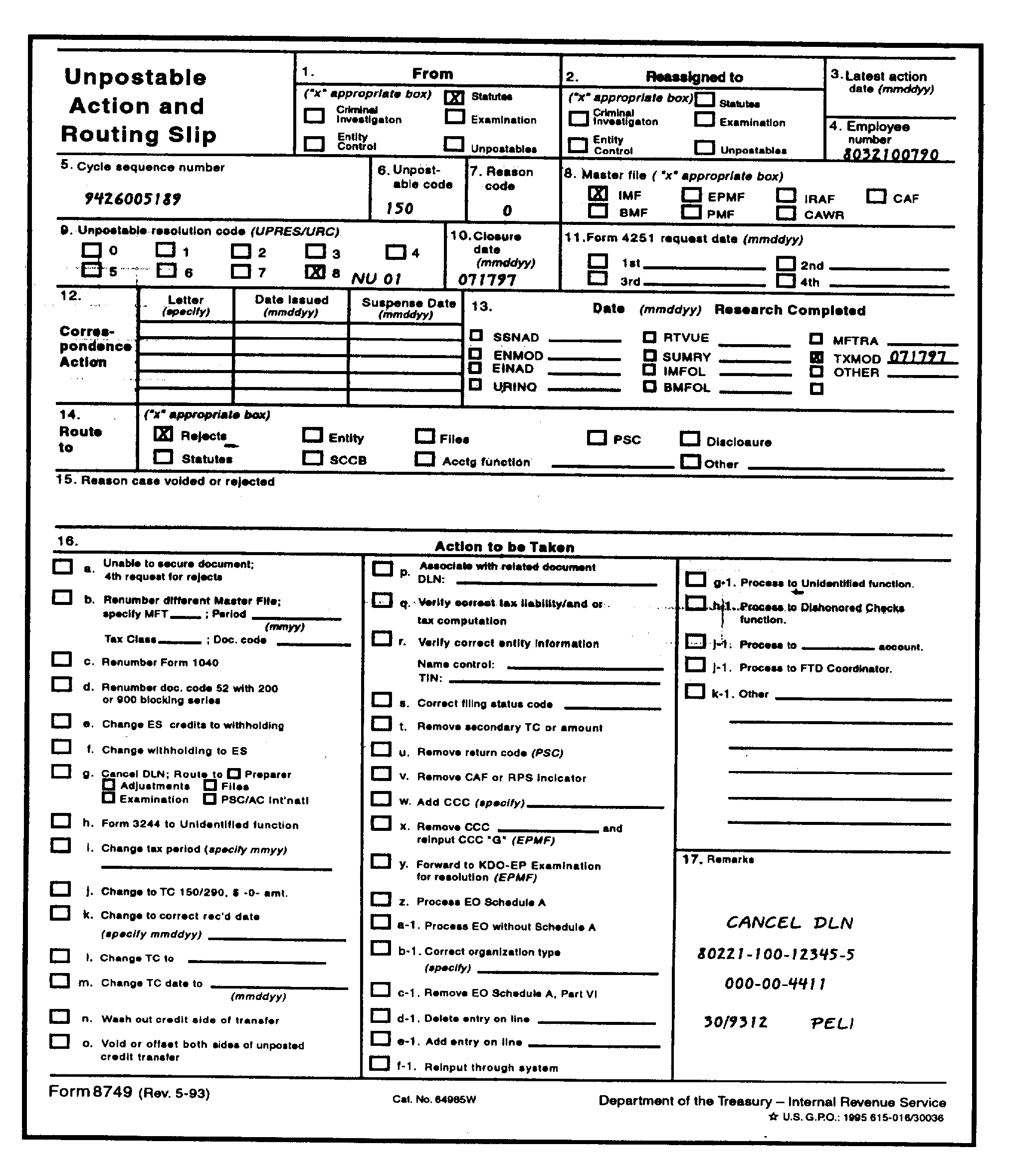
- Employees must write a short, clear summary of the events that caused an assessment to become barred. The summary must be factual, to the point, and only include necessary details.
- Follow the format in this section. Do not add extra details that are not directly related to why the assessment is barred.
The chronology will be made up of 3 sections:
- Barred Responsibility
- Key Dates and Actions
- Reason for the Barred Assessment
The Barred Responsibility section must be structured as follows:
- Barred Responsibility Date (BRD) - the date matching the definition in IRM 25.6.1.13.4.4, Identifying the Responsible Area (currently 90 days before the Assessment Statute Expiration Date (ASED))
- The area that had the document/case on the BRD
The Key Dates and Actions section must be structured as follows:
- IRS Received Date of the document or transcript
- Date the ASED expired
- Dates of any IRS actions from the received date of the return containing the assessment until the ASED, and a short description of one sentence or less (e.g., letter sent, case reassigned, case suspended)
- Dates of any payments, if relevant to the barred statute (e.g., ST-12 transcripts)
- Date of any taxpayer response, if applicable
The Reason for Barred Assessment section must be structured as follows:
Do not include:
- Any identifying information related to the responsible employee.
- Background explanations of general IRS procedures.
- Taxpayer history that does not relate to the barred assessment.
- Personal opinions, speculation, or subjective statements.
- Extra details beyond what is required.
| TIMETABLE FOR SUBMISSION OF STATUTE EXPIRATION REPORTS BY SB/SE FIELD EXAMINATION-RELATED ACTIVITIES/ORGANIZATIONS (including Specialty Programs and supporting activities located in the field ) |
|---|
| (all days are business days) |
| Row Number | Preliminary Form 3999, Statute Expiration Report, or Form 3999-T, Statute Expiration Report (for TEFRA key cases) | Number of days |
|---|---|---|
| 1 | Preliminary report submitted by manager of unit which discovered assessment statute expiration including securing advice, if needed, from Counsel or Technical Services staff, 3 days is days from date of discovery | 3 days |
| 2 | Preliminary report reviewed by field Territory Manager and submitted to the applicable next-level manager | 3 days |
| 3 | Preliminary report logged in by Examination Area Director or Director, Case Processing or relevant Specialty Programs Manager for control and necessary follow-up to ensure that the final report is prepared and submitted timely | 2 days |
| Row Number | Final Form 3999, Statute Expiration Report, or Form 3999-T, Statute Expiration Report (for TEFRA key cases) | Number of days |
|---|---|---|
| 1 | Final report submitted by manager of party responsible for statute expiration or, if procedures for controlling and protecting statutes were followed, then final report is submitted by manager of the unit to which return was assigned on AIMS or which was examining the tax period (even if not controlled on AIMS) when the assessment statute expired, 13 days is days from date of discovery | 13 days |
| 2 | Final report reviewed, approved and submitted by field Territory Manager to the applicable next-level manager (including preparation of any disciplinary action recommendation) | 10 days |
| 3 | Final report reviewed, approved and forwarded for information by Examination Area Director or Director, Case Processing or relevant Specialty Programs Manager as appropriate, to applicable Director, Examination or Specialty Programs | 7 days |
| 4 | Total maximum business days from discovery of assessment statute expiration until final statute expiration report submitted to applicable Director | 30 days |
Note:
Pen and ink changes may be made to appropriate blocks of the online Form 3999, Statute Expiration Report, or Form 3999-T, Statute Expiration Report (for TEFRA key cases), in order to ensure that the forms conform to our current organizational structure and position titles. For preparation of the final statute expiration report, Block 1 of the forms should indicate the applicable Director (Examination or Specialty Programs), as appropriate. Block 2 of the forms should indicate the title of the applicable Director or Specialty Program Manager who approved and is submitting the final statute expiration report.