)
or https:// means you've safely connected to the .gov website. Share sensitive information only on official, secure websites.
)
or https:// means you've safely connected to the .gov website. Share sensitive information only on official, secure websites.


- 5.7.8 In-Business Repeater or Pyramiding Taxpayers
- 5.7.8.1 Program Scope and Objectives
- 5.7.8.1.1 Background
- 5.7.8.1.2 Authority
- 5.7.8.1.3 Roles and Responsibilities
- 5.7.8.1.4 Program Management and Review
- 5.7.8.1.5 Program Controls
- 5.7.8.1.6 Terms and Acronyms
- 5.7.8.2 Repeater Taxpayers
- 5.7.8.3 Identifying Repeater Taxpayers
- 5.7.8.4 Pyramiding Taxpayers
- 5.7.8.5 Working Repeater Trust Fund Taxpayers to Address Pyramiding
- 5.7.8.5.1 Seizure and Sale of Repeater Taxpayer's Assets
- 5.7.8.5.2 Trust Fund Recovery Penalty Procedures
- 5.7.8.5.3 Offers in Compromise
- Exhibit 5.7.8-1 Repeater Evaluation Process Flow Chart
Part 5. Collecting Process
Chapter 7. Trust Fund Compliance
Section 8. In-Business Repeater or Pyramiding Taxpayers
5.7.8 In-Business Repeater or Pyramiding Taxpayers
Manual Transmittal
September 17, 2026
Purpose
(1) This transmits revised IRM 5.7.8, Trust Fund Compliance In-Business Repeater or Pyramiding Taxpayers.
Material Changes
(1) IRM 5.7.8.1 Updated Audience, Policy Owner, Program Owner, and Primary Stakeholders.
(2) IRM 5.7.8.1.3 Updated Responsibilities to Roles and Responsibilities.
(3) IRM 5.7.8.1.3(2) Removed Territory Manager and updated to Field Compliance Manager.
(4) IRM 5.7.8.1.5 Added Program Controls.
(5) IRM 5.7.8.1.6 Changed Terms, Definitions, and Acronyms to Terms and Acronyms. Also, added separate table to define terms.
(6) IRM 5.7.8.3 Changed TDA/TDI to Bal Due/Del Ret.
(7) IRM 5.7.8.3(3) Updated Flow Chart list item 20 to replace continue with return.
(8) IRM 5.7.8.4(5) Added DUT and other return submission methods.
(9) IRM 5.7.8.5(1) Changed initial contact timeframe to 55 days from receipt of case.
(10) IRM 5.7.8.5(2) Updated the Taxpayer Bill of Rights (TBOR) language.
(11) IRM 5.7.8.5(3) Changed ATFR to VTFRP/Virtual Trust Fund Recovery Penalty.
(12) Editorial changes and updates to hyperlinks were made throughout the section.
Effect on Other Documents
IRM 5.7.8 dated 01-09-2020 is superseded.Audience
SB/SE Field CollectionEffective Date
(09-17-2026)Thomas Kramer
Director, Collection Policy
Small Business/Self-Employed
Purpose: This IRM section provides the procedural instructions to identify and work repeater and in-business pyramiding taxpayers. By following the procedures and initiating appropriate collection remedies, revenue officers can prevent and stop the pyramiding of trust fund liabilities.
Defines and describes the steps to identify a repeater taxpayer.
Defines and describes the steps to take when encountering a pyramiding in-business taxpayer.
Audience:The primary users of this IRM are revenue officers and group managers in Field Collection.
Policy Owner: Director, Collection Policy, SB/SE.
Program Owner: Collection Policy, SB/SE, Employment Tax (ET) is the program owner of this IRM.
Primary Stakeholders: Field Collection.
Program Goals: Identify and prevent the pyramiding of tax liabilities and bring tax repeaters into filing and paying compliance.
Promoting payroll tax compliance is a top priority for the IRS as two thirds of federal taxes are collected through the payroll tax system. Early intervention and continuous monitoring of federal tax deposits (FTDs) can prevent in-business taxpayers from pyramiding tax debt and lower the nation’s tax gap. Field Collections’ proper identification of repeater and pyramiding taxpayers are critical to ensure appropriate collection remedies are taken to prevent or stop pyramiding.
The policies in this IRM are based on the following:
IRC 6331, Levy And Distraint
IRC 6321, Lien for Taxes
IRC 6672, Failure to collect and pay over tax, or attempt to evade or defeat tax
Policy Statement 5-34, Collection Enforced Through Seizure and Sale of Assets Occurs Only After Thorough Consideration of All Factors and of Alternative Collection Method
Title 26 31.6302-1, Deposit Rules for Taxes Under the Federal Insurance Contributions Act (FICA) and Withheld Income Taxes
IRC 7402, Jurisdiction of District Court
The Director of Collection Policy is responsible for overseeing policy and procedures regarding repeater and pyramiding taxpayers.
Revenue officers are responsible for identifying and properly working pyramiding and repeater cases. Field Collection Group Manager responsibilities for monitoring pyramiding taxpayers are found in IRM 1.4.50.11, Collection Group Manager, Field Compliance Manager, and Area Director Operational Aid.
Program Reports: Per IRM 1.4.50.11, Collection Group Manager, Field Compliance Manager, and Area Director Operational Aid, group managers are required to use ENTITY on a monthly basis to monitor and maintain controls for pyramiding taxpayers.
Program Effectiveness: Collection Policy does periodic program reviews of employment tax taxpayers to identify trends and opportunities for improvement.
Field collection employees use the Integrated Collection System (ICS) and other research tools for inventory control and to monitor for potential pyramiding and repeater taxpayers.
Collection managers verify program and procedural compliance by conducting case consultations, case reviews, performance reviews, and security reviews. Prescribed internal controls are detailed in IRM 1.4.50, Collection Group Manager, Field Compliance Manager, and Area Director Operational Aid. The ICS, ENTITY Case Management, Embedded Quality Review, and National Quality Review Systems provide the case access, data, and reports used by managers to monitor internal controls and to promote quality case work.
The table below lists frequently used terms in this IRM.
Terms Definitions Bal Due Balance Due Del Ret Delinquent Return Pyramiding An in-business taxpayer who is not current with FTDs and with two or more balance due trust fund modules assigned to Field Collection. Repeater A taxpayer who currently has/previously had one or more Bal Due or Del Ret delinquencies within the past two years from the current processing cycle. The table below lists common acronyms used in this section.
Acronym Definition DUT Document Upload Tool EFTPS Electronic Funds Transfer Payment System FTD Federal Tax Deposit NFTL Notice of Federal Tax Lien TAS Taxpayer Advocate Service TFRP Trust Fund Recovery Penalty
The large number of business taxpayers who repeatedly accrue liabilities and/or do not file their tax returns timely, is a major compliance problem. Field personnel need to properly identify these taxpayers and take appropriate action to bring them into tax compliance as quickly as possible.
A repeater is defined as a taxpayer who currently has/previously had one or more Bal Due or Del Ret delinquencies within the past two years (104 cycles) from the current processing cycle. (see IRM 5.7.8.3(2)(c)). Once identified as a repeater, if the taxpayer maintains 104 cycles of compliance (no Bal Due/Del Ret delinquencies), then they are no longer considered a repeater. If the taxpayer has multiple delinquencies, then they are only considered a repeater if those delinquencies occurred within 104 cycles from the current cycle.
Definition of terms.
The current cycle is the cycle corresponding to the current date.
Delinquency status is defined as a master file status of 22 for Automated Collection System, 24 for Field Queue, 26 for Field Collection, or 03 for Del Ret.
The date a delinquency first came into existence is determined on a module by module basis. There can be multiple delinquency statuses within each module. In order to determine the date of a delinquency, review the master file delinquency status history for the first date a delinquency status [i.e., master file status 03, 22, 24, or 26] arose within the module.
Module Delinquency Example 1:
• 10-12-2023 master file balance due first notice status 21 • 12-1-2024 master file status 22 • 5-11-2025 master file status 24 • 8-24-2026 master file status 26 • 12-5-2024 is the date a delinquency first came into existence for this module. Module Delinquency Example 2:
• 6-15-2023 master file status 03 •10-12-2024 master file balance due first notice status 21 •12-5-2024 master file status 22 • 5-11-2025 master file status 24 • 8-24-2026 master file status 26 • 6-15-2023 is the date a delinquency first came into existence for this module. A module can be currently open or resolved. To determine if a taxpayer is a repeater, review all modules within the last 104 cycles. If the account was open for a minor issue that was quickly resolved, use discretion to determine if the taxpayer is truly a repeater.
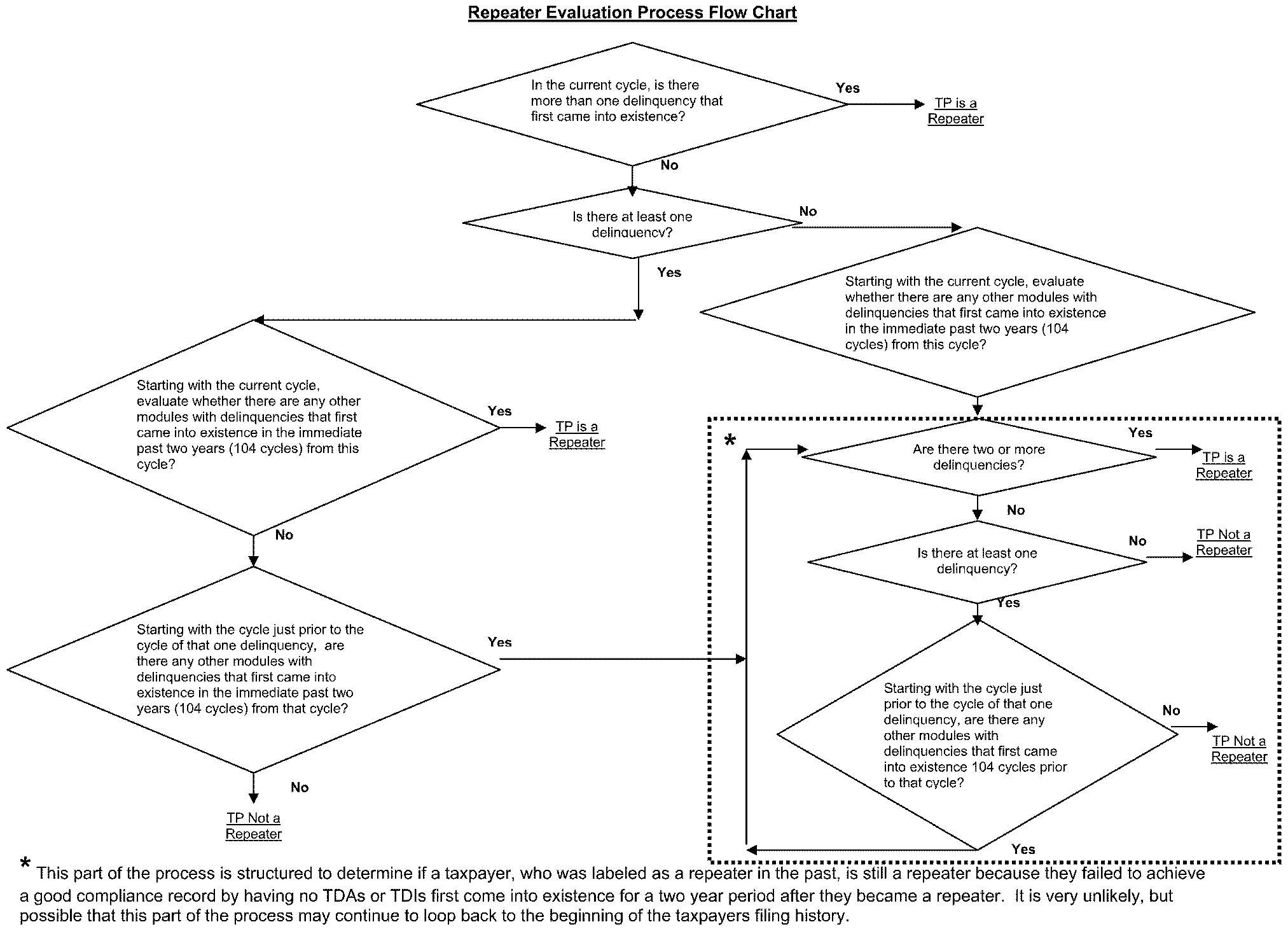
See Exhibit 5.7.8-1 for a flowchart that helps identify when a taxpayer should be considered a repeater.
Repeater Evaluation Process Flow Chart. This is the start of the flow chart.
Process One
In the current cycle, is there more than one delinquency that first came into existence?
If yes, the taxpayer is a repeater.
If no, continue to process two.
Process Two
Is there at least one delinquency?
If yes, continue to process three.
If no, continue to process five.
Process Three
Starting with the current cycle, are there any other modules with delinquencies that came into existence in the immediate past two years or one hundred and four cycles, from this cycle?
If yes, the taxpayer is a repeater.
If no, continue to process four.
Process Four
Starting with the cycle just prior to the cycle of that one delinquency, are there any other modules with delinquencies that first came into existence in the immediate past two years or one hundred and four cycles from that cycle?
If yes, continue to process five.
If no, the taxpayer is not a repeater.
*(see note at end)
Process Five
Are there two or more delinquencies?
If yes, the taxpayer is a repeater.
If no, continue to process six.
Process Six
Is there at least one delinquency?
If yes, continue to process seven.
If no, the taxpayer is not a repeater.
Process Seven
Starting with the cycle just prior to the cycle of that one delinquency, are there any other modules with delinquencies that first came into existence one hundred and four cycles prior to that cycle?
If yes, return to process five.
If no, the taxpayer is not a repeater.
Note:
This part of the process is structured to determine if a taxpayer, who was labeled as a repeater in the past, is still a repeater because they failed to achieve a good compliance record for a two year period. It is possible that this part of the process may continue to loop back to the beginning of the taxpayer's filing history.
The large number of in-business taxpayers pyramiding trust fund tax liabilities is a major compliance problem. A pyramiding taxpayer is defined as:
In business
Not current with FTDs
Has two or more trust fund modules assigned to Field Collection.
A taxpayer who pyramids tax liabilities is not demonstrating a good faith effort to comply with their tax obligations. Early intervention and the continuous monitoring of FTDs can prevent taxpayers from pyramiding.
Taxpayers who make timely and adequate FTDs after contact and file all outstanding tax returns are in compliance. These taxpayers are no longer considered pyramiding taxpayers.
When determining the appropriate course of action to resolve these accounts, consider previous efforts to educate the taxpayer about the importance of remaining compliant.
Field employees can secure signed copies of delinquent returns via the Document Upload Tool (DUT), fax, encrypted email, etc. The RO must forward the signed returns for processing immediately to ensure that the taxpayer is in full compliance.
Field Collection should be aware that taxpayers who use Form 944, Employer’s Annual Federal Tax Return, can pyramid tax liabilities when payroll tax exceeds $2500 (refer to example b and c in IRM 5.7.8.4 (7)). Form 944 is an annual tax return filed by taxpayers with an expected payroll tax liability below $1,000 per year. The taxpayer may be switched to a Form 944 systemically or request permission from the IRS. Taxpayers who file Form 944 may have requested to do so in error or their payroll may have unexpectedly risen, resulting in a liability over $1,000. If a Form 944 liability reaches or exceeds $2,500 for a calendar quarter, the taxpayer is not exempt from regular deposit rules and needs to make monthly or semi-weekly FTDs, depending on their deposit schedule. See IRM 20.1.4.6, De Minimis Exception to Deposit Requirements, for Form 944 deposit requirements.
If taxpayers file Form 944 timely with a liability over $1,000, their filing requirement will be systemically changed to a Form 941 filer on the Integrated Data Retrieval System (IDRS). If the taxpayer has a liability over $1,000 and fails to timely file Form 944, or if the taxpayer chooses to opt out of filing Form 944, prepare Form 2363, Master File Entity Change, to update the filing requirement to Form 941 (see IRM 21.7.2.4.7.2, Form 944 Program - Opt-In and Opt-Out Inquiries) and forward to Centralized Case Processing (CCP) for processing. CCP can only process these requests from January 1 through April 1. The change in filing status must be input on or before April 1st in order for IDRS to update the filing requirement and accept the correct return (see IRM 5.4.10.2(10), Adjustments, and IRM 21.7.2.4.7.1, Form 944 Cache). If Form 2363 is received after April 1st CCP will accept the form but will be unable to process it until after January 1st of the next year (see IRM 3.13.2.8.22(6), Miscellaneous Forms). Letter 3007, Employment Return Filing Requirements/Instructions Form 941, is used prior to April 1 of the current year to notify the taxpayer of the filing requirement change from Form 944 to Form 941.
Example: A taxpayer with a Form 944 filing requirement paid wages once during the year on January 15, 2025, with a total tax due of $2,300. The taxpayer did not have a FTD requirement since the liability for the year remained under $2,500. Full payment of the tax must be submitted with the filing of Form 944. The taxpayer filed Form 944, timely and the filing requirement was systemically changed to Form 941 for 2026.
Example: A seasonal taxpayer with a Form 944 filing requirement paid wages twice in 2025. The first payroll was made on March 15, 2025, with a tax liability of $2,000, and the next payroll was made on July 15, 2025, with a tax liability of $2,300. The employer was required to make a FTD of $4,300 by August 15, 2025. The taxpayer did not file Form 944 timely, so the RO prepared Form 2363, Master File Entity Change, to update the filing requirement.
Example: A corporation started a business on September 1, 2025 anticipating an annual liability of less than $1,000 and electing to file Form 944 on Form SS-4, Application for Employer Identification Number. By April 2026, the payroll tax liability exceeded $2,500, so the corporation began making timely monthly deposits. (See Pub 15 Section 11, Employer’s Tax Guide). The revenue officer advised the taxpayer to file Form 944 timely and explained this will change their filing requirement to Form 941 systemically for the next year. If the taxpayer fails to timely file Form 944, the revenue officer can prepare Form 2363, Master File Entity Change, to update the filing requirement to Form 941.
If a taxpayer is identified as a repeater, attempt initial contact within 55 days from receipt of the case (see IRM 5.1.10.3.1(3), Timely Initial Contact Actions) and focus on preventing the taxpayer from pyramiding. When the taxpayer has a power of attorney, an appointment will be made to meet the taxpayer and his/her representative at the taxpayer’s commercial location to provide an opportunity to review payroll records, view assets, and observe the business operation in the event a risk analysis determination is necessary. If the RO is unable to make contact with the business taxpayer at the commercial location, the reason must be documented in the Integrated Collection System (ICS) case history, and an observational field visit to view assets must be done before submitting the case for closure, if practical (see IRM 5.1.10, Taxpayer Contacts).
The Taxpayer Bill or Rights (TBOR) lists rights that already existed in the tax code, putting them in simple language and grouping them into 10 fundamental rights. Employees are responsible for being familiar with and acting in accord with taxpayer rights. See IRC 7803(a)(3), Execution of Duties in Accord with Taxpayer Rights. For additional information about the TBOR, see Taxpayer Bill of Rights.
During initial contact, conduct a Trust Fund Recovery Penalty (TFRP) interview using Form 4180, Report of Interview with Individual Relative to Trust Fund Recovery Penalty or Personal Liability for Excise Taxes. Use the Virtual Trust Fund Recovery Penalty (VTFRP) system to calculate the potential TFRP based on the current assessment and provide the amount to the taxpayer. Review the potential assessment, TFRP procedures, and the collection process with the taxpayer. See IRM 5.7.3, Establishing Responsibility and Willfulness for the Trust Fund Recovery Penalty, and IRM 5.1.10.3.2(10), Initial Investigative Interview, for additional information.
During initial contact, advise the taxpayer they will need to stay current with their FTDs. Document the case history with the taxpayer’s deposit schedule (i.e. monthly, semiweekly). Secure electronic funds transfer payment system (EFTPS) confirmation, such as an electronic fund transfer number, and request the taxpayer send confirmation to verify the timeliness and accuracy of deposits, until their case is resolved. The revenue officer will monitor compliance with FTDs, verify that they are made accurately, and document the ICS case history. See IRM 5.1.10, Taxpayer Contacts, for specific requirements regarding the information that must be obtained during initial contact.
It is important for revenue officers to recognize the difference between a taxpayer identified as a repeater (IRM 5.7.8.3) and one that is pyramiding (IRM 5.7.8.4). Any decision involving case actions such as an installment agreement, closure as currently not collectible, or an offer in compromise should not be based solely on this determination but in conjunction with other relevant aspects of the case. These include their cooperation working with the Internal Revenue Service to resolve their tax delinquencies, their ability to remain current with present and future tax obligations, and their ability to remain solvent while making payments on their delinquent taxes.
Pyramiding must be stopped immediately. Advise the taxpayer enforcement action will be taken if acceptable proof of compliance is not provided while their delinquent tax issues are resolved. If the taxpayer continues to pyramid, use all appropriate remedies to bring the taxpayer into compliance. If routine case actions are not effective in stopping the taxpayer from pyramiding, consider alternative solutions including seizure of physical assets and injunctive relief.
Taxpayers who consistently make timely and adequate FTDs, after contact, are in compliance and should not be considered a pyramiding taxpayer. Follow procedures in IRM 5.7.4.8, Determining Whether To Pursue the TFRP in Installment Agreement or Bankruptcy Situations, and IRM 5.14.7, BMF Installment Agreements, when considering an installment agreement for these taxpayers.
Secure sufficient financial information during initial contact so enforcement action can be taken if necessary.
If it is determined that the business is "Out of Business" or is no longer required to file returns, immediately complete Form 2363, Master File ENTITY Change, or Form 4844, Request for Terminal Action, to close out the filing requirements on IDRS. Continue procedures to pursue the TFRP investigation. (See IRM 5.7.4, Investigation and Recommendation of the Trust Fund Recovery Penalty).
Make a determination and document the case history with the taxpayer’s ability to pay current and delinquent taxes.
Set specific deadlines when requesting information from the taxpayer. Use Form 9297, Information and Document Request - Collection, to give the taxpayer a clear understanding of the consequences for failure to comply. On Form 9297, list the requirement to make FTDs and the date required to provide verification and give the taxpayer a copy as a reminder.
Installment agreements are not appropriate for taxpayers who continue to accrue tax liabilities after contact because they are not in compliance. See IRM 5.14.7, BMF Installment Agreements, and IRM 5.7.4.8.1, Considerations for In-Business Installment Agreements, for the procedures to follow when considering an installment agreement for Business Master File (BMF) taxpayers who are making FTDs after contact and are no longer pyramiding.
Cases involving repeater and pyramiding taxpayers will often require enforcement action. On initial contact, issue Letter 1058, Notice of Intent to Levy and Notice of Your Right to a Hearing, with all required enclosures. If prior history or research indicates the taxpayer has limited to no assets and/or has not made deposits, consider issuing Letter 903, Letter to Employer - You Haven’t Deposited Federal Employment Taxes (see IRM 5.7.2., Letter 903 Process). Receipt of Letter 1058 and/or Letter 903 during initial contact may prompt the repeater or pyramiding taxpayer to cooperate.
If contact is made, explain to the taxpayer the Letter 1058 is being issued to ensure their compliance with filing and paying requirements and failure to comply with the revenue officer’s requests will result in enforcement action. The revenue officer must provide the taxpayer with their collection due process (CDP) rights and explain the CDP process to them. The right to submit a CDP appeal will expire 30 days after issuance of the letter. The taxpayer still retains the right to request an "equivalent" hearing (See IRM 5.1.9.3.2.2, Equivalent Hearing (EH) and Timeliness of EH Requests) and/or to appeal a specific planned or actual collection action under the Collection Appeals Program (CAP) (See IRM 5.1.9.4, Collection Appeals Program).
If attempts to contact the taxpayer are unsuccessful, issue Letter 1058 and consider immediate enforcement action as the next course of action.
If the taxpayer previously requested a CDP hearing for employment taxes and pyramided additional liabilities, then consider if a Disqualified Employment Tax Levy (DETL) is necessary (see IRM 5.11.1.5.2, Disqualified Employment Tax Levy). Advise the taxpayer of post-levy CDP rights on the tax period identified in the DETL.
In situations where the taxpayer is non-compliant, and there are no viable levy sources, revenue officers should consider civil injunctions against the taxpayer (see IRM 5.17.4.17, Civil Injunctions under IRC 7402(a) to Restrain Pyramiding, and IRM 25.3.2.6.2,Injunction Monitoring for Trust Fund Pyramiding Cases).
Make a Notice of Federal Tax Lien (NFTL) determination within the prescribed time frames following IRM 5.12.2, Notice of Lien Determinations, for specific guidance on whether to file or defer filing. The taxpayer's filing and payment compliance should always be considered when the non-filing or deferring of a Notice of Federal Tax Lien is being determined. The NFTL should generally be filed on pyramiding taxpayers unless group manager approval is secured when the criteria to defer or not file is met (See IRM 5.12.2.4, Determination Criteria for “Do-Not-File” or Deferring the NFTL Filing). Taxpayers have the right to be informed and to appeal an IRS decision in an independent forum. If a NFTL filing is proposed, advise the taxpayer of their right to file a CAP. Also explain to the taxpayer their right to request a CDP under IRC 6320 once the NFTL has been filed (See IRM 5.12.6, Appeals Processes Involving Liens).
If levy sources are exhausted and the repeater or pyramiding taxpayer has no assets which can be seized to resolve or offset the liability, then consider issuing Letter 903, and Notice 931, Deposit Requirements for Employment Taxes.
These procedures should be used in the most egregious cases of non-compliance and where attempts at collection have already been unproductive.
Issuance of the Letter 903, will assist in promoting compliance.
Once the Letter 903, is issued, subsequent delinquencies by the taxpayer will be accelerated to the field for prompt enforcement action.
During taxpayer contact, when the taxpayer asks to be referred to the Taxpayer Advocate Service (TAS) or meets TAS criteria (See IRM 13.1.7, Taxpayer Advocate Service (TAS) Case Criteria), and the taxpayer’s issue cannot be resolved within 24 hours, prepare and forward Form 911, Request for Taxpayer Advocate Service Assistance And Application for Taxpayer Assistance Order, to the Local Taxpayer Advocate (See IRM 13, Taxpayer Advocate Service). Generally, when a case has been assigned to TAS, collection actions, such as NFTL filing and levy issuance, should be suspended until TAS has had a reasonable opportunity to resolve the disputed issue.
Note:
If the issue cannot be completely resolved within 24 hours but steps are taken to begin resolving the taxpayer's issues within 24 hours, do not forward Form 911 except in cases where the taxpayer has requested to be assigned to TAS unless the case meets the criteria in IRM 13.1.7.5, Same Day Resolution by Operations.
The repeater taxpayer’s history of non-compliance is an important factor when contemplating the seizure of an in-business taxpayer’s assets (See Policy Statement P-5-34 and IRM 1.2.1.6, Policy Statements for the Collecting Process ). If the taxpayer accrues additional unpaid trust fund liabilities after contact, conduct a risk analysis and a seizure should be made (see IRM 5.10.1.5.2, Alternative Methods of Collection) if it is the most appropriate action. The revenue officer must ensure there will be expected net proceeds from the sale and all IRM and IRC requirements are followed.
If the liability is not fully paid during initial contact begin the TFRP investigation for possible assessment (see IRM 5.7.4.2, TFRP Determinations, Interviews, and Investigations).
Make a collectibility determination (See IRM 5.7.5, Collectibility Determination) for those determined to be both responsible and willful for the TFRP.
Note:
Taxpayers who make appropriate FTDs after contact and are in compliance are no longer considered to be pyramiding. A TFRP determination must still be made. Follow the procedures in IRM 5.7.4.8, Determining Whether to Pursue the TFRP in Installment Agreement or Bankruptcy Situations, and/or IRM 5.14.7, BMF Installment Agreements, when considering an installment agreement for these taxpayers.
When conducting the TFRP investigation, consider the potential for additional liabilities from unfiled returns.
Advise the taxpayer that before an offer in compromise on employment taxes will be investigated, one of the following must apply:
The trust fund portion of the taxes must be paid,
The TFRP must be assessed against any/all responsible/willful persons,
The trust fund package is complete and forwarded for assessment, or
A determination made to not assert the TFRP due to collectability/dollar criteria
Note:
If an offer in compromise is submitted prior to completing the required trust fund recovery penalty investigation actions, then it will be returned without appeal rights (See IRM 5.8.4.7.1, Offer Submitted Solely to Delay Collections,IRM 5.8.4.20, Responsibility of Offer Examiners, Offer Specialists, and Field Revenue Officers and IRM 5.8.4.21.1, Trust Fund Liabilities).
In-business taxpayers who submit an offer in compromise on employment taxes must demonstrate compliance by making timely FTDs and timely filing their tax returns while their offer is considered. Advise the taxpayer if they fail to make timely FTDs, an offer that was previously deemed processable will be returned without appeal rights (See IRM 5.8.7.2.2.3, Return for Failure to Make Timely Federal Tax Deposit).