


 )
or https:// means you've safely connected to the .gov website. Share sensitive information only on official, secure websites.
)
or https:// means you've safely connected to the .gov website. Share sensitive information only on official, secure websites.


Starting in 2027, the federal government will match up to 50% of money you save for retirement. The Saver’s Match program is designed for people with low and moderate income. Learn how it works and if you qualify.
On this page
- About the Saver’s Match
- Who qualifies
- How your savings grow with the Saver’s Match
- How to prepare for the Saver’s Match
- Frequently asked questions (FAQs)
About the Saver’s Match
The Saver’s Match is a new federal program that matches a portion of the money you save for retirement.
If you’re eligible and contribute to a retirement plan or Individual Retirement Account (IRA) for 2027:
- You can claim the Saver’s Match when you file your 2027 federal tax return in 2028
- The federal government matches up to 50% of what you contribute – a match of up to $1,000 per person each year deposited directly into your designated retirement account. For married couples filing jointly, the match applies to each spouse. Matching funds will go into a retirement plan or IRA and grow alongside your own contributions.
The Saver’s Match is replacing the Saver’s Credit for contributions made to retirement plans or IRAs. However, contributions made to ABLE accounts could still be eligible for the Saver’s Credit.
Early withdrawals
Important: Money in retirement accounts is intended for long-term savings. Withdrawals made before age 59½ may be subject to additional taxes and restrictions.
Who qualifies
To qualify for the Saver’s Match, you must meet the following requirements:
Basic requirements
To qualify, you must meet all these requirements:
- You make contributions to your retirement plan or IRA (there is no minimum amount)
- You are 18 by the end of the tax year
- You are not a student as defined in section 152(f)(2)
- You are not claimed as a dependent on another person’s return
- You are a U.S. resident for tax purposes (generally nonresidents do not qualify.)
Note: Bona fide residents of U.S. territories claiming the Saver’s Match must file through their territory’s tax agency; the IRS cannot process these Saver’s Match claims.
You can qualify even if you owe little or no federal income tax.
Income limits
Whether you qualify and what percentage match you receive depends on your modified adjusted gross income (MAGI) and filing status.
For the Saver’s Match, MAGI starts with your adjusted gross income (AGI) and adds certain excluded or deducted amounts, including pre-tax retirement contributions as well as certain excluded foreign income (such as foreign earned income or housing exclusions).
As your income increases, the match rate decreases.
Saver’s Match rates based on filing status and modified adjusted gross income
| Filing status | Full match (50%) | Partial match | No match |
|---|---|---|---|
| Married filing jointly, qualifying surviving spouse | Up to $41,000 | $41,001-$70,999 | $71,000 and above |
| Head of household | Up to $30,750 | $30,751-$53,249 | $53,250 and above |
| Single, married filing separately | Up to $20,500 | $20,501-$35,499 | $35,500 and above |
These income limits will be adjusted for inflation in years after 2027.
How your savings grow with the Saver’s Match
Saving for retirement can help you prepare for the future. Even small contributions can grow significantly over time. The Saver’s Match helps by adding government funds to your retirement account when you contribute.
Example: Growing your savings over time with the match
If you contribute $20 a month to a retirement account in 2027 ($240 total) and qualify for the full 50% match, the federal government adds $120 to your retirement account. That’s $360 saved for retirement for just the first year.
Projected retirement savings growth over time with Saver’s Match
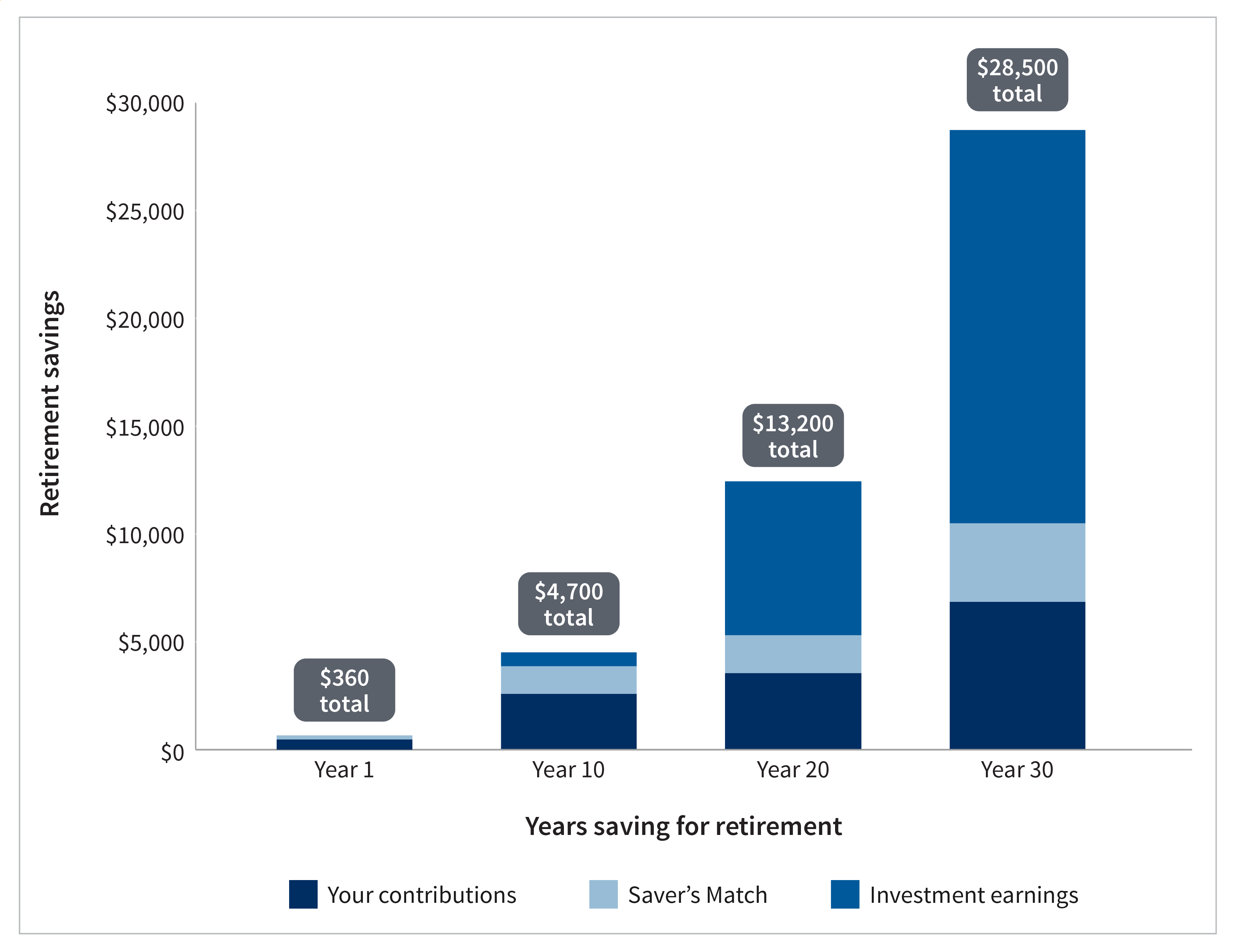
The graphic shows an example of how your savings can grow over time if you contribute the same amount each year and remain eligible for the match. This example is based on an annual growth of 6 percent per year.
Calculate your retirement savings growth
The earlier you start saving, the more time your money has to grow. Calculate how much your retirement savings can grow with compound investment returns.
Calculate your compound growth
How to prepare for the Saver’s Match
You don’t need to do anything in 2026. The Saver’s Match applies to retirement contributions you’ll make starting in 2027.
In 2027, take these steps:
- If you are able to contribute to an eligible retirement plan or have either a traditional or Roth IRA, start or continue contributing to the plan or IRA. Eligible plans include a 401(k), 403(b), or governmental 457(b) plan. There is no minimum contribution amount to qualify for a Saver’s Match.
- If you are not able to contribute to an eligible retirement plan and do not have either a traditional or Roth IRA, open a new IRA. Starting in 2027, TrumpIRA.gov will list financial institutions that offer IRAs, accept Saver’s Match contributions, and satisfy other criteria.
- Keep records of your contributions.
In 2028, you can claim the Saver’s Match by filing Form 8880-A with your 2027 federal tax return.
Frequently asked questions
Could I be eligible for both the Saver’s Credit and Saver’s Match?
Usually, you won’t be eligible for both. For the 2027 tax year, the Saver’s Match replaces the Saver’s Credit for eligible retirement contributions. This means you can’t receive both for the same type of contribution.
However, if you make eligible contributions to an ABLE account, you may still be able to claim the Saver’s Credit. The Saver’s Match does not apply to ABLE accounts.
Do I need to apply for Saver’s Match?
Yes, to claim the Saver's Match for tax year 2027 you will need to file a Form 8880-A along with your annual federal tax return in 2028.
Related
- Report to Congress on Anticipated Saver’s Match Promotion Efforts PDF
- Notice of Intent to Issue Regulations with Respect to Saver’s Match Contributions, Notice 2026-48 PDF
- Types of retirement plans
- Benefits of setting up a retirement plan
- Credits and deductions for individuals
- Retirement Savings Contributions Credit (Saver’s Credit)
Student is an individual who, during each of five months during the calendar year in which the taxable year of the individual begins, (1) is enrolled full-time at a school that has a regular teaching staff, course of study, and regularly enrolled body of students in attendance, or (2) is taking an on-farm training course full-time given by an accredited agent of a school described in clause (1), or a state or political subdivision of a state, county, or local government.